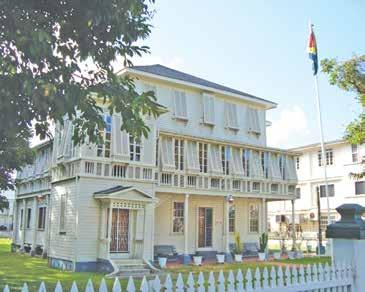
Memories of indomitable freedom fighters are preserved in what was once their humble abode
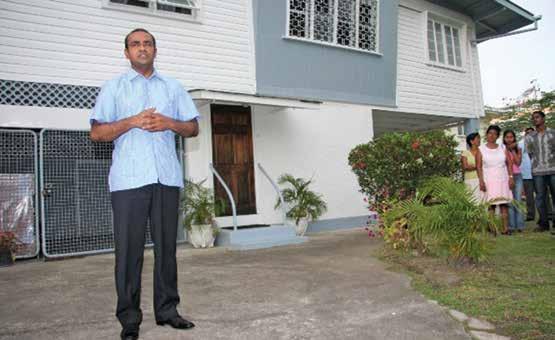
Managed by the Cheddi Jagan Research Centre, the home of the late Jagans was declared open to the public by their daughter, Nadira, on 30 April 2009, after Mrs Jagan died in March of the same year.
The house was built in 1966, the year of Guyana’s independence, and designed by Dr Jagan. This was the family’s first owned home, as up to late 1966 they had been living in rented houses since returning to British Guiana in 1943. Their children had both left by 1972 for studies overseas. Dr Jagan and his wife lived here until 1992 when he moved to the State House after being democratically elected President of Guyana. He lived there until his illness on 14 February 1997.
After her husband’s death, Mrs Jagan returned to the home in 1997 and lived here until her death on 28 March 2009. She also lived there while she was president from 1997 to 1999.
Some changes were made to the house in 1997. Originally, the wooden front of the house, which is now grey, was stained dark. The kitchen and bathroom were redone.
The tour
The Jagan’s modest wooden home consists of three bedrooms, one bathroom, a study, living room, dining room and a kitchen.
Entering the home, visitors will go through the entrance room, which was used as a greeting place if the family had other visitors. There was a door opening out to the yard but this was later closed off because of water seeping in when it rained heavily. This was the only change made to this
room from its original state.
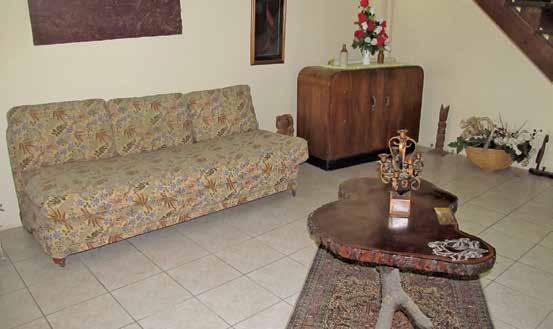
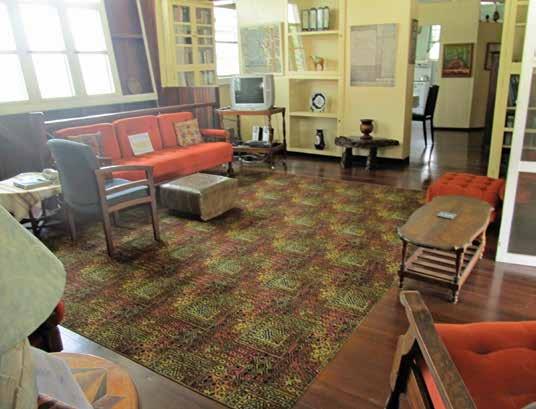
The focal point of the living room is said to be the carpet purchased by Dr Jagan from Kissoon’s Furniture Store in 1966. Collections of books, found in all the rooms of the house, cover a wide range of topics, and the many paintings and sculptures were collected by Mrs Jagan over the last 66 years. There are copies of original paintings done by Guyanese artist Stanley Greaves and many other local and international artists. The photo of Kaieteur Falls was taken by their daughter Nadira and presented to Dr Jagan on his 75th birthday.
There is a blue chair in the room used by Mrs Jagan during the last few years of her life. The large photographic collection covers the period from the 1940s to 2009. They include historical photos from the couple’s early days in the US, the early political struggle, the history in photos of the 1953, 1957, 1961 and 1992 PPP governments, photos of private moments with family, overseas visits, and their funerals. The study was designed
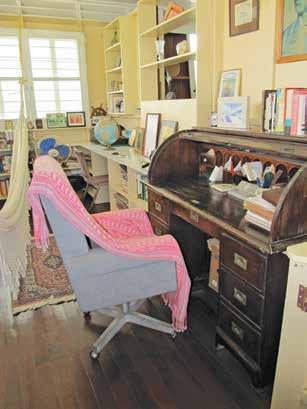
to house all of Dr and Mrs Jagan’s papers and books, and to provide a quiet space for them to work. The desk that Dr Jagan worked on was bought by his father as a gift after Dr Jagan returned to British Guiana from the US. This is where he sat down to write his articles, speeches and most importantly, many of his books, including his autobiographical work, “The West on Trial”. The painting of Dr Jagan that now hangs above his desk was placed there after his death.
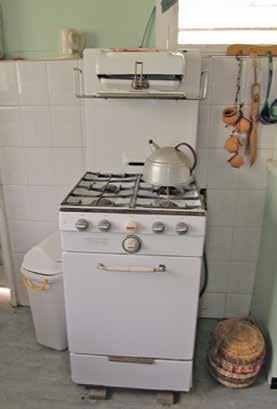
In the dining room the family had all their meals; meals were never eaten in the living room. The BBC was always on in the mornings during breakfast. The stove is one of the home’s original pieces, having been purchased in 1966. The kitchen was remodelled in 1997 and a few changes were made to the cupboard doors. When there was not any extra help in the house, Mrs Jagan cooked the meals and cleaned the house but Dr Jagan would clear the table and wash up the dishes. His job was to polish the wooden floors when they needed to
weekly articles by hand at the dining room table.
The size of the veranda was enlarged in 1995 and a covered roof added. This is where the Jagan family enjoyed entertaining their guests or just spending quality time together as a family. Almost all of the trees in the yard were planted by Dr
ings and it was spent quietly. The mornings would begin with Dr Jagan in the yard and Mrs Jagan cleaning the house. For lunch, the family enjoyed Mrs Jagan’s Sunday meal of roast chicken, baked potatoes, stuffing and lots of fruits. After lunch, both husband and wife would nap
be done.
Dr Jagan enjoyed resting in the hammock and even had one at his office at Freedom House during his years as Leader of the Opposition and one at State House when he was President from 1992 to 1997.
The typewriters at Mrs Jagan’s desk are the ones she used to type her articles for the periodicals Thunder and the Mirror along with her children stories and her personal correspondences. She never used a computer. After she returned home in 1997, she would write her
Jagan. He took care of the yard and the planting of fruit trees, flowering trees such as the flamboyant trees, vegetable gardens, and flowers. He loved his orchids. He also at different time had chickens, rabbits, and even sheep. Working in the yard was a joy for him, and his form of relaxation. He spent hours there whenever he had the chance. Unfortunately he was not able to spend time doing this during his years as president.
Sunday was the only day off if they did not have meet-
then they would sit together on the veranda or go to the seawall for a walk. Later in the evening, Mrs Jagan would read; one of her many loves. Dr Jagan would end up at his desk.
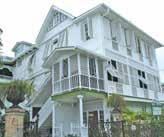
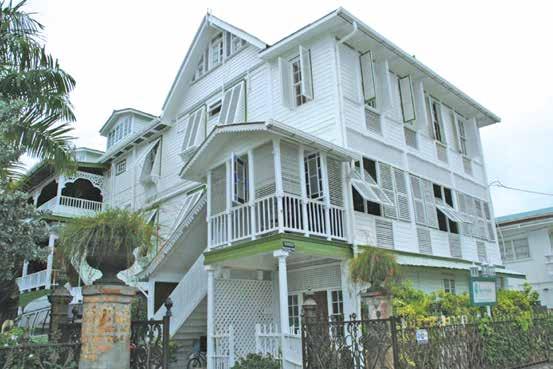
This was their life together: a loving couple who, together in a loving home, were able to create much change in the lives of so many Guyanese and transform the country. (www. jagan.org) (Cover photo: Heritage Home of Cheddi and Janet Jagan located in Bel Air)
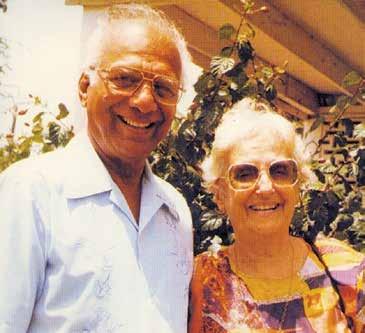
Dr Cheddi and Janet Jagan
Dr Jagan's desk today, which still has all of its original features
The living room, which still has the large rug and Mrs Jagan's blue chair
The stove that was purchased in 1966
Former president Bharrat Jagdeo speaking at the opening of the Jagan's residence as a heritage home in Bel Air
The entrance room, which was used to greet guests and dignitaries
CARICOM Day, celebrated in Guyana on 7 July, commemorates the treaty establishing the Caribbean Community and Common Market (CARICOM) and is observed annually by all CARICOM countries, though not necessarily on the same date of the year.
The establishment of the Caribbean Community and Common Market was the result of a 15-year effort to fulfil the hope of regional integration which was born with the establishment of the British West Indies Federation in 1958. The West Indies
Trinidad and Tobago. At this Conference, the participating leaders of the four Caribbean Countries all spoke clearly of the need for close cooperation with Europe, Africa and Latin America.
In July 1965, talks between the Premiers of Barbados and British Guiana and the Chief Minister of Antigua on the possible establishment of a Free Trade Area in the Caribbean resulted in the announcement of definite plans to establish such a Free Trade Area. In December that year, Heads of Government of Antigua,
Federation came to an end in 1962 but its end, may be regarded as the real beginning of what is now the Caribbean Community.
With the end of the Federation, political leaders in the Caribbean made more serious efforts to strengthen the ties between the islands and mainland by providing for the continuance and strengthening of the areas of cooperation that existed during the Federation. Further, Jamaica and Trinidad and Tobago both attained independence in August that year and with it the power to control their own domestic and external affairs.
In announcing its intention to withdraw from the Federation, the Government of Trinidad and Tobago proposed the creation of a Caribbean Community, consisting not only of the ten members of the Federation, but also of the three Guianas and all the islands of the Caribbean Sea - both independent and non-independent.
To discuss this concept, the Prime Minister of Trinidad and Tobago convened the first Heads of Government Conference in July 1963, and attended by the leaders of Barbados, British Guiana, Jamaica and
Barbados and British Guiana signed an Agreement at Dickenson Bay, Antigua, to set up the Caribbean Free Trade Association (CARIFTA).
The new CARIFTA agreement came into effect on 1 May 1968, with the participation of Antigua, Barbados, Trinidad and Tobago and Guyana. The original idea to permit all territories in the Region to participate in the Association was achieved later that year with the entry of Dominica, Grenada, St. Kitts/ Nevis/Anguilla, Saint Lucia and St. Vincent in July and of Jamaica and Montserrat on 1 August 1968. British Honduras (Belize) became a member in May 1971.
At the 7th Heads of Government Conference in October 1972, Caribbean leaders decided to transform CARIFTA into a Common Market and establish the Caribbean Community of which the Common Market would be an integral part.
At the 8th Heads of Government Conference of CARIFTA held in April 1973 in Georgetown, Guyana, the decision to establish the Caribbean Community was brought into fruition with the consideration of Heads of Government of the draft legal in-
struments and with the signing by 11 members of CARIFTA (the exception being Antigua and Montserrat).
The Accord provided for the signature of the Caribbean Community Treaty on 4 July and its coming into effect in August 1973, among the then four independent countries: Barbados, Guyana, Jamaica and Trinidad & Tobago.
The Georgetown Accord also provided that the other eight territoriesAntigua, British Honduras, Dominica, Grenada, Saint Lucia, Montserrat, St. Kitts/Nevis/Anguilla and St. Vincent which signed the Accord would become full members of the Community by 1 May 1974.
The Caribbean Community and Common Market was established by the Treaty of Chaguaramas, which was signed by Barbados, Jamaica, Guyana and Trinidad & Tobago and came into effect on 1 August 1973. Subsequently, the other eight Caribbean territories joined CARICOM. The Bahamas became the 13th Member State of the Community on 4 July 1983, but not a member of the Common Market.
In July 1991, the British Virgin Islands and the Turks and Caicos became Associated Members of CARICOM, followed by Anguilla in
The Jenman Education Centre
July
1999.
Suriname
Haiti secured provisional membership on 4 July 1998, and on 3 July 2002 was the first Frenchspeaking Caribbean State to become a full Member of CARICOM.
CARICOM Heads of Government, CARICOM SecretaryGeneral and Heads of Delegation of CARICOM Member States
CARICOM Secretariat in Guyana
The Cayman Islands became the fourth Associate Member of the regional grouping on 16 May 2002, and Bermuda the fifth Associate Member on 2 July 2003.
became the 14th Member State of the Caribbean Community on 4 July 1995.
The Jenman educaTion cenTre
In honour of British Botanist George Samuel Jenman’s work to the Botanical Gardens, the Jenman Education Centre was officially launched in 2004 to raise environmental awareness, conduct environmental research and promote environmental activities.
George Samuel Jenman was born in 1945 in South of England, but was taken as a child by his parents to the south of Ireland where he spent his boyhood. He started life as a young gardener and obtained employment at the Royal Botanic Gardens in 1871. On 6 September 1873 he left that establishment to take charge of the Cinchona plantations in the Castleton Garden as the Superintendent in Jamaica, where he remained until he was appointed Government Botanist and
Superintendent of the Botanic Gardens of British Guiana on 21 August 1879. Jenman reorganised the Royal Botanic Gardens, bringing into high cultivation what was previously waste land, and making them one of the finest and most valuable botanic gardens in that part of the world. Jenman’s efforts to
develop botanical research in British Guiana over a period of 23 years were selfless and untiring. He died at the pinnacle of his career on 28 February 1902 at the age of 57. His last report was dated 27 January 1902, which meant that he was working until the time of his death.
His botanical collection of over 8,000 specimens stands out even today as one of the most important colonial collections. In addition to numerous descriptions of new species published in various journals, in 1881 he published a handlist of Jamaica’s ferns, and in 1898 in the bulletin of the Royal Botanic Gardens and Trinidad, an enumeration with description of the ferns of the British West Indies and Guiana.
The Jenman Educational Centre is a historical building. It was the home of
George Jenman and was erected not too long after the start of the development of the Botanical Gardens. Additionally, it served as the meeting place for the Garden’s Board of Directors and also was a small warden quarters for Jenman, who was brought to layout the Botanical Gardens, and spent 34 years doing so. The building was also used as an administrative office for the Botanical Gardens for a number of years and then later converted to an education centre, which speaks specifically to environmen-
tal education.
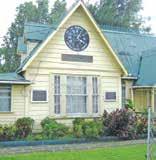
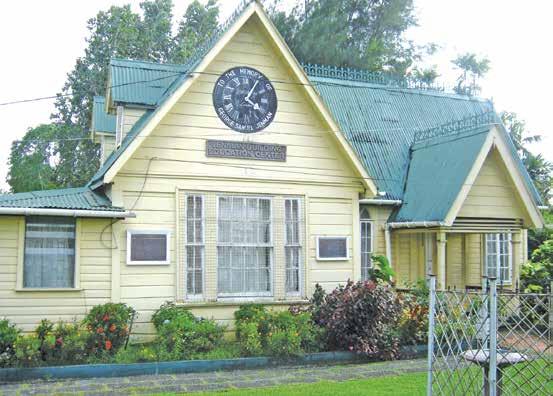
Also called the ‘Curator’s Lodge’, the centre was designed by Mr Brummell, the Chairman of the Board of Directors of the Botanic Gardens, and was erected in 1881. At first it served as a gatekeeper’s lodge and had a board room for the meetings of the Directors. It has a black and gold clock on the outside of the building, which was built as a memorial to George Samuel Jenman. It is still working and is serviced annually.
At a later date, a western wing was added to ac-
commodate the gatekeeper. There is also a brass tablet on the building that was placed there in memorial to Sir John Henzon, Director of Science and Agriculture, 1905 to 1926. There are plaques on the wall, which were erected in honour of George Samuel Jenman and Professor Sir John Burchmore Harrison.
One reads, “To the Memory of George Samuel Jenman, fellow of the Linnean Society, Government Botanist and Superintendent of these gardens from 1879 to 1902 to whose knowledge, skill and work the colony is indebted for the laying out of the gardens and the formation of the herbarium.”
The second plaque states, “To the memory of Professor Sir John Burchmore Harrison, Director of Science and Agriculture, Government Analyst and Geologist who died on the 8th February 1926. This tablet is erected by the officers of the department of science and agriculture as a token of appreciation of his sterling ability and long and faithful service of 36 years to the colony of British Guiana.”
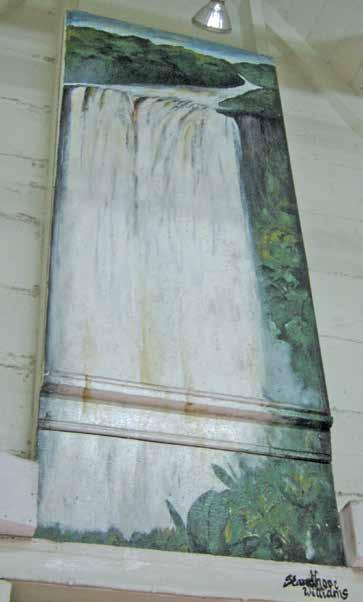
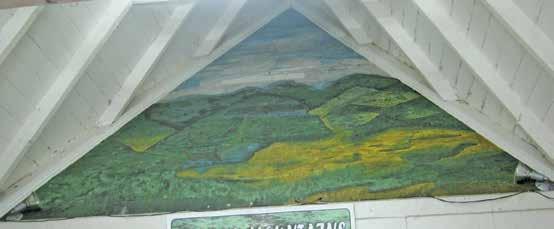
The mounting of three significant paintings of indigenous treasures to Guyana - the Kaieteur Falls, the Harpy Eagle and the Kanuku Mountainswere some additions made in the centre. It also carries a reading room for research and reading, which is usually visited by students.
For the more than 10,000 visitors who visit the Gardens per month, the objective of the centre is to serve to expose them to conservation areas and to exhibit Guyana’s flora and fauna.
Kanuku Mountains painting
Painting of the Kaieteur Falls
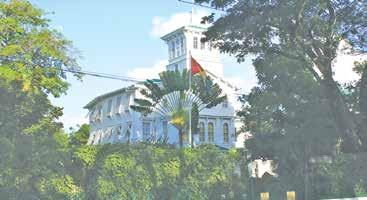
Jenman Education Centre located in the Botanical Gardens
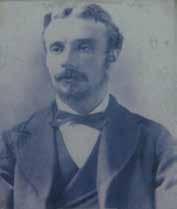
A picture of George Samuel Jenman displayed in the centre
Alyson CAmbridge
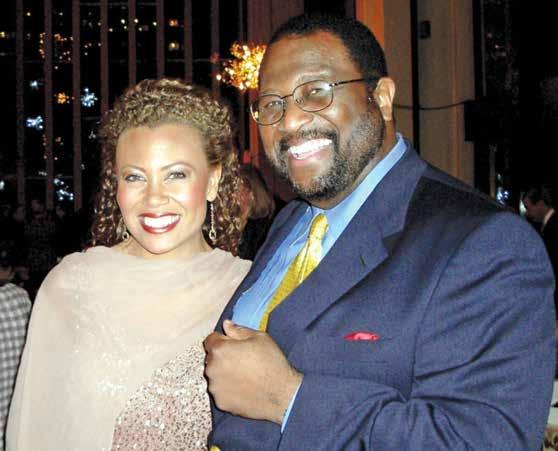
Alyson Cambridge is an accomplished soprano opera singer born in 1980 to a Guyanese father (Richard Cambridge) and a Danish-American mother. At age 23, while a first year student at the Curtis Institute of Music, she was the grand prize winner of the Metropolitan Opera National Council Auditions. Nine months later she debuted at the MET as Frasquita in “Carmen” under renowned music conductor/director James Levine; a performance that earned her praises from many news outlets including the New York Times for her “powerful, clear voice”.
Alyson earned a B.M. in Voice Performance from the Oberlin Conservatory of Music and a B.A. in Sociology from Oberlin College. She later continued her studies at the Curtis Institute of Music where she pursued a Master’s of Music Degree.
The singer’s performances have brought her over a decade of success on the leading opera and concert stages throughout the United States and internationally.
With her father, Richard Cambridge
In addition to the MET, she has wowed the audience at the Lyric Opera of Chicago and Washington National Opera, as well as recent debuts in Paris, Berlin, Vienna, Beijing, and other musical capitals throughout Europe and Asia. One of her more notable perfor-
mances was that of Julie in Francesca Zambello’s highly-acclaimed production of “Show Boat”, a performance for which she earned positive reviews.
Alyson’s debut album, “From the Diary of Sally Hemings”, a song-cycle by
acclaimed American composer William Bolcom, premiered at Carnegie Hall’s Weill Recital Hal, New York, to rave reviews, and her next album of crossover and jazz standards is due out within the next year.
Among numerous awards
and prizes, Alyson was also awarded First Prize in the 2003 Licia Albanese-Puccini Foundation International Voice Competition; was a 2004 George London Foundation Award recipient; and received the Régine Crespin Award at the 2008 Elardo International Opera Competition.
As part of Alyson’s personal mission, and with a strong desire to give back and make an impact beyond the traditional confines of the theatre, she lends her time and talent to charities and causes close to her
heart, including Sing for Hope, The Humane Society, K9s for Warriors, Hope For Hearts Foundation and American Red Cross. And, as a former athlete and fitness enthusiast, with a penchant for fashion, Alyson’s exotic looks have enabled her to enjoy collaborations with designers for her concert performances and offstage appearances. She serves as an official brand ambassadress for luxury jewellery and watch designer Chopard and fashion designer Vivienne Tam. (www. guyanesegirlsrock.com)
Alyson Cambridge
Part One
‘Racing With The Rain’ by Ken Puddicombe, MiddleRoad Publishers, 2012. Reviewed by Frank Birbalsingh
Professor Emeritus
Birbalsingh is an anthologist and the author of many scholarly publications including From Pillar to Post: The Indo Caribbean Diaspora , Passion and Exile: Essays in Caribbean Literature , The Rise of West Indian Cricket: From Colony to Nation , and two anthologies of Indo-Caribbean writing Jahaji and Jahaji Bhai . His latest book on cricket, Indian-Caribbean Test Cricketers and the Quest for Identity is now available. Birbalsingh is an acknowledged book reviewer.
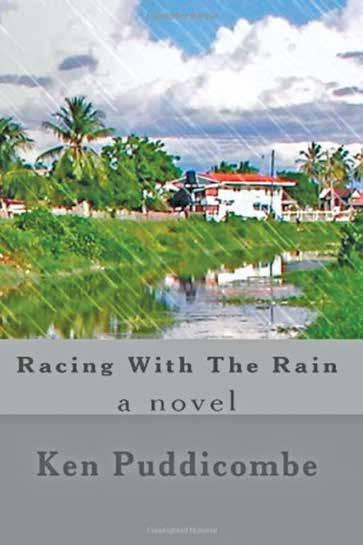
Racing With The Rain is the first novel of Guyaneseborn Ken Puddicombe who, since 1971, has lived in Canada where he works as an accountant. The novel offers a fictional version of political events during a turbulent period, from the 1960s to the 1980s, in the history of Guyana, for -
merly British Guiana. The novel is a roman a clef, one in which people and events may be identified through fictional names assigned to particular organisations, individuals or places, for example, “Liberty Home” for actual Freedom House, “Arawak Hotel” for Carib Hotel, “Kingsley” for Sydney King, and “Jack Hill” for Jack Kelshall.
The narrator, Carl Dias, is a Guyanese who lived through events in the novel before coming to Canada, and settling in Toronto where we first see him, in 1980, sixteen years after he left Guyana. He is Senior Economist at the Canadian Business Bank, and is separated from his Russian/Cuban partner Natasha and their two children - Alexei and Irina, who play no active part in the novel. Carl receives news of the death of his father Augusto in Guyana, and his narrative consists of an account of his visit to Guyana to attend the funeral, except that chapters describing his visit are interspersed between reflections on his family or friends, and documentation of Guyana’s political history between the 1960s
and 1980s.
The narrator’s surname betrays his origin in a Portuguese community, a Guyanese minority group who were brought to Guyana as indentured workers, from Madeira, during the mid-nineteenth century. The group has evidently done well since Carl’s father enjoys the status of a successful Georgetown business man, influential among the Conservatives (an actual political party - United Force - whose leaders are chiefly Portuguese or rich Indian-Guyanese) all vigorous supporters of free enterprise, and sworn enemies of the Reform Party (actual People’s Progressive Party that is supported mainly by Indian-Guyanese) and regarded as Marxist/Leninist or Communist. A third party, the Republican Party (actual People’s National Congress whose membership is largely AfricanGuyanese and ostensibly Marxist,) forms a strategic coalition with the Conservatives despite deep ideological differences, mainly because coalition brings blessings of the Kennedy administration
in the US, and practical help from the C.I.A. and American Labour Unions who share a common anti-communist aim of depriving the Reform Party of power gained (by democratic means) from an electorate that is largely Indian-Guyanese.
The two strands of the
novel’s plot consisting of action from the period of Carl’s visit in 1980 and from the tumultuous period of the 1960s with strikes, riots and other ructions, allow the reader to see both the collusion necessary to replace the Reform Party regime with one that is Republican, and the con -
sequences of Republican rule, by 1980, when it had produced widespread food shortages, disorder, increased crime, corruption, repression and dictatorship that left Georgetown, once known as “the Garden City of the Caribbean” in mere shambles: “Signs of decay everywhere. Trenches were filled with stagnant water and garbage and tall reeds lined the banks. Buildings were weather- beaten. Streets were perforated with potholes and sidewalks rutted and cracked.” (p.310) Ken Puddicombe is a professional accountant who provided controllership for a number of companies in the private sector before he retired to pursue his love of writing. His writing has appeared in newspapers and literary journals in Canada and the UK. Originally from British Guiana, he migrated to Canada in 1970 and still lives there with his family. Racing With The Rain is his first novel. He is working on a second novel Junta and a collection of short stories entitled Down Independence Boulevard for early release. His genre is fiction, based on international locations but especially focused in Canada, the Caribbean and Guyana. Responses to this author telephone (592) 226-0065 or email: oraltradition2002@ yahoo.com
B y P etam B er P ersaud
'Racing With The Rain' by Ken Puddicombe
Top tips for the journalists of tomorrow
The Guardian rounded up the best comments, questions and answers from their recent live chat on tomorrow's journalist – what tools and skills will they need to survive and thrive?
Hannah Waldram, community coordinator, news, the Guardian
Drop the hangups around engaging with readers in comments: We don't need to continually get hung up about things like members of the general public contributing to the storytelling process (or the loathed term 'citizen journalism') – the sooner young journalists can dismiss any snobbery to do with engaging readers, the closer they will be to looking like a journalist of the future.
Learn to report in the field and on the fly: I was recently covering the English Defence League protest in the city centre –I was live tweeting, using Audioboo to get short clip interviews with the police, using Bambuser to live stream some video when the protesters broke the police line, while also taking still video on a Kodak HD camera which I knew I could edit and upload later using iMovie and Youtube.
I took pictures on my phone and sent them out on Twitter using twitpic and I was also taking notes using shorthand in a notebook so that I had some extra quotes to write up in a more considered report later – I carried my laptop in a rucksack on my back and cycled to the nearest place with Wi-Fi to upload anything I couldn't do live. There I'd also write up a couple of pieces while responding to comments, looking for reaction tweets, videos, confirming numbers with the police and so on.
I soon learned to carry everything I needed on my back, and made sure I had pockets (like gadget girl!) to keep all my phones and cameras in. I also learned to make sure everything was fully charged before leaving the house and I knew where the nearest Wi-Fi was – this type of training you can only learn on the job.
Always have a pen!
Nick Petrie, social media and campaigns editor, the Times
Community journalism will be very important: Considering the rate at which publications are hiring people to help develop and serve their communities, it is going to become increasingly more important. In an age where readers are not loyal to one paper in the way they used to be, developing and maintaining a relationship with readers (engaging them) is key to them coming back – the community aspects of journalism are not a hobby or a passing fad.
Battery backup is your friend: My major fears when it comes to tools are a lack of serious advances in battery tech; every good mobile journalism tool kit includes various charging cables and backup batteries. I need an iPhone that can do seven days heavy use – at the moment it dies by midday if I have a busy morning.
Call yourself a journalist: Not a student journalist, and then act like it – don't wait for permission to get started, just start writing, blogging, interviewing, taking photos and so on.
Experiment: So many projects you can try are cost-free and low risk. People think journalism is only now experiencing change, but it always has been, it's just faster and talked about more now. Just go and get started – don't look for an excuse not to do something but for a reason to try.
Sarah Marshall, technology correspondent, Journalism.co.uk
Do more than the lectures: My take is that formal training in law, shorthand, video and audio is valuable. But students who simply attend lectures will not be the ones who get the good jobs at the end; they will be the ones who fill their time blogging, making connections and going out with a camera or smartphone etc.
Joseph Stashko, journalist, freelance
Be open to openness: I think that openness has, and will, continue to be a much bigger part of journalism than in the past. Obviously the Guardian is taking the open journalism approach to an organisation-wide level, but you also see it in things like journalists disclosing their interests or investments when writing.
One place that does this really well is All Things D, the tech website owned by the Wall Street Journal. Each writer has an ethics statement under their byline, which outlines (in painstaking detail) interests that may be seen to prejudice a journalist's writing if left unsaid. You can see what I'm talking about here, and I think this kind of thing is only going to become more prevalent.
Martin Belam, lead user experience and information architect, the Guardian
Learn to code: I think it's good for journalists to get a basic understanding of the principles of how programming works; it can really help you use computers and technology tools to cut out some of the mundane bits of production.
I think it's often hard for people to know whether they should be learning language X or language Y and whether they need to be able to build whole websites or applications. I think, as a bare minimum, any journalist entering the profession now should have a good understanding of marking up documents in HTML so they can add links, make lists and put things into bold and italics by hand.
Tonya
Star of the week
Tonya Singh
Singh is a beauty who loves the art of dance. After graduating from Mae's Secondary, Tonya is now pursuing a diploma in public communications at the University of Guyana. She also works as a television producer/presenter with National Communications Network. As for her dancing career, Tonya’s passion for the art form began since childhood. Her first onstage performance, when she was about five years old, was for a fundraiser at the Herstelling Mandir. This love for dancing propelled her to develop her talent. She joined local Indian dance group Dharmic Nritya Sangh, and is also a member of the local Latin dance group Latin Heat. Through dance, Tonya is able to touch lives with positive energy. The “spiritual return” she gets when dancing is what inspires her to continue. Tonya always says that dancing frees her soul from a world that is trapped in evil. Although dancing is a vital aspect of her life, Tonya also enjoys modelling, acting and working as a masseuse. In the future, Tonya wants to pursue a career in law and to open a dance academy.
Creature Corner
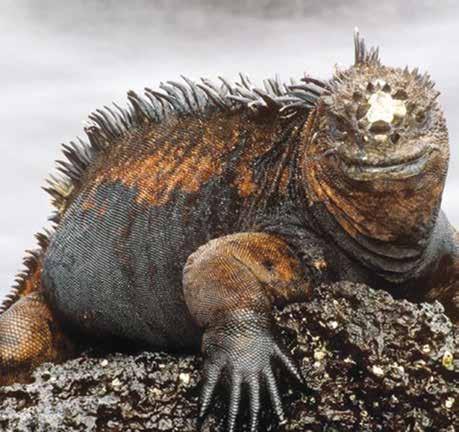
Marine Iguana
The much-maligned marine iguanas, Amblyrhynchus cristatus, of the Galápagos Islands are so famously homely, even Charles Darwin piled on, describing them as “hideouslooking” and “most disgusting, clumsy lizards”.
It's true, they're not pretty, with their wideset eyes, smashed-in faces, spiky dorsal scales, and knotty, salt-encrusted heads. But what these unusual creatures lack in looks they make up for with their amazing and unique ecological adaptations.
Scientists figure that land-dwelling iguanas from South America must have drifted out to sea millions of years ago on logs or other debris, eventually landing on the Galápagos. From that species emerged marine iguanas, which spread to nearly all the islands of the archipelago. Each island hosts marine iguanas of unique size, shape and colour.
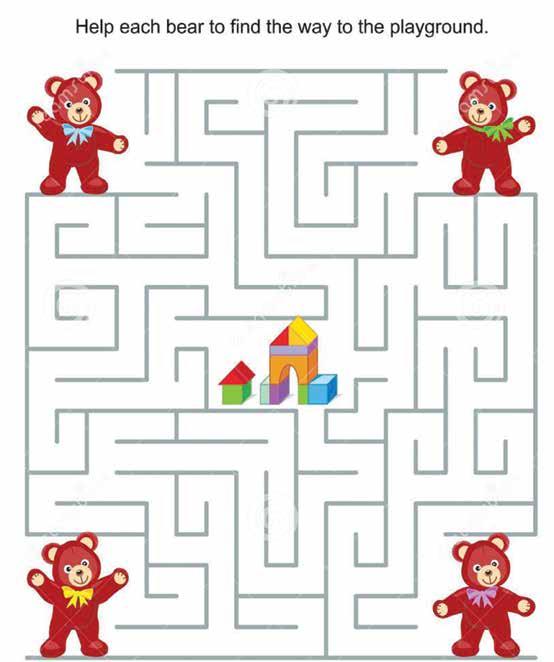
Maze
FUN FACTS
There are so many things out there that we deal with or see every day, but have no idea what they are called. Here are a few:
1. Desire Path - A path created by natural means, simply because it is the “shortest or most easily navigated” way.
2. Skeuomorph [pronounced: skyoo-uh-mawrf]- A design feature copied from a similar artefact in another material, even when not functionally necessary. For example, rivets on jeans, copper colour on pennies, the shutter sound on a digital camera, or a pointless handle on a bottle.
3. Paresthesia - The pins and needles feeling you get when part of your body falls asleep.
4.
They look fierce, but are actually gentle herbivores, surviving exclusively on underwater algae and seaweed. Their short, blunt snouts and small, razor-sharp teeth help them scrape the algae off rocks, and their laterally flattened tails let them move crocodile-like through the water. Their claws are long and sharp for clinging to rocks on shore or underwater in heavy currents. They have dark gray colouring to better absorb sunlight after their forays into the frigid Galápagos waters. And they even have special glands that clean their blood of extra salt, which they ingest while feeding.
Their population is not well known, but estimates are in the hundreds of thousands. They are under constant pressure from non-native predators like rats, feral cats, and dogs, who feed on their eggs and young. They are protected throughout the archipelago and are considered vulnerable to extinction.
Marine iguanas sneeze frequently to expel salt from glands near their noses. The salt often lands on their heads, giving them a distinctive white wig. Their average life span in the wild is 5 to 12 years.
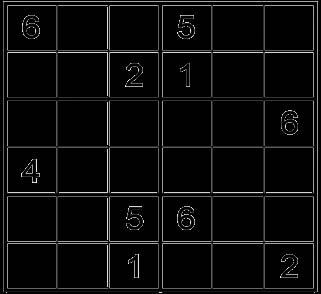
The objective of the game is to fill all the blank squares in a game with the correct numbers. Every row of 9 numbers must include all digits 1 through 9 in any order. Every column of 9 numbers must include all digits 1 through 9 in any order. Every 3 by 3 subsection of the 9 by 9 square must include all digits 1 through 9.
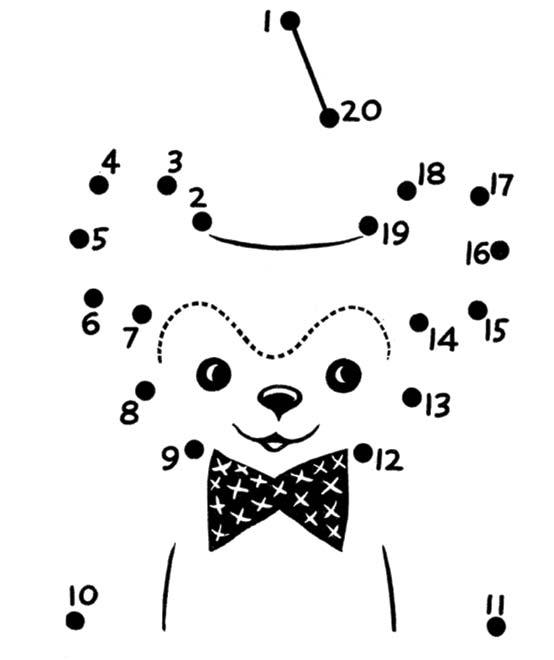
Connect the Dots and Colour
Armscye - The armhole in most clothing.
5. Wamble - Stomach rumble.
6. Mondegreen - Misheard lyrics.
7. Philtrum - The groove located just below the nose and above the middle of the lips.
8. Purlicue- The space between the thumb and the forefingers.
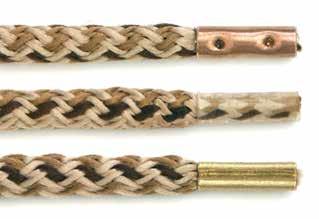
9. Aglet - The plastic coating on a shoelace.
Aglet - The plastic coating on a shoelace
All in the family
Squirrels are a kind of rodent (gnawing animals), closely related to mice, rats and beavers. There are about 270 species in the Sciuridae (squirrel) family. Squirrels can be divided into three main groups: tree squirrels, flying squirrels and ground squirrels.
Tree squirrels have bushy tails and live mostly in trees. They can be found in forests all over the world. These animals spend most of the day searching for food. The common eastern and western gray and fox squirrels are found in North America.
The western gray squirrel is also known as the California squirrel.
These cute and lively rascals can be found just about everywhere except Australia and Antarctica. Some people think of them as pests because they sometimes nest in places they are not welcome, eat garden roots and buds and get into bird feeders to eat more than their share.
A few species have been known to damage farmers’ fields. Most people like squirrels well enough to share the backyard and parks with, but worldwide, the biggest threat to these little animals is the destruction of their forest and grassland homes.
Squirrels are beneficial to forests when they bury nuts and when they nibble on certain underground fungi. Unclaimed, buried nuts often grow into young trees, helping forest growth.
Flying squirrels live in trees and are nocturnal, searching for food at night. They have a special fold of skin between their front and back legs that allows them to glide from tree to tree. Most species are from Asia, but two small flying squirrels inhabit North America.
Flying squirrel
Ground squirrels have short tails and tend to be more compact than their cousins. They burrow in open fields. Chipmunks are a kind of ground squirrel, and so are marmots (groundhogs) and prairie dogs.
When squirrels eat fungi called mycorrhizae, they help distribute fungus spores throughout the forest. These fungi are beneficial because it aids in the exchange of water, minerals and energy from the sun between soil and plants.
The eastern gray squirrel can also be tan, brown or black.
Squirrels have strong upper and lower incisor teeth that grow continuously throughout their lives. The incisors are ideal for cracking nuts, while the molars grind food into bits.
Dinnertime
Squirrels spend a great deal of time eating and collecting food. They like to eat nuts, seeds, pinecones, bark, sap, insects, eggs, fruit, plant shoots, buds and fungi. What they eat depends on the season and what is available. If they live in a place with cold winters, squirrels store caches of food in the ground or under leaves near their nests. Squirrels usually remember where they have hidden food, but if they forget, they have a keen sense of smell to help them locate a lost meal. Many squirrels share much of their habitat with humans. They have adapted by nesting close to bird feeders, and they can be quite bold if they are used to people feeding them in the park. Some have even developed a taste for human garbage.
Home sweet home
The front feet of a squirrel have four digits, and the back have five.
Having babies
Sharp claws and hairless foot pads help the squirrel climb vertical surfaces and give the animal superior gripping control. Some squirrels grow fur on their pads in winter.
Squirrels that inhabit the far north tend to mate once a year and have litters of four to eight offspring. Those that live farther south may have a second litter, but the number of offspring is much smaller. The female is pregnant for 36 to 43 days. The newborns are born blind and without hair. The mother raises the young alone. Most tree squirrels become independent in about 8 weeks.
Flying squirrels can take 10 or more weeks; this may be because they have to learn how to glide before leaving the nest.
Comparing squirrel sizes
Tree squirrels in North America come in many colors, and variations are often regional.
Squirrels molt (shed their fur) twice a year, usually in the spring and fall. Squirrel fur is multilayered; the inner layer is short and thick to help keep the animal warm. The outer layer is longer and makes up the visible coat.
Squirrels generally build more than one nest so that they can move easily if one is damaged or threatened. The nest provides essential shelter from the elements and enemies. It is also a safe place to raise young and store food. Nests are padded with leaves, grasses, chewed bark and other materials. The summer nest is a ball of twigs, leaves and vines woven into the fork of a tree branch. In milder climates, some squirrels use a leaf nest yearround. These leaf nests are called dreys
Territories
Most squirrels establish a home territory, and some will fight to defend it. Territory size depends on food resources and the number of potential mates. Most tree and flying squirrels live alone, but some live with a mate or in a small family group. In winter, some squirrel species will gather in temporary groups called aggregations
Old age
How long a squirrel lives depends a great deal on how large it is. Larger squirrels tend to live longer because they are less likely to be eaten by a predator. Smaller squirrels have shorter life spans, but they compensate by having larger litters more often. Squirrels may live up to 10 or 12 years in the wild, but most die much younger. Hawks, dogs, cats, foxes, weasels and snakes are some of the squirrel’s natural enemies. Squirrels are also the victims of automobiles and habitat destruction.
Prairie dog Marmot
Chipmunk
The smallest squirrel is the African pygmy squirrel, just 5 inches (13 cm) long from nose to tail.
By 5 weeks old, baby squirrels have fur and begin to explore.
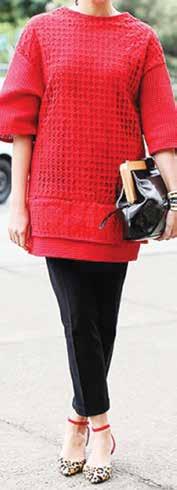
Do you complain about your clothes not looking right because you’re vertically challenged? Maybe you’re wearing the wrong trends... Tunic Tops
These tops were not made for short women!
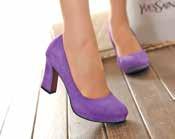
Round-Toe Heels
Sleek pointy-toe heels will do wonders for your legs.
Shirt Dresses
Comfortable? Yes. Flattering? Not so much.
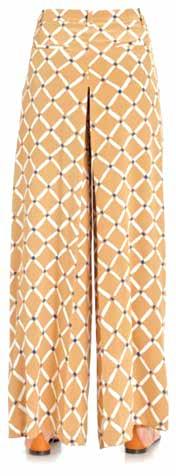
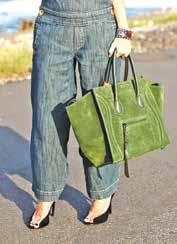
Silk Wide-Leg Trousers
To give the illusion of height, try a wide-leg trouser in a structured fabric.
Oversized Bags
Don’t hide behind your bag. Opt for a smaller size that is proportionally correct for your frame.
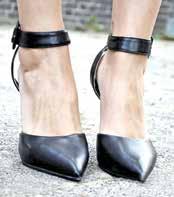
Ankle-Strap Heels
Ankle-strap heels visually divide your leg, making it look shorter. A shoe with a low-cut vamp does just the opposite, and who doesn’t want their gams to look as long and lean as possible?
Boxy Tops
This top does just that— makes you look boxy.
Follow these simple style rules before you get dressed each day, and you'll be off to a good start.
Most people, most of the time, judge you by what you're wearing, and if you care about what people think, you should care about what you wear. Life doesn't get much simpler than that.
Navy is the most flexible suit colour you can buy. Followed closely by charcoal and medium gray.
Your tie knot should always conceal the collar band behind it. If it doesn't, it's tied too loose.
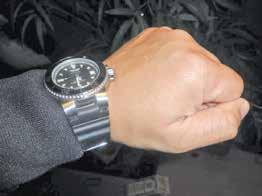
A watch should be worn securely around your wrist. It is not a bracelet.
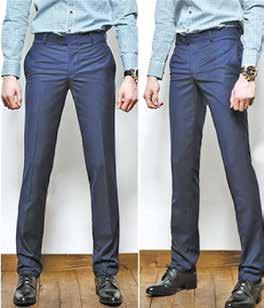
Fitted is good. Snug is dicey. Tight is just wrong.
White suede bucks are not solely the domain of rich yachtsmen and eccentrics. Wear yours with confidence.
No novelty neckties. No novelty anything — novelty has the tendency to wear off.
Justin Bieber's friend Khalil threatens to shoot ‘Beliebers’
Justin Bieber and his friend Khalil were partying at a club in Miami, the site where they were pulled over for DUI earlier this year, on July 3. The pair were reported leaving the club at around 4 A.M.
In a video obtained by TMZ, the "Baby" singer was really nice with his fans during his way out of the club. Justin expressed his gratitude toward his fans and even posed with some of his fans for pictures.
Meanwhile, Khalil was totally the contrary. He seemed upset with the crowd who got in his way, threatening Justin's fans by mimicking the way a person shooting a gun and repeatedly shouting, "That's how a n**** gets shot."
Justin posted two pictures featuring him and his fans on Instagram on the same day, captioning it with, "#beliebersunite," and, "Told you I got you guys ;) night." (AceShowbiz)
Singer Katy Perry is being sued by Christian hip-hop stars including Flame, who claim her hit Dark Horse ripped off their track Joyful Noise.
They accused Perry of using the 2008 track - which features Lecrae - without permission, tarnishing its "devoutly religious message" with images of "witchcraft" and "black magic."
It comes from Flame's Grammy-nominated album Our World: Redeemed.
Dark Horse topped the US Billboard chart for several weeks in January.
The group of rappersFlame aka Marcus Gray, Lecrae Moore, Emanuel Lambert and Chike Ojukwu - are seeking damages from Perry, guest artist Juicy J, Capitol Records and songwriters Dr Luke and Max Martin for copyright infringement.
Court papers in St Louis, Missouri, show they also want an injunction and profits gained from the unauthorised use of their track, stating Perry had performed
Dark Horse at sold-out concerts throughout the US and sold millions of copies.
"The devoutly religious message of Joyful Noise has been irreparably tarnished by its association with the witchcraft, paganism, black magic, and Illuminati imagery evoked by the same music in Dark Horse," said the rappers' complaint. They continued: "Indeed, the music video of Dark Horse generated widespread
accusations of blasphemy and an online petition signed by more than 60,000 demanding removal of an offensive religious image from the video."
The video for Dark Horse was edited in February this year following the complaints, with a pendant featuring the Arabic word for God being digitally "scrubbed" out of the scene.
More than 440 million people have watched
Malia Obama turns sweet 16
Malia Obama is all grown up.
President Barack Obama and First Lady Michelle Obama's eldest daughter celebrated her milestone 16th birthday on a significant day for the nation: July 4.
She was only 10 when she entered the spotlight, and many can't forget her adoring "I love you, Daddy!" at the 2008 Democratic National Convention. Like other First Children before her (including Chelsea Clinton), Malia had to face her most awkward teenage
years in the public eye. Over the years, she's sported different hairstyles, including a curly 'do that drew much attention, and even had to deal with pesky braces.
But at 16, the maturing young woman has developed a more polished look. Then again, she has one of the best style influences in the country – her always-elegant mother. (People)
Craig David has just ended his hiatus and returned with a brand new single called "Cold". Posted on his SoundCloud page on Thursday, June 3, the song is set to appear in the singer's upcoming comeback album. "Here's a little taster of some new music I'm working on right now...," he wrote of the song on Facebook.
In "Cold", David is featured singing about a cold-hearted but addictive girl whom he compares to ecstasy. "This girl's an instant
lover/ Like a hit of MDMA/ The type that makes you feel dizzy/ Then tells your man that you've changed," he sings.
The British act's sixth studio album, "Following My Intuition", is currently still in the works and is expected to be released later this year via Universal. The LP will serve as the follow-up to 2010's "Signed Sealed Delivered" which primarily features cover versions of songs by the likes of Stevie Wonder and Marvin Gaye. (AceShowbiz)
the video on YouTube since February this year.
Flame said the track's similarities to Joyful Noise were brought to his attention by his DJ, Cho'zyn Boy.
The DJ compiled an audio comparison of the two songs, published by Rapzilla, after noticing comments about them on Twitter.
They claim Perry and her collaborators "never sought or obtained permission" to use Joyful Noise for "creating, reproducing, recording, distributing, selling, or publicly performing" Dark Horse. Representatives for Perry, who released a Christian Rock album under her birth name Kate Hudson in 2001 before she was famous, said she was unable to comment because of the legal proceedings. (BBC)
The Jay Z/Bey cheating drama continues - as singer Mya (you might remember her from Lady Marmalade) has responded to speculation that she had an affair with Jay Z.
The singer staunchly denied the rumours that she was Jay Z's mistress - as reports emerged online that suggested she had had a long-term affair with him.
The rumours were started by a pretty nasty post online claiming Jay had been seeing a "very short named R&B singer who hasn't had a hit in a while and doesn't really even act or record any longer...She basically lives off the generosity of Jay-Z and a couple of other guys".
Naturally, Mya wanted to quash the reports - and when she was asked if she was Jay Z's mistress on Instagram by a follower, she responded:
"Never did, never was, never will. Illegitimate, thirsty sources with no facts and that's the 'media' for you-especially today. I play second to no one, pay my own bills, have my own label, own management company, rely on God only and respect myself & marriage too much for nonsense," she said.
"False rumours are crafted for ratings & numbers. And miserable, unhappy people need someone to judge to deter the attention away from their own misery and feel better about their miserable lives. If they did it to Jesus, they'll do it to anyone. God bless."
Poor Beyoncé and Jay Z have been plagued by cheating speculation since the lift drama at the Met Gala - and then this week there was more scandal after Bey changed the lyrics of song ‘Resentment’ when she performed it on tour to reflect the number of years she and Jay had been together. Here's hoping it's all just a load of speculation. (Glamour)
Bollywood
Karan Johar has said that he enjoys the "cathartic" experience of crying at movies.
The producer-director said that he has cried while watching movies ever since he was a child.
"I love crying and to me, cinema crying is very cathartic," Johar explained. "I remember when I watched The Namesake with Mr Bachchan.
"All my pent-up emotions of losing my dad came out, even though, thematically, it had nothing to do with losing a parent. But something triggered an emotion and I just remember weeping."
Johar went on to speak about his first memory of crying at the cinema: "The first film I cried [at] was in ‘Ankhiyon Ke Jharokhon Se’. I was 8 years old and was bawling at the end of it.
"My mother kept explaining to me how that was not real, but that didn't stop me from crying."
He also said that Aamir Khan's film on a dyslexic child also had an emotional effect on him, as it brought back a childhood memory.
Deepika Padukone puts FHM 'Sexiest Woman' win down to her hard work
Deepika Padukone has been voted the sexiest woman in the world in a poll of FHM India readers.
The “Finding Fanny Fernandes” star attributed the title to her professional success, as opposed to her physical appearance.
Padukone told IANS: "I think something like this is really the result of the work that I do I don't think it has got anything to do with me physically. I also think that the brand endorsements are also the result of the films that you do.
"I have been very fortunate that the roles I have done in the last 2-3 years have been very different from each other. So I guess this and the endorsements are a result of that and, of course, the success of that and the relatability of the characters."
Padukone stars alongside Arjun Kapoor, Naseeruddin Shah and Dimple Kapadia in
"I remember my parents leaving me behind there. Seeing the film, I think Niagara Falls had begun and I wept and wept and I called Aamir after the show. "
Johar's next project ‘Humpty Sharma Ki Dulhania’ releases July 11. (Digital Spy)
"I cried while watching ‘Taare Zameen Par’ as I was in boarding school for four days, that too, in the same one shown in the film," he explained.
Preity Zinta has spoken out on social media about an alleged incident involving her former boyfriend and business
partner, Ness Wadia.
The 39-year-old actor filed a police complaint last month alleging that she was molested by Wadia, who is currently the focus of a police investigation.
Zinta has now spoken out at length on Facebook in an "attempt to set the record straight".
"Why did I report a personal matter to the police? Personal matter? Seriously?" she wrote.
"For the record, this relationship was ended by me in 2009, and I don't ever recall having gone to the police on any personal matter irrespective of what happened
then. But now, it's been 6 years since the break-up, so this is not a personal matter."
Zinta strenuously denied that she filed the complaint for publicity or for money, also refuting suggestions that her actions were borne out of jealousy or revenge.
"Violence and aggression against women is wrong, yet people try to point fingers at the woman who comes out with it trying to make her sound frivolous and with ulterior motive," she continued.
"My only motive is to fight for my self and this fight is not against any family, but an individual... I'm grateful to any man who has had the courage to stand up for [a] woman genuinely going through similar circumstances. You are and always will be our hero!"
Wadia has insisted that the allegations levelled against him by Zinta are "false". Mumbai police are expected to take a statement from the businessman in the next 48 hours. (Digital Spy)
Shah Rukh Khan to receive Entertainer of Indian Cinema award
Bollywood ‘baadshah’ Shah Rukh Khan will be honoured with an Entertainer of Indian Cinema award on Saturday at the 8th Annual Vijay Awards.
“We have constituted a new award called ‘Entertainer of Indian Cinema, which will be given to Shah Rukh Khan this
year. This will be the second time in a row he will be attending our award ceremony,” a member of the organizing committee told IANS. At the same event last year, he received Chevalier Sivaji Ganeshan award. King Khan‘s presence last year drew a lot of attention from general public even though he was late by few hours.
The event, which honours the best in Tamil cinema, will see performances by some of its top stars such as Shruti Haasan, Hansika Motwani, Vaani Kapoor and Lakshmi Rai. This year, ace Tamil filmmaker S. Shankar will receive the Chevalier Sivaji Ganeshan award. (Indian Express)
“Finding Fanny Fernandes”. She is also due to start shooting Imtiaz Ali's “Tamasha in Corsica” with Ranbir Kapoor. (IANS)
Five Healthy Uses for Honey
The healing powers of honey have been around for centuries, but you might be surprised how many health benefits you can get from this kitchen staple. This golden liquid has been shown to help fix ailments ranging from a pesky cough to a painful wound.
On your next trip to the supermarket, check out honey labelled “raw”. Raw honey is the unpasteurised version of more commonly used honey but with added filtration, which mainly helps extend shelf life. Research suggests that raw honey's active phytonutrients – as well as its antibacterial and antifungal properties – contribute to its vast array of health benefits.
However, because honey can cause a dangerous disease known as botulism in infants, children under the age of one should never consume honey, raw or pasteurised.
Habits That Wreck Your Teeth
Chewing on Ice
It’s natural and sugar free, so you might think ice is harmless. But munching on hard, frozen cubes can chip or even crack your teeth. And if your mindless chomping irritates the soft tissue inside a tooth, regular toothaches may follow. Hot foods and cold foods may trigger quick, sharp jabs of pain or a lingering toothache.
Bedtime Bottles
It’s never too early to protect teeth. Giving a baby a bedtime bottle of juice, milk, or formula, can put new teeth on a path to decay. The baby may become used to falling asleep with the bottle in his or her mouth, bathing the teeth in sugars overnight. It's best to keep bottles out of the crib.
Grinding Teeth
Teeth grinding, or bruxism, can wear teeth down over time. It is most often caused by stress and sleeping habits. This makes it hard to control. Avoiding hard foods during the day can reduce pain and damage from this habit. Wearing a mouth guard at night can prevent the damage caused by grinding while sleeping.
Cough Drops
Just because cough drops are sold in the medicine aisle doesn't mean they’re healthy. Most are loaded with sugar. So after soothing your throat with a lozenge, be sure to brush well. Whether the sugar comes from a cough drop or a hard candy, it reacts with the sticky plaque that coats your teeth. Then bacteria in the plaque convert the sugar into an acid that eats away at tooth enamel. Hello, cavities.
Soda
Candy isn't the only culprit when it comes to added sugar. Sodas can have up to 11 teaspoons of sugar per serving. To add insult to injury, sodas also contain phosphoric and citric acids, which eat away at tooth enamel. Diet soft drinks let you skip the sugar, but they may have even more acid in the form of the artificial sweeteners.
Opening Stuff With Your Teeth
Opening bottle caps or plastic packaging with your teeth may be convenient, but this is one habit that makes dentists cringe. Using your teeth as tools can cause them to crack or chip. Instead, keep scissors and bottle openers handy. Bottom line, your teeth should only be used for eating.
Potato Chips
The bacteria in plaque will also break down starchy foods into acid. This acid can attack the teeth for the next 20 minutes -- even longer if the food is stuck between the teeth or you snack often. You might want to floss after eating potato chips or other starchy foods that tend to get stuck in the teeth.
Chewing on Pencils
Do you ever chew on your pencil when concentrating on work or studies? Like crunching on ice, this habit can cause teeth to chip or crack. Sugarless gum is a better option when you feel the need to chew. It will trigger the flow of saliva, which can make teeth stronger and protect against enamel-eating acids. (WebMD)
Naturally Suppresses Coughs
If you're stuck with a cough that won't go away, studies show that honey works as well as or better
than many over-the-counter cough syrups in soothing it. Honey's thick consistency coats your throat and the sweet taste is thought to trigger certain nerves that make your throat less sensitive to the cough impulse.
Soothes Burns
Applying a thin layer of honey to a minor burn can help quell the stinging sensation and have an antiinflammatory effect. The antibacterial qualities of honey may also prevent the burn from becoming infected, which could result in a quicker healing time.
Aids Sleep
One of the many soothing properties of raw honey is its ability to help provide
sleep relief. Honey may help facilitate the action of tryptophan, which helps make people sleepy. Plus, if you are suffering from a cough that keeps you up at night, a teaspoon of honey could help soothe your throat while you sleep.
Helps Heal Wounds
Applying a thin layer of raw honey to a minor wound may actually help sterilise the cut and help it heal more smoothly, with less scabbing. The application of honey to the site of the wound will help keep it moist, and exposure to oxygen helps to activate an enzyme in honey that forms hydrogen peroxide, which has anti-bacterial capabilities. Gently
apply with a cotton swab, and cover with a Band-Aid. However, honey is only appropriate for minor cuts that you would otherwise simply apply antibiotic ointment to – any deep cuts or cuts that appear infected should be evaluated by a medical professional.
Boosts Immunity
The phytonutrients in raw honey have antibacterial and antiviral properties that may help boost your immune system and fight sickness. If you're feeling a little under the weather, try making a "Hot Ozzy" by combining 1 tablespoon of honey and 2 teaspoons of lemon juice in a 1/2 cup of hot, but not boiling, water.
Tropical Island Bedroom
The bright colours of this bedroom bring the tropic islands inside. The flower design throughout the room adds a fun, youthful look
Fun and Youthful
Use different elements to get this green and black bedroom. The black-and-white accessories along with the eclectic-style pillows on the bed create a fun visual
Filled With Personality
A brightly coloured wall paired with black-and-white accessories creates a beautiful contrast. The different patterns on the bedding give personality to the space
Method:
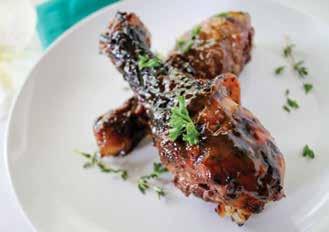
Sprinkle salt and black pepper on both sides of the chicken. Place oil in a large stew pot over medium heat, when oil is hot add chicken skin side down and cook until brown, about 3 minutes. When skin is brown, flip chicken to the other side and allow that side to brown. While chicken cooks, in a small bowl mix jerk seasoning, ketchup, BBQ sauce, champagne vinegar and water. Next add onion to the pot with the chicken and cook for 1 minute. Next add sauce then bring to a boil. Lower to a simmer then cover pot and cook for 35
minutes or until the sauce has thickened. Remove from heat and serve over rice.
Method:
Place shredded potato, onion, flour, cilantro, black pepper and salt in a bowl and mix well. Add the egg to the mixture and stir well to combine. Place a heavy bottom skillet coated with one tablespoon of oil over medium heat. When the oil is hot, place heaping spoonfuls of potato mixture to the pot and press down lightly with the back of spoon to form a pancake. Cook until the edges are brown then flip and cook for an additional 2-3 minutes or until golden brown. Place on a plate lined with paper towel to drain excess oil. Serve warm.
Yield 8-12
double boiler, make sure the water is simmering, not boiling.
Replace harsh, chemical-filled cleaners with a natural, lemon-based one. For mirrors, windows, and countertops, mix lemon juice and water in a spray bottle. Brighten your whites without bleach by adding a cup of lemon juice to your laundry. Rub a lemon directly on grimy faucets and shower handles to remove soap scum while polishing chromes and other metals. You can even remove carpet stains with a lemon juice and salt scrub!
After you flush the toilet, sprinkle 1/4 cup of baking soda into the wet bowl. Take your shower and then give the bowl a single scrub. Flush to rinse.
Polish tarnished copper with this natural solution. Fill a 16-ounce spray bottle with white vinegar and 3 tablespoons of salt. Spray onto the copper, let sit briefly, then rub clean.
The same product that kills bad-breath germs also zaps the gunk beneath your feet. Add a capful of mouthwash to a gallon of water and mop vinyl or tile—but not wood—floors with the mixture.
After going over your bathtub, sink or shower with disinfectant, wipe the area with baby oil or lemon oil. Do this once or twice a month to help dirty water bead and roll down the drain faster, buying you more time before the next cleaning.
Freshen the toilet bowl with effervescent tablets (denture or antacid) in between scourings. Drop two in the water, let soak for at least 20 minutes, then brush and flush. A can of cola dumped in for one hour also does the trick. The phosphoric acid in this mixture removes rust rings and other mineral deposits.
See if you can figure out these words using the clues listed below. Each word ends with "BOARD". Please note that numbers 4 and 5 are two separate words. Have fun!
1) Used with telephones
2) A place to advertise
3) Right-side of ship
4) Found around water
5) Old-time cars had two 6) Computers need them 7) College professor's headgear
8) Used in the Old West
Times Creative Writing
The Walrus and the Carpenter
From “Through the Looking Glass” by
‘The sun was shining on the sea, Shining with all his might: He did his very best to make The billows smooth and bright-And this was odd, because it was The middle of the night.
The moon was shining sulkily, Because she thought the sun Had got no business to be there
After the day was done-"It's very rude of him," she said, "To come and spoil the fun!"
The sea was wet as wet could be, The sands were dry as dry. You could not see a cloud, because No cloud was in the sky: No birds were flying over head-There were no birds to fly.
The Walrus and the Carpenter Were walking close at hand; They wept like anything to see Such quantities of sand: "If this were only cleared away," They said, "it WOULD be grand!"
"If seven maids with seven mops Swept it for half a year, Do you suppose," the Walrus said, "That they could get it clear?"
"I doubt it," said the Carpenter, And shed a bitter tear.
"O Oysters, come and walk with us!"
The Walrus did beseech.
"A pleasant walk, a pleasant talk, Along the briny beach: We cannot do with more than four, To give a hand to each."
The eldest Oyster looked at him. But never a word he said: The eldest Oyster winked his eye, And shook his heavy head-Meaning to say he did not choose To leave the oyster-bed.
But four young oysters hurried up, All eager for the treat: Their coats were brushed, their faces washed, Their shoes were clean and neat-And this was odd, because, you know, They hadn't any feet.
Four other Oysters followed them, And yet another four; And thick and fast they came at last, And more, and more, and more-All hopping through the frothy waves, And scrambling to the shore.
The Walrus and
Lewis Carroll
the Carpenter Walked on a mile or so, And then they rested on a rock Conveniently low: And all the little Oysters stood And waited in a row.
"The time has come," the Walrus said, "To talk of many things: Of shoes--and ships-and sealing-wax-Of cabbages--and kings-And why the sea is boiling hot-And whether pigs have wings."
"But wait a bit," the Oysters cried, "Before we have our chat; For some of us are out of breath, And all of us are fat!" "No hurry!" said the Carpenter. They thanked him much for that.
"A loaf of bread," the Walrus said, "Is what we chiefly need: Pepper and vinegar besides Are very good indeed-Now if you're ready Oysters dear, We can begin to feed."
"But not on us!" the Oysters cried, Turning a little blue, "After such kindness, that would be A dismal thing to do!"
"The night is fine," the Walrus said "Do you admire the view?
"It was so kind of you to come! And you are very nice!"
The Carpenter said nothing but "Cut us another slice: I wish you were not quite so deaf-I've had to ask you twice!"
"It seems a shame," the Walrus said, "To play them such a trick, After we've brought them out so far, And made them trot so quick!" The Carpenter said nothing but "The butter's spread too thick!"
"I weep for you," the Walrus said. "I deeply sympathize." With sobs and tears he sorted out Those of the largest size. Holding his pocket handkerchief Before his streaming eyes.
"O Oysters," said the Carpenter.
"You've had a pleasant run! Shall we be trotting home again?" But answer came there none-And that was scarcely odd, because They'd eaten every one.'
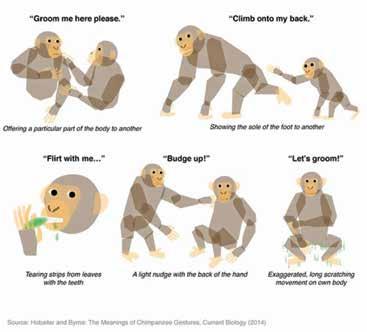
Researchers say they have translated the meaning of gestures that wild chimpanzees use to communicate.
They say wild chimps communicate 19 specific messages to one another with a "lexicon" of 66 gestures.
The scientists discovered this by following and filming communities of chimps in Uganda, and examining more than 5,000 incidents of these meaningful exchanges.
The research is published in the journal Current Biology.
Dr Catherine Hobaiter, who led the research, said that this was the only form of intentional communication to be recorded in the animal kingdom.
Only humans and chimps, she said, had a system of communication where they deliberately sent a message to another individual.
"That's what's so amazing about chimp gestures," she told BBC News.
"They're the only thing
that looks like human language in that respect."
Shout or signal?
Although previous research has revealed that apes and monkeys can understand complex information from another animal's call, the animals do not appear to use their voices intentionally to communicate messages.
This was a crucial difference between calls and gestures, Dr Hobaiter said.
"It's a bit like if you pick up a hot cup of coffee and you scream and blow on your fingers," she said.
"I can understand from that that the coffee was hot, but you didn't necessarily intend to communicate that to me."
Subtle signals
Some of the chimps' gestures, the researchers say, are unambiguous - used consistently to convey one meaning.
Leaf clipping, for example, where a chimp very obviously takes small bites from leaves is used only to elicit sexual attention.
Many others, though,
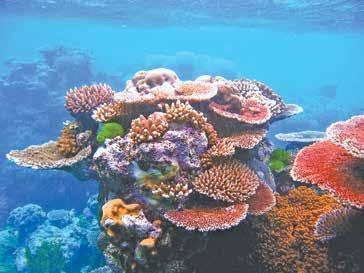
Many of the Caribbean's coral reefs could vanish in the next 20 years, according to a report published by the International Union for the Conservation of Nature (IUCN).
Data from more than 35,000 surveys suggests that habitats have declined by more than 50% since the 1970s.
The report's authors believe that over-fishing and disease is mainly to blame.
They say the trend could continue if nothing is done, but with protection the reefs could bounce back.
Carl Gustaf Lundin, director of IUCN's Global Marine and Polar Programme, said the findings were alarming.
"The reefs support a number of different countries and populations," he said.
"Tourism is one of the biggest industries, and the health of the reef is essential to the well-being of many of
appear to be ambiguous. A grab, for example, is used for: "Stop that," "Climb on me," and "Move away."
Although many are very subtle, some of the footage captured by the researchers shows very clearly what the chimps mean to convey.
In one clip, a mother presents her foot to her whimpering offspring, signalling: "Climb on me." The youngster immediately jumps on to its mother's back and they travel off together.
"The big message [from this study] is that there is another species out there that is meaningful in its communication, so that's not unique to humans," said Dr Hobaiter.
"I don't think we're quite as set apart as we would perhaps like to think we are.
"But then chimps are more closely related to us than they are to the rest of the great apes, so it makes sense that we are incredibly similar to them in many ways."
Dr Susanne Shultz, an evolutionary biologist from the University of Manchester, said the study was commendable in seeking to fill the gaps in our knowledge of the evolution of human language. But, she added, the results were "a little disappointing".
"The vagueness of the gesture meanings suggest either that the chimps have little to communicate, or we are still missing a lot of the information contained in their gestures and actions," she said.
"Moreover, the meanings seem to not go beyond what other less sophisticated animals convey with non-verbal communication.
"So, it seems the gulf remains." (BBC)
the people living there. And of course they are immensely beautiful and wonderful places as well."
The report, which was also authored by the Global Coral Reef Monitoring Network, looked at data collected between 1970 and 2012 from 90 reef habitats and is the most comprehensive assessment of corals in this region.
The authors concluded that many reefs in the Caribbean were undergoing a dramatic transformation - changing from colourful realms, bursting with life, to barren habitats, covered in slimy algae.
They said the damage had been driven by the loss of some of the reefs' key inhabitants. (Excerpted from BBC)
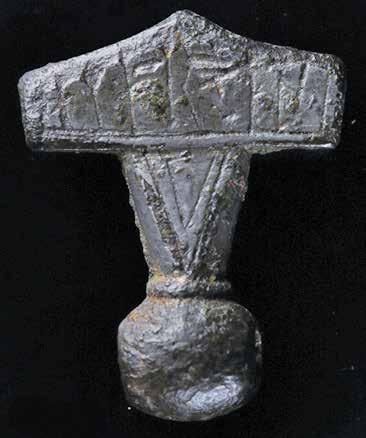
Danish archaeologists have solved the mystery over the significance of the Mjollnir amulets worn by the Vikings. Indeed, they represented Thor’s hammer, the researchers said.
More than 1,000 intricately carved pendants shaped like hammers have been found across Northern Europe since the first millennium A.D.
Although it was widely believed these amulets were hammers, a debate remained over their true meaning. The object’s unusual shape, featuring a short handle and a symmetrical head, raised doubts whether they represented something else entirely.
Now a 10th-century Viking amulet unearthed in Kobelev, on the Danish island of Lolland, has provided a definitive answer.
“Hmar x is,” runes inscribed on the tiny amulet stated. Translated into modern English, it reads: “This is a hammer.”
“This is the only hammer-shaped pendant with a runic inscription. And it tells us that (the pendants) in fact depict hammers,” Henrik Schilling, a spoke person at the National Museum of Denmark, told Discovery News.
Cast in bronze, and likely plated with silver, tin and gold, the 1,100-year-old pendant shows that Thor’s myth deeply influenced Viking jewellery.
A warrior god of thunder, Thor appears throughout Norse mythology holding the powerful hammer Mjolnir, which he uses to protect Asgard, the celestial fortress of the gods, from giants.
It is now clear that Viking men and women wore Thor’s hammer for protection.
“It was the amulet’s protective power that counted,” Peter Pentz, an archaeologist at the National Museum of Denmark, said.
“Often we see torshammere (Thor’s hammer) and Christian crosses appearing together, providing double protection,” he added.
Featuring an interlacing ornament on one side of the hammer head and the short runic inscription on the other, the newly discovered Mjollnir amulet was probably produced by a local craftsmen.
Fragments of silver needles and a mould for making brooches indicate that the jewellery was produced in a silversmith’s workshop on Lolland island.
He was a skilled artisan — the runes range in height from 3 to 7 mm, requiring great precision to inscribe them onto the object — but not a skilled writer.
According to the archaeologists, he left out the letter ‘a’ in the word hammer and reversed the S-rune. (Discovery News)
iPhone 6 Coming in September, iPhone Air to Follow
It's hard to go a day without hearing a new iPhone 6 rumour, but a report on July 3 out of China are among the more tantalizing, if not a bit hard to believe. China. com claims that Apple has set a firm September 25 re lease date for the 4.7-inch iPhone 6, which will be fol lowed by a 5.5-inch model dubbed the "iPhone Air" later in the year.
The biggest hole in this rumour is that September 25 is a Thursday, and Apple historically re leases new iPhone mod els on Fridays. We think the iPhone 6's previously rumoured release date of Friday, September 19,
Tech news
Aries tion. Speaking of different handsets, AppleInsider
points out that the long-
ferentiate the two devices should they both release this year, but it
would be a little strange for ever smartphone after its "Air" products, which are associated with thinness
casts the iPhone Air as a full product line, one that includes a 3.5-inch iPhone Air Mini, a 4.7-inch iPhone Air and a 5.5-inch iPhone Air Pro.
Whichever September date it happens to arrive on, the iPhone 6 is expected to launch with iOS 8, a zippy A8 processor, an extradurable sapphire display and NFC capabilities. The device's rumoured launch window is only two months away, so stay tuned for the official details straight from Tim Cook. (Yahoo)
Official complaint filed over Facebook emotion study
n official complaint has been filed to the US Federal Trade Commission about a Facebook experiment that manipulated the emotional state of users.
The study was carried out for one week in 2012 and targeted almost 700,000 users by varying the personalised content sent to their Facebook pages.
The complaint was filed by digital rights group the Electronic Privacy Information Center (Epic).
Facebook said it had no comment to make about the complaint.
Damages call
In its complaint, Epic said Facebook had flouted ethical standards that govern experiments on human subjects.
The 2012 experiment involved Facebook collaborating with two US universities to see if changing the emotional content of stories and updates sent to users' Facebook profile pages had any effect on the people that read them.
It found that it was possible to influence people and that those who read fewer messages with negative emotional content were less likely to write a similarly negative personal update on their profile page.
"The company purposefully messed with people's minds," said Epic in its complain, adding that Facebook did not get explicit permission from users to carry out the experiment. The organisation's terms and conditions did not allow Facebook to carry out the test nor hand over data to experimenters.
Epic wants Facebook to pay damages and to
hand over the algorithm underlying the work.
The social network's action amounted to a "deceptive practice", said Epic, and as such should be subject to enforcement action by the Federal Trade Commission (FTC).
Facebook's actions also violated a 2012 order imposed on it by the FTC, which required it to safeguard user data, said Epic.
The UK's information commissioner is also investigating whether Facebook broke data-protection laws when it carried out the psychological experiment.
In earlier statements about the experiment Facebook said it had taken "appropriate" steps to protect user data.
In addition on Thursday Facebook chief operating officer Sheryl Sandberg apologised for the way the study was carried out. "We never meant to upset you," said Ms Sandberg while talking to the press during a trip to India.
"It was poorly communicated," she said. "And for that communication we apologise." (BBC)
Samsung is to stop producing plasma televisions (PDP TVs) by 30 November.
It said falling demand meant it would instead focus on producing curved and ultra-high-definition (UHD) TVs.
"We remain committed to providing consumers with products that meet their need," Samsung told the CNET website.
Panasonic, Sony, Hitachi and Pioneer have also pulled out of the sector in recent years. And, according to the Tech Radar website, LG is expected to follow suit soon.
Plasma screens, which use electrically charged ionised gases, are often applauded for their brightness, deep blacks, and high frame rates, considered ideal for watching sport and films.
But they tend to use more electricity and are considerably bulkier than the now more popular liquidcrystal display (LCD) and light-emitting diode (LED) TVs.
TrustedReviews website editor Evan Kypreos said: "It's not at all surprising that Samsung has dumped plasma.
"The main issue is that it's very tricky to make [UHD] plasmas, and [UHD] is the future of big TVs.
"While plasma is a lot better than LED/LCD TVs in terms of image quality, such as contrast ratio, and motion handling, it has a few drawbacks.
"Plasma TVs can't be made a thin as LEDs, for example. People like stylish tellies."
With the introduction of increasingly advanced organic LED TVs, which arguably have better black levels, brightness and colour gamut than plasmas, there was little reason to continue manufacturing plasma screens, Mr Kypreos said.
"Home-cinema connoisseurs will always have a soft spot for plasmas, but they have simply been technologically superseded," he said. (BBC)
ByTe
While there’s been many notable wireless charging innovations of late, sometimes a little elegance can be all it takes to stand out from the crowd. Slovenianbased Lutman Design has developed Swich, a functional wireless charging stand made from sustainable materials, with a stylish design inspired by crashing ocean waves.
Lutman says that its main objective in the development of Swich was to create something easy on the eyes, but equally usable for the app-dependent, hyper-connected smartphone users of today. The stand consists of an American walnut stem atop a ceramic base, with an acrylic foam sheet with in micro-suction caps covering the resting pad up top. The company says this will serve to hold the smooth, flat surface of the majority of phone cases in place and enable easy access while the device charges.
The stand itself is 12 cm (4.7 in) tall and measures 6.5 x
10.5 cm (2.6 x 4.1 in) at its base. The charging pad holds the phone at a 45 degree angle and is adjustable, with a 180 degree rotation enabling users to easily change between vertical and horizontal use.
The company says the 5V charger can deliver 1,000 mA with a charging efficiency of 73 percent within a range of 5-7 mm (0.2-0.27 in).
While some smartphones have wireless charging capabilities out of the box, others, such as the iPhone, will require a receiver in the form of either a patch or a case. With Swich currently the subject of a Kickstarter campaign, Lutman is looking to make the transition smooth for those charging their phone via more conventional means – by pledging an additional US$10, the packege will include a patch or a case depending on your phone type (providing the campaign runs as planned).
Swich is available in black and white, and if the campaign is successful, an early pledge of US$140 will have one of the wireless charging stands sent your way. Shipping slated for November 2014. (Gizmag)
tured above) by artists Simone Evangelista and Ran Avni. This concept
The programme
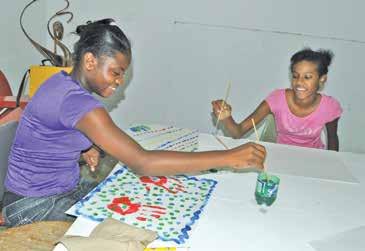
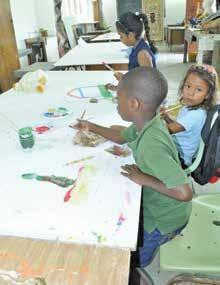
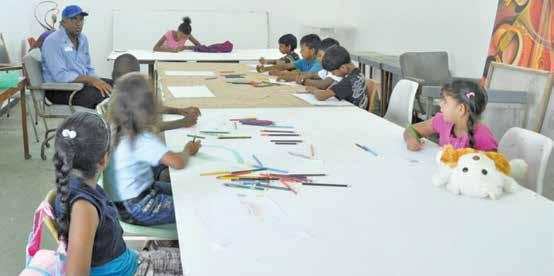
‘Emeritus Professor Doris Rogers’ is a dedication to university lecturer Dr Doris Rogers for her significant contribution to the Department of Arts. Dr Rogers has been the lighthouse for arts in Guyana and rejuvenated art at UG; she was instrumental in the creation of a degree programme in art, prior to that, one did not exist.
The Emeritus Professor Doris Rogers Arts Summer School’s objective, held at the University of Guyana, is to provide an opportunity for children to express themselves through art.
Art lecturer at UG and
host of the programme, Michael Khan, said to Guyana Times Sunday Magazine that the art programme helps children to express themselves and to develop their creative abilities.
Some of the programmes that will be offered are painting and drawing, ceramics, craft-making activities, sculpture, floral arrangements, textile designs, and photography. The programme will commence on 14 July and will conclude on 26
July.
Sessions for ages 6–12 years are from 9.00am to 12.00pm Monday to Friday and sessions for ages 13–18 years from 13.00hrs to 16.00hrs Monday to Friday.
On 25 July 2014, an art exhibition of the participants’ works will be on display for public viewing.
Registration forms are available at the School of Education and Humanities, University of Guyana, Turkeyen Campus. Cost for the entire programme is only $10,000.
For further information, call 647-8245 or 668-9831.
‘Expressions’ billed for two more shows at the Theatre Guild
XPRESSIONS’, first staged on 16 May at the Theatre Guild will return for a second time on Thursday, 10 July.
The first show is at 13:00 hours catering for Third and Fourth formers from the high school and the second show will be at 20:00 hours for the general public.
This is a new type of show featuring dramatised poetry, poetry readings, storytelling, operatic singing and excerpts from Shakespeare and Derek Walcott. It features prominent and experienced actors: Ron Robinson, Derek Gomes, Russsell Lancaster, Rajan Tiwari, Mark Luke-Edwards, Randolph Critchlow , Petamber Persaud, Rober Forrester, Lloyd Marshall, Vanda Radzik, Nuriyyih Gerrard, Mariatha Causway (Jennifer Thomas), Sheron Cadogan –Taylor, Kimberly Samuels, Kimberley Fernandes, Kezra Boyal and students from the
National School of Drama – Sonia Yarde, Tashandra Inniss, Nicola Moonsammy, Keon Heywood and more.
It will be a grand evening for lovers of Shakespeare, Walcott, poetry, opera, Louise Bennett, Paul Keens Douglas, all done in the intimate setting of the playhouse. See and experience the dramatization of Martin Carter’s ‘This is the dark time’ and Wordworth McAndrew’s ‘Ol Higue’ as never done before.
Works by experienced poets Mahadai Das, Ian McDonald, AJ Seymour, Robert Forrester, David Dabydeen, Rooplal Monar and younger poets – Petamber Persaud, Yaphet Jackman, Randoph Critchlow, Mark Luke Edwards and Salimah Husain.
Tickets are $1000 for the evening performance and are available at Oasis Café, Nigel’s Supermarket and The Theatre Guild.
Khan (in the background) offering tips and ideas at a past Emeritus Professor Doris Rogers’ art programme
Having fun with art
The small ones being creative
During 1759, Jaques Salignac applied for a grant of 500 acres of land for cotton and coffee cultivation. He was granted permission by the Court of Policy. Salignac named this
tract of land La Bourgade. In 1807 Thomas Cumming, a Scotsman, became the owner of the estate and renamed Plantation La Bourgade Cummingsburg, after his family, it was a town two miles in circumference and most regularly arranged.
A special feature of Cummingsburg was the provision of fresh water reservoirs. These were filled with small fish and were later planted with Victoria Amazonica and Lotus lilies by Luke M Hill. The reservoir in Main Street was filled up and converted into a walkway in 1897. It was named the Queen Victoria Promenade by the Mayor and Town Council in honour of Her Majesty's Diamond Jubilee (this area is now known as Main Street Avenue). In later years other reservoirs were converted into similar walkways.
In 1864 the western part of Cummingsburg was destroyed by fire. The creation of new streets and redistribution of house lots were several of the plans under-
taken to reorganize the destroyed area.
An examination of the nomenclature of this ward of the city reflects rich examples of Guyana's history. Some Streets such as Waterloo Street; named after Admiral Wellington's great battle and Victory at Waterloo against the French forces on 18 June 1815 and Carmichael Street; named in honour of General Hugh Lyle Carmichael who served as Governor 1812-1813 are indicative of our colonial heritage. Quamina Street (formerly Murray Street named in honour of Major General John Murray) was renamed in honour of one of Guyana's national heroes.
Other streets derived their names simply from geographic locations to
buildings or places. Thomas Street derived its name from its location as the main road to Plantation Thomas. East Street because of its easterly location in this ward. Cummings Street was formerly known as the back dam (Cummingsburg Backdam) of Plantation La Bourgade. Middle Street also derives its name because of being the middle dam of Plantation La Bourgade. Lamaha Street was so named because of its northerly direction with main drainage trench of the district; New Market Street because it led to the new market, and Church Street as it was the primary route used by citizens for access to St. Georges Church. (National Trust of Guyana website)
Georgetown Harbour looking north (n.d.)
The Walter Roth Museum of Anthropology building, which was once the residence of Duncan Hutson, an eminent Barrister and legislator, now houses an interesting collection of artefacts and relics of Amerindian culture, and was named after an Englishman, who laid the foundation of our research into Amerindian life and folklore
Prime Minister’s residence is an example of the mid- nineteenth century wooden architecture, with its Italianate influence; characterized by the square cupola at the top and the portico below
Previously the Public Free library built in 1909. Andrew Carnegie, a Scottish born American industrialist and philanthropist, provided financing for the construction and furnishing of the building. The building once housed the Economic Science, Anthropological and Historical sections of the Museum. In 1951, the Museum was relocated to its present site and the library took over the entire building
Cara lodge, now a hotel, was known as Woodbine House. This was once the home of George Anderson Forshaw. The yard contains a Sapodilla tree that was planted by the Prince of Wales, later Edward VII, on a visit to the colony
The Mashabo Amerindian community, located several miles aback Huist T’Dieren village on the Essequibo Coast, is a small village rich in agriculture.
Villagers clear once forested land to plant the area with bitter cassava. The village has become self-sufficient in the production of cassava bread and cassareep. The village is also involved in chicken-rearing.
Visitors can get a firsthand experience on how the residents survive on what Mother Nature provides and learn about their rich indigenous traditions.
Notably, the watery trails add to the adventure at Mashabo. It is a refreshing adventure for nature lovers.
Panoramic view of the Itiburisi Lake
(Photos by Marco Basir. Cover photo: View of the Mashabo village from the lake)
Itiribisi Lake
Towering trees in the lake
Home in Mashabo
24 Times Last Laugh
By Melvin Durai
If you haven’t been following the 2014 FIFA World Cup in Brazil, you may be wondering what all the excitement is about let me put it in just a few words: another excuse to drink beer.
The amount of beer consumed during the World Cup is roughly equal to the amount of water in the Indian Ocean. In fact, some of the beer served in Brazil looks and tastes just like the ocean. It’s amazing what you can get people to drink if you put it in a bottle, stick a fancy label on it, and serve it during a soccer game.
Trust me, beer flows during the World Cup like no other sporting event. Look what happened when Spain, the defending world champion, lost to Chile and was eliminated from this year’s tournament. Both countries were immediately crippled with beer shortages. While Spaniards were drowning their sorrow in beer, Chileans were drinking in ecstasy. The beer shortage was so dire that three Chilean men broke into a home in Santiago suspected of having a cache of beer, only to come away with 10 cases of ginger beer.
Not all soccer fans drink beer, of course.
The Russians, for example, prefer vodka. And the Algerians – well, world cup mug they’ve been in good spirits ever since they qualified for the World Cup.
World Cup games, you’ve seen a lot of jumping and dancing – and that’s just the coaches. The fans are even more animated. It’s a party atmosphere in the stands, where even the 82-year-old grandma and 85-year-old grandpa are dancing like they’re in the latest Bollywood movie.
Mexican fans are among the most passionate in the world. I love watching them celebrate. When the Mexican team is playing, the entire country is glued to the TV, and it’s the only government-sanctioned nap time for members of the U.S. Border Patrol.
3. Great acting. You haven’t seen acting until you’ve watched a World Cup game. The penalty box is the main stage of the theatre, but the acting isn’t limited to the stage. Players have been trained in the fine art of taking a dive, as demonstrated in the Greece-Ivory Coast match. The referee awarded a game-winning penalty to Greece after striker Georgios Samaras was knocked to the ground when Ivory Coast’s Giovanni Sio, in a clearly unintentional act, breathed a little too hard on him.
You may not know this, but FIFA, the governing body of soccer, is an acronym that stands for “Football is for alcohol.”
But you don’t have to sip alcohol during games to love the World Cup. You can also gulp, guzzle or swig it. Here are five other reasons to appreciate the quadrennial tournament:
1. Every team has a chance. Thirty-two teams qualified for the World Cup, and fans of every team, even Japan, Honduras and Bosnia-Herzegovina, believed that their team had a decent chance to win it all. That’s what beer can do for you.
About one-third of the teams had a good chance, a quarter had a slight chance, and the remaining teams had a minuscule chance – about the same chance that U.S. striker Clint Dempsey has of winning the Miss America contest. (You should see him in a bikini.)
2. Passionate fans. If you’ve watched the
4. Good headings. Few sports, besides chess, require players to use their heads as much as soccer, and the World Cup showcases some of the best tacticians. It’s a marvelous skill, and if you don’t believe me, just go to a grocery store, throw a watermelon in the air and try heading it into your shopping cart – past the produce manager waving his arms, trying to stop you. Trust me, by the fifth melon, your melon will be hurting.
France’s Zinedine Zidane was a master at using his head, whether he was scoring two goals with his head in the 1998 World Cup final or head-butting Italy’s Marco Materazzi in the 2006 final.
5. Exciting games. The World Cup is full of exciting games, with at least five goals per game on average whenever Brazil is playing a team from Asia. Most other games average one goal per game, but that’s also part of the appeal: if there was more scoring, fans wouldn’t have time to drink so much beer.
Even Americans, who once believed that soccer was dull and boring, have warmed up to the sport, so much so that when the U.S. team beat Ghana 2-1, almost every bar in America was full of Mexicans. They were still celebrating Mexico’s victory over Cameroon three days earlier.
Some random puns
A lady wrote to an advice column in a newspaper: “I have been engaged to a man for some time, but just before the wedding, I find he has a wooden leg. Do you think I should break it off?”
Doctors tell us there are over seven million people who are overweight. These, of course, are only round figures.
There were two ships. One had red paint, one had blue paint. They collided. At last report, the survivors were marooned.
How does an attorney sleep? First he lies on one side, then he lies on the other.
I used to work in a blanket factory, but it folded.
I used to sell computer parts, but then I lost my drive.
Generous lawyer
A local United Way office realized that the organization had never received a donation from the town's most successful lawyer. The person in charge of contributions called him to persuade him to contribute.
"Our research shows that out of a yearly income of at least $500,000, you give not a penny to charity. Wouldn't you like to give back to the community in some way?"
The lawyer mulled this over for a moment and replied, "First, did your research also show that my mother is dying after a long illness, and has medical bills that are several times her annual income?"
Embarrassed, the United Way rep mumbled, "Um ... no."
The lawyer interrupts, "or that my brother, a disabled veteran, is blind and confined to a wheelchair?"
The stricken United Way rep began to stammer out an apology, but was interrupted again.
"Or that my sister's husband died in a traffic accident," the lawyer's voice rising in indignation, "leaving her penniless with three children?!"
The humiliated United Way rep, completely beaten, said simply, "I had no idea..."
On a roll, the lawyer cut him off once again, "So if I don't give any money to them, why should I give any to you?"
Memory Class
An elderly couple had been experiencing declining memories, so they decided to take a power memory class where one is taught to remember things by association.
A few days after the class, the old man was outside talking with his neighbour about how much the class helped him.
"What was the name of the Instructor?" asked the neighbour.
"Oh, ummmm, let's see," the old man pondered. "You know that flower, you know, the one that smells really nice but has those prickly thorns, what's that flower's name?"
"A rose?" asked the neighbour.
"Yes, that's it," replied the old man. He then turned toward his house and shouted, "Hey, Rose, what's the name of the Instructor we took the memory class from?"
Great Writer
There was once a young man who, in his youth, professed his desire to become a
great writer.
When asked to define "great" he said, "I want to write stuff that the whole world will read, stuff that people will react to on a truly emotional level, stuff that will make them scream, cry, howl in pain and anger!"
He now works for Microsoft, writing error messages.
7-UP
I was sitting in the waiting room of the hospital after my wife had gone into labour and the nurse walked out and said to the man sitting next to me,
"Congratulations sir, you're the new father of twins!"
The man replied, "How about that, I work for the Double mint Chewing Gum Company." The man then followed the woman to his wife's room.
About an hour later, the same nurse entered the waiting room and announced that Mr. Smith's wife has just had triplets.
Mr. Smith stood up and said, "Well, how do ya like that, I work for the 3M Company."
The gentleman that was sitting next to me then got up and started to leave. When I asked him why he was leaving, he remarked, "I think I need a breath of fresh air."
The man continued, "I work for 7-UP."
Rejected Hallmark Cards
"Looking back over the years that we've been together,
I can't help but wonder...
-- What was I thinking?"
***
"Congratulations on your wedding day!
-- Too bad no one likes your wife."
***
"How could two people as beautiful you...?
-- have such an ugly baby?"
***
"I've always wanted to have someone to hold, someone to love...
-- After having met you, I've changed my mind."
***
"As the days go by, I think of how lucky I am...
-- that you're not here to ruin it for me."
***
"As you grow older, Mum, I think of all the gifts you've given me...
-- Like the need for therapy."
***
"Someday I hope to get married... -- but not to you."
***
"We have been friends for a very long time...
-- What do you say we call it quits?"
***
"Congratulations on your new bundle of joy...
-- Did you ever find out who the father was?"
***
"You are such a good friend that if we were on a sinking ship and there was only one life jacket...
-- I'd miss you heaps and think of you often."
World Cup Fever! Security guard wrestles a fan who rushed to the soccer field in Brasil to touch this year's trophy