





By Dmitri Allicock
Cattle, cowboys and horses, creeks, rivers, wooden bridges, swamps, rain, mosquitoes, jaguars and snakes are the ingredients for a great imaginative western movie. These can also be found in stories on the movement of herds of cattle on the infamous Rupununi Cattle Trail to the coastal marketplace of British Guiana.
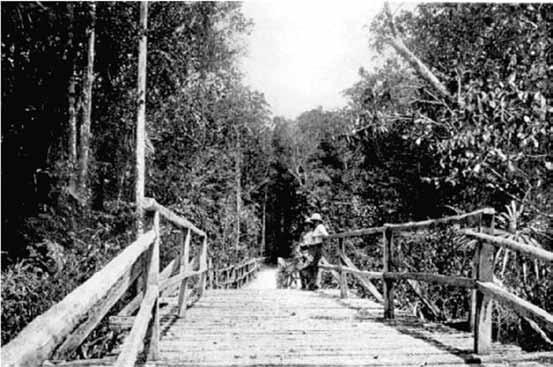
On the hoof, cattle were driven along a cattle trail that wended its way from Annai in the Rupununi savannahs through rough terrain to the Yawakuri savannah on the Berbice River, covering a distance of at least 120 miles. At the end of the journey, the cattle were exhausted and wasted. In 1919, the trail was successfully completed and the first head of cattle was driven over it in 1920.
A glance at the map of Guyana reveals that the 5000 square miles of the prime savannah lands of Rupununi is located in the isolated deep south- west of Guyana. In the early ranching period, there was no way to reach the Guyana coast with cattle and no market at all except in Brazil where demand was uncertain and values low. Transportation was a serious problem and waterfalls interfered with river transport. Highways and railways were non-existent, and construction through the forests and swamps was cost prohibitive.

The New York Times Oct. 21, 1917 noted: “A reduction from 4 weeks to one on the time necessary to transport cattle from the interior of British Guiana to the coast will be affected by the construction of a cattle trail from the Annai Savannah on the Rupununi River to the Yawakuri Savannah on the Berbice River, a distance of 120 miles. A loan of $60,000 for the purpose has been authorized by the Combine Court of British Guiana accordingly to a report from the Consul George A Chamberlain, station in Georgetown. Work upon the
trail is to begin at once and it should be ready for use early next year.”
The publication further added: “There are at present about 35,000 heads of cattle in the savannah in the Rupununi district, and it is estimated that over 1000 head will be taken over the proposed trail yearly to the Berbice River, and hence transported to the coast for the local market and for export. It was further stated in the court that there was 150,000 head of cattle on the Brazilian ranches near the British Guiana border, and that transportation to

the coast would be less expensive by this trail that at present by Manáos and other places where markets were available. This trail will also make access to the interior of the colony for other purposes much easier.”
A1924 British Guiana report stated, “There are very extensive savannahs tracts in the far interior on which at present cattle are being raised. With the provision of the Rupununi Cattle Trail in 1920, it is possible that this region will become the important cattle-raising section of the colony.
Horses are raised in some numbers on the plantations and farms of the coastland.
There is, however, the possibility of considerable development in this undertaking
construction of this trail could convey Brazilian cattle and horses to British Guiana’s coast and also as an outlet for the large and rapidly increasing herds of local cattle grazing on the savannah.
The market to the Guyana coast was opened with the development of the cattle trail through the forest just at the end of World War I. The trail was very difficult to traverse, particularly in its early years because of the swamps and long distances without proper feed in the tropical jungles. Losses were extremely heavy and profits small, if there were any. Frequent attacks by jaguars, swimming the Essequibo, parasites and disease took a

mouth of Arakawa CreekLinden today. A stelling was constructed and herds of “cattle were loaded onto the steamer and punts for transport to Georgetown. The trail supplied fresh beef to the local market of Upper Demerara and supplemented other local livestock.”
Teams of workers and contractors, many from Upper Demerara, had the task of maintaining the trail free of bush, keeping wooden bridges safe and wire fencing along its path. This bush trail became an access into the heart of British Guiana, and traffic went both ways.
During the depression years of the 1930s, cattle scarcely paid the cost of driving them to the market and ranching became a moderately profitable undertaking due to the more favourable markets during and after World War II. After the close of World War II the country was opened to air traffic. With some aid from the colonial government, landing fields were developed and regular traffic by the then Guiana Airways Company was established. Regular shipments of beef from the Rupununi to Georgetown by air began on July 9, 1948. Despite the high cost of airlifting beef to coastal markets in some quantities, it succeeded due to low production cost. The war years and moment of prosperity for the arduous Rupununi Cattle Trail came to an end with the birth of air transport and in 1953 was permanently closed.
Parts of the cattle trail have been upgraded today into a fair weather track over the years and serves as a road to Brazil through the town of Linden, ending
when suitable opportunities offer for ready sale. The number of cattle in the country in 1921 was estimated to be 122,886, the number of horses 1,762, sheep 20,602, and pigs 12,312.”
The trail was the brainchild of pioneer, H.P.C. Melville, born1864, former commissioner of the Rupununi district who owned Dadanawa Ranch in the 1880s and felt that the
toll. This trail was somewhat improved in the preceding years and death losses were not as great but weight loss was severe and only the strongest and most rugged cattle could hope to make the trek to the grasslands between Demerara and Berbice River.
One branch of the historical cattle trail ended on the eastern shore of the Demerara River near the
at Lethem. The jungle has reclaimed other parts of the trail. Iron pegs, which once marked the trail, can still be found buried in the dense growth. Rotting greenheart bridges were still present as late as 1982. Piling remnants of the loading dock alongside the Demerara can still be found today. And so went this one-of-a-kind Rupununi Cattle Trail into the annals of Guyana’s precious history.
Art lecturer and puppeteer, Michael Khan believes that children will destroy if they are not given the opportunity to create. That is why the Mashramani Children Art competition was conceptualised, to give children an outlet to create.
The competition was initiated, by veteran artist Philbert Gajadhar and the Ministry of Culture, Youth and Sport, three years ago. The competition, which was opened to children aged four to 17 years, received more than 220 entries from across the country.
In an interview with Guyana Times Sunday Magazine, Khan stated that the entries were submitted by various schools from Regions Two, Four, Five and Six. The categories ranged from nursery to secondary school levels. This year, Patentia secondary
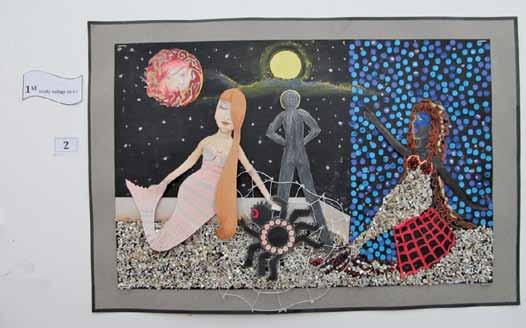
and primary took away most of prizes.
“The theme was folklore and the children really let their imagine spread in drawing folklore themes. This year I am the convener so it was my responsibility to overlook the proceedings. Mashramani has become, over the years, just a fete down the street. But the Minister of Culture, Youth and Sport, Dr. Frank Anthony has placed a new impetus into the celebration catering for children. It is a different way of self-expression instead of joining a Mash band to celebrate this national event. This competition was a vehicle for children to express their concepts of the significance of Mashramani,” Khan pointed out.
The puppeteer, popularly known as Ole’ Man Papie, opined that if children are not given an opportunity to create, they will destroy. He further stated that the concept of the art competition is to give children the opportunity to create.

to the teachers who encourage their students to participate. It is a memorable occasion for the children who received prizes for their work. It is something they will always remember. I recall when I was a boy I received a prize for an essay writing and that stayed with me. Teachers need to encourage and motivate children to participate in such competitions,” urged the arts lecturer.
At the National Library, an exhibition of the artwork submitted was recently held. There was also a prize-giving segment during the event.
Azrelita Williams of Precious Jewels Nursery took the first prize of $25,000 in the drawing contest, while Leandra Marcus of Westfield Preparatory and Emanuel Lewis of JE Burnham Nursery placed second and
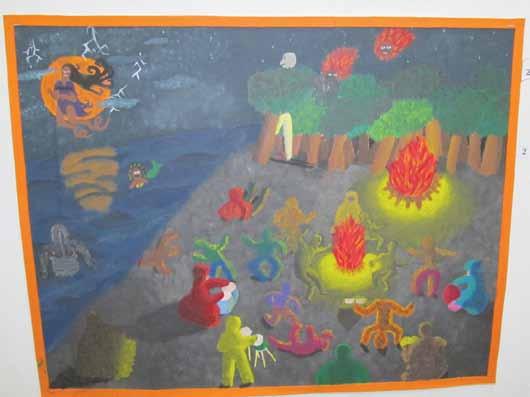
“Creative children will become innovative adults. This year, I have seen great potential from the artwork submitted. I want to thank the National Library’s staff for their support. I want to thank also the Minister of Culture, Youth and Sport and the Ministry of Education. A special thanks
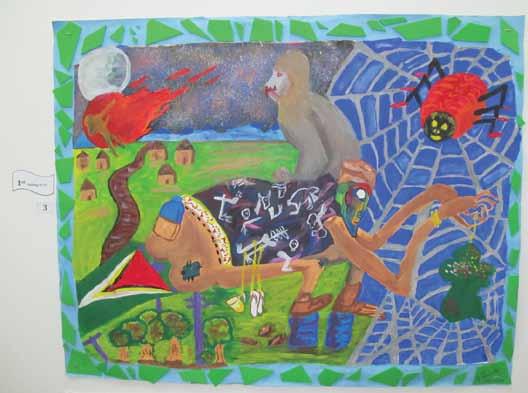
third, winning cash prizes of $20,000 and $15,000 respectively.
In the painting category, entries from Shiloh Allen and Josiah Singh, both of Alexander Village Nursery, were submitted. Allen, first place winner, received $25,000, while Singh received $20,000.
Reya Arjoon of Patentia Primary proved her skills by taking away the winner’s prize. Azriel Williams of North Georgetown Primary placed second and Omadevi Sewdat of Leonora Primary placed third.
Jonathan Ganga and Basmattie Parbu, both of Leonora Primary School, were the only entries for the painting in the age seven to nine category, with Ganga taking first place.
The drawing age 10-12 category saw Shekinah Swami of Patentia Primary in first place, Jetendra Totaram of Number 56 Village Primary in second place, and Romel Lackhan of Parika Salem Secondary in third place.
The painting, age 10-12 category, contest’s winning entries were Georina Dick of Graham’s Hall Primary, followed by Marie DeSouza of Parika Salem Secondary and Said Azeez of Graham’s Hall Primary.




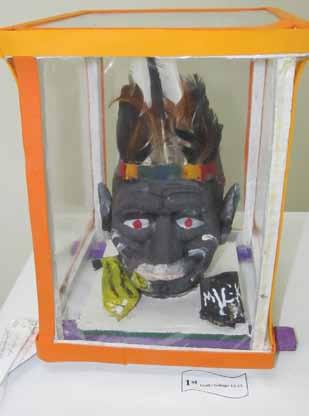
Vanessa Raghubeer of Skeldon Line Path Secondary won herself the ‘Honourable Mention’ prize.
Nick Beharry of Zeeburg Secondary, and Osamo Parie and Stephon Shivnauth of Patentia Primary took first, second and third place respectively in the drawing age 13-15 category.
Gunaan Shivshankar, Ramanand Mangar and Tushad Mohabir, all of Patentia Secondary, submitted the first-, second- and third-place winning entries for the painting age 13-15 category.
Romanand Mangar, Vidya Boodhoo and David Washington, all from Patentia Primary, dominated in the craft and collage (creative designs) category for the 13-15 age group, while the ‘Judge’s Prize’ was awarded to Melissa Wilson.
The Enmore Youth Development Group is a non-profitable organisation registered under the Ministry of Culture, Youths and Sports and attached to the President's Youth Award: Republic of Guyana programme.
The group was founded on Sept. 11, 2013, by two dedicated professionals, who have a passion for youths and their development, Steve Datta and Romel Putulall.
In an interview with Guyana Times Sunday Magazine, president of the group, Romel Putulall stated that the group’s aim is to “promote young individuals within society and to help develop good moral value in their lives.” The group’s motto is, “To see a positive change, we have

the tree completed before the holiday. Nevertheless, it was successfully completed. Persons in the community were astonished. It was beautifully dressed with the kind contributions from the business community in Enmore. Notably, Minister of Culture, Youth, and Sport, Dr. Frank Anthony was present at the Christmas tree light-up,” recalled Putulall.
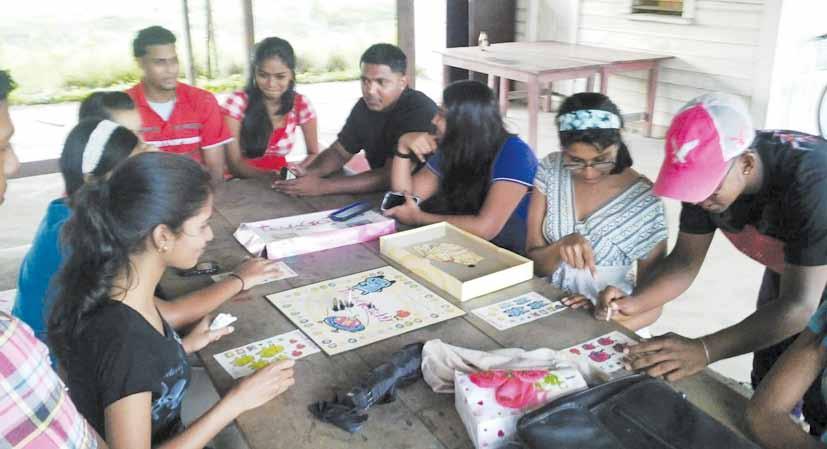
A few group activities include a movie night, fun day, cookout, and group discussions on various topics ranging from music, relationships, and issues affecting teenagers. Putulall pointed out that the activities are geared at fostering lasting
a lot of youths. Those who would regularly be playing pools in rum shops became actively involved in the group and broke off from such activities. The idea about keeping youths off the streets has been achieved to a fair extent. By the end of the year, the idea is to influence as much youths as possible,” explained Putulall.
The Enmore Youth Development Group currently has 55 registered youths, from ages 14 and above, and welcomes all youths who want to make a positive change in their communities.
“Personally giving back to the community makes me feel good, in terms of seeing
Youths actively engage in self-development activities
to first ignite that change, be the change, and lead the change”.
According to Putulall, after three months of activities, the group increased in numbers. The group was then headed by four other leaders - Nicole Dumay, group’s secretary, Kaeron Singh, vice president, Shivraj Balkissoon, health adviser, Nikita Outar, environment adviser, Akeel Suliman, sports adviser.
“These are all youths who are in the working field and studying and have the desire to see youths in the community develop. Too many youths have become addicted to drugs, alcohol, and the crime rate is prevalent among youths in various communities, so together as leaders our main objective in mind is to make a difference. We want to be that change, since we are the future of tomorrow,” declared Putulall.
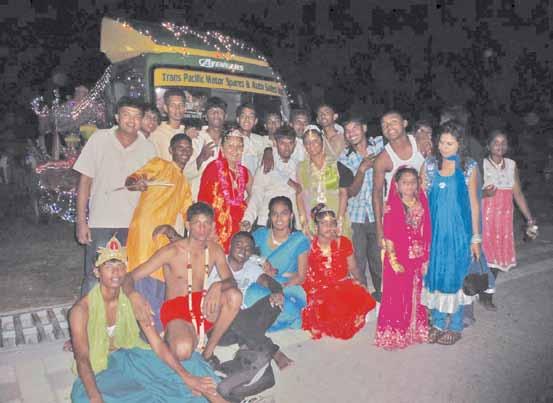
In 2013, some activities which were undertaken by the group included holding a grand community Diwali motorcade in Enmore. Putulall disclosed it was the first time an event like that was held in the community. He was pleasantly surprised to see over 100 persons gathered together as a community to make the event a success.
“For the Christmas celebration, we had a grand Christmas tree light-up. Youths worked in the rain, the hot sun, and even late hours in the night to get
relationships between the youths.
Aiming to improve the environment, the group’s proposed project is to plan a tree-planting exercise and garbage management programme. Cultural shows for various holidays would continue to be part of the group’s activities. Group members, who have excelled academically and want to give back to their community, would be offering free computer and CSEC classes. Future plans also include planning medical outreach programmes and more sport activities.
“Through the group we have been able to influence
that I have been able to influence a lot of youths. It makes me proud to see these ones become responsible individuals, contributing positively to their community and being leaders of change. I live with a policy in mind that youths are the future of tomorrow and so will work feverishly to help youths achieve as much as they can. As for the members of the group, they are happy to be involved, since there was never a group in the community like this one. Giving back to their community means a lot and so they work diligently in accomplishing the group’s goals,” expressed Putulall.

Throughout history, there are numerous Guyanese women who have received many accolades for outstanding achievements and have shown that greatness can come from a small country.
One such notable individual is Dame Sybil Theodora Phoenix. She was born in British Guiana and grew up in Georgetown. She and her fiancé, Joe Phoenix, moved to England in 1956 and married in June of that year. In 1972, she became the first black woman to receive an MBE (Most Excellent Order of the British Empire) from Queen Elizabeth II. Phoenix initially refused to accept the honour unless the council gave her a property where she could house, feed and educate homeless young girls from the Borough of Lewisham.
Phoenix is a legendary figure in her adopted home of Lewishan in South East London. In the early 1960s, she began providing foster care for unwanted children and, in 1977, founded a youth centre for teenagers. However, the centre was burned down by members of the right-wing extremist group, National Front. Phoenix vowed to rebuild. Four years later, in 1981, the Prince of Wales was present for the grand opening of the new center.
Personally experiencing the harsh effects of racism, Phoenix was motivated to actively work against every kind of discrimination people suffered solely because of their skin colour. She cofounded the Methodist and Ecumenical Leadership Racism Awareness Workshops, an organisation which offers racism awareness training programmes.
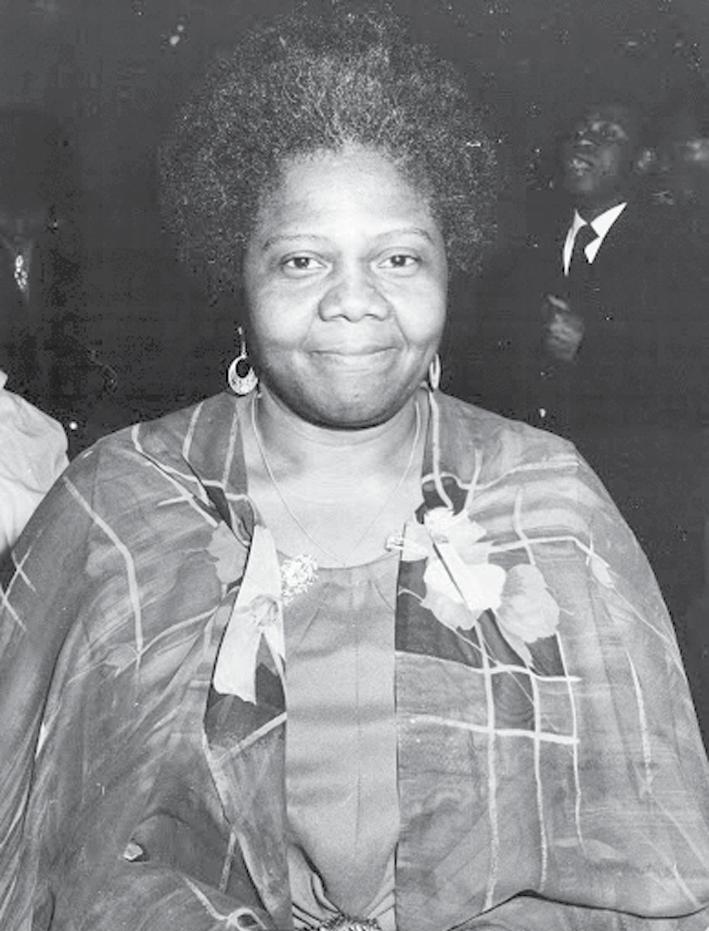
She was also a leader in the New Cross Fire campaign, the post Brixton negotiations, and the famous Black Peoples Day of Action.
In 1979, Phoenix and her husband founded the Marsha Phoenix Memorial Trust, a supported housing project for single homeless young women. The trust was named in honour of her daughter who died in a car accident in 1974.
The royal family continued to recognise Phoenix’s outstanding work. In 1987, Princess Margaret asked her to be Minister without Portfolio for Guyana. She received the Medal of Service Award for her dedication to Guyanese people in and out of the country. In 1996, she was made an Honorary Freeman (mayor)
of the Borough of Lewisham, and in 1998 was awarded the Freedom of the City of London. In 2008, Phoenix became an Officer of the Most Excellent Order of the British Empire.
Today, the 87-year-old is still going strong.
Then there is Claudette Izel Humprey (nee Masdammer) - the first female to represent British Guiana at the Olympic Games.
Claudette attended the St. Georges Anglican School and subsequently entered the Tutorial High School on an athletic scholarship. Her athletic ability was recognized by the Castello brothers, founders of Tutorial High school, during the annual public schools’ sports

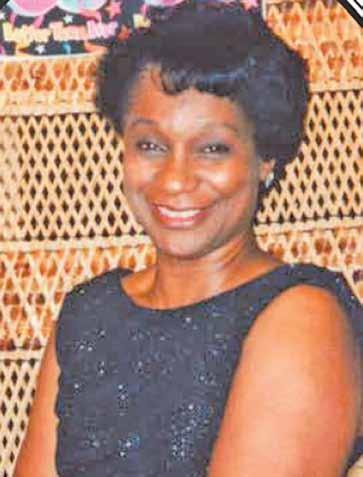
meeting.
On account of her sprinting prowess, Claudette represented British Guiana at the 1956 Olympic Summer Games held in Melbourne, Australia, while still a student at Tutorial High School. The students were promised a day off based on Claudette’s performance.
Unfortunately, Claudette
failed to qualify for the finals. Nevertheless, the Tutorial student population, though disappointed that they did not receive a day off, was proud of their fellow student.
She competed in the 100 meters heats and finished in fifth place. At the ‘56 Olympic Games, no other female West Indian athlete attended/qualified for the pre-
mium sprinting events.
At the British West Indian Championship held in Guyana in 1959, Claudette was awarded a bronze medal for competing in the 100 meters and silver in the long jump.
In 1960, Claudette became a student nurse at the Georgetown Hospital. She spent approximately one year nursing before emigrating to England in 1961 to further her studies in nursing at Central Middlesex Hospital in London. There, Claudette met and married Winston Humphrey, a fellow Guyanese and Naval soldier in the British Navy in Southampton England. From that union they bore three children.
Wanting to become a midwife, she joined the St Mary’s clinic in Portsmouth, England. Her training, before she could take her finals in midwifery, required the delivery of 50 babies. Claudette fulfilled her requirements and passed her finals in 1979 as a midwife at Hyde General Hospital. Claudette became the Sister in Charge of the Maternity Unit at Hyde General Hospital and delivered hundreds of babies up until her retirement in 2002.
Sadly, she died on Nov. 13, 2013, at the age of 74, after bravely fighting an illness.

By PetamBer Persaud
Part One
“Cultural Folklore; Celebrating 44” is the theme for Mashramani 2014, Guyana’s celebration of its Republic status attained on Feb. 23, 1970. Cultural folklore has forever captivated the imagination of the country’s writers. Additionally, it has captured the imagination of non-Guyanese writers who, in one way or the other, had experienced the intricacies of Guyana’s cultural patrimony as colonisers, missionaries, or adventurers.
This article, in a series of three parts, will deal with some poetic contributions by Guyanese writers. Another article will look at the contribution by non-Guyanese writers. Finally, a third article will examine the relevancy of cultural folklore to the Guyanese psyche.
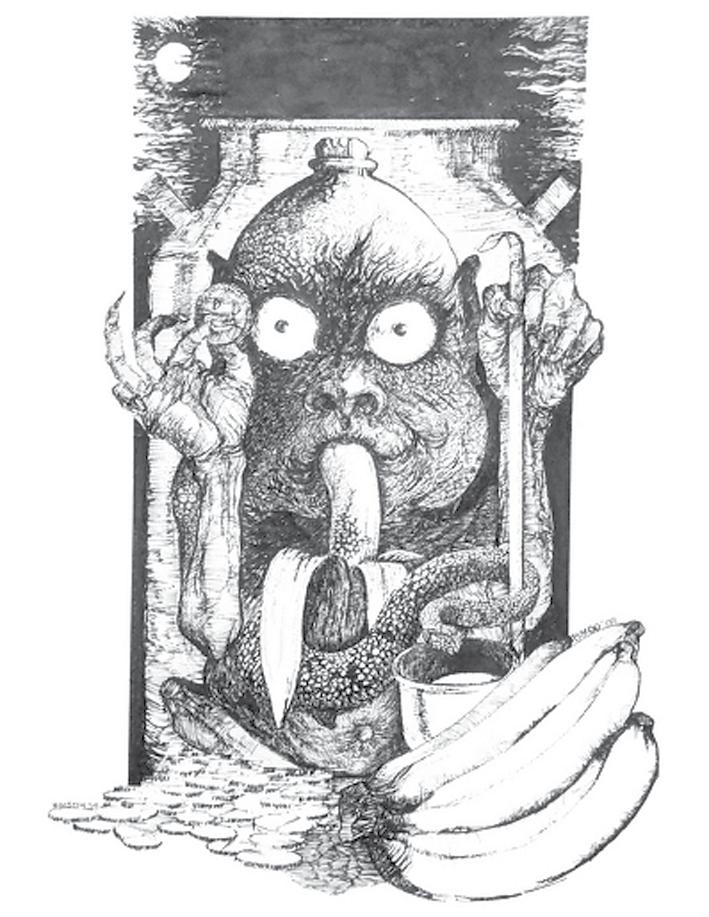
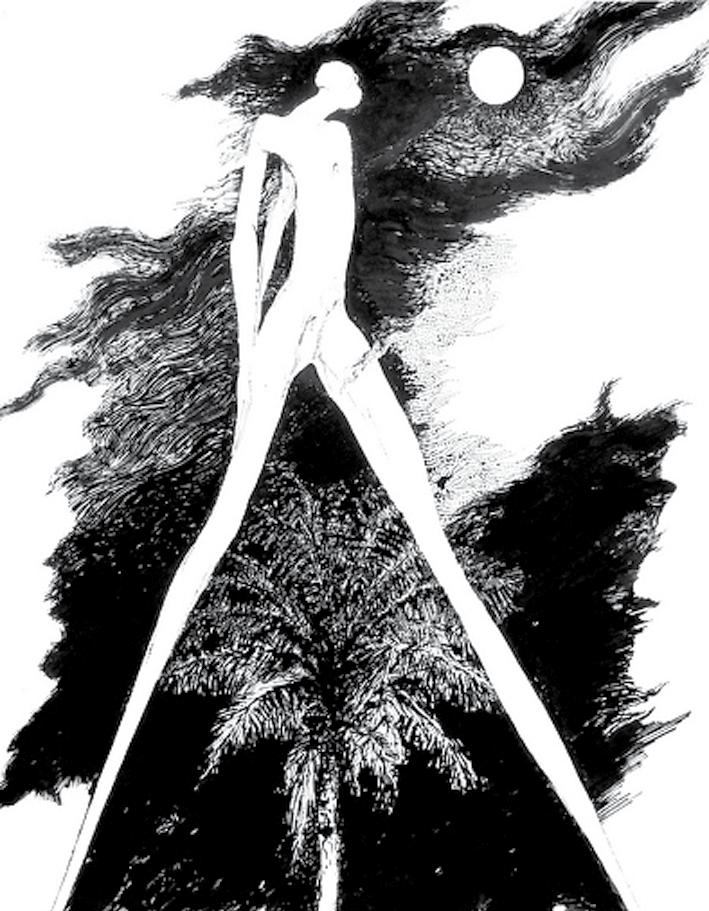
I am designed to be a symbol of Terror though there are some who reckon Me differently I am Maha Kali ... Mother of the universe .. Shrouded with terrifying esoteric misunderstanding .. Do you know why many fear My worship?
Of course, we must never diminish the voice of our women writers. Here are two pieces by Grace Nicholsfirst “Like Anansi” followed by “Yemanji”.
Many of the motifs are familiar, some strange and others little known. So let’s start with the familiar and work our way into the esoteric. Let’s start at the beginning with the poem “El Dorado” by A. J. Seymour. The poem tells part of the story of the “City of Gold” which attracted the imagination of all European adventurers, resulting in the colonising of these parts and to sugar, slave, indentureship, independence, and republic.
find gold”, witnessed the following:
Juan Martinez, “who came on an expedition to
That morning in reverence priests had anointed him/With sacred and fragrant balsam, then had sprinkled/The dust of gold upon his gleaming skin/He was the gilded one. (Italics)

The “gilded one” was now prepared to make his sacrifice of “emeralds, pearls and gold...then casting his robe aside, the king descended/ And washed from him the sacrificial gold.” This annual sacrifice was done in order to reclaim his loved ones from the lake.
From El Dorado, we could move to our first nations. And back to Seymour in his “Legend of Kaieteur” which tells of discord among the first nations and about another sacrifice. Old Kaie, a great chief, sacrificed his life by going over the great falls to seek the will of Makonaima, the great spirit, in order to bring peace to his people.
Kaie then raised his tall/Huge bulk in the boat and towered over the fall/A cruciform over the flaming mist...But of Kaie’s body never showed a trace/He sat with Makonaima before his face.
After the first nations, there were those who came by ships- Portuguese, Chinese, Africans, and Indians among others. They brought their own peculiar cultural folklore- Anancy, Ole Higue, Baccoo, Churile, Moongazer, Yemanji, Ogun, and Balgobin.
Our first sample is “Ole Higue” by Wordsworth McAndrew.
Ol' woman wid de wrinkled skin, Leh de ol' higue wuk begin. Put on you fiery disguise, Ol' woman wid de weary eyes Shed you swizzly skin. Find de baby, lif de sheet, Mek de puncture wid you teet', Suck de baby dry.
Whaxen! Whaxen! Whaxen! Plai!
You gwine pay fo' you sins befo' you die.
Lash she all across she head
You suck me baby till um dead?
Whaxen! Whaxen! Plai!
You feel de manicole 'cross you hip?
Beat she till blood start to drip.
"Ow me God! You bruk me hip! Done now, nuh? Allyou done!"
Is whuh you sayin' deh, you witch?
Done? Look, allyou beat de bitch.
Whaxen! Whaxen! Pladai! Plai!
Die, you witch you. Die. Whaxen! Whaxen! Plai!
“Moongaza” by Rooplall Monar is also written in creolese.
Two a’clack ah manin Moonlight shine Daag bark Bow wow wow
Fram de ole loco-line
Memba…
Neighba Stella picknie
Dead blue in she belly
Cause she see Moongaza
Same night dem fowl cack crow
Cook coo roo roo
Memba watchman Djoko?
Drop. Stone dead.
E mule tramp e Kick e
Mash e Cause e tek shade foh Moongaza
Me skin raise big!
Ow Moongaza! Moon… Ga…za!
Me picknie! Me picknie!
O Gaad neighba, Lawd! Moongaza mouth wid blood.
Wait! Don’t run away, there is more of the esoteric in “Maha Kali” by B. Ramsarran.
I was the Ashanti spider Woman-keeper of dreams tenacious opalescent dark eyes unblinking then you came like Anansi... not at all what I was expecting “Yemanji” Mother of seas Goddess of rivers Mother of Shango Mother of the long breasts of milk and sorrow
Anancy is not alone. Here comes Balgobin to complement or counter Anancy in “Balgobin Khappah” by Sasenarine Persaud.
Ehem – is me Khappah –Balgobin Khappah/...Well don’t/ ask me how abhi dhis come fuh get dhis nameyuh/know how abhi dhis West Indian staan, always giving/matti falsename but thankyuh thankyuh manijah/fuh dhis oppatunitee...
When last you see a blue moon? Here is “Blue Moon” by Cyril Dabydeen.
The moon turns blue, taking its life from everything around it it is flesh of the body it is the blood vessel it meets at the limits of heart and soul
In closing this part of the article, it would be useful to quote from a poem titled “Tradition” by Laxhmie Kallicharan.
Swirling oceans of tradition distilled as culture ferment into habit
Responses to this author should be sent to email: oraltradition2002@yahoo. com or call (592) 226-0065.
What’s happening: Coming soon, the first reprint of “An Introduction to Guyanese Literature”. It will be available from the author at the above contacts, Austin’s Book Service (226-7350) and at the National Library (2262690).
By Vahnu Manikchand
At a very young age, Yaphet Jackman realized that he was not one of the regular boys. Now 28, he is a Special Projects Coordinator. He explained that his current position came about just prior to the 9th anniversary of the Upscale Poetry Night.
At the moment, he is busy working on a bigger project- launching his debut spoken-word album called “Ink Drops”. The album, which is being produced by Drew Thoven, is slated for release in August.
Jackman identified legendary producer Noel Harlequin as his role model. Harlequin is credited for being Jackman’s inspiration and teaching him the pros and cons of video editing and filmmaking.
In an attempt to hone his craft, Jackman visited several Caribbean countries gathering all the training he could get. He was successful in acquiring certification as a video editor. He said: “I realized that I had a vast amount of knowledge, but did not have any certification to show.”
During his secondary school days at St. Joseph, Yaphet recalled he had always aspired to become a video editor. He said he was never one of the scholars at school but his grades were not bad either. “My grades were average,” he admitted. However, he surprised his parents when he wrote CXC in 2001 and was successful.
Jackman explained that he started working at the age of 13. At that time, he was employed with Spot Light Productions as a part-time cameraman. He added that by the time he had reached the age of 14 he had progressed to video editor. He described himself as an independent person who worked feverishly in achieving his goals.
After completing CXC, Jackman went on to work at Giftland Officemax before venturing once more into the world of media at Guyenterprise. He explained that during his tenure at Guyenterprise he was a very young manager. At the age of 19, he was appointed to the senior position. He added that he moved on from Guyenterprise to work with the Guyana Telephone and Telegraph Company where he was a production manager on the company’s “We Linkin’” show.
Although his job is “hectic”, Jackman is adamant on



Punch is a talented singer, songwriter, dancer and actress. By age 11, she was performing across the country and appearing on local TV shows. She joined her high school’s choir, where she was placed as the lead singer at just 12 years old. The songstress also joined the school’s dance group, representing her school in dramatic poetry and copping first place trophies at children’s Mashramani competitions. At the age of 14, Lisa entered the first ever reality show in Guyana called “Star Guyana”. The competition required contestants to display three talents- acting, singing and dancing. Lisa was the youngest contestant and won after performing a mesmerizing rendition of Whitney Houston’s “I will always love you”. Consequently, she was dubbed a “national song bird” and the “local Whitney”. In 2008, Lisa went on a hiatus from music to prepare for CSEC examinations. She gained 12 passes and was awarded the Student of Excellence Award at her high school. Subsequently, she decided it was time to get back to her music career and produced her hit singles, “Secret Admirer” and “My Inspiration”. “Secret Admirer” was a crossover track mixed with reggae and pop and “My Inspiration” landed on “Cellink Top 40 Countdown” and is an upbeat R&B love song. During her acting stint, Lisa won Best Actress for the play “The Concert” in 2008. She later won Best Supporting Actress for the play “Shadows”. Last year, she released her debut album, “The Evolution of Lisa Punch”. Lisa continues to feverishly pursue her music and acting careers and, one day, hopes to see her name on the international Billboard charts. Her advice for youths, who want to pursue a career in music, is to be focused and humble.
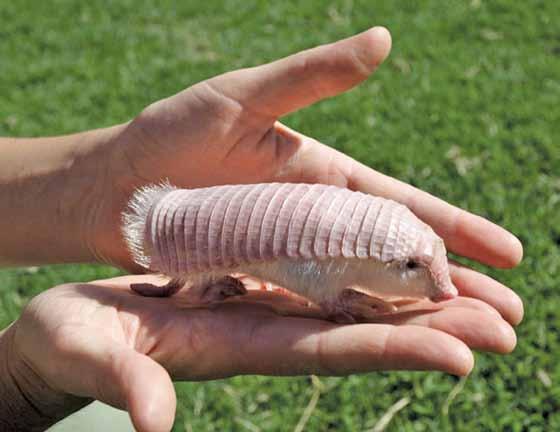
The Pink Fairy Armadillo (Chlamyphorus truncatus), also known as the Pichiciego, is considered the smallest species of armadillo in the world.
It weighs less than a pound and generally ranges between 90-115 mm (3.5 – 4.5 in) in length, excluding its spatula-shaped tail which ranges between 27 — 35 mm (1.1 — 1.4 in).
It is found in central Argentina, South America, where it inhabits dry grasslands and sandy plains with thorn bushes and cacti.
Ants provide a favourite and constant food source for the nocturnal hunter, and it uses its digging abilities to burrow in areas beside large ant colonies. It may also forage on worms, snails and plant matter.
Due to habitat destruction, the population of the pink fairy armadillo is decreasing, and as of 2008 they have been listed as Data Deficient after being listed since 1970 as Threatened.
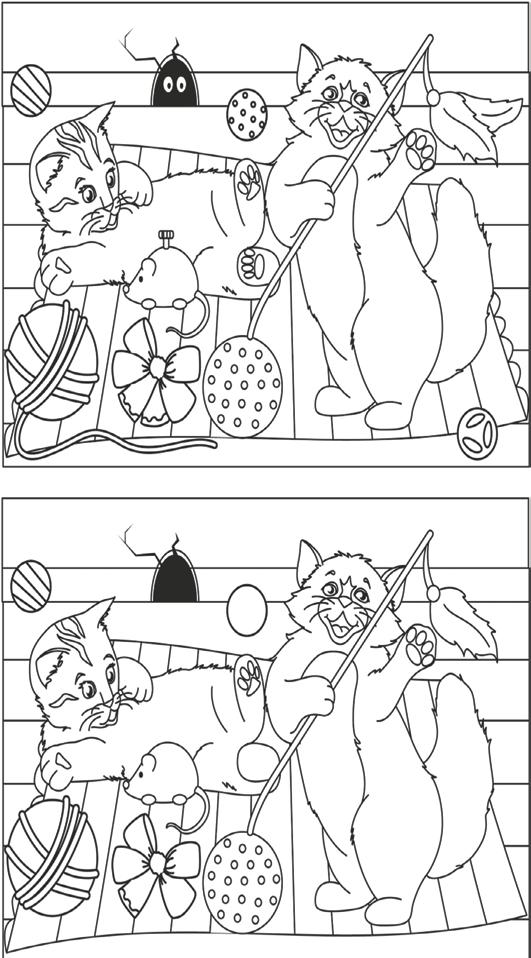
The objective of the game is to fill all the blank squares in a game with the correct numbers. Every row of 9 numbers must include all digits 1 through 9 in any order. Every column of 9 numbers must include all digits 1 through 9 in any order. Every 3 by 3 subsection of the 9 by 9 square must include all digits 1 through 9.
fairy armadillos are excellent diggers; they can completely bury themselves in a matter of seconds if threatened. It uses its large front claws to move through the sand, allowing the pink fairy armadillo to seemingly swim through it as if swimming through water. The tail cannot be raised, and as a result drags behind the animal as it walks.


By Laurie Triefeldt
African-Americans have had an enormous impact on the music of the past 150 years. After the Civil War, black musicians began to combine Christian hymns with work songs (with African tribal beats) into a form of music called ragtime, which evolved into jazz. By the 1920s, jazz and blues were the pop music of the day. This music influenced swing, bebop, gospel, soul, rock and roll, and eventually rap and hip-hop.
In 1940, Hattie McDaniel (18951952) became the first black person to win an Oscar for her role in “Gone With the Wind.” In 1965, Bill Cosby (1937- ) became the first black lead actor on television in the adventure series “I Spy.”
Jimi Hendrix (19421970)
Talented African-Americans have never been in short supply. The list is so large that this page cannot credit them all, but here are a few of the greats.
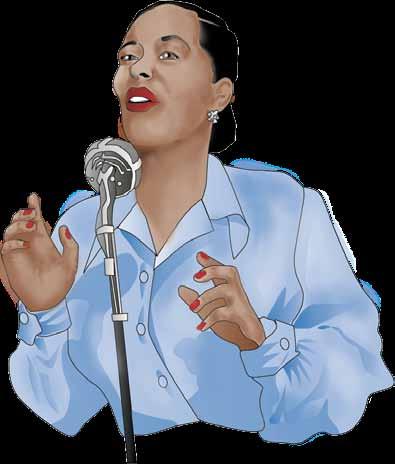
Billy Holiday (19151959)
)
Stevie Wonder (1950- )


Michael Jackson (1958-2009)
Oprah Winfrey (1954- )
Will Smith (1968- )
With five regular-season MVPs and three All-Star MVPs, Jordan became the most decorated player in the NBA.

1994) overcame poverty and physical disabilities to become the first American woman to win three gold



Miles Davis (19261991)
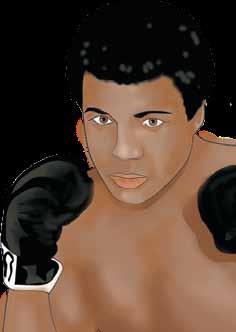
Ali (1942- ) is one of history’s greatest heavyweight boxers.
In 1947, Jackie Robinson donned a Brooklyn Dodgers uniform and made history as the first black man to play Major League Baseball since the color barrier of 1889. Hank Aaron followed in Robinson’s footsteps, becoming one of the greatest baseball players of all time.
Jesse Owens was a track star on the U.S. Olympic Team in the 1936 Olympics held in Berlin, Germany. At the time, Hitler was promoting his racist ideas, suggesting that blacks were inferior to whites. Owens proved Hitler wrong by winning gold medals in the 100-meter and 200-meter sprints, the 4x100 relay and the long jump. Hitler refused to acknowledge the triumph.
Athletes like Wilma Rudolph (track and field), Lynette Woodard (basketball) and Mabel Fairbanks (figure skating) helped lead the way for later generations of female athletes, including Jackie Joyner-Kersee (track and field), Sheryl Swoopes (basketball), Venus and Serena Williams (tennis) and Surya Bonaly (gymnast and figure skater).
Sidney Poitier (1927- )
In 1963, Poitier won an Academy Award for best actor for his role in “Lilies of the Field,” becoming the first black person to receive that honor.

Walter Payton (1954-1999) made nine Pro Bowl appearances and won the NFL’s Most Valuable Player Award twice.

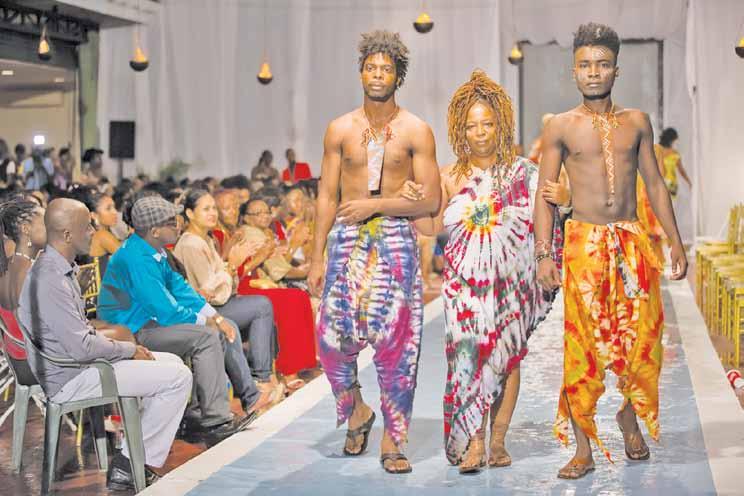
Nofashion statement is as loud as the splendour of bursting colours and bold patterns of tie-dye.
Capturing the beauty of tie-dye in her recent collection, local designer Tracy Douglas lends a certain rainforest mystique to her colourations in her textile design.
“All the pieces I created are unique. I have been so motivated to tie-dye and paint for over 26 years because each garment always has its own character. After dyeing a piece I can’t wait for it to cure so I can see how it has turned out, it is such a thrill. Most pieces are created to be worn on either side or front to back. Creative souls should be able to quickly get dressed and look ‘funky fabulous’,” explained Douglas during an interview at the Guyana Fashion Week (GFW) 2013.
The designer’s trendy tie-dye collection adds an effortless boho-inspired fun to any wardrobe.
For more information on this collection, call 627-7063 or 654-1865. (Photos by Helio Phoeli)








Kerry Washington is an American actress. Since 2012, Washington has starred in the ABC drama “Scandal”, a Shonda Rhimes’ series in which Washington plays Olivia Pope, a former crisis management expert to the President. In 2013, her role earned her a Primetime Emmy Award, Screen Actors Guild Award and Golden Globe Award nominations. The actress is known for her roles as Ray Charles's wife, Della Bea Robinson, in the film “Ray” (2004), as Idi Amin's wife Kay in “The Last King of Scotland” (2006), as Alicia Masters, love interest of Ben Grimm/ The Thing in the live-action “Fantastic Four” films of 2005 and 2007, and as Broomhilda von Schaft, Django's wife, in Quentin Tarantino's film “Django Unchained” (2012). She has also starred in the critically acclaimed independent films “Our Song” (2000), “The Dead Girl” (2006), and “Night Catches Us” (2010). Last year she received an honourary Doctorate of Fine Arts from the George Washington University.

Pharrell Williams is putting his infamous Grammy hat on sale. The singer/producer took to Twitter on Thursday, February 20 to announce that he wanted to sell the hat to the highest bidder, adding that proceeds from the sale would be donated to charity.
"I'm auctioning off my hat from the Grammys to benefit From One Hand to
AnOTHER," he tweeted. "Hey @Arbys, you want my hat? Now's your chance," Pharrell jokingly added. He also attached a photo of him wearing the hat in the Twitter posts. The highest bidding currently is $10,500.
The auction will be closed on March 2.
"All proceeds benefit From One Hand to Another whose mission is to help change the world one kid at a time by giving them the tools and resources to meet their unique potential and empower them to nurture curiosity by learning through new technologies, arts, media and motivation," read the announcement on eBay.
The Vivienne Westwood "mountain hat" stole people's attention when Pharrell wore it at the 2014 Grammy Awards on Sunday, January 26. At that time, the musician also wore a red jacket and dark pants instead of tuxedo. Shortly after making appearance, the hat got its own Twitter account which goes by @Pharrellhat. "Bye," read a tweet from the account's feed after Pharrell announced the auction. (AceShowbiz)

Rapper 50 Cent has decided to leave Universal Music Group's Interscope Records and Eminem's imprint Shady/Aftermath. The rapper announced his departure from the major label, under which he released all his previous albums including the massively successful 2003 record "Get Rich or Die Tryin' ", on February 20.
"I have had great success to date with Shady/ Aftermath/Interscope, and I'd like to thank Eminem and Dr. Dre for giving me an incredible opportunity," 50 Cent said in a statement. "I've learned so much from them through the years. I am excited to enter this new era where I can carry out my creative vision."
Eminem has shown his support for his former protege. "Both myself and Shady Records are grateful to have had the chance to

play a part in 50's career," the Detroit MC said. "Shady simply would not be what it is without 50 Cent."
"I've developed a great friendship with 50 over the years, and that's not going to change. We know 50 will have success in his new situation, and we remain supporters of both him and G-Unit," he added. His future releases as well as those by the artists from his G-Unit label will now arrive via Caroline Records, the independent
service division of Capitol Records which is also a part of Universal. The rapper is still working on his fifth album, "Animal Ambition: An Untamed Desire to Win", which is due out on June 3. He will give away two new tracks to fans who pre-order the album starting on March 18. Additionally, the "In Da Club" hitmaker will premiere new songs and videos each week up until the album's release.
(AceShowbiz)
Last year Nicki Minaj admitted that she was flirting with a more minimalist look, but those experimental candy-colored wigs definitely played a major role in establishing her image as Queen Barb. Unfortunately, the stylist who created many of Nicki's early wigs is now suing the YMCMB rapper for stealing his designs.
According to CNN, Terrence Davidson filed a $30 million lawsuit in an Atlanta district court last week, claiming that Nicki Minaj duplicated his wig designs to sell on her own website, and potentially caused him to lose money by discouraging him from exploring a reality show deal.

"I see these wigs online," Davidson said. "People are basically duplicating what I created for Nicki Minaj."
Davidson and Minaj began working together in 2010 and he crafted some of her major looks, including her colorful wigs in the "Super Bass" video and "Fly" with Rihanna, in addition to her wig for the 2010 MTV Video Music Awards. They reportedly planned to collaborate on a joint wig line, but that didn't work out. According
to the lawsuit, in 2012, "Minaj and her agents became mum about the business ventures and took active steps to isolate Mr. Davidson and preclude him from the notoriety he deserved for his wig designs."
In early 2012, while Davidson was still on good terms with Nicki, he explained how excited he was to work with the superstar rapper, since she was open to his wild ideas. "It was like, 'Wow, finally, in my time someone wants to do this," the Atlanta-based hairstylist told MTV News before the release of Pink Friday: Roman Reloaded."Because I've been wanting to do this for years. It's just I hadn't met the right artist that wanted to sit down and make this work."
"Nick's doing it for everybody, not just women, not just female rappers but for everybody who wants to be different," he added at the time. "Her music is so many different levels, from pop to R&B to rap. And she's opened up a lane where it's just hers — and nobody else can really mess with it."
MTV News reached out to Nicki Minaj's rep for comment on the lawsuit, but proved futile. (MTV)
At what point does being fashionably late become unfashionable? Katy Perry found out the hard way on Thursday, Feb. 20, when she showed up just before 9 p.m. to the Moschino runway presentation at Milan Fashion Week -- and was met with a chorus of boos from some annoyed photographers who had been waiting for her to arrive for almost an hour.
The show was scheduled to start at 8 p.m. on Corso Venezia, but the "Dark Horse" singer didn't arrive until 8:55. Fellow pop star Rita Ora made an entrance just 15 minutes earlier. A source tells Us Weekly that the photographers at the event got "impatient" while waiting and started booing Perry when she came in to

pose on the runway for pictures.
The delay may not have been her fault, though. One insider at the Moschino show told Us "that was the time she was told to come." And another source chalked up the incident to "just getting around the hustle and bustle of fashion week."
In any case, Perry was
clearly rattled by the not-sowarm welcome. An onlooker told Us she seemed "upset" throughout the show, and was "pretty shaken up" as she posed for photos with fans afterward.
At least one person was grateful for Perry's presence, though, late or otherwise: designer Jeremy Scott, who was showcasing his debut collection for Moschino. "THANK YOU katyperry & @ritaora FOR BEING THE BEST GAL PALS
A BOY COULD DREAM OF," he tweeted after the show, alongside a photo of the ladies decked out in his clothes. (Perry wore a black and gold ensemble, while Ora donned a bright blue and yellow frock.) "I LOVE YOU BOTH SO MUCH!!!" he added. (US Magazine)

Tiger Shroff is son of Indian film actor Jackie Shroff. His maternal grandfather was Air Vice-Marshal Ranjan Dutt, a Bengali, who was married to Claude-Marie de Cavey, a Belgian countess. He is making debut with Sajid Nadiadwala's upcoming film “Heropanti” opposite Kriti Sanon. The movie is a remake of his father's 1983 Hindi movie “Hero”. Tiger is also a fitness expert. He has helped Aamir Khan to build his physique for the 2013 movie “Dhoom 3”.
Bollywood actress Manisha Koirala, who recently battled with ovarian cancer, feels that the ailment is attached with a lot of baggage in our society.
"I respect life and the living a lot more now. I want to do my bit to raise awareness about cancer. I feel that we should stop attaching a lot of baggage to this ailment because it won't do anyone good," Manisha said at a cancer awareness event held here.
Manisha, who was last seen in 'Bhoot Returns', also unveiled the specially designed mastectomy blouses at the fourth edi-
tion of 'Design One', a social endeavour by Sahachari Foundation.
"Having gone through the experience of cancer myself, I feel support in any way or form is an important part of the healing process. I hope these specially designed blouses will give that much needed boost to women who have fought breast cancer and survived it," Manisha said about the initiative.
Dressed in a floral overcoat and a matching floralneck piece, the award-winning actress was a sight of poise and grace as she answered queries about her health and her battle with
cancer.
Talking about the cosmetic solution to the cancer woes of women, in the form of a prosthetic blouse, Manisha says that it is a matter of personal choice.
"There are women who are scared to face the world after they are diagnosed with cancer. They want to look presentable and such initiatives give them that choice. It is actually a matter of an individual's choice," Manisha said.
Amruda Nair, spokesperson of the foundation termed the effort as "providing a second chance to the women who want to regain their confidence and look

at life with a smile all over again."
The designer duo of Shivan-Narresh has designed the mastectomy blouse that has an in-built prosthetic breast and uses the special bodice blocks that give the right fit to Indian women.
"We found out that women deal with a lot of confidence issues once they are confronted with cancer. There are women who fit clothes in the blouses to get the normal shape of the breasts after mastectomy. We are sure with such blouses, they will have a healthy option now," Shivan said. (India Today)

MDixit: 'I don't have any friends in Bollywood'
adhuri Dixit has said she doesn't have any close friends in the film industry.
The actress, who has been a star of Hindi cinema for 30 years, said that actors are too busy to forge close bonds.
Speaking to Glamsham, she said: "Well, I don't have friends in Bollywood, 'the 4am friends' so to say... nothing like that, because everybody is so busy in their own lives. Everybody is busy doing movies either outdoors or in the interiors. But I am sure other actors must be having their own set of friends.
''I remember when I started out, I never went to parties and all. Where partying is a norm in Bollywood, I used to feel uncomfortable and out of place. I used to enter from one door saying 'hello' to everyone and leave

from the next door.
"So, I don't have enough friends within the industry, but I definitely have pals outside of it, who I am comfortable with and enjoy their company."
The 46-year-old star, who won praise for her performance in Dedh Ishqiya and leads a starry cast in the heroine-centric Gulaab
Gang, said that she relies on her talent, rather than networking, to win roles.
''I wasn't networking when I was offered Gulaab Gang or Dedh Ishqiya. That came to me on the strength of my abilities, because I have talent to play these roles.
"And filmmakers know that when I do a film, I am very committed to the role. I am well-disciplined. So my reputation precedes me and that's why makers come to me with the scripts. And not because they are my friends,'' she added.
Dixit's “Gulaab Gang” co-star Juhi Chawla recently admitted to a rivalry with the actress at the peaks of their careers, but added that she is now thrilled to have a chance to work with Dixit.
“Gulaab Gang” is scheduled to release on March 7, 2014. (Digital Spy)

CONTINUED FROM FEB 16
Proposed health policies/activities to combat obesity/NCDs
* Develop regulatory guidelines for people in the food service sector taking into account nutritional considerations, e.g. legislation on nutritional labelling, code of advertising and healthy choices for fast-food franchises.
* Initiate the process of analysis, education, legislation and monitoring to make the Caribbean trans-fat free.
* Require food service establishments (hotels, restaurants, fast-food outlets and vendors) to display information about caloric and fat content of meals e.g. on menus, place mats and food wrappers.
* Promote the adoption of healthy diets and active lifestyles throughout the life course.
* Advocate for adequate parental leave, breastfeeding breaks and flexibility to support working women during lactation and early childhood.
* Enforce the International Code of Marketing of Breastmilk substitutes.
Proposed built environment policies/activities to combat obesity/ NCDs
* Design public buildings with attractive staircases to encourage physical exercise.
* Create recreational parks that are safe, accessible and aesthetically appealing to encourage physical activity, including walking for relaxation.
* Allocate space to cyclists to encourage riding to work.
* Encourage worksite wellness programmes and healthy public environments and communities.
* Provide incentives to the private sector to invest in walking/cycling path, swimming pools and recreational facilities.
Proposed private sector policies/activities to combat obesity/NCDs
* Partner with government to develop and implement ways to balance the importation of fatty foods (e.g. milk and meat) and the low fat foods (grains and other cereals).
* Provide incentives for the increased production of a wide variety of appealing low fat, high complex carbohydrate and high fibre foods.
* Invest in governments' agricultural diversification programmes to promote the production, supply and consumption of legumes, ground provisions, fruits and veg-

etables and low fat foods to meet the recommended national dietary goals.
* Create storage spaces and establish transportation and marketing facilities for healthy foods.
* Provide staff time for private sector training and monitoring programmes in the use of dietary guidelines in the food industry and trade.
* Tailor advertisement and other promotional campaigns to change the thinking and practices of consumers towards healthy diets and food choices.
* Provide incentives for public amenities (green spaces, pools, multi-purpose ball courts) related to recreation for the local population to encourage outdoor activities for local market.
* Establish programmes for hotels and restaurants to promote a nutritional well-
Cosmetics do now generally come with a ‘Use By’ date. Thanks to a European directive, manufacturers now have to offer guidelines about how long a product can be kept after opening, for safety reasons.
The trouble is, you probably need a magnifying glass (or at least some specs) to spot it on the packaging: a little symbol (it’s called a ‘pot’ symbol because it looks like a jar with the lid open), with a number beside it.
‘6’ means six months. ‘24’ means two years. And so on. (3, 6, 12 or 24 are the numbers you’ll most commonly see.) So if you open it in March, and it says ‘12’, technically it should still be good till the sun goes down on February 2015. (Before opening, products aren’t exposed to light and air, so the clock really starts ticking the minute you unscrew the lid.)
In reality, most of us hang onto make-up for longer than we should: a recent study from the College of Optometrists found that despite recommendations to throw away mascara after three to six months, 92 percent admit to keeping it longer.
So how long should things last?
Mascara - buy a new one every six months, max – and before that, if it goes lumpy or changes texture. Remember, don’t ever loan your mascara to anyone – it’s one fast way to spread an infection.
Eye make-up - powder shadows, cream shadows and pencils should last for two to three years, but if you do suffer an eye infection at any time, get rid of what you were using then, to avoid re-infection. Liquid eyeliners should be replaced as often as mascaras – and again, “neither a borrower nor a lender be”.
Foundations – these are designed to go on for between one and two years, but if they’re exposed to light and changes of temperature, the oils can start to go rancid and separate before that.
Blushers – powder blushes are good almost forever (bugs can’t breed in the dry formula), but cream blushers should be replaced every year, minimum.
Nail varnish - should last for a year, but if it goes lumpy before that, get rid of it – it’ll lead to a less-than-perfect manicure, anyway, with blobbiness and bubbling. (N.B.: Supermodels keep theirs in the fridge).
Fragrance - again, your nose will tell you if it’s in perfect condition, although it should last at least a year. Fragrance can start to smell lessthan-glorious if it’s exposed to sunlight, so it’s recommended to keep it in the dark, or better still the fridge. (This can be very bracing!) It’s also nice to tuck scent in your lingerie drawer.
Lipstick - 12-18 months. (You’ll be bored by it before then, anyway.)
Eye cream - can last up to a year or two, but use your nose; if it smells different, ditch it. Don’t leave it where the sun can get to it.
Sunscreen– it’s crucial to replace this every year. That may seem expensive, but the screening ingredients can lose their potency in your bathroom cabinet, exposing you to risk of sunburn.
Facial oils – if there’s no water at all in the formula, these should last for two years, but are best kept out of sunlight to maintain optimum performance of the essential oils in the formulation.
Skin creams – natural and organic skincare may not have the same levels of preservatives as conventional creams, so you need to be extra-alert to any changes, and also extravigilant about introducing bacteria into products by touching them with your hands. Think six to nine months for natural/organic, 1824 months for everything else at normal room temperatures or in the fridge. Bin anything if the smell changes; likewise cleansers and toners, which should never be diluted.
ers to examine the feasibility of the options relevant to their particular circumstance and develop short and medium term goals and actions for immediate implementation.
being menu as a hallmark of Caribbean cuisine based on indigenous roots, tubers, fruits and vegetables, legumes and fish.
* Encourage supermarkets and other consumer distribution outlets to promote low energy density foods (e.g. low fat, low sugar) and foods low in salt content.
* Establish agreements and commitments that promote healthy diets and lifestyles e.g. between farmers' organizations and hotels/ restaurants for the latter to receive guaranteed supplies of local foods.
No one country will be able to implement all of the actions proposed. The purpose here is for policy-mak-
Caribbean countries are faced with obesity and NCD rates that require urgent responses from policy-makers. Over many years, diets have shifted away from locally grown indigenous staples, fruits, vegetables, legumes, and limited foods from animal origin, to diets consisting of more processed and energy-dense foods, more of animal origin, and more added salt, sugars and fats.
Because food consumption habits have a strong influence on nutrition and health status, this shift in diets has led to the increasing prevalence of obesity, a main cause leading to non-communicable diseases (NCDs) such as diabetes, hypertension, stroke, heart diseases and some forms of cancers.
This situation threatens the economic development of Caribbean countries be-
cause it raises dramatically healthcare costs and, at the same time, reduces productivity in the adult population. This paper contends that only multi-sectoral, multi-level policy actions will be able to stop the increase and reverse the obesity epidemic.
The Port-of-Spain Declaration (in Trinidad and Tobago) on NCDs by Caribbean Heads of Government in September 2007 was historic. The UN High Level meeting on NCDs in September 2011 presents another opportunity for change and action.
Preventing obesity poses a pivotal challenge particularly in the Caribbean. It must be addressed now. Left unchecked, the increasingly overweight populations and the resultant burden of NCDs will overwhelm the health systems and ultimately retard overall health and development.
(Information excerpted from: HENRY, FJ. Obesity prevention: the key to noncommunicable disease control. West Indian med. j. [online]. 2011, vol.60, n.4 [cited 2014-01-22], pp. 446-451.)



Well-designed landscaping ideas can complement your home's architecture and design, and enhance its worth. Landscaping can also turn your yard into a place for relaxing and entertaining.




Ingredients:
3 tbsp butter, divided into 2 tbsp and 1 tbsp 1 cup chopped onion
1 1/2 cups sliced shallots
5 cups of chopped celery, and 1 1/2 cups of diced celery (from one large bunch of celery or two small bunches)
Method:
Melt 2 tbsp butter in a thick-bottomed 4 to 5 quart pot on medium heat. Add the diced onion, shallot, and 5 cups of chopped celery. Cook on medium heat for 10 minutes until softened. Add the minced garlic and cook for a minute more. Add the chicken stock and bay leaves to the pot. Taste for salt and add. Increase heat to bring to a boil, reduce heat to low and cover to maintain a simmer. Simmer for 15 minutes.
While the soup is simmering, prepare celery that will be added later to the soup. In a separate small sauté pan, melt 1 tbsp of butter on medium heat. Add 1 1/2 cups diced celery to the butter. Ladle 1/2 cup of the simmering stock from the soup pot into the sauté pan. Simmer on low for 5 or 6 minutes to soften the celery. Set aside. Remove the soup pot from heat, let cool slightly. Remove and discard the bay leaves. Working in batches, purée the soup in a blender, filling the blender no more than a third full at a
Fresh

Ingredients:
2 large potatoes
1 tbsp (15 ml) Dijon mustard
1/2 tsp (2 ml) salt
1/2 tsp (2 ml) grated lemon rind
1/4 tsp (1 ml) pepper
1 egg, beaten 2 cans (each 7-12 ox/213 g) salmon, drained 1/4 cup (60 ml) dry breadcrumbs
Method:
Sweet-and-Sour Cucumber: In bowl, combine cucumber, onion, vinegar and sugar; let stand for 30 minutes. Drain off liquid.
Burger: Meanwhile, peel and cut potatoes into chunks. In saucepan of boiling salted water, cover and cook potatoes until tender, about 15 minutes. Drain and return to pot; mash until smooth. Transfer to bowl.
Stir in mustard, salt, lemon rind, pepper and egg. With fingers, break salmon into pieces about size of rolled oats, removing any bones. Stir into potato mixture. Shape into four 3/4inch (2 cm) thick patties. Spread bread crumbs on plate; press patties into crumbs to coat both sides.
Place patties on greased grill over medium heat; close lid and grill, turning once, until heated through and golden, about 10 minutes. Meanwhile, cut buns in half; toast on grill for
4 hamburger buns 4 lettuce leaves
Sweet-and-Sour Cucumber
1 cup (250 ml) thinly sliced cucumbers
1/3 cup (75 ml) thinly sliced sweet onions
2 tbsp (30 ml) white wine vinegar 2 tsp (10 ml) granulated sugar

Make Better Stew
Sear it: A good sear on the meat is the first important step. The browned surface of the meat and those crusty bits on the bottom of the pot deliver concentrated flavour and rich colour. Don’t crowd the pot (otherwise everything will steam), and take your time, working in batches if necessary.
Skim it: No one wants oily stew. Skimming rendered fat and other impurities as your stew simmers is especially crucial with rich cuts of meat, such as pork shoulder and beef chuck. As the fat rises to the top, gently spoon it off with a ladle or serving spoon. If any fat forms on the surface of a cooled stew, remove it before reheating.
Finish it: Crunchy croutons, sharp onions, a showering of herbs—these toppings are only the beginning. Adding last-minute texture, acidity, and freshness will keep your palate engaged all the way to the bottom of the bowl. Finishing touches dial up the visual appeal, too, transforming comfort food into a centrepiece.
egg cartons to separate and store your Christmas decorations.
on the lowest button of button-through dresses or uniforms using fine shirring elastic instead of cotton. This allows plenty of give and prevents the button tearing from the material under stress.
Place a layer of waxed paper on top of kitchen cupboards to prevent grease and dust from settling. Switch out every few months to keep them clean.
The first is needed to make quotes you see, And it often sticks up when it's time for noon tea.
The second's biggest distinction is found Bearing the symbol of love that is bound. The third should be biggest but that can depend, Never standing alone or it may offend.
The fourth is oft used when making a selection Or if you should need a gun for protection. The fifth is the fattest and oddest by far, And can sometimes be found in a wrestling war. What are they?
solution on page 22


solution on page 22




CONTINUED FROM FEB 16
So the following morning the boy went to the king, who readily granted his request, and at once sent all round the country appointing a day for all the people to come in and hear the case tried. Then the boy went back to the Water Ju Ju, who told him to go to his mother and tell her who he was, and that when the day of the trial arrived, she was to take off her ugly skin and appear in all her beauty, for the time had come when she need no longer wear it. This the son did.
When the day of trial arrived, Adiaha sat in a corner of the square, and nobody recognised the beautiful stranger as the spider's daughter. Her son then sat down next to her, and brought his sister with him. Immediately his mother saw her she said—
"This must be my daughter, whom I have long mourned as dead," and embraced her most affectionately.
The king and his head wife then arrived and sat on their stones in the middle of the square, all the people saluting them with the usual greetings. The king then addressed the people, and said that he had called them together to hear a strong palaver at the request of the young man who had been the victor of the wrestling, and who had prom-

one had looked at her he said, "Is not my sister worthy to be any chief's daughter?" And the people replied that she was worthy of being any one's daughter, even the king's.

his or her place on the killing-stone and have their heads cut off by the Egbos. To this all the people agreed, and said they would like to hear what the young man had to say. The young man then walked round the square, and bowed to the king and the people, and asked the question, "Am I not worthy to be the son of any chief in the country?" And all the people answered "Yes!"
The boy then brought his sister out into the middle, leading her by the hand. She was a beautiful girl and well made. When every-

Then he called his mother Adiaha, and she came out, looking very beautiful with her best cloth and beads on, and all the people cheered, as they had never seen a finer woman. The boy then asked them, "Is this woman worthy of being the king's wife?" And a shout went up from every one present that she would be a proper wife for the king, and looked as if she would be the mother of plenty of fine healthy sons.
Then the boy pointed out the jealous woman who was sitting next to the king, and told the people his story, how that his mother, who had two skins, was the spider's daughter; how she had married the king, and how the head wife was jealous and had made a bad Ju Ju for the king, which made him forget his wife; how she had persuaded the king to throw himself and his sister into the river, which, as they all knew, had been done, but the Water Ju Ju had saved both of them, and had brought them up.
Then the boy said: "I leave the king and all of you people to judge my case. If I have done wrong, let me be killed on the stone by the Egbos; if, on the other hand, the woman has done evil, then let the Egbos deal with her as you may decide."
When the king knew that the wrestler was his son he was very glad, and told the Egbos to take the jealous woman away, and punish her in accordance with their laws. The Egbos decided that the woman was a witch; so they took her into the forest and tied her up to a stake, and gave her two hundred lashes with a whip made from hippopotamus hide, and then burnt her alive, so that she should not make any more trouble, and her ashes were thrown into the river. The king then embraced his wife and daughter, and told all the people that she, Adiaha, was his proper wife, and would be the queen for the future.
When the palaver was over, Adiaha was dressed in fine clothes and beads, and carried back in state to the palace by the king's servants.
That night the king gave a big feast to all his subjects, and told them how glad he was to get back his beautiful wife whom he had never known properly before, also his son who was stronger than all men, and his fine daughter. The feast continued for a hundred and sixty-six days; and the king made a law that if any woman was found out getting medicine against her husband, she should be killed at once. Then the king built three new compounds, and placed many slaves in them, both men and women. One compound he gave to his wife, another to his son, and the third he gave to his daughter. They all lived together quite happily for some years until the king died, when his son came to the throne and ruled in his stead.
THE END
Heart it is, not a brick or stone
Why shouldn't it feel the pain?
Let none tyrannize this heart
Or I shall cry again and again
Neither the temple, nor the mosque
Nor on someone's door or porch
I await on the path
where He will tread
Why others should compel me to go?
The illumined grace that lights up the heart
And glows like the midday sun
That Self that annihilates all sights
When then it hides in the mysterious net?
The amorous glance is the deadly dagger
And the arrows of emotions are fatal
Your image may be equally powerful
Why should it appear before you?
The rules of life and bonds of sorrow
In reality are the one manifestation
Before realizing the ultimate truth
How can then one attain liberation?
Love is laden with noble thoughts
Yet what remains is the carnal shame
Trust conscience the still little voice
Why do you want test the rival?
There the pride of modesty resides
Here dwells the social morality
How shall we meet, on which road
Why should he invite me to the abode?
True he is an atheist
Unfaithful and unchaste
Dear to who is faith and heart
Why should he then venture there?
Without the wretched 'Ghalib'
Has any activity come to a halt?
What then is the need to cry?
What then is the need to brood?
Mirza Ghalib

Apple's first retail store in Brazil opened in Rio de Janeiro this weekend, with approximately 1,700 customers waiting in line for the grand opening. Customers started queuing up on Feb 13 evening for the Feb 15 morning debut, with groups waiting both inside and outside the Village Mall.
The opening of the Rio de Janeiro store was announced on the company's website and is Apple's first store in Latin America. The store has a fairly unique single floor, pavilionstyle design with a curved glass exterior. Unlike most other Apple retail stores, the Rio de Janeiro location features a split-concept layout where one half of the store is dedicated to product demonstrations while the other half is focused on accessory sales and services.
Speaking to Brazilian news site The Globe, Apple CFO Peter Oppenheimer confirmed that Brazil was an increasingly important market for Apple. The Rio de Janeiro store is part of a larger plan to tap into the Latin American market, which traditionally has been a weak market for Apple due to the high import taxes levied on electronic devices.
Apple will be selling its full product lineup in the Rio store, including the iPhone 5S starting at the equivalent of $1,174, with high taxes making it the most expensive Apple retail store for iPhone purchases.


South Korea is to develop cyber-attack tools in an attempt to damage North Korean nuclear facilities.
The country's defence ministry wants to develop weapons similar to Stuxnet, the software designed to attack Iranian nuclear enrichment plants.
The South Korean military will carry out missions using the software, the defence ministry said.
One computer security expert said that using cyberweapons could be "very dangerous".
The defence ministry reported its plan to the government on 19 February, the Yonhap news agency reported.
In 2006, North Korea said it had successfully tested a nuclear weapon, spreading alarm through the region. Intensive diplomatic efforts to try to rein in North Korea's nuclear ambitions continue.
Online propaganda
The development of weapons capable of physically damaging North Korean nuclear plants and missile facilities is the second phase of a strategy that began in 2010, Yonhap said.
The first part of South Korea's plan, which is continuing, is to conduct online propaganda operations by posting to North Korean social networking and social media services.
"Once the second phase plan is established, the cybercommand will carry out comprehensive cyberwarfare missions," a senior ministry official said.
The South Korean cyberwarfare command, which will use the weapons, has been dogged by accusations of using its psychological warfare capabilities on its own population to try to influence voters in the run-up to the 2012 presidential elections.
Attempting to use cyberweapons to physically damage critical infrastructure could drastically backfire, Prof Alan Woodward, a computer security expert at the University of Surrey, told the BBC.
"I think it's very dangerous," he said. "[The weapon] could end up damaging all sorts of things you never intended it to."
Once Stuxnet was released, its spread was impossible to predict or control, Prof Woodward said.
Vulnerable
The code was designed to target Iranian nuclear enrichment facilities and disrupt a

suspected nuclear weapons development programme.
However, the code attacked Siemens control systems used not only in the facilities but also in electrical generation plants, factories and water treatment works.
"You might be targeting one thing, but it could spread," Prof Woodward said. "All those other forms of infrastructure become vulnerable."
Malicious code such as Stuxnet does not respect national boundaries. Cyber-attack code developed by South Korea could rebound and end up damaging South Korean infrastructure that uses the same technologies, he said. The code could spread internationally.
In addition, once the attack code is released, malicious hackers or military personnel anywhere in the world would be able to study a sample and use the weapons against another target, Prof Woodward added. (BBC)
ByTe
Smartphones are, well, smart, but they aren't very interested in their surroundings. This may seem trivial, but when it comes to working with people in what we like to call the “real” world, a mobile device that doesn't understand much outside of its camera view has only limited usefulness. With these limitations in mind, Google’s Project Tango is working on a smartphone that can map its environment in 3D in real time to provide user and device with some common ground.
People use a host of visual and non-visual cues to understand their world and navigate in it. In fact, there are so many of these cues and they interact so seamlessly that we’re almost unaware of it. We rarely notice when our depth perception ends and we start relying on perspective to judge distance, or how we avoid bumping into things using peripheral vision and our sense of movement, shape, and body image.
The electronic fly in the digital ointment is that while we’re used to living in three dimensions, our smartphones and other devices are basically two-dimensional, with no sense of the world outside of their screen view. Drawing on a decade of technological advances in the fields robotics and computer vision, the academic and industrial partners that make up Google’s Project Tango aim to create a new mobile phone that is capable building up a 3D map of the world around it as a way of enhancing the interaction between device and user.
“Project Tango strives to give mobile devices a human-like understanding of space and motion through advanced sensor fusion and computer vision, enabling new and enhanced types of user experiences – including 3D scanning, indoor navigation and immersive gaming,” says Johnny Lee, Technical Program Lead, Advanced Technology & Projects at Google in a press release from Tango partner Movidus. “Movidius has provided a key compo-
can navigate through. For example, it could build a 3D map of a room, which could be accessed while furniture shopping, or directions to someone’s door could tell you to go through the gate and down the stairs at the back of the house, shopping lists could locate the tinned peaches down to the shelf, and the visually impaired would have a digital guide “dog”.
Currently, Project Tango is a 5-inch Android prototype packed with new

nent towards enabling access to these features in a small mobile platform with a chip designed with visual sensing and battery life in mind. We look forward to continuing our collaboration with Movidius as these new applications evolve and new device designs come to market.”
According to Google, the idea behind Tango is to make a phone that doesn't rely on simple mapping technology to sort out where it is and what’s going on, but rather builds up a detailed 3D model that it
technology that makes it capable of building maps of its surroundings using a quarter-million 3D measurements per second. According to Google, this is nowhere near a marketable device, but is aimed at further development. As part of this process, Google is offering 200 prototype development kits to qualified applicants to help improve the device and come up with new apps to exploit its capabilities. Google expects to distribute all 200 units by March 14. (GIZMAG)
It is not surprising that almost all of the sculptures in the National Collection are made out of wood, arising from the fact that accessibility to material is a necessary criterion for artists and no doubt wood sufficed in this heavily-forested land. It is also evident that sculptures in the National Collection predominantly emulate the human figure, ranging from the representational to the abstract in all manner of expression.
The oldest known Guyanese sculptor, Cedric Winter (1902-1974) is yet to be represented in the National Collection. The oldest-dated sculpture in the National Collection is “Spirit Guide” by the selftaught artist Philip Moore (1921-2012), referred to as the doyen of the Guyanese art world. This piece was carved in 1947, almost
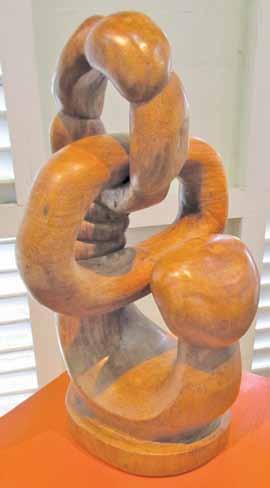
two decades after the first Guyanese art exhibition in 1929 during the colonial period. Moore, unlike many other artists, carved his niche from the onset, producing a body of work unmatched in the sculptural arena of Guyana. While infused with spiritual motivation and self-realization of his African ancestral homeland - a place where he never set foot - his sculpture embodies Guyanese mythology, folklore and creole culture.
The grand exhibition in 1931, organized by Barbadian artist living in Guyana, Goldie White, nurtured an art group- the British Guiana Arts & Craft Society (BGACS). The group comprised of locals and foreigners and staged annual Christmas art exhibitions. The group eventually gave birth to the Guianese Art Group (GAG) in 1944. Philip Moore was among those exhibiting with the BGACS in the latter 1940s.
The acclaimed “Father of Guyanese Art”, E. R. Burrowes, also of Barbadian heritage, left the BGACS and formed the Working Peoples Art Class (WPAC) in 1948 which existed for almost two decades until 1961. It was the first group of its kind that was structured in a way geared towards an art education process. During this time, the group members excelled, earning scholarships to Europe. It was this group that decided the future of Art in Guyana. While they were all painters, a few attempted sculpture, including E.R. Burrowes. Burrowes’ alabaster miniature sculpture “Pomona”, in the National Collection, is truly a treasure. Burrowes, after returning from his European scholarships pursuing studies in art, had developed his sculptural techniques to an extent that allowed him to execute large work such as the monument to the labour leader Hubert Nathaniel Critchlow, executed in 1964.
Two notable members from the WPAC, who earned scholarships, are Stanley Greaves and Denis Williams. Greaves, who majored in sculpture, on his return, pursued painting relentlessly to such a degree of unimaginable distinction that his sculpture almost became dormant. “Standing Figure”, also part of the National Collection, exemplifies the excellence which typifies both his sculptural and painterly work. Williams, who studied painting, later went on to broaden his area of studies when he pioneered the fields of archeology and anthropology in Guyana. Williams, however, continued the trend of art groupings when he founded the E.R. Burrowes School of Art in 1975, which still functions as a formal institution responsible for the output of outstanding sculptors.
The self-taught sculptor Campton Paris, like Philip Moore, also enjoyed participating in the exhibitions of the BGACS during the 1940s. His sculptures, in the National collection, exemplified by his relief series of Caribbean writers, tell clearly of the interest in representational imagery which prevailed during his time especially among painters. Abstract art was not an option for him.
Parris gave way to Gary Thomas, who won numerous national awards including the first prize for sculpture in the recent Guyana Visual Arts Competition (2012). Self- taught under the guidance of Denis Williams, Thomas came onto the scene during the exciting period that began at the end of the 1960’s and saw Guyana becoming a republic and the birth of the Caribbean Festival of Arts (Carifesta) in 1972. Using the human form as the basis for distortion and variation combined with the technique of ‘holing’ and a smooth finish, Thomas was able to create dynamic compositions and movement in wood. Many of his titles, such as “Retrogression”, were never extraordinary or superficial but rather simple reflections from his secular life.
Among those influenced by Thomas is the remarkable Sealey family - father, four brothers, one sister and a brother-in-law of the third son Andrea Sealey. The largest known artist/sculpting family in Guyana, they are all completely selfexcept for the sister who to formal training at the School Sealey's fortunate state, pa tronage by the late President Desmond Hoyte, sees his piece “Untitled” (Figures in Motion) becom ing a part of the National Collection.
Omowale Lumumba, a master of design in the neo-primitive style, worked alongside Gary Thomas. These artists seemed interested not in the perfect form but in the perfect distortion which penetrates through mere outward appearance to the essence. Simplification, narration, schematization and condensation are characteristics of their style and are frequently seen in the works of artists such as Ernest Van Dyke, Andrea Sealey and John Clowes, who came under their direct influence. Denis Williams re ferred to these sculptors as the “country boys” and dubbed them the “Village Movement”. Today, their style and technique echo in the work of art ists like Ras lah and Marvin Phillips, who help to keep the movement alive on the Main Street avenue in Georgetown.
Winston Strick, artist of
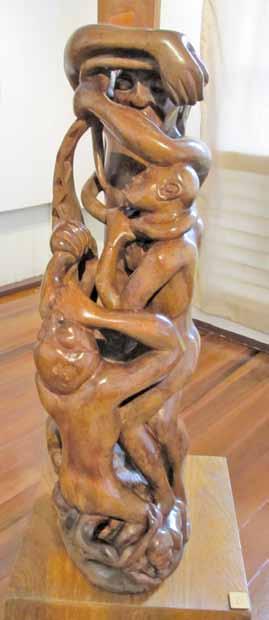
the era of Gary Thomas and Omawale Lumumba, studied Architectural Drafting and Fine Arts in the U.S. He worked in a style that stressed a kind of illusionism rather than mass. His subjects range from simple dignified genre and figure studies to landscapes, all with an emphasis on abstraction. One revelation is his assemblage “Woman”, a result of his constant striv
“Pregnant Woman” in the National Collection is comparable to his later achievements in bronze, returned from scholarship in Cuba after studying bronze casting. He has since received commissions for public monuments in bronze - all cast within these shores.
Winslow Craig is an incredibly gifted sculptor whose major task “Discovery”, for his graduation from Burrowes School of Art, is an impeccable achievement boasting the formalities of European classical art. This trait has remained a hallmark of his work although he has moved on to create astonishing pieces in other materials including metal. At Burrowes School of Art, Craig had come under the tutelage of Cuban-born Josefa Tamayo, who has lived most of her life in Guyana tutoring in sculpture. Tamayo has added a more eclectic flavour to Guyanese sculpture, reflecting the Guyanese landscape and also her more European heritage. Her “The Vendor of Animals” shows her ability to remain consistent and true to form.
The sculpture of Desmond Ali took form from his solid belief that art can be in the forefront of a freedom struggle, and from his contact with pre-Columbian art and artefacts. Having travelled most of South America on foot, Ali came back revitalized and revolutionized his concept of content and form. His sculpture took on the appearance of high relief of rigid geometrical form and shape, which he defines as “flat in the round” as exemplified by his “Patria Libre O Morir” (“Free Homeland or Death”). His involvement and observation of the political scene of the latter part of the 1970s greatly inspired the content of his work.
The mid 1980s saw the surfacing of an indigenous sculpture pushing to claim prominence among an already vibrant sculptural environment. The Lokono sculptor Oswald Hussein, who benefitted from acquaintance with the Burrowes School of Art, came from a rich cultural background of the indigenous peoples who, while they engaged in basket, canoe and pot making, were never seen as sculptors. Winning the sculpture prize in the National Visual Arts Competition with “Wassasekere” in 1989 and later in 1993 with “Wegelly”, Hussein became the model for a rich vein of indigenous sculptors such as Lynus Clenkian, Roaland Taylor, Foster Simon and Valentine Stoll, all with a desire to rekindle their cultural heritage, who dominated the art scene during the 1990s with their sculpture. Although it was the repatriation of Denis Williams’ painting “Human World” by public-spirited citizens in the 1950s that started the National Collection over half a century ago, the success story of sculpture in the National Collection can be equally matched to that of painting. This contribution has too often been overlooked and unrecognized, but sculptors, from Guyana's beginning, have made a profound contribution to the country’s art history. An endless regret is that many works have left these shores, vanished, or lack documentation - this exhibition, although the largest of its type held thus far, is hardly complete. However, it includes a number of important works that have not, until now, been seen by a large public.
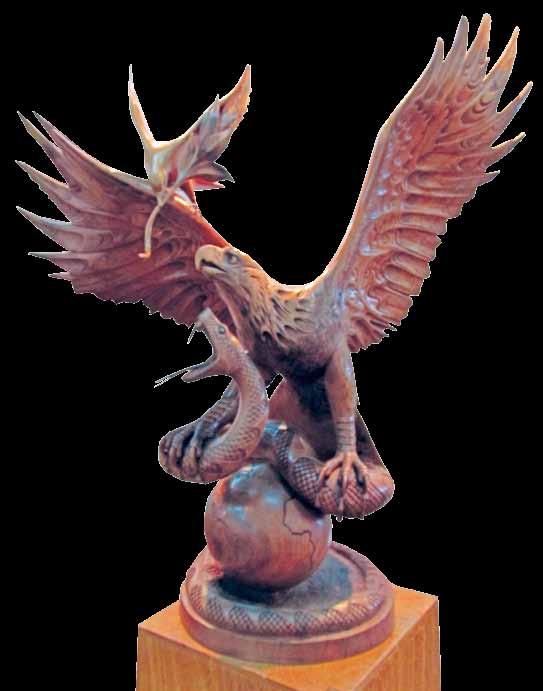
Predominated by self-taught sculptors who have developed entirely within these shores and pursued a discipline with absolute faith and sincerity, the journey of sculpture in Guyana and the National Collection has only just begun.
In celebration of the 44th anniversary of Guyana being a Republic, an exhibition, showcasing sculptures from the National Collection housed at Castellani House on Vlissengen Road, was recently opened. The exhibition will continue until March 29. Admission is free. Gallery hours are 10 a.m. to 5 p.m. Monday to Friday and 2 to 6 p.m. on Saturday; the gallery is closed Sundays and holidays. (Text by Curator Ohene Koama)
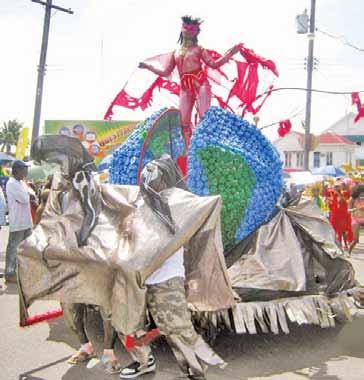
Mashramani was first celebrated in Linden in commemoration of Guyana’s republican status on February 23, 1970.
Shortened to “Mash”, the celebration was the brainchild of the Junior Chamber of Greater Mackenzie which was already celebrating Guyana’s independence with a carnival-like atmosphere since independence
year 1966 in Linden. It proved so successful that by 1972 it was decided to declare the event a national one so that the following year it was held for the first time and annually ever since, in the capital city Georgetown under the auspices of the government, though there are events held in Berbice and Linden. A time of revelry and dressing up in costumes
that have gotten more and more creative over the years, the origin of the word Mashramani has been a source of some dispute that has in the past led to various efforts to clarify the term.
According to some, the word Mashramani was borrowed from the Arawak word to describe their celebratory period of feasting and dancing after a successful preparation and planting season; meaning, “celebration after hard work”, though other coinages include “celebration of a work well done”, “a venture”, or “cooperative effort”, and “a celebration after a harvest”.
However, it has since been said that the word is not directly an Arawak Amerindian word but sounds similar to a word the tribe uses to describe a festival such as one when the village gets together to celebrate a young couple’s approaching marriage. The term Mashramani was officially chosen in 1972 to symbolise the celebrations of the new republic’s birth.
Since its inception, Mashramani has expanded to include various categories of competition such as


Children’s Mashramani Dramatic Poetry and Calypso competition; HIV/ Aids Song competition, Chutney competition, and an illuminated and decorated building contest, while retaining its colourful cos-
tume competitions, calypso, Soca and steel band rivalries.
Each year a theme is chosen from which costumes are derived. At the launch of Mash 2014, Minister of Culture, Youth and Sport, Dr. Frank Anthony noted that this year’s theme, “Cultural Folklore; Celebrating 44”, was chosen to encourage Guyanese, especially youths, to learn more about their cultural heritage.

The digits of the hand! (The order on the poem is pinkie, ring finger, middle finger, index or pointer finger, and thumb)
The pinkie hits the quotation mark key on the keyboard when typing, and people often raise their pinkie off the cup when drinking tea. The ring finger bears a wedding band when married. The middle finger is an obscene gesture when standing alone. You point with the index finger to make a selection, or use it to pull the trigger on a gun. The thumb can be used for thumb wrestling.




Ajourney along the Potaro River reveals scenic views of mountains, dense forest and stunning waterfalls.
A tributary of Essequibo River, the source of the Potaro is in the Mount Ayanganna area of the Pakaraima Mountains in the North Rupununi savannahs.
Majestic waterfalls are found on the Potaro River, most notable being Kaieteur and Tumatumari Falls. Below Kaieteur Falls are Amatuk and Waratuk Falls.
In the 1930s, the Denham Suspension Bridge, also known as the Garraway Stream Bridge, was constructed over the Potaro River in an area known as Garraway Stream. The bridge remains as a beautiful feature of the Potaro.
Located in forested terrain along the Potaro River, south of Kaieteur Falls, is Chenapau- a small Amerindian village.
Upriver from Kaieteur, the Potaro plateau stretches out to the distant escarpment of the Pakaraima Mountains.


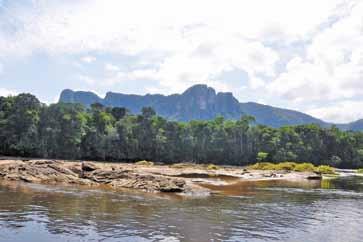

By Melvin Durai
Idon’t know about you, but when I post something on Facebook, I sometimes get only one or two ‘likes’ – and they’re usually from same people: my mom and my wife.
Okay, that’s not completely true. My wife likes me in real life, but doesn’t really ‘like’ me on Facebook. Or is it the other way around? I’m not sure. All I know is that I can’t always count on a ‘like’ from her.
As for my mom, she isn’t on Facebook a lot, and when she is, it’s usually to look at pictures that her friends have posted, and perhaps read a message from me: “Mom, I just posted something on my wall. Please ‘like’ it.”
She immediately responds: “I loved it!”
Me: “No, Mom, I don’t want you to love it. I want you to ‘like’ it.”
Mom: “What is wrong with the world today that people don’t want love, only like?”
It’s certainly a different world than the world she grew up in. There was no Facebook and Twitter in those days, of course. There was no way to count how many people liked you – and if you happened to have a lot of followers, you put ‘Guru’ or ‘Swami’ in front of your name.
Nowadays, if you want to be ‘somebody’ on the Internet, you’d better have thousands of ‘likes’ and even more followers. And if you’re a real celebrity – or want to look like one – you’d better have a million followers or more.
So what should you do if you don’t have enough ‘likes’ or followers? Should
you badger your mom and wife to keep retweeting your tweets? No, not if you have a few bucks to spare and don’t mind having lots of friends and followers in Bangladesh.
As the Associated Press reported recently, Dhaka, the capital of Bangladesh, is an “international hub of click farms.” A click farm is a place where people are employed to do nothing but click. Using numerous accounts and network servers, they will ‘like’ you, follow you, friend you. Their job is to make companies and in-
lowers?”
“For only $10, we can give you 1,000 Twitter followers. And for $1,000, we can make you a celebrity.”
“Just $1,000 to be a celebrity? Wow, I love it. Wait till I tell my wife that she doesn’t have to follow me anymore! What about Facebook friends?”
“For $100, we can give you 1,000 friends. That’s only 10 cents per friend.”

These are actual excuse notes from parents excusing their children from missing school (includes original spelling)
Dear School: Please ekscuse John being absent on Jan. 28, 29, 30, 31, 32, and also 33.
Please excuse Roland from P.E. for a few days. Yesterday he fell out of a tree and misplaced his hip.
Please excuse Jennifer for missing school yesterday. We forgot to get the Sunday paper off the porch, and when we found it Monday, we thought it was Sunday.

dividuals look popular. And it doesn’t cost that much, as I found out when I made a call to Dhaka.
“ClicksRus. May I help you?”
“Yes, can you tell me what services you provide?”
“All services. You want followers? We can follow you. You want ‘likes’? We can ‘like’ you. You want YouTube views? We can view you. We are a one-stop Internet popularity company.”
“How much are your ‘likes’ going for?”
“Five hundred ‘likes’ for $1. All fully guaranteed. Money back if you don’t like our ‘likes.’”
“What about Twitter fol-
“Holy Kaká, I love Dhaka! Not since my college days have I had friends so cheap. Please tell me more. What will these friends be like?”
“We can supply any kind of friend. White friend, black friend, brown friend. Straight friend, gay friend, bi-sexual friend.”
“I don’t care about the colour of my friends or their sexual orientation. I just want them to ‘like’ everything I post. Can you do that?”
“Oh yes, we can do that. If you have enough money, we can make you the most popular person on Facebook.”
“Even more popular than Justin Bieber? He has more than 60 million ‘likes,’ you know.”
“Of course, I know. We ‘like’ him a lot in Dhaka.”
Carlos was absent yesterday because he was playing football. He was hurt in the growing part.
My feet
A three-year old put his shoes on by himself. His mother noticed the left was on the right foot. She said, "Son, your shoes are on the wrong feet."
He looked up at her with a raised brow and said, "Don't kid me, Mom. I KNOW they're my feet."
Bible story
A father was reading Bible stories to his young son. He read, "The man named Lot was warned to take his wife and flee out of the city, but his wife looked back and was turned to salt."
His son asked, "What happened to the flea?"
The Hitchhiker
A woman is driving home in Northern Arizona when she comes upon a Navajo woman hitchhiking. Because the trip has been long and quiet, she stops the car and the Navajo woman climbs in.
During their small talk, the Navajo woman glances surreptitiously at a brown bag on the front seat between them.
"If you're wondering what's in the bag," offers the woman, "it's a bottle of wine. I got it for my husband."
The Navajo woman is silent for a while, nods several times, and says, "Good trade!"
Army nurse training
During basic training for the Army Nurse Corps, we were required to spend one week in the field roughing it. It rained the entire week.
We arose daily in our swampy tent, took a cold-water beauty bath from our helmets, donned our pistol belts and ponchos, and trudged through the mud to set up field hospitals. Obviously, our personal appearance frequently left much to be desired.
The final blow to our feminine pride occurred while we waited in the mess line in the mud and rain. A young private came by with a camera and asked to take our picture. "It will prove to my girlfriend," he said, "that she has NO reason to be jealous!"
Anaesthesia
An oral surgeon was scheduled to extract four wisdom teeth from Jim, a high-school football player who had opted to be sedated for the procedure.
As the intravenous anaesthesia was being administered, the doctor asked Jim how he was feeling.
"Man," he replied, struggling to keep his eyes open, "I feel like I'm in English class."
Lost and found
A guy walks up to a beautiful woman in a shopping mall.
"Excuse me," he says "But my wife and I got separated some where and I can't find her. Could you please help me?"
"What do you need me to do?" asks the woman.
"Just stand here and talk to me" the man replies.
"How's that going to help?" she asks.
"No idea really...but every time I talk to a beautiful woman like yourself, my wife ap pears out of nowhere!"
Executions
A priest, a lawyer and an engineer are about to be guillotined.
The priest puts his head on the block, they pull the rope and nothing happens -- he declares that he's been saved by divine intervention-- so he's let go.
The lawyer is put on the block, and again the rope doesn't release the blade, he claims he can't be executed twice for the same crime and he is set free too.
They grab the engineer and shove his head into the guillotine, he looks up at the release mechanism and says, "Wait a minute, I see your problem..."