



The Golden Om
Dharmic Youth Organisation aims to make a difference in society while serving as a voice for every youth, regardless of their religious affiliation. The organisation seeks to inspire youths to live a positive lifestyle and rise above the ills of society.
In an interview with Guyana Times Sunday Magazine, the group’s president Pandit Deodat Persaud said the first attempt to form the Golden Om Dharmic was made on Sept 19, 2004. The group was then called the Golden Om Dharmic Youth Group, founded by Pandit Chandradat Persaud who executed a number of community related projects and ventures.
Persaud pointed out that the group’s acronym “GOD” was specially selected for inspirational purposes for the youths. Its prime focus was to promote Hinduism and youth participation.
Then on April 28, 2007, after a seminar was held at the Vocational Educational and Dharmic Academy (VEDA) with Dr Vindhya Persaud of the Guyana Hindu Dharmic Sabha and members of the Dharmic Naujawaan, the organisation underwent a dramatic change. It became the youth arm of the East Berbice Praant Guyana Hindu Dharmic Sabha and renamed the Golden Om Dharmic Youth Organisation.
Additionally, the motto was changed from “Truth will always triumph” to “Unity is Strength”. The scope of the organisation, said Persaud, was also broadened, and focused on HIV/ AIDS, drugs abuse and

other social issues.
To date, the organisation has recorded tremendous achievements, and facilitated a number of programmes.
The 23 members ensure that the group’s activities are properly coordinated to achieve the goals of helping to empower youths and society in general. These activities include hosting the annual VEDA Youth Camp and the annual Father’s Day treat at Dharm Shala; publishing its official magazine, Golden Expressions; winning in the large catego-
ry in the 2012 Deepavali motorcade; actively participating in blood donation drives; holding seminars on timely social issues such as drugs, alcohol abuse and domestic violence and hosting drama clubs, just to name a few.
Persaud noted that the Reliance VEDA Centre, founded by Pandit Chandradat Persaud in 2000, has served the community well. He said that it has always lent support to other organisations’ programmes, meetings and other activities. The VEDA serves as a venue where a number of shows and fundraisers are hosted. Most of the activities of the Golden Om Dharmic Youth Organisation are held in the building.

Golden Om Dharmic office; indoor games room, classrooms for dancing, instrument, yoga, singing and cooking classes; counselling room; library; kitchen; computer and document centre; vegetarian café; sargam shop; and washroom facilities. The lower flat (phase 2) will be transformed into a modern cultural centre.
This year the centre’s ‘Hindu Youth Week’ activities include the annual VEDA camp from July 29 to August 2 at the Reliance VEDA Centre. There will also be one-day camps at various mandirs in Canje from August 6 to 8. Additionally, there will be a food sale in New Amsterdam on August 10 and a youth talent mela on August 25. The Saraswatie Pooja for school children will take place on August 31 at the Reliance Settlement mandir.
“The public support is crucial as this project will transcend all boundaries

“Over the years, no major enhancement works have been done, and some deterioration has taken place. In addition, the Golden Om Dharmic will be extending its services, hence the need for modifications. The modification exercise will cost in the vicinity of GY$12 mil-
lion. This will be undoubtedly the largest community project undertaken by the organisation in terms of cost and scope of work. This project will be branded as the ‘Reliance VEDA Centre Resuscitation Project’, since many of the incoming activities depend on the complete resuscitation of the centre,” Persaud related.
He disclosed that the new building (phase 1) will see an upper flat being constructed to facilitate the
and will be beneficial to all youths. A number of fundraisers have been planned. We want to create a social space for youths in a positive environment. This, we hope, will ensure that they become and continue to be morally correct,” he declared.
For more information on this organisation call 3272212, 327-7967, 326-0178, 326-0976 or email goldenondharmic@yahoo.com
Not knowing where your child is can be one of the hardest things parents will face. Life becomes an inconsolable existence that never ends until the parents can hold that child in their arms again. This is the feeling of a family currently devastated by such loss.
Shireen Edun and her husband Sultan, visibly distressed, shared their anguish with Guyana Times Sunday Magazine about their son Imran Mohamed who has disappeared and cannot yet be found, more than a year later.
Imran, Shireen began, left for school on June 5, 2012. He left at noon because he was writing his examinations; he was 17 years old at that time. As time passed, Shireen became anxious as her son did not return home. Her husband, Sultan, was also worried and went to the school. There they found out that Imran had not shown up at school, and this was not the first time.
“Normally I would drop him to school and pick him up back. But due to the time he had to go to school because of his tests, I couldn’t take him so he had to take the bus. When we see time pass for him to come home we got worried. When I went to the school they told me that Imran never showed up and that it wasn’t the first time this happened. Apparently, when I used to drop him he went somewhere else. We searched all over: by relatives, places he would usually go, the seawall, the hospitals, and decided to report him missing to the police. But we never find him back,” Sultan stated sadly.
Shireen noted that Imran never gave any indication he was unhappy. She stated he was a typical boy who watched cartoons and played with his friends. Shireen added that he even said he would never leave her.
“We are still searching for him. We even sent out flyers to interior locations. When he first went missing we put it on the TV and in the papers. I felt so hurt and helpless when my son went missing, but I had to keep going because I had a family to take care of. But it was very difficult. Imran and his siblings, his four sisters and one brother, lived very loving. I don’t know if he leave us or he was taken away. We never get no call or hear somebody say they see him. I don’t like to talk about it because I cry,” a tearful Shireen disclosed.
Sultan believes Imran was “lured into the interior to work” and that he is so “confined” that he cannot call home. He added that a friend, who works in the interior, told him that there were a lot of young boys working in those locations. Sultan believes that there might be a possibility that Imran was taken up there.
Imran’s sister Sultana, 14, said that he was a “good and willing” brother. She never noticed he was unhappy because he was always jovial.
“What I could remember is that one afternoon he came home from school with his shirt mashed and I asked him what happened. He told me he took it off to do physical education at school and when he put it on back it was mashed. When I looked into his bag I saw he had clothes in it, but never questioned him or think something like this would happen,” Sultana recalled.
Friends of Imran also recall that he was very friendly and helpful, but would sometimes leave school to go play at a “game shop” – something that some other students usually did as well.
Sultan maintained that Guyana needs organisations to help with missing children. He stated that here are such entities abroad that also offer hope and counselling for parents.
Both Shireen and Sultan are still hopeful that Imran is alive and one day would return home.
“We’re always praying and never giving up. We’re thinking positive that he will come back home. Some have said to me that one day he’s going to come back in a big van with


children and his wife. I really want him to know I miss and love him and that everybody home misses him too and we’re waiting for him to return. We’ll work out everything together as a family and all we want is for him to come back home,” Shireen said, sobbing.
Hoping he is healthy and happy where he is, Sultan also beseeched Imran to call home just to say he is alive and well.
“Wherever he is, we want to know that he is happy. We want to hear from him because we are all very hurt that he hasn’t returned. I want to tell him to come back home or at least call. We’re here to welcome him and he should not be afraid to return home,” Sultan implored.
Encouraging other mothers of missing children, Shireen pointed out that prayer, being positive and having faith are important to cope with such loss. She and her husband are thankful





The Guyana Foundation believes people have the ability to improve themselves
The Guyana Foundation was created by a group of highly committed men and women who see an urgent need to contribute meaningfully to the development of the people of this beautiful country.
The foundation’s work reaches across political and ethnic boundaries to bring relief wherever it is needed.
The Guyana Foundation, recently founded Jan 23, 2013, is a non-profit orga-
The foundation is driven by the conviction that great change can be made by people themselves if they are encouraged, supported and have their human dignity acknowledged and respected.
Its doors are open to individuals everywhere, groups, foundations, and international organizations that wish to assist in its endeavour to contribute to the achievement of an economically vibrant, socially
life.
She stated that facing an illness that makes one face their mortality, changes a lot in life. Being in that scary place, Supriya revealed, made her think about what she always wanted to do. That was when she thought about her beloved homeland, Guyana. She wanted to make a difference here.
Supriya met with some of her colleagues, now the foundation’s trustees, who enthusiastically jumped on-

nization, free from partisan political allegiance, whose membership is open to people everywhere who share the view that in an increasingly interdependent world we have the opportunity and the duty to reach across physical geographic boundaries to bring relief wherever it is needed.
just, peaceful multicultural Guyana.
Speaking with Guyana Times Sunday Magazine, founder Supriya SinghBodden disclosed that in 2011 she was diagnosed with breast cancer, and after undergoing surgery and several months of chemo therapy, she thought deeply about
board to start an NGO, and the Guyana Foundation was born.
“We immediately started fundraising events. What we have found is that globally there are families, trust funds, individuals, companies, who have chunk of money put aside for charitable purposes. I was able to


connect with such ones because of the work I do outside of Guyana. The very first donation I was able to get was a US$10,000 which we funnelled immediately into the village of Santa Rosa to develop their community,” she recalled.
In Santa Rosa, the money donated went to developing its water and sanitation systems, building the secondary school student dormitory and library, and funding its medical emergency unit.
In Region One, a commercial oven was donated to the Silver Queen Women’s Group, which has now doubled their production. Also, Breezy Point in Buxton benefited from a donation of light kits; there are 49 homes in that community with no readily accessible water and no lights. Additionally, a 135ft bridge was constructed, and a successful negotiation with GWI to supply water to the community was also accomplished. This utility cost would be funded by the foundation.
In May, at Pigeon Island, on the East Coast of Demerara, a bridge was built, shoes were distributed, another GWI agreement was successful, a children’s party and an eye clinic were held, and eyeglasses were distributed.
The foundation seeks to work in phases as it travels countrywide to help needy communities. In phase one, projects such as the ‘Gift of Light’ would provide communities with mini solar light kits that will create the opportunity for increased productivity, learning and security in areas that are still without electricity or plagued by power outages.
In addition, phase one will promote youth development through training programs across Guyana to equip youths with skills that could provide supplemental income for themselves and their families as well as provide opportunities for their general advancement. The Women's Empowerment Program offers capacity building training courses to assist in the establish-
ment of viable cottage industries and programs across Guyana.
The Community Renewal project encourages communities to organize themselves into groups to manage common problems in their respective neighbourhoods. Projects such as controlling litter and garbage disposal, providing clean drinking water for school children, improving sanitary facilities for school children, strengthening footbridges over canals, are all addressed in this aspect of phase one.
The Guyana Foundation also teaches communities the basic principles of money and project management. Donations are given directly to the community groups and monitored by the foundation’s headquarters in Georgetown. Regular site visits and reports are prepared on each project.
In phase two, there is the
of people around the country to set up teams to reach out to incapacitated elderly folks who live in their communities, to offer beauty services, reading and writing services and most of all companionship, hope and joy.
The foundation is currently planning to partner with medical professionals locally, regionally and internationally, to vigorously address mental health issues such as suicide, alcohol, drug abuse, depression and trauma counselling.
For local artists, the foundation is also currently meeting with overseas companies seeking to open an international market for crafts and arts.
“We want persons to see the work we’re doing and feel passionate about it and join us. We don’t want to go around selecting people; they must feel inspired

literacy program to improve literacy across the country by establishing reading rooms/libraries. Stationery supplies and computers are donated for the entire community.
The elderly have so much to offer to enrich the lives of all. Their oral testimony of experiences they lived through is invaluable in shaping the minds of modern Guyanese. The foundation believes that they must be nurtured and supported in every way possible. Some targets are to improve the facilities in elderly homes, to train groups
to join us in our work we’re doing. We want people who have humanity at heart to come on board,” encouraged Supriya.
The foundation’s mission is to release the power of people globally to assist Guyanese to transform their communities, bring fulfilment and wellbeing to their families, enabling them to build relations of trust and friendship among themselves irrespective of race and beliefs.
For more information on this vibrant organization, visit the Guyana Foundation on Facebook.
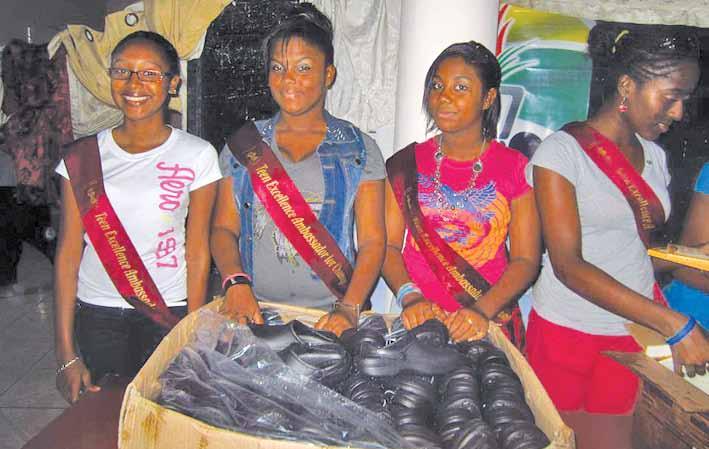
Miss Guyana Teen Excellence Pageant is a pageant with a difference. Its aim is to help young girls to be well-rounded individuals, empowering them to be society’s leaders.
In an interview with Guyana Times Sunday Magazine, Mia RitchieComacho, its founder and president, stated that the pageant is a learning tool for teenagers. It provides guidance in skills of societal importance such as hygiene, speech, communication for trade and industry, job skills, building a resume, preparing for interviews, and dress-for-success sessions.
Ritchie-Comacho, head of Prestige Business Consultant, added that the inaugural Miss Guyana Teen Excellence Pageant would be held under the title, “Ladies of Excellence”, at the National Cultural Centre, Aug 4, 2013.
“The reason for this pageant is to create awareness with our youths, specifically, tourism, cultural diversity, and agriculture [awareness] within our society. Prestige Business Consultant works collaboratively with the Ministry of Culture, Youth and Sports, and is passionate about helping youths via this pageant. Miss Guyana Teen Excellence Pageant provides a platform to elevate their standards and values in an effort to prepare them to be goodwill ambassadors for our future generation,” Ritchie-Comacho outlined.
She stated that the Miss Guyana Teen Excellence Pageant is “not just a pageant, it is a life-skills programme”, and explained that the young ladies have the option of competing in the pageant, but those who decide not to would still go through the training process.
This training programme was put together by Ritchie-
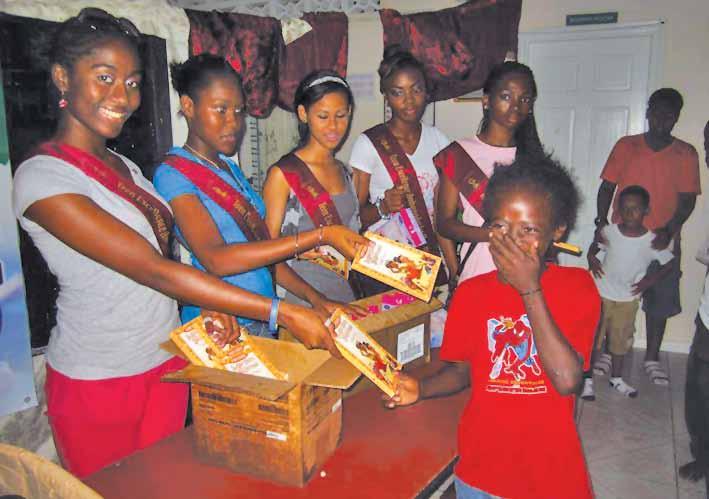
Comacho for enhancing and empowering the youths of the group. She said her focus is to “refine” them to be better individuals in society and role models to others.
“I noticed a significant lack of etiquette, communication skills and mannerisms – not only with our teenagers but with adults and young children. I’m a remigrant from the U.S. and there is a vast difference in mannerisms there and here. Even when I was growing up back in my days, there was a higher level of good mannerism. I came to realise that the children are not deliberately doing this, and that is why I decided that it was time for a programme like this one,” she disclosed.
The programme started three months ago, and facilitates girls from ages 13 to 18. There are currently 15 young ladies, with 9 of them competing in the pageant, in the programme. Ritchie-Comacho pointed out that some of them have graduated from school, some are presently in school, and some have recently wrote their CSEC examinations and are awaiting results. Of
note, the classes are all free. Ritchie-Comacho revealed that she herself was part of the pageantry in the ‘80s in Guyana. The training and experience she garnered she now shares with the girls in her group.
The programme, she noted, has been transforming. Initially, she disclosed, it was a challenge because of the teenagers’ “combative attitude”. However, recently she has seen much progress in this area.
“I helped them realise that they are part of an entity, and even when they move on to work with other entities, they have to obey the rules. Our focus is to revamp pageantry in Guyana. What I’ve noticed is that it lacks proper substance as it used to be years ago. We want to get back to the pageantry days of Shakira Baksh, where our girls had a chance to make it to the top delegates in the international pageants. That is why the girls are taught the importance of being actively involved in humanitarian work. They are taught that this should not be a façade for pageantry but they must
be passionate about helping others. So far I have seen how happy they are when doing charitable work and I’m overjoyed that our programme is effective,” she declared.
Ritchie-Comacho’s plans to expand the programme to include young men; she would like to also incorporate counselling on abuse, something she views as a global epidemic, and hopes to see a drastic change in mannerism in Guyana and overall positive behaviour in society.
“We’re right now looking for sponsors because we need funding to continue
our work because the programme is free. I’m determined to continue this programme because it is vital for our youths. I welcome volunteers to contribute their time in coaching these ones. We’re also aiming to form a sorority where the girls become a part of a permanent group, supporting and empowering each other. We urge the community to join us in our efforts to empower the youths of this country,” she enthused.
For more information on this programme call 6396247 or visit Miss Guyana Teen Excellence Pageant on Facebook.

By PetamBer Persaud
As I continue to explore the future of children’s literature in Guyana, the thought struck me that there is so much we could learn from our literary ancestors, especially those who are still with us (we could also learn from those who have passed mainly by studying their work).
So, for a fleeting moment, let’s concentrate on those that are still with us, mainly because we may be able to “touch base” with them personally and gain further insight into the specialised art of writing for children.
Of the 11 writers who were included in ‘The Lure of the Mermaid and other Children’s Stories” edited by Janet Jagan (Dido Press UK, 2002) and now reprinted by The Caribbean Press (2013) only five are still with us: Odeen Ishmael, Doris Harper-Wills, Krishna Nand Prasad, Cecile Nobrega and Sheila King.
In previous articles, I have paid tribute to those who have passed. Breaking from that tradition, let me now pay tribute to those still with us (first, the three ladies in the 80-plus/90-plus club).
Cecile Nobrega
Cecile Nobrega was born in 1919 in Georgetown, British Guiana to Imelda and Canon W. G. Burgan. Her father was a writer and her mother a singer. Nobrega went on to write and compose songs, winning a few awards along the way. Her most popular song is “Twilight” that opens: “I dance upon the brink of day/And try to keep the night away”.
Nobrega has covered much ground leading to her twilight years, making a name for herself as a poet, playwright, compos-
er, potter, social worker, textbook writer and educator.
As a writer, Cecile Nobrega falls within that first wave of Guyanese women writers that included Sheila King, Syble Douglas, Rajkumari Singh, Celeste Dolphin, B. Zorina Ishmael, Jacqueline DeWeever, Joy Allsopp, Margaret E. Bayley, Edwina Melville, Evadne D’Oliveria and Doris Harper-Wills.
As an educator, she was president of the kindergarten section of the Guyana Teachers’ Union and editor of YOU magazine for the Parish of St. Sidwell’s in Lodge. In 1964, she represented the country at the International Children’s Theatre Conference held in London.
In 1968, while in Guyana, she wrote the poem “Bronze Women” which has recently become a physical manifestation mounted in London. The Bronze Woman Monument is a seven-foot statue of a woman holding a young child aloft.
Doris Harper-Wills
I met Doris Harper-Wills for the first time during the Aug 2008 Carifesta X in Guyana. She was engaging and assertive. It was a very informative meeting where she released snatches of her role in preparing dancers for the first Carifesta held in Guyana in 1972.
Performance poet, writer, dancer and dramatic choreographer, Doris Harper was born in 1931 in Agricola, British Guiana. She was educated at Agricola Methodist School, Trinity Methodist School and Bishops’ High School. In England, she attended Rose Bruford School of Speech and Drama (Sidcup, Kent) Avery Hill College of Education (Bexley) and Laban Art of Movement Studios
where she studied English, Drama and Educational Dance.
Of course, her life’s work started in Guyana where when employed as a language teacher; she introduced her innovative teaching strategies – dramatising French and English in schools in the country.
Her innovative teaching skills found favour with the students at the University of Zambia. In New York, her contribution culminated in International Women’s Year Award. Back in London, the Education Centre of the Commonwealth Institute “snapped her up” as resident teacher, giving her responsibility for Caribbean and Commonwealth programmes.
In 2005, Doris Harper-Wills was honoured with the Wordsworth McAndrew Lifetime Achievement Award by the Guyana Cultural Association, recognising her pioneering role in interpretive dance in Guyana; she received this award from the granddaddy of Guyanese folklore, Wordsworth McAndrew.
Both were born in Guyana back in the days of storytelling around a sooty kerosene flambeau, when moongazers stomped their authority on the land and jumbies came alive in the wink of an eye and when bacoos were destructively active.
Her other commendations include the Ambassador For Peace, London (2004); the Top Teller Prize awarded to her by the Yukon Arts Council (1997); the International Women’s Year Award for her contribution to civic life in New York (1974); the National History and Arts Council first prize for short story, Guyana, (1967); Commonwealth Bursary Award (1967); first prize at the Festival of Spoken English held at Avery Hill
College (1968) and the National History and Arts Council first prize for poetry, Guyana, (1963).
Wherever in the world she performed, her contributions were acknowledged in one way or another. Harper-Wills’ world stage included stops at venues like Trafalgar Square, Covent Garden, Lincoln Center, the Harlem Dance Theater, Billie Holiday Theater, New York Correctional Facility, Farnham Castle, Nottingham Museum and in places like New York, Canada, London, Zimbabwe.
To read Doris Harper-Wills’ short fiction, “Samaan”, is to have an interactive experience with Guyana’s more enduring folk characters. Feel the pepper burning Ole Higue skin, smell the smoke destroying Ole Samaan from tortuous toes to beautiful hair, see big, fat Fowl Mamma turn nimble-nimble chasing children who teased her, hear the bones cracking in Ole Man Papee humped back.
The language is effectively evoked with songs and chants to scare, to cure, to entertain; music setting the mood and tempo. The story line is engaging from sombre beginning to engrossing middle to the melancholy and instructive climax. “Samaan” is an exceptional piece of writing created by an exceptional artist.
Sheila King
Sheila King is distinguished in many areas. She bears the distinction of being instrumental in getting government to remove a ban on the employment of married women in the Public Service, which happened with the support of Eileen Cox and (CASWIG) the Council on the Affairs and Status of Women in Guyana.
In 1951, she was appointed the first female probation and welfare
officer. In 1965, she became the first female labour officer. In 1972, she was made the first organising secretary of CASWIG. In 1975, she was appointed first female assistant chief labour officer.
Sheila King is distinguished in many areas, but she takes great delight in writing for children. King has approached her writing with such fervour that she won the newly established Henry Josiah Writing Short Story for Children on numerous occasions, offering stiff competition to all and sundry – young and old. The Henry Josiah Writing Short Story for Children is one of many competitions offered by The Guyana Annual magazine (formerly the Chronicle Christmas Annual) to encourage writing appropriate literature for children, including the Rajkumari Singh Writing Poetry for Children – just to name one other such competition offered by the magazine.
She is a font of knowledge especially of literary and cultural occasions of yesteryear. Her memory is awesome as she regurgitates events – dates, venues, attendances with pinpoint accuracy. Her biographies of persons of substance are peppered with spicy anecdotes. Her voice is strong, her delivery impeccable – tone, diction, pronunciation and enunciation. She does not mince words.
Now into her four-score-andten, Sheila King is the most senior Guyanese woman writer, born and bred in Guyana and still residing in the land of her birth.
Our literary ancestors are available to share their knowledge; sharing is in their blood, in their writing.
Responses to this author telephone (592) 226-0065 or email: oraltradition2002@yahoo.com


Born to Guyanese parents on the island of Jamaica, Faben Thornhill spent most of his life in Montego Bay.
After he left high school in 2005, Thornhill attended UWI to pursue his dreams of becoming a doctor. While studying to obtain a Science degree, in his second year Thornhill found all the studying to be tedious so he decided to discontinue his studies.
“After I got tired of studying and left UWI, my mother suggested and even encouraged me to try nursing, so I decided to try it, and at first I was a bit sceptical about it, but as I did it, began to love it.”
Thornhill explained that he decided to move to Guyana to pursue his nursing studies since Jamaica does not have practical courses. After arriving in Guyana in May 2007, he began attending the nursing school at the St. Joseph Mercy Hospital three months later. After the first six months of training, Thornhill began working in the wards.
In 2010, he became a qualified nurse in basic and advanced nursing, after which he went on to work at the private medical institution for a year before leaving. Thornhill said the one thing he enjoys most about being a nurse is the fact that he gets to work with children, and this, he said has motivated him to specialize in paediatrician nursing in the future.
But coming from an Island where music flourishes, Thornhill also began practicing as a deejay; this hobby has developed into a big part of his life. He currently has a “gig” every Friday night at the Upscale Restaurant in the heart of Georgetown where he plays to the enjoyment of a packed audience. He also does work alongside popular sound system, Stereosonic.
Multi-talented might be the word to describe Thornhill since, apart from being a nurse and a deejay, he also indulges in singing, dancing and drama.
Thornhill explained that while he enjoys his life at the moment, it was not always this easy- flowing. Growing up in Jamaica, while it was fun, it was a bit tough. But his parents ensured that he and his sister received everything they needed for a comfortable life.
“They were always supportive of me and my sister; even though they did not like the fact that I was a deejay, eventually they got over it because they realized it is a big part of my life.”
The 26-year-old confessed that he was quite a “troublemaker” during his teenage years, but has grown out of it with a lot of experience and wisdom. He noted that throughout his teenage years, he always knew what he wanted and that he would become someone.
Thornhill’s advice to youngsters is to stay focused on what they want to achieve and work towards it.
“You have to give it your all, and if things do not work out, don’t give up; take a break and then try again. I believe to achieve what you want you have to give your utmost best to it. Don’t aim low and expect to be high. You also have to keep the faith and believe in God, trust him and let him guide you to success, and never give up.”


Griffith
uyanese cricketer Trevon Griffith, on April 18, 1991, made his debut for the Guyana Under-19 team, participating in the 2008 regional Under-19 competition in Barbados. Two fifties indicated batting potential, which was further substantiated when he scored a century in the first match of the 2009 regional Under-19 competition in Jamaica. He finished his Under-19 career with a century and 5 fifties, which earned him a place in the West Indies Under-19 team. Representing the West Indies Under-19 team in the 2010 ICC Under-19 World Cup in New Zealand, he scored 84 in the first match, but did not fare well in the other 5 matches. He represented the senior Guyana team in List A matches in 2011 and first class matches in 2012. One of the highlights of his career was scoring a century against the Leeward Islands. Recently, the young cricketer has been inducted to play with the Guyana Amazon Warriors team in the Limacol Caribbean Premier League (CPL) T20 cricket tournaments scheduled to commence on July 30. CPL will provide the perfect platform for the pro cricketer to rekindle his form and etch his name among the cricketing greats.
The Satanic leaf-tailed gecko (Uroplatus phantasticus) is a species of gecko indigenous only to the north and central tropical forests of Madagascar.
Satanic leaf geckos got their name because they look like they have horns, and some specimens have red eyes. The generic name, Uroplatus, is Latin from the two Greek words "ourá" (tail) and "platys” (flat).phantasticus is the Latin word for "imaginary".
It is a tree-dwelling species that is a master of disguise, with its body that superbly mimics a dead leaf. Its twisted body, veined skin, and tail looks like it has been nibbled at by insects or rotted by decay.
Satanic leaf geckos have large eyes that are adapted for its nocturnal lifestyle as the satanic leaf-tailed gecko moves about its rainforest habitat at night feeding on insects, including crickets and moths.

Using the letters in the word below, can you make at least 10 new words? You may only use a letter as many times as it is shown in the key word. Each word must be at least 4 letters long.

The objective of the game is to fill all the blank squares in a game with the correct numbers. Every row of 9 numbers must include all digits 1 through 9 in any order. Every column of 9 numbers must include all digits 1 through 9 in any order. Every 3 by 3 subsection of the 9 by 9 square must include all digits 1 through 9.
Geckos possess no eyelids, just a transparent covering over their eyes, so they use their long, mobile tongues to wipe away any dust or debris that gets into the eye.
Adhesive scales under their fingers and toes, and strong curved claws enable them to easily move through the trees.




At the beginning of the 20th century, rapid change in the traditional relationships be tween nature and art took place. Artists began to challenge the properties of color, space and form and expressed them according to personal ideas, fantasies or emotions.
An innovative group of French artists at the turn of the century, nicknamed the Fauves (“wild beasts”), began to experiment with bold color, using simplified form and scale. Another avantgarde (based on experimental concepts) movement from this period was Expressionism, which used color, movement and distortion to create an emotional response.
in
Cubism and Abstract art emphasized emotion and sought to explore form. Dada was born during World War I in a period of frustration with the conventions of society. It attacked every culturalstandard and formof artistic activity.
During the 1960s and into the 1970s, the use of photography, film and video became popular. Artists continued to push the limits of convention. Pop Art, Op Art and Constructivism were movements of the time.
In the 21st century, artists are moving self-expression and the artistic process into new areas. They are engaging the world using new methods and working with a variety of materials. Today’s artists draw upon sources ranging from politics, pop culture, ethnic heritage, classical models and personal experience.
NOTE: This project requires scissors, so please get an adult to assist you.
Materials needed:
• Cardboard poster sheet
• Pencil
• Various printed and solid-color papers
• Scissors or craft knife
• Glue, paper cup and an old paintbrush
• Old magazines, fabric scraps and trim
• Heavy books
• Waxed paper
1. Plan out your picture. Lightly sketch the outlines on the poster sheet.
2. Using the paper, magazines and fabric scraps, cut out appropriate areas to fill the outlines you sketched on the poster board.
Do not glue yet! Just lay out the design until you are satisfied with your collage.
3. Pour some glue into the paper cup. Using the paintbrush, thinly coat the backside of the cut paper areas with glue. Be sure to glue the larger bottom pieces first, then layer smaller ones on top.
4. Glue pieces into position, smoothing out any air bubbles. Allow glue to dry.
If the poster curls, cover your collage with waxed paper and place the heavy books on it for a few days to flatten it.
NOTE: This project uses sharp tools, so please get an adult to assist you.
Materials needed:
• Thick wire or old wire coat hangers
• Wirecutters and pliers
• Various small, flat objects like keys, beads, feathers, tiny toys, bottlecaps, shells, etc.
• String, ribbon or fishing line
1. Tie the string to the center of the first piece of wire. Hang this from overhead to make balancing your objects easier.
2. Gradually add suspended objects to the mobile, working downward from the top.

the
where a
will make it move.

GFW in 2013 would again present a forum for many young designers, locally and regionally, to advertise their creativity on Guyana’s most anticipated catwalk show.
One such designer is Tyrone Nelson. Nelson, a business management graduate from UWI, Cave Hill Barbados, is the CEO and fashion designer of English Duck International Designs (EDID), which he estab-
lished and created in Oct. 2006.
Nelson has modelled in numerous shows Barbados, including Barbados Fashion Week. He copped two titles after competing in two male pageants: Mr Ebony 2006 Barbados and Face of Shabeau 2007.
The designer has a diploma in fashion from the Barbados Community College, and rocketed into the fashion world representing EDID at shows like Caribbean Fashion Week, Barbados Fashion Week, Style Week Jamaica, Red Run Way Fashion show in Trinidad & Tobago, Ester Barnes Fashion Show in Toronto Canada and others, and is presently turn-


ing heads on the fashion arena in the island of Bahamas where he currently resides.
EDID has been moulded into one of the most futuristic and talked about designing houses around Guyana and the Caribbean. It has taken the opportunity to expand its services and expertise by becoming involved in coordinating and constructing wardrobe and pageants such as the Miss Guyana Talented Teen, Miss Freeport in Bahamas and Pointe-à-Pierre in Trinidad, among numerous others. He has also judged, trained and produced models for many pageants around the Caribbean.
In 2011, Nelson launched his all-male clothing line
‘Venom’. Seeing the response he received from fans motivated Nelson to challenge his creative ability to design and produce section and individual costumes for both children and adults for the Trinidad and Tobago carnival 2012. Many of these have won prices and have been featured in other carnivals and fashion platforms in Miami, Barbados, Grenada, Antigua, just to name a few.
Nelson aims to bring the future fashion world into today’s reality with his unique and creative ideas.
The designer would showcase his exclusive collections at the Aug. 4 GFW launch, and at the GFW 2013 fashion extravaganza scheduled for Oct. 22 –27.






Deborah Nowalski Kader, better known by her stage name Debi Nova, is a Costa Rican singersongwriter and dancer from Escazú, Costa Rica who resides in Los Angeles, California. Nova has sung on various projects from jazz artist Boney James to rapper Q-Tip to Sérgio Mendes and will.i.am of the Black Eyed Peas. Her single CD, “One Rhythm”, has an English version, Spanish version and six mixes. In 2004, she scored a #1 track on Billboard Hot Dance Music/Club Play chart with “One Rhythm”. A remix of the song was featured on the soundtrack for the EA Sports video game FIFA Football 2005. In 2010, she made her U.S. television debut on “Dancing with the Stars”. She later released her first studio album “Luna Nueva”, which featured her hot single “Drummer Boy”.
Kanye West's epic snatch and rant at the 2009 MTV Video Music awards has come back to haunt him. Gawker.com obtained an old conversation recorded after the infamously awkward moment when 'Ye interrupted Taylor Swift's acceptance speech for Best Female Video and announced that Beyoncé should have won the category.
Apparently, West had more to get off his chest once he made it to dinner later that night. For starters, he pointed out the bright side of the Swift debacle. "You know, it's like, I was happy to be in a situation where people couldn't say, oh, I was trying to promote my own song."
In less than two minutes the G.O.O.D. Music mastermind managed to further alienate himself from industry peers by throwing Pink (who had choice words for him after the Swift slight) in the fight.
According to Yeezy, Pink shouldn't have even been asked to perform on the awards show. Why? Because no one knows her. "It ain't no love. What the ---- was Pink performing? Don't nobody

know that song. Pink performed twice! Two songs? How the ---- Pink perform two songs and I didn't even get asked to perform 'Heartless.' 'Heartless' is the biggest song of the year! It had the most spins of the first quarter! I don't know that Pink song!"
Nobody knows who leaked the tape, but the timing is interesting since MTV recently announced nominees for the 2013 ceremony, and Swift grabbed
two nods. Ironically, the country star referenced West in a tweet yesterday (July 17) writing, "If you vote and get us one, I promise to keep a firmer grip on the mic this time."
Provided that she wins a Moonman, the 22-year-old may not have to worry about being interrupted because West hasn't confirmed that he'll be in attendance. (BET)

Mand Elizabeth &
James. Despite their financial and critical successes, however, one celebrity stylist has accused the 27-year-old twins of ripping off other designers. Speaking to Vogue Italia, Lysa Cooper -- who's worked with Rihanna and Elizabeth Hurley -- disses the popularity of celebrity fashion lines.
"The only one that's any good, and I hate to say it, are our girls, the twins. The Row. But the reason that works is because they hired designers. They 'yay' or 'nay' [the concepts]. And they are the best line at ripping off other lines that I've ever seen," she says of the former child actresses. "I mean, they've taken Rick Owens, Ann Demeulemeester. But it's good. You know, they're good at it. I don't buy it, but they're good at it."
Cooper says real fashion designers should "go to school" first. "If you go to school, then maybe you can talk some ---t."
The Olsen twins, who transitioned from Hollywood as students at New York University, are used to such criticisms. In a 2011 Newsweek cover story, Ashley opened up about the challenges they faced before launching The Row in 2007. "With the retailers, we dealt with some tough cookies," she admitted. "Their attitude was, 'Who do these girls think they are?'"
"It definitely took time to earn people's respect," added Mary-Kate.
According to Ashley, "We really want The Row to be an American luxury brand. We believe in not just American by representation but American by make." (omg)
Rae Dawn Chong costarred with Oprah Winfrey in "The Color Purple," and said the two were friends on set. But in a crude radio interview on Thursday filled with expletives and a racial slur, she said that soon changed. Chong, appearing on Matty P’s Radio Happy Hour, said Winfrey was "lovely" on the film, but became jealous when Chong got a part on Arnold Schwarzenegger's action flick "Commando.”
“That’s when she was a total biotch,” Chong said. "I starred in ‘Commando.’ And she just wasn’t having me. She’s competitive. She didn’t like me."
But Chong was just getting started.
“The thing that’s really
great about Oprah that you can’t take away from her is that she’s a great brown-noser," she said."If you go into a room with her she will pick the most powerful person and will become best friends with them."
Then she went even further.
“She was that fat chick that was a cheerleader or the wannabe cheerleader in school that was the student council president that was the best friends with the principal," she said. "She was the fat chick in school that did everything and everyone loved her.”
Then Chong really got down and dirty, even dropping the n-word.
“If you look at the way [Oprah] looks, she looks like

60 years ago she would have been a house keeper, luckily."
She then used the n-word and said had Winfrey been a slave, she would have been working in the field.
Chong wrapped things up with a compliment of sorts.
“This woman is a miracle and I respect her and I
say kudos to you, and I don’t give two cents about the other parts of it," she said. "She shifted the DNA in terms of our thinking of a woman of a certain size and a certain shade. I love her for that.”
A rep for Winfrey's network, OWN, did not immediately return a request for comment. (Fox News)

Actor Charlie Sheen has become a grandfather for the first time after his daughter Cassandra gave birth to a girl Luna. He is very happy. The baby was born on Wednesday July 17, 2013. Cassandra, 28, is Sheen's daughter with his ex-girlfriend Paula Profit, who was the actor's high school sweetheart.
"It's impossibly a most wondrous day. My bucket list is a thimble," tmz.com quoted Sheen as saying. Cassandra is married to Casey Huffman. Sheen is also the father of daughters Sam, nine, and Lola, seven, with his ex-wife Denise Richards, and fouryear-old twins, Max and Bob, with his ex-wife Brooke Mueller. (ndtv)

Singer Jennifer Lopez burst in to tears as she collected her “World Icon” award at Miami's Spanish Premios Juventud awards, and even performed in front of ex-husband and his current flame.
J Lo performed live with Pitbull in front of her ex Marc Anthony and his girlfriend, Topshop heiress Chloe Green.
It's been a month of highs and lows for 'Jenny from the Block' singer Jennifer Lopez. She faced severe criticism from the media, her fans and human rights organisations after she per-
formed at the president of Turkmenistan's birthday party, topping off that lovely lucrative cake of torture and human rights horrors with a big, round "Happy Birthday Mr. President" cherry. Oops. As reported by E!Online, Lopez gave a speech when she picked up her gongs:
"When I see all these images and your beautiful face, I feel very fortunate to be here tonight. What I have always wanted to do with my life is to create, dance, act and entertain; and be a good person," perhaps referring the Turkmenistan slipup.

Falak Shabir is a famous Pakistani singer who shot to fame with his debut song, “Rog”. Since the age of 12, Falak developed a profound interest in music. Initially, playing his guitar and singing was just a hobby but that quickly turned into his passion and ultimately his passion became his profession. Falak’s first video of “Rog” appeared on YouTube in 2008 and since then there has been no looking back for Falak. “Rog” was nominated for The Musik Awards followed by his second super hit romantic number “Tera Saath Ho”, which was nominated for MTV awards. Falak’s third dance number “Mahiya” also got him a lot of appreciation from his fans. In 2011, Falak amazed many with his video of “Soniye”, shot in London, revealing his talent at its best. “Ijazat” also received an excellent response from the overall audience of Falak’s music. In 2012, the singer’s track “Tera Saath Ho” in the British romantic thriller “7 Welcome to London” was another hit. This year, he has produced two other hot singles “Mera Mann” and “Judai” for the Indian romantic comedies “Nautanki Saala” and “I Love NY” respectively.

The first look of Veena Malik-starrer "Supermodel" was released Wednesday and the poster of the film bears a clear resemblance to Poonam Pandey's "Nasha" poster, but the former claims hers is original.
"I want to start by saying that look and sequences are normally copied by other films but I think this is the first time when our film's poster has been copied. You have probably seen it in 'Nasha' (poster), “Veena said.
Veena hopes the scenes of the film are at least safe.
"When people start copying you at the start of your career, you feel kind of happy that people are copying you. So our poster has al-
ready been copied and I hope our film's sequences are safe till its release. After the release if someone copies our scenes, it would probably be a great honour for us," she said.
Director of "Supermodel" Navin Batra too claims they have proof that they made
the original poster.
"We designed this poster two months back when the shoot was still on. Our poster has been copied by 'Nasha'. We have the copy, Facebook posts and date proofs. I request the media to highlight this issue," he said.
The film also features Ashmit Patel and has been completely shot in Fiji.
When contacted, "Nasha" director Amit Saxena said, "The posters of “Nasha” were designed six-seven months back. I don't know why they woke up now. The digital posters were released almost seven months back. In fact, our designs were ready a year back, so there is no question of copying."
(santabanta)


Hrithik Roshan has reportedly been asked by his friends to write an inspirational book. The actor is recovering from surgery for a blood
clot following an injury on the set of ‘Krrish 3”.
An insider told Hindustan Times: "Hrithik is giving writing a book a thought considering he
isn't working these days. But nothing is finalised yet.
"Right now, he really isn't thinking about it since it he would need to put a lot of effort into it. He is too busy with his films (“Krrish 3” is his next release, followed by “Bang Bang”) to take on such a project right away. But he is surely thrilled about the idea.
"In fact, a number of his family members and friends have been asking him to put his thoughts on paper as well. But he hasn't taken a call yet."
In February, the 44-year-old star said that the secret of his success is time management. (digitalspy)
Arjun Rampal: 'Audiences should use their brains'
Arjun Rampal has said that he wants audiences to be able to use their brains during his films.
The actor will be seen next in “D Day” with Huma Qureshi and Irrfan Khan.
He told The Times of India: "I do want my films to have the required entertainment quotient, but I'd prefer doing films where you don't have to leave your brains behind. I want my audience to go to the theaters with their entire body intact. The idea is to keep reinventing yourself.
"[Audiences] have greater access to world cinema, are internet savvy and even English channels enable them to experience different kind of entertainment options. And they are expecting the same from us now and we are willing to give it to them."
In January, the star said that there is nothing wrong with being "greedy" for more success. “Inkaar” director Sudhir Mishra has previously said that Rampal is not a typical Bollywood hero. (digitalspy)

Actor Salman Khan was in a Mumbai court Friday morning where he will be tried for culpable homicide over a 2002 hit-and-run case; if found guilty, he could face up to 10 years in jail.
Mr Khan's Toyota Land Cruiser drove over five people sleeping on a pavement in suburban Mumbai. One person was killed; four others were injured.
The prosecutor claimed today that Mr Khan, 47, was driving drunk when the accident took place and that he "ran away" from the scene of the alleged crime.
The Bollywood mega-star was accompanied by his two sisters today. The case will next be heard on Wednesday, when charges are likely to be framed against him.
Mr Khan was earlier being tried under a lesser charge of rash and negligent driving but prosecutors filed an application for the charges to be upgraded, which the court upheld in June.

Tamil group seeks ban on “Madras Cafe” movie

Naam Thamizhar (We Tamils), a Tamil activist group, has sought a ban on John Abraham's upcoming flick Madras Cafe for reportedly portraying the Liberation Tigers of Tamil Eelam (LTTE) members as terrorists.
"We have requested the government of Tamil Nadu to intervene and stop the film from releasing. We would like to see the film before its release as it is learnt from the trailer that LTTE cadres are shown as terrorists," said Tamil filmmaker Seeman, who heads the group.
"How can people who fought for Sri Lankan Tamils be shown in such poor light? We don't want to make assumptions and, therefore, request that the film be shown to us before release. We wouldn't allow the release of the film in Tamil Nadu until it's shown to us," he added.
“Madras Cafe”, a political-thriller, is directed by Shoojit Sircar. The film deals
with terrorism and civil war and was reportedly shot in Sri Lanka and India. Seeman says his party will urge Tamils not to watch the film.
"It has become a fad to show LTTE members as terrorists in cinema. Thousands of Tamils were killed in Sri Lanka during the 2009 genocide. Why doesn't anyone make a film on the genocide?" said Seeman.
"If we don't find any scene in the film objectionable, then we will be more than happy to allow its release. I hope the government will get in touch with the producers and come to an amicable agreement," he added.
Naam Thamizhar was originally founded by SP Adithanar. Since the 2009 genocide, Seeman is heading it.
“Madras Cafe” also features Ayushmann Khurana, Nargis Fakhri, Rashi Khanna and Leena Maria. (ndtv movies)
After her debut movie “Rockstar”, actress Nargis will soon be seen performing an item number in the Shahid Kapoor, Ileana D'Cruz starrer “Phata Poster Nikhla Hero”. While the preparations are on full swing for the item number, the actress recently ended up with an injury.
Apparently, Nargis was recently spotted with a bandage on her back and buzz was that the actress had a muscle pull in the back, right before she was supposed to shoot. However the actress tweeted, "My neck is much better. Heating patches do the trick. Ok got to get going to set."
Her item song is composed by Pritam, and choreographed by Bosco-Caeser. (bollywood hungama)

If you've been reading health magazines and websites for any length of time, you've read a litany of reasons why soda is bad for you. It's nothing but sugar water. It's devoid of any nutritional value. It leads to obesity and diabetes. But Rodale.com has dug up nine other disturbing facts about what soda does to your body, whether it's the side effects of sucralose and other artificial sweeteners or ingredients that can lead to memory loss...
Danish researchers discovered that drinking non-diet soda leads to dramatic increases in fat build-up around your liver and your skeletal muscles, both of which can contribute to insulin resistance and diabetes. The study revealed that people who drank a regular soda every day for six months saw a 132 to 142 percent increase in liver fat, a 117 to 221 percent jump in skeletal fat, and about a 30 percent increase in both triglyceride blood fats and other organ fat. Their consumption also led to an 11 percent increase in cholesterol, compared with the people who drank other beverages such as water or milk.
Diet soda will pack on the pounds: Researchers from the University of Texas Health Science Canter monitored 475 adults for 10 years, and found that those who drank diet soda had a 70 percent increase in waist circumference over the 10-year study, compared with those who didn't drink any soda. Those who drank more than two diet sodas per day saw a 500 percent waist expansion. A separate study the same researchers conducted on mice suggested that it was the aspartame,
which raised blood glucose levels that caused the weight gain; when your liver encounters too much glucose, the excess is converted to body fat.
In 2011, the nonprofit Centre for Science in the Public Interest petitioned the Food and Drug Administration to ban the artificial caramel colouring used to make Coke, Pepsi, and other colas brown. The reason: Two contaminants in the colouring, 2-methylimidazole and 4-methylimidazole, have been found to cause cancer in animals, a threat the group says is unnecessary, considering that the colouring is purely cosmetic. According to California's strict Proposition 65 list of chemicals known to cause cancer, just 16 micrograms per person per day of 4-methylimidazole is enough to pose a cancer threat, and most popular brown colas, both diet and regular, contain 200 micrograms per 20-ounce bottle.

Diet or regular, all colas contain phosphates, or phosphoric acid, a weak acid
that gives colas their tangy flavour and improves their shelf life. Although it exists in many whole foods, such as meat, dairy, and nuts, too much phosphoric acid can lead to heart and kidney problems, muscle loss, and osteoporosis, and one study suggests it could trigger accelerated aging. The study, published in a 2010 issue of the FASEB Journal, found that the excessive phosphate levels found in sodas caused lab rats to die a full five weeks earlier than the rats whose diets had more normal phosphate levels—a disturbing trend considering that soda manufacturers have been increasing the levels of phosphoric acid in their products over the past few decades.
The artificial sweeteners used in diet sodas don't break down in our bodies, nor do wastewater-treatment plants catch them before they enter waterways, researchers have found. In 2009, Swiss scientists tested water samples from wastewater-treatment plants, rivers and lakes in Switzerland and detected levels of ace-
sulfame K, sucralose, and saccharin, all of which are, or have been, used in diet sodas. A recent test of 19 municipal water supplies in the U.S. revealed the presence of sucralose in every one. It's not clear yet what these low levels are doing to people, but past research has found that sucralose in rivers and lakes interferes with some organisms' feeding habits.’
Dentists have a name for the condition they see in kids who drink too much Mountain Dew. They wind up with a "Mountain Dew Mouth," full of cavities caused by the drink's excessive sugar levels. "Mountain Dew Mind" may be the next medical condition that gets named after the stuff. An ingredient called brominated vegetable oil, or BVO, added to prevent the flavouring from separating from the drink, is an industrial chemical used as a flame retardant in plastics. Also found in other citrus-based soft drinks and sports drinks, the chemical has been known to cause memory loss and nerve disorders when consumed in large quantities. Researchers also suspect that, like brominated flame retardants used in furniture foam, the chemical builds up in body fat, possibly causing behavioural problems, infertility, and lesions on heart muscles over time.
And while Pepsi and Coke are currently locked in a battle to see which company can be the first to develop a 100 percent plant-based-plastic bottle—which they're touting as "BPA free"—neither company is willing to switch to BPA-free aluminium cans.



with storage compartments have been around a long while now. Whether it’s a discrete hiding space or makes a great linen closet or extra wardrobe, a bed with storage is a useful piece of furniture in a bedroom.
Modern storage beds, also called ottoman beds, incorporate modern construction that often uses hydraulic lift systems so you won’t have to do the heavy lifting.




Ingredients
3 tablespoons cornstarch, divided 1/2 cup water, plus
Method
In a bowl, combine 2 tablespoons cornstarch, 2 tablespoons water and garlic powder until smooth.
Add beef and toss.
In a large skillet or wok over medium high heat, stir-fry beef in 1 tablespoon oil until beef reaches desired doneness; remove and keep warm.
Stir-fry broccoli and onion in remaining oil for 4-5 minutes.
Return beef to pan.

Combine soy sauce, brown sugar, ginger and remaining cornstarch and
Ingredients
Method
Preheat oven to 350 degrees F (175 degrees C).
In a large bowl, mix together the ground beef, egg, water, bread crumbs, and minced onion. Roll into small meatballs.
Bake in preheated oven for 20 to 25 minutes, turning once.
In a slow cooker or large saucepan over low heat, blend the cranberry sauce, chilli sauce, brown sugar, and lemon juice. Add meatballs, and simmer for 1 hour before serving. Makes 10 servings.

homemade stock. The only downside: It’s a bit less rich and complex. Bouillon is dehydrated stock formed into cubes or granules. It’s convenient, but typically processed with MSG, large amounts of sodium, or other additives. Thus the liquid it produces is fairly weak despite being intensely salty. Use it only in a pinch.
Ra little toothpaste over the surface. Finish by polishing off with a soft cloth. Place a button at the end of a sticky tape roll so the end will be easy to find.
A sundial is a timepiece that has the fewest number of moving parts. Which timepiece has the most moving parts?



By Hans CHristian anderson
When the prince awoke in the early morning, he was not a little surprised at finding himself high up above the clouds. He was seated on the back of the East Wind, who held him faithfully; and they were so high in the air that woods and fields, rivers and lakes, as they lay beneath them, looked like a painted map.
“Good morning,” said the East Wind. “You might have slept on a while; for there is very little to see in the flat country over which we are passing unless you like to count the churches; they look like spots of chalk on a green board.” The green board was the name he gave to the green fields and meadows.
“It was very rude of me not to say good-bye to your mother and your brothers,” said the prince.
“They will excuse you, as you were asleep,” said the East Wind; and then they flew on faster than ever.
The leaves and branches of the trees rustled as they passed. When they flew over seas and lakes, the waves rose higher, and the large ships dipped into the water like diving swans. As darkness came on, towards evening, the great towns looked charming; lights were sparkling, now seen now hidden, just as the sparks go out one after another on a piece of burnt paper.
The prince clapped his hands with pleasure; but the East Wind advised him not to express his admiration in that manner, or he might


fall down, and find himself hanging on a church steeple. The eagle in the dark forests flies swiftly; but faster than he flew the East Wind. The Cossack, on his small horse, rides lightly o’er the plains; but lighter still passed the prince on the winds of the wind.
“There are the Himalayas, the highest mountains in Asia,” said the East Wind. “We shall soon reach the garden of paradise now.”
Then, they turned southward, and the air became fragrant with the perfume of spices and flowers. Here figs and pomegranates grew wild, and the vines were covered with clusters of blue and purple grapes. Here they both descended to the earth, and stretched themselves on the soft grass, while the flowers bowed to the breath of the wind as if to welcome it.
“Are we now in the garden of paradise?” asked the prince.
“No, indeed,” replied the East Wind; “but we shall be there very soon. Do you see that wall of rocks, and the cavern beneath it, over which the grape vines hang like a green curtain? Through that cavern we must pass. Wrap your cloak round you; for while the sun scorches you here, a few steps farther it will be icy cold. The bird flying past the entrance to the cavern feels as if one wing were in the region of summer, and the other in the depths of winter.”
“So this then is the way to the garden of paradise?” asked the prince, as they entered the cavern. It was indeed cold; but the cold soon passed, for the East Wind spread his wings, and they gleamed like the brightest fire. As they passed on through this wonderful cave, the prince could see
great blocks of stone, from which water trickled, hanging over their heads in fantastic shapes. Sometimes it was so narrow that they had to creep on their hands and knees, while at other times it was lofty and wide, like the free air. It had the appearance of a chapel for the dead, with petrified organs and silent pipes. “We seem to be passing through the valley of death to the garden of paradise,” said the prince.
But the East Wind answered not a word, only pointed forwards to a lovely blue light which gleamed in the distance. The blocks of stone assumed a misty appearance, till at last they looked like white clouds in moonlight. The air was fresh and balmy, like a breeze from the mountains perfumed with flowers from a valley of roses. A river, clear as the air itself, sparkled at their feet, while in its clear depths could be seen gold and silver fish sporting in the bright water, and purple eels emitting sparks of fire at every moment, while the broad leaves of the water-lilies, that floated on its surface, flickered with all the colours of the rainbow. The flower in its colour of flame seemed to receive its nourishment from the water, as a lamp is sustained by oil. A marble bridge, of such exquisite workmanship that it appeared as if formed of lace and pearls, led to the island of happiness, in which bloomed the garden of paradise.
The East Wind took the prince in his arms, and carried him over, while the flowers and the leaves sang the sweet songs of his childhood in tones so full and soft that no human voice could venture to imitate. (To be continued)

When midnight mists are creeping, And all the land is sleeping, Around me tread the mighty dead, And slowly pass away. Lo, warriors, saints, and sages, From out the vanished ages, With solemn pace and reverend face Appear and pass away. The blaze of noonday splendour, The twilight soft and tender, May charm the eye: yet they shall die, Shall die and pass away.
But here, in Dreamland's centre, No spoiler's hand may enter, These visions fair, this radiance rare, Shall never pass away.
I see the shadows falling, The forms of old recalling; Around me tread the mighty dead, And slowly pass away.
Lewis Carroll
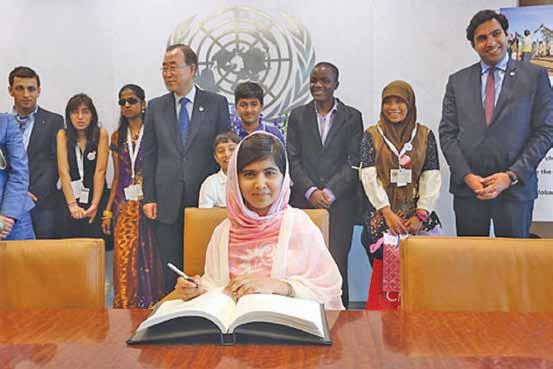
Malala Yousafzai, the
Pakistani
teenager
who survived a Taliban assassination attempt, has become a leading voice for girls' education and spoke at the UN
The hooded Taliban gunman stepped onto the bus full of schoolgirls in northwest Pakistan and barked a single question.
“Which one of you is Malala?” he demanded, referring to Malala Yousafzai, a 15-year-old education activist. “Speak up; otherwise I will shoot you all.”
Before anyone could answer, he saw her, raised his gun, and fired. Then he ran, leaving the girl and two of her friends for dead on the crowded bus.
But she was not dead. On Friday July 12, almost nine months to the day later – on her 16th birthday – Malala stood before the United Nations Youth Assembly in New York to deliver her first public speech since the assassination attempt, calling on the global community to rally behind the cause of universal educational access.
“They thought that the bullet would silence us, but they failed – and out of that silence came thousands of voices,” she said. “The terrorists thought that they would change my aim and stop my ambitions but nothing changed in my life except this: Weakness, fear, and hopeless died. Strength, courage, and fervour were born.”
But the confidence radiating from the young activist, who wore a vivid pink shawl once owned by assassinated Pakistani Prime Minister Benazir Bhutto, belies the staggering challenges that still face education activists around the world.
Some 57 million primary school-aged children worldwide were out of school in 2011, according to a study released by the international NGO Save the Children, half of them in countries
embroiled in violent conflict.
Meanwhile, between 2009 and 2012, the percentage of international humanitarian aid devoted to education dipped from 2.2 percent to 1.4 percent.
And most prescient to the teenage activist making her case at the UN today, there are also 69 million adolescents not enrolled in secondary school. This cohort's educational crisis has often lingered just beyond the reach of international campaigns and funding.
“Secondary education is a particularly difficult issue because you’re dealing with infrastructural issues, but you’re also dealing with great social malaise in many cases,” says Orla Kelly, an expert on gender and education in South Asia at Harvard's FrançoisXavier Bagnoud (FXB) Centre for Health and Human Rights.
“There’s a great consensus in much of the world that children should go to school, but there’s a lot less agreement about if they should continue during those later years, especially if they are girls.”
It’s no coincidence, she says, that the Taliban targeted a 15-year-old well on her way to her ambition of becoming a doctor. That, after all, is the moment when education – particularly the education of girls – threatens to tip the balance of a conservative social order.
The Taliban “are afraid of women,” Malala said. “They were and are afraid of change and the equality we will bring into our society. They think God is a tiny conservative being.”
Malala first rose to international attention in 2009, when the 12-yearold authored an anonymous blog for the BBC on
her experiences growing up in Pakistan’s troubled tribal belt, where the Taliban has attacked more than 800 schools in the past four years.
“I had a terrible dream yesterday with military helicopters and the Taleban,” she wrote in one entry. “I have had such dreams since the launch of the military operation…. My mother made me breakfast and I went off to school. I was afraid going to school because the Taleban had issued an edict banning all girls from attending schools.”
But it was the news of the fearsome attempt on her life, and her unexpected recovery in a London
hospital late last year that elevated the activist and her cause to international célèbre. The UN declared Friday, Malala’s birthday, “Malala Day.”
But history rarely pivots on a single newsworthy event, Ms Kelly notes.
“When the cameras go away, the problems are still there,” she says. “There has to be grassroots organizing on the ground to make change.”
In places like Pakistan’s tribal belt, she says, many want that change. But many rightly see the prospect of defying Taliban edicts against girls’ education as literally a matter of life and death. After all, they say, look what hap-
pened to Malala. For her part, the 16-year-old now attends school in Birmingham, England. The school she attended in Pakistan, which was started by her father, is still open, despite threats of violence. And she says the Taliban’s retaliation has only strengthened the resolve of young people there to get an education.
“We realize the importance of light when we see darkness. We realize the importance of our voice when we are silenced,” Malala said. “In the same way [in Pakistan] we realized the importance of pens and books when we saw the gun.” (Christian Science Monitor)

Mobile continues to bug Google.
The company's Motorola smartphone division continues to lose money, and a rise in mobile ads has squeezed the company's profits.
Growth in Google's mobile business drove the average cost per click on ads served by Google lower by 6 percent, when compared to the same period last year. That's the seventh consecutive quarterly decrease.
The number of paid clicks rose 23 percent, but advertisers still refuse to pay as much for mobile ads as they do for desktop ads. That's why the average costper-click has fallen even as the number of paid clicks increases.
"Clearly mobile has had an impact," said Google CFO Patrick Pichette on a conference call. "But it's one of many factors at work."
The search giant reported that its second-quarter
net income rose to $3.23 billion, or $9.56 per share. Though profit rose 15 percent from last year, Google's results badly missed Wall Street analysts' earnings expectations of $10.78 per share.
Google's sales jumped to $14.1 billion, up 19% yearover-year. That also fell short of analysts' estimates of $14.4 billion.
Within the past year, Google rolled out what its executives call "enhanced campaigns" which help marketers more easily run targeted ads on both the desktop and mobile platforms.

Google CEO Larry Page hinted that the company won't feel the impact of these campaigns for some time.
"It's the very early stages of a major change," Page said. Pichette also said he is excited about Motorola's upcoming product line, but inves-

Ators were quick to point out that Google's smartphone division continues to lose money. It logged an operating loss of $218 million in the second quarter, following a $179 million in the previous quarter.
Shares of Google fell 4
percent in after-hours trading. Google's stock price had been steadily rising this year, gaining more than $200 in 2013.
Google rival Yahoo reported quarterly results on Tuesday. Yahoo's sales fell slightly short of both Wall Street's expectations, but it also recorded a 46 percent jump in quarterly profit when compared to the same period a year ago. Microsoft also reported disappointing quarterly earnings Thursday. (From CNN Money)
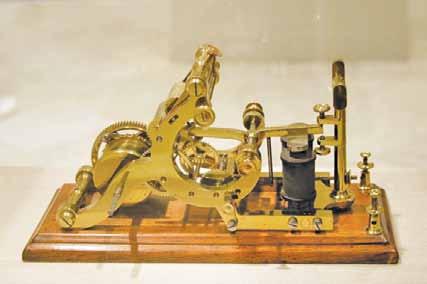
fter linking the world for 167 years, the commercial electric telegraph is no more. The speed with which electromagnetic telegraph systems took over both short- and longdistance communication in the mid 19th century set the pattern which telephones and the internet would follow, spawning the connected world we now live in.
The closing down of India's state-run Bharat Sanchar Nigam, Ltd. (BSNL) network last Monday, sparked a last-minute rush of people looking to send a souvenir telegram to mark the historic event before the electric telegraph was relegated to the history books.
In 1837, Samuel Morse, together with his assistant Alfred Vail and US physicist Joseph Henry, invented the single-wire telegraph. There were previous multi-wire telegraphs developed, but none proved commercially successful. Morse and Vail also developed the Morse Code during this period.
In 1844, Morse and Vail demonstrated their improved telegraph system over a federally-funded line stretching from Washington to Baltimore. The first commercial telegraph line became operational just two years later. The line connected Lancaster and Harrisberg, Pennsylvania, a distance of 39 miles (63 km). Where Morse's first message read "What hath God wrought?” the inaugural communication on the Pennsylvania telegraph was the somewhat less forma: "Why don't you write, you rascals?"
The subsequent pace of wir-
ing the world via telegraph was quite remarkable. During the 1850s, most cities and towns in the eastern portion of the United States were connected by a web of telegraph wires. In 1861, the first transcontinental telegraph line spanned the US, providing instant communication between east and west coasts. Two days after the line went live, the Pony Express was dissolved as obsolete as it just couldn't compete with the much quicker delivery time of the transcontinental telegraph.
The installation of an underwater cable across the Atlantic Ocean that connected western Ireland and eastern Newfoundland was accomplished in 1858, only 12 years after the first commercial telegraph was founded. The hostile conditions encountered in the ocean depths (much of the cable lay at a depth of 2.5 mi (4 km)) were not well
understood, resulting in a useful life of only three weeks for this first transatlantic cable. Progress in developing robust cables was rapid however, with the first stable telegraph cable being laid in 1865-6.
Some 2,300 nautical miles (4,300 km) of cable with a weight of about 4,600 tons (4,173 tonnes) were required to lay the transatlantic cable across the North Atlantic seafloor.
The reliable transmission speed of the 1866 transatlantic telegraph system was eight words per minute. In 1885, Physicist Oliver Heaviside provided the knowledge that allowed changes to the design of the cables, so that by 1900, transmission rates of 120 words per minute were being sent reliably between continents.
The high cost of telegraphic messages led to many expedients to reduce the word count of telegrams. As abbreviating
words did not help (telegrams were charged by the word, with a ten word minimum), other elements of cryptography were enlisted. One favourite, particularly for businessmen, was the use of private codes. Code books were available containing lists of phrases and the corresponding code, typically containing about five characters. As the 20th century progressed, increasing access to, and decreasing prices for, telephone
to slide as other forms of electronic communication multiplied. At about the same time, the wired telegraph was beginning to be replaced in most First World countries by wireless microwave systems, and later by satellite systems. The telegraph system operated in India by BSNL was the last system known to use wired telegraphs. But the popularity of email and mobile phones had seen the system running at a loss for years.

communications began to reduce the importance of telegraphy. In 1960, the cost of a three-minute phone call and a 15-word telegram were approximately equal in the US. As the prices crossed, the number of telegrams sent in 1970 was about half of the number sent in 1960, and continued
While one can still send telegrams in many countries, for the most part the data is transmitted over internet links. The electric telegraph is now a subject for nostalgia and hobbyists, who still string local telegraph systems for chatting via Morse code. (Gizmag)
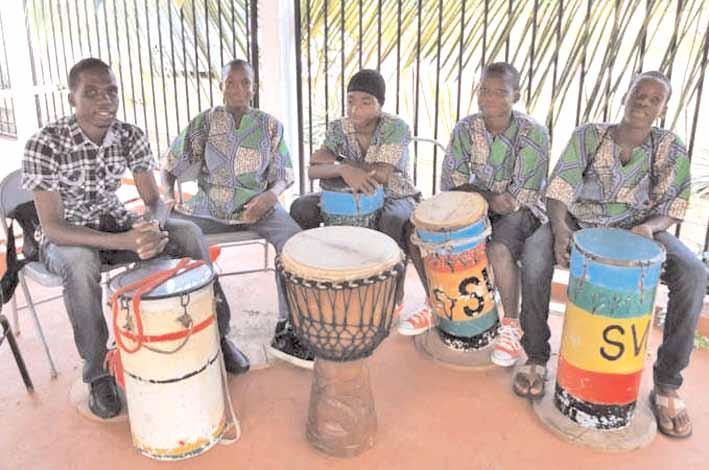
Drumming in Guyana has been considered a dying art, but recently, many organisations have been collaborating to resuscitate an art form considered a vital part of Guyana’s cultural heritage.
The African Cultural and Development Association (ACDA) with a grant of G$1M from the Cultural Centre of the IDB in Washington D.C., is collaborating with the donor organisation to revive drumming in Guyana.
The drum is one of the central components of African culture, with Africans called the “Children of the Drum”. Africa is considered a “drum continent” because nowhere else in the world and on no other continent can there be found a larger diversity of drums.
There are at least 3,000 distinct ethnic groups or tribes in Africa who speak more than 2,000 languages and dialects. The drum is considered “the unifying language” of the continent, and drums play a significant role in most ethnic groups.
African drums have three very distinct and different roles: they are musical instruments, ceremonial objects and a means of physical and spiritual communication. The drum beat in Africa is heard every day for communication, celebration or fun.
On a spiritual level, drums are central to everyday life in Africa. The drums range from everyday objects with monumental, simple forms to ornate pieces, bringing status to the owner, connoting power and the honouring of ancestors.
Music and drums are almost always an accompaniment for any manner of ceremony in Africa. Drums are used in healing, rites of passage, and naming ceremonies. They are also used in warrior rituals, on social occasions such as engagement parties and weddings, in harvest parties, during liba-
tion ceremonies, and in the celebration of major life impacting events such as the arrival of rain after a long period of drought.
ACDA realised drumming was a dying art in Guyana during the United Nations International Year for People of African Descent in 2011. Contributing factors included the death of older artists, the lack of drums, and the lack of drumming teachers.
In Berbice, drummers resided only in Weldaad and New Amsterdam. On the Essequibo Coast, there was a single family: a father, two sons and a daughter, who practiced the art. In Demerara, where more than 40 percent of AfricanGuyanese reside, there has been a revival in Buxton where a group called Buxton Fusion has been active for the last 4 years. In Linden, there is also a group called Flame of the Heart, which is determined to keep the art alive. In Georgetown, four groups, led by Majek Fingers Drumming Group and the National Dance School, which have some African drummers, have all joined in the revival fight.
Only Majek Fingers has Djembe drums for its members. The Djembe date back to at least 500 A.D. and is the most influential and basic of all African drums. Today, they can be found extensively in Senegal, Mali, Sierra Leone, the Ivory Coast, Guinea, Gambia and Burkina Faso, as a sacred drum used in healing ceremonies, rites of passage, ancestral worship, warrior rituals, as well as social dances.
In the past, after Emancipation in 1838 and today in modern times, drums are handmade with goat skin and local materials. Even the drum makers are diminishing.
In 2012, ACDA wanted to create a drum renaissance in Guyana, and especially to have this revival during its 20th anniversa-
ry this year; the organisation views drumming as a central feature of its annual Aug. 1 Emancipation festival.
A few years back, ACDA was hard-pressed to find drumming groups to participate in events when asked by schools, groups, businesses, ministries, and local communities.
The “Drum Renaissance Programme” came to fruition after being funded by the IDB’s Cultural Centre in Washington, administered through its local office by Ava Yarde.
This project has several goals: to resuscitate drum-
ming in Guyana and in villages; ensure key cultural activities are spearheaded by drumming corporations; to establish three drum centres in Berbice, Demerara and Essequibo to teach drumming as well as the history of the drum; introducing the art and love for drumming in selected schools in the three counties; hold a drum competition at the upcoming Emancipation Day festivities; to establish an annual drummer’s conference to bring “elder” drummers throughout Guyana together; establish an annual
national drum making competition to generate interest and to create the first set of local drums for the African Museum, and to establish a drum museum at ACDA’s Thomas Lands head office.
In Berbice, the “drum revival” project has been led by the Sea View Cultural Organisation of Hope Town. It was founded by Muhammed Tufail who used his home as the hub for the revival. This organisation, led by many community elders, has revitalised the community through its youths. Group members are
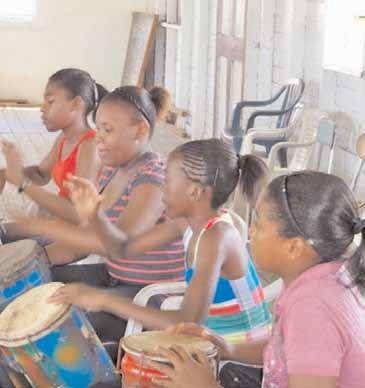
exposed to drumming, dancing, literature and cultural lessons.
There is also the Sankofa Drumming Group in Essequibo led by Mr McKenzie who teaches classes at Anna Regina and Queenstown several times a week, and hopes to expand his programme to Dartmouth.
ACDA would hire three drumming teachers, who will be engaged in a full oneyear drive to reintroduce drumming as an integral part of Guyana’s African culture. It plans to engage the Ministry of Culture, Youth and Sports in this endeavour. It also seeks to obtain a corporate sponsor to get this project going.
The strategy is to have the “drum masters” teach others in their designated communities, so that both a cadre of young drummers would be nurtured as well as bring about a collaboration of “elder” drummers, who can share their knowledge and expertise.
By having a drum master in each county and by getting them involved with schools, villages and cultural organisations countrywide, ACDA hopes that the overall benefit would be a revival of drumming in each county that eventually leads to regional drumming clubs throughout Guyana. (Information by Eric Phillips)

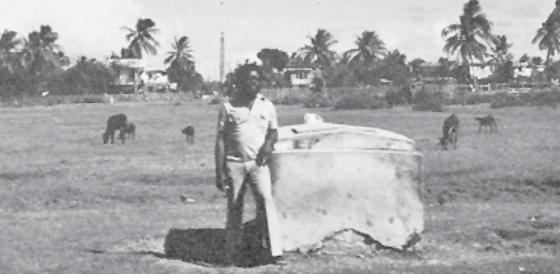
(Continued from July 14)
After Van der Haas was put to manage Pln Le Resouvenir, the slaves complained to Wray about their cruel treatment at the orders of Van der Haas. Unfortunately, when Van der Haas died on Oct 6, 1812, the penalties became worse since the new director gave the drivers more power. Sometimes slaves fled into the jungle after being abused.
With advice from John Wray, the slaves informed the governor about their complaints, prompting a tax investigation and a ban on the bamboo whip.
The plantation’s management was even angrier with Wray, and considered him agitating the slaves against their masters. Wray would leave the plantation in 1813 to work in Berbice, where he died in New Amsterdam in
1837.
After Wray had left, Reverend John Smith arrived at Le Resouvenir in 1817 where he was later accused of helping to organize the 1823 rebellion through the Bethel Chapel, and thrown in prison where he died. In 1833 the chapel was said to be used by an unnamed “Anglican missionary”, but when Wray returned to visit it in 1835, he discovered the pulpit and pews were destroyed.
That same year Bethel Chapel was removed to Montrose Front until 1851 when the chapel was moved to Beterverwagting, where it stood until the 20th century.
In 1858, in this now-called "Bethel Congregational Church" a memorial plaque was laid which stated John Smith, John Wray and Hermanus H. Post be remembered as the 'Fathers

and Founders of the Mission Churches in British Guiana.’
According to AN Paasman, much earlier, after the death of HH Post, there was a memorial plaque in Bethel Chapel, which is said to now be in the Zoar
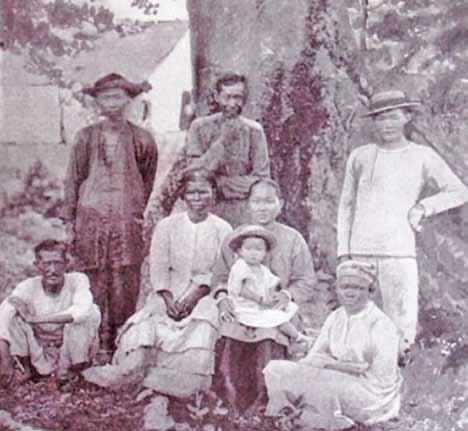
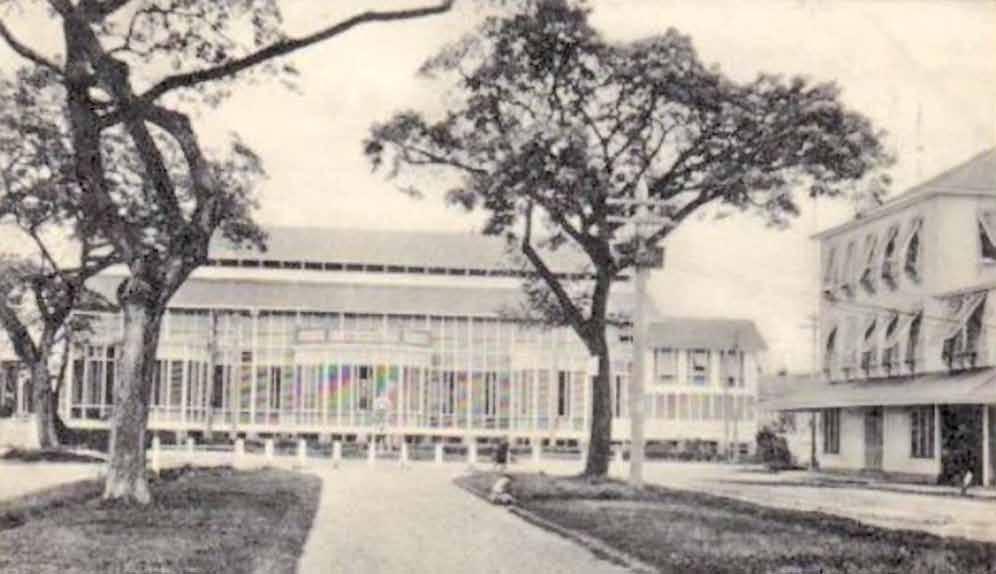

Congregational Church in Plaisance.
It is claimed that on both plaques, Post’s dates of death and birth are incorrect: On the Beterverwagting church, Post’s date of death is incorrectly listed as Dec 25, 1808, while the Zoar Congregational Church has the incorrect date of birth as recorded in Wray’s memoirs (26, December 1755).
It partly reads:
Sacred TO THE MEMORY OF HERMANUS Hilbertus POST ESQ. 're 28 years or propietor [Sic] this Estate Born at Utrecht 26 December 1755 He created a chapel for the Use of the negroes in 1808 and died uni-

versally Lamented April 29, 1809
His tomb also bears the incorrect date of birth and death. Inscriptions on the restored tomb in the 70s state:
Hermanous [Sic] Post Esquire of Le Resouvnir [Sic] through whose effort the gospel was first introduced into this colony in February 1808. He died 25th Dec. 1808
Hermanus Post’s tomb was again restored in 2008 by the National Trust, in collaboration with the Guyana Congregational Union, as part of efforts to remind Guyanese of their country’s dynamic history.


he Simoni and Buffalo Ponds are two extraordinary water sanctuaries in the Rupununi area, teeming with rich biodiversity.
The Simoni Pond is a large fresh water oasis that flows to the Rupununi River via a smaller creek. Once the river winds down the forest-clad mountains, it slows down as it enters the vast savannah lands and opens up into five shallow river bays known as the Simoni Lakes.
The best inland fishing in Guyana, including a favourite catch: peacock bass, is at Simoni Pond. There too, is a great opportunity to explore the flooded forest or savannah. A spectacular view of the beautiful spread of victoria amazonica, the world’s largest water lily and Guyana’s national flower, is also a highlight of this trip.
Boating through the flooded forest also offers unmatched opportunities to observe the unique ecosystem. Excellent bird watching is available on the savannah, in the gallery forest and at the ponds.
Buffalo Pond, near Karanambo Ranch on the Rupununi River, also offers similar adventures.
Both ponds offer idyllic opportunities for birding and fishing enthusiasts to experience nature one-on-one.



B y M elvin D urai
Irecently moved into a new home, an exhausting task of lifting and loading that made me realize that I need more friends -- big, strong, energetic friends.
From now on, I'm not allowing just any old bum to become my friend. I'm going to evaluate tential friends using the cri teria below:
---Must weigh at least 200 pounds and be able to lift 300 pounds, preferably with each arm. Preference will be given to bodybuild ers, weight lifters, and former attor ney generals.
---Must not suf fer from any "back condi tions," including back pain, back spasms and the tendency to back away from physical activity.
need to have conversations like this:
Me: "Can you please help me move this Saturday?"
Friend: "Get off your knees! You're embarrassing me. I can't help you on Saturday, because it's the Sabbath. I'm not supposed to work."
Me: "Wait a min-
me a cell phone, while another lent me a car. They didn't even ask me to sign anything. With friends like them, who needs Rent-ACenter?
Over the years, I've had all kinds of "friends." Some are worth keeping a few decades, others a few seconds. Some are superficial, others are just super. Some keep lending, others keep borrowing.

I'm observing Ramadan this month."
Me: "Ramadan? I thought that's for Muslims."
---Must be able to read simple instructions on boxes such as "keep upright," "keep in a cool place," and "keep working, you lazy butt!"
---Must be able to figure out how to get a wide sofa through a narrow doorway without requesting a saw. Anyone who asks if the sofa can be lowered into the house through the chimney is automatically disqualified.
If I can find a few friends who fit these criteria, I won't have any trouble moving again. I won't
Friend: "Yes, but since the name of the Hindu god Rama appears in Ramadan, I thought I'd observe that, too. Just in case."
Me: "Do you know what else appears in Ramadan? A three-letter description of you: MAD."
Actually, most of my friends never make such excuses. They're always eager to help me move, especially if I'm moving far from them.
Yes, I have some really good friends, friends I can count on. Just the other day, when my car almost died, one of my friends lent
Many of the socalled friends weren't real friends. Indeed, the word "friend" is one of most misused words in the dictionary. Many people use it so loosely. Just introduce yourself to them and suddenly you're their "friend," even though they don't know your email address.
They take the liberty of calling you "buddy" or "pal" or "dude." They start asking you personal questions, such as what you think of Anna Kournikova and isn't she the best thing to happen to tennis since the invention of the ball?
Truth is, a good friendship takes years to develop. You invest time, energy and money into it and eventually you have something special, something that will give you more joy than a Sony PlayStation. At least in the long run.
If there's one thing I've learned about friendships, it's this: It's better to have one good pal than a thousand lousy pals. Good friends are worth their weight in gold -- especially if they weigh 200 pounds and can lift 300.
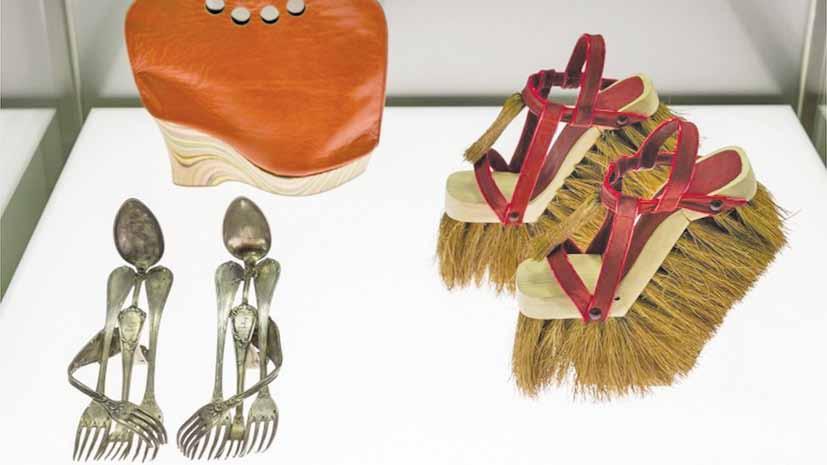

Caller: I'd like the RSPCA please.
Operator: Where are you calling from?
Caller: The living room
Caller: The Water Board please.
Operator: Which department?
Caller: Tap water.
Operator: How are you spelling that?
Caller: With letters.
1. Include Your Children when Baking Cookies
2. Something Went Wrong in Jet Crash, Expert Says
3. Police Begin Campaign to Run Down Jaywalkers
4. Drunk Gets Nine Months in Violin Case
5. Survivor of Siamese Twins Joins Parents
Life’s Burning Questions
- Why isn't there mouse-flavoured cat food?
- Why does your nose run, and your feet smell?
- If nothing ever sticks to TEFLON, how do they make TEFLON stick to the pan?
- What is a "free" gift? Aren't all gifts free?
- Why isn't phonetic spelled the way it sounds?
Quizzes for kids
Q: How do you fix a broken pizza?
A: With tomato paste.
Q: What has four wheels and flies?
A: A garbage truck.
Q: What do you call a fish with no eyes?
A: Fsh.
Q: Why did the reporter walk into the ice cream shop?
A: Because he wanted a scoop.
Deep Thinking
A woman awakes during the night to find that her husband was not in their bed. She puts on her robe and goes down stairs to look for him.
She finds him sitting at the kitchen table with a hot cup of coffee in front of him. He appears to be in deep thought, just staring at the wall.
She watches as he wipes a tear from his eye and takes a sip of his coffee. “What’s the matter, dear?” she whispers as she steps into the room, “Why are you down here at this time of night?”
The husband looks up from his coffee, “I am just remembering when we first met 20 years ago and started dating. You were only 16. Do you remember back then?” he asks solemnly.
The wife is almost reduced to tears herself, just thinking how caring and sen sitive her husband is. “Yes, I do,” she re plies.
The husband pauses. The words were not coming easily. “Do you remember when your father caught us in the back seat of my car?”
“Yes, I remember,” said the wife, lowering herself into a chair beside him.
The husband continues. “Do you remember when he shoved that shotgun in my face and said, “Either you marry my daughter, or I will send you to jail for 20 years?””
“I remember that, too” she replies softly.
He wipes another tear from his cheek and sobs loudly… “I would have got out today.”
A Chinese walks into a bar in America late one night and he sees Steven Spielberg. As he is a great fan of his movies, he rushes over to him and asks for his autograph.
Instead, Spielberg gives him a slap and says, “You Chinese people bombed our Pearl Harbour, get outta here.”
The astonished Chinese man replies, “It was not the Chinese who bombed your Pearl Harbour, it was the Japanese”.
“Chinese, Japanese, Taiwanese, you’re all the same,” replies Spielberg.
In return, the Chinese gives Spielberg a slap and says, “You sank the Titanic, my forefathers were on that ship.”
Shocked, Spielberg replies, “It was the iceberg that sank the ship, not me.”
The Chinese replies, “Iceberg, Spielberg, Carlsberg, you’re all the same.”
Three elderly ladies were discussing the trials of getting older. One said, "Sometimes I catch myself with a jar of mayonnaise in my hand in front of the refrigerator and can't remember whether I need to put it away, or start making a sandwich."
The second lady chimed in, "Yes, sometimes I find myself on the landing of the stairs and can't remember whether I was on my way up or on my way down."
The third one responded, "Well, I'm glad I don't have that problem; knock on wood."
She raps her knuckles on the table, then says, "That must be the door,