



The Bannas Foundation has been in existence since 1997. It promotes youth and community development by providing a reliable, organised means of participation in a range of recreational and social activities in the U.S. and Guyana.
The founders of the organisation, Keith “Roddy” Walcott, Kevin “Jahman” Walcott, Johnny “Overseas” Barnwell and Clarence “Starry” Coleridge, athletes who have all been involved in the development of sports in Guyana in varying aspects, felt the need to contribute in some way to the development of youths in their homeland.
It is not surprising that the Bannas Foundation chose the arena of sports development as its main focus.
In an interview with
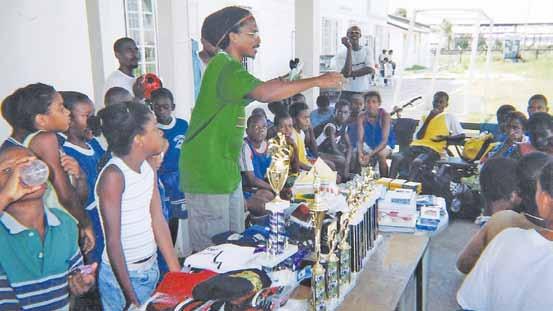
Guyana Times Sunday Magazine, Keith “Roddy” Walcott stated that in 1999, their mission was expanded to include community development because they felt it necessary to do something about the children playing basketball and football in the Meadow Brook Garden streets.
“A dangerous activity for both drivers and players, it was this same problem that had galvanised Meadow Brook Boys and Girls Club about 25 years ago to actively campaign to have a recreational field erected in their community. The club had attempted clearing the ground themselves but to no avail. They held fundraisers to raise the necessary capital to have the field cleared, but the success of having a playfield in the area still eluded
the community. Today, resi-
dential dwellings have been erected on the old playfield.
As a result, the Bannas Foundation decided to un-
dertake the responsibility of rehabilitating the Meadow Brook/Backlands playing field and another field in the adjoining Lodge Backlands

community,” Walcott disclosed.
This effort by the foundation resulted in the birth of the ‘Fields of Dreams Project’ which has its focus on community development.
Walcott said the Bannas Foundation in the U.S. does its work in Beltsville, Maryland. In the beginning, the foundation’s team was tasked with providing football (soccer) equipment for
programme. In the fall and spring in the U.S., we play in an outdoor league, in the winter we play indoors, and in the summer we do a 6 weeks summer programme. In the last year, we have started a shuttle service to get some of the kids to practices and games. Hopefully, in the future, we can bring a team to Guyana. As we progress, we want to become more diverse in our mission, and focus on community, as well as youth, development through recreational and social activities,” Walcott outlined.
Additionally, Kevin Walcott, the foundation’s project coordinator in Guyana, told Sunday Magazine that the organisation is working tirelessly at expanding the current sports and recreational programmes in the Meadow Brook/Lodge Backlands community.
“We’re constantly donating to our communities, helping with sports development in Guyana. We grew up in the Meadow Brook area, and my brother and I
the organisation in Guyana. In fact, it still collects used equipment and donated trophies to ship to Guyana, where Kevin (Keith’s brother), and Johnny Barnwell would organise football and basketball tournaments.
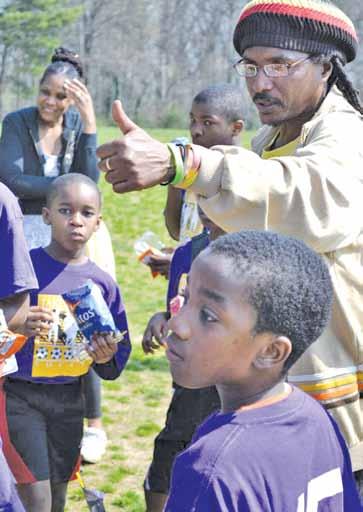
Walcott pointed out that the foundation has started its soccer programme in Maryland, where it provides training to more than 40 girls and boys.
“Our mission is to make playing soccer an easy process, since sometime location, and finances can make it difficult to get involved. We run an all year
decided we wanted to give back to our community and create opportunities in the sports field for our youths. This we have been doing not only in Guyana but in the U.S. One of our vital projects in Guyana is providing school supplies. Every September we organise a back-to-school event where the youths of the foundation are given school supplies. This we hope will encourage them not only to be star athletes but also star academics,” Kevin noted. For more information on the Bannas Foundation, call 226-7599.

Growing up as a child along the Pomeroon River presents many challenges as well as opportunities. Travelling to school is usually frenzied as children often travel far distances by boat, at the mercy of heavy rains or hot sunshine. Such travels also incur a financial burden on parents, many who are unable to meet the demands. These harsh realities sometimes force students to abandon their
With 13 grade ones and two grade twos, Maria Lisa Thakurdin of Jacklow is top hinterland scholarship student
“I feel so happy and excited – but a little shocked because I didn’t expect to do so well,” an elated Thakurdin told Guyana Times Sunday Magazine in an interview. But while the sixteen year-old now celebrates her success, her journey has not been relatively easy.
School experiences
Born Sept 13, 1996, Maria is the eldest child of Calvin Thakurdin, a farmer, and Indera Thakurdin, a housewife; and big sister to brother, Ken. She attended the Jacklow Primary School where she wrote the NGSA a few years ago and earned a place at Queens College, placing 13th overall among Guyana’s best NGSA performers for that year. Then she also emerged top NGSA student for Pomeroon and the hinterland, gaining a government scholarship.
But excited as she was to earn a space at QC, considered the country’s top premier secondary school, her parents decided Maria should attend ARMS, located in the Essequibo district. This decision is quite common in the Pomeroon: parents opt to send their children to schools that are situated closer to home instead of choose relocation as a result of NGSA allocations.
However, for Maria this meant hours of daily travelling by river and road to get to school. “It was fatiguing... stressful, but eventually it became enjoyable as I got accustomed to it every day,” Maria related.
dreams of a quality education; but there are those who eventually defy these odds.
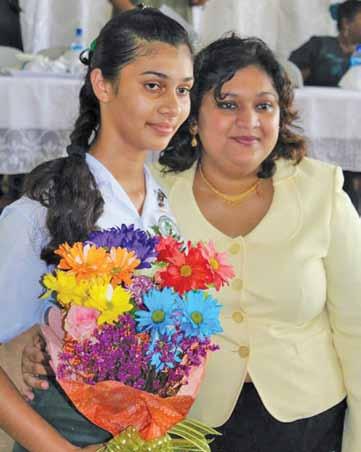
Like Maria Lisa Thakurdin, of Anna Regina Multilateral School, who earned 13 grade ones and two grade twos at this year’s CSEC examinations. In addition to being one of the top five students at ARMS, which includes the country’s two best performers, Thakurdin of Jacklow, Pomeroon, a traditional rural farming area, is this year’s top CSEC hinterland scholarship student.
She secured grade one passes in Mathematics, English A, English B, Integrated Science, Social Studies, Human and Social Biology, Economics, EDPM, Agricultural Science, Office Administration, Principles of Business, Principles of Accounts and Physical Education. Her grade two subjects are Spanish and Information Technology.
Some days she was lucky to get a “passage” (a free boat ride with family or relatives) from home in Jacklow to Charity; other days she used the commercial boat service. Maria then had to take a minibus from Charity to ARMS. She left home as early as 7.30 hrs in the morning and would return late in the evenings. The travels incurred a daily expense of about $1,000.
The situation was challenging but Maria was undaunted. She remained focused on her studies and continued to perform well throughout her school years, always securing the highest grade in her class. She acknowledged the support of her
parents, especially her mother, who stayed up late at nights with Maria as she studied, and who actively participated in school-related events.
With an overarching desire to excel, Maria said she was further motivated by her parents and teachers. She began taking extra lessons for mathematics and English A in Form Three. By fourth form, she was taking extra lessons for all subjects not only in the afternoons after school but during her lunch break. While some of the lessons were private, some were free of cost, offered by Maria’s subject teachers at ARMS.
“The teachers gave us free lessons outside of the school curriculum. They took time off of their schedules to give us extra teachings so I am very thankful for that,” Maria highlighted. The headteacher, she observed, directly supported students too.
Crucial days
Coming up to CSEC, the experience became more challenging for Maria. Already burdened by extra lessons, the School-Based Assessments (SBAs) and regular in-class assignments kept piling up. Maria had to spend many hours late in the nights, sometimes way up into the morning, to get the work done in time for submission. There is no electricity in the Pomeroon, and while Maria was fortunate to have solar powered electricity, there are children who are not so lucky. They often resort to lanterns or battery-operated flashlights to do homework and study.
‘My heart and soul has always been Guyana and always will be’ Young Professionals


Hrithik, Priyanka to smooch in ‘Spiderman’ style
The diverse art of Aubrey Williams
U.S.-based Guyanese Shanie Persaud forges vital ties to develop her homeland Explosions
Nevertheless, it was still a struggle for Maria. “My mom had to wake me sometimes….I barely got to sleep. Sometimes I barely got three hours of sleep,” she reflected.
Today though, her efforts have paid off and she can advise other hinterland students to “…study hard, focus on your education and make the best of every opportunity.”
With a passion for banking and finance, Maria plans to further her studies in economics at the University of Guyana. She has

already been accepted to Republic Bank’s apprenticeship programme, and plans to pursue this opportunity in the meantime. While Maria celebrates her success, so is her entire community of Jacklow and the wider Pomeroon. She has clearly demonstrated that notwithstanding the challenges in hinterland areas, children can rise above obstacles and perform on par with their peers from coastland areas who can access better facilities.

Saving lives from the cruelty of abuse through loving support and vital interventions is what the East Berbice Life Savers’ Club was founded to do.
The club, whose motto is “We Care”, was organised as a result of the numerous interventions made by persons trained in genderbased and sexual offences at Roadside Baptist Church Skills Training Centre.
In an interview with Guyana Times Sunday Magazine, Yatrawatee Katryan of the Roadside Baptist Church Skills Training Centre, said the monstrous plague of gender-based violence against women and girls, especially domestic and sexual violence, is the catalyst that propelled Roadside Baptist about 12 years ago to iden-
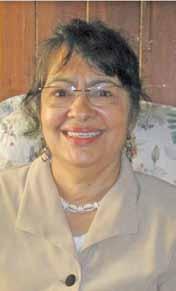
tify and train a core group of persons to make interventions and work with those directly or indirectly affected by gender-based violence, and to work with perpetrators as well.
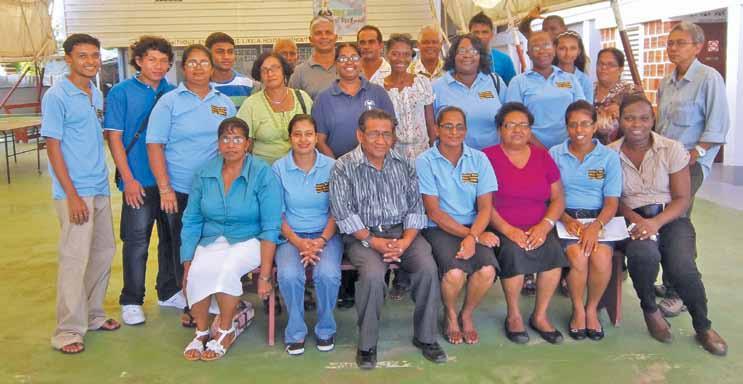
East Berbice Life Savers’ Club was officially launched in 2003 by Varshnie Singh, First Lady at the time, at one of the centre’s annual graduation ceremonies. About 100 persons were present at the launch.
Katryan said that the membership at that time, about 25 members, included school welfare officers,
a community development officer of Skeldon Sugar Estate, religious leaders, office and community workers and housewives and teachers from the entire Region Six inclusive of Black Bush Polder. They were trained in the areas of domestic violence, child abuse, suicide prevention, and counselling skills. Katryan disclosed
awareness sessions, they also made numerous interventions with individuals and families affected by domestic and other forms of violence.
Interventions, Katryan explained, include counselling at either Roadside Baptist, at individuals’ homes or at places mutually agreed upon, accompanying
pacity building to enhance the skills of Life Savers is ongoing, and only recently two full days of training were conducted at Roadside to update previous trainees with the Sexual Offence and Domestic Violence Acts and the Child Protection Policy. Quarterly meetings are held by the group, at which time they share and discuss
that suicide is still a matter of grave concern in Region Six. She pointed out that over the years, the group, in collaboration with Roadside Baptist, conducted several awareness sessions at different locations including Orealla, Siparuta and Black Bush Polder. Besides

victims to the police station, and for medical services as well as even giving support to court cases. She added that other instances of support are in the form of cash or in kind contributions and even providing safe spaces/ shelter to victims and children.
“Help and Shelter is of great assistance, and made the necessary arrangements once in the night to accommodate a female and her young girl children who were travelling from the Corentyne to their safe place. At one time, quite a few years ago, even Camal’s Children’s Home on the Corentyne accommodated a female victim and her young children for a short while, through discussions by Ms Nalin Katryan, CEO of the Life Savers and Mrs Carmen Kissoon. We’re very thankful to these individuals,” Katryan related.
She pointed out that since launching of the Life Savers’ Club, some members have migrated. The group was dormant for a while but individual members were still involved in interventions, and Roadside Baptist never ceased from continually training others in counselling skills and gender-based violence prevention. In 2012, the group was resuscitated, and those trained are now actively involved with Life Savers. The most recent training for the new recruits was conducted this year during the months of January to July for 25 youths and 25 adults.
Of the 50 trainees, 25 were trained in counselling skills and are busy in their communities, sharing information. Additionally, ca-
challenges and positive results. Life Savers is fully supported by the Guyana Police Force and from time to time CEO, Nalin Katryan, communicates with the Commander of Division “B” and the Officer in Charge at Springlands Police Station. At the start of the genderbased violence programme, discussions were held with the then Commissioner of Police. Notably, three police officers were among the last batch of trainees.
Trainers over the years include Rosemarie Terborg, Beverly Braithwaite Chan, Paulette Henry, Karen De Souza, Luella Chichester, Vidyaratha Kissoon, Dionne McCammon and Varshnie Singh.
“Roadside extends gratitude to all the donors who have supported our initiative to reduce and prevent gender-based and other forms of violence. They include UNDP, CIDA/ Gender Equity, UNICEF and USAID. Special thanks are also expressed to the offices of the Director of Public Prosecution (DPP) and of Child Protection for their support in enhancing the skills of Life Savers. Roadside extends congratulations to the East Berbice Life Savers for their continuous effort to reduce and prevent the social ill that is devouring the family unit and wishes to encourage them to continue the fight,” Katryan said gratefully.
East Berbice Life Savers’ Club can be contacted on 338-4215 or 338-4213. Additional information can be obtained from the Roadside Baptist Church Skills Training Centre page on Facebook.

As executive director of the Guyanese and American Business and Professional Council (GABPC), U.S.-based Guyanese Shanie Persaud works tirelessly to develop stronger ties between Guyana and the United States in an effort to forge a closer relationship between the business and professional communities of both nations.
player in helping Guyanese students benefit from a new master’s degree programme. The programme provided new educational opportunities for several Guyanese community development leader-practitioners.
The Future Generations Graduate School in the U.S. admitted the seven Guyanese community development professionals into its accredited master’s degree program
ties to develop her homeland
media experience in both Guyana and Queens to good use, using her ability to make contacts as a way to drive together the Guyanese community with organisations such as the Queens Chamber of Commerce, the Queens Economic Development Corporation and the Greater Jamaica Development Corporation.
“More and more, I try to partner with other organisations within the community to bring services to our
members and the business community at large,” she added.
In addition to business and career services, the New York-based GABPC also works with charities in activities such as raffles to assist the American Cancer Society and others.
For the future, Persaud said she hopes that GABPC’s membership will continue to grow and that the organisation will be able to do even more to help members of
the Queens Guyanese community.
She pointed out that while she lives in the U.S., her heart is still in Guyana. She tries to visit her family as often as possible, but when she cannot, she relies on technology to connect with her with loved ones.
“My heart and soul has always been Guyana and always will be,” she declared. (Information from Queens Tribune and Queens Courier)
Not-for-profit organisation GABPC is the first and leading GuyaneseAmerican business organisation that provides a vast array of services aimed at promoting and advancing business relations between Guyanese and Americans.
she started working with the Guyanese media as a reporter for a national newspaper. She went into television as a weekend news anchor, and augmented her work within the community by involving herself with economic development and health education. By the time she left Guyana at the age of 23, she was marketing manager for the state television network. Her first home in America was in Texas, where she gave birth to her son, C.J. Persaud.
Before joining GABPC, Persaud was CEO for El Dorado Media and Marketing, which focuses on reaching the Guyanese
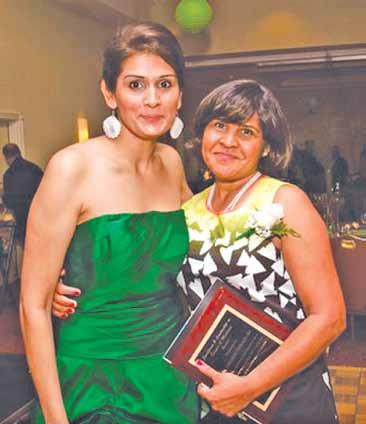
Persaud migrated to the United States in 1999 with the expressed purpose of networking the Guyanese population with the greater community. She helps to connect advancing Guyanese entrepreneurs to all of the networks they need to succeed in the business world. This includes investments, marketing and technology.
The executive began her public service career while still living in Guyana. At 18,
American community with direct-to-consumer messaging services.
Aside from her work with GABPC, Persaud has also been on the York College President’s Advisory Board since 2006. In 2010, she was one of 40 young professionals who were honoured with the Rising Star Award by the Queens Courier for exemplify outstanding leadership skills, not only in their chosen fields, but also in their community.
Persaud was also a key
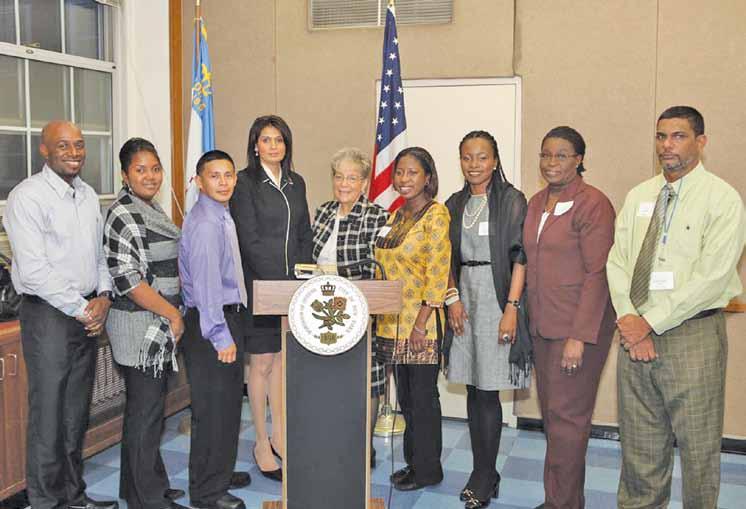
in Applied Community Change and Conservation.
The Guyanese group joined a global class of 20 students from 10 countries that visited India, the United States, Peru and Nepal as part of their two-year course of study. The students brought their experiences back to Guyana, where they continued their online coursework and completed a hands-on research practicum to benefit their communities.
Through GABPC, unique platforms are provided to promote business brands, services and products to a high-level audience through its educational, health, financial and business seminars and workshops, business expos and trade shows.
“A group of us, both Guyanese and Americans, put it [GABPC] together. It was formed primarily for that and to give more prominence to the Guyanese community over here and to allow Americans to market themselves for this community,” Persaud had revealed in an interview with U.S. publication Queens Tribune.
Persaud applied her

By PetamBer Persaud
(Part one of an excerpt of an interview with Vibert Cambridge, Georgetown, Guyana on July 28, 2007. Cambridge is Emeritus Professor at Ohio University. For many years, he held the Chair of African-American Studies. He is a driving force behind the Guyana Cultural Association, New York.)
PP Centuries on, we are still coming to grips with the effects of slavery.
But I feel now more than ever, we are beginning to understand that situation and what it has done to the people themselves and to their descendants. Let’s discuss the reasons why we are still so embroiled in the past; starting from what we came out of and how we are dealing with the situation now.
VC I think the first thing we have to do is to deal with language. Slavery connotes there’s got to be a
something called a slave; there is nobody who is born into this world a slave, people are enslaved, so I think that is the first position. Africans were enslaved; they were made captive for various reasons. So we have to get into this language distillation. The other thing about the discussion on enslavement is for us to understand the geography of enslavement so we can put faces to the peoples who were enslaved.
PP Is this some sort of new scholarship? If so, let’s apply it to the Guyana situation.
VC If we use Guyana, I may not follow a straightforward geographic or historical timeline. We refer to many Muslim people as ‘fullaman’. A ‘fullaman’ is a ‘Fulani’, the very first Africans who came into this region. Then in the early and mid 17th century, the trade in African captives moved into what is
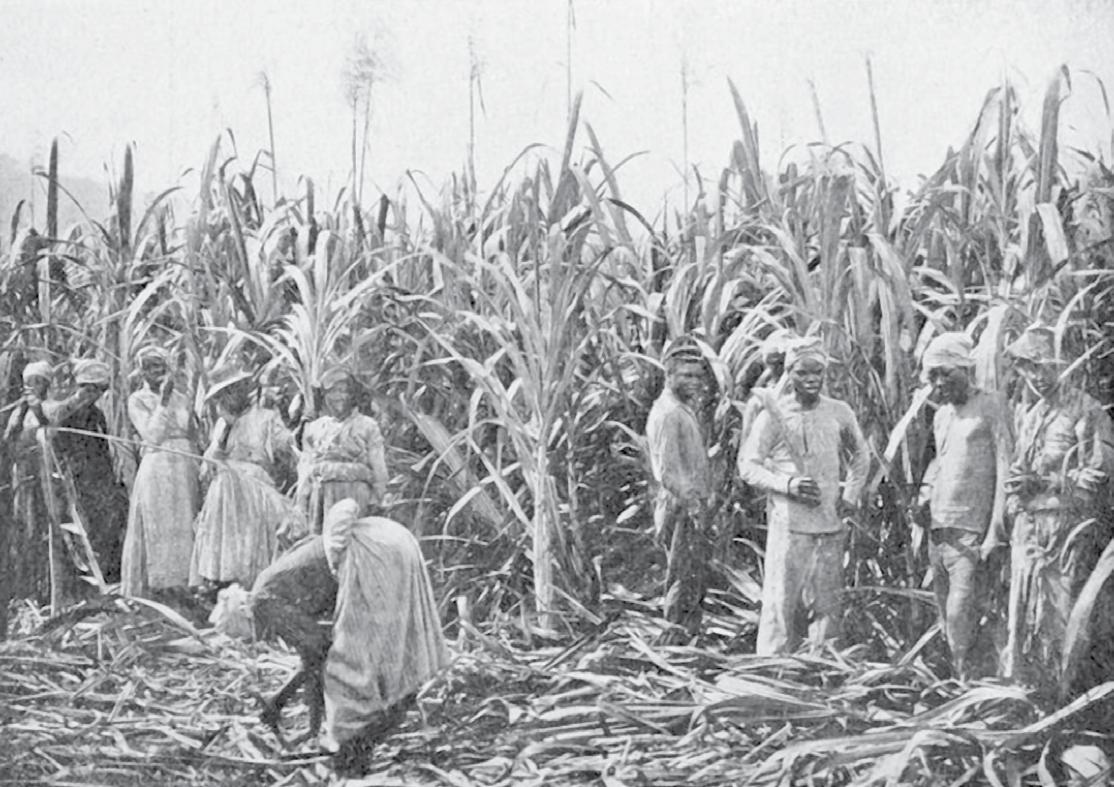

contemporary Ghana. So we would find those to be Akan, Ashanti, Ibo, Yoruba. So names like Cuffy or Cofi, and Akara, will tell of a specific West African community. By the end of the abolition of enslavement, we move into the period of indentureship.
PP Was it a deliberate ploy to bring people from different areas with different skills, different languages?
VC There are multiply theories about that. One, availability; two, specific skills. For example, rice: the establishment of rice as an industry in the Americas is directly tied to the people of the Sene-Gambian region. On the other hand, directives were made not to import Mandingo because they were found to be arrogant, full of pride; they resist. Yes, there was a specificity of labour. However in the latter period, when the trade was being suppressed by the British and
the Americans, liberated Africans were placed in St Helena, and plantation owners in Guyana, Trinidad, Barbados etc would have agents in St Helena suggesting to these liberated Africans not to go back to Liberia, Serra Leone, but instead to come to the Caribbean. Guyanese writer, Professor Monica Schuler in her important book, “Alas, Alas Congo”, speaks of liberated African coming to the Caribbean aboard ships that were bringing indentured Indians labourers.
PP Interesting find that – earlier we discussed similarities in various cultural patterns of both groups.
VC Yes, and hear this: you will also find Africans who were ‘jihaji bai’ too. So in understanding the African presence as a function in the trade of African captives, you are looking over time at changing ethnicities as points of departure.
PP Different peoples, various skills, changing ethnicities; changing values too?
VC Different and similar; similar religious values and common linguistic root. We must bear in mind, Africa is not a static society, it’s a huge continent where people are moving up and down, but you would find a linguistic continuity.
PP Many of the enslaved peoples who came, they came from highly civilised, advanced societies. Many too were royalties, others highly regarded and
respected. How were they able to deal with this transition from that lofty position to lowly slave labourer?
VC That is difficult to answer but in any society, you will find social classes. The leadership class is always very small, so in wars, when people are captured and sold into enslavement, you would find some of the ruling class and you would find some who are the working class, the foot soldiers. I would say that is diversity. Now to the question of how they were able to cope with work in this new space. Walter Rodney talks about enslaved Africans humanising the coast of Demerara, the coast of Guyana. He said with shovel in hand moving over a million tons of waterlogged clay. That is serious work. So when we look at the humanising of the coast of Guyana, we have to think of that nature of work, tending to agriculture – that is a standard thing. The nature of the work, the conditions of work, the abusiveness of work showed that they were a people who worked very hard.
(TO BE CONTINUED)
What’s happening:
• The Guyana Annual 2012-2013 magazine is now available at Guyenterprise Ltd and at city bookstores. This issue of the magazine is dedicated to E. R. Braithwaite. The magazine also features articles on copyright, law of intellectual property, creative industries and the future of books.
• Coming soon: “An Introduction to Guyanese Literature” by Petamber Persaud.


By Vahnu Manikchand
Growing up in Half Mile, Wismar, Deon Anderson, now twenty-six-years-old, had a somewhat challenging childhood as his parents worked hard to ensure that he and his brother had all their necessities. Anderson also had to play a part in his family’s business, and from as young as he can remember, he used to go with his parents around the village to sell fish from a cart.
“Every morning before my parents leave, my brother and I had to get up and help them to load the cart. We lived in a gully and had to walk a distance to get to cart; and so every morning around 4 ‘0’clock, we had to get up from our warm bed, rain or no rain, to put our hands in ice to take out the fish.
“It was hard but I’m thankful because it made me into the person I am today in terms of work ethic and making sacrifices” Anderson declared.
He attended Wismar Hill Primary School and then Mackenzie High School, where he graduated in 2003 with 10 CXC subjects and top student. This gave Anderson the confidence he needed to excel further. He subsequently went to Queens College where he wrote eight A Level subjects in 2005, after which he received a scholarship to study in Cuba.
Anderson wanted to become a teacher or a musician, however after CXC he realized an interest in Chemistry and decided to focus his studies in this area. “I was in the Agri stream and really develop a liking for Chemistry because it brought nature to life and it explains so many day-to-day occurrences”.
He explained prior to his trip to Cuba, he had not decided as yet which area he wanted to be in. However, after speaking with several persons, he found out about chemical engineering and decided on that. While in Cuba, Anderson revealed that he got a chance to explore teaching as he was appointed assistant chemistry lecturer.
Not only was he given the opportunity to teach but he also played the guitar as a recreational activity while other students were eager to learn from him. However, he said he told them, “I love to teach and I love to play music, but I hate the combination of teaching music.”
In 2011, Anderson was one of two persons who graduated with a bachelor’s degree in chemical engineering. After his return from Cuba, the government had to place him and the members of his batch into organizations, and the options were GUYSUCO, GGMC and GWI.
“GWI was the last place I expected to be sent because my concept of water at that time was filtering and that’s it,” he recalled.
Anderson expressed his appreciation for the job at GWI as he has since learnt that the process is more complex. At the time, Anderson and another colleague were sent to GWI and they became the first, and to date, the only chemical engineers at the company.
Anderson’s job at GWI is to monitor and evaluate the performance of water treatment plants and also to monitor the quality of the water from the plants that goes to the customers.
Anderson urges those persons who do not have the means, whether financial or otherwise, to fulfil their aspirations or pursue their goals, to work towards it.
“Growing up, never in my wildest dreams did I imagine that I would be a chemical engineer, so don’t take any moment or opportunity for granted,” advised Anderson, “your present situation does not necessarily determine who and where you will be, so you have to be steadfast and the means will materialize. Things will fall into place because life has a way of rewarding you when you work hard.”

Nimble, Chaplinesque right-hander Ramnaresh Sarwan, born June 23, 1980, was brought up on the island of Wakenaam. As his passion for cricket intensified, Sarwan developed his game and was popularly known as a promising cricketer who played with fervour and represented his homeland well. On his first tour to England in 2000, Sarwan lived up to the hype by topping the averages. His footwork, which seemed to require no early trigger movements, was strikingly confident and precise. In the 2009 home series against England, Sarwan recorded his personal best of 291 in the first innings of the fourth Test, equalling the highest score for the West Indies made by Sir Vivian Richards. He scored his 15th Test century against England at Chester-le-Street in May of the same year but West Indies lost the series 2-0. A recent notable appointment was being made captain for the Guyana Amazon Warriors to compete in the ongoing Limacol CPL T20 tournaments. So far, he has led his team with great valour resulting in victories. (Excerpted from ESPN Cricinfo)
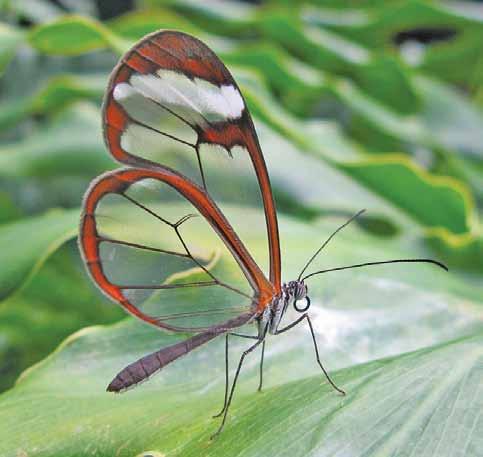
The Glasswing butterfly (Greta oto) receives its name from its mainly glasslike wings due to the lack of coloured scales in its tissues like other butterflies. The opaque dark brown borders of its six-cm-width wings may be tinged with red or orange.
The glasswing is native to Central America and some parts of South America, and has been seen in Florida in North America. They are also kept in enclosures in Europe.
Its caterpillar feeds on highly toxic flowers from a certain type of plant species that makes them toxic and unpalatable to predators, and adults usually feed on flowers from the lantana species or Aster flowers.
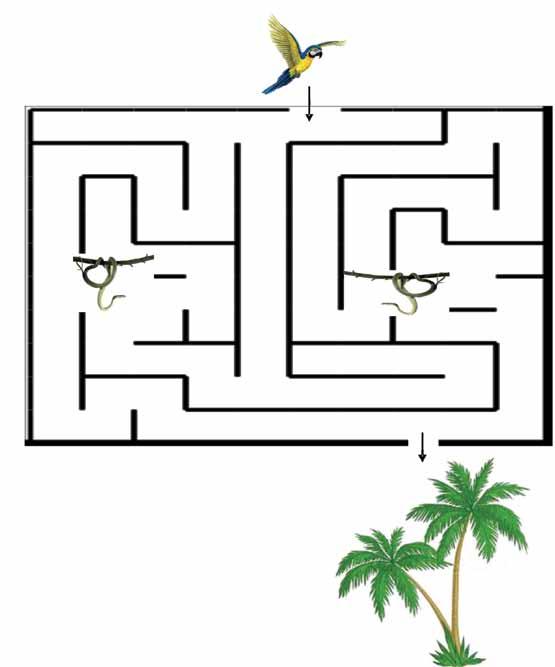
Only 2 of these pictures are identical. Can you find the matching pair?

The objective of the game is to fill all the blank squares in a game with the correct numbers. Every row of 9 numbers must include all digits 1 through 9 in any order. Every column of 9 numbers must include all digits 1 through 9 in any order. Every 3 by 3 subsection of the 9 by 9 square must include all digits 1 through 9.
When the Spanish first saw glasswing butterflies in the America tropics they called them espejitos, which means “little mirrors”.
The glasswing butterfly appears to have four legs instead of the usual six seen on butterflies. But the first two legs are very small and used only to smell and taste.
There are also African and Australian glasswing butterflies but they are not transparent like Greta oto

Gandhi spent much of his life working to remove British rule from India and to improve the lives of India’s poorest classes.
Famous as the father of the Indian independence movement, Gandhi spent 21 years in South Africa fighting discrimination against Indians. His nonviolent philosophy became a model for later civil rights leaders. Gandhi was a spiritual leader as well as a political one, and the people of India sometimes called him Mahatma (The Great Soul). He was also affectionately and respectfully known as Bapu (father).
Mohandas Karamchand Gandhi was born in 1869 into a middleclass Hindu family in Porbandar, a small town on the western coast of India. His father, Karamchand Gandhi (1822–1885), was the chief minister of Porbandar and a member of the Rajasthanik Court.
In 1883, at the age of 13, Gandhi was married (in an arranged marriage — as custom dictates in India). Gandhi’s bride, Kasturba Makhanji, was the only daughter of wealthy merchants. Kasturba and Gandhi had four sons.
In 1888, at the age of 19, Gandhi moved to England to study Indian law. Three years later, after passing the bar, Gandhi returned home to India, where he set up a law practice in Bombay, now known as Mumbai. The practice failed (possibly because Gandhi was too shy to speak well in court) and in 1893, Gandhi accepted a job in South Africa with Dada Abdullah & Co.
When Gandhi arrived in South Africa at age 24, the Indians who lived there (mostly Hindus) had no legal rights. The European colonialists did not consider Hindus to be full human beings and referred to them as “coolies.” Gandhi became a leader of the Indian community and spent 21 years working to end the injustices seen there.

As he returned to India, Gandhi gave up Western customs and for the rest of his life followed traditional Hindu ways, practicing austerity and selfdenial. He dressed simply, in a loin cloth and shawl, and had no other material possessions. (Gandhi had always been a vegetarian.)
During the Boer War (1899–1902), in an effort to prove racial equality, Gandhi organized an ambulance corps for the British. He used journalism as a way to communicate his ideas of nonviolent civil disobedience, which he called “satyagraha.”
In 1915, Gandhi (age 46) returned to India permanently. Here he led campaigns to ease poverty and create friendships between religious and ethnic groups. He worked to help India increase its economic self-reliance and to achieve Swaraj— the independence of India from British domination.
When it Happened — a brief time line
1869: Mohandas Gandhi is born on October 2, in Porbandar, India.
1883: Gandhi marries Kasturba Makhanji.
1885: Gandhi’s father dies.
1888: Gandhi goes to England to study law.
Gandhi at age 33
1891-1893: Gandhi returns to India and begins to practice law.
1893: Gandhi accepts a job in South Africa.
1894: Gandhi founds the Natal Indian Congress in South Africa.
1903: Gandhi opens a law office in Johannesberg, South Africa.
The Indian Independence Act 1947 ended the British Indian Empire and created the states of India and Pakistan, divided according to religious demographics. Millions of people were displaced and violence erupted. Gandhi was horrified as he had been hoping for a unified Hindu and Muslim India. The partition created an atmosphere of hostility and unease between the two nations that continues today.
On January 30, 1948, Gandhi (age 78) was assassinated at a prayer meeting. The killer was a Hindu fanatic who blamed Gandhi for the partition.
By
Mohandas Gandhi (1869–1948) Some people believe that many of Gandhi’s views held India back from progress and industrialization.
Gandhi’s death was mourned nationwide. More than 2 million people joined the funeral procession. His ashes traveled across India, and most were poured into rivers.
1915: Gandhi returns to India and receives a hero’s welcome.
1919: Amritsar Massacre — British troops kill Indian protesters.
1906: Gandhi organizes his first protest against anti-Indian laws in South Africa.
1908: Gandhi is jailed (twice) in South Africa.
1909: Gandhi goes to London, pushing for rights of South African Indians.
1922: Gandhi is arrested for sedition.
1922-24: Gandhi remains in prison.
1924-1928: Gandhi avoids politics.
Gandhi explained the meaning of satyagraha this way: “Truth (satya) implies love, and firmness (agraha) engenders and therefore serves as a synonym for force. I thus began to call the Indian movement Satyagraha, that is to say, the Force which is born of Truth and Love or nonviolence.”
1942: Gandhi begins nationwide “Quit India” movement.
1944: Gandhi’s wife, Kasturba, dies at age 74.
1930: Gandhi publishes the Declaration of Independence of India.
1931: Gandhi is jailed for breaking India’s Salt Laws.
1932: Gandhi fasts to protest treatment of untouchables.
1934: Gandhi begins the “All Indian Village Industries Association”
1947: Indian independence becomes official, as does the partition into two countries, India and Pakistan.
1948: Gandhi is assassinated by a religious fanatic in Delhi.




Shiloh Fernandez is an American actor born in Ukiah, California, and has Portuguese, Russian Jewish, and British ancestry. Fernandez kicked off his acting career in television when he appeared in “Cold Case”, his first TV show, followed by bit parts in “Drake & Josh” and “Lincoln Heights”. His screen debut came two years later, in 2007, when he landed the role of Edgar in "Interstate" before returning to TV. He landed his first recurring role in "Jericho" as Sean Henthorn in 2006. The series was cancelled after just one series before a campaign by fans saw it return for a second before being cancelled once again. In 2008, he became one of the front-runners to play Edward Cullen after he auditioned for Catherine Hardwicke in her Venice Beach garage, during the casting of “Twilight”. Fernandez was allegedly Hardwicke’s first choice, but it was up to Kristen Stewart who had the last say. Though he lost the Twilight role to Robert Pattinson, Hardwicke liked Fernandez enough to cast him in what would be his first romantic lead, “Red Riding Hood”, opposite Amanda Seyfried. The role became his Hollywood movie breakthrough and he eventually landed his first big break playing a troubled small-town Texas rink manager in the 2010 Sundance hit “Skateland” with “Twilight” alum Ashley Greene. He is best known for his roles in the television series “Jericho” and “United States of Tara”, and the films “Deadgirl”, and the 2013 remake “Evil Dead”, in the lead role.


It's a well-established fact that Justin Bieber is practically allergic to shirts.
The toned, tatted pop singer is often seen topless, on-stage and off, but you'd think that when he gets together with the rest of the Bieber clan for holidays he makes an exception. Nope.
A picture has surfaced from last year's Bieber Thanksgiving dinner in which the singer is serenading his granny and well,
this time he went full commando. According to a photo obtained by TMZ, Bieber played a joke on his grandma at her Toronto home in October 2012 by strutting out with just an acoustic guitar covering Justin and the Biebers.
Bieber had reportedly been staying at his grandma's house during the holiday and slept in on Canadian Thanksgiving morning. When he woke up after the rest of the family was already hanging out, he thought he'd play prank on them and do a naked serenade. The site reported that Bieber walked up to his shocked granny and started freestyling some lyrics about how much he loves her.
She apparently got the joke, but ordered him to hurry up and get his clothes back on.
It might be a bit before we see Bieber, shirt or no shirt. After playing a tour-ending gig in Atlanta on Saturday, Bieber informed fans that he's taking a well-deserved break. Following the gig, where he was joined by buddy Ludacris, Bieber tweeted, "If it was gonna end it ended right. Last show in ATL was epic tonight! Love to my big bro Ludacris for coming thru ... Happy to have a break but already miss the stage, the crew, the team, the band, the dancers, the fans. I love all of u." (MTV)
Are Taylor Swift and Selena Gomez really fighting over Justin Bieber?
Us Weekly reports that Bieber, 19, has "really come between the girls" because "Taylor hates him." Swift's rep has denied the claims. And now Selena is dismissing them as well.
During an appearance Wednesday on CBS's "The Talk," the "Slow Down" singer gushed about her BFF when asked a question about if she still gets excited hearing her own songs on the radio.
"Last month I was with my best friend Taylor Swift -- she's one of the most incredible sweet people ever -and we were in the car, she just picked me up from the airport," the 21-year-old recalls. "And my song came on and we freaked out and then her song came on and we freaked out. We were


just, like, dancing in the car. She was like, 'People probably think we're so lame,' but we get so excited to hear our songs on the radio. It's a good feeling. That's why we're friends though to be honest."
Gomez talked about how neither she, nor Swift, 23, loses delight in the little things.
"We were actually just talking earlier. If it's not fun anymore, don't do it, you know?" she said.
Bieber's on-again, offagain flame also spoke about how she and Taylor still do
whatever they want to do in public, regardless of what others may think.
"First things first, we don't roll with an entourage," she explained. "It's a part of what we do we try not to let us affect us. If we want to go to the movies or go shopping we'll do that and if we get stopped, we get stopped."
"You have to find a balance to it I guess," continued Selena. "You have to have people that get it who are around you."
Spoken like a true Disney princess! (Yahoo)
Brown's hit-and-run charge dismissed
Ahit-and-run charge against Chris Brown has been dismissed by Los Angeles Superior Court Judge Christine Ewell after the "With You" singer and the other motorist Olga Kovalenko reached civil compromise. According to TMZ, Kovalenko wanted the case dismissed because the damage was minor.
Los Angeles City Attorney, however, objected, saying that Brown was aggressive towards Kovalenko following the May accident, called her "b*tch" and left the scene. The City Attorney also said that Brown violated his 2009 felony probation, which stemmed from assault case on his thengirlfriend Rihanna.
Brown's attorney Mark Geragos commented on the result of the Thursday, August 15 court meeting, "The case never should have been filed in the first place. It's unfortunate he was being prosecuted for who he is rather than what he's done." The singer wrote on Twitter following the dismissal, "Thank GOD!" and provided a link to the news article. According to Reuters, Brown is scheduled to attend a probation hearing on Friday.
Brown allegedly rear-ended a Mercedes Benz as he went out with Karrueche Tran in May. He was charged with driving without a license, insurance and hit-and-run. The charges caused a judge revoking Brown's probation on June 15.
In late July, two charges against Brown were dropped because the Grammy-winning singer could show his driving license and insurance documents. He turned himself in at a Van Nuys, California jail on August 5 to be officially booked after he pled not guilty during the July court session. (AceShowbiz)
Kate Middleton to resume royal duties in September
Kate Middleton is going to back to work 52 days after giving birth to Prince George. According to Daily Mail, the new mother is set to attend the Tusk Trust Conservation Award alongside Prince William on September 12. Kensington Palace confirmed the plan on Thursday, August 15. A spokesperson said, "It is a long standing engagement."

Prince William as well as his parents are concerned about the life of endangered animals in Africa. He and Harry once visited Africa with their parents as children. The Princes also visited African countries regularly in recent years.
Prince William's passionate effort to raise awareness surrounding issues of endangered animals will be one of the topics which will be discussed in his first interview after becoming a father. The interview is a part of 1-hour special entitled "Prince William's Passion: New Father, New Hope". (AceShowbiz)

Rakul Preet Singh is an Indian film actress and model. She has been an active golf player, playing at a national level. Rakul has been modeling for more than two years prior to entering the Miss India finals. Apart from the Miss India Poll, she won four titles at the pageant including Pantaloons Femina Miss Fresh Face, Femina Miss Talented, Femina Miss Beautiful Smile and Femina Miss Beautiful Eyes. Rakul made her debut in films in the 2009 Kannada film, “Gilli”, a remake of Selvaraghavan's “7G Rainbow Colony”, and won critical acclaim for her role before returning to compete in the Miss India pageant. She subsequently returned to the film industry in 2011 and was featured opposite debutant Siddharth Rajkumar in “Keratam”. The film was simultaneously made in Tamil with the same cast but a different director. In 2012, Rakul starred in the Tamil film “Thadaiyara Thaakka”, playing a supporting role alongside Arun Vijay and Mamta Mohandas. She will be seen opposite Aadi Saikumar in the currently filming Telugu drama, “Rough”.

While Hrithik Roshan-starrer “Krrish 3” will be high on action, Hrithik's fans will get a chance to see their idol as both a superhero as well as romantic avatar. The movie will allegedly show Hrithik smooching Priyanka Chopra in a style similar to “Spiderman”.
According to reports, Hrithik will be hanging upside down while he locks his lips with Priyanka in an intense romantic scene. Sources who have seen the scene being shot say that the scene is similar to the one in which Toby Maguire shares an intense kiss with Kirsten Dunst in “Spiderman”.
Reports suggest that film makers wanted to have an intense kiss between the lead couple. However, they wanted it to be unique and hence they thought of “borrowing” this concept from Hollywood. (Times of India)
Bollywood actor Shahid Kapoor is taking his 'perfectionist' image tad too serious. The actor is allegedly going bald to play Hamlet in Vishal Bhardwaj's adaptation of Shakespeare's popular tragedy “Hamlet”.
Sources reveal that Shahid is leaving no stone unturned to get into the skin of the character. He will allegedly watch the way
Laurence Oliver played the character of Hamlet. This movie will see Shahid playing a very challenging character and will give him a chance to break away from his romantic, chocolate hero image. While Vishal remained unavailable to comment on it, sources close to the actor are not very sure if they will see Shahid going bald for the same. (Times of India)

‘I allow my children to watch all films’- Shah Rukh Khan
When it comes to showing films to children, Shah Rukh Khan is a lenient parent and allows his son Aryan and daughter Suhana to watch all kinds of movies.
The superstar says that he never makes them "shut their eyes to anything". Currently basking in the success of "Chennai Express", Shah Rukh said: "I don't disallow my children to watch any film. They watch everything, but that does not mean that all parents should do that."
"I work in films and I do things in films that might not be right for children to watch, so it is my duty to make sure my children watch all films. I have brought them up in a way where I have never made them shut their eyes to anything," added SRK, who is married to Gauri Khan -- they have three chil-

dren, including surrogate son AbRam.
Talking about "Chennai Express", he said that his daughter has seen the romantic comedy, which has a good dose of action too.
"My daughter saw it, my son is busy playing video games... She really liked it," he said.
Cinema has been often criticised for

propagating bad things and influencing impressionable minds, but Shah Rukh disagrees.
"The access of information now is beyond cinema. If your children become bad, please don't blame cinema. Cinema is a good place, which you can take advantage of. I don't think its impact will be bad on children," said the 47-year-old.
At the same time, the star of hits such as "Darr", "Baazigar", "Kuch Kuch Hota Hai", "Chak De! India" and "Don", feels that the culture of making film for children should be encouraged in the country.
"I think Indians should make a lot more films for children. It is a big and a good market and there should be a lot from films to learn in a fun way," he said. (Hindustan Times)
Kajol finds Shah Rukh Khan's son AbRam ‘cute’
Bollywood actress Kajol finds her actor friend Shah Rukh Khan's newly born baby boy AbRam cute.
The boy was reportedly born on May 27 to a surrogate mother.
"I congratulated him (Shah Rukh Khan) personally and met him as well. He is a very cute baby, blessings and love always,"Kajol told reporters here at an event yesterday.

The actress, known for her memorable performances in films like “Dilwale Dulhania Le Jayenge”, “Gupt”, “Kuch Kuch Hota Hai”, “Fanaa” among others, has cut down on her work post marriage (to actor Ajay Devgn) and babies.
She was last seen in a prominent role in Karan Johar's home production “We Are Family” (2010). Kajol wants to work in films but is waiting for a right offer.
"I am very happy in my life, spending time with children. If I do a film then there has to be a good reason for me to do it as I won't leave my children behind. The script has to be good," Kajol said. (Indian Express)
‘Aamir keen to donate organs’- Kiran
ilmmaker Kiran
FRao, who has taken a pledge to donate her organs, reveals that her actor-filmmaker husband Aamir Khan is also keen to follow in her footsteps.
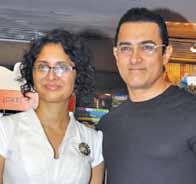
"Aamir is definitely keen to donate his organs as well," Kiran told reporters at an organ donation camp Tuesday. She was present on the occasion along with "Ship Of Theseus" director Anand Gandhi.
She feels that "Ship Of Theseus" spreads the message beautifully. Kiran has released the film in the country in collaboration with UTV Motion Pictures.
"If anyone has seen the film 'Ship Of Theseus', I hope they will definitely be convinced that it's the most beautiful and most logical thing to do," she said.
Kiran, who directed "Dhobi Ghat", would now try her best to encourage the members of the film fraternity, friends and family to go in for organ donation.
"Anyone I will meet, I will definitely discuss it with them. I am not necessarily going to call up the celebrities, tell them and convince them of this cause.
"I don't know whether it is going to be easy for me to talk to all the celebrities and become the ambassador for this (organ donation). I am happy to try, but certainly I would like to encourage friends in the fraternity, people I know and definitely my family to donate their organs," she added. (India Today)
Sometimes you may think you’re doing everything right – brushing twice a day and flossing daily – and yet, tooth decay still sneaks in, leaving your dentist to deliver the news no patient ever wants to hear: You have a cavity.
Now it’s time to treat that cavity. When treating a cavity, your dentist will take many things into account, including your oral-health history; the size and location of the cavity and your preference in materials (i.e. composite resins, amalgam, etc.)
There are also other considerations, such as how the filling would look in your mouth; how long it would last and what your insurance will cover.
Some common dental-filling options include: Composite resins, or toothcoloured fillings, provide good durability and resistance to fracture in small- to mid-size fillings that need to withstand moderate pressure from chewing. They can be used on either front or back teeth.
composites the logical choice. If composites won’t work for a cavity, these patients may decide to spend the extra money for an inlay or dental crown.
Remember: When it comes to having a cavity filled, you have the right to discuss with your dentist how you want your cavity treated. Your dentist’s foremost priority is always your health and safety.
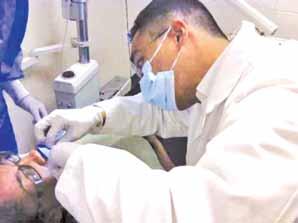
Dental amalgam fillings, also called silver-coloured fillings, are made from a combination of metals that include mercury, silver, tin and copper. This type of filling has been used for more than 100 years and is very durable.
Gold fillings, also called inlays or onlays, are composed of an alloy of gold, copper and other metals. While gold has been used in dentistry for more than 1,000 years, its drawback is that it’s very costly.
Not every filling will work for all cavities. Because of its durability, dental amalgam is often the best choice for large cavities or those that occur in the back teeth where a lot of force is needed to chew. Some patients only want natural-looking fillings, making
Although dental amalgam is a safe, commonly used dental material, you may wonder about its mercury content. You can be assured that not a single credible study has shown dental amalgam to cause adverse health effects except in rare instances of allergic reaction. In fact, the ADA, US Centres for Disease Control and Prevention, US Food and Drug Administration, and World Health Organization all agree that based on extensive scientific evidence, dental amalgam is a safe and effective cavityfilling material. If you suspect you have a cavity or your dentist has diagnosed one, you need to get it treated. Cavities can become serious if they are not treated property or treated early. A filling helps prevent the cavity from growing and spreading in the mouth, becoming an even bigger problem. It can be possible to lose teeth from decay and cavities. Ultimately, the best dental filling is no dental filling. Prevention is the best medicine. You can dramatically decrease your risk of cavities and other dental diseases simply by brushing your teeth twice a day with fluoride toothpaste; flossing daily; eating a balanced diet and visiting the dentist regularly. (Source: Edmond Hewlett, D.D.S. National Spokesperson and Consumer Advisor for the American Dental Association; doctoroz.com)
Nail fungus is a fungal infection in one or more of your nails. An infection with nail fungus may begin as a white or yellow spot under the tip of your fingernail or toenail. As the nail fungus spreads deeper into your nail, it may cause your nail to discolour, thicken and develop crumbling edges — an unsightly and potentially painful problem.
An infection with nail fungus may be difficult to treat, and it may recur. But medications are available to help clear up nail fungus.
There are different classifications of nail fungus — depending on type of fungus and manifestation — which may have somewhat different signs and symptoms.
In general, however, you may have a nail fungal infection — also called onychomycosis (on-i-ko-miKO-sis) — if one or more of your nails are:
Thickened
Brittle, crumbly or ragged
Distorted in shape
Dull, with no lustre or shine
A dark colour, caused by debris building up under your nail
Infected nails also may separate from the nail bed, a condition called onycholysis. You may feel pain in your toes or fingertips and detect a slightly foul odour.
Once a nail fungal infection begins, it can persist indefinitely if not treated. See your doctor at the first sign of nail fungus, which is often a tiny white or yellow spot under the tip of your nail.
Nail fungal infections are typically caused by a fungus that belongs to a group of fungi called dermatophytes. But yeasts and molds also can be responsible for nail fungal infections. What are fungi?
Fungi are microscopic organisms that don't need sunlight to survive. Some fungi have beneficial uses, while others cause illness and infection.
All of these microscopic organisms live in warm, moist environments, including swimming pools and showers. They invade your skin through tiny visible or invisible cuts or through a small separation between your nail and nail bed. They can cause problems only if your nails are continually exposed to warmth and moisture — conditions perfect for
the growth and spread of fungi.
Toenails vs. Fingernails
Nail fungus occurs more in toenails than in fingernails. Toenails often are confined in a dark, warm, moist environment inside your shoes — where fungi can thrive. Diminished blood circulation to the toes as compared with the fingers makes it harder for your body's immune system to detect and eliminate the infection.
Risk factors
Aging is the most common risk factor for nail fungus for several reasons including diminished blood circulation; more years of exposure to fungi. Nails may grow more slowly and thicken with age, making them more susceptible to infection, and the fungi tend to affect men more often than it does women, particularly those with a family history of this infection.
Other factors that can increase your risk of developing nail fungus include perspiring heavily; working in a humid or moist environment; having the skin condition psoriasis; wearing socks and shoes that hinder ventilation and don't absorb perspiration; walking barefoot in damp public places, such as swimming pools, gyms and shower rooms; having a minor skin or nail injury, a damaged nail, or another infection or having diabetes, circulation problems or a weakened immune system.
Nail fungus can be painful and may cause permanent damage to your nails. It also may lead to other serious infections that can spread beyond your feet if you have a suppressed immune system due to medication, diabetes or other conditions.
Fungal infections of the nail pose the most serious health risk for people with diabetes and for those with weakened immune systems, such as people with leukaemia or AIDS or organ transplant recipients.
If you have diabetes, your blood circulation and the nerve supply to your feet can become impaired. You're also at greater risk for cellulitis, a potentially serious bacterial skin infection. Therefore, any relatively minor injury to your feet — including a nail fungal infection — can lead to a more serious complication, requiring timely medical care. See your doctor immediately if you suspect nail fungus.
(Source: mayoclinic)




Walk-in-closets respond to various needs and wishes whether they are small, long and narrow with floor-to-ceiling storage, or large, roomy spaces with plenty of different storage areas built from beautiful furniture elements...



Method:
In a large pan, heat the butter over a medium heat and cook the onions until they soften and brown. Add 50 ml of the stock; reduce heat and continue cooking for about 20 minutes. Add more stock each time the onions run out of liquid to prevent burning.
Stir in the flour and cook for another minute, add the wine and let it simmer until reduced by about half.
Stir in the remaining stock, tomato puree and vinegar, then, simmer for 5 minutes. Season to taste and keep warm on lowest heat.

To make the patties, in a large bowl, mix together all the ingredients apart from the oil. This is easiest with a fork or your hands. Shape into four oval patties.
Heat the olive oil in a frying pan and cook them for about 3 minutes each side. Pour the gravy over them and simmer for about 10 minutes. Makes 4
Ingredients: 1 box Betty Crocker® SuperMoist® lemon or yellow cake mix ¼ cup butter or margarine, softened 3 eggs
1
(8

Method:
Heat oven to 350°F, (325°F for dark or non-stick pan). In large bowl, beat dry cake mix, butter and 1 of the eggs with electric mixer on low speed until crumbly. Press in bottom of ungreased 13x9-inch pan. In medium bowl, beat cream cheese with electric mixer on medium speed until smooth. Gradually beat in powdered sugar on low speed. Stir in lemon peel and lemon juice until smooth. Reserve
mixture on medium speed until blended. Spread over cake mixture.
Bake bars 23 to 28 minutes or until set. Cool completely, about 1 hour. Spread with reserved cream cheese mixture. Refrigerate about 3 hours or until firm. For bars, cut into 8 rows by 6 rows. Store covered in refrigerator.
Take the given words, and by moving a single letter from one word to the other, make a pair of synonyms, or near synonyms. For example, given: Boast - Hip, move the 's' from 'Boast' to 'Hip' creating two synonyms: BoatShip.






By Hans CHristian andersen
(Continued from Aug 11)
'Test yourself, and if you are not strong enough, go back with the Eastwind who brought you. He is going away now, and will not come back for a hundred years; the time will fly in this place like a hundred hours, but that is a long time for temptation and sin. Every evening when I leave you I must say, "Come with me," and I must beckon to you, but stay behind. Do not come with me, for with every step you take your longing will grow stronger. You will reach the hall where grows the Tree of Knowledge; I sleep beneath its fragrant drooping branches. You will bend over me and I must smile, but if you press a kiss upon my lips Paradise will sink deep down into the earth and it will be lost to you. The sharp winds of the wilderness will whistle round you, the cold rain will drop from your hair. Sorrow and labour will be your lot.'
'I will remain here!' said the Prince.
And the Eastwind kissed him on the mouth and said: 'Be strong, then we shall meet again in a hundred years. Farewell! Farewell!' And the Eastwind spread his great wings; they shone like poppies at the harvest time,
or the Northern Lights in a cold winter.
'Good-bye! Good-bye!' whispered the flowers. Storks and pelicans flew in a line like waving ribbons, con-
will see me beckon to you and cry, "Come with me", but do not come. I have to repeat it every night for a hundred years. Every time you resist, you will grow stronger,
ducting him to the boundaries of the Garden.
'Now we begin our dancing!' said the Fairy; 'at the end when I dance with you, as the sun goes down you
and at last you will not even think of following. To-night is the first time. Remember my warning!'
And the Fairy led him into a large hall of white

transparent lilies; the yellow stamens in each formed a little golden harp which echoed the sound of strings and flutes. Lovely girls, slender and lissom, dressed in floating gauze, which revealed their exquisite limbs, glided in the dance, and sang of the joy of living—that they would never die—and that the Garden of Paradise would bloom forever.
The sun went down and the sky was bathed in golden light which gave the lilies the effect of roses; and the Prince drank of the foaming wine handed to him by the maidens. He felt such joy as he had never known before; he saw the background of the hall opening where the Tree of Knowledge stood in a radiance which blinded him. The song proceeding from it was soft and lovely, like his mother's voice, and she seemed to say, 'My child, my beloved child!'
Then the Fairy beckoned to him and said so tenderly, 'Come with me,' that he rushed towards her, forgetting his promise, forgetting everything on the very first evening that she smiled and beckoned to him.
The fragrance in the scented air around grew stronger, the harps sounded sweeter than ever, and it seemed as if the millions of smiling heads in the hall where the Tree grew nodded and sang, 'One must know everything. Man is lord of the earth.' They were no longer tears of blood which fell from the Tree; it seemed to him that they were red shining stars.
'Come with me, come with me,' spoke those trembling tones, and at every step the Prince's cheeks burnt hotter and hotter and his blood coursed more rapidly.
'I must go,' he said, 'it is no sin; I must see her asleep; nothing will be lost if I do not kiss her, and that I will not do. My will is strong.'
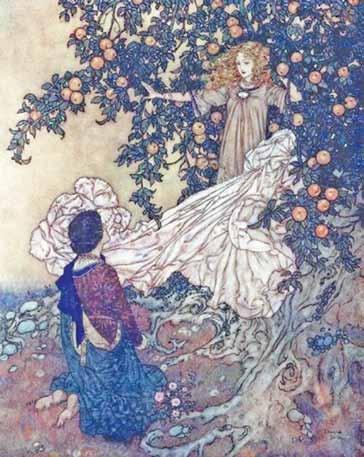
The Fairy dropped her shimmering garment, drew back the branches, and a moment after was hidden within their depths.
'I have not sinned yet!' said the Prince, 'nor will I'; then he drew back the branches. There she lay asleep already, beautiful as only the Fairy in the Garden of Paradise can be. She smiled in her dreams; he bent over her and saw the tears welling up under her eyelashes.
'Do you weep for me?' he whispered. 'Weep not, beautiful maiden. I only now understand the full bliss of Paradise; it surges through my blood and through my thoughts. I feel the strength of the angels and of everlasting life in my mortal limbs! If it were to be everlasting night to me, a moment like this was worth it!' and he
kissed away the tears from her eyes; his mouth touched hers.
Then came a sound like thunder, louder and more awful than any he had ever heard before, and everything around collapsed. The beautiful Fairy, the flowery Paradise sank deeper and deeper. The Prince saw it sink into the darkness of night; it shone far off like a little tiny twinkling star. The chill of death crept over his limbs; he closed his eyes and lay long as if dead.
The cold rain fell on his face, and the sharp wind blew around his head, and at last his memory came back. 'What have I done?' he sighed. 'I have sinned like Adam, sinned so heavily that Paradise has sunk low beneath the earth!' And he opened his eyes; he could still see the star, the faraway star, which twinkled like Paradise; it was the morning star in the sky. He got up and found himself in the wood near the cave of the winds, and the mother of the
winds sat by his side. She looked angry and raised her hand.
'So soon as the first evening!' she said. 'I thought as much; if you were my boy, you should go into the bag!'
'Ah, he shall soon go there!' said Death. He was a strong old man, with a scythe in his hand and great black wings. 'He shall be laid in a coffin, but not now; I only mark him and then leave him for a time to wander about on the earth to expiate his sin and to grow better. I will come sometime. When he least expects me, I shall come back, lay him in a black coffin, put it on my head, and fly to the skies. The Garden of Paradise blooms there too, and if he is good and holy he shall enter into it; but if his thoughts are wicked and his heart still full of sin, he will sink deeper in his coffin than Paradise sank, and I shall only go once in every thousand years to see if he is to sink deeper or to rise to the stars, the twinkling stars up there.' (THE END)

A nightingale, that all day long Had cheered the village with his song, Nor yet at eve his note suspended, Nor yet when eventide was ended, Began to feel, as well he might, The keen demands of appetite; When, looking eagerly around, He spied far off, upon the ground, A something shining in the dark, And knew the glow-worm by his spark; So, stooping down from hawthorn top, He thought to put him in his crop.
The worm, aware of his intent, Harangued him thus, right eloquent: “Did you admire my lamp,” quoth he, “As much as I your minstrelsy, You would abhor to do me wrong, As much as I to spoil your song; For ’twas the self-same power divine, Taught you to sing and me to shine; That you with music, I with light, Might beautify and cheer the night.” The songster heard his short oration, Released him, as my story tells, And found a supper somewhere else.
William Cowper
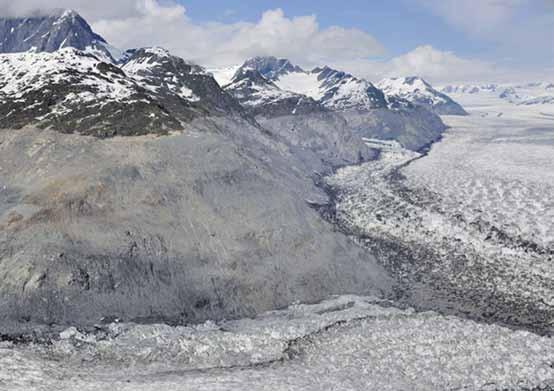
view of Columbia glacier in alaska. the trimline (seen on the slope to the right) shows the deflation of the ice mass of the Columbia Glacier since 1984. Greenish snow-covered vegetation is above the trimline and uniform gray rock is below the trimline. In 1984, the glacier was 1300 feet (400m) thicker than it was at the time this picture was made in June, 2006; the height of deflation is equivalent to the height of the Empire State Building
The Extreme Ice Survey (EIS) is an innovative, long-term photography project that merges art and science to give a “visual voice” to the planet’s changing ecosystems.
In 2005, internationally acclaimed nature photojournalist James Balog travelled to Iceland to photograph glaciers for The New Yorker.
Why do glaciers matter?
This led to a 2006 National Geographic assignment to document changing glaciers in various parts of the world. In the course of shooting that story (which became the June 2007 cover story, “The Big Thaw”), Balog, who, in addition to being a photographer is a mountaineer with a graduate degree in geomorphology, rec-
The melting fresh water from glaciers alters the ocean, not only by directly contributing to the global sea level rise, but also because it pushes down the heavier salt water, thereby changing what scientists call the THC, or Thermo (heat) Haline (salt) Circulation, meaning currents in the ocean. This has an immediate effect on the near region, such as the north Atlantic off the coast of Greenland, but ultimately the impacts can ripple far beyond the immediate area and climate.
Ice that took centuries to develop can vanish in just a few years. A glacier doesn’t melt slowly and steadily like an ice cube on a table. Once glacial ice begins to break down, the interaction of meltwater and sea water with the glacier’s structure can cause increasingly fast melting and retreat. Today, Earth’s surface is made up of 71 percent water, 10 percent ice and 19 percent land. Most of the world’s ice is in the Arctic and Antarctic, but some of it is scattered around Earth in the form of mountain glaciers.
Water not only expands when frozen, but also when heated, and it is estimated that in the 21st century the melting of ice caps and glaciers combined with the thermal expansion of ocean water will cause an average increase of sea level of roughly a meter (a bit more than one yard). That’s an average; in some places it will rise more and in others less, in part because (as we now know through satellite measurements) sea level itself varies, bulging in some places and slumping in others.
As the planet’s air conditioner, the polar ice caps impact weather and climate dynamics, such as the jet stream. Glaciers are also early indicators of climate changes that will have a somewhat more delayed impact on other parts of the Earth system. Glaciers are sentinels of climate change. They are the most visible evidence of global warming today. In addition to raising sea water levels, widespread loss of glaciers will likely alter climate patterns in other, complex ways. For example, glaciers’ white surfaces reflect the sun’s rays, helping to keep our current climate mild. When glaciers melt, darker exposed surfaces absorb and release heat, raising temperatures. Our way of life is based on climate as we know it. (Source: EIS website)
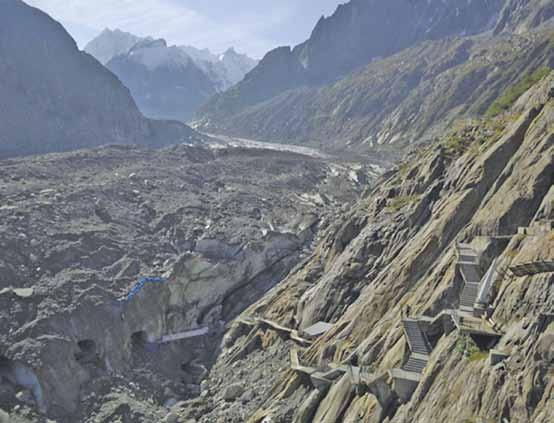
Seeing is believing
ognized that extraordinary amounts of ice were vanishing with shocking speed. Features that took centuries to develop were being destroyed in just a few years or even just a few weeks. These changes are the most visually dramatic and immediate manifestations of climate change on our planet today.
Real-world visual evidence has a unique ability to convey the reality and immediacy of global warming to a worldwide audience. Founded in 2007 by James Balog, The Extreme Ice Survey provides scientists with basic and vitally important information on the mechanics of glacial melting and educates the public with firsthand evidence of how rapidly the Earth’s climate is changing. EIS is a voice for land-
scapes that would have no voice unless we humans give them one.
EIS imagery preserves a visual legacy, providing a unique baseline—useful in years, decades and even centuries to come—for revealing how climate change and other human activity impacts the planet.
Guided by the recommendations of glaciologists, in 2007 the EIS team installed its time-lapse cameras at sites that represent regional conditions and have high scientific value.
One aspect of EIS is an extensive portfolio of single-frame photos celebrating the beauty–the art and architecture–of ice. The other aspect of EIS is timelapse photography; currently, 28 cameras are deployed at 13 glaciers in Greenland, Iceland, the Nepalese Himalaya, Alaska and the Rocky Mountains of the U.S. Plans to expand the EIS camera network into South America and Antarctica are currently underway. (Source: EIS website)

In recent years, many pros have started feeling like Apple’s jilted girlfriend. Through no fault of their own, the love just seemed to fade.
Apple might claim otherwise when confronted, but the telltale signs have been hard to ignore:
Mac Pro: Apple’s most powerful Mac has been agonizingly slow in the update department. It hasn’t changed physically in eons (though it’s about to). Ironically, the one Mac targeted specifically at the pro user remains the only Mac without a high-speed Thunderbolt connection. Even the Mac mini has had Thunderbolt for more than two years.
17-inch MacBook Pro : This big-screen laptop was a favourite and a necessity for designers and video editors who needed that much real estate to be their mobile best. Then, poof!
Final Cut Pro : When the long-awaited update to Apple’s high-end video editing suite finally appeared, it lacked certain features critical for pro editors: multi-cam editing, EDL support, backward compatibility and more. You could say the pro editing community was speechless— but it wasn’t. The cries of anguish were long and loud.
Aperture : The latest version
was released in February 2010. Yes, that’s 3.5 years without a major update. Even if you consider this misleading, the perception of stagnation is a natural result when Aperture’s competitor, Adobe Lightroom, continues to evolve visibly.
Could it possibly be? Would Apple ever even think about saying goodbye to the pro market? I hope you’re sitting down for this, but Steve Jobs did in fact once consider that very op tion.
This was back in the days when iMac had es tablished it self as a glob al bestseller. During one of the agency’s regular meet ings with Steve, he shared that he was considering killing the pro products. His rationale was as you might expect: consumer products have an unlimited upside, while pro products are
aimed at a niche market that eats up major resources.
Obviously, the pro mar ket has value for Apple, even if its numbers are relatively small. Pros are opinion leaders, influencers and evangelists. Their love of Apple shows up in the purchase decisions of friends, family and colleagues. So Steve ulti-

tals and build something better.
As a result, Apple does lose some customers. But it keeps a core group of pros happy by pushing the boundaries. At the same time, it invites a larger audience of high-end consumers who can suddenly understand, enjoy and benefit from the app.

mately renewed his commitment to the pros—but he never said that this commitment wouldn’t evolve.

Clearly Apple has changed its thinking about the pro market, and how it can best serve its pro users. Some won’t like it, but basically it’s the difference between Final Cut Pro 7 and Final Cut Pro X. In FCP7, the controls are rich and deep. As a consequence, getting proficient with the app is a serious undertaking. FCPX is very powerful, but less daunting and more seductive — streamlining and automating some of its advanced capabilities. For a lot of pros, this represents a dumbing down of FCP. In this way of thinking, FCP is evolving into “iMovie Pro.”
But one must be careful to separate two very different issues. First, there is the feature set of the app itself. Then there’s the bigger issue of where video editing is headed. Clearly Apple would
The new Mac Pro, coming later this year, embodies a similar philosophy. It’s “user-friendly” in the way it’s designed, with expandability via Thunderbolt rather than internal slots and bays. Simply attach whatever you need and you’re in business. It sends an encouraging message to the pro market that Apple has not forgotten them. More than an update, it’s a reinvention of one of the oldest computer categories. It’s something that only Apple would do. The new Mac Pro does bring back memories of the Power Mac G4 Cube. That computer also sur-
prised people with its visual design — and ended up being pulled from the market in a year. But the Cube was a consumer product priced too high. The Mac Pro is a pro product that should be worth its price.
Will every pro user love the new Mac Pro? Nope. We’ll no doubt hear grousing that with its new cylindrical shape, the Mac Pro is virtually impossible to rack-install. Or that sacrificing internal options is a non-starter. For those people, Apple is still walking away from the pro market. In truth though, Apple is walking to a place that’s entirely new — and asking the pros to walk with them. They’re betting that people who love to create and innovate will appreciate a super-powerful computer designed in the same spirit.
Ah, but there does still remain the matter of the vanishing 17-inch MacBook Pro. Unless you believe that in the future pros will suddenly prefer working on smaller screens, it’s hard to see this as a positive development.
Of course, all will be forgiven if that little baby were to come back – all nice and Retina-ized…

Microsoft announced this week that Ubi Interactive is now taking orders for software that works with the Kinect to instantly turn nearly any surface into a touch screen. Ubi Interactive showed off an early prototype version of the software as part of the Microsoft Kinect Accelerator program last year, and it's now ready for primetime.
"By making it possible to turn any surface into a touch screen, we eliminate the need for screen hardware and thereby reduce the cost and extend the possibilities of enabling interactive
displays in places where they were not previously feasible—such as on walls in public spaces," Ubi Interactive CEO Anup Chathoth said in a statement. "Our technology has implications of revolutionizing the way people live their lives on a global level."
According to the company's support documentation, the software cannot be used on reflective surfaces, which makes the interface controller an interesting alternative to the glossy touch screens many of us have become accustomed to on the latest tablets.
The basic Ubi Interactive software
package, which supports screens up to 45 inches, is selling for $149, while the professional version supports screens up to 100 inches and sells for $379. The company is also selling an enterprise version for $1,499.
In addition to the software and a flat surface, users will also need to purchase a Kinect for Windows sensor, which sells for $249.99. But when you consider that for just a little more than $500 you can begin using your own Minority Report-style display, suddenly the entire package seems like a bargain. (PCMag)

he late Aubrey Williams has significantly placed himself as a celebrated Guyanese artist among prominent international artists. His work is valued worldwide, and although he has passed on, his legacy still lives.
in London with a unique visual and intellectual vocabulary. Over the following years he took the opportunity to travel extensively around Europe, returning to London and to opportunities to exhibit his work.
He was also part of the
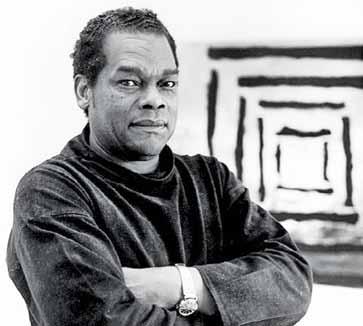
Williams was born in Guyana in 1926, and began painting and drawing from the age of five. He joined the Working People’s Art Group while still at school, studying under E. R. Burrowes, a man he credited as “opening the Guyanese eyes to art.”
A trained agronomist, Williams’ work took him to the north-west rainforests of Guyana, where he lived for two years among the indigenous Warrau people, a pe-
spectacular explosion of creativity, optimism and productivity generated by the influx of Caribbean writers, artists and intellectuals to London at the time. This cultural foment was exemplified in the Caribbean Artists Movement (CAM), founded in 1966 by poet and historian, Kamau Braithwaite; poet and activist John La Rose, and novelist and journalist Andrew Salkey.
Williams was a found-
art establishment. Over the years that followed however, Williams found himself increasingly confronted by ‘institutional indifference’, his work framed and discussed solely in terms of ‘otherness’.
By the late 1950s and 1960s, Williams was winning acclaim in the UK for his abstract canvases.
During the 1970s and 1980s, he worked and exhibited regularly overseas, in Jamaica, Guyana and Florida. By the early 1980s, he had completed a series of luminous abstract paintings based on the music of Shostakovich.
The subsequent “OlmecMaya” series drew deeply on his broad knowledge of historic Central and South American cultures. He broke the artistic norms of the time by merging representational elements within abstract painting.
His paintings have always resisted classification, evolving through many distinct phases over the course of his career. From immaculately accomplished depictions of birds, to figurations, to explosive, vibrant abstracts, Williams drew influence from abstract expressionism, from Olmec, Maya, and Warrau imagery, from science fiction, from the symphonies and quartets of Russian composer Dimitri Shostakovich, and from artists such as Jackson Pollock, Arshile Gorky, Diego Rivera,

riod which proved one of the most formative of his life and where he said, “I started to understand what art really is.”
By 1952, when he returned to Georgetown at the age of 26, Guyana was nearing the end of its time as a British colony and Williams sailed to London, initially on six months paid leave, to become a painter, and began life drawing at St Martin’s School of Art.
As a painter with detailed knowledge of flora and fauna, with personal experience of momentous political change, and with a growing interest in pre-Columbian cultures, he arrived
er member and participated fully in CAM’s activities, as did sculptor Ronald Moody. Within this mutually supportive network, Williams founded, and contributed to an enriching framework of ideas and discussion, including debates on visual sources, strategies for change, and the stifling effects of being categorised as either a quintessentially Caribbean or British artist.
When Williams had arrived, London was a city with few apparent signs of a black presence, and as such, the visibility of Williams’ work represented one of the first challenges to the white dominance in the British
Yves Klein and Rufino Tamayo.
Williams was a visionary artist far ahead of his time, and his work expresses the urgency of his concerns about the destruction of the global ecological balance by far predating our current rudimentary realisation as to the complexity of the problems we face. Speaking of his art’s relevance to “the anxieties and tragedies of our time” in 1978, he said:
“I know that the sea is now 38 percent polluted. We live off the sea, and we can’t now turn the clock back. It’s getting worse every day. Our resources of oxygen are shrinking, and it can’t be re-
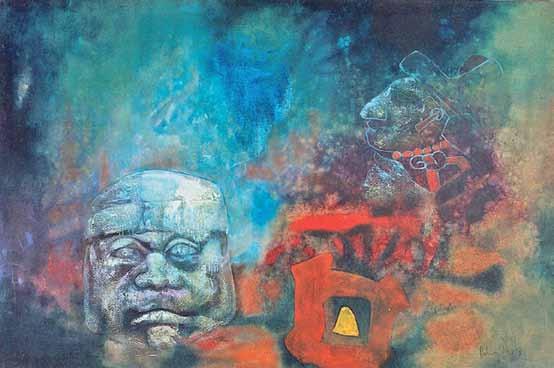
produced. We have now also punctured the last source of oxygen, which is the South American Selvas [forests] by building that stupid road through the Amazonas. We have done colossal ecological damage… Pollution is beyond our ability to reverse. Cosmic rays’ bombardment is growing and we have no shield against its harmful effects, so leukaemia will become like a common cold. We are seeing the terrible catastrophes of man-made diseases. All these anxieties inform my work all the time. My work is only important when people realise these things from it.”
In a post-Copenhagen Summit world, Williams’
concerns remain all the more prescient, considering they were voiced over 30 years ago. These vital concerns inform all of his work from his painterly musings on the destruction of the Mesoamerican Olmec, Maya, and Toltec cultures, to the beautifully depicted visions of the natural world seen in his “Cosmos” canvases– breathtaking pictures of galaxies against the inky darkness of the night skies–and his brilliant portraits of birds, some of which are on the brink of extinction.
In the UK, Aubrey Williams’ work has been exhibited at the Whitechapel Gallery, the Royal Festival Hall, the Commonwealth
Institute and the Hayward Gallery. Of note is the October Gallery, UK, which has represented Williams work since 1984. But it was not until after his death in 1990 that a major retrospective of his work was held in 1998 at the Whitechapel Art Gallery, so serving to confirm his unique place in British art history. Additionally, his work is represented in major public and private collections throughout the world. Williams was honoured in Guyana with the award of the Golden Arrow of Achievement in 1970 and then with the Cacique Crown of Honour in 1986. (Excerpted from www.octobergallery.co.uk)

In the grip of a desire for independence from colonial rule and a fervour for a national identity beginning perhaps from the 1940s, a proliferation of patriotic poetry flowed from the pens of a group of men and women that was made into music over the years leading up to and just after Guyana’s eventual independence.
Few young people are aware of a genre in the country’s musical heritage known as national or patriotic songs, excluding the national anthem, and even fewer can be said to be familiar with the songs and historical figures behind a once vibrant tradition celebrating national identity and patriotic passion.
Walter MacArthur Lawrence
Born January 1896 in Georgetown, Walter MacArthur Lawrence is arguably one of the first poets to express a patriotic enthusiasm with his poem “My Guyana, Eldorado”, which would later be put to music. Many of his poems have entered influential book collections around the world. MacArthur Lawrence died in 1942. Cleveland Hamilton Cleveland Hamilton was a busy legal practitioner who would also excel in his other love: poetry. Late 1969, a competition to select a national hymn to celebrate Guyana’s Republic status was announced that saw the selection of a poem called “Song of the Republic” to be put to music.
Submitted by a Thomas Theophilus Halley, it was the pen name for Hamilton who was concerned about political issues arising since he may have ruffled a few
feathers in the then administration’s side for his outspokenness in a matter. It would take a long while after he was adjudged winner before he stepped forward to claim his place in Guyana’s history. He died Feb. 22, 1991.
Valerie Rodway
Valerie Rodway is perhaps best known for her musical composition pieces set to Vere T Daly’s, “Hymn for Guyana’s Children”; “Arise, Guyana” by J W Chinapen; Walter MacArthur Lawrence’s “O Beautiful Guyana” and “Guyana the Free”, a piece written and composed by herself and second husband James Rodway.
Born Valerie Fraser in New Amsterdam in 1919, she showed an early interest and talent in music, which was nurtured by leading music teachers of the day, and she went on to earn the Licentiate of the Royal College of Music (LRCM). She became a music teacher and one of Guyana’s most
famous composers.
Her other compositions include “Water Music” (words by A J Seymour); “Kanaima”; “Kaieteur” (words by J A Lawrence); “The Weeding Gang” (words by CEJ Ramcharitar-Lalla) and “There Runs a Dream”. She also composed music for Martin Carter’s “Let Freedom Wake Him”.
Valerie Rodway died in 1970. Sr Rose Magdalene
Sister Rose (Magdalene) D’Ornellas was a Sister of the Community of Carmelite Sisters, former Folk Research Officer in the Department of Culture, and social activist in the cultural community of Guyana.
She was born Elaine Mary D’Ornellas on Oct. 30, 1923 and joined the Carmelites in Trinidad on Jan. 10, 1946. She was assigned to the St Bernadette’s Hostel for Girls at Lamaha Street, Georgetown Guyana in 1950.
It was while she later taught both academics and music at the St Mary’s Junior School in New Amsterdam that her talent in teaching and music stood out. She founded The Marigold Choir, a children’s choir, in September 1990, which rose to international recognition.
Sr. Rose Magdalene’s compositions that reflect Guyanese life and nationality include, “The Berbice Ferry”, “The Golden Arrowhead”, “Children of Guyana”, “The Mango Sellers”, “In an Aeroplane”, “My Kitchen Garden” and “Out of School”.
Initially sent to be in Guyana for six months, she ended up spending almost a lifetime – some 54 years –instead. Sr Rose Magdalene died in Trinidad, where she had returned after retirement, on Apr 25, 2011.
the late Pat Cameron in the 70s to compose something about a boundary dispute that arose, he came up with one of the most famous patriotic songs of modern times in Guyana, “Not a Blade of Grass”, and later, after being inspired by the audience at a Guyana Night performance, wrote, “Is We Own”. There are also several other notable writers and composers of Guyana’s national songs such as M. A. Cossou who penned “My Native Land”; George Noel: “To Serve My Country” and “Treat All Guyanese Equally”; RCG Potter: “Way Down Demerara” and “A Song of Hope”; Frank Daniels who wrote the music to Cleveland Hamilton’s “Song of the Republic”; W. Hawley-Bryant: “The Song of Guyana’s Children”; Hugh Sam: “River Song”; W.R.A. Pilgrim:
Dave Martins
Guyana-born Dave Martins of the Tradewinds fame is often synonymous with what he calls “win’ down music”, but after pleas from
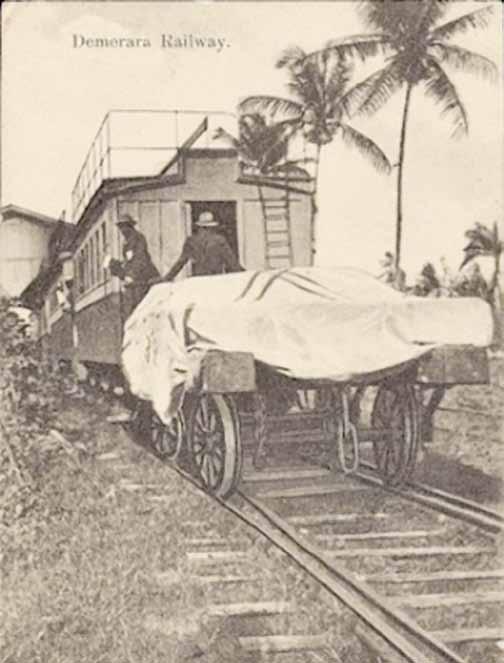
“Let Us Cooperate” and “Salute to Guyana”; Jodina: “Blue-Saki” and “Citizen Man”; Hilton Hemerding: “Beautiful Guyana” and Walter E Hewick: “On The Banks of The Kako River”.



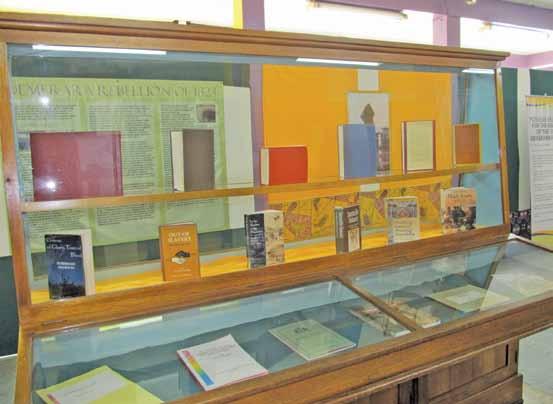
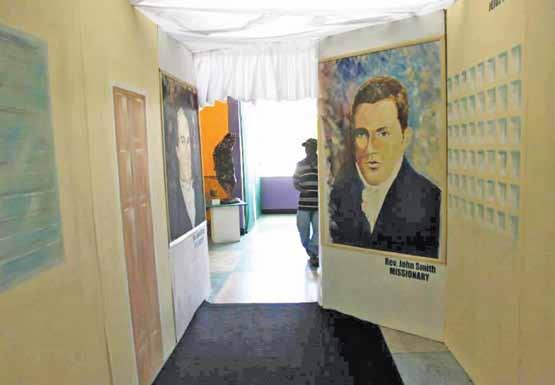
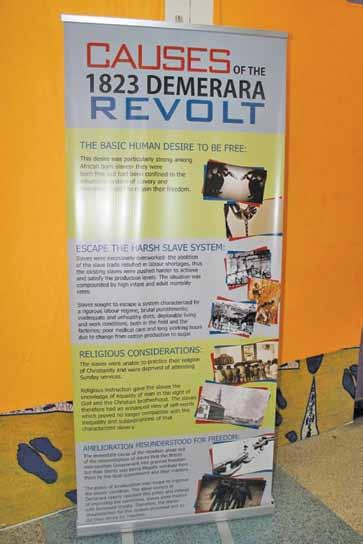

Slave revolt heroes of 1823 are honoured at the recently opened Emancipation exhibition at the National Museum by the Museum of African Heritage in collaboration with the Ministry of Culture, Youth and Sport.
Under the theme ‘Honouring Our Heroes of 1823’, the exhibition, which runs until August 31, highlights the events of the 1823 slave revolt. During the time of this revolt many slaves lost their lives. Bachelor’s Adventure on the East Coast Demerara, was the village to suffer the most, with more than 200 slaves dying.
At the opening of the exhibition, Minister of Culture Youth and Sport Dr. Frank Anthony noted that on August 19
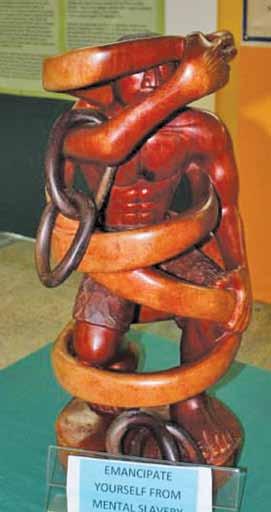
Guyana would be observing 190 years since the rebellion. He added that the exhibition was ideally opened at this time to educate the public since the rebellion has played a significant part in the country’s history.
He made reference to a book titled “Hearing Slaves Speak”, authored by Trevor Bernard, a Jamaican professor. It narrates the lives of Guyanese slaves, and is based on actual stories told by the slaves to a magistrate whose job was to listen to slaves’ complaints.
In the book, Minster Anthony recalled reading a story of a pregnant woman. He stated that because of her physical state she was unable to do the task she was allotted, and as a result
was given several lashes which caused a miscarriage. According to the book, this was among some of the reasons that caused the revolt.
The revolt was led by Quamina, an Africanborn enslaved carpenter and senior deacon of Bethel chapel, Jack Gladstone, a cooper on Plantation Success, Manuel from Plantation Chateau Margot, Seaton from Success, Joseph and Telemachus from Bachelor’s Adventure, and Paris a boat captain of Plantation Good Hope.
The many sculptures, banners, and other informative exhibits will help persons to go back in time and visualize the 1823 heroes’ fight, and the lessons learnt from that rebellion that we can apply in our lives today.

By Melvin Durai
My fiancée, Malathi, to her credit, suggested we have a small family wedding. If I hadn't been so stunned and so naive, I would have not only accepted her offer, but also made her put it in writing. Then I would have had it notarized. And stored it in a waterproof, fireproof, bride-proof safe.
I wanted to have a bigger wedding, because it’s important for me to include all my close friends in my special day, especially since they are likely to bring gifts. How else am I supposed to remember my wedding day?
But I didn’t realize that planning a wedding involves so much work. And I didn’t realize that Malathi would get so carried away with the little details, such as the formal style in addressing invitations and the proper colour of napkins at the reception, rules adopted at the 1927 convention of the Association of Wedding Planners with Nothing Better to Do.
I’m amazed Malathi, in her zeal to get everything right, hasn’t yet told the minister what cologne to wear. I’m also surprised she hasn’t told the guests exactly what clothes to wear. After all, we wouldn’t want one of their haphazardly selected outfits to clash with the bridal gown worn by the figurine atop the wedding cake. That would be sheer disaster. The type of calamity that would make Martha Stewart want to drown herself in the punch bowl.
Men and women obviously approach weddings differently.
Women want to make sure everything is perfect, from the shape of the gown, to the shape of the cake, to the shape of the future mother-in-law.
Men, if they could, would get married in torn jeans and T-shirts, and have the reception at a place called Big Bertha’s Burgers and Wieners. As long as Big Bertha has a liquor license and at least half her front teeth.
Malathi has not only pored over dozens of wedding books, she has grown an antenna that detects anything remotely weddingrelated within 100 miles.
We could be driving past a credit card company's office and she'd say, "We need
to make sure the glasses at the reception aren't plastic." We could be driving past a car wash and she'd say, "We need to make sure all your relatives take baths."
Even the wedding invitations have raised issues and not just with Malathi. For example, my mother wants to invite all kinds of people I’ve never heard of. She claims that I’m related to them, but I don’t believe it. How come they never send me Christmas gifts?
Most of these people live in India, but we need to invite them, just in case the American embassy, in a moment of confusion, grants them visas.
If all my relatives show up, we may have to move the reception from an Indian restaurant to an Indian reservation. With India's population exceeding one billion, I wouldn't be surprised if I'm related to at least 10 million.
Malathi and I picked the reception's menu together. Well, to be precise, I was in the room when she told the restaurant manager what she wanted. I did speak once, asking the manager not to make the food too spicy. On such a happy occasion, I'd hate to kill all my American friends. At least not until I've unwrapped their gifts.
Another issue we've had to tackle is photography. Professional photographers are expensive and often insist on keeping the negatives, while amateurs could make us wish we had just given a camera to Stevie Wonder. (No, my mother hasn't yet invited him.)
Photographs are important, because they capture the smiling bride on the only occasion, in her entire lifetime, she will ever wear that expensive gown. Malathi wants to wear an Indian gown, but hasn't found a reasonably priced one she likes in America.
So instead, she plans to travel to India to select the perfect material and have her mother sew the dress. Her ticket to India will cost more than $1,000, but we will somehow -- don’t ask me to explain this -- end up "saving money."
Since I’m also concerned about wedding expenses, I’m thinking of travelling to India to rent my tuxedo. Maybe I can also pick up the cake and flowers. And meet some of those relatives.
Some friends would do anything to help their best buddy

No more worries
Henry always worried about everything all his life. But one day his co-workers noticed Henry seemed like a changed man. They remarked that he didn’t seem to be the least bit worried about anything.
Henry said he’d hired a professional worrier and no longer had any problems.
“A professional worrier? What does that cost?”
“Twenty thousand dollars a week.”
“Twenty thousand dollars! How on earth are you going to pay him?"
"I’m not worried. That's his problem."
My doorbell rang last weekend. When I pulled it open there was a nice-looking young couple on my porch. The man said, "Good morning, sir. We’re Jehovah’s Witnesses, and we’d like to give you some literature. If you have a minute we’d love to chat with you about our work.”
I wasn’t busy so I invited them in for coffee. When they were settled I asked them what they wanted to tell me first.
The young guy said, "Beats the heck out of me. We never got this far before.”
A mafia boss needed a new accountant. He interviewed several guys for the job by asking one question, “How much is two plus two?”
Only one applicant had the right answer: “How much do you want it to be?”
I was walking down the street and saw a mime pretending to be trapped in a box. He did a great job, so after he finished, I pantomimed putting a dollar in his jar.
Recently my wife and I were sitting in our den together, she was reading and I was watching pro wrestling.
I told her, "In case it ever comes up, I would hate to ever live in a veg etative state, dependent on a machine. If that time ever ar rives, please pull the plug."
She immediately got up and unplugged the TV.
A man is walking down his street and sees a friend sitting in his front yard all alone, looking bummed.
“What’s the matter with you?” he asks.
The friend says, “I screwed up on one of those questions wives ask, and now I am so deep in the doghouse, I’ll never get out.”
“What question?” the first guy asks.
She asked me, “‘When I’m old, fat, and ugly, will you still love me?’ ”
“Heck, that’s easy," the first guy re plies. "You just tell her, “'Of course you will.'”
“Yeah,” says the friend, “that’s what I meant to say. But what came out is “‘Of course I do.’”
Big Game Hunting
Against his better judgment, the big
game hunter is talked into taking both his wife AND her mother along on one of his expeditions.
It does not go well. The mother-in-law is, if anything, harder to get along with in the wilds than she was in the city. And to make matters worse, she won't even abide by the simple camp rules designed to keep the safari safe.
One night after dinner, the hunter's wife realizes her mother is missing. Panicked, she rushes to her husband and begs him to institute a search.
He sighs, and together they set out. But before they've gone far, they hear throaty growling. Soon they come upon a small clearing in which the mother-in-law stands, backed up against thick, seemingly impenetrable jungle brush, and facing a huge male lion.
The wife whispers urgently, "What are we going to do?"
"Nothing whatever," responds her husband. "The lion got himself into this mess, now let him get himself out of it."
Excerpt from the Doggy Dictionary
BATH: A process by which the humans drench themselves while trying to drench you. You can help by shaking vigorously and frequently.
BUMP: The best way to get your human’s attention when he/she is drinking a fresh cup of coffee or tea.
DEAFNESS: A malady that affects a dog when its person wants it to come and the dog wants to continue doing its thing. Symptoms include staring blankly at the person then running in the opposite direction, or lying down.
LEASH: A strap that attaches to your collar, enabling you to lead your person where you want him/her to go.
SNIFF: A social custom to use when you greet other dogs until your person makes you stop.