

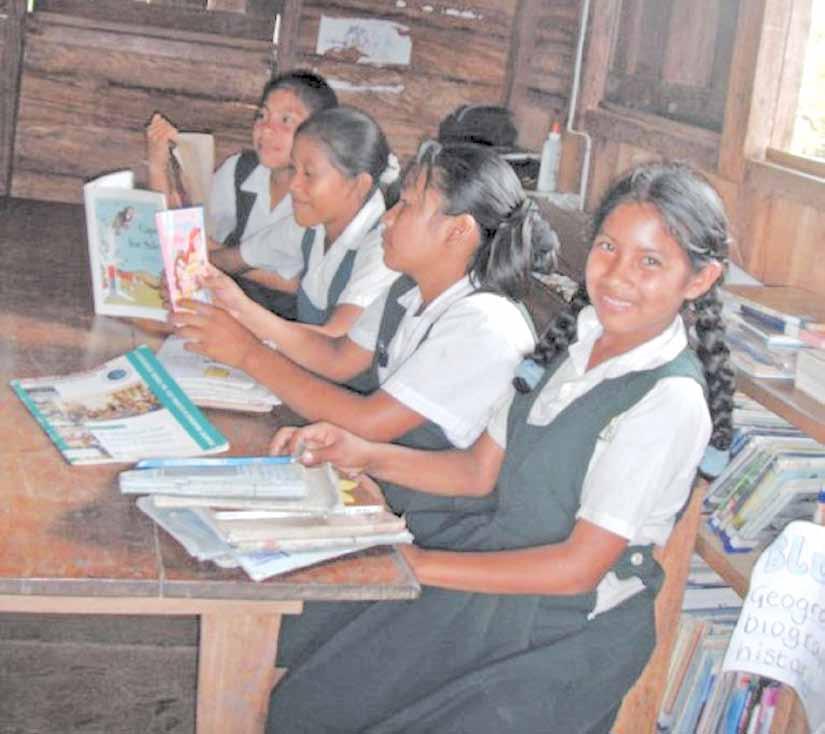


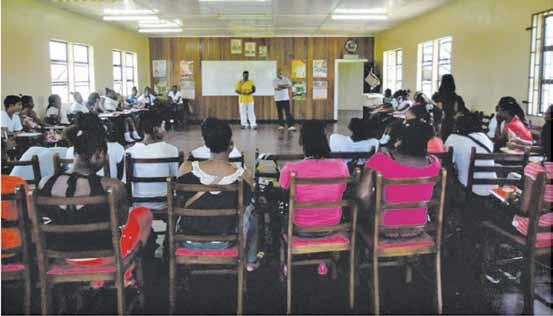
Empowering youths and providing resources for academic success is the aim of the Smythfield Drop-In Centre and Vryman’s Erven Centre in New Amsterdam, Berbice.
The centres are an adolescent-and-youth-friendly space, and offer non-residential vocational training for youths.
At Smythfield, groups of youths up to age 20 that come from surrounding areas participate in short programmes done in collaboration with non-governmental organisations and other social organisations. The nature of these programmes requires no entry-level test; they are primarily practical courses done on a part-time basis. There are several organised social and cultural activities especially in the afternoons, on the weekends and during the school holiday period. At Vrymans Erven, six month courses are run for out-of-school youths in Information Technology and Garment Construction.
The centres host the Youth Entrepreneurial Skills Training Programme (YEST) which became a unit under the Ministry of Culture, Youth and Sport on January 1, 2000. The unit emerged from what was formerly the Guyana National Service, utilizing the resources available to combine skills training and entrepreneurship as one way of enhancing the employment potential of young who have left the for-

mal school system and need to be gainfully occupied.
The programme offers continuing educational advancement to youths who participate in technical vocational skills in the area of Information Technology/ Office Administration for duration of six months. Students are then attached to an agency for a four-week period towards the end of their training. They are also afforded the opportunity to go on an educational tour before the programme is finish.
The programmes’ aim is to help youths become well-
rounded individuals. As such cultural activities, sports, hikes and confidence building activities are part of the curriculum.
In an interview with Guyana Times Sunday Magazine, Omeshwar Sirikishun, Culture, Youth and Sport Officer for Region Six and supervisor for the centres, said the objective of all training is primarily to prepare participants and/ or afford them a second opportunity particularly the out of school youths, for entry into other institutions of learning, employment in private


mentioned 115 youths between the ages of 16-25 were trained in 2013 under YEST, during which students were exposed to practical and theoretical aspects of Information Technology, Office Administration and Cosmetology.
The youth officer pointed out that assessments are done once a month to allow each student enough time to understand and practice the exercise given in the areas covered under the two components. Over the reporting period, students were exposed to a number of other activities such as workshops, tours, and adventures that was organized and implemented by the Department of Culture, Youth and Sports in Region Six.
“The programmes are beneficial to youths because it provides them with an opportunity to earn a life skill. Youth, particularly from
or public sectors, and selfemployment in their communities.
“Recognizing the need for the YEST programme to be expanded because of the regular drop-out of young people from the formal school system, particularly in Region Six, the Ministry of Culture, Youth and Sport, as part of its growing mandate to provide skills training for young people, took the challenge to introduce Information Technology/ Office Administration and Tailoring on March 6, 2008,
at the Smythfield Drop-in Centre. The training is now executed at the Vryman’s Erven Training Centre.
Cosmetology was included in the curriculum in February 2013,” Sirikishun outlined.
The programme runs for a period of six month, and since its inception, 252 persons between the ages of 16–25 have successfully benefitted from the training. Presently, 55 students are on training and would graduate in January 2014.
Noting the success of the programmes, Sirikishun
Angoy Avenues has express gratitude and thank to the Ministry of Culture, Youth and Sport for affording them the opportunity to use the basketball court and all other recreational and education facilities available at the Smythfield Drop In Centre and Vrymans Erven Centre. Also the centres always welcome volunteers from government, NGOs and other social organizations. We now look forward to a fruitful and blessed 2014,” Sirikishun declared.
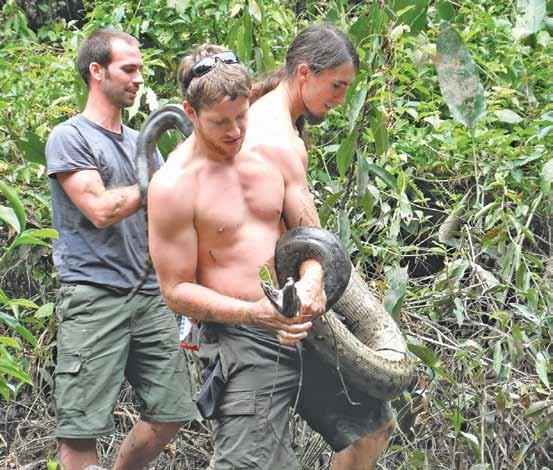
Wading through dirt, swamps and deep creeks in dense forest, searching and documenting Guyana’s rich biodiversity is what U.S. native Andrew Snyder lives for.
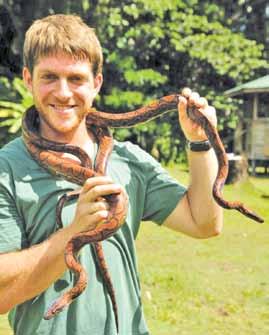
Snyder is a PhD student studying patterns of evolution at the University of Mississippi, where his research focuses on patterns of evolution across Guiana Shield reptiles and amphibians. As an avid photographer, he tries to connect people with the unique organisms found in the ecosystems
Sunday Magazine: Is the research conducted through any organizations?
Andrew: Some of the research that I have conducted in Guyana has been through orga nizations, while other has been solo; though all of the research contributes towards my PhD. Each summer for the last three years I have worked with the group Operation Wallacea, act ing as the team’s her petologist as well as the team’s on
where he works, and aid conservation efforts by raising awareness.
In an interview with Guyana Time Sunday Magazine, Snyder talks about his research, his passion for the outdoors and the “questionable” species he has discovered.
Sunday Magazine: What inspired you to get into such work?
Andrew: For as long as I can remember, this is what I have wanted to do. In fact, recently my mom uncovered some schoolwork I did when I was 7 on what I wanted to be

when I grow up. My response was something along the lines of “exploring rainforests and taking pictures for National Geographic.” I had always been captivated by the outdoors and especially places that I couldn't reach just by venturing into the woods behind my house. As I grew older and was better educated about environmental issues, it only made sense to continue pursuing this career.
Sunday Magazine: Why did you choose Guyana to conduct research?
Andrew: I like to think of it as, I didn’t choose Guyana, but rather Guyana chose me. I was previously doing work for a few summers in Cusuco National Park in Honduras and was approached by a friend of mine, Jake Bicknell, who has spent a lot of time in Guyana. He asked if I would be interested in coming to Guyana for a similar expedition like we were on in Honduras, and that really set the wheels in motion. I started a search for supervisors with Guiana Shield experience for graduate school, and before I knew it, Guyana’s rainforests soon became a reality.
each site I visit.
site project manager to survey parts of the Iwokrama and the Pakaraima Mountains near Surama. During this past October and November, I led the reptile and amphibian surveys for an expedition put on by the World Wildlife Fund and Global Wildlife Conservation to scientifically unexplored regions of the south Rupununi. I’ve also spent time in the Kanuku Mountains, where I intend to return to this upcoming summer for more extensive surveys. I am certain I will be doing research in other areas of Guyana in the future as well. Whenever I am conducting research on my own, I am always joined by Amerindian locals who assist with pretty much every aspect of my fieldwork- cooking, fishing, research and so on. I’m always open to all of the help I can get!
Sunday Magazine: What’s the focus of your research?
Andrew: Broadly speaking, I aim to provide key biodiversity data about the areas where I do my research. Many places that I have been fortunate to visit have never before been surveyed for reptiles and amphibians. So while I am collecting samples the whole time to go towards my PhD research, I am also providing baseline species lists for
For my PhD research, I am examining patterns of evolution across Guiana Shield reptiles and amphibians by reading the story written in their DNA. I am concentrating mostly on the Kanuku Mountains in southern Guyana and how their geographic isolation from the Guiana Highlands has led to unique diversification events of many of the species that call it home. Many species, especially certain reptiles and amphibians, have adapted and evolved to life specifically in the rainforest. I think it is unlikely for species adapted to life away from the rivers to be able to cross the surrounding savannah to neighbouring rainforest highland areas. Therefore, I think that what is found in the Kanuku’s may be genetically “unique”. By collecting samples throughout the Kanuku Mountains and neighbouring highland areas, I will be able to determine with these species whether they are still sharing their genes, as in migrating across the savannah and breeding. I am hoping with my research to confirm my suspicions, which would be important for conservation initiatives. The Kanuku Mountains are already a “protected area”, but we will be able to better understand exactly what lives there. If I do find that the Kanuku’s isolation has led to unique evolutionary events, then it would bring to light the attention that should be given to other isolated mountains throughout the world’s tropics. And on a side note, while doing this research I am also photographing everything I see. So in the meantime, I want to continue to share with the rest of the world just how incredible Guyana’s interior truly is.
Sunday Magazine: What is done with the data collected?
Andrew: The species data is incorporated into project reports about the different sites. During my research I also take specimens and tissue samples back to my lab at the University of Mississippi to examine the DNA. Afterwards, both data will go towards peer-reviewed publications.
Sunday Magazine: What are some of your most interesting findings thus far?
Andrew: This is hard for me to answer because I find everything that I come across interesting. I love everything about the rainforest, not just reptiles and amphibians; so around every single tree there is something that I personally find special. However before arriving for my first time to Guyana, I had certain target species that I have wanted to find in the wild since I was a little kid. Anacondas, horned frogs, emerald tree boas, Surinam toads, bushmasters, labarias and poison arrow frogs are just some of the many on this list, a list most people would probably call crazy. Well at this point I’m both happy and sad to say that I have found all of them. Granted there are still so many species I haven’t seen yet, so every time I get to add new finds to the list I’m happy.
Sunday Magazine: Have you found any new species?
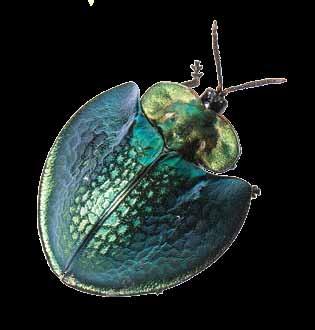
Andrew: At the moment I have a few spe cies that I am working with that are ‘ques tionable’ to me. That is, they don’t quite meet the description of known species, but at the same time may not actually be something new. Superficially, the questionable ones look similar to known spe cies, but the habi tat I found it in is what raises ques tions (in rain forest as opposed to drier edge habitats). There is still so




much to be learned about species living in the rainforest, and not just regarding new species, but those that have been ‘known’ for a long time. I am currently in the process of completing the necessary lab work to be able to say more confidently over the next few months whether any of these species are in fact new.
Sunday Magazine: After your research is completed, what are your plans?
Andrew: Guyana is a truly incredible place in so many different ways. From the food, the culture, the history and the people – to the habitats, the biodiversity, and the landscapes – Guyana has it all. At the moment I do not have the answer to your question. I will still continue to do similar research; I am just not sure exactly where and on what. I also plan to strongly pursue a career I’ve been developing on the side and that is as a photographer and journalist. I have been putting together a very large collection of special images that I have taken throughout Guyana that I eventually plan on putting towards a book, as well as continuing to do magazine articles about all things related to the tropics. The conservation of these places and animals are very important to me, so I want to help champion the cause both scientifically and photographically.
Teamwork was a notable feature of the Guyanese team of artistes and artisans from the Rupununi at a recently concluded cultural festival held in Brazil.
On January 3-4, artists, crafts and foods from Guyana, Venezuela and Brazil were on show at the Three-Nation Fronteira Cultural Festival held in the Brazil town of Pacaraima, which is near the border with Venezuela. The event, which is organised by Social Service of Commerce (SESC), a hugely successful Brazilian social enterprise, is in its third year and growing in popularity due to its unique collaborative nature to showcase the music, arts, crafts and foods from the three neighbouring nations in one location.
The distinctive diversity of Guyanese culture was reflected in the variety of performances, foods and handicrafts on display and the harmony and team spirit among the Guyanese participants.
Behi Barzegar, who is a development management consultant and enterprise development specialist in Lethem in Region Nine, informed Guyana Times Sunday Magazine of the truly unifying occasion for the Guyanese team show-
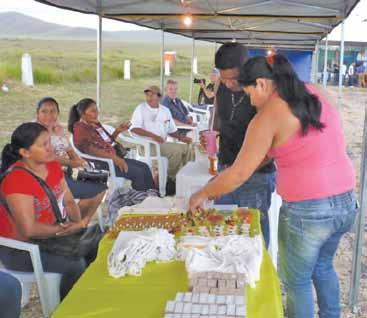
casing in Brazil.
“There was a wonderful closeness of our team irrespective of race, age or gender. Everyone was Guyanese... Moreover, we were ‘Rupununian’ and it was very touching the way everyone supported each other,” she noted.
Classical East Indian dancer Kavita Datt-Dawsta captivated the spectators with her sensational and high energy performance. Kavita, who is the only professional pharmacist in Rupununi in her formal role, said she loved the opportunity to experience different cultures. “The ex-
posure to Brazilian and Venezuelan art and culture blew my mind!” she added.
Charismatic reggae artist Desmond Anthony Adams, also known as ‘Fine Man’, thrilled the audience with his stage banter as well as his music. Fine Man is the vocalist for his band The Frontline Wailers and was supported by colleague Denise D’Aguiar.
“This is a good event. We need more events like this that make people partake in loving vibes! And it is definitely more fun being in a mixed group because you learn from each other,” Adams expressed.

Also popular with the crowd was the Venezuelan calypso band that charmed the audiences with the steel drum music and an extravaganza of costumed dancers and carnival atmosphere.
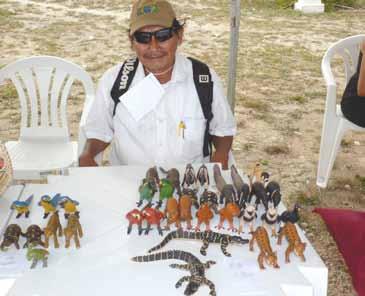
Behi noted too that artisans from Guyana were by far the most professional, and attracted enormous interest due to the unique design, high quality and range of the craft work and traditional food items.
Master craftsman George Tancredo from Nappi village, renowned for his amazing balata figures, sold out almost his entire stock. The colourful and intricately woven baskets by Sameria Williams of Rupununi Crafters attracted much attention, including that of the regional president of SESC, Airton Dias and his wife who purchased three of the largest pieces within minutes of arriving at Sameria’s stall. Dias was so impressed by the craft work he has asked the organisers to collaborate with the Guyanese coordinator for the event, and arrange for the Guyanese craft workers to hold training workshops in Boa Vista for their Brazilian counterparts.
Also attending the festival were Veronica Farias of Medicines from Trees, Annai; Goretti Luiz from Shulinab Women’s Group; Kim Casimero from Helping Hands nut processors in St. Ignatius, and Joan Baretto, jewellery maker also from
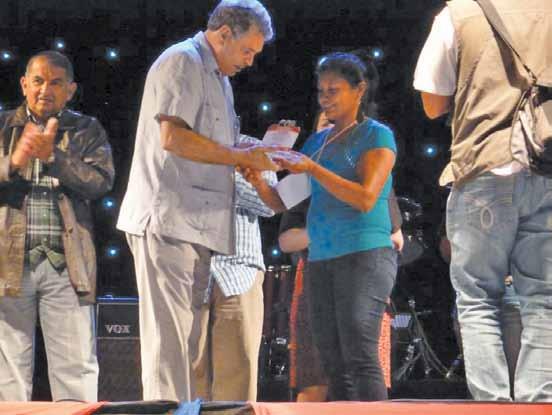
collected the plaque on behalf of the Guyanese team.
The organisers, SESC – RR (Serviço Social do Comércio em Roraima) provided transportation and accommodation for the participants from all three countries. According to the SESC-RR website, the festival aims to “bring together cultural diversities in the municipality of Pacaraima to people of the triple border, Brazil, Venezuela and Guyana. [The] event consid-
time, they used the opportunity to distribute posters and promotional materials to advertise the event.
"The Cultural Frontiera, designed by the President of the SESC-RR, Airton Dias, aims to foster fresh dialogue and new concepts, stimulate the appreciation of culture between the peoples and, consequently, of the artists, therefore promotion, circulation, and dissemination of culture has been the objective of the SESC-RR,
ers the plurality of peoples and strengthens multi-national border identities facing the Latin American cultural scene.”
Additionally, the event is described as “a space for the exchange and integration of the triple frontiers, where cultures… fuse constantly in an artistic mosaic.”
It includes musical
[in Brazil], as well as internationally" commented Carolina Andrade, Manager of the SESC Culture-RR at the festival.
In the course of 2 days, the SESC Cultural Fronteira shows hosted about 9,000 people, between the public resident of Pacaraima and tourists coming from Venezuela, in
St Ignatius.
Most of the participants had sufficient knowledge of the Portuguese language to get by, but additional interpretation services were provided by Lawrence Chung, a craft retailer from Lethem, and Denise D’Aguiar assigned to the group by SESC.
Representatives from each country were invited on the stage to receive a commemorative gift from Dias. Goretti Luiz proudly
shows with local attractions and guests, performances of traditional cultural performances as well as reggae, Indian dance, photographic exhibition, regional cuisine and crafts.
The festival was first publicized when a small delegation from SESC attended the Rupununi Expo, meeting stakeholders and potential participants on whom they based their selection of participants and coordinating services. At the same
particular in the region of the Gran Sabana and in addition to those from Guyana. Manoel Rolla Vilas Boas, president of Canoe Collective Cultural Association who was present at the festival, praised the Guyanese team, “It was all beautiful. You were outstanding and were very successful. The event was super organized. I wish you all the success in the world and a wonderful 2014,” he extolled.

Astellar achiever at a very young age and one of Guyana’s youngest dental surgeons, Dr. Sulan Fung aims to empower young women and spread awareness on her interest – maintaining a healthy mouth.
Twenty-four-year-old Sulan began her scholas-
ambience and never had a bad dental experience. As I grew older my dentist even encouraged me to get into dentistry,” she recalled.
The importance of continuing dental education has driven Sulan to invest much time and effort to be a part of Dental XP and the International Congress
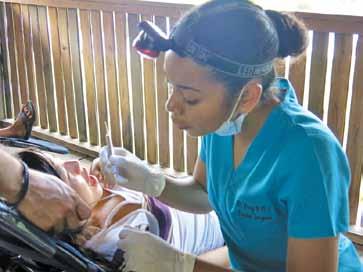
tic career at Stella Maris Nursery at three years old. She later earned a place at Bishops’ High School where she received awards for best debater and best actress, along with elocution prizes. “I got prizes mostly in the line of literature and English – a talent I inherited from my mom.” Sulan said in an interview with Guyana Times Sunday Magazine.
She then graduated as the top performer at the high school. For her outstanding performance, Sulan received the Anne Blue Scholarship, along with many other awards.
After graduating from high school, Sulan went on to further her studies at Queen’s College earning passes in Biology, Chemistry and Mathematics at the London’s Edexcel and CAPE examinations. She was then able to attain a place at the University of Guyana’s School of Dentistry. After five years of intense studies, Sulan successfully graduated as a dental surgeon.
“My passion for dentistry started as a child going to the dentist and being fascinated with the entire experience. I thought it was really interesting. I loved the
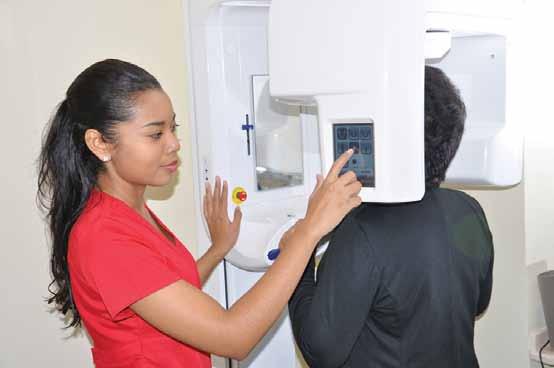
tistry at a state-of-the-art dental clinic in Georgetown: Dr. SenGupta & Associates. Additionally, she is a radio personality hosting a regular dental awareness programme. She has also done dental outreach work in Santa Mission.
Aside from dentistry, Sulan’s enjoys pageantry; more specifically the Mother and Daughter Pageant, which was founded by her mother Ingrid Fung, who is a notable educator. From a very young age Sulan was involved in the planning and coordinating of the pageant and holds, for two years now, the position of producer.
Sulan is very creative and meticulous as she produces and directs the pageant. Even though her job demands most of her time, she manages to invest as much as she could in producing a memorable event for mothers and daughters and, ultimately, the entire family.
She said she is empowered to be successful from seeing her mother’s determination. Sulan added it is a natural drive to succeed in everything she does.
“My mom has been an excellent role model. My father died when I was just two years old, and my mom, as a single-parent, held the positions of a superb mother, father, friend and role model for all her five children. I always try to exemplify her. Also, my four older brothers have been like a father figure in my life,” she disclosed.
of Oral Implantologists. She is also a part-time lecturer at Texila American University School of Dentistry. Presently, she holds an associate position and practices general den-
A drive to achieve even greater things, Sulan mentioned that her present focus is to perfect dentistry. She noted that being at Dr. SenGupta & Associates gives her the ideal scope to do so.
The dentist’s ultimate tip, which she said we were taught at a very young age,

is to brush twice daily and use dental floss. She urged persons not to wait on pain but to visit their dentists for a regular check up.
Sulan’s aim in everything she does is to empower young women. “Young women need to know and believe what they want and work to-
wards it. They also need to expose themselves to any means of education which will help them be wellrounded individuals.”

B y P etam B er P ersaud Part II
(Extract of an interview with Dr. Ian McDonald, January 2011, Georgetown, Guyana.
McDonald is a prizewinning poet, novelist, playwright, columnist and editor. He has to his credit six collections of poems.
He has won the Guyana Prize for Literature on three occasions. He also won the Royal Society of Literature prize for best regional novel with his first and only novel, “The HummingBird Tree”. “Selected Poems” was shortlisted for Royal Society of Literature Ondaatje Prize.
His most recent collection of poems, “The comfort of all things”, won the 2012 Guyana Prize.)
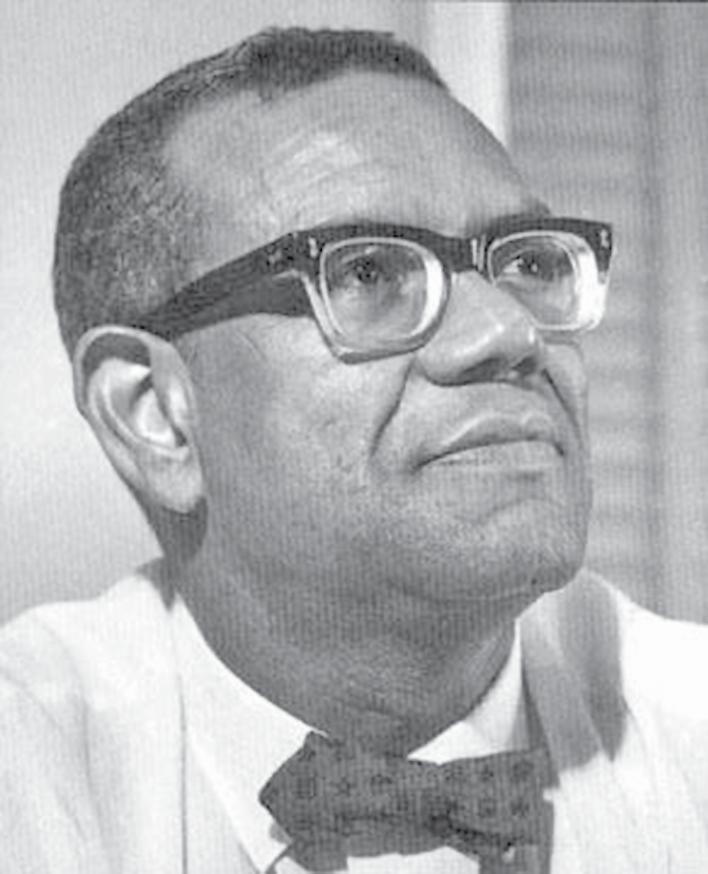
PP: A. J. Seymour was a poet, anthologist, editor, publisher, broadcaster, cultural historian and literary enabler.
He was born in 1914 and when he died in 1989, he had done a great service to the literature of the Caribbean and Guyana. In fact, he had a hand in the shaping of Guyanese Literature. Your thoughts on the man.
IM: I am delighted to talk about AJ. He was a great, great Guyanese. He was very dear friend of mine. I knew him for many, many years since I first arrived in Guyana in 1955 to the time when he died in 1989.
Right away I would like to read something I wrote in the introduction of this book ‘A. J. Seymour, Collected Poems, 19371989’ that sorts of sum up, well nothing can sum up Arthur Seymour because as you rightly said in the beginning he had so many attributes: ‘His overall contribution to the cultural tradition of Guyana and the Caribbean is truly astonishing. I do not think the younger writers and academics grasp it fully.
The AJS bibliography compiled by the National Library in 1974 was already 100 pages long and since then must have doubled in length. This amazing man’s work contains poems, historical publications, reviews, broadcasts, essays, addresses, entries in anthologies, forewords, lectures, talks, pamphlets, memories, sermons, eulogies, magazine work and books in such profusion that one would be excused for thinking this was the
record of a school, not one man alone.
A truly amazing man, and as you rightly said, a truly amazing man who shaped the literature of Guyana, and the shaping of Guyanese culture and the shaping of the minds of Guyanese for independence. He founded the jour-

nal Kyk-over-Al in 1945. And remember the first set of Kyk in its initial contribution lasted from 1945 to 1961, all those issues were very important in the shaping of Guyanese literature and culture and therefore the emerging nation. A very important figure AJ.
PP: Talking about culture, he was involved in History and Culture Week which I understand help to evince a sense of pride of nationhood in Guyanese. We have already said a lot about the man and his accomplishments. What about his formative years, those years that nurtured the man for greatness?
IM: I did not know him then but I’ve talked a lot with him about his formative years and there is no doubt that he was brought up from an early age to love reading, to love writing and to love literature. Oh, he loved to read. He started reading poetry from very young and started writing poetry from very young. One thing I want to emphasis is that running through all this is that Arthur Seymour was a very good poet. And he wrote an enormous amount of poems, much of it very good.
I remember after he died I went through his papers and found no less than 550 poems. In his ‘Collected Poems’, which I helped edit, there are just over 220 or 228 poems so he wrote many more than are captured in this book. He was always writing poetry whatever else he was doing. He wrote a great deal of religious poetry and
he is perhaps Guyana and the Caribbean foremost religious poet. We must not lose sight that among all his other attributes as editor, publisher and enabler he was a poet.
PP: An amazing output. The first poem in that collection, ‘turn these pages’, he said, ‘turn these pages, gently/for in them you see the wilful marriage/of heart’s best blood to brain’s keen accuracy/…turn these pages gently, for in them lie precious things’. Of note, Seymour was always writing…a poem for every event, passage of time, every occasion, every visit, every visitor to Guyana, every important person… a poem for everything and every event…
IM: One of the things I will never forget, one that moved me tremendously, when you talked about a poem for every event, one of the vivid memories I have was on his last birthday, his 75th birthday on the 12th of January 1989, you know he died later in the year…
PP: Christmas Day 1989.
IM: Yes, but I will never forget, he had written a small poem on the morning of his birthday and he read it to a small group of us, and I remember that voice, oh, he so loved poetry, and he read it, he was on the veranda on North Road, Bourda, and the wind was blowing so gentle, it was a lovely day, a lovely Guyanese day, he sat there and said:
Bless Father God, I pray,
The gift of my birthday,
This milestone – I alive
At age seventy-five.
Bless, Holy Spirit, bless With Thine own holiness
All that I do and say
As from Thy will today
And Jesus Christ Thy son May all His Grace be done
…That brought out the religiousness of his poetry and you are right, he was always writing poetry, only that morning…
PP: Marking that milestone…
IM: But that was not all. His delivery was touching; you know he said it in that beautiful voice of his.
PP: Quoting from the introduction of that very collection what you said about his work, you said that ‘He began in an era when everything was still to be done…’ He was a pioneer.
IM: I think that is a very good phrase, if I might say so. Yes, he was a pioneer.
PP: Continuing, ‘The work that is done at the beginning of anything…is least seen but it is the most important part’.
IM: He was that, he was the foundation, he built the foundation of so many things that we are enjoying now.
PP: Added to that and very instructive were his five volumes of autobiographies by which he hoped to inspire others, some academics at the university, to carry on his work.
IM: Well, I don’t think there is anyone who has taken on his role, multivaried, but many people have followed on from him. And, of course, we must remember Arthur use to say he was nurturing writers far greater than himself. If I must say, Petamber, he would have been proud of you. Your contribution to Guyanese literature over the past few years is quite remarkable – two television programmes on literature, two columns in the local press, editing The Guyana Annual, coordinating literary events and a host of other things… you are to be thanked and congratulated. And I say again, Arthur would have been proud of you.
Responses to this author telephone (592) 226-0065 or email: oraltradition2002@ yahoo.com
What’s happening:
• “An Introduction to Guyanese Literature” is now available from the above contacts, Austin’s Book Service and at the National Library.
• It’s here: A Hall of Fame for the Literary Arts & the National Library Distinguished Lecture Series to be delivered by Dr Jacqueline deWeever – National Library, Wednesday January 15, 2014
• “See More Poetry” Theatre Guild, Sunday January 12, 2014, at 7 pm in commemoration of Seymour birth centenary.

By Vahnu Manikchand
There are some people who have to work most of their life before they can fulfil their dreams, but for young racer Sharina Khan, she began living her dreams even before becoming a teenager.
At the age of 18, she is presently the only female motor car racer in Guyana. Khan had developed her passion for cars and racing since she was a child, and, with her father being a professional racer, this was her inspiration.
Her journey began with her learning to drive, which she mastered at age nine. “I always had an interest in cars and so as fast as I could, I learn how to drive. I even learnt to drive stick gear before learning automatic.”
She believes she inherited the skills and passion she possesses from her father. “I remember back then whenever my dad had to go race, I would warm up his car for him because I was small; I wasn’t allowed to go on the tracks so I would just drive the car around the village.”
Khan’s first professional race was Endurance Race 2012 in which she participated with her father. She has since taken part in two other races and competed in her fourth recently. Khan also participated in a drag race. However, her most memorable race was the Caribbean Motor Racing Championship in November last at the South Dakota Circuit.
"All my races were great, but that meet in November was more thrilling because it was my first time racing professionally at the circuit, and I was also featured in the magazine, so people were looking out for me so I couldn't camouflage myself; but this race was more competitive and enjoyable for me."
For Khan, following in her father's footsteps was a bit of a challenge since her parents were a bit scared to let her get involved in such a sport. However, her father saw her potential and encouraged her to pursue her dream.
Even though still not thrilled about her choice, her mother eventually put aside her fears and supported her.
"My parents played an integral part in me living my dreams, especially my father. He initially wanted me to drive go-carts but I like cars; big machines; so I was adamant and he eventually gave in and began training me for track racing. He would take me to the circuit and have me drive then point out where I was weak and went wrong."
However, being a professional racer so young and a female did not make this an easy journey for her. She faced sexism but overcame it.
"A lot of people weren't sure that I could do it; when they found out a girl wanted to race, they were sceptical. The competition was stiff because the guys are very competitive amongst themselves, and so you can only imagine their reactions when a girl decided to compete alongside them. But I did it and will continue to do it because I love it."
Khan had to push her way through with a lot of hard work and determination, which helped her to be living her dreams. She is advising young persons with dreams and ambitions to never let it fall apart no matter how big it.
She particularly wants to tell young girls who are interested in racing to give it shot. "A lot of people didn't support my decision because it’s 'a guy sport' and dangerous, but I love it so I didn't give up. I did it, so can anyone else; besides I need some female company out there on the tracks."


Froma very early age Shamain Greaves knew music was her calling. Born June 3, 1992 in Georgetown, Shamain is the daughter of the lead singer of Frontline, a popular band based in Guyana. With her inherent talent, the signer draws her musical influences from reggae, R&B, soul and those unforgettable golden oldies. At age 3, Shamain moved to the US and by age 5 began attending Thomas G. Pullen, an arts magnet school located in Landover, Maryland. There Shamain studied the violin and joined the school orchestra where she would hone her skills and expand her musical influences until graduation. After Pullen she attended Suitland High School in Forestville, Maryland, where she continued to study the violin but began to sense a burning passion for singing. Her strong enthusiasm for singing took over her sophomore year when, through an internship programme called Hip-hop High, she found herself behind the microphone in Gudda Musik (GM) studios recording her very first song. Upon graduating from Suitland, Shamain signed to the GM label in 2010. The velvety-voiced singer/songwriter brings a unique element through her R&B music. She released her first project in May 2012- a mixtape entitled “My Diary” which received rave reviews and more than 4,000 downloads in the first month. It is so easy to fall in love with this songbird’s sultry vocals which is why new fans are added to her list every day. Shamain was recently chosen as a candidate for the “Top DMV R&B Artists 2013”. Visit www.dmvlife.com/bestrbartist.html to cast your vote for Shamain. Voting remains open until Jan. 14.
The olm (Proteus anguinus) is also known as the proteus or the cave salamander. It is a blind amphibian found solely in the underwater caves of southern European lakes and rivers. The olm is also known as the human fish, which refers to the colour of its skin.
The olm is most well known for living its entire life in the darkness of the underwater caves, which has led this species to adapt quite strangely to life without light. The most notable feature of the olm is the fact that it is blind as its eyes are not properly developed and instead it must rely on incredible hearing and smell to understand its surroundings.
As with other amphibious animals, the olm is a carnivore, meaning that it gets all the nutrition it needs from eating other animals. Small invertebrates are the main source of food for the olm including worms, aquatic insects, larvae and snails.
Due to the fact that the olm lives out its life in the safety of a dark, underwater cave, it has fewer predators than it would have living both in the water and on land. Fish and other amphibians are the primary predators of the olm along with the very occasional rodent or bird.


Light travels slower through different mediums such as glass, water and air. These mediums are given a refractive index to describe by how much they slow the movement of light.
Glass has a refractive index of 1.5, meaning that lights travels through it at around 124,000 miles per second (200,000 kilometres per second). The refractive index of water is 1.3 while the refractive index of air is

1.0003, meaning that air only slightly slows down light.
Sunlight can reach a depth of around 80 metres (262 feet) in the ocean. In physics, light refers to electromagnetic radiation. The light we normally talk about in everyday life refers to the visible spectrum (the part of the electromagnetic spectrum that the human eye can see).
The objective of the game is to fill all the blank squares in a game with the correct numbers. Every row of 9 numbers must include all digits 1 through 9 in any order. Every column of 9 numbers must include all digits 1 through 9 in any order. Every 3 by 3 subsection of the 9 by 9 square must include all digits 1 through 9.
The olm is the only species in its genus and is found inhabiting the waters that flow underground through an extensive limestone region, including waters of the Isonzo river basin near Trieste in Italy, through to southern Slovenia, south-western Croatia, and Herzegovina.


Whales are mammals that live underwater. Scientists categorize them in a group called “cetaceans,” which also includes dolphins and porpoises. Excessive hunting during the 1800s and early 1900s severely damaged whale populations around the world — most of these populations have never fully recovered.
Baleen whales
Suborder Mysticeti
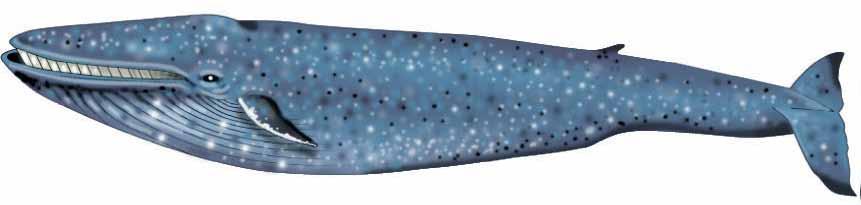
Baleen whales are very large – even the smallest reaches 17 feet (5.2 m) when fully grown. There are 15 species of baleen whales, including blue whales, gray whales, right whales, minke whales and humpbacks.
Family Balaenidae
Right whales were hunted by commercial whalers for more than a century and are now very rare. Whalers called them “right” whales because they were just the right size for catching: not too big and not too small.

Family Balaenopteridae
There are nine species of rorqual whales, and except for the humpback, they have a similar shape, differing only in size and color. Female rorquals are usually bigger than the males. These whales have multi-grooved throats and about 300 baleen plates on each side of their jaw.
Nineteenth-century whaling was a dangerous occupation; some whales are capable of smashing apart small boats.
Prehistoric, coastal people from all over the world probably killed and ate beached or stranded
Four-thousand-year-old rock carvings in Norway
Suborder Odontoceti
There are about 73 species of toothed whales. These include dolphins, porpoises and sperm whales. Toothed whales have one blowhole and tend to be smaller than baleen whales, which have two blowholes. These hunters often live in groups called “pods” and use echolocation to find prey. They also make whistling and clicking noises to communicate.
Family Ziphiidae
Because they favor very deep water, scientists know little about the habits of these whales. They are so rare, some species have been identified only after dying and washing up on shore.
Family Monodontidae
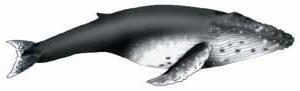
songs. Their songs can last for hours and are unique to individual whale populations. Often the songs change from one year to another.
Baleen whales are toothless and use baleen plates and fringes to filter their food. These whales eat mostly krill (tiny, shrimplike crustaceans) and small fish. They filter these sea creatures with the sievelike baleen at the front of their mouths. A large baleen whale will eat more than 4 tons of krill daily.
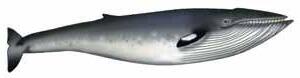
Toothed whales have sharp teeth, and their main diet is fish and squid. Killer whales tend to feed on larger prey, such as sea lions, walruses, seals and other whales.
Some whales have hairy
as tactile sensors, similar to a cat’s whiskers.
sea for three or four years. To pass the time, many made scrimshaw images by carving and inking pictures into whale bone.
The International Whaling Commission (IWC) was established in 1946 to regulate the whaling industry and to protect whales from overhunting. In 1982, the IWC voted to ban commercial whale hunting worldwide. By 1988, most nations had complied with the ban, but in the 1990s, Norway and Japan resumed whale hunting, having found loopholes in the ban.
Narwhals and beluga whales live in the cold waters of the Northern Hemisphere. The male narwhal’s slender spiral tusk is really an elongated tooth.

Family Delphinidae
There are more than 30 species of dolphins, making this cetacean family the most extensive and diverse.
Breaching occurs when a whale propels its entire body headfirst out of the water and then falls back with a loud thump and a lot of spray. Killer whales often breach in order to stun their prey. They herd fish to the surface and use their bodies and tails to pound them to death. Some scientists believe that whales also use breaching to communicate with one another.
killer whales and humans are the biggest dangers to
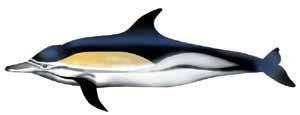
Family Physeteridae
Family Eschrichtidae
Gray whales are great migrators, traveling from Alaska to Mexico, about 12,430 miles (20,000 km) roundtrip. Whalers called this filter feeder “the devilfish” because it fought so hard when caught.
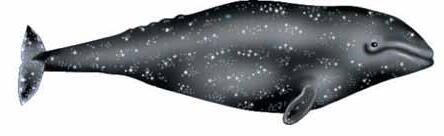

Sperm whales are the largest of the toothed whales. Their bulging skull protects an organ made up of weblike pipes containing waxy yellow oil called spermaceti. Scientists think this organ helps with echolocation and controlling buoyancy

ontemporary fashion designer Tyrone Nelson’s focus is to bring the future fashion world into today’s reality with his unique and creative ideas.
Nelson, a business management graduate from UWI at Cave Hill Barbados, is CEO and fashion designer of English Duck International Designs (EDID), which he established and created in Oct. 2006.
He has modelled in numerous shows in Barbados, including the Barbados Fashion Week, and copped two titles in two male pageants: Mr Ebony 2006 Barbados and Face of Shabeau 2007.
The designer has a diploma in fashion from the Barbados Community College, and rocketed into the fashion world, representing EDID at shows like Caribbean Fashion Week, Barbados Fashion Week, Style Week Jamaica, Red Run Way Fashion show in
Trinidad & Tobago, Ester Barnes Fashion Show in Toronto Canada and others, and is presently turning heads on the fashion arena in the island of Bahamas where he currently resides.
EDID has been moulded into one of the most futuristic and talked about designing houses around Guyana and the Caribbean. It has taken the opportunity to expand its services and expertise by becoming involved in coordinating and constructing wardrobe and pageants such as the Miss Guyana Talented Teen, Miss Freeport in Bahamas and Pointe-à-Pierre in Trinidad, among numerous others. Nelson has also judged, trained and produced models for many pageants around the Caribbean.
In 2011, the designer launched his all-male clothing line ‘Venom’. Seeing the response he received from fans motivated Nelson to challenge his creative ability to de-


sign and produce section and individual costumes for both children and adults for the Trinidad and Tobago carnival 2012. Many of these have won prices and have been featured in other carnivals and fashion platforms in Miami, Barbados, Grenada, Antigua, just to name a few.
His recent collection, L'eau de style(French for “water in style”), was inspired by International Year of Water 2013, and highlights the kaleidoscope of colours of the sea, rivers, pond, lakes and oceans not only within the Caribbean but around the world.
In an interview with Guyana Times Sunday Magazine, the designer explained the designs are predominantly white, and fused with a touch of colour such as black, representing the black water lakes of Guyana, and red, which goes back to the biblical story of Moses parting the Red Sea.
Nelson said too that the collection was detailed, using materials such as gold safety pins – used to represent the reflection of the rising and setting of the sun on waters. The colour code cords on the fabric also represent features of the vast sea. The silver depicts the waves, blue and white symbolizes the breathtaking illumination of blue waters of the Caribbean and the world, and the white furs signify rough oceans, seas and rivers.
“This collection is creative and unique and I think that is what makes it exceptional, memorable, and edgy. It is appealing to anyone who wants to have that distinct look. The designs can be worn for formal or informal events such as weddings or to the beach. The collection also includes shoes, bags, umbrellas and hats. It was my aim, when designing this collection for Guyana Fashion Week 2013 (GFW), to enlighten the gen-


eral public of how we can visualize water in the form of outstanding art, creativity and fashion. Also I wanted to build appreciation for different futuristic designs being worn in today’s world,” the designer outlined.
Nelson is grateful to GFW’s CEO Sonia Noel for granting him the opportunity to showcase his brand. He disclosed it was a treasured experience. For more information on the designer call 226-3099.



ifth Harmony is an American girl group formed on the second season of the X Factor. The group consists of members Ally Brooke Hernandez, Normani Hamilton, Dinah Jane Hansen, Camila Cabello, and Lauren Jauregui. They signed a joint deal with Syco Music, owned by Simon Cowell, and Epic Records, L.A. Reid's record label, after finishing in third place behind Tate Stevens and Carly Rose Sonenclar on the show. In January 2013, Fifth Harmony was voted the "Next Pop Superstar of 2013" by Popdust Magazine. In October 2013, the group announced the title of their debut EP, “Better Together”. The lead single from the EP is “Miss Movin' On”. The single debuted at #85 on the Billboard Hot 100 during its first week of release, making Fifth Harmony the first X Factor USA alumnae to chart on the Hot 100. A full album is scheduled for release this year.
Shia LaBeouf is retiring from public life.
The actor has thrown in the 'publicity' towel after a bizarre series of plagiarism events. Prepare yourselves; this gets complicated.
It all began when it came to light that the star had used graphic novelist Daniel Clowes' work without permission or accreditation in a short film he made for Cannes Film Festival last year. After media ridicule LaBeouf took to Twitter to apologise for his actions, ""In my excitement and naivete as an amateur filmmaker, I got lost in the creative process and neglected to follow proper accreditation," LaBeouf wrote.
Princess Blue must have had a roaring good time! Queen Bey and Jay Z's only child Blue Ivy got the royal treatment when she turned 2 years old on Jan. 7. Her famous parents rented out Jungle Island, a wildlife park and botanical garden in Miami, Florida.
During the fun and rainy outing, the birthday girl donned a green ensemble and sneakers. She also borrowed Beyonce's "Flawless" gold necklace (a nod to the feminist anthem of the same name on her titular fifth album) that the megastar, 32, posed with via Instagram on Dec. 30. The 44-year-old rapper went casual in an oversized sweatshirt, while the "XO" songstress dressed down in a "Surfboard" sweatshirt while swiping her chestnut locks back in a knit cap. Surfboard is a reference to Beyonce's raunchy-romanctic "Drunk In Love" song, which features a rap from Jay Z himself.
"Copying isn't particularly creative work. Being inspired by someone else's idea to produce something new and different IS creative work."
Yet this only made matters worse, whenBuzzFeeddiscovered these tweets resembled a post written four years previously on Yahoo!Answers.
Yeesh. The actor plagiarised to apologise for plagiarism.
To top it all off, the star came under scrutiny for lifting an entire tweet from Gucci Mane about drug addiction and skywriting without quoting or crediting the rapper.
It's all just one, big, messy, tangled web of lies.
But that's not the most

important point - all this ridicule and confusion about what has really come from Shia himself pushed the star to say good bye to public life (whatever the heck that entails).
"In light of the recent attacks against my artistic integrity, I am retiring from all public life," he tweeted. (Glamour)

Cameron Diaz loves her body and thinks you should love yours, too. "I don't want to look like I did when I was 25," the actress, 41, tells PEOPLE. "I like the way that I look now better than when I was 25. I can't help that other people may be uncomfortable with that, but that's not my responsibility to make them feel okay with the fact that I'm getting older. I'm okay with it. I like it."
In her new tome, The Body Book, Diaz opens up about her own struggles with food, her beliefs about beauty and her suggestions for getting healthy in the New Year.
"There's no such thing as anti-aging," Diaz, 41, tells PEOPLE. "There's no such thing as turning back the hands of time, and it makes me crazy that we live in a society where that's sold to women – that we're supposed to believe that if we're getting older, we've failed somehow, that we have failed by not staying young."
"I wish that women would let other women age gracefully and allow them to get older and know that as we get older, we become wiser."
When she was younger, Diaz struggled with acne, which she eventually connected to all of the fast food that she was eating.
"I used to have really bad skin and that was absolutely due to the food that I was ingesting," she says. "I lived on processed fast food. I drank a ton of soda and I ate greasy,

fatty, cheesy foods consistently. I went around with really bad acne well into my early 20s. Even into my 30s, when I was still eating a lot of dairy. I'd get those little white bumps all over my skin – I stopped eating dairy and it completely changed my skin."
But the “Annie” star admits to splurging on French fries and other less-than-healthy food from time to time.
"I'm a total advocate for eating the things you love. For sure I splurge. Health is an equation. It just depends on how many times you pick good over bad. You need a higher ratio of good, and if you do [that], you're ahead of it." (People)
Emma Watson has cast her spell on a new man.
The Harry Potter star, 23, has been spotted kissing and cuddling with Oxford University rugby star Matt Janney, 21, on a Caribbean vacation ahead of her appearance at the Golden Globe Awards this weekend.
Watson and long-term boyfriend Will Adamowicz split last summer.
A source told Britain's Mirror of the romantic tropical getaway: "They didn't have a care in the world. Matt was very protective of Emma – often putting his arm around her."

Caribbean on Monday.
"It was really cute," an eyewitness tells Us Weekly.
"They're such fun and attentive parents and pretty
After the adventure, the trio headed to Joey's Italian Cafe for a bite to eat. The family sat at a large round table and ordered pizza. At one point, Jay Z even gave Blue a cell phone when she began to fuss, asking her to "say thank you" first. And she did!
normal people considering how famous they are. There weren't many people around and maybe one photographer outside but the restaurant closed the shade so the photographer couldn't see in. It allowed them to have a pretty normal lunch." (US Magazine)
The source added: "He was being a gentleman the whole time. He is clearly very much into her, but then who wouldn't be? She is one of Hollywood's hottest stars. They couldn't stop giggling and smiling the whole time."
They were spotted in a business lounge at London's Gatwick Airport shortly before they flew to the

They couple are said to have hooked up after Matt played in the annual varsity rugby match between Oxford and Cambridge at Twickenham Stadium in London on Dec. 12. Watson, a former Oxford student, was spotted in the stands watching as Matt helped guide his team to a 33-15 victory. She then attended the post-match victory celebrations at the Ping bar in
at King's College School in Wimbledon.
The rugby star is currently studying French and Russian at Oxford's Oriel College and is fluent in Spanish. Looks like he's also mastered the love spell "Amortentia" too! (People)
Katy Perry has confirmed that "Dark Horse", which was initially released as a promo single, will serve as the third cut off her latest album "Prism". The 29-yearold diva now shares the official artwork for the track which she recorded with Juicy J.
The cover art, which arrived on Thursday, January 9, was created by New Yorkbased artist Yao Xiao. It sees Perry as an animated character who is dressing up as a knight in brass armor and a Shakespearean bright
purple dress. "Dark Horse" is a follow-up to "Unconditionally", which peaked at No. 14 on Billboard 100. While the emotional love song failed to storm the chart's top 10, "Dark Horse" landed at No. 6 this week.
Additionally, it has reached the top spot on U.S.' iTunes download chart. "So... it really is the year of the Horse! Just landed in China to see Dark Horse at #1 on ITUNES US. What an unexpected, lovely, surprise!" she shared her excitement on Twitter. (AceShowbiz)

Akash Sagar Chopra is an Indian film actor and composer. Akash is the youngest grandson of the veteran Hindi film producer/director Ramanand Sagar (known for the popular TV series called “Ramayan”). Along with being an actor and a musician, Akash has also been a producer of various television shows and is a co-producer for the motion pictures and television wing of the company MSP entertainment (also known as Sagar Pictures). Akash has been actively involved with theatre at a very young age. In one of the plays he was part of, Akash enacted 13 different characters. As a teenager, he debuted as music director with Sagar Films Pvt. Ltd.’s movie, “1971”. At age 21, in 2009, Akash debuted as a director with the television show, “Veer Hanuman”. Last year he made his Bollywood debut in the Hindi romantic comedy film, “Rabba Main Kya Karoon”. It was directed by Amrit Sagar Chopra, Akash’s older brother, and produced by Moti Sagar. The film also features Arshad Warsi, Paresh Rawal, Tahira Kocchar and Riya Sen as main characters.
ushmita Sen has lost weight and is gearing up for a comeback this year.
The “Biwi No. 1” actress said 2014 is going to be her year.
"I have been preparing actually since 2013. I know every time an actor loses weight or starts looking fitter or thinner, it is always for a reason. But this is me getting ready for the most fantastic time of my life in all aspects. Professionally and personally 2014 is going to be my year," the 38-year-old said at an art exhibition.
Sushmita is eagerly awaiting the announcement of two projects, one of which goes on floors in July.
"Professionally you are going to see me back this year for sure. We have two very nice announcements, hopefully they should happen soon," Sushmita said.
"The filming for one of them begins in July and the rest of them is more of combining the entrepreneur side of me and the actor and the mum side of me, all of it together," she added.

Hrithik Roshan has slammed reports that the box office collections of “Krrish 3” have been inflated.
The 39-year-old plays superhero Krrish in the third instalment of the popular franchise. The film broke the box office record set by Chennai Express and was the highest-grossing Indian film of 2013.
According to IANS, Roshan responded to allegations that the figures had been inflated, saying: "Some from the industry and certain sections of the media are hellbent on putting me, my father and Krrish 3 down. I have maintained my silence until now but these derogatory manipulations need to stop.
Expressing his suspicion over the identity of his detractors, Roshan said: "Who are these people who have been so affected by these numbers and my success? Are they the ones I call my friends I wonder?
"I would like to tell them that they need not ever be insecure about another man's success because all they need to do is concentrate on their own hard work, which in turn will help them achieve what they want."
team, we've only just begun."
The record set by “Krrish 3” has since been broken by Aamir
3”. (Digital Spy)
Anil Kapoor and Priyanka Chopra will embark on a three-day tour of the US to promote the IIFA awards 2014.
The tour will include appearances in Los Angeles, Tampa Bay and New York, to raise awareness of the IIFA's threeday weekend, which takes place in Tampa Bay, Florida.
"We are very excited to bring IIFA to Tampa Bay. With the support of representatives of Visit Tampa, we have been able to conceptualise and actualise an incredible event. There will be music, dance and a whole lot of spice," Chopra said in a statement to IANS.
and
Sushmita is known for hits like “Main Hoon Na”, starring Shah

witness one of the finest celebrations of culture and cinema," he added.
awards in history."
Priyanka Chopra and Ranbir Kapoor have been confirmed as hosts of the 59th Filmfare awards.
Kapoor has previously hosted the awards with “Gori Tere Pyaar Mein” star Imran Khan.
The 31-year old actress told IANS: "Filmfare awards is an experience in itself. This is the first time that I will be co-hosting the awards, I am very nervous.
"Very few girls have hosted the awards. But yes, there is a huge pressure because Filmfare as an event has always been entertaining, funny and there has been a standard set by a lot of people, including Ranbir himself."
The two star hosts will portray the future of Indian cinema in a unique segment of the ceremony.
"I have not done it much, but Ranbir and I have been working very hard to make sure it will be lot of fun to show you the future of what we think cinema should be, which will obviously be a little mad and lots of fun. So, it's going to be a really exciting time," added Chopra.
"We're looking forward to giving our fans and new audiences the experience of a lifetime."
Kapoor, who recently starred in an Indian version of American series 24 said:
"As a friend of IIFA, I am delighted as IIFA makes its debut in the USA through Tampa Bay.
"We commit to give our audience an opportunity to
Santiago Corrada, president and CEO, Visit Tampa Bay said the city is bracing itself for the Bollywood awards ceremony.
"This tour is just the beginning of a very exciting journey. Our entire region is enthusiastically preparing to welcome tens of thousands of visitors to our destination, and we look forward to serving as great hosts to the biggest and best IIFA
In the last 14 years since its inception, the international awards ceremony has seen household names such as Angelina Jolie, Cuba Gooding Jnr, Kylie Minogue, Colin Firth and Jean-Claude Van Damme share the stage with Bollywood's biggest stars.
The 15th edition of The International Indian Film Academy (IIFA) awards takes place for the first time in the USA from April 24 to 26. (IANS)

The “In My City” singer also said that, as she takes over the mantle of host from the likes of Shah Rukh Khan and Saif Ali Khan, she has a lot to live up to and is feeling the pressure.
"Whether it is Shah Rukh, Saif, Ranbir, Imran... so many people who have hosted the show, they have always set the standard. So, it is scary and exciting."


AAmbassador for Polio eradication - has been associated with the campaign for ten years.
Writing on Twitter he said: "As UN ambassador for polio, I feel congratulated on the eradication of the disease. I worked really very hard on it for years.
"Finally! India has been removed from endemic list. By end of 2014, we shall be polio free country. A sense of pride."
The 71-year-old star said that he will next focus his energies on the emancipation of the girl child.
"As the UN ambassador for Girl Child, I hope and pray we accomplish same results as polio and rid nation of discrimination against women," he finished.
The veteran actor has featured in TV campaigns for the cause.
One case of polio was reported in India in 2011, according to UNICEF stats, compared with 41 in 2010. (Digital Spy)
The new annual ‘‘best diets'' list is out from U.S. News & World Report and, according to the experts, the DASH diet is once again the best diet overall. This is the fourth year in a row the Dash Diet has ranked best overall.
The Dietary Approaches to Stop Hypertension Plan – called the DASH diet – was originally developed by the National Heart, Lung, and Blood Institute to prevent high blood pressure. It stresses eating more fruits, vegetables, and whole grains while eating less salt.
The 2014 version of the report evaluates 32 diet plans in multiple categories. The categories included best overall; best weight loss; best diabetes; best heart-healthy; best for healthy eating; best commercial; best plant-based and easiest to follow
DASH also took top spot for best diabetes diet (tied with the Biggest Loser diet) and best for healthy eating.
The diet rankings are based on reviews of the 32 diets by a panel of experts in diet, nutrition, diabetes, weight loss, and heart health.
The experts rated the diets for short-term and long-term weight loss, how easy they are to follow, and safety and nutrition. They also considered how well each diet could help prevent and control diabetes and heart disease.
Cost was not a factor they looked at.
The experts' evaluations were converted to scores and then stars. One star was lowest, five highest.
The DASH Diet received 4.1 stars as the experts like its overall nutrition, safety and ability to control or prevent diabetes and help heart health.

In second place overall, the TLC (Therapeutic Lifestyle Changes) diet earned 4 stars. The diet was created by the National Institutes of Health. Experts say it's good at promoting heart health. However, they noted that its down-
Scientists supported by the National Heart, Lung, and Blood Institute (NHLBI) conducted two key studies. Their findings showed that blood pressures were reduced with an eating plan that is low in saturated fat, cholesterol, and total fat and that emphasizes fruits, vegetables, and fat-free or low-fat milk and milk products.
This eating plan—known as the DASH eating plan—also includes whole grain products, fish, poultry, and nuts. It is re-
side was that if you do it by yourself, some people may miss the support provided by some commercial plans.
The Mayo Clinic diet, Mediterranean diet, and Weight Watchers tied with 3.9 stars. Mayo is cited for its good
The first DASH study involved 459 adults with systolic blood pressures of less than 160 mmHg and diastolic pressures of 80–95 mmHg. About 27 percent of the participants had high blood pressure. About 50 percent were women and 60 percent were African Americans.
It compared three eating plans: a plan that includes foods similar to what many Americans regularly eat; a plan that includes foods similar to what many Americans regularly eat plus more fruits and vegetables; and the DASH eating plan. All three plans included about 3,000 milligrams of sodium daily. None of the plans was vegetarian or used specialty foods.

by the NHLBI, the DASH eating plan follows heart healthy guidelines to limit saturated fat and cholesterol. It focuses on increasing intake of foods rich in nutrients that are expected to lower blood pressure, mainly minerals (like potassium, calcium, and magnesium), protein, and fibre.
It includes nutrient-rich foods so that it meets other nutrient requirements as recommended by the Institute of Medicine.
Results were dramatic.
Participants who followed both the plan that included more fruits and vegetables and the DASH eating plan had reduced
But the DASH eating plan had the greatest effect, especially for those with high blood pressure. Furthermore, the blood pressure reductions came fast—within 2 weeks of starting
The second DASH study looked at the effect on blood pressure of a reduced dietary sodium intake as participants followed either the DASH eating plan or an eating plan typical of what many Americans consume.
This second study involved 412 participants. Participants were randomly assigned to one of the two eating plans and then followed for a month at each of the
nutrition and safety, as well as being ''a tool against diabetes." The Mediterranean Diet is called sensible.
Weight Watchers ''surpassed other commercial diet plans in multiple areas," the experts say, ''including short- and long-term weight loss and how easy it is to follow."
Weight Watchers got top honours for best weight loss diet, best commercial diet plan, and easiest-to-follow plan. It was rated 3.8 stars in the best weight loss category while Jenny Craig, Biggest Loser, and Raw Food diets tie at 3.5 stars in the category.
The Raw Food Diet was cited for both short-term and long-term weight loss, but experts caution that the restrictive diet may not work for everyone.
For heart health, the Ornish diet, a low-fat approach similar to the DASH diet, took first place. The Mediterranean diet, which emphasizes fruits, grains, vegetables, olive oil, and other healthy foods, took first place for the best plant-based diet.
Tied for last place overall were the Paleo diet and the Dukan diet. The Paleo suggests ''eating like a caveman" -- meat, fish, poultry. But it's not feasible for modern times, the experts say.
The Dukan diet emphasizes protein, and experts call it restrictive, even ''idiotic."
Three new diets added to the list this year also didn’t fare so well.
The Fast diet, where you eat normally for 5 days, and then cut how much you eat to a quarter of that for 2 consecutive days, earned 2.5 stars.
The Acid-Alkaline diet, whose plan is that you avoid acid-forming foods such as red meats, received 2.6 stars.
Experts were concerned that the Spark Solution diet’s detailed guidance is given only for the first 2 weeks on a plan that has you exercising and cutting back on calories. It received 3.3 stars. (Source: Web MD)
three sodium levels.
The three sodium levels were a higher intake of about 3,300 milligrams per day (the level consumed by many Americans), an intermediate intake of about 2,300 milligrams per day, and a lower intake of about 1,500 milligrams per day.
Results showed that reducing dietary sodium lowered blood pressure for both eating plans. At each sodium level, blood pressure was lower on the DASH eating plan than on the other eating plan.
The greatest blood pressure reductions were for the DASH eating plan at the sodium intake of 1,500 milligrams per day.
Those with high blood pressure saw the greatest reductions, but those with pre-hypertension saw the largest decreases.
A recent study showed that people can lose weight while following the DASH eating plan and lowering their sodium intake. In a study of 810 participants, one-third were taught how to lower their sodium intake and follow the DASH eating plan on their own. Most of them needed to lose weight as well. They followed the DASH eating plan at lower calorie levels and they increased their physical activity. Over the course of 18 months, participants lost weight and improved their blood pressure control.
The NHLBI notes that together, these studies show the importance of lowering sodium intake, whatever your eating plan, and suggests that following the DASH plan and lowering salt and sodium intake is a winning combination. (NHLBI)



Professional designers Jane Lockhart, Jackie Glass and Peter Fallico show in Canadian Living how to avoid two of the most common bathroom design mistakes.
Lighting: Lighting is key in any bathroom, but particularly in those bathrooms used for dressing, applying makeup and soaking in a soothing bath. a well-lit bathroom can be achieved with a combination of recessed lights, ceiling fixtures like chandeliers, and vanity lights that are set on dimmers and timers to save on energy and create just the right mood



Ingredients:
40ml (2 tbs) canola oil
4 eschallots, finely chopped
1.25L (5 cups) chicken stock 2cm piece ginger, peeled 2 star anise
Method:
Heat oil in a pan over medium heat. Add eschallots and fry for 30 seconds, then add stock and bring to the boil.
Reduce heat to low, add ginger, star anise and cinnamon and simmer for 30 minutes.
Cook noodles in a separate pan following packet directions, drain and set aside.
Add fish sauce and broccoli or pak choy to broth and cook for 1 minute.
Add noodles to bowls, pour over broth, top with duck pieces and egg half.
Serves 4
Ingredients:
1 cinnamon stick
300g ramen noodles
20ml (1 tbs) fish sauce
1 bunch broccoli or pak choy chopped
1 barbecued duck, chopped 2 hard-boiled eggs, shelled, halved

Melted butter, to grease
1 tbs desiccated coconut
115g (3/4 cup) self-rising flour
7g (1/4 cup) Equal Spoonfuls (Equal brand) OR 6 Equal Packets OR 1/4 cup sugar
1 tsp finely grated orange rind
1 tsp finely grated lemon rind
8 tsp instant skim milk powder plus 7/8 cup (3/4 cup + 2 tbsp) water
1 egg white, lightly whisked
20g (1 tbs) butter, melted

Method:
Preheat oven to 180°C. Brush 12 (20ml/1 tbs) round-based patty pans with the melted butter to lightly grease. Place the coconut in a small non-stick frying pan over medium heat and cook, stirring, for 1 minute or until lightly toasted. Transfer to a small bowl and set aside.
Sift the flour and Equal Spoonfuls into a medium bowl. Add the orange and lemon rinds, and stir to combine. Make a well in the centre.
Whisk milk, egg white and butter in a small jug until well combined. Add to flour mixture and stir to combine.
Divide mixture evenly among greased pans. Sprinkle coconut evenly over top. Bake in preheated oven for 15 minutes or until golden and a skewer inserted in the centres comes out clean.
Remove the citrus coconut cakes from the oven and set aside for 2 minutes. Transfer to a wire rack for a further 3 minutes. Serve warm.
Makes 12 cakes
To replace 1 whole egg in a recipe, use 2 egg
To
To replace 1 cup whole milk in a recipe, use 1/2 cup evaporated milk plus 1/2 cup water OR use 1 cup reconstituted instant skim milk powder plus
plus 1 cup water
To
10+10 doesn't equal 20. If you add 50, you'll get 11. How is that?



By Sr Shamane haSSad
The bus was usually there close to five but I was out early and walked to where the four streets met, where the bus would come and put off my little girl after a long day at school.
It was the last day of the term. I guess the neighbours are now accustomed to our pick up and drop off habits. It is the kind of village where you know you are being watched but you can see no one watching. That was great for me that afternoon. I paid no attention to
that point where decisions have to be made, to choose a path and wander down it, with commitment, to see where it takes you; not hoping for regret or failure.
Some of us get to that point early in our lives. We are pushed because of a death of a loved one or a major change in a family situation. Factors push us one way and factors pull us another. Sometimes we let our principles or our religion or our goals determine which chart to follow. But sometimes, we just don’t know.
So we stand at the crossroads and bow our head to
So we settle in and the family all get together. My mom is happy. After a long time all her children were together in the same room with her. My little girl is happy. There are many cousins here for her to play with.
I sat watching my little grandson walking with his new steps and I looked over the room to the faces of my kinfolk and something stirred in my heart. I was in the right place! I was happy to be there, to be part of them, to be my mother’s daughter, and a sister to my brothers and sister and an

the sitting homes and their gardens. I took my time walking up one street and down again and over and up again.
After about fifteen minutes, I stopped at the intersection of the four little streets and looked in the direction the bus was expected. I really was at an intersection in my life. I had big decisions to make. Was it time to move from one country to go make a home in another? Was it time to give up relationships and friendships and content my soul with a different way of life?
How much of a mother’s life is for her children? Is there a point where conscience and convention agree that now you children are on your own?
I still have so many hopes and ideas and dreams. Who is to say that I must not have them? Who is to say that I must not seek to find companionship and love?
Who has the right to say whether I have had enough?
What am I to do? Was I being selfish to want a peaceful existence to work out my dreams?
We all come to our own Crossroads in life. There is
watch the gravel at our feet and we pray once again in so much desperation and earnestness.
“My God, you know my anguish, please show me the way!”
And as the bowed body relaxes the tension tears flow freely. When I lifted up my gaze again I knew what I had to do.
I had to tell the bus driver that my girl would not be on the bus for the new term. And as I walked home with my baby girl I had to tell her that we were leaving to go to far away sky lines to see what was written for us this time.
For most of my adult life “home” has been Guyana, and residence has been in the USA. My mom and siblings and their families are all in the USA. I am the missing branch of the tree. I have not been able to put down “roots” in the north when my soul always yearned to fly south.
But, as the song says, “There comes a time, when we heed a certain call…” And I arrive as winter begins. Each land has its own magic, its own uniqueness and beauty.

Much have I laboured, much read o'er Of Arabic and Persian lore, Collecting tales unknown and known; Now two and sixty years are flown. Regret, and deeper woe of sin, 'Tis all that youth has ended in, And I with mournful thoughts rehearse Bu Táhir Khusrawáni's verse: 'I mind me of my youth and sigh, Alas for youth, for youth gone by!'
Hakīm Abu'l-Qāsim Ferdowsī Tūsī Firdowsi
In my soul
there is a temple, a shrine, a mosque, a church where I kneel.
Prayer should bring us to an altar where no walls or names exist. Is there not a region of love where the sovereignty is illumined nothing, where ecstasy gets poured into itself and becomes lost,
aunt to my nieces and nephews, and the elder sister in law to my four beautiful sisters in law.
There is so much love I feel for all of them. We are growing up together and getting older together. I looked again to my mother’s face. This part of my chart I call “family”. I want to savour it and be part of it, in what I must give to it even as I receive from it.
“Family” is wealth. Family is responsibility and loyalty and love. Each little bunch has its own trials, and works out its kinks as best it can. When there is need, help is sought and given. But in peace, they coexist and thrive.
My God who guides my thoughts and steps
Please bless each one of us
And help us in what we profess
And help us in what we conceal
You know best what our hearts possess.
Please have mercy and bestow thy light
And special grace on all of my family.
where the wing is fully alive but has no mind or body?
In my soul
there is a temple, a shrine, a mosque, a church that dissolve, that dissolve in God.
Rabia al Basri
For ten years I never left my books; I went up ... and won unmerited praise. My high place I do not much prize; The joy of my parents will first make me proud. Fellow students, six or seven men, See me off as I leave the City gate. My covered couch is ready to drive away; Flutes and strings blend their parting tune. Hopes achieved dull the pains of parting; Fumes of wine shorten the long road ... Shod with wings is the horse of him who rides On a Spring day the road that leads to home.
Bai Juyi
There once was a dark and distant time when we only understood molecules as equations of letters and numbers. With the advent of crystallography — the science of how matter is arranged — we learned how to visualize molecules in 3D, helping us make everything from better medicines to stronger materials.
Despite that huge advance, if you stopped someone in the street and asked them what crystallography was, chances are you would get a blank stare. To help raise awareness, and to celebrate a century of amazing discoveries, UNESCO has declared 2014 to be the International Year of Crystallography. Here’s Time. com’s bluffer’s guide to the topic.
1. It starts with X-rays
Normally when you want to magnify things, you use a microscope. There is, however, a limit to the smallness of things you can see, namely the wavelength of the light you’re using. Since visible light has a frequency of between roughly 400 and 700 nanometres, it is unable to detect atoms, which are separated by merely 0.1 nanometres. X-rays, on the other hand, have just the right frequency.
2. Crystals are used to create diffractions
Unfortunately, we don’t have
good enough lenses to produce xray microscopes capable of studying molecules. So scientists have to beam X-rays onto molecules, which shatter the rays, just as light is reflected when it hits any object. The shattered rays — called the diffraction — are then reassembled into an image by a computer program.
But since the diffraction of a single molecule would be weak to the point of unintelligibility, scientists get the molecules they’re studying to clump together into crystal form. This highly ordered structure, made up of vast amounts of molecules, makes xray diffractions — the main tool of crystallography — easier to study.
3. So why chose 2014 for the International Year of Crystallography?
The International Year of Crystallography celebrates the centennial of the Nobel Prize of Max Von Laue, the first scientist to diffract x-rays with a crystal. However, the first person to solve a molecular structure — that of NaCl, or table salt — was the Brit William Lawrence Bragg.
His equation to translate the diffraction into a structure, Bragg’s Law, is still in use today.
In 1915, at age 25, he became the youngest Nobel laureate, when he jointly received the prize with his
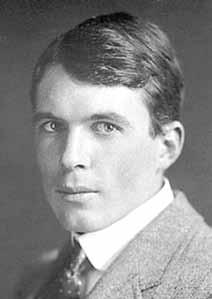
father William Henry Bragg. The Braggs went on to create a dynasty of groundbreaking crystallographers at the Cavendish Laboratory at the University of Cambridge.
4. Crystallography was crucial to one of the great discoveries of the 20th century
Establishing the structure of the DNA was one of the most significant scientific events of the 20th century. It has helped us understand how genetic messages are being passed on between molecules inside our body — everything from the way instructions are sent
to proteins to fight infections to how life is reproduced.
The discoverers of the molecular structure of DNA won the Nobel Prize in Medicine in 1962, the same year that crystallographers won the Chemistry prize for unveiling, for the first time, the molecular structure of a protein. Together, the two discoveries were instrumental in developing new medicines and providing a picture of the inner workings of our body.
5. Crystallography has always pushed the boundaries of technology
Crystallographers were among the first to use computers, in order to conduct the advanced arithmetic involved in reassembling diffractions into coherent images. Using quantum programming, scientists today are not only able to view molecules in 3D, but also to study the way they operate (Nobel Prize in Chemistry was awarded for just that in 2013). The improvement of x-ray machines has also led to so-called synchrotron facilities, which are able to produce vastly more efficient and precise beams. Synchrotron technology helped in the development of the Large Hadron Collider at CERN in Switzerland, the world’s largest and most advanced machine, which proved the existence of Higgs boson, “the God particle”
that may explain the elusive “dark matter” that makes up most of our universe.
6. Crystallography is going to help us produce a virtual physiological human
In 2003, the largest collaborative biological project to date, the Human Genome Project, managed to map out the complete human DNA. In the years to come, scientists hope to produce a “virtual physiological human,” a complete 3D-model of the body that features everything from organs right down to individual cells, proteins and genes.
Dozens of research institutions around the world have already been collaborating for over a decade to make this project happen. Realized, the project holds the promise of making more precise and holistic diagnoses, reducing the need for animal experiments, assisting in the performance of virtual surgery and helping to personalize medication.
Besides this huge undertaking, there are still myriad viruses, proteins and other molecules to figure out. Breakthroughs may help to protect us against new strands of bird flu and to invent materials that further modern and more environmentally friendly technology.
(TIME)
Pakistanis are rallying around a teen who tackled a suicide bomber, but Pakistanis are also asking why it is youths who are standing up to the Taliban and not the government
Angered by sectarian strife and government inaction to curb it, Pakistanis have hailed a teenager who died after wrestling a suicide bomber to the ground and averted a likely mass killing at his school.
Journalists, bloggers, community members, and observers are calling for the student to be awarded top honours in Pakistan for his bravery, and some have even compared him to Malala Yousafzai, the teen girl in Pakistan who was shot and almost killed by the Taliban for attending school and later became an international household name. Many had expected she would win this year's Nobel Peace Prize.
Aitzaz Hasan was running late for school on Monday when he and friends were interrupted by a stranger in school uniform who was asking for direc-
tions. Suspicious of the query, Aitzaz tackled the man as he walked away. The man then blew himself up, taking both lives.
“The other students backed off, but Aitzaz challenged the bomber and tried to catch him,” his cousin Musadiq Ali Bangash told CNN. “During the scuffle, the bomber panicked and detonated his bomb.”
At least 1,000 students attend the school targeted by the suicide bombing, reports the New York Times, in an area of northwestern Pakistan, which is a hotbed of sectarian violence. Pakistanis have rallied around the boy whose community includes many Shiites and has been frequently attacked by Taliban militants and Sunni extremist group Lashkar-e-Jhangvi.
“We must honour him,” Nasim Zehra, a Pakistani journalist and talk show host,
told the Times, calling earlier on her Twitter account for him to receive Pakistan's top military award. “This courageous teenager attempted to battle death. What gave him this confidence? Outrage? Parenting? Faith? From the bloodletting terrorism in Pakistan are emerging uniquely inspiring and iconic individuals like Malala and now Aitzaz Hasan.”
The case underscores the daily threats and government incapacity to stem violence along sectarian lines, despite continued efforts to stabilize the country. Many Pakistanis fed up with violence have channelled their energies into honouring Aitzaz. In today's Nation in Pakistan, an editorial is dedicated to the boy:
‘Most of us have already surrendered to the Taliban, at least in our hearts because we believe that nothing can stop an attack from taking place, unless fortune is on our side. The precious few that are still fighting are dropping like flies,” the editorial notes. “How many more children have to sacrifice themselves before we get a reality check? For the sake of Aitzaz and all the countless children that have been taken before their time, somebody from the government needs to take a page out of Aitzaz’s book and resist terrorists till they can no longer harm Pakistan.’
Aitzaz has two sisters, according to local reports, and was well-loved in his village. The Express Tribune quot-
ed his father, who works as a driver in United Arab Emirates, who said he returned home not to mourn
his child's death but celebrate his life. “My son made his mother cry, but saved hundreds of mothers from crying for their children,” he told the paper. (By Sara Miller Llana, Christian Science Monitor)

The International Consumer Electronics Show, or CES, is the largest gadget showcase in the world. It's held each January in Las Vegas. (Information provided by Global Tech)


despite its practicality. rather than being
a
actually control just how curved your TV is by remote - the idea being that the
and will come with more apps and functionality than ever before.
which took away from that premium watch feel we all crave. Well, say goodbye to that - Pebble is back in stainless

Samsung Galaxy note Pro. We all knew there was a tablet-size Galaxy note on the way at CES 2014, but the 12.2-inch display is somewhat of a surprise. as you'd expect, the note Pro is phenomenally powerful thanks to a Qualcomm Snapdragon 800MHz processor, and deals with multitasking and buffering with ease, packing the power for anything from graphicallyintensive games to photo and video editing.


targeting for release around that time,” Lee said. “When we release our S5 device, you can also expect a Gear successor with more advanced functions, and the bulky design will also be improved.”
Asia’s biggest technology company will announce at least one other wearable device this year, Lee said without elaborating. Samsung registered a design in South Korea in October for eyeglasses that can show information from a smartphone, and enable users to take calls.
different viewing angles, and a better experience. Literally has to be seen to be believed.
Sony Xperia Z1 Compact. Described by the maker as "the world's first non-compromised compact smartphone", Sony has answered the prayers of 5-inch handset haters. Our first impressions of the Sony Xperia Z1 Compact were good - its manageable form factor is easy to handle, and the top-tier specs, lower price and fancy new colours could well make the Z1 Compact a big success.


Epson Moverio BT200. If you're wondering what business a printer company has with eyewear, don't forget that Epson makes a huge range of projectors too. The Moverio glasses are in essence, two small LCD projectors, alongside android 4.0 support, Bluetooth, head motion tracking and a frontfacing camera. unlike Google Glass, the Moverio is aimed more to improve professional productivity than for consumer use.
amsung Electronics Co. will release its Galaxy S5 smartphone by April and is studying using eye scanner technology for the first time as it readies the high-end handset to compete with Apple Inc. iPhones.
The S5 will be paired with a new wearable device that will be an evolution of the Galaxy Gear smartwatch, Lee Young Hee, executive vice president of the company’s mobile business, said in a Jan. 6 interview.
“We’ve been announcing our first flagship model in the first half of each year, around March and April, and we are still
Sales of the S4, the company’s current marquee handset, slowed after Apple released the iPhone 5s and 5c in September. The 5s includes a fingerprint-identity sensor, and Samsung is considering using an eye scanner in its top-end smartphones.
“Many people are fanatical about iris recognition technology,” Lee said at the International Consumer Electronics Show in Las Vegas. “We are studying the possibility but can’t really say whether we will have it or not on the S5.”
The Galaxy S4 may have fallen short of consumer expectations because its design was too similar to its S3 predecessor, Lee Young Hee said. The next handset likely will be different, she said without providing specifications, including screen size.
(Bloomberg)

Volvo has announced a partnership with fellow Swedish company POC, which specializes in helmets and other protective sports gear. The two partners will leverage their respective safety design experience toward developing new concepts in transportation safety.
The first order of business is a car-to-cyclist communication system designed to increase coop -
eration between two- and four-wheelers.
Volvo has been a leader in pedestrian-detection technology, introducing features like pedestrian airbags and auto-braking.
Last year, it broadened its Pedestrian Detection system to include cyclists.
"Communication with cyclists around the car is a possible extension of our groundbreaking Pedestrian and Cyclist
Detection technology," explains Jan Ivarsson, senior manager of Safety Strategy and Requirements at Volvo Cars. "Providing the cyclist with confirmation that he or she is seen by the vehicle can make interaction between cars and cyclists smoother and safer in urban areas."
While Volvo doesn't say anything further about what the car-cyclist communications will look like, it sounds like the work will entail adding bicycle helmet-integrated communications to the Volvo cyclist detection system. The system could audibly warn the cyclist of the vehicle's presence and provide safety cues for passing, turning, etc. It may also increase the scope and accuracy of the car's cyclist detection.
Volvo and POC plan to reveal their initial results in the second half of this year. (GIZMAG)
Using art as a catalyst of self-expression, young award-winning artist
Courtney Mathium Douglas is well on his way to becoming known as one of Guyana’s most notable artistic minds.
Born and raised in Bartica, Courtney obtained a Hinterland Scholarship (after graduating from secondary school as the Best Technical Student) to attend the E.R Burrowes School of Art in 2008. He gradu-
ated in 2011 with a diploma in Fine Arts and as Best Student in Painting, Drawing and Graphic Designs.
In an interview with Guyana Times Sunday Magazine, Courtney said, “Art is my life. Every kid has a dream, and my dream was to be an artist, and I didn’t give up on it and I will not give up on it. I keep going because every day we learn something new and I am willing to learn and be successful.”
Presently, Courtney works part-time with local art group Bravo Arts, and is pursuing studies in the field of animation. He is the winner of the national coin design competition to commemorate the 175th anniversary of Indian Immigration in 2013. Additionally, he recently won the National Drawing Competition 2013 sponsored by Republic Bank.
“I enjoy painting, drawing and graphic designs. My dad wanted to develop his artistic skills but never got the opportunity to do so because of not having the resources. My dad’s story sparked my interest to get into art. I started to hone my talent from age 13. Throughout high school I won numerous art competitions. In my heart I felt I was fulfilling my dad’s dream,” he revealed.
Courtney said art helps him to tell stories and send messages about pertinent societal issues. He also gets to express all his emotions through his art, which has earned him numerous awards. In art school, Courtney pointed out, he was told that his art needed to reflect something he loves, and since a child he loved cricket and so most of his work reflect some aspect of the game.

“Apart from listening to music and swimming, I love cricket. I think it is a sport that brings different cultures together for one common goal,” the artist noted.
For Courtney, his art journey was not an easy brushstroke. Once he lost all his possessions, including his cherished artworks, in a fire. Although his spirit was dampened, he found in-

ner strength from the experience, learning that the only thing he needed to focus on was to better himself as an artist.
“Now my focus is to keep perfecting my art because I hope to become one day an international artist. As I continue my quest to become a professional animator, my goal each day is to do better than the day before,” he outlined.
Through his art, Courtney would like to change the mentality of some who are bent on disunity instead of working together. He urged persons to work for each other rather than against.
“Racial discrimination is preventing our country from progressing. The litter problem can only stop if everyone stops littering. In order for something to change we must make the change first. We can pray how much we want but if we are calling on the Heavenly Father to help us we have to start
helping ourselves first. Through my art I will keep sending positive messages and continue to let my light shine so that others will see and do the same. I always say, ‘Go where your heart leads you, play, run, lead and have fun doing it. Be the one to set new records’,” Courtney declared.
In developing the art industry, Courtney stated there is a need for more opportunities where artists can market their work to the wider world.
Presently, Courtney’s work is being exhibited at the ongoing Ninth National Drawing Competition exhibition at Castellani House, Vlissengen Road. Gallery hours are 10:00 hours to 17:00 hours Monday to Friday and 14:00 hours to 18:00 hours on Saturday; the gallery is closed on Sundays and holidays. The exhibition continues until January 18. Admission is free.
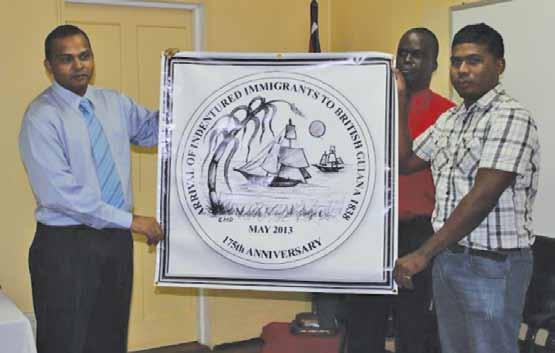

By The hon. VincenT RoTh
Part 1
This is the story of my first trip to the bush thirty-seven years ago. It was to the Pomeroon River and I travelled in the government sloop "Baridi" which was used by Mr Michael McTurk, C.M.G., who was commissioner for the Pomeroon and Essequibo rivers. There were no other district commissioners at the time and Mr McTurk was given the post because no one else had so much knowledge about the interior of British Guiana as he, and this knowledge was very useful to the government who gave him the "Baridi" in which he sailed all about the deep waters of the country on government business.
The "Baridi" was a small vessel, not much bigger than the Pomeroon sloops you see today moored at the Market Stelling, but she was a much faster sailor than any other boat of her size, and faster than many much larger. You see she had been designed and built by Mr McTurk himself who had been a deep sea sailor in his youth and knew all about the sea.
In those days there was no road to Pomeroon, nor did any steamers go there, so the only means of getting to that river from Georgetown was by sea in a sloop, or by a long and uncomfortable journey to Suddie by steamer, thence by buggy to Anna Regina, and thence in a tiny boat along the Anna Regina trench, across the Tapacooma Lake and through a network of creeks

until, at length, the upper Pomeroon was reached.
Well, it was a dull rainy morning on March 5th,

1907, when Mr McTurk called for my father and me at the Tower Hotel which used to be where the General Post Office is now, and took us in a cab to America Stelling. Anchored some distance from the wharf was the "Baridi", a trim little craft, painted grey, with a tall mast from which fluttered the Blue Ensign, showing that she was a government craft.
Going on board in the police boat, we found the crew to consist of four Warrau Indians who looked very funny in their blue sailor jumpers and little round caps. Pulling up the anchor and hoisting the great sail, we soon were gliding out to sea and, with our bows pointed to the north-west, settled down to a steady sail through the muddy waters of the coastal sea.
As the wind was fairly steady the little boat did not pitch or roll too much, but the deck remained on a slope and the spray
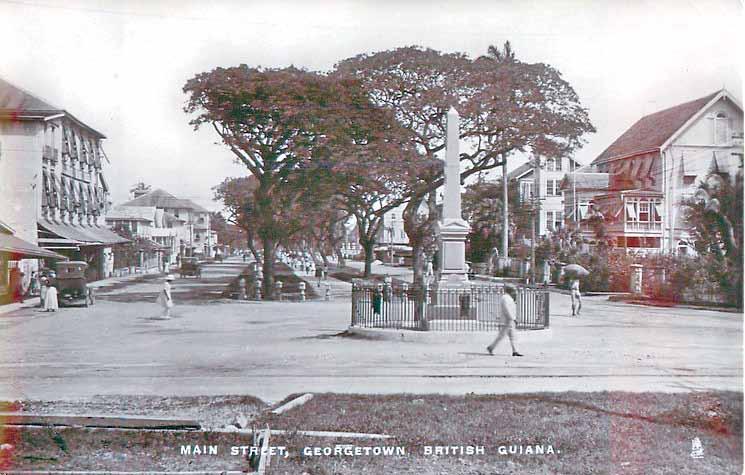
from the bows now and then blew over us. The flat coastline was not very interesting - just a long, thin line of dark courida bush, broken here and there by the smoking chimney of a sugar estate of which there were still quite a few along the coast at that period.
By ten o'clock we were off Dauntless Island which actually was an island then and not, as now, the northern portion of the great island of Leguan which, with Wakenaam and Hog Island, guards the eighteen-mile-wide estuary of the Essequibo River.
Many years ago a sloop named "Dauntless" ran on a mudflat at low tide off Leguan Island, and, as she could not be floated free
again, she was abandoned. Gradually the mud silted up around her hull, each high tide depositing more. Then some seeds drifted along and soon trees began to grow, and, lo, an island was formed. This grew rapidly as more mud was deposited by the tides until, a few years ago, it joined on to the neighbouring island of Leguan, though for years subsequently it still was called Dauntless "Island." You can see it from the Sea Wall of an afternoon if you look carefully to the north-west. (TO BE CONTINUED)
Taken from the A.M.D.G. St. Stanislaus Magazine Association Section, Vol. 2; June 1944; No.1



Rupununi research and conservation part of the highlights at Yupukari
At the edge of Yupukari village in the Central Rupununi is Caiman House Field Station, a combination guest-lodge and education centre focused on research and conservation projects along the nearby Rupununi River.
The Field Station is the hub of several participatory development projects, including the introduction of classroom libraries in all three village schools and an internet-enabled public library.
Visitors have many opportunities to observe- or become involved with- the projects at Caiman House. A popular night time excursion allows guests to observe caiman capture and assist in data collection while caiman are weighed, measured, sexed, and tagged. Visitors also have the opportunity to meet local craftspeople, including the furniture builders at Yupukari Crafters, a non-profit venture to create sustainable jobs and revenue for the village.
Four modest but comfortable guest rooms are situated around a central lounge area in the lodge behind the research centre. A special ‘treehouse cabin’ sits atop the centre, while a hammock benab offers budget accommodation for visiting students. Guest rooms feature attached bathrooms with flush toilets and running water, comfortable beds, and three meals a day in the common dining area.
Caiman House Field Station and the Guest House are powered 24hrs a day by a large solar array. Standard U.S. electrical outlets are located in all rooms so charging equipment is easy. The entire station is served by wireless internet access.
Yupukari is reached by boat, an hour ride from Karanambu Ranch or three hours from Ginep Landing. Land transportation to Lethem takes approximately two and a half hour with good weather and road conditions.
As with all parts of central Guyana, wildlife spotting and bird watching along the river is excellent, while day and night treks afford visitors ample opportunities to encounter Guyana's most vibrant and pristine natural habitats.
For more information visit Rupununi Learners on Facebook. (Photos and info by Wilderness Explorers and Rupununi Learners) (Cover Photo : Reading is fun at the library)



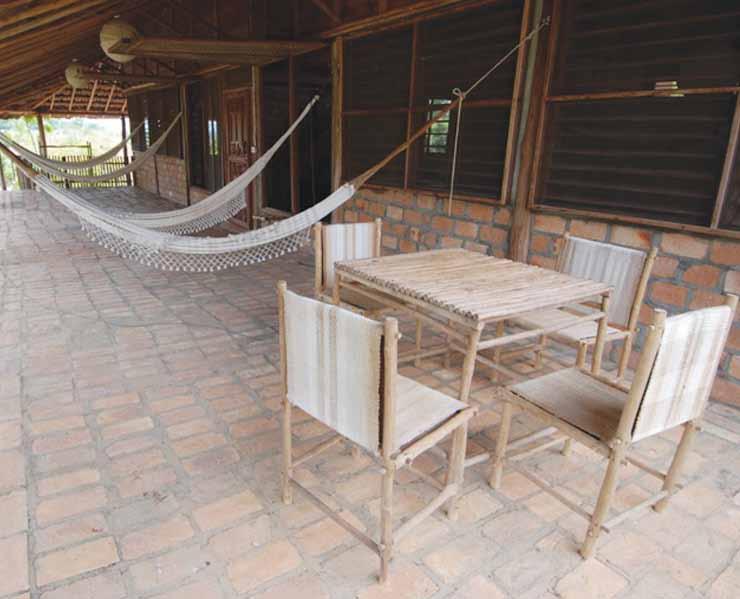
By Melvin Durai
At times I wonder why so many people seem unhappy with their lives. Don’t they appreciate what they have? Are they comparing themselves to others? Do they have a slow Internet connection?
I think a lot of it has to do with perspective -- or the lack of it. Having proper perspective means that you don’t worry about small things and you don’t take your blessings for granted.
A woman with perspective isn’t concerned that her potential boyfriend is short, because she knows he can easily kiss her feet. A man with perspective isn’t concerned that his wife is overweight, because he knows she won't put him on a diet.
However bleak our lives may seem, there's always someone in the world who'd be thrilled to be in our shoes. We often worry about so many insignificant things: the score of the football game, the number of shoes we own, the complexion of our skin, the prestige of our jobs, the size of our bald spots. And we take for granted so many important things: health, family, friendships, food, shelter, fresh air, clean water, freedom. I love freedom -- the freedom to pursue a dream, the freedom to eat lots of ice cream.
But imagine a guy who’s been unemployed for years. As he scans the employment ads, he prays, "God, if you just give me a good job, I’ll be happy for the rest of my life."
His prayer is answered and soon he’s earning a high salary, praying, "God, if you just give me a good wife, I’ll be happy for the rest of my life."
His prayer is answered and soon he’s going shopping with his new wife, praying, "God, if you just give me a second job ..."
Think of the poor farmer in an African village who grows just enough corn to feed his family. He’s happy with his life, though he lives in a tiny hut, wears tattered clothing and has never even heard of a remote control.
When he feels like chatting with some-
one, he doesn’t get on the Net or pick up a phone. He does something really strange -he chats with his neighbours. Imagine that.
Then there’s the dot.com tycoon in California who can’t find enough ways to spend her money. She’s unhappy with her life, though she drives a Jaguar, plays golf with Tiger Woods and lives on an estate that’s big enough to host the Olympics. When she feels like getting some exercise, she cuts her nails herself. She's proud that her success hasn't stopped her from getting together with her family -- at least once a year.
Just in case you’re having trouble with perspective, here are a few questions to ponder:
You just landed an executive position at a top company. Do you:
(a) Complain that you don’t make as much money as Bill Gates.
(b) Rejoice that you make 100 times more money than Bill Clinton.
(c) Grumble that you still can’t afford to buy a television network.
(d) Celebrate that you make enough money to feed 20 million people in India or 20 people in Texas.
You have a kind, generous husband who loves you dearly. Do you:
(a) Complain that he doesn’t look like Tom Cruise.
(b) Rejoice that he doesn’t look at other women.
(c) Grumble that he can’t afford to buy a television network.
(d) Celebrate that his heart is bigger than his bank account.
You've just recovered from injuries suffered in a car accident. Do you:
(a) Complain that your health insurance wouldn't pay for lifetime whirlpool therapy.
(b) Rejoice that you've regained the ability to walk.
(c) Grumble that, despite your lawsuit, you still can't afford a television network.
(d) Celebrate your good health and modest wealth.


I was showing my kids an old rotary phone when my nine-year-old asked, “How did you text on it?”
My 15-year-old daughter roared with laughter, until a thought occurred to her: “Wait, where did you store your contacts?”
My grandmother called to tell me she’d gotten an e-mail account. “Great,” I said. “Send me a message so I’ll have your email address.”
I waited and waited, but she never sent it. Several days later, an envelope arrived—Grandma had written her info on a piece of paper and mailed it to me.
My nine-year-old and I passed a store with a sign that read “Watch Batteries Installed—$5.”
He seemed confused: “Who would pay to watch batteries installed?”
One of my fourth-grade students told me he had trouble with math. His explanation summed it up well: “The guy next to me always gets ten out of ten on his quizzes, and I get only ten out of four.”
I recently ran into an old student of mine, who said, “I always liked you. You never had favourites. You were mean to everyone.”
An old farmer is inconsolable after his dog goes missing. He takes out an ad in the newspaper, but two weeks later, there’s still no sign of the mutt.
“What did you write in the ad?” his wife asks.
“‘Here, boy,’ ” he replies.
Funny Headlines
“County to Pay $250,000 to Advertise Lack of Funds” (Register-Guard, Eugene, Oregon)
“Federal Agents Raid Gun Shop, Find Weapons” (Tulsa World, Oklahoma)
“Wisconsin Woman Takes Husband to Police for “Talking Stupidly”” - Source: La Crosse (Wisconsin) Tribune
“Vladimir Putin Hires Boyz II Men to Boost the Russian Birth Rate”Source: Daily Mail
“Stylish but Illegal Monkey Found Roaming Toronto IKEA” - Source: The Globe and Mail
Water Broke
I answered a 911 call at our emergency dispatch centre from a woman who said her water broke.
"Stay calm," I advised. "Now, how far apart are your contractions?"
"No contractions," she said breathlessly. "But my basement is flooding fast."
A chat with Tom Mabe
Forty-two-year-old comedian Tom
Mabe was a prank prodigy, having executed his first when he was only eight.
He had just made a snowman on the front lawn of his Louisville, Kentucky, home when he watched helplessly as teenagers in a car ran over it. He made another, with the same result. The third snowman he built was on a fire hydrant.
“There I was with their wrecked car and water gushing out everywhere, and I acted like, ‘Gee, I didn’t think anyone would hit it with his car’,” he says. “I had to do something. I was just a little guy. So I came up with this kind of cowardly way of getting revenge.”
Best gag you’ve pulled off: “One time there was a couple of homeless guys in front of a McDonald’s. I called the restaurant impersonating a policeman and pretended that the men were actually undercover cops. I persuaded the manager to bring them burgers and coffee.”
Any pranks you regret pulling? “I once saw a dead deer by the side of the road. I ran back to my house, put on a Santa suit, and then I lay down beside the deer— just in time for a school bus to drive by. Freaked the kids right out.”
Second time around
Two hunters fly to Kenya, where they bag six gazelles. As the crew is loading the small plane to return, the pilot says the aircraft can take only four gazelles back.
“Last time, the pilot let us take all six, and he had the same plane as yours,” argues the first hunter.
Reluctantly, the pilot gives in and takes off. But the little plane is too heavy, and it goes down.
Climbing out of the wreckage, the second hunter turns to the other: “Any idea where we are?”
The first replies, “I’d say we’re pretty close to where we crashed last time.”