

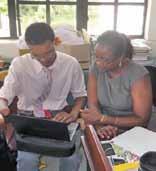


For two decades, the Upper Corentyne Senior Citizens Organisation has been offering love and affection, and providing hot meals for the seniors of its community; but these are just a few ways the group ensures our senior citizens are never forgotten.
The organisation was formed in late 1993 by Pastor Almond and Yetrawatee Katryan, as an outreach activity of Roadside Baptist Church. The launching ceremony took place at Corriverton Civic Centre where Beverly Braithwaite Chan, then manager of Futures Fund/CIDA, was the guest speaker. Her encouragement, after she witnessed several activities of Roadside Baptist, led to the formation of the senior citizens’ group. It was the first activity at the Corriverton Civic Centre- a project of Futures Fund. About 50 seniors were present.
The objectives of this pro-
gramme are to provide an appropriate environment for the elderly to socialise, enjoy recreational activities, and showcase their skills and talents. This programme includes monthly meetings and one hot meal prepared and served weekly by the seniors themselves with supervision by the president and secretary.
Dry food items are provided by Roadside Baptist Church Skills Training Centre through the World Food Program and Food for the Poor. The meals are prepared in the kitchen of the Corriverton Town Council next to the Corriverton Civic Centre. Stoves, pots and pans were donated to the group by kind-hearted community residents. Monthly packages are also given to the seniors.
“The executives and helpers from the beginning: Ms Victorine Stuart, Ms Joyce and Ms Flatts who were always assisted by the vibrant and youthful Mr.
Flash – a young man from the community. Over a period of time the group was so big that it had to be divided into Groups A and B according to location. Group B started to meet at Roadside Baptist Church where Mr Narsingh, Mr Stokes; Aunty Leena and Aunty Tara –all seniors, undertook to do the cooking for the monthly meals and meetings. Pastor Katryan was always their willing helper and technical advisor,” Yetrawatee Katryan said in an interview with Guyana Times Sunday Magazine
Over the years, Yetrawatee pointed out, because of the difficulty in accessing the Corriverton Civic Centre, although statutory meetings were fixed, Group A became disenchanted as they had to meet several times outside of the building while the building remained locked and unused.
Coordinator of the group, Nalin Katryan, had several

discussions with the leadership of the Council and even sought the assistance of the Regional Chairman, Mr Bacchus, who himself came once and saw the group locked out of the building. Unfortunately, the seniors had to continue their meetings on the pavilion in the compound of the Town Council while the Corriverton Civic Centre next door remained locked up, although one of the objectives of the centre was for purposes of this nature.
“Many seniors dropped out because it was difficult for them to climb the steps
Ms Joyce (both septuagenarians), Pastors Motielall Harlall of Livingstone Baptist and Pastor Terry Rohit of Roadside Baptist.
Previous cooks Aunty Leena and Aunty Tara have retired from cooking owing to poor health but still attend monthly meetings. Uncle Narsingh, another cook, sadly passed away a few years ago. The cooking is done over huge firesides with firewood– quite a messy job to clean up afterwards, but these seniors continually cooked and cleaned.
Food items and packages are provided by the Roadside
reach by medical staff to test blood pressure and have relevant discussions; indoor games; sharing of experiences and skills among themselves and with youths; mixing with youths at Roadside; educational discussions by resource personnel; and giving assistance to needy seniors.
The senior group benefitted from one educational tour, sponsored by Dr Pasram Thakur, to University of Guyana Berbice Campus a few years ago. That was really a treat for them.
“Heartfelt gratitude is
of the pavilion, and during rainy season it was not safe for them as they not only got wet but the steps became very slippery. Also, the council had to repair the kitchen so the group was left with nowhere to prepare meals. That contributed to the fall of Group A. Many of the members there started to come to meetings at Roadside,” Yetrawatee recalled.
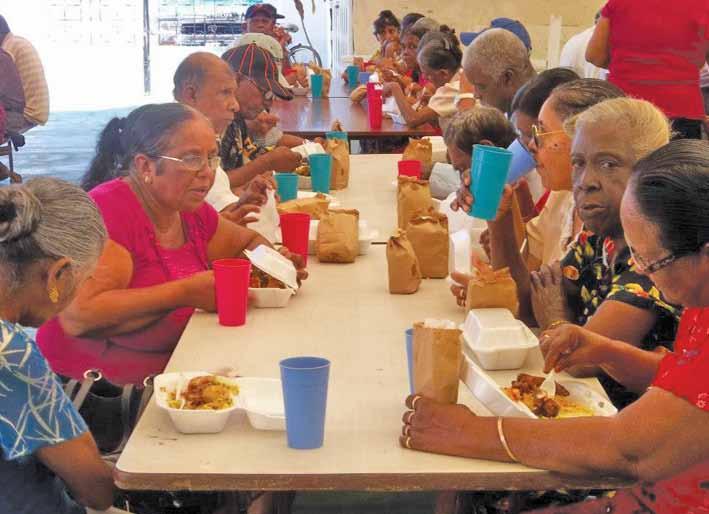
With accommodation at Roadside, the group flourished. The present membership at Roadside is about 60. On a monthly basis about 30 to 40 seniors attend meetings. They continually benefit from monthly hot meals and a package with basic hygiene items such as bath soap, toothpaste, toilet paper, and much more. Meals are prepared by Joycelyn Shepherd and
Baptist Church Skills Training Centre. Shaminee Rohit coordinates this aspect of the programme with support from Yetrawatee.
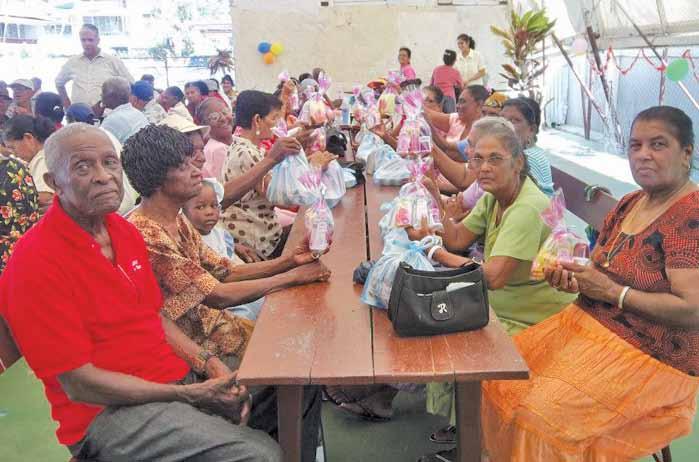
Besides monthly meetings, another activity of the group is the annual December Treat where about 80 to 100 seniors are hosted. For this event, assistance to prepare meals comes from members of Livingstone and Roadside Baptist Churches. As is customary, the seniors also help with the preparation. Gifts are presented to all. The entire staff of Roadside is involved in this activity – sorting, wrapping and distributing gifts, serving meals to the seniors as well as eating with them. Some young volunteers of Roadside also help at this time.
Additionally, other activities include medical out-
extended to all who support the monthly programme by way of cash or in kind donation and their valuable time. Special thanks are extended to the business community for their tangible support of the grand annual Christmas treat for the seniors, to Roadside Baptist Church for facilitating it and providing all the necessary facilities and to Roadside Baptist Church Skills Training Centre for their all round support to ensure that those who have paved the way for the younger generation, are shown some sort of basic appreciation for their services,” Yetrawatee and the Upper Corentyne Senior Citizens Organisation’s committee thanked.
For more information on this organisation call the Roadside Baptist Church on 338-4215.
The Benab Foundation is a non-profit, politically unaffiliated, independent think tank and association of sociallyminded individuals dedicated to improving the health, the standard of living and education level of Guyanese.
The foundation first came together December 2012 and was founded by Robo Matheson and Elson Browne-Low.
Speaking with Guyana Times Sunday Magazine, Browne-Low said they felt a duty as socially-minded, talented young people to work towards ensuring that the lives of every Guyanese are greatly improved. They also found that they had excellent ideas that could do this in numerous ways and, in light of this feeling of duty, wanted a way to both develop and carry out those ideas.
“Our foundation is a youth think tank and non-profit which means that we look to research and generate new ideas that can help Guyanese in any field which our members think especially important or relevant. We then work to bring those ideas which are currently relevant to life. Our emphasis, in doing this, is a positive one, focusing not on blame but the great potential Guyana bears,” Browne-Low mentioned.

bust organisation with a large membership all working together to improve Guyana in many areas.
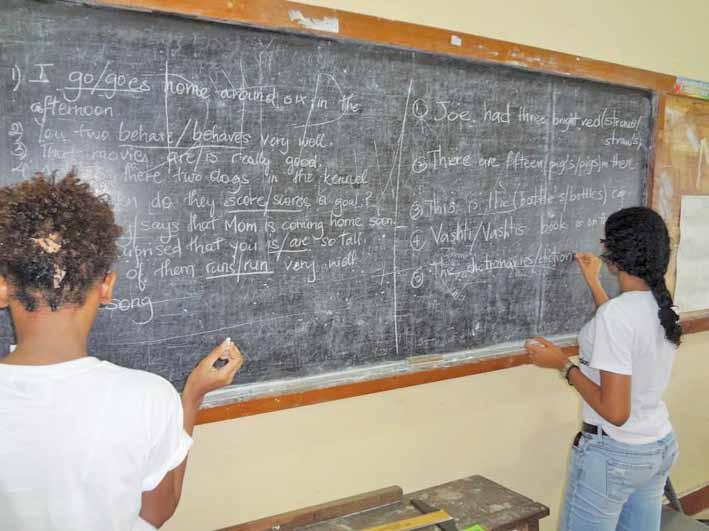
Apart from meetings, where members carry out critical analysis in an effort to build critical thinking skills, the foundation is involved in a volunteer tutoring project, The Cognitive Initiative, where it is currently testing if such a programme can improve Mathematics and English pass rates at the Caribbean Secondary Examination’s Council Examinations in Guyana.
“Though we are only a recently formed foundation, we have completed our programme, The Cognitive Initiative. What we would therefore say we have accomplished is helping third form students from poorly performing schools to improve their Mathematics and English skills. We have also worked extensively to improve group members’ leadership abilities and critical thinking skills,” disclosed Browne-Low.
“Working with the students involved in The Cognitive Initiative has been phenomenal, and we really feel that it has allowed us to appreciate young people who we may not have otherwise come into contact with, and who have great aspirations. Seeing students correct grammatical or mathematical misunderstandings they may have had makes us feel like we’re setting a foundation from which students can, if they engage their minds and work hard, reach opportunities they would otherwise not have been able to. Mathematics and English are important for getting jobs in Guyana and so our success story is that we’ve helped students come that much closer to a world of great earning opportunities,” he revealed.
Welcoming others to join in this initiative, the foundation looks forward to form linkages with other non-profits to develop projects. Browne-Low pointed out that they are willing to accept private donations
Passionate about helping the children of Guyana develop academically, Browne-Low said it is the foundation’s sincerest hope (and expectation) to expand The Cognitive Initiative next year with the goal of eventually implementing (provided it proves successful) a country-wide programme. He and his colleagues would also like to build a ro-
(whether in cash or kind) in order to carry out those projects provided donors meet with them to discuss seriously and clearly the terms of their support.
“We also appreciate greatly word of mouth, so the more people you tell about us the better. If you would like to volunteer on any of our projects feel free to contact us.
Anyone who is interested can email us at thebenabfoundation@gmail. com or call 609-6909 or 642-7198. They can also feel free to contact any of our members or leave a message on our Facebook page, The Benab Foundation. Membership is open to everyone between the ages of 16 and 30, but because our work can be demanding and we only grow the organisation by a few members at any one time we require a face to face interview where we will discuss not only your interest in our organisation and in helping Guyanese, but your relevant skills and talents,” Browne-Low explained.
Through her charity, ‘I Can Foundation’, Shabakie Fernandes is able to give women seeking help a second chance at improving their lives






The Toucan II
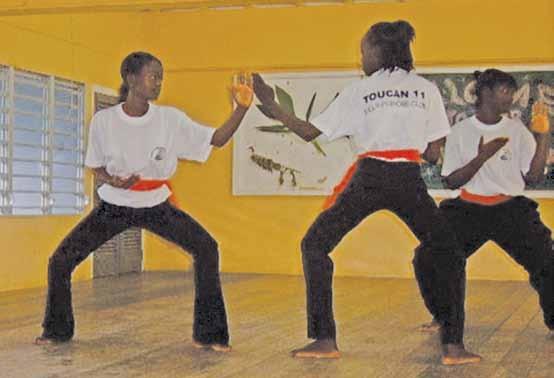
Multipurpose Club was established Aug 3, 1996 by Yvette Herod, a teacher and prominent community activist, who has continued to work tirelessly for the restoration of cultural, social, educational and economic progress in the village. It was also an offshoot of the annual Emancipation celebrations held in Buxton.
A non-profit organisation, it strives to guide youths of the greater Buxton-Friendship, East Coast Demerara, into developing exemplary lives for themselves, their families and their community.
Toucan II had very humble beginnings, starting off at the home of Kwame Apata, who willingly offered a small cottage at the front of his yard, in Friendship, for the organisation to conduct meetings with the following admonition: “You have your work cut out for you.”
Membership grew rapidly, and members were forced to move to the bottom of a bigger house, also owned by Apata and in the same yard.
About six months later, the club was offered another meeting place at the Seaforth’s residence, at 51 Buxton Middle Walk, from where it operated for approximately 2 years, after
which it was forced to relocate due to needed repairs to the building. Timely approval was granted by the chairman and councillors of Buxton-Foulis NDC for the use of the Village Hall in 2002. The club operated from there until 2003 when the Ministry of Education allocated two classrooms on the top floor of the reconstructed BuxtonFriendship Primary School for use by Toucan II.
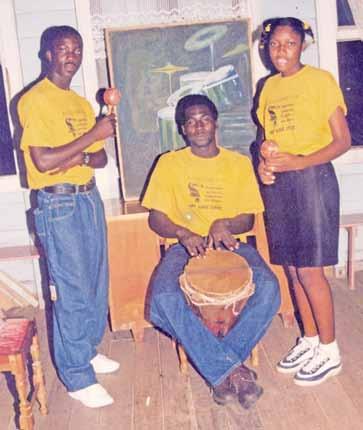
Helping to build wellrounded individuals, the club activities include: fundamental literacy skills; information technology; academic studies; music lessons; fine arts study; communication/public speaking/debating; selfempowerment/career development; planning of activities for Emancipation programme in collaboration with the First of August Movement among many other activities.
The club’s uniform consists of gold shirt and navy blue skirt/trousers with its motto: “Together We Build, Together We Share, We Are One.”
In an interview with Guyana Times Sunday Magazine , founder Yvette Herod said that Toucan II has grown tremendously over the years and continues to give back to the Buxton-Friendship. She added that youths are of-
fered a secure place where they can take advantage of all the services offered.
“The club is a sanctuary for young people. We are training youths not only to be gainfully occupied but also to become future leaders and examples to their peers and others. If I can help in some small way to have a positive impact on a child’s life, to make them ‘somebody’ then that
joys strong participation by more than 150 active members, whose ages range from 6 to adult.
Over the years, Toucan II has expanded its contribution to make a meaningful impact on the Guyanese society through its hard work and dedication to fostering a strong and positive environment for children and young adults. It is a designated commu-
is enough reward for any hard work I might have put in,” noted Herod.
Toucan II has hundreds of members on roll, and en-

nity-based organisation for the execution of special programmes and projects, often collaborating with government agencies and community organisations, such as the Ministry of Youth, Culture and Sports; Ministry of Labour and Human Services; Ministry of Education; The National School of Dance; First of August Movement; African Cultural Development Association (ACDA); Buxton-Foulis Neighbourhood Democratic Council (N.D.C.); and many more.
The club has executed significant projects. One project of note is the club collaborating with ACDA and the community’s NDC in implementing a chicken rearing project, underwritten by the United Nations Development Programme. Each of 40 farmers in the community benefited from the distribution of 100 chicks, a 7-week supply of feed and a coop.
During the early years of the criminal siege, the club collaborated with the Guyana Defence Force in hosting a 2-week recreational camp for 100 youths residing in areas most affected by the crisis.
Toucan II continues to work with groups and exemplary individuals, based at home or overseas, to deliver lectures on topics of interest and benefit to the community. Some of those covered recently were: youth responsibility, gender and equality, HIV/
AIDS, leadership and other life skills.
The slate of educational activities includes classes in computer literacy. Through the generous donations of several computers by various charitable
body of elders, in collaboration with the Executive Committee, oversees the club’s day-to-day operations and offers policy advisory when needed. Many are of the opinion that this may be the reason for its many years of existence. The club’s most recent undertaking is the erection of a club house to accommodate its growing list of members and essential programme of activities. Construction of the Youth & Community Centre, which was started in 2007, has been on hold due to the lack of available resources.
“We’re currently trying to raise funds for the completion of the centre. Many of our youths have moved on to further their education at the University of Guyana and so we keep
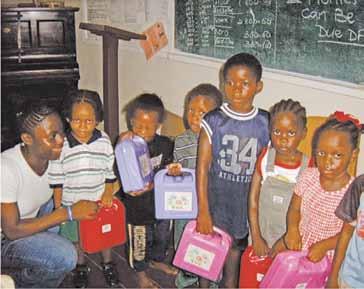
organisations and government agencies, the Club offers free classes to residents. The programme caters to students, teachers and parents. By appealing to single-parents, Toucan seeks to equip these household heads with increased skills to better provide for their families. Other activities on the agenda include sewing, craft and a reading club.
Toucan II Club has a unique organisational structure when compared to typical youth clubs. It has an executive body as well as a ‘Board of Elders’, which is tasked with the overall management of the organisation. The
enlisting and need a bigger space to welcome even more. Toucan II executes its mandate by way of donations from public/community-spirited individuals and donor agencies, as well as proceeds earned from fundraising events. The club takes this opportunity to express its sincere gratitude to all who have contributed to, and supported, its efforts to establish a model youth organisation for community development and character building,” Herod declared. For more information on the Toucan II Multipurpose Club, call Yvette Herod on 610-4339.
through her charity, ‘I Can Foundation’, shabakie Fernandes is able to give women seeking help a second chance at improving their lives
Philanthropist
Shabakie Fernandes believes it is never too late for women to empower themselves, be independent and have the earning power they yearn for. In an interview with Guyana Times Sunday Magazine,

Fernandes stated that the I Can Foundation is a nonprofit organisation, officially launched last year, which seeks to reach out to various communities to provide information as part of its vision to transfer knowledge on social issues to these communities.
The foundation, Fernandes outlined, aspires
change.
The humanitarian has observed that many persons lack skills to be able to provide for their families, and there are some who are hurting and facing problems due to some trauma they have experienced. Most of them have even lost the will and confidence to repair their lives. That is why the foundation is on a mission to help these people reorganise and rebuild their lives.
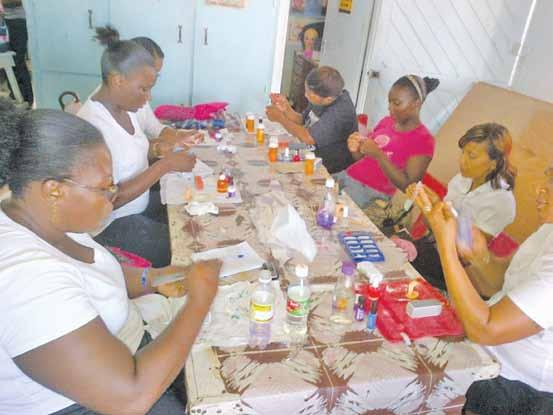
This year, more than 70 women were trained in cosmetology and bookkeeping. The foundation has also worked with over 300 parents and youths in the areas of parenting, domestic violence, and child sexual abuse.
Working with numerous charities for several years, Fernandes knows the plight of some women who yearn for a skill, to read and write, and earning power. She related one experience of a woman who could not read nor write and was only able to identify money by their colours. Now, that woman, Fernandes noted, has completed all the foundation’s courses and is earning a salary.
“Some of these women do not have a push or start but definitely has the willpower. My experiences being involved with charity work have helped me to realise
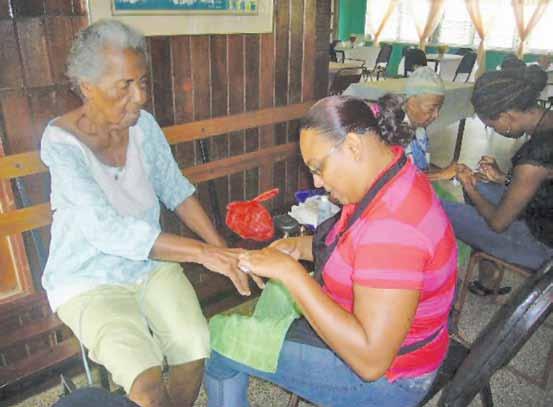
Fernandes recalled, the woman was undecided because of not having materials for the cosmetology classes. She was then told that the materials would be provided and the courses are free. Feeling assured, the woman decided to sign up for the classes. Fernandes said although the woman started a month late, she never missed a class and excelled throughout the programme. Now she has a small business at home and Fernandes plans
to excel as a valuable, effective, and influential organisation advancing the lives of persons, and serving as a uniting force for women, serving as a major catalyst for the stimulation, growth, and dissemination of knowledge and practice, being the primary resource for all in relation to social issues and development, and acting as a principal leader and global partner in promoting knowledge and effecting
that teaching these women a skill along with reading and writing are necessary for them to be independent and so I started the I Can Foundation to fulfil this mission,” Fernandes cited.
Of note is the foundation’s power to help women to transition into budding entrepreneurs. This is particularly evident with a 34-year-old mother of 10 who suffered domestic abuse for years. Initially,
to help her build a small shop where she will have more working space.
Not having a building, because of lack of funds to construct one, to facilitate the foundation’s programmes does not deter Fernandes from helping women achieve independence. Investing her time, resources, and energy, a passionate 27-year-old Fernandes travels to vari-
ous communities, teaming up with professionals to offer women a chance to have a skill. She has collaborated with fellow humanitarian Malinda Marks, a professional cosmetologist, who has worked tirelessly in facilitating cosmetology courses for women in Plaisance on the East Coast of Demerara. In addition, Fernandes has held courses at the Ruimveldt Children’s Aid Centre which has warmly opened its doors to facilitate the foundation’s work.
“For many of these women this is a last hope last chance opportunity. Some of their husbands allow them to come to the cours-
es but when they see how their wives are being empowered and becoming independent that presents a problem. The husbands get abusive and even put out the wives from the homes.
One woman, who benefited from the foundation’s programmes, told me that it was time for her to leave because she could not cope anymore with the abuse. Some others have decided to team up to start a business together, being unafraid of what their husbands had to say. Seeing how brave these ladies have become because of the I Can Foundation’s work motivates me even further to continue my work.
This is the cause for which we are seeking donations from generous people, so that our mission can be accomplished, and we succeed in spreading the message of humanity,” Fernandes declared.
“Our undertaking is to help women, men and children thrive and to build, strengthen and sustain individual family and community life. We aim to advance the knowledge of persons to benefit society and improve people’s lives. The I Can Foundation understands that persons of all ages are in danger of becoming victims to many social ills. Many live with some degree of fear, and many lose their identity or do not realise their potential because of the social ills affecting them. The foundation is also committed to addressing these social ills by increasing awareness, encouraging assertiveness, and helping persons recognise they are worth the effort to secure and preserve,” Fernandes pointed out.
To achieve this, the foundation has been visiting and working with communities, addressing problems such as child sexual abuse, parenting, domestic violence, trafficking in persons and community life competence. Persons who wish to support the work of the I Can Foundation can do so by contacting Fernandes on telephone number 672-1930 or making a contribution to the I Can Foundation.

By PetamBer Persaud
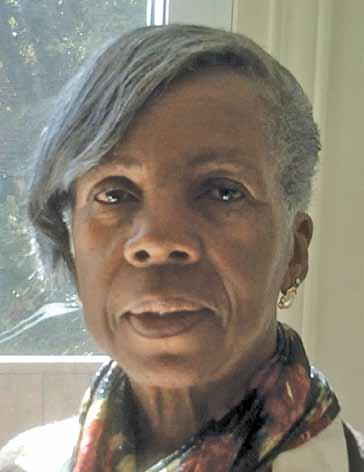
(Extract of an interview with Ms Beryl Adams-Haynes, author of “Plaisance: From Emancipation to Independence and Beyond” in Georgetown, Guyana, July 2010. Adams-Haynes was born in Plaisance and was an educator for many decades. She was honoured with a National Award –Medal of Service – for her outstanding contribution to society. Plaisance has also produced internationally recognised musician Eddy Grant, and a former world boxing champion, Wayne ‘Big Truck’ Braithwaite.)
PP Our history was first recorded by the
Europeans colonisers who did take a certain amount of licence with the facts, and that history was so written to show the Europeans in a good light. But it is a matter of pride that more and more scholarship on our history, written by our own people, is turning up; rewriting that initial and sometimes flawed history. One such scholarship is “Plaisance: From Emancipation to Independence and Beyond” written by Beryl AdamsHaynes…Our history is important. Recording and righting that flawed history is imperative. What were the factors leading up to the research, writing and distribution of this book?
AH The idea came to
me some years after I remigrated and discovered by chance that Plaisance was bought by freed slaves; this discovery came late in my life. I started talking to older folks in the village and found out that no one has ever approached them for such information. Then again not many of them –the older folks – knew much about our ancestral history. The inspiration came from the situation of them not knowing, me not knowing and the question of how will the younger ones know; and that’s what set me on the path of research, documenting, and finally the book.
PP Research material on Guyana in Guyana is not easy to obtain; I am

a researcher on Guyanese Literature and a sort of quasi-historian, so I know the difficulties in getting information, cross-referencing etc. Tell us about your research stages.
AH The research stages, as you said before, were not easy; it was an uphill task. I started here at the archives and the library, finding very little information on Plaisance. You may come across an article running into many pages with just a mere reference –one line – a few words on Plaisance. Thanks to my children, who are still in London, and who were feeding me with some amount of information as to websites that would be useful. The bulk of the material for happenings in the village from the 1920s onward came from the older folks. I contacted many villagers who provided information up to recent times. Some prominent “Plaisancians” were listed in the earlier manuscript. The idea of the annexes came from my editor Dr Laurence Clarke, a prominent “Plaisancian”. To get information as to what some of our villagers (as you must be aware most of our people are residing outside of Guyana) were doing, assistance was sought from villagers abroad who were enthusiastic and excited about this long awaited publication.
PP Much of our history, in various forms, is stored in foreign archives…
AH Yes, I know that now: researching, cross referencing, documenting and finally the end product took some six years, not continuously, before it finally came to fruition. When I set out to write the history of Plaisance, I didn’t set out to do this [showing the book], I set out to write a few pages, a twenty-fivepage document perhaps for my own satisfaction, but it took on new dimensions and has taken off in way beyond my expectations. Let me explain: when I came back home, Plaisance never celebrated Emancipation at village level. I got together with other villagers, and one thing led to another, and the birth of our Emancipation celebrations began twelve years ago. This led to an awakening of our villagers and their quest for knowledge of our history.
PP It would be a good time to talk about the history of Plaisance and the village system.
AH In the beginning it was not easy. There was friction as persons jockeyed for the better plots to build. Remember, some 65 persons bought the plantation and all of them couldn’t live or build in the same area. Assistance was sought from the government – plantocracy – to help put their affairs in order. There were also problems of flooding, sanitation, drainage, difficulties collecting rates and taxes and other woes…but those problems were overcome to an extent, leading to better life style.
PP That’s the past, let’s look at the present Plaisance, to those who have endured and have made and are making significant contribution.
AH The Plaisance of today is different from the Plaisance I grew up in, and even more different from the Plaisance of our ancestors who worked so hard to develop it and call it their home. Plaisance has produced and will continue to produce many outstanding citizens both local and of international stature –right on our doorstep is the first female judge of the Caribbean Court of Justice, a trailblazer: Madam Justice Desiree Bernard; Senior Counsel Bernard De Santos; Director of World Bank (Sudan, Africa) Dr Laurence Clarke; Prof Denis Benn who heads the Michael Manley Institute, Mona Campus; Dr Imran Ali; Eddy Grant, international recording songwriter and artiste; Wayne ‘Big Truck’ Braithwaite, former world boxing champion;
Ali,
and many others.
PP Many of these achievements came about because of three main factors mentioned in your book: deep roots in the church, education, and political and cultural awareness. Now we have a book in which you have put a lot of hard work to bring the history of Plaisance to the fore; very commendable. But here’s my pet peeve: are our young people reading?
AH That is one of our problems – reading. Lack of reading could defeat the purpose of the book. We – various committees – have planned to go into the schools, to read extracts and do other related activities …
PP Making that connection with the youths is crucial and I hope you succeed, for it would benefit your community of Plaisance and eventually the country. Congratulations again on gifting us this important scholarship, which is already going into a first reprint.
Responses to this author telephone (592) 226-0065 or email: oraltradition2002@ yahoo.com
What’s happening:
• The Guyana Annual 2012-2013 magazine is now available at Guyenterprise Ltd and at city bookstores.
• Coming soon: “An Introduction to Guyanese Literature” by Petamber Persaud.

Twentysix-yearold Konyo Mbeke Zalika SandifordThompson has proven that hard work and perseverance can only lead to a successful path, where dreams are realized.
Born to Linden parents and growing up in Amelia’s Ward Linden, Konyo attended Mackenzie Primary School and Mackenzie High, where she went on to graduate in 2003 with nine CXC subjects including five Grade Ones. She placed fifth among Region Ten’s top students.
During her secondary years, Konyo proved to be an outstanding all-round student ,as, apart from excelling academically, she was also involved in other activities, including dramatic poetry competitions, science fairs and inter-house and inter-school sports.
In her quest for higher education, she furthered her academic goals in 2004 by completing CAPE with eight subjects.
Konyo explained that she was always fond of dramatic poetry, and from Primary Four until fourth form, she won all the competitions she participated in. From this hobby, she developed an enthusiasm for public speaking, arguments and presentations. It was this, along with her wish to help people, which made Konyo decide to become an attorney.
In 2005 she enrolled at the University of Guyana to pursue a Law degree, which she completed in three years. After graduating from UG, Konyo moved to Hugh Wooding Law School in Trinidad and Tobago for two years, after which she obtained her Caribbean Legal Education Certificate.
Two weeks after being admitted to the Bar in Guyana, Konyo joined the director of public prosecutions chambers in November 2010, where she worked as a prosecutor for the state. Working at the DPP chambers was a “rich experience” Konyo said. “It’s like you’re being thrown into the deep end of the sea,” she recalled.
She pointed out that her tenure at the DDP was filled with wins and losses, but it was all worth it because it allowed her to improve as an attorney and an individual.
She is also proud that she was given the opportunity to work before several judges from whom she learnt much, and that she was a part of history in the judicial system by having the first video conference in a criminal trial.
“I worked on a lot of rich cases, and there were some that fell through because there was not enough evidence to yield a conviction, but working at the DPP is a good place for an attorney to start his or her career. It allows you to build confidence in the courtroom, and I left without any regrets.”
Thompson is now living her long-time dream of owning her own law firm, which she is operating out of Mackenzie Linden. She said that it was not an easy task but her efforts are bearing fruit as her law firm is gaining momentum.
In her quest to gave back to society, for the past three years Konyo has been sharing her knowledge and experience with the young law generation in Linden by teaching sixth form law students at the Mackenzie High School.
The young attorney advises young persons who want to pursue law as a career is to be resilient. “You have to be able to bounce back from whatever downfalls you experience and keep going forward. I detest people with a spirit of victimhood. Challenges will come your way no matter who you are, but you must always be prepared to bounce back.”


Alicia Bess is a 23-yearold focused on marketing her beautiful country to the wider world. She was recently crowned Miss Guyana Jamzone 2013, and would be competing in this year’s Miss Caribbean Culture Queen Pageant slated for Aug. 5 in St Kitts and Nevis. Bess would be competing against 12 other beauties from across the Caribbean for the coveted title. The 6-foot-tall beauty possesses a humble personality, filled with ambition, generosity and consideration. Her philosophy in life is that through hard work and determination nothing is impossible. The elegant young woman is also enthusiastic about the arts. At a very young age she trained in dance, drama and singing, and continues to be a notable figure in the performing arts arena. In 2009, she was rewarded an RBL Arts and Culture Award for her dedication to the three arts: drama, singing and dancing. Alicia believes that true beauty comes from within, and this she has portrayed through her humanitarian work. The beauty queen is an active member of charitable and community work, and is a peer educator offering advice on various social issues, and assistance to persons in need. Alicia was always interested in pageantry and has excelled in it. This year she was first runner up in the Miss Bartica Regatta Pageant where she won the Miss Congeniality award. In the Miss Jamzone pageant she also won People’s Choice, Best Body, Best Gown and Best Smile. Alicia is currently enrolled as both an ACCA and ABE student with the hopes of reading for her master’s in business management in 2014.

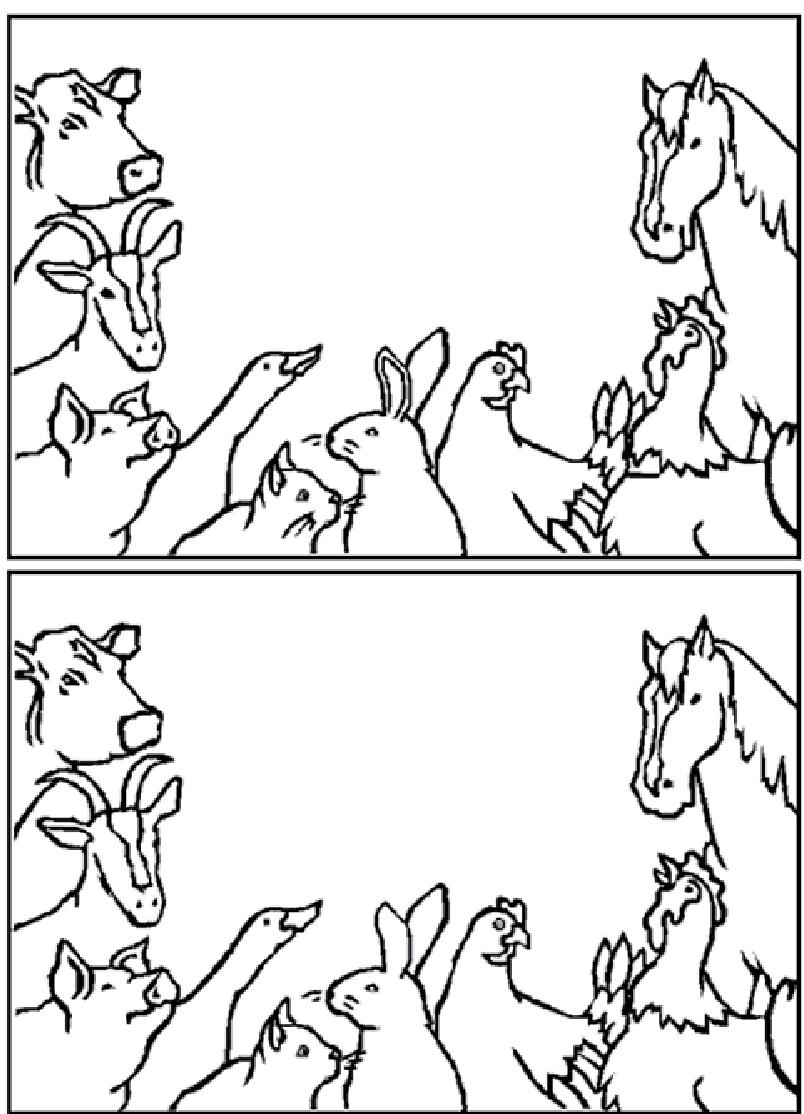
Find and cirlce EIGHT differences between the two pictures.
The Bushmaster snake (of the Genus Lachesis) is described as the longest venomous snake in the world, with a maximum known length of over 12 feet. Its habitat ranges among scrublands and forests of the Amazon River basin north to Costa Rica in Central America.
Three species of bushmaster are known to exist: L. muta, (South America) L. Stenophry , (Central America) and L. Melanocephala (Costa Rica). They all possess potentially lethal venom.
The bushmaster is a pitviper that has two heat sensing pits on its face. The heat sensing pits are used to detect warm-blooded prey such as small mammals and birds, as well as to direct predatory strikes.
The venom of the bushmaster is less toxic than many other snakes, but it produces large quantities (411 mg (0.014 oz), compared to just 52 mg (0.0018 oz) from the highly venomous copperhead snake) and has very long fangs, making it a very dangerous animal. Fatal bites are not uncommon.
It is the only pit viper in the Americas to lay eggs instead of bearing live young. A Bushmaster can survive on fewer than 10 large meals per year. Their heatsensitive pits allow a bushmaster to detect a heat difference of just 0.0036° F (0.002°C)
The objective of the game is to fill all the blank squares in a game with the correct numbers. Every row of 9 numbers must include all digits 1 through 9 in any order. Every column of 9 numbers must include all digits 1 through 9 in any order. Every 3 by 3 subsection of the 9 by 9 square must include all digits 1 through 9.



Jessica Lucas is a Canadian actress and singer. She was born and raised in Vancouver, British Columbia, Canada. Jessica has been acting since she was seven years old, receiving professional training with the Children's Theatre Arts. She earned theatre credits in local productions of “Snow White & The Seven Dwarfs”, “Grease”, “Cinderella”, “Mousetrap” and “Music Medley”. Jessica has developed herself as a professional and is best known for her roles in the series “Melrose Place”, “Edgemont” and “Cult”, and in the movies, “She's the Man”, “The Covenant”, “Cloverfield” and most recently, “Evil Dead”. In 2008, she guest starred as Kimberly MacIntyre in four episodes of The CW's “90210”. In 2011 she played Haley in “Big Mommas: Like Father, Like Son”, where she showcased her singing talents as well as her acting skills. She will soon be seen in the upcoming American romantic comedy film, “Are We Officially Dating?” alongside Zac Efron.
Katy Perry is set to appear on boyfriend John Mayer's forthcoming album, “Paradise Valley”. The “Teenage Dream” hit-maker recorded a country track titled “Who You Love” which will appear on the album - Mayer's sixth.
News of Perry and Mayer's musical collaboration comes after the pair recently reconciled after a brief split earlier this year.

Speaking about his girlfriend when he returned to the stage in July, after undergoing surgery on his vocal chords, Mayer told the crowd: "She was so patient... [She took the time] to continue to get to know me and love me."
Perry's appearance on the album comes after Mayer recently collaborated with Frank Ocean on the track “Pyramids”. (Glamour)
Amanda Bynes has been placed on an immediate, extended 30-day psychiatric hold, ahead of a planned conservatorship hearing Friday morning in L.A.
Doctors at the psychiatric hospital where the troubled actress has been held the last two weeks determined she was not well enough to leave the hospital to attend the hearing, where Bynes's parents are trying to win temporary conservatorship.
Bynes's doctors went to the judge overseeing the actress's case, sources told TMZ, and the judge traveled to the hospital to conduct an emergency hearing.
After that meeting, the judge granted the doctors' request.
According to the law, doctors can only get such an order if the patient is

"gravely disabled as a result of a mental disorder."
Bynes's parents can still pursue temporary conservatorship, which would allow them to control her finances.
(People)
On her new single "Rock N Roll," Avril Lavigne defiantly declares "I am the motherfreakin' princess" ... and now, she's got her royal portrait.
Late Thursday, she revealed the cover art for her upcoming album, a stark and striking photograph in which she gets decidedly dark (What would Winnie Cooper think?) Her eyes are ringed in smeared eyeliner, her hair is pulled back tight on her head, and her stare is piercing And as if the image wasn't statement enough, well, consider the fact that this album is self-titled ... that's about all you need to know.
The album is reportedly due in September, and has already been preceded by a pair of singles — the
aforementioned "Rock N Roll" (co-written by her husband, Nickelback frontman Chad Kroeger) and "Here's To Never Growing Up."
She's been working on the follow-up to Goodbye Lullaby since late 2011 with producers Martin Johnson, Max Martin and David Hodges, and as recently as April, she was still writing and recording. In fact, Lavigne has written so many songs that she's re-


portedly considering releasing a second album in the near future:
"I definitely wrote a lot of songs. I've got about two records worth of music, so maybe I'll do back-to-back records," she said in a recent interview. "I kinda want to do the back-to-back records because I've worked so hard on writing a ton of songs and I just want to tame it perfect. And then, because there were so many, it was like 'Okay, well, what makes sense?' " Makes sense to us. And given how cool this cover is, we can't wait to see what she'll do for an encore. (MTV)

Yet another milestone for the fabulous Mrs. Carter!
Not only do we give Beyoncé kudos for undergoing a bold new cut, but she can now add “fragrance mogul” to her ever-expanding list of accomplishments. Her “Heat” collection of signature scents has just been named the best-selling celebrity fragrance brand worldwide. Since 2010 she’s launched six, to be exact — the latest is a limited edition of Heat for her Mrs. Carter Show world tour (now available at Beyonce.com). If you missed the show, it’s the best-smelling alternative. (People)

Starting his career off as a model in Delhi, Rohit Bakshi never dreamed of becoming a Bollywood hero or even someone who would be very popular on the small screen. However, after moving to Mumbai for better opportunities, Rohit got a chance to act in the serial “Titliyan” on Sahara One. This was followed by a plethora of shows both on Sahara One as well as those produced by Balaji Telefilms. He has wooed the small screen audiences with his roles in popular soaps like “Kahiin To Hoga”, “Kahiin Kissi Roz” and “Kyunki Saans Bhi Kabhi Bahu Thi”. Currently, Rohit is busy promoting his debut film “Dehraadun Diary”a movie based on true events of an ordinary man who struggles with life and love.



to decorating the wall over the bed in your bedroom, think outside the box of standard artwork or mirror decor and get creative...



Ingredients: 4 tablespoons unsalted butter 1 medium onion,
1 medium tomato, peeled, seeded and coarsely chopped
Method: Melt butter over medium heat. Add the onion, tomato, garlic, and crushed red pepper. Cook, stirring occasionally, for about 10 minute
Add the squash, beef stock, salt, and sugar.
Bring to a boil. Lower the heat and simmer, covered for 30 min., or until the squash falls apart when touched.
Puree soup, put back into pot.
Add potatoes and cook for 15 minute or until potatoes are tender.
Serve with grated parmesan cheese
1 small garlic clove, minced 1/2 teaspoon crushed red pepper flakes, chopped fine
2 lbs butternut squash, cut into 1/2 in cubes, peeled and seeded

Ingredients: 1 lb shrimp, peeled and deveined 1 tablespoon ketchup 1 tablespoon chilli sauce 1 tablespoon rice wine or 1 tablespoon sherry wine
1 tablespoon soy sauce 1 teaspoon sugar 1/2

(peanut
Method: Mix ketchup, chilli sauce rice wine, soy sauce, sugar, salt, pepper flakes, and corn starch in small bowl to make sauce.
Pour oil in seasoned wok before heating and wipe around.
Heat wok and add scallions ginger and garlic.
Stir-fry for a few seconds, and then add shrimp.
Stir constantly for about 2 minutes, adding small amounts of water if food starts to stick; cook until shrimp turns pink. Stir sauce again, and then add to wok, stirring constantly until mixture thickens.
Serve with steamed rice.
What is the smallest whole number that, when written out, uses all the vowels, A, E, I, O, U and even Y one and one time only each in its spelling?





By Hans CHristian andersen
Were these palm trees or giant water plants growing here? The Prince had never seen such rich and mighty trees. The most wonderful climbing plants hung in wreaths, such as are only to be found pictured in gold and colours on the margins of old books of the Saints or entwined among their initial letters. It was the most extraordinary combination of birds, flowers and scrolls.
Close by on the grass stood a flock of peacocks with their brilliant tails outspread. Yes, indeed, it seemed so, but when the Prince touched them he saw that they were not birds but plants. They were big dock leaves, which shone like peacocks' tails. Lions and tigers sprang like agile cats among the green hedges, which were scented with the blossom of the olive, and the lion and the tiger were tame. The wild dove, glistening like a pearl, beat the lion's mane with his wings; and the antelope, otherwise so shy, stood by nodding, just as if he wanted to join the game.
The Fairy of the Garden now advanced to meet them; her garments shone like the sun, and her face beamed like that of a happy mother rejoicing over her child. She was young and very beautiful, and was surrounded by a band of lovely girls, each with a gleaming star in her hair.
When the Eastwind gave her the inscribed leaf from the Phœnix her eyes sparkled with delight. She took the Prince's hand and led him into her palace, where the walls were the colour of the brightest tulips in the sunlight. The ceiling was one great shining flower, and the longer one gazed into it the deeper the calyx seemed to be. The Prince went to the window, and looking through one of the panes saw the Tree of Knowledge, with the Serpent, and Adam and Eve standing by.
'Are they not driven out?' he asked, and the Fairy smiled, and explained that Time had burned a picture into each pane, but not of the kind one usually sees; they were alive, the leaves on the trees moved, and people came and went like the reflections in a mirror.
Then he looked through another pane, and he saw Jacob's dream, with the ladder going straight up into heaven, and angels with great wings were fluttering up and down. All that had ever happened in this world lived and moved on these window
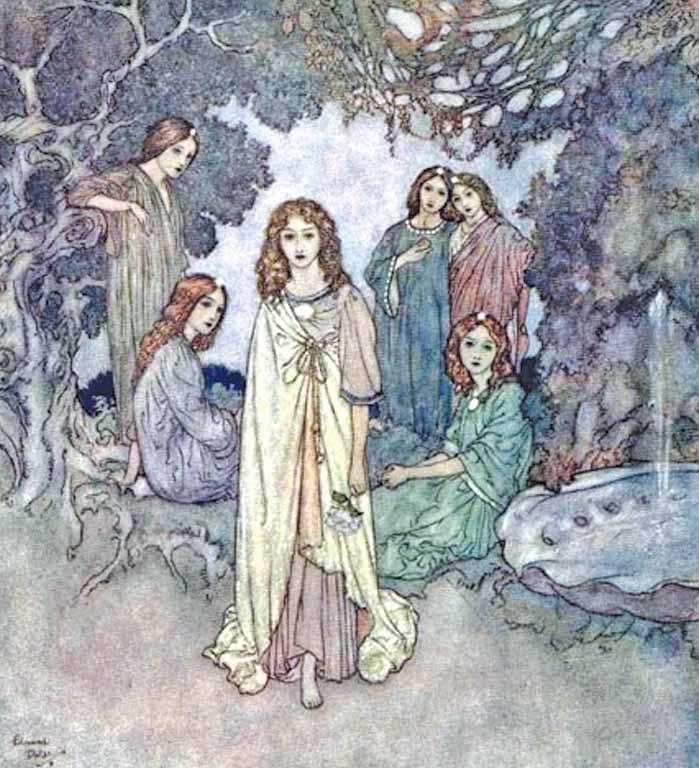
the Fairy of the garden now advanced to meet them
panes; only Time could imprint such wonderful pictures.
The Fairy of the Garden now advanced to meet them; her garments shone like the sun, and her face beamed like that of a happy mother rejoicing over her child.
The Fairy smiled and led him into a large, lofty room, the walls of which were like transparent paintings of faces, one more beautiful than the other. These were millions of the Blessed who smiled and sang, and all their songs melted into one perfect melody. The highest ones were so tiny that they seemed smaller than the very smallest rosebud, no bigger than a pinpoint in a drawing. In the middle of the room stood a large tree, with handsome drooping branches; golden apples, large and small, hung like oranges among its green leaves. It was the
Tree of Knowledge, of whose fruit Adam and Eve had eaten. From every leaf hung a shining red drop of dew; it was as if the tree wept tears of blood.
'Now let us get into the boat,' said the Fairy. 'We shall find refreshment on the swelling waters. The boat rocks, but it does not move from the spot; all the countries of the world will pass before our eyes.'
It was a curious sight to see the whole coast move. Here came lofty snow-clad Alps, with their clouds and dark fir trees. The horn echoed sad-

ly among them, and the shepherd yodelled sweetly in the valleys. Then banyan trees bent their long drooping branches over the boat, black swans floated on the water, and the strangest animals and flowers appeared on the shore. This was New Holland, the fifth portion of the world, which glided past them with a view of its blue mountains. They heard the song of priests, and saw the dances of the savages to the sound of drums and pipes of bone. The pyramids of Egypt reaching to the clouds, with fallen columns, and Sphinxes half buried in sand, next sailed past them. Then came the Aurora Borealis blazing over the peaks of the north; they were fireworks which could not be imitated. The Prince was so happy, and he saw a hundred times more than we have described.
“Can I stay here always?” he asked.
“That depends upon yourself,” answered the Fairy. “If you do not, like Adam, allow yourself to be tempted to do what is forbidden, you can stay here always.”
“I will not touch the apples on the Tree of Knowledge,” said the Prince. “There are thousands of other fruits here as beautiful.”
(TO BE CONTINUED)

Gaily bedight, A gallant knight, In sunshine and in shadow, Had journeyed long, Singing a song, In search of Eldorado.
But he grew old-This knight so bold-And o'er his heart a shadow Fell as he found No spot of ground That looked like Eldorado.
And, as his strength Failed him at length, He met a pilgrim shadow"Shadow," said he, "Where can it be-This land of Eldorado?"
"Over the Mountains Of the Moon, Down the Valley of the Shadow, Ride, boldly ride," The shade replied-"If you seek for Eldorado!
Edgar Allan Poe
It is just over 100 years since Canadian inventor Joseph Coyle perfected a design to prevent eggs breaking on their way to market.
His design was the first egg carton, offering a measure of protection for this most breakable of commodities. Coyle’s cardboard creation was first made by hand before a machine was invented to manufacture them after World War I.
Later in the 1950s, British designer H G Bennett created the design we see on supermarket shelves and in corner stores – made of cardboard, moulded paper pulp or plastic, and with an individual space for each egg to sit. As food packaging has become more sophisticated – from aseptic linings in cartons of milk to vacuum-packed fish – the humble egg carton has changed little. Shock absorbing and cheap to produce, the carton has also become a signifier for what it contains – you don’t need to see the eggs to know what it contains.
Hungarian design student Eva Valicsek, however, may have come up with a replacement. Her concept for an egg carton of the future – made of cardboard and a rubber band – was made for a university competition but has already received some cautious commercial interest.

realised that I found the perfect solution.”
The box also had to be easy to transport. Valicsek designed the carton so it could fold up flat, making it easier to move.
“I designed a carton that can be flatpacked. I assembled my piece without using any glue; the carton is fixed to the base at one point.”
Those whose eggs have survived a drop or crush thanks to the relative strength of the traditional egg box may view the opentopped re-imagination with some suspicion. But Valicsek believes her design is just as robust as the current model.
“The eggs are held firmly in the carton thanks to the flexible rubber band and the cut-out holes, you can even turn the box into its sizes, and the eggs will not break. It can stand lateral forces. The eggs will not roll out.”
“I looked at existing egg cartons and found many problems with them,” she says.
“Most importantly, the existing boxes cannot be adjusted to the size of the eggs - smaller eggs may turn around in the stand.”
The current egg box protects the eggs but also keeps them out of sight; when we buy
Her redesign came from a challenge set by the Institute of Applied Art at the University of West Hungary, in the city of Sopron, where she was studying.
other products, such as fruit and vegetables, we’re able to choose exactly which ones we want to buy.
The open top is one of the most striking elements of Valicsek’s rethink. “As a starting point I wanted to design a flexible box to fit the different egg sizes,” she says. “I made many models to find the right form. During these experiments, I accidentally used a rubber band that was sitting on my table - then
The cardboard used to make Valicsek’s design is environmentally friendly – and recyclable. She says the box can be reused many times.
At the moment, she adds, the egg box is “still an idea, not a product.” But there has been tentative interest, partly because of the flat pack design. “I had a call a month ago from a Croatian producer and we have just started discussions,” Valicsek says. (BBC Future)
The greenhouse gases produced by power plants could be a source of electricity, says new research. A new paper published this week in the journal Environmental Science & Technology Letters, written by a team of researchers in the Netherlands, describes how CO2 could be mixed with a fluid electrolyte, generating electrical energy in the process.
A press release from the American Chemical Society, which publishes the journal, calls this a "trash-to-treasure" story, saying it could help produce billions of kilowatts of energy every year while reducing the amount of greenhouse gases released into the atmosphere.
The research was conducted at Wetsus, which describes itself as a centre for excellence for sustainable water technology. The team
forced CO2 into water and other fluids, where the carbon dioxide split into positive and negative ions. Two special membranes were placed on either side of the water, one of which the positive ions could pass through and another which the negative ions could pass through. This produced a flow of electrons between the two membranes which could be captured by an electrode. Voila, electricity.
Too good to be true?
The research to date is just a proof of concept, and it actually uses more electricity than it generates, but lead researcher Bert Hamelers told NBC News that it could be scaled up and there are alternative approaches that could flip that equation.
If truly scaled up to massive proportions, the researchers say this new process could help to use the 12
billion tons of CO2 released every year by burning coal, oil and natural gas to produce electricity (another 11 billion tons are generated by home and commercial heating). They say that using all of the CO2 from power plants, industrial factories and residences could generate more than 1.5 trillion kilowatts of electricity every year. That, according to the paper, is 400 times more energy than is generated annually by the Hoover Dam.
Of course, the process doesn't actually consume the CO2. It just puts it to use, so the carbon dioxide may still need to be captured in some way rather than released into the atmosphere. But Hamelers told NBC News that this process could put to use energy that would otherwise be wasted, making power plants and other facilities more ef-

ficient and allowing them to produce more electricity without increasing their


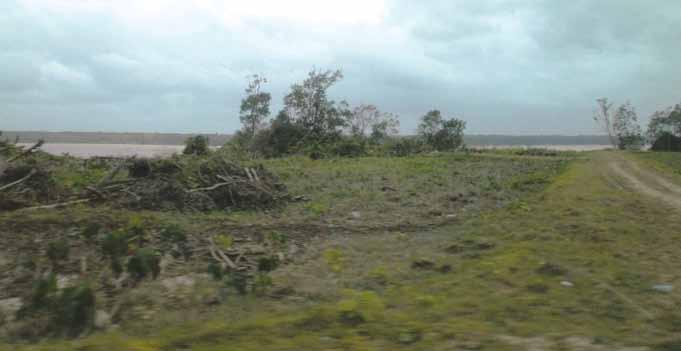
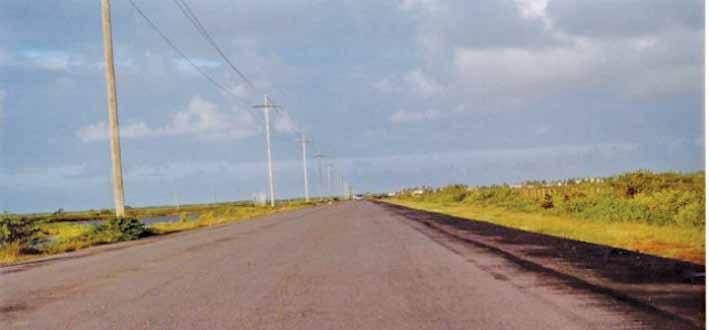
Moleson Creek is one of the last communities you’ll meet on the Corentyne River in the East Berbice-Corentyne region before arriving at Guyana’s ‘land’s end’. This small, usually quiet farming community, which takes its name from the small creek or stream between Guyana and Suriname, is more known for its Guyana-Suriname Ferry crossing route but has the potential to become a major hub in Guyana’s travel tours.



By Melvin Durai
Ascant two weeks had passed since we moved into our temporary apartment in Toronto and we had yet to meet our neighbours across the narrow hall. But as I stood in the entryway one evening with my two daughters, waiting for my wife, Malathi, to return from her daily jog, I noticed that the neighbours had left a message on their door, presumably for us. Below their number plate was a round, powder-blue air freshener. Harmless enough, until I looked further down and read two words inscribed in red ink on a strip of paper: "Curry stinks."
Apparently the smell of our Indian cooking had drifted from our poorly ventilated kitchen into their air space, triggering this response. At first, I found it amusing because, just a few days before, Malathi and I were riding the elevator up to our 16th floor apartment when the aroma of a curry dish enveloped us like a fog, prompting Malathi to inhale deeply and say, "Mmmm, that smells so good."
As natives of India, we aren't apologetic about our love for curry. Over the years, we've relished curry at a variety of restaurants, not just Indian, but also Caribbean, Sri Lankan, Vietnamese and Thai. We cook it at least twice a week, usually chicken or fish curry, spreading it over white rice or scooping it with chapatis, the leftovers tasting even better the next day. And if I try to wash the pot without scraping out the brown sauce at the bottom, Malathi protests: "Hey, that's the best part!"
Nevertheless, when she saw the neighbours’ note, she wondered aloud if she should knock on their door and apologize. "I feel bad for them. I mean, we like our curries, but they don't like the smell."
Her eagerness to appease them surprised me, for I was entertaining other ideas, such as running a tube directly from a pot of bubbling curry into the gap under their door. Or inviting them for dinner and serving a curry so spicy, they'd soon be making a mad dash for the fire hose.
It's not that I had no sympathy whatsoever for them. The smell of curry can be overpowering, hanging thickly in the air, soaking into your clothes, clinging to your skin. The cavewoman who concocted the first curry, mixing chilli with ginger, garlic, mustard, turmeric and other ingredients, must have wanted to not only feed her family, but also keep the wild animals away.
Even so, the word "stinks" seemed a little harsh, especially when describing something that's such an integral part of our culture. I've spent most of my life outside India, exposed to other cultures, separated from my own, yet my mother's cooking fostered a connection to my homeland that will last as long as my taste buds do. Curry isn't just another item on the menu -it's part of my identity.
Indians abroad have long had to defend their food from its detractors, who find it too spicy, too smelly or both. Try eating curry in an office and brows will furrow, noses will scrunch, as though someone left the bathroom door open. Meanwhile, the smell of microwaved popcorn or fried chicken flows around freely, welcomed in every cubicle, like a snippet of gossip about the boss's secretary.
In some parts of the world, the racial slur "curry-muncher" is hurled by people who somehow believe that they're insulting us. Let me just say this: I'm a proud curry-muncher, a cardcarrying member of the curry club. I savour my curry, in much the same way as some people savour milkshakes. To this day, it remains a mystery to me why no one has developed a curryshake. And what about curry ice cream?
But my affinity for curry hasn't kept me from appreciating other foods, though I'm not quite as adventurous as Malathi, who will eat just about anything that appears on her plate and doesn't bark. We've enjoyed everything from poutine to pizza, sushi to souvlaki, injera to nshima. Exposed to other cultures, we've learnt to be more open-minded, more accepting. If our rice is wrapped in seaweed, we don't call it strange. And if we're unaccustomed to a smell, we don't say it stinks. (Adapted from an essay)


A young devout Christian named David joined a monastery, worked hard, and eventually was allowed to take his vows. He promised to be free of the desire for possessions, to be obedient, and most importantly, celibate. He was initiated into the holy order and became one of the brother monks.
He was put to work copying ancient holy manuscripts which he did for a number of years. After some time, having been religiously obedient and celibate, he was elevated to the post of fact checker. He was entrusted with reading the original manuscripts and making sure they had always been copied letter for letter, word for word.
One day the rest of the monks were having lunch, and they noticed David was missing. The head abbot went down to the archives to find Brother David, and discovered him bent over an original ancient text, sobbing and weeping.
Alarmed, the abbot asked, “Brother David, what is the matter?”
“All this time....all this time....” was all David could choke out.
“David, all this time...what?” the abbot insisted.
“All this time...we’ve been copying it wrong. The word is ‘celebrate.’”
A young grandson asked his grandfather how old he was, and the grandpa teasingly replied, "Well, I'm not exactly sure how old I am."
The little boy advised, "You have to look in your underwear, Grandpa. Mine says I'm 4 to 6."
Holding the Bag
Two rednecks are waiting for the bus, and one is holding a large bag.
“What’s in the bag?” asks the other redneck.
The redneck with the bag replies, “Porcupines.”
“How many porcupines you got in that bag, then?”
“I’m not telling you,” says the redneck with the bag.
“If I guess how many porcupines you got in that bag will you give me one?” asks the other redneck.
“Tell you what; if you guess how many porcupines I got in this bag I’ll give you both of ‘em.”
Q: What type of music do mummies listen to?
A: Wrap music
-
Q: Why did the skeleton go to the party alone?
A: He had no body to go with him!
Q: Who does a pharaoh talk to when he's sad?
A: His mummy -
Q: How did Darth Vader know what Luke got him for Christmas?
A: He felt his presents!
The Pope has just finished a tour of the Napa Valley and is taking a limousine to San Francisco. Having never driven a limo, he asks the chauffeur if he can drive for a while. Since the chauffeur really doesn't have much of a choice, he climbs in the back of the limo and the Pope takes the wheel.
The Pope proceeds down Silverado, and starts accelerating to see what the limo can do. He gets to about 90 MPH, and suddenly he sees the red and blue lights of the highway patrol in his mirror. He pulls over and the trooper comes to his window.
The trooper, seeing who it is, says, “Just a moment please, I need to call in.”
The trooper calls in and asks for the chief. He tells the chief that he's got a REALLY important person pulled over, and asks how he should handle it.
“It's not Ted Kennedy again is it?” asks the chief.
“No Sir!” replies the trooper, “This guy's more important.”
“Is it the Governor?” asks the chief.
“No! Even more important!” replies the trooper.
“Is it the PRESIDENT?” asks the chief.
“No! Even more important!” replies the trooper.
“Well WHO THE HECK is it?” screams the chief.
“I don’t know Sir.” replies the trooper, “but he's got the Pope as his chauffeur.”
The Humour of Rodney Dangerfield
- My wife and I were happy for 20 years. Then we met.
- When I was a kid my parents moved a lot, but I always found them.
- I haven't spoken to my wife in years. I don't want to interrupt her.
- My luck is so bad that if I bought a cemetery, people would stop dying.
- I looked up my family tree and found out I was the sap.
- Some dog I got too. We call him Egypt; because in every room he leaves a pyramid.
- We sleep in separate rooms, we have dinner apart, we take separate vacationswe're doing everything we can to keep our marriage together.