

Celebrating guyanese artist aubrey Williams

Rudolph Dunbar, born in Agricola on the East Bank Demerara circa 1902, died in London in June 1988, but will forever be remembered as an outstanding Afro-Guyanese; enduring the many challenges he faced due to the colour of his skin in becoming one of the world’s greatest clarinettists.
For many, we know little of the older great Guyanese in Guyana who have made a name for themselves abroad. Guyana Times Sunday Magazine aims to highlight these persons and dedicates this week’s feature to the renowned clarinettist, Rudolph Dunbar. Let us take away after reading his story, the talent we possess as Guyanese and the determination to be great despite challenges that are hurled upon us.
Dunbar was a classi-
cal musician in New York, Paris, Berlin and London, but to reach that stage he had to endure the challenges he met. He grew up in Georgetown, near to the place where the British Guiana Militia Band rehearsed. He was impressed and influenced by the music of Wagner and Elgar. From an early age, he wanted to be a concert pianist. His mother encouraged him by taking him to visit a German pianist who was living in Georgetown.
His father did not consider music to be a worthwhile career for a “black” person, and said it would make him a “no good”. He wanted Dunbar to become a barrister. However, if Dunbar wanted to be a musician, he would have to be the best, as it would be the only way he could be successful in the British colonial era.
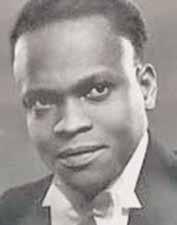
His family was financially deprived and could not afford to send Dunbar to learn music. At the age of 14, he joined the British Guiana Militia Band as an apprentice where he became a clarinettist. In a 1988 interview with Grenadian broadcaster Alex Pascal, Dunbar stated that he did not enjoy his stay with the band. He felt that the regimentation was coun-
ter-productive and sometimes abusive. However, he did admit that the discipline he learnt benefited him for the rest of his life.
Dunbar later migrated after five years, leaving the band to go to the US to study music at the Institute of Musical Arts, New York, known as The Julliard School. There Dunbar studied composition, clarinet, piano, and other musical subjects, and was recognised for being a talented clarinettist. He graduated after five years.
While in the US, he developed a long-lasting relationship with the AfricanAmerican composer, William Grant Still. His correspondence with Still could be found within the William Grant Still and Verna Avery Papers at the University of Arkansas. Dunbar also experimented with jazz, and in the mid-1920s was a clarinet soloist in recordings by The Plantation Orchestra.


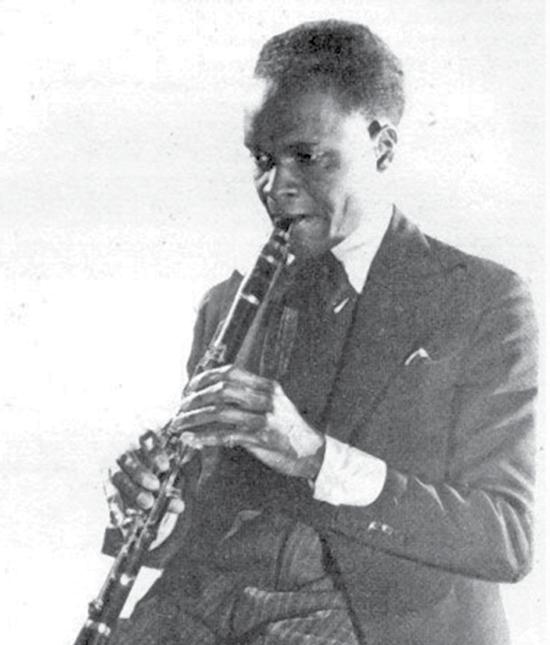
His musical journey did not stop there. In 1925, he travelled to Paris for postgraduate studies in music. His musical instructors were the best in France. He even described his clarinet teacher as one of the best in the world at that time. Dunbar was resolute to become the greatest, and as he played his clarinet his fame grew.
Madame Debussy (wife of the composer Claude Debussy) invited Dunbar to give a private recital in her apartment in 1930 as she had learnt of his musical talents. She invited some of the members and faculty of the Conservatoire. The media of the time, reviewing Dunbar’s talent, called him a “gifted clarinettist”.
In 1931, Dunbar moved to London, where he established a school for clarinettists. It was the only such school in the world at that time. He had students from South Africa, India, and countries in Europe. He was commissioned to write a textbook on the clarinet. The book, ‘Treatise on the Clarinet (Boehm System)’ is now a collector’s item. After recognising that he might not always be able to perform as a clarinettist, Dunbar branched into conducting, which he had studied in New York and Paris.
After a stint as a war correspondent during World War II, Dunbar returned to conducting, and became the first conductor of the Berlin Philharmonic Orchestra after World War II. According to Dunbar, that act was one of the final nails in the coffin of Hitler’s anti-Negro propaganda. He also felt that it was also an act that brought significant pride to peoples of African descent globally. He conducted several of Britain’s leading orchestras. Dunbar also conducted the London Philharmonic Orchestra and other symphony orchestras including the
BBC Symphony, the Berlin Philharmonic Orchestra, and the Orchestra du Conservatoire. On June 12, 1945, Dunbar conducted The Orchestra du Conservatoire and Jenne Marie Darre for the premiere of William Grant Still’s In Memoriam and The African American Symphony at the Theatre des Champs Elysees. The performance was a benefit to raise funds for the anticolonial struggle.
In addition to performing classical music, Dunbar also played jazz. Between 1931 and 1934, he led two orchestras in the United Kingdom: the All British Coloured Band, aka Rumba Coloured Orchestra, and Rudolph Dunbar and his African Polyphony. Dunbar was part of a pioneering group of West Indians in the United Kingdom that had to fight the blight of racism. He returned to British Guiana in the mid-1950s for a tour. Among his activities were conducting the BG Militia Band, the BG Philharmonic Orchestra, and the Christ Church Diocesan Youth Movement Choir. Dunbar also organised several concerts, including the All-Star Concert held on September 16, 1951, to support the Jamaican Hurricane Relief Fund. When Dunbar died, he was writing his memoirs. This project is being completed by his nephew Ian Hall, another important Guyanese musician in the United Kingdom. “He was a good orator, generous, ambitious and a champion for black achievement,” said Hall.
Dunbar’s memory is kept alive in the United Kingdom through The Lord Pitt Foundation and the Bloomsbury Society (UK) Rudolph Dunbar Award. The BBC produced a documentary on him for the series, ‘Eye to Eye’ broadcast in 1989.
(Source: Alex Pascal’s interview with Rudolph Dunbar, June 16, 1988)
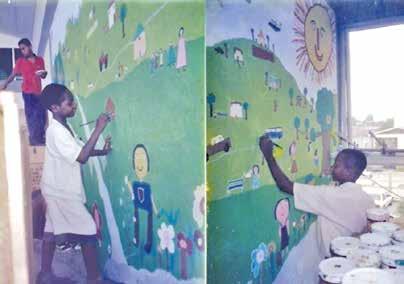
Once known as the largest child art mural in the Caribbean, ‘Unityville’, painted on the Georgetown Public Hospital (GPHC) wall, East Street entrance, has been to patients a section in the hospital that serves in the healing process.
In an interview with Guyana Times Sunday Magazine, artist and lecturer at the University of Guyana Michael Khan, said the children’s art mural painted in the Ambulatory Unit was done 19 years ago when then health minister Gail Teixeira requested that some sort of art be done on the wall of the new section before it was officially opened.
Professional artists were contacted, but exorbitant sums of money were attached to that. The next suggestion was to get children to draw on the wall with the idea of helping sick patients, when they look at it, to feel better.
“When you’re sick you look forward to something to make you feel better. A want for a soothing, healing, naturistic ambience; because children’s art is universalit goes beyond ethnicity and language - it was ideal for the wall. The then minister of health called me at Burrowes School of Art because she knew of my work I had done in stimulating children through art. She asked me if I could get some children to paint a mural on the walls at GPHC and I readily accepted,” Khan recalled.
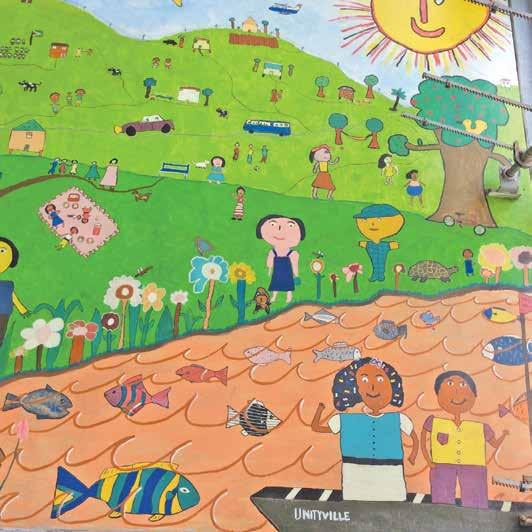
Khan randomly selected children from the surrounding East Street environs, and from different schools such as Stella Maris and St Mary’s. He stated that he wanted a universal theme for the art mural, and with the children, thought of one thing that is wanted around the worldunity. They then decided that they will name the mural ‘Unityville’.
“I stimulated their creativity by placing a scenario. I told them if a person comes in with a heart attack and looks at the mural they should be instantly healed. It took a lot of dramatics from me in stimulating the senses. I gave them various scenarios of people in accidents and looking at the mural and how they should feel and what the children should draw to get that effect. I gave them a scenario like: a little boy comes in sick and
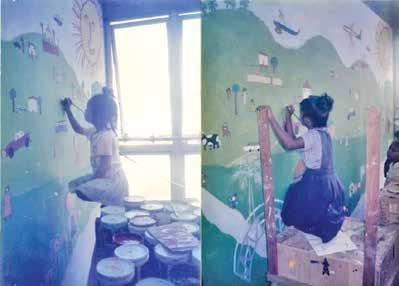
he’s all alone, what would he like to see to make him feel better. Maybe a little girl waving at him so that he doesn’t feel lonely anymore - and one of the kids actually drew a girl waving. And at the time we didn’t know the children’s ward was opposite where the mural would have been painted, so that was ideal also,” the art lecturer stated.
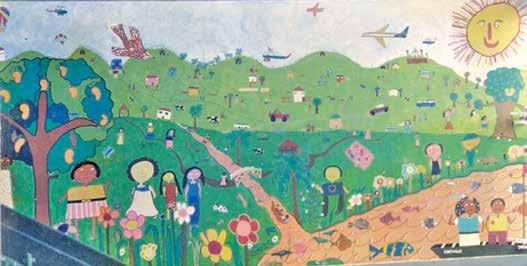
After school, parents brought their children and they would spend about an hour or two painting. About 25 children ranging from age three to late teens participated. They took about eight weeks to complete it. Notably, they worked diligently on Saturdays to get it completed. Both emulsion and emulsion acrylic Harris and Torginol paints were used, for
longevity of the mural.
After 19 years, the mural still stands out brightly and is in excellent condition; it is neither chipped nor flaked. Characters and images painted by the children are indicative of peace, joy and happiness. Khan mentioned that every child knew what they had to draw and although they did not understand what the huge sections were or what they were going to be used for, they knew what they wanted to draw to make patients feel better.
“We shouldn’t teach children to draw; we stimulate them so that they can. Children are conscious of their environment, and when they understood that sick people can come to the mural and can feel better, they drew their vision of happiness. The purpose of Unityville wasn’t to make them anything great but to find themselves in a way that they would understand their role in society. Each had their own sections to paint to form Unityville. My daughter Michaela was also part of the group of children. She drew the sun. Parents and my sister and a few friends helped in the realisation of the project and I’m thankful to them,” expressed Khan.
In response to the mural, there were many good and negative comments. Some said it should have been done by professional artists. Khan was a bit dismayed by the negative comments, but what motivated him was when doctors and nurses saw the mural and said it was refreshing to the hospital.
“The good things I heard made me
Overseas-based Guyanese Mona Williams - Emmy Award Winning Storyteller, Educator, Published Author
of
Guyanese designer launches new costume collection in the US

Kesha opens up about rehab, eating disorder: ‘I was being hateful to myself’ A waterway of adventure

more assured to continue despite negative comments. The Minister of Health was very pleased with the artistry and quality of work done by the children. These children painted their perspective of ‘Unityville’ on that bare 20 feet by 10 feet wall, reflecting their idea of happiness and joy, and it served in the healing process of patients at the hospital,” Khan said proudly.
Art can be used as therapy, and Unityville definitely serves as that in the healing process for the patients at GPHC. Khan believes it is a “silent partner in the healing process”.
“I have a colleague who works with abused and homeless kids in the US and he uses care of animals and art to make them better persons and help in the healing and therapeutic process. So if our kids scribble on a piece of paper, don’t throw it away, keep it. It can just be the making of a great artist. I still have my daughter’s artwork since she was 18 months until she was about eight. I see bare walls in businesses and I often think how ideal it would be if they can incorporate an idea like Unityville to bring the childhood back to adults. We rarely have children’s artwork in public places and we need more of it,” he encouraged.
Some of the children who participated in making Unityville a reality have gone on to be lawyers and doctors, fulfilling their civic duties.
One parent, Elizabeth Hinds, commented on Khan’s pictures of the children painting Unityville in 1995 when he posted them on Facebook. “I was around when you supervised this project. I later visited the hospital in 2010 and felt so good seeing that it was still there. I can't imagine what it means to the children who actually did the painting. My kids, Delano and Maxine, are both proud of what Mr Khan led them to achieve.”
Khan is irked that, for some, children’s art is not appreciated as it is in other countries. He hopes persons going to the hospital will take some time to stop and observe the mural to appreciate and try to understand what those children wanted to do in helping sick ones recover.
The Imam Bacchus Library serves as a foundation in the learning process for numerous youths in Essequibo, and is the only one of its kind there
The library was opened on 30 May 2011 in the village of Affiance, Essequibo. Fundraising and book acquisition began a year earlier, said founder Imam Baksh in an interview with Guyana Times Sunday Magazine
Baksh said he has been a teacher, on and off, since 1997. “My students often struggled to learn because of low literacy. When you spoke to them you could tell they were intelligent and curious, but the basic skill of gleaning information off a page was not there. Reading is a foundational skill. Everything you accomplish in academics requires you to read well, with fluency and comprehension,” he mentioned.
The library was named in honour of Imam Bacchus,
a man who grew up as an illiterate coconut picker and learned to read at age 50. He was a booklover and an en-
reader from then on.

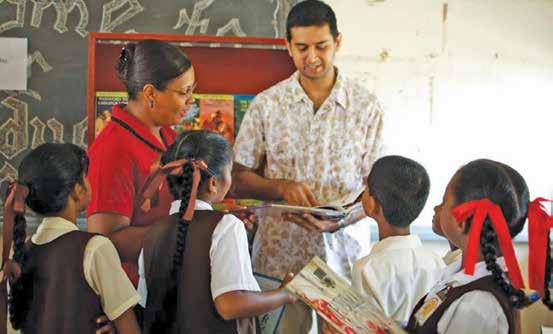
The library’s specific objectives are to promote reading among kindergarten and early primary students; offer research support to students at high school level; help those school drop-outs who have low literacy so that they can re-enter the academic world, and improve the way parents think about literacy through the many literacy programmes so that they prioritise it.
The library is the largest in the area. There is a community library in Queenstown village about two miles away and other small private libraries and school libraries
started with oral storytelling, since Baksh felt that bringing in the books right away would be a challenge for some of the children. Also, verbal communication gave them a chance to develop their focus and comprehension skills, so they were able to analyse stories and understand them, which is a key ingredient of true literacy. The children acted out stories and become involved in the stories in a way that they cannot when they see it on a page.
Baksh mentioned that on Monday, 14 July, the library’s ‘Summer Camp’ will
erated today by his descendants. He was Baksh’s grandfather. The fact that this man, who was already successful and had no real need to learn to read, learnt how to read at age 50, is an example of the real value of reading.
Baksh was trained as a literacy specialist in Toronto, Canada, but when he returned to Guyana, he was faced with severe eye problems and was unable to be a fulltime teacher. He decided to continue in the area of literacy with the support of his family. It seemed clear to him that if a child did not love reading by age ten, they almost never would gain that love, so the key was to introduce a wellfounded literacy early in their life. The library, he saw, was a way to bring literacy to the community as a whole, but especially to young students at that key age of four to seven when they are most likely to develop into lifelong readers.
“I often refer to the library as a literacy project, because the goal is much more about promoting a love of learning and developing critical thinking skills than about simply making books available. The Imam Bacchus Library hopes to become a centre where people engage with ideas through books, public debates and discussion, digital media, performance and art,” he assured.
The library’s primary aim is to provide literacy, communication and critical thinking tools, especially to students.
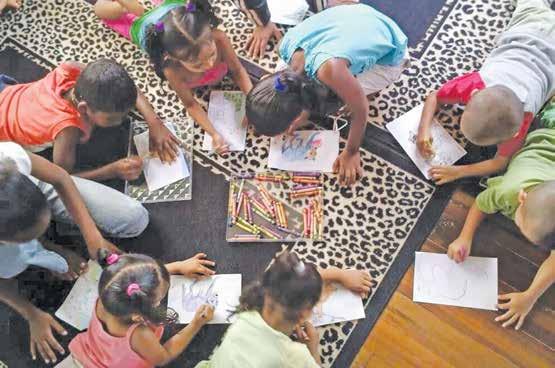
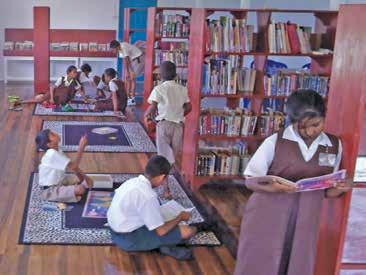
in Essequibo. The national library also has a small branch at Anna Regina about three miles away from the Imam Bacchus Library. The difference with those libraries and the Imam Bacchus Library is that the latter provides a larger physical space as well as computer services. It also has a ‘Kids’ Corner’, a carpeted section with low shelves where young children can escape to their world of imagination. Story telling sessions are held there also.
In addition, there is a central hall that is used for lectures, classes, debates and is equipped with a projector and sound system.
The remedial literacy programme, Baksh noted, is one of the library’s main programmes. It is used as an investigative tool to find out the reasons behind children’s illiteracy, and the library seeks to correct these. The programme
commence. Through this programme the children attending will be helped to become tech savvy. One such area is learning about the video camera and making movies using one.
The Imam Bacchus Library is a non-profit operation. It is primarily funded by Imam Bacchus and Sons, but is not part of the company itself. All the money donated to the library and all the money earned in fees is used to support the library. The company has spent over $1 million on the library so far, including books, computer equipment and renovating the library building, which also belongs to the company.
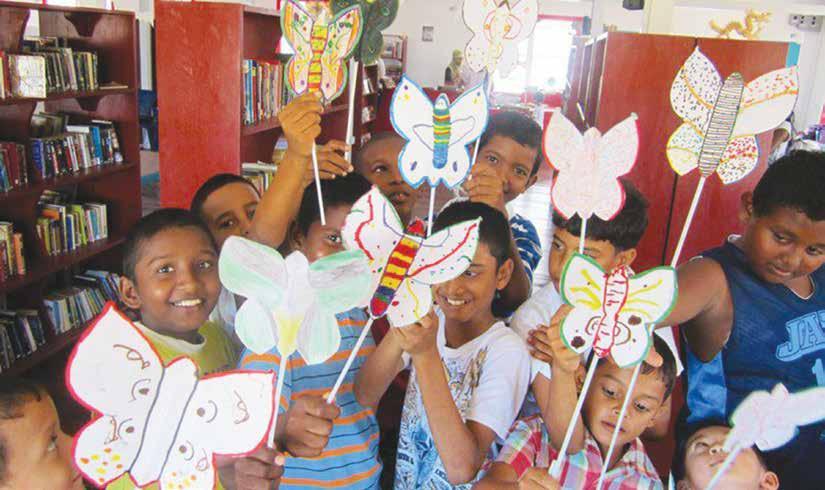
For more information visit The Imam Bacchus Library on Facebook. (Cover photo - Children with their butterflies they made for 'Butterfly Storytime')
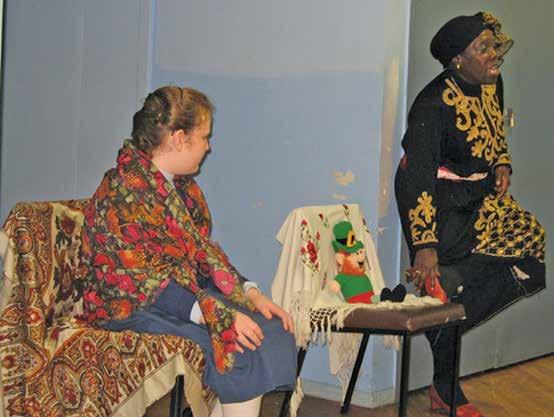
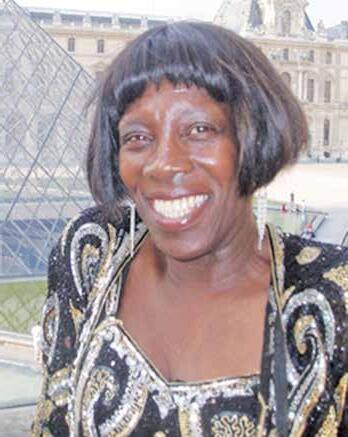
Mona Williams is a storyteller, children’s writer and educator whose actionpacked stories and dramatic presentations enthral audiences of all ages. She covers a vast spectrum of stories including myths, legends and heroic tales; folk, fairy and wisdom stories, fables, riddles and autobiographical adventures.
Born in the town of Mackenzie, Linden, on 27 July 1943, Williams secured a place at the exclusive girls’ school Bishops. The school lends it name to her autobiography, “Bishops: My Turbulent Colonial Youth” (1995), which recounts her experiences at the school, both destructive and enriching. She was educated in Guyana and at Stanford University, California, U.S.A., where she was a Fullbright and Ford Foundation scholar.
In one of her interviews, Williams said in primary school, for the most part, she was high-spirited. In high school she was “confused, angry, a misfit, often on detention and under threat of expulsion”. She was also “suicidal”. However, things changed for the better when she learned ballet, from 13 years onward.
When asked to identify her favourite childhood book, Williams said, “My childhood did not have books. It had the Bible only, and my great-grandmother told me the stories again and again. I discovered books in high school and loved a collection of poems by Stephen Spender.”
Williams is the author of more than 24 books, mostly for children. She has performed at storytelling festivals, and at numerous schools as part of the New Zealand Book Council’s Writers in Schools Programme. She has taught English at primary and secondary schools for 15 years
and has lecture at university level. She was the 1993 Waikato University Writer-in-Residence. Her San Francisco television storytelling programme, Roots and Branches, won an Emmy Award.
Her list of books include:
“How we made a colour television show” (1973); “The turtle who longed to be a bird” (1973); “Christmas in Guyana” (1974); “The day
(1976); “A tale to match” (1977); “Spell wool” (1977); “Sharing” (1977); “The outsider” (1977); “Secrets” (1978); “The Bicycle” (1978); “Old Mrs Davidson” (1983); “The strange cure” (1984); “Two of a kind” (with Joy Cowley) (1984); “Bishops: My Turbulent Colonial Youth” (1995).
As of 2013, Williams has visited over 50 foreign countries. She taught writ-

I swam the river” (1974); “How the goat lost his voice” (1974); “Old Medicine” (1974); “The ant who refused titles” (1975); “Granny” (1975); “Father Martin Heale” (1975); “Old Bell” (1975); “When I went to the pictures” (1975); “Stealing the gooseberry jam” (1975); “Thinking about it” (1975); “Speaking the truth” (1975); “You really saw my father?”
ing in the Middle East for ten years, and performed as a storyteller at various festivals, conferences and weddings around the world in Rotterdam, Edinburgh, Zurich, Selkerk, Salmiya (Kuwait), Bergen (Norway), Ontario (Canada), Tembagapura (Irian Jaya), and Norfolk Island.
Williams is now a citizen of New Zealand, and a
foundation vice-president of the NZ Storytellers’ Guild and a pioneering contributor to the Glistening Waters Storytelling Festival. The published author is a mother of two daughters and grandmother of five.
“I come alive when I write. I see colours; I become silent and hear exactly how people speak; I become aware of the connections between things. I love life. But I withdraw into myself, I don’t see friends for months and I keep losing my house/ car keys. I become completely absent-minded. My advice to aspiring writers is to read, read, read. Think about the ways the writer constructs his/her story. Look carefully at the words she uses. Write a little every single day.”

By PetamBer Persaud
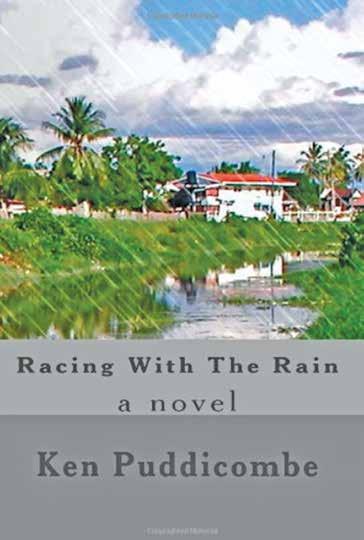
Racing With The Rain by Ken Puddicombe, MiddleRoad Publishers, 2012. Reviewed by Frank Birbalsingh
Professor Emeritus Birbalsingh is an anthologist and the author of many scholarly publications including From Pillar to Post: The Indo Caribbean Diaspora , Passion and Exile: Essays in Caribbean Literature , The Rise of West Indian Cricket: From Colony to Nation , and two anthologies of IndoCaribbean writing Jahaji and Jahaji Bhai . His latest book on cricket, IndianCaribbean Test Cricketers and the Quest for Identity is now available. Birbalsingh
is an acknowledged book reviewer.
Puddicombe is both diligent and skilful in documenting the beauty of Guyana’s tropical vegetation, and the flavour and idiom of local speech and public banter that are part and parcel of everyday life, social habits and customs observed, for example, in a typical scene outside a cinema in Georgetown: “The aroma of black pudding, boiled corn and channa, ripe tamarind, freshly baked cassava pone drifted across to Carl as an old woman dispensed her snacks from a tray perched on top of a wooden soft drink crate.” (p.165). The sentence captures both the simple, improvised quality of the old woman’s business, and the mouth-watering appeal and natural warmth of her ser-
vice. As for tropical rain, it gives the novel its title when, as boys, the narrator and his friends hear the roll of thunder, precursor to rain, and in the middle of their game, grab their marbles trying: “to outrun the rain before the eruption”. (p.41)
But the politics of the novel and its characters are central. In such a maelstrom of political opinions and loyalties, objectivity is impossible, and Carl’s entire narrative including his acceptance of a Reform Party scholarship to study in communist Cuba declare his moderate, left-of-centre political sympathies, quite unlike the fanaticism of his father who believed that: “They [caterpillars] were like Communists, preying on people and taking everything away until the

cupboard was bare.” (p.52) Augusto Dias also boasted: “I’m not abandoning it [Guyana] to a Communist takeover. They’re going to have to take me out of here in a pine box.” [p.194) Augusto reflects the real fanaticism that caused destruction, looting and mayhem in the 1960s. It turns out he may even has supported a terrorist group –the X13. More than that, Carl discovers his halfbrother Earl Singh and realises Augusto was not as upright as he claimed. Yet
Augusto’s portrait, because of its hypocrisy, is all the more convincing. While in Guyana, Carl is suspected of membership in a Toronto-based organisation - Restoration of Democracy (the Association of Concerned Guyanese) – which is believed to plan the overthrow of the Republican Party régime. Carl did attend one meeting of the group in Toronto, and although he did not join, the friend who invited him entered his name as a member which is now
used by Guyanese security forces to accuse him of being a spy. Carl is trapped and helpless, in grave danger of never seeing his family again. Suspense builds as he is interrogated and tempted by intrigue and desperation. One of his interrogators, however, is a neighbour who, as a delinquent boy was helped by Augusto, and now comes to Carl’s rescue. Carl is then able to make amends to his half-brother Earl before he leaves. Whatever else it may be, racing is an act of filial piety – one man’s loving homage to his father, warts and all.
Ken Puddicombe is a professional accountant who provided controllership for a number of companies in the private sector before he retired to pursue his love of writing. His writing has appeared in newspapers and literary journals in Canada and the UK. Originally from British Guiana [now Guyana], he immigrated to Canada in 1970 and still lives there with his family. Racing With The Rain is his first novel. He is working on a second novel Junta and a collection of short stories entitled Down Independence Boulevard for early release. His genre is fiction, based on international locations but especially focused in Canada, the Caribbean and Guyana.
Responses to this author telephone (592) 226-0065 or email: oraltradition2002@ yahoo.com


By Dr Julie DooBay
It’s incredible when you realise how powerful your thoughts really are. The things that you focus on and your dominant thoughts really do shape the life that you are living. If you truly want to get some insight as to why your life is the way that it is, you have to be brave enough to examine the way that you talk to yourself.
Your life is a direct reflection of what you believe yourself to be worthy of. There may be circumstances that you can’t seem to get yourself out of. Maybe, you make some progress through a particular predicament but eventually you find yourself back in the same place. You can only make lasting change when you’re willing to take an honest look at what you really believe about yourself.
Our reality is formed by what we believe to be true. It is only when we become aware of our true beliefs about ourselves that we can get some insight as to the powerful force that drives what we attract into our lives. The old adage of “fake it until you make it” can interfere with your ability to become aware of your true beliefs about yourself. Focusing solely on conscious positive affirmations can distract us from “hearing” what we are really saying to ourselves subconsciously. A very powerful charge is created when the things that you express are not aligned with your true and subconscious beliefs. As we suppress what we are trying to avoid, it gains more energy and this then becomes the energy that we emanate.
Dramatic shifts begin to take place when you become aware of what you have been attracting into your life. The opportunities for getting what we want are only limited by what we believe to be possible for ourselves. These beliefs are so ingrained into us that we just accept it as fact rather than as a belief that may not be true. If you want something but you don’t really believe that you could get it, the energy of the limit-

ing belief takes over and you actually repel the very thing that you wanted. If you want to start attracting something different, you need to be aware of your dominant thoughts.
The key is not to trick ourselves into trying to be positive by repeating affirmations or convincing ourselves that we should be happy. When bad things happen, we must become aware of what we are saying to ourselves subconsciously. For example, if you had a job interview and then later learn that you didn’t get the job, if your first thought is, “I knew I wouldn’t get that job”, you need to acknowledge that thought. Then ask yourself, “How is this thought serving me?” If the thought is not serving you, acknowledge that as well. By doing so, you are taking responsibility for your thoughts by bringing awareness of this negative self-talk and acknowledging that it is not serving you. Like changing any bad habit, as you catch yourself doing something that no longer serves you, you can consciously choose to behave in a way that better aligns with what you do want.
We have the ability to attract the things we want into our lives when we align them with our true beliefs. If you are not attracting the things you want into your life, take an honest look at what you truly believe to be possible for you.
We are what we think. All that we are arises with our thoughts. With our thoughts, we make the world – Buddha
Dr Julie Doobay, of Guyanese heritage, is a US-based wellnessfocused Chiropractor whose personal journey of conquering a debilitating brain infection to becoming a chiropractor is a unique and powerful story about learning to trust in the restorative capacity of the human body and in the power of focus and determination to overcome incredible odds. Drawing on both her professional and personal experiences, Doobay has developed a unique and effective five-step programme entitled, “Dr. Julie’s Abilities Realization Process”, which guides patients through a process of healing that begins with discovering how their body holds stress, trauma and perceived limitations and ends in believing in and realising their own unique abilities and gifts.

Mikel Andrews is a 20-year-old from Bartica who is known for his dance artistry. The dancer has been with the effervescent and talented dance company Classique for over two years. Mikel described himself as a “shy person” but dancing and performing on stage was instrumental in helping him to overcome his diffidence. Now he avidly performs with the group countrywide. Graduating from the National Theatre of Arts and Drama, Mikel has certainly made a name for himself in the performing arts arena. He is recognised for his talents and artistry as a performer. Recently, Mikel entered the Mr Guyana Talented Teen 2014 and although he was not able to cop the crown, he was awarded the second runner-up trophy. Notably, he used the opportunity via the competition to educate all the participating teenagers about “their inner self, creativity, social awareness and empowerment”. Not only does he dance, act, and swim, but Mikel is a philanthropist who is actively involved in community outreach programmes. His advice to youths is to “always move forward in whatever they want to pursue and to never be deterred by challenges in doing so”. Mikel’s future plans are to pursue a career in journalism and to become an established entrepreneur. He also wants to perform on the international stage, specifically on Broadway.
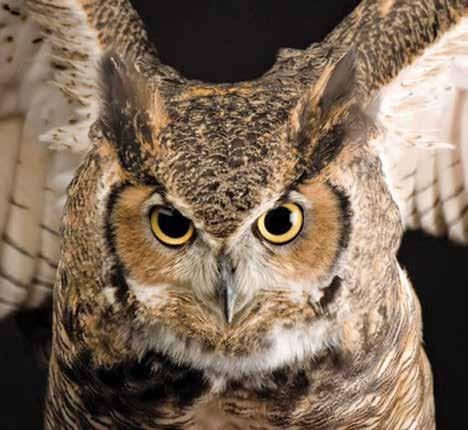
The great horned owl, Bubo virginianus, is the most common owl of the Americas, particularly in Guyana, easily recognisable because of the feather tufts on its head. These “plumicorns” resemble horns or, to some, catlike ears.
Great horned owls are adaptable birds and live from the Arctic to South America. They are at home in suburbia as well as in woods and farmlands. Northern populations migrate in winter, but most live permanently in more temperate climes.
The birds nest in tree holes, stumps, caves, or in the abandoned nests of other large birds. Monogamous pairs have one to five eggs (two is typical), both the male and female incubate, and the male also hunts for food. Owls are powerful birds and fiercely protective parents. They have even been known to attack humans who wander too close to their young. Like other owls, these birds have an incredible digestive system. They sometimes swallow their prey whole and later regurgitate pellets composed of bone, fur, and the other unwanted parts of their meal. Owls are efficient night time hunters that strike from above, and use their powerful talons to kill and carry animals several times heavier than themselves. Owls prey on a huge variety of creatures, including raccoons, rabbits, squirrels, domestic birds, falcons, and other owls. They regularly eat skunks, and may be the only animal with such an appetite. They sometimes hunt for smaller game by standing or walking along the ground. Owls have even been known to prey upon unlucky cats and dogs.

There are so many things out there that we deal with or see every day, but have no idea what they are called. Here are a few:
1. Glabella - The space between the eyebrows, just above the nose.
2. Vagitus - The cry of a newborn baby.
3. Niggly Wiggly - The paper ribbon at the top of Hershey’s Kiss.
4. Darkle - The opposite of “sparkle”. To become dark.
5. Natiform - Something that looks like a butt.
6. Tintinnabulation - The ringing of bells.
7. Misophonia - Getting mad at someone for eating or breathing too loudly (among other things). It’s also a brain disorder.
8. Nurdle - A tiny dab of toothpaste.
9. Collywobbles - Butterflies in your stomach.

10. Keeper - The loop on a belt that keeps the end in place after it has passed through the buckle.
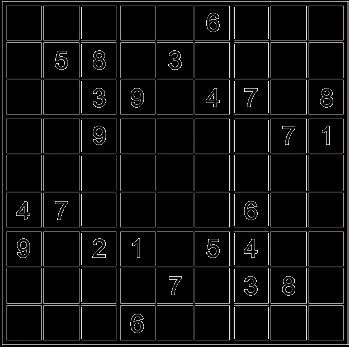
The objective of the game is to fill all the blank squares in a game with the correct numbers. Every row of 9 numbers must include all digits 1 through 9 in any order. Every column of 9 numbers must include all digits 1 through 9 in any order. Every 3 by 3 subsection of the 9 by 9 square must include all digits 1 through 9.
The male great horned owl is smaller than the female and has a much lower-pitched call.
The great horned owl’s average life span in the wild is 5 to 15 years.
Great horned owls are largely nocturnal so they can be difficult to spot. But in the dark after sunset, or just before dawn, they can often be heard vocalising with their well known series of "Hoo H'hoos!"

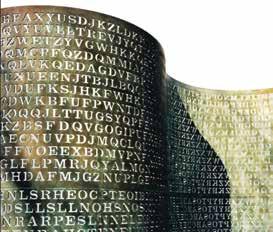

The Central Intelligence Agency (CIA) is a U.S. national security government agency. The CIA collects and evaluates information on foreign affairs and national threats. This intelligence is relayed to the president, Congress and other federal agencies so they can make informed decisions. The CIA also engages in counterintelligence with agents working to identify and possibly influence the actions of other nations.
been
the
The CIA’s headquarters are in the Langley area of McLean, Virginia.
The CIA is divided into four basic units that work together to carry out the intelligence cycle.
The National Clandestine Service (NCS) gathers clandestine intelligence on an international level, ranging from terrorism to military and political issues.
The Directorate of Intelligence (DI) analyzes the gathered information so that the president can make informed decisions.
The Directorate of Science and Technology (DST) helps the agency take advantage of new technology.


The Directorate of Support (DS) builds and operates CIA facilities around the world. It ensures that supplies and communications run efficiently.


Some CIA officers and agents work at headquarters in Virginia, but many are stationed in countries around the world.
The CIA produces the World Fact Book, a source of information often used by the World of Wonder page.
The number of CIA employees and the size of the agency’s budget are classified.
ordinator of Information.
1941: Japanese attack Pearl Harbor
1942: The Office of Strategic Services (OSS) replaces the Office of the Coordinator of Information.
1940
1946: President
Don
the
Maxwell Smart, Agent 86 in the 1960s TV show
“Get Smart,” who worked for a fictional agency called CONTROL
CIA dogs, also known as K-9s, are trained to assist in situations where a keen sense of smell is a valuable tool. The CIA established their first K-9 unit in 1991, K-9s and their CIA partners undergo intense training. These dogs are very good at sniffing out drugs, bombs and criminals.
Some K-9s wear bulletproof vests for added protection.
Spies by their very nature are secretive, but some have lost sight of their sworn and sacred duties and become agents for the enemy. Aldrich Hazen Ames is probably the most infamous of double agents. After a 31-year career with the CIA, Ames was convicted of spying for the Soviet Union and Russia in 1994. His wife Rosario was also arrested. Suspicions were aroused because his lavish lifestyle did not match his income.
1961: CIA-backed forces land at Bay of Pigs, Cuba, in a failed attempt to liberate the island from the Castro dictatorship. CIA employees move into a new headquarters building.
1962: The CIA’s A-12 supersonic reconnaissance aircraft makes its first official flight. The CIA discovers Soviet nuclear missiles capable of reaching the U.S., precipitating the Cuban Missile Crisis.
1970: Computer files on terrorists and hijackers are created.
1972: Watergate break-in: Five of the men arrested have past CIA ties.
1974: The CIA transfers its U-2 Program to the U.S. Air Force.
1976: Executive Order 11905 prohibits assassinations of foreign leaders.
1980: CIA officers rescue six U.S. diplomats from Iran. To help facilitate the rescue, the CIA team set up “Studio Six Productions” and titled its new production “Argo.”
1982: President Reagan bans the publication of covert intelligence officers’ names.
1984: Construction begins on the CIA’s new headquarters building.
People love exciting spy movies, and there are many good films with CIA agents and plots. Here are some of our favorites:
Agent Cody Banks
Mission: Impossible
The Bourne Identity
The Hunt for Red October
These movies have a lot of action, and some are very violent. It’s important to check with your parents and get permission before watching a show.
The CIA employs many experts, not just spies. They hire analysts, doctors, lawyers, scientists, engineers, geographers, linguists, mathematicians, computer specialists, administrators, librarians and others.
Selection for agency employment is highly competitive, and employees must successfully complete a polygraph test, a medical examination and a background investigation before being hired. If you are interested in a career with the CIA, you should work hard, keep your grades high and perhaps study a second or third language. Recruits are trained at a military reserve in Virgina known as the CIA farm. The farm teaches future agents the skills they will need in the international field.
and
1990: The CIA issues a warning memo on possible Iraqi military invasion of Kuwait.
1991: Berlin Wall Monument at CIA headquarters dedicated.
1992: The CIA establishes its Office of Military Affairs to coordinate operations with Department of Defense.
creates the Directorate of Science & Technology.
1978: Executive Order 12036 reshapes the intelligence structure and provides guidance on all facets of intelligence activities.
1985: Fourteen Americans are arrested and/or convicted of spying for the Soviet Union and its allies, as well as for Israel, China and Ghana.
1993: Amal Kasi attacks CIA employees outside headquarters main gate, killing two and wounding three. President Boris Yeltsin abolishes the KGB.
2009: The CIA Center on Climate Change and National Security is created to produce intelligence on the security implications of climate change.
Act, restructuring the intelligence community.
2010: Ten Russian spies are arrested and exchanged for four U.S.




US-based Guyanese doyenne of fashion, Michelle Cole, under her brand Colefacts, has launched her new costume line “ Colefacts Carnival” in New York City. Her first costume collection, “Lotus”, for Sesame Flyers, will be featured in this year’s Labor Day Parade on 6 September on Brooklyn’s famous Eastern Parkway.
Pink, yellow, and gold are the official colours for Cole’s “Lotus”. Her designs are all handmade and eco-friendly. Bold colourful feathers with gold accents complement the beautifully crafted wire bent headpieces. “Lotus” for Sesame Flyers provides options for all body types for both men and women. Cole loves creating her deigns with natural fabrics and also specialises in hand designed, painted and decorated fabrics. Her ability to create such exquisite and fashionable designs has taken carnival fashion to the next level.
Cole is a trendsetter in creative fashion; her designs display statements
of elegance and class. She is no stranger to the fashion world as she is famous for her showstopping couture gowns, jewellery, swimwear, and ready-to-wear fashion. Colefacts has been featured in numerous fashion shows across the globe and worn by pageant contestants, finalists and queens. Currently settled in New York, Cole continues to shape and mark her brand to fashion houses and various high-end runway events. She currently sits on the committee of the Miss World Guyana pageant as one of its executive directors. Modelling Cole’s collection are Miss World Guyana 2014 Rafieya Husain, Miss World Guyana 2014 first runner-up Atisha Gaskill, and Guyanese fashion designer Andrew Harris Jr.


Dylan Sprayberry is a 16-year-old American child actor known for his role in the television movie “The Three Gifts” where he portrayed Mike, a boy who wants to be adopted for Christmas. Sprayberry's sister, Ellery, is also an actor. Sprayberry shot his first commercial at the age of three, soon after he shot print ads for a few department stores. By 2006, he had moved to Los Angeles. Sprayberry made his debut in the movie “The Sunday Man” having a small role as a bully. In 2008, he was seen in “Soccer Mom” alongside Missi Pyle, Emily Osment and his younger sister, Ellery, and the hit television series ‘Criminal Minds’ in the episode ‘Brothers in Arms’ where he played Sam Cunningham. In 2009, Sprayberry was in the short movie “The Honeysting”, and in the films “Old Dogs”, “Land of the Lost” and “The Three Gifts”. He is also known for portraying the young Clark Kent in the 2013 film “Man of Steel” and the older brother of Blaine on the FOX hit show “Glee”. The young actor currently has a recurring part on MTV's “Teen Wolf”.
Kesha opens up about rehab, eating disorder: ‘I was being hateful to myself’
Kesha has changed her look, dropped the money sign from her name, and joined the singing competition Rising Star since leaving rehab in March. Now, the "Timber" singer is dismissing rumors that she checked into an undisclosed rehab facility for more than just an eating disorder.
"Sure, I've written songs about partying, but my dirty little secret is that I'm actually incredibly responsible," the 27-yearold wrote in an essay in Elle UK via The Hollywood Reporter. "I take my music and career very seriously, and certainly didn't land in this situation from partying. But I was cut off from the outside world and I imagined people making up stories at a time when what I really needed was support."
Kesha sought treatment for an eating disorder in January, telling Us Weekly in a statement that she would be "unavailable for the next 30 days." She returned to the red carpet for the first time on March 29, looking happy and healthy at the Humane Society of the United States' 60th Anniversary Gala.
"The music industry has set unrealistic expectations for what a body is supposed to look like, and I started becoming overly critical of my own body because of that," she continued to Elle UK. "I felt like people were

always lurking, trying to take pictures of me with the intention of putting them up online or printing them in magazines and making me look terrible."
The star -- now dating Brad Ashenfelter -- also explained how she knew she was ready to leave rehab behind. "I knew I was ready to leave when I'd gained enough confidence to get on a plane knowing there would be paparazzi at the airport at the other end," she wrote. "I was right — they were there. But this time, when I saw the pictures, I felt OK." (US Magazine)
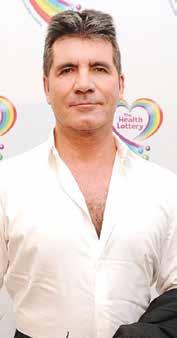
Simon Cowell being sued by ‘humiliated’ X Factor auditionee
It's a dead-cert that there'll be a token "joke" act on The X Factor every year, but one of this year's auditonees is less than impressed to be the show's laughing stock. In fact, he's so outraged with the negative reception he got during his auditon that he's suing Simon Cowell and his entertainment label, Syco.
Adam Miller says the show's production company sought him out and "tricked" him into auditioning, only to humiliate him when he appeared before the judges.
The 27-year-old has previously auditioned for Britain's Got Talent, but says the X Factor wasn't in his sights until he was bombarded with encouragement from the producers via texts and calls, and told it could make his career.
He explained to The Mirror he has was asked to dress up in the same Britney
Spears-inspired Circus outfit he wore for his BGT audition, and was told he could be the next Rylan Clark.
But it's fair to say the take-down he received after his performance was pretty nasty, as Simon fed back:
"Why did you apply for the show? You can't sing! I'm sick of your sh*t, get off my stage."
Though he says Cheryl Cole "looked like she was going to cry, she felt so sorry for me."
Adam has said he was then so distressed that he saw the show's counsellor, and requested that his audition be removed from their edits.
Subsequently, he says: "Real people are getting hurt. It needs to stop and people need to know."
"They approached me. They gave me a bit of self confidence then cruelly and deliberately stripped it away to make good TV."
We don't yet know whether Adam's claims will make it to court, but he does make a fair point about the realities of including "novelty" acts on talent shows.
(Glamour)
The cast of “Fast & Furious 7” have penned a touching tribute to the film's fans in an open letter announcing that production on the film has wrapped.
The bittersweet message, posted on the film's Facebook page, thanked fans for their support during a very difficult production following the death of Paul Walker, and graciously thanked everyone who had been involved in the film.
"We made it. Today we completed the last shot in the production of FAST & FURIOUS 7," the post began.
"We wanted to take this moment to express how thankful we are for your support. We felt the love and strength from our fans throughout this journey, and it's because of you that we got here. There was a time when we didn't know how we could go on, or even if we should. But we listened to you, and you


inspired us not only to keep going but to try and make the best FAST & FURIOUS movie yet." The post mentioned Paul Walker, who died tragically in a car crash last year: "Our family is big and strong but it won't ever quite be whole again without Paul. All of us - those who've been here from the start and those whose first Fast film is 7 - wanted to create a special film for him and for you. We believe we have". (Glamour)


Monica Dogra is an American singer and actress of Indian origin. She is one half of the Mumbai-based electro rock duo Shaa'ir and Func. She made her acting debut in the Bollywood film “Dhobi Ghat” (2008). In December 2011, she served as a judge for Rolling Stone's “Never Hide Sounds” musical talent contest. She is the host of The Dewarists, a musical collaborative show on STAR World India. In 2013, she has performed with award winning violinist Scott Tixier, for a series of shows sponsored by Dos Equis around the US.

John Abraham has reportedly been cast opposite Aishwarya Rai Bachchan in her comeback film.
According to NDTV
Movies, the actor has been confirmed for Sanjay Gupta's next film “Jazbaa”.
It is said that Abraham's character will be modelled on gangster Abu Salem in
the movie.
While the 41-year-old star has previously collaborated on five films with Gupta, it will be Abraham's first film with Bachchan.
The director has said that the film should not be labelled as "womencentric", but added that Aishwarya is the hero of the movie.
The two stars were previously cast in Sriram Raghavan's “Happy Birthday”, but the film was shelved.
The project will be Bachchan's first movie release in four years. She previously withdrew from “Heroine” after she fell pregnant. (NDTV Movies)
Alia Bhatt has revealed that she would like to release a music album.
The actor has previously sung individual tracks for her earlier film “Highway” and new release “Humpty Sharma Ki Dulhania”.
"I would love to sing," said Bhatt. "I really enjoy singing, but I would like to take singing forward.
"I wouldn't want to re-

strict myself to singing for films alone. I want to cut an album of my own one day."
The star has lent her vocals to the track 'Main Tainu Samjhawan Ki' from her new film opposite Varun Dhawan. Produced by Karan Johar, “Humpty Sharma Ki Dulhania” released in cinemas on July 11. (Digital Spy)

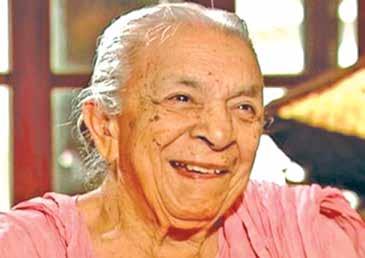
Zohra Sehgal has died, aged 102 years old. The film and television actress died in a New Delhi hospital on July 10. Sehgal appeared in films
including “Dil Se”, “Hum Dil De Chuke Sanam” and “Saawariya”.
She shot extensively for the Shah Rukh Khan and Preity Zinta-starrer Kal Ho
Naa Ho, but her track was later cut from the film, with the deleted scenes later featuring on the film's DVD release.
Sehgal also appeared in the British projects “Bend It Like Beckham”, “The Jewel In The Crown”, “It Ain't Half Hot Mum”, “Mind Your Language”, “The Bill” and “Doctor Who”.
Her last public appearance was in April this year, when Sehgal cut the cake to celebrate her 102nd birthday.
The actor was the recipient of three of India's highest civilian awards - the Padma Shri, Padma Bhushan and Padma Vibhushan. (Digital Spy)
Salman Khan: 'I have always liked Shah Rukh Khan'
Salman Khan has commented on his latest encounter with Shah Rukh Khan.
The two stars, who have been reported as sharing a six-year enmity, were attending an Iftar party, hosted by Congress MLA Baba Siddique in Mumbai, when they were seen hugging.
Speaking to the Hindustan Times after the event, the Kick star said: "It was great. It was really good [meeting him]. He's a good guy, I like him… I've always liked him."
The two stars, who allegedly fell out after an altercation at Katrina Kaif's birthday party in 2008, were seen chatting animatedly and posing for photos together.
It was in the same setting that they made headlines last year, after they

greeted each other with a hug.

Parasites infected with malaria can hide inside the bone marrow and evade the body's defences, research confirms.
The discovery could lead to new drugs or vaccines to block transmission.
The research, published in Science Translational Medicine, fills a "key knowledge gap" in the biology of the disease, say scientists at Harvard.
Carried by mosquitoes,
Ithe parasite causes the most severe form of malaria, which leads to more than 500,000 deaths every year globally.
The study found that malaria-infected parasites could bury into bone marrow, where they escaped the immune system and caused disease.
The idea that they hide in the bone marrow while they mature has been around for decades.
t’s one of the best things you could probably have around your house. With a history that spans over many continents and over thousands of years, it’s no wonder tea has such a good reputation. From China to the United Kingdom, tea is rooted in many cultures. But besides the amazing health benefits that different teas can provide, it’s also a great addition to your beauty routine. From healing small razor nicks to soothing your dry hair — tea is just more than a warm drink you enjoy on a cold night.
Take a black tea bag and soak it in warm water. Wait till the tea bags are cool enough, and then place them on your eyes. The caffeine in the tea helps to constrict blood vessels and reduce swelling. Lay down for about 10 minutes and close your eyes. After the time is up, your eyes should be refreshed and awake.
It's true. You really are what you eat. And that's why some days you end up feeling more like a cream-filled cupcake than the lean cut of beef you aspire to.
But you probably already know that. That's why, like all of us, you're most likely trying to clean up your act and start eating healthy. But the truth is, that's just not enough. Because if you're gorging yourself on apples, bananas, and salads made with iceberg lettuce, you may be eating healthy-but you're not eating smart.
In order to build the body you want (the thunderous arms and the rock-hard abs, the lightning-quick brain and the unquenchable libido) you need to make every bite of food you put in your mouth count. That means building your diet around the most potent, nutrient-dense, disease-fighting, muscle-growing foods around. Here are a few:
Buy it skinless and you get seven grams of musclebuilding protein per ounce. Turkey is high in B vitamins, zinc (a known booster of sperm production), and the cancer fighter selenium.
Olive oil is rich in good monounsaturated fat, making it an ideal food for heart health. In fact, studies show that replacing two tablespoons of saturated fat (found in butter and lard) with monounsaturated fat may reduce the risk of heart disease. But that's not the only reason to eat it. A study in the journal Nature reports that olive oil also has potent anti-inflam-
But a team led by Prof Matthias Marti, of the Harvard School of Public Health, in Boston, pinpointed exactly where the parasites found sanctuaries in bone marrow by analysing tissue samples from autopsies.
"We have confirmed that the parasites that cause malaria can hide in the bone marrow," he told BBC News.
The discovery was "exciting" because it identified
"a key knowledge gap in the biology of the parasite", he added.
The hope is that this may help scientists devise a way to target parasites hiding out in bone marrow with new drugs or vaccines.
The most recent figures from the World Health Organization suggest malaria killed more than 600,000 people in 2012, with 90% of these deaths occurring in sub-Saharan Africa. (BBC)
Chamomile tea helps to soothe dry locks. Take half a cup of water and bring it to a boil. Add the chamomile tea to it and let it steep for about 10 minutes. Then add a quarter of a cup of olive oil to the tea. Pour the mixture over all of your hair and comb it through. Let it sit for as long as you’d like. The chamomile will help to remove any build-up, and the oil will help to condition your hair.
Stinky Feet
Soak your tootsies in black tea. The tannic acid in the tea acts like an astringent and will help to get rid of those odours.
Razor Burn
Sometimes shaving with a dull blade or too fast can cause nicks. To soothe them, take black tea bags and soak them in warm
water. Hold them on the cuts for a few minutes, and it should stop the bleeding and the stinging.
Treat Acne
Green tea is a great drink to have every day. Its antioxidant properties can do wonders for your body on the inside and out. Take a tea bag and soak it in some hot water. Cut the bag open and empty the contents into a cream cleanser. Rub it on your face and let it sit for five minutes. Wash it off completely.
Steam Facial
Cut open either chamomile or green tea bags and pour them into a pot of boiling water. Use a towel to cover your head and bring your face close to the water, but be careful not to get too close (you don’t want to burn yourself). Steam your face for five minutes. (Yahoo)
matory properties, meaning it can help reduce pain and swelling just like a dose of ibuprofen. In addition to cooking with olive oil and using it as a dressing for your salad, you can get even more in your diet by mixing a tablespoon or two into your daily protein shake.
From cancer prevention to weight loss to potentially slowing the development of Alzheimer's, green tea has been shown to help fight almost every major medical ill. Not the teabagging type? Try buying a liquid extract. Drop a bit in water and voila! Instant tea.
Black Beans
Tiny as they are, beans can help you feel energized and fuller longer than almost anything else you can eat. The reason is twofold: They're incredibly high in fibre, which swells in your stomach and promotes a feeling of fullness. And, they're stuffed with a highly complex form of carbohydrate that can take your body a long while to convert into energy. Like meat, they're also packed with protein. But unlike meat, they've got no saturated fats. Ounce for ounce, they have more fibre per serving than any other member of the legume family.
Eggs
Eggs contain a heavyhitting 4 grams of pure muscle-building amino acids inside every shell, in addition to boasting some of the highest naturally available doses around of a vitamin called choline, which is thought to help enhance memory. They're the gold standard in terms of provid-
ing all the right nutrients for muscle growth.
Milk
You know milk does a body good, but you may not know that skipping dairy makes your body angry, sort of. When you're not getting enough, your body releases hormones that cause your cells to retain calcium-and fat. Calories still count, so you should drink your milk by the glass rather than the gallon. But just make sure you get some. There are components in dairy that help turn on your body's fatburning system and slow down the storage of fat. And although other forms of supplements are great, this is one case in which the real thing works the best.
Beef
It's not only high in muscle-building amino acids, it's also a powerhouse of iron and zinc, which aid circulatory health. In fact, beef is so nutrient-dense that a three-ounce serving supplies more than 10% of your recommended daily intake of a number of nutrients, including protein, B6 and B12, selenium, phosphorus, niacin, and riboflavin. Worried about the fat? Don't. According to USDA data, today's beef is up to 20% leaner than it was a decade ago. In fact, 19 cuts of beef meet government guidelines as being a lean meat. To keep the meat you're buying lean as well as tender and flavourful, opt for cuts with the words round or top in the namethings like eye round roast, top round, or top sirloin steak.
Whole Wheat Bread White flour doesn't just
rob you of fibre and protein, it also digests incredibly quickly in the body, giving you a rapid spike of energybut one that comes crashing down just as fast. Over time, those spikes in insulin production wear on the body, damaging cells and promoting excess storage of fat.
Just watch out when you're buying something that claims to be whole grain. It may only look brown because it's coloured with molasses. Rather than buying based on colour, check the ingredient list. The only true whole-grain products are those that contain 100% whole wheat or whole grain listed as the first ingredient on the packaging. Almonds, yogurt, water, broccoli, oatmeal, sweet potatoes, tomatoes, blueberries and salmon are also great choices for a healthy diet. (Excerpted from Men’s Fitness magazine)



Black-and-white frames work in any room and with many types of accessories. Check these photos out to see the different ways you can decorate your home
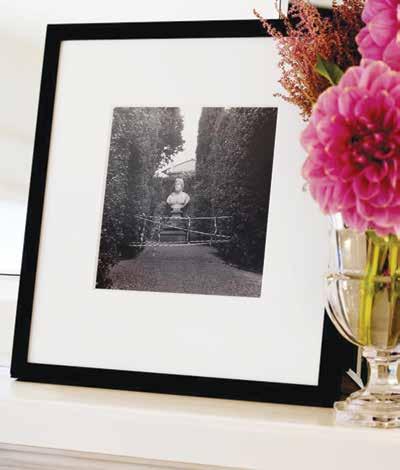
The bright pink flower pops even more against the black-and-white frame.
Blackand-White Accessories
Add black-and-white accessories to a bold-coloured room for a contemporary look.

The black-and-white prints complement the silver frames that surround them.


Method: Cut thin slice from stem end of each bell pepper to remove top of pepper. Remove seeds and membranes; rinse peppers. If necessary, cut thin slice from bottom of each pepper so they stand up straight. In 4-quart Dutch oven, add enough water to cover peppers. Heat to boiling; add peppers. Cook about 2 minutes; drain.

In 10-inch skillet, cook beef and onion over medium heat 8 to 10 minutes, stirring occasionally, until beef is brown; drain. Stir in rice, salt, garlic and 1 cup of the tomato sauce; cook until hot.
Heat oven to 350°F.
Stuff peppers with beef mixture. Stand
peppers upright in ungreased 8-inch square glass baking dish. Pour remaining tomato sauce over peppers.
Cover tightly with foil. Bake 10 minutes. Uncover and bake about 15 minutes longer or until peppers are tender. Sprinkle with cheese.
Ingredients 1 box (1 lb 2.4 oz) Betty Crocker Original Supreme Premium brownie mix Water, vegetable oil and egg called for on brownie mix box
Method:
Heat oven to 350°F (325°F for dark or nonstick pan). Make brownies as directed. After removing pan from oven, set oven to broil.
Immediately sprinkle marshmallows and graham crackers over warm brownies. Broil about 4 to 5 inches from heat 30 to 60 seconds or until marshmallows are golden brown. (Watch carefully marshmallows and graham crackers will brown quickly.) Sprinkle with chocolate candy. To serve warm, cool about 30 minutes. For brownies, cut into 4 rows by 4 rows.

Don’t crowd the pan when sautéing. Be sure you can see the bottom of the pan between the pieces of food. Too much food will lower the temperature of the pan, creating a lot of steam, meaning you won’t get good browning. It’s also important to dry food before sautéing it and to make sure the pan is good and hot.
Let roasted meats rest before carving. Without a rest to let the meat’s juices redistribute, your roast will be dry.
Instantly core a head of iceberg lettuce by slamming it down on a cutting board. Slice avocadoes right in the skin to make neat cubes. Then scoop out the chunks with a spoon.
Grate frozen butter straight into pastry dough for fast, even distribution. This is great for pie, biscuits, and anything else where you want to incorporate butter quickly while it’s still cold.
Use an apple slicer to quickly cut potatoes into perfect wedges.
Adab of foaming shaving cream can help remove many red-wine spills from carpets. Next time you peel the seal from a canister of cleaning powder, take it off only halfway. Keeping some of the holes covered gives you better control of the flow, so it won't come pouring out.
A simple chemical reaction causes tarnish to disappear naturally. Place sterling or plated silver in an aluminum pan -- it must be aluminum. Sprinkle 1/2 to 1 cup baking soda over the silverware. Keeping the pan in the sink to minimize splashing, pour enough boiling water to cover the utensils. When the tarnish disappears, remove the silverware, and buff with a soft cotton cloth.
Plants need showers, too, when dusty or dried out by indoor heating. Use a showerhead attachment to spray large plants lightly with tepid water. For small, delicate plants, wrap the pots in paper towels (secured with a clip), then turn plants upside down, gently swishing the leaves in a pot of water.
To avoid scuffed floors when rearranging heavy pieces of furniture, fold two clean towels (dirty ones can scratch floors), place one under each end, and slide the piece across the floor. Keep your fabric lampshades dust-free with an adhesive lint roller. Hold the shade steady, and pass the roller over the exterior.
Each statement describes two words that when fused together create a new unrelated word (not a compound word). The clues do not necessarily indicate in which order the two words are attached. Example: This is the oldness of a tablet (pill + age = pillage).
1) This is a child of the ocean.
2) This is when an insect runs away to get married.
3) This is the monotone melody of a writing instrument.
4) This is the charge for setting a fractured bone.
solution on page 22



There was once a man who wished his small, noisy house was larger and quieter. He went to the wise old woman of the town and explained his need. She said, "I can solve your problem. Just do as I say."
The man agreed.
"If you have a chicken, some sheep, a horse, and a cow," she said, "bring them into the house with you."
"That's a silly thing to do," thought the old man. But he did it anyway. Now his house was already small, and with all those animals in it, there was no room at all. He returned to the old woman and cried, "I need more room! The animals are so noisy I can't think!"
"Take all those animals out of your dwelling," she replied.
When he had put all the animals comfortably back in the barn, the man went into his house. To his amazement, it suddenly looked remarkably bigger! Without the animals inside, his house was now quiet too! (A Yiddish Folktale from Eastern Europe)
Hera, the Queen of Mt. Olympus, cast a spell over her servant Echo for talking too much. As a punishment, Echo could henceforth only repeat what someone else said.
Poor Echo! She was in love with handsome Narcissus, and yearned to tell him so! One day Echo saw Narcissus admiring himself in a clear pond. Looking at his reflection, he vainly said to the face in the water, "I love you."
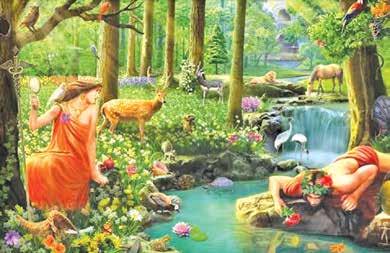
Echo repeated, "I love you," and meant it. But Narcissus thought it was his reflection that spoke and stood gazing at himself until he died and Hermes led him away to the Land of the Dead. Echo pined for him till
she, too, faded away. All that was left of her was her voice that can still be heard in certain hollow places, senselessly repeating the words of others. (Greek Myth)
Aclever smuggler came to the border with a donkey. The donkey's back was heavily laden with
straw. The official at the border was suspicious and pulled apart the man's bundles till there was straw all around, but not

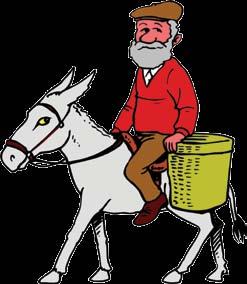
a valuable thing in the straw was found. "But I'm certain you're smuggling something," the official said, as the man crossed the border.
Now each day for ten years the man came to the border with a donkey. Although the official searched and searched the straw bundles on the donkey's back, he never could find anything valuable hidden in them. Many years later, after the official had retired, he happened to meet that same smuggler in a marketplace and said, "Please tell me, I beg you. Tell me, what were you smuggling? Tell me, if you can."
"Donkeys," said the man. (A tale from the Middle East)
Up into the cherry tree Who should climb but little me?
I held the trunk with both my hands And looked abroad on foreign lands
I saw the nextdoor garden lie, Adored with flowers before my eye, And many secret places more That I have never seen before.
I saw a dimpling river pass And be the sky's blue looking-glass; The dusty roads go up and down
With people tramping in to town.
If I could find a higher tree Farther and farther I should see, To where the grownup river slips Into a sea among the ships,
I watch the best minds rot like dogs for scraps of flavour. I am nearing middle age, burnt skin peels from my hand like paper, onion-thin, like Peer Gynt's riddle.
To where the roads on either hand Lead onward into fairy land, Where all the children dine at five, And where all the playthings come alive. Robert Louis Stevenson Schizophrenic, wrenched by two styles, one a hack's hired prose, I earn me exile. I trudge this sickle, moonlit beach for miles, tan, burn to slough off this live of ocean that's self-love.
To change your language you must change your life.
I cannot right old wrongs. Waves tire of horizon and return. Gulls screech with rusty tongues
Above the beached, rotting pirogues, they were a venomous beaked cloud at Charlotteville.
One I thought love of country was enough, now, even if I chose, there is no room at the trough.
At heart there is nothing, not the dread of death. I know to many dead. They're all familiar, all in character,
even how they died. On fire, the flesh no longer fears that furnace mouth of earth, that kiln or ashpit of the sun, nor this clouding, unclouding sickle moon withering this beach again like a blank page.
All its indifference is a different rage.
Derek Walcott

This simulated image demonstrates how small the Milky Way would look from the location of ULAS J0744+25, nearly 775,000 light years away. This star, along with ULAS J0015+01, are the most distant stars ever associated with our Galaxy, and are about five times further away than the Large Magellanic Cloud, one of the Milky Way's closest galactic neighbours.
Credits: Visualization Software: Uniview by SCISS Data: SOHO (ESA & NASA), John Bochanski (Haverford College) and Jackie Faherty (American Museum of Natural History and Carnegie Institute's Department of Terrestrial Magnetism)
The boundaries of our home galaxy may have to be redrawn. Astronomers have discovered the farthestflung stars yet known in the Milky Way. The two objects — known as ULAS J0744+25 and ULAS J0015+01 — are about 775,000 and 900,000 lightyears from Earth, respectively, making them both about five times more distant than a satellite galaxy known as the Large Magellanic Cloud.
"The distances to these two stars are almost too large to comprehend," study lead author John Bochanski, of Haverford College in Pennsylvania, said in a statement. "To put it in perspective, when the light from ULAS J0015+01 left the star, our early human ancestors were just starting to make fires here on Earth."
The Milky Way extends far beyond its familiar disk, which is just 100,000 light-years or so wide. The galaxy is surrounded by a sparse "halo" of stars — perhaps stragglers left out there after the Milky Way's many mergers with dwarf galaxies over the eons, researchers say.
Scientists know this halo extends to at least 500,000 light-years away, but its exact dimensions are unknown. Bochanski and his colleagues decided to probe the halo's outer reaches, hunting for a type of star called cool red giants.
Cool red giants are much rarer than red dwarfs, which make up about 70 percent of the Milky Way's stars. But they're about 10,000 times
brighter, making them much easier to see from a distance.
"It really is like looking for a needle in a haystack," Bochanski said. "Except our haystack is made up of millions of red dwarf stars."
The team pored over images collected by the UKIRT Infrared Deep Sky Survey, which uses the United Kingdom Infrared Telescope in Hawaii, and the Sloan Digital Sky Survey, which employs a telescope in New Mexico. They detected ULAS J0744+25 and ULAS J0015+01 in these data, then confirmed them by taking spectroscopic data with the 6.5-meter telescope at the MMT Observatory in Arizona.
The two stars' extreme distance was confirmed by a variety of different estimation techniques, researchers said. ULAS J0744+25 and ULAS J0015+01 are more than 50 percent farther from the sun than any other Milky Way star yet discovered, researchers said. In fact, the famous Andromeda galaxy is just three times farther away than ULAS J0744+25 and ULAS J0015+01.
But the new study, which was published last week in Astrophysical Journal Letters, provides more than gee-whiz appeal. It could help astronomers test some of their models of the Milky Way's formation and evolution, team members said.
"We think these stars might be the brightest members of some leftover remnants of the MW's formation," Bochanski told
Space.com via email. "We will need more observa-
tions to be sure of it, but if there are significant num-
bers of stars in the outer halo, then the models will need to be revised." (Discovery News)

Apple has been granted a US patent for a method of building devices with fused glass outer casings, suggesting that the company could develop all-glass iPhones and iPads in the future.
The patent describes a method of fusing pieces of glass together to form a "five-sided box in which electronic components may be mounted". The all-glass structure is designed to ensure robustness and minimise weight.
"Glass strength and device aesthetics can sometimes be enhanced by using sufficiently thick glass layers. However, the size and weight of a device should not be excessive," the patent states.
"If care is not taken, modifications that are made to ensure that a device has glass structures that are suf-

ficiently strong, will make the device heavy and bulky."
It states that a 'peripheral' piece of glass may be fused along the edge of a 'planar' piece of glass to en-
hance thickness, and then filed down to create a rounded edge.
The patent goes on to explain how display structures and other internal compo-
Google Glass has been hacked so that it can be controlled by brainwaves.
By combining the smart glasses with an electroencephalography (EEG) headset, the software makes it possible to take a picture without moving a muscle.
London-based start-up This Place said the tech could be utilised in high-pressure hands-free situations - such as during surgery.
It has released the MindRDR software for free in the hope that developers will adapt it for other uses.
Google made it clear that it does not support the app.
"Google Glass cannot read your mind," a spokeswoman told the BBC.
"This particular application seems to work through a separate piece of kit which you attach to Glass.
"We have not reviewed, nor approved, the app so it won't be available in the Glass app store."
Google launched Glass in the UK last month.
The spokeswoman added: "Of course, we are always interested in hearing about new applications of Glass and we've already seen some great research from a variety of medical fields from surgery to Parkinson's." Concentration camera
An EEG headset can be used to measure when certain parts of the brain show a greater level of activity.
In this case, the MindRDR software monitors when the wearer engages in high levels of concentration.
Within Google Glass's "screen" - a small window that appears in the corner of the wearer's right eye - a white horizontal line is shown.
As a user concentrates, the white line rises up the
ByTe
Inents may then be slid into place between opposing glass sides of the box.
Opaque masking material and coloured glass may also be used to create por-
tions of the glass housing that hide internal device components from view.
Apple already uses glass extensively in its products.
The iPhone 4, for example, featured front and back glass panels with a metal rim connecting the two. However, all-glass casings would create a new aesthetic for Apple products, and
help it stand out against other device manufacturers.
The patent does not necessarily mean that Apple plans to launch a commercial product featuring a fused-glass casing. However, it would potentially fit well with Apple's existing patents for sapphire lamination and fusion technology. (Telegraph)


screen. Once it reaches the top, a picture is taken using Glass's inbuilt camera.
Repeating this process will then post it to a pre-configured social media profile.
At present, Google Glass is controlled by either voice command - "OK Glass, take a picture" - or by tapping and swiping on the side of the device.
"We wanted to realise the true potential of Glass by allowing users to control it with their minds," said Dusan Hamlin, chief executive of This Place.
"Currently, users either have to touch it or use voice commands, which are restrictive for some social situations and for users with disabilities."
'Wider world'
The firm's creative director Chloe Kirton said: "While
MindRDR's current capabilities are limited to taking and sharing an image, the possibilities of Google Glass 'telekinesis' are vast.
"In the future, MindRDR could give those with conditions like locked-in syndrome, severe multiple sclerosis or quadriplegia the opportunity to interact with the wider world through wearable technology."
EEG technology is a growing area.
In the past, the equipment was prohibitively expensive, but many headsets are now available for less than £100.
Mick Donegan is the founder of SpecialEffect, a charity which adapts games controllers so they can be used by people with limited mobility.
He told the BBC that there had been some issues with the reliability of EEG headsets in the past, but that he was excited by the possibilities of the Google Glass hack.
"It will mean someone who currently has no control at all, who can't even control the movement of their eyesthose people will be able to use that system. For me, that's the final frontier," he said,
He added that developers would have to make intuitive user interfaces.
"Instead of people controlling a cursor, if you have a carefully designed interface that goes through options on a screen to choose - that's taking the load of the user. That's what you're looking for."
Other applications have included video games that attempt to monitor your emotional state, and change the game experience accordingly.
However, the technology is in its infancy - early experimental games have suffered from a lack of precision, leading to frustration among players. (BBC)
f Angry Birds is known for anything, it's an ability to keep youthful eyes glued to the screen for extended periods of time. But a new study conducted at Georgia Tech has shown that teaching a robot how to play the video game keeps kids slinging those wingless birds through the air for even longer, a finding that could help in the rehabilitation of cognitive and motor-skill disabilities.
The study observed how school-aged children engaged with Angry Birds and how that engagement could be dictated depending on who was sitting alongside them. The kids were first asked to play the game as an adult watched on, and then to teach a robot how to play for themselves.
In preparation, the researchers had paired a small humanoid robot with an Android tablet. The robot was programmed to watch the child's movements and record snippets of useful information, such as where swipes are stopping and starting and how the objects were moving on screen. It then mimicked the movements and offered up life-like reactions to developments in the game, shaking its head following misdirected shots and dancing when it struck a target.
Whereas the children played the game for an average of nine minutes with the adults, session times almost tripled to an average of 26.5 minutes when playing with the robot. The researchers also observed a much higher level of interaction, as seven percent of the session with the adult included eye contact, gestures, while the robot's session drew nearly forty percent.
The robots ability to analyze and adapt to new information suggests they could have a role to play in rehabilitation for disabled children, a process that often involves lengthy and monotonous exercises that can be tiring for a parent.
"Imagine that a child’s rehab requires a hundred arm movements to improve precise hand-coordination movements," said Ayanna Howard, Professor at Georgia Tech's School of Electrical and Computer Engineering and leader of the project. "The person’s desire to help their 'friend' can turn a five-minute, bland exercise into a 30-minute session they enjoy."

The Georgia Tech researchers will now look at pro-
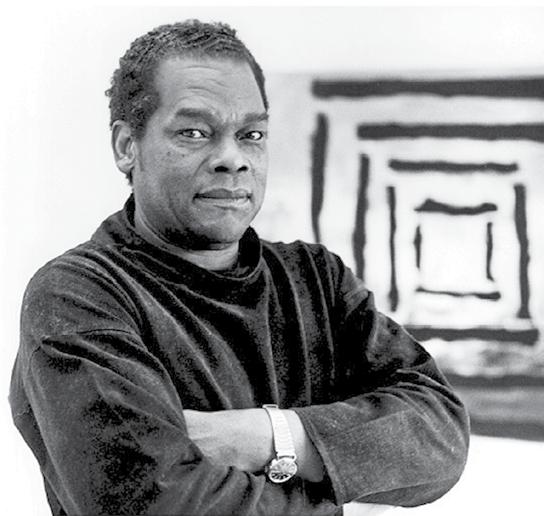
The late Aubrey Williams has significantly placed himself as a celebrated Guyanese artist among prominent international artists. His work is valued worldwide, and although he has passed on, his legacy still lives.
Williams was born in Guyana in 1926, and began painting and drawing from the age of five. He joined the Working People’s Art Group while still at school, studying under E. R. Burrowes, a man he credited as “opening the Guyanese eyes to art”.
A trained agronomist, Williams’ work took him to the north-west rainforests of Guyana, where he lived for two years among the indigenous Warrau people, a period which proved one of the most formative of his life and where he said, “I started to understand what art really is.”
By 1952, when he returned to Georgetown at the age of 26, Guyana was nearing the end of its time as a British colony and Williams sailed to London, initially on six months paid leave, to become a painter, and began life drawing at St Martin’s School of Art.
As a painter with detailed knowledge of flora and fauna, with personal experience of momentous political change, and with a growing interest in pre-Columbian cultures, he arrived in London with a unique visual and intellectual vocabulary. Over the following years he took the opportunity to travel extensively around Europe, returning to London and to opportunities to exhibit his work.
He was also part of the spectacular explosion of creativity, optimism and productivity generated by the influx of Caribbean writers, artists and intellectuals to London at the time. This cultural foment was exemplified in the Caribbean Artists Movement (CAM), founded in 1966 by poet and historian, Kamau Braithwaite; poet and activist John La Rose, and novelist and journalist Andrew Salkey.
Williams was a founder member and participated fully in CAM’s activities, as did sculptor Ronald Moody. Within this mutually supportive network, Williams founded, and contributed to an enriching framework of ideas and discussion, including debates on visual sources, strategies for change, and the stifling effects of being categorised as either a quintessentially Caribbean or British artist.
When Williams had ar-
abstract painting.
His paintings have always resisted classification, evolving through many distinct phases over the course of his career. From immaculately accomplished depictions of birds, to figurations, to explosive, vibrant abstracts, Williams drew influence from abstract expressionism, from Olmec, Maya, and Warrau imagery, from science fiction, from the symphonies and quartets of Russian composer Dimitri Shostakovich, and from artists such as Jackson Pollock, Arshile Gorky, Diego Rivera, Yves Klein and Rufino Tamayo.
Williams was a visionary artist far ahead of his time, and his work expresses the urgency of his concerns about the destruction of the global ecological balance by far predating our current rudimentary realisation as to the complexity of the problems we face.
The artist’s vital concerns inform all of his work from his painterly musings on the destruction of the Mesoamerican Olmec, Maya, and Toltec cultures, to the beautifully depicted visions of the natural world seen in his “Cosmos” canvas-
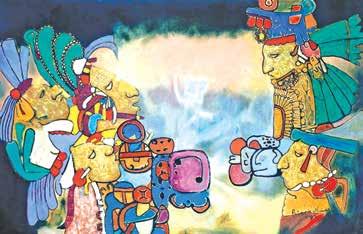
rived, London was a city with few apparent signs of a black presence, and as such, the visibility of Williams’ work represented one of the first challenges to the white dominance in the British art establishment. Over the years that followed however, Williams found himself increasingly confronted by ‘institutional indifference’, his work framed and discussed solely in terms of ‘otherness’.
By the late 1950s and 1960s, Williams was winning acclaim in the UK for his abstract canvases. During the 1970s and 1980s, he worked and exhibited regularly overseas, in Jamaica, Guyana and Florida. By the early 1980s, he had completed a series of luminous abstract paintings based on the music of Shostakovich. The subsequent “OlmecMaya” series drew deeply on his broad knowledge of historic Central and South American cultures. He broke the artistic norms of the time by merging representational elements within
es– breathtaking pictures of galaxies against the inky darkness of the night skies–and his brilliant portraits of birds, some of which are on the brink of extinction.
In the UK, Williams’ work has been exhibited at the Whitechapel Gallery, the Royal Festival Hall, the Commonwealth Institute and the Hayward Gallery. Of note is the October Gallery, UK, which has represented Williams work since 1984. But it was not until after his death in 1990 that a major retrospective of his work was held in 1998 at the Whitechapel Art Gallery, so serving to confirm his unique place in British art history. Additionally, his work is represented in major public and private collections throughout the world.
Williams was honoured in Guyana with the award of the Golden Arrow of Achievement in 1970 and then with the Cacique Crown of Honour in 1986. (Cover photo: 'Sun Hieroglyph' (Olmec Maya series), 1983. Oil on canvas)

According to most historians, the hammock was first introduced to the rest of the world in a letter from the second voyage of Christopher Columbus to the “New World”.
Its origins are said to have come from the indigenous peoples of Central and South America, where hammocks were first made from the bark of the hamack tree. Some scholars believe the hammock dates back to some 1,000 years ago among the Mayan peoples of Central America.
The English word “hammock” came from the Spanish conquistadors, who derived the word “homoca” of the present day “hamaca” from the Carib Indians, who wove fibres of the hamack tree.
More than 500 years ago, Columbus discovered the indigenous Taino Indians of Bahamas sleeping “in nets between the trees”, which were suspended off the ground. Some historical sources suggest it was among the Taino Indians of Haiti (Santo Domingo) that Columbus first saw and experienced the hammock.
In 1500, Portuguese explorer Pero Vaz de Caminha noted in his journal that “in their thatched houses the natives sleep in nets that
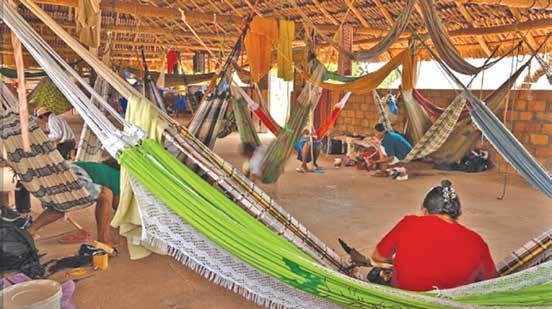
are attached with cords to wooden beams above.”
Later 16th-century accounts speak of people “[placing] hot coals or [kindling] small fires under their hammocks to stay warm or ward off insects as they slumbered.” “Suspended beds”, says history.com, “prevented contact with the dirty ground and offered protection from snakes, rodents and other poisonous or simply pesky creatures.”
Hammocks could be found throughout the New World regions. Hernan Cortes, conquistador of Mexico, observed the hammock as a staple of Indian
life in the region. Vasco Nunez Balboa wrote of “hammocks of cotton” as he made his way through the Isthmus of Panama towards the Pacific Ocean. He observed that every hut, every village had hammocks as the primary source of bedding.
By the end of the 16th century, colonists began their widespread use of the hammock from Mexico through the Caribbean to Brazil in South America. In 1570, Portuguese colonist Pero de Magalhaes observed that “most beds in Brazil are now hammocks, hung in the house from two cords. This
custom they took from the Indians of the land”.
Throughout these regions, the hammock varies in materials and techniques as well as among its western adaptations. Hammocks are said to have been woven from cotton, Ité, tucum, awarra, same and kuraua, to sisal to wool and polyester blends and canvas in modern times. By the late 16th century, the hammock was being used in the English navy, and entered the English dictionary as “a piece of canvass, hung at each end, in which seamen sleep.”
Today it has become a symbol of relaxation, with
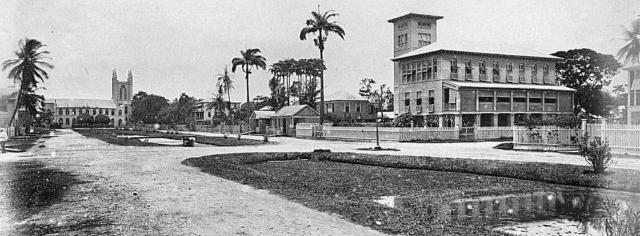
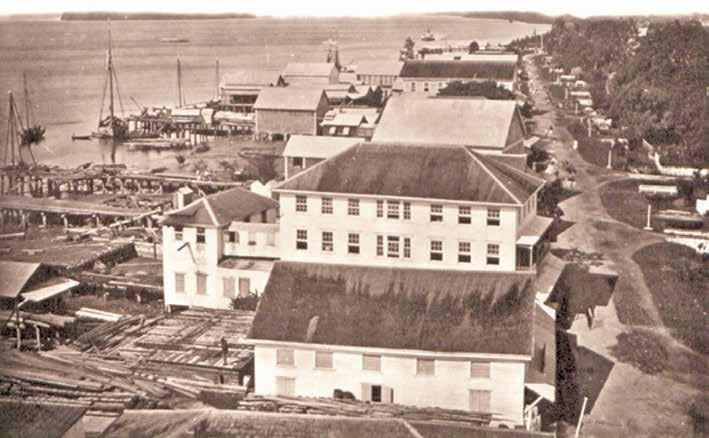
its iconic depiction in vacation travel brochures or home and garden advertisements derived from wartime propaganda photos of a soldier resting in between two palm trees in the South Pacific.
According to the Walter Roth Museum, the Carib, Makushi and Wapishana communities here make cotton hammocks, while Arawak and Warrau hammocks traditionally use tibi-

siri fibre, and Waiwai hammock makers use kraua string. These hammocks are also often decorated with fringes, tassels or feathers, and are coloured using the juices from the barks of trees such as the wallaba, red mangrove and genipa.
The humble “hamaca” is just one of the many contributions Amerindian traditions have made to worldwide culture.


Travelling along the Kumuni Creek, which leads to small Amerindian villages of Aratak and Santa Mission, is an enthralling journey that every Guyanese should experience.
Popular resorts such as Timberhead and Arrowpoint are found about an hour up the creek by speedboat and about two hours with the ‘engine boat’. After travelling to Timehri, just before reaching the airport, there is a turn that leads to a stelling where a boat takes you over the brown mud waters of the Demerara River to the black water creek. It is said that black water does not mix with the muddy water and that is vividly seen between the Demerara River and the Kumuni Creek.
Along the creek, houses are tucked neatly between towering trees, and children bathe in the chilly waters. Life seems simple and pleasant, as days are spent fishing or swimming in the ice-cold black water.
About 45 minutes upstream, Aratak village is inhabited by a few houses filled with families of about two and four. These families are related to each other and are relatively self-sufficient, with poultry and fruits farms.
Villagers go to a small church early in the morning because the sun is scorching as the day progresses. Residents say Aratak existed hundreds of years ago and was passed down from generation to generation. Life is quiet with no criminal strife in this close-knit community.
From Aratak, the adventure continues to Santa Mission, which is about 15 minutes away. Santa Mission was established in 1858 residents say, and has a health care centre, a craft shop, a school and a few houses. About 15 minutes away from Santa Mission are Timberhead and few minutes away from that is Arrowpoint.
A day filled with nutritious pear (avocado) eating, sightseeing and swimming in cold black water is indeed a true escape from the often jaded concrete jungle.

By Melvin Durai
FIFA, football’s governing body, recently imposed a four-month ban on Uruguay striker Luis Suarez for biting an Italian opponent, Giorgio Chiellini, during a World Cup match. It was the third biting incident in Suarez’s career and shocked soccer fans. Many of them believed that Suarez deserved a lifetime ban, but FIFA took two important factors into consideration in giving a lighter sentence: (1) Video from several camera angles was unable to conclusively disprove Suarez’s claim that his teeth accidentally collided with Chiellini’s shoulder; and (2) Uruguayan authorities supplied FIFA with proof that Suarez has always been meticulous about getting his rabies shots.
Suarez’s punishment includes a ninematch international ban. He is also banned from any football-related activities, which means that he can participate in swimming, for example, but can’t do a belly-flop or take a dive.
In a carefully worded statement, Suarez said he “deeply regretted what occurred in the match, as deeply as the bite on Giorgio Chiellini.”
Apologizing to Chiellini and the entire football world, he added, “I vow to the public that there will never again be another similar incident, as I have agreed to FIFA’s request that I wear a muzzle during football matches.”
His previous biting incidents occurred when he was playing for the Dutch club Ajax in 2007 and English club Liverpool in 2013. He is so notorious for his biting that some folks in Texas are training their pit bulls by showing them “Luis Suarez highlights.”
He has committed three bites in seven years, which is a Guinness World Record for “football players biting opponents while presumed to be sane.” But it’s nowhere close to the Guinness World Record for football players biting referees. That record belongs to a Ugandan football player who was so smitten with a female referee that he kept giving her “love bites” during a match. He received a two-month suspension from the Federation of Uganda Football Federations (FUFA) and a two-year suspension from his wife, also named Fufa.
Biting is more likely to happen in sports like wrestling and boxing, where mouths often get too close to ears, as boxer Evander Holyfield discovered in 1997 when he fought Mike Tyson in a world heavyweight championship bout. Holyfield managed to retain his title, but not his entire ear.
A fan bowed down before Messi and began sparkling the Argentina commander’s boots after evading security at this year's FIFA World Cup
Tyson, the former champ, was disqualified for biting off part of Holyfield’s right ear, but fortunately mended his ways and did not bite anyone else, not even his exwife’s divorce attorney.
Biting is an instinctive reaction for dogs and other animals, but considered primitive behavior for humans, even those who grew up in West Virginia. It’s not uncommon, however, for humans to resort to biting, especially when they’re angry, under extreme stress or competing for something important, such as a World Cup, Nobel Prize or parking spot at the mall.
Children in particular are prone to bite each other, until an adult reminds them that their teeth should be used only for biting food – and those hard-to-open plastic packets that food comes in.
In an article for Forbes.com, Dr. Robert Glatter writes that “humans biting other humans reminds us of our ancestral connection with primates – and how through evolution and development of organized cultures and societal norms, such behavior became unacceptable.”
This “ancestral connection with primates” is perhaps what got a 20-year-old Indian man in trouble. As the Press Trust of India reported, Pushparaj (also known as Pintu) of Indore was recently sentenced to one year of rigorous imprisonment after a judge found him guilty of biting his neighbor’s ear off. (In case you’re wondering, Pushparaj is not a rabid fan of Luis Suarez. He’s been vaccinated too.)
Pushparaj bit off the right ear of 22-yearold Gabbar after the neighbor hurled a stone at Pushparaj’s pet dog. Poor Gabbar. He apparently didn’t see the sign on the gate that said, “Beware of human.”

A friend and I were standing in line at a fast-food restaurant, waiting to place our order.
There was a big sign posted. "No bills larger than $20 will be accepted."
The woman in front of us, pointing to the sign, remarked, "Believe me, if I HAD a bill larger than $20, I wouldn't be eating here."
***Those who don't know***
The world is divided into two groups. There are those who know, and those who don't know. Those who know are no problem.
Those who don't know are also in two groups.
One is those who don't know and know they don't know. Well, they can learn!
But then, there are those who don't know, and don't know they don't know. And they become unit managers!
Mrs. Peterson phoned the repairman because her dishwasher quit working. He couldn't accommodate her with an "after-hours" appointment and since she had to go to work, she told him, "I'll leave the key under the mat. Fix the dish washer, leave the bill on the counter, and I'll mail you a check. By the way, I have a large Rottweiler inside named Killer; he won't bother you. I also have a parrot, and whatever you do, do not talk to the bird!"
Well, sure enough the dog, Killer, totally ignored the repairman, but the whole time he was there, the parrot cursed, yelled, screamed, and about drove him nuts.
As he was ready to leave, he couldn't resist saying, "You stupid bird, why don't you shut up!"
To which the bird replied, "Killer, get him!!!"
Commanding the dumb
As we stood in formation at the Pensacola Naval Air Station, our Flight Instructor said, "All right! All you dummies fall out."
As the rest of the squad wandered away, I remained at attention.
The instructor walked over until he was eye-to-eye with me, and then just raised a single eyebrow. I smiled and said, "Sure was a lot of 'em, huh sir?"
The bum on a street
A bum asks a man for $2. The man asked, "Will you buy booze?" The bum said, "No." The man asked, "Will you gamble it away?" The bum said, "No."
Then the man asked, "Will you come home with me so my wife can see what happens to a man who doesn't drink or gamble?"
What should they say?
Three buddies die in a car crash, and they go to heaven to an orientation.
They are all asked, "When you are in your casket and friends and family are mourning upon you, what would you like to hear them say about you?
The first guy says, "I would like to hear them say that I was a great doctor of my time, and a great family man."
The second guy says, "I would like to hear that I was a wonderful husband and school teacher which made a huge difference in our children of tomorrow."
The last guy replies, "I would like to hear them say, "Look! He's moving!"