Times Bollywood: Katrina Kaif: ‘Marrying Ranbir Kapoor in 2015 is news to me’




Times Bollywood: Katrina Kaif: ‘Marrying Ranbir Kapoor in 2015 is news to me’
Autism is a lifelong developmental disability that manifests itself during the first three years of life. According to the United Nations (UN), the rate of autism in all regions of the world is high and it has a tremendous impact on children, their families, communities and societies.
Throughout its history, the UN has promoted the rights and well-being of the disabled, including children with developmental disabilities. The United Nations General Assembly unanimously declared 2 April as World Autism Awareness Day to highlight the need to help improve the lives of children and adults who suffer from the disorder so they can lead full and meaningful lives.
In Guyana, two integral institutions focused on helping autistic children are the Step by Step Foundation and the Guyana Greenheart Autistic Society.
The Step by Step School is run by the Step by Step Foundation, a non-profit organisation offering quality learning opportunities for children with autism or related disorders. The school opened September 2011, founded by Kala (Kay) Ramnath, wife of a former British high commissioner to Guyana, who is also a mother of an autistic child and autism advocate. The foundation is presently chaired by Dr Suraiya Ismail, a nutrition consultant and educator.
In 2008, when Ramnath’s husband was posted to Guyana, they were fortunate enough to engage the services of a highly qualified Boston-based behavioural consultant, Dr James Ellis,
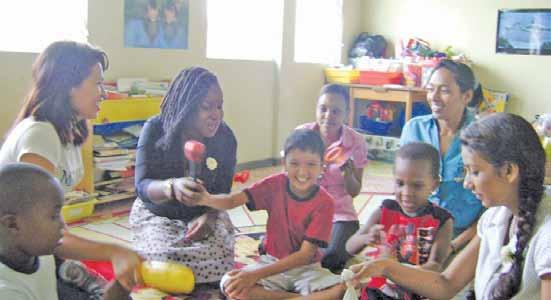
who helped to set up their son Rohan’s intensive home teaching, using the Applied Behaviour Analysis (ABA) approach.
Dr Ellis voluntarily used his spare time to see and advise other parents and, after three years of interacting with and helping these parents and their children, he is now fully signed up to the foundation. Dr Ellis’ main task included training the team of behavioural tutors who would go on to form the core of what is now The Step by Step School.
The ABA approach is used by the school to improve the communication, social and behavioural skills of autistic children. The ABA method is scientifically proven to help them achieve their fullest potential. Each child with autism is different, so the ABA approach is based on assessing and responding systematically to an individual child’s strengths and weaknesses. Each child, therefore, has baselines set for them (through assessment) as well as goals and
targets for learning skills. The basic approach involves rewarding positive behaviour and discouraging negative behaviour (with each task broken down into small steps and practiced regularly) so the child begins to produce behaviour that gains rewards – from verbal praise, to small amounts of food, access to a favourite toy and so on.
This approach is then used to teach everything else from numbers to shapes to colours, labelling of objects, animals, household items, food categories to personal hygiene and care, appropriate behaviours in the home, at school and in public places. Requesting for food and toys, going to the toilet, wanting to play, completing a task, all of these are covered systematically in an ABA programme.
The teachers have been all been trained in ABA by Dr Ellis and have extensive experience. Dr Ellis continues to monitor and guide the work of the school. He is an expert psychologist who

lives in the US, but visits the school regularly.
Step by Step believes that if an autistic child is exposed as early as possible to the ABA approach, he or she can make the greatest progress. ABA can be started as early as age three, or even earlier. The school accepts children from ages 2 to 12.
The effectiveness of the ABA system has been clearly seen with the students at Step by Step. One such student is Sameir, one of the first children to attend the school. When he started at the school, Sameir did not have any way to communicate, had very little understanding of language, and had a very difficult time
developmental disorders, to reduce the stigma associated with the disabilities, and to encourage parents to seek appropriate assistance for their children.
For more information on the Step by Step programmes for autistic children and how you can help call 222-2633 or 231-4172.
The Guyana Greenheart Autistic Society is a registered non-governmental, non-profit charitable organisation that addresses Autism Spectrum Disorder (ASD). It was registered on 12 September 2010.
As no cure yet exists for autism, the goal of Guyana Greenheart Autistic Society’s treatment is to maximise the child's ability to function by reducing autism symptoms and supporting development and learning.
With that in mind, the society’s objectives are to enhance the educational, behavioural and therapeutic well-being of people living with autism in Guyana, and to ensure those autistic individuals and their families/ caregivers in Guyana benefit from the work of the organisation. It also aims to motivate its membership and the general public to participate in activities de-
sources to improve, facilitate and raise the profile of the organisation and also the potential of autistic persons in Guyana.
The society was formed by two parents, Karen Williams and her husband, whose daughter, Sorsha is autistic. Sorsha was diagnosed with autism after her father, while watching the Oprah Winfrey Show, recognised she was displaying some of the symptoms associated with the condition.
Sorsha’s parents noticed that she had excellent retention skills and ability to grasp concepts, and so worked with her to channel her energies in the right direction. By means of this, Karen and her husband decided to open the society and school to help autistic children and their parents.
The school uses puzzles and Picture Exchange Communication System (PECS) tools to help autistic children, as they are visual learners and will follow what they see. There is also the “stringing” technique, where the children are taught how to insert strings in buttons or beads, which helps with the children’s coordination and motor skills.
As a non-profit organisation, the society largely depends on donations from kind-hearted citizens and fundraising activities. The

staying focused.
Although Sameir is still not talking, he now uses some approximations of words, and uses a picture communication system. He has also made great progress in following a variety of directions, playing games with other children, and staying more focused on the social activities. Sameir arrives at school every day with a bright smile and hugs for everyone.
The foundation’s mission is to spread awareness on autism to create a better understanding of the needs of children with physical and
signed and formulated to enhance the self-help skills, educational attainment and participation in society to their fullest individual potential of all autistic persons in Guyana.
Additionally, the organisation helps to develop and enhance educational and therapeutic opportunities for children and young adults through the establishment and management of the Guyana Greenheart Autistic Society. The society provides individualised targets based on professional assessment and develops appropriate strategies in order to access all types of re-
children are also required to pay a small monthly fee.
Presently, the school is faced with the challenge of having to move from its current location on Quamina Street. However, the school’s headmistress and autism special needs educator Andrea Hutson told Guyana Times Sunday Magazine that although they are unsure as to where they will go, the school will not cease in its efforts to continue to help autistic children and spread awareness on the condition. For more information on the society, call 225-8935.
An extinct language teaches the importance of preserving our history
By Dmitri Allicock
Guyana is the only English-speaking country in South America, but English has been the official language for much less than the 232 years when Dutch was the main medium of communication. The actual words spoken by most Guyanese is an English-based creole that is very elastic to various regions and has slight historical influences from Dutch, West Africa, Arawak, and to a lesser extent Indian languages. Berbice Dutch Creole was a language developed by the slaves on the plantation of Berbice that survived the passage of time, and only a few years ago was considered officially extinct by international language database, Ethnologue.
Berbice Dutch was a Dutch-based creole language of Guyana and had a lexicon partly based on a dialect of the West African language of Ijaw. In contrast to the widely known Negerhollands, Dutch creole spoken in the Virgin Islands, Berbice Creole Dutch and its relative Skepi Dutch Creole of Essequibo were more or less unknown to the outside world until linguist Ian Robertson first reported on the two languages in 1975.
Dutch linguist and professor, Silvia Kouwenberg, University of the West Indies, Jamaica, investigated the creole language, publishing its grammar in 1993. The breakdown on the language is said to be 30 per cent of eastern Ijaw (Kalabari), West African origins; 60 per cent Dutch, and 10 per cent from Arawak or Guyanese English Creole. Swadesh wordlist gives another breakdown: Dutch 57 per cent, Eastern Ijo 38 per cent, Arawak 1 per cent, and Guyanese.
The language developed from Berbice Dutch plantation colony in areas along the Berbice River as a simple means of communication between African slaves, Dutch planters, and the indigenous Arawaks. This creole’s demise started with the moving of the plantation economy to the coast.
The latter was further compounded with the takeover of the region by the English in 1814. The language was one of the first to be discarded with the prevalence of the English creole language in the British take over.
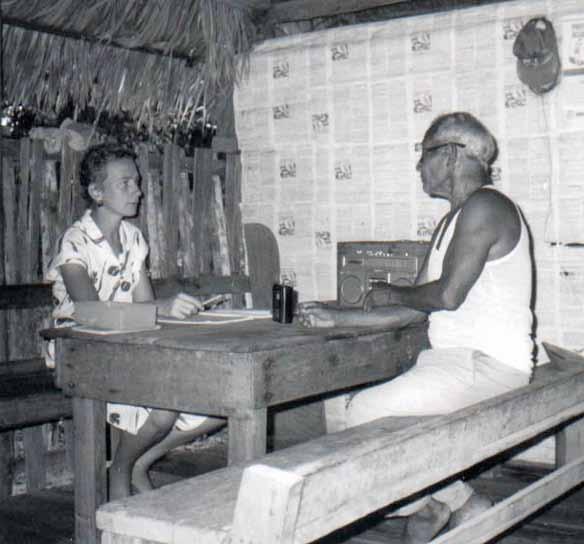
Professor Kouwenberg, on 29 December 2011 speaking on Berbice Dutch, highlighted Arnold King and 103-year-old Albertha Bell as the last speakers of Berbice Dutch. King and Bell were interviewed by Jamiekan Langwij Yuunit in 2004, who said, “Known to its speakers as di lanshi, Berbice Dutch is officially
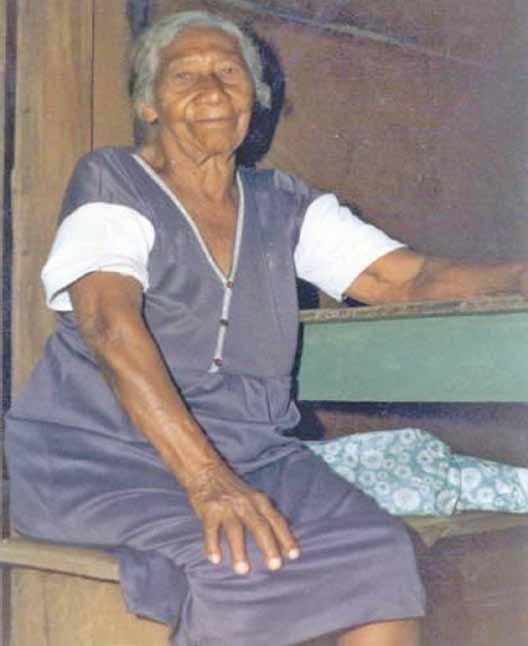
extinct, after the death of its last fluent speakers, Albertha Bell and Arnold King, a few years ago. They were cousins who had grown up together after Arnold King’s parents died in the flu pandemic of 1918, which reached even the very remote tributaries of the Berbice River in Guyana, in South America. Like other creole languages in the Caribbean region, Berbice Dutch was once the language of a plantation colony. But Berbice was no typical colony: located on the infertile banks of the Berbice River, most plantations remained small, and grew crops such as anatto (a natural dye) and cocoa rather than sugar. Although enslaved Africans constituted the majority of the colony’s population, close relationships appear to have existed between all three groups present in the colony - Africans, Arawak Indians, and (mostly Dutch) Europeans. Guyanese have a special term for their mixed offspring, ‘bovianders’ - a word that is thought to be derived from Dutch ‘bovenlander’ (meaning ‘upriver dweller’). In my visits to the former plantation areas of the Berbice River, I encountered many a young Berbician whose brown skin and dark curls combined with startlingly green eyes.”
She continued, “The last speakers of Berbice Dutch, although without green eyes, were certainly of similarly mixed descent. Albertha Bell and Arnold King could identify both Arawak Indians and AfroGuyanese among their forebears, and reference was also made to ‘white’ ancestors – although this may have meant lightskinned rather than European white.”
Bell and King, proud as they were of their predominantly Arawak ancestry, would have been shocked to learn that the language of their childhood years is of special interest to linguists because of its African linkages, with a group of languages spoken in the southern coastal delta area of Nigeria, the Eastern Ijo languages. Thus, Berbice Dutch words such as ‘wari’ meaning house, ‘toko’ meaning child, ‘jefi’ meaning to eat, ‘mangi’ meaning to run, ‘kali’ meaning small, ‘bifi’ meaning speak, are all decidedly un-Dutch because these are words derived from Eastern Ijo.
Essentially, Dutch and Eastern Ijo appeared to have competed in the composition of the Berbice Dutch lexicon. Thus, we find Dutch-derived ‘man’ means man and Eastern Ijo-derived ‘jerma’ means wom-





an; Dutch-derived ‘feshi’ means fish and Eastern Ijo-derived ‘feni’ means bird; Dutch-derived ‘grun’ means green or unripe and Eastern Ijo-derived ‘bjebje’ means yellow or ripe; Dutch-derived ‘hemdu’ means shirt and Eastern Ijo-derived ‘bita’ means clothes, and so on.
Arnold King tells of his younger years: “Eke papa mete eke mama doto-te, an da eke grui-te mete en man. Pote Howard Hope, an shi jerma nam Alice Hope. Wel eke drai-te jungu man eni bara ben an eke deki-te jerma an trou-te.”
Translation, “My father and my mother died, and so it is that I grew up with a man. Old Howard Hope, and his wife whose name was Alice Hope. Well I became a young man in their care (literally: in their hand) and I chose a woman and married.”
Of even more interest to linguists, is the grammar of this language. Berbice Dutch has incorporated elements of the grammar of both Dutch and Eastern Ijo, but is nonetheless quite different from both.
Although this language is not spoken anymore, it lives in recordings, video, and publications. Its special combination of elements from three different source languages continues to be of interest to linguists who study language contact: it teaches us about the human capacity for resourcefulness, where people had to communicate across language barriers under very challenging circumstances. People have an uncanny ability to treat their language and cultural heritage as a commodity, to be discarded when it seems to be of little use to them or their children - only to regret the loss later in life. About 6,000 different languages are spoken around the world. But the Foundation for Endangered Languages estimates that between 500 and 1,000 of those are spoken by only a handful of people. And every year the world loses around 25 mother tongues. That equates to losing 250 languages over a decade – a sad reality. Therefore, it is our responsibility to record these languages before they are gone without a trace.
Fostering social and economic empowerment among underprivileged communities in the US and Guyana is the mission of the USA Guyana Humanitarian Inc.
In an interview with Guyana Times Sunday Magazine , the president and founder US-based Guyanese philanthropist Mohan Singh said the organisation was founded in March 2011.
“Whenever I visited Guyana, I always travel to different parts of the country Guyana asking questions regarding the people’s welfare and about their children. During these visits, I realised that there is lots to be done for the poor,” Singh recalled.
In 2011, with the conception of the organisation, a two-week workshop was held in Jamaica. There, children were taught dancing, music, philosophy, drama, among others.
According to Singh, during the past three years, he and his team have visited 30 villages, from Crabwood Creek to Bartica, Essequibo Coast, Leguan, Wakenaam, West Coast Demerara, East Bank Demerara, East Coast Demerara, West Coast Berbice, East Bank Berbice, and

“During these visits, we would give out packages for the children. We also gave out donations to every village we visited. Packages for the children included school supplies, and each child received a Hanuman Chalisa. We also visited orphanages and gave them donations. We renovated the library at Number 56 Village in 2012, and last year we donated a computer to the library. During our most recent visit to Guyana this year, we visited the dropin shelter on Hadfield Street to which we donated 64 backpacks with school supplies. We also
Focused on community development and empowering youths, the Grove/Diamond Youths in Development was estab-
lished.
It is a youth-based nonprofit organisation registered with the Ministry of Youth, Culture and Sports,
and under the Friendly Societies Act. The organisation was established in July 2009 by a group of young people, namely Anjani

Grove-Diamond
donated snacks for all of kids,” Singh mentioned. Singh added that the organisation’s ten members also give lectures on domestic violence, suicide, and dharma . In Hinduism, dharma signifies behaviours that are considered to be in accord with order that makes life and
universe possible and includes duties, rights, laws, conduct, virtues and “right way of living”.
“These discussions, so far, are proving effective. Guyana has a high rate of suicide and domestic violence and these discussions are pertinent in addressing these social issues. During Hurricane Sandy in New York, we went into the Rockaways for three weekends and fed the homeless people who lost their houses and belongings,” explained Singh.
The philanthropist also stated that through the organisation, he hopes to “make a difference in the lives of the Guyanese people”. Soon, Singh and team are planning to return to Guyana to host a two-week entrepreneur workshop, and also opening their centre located at Woodley Park, West Coast Berbice. At the centre, help will be given to victims of domestic violence and other forms of abuse, including counselling and medical attention.
“Our mission is to give the people the tools to change their lives, doing this through our various programmes,” Singh declared.
For more information on this organisation, visit USA Guyana Humanitarian Inc. on Facebook.
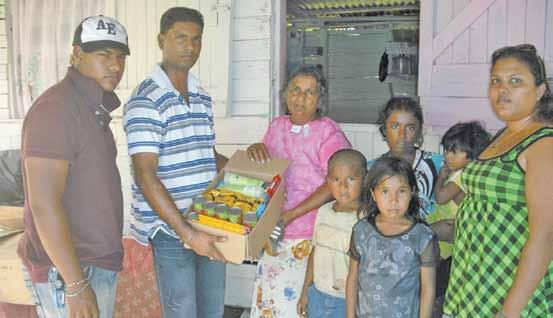
In an interview with Guyana Times Sunday Magazine, the organisation’s secretary Anjani Ramdial stated that the “founding members thought it was a good idea to assist youths, (especially the school dropouts and the less fortunate) in the Grove/ Diamond area by creating activities that will equip and enhance them with skills, so that they may be able to help themselves as well as others”. Consequently, the Grove/Diamond Youths in Development was founded. There are currently 50 active members who have helped youths in the Grove/ Diamond communities by facilitating the Board of Industrial Training programmes, training over 50 school dropouts in various life skills such as catering, mechanic, electrical installations and cosmetology.
Additionally, the group has collaborated with the One Laptop Per Family initiative in the distribution of laptops and training of youths.
“We also host an annual Christmas party for over 300 less fortunate kids in the community. We also collaborate with Food For The Poor and distribute monthly hampers to more than 50 less fortunate families within the community. We also do feeding programmes, quarterly, to the people in the streets of Georgetown. We also have sports events, mainly cricket, as most youths are interested in sports. By having these activities, they are kept off from the streets and drugs because they are engaged meaningfully,” Ramdial explained.
Currently, members are working on a project in hopes of making a small area at the Diamond Community Centre a play park for the many children in that com-
munity. Furthermore, the organisation aims to continue to help the less fortunate and to provide more educational programmes for the youths in the Grove/ Diamond area. The organisation’s mission is to help youths learn a life skill so that they can become productive individuals within their community.
“All our activities are funded mainly by donations from individuals, companies and fundraising events by members. The members also personally contribute financially to the success of the group. We would welcome any donations of either cash or kind from any individual and/or companies toward our current project, the play park, and generally towards the NGO,” Ramdial encouraged.
For further information on this organisation, visit Grove-Diamond Youths In Development on Facebook or call 641-1212.
Equipping youths with life skills for self-development, the Grove Craft Production Centre, despite its challenges, is focused on its empowerment mission.
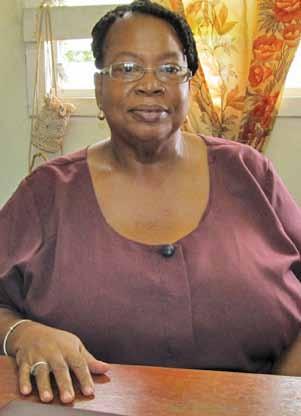
In an interview with Guyana Times Sunday Magazine, headmistress Sharon Redman stated that the centre caters for early school leavers from ages 15 to 21. The programme lasts for one year and a certificate is given upon completion.
“This is my 22nd year at the centre. I was the one who proposed to the RDC to open it after seeing the need for one, and they did. I travel everyday to get to the centre. I’m living on the West Bank. I’m employed by the RDC as an officer and also teach at the centre. I didn’t expect to be with the centre so long, but when I saw the needs of the youths coming here it motivated me to stay,” Redman revealed.
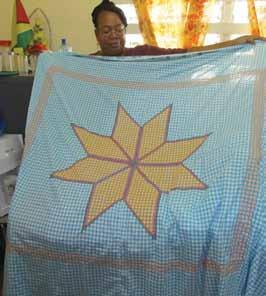
The centre comes under the Regional Democratic Council (RDC) Region Four. Programmes include embroidery, macramé, straw craft, tie-dye, crochet, fabric painting, floral arrangement, and cooking and baking – among others. Apart from craft courses, English and Mathematics are offered.
The centre is located at Station Street, Gove, East Bank Demerara, next to the nursery school. There are currently 15 girls on register, some of them coming from as far as Timehri. Males are also welcomed at the centre, although none have expressed interest in the programmes.
“Due to a lack of funding, students are asked to bring along materials and pay a small stipend to cover the other volunteers/teachers’ travelling expenses. Bringing their own materials tends to hamper the timeline of the programmes because some of them cannot af-
ford to purchase the items. Most of the girls coming here are from single parent families and face financial difficulties. However, we still welcome them to the centre and work with whatever they have,” she disclosed.
According to Redman, initially the centre received its first donations of a sewing machine, gas stove and baking utensils from the Demerara Distillers Limited, which she used to start the programmes. However, over the years, there has not been any support from corporate Guyana, which limits the centre’s potential.
“This year, I’m focusing on opening a garment centre right at this location. Also I’m hoping to start computer classes. However, to do this we need funding. I have approached several institutions, but to no avail. I’m also hoping this year some of our students can join the Board of Industrial Training programmes. I have submitted their names and hope this would materialise soon,” she noted.
Redman mentioned that the centre’s programmes have been successful thus far. She pointed out that one such example is Amanda De Souza. De Souza graduated in 1997 and has returned


to teach at the centre. Redman hopes businesses can join the centre to help in maintaining its empowerment programmes.
“I’m hoping hotels and other businesses can approach us to market our products so that the girls can earn something from their craft. These girls are very talented, but we just don’t have market for the work. I’m also hoping we can have a craft shop right in the Grove area to help in the marketing of the products made at the centre, which ultimately will bring in an income for the girls. I encourage businesses to reach out to us and help in empowering our youths to become earners,” Redman encouraged.
The centre’s programmes have become so popular among youths, advertisements are not sent out anymore. Every September, persons flock at the centre to register. Like every other educational institution, the centre is governed by rules, which must be adhered to by all. This, according to Redman,


instils values that will help in selfdevelopment. Redman’s commitment and passion to help youths is commendable. Despite financial difficulties faced by the centre over the years, Redman has been able to maintain the centre’s programmes. Her dedication is certainly acknowledged. During the course of the interview, Redman received a call from the RDC’s vice chairman, who relayed she will be receiving an award for her dedicated services.
A few of the students at the centre were also interviewed. Jenesse Thomas said, “I wasn’t able to finish school. I’m from a single parent family. I came here to learn skills that will help me to earn. When I complete my studies here in December, I want to study nursing
and will use what I learn from the centre to support me financially. Miss Redman is our role model and a huge support. She constantly encourages us to develop ourselves and I’m thankful for that.”
Natascia Kitt stated, “I travel everyday from the West Bank to attend classes at the centre because there aren’t any like this where I’m from. I plan to go to Carnegie School of Home Economics to continue my studies after I graduate from the centre. I’ll use what I know to support me while I’m going to Carnegie.”
Sarah Castello noted, “I do all the courses the centre offers. I didn’t get to continue schooling and so I came here to learn a skill, from which I can earn. My future plan is to open a salon where I can also sell my craft products. I’m thankful to Miss Redman for helping us to learn a skill that will help us to become earners. She is very supportive and is our role model.”
For more information on the centre, call 265-2144.
Embroidery on pillow cases


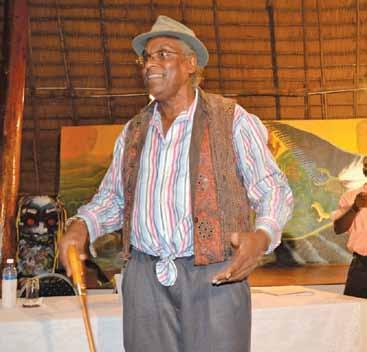
Guyana celebrated World Storytelling Day 2014 on 20 March. That event included, in elaborate fashion, innovative ways of telling a story, which were immensely appreciated by the audience. The usual form of reading a story also prevailed against the innovations. There are still some consummate storytellers in our midst and they did not disappoint (we are losing our storytellers to the diaspora and we ought to celebrate and cherish those still with us). Notably, school children held their own against the veterans; this event was good apprenticeship for many youths. It is hoped all these features would be expanded and enhanced for the future staging of similar events.
Let’s look first at the innovations. The innovations were dramatic interpretations of myths and folklores.
The first dramatic piece, ‘Greek Myth - The Sirens’ Song’, was performed by the students of the Drama School, University of Guyana
- great choreography accompanied by elucidating narration by drama lecturer, Shanesha Deonauth. The second piece was a fourpart presentation namely ‘Ole Higue’, ‘Possessed’, ‘Mermaid’ and ‘Sitira Gal’. Ole Higue is usually the old hag of the village putting off her skin in order to turn into a ball of fire, which facilitat-
ed her flying off to suck the blood of babies. The story unfolds and ends with the skin being soaked in salt and pepper, which brings about the exposure of the Ole Higue who is then beaten, sometimes, to death. A person ‘possessed’ by various evils spirits may be exorcised by faith-based instruments. The mermaid, as

in the Greek myth, usually leads her male victim(s) to death by drowning. Sitira Gal is usually a promiscuous village girl, who will exhibit the merchandise by dancing. However, the dramatisation of the above four pieces was done with a twist to the regular format of the tale and a moral to the story. The dramatisation resonated with the audience of both Guyanese and non-Guyanese, due largely to the theme of our recent Mashramani celebration last month – ‘Cultural Folklore; Celebrating 44’ –which was portrayed in an explosion of colours, costumes, and movements as part of the float parade on Republic Day, 23 February. World Storytelling Day 2014 in Guyana was billed, “An evening of international, regional and Guyanese Stories” under the theme “Dragons and Monsters”. The international scene was represented with stories from Russia, China, Venezuela, Brazil and Mexico. Petr Sizov of the Russian Embassy in
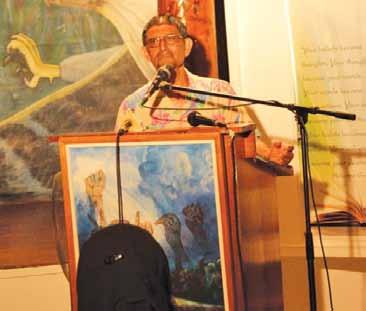
Guyana read two short stories: ‘A Would be Escape’ and ‘Young Fisherman Story’. ‘Chinese Story’ came from the Confucius Institute of the University of Guyana. Other presentations came from the Mexican Embassy and the Embassy of the Federation of Brazil and Venezuela. The regional area was covered with a story from Jamaica performed by Prof Al Creighton, and ‘Anancy Story’ was performed by the consummate storyteller Michael Khan in one of his roles as Ole Man Papee. I chipped in with ‘Balgobin Stories’ from my book, “The Balgobin Saga”.
World Storytelling Day is a manifestation of the new millennium, which has its roots in several initiatives started at the end of the previous millennium. For instance, in the early 1990s, Sweden organised the event “All Storytellers Day” on 20 March. In the late 1990s, storytellers in Perth, Australia, coordinated a five-week long celebration of story, commemorating 20 March as the International Day of Oral Narrators. Nearer to
home (Guyana), it was discovered Mexico and other South American countries were already celebrating 20 March as the National Day of Storytellers.
The first concerted and official effort by Guyana to celebrate World Storytelling Day was in 2011. That first commemoration was an initiative of the Ministry of Culture, Youth and Sport. It was an honour and a pleasure for me to have coordinated and chaired the first World Storytelling Day in Guyana. That event was held on 16 March in the conference room of the National Library.
World Storytelling Day was another way to explore world literature. That event also set the climate for the greater appreciation and enjoyment of literature. And it ought to encourage more scholarship in this area as it offered the opportunity to compare our literature against those offered by the region and the wider world. Responses to this author telephone, call (592) 2260065 or email: oraltradition2002@yahoo.com
What’s happening: It is here! ‘Anthology of Contemporary Guyanese Verse: Volume 1’ published by The Caribbean Press, compiled by Petamber Persaud with an introduction by Dr Lynne Macedo, University of Warwick. The work of 21 is captured in this 164-page book.
Coming soon the first reprint of ‘An Introduction to Guyanese Literature’. It will be available from the author at the above contacts, Austin’s Book Service (2267350), the National Library (226-2690) and at the Cheddi Jagan International Airport.
Standby to restart THE JOURNEY, an evening of literature.


After much teenage and young adult trial and error, at a certain age most young adults realize what works for them (and what doesn't) and settle into a defined style by their mid to late 20s. While everyone has their own style that makes them unique, one thing every young professional should know is how to dress appropriately given the situation.
Know Your Company and Your Client. Since the start of the dot-com craze, dressing for the office has become a little more relaxed and casual in certain professions where others remain highly conservative. Dress to reflect your job. If you are in fashion, you better be fashionable. Before you go out and splurge on a new wardrobe, carefully consider your company's dress code policy and whether it is casual, conservative, stylish or young and fresh. At the same time, it's important to be versatile.
Organize. Keep all of your work-appropriate attire in a designated space in your closet. Not only will you save time in the morning scramble of trying to find something to wear, there will be no question in your mind as to whether or not the clothing is appropriate. By the same token, designate closet space for clothes that are not appropriate for work, like shorts, flip flops, your favourite Ts, miniskirts and sweats.
Be Appropriate. No matter the company, use your tact and be appropriate. Avoid anything too low-cut, formfitting or short. If you would wear it to a club on Saturday night or to the beach, don't wear it to work, even if you add a scarf to it.
Shop Strategically. Professional attire is not something any young professional should skimp on. The quality of your clothing shows and sometimes you need to fake it until you make it. It is worth it to invest in a few key pieces that will stand the test of time and are easy to mix and match. For the ladies, spend more on things like shoes, purses and belts. For guys, you can never have enough dress shirts and your "go-to" blazer.
Dress Your Age. In terms of work dress, two major mistakes are usually made: they dress too young (in too tight or revealing clothing for the ladies, or sloppy attire for the guys); or they dress too old for their age in an attempt to make themselves seem more “professional”. Dress your age. Let your intellect reflect your wisdom and worldliness, not necessarily your attire.
Easy on the Makeup and Cologne/Perfume. Save the makeup for a night out on the town. The same can be said for perfume and cologne - pick something that is lighter and more day-appropriate and don't overdo it. Just because you're so used to it that you can't smell it on yourself doesn't mean everyone else can't.
Details Matter. For guys and girls alike, maintain clean, clipped, well-groomed nails to complete your professional appearance. For most professions, keep any facial hair properly groomed. Keep your shoes clean, as dirty shoes can throw off an otherwise polished appearance. Finally, no matter how casual your clothes are, make sure they are ironed and wrinkle-free. It is usually a wise idea to keep an extra shirt in the office in case you spill something on yourself, or if a last-minute meeting comes up with your boss. (Huffington Post)


hawn Pereira, a right-arm leg-spinner from Berbice, made his debut for, and captained, the Guyana Under-15 team in Trinidad & Tobago, in 2010. He made his debut for, and also captained, the Guyana Under-19 team in Barbados in 2012, and took 6 for 40 in his very first Under-19 match. In Berbice cricket, Shawn plays for the Rose Hall Town Youth & Sports Club. In 2010, Shawn was the club's assistant public relations officer. At the club's annual awards in 2011, he was named Under-15 Bowler and Cricketer for 2010. The dedicated cricketer continues to demonstrate his dexterity in his game and aims to get his name in the cricket hall of fame.
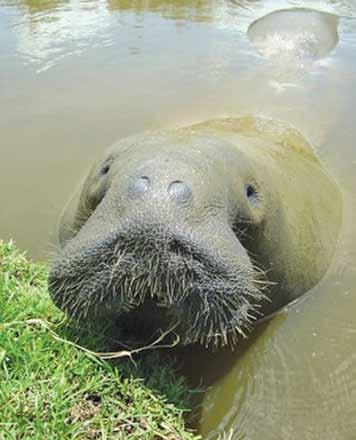
Manatees are sometimes called sea cows, and their languid pace lends merit to the comparison. However, despite their massive bulk, they are graceful swimmers in coastal waters and rivers. Powering themselves with their strong tails, manatees typically glide along at 5 miles (8 kilometers) an hour but can swim 15 miles (24 kilometers) an hour in short bursts.
Manatees are usually seen alone, in pairs, or in small groups of a half dozen or fewer animals. From above the water's surface, the animal's nose and nostrils are often the only thing visible. Manatees never leave the water but, like all marine mammals, they must breathe air at the surface. A resting manatee can remain submerged for up to 15 minutes, but while swimming, it must surface every three or four minutes.
There are three species of manatee, distinguished primarily by where they live. One manatee population ranges along the North American east coast from Florida to Brazil. Other species inhabit the Amazon River and the west coast and rivers of Africa.
Manatees are born underwater. Mothers must help their calves to the surface so that they can take their first breath, but the infants can typically swim on their own only an hour later.

he reason the sky looks blue is because of an effect called scattering. Sunlight has to pass through the Earth's atmosphere, which is filled with gases and particles that act like the bumpers on a pinball machine. They bounce sunlight all over the place! If you've ever held a prism in your hands, you know that sunlight is made up of many different colours, all of which have different wavelengths. Blue light has a short wavelength, so it gets through the filter more easily than colours with longer wavelengths. This means that blue light is scattered widely as it passes through the atmosphere. That's why the sky looks blue during the parts of the day when the Sun is high in the sky. At sunrise and sunset, the sun's rays have to travel a longer distance to reach you. That cancels out blue light's wavelength advantage and lets us see the other colours better. That’s why sunsets often look red, orange, or yellow!
The objective of the game is to fill all the blank squares in a game with the correct numbers. Every row of 9 numbers must include all digits 1 through 9 in any order. Every column of 9 numbers must include all digits 1 through 9 in any order. Every 3 by 3 subsection of the 9 by 9 square must include all digits 1 through 9. Did
The calves drink their mothers' milk, but adults are voracious grazers. They eat water grasses, weeds, and algae — and lots of them. A manatee can eat a tenth of its own massive weight in just 24 hours.
Manatees are mammals. Their average life span in the wild is 40 years. A manatee can be from 8 to 13 ft (2.4 to 4 m) and weight 440 to 1,300 lbs (200 to 600 kg).
Manatees are large, slow-moving animals that frequent coastal waters and rivers. These attributes make them vulnerable to hunters seeking their hides, oil, and bones. Manatee numbers declined throughout the last century, mostly because of hunting pressure. Today, manatees are endangered. Though protected by laws, they still face threats. The gentle beasts are often accidentally hit by motorboats in ever more crowded waters, and sometimes become entangled in fishing nets.


‘First Resort’, by designer Sonia Noel, is a chic collection of over 100 sophisticated and comfortable designs. In an interview with Guyana Times Sunday Magazine, Noel stated that the collection “depicts the easy, carefree, uninhibited nature of Caribbean lifestyle presented in breathing, eco-friendly, caressing textiles, which captures the attitude of leisure - so compelling to the world”. She revealed that the collection keeps expanding, as more stylish pieces are added.
To create this irresistible collection, Noel infused her signature latticing, kaftan silhouettes and versatile wraps.
‘First Resort’ is a representation of Noel’s creative, designing talents in transforming simple fabrics to celebrated pieces.
For this week’s photo shoot, the models were Umadevi Bux, Atulomah Valerie, Raquel Thomas and Steffi Bynoe. Makeup was done by Margaret Ilesanmi Mogbonjubola.
This collection is presently available at Noel’s fashion studio located at 176 Barr Street, Kitty. Call 226-3099 for more information. (Photos by Shiv Dindyal)






Anthony Mackie is an American actor. He has been featured in feature films, television series, and Broadway and offBroadway plays, including Ma Rainey's “Black Bottom”, “Drowning Crow”, “McReele”, “A Soldier's Play”, and Carl Hancock Rux's “Talk”, for which he won an Obie Award in 2002. In 2002, he was featured in Eminem's debut film, “8 Mile”, playing Papa Doc. He was nominated for Independent Spirit Award for Best Actor for his role in “Brother to Brother”. His second nomination was for Best Supporting Actor at the 2009 Independent Spirit Awards for his role in “The Hurt Locker”. He is the Falcon in the Marvel Studios sequel “Captain America: The Winter Soldier”.

Gwyneth Paltrow and Chris Martin thanked fans for their support following the announcement of their separation. Paltrow was back blogging on lifestyle website Goop on Friday, March 28 morning to reveal how they were doing.
Aseemingly content Lindsay Lohan told Ellen DeGeneres that she's refocused her life in New York, where she is comforted by family and inspired by the creativity of her friends as she maintains her sobriety and gets back to work.
"I don't have as much anger anymore," she said. "I have more peace in my life."
Smiling and laughing – and sharing details of her workout, which includes, Pilates, yoga and yes, pole dancing, three times a week – Lohan, 27, told DeGeneres in an episode of the Ellen DeGeneres Show airing Monday that she's found more balance as her reality series for Oprah Winfrey's OWN network has finished shooting.
"It's pretty raw. It's very honest," Lohan says of the gritty and candid program, which saw her opening up, with some difficulty, about her life's journey after early fame and plenty of rehab.
"It was really scary at first and I didn't expect it to be what it became," she says of the reality show. "It got really overwhelming, but it's probably one of the best things that I've allowed myself to do. It was kind of hard getting into an apartment, reliving my life, living a sober life and having cameras there for all of it."
Her future now includes fewer nightclub outings that in the past brought her negative attention. "There is nothing left for me in going out to certain places," she said. "It's not worth it to me."
Her current focus includes working alongside her brother on a new fashion app called Spotted Friend, which Lohan told DeGeneres is "like Shazam, but for clothing." She also shared that she's starting a new film project for Lionsgate come May.
Getting out of Los Angeles, where she said she lost track of her work focus, also has been a huge positive. "When I was here in L.A., I got very lonely. Back in New York and being around a lot of friends who are

creative, I realize how happy I am doing that," Lohan said, noting the city also gave her newfound anonymity.
"Moving back to my family and home has made a big difference to me. My family is there. My friends that I few up with are there." And best of all, no paparazzi, she said. "They have not bothered me at all. It's strange."
Lohan also said that her last time in rehab was for the right reasons – not because a court ordered her to go to avoid jail, but because she wanted to take time to reflect and also mature.
As for dating, men are off her radar, Lohan said, even though her brother hijacked her Instagram account to say he linked her up on the dating app Tinder –without her approval.
"I just want to work and take care of me right now," she says of finding love. "That's not even a thought." (People)

"Our moms were raised by depressionera ladies who used a single tea bag for two cups of tea and never met a leftover they didn't eat," Paltrow wrote in the post titled "One Bird, Three Meals". "This issue of three delicious chicken recipes is in honor of our grandmothers, who taught us the good old-fashioned art of not wasting a scrap."
She added, "P.S. CM and I in deep gratitude for the support of so many." The actress signed it off with a heart icon.
On the same blog, the pair announced their split on Tuesday evening. "It is with hearts full of sadness that we have decided to separate," she wrote. "We have been working hard for well over a year, some of it together, some of it separated, to see what might have been possible between us, and we have come to the conclusion that while we love each other very much we will remain separate."

The former couple and their children, Apple and Moses, flew to the Bahamas following the announcement. They reportedly rented a home on Eleuthra Island which is usually leased at US$5,000 to US$6,000 per week. (AceShowbiz)

Avicii has cancelled a show that's scheduled to take place on Thursday, March 27. According to TMZ, the DJ was forced to scrap the plan to play the gig at SLS South Beach in Miami Beach after
The engagement ring Kanye West gave Kim Kardashian may not be the only whopper at their wedding this year, if Burger King has its way.
The fast-food burger slingers have made a public offer to prepare noshes for the couple's nuptials, following an online rumor that West had purchased 10 Burger King franchises for his betrothed, according to the NME.
"Burger King Corp. is familiar with the recent news stories regarding Kanye West and Kim Kardashian," a burger rep wrote in a statement. "We are unaware of any purchase of Burger King restaurants made by either Mr. West or Ms. Kardashian, but we're available to cater the wedding!" The exclamation point is theirs.
West proposed to Kardashian last October with an elaborate ballpark proposal, and within a few weeks, he flaunted his love by putting his fiancée topless on a motorcycle for his "Bound 2" video. Seth Rogen and James Franco filmed an equally snuggly spoof of
he got hospitalized. The cancellation was announced shortly before Avicii's supposed to be onstage. DJ Cassette informed the crowd at the venue that the Swedish musician was at a hospital and he wouldn't be able to perform.
New reports say that Avicii has been discharged from the hospital. However, there's still no word on what caused the superstar's hospitalization.
Avicii, whose real name is Tim Bergling, is scheduled to play a five-night concert at the Miami hotel. This weekend, he'll play the Ultra Music Festival. The annual fest is set to open on Friday, March 28.
The guy behind hit "Wake Me Up" was recently seen working on new music with Madonna. The "Material Girl" singer, who posted some photos of her posing with the 24-year-old entertainer in a studio, told her fans that they'd already written "so many great songs." (AceShowbiz)

the clip, which Kardashian reported West loved. ("He laughed so hard at this," she tweeted.)
But despite the couple's apparent sense of humor –which could bode well for Burger King – a poll of the American public rated West and Kardashian America's least desirable neighbors, besting the cast of Here Comes Honey Boo Boo for the dishonor.
In other West news, the rapper was recently sentenced to two years of probation after quarrelling with a paparazzo in 2013. TMZ reported that West appeared at the Hollywood LAPD police station Thursday afternoon to get fingerprinted and have his mug shot taken. He must serve 250 hours of community service and 30 days of anger management. (Yahoo)

Zarine Khan is an Indian actress and model who appears in Indian films, mainly in the Hindi film industry. She has also appeared in Tamil films. Khan made her screen debut with a lead role in the 2010 Anil Sharma's period film “Veer” co-starring with Salman Khan, for which she was nominated for the Zee Cine Award for Best Female Debut. Khan garnered recognition from her item number, ‘Character Dheela’ in “Ready”, which was the highest grossing Bollywood film of 2011. In 2012, she earned commercial success in Bollywood with Sajid Khan's “Housefull 2”. In late 2013, Khan made her Tamil language debut in the Tamil film “Naan Rajavaga Pogiren”. The actress has graced the covers of several major magazines including Vogue (February 2011), Perfect Woman Magazine (March 2011), Exhibit (July 2012), Beauty (August 2012) and Femina (April (2013). In addition to acting, she is active in humanitarian work and has a number of endorsement deals.
Shahid Kapoor, all set to host the 15th edition of the International Indian Film Academy (IIFA) awards with Farhan Akhtar, is known for his dancing skills, but the actor says he is not even a patch on Hrithik Roshan.
"I am extremely happy to host IIFA again and more than that I am excited to see Hrithik performing. He is the best dancer in the industry. I remember watching 'Koi... Mil Gaya' and I felt like a shit actor," Shahid told reporters Thursday at the IIFA press conference.
Shahid and Farhan had co-hosted the IIFA 2012

in Singapore and the latter said that it's great to be back as a host for the event which will take place in Tampa Bay, Florida from April 23 to April 26.
"I had a great time hosting the show with Farhan. It takes a lot of effort to create such an event and I am looking forward to be part of this," he added. (IANS)

Salman Khan's retrial in the 2002 hitand-run case has begun.
actor will not be appearing in
court for the trial, which will take place at the High Court in Mumbai.
In September 2002, the actor was alleged to be driving a Toyota Land Cruiser that ran over a group of people sleeping on the pavement outside a bakery in suburban Bandra.
One person was killed and four others were injured in the accident.
A new trial was ordered in December, after the charge against the Jai Ho star was increased from "rash and negligent driving" to the more serious charge of "culpable homicide not amounting to murder".
All evidence and witnesses in the case will be re-examined.
The Mumbai police reportedly claim to have sufficient evidence to demonstrate that Khan was behind the wheel at the time of the accident.
If convicted, the actor could face up to 10 years in jail. Khan has pleaded not guilty to the charge. (Digital Spy)

Actress Katrina Kaif has denied next year marriage rumours with actor Ranbir Kapoor. There were reports that Katrina Kaif, 30, and Ranbir Kapoor, 31, were likely to tie the knot in 2015.
However Katrina Kaif dismissed such reports saying there were no such plans as of now. “I don’t know about this, it has come in media today. It is news to me as I got to know when someone sent me a message about this, till then I was not aware about it,” Katrina Kaif told PTI.

“But there is no such thing. If there is something like that happening, I will be the first one to tell you all about it. But, there are no such plans as yet,” she added.
Ranbir had earlier said in an interview that Katrina was special to him. The actress said she does not get disturbed by reports about her personal life as she has learned how to tackle such things now.
“These things don’t bother me today as it used to earlier. I think with time you get used to it,” she said. The ‘Dhoom 3’ actress said her family too was not aware of what was being written about her personal life. (Indian Express)

Bollywood megastar Amitabh Bachchan will inaugurate the Indian Film Festival of Melbourne (IFFM) on May 1.
Launching the festival on Friday along with the brand ambassador Vidya Balan, the Minister for Innovation, Tourism and Major Events, and Employment and Trade Louise Asher said, “Films will be shown in 20 languages and we will have five free screenings at Federation Square.
“Victorians and all visitors to Melbourne are in for a treat of Indian films this year, she said. We have a stellar international guest list starring Bollywood screen legend Amitabh Bachchan who will open the festival on May 1.”
“It will be an honour to have Bachchan here, just a year after he opened the Cannes Film Festival with his ‘The Great Gatsby’ co-star Leonardo DiCaprio,” Asher added.
Other guests include Konkona Sen Sharma, Vijay Krishna Acharya, Rakeysh Omprakash Mehra, Shaan Shahid, Hassan Waqas Rana and Suhasini Maniratnam.
Asher said that this year’s festival would see the return of Festival favourites, such as the interactive master classes, Western Union Short Film competition and the
Telstra Bollywood Dance Competition, to be judged by actress Malaika Arora Khan.
“In response to community feedback, the festival has also added to the program an exciting new section called New Voices, which will feature six films from first time filmmakers,” Asher said.
The minister thanked Balan for coming to Melbourne to help launching the festival program.
“Balan is a great friend of Victoria, and known for her roles portraying strong female protagonists. She launched the 2012 and 2013 Festivals and it is an honour and a pleasure to have balan back this year.
“The Indian Film Festival of Melbourne brings prominent Indian filmmakers and screen professionals to Melbourne, helps promote Victoria as an international screen production destination, and provides opportunities to develop Victorian and Indian screen partnerships,” Asher said.
IFFM Festival director, Mitu Bhowmick Lange said the 2014 IFFM would be the most exciting and ambitious festival yet.
“We could not have asked for a better chief guest than the patriarch of Indian cinema and one of the most iconic Indians of all times, Amitabh Bachchan to open the festival on May 1,” Bhowmick Lange said.
“The inaugural IFFM Awards takes the festival to a new level and we are all very excited to see who the winners will be. I hope you will all join in with your friends and family to celebrate the magic of cinema!” Bhowmick Lange added.
Bhowmick Lange said Bachchan will be presented an international award by the Victorian government and he will also give a scholarship to an Indian student named after him by the la Trobe university.
On the sidelines of the festival, Balan presented a saree to the Australian minister as well. (Indian Express)
The star of films such as “Teen Deviyan” and “Gumnaam” passed away at home in Mumbai this week.
A family member confirmed the news to IANS, saying: "Yes, she passed away this morning after a heart attack at her residence."
Born on January 8, 1939, Nanda was the daughter of Marathi actor and director Vinayak and the niece of filmmaking pioneer V Shantaram.
She began her career as a child artist and won her
first break as an adult in V Shantaram's 1956 film “Toofan Aur Diya”. She came to fame in 1959's “Chhoti Bahen” opposite Balraj Sahni.
The actress worked with leading stars of her generation including Rajesh Khanna, Rishi Kapoor and Shashi Kapoor, who named her as his favourite co-star.
Nanda was briefly engaged to Amar Akbar Anthony director Manmohan Desai before he died in 1994 and remained unmarried until her death. (IANS)

Include these nutrition superstars in your diabetes diet to lower blood sugar, burn fat, reduce inflammation, and gain more health benefits.
Dark chocolate

Chocolate is rich in flavonoids, and research shows that these nutrients reduce insulin resistance, improve insulin sensitivity, drop insulin levels and fasting blood glucose, and blunt cravings. But not all chocolate is created equal. In a 2008 study from the University of Copenhagen, people who ate dark chocolate reported that they felt less like eating sweet, salty, or fatty foods compared to volunteers given milk chocolate, with its lower levels of beneficial flavonoids (and, often, more sugar and fat, too). Dark chocolate also cut the amount of pizza that volunteers consumed later in the same day, by 15 percent. The flavonoids in chocolate have also been shown to lower stroke risk, calm blood pressure, and reduce your risk for a heart attack by 2 percent over 5 years.
Broccoli
Broccoli is an anti-diabetes superhero. As with other cruciferous veggies, like kale and cauliflower, it contains a compound called sulforaphane, which triggers several anti-inflammatory processes that improve blood sugar control and protect blood vessels from the cardiovascular damage that’s often

a consequence of diabetes. (Heart disease is the leading cause of death for people with diabetes, so this protection could be a lifesaver.) Sulforaphane also helps flip on the body’s natural detox mechanisms, coaxing enzymes to turn dangerous cancer-causing chemicals into more innocent forms that the body can easily release.
Fish

Fish is a slimming star: rich in protein, it will help to keep you satisfied; but also, fish contains a special type of fat that helps cool inflammation. Thousands of studies show that people with the highest blood levels of omega-3 fatty acids have less body-wide inflammation, the very inflammation that leads to and worsens diabetes and weight problems. A fish-rich diet can also reduce your risk of developing health problems, especially stroke, as a result of your diabetes. People who ate baked, broiled, or steamed fish reduced their odds for a stroke by 3 percent, as reported in a 2010 Emory University study. (However, fried fish—such as fast-
food fish sandwiches,
and fried seafood of any type—increased risk.)
Olive oil
Following a Mediterraneanstyle diet rich in olive oil helps reduce the risk of type 2 diabetes by as much as 50 percent compared to a diet low in fat, according to a recent Spanish study. Independently, researchers at Technical University of Munich (TUM) and the University of Vienna found that olive oil im
proved satiety the most when compared to lard, butter, and rapeseed (canola) oil. In addition to being a standout source of health-promoting monounsaturated fats, olive oil is also rich in antioxidant nutrients that protect cells from damage, and prevents the development of heart disease.

One analysis found that sweet potatoes reduce HbA1c measures between 0.30 and 0.57 percent and fasting blood glucose by 10 to 15 points. Sweet potato also contains anthocyanins, which are the natural pigments that give the sweet potato its deep orange color and the antioxidants believed to have anti-inflammatory, antiviral, and antimicrobial qualities.

The most widespread tree nut in the world, walnuts contain the polyunsaturated fatty acid called alpha-linolenic acid, which has been shown to lower inflammation. The L-arginine, omega-3s, fiber, vitamin E, and other phytochemicals found in walnuts and other tree nuts make them potent: scientists have found them to have antioxidant, anticancer, antiviral, and anti-high cholesterol actions. These powers can help stop and reverse the progression of chronic conditions such as diabetes and heart disease. Snack on walnuts in their shells; the time it takes to crack them open can help you slow down, so your body has more time to register the food and you feel full with fewer calories.
Cinnamon
Several studies show that this delicious spice can help reduce blood sugar. One, published in the journal Diabetes Care, noted how people with type 2 diabetes who’d taken one or more grams of cinnamon daily had dropped their fasting blood sugar by a whopping 30 percent, compared to people who took no cinnamon. They also reduced their triglycerides, LDL cholesterol, and total cholesterol by upwards of 25 percent. Here's why: Cinnamon is rich in chromium, a mineral that enhances the
effects of insulin. It’s also loaded with polyphenols, antioxidants that gather up all the free radicals in your blood to protect you from cancer and also lower systemic inflammation, further guarding you from diabetes and heart disease.

Turmeric may have been protecting the health of an entire Indian subcontinent for about 5,000 years. A traditional Indian diet features white rice and flour breads, which as rapidly digested carbs would ordinarily raise blood sugar dramatically. But the presence of turmeric—the yellow spice that lends its color to many curry dishes—helps to manage the potent impact on blood sugar. Curcumin, the active ingredient in turmeric, is the compound believed to regulate fat metabolism in the body. Curcumin acts directly on fat cells, pancreatic cells, kidney cells, and muscle cells, dampening inflammation and blocking the nefarious activities of cancer-causing tumor necrosis factor and interleukin-6. Experts believe the combined action of all of these factors together gives curcumin the power to reverse insulin resistance, high blood sugar and high cholesterol, and other symptoms linked to obesity. (Reader’s Digest)

Help fight three of the most deadly diseases that affect men by getting these simple, lifesaving tests.
High blood pressure is a leading risk factor for cardiovascular disease, the leading cause of death among men in the US. Ideally, blood pressure should be under 115/75. For every increase of 20 points in the top number or 10 points in that bottom number, you’re twice as likely to have a heart attack or stroke.
New science indicates that checking both arms gives a more accurate blood pressure reading. Men whose top number varies by 15 points between both
arms are at a greater risk for vascular disease than those who have similar readings from each arm.
Diets high in salt are linked to higher blood pressure. To keep your blood pressure under control, eliminate hidden salt traps from your diet. Excess sodium can often come from surprising sources – the CDC’s newest findings reveal bread as the number one source of salt in our diets! In addition to bread, be mindful of these seven words on food labels that reveal hidden sources of salt: soy sauce, mustard, Msg (monosodium glutamate), smoked, barbecued, pickled, baking soda.
You should never consume more than 2300
mg of salt a day. It is recommended staying under 1500 mg, especially if you’re older than 50.
Prostate Exam
After lung cancer, prostate cancer is the deadliest cancer in men. Men over the age of 50 should have a prostate exam each year, but you should start sooner if you have a family history.
During the exam, a health-care provider inserts a finger into the rectum about 1-2 inches to feel for the prostate. It should feel smooth and symmetrical if it’s healthy. A prostate that feels irregular could indicate an issue that requires further testing.
Blood Glucose Test
While death rates for cardiovascular disease and prostate cancer have been declining, deaths from Alzheimer’s disease are on the rise. Diets high in sugar have been linked to an increased diagnosis of Alzheimer’s disease. Your blood delivers all kinds of rich nutrients to the brain. But if you have a lot of sugar in your blood, it can cause inflammation. This allows plaque to collect on your neurons, which are where you store your memories. The plaque makes it harder for neurons to fire off signals and causes them
to freeze up. Eventually, they are prevented from talking to each other; the information those neurons carry can’t
be transmitted or retrieved.
When these synapses begin to fail, we begin to see the symptoms of Alzheimer’s.
A fasting blood sugar greater than 100 puts you at a greater risk for Alzheimer’s disease. (www.droz.com)



Area rugs are a great way to add style to a room. They require minimal effort, are easy to come by and inexpensive. Check out these inspiring area rugs.



Ingredients:
1 pound crabmeat, picked free of shells
1/3 cup crushed crackers (recommended: Ritz)
3 green onions (green and white parts), finely chopped
1/2 cup finely chopped bell pepper
1/4 cup mayonnaise
1 egg
1 teaspoon Worcestershire sauce
1 teaspoon dry mustard
1/2 lemon, juiced
1/4 teaspoon garlic powder
1 teaspoon salt
Dash cayenne pepper
Flour, for dusting
1/2 cup peanut oil
Favourite dipping sauce, for serving
Method:
In a large bowl, mix together all ingredients, except for the flour and peanut oil. Shape into patties and dust with flour.
Heat oil in a large skillet over medium heat.
When oil is hot, carefully place crab cakes, in batches, in pan and fry until browned, about 4 to 5 minutes. Carefully flip crab cakes and fry on other side until golden brown, about 4 minutes. Serve warm with preferred sauce.
Ingredients:
4 cups quality vanilla ice cream
2 teaspoons vanilla extract
8 tablespoons sugar
2 cups milk, less for thicker milkshakes
Method: Using a blender or milkshake machine, blend all ingredients together until smooth. Serve in tall glasses with a straw.
Ingredients:
2 tablespoons butter
1 1/2 cups long-grain rice
1/2 cup chopped onion
1/2 cup chopped green bell pepper
1 clove garlic, minced
2 cups water
1 (14 1/2-ounce) can diced tomatoes
1 teaspoons chili powder
1 teaspoon salt
1 cup shredded Cheddar
Method: In a large saucepan, melt the butter over medium heat. Add the rice, onion, peppers, and garlic. Cook until the rice is browned and vegetables are tender. Stir in the water, tomatoes, chili powder, and salt and bring to a boil. Reduce the heat and simmer, covered, until the rice is tender, about 15 to 17 minutes. Stir in the cheese and transfer to a serving bowl.




come up to room temperature before cooking; this will ensure they don't crack if boiling and will always cook more evenly whatever way you are preparing them.
Chilling the batter makes it stiffer and therefore coats pieces of fish better.
When you deep-fry, hold each piece of food with long tongs as you add it to the oil. Hold it just below the oil's surface for five seconds before releasing it. This will seal the exterior and stop it from sticking to the pot or the other food.
When chopping herbs, toss a little salt onto the cutting board; it will keep the herbs from flying around.
After cutting corn off the cob, use the back side of a knife (not the blade side) to scrape the cob again to extract the sweet milk left behind. This milk adds flavour and body to any corn dish.
For safety, put a wine cork on the tip of a knife before putting the knife in a drawer.
Each of the sentences below use two words which are synonyms of each other, but here in these sentences, they are not used with the same meaning. Can you find the words?
1. You cannot ______ to imagine what a _____ you gave me.
2. Service is my ______ name, you will always find me in the community _______.
3. The cook used the largest ______ to make a stew for the full complement of the _____.
4. They agreed to meet outside the _____ of justice for their _____.
5. I know you will _____ me for this purchase, I cannot _____ you.
6. The ______ of bids for the ______ of Eros was unparalleled.
see solution on page 22


see solution on page 22


Julius Obi sat gazing at his typewriter. The fat chief clerk, his boss, was snoring at his table. Outside, the gatekeeper in his green uniform was sleeping at his post. No customer had passed through the gate for nearly a week. There was an empty basket on the giant weighing machine. A few palm kernels lay in the dust around the machine.
Julius went to the window that overlooked the great market on the bank of the Niger. This market, like all Ibo markets, had been held on one of the four days of the week. But with the coming of the white man and the growth of Umuru into a big palm-oil port, it had become a dai ly market. In spite of that however, it was still busi est on its original Nkwo day, because the deity that presided over it cast her spell only on that day. It was said that she appeared in the form of an old wom an in the center of the mar ket just before cockcrow and waved her magic fan in the four directions of the earth -- in front of her, behind her, to the right, and to the left -- to draw to the mar ket men and women from distant clans. And they came, these men and wom en, bringing the pro duce of their lands: palm oil and ker nels, kola nuts, cas sava, mats, baskets, and earthenware pots. And they took home many-colored cloths, smoked fish, iron pots and plates. Others came by the great river bringing yams and fish in their canoes. Sometimes it was a big ca noe with a dozen or more people in it; sometimes it was just a fisherman and his wife in a small vessel from the swiftflowing Anambara. They moored their canoe on the bank and sold their fish, after much haggling. The woman then walked up the steep banks of the river to the heart of the market to buy salt and oil and, if the sales had been good, a length of cloth. And for her children at home she bought bean cakes or akara and mai-mai, which the Igara women cooked. As evening approached, they took up their paddles and paddled away, the water shimmering in the sunset and their canoe becoming smaller and smaller in the distance until it was just a dark crescent on the water's face and two dark bodies swaying forwards
and backwards in it.
Julius Obi was not a native of Umuru. He came from a bush village twenty or so miles away. But having passed his Standard Six in a mission school in 1920 he came to Umuru to work as a clerk in the offices of the Niger Company, which dealt in palm oil and kernels. The offices were situated beside the famous Umuru market, so that in his first two or three weeks Julius had to learn to work against the background of its noise. Sometimes when the chief clerk was away or asleep he walked to the window and looked down on the vast anthill activity. Most of these people were not there yesterday, he thought, and yet
of them with the tail of your eye, then they disappear in the crowd."
Julius thought about these things as he now stood at the window looking down at the empty market. Who would have believed that the great market could ever be so empty? But such was the power of Kitikpa, or smallpox.
When Umuru had been a little village, it had been swept and kept clean by its handful of inhabitants. But now it had grown into a busy, sprawling, crowded, and dirty river port. And Kitikpa came. No other disease is feared by the lbo people as much as they fear Kitikpa. It is personified as an evil deity. Its vic
yellow palm frond at the doorway means. The family were all moved away today in the big government lorry."
Janet walked a short way with him, and they said good night. And they shook hands, which was very odd.
Julius did not go straight home. He went to the bank of the river and just walked up and down it. He must have been there a long time, because he was still there when the ekwe, or wooden gong, of the night spirit sounded. He immediately set out for home, half walking and half running. He had about half an hour to get home before the spirit ran its race through the town.
Of course they say that not everyone who came to the great market was a real person. Janet's mother had said so.
"Some of the beautiful young women you see squeezing through the crowds are not real people but mammy-wota from the river," she said.
"How does one know them?" asked Julius, whose education placed him above such superstitious stuff. But he took care not to sound unbelieving. He had long learned that it was bad policy to argue with Ma on such points.
"You can always tell," she explained, "because they are beautiful with a beauty that is not of this world. You catch a glimpse
They said, “Kitikpa is in that village, and immediately it was cut off by its neighbors.”
Julius was worried because it was almost a week since he had seen Janet, the girl he was going to marry. Ma had explained to him very gently that he should no longer come to see them "until this thing is over by the power of Jehovah." Ma was a very devout Christian, and one reason why she approved of Julius for her only daughter was that he sang in the church choir.
"You must keep to your rooms," she had said. "You never know whom you might meet on the streets. That family has got it." She pointed at the house across the road. "That is what the
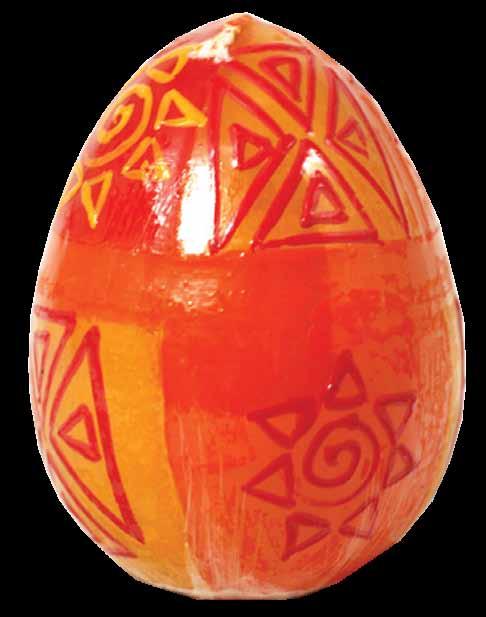
As Julius hurried home he stepped on something that broke with a slight liquid explosion. He stopped and peeped down at the footpath. The moon was not yet up, but there was some faint light which showed that it would not be long delayed. In this light Julius saw that he had stepped on a sacrificial egg. There were young palm fronds around it. Someone oppressed by misfortune had brought the offering to the crossroads in the dusk. And he had stepped on it and taken the sufferer's ill luck to himself. "Nonsense," he said and hurried away.
But it was too late; the night spirit was already abroad. Its voice rose high and clear in the still, black air. It was a long way away, but Julius knew that distance did not apply to these beings. So he made straight for the cocoyam farm beside the road and threw himself on his belly. He had hardly done this when he heard the rattling staff of the spirit and a thundering stream of esoteric speech. He shook all over. The sounds came bearing down on him. And then he could hear the footsteps. It was as if twenty men were running together. In no time at all the sounds had passed and disappeared in the distance on the other side of the road.
As Julius stood at the window looking out on the empty market he lived through that night again. It was only a week ago, but already it seemed to be separated from the present by a vast emptiness. This emptiness deepened with the passage of time. On this side stood Julius, and on the other Ma and Janet, who were carried away by the smallpox. (By Chinua Achebe)

When stuck at the eternal crossroads And no sign of which way to go, And any queries for help....from without, Seems answered with a profound ‘NO’!
When Beauty and Purity is under siege, ....broken promises, and hearts of stone reign, And waves of chaotic heart-wrenching crying When pure, tender, loving minds cannot stay sane.
When the flower garland that adorns the neck Has been cruelly torn and ripped to shreds. And it appears that the soul has deserted And left the physical body for dead!
When the innocent, pure-white, love-angel Has brushed lips with the devil’s own, And the place of red roses where doves flew Now only thorns grow…. And deadly snakes roam. If somehow crushed and left for dead, Like the remains of rose petals underfoot. The curtains of the eyes have been drawn shut And life’s whole purpose seems misunderstood.
When it feels like the devil’s warped claws Are painfully, deeply embedded in the flesh! And the misfortunes befallen me is worthy, For my past Karmas…. I haven’t been blessed.
Let my perilous dark cloud that hovers overhead Be pierced by one sword-blade of pure light, Thus freeing my soul from the netherworld In which I’ve been trapped in mid-flight.
Jag B Mahadeo
The darked night suddenly turns bright! The birds are crying in hurried flight! Crickle – lickle – crack, go racing on, Jumping and dancing like popping corn.
The frogs are sounding a distress note At you lively sprite in golden coat! Crickle – lickle – crack, go racing on, Making merriment like mottled fawn.
The nestlings have not learned to fly, Because of you, they now must die. Crickle – lickle – crack, go racing on, Frisking and twisting with joyful scorn.
Yet, I cannot lay on you blame, You play your part in the farmer’s game. Crickle – lickle – crack, go racing on, Sending your sparks to greet the dawn!
Cane fire bright lighting up the night, Sending your tinders to full height, Crickle – lickle – crack, go racing on, Jumping and dancing like popping corn.
Untitled poem – Carver Milton Scobie
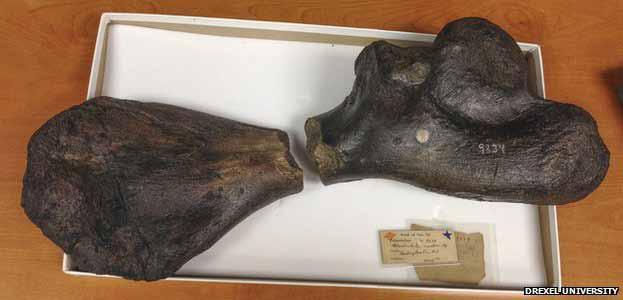
Two halves of a fossil bone found more 160 years apart have finally allowed scientists to scale one of the biggest sea turtles that ever lived.
Atlantochelys mortoni was originally described from a broken arm bone, or humerus, found in the 1840s in the US state of New Jersey.
Remarkably, the missing portion has also now been unearthed.
The fossil fragments are a perfect match, and indicate A. mortoni must have been 3m from tip to tail.
"When we put the two halves together, we were flabbergasted," recalls Dr Ted Daeschler, from the Academy of Natural Sciences of Drexel University, Philadelphia.
"We said, 'no - that can't be!' We even turned them around trying to show they didn't match, but they're obviously supposed to be together," he told BBC News.
The re-united fossils will be described anew in a forthcoming issue of the Proceedings of the Academy of Natural Sciences of Philadelphia.
Both parts come from Cretaceous sediments, 7075 million years old, in Monmouth County, New Jersey.
Very little is known about the discovery of the distal end - the end nearest to the elbow.
It received its first description from the famed naturalist Louis Agassiz in 1846. For years, it was assumed the bone was picked

up in Burlington County.
But then amateur fossil palaeontologist Gregory Harpel picked up the proximal end - the end nearest the shoulder - from a brook in the neighbouring Monmouth district.
"I picked it up and thought it was a rock at first - it was heavy," Mr Harpel said.
Rocks tend not to have markings from shark bites, and so he quickly realised the find was something far more significant.
Together, the bone fragments give a much clearer view of A. mortoni, a species that would have looked very similar to the modern loggerhead - apart from its size.
"This turtle was a monster, probably the maximum size you can have for a turtle," said Dr Daeschler.
"Scientifically, we now know a lot more about this creature.
"Most importantly, we now know precisely which rock formation the original came out of, and so we can more precisely know its age, and we can be much more confident about finding additional material in that same formation and therefore telling more about A. mortoni." (BBC)
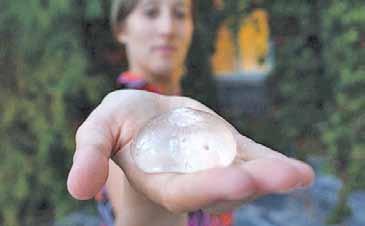
Plastic water bottles remain an unshakable scourge because of the trash they generate, but student designers from Spain want to kick them to the curb permanently. They’ve created a blobby alternative, where the medium is the membrane.
The blob design, called “Ooho,” encapsulates water in a double gelatinous membrane made from brown algae and calcium chloride.
Spanish design students Rodrigo García González, Guillaume Couche and Pierre Paslier say their water bottle alternative is simple, cheap, durable, hygienic, biodegradable and even edible. Hat tips to Inhabitat and Co.Exist. By cheap, they mean each one costs two cents to make — and is simple enough to create at home. The designers say that this kind of “spherification” dates back
Scientists have identified a new dwarf planet in the distant reaches of our Solar System.
It is being called 2012 VP113 for the time being, is about 450km across and is very likely icy in composition.
To date, only one other such object has been seen orbiting beyond the major planets in its region of space referred to as the inner Oort Cloud.
That previous object, called Sedna, is about 1,000km across, and was found 10 years ago.
But researchers believe there are hundreds more such objects awaiting detection.
"We've been using a large camera on a four-metre telescope in Chile, and it's a very powerful facility," said Scott Sheppard from the Carnegie Institution of Science in Washington DC, US.
"Our survey covered just a very small area of the sky - about 220 full Moons of sky. So, there's a lot more sky out there, and we predict, based on this one object, that across the whole sky we could expect to find 900 objects of 1,000km or bigger in size.
"Some of these could be bigger than Pluto; some could even be bigger than Mars or the Earth. The problem is they're just so distant, especially when they're in the far parts of their orbits, that they're just too faint to detect," he told BBC News.
The observations of 2012 VP113 are reported in the journal Nature. They indicate that the object gets no closer than about 12 billion kilometres to the Sun, and at the farthest point in its eccentric orbit is a staggering 67 billion km from our star.
To put that in some context, the Earth is 149 million km from the Sun, and even the most distant major planet - Neptune - seems close at 4.5 billion km, by these standards.
Sheppard and his colleague Chad Trujillo, from the Gemini Observatory in Hawaii, have calculated that 2012 VP113 takes 4,000 years to go around the Sun.
The big question is: how did it and Sedna come to be where they are? 'Reddish colour'
Astronomers have made great progress in mapping the close-in parts of the Solar System.
Even surveys in the region just beyond Neptune referred to as the Kuiper Belt have thrown up many hundreds of detections, some of which rival the zone's best known

inhabitant - Pluto.
But it is the Oort Cloud - the region even further out - that has proven very difficult to study.
Models for Solar System formation suggest that it is highly unlikely 2012 VP113 was created in its present location. Its orbit is just too eccentric.
One explanation is that it was perturbed gravitationally and pulled out of the Kuiper Belt by a passing planet that was expelled from our Solar System early in its history. Another idea is that it was pulled out of the Kuiper Belt by a star passing very close by in our part of the galaxy. A third, tantalising possibility is that it is actually an object stolen from a star that formed from the same "nursery" of gas and dust as our Sun billions of years ago.
Additional detections would help narrow possibilities.
In the meantime, more precise information on 2012 VP113's orbit is being sought. Astronomy's nomenclature authority, the International Astronomical Union, requires such data before it will sanction a catchier name.
"Based on 2012 VP113's reddish colour and what we know about other objects in the Solar System, and where this object is, we believe it's probably made mostly of water-ice, and probably some methane ice and carbon dioxide ice, with a little rock thrown in. And it's so cold that the ice would be harder than the rock on Earth," explained Dr Sheppard.
"If you could stand on the object and look towards the Sun, you'd be so far away it would look little more than just a bright star in the sky." (BBC)
to 1946, and has been used more recently in modern cuisine. As Co.Exist’s Adele Peters pointed out, a similar concept for food delivery called WikiPearl is available commercially.
One downside is that you have to pierce the Ooho to drink, and that can be messy. Plus it’d be hard to keep them clean for everyday use. However, they could be perfect for running events, where race organizers struggle with waste. I remember one 10K gave participants reusable clip-on water pouches, but runners mostly grabbed paper cups anyway.
Runners crave speedy delivery — think electrolyte goo — so these edible blobs might help with that, as long as long as discarded ones don’t inadvertently create intensely slippery conditions. Then it would be Ooho no. (Discovery News)

While other smartphone makers are busy packing as many megapixels and camera features as they can into their smartphones, it looks like Apple is once again focusing
on image quality for the iPhone
6. A new patent reveals that the company is developing a new dual-sensor camera that will improve image quality while allowing for a thinner overall design.

AThe title of the patent filed with the U.S. Patent and Trademark Office is called "Electronic device with two image sensors." As reported by Apple Insider, the camera has two distinct sensors. The first sensor would capture luma data (brightness), while the other would capture chroma date (color).
The camera would then create the image by combining the data captured by each of the above sensors. This process could possibly introduce latency, but we suspect that a faster A8 processor, rumored to power the iPhone 6, would be able to compensate.
There are two benefits to Apple's new approach. First, because the camera would be split into two modules, they could be made thinner and by extension the iPhone 6 itself. This is important because Apple's next smart-

phone is expected to sport a larger display.
Second, Apple's patent claims that a split-camera design would result in better image quality, because it would improve the signal-to-noise ratio and overcome color reproduction issues caused by optical filters.
In the camera phone wars, Samsung has traditionally of-
pple has said it wants more ethnic diversity in the basic range of emoji available to text-messaging apps.
It added that it was working the body responsible for deciding the standardised range of graphic symbols that can be added to text messages to achieve this.
At present the list of characters contains dozens of faces of people that appear to be white.
However, only two of the symbols seem to be Asian and none are black.
Since 2010 a basic list has been developed and maintained by the Unicode Consortium - a Silicon Valley-based non-profit organisation made up of major computer firms, software producers, user groups and others.
It does this to ensure that different devices and mobile carriers can share a basic set.
Although some apps offer to boost the number of emoji that a user can send and receive, users risk their friends being unable to view them if they haven't installed the same software.
Despite the fact that emoji first became popular in Japan, Unicode's current list only features two Asian people - a "man with a turban" and a "man with Gua Pi Mao", a type of Chinese hat - although it does include a Japanese ogre and Japanese dolls.
Diversity petition Apple, Google, Microsoft and other tech firms design their own versions of how the more than 800 basic emoji characters appear, but they tend to interpret most of the reference list's
human characters as being Caucasian.
"Our emoji characters are based on the Unicode standard, which is necessary for them to be displayed properly across many platforms," Katie Cotton, Apple's vice-president of worldwide corporate communications, told MTV.
"There needs to be more diversity in the emoji character set, and we have been
Peach," it said.
"But when it comes to faces outside of yellow smileys, there's a staggering lack of minority representation."
It added that the keyboard already offered a graphic showing a samesex couple, and called on the company to present people with a wider range of skin tones.
'Expressive power' Bernie Hogan is study-
the images it restricts users' expressive power - people won't feel that the emoji speak for them."
Unicode images
There are calls to widen Unicode's list even further.
The Wall Street Journal has reported on campaigns to include hotdogs, cupcakes, bacon and tacos to the list, which currently includes sushi, fried shrimp and a bento box as a result of it Japanese origins.

working closely with the Unicode Consortium in an effort to update the standard."
The broadcaster approached the company after a petition was posted to DoSomething.org calling on Apple to increase the ethnic diversity found within its emoji keyboard.
"There's a white boy, girl, man, woman, elderly man, elderly woman, blonde boy, blonde girl and, we're pretty sure, [video game character] Princess
ing the use of emoji as part of his research into how people represent themselves on the net.
The Oxford University research fellow said it sounded like a trivial problem but many smart device owners had become reliant on the tool .
"Emoji exist first and foremost as a way to augment texts with clear expressive power," he told the BBC.
"If they restrict the sort of people who are used in
However, Mr Hogan warns there are dangers with expanding it too far.
"There will always be more potential icons than you can reasonably put in a system," he said.
"It can't realistically be the responsibility of any particular organisation or consortium to be able to provide all possible icons in a usable format.
"But that being said, in terms of racial diversity it's very fair to think the range should be extended." (BBC)
fered more features, and that will likely continue with the Galaxy S5, which houses a 16-megapixel sensor and offers real-time HDR. Samsung's flagship will also have a Shot & More mode that lets you choose among multiple effects after you shoot. But if Apple has its way, it will hold on to the photo quality crown.
(Discovery News)

Microsoft Office for iPad has been a favourite subject of the rumour mill for almost as long as the iPad has been around. Today the rumours are no more, as Satya Nadella used his first event as the company's CEO to announce the first "real" version of Office for iPad.
Starting today, iPad owners can visit the App Store to download individual apps for Word, Excel, and PowerPoint. The apps are free, but with a catch: you'll need an Office 365 subscription to create and edit documents. If you aren't subscribed to Microsoft's cloud-licensed version of Office, then you can only read and present your docs. Office 365 subscriptions start at US$7 a month for a personal, one-
computer license. The apps are much closer to full-fledged desktop Office than anything we've seen before on iOS or Android. Last year the company released a scaled-down Office 365 app (also requiring a subscription) for the iPhone and Android. The move has been a long time coming from Microsoft. The years it took the company to launch apps for the world's most popular tablet left mobile opportunities for rivals like Google Docs/ Drive, Apple's own iWork, and Office clones from a host of smaller startups. As Office is still the overwhelming industry standard, though, it's easy to see this quickly becoming one of the most popular apps on iOS. (Gizmag)
In 1983, US-based Guyanese artists
Victor L Davson and Carl E Hazlewood envisioned Aljira, a Center for Contemporary Art, as a place which would embody the essence of its etymological roots. By selecting the name Aljira, the Australian Aboriginal word for “dreamtime”, the founders defined the heart of Aljira’s mission, a mission that embraces the concepts of timelessness
and open possibilities — ideas inherent in the creative process.
Aljira continues to be open to possibilities and plays an integral role in the professional life of many artists.
Aljira, a Center for Contemporary Art, in conjunction with The New Jersey State Museum, is pleased to present ‘Aljira at 30, Dream and Reality’, a major survey exhibition celebrating the exhibition

centre’s 30th anniversary. The exhibition will be on view from 29 March through 28 September 2014.
Both Davson and Hazlewood, among other US-based Guyanese and US artists, are showcasing their art at the exhibition.
“Aljira is honoured and grateful to the New Jersey State Museum for this unprecedented opportunity to showcase the creativity of our diverse community of cultural workers,” Aljira Co-Founder and Executive Director, Davson said.
A lively, historical overview, the exhibit contains many archival images showing Aljira's journey: from the early days when a group of artists answered an ad for studio space in the Roseville section of Newark to its current home at 591 Broad Street, New Jersey, US. The exhibition includes work by a representative selection of artists from the hundreds who have touched down and passed through and made Aljira the vital, far-

reaching enterprise that it has become.
Other highlights of the exhibition include an ephemera and reading room featuring videos, books, catalogues and Aljira’s photographic history from the 80s, 90s, and 2000s.
“Like a living organism
Aljira’s lifecycle, beginning with the birth of an idea among a small circle of artists inspired by the community in which they lived and worked, has flourished and matured through several decades. Our idea was Aljira – a word borrowed from the Australian aborigines meaning ‘dreamtime’ of the timelessness and open possibilities,” expressed Davson. He added, “This founding impulse and the day-to-day decisions that followed over the past 30 years determined how Aljira would evolve as an innovative and nurturing center for creativity.”
Chief curator for the exhibition is Margaret M O'Reilly, Curator of Fine Art, New Jersey State Museum, joined by co-curators Hazlewood, artist, writer, independent curator and co-founder of Aljira; Jaret Vadera, artist, cultural producer; and Cicely Cottingham, art -
ist and co-founder, Aljira Design.
“Aljira has been agile in their response to changing cultural and societal issues, all the while maintaining a humanist ethos. Through its commitment to bridging racial, cultural and ethnic barriers, the Center enlightens not just the art community, but the local region it serves. Through exhibitions, programs, workshops and outreach, Aljira provides cultural services to the underserved and allows these communities to understand that the arts are not elitist, but a natural form of expression for all people. It offers art as something more than simply an aesthetic experience, but a vital component in individual and community life,” O’Reilly explained.
For more information visit www.statemuseum. nj.gov or contact Aljira, a Center for Contemporary Art on Facebook.

The Catholic Church in British Guiana owes its existence, expansion and growth to the Portuguese, who first came here in 1835 as indentured emigrants to satisfy the labour hunger of the planters.
Although, previously, there had been intermittent visits of Catholic priests to the colony, it was not until 9 December 1825 the construction of the building of the first Roman Catholic Church began and was later opened by Revd J Hayes, OP, in 1827. From Madeira, the Portuguese had brought not only their agricultural and commercial skills, but their devotion to their religion – the Catholic faith. The roots of their faith went deep, their devotion was
marked by the simplicity and exuberance of a “folk religion”, which sometimes was misunderstood, and their faith was branded by some as a “Madeiran type of Catholicism”. March 1857 marked the beginning of an organised mission by The Society of Jesus in British Guiana with the arrival of James Etheridge, SJ, Aloysius Emiliani and Fr Clemant Negri from Naples.
With the increase in Catholics, in particular the Portuguese community in this area, there was need for a “proper” church. St Anthony of Padua Roman Catholic Church was opened on the 19 November 1871 and was blessed by Bishop James Etheridge and dedicated to St Anthony. It is lo-

cated in the twin villages of Buxton/Friendship. There was a Mass Station in this area as far back as 1862. St Anthony of Padua Roman Catholic Church is one of the larger Catholic churches on the East Coast and still retains most of its internal architectural designs, even though its tower was taken down in 1984.
Like other East Coast Catholic churches, it was located near the railway. The St Anthony church is physically located on Friendship Middle Walk in Friendship Village. The Catholic custom refers to it as Buxton Church. The high altar was made in 1905 and houses a shrine of St Anthony at the top with three small arches containing angels on either

side of the tabernacle. Two side altars, made of nicely designed wood, are dedicated to the Sacred Heart and Our Lady.

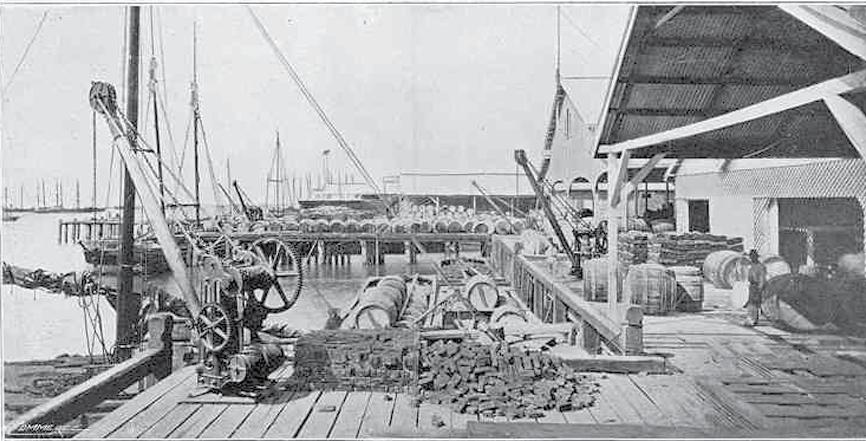
It is recorded that this parish community, Friendship Village, celebrated the golden jubilee of Pope Leo XIII in 1893 with lavish events, processions of its various guilds and societies, ending in the evening with illuminations, fireworks and other decorations. In addition, the celebrations for the Feast of St Anthony were of a grand scale, including the blessing and distribution of St Anthony’s Bread.
The first resident priest at St Anthony was Fr John Purcell in 1892. Purcell, a diocesan Priest, was a Jamaican who offered to work in British Guiana in the time of Bishop Anthony
Butler. Purcell also had the difficult task of travelling to Bartica once a month to minister to the needs of Catholics there. It was he who was responsible for building the small concrete church at Mahaicony. The longest serving priest at St. Anthony, from 1936 to mid 1970s, was Fr Emmanuel da Silva. He was the second Guyanese and third Diocesan priest. This church still carries on the tradition of devotions to St Anthony. Its feast day is celebrated annual on 13 June. (Text by


The journey starts with a short boat ride from Rewa River, Rupununi, to a landing where an easy 15-minute hike leads to the spectacular Grass Pond.
Notably, there is a stunning setting of Victoria Amazonica adorning the pond. Also, it abounds with a good population of Arapaima (reportedly the highest density in Guyana). During a late afternoon visit at the pond, Brown Capuchin monkey or Capybara can be seen. Birds likely to be seen include Limpkin, Wattled Jacana, Black-collared Hawk, Green Kingfisher and Guianan Puffbird. As dusk approaches, the flowers of the Victoria Amazonica bloom in all their glory.
Another ideal location close to Grass Pond is the Awarmie Mountain. The mountain is a 40-minute boat ride from the Rewa Eco-lodge.
Speaking about the mountain in his book ‘Guyana: The Bradt Travel Guide’, Kirk Smock stated, “There is a good path cut up to the top of the mountain but the climb can be steep in places and should be done by those confident with their level of fitness. The hike, depending on your level of fitness, will take around two hours.”
On the top of the mountain there are expansive views of the surrounding forests and winding rivers. It is one of the best jungle vistas in Guyana. The village of Rewa has built a benab on the top, which can be used for overnight camping with hammocks. (Photos by David Johnstone. Cover photo: A view over Grass Pond)



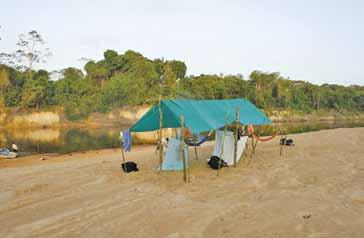

We all know kids say adorable things (the darndest, even) but now we know they can write hilarious material as well. Below are some of the most hilarious notes by kids.



By Sheila MoSS
Okay, men, it’s time for The Big Game. I want you to go out there today and knock ‘em dead!
But…Coach…
No objections! We’re a team! We need to act as a team! We need to play as a team!
But…Coach…
Remember, you have the power to win if you believe in yourself!
But… Coach…
Shut up! When the going gets tough, the tough get going!
But… Coach…
Yes, I know they beat us 35 to 0 the last time we played. That’s behind us now! We are going out there to WIN this year!
But… Coach…
Yes, I know we have not won a single game all year. Today is the day we will turn that around!
But… Coach…
It’s attitude, men, ATTITUDE! You have to have a winning attitude.
But… Coach…
with practice, skill, knowledge, and experience!
You have to control your fear instead of letting it control you!
But… Coach…
You are only as good as you think you are!
But… Coach…
Think positive! Think BIG! Think WIN!
But… Coach…
Yes, yes, I know they have not lost a single game in three seasons. So what? No one can win forever. Today will be the day that their winning streak ends. We can make that happen!
But… Coach…

See yourself as WINNER, not a loser. If you think you will loose, you will!
But… Coach…
QUIET! Don’t let them force you into playing THEIR game! We’ve practiced OUR game! Now we have to go out there and PLAY our game!
But…Coach…
You know what the problem is? FEAR! You have to conquer fear! You have to conquer fear
With the right attitude, we can’t lose! We must refuse to have an attitude of defeat!
But… Coach…
I said, NO OBJECTIONS! The trouble with you men is that you won’t listen! You get a negative attitude and you won’t listen!
But… Coach…
You cannot let the past determine the present! Just because they beat us every time we play does not mean they will beat us
But… Coach…
We can’t lose them all. The odds of winning are in our favor now. We can do it!
We’re a team! We are winners! Never forget it!
But… Coach…
Why do you keep interrupting me? How can I motivate the team when you keep interrupting me? What is it? What is your problem?
But… Coach …The Big Game is NEXT week!
It’s the WRONG DAY!

Frog date
A frog telephones the Psychic Hotline and his Personal Psychic Advisor tells him: "You are going to meet a beautiful young girl who will want to know everything about you." The frog is thrilled, "This is great! Will I meet her at a party?" "No," says his Advisor, "in her biology class."
The story of evolution
A little girl asked her mother, "How did the human race appear?"
The mother answered, "God made Adam and Eve and they had children, and so was all mankind made..."
Two days later the girl asked her father the same question.. The father answered, "Many years ago there were monkeys from which the human race evolved."
The confused girl returned to her mother and said, "Mom, how is it possible that you told me the human race was created by God, and Dad said they developed from monkeys?"
The mother answered, "Well, dear, it is very simple. I told you about my side of the family and your father told you about his."
Lawyer fees
Walking into a lawyer’s office, a man asked what his rates were. "Fifty dollars for three questions," the lawyer stated. "Isn't that awfully expensive?" the man asked?" "Yes," replied the lawyer. "What's your third question?"
Elementary
Sherlock Holmes and Dr. Watson go on a camping trip. After a good dinner, they retire for the night, and go to sleep.
Some hours later, Holmes wakes up and nudges his faithful friend. "Watson, look up at the sky and tell me what you see."
"I see millions and millions of stars, Holmes" exclaims Watson.
"And what do you deduce from that?"
Watson ponders for a minute.
"Well, astronomically, it tells me that there are millions of galaxies and poten tially billions of planets. Astrologically, I ob serve that Saturn is in Leo. Horologically, I deduce that the time is approximately a quarter past three. Meteorologically, I suspect that we will have a beautiful day to morrow. Theologically, I can see that God is all power ful, and that we are a small and insignificant part of the universe. What does it tell you, Holmes?" And Holmes said: "Watson, you idiot, it means that somebody stole our tent."
Fix it yourself
When a guy's printer type began to grow faint, he called a local re pair shop where a friendly man informed him that the printer
probably needed only to be cleaned.
Because the store charged $50 for such cleanings, he told him he might be better off reading the printer's manual and trying the job himself.
Pleasantly surprised by his candour, he asked, "Does your boss know that you discourage business?"
"Actually, it's my boss's idea," the employee replied sheepishly, "We usually make more money on repairs if we let people try to fix things themselves first."
Farmer Joe decided his injuries from the accident were serious enough to take the trucking company (responsible for the accident) to court. In court, the trucking company's fancy lawyer was questioning farmer Joe.
"Didn't you say, at the scene of the accident, 'I'm fine?" questioned the lawyer.
Farmer Joe responded, "Well I'll tell you what happened. I had just loaded my favoUrite mule Bessie into the..."
"I didn't ask for any details," the lawyer interrupted, "just answer the question. Did you not say, at the scene of the accident, “’I'm fine!'"
Farmer Joe said, "Well I had just got Bessie into the trailer and I was driving down the road..."
The lawyer interrupted again and said, "Judge, I am trying to establish the fact that, at the scene of the accident, this man told the Highway Patrolman on the scene that he was just fine. Now several weeks after the accident he is trying to sue my client. I believe he is a fraud. Please tell him to simply answer the question."
By this time the Judge was fairly interested in Farmer Joe's answer and said to the lawyer, "I'd like to hear what he has to say about his favourite mule Bessie."
Joe thanked the Judge and proceeded, "Well as I was saying, I had just loaded Bessie, my favourite mule, into the trailer and was driving her down the highway when this huge semi-truck and trailer ran the stop sign and smacked my truck right in the side. I was thrown into one ditch and Bessie was thrown into the other. I was hurting real bad and didn't want to move. However, I could hear ole Bessie moaning and groaning. I knew she was in terrible shape just by her groans.

Shortly after the accident a Highway Patrolman came on the scene. He could hear Bessie moaning and groaning so he went over to her. After he looked at her he took out his gun and shot her between the eyes.
Then the Patrolman came across the road with his gun in his hand and looked at me. He said, "Your mule was in such bad shape I had to shoot her. How are you feeling?"
Want to contribute to the Sunday Times magazine? Email us for possible publication at sundaymagazine@guyanatimesgy.com.
Please include legal name(s), address and a brief synopsis of your article with attached word document.