It is believed that the art of kite flying originated in China before 1000 B.C. Researchers speculate that kite flying may have been introduced in Guyana by Chinese indentured immigrants in the mid-19th century.
The kite is a vehicle for creativity. Apart from religious symbolism, the kite is linked to essential aspects of science, technology, engineering and math. Kite making also encourages concentration, mathematical and geometric precision.
Many families today forego investing time and effort into making kites, instead purchasing imported plastic kites or locally made ones, ignoring the fact that kite making serves as an opportunity for children to have fun and be creative.
Those who can recall the ‘caddy-ole-punch’, for instance, know the feeling
of accomplishment as children when they saw their creation soaring in the sky. Although making this kite did not require many parts, it encouraged children to be artistic and inventive in assembling it.
Some older folks could recall dominant styles of local kites that existed in British Guiana, but are somewhat non-existent today. These were the star-shaped kite, the box kite, the girl kite, and the fighting kite.
The star-shaped kite, also known as ‘star point’ in Guyana, is constructed with two frames crossed in an X, one horizontal frame across the middle, and a third and shortest frame extended from the middle to a curved piece of bamboo between the top ends of the two vertically crossed frames. Using flour paste or ‘gamma cherry’, a green berry filled with a glue-like substance, colourful paper is pasted on to the frame forming a star.
The box kite’s typical design has four parallel struts or support sides. The box is
made rigid with diagonal crossed struts. There are two sails, or ribbons, with the width about a quarter of the length of the box. The ribbons wrap around the ends of the box, leaving the ends and middle of the kite open. In flight, one strut is the bottom, and the bridle is tied between the top and bottom of this strut. The dihedral or upward angle of the sails helps stability. This kite encouraged skills in aviation, construction and precision. Its beauty comes from the effect of sunlight illuminating through its colourful cellophane paper walls.
Kites themselves were divided into male and female styles; the male carried a nose-bridge with a thin ‘bull’, a rounded piece of paper, on the taut string behind which made the kite sing, while the female was a flat kite, with no bull, but with bushy colourful frills, flown at a short distance. The girl kite does not have a nose bridge and an exposed bull, so it does not sing. There is also the ‘fighting’ brown paper kite. It was artistically made with the objective to ‘sing’. It never has a large wooden frame, carries no pasted decor, no frills or flaps, and its tail is of just enough length to keep it rotating but not crashing to the ground, as the flyer runs with it.
Easter provides a great opportunity for parents and children to bond. Many of our senior folks reminisced working along with their parents making different types of kites – a memory forever etched in their minds.
Today, some schools do encourage and coordinate a day for children and parents to fly kites at the National Park but maybe it would impact children even more to see their parents making an added effort to reserve time from their busy schedules to actually make a kite as a family.
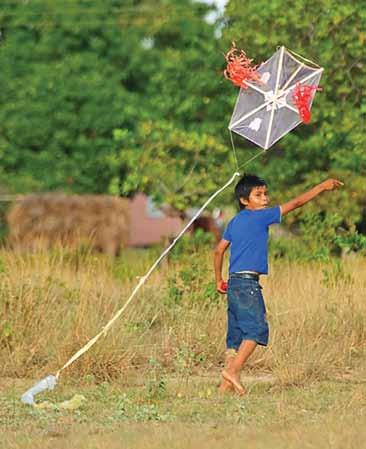
A child in Lethem flying his homemade kite (Photo by James Broscombe)
Children flying kites on the Seawall
Castellani House hosts film festival in celebration of International Mother Earth Day
Earth Day 2014 will focus on green cities, mobilising millions of people to create a sustainable, healthy environment by ‘greening’ communities worldwide. As the urban population grows and the effects of climate change worsen, countries have to evolve.
It is time for countries to invest in efficiency and renewable energy, rebuild towns, and begin to solve the climate crisis.
“Mother Earth” is a common expression for the planet Earth in a number of countries and regions, which reflects the interdependence that exists among human beings, other living species and the planet. For instance, Bolivians call Mother Earth “Pachamama” and Nicaraguans refer to her as “Tonantzin”.
Recognising that Mother Earth reflects the interdependence that exists among human beings, other living species and the planet we all inhabit, the General Assembly declared 22 April as International Mother Earth Day.
Every year on 22 April, over a billion people in 190 countries take action for Earth Day. They
Fplant trees, clean up their communities, contact their elected officials, and more — all on behalf of the environment.
Like Earth Days of the past, Earth Day 2014 will focus on the unique environmental challenges of our time.
In celebration of this day, Castellani House, located on Vlissengen Road, in collaboration with the US Embassy Guyana, is hosting a film festival. Two films, ‘Who Killed the Electric Car?’ and ‘Promised Land’, were already shown. The last one will be shown on 22 April. ‘An Inconvenient Truth’ is a 2006 Academy Award winning documentary film directed by Davis Guggenheim about former United States Vice President Al Gore's campaign to educate citizens about global warming via a comprehensive slide show that, by his own estimate made in the film, he has given more than a thousand times. With an emphasis on hope, the film ultimately shows that global warming is no longer a political issue, rather the biggest moral challenge facing our civilisation today.
ocusing on community development in the Campbellville area, Cordel Prescod is assiduously using his resources to help families and residents bond.
Prescod, founder of Energy Entertainment in 2010, stated in an interview with Guyana Times Sunday Magazine that the group was started by passionate individuals who want to promote family-oriented and clean entertainment in the Campbellville area. One such event is the Kite Flying Competition and Family Fun Day held at the Camptown Ground.
“This event has seen an increase of patrons over the years. Families from many villages flock to the ground to celebrate Easter together. Campbellville residents gather together as a close-knitted village to celebrate this holiday. When I see the bonding between residents it motivates me to continue in my efforts,” Prescod
mentioned.
At the Easter event, both children and adults are engaged in clean entertainment. There are kite competitions: categories include the Best Kite, Most Unusual, and the Smallest Kite; and also bag races, bunseating competition, a football competition in the evening and much more.
Prescod noted that his entertainment group is one with a difference. He is not an advocate of lewd, dancehall entertainment, rather he promotes clean fun for ev-
“I noticed families would have to go to other locations for family entertainment. I thought that we had the facilities right in Campbellville where families can come together to have fun. Growing up in Campbellville, I know how closeknitted it was when I was younger and I wanted to continue this. Through Energy Entertainment, I am able to help bring together the village’s residents, which helps in the bonding of the community,” Prescod pointed out.
This year, the Energy Entertainment’s Easter event will take place on 21 April at the Camptown Ground in Campbellville. Gates will be opened from 9 a.m.
“We want to award, this year, the person with the Best Bill Express kite. Sterling Products and Bill Express have been our biggest supporters since our conception. I want to thank them, including our other sponsors, for their support,” he
designer Margaux Wong Star of the Week
‘Pure Complement’ collection
expressed.
For those who are interested in competing in the kite competitions, Prescod said that registration will take place at the ground. To qualify, a kite must be in the air for 5 minutes. There will also be prizes for the largest nuclear, single-parent, and extended families.
“Our future plans include awarding students of Campbellville who have done excellently in their exams. We also want to donate to the senior residents in the area. But we need persons to collaborate with us to help in our efforts. Community development is integral because it helps in building youths and making families stronger,” Prescod declared.
For more information, call Prescod on 686-6099.
Rajkummar Rao on National Award and playing ‘Shahid’
eryone.
-Inspired by her Guyanese heritage
Children having fun at Camptown Ground
First winner (black vest) of the Most Unusual Kite category being awarded in 2010
Prescod (right) collects a cheque from a Bill Express representative
The charitable organisation, the Inner Wheel Club, has helped hundreds of needy persons over 27 years. Its members are guided by the organisation’s motto, ‘Friendship and Service’. With the aim to work relentlessly in raising funds to fulfil their goals, the club has numerous fundraising events throughout the year - one such event is the annual Hat Show and Garden Party.
In a past interview with Guyana Times Sunday Magazine, chartered member Gem Eytle said the hat show was her brainchild. “When we were chartered in 1985, the members had to do charity projects. I remembered as a child, about 80 years ago, going to hat shows in the Promenade Gardens. I decided to have a hat show bringing back what I had in the yesteryears,” Eytle reflected.
She added that many persons knew little about events kept at the Promenade Gardens. Eytle remembered music bands would play at that garden every month. It was quite a social occasion, she recalled, especially for mothers to take their children there because of the numerous fun activities.
“I convinced the members that the Promenade would be the ideal place for the hat show. I then approached the City Council, which thought it was a good idea but had no money to refurbish it. We couldn’t use the bandstand because it wasn’t in proper condition because of poor maintenance. I decided to use the lawn on the north-eastern section of the garden. We prepared the area and had our first hat show in 1985,” Eytle reminisced.
As a complement to the event back then, the club also held a sideshow called ‘Going Through The Ages’ where persons would come draped in old fashion dresses, big fancy skirts and bonnets. The chartered members added there was a bicycle called “shilling and pence”, which served as an attraction at the event.
“We don’t have sideshows anymore because of the excellent outcome of the hat show. We used funds from the hat shows to rehabilitate the Promenade and ever since then it has been successfully held there. Over the years, we have seen tremendous creativity in hat creations and we want to maintain that. You’re never properly dressed for a particular occasion without a hat,” she encouraged.
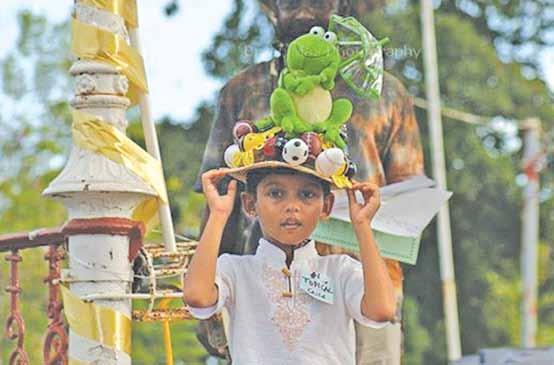
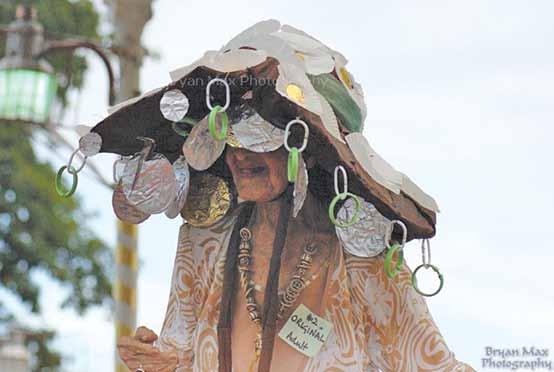
At the show, hats are judged in three categories: elegant, topical and original.
Inner Wheel raises funds to make an impact on the lives of the less fortunate through scholarships for young adults seeking training in the fields of education and medicine, by participating in community development activities that benefit children and the elderly, as well as by spreading cheer on festive occasions.
The annual hat show this year will be held on 26 April at the Promenade Gardens. Patrons can look forward to indulging in what the various stalls, stationed at the gardens, will offer. There will be a Book Stall, Games Stall, a Sweet and Savoury Stall. Tickets cost GYD$200 for children and those less than eight years will be admitted free. Tea is also available at a contribution of $1500, which includes the entrance fee.
Hats can be thematic. This one is adorned with recycled materials A beautiful hat decorated with flowers was a highlight at a past hat show
Even children are happy to be part of the hat show
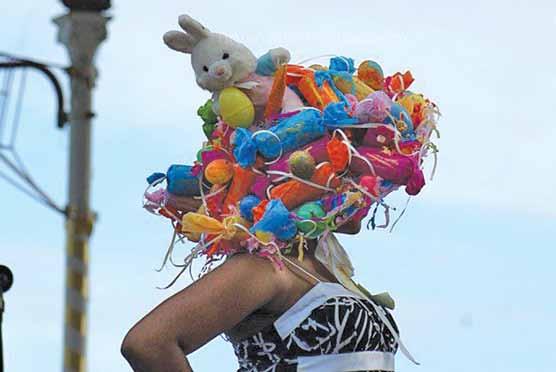
A hat showcasing the joys of Easter
Margaux Wong is an internationally known fashion and textile designer originally from Guyana. She was first introduced to textile design while in secondary school but was introduced to the sewing machine as a young child.
For the past ten years, Wong has worked as a freelance designer. She was, in 2007, employed as the personal assistant to the late Catherine Walker, who, for many years, designed countless special pieces for the late Princess Diana, at her Chelsea, London studio.
“I studied art at President's College as one of my ten GCSE subjects. I focused on Surface Decoration. I wore my own designs while at UG pursuing a Business Management degree, as I was tired of
looking like everyone else on campus. Classmates began requesting to purchase my clothing off of my back. I was invited to showcase at the Sidewalk Cafe one Wednesday afternoon. The rest is history. I mostly enjoy textile design: tie dye, batik, hand painting, and so on. I use my textiles to produce resort wear. So far, I have launched about six collections,” Wong mentioned in an interview with Guyana Times Sunday Magazine
As a fashion and textile designer in Guyana, Wong’s work was deeply influenced by her Amerindian and African background. Being of mixed race and living in a mixed race society, encouraged this designer to embrace multiculturalism and multi-ethnicity as inspirations for her work and also
for her life’s journey.
“My Amerindian and African ancestry have always influenced my work. My road trips across East Africa have tremendously inspired my designs. I often travel throughout East Africa in search of raw materials and design ideas. I love the Massai influences of Kenya and often use Massai beads in my jewellery and sometimes on clothing. I also enjoy the possibilities that the Uganda Bark Cloth bring to my work. I am also inspired by the general nature of Africa and the flora of the Caribbean and Guyana,” Wong expressed.
Now living and working in Burundi, East Africa, since 2009, this wife and mother of four has settled into a community that she has always longed to know personally and professionally.
Currently, Wong is designing clothing, textiles and jewellery as she absorbs
inspiration from the heart of the beautiful continent
of Africa. It is her love for fashion, reading and writing which has propelled her into her work with Africa Fashion Guide as their East Africa contributor.
“Having recently given birth to my fourth child, I presently have a desire to produce work that is lasting; work that will inspire generation to generation. This may get me into trouble as a designer, but I do not care much for trends.
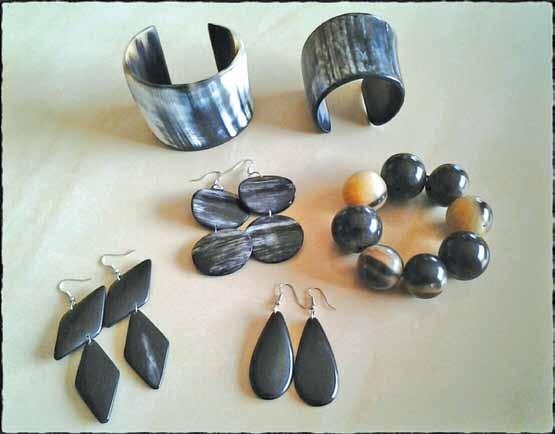
My current collection of jewellery is made of Burundian cow horn, which arguably is known as the best cow horn in East Africa. With this collection I would like to convey a vision of legacy, hard work, strength and excellence. Of course, I must add, that in everything I do, communicating the absolute importance of having faith in God is paramount to any other message,” noted the designer. It is Wong’s desire to help to influence and support a sustainable fash-
ion industry in Africa. She envisions an era where African designers and textile industry are not only internationally recognised, but are able to compete on an international scale and make a substantial contribution to the global fashion industry. She endeavours to contribute towards the realisation of this vision. Her advice for youths who want to follow in a similar path is, “Aspiring designers or artists should grow their skills in whatever way possible. It is important for an innovator to be able to produce something from nothing. Look at what is in your hand and create! This is preparation for the real world of design where being able to think on one's feet is crucial if one were to succeed. The late CEO of Apple, Steve Jobs said that creativity is just connecting things. So make a habit of observing your environment and begin connecting!”
Margaux Wong
inyaruguru Cowhorn Collection 2014
Hand-dyed and printed fabric made from Burundi cotton
The Shaping of guyaneSe LiTeraTure
A review by Robert Sauvé
By PetamBer Persaud
Part One
Cyril Dabydeen is a writer who enhances the reader’s share of the narrative. A story that engages the whole person is what serious readers are always eager to find. Such novels and short stories are the gold standard of literature. Once the mood is set and the characters are in place, then the reader can riff to his heart’s content; the reader can perform like Miles Davis transported by a 20-minute set of “All Blues” or “My Funny Valentine.” And if one is not inclined to riff, then one can “listen” to Dabydeen riff. He does that very well, as you might expect from a short story writer with the soul of poet.
By reader’s share I mean the same sort of thing that the famous art historian and theorist Ernst Gombrich meant when talking about the beholder’s share. The reader’s share describes the grappling or soul searching that the reader is encouraged to do in order to make sense of the text at hand; such deciphering effort only adds to the pleasure of reading.
The understanding that flows from being in the grip of a good story is rewarding and pleasurable to the same degree that one grapples with it. Dabydeen makes
it all the more interesting in that he writes about us while skilfully muting the artist’s touch.
Good fiction reflects real life in its many pauses and facets, in its dialogue and character sketches. Good fiction should never be about the author’s presence. When certain authors’ signature styles are too obvious then the story risks being lost and the reader risks worshiping at the feet of an idol.
On the other hand, we know that an author succeeds when we hardly know he is there. When an author “disappears” it is easier to get lost in the flow of the story—we can clearly imagine the setting, hear the inflections of voice, identify with the search for meaning, and be frustrated by the grappling the characters endure. The drama, the anguish, the isolation or the fulfilment that the story, as in real life,
confronts us with are essential elements. These elements will not come to life if the reader is distracted by the author’s style. An author is successful when the story stays in the reader’s imagination after the reading is done. This is what happened to me after reading “My MultiEthnic Friends & Other Stories” (Guernica Editions), Dabydeen’s recent collection of short stories. The host of characters depicted in these stories stayed with me long after the last page was read and the cover closed. Echoing still is the authenticity of the clipped conversations of the beleaguered characters who struggle with dislocation, exile, and doubt.
Regarding the lives of immigrants and the difficulties of creating new identities while still freighting remembered ones, the depictions are affecting, realistic, and insightful. The simplicity of style belies both the depth of reflection and the authenticity of voice. That these stories all ring true is, in large measure, due to the subtle and understated method that Dabydeen brings to bear on the narrative. The echoing after-life of his stories and their authentic voice set the stage for an unexpected conversation—one that enriched my reader’s share and at the same time validated Dabydeen’s excellence.
Mavis Gallant, another great Canadian short story writer, observes in her essay, “What is Style”: “Against the sustained tick of a watch, fiction takes the measure of a life, a season, a look exchanged, the turn-
ing point, desire as brief as a dream, the grief and terror that after childhood we cease to express. The lie, the look, the grief are without permanence. The watch continues to tick where the story stops.”
Gallant’ words are a caution for writers to not betray their true voice (that is, to not dress up the structure in order to hide a slipshod or discordant voice). The phrase, “The watch continues to tick where the story stops,” is for me an apt description of what Dabydeen consistently accomplishes in
his latest collection of short stories.
I do not know if Dabydeen has ever read Gallant’s essay, but he surely understands the writer’s craft as well as she did. Sauvé, a retired professor, is an independent scholar and philosopher. He is currently a freelance researcher and lecturer in artrelated subjects and gives presentations through the National Gallery of Canada Responses to this author, call (592) 226-0065 or email: oraltradition2002@yahoo. com
Prof Cyril Dabydeen
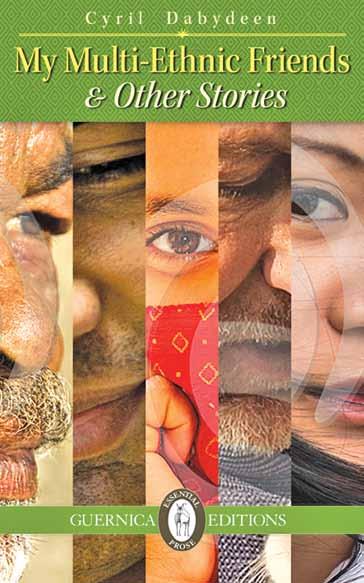
‘My Multi-Ethnic Friends and Other Stories’ by Dabydeen
Top Tips From Award
Winning Entrepreneurs
Below are some top tips from award winning entrepreneurs on how to be successful business owners.
1. “If you’re afraid of losing money, you will not make it to success.” – Hamdi Ulukaya, Founder of Chobani, 2013 World Entrepreneur Of The Year
2. “Connecting and collaborating are your most powerful keys to success as an entrepreneur.” – Kathy Ireland, Founder, CEO & Chief Designer of kathy ireland worldwide, 2011 Phenomenal Woman Of The Year
3. “Just say ‘yes’ and then figure it out later.” – Denise Wilson, Founder & CEO, Desert Jet, 2013 EY Winning Women, #69 on Inc 500 in 2012
4. “You have to love what you’re doing. The best entrepreneurs have something to prove and it’s not about the money. And when you realize you’re not good at something, you need to try something else.” – David M. Rubenstein, CoFounder of The Carlyle Group, 2012 Large-Cap Firm of the Year in North America by Private Equity International
5. “The more you put in, the more you get out. The more you put in, the more you get out. The more you put in, the more you get out.” – Donna Allie, Founder & President of Team Clean, 2013 EY Award Winner
6. “Ask powerful questions. When someone says ‘no’, ask why.” – Kathy Ireland, Founder, CEO & Chief Designer of kathy ireland worldwide, 2011 Phenomenal Woman Of The Year
7. “Listen to those who have been there before.” – Karin Mayr, Founder of Sabika, 2013 EY Regional Award Winner
8. “You need to be passionate about what you’re doing. There is nothing you won’t do when you’re passionate. You do everything and you need to be willing to do everything.” –Annette Catino, Founder & CEO of QualCare, 2013 EY Regional Award Winner
9. “It will get hard, but don’t give up. Always trust your gut.” – Ellen Stang, Founder & CEO, Progeny Health, 2012 EY Winning Women
10. “Find a mentor who has already done it, but you better have something to bring to the table. Your ‘why’ will be the reason and it has to be bigger than you. Be fearless and never be worried about hearing ‘no’. No is never an indication of your potential.” – Phyllis Newhouse, Founder & CEO, Xtreme Solutions, 2013 EY Winning Women
11. “Failure does not mean stop, it’s simply a u-turn to keep going.” – Lisa Williams, Founder & CEO, World Of EPI, 2013 EY Winning Women
12. “Do the right thing — you always know what it is in your gut.” – Julia Beardwood, Founder of Beardwood & Co, 2013 EY Winning Women
13. “Failure is your best friend on the way to success.” –Dr. Kjell Nordstrom, Business Author & Associate Professor Stockholm School Of Economics, Thinkers 50 List Award
14. “Build it brick by brick. Don’t quit. Go around obstacles, but don’t get too high on the ups either.” – Lawrence Harding, Founder & President, High Street Partners, 2013 EY Award Winner
15. “I got fired and started a company, so don’t be afraid to take a risk. Do it from your heart and always be humble enough to hire above yourself.” – Leslie Firtell, Founder & CEO, Tower Legal Solutions, 2012 EY Winning Women, 2013 EY Winning Women Judge
16. “Celebrate the victories along the way.” – Jonny Jones, Founder, Chairman & CEO of Jones Energy Inc., 2012 Entrepreneur Of The Year Regional Award Winner
17. “Learn how to write and talk. You are always trying to persuade someone.” – David M. Rubenstein, Co-Founder of The Carlyle Group, 2012 Large-Cap Firm of the Year in North America by Private Equity International
18. “Don’t let anyone’s opinion of you destroy you. You have to believe in what you do.” – Kathy Ireland, Founder, CEO & Chief Designer of kathy ireland worldwide, 2011 Phenomenal Woman Of The Year
19. “Be curious and question everything. I was extremely curious why no one was making a better nut butter and wasn’t afraid to generate my own answers when I didn’t understand or like the responses.” – Justin Gold, Founder and CEO, Justin’s, 2013 Entrepreneur Of The Year Regional Award Winner
20. “Have an unflinching belief in what you’re doing. Stay authentic. Don’t go for the land grab.” – Raegan Moya-Jones, Co-Founder & CEO, aden + anais, 2013 EY Winning Women (Excerpt from www.forbes.com)
Star of the week
Vying
for the Miss World Guyana crown is the stunning 19-year-old Atisha Gaskill. Born in Georgetown, Atisha migrated to the US where she is currently residing. This recent high school graduate, accomplished track-star and youth leader, completed her high school diploma at the Woodbridge Senior High School, US, and is now actively pursuing a career in Forensic Psychology at the Northern Virginia Community College. Although Miss World Guyana is her first pageant, Atisha is a force to be reckoned with. In February 2014, while vacationing in Guyana, a family friend encouraged her to apply for Miss World Guyana. She did and is now preparing mentally and physically for the competition. The beauty’s mental training involves public speaking, interview skills and walking with confidence. Her physical training involves exercise, eating, and relaxation techniques. Atisha’s belief is that a pageant is a great event that allows delegates to showcase their talents, beauty, and community service. The Miss World Guyana’s forum is a great opportunity for Atisha to evolve into an admirable young adult, and display the characteristics of a role model for young girls like herself. Atisha’s Beauty with a Purpose, the pageant’s charitable project, platform is “Raising Awareness on Human Trafficking,” focusing specifically on sex trafficking within Guyana and the CARICOM region. As an ambassador for Region Four, Atisha’s goal is to educate the public on indicators of human trafficking victims and perpetrators. She believes that public awareness would allow the victims’ voices of human trafficking to be represented by an advocate. Additionally, perpetrators can be identified, and this can contribute to a secure and safer environment in Guyana. As a philanthropist, Atisha has been involved in various charitable activities in Northern Virginia, Washington, DC, and Guyana. Some of these activities involve feeding and clothing the homeless, which includes sending clothes and school supplies to Guyana for those in need. The clothing and school supplies are sent to churches in Georgetown and Sisters Village. If crowned Miss World Guyana, Atisha will continue to raise awareness on sex trafficking and help empower victims across Guyana and the CARICOM region. Check out Atisha’s profile at Demerara-Mahaica on Facebook.
Creature Corner
Jackrabbits
Jackrabbits are not actually rabbits, but are hares. Hares are born with fur and are larger than rabbits. They usually have taller hind legs and longer ears.
There are five species of jackrabbits, all found in central and western North America.
These speedy animals are capable of reaching 40 miles (64 kilometers) an hour. They have powerful hind legs that can propel them on leaps of more than ten feet (three meters). They use these leaps and a zigzag running style to evade their many predators, including coyotes.
Black-tailed jackrabbits are the most common jackrabbit species in the western United States. They live in deserts, scrublands, and other open spaces, including farms. They can consume very large quantities of grasses and plants— including desert species such as sagebrush and cacti. They have black streaks on their tails and black-tipped ears.
White-tailed jackrabbits are found in the plains, farmland, and mountain regions, though they also inhabit wooded areas. They are slightly larger than the black-tailed jackrabbits. Their fur turns completely white in the winter. They are hearty eaters and can consume over a pound (0.5 kilograms) of grasses, shrubs, or bark each day.
Spot the Differences
The scientific name for blacktailed jackrabbits is Lepus californicus. The scientific name for white-tailed jackrabbits is Lepus townsendii
Jackrabbits are mammals, and because they eat plants, they are called herbivores.
Jackrabbits produce a lot of young called leverets or bunnies. Females give birth to several litters a year, each with one to six young. The young mature quickly and require little care from their mothers. They can live for one to five years in the wild.
Jackrabbits are about 2 feet (61 centimeters) long. They weigh 3 to 9 pounds (1.4 to 4 kilograms).
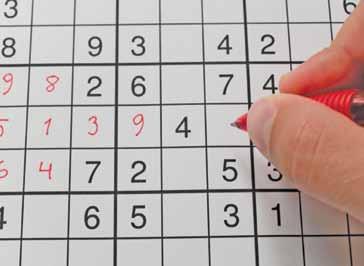
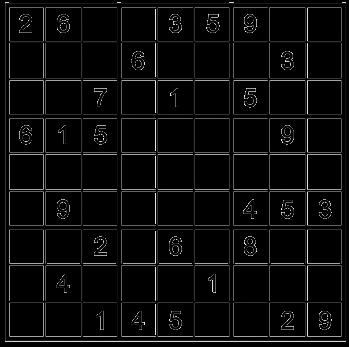
The objective of the game is to fill all the blank squares in a game with the correct numbers. Every row of 9 numbers must include all digits 1 through 9 in any order. Every column of 9 numbers must include all digits 1 through 9 in any order. Every 3 by 3 subsection of the 9 by 9 square must include all digits 1 through 9.
Fashion
Acreative fusion of fabric resulted in designer Marlon Agrippa’s most fashionable collection yet.
Infusing linen, tulle, satin, and Indian cotton, Agrippa, under his label Abiosi Creations, was able to design his most admirable collection so far.
“The focus of ‘Pure Complement’ was for the male to complement the female rather than competing with her while flirting around a theme, ‘water’, which in itself spoke of purity and allowed for much thoughtfulness and a deep sense of humanity and decency. I showcased my collection at the Guyana Fashion Week 2013. It was a journey, a road that was cut in a jungle and resulted into days and nights of beau-
ty and grace and it was in that I was given the wonderful opportunity to air my views and showcase my creativity of my business,” the designer declared in an interview with Guyana Times Sunday Magazine
For more information on this collection, call 675-4268. (Photos by Helio Phoeli)
Holland Roden is an American actress, best known for her role as Lydia Martin in MTV's popular teen drama “Teen Wolf”. Holland majored in molecular biology and women's studies at UCLA, and spent threeand-a-half years in pre-medical education with a view to becoming a cardiothoracic surgeon before taking up acting full-time. Roden starred in the cancelled HBO series ‘12 Miles of Bad Road’. In 2008, Roden was cast as Emily Locke in “Lost”. She played the character Skylar in the 2008 film “Bring It On: Fight to the Finish”, and during 2008–2010 she appeared in TV series including ‘CSI: Crime Scene Investigation’, ‘Cold Case’, ‘Pushed’, ‘Weeds’, ‘Community’ and ‘Criminal Minds’. During 2011–2012 Roden continued to make guest appearances in different shows. ‘Grey's Anatomy’ and ‘Memphis Beat’ were most noteworthy. She also stars in the film “House of Dust” set to release in North America by Anchor Bay Entertainment later this year.
I would love to be a stay-athome mom: Angelina Jolie
Actress Angelina Jolie has revealed that she values her family more than her career and would love to be a stay-athome mother.
The 38-year-old ‘A Mighty Heart’ star and her partner Brad Pitt are parents to six children Maddox, Pax, Zahara, Shiloh, Knox and Vivienne, reported Daily Express.
“Acting’s a very lucky profession to be a part of and I enjoy it but if it went away tomorrow I would be very
happy just to be at home with my children,” she said.
Angelina Jolie said she always saw herself as an actress and never imagined herself as a mother.
“I never imagined being a mother. Then those maternal feelings evolved and deepened once I began adopting and started living with Brad, which made me want to have children of our own,” she added. (Indian Express)
Mila Kunis, Ashton Kutcher expecting a baby girl
Celebrity couple Mila Kunis and Ashton Kutcher are reportedly expecting a baby girl. The 30-year-old ‘Black Swan’ actress fuelled pregnancy rumours last month when she was spotted attending a prenatal yoga class in LA, reported Us magazine.
Although the daughter-to-be will be the first child for both Kunis and Kutcher, 36, the ‘Two and Half Men’ star was a stepfather for six years to Rumer, 25, Scout, 22, and Tallulah, 20, who are the children of his ex-wife Demi Moore with Bruce Willis.
The ‘That 70s Show’ actress had been the subject of pregnancy speculations ever since she got engaged to Kutcher. (Indian Express)
Channing Tatum reveals ‘X-Men’ talks for Gambit role
Actor Channing Tatum has entered discussions with the producers of ‘X-Men’ about playing the role of Gambit.
The 33-year-old ‘21 Jump Street’ star has confirmed meeting the film’s producer Lauren Shuler Donner, who had earlier revealed that she wanted the actor to play the Cajun mutant for a solo film, reported MTV news.
“I met with Lauren Shuler Donner. And I would love it. Gambit is really the only X-Man I’ve ever loved. I mean I’ve loved them all. They’re all great. I just related to him. He’s just kind of suave,” Tatum said.
“He’s the most un X-Men X-Man that’s ever been in ‘X-Men’. Other than maybe Wolverine, who’s like the anti-hero. I hope it (comes together). You never know it’s a weird industry. If the stars align, I would die to play it. I’m already working on the accent,” he added.
Gambit is a Cajun card player who first appeared in ‘X-Men’ cinematic universe through 2009’s ‘X-Men Origins: Wolverine’. His alter ego, Remy LeBeau, was initially set to be played by Tatum in 2006′s ‘X-Men: The Last Stand’, but the character was cut off from the storyline. (Indian Express)
Beyonce Knowles, Jay Z to do joint tour
Beyonce Knowles and her rapper husband Jay Z are reportedly planning to go on a joint tour in the United States this year.
Beyonce, 32, and Jay Z, 44, who recently wrapped up their own individual tours, have been making a number of surprise appearances at each other’s gigs, reported New York Post.
The couple have performed their hit single ‘Drunk in Love’ at a number of high-profile events including the Grammy Awards, a Super Bowl party and one of Beyonce’s O2 Arena gigs in
London in recent months. The pair recently took to the stage individually at the Coachella Valley Music and Arts Festival in California with Beyonce joining her
Anderson's sons were bullied over her Playboy shoot
Former ‘Baywatch’ star Pamela Anderson regrets her infamous Playboy shoot as her two sons suffered at school due to her racy photographs.
The 46-year-old says it was hard on her sons Dylan, 17, and Brandon, 16.
"When my kids became teenagers it was hard on them. They fought a few bullies--and were teased by some. I regret that anything I have ever done has made them uncomfortable
or suffer," dailystar.co.uk
quoted Anderson as saying.
They overcame their problems together.
"But our life is our life-we love each other---we are close--we have gone through a lot. It made us all closer and more resilient as a family."
Anderson was chosen as Playmate of the Month for Playboy magazine in February 1990, a year after she made her debut on the magazine. Her Playboy career spans 22 years. (TOI)
Cameron Diaz bats for multiple partners
Cameron Diaz finds it unreasonable to expect one man to understand all needs of a woman, and so, she feels it's okay to have lots of partners.
"For some reason, we get into relationships and we expect one man to un-
derstand 'all' the parts of us and meet all of those needs. I think that's where everything fails," mirror.co.uk quoted Diaz as saying.
Asked if having lots of partners was better, the single star added: "Why not? Why would that be so bad?"
The 41-year-old star of ‘The Other Woman’, a film about fidelity, says she has multiple girlfriends.
"We can have all of these girlfriends, all of these friendships. I know with my girlfriends I do totally different things with each one of them. I have different conversations. We like things that others don't like.
"There are different commonalities in each one of them and when I want to do those certain things, I can go to that girlfriend and we do those things together. That's perfectly fine that she doesn't like to do the thousands of other things that I like to do. I'm perfectly okay with that with her," she added. (TOI)
sister Solange for a surprise rendition of ‘Losing You’ while Jay Z performed alongside fellow rappers Nas and Diddy. (Indian Express)
Ranveer Singh was born on 6 July 1985 in Mumbai, India. Singh had always wanted to be an actor since his childhood. However, during his college days he felt that the idea of acting was far-fetched and focused on creative writing. While pursuing his Bachelor of Arts degree from Indiana University, Bloomington, Singh again became interested in acting and after coming back to India, he started auditioning for lead roles in the Hindi film industry. In 2010, Singh auditioned for the lead role in the Yash Raj Films venture called “Band Baaja Baaraat” and was selected. The romantic comedy was set in the world of wedding planning and required Singh to portray a typical Delhi guy called Bittoo Sharma. The director of the film sent him to the Delhi University campus during the recess of the film, and from there Singh drew his inspiration for the character. After its release, “Band Baaja Baaraat” became a critical and commercial success, with Singh's portrayal of Bittoo being lauded by critics. He went on to win the Best Male Debut award at the 56th Filmfare Awards. In 2014, Singh starred in Ali Abbas Zafar's “Gunday”, alongside Arjun Kapoor, Priyanka Chopra and Irrfan Khan. He is presently in production of “Kill Dil”, a romantic drama. It is scheduled for release on 5 September 2014.
Ranveer Singh
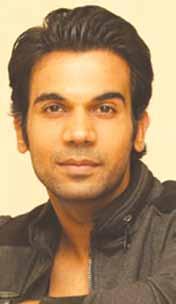
Rajkummar Rao on National Award and playing ‘Shahid’
Rajkummar Rao, who won the best actor National award for his role in Hansal Mehta’s ‘Shahid’, says portraying the slain lawyer-activist’s life was challenging but inspiring.
The 29-year-old actor’s performance as the titular character in the Hansal Mehta directed film saw him sharing the National award with Malayalam actor Suraj Venjaramoodu.
“It has been an exciting year. I am proud of Shahid. His family is really proud of him for what he stood for. I feel bad for his unfortunate and tragic death. But I was very inspired and moved by his story. This will forever stay in my heart as he stood for what he believed in,” Rao told PTI.
However, playing Shahid in the biopic was not an easy task for the actor, who started his Bollywood journey with Dibakar Banerjee’s ‘Love, Sex Aur Dhoka’.
“It was quite challenging and difficult. There was not enough material on him on the internet. My only source of information was his family. There was so much that I had to put through my imagination which I think has worked,” he said.
After the huge success of his last movie ‘Queen’, the actor is reuniting with Mehta for ‘City Lights’.
In the film, the actor plays a small town trader
from a village in Rajasthan, who migrates to Mumbai in search of better livelihood. The movie follows his struggle in adjusting to the metropolitan city.
Rajkummar had to shed 7-8kgs for the role.
“This role has taken so much out of me as an actor. I think this character is really high on emotions and has drained me. I had to lose 7-8 kgs in the film,” he said.
The film produced by Mahesh Bhatt, is expected to hit theatres on May 1. It stars newcomer Patraleka opposite Rajkummar.
The actor would be next seen opposite Sonam Kapoor in ‘Dolly Ki Doli’.
“I am shooting for ‘Dolly Ki Doli’ right now. That’s a light and funny film. It’s like a breather for me after my last few films,” he said.
I have no issues with Shraddha Kapoor, tweets Sonam Kapoor
Bollywood fashionista
Sonam Kapoor has made it clear that she has no issues with ‘Aashiqui 2′ actress and her contemporary Shraddha Kapoor after she allegedly ignored the ‘Aashiqui 2′ star at a fashion awards event.
According to a video aired on a leading entertainment channel, Sonam walked past Shraddha at the red carpet of the Grazia Young Fashion Awards. But the actress took to Twitter to clarify why she did not stop
Amitabh
to greet Shraddha.
Putting her point forward, Sonam Kapoor tweeted, “I have no issue with @
ShraddhaKapoor I was late and had to run in! #youknowwhatimean.”
Sonam recently made
headlines when she took potshots of other actresses – Deepika Padukone, Parineeti Chopra and Alia Bhatt on filmmaker Karan Johar’s chat show. When asked what fashion advice she would give Parineeti, Sonam had said that the actress should stop wearing tight clothes while Alia should dress her age. The ‘Raanjhanaa’ actress said her contemporary Deepika had an over enthusiastic PR team. (Indian Express, with PTI inputs)
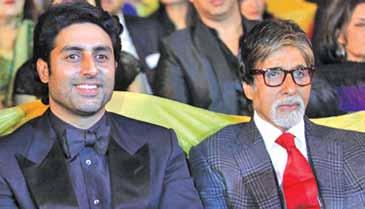
Bachchan is rocking at 71,
says son Abhishek Bachchan
Bollywood megastar has done it again with ‘Bhoothnath Returns. ‘Big B’s latest venture has spelled success for the star at the age of 71, a feat not many of his colleagues can claim.
‘Big B’s son Abhishek Bachchan tweeted, “71 and still socking it outta the park!! #legend #BigB
#BhootnathReturns #partytobantihai”
The political satire film has earned more than Rs. 25 crore within four days of its release. The film has received good reviews for the content and its presentation. The film fraternity too has a good word to spread about the film.
‘Big B’ says,
“Bhoothnath Returns” wins the election and throws a success party! A moment of happiness .. naah … so cliched and done statement ! A moment etched in great pain and sweat and tears .. a moment which shall be treasured for posterity.” He also said, ‘The success has meant so much to all of us. To pull off a film with no stars, no large box office names, and no conventional escapist content – the one renowned to rattle up some serious numbers at the box office.”
However, Amitabh Bachchan also noted that the success party in ‘his time’ was more to celebrate a film’s ‘silver or gold jubliee’, which has now ‘lost entity’.
Amitabh Bachchan
wrote on his blog, “Cathartic in countenance, such elements of joy and celebration were a million miles away in our times. A jubilee function or that of a silver or gold was almost a lost entity. It meant the world to put one together and then to wait for it to happen after its 50 weeks or so. Now … its instant; the status known and announced in a jiffy, to the rest of the world .. no mementoes, no nothing .. just a large crowd of invites, a stage for the cast and crew to assemble, short speeches of the ‘fun’ and the ‘frolic’ enjoyed by all, a photo – op and back home after a thousand ‘selfies’ ! That ladies and gentleman is the crux .. at the end of the day … errrmm … night !!” (Indian Express)
How running 'may preserve thinking skills'
Aerobic exercise in your 20s may protect the brain in middle age, according to a US study.
Activities that maintain cardio fitness - such as running, swimming and cycling - led to better thinking skills and memory 20 years on.
Scientists say the research, reported in Neurology, adds to evidence the brain benefits from good heart health.
Cardio fitness is a measure of how well the body absorbs oxygen during exercise and transports it to the muscles.
Researchers at the University of Minnesota, Minneapolis, tested almost 3,000 healthy people with an average age of 25.
They underwent treadmill tests of cardiovascular fitness during the first year of the study and again 20 years later.
They were asked to run for as long as possible before they became exhausted or short of breath.
Cognitive tests taken 25 years after the start of the study measured memory and thinking skills.
People who ran for longer on the treadmill performed better at tests of memory and thinking skills 25 years on, even after adjusting for factors such as smoking, diabetes and high cholesterol.
Total fitness
People who had smaller time differences in their treadmill test 20 years later were more likely to perform better on the executive function test than those who had bigger differences.
"Many studies show the benefits to the brain of good heart health," said study author Dr David Jacobs.
"This is one more important study that should remind young adults of the brain health benefits of cardio fitness activities such as running, swimming, biking or cardio fitness classes."
Dr Jacobs said a concept was emerging of total fitness, incorporating social, physical and mental aspects of health.
"It's really a total package of how your body is and the linkage of that entire package of performance - that's related to cognitive function many years later and in mid-life," he told BBC News.
Dr Simon Ridley, Head of Research at Alzheimer's Research UK, said: "A growing body of evidence suggests exercise may reduce the risk of cognitive decline and dementia, and much research has shown a link between healthy habits in mid-life and better health in old age.
"Investment in research is vital to better understand how we can protect our brains as we age." (BBC)
Feeling like your brain is in a fog, your heart is skipping beats or your muscles are cramping could be signs that you're not getting enough potassium. But never fear – this important mineral can be found in some of nature's most delicious foods. The next time you visit the store, keep this potassium-packed grocery list in mind to help get your brain, heart and muscles working smoothly again in short order.
This tasty fruit is famous for its high potassium content. One medium banana contains about 11 per cent of your daily potassium requirement, in addition to plenty of vitamin C and vitamin B6.
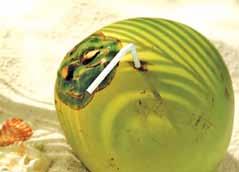
In recent years, coconut water has been marketed as a natural energy or sports drink due to its high potassium and mineral content.
Times Healthy Living
Tomatoes are consumed in diverse ways, including raw, as an ingredient in many dishes, sauces, salads and drinks. Tomatoes also have high potassium content.
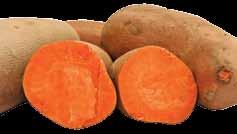
One cup of cubed sweet potatoes contains even more potassium than a banana. Load up on your daily potassium with this fibre-full food that also contains 377 per cent of your daily vitamin A.
You might associate salmon with its heart-friendly omega 3s, but did you know that just half a fillet of Atlantic salmon has more than 15 per cent of your daily potassium needs?
This healthy green is packed with antioxidants and potassium. Just one stalk has 10 per cent of your daily potassium needs, and a bunch contains about 40 per cent. Plus, you'll get tons of immune-boosting vitamin C and fibre in the bargain.
Avocados are a true superfood. Packed with heart-healthy fats and the ability to lower the stress-hormone cortisol, one avocado alone also contains 975 mg of potassium, or 20 per cent of your daily requirement.
Minor foot wounds a major threat for diabetics
For people with diabetes, one foot ulcer is very likely to lead to another, according to a new study that finds even minor lesions create a major risk of more severe foot wounds.
The best defense, Dutch researchers say, is to treat even minor sores carefully and to protect feet from pressure and injury with specialized footwear.
"I hope medical specialists, and other health care practitioners will use this knowledge and implement it in clinical practice," said senior author Sicco Bus, staff scientist with the Academic Medical Center at the University of Amsterdam.
People with diabetes often lose feeling in their feet as a result of nerve damage, known as neuropathy. The lack of sensation makes diabetics prone to injure their feet without realizing it, and allows small wounds to grow into serious ulcers that can eventually lead to infection or gangrene.
Past research has shown that having had a foot ulcer is a significant risk factor for having more of them.
"Ulcer recurrence is a
debilitating condition for the patient, risking further complications such as infection and amputation, and influencing loss of patient mobility and quality of life," Bus told Reuters Health.
To find out what factors most strongly predict who will develop foot ulcers, Bus and his colleagues analyzed data from a large trial of specialized footwear for diabetes patients with nerve damage in their feet.
For the new analysis, the researchers focused on 171 participants, all of whom reported having a foot ulcer at least 18 months before the study began. For a period of 18 months, each person was checked for new ulcers every three months, and interviewed about their daily habits.
The pressure on their feet while walking barefoot and in the special footwear was also measured. During one week,
the soles of their feet, 41 of them as a result of unrecognized "trauma," Bus and his colleagues report in the journal Diabetes
Among those 41, the people who had minor lesions when the study began were nine times more likely than those who didn't to develop an ulcer. Often the wounds were in the same place as a previous ulcer, suggesting there was ongoing pressure or injury happening at that spot, according to the researchers.
Patients who wore shoes customized to the pressure points of their feet, however, had a 57 percent lower risk of developing a new ulcer compared to those who didn't.
Currently, to prevent ulcers, doctors and nurses have to check the feet of diabetic patients every day for wounds or use specialized tools for determining pressure points that might be prone to
"Some diabetics wear wounds on their feet kind of in the same way that a person might wear a hole in their sock, but for a diabetic, this hole gets infected and often leads to an amputated foot," Dr. David Armstrong, a professor of surgery at the University of Arizona, told Reuters Health.
"(Neuropathy) is a massive problem, it's silent, and it doesn't hurt, even in instances of gangrene. It's no one's fault, but no one pays attention to it. This study opens up avenues for prevention," said Armstrong, who was not involved in the research.
The protective effect of customized footwear seen in the study highlights the benefits of personalized healthcare in highrisk patients, noted Dr. Lawrence Lavery, a professor of surgery at the Texas A&M Health Science Center College of Medicine and the Scott and White Memorial Hospital in Temple, Texas.
Private insurers will have to step up to pay the expense, Lavery said. "This is something that is well worth investing in."
(Reuters)
Bananas
Coconut Water
Tomatoes
Sweet Potato
Salmon
Broccoli
Avocado
Get rid of drab window treatments, and update your space with the hottest colours and latest fabrics
Ingredients
2 cups sugar
1 1/3 cups vegetable oil
1 teaspoon pure vanilla extract
3 extra-large eggs
2 cups all-purpose flour
2 teaspoons ground cinnamon
2 teaspoons baking soda
1 1/2 teaspoons salt
3 cups grated carrots (less than 1 pound)
Method
Preheat the oven to 350 degrees F.
Beat the sugar, oil, and vanilla together in the bowl of an electric mixer fitted with a paddle attachment. Add the eggs, 1 at a time. In another bowl, sift together the flour, cinnamon, baking soda, and salt. With the mixer on low speed, add 1/2 of the dry ingredients to the wet ingredients. Add the grated carrots, raisins, and walnuts to the remaining flour, mix well, and add to the batter. Mix until just combined.
Line muffin pans with paper liners. Scoop the batter into 22 muffin cups until each is 3/4 full. Bake at 400 degrees F for 10 minutes then reduce oven temperature to 350 degrees F and cook for a further 35 minutes, until a toothpick comes out clean. Cool on a rack.
For the frosting, cream the cream cheese,
1 cup raisins
1 cup chopped walnuts
For
When the cupcakes are cool, frost them generously and serve.
Easter Bunny Treats
Ingredients
2/3 cup vanilla frosting
30 large marshmallows
Pink gel or paste food colouring
Method
Frost the tops of 12 large marshmallows; stack a large marshmallow on top of each. Quarter the remaining large marshmallows; set aside for ears. Tint 1/4 cup frosting pink. Cut a small hole in the corner of a pastry or plastic bag; place pink frosting in bag.
Pipe a ribbon between the stacked marshmallows for bow tie. With white frosting, attach red hearts for eyes and a pink heart for nose. Pipe pink whiskers and smile.
For ears, pipe the center of quartered marshmallows pink; attach to head with white frosting. With the remaining white frosting, attach the miniature marshmallows for legs and tail. Let stand until dry. Yield: 1 dozen.
Red and pink heart-shaped decorating sprinkles 60 miniature marshmallows
inse the pan with cold water before scalding milk to prevent sticking. Line the bottom of your refrigerator’s crisper drawer with a paper towel to absorb liquids that make vegetables wilt.
Do not roast poultry in an oven temperature lower than 325 degrees (170 C). Poultry should be roasted at 325 degrees or higher to avoid potential food safety problems.
To find out if oil is the proper temperature for frying foods: For deep-fat frying, drop a cube of white bread into the hot oil. If it browns evenly in 60 seconds the oil is 350-365 degrees, in 40 seconds, 365-382 degree, 20 seconds – 382-390 degrees. For shallow frying, the oil is hot enough if it is shimmering and rippling along the bottom of the pan. The most reliable way to gauge the temperature is to use a deepfat thermometer.
Cover the bottom of your trashcan with old newspapers to soak up leaks and odours.
To keep bacteria from taking up permanent residence in your kitchen sponges, rinse them with water at the end of each day, squeeze, then put in the microwave for three minutes. Let cool before touching. Do the same with your cutting boards, IF they are microwaveable.
To prevent the wax from melting and sticking to the inside of a votive candle holder, pour a bit of water in the holder, then place the candle on top. If you're reading this tip too late, and there's already wax stuck inside your candle holder, pop it in the freezer for an hour. The wax will chip right off.
butter, and vanilla in the bowl of an electric mixer fitted with a paddle attachment. Add the sugar and beat until smooth.
When you curtail a word, you remove the last letter and still have a valid word. You will be given clues for the two words, longer word first.
Example: Begin -> Heavenly body
Answer: The words are Start and Star.
1. Soapsuds -> Woodworking machine
2. Discover -> Fish part
3. Glue -> Gone before
4. Dismissed from the mind -> Do without
5. Boast -> Supporting undergarment
6. Woman -> Boy
7. A harsh, rumbling sound -> Become larger
8. Area cut by a scythe's swing -> Hit swiftly
18 Times Creative Writing
It was raining. Monica sighed. It would figure, she thought. On the day of the New Hope Baptist Church Easter egg hunt. Of all days. She sighed again. Deeply, this time. Monica was nine years old. For three years straight, she had tried to win the church Easter egg hunt. She had failed each year and she was determined to win this time.
The church Easter egg hunt was well known throughout the small town Monica lived in. Each year, a special Easter egg was painted with an Easter bunny one side and a gold cross on the other. It was the only painted Easter egg hidden on the church grounds. All of the rest were pastel coloured Easter eggs. So, finding the painted Easter egg was a monumental and life changing occasion. The painted egg hunt, they called it, at her school.
What was really funny and quite special was the fact that children begged and dragged their parents to this church all through the year. It was their favourite church. All because of the famous painted Easter egg hunt. Every Easter, all children had an equal chance to find the prized painted egg. The prize was money, a sweatshirt with New Hope's logo on it and the honoured free candy for one year from
the local drug store prize. That was the lure. The big prize. Imagine being able to just walk into the store and pick out your favourite candy for free. Every day. For an entire year. Now, that made Easter egg hunting quite a sport among this town's kids. A yearly very famous holiday. A joyous one. Well, the rain did finally stop and the Easter egg hunt was scheduled for two o'clock. Easter had arrived and all of the children lined up to start the hunt. They began. Monica knew the church grounds very well and she also knew that the prized painted egg had been
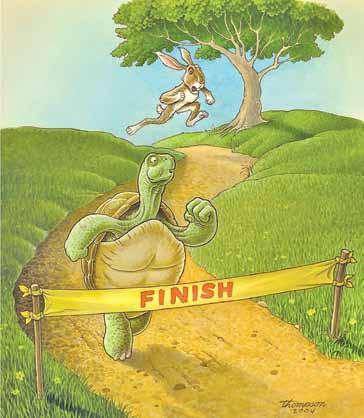
The Tortoise and the Hare
Once upon a time there was a hare who, boasting how he could run faster than anyone else, was forever teasing tortoise for its slowness. Then one day, the irate tortoise answered back: “Who do you think you are? There’s no denying you’re swift, but even you can be beaten!” The hare squealed with laughter.
“Beaten in a race? By whom? Not you, surely! I bet there’s nobody in the world that can win against me, I’m so speedy. Now, why don’t you try?”
Annoyed by such bragging, the tortoise accepted the challenge. A course was planned, and the next day at dawn they stood at the starting line. The hare yawned sleepily as the meek tortoise trudged slowly off. When the hare saw how painfully slow his rival was, he decid-
ed, half asleep on his feet, to have a quick nap. “Take your time!” he said. “I’ll have forty winks and catch up with you in a minute.”
The hare woke with a start from a fitful sleep and gazed round, looking for the tortoise. But the creature was only a short distance away, having barely covered a third of the course. Breathing a sigh of relief, the hare decided he might as well have breakfast too, and off he went to munch some cabbages he had noticed in a nearby field. But the heavy meal and the hot sun made his eyelids droop. With a careless glance at the tortoise, now halfway along the course, he decided to have another snooze before flashing past the winning post. And smiling at the thought of the look on the tortoise’s face when it saw
found in a very unusual location every year. No looking under all of the bushes or behind all of the flowers. She thought and thought hard. She looked around and tried to think of the last place that someone would look for an Easter egg. Last year, it had been found behind the tire of the pastor's car. All of the church grounds were considered Easter egg hiding territory. One year, it had been put inside of the church, by the front door. You just never knew. That was the fun of it. She looked around and thought some more. She was not going to waste her
time madly dashing around searching. She was going to calmly figure this one out. She thought hard. Suddenly, she saw something. Something that she thought no one else would see or notice. She went running out towards the New Hope church sign in the front of the churchyard. There were two bushes on each side of the sign. She held her breath and looked behind one. Nothing. She turned and looked behind the other. She saw a glimpse of white. She reached her hand in and pulled out an egg. With a gold cross. And an Easter bunny painted on it. She screamed. She screamed loudly. "I found it!" All came running. And so, she did. She did find it. As all gathered around to congratulate her, the pastor asked her "Do you know what this means?" She said "Yes, I get free candy for a year!" He laughed and said "Yes, you do. But, it means something else, too. It means, as you look, you may find but, if you think hard and look, you will find even more." Monica smiled. "And so, I did!" she said. The pastor said "As a sign of Easter, look for signs that love is all around you." Yes, Monica thought, this is indeed one. A lovely sign. A sweet one. Filled with hope.
(By Bridgitte Williams)
the hare speed by, he fell fast asleep and was soon snoring happily. The sun started to sink, below the horizon, and the tortoise, who had been plodding towards the winning post since morning,
was scarcely a yard from the finish. At that very point, the hare woke with a jolt. He could see the tortoise a speck in the distance and away he dashed. He leapt and bounded at a great rate, his tongue lolling, and gasping for breath. Just a little more and he’d be first at the finish. But the hare’s last leap was just too late, for the tortoise had beaten him to the winning post.
Poor hare! Tired and in disgrace, he slumped down beside the tortoise who was silently smiling at him. “Slowly does it every time!” he said. (An Aesop fable)
Believe, Believe in the
Power of Love
Believe, believe in the power of love
To save us all from death and sin, And God that way your heart will move. Christ came to Earth to free us of The state of vengeance we were in. Believe, believe in the power of love
To change the heart from snake to dove, To make dust bloom and goodness win, And God that way your heart will move.
Christ arose from death to prove That we a new life could begin. Believe, believe in the power of love
To bring us to a life above, A life of glory near to Him, And God that way your heart will move.
Christ will all our sins remove And make us feel His joy within. Believe, believe in the power of love, And God that way your heart will move.
Nicholas Gordon
The Easter Bunny
There's a story quite funny, About a toy bunny, And the wonderful things she can do; Every bright Easter morning, Without warning, She colours eggs, red, green, or blue.
Some she covers with spots, Some with quaint little dots, And some with strange mixed colors too, Red and green, blue and yellow, But each unlike his fellow Are eggs of every hue.
And it's odd, as folks say, That on no other day In all of the whole year through, Does this wonderful bunny, So busy and funny, Colour eggs of every hue.
If this story you doubt She will soon find you out, And what do you think she will do? On the next Easter morning
She'll bring you without warning, Those eggs of every hue.
M. Josephine Todd
The ebb and flow of men's beard fashions may be guided by Darwinian selection, according to a new study.
The more beards there are, the less attractive they become - giving clean-shaven men a competitive advantage, say scientists in Sydney, Australia.
When "peak beard" frequency is reached, the pendulum swings back toward lesser-bristled chins - a trend we may be witnessing now, the scientists say.
Their study has been published in the Royal Society journal Biology Letters.
In the experiment, women and men were asked to rate different faces with "four standard levels of beardedness".
Both beards and cleanshaven faces became more appealing when they were rare.
The pattern mirrors an evolutionary phenomenon"negative frequency-dependent sexual selection", or to put it more simply "an advantage to rare traits".
The bright colours of male guppies vary by this force - which is driven by females' changing preferences. Scientists at the
University of New South Wales decided to test this hypothesis for men's facial hair - recruiting volunteers on their Facebook site, The Sex Lab.
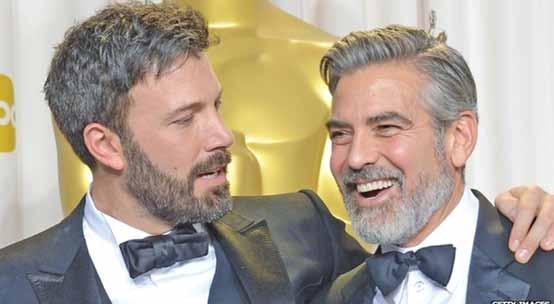
"Big thick beards are back with an absolute vengeance and so we thought underlying this fashion, one of the dynamics that might be important is this idea of negative frequency dependence," said Prof Rob Brooks, one of the study's authors.
"The idea is that perhaps people start copying the George Clooneys and the Joaquin Phoenixs and start wearing those beards, but then when more and more
people get onto the bandwagon the value of being on the bandwagon diminishes, so that might be why we've hit 'peak beard'."
"Peak beard" was the climax of the trend for beards in professions not naturally associated with a bristly chin - bankers, film stars, and even footballers began sporting facial hair.
Some say the Rubicon was crossed in January when Jeremy Paxman, the BBC Newsnight presenter, shaved his beard off, saying "beards are SO 2013".
Paxman's beard - which briefly trended on Twitter - sparked a debate about pogonophobia - the fear of
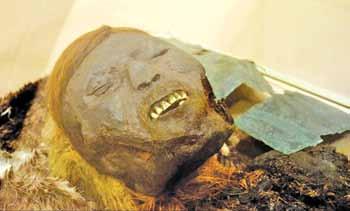
Siberian Mummies in Copper Masks pose Mystery
Russian archaeologists have resumed excavations in a remote site near the Arctic Circle in the attempt to understand a perplexing find of medieval mummies clad in copper masks.
Roughly 1,000 years old, the mummies were found during a series of excavations that started in 1997 in a Siberian necropolis near the village of Zeleniy Yar, at the base of a peninsula local people called "the end of the Earth."
The archaeologists found 34 shallow graves with seven male adults, three male infants, and one female child wearing a copper mask. Buried with a hoard of artifacts, most of the bodies had shattered or missing skulls, and smashed skeletons.
Five mummies were unearthed still shrouded in copper and blankets of reindeer, beaver, wolverine or
bear fur, while three copper masked infant male mummies were found bound in four or five copper hoops two inches wide.
The best preserved mummy was a red-haired man found in a wooden sarcophagus. He was covered chest to foot in copper plate and was laid to rest with an iron hatchet, furs and a bronze head buckle depicting a bear.
"Nowhere in the world are there so many mummified remains found outside the permafrost or the marshes," Natalia Fyodorova, of the Ural branch of the Russian Academy of Sciences, told the Siberian Times.
The soil at the site is sandy and not permanently frozen. Scientists have determined that the mysterious people were mummified by accident due to a dip in temperatures in the 14th century. The copper may
have also prevented oxidation of the remains.
Intriguingly, the legs of the dead all point toward the nearby Gorny Poluy River. According to Fedorova, such posture might have had a religious meaning. However, archaeologists admitted the graves feature burial rites they had never seen before.
Excavation was halted in 2002 following objections by local people who feared the archaeologists disturbed the souls of their ancestors. But work has resumed now.
"It is a unique archaeological site. We are pioneers in everything from taking away the object of sandy soil, which has not been done previously," Fyodorova said.
Among the artifacts discovered near the copper clad mummies are an iron combat knife, bracelets, silver medallions and bronze figurines.
The archaeologists also found bowls originating in Persia, some 3,700 miles to the southwest, dating from the 10th or 11th centuries.
The finding suggests that around one millennium ago Siberia was not a remote and inhospitable site, but an important trading crossroad.
Further research on the mysterious people will include genetic tests.
(Discovery News)
pendent preferences may therefore contribute to changing beard fashions, Prof Brooks concluded.
"We know beards go through cyclical fashions. People used to speak about a 30-year timescale," he said.
"There is a wonderful paper studying photographs of men from 1871 to 1972 in the Illustrated London News. Sideburns moved on to moustaches, then full beards.
stage for the recent comeback in beardedness.
"When Greece's economy tanked - did beards take off? That's something we're going to look at."
One of the paradoxes of evolution is that genetically strong traits favoured by one sex do not simply become fixed in the other - a level of diversity is often maintained.
beards.
In this latest experiment, 1,453 women and 213 men were asked to rate the attractiveness of different samples of men's faces.
Some were shown mostly "full" beards. Others were shown mostly clean-shaven faces. A third group were shown an even mixture of all four varieties - cleanshaven, light stubble, heavy stubble and full beard.
Both women and men judged heavy stubble and full beards more attractive when they were rare than when they were common. And likewise for clean-shaven faces.
Negative frequency-de-
"In the 1970s it was handlebar moustaches. In the 80s it was Magnum PI moustaches. In the 90s we saw a lot of clean shaven men, and now big bushy beards are back."
The recent boom may have its roots in the financial crisis of 2008, Prof Brooks suggests.
"I think one of the reasons beards have made a comeback now is that it's a difficult time.
"Young men are competing to attract someone when work is not easy to come by. So we might expect some aspects [of masculinity] to get turned up to eleven.
"After the Wall Street Crash in the 1920s there is some circumstantial evidence that beards got big again. So maybe economic conditions have set the
Though beard styles are of course not spread via genes, there may be other visible human traits which are.
"With female hair colour, there has been speculation that red, brown and blonde spread via their noveltybut the evidence is very ambiguous," Dr Brooks told BBC News. His team plan to continue their pogonophilic investigations and are looking for volunteers for their latest experiment testing how people like faces with varying levels of beardedness.
"Heavy stubble seemed to be the best in our last study. Maybe a 5-10 day growth. But those describe average tendencies," he said.
"Luckily in real life, we never mate with an average. We mate with an individual." (BBC)
What Apple’s move to digital marketing means
It’s hard to think of many companies that have had more of an impact on mass media, culture, and technology than Apple. From its products to its ads, Apple has taken brand marketing to new heights (when a silhouetted image with white ear buds is instantly recognizable, you know you’ve done something right).
So it’s intriguing to see how Apple is making more of a shift to digital marketing. The recent announcements about its decisions to bring on board new agencies (AKQA and Huge) that are generally “digital first” organizations is noteworthy. For all of the modern feel of Apple’s marketing and advertising, it has been very much an old school way of doing things: we know best and we’re going to talk at you. Apple’s recent moves are a significant shift in the direction of on-demand marketing, which is what successful digital marketing is all about.
On-demand marketing is all about being actively responsive to your customers (and potential customers). This shift is very much about responding to four important trends in consumer expectations:
1. Now: Interacting any-
ByTe
where at any time.
2. Can I: Doing things they’ve never been able to do before
3. For me: Having truly personalized experiences.
4. Simply: Having all interactions to be easy.
This world of marketing is about moving from “always-on” to “always-relevant,” from “marketing at customers” to “marketing as a service.” For marketing to be relevant and a real service – and by service, I mean something that actually helps the consumer either answer a question or
get something done – that means having a very clear sense of the consumer decision journey. That requires three levels of analysis:
Telescope. A clear view of the broad and long-term trends in the market, category, and brand. Digital sources that track what people are looking for (search), what people are saying (social monitoring), and what people are doing (tracking online, mobile, and in-store activities) represent rivers of input providing constant warning signs of trouble or signals of latent opportuni-
Glow in the dark road unveiled in the Netherlands
Glow in the dark road markings have been unveiled on a 500m stretch of highway in the Netherlands.
The paint contains a "photo-luminising" powder that charges up in the daytime and slowly releases a green glow at night, doing away with the need for streetlights.
Interactive artist Daan Roosegaarde teamed up with Dutch civil engineering firm Heijmans to work on the idea.
The technology is being tested with an official launch due later this month.
It is the first time "glowing lines" technology has been piloted on the road and can be seen on the N329 in Oss, approximately 100km south east of Amsterdam.
Once the paint has absorbed daylight it can glow for up to eight hours in the
dark.
Encourage innovation
Speaking to the BBC last year about his plans
Mr Roosegaarde said: "The government is shutting down streetlights at night to save money, energy is becoming much more important than we could have imagined 50 years ago. This road is about safety and envisaging a more selfsustainable and more interactive world."
Mr Roosegaarde's projects aim to help people and technology to interact. His past projects have included a dance floor with builtin disco lights powered by dancers' foot movements, and a dress that becomes see-through when the wearer is aroused.
"I was completely amazed that we somehow spend billions on the design and R&D of cars but somehow the roads - which actu-
ally determine the way our landscape looks - are completely immune to that process," Mr Roosegaarde said.
Heijmans was already working on projects involving energy-neutral streetlights when Mr Roosegaarde teamed up with the company.
"I thought that was updating an old idea, and I forced them to look at movies of jellyfish. How does a jellyfish give light? It has no solar panel, it has no energy bill.
"And then we went back to the drawing board and came up with these paints which charge up in the daytime and give light at night," he said.
Heijmans says that the glow in the dark technology is also "a sustainable alternative to places where no conventional lighting is present". (Excerpted from BBC)
ty. For Apple, such analytics could help them better understand which people get stuck - and where they get stuck - in using their applications, or providing guidance to their app developers on customer behavior that could help them design better experiences. Binoculars. A complete, integrated picture of where they spend their money, which interactions actually happen, and what these outcomes are. Most directsales companies (retailers, banks, travel services), for example, measure the per-
Iformance of their spending by analyzing what consumers do just before making a purchase, e.g. Googling a product. That level of analysis is too narrow because it doesn’t take into account the advertising, social media chatter, and other media out there that also influence the consumer during his/her decision journey. Getting such return on marketing investment data, may lead Apple to major shifts in how it connects with its customers, such as trying out and scaling personal recommendations, educational material, or crowdsourced suggestion contests. These would be huge changes for a brand that has always acted as if it knew what was best, but they would be steps towards a new level of emotional engagement from the brand's
fans.
Microscope. Technology and analytics to create services, messages, and offerings that are relevant to the individual. Research shows that this level of personalization can deliver five to eight times the ROI on marketing spend and lift sales 10% or more. Apple will likely develop a much better sense, over time, of how to manage the messaging and support it provides each customer to get them fully engaged with their products, apps, and content. Right now, little contact from Apple feels very personalized.
It will be interesting to see how Apple merges its fantastic creative energy and capabilities with a more digital, interactive, and analytical approach to marketing. (LinkedIn)
Google buys solar-powered drone maker Titan Aerospace
nternet search giant Google has bought US high-altitude drone maker Titan Aerospace for an undisclosed sum.
Google said the acquisition was intended to help the firm's efforts to expand internet access.
Titan Aerospace, which is building two types of solar-powered drones that can fly for years, says it expects "initial commercial operations" by 2015.
The firm, which has about 20 employees, will continue to be based in Moriarty, New Mexico.
"It's still early days, but atmospheric satellites could help bring internet access to millions of people, and help solve other problems, including disaster relief and environmental damage like deforestation," Google said in a statement.
"It's why we're so excited to welcome Titan Aerospace to the Google family."
Google's purchase follows Facebook's announcement earlier this year that it had bought UK-based drone maker Ascenta for US$20m (£12m).
The two firms are competing to be able to use cutting-edge technology, like drones and high-altitude balloons, to deliver internet to more of the world's population. (BBC)
The composer of the original Halo soundtracks says he has been fired from his job at the video games' creator.
Marty O'Donnell revealed the news in a tweet: "I'm saddened to say that Bungie's board of directors terminated me without cause on April 11, 2014."
Bungie has confirmed the move but suggested they remained "friends".
Mr O'Donnell had been working on music for the firm's forthcoming title Destiny in collaboration with Sir Paul McCartney.
In an interview about the tie-up for Edge magazine last year, Mr O'Donnell commented: "It's hard for me - and some of the guys get impatient about it, like 'Hey Marty, quick just write an iconic theme and show it to us'.
"But that's not what I did with Halo. I like to write music... [and] we have this really great start on many, many pieces of music that all seem to work together well."
A spokesman for Sir Paul said he was "unable to pass comment". (BBC)
he E R Burrowes
TSchool of Art was founded in 1975 by the late Director of Culture, the polymath Dr. Denis Williams (d. 1998), artist, art educator, pioneer archaeologist and anthropologist. The institution was from the onset modelled on the British curriculum of formal art training. Founded after Guyana became independent in 1966 and a Republic in 1970, and also after the ground-breaking Caribbean Festival of Arts (Carifesta) in 1972 that was held in Guyana, the school was a timely addition to the cultural life of a young nation.
It was by no accident that the Burrowes School of Art came into being. Its predecessor is the Working Peoples Art Class (WPAC), which was formed by Barbadian-born acclaimed “Father of Guyanese Art” E R Burrowes in 1948. Denis Williams was a member of the WPAC. On returning from his art scholarship to Britain he felt compelled to continue the tradition of art groupings, which he knew best, resulting in him founding an art institution and naming it after his teacher and mentor E R Burrowes.
The Burrowes School of Art has survived many trying times since coming in existence over thirty-nine years, and so do its tutors. Moving from the village of
Eccles on the East Bank to Sophia east of Georgetown then to Carmichael Street west of Georgetown and then to Carifesta Avenue where it presently sits, the school has persevered and has seen much turnover of tutors.
The tutors, most of whom are past students of the school, come from a tradition of bonding, which was evident in those testing days of financial constraints when they themselves were students. Some days even a meal seemed impossible for many, but a solution by way of a ‘bush cook’ saw many smiling faces. It was the sculptors who led the way in the cooking since a mistaken chip of wood in the pot was more tolerated than a lump of paint or even clay. This act of bonding strengthened the barriers against any likely ethnic, class or economic discrimination that might have impeded unity. These tutors are living testimony of survival against those social, political and economic constraints that constantly presented themselves.
Continuing in the tradition of unselfish gains, the tutors are seen mentoring and nurturing, in a formal way, students who have come with a willingness to learn the requisite skills that will determine their future in the visual arts. Bestowed with the responsibility of imparting the requisite knowledge in the various disciplines, the Tutors
are seen as the vanguards of the institution. With due diligence and established rapport between tutors and students the E R Burrowes School of Art, and its culture as an institution, will live on against all odds.
The ongoing Tutors Exhibition of Burrowes School of Art at Castellani
House, Vlissengen Road, is opened to the public. Admission is free. Gallery hours are 10 a.m. to 5 p.m. Monday to Friday and 2 to 6 p.m. on Saturday; the gallery is closed Sundays and holidays. (Text by Curator Ohene Koama) (Cover photo: 'Dancers' 2012 by
Ivor Thom)
'On my way home' (2012) by Nicole BissooWilliams
'Candle lamp' (2014) by Josefa Tamayo
'Before the worst' (2013) by Sheena Henry
'Vase' (2012) by Everly Austin
'Crazy love' (2003) robert Cummings
'Mask i' (2010) by Dahlia H peters
In the lore of club cricket in Guyana, the saga of the Demerara Cricket Club (DCC) is as colourful as the charismatic characters that have represented this venerable organisation or those who have formed its intensely loyal fan base throughout the years.
History shows that DCC was established in 1912 by a group of Portuguese businessmen as an alternative to the British expatriate dominated Georgetown Cricket Club (GCC), but membership was open to anyone after 1913. Through the early years these clubs, just blocks down New Garden Street from each other, developed distinctly different profiles, with the GCC Bourda club,
maintaining its colonial upscale exclusivity, while the Queenstown club entertained a middle class, multiethnic membership. If GCC was “Guyana’s Lords”, so to speak, where in attendance one had to be buttoned up and sophisticated, then DCC was “The Oval” – the alternative iconic venue where one could relax and be irreverent.
The founding fathers of DCC are long gone and the complexion of the organisation has changed from the turn of the 20th century to properly reflect the society. Now it is imperative that the president of the club Alfred Mentore, his executive and the inheritors of the 21st century like Chris
Barnwell, the Christian brothers, Gajanand Singh, Travis Dowling and company, maintain its ideals of integrity and fair play and its tradition of excellence as the innings continue.
Even in this age of dizzying technological development, they must extol the virtues of sports and simple club life, as well as the importance of club cricket as a rite of passage, and continue to spread the mantra of discipline to the incoming family of young men and women.
DCC cricket legends Cricket is the one game that succeeded where the politicians desperately tried and failed.
Even before the failed West Indies Federation,
which lasted only from January 1958 to May 1962, it was cricket that proved to be the unifying force among the Caribbean people. Therefore, if one were to ask to identify the longest surviving union in the Caribbean, it would undoubtedly be cricket.
The history of the West Indies cricket team began in the 1890s, when the first representative sides were selected to play visit-
become the leading wicket taker in Test cricket; and Roy Clinton Fredericks, a left-hand opening batsman who blasted one of the fastest Test centuries in the history of the game.
These three players had one thing in common. They were all members of the DCC which is about to celebrate its centenary. Of the triumvirate, the first to make his entry into Test Cricket was Lance Gibbs.
highest Test score of 242 against India in Bombay in 1975. He was also a skilled medium-pace bowler and, early in his career, an excellent fielder.
As captain, he led the West Indies to two World Cup championships and a record 36 Test victories, including 11 consecutive wins. He also introduced the idea of using four fast bowlers— rather than two fast and two spin bowlers—to create
ing English sides. The West Indies Cricket Board joined the sport's international ruling body, the Imperial Cricket Conference, in 1926,and played their first official international match, granted Test status, in 1928, thus becoming the fourth Test nation.
Guyana has produced its fair share of cricketers, some whom have been outstanding even by world standards. There were Clive Hubert Lloyd, one of the most successful West Indies captains in the history of the game, Lancelot Richard Gibbs, an off-spinner who was the first spin bowler to
He was the first spinner to pass the 300 wickets milestone, after the English fast bowler, Fred Truman, and had an exceptional economy rate of under two runs per over. He was, however, a very poor batsman, who never made a half-century in first-class cricket.
Clive Lloyd, a tall, lefthanded batsman who wore thick glasses and wielded an unusually heavy bat, Lloyd could drive and hook the ball with tremendous power. In a Test career spanning 110 matches, he averaged nearly 47 runs per innings, had 19 centuries, and a highest score of 242. He made his
an unrelenting attack. He made his Test debut for the West Indies in 1966 and went on to become one of the longest-serving players and captains in Test match history. Like many West Indian cricketers, Lloyd also played county cricket in England. He was the first West Indian to appear in 100 Tests.
Celebrating its 102nd anniversary this year, DCC continues to be a symbol of discipline, determination and dedication, which still stands at the corner of Lance Gibbs and New Garden streets in Queenstown, Georgetown.
Aerial view of DCC ground
Cricketers practising at DCC
Bird's eye view of the public Buildings n.d. (Photo credit - Edward Boyer)
Main road, south, in New Amsterdam n.d.
The Ireng River (also known as Mau) forms the border between Guyana and neighbouring Brazil. It is accessible from the Guyana side south of Lethem, located on the border with Brazil.
Boat trips along the Ireng River and its tributary, the Rio Takatu, are ideal for birding enthusiasts.
Ireng is considered to be the most picturesque of Guyana's many rivers. Orinduik Falls and Takagka Falls are located on the Ireng River. There are other waterfalls on Ireng River, including the approximately 100-metre tall Kurutuik Falls. (Photos copyright to Michael C Lam. TheMichaelLamCollection.com)
Striking blue skies over ireng river
ireng twilight
Camp out at ireng
Down river of Orinduik
picturesque view of the river
24 Times Last Laugh
By Melvin Durai
My wife, Malathi, has a driver's license, and thank goodness for that, because if she didn't have one, she wouldn't be able to buy any beer.
You have to be 18 to shop at the liquor store. Malathi is much older than that, but it's still conceivable that a sales clerk might ask her for ID, considering all the liquor fumes in the store. And when you're standing in line with a bunch of hip youngsters, who are listening to their iPods or texting their friends on their iPhones, the last thing you want to be doing is whipping out your passport.
Passports are the uncoolest form of ID. You might as well bring your mother to the store to say, "This is my daughter. She is older than 18. Would you like to see some of her baby pictures?"
Yes, the driver's license comes in handy, though, in Malathi's case, it ought to be called a drinker's license. Not that Malathi drinks a lot. She has a little wine or beer occasionally. A couple of times a month, which means that she does a lot more drinking than driving. Unless you count the type of driving that involves me and a wall.
When she goes to work, she takes the bus. It’s convenient, economical and less stressful.
She gets to do some reading on the bus — and more than just all the tattoos.
When we go out as a family, guess who does the driving? Yes, Mr. Imbecile. That’s me. Malathi sits next to me and tells me what I did wrong: “Weren’t you supposed to turn left over there?” “Weren’t you supposed to slow down for the yellow light?”
“Weren’t you supposed to stay out of the ditch?”
Just the other day, while we were heading to church, I drove too fast on an icy exit ramp, lost control of our car and ended up in a pile of snow down a slope. Fortunately none of us was hurt, but Malathi gave me a look that said, “Weren’t you supposed to bring your brain with you?”
Despite a few mistakes like that, I think I’m a pretty good driver. I wish Malathi would compliment my driving now and then: “Sensational parallel parking, honey!” “Beautiful U-Turn, Melvin!” “Wonderful job getting out of the ditch!”
Better yet, I’d like her to do more driving, so I can do more complaining. But it rarely happens. Even on long trips, I’m usually doing the driving, and she’s usually doing the sleeping.
It’s so unfair, especially since women are supposed to be better drivers than men. Yes, a number of studies have shown this to be true —
and some of these studies, believe it or not, were conducted by men!
The problem, it seems, is that men are always driving under the influence. A few are guilty of driving under the influence of alcohol, but most are guilty of driving under the influence of testosterone.
Scientists are still trying to figure testosterone out, but it's clear the hormone affects male drivers in ways women can't even begin to understand. Consider these situations:
—You are driving down a road when a car zooms past you at a breakneck speed. Female response: "What an idiot! I hope he gets a ticket."
Male response: "What an idiot! He thinks his car is faster than mine. I'll show him."
—You accidentally cut off another driver. He shakes his head and blares his horn. Female response: "Oh no, he must be really mad at me. I'd better lower my head and look straight ahead."
Male response: "What an idiot! He thinks his horn is louder than mine. I'll show him."
—A driver tries to pass you, but loses control of his car, goes off the road and slams into two trees, knocking them down. Female response: "Oh no, I hope he isn't hurt." Male response: "What an idiot! He thinks his car can knock down more trees than mine. I'll show him."
Easter Riddles
Q. What stories does the Easter Bunny like best?
A. The ones with happy eggings!
Q. What did the father Easter egg do when the mother Easter egg told him a joke?
A. He cracked up!
Q. What kind of music do bunnies like?
A. Hip Hop.
Q. What did the Easter Bunny say to the carrot?
A. "It's been nice gnawing you!"
Top ten reasons to celebrate Easter
10. You absolutely love the movie, ‘The Ten Commandments’.
9. You look really, really good in yellow.
8. You just went on a low cholesterol diet and didn't want to waste all those eggs in the fridge.
7. You figure any Holiday that starts with a ‘Good Friday’ can't be all bad.
6. You love to bite the heads off chocolate bunnies.
5. It's a good time to check out your neighborhood church and not be noticed.
4. You have this bunny suit you love to wear, but are too insecure to wear it without a reason.
3. Even though you don't know what it is, you really like the sound of going to a ‘Passion Play’.
2. You figured since Jesus went to all THAT trouble to make it to the first Easter, you'd give it a shot.
1. As a Christian you celebrate the resurrection every other day, why not Easter too?
A guy joins a monastery and takes a vow of silence. He's allowed to say two words every seven years. After the first seven years, the elders bring him in and ask for his two words. "Cold floors," he says. They nod and send him away. Seven more years pass. They bring him back in and ask for his two words. He clears his throat and says, "Bad food." They nod and
send him away. Seven more years pass. They bring him in for his two words. "I quit," he says. "That's not surprising," the elders say. "You've done nothing but complain since you got here."
There was an old man sitting on his porch watching the rain fall. Pretty soon the water was coming over the porch and into the house.
The old man was still sitting there when a rescue boat came and the people on board said, "You can't stay here you have to come with us."
The old man replied, "No, God will save me." So the boat left. A little while later the water was up to the second floor, and another rescue boat came, and again told the old man he had to come with them.
The old man again replied, "God will save me." So the boat left him again.
An hour later the water was up to the roof and a third rescue boat approached the old man, and tried to get him to come with them.
Again the old man refused to leave stating that, "God will save him." So the boat left him again.
Soon after, the man drowns and goes to heaven, and when he sees God he asks him, "Why didn't you save me?"
God replied, "You dummy! I tried. I sent three boats after you!!"
A preacher was completing a temperance sermon; with great expression he said, "If I had all the beer in the world, I'd take it and throw it into the river."
With even greater emphasis he said, "And if I had all the wine in the world, I'd take it and throw it into the river."
And then finally, he said, "And if I had all the whiskey in the world, I'd take it and throw it into the river."
He sat down.
The song leader then stood very cautiously and announced with a smile, "For our closing song, let us sing Hymn # 365: "Shall We Gather at the River."