The St. Barnabas Special School has been consistent in its endeavour to help children with learning disabilities, equipping them with the necessary academic tools for a bright future.
The school was established in the year 1887 as a gift from J Roberts Rea. The school had an enrolment of 312 children and catered for children in both the primary and post-primary divisions. There were also a patrol unit, scouts and guides, and young brigade unit attached to the school. Late and former President Hugh Desmond Hoyte was a pupil of this school.
In 1985, the school was changed from an all-age school to a ‘special’ school for students who suffered a learning disability. The idea
for a special school to cater for the needs of slow learners arose out of a concern by the Ministry of Education for the relatively large number of students who pass through the school system without even mastering the basic skills in reading and writing. This is a problem not only found in Guyana, but all parts of the worldeven in the developed countries.
Due to social environment, (psychological, and in some cases physical factors), such students cannot cope with the pace of the normal school system. Inevitably, they experience continued failure, frustration and disappointment, and either dropout of school to join the ranks of the unemployed and street sellers, or simply drift through school until it
is time to leave. This project (school) is an attempt to reverse this trend and to give students an opportunity to experience success, to learn at their own rate, and improve their self-concept.
Additionally, this project was an attempt to make school life attractive and meaningful by providing stimulating activities, and by working in small groups. Each child is treated as an individual and works at his own pace. They can measure his success as he goes along. They do not have to compete nor have to work under the strain of (external) examination. At the end of the course, which will be for a three-year period, a few of the students have been able to re-enter the normal stream of the secondary school to write ex-
ternal examinations, while others have pursued studies at vocational centres, the rest have been assisted to gain meaningful employment including self-employment.
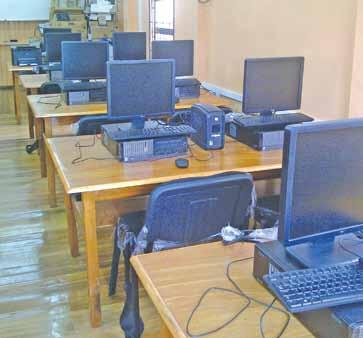
In an interview with Guyana Times Sunday Magazine, current headmistress Rebecca Persaud stated that the school has come a long way since its conception. It is now equipped with an IT lab with 15 computers, which previously had only three.
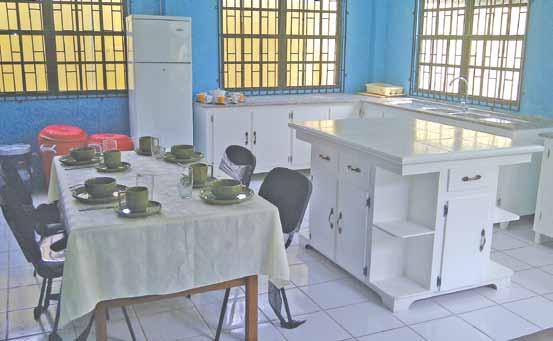
“We are grateful to the Ministry of Education for this. The ministry has also aided us in completing the Home Economics department and gave us money to purchase items for our children to have the practical experience of the subject. There are currently five teachers who are trained to work effectively with the children. We also have 37 students enrolled at present. The ministry sends these students to us. They are interviewed first and then sent to us. We offer classes up to Form Three and when the children are ready, after evaluation, they are sent off to mainstream secondary school or to the Guyana Technical Institute or Carnegie School of Home Economics or other similar institutions,” she outlined.
Persaud noted that the children are more inclined to learn when using technological equipment, such as the computers. This, she
pointed out, is now used as a strategy to teach the children, which has resulted in students’ excelling academically. The headmistress hopes that more technological materials to aid the learning process for the students can be donated to the school.
The school teaches nine subjects: Writing, Pastoral Care (Health and Family Life education), Visual Arts, English A, Mathematics, Home Economics, IT, Sports (indoor and outdoor), Craft.
“We are thankful to the businesses, NGOs and par-
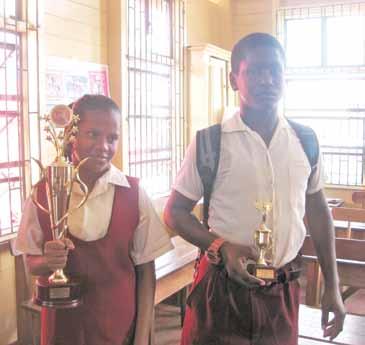
ents who have been supporting us throughout the years. We are also thankful for the huge support from the Ministry of Education. We have many success stories of students who have gone on to excel in their studies and careers, this we are proud of. We recently were awarded trophies for our participation in the national science fair. Notably, our children were judged like every other student. And so we continue to excel and are determined to help our children on the path to success,” Persaud declared.
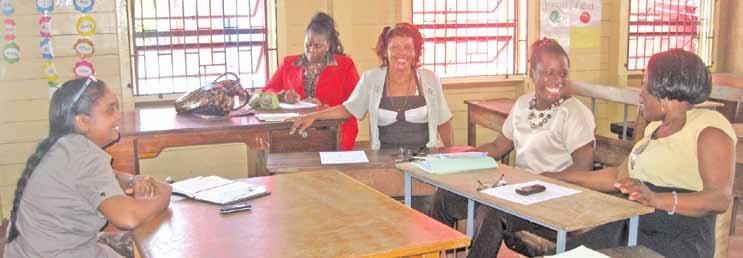
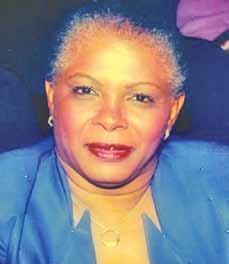
Persaud (left) enjoying a light moment with some of the teachers
Students with their trophies they won at the national science fair
A section of the IT lab
An AmAzing creAture teAches us About survivAl
There is a creature residing in the Rupununi region whose appearance is so strange, you would think it was something that was dreamed up in the imagination of a child.
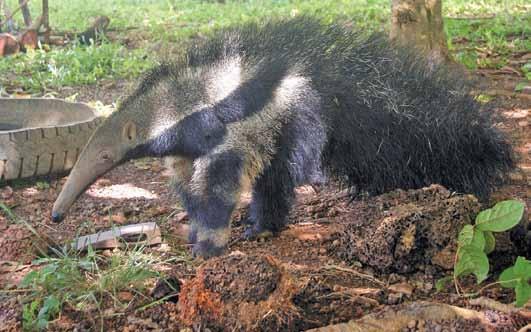
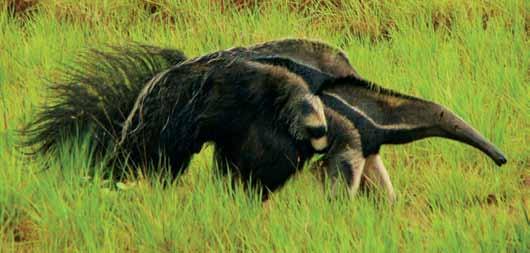
This creature has coarse, wildly growing hairs sticking up all over its body – its tail resembling something like a feather duster. It has a long, slender head that terminates at a tiny mouth with no teeth, but housing a two-foot long sticky tongue. The animal walks on the sides of its hands with a strange knuckle-walking gait, but can also stand up tall on its hind legs when threatened. It carries 4-inch long claws strong enough to tear through wood, walls and earth in search of prey, but can also be brandished as weapons with which to fight off even the fiercest of predators.
Lastly, it bears a contrasting colouration of black and white, with what even appears to be a racing stripe. In reality, while this animal may have the strangest of parts, put them all together and you find a species that is perfectly adapted to survival in its natural environment. This creature is the giant anteater.
The giant anteater, scientific name Myrmecophaga tridactyla, is a relatively common sight in the savannahs and bush islands here in the land between Yupukari village and Karanambu Ranch. It isn’t until you come to the Rupununi and see a giant anteater for yourself that you begin to realize how all of its strange parts are actually amazing adaptations that help it to survive here.
The first time you see an anteater, you
The stark contrast of the anteater’s counter shaded coat plays perfectly against a background of contrasting shapes and colours, causing you to scan your eyes right past this animal until it moved. You observe the anteater rambling across the open habitat with its odd gait, the result of walking on the sides of modified front claws.
At first appearance, its movements and behaviour seem strange and erratic, but the more you watch it you realize the focused and calculated nature of its actions.
As you watch, the strange looking animal moves its head back and forth, smelling the wind and scent trails on the ground,
may actually be caught off guard by its appearance, as you notice that what you thought was part of the landscape starts to move.
Imagine scanning the Rupununi horizon on a bright sunny day. The flat, open landscape gives you the impression that the sky is enormous – larger than in other places you’ve been, even though you know that it is the same sky. You strain your eyes to take it all in, but you find that you cannot see it all without turning your head; but everywhere you turn there is more to see.
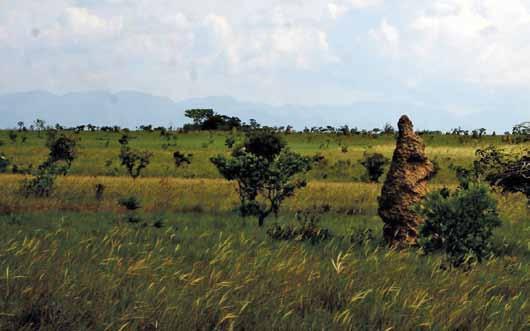
The Rupununi is a panorama that knows nearly no bounds. The sea of grass would seem endless if they were not consumed by the rising crests of the Pakaraima Mountains to the west and the Kanuku to the east.
The brilliant colours of the landscape almost force you to squint as the bright sun makes the sky appear to be several different shades of blue, and the bright green of the savannah grasses provide a stark contrast against the dark volcanic rocks that litter the landscape.
Just when you are trying to consume everything that is in front of you, you notice something very peculiar.
What you thought was just another rock sitting still and silent in its place has suddenly begun to walk away. As you move closer, you realize that what you had previously considered a hard mineral shaped by millions of years of weathering and geological processes is actually the untamed hair of an anteater.
and you realize that its movements are being driven by a terrific sense of smell.
Staying focused on the task and hand and paying no mind to the fact that it has an audience (if you are quiet and approach only to a comfortable distance), the anteater stops at a specific location that seems to have caught its interest. Tearing at the ground with those powerful front claws, it creates a small opening large enough to accommodate its slender nose. As you being to notice, ants would be pouring from the opening the anteater has created for itself and you observe the anteater lapping up tens or hundreds of ants at a time with its long, sticky tongue. It remains feeding at this one location for only a min-
ute or so before moving off in pursuit of its next meal.
You know that the anteater feeds on ants and termites, but what you may not know is that it must eat tens of thousands of ants and termites each day in order to survive. So now you are left with the question of why does the anteater not stay longer at one location when there may be millions of ants or termites in a single colony? The anteater moves off from this first encounter is as much a mystery now as when you first identified it as a rock that was somehow moving across the landscape. In the end, you are left with the impression that you have had a special experience with one of the world’s truly amazing creatures.
The anteater is the original steward of its environment. As I said earlier, anteaters must eat tens of thousands of ants and termites a day, yet it only feeds from a single site for a short time. Obviously, this is not to say that the anteater is making a conscious decision to manage the resources that it depends on for its survival; it is actually to avoid the bites from the soldier ants that make the anteater move away from its feeding sites. But it is in this interaction that we see the importance of maintaining a natural balance. The anteater doesn’t eat too many ants from each colony, thus avoiding the depletion of the resource, yet it eats enough ants that populations at each individual colony are maintained at levels that keep them from decimating local vegetation. At this level of interaction between predator and prey, the natural balance of the system remains intact.
Unlike the anteater, humans are the one specie that can make a conscious impact on its environment. We are capable of evaluating our actions of today and preparing for what the future holds for tomorrow.
While Guyana has shown a tremendous dedication to the environment as a country through the introduction of the Low Carbon Development Strategy (LCDS) and growing protected area pro-
gram, it is still us as citizens that have the greatest potential to have a positive impact on the local, regional and global environment.
This means that caring for our environment is the responsibility of everyone. You can make a difference through your everyday actions. Will you take a cue from the anteater and help to maintain the balance of the natural system? What will you do to contribute?
For more information, visit Rupununi Learners on Facebook. (By Matt Hallett)
An infant that was rescued from a local dog's toothy grip in Yupukari
Small female with baby on her back spotted at Karanambu
The Rupununi Savannahs the giant anteater country
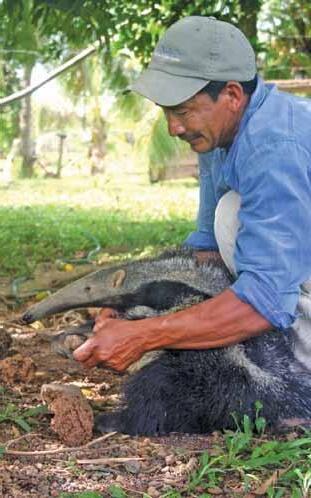
Yupukari villager, Jose George, getting a rare opportunity to shake hands
The Shaping of Guyanese Literature
Times Feature
By Matt Hallett
Coming to research jaguars in the Kanuku Mountains, I had anticipated seeing some amazing things, but I don’t think that I was prepared for what I was going to experience when I travelled to Nappi Village in Region Nine to set camera traps in the nearby Maipaima area.
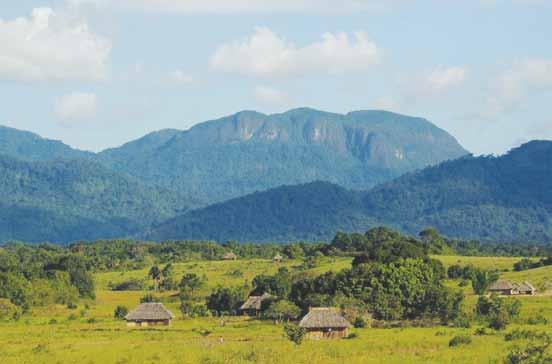
Arriving in the village of Nappi alone is a surreal experience. Nestled at the foot of Nappi Mountain, it is one of the most scenic villages in Guyana. The thatch roofs of the homes contrast with the expanse of green forest, and the bare black rock of the mountains in the background is breathtaking. As you look into the mountains, you can’t help but ponder the adventure ahead.
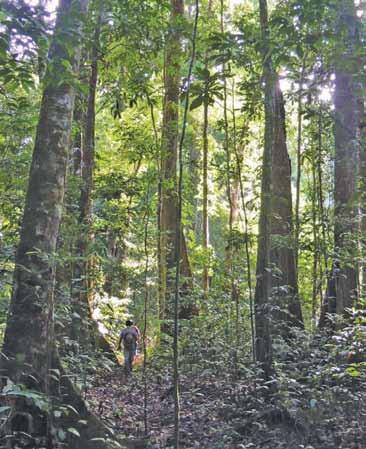
Venturing into the forests of Maipaima is like venturing into the rainforests of your imagination. Entering
as you strain back to follow the enormous trunk as it stretches towards the canopy top, you feel tiny. Almost as if you could relate to living in the world of an ant. In the canopy above you notice a shaking along
the possibilities if you were to be able to bound hand over hand through the canopy, your ears are pierced by the harsh cackling of a group of scarlet macaws in a tree just behind you.
the shade of the canopy, you are surrounded by giant 100-foot trees on every side. The Mora trees seem to be as wide at the base as they are tall. You stand at the bottom dwarfed by the massive buttress roots, and
branches. As you focus your eyes on the movement that has caught your attention, you see a black spider monkey spring across a six-foot gap between trees and effortlessly bound away 100 feet above. As you ponder
As you follow the raucous calls with your eyes and move quietly and carefully along the forest floor, your eyes finally discover the bright red feathers that you were searching for. Although macaws and other parrots are commonly kept as pets in cities and towns all over the world, there is something about seeing these animals in their element, living wild and free, that connects you to a place.
You move further along the forest floor under the spell of the forest around you, and come across an opening in the canopy – to be treated to the majestic harpy eagle souring overhead. This raptor is to the
pressive creatures.
Moving along and thinking about the life in the canopy, a bright yellow flash on the forest floor catches your eye. You move stealthy and quietly to investigate and you see the brilliant bright yellow stripes of a three-striped poison arrow frog contrasting against the moist black skin on its back. It snaps its legs and disappears into the leaf litter on the forest floor. Even the beautiful contrast of its electric colours can’t be seen against the leaf litter.
The forest floor in Maipaima is alive as well.
you begin to notice another telltale sign of the activity of the forest that minds me why I have ventured into the Maipaima wilderness in the first place. Tracks can be seen all over the trail on the forest floor. Mammals are notoriously difficult to see in the forest, but they tell you that they are there with the tracks that they leave behind. In every direction you see paca (laba), red brocket deer, tapir and peccary tracks – further indication of the health and abundance of this forest.
It is obvious that jaguars
air above the canopy as the jaguar is to the forest floor. They reign supreme – the ultimate symbol of the wild heart of the jungle.
Flying high with its massive wingspan, and looking to pluck monkeys from the trees with their impressive talons, the presence of nesting and soaring harpy eagles is a clear indication of the nature of Maipaima’s forests – large expanses of uninterrupted nature that stretch across the Kanuku Mountain range, sustaining some of the forests most im-
Millipedes move slowly and deliberately breaking down massive amounts of vegetation. The abundance of life moving everywhere around you is almost overwhelming.
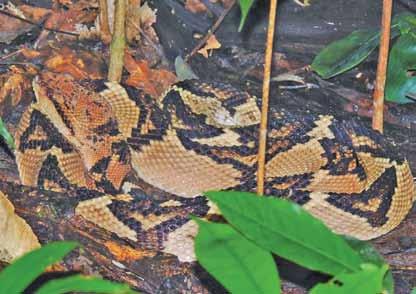
Suddenly, your eyes adjust and you notice potentially the most perfectly adapted resident of the forest floor. The bushmaster sits quietly and perfectly camouflaged against the leaf litter, resting and digesting its latest meal. As you move away slowly and quietly, trying not to disturb the resting serpent,
are plentiful in and around Maipaima, as their sign can also be seen not far behind the tracks of their abundant prey. Everywhere you look you see the print of that large round paw with four obvious toes and no claws showing jaguar claws are retractable and only reveal themselves when they need them.
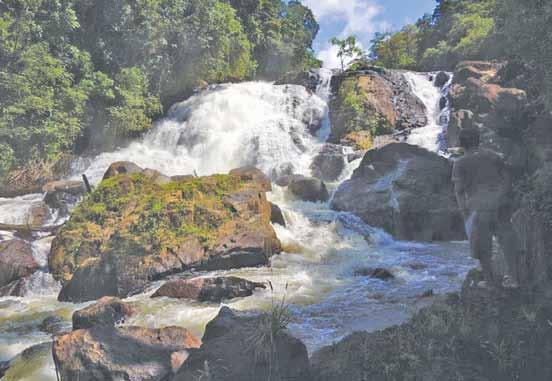
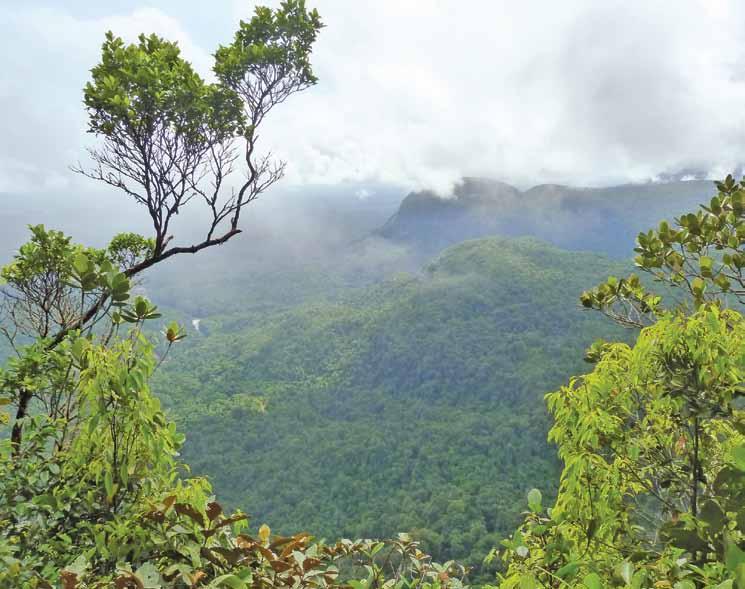
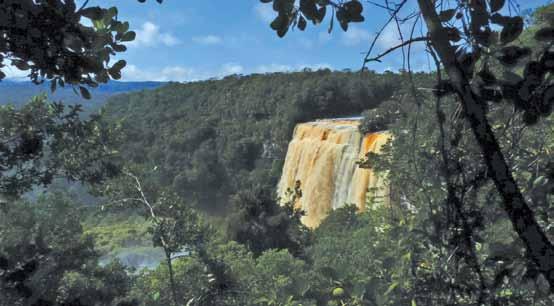
Following the abundant life in the Maipaima wilderness concludes with a hike to the immense and impressive Jordan Falls. The falls exist in a clearing that allows you to see across vast stretches of green, almost reminding you of heads of broccoli that stretch to the horizon on every side. Contrasting with the open calm of the forest is the congestion of running water below your feet. Jordan Falls consist of a series of falls running down from the mountain and concluding in a large single drop that symbolizes the wild power of the Maipaima wilderness. Like the rest of the forest, it runs wild and free with a power that leaves you feeling that you have experienced something special in this world.
It is places like this that leave a lasting impression and cause you to reflect what we value in this life. It’s an experience that I won’t forget. For more information, visit Rupununi Learners on Facebook.
Cascading Jordan Falls
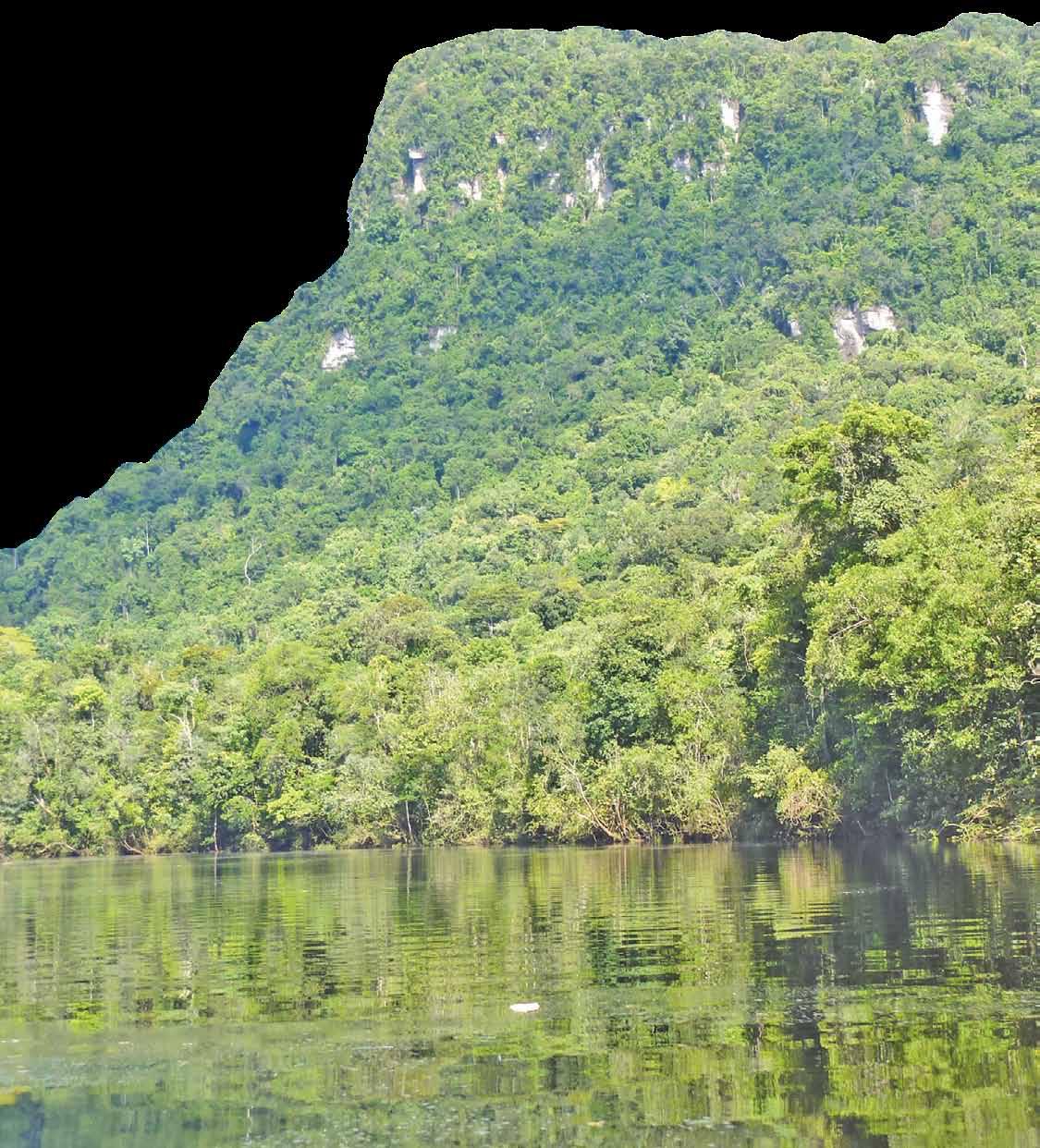
Serene view of Nappi village
The bushmaster nestled between the leaves
Trekking through towering trees
We send out kudos to all Guyanese women who are excelling locally and abroad. We recognise their hard work and determination in putting Guyana on the map. This week we feature two exemplary women who are paving the way for youths to follow.
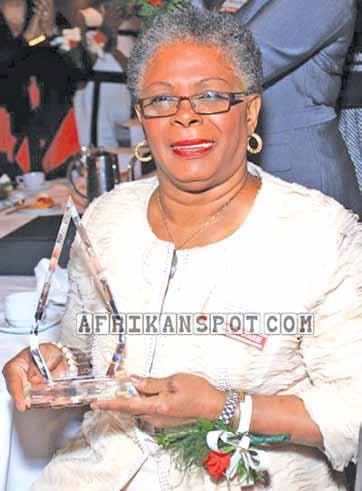
Lorna Welshman-Neblett has reached a pinnacle that few women of colour have attained in the fragrance industry. More than 20 years ago she launched Angel, the first Thierry Mugler perfume, in the US market. The fragrance has been flying off high-end shelves since.
Born in Georgetown, Guyana, she is committed to her homeland and the Caribbean and seeks improved health care for women in the region through the Organization for Social Health and Advancement for Guyana and the Caribbean (OSHAG/C), a New York group that focuses on treatment, follow-up and cosmetic care for breast cancer patients.
Welshman-Neblett’s career in the fragrance industry began in the late 1970s, when Elizabeth Arden established a separate fragrance company with Chloe, Burberrys and others. Welshman-Neblett started working with Thierry Mugler Parfums (now a division of Clarins Fragrance Group) in 1993, presenting the brand to retailers, establishing a sales team and creating a strategy to bring Angel to the market.
Energised by the creativity required to bring a fragrance to market and to develop appealing packaging and descriptors, she holds, fittingly, the title of senior manager of sales and marketing administration for Groupe Clarins U.S.A., US arm of the Paris-based lux-
Institute. She is a staunch advocate of community involvement, evidenced by her recognition from the City of New York and former New York City Council member Una Clarke. “I learned from an early age that working in a community and organizing with others is the best way for people to come together for a worthy cause,” she says. In 2013, she was honoured as one of 25 Influential Black Women in Business by The Network Journal- a black professional and small business magazine.
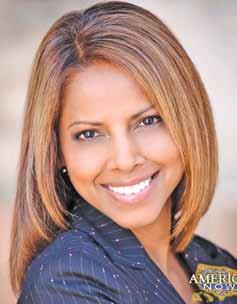
Asha Blake, Emmy Award Winning Journalist
Asha Blake is a former network anchor turned digital media mogul and media consultant to the stars! She was born in 1961 in Guyana, the daughter of an education specialist and a teacher. Blake was raised in Toronto and later in Minnesota, where she received a Bachelor’s Degree from the University Of Minnesota School Of Journalism.
A five-time Emmy award winner, Blake has served as a solo anchor for national network news programs, hosted syndicated daytime programming, and co-hosted a national talk show for NBC and ABC. Over the course of a successful 20year career in television journalism, Blake conducted thousands of live interviews, covered numerous high-profile court cases, and served as a medical reporter early in her career.
Blake co-hosted the NBC national news program
“Later Today” and ABC’s “World News Now”, “World News this Morning”, and “Good Morning America Sunday”, in addition to reporting for ABC’s “World News Tonight” with Peter Jennings. Blake coverage of breaking world events has
ury cosmetics company. “What I enjoy most about working in the industry is seeing the happiness that a fragrance brings to a consumer. It is about the person who’s wearing the fragrance—for them to smell good and feel good at the same time,” she declares.
Welshman-Neblett
earned a bachelor’s degree at Washington Business
put her in front of a number of world leaders, including Desmond Tutu, Bill Clinton, Jesse Jackson, Rosa Parks, Al Gore, as well as celebrities such as Jay Leno, Jude Law and Denzel Washington.
Blake has hosted two nationally syndicated shows: “Smart Gardening” on PBS and “Life Moments”, the nationally syndicated daytime women’s reality program that celebrated great and unbelievable moments in the lives of every kind of women. Blake has also been actively involved with many charity organizations, including serving as a celebrity ambassador for UNICEF, volunteering for Make A Wish, and supporting Race For A Cure and Meals on Wheels.
Following the 9/11 Attacks, Blake created and launched a public service website providing a free planning guide to help organize pertinent personal information in the event of an emergency.
In 2010, Blake launched her powerhouse media company, Goldenheart Media. Headquartered in Asha’s hometown of Los Angeles, California, Goldenheart Media is a multimedia pow-
erhouse company specializing in media relations, branding, corporate communications, and messaging and entertainment program development.
She has been featured in magazines and newspapers including TIME, USA Weekend, INSTYLE Magazine, Emmy Magazine, Core Business, Ladies’
Home Journal and other media outlets. Blake is married to former Minnesota Vikings linebacker Mark Dusbabek and has a daughter, Sasha.
Asha Blake
In the audio booth for America Now News, which airs on Fox network
Lorna E. Welshman-Neblett Welshman-Neblett, 2013
The Shaping of guyaneSe LiTeraTure
The Independent South
By PetamBer Persaud
On Saturday May 24, 2014, the Ruimveldt Branch of the National Library staged a mini-concert to mark Guyana’s 48th Independence Anniversary with a freshness and innocence reminiscence of the penny concert of bygone days, filled with clean fun and entertainment for the whole family.
The programme was well orchestrated with an extended skit forming the foundation and backdrop of the concert. The skit depicted the country’s pre- and post-independence history. That history was teased out during classroom dynamics with all its concomitant hilarity and rigidity. To add interest to dry history lessons, the skit was divided into episodes. Each episode was punctuated with folksongs performed by staff members, and members of the library. Of importance, most of the acts were performed by the mini-sized members of the community – children, another reason for labelling the affair ‘mini’.
The printed programme gives a true picture of the scope and magnitude of the mini concert.
National Anthem All
Prayers
Welcome M. Thompson
Poem B. Narain & S. Phillips
Folk songs* Children & Staff Choir
Skit - Reflection (Guyana as a Colony)
Poem S. Moore
Dance Children Folk Songs Children & Staff Choir
Skit - Reflection (The Struggle for Independence)
Modelling Culture Dress
Skit - Reflection (The Story of Independence)
Folk Songs Children
Dance Hepziba Headley Folk Songs Staff
The folk songs performed in voice and dance, included ‘Cuma-Cuma Fish’, ‘Lillie gal, Lillie gal’, ‘See me little brown boy’, ‘Ting a Ling Ling’, ‘Rick Chick, Chick, Chick,’ ‘Yallah Girl’, ‘Manin Neighba’, ‘Bamboo fire’, ‘Itanami’, ‘Sancho’, ‘Sitira’, ‘Me gat wan coal pot in meh belly’, and ‘Dis
time nah lang time’. Those familiar songs lent themselves to various interpretations and arrangements therefore the appropriate antics of the children brought life and new dimensions to them.
The Ruimveldt Branch Library was established to meet the need of the community, removing the need for patrons to travel to the city. This was the first urban branch in Georgetown. And on Saturday May 24, 2014, the Ruimveldt Branch, gave another
reason to justify the establishment of such an outlet.
The National Library Centenary Magazine stated: “On July 28, 1975, the Town Clerk, E. L. Mayers, disclosed to the City Council that Government had allocated a substantial amount of funds for the expansion of the National Library facilities. Included in the plan was a branch outlet in Festival City. On September 29, 1975, the Ruimveldt Branch Library was declared open by Minister of Information and Culture, Mrs Shirley Field-Ridley.”
The National Library was opened to the public in September 1909 offering lending, reference and reading room services. The mandate of the National Library is “to satisfy both nationally and internationally, the informational and recreational needs of the library’s users through the collection, organisation, dissemination and preservation of information in printed and other formats”.
That mini-concert had all the makings of a national celebration to mark such an occasion. In fact, the opening set was intriguing: a female student entered the classroom with, “I hope this is no long boring lecture on history” - hinting at the surprises to come.
That mini concert was concise, entertaining and educational. It was refreshing to witness babes painting a pretty picture of our independence.
That concert through the performance of our folk songs and by the retelling of our independence story was in a small but significant way contributing to our literature, the sharing of which will obviously have a domino effect on the community.
Responses to this author telephone (592) 226-0065 or email: oraltradition2002@yahoo.com
What’s Happening:
-Repeat performance of ‘Expressions’ will be held on Wednesday June 11, 2014, at 5pm, and on Sunday June 22, 2014, at 6pm, both at the Theatre Guild.
A dramatic performance by some talented dancers
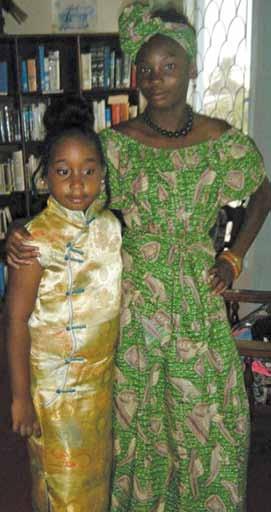
Two lovely young ladies at the event
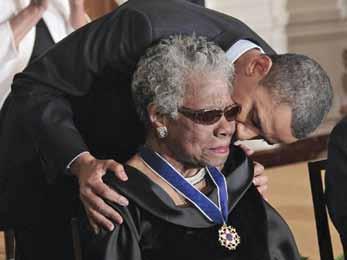
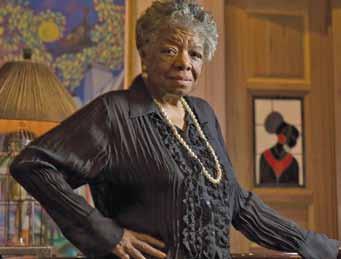
Maya Angelou's best quotes
Prolific American author, poet and civil rights activist Maya Angelou has died at 86. Angelou was born Marguerite Ann Johnson in St. Louis, Mo. Angelou attended high school in San Francisco, and studied dance and drama. At the age of 14, she dropped out of school and became the city's first African-American, female street car conductor. She later graduated and gave birth to her son, Guy, soon after.
She was known for her inspiring words that shed light onto the beauty and injustices of the world. This week we list 13 of her most inspiring quotes:
1. "I believe that each of us comes from the creator trailing wisps of glory." - Interview with the Academy of Achievement (1990)
2. "I am a Woman Phenomenally. Phenomenal Woman, that's me."
- Phenomenal Woman, poem (1978)
3. "I've learned that people will forget what you said, people will forget what you did, but people will never forget how you made them feel." - Interview for Beautifully Said Magazine (2012)
4. "You may not control all the events that happen to you, but you can decide not to be reduced by them." - Excerpted from Letter to My Daughter, a book of essays (2009)
5. "My mission in life is not merely to survive, but to thrive; and to do so with some passion, some compassion, some humor, and some style." - Angelou's Facebook (2011)
6. "The need for change bulldozed a road down the center of my mind." - I Know Why the Caged Bird Sings (1969)
7. "Try to be a rainbow in someone's cloud.” - Letter to My Daughter, a book of essays (2009)
8. "I've learned that you shouldn't go through life with a catcher's mitt on both hands; you need to be able to throw something back." - Interview with Oprah for Angelou's 70th birthday (2000)
9. "We may encounter many defeats but we must not be defeated." - The Art of Fiction No. 119, the Paris Review 10. "You are the sum total of everything you've ever seen, heard, eaten, smelled, been told, forgot - it's all there. Everything influences each of us, and because of that I try to make sure that my experiences are positive." - Interview from the April 2011 edition of O, the Oprah Magazine (2011)
11. "One isn't necessarily born with courage, but one is born with potential. Without courage, we cannot practice any other virtue with consistency. We can't be kind, true, merciful, generous, or honest." - Interview in USA TODAY (March 5, 1988)
12. "Love recognizes no barriers. It jumps hurdles, leaps fences, penetrates walls to arrive at its destination full of hope." - Angelou's Facebook (Jan. 11, 2013)
13. "Nothing can dim the light which shines from within." - Date unknown (USA TODAY)
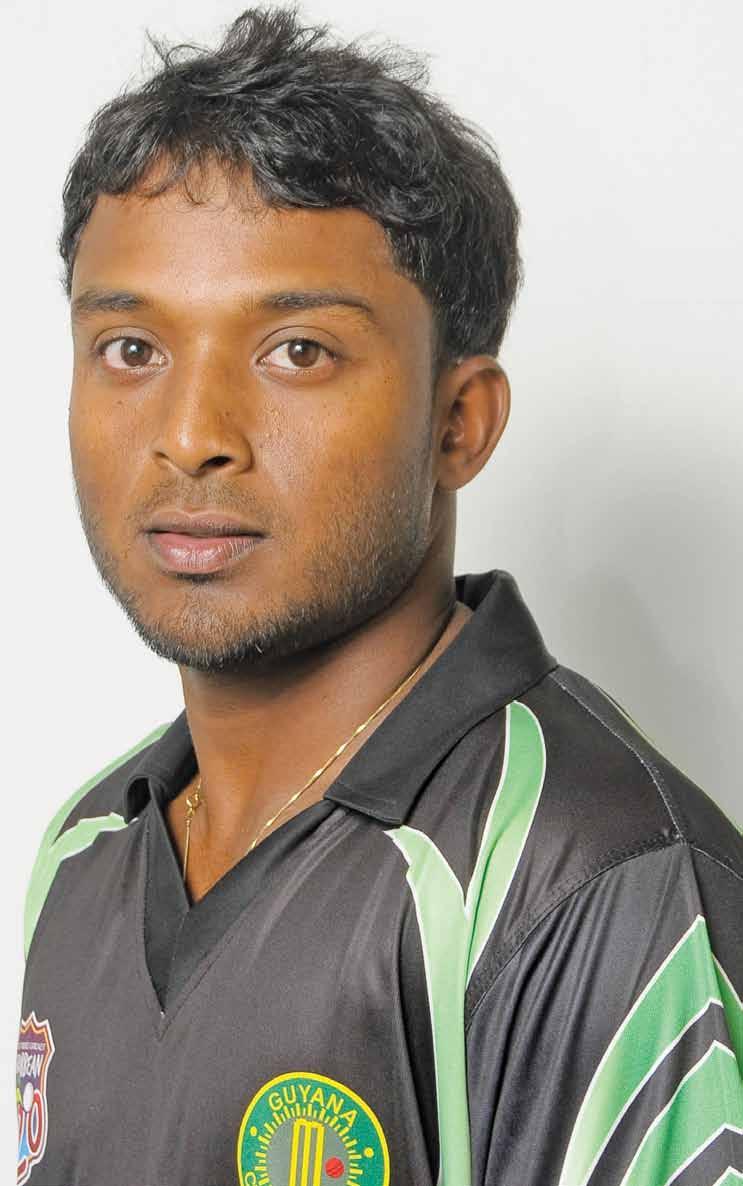
Veerasammy
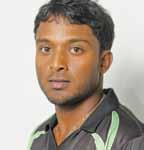
Permaul is a 22-year-old left-arm spinner who took up cricket in 2002. He made his first-class debut for Guyana in the 2006-07 Carib Beer Series and picked up four wickets against the Windward Islands and also scalped his first five-for against Jamaica in the KFC Cup one-day competition. Permaul has ambitions of playing for West Indies in the future and he is one step closer to attaining that dream as he is now the regular captain of the West Indies A team. The Albion-born spinner attended the Sagicor High Performance Centre in Barbados and has also represented the West Indies at the Under-19 level. Permaul, who also has an interest in teaching, has bagged 148 wickets from 44 first-class games matches at an average of 24.76 and 34 wickets from 26 limited-over matches at a miserly average of 22.11. He is also a capable lower-order batsman with a highest score of 66 in first-class cricket. Permaul continues to excel in his cricketing career and hopes to etch his name among the legends one day.
President Obama kisses author and poet Maya Angelou after awarding her the 2010 Medal of Freedom during a ceremony in the East Room of the White House on Feb. 15, 2011.
Creature Corner
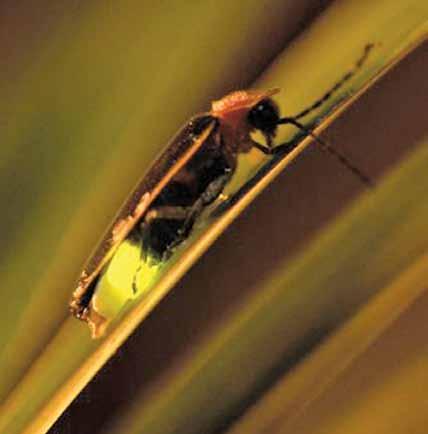
Fireflies are familiar, but few realize that these insects are actually beetles, nocturnal members of the family Lampyridae
Most fireflies are winged, which distinguishes them from other luminescent insects of the same family, commonly known as glowworms.
There are about 2,000 firefly species. These insects live in a variety of warm environments, as well as in more temperate regions, and are a familiar sight on summer evenings. Fireflies love moisture and often live in humid regions of Asia and the Americas. In drier areas, they are found around wet or damp areas that retain moisture.
Everyone knows how fireflies got their name, but many people don't know how the insects produce their signature glow. Fireflies have dedicated light organs that are located under their abdomens. The insects take in oxygen and, inside special cells, combine it with a substance called luciferin to produce light with almost no heat. Firefly light is usually intermittent, and flashes in patterns that are unique to each species. Each blinking pattern is an optical signal that helps fireflies find potential mates. Scientists are not sure how the insects regulate this process to turn their lights on and off.
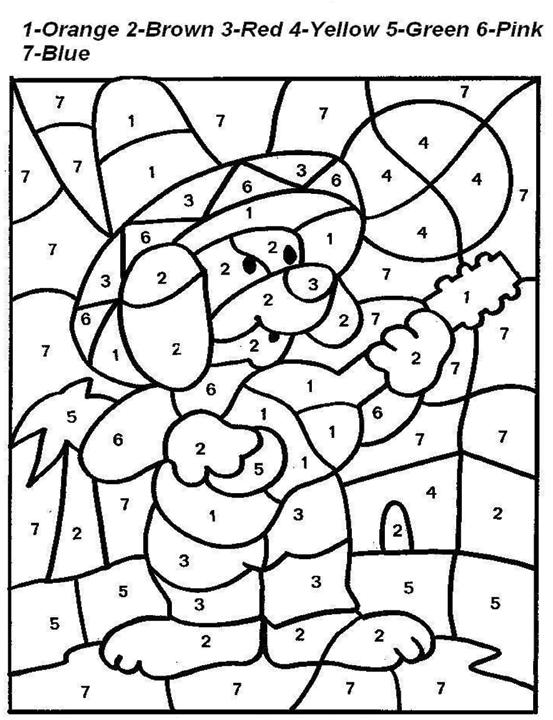
Colouring Fun Firefly
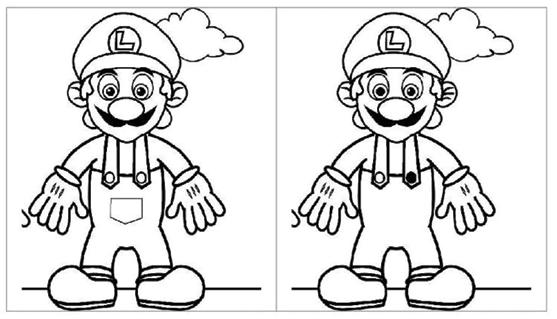
Spot the Differences
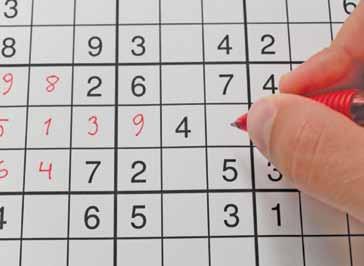
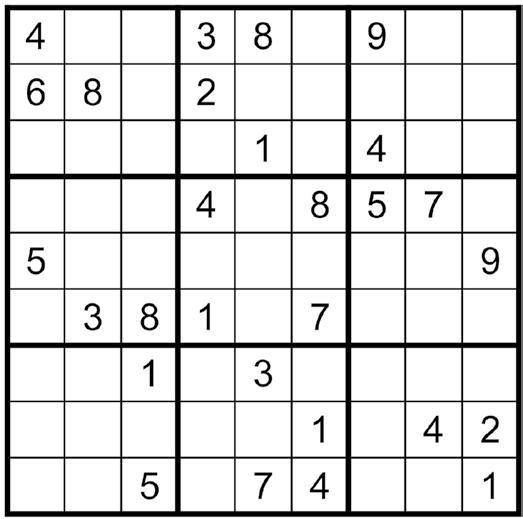
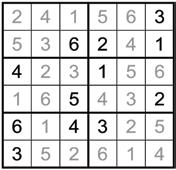
The objective of the game is to fill all the blank squares in a game with the correct numbers. Every row of 9 numbers must include all digits 1 through 9 in any order. Every column of 9 numbers must include all digits 1 through 9 in any order. Every 3 by 3 subsection of the 9 by 9 square must include all digits 1 through 9.
Did you know?
Firefly light may also serve as a defense mechanism that flashes a clear warning of the insect's unappetizing taste. The fact that even larvae are luminescent lends support to this theory.
Females deposit their eggs in the ground, which is where larvae develop to adulthood. Underground larvae feed on worms and slugs by injecting them with a numbing fluid.
Adults eschew such prey and typically feed on nectar or pollen, though some adults do not eat at all.
They live up to about two months.
Motorcycles are two- or three-wheeled power machines that have become iconic symbols for cool. Generally affordable and fuel-efficient, the motorcycle is a basic and popular mode of transportation in the crowded cities of Asia. In North America, the motorcycle is sometimes more of a luxury item, enjoyed for its stylish good looks and good, old-fashioned fun. Motorcycle racing as a sport is enjoyed by people around the world.
Parts of a motorcycle
Motorcycle engines have one to six cylinders operating on a two-stroke or four-stroke cycle. Most transmission systems have four, five or six gears. Racing models many have as many as eight speeds, while smaller models have as few as two speeds.
Early days
One of the first motorcycles was invented by Sylvester Howard Roper in 1867. It used a twin-cylinder coal-powered steam engine.
In 1885, the first gasengine motorcycle was invented by Gottlieb Daimler
He attached a four-stroke piston engine (designed by Nicolaus Otto) to a wood bicycle frame.
At the turn of the 20th century, many companies began building motorcycles using the combustion engine. One of the most famous of these was launched in 1903 by William Harley and the Davidson brothers, Arthur and Walter In 1901, the Indian Motocycle Manufacturing Co. of Springfield, Massachusetts, began producing its signature blue, diamond-framed Indian Single. Around the same time in England, the Triumph bicycle company began building motorcycles.
By 1920, Harley-Davidson was the largest motorcycle manufacturer, with dealers in 67 countries. By the 1930s, Indian and HarleyDavidson were the only American commercial motorcycle manufacturers still in business.
Motorcycles types
The modern motorcycle can be found in a variety of sizes, types and weights. Some bikes, such as touring bikes and motor scooters, are designed for use on streets. Other motorcycles, such as minibikes and trail bikes, are built to withstand the demands of off-road riding.
A look back at some classics
Today’s motorcycles have the basic concept and general appearance of earlier models, but modern bikes are easier to handle, with stronger frames, more powerful engines and more efficient brakes.
Sporting events
Motorcycle sports encompass events like dirt-track races, endurance races and motocross races. Motocross racing, with its rough courses, hills, obstacles and jumps, is the most popular of the motorcycle competitions. The Federation Internationale de Motocyclisme is in charge of world-level competitions. The U.S. affiliate, the American Motorcyclist Association (AMA), and the Canadian Motorcycle Association (CMA) govern most motorcycle competition in North America.
Street smart
Motorcycles are very popular because they are easy to handle and maneuver through traffic while also being economical.
Driving a motorcycle requires special skills, and most countries issue a special operator’s license that proves the rider knows local laws and how to use a bike safely. Many states and provinces, as well as many countries, require cyclists to wear helmets and/or eye protection.
Safety concerns
Motorcycles and their riders can be vulnerable to other vehicles on the road. Because they are small and fast, they are often not seen by other drivers when turning or changing lanes. Using helmets and wearing proper clothing such as heavy jackets, goggles, gloves and boots can help protect riders from falls. National safety courses are recommended for all motorcycle drivers. They teach good defensive riding habits and stress the importance of personal safety and responsibility.
By Laurie Triefeldt
1953 BMW R25/2
This vintage bike has a singlecylinder engine.
Gottlieb Daimler 1834-1900
Nicolaus Otto 1832-1891
1885 Reitwagen
1965 Taco minibike
Scooter Minibike
2013 Yamaha YZ450F
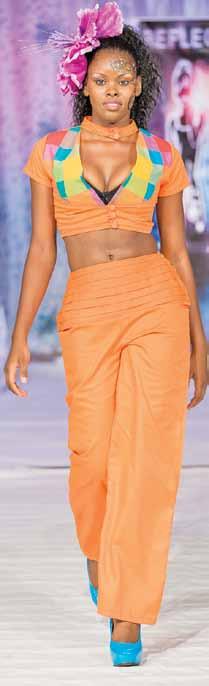
Local designer Nelsion Nurse recently launched his new collections at the Theatre Guild. His line will be showcased at Style Mission on 21 June at the Pegasus Hotel in aid of spreading awareness on Sickle Cell.
His applauded collection Bold Instincts (black and White) is a business casual/semiformal collection for males and females.
“Black and white are always used to symbolise strength and wisdom and Bold Instincts tells the story of the undying determination to reach one’s goals, whether it be the business oriented mother or the sophisticated guy,” the designer said in an interview with Guyana Times Sunday Magazine.
Nurse’s other collection, Euphoria (coloured), is described as “a hot Caribbean flavoured collection that goes from swimwear to evening gowns”. It is a comfortable and breezy collection that is perfect for any occasion.
“Euphoria brings the joy and beauty of the Caribbean together, with radiant colours perfect for anyone who wants to be different,” Nurse noted.
For more information on this collection, call 226-3099. (Photos by Helio Phoeli)
The designer (center) with models wearing his designs
Booboo Stewart
Booboo Stewart (born Nils Allen Stewart, Jr.) is an American singer, dancer, model, and actor best known for portraying La Push shape-shifter Seth Clearwater in “The Twilight Saga”. Stewart's character played a more important role in “The Twilight Saga: Breaking Dawn” Part 1 and Part 2. Stewart co-starred in 2014's “X-Men: Days of Future Past”, in which he again teamed with “Twilight” co-star Daniel Cudmore. He has Japanese, Chinese, and Korean ancestry from his mother’s side and Blackfoot (American Indian), Russian, and Scottish descent from his father’s side.
Times Hollywood
As it turns out, being a driven Hollywood actor might be good preparation for the world of winemaking.
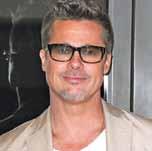
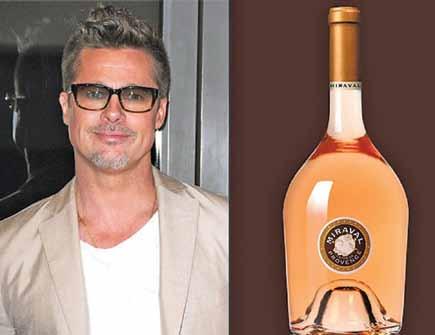
In 2012 Brad Pitt and Angelina Jolie bought the Miraval Estate in Provence, a world away from the Hollywood red carpet and its surrounding drama. Their first vino attempt, the Côtes de Provence Rosé Miraval, was ranked as one of the top wines in the world.
“For better or worse, given my compulsive nature, if we are going to be in the wine business, let’s make the best wine we can,” Pitt told Wine Spectator in their new issue, on stands June 3rd. “I asked the question, ‘Why can’t we make world-class wine in Provence?’ Let’s approach it like a film, and let’s make something we can be proud of and people can enjoy.”
tions benefits, Pitt insists on being very involved in the winemaking process.
“I’m a farmer now,” he says. “I love learning about the land and which
ily. “It’s very peaceful and the antithesis of the drive, the want, the need to get ahead indicative of life in Hollywood,” he says. “I’m instantly reminded what qui-
et sounds like.”
Even the sexiest stars have some not-sosexy moments.
PEOPLE Country's newly crowned Sexiest Man Luke Bryan suffered a slight fall from grace on Thursday night, slipping off the stage during a concert in Charlotte, North Carolina.
While in the middle of one of his booty-shaking moves, Bryan took a step that was just a bit too far forward and fell straight down into the small area separating the crowd from the stage. While his band vamped, the singer was helped up by security guards, and crawled back onto the stage to finish singing his cover of Macklemore and Ryan Lewis's "Can't Hold Us" to a deafening cheer from the crowd.
"I know it had to hurt," wrote YouTube user Caarlyshaay, who caught the incident on the video above. "Although he contin-
But while some stars might just put their name on a product and reap the financial and public rela-
field is most suitable for which grape, the drama of September and October: Are we picking today? Where are the sugar levels? How is the acidity? Is it going to rain? It’s been a schooling for me. In the off months, I enjoy cleaning the forest and walking the land.”
It’s a far cry from the intense scrutiny that’s often directed at Pitt and his fam-
After the success of his first rosé, which sold out in five hours online, Pitt is setting his sights on producing a super Provence red wine next. (“Give us seven years,” Pitt promises.) Hopefully he’ll be getting some tips about how to keep up with intense customer demand while still making delicious wine. (People)
ued on and put on the best show EVER!"
After the tumble, Bryan, who fell in February during a concert in Greensboro, North Carolina, told the crowd, "Check this out: the last time I was in North Carolina I busted my ass on stage! What is it about North Carolina that makes me bust my ass? Please YouTube that s–!" He then launched into a quick a cappella version of his hit "Crash My Party," making up some funny faux lyrics about his fall. According to
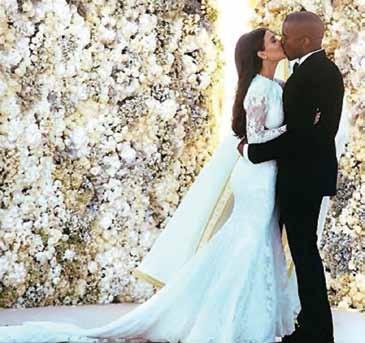
Kim Kardashian now holds the record of most liked post on Instagram, beating previous record holder Justin Bieber.
The reality star's photo from her wedding to Kanye West, which was uploaded three days ago, so far has gar-
Jnered 1.93 million likes.
Bieber's snap with Selena Gomez, meanwhile, gained 1.82 million likes.
The snap shows the "Come & Get It" singer hugging the Canadian heartthrob from behind. The photo, which was uploaded to the photo-
ustin Bieber excited fans when he premiered a new song called "Looking for You" on Thursday night, May 29. Arriving via the Canadian singer's SoundCloud page, the track features guest vocals from Atlanta rap group Migos.
In the synth-heavy banger, Bieber is featured talking about him trying to find new love as he hits a club. "Tonight might be the night/ You might mess around and fall in love/ And I might be the guy that'll make you wanna fall in love again," he sings, while Migos' Quavo, Takeoff, and Offset add some hip-hop touch to the track.
There's still no word on whether or not "Looking for You" will end up being included in a new Bieber album. The 20-year-old heartthrob has been working in the studio and releasing his new projects on social media.
Last week, he shared a short Instagram clip featuring a snippet of new track titled
Connecticut's Eyewitness News 3, Bryan also fell off the stage during a 2013 show in Panama City Beach, Florida, and a 2012 performance in Iowa. (Time to reconsider his set-up?)
Though he looked pretty pained, early Friday morning he reached out to fans, writing on Twitter, "I'm good. Few stitches." Hopefully that's the case: Bryan's tour moves on to Bristow, Virginia, Friday and Saturday nights, then up to Holmdel, New Jersey, on Sunday. (People)
sharing site five months ago, was captioned with, "Love the way you look at me."
The "Keeping Up with the Kardashians" star and her rapper husband are currently enjoying their honeymoon after tying the knot in Florence, Italy on May 24. The newlyweds jetted to Ireland on Sunday and were spotted leaving a movie theater in Tullamore on Wednesday. According to Daily Mail, the two were seen in another cinema in Portlaoise earlier that day to watch "X Men: Days of Future Past".
On Thursday, May 29, Kardashian and West landed in Prague, Czech Republic. The twosome arrived in the country wearing all-black ensembles. The rapper covered his head with his hood while his wife used her laptop case to seemingly avoid paparazzi shots and shield her face from the rain.
(AceShowbiz)
"It's Working". With lyrics like "You know exactly what to do to hurt me, it's working," the song is allegedly about Bieber's onagain, off-again girlfriend Selena Gomez. (AceShowbiz)
Sana Saeed
Sana Saeed is an Indian actress and a model who appears in Bollywood films. She first appeared as a child artist, starring as Anjali, in “Kuch Kuch Hota Hai”, and continued to do so in films “Har Dil Jo Pyar Karega” and “Badal”. She also appeared in television shows such as “Babul Ka Aangann Chootey Na” and “Lo Ho Gayi Pooja Iss Ghar Ki”. In 2012, Saeed made her screen debut as an adult in a supporting role in Karan Johar's “Student Of The Year”, which emerged as a boxoffice commercial success.
Sussanne Roshan goes back to her maiden name?
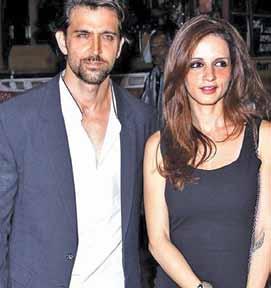
Alot have changed since Hrithik and Sussanne Roshan decided to end their marriage of 13 years.
Sussanne Roshan moved to a new house, the couple finally filed for divorce on mutual consent. And Now Sussanne has embraced one more change, she has apparently started signing her emails as Sussanne Khan.
The grace period to reconsider the decision as granted by Indian courts is currently on.
The inseparable couple shocked everybody when they released an official statement announcing they are separating, last year.
Hrithik made several attempts to reconcile but Sussanne was adamant to move on.
According to reports, the differences between the couple began with Hrithik's alleged affair with “Kites” co-star Barbara Mori, following which Sussanne moved out to her in-laws house. Later on it was reported that Sussanne doesn't get along with
Hrithik's mother Pinki Roshan and wanted Hrithik to live separately. The last nail in the coffin was Sussanne's alleged closeness to Arjun Rampal. (India Today)
Sanjay Gupta ropes in ‘Fast & Furious’ action director for Aishwarya Rai’s ‘Jazbaa’
Noted director Sanjay Gupta has roped in known Hollywood action director Spiro Razatos to helm the action sequences in his Aishwarya Rai starrer ‘Jazbaa’.
Spiro, who is best known for his work on films like ‘Back to the Future’ (1985), ‘Fast & Furious 6′ (2013) and the more recently ‘Captain America: The Winter Soldier’ (2014) , will be in Mumbai for the film shortly.
Interestingly while Spiro has previously worked on Bollywood ventures like ‘Kaante’ and ‘My Name is Khan’, this will be the first time that the action director will be in India for a shoot.
‘Jazbaa’, which is said to be an action drama, will feature Aishwarya as the main lead, with two other male costars. Though details of the other cast members are yet to be finalised the film is expected to go on floors in early 2015. (Indian Express)
Deepika Padukone tops ‘Times 50 Most Desirable Women list’
The Times 50 Most Desirable Women is India's pick of the women who possess the looks, the curves and the confidence to get a place on this coveted list.
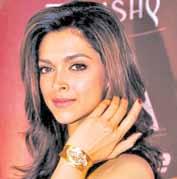
Deepika Padukone has topped The Times 50 Most Desirable Women of 2013 list.
Katrina Kaif came in at second place in the online poll , while Jacqueline Fernandez, Sunny Leone, Priyanka Chopra and Kangana Ranaut were also included in the top ten The
Times of India reports.
The list included many new names including beauty queen Sobhita Dhulipala who was named Miss India Earth 2013, Hasee
ly made a stunning entrance at the Cannes
- was featured in a separate 'Forever Desirable' list alongside Kareena
(Digital
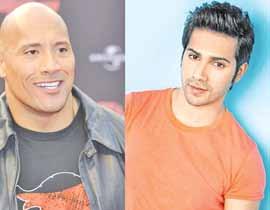
Varun Dhawan copies Dwayne Johnson, replicates his tattoo for new song
Bollywood ‘hero’ Varun Dhawan is all set for the song ‘Saturday Saturday’ from his upcoming film ‘Humpty Sharma Ki Dulhania’ with Alia Bhatt. Varun Dhawan has copied American actor and professional wrestler Dwayne Johnson’s tattoo style and will be seen flaunting them
in the song.
The tattoo covers Varun’s left shoulder, chest and biceps just like it does for Dwayne, also popularly known as ‘The Rock’.
‘Humpty’ Varun Dhawan took to Twitter to reveal the his new tattoo look and tagged ‘The Rock’ in the picture too.
‘Fast & Furious’ actor Dwayne Johnson complimented Varun Dhawan for the powerful symbols and asked him to carry them with pride. He said on Twitter: “@Varun_ dvn @HSKDOfficial Powerful symbols and story my brother. Wear w/ pride. #Warrior #Strength #Heart.”
This is not the for the first time that Varun Dhawan has shown his fondness for ‘The Rock’. Earlier, when Varun was on a promotional spree for last film ‘Main Tera Hero’, he had imitated Dwayne on the popular comedy show ‘Comedy Nights With Kapil’. (Indian Express)
Lara Dutta: ‘I'm enjoying being behind the camera’
Actress-producer Lara Dutta is loving the experience of being behind the camera, but she says producing films is not easy.
Lara, who turned producer with the 2011 film "Chalo Dilli", told IANS: "I'm doing a lot of stuff which is behind the camera, so that's a new phase for me and I am enjoying being behind the cameras more than anything else. "It's been a tremendous learning experience and I had a great experience with 'Chalo Dilli' and I'm proud of my film that I made."
The movie features Lara and Vinay Pathak. "The idea was to grow by making a medium budget film which is high on content. In this industry, it's hard to come by good content... it's a tough job, and being a producer is not easy. I am enjoying in that process," she added.
What about plans of directing a film? "I'am not going to direct in a hurry. There
is lot of production work going on right now. I am excited about it." Besides producing films, Lara Dutta also plans to produce TV shows.
"We are going to be looking at TV, but I can't talk about it. You will hear about it. Television is opening up massively, people will see many more changes on TV... we have got interesting things and a great show in plans." Meanwhile, on the big screen, the actress will be seen in the "Chalo Dilli" sequel, which will soon go on floors. (Times of India)
Toh Phasee star Parineeti Chopra, as well as Miss India Universe 2007 contestant Puja Gupta who starred in Go Goa Gone and Shortcut Romeo.
Sonam Kapoor and Alia Bhatt moved up in the list, while Nargis Fakhri and Sonakshi SInha went down several places. Aishwarya Rai Bachchan - who recent-
FilmFestival
Kapoor.
Spy)
Times Healthy Living
By Sanjay Gupta, MD
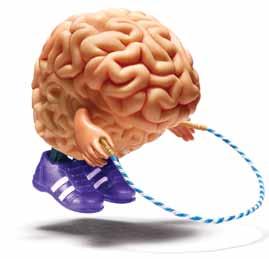
It's easy to blame a forgetful mind on aging. The real culprit, however, may be a kind of neurological laziness: We have cell phones to save numbers, GPS to guide us down the road, and the Internet for everything else, making memorization much less necessary than it once was. As a result, the memory centers of our brain aren't being exercised the way they used to be. But with more than 80 billion neurons and trillions of connections between them, your
Steer your cart clear of unhealthy choices that can take years off your family members' lives.
Simple Sugars or Carbs and Unhealthy Fats
Skip foods laden with simple sugars, also called simple carbohydrates. Sugary breakfast cereals, donuts, pastries, cookies, ice cream, cakes and soda are loaded with them. Often referred to as "empty calories," simple sugars are rapidly absorbed, spiking blood sugar levels for an initial energy high. This triggers an insulin reaction, driving levels back down and creating fatigue. You'll feel hungrier and crave even more sugar. Plus those rapidly absorbed extra calories are stored as fat, putting you at risk for obesity.
Make smart choices by selecting fiberrich complex carbohydrates, including 100% whole grain bread, brown rice or steel-cut oats. Select whole foods such as fresh vegetables and lean meats. These all provide slow, sustained releases of energy for long-lasting fuel. If you do crave something sweet, head for the produce aisle and pick out your favorite seasonal fruits such as pears, apples, or blueberries.
Processed sweets and goodies also contain saturated and trans fats that clog arteries and stunt weight loss. Instead purchase
Rbrain is capable of storing far more than you may realize. The key is to give your mental muscles the right kind of exercise.
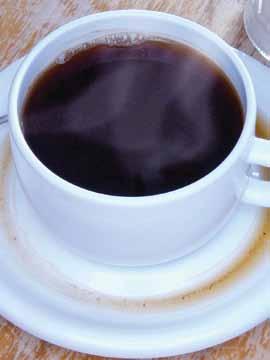
Sip Some Coffee
In a study published this year in the journal Nature Neuroscience, healthy sub-
items rich in heart-healthy monounsaturated fats, like avocados and nuts. Meats High in Nitrates and Saturated Fats
Processed meats such as cold cuts, bacon, sausages and hot dogs contain nitrates, chemical additives that preserve freshness. Nitrates have been linked to stomach cancer
and other degenerative diseases. These fatty meat products are also full of unhealthy saturated fat that can raise levels of "bad" LDL cholesterol, a risk factor for heart disease and strokes.
Ditch preserved meats altogether or look for ones that are advertised as "nitratefree." Buy meats low in saturated fats such as chicken and turkey or eat more fish, like salmon or tilapia, rich in healthy omega-3 fats. If you must have red meat, choose lean cuts like sirloin or tenderloin.
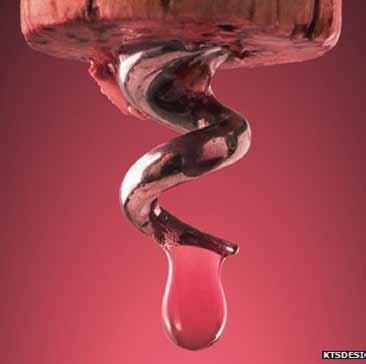
ed wine may not be as good for you as hoped, say scientists who have studied the drink's ingredient that is purported to confer good health.
The team tracked the health of nearly 800 villagers from the Chianti region of Italy to see if their local tipple had any discernable impact.
They found no proof that the wine ingredient resveratrol stops heart disease or prolongs life.
Experts say more research is needed to get a definitive answer.
The British Heart Foundation is carrying out its own resveratrol study.
French Paradox
Many studies have sought to explain why there is a low incidence of heart disease in France, despite many of its inhabitants eating a high-fat diet.
Some put it down to moderate drinking of red wine.
Studies have shown that consumption of red wine, dark chocolate and berries reduces inflammation, leading researchers to speculate that their common ingredient, resveratrol, explains why.
But Prof Richard Semba, of the Johns Hopkins University School of Medicine, and colleagues found no evidence for this.
They chose two small towns in Tuscany as their test ground, and 783 elderly people who were living there agreed to take part in their investigation.
jects were shown a group of pictures; they were then shown a second round and asked to identify images similar to the ones in the first group. Those who were given caffeine pills after the first round performed better than those who were given placebos. How can caffeine enhance memory? One theory is that it blocks a molecule in the brain called adenosine from inhibiting norepinephrine, a hormone that helps consolidate information for later.
Break a Sweat
A recent study found that among adults between ages 18 and 45, those who reported the most weekly aerobic exercise also had the most gray matter in the hippocampus, a brain region critical to memory. While studies have shown that exercise can increase hippocampal volume in children and older adults, this is one of the first to suggest that it may also have a positive effect in midlife, when brain volume is typically more stable.
Get a Grip
Squishy stress balls are great for working out your aggression, but they may also be useful for recalling something quickly.
In a 2013 study, subjects squeezed a rubber ball in one hand and studied a list of
Ingredients You Can't Pronounce
Does ferrous sulfate, thiamine mononitrate or partially hydrogenated soybean oil sound appetizing to you? Follow this rule of thumb: if a food product is made of stuff you need a course in chemistry to comprehend or if you can't pronounce the first 5 ingredients, don't let it near your cart.
Stay focused on buying whole foods comprised of only one ingredient. Instead of snacking on neon-orange cheese curls, slice up some carrots or celery sticks. Invest in an air popper and enjoy fiber-rich popcorn. Make homemade veggie chips: cut up kale, thinly slice beets, sweet potatoes or yams, sprinkle them with herbs and a little olive oil and bake in the oven.
Fake Health Foods
Fake health foods are those deceptive foods, billing themselves as "low in fat", like certain cookies, salad dressings or yogurt brands. Look closely at their labels. To make up for flavor, these items are inevitably high in sugar or salt. Other tricky foods include packaged breads and crackers with labels stating "contains whole grains." This often translates into considerably less fiber than 100 percent whole grain products.
Again, choose real foods as much as possible. If it's a sweet tooth you need to sat-
The volunteers gave details about their daily diets as well as urine samples for measurement of their resveratrol intake.
During the nine years of the study, 268 of the men and women died, 174 developed heart disease and 34 got cancer.
But urinary resveratrol was not linked with death risk, heart disease risk or cancer risk.
Nor was it associated with any markers of inflammation in the blood, the researchers report in JAMA Internal Medicine.
Prof Semba said: "The thinking was that certain foods are good for you because they contain resveratrol. We didn't find that at all.
"The story of resveratrol turns out to be another case where you get a lot of hype about health benefits that doesn't stand the test of time."
He says any benefits of drinking wine or eating dark chocolate or berries, if they are there, must come from other shared ingredients. And it's not clear how much you might need to eat or drink.
"These are complex foods, and all we really know from our study is that the benefits are probably not due to resveratrol."
Maureen Talbot, senior cardiac nurse at the British Heart Foundation, said: "The results of this study, while interesting, will not change the dietary advice we provide. People should continue to eat plenty of fruit, veg and wholegrains.
words, then clenched the ball in the other hand and recalled the list. Those who used the right hand before memorizing and then used the left before recalling remembered more words than the group who did the opposite. The finding supports the idea that the brain's left hemisphere (activated when using your right hand) is responsible for storing certain memories, while the right retrieves information.
Increase Your Omega-3s
A small study in the journal PLOS One found that omega-3 supplements significantly improved subjects' scores on tests of working memory—the brain system that provides temporary storage for information like driving directions. The researchers think the fatty acids may regulate the release of dopamine in the prefrontal cortex, improving cognition. (www.oprah.com)
isfy, buy tasty dried fruits, such as apricots or mangos.
Canned Foods High in Sodium
Eighty percent of our sodium intake comes from processed and canned foods. In fact, many canned foods are so chock-full of salt, they contain half or more of your daily recommended intake. A diet high in sodium is dangerous since it can lead to high blood pressure.
Instead of buying canned soups, try making your own simple versions, like a healthy carrot soup or hearty lentil. If you don't have the time to cook, purchase canned soups low in sodium.
To lower your overall sodium intake, try seasoning foods with more herbs, both dried and fresh. You'll rely less on table salt for flavor. (www.oprah.com)
"We recognise the need to learn more about the action of resveratrol though, so are funding research into its reported disease-combating properties and how it affects the heart and circulatory system.
"This research is vital as it could form the basis of future medicines." (BBC)
Home & Cooking
Ingredients:
Method:
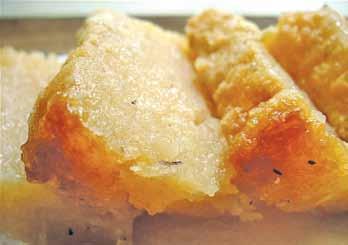
Pre-heat oven to 350°F. Peel, wash, and grate the cassava and coconut then mix together. Work in the butter or coconut cream with a fork. Add the other ingredients and enough water to bind stiffly. Put the mixture into a greased pan, where it should be about 1 inch thick. Bake in a moderate oven until crisp and brown on top about 90 minutes. Cut into 1½ to 2 inch squares before serving.
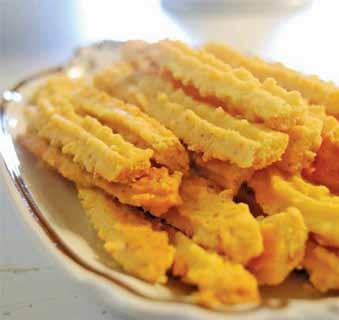
Cassava Pone Cheese Straw
Ingredients:
1/3 cup margarine (5 tbsp) 1/2 cup flour (a tablespoon
Method:
Preheat oven to 350 degrees. Add pepper and mustard to the grated cheese and mix well, set aside. In a separate bowl, cut the butter into the flour using a knife or pastry blender. Next add the cheese mixture to the flour and gently combine together using the tips of your finger to form dough. Place dough in a cookie press or use a pastry bag with the star attachment to achieve the look. You may also roll the dough out and cut into strips or use cookie cutter. (Cheese straws can be made in to any variety of shapes.) Place on a baking sheet and bake 10 to 12 minutes.
GREATEST COOKING TIPS
Taste as you go. For most cooks, tasting is automatic, but when it’s not, the price can be high. Recipes don’t always call for the "right" amount of seasoning, cooking times are estimates, and results vary depending on your ingredients, your stove, altitude…and a million other factors. Your palate is the control factor.
Read the entire recipe before you start cooking. A wise cook approaches each recipe with a critical eye and reads the recipe well before it’s time to cook. Follow the pros' habit of gathering your mise en place―that is, having all the ingredients gathered, prepped, and ready to go before you turn on the heat.
Always crack an egg on a flat surface, never the edge of a bowl. Otherwise you'll risk shell shards and possible contamination of your food.
Don't throw out those last drips of jam in the jar; shake up fruity vinaigrette instead. Add equal parts oil and vinegar to the jar, give it a good shake and season with salt and pepper to taste.
When a savoury dish needs a little oomph, try a squeeze of lemon instead of salt. A hit of citrus can make the whole recipe come to life.
HOME HELP
Hook an old pillowcase over one fan blade at a time and wipe it backward. This removes all the grime and traps it inside the pillowcase without it falling to the ground—or, worse, in your eyes.
For food processors, after every use, do this quick wash to prevent the machine from getting crusty: Fill the processor halfway with water and a couple of drops of dishwashing liquid. Run it for a few seconds, then rinse and wipe dry.
Those bluish green flecks you sometimes see inside a kettle? They’re mineral deposits that can build up, especially if you have hard water—harmless, but not so nice to look at. To remove them, fill the kettle with equal parts white vinegar and water, bring to a boil, and let stand overnight. Rinse, then heat plain water to get rid of the traces of vinegar.
Knives: Good ones (you know, the kind you bother putting in the knife block) should never go in the dishwasher, because harsh detergents can pit the blades and high heat can damage the handles. Instead, hand wash with hot, soapy water and towel-dry. Never soak knives; this can cause handles to shrink and blades to rust. To remove stains on blades, dip a clean wine cork in mild dishwashing liquid and rub.
Loft on Wheels
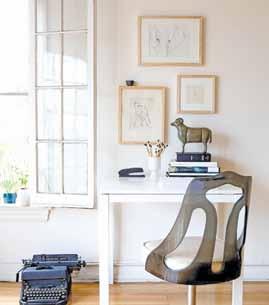
This industrial-modern desk set seems like it's monopolizing the loft, but all the pieces have casters, so they can easily be rolled out of the way. Mobility is key when you need give the room another purpose
Minimal and Modern Choosing a white desk and chair is a smart strategy if you don't want to add too much visual weight to a room. The clean lines of these pieces also make them feel light and airy
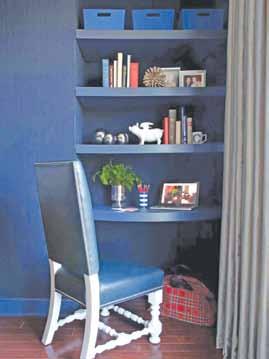
Bachelor Pad Nook
Even the most unlikely corner can function as a work area. This master bedroom nook instantly became an office with the addition of a few floating shelves and a refined desk chair
Modern Artwork
The neutral colour palette here doesn't steal too much focus from the rest of the room and the small desk details and wall frame cluster keep it from feeling unfinished
Homework Helper
If you're able to renovate, building a custom study space may be the best option. The station is private enough to curb distractions, but open enough that it still feels connected to the room
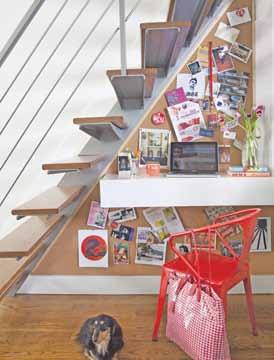
Shelf Under the Stairs Add a floating shelf, and a small space beneath the stairs is transformed into a tidy workstation. The corkboard on the wall displays clippings and reminders and the front of the shelf opens with hinges to hide paper clutter
Seven dogs were boarding at the local Pet Lodge. Each dog was in a separate run, all in a single row. One of the employees left the cages unlocked and the dogs have all gotten out of their runs. She needs to put each of them back in the right cage, but this is all she remembers. Help her get them in the right cages, and QUICK! Dogs: Beau, Duke, Fluffy, Lady, Princess, Rover, and Spike
doesn't like other dogs much, so he was on one of the
1. Spike
ends.
2. Princess was somewhere to the left of Beau.
3. Rover was in the third run from the right.
4. The only dog between Fluffy and Lady was Princess.
5. Duke was directly to the left of Lady.
Times Creative Writing
One fine morning
Anansi the Spider sat high up in a thorn tree looking down into Elephant’s garden.
Elephant was hoeing his melon patch. The ripe melons seemed to call out to Anansi, “look how juicy and sweet we are! Come eat us!”
Anansi loved to eat melons, but he was much too lazy to grow them himself. So he sat up in the thorn tree, watching and waiting, while the sun rose high in the sky and the day grew warm.
By the time noon came, it was too hot to work. Elephant put down his hoe and went inside his house to take a nap.
Here was the moment Anansi had been waiting for. He broke off a thorn and dropped down into the mel-
could talk,” said Elephant.
“Of course we do. We talk all the time. The trouble is, you never listen.”
“I can’t believe my ears!” Elephant exclaimed. “A talking melon! Who could believe it? I must show this to the king.”
Elephant ran down the road, carrying the melon with Anansi inside. Along the way, he ran into Hippo.
Where are you going with that melon?” Hippo asked.
“I’m taking it to the king,” Elephant told him.
“What for? The king has hundreds of melons.”
“He doesn’t have one like this,” Elephant said. This is a talking melon.”
Hippo didn’t believe Elephant. “A talking melon” What an idea! That’s as ridiculous as. . .”
“. . . a skinny hippo,” the
on patch. He used the thorn to bore a hole in the biggest, ripest melon. Anansi squeezed inside and started eating. He ate and ate until he was as round as a berry.
“I’m full,” Anansi said at last. “Elephant will be coming back soon. It is time to go.”
But when he tried to squeeze through the hole, Anansi had a surprise. He didn’t fit!
The hole was big enough for a thin spider, but much too small for a fat one.
“I’m stuck!” Anansi cried.
“I can’t get out. I will have to wait until I am thin again.”
Anansi sat down on a pile of melon seeds and waited to get thin. Time passed slowly.
“I’m bored,” Anansi said. “I wish I had something to do.”
Just then he heard Elephant returning to the garden. Anansi had an idea.
“When Elephant gets closer, I will say something. Elephant will think the melon is talking. What fun!”
Elephant walked over to the melon patch.
“Look at this fine melon. How big and ripe it is!” he said, picking it up.
“Ouch!” cried Anansi. Elephant jumped.
“Aah! Who said that? Elephant asked.
“I did. The melon,” Anansi said.
“I didn’t know melons
melon said.
Hippo got so angry his face turned red. “Who said that? Did you say that, Elephant?”
“It wasn’t me. It was the melon,” Elephant said.
“I told you it talks. Do you believe me now?”
“I do!” Hippo exclaimed. “I want to go with you. I want to hear what the king says when you show him this talking melon.”
“Come along, then,” said Elephant. So Elephant and Hippo went down the road together, carrying the melon.
By and by, they ran
into Warthog. “Where are you taking that melon?” Warthog asked them.
“We’re taking it to the king,” Elephant and Hippo told him.
“What for? The king has hundreds of melons,” Warthog said.
“He doesn’t have one like this,” Hippo replied. “This melon talks. I heard it.”
Warthog started to laugh. “A talking melon? Why, that’s as ridiculous as . . .”
“. . . a handsome warthog,” said the melon. Warthog got so angry he shook all over.
“Who said that? Did you say that, Elephant? Did you say that, Hippo?”
“Of course not!” Hippo and Elephant told him. “The melon talks. Do you believe us now?”
“I do!” cried Warthog. “Let me go with you. I want to see what the king does when you show him this talking melon.”
So warthog, Elephant, and Hippo went down the road together, carrying the melon.
Along the way, they met Ostrich, Rhino, and Turtle. They didn’t believe the melon could talk either until they heard it for themselves. Then they wanted to come along too.
The animals came before the king. Elephant bowed
low as he placed the melon at the king’s feet.
The king looked down.
Why did you bring me a melon?” he asked Elephant.
“I have hundreds of melons growing in my garden.”
“You don’t have one like this,” Elephant said. “This melon talks.”
“A talking melon? I don’t believe it. Say something, Melon.”
The king prodded the melon with his foot. The melon said nothing.
“Melon,” the king said in a slightly louder voice, “there is no reason to be shy. Say whatever you like. I only want to hear you talk.”
The melon still said nothing. The king grew impatient.
“Melon, if you can talk, I want you to say something. I command you to speak.”
The melon did not make a sound. The king gave up.
“Oh, this is a stupid melon!” he said. Just then the melon spoke.
“Stupid, am I? Why do you say that? I’m not the one who talks to melons!”
The animals had never seen the king so angry.
“How dare this melon insult me!” he shouted. The king picked up the melon and hurled it as far as he could. The melon bounced and rolled all the way to Elephant’s house. KPOM! It smacked into the thorn tree and burst into pieces. Anansi picked himself up from among the bits of melon rind.
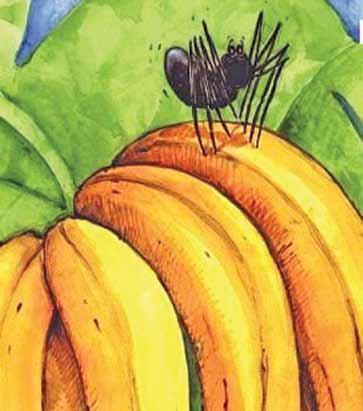
All the excitement had made him thin. And now that he was thin again, he was hungry. Anansi climbed the banana tree. He settled himself in the middle of a big bunch of bananas and started eating.
Elephant returned. He went straight to the melon patch.
“You melons got me in trouble with the king!” Elephant said. “From now on, you can talk all you like. I’m not going to listen to a word you say!”
“Good for you, Elephant!”Anansi called from the bananas.
“We bananas should have warned you. Talking melons are nothing but trouble.”
The beauty of toes on soft ground, far from the illimitable sky; the soil topsy-turvy, the curvature of flesh or splinters of wood as we look down from above: who we are, how many fingers we have left, how many toes, this exchange with antlers or simply make-believe.
Nails growing on one hand, horns becoming extremities as we're still on circular ground; and it takes seventy years or more before things begin to wither and die, as I keep remembering a new passage, the heart palpitating, the lungs giving out in a whoosh
Breath of air really, grasping at things, then moving from tree to tree for a better view; even being a sloth of sorts, hanging with one arm-the liana bent I'm sure.
Here a white-watered terrain close to the Zambezi and the Nile, the Brahmaputra making us believe all rivers are one long vein; the Ganges and St Lawrence too, if you must know; then the Orinoco and the Amazon-at this juncture.
I walk barefooted, my toes' indelible imprint on delta, topsoil, the terrain of wood and plaster, because of who I am-or we all are.
Nurturing false hopes, dreams also putative, as we are here to stay, believe me. Pyramids of lost time, an obelisk sun scorching as the toes keep making us go on to places, yet leaving us at the desert limits.
Ah, the Pharaohs have carved nothing, hands clawing for more space in a tomb or mausoleum with the noise of tourists being all, my counting to ten in Arabic... what Ptolemy or young Tutankhamen have said, always
with portents: signs coming down through the ages, I must consider or actually believe in.
The graven image, my offering prayers to stranger gods, Ra no less, because of the magic of numbers; or a cat carved with a self-styled grimace. With Copernicus I continue to think of the round earth differently, the sun's position always changing; the toes becoming gnarled without perfection: closer to the heart, lungs, face...eyes...ears...lips.
Indeed I have scores to settle, over vast areas of topsoil: with the jay bird and crow, or being a desert albatross, or a condor in South America-the toes bringing me here, and I cry out with the heart's authentic gasp.
At the Bronx Zoo or some place where the silk cotton tree bends, forming a rainbow, I keep looking down-toes ochre or sepiabrown, registering the tradition of webbed feet, the ducks' own no less... digging in, holding up myself before becoming mud splattered... finally being on solid ground.
I make amends and keep wondering who I am, and why there's really no other place to go to: no other boundary in the mind despite welcoming truths about a far place in a wide universe.
The toes simply interchange with fingers, lips, eyes, ears; nostrils becoming flared, bringing us to this realization that we will live out our lives fully without reconnoitering on topsoil.
The maple tree springing up then, as we move closer together, or keep being too long in one place, or forever-at a standstill.
Cyril Dabydeen
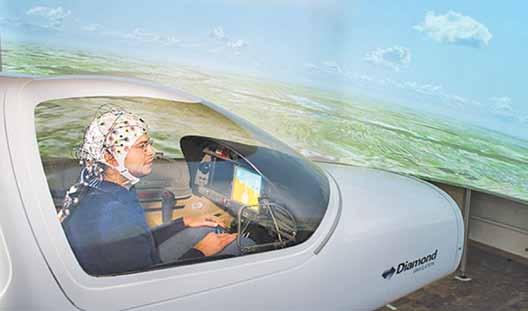
Why pilot a plane with your hands and feet when you can do it with your brain? Thought-controlled flight could be arriving soon, according to the EUfunded “BrainFlight” project.
A team of scientists from the Institute for Flight System Dynamics and the Berlin Institute of Technology says it has translated brain impulses into control commands, enabling pilots in a plane simulator to achieve a range of remarkably precise maneuvers without touching the controls or pedals.
Wearing a cap with lots of cables attached, pilots in the simulator were able to land a plane simply by looking at the screen and moving the control stick with their thoughts, cor-
recting the plane’s position repeatedly until it landed.
To achieve the breakthrough, the researchers connected electroencephalography (EEG) electrodes to a cap to measure the pilot’s brain waves. An algorithm created by Berlin Institute of Technology scientists enabled a program to decipher the brain waves and convert them into commands fed into the plane’s control system.
Once it’s perfected, brain-controlled flight could reduce pilot workload and increase safety. Freeing up pilots’ hands would give them freedom of movement to manage other manual tasks in the cockpit.
The German team conducted its experiment using seven test subjects with a range of flight expe-
rience, including one who had no experience whatsoever.
The team reported that all seven, flying the plane only with their thoughts, managed to achieve accuracy that would meet some flying license requirements. Astonishingly, even the participants with little or no prior training succeeded in landing the planes.
One participant was able to follow eight out of 10 target headings with only an incredibly small 10-degree deviation. Another was able to land within only a few meters of the runway’s center line.
Some even managed their approach in poor visibility conditions.
Imagine what trained military pilots might be able to do with this technology. (Discovery News)
Ancient rock hints at early continent formation
How did Earth's continents first form?
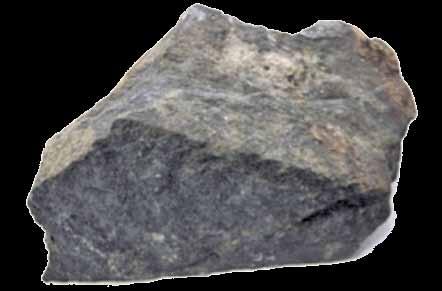
A University of Alberta geochemistry PhD student studied a 4-billionyear-old rock and concluded: Look at modern-day Iceland.
The student, Jesse Reimink, collected ancient rock samples from the Acasta Gneiss complex in Canada's Northwest Territories, which contains some of the planet's oldest rocks.
Because they're so old and have un dergone so many chang es, many of the Acasta Gneiss rocks don't lend themselves to precise geochemical analysis. But some of the ones Reimink collected were preserved well enough to reveal what Reimink called, in a University of Alberta (U of A) article, "crust-forming processes that are very
similar to those occurring in present-day Iceland."
Today it's accepted that plate tectonics -- in which pieces of the Earth's crust shift beneath each oth-
Earth's mantle and cause magma to rise to the surface -- are responsible for the buildup of continents.
But, Reimink told the U of A, it's not as clear whether plate tectonics existed a couple of billion years ago. One theory holds that the
Fossilised crocodile tooth 'largest of its kind in UK'
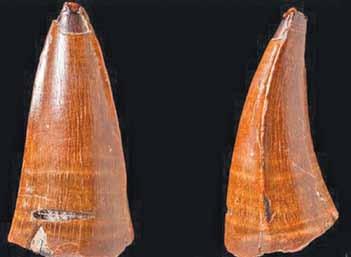
The fossilised tooth of a prehistoric crocodile has been recorded as the largest of its kind found in the UK.
The 2in (5.5cm) tooth was dredged from the seabed near Chesil Beach, Dorset.
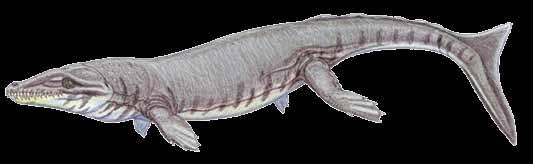
It belonged to an ancient relative of modern crocodiles, known as Dakosaurus maximus
Researchers from the University of Edinburgh and curators from the Natural History Museum identified it after it was bought at an online auction by a fossil collector about a year ago.
The shape of its skull and teeth suggests it ate similar prey to killer whales
The tooth, which has a broken tip, is now in the fossil collection of the London-based museum.
Exceptionally dangerous
Dakosaurus maximus grew to about 4.5m (15ft) in length and swam in the
shallow seas of Europe 152 million years ago, according to the team's research published in the scientific journal Historical Biology.
The shape of its skull and teeth suggest it ate similar prey to killer whales, using its broad, short jaws to swallow fish whole and to bite chunks from larger prey.
Dr Mark Young, from
the university's school of biological sciences, said: "Given its size, Dakosaurus had very large teeth.
"However, it wasn't the top marine predator of its time, and would have swum alongside other larger marine reptiles, making the shallow seas of the Late Jurassic period exceptionally dangerous." (BBC)
land masses formed in the ocean as liquid magma rose from Earth's mantle and then, over much time, cooled and became a solid crust. Iceland's crust built up when magma from the mantle rose to shallow waters and incorporated volcanic rocks already in place.
Reimink says this makes today's Iceland a good proxy for how continental crust formed in the early life of Reimink's 4-billion-year-old rock seems to back up that notion. "This provides the first physical evidence that a setting similar to modern Iceland was present on the early Earth," he told the U of A.
Reimink is lead author of a new study in Nature Geoscience that details his findings. (Discovery News)
AMystery donor of hidden cash sparks frenzy in Los Angeles
n anonymous cash donor who touched off a treasure hunt across San Francisco by hiding envelopes full of bills in unlikely places and providing clues via Twitter has moved operations to Los Angeles, sparking a frenzy with the first money drop.
The unknown donor made the deposit near a fountain in Griffith Park on Wednesday night, and local television showed throngs of people searching frantically for the hidden loot.
"What was originally meant to be a pay-it-forward scavenger hunt for San Francisco, has become much bigger than San Francisco and more than a scavenger hunt," the mystery benefactor said in a message posted on his Twitter account, @HiddenCash.
The man, who had more than 330,000
Twitter followers by Friday morning, revealed little about his identity but wrote that he came up with the scheme while dining with a friend last week as a fun way to give back to the community
"There have been large crowds lately. Please walk and drive safely," he wrote. "A young woman ran right in front of my car a few days ago. I will do my best to pick locations that are safe, but please use common sense and caution."
The covert philanthropist said he had also been overwhelmed with emails asking for financial assistance since starting the game but could not respond and was instituting a "media blackout" for the next few weeks.
He began tweeting out clues to the latest drops on Friday morning. (Reuters)
The fossilised tooth of the Dakosaurus maximus was discovered off Chesil Beach in Dorset and is now housed at the natural History Museum in London
The shape of its skull and teeth suggests it ate similar prey to killer whales
A pilot inside a flight simulator wears an electroencephalography (eeG) cap and uses his thoughts to land a plane
Google unveiled a brand new self-driving car prototype on Tuesday; the first company to build a car with no a steering wheel, accelerator or brake pedal.
The car’s arrival marks the next stage in Google’s self-driving car project, which was born from the Darpa Grand Challenges for robotic vehicles in the early 2000s. Google kickstarted its own selfdriving car project in 2008, and it has been rumbling on ever since, first with modified Toyota Prius and then with customised Lexus SUVs, which took the car’s existing sensors, such as the cruise-control cameras, and added a spinning laser scanner on the top.
It is the first truly driverless electric car prototype built by
Google to test the next stage of its five-year-old self-driving car project. It looks like a cross between a Smart car and a Nissan Micra, with two seats and room enough for a small amount of luggage.
It ferries two people from one place to another without any user interaction. The car is summoned by a smartphone for pick up at the user’s location with the destination set. There is no steering wheel or manual control, simply a start button and a big red emergency stop button. In front of the passengers there is a small screen showing the weather, the current speed and a small countdown animation to launch.
Once the journey is done, the small screen displays a message to
remind you to take your personal belongings – reinforcing that this is not aiming to be a substitute for your personal car at the moment, but more as a replacement for the taxi without the human driver.
Very few people outside of Google have been allowed to ride in the new car. Most of the people depicted in Google’s promotional videos for the new car described the experience as “smooth” and “nothing that feels the least bit threatening”.
Powered by an electric motor with around a 100 mile range, the car uses a combination of sensors and software to locate itself in the real world combined with highly accurate digital maps. A GPS is used, just like the satellite nav-
Apple agrees to buy headphone maker Beats for $3bn
Apple has confirmed it will buy headphone maker and musicstreaming service provider Beats Electronics.
The deal is worth a total of $3bn (£1.8bn), and is thought to be Apple’s largest acquisition to date.
As part of the acquisition, Beats co-founders Jimmy Iovine and Dr Dre will join the technology firm.
Apple boss Tim Cook said the deal would allow the firm to “continue to create the most innovative music products and services in the world”.
In a statement, Apple said it is paying an initial
$2.6bn (£1.6bn) for Beats, and approximately $400m (£239m) “that will vest over time”.
Beats was founded in 2008 by music producer Jimmy Iovine and hip-hop star Dr Dre and until recently was best known for its headphones. It started a subscription-based music streaming service earlier this year.
Apple has its own iTunes store, the world’s largest music download service, and launched iTunes Radio last year.
But despite having been an early pioneer of digital music, the Californian firm has been facing increased
competition from subscription services such as Spotify, Pandora and Rdio.
However, Beats’ music service only has about 250,000 paying subscribers, compared with Spotify’s 10 million.
The deal with Beats also marks a departure for Apple, which has a reputation for developing new products in-house, rather than buying up smaller firms - a method preferred by rivals Google.
The Apple boss said that Dr Dre and Mr Iovine would be coming up with “products you haven’t thought of yet”. (Excerpted from BBC)
igation systems in most cars, to get a rough location of the car, at which point radar, lasers and cameras take over to monitor the world around the car, 360-degrees.
The software can recognise objects, people, cars, road marking, signs and traffic lights, obeying the rules of the road and allowing for multiple unpredictable hazards, including cyclists. It can even detect road works and safely navigate around them.
The car itself is limited to 25 mph but also minimises the kinetic energy it could carry into a crash if one should happen. The front of the car is also made to be as kind to pedestrians as possible with a foam bumper and a flexible windscreen that is designed to absorb energy from an impact with a person’s body.
Seat belts are also provided – a safety requirement for vehicles on the road – while the car has redundant systems, a “fault-tolerant architecture” as Google calls it, for both steering and braking, should
the primary systems fails; plus that emergency stop button that passengers can hit at any time.
One of the biggest hold-ups to the progression of the technology onto the open road of Britain, the US, Australia and the rest of the world will be legislation.
A law was passed in California over a year ago that made the testing and operation of self-driving vehicles on roads possible, as long as they had manual override controls. The Department of Motor Vehicles in California is expected to issue regulations on the operation of selfdriving cars soon, after which selfdriving cars may become a bit more common place.
However, there is still much to work out, primarily revolving around what a passenger in a selfdriving car and can’t do – will they have to be able to take control at any moment, for instance – as well as questions around what happens when an accident happens, who is at fault and who pays. (Excerpted from The Guardian)
i-Ox smartphone grip holds up to multiple orientations
The design of smartphones, along with the shape of the human hand, makes portrait mode the preferred option in most cases. The i-OX grip is designed to provide a comfortable way to hold a phone while using it in various orientations. Basically, the i-Ox smartphone holder affixes to the back of the phone and allows the user to slide his or her finger through a ring, giving them a firm grip on the device. This can be used to comfortably hold the phone in landscape mode, while making a call, or for pretty much any other use case where one would want a strong
grip. Additionally, the ring can also be used as a stand for the phone, allowing the user to stand the phone upright while watching videos.
Holders and stands for smartphones are nothing new, but what makes this one stand out is the way it promises to adhere to the user’s device. The creators promise that it will vacuum seal to the phone, allowing it to attach firmly, but without the need of any adhesives. After all, no one wants to leave a sticky residue on the back of their expensive phone. This method also allows it to be attached and unattached over and over, giving it
some extra flexibility.
Another key feature is that the ring folds flat, which means the user can leave it on their device while carrying the phone around in his or her pocket. GIC Nexus, the company behind i-Ox is seeking funding on Kickstarter. It’s still early days for the project’s funding period, but it’s already about halfway to its US$35,000 goal. Backers interested in receiving a device can make a minimum pledge of $25 while the early special lasts. After that, the price jumps to $30. Shipping is slated for this October, if all goes to plan. (Gizmag)
Hailing from the Pomeroon River, Everley Austin has been creating ceramic masterpieces for more than 43 years, incorporating his artistic flavour of colour and distinct designs.
Of Warrau and African-Guyanese descent, 66-year-old Austin started making ceramics pieces from the early age of nine. He copied the designs from Chinese vases and used ordinary paint for the finish. The pieces were unfired: lathered water colour and a coat of lacquer were used.
In a past interview with Guyana Times Sunday Magazine , Austin said that his mother provided scope for his creation by giving away his work, so there was always a space in the home for another piece.
Born March 3, 1948, Austin noted: “Since from childhood I would create many ceramics pieces; it came naturally to me, and my mother would always encourage me. She kept giving away my ceramic work so that there is always room for more pieces, which motivated me to continue.”
In 1969 he was exposed to finished ceramic pieces when he participated in an exhibition of clay and clay products. Then in 1970, after an interview for the entrance to the Pre Service Teachers’ Training College, he was recommended for a scholarship to study ceramics at the Royal College of Art in London.
After training college, he continued to create his ceramic pieces and went back to the Pomeroon to continue teaching, but not for long. He was requested to return to Georgetown in 1973 to teach where he and several of his colleagues started- the Sophia Centre for delinquents. He taught Art and Craft.
Later, he became a part-time student of the Burrowes School of Art in 1975 and in 1976 was awarded a conditional scholarship to study fine arts at the Jamaica School of Art. At that school, Austin graduated with an Honour. Returning to Guyana, he graduated and commenced working at the Burrowes School of Art in 1980. In that year, he participated in an exhibition at the Jamaica Pegasus, and later that same year mounted a oneman show at the John Pear Tree Gallery Jamaica.
From 1982 to 1990 he was the judge for Guyfesta Art and Craft Exhibitions. He was also a judge for the Children’s Mashramani Costume Competition for many years, and later became the Chief Judge. He was responsible for decorating the National Park for the Mashramani
Anniversary celebrations. In 1992 and 1996 he took works from Guyana’s art collection to Trinidad for Carifesta, and in 1994 set up a special art exhibition for Her Majesty Queen’s Elizabeth’s visit to Guyana. This exhibition was later one of the first displayed at the National Art Gallery at the Castellani House. Austin was the first curator of Castellani House from 1994 to 1996, and was responsible for mounting the exhibits for the opening of the African Heritage Museum (then called the Museum of African Art and Ethnology) under Dr Denis Williams. In 2001, he migrated to Botswana
where he taught the general subject of art for two years. He returned to Guyana in 2006 and recommenced his teaching at the Burrowes School of Art.
“When I’m sculpting I think of nature. Most of excitement is from glazing them, and when I create these too I think about the likes of people which sometimes motivate me to create extraordinary pieces. Clay is very exciting and easy to work for me because of being in it for many years,” Austin noted.
For decades, Austin has been responsible for introducing the elements and practical methods of ceramic-making to scores of students in Guyana and elsewhere.
For more information on the artist, contact Castellani House on 225-0579.
Vase
Another contemporary storage jar
Storage Jar Artist everley Austin Small
In the late 19th century, the decision was made for the construction of a market that would stand the test of time in order to accommodate the increasing number of vendors in Georgetown; that market has survived to this very day.
While little official information appears available about the history of Bourda Market, previous unofficial research relates that Bourda market was originally built in 1880, and was soon reconstructed in 1902 to accommodate a growing number of vendors and consumers.
The market got its name from the famous colonial, Joseph Bourda, who was also the proprietor of the Vlissengen Plantation, and was one of the many colonials who found their final resting place in the Bourda cemetery which is opposite the market. A place now neglected and overgrown with bush.
The actual Bourda market borders on the north and south by Robb and Regent Streets respectively, and on
the east and west by Orange Walk and Bourda Street.
The market has a long history that goes back to the 1870s when mention was just made of the Bourda market in the City Council’s minutes book.
The area in which the market is situated seems from very early in its history to have been where people gather to vend their produce on Saturday and Sunday afternoons. From this humble beginning the area later developed into a marketing centre.
Beginnings
According to Schulder Griffith, who was Clerk of Markets at the time of the study, vendors who normally occupied the Stabroek area came down to the Bourda area to do business after the construction of the Stabroek market began. As early as 1878, a shed was erected to accommodate the increase of vendors that now occupied the Bourda area.
The Bourda Market was declared a temporary market in 1880.
The report of the City Council of 1881 asked the
Council to decide whether to make the temporary structure which was the shed to become permanent. After three and a half years of existence, the shed had become unsafe and was there-
fore in need of much repair. The report added that if the market was to continue permanently it would be necessary to erect a more substantial building and fence it securely. The construction of Bourda Street and drains in the area was laid out in that same year.
The 1882 estimate of the City Council shows that a sum of $651.80 was set aside for enclosing the Bourda market an area of 125 x 50 feet approximately. The estimate also includes erecting and painting the fence. In 1901, a plan was prepared of a “new iron market” for Bourda, but due to the high prices for materials in that year, the decision was made to start construction in the following year. Provision was then made in the 1902 estimates for the construction of the new market.
Construction
The foundation stone of the Bourda market was laid on 12 December 1902 enclosing an area of 12,500 square feet, accommodating some 2,328 stalls. Bourda market, like Stabroek market, is enclosed with iron railing. It is a giant timber framed shed with three giant truss roves constructed of wood. A simple iron railed fence surrounds the entire structure. A clock tower was also constructed, which still exists though it is apparently not functioning.
This tower is not an imposing structure like its more famous sister, Stabroek Market is - people using the areas can go by the market without really noticing the clock tower.
The Bourda Market clock was built by W Potts and Sons Makers of England in 1902. The clock bell is of cast bronze and weighs approximately 500 pounds. Legend has it that this bell is a commemorative bell cast for the coronation of England’s King Edward in 1902.
The market was later extended to include what was once called the Bourda Green. The Bourda Green was paved with concrete, and vending was permitted in the 60s, but the area was later organized and im-
proved by requiring vendors to build stalls so as to remove their produce from off the ground. Further improvements were made as the area was provided with electricity, and stalls had to be made secure to prevent people from sleeping in them since the area that housed the Green was not enclosed.
The Bourda Green is a famous historic site because it was where the politicians in the 40s and 50s would gather to stage their political meetings. Many of them launched their political careers on that very ground. The vendors who occupied the Green were mostly from the East Coast of Demerara. The Green is now so filled to capacity that the Merriman’s Mall has to be used for the selling of farmer’s produce.
The Bourda Market is a very popular market, and is always buzzing with activity on a daily basis. Almost anything can be purchased in this market without having to go anywhere else.
While in need of repair, and in the shadow of the famous Stabroek Market, Bourda Market remains one of the most well-known and utilised traditional buildings in Georgetown.
Bourda Market, British Guiana
The Clock Tower
View of Bourda Market from the north-eastern corner
A section of Bourda market interior
Kurupung is located in the heart of the
River area in the
range. It is known for its scenic beauty and vast, spectacular forest, and is filled with caves and is excellent for exploration
It is mainly a mining town, with an exploding population of coastlanders, Venezuelans and Brazilians. While the main business activity is mining, many visit the area to enjoy its lush nature.
Life in Kurupung is quiet, with clean air and bountiful fruits and vegetables. (Photos by
Mazaruni
Pakaraima mountain
Nicholas Chuckasang)
Cover photo: View of the mountain from the Mazaruni river
A flower found on the mountain
Kurupung mountain
River rapids near Kumerau Falls
Spectacular view in Kurupung
A scenic view of the Kumerau Falls
By Melvin Durai
OLast Laugh
n a recent Friday,
my wife and I decided to have lunch at an Indian restaurant near our home, one that offers an all-you-can-eat buffet. I like their buffet because it's usually stocked with a variety of food, mostly South Indian dishes but also a few North Indian items. The buffet
only to children aged 7 and under. Anyone 8 and older had to pay the adult price.
"How old are your children?" the waiter asked.
"My son is 7 years and 11 months," I said. "One of my daughters is 7 years and 38 months, and my other daughter is 7 years and 58 months."
But it didn't work: I couldn't convince him that
costs US$9.99 for adults on week days, and I usually make sure I eat at least US$10 worth of food.
Because we were taking our three children along, I called the restaurant to ask about their buffet price for kids. "US$3.99 for children," I was told over the phone. That seemed quite reasonable, especially since my children aren't big eaters. It's almost impossible to get two of them to finish what's on their plates, unless they're eating pizza or pasta. They must have been Italians in a previous life.
When we arrived at the restaurant, the pricing didn't seem so reasonable any more. A waiter told us that the $3.99 price applied
my daughters, aged 10 and 11, should be charged the children's price. Quite upset about this, I berated him and another waiter – and anyone else who looked like they might work at the restaurant.
They didn't deserve to be rebuked, of course. After all, they weren't the ones who set the prices. The owner of the restaurant is whom I should have been lambasting, if only he was around. He was probably sitting in his office in the back, tapping the keys of his calculator, figuring out how many children would need to eat at the buffet for him to retire to the Bahamas.
We promptly left the restaurant – my wife was right-
fully embarrassed by my outburst – and headed to a nearby Vietnamese place. It had no buffet, so we ordered off the menu and didn't worry about overpaying for our children.
My older daughter will soon turn 12 and, whether I like it or not, we'll be paying adult prices for her at almost all restaurant buffets. It's widely believed that 12 is the magical age when a child begins to put away as much food as an African bush elephant. The food bill in our household will practically double in a few years, when both my daughters hit their teen years and discover the joy of eating.
The typical teenager's mouth, as various scientific studies have shown, is open for more hours in a day than it's closed. If teenagers aren't talking, singing, chewing gum or eating, they're sleeping with their mouths open.
Some teenagers just walk around with their mouths wide open. As any good scientist will tell you, this is a natural reaction of the human body to protein deprivation, a way of communicating this dire need to parents, as well as potentially catching a flying insect or two.
It's during the teen years that children tend to grow the fastest. One week, your daughter barely reaches your shoulder; the next week, she's saying, "Dad! You're going bald!"
Teenagers need to consume tons of food to get the calories they need for their growth spurts. That's why, when it comes to charging teens, I can't help but sympathize with restaurants. If I were a restaurant owner, I'd put up signs all over my restaurant to deal with the issue of charging teens: "Walk slowly. No charging to the buffet!"
A sign in Denmark that attracts a lot of attention. ‘Fart’ in Danish means ‘speed’
Tickets Please
Three lawyers and three engineers were travelling by train to the same meeting. At the station, the lawyers each buy a ticket but the engineers buy just one. When asked why, the engineers coyly said "You'll see."
They all board the train, the lawyers taking seats, but the three engineers all crowding into the bathroom. After the train has left, the conductor comes around and takes the lawyers tickets and knocks on the bathroom door and says, "Ticket Please." An arm stretches out from the bathroom and the conductor takes the proffered ticket. The lawyers were very impressed.
On the return trip, the lawyers proposed to emulate the gearheads and bought only one ticket. To their amazement, the engineers bought no ticket at all. When asked, the engineers said, "You'll see."
All board the train and the lawyers and engineers cram into separate bathrooms to await the conductor. After a few minutes, one of the gearheads emerges from the bathroom, goes over to the lawyers' bathroom, knocks on the door and says: "Ticket please."
Is Mr Smith there?
A law firm receptionist answered the phone the morning after the firm's senior partner had passed away unexpectedly.
"Is Mr Smith there?" asked the client on the phone.
"I'm very sorry, but Mr Smith passed away last night," the receptionist answered.
"Is Mr Smith there?" repeated the client.
The receptionist was perplexed. "Perhaps you didn't understand me I'm afraid Mr. Smith passed away last night."
"Is Mr Smith there?" asked the client again.
"Ma'am, do you understand what I'm saying?” said the exasperated receptionist. "Mr Smith is DEAD!"
"I understand you perfectly," the client sighed. "I just can't hear it often enough."
Famous Sports Quotes
New Orleans Saint RB George Rogers when asked about the upcoming season: "I want to rush for 1,000 or 1,500 yards, whichever comes first."
Football commentator and former player Joe Theismann 1996: "Nobody in football should be called a genius. A genius is a guy like Norman Einstein."
Senior basketball player at the University of Pittsburgh: "I'm going to graduate on time, no matter how long it takes."
Police Emergency
This is the true story of George Phillips of Meridian, Mississippi, who was going to bed when his wife told him that he'd left the light on in the shed. George opened the door to go turn off the light but saw there were people in the shed in the process of stealing things.
He immediately phoned the police, who asked "Is someone in your house?" and George said no and explained the situation. Then they explained that all patrols were busy, and that he should simply lock his door and an officer would be there when available.
George said, "Okay," hung up, counted to 30, and phoned the police again.
"Hello, I just called you a few seconds ago because there were people in my shed. Well, you don't have to worry about them now because I've just shot them all."
Then he hung up. Within five minutes three squad cars, an Armed Response unit, and an ambulance showed up. Of course, the police caught the burglars redhanded.
One of the policemen said to George: "I thought you said that you'd shot them!"
George said, "I thought you said there was nobody available!"
Paint Thief
A thief was taking red paint and he was running fast. "Can't spill the paint." He said as he ran. But he tripped over a rock.
"ARGGGGGGGGGGGGGG NOOOO I SPILED THE PAINT ON MY HANDS!" And the law got him.
"Talk about getting caught red handed!" The police man joked.
Tooth Fairy
After losing another tooth, young Timmy became more curious about the mysterious tooth fairy.
Finally putting two and two together, he came right out and asked his mother, “Mom, are you the tooth fairy?”
Assuming he was old enough to hear the truth, she replied, “Yes Timmy, I am.” Timmy seemed to take this news quite well.
But as he headed for the door, he slowly turned back toward his mother with a curious look on his face and said, “Wait a minute mom. How do you get into the other kids’ houses?”
Communication
A man comes home from the office and tells his wife he had a frustrating day at work.
"Ahhhhh, tell me all about your day honey," his wife says.
The husband looks at her and says, "Well... I just did."
Improvement
"Ever since we got married, my wife has tried to change me. She got me to stop drinking, smoking and running around until all hours of the night. She taught me how to dress well, enjoy the fine arts, gourmet cooking, classical music, even how to invest in the stock market," said the man.
"Sounds like you may be bitter because she changed you so drastically," remarked his friend.
"I'm not bitter. Now that I'm so improved, she just isn't good enough for