Star Times Hollywood: Katy Perry buys her assistants five cars
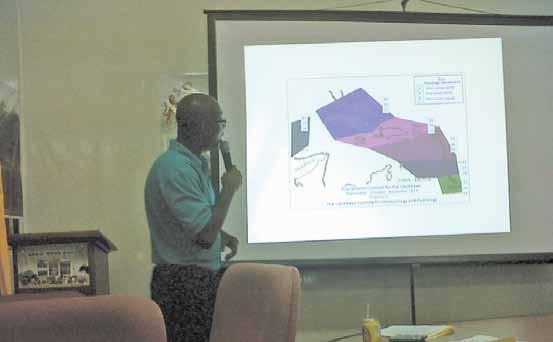
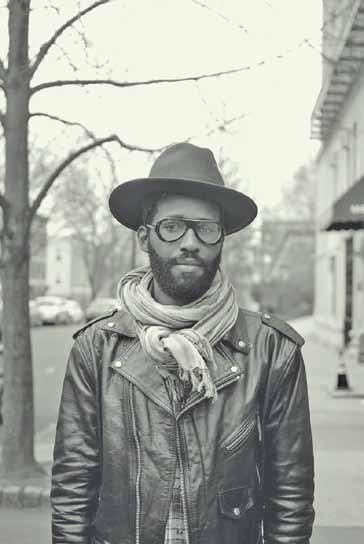
Notable US-based Guyanese photographer Kwesi Abbensetts explains the rudiments of ‘good’ photography
March 23, 2014
Ministry of Agriculture engages youths to be champions for action on climate change
Every 23 March, the UN’s World Meteorological Day is celebrated worldwide. This year’s theme is “Weather and climate: engaging youth”. Consequently, the Ministry of Agriculture is hosting several programmes to increase awareness among young people about climate change and mobilise them as champions for action.
In explaining this year’s theme, the World Meteorological Organization (WMO), located in Switzerland, stated that “today’s youth will benefit from the dramatic advances being made in our ability to understand and forecast the Earth’s weather and climate. At the same time, most of them will live into the second half of this century and experience the increasing impacts of global warming. WMO encourages young people to learn more about our weather and climate system and to contribute to action on climate change”.
Meteorology is the interdisciplinary scientific study of the atmosphere. There are different branches that come under meteorology such as hydrometeorology, which studies the transfer of water and energy between the land surface and the lower atmosphere, and agrometeorology, the study and use of weather and climate information to enhance or
expand agricultural crops and/or to increase crop production.
In Guyana, the Hydrometeorological Service is a department attached to Ministry of Agriculture. This department’s general responsibility is to monitor and evaluate the weather and water resources in Guyana and to actively support the government in disaster risk management and aeronautical, water, agriculture, engineering and other agencies for the socio-economic development of the
country. It is the official provider of weather, water and climate information, and related products and services for Guyana.
The department’s activities include observation and data collection to meet the needs of future generations for reliable, homogeneous national climatological, hydrological and oceanographic data; research directed to the advancement of hydrological, oceanographic and meteorological sciences and the development of a comprehensive description and
scientific understanding of Guyana's weather, climate and water resources; provision of hydrological, meteorological, oceanographic and related data, information, forecasts, warnings, investigation and advisory services on a national, as well as international basis; and coordination of Guyana's involvement in regional and international hydrology, meteorology, oceanography
the departments to be more effective in their services to the country.
In engaging youths, the Ministry of Agriculture, according to Misir, is hosting a Radio Quiz, Facts and Info Segment on meteorology; conducting school tours at the radar site; and will be launching the meteorological department’s new website next week.
Another branch of meteorology is agrometeorology. The Agrometeorological Department is within
vides farmers with essential weather information to help them to be more productive. The revitalised Agrometeorological Department collaborates with extension offices from other agricultural agencies such as the National Agriculture Research and Extension Institute, Guyana Rice Development Board, Guyana Livestock Development Authority, among others. These collaborative efforts facilitate easy dissemination of the agro-
and related conventions.
To date, the Hydrometeorological Service produces a Farmer’s Weather Bulletin, which is disseminated on a monthly basis. The yearly hydromet calendar also consists of monthly forecast for each administrative region of the country, which aid in assisting farmers in their decision making.
In an interview with Guyana Times Sunday Magazine, Chief Hydrometeorological Officer Diana Misir said numerous youths work within the meteorological departments in Guyana. She added that many of them have been instrumental in developing those departments, aiding
the Hydrometeorological Service. It is said that climate variability and climate change will strongly impact agricultural productivity, this affecting the food security of many vulnerable farming areas and by extension, the nation as a whole.
However, food production in Guyana does not need to decrease as a result of climate change. On the contrary, farmers armed with relevant weather information can plan their food production and increase yields in the face of climate change. Thus, there is a need to provide more support to agriculture and increase food security through weather services. Presently, meteorological service pro-
meteorological products. It is important that this information is readily available to extension officers, because they are the ones interacting directly with the farmers on a regular basis.
The Agrometeorological Department plans on extending their research, training and dissemination of information activities, focusing on the developing of the department and ultimately enhancing agricultural production.
Misir encourages youths to become more familiar with the hydrometeorological and agrometeorological departments and to learn how they can contribute to the development of those sectors.
automatic weather station at copenam, region Five, which was commissioned last year in celebration of World Meteorological Day
The Doppler radar facility at the cheddi Jagan International airport improves weather monitoring and forecasting
The agrometeorological Section continues to study climate change in order to improve its strategies in developing the sector
By Dmitri Allicock
The town of Linden is split down the middle by the Demerara River. Over the years, the town grew and expanded unevenly as bauxite dominated. The notable eastern bank development was the Amelia’s Ward housing scheme that followed the Linden/Soesdyke Highway opening at the end of the 1960s.
On the western bank, the population was always more numerous. The population has increased significantly from west Watooka to Christianburg, and westward to include Wismar Hill, Half Mile, One Mile and the Rockstone Housing Scheme.
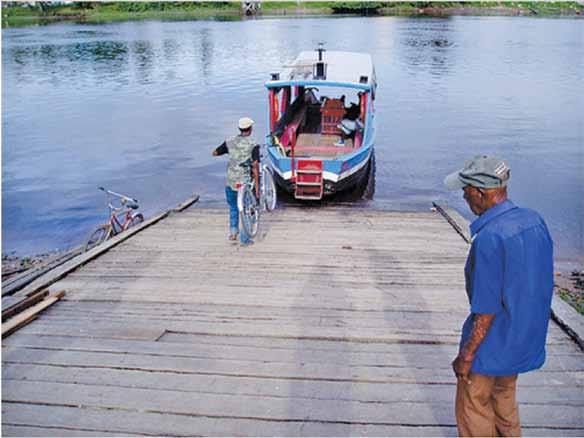
The ferry boat system, which was born with the bauxite industry, had the enormous responsibility of connecting the daily lives of the people. At its peak, over a dozen privately-owned ferry owners existed from Cakatara to Speightland. Some of the owners in 1972 were from the Cakatara end: Quamina, Kennedy, and Obermuller. More centrally located were Rigby, Major and Dutchie boat landing, at Speightland: Chester, Adams and a few others.
Except for the period before ‘Major’ owned that particular, very well built landing that once belonged to Demba in 1939, very little oversight or central control occurred. There were laws and rules on the books, but few paid much attention, and there was little enforcement. Effects of WWII
Demba boat landing was called the ‘Wismar boat landing’, and later became the property of Major. It was constructed and used during the Second World War to control access to the Mackenzie shore, providing extra security for the bauxite plant as British Guiana sought to safeguard all its interests. The world at war
boats powered by outboard motors, which ply back and forth across the river all day long. The fare for crossing was eight centsfour pence, which one handed to the ferryman who crouched in the shade of a rough wooden shelter at the stern of the boat. The passengers sat on the thwarts, a position in which the women among them were constantly concerned to keep their skirts from trailing in the bilges. When one reached the further bank in the ferry, the small boat nosed its prows on the boards of a ramp, where one disembarked and clambered up on to the road, a broad unpaved track where after rain the pedestrian sank ankle deep into black ooze.”
For the most part, the ferry system worked, but there were serious problems. There was no safety training of the boat operators. You had untrained and, at times, lewd characters who couldn’t work elsewhere operating unsafe boats.
On regular occasions, loud, foul and half-naked operators with a bottle of liquor in one hand played cat and mouse
was also real in British Guiana. German submarine activities off the Atlantic Coast of Guyana resulted in many ships torpedoed and sunk, most laden with supplies of bauxite and other materials, severely affecting trade.
This boat landing was the only one allowed, as passengers and all traffic required a pass of identification to be at Mackenzie. Frequent mandatory blackouts were also implemented with the sound of any unidentified aircraft passing over head at night. The fear of sabotage or bombing was very real as the allies attempted to protect vital raw materials and resources.
Safety and comfort issues
The early ferry boats were without engine or roof in the 1920s and early 1930s. All able-bodied passengers were given a large paddle and had to assist with rowing the small boat across the river. Many might still remember the old diesel engines that filled most of the back of the boat with smoke and which had to be hand cranked many times before the sputtering and gushing thick black smoke assured that the engine had started.
Zahra Freeth in her 1960s book “Run Softly Demerara” notes, “There is no bridge over the Demerara, and the normal way to reach Wismar from North Mackenzie was in one of the small ferry-
with the passing bauxite ships that blew their horn endlessly to clear the river. Many engines failed and boats drifted up and down the river. Little or no life jackets were on the boats. Some boats had to be bailed out to stay afloat.
Memorable characters
There were many countless mishaps and drowning. Three bauxite workers had drowned while crossing the river in the early 1970s, which I remembered well. A bearded, tall man named Churchill, with a large hook and rope, would usually lead the body recovery effort. The ghastly site of Churchill, with his hook and coil of rope fishing the river bottom for the unfortunate victim to an audience of hundreds of onlookers at the side of the river, was a haunting sight.
I respect the kind and decent Mr Quamina, and was a good friend to all his children, whom I admired and still often remember. He had a boat that stood out from the rest. This small, shallow and greenheart-made boat had a round bottom. The ominous bow of the boat was warped and pointed downwards. It sank many times. After it was recovered, it was moored for months before it was again back in service. By then, I guessed many would have forgotten the last tragedy. One morning on my way to school, Mr Quamina repeatedly begged the passengers, who were mainly bauxite workers,
“Please reduce the load guys! There are too much people in the boat!”
The boat operator and Mr Quamina stood helplessly with hands on hips. Not a single passenger disembarked. Most of the passengers were either late or in a hurry to cross the river.
Then the frustrated Mr Quamina said these magical words, “It’s alright, take the load across, it is long overdue since I sold another boat load to the fair-maid (water spirit).” The boat then safely crossed the river mostly empty as the appeal to the fears of the spooks worked very well. Mr Quamina quietly smiled in relief. A must for school
The ferry boat played an integral part of a young child’s life as it was used to ferry students daily to attend school. In the mid 1960s and 1970s, most of the community’s children went to Christianburg, St Aidan’s or Mackenzie primary schools before a secondary education was possible.
The story of schools in Guyana is of structure, uniforms, and what is now known as corporal punishment. As children, we judged our teachers by the feared cane they used to mete out punishment and discipline. The untimely and unpredictable ferry boat decided daily if a child was going to be punished for tardiness.
Any excuse that the ferry broke down or that the boat aimlessly drifted, guaranteed only an extra lash from the cane and a short lecture that other students were timely and maybe you should have caught the earlier ferry. There were ways around this, and in very creative ways we simply avoided the headmaster who stood at the entrance of the school compound.
Childhood imagination and play also surrounded the ferry system. We played and built sand castles on the Mackenzie shore while waiting for the boat. Ducks and drakes was a favorite game we enjoyed as we expertly skimmed the flat bush seed called Iresoura (which was
found with other interesting debris and drift wood on the beaches) over the water.
We would be so involved in play that our last priority was catching the boat, which would come and go many times.
Current improvements
The substandard ferry boats did successfully transport the many thousands of residence including our family members. The current boat service has less landings and owners, but provided a vastly improved service. Massive and very well built boats, which are fully equipped with life jackets and working engines, are now operated by what appears to be more professional individuals. This was very gratifying to see.
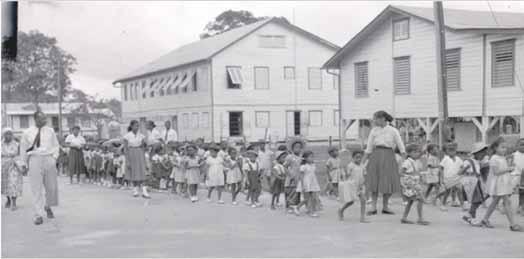
Mackenzie Primary School children and teachers, circa late 1950s, used the ferry boat to cross the river
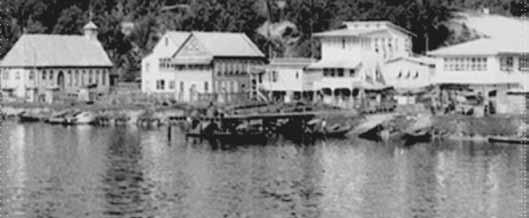
Wismar crossing, Linden 1958
Present day ferry across the Demerara river in Linden
-A mandate to empower youths
Describing the group as “dancing personalities bond together by the gift of versatile dancing”, Nachgana Academy of Dance is on a mission to preserve the Indian dance culture in Guyana, while empowering youths.
In an interview with Guyana Times Sunday Magazine, Devi
Ramcharitar, the group’s director and choreographer, stated that she founded Nachgana Academy of Dance on 23 April 2013. “I have been dancing since I was 5 years old. I know the benefits of dance in helping youths to be empowered. Currently our group has 20 members, both males and females from ages
5-26. When we first opened, for the first eight months, we did over 40 shows. We have danced at presidential events, the Indian Arrival Committee, various madirs, just to name a few. Being on the stage, performing for some of Guyana’s elite has significantly helped the youths in our group to be more confident,” pointed out
Ramcharitar.
Ramcharitar mentioned she chose ‘Nachgana’ (meaning ‘dance-sing’) because it represents the group’s activities. She also noted that her members are committed to the group’s mission of preserving the Indian art of dance, while developing themselves as confident individuals.
“We infuse all genre of dance, with our main focus on Indian dance. This includes classical dance types such as khatak. We also perform other dance styles such as folk, freestyle, hiphop, contemporary – among others. We have performed countrywide and are yet to do so out of the country. We plan to take our performing talents to other countries, which we hope to do in the near future,” Ramcharitar declared.
In celebration of its one year anniversary, the Nachgana Academy of Dance will be hosting a spec-
for the St Ann’s Orphanage.
The group has also done a blood drive.
“On 12 April, continuing our anniversary celebrations, we have a dinner, and award ceremony for our dancers. We are also planning our annual pooja (prayer). Our upcoming event promises an exciting evening of dance,
herself and other dance instructors instil from the beginning.
“Our inspiration comes from everywhere. For me, I truly admire Rekha, famous Bollywood actress, who can dance really well. We also are always reading, researching and keeping upto-date with dancing around
tacular dance event at the Monument Gardens, Camp and Church Streets, on 12 April. The event is themed “Dancing Enchanters” because this is what the group is known for – enchant crowds with their dancing talents.
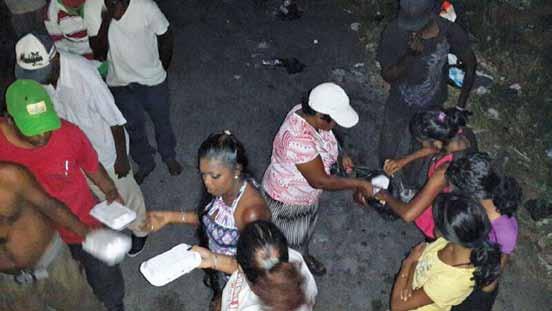
Not only is the group concerned with dancing but also philanthropy work. They recently provided dinner for the homeless in the Georgetown area and lunch
song and drama. There will be something for every generation. Youths will enjoy our modern dance moves, while the older folks will enjoy our classical dance,” outlined Ramcharitar.
The choreographer stated that her group is made up of passionate dancers who are committed to promoting Guyana’s diverse dance culture. She also noted that her group includes disciplined individuals, an attribute
the world. We even design our own costumes. We take pride in what we do and we are very serious about perfecting our talents. Through my group, I aim to sustain the Indian culture, especially the dance aspect of it. My group members share my commitment, a commendable attribute they possess,” Ramcharitar disclosed.
For more information on this dance group, visit Nachgana on Facebook.
Handing out food to the homeless
A few of the group's dancers showcasing their talent
The group's founder Devi Ramcharitar
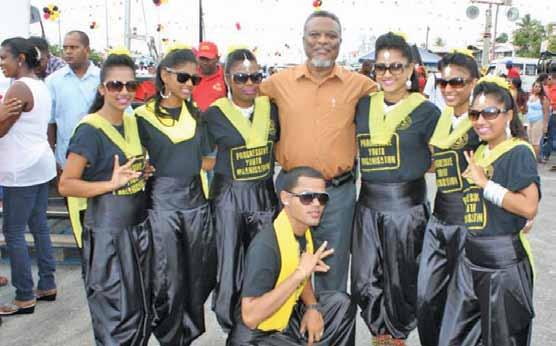
Group members pose with Prime Minister Samuel Hinds after performing at a past national event
Overseas-based Guyanese chef Shaunna Marto never thought she could have a career doing what she loves. Inspired by life, the chef is now assiduously pursuing her dreams.
In an interview with Guyana Times Sunday Magazine, Marto stated she is from Georgetown, but migrated to the US in 1986. Currently, she resides in
career,” she recalled.
After years of working in the finance field, including 12 years in Municipal Government as a finance analyst, Marto decided she wanted to attend culinary school. With her love for the culinary arts and encouragement from family and friends, Marto thought culinary school would be a good place to start.
“I wanted to see if I
what I love; now I know differently. I encourage my son to do just that. He’s 18 years old. I raised him as a single mom since he was three and he has been my inspiration for following what I love to do,” expressed Marto.
In 2006, the chef started her company, Party’s By Shaunna, while still working at a full-time job. She was compelled to do so be-
Toronto, Canada.
“Back in 1990, after working and getting use to the culture, I went to University of Toronto and completed a degree in Business Administration, as many people do when they’re not completely sure of what they want to do -business is always a ‘safe’
could do it. When i did, I totally fell in love! I started cooking when I was 11, much to the horror of my parents who was concerned I would hurt myself or burn the house down. But they soon realised I was not to be stopped. Coming from the Caribbean, I never thought I could have a career doing
cause of responsibilities to care for her son, pay a mortgage, and other financial obligations. In 2011, she left her government job to pursue her business fulltime.
“I knew if I wanted to have a successful career doing what I love, I had to dedicate myself completely to my business. I have also found the time to give back to my community. I have been involved with various charities such as United Way, Canadian Mental Health Association, mentoring at-risk youths, food banks and much more. I have been doing so for over 10 years and continue to do so. I dedicated part of my business for fundraising in helping charities by donating dinners as prizes for auctions and so on. I am also involved in community events such as Caribana, Carabram - an annual 3-day multicultural festival run by volunteers in promoting various cultures,” she outlined.
Marto is a Frenchtrained chef, but also cooks Indian, Asian, Italian, Thai, and Caribbean cuisines. The “Guyanese girl” comes out in every dish she makes, which she believes gets her great feedback about her food.
“There is a challenge for women in the culinary field, but it’s certainly getting better. It is a very tough field; hard to have a
proper family life. Working in restaurants is very hard work and everyone has to pay their dues. It’s certainly not what you see on cooking shows. One should not choose this career based on the chefs that they see on TV,” the chef urged.
The culinary expert enjoys creating new dishes or elevating an old dish by changing a spice or ingredient, which gives her a sense of accomplishment. Marto is always trying to cook something with a “wow” factor and expresses her love via her dishes.
In outlining her future plans, the chef said she would like to help her business grow. She plans on purchasing a food truck with a mission to introduce delicious, fresh, affordable gourmet food to the Toronto area. Her concept involves curries inspired by her country of birth. Marto also plans on teaching her culinary arts on a wider field. Currently, she provides private cooking classes for people in their homes.
“My advice for anyone
pursuing food as a business is that it has to be a passion! No one goes into the food business to become rich. It’s hard, backbreaking, but for me it’s not a job, it’s what I absolutely love to do! Get some kind of training and learn the basics, even if it’s just a few weeks. Always practice, practice, practice.
Let your family and friends give you feedback on your cooking. My son was always my taster since he was 6 years old and has a great palette,” the culinary connoisseur encouraged.
For more information on the Guyanese chef, visit Party's By Shaunna on Facebook.
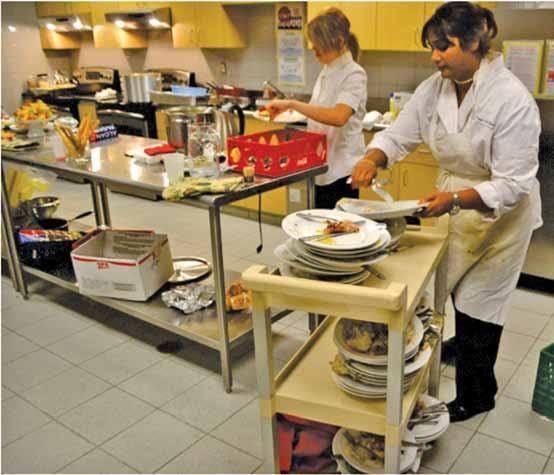
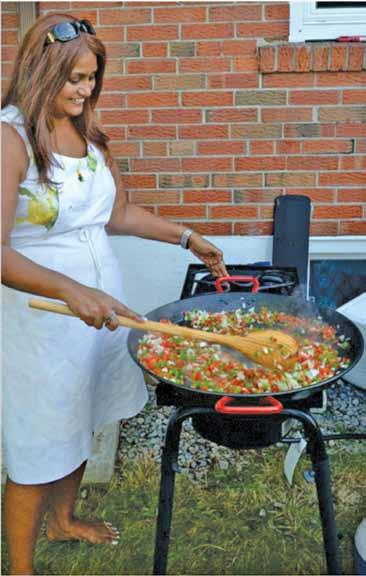
Marto multitasks in her kitchen
Overseas-based chef Shaunna Marto
The chef enjoys cooking barefoot
The Shaping of guyaneSe LiTeraTure Young Adults Fiction
By PetamBer Persaud
Recently, there was a literary upheaval in the heart of the city that literary went unnoticed except by the participants/organisers. That newsworthy upheaval did not make the headline, front page, inside local news story nor back page. It did not hit the television screen or airwaves. It did not hit the social networks. Yet, it was a significant literary event that could be classified among the most popularly known literary institutions in Guyana.
That event was a threeday workshop on writing for young adults and children sponsored by the Burt Award for Caribbean Literature in association with CODE, the Canadian Organisation for Development through Education. The mandate of CODE is profoundly cap-
tured in the following statement, “If you can read and
write, you can learn to do, and be, anything.” The
Burt Award for Caribbean Literature was established by CODE with “generous support of Canadian philanthropist William Burt and the Literary Prizes Foundation, in partnership the NGC Bocas Lit. Fest” of Trinidad and Tobago. The Guyana Book Foundation also played a major role in coordinating the workshop.
The Guyana Book Foundation was established in 1990. The following was extracted from the website of the organisation: “In 1986, a group of Educators, led by Mrs. Olga Bone founded an organisation called Education Renewal whose mission was to remedy the falling education standards of children, particularly in English and Mathematics. This group, together with volunteer tutors, gave free remedial classes to children in Georgetown, Linden, New Amsterdam, Leonora, Buxton and Enmore.”
By the early 1990s, Education Renewal was tasked with the responsibility of distributing books which were donated by the Canadian Organisation for Development through Education (CODE) and this led to the formation of the Guyana Book Foundation (GBF) which was established in 1990 as a not-forprofit NGO.
Writing for children, as stated in my book, An Introduction to Guyanese Literature, is the “weakest area of our literature”. This is only one of the reasons for placing so much emphasis on the ‘literary upheaval’. Other reasons include the “demand for quality, locallyauthored reading materials for young people is constantly growing”. And “[t]he intent of the Award is to champion literacy, build language skills and foster the love and habit of reading by ensuring that young Caribbean readers have access to books that they want to read”.
The main facilitator for the workshop was Richard Scrimger, ably supported by Dr Paloma Mohamed and Vanda Radzik - all experienced in that area of literature.
Radzik, on many occasions, adjudicated the Henry Josiah Writing Short Story for Children
and the Rajkumari Singh Writing Poetry for Children, both competitions are offered through ‘The Guyana Annual’ magazine, formerly the ‘Chronicle Christmas Annual’ started in December 1915.
Mohamed has been working in this area forever through various media – poetry, essay, drama, video and film. Her book, Caribbean Mythology and Modern Life: 5 Plays for Young People, is a significant contribution to our small cache of writing for children.
Scrimger has written scores of books for children and he is a consummate teacher on the subject. The teaching of Scrimger is filled with surprises.
What was so special about such a workshop? It was refreshing, slaughtering many sacred cows of creative writing in the process. How the above was accomplished is located in the mission statement of the workshop.
“This 3-day workshop is designed to promote and encourage the writing of fiction for Young Adults & Children, to create a stronger Burt Award short list of entries, and thereby bring more and better Young Adult (YA) & Children’s books into the hands of more readers in the Caribbean region. The approach will be interactive, participatory and practical....”
That last sentence was the key, which will be gifted to you in a follow-up article.
Responses to this author should be sent to email: oraltradition2002@yahoo.com or call (592) 226-0065.
What’s happening: It is here: ‘Anthology of Contemporary Guyanese Verse: Volume 1’ published by The Caribbean Press and compiled by Petamber Persaud. The work of 21 writers is captured in this 164-page book.
Coming soon: The first reprint of An Introduction to Guyanese Literature It will be available from the author at the above contacts, Austin’s Book Service (226-7350), at the National Library (226-2690) and at the airport.
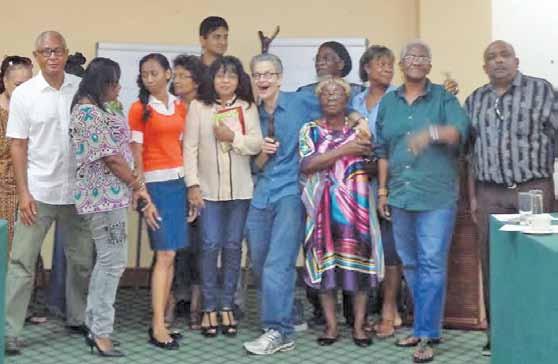
a few of the writers who participated in the recently held literary workshop. Scrimger is in the front row center (clad in a blue shirt)
richard Scrimger
Starting your first “real” job can be nerve-racking. You’re probably excited to have landed a full-time gig – but also scared about meeting new colleagues, learning office etiquette, and making the transition from your college classrooms to your corporate cubicle (or whatever your new workspace may consist of). The days of slacking off are over. That doesn’t fly in the professional world.
Here are 7 tips for young professionals starting a new career:
Dress for success. Start by recreating your wardrobe and sprucing up your appearance. Dress appropriately for the job you’ve landed. Remember that first impressions can be lasting. If you’re dressed to impress, you probably will. “One size doesn’t fit all,” Rosemary Haefner, a vice president of human resources says. “People assume ‘professional’ means a suit, but it depends on the company or industry.” Haefner encourages new employees to ask what people typically wear, before your first day. “You don’t want to show up in a suit if everyone wears jeans,” she says. But it’s better to be a bit overdressed the first few days.
Relax. If you exhibit apprehension, you may not be taken seriously. Be aware of your nervous habits and try to control them. If you ramble when you’re nervous, make it a point to limit your chatter.
Be confident. Don’t be narcissistic, but show your colleagues that you deserve to be there. Don’t hesitate to share your thoughts, and believe in your ability to succeed in your new position. One way to exhibit confidence: invite your colleagues to lunch. Haefner says this tactic shows that you aren’t the typical quiet new employee. Be innovative. From day one, confirm that you bring something new to the table. If this applies to your new position, be sure to offer your boss or colleagues ideas for how to enhance the product or company. Most young professionals in a new job take the back seat the first few days, but Haefner suggests jumping right in. “Be there to contribute, or to volunteer for a project when nobody else raises their hand.”
Separate your personal and professional lives. Once you’re settled in, avoid making personal calls, sending personal emails or taking long lunch breaks. Show that you are dedicated to your new job and that you want to be there. If you have nothing to do, offer to take on another task or help a colleague who looks overloaded. Not only will you impress the boss, but the days will fly by. Communicate. Always be in touch and in tune. Speak up and ask questions, make suggestions and periodically check in with your boss. “Listening is just as important as speaking,” Haefner says. “Start a conversation with your boss to ask how you’re doing.”
Challenge yourself. Just because you did some research before your interview doesn’t mean you know enough to be successful there. Haefner says it can take time to get to know the company itself, but it is important to do research, look back at old projects, and find out what has worked for the company or your team in the past. Once you’ve had the opportunity to become acquainted with your new workplace, evaluated the work environment, observed your fellow employees, and surveyed the office protocol, work flow and discourse, you should set goals for yourself. Getting through the first few days, weeks or months in a new job is tough, but remember to focus on what you want to get out of the experience. (Forbes)
Star of the week
Astunning
beauty, Denicia Williams is assiduously preparing, mentally and physically, to win the Miss World Guyana 2014 crown. Williams hails from Blygezight Gardens; she migrated to the US when she was 11. Currently, she is a full-time student at the College Of Staten Island, US, pursuing a bachelor's degree in Physical Therapy and a minor in Psychology. The 19-year-old’s pageantry experience began in high school. Although she has never competed in any major pageants, Williams is confident that she will be a force to reckon with. Presently, she is in the gym every day and is being coached in pageantry under the tutelage of Miss New York contestant and fellow Guyanese, Jyoti Hardat and former Miss World Antigua 2004 and Miss Talent 2004 of the Miss World pageant, Shermain Jeremy. Williams views pageantry as an opportunity to share her hopes and aspirations for her country, Guyana, and to empower young ladies like herself. Her platform in the Miss World Guyana 2014 pageant focuses on spreading awareness on autism, especially autistic children. Additionally, she wants to motivate young females to pursue an education because she believes that “beauty will quickly fade, but what you have inside of your head is there for a lifetime”. Passionate about philanthropy work, Williams has volunteered at various soup kitchens in the Brooklyn area, US. Moreover, she constantly donates clothing to the Salvation Army, which she has been doing since childhood. If she is crowned Miss World Guyana 2014, Williams intends to continue her empowerment crusade. Furthermore, she will be using the opportunity to promote her country of birth. Williams’ advice to youths is to never allow life’s trials to deter from achieving their goals, rather let it make “you stronger and wiser instead of breaking you”.
The green anaconda is the largest snake in the world, when both weight and length are considered. It can reach a length of 30 feet (9 metres) and weigh up to 550 pounds (227 kilograms).
To picture how big that is, if about five ten-year-olds lie down head to foot, they'd be about the length of this huge snake.
And it'd take about 11 kids to weigh as much as one anaconda.
These snakes can be as big around as a grown man. They have some giant relatives, too.
The green anaconda is a member of a family of snakes called constrictors. Constrictors are not venomous snakes. They don't kill prey by delivering venom through a bite. Instead, constrictors wrap their bodies around their prey and squeeze until it stops breathing.
The giant snake opens its mouth wide enough to swallow its victim—sometimes fish or caiman (relatives of crocodiles) and even jaguars and small deer.
Anaconda jaws are held together with stretchy ligaments so they can open wide enough to swallow prey whole.
When it attacks, it springs from the water and grabs the unsuspecting creature with its small, sharp teeth, quickly wrapping its body around the victim and squeezing it until it stops breathing. It then manoeuvres its prey into its mouth, usually headfirst, and powerful muscles contract in waves to crush the meal and push it down to its stomach.
Rainbows are caused by the droplets of water that remain suspended in the atmosphere after a rainstorm. As sunlight hits them, the droplets act as tiny prisms and bend the light to break it up into wavelengths. The wavelengths are reflected back at us. That creates the arc with bands of colours of the visible spectrum that we see. Because the droplets have to reflect the light at us, we have to be standing with our backs to the sun. We also need to be looking up from the ground
at an angle of about 40 degrees. If you're in an airplane and you see a rainbow from above, it actually may look like a circle, rather than an arc.
Did you know?
The scientific name of the green anaconda is Eunectes murinus Eunectes comes from a Greek word for "good swimmer".
In the wild, a green anaconda generally lives an average of ten years.
The Boidae family of snakes includes anacondas, boas, and pythons.
Green anacondas live in the tropics of South America, as far south as Argentina, east of the Andes mountain range. Most are found in the areas along the Amazon and Orinoco rivers.
The objective of the game is to fill all the blank squares in a game with the correct numbers. Every row of 9 numbers must include all digits 1 through 9 in any order. Every column of 9 numbers must include all digits 1 through 9 in any order. Every 3 by 3 subsection of the 9 by 9 square must include all digits 1 through 9.
By Laurie Triefeldt
When Mount Vesuvius erupted in A.D. 79, it spewed 13 to 20 feet (4 to 6 m) of lava and ash on the ancient Roman cities of Herculaneum and Pompeii, burying them for hundreds of years. Pompeii was rediscovered in the 1700s, and archaeologists have since uncovered the preserved remains of people and buildings. The artifacts found here provide amazing insight into the everyday lives of ancient Romans in the first century.
Where in the world?
The ancient Roman city of Pompeii was located near the Bay of Naples, in the shadow of Mount Vesuvius (pronounced vuh SOO vee us). Pompeii’s rich volcanic soil was perfect for growing grapes and olives. Its mild climate made Pompeii a popular vacation spot. Wealthy Romans built grand summer villas along the Mediterranean coast.
Pompeii was not the richest or largest of Roman towns, but it did have a complex water system with an aqueduct, public baths and fountains. It had an arena for gladiator games, a gymnasium and a number of theaters for plays and concerts. There were also many temples and a thriving port. Its population in the year A.D. 79 is estimated at about 20,000.
Today, Pompeii is found quite a bit inland, but in ancient times, it would have been much closer to the coast.
Most people in first-century Pompeii lived in typical Roman homes called insulae. Insulae were a kind of apartment building with rooms grouped around an atrium. These two- and three-story tenements usually had shops and businesses on the street level.
Example of an insula Apartments
Pompeii was home to noble landowners, wealthy merchants and manufacturers, shopkeepers, artisans and slaves.
It is estimated that 10,000 to 25,000 people who lived in towns
were killed when the
The remains of about 2,000 people have been found in excavations
Pliny’s uncle sailed from Misenum to investigate the eruption and tried to rescue people trapped on the shore.
Pompeii was accustomed to volcanic activity and earthquakes. The city was still rebuilding from a major quake that happened in the year 62 when Mount Vesuvius erupted on August 24, A.D. 79. Ash, cinders and molten rock rained down on the cities of Herculaneum, Pompeii and Stabiae. Scientists estimate that 1.5 million tons of ash and rock shot out of the volcano over a period of six hours and that the ash cloud rose 20 miles (32 km) above the landscape. Pompeii was covered in up to 12 layers of ash 82 feet (25 m) deep.
Mount Vesuvius has erupted many times since A.D. 79. The last eruption was in 1944, and it is long overdue for another. Today, almost 3 million people live within 20 miles of the volcano’s crater, making Mount Vesuvius a very dangerous volcano.
A huge crater formed when the top of Vesuvius collapsed in the eruption of A.D. 79. With each eruption, the height of the mountain changes. In 1900, it was 4,275 feet (1,303 m) high; today it is 4,190 feet (1,277 m).
Eyewitness account
Much of what we know about the Vesuvius eruption is thanks to two letters written by a Roman administrator named Pliny the Younger, who witnessed the eruption.
Pliny described earth tremors and a great dark cloud rising from the mountain. Pliny’s uncle was more curious than alarmed, and decided to observe the phenomenon by boat.
Pliny writes that the sea was “sucked backwards, as if it were being pushed back by the shaking of the land.”
The dust “poured across the land” like a flood, shrouding the city in “a darkness … like the black of closed and unlighted rooms.”
Pliny and his mother were far enough way to be able to shake off the falling ash. They survived the catastrophe, but Pliny’s uncle did not.
Frozen in time
Archaeologists have been excavating Pompeii for years. The site offers a unique snapshot of everyday life in ancient Rome. Homes, workshops, frescos, paintings, pots, jars, jewelry, people and pets have been preserved by the layers of ash they were buried under. Over time, the bodies of Pompeii’s citizens and animals decayed inside the hardened ash, leaving an empty space that retained an imprint of the body, creating a shell or mold. Archaeologists pour plaster into the shells to make detailed copies. These plaster mummies can be seen in museums or by tourists who visit Pompeii.
Fountain at Pompeii
Streetlevel shops
Courtyard
Plaster cast of a victim of the eruption of Vesuvius at Pompeii
Mount Vesuvius
Pompeii
Herculaneum
Surrentum
Mount Vesuvius
Bronze gladiator helmet
Carbonized loaf of bread found in a Pompeii oven. The slaves and poor people of Pompeii wouldn’t have eaten raised yeast loaves like this one. They would have eaten unleavened bread similar to pita.
Gold bracelet
Pompeii ruins with Vesuvius in background
near Vesuvius
volcano erupted.
at Pompeii.
Young, vibrant and creative designer Channey Wong is currently sizzling on the fashion scene, as she showcases her designing dexterity.
Wong’s debuted as a fashion designer at the Facts and Roses competition, organised by veteran designer Michelle Cole and the late designer Trevor Rose. She was encouraged by her friends to join the competition based on her adroit designing skills. Wong’s designs were a “hit” and made it to the finals in the competition, but did not win.
However, Wong did not allow her loss to deter her from her passion. Consequently, she seized the opportunity to participate in the Guyana Fashion Week 2013. For her ‘Tribal Twist’ collection, which she described as “chic and vibrant”, she won the Courts/Fly Jamaica Prize for Aspiring Young Designer.
The designer’s plans are to launch a swimwear collection, establish her brand, develop herself as a person and then as a designer.
For more information, check out CAW Designs on Facebook. (Photos by Helio Phoeli)
Designer Channey Wong
Star Times Hollywood
Gabriella Wilde is an English model and actress who has appeared in “The Three Musketeers” (2011), “Carrie” (2013), and “Endless Love” (2014). Wilde began her career as a model. Spotted at age 14 by Naomi Campbell, she joined Campbell’s agency Premier Model Management and appeared in campaigns for companies including L.K.Bennett, Lacoste, Abercrombie & Fitch, Burberry and Topshop and posed for InStyle, Cosmopolitan, Vogue and Nylon. In December 2009, Wilde made her acting debut in the adventure comedy film “St Trinian's 2: The Legend of Fritton's Gold”.
Katy Perry buys her assistants five cars
You can call the Fisker Karma a green car for the elite, or an eco-savvy supercar. Either way, it’s efficient and has attracted the attention of the wealthy and celebrities. It has even caught the attention of singer Katy Perry, who purchased five Karmas for her assistants–to the tune of a collective $500,000.
According to the DailyMail, Perry became concerned about the environment after she was informed about the carbon footprint of the equipment and transports required to make her tour happen. Since then she apparently is seeking ways to reduce that footprint, as evidenced by the purchase of the five four-
door extended-range electric vehicles.
The Fisker Karma is a plug-in electric vehicle that uses electric motors to power the wheels. When the battery runs low, a smalldisplacement gas generator kicks in to charge up the battery again. It achieves the equivalent of 100 MPG, but has 409 horsepower and can get from zero to sixty in just 5.9 seconds.
Though he was pushed out of the board of his own company and the company has ceased production, Perry apparently thought the Karma was a better fit for her team than the Tesla Model S. Perhaps the constant running around (with minimal opportunity to recharge) made the Karma a more ideal choice for running around and doing Perry’s bidding. (Yahoo)
Liam Neeson saves a dog from real-life baddies
You don't mess with Liam Neeson. The “Taken” actor - and let's be honest: Absolute legend - took on some real-life bad-guys while he was out jogging in New York.
The Hollywood star, who is known for kicking some ass in his films, is said to have stopped a group of teenage boys attacking a dog after he spotted them throwing stones at it. According to ShowbizSpy, Liam was jogging through Central Park when he heard a woman shout at the group of youths, before "confronting three gang banger wannabe types."
A source told the site: "[They] were throwing rocks
at a stray they'd cornered up against a trash bin.
"Liam yelled that they'd better stop or he'd knock the crap out of them - but the punks just swaggered up and warned him to mind his
own business."
The source added: "In a fury, he warned them to back off fast - or else!"
According to reports, the bullies then dropped their stones and ran as a policeman approached the drama (he could well have wanted an autograph, to be fair).
The 61-year-old didn't just carry on with his daily jog, the sweetie pie stayed with the pooch until the police arrived.
"Liam just shook his head and approached the shivering dog, stroking it while the policeman assessed its injuries," the source added, before the officer thanked him and told him he would take it from there. (Glmaour)
The man who left Rihanna ‘bankrupt’ fights back
Rihanna's former accountant Peter Gounis has fought back at a lawsuit that claims he allowed her to squander $9million.
According to the New York Daily News, the accountant is asking that the lawsuit, which alleges breach of contract and negligence, to be dismissed in court, blaming the singer herself for becoming "bankrupt".
Rihanna said that Peter Gounis and the firm Berdon LLP failed to prevent her from buying a house that resulted in a loss of $9million, and didn't warn her that her Last Girl on Earth tour was losing money.
But Gounis has fought back against the claims, saying Rihanna left her tour early to film a movie - which is the real reason she lost money.
"Peter Gounis did not leave the tour to go act in a movie, Fenty did," says a document filed in Manhattan Federal Court.
Nothing has been dis-
missed yet, but if Rihanna wins the lawsuit, her former accountants could have to pay her $10million. Turns out Rihanna has got her own back on the accountant that reportedly left her "bankrupt".
According to Page Six, the singer has reportedly won a multi-million dollar settlement against her former accountant Peter Gounis and the firm Berdon LLP, claiming they were to blame for letting her buy a $7 million house, which they knew was rotting from water and mould damage. This meant she had to spend $1 million sorting it out, and she sold it on for $2million less. This resulted in a loss of $9million, leaving Rihanna with $2million in the bank in 2009.
Rihanna's lawyer Edward Estrada, wrote: “The defendants advised Ms. Fenty by e-mail that purchasing a home in Los Angeles 'would be a good investment' despite knowing Ms. Fenty was experiencing financial difficulties. “
RiRi sacked the accountants in 2012, and was suing them for $35million, but now they are apparently settling for $10million instead. Now Rihanna has filed a lawsuit against her accountant, claiming gross mismanagement. But before you feel too sorry for the singer, she's bounced back pretty well - her estimated net worth is around $43million, keeping her in yacht holidays and designer bikinis for a long time to come. (Glamour)
Kim Kardashian, Kanye West stunning Vogue cover
ALeibovitz.
Kardashian wears a gorgeous strapless gown and poses with West’s arms wrapped around her for the shot. The rapper looks ready to head down the aisle as well in a navy suit. The coverline? #worldsmosttalkedaboutcouple, which is hard to argue with considering the duo’s whirlwind relationship and presence in the fashion world. North, 9 months, also joins her stylish parents for the shoot (as seen in the behindthe-scenes clip below) set to West’s “Bound 2″ hit.
“This is such a dream come true!!! Thank you @VogueMagazine for this cover! O M GGGGGG!!! I can’t even breath!” Kardashian shared on Instagram.
Last year Kim landed the cover of CR Fashion Book posing for a dramatic spread shot by Chanel designer (and fashion Kaiser) Karl Lagerfeld and directed by Givenchy mastermind Riccardo Tisci. West has collaborated for French ready-to-wear line A.P.C. for a number of collections. And now the couple has this photo to frame. (People)
fter months of speculation, Kim Kardashian has finally landed her first Vogue cover. And she’s not alone.
The reality star joins fiancé Kanye West for the magazine’s April issue shot by Annie
arwar Ahuja is a Bollywood actor and the winner in ‘Zee Cinestars Ki Khoj’. He received votes for his skills in dancing and acting. Ahuja is from Hyderabad, India. He has worked in many programmes and appeared in TV drama series, “Hum Ne Li Hai Shapath” as Inspector Shaurya. Ahuja starred in “Khanna & Iyer” (2006), “Hum Phirr Milein Na Milein” (2009), “Meri Padosan” (2009), “Aisi Deewangi” (2009), “Kuch Khatta Kuch Meetha”(2007) and “Tum Hi To Ho...” (2011).
Sanjay Dutt goes back to Yerwada jail
Bollywood superstar Sanjay Dutt’s parole ended on March 21. Sanjay Dutt was released from Pune’s Yerwada jail on one-month parole on December 21 last year on the grounds of his wife Maanyata’s illness. The parole was later extended by a month, till February 21, 2014 and then again till March 21.
Bollywood star Vivek Oberoi may not have been able to get into the SpiderMan’s bright costume. He might not have been able to even find a foothold in the film, “The Amazing Spider-Man 2”, itself. But he sure is going to voice the main villain Max Dillon or Electro, albeit in Hindi. His voice will probably get an extra fillip with Oberoi’s Hindi, laced with sinister villainy.
And playing an evil guy is not exactly new for Oberoi. In “Krrish 3”, he essayed a monstrous and handicapped rogue – who creates a hybrid of humans and animals with unimaginable physical strength, and helps spread a deadly virus in Africa.
Oberoi, who debuted with Ram Gopal Verma’s 2002 “Company”, has done a wide variety of roles. As a gangster in “Shootout in Lokhandwala”, as a South Indian politician in “Rakht Charitra”, as Kesu in “Omkara” (a trusted lieutenant of Othello, Michael Cassio, in this Hindi adaptation of Shakespeare’s classic tale of love and jealousy) and as a lover in Mani Ratnam’s “Saathiya” (from the Tamil original of Alaipayuthey), Oberoi was fascinating. But not lucky enough to reach the kind of heights he deserved.
Of course, apart from his movies and acting calibre, his other claim to fame was
Aishwarya Rai. The relationship broke after a point.
The Amazing Spider-Man 2 opens in India on May 1, earlier than its North American release. (Hindustan Times)
Sanjay Dutt had applied for the third parole saying he wanted to take care of his wife Maanyata, who had undergone surgery earlier. According to reports, Maanyata has a tumour in the liver.
The 53-year-old actor is serving the remaining 42 months of his sentence for illegal possession of arms in a case related to the 1993 serial blasts, in which over 250 people were killed and several hundred wounded.
In early 2013, the Supreme Court upheld his conviction and awarded five-year prison term. He has already served 18 months of his jail term. The actor was shifted to Pune’s
Bollywood actor Saif Ali Khan and megastar Amitabh Bachchan have bagged the lead roles in the screen adaptation of the literary classic “The Count of Monte Cristo”, which is an adventure novel written by French author Alexandre Dumas in 1844. The film will be helmed by director duo Abbas-Mustan.
The classic is based on a man who is a victim of deceit and while on his way to avenge the traitors comes across an island of treasure.
Directed by Abbas Mustan, this film will be backed by Sunir Kheterpal of Azure Entertainment.
The film will also see
Yerwada Central Jail in May last year, nearly a week after he surrendered before a Special Court here.
In the past, Sanjay Dutt faced several protests outside his home and jail for his parole requests. (Indian Express)
Shilpa Shetty has released new dialogue promos from upcoming release “Dishkiyaoon”.
The “Celebrity Big Brother” winner is co-producer on the action film, which stars Harman Baweja in the lead role.
Baweja plays the role of Vicky Kartoos in the movie, opposite trigger happy gangster Lakwa played by Sunny Deol.
Described as a story of ambition, revenge and deception, the film also stars Aditya Pancholi and Ayesha Khanna in pivotal roles.
Shetty attended the Lakme India Fashion Week Summer/Resort 2014 event earlier this week with “Dishkiyaoon” heroine Khanna.
Presented by Eros Now, the film is scheduled to release on March 28. (Digital Spy)
Amitabh Bachchan in a pivotal role where he plays a family man who gets trapped into the world of mystery after a murder. Mustan revealed that the film will not be an out and out adapta-
tion but will have the Abbas Mustan touch with their addition of thrills and chills. The yet to be titled film is slated to go on floors in October and will release in 2015. (Indian Express)
Rhea Chakraborty attacked by stranger
Rhea Chakraborty has thanked fans for their support after she was assaulted by a stranger in her apartment building.
Mumbai police are investigating after the Bollywood and Telugu film actor filed a police complaint on Tuesday evening (March 18).
Chakraborty said in a statement: "I would like to thank everyone for their support and encouraging words. I have tweeted about this unfortunate incident only to highlight the dismal reality, and ask all women to be more aware.
"The police are doing their job and I am confident they will get to the bottom of this matter."
The “Mere Dad Ki Maruti” star stated that she was "groped by a very well dressed man" who attacked her at 5pm in her build-
ing, despite the presence of two security watchmen. Chakraborty added that she feels Mumbai is becoming "suffocatingly unsafe", revealing that martial arts training helped her to fend off her attacker. (Digital Spy)
Lately there's been so much focus on newcomers like acai and kale that less glamorous fruits and vegetables are sometimes treated like second-class citizens. But researchers are discovering new reasons to get excited about the old standbys.
Celery
Celery is back on the musteat list as a potential cancer fighter. It's a top source of a flavonoid called apigenin. Researchers recently discovered that when pan-
Diet is a very important cancer-fighting tool. Colour is one of the best indicators of a food’s health benefits. Foods within each colour group have properties that target specific cancers. When you eat all the colours, you are working far more disease-combating nutrients and vitamins into your meal. Learn why and how to fit them into your diet today!
Red Foods
Fight: Pancreatic and ovarian cancers
Tomatoes have been shown to be protective against ovarian cancer in a study of 13,000 women. Eating a half-cup of tomatoes five or more times a week may reduce your risk of ovarian cancer by up to 60 percent.
Another Canadian study connected eating tomatoes to a re-
creatic cancer cells were treated with apigenin, 44 percent of the cells died. Apigenin activates a chemical reaction inside diseased cells, causing them to self-destruct, says study coauthor Elvira de Mejia, PhD. While eating celery can't cure pancreatic cancer (you'd never be able to eat enough), de Mejia says that over time a diet containing apigenin-rich foods may help prevent the disease.
Grapes
The skins of these snackable bites are bursting with resvera-
duced risk of pancreatic cancer. This pancreatic protective factor can be attributed to lycopene, which is richly abundant in tomatoes and other foods like red peppers and red berries. Try to eat one serving of these red foods at least once a day.
Orange Foods
Fight: Stomach and ovarian cancers
Beta-carotene, responsible for the orange colour in carrots, pumpkins, squash and sweet potatoes, has been shown to exhibit anti-carcinogenic effects on stomach cancer by promoting cancer cell death.
Caffeic acid, an organic compound found in sweet potatoes and carrots, has been shown to slow down breast cancer growth, and even promote cell death as well. Consume these orange foods
Think you know how to wash your hair? Think again! Here are some mistakes you didn't even know you were making.
You use the same shampoo seven days a week, 365 days a year
Not only are you shampooing too frequently — every other day is usually enough, says hairstylist Mario Russo — but you should also switch shampoos occasionally to prevent build-up of certain ingredients (like silicones). Every couple of months, replace your current shampoo with another formulated for
trol, the same superstar antioxidant that helps make red wine good for your heart. Now a study in Molecular Nutrition & Food Research has discovered that resveratrol may also aid in boosting immunity—by helping increase levels of a molecule that kills bacteria and viruses. Study co-author Adrian Gombart, PhD, says adding more grapes to your diet may even protect you from contracting infections in the first place.
Mushrooms
For years fungi have been thought to be heart healthy and immunity boosting. Now science shows that they may even help prevent breast cancer by lowering estrogen levels, says Shiuan Chen, PhD, professor and chair of cancer biology at Beckman Research Institute of City of Hope in Duarte, California. Chen found that when postmenopausal women consumed
at least twice a week. Yellow Foods
Fight: Stomach and esophageal cancers
Citrus fruits, like lemons, tangerines and grapefruit, and papaya are rich in vitamin C, a powerful antioxidant that has been shown to be protective against almost all cancers, especially stomach cancer, throat and mouth cancers, and colon cancers.
These foods are also rich in flavonoids, which inhibit tumour cell growth and detoxify against harmful substances. Add these fruits to your diet at least once a day.
Green Foods
Fight: Ovarian, breast and lung cancers
There is abundant evidence that suggests eating crucifer-
applying your shampoo to the same spot on your scalp (usually at the crown)
your hair type, says cosmetic chemist Mort Westman. You can also use a clarifying shampoo once a month, says celebrity hairstylist Kimberly Kimble.
You're not completely wetting your hair preshampoo
Without enough water, shampoo doesn't lather— and you may be inclined to compensate by using more product (stripping your hair and your wallet). Stand under the shower spray for an extra minute before ‘sudsing’ up.
You always begin by
You might notice that the top of your scalp is dry or flaky. Try alternating your routine by starting your shampoo at the nape of your neck and distributing the lather onto your hair before moving toward the top of your head, says Russo.
You're creating too much frictionTo avoid damaging hair, massage your scalp with your fingertips rather than your fingernails or palms.
You're rinsing with hot water
Piping hot water dries your scalp and hair. Use lukewarm instead (which helps to preserve colour).
(www.oprah.com)
13 grams of mushroom powder (the equivalent of 1 and 1/3 cups of white button mushrooms) per day for three months, their estrogen production dropped by 27 percent.
Bell Peppers
Researchers have long known that smokers have a lower risk of developing Parkinson's, a disease characterized by a loss of brain cells that make dopamine. No doctor would encourage lighting up, but there may be another way to
ous vegetables, like kale, endive, bok choy, cauliflower, broccoli and cabbage, is associated with a lower risk of stomach, ovarian, breast, colorectal, and lung cancers.
These veggies are rich in glucosinolates, a compound which protects against cancer development and growth. They are also rich in the vitamin K that you need to help prevent diabetes, which will reduce your pancreatic cancer risk. Eat these foods at least twice a day to help cut your cancer risk.
Neutral-Coloured Foods
Fight: Stomach, ovarian and colon cancers
Think mushrooms, garlic, onions, shallots and chives (which belong to the onion family). This group of foods belongs to the allium vegetable category. They have
get the benefit: peppers. They're a safe source of nicotine, which may protect dopamine-producing cells, says Susan Searles Nielsen, PhD, whose study, published in the Annals of Neurology, found that eating peppers (mostly bell peppers, but spicier varieties count, too) twice a week or more was associated with at least a 30 percent reduced risk of Parkinson's. (www. oprah.com)
been connected to lower levels of stomach cancer. Allicin, the active compound in garlic, has antimicrobial and antioxidant effects. Allicin is released when garlic is chopped, crushed or chewed. To maximize your benefit, wait about
10 minutes before cooking garlic to allow the allicin to form.
The polyphenols found in onions have anti-cancer effects on colon cancer cell lines. Onions also contain natural cancer fighters like apigenin, anthocyanin, myricetin, and quercetin. Women who frequently consumed these foods were found to have lower rates of ovarian cancer. Mushrooms are high in vitamin D, which also helps reduce ovarian cancer risk. Add these neutral-coloured foods to your diet at least once a day. (www.doctoroz.com)
Times Home & Cooking
Creamy Garlic Mashed Potatoes
Ingredients:
3 1/2
Method:
Peel and dice potatoes, making sure all are relatively the same size. Place in a large saucepan, add the salt, and cover with water. Bring to a boil over medium-high heat and then reduce heat to maintain a rolling boil. Cook until potatoes fall apart when poked with a fork.
Heat the milk and the garlic in a medium saucepan over medium heat until simmering. Remove from heat and set aside.
Remove the potatoes from the heat and drain off the water. Mash and add the garlic-cream mixture and Parmesan; stir to combine. Let stand for 5 minutes so that mixture thickens and then serve.
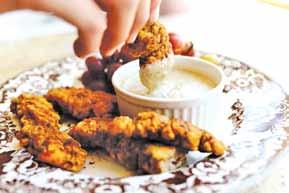
Steak Fingers and Gravy
Ingredients:
2 pounds tenderized round steak or cube steak, cut into 1-inch strips
1 cup flour
1 teaspoon seasoned salt 1/2 teaspoon black pepper
Method:
Combine flour, seasoned salt, pepper, and cayenne in a dish.
Whisk together milk and eggs in a separate dish.
To bread the meat, first dredge in flour, then dip quickly in egg mixture, then put back into the flour to coat on both sides. Continue until all the meat is breaded.
1/4 teaspoon cayenne
3 whole eggs
1 cup milk
Canola oil and butter for frying
2 cups milk (additional) Salt and pepper, to taste
Heat canola oil with 2 tablespoons butter in a large skillet over medium to medium-high heat. Fry steak strips 4 or 5 at a time, turning midway through. When golden brown, remove from the pan to a paper towel-lined plate. Continue until all the meat is done. Cover loosely with foil to keep warm.
To make the gravy, pour off all the grease from the pan. Add 1/4 cup of the grease back in, then sprinkle on 2 to 4 tablespoons of the flour mixture (or you can use fresh flour.) Whisk mixture till it becomes a paste (add more flour if you need to) and cook the paste over medium-low heat until it's deep golden brown. Pour in milk, whisking constantly. Allow the gravy to cook and thicken, whisking regularly and adding more milk if it seems too thick right off the bat.
Season gravy with salt and pepper.
Serve steak fingers with gravy and a salad.
Greatest Cooking Tips
Seasoning a sauce comes at the end, if at all, and never during the process of making it. This will make a tasty, not bland, sauce.
Before putting a cake or muffins in the oven to bake, use a thermometer, any one you’ve got on hand, to check that your oven is absolutely, without question, at the right temperature. It’s the only way to ensure perfecting baking.
Whenever grilling, searing, or sautéeing meat, always "temper" the meat by leaving it out an hour or two before so that it comes to room temperature, ensuring a perfectly cooked piece of meat every time.
Open the oven door too early and too often and an under-baked cake might crack or cave in the middle. The early stages in the process of baking can be crucial for the proper development of baked goods (especially for certain foods like cheesecake and popovers).
Tongs are an extension of your hand. Use it to flip meat, pull a pan out of the oven, stabilize a steak while slicing and much more.
Don’t overcrowd your pan. When roasting or browning anything, the tendency is to cram as much in the pan as possible — resist! Do it in smaller batches instead. Crowding the pan leads to steaming and lowers the temperature of the pan so you won’t get the caramelization you’re looking for — and that’s where the flavour is.
Home Help
Before rearranging paintings on walls, slip on white cotton gloves. Natural oils from your fingertips can seep onto artwork, damaging the colour over time.
Slice wine corks into disks and glue them to the bottoms of furniture and heavy pottery, or stick on adhesive felt pads. Dust settles into gouges made by furniture on floors and turns into grime, making it tougher to clean.
Opt for patterned upholstery, which conceals dirt better than solid fabric.
Arrange furniture six inches from walls instead of flush against them so there will be fewer smudges from bumping to tend to later. You’ll also have easier access to dusty corners that need a visit from a dust mop.
Once a week, mist a few squirts of room deodorizer on cool lightbulbs. (A note of caution: Moisture can seep into the light socket and damage the bulb, so spray from about a foot or so away.) The next time you turn the light on, the heat from the bulb will activate the scent.
Keep your toilet brush dry and germ free after you’ve used it to clean up by resting it between the seat and bowl until dry.
Find a rhyme for each word below so you end up with a familiar three-word phrase in the form "__,
Long ago, shortly after the end of the first great flood, a young man, named Amalivaca, wearing a majestic, beautiful head-dress, paddled his canoe up the Essequibo River. His journey was indeed long and tedious, for he came from a land far across the seas. Not long after he arrived, he thought of building his home on the land near this awesome river, but then he also thought of travelling over this new land first before deciding where to finally settle.
Although the waters had drained from the land, the rivers were still heavily flooded so much so that their waters reached far up the valley sides. As Amalivaca paddled his canoe up the rivers, he thought it wise to mark his path. So he used a large diamond to scratch huge drawings of people, animals, and strange shapes on the rock walls at different points along the rivers. He also made drawings on many outcrops of rock that stuck up in the middle of the rivers.
Later, as the water level subsided, Amalivaca’s drawings remained on the rocks, high above the river level. As time passed, the Amerindians called these drawings timehri, or rock drawings. Even to this day, they can still be seen on the upper courses of the many rivers in Guyana.
One day as he continued his many travels, Amalivaca arrived at an Amerindian village on the bank of the Cuyuni River. He immediately noticed some men planting sticks on a patch of ground.
“What are you planting?” Amalivaca enquired.
“We're planting arrow cane reeds. We'll use them to make good arrows,” one man replied.
“But why do you need so many arrows?”
“We need them to either make war against others or to defend ourselves.” another man told him.
Upon hearing this last answer, Amalivaca became very angry. “Why should you make war against other people?” he asked. “Don't you see you’re wasting your time? Rather than planting arrow cane reeds for arrows, why don't you cultivate cassava, sweet potatoes, corn and other fruits?”
With that, the men stopped planting and crowded around Amalivaca who tied up his canoe and stood on the river bank.
“You seem to have sensible thoughts, stranger,” a man said. “Why don't you stay with us and show us how to cultivate more crops?”
By this time, some of the men began admiring Amalivaca’s canoe.
“How is it that your canoe is so well-shaped and smooth inside?” a young man asked. “We use axes to hollow our canoes, but they are not so nicely and beautifully shaped as yours.”
“I used fire to hollow mine,” Amalivaca replied. “If you’re willing to learn, I’ll teach you how.”
Anxious to share his many ideas with the villagers, he stayed on for a few months. During this time,
magical powers to make the river flow downriver on one side and upriver on the other. That will certainly make it easy for us to paddle in any direction.”
Always eager to please people, Amalivaca tried to comply, but despite how much magic he used, he failed to make the current flow upstream.
“This may be because too much rain falls in the Pakaraima Mountains,” he
instruments that he made.
Just outside his cave, he also hollowed out a large rock which he used as a drum to make music. To this day, the hollow rock still stands outside the cave on the Maita plains, and Amerindians in that area refer to it as the drum of Amalivaca.
Many people went to Amalivaca’s home on the plains to meet him and seek knowledge. He taught them
he taught the people to cultivate food crops effectively and use fire to hollow canoes.
Finally, he was ready to continue his travels but before doing so he gave some sound advice to the people.
“You have new knowledge now,” he told them. “But knowledge isn’t to be locked up. You must share it with others, so they too can learn the good things you already know.”
The people obeyed him. Soon, the skills Amalivaca taught were known to all the people in the region.
After Amalivaca left that village, he visited many others in various parts of the country, teaching and assisting people. By this time, he was so well-known that his fame preceded him. He had also displayed the magical powers he possessed to assist some villages. All over, people eagerly looked forward to seeing and meeting with him.
At a small village in the Mazaruni River area, the residents tested Amalivaca.
“Amalivaca, we use the river a lot to travel,” they told him. “It's very difficult to paddle our canoes against the current. Please use your
reasoned. “The steady rain fills the rivers, and the water constantly rushes to the sea.”
Still, he was determined to show the people some result, or they would lose faith in him. “I am going to the great wide sea for a while,” he told them. “When I return, there will be a twoway flow of the current.”
Upon his arrival at sea, just off the mouth of the Essequibo River, he used his magic to create the tides. His magic caused the water of the sea to rush up the rivers for a great distance during high tide. This made at least part of the river flow upstream. At low tide the current flowed downstream as usual.
When he returned to the village, the people were pleased. “The current goes upriver part of the day,” they said. “That is very helpful.”
Shortly after, Amalivaca travelled through the Corentyne, Potaro, Siparuni, and Rupununi Rivers, spreading knowledge everywhere. Eventually, he came to the plains of Maita where he made his home in a large cave. There he relaxed by playing soothing music on
to use herbs to cure sickness and showed them how to use the stars to guide them when they travelled at night.
As time passed, and Amalivaca grew older, he was pleased that the people had learned all he wanted them to know.
“My mission in this land is over,” he told them. “It’s time for me to leave you.”
Then early one morning, the old grey-haired Amalivaca prepared to take his leave. As he was about to set out in his canoe, a group of people gathered on the bank of the river to bid him farewell. They all stood in silence, sadness written all over their faces, as they watched him paddled away into the distance. With one final wave, Amalivaca steered his canoe around a bend of the river and disappeared from sight.
The people in that land saw him no more. But Amalivaca, after leaving the mighty Essequibo River entered the wide Atlantic Ocean, where he sailed about, hoping to meet other groups of people to share his knowledge. (From the book, Guyana Legends by Odeen Ishmael, 2010)
Musings of the Heart
Does real, true love ever die?
With real true love, can you really let go?
Can there be love at first sight?
To these, the lover in me says “no”.
Can real, true love fade over time?
Over great distance, does it even waver?
Can it exist on its own....in a shell?
The lover in me says “never”.
Can real, true love be bought?
If so, how does one get paid?
Can true love ever be parted?
I say “not even by the keenest blade”.
Can real, true love ever be stopped at the instant of one’s final breath?
Does love then come to an end?
I say “not even at the time of death”.
How about falling ‘out-of-love’?
Can this absurdity possibly be?
Can you love and not be IN love?
This lover say “not according to me”.
How can real, true love die....or end? If it does, was it true or real?
Not in my world! Not for me!
“Not the kind of love this lover feel.”
Jag B Mahadeo
The Edge of Night
Watchman by the seawall koker twenty years I met him on my walks seawind and sunset I see recalling him.
He smoked his curly pipe, we talked fireflies sparking in the low, protected fields. I often thought what a life he’s lived but what a life is any life that’s lived.
He was old when he began this job guardian of the tidal gates of town. Got away from a rum-soaked father’s home wandered far to other lonely lands and home again he never built a home or had one woman or concerned himself with God
“Ah live from then to now an’ don’ remember how.”
Eyes far away as stars beyond our counting an old man stranded on the edge of night.
Long ago he was a forest guide went with Museum teams in Essequibo and made a name for his strange collections. One day he brought for their inspection a black and shiny scorpion whose helmet-head was gold They honoured him, he was named discoverer the keepsake plaque engraved in Latin script. I tell him it is beautifully done he gestures, the sea in tumult rises at our feet.
Ian McDonald
US scientists have announced the discovery of a new species of dinosaur. Its fossils offer further clues to how the dinosaurs became extinct 66 million years ago.
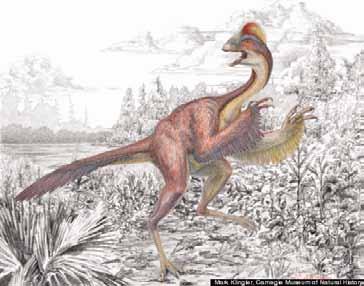
Anzu wyliei is a strange, bird-like creature that has a bony crest on top of a beaky head and a long tail like a lizard.
The animal was identified from the partial remains of three skeletons collected in North and South Dakota.
It is reported in PLoS ONE journal.
"We had inklings that there might be such a creature out there, but now with these bones we have 80% of the skeleton and can really look in detail at the structure of this animal and make inferences about its biology," says Hans Sues, curator of vertebrate palaeontology in the department of palaeobiology at the Smithsonian's National Museum of Natural History in Washington DC.
"Anzu is really bizarre, even by dinosaur standards.
"The skull has this ex-
traordinarily tall and thin crest with a snout and a huge beak with sharp edges and a strange sliding jaw joint," that could be used to cut up vegetation and meat, he says.
Diverse communities
The size of a small car, the dinosaur also had claws and feathers on its upper arms. It belongs to a group of dinosaurs known as Oviraptorosauria. Most evidence of their existence comes from fossils discovered in Central and East Asia.
The Anzu bones are the first detailed evidence that oviraptorosaurs also lived in North America.
The specimens were found in a geological formation known as Hell Creek, which has been extensively explored and is the source of many dinosaur fossils discovered in North America.
Scientists have nicknamed it "the chicken from Hell" because of its appearance and where it was found.
The site is important because it was formed in the last two million years of the Cretaceous Period, just be-
fore dinosaurs were wiped out by an asteroid strike.
Many researchers have argued that the dinosaurs were already in decline because of climate change. But according to Dr Sues and his team, the discovery of Anzu offers further proof that many species were still evolving and dinosaur communities were diverse and flourishing.
"This is consistent with the idea that a mass extinction was caused by the great asteroid impact 66 million years ago. It's clear that dinosaurs were still quite diverse until the very end," says Dr Sues.
A thousand species of dinosaurs have been discovered so far. Scientists believe there are many thousands more waiting to be identified, even in heavily excavated formations such as Hell Creek.
The discovery of another species from the site was announced in December last year - a small raptor called Acheroraptor temertyorum And scientists have only begun to explore potential dinosaur graves in Central
Ancient skeleton is the earliest case of cancer yet detected
Researchers have discovered the earliest confirmed case of cancer in a young man who lived in ancient Egypt.
The discovery of a diseased skeleton dating back to around 1,200 BC was made at the Amara West site in northern Sudan.
The new finding suggests that the disease has its roots in the distant past.
Details of the skeleton have been published in the Journal PLOS ONE.
The skeleton was discovered by Michaela Binder, a PhD student at Durham University.
She said the find was of "critical importance in learning about the underlying causes of cancer in ancient populations, before the onset of modern lifestyles".
Cancer is thought of as a modern-day disease, spurred on by smoking, unhealthy lifestyles and the stresses of day-to-day living. Ms Binder's discovery suggests that the disease was prevalent thousands of years ago.
"I was surprised to see such a cancer in an individual from ancient Egyptian times," she told BBC News.
"We still don't know a lot about cancer. Only a very few examples have been found of the disease in the distant past."
Ms Binder's finding is of particular interest because it is 2,000 years older than the previously confirmed instance of the disease.
***Evolving disease***
When she unearthed the skeleton she found that the bones were riddled with holes.
She worked with Daniel Antoine, a curator at the British Museum, who is responsible for the museum's human remains.
"It was very exciting to work with such a well preserved skeleton," he told BBC News.
"The marks on the bones were very clear and our analysis showed that there was evidence that the young man suffered from a type of cancer."
The discovery will be of great interest to medical researchers, according to Dr Kat Arney of Cancer Research UK.
"If they can analyse the DNA from the skeleton, it might tell us about the gene mutations that made [this person] susceptible to this type of cancer. That could shed light on the evolution of the disease, along with the evolution of humankind."
There have been some previous hints of the disease in archaeological records.
Last year, a US researcher published details of a 120,000-year-old fossilised Neanderthal rib that showed indications of a bone tumour.
There have been other finds from around 4,000 years back that show some similar signs. But without a full skeleton to show the spread of the disease, it is hard to confirm that these specimens actually had cancer. (BBC)
Asia.
Bones in ground
But there's no magic formula for discovery, according to Tyler Lyson, who found one of the Anzu skeletons in 2009 on his uncle's ranch in North Dakota.
"We were just walking along when we saw some dinosaur bones poking out of the ground," he recalls.
"I knew right away that they belonged to a meat-eating dinosaur because meateating dinosaurs have hollow bones, and these bones were hollow. We careful-
ly made a plaster jacket to wrap the specimen and get it back to the lab. After several hours cleaning it, we knew we had found something new. It was unlike anything else we had ever seen before."
Dr Lyson is part of the Smithsonian team and the founder of the Marmarth Research Foundation, which promotes the study of fossils. He discovered his first dinosaur bone when he was just six years old. The other two Anzu skeletons, which include a skull, were discov-
Frozen Antarctic
ered by private collectors. "You just have to spend time out there," he says. "The bones come to the surface and then break up into little pieces. You get a trail of broken bits of bone which you follow, and if you're lucky you'll see bones sticking out of the side of the hill - and that's exactly what we found here."
Although the Anzu skeletons were discovered several years ago, scientists work in "deep time", says Dr Lyson. Bones have to be catalogued and compared with other specimens while scientific evidence has to be peer-reviewed. It can take a decade before any official announcement is made. All three Anzu skeletons are housed at the Carnegie Museum of Natural History in Pittsburgh, which collaborated with the Smithsonian to identify the new species. (BBC)
moss brought back to life after 1,500 years
British scientists have successfully revived mosses that have been frozen under the Antarctic ice for 1,500 years. The researchers thawed out the ancient vegetation and were surprised to see new shoots rapidly appear.
While bacteria of a similar age have been recovered before, the scientists say these are the oldest plants to be brought back to life.
The research has been published in the journal Current Biology.
Mossy banks are a curious feature of the frozen Antarctic, formed over thousands of years from the accumulation of these tenacious plants that spring to life in the brief southern summer.
The oldest banks date back over 5,000 years and are a useful archive for scientists of past climatic conditions.
Researchers have made previous attempts to revive long-frozen moss, but they have only managed to grow material that had been locked in ice for about 20 years.
Now scientists from the British Antarctic Survey (BAS) and the University of Reading have taken sliced and seemingly dead samples from the deep permafrost and brought them back to life.
They were placed in an incubator at 17C, a temperature often found in Antarctic moss plants in summer.
After three weeks, new shoots appeared.
"Various people have asked us did we do anything complicated to make it regrow," co-author Prof Peter Convey, from BAS, told BBC News.
"We've basically just cut it in half and put in the incubator and did as little as possible."
While the researchers did little to the plants, they took great care to ensure that there was no contamination of their samples from other life forms. Carbon dating put the age of the newly growing material at 1,530 years.
In both the Arctic and Antarctic, mosses are an important part of the ecosystem. They play a major role in storing carbon and in the Arctic particularly, there are concerns that as the world warms the permafrost will emit even more CO2 into the atmosphere.
But could the discovery that moss in the southern ice can be revived after 1,500 years mean that carbon release is less of a worry?
Not quite, says Prof Convey. He says that most of the moss frozen in the Arctic is already dead and can't be revitalised. Warming there would see that carbon seep back into the atmosphere.
In the Antarctic though, it might be a different story.
"In a warmer wetter world, mosses actually grow quite well. The question is how much are these thawing mosses going to grow in response to changes and how much can that been seen as a carbon sink?"
The researchers also believe that the discovery signals that, in the right circumstances, multi-cellular organisms such as plants can survive for longer timescales than previously thought. (Excerpted from BBC)
an artist’s depiction of the “chicken from hell”
The anzu wyliei skull, shown in a reconstruction, featured a bony crest
researchers drilling into a mossy bank on Signy Island in antarctica
The skeleton of a young man who suffered from cancer more than 3,000 years ago
iOS 7.1 hit the scene a couple of days back and since then, iPhone, iPad and iPod touch users have been slowly digesting and familiarising themselves with the various new features.
As well as CarPlay, which was alluded to at the
Geneva Motor Show late last week, there have also been notable improvements to features like Siri and some aesthetic tweaks to boot.
It may have become something of a cliché in tech circles, but the iOS 7.1 update certainly fits the “evolutionary, rather than revolutionary” archetype, with Apple having done a lot of housekeeping and feature-refining rather than stepping in with anything to grandiose.
Tech news
AMuch more effort has been made to circularize various UI elements, which marks a distinct departure from some of the lingering remnants of iOS 6.
The Control Center, a newly-implemented, much-needed iOS 7 feature, has also been touched-up with iOS 7.1, adding some minor, but necessary alterations. The screenshot from iOS 7, it’s nothing too extreme, makes the feature both cleaner and, potentially, more functional.
Many other minor areas have also been given something of a freshen-up with iOS 7.1. These subtle tweaks add to the versatility of the phone.
Flappy Bird to return, says creator Dong Nguyen
ddictive mobile game Flappy Bird will return to Apple's app store, creator Dong Nguyen has confirmed - although he declined to give a specific date.
On Twitter, a fan had asked if he was going to put the game back in the app store.
"Yes. But not soon," Mr Nguyen replied, later adding: "I don't work by plan. I will release it when it is done."
Mr Nguyen removed the popular game in February, saying its popularity had ruined his "simple life".
Launched in May 2013, Flappy Bird was free to download and required players to tap the screen to keep the bird in flight.
Despite its simple graphics, Flappy Bird was a notoriously difficult game since many users could only keep the bird in the air for a few seconds before
ByTe
Iit hit an obstacle and fell.
The game went viral after being promoted almost entirely by social media users and was reviewed on a YouTube channel by more than 22 million subscribers.
It was downloaded 50 million times, and at the height of its popularity, Mr Nguyen was reportedly earning $50,000 (£30,450) a day from advertising
In an interview earlier this month with Rolling Stone, Mr Nguyen said he was moved to remove the popular mobile game from the App store after users wrote to him detailing how the game had destroyed their lives.
After the game was taken down, users started several passionate petitions to get the game reinstated.
(BBC)
Apple kills the iPad 2, resurrects the iPad 4
f you've shopped for an iPad anytime during the last few years, you've probably run into the iPad 2. Not only was it the flagship model during 2011, but it hung around as the budget full-sized model for two full years after that. Well, you can finally kiss the iPad 2 goodbye, as Apple just laid it to rest in favour of the much more powerful iPad 4.
Starting today, a 16 GB version of the 4th-generation iPad with Retina Display (late 2012) will replace the iPad 2 in the US$400 slot in Apple's tablet line-up. That's only US$100 cheaper than the lighter, thinner, and faster iPad Air (and the same price as the Retina iPad mini), so that's still a hefty chunk of change for an 18-month-old tablet. But there's also no doubt that it gives you more value in that slot than the three-year-old iPad 2. If you need a quick refresher, the iPad 4 had the same 9.7-in Retina Display and external chassis as its early 2012 prede-
cessor, the iPad 3. Its biggest upgrade over that model was an A6X system-on-achip (which made it noticeably faster) as well as a Lightning port for charging and data transfer.
Why make this switch now? Well, no matter how many people were buying the iPad 2, it just wasn't a good value for customers at US$400. But the reason for the timing probably relates to supply chain deals. It was almost exactly two years ago that Apple first put the iPad 2 in that US$400 slot. If the company made one- or two-year deals to outsource its parts, then that explains why this shift would happen now, and not, say, back in November when the iPad Air launched.
In addition to the Wi-Fi only 4th-gen iPad, you can also pick up a 16 GB WiFi + cellular model for US$530. For more on the iPad 4, you can revisit our review from late 2012, or hit up our comparison of the last four full-sized iPads. (Gizmag)
Tech news
Twitter users in Turkey report that the social media site has been blocked in the country.
Twitter website 'blocked' in Turkey
Some users trying to open the twitter.com website are apparently being redirected to a statement by Turkey's telecommunications regulator. It cites a court order to apply "protection measures" on the website.
This comes after PM Recep Tayyip Erdogan vowed to "wipe out Twitter" following damaging allegations of corruption in his inner circle.
The BBC's James Reynolds in Istanbul reports that he is unable to access Twitter.
"I don't care what the international community says at all. Everyone will see the power of the Turkish Republic," Mr Erdogan said earlier on Thursday.
He spoke after some users had posted documents reportedly showing evidence of corruption relating to the prime minister - a claim he denies. His office said that Twitter had not responded to Turkey's court rulings to remove some links, forcing Ankara to act. Twitter has so far made no public comment on the issue.
There are about 10 million Twitter users across Turkey. In 2010, the country lifted its ban on YouTube - two years after it blocked access to the website because of videos deemed insulting to the country's founder, Mustafa Kemal Ataturk. (BBC)
Notable US-based Guyanese photographer Kwesi
explains the rudiments of ‘good’ photography
In 2006, while in his final year of film school at Brooklyn College, US-based Guyanese Kwesi Abbensetts purchased a FUJI 5600 digital camera and from thereon his love for photography blossomed. Photography gave him the immediacy that was missing from film.
A self-taught photographer, Abbensetts had no prior formal training. Travelling around the Caribbean, Abbensetts has shot travel photography in Jamaica and the Cayman Islands. Being self-taught has allowed the photographer to create and shape his own individual template, which is identifiably distinct when it comes to creating images.
In an interview with Guyana Times Sunday Magazine , Abbensetts, who hails from Corentyne, No. 64 Village, explained his passion for photography and the fundamentals of good photography. Abbensetts has been a professional photographer for over 6 years. He is also famous for his evocative portrait photography.
Guyana Times Sunday Magazine: What sparked your interest in photography?
Kwesi Abbensetts: I was always interested in visual art. At a young age,
Kwesi Abbensetts: It is pretty much both. I am constantly shooting and exploring photography every day. It is a career path and a passion for me. It allows me to challenge every aspect of my creativity and
I briefly worked at GTV on a programme called Youth Beat. Now in terms of photography directly, I was in the middle of film school and was not ready to do film, I felt unchallenged by the medium at the time, so I bought a camera and taught myself photography. I am self-taught, but the camera also attracted me because it allowed me an immediacy that filmmaking did not offer.
Guyana Times Sunday Magazine: Is photography a hobby or career?
fuels my imagination in myriad ways.
Guyana Times Sunday Magazine: What do you enjoy photographing?
Kwesi Abbensetts: Everything! I practice on all things. Art is everywhere.
Guyana Times Sunday Magazine: What is your focus when photographing?
Kwesi Abbensetts: There is no thought really. I prefer to let things reveal themselves. It is my
idea of trusting in magic. With portraiture and fashion photography, it is a bit more contemplative in terms of styling the mode or the kind of lighting used. But, eventually, once everything is set up I let the energy dictate.
Guyana Times Sunday Magazine: What makes a ‘good’ photographer?
Kwesi Abbensetts: A photographer has to have an eye and instinct. A good photographer is able to transcend moments that the normal viewer at times would not see. Good photography is not really dependent on a good camera, but it does make a difference on the quality of the photo. Most commercial jobs will demand that you use a good camera. Having an artistic mind also helps - definitely helps. Notably, good photography involves making mistakes. The mistakes are your best tutorials, and shoot always. Mistakes become the “how did I do that” moment. Also studying the works of other good or great photographers helps in developing your photography skills.
Guyana Times Sunday Magazine: Do you consider photography as an art?
Kwesi Abbensetts: It is art if it is done as art or informed by aspects of art. Otherwise, it can just be purely representational. Art becomes involved when you pay attention to subject, lighting, framing and composition, and ‘feeling’. Context is also important
to conveying the message.
Guyana Times Sunday Magazine: What projects are you currently working on?
Kwesi Abbensetts: I am working on the idea of making my photographs look like paintings and more textural. Recently, I did a show in Brooklyn, curated by Holly Bynoe of Arc Magazine , which explored more of my visual film work. Beyond that, I am working towards establishing myself deeper into the arts through self-evolution and exploration with other artists.
Guyana Times Sunday Magazine: What are your future plans for your photography career?
Abbensetts
To become bigger, make a dent in the art space and to be more involved in the Caribbean by representing us visually. I would love to photograph all parts of Guyana because we have many varied places that need and should be photographed and seen. Overall, the vision is to create a legacy of my works.
Guyana Times Sunday Magazine: Other than photography, do you pursue other art forms?
Kwesi Abbensetts: I am a painter, and I write poetry. I want to do everything relating to art.
Guyana Times
Sunday Magazine: What is your advice for those who would like to pursue a career in photography?
Kwesi Abbensetts: Get a camera; read the manual; shoot to the point it becomes second nature; wear sunglasses, which allows you to see light from shadow to dark (just to understand light), make mistakes; and experiment always.
The prolific photographer has exhibited his work in various art studios in the US. His most recent was earlier this month (March) at the exhibition ‘Metanoia: Practices of Exhaustion’ presented by Arc Magazine at the Grace Exhibition Space, Brooklyn, NY. His upcoming exhibition, ‘Self Timer’, will be on 26 March at the Brooklyn Fire Proof. For more information on the photographer, visit www.spaceshipgeorge.com
Kwesi Abbensetts:
US-based Guyanese photographer Kwesi abbensetts
abbensetts enjoys photographing the sensuality of femininity. This photo is titled 'Flowers & Sequins'
Historic Linden
On 29 April 1970, under the Municipal District Council's Act of 1969, Macmarburg, a dimunitive for Mackenzie, Wismar and Christianburg, was renamed Linden and officially declared a town.
Christianburg, the oldest settlement in the town was originally known as Stabroek. It was renamed in honour of Governor Christian Finette, who joined his name with Burg, his wife's family name. This area was chiefly used for rubber bleeding and saw milling.
The area south of Christianburg was known as Shingles Landing, on account of the production of shingles and wallaba posts (a local hardwood). Before the discovery of hardwood, this area was an important transit point in gold and diamond mining.
The Christianburg Water Wheel was installed in 1855 to facilitate the operations of a saw mill owned and op-
erated by John Dalgleish Patterson. This water wheel is a fine example of Guyana's industrial heritage.
St. Matthews Church, which was constructed by Presbyterians, was opened on 25 November 1898. Today this church serves as an important role in the social and cultural lives of the Linden community.
St. Aidians Church was constructed in 19 July 1969 through the efforts of the community. It is situated on Burnhams' Drive, which runs parallel to the Demerara River. This oval shaped church, with its transparent egg-like dome set in an umbrella type roof, stands out in sharp contrast to the houses and commercial structures in the area.
Watooka House, an elegant structure with its timber shutters and jalousie windows, is a sterling example of Guyana's renowned wooden architecture. Constructed in the late 19th century, this was the
location for many of the finest balls and social gatherings in Linden.
The Christianburg Magistrates' Court, formerly the residence of John Dalgleish Patterson, was one of the largest houses constructed in British Guiana during the 1830s. Though this structure has been modified to accommodate the proceedings of the Court, many of its architectural features such as the brick columns, wooden jalousie windows and timber shutters are still visible.
In 1916, with the discovery of bauxite all economic activity in the town was focused on Mackenzie, on the opposite side of the Berbice River. Today Linden is popularly known as the “Mining Town”. There are several historical sites scattered throughout this town, which are representative of the diversity of Guyana's heritage.
(Text by National Trust Of Guyana)
St. MatthewS ChurCh
the ChriStianburg water wheel
watooka houSe
Park Hotel, Georgetown, British Guiana Circa 1900s
Public Buildings, Georgetown, British Guiana (n.d.)
Imbaimadai is small mining town deep in the cuyuni-mazaruni region, region seven, of guyana. it was founded by miners. the mountains surrounding it, part of the pakaraima range along the guiana highlands, and the hundreds of miles of jungle make it an adventure destination.
View of the mountains from a hill
Distant view of the waterfall
Rocky river banks
Getting to Imbaimadai via the Mazaruni River
A wall of rock along the river
Relaxing white beach
Cascading waterfall upriver of Imbaimadai
Joining forces to fight baldness
By Melvin Durai
If you’re completely bald or have a receding hairline or an ever-growing bald spot like me, I have some HumorColumn good news for you: scientists are getting closer to a cure and it doesn’t involve a spray can. It may even happen in our lifetimes, which means we could have all our hair back within a few decades, just in time to charm all those ladies at the retirement home.
in outer space, and Seal, the first bald man to marry a supermodel.”
“Wouldn’t it be better to call it Bald Man’s Day?” Pedro said. “That way, we could get our family and friends to give us cards and gifts.”
AND DAD HAVE IN COMMON?
Lottery
Actually, there’s only one lady I want to charm and she doesn’t seem to care that I have a bald spot. If anything, she’s pleased that at least one part of me is thinning.
I’m perfectly okay with having a bald spot, really I am. And if you don’t believe me, just ask anyone in Bald1 my Bald is Beautiful support group. We get together once a month to share our stories of hair loss. There’s Al and Bruce and Pedro and Salman and a few other guys. We have varying degrees of baldness. For example, I have a bachelor’s degree and Salman has a PhD (prominent hair deficiency).
Our last meeting began, as it usually does, with a little sharing. We sat in a circle and shared a bottle of wine. It always helps the guys open up. Al took a sip and said, “Yesterday, while I was at the laundromat, I met this pretty woman who told me she’s a cancer survivor.
So I said, ‘Really? Well, I’m a baldness survivor. Maybe we can go out sometime.’ And she slapped me.”
Pedro shook his head.
“People just don’t under-
stand what baldness does to a man. When I started losing my hair, my so-called best friend kept saying, ‘You’re going bald, Pedro,’ as if I didn’t already know. As if I didn’t look in the mirror every morning and take attendance. Ricardo, here. Enrique, here. José, here. Alfredo … oh no, I lost another one.”
Bruce laughed. “You named your hair too?”
“Of course. When you have so few, you grow close to them. They’re like family.”
“Ain’t that the truth,” Bruce said. “We need to educate people about this. We need to make them more aware, so that our sons and grandsons don’t have to endure as much baldism as we have. Wouldn’t that be great?”
“Sure would,” Salman said. “That’s why I’m starting a petition online to get President Obama and other leaders to declare the third Saturday of March as Baldness Awareness Day (BAD). We could organize a lot of BAD activities that day, maybe even get Obama to give a BAD speech for a change.”
“Good idea,” Bruce said. “We could honor all the great bald men in history, such as Dwight Eisenhower, the first bald man to be elected president of America, Tom Stafford, the first bald man
“I like that,” Al said. “Forget the petition, Salman -– let’s write to Hallmark instead.”
“Speaking of cards,” Pedro said, “we should send a ‘thank you’ card to Dr. George Cotsarelis of the University of Pennsylvania for all his great research on baldness. I was so thrilled when I heard that we bald guys have just as many stem cells on our heads as the guys with hair. All we need to do is figure out a way to get them to be active again!”
“Does beer help?” Al asked.
“No,” Pedro said. “I’ve tried that. Rum doesn’t help either. It just makes my head sticky.”
“I’ve never heard of Dr. Cotsarelis,” Bruce said. “Is he one of us?”
“No,” Pedro said. “He’s got hair. But he’s a strong advocate for the bald.”
“We need to help him,” Bruce said. “I’m sure he needs money for his research.”
“I’ve got an idea,” Salman said. “Let’s organize a fundraiser. We can call it the Walk-a-thon to Cure Baldness. We can get our family and friends to walk five miles and raise thousands of dollars.”
“Sounds good,” Al said. “But do I have to walk too? Can’t I just drive and meet everyone at the finish line?”
A woman came home, screeching her car into the driveway, and ran into the house.
She slammed the door and shouted at the top of her lungs, “Honey, pack your bags. I won the lottery!”
The husband said,” Oh my God! What should I pack, beach stuff or mountain stuff?”
“Doesn’t matter,” she said, “just get out.”
Shopping bargain
A husband and wife are shopping wholesale when the man picks up a crate of beer and sticks them into the trolley.
“What do you think you’re doing?” asks the wife
“They’re on offer only $10 for 24 cans,” he says
“Put them back. We can’t afford it,” says the wife, and they carry on shopping
A few aisles later the woman picks up a $20 jar of face cream and sticks it into the trolley.
“What do you think you’re doing?” asks the man
“It’s my face cream. It makes me look beautiful,” she says.
“So does 24 cans of beer and it's half price.”
Lawyers
What do you get when you cross a librarian and a lawyer?
All the information you want, except you can't understand it.
What's wrong with lawyer jokes?
Lawyers don't think they're funny, and nobody else seems to think that they're jokes.
Neighbours
Proudly showing off his new apartment to a friend late one night, the drunk led the way to the bedroom, where there was a big brass gong.
"What's that brass gong for?" asked the friend.
"It's not a gong. It's a talking clock," the drunk replied.
"A talking clock? How's it work?"
"Watch this," said the drunk. He took a hammer, gave the gong an ear-shattering pound and waited.
Someone on the other side of the wall screamed: "Hey, you jerk. It's 3:00 in the morning!"
Mark 17
A minister told his congregation, "Next week I plan to preach about the sin of lying. To help you understand my sermon, I want you all to read Mark 17."
The following Sunday, as he prepared to deliver his sermon, the minister asked for a show of hands. He wanted to know how many had read Mark 17.
Every hand went up.
The minister smiled and said, "Mark has only 16 chapters. I will now proceed with my sermon on the sin of lying."
Kid question and answer
WHAT DO YOU THINK YOUR MOM
Both don't want any more kids.
-- Lori, age 8
HOW WOULD YOU MAKE A MARRIAGE WORK?
Tell your wife that she looks pretty, even if she looks like a dump truck.
-- Ricky, age 10
WHAT DO MOST PEOPLE DO ON A DATE?
Dates are for having fun, and people should use them to get to know each other. Even boys have something to say if you listen long enough.
-- Lynnette, age 8
HOW DO YOU DECIDE WHO TO MARRY?
You got to find somebody who likes the same stuff. Like, if you like sports, she should like it that you like sports, and she should keep the chips and dip coming.
-- Alan, age 10
No person really decides before they grow up whom they're going to marry. God decides it all way before, and you get to find out later who you're stuck with.
-- Kristen, age 10
Mice In The Church
Three Pastors were having lunch together at a diner.
The first Pastor said, "Ya know, since summer started I've been having trouble with mice in my church. I've tried everything--noise, spray, cats--nothing seems to scare them away.
The second Pastor then said "Yea, me too. I've got hundreds living in the basement of the church. I've set traps and even called an expert to get rid of them, yet they still won't go away."
With a grin on his face, the third Pastor said, "I had the same problem so I baptized all mine and made them members of the church... Haven't seen one back since!!!"
A Dog Cleaning
A salesman dropped in to see a business customer. Not a soul was in the office except a big dog emptying wastebaskets. The salesman stared at the animal, wondering if his imagination could be playing tricks on him.
The dog looked up and said, “Don't be surprised. This is just part of my job.”
“Incredible!” exclaimed the man. “I can't believe it! Does your boss know what a prize he has in you? An animal that can talk!”
“No, no,” pleaded the dog. “Please don't! If he finds out I can talk, he'll make me answer the phone as well!”
Where would he be?
A women’s lib speaker was addressing a large group and said, “Where would man be today if it were not for woman?”
She paused a moment and looked around the room. “I repeat, where would man be today if it were not for woman?”
From the back of the room came a voice, “He’d be in the Garden of Eden eating strawberries.”
Telephone etiquette
"So I got home, and the phone was ringing. I picked it up, and said 'Who's speaking please?' And a voice said 'You are.'"