


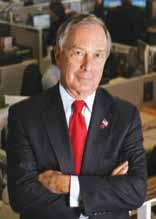




donald ramotar joins
(centre)
demerara (Carl Croker photo)


-US$4M state-of-the-art call centre to be constructed -Over
President Donald Ramotar and Qualfon Chief Executive Officer Mike Marrow on Wednesday turned the sod for the construction of the first ever multimillion-dollar call centre campus site at Providence, East Bank Demerara.
The state-of-theart campus is expected to create some 6000 jobs over the next five years. This first phase of work is expected to be completed within 12 months. President Ramotar lauded the development as he noted the importance of developing and broadening the economy.
“Government’s task has always been to broaden the economy… today’s event is a major player in broadening the economy and we will continue along this trend,” Ramotar said.
Qualfon CEO Mike Marrow said the facility will provide career opportunities and educational development, noting that ultimately,
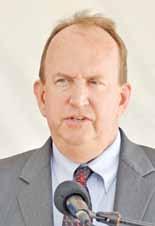
there will be an accredited university which will offer classes, career guidance and a shared library among other necessary amenities.
According to Marrow, Guyana has ranked number one on Qualfon’s successor’s list, owing to the fact that the people of Guyana are hospitable and effective with the English language. He said Qualfon’s largest market is serving customers in the U.S. and Guyana understands Americans.
Flourishing IT sector

Meanwhile, Finance Minister Dr Ashni Singh, who also addressed the ceremony, said Guyana’s information technology sector is rapidly growing and the country has now become a more attractive environment for investment opportunities in this regard.
Singh said while the country’s economy has had some setbacks owing to the poor perfor-

mance of the sugar industry, there are groups of dominating areas of growth within various sectors of the economy. He said the information technology sector is one such area, noting that major investment opportunities coming into Guyana are as a result of the progress made, while pointing to the multimillion-dollar investment by Qualfon.
Major challenges
The minister said this growth happened at a time when the country has been faced with major challenges on the economic frontier.
“In times such as these, we should recognise that this is an accomplishment that should be celebrated… this is not solely a government accomplishment,” he added.
“The fact that the real output is growing
and continues to grow, it is testimony to efforts being made by the private sector and also government’s role in ensuring the environment for investment and growth,” he added.
Dr Singh said in addition to reporting on the results of the growth of the economy, much has been achieved with respect to diversification to the productive base.

week ending september 8, 2013 | guyanatimesinternational.com

To contact: Guyana Times International
New York Office
106-15 Sutphin Blvd, Jamaica NY 11435
Email: guyanatimesnyint@gmail.com
Tel no: 718-658-6804
Preferred method of contact via EMAIL Guyana Office
Ruimveldt, Georgetown, Guyana.
Tel no: (592) 227-0704, 227-0709. Fax (592) 225-8696, 227-0685
Email: guyanatimesint@gmail.com
Almost every stakeholder in the region and farther afield came out in support of the Limacol Caribbean Premier League (CPL). From current and past players to commentators, government officials, corporate sponsors, Hollywood actors and many more hailed the tournament as a massive success.
Limacol CPL Chief Executive Officer Damien O’Donohoe was quoted as saying, “We have exceeded every benchmark we set for the Limacol CPL when we embarked on this project… by every measure there is no doubt it has been a massive success.”
It was evident that Caribbean people were beginning to lose interest in cricket mainly because of the dismal performance of the West Indies team over the years. Now the Limacol CPL has sparked a renewed interest as persons all over the region, even those who were not avid cricket fans, are talking about the game. That is the kind of impact the Limacol CPL has had on the Caribbean and it would be to our own disadvantage if the authorities, meaning those responsible for the governance of cricket, did not take full advantage and capitalise on the many opportunities that have now been presented.
Chairman of Verus International and founder of the Limacol CPL, Ajmal Khan said: “When we set out on this journey, we asked everyone involved to come and play – and that is exactly what has happened…. We wanted the Limacol CPL to be the biggest party in sport and there is no doubt we have achieved it.”
There was also massive commercial support for the tournament which this region has never seen for any sporting event. It was disclosed that even before a ball was bowled, 37 commercial partners were on board, including nine league sponsors, an apparel partner and sponsors for each of the six franchises, as well as four national tourism boards supporting the event.
Several high-profile individuals from the worlds of entertainment and business also got involved and threw their weight behind the league, with Hollywood actors Mark Wahlberg and Gerard Butler taking equity shares in the Barbados Tridents and Jamaica Tallawahs, respectively, while Sir Richard Branson’s Virgin Group backed the Antigua Hawksbills. Guyana’s leading pharmaceutical giant, NEW GPC supported the Guyana Amazon Warriors and has since pledged its long-term commitment to sport development in Guyana and the region as a whole.
The tournament has had a global audience for the games through outstanding broadcast coverage on television and radio, in addition to a significant presence on social media through Facebook, Twitter and YouTube.
President of the West Indies Cricket Board (WICB) Whycliffe “Dave” Cameron said the WICB signed an agreement with Limacol CPL with the goal of further developing and strengthening West Indies cricket by expanding the global fan base as well as increasing the number of West Indian cricketers under regional retainer contracts, and showcasing the talent and beauty of the Caribbean internationally.
The league has provided the opportunity for new talent to emerge. As was mentioned by Cameron, players like young Nicholas Pooran (Trinidad & Tobago Red Steel) and the likes of Rayad Emrit (Barbados Tridents); Sheldon Cotterell (Antigua Hawksbills); and Steven Jacobs (Guyana Amazon Warriors) to name a few, that may have flown under the radar or been overshadowed by the bigger names in the region, have now been given their time to shine, and they indeed took advantage of that opportunity.
Certainly, Limacol CPL has opened many doors for these young athletes to achieve their dreams by competing all over the world.
The Limacol CPL has shown both the West Indian public’s enduring love for cricket and the endless potential for growth and success that there is in the region. However, as pointed out by O’Donohoe and Khan, while the result has exceeded all expectations, the task ahead is to build on what was achieved this year to ensure the Limacol CPL goes from strength to strength and that it becomes even bigger and better in the years to come.

The Guyana government’s efforts at promoting the rights of the indigenous population have gained the recognition of the Amazon Cooperation Treaty Organisation (ACTO), an international body aimed at the promotion of sustainable development of the Amazon Basin.
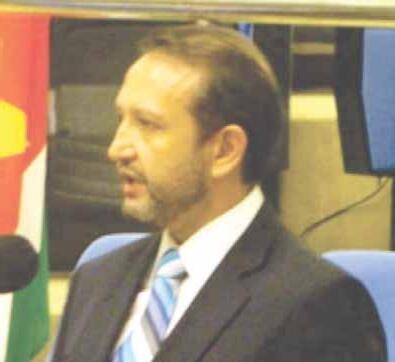
According to a Government Information Agency (GINA) report, ACTO Executive Director, Ambassador Mauricio Dorfler, who addressed the ACTO fifth meeting of high authorities on indigenous affairs on Monday, made reference to the granting of indigenous lands, the promotion of higher education, health, access, culture, among others.
“These are the experiences that can serve as a model not only for the indigenous people but also for the national development and identity,” Ambassador Dorfler said at the Guyana International Conference Centre (GICC).
Policy initiatives by successive People’s Progressive Party/ Civic (PPP/ C) governments have been credited to the improvements that have been evident among the Amerindian communities in the remote areas of Guyana.
Amerindian Affairs Minister Pauline Sukhai told the gathering about Guyana being among the few countries to craft legislation on indigenous rights long before the United Nations (UN) Declaration of Indigenous Peoples Rights was submitted for member countries’ approval.
The protection of indigenous people’s rights and welfare has been given primacy with the legal framework captured in the Amerindian Act of 2006, which Minister Sukhai recommended as a model for other countries to examine.
Reference was also made
to major development projects targeting the country’s indigenous people based on the consent agreement and priorities of the respective villages. Among them is the granting of land titles to about 90 per cent of the eligible communities, the creation of an Amerindian Development Fund (ADF) to sustain livelihood and economic viability of villages, installation of 12,000 solar panel units to Amerindian households, the investment in modern schools and hospitals in the remote areas, and establishment of computer hubs in 150 villages to support the One Laptop Per Family (OLPF) Project.
“This initiative (OLPF) is intended to prepare indigenous people’s advancement towards a better life in this current period of advanced technological and information base,” Minister Sukhai said.
Access to education has improved significantly with the construction of schools equipped with dormitory, and
the school feeding and uniform programmes.
Additionally, the Hinterland Scholarship Programme and technical vocational training have provided Amerindian students with the avenue for educational empowerment.
A week-long National Toshaos Council (NTC) meeting each year provides an opportunity for village leaders to voice concerns to the president, government ministers and other officials.
September is designated Amerindian Heritage month each year to showcase all aspects of the culture and development of the nation’s first people. This too, was hailed by Ambassador Dorfler.
The ACTO High-Level meeting coincides with the month-long activities that include an exhibition; homage to Stephen Campbell, the first Amerindian parliamentarian; visits to a designated heritage village; a pageant; and sports.
Police have recovered a rifle and questioned several persons in relation to the killing of schoolboy, Ryan Persaud by a stray bullet at Vive La Force, West Bank Demerara on Monday afternoon.
Crime Chief Seelall Persaud on Tuesday told Guyana Times International that the police have questioned several persons and a rifle has been recovered.
He noted that swab samples were also taken from those questioned, but no one was arrested.
Persaud explained that he is aware that the residents are claiming the shots came from East Bank Demerara; however, he noted that the reality of such a theory depends highly on several factors.
He stated that while manufacturers of weapons guarantee effective range, the distance a bullet travels is affected by the type of cartridges, the length of the barrel, and atmospheric conditions, among other factors.
The crime chief further stated that the police are waiting for the warhead to be recovered from the teen’s body to

determine whether it was fired from the rifle confiscated and whether it travelled from the alleged distance.
Addressing complaints from residents that several reports were made to the police on the shooting but nothing was heeded, Persaud said the bullet holes in the residents’ yard could have been caused by someone nearby.
Negligence
Meanwhile, residents continue to blame the inefficiency of the Guyana Police Force for the death of the 14-year-old boy. They are claiming that if the police had promptly responded to the reports made and handled the
matter with the urgency it requires, the death of the lad could have been avoided.
Persaud was killed by a single bullet to the right side of the back suspected to have come from a high-powered rifle which was allegedly discharged from the other side of the Demerara River.
Angela Munroe, a neighbour who witnessed the incident, recalled that on Monday she was in her yard when they began hearing gunshots and went into the house to take cover.
She noted that her husband then called the police and left shortly after to go on the road so she sat by her window looking outside.
“I see de lil boy come out de yard and he was going on de bridge because he cousin was there, then all I see when he reach de middle of de road he bend down in a crunching position and I done know he get shot because de gun de firing quick, quick and then he flick over and fall down,” recalled Munroe.
The woman said there had to be more
continued on page 12


BY MICHAEL YOUNGE
Attorney General (AG) Anil
Nandlall has accused the Speaker of the National Assembly Raphael Trotman of condoning unconstitutionality while at the same time contributing to a situation of “chaos” in Guyana as the combined opposition is being allowed to show disrespect for the supreme laws of the land.
Nandlall also criticised Trotman’s stewardship of the 10th Parliament, saying that he has failed miserably in curbing the excesses of what he described as the tyranny of one, and has failed to execute his mandate in a fair and constitutional manner.
The AG was at the time delivering a lecture at the Progressive Youth Organisation’s (PYO) Night of Reflection organised as part of activi-
ties to mark the entity’s 61st anniversary this year.
Fundamental laws
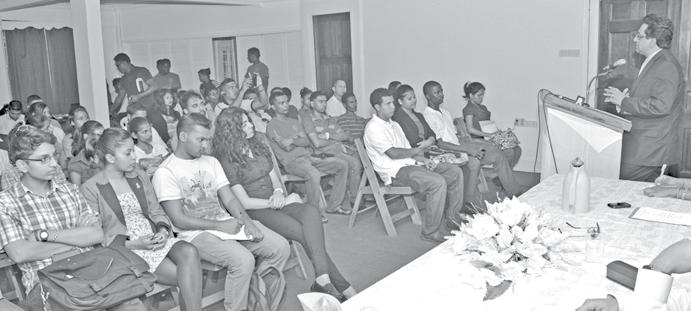
Addressing more than 150 youths at the event, staged at the Red House in Kingston, Georgetown, Nandlall said that it was important for the youths to understand what was taking place in the National Assembly and how the combined opposition political parties were being allowed to breach funda-


Satiricus was perplexed. He’d heard about the conundrum, “If a tree falls in the forest and there’s no one to hear it, does it make a sound?” He’d never been able to figure out the answer. But then he knew he wasn’t as smart as most – as for instance the brainboxes in the leadership of the KFC party – notably the Jhaat and Naga Man. They’d solved the philosophical enigma just like that! Well, it wasn’t exactly a tree falling – even though NoGel certainly had the girth of a hundred-year-old Saman tree.
mental laws and parliamentary practices.
This, he said, could see Guyana reaching a state of “anarchy” if the Speaker does not revisit and resign several positions he has adopted in the past, despite the counsel offered by the judiciary on several matters.
He said the Speaker in parliamentary systems like Guyana’s was expected to be the mere chairman of the proceedings and was fundamentally responsible for the maintenance of decorum, rectitude and enforcement of the Standing Orders of the Parliament.
The AG reasoned further that Trotman does not seem to understand quite fully too that he as Speaker along with the clerk of the National Assembly ought to be functioning as the combined agency to ensure that unconstitutional matters are not placed on the order paper and piloted through the assembly.
Challenge
He sharply criticised the Speaker for the positions he has adopted with respect to the suite of litigation brought against him by the executive arm of government, which is challenging the constitutionality of several rulings and actions of the opposition which enjoy the approval of the Speakership.
Asked by the audience about filing contempt proceedings against the Speaker for his reported dereliction of duty and noncompliance with the basic tenets of society, the attorney general said the government was hoping that it would not be forced to go “to those extremities” to remedy the apparent crisis.
But that was only to be expected to one born in a family named “Huge”. Name and nature and all that sort of thing.
Anyhow, here it was that NoGel had fallen (from on high – all the way from the top of Amaila Falls) but not a sound was heard since.
To be strictly truthful (and Satiricus, simple soul that he was, liked being truthful), Satiricus conceded NoGel hadn’t exactly fallen. It was more like he was hit in the solar plexus, doubled over and just collapsed after the revelation that he was a “company secretary”.
Satiricus figured if NoGel was just a company secretary, why should he tell everyone? Jeez!! The fellow must have attended law school and everything, no? For him to take such a lowly job of taking shorthand, must’ve really embarrassed him. That’s why he kept mum.
As he collapsed, NoGel croaked weakly he was resigning as chairman of the KFC party. (This was before the Integrity Commission closed them for a week to clean up their act. There were all kinds of messy evidence from their dirty tricks department lying around.)
And this was what created the conundrum as far as Satiricus was concerned. If NoGel had made no sound subsequently, how did the Jhaat and Naga Man maintain that NoGel was still chairman of the KFC? And Satiricus figured that either the Jhaat or the Naga Man must have heard a sound – even though no one else did. And then suddenly, the answer struck Satiricus. My God!! How dense he’d been. It was Naga Man!! The man had a history of hearing sounds when no one else did.
Wasn’t there that incident with Dr Cheddi Jagan in the deepest Rupununi? The Naga Man maintained stoutly, that from a stage in front of hundreds of people (plus dozens on the stage) Dr Jagan had announced that he, Naga Man, was to be the next leader of the PPPEE. No one else heard anything. But the Naga Man did. “And he wouldn’t lie, would he?” Satiricus asked himself.
Naaah! It was just that the Naga Man had solved the eternal conundrum. Does a Huge NoGel make a sound when he falls (or is pole-axed) and no one is around to hear? Yes! But only the Naga Man can hear it.
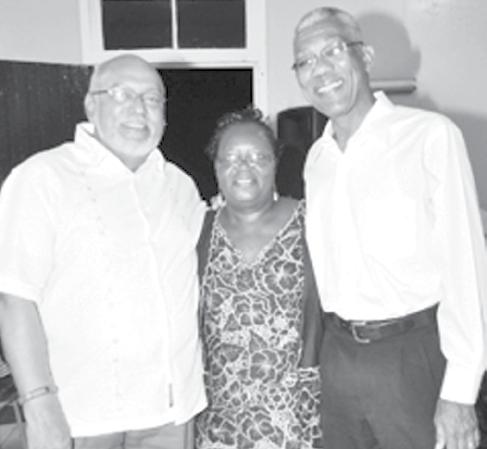
President Donald Ramotar and Opposition Leader David Granger joined in fellowship with members of the Den Amstel Ebenezer Congregational Church as it commemorated its 170th anniversary with an evening service.
The celebration began with a parade march from the old church site at Blankenburg to the present location. A vehicle with speaker boxes playing gospel music led the contingent of celebrants.
The church is replete with history dating back to the 19th century when it was first established, and like several other heritage sites in Guyana, the Ebenezer Congregational Church survived the era of slavery, emancipation and independence.
Fond memories
The atmosphere brought back fond memories for President Ramotar who was christened in the congregational church during his childhood years in Karia Karia, a tranquil vil-
lage along the Essequibo River.
As it marked another important anniversary, President Ramotar is looking to the church for advocacy on some of society’s ongoing challenges. He made reference to domestic abuse and poverty which he drew a close connection to drugs, alcohol and criminal activities to which the nation’s youth are most susceptible.
“We will try to work to ensure that our state functions better to deliver justice and security to our people, but as I have said, we cannot do it alone and I am happy to partner with the church, with other religious organisations, with civil society, with political parties… I have to work every day on the assumption that all of us want to have a better life for our people,”
U.S. Embassy Deputy Chief of Mission Bryan Hunt was welcomed by Home Affairs Minister Clement Rohee when they met on Tuesday at the minister’s office.
Minister Rohee, in welcoming the high-level official noted that the two countries have had, and still continue to have a long history of cooperation, particularly on issues of security.
Rohee said Guyana has benefited a lot from various programmes initiated under the Caribbean Basin Security Initiative (CBSI) and stated confidently that, “I’m sure the cooperation will continue”.
Meanwhile, Hunt said he was looking forward to learning about Minister Rohee’s views on various programmes on which the two countries have collaborated. “I’m looking forward to

finding out how we could continue to partner and work closely with his ministry.”
The CBSI is the latest pillar of a U.S. security strategy focused on citizens’ safety throughout the hemisphere. It brings all members of the Caribbean Community (Caricom) and The Dominican Republic to-
gether to jointly collaborate on regional security with the U.S. as a partner.
The U.S. is making a significant contribution to CBSI, committing US$203 million in funding for the first three years of the initiative, the Government Information Agency (GINA) reported.

Opposition Leader
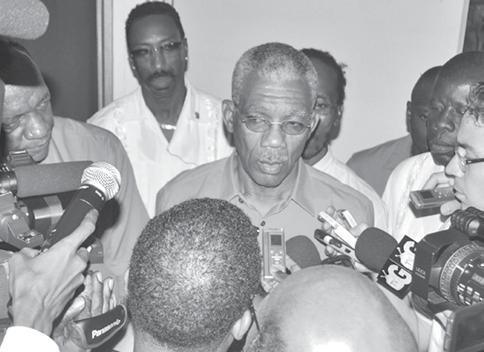
David Granger said a new political culture is needed if the country is to progress, noting that this remains the responsibility of the three political parties.
Speaking at an A Partnership for National Unity (APNU) news conference at his Hadfield Street office on Wednesday, Granger stated that the “new political culture” should be based on a form of governance that prevents gridlock in the National Assembly.
Granger added that the new political culture should also encourage cordial relations and civilised dialogues among the parties, underscoring that it is for this reason, since December 1, 2011; the three political parties initiated a tripartite process.
“When I speak of a new political culture, I speak of creating a relationship among the three parties in the National Assembly to ensure that the dialogue that takes place is for the benefit of the whole nation and we do not have collisions and car crashes that we have had over the last 18 months,” he said.
Job creation
The opposition lead-
er stated that APNU and the Alliance For Change (AFC) would also like the government to set up a tripartite Budget Committee that the three parties can work on to meet consensus. The work of the National Assembly has been characterised by political brinkmanship ever since the 2011 election. Numerous bills, motions and even the national budgets have been subjected to disagreements.
Only recently, the Amaila Falls bill, though managed to clear the House, could not prevent the developer from pulling out, owing to lack of consensus as the main opposition, APNU, voted against it.
Granger only recently had criticised the government for not dealing with
the issue of youth unemployment, but the administration hit back, saying that it was his party that killed the Amaila Falls project, which would have been a job creator.
Granger told the news conference that his party would like the government to explain exactly how this project will provide employment since it does not see this happening. He added, “We don’t want to produce labourers.”
The APNU leader also said since Sithe Global has hinted “unequivocally” and “unapologetically” that it is not interested in the hydro project any longer, its licence, which will expire at the end of the year, should be revoked. “I don’t know what the legal mechanism is for recovering the licence, but
if is being voluntarily surrendered, it could be advertised for another bidder,” he said.
Other sites
Granger stated that there are about a 100 sites in Guyana which can generate hydropower, hence, his party is not questioning whether Amaila Falls is the best, explaining that there may be other sites which can be linked to the project to acquire benefits.
“We need to examine an interlocking area of hydropower so that we get the greatest potential,” said Granger.
He said APNU has insisted that government takes a comprehensive Amaila Falls project before the National Assembly so it can look at the financial architecture, managerial structure, the plan, the means for disseminating the power and the improvement of the performance of the Guyana Power and Light (GPL), which is going to be given the responsibility for distributing electricity from the project.
“We will ensure when APNU votes for that project, it will be something that the people of Guyana welcome, we look forward to having cheap power, abundant power and a hydropower project.”
By SaBatini DanielS
Tourism and Hospitality Association of Guyana (THAG)
President Kit Nascimento said airlift in and out of the country remains a major challenge for the local tourism industry which has been growing from strength to strength.
Speaking with Guyana Times International in a recent interview, Nascimento said Caribbean Airlines Limited (CAL) is basically the only airline which is servicing the country, and this is not good enough. “CAL is a regional airline that flies internationally, it is not an internationally branded airline, we need an internationally-branded airline, not one, but many coming into this country.”
The THAG president said he is aware that acting Tourism Minister Irfaan Ali is working tremendously on getting international airlines to
operate in Guyana and remains optimistic that the minister’s plans will be successful.
Nascimento disclosed that he recently participated in the Tourism Ministry’s expositions in New York and Canada and hundreds of Guyanese there say they want to visit Guyana, but the prices for tickets to Guyana and back home are excessive.
CAL had taken up the slack and added flights since the exit of EZjet last year and Delta’s exit earlier this year. However, during the summer, the airlines drastically jacked up its prices, which received severe criticisms from government as well as travellers.
This posed an obstacle for persons who wanted to travel to Guyana, as they could not afford the airfare. He said THAG hopes to persuade a number of major corporate entities to support the development of the country’s tourism industry. “When tourism flourish-
es, every corporate member in this country flourishes, tourism is a trade in which the entire economy and all the participation in the economy benefits, so we feel that major corporations in the country should be supportive of THAG.”
The THAG president said the organisation also aims to strengthen its membership base and make them more active since the strength of any organisation is its membership.
“Membership involvement, commitment and participation are critical for the success of THAG, the leadership is dependent on its membership and if the membership is not actively involved, then the leadership of the organisation cannot do much.”
Nascimento stated that THAG will also be encouraging President Donald Ramotar to appoint Minister Ali officially to the post of tourism minister. “He has been extremely active,

By Anu Dev
Aweek ago, thinking about what this week’s article would be about, I decided it’ll be about the final of the in augural Limacol CPL. At the time, I had no doubt it would’ve been an article celebrating our team, the Guyana Amazon Warriors bringing home the trophy. (The trophy itself, I’m not too enamoured about... but that’s another story!) But this is still a celebratory article – it’s just a celebration of something else. The LCPL and our Warriors have given us much to celebrate.
As a country, we can be proud of the way our team acquitted themselves during the entire tournament. They gave us so much to cheer about throughout the tournament so that we could hold our heads high with pride.
As a region, the Caribbean can be proud of the fact that we’ve pulled off such a major tournament flawlessly. The tournament has thrust so many young West Indian players into the limelight, where they can get the exposure and experience needed to flourish. It would be ludicrous for the WICB to not give players like Santokie a try-out on the West Indian team. This tournament was a welcome injection of life into West Indian cricket.

And it probably came at a perfect time as well, since the well-established players on the team still have some prime years left to play. That should give them enough time to pass on to the new players some of the skills and tips that their years of experience have taught them. Then we’ll have that sense of continuity in the team instead of having to construct a team of completely new players six years from now.
And while the tournament pits country against country with there being strong rivalry between competing countries, on another level it forces us to embrace players from other Caribbean countries as one of our own – the franchise system puts them on our team! I think I definitely cheered on Lendl Simmons as much as I cheered on Permaul.
Although I still can’t fathom the logic behind sending out the Trinidadians high up the order in the final instead of potentially more capable batsmen. But we got to put our countries on display. We got to broadcast our Caribbean culture to the world. We got several nights of good fun and some nerve-wracking nights – I was in Trinidad for the semis and final.
he has paid a great deal of attention to tourism, he has done what he can with a very limited budget at his disposal, a budget which needs to be significantly increased if we are serious about marketing Guyana as a tourism destination.”
THAG is a private sector-led organisation which has committed itself to the development of the local tourism industry by providing the highest quality of profession al services.
I still have my Guyana Amazon Warriors flag that I waved. I just might tack it onto my dorm room wall. It’s been a terrific tournament – I’ve thoroughly enjoyed every game. So let’s wave our flags, raise our glasses (with passion fruit juice!) and lift our voices to cheer on our boys for the good job they did at the inaugural LCPL. I’ll never forget that overwhelming sense of pride I felt at that first game at the Providence Stadium. It’s really something. It’s indescribable, seeing those cricketers in front of you. And you even get that feeling for the players of the opposing team. It’s when you see players like Chris Gayle on the field in front of you that you realise exactly how much they mean to you. It’s when you’re about to faint at the sight of Dwayne Bravo that you realise how much West Indian cricket and cricketers mean to you. So all hail the Limacol CPL! All hail the Guyana Amazon Warriors!
Dear Editor,
All the fuss about why some students did badly at the last Caribbean Secondary Education Certificate (CSEC) examinations has now descended into an opportunity for political gain. So many from the opposition parties are looking for opportunities to blame everyone, except
themselves.
Everything in the country now seems to descend into a political blame game. One letter writer recently stated that the People’s Progressive Party/ Civic (PPP/ C), particularly the Guyana Police Force, was to be blamed for an accident, where a bus toppled and took two
lives.
The Education Ministry has responded to say that parental involvement has a strong impact on student achievement. The good and the bad students come from all classes and races of people.
Some parents are not educated, but their input revolves around ensur-
ing that their children stay with their books. It is a simple case of how much work was put in by the students.
If there is no one there to ensure this kind of input, they will do badly. All the critics should go and see who did badly and what are their backgrounds in terms of their family structure. We
have too many absent fathers in many homes and this creates the imbalance, where many children are in the care of single mothers and other relatives.
Outside of the academics, this has many social and psychological setbacks too. A father’s involvement in schools is associated with the high-
er likelihood of a student getting mostly better grades. May we be honest? We need to take responsibility for our children. Even in the event of separation, children must be taken care of. They end up losing out on what is rightfully theirs.
Sincerely,
Jamal Sunich
Dear Editor,
In the midst of a few controversies, the University of Guyana (UG) received some good publicity. The good news is that a donation of some 42 Spanish-titled books was made available by the Mexican Embassy to UG, and now officials are exploring the option of making foreign language a compulsory course for students.
Not a bad idea, but how about doing so at the
school level – the earlier the better.
This is because learning a second language has huge benefits. It has been shown that a second language enhances children’s cognitive development.
Children who learn a foreign language, beginning in early childhood, demonstrate certain cognitive advantages over children who do not.
Research conducted in Canada, with young chil-
dren, shows that those who are bilingual develop the concept of “object permanence” at an earlier age. Bilingual students learn sooner that an object remains the same, even though the object has a different name in another language.
Additionally, foreign language learning is much more a cognitive problem solving activity than a linguistic activity. Studies have shown repeatedly that foreign
Dear Editor,
Iwrite in reference to the Foreign Ministry’s response relating to the deportation of Mark Isaacs (Stabroek News, August 29) to explain the process of “removal from the U. S.”. Contrary to what deportee Isaacs believes, there is virtually nothing any country can do to prevent a deportation except in the rarest of cases where a prospective deportee was denied due process or a fair trial.
The Guyana government could have appealed, begged, pleaded for Isaacs and may indeed had done so and I am certain the government would have preferred to have one less deportee in the country. But it was unlikely that deportation would have been avoided.
I studied U. S. immigration rules and keenly follow changes to the law on deportation removal. Once a non-citizen commits a serious crime (felony, as in the case of Isaacs), he or she is automatically placed under removal proceedings after serving “time”. There are limited exceptions to this rule granted by a judge under humanitarian conditions, or by the president or some high official.
Recently, the Barack
Obama administration announced it would consider granting a reprieve from deportation to some convicted “minors” who have virtually no connection to their home country.
The U. S. Immigration and Customs Enforcement (ICE), the agency that oversees immigration policies, also announced it would review its policy on deportation of certain individuals who were convicted of less serious crimes.
There is/ was virtually nothing that the Guyana government could have done to prevent Isaacs’ deportation.
However, Isaacs could have taken measures to delay or even prevent deportation by using his service in the armed forces.
Naturalised citizens are rarely deported, unless they obtained citizenship under fraudulent means, even if they commit the most heinous crimes.
Any immigrant who serves honourably in the U. S. armed forces is entitled to expedited citizenship and many Guyanese are known to acquire citizenship under this rule. Isaac could have applied for citizenship under this rule and delayed or prevented de-
portation while his application was pending.
Those who served honourably in the armed forces are almost never rejected of citizenship even while in holding. Also, Isaacs could have appealed directly to the president or other officials, the army chief-ofstaff, or the chairman of the joint chiefs-of-staff, pointing out his honourable service in the army while defending America, and plead for his assistance.
Isaacs most likely would have been granted a reprieve from deportation while his citizenship application proceeded –the army is kind to its servicemen. That would have been a better course of action rather than depend on the action of the Guyana government, which has no sway in preventing his or any other deportation.
On the record, the Obama administration has deported more people than perhaps all previous presidents combined.
Deportation rules are strictly enforced and as such the principal reason why so many Guyanese have been deported even for petty crimes.
Yours truly, Vishnu Bisram Queens, N.Y.
language learning increases critical thinking skills, creativity, and flexibility of mind in young children.
Students who are learning a foreign language outscore their non-foreign language learning peers in the verbal and, surprisingly to some, the math sections of standardised tests.
This relationship between foreign language study and increased mathematical skill development, particularly in the area of problem solving, points once again to the fact that second language learning is more of a cognitive than linguistic activity.
So my vote is that we push this foreign lan-
guage thing and we make it compulsory.
For sure, Spanish is a good move, as we have many Spanish-speaking neighbours.
On another note where language is concerned, I was listening to a news brief and the education minister reiterated a global fact: proficiency in language is deteriorating.
For example, in Nigeria, the language problem is there and officials have even opined where the fault lies.
After some serious assessment, it was pointed out that students’ poor showing in many English examinations was because of the use of Pidgin English and poor spelling
abilities.
The educators there then appealed to parents and teachers in particular to encourage students to cultivate the habit of speaking good English and taking English dictation and spellings at home and school right from the basic level.
In Guyana, we have this same kind of problem of improper language exposure.
Here, firstly and more abundantly, the Guyanese Creolese is what surrounds everyone. So with say Spanish coming on board, there will be more standard language indigence and this will help.
Sincerely, Cynthia Greene

BY SVETLANA MARSHALL
Government has denied reports that ANSA McAL has suspended altogether its proposed multimillion-dollar bio-fuel project in Guyana, insisting that while the Trinidadian conglomerate has turned its back on the 40,000 hectares of land in the Canje Basin, the administration was still searching for suitable alternatives.
ANSA McAL’s Chief Executive Officer Anthony Sabga III, during a recent interview in another section of the media, said a feasibility study conducted in the Canje Basin indicated that the soil was unsuit-

able for the US$ 300 million ethanol project and rainy conditions proved the area useless.
But during an exclusive interview with Guyana Times International, Agriculture Minister Dr Leslie Ramsammy said the ANSA McAL multimillion dollar project is still on the table.
He explained that the Trinidadian group of companies had requested a change of location from the Canje Basin to the Intermediate Savannahs.
Location
According to Dr Leslie Ramsammy, a proposal was made in keeping with the recommended location but this too was overturned by ANSA McAL. Though the company’s rejection has caused some delay in the materialisation of the project, the government remains optimistic that it will be able to meet the demands of the company.
ANSA McAL requires a specific amount of land with special characteristics. “For example, a river port, this is quite an understandable request, I believe that it is still possible for us to accommodate ANSA McAL and so I am working closely with the Ministry of Natural Resources and the Environment to find a solution,” he posited.
It was explained that the Natural Resources and the Environment Ministry is evaluating the geographical land mass in the Intermediate Savannahs to determine whether the company’s

specifics can be met.
If the Natural Resources Ministry comes up empty handed, only then ANSA McAL will have no other option than to scrap the project, the minister said.
Meanwhile, Dr Ramsammy said there is a high demand for land in the Canje Basin and the Intermediate Savannahs with investors collectively demanding more than two million hectares of land to facilitate large scale biomass production.
Foreign investors
From a batch of more than 15 foreign investors, the Agriculture Ministry has signed Memorandum of Understandings (MoUs) with just four group investors, hence, paving the way for feasibility studies to be conducted in the Canje Basin and the Intermediate Savannahs for the production of biofuel through the planting of sugar cane, palm and soya.
A group of investors from Malaysia and China recently signed MoUs with the Agriculture Ministry. The agreement was inked approximately two weeks ago to
determine whether the Canje Basin is suitable for the planting of palm trees.
The group of investors is aiming to tap into the global market through the sale of palm oil to meet the growing demand.
Palmoil is not only used for cooking but for the production of fuel and creation of cosmetics.
In addition to the China-Malaysian group, a company out of India is currently conducting a feasibility study in another section of the Canje Basin to determine the possibility of bio-ethanol production through the usage of sugar cane.
Dr Ramsammy said the company will be placing major emphasis on the production of bio-ethanol. However, given its proximity to the Skeldon Sugar Factory, if proven feasible, the Agriculture Ministry will be working along with the company to provide the factory with sugar cane.
This company has also requested in excess of 50,000 hectares of land but was granted a lease to occupy 12,000 hectares.
President Ramotar said.
He also sees the role of the church in helping to fulfill his long dream of writing the history of Karia Karia where there is a wealth of background knowledge about congregationalism.
A scripture reading from Matthew Chapter 13 ended President Ramotar’s remarks, leaving behind an inspirational message for the congregation. It reads:
“You are the salt of the earth. But if the salt loses its saltiness, how can it be made salty again? It is no longer good for anything, except to be thrown out and trampled underfoot. You are the light of the world,
from page 7
a city that is set on a hill cannot be hidden nor do they light a lamp and put it under a basket but on a lamp stand and it gives light to all who are in the house. Let your light so shine before men that they may see your good works and glorify your father in heaven.”
Among those present were junior Finance Minister Juan Edghill; the first female pastor of the Ebenezer Congregational Church, Reverend Valeska Austin; and Den Amstel Neighbourhood Democratic Council Chairman George Nedd. Guyana, U.S. to examine ways of enhancing security collaboration
Guyana is expected to take firm steps to comply fully with its obligations under the Montreal Protocol of the Vienna Convention for the protection of the ozone layer, which will soon result in the banning and phasing out of substances which can deplete the ozone.
The need to ban and phase out these harmful substances and gases has been backed-up by research done internationally by scientists and environmentalists who argue that they are destroying the ozone layer, resulting in ultraviolet radiation from the sun. Research has also shown that these substances and gases can lead to skin cancer, cataracts and damage to the animal and plant life.
Regulations
Cabinet Secretary Dr Roger Luncheon, addressing the media on Wednesday, announced that Cabinet had adopted regulations in March of this year which restricted the importation of the substances, while stating that a twopronged approach has been decided on to ensure compliance with the
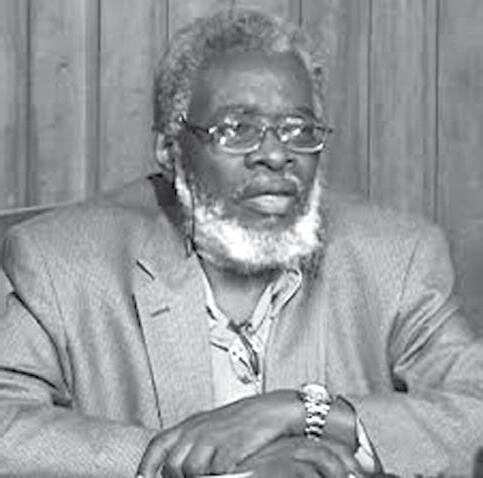
general expectations of the treaty.
He said the Guyana Revenue Authority (GRA) has been identified as the enforcement agency which will have to implement the agreed on approach and has been given the mandate of detecting and seizing all equipment that are not incompliance with the treaty, but are being imported for use.
“In those instances where the new equipment does not comply with our treaty obligations, the cost of noncompliance will devolve on the importers.
Equipment would be seized, the gas would be retained by GRA and, of course, its re-export to the suppliers by the non-compliant importer would be enforced,” Luncheon declared.
Compliance
He also emphasised that the government was determined to ensure compliance at the various levels of the society and would not be wavering on its positions as far as its treaty obligations were concerned. Dr Luncheon said too that the second approach to be rolled out would seek
continued on page 22
Preparations are moving apace for the opening of Guyana’s leading trade fair and exposition on October 3 at the Sophia Exhibition Complex. The four-day event promises 85 international exhibitors as compared to 36 last year, and more booths, as over 440 are to be erected.
Guyana Tourism Authority (GTA) Director Indranauth Haralsingh said, “We are ready to host one of the most successful GuyExpos.”
Several of the foreign exhibitors are first timers at the event. Exhibitors are expected from China, India, Brazil, Venezuela, Argentina, Grenada, St Lucia, French Guiana, and Suriname. These countries will be exhibiting spices, wine, culture, forestry, equipment and foods.
The event is hosted through a collaborative effort by the Tourism Ministry and the Guyana Manufacturers and Services Association (GM& SA).
The ministry will be pre-selling tickets since there is a limit of 25,000 individuals per day at the venue in an effort to
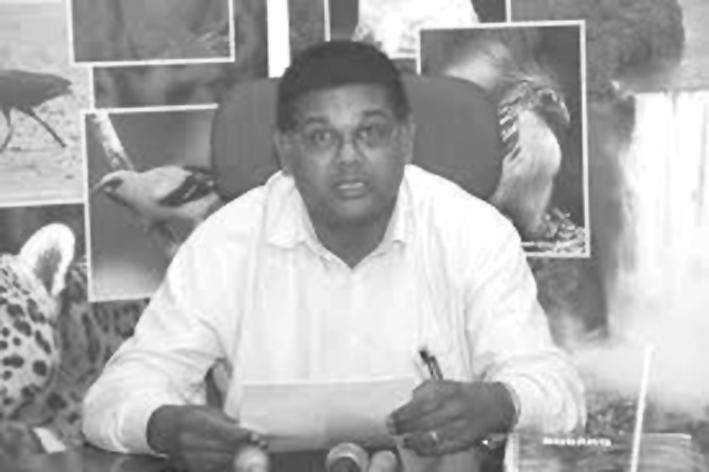
reduce the yearly congestion experienced. Another means of easing the congestion is the provision of three entrances instead of one.
Event coordinator Tameca Sukhdeo-Singh said an investment forum is part of the event and will facilitate linking and networking of local and international participants. Five key areas will be addressed including creating business opportunities in the United States and China, using alternative energy in businesses and small businesses.
Apart from nightly entertainment, a special GuyExpo 2013 magazine will be launched.
This yearly trade fair serves as an initiative for
creating new markets, exports, and awareness for exhibitors. It promotes sales and increases competition for local businesses and boosts tourism. Over the years, the expo has had a tremendous impact on the country’s economy.
Haralsingh said that a lot of attention is being given to small businesses and financing, and highlighted that one of the difficulties faced by such businesses is lack of and unawareness of means of financing, an aspect that will be focused on during the event.
GuyExpo 2013 will be held under the theme, “Advancing productivity through innovation, modernisation and expansion”.

The Guyana Prize for Literature Committee has announced its shortlist of winners for the prestigious awards billed for September 15 at the Pegasus Hotel, Georgetown. In a statement, the committee said the shortlists and winners were decided by a jury made up of distinguished judges, selected by the Guyana Prize Management Committee because of their outstanding credentials in the field of literature as literary critics, academics, literary editors, authors and creative writers.
Shortlist
For the Best Book of Fiction, Ruel Johnson’s Collected Fictions, a semi-autobiographical
collection of short fiction that addresses racial and political tensions, relationships and displacement and Chaitram Singh’s The February 23rd Coup , a fast- paced fictional account of an attempted coup by a group of disaffected Guyanese soldiers have been shortlisted.
In the Best Book of Poetry category: Cassia Alphonso’s Black Cake Mix, a collection of evocative poems with a wellrealised creole voice; Ian McDonald’s The Comfort of All Things , an elegiac musings by a mature poet on aging and mortality; and Sasenarine Persaud’s Lantana Strangling Ixora Complex , a collection of introspective poems with a bitter edge are on the
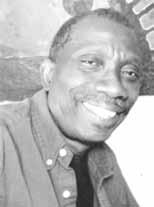
shortlist.
Harold Bascom’s “Deportee”, a screenplay for a crime thriller set in New York and Georgetown, involving deportation, narcotrafficking and corruption and Mosa Mathifa Telford’s “Sauda”, a morality tale about the need for understanding
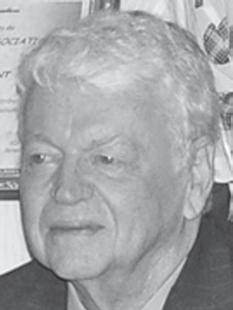
and forgiveness between mothers and daughters, and the difficulties of escaping from a legacy of self- contempt have been chosen for the best drama prize.
For the Best First Book of Fiction, the committee said only one entry was shortlisted, and will therefore be de-

clared the winner. In the Best First Book of Poetry, no work was considered suitable for a shortlist in this category.
The winners of the prize will be announced by the Chairman of the Jury at the Guyana Prize Awards ceremony to be held on September 15.
The awards will be presented to the winners by President Donald Ramotar. Chair of the Jury, Professor Jane Bryce will read the judges’ report.
Panel
The Jury panel is made up of Professor Jane Bryce, Brendan de Caires, Dr Louis Regis, Professor Daizal Samad and Lori Shelbourn. According to the committee, Bryce is a professor of African literature and film in the Department of Language, Linguistics and Literature, University of the West Indies (UWI), Cave Hill campus. Bryce, who is also a fiction writer, has published prose works and short fiction. She is a co-editor of Poui, the Cave Hill Journal of creative writing; has conducted courses in creative writing; and is a leading scholar on African and Caribbean films.
de Caires has been described as a literary critic, reviewer, and was an editor and book reviewer for the Caribbean
Review of Books (CRB). He has published literary articles and reviews and is a co-founder of Moray House in Georgetown.
Regis is head of Department of Literary, Cultural and Communication Studies at UWI, St Augustine campus and a specialist in West Indian literature, cultural studies and cultural history; and an authority on the political calypso in Trinidad. He has researched and published on carnival and calypso, including studies of Black Stalin and Maestro and has been a theatre director.
Samad is a professor of literature. He is also a fiction writer and former director of the University of Guyana (UG), Tain Berbice campus. Professor Samad has worked in Canada and the Middle East and has published extensively on literature.
Shelbourn of the University of Leeds, UK has researched extensively on Wilson Harris for doctoral studies at Leeds and is an authority on Harris.
Shelbourn is also a researcher of West Indian literature, literary editor, writer of literary entries for Wikipedia and has directed international conference on Caribbean literature and culture in the UK.
than one weapon firing because of the rapidness of the sound. She noted that the shooting lasted for about 45 minutes and immediately after the young man was shot, it had stopped.
The woman disclosed that this shooting has been going on for years; however, the bullet never got so far and only recently intensified. On one recent occasion, she and her two sons were in their yard when they heard the clashing sound of the bullets on a nearby shed, prompting them to run for cover. She noted that the shooting did not last for a long time, but stopped shortly after.
Munroe continued that the following Sunday, which was about two weeks ago, one of her sons was riding home when two bullets flew by, inches in
front of him and landed in the trench. “He come and say ‘Mommy I just had to pull up, I see two bullets fly pass me and gone in de trench’ but by time he finish talking, we hear another shot on the shed,” said the woman.
As the police continue to investigate the matter, there has been no arrest; however, they took several persons into custody for questioning, but subsequently released them. While the residents of Vive La Force claim that the shots were fired from over the other side of the bank, on Monday a vessel was seen in the middle of the Demerara River and is said to be the property of a popular businessman.
Based on information received, the police took the man into custody for questioning, but have released him.
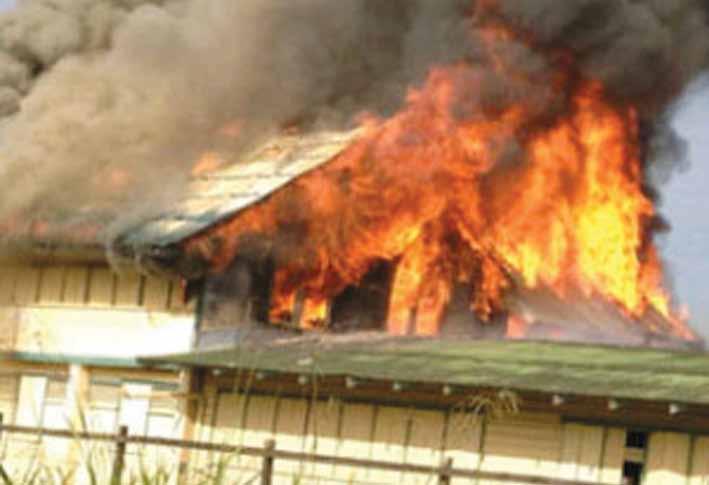
Asection of L’Aventure Secondary School, at Canal Number One Polder, West Bank Demerara, was destroyed by fire on Wednesday.
The morning blaze, suspected to have been electrical in origin on the third day of the new term, displaced 699 students.
Headmistress Althea Stewart, speaking with Guyana Times International said she was at the Ministry of Education office in Vreed-en-Hoop, West Coast Demerara when she was informed, by telephone, of the occurrence.
The distressed woman said she hurried there and observed that the building was engulfed and the lone female night security guard was off duty.
Meanwhile, Chief Education Officer, Olato Sam told reporters, at the location, that the flames were first seen about 07:30 hrs but not many students
or teachers were present.
He said the Guyana Fire Service (GFS) was alerted and responded in good time to contain the conflagration which ripped through the middle part of the two-storey wooden edifice.
Mr. Sam said teachers and others were still trying to ascertain what caused it but they are leaving the investigations to the GFS.
Chief Fire Officer, Marlon Gentle said the GFS is working with the Regional Electrical Inspector to ascertain the origin but noted that, within the past 48 hours, the area has been experiencing some electrical power fluctuations which may have trigged the conflagration.
Other reports said the school had an electricity problem which was reported but not addressed.
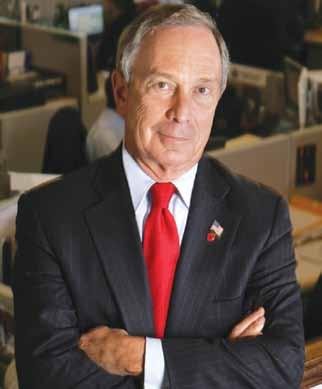
Mayor Michael R. Bloomberg, Chief Policy Advisor John Feinblatt, Manhattan District Attorney Cyrus R. Vance, Jr., Police Commissioner Raymond W. Kelly and Schools Chancellor Dennis M. Walcott on Tuesday announced the latest initiative in the City's truancy prevention efforts: the creation of New York City's first Engagement Center for truancy reduction and prevention.
This effort is part of Mayor's Interagency Task Force on Truancy, Chronic Absenteeism & School Engagement, which is succeeding in reducing truancy amongst the city most at-risk children. Those chronically absent students mentored through the Task Force's Success Mentor Program are 52 percent more likely to remain in school.
Overall, mentored students attend approximately two more weeks of school per student than those without mentors. The center, spearheaded by the Mayor's Task Force and
run by the Manhattan District Attorney's office, in partnership with the Department of Education, Police Athletic League and the NYPD, will provide programs designed to maximize school engagement and success, including with data-driven best practices developed from the task force's successful three-year pilot cur-
rently in 100 city public schools. The mayor made the announcement at the Police Athletic League in Upper Manhattan.
"We've taken major steps in the last three years to reduce chronic absenteeism by developing innovative strategies that have proven highly effective," said Mayor Bloomberg. "The open-
continued on page 21






BY UMADEVI BUX
When the mother of 17-yearold Alex Vimal Kahdhai decided to place him and his siblings in an orphanage because she could no longer take care of them, he had little hope of becoming someone with a bright future.
But he challenged his circumstances amid children like himself at the Prabhu Sharan Orphanage located at Cornelia Ida, West Coast Demerara and defied all the odds to secure 15 subjects at this year’s Caribbean Secondary Education Certificate (CSEC) examinations.
A student of the Saraswati Vidya Niketan (SVN) School, the aspiring civil engineer said hard work and sleepless nights paid off as he secured 12 grade ones, including three distinctions and three grade two passes at the recent examinations.
Happy and overwhelmed, Alex told Guyana Times International that he could not believe that he did so well, recalling that
preparations for the examination was challenging.
However, he was positive that “anything can be possible as long as you believe you can succeed and it really doesn’t matter where you come from and how hard your life is… It was lots of work. I had to study until about 03: 00h or 04: 00h in the morning and without the help of my teachers, and without the orphanage, I don’t know how I would have done it.”
Parents separated
He noted that after his parents separated, he grew up for a while in a single parent home. But then soon his mother could no longer take care of him and his siblings and took them to the orphanage in 2008, where subsequently, he was enrolled into the SVN at the Grade Eight level.
“I feel as if my life here in the orphanage is better than what I had at home… I didn’t have any difficulty in support of where my school is concern… I was given every support… I have been living in the orphanage for about six years now,”
said Alex. He continued: “It was very hard at first, but without the support of the orphanage and teachers… it would not have been possible.”
Be focused
Alex emphasised that just as how he has achieved a foundation for better education despite the circumstances of his life, so too can others in his situation. “I encourage anyone… no matter who you are, or where you’re from, anything can be possible and you can be successful as long as you work hard… be focus and know your goals and believe in yourself.”
Alex also participated in extracurricular activities such as cricket, playing the drums and going to the Corneila Ida Mandir.
Presently, he is a first-year student at the University of Guyana, reading for a diploma in civil engineering. His studies were sponsored through the orphanage and donors, both locally and overseas.
He had also received a part scholarship from the SVN during the period of attendance.

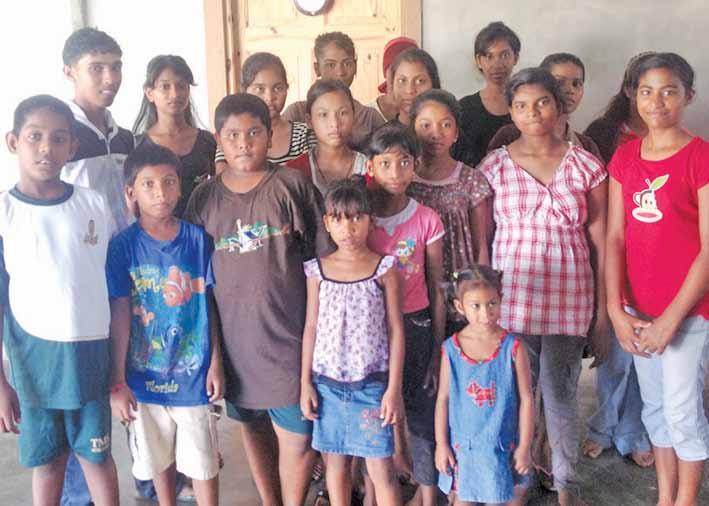
Meanwhile, Avinand Rampersuad, a volunteer teacher attached to the orphanage told Guyana Times International that other teachers from the SVN would come by and help Alex and the other students.
He noted that since its establishment in 2005, the orphanage has provided safe housing for children from troubled homes, allowing them an opportunity to become rounded adults in society.
“We have volunteers coming to help the students through collaboration with other non-governmental organisations, like the Nirvana Humanitarian Group, the Bahai Centre
and private citizens and youths around the neighbourhood, among others,” said Rampersaud. He noted that most of the funding for the orphanage comes from private citizens.
Success stories
The orphanage cares for children ranging from ages two to 17 years old, and in the past, has had other success stories.
Former orphans
Priya Mahase, who attained eight subjects at CSEC is a trained medex; Rajendra Singh, who secured four subjects is now a customs clerk; and Sandra Bissoon, who obtained 13 subjects is now an employee at a prominent bank as a teller.
The orphanage’s
administrator Indira Deodat stated that the institution also works closely with the Human Services Ministry to provide counseling for the children and other support programmes.
According to Deodat, the goal is to assist orphans and underprivileged children to achieve their optimum potential through education and training.
“We pattern the educational programme along the lines of the ancient Gurukul system that provides total development of both the head and the heart through academic and technical education… and allow the kids to grow to their full potential,” said Deodat.



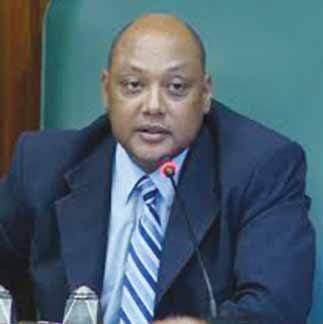
The Guyana Police Force has warned against unsubstantiated statements about its handling of the matter against Simona Broomes, the president of the Guyana Women Miners Organisation (GWMO) who has been accused of theft and assault by a human trafficking offender.
In a statement, the police said the incident took place on April 21 at Puruni, but the victim who allegedly suffered at the hands of Broomes, Ann Marie Carter had evaded the police until her arrest in August.
“Upon being arrested, Ann Marie Carter made an allegation that she was brutally assaulted, including with the use of firearms by Ms Simona Broomes and other persons in her company. Her allegations were supported by a medical report and eyewitnesses.”
Broomes was subsequently questioned by the police and placed on bail as investigations continue.
“The reports in the media including the statement made by the Guyana Human Rights Association display a lot of reckless and unsubstantiated pronouncements being made that seek to vilify the police without knowledge of the facts.
"Or is it being suggested that we live in a society where some are more equal than others and under such circumstances, the Guyana Police Force should use the unprofessional approach of selective enforcement to achieve justice?” said the statement.
It was made clear that the force will continue to deal with matters professionally.
Meanwhile, Broomes’ Attorney Raphael
The Peoples Progressive Party/ Civic (PPP/ C) has accused the opposition of misleading the public about the Amaila Falls project. Finance Minister Dr Ashni Singh, speaking at a PPP/ C press conference on Monday, said the joint opposition continues to engage in disseminating false information about the project as they attempt to justify their non-support.
Referring to comments made by Alliance For Change (AFC) leader Khemraj Ramjattan that his party was unaware of the interest rate for the project, Dr Singh said the AFC member’s comment is absurd.

Trotman has called on the Office of the Director of Public Prosecution (DPP) to treat the allegations against Broomes with expediency in the interest of ensuring that justice is served.
On Monday, Broomes through her attorney issued an official complaint to the DPPs chambers.
It is expected that a request will soon be made for the police to send the file on the matter to the DPP office.
Speaking with Guyana Times International, Attorney Trotman said it could take “several weeks” before a report is issued by the DPP office, but it is his hope that a response is given within two weeks.
It is alleged that Broomes on April 21 assaulted Carter and stole an eight-ounce gold chain during a trafficking in persons operation at Puruni. The report was lodged on September 19.
Approximately five hours after detention, the GWMO president was released on station bail to the tune of Gy$ 10,000; however, she has not been charged. Broomes is mandated to return to the police on September 6.
the A Partnership for National Unity (APNU) a year ago, clearly indicating the interest cost, or cost of financing.
He noted that both parties had an opportunity then, to ask questions, but they did not. The finance minister further stated that it is a widely known fact that concessional financing is only available to countries that meet certain criteria.
The minister reiterated that the Amaila Falls project is a private sector initiative, with the government involved in no borrowing as private developers, or special purpose companies are the borrowing entities.
The lending, he reit-
Well known fact
The AFC leader in a media report said the Inter-American Development Bank (IDB) would normally make loans available to Guyana and other countries at concessional rates in the vicinity of one or two per cent.
The loan to the Amaila Falls Hydro Electric Project was set at a whopping 9.5 per cent.
Ramjattan was reported as saying too that the revelation that the IDB was asking for 9.5 per cent has illustrated the “deceptive nature of government”, given that all along, stakeholders were of the impression that the loan was at a concessionary rate of 1.5 per cent.
However, Dr Singh debunked that statement saying that the information was provided to both the AFC and
erated is private sector lending at private sector rates. “So to treat this now as some fact that has been now discovered and to manufacture a controversy surrounding this matter, is nothing short of an attempt to mislead the people of Guyana.”
The finance minister said too that he strongly believes that “the opposition by their parliamentary action delayed the progress of the project”.
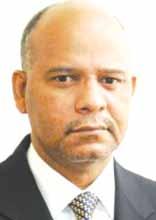
He added that it was an established fact that private developer said from the inception that unless there is parliamentary consensus, they will not be prepared to spend any more money on the due diligence process.
However, members of the APNU, he noted are now claiming that they were not aware of that information, which was critical to the project’s continuation.



ing of this Engagement Center is the next step in ensuring our children are provided with the support they need to stay in school and off the streets - for their safety and their academic futures."
"In order to keep kids out of the courtroom, we need to keep them in the classroom," said Manhattan District Attorney Cyrus R. Vance, Jr. "Since 2010, my Office and our partners in the NYPD have taken 13 violent gangs off our city's streets. Many of these gang members are teenagers who should have been in school, rather than peddling drugs or trafficking firearms. Working with my Office's Advocate to Graduate program, the new Youth Truancy Engagement Center will prevent atrisk children and teens from falling into this way of life by identifying their needs early, and matching them with the
appropriate academic tutoring and resources.
I want to thank Mayor Bloomberg and our partners at the NYPD, PAL, the Department of Education, and the Department of Probation for their work and commitment to this important initiative."
"We now know that chronic absenteeism is neither inevitable, nor irreparable if the right strategies are applied on time" said Chief Policy Advisor Feinblatt. "Today we are taking the lessons learned from the task force over the past three years, and applying them to law enforcement's truancyprevention efforts. This partnership is critical because schools can't tackle this problem alone -- the causes are far too complex and varied, and the consequences too severe."
The Center, located at the Police Athletic League building in
from page 13
West Harlem, has staff from the Department of Education, the District Attorney's Office and the Police Athletic League, along with social workers. Academic tutors will be provided on and/or off site as well. Incoming students will be matched to specific engagement programs and services depending on need, including tutoring, mental health counseling, advocate-driven group activities like Saturday Night Lights sports programs, and school-based Success Mentors. There are multiple pathways into the Center, including from schools, the Department of Probation, NYPD, and the already successful PAL sports program for at-risk youth "Saturday Night Lights."
The Engagement Center serves as a bridge between student, school, and community and brings to the table a host of new truancy prevention strategies:
Aleading re-
gional academic on Tuesday called on Caribbean Community (Caricom) countries to adopt a common position as it regards the ongoing situation in Syria.
Professor of social and political change at the Mona campus of the University of the West Indies (UWI), Brian Meeks, told the Caribbean Media Corporation (CMC) that his advice to regional governments is that “they should do it together, they should consult each other (and) they should act multilaterally through their respective organisations, in particular, the Caribbean Community and whatever decisions are made, should be made on that foundation”.
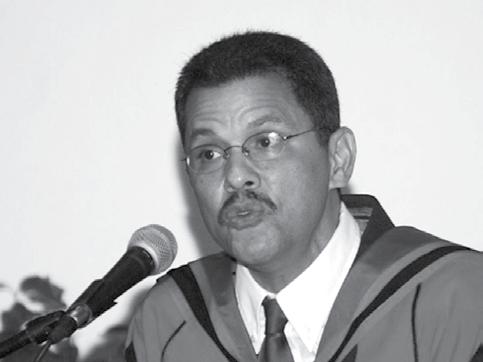
He said his own view is that Caribbean countries should stick close to the United Nations and the positions taken by the United Nations.
“We should look after our own business, but we should also strongly oppose positions that encourage the notion of a warring policeman with arbitrary powers.
“What if you get it wrong as in the case of Iraq not very long ago in which there was supposed weapons of mass destruction which were nonexistent? That is the danger and I think our governments should consider this and act together.”
On Monday, the
continued on page 26
The Health Ministry on Monday dispatched 70 newly-trained doctors to its main hospitals across the country. Fourteen of the doctors are being deployed to the New Amsterdam Public Hospital, 10 to the West Demerara Regional Hospital, eight to the Suddie Public Hospital, eight to the Linden Hospital Complex and 30 to the Georgetown Public Hospital Corporation.
During a press conference in the ministry’s boardroom, Health Minister Dr Bheri Ramsaran emphasised that these efforts are part of the ministry’s vision to facilitate the continuous learning of health-care providers.
He noted that during the day, the first batch of doctors were able to interface with the permanent secretary and personnel manager and discussed their contractual arrangements, accommodation and other planning.
As part of the initial process, the doctors including those who recently returned from Cuba, will be engaged in additional training sessions in basic life support, advanced life support, paediatric advanced life support and Visual Inspection Using Acetic Acid (VIA).
With regards to the 200 odd doctors who

returned from Cuba, Minister Ramsaran indicated that they too, will be engaged in similar training sessions during September 12 to 28.
The intention is that all the doctors will complete the training and their orientation before month-end.
While these doctors fall under the supervision of the new Regional Health Services Director Dr Monica Odwin, the Local Government and Regional Development Ministry also has a role to play in ensuring that they are introduced to the management of the hospital at which they will be posted.
The regional health and executive officers will function as their administrative supervisors.
Minister Ramsaran noted that the process is a collaborative one among the ministries of health, local government and regional development and public service.
Additionally, the doctors will be given an evaluation journal similar to that given by the medical council.
In relation to the offering of post-graduate studies, Minister Ramsaran explained that talks have been had with the Cubans, and as a result of that discussion, four Guyanese doctors are preparing to travel to Cuba to commence their post-grad studies.
This arrangement is similar to that of the initial one made between the governments of Guyana and Cuba for the offering of medical scholarships.
Additionally, doctors are also encouraged to pursue studies in the administrative and policy aspects of the medical field. That partnership has resulted in hundreds of Guyanese being able to access scholarships and the construction of critical medical facilities such as the Suddie, Diamond, Mahaicony and National Ophthalmology hospitals.
He also emphasised that there have been expressions of interests from Cuban-trained Caribbean nationals to
complete their sixth year of study and rotations here in Guyana.
Minister Ramsaran indicated that thus far, two are already in the programme and more requests are expected.

The foundation set by Venezuela’s late President Hugo Chaves for flourishing bilateral relations with Guyana was recognised by President Donald Ramotar and his Venezuelan counterpart Nicolas Maduro as the two leaders met in Guyana last Saturday.
Following their discussions, the heads of state signed a joint declaration, signalling their commitment to its content which focused on strengthening and widening relations between the two countries.
As part of the declaration, the two sides highlighted the greater thrust given to the United Nations Good Offices Process since the appointment of good officer to the United Nations Secretary General, Professor Norman Girvan.
As such, they recommitted that the search for a peaceful and practical settlement of the controversy in accordance with the Geneva Agreement of 1966, was one that should be pursued under the good offices process. In this regard, it was agreed that Professor Girvan should be reappointed for a further term.
Meanwhile, the two
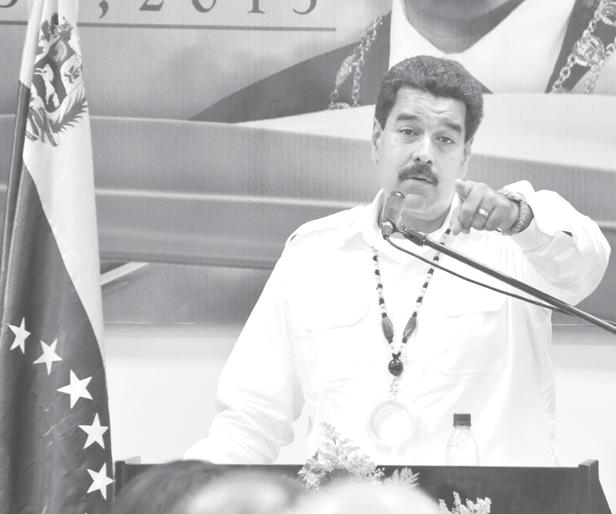
leaders received the report of the fifth meeting of the Guyana/ Venezuela High-Level Bilateral Commission, which was held on Friday. It focused on political consultation; food and agriculture; air, land and sea transportation; energy; and education and culture.
Good relations
Speaking to media operatives from the two countries, President Ramotar stated that the declaration signed strengthens the political will of the two countries to build on their peaceful and fruitful relations.
He said President Maduro’s acceptance to visit Guyana is an in-
dication of the interest shown by Venezuela in ratifying ties with this country. “I would like to recognise the tremendous work that was done by the late President Chavez in this regard, who changed the thinking about the good neighbourly relationships with Guyana and Venezuela, and we must recognise the efforts that he made personally so that today, we can be building on the foundations that have been already laid,” Ramotar said.
He pointed out that the discussions held with the Venezuelans on Friday and the president on Saturday, were fruitful.
Air linkages
“We already have strong relations in the rice and PetroCaribe arrangement, energy and now the agreements for connections by air and we’re also looking at maritime transport. All of which of course would have the great possibility of broadening our relationship.”
The agreement to establish direct air linkages between the two countries will be made possible through CONVIASA airline, which will see some 70 passengers being transported at least twice weekly.
The Venezuelan government also offered the government of Guyana increased skills training for technicians and flight operations inspectors. However, he said the two sides have recognised room for improvement in the relations that exist. “We intend to pursue all areas of activity vigorously in the future,” Ramotar said.
Meanwhile, speaking through an interpreter, the Venezuelan leader also welcomed the discussions, highlighting that it covered core areas that will seek to fortify the ties that exist between the two neighbouring nations.
Guyana’s Sunni Muslim School, Madrasa Nooranie, has formalised plans for the establishment of a branch of the Markaz Al Ihsaan Theological Institute of Higher Islamic Education of Trinidad and Tobago to be based at the famed Anna Catherina Islamic Complex (ACIC).
The Madrasa Nooranie was established in September 2003 at the ACIC. The deal was confirmed by principal of the institute, maulana Dr Waffie Mohamed when he visited Guyana earlier this month.
Markaz Al Ihsaan was established in 2000 as a theological institute to provide quality higher Islamic education from the fundamentals of Islam to the tertiary level. It also offers courses in some of the specialised areas of Islamic knowledge. It is committed to the dissemination of Islamic knowledge and in assisting in the cultivation of a refined life for every individual, based on Quranic guidance and on the traditions of Prophet Muhammad (peace be upon him).
True Islam
Its courses are designed to help individuals to know, practice and preach true Islam. Markaz al Ihsaan recognises that many Muslim leaders, preachers and teachers do not have this kind of outlook of life; as a result, it has
developed a band of competent, qualified teachers to carry out this mission in order to be able to pass on the legacy of Islam at any level in the society.
It offers three levels: a certificate programme (a one-year course designed to make the participants aware of all that is required to be an enlightened practising Muslim), a diploma programme (a one-year course opened to students who have successfully completed the certificate programme and prepare the participants to be able to present Islam at a national, meaningful and learned way to believers and non-believers alike) and an alim programme (a threeyear course, which enables the participants to become qualified in Islamic theology, (aalim).
In the areas of specialised subjects on contemporary issues, Markaz al Ihsaan offers special subjects to each student, such as comparative religion, public speaking, Islamic sociology, Quranic psychology, Quranic philosophy, leadership course and religious sects in Islam.
Madrassa Nooranie was established under the tutorship of the late Pakistani Muslim scholar Maulana Hafiz Noorul Hadi Haleem, and is operated by the ACIC, in association with The Guyana United Sadr Islamic Anjuman.

De old Rams love de weekends together. Every weekend de two old Rams does deh pun a roll. This is not de opposition role that dem does play. That is another role by itself. When people deh pun a roll dem is like when dem deh pun a high. Dem does feel good. Dem does tink that dem can do a lotta tings. Dem does want to talk plenty too. And dem does tink dem on top of de world all by demselves.
That is de kinda roll de two old Rams does deh pun. Dem does even roll one another. Dem does deh pun such a high that some times de Sus Penders does fall off. And Ram Bow does shoot wid he arrow.
Dat is when dem does feel good and want to do a lotta tings. Dem does be on top of de whole world, including one another. Dat is when dem does end up talkin plenty.
And that is when de mud paper does get more news. Every ting dem seh does mek de news. Never mind Hanand seh that de old Rams is rejects from de Stabber, who can’t mek it in de news in de Stabber anymore. Any and every ting does go in the mud paper.
De other day, even when a dog chase a mud reporter was big news. But then again Suru and Duru does only deal wid mud. One got de mud in he head and de other got de mud in he hands fuh mud slingin.
Last weekend, when de old Rams was on another roll, Ram Bow jump up and seh de Amaila Falls hydro project is a gigantic rip off. Well judgin from de way Ram Bow talkin, de only ting that gigantic is how much he talkin! Ting-a-ling-a-ling… friend tell friend… mattie tell mattie! And de only ting that rip is he mouth. So look out fuh de old Rams next weekend again.

It was declared open in 2003 by then President Bharrat Jagdeo. The Guyana Branch of the Markaz will offer the programmes in two semesters, each consisting of four weeks (once per month for four months).
Teachers from Trinidad and Tobago will travel to Guyana to conduct the classes. Students must meet the admission age and other requirements and only 25 persons will be trained at one time.
All course material, books etcetera will be provided free of charge by the Markaz. Principal of Madrasa Nooranie, Pakistani maulana/ qari Muhammad Mujahid, now based at the ACIC, will also be one of the teachers on the panel.
to address those domestic, national and commercial entities which are already in breach of the ozone treaty. He said that a decision was taken to phase out the “offending equipment” using an “incremental approach” over the next couple of years.
The move to phase out the existing equipment will not happen immediately as the users of offending refrigerators, freezers, air conditioning units and such like equipment will have until 2040 to come into compliance.
Asked about the public education and awareness programme that would be necessary to ensure conformity and an understanding of government’s international obligations to the treaty, Dr Luncheon responded that already work in this area has begun.
He advised that government through the GRA and several other
from page 11
stakeholders have been engaging various importers and stakeholders to establish an understanding of the changes and new rules which would apply to the country. Public awareness The Cabinet secretary did not hold the view that there would be any attempt to oppose the spirit of the treaty while advising that alternative steps will have to be taken to heighten public awareness about the need to bring an end to the use and promotion of ozone depleting substances.
The announcement made by the Cabinet secretary was expected according to several private sector businessmen who said that it was unlikely that the government would not honour its international obligation, especially with regards to the environment, given the country’s Low Carbon Development Strategy.
Along with the appointment of a new board of directors at the Guyana Sugar Corporation (GuySuCo), a second round of changes will be implemented at the entity. “As was announced by the president, GuySuCo by the end of the month will have a new board of directors announced,” Agriculture Minister Dr Leslie Ramsammy said.
He has assured that he remains committed to his promise which is to make changes to the board of directors.
“As part of my presentation during the budget, I committed to making changes to the board and the corporation and I will remain committed to this… cannot sit without making changes,” he said.
According to the minister, while it is his ulti-
mate belief that changes to management should happen when things are not going the way they should, he holds the opinion that the weather is a major constraint in the sugar industry.
Apart from changing the board of directors, Dr Ramsammy said there will be a second level of changes to management and daily operations of the factories and fields.
He explained that to overlook a field that may have some 50,000 hectares of crops, managing seven different factories and looking after decision-making is not an easy task.
“Presently, there is an overall director for factory management and an overall factory director… we have agreed that it is too much work for one person to provide that kind
of supervision for seven or eight factories,” he said.
He said the aim is to have more than one supervisor and managers in different areas of the factory, production and management process so that it would ease the burden on one person.
This, he believes would make the factories more effective and sugar production would be greater. Dr Ramsammy therefore lobbied for more changes to be made to address other fundamental issues.
There will be field managers, operator managers and to add to that an overall director of the factory who will assist with the smooth running of the operations.
The minister said while there are many critics and persons would questions why managers are not going into the fields every day, this is a huge task, and according to him, this new management process should reflect significant changes. There will be a new chief executive officer at GuySuCo and some of the old board members and staff will be reassigned.
“Clearly, new people will coming in… we are now looking at a package of changes and this will be announced shortly,” he added.
week ending september 8, 2013 |
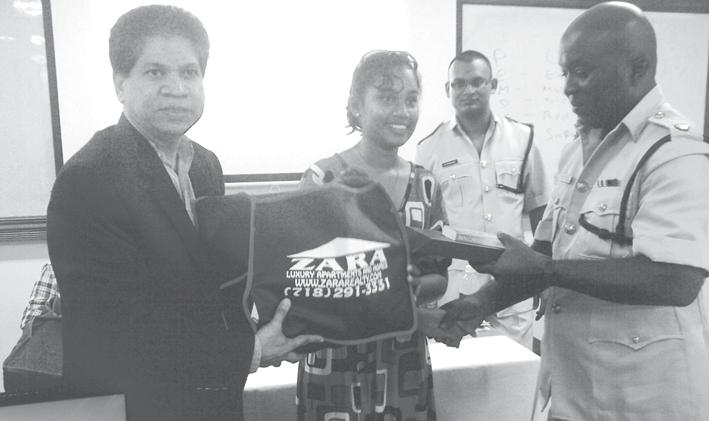
Zara Holding, a U. S.-based Guyanese company, has honoured the country’s top two students at the recent Caribbean Secondary Education Certificate (CSEC) examinations.
The top students, Zamina Rasheed and Yogeeta Persaud of the Anna Regina Multilateral School were presented with learning packages which included books and laptops by the company’s consultant Naresh Singh.
The presentation was made at a simple ceremony at the Zara Computer Centre at Suddie on the Essequibo Coast.
Singh said the students have made Guyana proud, more so Region Two by demon-
strating no matter the background, one can excel at the highest level.
He urged the students to continue to “think big” and stay focused on achieving their goals. On that note, he wished them well in their future endeavours.
Police G Division Commander Steven Mancell also congratulated the two top students, noting that they have made Region Two proud.
Both Zamina Rasheed and Yogeeta Persaud thanked the company for the gifts and advised students sitting next year’s examinations to stay focused and aim high. The girls also thanked their teachers for grooming them to perform well.
and
secured 19 and 18 grade ones respectively at the recent CSEC examinations.
Zara Holding has invested over Gy$ 30 million in the building of the Zara Computer Centre at the Richard Faikall Police College on the Essequibo Coast. The centre provides free computer training to secondary school students and other members of civil society. Since the establishment of the centre on June 5, some 232 persons from civil society and 23 police officers have been trained. The company is looking to build a similar facility in Georgetown, Region Four.
BY: BHISHAM MOHAMED
As part of the investigation into the murder of businesswoman Sirmattie Ramnaress who was discovered dead in her home at Diamond, East Bank Demerara (EBD) on Saturday morning; investigators intend to review the footage recorded from the CCTV camera along the East Bank, Georgetown and East Coast corridors.
Crime Chief Seelall Persaud told Guyana Times International on Monday morning that the police, as part of their investigations will review the footage with the hope of finding a clue to solve the murder.
Footage
The police are optimistic that the footage from the CCTV cameras will at least provide them with a view of the driver and occupants who were in the getaway car that was later found
abandoned at Liliendaal, East Coast Demerara.
Persaud could not confirm the actual time the car was found, but suggested that it might have been before the area was cordoned off to facilitate the Venezuelan president’s visit on Saturday.
In addition, the crime chief also confirmed that the police are working on several leads that may lead to the arrest of the perpetrators.
He said that after the discovery, crime scene experts had dusted the house and the woman’s body for fingerprints and they were successful in retrieving a few.
The police also uplifted DNA samples to be tested as they intensify their investigations.
Responding to an article in one of the daily newspapers which reported that a sister of the dead woman knew the killers; the crime chief stated that he was not
briefed on this development, but believes it is a speculation.
“If she had information that someone wanted to harm her sister, then she should have contacted the police at once, thus preventing a hideous crime,” Persaud said.
A post-mortem examination on Ramnaress’ body is expected to be performed on Wednesday at the Georgetown Public Hospital mortuary.
While it is speculated that the woman died as a result of shock and hemorrhage due to multiple stab wounds, relatives are curious to know if she was killed before the wounds were inflicted.
Allegation
The reputed husband of the deceased woman was extensively grilled. Sergeant Colin Bailey admitted that he heard of his implication in the murder, but explained that he will never commit such an act, noting that he and Ramnaress have been together for the past 21 years.
He also stated that after the woman ended the relationship with her first husband, they have been friends and their relationship blossomed.
The lifeless body of Ramnaress, 48, also called “Sabo” of Lot 2430 21 Avenue, Diamond Housing Scheme, East Bank Demerara was found about 10: 00h lying face down in her office located close to her garage.
Her throat was slit, head bashed-in and hip was disjointed; sections of her multimillion-dollar property were also destroyed by fire.
The entire bottom-flat of the house was completely drenched with kerosene and her house was ransacked, which suggests that the woman was robbed before she was killed.
The perpetrators also set alight a bond aback the house, which was completely destroyed. After the robbery, the killers escaped in one of the woman’s motor cars, it was subsequently

found abandoned on the Liliendaal Public Road, East Coast Demerara. Recordings
Further information received revealed that the recordings from the surveillance cameras, both internally and externally were missing.
This indicates that the perpetrators were well briefed as to the locations of the recording areas.
Investigators are working on the theory that the robbery might have been an inside job since there were no signs of forced entry into the premises.
In addition, the woman’s property is protected by several feet of grilled fence and an alarm system, which, according to neighbours, did not go off during the night of the gruesome murder.
Officers of the Guyana Police Force (GPF), the Customs Anti Narcotics Unit (CANU) and the Guyana Revenue Authority (GRA) on Friday graduated from a five-day course on border security hosted under the U. S.-led Caribbean Basin Security Initiative (CBSI).
Through ongoing security cooperation under the CBSI programme, the United States and Guyana partnered to stage the International Passenger Interdiction Training (IPIT) course which was held at the Police Training Centre on Camp and Young streets.
The port security training course saw the participation of nine police officers, three CANU officers and a representative of the GRA. The trainings were conducted by two officials of the U. S. Customs and Border Protection (CBP) agency, who shared their best practices on processing passengers at ports of entry and practical exercises at airports.
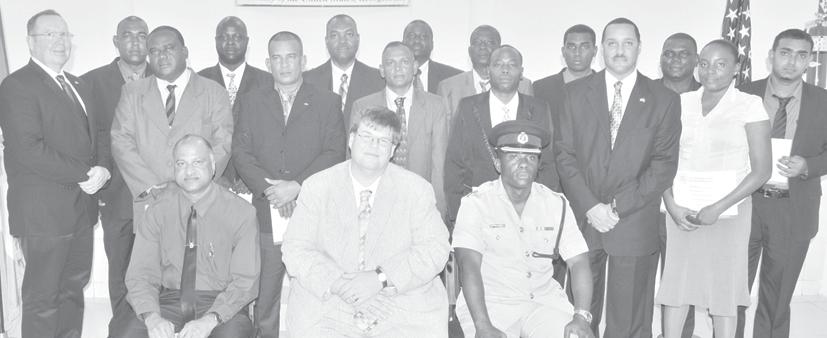
The course included training on fraudulent documents, passenger targeting and analysis, interviewing techniques, smuggling and luggage examinations.
Officials from the Cheddi Jagan International Airport (CJIA), the Guyana Civil Aviation Authority (GCAA), and Caribbean Airlines (CAL) also facilitated practical training at CJIA as part of the IPIT course.
Speaking at the closing ceremony on Friday,
U. S. embassy Deputy
Chief of Mission Bryan Hunt, thanked the government of Guyana for hosting the training while applauding the participants for their commitment and dedication during the course.
Hunt said that courses such as these are designed to steer the participants into working to develop their security tactics.
He noted that since the implementation of this partnership four years ago, there has been
The ruling People’s Progressive Party/ Civic (PPP/ C) has rubbished comments made by Opposition Leader David Granger that Guyana has a high youth unemployment rate. PPP/ C General Secretary Clement Rohee said Granger is being hypocritical about the issue, especially since the party voted against crucial pieces of legislation for the realisation of the Amaila Falls project.
“It is common understanding that cheap and reliable energy is a cornerstone for the economic development of any nation. It fuels the expansion of the manufacturing sector, attracts both foreign and local investment, and as a result, creates numerous job opportunities in various fields and sectors for the skilled, semi-skilled and unskilled labour force... this is the vision which was behind our efforts to realise the project,” he stated.
The PPP/ C general secretary further added that if APNU is so passionate about the issue, then it should move to participate in national development and the creation of jobs for the Guyanese populace.
He recalled that it was that same party that
considerable progress in areas such as narcotics trafficking to maintaining public security.
“ I thank you for the work you do every day to assist in protecting our borders from criminal activities. I am confident that this training will enhance your ability to do your individual jobs and enhance regional cooperation,” Hunt told the participants.
He noted that the U. S. remains committed to continuously work on security cooperation to help

was “loud in their praise” of so many young skilled Guyanese who were employed in the construction of the Amaila Falls access road, during a visit by both opposition parties to the site. A few days later, they voted against the project, placing those same young people in jeopardy.
“So in reality, Granger is sitting on a time bomb, as he is running out of excuses and every time he utters a word, the magnitude of his misinformation to his constituency is being revealed. Make no mistake about it, the APNU knows that their action and the action of its leadership were of their best interest and not that of the nation,” Rohee said.
The PPP/ C, he explained will continue to monitor “Granger’s efforts to defuse the resentment and anger of his anti-nationalistic actions”.
Non-assent to bills
Moving his attention to another issue, Rohee dismissed concerns raised by the opposition about President Donald Ramotar’s non-assent to a few bills passed in the National Assembly.
According to Rohee, President Ramotar’s non-assent to the bills was in no way political in nature as his reasons were listed in a letter to the Speaker of the House and are grounded by the Constitution.
The PPP/ C, he said, supports the president in standing up against the threats made by the APNU which were purely designed to bully him to pass “unconstitutional bills”. He reiterated that every bill that passes through the National Assembly does not result in an automatic assent by the president.
The Constitution resides in the president, a
latitudinal power of discretion, as to whether he will assent or not to bills passed in the National Assembly. After careful consideration, the president, Rohee added, decided not to assent to a few bills and has complied with the procedure that the Constitution outlines when he decides to withhold his assent.
With regards to Granger’s reference that the law is very clear on the issue and they hold the government at fault, Rohee said if the APNU feels that its position is “drowned by law, why didn’t they approached the High Court after making threats to do just that since May this year?”
According to the PPP/ C, the opposition is engaged in a propaganda war to justify its actions, given the harsh judgment it is receiving from the people.
Guyana improve border and airport security.
Seelall urged the participants, who were all awarded with certifi-
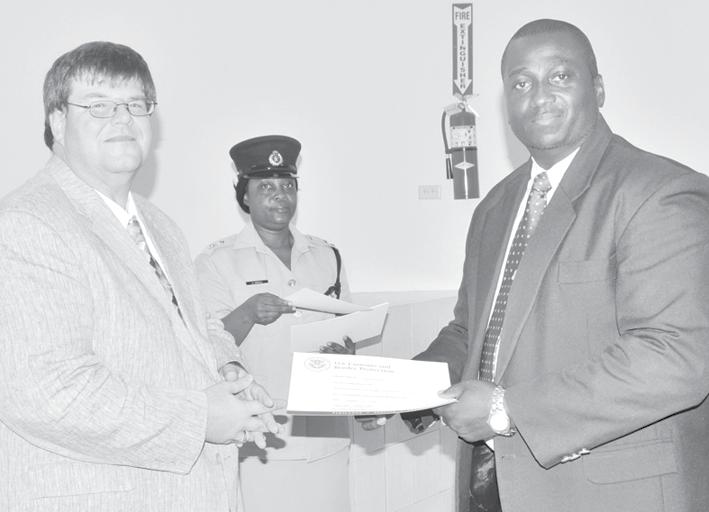
cates, to share their newly acquired knowledge with their colleagues.
Meanwhile, Deputy Police Commissioner and Crime Chief Seelall Persaud said the GPF values the relationship between Guyana and the U. S. He noted that Guyana has benefited enormously from CBSI, adding that the government of Guyana will continue to emulate the progress on these trainings and how they impact the security sector.
De mayor run from de ** ity
It got some people who don’t like to face up to anyting hard in life. Dem does can’t tek hard life.
And dem does can’t handle de pressure when de pressure near fuh buss pipe. Dem like to run away.
Dem does can’t face de music. Some does turn dem back, look de other way and then walk away. Some does come back, but plenty of dem don’t even tink bout comin back. Dem gone fuh good.
Plenty man does mek pickney wid woman and then get away and don’t pay dem child support.
De law gon ketch up wid dem soon. One man de other day get argument wid he woman, burn down de house, and then he tek he bicycle and ride away just like that, like if he goin fuh a drink at de rum shop. Next day de same woman defend he and he gone back wid de woman. Look out fuh when he gon jump pun he bicycle again.
Is de same kinda of pressure mek Sithe Global pull out and go away. Then just bout de same time R Kelly pull out and didn’t come. Well, he learn he lesson a long time now since he didn’t pull out in time wid de lil pickney and de video man ketch he. No Gel Hugly like to stay in too. He didn’t want to pull out. So he pull out too late and he get ketch wet handed. Even he mouth was dribblin still, like how Rum Jhaat does dribble, and it wasn’t pun Cat Hugly. Well, de mayor-fuh-life Green Ham and he deputy Green Case runnin from de ** ity fuh dem life. Guyana is de only country in de world that got two Green people runnin de capital. But nutten in de capital green and not a Green in sight! Ting-a-ling-a ling… friend tell friend… mattie tell mattie! And even Green Jah green shirt fadin!
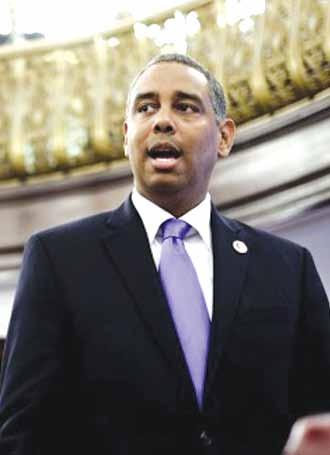
5a.m. on any given morning the alarm clock rings and the day begins with a prayer.
Anywhere from 5:45 a.m. to 6:00 a.m. newspapers are unrolled and read while the morning news plays in the background. He then showers, gets dressed and out the door he goes to tour the confines of Council District 28. Somewhere around 8:30 am there is a vehicle pulling into either the parking lot of the local district office or a legislative office at 250 Broadway across the street from city hall.
This is the start of almost every morning of Councilmember Ruben Wills, Councilman of district 28 Queens.
For those that may not know, Council District 28 encompasses Jamaica, Rochdale and South Ozone Park due to the redistricting of a large portion of Richmond Hill. Councilman Ruben Wills was elected in a special election in November of 2010 after the untimely death of his predecessor, the late Thomas White Jr. Two elections later, and some 32 months after the Councilman has worked out a plan for his district that is centered on inclusion for all neighborhoods in his district.
Reaching out to traditionally ignored parts of the district, he has forged relationships with leaders of various civic, community based organizations, and tenant associations, those that he calls the infor-
dia and negative people try to make me out to be. I am from the community, there is no part of them I do not share, my motives are genuine, I keep my promises, my yes is yes, my no is my no, I don't go by what is popular with any particular group, but what is right for the majority."
The community can take this quote quite literally; especially the part which says there is no part of them the Councilmember does not share, having roots from Trinidad as well as Barbados and being raised here in New York, his perspective has the
unique ability to be extremely well rounded.
It is now around 7 p.m. and because it is an election year, the Councilmember will spend the next two hours shaking hands, knocking on doors, making phone calls to not only humbly ask for the support and vote of the constituents of the 28th council district, but to trumpet some of the major accomplishments of the past 32 months. Accomplishments that he is careful to explain are not just his, but belong to every person in his district, such as bringing home over 14
million in capital to schools, parks, and libraries. There are the distance learning projects (which by the way District 28 can boast is the only council wide district in the state that has this initiative). There is also the feeder school initiative that equips our schools with new courtrooms, recording studios so our children can study law and music and much more.
One of the most recent accomplishments was delivering two votes; the first to provide the veto proof majority for legislation making it illegal for the
NYPD to racially profile persons when using the tactic of Stop Question and Frisk, and delivering the vote (under great pressure to change his vote) to override the Mayor’s veto. It is now around 10:30 p.m. and Councilman Wills now heads home or back to his district office. He will try to get some sleep somewhere around 1 a.m. only waiting for that 5 a.m. ring of the alarm to hit the road again where he will continue to fight to improve the lives of everyone in his constituency and in the country as a whole.
mal government.
Any day you may view the Councilman on a news channel holding a press conference about a new initiative such as sanitation, funding for our commercial strips from Liberty Ave. to Rockaway Boulevard to education reform. On that same day you may see Councilman Wills in a hearing of any of the eight committees he sits on which include the powerful Land Use, Economic Development, and Small Business committees to name a few.
Around 3 p.m. there is usually a flurry of meetings about any number of topics from legislation to local issues with constituents and clergy leaders. One recent meeting was with the sporting community to discuss enhancements to the Cricket Task Force Legislation the Councilman introduced at a recent council meeting. This commissions the city to delve into the benefits of the game, such as health benefits and the almost limitless financial generating ability of the game.
The Councilman whom the New York Times called the districts defacto mayor has had his trials, tribulations, and although very few, some detractors, but when recently asked why he thinks he remains so successful he simply stated, "The people of my community know me, the real me, not the person some me-

BY: SVETLANA MARSHALL
President Donald Ramotar and Amerindian
Affairs Minister Pauline Sukhai on Sunday declared Amerindian Heritage Month 2013 opened, amid much fanfare and a cultural extravaganza at the Amerindian Village, Sophia Exhibition Complex.
Addressing hundreds of persons, some of whom were decked out in their traditional Amerindian outfits, Minister Sukhai recommitted the government of Guyana to supporting Amerindians in revitalising their cultural heritage.
Side by side
"The Amerindian
Affairs Ministry will continue to work side by side with Amerindian leaders to avert any future loss of the rich culture of the indigenous society.
“I take this opportunity to record credit to the late Dr Cheddi Jagan whose vision for Guyana’s first people was to assist them to regain their identity, which was deflated following years of pressure, neglect and marginalisation, which ultimately resulted in dependence by a once proud people and the development of a tendency to disassociate themselves from their culture.”
Following the footsteps of the late president, Minister Sukhai said the government will continue to consult with
Amerindians on matters of mutual interest before tabling recommendations and instituting measures and strategies to be adopted.
Through education, traditional knowledge, customs and cultural heritage will be sustained by wide-ranging initiatives, but Sukhai said the preservation of the indigenous cultures depends on the people.
“I applaud the very few villages of Region Nine, who continue to lead the way in sustaining their rich culture.”
The attempts by other villages scattered across the hinterland and coastal regions cannot go unnoticed, the minister said, but greater effort is required.
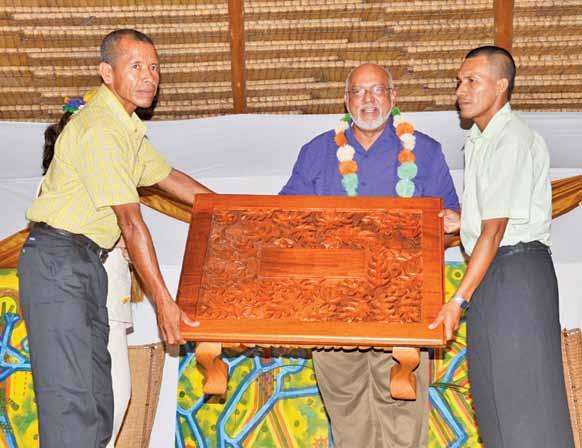
“You will agree with me that much more work is required by all the villages and the people.”

Preserving the cultural heritage of Amerindians is enshrined in the laws of Guyana, Minister Sukhai said as she alluded to the Amerindian Act of 2006.
No complacency
Sukhai said the indigenous community must not become complacent, but should push to make a contribution to national development.
In painting a vivid picture, she said Amerindians must reflect on the life of Guyana’s first Amerindian parliamentarian, the late Stephen Campbell and former education minister, the late Desrey Fox, who made sterling contributions to the development of Amerindians and to the country by extension.
The minister also urged Amerindians to guard against persons who seek to cause havoc and division within the indigenous community.
“It has become necessary to combat the elements among the Amerindian population who seek to divide, whose agenda is that of survival for a future and whose activities are based on misinforming on the var-
ious concerns affecting Amerindians.”
Improvement in education
Meanwhile,
President Ramotar said the quality of education offered to Amerindian communities has significantly improved since the People’s Progressive Party/ Civic (PPP/ C) was voted into power in 1992.
Today, he said, Guyana boasts of achieving universal primary education, in keeping with the Millennium Development Goals. “Now we can report proudly that in our country as a whole, in our Amerindian communities, in our hinterland communities, we have achieved universal primary education and the facilities there have improved greatly.”
He said Guyana will soon achieve universal secondary education.
According to President Ramotar, a quiet revolution has taken place in Amerindian communities, as they are now demanding more from the education system as they come to grips with the importance of education in the transformation of their lives and communities by extension
St Vincent and the Grenadines government said it was “alarmed” at the recent allegations of the use of chemical weapons in Syria and remained “deeply concerned” with the spiralling humanitarian crisis in the Middle East.
On Saturday last, Guyana and Venezuela urged restraint on
from page 21
any impending military strike on Syria. President Donald Ramotar told a joint news conference with his Venezuelan counterpart, Nicolas Maduro that the UN experts should be allowed to complete their scientific analysis.
“No action should be taken without the rati






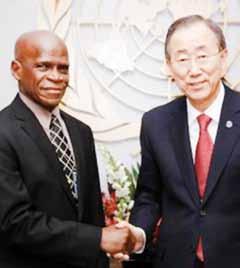
Ambassador Noel Sinclair, who recently completed his tour of duty as Caribbean Community (Caricom) permanent observer to the United Nations (UN), on Monday, has assumed the function of deputy chef de cabinet to the president of the 68th session of the United Nations General Assembly, Ambassador John Ashe of Antigua and Barbuda.
In this new role, Sinclair will be one of a small group of diplomatic and other personnel selected to work as close advisers to the president of the General Assembly.
This appointment comes at a high point in the long and distinguished foreign service career of Ambassador Sinclair; a career that spans different continents and includes diplomatic postings and high-level responsibilities in national, regional and internation-
al organisations. Sinclair is a former foreign affairs ministry director general and held diplomatic postings at the Guyana embassies in Washington and Caracas, and at the Guyana High Commission in New York, where he served as permanent representative of Guyana to the UN Mission.
It is as part of this latter responsibility that he discharged duties as president of the UN Security Council. He also acted as president of the United Nations Council for Namibia, promoting expanded recognition of the council by the international community as the legal administering body for the territory of Namibia, then under illegal occupation by South Africa. Immediately before becoming Caricom’s permanent observer to the UN, he was special representative of the UN secretary general in Bougainville, Papua New Guinea, where he presided over the peace talks and the weapons disposal process among the former antagonists in their 10-year civil war.
Ambassador Sinclair also served as deputy permanent secretary of SELA (the Latin American Economic System) at its headquarters in Caracas. Sinclair’s appointment as deputy chef de cabinet to the president of the UN General Assembly provides him an opportunity to advise on decision-making for the effective management of the work of the assembly as it confronts its 167-item agenda.
This includes a number of items of special interest to Caricom states, including the third international conference on Small Island Developing States (SIDS) to be held in Samoa in 2014.





Guyana Help the Kids (GHTK), a registered Canadian charity, led by Guyanese-born doctor Narendra Singh, continues with its work in Toronto to improve neonatal care in Guyana. The charity continues to spearhead training of Guyanese pediatricians and nurses, having already invested in upgraded neonatal facilities and equipment in Guyana’s hospitals.
A release from the charity noted that Dr Singh, Chief of Pediatrics at Humber River Regional Hospital, on a visit to the country of his birth four years ago, was dismayed to see the facilities and equipment that the neonatal unit of the local hospital had to deal with. Due to lack of incubators, some babies were being cared for in wooden boxes and there were no specialized staff.
“They were good people, very well intentioned, but without

proper training or equipment,” Dr Singh said, adding that “They were doing the very best they could, given the circumstances.”
This led him to start a residency programme for physicians in Guyana to receive pediatric training.
“By bringing spe-
cialists from University of Toronto, McMaster University and other universities in North America together with their Guyanese counterparts and the Guyanese government, Dr Singh was able to develop a sustainable training program that will increase the number of specialists
in the country,” the release explained. Doctors give their time to travel to Guyana to teach.
Once training was underway, Dr Singh sought to address the need for the correct technology and equipment. GHTK was formed to help raise funds for the procurement of up-to-date incu-
bators, ventilators, monitors and other equipment.
Updated technology
As a result of GHTK’s efforts, the hospital in the nation’s capital Georgetown opened a new 24-bed Neonatal Intensive Care Unit (NICU) in 2012 and within its first year, infant mortality in the hospital reduced by 50 per cent.
Another NICU opened in New Amsterdam in May 2013.
Infants are now cared for using the same equipment as would be found in any NICU in Canada.
“It’s a good relationship,” Dr Singh noted. “The hospitals provide the rooms, the oxygen and the AC. We provide the equipment, and we train the doctors and nurses,” he related.
GHTK’s program has now expanded to include neonatal nurse training in conjunction with the Nationwide Children’s Hospital in Columbus, Ohio. The first eleven nurses graduated from
the programme in June and 20 more are expected to graduate next year. Also, this September will see the number of pediatricians in the country double from two to four, with eight more in training.
GHTK has plans for more NICU’s around the country and also plans to start training technicians in the care of the specialized equipment. Technical experts from Humber River Regional hospital, Nationwide Children’s Hospital and the Hospital for Sick Kids have volunteered to assist with this critical aspect of the program.
As part of its ongoing fundraising efforts, GHTK is holding its annual dinner and dance on October 5, 2013 at the Woodbine Banquet Hall. The event will have a Vegas theme with gaming tables and will feature live music from the Triple Play Band, a release from the charity indicated.

The 2013 National Awards in Trinidad and Tobago took on a homely air, unlike the usual stolid aura of pomp and ceremony of past years, as recipients blew kisses at the audience, jogged with the prime minister and generally turned protocol upside down.
Dignitaries were embraced and put to pose with recipients for group photographs, as the awards ceremony had its first outing to San Fernando on Saturday evening.
Held at the Sundarlal Popo Theatre, Southern Academy for the Performing Arts, (SAPA), San Fernando, the event
had a few emotional moments when several posthumous awards were received by sombre relatives from an almost equally emotional President Anthony Carmona.
In presenting slain police officer, Hayden Dale Manwaring’s widow, Kim Manwaring, with his award, President Carmona took both of her hands in his and spoke to her for several moments before presenting her with the Hummingbird Medal Bronze for gallantry. Prime Minister Kamla Persad-Bissessar also embraced her.
After the ceremony, Mrs Manwaring, who wore an elegant black
dress, declined to reveal to reporters the contents of both the president’s and prime minister’s conversations with her.
However, she remembered her husband as a “great man” and admitted that receiving the award had been an emotional moment for her.
Another poignant moment occurred when Barbara Kangaloo, mother of deceased Justice of Appeal, Wendell Neil Kangaloo, received the Chaconia Medal Gold on his behalf.
Speaking later with reporters, Barbara Kangaloo admitted to feeling both sadness and pride on accepting the award for her deceased
son. “I received the award on his behalf, posthumously. With a bit of sadness and a bit of pride because I feel very good seeing that the powers that be decided to give him this award for all his service to the country in the short years that we had him, so I am grateful,” she said.
Meanwhile, Ansonia Torres, who received the Hummingbird Medal Gold for her grandfather, historian and journalist Louis B Homer, who died earlier in the week, also admitted that she was on the verge of tears while accepting the award.
Another outstanding personality was Hubert Peter “Flagman” Diaz, a retired police officer, who smartly outfitted in the national colours, quick marched to President Carmona to claim his award, the Hummingbird Medal Bronze.
Another notable awardee was former Presentation College principal, Brother Michael Samuel, who taught President Carmona and who at first bowed to his former principal before embracing him and then pinning the Public Service Medal of Merit, Gold, on his lapel.
Meanwhile, former politician, John Humphrey, who received the Chaconia Medal Gold, said he was “very happy”, noting that he had not been bothered at not having received an award previously.
Two men who never dreamed of ever receiving an award, the Bansraj cousins, said they too were surprised at having been selected. Shiv Bansraj, who together with Ganesh, had dived into a river to rescue a motorist. Shiv said he had not even received an award while in school. (Excerpt from TT Newsday)

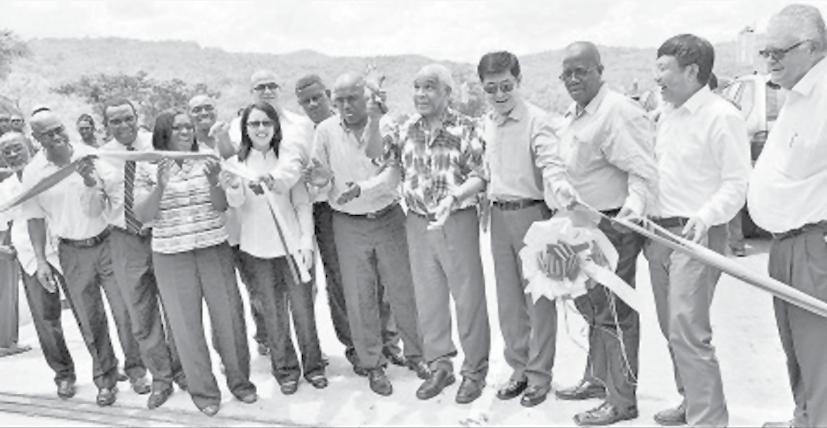
The Westmoreland bridge in Jamaica located at Chovey, near Georgia, and which links the communities of Highgate, Bromley and Lewis Store to Annotto Bay and Kingston, was finally opened last Tuesday.
It was built by China Harbour Construction under the JDIP project at a cost of US$18M, and stands the longest bridge in St Mary, spanning 180 metres over the Wag Water River.
The structure was destroyed seven years ago by Hurricane Gustav and has been a major inconvenience to schoolchildren, the sick and elderly, taxi operators, small farmers ever since.
People have had to, on occasion, wade waist-
deep in water in order to get to the other side of their own community, or travel great distances via Bellfield or Esher to get across.
“The children will get home quicker (now) and get to school earlier and persons get to work earlier,” one resident said. “It will cut back on cost for parents to send children to school. We hope that the fare will be reduced as commuters were feeling the pinch of it because the roads on the other side were not good. Now that they have the shorter route they should charge less.
The bridge is remarkable.”
Another said: “This is a beautiful bridge and project and we are glad for it when we are go-
ing to Highgate we don’t have to use the other route [because] this is much shorter.”
Levan Freeman, Mayor of Port Maria and Councillor for the Bellfield Division where the bridge is located said, “It has been a long wait and we appreciate what we see. We have gone through many trials and tribulations and in the long run the durability of this bridge will be worth what we have waited for. Many persons have suffered discomfort in terms of travelling, in going around the long way to get to the top of the hill at Clonmel or Lewis Store and to God be the glory, today we can celebrate the opening of this bridge.”
(Jamaica Observer)
Minister of the People Dr Glenn Ramadharsingh has launched an investigation into allegations of a Trinidad and Tobago food card racket at his ministry. Ramadharsingh ordered the investigation after Prime Minister Kamla Persad-Bissessar expressed concern about claims by Independent Liberal Party (ILP) interim leader Jack Warner that some cards were being used to purchase food items for weddings and river limes.
There are 40,000 permanent and 2,000 temporary card holders in the programme. The ministry gives out TT$410, TT$550 and TT$700 cards to families in distress and MPs can also access 50 temporary cards a month. “If in fact those things had occurred I would like to see the information for it.

The only time that came to my attention is when I saw the allegations being made. No one seems to have any information on that...not even correspondence to that effect,” Ramadharsingh told TT media on Sunday. Since the allegations, Ramadharsingh said the department has been even more cautious.
One of Guyana’s oldest colonial buildings, which housed the Da Silvas House of Optics at 316 Middle Street, Georgetown, was severely damaged by fire on Sunday afternoon, leaving the owners counting their losses estimated to be in the millions.
The fire reportedly started about 13:00h in the upper flat of the twostorey wooden structure and quickly spread to the other parts of the building. It was reported that the cause of the fire might have been an air conditioning unit that exploded in one of the rooms occupied by the owner’s wife.
She was reportedly in one of the rooms while her one-year-old daughter and her sisterin-law were asleep in two other rooms. After the explosion, she raised an alarm and managed to get the two other per -
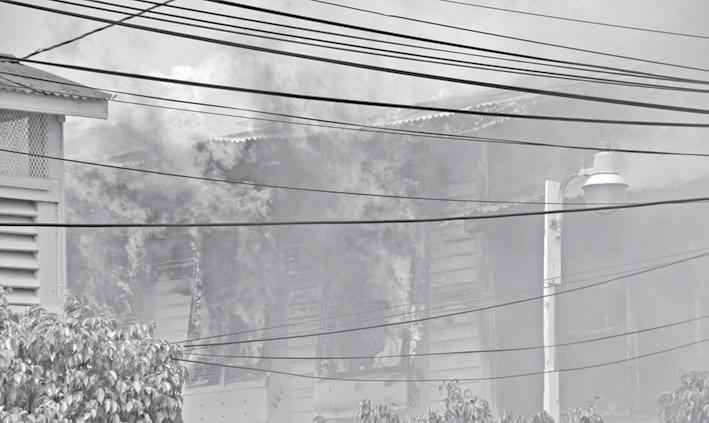
sons to safety. The family did not get to salvage anything from the upper flat of the building but were able to save a few items from the lower flat after the fire was extinguished.
Sections of the nextdoor Georgetown Public Hospital were also threatened by the blaze, but the well-coordinated firefighters prevented the fire from spreading. Tearful members of the Da Silva’s family stood in anguish as they witnessed the business being engulfed in flames.
Former Georgetown
Mayor and City Council engineer Lloyd Alleyne, a close friend of the Da Silvas, explained that he received the call from a family member and rushed to the scene where he saw the entire upper flat of the building on fire. He explained that the building is made of pine wood which does not take too long to burn. He said that within five minutes of his arrival at the scene, the fire tenders arrived and quickly kicked their fire operation techniques into gear.
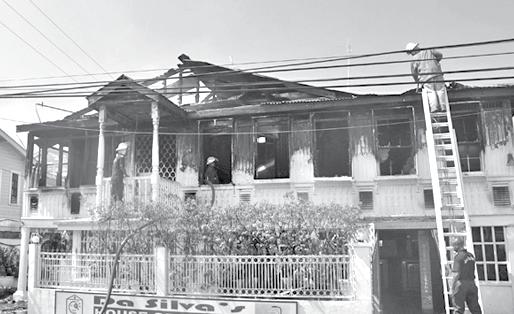
“Everyone knows they have to be very careful in the way they dispense public funds,” he said. He promised to take action if any of his 174 food card officers and regional coordinators demonstrate errant behaviour.
In the last 30 months, four employees of the TT food card department have been fired for different reasons. One employee was sacked shortly after Ramadharsingh was appointed minister, while three others were sent home last year. Approximately 2,000 families who depended on the food cards voluntarily returned their cards after improving their standard of living by finding sustainable jobs, Ramadharsingh said. He said 40,000 food card holders is “a reasonable figure” in a population of 1.3 million. (Excerpt from TT Guardian)
Anglican Church in the Caribbean says no to same-sex marriage
The head of the Anglican Church in St Kitts and Nevis, Archdeacon Valentine Hodge, has made it clear that the church does not support gay marriage, or condone a homosexual lifestyle.
"I can only speak... on the behalf of the Anglican Church, which is the church in the province of the West Indies… at the moment we cannot marry in church two people of the same sex...We believe in indissoluble monogamous marriage that is something which should last for life…indissoluble...and we also believe that it is something between a man and a woman," the archdeacon said, speaking on WINN FM's Breakfast Show last Thursday.
"We are not into same sex union in the prov-
ince in the Caribbean, although we find that the Episcopal and the Church of Canada have been very much into that, but we haven’t reached that stage as yet and I think that we [aren't] going to in the foreseeable future given our constitution of the province of the West Indies. We are really holding on to the biblical tradition and there are certain passages of scripture like Romans Chapter One... that very clearly [says] what’s enunciated in terms of marriage."
The archdeacon said that the issue of the rights of homosexuals and lesbians was one of the law and theology.
The archdeacon was commenting in the wake of a recent statement by the prime minister who, responding to
a caller to his radio programme, said that the introduction of same sex marriage legislation in St Kitts and Nevis was something that should be debated nationally.
At his monthly press conference last Wednesday, Prime Minister Dr Denzil Douglas reiterated his position.
"Let us be open minded about this matter, let this matter be discussed among our people, among the stakeholders. The government is not saying what its own views are at this time because the time has not yet come, but we are saying we support the fact that there should be open frank and honest discussions, because homosexuality is taking place,” he indicated. (Caribbean News)
Jamaica’s Health Minister Fenton Ferguson says that discussions are advanced with a leading Canadian hospital for the acquisition of equipment to improve cancer treatment in the island’s public health sector.
He said that, during a recent visit to Canada, he was able to make "significant progress" with the Sunnybrook Health Sciences Centre for the supply of two Linear Accelerator machines, which are used for radiotherapy treatment.
“We are closer to achieving our objective of getting two Linear Accelerator machines. As it is now, we only have one in the private
sector, and we are moving to have two in the public sector," the minister said, while addressing last Friday's groundbreaking ceremony for expansion of the St Ann's Bay Regional Hospital in St Ann.
He stated that the acquisition of the machines "will take a tremendous burden off our cancer patients as the government was committed to reducing the cost of cancer treatment and care.
"Cancer care remains a burden for individuals and families, and part of my mandate is to work to get cancer care down to a certain manageable level. There is a particular drug that is going at over Ja$200,000 per dose, and

for persons with breast cancer, you need 18 doses. We must find a way to
get those prices down," he stated.
The minister said
that, even as he works on improving care, he also has to encourage Jamaicans to adopt healthier lifestyle choices to reduce cancers and other non-communicable diseases (NCDs).
"This is why I have been so steadfast in my arguments against smoking in specified public places. We are facing a debilitating problem where NCDs are concerned. High blood pressure, diabetes, cancer, respiratory diseases; these NCDs are responsible for over 70 per cent of deaths in Jamaica," he stated.
"Tobacco exposure is the most serious factor for the NCDs. The ban on smoking in specified
An estimated 700 applicants for the Trinidad and Tobago Police Service are expected to undergo polygraph tests before recruitment into the service.
This was revealed last Friday by TT’s acting Commissioner of Police Stephen Williams following a graduation ceremony for the children who attended the Laventille Road Police Youth Club Vacation Camp.
In responding to questions on the use of polygraph tests to help weed out rogue elements in the Police Service, Williams
said, “Well actually, right now I am arranging for 700 persons, applicants, to be polygraphed. But that isn’t a guarantee that we will get rid of the rogue elements. I don’t know if after they are recruited, they will turn out to be rogue elements. I have no guarantee. And while polygraph testing is a useful step to this end, it doesn’t give a guarantee.”
Williams also said that while he was unaware of comments made by Attorney General Anand Ramlogan which suggested that the TT government was looking
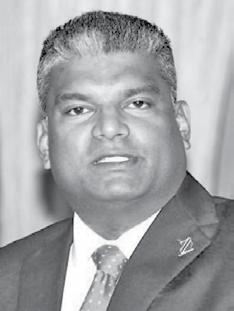
tt’s attorney general anand ramlogan (TT Newsday file photo)
at random drug and lie detector tests for all police officers, he revealed that such practices were already taking place.
Random mandatory testing Ramlogan, speaking to reporters after a government delegation met with members of the main opposition People’s National Movement (PNM) last week to discuss ways of dealing with the crime situation in TT, said that he had raised “very forcefully the matter of mandatory drug testing for all police officers and mandatory polygraph testing for all police officers not only upon entry into the Police Service”.
He said the tests would also be “intermittently and periodically”
public places will essentially lead to improvement in the quality of air we breathe, and over time, reduce the prevalence of NCDs, including respiratory illnesses and heart disease," he pointed out.
The minister said that countries that have adopted anti-smoking legislation have started to see progress. He cited the case of Northern Ireland, which introduced legislation in 2004 and within two to three years, "they started to see less heart attacks, less strokes, and in general significant reduction in NCDs. So this is not just an anti-tobacco crusade; it is a pro-health crusade". (JIS)
- while AG suggests new measure to weed out ‘rogue cops’
and would in particular, include those police officers “serving in sensitive units in the Police Service.
“I feel very strongly about this matter, I think it is important that we understand that despite our best efforts, the operational aspects of the Police Service will be compromised. If you have one bad apple it will spoil the whole bunch,” he said.
The attorney general said that the random tests to ensure that police officers were not “leaking” information to criminals were “long
overdue”.
“To this end I think random drug testing and polygraph testing, lie detector testing for police officers to ensure they are not leaking information or not in league with the criminals and undermining the efforts of the Police Service is an idea that is long overdue in Trinidad and Tobago,” Ramlogan said.
Meanwhile, the country’s Police Social and Welfare Association (PSWA) has said that it welcomed the announcement by Ramlogan. (Excerpt from TT Newsday)
St Kitts and Nevis’
Prime Minister Dr Denzil Douglas has welcomed the start of two projects on St Kitts South East Peninsula, which involve foreign direct investment of over US$50 million.
The projects by Russian investors will see the construction of 50 two-bedroom villas as part of the US$37 million Ocean Grove Development and the Windswept Residence Club of nine villas at a cost of US$13 million.
Ocean Grove Villas is
Ba joint venture between the Christophe Harbour Development Company and the Canada-based Apex Capital Partners Corporation.
“We look forward to the start-up of construction of your villas, which will be located so strategically next to the area of the Pavilion Beach Club. This project is also significant because it is the first major investment to be put together in St Kitts by a Russian group,” said Douglas at the symbolic ground breaking ceremony.
Douglas noted that St Kitts and Nevis is an international country and it is not by any accident that this investment comes at a time when his
government is in the process of removing the requirement for an entry visa for Russian visitors.
“We see Russia as a new and desirable market for both investors and visitors for our country, and you can be assured that my government will continue to take the necessary steps to improve the flow of trade and investment between our two democratic countries,” said Douglas.
He noted the risk of private investment promises not turning into real projects for the benefit
of the people of St Kitts and Nevis, but noted that the ceremony was taking place within sight of an actual villa under as part of the Windswept Residence Club project.
“I could not ask for better evidence that the project has actually commenced. I understand that the design and construction of these luxury villas will be of world-class quality,” said Douglas.
He added that his government has a very solid reputation for encouraging private investment
that is of good quality and compatible with the country’s development objectives, including the empowerment of nationals and the sustainability of the environment and culture.
He said he was pleased to see progress being made at Christophe Harbour, a development vision that is shared by his St Kitts-Nevis Labour government and a project that continues to be an important component of the Federation’s economic transformation strategy. (CaribbeanNews)
layoff ‘crusade’, Barbados PM maintains - as temporary public workers being dismissed
arbados Prime Minister Freundel
Stuart has assured that his government has not embarked on a “crusade” to lay off persons in the public sector. He was scheduled to meet with officials from the ministry of civil service on Tuesday to ensure that the wrong persons are not ending up with dismissal letters.
Speaking to the media following a tour of the Limegrove Lifestyle Centre on Monday, he said, “What we are on a crusade to do, is to increase efficiency in the public sector, and I am aware that there have been some howls of protest from persons who got letters telling them their employment has come to
an end. I am not sure why this has happened.”
“Let’s be very frank–there are people in the public sector who are temporary employees. When I last checked the dictionary, temporary still meant ‘for the time being’. And if you are a temporary employee, clearly you have a letter that says you will be em-
ployed from one date to another, and when that date comes and your assignment has come to an end, it has come to an end,” the prime minister related.
“This happens whether we are in a situation such as we are in now in terms of trying to deal with debt or deficit issues, or whether we are
in a period of prosperity. What I do not want though is for this period of dealing with debt and deficit issues to be so mishandled that people who should not be at the receiving end of letters of this kind, end up with them,” he asserted.
“We are not in the business of creating turmoil in Barbadian house-
holds and keeping people in a state of emotional agitation. That is not the purpose at all. We have some challenges with which we are dealing; we have to deal with those challenges firmly. It is a question of firmness of grasp, clarity of course and certainty of port,” he further stated. (Barbados Advocate)



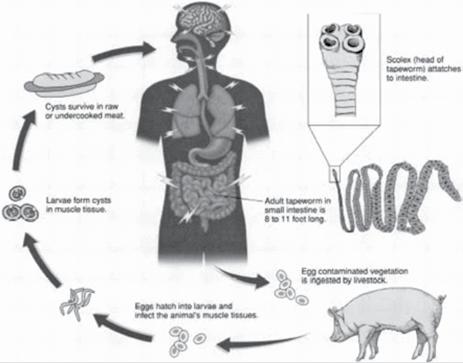
By Tisha BosTon
The thought of worms lying around inside of us, filling themselves greedily with everything that we consume is disturbing, but unfortunately it’s true. For example, let’s consider tapeworms also known as cestodes; these freeloaders are flat segmented worms that live in the intestines of animals. They use their head, called the scolex, to attach themselves to the intestinal wall. There are different types of tapeworms, but the two most common in humans are Taenia saginata, the beef tapeworm which is about 15 to 30 feet long, and Taenia solium, the pork tapeworm that is approximately 8 to 11 feet long. Their eggs can survive for months or years in the environment and adult pork tapeworms can live up to 25 years inside us while adult beef tapeworms can live for more than 30 years.
Humans become infected with tapeworms when eating undercooked meat from infected animals or when eating foods prepared by an infected person. The symptoms of a tapeworm infection, also known as taeniasis, are mild to nonexistent. However, infected individuals often experience digestive problems which include abdominal pain, loss of appetite, weight loss, and upset stomach. These symptoms are also common for other parasites living within us. And last, but not least, the most visible symptom would be the passing of tapeworm segments (proglottids) in the feces.
Taeniasis is more prevalent in underdeveloped communities with poor sanitation and where people eat undercooked meat. This means that higher rates of illness can be found in South and Central America, Sub-Saharan Africa, Eastern Europe and Asia. Although tapeworm infection is rare in the U.S, Taenia solium taeniasis (tapeworm infection from pork) is seen typically among Latin American immigrants. Strict laws on feeding practices and constant inspections of hospitals, restaurants and animals we use for food lower the risk of exposure to such parasites, but here are some things that you can do to prevent or control tapeworm infection and other human parasites:
• Cook fish and meat thoroughly and do not sample them until they are cooked, instead; use a food thermometer to measure the internal temperature. For whole cut meat, cook to at least 145° F (63° C) then allow it to rest for about 3 minutes before carving into it; for gound meat, cook to at least 160° F (71° C)
• Periodic deworming as recommended by a doctor. This also includes your pets
• Avoid walking barefoot
• Keep nails clean and wash hands regularly using soap and relatively hot water
• When traveling to underdeveloped countries, cook fruits and vegetables with boiled or chemically treated water.
Please keep in mind that the purpose of this article was not to scare or provoke uneasiness, but to provide awareness of the kind of freeloaders within us and the harmful consequences of poor hygiene and improper meal preparation as well as the risks associated with unsanitary living conditions. In knowing this, responsible actions can therefore be taken by individuals and society to prevent tapeworm infestation.
By AvenAsh RAmzAn
Sport Minister Dr Frank Anthony believes Gumendra
Shewdas’ triumph at the World Junior and Sub-Junior Powerlifting Championships in Killeen, Texas, is a clear indication that local athletes are on par with their counterparts from other parts of the globe.
He made the remark on Monday in the presence of Shewdas and his family and members of the Guyana Amateur Powerlifting Federation (GAPF) when the Sport Ministry hosted a luncheon at the New Thriving restaurant to recognise the monumental achievement of the Berbice lifter at last week’s championships.
The 18-year-old Shewdas, who has earned the alias ‘Golden Boy’, returned home with a gold medal in the 53kg Class, in the process, becoming Guyana’s youngest world champion in any sport discipline.
Developmental programmes
Anthony said of his achievement: “We have seen that our athletes
are on par with anything they have out there and that we can excel… and we must not let this kind of victory go to our heads; we have to continue practicing, we have to think about our developmental programmes and our training programmes so that we can churn out more champions.”
Shewdas, of Line Path, Skeldon, recorded 475.5kgs en route to winning the gold medal. His closest rival was U. S. A.’s Dalton La Coe, who finished a distant second with a total of 425kg in the bench press, squat and deadlift.
The minister noted that Shewdas’ accomplishment has raised the bar, as all Guyanese would now have high expectations of all lifters who depart these shores for international and regional competitions.
Shewdas’ success, the minister noted, is enough evidence to prove Guyana’s status as a Caribbean powerhouse in powerlifting.
Anthony added that other countries will be keeping an eye on Guyana’s lifters, thus it
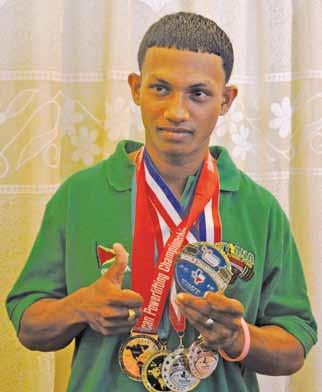
is imperative the GAPF work to ensure local athletes maintain a high standard.
With this in mind, the minister assured the GAPF of its full support, adding that included in this year’s budget is funding for the procurement of additional standardised equipment for powerlifting.

support of the ministry.
He said Anthony and Permanent Secretary in the Sport Ministry, Alfred King, came to the aid of the GAPF when a budget in excess of Gy$ 900,000 to send Shewdas and manager/ coach Denroy Livan to the championships seemed beyond the local body.
Shewdas’ best squat of 180kg and bench press of 90kg were below La Coe’s 182.5kg (squat), 105kg (bench press) heading into the deadlifts, but a huge lift of 205kg on his second attempt thrust the Guyanese into the lead.
The GAPF is slated to host a number of international competitions in 2015 and the equipment will be a massive boost.
Recognising Shewdas’ gigantic effort, president of the GAPF Peter Green said the title could not have been achieved without the
“This is a proud moment for me and all members of the federation. From humble beginnings in 2008 we have produced champions like ‘Big’ John Edwards, Winston Stoby, Randolph Morgan and now young Gumendra Shewdas. We saw the potential in Gumendra three years ago and we always know he would be a winner some day, but what we didn’t know is that he would be a big winner,” Green related.
Reflecting on his performance, Shewdas, who is also runner-up Junior Sportsman-of- the- Year 2012, said he had spent a lot of time training at the Total Fitness gym in Corentyne, under the guidance of Egbert Jackson, and was confident of taking the top podium spot.
With Shewdas holding the psychological advantage, La Coe could only muster a lift of 137.5kg and failed twice at 192.5kg. Russia’s Alexei Kulakov was third with a total of 412.5kg.
Despite trailing going into the deadlifts, Shewdas said he was convinced he would emerge with the gold medal, as he had strong self-belief.
Shewdas’ father Bhognarine Shewdas expressed his elation at his son’s performance, noting that it means a lot to his family. He noted that Gumendra has been in intense training all year, and his display in Texas is just reward for the hard work he had put in.
The ‘Golden Boy’ and officials of the GAPF also met with President Donald Ramotar at the Office of the President on Monday morning.

As is customary every year during Amerindian Heritage Month celebrations, a heritage village is identified where many will converge to celebrate their cultural heritage. This year we celebrate scenic Karasabai.
Karasabai is an Amerindian village located in South Pakaraimas, Region Nine. The community is accessible by land and air. It has a population of approximately 1,600 whose main source of income derives from agriculture. Meat (beef and mutton), peanuts and
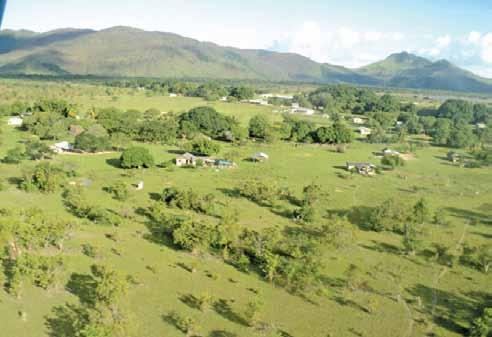
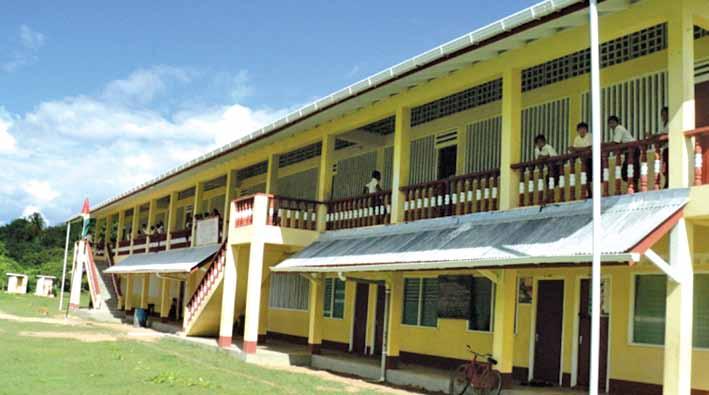
nursery and primary school, health centre, two health posts, an RDC admin building, police station, teacher’s quarters, guest house, village office, shop and churches.
Karasabai is made up of Makushi tribe members. Over the years the village has benefited from many hinterland projects. Some of these development proj-
The village is already buzzing with activities as it prepares for the influx of visitors who will be enjoying a series of activities such as cultural presentations (dancing and singing), horse riding, donkey riding, cassava bread baking,
cassava by-products such as farine and cassareep are its primary products.
The village has a
ects include presidential grants, which were instrumental in the formation of a village shop, and capital projects with contributions of 4x4 pickups, tractors, boat and engines, a village market building, among others.
parching, fire lighting, tomma cooking, cotton spinning and football, just to name a few.



Fashion designer Natasha David encapsulates the rich and vibrant culture of the indigenous people of Guyana in her newest collection. Natasha was born in Georgetown but grew up in a small village on the Venezuelan border called Imbotero where she received her primary school education. Her family later moved to Matthews Ridge where she was exposed to fashion shows, persons making beautiful toys, decorations and other items out of organic materials such as straw, banana leaves, bamboo and many others. Observing how creatively these materials were used, Natasha decided to follow that path. She is known as one of

Guyana’s top organic designers.
“I have been designing clothes and making creative dolls for the past five years, being guided by my mentor Sonia Noel. One day she told me to do something along my native line. I knew it would come easy because I always was designing costumes for Ministry of Amerindian Affairs. I even assisted in building two floats for the ministry’s department for Mashramani with fellow designer Trevor. After that I spent endless days and sleepless nights creating costumes for adults and children. I then boldly went into the ministry and was accepted to participate in the heritage month celebrations. My ideas were accepted with great joy by


most of the senior staff because I had studied the current costumes designed by others and brought something different with elegance and style,” the designer told Guyana Times Sunday Magazine
Natasha’s collection of indigenous designs is suitable for a cultural look at any Amerindian Heritage celebration. They are comfortable, chic and easy-to-wear pieces.
The designer is currently preparing to participate in the upcoming Guyana Fashion Weekend 2013 where she will be launching another fantastic collection. For more information on Natasha’s collections, call 6810637.

designer natasha david wearing one of her designs

panoramic view from near the summit of mountain aranaputa
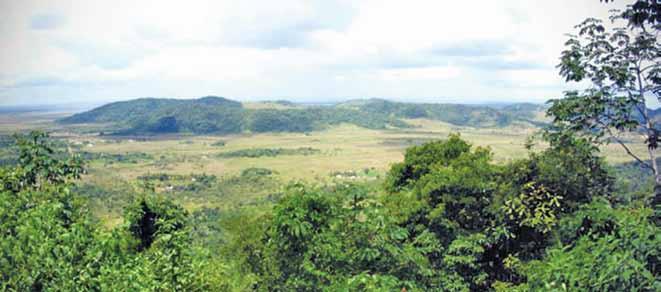
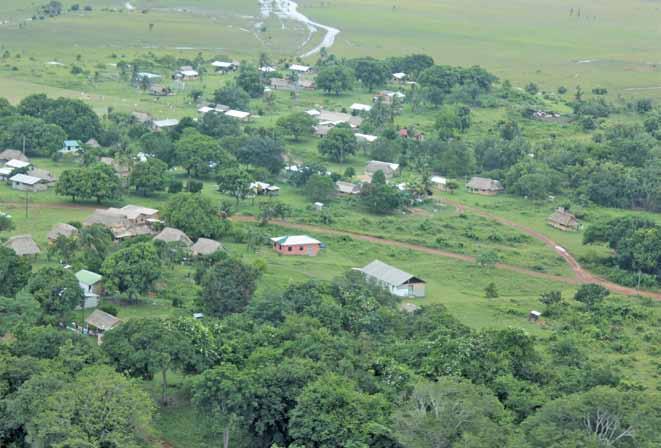

Aranaputa is located on the Georgetown-Lethem road, some 380km south of Georgetown, 70km north of Lethem and 5km west of Annai. The village of Aranaputa is unique in the Rupununi because it was started on state land which was identified for agricultural development.
The almost 600,000 residents in Aranaputa are mainly from the Makushi tribe.
Tourist attractions in Aranaputa include hiking up the Clarence Mountain Nature Trail (1,600ft), overnighting at the Clarence Nature Trail Guest Cabin; touring the Aranaputa Peanut Butter Factory; birding and nature tours for wildlife viewing and savannah horseback riding tours.
The Clarence Mountain nature trail and rest cabin site has been selected as a community conservation area. With a grant from the Canadian International Development Agency through Iwokrama, the community decided to invest in tourism in 2006.
The nature trail and cabin is a unique eco-tourism project perched 1,000ft above the community with one of the most fabulous panoramic views of the North Rupununi savannah. This eco-project is within the conservation area of the community, and has a rich biodiversity habitat; here visitors have a probability of viewing various species of flora and fauna.
Additionally, the Aranaputa Processors Peanut Butter Factory makes the best all natural peanut butter in Guyana. The factory buys the raw peanuts from the local farmers and roasting, shelling and processing are all done at the factory. Those at the factory are very enthusiastic to share with tourists the process and allow them to participate.
Fresh peanut butter on cassava bread is served daily to the school children in Aranaputa and across the North Rupununi as a snack. The peanut butter can be purchased directly from the factory Monday to Friday during their operating hours and in various stores in the North Rupununi.
Persons can also visit the various agriculture plots locals cultivate as part of their daily livelihood. They can also tour the experimental agro-forestry plot in Aranaputa. It is a 20acre savannah land that has been in existence for the past eight years, and is used for experimenting growing various species of trees.
Aranaputa’s residents certainly reflect this year Amerindian Heritage Month’s theme, “Honouring Our Culture, Advancing our future”, as they use their cultural heritage to develop their community.
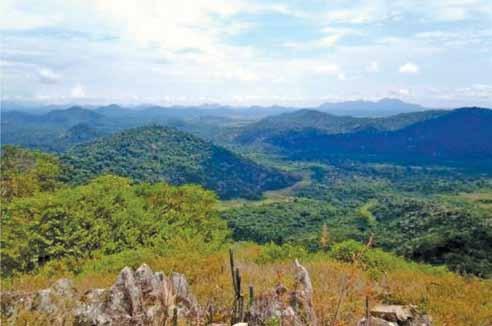

Defying odds to fulfil her dream of becoming a doctor, Iliana Edwards has become a role model for indigenous youths wishing to follow in her footsteps
Iliana Edwards, from Paruima village, Upper Mazaruni in Region Seven, attended Paruima Primary School before excelling in her examinations to earn a government scholarship to attend Central High School in Georgetown. In the capital city, Edwards lived with a guardian but although she received support she felt a sense of loss in her new environment.
“It was a challenged for me adapting to city life. I missed my family and friends; but I was determined to become a doctor and work hard to achieve that. I am thankful to my guardian Dr Stephens, a theologist, for her guidance,” a grateful 25-yearsold Edwards expressed in an interview with Guyana Times Sunday Magazine
After graduating with eight subjects at CSEC, Edwards worked for a year with
USAID/Guyana HIV/ AIDS Reduction and Prevention as a phlebotomist. Getting firsthand experience in the medical field would help her be more adept when studying medicine.
“I applied for a government scholarship to study general medicine in Cuba. I had always wanted to become a doctor since I was a child, and I was happy when I was accepted to study in Cuba. I studied there for seven years. I was 18 when I left [Guyana]. In Cuba it was challenging, especially being placed to work shifts. Long days and nights I had to endure, but I did. The doctors were tough with us but it paid off because it has helped me to work harder,” she recalled.
The doctor revealed that when she received her doctorate she was elated, and overwhelming emotions surged through her. The sacrifices she made were well
worth it because she was able to accomplish what she had set out to do.
“What has encouraged me to be determined is looking at other Amerindian women who have achieved a lot despite challenges. When I collected my doctorate I felt a sense of relief that all my work for the past seven years paid off. I would like to thank the government of Guyana for giving me this opportunity, the government of Cuba for allowing me to pursue my dream, and my friends, family and my cousin Aneesa, who has always supported me. Now I can’t wait to serve my Guyanese people,” she declared.
Currently, Edwards said she is waiting to be placed at a hospital, which she hopes will happen soon. Specifically, she mentioned, she would like to work as a gynaecologist.
Looking back at her journey, Edwards re-
called she received comments from persons who doubted her abilities because of her ethnic background. However, she used those criticisms as motivation to achieve her goals which she did expertly.
Although Edwards has been exposed to different cultures, her indigenous heritage was never forsaken. She admires the unity in her village and enjoys being part of its activities. Edwards speaks the Arekuna language although she is not fluent in it. Her mother, an Arekuna, and her father, an Akawaio, have always been her main supporters. She noted that they have repeatedly encouraged her to upkeep traditions, something she credits as her guide in becoming a doctor.
“I would encourage youths who want to pursue the same goals I did, to study and ignore comments. Also don’t get dis-

tracted. I saw how some students got easily distracted, but keeping focused is vital. What also helped me to be focused is my Christian background. My prayers
and those from friends and family helped me also. I urge all indigenous youths to challenge themselves and pursue their dreams,” she encouraged.


Inspired by her indigenous heritage, Anna Correia-Bevaun has become one of Guyana’s most celebrated artists. She began her career in art in 1988 as a ceramist under the tutelage of her mother, the late renowned Guyanese artist Stephanie Correia. For years Anna explored ceramics as her principle medium. Wishing to explore new techniques, materials and approaches, she took short courses in design, batik and discharge, Vedic art and watercolour.
In 2007, CorreiaBevaun won both the second and third prizes in the National Watercolour Competition (Guyana). In 2009, she also won the first and second prizes in the National Watercolour Competition.
In an interview with Guyana Times Sunday Magazine, CorreiaBevaun disclosed that as a child she never had an inclination to become an artist, but being surrounded by art, because of her mother, she developed an enthusiasm for it.
“My mother, who was from Pomeroon, introduced me to art, and eventually I developed a love for it. She was an extraordinary potter. She did thorough research on different types of clay in Guyana and due to this she was able to work effectively with them, and this she taught me. I never did art in school; instead I did Food and Nutrition. However, learning from my mother
encouraged me to delve into art,” she recalled.
Correia-Bevaun joined the Guyana Women Artists’ Association in 1995. She has held the positions of secretary, vice-president, and president of the association. Being with this group helped Correia-
Bevaun to explore new art media. In 2003, she decided to learn pen and ink drawing. Later, she explored watercolour after being inspired by her mother’s work with the medium.
“When my mother passed she left some watercolour tools. I decided to try my hand at this and joined a 12-week art course held at Castellani House. For me art is very therapeutic and relaxing and that is why I try to learn as much as I can

about it just as my mother did,” she declared.


Due to the artist’s diverse ethnic background, her paintings are not subject to one recurring image. She paints images of Amerindian hunters and certain traditions of the group. Women of various ethnicities are also part of her collections.
Speaking on what inspires her, CorreiaBevaun explained, “I’m inspired by my environment. I paint what I see. Also, I have learnt a lot from my mother, who was an avid reader. I have also gathered a lot from fellow artists. Persons interested in art
work tend to ask what it is about or what inspired the painting, and listening to the explanations from my colleagues I was able to broaden my knowledge on art. I am fortunate to have worked with many veteran artists and was able to apply what I learnt from them into my work.”
Correia-Bevaun comes from a line of creative and passionate ancestors who were very dedicated to their work. One such individual, who is being celebrated for Amerindian Heritage Month, is her grandfather Stephen Campbell, Guyana’s first indigenous MP.
Among the indigenous people, Campbell is revered as a hero. He is credited with advocacy for land rights for Amerindians; a goal that the present government continues to advance, to ensure that Campbell’s aspiration for his people is made possible. Campbell served as member of the legislature from 1957 until his death on May 12, 1966 – two weeks before Guyana gained Independence from Britain. He died, and was buried, in Canada.
“When he died I was 3. I vaguely remember him but what I have heard about him is from my mother who was his second daughter. He would call her ‘little scout’ because everywhere he went she was with him. He was very instrumental in her life and taught her to be the great person she was, and in turn she passed down her heritage to me and my siblings. I have learnt from them to make the most of God's gifts, always striving to improve and work to the best of my ability,” Correia-Bevaun affirmed.

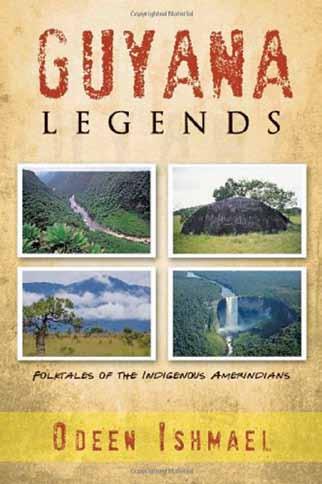
“Guyana Legends: Folk Tales of the Indigenous Amerindians” is a collection of 50 folktales of the first people to inhab-
it Guyana and the contiguous regions of the north coast of the South American continent. It is compiled and written by author Dr Odeen Ishmael, a vet-
Many years ago, there was a little forest village on the bank of a wide river in southern Guyana. All of the inhabitants were very happy as they always reaped good crops from their gardens, and wild animals they hunted for meat were abundant in the forests on both sides of the river.
In this forest village lived twelve teenage girls who always gathered in the evenings under a tall Mora tree on the riverside to sing songs their mothers had taught them. After their singing, as the moon rose from beneath the horizon and the stars twinkled in the dark sky, the girls would stare in awe at these beautiful heavenly bodies.
They became particularly interested in these attractive objects since there was a general belief in those days of long ago that anyone who touched a beautiful object would acquire some of its beauty.
“The moon and the stars are so lovely,” said Neca, one of the girls in the group. “I wish we could touch them so we can acquire some of their beauty, but they are so far away.”
“We must find a way to touch them,” replied another girl in the group. “Maybe, we should climb to the top of the mountain, and from there we will be able to touch them.”
So every evening after their singing session, they stared at the moon and the stars and contemplated various ways they could attempt to touch them.
Of all the girls, Neca was more interested in touching the Moon, and in the evening she spent long hours just staring at it as it moved slowly across the night sky.
“I know what I will do,” she declared to her friends one evening. “I will climb to the top of this tall Mora tree and try to touch the moon.”
“Well, you may climb to the top of the tree, but I think we can touch the moon and the stars if we go to the top of the mountain,” one of her friends explained. This view seemed to be more popular, and all except Neca decided that they would do exactly that.
One night when the full moon was rising in the sky, Neca climbed to the top of the Mora tree and stretched out her hands towards the shining orb. But, clearly, the moon was too far away for her to accomplish this feat. In great disappointment, she descended and tearfully went home to sleep.
Meanwhile, that same night her friends walked through the forest to the high mountain some distance away from the village. After reaching the peak, they stretched out their hands towards the moon and the stars, but they, too, failed to attain their objective. With long, sad faces, they wearily walked back home realising that they could never acquire the beauty of those distant objects.
But Neca never gave up. The following night, when her friends had all gone to sleep, she walked along the river bank once again and stared at the big golden moon as it rose above the trees. Then she looked into the calm water of the river and there she observed the moon’s glowing reflection.
“Now, this is how I can touch the moon,” she reasoned. And with that, she plunged into the river and reached out to the reflection. But she soon disappeared beneath the deep still water and was never seen again.
But the moon goddess did see Neca as she made that fateful plunge.
“I truly pity her,” she sighed. “Neca always wanted to become more beautiful than ever, so I’ll ensure that people will admire that beauty for all times.”
So, the moon goddess, from the depths of the river, brought up Neca’s body which she transformed into a large majestic pink water lily in the water near the river bank. From that day, people everywhere became fascinated with this most gorgeous flower growing beside its large circular lily pad. Today, that stately and attractive water lily is widely known as the Victoria Regia.
eran Guyanese diplomat, who is currently Guyana’s ambassador to the State of Kuwait.
Speaking with Guyana Times Sunday Magazine, Dr Ishmael stated that his book was published in 2011 in the United States and is currently available at major bookstores in the U.S. and the U.K., as well as online bookstores.
He stated that very little is known of Amerindian history in Guyana before the arrival of European settlers in the early 17th century and, actually, no written form of their languages existed until about 70 years ago. Indeed, much of the history of the Amerindian people is based on oral traditions which are not quite
clear because the periods when important events occurred are difficult to place. Still, native oral traditions are very rich in folk stories of the ancestral heroes and heroines of these indigenous people.
These stories, which interweave in the realms of mystery, romance, humour, superstition, magic and fantasy, are part of the rich oral traditions of Amerindians. Above all, they tell of their closeness to their natural environment and this is reflected in the roles of the forest animals in many of the stories in this collection. Undoubtedly, these folktales, and the lessons they impart, add to the rich cultural blend of the people of Guyana and the wider Caribbean region.
This present collection of Amerindian legends was compiled over a lengthy period of many years, during which the author listened to, and collected versions of, these tales from elderly Amerindians in vari-
ous regions of Guyana, and more recently from Amerindian residents of the Delta Amacuro region of Venezuela, on the frontier with Guyana. Readers will find these legends of the original inhabitants of Guyana informative in the anthropological sense, in addition to being interesting and entertaining at the same time.
‘Guyana Legends: Folk Tales of the Indigenous Amerindians” contains 50 stories, but because of copyright and sales contract arrangements, he cannot post the book’s contents online. However, Dr. Ishmael generously shares one of his stories with Sunday Magazine readers.





This year, Amerindian Heritage Month is celebrated under the theme, “Honouring Our Culture, Advancing our future”. According to the Ministry of Amerindian Affairs in a submitted statement, the theme “demonstrates the fact that people simply cannot live without culture, neither can they exist without development. Both are inextricably linked as the precursors of human existence.
Honouring our culture means that we respect our norms and practices, appreciate our songs, language and literature, affirm our values, uphold our traditions, and take pride of our cultural identity.
When culture is understood to denote the transmission of values as contained in our language, literature, music, art, and practices, it provides meaning and purpose, and becomes an expression of our ideals and aspirations as a group of people, and as a nation. These aspirations and ideals become the core element in any public policy or in public planning. For instance,
the LCDS was conceptualised because of our love for the environment which our first peoples have protected and preserved. This overarching principle or ideal had become the fulcrum of the evolution of our strategy for development, and therefore cannot be ignored in projecting our future,” it also added.
The statement pointed out that “cultural identity, social justice, and ecological balance have their roots in our cultural values, and all these play important roles in development. To neglect their importance, is to neglect and dismiss the impact of culture in the agenda for development. When we uphold our cultural values concerning these precursors of development, then we are actually ensuring that development becomes sustainable.”
One can only truly experience Amerindian customs and traditions in an Amerindian village. That is why Karasabai was chosen. With its panoramic sceneries, mountain ranges and pulsating Makushi culture, Karasabai will be worth the visit.
Aiming to become one of Guyana’s first international indigenous bands, the Rupununi Rockers Band is rocking their way to stardom.
In an interview with Guyana Times Sunday Magazine, the band’s founder Erwin Thompson, who is also its keyboardist and singer, said that the Rupununi Rockers Band was founded on December 1, 2012. Initially, it was a one- man band.
Now it has several members, including Julio Nacimento, singer (Brazilian forro); Sandro Paulino, keyboardist (Brazilian forro); Shaunet Jonas, backup singer; Michelle Santos, singer (Brazilian forro); Henry Bernard, backup singer and Matthew James, singer.
The band is located in Lethem and enjoys performing traditional, soca, reggae and Brazilian songs. They have performed in the town of Bomfin which is located near the border of Brazil and Guyana.
“We are an eclectic group of artistes. We have never attended any music school or any special training. All members learn and practice by ear sound. This makes us unique because we have blended our culture and experiences over the years to entertain our fans,” he noted.
Thompson stated that the band members are from the Makushi and Wapishana tribes.
“Being an Amerindian band, I guess as it is for some other bands in Guyana, we do face
many challenges. Some are being able to purchase equipment. Our band only uses small keyboards. However, we are trying to raise funds to get modern equipment so that the band can perform better. We are also looking for assistance and sponsorship so that we can be exposed to different places and we can generate funds for the band to grow and be better,” he disclosed.
Thompson suggests that in promoting Amerindian musicians, a survey should be done to gather information on the number of musicians who are Amerindians and link them with music professional. These professionals can also share their experiences and encourage the bands.
“We celebrate our Amerindian heritage through our music. We
like to celebrate and show our culture and talent and enjoy this with all our Guyanese brothers and sisters. All band members work, but we make time during weekends to do practice sessions. We are very passionate about our music and we hope to one day become an international band,” Thompson declared.
Thompson and his band are currently preparing for the Amerindian Heritage Month celebrations, tweaking their keyboards and synchronizing their voices. His encouragement is for Guyanese to be more local minded and support local artistes just as they do for international ones. For more information on the band visit Rupununi Rockers Band on Facebook.

Triumphing stigma attached to indigenous people to become one of Guyana’s first indigenous radio communications expert in the army, Ashton Simon proudly credits his heritage for his many accomplishments.
Simon was born in Paramakatoi Village, Pakaraima Mountains in Region Eight. He was educated in Georgetown at Christ Church Secondary School, and pursued studies at the University of Guyana and the American University of Peace Studies (AUOPS). In 2010, he was conferred with an MBA in Strategic Project Management from AUOPS.
Currently, he is a serving member of the Multi-Stakeholder Steering Committee for the Low Carbon Development Strategy at the Office of the President; an international projects coordinator for the Rotarian Clubs of the Boundary, (United States, Canada and Guyana) and a serving civil society consultant member with the InterAmerican Development Bank (IDB). He is also employed as an indigenous relations specialist for the Ministry of
Natural Resources and the Environment at the Office of the President. Additionally, he is on the Project Advisory Committee as a member for the European Union on empowering
and economic elevation.
As an untiring, enthusiastic ambassador for his fellow Amerindians, Simon founded the National Amerindian Development Foundation (NADF).
Amerindian communities through legal capacity building. In his earlier years, Simon expertly worked as an army communications specialist and was credited for inventing new techniques in proficiently developing his area of work.
Simon’s concept that education is the vehicle to improve indigenous peoples’ status is a generating factor for his advocating for indigenous rights and social
NADF is a non-profit, non-governmental indigenous organisation. It was established to undertake practical economic, social, cultural, educational, health and environmental issues to enhance and improve the social fabric of Amerindians and other citizens of Guyana.
In 1998, Simon proposed to elected Toshaos and Amerindian community-based representatives from regions One,
Two, Seven, Eight and Nine, the establishment of an organisation to lobby for and implement development programmes for the Amerindians and other Guyanese citizens. His proposal was welcomed, and NADF was founded and s subsequently registered March 27, 2000, under the Friendly Societies Act.
The missions of this group are to facilitate equal access to services and programmes that will impact on improving the standard and quality of life for Amerindians and other citizens of Guyana, and to support and facilitate ambitious concepts by Amerindians and other citizens of Guyana which will be an asset to national development and the international community.
The group’s objectives are to commission and support cultural, environmental, social and economic issues which have a general or partial impact on the wellbeing and advancement of Amerindians and other citizens of Guyana; to research, publish, broadcast and distribute or utilize results of such research to pursue, initiate, facilitate and support advancement programmes
Guyana Jottings tells of Roth’s mention of a case in which a piaiman was asked to diagnose and treat a patient.
The patient was a young man who just grew worse by the day. Several doctors in the capital, Georgetown, failed to help him and, in desperation, his mother asked the piaiman's intervention.
The piaiman had the patient sit on a tortoise shell in his tent of palm leaves. Roth and others sat in a circle outside the hut and could not see what was going on inside.
But the observers could see and smell the aromatic smoke which soon seeped through the leaves of the hut. They also heard the sound of the rhythmic shaking of a gourd rattle; then later the "droning sing-song" of the
piaiman's voice; then later still, a conversation in which three different voices were heard.
The séance lasted for about half-an-hour, after which the patient was taken back to his mother's house.
When the piaiman emerged, he said he had consulted the spirits of the camoodi (anaconda) and the tiger, who told him that the lad was being punished with this illness because he had been unfaithful to an Amerindian girl. However, he would not die.
The piaiman set out at dawn next morning to obtain the medicines he said the spirits prescribed; he returned in three days, administered them to the patient, and the patient became well again.
His fee? A long-barrelled gun.
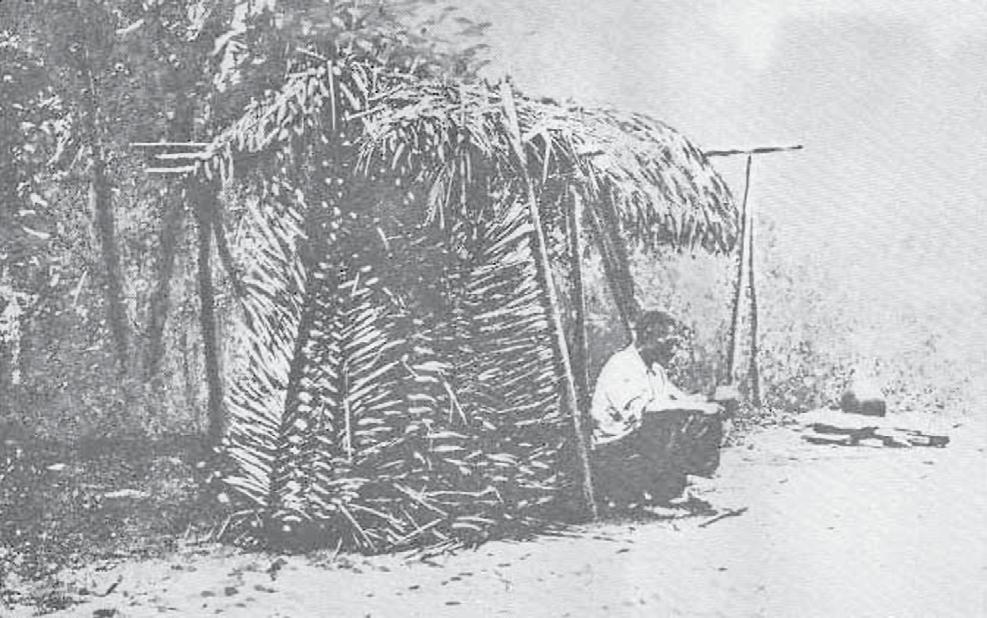
and create public awareness; to facilitate and ensure that Amerindians and other citizens of Guyana; particularly adults, have equal access to education which impacts on his/her total development and equip him/her with the necessary skills, knowledge and attitude to make a meaningful contribution to community and national development;
to pursue, facilitate, implement and ensure equitable distribution and access of development programmes in the aspiration of realizing the advancement goals of Amerindians and other citizens of Guyana; and to collaborate with national and international learning institutions and native groups to encourage exchange and other programmes to ensure present and past cultural and other practices are preserved.
In an interview with Guyana Times Sunday Magazine, Simon stated as an indigenous person, despite facing a certain type of stigma, he fulfilled a lot during his career and lived some of his dreams.
“I joined the army in 1967 as a young man. I was the first indigenous radio communications expert in the army. I also was able to fulfil some of my dreams. In school
I was told that the indigenous people likely came from Mongolia and I dreamt of going there. In 1967 I visited there. It was a great experience one which I cherish. Before I pass I want to visit Congo so hopefully I fulfil that soon,” he mentioned.
To make something of himself, Simon, the eldest of eight, was encouraged by his parents to pursue his education in Georgetown because at that time his village did not have the necessary facilities for him to do so. He left Paramakatoi at the age nine.
“It was certainly a fight, but with much support from my guardians and parents I was able to cope with it. My mother was my driving force. She wasn’t educated but was very wise in her own way. She upheld her culture and taught us to do so,” he recalled.
Madeline Simon, Simon’s mother, died September 2012 at the age of 106. When asked his opinion on what contributed to her longevity, Simon disclosed, “Exercise for her was very important. She would climb the mountains to go farming. Even in her 80s she was doing this until we had to stop her. She was very active in cleaning, washing and walking long distances, which she did until she passed on. She enjoyed all the wild meat and poultry and ate cassava bread and other traditional foods and drinks. She enjoyed life, worked hard, celebrated her heritage and taught us to do the same. The last moments I had with her I cherish,” he recalled. Simon continues to remain actively committed to improving and developing himself and indigenous communities.
a carib piai's "consulting room," moruca river, constructed of kokerite leaves set up on end. the medicineman is holding the rattle with which the invocations are made (An Inquiry into the Animism and FolkLore of the Guiana Indians by Walter E. Roth; Page 334)

Bina Hill, in Annai, North Rupununi, is a place where people from the 16 neighbouring communities in the North come to meet and seek knowledge; it is a place of cultural significance, a point for communications and a stopping place where people break their journey to and from the river and savannah communities.
It is the home of
er became the NRDDB. Registered as a trust in 2001, it is the umbrella organization of now 16 Rupununi communities, and recognized by the Iwokrama International Centre as its community partner since 1996. The core membership of the NRDDB consists of the legally elected leaders (Toshaos) of the North Rupununi communities.
The NRDDB also
Sepo, (Makushi for “Medicine from Trees”) evolved from the ethnobotany research conducted by the MRU, and is most famous for its Crabwood oil soap and healing creams. This group uses local ingredients like Crabwood oil, the barks of local trees and leaves to make medicinal tinctures, soaps and creams; all based on local traditions and
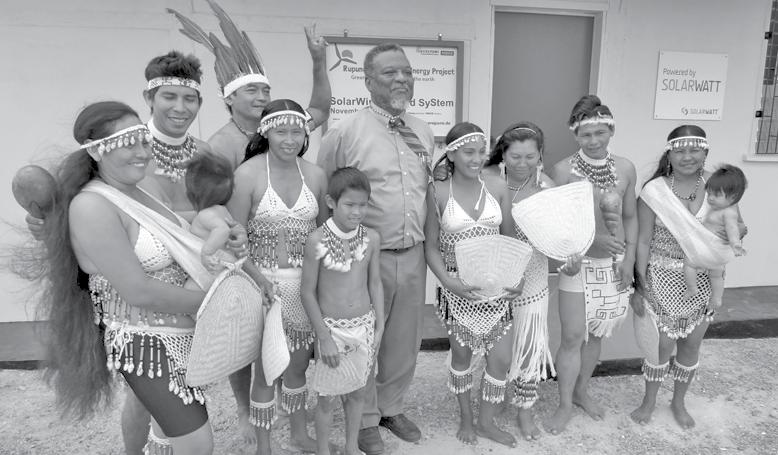
the North Rupununi District Development Board (NRDDB), Radio Paiwomak, the Makushi Research Unit; Ye Winon Merisin Sepo (Medicine From Trees), the Bina Hill Youth Learning Centre and the North Rupununi Junior Wildlife Development Council, just to name a few community organizations under the NRDDB umbrella.
The iconic blue and white building that operates as office, meeting hall, administration, dorms and radio station, was built though community work; materials were cut from the Annai area forest, and community members built the structure from the ground up. This is one place where Guyana’s Makushi people are becoming masters of straddling both worlds. Here the focus is on recognizing local culture and tradition, as well as moving forward with development so that the people in the North Rupununi have an opportunity to make informed decisions for local development.
Beginnings
In 1996, local leaders felt it was necessary to create a place to address local concerns and development, so the-then leaders of the 12 communities in the North Rupununi formed groups that lat-
serves and functions as the community stakeholder forum, with representation from other key leaders from community-based organizations (local civil society groups and institutions). NRDDB therefore plays a crucial role as a genuinely representative, umbrella organization which brings together officially elected local government officials (Toshaos) and other authorities as well as nongovernmental local peoples’ organizations / institutions and private enterprise initiatives.
The NRDDB is committed to improving the well-being and quality of life of the North Rupununi communities through social and economic development and through the affirmation of heritage, culture, traditional knowledge and Indigenous rights. The Makushi Research Unit (MRU) is a group of local researchers under the NRDDB who have been chronicling Makushi language and culture by writing the language, stories, ethnobotany, radio programs and video. The group has also been instrumental in promoting human rights and advocating and providing counselling for various social and domestic issues in the area.
“Medicine from Trees”
Ye Winon Merisin
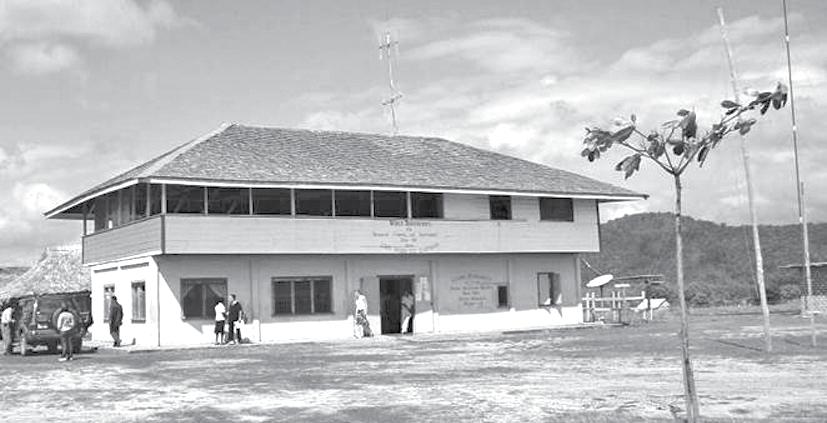
and CV writing workshops and planning for the annual wildlife festival. During the wildlife festival, members from 16 wildlife clubs and specially invited clubs celebrate their culture and environment with games, skits, costume, banner and traditional skills competitions at Bina Hill.
Youth Learning Centre
available for purchase at the Bina Hill Shop.
Wildlife Clubs
The wildlife clubs of the North Rupununi are community owned youth and environmental clubs where youths have an opportunity to learn about environmental monitoring in their
Many wildlife club members have become graduates of the BHI Youth Learning Centre. Home- sown and home grown, the Youth Learning Centre is a place for Amerindian youth and school leavers to learn “skills for living”, and for up to two years, local students have an opportunity for hands on learning in the areas of forestry, agriculture, natural resource and wildlife management. Traditional culture and skills, information technology and maths and English are also subjects. After graduation, many students find that they are now equipped with the skills to find jobs in the
and has been a dynamic leader in community services and cultural arts with its unique community flavour, bilingual broadcasting, local and cultural content. For the past 11 years, community members have anticipated the warm and welcoming voice of the Chief Broadcaster when he signs on with his signature greeting, “Good afternoon and welcome to Radio Paiwomak, broadcasting from the Bina Hill Institute at 97.1 on your FM band with 100 watts of power. We are today’s first community radio for the development of tomorrow’s people!”
COBRA
At the moment, the NRDDB is hosting two projects to support sustainable development of the people in the North Rupununi: COBRA (Community Owned Best practice for Sustainable Resource Adaptive management in the Guiana Shield) and the Community Monitoring, Reviewing and Verification
tors from each of the 16 NRDDB communities that collect data on forest health and wellbeing indicators, using smartphones. Analyzed data can help inform decisions on management of resources, and can be incorporated into the National MRV under Guyana’s Low Carbon Development Strategy. A second phase of the project has just started and will be working to improve local capacity to independently carry out monitoring activities in the future. This will include continued data collection and additional training in data analysis and report writing. Back “in de day” when the NRDDB had just formed, you would have had to fly by plane into Annai from Georgetown, to avoid the long journey by road. Most communication was by mail (on paper, not computer) or by high frequency radio. Things are different now, with improved road infrastructure, internet through satellite connection and now cell phone service.

own back yards. The Iwokrama International Centre has supported clubs over the past 10 years through bird and rainfall monitoring, and many club members have grown into community leaders, tour guides, rangers and researchers. Twice a year, club members meet at Bina Hill for weekend conferences and hone their monitoring and research skills in areas such as compass and GPS reading, bird and bat monitoring and tree identification. Other activities include public speaking
area or to contribute to the development in their community.
Radio Paiwomak
In 2000, Radio Paiwomak began as a pilot initiative implemented though partnership arrangement between NRDDB, UNESCO, Iwokrama and the Government of Guyana. Paiwomak now operates under license from the National Communications Network. Fully solar powered, Radio Paiwomak, 97.1 FM, is the only community radio station in Guyana
(CMRV). The COBRA team are young Makushi researchers who work in their communities to document Makushi best practices and their challenges, especially when it comes to traditional farming, fishing and living in general. This is done though video and storytelling. These videos and stories can provide lessons learned for both local and international communities and help local communities find solutions for issues facing them.
The CMRV supports two community moni-
The NRDDB communities have worked to move towards managing their resources, addressing social issues, communication and maintaining their culture through collaboration. And because development never stops, the NRDDB will continue to work to represent the interests of the people in the North Rupununi. To learn more about the NRDDB and happenings at Bina Hill, look for them on the web at www.nrddb.org and www.projectcobra.org. (Samantha James)
Actress Kareena Kapoor believes Hrithik Roshan, her co-star in the upcoming film 'Shuddhi', is one of the country's finest actors.
"I am very excited about ‘Shuddhi’. We're both working together after such a long time. He is such a fine actor. He is one of the finest actors in our country," Kareena told the media.
"I am looking forward to this film. We will start shooting from January 2014," she added.
Kareena and Hrithik's pairing has been seen in movies ‘Yaadein’, ‘Mujhse Dosti Karoge!’, ‘Kabhi Khushi Kabhie Gham’ and ‘Main Prem Ki Diwani Hoon’. ‘For Shuddhi’, they are teaming

up after a decade.
The
Actress Parineeti Chopra, who has worked with Ranveer Singh, Arjun Kapoor, Sushant Singh Rajput, says she prefers to work with the new crop of actors rather than big stars.
The 24-year-old actress said she has rejected few projects opposite some of Bollywood's biggest stars because the routine song-and-dance films did not excite her.
Parineeti indicated that she is glad she made the right decisions at the right time and chose to
stay away from typical Bollywood pot-boilers.
Asked about her approach to intimate scenes, she said, "As a girl I feel he is my actor, he is not my boyfriend or husband so you feel little awkward. It may sound philosophical, but when you shoot for it, the actor in front of you may seem like a wall, as intimate scenes becomes clinical."
"When you are doing such scenes, the director keeps giving you instructions, either to look up, down, left, right, hold hands, so it is all

mechanical...there is no feeling to it. Intimate scenes are easy to do. Whenever I read a script I don't differentiate between a kissing scene or an emotional scene," she added. (TOI)
Actress Katrina Kaif has not been signed opposite superstar Salman Khan for Prabhu Deva's next film, the makers have said.
After setting the cash registers ringing at the box office and starting a new wave of action with 'Wanted', Salman and choreographer-turned-director Prabhu Deva are teaming up for a film, to be produced by Tips.
Rumours were doing the rounds that Prabhu Deva's film will bring Salman and Katrina back on screen again.
"We have not signed Katrina for the film. We have not thought of who the leading lady will be opposite Salman. We are still working on the script. The story is not yet completed," Ramesh Taurani of Tips said.

Bollywood's multitalented star Priyanka Chopra admires international pop star/actress Beyonce Knowles for the balance that she has struck in personal and professional life.
"I admire Beyonce a lot because she is an amazing performer and more than anything, she balances her personal and professional life very well," Priyanka said in Mumbai.
"She has a child, and at the same time, her professional life also, which is amazing! That's the kind of a person I would like to be-who can balance both personal and professional life together," the Bollywood actress added.
Priyanka, who is charting her own singing career after becoming a suc-

cessful actress, says it was her late father, who always wanted her to be a singer.
The 31-year-old has already launched two international singles-‘In my city’ and ‘Exotic’. (TOI)
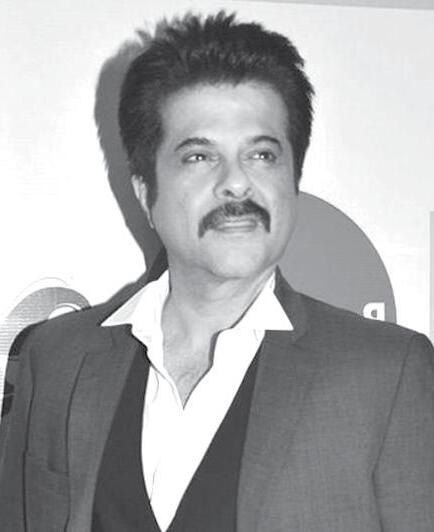
Anil Kapoor, who is all set to make his small screen debut with ‘24’, has found a new fan even before the show has hit the screens.
The actor, who has got the American franchise to India, has been getting lots of congratulatory messages from the industry.
However, one person who has personally sent her wishes across is his sister-in-law, actress Sridevi.
Sridevi, who had heard a lot about his new TV show, was looking forward to the promos hitting the screen.
Anil knew about that and according to a source, arranged a special preview for his family. Ever since, Sridevi has been raving about how good Anil is in the show. Talk about family bonding! (TOI)
Actress Sushmita Sen is eyeing a comeback in Bollywood this year with a woman-oriented film.
Though Sen has not signed any film yet, the former Miss Universe said she would love to do a female-oriented role like actress Sridevi in 'English Vinglish'.
The 37-year-old, who was in Mumbai to inaugurate the first Kerala salon of accomplished hair and makeup expert Ambika Pillai, told reporters that she will make a comeback this year.

year break to spend time with her adopted daughters-Alisah and Renee.
Salman and Katrina were last seen in 'Ek Tha Tiger'. Since Salman has a packed schedule, the shooting for the film will begin next year.
The actress was last seen in 2010 film 'No Problem' and had taken a three
Taurani is quite excited about his upcoming Shahid Kapoor starrer 'Phata Poster Nikla Hero'. Directed by Rajkumar Santoshi, the film also stars Ilena D'Cruz and releases on September 20. (TOI)
Actress Alia Bhatt has warned her fans against "random" pictures of her forthcoming film 'Highway', which are doing the rounds on internet.
Alia, who made her debut with Karan Johar's 2012 movie ‘Student of the Year’, will star opposite Randeep Hooda in the

Imtiaz Ali film.
"There's some random image going around from ‘Highway’ that isn't authentic at all! That is not me or Randeep in that picture," Alia posted on Twitter.
"Stills from the film will be out closer to the release probably. So please don't fall for these fake images," she added. (TOI)
"For some years I celebrated with my children and have no regrets," she said. (TOI)
While everyone is curious to know the agenda of Aamir Khan's secret trip to Australia, we have got some bits of information.
The actor has gone to Australia to apparently take dance lessons. The perfectionist that he is, Aamir is taking a month's time to learn a unique dance form that will be a culmination of tap dancing as well as ballet.
The actor, whose character has shades of grey in ‘Dhoom
3’, plays a circus gymnast. His role required him to be perfect in this dance form and hence he thought of taking professional dancing classes for the same. Once Aamir is back from Australia in another 15 days, he will be shooting for a song that will require him to show his moves. With the perfectionist getting trained from the best of the dancers, we are sure he will create a storm on screen. (TOI)

Scarlett Johansson has revealed that she can consider pursuing a career in politics.
The 'Match Point' star told Harper's Bazaar Magazine that though she thinks that a full political career seems like a stretch, she never limits the possibilities, Metro.co.uk reported.
Johansson, who is the former wife of Ryan Reynolds, said that if she has more time, she might be able to get involved in politics as she never closes doors on things like that. (TOI)


"Twilight" star Robert
has revealed that
has made him con-
scious to look good whenever he steps outside his home.
The 27-year-old actor says he worries about his looks now as he knows he would get photographed everywhere he goes, reported Contactmusic.
"It depends, sometimes. But I'm weird about my looks. Once you get photographed a lot it changes you. I remember when I first did 'Twilight' I didn't care about how I looked-there was less pressure," Pattinson said.
"Now every time I appear somewhere, I think, 'I don't know how many more times I can do this.' Dressing up to go somewhere and be looked at-I get so nervous. Up until the second I have to leave, I'll get changed a million times," he added. (TOI)
Michael Douglas has denied there is a ''crisis'' in his marriage to Catherine Zeta-Jones.
The 68-year-old actor, who is currently promoting his new film 'Behind the Candelabra', insisted that his marriage is ''fine'' and they are simply having a ''temporary separation''.
Talking to the press at the premiere of his new film he said: ''I have a crisis at home? No ...We, we are fine. My wife and I are, are fine.''
The pair, who wed in 2000 in a lavish ceremony at Manhattan's Plaza Hotel in New York City, were last photographed together in April and are reportedly receiving counselling in an attempt to save their relationship.
Catherine appears to want to do all she can to make things work and maintain her 13 year marriage.
‘I have

According to previous reports, the 'Red 2' star has admitted to friends she would do ''everything in my power'' to keep their family, which includes their children Dylan, 13, and Carys, 10, together. (TOI)

Actress-model Kelly Brook says she regrets her fashion choices every day.
The 33-year-old admits that she doesn't always dress immaculately because of her busy schedule, and ends up looking back at photographs of herself with regret, reports femalefirst. co.uk.
"I have regrets every day. I sometimes see pictures and think, 'Urgh, why did I put that on?' I'm a busy girl and I don't always have time to put a perfect outfit together," Brook said.
She believes that good posture is the key to look good.
"I wear a gorgeous dress, diamonds, a beautiful clutch and killer heels. Simple but chic. Be confident and work on your posture. That will make any outfit stand out," she added. (TOI)
Hollywood actor-producer Vin Diesel, whose movie "Riddick" is releasing Friday, finds his co-star Katie Sackhoff "sexy".
Sackhoff plays the role of Dahl, a sniper woman-turned-mercenary on the hunt for killing Diesel's character Riddick.
Sackhoff is said to have done some stunning action scenes in the movie.
"She came in guns blazing to play the role of Dahl, which I think is extremely sexy and formidable," Diesel said in a statement.
Written and directed by David Twohy, "Riddick" is a dark actionpacked science fiction film, packed
with breathtaking battle sequences. PVR Pictures is releasing the movie in India in four languages-English, Hindi, Tamil and Telugu. (TOI)

For an intimate break with actor-fiancé Brad Pitt, actress Angelina
Jolie opted for the hotel, which is one of Jennifer Aniston's favourites.
The couple slipped
unnoticed into the glamorous Sunset Tower hotel in Hollywood Aug 27, and checked into suite 1502, the same room where Aniston, Pitt's exwife, likes to stay, reports dailymail.co.uk.
"Brad and Angelina usually stay at the Four Seasons or Hotel Bel Air for their assignations," a source said.
"Brad usually handles all of the details, but this time it was Angelina who made the plans, and she specifically picked the very hotel and the very suite where Jennifer stays," the source added. (TOI)

Sachin Tendulkar, who has retired from the IPL, and Rahul Dravid, who has indicated the upcoming Champions League would be his last tournament, have been named in the Mumbai Indians and Rajasthan Royals squads respectively for the Twenty20 event.
A Faisalabad Wolves squad has also been announced, in an indication of the Pakistan side’s probable participation in the qualifying stage of the league, after political tensions between India and Pakistan had cast doubts over whether they would be allowed to come over.
Kumar Sangakkara is the only player who hasn’t preferred his IPL franchise for the tournament among the 12 wanted by two sides, and has decided to play for his home side Kandurata Maroons.
Explaining the process for deciding which teams these players would represent, Dean Kino, a CLT20 governing council member and director of legal and business affairs, said: “Players who were named by more than one team were asked to select
which team they were going to play for. Teams were then allowed to replace any player that withdrew from their squad and elected to play for another side.
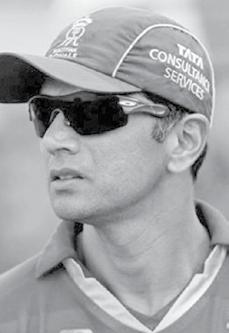
“CLT20 regulations state that when a player elects to play for their ‘away’ team, that team must pay the ‘home’ team Gy$ 150,000 compensation per player.
“This payment is applicable for 10 of the 12 players that were eligible for more than one team. The exceptions are Kumar Sangakkara, who will be representing Kandurata Maroons, which is classified as his home team, and Thisara Perera, who qualified for Brisbane Heat and Sunrisers Hyderabad,
neither of which is classified as his home team.”
Lasith Malinga has not been named in the Mumbai Indians squad as he wanted to be with his wife and family, as they expect their second child late in September.
Group A includes Mumbai Indians, Rajasthan Royals, Lions, Perth Scorchers and Qualifier 1 while Group B has Chennai Super Kings, Brisbane Heat, Titans, Trinidad & Tobago and Qualifier 2. Otago Volts, Sunrisers Hyderabad, Faisalabad Wolves and Kandurata Maroons will play the qualifiers beginning on September 17 in Hyderabad, with the top two sides advancing to the main draw starting September 21 in Jaipur and to be played across Ranchi, Ahmedabad, Hyderabad and Delhi.
Mumbai Indians: Rohit Sharma, Sachin Tendulkar, Dinesh Karthik, Harbhajan Singh, Pragyan Ojha, Ambati Rayudu, Aditya Tare, Rishi Dhawan, Abu Nechim, Akshar Patel, Kieron Pollard, Dwayne Smith, Nathan CoulterNile, Mitchell Johnson, Glenn Maxwell. Chennai Super


Kings: MS Dhoni, Suresh Raina, M Vijay, Wriddhiman Saha, R Ashwin, S Badrinath, Imtiaz Ahmed, Ravindra Jadeja, Mohit Sharma, Michael Hussey, Dwayne Bravo, Albie Morkel, Jason Holder, Faf du Plessis, Chris Morris.
Rajasthan Royals: Rahul Dravid, Ajinkya Rahane, Stuart Binny, Sanju Samson, Ashok Menaria, Dishant Yagnik, Vikramjeet Malik, Rahul Shukla, Pravin Tambe, Siddharth Trivedi, Shane Watson, Brad Hodge, James Faulkner, Kevon Cooper, Shaun Tait.
Brisbane Heat: Joe Burns, Daniel Christian, Ben Cutting, Peter Forrest, Dom Michael, Chris Hartley, Nathan Hauritz, James Hopes, Matthew Gale, Chris Lynn, Alister McDermott, Cameron Gannon, Alex Kemp, Kemar Roach, Chris Sabburg.
Perth Scorchers: Ashton Agar, Michael
Beer, Jason Behrendorff, Ashton Turner, Liam Davis, Brad Hogg, Burt Cockley, Simon Katich, Mitchell Marsh, Shaun Marsh, Joel Paris, Alfonso Thomas, Tom Triffitt, Adam Voges, Sam Whiteman.
Titans: Jacques Rudolph, Henry Davids, AB de Villiers, Farhaan Behardien, Heino Kuhn, David Wiese, Eden Links, Ethy Mbhalati, Rowan Richards, Mangaliso Mosehle, CJ de Villiers, Graeme van Buuren, Morne Morkel, Roelof van der Merwe, Marchant de Lange.
Highveld Lions: Temba Bavuma, Gulam Bodi, Quinton De Kock, Neil McKenzie, Lonwabo Tsotsobe, Ethan O’Reilly, Hardus Viljoen, Rassie van der Dussen, Alviro Petersen, Aaron Phangiso, Dwaine Pretorius, Jean Symes, Imran Tahir, Sohail Tanvir, Thami Tsolekile.
Trinidad & Tobago: Denesh Ramdin, Rayad Emrit, Jason
Mohammed, Nicolas Pooran, Sunil Narine, Evin Lewis, Samuel Badree, Navin Stewart, Shannon Gabriel, Yannick Ottley, Adrian Barath, Sherwin Ganga, Lendl Simmons, Ravi Rampaul, Darren Bravo.
Faisalabad Wolves: Misbah- ul- Haq, Asif Ali, Ali Waqas, Khurram Shehzad, Mohammad Salman, Waqas Maqsood, Samiullah Khan, Asad Ali, Saeed Ajmal, Ehsan Adil, Hasan Mahmood, Jahandad Khan, Farrukh Shehzad, Imran Khalid, Ammar Mahmood.
Otago Volts: Nick Beard, Michael Bracewell, Neil Broom, Iain Butler, Mark Craig, Derek de Boorder, Jacob Duffy, Brendon McCullum, Nathan McCullum, James McMillan, Jimmy Neesham, Aaron Redmond, Hamish Rutherford, Ryan ten Doeschate, Neil Wagner. Sunrisers Hyderabad: Shikhar Dhawan, Parthiv Patel, Cameron White, JP Duminy, Dale Steyn, Darren Sammy, Biplab Samantray, Thisara Perera, Karan Sharma, Hanuma Vihari, Ashish Reddy, Amit Mishra, Ishant Sharma, Anand Rajan, TBC. Kandurata Maroons: Lahiru Thirimanne, Nuwan Kulasekara, Upul Tharanga, Thilina Kandamby, Kumar Sangakkara, Shehan Jayasuriya, Chamara Silva, Milinda Siriwardana, Dilhara Lokuhettige, Dhammika Prasad, Ajantha Mendis, Kaushal Lokuarachchi, Lahiru Jayaratne, Dhananjaya De Silva, Suraj Randiv. (Cricinfo)
Jamaica Tallawahs captain, Chris Gayle, predictably took the honour for both the fastest 50 of the tournament off just 23 balls against the Trinidad and Tobago Red Steel – and for blasting the longest six which sailed 114 metres into the stands.
Commenting on the cricketing fireworks, winning team captain, Chris Gayle, said; “Cricket in the Caribbean is all about big powerful displays. It’s always a pleasure to bring the fans to their feet with some serious hitting. And to be able to do that with millions of people watching in the stands and on TV is just a great experience. I had a blast and can’t wait for next year.”
CEO of the Limacol Caribbean Premier

League, Damien O’Donohoe, commented, “There’s nothing like the buzz you get as a cricket fan when these giants of Caribbean cricket are firing on the field. The action in every match was just breathtaking and the crowd revelled in it. It’s fair to say that the action on the pitch matched the fun off it.

We’re delighted that the “biggest party in sport” delivered on its promise. Of course, none of this would have been possible without the amazing support and enthusiasm of the fans – I would like to thank them most sincerely for the awesome part they played in making the CPL such a success. (CPL)
By Tony Becca
The inaugu-
ral Limacol Caribbean Premier League (CPL) T20 has come and gone and congratulations to the Jamaica Tallawahs for becoming the firsttime winners of the popular attraction, the cricket carnival, the spectacular billed as the “biggest party in sports.”
The party, even more than the winners, will be serenaded in these parts, maybe elsewhere around the world, for a long time to come - at least until next year this time, God’s willing.
The semi-finals and the final of the Limacol CPL was played at Queen’s Park Oval, and as it was in the preliminary round at Kensington Oval, at Providence, at QPO, at Beausejour, at the Sir Viv Richards Stadium, and at Sabina Park, it was something to remember.
The crowds were enormous, the atmosphere was electric, and the cricket, T20 style, with names at the stars like Muttiah Muralitharan, Ricky Ponting, and Chis Gayle, was exciting throughout.
For many years, for many moons, the stadiums around the West Indies, especially in Jamaica, were like white elephants. They were abandoned by the people and there were empty seats and empty stands to be everywhere.
The coming of the Limacol CPLT20, however, promised many things, and although many of the world’s best players, especially in T20 cricket, were absent, at least at the start, as far as entertainment was concerned, as far as the carnival spirit went, it really and truly packed in the people match after match until, in the final matches of the penultimate round at Sabina Park, it was, so to speak, bursting at the seams.
It was, as they used to say in the old days, in the days when the ground capacity was smaller and the people used to attend cricket matches, “it was cork, cork to the brim”. Grandfathers and grandmothers, fathers and mothers, and sons and daughters were present to listen to the drums and the music, to see the dancing girls, to wave their flags, and to blow their horns each
time a run was scored, a diving stop was made, a four was hit, a batsman was dismissed, or the ball was sent sailing high and way beyond the boundary.
It also was good to see, for a change, people
long on, over midwicket, or over to square leg, or the front foot drive, or swing, which deposited the ball way beyond the boundary.
Apart from the dancing girls, the music, and the social side of things,
and the final were no exceptions.
The question today is, why was the Limacol CPLT20 so successful? The answer to that must be planning, giving the people what the people wanted, and marketing.
Haq, Shoaib Malik, Ross Taylor, Martin Guptil, and Philander, along with the retired pair of Muralitharan and Ponting on show - and later on Sangakkara, Mahela Jayawardene, Malinga joining up - it is

with their flags walking and talking as they made their way from Sabina Park up South Camp Road going into Cross Roads after the matches.
And it was no different at Queen’s Park Oval in the semi-finals and final where, apart from the skill of Gayle, Keiron Pollard, Dwayne Smith, Lendl Simmons. Sunil Narine, Andre Russell, Muralitheran, Shakib Al Hasan, and Vernon Philander in the preliminary rounds, the fans turned out to see a few more international ambassadors of the short game, the likes of Kumar Sangakkara, Tilakaratne Dilshan, and Lasith Malinga, among many others.
Many people turned out to the games because of the carnival atmosphere, but if that was so, they got more than they bargained for - much more.
The things which tickled their imagination were the fast pace of the T20 game, the swift running towards the ball, the acrobatic fielding and the brilliant catches, the fours, streaky or not, and the big hits for towering sixes, whether off the back foot over
the fact that people, because of curiosity, attracts more people, also were part of what pulled in the people.
Gayle, who has always been a fan of the T20 game, did his skill, and his power, justice two Sunday afternoons ago when he put his fingerprints on the success of the tournament with a superlative innings when, once again, he entertained his fans to a feast of power hitting.
The big left-hander turned up the thrills for the fans with 51 runs off 24 deliveries with five sixes and four fours, including three sixes and one four off one over from Dwayne Bravo.
Sabina Park was rocking when Gayle got out and strolled towards the pavilion.
With so many catches, so many sixes, and so many exciting finishes to cheer earlier on in the tournament, the final two matches, with the Guyana Amazon Warriors clipping the Antigua Hawksbills off the last ball of the match in Antigua, and the Tallawahs doing likewise to the Red Steel in Kingston, were fitting climaxes to the preliminary round.
It was good for the fans. And semi-finals
With the absence of some big names earlier on, and only Gayle, Pollard, Marlon Samuels, Narine, and Darren Sammy, possibly only Mohammad Hafeez, Misbah Ul-
certainly not because of the presence of international stars.
On top of that, apart from two innings by Misbah and Shoaib, one by Hafeez, one by Kevin O’Brien, and one mar-
vellous spell of bowling by Shakib, mostly all the performances were by local players.
The music, the dancing girls, and the price of admission were big reason for the success of the tournament.
The Limacol CPLT20 has been a god-sent to the West Indies, and West Indies cricket should say thanks once again to the owners, to Ajmal Khan, for coming up with the idea, for investing the cash into West Indies cricket, for encouraging companies like Limacol, Digicel, El Dorado, Courts, Scotiabank, Foska Oats, and Appleton to come on board, and for having the foresight and the faith in the West Indian people to do so.
The Limacol CPLT20 promised to show the world how the West Indies play the game, and although it may have done so, even if it did not need to have done so, it really and truly showed the world the way of life of the people, and how the people enjoy themselves.
The fun of Limacol CPLT20, in contrast to World Cup 2007, was encouraged, it was unrestricted, and therefore the Limacol CPLT20 was enjoyed by the fans. Cricket, in many ways, was secondary to the carnival atmosphere.
(Jamican Gleaner)

Local motor-racers will hit the South Dakota circuit on Sunday when the Guyana Motor Racing and Sports Club (GMR& SC) stages its second Race of Champions event. The GMR& SC and competitors have agreed to host the meet, following the cancellation of the Barbados leg of the Caribbean Motor Racing Championship (CMRC), and from all indications the organisers are gearing up to provide the same kind of excitement seen at CMRC.
The organisers are working assiduously to ensure that all the top drivers, bikers and go- karters, along with those from Suriname, Canada and the U. S. A., confirm participation for the meet.
Drivers Irfaan Kalamadeen, Paul Vieira and Rupie Shewjattan are expected to be on show, while stalwarts such as Andrew King, Kevin Jeffrey and Mark Vieira could be set to renew their battle for outright supremacy.
Mark Vieira drew
first blood at the previous meet, but could face a determined Jeffrey, who performed creditably for Guyana at the opening leg of the CMRC in Jamaica earlier this year, while King, will be looking to regain his grip on the local scene, having relinquished that stranglehold to the two over the past year.
When the three met in the season opener, they split the three races, but Vieira was the most outstanding since he added two second places to be voted champion driver.
At that same Meet, Jeffrey had broken Barbados’ Roger Mayers of Barbados previous lap record (33.5) with his Mitsubishi Evolution by one tenth of a second (33.4) in the time trials which was held the previous day.
However, the Group 3 category should eclipse the Group 4 for excitement and daredevilry with Ryan Rahaman, Shewjattan, Kamal Seebarran, Raj Boodhoo and Kem Lall, all anticipated thrilling the fans
during their battle for the top podium spots.
Afraz Allie and Syed Hassan, two of the leading drivers in the Group 2B Division and who both earned points at the CMRC, apart from their own skirmish will also have to stave off the challenges of Suriname’s Oliver Tjin Liep Shie, Danny Persaud and John Joseph.
The Superbikes category also promises to be just as exciting as the cars with the young brigade of Matthew Vieira and Nikhil Seereeram expected to continue their competition and this is in addition to the ‘big boys’ scrap that should feature Stephen Vieira, Carlos Rodrigues, Kwame Ridley and Carey Griffith.
The go-karts category is also billed to provide excitement and once again the young drivers are expected to take centre stage with Stanley Ming Jr and Wayne Elliot Vieira throwing down the gauntlet to veterans Marcus Fiedtkou and Stanley Ming Sr.

Aday after BCCI announced a proposal to host West Indies in November for a series that had never been mentioned in the ICC’s Future Tours Programme, it appears that West Indies will play two Tests and three one-dayers in India.
A BCCI official confirmed with ESPNcricinfo that West Indies are set to play “two Tests and three ODIs starting in the first week of November”.
The final decision will be made once the tour, programme and fixtures committee finalises the dates in consultation with the West Indies Cricket Board. The itinerary of the tour is expected to be announced mid-September.
If West Indies are to play two Tests and three ODIs after India’s home ODI series against Australia, which concludes on November 2, it would mean India cannot reach South Africa before November 30, for
a series that was originally scheduled to begin on November 18 with a T20 against South African Invitation XI.
Add to that the commencement of India’s tour to New Zealand on January 19, which was originally supposed to be the last day of the South Africa tour, which gets trimmed further.
However, the official, who has been involved in negotiations with Cricket South Africa ever since BCCI objected to the itinerary eight weeks ago, reiterated that the South Africa tour was not put off. “We understand we have a commitment and we want to tour South Africa, but that doesn’t mean we shouldn’t safeguard our players’ and board’s interests,” he said.
With the BCCI adhering to the players’ demand of having “at least a week’s break” between the South African and New Zealand tours, it appears that India’s origi-
nal South Africa tour of three Tests, seven ODIs and two Twenty20s will be pruned to two Tests, three ODIs and a solitary T20 and CSA may have no choice but to accept whatever BCCI offers.
Players’ demands aside, the official also indicated that the ego problem that the BCCI representatives have had with their South African counterparts has been one of the hurdles while finalising the tour schedule. “Just because an FTP was announced many years ago doesn’t mean you should announce the tour itinerary without even consulting us,” the official said.
With time running out for CSA to finalise their domestic season’s fixtures, it appears that the South Africa tour itinerary won’t be sealed till the CSA officials bow down to the pressure exerted by the most influential body in world cricket. (Cricinfo)
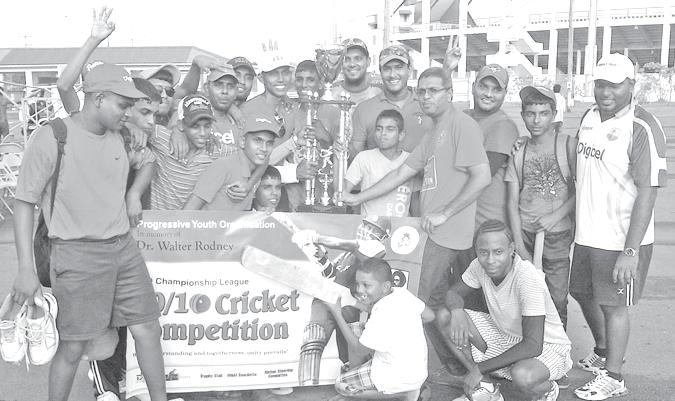
The Progressive Youth Organisation (PYO), youth arm of the People’s Progressive Party, recently concluded its tapeball competition with Meten-MeerZorg PYO emerging as champions with a resounding 46-run win over the Grove/Diamond PYO.
In the final played on Sunday on the tarmac of the Guyana National Stadium, Meten-MeerZorg PYO, representing Region Three, defeated Grove-Diamond PYO, representing Region Four A, by 46 runs in the final.
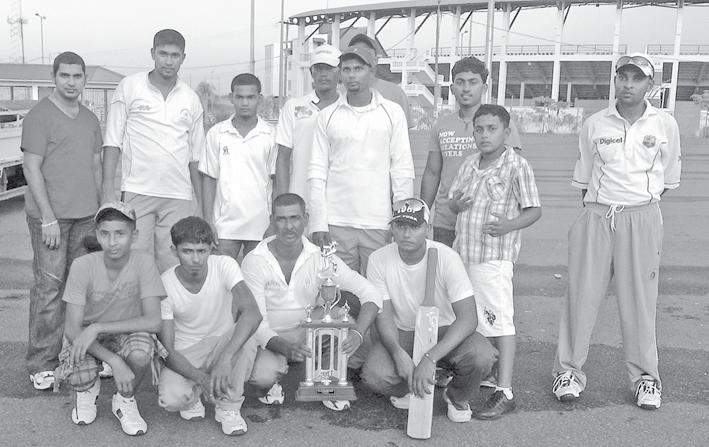
By TreisTon Joseph
Lyndon Wilson, coach of 2012 Olympian
Winston George, recently benefited from a highperformance coaching programme that concluded on August 30 in Brazil. Upon his return, he sat with Guyana Times International Sport in an exclusive interview to discuss what he learned during the programme.
TJ: What was the coaching programme about?
even coaches who were present for discussions on high-performance for athletes.
TJ: What was the main concept you grasped from the course?

LW: It was a forum for high-performance sports in Rio de Janeiro; it was from the 26th to the 30th of August and basically the forum was more or less to train athletes for high-performance competitions. The way in which we train athletes for highperformances is more or less the scientific way; if an athlete has the potential they go through a process to see if they can last two years, three years, ten years, and there were special doctors, physicians and
LW: I grasped so much and to implement the things that I have gathered from the forum. I wouldn’t want to say that it would be a difficult task because they also taught us how to supplement, but one of the things that I would like to see is all of the sports entities coming together for one common goal. We cannot talk about 2016 (Olympics) and think about getting a medal; we cannot talk about the next World Cup football (2014) and thinking our team can be there, we have to come together for one common goal.
from Cuba and while they are working at the government hospital, I think these people can come together once you identify people with the talent. They can help the coaches with training these athletes; they know nutrition and nutrition plays a big part in sports development. As a matter of fact, seventy percent of all the development is through nutrition, so we can’t get 50 people living in 50 different directions and want them to develop at the same rate.

Participate is just sending people to show that we have people at the Olympics but to compete is to triumph at the highest level and that should be our first common goal.
TJ: How can Guyana achieve this common goal?
LW: We can achieve that common goal with all the sporting entities coming together, including the ministries of education, sport, culture; sport has gone so far into culture that those two entities are one, the GOA (Guyana Olympic Association), the athletics association, the football fraternity; everybody needs to come together.
TJ: Getting back to the scientific approach, how well do you think it will fit into the Guyanese culture?
TJ: In you estimation what should be that one common goal?
LW: Our first common goal should be preparing athletes to compete and not to participate. When I say participate, it’s because the two words vary.
Dubbed the PYO Championship League, in honour of the late political activist Walter Rodney, it attracted teams from several districts battling for several prizes.
In the final, MetenMeer-Zorg batted first and made 100-4 from the allotted 10 overs. Grove/Diamond PYO in reply mustered only 54 from 9.3 overs to lose by a wide margin in the final.
In the third place playoff, Chesney PYO defeated Good Hope/ Success PYO by 31 runs.
Prior to the championship game and third place playoff, Meten Meer Zorg PYO had defeated Chesney PYO in the first semi-final, while Grove/Diamond PYO got the better of Good Hope/ Success PYO.
Andray Yagvalk, coordinator of the tournament, said the competition was a success because there was keen rivalry among the various PYO groups. The tapeball competition was the first in a series of activities hosted by the PYO to mark its 61st anniversary.
LW: It can! There were countries there without centres but they are still doing high-performance training. We have trained people, we have a lot of doctors
TJ: Factoring such a scientific approach to sport in general, how do we incorporate the cost factor for athletes to
have such a programme?
LW: From the GOA perspective, there are some mini-scholarships that have been given out to athletes and there are some solidarity scholarships from the GOA.
TJ: With this newfound knowledge how do you plan to share it with other coaches, athletes and sporting disciplines?
LW: Well I’m looking to submit my report by tomorrow and I want to have a meeting with the council (from GOA) and then we will move from there. I already have some athletes in mind; I also want to talk with some of the coaches first but with regard
to the different sporting disciplines, I’m open to anyone who wants advice because we also had some discussion on how to improve team sport. The coach for the Brazil national football team (Luiz Felipe Scolari) was there; he didn’t give away anything but he had a talk with us on how to approach independent men and that is allowing them to realise the main goal of the team. Meanwhile, with Wilson having such knowledge it is imperative that Guyana utilise such expertise to benefit sport in an effort towards the 2016 Olympics in Brazil.



There is uncertainty over the participation of Pakistan players in the upcoming Dhaka Premier Division Cricket League, Bangladesh's domestic oneday competition, due to a strained relationship between the Bangladesh Cricket Board and the PCB.
With less than five days before the start of the league on September 10, none of the 12 Dhaka clubs have managed to confirm the services of a Pakistan player. This season, a club can field up to three foreign players during a match and can register 10 players during the season. However, according to the BCB, it has not received any no-objection certificates (NOCs) from the PCB, a situation similar to what occurred before the start of the Bangladesh Premier League earlier this year.
An NOC is mandatory under a new ICC ruling on players participating in another country's domestic competition. Previously, the Dhaka clubs contacted the players who then sought permission from their respective province or department, and a letter was sent from the BCB or the Cricket Committee of Dhaka Metropolis (CCDM) to help with visas in Bangladesh.
This year, however, the process is likely to be a drawn-out one due to the impasse between the boards. Relations between the two boards have been dif-
ficult since a Dhaka court ruling stopped Bangladesh from touring Pakistan in April last year.
Throughout 2012, the BCB sought to conduct the tour only to back off citing security fears. In December 2012, BCB chief Nazmul Hassan put the tour on hold and said that the side would visit Pakistan only if the overall security improved. Two weeks later, the PCB refused to issue NOCs to its players to participate in the BPL, giving the Bangladesh board another reason to delay the proposed international tour. The PCB's decision to prohibit its players from the BPL resulted in chaos as franchises scrambled to find last-minute replacements for Pakistan players two days before the tournament began.
"It wasn't us who told them not to come [to play in the BPL]," Hassan said. "It was the PCB who denied NOCs at the last minute. We played without them, and that is how we have remained. If suddenly they change the decision and contact the clubs here, it will be a different situation.
"We will play the Dhaka Premier League without the Pakistani players because the PCB hasn't given them the NOC. There's no need for any discussions. We have accepted their hasty decision not to send players during BPL. We were not invited for any discussions at the time."
According to the PCB, it is
seeking a formal written communication from the BCB before considering the release of its players. The PCB said that players were being approached directly with no written agreement from the "Bangladeshi organisers and board".
League clubs, said he would seek the BCB's help in getting Pakistan cricketers to play in the tournament: "I will submit a letter on Saturday, to ask BCB to help me with NOCs from PCB."
Other Dhaka club offi-

The current requirement of an NOC to engage with a player from a foreign country was prevalent last year, and the PCB had to issue the letters to its players, after the BCB made it mandatory for clubs to sign only overseas cricketers with first-class experience.
Iqbal Yusuf Chowdhury, who is in charge of Cricket Coaching School (CCS), one of the twelve Dhaka Premier
cials have already started to look elsewhere this year, particularly to countries where players are free between September and October. A few clubs are interested in approaching Sri Lanka cricketers and some players have reportedly signed up. Clubs are also likely to contact players from England, India and Zimbabwe.
A steady flow of Pakistani
cricketers, international and uncapped, has been a feature of Bangladesh's domestic competitions, particularly the Dhaka Premier League. Ever since the clubs were allowed a quota of foreign players, they have mainly been interested in bringing cricketers from Pakistan.
Even when the second tier of the Dhaka league system or the first-class competition allowed foreigners for a short while, Pakistani players were the ones in demand. Players who are regulars in the Dhaka Premier League could also suffer financially, as a result of the issues between the boards. Usually, players are paid between $5,000 to $15,000 per season, depending on their first-class experience and Dhaka league performance. For international players, the rate goes up substantially and the clubs are often rewarded. Wasim Akram was the biggest name from Pakistan to have played in the Dhaka league. Shahid Afridi, Abdur Razzak, Shoaib Malik and Imran Farhat have also played domestic cricket in the country; Farhat scored the first double-century in Bangladesh first-class cricket. In recent years, Misbah-ulHaq, Nasir Jamshed, Ahmed Shehzad, Khurram Manzoor, Khalid Latif, Fawad Alam and Hammad Azam have played in the Dhaka Premier League regularly. (Cricinfo)


week ending september 8, 2013
Guyana’s leading squash player Nicolette Fernandes has jumped to her highest world ranking ever, according to the September release of the World International Squash Players Association (WISPA) rankings.
The 30-year-old is currently ranked number 22 in the world, getting past her previous highest ranking of 26 achieved in June/ July this year. Her present ranking is an improvement from August when she was rated 28.
It is a remarkable turnaround for Fernandes, who only at the start of 2009 was rated a lowly 249 after a recurring knee injury had kept her out of competition for a protracted period of time.
Since returning from injury however, Guyana’s most decorated squash player has been on the rise, significantly moving up the ranking with each passing competition.
Such was her outstanding performance that at the end of 2009, Fernandes, who is based in England and is under the expert guidance of award-winning coach Carl Ince, had taken her ranking below 100, ending the year at 88.
Ever since then, it has been a steady climb up the ladder for the multiple Sportswoman-of-the-Year, consistently racking up points and making her way up the WISPA leaderboard.
So far for 2013, Fernandes has played in five WSA World Tour/Series in four countries, namely the United States of America, Malaysia, Ireland and England.
In her first international competition for the year, the Cleveland Open in Ohio, Fernandes got past Heba El Torky
of Egypt 6-11, 11-7, 9-11, 11-6, 11-4 in the Qualifying Round before losing to England’s Sarah Kippax 11-6, 11-9, 11-3 in the Qualifying Finals in February.

In the Kuala Lumpur Open in Malaysia in March, she got past the Qualifying Round beating Australia’s Lisa Camilleri, but lost to Camille Serme of France in the First Round.
In May, Fernandes produced her best performance of the year on the international stage, finishing as runner-up to number one seed Madeline Perry of France in the Irish Open. During her journey to the fi- nal, Fernandes also toppled some lead- ing players, including number two seed Samantha Teran of Mexico, fourth seed Emily Whitlock of England and qualifier Sarah Cardwell of Australia.
After that, she suffered first round exits in the Texas and British Opens in May, crashing out to Deon Saffery of Wales and Rachel Grinham of Australia respectively.
Last month, Fernandes returned home to claim her fifth Caribbean senior title, taking less than 30 minutes to dispose of Barbados’ Karen Meakins 11-6, 11-2, 11-5 in the final of the Caribbean Area Squash Association Senior Championships at the Georgetown Club.


Kingston, JAMAICA – From overflowing stadiums, thumping party vibes and mass enthusiasm to scorching bowling, massive hitting and blistering catches, the inaugural Limacol Caribbean Premier League went off with a bang right across the Caribbean. With a record breaking quarter of a million people attending the matches across the six countries and the action being beamed into more than 135 million homes across the globe, the stage was set for a truly electrifying cricket extravaganza. And the highlights of the action justified the hype around the tournament. Playing for the Antigua Hawksbills, Jamaica soldier, Sheldon Cotterrell, who customarily bowls at over 140 kilometres per hour bowled the fastest ball of the tournament with a 150.1 kilometres per hour thunderbolt. Not to be outdone, Tino Best playing for the St Lucia Zouks took the honour of bowling seven of the ten fastest balls in the tournament with a highest
speed of 149.6 kilometres per hour. And the batsmen made sure to wow the crowds with a total of 238 sixes and 415 fours being smacked in the tournament – an average of 10 and 17 respectively per match.
Loved by the fans and feared by the bowlers due to his mammoth hitting,