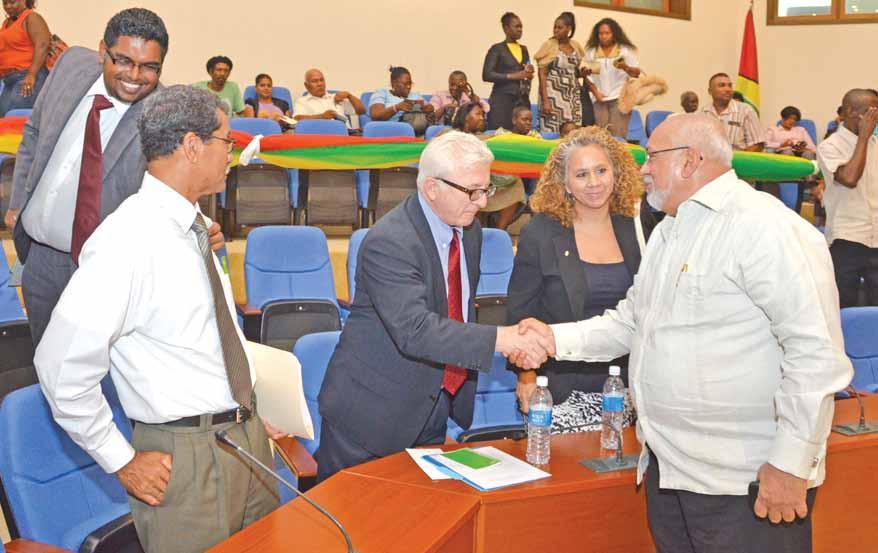
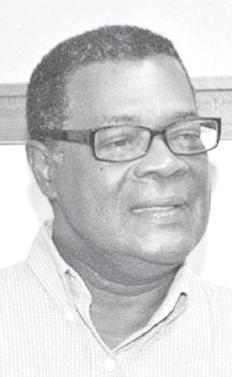
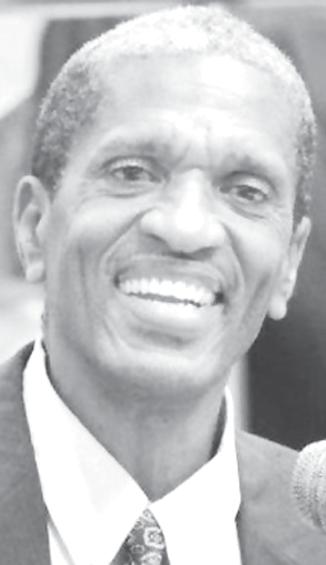
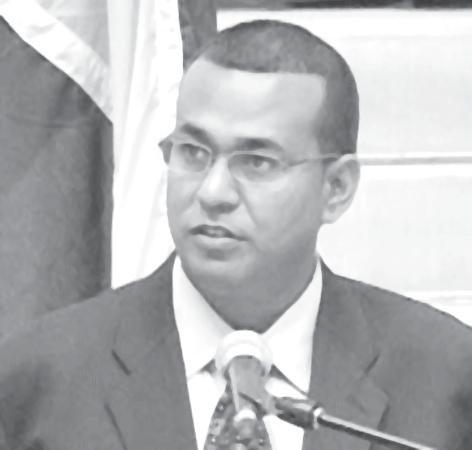
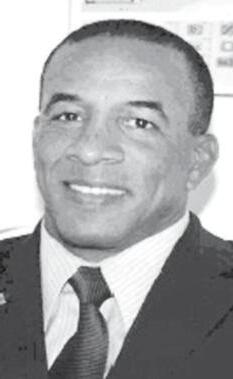
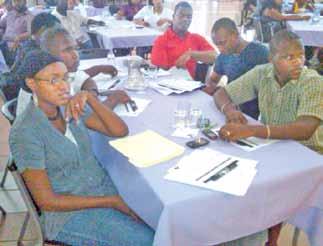
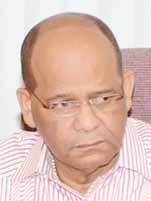
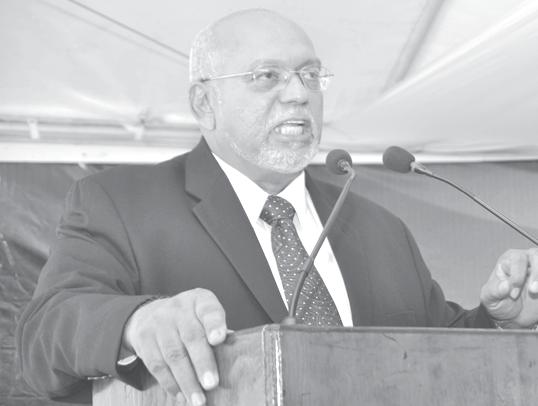
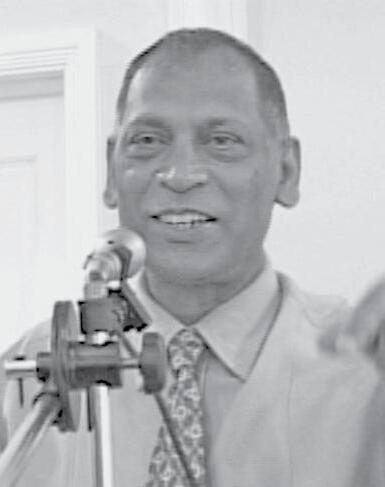
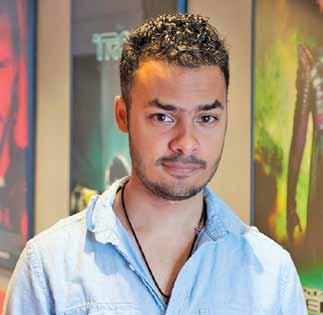
President donald ramotar greets idb chief of division, capital Markets and Finance, Juan Antonio ketterer at the launch of the Micro and Small enterprise (MSe) project. Also in photo are idb representative in guyana Sophie Makonnen, gbti ceo John tracey and acting tourism Minister irfaan Ali (Carl Croker photo)
Guyana to benefit from Bosai 50MW power plant in Linden
Bosai Minerals Group Guyana Inc (BMGGI) has proposed to build a 50-megawatt power plant in Linden – an initiative community leaders have welcomed, although they expressed concern about only being made aware of the plan during a recent visit to China.
Region 10 Chairman Sharma Solomon and Linden Mayor and Town Council Interim Management Committee (IMC) Chairman Orrin Gordon said they were optimistic about future investments in the community by China, after concluding the visit to that country.
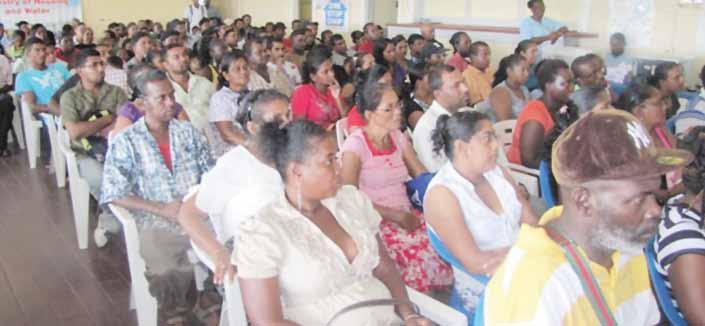
The disclosure was made at a meeting with stakeholders on Monday at the Egbert Benjamin Centre in Linden. The meeting sought to update stakeholders from various institutions in the community on the outcome of the trip and possible areas of investments by China.
Early last year, Bosai announced a US$100 million expansion project, but there was no
mention of a power plant. Natural Resources and Environment Minister Robert Persaud had told a news conference that the company will soon be undergoing massive expansion, which will result in hundreds of jobs being created.
Dissatisfaction
In his address, Gordon noted that an invitation was extended to both parties by the government of China for the visit; however, matters to be discussed were not highlighted. He noted that an itinerary was then prepared by himself and Solomon before their arrival, outlining matters to be discussed as it relates to future developments in Region 10.
In expressing dissatisfaction that the Regional Democratic Council (RDC) and the Linden town council were unaware that the power plant investment was in the pipeline, Gordon said: “It’s important for stakeholders to be updated on these matters… we were so disappointed that we had to go to China to
learn about this.”
The IMC chairman said: “The trip was extremely rewarding, as we did state clearly what the purpose of the visit was, that we wanted them to understand that we wanted to have investment opportunities, but, at the same time, we need to have mutual respect, understanding of each other’s culture, to ensure that at the end of the day, our laws are being followed and at the end of the day, we have benefits for our community.
“We cannot have so much of our resources
being taken up and then at the end of the day, we are worse off…and we need to work with our national government in ensuring that.”
Gordon advised that a percentage of future investments should be given back to every aspect of the community, including health and education. He said once positive goals are set, in partnership with China , the Region 10 community, utilising the various stakeholder groups, can achieve much development.
“We can’t get there by giant steps, we will
get there by taking small steps…”
Assurance
In his address, Solomon said that the Chinese indicated that once they are given the assurance to proceed with the power project, a feasibility study would then be completed within three months and the plant can be up and running within two months of completing the study. He noted that it was important for businesspeople, as well as farmers within the community to be properly educated to welcome these new initiatives. He asked
for the involvement and participation of stakeholders, including the government and opposition, in adopting new perspectives, while calling for the support of the legal system, as well as specialists in ensuring that labour policies are followed.
Solomon further noted that the assistance of the Chinese government was sought for certain community developmental projects such as the beautification programme and the community research centre project.
Chinese investment in the local economy has drawn fire from two quarters. Some in the local merchant community have complained of being undersold by cheap, substandard goods imported by Chinese businessmen, while at the national level, the opposition parties have protested Chinese loans to the government for several potentially game-changing mega projects.
Richard Bernal, a former Jamaican ambassador to the United States and permanent representative to the Organisation of American States (OAS), believes that the Chinese presence in the Caribbean is a positive development, but it needs a regional approach if the arrangements are to redound to the full benefit of the individual territories.
Bernal points out the inexorable rise of the Chinese economy that is poised to eclipse the U.S.’s as the largest in the world and notes as follows:
“With its economic ascent, China has amassed considerable reserves from increases in exports, substantial inflows of capital, and a carefully managed exchange rate regime. China reserves fuel more than US$74 billion of Foreign Direct Investment (FDI) in emerging markets, including about US$15 billion (or nine percent of total FDI) in Latin America and the Caribbean. Investment abroad is expected to increase in the coming years as China expands its economic presence.”
While initially, China’s investment was driven by “chequebook diplomacy”, as it sought to woo the Caribbean islands’ votes in the United Nations (UN) General Assembly, of recent, the investments have shifted in line with China’s newfound economic and political confidence.
FDI increased by more than 500 percent in relative terms between 2003 and 2011, with the estimated stock of Chinese FDI in the region totalling almost US$500 million in 2011. Chinese companies have initiated ventures in more than a dozen Caribbean countries. Cuba, Guyana, Suriname, and Jamaica stand out as the most important destinations for investment.
China’s agenda in the Caribbean now more closely approximates its interests in Latin America and Africa; however, Chinese firms are increasingly active in natural resources and infrastructure sectors, and are seeking avenues to employ Chinese equipment and construction teams.
With China’s expanding population and rapid economic development come a growing demand for energy and food. As they have elsewhere in the western hemisphere, Chinese companies have shown escalating interest in the Caribbean’s natural resources and agricultural sectors.
Large-scale overseas construction projects are of considerable interest to both state-owned and private Chinese firms, which seek opportunities to employ their under-utilised service teams. The use of Chinese construction firms is often stipulated as a condition of financing. The US$3 billion Baha Mar project in The Bahamas alone, for instance, has employed some 5000 Chinese construction workers.
However, as Bernal points out, the Caribbean faces competition for Chinese investment, most notably from neighbouring Latin America. Higher wages, modest resource endowments, and smaller markets relative to Latin America make the Caribbean less attractive as a destination for Chinese capital.
As Chinese investors look for new opportunities, Caribbean governments will need to advance beyond traditional trade and investment to offer prospects in areas such as entertainment, sports training, and real estate. China is also a key market for high-end Caribbean products, among them Jamaica Blue Mountain Coffee and Mount Gay, El Dorado, Appleton, and Angostura rums.
The region is also attractive as a production platform for manufactured exports to the United States, Canada, and the European Union (EU). Preferential trade arrangements like the Caribbean Basin Economic Recovery Act; the Caribbean-Canada Trade Agreement (CARIBCAN); and the CARIFORUM-EU Economic Partnership Agreement, etc, have generated some interest among Chinese investors.
To attract more Chinese investment, Caribbean governments must establish themselves as attractive and diversified partners. Doing this requires an increased diplomatic presence in China and a higher profile in that country’s major business centres.
Governments must also manage high levels of public debt – more than 80 percent of gross domestic product (GDP) in some cases –and oversee ongoing natural resources extraction and construction operations in a way that attracts foreign investment, benefits local development, and encourages strategic business alliances and joint ventures.
Guyana committing lands to help fight hunger
Guyana has joined in the worldwide quest to eradicate hunger, with the commitment of land for the production of food, and has called on other countries to do the same.
During his address at an event to mark World Food Day on Tuesday, Agriculture Minister Dr Leslie Ramsammy noted that with increased food production, one must face the challenge of employing biofuels to counteract the effects and depletion of fossil fuels.
Biofuels are used as an alternative to fossil fuels, to cut down on carbon dioxide emissions emanated from the latter. As such, governments and manufacturers around the world are seriously pursuing alternative energy sources.
“If agriculture will now be saddled with the responsibility of producing biofuel, then we must ensure that land for biofuel is not attained by sacrificing land for agriculture,” the minister said.
Ramsammy said Guyana, as much as many other countries around the world, has the ability to produce more food. However, there was need for better arrangements to be implemented to provide access to food, noting that if the correct systems were in place, then no one would be hungry.
Undernutrition
The minister added that despite the provision of food, there is still the challenge of undernutrition that is experienced by both the poor and wealthy. As such, he noted that persons need to pay keen attention to their calorie intake.
Delivering Food and Agriculture Organisation (FAO) Director General’s message on World Food Day, Country Representative Dr Lystra Fletcher-Paul said the event’s theme “Sustainable food systems for food security and nutrition” presents an invitation for all to consider the progress of the food sys-
tem, with a view of highlighting inventions to improve it.
“From a rather narrow demand and supply perspective, we can claim that since 1945 the food system has worked remarkably well. The world’s population has tripled in this period and average food availability per person has risen by 40 percent,” Dr FletcherPaul said.
Extraordinary achievement
This is seen as an extraordinary achievement and proof of the effectiveness of the market in providing an adequate supply response to the growth and demand of a rising and richer global population.
According to the FAO director general, “the biggest failure is that in spite of the plentiful food supply, the health of more than half of the world’s seven billion pop-
ulation is affected by under or over food consumption”.
It also noted that 840 million humans face daily food shortages, preventing them from working and causing stunted growth and premature death.
The health of another two billion of the world’s population is said to be compromised too by nutrient deficiencies, while some 1.5 billion are obese, thus exposing themselves to the risk of diseases.
As such, Fletcher said, “The market alone does not translate food availability into better nutrition and health productivity”.
National Agricultural Research and Extension Institute (NAREI) Chief Executive Officer Dr Oudho Homenauth highlighted cassava as the commodity Guyana will be placing emphasis on to produce as a staple food.
He said Guyana imports approximately Gy$1 billion in corn, which is a major ingredient in poultry feed.
“A feasibility study that we would’ve done here on the use of cassava as an ingredient in poultry feed… revealed that up to 15 percent cassava flour could be included as an ingredient feed as a substitute for rice or corn,” he disclosed.
Fao country representative dr lystra Fletcher-Paul
“Sustainable food systems for food security and nutrition” is the theme for world Food day
President donald ramotar interacts with passengers on the mV Sabanto on his way back to georgetown after speaking at a PPP/C rally in Essequibo on Saturday. This was the president’s first trip with the roll-on/roll-off ferry. (GINA photo)
Scam of The
millennium
GSL directors Mohan “Glenn” Lall, Tony Yassin skim off Gy$602M
–– NIS, 1561 shareholders get nothing –– owe 354 million in taxes
When Guyana
Stores Limited
(GSL) was privatised in 2000, Mohan Lall, also known as Glenn Lall, and Tony Yassin of Royal Investments Inc (RII), acquired 70 percent, the National Insurance Scheme (NIS) had 10 percent, and employees and other small shareholders collectively owned the remaining 20 percent of the company.
For the next decade, the company refused to hold annual general meetings, did not issue annual reports and simply declared every year that, since they did not make any profits, no dividend could be declared.
As such, the NIS, the employees and other small shareholders received not a penny. Yet it is now revealed, when GSL annual reports up to 2009 were recently compiled and hastily submitted, that during that time the directors, including Glenn Lall and Tony Yassin, skimmed off an astounding $602.9 million in “interest, con-
sultancy fees, allowances and accommodation”.
The NIS, it was revealed in the press ––and trumpeted in the Kaieteur News –– is in danger of not having funds to meet its obligations to its subscribers who are overwhelmingly the poor and retired employees.
These subscribers, most of whom would be employees of the state, such as public servants, teachers and police officers, as well as of employees of the Guyana Sugar Corporation (GuySuCo),
would have had to work and contribute at least 15 years to qualify for payments that are now in jeopardy because of the scam of Glenn Lall, Tony Yassin and company.
Quandary
Of the 1561 small GSL shareholders, about half are employees who had spent their hard earned salaries to purchase shares. Because GSL was in breach of the Companies Act through the dereliction of duty by Glenn Lall and Yassin; the small stockholders could not even sell off their shares.
They were stuck with pieces of worthless paper instead of receiving a steady stream of dividends to tide them through their retirement. Many might have already died as paupers.
The GSL annual reports, however, disclosed that Glenn Lall, Tony Yassin and other directors spent Gy$126.507 million on allowances and accommodation
owner of the majority shares in royal investment inc, tony yassin
Govt rejects miners’ tax break proposal on imported fuel
The proposed five percent excise tax on imported fuel put forward by the Guyana Gold and Diamond Miners Association (GGDMA) was overturned by government, according to the body’s president, Patrick Harding.
In August, GGDMA met with President Donald Ramotar, Finance Minister Dr Ashni Singh and Natural Resources and Environment Minister Robert Persaud, and requested several concessions, including the tax break on fuel imported from legitimate Caribbean companies.
Fuel accounts for 25-30 percent of miners’ production costs, at a time when gold prices continue to fluctuate, coupled with high prices for fuel, lubricants, spares, and replacement parts.
Harding said despite detailed explanations justifying the need for the five percent excise tax, the proposal was rejected. The GGDMA and the Natural Resources and Environment Ministry have now re-
turned to the drawing board in the hope of developing an alternative solution to the fuel problem facing the mining industry.
Additionally, the proposal for miners to be given the opportunity to sell up to 50 percent of the gold sold to the Guyana Gold Board (GGB) for foreign currency was rejected in part.
Harding told Guyana Times International that while the proposal has not been accepted in its entirety, an alternative is being sought.
In November 2011, GGB informed miners
that foreign exchange was not available, but subsequent to the notice, miners were allowed up to 100 percent of their gold in foreign exchange.
“GGDMA is urgently requesting that foreign exchange be made available to assist the small and medium scale miners, during this crisis of falling gold prices, for them to import muchneeded spares and machinery,” the association had said in its plea to the government.
The proposal for the government to assent to tax waivers on the importation of 4×4, 4-door open-back pickups, which are considered luxury vehicles thereby attracting heavy import duties, has been referred to the Finance Ministry and Guyana Revenue Authority.
But while the GGDMA waits for the Natural Resources and Environment Ministry to arrest many of the problems facing the industry; it has met with the newly-appointed Police Commissioner Leroy Brumell.
Firearm licences
The GGDMA pres-
ident explained that Police Commissioner Brumell has agreed to accelerate the process of approving firearm licences, permits, and approval for miners to establish their private security services. Brumell reportedly advised GGDMA members to form themselves into sub-groups to hire security services, noting that firearm licences will most likely be granted to security firms rather than individuals.
Over the past 31 years, the GGDMA has aided in the transformation of the gold industry, which has grown from a declared production of 10,000 ounces to a record 438,645 ounces in 2012. A declaration of more than 460,000 ounces of gold is expected this year, and, according to Harding, miners are well on their way to surpassing this target. If the target is achieved, it will be the highest annual declared gold production in the country, surpassing that of Omai gold mine and local miners combined declaration of 456,000 ounces of gold in 2001.
Caricom appoints new assistant secretary general
The Caribbean Community (CARICOM)
Secretariat now has a new assistant secretary general in charge of human and social development. The new appointee is former St Vincent and the Grenadines Foreign Affairs, Trade and Consumer Affairs Minister Dr Douglas Wilbert Slater.
Dr Slater said he has chosen this new career path because he likes public service and wants to be of benefit to the wider Caribbean.
According to him, he comes in as a “constituent of CARICOM,” which allows him to be more cognisant of the difficulties being faced by member states. He said he was also very aware of the challenges of the secretariat, including the lack of resources, but noted that efficiency and conservation will play a large role in addressing those issues.
The new assistant secretary general stat-
ed that with the secretariat now deliberating on its work plan for the next year, he is “intent to listen, read, engage and discuss with staff and the secretary general” areas that will be prioritised under his portfolio.
The consultations now being conducted across member states would also assist in guiding this process, he said.
Small miners will not be affected by mercury ban
The phasing out and eventual banning of mercury, which is expected to take effect in 2022, will not have a severe impact on small miners and their operations. This is according to Natural Resources and Environment Minister Robert Persaud.
The government, through the Natural Resources Ministry, recently signed onto the Minamata Convention on mercury, a new international pact to control mercury emissions and gradually phase out its use.
Prior to the signing, local small miners had been nervous about plans to ban the dangerous chemical, stating that there is no immediate and cheaper way to recover gold from its ore.
However, government has actively been encouraging miners to reduce their use of mercury, which poses longterm health and environmental risks. Speaking to media operatives on Tuesday, Persaud said the phase-out will not have a harsh impact, since “this is not an im-
natural resources and environment minister robert Persaud
mediate ban… but rather what the convention requires the country to do is to develop a national action plan to reduce its use and to ensure its safe handling and eventually the phasing out of it in the sector”.
Furthermore, he posited that the government did not see the ban having any impact on the mining sector, highlighting that it can only lead to positive benefits for the economy.
Transitioning
Persaud said the min-
istry has started a programme of transitioning, pointing out that several mining operations have transitioned to mercuryfree mining.
“Those establishments and mining operations in Guyana who have transitioned are reporting recovery in the vicinity of 96 percent to 97 percent… this means for every ounce of gold extracted with the use of mercury, two ounces are left in the ground because of inefficiency.”
continued
ggdma President Patrick Harding
new caricom
assistant Secretary general dr douglas wilbert Slater
GSL directors Mohan “Glenn” Lall...
alone. In light of the inability of the company to ever turn a profit, it is pertinent to ask of what use was the advice the $303.399 million paid as “consultancy fees” to the directors?
But the scam does not end with those payments. As the owner of the majority of shares in RII, Tony Yassin had promised to “inject equity” into GSL at the time of privatisation. But the reports show that he actually classified his “injection” as a “loan” for which he has been charging 19.5 percent interest.
On the other hand, the millions of dollars that the government loaned, have not only not been repaid, but they deny that any interest should be charged.
Looking at the figures from another angle, the financial statements of GSL shows that, in 1999, the NIS’s 10 percent was worth some Gy$32 million and the small stockholders Gy$64 million. In the following decade, through misappropriation, mismanagement and other financial skullduggery, the company moved from owning assets Gy$316 million to
from page 5
owing Gy$847million in liabilities.
Losses
This means that the book value of NIS’s 10 percent equity stake is now a negative Gy$85 million, and other shareholders, a negative Gy$170 million.
In other words, if the GSL were to be liquidated today, and that is a foregone conclusion, given the Guyana Revenue Authority (GRA) has taken them to court and won its case for Gy$354 million in unpaid taxes, then the NIS will completely lose its 10 percent investment in GSL and the small shareholders, including past employees, their 20 percent.
In the U.S. citizens have seen and wondered at the greed and avarice of financial scammers such as Bernie Madoff, who bilked individuals of their hard earned money. He and some others were jailed for their scams.
In Guyana, several members of the business community have said that the laws have to be modified so that such individuals on the local scene can be brought to justice and jailed.
Avon moving to provide free breast cancer screening
The Avon Community Help Fund (ACHF) is offering free mammograms to women during this month; the foundation is also moving to provide this service free of cost throughout the year to aid in the early detection of breast cancer.
This is because mammograms are usually costly, and ACHF wants to bear the expenses for persons who may be suffering from the disease and cannot afford to have the screening done.
ACHF Chairman Mignon Bowen made these comments at a simple presentation ceremony on Monday when Digicel Guyana presented a cheque to the fund in light of October being Breast Cancer Awareness Month.
“We want to extend our mammogram testing for patients free of cost throughout the year and not only during October, and it’s much more costly during the year,” she said.
Bowen recognised Digicel for its valuable and important partnership, since its breast cancer awareness programme in Guyana start-
ed eight years ago. The institute’s October activities highlight awareness as the key word in disseminating information to women across Guyana.
She thanked Digicel for the financial assistance offered to the institute and to the Guyana Cancer Society.
As part of the Avon Breast Cancer Crusade, the Avon Foundation for Women provides funding to breast cancer programmes operating in three areas, which are scientific research, safety-net-access-to-care programmes for the medically underserved, and
outreach programmes focused on education and screening.
The Avon Foundation has been improving and saving women’s lives, since it was founded in 1955. The foundation said it was proud to be the largest corporate philanthropy dedicated to women’s causes globally.
Through 2012, Avon’s global philanthropy has raised and donated more than US$910 million awards to breast cancer programmes around the world, supporting cutting-edge research to find a cure or prevent breast cancer, as well as pro-
grammes that enable patients to access quality care.
The Avon Foundation has grown into the largest corporate-affiliated foundation focused on causes that mostly impact women.
The breast cancer crusade was launched in 1992 in the UK, and now includes breast cancer programmes in more than 50 countries focused on advancing access to care and finding a cure.
The Avon Breast Cancer Crusade has made a significant and lasting difference in this area.
digicel Sales and distribution manager nalini Vieira presents acHF chairman mignon bowen with a cheque of an undisclosed sum to aid with breast cancer awareness activities (Avenash Ramzan photo)
SWAT team to be up by August 2014
Guyana’s Special Weapons and Tactics (SWAT) unit will be in full operation by August of next year, U.S.-based security and justice reform consultancy firm The Emergence Group (TEG) Director, Ambassador Dennis Hays said.
He was at the time addressing media operatives at the signing ceremony for finalisation of the SWAT contract between the TEG high-level team and the Home Affairs Ministry in the ministry’s boardroom on Monday evening.
“At the end of the year, we should have started the training ceremony and by next summer, Guyana will have a fully functioning SWAT team… we have had many good and serious back-and-forth discussions on setting up the team,” he said. The TEG has already identified individuals who will be coming to Guyana in the near future to have a firsthand look and assessment of existing capabilities, skills and equipment, after which they will develop a country-specific programme. The plan will include training and mentoring exercises aimed at enhancing the Guyana Police Force (GPF).
The objective is to create additional crimefighting strategies to
deal with serious crimes in the country that are seemingly bigger than the GPF.
Training programme
Ambassador Hays said the training programmes will begin by December and early in 2014, the TEG will be moving to commence mentoring and training of officers, which will run until August.
“At the minister’s request, we are looking to provide training and experience as quickly as possible, and we have done that by cutting back on our side of our prep time… you will see us in the few weeks; we’ll be back to do assessment work,” Hays said.
“He will know that he has officers who have training, temperament and expertise to apply critical judgment in a difficult situation to en-
sure that there is a resolution that is obtained at the lowest possible level of violence.”
The TEG director stated that this is an area in which the group has a great deal of expertise. TEG has worked in more difficult, highcrime environments including places like Afghanistan.
“We are good at setting up teams to engage and to support the public while providing additional security… when this came through from the Guyana government, we were serious about putting together the best possible team,” Hays added.
Misconceptions
The director said there were many misconceptions about the SWAT team, but officers are specially trained to work together to minimise violence and public unrest.
“There are misconceptions out there about SWAT teams, like how they break down doors etc… and certainly, there is a capability to do so if required to do that, but the team is trained to work together,” Hays stressed.
The SWAT team will also be tackling small pockets of crime in Guyana.
“Most people think the SWAT team is what they see on TV: the reali-
ty is that there are many forces getting away from the word SWAT, that’s sort of first generation,” he said.
As the SWAT initiative develops and the trained officers gain additional experience, a whole range of issues can be dealt with by a dedicated team.
Best practice
During the signing ceremony, Home Affairs Minister Clement Rohee said Guyana is moving to set up a SWAT in keeping with global standards. He said persons should not be judgmental of its effectiveness just yet, and should give the team a chance to function and deliver services.
“This SWAT team initiative has been long in the making, as you know there is a saying better late than never,” Rohee said.
He said the government and the TEG have had very useful discussions, adding that government will be tackling the crime situation from all angles.
“There’s always room for improvement and if the SWAT team will be able to facilitate additional improvements in the country to fight crime and deal with serious matters, which requires a SWAT team, then I think it behoves to so do.”
Local govt youth programme progressing smoothly
The US$150,000 Youth Empowerment
Inclusion and Reconciliation Programme (YEIRP) is progressing smoothly, Local Government Ministry Permanent Secretary Collin Croal reported last Friday.
From Monday, 17 of the 30 youths from Regions Two to Six and 10 commenced their three-month work attachment at various entities within their respective regions. Croal explained that the remaining 13 youth leaders are already employed, so there was no need for a work attachment.
He told media operatives that the selected youths have been trained in keeping with the objectives of the programme, which seeks to address the challenges of inadequate youth participation in governance and social changes that deprive them their rights.
A solid foundation
By Anu Dev
“A man without ethics is a wild beast loosed upon this world.” – Albert Camus
I’ve been in school for the past 15 years of my life and having been in school for so long, I have a fair idea of what different types of teachers could be like. Some go about their jobs like they truly love what they’re doing, others seem to go through the day like teaching is an obligation.
But no matter what their teaching attitudes or stance, we learn a lot from our teachers. Teachers teach more than just science and math and all the other “subjects” – they teach ethics as well. In addition to the weekly one hour of “Pastoral Care”, they do this generally through the most powerful medium – not through words but by their actions.
Their behaviour impacts their students strongly. And of course, it’s always best to lead by example, so we’re most likely to do as our teachers do, rather than as they say.
Quite a bit of my personal values and sense of ethics is a product of the influence of my school teachers. Of course, the major chunk consists of values directly instilled into me by my parents, but on some level, we’ve all been influenced by our teachers.
Another aspect of the YEIRP initiative is the establishment of information technology communication (ITC) hubs within the six regions.
“These hubs are intended to be placed with a computer and internet access,” he explained. Already, locations for the six ITC hubs have been identified and the computer systems are being procured.
CARILED
The youth employment programme, which is slated to be completed by March 2014, is being executed in collaboration with the United Nations Development Programme.
Turning his attention to another programme executed under the supervision of the Local Government and Regional Development Ministry, the permanent secretary told reporters on Friday that the Caribbean Local Economic Development Project (CARILED) is
Subsequent to the completion of the internship programme, each of the selected regions will be allotted Gy$1 million for the execution of community projects by the selected representatives.
back on track.
Acknowledging that the project had encountered some serious hiccups during the early stages of its implementation, Croal said Guyanese will soon benefit from this initiative, as the issues have been ironed out.
The process of recruiting local economic development officers (LEDOs) has ended, and project documents are presently being designed, he revealed.
CARILED is currently under the stewardship
of the new director; Alix Yule, following the resignation of Dr Naresh Singh who stepped down after allegations of unethical conduct while heading the programme.
The national coordinator is now Dhanraj Singh, who took over following the resignation of Parmanand Chandernauth.
CARILED is a sixyear, Cdn$23.2 million programme funded by CIDA. It was formulated with the aim of stimulating sustainable local economic development (LED) through the strengthening of competencies and capacities in local agencies of central government in a number of Caribbean Commonwealth countries.
It is estimated that the project will help approximately 50 local governments/agencies to implement or facilitate LED initiatives, with up to 500 micro, small and medium-sized enterprises (MSMEs) in seven countries. Guyana signed unto the programme in August, 2012.
My current value system is a melange of what I’ve been taught at home and whatever modifications my experiences have forced me to make – with me spending a third of my time every day in school.
And I realised how damaging it could’ve been if I had teachers whose values and ethics standards were not that solid. What if I had teachers that throw things and scream at their students, calling them names, belittling them? If a student didn’t have a strong personal value system or positive role models, they could easily accept that sort of behaviour as being okay, or acceptable. And they might carry over that type of behaviour into adulthood in their professions and personal lives.
Our teachers as a consequence have great power; they have the most interaction with us, especially during our young, impressionable years, when we’re still forming our opinions of the things around us and deciding how we want to fit into society.
More emphasis should probably be placed, when training teachers, about their role in moulding the values of their students.
Values like the importance of confidentiality and the importance of privacy could be emphasised by the teachers so that when the students leave the school system, they’ll be able to function like adults that are capable of respecting the persons they interact with.
Others like the importance of accountability, punctuality should all be established as being important from a young age. Teachers that violate these tenets in their classes do damage beyond the details of the “subject” not being covered.
Our teachers can hold great sway over how we might turn out at the end of our tenure at school; they could be the difference between whether we become successful professionals, or whether we go about our jobs in a very unprofessional manner.
We need a solid foundation in professionalism, and our teachers can give us that, hopefully by their actions and not just their words.
collin croal
ambassador dennis Hays
Guyana is a land throbbing with positive energy
Dear Editor, The “I Believe Campaign” seeks to reach out to every Guyanese beyond political, ethnic and religious barriers. Despite the crime, at every level, Guyana is a very peaceful country.
There is a rich mix of people in every area –schools, teams, markets and businesses. We get along really well.
I went to quite a few of the Caribbean Premier League (CPL) games and what I saw was very revealing – everybody manifested a spirit of congeniality.
I sat next to a Digicel employee who is from a different ethnic background and we enjoyed the game, totally oblivious of our differences in skin tone.
In fact, this gentleman and I have different tastes in fad and clothing, but again, these are superficial things. This is the kind of educating, informing and communicating we need in Guyana.
Related to this is the fact that if we can enjoy a game of cricket together, then we can labour together to build Guyana.
I was following the recent senseless school protest in Georgetown – students were affected and not a race or a religious group. These students came from all kinds of backgrounds.
However, some people took this to stretch themselves politically, and even engendered some of the actions. The good Guyanese people must rally against this. We must not allow the pessimistic and the opportunistic ones to take away the good from our country.
Yours sincerely,
Zameer Hassan
The National Youth Parliament needs more input
Dear Editor,
The 13th Sitting of the National Youth Parliament (NYP) is here and I am anticipating another round of wonderful debates. Last year was good but this year must go further and higher.
The ultimate expectation is going to take place Wednesday, November 6 at the Guyana International Conference Centre (GICC). The build-up is going to be very interesting and I personally am looking forward to all of the preliminaries.
Every Saturday, lead-
ing up to that date, will be used for a number of participatory events, particularly some vital training workshops. Many of our present parliamentarians and even a minister or two came through the NYP. It is a good breeding ground, irrespective of political affiliations and persuasions.
The NYP gets its major funding from donations of the business community and project partners, including the Culture, Youth and Sport Ministry and the National Democratic Institute for
International Affairs. Is this enough? I hate the idea that every now and again, NYP has to go about soliciting financial help – enough should be budgeted for the group. If we are serious about our youths, then we must cater for their political development as well.
Since the NYP is all about enabling Guyana’s youths to develop argumentative and reasoning skills, while learning tolerance and patience, then it must be invested in and it must be as broad-based as possible.
Regards, Corrine
DeFreitas
Education emphasis must continue
Dear Editor,
The Stabroek Rotary Club’s literacy programme for the new school year is now truly on – it was launched with the Bagotsville Community Library when the club held its annual Education Fun Day recently. Now that September has come and gone, the challenge is to keep the spir it all year through. On the day, a lot of children were taking part in fun and educational games, all geared towards helping them to gain a better appreciation for spelling and reading.
a language where this is not so. We have just 26 letters, but so many different sounds. Just take the five English vowels and try forming sounds from each one.
Guyana has come a very long way
Dear Editor, Prime Minister Samuel Hinds recently reminded residents of what he described as a bad period of shortages, low wages, poor electricity supply and high inflation which prevailed during the late 1970s up to the early 1990s. These were the conditions that the current government met when it gained power.
Guyana is still undergoing repair. The damage that was done for almost three decades has left some bad cultural traits. One thing that I still hate is this bad approach to work. I recall one day sometime in the 1980s, I went to the Guyana People’s Militia (GPM) on an arranged recruitment possibility and no one came to meet me. One gentleman told me to sit and wait and he never came back. Being young and scared I stayed for the entire day, wasting some seven hours.
Another incident
took place at one of those many outlets that formed part of the Guyana Marketing Corporation (GMC). The place was quite lifeless and the person who was supposed to be in charge just locked up and went off. I asked one person there as regards the waiting factor, and up to what time I should wait. I was told that it was not certain if this person would come back. I think we have significantly improved in this area of work ethics.
Recently, I had to go to the Guyana Post Office Corporation (GPOC) and I arrived just after seven in the morning. To my pleasant surprise, work was full in operation. It was also the same at the Housing Ministry when I turned up just a bit after the starting time.
I have complained against the Guyana Power and Light (GPL), but I would be untruthful to say that it was better in the by-gone days.
I recall wanting to go to the cinema, but the blackout thing used to deter me. The stretches used to be like for eight to 12 hours too. People seldom bought plenty of fish and meat for storage and I still meet a few of my friends who had their meat business totally wrecked. The night before I wrote one of my General Certificate of Education Ordinary Level (GCE ‘O’ Level) subjects, we had an all night power cut. So in that regard alone, we have come a long way. Do I need to go on to the massive food crises back then? Talk about no flour, split peas and tin stuff and I still shudder. How about slaving at Hope for a pint of oil and a few cigarettes, even though some did not smoke? That ancient régime I hope is totally dead and buried. Another term from it and Guyana too would be buried.
Kind regards, Reginald Hamilton
lessons and communicate their doctrines.
The club in fact believes in this dual mode of learning, where “read and play” projects are indulged in. The idea is that spelling, reading and writing can all be by-products of fun and play. I believe that too, but of course only at the foundational lev-
English language, like all other languages, has spelling quirks. A lot of people like to say that English spelling is hard, but I say show me
I was told that the and other word games really got some children going and this kind of thing can be a part of normal activities. Churches, mosques and mandirs can go this way, even as the leaders teach their
Learning via the traditional school method must not be misrepresented. At a certain stage, the fun and frolic will have to go, and serious discipline will have to take their place. In the meantime, we can do some good work and also have our fun.
Regards, Irvin
Pyle
Guyana has greatest potential in agricultural production in American hemisphere – IICA director general
Inter-American Institute for Cooperation in Agriculture (IICA)
Director General Dr Victor Villalobos said Guyana is one of two countries in the American hemisphere with the greatest potential in agricultural production.
He made the remarks during a recent lecture titled “Emerging issues in agriculture” at the University of Guyana.
Dr Villalobos, a Mexican national with a doctorate from the University of Alberta, Canada, explained that agriculture, at this moment of human history, is experiencing a transition towards a new paradigm.
He indicated that population growth and higher standards of living are creating a greater demand for food, but warned that mankind cannot continue to produce agricultural goods at the high environmental cost of the past.
Referring to the green revolution which took place in the second half of the 20th century, he recognised its importance but pointed out that it mainly
favoured the production of grains in flat and large fields with highly mechanised procedures and the production of fewer and selected varieties.
The new paradigm in agriculture has to overcome those limitations and include a social component that will translate in greater incentives to develop the countryside, ensure biodiversity and protect the environment.
Standards of living and quality of life in the countryside should be at least as high as those of the cities.
He said today, about one billion people suffer from hunger and the
world’s population will experience an increase of two billion more people in the next 40 years.
New challenges
Crop and livestock production face new challenges in the global scene that include not only recurrent economic and social crises, but also environment degradation and climate change.
“Therefore, we have to be able to become more efficient, more resilient, ensure sustainability and develop more inclusive forms of production,” he said.
Referring to the regions of the world, he pointed out that Europe
has practically reached its potential for food production under the present state of scientific and technological development. Asia and Africa have the possibility to increase their production but are experiencing high population growth and face various social, political, and economic difficulties that could take a generation to overcome.
“Latin America, therefore, is the only region with the capacity to respond immediately to the new demands. Five countries of the region are among the richest in biodiversity in the planet and therefore important in terms of food security.
"They are endowed with a rich genetic base that holds hidden treasures to discover. Our continent has 24 percent of the world’s forests, which are vital for ensuring the availability of fresh water. Not surprisingly, we hold 36 percent of the reservoirs of fresh water of the globe. And two countries of our region, Paraguay (particularly the Chaco region) and Guyana have abundant water resources and a considerable extension of land that has not been agriculturally developed.”
Rapid growth
Agricultural production has been growing faster than other sectors in the recent past, reaching more than 11 percent in some years, but needs to satisfy some important needs and overcome some serious problems. Dr Villalobos referred to some of those needs, such as developing greater knowledge and technology.
Unfortunately, he said, when “we experience economic crisis, budgets for research and education suffer cuts, which affects the development of our human resources. We need better markets to benefit from an increased production, and that includes means of transportation and fair access to world markets, which would translate in higher standards of living for all.”
Dr Villalobos said this is the best time for agriculture development in world history and this opportunity should not be lost. IICA is here to work at the regional level to help overcome the problems and foster development, he said, as he announced a joint Mexico/IICA scholarship programme that will yearly offer the opportunity for Guyanese students to take their knowledge and skills to a new level.
Walking disaster
Satiricus is nothing if not a patriotic Guyanese. His navel-string is buried here and to-help-me-God, he would do anything to help his native land. And so it was, with today (Sunday) being “International Day for Disaster Reduction”, his furrowed brow was testimony to the deep thought he was applying to the question of how to reduce disaster in Guyana.
He’d long realised that deep thinking didn’t come naturally to him and so, with discretion being the better part of valour, he retired to the back-street bar to discuss the matter with the boys.
“Guyana don’t have too many disasters like them Caribbean islands, you know,” pointed out Hari. “No volcanoes, no hurricanes, no earthquakes…”
“Hold it right deh!” exclaimed Suresh. “Like you sleep through the earthquake Friday night, or wha?”
“What earthquake?” snorted Hari. “Is the same thing I talking about…we don’t get disasters and we think a lil tremor is an earthquake!”
“Budday…two of me wife ware plates slip off she shelf and broke. Is a real disaster I got this morning.” Suresh did look harassed and he was putting away the beer quite faster than usual. “The woman crying she eye out and everything.”
“Well, me na know about alyou,” interrupted Cappo. “Dem islands got earthquake and so on…but we had de biggest disaster fuh ever hit de Caribbean –Burnham!”
“You, rite,” grinned his pal Bungi. “After Burnham done wid we, was worse than any hurricane!”
“But he dead now…,” pointed out Hari.
“Well you know what he said,” interjected Teacher Samad. “As soon as one Rasta dead another gon rise up to take his place.”
“An look who tek he place – Mook Lall!” Cappo rose from his chair. “Dat chap a wan mo big disaster fuh Guyana dan Burnham!”
“You got a point there,” said Teacher Samad. “Let us count the ways…backtracker?”
“Damn right!” agreed Kuldeep who had come in late. “His people beat me cousin black and blue when she lil late wid she payment.”
“He carry news pon he friends at de U.S. embassy,” added Cappo. “Dat is de lowest of de low. Mo low dan a snake belly!”
“The man stain Guyana name in he paper so much that people don’t want to come to Guyana to visit…much less live,” complained Hari.
“An now we hear he doan pay he tax to de city,” said Bungi. “Even doh he always complainin’ de city dirty.”
“Man, Mook Lall is a walking disaster. Maybe we should beg the U.S. embassy to give he back he visa, so he can move to New York,” said Satiricus. “They know how to deal with disasters.”
iica director general dr Victor Villalobos
Reducing food import bill critical to regional development
While there has been much talk surrounding the growing food importation bill of CARICOM, Guyana’s Agriculture Minister Dr Leslie Ramsammy said this issue could be addressed only if all members states work to exchange agricultural produce, rather than importing from outside the region.
Dr Ramsammy made this comment while delivering the feature address at the launch of the Caribbean Agricultural Extension Providers Network (CAEPNet) last week at the Guyana International Conference Centre, Liliendaal, Greater
Georgetown. Dr Ramsammy said Guyana alone has the capacity to produce enough rice to be sold to the entire region.
He noted that many countries within the region are heavy food importers, even though many of the foods imported are produced within the region. The minister believes that this issue could be addressed, creating positive growth and wealth for the region.
Import substitution is being examined in an effort to reduce the region’s food import bill. Information suggests that the region’s food import bill stands at some
US$4.5 billion.
Inter-American Institute for Cooperation on Agriculture (IICA) representative Ignatius Jean said efforts are being made to address the situation.
Jamaica, he said, is moving in this direction, as that country has recognised that agriculture can be an ATM for generating economic growth and reducing debt.
The country has begun to examine how it can substitute some of its imports.
“What they have done is assess their situation as to ascertain the foods they have been importing and to match that against what can
Govt says dry spell at Amaila Falls was predicted in study
Government said that the dry spell being experienced at Amaila Falls was predicted in a hydrology report released in August, while maintaining that the project will allow an annual net savings of approximately US$100 million.
The government was responding to a series of Kaieteur News reports. Recently, the newspaper published an aerial photograph showing a limited flow of water streaming from the Amaila Falls, the water source for the proposed Amaila Falls Hydro Power station.
However, government said in August 2013, it issued a press release and a 70-page expert hydrology report prepared by Halcrow, a UK-based internationally-recognised engineering consultancy group. The public is invited to refer to the report located at www.privatisation. gov.gy.
“That report clearly indicates that October is, in fact, one of the driest months of the year and as such, water flow will be limited. It also clearly indicated that the reservoir to be built as part of this project will be used to store water and protect against dry periods such as the one currently being experienced. The
reservoir will enable the station to provide a continued source of power,” the government said.
According to government, the estimated energy that will be supplied has been based on various expert firms, which used multiple sources for their analysis, including 40 years of flow data, and conclusively demonstrated that the project is entirely feasible and practical.
“The study clearly shows that the operation of a reservoir allows the supply of energy to be managed to effectively minimise the impact of the dry season water flows.”
Meanwhile, government said regardless of the impact of the dry season water flows, based on the hydrology report, the projected costs of the project and GPL’s generation costs, Amaila will allow an annual net savings of approximately US$100 million.
“At the end of the 20-year concession period, Guyana will own Amaila, a project that can last 75 to 100 years, free. Additionally, Amaila will allow Guyana to eliminate approximately 90 percent of its greenhouse gas emissions from electricity generation.
“Kaieteur News deliberately ignored
be produced in the country,” he stated.
Jean explained that the Jamaican government created a strategy towards developing about nine or 12 agroparks. The government is putting in infrastructure like roads, irrigation, drainage and technical support services and would lease the lands to some of the private sector companies to grow crops that will match the imports.
Further, the government’s local private sector companies are looking to cut the import bill of grains used to manufacture animal feed. Already, cassava is being looked at to be used as feed for livestock as well as sorghum. One compa-
ny, Caribbean Broilers, is looking at producing sorghum with an initial start of cultivating 100 acres, with the aim of increasing it to 700 acres.
But there remains one issue. Are countries willing to spend extra to grow more locally?
Jean said, “To position yourself if you have a worst case scenario and boats cannot come to the Caribbean, what do you do, it’s one thing to look at import substitution, but we will not be able to substitute some products, there are some products we will never be able to produce, but there are some things we can do.”
Among the issues being examined at the Caribbean Week of Agriculture is the region’s ability to network to make the best of food produced locally, the challenges of transportation in the region and other challenges being faced. iica
any reference to the August press release and Halcrow report that were covered in various papers, including their own. One can only conclude that the objective of Kaieteur News is to avoid presenting information in a fair, objective and balanced manner and prefer instead, to distort and misrepresent for their personal objectives,” the government said.
representative
ignatius Jean
an artist's impression of the amaila Falls hydropower dam
Venezuela releases seized seismic vessel
The Malaysian owners of the U.S.hired oil survey ship seized last week by Venezuela in Guyana’s waters said the boat and its 36-member crew have been released by the authorities in Caracas.
According to a Reuters news article, there was no confirmation of that from either the government of Venezuela or Guyana and the Venezuelan public prosecutor’s office put out a statement detailing the formal charging of the ship’s Ukrainian captain.
The Panama-flagged ‘Teknik Perdana’ was carrying out a seabed survey for Texas-based Anadarko in conjunction with Guyanese authorities, when Venezuela’s navy boarded it last Thursday and escorted it to Margarita Island.
Reviving a centuryold issue with Guyana, Venezuela accused the ship of violating its maritime territory. The government of Guyana retorted that the ship was well within its territory and the seizure was an act of aggression.
According to the Malaysian owner, SapuraKencana Petroleum, Venezuelan President Nicolas Maduro’s government had decided to free the vessel.
“We wish to express
our gratitude to the Venezuelan government for caring for the safety and welfare of the crew, which comprises multiple nationalities, during the time they were at Margarita Island and also for releasing the vessel,” the Kuala Lumpur-
based company said in a statement.
A planned meeting between foreign ministers of the two South American countries in Trinidad and Tobago –to discuss the saga of the ship and a centuryold border issue – was scheduled to be held on Thursday, Guyanese officials said.
Casting doubt on the version from Malaysia, the Venezuelan public prosecutor’s office said the ship’s Ukrainian captain Igor Bekirov had been charged at Margarita Island for failing to respect the boundaries of a security zone.
He was awaiting further court appearances, it said. Guyanese officials said the ship’s three dozen crew included citizens of eight countries: the United States, Russia, France, Indonesia, Brazil, Malaysia, Panama and Ukraine. Oil companies have been increasingly interested in the north-eastern shoulder of South America since a discovery off nearby French Guiana in 2011 that industry experts described as a game-changer for the region’s energy prospects.
Guyana awarded Anadarko Petroleum, a deep-water exploration licence in June last year for a block named Roraima.
Venezuela and Guyana have long argued about the status of the Essequibo region; an area on the border about the size of the U.S. state of Georgia, and over rights to the ocean resources that lie offshore.
SapuraKencana said its president and group CEO Tan Sri Shahril
Shamsuddin had met Venezuela’s ambassador to Malaysia to try and resolve the matter.
“At that meeting, the Venezuelan ambassador gave a firm assurance that the crew was safe and were being treated well by the authorities there,” it said, adding that Malaysia’s envoy in Venezuela had rushed to the island of Margarita to help mediate the situation.
An armed Venezuelan naval ship last Thursday evicted the U.S. oil explorer from Guyana’s waters, sparking condemnation from the Donald Ramotar administration and the main opposition coalition A Partnership For National Unity (APNU).
A Foreign Affairs Ministry statement had described the incident as “unprecedented in Guyana-Venezuela relations”. It insists that the seismic vessel, the RV Teknik Perdana, was in “Guyana’s waters when this regrettable incident took place”. The seismic vessel was contracted by Anadarko, one of world’s largest independent oil and natural gas exploration and production companies, based in the United States. Anadarko has a petroleum prospecting licence to search for hydrocarbons in the Roraima block offshore Guyana. According to the ministry’s statement, the Yekuma – an oceangoing offshore patrol boat that monitors the exclusive economic zone – trailed the seismic vessel before obstructing its path. Crew members were required to change their route and were directed to Margarita Island off Venezuela.
Small miners will not be affected...
He added that as part of the convention, there will be no new mercury mining, but countries that are already engaged in such will be given 20 years after the convention comes into practice to stop producing mercury.
“Over time, it will perhaps be scarce and then not be available globally, because the convention requires some level of restriction on its trading.”
Persaud, who signed the convention in Japan last week, was accompanied by the acting commissioner of the Guyana Geology and Mines Commission, Rickford Vieira. At the event, Persaud stated that government has also said
from page 6
Guyana would need financial and technical assistance to achieve compliance.
The Japan government has pledged its support to Guyana in the phasing-out of mercury use. It is planning to provide US$2 billion in financial assistance to fight mercury pollution. Between 2013 and 2022, Guyana will impose restrictions against mercury importation and mercury in mining. This approach has been supported by the Guyana Gold and Diamond Miners’ Association (GGDMA), while discussions were held with Amerindian and riverine communities.
the rV teknik Perdana was released on tuesday
Second round of consultation on youth policy held
The second consultation for the drafting of the National Youth Policy saw a positive response from youths when it was staged on Saturday at the Regency Suites Hotel, Hadfield Street, Georgetown.
Speaking at the consultation, United States for International Development (USAID) representative Glenn Bradbury told the youths that they are the soon-to-be leaders of Guyana, and it is their obligation to ensure a better future for everyone.
Bradbury charged the National Youth Council Steering Committee members to be committed and to understand the value of what they doing, adding that they are the voices of youth.
He also emphasised that young people must stay and work to develop their country, making reference to a recent newspaper article which stated that 80 percent of persons who graduate from the University of Guyana migrate. “That is not good enough,” he declared.
Meanwhile, former member of St Lucia’s National Youth Council Andrew Rhikkie Alexander pointed out to the steering
committee members that there will be challenges, but they must remain strong.
“I say you press on, move on with passionate intensity and with peaceful militant non-compliance.”
The National Youth Policy, which is currently being crafted to address existing and emerging youth development challenges, is likely to be completed by year-end. Consultation began in September and is expect to be completed sometime this month.
Policy consultant, Barbadian Derek Alleyne, is being assisted by the National Youth Steering Committee and the National Stakeholders’ Council. In September, Alleyne had told the media
he and his team needed at least 2500 questionnaires completed from at least 15 villages across Guyana to give them the necessary data to craft the policy.
After the data collection, he disclosed that a draft youth policy will be prepared and sent to individuals in the various communities, community leaders and focus groups for review, before it is sent to the Culture, Youth and Sport Ministry and the Commonwealth Youth Programme (CYP) for assessment. The team will then meet with Culture, Youth and Sport Minister Dr Frank Anthony and CYP members, and if they have no objections, the document will be accepted.
a section of the gathering at the consultation held at the Regency Suites Hotel, Hadfield Street, Georgetown
PPP/ C alarmed by culture of lawlessness
– to initiate national conversation to curb problem
The ruling People’s Progressive Party/ Civic (PPP/C) plans to launch a national conversation aimed at ironing out societal issues, with a keen focus on indiscipline. The party, on Monday, said this was necessary to curb the issue. The party said the conversation will seek to inspire all citizens to work towards eliminating indiscipline, which it believes is affecting Guyana’s social fabric.
Junior Finance Minister and PPP/C member Bishop Juan Edghill said there was need for a more active approach towards addressing the issue. Edghill said such an approach will need the support of all citizens from all communities countrywide.
“The PPP/C makes the call once again for all civic-minded Guyanese to play their part in ridding our communities from the culture of indiscipline affecting the social fabric of society,” he said.
Active involvement
The PPP/C member believes that there should be constant vigilance by all stakeholders of society.
The party, he said, is of the firm belief that the active involvement of the citizenry in the governance of their communities is integral in the
fight against indiscipline.
The party said there has been a general tendency to disregard laws, customs, and norms in some quarters. It is of the view that the general population has a crucial role to play in supporting and adhering to laws.
“The PPP recognise that the challenge will be monumental, especially when consideration is given to the fact that senior members of society are the guilty party in encouraging and being complicit in disregarding the laws of our nation,” he added.
According to the party, leaders from all sections of society, inclusive of the religious community, must not only use the opportunity to build upon this and come up with suggestions on how
Guyana can move forward, but they must also initiate campaigns, either at a school, in a community, in houses of worship and public areas, etc.
The party noted that it was an opportunity to break away from this culture of indiscipline.
Reckless
Alluding to the phenomenon of road rage, the PPP/C said: “Laws have been enacted that prohibit the use of cellphones when driving, the use of helmets by motorcyclists when riding, and the use of seatbelts by all those in the front seats of any vehicle.”
The party said it has also noted that some in the opposition afflicted by petty and vindictive habits would publicly encourage anarchy in society, while claiming they are committed to law and order in society.
“There is the unfortunate tendency where some individuals would resort to the schools as an area for political competition by either blocking our children from accessing classrooms or encouraging the students to disregard classes and participate in unlawful protest action.”
The PPP/C said the Parent-Teacher Associations (PTAs) must be encouraged to take a more proactive role.
Similarly, teachers who are accused of taking a lax approach in delivering on their mandate must be dealt with.
“We encourage the creation of student representative bodies within the schools, as our children must also be taken seriously and their concerns addressed as they have a major role to play as well, and it also helps to develop their leadership skills for the future.”
Against this background, the party said there must be greater partnerships forged within and outside of the education sector, in this case between the Education Ministry, the Guyana Teachers Union, teachers, PTAs and student representatives among others.
Similarly, in the health sector, the party said recipients of services must be empowered to be the watchdogs to ensure that quality and effectiveness services are delivered to the satisfaction of the public.
Govt spent over Gy$2B on police force since 2007 – Rohee
Home Affairs Minister Clement Rohee on Monday released a long list of expenditures of the Guyana Police Force aimed at confounding critics who have been saying that government was starving the agency of funds.
The list covers expenditures during the period 2007 to 2013 totalling Gy$2,148,861,552. In the area of training, some Gy$167,550,981 was spent; while motor vehicles and cycles accounted for Gy$758,865,921; building projects Gy$802,837,002; arms and ammunition Gy$326,813,213; and a further Gy$92,794,435 for forensic laboratory equipment.
In the statement, Rohee said the Home Affairs Ministry has noted with disdain the persistent falsehoods being peddled by the opposition political parties, and sections of the media, to the effect that the Guyana Police Force is being starved of resourc-
es to successfully and effectively execute its legal mandate to the people of Guyana.
“The ministry wishes to state categorically that since its assumption to office in 1992, the People’s Progressive Party/Civic administration has paid close attention to the all-round needs of the joint services. Never in the history of Guyana, and, particularly, since its independence in 1966, has so many resources been available to the law enforcement agencies, the Guyana Police Force, especially,” Rohee said.
Home affairs minister clement rohee
Junior Finance minister, bishop Juan edghill
Ramotar says Essequibo exemplifies development under PPP/C
The Essequibo Coast has been significantly transformed during the 21 years of the People’s Progressive Party/Civic (PPP/C) administration, President Donald Ramotar said on Saturday evening.
He was at the time speaking at a rally on the Essequibo Coast to mark the party’s 21st anniversary since its victory at the polls in 1992.
The president’s address came after former President Bharrat Jagdeo, Prime Minister Samuel Hinds, Home Affairs Minister Clement Rohee and other government and regional officials rallied residents for support even in the toughest of times. Earlier in the day, President Ramotar held a meeting with stakeholders from the business community in the region, where the major issues identified were the need for expan-
sion of the thoroughfare and new street lights.
“This road… to come from Adventure, it used to take five and six hours. I experienced that personally coming to this coast… this road used to be called ‘Abortion Road’. Today, it is 38 miles of paved roads,” President Ramotar said.
Investments in the region’s physical infrastructure stand at Gy$528.21 million. The
targets have been rehabilitation and expansion of major highways, upgrade of almost 90 percent of internal community roads and upgrade of farm to market roads from mud dams to fair weather roads.
Turning his attention to the social sector, Essequibo again stood out, particularly where education is concerned. The country’s top Caribbean Secondary
Education Certificate (CSEC) performers hail from the Essequibo Coast. Two students copped 20 and 18 grade ones respectively which will likely help Guyana retain the top spot in the Caribbean for a second consecutive year, an optimistic President Ramotar said.
Investments Their successes were attributed to the investments that have been made in the education sector throughout the country. During the period 1992 to 2012, all schools in Region Two were rehabilitated, while new facilities were constructed. Among them are the Aurora and Wakapao secondary schools, the Guyana School of Agriculture and the Essequibo Technical Institute.
Wakapao Secondary School, with a dormitory, was the first for the
hinterland area within the region. The president expounded on other pioneering initiatives like the University of Guyana’s plan to introduce online courses, and the One Laptop Per Family (OLPF) project that seeks to equip the population with the knowledge of computers.
He explained to residents the endless possibilities that Information Communication Technology (ICT) offer, like working in the comfort of one’s own home.
The government is making the investments with the overall goal of transforming Guyana into a developed state, but in the new political dispensation, that process has constantly been challenged.
The Amaila Falls Hydropower Project (AFHP), for example, was voted down by the parliamentary opposition
majority even though the benefits of the project to the Guyanese economy are well known. The expansion of the Cheddi Jagan International Airport (CJIA) and the construction of the internationally-branded Marriott Hotel are also targeted by opposition.
Additionally, with plans to build a Specialty Hospital and offer services to locals and foreigners at a fraction of the original cost, the aim was to promote health tourism. That project too has been shot down by opposition legislators. Under the new political dispensation, the 10th Parliament has made no achievement other than budget cuts and opposition-piloted resolutions that are counterproductive and contrary to legislative norms and practices, the Government Information (GINA) reported.
New GuySuCo blueprint reduces annual output by 100,000 tonnes
The new Guyana Sugar Corporation (GuySuCo) strategic plan (20132017) to turn around the sugar industry has been finalised and submitted to the parliamentary sectoral committee on economic services. The plan also stipulates that there will be a 100,000 tonne deduction in the estimated annual output, rather than what was outlined in the 2009 plan.
That plan had outlined a yearly output of 450,000 tonnes. This was revealed by Agriculture Minister Dr Leslie Ramsammy, who also sought to highlight some of the many changes to the functioning of the industry in the document. Dr Ramsammy said the new strategic plan for the sugar sec-
tor has taken into consideration the new weather patterns, the way cane is transported from the field to the factory, and the way in which canes are fed to the factories.
As it relates to the weather patterns, Ramsammy explained that they do not allow for the usual 16-18 weeks per crop, per grinding season.
“Therefore, we have to change the way we do business and the amount we did in the 16-18 weeks must now be done in 8-10 weeks, because that’s about all the good time that one could reasonably expect with the weather pattern that we have,” the minister explained.
Mechanisation
Dr Ramsammy also outlined that mechanisation is another
factor that has to be looked at. However, he assured that moving in this direction does not mean the replacement of current manual labour component.
“A lot more work will be done by harvesters, since we have to contract the time.”
The agriculture minister added that these new processes mean that workers would have to improve their performance, ensuring maximum yield per acre.
New board
As it relates to the appointment of the new board of directors for GuySuCo, Dr Ramsammy disclosed that they are awaiting Cabinet’s approval of the recommendations made. Following the installation of the new board, the decision on
the possible appointment of a new CEO will be announced.
The new strategic plan, coupled with the restructuring of GuySuCo’s management, is expected to finally set the pace
for the way forward for the industry, which has been on a downward spiral in recent years.
The industry has been failing to reach all stipulated annual targets for sugar production owing to a number of reasons which the plan also outlines, with weather being one of the main factors.
For this year, Ramsammy said the 238,000 tonne yearend target would not be attained, since the first crop had to be curtailed as a result of bad weather, while the second crop has been adversely affected by weather as well. He however, posited that they still believe that the second crop target would be achieved and even exceed 150,000 tonnes.
Gouveia urges passage of firearms bill to help curb crime
Chairman of governance and security within the Private Sector Commission (PSC) Gerald Gouveia has reiterated the call for the passage of the Firearm Amendment Bill as one of the many efforts needed to curb the recent upsurge in crime.
Speaking to Guyana Times International during an exclusive interview, Gouveia acknowledged that there have been a number of gun-related crimes, which he believes stem from a lack of adequate policies in place to address these events.
“That is vitally important because you could have people importing guns into Guyana in pieces and nobody can do them anything, but when they get into Guyana, they put the
pieces together. So we need the laws, we need the new firearm bill to be passed in
Parliament,” he said.
This move, he said, would allow authorities to regulate and police such activities. The Firearm Amendment Bill, which was taken to the House by government, would have seen tougher penalties for gunrunners. However, it was voted down by the combined opposition merely because the legislation was tabled by Home Affairs Minister Clement Rohee.
Meanwhile, he also highlighted the need for the Guyana Police Force (GPF) to be equipped with the requisite tools to investigate and solve crimes. This, he said was discussed during a recent meeting the PSC had with Minister Rohee, the newly-appointed police commissioner and other
members of the GPF. Strengthening efforts
He said they also looked at what is being done at the level of the Security Sector Reform Programme, with the view of strengthening efforts.
“In the private sector, we don’t reward you for efforts, we reward you for results. We want to see the police harness and control the surge that seems to be happening.”
He noted that “issues of gathering intelligence and people feeding the police with information” need to be taken into consideration. “The police must also have the legal parameters to do the kind of information gathering they want, whether it’s through wiretapping or through using information from people and so on.”
In light of this, Gouveia urged the general public to support the work of the police by providing information when available, since this is usually a challenge for ranks.
Gouveia reiterated that there is need for much more action and results, noting that the apparent upsurge in crime is “frightening” to the business community and the population as a whole.
Police statistics indicate that there has been a five percent increase in serious crimes, with 98 murders being recorded at the ending of September. The total number of serious crimes recorded between January 1 and September 31 was 2927 compared to 2832 for the same period last year.
President donald ramotar
dr leslie ramsammy
PSc governance and Security chairman gerald gouveia
Guyana benefits from US$2.9M Bulgaria debt write-off
Finance Minister Dr Ashni Singh on Saturday signed a bilateral debt relief agreement to cancel just over US$2.9 million of Guyana’s debt owed to Bulgaria. The agreement will be effective from December 31, 2013. A balance of approximately US$322,578 would be rescheduled and repaid over a three-year period.
“The funds saved under this agreement will be used to assist Guyana in enhancing economic growth and alleviating poverty,” Minister Singh said at the signing.
The minister further expressed his deep gratitude and appreciation on behalf of the government and people of Guyana for the generosity and support from the government and people of the
Republic of Bulgaria.
Bulgaria’s Finance Minister Dr Petar Chobanov signed the agreement with Minister Singh on the margins of the annual meetings of the International Monetary Fund (IMF) and World Bank, which are currently taking place in Washington, DC.
“Guyana looks forward to the continued friendly relationship and future cooperation with the government and people of Bulgaria,” Minister Singh said. “This agreement represents a step towards greater cooperation and the strengthening of the cordial friendship between the two countries.”
The debt write-off was facilitated by the Paris Club, which is an informal group of official
creditors aimed at facilitating debt treatment options to countries like Guyana.
Guyana’s debt to Bulgaria resulted from an Intergovernmental Barter Protocol that was signed on June 10, 1984 in Varna, Bulgaria, which facilitated trade between the two countries during the early 1980s.
With the conclusion of this debt relief agreement, the government of Bulgaria recognises Guyana’s attainment of completion point under the enhanced Heavily Indebted Poor Countries (HIPC) initiative in 2003 and the subsequent agreed minute signed with the Paris Club in 2004 for the delivery of debt relief by Guyana’s creditors.
Statistics play key role in evolution of Caribbean – LaRocque
Statistics have been playing a significant role in the evolution of CARICOM through the provision of data upon which decisions could be based, Secretary General of the 15-member grouping, Irwin La Rocque said.
Tuesday marked the fifth observance by the community of ‘Caribbean Statistics Day’. The observance is aimed at recognising the vital role of statistics in improving the daily lives of the peoples of the community and in raising the profile of statistics and statisticians across the region.
LaRocque, in a message to mark the occasion, said it was a happy coincidence that such an important element of the region’s social and economic life is celebrating the ‘International Year of Statistics’ in the same year of the community’s 40th anniversary.
He said this year’s observance of Caribbean Statistics Day takes on special significance, given the two noteworthy events taking place in 2013.
“The 40th anniversary of our community is a milestone that symbolises the vision of our founding fathers that saw regional integration as the path to achieving growth and development, and in consolidating the bonds that historically existed among our peoples. With the passing of time, not only has there been recommitment to the visionary goals of the founding fathers, but the
agenda has been expanded to a more enhanced integration movement with the establishment of the CARICOM Single Market and Economy (CSME) in 2006, with the free movement of skilled community nationals, capital, goods, the right of establishment and the provision of services,” the CARICOM Secretary General said.
Far-reaching impact
He said the CARICOM Secretariat has been collaborating with member states to observe the International Year of Statistics, 2013 under the theme, “Statistics in Everyday Life; Let us Educate and Appreciate”.
“The overriding goals of dedicating an entire year to statistics are to: increase public awareness of the power and far-reaching impact of statistics on all aspects of society; promote and nur-
ture statistics as a profession, especially among young people; promote creativity and development in the sciences of probability and statistics.”
According to LaRocque, the commemoration of Caribbean Statistics Day against the background of the International Year of Statistics and the 40th anniversary of the community provides a very valuable opportunity for us to recognise the importance of statistics in the improvement of the lives, and the countries of the community.
“Therefore, I take this opportunity to commend statisticians across this region for their continued dedication and commitment as we acknowledge the crucial role of their discipline in advancing the goals of our community,” he ended.
Guyana to host CSF conference in December
The Caribbean Science Foundation (CSF) at the University of the West Indies will be hosting its third annual science conference, this time in Guyana, where issues surrounding the development of science in the Caribbean would be addressed.
CSF Assistant Director Lois Oliver recently visited Guyana and met with the National Science Coordinator Petal Jettoo, to plan the workshop, which will be held on December 2 and 3 at the Grand Coastal Inn, East Coast Demerara, under the theme “Stimulating entrepreneurship and education through STEM”.
In an interview with Guyana Times International, Oliver explained that with the
theme in mind, the conference would be focused on entrepreneurship and innovation.
“We cannot keep doing the same thing, the same way all the time and expect big, great results… we realise a lot of Caribbean people are not taught to be entrepreneurs; we are taught ‘you go to school, you get your qualifications and you get a job working for someone else’, but we want these people to understand that you need to forge ahead,” she stated.
STEM for development
Oliver noted that the next great idea may be from a Caribbean scientist and that will, in turn, provide employment opportunities for scores of people in the region.
“We want people to stop thinking (in) a
small business way and think about how we can actively focus on things like poverty reduction and job creation, using STEM, for our people,” the CSF assistant director said.
Oliver revealed that when the idea was pitched to have the conference hosted in Guyana, CSF thought it was a good idea to be where all the action is since the country has biodiversity which cannot be seen anywhere else in the Caribbean. Focus
“All of what we focus now is in biodiversity, water resources management, natural resources management, that is where a lot of the thrust is. Guyana is unique because of your terrain and topography.
“You have all these wonderful reserves and
wetlands and forests, and there is so much development in science going on in Guyana; the country recently put out a science policy,” Oliver stated.
Showcasing Guyana
She noted that many Guyanese scientists will be involved in the conference, “so we want to ensure that we involve and showcase what’s happening in Guyana; after all, we are having the conference there”.
The CSF assistant director went on to say that they are hoping to feature not only scientists from Guyana and the Caribbean, but from the Caribbean diaspora as well.
The first day of the conference will be interactive with students and young scientists being exposed to all the possibilities available to
them. She disclosed that Professor Maya Trotz, who is a Guyanese, has been working on a project making videos of scientists in the Caribbean.
She noted that the videos will be launched at the conference, since it is more of a career showcase for young people whereby they can hear the life stories of those scientists and understand their path to success.
Oliver noted that students who participate in the workshop will benefit immensely as it relates to career information.
The two Guyanese students who went to the CSF-run Student Programme for Innovation in Science and Engineering (SPISE), recently held in Barbados, will be reflecting on the four-week
programme and feedback will also be given from the winners of the national leg of the SAGICOR Visionaries Challenge on their trip to Barbados for the regional competition.
Meanwhile on the second day of the conference, representatives from CSF throughout the Caribbean will be addressing the forum. The conference will also have a session where posters of scientists’ projects will be on display. The sciences faculty of the University of Guyana is expected to be involved.
According to Oliver, the aim of conference is to foster awareness of STEM in the Caribbean and promote entrepreneurship using STEM. The first conference was held in Barbados and last year in Grenada.
From left to right: bulgaria’s Finance minister dr Petar chobanov, Guyana’s Finance Ministry Chief Planning Officer Clyde Roopchand and Finance Minister Dr Ashni Singh signing the debt write-off agreement in the boardroom at the World Bank in Washington, DC
CARICOM Secretary General Irwin LaRocque
Union hails NEW GPC INC as model private sector company
Guyana Labour Union (GLU)
General Secretary Carvil Duncan has praised the NEW GPC INC for creating a model for other businesses to follow, as regards the way workers should be treated.
Duncan told Guyana Times International last Friday that this is important to be placed on record, as the relationship between the union and the NEW GPC has grown tremendously over the years, and is likely to continue growing, based on fruitful outcomes of negotiations.
The GLU general secretary said his union represents a large number of employees work-
ing for the pharmaceutical giant. He recalled the time when negotiations were taking place with the Privitisation Unit to have the company purchased by its new owner Dr Ranjisinghi Ramroop. He said at that time, Dr Ramroop had promised to try his utmost to ensure that the economic standards of workers are improved and job security is assured. This promise has been kept, he said.
Duncan stated that he has recognised that the NEW GPC has now set a record for other companies to follow, as the company takes pride in supporting its staff. He also noted that negotiations for increase in sal-
aries and other matters never lasted for more than two to three hours and most times the demands of the union are met, and workers in general are fully satisfied.
The GLU executive said this has created a cordial relationship between the union and the NEW GPC.
“At no time did the GLU take any action against the company or had taken protest action, due to demand not being met,” Duncan asserted. He said there are cases also where the company had bent backwards to ensure workers are satisfied.
Front runner
“So we can easily say that the NEW GPC is a front runner where relationships with the union are concerned,” Duncan stated.
He listed a few unique benefits given to staffers, which include trans-
portation from work to home. These, he said are motivational factors that had led to the warm relationship the two entities share. He reiterated that it is fair to say that the NEW GPC treats its workers kindly and with a lot of respect.
This has allowed workers to give of their best as they work towards achieving all their goals.
He said too that in instances where the company makes a good profit, staffers are not left out in the process of being equally compensated.
Further, Duncan said there has never been a complaint lodged with the union against the
company, which is testimony to the respect and honour workers have in working with the NEW GPC.
“As general secretary, we are satisfied with the benefits the workers receive form NEW GPC and we are even more convinced that NEW GPC is a model company and in this regard, we plan to present a token of appreciation to the company for that.”
The standards set by the NEW GPC must be adopted by all private and public sector companies, he said.
This will only lead to better production and quality work from workers, and more income for the company.
CJIA U.S.-bound passengers to bypass security screening at Piarco
The tedious process of disembarking at Trinidad and Tobago’s Piarco International Airport and passing through security before boarding an aircraft to the United States will be something of the past – effective November 1, 2013. According to a release from the Cheddi Jagan International Airport (CJIA), the United States
of America Transport Security Administration (TSA) has approved the request for the alternate procedure to be applied for passengers from Guyana transiting in Port-of-Spain (POS).
“It means that passengers leaving CJIA and passing through POS can do so hasslefree. The existing process prompted numerous complaints and we had to
urgently address the situation with Caribbean Airlines (CAL) officials,” Transport Minister Robeson Benn was quoted in the release as saying.
In August, Minister Benn and acting Tourism Minister Irfaan Ali met with CAL senior executives including Chairman Phillip Marshall and Chief Executive Officer (CEO)
Vincentian students commence studies at GSA
Abilateral agreement between the governments of St Vincent and the Grenadines and Guyana paved the way for five students to commence studies in several agriculture-related fields at the Guyana School of Agriculture (GSA).
The students, accompanied by Vincentian Agriculture Minister Sabato Caesar, met last week with his local counterpart, Dr Leslie Ramsammy, where they were encouraged to make full use of the opportunity, as it can go a long way in ensuring that mechanisms used in Guyana are adopted in St Vincent.
While encouraging the students to study hard, Dr Ramsammy committed to ensuring that they are wellcared for during their stay in Guyana. Among the areas the students will be studying while in Guyana are animal science, agriculture science and agro-processing.
“I expect you to be well-rounded when you leave Guyana. I hope that during your stay here, you will make the best of it…. this collaboration between the two governments is to further promote capacity building” Ramsammy said.
The batch of students, which comprises three female and two males, ex-
pressed delight at being shortlisted for such a programme, and expressed optimism that their stay in Guyana will be a memorable one.
They pledged their commitment to the programme, and to working with the local students and the lecturers at the Guyana School of Agriculture.
While in Guyana, the Guyana government will be paying for the tuition and accommodation, inclusive of meals, for the five Vincentians.
Guyana is expected to have a batch of agricultural professionals attached to the Agriculture Ministry in St Vincent and the Grenadines for a period of time.
Jagmohan Singh to address several concerns with the airline, including the treatment of local passengers transiting POS.
CJIA CEO Ramesh Ghir held a follow-up meeting in Trinidad, and high on the agenda was the re-screening process, “…so it was decided that CJIA and CAL will jointly approach TSA to review the appli-
cation for an alternative procedure. Now this has borne fruit, passengers do not have to deplane,” Ghir added.
The CJIA release said too that TT Civil Aviation Authority Director General and CEO Ramesh Lutchmedial told Minister Benn that he was happy “we have been finally able to resolve this”.
Brothers charged with Corentyne businessman’s murder
The two brothers accused of killing Corentyne businessman Devindra “Davo” Deodat were refused bail when they appeared before Magistrate Sherdel Isaacs Marcus in the New Amsterdam Magistrate’s Court on Monday.
Ramnarine Jagmohan, 28, of Belvedere Squatting Area, and Hashan Jagmohan, 23, of Hampshire Squatting Area, Corentyne were not required to plead to the indictable charge, which states that on October 7 at Hampshire Squatting Area, Corentyne, in the company of another person, they murdered Deodat.
The two Jagmohans each live about two blocks away from where Deodat was killed on October 7, when three masked men entered his home, armed with cutlasses and guns, and killed him during the process of committing a robbery.
Ramnarine told the court that he is a farmer and lives with his wife, while his brother said he is a cane harvester. The younger brother said he has four children.
Police Corporal Lance Thomas swore to the evidence, which is expected to be revealed in court during a Preliminary Inquiry (PI). The matter has been transferred to the Albion Magistrate’s Court and comes up again on November 5 for a police report.
Meanwhile, police are expected to lay other charges against the brothers. The charges relate to the robbery of the Deodat family and wounding of the dead man’s wife, Debbie and the attempted murder of his father-in-law, Rafeek Abdul. The accused were arrested at their individual homes one day after the incident and were identified during an identification parade on Saturday.
glu general Secretary carvil duncan
cJia ceo ramesh ghir
agriculture minister dr leslie ramsammy and his St Vincent and the grenadines counterpart, Sabato caesar pose with the students
Guyana ratifies convention to ban mercury use – eyes 2022 as date for full phase-out
By Samuel Sukhnandan
The Guyana government has signed on to a new international pact to control mercury emissions – the Minamata Convention on Mercury. This was done during an international conference organised by the United Nations Environment Programme (UNEP) and held in Minamata, Japan from October 9 to 11.
Natural Resources and Environment
Minister Robert Persaud signed the Minamata Convention on Mercury on behalf of the government. He was accompanied by the acting commissioner of the Guyana Geology Mines and Commission, Rickford Vieira.
Persaud stated that government recognised the environmental and health risks of mercury use and supported the implementation of a legally-binding global instrument on mercury that will examine its supply and trade, mercury-added products, manufacturing products in which mercury compounds are used, artisanal and small-scale mining, emission, releases, storage and mercury wastes.
Phased approach
He explained that at the forum, the Guyana government proposed a phased approach over a period of 10 years, which should give parties time to prepare for the implementation of the procedures and provisions. This approach, Minister Persaud stated, has been supported by the Guyana Gold
and Diamond Miners Association (GGDMA), while discussions were held with Amerindian and riverine communities.
Minister Persaud further stated that Guyana has recognised the need to adhere to the principle of “common but differentiated responsibilities”. The Japanese government pledged its support to Guyana for phasing out the use of mercury.
During the trip, Persaud also held bilateral discussions with Japanese Environment Minister Nobuteru Ishihara, who reiterated his country’s plan to provide US$2 billion in financial assistance to fight mercury pollution. Discussions were also held with United Nations Environment Programme (UNEP) Executive Director Achim Steiner to lobby his support for the phasing-out measure. An action plan was outlined by Guyana to
CARICOM heads lament slow implementation of ‘Jagdeo Initiative’
CARICOM heads have expressed dissatisfaction with the slow pace at which the ‘Jagdeo Initiative’ is being implemented within member states, noting that a more welcoming approach would see the region becoming more food rich.
minimise and, where feasible, eliminate the release of mercury into air, water, and onto land from waste, by adopting Environmentally Sound Management (ESM). It was proposed that the plan be implemented and completed within five years of its approval, preferably from 2013 to 2017.
2022 deadline
Last Thursday, Presidential Secretariat head, Dr Roger Luncheon told a news conference that government has now set a new deadline by which it wants to phase out the use of mercury – 2022.
According to Dr Luncheon, Cabinet has noted the negative impact mercury has on the environment and has been working hard to ensure that this goal is accomplished by the new deadline. This confirms with the terms of conditions set out by international bodies and likely to be achieved through hard work. Government has already started to look at mercury-free methods.
Minister Persaud had pointed out the socioeconomic implications of a ban on the production and supply of mercury, which could affect approximately 100,000 persons, who directly or indirectly depend on the mining sector to earn a livelihood.
During May of this year, the World Wildlife Fund (WWF) presented government with US$12 million to work with nature conservation groups to research mercury use in Guyana and its alternatives, including gold washing, which was recently introduced in Guyana via shaking tables.
Addressing the media following the just concluded agriculture ministerial meeting of the Council for Trade and Economic Development (COTED), Agriculture Minister Dr Leslie Ramsammy told a news gathering last Friday that while a number of activities were done across the region to satisfy the call for the implementation of the ‘Jagdeo Initiative’, it is still not enough.
“When we say that we are disappointed and that we have made slow progress, we don’t mean that there was a lag in implementation and we don’t mean that it was abandoned. What we did concede is that there is much room for energising the way we have embraced implementing the Jagdeo Initiative,” he said.
He disclosed that 11 Caribbean countries have so far formulated work plans with indicators as part of executing the components that the initiative outlines, adding that Guyana is among those listed.
The Jagdeo Initiative identifies and defines the key constraints facing agricultural development in the Caribbean
and aims to develop and implement targeted, focused and practical interventions at both the regional and national levels to overcome these constraints.
Dr Ramsammy believes that the rigorous implementation of the initiative by all member states can ultimately result in a collective effort to reduce the region’s food import bill.
Food import bill
The import bill, which is one of the constraints identified in hindering the region’s development as the food basket, can therefore be addressed with the proper execution of the plan, he said.
As it stands, the region currently has a US$5 billion food import bill, with some US$200 million of the total going towards the importation of flour and another US$200 million for corn and soya for the stock feed industry, Dr Ramsammy explained.
“Indeed, one of the things we identified was the fact that we need to substitute for our imports… we believe that
we could reduce the amount of wheat we import in the region by substituting with other kinds of flour in mixtures.”
In this regard, he said Guyana will be seeking alternatives and substitutes to certain food commodities, as it seeks to play its part in reducing imports.
He believes countries need to take innovative steps in using their local produce to substitute for imported products.
As such, he said Guyana will be looking to incorporate cassava and other ingredients into flour.
He added that “initiatives like those would lead to reduction through substitution”.
In light of this, Dr Ramsammy said CARICOM member states have reconfirmed that they will be utilising the Jagdeo Initiative as a means to ensure food security.
“We have worked with the Jagdeo Initiative in the past without timelines. We identified the alleviating activities but we didn’t give ourselves timelines,” he said, adding that more emphasis will now be placed on timelines.
Under the Jagdeo Initiative, it is expected that agriculture in the region will have made substantial progress in its contribution to sustainable growth, within a framework of transparent institutions and good governance that enables the transformation of its products and processes.
Mahaica gets Gy$83M market
Junior Local Government
Minister Norman Whittaker last Friday officially handed over the Gy$83 million Mahaica Market to the area’s Neighbourhood Democratic Council (NDC).
The ribbon cutting ceremony was attended by Region Four Chairman Clement Corlette, local government officials, including Unity/Vereeniging NDC Chairperson Anoopwattie Veeren and dozens of vendors.
Minister Whittaker told the gathering that the market was another example of government’s support to bring order to the manner in which people vend and to provide healthy, safe and hygienic conditions for buyers and sellers.
Minister Whittaker
challenged the appointed Market Committee, which comprises vendors, and NDC, RDC and Local Government Ministry officials, to work along with the vendors to optimise the use of the market by encouraging them to vend within its boundaries and off the road sides. He further emphasised the need for accountability, with respect to the earnings realised from the use of the facilities.
The market, which was constructed by Dookie Contracting Services with washroom and water supply facilities, can accommodate 120 stalls on its ground floor and staffing facilities, and a meeting room on the top floor. Corlette commended government for financing the project and urged the vendors to utilise and care the facility.
natural resources and environment minister robert Persaud signing the minamata convention on mercury
natural resources and environment minister robert Persaud after the signing of the convention with Japanese environment minister nobuteru ishihara, and uneP executive director achim Steiner
the newly-constructed mahaica market
Former President bharrat Jagdeo
House-lot recipients urged to capitalise on mortgage relief
- as over 700 more lots are allotted in Berbice
By Whitney Persaud
Potential homeowners on Monday were reminded that with the implementation of the Mortgage Interest Relief (MIR) initiative, first-time homeowners paying interest on a housing loan of up to Gy$30 million from a commercial bank will be exempt from personal income tax.
Central Housing and Planning Authority (CH&PA) Chief Executive Officer (CEO) Myrna Pitt reiterated this point during a One Stop Shop in Port Mourant, Berbice.
The event, which was hosted at the community centre ground in the area, was the third of nine such events that will take place during the period of September to December this year. Seven hundred and seventy-five lots were allotted at the ‘One Stop Shop’.
Pitt said the event
enables citizens to realise the dream of owning their own homes at the Kilcoy Chesney Housing Scheme, which will benefit 38,000 persons in total.
The CEO told the gathering that from a dollar and cents perspective, owning one’s home is a good thing. She said the new MIR idea is also a plus for them.
Most important
“The longest journey begins with a single step; however, the journey of home ownership is the single most important in one’s life,” she stressed. According to Pitt, the Guyana Revenue Authority (GRA) has already begun to publish notices for the public’s consumption, outlining the process for MIR.
“You can kiss your landlords goodbye… owning your own home means you can do as you please and at the same time, add value to your
home… as far as finances are concerned we have the institutions here to assist,” Pitt said.
She urged the potential homeowners to be alert and keep in tune with the GRA’s notices on the MIR, so that the process could be much simpler for them.
According to Pitt, Finance Minister Dr Ashni Singh had signed and sent for publication in the Official Gazette, the Income Tax (MIR) Regulations 2013.
She noted that this new move signals the establishment of the regulatory foundation for MIR to be granted pursuant to the introduction of this measure.
Pitt recalled that when Dr Singh made the MIR announcement during the Budget 2013 presentation, the minister situated the new measure within the context of the outstanding success of the government’s hous-
ing programme.
Success story
In his address at the One Stop Shop, Region Six Chairman David Armogan expressed satisfaction at the country’s housing drive. He too urged first time homeowners to become familiar with the MIR system. Armogan added that since the Housing Ministry kick-started its One Stop Shop initiative, Berbice has seen a whopping 17,000 lots developed.
“The housing drive
is one of the success stories, or perhaps the biggest since the PPP/C [People’s Progressive Party/Civic] is in government and so much so that the Caribbean is looking to adopt Guyana’s model houses to be built in the region,” Armogan stated.
He recalled St Vincent’s Prime Minister, Dr Ralph Gonzalves’ visit to Guyana and his appreciation of the massive housing drive being undertaken in the country.
“Government has recognised the importance of
every Guyanese owning their own home… whether you are a teacher, working in the cane fields or a nurse – today you have the opportunity of owning your own home."
Armogan said necessary steps have been taken to fast-track the rate at which homeowners receive their land titles and transports.
“Today, we are removing the obstacles and we are making it much easier for all the people to own their own home,” he added.
Miss Guyana Universe 2013 meets Russian ambassador
Miss Guyana
Universe 2013
Katherina
Roshana made a special courtesy visit to Russian Ambassador to Guyana Nikolay Smirnov, in whose home city –Moscow, the international pageant will be held.
Ambassador Smirnov said he has been monitoring the various pageants in which Roshana was involved, and has admired her. Describing her as ‘exceptional’, he said he believes the local queen is very charismatic and would make
Guyana proud. In what could be a good omen, he noted that Katherina is a popular Russian name.
The ambassador informed Roshana about the experiences of the Russian Miss Universe and staying warm in the cold of Moscow. He advised that, whether in victory or defeat, the NEW GPC INC/Limacolsponsored beauty, should always be graceful, selfrespecting and be strong enough to face the pressures that come with an international pageant. He offered to host a cock-
tail reception for the beauty queen on her return to Guyana.
Roshana said she was grateful for the meeting with His Excellency Smirnov and the for the VIP experience extended to her, her family and the Apsara Entertainment Group, her trainers, chaperones and friends. She is grateful for the advice given on the pageant and Moscow and courtesy shown to her.
She noted that she was amazed at the simplicity of the Russian envoy and his entire staff.
She said he has won her respect and her heart; she will always remember him, as she has met very few people in life with his personality and sincerity.
Thank you
In a release, Roshana asked for the blessings, prayers, and positive thoughts and vibrations of all Guyanese as they rally behind her with one thought… victory for Guyana.
She said she has enormous respects for all the former queens who braved the situation to
go on the world stage for their country and ambitions. The beauty queen expressed special thanks to the immediate past Miss Guyana Universe Ruqayyah Boyer, who gave her guidance and made herself available for any assistance she needed.
Roshana is especially grateful to President Donald Ramotar, who gave her much counsel and guidance on the Russian weather and society.
The Miss Guyana Universe stressed that
without the support of the entire Guyanese populace, she could be weakened, but with the encouragement and applause of the nation, she will be energised and will mobilise all her capacities and powers to go for the crown, if God wills. The glowing beauty is especially grateful to her sponsors New GPC INC/ Limacol for their faith in her, and she pledged to work with Limacol with dynamism to help in the local and international marketing of their products.
the Housing ministry’s one Stop Shop at Port mourant, Berbice benefited thousands of persons
in photo, miss guyana universe 2013 katherina Roshana is greeted at the embassy by Russian Ambassador to Guyana Nikolay Smirnov as she enters the magnificent edifice of the Russian Federation’s embassy in Georgetown, Guyana
Govt, IDB unveil US$10M small business scheme
- commercial banks, other financial institutions to get on board
The Guyana government and the Inter-American Development Bank on Monday unveiled a US$10 million project which targets small enterprise development, offering loans as high as Gy$300,000 to start up or expand business, with interest rates below six percent.
The Micro and Small Enterprise (MSE) Development and Building Alternative Livelihood for Vulnerable Groups project, funded under the GuyanaNorway Partnership was launched at the Guyana International Conference Centre, Liliendaal.
An initial tranche of US$5 million will be released for the first phase of the project, which is expected to create 2200 jobs in Guyana.
Loans
The Guyana Bank for Trade and Industry (GBTI) is on board and will assist with providing loans to entrepreneurs through a combination of an interest subsidy and support for a portion of the collateral required for loans, while Republic Bank and the Institute of Private Enterprise (IPED) have been identified to get on board soon.
The project will be implemented by the Small Business Bureau (SBB).
Speaking at the launch, President Donald Ramotar said an impediment for entrepreneurs has always been accessing finance at reasonable interest rates. As a result, he noted that the initiative will create the opportunity for entrepreneurs to set up their businesses with funds that require a much lower rate of interest.
He expressed hope that the initiative will place special focus on hinterland communities, since he believes the project can aid them to grow economically. Ramotar stated that while big investment is needed as a push factor for development in the country, sustainability of development means a big role for the small business community.
He compared large and small businesses, opining that small businesses are in a more profitable position.
“Being small gives you the possibility to be flexible and allows them to take decisions more quickly… they also have a much smaller overhead cost, which allows them to provide goods and services to the customers at large, to big businesses and to government at cheaper costs,” the head of state emphasised.
Acting Tourism, Industry and Commerce Minister Irfaan Ali said banking institutions in Guyana must change their culture to cater to micro and small businesses. Ali underscored that banks need to understand that their perception of micro and small businesses is no longer relevant. He called on these institutions to adopt a new approach, which would
meet the needs of these enterprises without a bias to macro businesses and a certain category of people.
Entrepreneurs
The minister assured small and medium-scale entrepreneurs of the small business bureau’s commitment to help push their enterprises to greater heights.
“In our view, we are not looking at this as the end, this is what we call initiating capital that we hope will build many companies and corporations in the future.”
He noted that every programme at the University of Guyana should have an entrepreneurship component, so persons can have a more rounded understanding of this field.
Finance Minister Dr Ashni Singh said government sees facilitating these businesses as a means of building the big companies of tomorrow, since all have the potential to become large.
Dr Singh urged banks and other financial institutions to constantly endeavour to push the boundaries in seeking good new lending opportunities, and to work with entrepreneurs where nurturing and mentorship is required. He highlighted that the launch is a good manifestation of what can be accomplished under the noble ideals of the Low Carbon Development Strategy (LCDS).
Arduous task IDB Capital Markets and Finance Division Chief Juan Antonio Ketterer noted that accessing finances is a worldwide issue, common in the Latin American and Caribbean region. He said the IDB has been working with countries on improving access to loans, but the task is arduous although many countries have made much progress.
Ketterer disclosed that Guyana has been ranked 167 out of 183 economies on access to credit by the IDB, but the news may not be all bad.
The areas the project targets include 11 sectors, with the majority being in compliance with priorities under the LCDS. Among them are fruit and vegetable farming and processing, aquaculture, eco-tourism, sustainable forestry and wood processing, business processing and outsourcing, and bio-ethanol businesses.
Some of the entrepreneurs present at the launch
Popular misconceptions about Breast Cancer
By Tisha BosTon
Breast cancer is the second leading cause of cancer death in the United States. This kind of cancer originates in the tissues of the breasts. A breast consists of three main parts: glands that produce milk, ducts functioning as passageways that carry milk to the nipple, and connective tissue which consist of fibrous and fatty tissues that connect and hold everything together. The type of breast cancer depends on which cells in the breast turn into cancer i.e. which part of the breast the cancer starts, and whether or not these abnormal cancer cells stay in that particular part of the breast or spread to other parts of the breast and body.
There is currently a lot of information on what breast cancer really is, which includes the symptoms, causes, diagnosis, and treatment. However, some people still have misconceptions about it so here are some clarifications: Antiperspirants and deodorants cause breast cancer - FALSE
Breast cancer affects only women – FALSE
Although breast cancer is most common in women, men do get it as well. Breast cancer in men is usually detected as a hard lump underneath the nipple and areola. This particular misconception is the main reason why breast cancer mortality rates are higher in men than in women. Awareness among men is less, which causes a delay in treatment.
A lump in the breast means that there’s a presence of breast cancer – FALSE
Only a small percentage of breast lumps turn out to be cancerous, but that doesn’t mean they should be ignored. If you find a lump in your breast, it is important that you still see a physician because even if it’s not cancerous, it might still be another health problem that needs treating.
A mammogram (x-ray of the breast) causes breast cancer to spread – FALSE
The precise cause of breast cancer still remains unclear, but research studies have shown that there are many risk factors that can increase one’s chances of developing breast cancer. Researchers at the National Cancer Institute (NCI) however, are not aware of any conclusive evidence linking the use of antiperspirants and deodorants to the development of breast cancer.
Although a mammogram involves exposure to radiation, the risk of harm is very low because it only requires a small dose of radiation. Mammograms still remain the best method for the early detection of cancer, for the benefits outweigh the risk.
Take charge of your health by performing routine breast exams, talking to your doctor, and educating yourself about breast cancer. Awareness leads to early detection, which increases your chances of survival.
The Indo-Caribbean Federation – Part One
By Sam SoopperSaud
On the evening of Thursday, September 26, 2013, the IndoCaribbean Federation of North America held its annual Appreciation Dinner in Richmond Hill, New York. The affair was well attended and also well represented with members, sponsors, artistes and supporters from diverse walks of life. These are the people who consistently do the work of the organization, selflessly and with the utmost dedication. They all put in their time; hundreds of hours, freely without expecting anything in return. These are the people who ensure that our rich culture and heritage, customs and traditions are kept alive in this country-the USAwhich we now call home.
‘What is the IndoCaribbean Federation all about?’ one not familiar with the organisation may ask. Let me shed some light. In early 1984 several prominent members of the Indo community, originally from Guyana and Trinidad, leaders of the community, came together at an informal meeting to,
sort of, get a perspective on Indo Caribbean, specifically, Guyanese immigrants, to the USA. The other purpose of the "get together" was to explore ways in which they could raise enough finances to assist Ms.
could turn to for advice?
Being new immigrants, they could not afford to turn to professional entities for whatever help and advice they needed. After exploring all the related topics, the good men and women at that
underlying goal of bringing together the people of Indian origin and background, regardless of the countries or villages from which they migrated. Special attention would be paid to the newly-arrived immi-
working diligently to accomplish its mission. The membership elected Rudra Nath as the President of the newlyformed ICF. He was one of the many people who had originally sat down and explored the idea of
Bhanu Dwarika in sustaining her ailing television programme. Various matters were discussed, paramount of which was "how were the new Indo-Caribbean people faring and adjusting" to their new life in North America. What support organisations are around that they
meeting saw the need for an organisation dedicated to stand on behalf of the Indo peoples.
The initial discussions on the formation of the ICF were done during 1984, but the formal incorporation was not done until February, 1985. The Federation was founded with the
grants facing the many hardships of adjusting to their new environment. The aim of the ICF would be to work with those folks collectively to help alleviate the stress of "culture shock" they experienced. The organisation set off on solid ground with the people in charge
forming such an organisation. He and his newly-elected slate of officials set about getting the organisation exposed to the Indo-Caribbean people. They made it clear to those they met and spoke with that the Federation's goal was to address the needs of the Indo-Caribbean commu-
nity, be it legal, social, cultural, educational; whatever problems they faced or information they required, the ICF would be there, at their service. People would enjoy the help with documentation. The ICF set up various channels through which to pass on much needed information to the community.
The business of the ICF flowed smoothly, with lots of "elbow grease" expended by the hard-working folks. But, just when it’s seemed that the Federation was getting ahead, it experienced its first of many "dark days", when fractionalisation raised its ugly face within the ranks.
I would agree that it was indeed difficult for people to spend very long hours doing voluntary work. The ICF needed workers to spend hundreds of hours to accomplish its commitments. The people holding key positions in the organisation and doing the work, although willing to make the sacrifices, were unable to allot the time necessary to spiral the organisation ahead. President, Rudra Nath
continued on page 32
From left Stanley raj, Jagdesh mohunlall, lisa edoo, ralph tamesh, Sati Sahadeo, Son Son Sonipersaud, yvonne Singh, Shamin ali and robert mohamed.
The stage for a modern Guyana was set 50 years ago
The Guyana School of Agriculture (GSA) this month celebrates its 50th anniversary since its opening. On September 9, 1963, then Agriculture Minister Brindley Benn
the country. Part of the package was an educational component.
Significance of agriculture Former president, the late Dr Cheddi Jagan and the People’s Progressive Party (PPP) government
ensure Guyana’s agriculture sector was the pillar on which the country’s economic fortunes were built.
The human capital development programme saw the establish-
50 years ago the first enrolment at GSA comprised 25 male students. Today the school caters for both males and females with a total of 125 students graduating this year
signed the order establishing the GSA. When the GSA was established 50 years ago, it was as part of a plan to prepare Guyana for independence and to begin the modernisation of
at the time recognised the significance of agriculture in nurturing an economy with sustainable growth and a nation that was food and nutrition-secured. The GSA was established to
ment of the University of Guyana (UG), and this year the institution also celebrates its 50th anniversary. Today, Guyana’s doctors, teachers, lawyers, engineers, accountants, manag-
ers, pharmacists, medical technologists, nurses and other professionals are graduates of UG.
There was one other plank in the plan for building human capital through education and training in Guyana. Dr Jagan and the PPP realised that the country must offer its children secondary education –the quest for universal education for Guyanese children became a part of the plan which began implementation 50 years ago.
Public secondary schools in many regions of Guyana opened their doors around that time, 50 years ago.
It was the first time that the children of poor Guyanese families were able to gain access to secondary education.
Before that, there were only a handful of secondary schools in Guyana and most of these were private, feepaid schools.
By 1990, secondary school education was only available to about 35 percent of Guyanese children who were eligi-
continued on page 33
tried his very best but could only accomplish so much. Small groups started to expound their own theories.
For nearly three years, the business of the ICF was placed on the back burner, where it remained dormant. It appeared that the leadership lost interest in the true motivation of the organisation. During this period, serious dissention arose among the membership. Groups of members were blaming other groups for the stagnation of the ICF. There was what we call in the old country "name-calling". This state of affairs led to more negatives. Rudra was unable to pull the groups back together.
The next elected President, James Permaul, tried his very best to resuscitate the ailing Federation. But try as he did, he was not able to mobilise the membership and get the ICF train back on track. But he persisted in holding frequent meetings and airing the problems facing the ICF, from the outside, and among its ranks.
In 1991 Real Estate Executive, Ray Sundar,
was elected to head the ICF. Under his presidency, the organisation enjoyed resurgence. Quoting from Isardat Ramdehal's assessment of Ray's work: "Ray Sundar brought about a new surge of energy, aggression, activities, and increased membership into the ICF."
Numerous programmes were introduced and put in effect: publication of an ICF Newsletter, an educational conference, participation in an international cultural affair. Many other projects were introduced and if already started, continued to get the attention of the president and his team.
The annual cricket match between Guyana and Trinidad, the Talent Show and Beauty Pageant in Commemoration of Arrivals Day are just a few. Yes, Ray Sundar kept his hand on the ticker. The ICF was forging ahead accomplishing its goals. His term in office ended in 1992. Some look at this as being the end of ICF's involvement in the community, at least for a couple of years.
Acquisition of Sanata Textiles Complex by QAII
The transformation of what was once Sanata Textiles Complex, now known as the Queens Atlantic Investment Inc (QAII) Complex, located at Industrial Site, Ruimveldt, Georgetown, can be described as significant, to say the least, following the quantum of investment and the voluminous work carried out to ensure that a modern, state-of-the-art facility would be constructed.
Background
Sanata Textiles Limited was dissolved under the Public Corporations Act pursuant to the Sanata Textiles Limited (Dissolution and Transfer of Assets and Liabilities) Order No 49
The handover of all G&C Sanata Company Inc’s assets to NICIL resulted in government assuming full responsibility and control of the complex. Several challenges were encountered namely:
Security ― Despite a change of three different security firms, the complex located at Industrial Site, Ruimveldt was still subject to numerous break-ins and theft. Millions of dollars in losses were suffered as a result of those crimes. Equipment, furniture and cables were among the items stolen. The electrical cables attracted the thieves, given their high retail value in the scrap metal trade.
els, resulting in the compound being in a state of darkness.
High maintenance costs ― Added to the losses incurred as a result of theft and vandalism, maintenance of the complex proved costly, burdening NICIL. Some Gy$20 million had to be budgeted annually towards payment of insurance, rates and taxes, repairs and maintenance, water, electricity, security, salaries and other miscellaneous expenses.
In light of these challenges, a decision was made to have Sanata Textiles complex privatised. This process began in the last quarter of 2006 with advertisements for the former
of 2000. All assets were then transferred to the National Industrial and Commercial Investments Limited (NICIL) from December 29, 2000. The property was leased to G&C Sanata Company Inc. That company was forced to downscale and later cease complete operations. The complex was left abandoned for several years.
There were also a number of cases of gunfire in the compound as thieves engaged with security.
Vandalism ― due to the ongoing theft, the equipment and installations were vandalised beyond repair and had little or no value at the time of privatisation. The electrical circuitry was severely damaged from the theft of cables and pan-
G&C Sanata operations. THIS WAS DONE NO LESS THAN 20 TIMES AND NO BIDS WERE RECEIVED. The original closing date of January 19, 2007 was extended to February 28, 2007 to encourage interest from both local and overseas investors, but yet no bids were received.
Investors were then invited to submit tenders
for the leasing of assets (plant and machinery of the printing and dyeing factory) and the leasing of land and buildings or factory associated with the printing and dyeing factory.
This is as a result of the rules of competitive bidding of the Privatisation Policy Framework Paper of June 1993, where it was stated that where an entity has been advertised and there are failed bids, direct negotiations can be ensued with interested parties. Relying on this policy and past precedence set by the privatisation of Linmine to Omai in 2003 following the non-receipt of bids to privatise, NICIL began negotiations with QAII for the lease of the complex.
In April 2007, QAII submitted a business plan to lease the complex. The business proposal was unanimously recommended for approval following detailed discussions and negotiations with the Privatisation Board on May 9, 2007.
Cabinet subsequently endorsed the recommendation. Key terms of the proposal included: the lease rate being set in US$ and being payable in the equivalent Guyana dollars at the date of payment; the lease rate being indexed to the rate of inflation in the U.S. after 2009; and all rates and taxes being to the account of the lessee.
Benefits of QAII proposal
The Privatisation Board and Cabinet considered the following benefits in accepting the proposal: Utilisation of the land and buildings which had fallen into a state of dilapidation and vandalism; Avoidance by NICIL of the high level of maintenance, security, rates and taxes, and insurance associated with the property; Creation of new jobs; Conversion of the property which was not making a net return into an entity with positive cash flow and the Encouragement of economic activity in the Ruimveldt Industrial Area.
On June 4, 2007, a
lease agreement between NICIL and QAII was entered into for a 99 year lease with an option to purchase after the completion of three years. The rental paid by QAII was 50 times greater than the average rent paid to the government by other companies in comparative industrialised areas. Other companies have typically paid as little as G$1 per square foot, a fraction of what was being paid by QAII. At the time of acquisition, the entire complex was in a state of disrepair. Fences had fallen apart; Drains were blocked; Roads were inaccessible; Vegetation was overgrown; Garbage was prevalent; Equipment and installations were vandalised beyond repair; The buildings were infested with termites and unfit for occupation; There was also flooding in some sections despite it being the dry season. The pictures depict the state of the compound on acquisition by OAII in 2007.
The stage for a modern Guyana was...
ble to attend high school.
Today, because of the visionary leadership of Dr Jagan and the PPP, more than 90 percent of children in Guyana have access to secondary school education.
It was also around that time, 50 years ago, that the teachers training college started as an in-service programme, with teachers training being done at various places at evening classes around the country. At the time, most of Guyana’s teachers were untrained. Less than five percent of teachers then had any training. Today almost 60 percent of Guyana’s teachers are trained.
Another component of the package of development initiatives resulting from the vision of Dr Jagan and the PPP was building an industrial base. Few realised that the in-
dustrialisation of Guyana was started by the establishment at the time of the first ever industrial park in Guyana – the Ruimveldt Industrial Park.
This is one of the earliest, if not the first of the industrial parks in the Caribbean. Today, most of Guyana’s giant industries are still operating from that site. Consider Banks DIH, Kissoon’s Group of Companies, Continental and Beharry Group of Companies. They all started out of the first industrial park.
There were other parts of the package for the modernisation of Guyana, preparing it for independence.
Dr Jagan started agricultural settlements such as Black Bush Polder, Canal Polder, Tapakuma and Mara and established irrigation infrastructure such as Dawa, Mibikuri and Manorbishi pump sta-
tions.
These today are critical elements in the growth of agriculture in Guyana, providing a sustainable base for the growth of the economy and creating jobs for people.
Transport sector
It was about this time too that Dr Jagan initiated an improvement of the transport sector by expanding the ferry services in Guyana through the construction of ferry boats locally. The ‘Torani’ and other boats which still ply Guyana’s rivers, were constructed about 50 years ago.
Every modern country had to have a hotel industry. Guyana’s first international hotel – the Pegasus –started about this time too. People questioned then, too, if Guyana needed an international hotel. But the Pegasus also is about 50 years old now,
although it continues to serve.
But Dr Jagan and the PPP also recognised that a financial infrastructure must be established to support the creation of a nation and to support the country as it moves from being a low developing country to a middle-income country. Guyana’s Bank of Guyana started about 50 years ago too.
Around 50 years ago, through vision and bold leadership, the modernisation of a nation started. It is unfortunate that political machination in Guyana by the U.S. and the UK with local politicians resulted in slowing down that first modernisation thrust.
Development
Since 2001, another such period of rapid development has been taking place, initially led by former President Bharrat Jagdeo.
The building of the Berbice,
Mahaicony and Mahaica Rivers bridges, the expansion of highways and bridges, the construction of a ferry service to Nikerie, the construction of the UG campus, the construction of the Takatu Bridge, construction of a stadium, an aquatic centre, an athletic track, an improved airport, the upgrading of the Ogle Aerodrome and many others have poised Guyana to become a modern state. But the work is not complete. Guyana needs to complete the Amaila Falls Hydro Electricity Project (AFHEP), the Marriott Hotel initiative, and the Cheddi Jagan International Airport (CJIA) expansion project. The country must be bold and visionary, just like Dr Jagan was when he started those initial transformative projects 50 years ago.
an old maintenance building
the entrance to the textile production facility of the Sanata complex at the time of privatisation
Canada-based Guyanese giving back as a family
With a very strong love for their homeland, especially their village, Moruca-born sisters Stephanie Wall and Regina Rodrigues are focused on bringing joy to the hearts of Guyanese children, and they have fun doing it.
Regina and Stephanie, who migrated to Canada many years ago, are both retired. Their mission now is to dedicate their time to giving back to their Moruca community. They raise funds throughout the year, contributed by family and friends, and use this to buy toys for the children to make life a little more enjoyable for the community that once nurtured them.
The sisters ship half a dozen barrels loaded with toys for children in Moruca. They are also committed to raising funds and other resources to restore the church building at Santa Rosa. Additionally, they were successful in gathering community members to come together to build a house for an elderly Moruca resident.
In an interview with Guyana Times Sunday Magazine, Regina stated that her mother, the late Martina Rodrigues, started a similar ini-
Observing this, Regina and her sister emulated their mother’s attitude and continued her charity work. Their mother passed away in 1992.
“After we retired from our jobs, my sister Stephanie and I decided to have a toy drive for the children of Moruca. We started to prepare for our first drive in 2010. Stephanie started by sending out an e-mail to family and friends in Toronto, specifically those with children, ask-
item of clothing and candy. It was a great experience,” she recalled.
Regina noted that the community of Moruca is not a “prosperous one, and people depend on their farms where they plant cassava and vegetables; fish and rear chickens.” She mentioned during a visit to Moruca that she and her sister saw a great need to provide something to bring joy to the children of the community. Regina recollected that
the help of the women from the community as willing volunteers. This time the sisters included school supplies (pens, pencils, note books, children’s books, and novels- just to name a few) in each package given out to the children. In March 2013, they shipped sports equipment, cricket balls, tennis balls, soccer balls and sports shirts and jerseys, for the students in secondary school.
In March Stephanie’s
tiative but on a smaller scale. Her mother lived in Canada and would pack a barrel every year and ship it to Santa Rosa, Moruca, for distribution to her family and friends. Regina said her mother never forgot from where she came, and always tried to give something back.
ing for clothing and toys. The response was phenomenal. We packed and posted our first two barrels. From that we grew, and it is now our annual toy drive for the children of Moruca. Stephanie, our brother Eugene and I went to Moruca in 2011. We distributed to every child a toy, an
the children would get very excited over the little toy cars and dolls she and her sister handed out. From this the idea of a toy drive was born.
This year, five barrels were shipped for distribution in Moruca. Regina and Stephanie, once again, were there for the distribution with
two adult children, Lisa and Chris and also Lisa’s husband, made the trip to Moruca to assist with the distribution. Regina noted that Lisa and Gary have since sent three barrels to be divided between the secondary and primary schools. A key person in Moruca who will help with this
particular distribution is Whanita Phillips who has worked with the PTA and continues to work closely with the schools’ administration. Regina thanked her relatives in Guyana who do the work of clearing the many barrels and shipping them to Moruca.
Regina and Stephanie has also collaborated with the Guyana Foundation headed by Supriya Singh Bodden. The sisters donated school and other supplies to the children of Pigeon Island on the East Coast. They also shipped a barrel to the foundation in September for distribution by the Guyana Foundation.
“We wish we could do more but can only continue to do what we can as this is a family venture and we are not registered as a charitable organization. However, we do wish to say thanks to our relatives and friends in Canada and the U.S. who have donated clothing and some funds to help us with the shipping expenses. We appreciate that very much,” Regina said appreciatively.
For more information on this family initiative, visit jrodmorucanewsletter.weebly.com (Guyana Times Sunday Magazine)
“Stephanie and I, as well as our brother and older sisters, remember our excitement when boxes (we don't know from where) would arrive in Moruca and we would receive a dress or a toy that we would cherish. This has not changed much in that we still see joy in the faces of the children when they are handed a little car or a stuffed toy, or how they would cherish a small candy that was given to them. The benefits of giving back as a family are huge, and we are so heartened that the younger generation in our family has felt the need to do this on their own and we hope that they will continue. Even the little ones, like Stephanie’s grandchildren, have little bags of stuff for the children of Moruca,” she pointed out.
children waiting to collect their toys
Stephanie, (left) who travels over two hours to help distribute toys, and her good friend elaine
the moruca ladies who help in distributing the toys. regina is far right
Prominent white sand greets you even before noticing the “Welcome to Waramuri” sign at the riverside entrance to the village.
The village of Waramuri is located on the right bank of the Moruca River, about 10 miles from the mouth of the Moruca River, and about a 45 minutes motor boat ride from Charity.
It can be accessed mainly by river, but the regional administration has upgraded the road from Santa Rosa to Waramuri, which now makes it accessible from Santa Rosa via road – just about a 20-minute quiet trail ride. Santa Rosa can also be accessed by aircraft.
Waramuri, a Warrau word, took its name from a black ant – called “Waramuri ant” in the interior – which, elders say, had infested the village when early settlers arrived there more than a century ago.
Waramuri is a predominantly Warrau
village, but there is a mix of other tribal heritages. It was established around the 1800s by the Anglican Church.
In 1835 the first Anglican priest, Reverend Nowers, came to Waramuri. There were several other expatriate priests before locals took up the mantle.
Reverend John Benette was among the first Amerindian priests to serve the parish.
At the time, the church managed the school, and REA Semple was its first headteacher. He led the community during the period of colonial rule, while David Peters was the first local Amerindian teacher to serve the community.
Waramuri is home to a legendary shell mound. The shells are barely visible, having been overtaken by other gravel and green vegetation.
It is indeed an adventure to visit the historic village of Waramuri.
entering waramuri
the boat landing
waramuri nursery school
a view of the access dam from the sandy mound at waramuri
This week's Crossword
This week's Puzzle
J kes
Quotes and sayings
You know you're getting old when you stoop to tie your shoelaces and wonder what else you could do while you're down there. – George Burns
True friends are those who, when you make a fool of yourself, don't believe that this condition is permanent. - Erwin T. Randall
That married couples can live together day after day is a miracle that the Vatican has overlooked. - Bill Cosby
Marrying a man is like buying something you've been admiring for a long time in a shop window. You may love it when you get it home, but it doesn't always go with everything else in the house. - Jean Kerr
America is the only country where a significant proportion of the population believes that professional wrestling is real but the moon landing was faked. - David Letterman
The surest sign that intelligent life exists elsewhere in the universe is that none of it has tried to contact us. - Bill Watterson
The donation
Father Flanigan’s phone rang and he picked it up. The voice said, "Good morning, are you Father Flanigan?"
"I am"
"This is the Revenue Service. Can you answer a question?"
"I can"
"Do you know a Tom O’Halloran?"
"I do"
"Does he belong to your church?"
"He does"
"Did he donate $5,000 to your orphans’ fund?"
"He will."
Brain cramps II
“I’ve never had major knee surgery on any other part of my body,” –Winston Bennett, University of Kentucky basketball forward.
“We are ready for an unforeseen event that may or may not occur.” –Al Gore, VP
“Smoking kills. If you’re killed, you’ve lost a very important part of your life,” –Brooke Shields, during an interview to become spokesperson for federal anti-smoking campaign.
“I want to help clean up the state that is so sorry today of journalism. And I have a communications degree." --Sarah Palin
"This thaw -- took a while to thaw, it's going to take a while to unthaw." --George W. Bush
“And now the sequence of events in no particular order.” - Dan Rather, television news anchor
“If I sold all my liabilities, I wouldn't own anything. My wife's a liability, my kids are liabilities, and I haven't sold them.” - Ted Turner, media mogul, on selling off his money-losing properties
Spelling test
An old fella died and went to heaven but St. Peter told him he couldn’t enter until he passed the spelling test. St. Peter told the old man to spell LOVE.
The man replied, “L-O-V-E” and was welcomed into heaven. The very next day, St Peter asked the old man to conduct the spelling test for all newcomers while he ran an errand.
The old man was surprised when the first person to appear at the gate was his wife of 40 years. “Welcome to heaven, honey. It’s so good to see you. As soon as you pass the spelling test we can spend eternity together. Are you ready? I want you to spell Czechoslovakia.”
The humour of Rodney Dangerfield
- I looked up my family tree and found out I was the sap.
- Some dog I got too. We call him Egypt, because in every room he leaves a pyramid.
- My luck is so bad that if I bought a cemetery, people would stop dying.
- My wife is always trying to get rid of me. Last night she told me to put the garbage out. I told her I already did. She told me to go keep an eye on it.
40 Arts & Culture
A Guyanese digital artist in Hollywood
Digital sculptor/3D character artist Damien Abdool is living his dreams, with his name rolling in the credits of record-breaking Hollywood movies
After finishing A
Levels in Guyana, Damien Abdool moved to Toronto, Canada, where he pursued a post graduate 3D programme at Humber College where he graduated with honours. Shortly thereafter, he moved to Vancouver where he furthered his studies at the Vancouver Film School and once again graduated with honours.
In an interview with Guyana Times Sunday Magazine, Damien said that growing up, he was always fascinated by fantasy in whatever form he
could find: comic books, movies, video games, to name a few.
“My father,” he recalled, “was the main culprit in getting me hooked. He would always tell me stories and draw pictures of superheroes and creatures. As a son I tried my best to copy him, and found out that I had a natural aptitude towards sculpting and drawing.”
This passion, fuelled by his father, led him to become a recognised digital sculptor/3D character artist for film and videogames in the glitzy world of Hollywood. His job
ranges from replicating very realistic humans to entirely animated creatures, with 3D software.
“If I had to boil it down to one thing, I would say I enjoy problem-solving. It can come in many forms when you do 3D, whether it is applying some artistic theory to enhance the quality of a model to finding the most efficient way to construct something. I also just love sculpting!” the artist mentioned of what he loves about his work.
The young acclaimed artist, who has been into the digital art industry for seven years, has worked with Digital Domain, an American visual effects and digital production company, for almost two years on gargantuan movies such as “Jack the Giant Slayer”, “Thor” and soon-to-be-released science fiction action film “Ender’s Game”.
He disclosed that he had the pleasure to meet, on a few previous occasions, some of the acting talent involved in the productions he worked on. One such instance was during the production of “Fight Night 4” and “Champion at EA”, Damien felt privileged to meet international boxing champions Shane Mosely, Sergio Mora and Lennox Lewis – just to name a few.
The artist noted that he enjoys any production that challenges him and allows him to further himself when it comes to character art. He added that he would like to take all that he has learnt and apply it to some of his own creative story driven endeavours.
“For me inspiration comes in many forms. Listening to an amazing musician, watching a great athlete or somelated to art,
films to work on a project with Microsoft for the X-Box One. After completing his work for Microsoft, he then decided to return to Digital Domain to work on the highly anticipated “X-Men” sequel, scheduled for release next year: “X-Men: Days of Future Past”.
“I can’t tell you exactly what I’m doing until it’s released. All I can say is that my usual role is character art. To work with such a big production is great! I work with a very talented team on something that inspired me so much as I was growing up. “X-Men” has always epitomized amazing fantasy for me,” the artist said, enthused.
inspire me to try to be as good as I can at what I do. My parents always stood by my decision to be a professional artist and I think that really gave me the drive to follow it through. A lot of the challenges associated with my job have been encountered by commercial artists alike for a very long time. Luckily, careful observation of theory, technique and trends throughout the industry prepares me for any challenge,” he related.
Damien’s encouragement for youths who want to follow a similar path as he did is to “Find what you love and practice it until you are blue in the face.” (Guyana Times Sunday Magazine)
digital sculptor damien abdool
detailed digital work sculpted by damien for "Jack the giant Slayer"
The National Cultural Centre (NCC) in the wee hours of Sunday erupted with cheers and jeers as the 13th Miss Guyana Talented Teen and the inaugural Mr Guyana Talented Teen were crowned.
After long hours of competition, Miss Peter’s Hall Tiffani Bonner, 15, outshone her seven rivals to cop the coveted title, one that she truly deserved, as she was radiant from the start.
Bonner also copped the prize for ‘Best Evening Gown’, with a Randy Madray design.
Outshining his competitors to cop the first ever Mr Guyana Talented Teen title was Mr Beterverwagting Kefa Wesley Smith, 16, who was among the top four but not a favourite during the competition. He however, sealed the deal with his response to the final question.
He was also given the prize for ‘Best Talent’ for performing a version of R Kelly’s “I Believe I Can Fly” as well as the ‘Best Male Body’, ‘Best Introduction’ and ‘Mr Congeniality’ prizes.
In the female category, the first runner-
up spot went to Miss Enmore Chelsea France, while Miss Liliendaal Romichelle Brumell and Miss Linden Reona Howell were adjudged second and third runners-up respectively.
In the male category, Mr Anna Regina Dennis Glasgow copped the first runner-up spot, followed by Mr Grove Fazil Rahaman and Mr Parika Kevin Smith.
The ‘Stick-toitiveness’ awards went to Mr Diamond Linden Isles and Miss Liliendaal Romichelle Brumell respectively.
The ‘Miss Congeniality’ Award went to Miss Cummingsburg Crystal Fraser while Chelsea France was awarded the prizes for ‘Best Introduction’.
The ‘Best Smile’ prize went to Reona Howell. Closing off the list of special awards was Mr Diamond Fazil Rahaman, who was adjudged the ‘Best Dressed Male’.
Excitement
Speaking with Guyana Times International moments after being crowned, the two title holders expressed their excitement to have been rewarded
for their hard work.
They both stated that their three months of intense training definitely paid off. Smith disclosed that his greatest rival in the competition was Dennis Glasgow, but believes he won the title when he answered the question: “Which are you? Are you mummy’s son or an Amazon warrior?”
In response, he clearly stated that he is a “mummy’s boy”, reveal-
she managed to subdue her. She also promised to represent Guyana well at the Miss Caribbean Teen Pageant, slated for St Kitts Nevis in December.
Both winners thanked the franchise holder of the pageant Pamela Dillon for the opportunity of opening new doors for them.
The pageant started with an opening dance by the delegates who were well dressed in black, blue and silver outfits complemented with hats. Immediately after the opening dance, the delegates introduced themselves to the audience and the judges.
ing that his mother has been his motivation and inspiration. He also said that she clothes, feeds and shelters plus stands by him in difficult times.
A vociferous Smith also explained that he will continue to promote the pageant and with his title, men participating in pageantry will have a voice.
On the other hand, Bonner said her main rival in the competition was Chelsea France, but
While some eloquently delivered, others were a little stilted as nervousness stepped in. The first cultural presentation of the evening was done by the founder of ‘Majek Fingers’ Drumming School Orlando Primo and a talented young member. The performance was thoroughly enjoyed by the scant NCC audience.
Swimsuit segment
The National School of Dance also performed an energetic piece which set the tone for the swimsuit segment. The female
contestants were decked in two-piece tiger-printed swimwear. The only young lady who used a one-piece was Brumell, who sustained injuries to the torso in an accident two days prior to the pageant.
Taking the lead from there was Bonner, followed by France and Miss Plaisance Tiffany Ferguson. The male delegates wore beach shorts and sported towels in this segment.
They made way for the talent segment which saw some excellent pieces in the form of poetry, dance, song and dramatic displays.
As the delegates prepared for the evening wear segment, the audience was entertained by Tennicia De Freitas.
The evening wear segment saw some splendid outfits that wowed the audience. Some of the outfits were designed by Neilson Nurse and Randy Madray.
After the evening wear segment, the special prizes were announced, followed by the final four and then the question-and-answer segment, which led to the crowing of the new title holders.
mr guyana talented teen kefa wesley Smith and miss guyana talented teen tiffani bonner
Designer Nelsion
Andre Nurse has launched yet another trendy collection, and this time his focus is on helping men feel confident about their fashionable nature.
Since his debut collection at Guyana Fashion Weekend (GFW) 2010, and being awarded Most Promising Designer, Nurse has not sat on his laurels. He has been consistently active, working in various facets of the creative industry since his hallmark introduction.
Nurse has been designing costume art for children and adult bands; and set designs for public and private sector entities, and has worked closely as production assistant for Caribbean Fashion expert, Richard Young; for GFW and Guyana Model Search and Designers Portfolio. With children, he works with different schooling groups to teach movement and craft.
The designer has recently launched a new collection: Man in the Mirror, suited for the classy man.
“Ultimately, man should not ask what the meaning of his life is, but rather must recognize that it is he who is asked. Each man is questioned by life and he can only answer to life by answering for his own life. To life he can only respond by being responsible.” Nurse stated in an interview with Guyana Times Sunday Magazine
“My recent collection, Man in the Mirror, is a reflection of my personal style with a twist. In the world we live in, one must face the harsh reality when it comes to being a man of style and sophistication. Sometimes it’s a mystery why men give so much interest into how the opposite sex looks rather than themselves. Personally, I believe men have an extra when it comes to being stylish; however many times due to fears, they hold that back. I believe in being bold and [being] who you are – men.”
Man is the Mirror is an exclusive clothing line that ranges from beach wear to formal clothing, and includes matching hats and bags. Nurse disclosed he would be adding more stylish pieces to the collection for the upcoming GFW 2013, scheduled for Oct 20-27.
For more information on Nurse’s collection and GFW 2013 call 226-3099. (Guyana Times Sunday Magazine)
designer nelsion andre nurse
The making of a lawyer
Overcoming challenges to accomplish goals is not an easy task, and newly appointed attorney-at-law
Delicia Helwig
knows this too well
October 10, 2013 was an emotional day for 23-yearold Delicia Helwig when she presented her petition to the Guyana Bar Association; delivered by Senior Counsel Edward Luckhoo and received by Madame Justice Dawn Gregory.
During the ceremony, Delicia tearfully spoke of the difficulties she faced in the long journey to realise her dreams of becoming a lawyer.
Speaking in an interview with Guyana Times Sunday Magazine, the young attorney revealed that since the age of 8, she had dreamed of becoming a lawyer.
“As a child, my parents would forever complain that I was too argumentative and showed too much opposition to their rebuke. I distinctly remember my nursery school teacher lamenting, “Wow, this girl must become a lawyer. Even if she gets married let her keep her name as I’ll be looking for it in years to come. She must be a lawyer.” To say the
least, I was in full agreement with my parents and teachers on my career choice. Often I would secretly throw on my mother’s dark curtains and pretend to be an advocate representing a little old lady or a troubled child in a court of law. I knew that I had it in me; I knew that becoming an attorney was my dream,” she recalled.
Delicia attended Mae’s Primary before obtaining a place at Bishops’ High School in 2001. She attained 10 subjects, inclusive of 5 distinctions, at CSEC then moved to the University of Guyana for one year of International Relations and one year of the preparatory law programme, before moving on to read for her law degree (LLB) in 2008. In 2011, she graduated with credit from the LLB programme, and her next two years were spent in Trinidad and Tobago at the Hugh Wooding Law School (HWLS) where she earned her Legal Education Certificate and was placed on the Principal’s Roll of
Honour.
During her stint at HWLS, she was the recipient of the Phelps & Co Prize for Best Performance in Civil Practice and Procedure I; the Robert Mathieu Sellier Memorial Prize for Best performance in Trial Advocacy; the Principal’s Award for Advocacy and the Cameron & Shepherd Prize for Best Performance in Civil Procedure and Practice I and Civil Procedure and
probate practice, conveyancing and personal injuries, and could definitely see myself involved in these areas in later years,” she noted.
One of her main challenges was finances.
Practice II by a Guyanese student.
“Undeniably, I’m most interested in criminal law although I’ve captured the civil prizes. Besides the theatrics, I believe that the criminal practice would allow me to effect change in society as a whole since crime is everyone’s business, as opposed to contract or land law which exists between private individuals. Nonetheless, I have a penchant for family law,
“I think this one was more of my father’s challenge, but it became mine because I often worry about all the money that he had to muster in order to make my dream a reality; he never left me undone, never. I am indeed lucky to have parents who sacrificed their own wellbeing and comforts to put me through school. I must acknowledge the contribution of my parents, siblings, close relatives, lecturers and friends. No one succeeds without the help of others, and I thank each and every one who has helped me to get to where I am today,” she disclosed.
In outlining what she intends to contribute to the legal system in Guyana, the lawyer stated that the core of the legal profession’s role is client service. She referred to her Legal Aid tutor
who told her that whether she is representing a multinational corporate client or working on a legal aid brief to help an abused woman, the fundamental purpose of the legal professional is to help others resolve their legal problems.
In this vein, Delicia plans to be as prepared and as thorough as she can in the preparation and execution of her clients’ case so as to provide impeccable legal service. This, she believes, would improve the overall quality of service provided by the legal profession as a whole.
“Secondly, I am of the opinion that the legal profession is in dire need of the confidence of the community, and so I wish to aid in resolving the disrepute that surrounds the practice of law by the very way that I would conduct my practice. Often we hear people say, “Lawyers are dishonest; all they care about is your money.” Although some persons make these comments without good
delicia (right) with madame Justice dawn gregory during the ceremony of being admitted to the guyana bar association
The making of a...
reason, others have just cause for saying same –be it a personal experience with an attorney or otherwise.
Therefore I intend to conduct myself in a way which befits the noble profession; that is, not only to be thorough in my work but also to possess
a demeanour of integrity and honesty, even do some pro bono work from time to time; all with the aim of restoring the confidence of the people in the legal profession. I certainly do believe that change can begin with one person, others will eventually be encouraged
to follow suit,” a confident Delicia pointed out.
Delicia has many athletic achievements under her belt. In sports, she was a member of the Guyana National Swimming team from 1997-2005. She represented Guyana at events such as the
from page 43
Goodwill Swimming Championships and other regional championships. She is also a former member of the National School of Dance and current member of the National Dance Company. Delicia represented Guyana at CARIFESTA X in 2008.
Notably, she is a holder of a SHO (1st) Dan black belt in Shotokan karate from the Japan Karate Association.
Additionally, she placed third runner-up in the Mother and Daughter 2009 pageant (senior category) and graced the stage at the Guyana Fashion Weekend for three consecutive years (2008-2010).
Her other interests include humanitarian work with charitable organisations, and active involvement in youth empowerment. She was part of the Guybernet youth group and past member of the Anglican Diocese youth group.
Delicia is currently working in chambers as a junior attorney, but it
is her fervent desire to work as state prosecutor, move on to become director of public prosecutions and then to serve as a judge. Her ultimate plan is to open a law firm, Helwig and Associates.
“I was invited to speak to young adults at the Mahaica Children’s Home, and I told them, as I would tell any youth, whether they want to become a lawyer or something else, to chase their dreams, stay focused, remain humble and keep God at the centre of their existence. Never let anyone tell you that you can’t. If you want something and you want it bad enough then you can, and no one has the right to stop you.” (Guyana Times Sunday Magazine)
Holding prizes at her recent graduation from Hugh wooding law School
A legacy of Compassion
The Imam Abdul Razak Foundation is a multicultural and interracial organization founded by persons who are passionate in help-
Coast Demerara. Imam Abdul Razak was born in 1926 into a very humble family. In his lifetime, and accompanied by his wife of 48 years, Latifan, he ac-
ing the needy. The foundation came into being through the efforts of Sham Razak, the last son of the late Imam Abdul Razak and Latifan Razak of Cornelia Ida, West
complished many great tasks. Together they provided food and shelter to the needy, and their efforts enabled several parents with the means to provide higher education for
their children. During his countless sermons and lectures, not only in Guyana but later throughout the world, Imam Abdul Razak was constantly striving to share the message of peace, love and help for our fellow human beings.
In 2000, after the death of both Imam Razak and his wife Latifan, their youngest
son Sham, along with his wife Nazli, decided to continue the efforts of providing food, shelter and financial support to persons in Guyana and Canada. Together they seek to continue the message of peace, love and help for fellow human beings. The goal of the foundation is to continue to assist members of the community in the same way Sham’s
parents always did –by dedicating anything they had to help others.
In Canada, the foundation provides financial assistance and moral support to the elderly and those facing hardship; monthly financial assistance, groceries and basic needs provided to numerous individuals; free financial and business advice to individuals of low income;
free tax services for seniors and low income individuals; university scholarships given annually to qualified individuals; and necessities of life for victims suffering from a natural disaster in their country.
In Guyana, the organisation provides groceries annually, meals and finances to be given to 1,000 individuals;
Recipients in Canada who benefitted from scholarships this year
The late Imam Abdul Razak
Preserving our heritage through pictures
Section of georgetown, british guiana
On April 29, 1970, under the Municipal District Council's Act of 1969, Macmarburg, a diminutive for Mackenzie, Wismar and Christianburg, was renamed Linden and officially declared a town.
Christianburg, the oldest settlement in the town, was originally known as Stabroek. It was renamed in honour of Governor Christian Finette, who joined his name with Burg, his wife's family name. This area was chiefly used for rubber bleeding and saw milling.
The area south of Christianburg was known as Shingles Landing, because of the production of shingles and wallaba posts (a local hardwood). Before the discovery of hardwood, this area was an important transit point in gold and diamond mining.
In 1916, with the discovery of bauxite all economic activity in the town was focused on Mackenzie, on the opposite side of the Berbice River.
Today Linden is popularly known as the Mining Town. There are several historical sites scattered throughout this town that are representative of the diversity of Guyana's heritage. (National Trust of Guyana website)
christianburg water wheel. installed in 1855 to facilitate the operations of a saw mill owned and operated by John dalgleish Patterson
watooka House. constructed in the late 19th century, the watooka House timber shutters and jalousie windows are examples of guyana's traditional wooden architecture
St. matthews church. constructed by the Presbyterians and opened november 25, 1898
The Shaping of guyaneSe LiTeraTure
2012 Guyana Prize for Literature III
By PetamBer Persaud
(Continued from last week)
The 2012 Guyana Prize for Literature was awarded in September 2013.
Extract of an interview with Brendan de Caires in Georgetown, Guyana, August 16, 2013.
de Caires is a literary critic and reviewer, working in Canada. He has worked in Trinidad as editor and book reviewer for the “Caribbean Review of Books”, (CRB) and for the review section of “Caribbean Beat”. He has also published other literary articles and reviews, and is a cofounder of Moray House Trust in Georgetown.
De Caries is a native of Guyana who has lived in Britain, Trinidad, Barbados, Mexico, and New York, working as editor, human rights activist, and English literature and ESL teacher. He is currently program and communications coordinator for PEN Canada. This is the second time he has sat on the panel of judges for The Guyana Prize for Literature.
PP How should we go about opening up ourselves to the hidden voices in our society?
BdC That’s a hard question to answer. But here is something – the Guyana I grew up in [early 70s] had the last remnants of a reading public. People were still
well educated and there were a number of bookstores. There was still a sense that words mattered.
This is one of the few countries in the world where the national poet can be quoted by more than half of the population. I can only think of one other country where this is likely: Russia. At a certain point in modern Russian history, nearly everyone could quote Anna Akhmatova. I would say that most people who grew up in the 60s could quote at least three lines of Martin Carter...because he was writing about their reality. Since then I can’t think of any poet of comparable stature. I’m not saying there haven’t been any writers with similar qualities, just none of that stature. Writers who speak to just one section of a society rarely produce anything of substance.
PP As we are on the subject of contemporary
writing, what are your thoughts about current Guyanese writers, local writers?
BdC When you are trying to solve the problem of local writing, you can’t fix one thing. You have to revive an education system that will deliver a large number of literate people, you need to have bookstores and publishers with sufficient standing, and quality presses with a credible editorial process. You need people who can vet manuscripts and improve them as needed. There is a tendency to feel that if you publish anything, you’ve arrived – it doesn’t quite work that way. Or at least it shouldn’t. Many countries that have poured a lot of resources into local talent, artistic and literary, regardless of the quality, have often found themselves saddled with a decade of unreadable material.
PP You have just had a close look at
A legacy of...
provides homes and food to orphans; offers medical assistance to the elderly; provides monthly food and financial assistance to individuals of low income; and offers a 4-year university scholarship given annually to one qualified individual.
In an interview with Guyana Times Sunday Magazine , Sham stated that the Imam Abdul Razak Foundation was created with one goal in mind - helping others. “Whether you’re an elderly person who requires assistance; suffering from a natural disaster in your country; a student who needs financial aid, or you just want some advice, then we want to help.”
He recalled spending his youth attending many of the religious and social activities his
father and mother were involved in, and having countless discussions with them on the value of helping others.
Migrating to Canada in 1974, he tried to instil these values into his own life and that of his children, Naseeba and Shiraz, who also share their parents’ strong values. Sham is fully supported by his wife Nazli in all these endeavours.
For the fourth year running, the foundation is offering scholarships to students for college or university education.
“We’re continuing our charitable efforts with providing finances for students in Guyana who are writing their CSEC examinations.
We also have a programme where we provide lunch for the poor
from page 45
and needy every first Friday monthly. We also provide monthly financial assistance to these ones. We are currently looking at expanding our scholarship programme to finance those students who have excelled at CSEC to help them pursue studies at the university. We will be feeding the elderly, and those in need, for Eid al-Adha, at Cornelia Ida. Also, CSEC exams fees will be paid for 100 individuals in Guyana,” Sham outlined.
He also noted that all funds acquired by the foundation are private and no contribution is taken from the public.
For more information on the foundation’s work log on to www. razakfoundation.com
(Guyana Times Sunday Magazine)
year – even though it’s much harder to write poetry well. But the unevenness in both years comes back to the problems we’ve been talking about. Established writers have a natural advantage in these situations, because their books have been vetted, edited, published. Often they are up against manuscripts which have not been inspected or worked over...
PP Or reworked
Guyanese Literature, what do you think of it?
BdC That’s a tricky question. I don’t want to say anything that is too summary.
I have had two snapshots of what is out there, but I doubt that it is a good indication of what is really available.
PP I understand that. Let’s go on what is available.BdC The first time round, the quality was surprising low and this year, with a few exceptions, it wasn’t much better. Oddly enough the poetry submissions were strong in the first
BdC But more than that I think you have this distancing effect when you read a novel published by a Guyanese writer who has being living abroad, it is de facto, a novel about the past, probably 30-40 years back. I was struck by the absence of contemporary Guyana in most of the fiction.
PP There is no writing talking back to present day Guyana?
BdC I wouldn’t say there is no writing, but few of these submissions talk back to our current reality. There have to be writers who are dealing with the here and now.
PP We see it daily in the letter columns of
the newspapers BdC There again, the task of addressing daily life and its problems has moved into journalism. It doesn’t belong in fiction any more. (TO BE CONTINUED)
Responses to this author telephone (592) 2260065 or email: oraltradition2002@yahoo.com
What’s happening:
• The Guyana Annual 2012-2013 magazine is now available at Guyenterprise Ltd, at Austin’s bookstore and from the editor at the above contacts. This issue of the magazine is dedicated to E. R. Braithwaite. The magazine also features articles on copyright, law of intellectual property, creative industries, oral traditions of Guyana, the future of West Indian cricket and the future of books. Coming soon: “An Introduction to Guyanese Literature” by Petamber Persaud. This 150-page-book is a rich collection of Guyanese pride and joy, containing more than 100 photographs.
brendan de caires (r) in conversation at moray House trust with dr rupert roopnaraine
Shraddha keen to move beyond romance in films
Actress Shraddha Kapoor, recently seen in successful love saga ‘Aashiqui 2’, says she wants to go beyond the genre of romance on screen, and try her luck at different
roles, especially a grey character.
"The fact that people liked ‘Aashiqui 2’ and my character (Aarohi) in it, they now want to see me in a lot more romantic films. I would like to do romantic films, but honestly I would like to do beyond that as well," Shraddha told reporters at a recent event.
"I would like to do other genres also and it will be interesting," she added.
Shraddha, daughter of actor Shakti Kapoor, made her Bollywood debut with ‘Teen Patti’ in 2010. But she earned popularity with ‘Aashiqui 2’.
Asked about the kind of roles she wants to play, Shraddha said: "If I will get the opportunity to be a part of a very interesting character that has grey or white shades, then why not? I would love to play it." (TOI)
Amitabh Bachchan to light up homes in rural areas
On his 71st birthday recently, Amitabh Bachchan announced his decision to light up rural villages that have no electricity.
The actor said, "There is a trust in my father's name—Harivansh Rai Bachchan Memorial Trust. The funds we collect are used for a charitable cause. This time, along with the Urja Foundation—another charitable organisation—we will provide electricity to 3000 homes in small villages across India. The electricity will be provided through solar energy."
Big B went to work as usual on his birthday, but his shooting schedule was disrupted due to a glitch.
He was, however, quite happy as he revealed how daughter-in-law Aishwarya Rai Bachchan had taught his granddaughter Aaradhya to sing happy birthday to him. (TOI)
Priyanka, Hrithik on a property hunt?
Property investments have always lured Bollywood celebrities. While Kangana Ranaut
has bought a flat in Bandra, Priyanka Chopra is looking out for property in and around that area, too. A source said, "Priyanka is eyeing properties at prime locations like Khar and Bandra, a favourite with celebrities."
The actress had earlier said, "I want a sea-facing bungalow in Bandra. But there aren't any." Nonetheless, her hunt continues.
Hrithik Roshan is looking to buy property too. "Hrithik is looking at residential areas and will take a call soon," added the source. (TOI)
Govinda reacts to stories about his
‘unprofessionalism’
Govinda was recently stranded in an elevator of a Juhu hotel for 15 minutes when he was heading for the launch of his music album. "The lift had around 10-11 people in it, so it got stuck. I felt a tad suffocated," said the actor, adding, "But later, I had a glass of water and proceeded to the event, contrary to assumption that I would skip the occasion altogether. Yet, so many stories of my unprofessionalism have been floating around since the past 14 years!
People often complained that I never reach the shoot on time but, most of the times, I wasn't given the right time! Commitments were made on my behalf without keeping me in the loop. Where there is fame, there is jealousy."
A tabloid recently reported that the actor threatened police officers after they asked him to stop his film shoot at Marve Beach without permission. He allegedly threw his weight around, by
stating he is an MP.
When asked about the incident, the actor clarified, "What can I say, when you are not doing well in life, these controversies keep you alive. This incident did happen. The cops were technically right. It was 12 noon and to change the location for one shot would have been time consuming, so I requested them to let it finish….But we adhered to their decision and shot somewhere else." (TOI)
Ranveer claims his kiss with Deepika best ever in Bollywood
Sanjay Leela's Bhansali's ‘RamLeela’ is one of the most talked about films this year as it shows alleged real-life couple Ranveer Singh and Deepika Padukone paired on screen for the first time. With the movie's poster out, people are talking about the sizzling chemistry between the lead actors.
Ranveer is very excited about pairing up with Deepika for the first time. In a casual chat with Indian media, he revealed that they do make a terrific couple on screen. He feels the chemistry between the two will knock the audience out. He thinks that since Deepika is very graceful and he is absolutely raw, they look good together.
He also feels that his lip-lock scene in the film is one of the best to date. He told reporters that he hoped there is no objection to the kiss because it's a beautiful kiss. It's the best kiss one will ever see in a Hindi movie. (TOI)
Akshay Kumar says he never takes success for granted
Akshay Kumar, who was in Dubai recently to promote his upcoming film ‘Boss’, has revealed that he is greedy about doing good work and never takes his success for granted.
The self-made billionaire said that even today he is excited about flying in first class and always feel a sense of regret if it's a short distance flight, Gulf News reported.
Kumar, whose name always features in India's highest celebrity taxpayer list, said that he likes to do stunts in his films because he enjoys pushing himself.
The actor, who is married to actress Twinkle Khanna, added that despite of taking Sundays off, he manages to finish about three films in a year. (TOI)
‘Sussanne paid on our first date’ - Hrithik Roshan
Hrithik Roshan, 39, lives the life of a superhero. He is a fighter and does not quit. He is a man of truth and is on a mission to live the best life possible, no matter what. Ahead of his upcoming superhero film 'Krrish 3', he talked to TOI about many things including his strong father and his sunshine wife. The following is an excerpt.
Let's talk about your father?
I learnt how to be strong from my dad. I am still learning from him. He teaches by example. He is a very good businessman. He will not let anyone take him for a ride. He has seen tough times. I have seen my mom cry, as there was no money for groceries.
Despite the fact that he was an actor, we have been kicked out of our house, as we did not have money to pay the rent. I was ten at that time and we had no place to live,
so we moved into my mother's parents' house and my father lived with his friend until he managed enough money to buy a place. Who are you most attached to?
Sussanne I think. She has been my closest companion. I was infatuated with her when I was 12. She lived in the vicinity. I met her time and time again as a part of a group that used to play in the compound. All the boys would try and impress the girls with their bicycle stunts. She hap-
pened to come to my sister's engagement party and I told my best friend, 'One day I am going to marry her.' At that time, she was a working girl and was making more money than me. She paid for my first date with her. She's still very ambitious and career-driven and I am very proud of her.
I would struggle day in and day out and so God must have thought of her as a blessing that he must send down for me as a ray of sunshine. That is how I have managed to survive. (TOI)
‘I'll love again’Rachael McAdams
Rachel McAdams is confident people can find love several times throughout their lives.
The Canadian actress previously dated her ‘The Notebook’ co-star Ryan Gosling and more recently actor Josh Lucas and Welsh star Michael Sheen.
Despite her relationships coming to an end, Rachel is still confident there is romance in her future.
"I think yes, for sure," she replied, when asked by website heraldsun.com. au whether it is possible to love more than once. "I don't think there's a hundred times but, yeah, you can...there's room in life for more than one love. I would hope there's room for more."
The 34-year-old beauty continued to discuss her outlook on love. She feels there are different types depending on the people involved.
"Some people have that spark immediately and it stays," she explained. "For others, the love deepens as time
‘Ryan
goes by. More often than not, that spark can go more quickly than if you spread it over the years. And love changes so much." (Telegraph)
Gosling is great’ - Saiorse Ronan
‘The Lovely Bones’ actress Saiorse Ronan loved working in actor Ryan Gosling's directorial debut ‘How to Catch a Monster’ and found him to be a confident man.
The 19-year-old actress had a good time filming the movie, as everyday was a surprise for her, reported Contactmusic.
"He's great. He's the best. He's very, very honest and self-assured; very con-
‘I
fident and comfortable with who he is. And because of that we all felt immediately relaxed with what we're doing," Ronan said.
"Everything was improvised, really. We'd learn the dialog the night before, and Ryan would make us ad-lib the whole thing. Every day was a surprise; you didn't know what was going to happen, where your character was going to go, or what relationships were going to form," she added.
The Irish beauty believes Gosling's own acting experiences made him a better director on the film, which also stars Christina Hendricks and Eva Mendes.
"I think his acting background did [help] in this case. He had such high respect for all of us. Anything he didn't feel was honest for our characters, he'd change. He respected the instinct of the actors because he does that himself," she said.
Ronan has starred in films like ‘Atonement’, ‘Hanna’ and ‘The Host’ among others. (TOI)
had to eat raw fish for a scene’ - Jennifer Lawrence
From losing an incredible amount of weight to going bald, actors are doing it all to make the characters they play on-screen, more believable. Staying true to this form of method acting, Jennifer Lawrence took extremity and dedication to a different level all together in order to get into the skin of her character, Katniss Everdeen, while shooting for ‘The Hunger Games: Catching Fire.’
While talking about the most difficult scene from the movie, Jennifer cringingly said, "I had to eat a raw fish. And not like a sushi raw fish. I held a fish and had to
eat it. And for the record, it tastes exactly how it smells."
Further talking about how the crew of the movie motivated her to do it she said, "They
‘Competition
kept saying its sushi and I am like, I am beholding it and I don't like fish. But no, I don't care, give me some soya sauce on it and give me some rice." (TOI)
with Stallone led to respect’ -
Arnold Schwarzenegger, who will be seen with his once fierce on screen competitor Sylvester Stallone in "Escape Plan" Friday, says competition between them gradually gave way to increased mutual respect.
The duo used to compete in the action and muscle genre on the big screen.
Talking about his camaraderie with Stallone, Schwarzenegger said: "Sly (Sylvester) and I were very competitive in the early days. It was always about who had the most cuts, the best mus-
Schwarzenegger
cle separation, the least amount of body fat, as well as who had the biggest guns and the biggest on screen body count.
"This kind of competi-
tion was continuous. But we always appreciated each other's talent and this competition gave way to mutual respect."
(TOI)
‘Mum raised me not to be dependent on any man’ - Bullock
Sandra Bullock has revealed that her mom raised her to be a tough person and not be dependent on a man for anything.
'The Proposal' star said that she may have taken her mother's parenting to extremes, the Daily Express reported.
Bullock said that she spent the first 12 years of her life shuffling between America and Germany to be with her mother. (TOI)
David Hasselhoff's girlfriend finally agrees to marry
Hayley Roberts, David Hasselhoff's girlfriend of two years, has revealed that she is finally ready to settle down with the former 'Baywatch' star, after turning down five marriage proposals from him.
The Welsh beauty told the Daily Star that if the veteran star proposed to her for the sixth time she would say yes, because earlier she didn't want to rush into anything.
The 33-year-old star asserted that every relationship reaches the point where the honeymoon period is over, but with Hasselhoff it's still amazing.
Roberts added that she would really like it if the 'Knight Rider' actor buys
an engagement ring for her to prove that he's serious, because all those other times he didn't actually have it.
(TOI)
‘I'm not afraid to say that I'm a feminist’ - Nicole Kidman
Actress Nicole Kidman, who was honoured for her humanitarian work at the annual Variety Power of Women event, says she is not afraid to be known as feminist.
Hollywood stars Charlize Theron, Kerry Washington, Elizabeth Banks and Jennifer Hudson were also in attendance at the Lifetime-sponsored gala and were honoured for their work and humanitarian efforts, reported Variety.
"I was raised by a feminist mother. And yes, she said, 'Never be frightened about using the F-word'. So I'm not. She believes in the sisterhood, and so do I. And she planted the seed in me early to speak out against the fact that women are so often treated differently than men," Kidman said. (TOI)
50 Sport
week ending october 20,
Sport minister sees growth potential in golf
By RAjiv BisnAuth
Fifty-one (51) golfers took to the Lusignan Golf Course last Saturday after Sport Minister Dr. Frank Anthony performed the ceremonial swing to signal the start of the second annual President’s Cup golf tournament.
The annual tournament is a collaborative effort of the Guyana government through the Ministry of Tourism, Industry and Commerce and the Guyana Tourism Authority (GTA).
The event adds to the list of tournaments being played at the venue and is being promoted by the Tourism Ministry in a way that seeks to lift the quality of the game, and at the same time, attract the high-end category of golf-loving tourists.
At the official opening, Dr. Anthony said he was elated at the level of attention that was being given to the sport. The minister said golf is as good as any other sport and has the potential to grow into a big sporting activity.
“It’s one of those games where a lot of professional and business persons easily gravitate towards and we think this is good for the sport and Guyana. This is something that we should promote. It is a game that has a strong international recognition,” the minister pointed out.
Dr. Anthony assured the gathering of government’s unwavering support for the sport, adding that the administration will continue working to improve existing facilities and erect new ones, in order to have athletes
train in the best possible environment. He added that the aim is to have more people visit Guyana to engage in the various sport disciplines.
“We in Guyana are right now building a lot of sporting infrastructure; one of the reasons we are doing so is not only about developing sport here in Guyana, but it is also about attracting people to come to Guyana to play in the different sporting disciplines… More recently we have started work on building a warm-up pool and with the completion of that we will have a complete facility where we will be able to host regional and international swimming events,” Dr. Anthony explained.
He continued “We are also building the synthetic track and when completed that would ensure that we get international
certification from the international athletics association and again records which would be broken there will be upheld around the world. So with these types of infrastructure, what we have been able to do is to move Guyana up in terms of being a venue to host sport in the Caribbean.”
Minister Anthony also applauded the administrators of the Lusignan Golf Club and wished the participants best of luck. Meanwhile, GTA’s Director, Indranauth Haralsingh, in his address, said he was thrilled that the sport was growing, since it has the potential to attract a vast number of tourists.
The tournament has become an annual feature on the calendar of events of the Ministry of Tourism, Industry and Commerce.
Another win for dominant Greaves
By AvenAsh RAmzAn
Any doubts about Alanzo Greaves being Guyana’s best cyclist in 2013 were put to rest last Saturday, when the Roraima
Bikers Club rider surged to another commanding victory, this time in the feature race of the ninth annual Hand-in-Hand Insurance Limited’s 11-race programme at the inner circuit of the
National Park.
The victory in the gruelling 35-lap School Boys and Invitational event was Greaves’ 20th win across all competitions this year, by far the most wins by a sin-
gle rider since the season started in January.
The 24-year-old Digicel-sponsored rider crossed the finish line in a time of one hour, 21 minutes, 27 seconds (01h:21m:27s), in the process copping one of the eight prime prizes on offer.
Greaves’ nemesis Robin Persaud rode in second ahead of Hamzah Eastman,
Michael Anthony, Paul DeNobrega and Albert Philander in that order.
DeNobrega and Godfrey Pollydore copped three prime prizes, while Philander claimed the other.
Prior to the main attraction, Rawle Small took top honours in the BMX Boys 12-14, beating off a challenge from Bryton John and Jaleel Jackson, who finished
second and third respectively.
The BMX Boys 9-12 years was won by Sherwin Sampson ahead of Thuran Garbarran and Stephan Wilkinson, while Sampson returned to beat the competition in the BMX Boys 6-9, winning ahead of Alexander Leung and Shane Sue-Hang.
Junior Niles carted off the Veterans Under-50 race, beating defending champion Shameer Baksh into second and Kennard Lovell third, while Virgil Jones and Linden Blackman finished 1-2 in the Veterans Over-50 segment.
Adrian Sharma took top honours in the BMX Boys Open, leaving Daniel Fraser to settle for second and Deeraj Garbarran third. In the 12-14 years Boys and Girls race, Alfie Soonoram took home the winner’s trophy, beating Romelo Crawford and Toshawnna Doris in the process.
Sport minister dr. Frank anthony about to tee off to signal the start of the second annual President’s cup golf tourney on Saturday (Photo: Rajiv Bisnauth)
all smiles! a beaming alanzo greaves receives the winner’s trophy and prime prize from customer
Star Party Rentals on board for indoor hockey tourney
The Guyana Hockey Board (GHB) has secured the support of Star Party Rentals for the staging of its Junior National Indoor Championships, set to start on Friday and end on Sunday.
The company on Tuesday afternoon presented a cheque for an undisclosed amount to executives of the GHB during a simple ceremony.
Vice-president, Ivor Thompson, said the GHB is grateful for the support provided by Star Party Rentals, noting that sponsorship is crucial to the hosting of any competition.
He promised a high level of rivalry among the teams this weekend, adding that the competition will be played in
various categories.
The Under-13 division will see GCC, Hikers, Old Fort and Marian Academy doing battle, while North Ruimveldt Multilateral, Christ Church, Marian Academy, Queen’s College, Saints and St John’s will vie for supremacy in the schools category.
GCC, Hikers and Old Fort will contest the Under-16 and Under-21 Girls competition, with Under-16 and Under-21 Boys segment bringing together GCC, Hikers, Old Fort and Saints.
Matches will be played from 17:30h to 20:30h on Friday; and 10:00h to 18:30h on Saturday and Sunday.
Janet Jagan memorial cycling meet set for Sunday
Former President of Guyana, Janet Jagan, will be remembered on Sunday when national cycling coach Hassan Mohamed stages a 50-mile road race on the West Demerara roadways.
The race is being coordinated by the People’s Progressive Party/Civic’s Goed Fortuin group and is being sponsored by Caricom Cement Inc.
The race will commence from Wales Police Station at 08:00h, proceed to Bushy Park on the East Bank of Essequibo, before returning to the Demerara Harbour Bridge, West Bank of Demerara, for the finish.
The veterans, mountain bikers and females will turn at Uitvlugt Community Centre on the upward journey and finish at the Harbour
Bridge.
The first six finishers in the open category; first three juniors, veterans, mountain bikers and females and first veteran over-60 cyclist will all receive prizes. Eight prime prizes will also be at stake during the course of the race.
The late Janet Jagan was Guyana’s sixth president, holding the post from December 1997 to August 1999.
IGG team departs for Suriname
The Inter Guiana Games (IGG) team departed for the second leg of the competition on Thursday morning from the National Gymnasium, where they will compete in athletics, volleyball, swimming and basketball.
Athletes from the four disciplines were hard at work prior to their departure for the IGG meet and therefore some admirable performances are expected.
Chef-de-mission of the team Dr Karen Pilgrim noted that all systems were in place for the team’s departure.
dr karen Pilgrim
“Things have been a little busy lately with the holiday tomorrow (Wednesday) but everything is set for the team to travel,” Pilgrim told Guyana Times
International Sport via telephone on Tuesday.
Pilgrim also noted that she believes that athletics and volleyball should be the two teams to do well at the games.
Pilgrim was however; less optimistic about the male basketball and swimming teams, since many of the athletes will be first timers.
She noted that the female basketball team should do well since many of the players had competed last year.
The local team is expected to start competition on Friday with basketball action.
Another win for...
Maurice Fagundes was the only rider in the Veterans Over-60, while Michael Anthony won the Junior race ahead of Mario King and Alonzo Ambrose in that order.
Richard Charles, Ozia McUally and Stephano Husbands were 1-2-3 in the Mountain Bike event.
At the presentation ceremony which
followed, national cycling coach and organiser of the day’s activities, Hassan Mohamed, thanked Hand-in-Hand Insurance Limited for its continued support to cycling, noting that corporate sponsorship is critical to the sport.
The company was represented by Customer Service Representatives,
from page 50
LaShanna Thompson and Bonicka Gordon, who both expressed their entity’s delight to partner with the cycling fraternity.
The establishment also continued its tradition of presenting BMX bikes to three promising cyclists. The beneficiaries were Bryton John, Jaleel Jackson and Thuran Garbarran.
Atwell demolishes Beckford in round two – DeClou
Csuffers broken jaw en route to defeat
aribbean Boxing Federation (CABOFE) featherweight and lightweight champion, Clive “The Punisher” Atwell, needed just under two rounds to dispose of Jamaican Glenroy Beckford when they clashed in the feature fight of Sunday’s boxing card at the Cliff Anderson Sports Hall.
In the process, Atwell maintained his unbeaten record and enhanced his reputation as arguably Guyana’s other candidate for a shot at a world title.
The slick Atwell completely dominated the scheduled eight-round contest, flooring his opponent 40 seconds into the round two, much to the delight of the small, but partisan home crowd.
Beckford had promised to surprise Guyanese by toppling Atwell, but the Guyanese ensured an upset was not on the card, as he marched to a commanding win, flooring the man from the ‘Land of Wood and Water’ with a vicious left hook to the mid-section.
As Beckford landed on the canvas, veteran referee Eion Jardine started to administer the count, which was quickly aborted as the Jamaican signalled he had no interest in continuing the fight.
In a post-fight interview, Atwell, who improved to 11 wins (six KOs) and one draw from 12 bouts, admitted he was prepared for a much tougher time in the ring, but that was not to be.
He noted that from
his research on Beckford and information received from associates in Jamaica, he envisaged a sterner opponent, and as such, prepared himself in such regard.
Beckford did manage to earn a moral victory in the opening round with a solid, but Atwell later brushed it off, noting that it was an accidental slip, as he was caught off-guard.
Beckford, speaking to the media after the thrashing, said he is ready for a rematch, since he had little time to prepare for last Sunday’s showdown.
He noted that four weeks to prepare for such a fight was cutting it too thin, but he is confident that with adequate time to train he would get past Atwell. With the loss, Beckford slipped to eight losses and three wins from 11 fights.
Atwell’s fellow
CABOFE middleweight champion Edmond DeClou suffered a humiliating loss to Derek Richmond, having his jaw broken in round two of their scheduled eightround middleweight contest. The defeat was DeClou’s second of his 17-fight career, to go with his 14 victories and one drawn encounter. While the loss is damaging to DeClou’s reputation as a potential world champion, it ensured Richmond remained unbeaten with two victories and a loss from three trips to the ring.
In the other professional bouts, Kishan Simon and Dexter Marques won on points against David Thomas and Richard Williamson respectively.
Sunday’s card was a collaborative effort of the Guyana Boxing Board of Control and the Guyana Boxing Association.
referee eion Jardine raises the hand of clive “the Punisher” atwell after his win on Sunday night
Star Party rentals representative Pheona Jones (second from left) presents the sponsorship cheque to national player tiffany Solomon. Sharing the moment are kesheka washington (left) of Star Party rentals and gHb Vice-president ivor thompson
Sport Ministry donates cash to GRFU
…Dr Anthony calls on other organisations to offer support ahead of NACRA championship
By AvenAsh RAmzAn
With the North American and Caribbean Rugby Association (NACRA) Sevens championship just three weeks away, the Sport Ministry came to the aid of the Guyana Rugby Football Union (GRFU), donating one million Guyana dollars to assist with expenses associated with participation in the prestigious event.
The championship, which has attracted a record number of teams, will feature 15 men’s teams and 10 women’s, including representatives from U.S.A and Canada, and will be staged from Truman Bodden National Stadium in the Cayman Islands on November 9-10.
At a brief, but significant ceremony at the Sport ministry’s office on Main Street, Sport Minister Dr Frank Anthony presented a cheque to GRFU secretary Nicole Nero in the presence of other officials of the Union and Director of Sport, Neil Kumar.
Dr Anthony said it was an “easy decision” to support the ruggers, given the men’s team’s outstanding performance at the championships over the past decade. The Guyanese won the title successively from 2006 to
2011 and were runnersup in 2012.
The minister noted that when his office was approached by GRFU president Peter Green for assistance, he had no reservations, since rugby’s “track record speaks volumes”.
Dr Anthony also used the opportunity to call on other entities and organisations to offer support, since participation at major events such as the NACRA championships, is an expensive undertaking.
He said the ministry would usually work with the Guyana Revenue Authority (GRA) to
waive taxes for teams travelling overseas, and in this case it would be no different.
So far, the GRFU has solicited assistance from the Guyana Olympic Association (GOA) and the Guyana Telephone and Telegraph Company (GT&T), which have donated Gy$1 million dollars and Gy$500,000 respectively.
Speaking on behalf of the National Sports Commission (NSC), Kumar said the administration has always been impressed with the work of the GRFU, adding that transparency and accountability have always
been the hallmark of the Union’s operations.
He said the NSC, and by extension the Sport Ministry, has confidence in the leadership of the GRFU, hence the swiftness with which the request was fulfilled.
President Green, who is also the head of the Guyana Amateur Powerlifting Federation, said the Sport Ministry has always been receptive to his call for assistance, adding that Dr. Anthony has been unwavering in his support.
In praising the work of Dr. Anthony, Green also mentioned that the GRFU is making “last
ditch efforts” to ensure Guyana is adequately represented at the championship, which also serves as a qualifier for the 2014 CASCO Games in Veracruz, Mexico.
Meanwhile, the top four men’s Caribbean teams at the NACRA Sevens will join hosts Mexico, while the top three women’s teams, plus Mexico, will compete in 2014.
To add further incentive, the top men’s Commonwealth team at the NACRA Sevens is likely to be invited to participate in the 2014 Commonwealth Games in Glasgow, along with
Canada.
Initially, the GRFU had both the national men’s and women’s teams down to participate, but due to financial constraints, it was left with no choice but to withdraw the female unit.
According to Green, the total cost of both teams was approximately ten million dollars, with each player listed at an estimated Gy$375,000. To date, the GRFU has raised four million dollars.
Green said the Union will now resort to sending the women’s team to the Tobago Sevens in December to play against the very teams that will be competing in the Cayman Islands. That tournament has a top prize of US$10,000.
In the men’s competition at NACRA next month, Guyana will come up against the Cayman Islands, U.S.A, Canada, Mexico, Bermuda, the Bahamas, Jamaica, Turks and Caicos, British Virgin Islands, St Lucia, St Vincent and the Grenadines, Barbados, Trinidad and Tobago and Curacao.
The women’s tournament will attract teams from the Cayman Islands, U.S.A, Canada, Mexico, Bermuda, Jamaica, Turks and Caicos, St Lucia, Trinidad and Tobago and Curacao.
Construction of Guyana’s warm-up pool moving apace
Construction of the 25m warm-up pool at Lilliendaal is well underway, as the government of Guyana seeks to enhance the country’s ability to host prestigious regional and international meets.
The warm-up pool, which is a prerequisite for the staging of regional and international competitions, is being built by Innovative Engineering Consultancy Services, which will install the base and decks, to be completed by March 2014.
After that, Myrtha Pools will supervise the installation of the prefab pool, according to Guyana’s Sport Minister Dr. Frank Anthony.
The minister also pointed out that unlike the 50m Olympic size swimming pool, which
was erected on pile foundation including 110 70’ piles, the warm-up pool will be built on strip foundation.
“We need to work quickly and in a timely manner. I think some of the challenges that we experienced with this particular pool [50m pool], we’ve learnt from them and the design we’re employing here [warm-up] is slightly different. This particular pool [warm-up] would have had quite extensive piling,” the minister explained.
The minister also used the opportunity to urge the contractors to work assiduously to honour the deadline, as finishing the project on time is critical.
Managing Director of Innovative Engineering Consultancy Services, Deoraj Dalchand, said
works have been progressing well on the project since the site was handed over by the sport ministry in early September.
He noted that the contract was signed on August 16, while the project was handed by the ministry on September 10. Actual work on the site began on September 15.
Meanwhile, Director of Sport Neil Kumar said alternative arrangements have been made for national swimmers who usually use the 50m Olympic sized swimming pool to train on a daily basis.
Kumar revealed that swimmers are now utilising the Colgrain and Castellani pools, an arrangement that will be in effect until the warm-up pool is completed.
Sport minister dr Frank anthony presents the cheque to grFu secretary nicole nero. Sharing the moment are (from left): grFu president Peter green, grFu committee member robin roberts, director of Sport neil kumar and grFu match Secretary Peter campayne
PCC&SC and Eccles/ Ramsburg NDC sign MoU
– inject Gy$1.5M into facility
By Rajiv Bisnauth
The Eccles/ Ramsburg Neighbourhood Democratic Council (NDC) and the Providence Community Centre and Sport Club (PCC&SC)ground and Management Committee
tation of a monthly report at the council’s statutory meeting; the committee must hold a half yearly accountability meeting and all decisions made by the committee must be submitted to the council for assistance in a timely fashion.
On the other hand,
agement committee to work hand-in-hand with the NDC and that proper accountability be in place at all times.
Chairman of the Providence Community Centre and Sport Club ground and Management Committee Rohan Sarjoo said he is pleased
on Tuesday signed a Memorandum of Understanding (MoU) aimed at promoting proper accountability and better management of the facility.
The MoU was signed in the boardroom of the NDC office at Peter’s Hall, East Bank Demerara after the council approved the sum of Gy$1.5 million for the upgrading of the facility.
The money was made available from the NDC’s 2013 budgetary allocation and will be used to upgrade the play field and pavilion. Works are expected to commence next week.
In conformity with the MoU, the Providence Community Centre and Sport Club ground and Management Committee will be responsible for the preparation and execution of a yearly work programme and budget, the preparation and submission of monthly reports and financial statement to the NDC; the secretary of the committee will be task with the preparation and presen-
the Eccles/Ramsburg NDC is responsible for calling an election if the committee is not satisfactorily fulfilling the functions it has been designated; request by the management committee must be fulfilled within seven days by the NDC; a councillor should serve on the management committee and by a signatory to the committee accounts.
The NDC is also tasked with the responsibility of employing a caretaker.
Speaking at the MoU signing, NDC Chairman, Saeed Khan said the rehabilitation of the facility will pave the way for the resuscitation of sporting activities within the area.
“For too long this facility has been dormant. We at the NDC want to see youths get involve in some recreational activities, so with the rehabilitation of this facility, we hope not only youths will benefit but everyone within the NDC,” Khan said.
He charged the man-
with the NDC’s input, stating that it will enhance the development of not only cricket but sport in general within the NDC.
chairman of the eccles/ramsburg neighbourhood democratic council (ndc)
Saeed khan (fourth left) handing over the mou to chairman of the Providence community center and Sport club ground and management committee rohan Sarjoo in the presence of ncd councilors, staff and other members of the committee
the current state of the Providence community centre and Sport club ground
Toronto Police cricket team eager for Guyana tour
By RavendRa Madholall
The Toronto Police Cricket Club and the Sugarcane Thunderbolts Cricket Club have started preparations for the inaugural tour of Guyana early next year. The two teams are set to participate in several limitedover matches across the country during their twoweek visit.
In a recent match, the Toronto Police secured an empathic five-wicket win over Sugarcane Thunderbolts at the Police ground in Scarborough.
Current president of the Toronto Police club Mansoor Ahmad, said they are excited to make the trip a reality but, are awaiting an approval from Guyana’s Police Commissioner Leroy Brummel.
He noted that the planned visit, which would see cricket matches against the Guyana Police Force, would also include tours to several tourism destinations, and as such, it would be beneficial for both countries.
“We [are] very excited about making the trip to Guyana; I am confi-
dent the guys will make an impression because we have begun preparations and are keenly looking forward to it,” Ahamd stated. President of the Sugarcane Thunderbolt team, Raj Singh, also emphasised the significance of the tour to his native country.
“We firmly believe that interaction with our fellow officers from different parts of world in the form of sports leads
to lasting friendship, camaraderie, exchange of ideas and meaningful dialogue that will be of benefit for our official duties,” Singh indicated. Singh, who is a founding member too of the Toronto Police club, pointed out that the Toronto Police team has featured in several international tours including visits to Australia, England and Barbados over the years and has gained tremendous expo-
sure.
Meanwhile, at the practice match, 48-yearold opening batsman Nadeem Khokhar, stroke an attractive 80 to lead the Toronto Cops to the victory. Thunderbolts took first strike at the invitation of Toronto Police and only managed an insufficient 165-7 from the allotment of 35-overs.
The left-handed and man-of-the-match, Khokhar, hit seven fours and four sixes during his
innings as his team surpassed the total in the 30th over. He was supported by skipper Asad Khan with a steady innings of 20.
Earlier, Richard Moore, a Retired Officer and former Toronto Police Club captain, top scored for the visitors with 38 with two fours and similar number of sixes while veteran Officer Dwarka Rampersaud and Deo Ramlochan chipped in with 25 and 22 respec-
tively.
Barbadian and retired Toronto Police Officer Arthur Jones grabbed three wickets for 17 runs from five off-spin overs while another offspinner Zappy Greaves claimed two for 27 off seven overs. At the simple presentation ceremony following the match, several players were given trophies for their outstanding performances, courtesy of the two teams.
members of the toronto Police cricket team strike a pose just after their match against Sugarcane thunderbolts cricket club recently (Ravendra Madholall photo)
Young Windies pull one back to beat Bangladesh by 67 runs
By Rajiv Bisnauth
Aspirited West Indies Under-19 clinched a sensational 67-run victory in a low-scoring thriller to avoid a series loss and restore some pride in the fifth one-day international against the Bangladesh Under-19 on Wednesday evening at the Guyana National Stadium.
The hosts were first
It was another poor batting display by the Caribbean side that never really got going after medium pacer Prodhan Rifat (2-17) caused early damage. Zubair Likhon (4-20) and Mossadek Saika (2-19) then contributed with key scalps at critical junctures.
lowed it up with the wicket of Saikat (2) while McSween removed Udding and Shanto without scoring. The visitors then staged a minirecovery through a gritty 20-run partnership between Sadman Anik (49) and captain Mehedi Mira (16), who were the top contributors for Bangladesh.
Spinners Gudakesh Motie, Ramaal Lewis and Taryck Gabriel all
bundled out for a paltry 177 in 46.3 overs before their bowlers put on a brilliant bowling display to stop the visitors at 110 in 38.3 overs in the nerve-wracking day/ night contest.
Meanwhile, the Bangladeshis, chasing the small target, were rocked by pacers Ray Jordan (2-30) and Manof-the-Match Preston McSween (4-20) within the first 11 overs to be precariously placed at 35 for 4.
Jordan removed Jummon (7) and fol-
Fortunes fluctuated for the teams before the hosts finally brought some cheer to the small holiday crowd with the dramatic victory. The seven-match series now stands at 3-2 in the Bangladeshis’ favour.
claimed a wicket apiece.
Tagenarine Chanderpaul stroked a half-century after West Indies had earlier won the toss and opted to bat.
Chanderpaul hit 51 with Shimron Hetmyre (29), Tristan Coleman (23), Nicholas Pooran (23) and Fabian Allen (15 not out) being the
other batsmen to reach double figures, in yet another woeful batting display by the West Indies.
The Bangladeshis’ varied attack kept a tight rein on the scoring with Likhon leading the way.
West Indies made a disastrous start after deciding to bat first, losing Leroy Lugg off the first ball of the innings, offering an easy catch to wicketkeeper Jashim Uddin off medium pacer Prodhan Rifat.
Hetmyer joined Chanderpaul and played some exquisite strokes, smashing six handsome fours in his 19ball 29, but just when he was looking dangerous, Rifat made another breakthrough. Hetmyer chipped a simple catch to Mossadek Saikat at backward point, to leave
the hosts’ at 36 for 2.
However, the pair of Coleman and Chanderpaul scored at a pedestrian pace against the spin and lacked the intensity, scoring just 43 runs in 18 overs, before Coleman (23) succumbed.
With the momentum shifted the Bangladeshis’ way, the left- handed, Chanderpaul decided to accelerate after his slow start. He and Taryck Gabriel took the West Indies to three figures in the 27th over, but the latter perished soon after.
Chanderpaul, together with Pooran, then maintained a steady scoring rate for the next 8.3 overs, before both batsmen were dismissed at 145.
The 17-year-old, Chanderpaul departed after striking six boundaries and a six in an innings that required 94 balls. West Indies scraped 32 runs for the last four wickets.
Game six is scheduled for Saturday at the Albion Community Centre ground from 09:00h. Admission to the venue is free.
Preston McSween collects the Man-of-the-Match trophy
Tagenarine Chanderpaul acknowledges the crowd after reaching his half-century (WICB photo)