





BY DEVINA SAMAROO
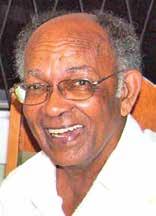
Transparency Institute of Guyana Inc (TIGI) President, Reverend Compton Meerabux said the Commission of Inquiry (CoI) established to probe the circumstances within the prison system appears to be nothing more than a window dressing exercise.
He also contended that there poses a clear “conflict of interest” with the former Director of Prisons Dale Erskine sitting as one of the three Commissioners.
During an interview with Guyana Times International on Wednesday, Meerabux explained that there needs to be an ongoing comprehensive approach towards reforming the entire prison system but pointed out that the
Government’s CoI seems to be “short-termed” and “superficial.”
“It just appears to be a window dressing exercise and not a genuine commission,” he stated.
He further enlightened that by having the former Director of Prisons as one of the Commissioners, it creates a widespread perception that the findings coming out of the CoI will not be credible.
“If you’ve been the Director of Prisons over a period of time then there is a conflict of interest there because he would also be covering up what was going on, you know,” he pointed out.
On that note, Meerabux said the Commissioners should comprise of persons who are knowledgeable of how the prison system works but has nothing to gain or lose by the findings of the CoI.
“I would say that you would need somebody who knows that prison, a neutral person, like in the welfare and social work who knows that prison,” he stated.
Additionally, Attorneys Christopher Ram and Ronald BurchSmith both contended that it is inappropriate to have the former Prison Director on the Commission since his
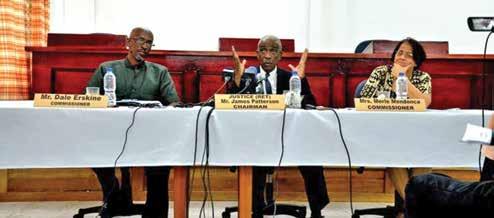
stewardship of the prisons should itself be investigated.
Erskine presided over the prisons when there was the historic 2002 jailbreak, where five dangerous criminals shot and stabbed their way out of the Camp Street Prison.
Moreover, families of the prisoners who perished during the recent rioting at the Camp Street penitentiary also

expressed skepticism with the former Director of Prisons being on the Commission.
Meanwhile, Meerabux underscored the need for a holistic rehabilitation programme to be rolled out for the prisoners and an advanced training programme for the prison officers.
He said programmes for the prisons should aim at developing skills among them, while creating an opportunity for them to earn an honest income.
Making reference to the Mazaruni Prison where inmates are involved in agricultural and livestock farming,
Meerabux highlighted that prisoners are meaningfully occupied and therefore, it would be easier for them to be reintegrated into society upon release. He noted too that their families should also be involved in these rehabilitation processes. In relation to stamping out corruption within the prison system, Meerabux explained that prison officers should constantly undergo training activities that would teach them to relate to prisoners by studying their case history and their background, as opposed to just treating them as less than human.

Minister within the Ministry of Communities, Dawn Hastings-Williams will lead Guyana’s delegation and deliver the Caribbean Community’s (CARICOM) statement at the United Nations 60th Session of the Commission of the Status of Women, according to a GINA press statement issued this morning.
Minister of Natural Resources, Raphael Trotman, addressing the post-Cabinet press briefing at Ministry of the Presidency yesterday, said Minister HastingsWilliams will be accompanied by General Consultant within
the Ministry of Social Protection, Hazel HalleyBurnett.
The conference will be held from March 14 to 24, 2016 at the UN headquarters in New York. It will review and discuss various themes including the elimination of all forms of violence against women. The theme for this year’s conference is “Women’s Empowerment and its link to Sustainable Development.”
The main focus will be on the way forward after the historic adoption in September 2015 of the 2030 Agenda for Sustainable Development Goals.
The prevalence of incestuous relationships continues to be a major problem for authorities in Region Nine (Upper TakutuUpper Essequibo) and it most often results in a child being sexually molested/ abused.
Most of these cases are covered up by the families involved for a number of reasons despite the hard work that police and other authorities do to ensure that the perpetrators are caught and justice is served, says Chairman of that Region, Brian Allicock.
He told this newspaper that during the past five to six months there have been four reports at the police station(s) about children being sexually abused and that law enforcement officers have already made progress with these cases.
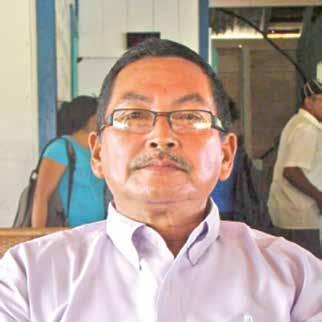
“These sexual abuses cases are actually before the Court now or about to be called in the Court so that shows that the police here are doing a good job…We have had only one report of teenage pregnancy for that
period as well, and the relevant authorities are dealing with this situation as well…but the thing is that there are many more cases out there that should be reported but people are afraid, they are shy, they

are not coming forward,” Allicock stated.
According to the Regional Chairman, although there are many sensitisation programmes/ initiatives in the various communities of his Region, a majority of persons who may have information about children being abused sexually are hesitant in making reports at the police station(s).
“You see, the parents, friends and relatives are covering these things up even though we know it is out there. They sometimes are so afraid and to have to go through explaining what happened to them or the children af-
fects them mentally and emotionally, to repeat the ordeal and all of that…but we are trying to educate our people to let them know that they must not be afraid, that they should speak out,” he explained.
This publication was told that one main reason why there are so many cases of child abuse (sexually) and incestuous relations in that Region is
the fact that some men consume too much of alcohol on a regular basis.
“They drink too much of the alcohol and they are drunk and end up doing these things. In fact, it is not only female children being abused sexually but males too. Too much alcohol in their system and some of them commit these acts,” Allicock added.




To contact: Guyana Times International
New York Office
106-15 Sutphin Blvd, Jamaica NY 11435
Email: guyanatimesnyint@gmail.com
Tel no: 718-658-6804
Fax no: 718-849-2286
Preferred method of contact via EMAIL
Guyana Office Ruimveldt, Georgetown, Guyana.
Tel no: (592) 227-0704, 227-0709. Fax (592) 225-8696, 227-0685
Email: guyanatimesint@gmail.com
Last year was the 20th anniversary of the “Beijing Declaration and Platform for Action”. This year, “International Day for Women” looked forward to achieving full equality for women within 15 years under the theme, “Planet 50-50 by 2030”. Back in 1995, under the auspices of the United Nations, the “most comprehensive analytical and normative report” on women had been crafted.
It is only fair we consider what progress was actually made, since history has shown us that all too often in confronting challenges to the status quo, those in positions of power all too frequently form commissions, issue reports and calls for action and that is where the matter ends.
There were 12 areas identified for specific actions: Women and Poverty; Education and Training of Women; Women and Health; Violence against Women; Women and Armed Conflict; Women and the Economy; Women in Power and Decision-making; Institutional Mechanism for the Advancement of Women; Human Rights of Women; Women and the Media; Women and the Environment and The Girl-child. We would all agree that this is a very exhaustive list.
Last year, after receiving reports of action taken from 166 countries, including Guyana, during the previous two decades, the UN concluded: “Twenty years on from the commitments made in Beijing, no country has achieved gender equality. The analysis of these reports shows that progress has been unacceptably slow, with stagnation and even regression in some cases. Progress has been particularly slow for women and girls who experience multiple and intersecting forms of discrimination.”
The finding that “violence against women and girls persists in all countries and in many forms” would certainly resonate in Guyana. Here, violence against women and girls has not only “persisted”, but, going by both anecdotal and investigative evidence, has actually increased.
While there has been heightened publicity on the issue creating enhanced awareness of the challenges, it is clear that violence against females emanates from deeply-ingrained structural factors rooted in our historically patriarchal society.
Change will only come when the last vestiges of viewing females as the “property” of males are extirpated from our society. The elimination of violence against women, then, is not only a matter of passing laws – it demands changing economic and other structures that “keep women in their place”.
The UN evaluation report agrees: “There is a need to change discriminatory social norms, stereotypes and practices that are holding back progress. This requires an investment in long-term interventions and campaigns to change attitudes and behaviours, including on male responsibility for unpaid care work and for challenging discrimination and violence.”
Changing societal views on the value of “care work” in and out of the home, which is usually performed by women, may be helped by men taking more responsibility for it, but ultimately will depend on women achieving equality in the work place.
“Care work” should come down to being a matter of “opportunity costs” – when the female or male may or may not decide to forego the lesser salary to perform it. Women then must be empowered by the State, which should insist on not only equal access to training and education but equal pay for equal work.
This goal in turn will depend on the overall economy growing and being structured to accommodate this necessary influx of women. The UN programme for action advises: “Macroeconomic policy should be reoriented to increase State investments in infrastructure, social services and social protection measures to ensure that women and girls can live a life with dignity. Macroeconomic policies should also support the generation of decent work for women and men and ensure women can enjoy their full range of rights at work.”
Much of what is needed to create a society where women are equal to men depends on the growth of the economy. In Guyana, a decade of continuous growth under the PPP has ground to a halt: this must be reversed instead of issuing platitudes.
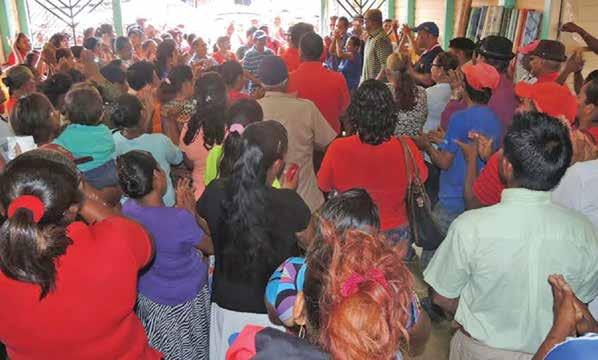
By DonalD RamotaR
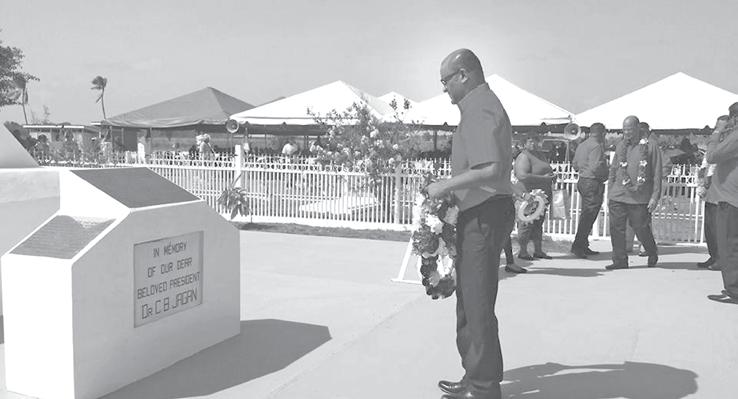
Sunday, March 06, 2016, marked the 19th death anniversary of former President of Guyana, Dr Cheddi Jagan.
Dr Jagan’s life was totally dedicated to the welfare of the Guyanese people. His was a life lived in service to his country and humanity as a whole. He was not only a patriot, but also an internationalist. This year, the anniversary of his death coincides with the 50th anniversary of our Independence.
While Independence was the result of great struggles and sacrifices of the masses of people, it is also true that no individual has done more for freedom than Cheddi Jagan. Therefore, in celebrating our independence, we are also celebrating the work of Cheddi Jagan.
Dr Jagan is probably the first Guyanese to call for independence from Great Britain. When he first issued that call in the 1940s, it was regarded as a very bold move. It was a time when our people were still singing ‘rule Britannia, rule.’ If you listen to Caribbean music emanating from that period, you will notice that it lauded colonialism.
Therefore, Dr Jagan’s call was the first spark in the process of gaining Independence. He made Guyanese see themselves as equals to any in the world and inspired them to support his call for freedom. For Cheddi, Independence was not an end in itself, but a means to an end. His ultimate goal was the social liberation of our people. Of course, he understood that this was not possible without Independence.
So in 1946, when he and his wife Janet, teamed up with Jocelyn Hubbard and Ashton Chase to form the Political Affairs Committee (PAC), Cheddi had a clear vision on the direction the movement must take. He saw that the principal role of the PAC was to lift the consciousness of the Guyanese people to fight for Independence and for eventual social emancipation.
That principle was clearly stated in the first issue of the PAC Bulletin, published on November 06, 1946. It is amazing to reflect on the manner in which Cheddi and his
comrades captured the imagination and support of the Guyanese people and the rapid growth of his freedom movement.
In 1947 three of the four founders of the PAC contested the elections for the Legislative Council. Janet barely lost in Georgetown against John Fernandes and racism was used against Hubbard (him being a Mulatto). Cheddi Jagan won his seat on the East Coast Demerara.
That was an important victory. Jagan used his position in the Assembly to represent the people as a whole, to educate the masses and to involve them in the fight for their own freedom.
In a short period, Jagan and his comrades created a massive movement. They attracted the support of not just workers, but the finest intellectuals of our society. By 1950, they were able to transform the PAC into a full-fledged political party, the People’s Progressive Party (PPP).
The colonial powers, however, were not asleep. In 1947, Winston Churchill, signalled the beginning of the Cold War with his speech in Fluton, Missouri.
Repression was used against the PPP after its great success at the 1953 elections. Many of its most important leaders were imprisoned. The limited democracy that existed under colonialism was crushed. However, having failed to crush the movement by repression, the colonialists and their allies added bribery to their arsenal.
The movement was betrayed by some members who worked with the colonial power to break up the PPP with the promise of high office. A section of the PPP, including Forbes Burnham, broke ranks in an attempt to capture the party.
Despite that blow, however, Dr Jagan and his comrades persisted and fought consistently for Guyana’s Independence. The PPP, which he led was the bulwark of that fight. In their bid to prevent independence, the colonial power and its ally, the CIA, financed strikes and instigated racial strife.
Unfortunately, they found willing tools in those who had
split from the PPP in 1955. It was the local instruments that were used to burn and destroy. Guyana (then British Guiana) was one of the earliest colonies that faced destabilisation.
At the time of Independence, British Guiana still had a ‘state of emergency’ in place. That was replaced by the National Security Act, which kept the powers of the state of emergency and even extended it. Political prisoners were languishing at Sibly Hall (Mazaruni) and all attempts were made to crush the PPP, which at the time of Independence, was in the opposition, having been removed by foreign intervention and local collaboration.
Workers and farmers came under attack by the PNC-led coalition regime. The prices paid to rice farmers for their produce was reduced and when they protested, police dogs were let loose on them. Thus began the long night of social and economic decline in our country.
On this 50th anniversary that we are approaching, we are witnessing many of the atrocities of the 1966 period. Rice farmers are once again under attack and the prices for their produce chopped. The sugar workers also are also under the hammer. Many are being dismissed and the imminent closure of the industry has begun with the announced closure of the Wales Estate. Recall, too, that the sugar workers were promised a 20 per cent increase by those in government today.
The militarisation of our state has begun. Indeed, the process has gone a far way already. Just like at the dawn of Independence, the PPP members and supporters were the first to feel the brunt of the regime’s attack, the same process is reoccurring today.
What should be noted, too, is that while the PPP supporters were the first under attack, that modus operandi was eventually broadened to include their own supporters.
We must in honouring the memory of Cheddi Jagan, follow his example and fight for the protection of human rights, fight to defend our living standards and for justice in our country.

By Devina Samaroo
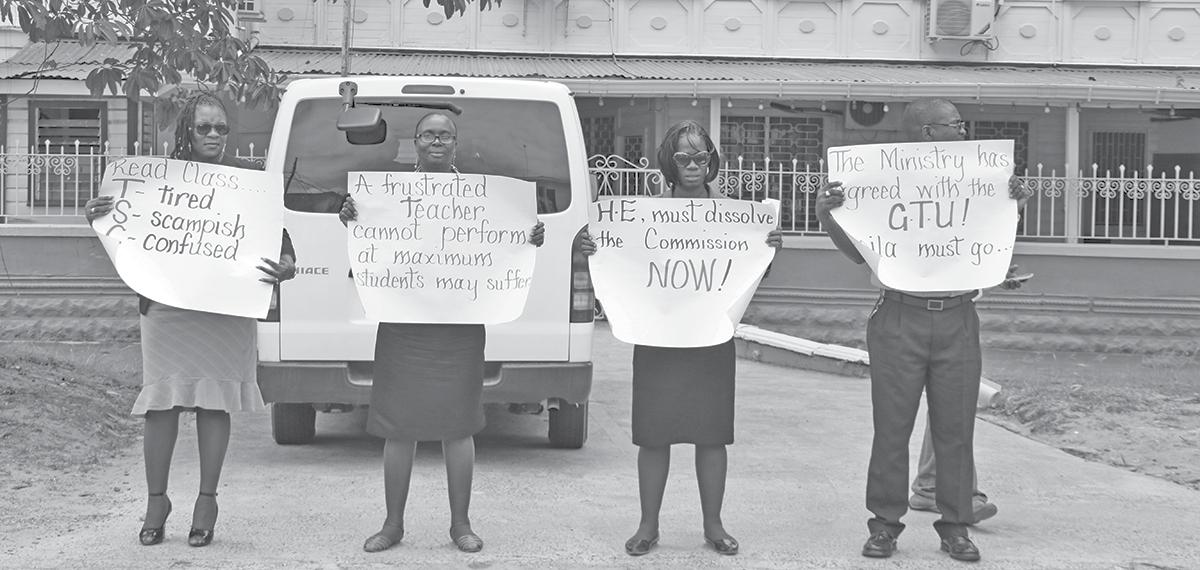
Teachers across the country will be left with no other choice but to resort to a massive nationwide protest in an effort to reinforce their demands for better treatment and to have their concerns addressed with urgency, particularly those against the Teaching Services Commission (TSC).
They are also upset that the prisoners seem to be making headway in getting the Government to attend to their issues whereas those who dedicate their time towards moulding the future generation are being
sidelined.
The Guyana Teachers Union (GTU) General Secretary Coretta McDonald, during another of the Union’s picketing exercises outside the TSC office on Brickdam, indicated that teachers would no longer be “putting up” with the continued injustices that have been meted out to them over the years.
“We are standing up for what we believe. We are saying that teachers should be treated as professionals. Over the years, we’ve had issues with the Teaching Services Commission and the manner in which they operate in appointing teachers, which is not in accordance with what is supposed to be happening. We’ve been given promises over and over and over that things are going to change; however,
things have remained the same and it will not go on like this for another year,” she posited.
McDonald said a meeting was currently being arranged between the Union and the TSC; however, if the outcome was unfavourable, teachers would definitely take their actions up a notch.
“We have made our demands and we are hoping that at that meeting, our demands are going to be met. If not, then we will have to do what we have to do… we should start thinking of having a nationwide protest or a nationwide
shutdown of the system,” she stated.
A date for the meeting is yet to be arranged.
The GTU has been staging small picketing exercises outside the TSC building for the past few months after it found the Commission guilty of breaching laws governing the promotion of teachers.
However, the quiet demonstrations have yielded little to no results, McDonald contended.
She explained that the Union was currently engaging President David Granger; Minister of State, Joseph Harmon
and Education Minister, Dr Rupert Roopnaraine – all of whom were giving assurances in abundance.
According to the General Secretary, change is coming in little packages, but the main concern is not being addressed.
“The huge change we want to see happening is the removal of the TSC, the members of the TSC and have a new Commission established,” she asserted. Sidelined
Meanwhile, McDonald said it was rather insulting to teachers that prisoners
appeared to “have more rights than teachers”.
“We find this to be very disrespectful…It is rather disgusting when you look at the manner in which some persons are being treated as against teachers who are the moulders of this nation,” she decried.
The General Secretary argued that teachers for years have been making demands for better working conditions; however, their pleas have been falling on deaf ears – whereas prisoners are making more progress in having their concerns satisfactorily addressed.

Dear Editor,
The last two Local Government Elections (LGE) were held in 1970 and 1994. In 2009, the LGE laws were changed to give people less options. There are two voting systems each covering about 50% of the country, Proportional Representation (PR) and First-Past-The-Post (FPTP).
ing. With FPTP, in addition to PP and VG, Private Individuals (PI) can compete. In this LGE, I urge each and every eligible voter to vote VG in the PR areas and PI in the FPRP areas.
The next LGE election date is uncertain, given our history. So you have to vote for people
APNU was seen as the best change, but of recent many of us have regretted the decision to support them. For myself, I thought they go with a “Hoyteian” approached to governance.
But I am deeply disappointed with them. Their first act was to give themselves 50 to 100 per

With PR, people can only vote for Political Parties (PP) and Voluntary Groups (VG), Private Individuals (PI) cannot contest in the PR area. So people are not allowed to vote for PI, they can only vote for a list of persons on PP or VG slate. What this means is the person on the list may live in Essequibo, but is on a list for New Amsterdam. Contestants do not have to reside in the area where they are contest-
who will serve in your interest and not in the interest of any political party. In the short history of Guyana, the only good period of governance was from 1985 to 1992 under D. Hoyte and 1992 to 1997 under C. Jagan. The issues raised here on do not refer to the preceding period. All other ruling was filled with power drunkenness, massive corruption and lawlessness. Guyanese did not deserve what took place under the PNC and the PPP.
cent increase in benefits, just like 1998, under J. Jagan, ministers salary were grossly increased. Both parties support development in areas where their elite live, not necessarily where their supporters live. You must take the interest of your community in your hand, even it means voting against the party of your choice. Once again, make your vote count for your community, vote VG and PI. Best of luck!
Sincerely, Bhola Nauth
Dear Editor,
Managing Director of the Guyana Oil Company Limited (Guyoil), Badrie Persaud, last week was unceremoniously dismissed from his position. This constitutes another act of racial and political discrimination.
As Mr Persaud mentioned in an invited comment to another section of the media, he was not even given a copy of the Auditors’ Report to comment on any charge against him; clearly, that was the fig leaf in his dismissal. Badrie Persaud did an excellent job during the 10 years he led the company.
When he took over in 2006, Guyoil’s annual revenue was in the vicinity of Gy$20 billion. When he was sent on leave in 2015, annual revenue was close to Gy$50 billion – a huge increase by any standard.
He improved the infrastructure of the company tremendously; the stations he inherited were all upgraded to modern facilities and were rated among the best in the country.
Under his leadership, new stations were built at Diamond, Palmyra and Heathburn. Moreover, the company’s wharves in the Demerara and Berbice Rivers were totally rehabilitated/strengthened to concrete structures.
Mr Persaud also diversified Guyoil into other areas of development, moving in pace with the country’s develop-
Dear Editor, Disregard for one moment the messenger and consider the message: Accepting that self-preservation is nature’s first law, what would have changed in the last eight years that would have made the prisoners respond in the way they did some three days ago and, equally important, having seen the consequences of that response, why would the response be repeated the next day knowing that the assumed risk is fatal.
Let us establish some truths before we proceed: one, though overcrowded and not unlike almost all prisons in the world, the prison population has not increased it has decreased; two, the sections of the prison where the riots took place called capital A and capital B, were particularly not overcrowded; three, the time on remand awaiting trial has not increased it has decreased; the prison conditions and diet etc have not got any worse if anything it has got better.
So what would have changed? The contention advanced herein is “psychological”. If one of the first acts you do as a new leader of a nation, de facto or otherwise, even before the inauguration ceremony, even before you name and appoint your members of Parliament, even before you appoint your Attorney General, even before you outline your plan for a nation, even before you present a budget to the nation, is you announce to that nation that you will pardon convicted criminals you create a reasonable expectation in the minds of the prisoners that they ought to be pardoned or at least be considered to be pardoned as well.
In addition, the immediate prioritisation of this presidential pardoning act imbues the perception of being soft on crime and soft on criminals. This reasonable expectation is amplified by two factors: one, some of those prisoners may have supported that leader (at the very least in spir-
it) so they perceive the leader as being “their guy” and two, a second act of pardoning occurs some six months later.
Essentially, there is a psychological break in the minds of the prisoners and they feel emboldened to respond in a way which would grab the leader or rather “their leader’s” attention and in a democracy protest and riots are the most effective way to grab the attention of the government.
How has the government responded? The actions of the prisoners were baptised by the government’s commitment to improve conditions and treatment and the families of the prisoners will be compensated. Unless cosying-up to prisoners and their families is part of the plan of this government this is yet another precipitous decision which will only crystallise that reasonable expectation.
Sincerely, Charles S Ramson Esq
MP
Dear Editor,
mental process.
The company started supplying aviation fuel. In so doing, the monopoly held by Rubis was broken, creating a more competitive market and in the process bringing the cost of the fuel down. The result was cheaper costs for airlines. This enabled more flights to enter and leave Guyana, since fuel is the main determining factor in the cost of travel for tourists and other travellers.
This was an important service to assist the country to develop the tourism sector. Together with the Marriott, the planned Specialty Hospital and the Cheddi Jagan International Airport expansion project, it formed the firm foundation for more tourist arrivals.
His stint as Managing Director was really outstanding. He performed a great service to this nation and distinguished himself as a top-class manager. This is how the PNC-led Government rewards success.
On the basis of his outstanding performance, he should never have been dismissed. The motive for dismissing Badrie Persaud could only be explained by the previous actions of the Government. Clearly, it is racial and political discrimination.
Sincerely, Donald Ramotar
The Ministry of Communities wishes to express thanks and congratulations to all members of the Disciplined Services who voted in Tuesday’s historic local government polls. The same sentiments are extended to the hard-working staff of GECOM who conducted the exercise competently.
The Ministry is, however, disappointed about multiple reports of a low turnout.
The Ministry of Communities sincerely believes in the truth of Article 12 of the Constitution which states, “Local Government by freelyelected representatives of the people is an integral part of the democratic organisation of the State”. In other words, in the absence of functional local government, there can be no real democracy. And citizens will agree that democratic renewal at the grassroots is much needed in Guyana.
The Ministry repeats,
too, that if you do not vote, other people who vote will choose your community representatives, and you will have no voice in the decisionmaking process.
The importance of having a voice in decisions that directly affect you cannot be overstated. The councillors elected by the people who vote will make decisions on what bridges and roads to repair or build; they will decide where playgrounds are to be constructed; they will be responsible for garbage collection, cleaning of drains and parapets, provision of healthcare services, pest control, noise nuisance control, and all other aspects of community life. Can anyone, therefore, afford not to vote?
Guyanese have not had the opportunity to cast a ballot since 1994 in LGE. These current elections will go down in history as the pivotal moment when Guyanese took power into their own hands; the moment when citizens took con-
trol of their own destinies.
The remainder of Guyanese will have an opportunity to be part of history on March 18, by going to your designated polling place and casting a ballot. You cannot afford to miss this unprecedented opportunity. The Ministry of Communities encourages you, again, to make use of your vote. Your vote is your voice. Additionally, the Ministry encourages candidates to redouble and intensify their campaign efforts in the time remaining. If you do not know where your particular polling place is located, you can obtain that information by calling GECOM on 225-0277 to 9 or 226-6557, or by visiting the website at www.gecom.org. If you visit the website and enter your ID Card number, you will be informed of the location of your polling place.
Yours faithfully, Mark DaCosta For the Ministry of Communities
Following the largest and deadliest prison riot to have ever occurred in Guyana, Government on Wednesday said that it has accepted an invitation from the United States Government for officials to participate in a mock prison riot exercise.
Cabinet has agreed for members of the Guyana Prison Service to be part of the 18th mock prison riot to be held at West Virginia State Prison in the US between May 1 and 4 later this year. This is in response to an invitation by the US Government, Natural Resources Minister Raphael Trotman said on Wednesday.
“The mock prison riot facilitates tactical training and demonstrations resulting in practitioner feedback that shapes the law enforcement industry on a global scale,” Trotman told the media at a post-Cabinet media briefing.
According to Trotman, the training being offered is expected to increase the capacity of the Prison Service to respond to prison unrest or other emergencies.
Five prison officers are expected to be part of this activity: Cadet Officer Kadefa Hayle, Chief Prison Officer Peter Barker, Chief Prison Officer Shawn Charles, Chief Prison Officer Kirk Joseph and Principal Officer 2 Lionel Kate.
Last Thursday, 17 prisoners died in a fire, said to have been set by those very
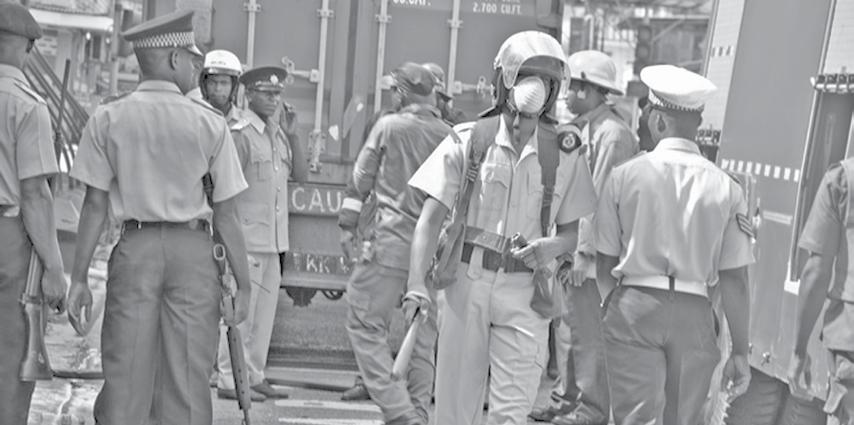
inmates at the Camp Street Prison. Thirteen persons, including officers, were also injured. According to reports, the bodies of 16 prisoners were found in the ‘Capital A’ section of the Prison Thursday morning. This section, located on the eastern side of the compound on John Street, holds prisoners on remand for, or convicted of serious crimes.
Prison officials, acting on reports, had carried out a search last Wednesday within the ‘Capital A’ building during which several contraband items were seized. These included 19 cellular phones and a quantity of narcotics.
It was in retaliation for this that the prisoners set a series of fires later that night by putting their mattresses in front of the grille of their cells and setting them ablaze. Firefighters spent hours there, putting out at
least three separate blazes. After the firemen had managed to put out the first fire, the angry inmates started another blaze at the same spot. This fire too was successfully doused after about 15 minutes, much to the dissatisfaction of the prisoners, who again started another fire. The last inferno took fire fighters approximately half an hour to contain close to midnight.
No one was injured during Wednesday night’s incident, but Thursday morning, the inmates continued the unrest within the confines of the penitentiary and some were injured.
During the second bout of ‘lash out’, the prisoners started another fire around 11:15h. Persons in the area related that there was a loud explosion in the penitentiary before smoke was seen coming from the same building that was on fire the night be-

Afore.
While firefighters were able to put out the flames, several inmates died and others were badly injured and rushed to the Georgetown Public Hospital.
As the crowd began to grow in the vicinity of the Georgetown Prison, heavily armed Police Officers were deployed as added security. While some persons went to the hospital after hearing inmates were transferred there, dozens stuck around for at least three hours, waiting for any information about their imprisoned relatives.
Subsequent to the unrest, the prisoners, after a successful meeting with Public Security Minister Khemraj Ramjattan, had their complaints heard.
A Commission of Inquiry has been established to investigate the circumstances leading to the unrest.
70-year-old woman was found hanging in her East Bank Berbice (EBB) home on Wednesday morning. Dead is Nowattie Doodnauth of Edinburgh Village, EBB. Reports are that the discovery was made by the woman’s sonin-law when he went to check on her.
This newspaper was told that the woman was found hanging over her bed which is located under a step in the two-storey house. It is believed that the mother of six wrapped part of her bed sheet around her neck before tying the other end to the step.
According to the dead woman’s relatives, she was found in a standing position with her feet firmly on the bed.
Reports are the woman had attempted to take her own life twice in the past.
A relative, Barbara Seecharran said that on one of those occasions, Doodnauth tried to drown herself but failed. “Well, she know to swim so every time she go under the water, she coming back up,” Seecharan said. Reports are that Doodnauth suffered a nervous breakdown after her husband passed away. She has been receiving treatment for severe depression over the past two years.

After a 12-member jury panel found Mark Royden Williams and James Anthony Hyles not guilty in August 2013 for the murders of 11 persons, including five children, during the 2008 Lusignan Massacre, the Appellate Court has ruled that a retrial be held.
The Chambers of Director of Public Prosecutions (DPP) had appeal the outcome of the sensationalised case on several grounds, including the fact that the foreman of the jury, Vernon Griffith, failed to inform the court that he was a client of one of the defence attorneys Nigel Hughes.
On Tuesday morning, the Appeal Court handed down its decision after it found that the initial trial was flawed, thus allowing the appeal and ordered a re-trial in what is considered one of Guyana’s most horrific mass-murders.
Justice CummingsEdwards read the Court’s decision which dealt with seven grounds. The first was in relation to the mini-trial that was held to vet the jurors before they were empanelled.
The Appellate Court said that there is no common law or statutory provisions for this to be done, and as such, the trial Judge, Justice Navindra Singh, “erred in law” by allowing this.
The second ground dealt with the fact that the trail Judge permitted the cross examination of Police witnesses in relation to alleged improprieties by the Police without informing them they would have to substantiate it. Thirdly, the Appeal Court Judge found that the exclusion of 76 photos from the trial ought not to have happened.
The Appellate Court
The panel of Appellate Judges was led by acting Chancellor of the Judiciary, Justice Carl Singh; acting Chief Justice Yonette Cummings-Edwards; and Justice BS Roy. Also present in the courtroom were DPP Shalimar AliHack, Attorney Roger Yearwood who is representing Williams and Attorney Hughes who is representing Hyles.
went on to deal with the issue of joint enterprise, agreeing with the DPP that the jury was not adequately directed on the issue of joint enterprise.
On the matter of the foreman being a client of one of the defence counsels for over a five-year span, the Justices of Appeal pointed out that this was not disclosed by either of the parties to the trial Judge at anytime during the trial. The court is of the opinion that the foreman had the ethical and legal duty to disclose his relationship with the attorney and by not doing so, the neutral role of the juror was compromised.
Chancellor Singh added that this was a se-
Farmers in Amerindian communities will soon be able to reclaim the firearms they handed over to Government during the gun amnesty programme last year.
Natural Resources Minister Raphael Trotman, who hosted the post Cabinet briefing on Wednesday, said
Government is seeking to keep the promise it made to the indigenous farmers. In 2015, following the launch of Government’s gun amnesty programme, several Amerindian farmers had expressed outrage, saying that they were duped by the Public Security Ministry into believing that when they handed in their firearms,
they would have been issued with licences.
The Ministry had at the time undertaken an operation, seeking to retrieve all illegal firearms. The aim was to help reduce the soaring number of criminal activities at the time.
Speaking to journalists, Minister Trotman said Government was mov-
rious error of judgment on the part of Attorney Hughes when he failed to disclosed to the court that he knew the jury foreman.
In relation to the sixth ground which dealt with the fact that the trial Judge did not hold an inquiry when it was brought to his attention by the State Counsel that one of the jurors was seen showing the “thumbs up” sign to the father of the number two accused, the acting Chief Justice outlined that the Appellate Court felt that the trial judge ought to have held an injury into the complaint since it was the paramount duty of him to hold an inquiry.
Finally, Justice Cummings-Edwards declared on the matter of trial Judge directing the jury to determine whether the Caution Statement (CS) of the two accused was made freely and voluntarily, that the voluntariness of the Caution Statements is not an issue for the jury to determine.
After the 12-member panel led by Griffith found Hyles, known as
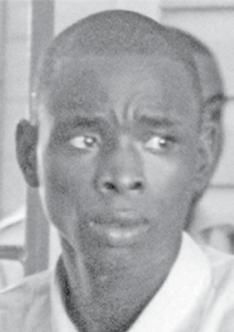
“Sally”, and Williams, called “Smallie”, not guilty of murder on August 2, 2013, the trial Judge, Justice Singh remanded Williams to prison because of pending matters at the time, while Hyles was placed on Gy$1.1 million bail after senior State Counsel Judith GildharieMursalin had served the court notices of the intent of the Director of Public Prosecutions (DPP) to appeal the matter.
During the wee hours of Saturday, January 26, 2008, gunmen stormed into the village of Lusignan, on the East Coast of Demerara, and murdered 11 people, including five children.
Police believed that the gunmen who were armed with shotguns and AK-47s entered the village around 02:00h, and invaded the homes of five families. Within 20 minutes, they carried out the rampage.
Those killed were Clarence Thomas, 48; Vanessa Thomas, 12; Ron Thomas, 11; Mohandan Goordat, 32; Seegopaul Harilall, 10; Seegobin Harilall, 4; Dhanwajie Ramsingh, 52; Seecharran Rooplall, 56; Raywattie Ramsingh, 11; Shazam Mohammed, 22; and Shaleem Baksh, 52.
The mastermind of the massacre was believed to be Rondell “Fineman” Rawlins. It was believed that Rawlins retaliated after his 19-year-old girlfriend, Tenisha Morgan, vanished on January 18, 2008 while on her way to a city hospital to deliver her baby.
Rawlins believed that his girlfriend was kidnapped by law enforcement officials in an effort to force Rawlins to turn himself in. The Joint Services have since denied this claim.
ing to reissue those firearms since Amerindians use them for their sustenance.
“When the amnesty was declared, it was seen that Toshoas, farmers and other villagers voluntarily came forward with their shotguns with the belief that they were only respecting the law and at the same time, having an

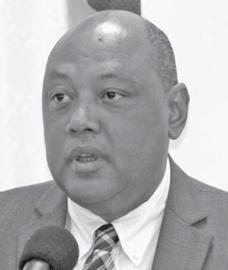
expectation that the law would realise that they had a legitimate need to protect life and property and that Government would accept that consideration would be given to them”.
He said Government then gave a promise that they would look into that matter and “they are keeping that promise by regularising the system”.
According to Minister Trotman, the weapons will not be destroyed, but where necessary, will be restored through the village system. He went on to further explain that while there will not be waiver on the granting of licences, there will however be a waiver on application fees.
The gun amnesty programme was meant to get rid of illegal weapons with the hope of reducing criminal activities, particularly the increasing numbers of
gun-related crimes across the country.
Of the 186 weapons surrendered at the end of the programme, none of them were found to have been used during serious crimes.
Police Commissioner Seelall Persaud had explained that ballistic tests were conducted on a majority of the weapons which proved that none were linked to serious crimes. He had previously expressed belief that criminals with illegal firearms would not turn them in.
The Police Chief also admitted that a majority of the weapons collected were shotguns used mostly by persons hunting, more specifically by Amerindians.
Last month, Prime Minister Moses Nagamootoo while visiting Region Nine (Upper Takatu-Upper Essequibo) gave assurance that once persons undertook the legal process, they could have their firearms returned.
Residents had claimed that the lack of proper education on the issue was the main reason for the mix-up. This had caused a number of residents, who use the guns to sustain their livelihood, to be left empty-handed and helpless.

The husband of 39-year-old Indrawattie
Somwar called ‘Sharda’ has reportedly confessed to murdering her dur-

Ayoung mason was on Friday denied bail when he appeared before Magistrate Fabayo Azore at the Georgetown Magistrates’ Courts charged with being an accessory to murder.
ing a domestic dispute on Tuesday, according to Crime Chief Wendell Blanhum.
Blanhum said Navindra Bandu called ‘Birdie’, of Number 77 Village, Corentyne, Berbice, has since provided the police with a detailed confession. He is expected to be charged with murder soon.
This publication understands that Bandu reportedly told investigators that he had invested a lot of money into building the house in which they were living and he had worked for Gy$60,000 recently, all of which he gave to
Somwar.
According to reports in another section of the media, Bandu claimed that on the day of the incident, he asked Somwar for a small amount of money so he could “take a drink” but she did not comply. Instead, she became very abusive toward him and requested that he leave the house. As a result, he told the police, he became “very hurt” and this led to him chopping her about the body.
Reports are that the now dead woman, a domestic worker, had an argument with her 30-yearold husband who is
unemployed. Neighbours told this newspaper that they were alerted by screams and saw the woman covered in blood being chased around the yard by her husband as he repeatedly chopped her. The woman collapsed after receiving several chops and died in the yard.
According to neighbours, as the man chopped his wife, their helpless 13 and 17-yearold children were heard shouting at their father to stop. This publication was also told that one of the children ran out of the yard screaming, “Daddy deh chopping
Mummy and she aint moving.”
The first to arrive at the scene was Somwar’s sister, Oma, who said that she found her sister’s lifeless body in the yard. She said that the Police arrived moments after and arrested the suspect.
Meanwhile, this newspaper was told that the couple had been together for some 10 years during which time the husband did not work. Neighbours said it was an abusive relationship, with the suspect constantly accusing his wife of infidelity.
It is alleged that the defendant was contacted by his father to clean blood stains and destroy the number plate from the car involved in the incident.
Sim’s lawyer told the Court that contrary to the Police report, his client was wanted by the Police and after the incident, he and his client reported to the Police Headquarters. He further argued that his client was innocent and the Police had no evidence of him committing the act. However, the Prosecutor informed the Court that the defendant made several attempts to escape and as such, he was remanded. The case will continue on April 1.
Alan Sim Junior, of Lot 860 Paradise Housing Scheme, East Coast Demerara, pleaded not guilty to the charge, which alleged that between November 23 and 25, 2015, he helped to destroy evidence against his father, who allegedly murdered Melissa Skeete in a vehicular accident.

By Alexis Rodney
Even as it moves to clear its debt with policyholders in The Bahamas, the Colonial Life Insurance Company Limited (CLICO) Bahamas is yet to take up Guyana’s case before the courts there, so that policyholders in Guyana could also be paid.
Before the massive financial collapse in 2008, CLICO Guyana had transferred some US$36 million to CLICO Bahamas. However, while the investments were said to be “liquid on paper”, investigations carried out, revealed that the sum had been tied up in several investments, including real estate which CLICO Bahamas had in Florida through subsidiaries.
When CLICO Bahamas was ordered liquidated on February 24, 2009, the local company was subsequently placed under judicial management.
Guyana was then forced to retain lawyers to help recover its mon-
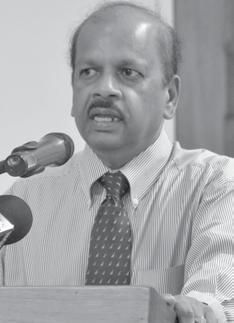
ey, some 53 per cent of the assets of CLICO Guyana. That matter was filed in the Bahamas court after the CLICO Bahamas’ liquidator “rejected” Guyana’s claims.
On Monday, more than seven years after CLICO Bahamas went into liquidation, the country’s Prime Minister Perry Christie announced that policyholders there, who are still current, would begin to receive payouts before the end of the month. The cash payouts, he said, are estimated at some $16 million.
“The liquidator of CLICO has proposed and the Government has
agreed to a plan to make all existing policyholders whole. This plan involves the creation of a special purpose vehicle to assume the insurance operations of CLICO and to pay out the policyholders who have been unable to receive the full payout of their benefit, subject to the policy not lapsing during the period of liquidation,” the Prime Minister said.
Christie said under the plan, surrendered policies, death benefits, medical claims and staff pensions will be paid in full.
According to him, the policyholders have been waiting to cash in on their policies since 2009.
He acknowledged that many Bahamians have “grown impatient waiting for a resolution”.
There were approximately 13,000 Bahamian policies when CLICO was liquidated.
However, while policyholders there will be made “whole”, Guyanese policyholders remain in uncertainty over their payouts.

Anew Gy$30M project will see the construction of a ramp, wharf and storage room at Corriverton which will help to safeguard the livelihood of farmers in the indigenous community of Orealla in East Berbice, Corentyne.
According to a GINA press release issued today, the wharf is among key projects which the Region Six, Regional
Information Agency (GINA).
Armogan said that the intervention to assist the indigenous community includes the construction of a storeroom because, “They (the farmers of Orealla) have been complaining that when they bring the produce, (to the coast) because they do not have anywhere to store it, what invariably happens is that they have to
at the New Amsterdam Hospital. Armogan explained that the school will house both the nursery and primary level children, and will replace an older structure that currently houses 200 primary students and 60 nursery students. He however, explained that the region is seeking to build a structure that can house over 450 students in an effort to cater for the growing

Democratic Council (RDC) will undertake this year, with its more than $5.7B budget.
“We are building this wharf in Corriverton, because the Amerindian people have been complaining to us that they do not have anywhere to unload their produce when they bring it out from the river,” Regional Chairman David Armogan explained in a recent interview with the Government
sell it very cheaply to the people who retail.”
He added that, “They work very hard to get those things in… they ask for little…and we are doing it because we want them to make a couple extra dollars for themselves,” he said.
Two other key projects to be undertaken by the regional administration this year, are the construction of a new school at Number 36 Village and a new wing
population of the area and movement of people. Number 36 Village is home to one of the region’s biggest rice mills. Armogan pointed out that, “There is a likelihood that persons would move to the village to be closer to this place of employment,” and hence, “there is need to have a school that is capable of taking on additional children in the future,” he observed.

The APNU/AFC Government has announced that it will continue to receive written comments on the draft Code of Conduct for Ministers of Government, Members of the National Assembly and public office holders.
In a media release issued today, the Government noted that it has received written feedback from some key civil society organisations on the draft Code of Conduct, including the Guyana Bar Association and the Guyana Human Rights Association.
“In an effort to ensure a thorough and comprehensive code which benefits from the widest possible input, Government will allow for further comments before the Code is presented to Cabinet for approval and finalisation,”
the statement added.
On this basis, the Government has stated that it is encouraging wide ranging citizen and stakeholder participation in the process leading up to the final version of the Code which is intended to promote professional, exemplary and responsible conduct by senior government personnel.
The Code is further meant to engender and reinforce public confidence in the manner in which senior government officials perform their duties in service to the people. It is based on ten principles – Accountability, Dignity, Diligence, Duty, Honour, Integrity, Loyalty, Objectivity, Responsibility and Transparency – and is a Coalition Government manifesto promise.

AGuyanese model was jailed for four years by Magistrate Leron Daley when she appeared at the Providence Magistrate’s Court.
Sadeeka Leona Odi, of Lot 186 Thomas Street, Kitty, who was charged for trafficking in narcotics, had initially pleaded not guilty to the offence when she made her first appearance before then Chief Magistrate Priya Sewnarine-Beharry.
It was alleged that on February 8, 2014, at the Cheddi Jagan
International Airport (CJIA), the 41-year-old woman was found to be in possession of 9.27 kilogrammes of cocaine concealed in mango achar. She was subsequently remanded to prison and the matter was transferred to the Providence Magistrate’s Court.
During the trial, the prosecution called three witnesses who gave evidence in the matter against the model of a local arts school and a mother of five.
The Court heard that Odi was an outgoing passenger on a flight destined for New York’s John F Kennedy Airport. Based on information received, ranks from the Customs Anti-Narcotics Unit (CANU) took her off the aircraft and conducted a search of her suitcase; the drug was then found concealed in the achar.
Odi was represented by Attorney-at-Law Dexter Todd.
Reprinted from the Trinidad Guardian
The family of sixmonth-old baby
Maleek Khan was in shock last night after he was mauled to death by the family dog at their home at Charlieville, Chaguanas.
Speaking with the T&T Guardian yesterday, the baby’s grandfather, Neshard Khan, 53, said they still could not understand why the dog, Simba, a Rottweiler and German Shepherd mixed, would attack the baby boy.
Maleek is the only child to Khan’s son, Shayas, 30, and Vishma Bissoon, 23.
The senior Khan told the T&T Guardian that baby Maleek was with his mother at their Jameel Street, Charlieville, home around 4 pm when tragedy struck.
He said he was told Maleek was left in his pram by Bissoon, who stepped away for a few
Opposition Leader Bharrat Jagdeo, he said that all must join in the call for GECOM to launch an international investigation into the false Statements of Poll (SoPs) which were allegedly in GECOM’s database.
Jagdeo who was at the time addressing hundreds of supporters at Babu Jaan, Port Mourant, Corentyne, Berbice at the observance of the death anniversary of the Party’s founding leader and late President, Dr Cheddi Berret Jagan said that the People’s Progressive Party (PPP) will be moving to have election crimes punishable by law before the next Regional and General Elections in 2020.
“Before the next elections, we have to lobby for legislation to make elections crime punishable by law. We must have thorough legislation against [Guyana Elections Commission] GECOM officials who act fraudulently. GECOM has never taken any of its employees to court,” Jagdeo told the mammoth crowd.
“People have a fear that the elections of the future will not be fair,” he told supporters, assuring them that the PPP has a plan of action that would be developed to ensure that the 2020 General Election would be free and fair.
Outlining the plan, he said that all must join in the call for GECOM to launch an international investigation into the false Statements of Poll (SoPs) which were allegedly in GECOM’s database.
“We have to push for
minutes. He said although Simba was chained he managed to reach the baby boy and grabbed him by the head. The dog bit the baby about his face and when his mother ran to assist him she was bitten about her arm and head.
Neighbours helped rescue baby Maleek, who was then rushed to the Chaguanas District Health Centre, Montrose
“The dog is a big dog. I believe that the baby was left too close to the dog. The dog grabbed on to him and that was it. I don’t know where that mother went and what she went to do. I don’t know why she left the baby so close to the dog,” the distraught grandfather said.
Khan described the situation when he got to the house after learning of the incident as a nightmare.
an investigation into why the Returning Officer of Region Four [DemeraraMahaica] shut her door so that the PPP could not submit its request for a recount. We must get answers as to why GECOM tried to strike out our elections petitions even though they were not a party to the elections. We must insist that all observers – including GECOM, international and the Private Sector – follow a protocol at the Local Government Elections,” Jagdeo told
his supporters as he outlined some of the activities the Party would be involved in as it prepared to get back into office.
Meanwhile, the Opposition Leader told supporters that the Party lost the 2015 National Elections because of its own complacency, false promises by the coalition and the message of corruption on the part of the then Government which was being preached.
He said the Party only looked good on paper going into the May 10
elections, but was weak in terms of structure. Jagdeo said a post-mortem of the elections was done and proved that despite the lapses the Party had going into the elections, it should have been victorious.
“We would have still been in office had they not stolen the election… we will win back all those who left us and were misled. Many have come back and many young ones now have a chance to compare.”


The Switzerlandbased International Union of Food (IUF) is threatening to take action if Government fails to halt all plans to close the Wales Sugar Estate.
The Union, of which the Guyana Agricultural and General Workers Union (GAWU) and the National Association of Agricultural, Commercial and Industrial Employees (NAACIE) are affiliates, wrote Agriculture Minister Noel Holder in this regard.
The Union urged the Guyana Government to “immediately halt plans to close the Wales Sugar estate,” while insisting that the Government, “as a matter of urgency to enter into full and good faith negotiations with GAWU

and NAACIE to find a just solution which will maintain the estate and ensure employment.”
The Union said that it was with shock and disbelief that it received the plans of the Guyana Sugar Corporation (GuySuCo) to close the estate at the end of the year, especially with
the absence of a socio-economic study.
The Union said that it has been working with the two local Unions for many years to improve the living and working conditions of workers in the sugar sector. It reminded of the dire impact the closure would have on the lives of the
By: Devina Samaroo
Amid pomp and ceremony, the People’s Progressive Party/ Civic (PPP/C) on Sunday launched its Local Government Elections (LGE) campaign Manifesto in Lethem, Region Nine (Upper Takatu/Upper Essequibo) under the theme “A Return to Progressive Ideas”.
Vying for a seat on the Mayor and City Council (M&CC) are Lennox Ramsahoye (Constituency 1), Debra King (Constituency 2), John Macedo (Constituency 3), Jacqueline D’Aguiar (Constituency 4) and Jason Williams (Constituency 5) – all representing the PPP/C.
The candidates, during the Manifesto launch, took turns explaining to the sizeable gathering about their plans and visions for the people of Lethem.
Chief among the mandates outlined in the Manifesto include improvements in solid waste disposal, cleaning of the city, infrastructural development, health access, strengthening security sector, and construction of sporting complexes.

According to the document, the Party plans to secure more garbage trucks to increase and improve garbage collection on a timely basis from both residents and businesses. Additionally, the Party intends to employ staff to regularly clean parapets and alleyways within the municipality.
The construction of drains in each constituency along with regular weeding, slashing and clearing of vegetation are all part of the plan to keep the city clean and also to avoid flooding.
With regards to better infrastructure, the candidates intend to use their influence at the Council level to construct proper roads in each constituency including the housing schemes.
Moreover, they tout the construction of a water purification plant and public conveniences as well as the timely upgrade and maintenance of the abattoir and public schools.
For educational/sporting and social development, the Manifesto guarantees that there will be attractive support and sponsorship of activities for schools and youth groups; commemoration activities for the elderly; and education and awareness on topical issues such as health and climate change.
Focusing on health, the document promises that there will be regu-
lar fogging and regular health inspections of bakeries, hotels, restaurants, market places, malls, supermarkets and other public places to ensure the surroundings are safe and sanitary.
In relation to security concerns, the PPP/C assured that more streetlights will be installed, there will be more aggressive police patrolling within the municipality, formation of community policing groups and the establishment of neighbourhood watch teams.
Meanwhile, during the Manifesto launch, city businessman Basdeo Ramlall endorsed the PPP/C candidates and encouraged residents to come out on Local Government Elections Day to show their support by voting for the Party.
Notably, Ramlall was a candidate for the A Partnership for National Unity/Alliance For Change (APNU/AFC) coalition at the General and Regional Elections 2015.
Other speakers at the event included PPP/C Parliamentarians Gail Teixeira and Alister Charlie.
the Union stated.
As such, it warned that it will be monitoring the situation closely and is fully prepared to take further action to assist workers in the local sugar industry.
The IUF had previously noted that it alerted its affiliates worldwide about the situation and called on them to support Guyana’s sugar workers in their time of need.
1700 persons employed at Wales and their families.
“Sugar has historically played an important role in Guyana. It has been a crucial source of rural employment. Workers on the estate and the families who depend on them will surely be pushed into poverty by this cruel closure,”
The IUF is the global trade union federation representing workers throughout the food chain. It comprises 416 affiliated unions, including GAWU and NAACIE, in 126 countries.
The Government has been under severe pressure to reverse its decision to close the Wales Sugar
Estate at the end of the second crop of this year, plunging many of the workers there into a possible state of unemployment.
The Government in justifying its decision to close the factory claimed it was as a result of the estate not being financially viable and promised that no jobs will be lost. But already, over 50 employees from Wales were sent packing.
The Opposition People’s Progressive Party/Civic (PPP/C), several independent commentators, along with trade unions and rights groups, have all called on the Government to halt the closure plans and hold consultations with the workers affected.

By Kizzy Coleman
With the Local Government Elections (LGE) just a few days away, two independent candidates on Monday evening went head-to-head with representatives of the major political players at the University of Guyana Student Society (UGSS) debate aimed at promoting citizen and student advocacy.
The debate saw Pastor Wendell Jeffrey and Malcolm DeFreitas up against candidates for A Partnership for National Unity/Alliance For Change (APNU/AFC) and the People’s Progressive Party/Civic (PPP/C) as well as Team Benschop; Team Legacy; Guyana Nation Building Corp and Youth for Local Government.
The candidates reiterated why they should be elected, putting forth their vision for the city of Georgetown.
Some candidates vowed to re-establish Georgetown as a city of vibrancy that would be recognised internationally, while others guaranteed attention to building stronger families in communities.
Sherrod Duncan of APNU/AFC explained that every country has a capital but not every country has an international city, pledging to internationalise Georgetown if elected.
“Part of our vision is making Georgetown an international city and there are certain things that go hand in hand with an international city. An international city has functioning infrastructure, and good services, good roads, good lighting, the garbage is picked up on time, the vendors are organised in a certain way, and the markets are organised in a certain way. There is a sense of normalcy and a sense of decency and a sense of pride;
this is what we want for Georgetown,” Duncan said.
On the other hand, PPP/C candidate Shazad Sookram said that his Party intended to transform the city into a “vibrant” space with sustainable management with respect to the everso worrisome garbage situation.
“We want to develop our city into a vibrant city, into a green city. We have a huge garbage problem and we believe in sustainable management; we don’t believe that you go clean up the city and next two months, garbage is back again and nothing happens, anything that is done must be done in a sustainable way and we will see to this,” Sookram said.
The Guyana Nation Building Corp noted that its main focus lay in strengthening and building families.
“Local Government and the involvement of civil society is key and fundamental because we need more people on the ground to get involved in their own affairs. We need the single mothers who can balance that Gy$50,000 budget with three children, hefty light bills and can lend that advice in regards to how people’s communities are developed,” the group’s candidate said.
Questions were posed to the candidates from audience members, who quizzed them mainly on the issues of security, job creation, garbage disposal, revenue generation, zoning and removing the Camp Street Prison from within the city.
On the issue of security, most candidates agreed that policing groups were a must. All candidates stand motivated to serve fully if elected.
This debate series is to continue in other municipalities in the coming days leading up to the polls.





As the El Niño weather phenomenon continues to wreak havoc across the country, President David Granger on Wednesday established a ministerial task force to examine and scale up plans to tackle future cycles of the prolonged dry spells, the Ministry of the Presidency said in a statement.
The task force, according to the statement, will be set up under the leadership of the Agriculture Ministry and is “responsible for
Ministry will provide a representative to focus on potential risks for water-borne illnesses and other health-related issues, the statement added.
The work of the task force will be resourced, following the completion of an approved action plan.
The statement noted that the task force which was set up in October last year to monitor the phenomenon will continue to operate and is now complemented by the ministerial task force.
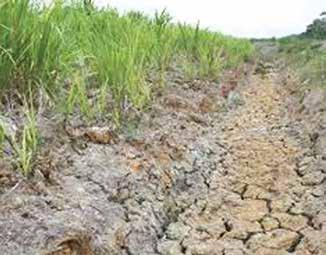
the creation of an action plan that focuses on immediate relief for affected communities, as well as on medium and longterm plans, including the drilling of additional wells and increased water harvesting when the rainy season returns”.
This body, which will be chaired by National Drainage and Irrigation Authority (NDIA) Chairman John Piggott, will include representatives from the Minister of State, Joseph Harmon; Minister of Indigenous Peoples’ Affairs, Sydney Allicock; Minister of Natural Resources and the Environment, Raphael Trotman; Minister of Agriculture, Noel Holder; Minister of Communities, Ronald Bulkan along with Director General of the Civil Defence Commission (CDC), Chabilall Ramsarup.
Additionally, all of the key State agencies, with responsibility for various aspects of tackling the El Niño impact will participate in the work of the task force, including the NDIA; Guyana Water Inc (GWI); the Environmental Protection Agency (EPA); the Guyana Rice Development Board (GRDB) and the Regional Democratic Councils (RDC).
The Public Health

During the meeting, the President was briefed on the situation and the work that the various Ministries and the CDC have been doing to tackle the now 10-month dry spell. It was noted that the Government would continue to concentrate its efforts on bringing immediate relief to communities affected by the impact of El Niño.
Region Nine (Upper Takutu-Upper Essequibo) is the worst affected area.
However, Region Two (Pomeroon-Supenaam); Region Three (Essequibo Islands-West Demerara); Region Five (MahaicaBerbice) and Region Six (East Berbice-Corentyne) are also affected to varying degrees, particularly in rice farming and other agricultural areas.
The El Niño phenomenon, which began around mid-2015, already cost farmers significant losses, with thousands of acres of rice being destroyed on the Essequibo Coast and in the Essequibo Islands, Berbice and West Demerara, while cash crop farmers in many parts of the country, including Linden, have complained of massive loss of crops. The El Niño conditions are expected to continue to the end of June.





The National Assembly on Thursday unanimous-
ly agreed via a motion for Guyana to become a member of the Inter-Parliamentary Union (IPU), a move that pre-dates the Coalition Government’s ascension to office, according to Leader of the House, Prime Minister Moses Nagamootoo.
The IPU is the focal point for world-wide parliamentary dialogue and works for peace and co-operation among peoples, and for the firm establishment of representative democracy.
Prime Minister Nagamootoo, who moved the motion, explained that the Parliamentary Management Committee, at its 13th meeting on May 2, 2014 decided that Guyana should become a member of the union and subsequently, the Parliament of Guyana, on May 27, 2014, made application to the IPU.
The Prime Minister pointed out that the motion is in keeping with the
IPU’s request that a resolution of this country’s Parliament must first be passed, in order for the union to accept Guyana’s application for membership.
Expressing support for the motion, now Opposition Chief Whip, Teixeira noted that IPU is a very important international body in which Guyana’s Parliament should be represented. She added that the Opposition side of the House looks forward to Guyana being represented at the IPU meeting upcoming in Zambia.
Guyana’s membership to the union will be an annual subscription of just over $2 Million.
The IPU has been in existence since 1889 and has had significant influence working along with the United Nations General Assembly and other similar organisations to bring about greater harmony in the work of National Assemblies, worldwide. (GINA)
“When I got there I saw blood all over the place and all I could have done was beat that dog and tell him ‘look how you kill my grandchild.’
“It real sad. I real beat that dog you know, just to let the dog know that what he did was wrong,” he added.
Khan said he intended to suggest to his son the dog be put down “because I don’t want to see that dog ever again and I don’t want that dog biting or killing anyone else.”
Khan said recently he has been plagued with problems and wondered when his troubles would end.
He explained that the baby’s father, Shayas, is not working currently as he had suffered a broken arm while on the job. Another of his sons, whose name he withheld for secu-
rity reasons, was allegedly shot in the back of the neck by a police officer.
“I do not know when my troubles will end. Is only one after the other I have to deal with,” he said.
“Now, my grandchild!

This one is the hardest.
I cannot deal with this but I have to remain strong for my son, Shayas, and the rest of the family.”
At the family’s home last night, Shayas’ uncle, Sohil Khan, said the community was in shock following the incident. He said the dog was given to the fami-
ly one year ago but he believed it was time to get rid of it, adding he was surprised the police did not take away the dog when they visited the home.
Parbatie Lutchman, 32, a relative of the baby’s mother, added: “We don’t know what to say. We all loved the baby, now he is gone, what can we do or say.”
Up to late last night officers from the Chaguanas Police Station, along with Crime Scene Investigators, were at the Khan’s residence processing the scene.
A20-year-old man who admitted that he stole his mother’s jewellery will know his fate on March 17.
Avinash Ram, of Richmond Village, Essequibo Coast, pleaded guilty to the larceny charge when he appeared before Magistrate Sunil Scarce last Friday at the Suddie Magistrate’s Court. Ram admitted that he did steal the jewellery from his mother.
The charge stated that between February 27 and March 2, 2016, he stole a gold chain valued Gy$100,000 and a gold ring valued Gy$20,000, property of Paradai Yugeshwar. Sentencing was, however, deferred as the Magistrate ordered a probation report to be submitted.
Ram, who was not represented, told the Court he was a drug addict and when he used drugs, he could not remember what he did.
His parents who were present in court said that he was never abusive or arrogant around them.

The mother said that she, however, observed him and suspected that he was using drugs. The father requested that the Magistrate discharged the case as he wanted to put his son somewhere safe where he could control him.
Magistrate Scarce, however, informed the father that his son had pleaded guilty to an offence which required sentencing. The Magistrate further related that given Ram’s explanation, the case required a probation report. The case will continue on March 17.








President David Granger on Tuesday lashed back at People’s Progressive Party/ Civic (PPP/C) General Secretary Clement Rohee, who called for the immediate dismissal of Public Security Minister Khemraj Ramjattan, insisting that he will not let go of his Minister.
Rohee had insisted that Ramjattan is to be blamed for the deadly prison riot, and as such, again called for his immediate dismissal or resignation.
“Lying at the feet of Ramjattan and indeed the Granger Administration are 17, not three dead bodies,” Rohee told a news conference on Monday referring to when a NoConfidence Motion was passed against him, following the deaths of three individuals in the Linden unrest in 2012.
However, President Granger said what
Rohee is calling for is nothing more than “absurd”, adding that the Minister who had been holding the same portfolio for almost a decade, did absolutely nothing to remedy the situation.
“Ramjattan is trying to clean up the mess we inherited nine months ago and the former Minister was the Minister of Home Affairs for nine years and he never did the things he is talking about now, so I don’t know how he can expect us in nine months to clean up the mess he encouraged for nine years,” the President said lashing back at the previous Administration.
“All the problems discovered had existed for decades… we are trying to put reforms in place to prevent a recurrence,” he noted.
Rohee had said that the current Administration came to power fooling the Guyanese electorate
that it was most knowledgeable and best prepared to handle public safety and security in Guyana.
On that note, Rohee said the Camp Street Prison unrest shattered the myth that the current Administration was best equipped to manage the country’s security sector.
The former Minister also used the opportunity to admit that his Administration failed to leave behind a perfect system, but he indicated that the present Government now has to pick up from where the PPP/C left off.
In comparing the track records of the two Administrations, Rohee contended that his Government never presided over a riot of such magnitude as the one that recently took place which claimed the lives of 17 prisoners, and more than a dozen injured.


Region Seven (Cuyuni-Mazaruni) now has a total of 16 doctors, eight of whom are specialists in gynaecology, anaesthesiology, cardiology and dermatology.
There is also a paediatrician as well as a nose, ears and throat specialist.
With preparations underway to transform Bartica into a town, the current Administration is putting the requisite structures in place to improve the Region’s healthcare system.
During a recent visit to Bartica, Public Health Minister, Dr George Norton told residents that works were being done assiduously to raise the standards of the healthcare providers in the Region.
He noted that unlike before when all the doctors were centralised at the Bartica Regional Hospital, they have now been posted in outlying communities such as Kamarang, Issano and Waramadong.
Moreover, Region Seven will soon
be getting its own blood bank for which a refrigeration system has already been procured.
Meanwhile, with new management in place at the Bartica Hospital, some cases which were previously transferred to Georgetown Public Hospital were being attended to right at that regional facility.
Moves are also afoot to establish a Neonatal Intensive Care Unit (NICU) at the Bartica Regional Hospital with the aim of reducing infant mortality in the district.
NICUs provide specialised care for premature babies (neonates) who are not fully developed and are unable to survive on their own without the assistance of monitoring equipment, incubators and breathing apparatus.
Bartica will officially secure its township status on April 23, 2016. This date is symbolic of the ordinance made by the British Government some 178 years ago, to declare Bartica a town.

Two years after former Chief Justice (ag) Ian Chang had ruled that cuts to the National Budgets in the National Assembly is unlawful, the Court of Appeal last Friday overturned the decision, saying the House can make cuts to the estimates presented by the Minister of Finance.
After the then APNU and AFC Opposition parties had used their combined one-seat majority to axe Gy$21.9 billion from the proposed Gy$192.8 billion 2012 National Budget, the then PPP/C administration took to the Supreme Court to block the House from cutting the budget.
Former Attorney General Anil Nandlall had stated that the Opposition has no power to cut the budget and can either approve or reject it in its entirety.
In January 2014, Justice Chang ruled that the House can only “approve (or not approve) the minister’s estimates… and does not imply or involve a power to amend or to adjust the estimates presented by the executive Minster”.
Displeased with the ruling, respondent in the matter, then Speaker of the National Assembly Raphael Trotman, approached the Appeal Court to have the matter reversed or set aside.
Some two years later, an Appeal Court panel headed by acting Chancellor of the Judiciary, Justice Carl Singh, Justice BS Roy and recently appointed acting CJ Justice Yonette Cummings-Edwards delivered a ruling on the matter.

According to Justice Singh, the Court disagreed with Justice Chang’s ruling that the House, in the context considered, could not cut or reduce the estimates of expenditure as presented by then Minister of Finance, Dr Ashni Singh. He said the former CJ was markedly “narrow and restrictive” in the approach to the matter.
Justice Singh explained that it comes down to a question of the interpretation placed upon Articles 218 (1) and (2) of the Constitution. According to the judges, while the constitutional responsibility for the preparation and presentation of the estimates of expenditure was that of the Minister of Finance, it is their considered view that once those estimates are laid before the National Assembly, “the Minister
in a sense fades away” since the estimates now becomes the subject of scrutiny by the National Assembly.
“It would put a strain on reason and common-sense to expect that in its consideration of those estimates of expenditure, the members of the National Assembly would mechanically offer their approval without question or challenge, or change to the estimates of expenditure presented by the Minister,” they ruled.
The Judges of Appeal added: “It is defeating to logic and common-sense to contend that the National Assembly could disapprove of the entire estimates of expenditure but did not have the implied power to adopt a less drastic measure, that is to reduce the estimates to a lesser sum,” the Chancellor pronounced.
Moreover, Justice Singh in his conclusion of the ruling on Friday, said that discordant declaration by the Minister of Finance in April 2012, that the Committee of Supply had considered the estimates of expenditure and approved them as amended when it had been argued by the government side that the ability to amend resided only with the Finance Minister.
When contacted for his reaction to the ruling on Saturday, since he was the mover of the legal action, former Attorney General and Legal Affairs Minister Anil Nandlall said he was yet to read the decision and as such would not want to comment.
Aman accused of killing his nephew in 2012 pleaded guilty to the lesser count of manslaughter on Monday when the matter was called during the Berbice Criminal Assizes.
Roy Lewis, 37, of Glasgow Housing Scheme, East Bank Berbice, Region Six (East BerbiceCorentyne) was charged for murdering Devon Lewis, also called Devon DaSilva,18, on December 27, 2012 at Sisters Village, East Bank Berbice.
He appeared before Justice Franklyn Holder and through his legal counsel, State-appointed Attorney Sasha Robertson, said he was going to take a certain course of action after saying he was not guilty of murder.
However, Robertson petitioned the Court for a probation report on Lewis which is expected to be available on March 22 when the suspect is expected to be present for sentencing.
State Prosecutor Natasha Backer did not produce any facts on the case to the Court. However, it had been reported in the media that on December 27, 2012, a man had allegedly stabbed to death his step-nephew while he was sleeping next to his girlfriend, Ashley “Toya” Whyte. The stabbing oc-

curred at the home of the girl’s parents.
It was also reported that after allegedly killing the young man, Lewis ingested a poisonous substance with the intention of committing suicide, but he was rushed to the New Amsterdam Hospital where he was treated. He subsequently fully recovered.
It was reported that the murder suspect had attempted to seduce the youth into a homosexual relationship, but the teenager paid him no heed. As a result, the murder suspect had become jealous after the teenager started to see Whyte.
In court documents dated May 3, 2012, Devon Lewis had said that he was not on speaking terms with his uncle since he was aged 14 years. The case is being heard by the judge without a jury.

The families of the 17 prisoners who died during rioting at the Camp Street Prison last week held a candlelight vigil outside the jailhouse on Sunday evening, where they gathered in remembrance and to call for justice.
The vigil was held under heavy guard by the Guyana Defence Force in a cordoned area. The families gathered sang hymns and mournful tunes as they mourned those who perished in the riot.
Family of Delroy Williams, a murder accused, who perished in the fire, stated that they were at the vigil to express their hurt and concern at the death of one of two brothers.
“We feel hurt, that is why we’re here tonight. We are doing this in peace and love,” Michael Williams, the brother of the deceased stated.
“We ain’t want no more killings in the prison! We want betterment for the prisoners. They under bad conditions and they said they want their voice to be heard and we want their voice to be heard. They ain’t getting proper food, they don’t have proper sleeping facilities for them, there are rats in the pots and the food that they eat-

ing and they want their voices to be heard. They did it for their rights,” he continued.
Williams’ mother explained that her other son, Leroy Williams is still in the prison and she is very concerned about him, while declaring her son’s innocence of the crime for which he is on remand.
The reputed wife of robbery
accused Anthony Primo, who was before the Court for the America Street money changers’ robbery, explained that she was at home when she received the news of Primo’s death. “He was to go to court only Monday… he went on Tuesday, and Thursday he died,” the woman cried.
According to reports, the
bodies of 16 prisoners were found in the ‘Capital A’ section of the Prison last Thursday morning. This section, located on the eastern section of the compound on John Street, holds prisoners on remand for or convicted of serious crimes.
The prisoners reportedly lit a series of fires on the previous night, and the following morn-
ing in retaliation of contraband items including drugs and cellular phones being confiscated during a raid.
The prisoners removed the mattresses and put them in front of the grille of their cells before setting them afire.
Firefighters spent hours there, putting out at least three separate blazes on Wednesday evening. After they managed to put out the first fire, the angry inmates started another blaze at the same spot
This fire too was successfully doused after about 15 minutes, much to the annoyance of the prisoners, who again lit another fire. The last inferno took fire-fighters approximately half hour to contain, close to midnight.
No one was injured during Wednesday night’s incident, but Thursday morning, the inmates continued the unrest within the confines of the penitentiary and some were injured.
The prisoners subsequently started yet another fire around 11:15h. While fire-fighters were able to put out that blaze, several inmates died and others were badly injured and rushed to the Hospital.
Anumber of cane farmers expressed concerns about the difficulty in transporting canes from West Bank Demerara to Uitvlugt Estate on West Coast of Demerara.
Speaking with Guyana Times International on the issue of transporting cane, farmers explained that for this to happen access roads and bridges have to be constructed to facilitate this move.
They also said that while they transport anywhere from 6-10 trawlers of canes to Wales, the distance to Uitvlugt could only yield 1 trip per day. Devindra Mohabir a tractor operator described the journey as “the road the hell.”
Some farmers said they will go into cultivating other crops while others said Government

must reverse its decision to close the estate.
Hesley Jacobs from La Retraite, WBD, started cane farming in the 1960s which was passed from his father. Jacobs and his brother cultivate 50 acres but plan to plant suckers, cassavas and pigeon peas by next crop. He stated that while his children are all grown, he continues to support several grandchildren, nieces and nephews.
Jacobs observed that
he cannot go the Uitvlugt route and citied the difficulties farmers would encounter with transiting their produce.
“You have to go through Number One Canal, then you have to go through A-Line, then you have to go to Centre Line, then to Leonora high bridge, then to get to the factory you have to go out on the road so it wouldn’t be an easy task, the cost would be high so you wouldn’t be able to upkeep that,” Jacobs explained.
Neil Levans, a farmer for many years, noted that the Levans family has been planting cane since Bookers ran the estates—before they were nationalised.
He especially echoed the sentiments that the distance to Uitvlugt is too tall, it involves costly wear-and-tear on machinery, etc and has
nixed the idea of transporting to that location.
The Caryll family has been in the industry well over 40 years. The brothers stated all they know is sugarcane cultivation.
Orland Caryll, 45, has been farming for over 20 years and he plans to diversify into rice, cassava and beans. He stated that his family will be affected by the closure as he has two dependent children and predicted that Wales will become a “ghost town.”
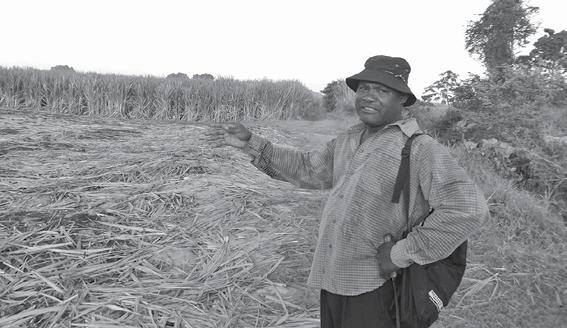
“Shops and business will be affected directly and indirectly,” stated the farmer.
His brother Roger, a father
of 9 with three children currently in school, stated that he has recently paid off his loans and estimated that the closure will cause him to lose “millions” in investments. The farmer expressed disappointment that no official from the Agriculture Ministry came to address the closure with farmers.
“The most hurtful thing is that they never find time to meet with the farmers,” stressed the Carylls.
Avenash Ramharack, 20, is a young farmer who took over from his father. He claimed that his father died of a heart attack after hearing the news of the closure. He has also called for a reversal of the closure.
Sadik Hussain, who
has his farm in Canal Number Two stated that his family has been in cane farming over 70 years and observed that sugar is “in his blood.”
Mohamed Abu Talib Khan had seen the closure of Versailles and moved to Wales Estate in 1979, noting that was an “easy transition” but stated that to transport to Uitvlugt would be “impossible”. He further noted that farmers are at crossroads as the price of sugar is not feasible.
It was explained that farmers once received Gy$104,000 per tonne of cane but that has reduced to Gy$58,000.
Many of the farmers emphasised that Government is “not looking into their interests.”

Opposition Leader Bharrat Jagdeo has said that given the unfolding over the last ten months, he is confident the People’s Progressive Party (PPP) would make a successful bid at the next general and regional elections.
The former President was speaking to party stalwarts and supporters on Sunday at the Babu Jaan, Port Mourant, Corentyne, Berbice commemoration ceremony of the life of Dr Cheddi Jagan.
He said based on what has transpired in Guyana over the last ten months, since the A Partnership for National Unity/Alliance For Change (APNU/AFC) Government took office, there was no doubt the party would win the next General Elections.
“People have a fear that the elections of the future will not be fair. If the PPP was in office and the PNC [People’s
National Congress] led coalition rigged the 2015 elections, now that they are in government what will they do?”
He also addressed some of the issues which the PPP/C had been focusing on in recent weeks, including the National Budget, crime, and the economy.
According to Jagdeo since the 2015 elections, there has not been any major investment in Guyana. “In fact, many investors have pulled out of the country,” he said while adding that the economy has come to a standstill.
He said as it relates to the economy, it is projected that in 2016 the manufacturing sector will show a 0.7 per cent growth and this is because of two new gold mines which were established under the PPP/C.
“The agriculture sector will show negative growth. The construction sector will be stagnant…
every sector will remain stagnant or register a decline, Jagdeo, an economist, predicted.
He noted that in the 2016 National Budget there is no help for the fishing, mining, construction, retail trades and agriculture sectors.
Jagdeo said the new administration is clueless as to where it is taking Guyana. “Total incompetence,” were the words he used to describe the government.
He said the budget has a list of new taxes which are all geared to make life harder for the small citizen. According to him, many rice farmers were fooled by promises made by the Coalition during the lead-up to the last election.
Rice farmers were promised large sums per bag of paddy should the coalition win those elections. “Where is Nagamootoo now? He should have gone to Essequibo to campaign for the Local Government Elections. He can’t come to Berbice or go to Essequibo to talk to farmers, so he gone to North America…” Jagdeo highlighted.
Speaking of crime, the former Head of State said the PPP has submitted a nine-point plan to the government on ways to tackle crime. “When we were in power and there was the Linden uprising they wanted Rohee to resign, now there are the deaths at the prison, why doesn’t Ramjattan resign,” he asked.
By: Kizzy Coleman
The lifeless body of a man was early Saturday morning found hanging in his home, leaving family baffled as to what caused this terminal action.
Dead is Curt Ossorio, 20, of Eccles, East Bank Demerara (EBD), whose body was discovered by his roommate.

According to reports, Ossorio an employee of the Demerara Harbour Bridge Mall, showed no signs of distress or of having problems.
Guyana Times International was told family of Ossorio were contacted at around 01:30h by Police who were at the scene of the incident and informed of
the tragedy. Ann Leung, sister of the dead man spoke to this newspaper: “We got the call and everyone broke down but we were told that we had to identify his body. When we arrived at the scene, the police did not take him down as yet and he was just hanging there. I could not take what I was seeing and broke down right there.”
Though there are a number of recommendations before Cabinet for charges to be laid against various individuals and entities, government wants to ensure they have “concrete evidence” before going to the Courts.
Commenting on these recommendations, President David Granger on his “Public Interest” TV programme explained that there is not sufficient evidence to take the culpable parties to Court.
“Well, we need to have evidence before the case goes to Court… maybe the audit might have discovered that there might have been deficiencies and malpractice but that itself is not evidence which is necessarily accepted in Court,” he stated.
Granger said once Cabinet has considered the reports, the matter would then be transferred into “the hands of the laws” to make recommendations.
“The Cabinet does not direct the Courts… once we have recommendations from the law officers that there are cases to answer, that is the course we’ll follow… we don’t tell the Courts what to do,” Granger further pointed out.
The President maintained that the main focus is to correct or to prevent any malpractice from recurring.
“It’s not a witch hunt; and again, if persons have committed offences, we want to see them tried, we want to see justice done. But in so doing, we would like to ensure that the cases are strong enough to bring about convictions,” he posited.
Junior Finance Minister and coordinator of the State Forensic Audits, Jaipaul Sharma had told Guyana Times International that he made several recommendations for further police investigations and for criminal charges to be filed in relation to the forensic audit reports into the various state entities but Cabinet is delaying on making a decision.
Meanwhile, Sharma during his Budget 2016 presentation indicated that the audit findings showed that the former administration in many instances violated the Fiscal Management and Accountability Act and consequently expressed his opinion that persons be charged for political corruption and acts of fraud. He had also stated that there appears to be sufficient evidence that implicates certain persons in premeditated plans to engage in corruption.
In May 2015, the A Partnership for National Unity/Alliance For Change (APNU/AFC) government launched about 45 audits into various State Agencies across the country.
Others were gradually initiated, making the total number of audits 50. So far, only four of the 50 audits have been released – Marriott Hotel, National Industrial and Commercial Investments Limited (NICIL), Carifesta X 2008 and the acquisition of the water cannon by then Home Affairs Ministry.
Government has since promised to release the other reports soon.
She added that the last time she saw her brother, he was his usual self and explained she did not see any signs whatsoever that he was having trouble.
“I did not sense that anything was wrong with him, even his aunt saw him during the day and she said that he looked well and that she did not see anything strange”.
Family members are baffled as to the reason for Ossorio committing the act: “He did not leave any letter or anything, the only thing that we saw at the scene is that he was drinking a large amount of beers because the bottles were found laying around”.
Ossorio is described as a loving, kind, caring and very jovial person.
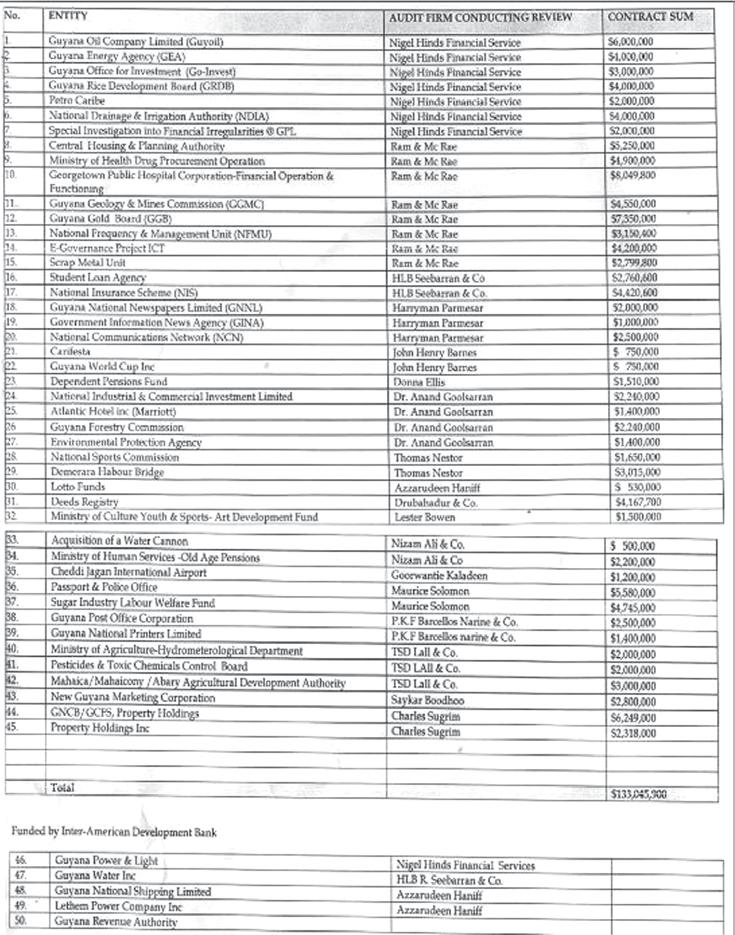




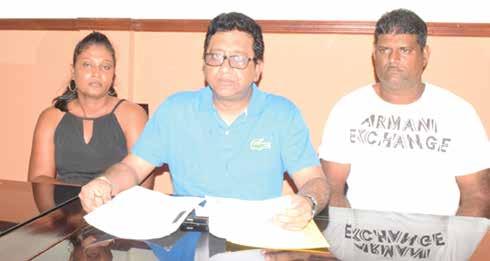
Some four acres of land in Washington, West Coast Berbice (WCB), is currently the subject of dispute between a young couple and Government.
This land/property battle is just one of many cases involving the Government that is engaging the High Court’s attention.
In fact, only recently, a group of rice farmers from Region Five (Mahaica Berbice) successfully gained an injunction forbidding the Mahaica Mahaicony Abary/Agricultural Development Authority (MMA/ADA) from carrying out its ‘Cancellation of State Land Leases’.
Guyana Times International spoke
with the Berbice couple, Darshannie and Feroze Mohamed, who explained that Government officials have parked equipment including ploughs and tractors on their land in an attempt to prevent them from conducting any form of activities there.
The couple identified the persons who are employed within the Regional Democratic Council (RDC) who have prevented them from utilising their land.
According to the couple, the RDC insisted that the land belongs to the State.
When the matter was taken to the Police Station, the ranks reportedly informed the couple that a senior
Government official instructed them not to take action on the matter.
As a last resort, the couple retained the services of Attorney Anil Nandlall to take the Government to court.
Guyana Times International understands that a writ for trespass has already been filed seeking injunctions to remove and restrain the individuals in question from interfering with the land.
Notably, the couple during an interview with this newspaper presented documentations to show they are owners of the land. The transport shows that the land has been in private ownership since 1947.
After almost a year on the run, Shivanand Roopnarine, 22, of Lot 478 Grove Housing Scheme, East Bank Demerara, who reportedly stabbed his girlfriend to death, has been arraigned for her murder.
He appeared at Sparendaam Magistrates’ Court on Monday where he was not required to plead to the indictable charge. It is alleged that on April 19, 2015 at Sophia, Georgetown he murdered Alicia McPherson, 18.
Police Prosecutor Sergeant Jupiter told the court that the accused was captured last Friday at Mabura.
She said that on the day of the murder, the deceased was at a barbeque in Sophia with a male companion when the accused showed up and had a confrontation with the decreased. During the heated argument the accused allegedly dealt the young woman 41 stabs about her body.
Roopnarine was remanded to prison and

will make his next Court appearance on April 28.
Last Friday, the murder suspect was reportedly heading to Mahdia and at a check point at Mabura, Region 10 (Upper DemeraraBerbice), he was asked to produce a form of identification.
It was at that point the Police at the check point recognised the young man and made the arrest. The young man at the time of the murder had long braided hair, however upon his capture his hair was short, presumably to disguise himself.
The suspect reportedly told investigators that on the night of the inci-
dent, he became annoyed after seeing the teenager dancing with another man.
Upon seeing this, he ordered McPherson to leave the dance but she refused and in retaliation, he dragged her to the back of the yard where he stabbed her multiple times before escaping.
A senior Police rank has confirmed that the wanted man was transported to Georgetown where he was grilled by Police in the capital.
Relatives of the dead woman are satisfied the fugitive has been captured and will face the full force of the law.

Government is considering the option of isolating high-risk criminals in a maximum security facility as a precautionary measure to prevent any possible reoccurrence of the unrest that erupted at the overcrowded Camp Street Prison; killing 17 prisoners as well as injuring several inmates and prison officers.
President David Granger, during his weekly telecast ‘The Public Interest’, told media operatives that the prison facilities need to be evaluated and certain criminals ought to be housed in a maximum security facility.
“What we are contemplating is ensuring that there is a facility… correctional facility… which can guarantee the security of high-risk prisoners without allowing the
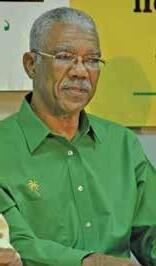
outbreak of the type of violence we’ve seen,” he stated.
Granger reminded that the three major prisons (New Amsterdam, Mazaruni and Georgetown) were built in the 19th century and as such, its physical infrastructure is not up to par with international standards.
Nonetheless, he assured that the improvement of the infrastructure of the prisons is something the State is current taking into consideration.
While on the issue of the historic three-day rioting that occurred at the Camp Street penitentiary, the President spoke about the need for better training for prison officers as a means of stamping out the inclination to get involved in corruption.
“We want to have more trained prison officers so that the integrity of prison officers is beyond question. It is quite clear that the contraband items had to be done due to the laxity or inefficiency of [the] prison service or with the complicity with members of the prison service,” the Head of State related.
On that note,
Wakenaam residents to
Govt: “We are important too” …want more emphasis on development support
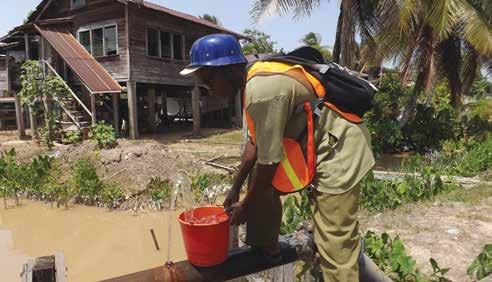
Residents in the Essequibo island of Wakenaam have called for better facilities to improve their quality of life. Among their needs were the installation of streetlights, improved water pressure and the return of landline telephone service.
It was explained that there is a lonely road around a burial ground which can be unsafe as no houses are around. Residents said street lights would benefit school children who would go to lessons in the evenings.
The water pressure in many areas was said to be low which was blamed on the current dry conditions.
One inhabitant explained that for “several months” the flow of water in the taps was re-
duced and claimed that persons farther away are not receiving water supply.
Another resident said to be an employee of the Guyana Water Incorporated (GWI) was seen filling two buckets. It was explained that this GWI employee would “help out” some of those who were without service.
Cattle farmer, Tareeq Ahmad has called for a “purified water system”.
In the past, there was landline telephone service in Wakenaam. Coconut and rice farmer Takur Persaud while praising the availability of mobile telephone service said everyone would be grateful if landline service would return.
Shopkeeper Ivy stated that she has made several reports over the

President Granger emphasised the need to improve the quality of prison staff, at least through enhanced training.
Moreover, the President posited that these training sessions can better prepare prison officers to more effectively deal with situations of this nature.
“We need to give them a certain quality of training that prepares
them for this type of occupation,” the President posited.
In addition to improved training exercises, Granger admitted that the profession is not very attractive and therefore, more incentives need to be offered to encourage young adults to join the prison service.
He said these incentives would include better pay and better working conditions. Nonetheless, Granger reminded that the Commission of Inquiry into the incidents that occurred at the Camp Street Prison is underway and therefore, Government will be waiting on the recommendations included in the final report before making a decision on the way forward.
Over the weekend, President David Granger commissioned yet another 50-seater bus that was donated to his “Five Bs” (boats, bicycles, buses, books and breakfast) initiative for the students of Bartica, Region Seven
use of the new means of transportation.
The President told residents that education was the foundation of equality and next to food, clothing and shelter, education was the best thing anyone could offer to a child.
school while others had to paddle a canoe for hours.
He noted too that even children on the coast encounter challenges in acquiring transportation to get to school. Against this backdrop, he under-
non-functioning service and also emphasised that she would be happy if it returns.
Regional Chairman of Region Three (Essequibo Islands/ West Demerara), Julius Faerber had informed this publication last week that the Regional Democratic Council has already made representation on behalf of residents with Guyana Telephone Telegraph (GTT).
He noted that Wakenaam along with Leguan were supposedly slated to have a return of landline phone service sometime in 2016. The chairman cautioned that GTT explained that before it can return the service it would need to assess the amount of telephones it has within its remit.

(Cuyuni-Mazaruni).
Thirty more students also received bicycles. Earlier in January, some 21 students received bicycles as part of the same programme.
The bicycles were donated by Denar Trading while the bus was donated by businessman Nizam Kassim.
Meanwhile, during his visit to the mining community, President Granger hosted a public meeting at Third Avenue where he charged the residents to make good
“One of the reasons there is so much poverty is because there is so much inequality. Once the child of a rich man and the child of a poor man have the same education, they then have a chance to be equal and with that equality, you have a better opportunity at employment,” Granger said.
The Head of State recalled travelling around the country and observing children in hinterland communities walking for miles to attend
scored the importance of the Five Bs initiative.
Granger also maintained that education could ignite the spirit of enterprise in young people across the country.
The President pointed out that while education was a means to employment, if everyone chose to seek employment in the public sector, rather than harness their entrepreneurial potential, growth and development would move at a very slow pace.

Angold Thompson, who is among the well-known artists of Guyana, started drawing when he was just nine years old. He was encouraged by his father, Basil Thompson, also a Guyanese artist, to pursue his passion for art.
Alim Hosein, in his
notes on Guyanese, said during the “1970s many new artists were coming on to the scene and brining additional perspectives to Guyanese art and identity”. Hosein added that the 1970s was a kind of “crossroads” period in Guyanese art. One such artist who added to that
“Guyanese art and identity” was Angold Thompson.




"leaving


Thompson attended Central High School, where he worked for three years with English Art Master John Criswick.
The artist has had three solo exhibitions. He has paintings in private collections in the Caribbean, Europe, the Americas, and the National Gallery of Art (Guyana). His first mark as a notable artist was made when he won a national inter-school art competition. He later won a Newcomers, Best Watercolour and Three Paintings of the Year awards at national exhibitions between 1966 and 1984.
Thompson has achieved a photographic look in his paintings us -
ing water-based and oil medium. His watercolour paintings of Guyana are absolutely beautiful and nostalgic of an era where life was simple, especially in the rural areas.
Another passion of Thompson is photography. Through the lens, the applauded artist captures the intimacy of a way of life in his country (Guyana).
Some of Angold Thompson’s are currently being exhibited at the ‘Circa 1970 – The Crossroads’ art exhibition being held at Castellani House, Vlissengen Road. The exhibition is currently opened to the public until March 26, 2016. Admission is free. Gallery hours are 10 a.m. to 5 p.m. Monday to Friday and 2 to 6 p.m. on Saturday; the gallery is closed Sundays and holidays.
To contact the artist, call 225-7113 or 627-8676.



In March 1837, the British colonial administration in British Guiana, now Guyana, began plans to build and operate a railway system between Georgetown and the Mahaica River. It is said to be the first railway system on the continent of South America.
The Demerara Railway Company, a private company that financed the project, first operated the railway, but it was later sold to the Colonial Transport Department of the government, which took control from Jan. 1, 1922.
The Company hired an experienced railway system British civil engineer, Frederick Catherwood. He surveyed the East Coast route, and later mapped out the proposed railway line along the coast between the Demerara and Essequibo Rivers.
The East Coast route, or the Demerara - Berbice railway ran along the coastline from Georgetown in
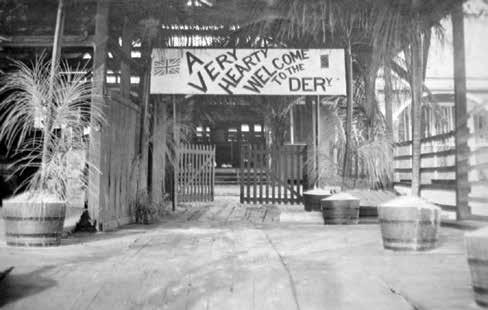
Demerara to Rosignol in Berbice - a distance of 60 ½ miles. It was connected by ferry steamer across the Berbice River with New Amsterdam.
The DemeraraEssequibo railway stretched along the West Coast from Vreeden-Hoop on the left bank of the Demerara to Parika on the Essequibo River.
The bill proposing the construction of the
railway was passed in July 1846. For the Georgetown terminus, the Demerara Railway Company purchased an area at the junction of Main and Lamaha streets in the city.
In August 1847, work began on the building of a large railway station with workshops, coal sheds and large water tanks. Construction other stations along the route also started shortly af-
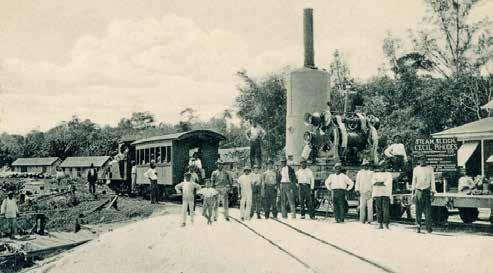

the 1890s. The railway line linked Vreed en Hoop on the west bank of the Demerara River to Parika on the east bank of the Essequibo River.
The first section of the Demerara - Essequibo railway was laid down up to Greenwich Park, then was extended to Parika in 1914.
ter. The DemeraraBerbice railway was laid down in sections.
The first section, from Georgetown to Plaisance, was opened on November 3, 1848. The extension to Belfield was completed in 1854; On 1 August 1863, the railway reached Clonbrook and, finally, the Mahaica terminus at Helena in August 1864.
On August 31, 1864, Governor Sir Francis Hincks officially declared the railroad open. During 1897 to 1900 the extension to Rosignol was built.
In 1912, The Demerara Railway Company extended the West Coast Railway, which it had started in
Commercial railway services for both passengers and cargo were operated until 1974 in Guyana, before it was dismantled in stages, leaving only the industrial railway systems at bauxite mining sites and another linking Port Kaituma and Matthews Ridge in the Northwest District.
Guyana's rail system was sold by the late President Forbes Burnham to several African countries.
The Lamaha Street terminus of the Demerara - Berbice railway was converted into a bus terminal after the railway system was scrapped. It is presently leased by The Guyana Power and Light Inc.
There are three lines of railways: Firstly, from Vreed-en-Hoop, on the West Bank of the
Demerara River, opposite Georgetown, to Greenwich Park on the West Coast of Demerara - a distance of 15 miles. A steam ferry connects Vreed-en-Hoop with Georgetown. Secondly, from Georgetown to Rosignol, at the mouth of the Berbice River, opposite the town of New Amsterdam. Rosignol is connected with the town of New Amsterdam by steam ferry. Thirdly, the Demerara-Essequibo Railway, which runs from Wismar on the left bank of the Demerara River to Rockstone on the right bank of the Essequibo River. Constructed and worked by Sprostons, Limited, to provide expeditious and safe means of access to the Potaro gold-fields on the Upper Essequibo River, the route via the Essequibo below the terminus of the Railway being obstructed by a series of falls dangerous and tedious to navigate. There is daily communication by steamer between Georgetown and Wismar, and launch services carrying passengers and freight connect Rockstone, the Essequibo River terminus, with Tumatumari and Potaro Landing, stopping at other places on the way. (Handbook of British Guiana 1913)

By PetamBer Persaud
xtract of interview with Francis Quamina Farrier in Georgetown, Guyana on February 2016. Farrier is a communication icon; he is more known for writing Guyana's first ever local radio soap opera, “The Tides of Susanburg”)
PP Uncle Francis you have witnessed a number of significant changes in your three score and seven years, and you have seen national landmarks established. Take us down those corridors filled with moments that stayed with you until now.
FQF Thank you Petamber. First of all, I like to say there are a decreasing number of people like myself. And by this I mean folks who have been born before Independence and who have experienced a number of years of the colonial rule, the kind of culture in the colonial days. I was twenty seven when the country attained its independence. So obviously I would have seen the colonial days as preteen, teenager and young adult to adulthood. And one would recognize the changes ….
PP You were at an age of awareness when you could recognize changes and knew to yourself what was happening….
FQF Absolutely. We knew for instance what a governor was. The youngsters of today don’t know – may read – but do not know what is a governor. A governor, for youngsters who do not know, a governor was an English man, a white man, who came all the way from England and who administered the running to the country. Of course he had his other officers and most of them, if not all, were Europeans, white people, who came …
PP So it was a European culture?
FQF Yes. Some were good people and some were not so good people as we have even today. What we learnt however was to look at the broader horizons, to look beyond Guiana, British Guiana. British Guiana was part of the British Commonwealth so we knew as children we were part of this huge empire and were told that it was an empire on which the sun never sets. Britain had countries – the eastern most I think it was New Zeeland... all the way to across to Canada –

so at any time during the twenty four hours, the sun was upon some part of the empire.
PP Thanks for that explanation.
FQF So Guiana and Guianese of that era was part of the British Empire and so when it was the Queen’s Birthday or any such special day we would sing patriotic songs like “Rule Britannia, Britannia rule the waves…”
PP How did you feel as a young man at that time?
FQF Well, one grew up knowing England as the ‘Mother Country’.
PP How did you feel singing those songs? I am sort of building a foundation so we could the see the distinction when it was time for the transition.
FQF Singing those songs gave a sense of pride in being British because one of the songs I alluded to earlier says that ‘Rule Britannia, Britannia rules the waves/ Britons never shall be slaves” but the British they were referring to was never us in the colony, they were referring to the English man. And later I discovered that it was more England we were talking about, because Scotland and Wales and Ireland were like second cousins, and the Englishman looked down on the Scots and Welsh and the Irish.
PP And you knew better than to refer to the others as Englishmen
FQF We didn’t really care because they all came and were given the best jobs, whether it was in the government or private sector like Sandbach Parker, or Bookers – you know we were referred to as BG and often as Bookers Guiana.
PP Against this socio-political scope let’s move into the culture of this time…
FQF One sang the songs of England and to some extent of America; in the meantime however there were some strong cultural developments which came out of
the days of slavery and indentureship. Because the Africans who were enslaved really prided themselves in thinking of where their foreparents came from because they had their oral traditions, even though it was sometimes illegal to beat their drums and sing their songs
PP Masquerade
FQF Things like the masquerade survived so we have to be very thankful to the African people for keeping their culture alive. The Indians came and on the other hand they were encouraged to stay more or less because they were cheap labour… when I did my radio programme, I interviewed some Indian Immigrants and I think I might have the most recordings of East Indian Immigrants; so I got so many stories from the lips of East Indian Immigrants.
PP Talking about stories and songs, what about the books you were reading then?
FQF The books that we were reading include the Royal Readers – a series of books in the Primary School. In the Royal Readers, you had very highly educational material and those of us of my age group would say to you when you got to fourth and fifth standards in primary school, you were at the level of high school or even college depending on the teachers. Primary school education took us any part of the world and we could conduct ourselves in a way to earn us a good job…and we were able to use the language with such fluency. But then we had a man named Edgar Mittelholzer a Guyanese
who started writing some serious novels and we were encouraged to read Mittelholzer, and George Lamming from Barbados, and other early writers like E. R. Braithwaite… the guys from the 50s and 60s, so as we approached Independence, we were not only reading European literature
but we were also reading Guyanese writers. And if one wants to extend to music – listening to music to English, American and Guyanese. And in the Guyanese setting we were doing a lot of African type of music, Indian type of music, and to lesser extent Portuguese and Chinese
and some Amerindian…
PP So you have seen various stages from colonialism to Independence. Fifty years on, what do you think? (TO BE CONTINUED)
Responses to this author telephone (592) 2260065 or email: oraltradition2002@yahoo.com



March is Women's History Month. It is a month to highlight the contributions of women to events in history and modern-day society. Additionally, on March 8 we celebrate International Women's Day. The month of March gives us the opportunity to celebrate the achievements of women, whether big or small.
This year, Women’s History Month’s worldwide theme is: “Working to Form a More Perfect Union: Honouring Women in Public Service and Government.”
Sunday Times Magazine, during the month of March, will feature women who have made and are making significant contributions in
the public service sector and other areas of society, locally and abroad.
This week we feature Ingrid Berkeley-Brown and Amy Barbour-James.
Ingrid Berkeley-Brown Overseas-based Guyanese Police Superintendent, Ingrid Berkeley-Brown does not consider herself a role model, even though she is the highest-ranking black female police officer in Canada. As superintendent of Peel Regional Police, she prefers to be a mentor who helps others reach their goals, whether that is to work in law enforcement or another field.
One of 11 children, Ingrid migrated from

Guyana in 1974 and completed high school at Sir

volvement”.
Remarried since 1989 to St. Lucian-born constable Joseph Berkeley who works in Peel’s Forensic Identification Services, Ingrid holds a Master’s in Leadership from the University of Guelph.
The mother of two and recipient of the Police Exemplary Service Medal and the United Achievers Club of Brampton Community Award is also the past president and current secretary of the Caribbean Canadian Association of Waterloo Region and an avid soccer player and marathon runner.
descended from those who had been forcibly brought by Europeans to work on slave plantations. Through his networks in the Caribbean, London and Africa, he worked actively to promote agricultural and educational opportunities for the Gold Coast. After retiring in 1917 he devoted himself to promoting black achievements in Britain through lectures and participating in various societies and leagues. He remained loyal to the Empire, but highly aware of his ancestral links to West Africa and the Caribbean. John died in late 1954.
Sandford Fleming in Toronto. She is the daughter of the late Cardwell Pellew, who was a member of the Guyana Police Service. He died in 1966.
At the age of 14, she migrated to Canada where she began her career in law enforcement 30 years ago.
Her goal was to work with youths. Consequently, she volunteered as a probation and parole officer. She later met a retired black police officer in Toronto who encouraged her to join the ranks.
Over the years, Ingrid has worked in the child abuse and sexual assault, media relations, diversity, crime prevention and uniformed patrol and investigative units.
In January 2016, she became the highest-ranking black female police officer in Canada.
Ingrid was one of only two black female recruits in a class of about 300 at the Ontario Police College in 1986, and the only black female officer in Peel County after graduation.
The superintendent hopes her milestone promotion will inspire women, especially black women, to pursue a career in policing and aspire to be senior officers.
She believes that “the key is to do everything you can to make yourself the best candidate for a position and that includes hard work, pursuing higher education and community in-
In her new role, Ingrid is the officer in charge of 21 Division overseeing 300 members.
Another legendary lady is Amy Barbour-James, a London-born civil rights activist and civil servant of Guyanese roots. In 1906, she was born to parents John and Caroline. The family relocated to London from British Guiana in 1905.
Amy’s path within the movement for equal rights

in Britain was inspired in large part by the work of her father.
John Alexander Barbour-James was born in 1867 in British Guiana. He rose up the ranks of the postal service and spent his spare time trying to improve agricultural conditions among the AfroGuianese, the communities
Amy joined the civil service and was active in the League of Coloured Peoples and other campaigns throughout her life. She became the League’s secretary in 1942, which was particularly significant given that she was a woman. She died in 1988. Amy had kept much of her correspondence and photographs, which record the ongoing campaigns by black people working within the system, and remained proudly British and loyal, yet also exposing inequalities and demanding improvements. The archive she gave to historian Jeffrey Green and the interviews are now in the Black Cultural Archives, London. In 2011, a short drama based on Barbour-James’s life was broadcast by BBC Radio 4.

With Guyana’s natural forests considered among the vastest in the world, its timber resources are one of the country’s most abundant and traditional industries.
With more than 1,000 different species of trees in its territory, some 12 -14 species are utilised for commercial activities.
In a 1902 publication titled, “The constructional woods of British Guiana”, its author Luke Mullock Hill describes 10 of the principal commercial woods of the time.
These include greenheart (classified as Nectandra rodiei), which was used especially for bridge building, house frames and foundations and for submerged works: wharves, piles and dock and lock-gates.
The Bullet tree wood (Mimusops Balata) Hill notes, was a favourite wood for making windmill arms when those machines were popular, and was also used for extracting balata.
According to P. van der Hout in his articleon Tropenbos.org about Guyana’s woods, during the latter part of the 19th century balata bleeding outstripped timber production.
Another wood used commercially, Hill informs, was crabwood (Carapa guianensis) for furniture making and house building as well as for ships’ masts.
Wallaba (Eperna Falcata) was especially useful for palings and staves, though Hill points out that it was susceptible to wood ant infestations when above ground.
The highest tree in the territory, the mora tree (classified Dimorphandra mora and described as standing some 200 feet tallby Hill) was used in ship and boat building. Both mora and cirouabali (Nectandra), known in its two varieties as “brown” and “yellow” silverballi or sirouballi, were used in boat building.
The purpleheart tree (Copaifera
brateata) is also one of the tallest trees in the region and was used for house framing as well as for commercial applications.
In der Hout’s article he states that the earliest recorded commercial venture in timber in Guyana occurred in 1624 in the form of bartering between the indigenous population and Dutch settlers.
The wood, Brosimum guianense known as Letterwood or Captain’s
new ordinances allowed the British authorities to attempt to regulate woodcutting by making provisions for rent payable on Crown Lands’ timber tracts.
With the regular harvesting of timber by this time, it became obvious that there was an imminent depletion of timber resources. This led to the Crown Lands Ordinance of 1886 and new forest regulations in 1890 which sought to establish a sustainable
With the Second World War affecting the supply of mechanical equipment for harvesting and preparing greenheart, attention turned to species which required little mechanisation, such as Mora (Mora excels)and Crabwood.
After the war, the colonial government in 1948 drafted policies that recognised the need for increased production while at the same time providing for “managing

Letterwood – syn. Piratinera guianensis)was then routinely traded, and documentation reveals that some 10,000 kg of the timber was shipped bya single ship in 1669.
It wasn’t until the late 18th century that greenheart (Chlorocardium rodiei) would be produced for
system for the industry.
These conservation measures included “the institution of minimum cutting limits, the obligation to retaineconomic species spaced throughout the forest, the payment of royalty, the institutionof grant registers and removal permits, and the marking out of working blocks,”
the forests on the basis of a sustained yield concept.”
Van der Hout writes that 1954 marked the legal beginning ofcontrol of the Forest Department of more than 7.5 million ha of Crown Lands, now declared to beCrown Forests.
Also in 1954, new lease agreements un-
commercial use and overtake Letterwood in the timber trade.
The timber was at first located on private Dutch lands so that colonial government involvement in and regulation of the industry was absent, even up to the time of early British rule.
Therefore, in 1871,
notes van der Hout.
It was this recognition of forest management that also led to the establishment of a forestry branch at the Department of Lands and Mines in 1908. A Forest Department, independent of the Lands and Mines Department, was later established in 1925.
der the new Forest Ordinance were concluded for three major firms operating in the Bartica Triangle (West of the Essequibo River andSouth of the Mazaruni River): British Guiana Timbers Ltd., Willems Timber and Trading Co.Ltd. and Charlestown Sawmills Ltd. (TO BE CONTINUED)
… President pledges to end “hereditary poverty”
As Guyana joined the world in celebrating International Women’s Day on Tuesday, some 54 Guyanese women were awarded for their stellar contribution to women’s empowerment in the country.
These women were selected from the 10 Administrative Regions of the country by the Social Protection Ministry. They were honoured during a commemorative ceremony held at the Arthur Chung Convention Centre, Liliendaal, on Tuesday.
Addressing the femaledominated gathering, President David Granger said in order for women to be fully empowered, the cycle of hereditary poverty, among other cultural hurdles, needed to be broken.
Granger said the cycle of poverty was the greatest source of inequality. “This is so because poor mothers tend to produce poor children and poor children tend to produce poor children too,” he stated.
According to the President, in certain parts of the country that are poverty-stricken, the average age of grandmothers is 32, which means that more young women and teenagers are becoming mothers.

“What we see is a cycle of poverty that mothers who tend to get babies early in life – at 13 and 14 –they tend to set a pattern for their own daughters to get babies earlier in life… we have to break this vicious cycle of hereditary poverty. If there is inequality in society, the burden of poverty invariably, if not inevitably, will fall heavily on women,” he stated.
Against this backdrop, the Head of State pointed out a virtual cycle needed to be established whereby educated women, those with self-esteem and those who have developed themselves facilitate and provide the opportunities to empower others.
The President noted that in order to achieve this, there needed to be employment opportuni-
ties for young women and single mothers to earn for their families.
“We need to ensure that women can work for a living wage so that they can grow out of poverty. We need to ensure that there are jobs to help poor women to have sustainable incomes so that they have a better opportunity to exit from poverty,” Granger stressed.
He went on to outline that education was the gateway to employment, but noted that good employment could only be achieved if there was guaranteed equal access to education.
According to the Head of State, there continues to be wide disparities in society particularly between the hinterland and the coastland with regard to

Star of the week

Bthe delivery of education.
To this end, President Granger pointed out that his “3Bs” (buses, bicycles and boats) initiative aimed at ensuring that transportation was provided so that every child could get to school safely and comfortably.
He added that “these disparities tend to exacerbate the problem of inequality … gender parity cannot be achieved in the absence of a more equal society”.
Moreover, the Head of State underscored that while Guyana has the necessary legislative framework to promote gender equality, it was necessary to enforce those regulations and conventions that the country has signed on to.
orn with Guyanese roots, Terrence Telford, known popularly by his stage name Gadinelli, shares his love for the “Land of Many Waters” through his music. The singer, songwriter and recording artiste was born to Guyanese parents on November 15, 1990, in Milwaukee, U.S. Gadinellistarted singing at the tender age of four. He was encouraged to sing in church by his grandparents and parents,“due to their strong religious beliefs”. Gadinellishared his passion for music at the schools he attended, where he would perform in show choir. Shortly after graduating from high school, the singer went off to college at the Texas Southern University to pursue studies in psychology. But psychology was not his passion. Gadinelli decided to “take a break to reflect on life and to re-evaluate” what he desired the most – music. Growing up in Milwaukee was difficult for Gadinelli because of “the lack of Caribbean/ South American influence in the area”. At times, he would take frequent trips to New York just to embrace the different cultures that exist there because it is what his “soul needed”. Although being born in the United States, Gadinelli has a “profound love for Guyana”. He first visited Guyana when he was a teenager and “truly enjoyed the natural beauty the country had to offer”. He “fell in love with the people, the food, the culture and the best Guyanese hospitality”. This inspired him to want to sing about Guyana; not about its physical traits, but about how he was personally affected through his meaningful experiences in the country. The songwriter’s most recent song “El Dorado” tells of the “images and experiences” etched in his mind during his visits to the country. Through this song, Gadinelli “captured the essence of Guyana”. His goal, via his music, is“for Guyana to become even more global, even more powerful, and even more respected”. Gadinelli aims to lead by example by “letting others know that no matter where you are in life or how far you may go, always be true to your roots, values, and culture. Never deny the deeply rooted, beautiful Guyanese heritage that runs deeply through our veins, just as how the Demerara runs through Guyana”. The singer takes pride in “showing patriotism from afar and representing the pleasant, lovely and picturesque Guyana”. For more information on the singer, visit Gadinelli on Facebook.



The Local group formed in Bartica – the Bartica Independent Green Alliance (BIGA) – to contest the LGE has certainly raised a hornet’s nest in the APNU/AFC coalition. No other than the President himself – but probably acting in his capacity as leader of the PNC accused them of “splitting the vote”. Now in all of the possible manoeuvres in ethnic politics, this is possibly the most desperate – and the most dangerous.
What it does is to presume that constituencies – and in Guyana read ethnic communities – are owned by specific parties – the PNC and the PPP. So when Mr Granger or his party representatives talk about “vote splitting”, they are really talking about “race splitting”. As the APNU/AFC leaders said, “the PPP is the enemy” and any splitting of the vote might make them “take” Bartica. Which is just not done, we guess.
And what is most sad about the entire episode is one of the most highly touted reasons for struggling for Local Government Elections was – in addition to reversing the authoritarian centralised power structure – to break this racial orientation to politics in Guyana. The theory was at the local level, the problems were faced by everyone: when, say, blackout comes, both PPP and PNC supporters have to suffer in the dark. They all have an interest in correcting the situation.
But with the national parties interjecting themselves into the fray, they are bringing the national racial orientation in politics down to the grassroots. All comparative studies have shown if these parties stay out, the locals will in general vote for persons they know can do the job – regardless of which party they might’ve been involved with at the national elections. The studies show that these same locals who vote for an independent local group would gravitate back towards “their national” group come the General Elections.
In this case at Bartica, BIGA has personnel from the APNU, AFC and the PPP. This is a very positive development and must be encouraged. Mr Nigel Hughes, Chairman of the AFC, must be commended for not being afraid of identifying with the local group BIGA. More citizens must support independents as well as all nationalist politicians.
In Georgetown, for instance, our most troubled Municipality but which affects all citizens since it is also the national capital, the best possible outcome would be for independents to take most of the seats so that when they get together to select a mayor, they can’t just toe the “party line” but the “city line”.
It is also our hope that in the NDCs and the other municipalities, INDEPENDENTS will emerge who will be foremost for their localities.
Entering the ICC Twenty20 World Cup starting today (Tuesday), the WI is rated as the second favourite to take it all the way – just behind India. This is quite a feat for a team that’s been depleted of several of its stars – for various and sundry reasons. Now it’s up to the team to live up to their billing.
But whatever the outcome of the World Cup, we cannot be diverted from the fact that our cricket is in serious straits and that reform must begin with the WICB. CARICOM’s been bringing some pressure to bear and we hope this continues. We certainly don’t need another study to tell us what to do.
From where this Eyewitness sits (in the bleacher stands) we can’t do worse than begin implementation of the Patterson Report – named after the former Jamaican PM who was part of an eminent three-man panel.
The sticking point there is the WICB, as is, has to be disbanded. Are our leaders up to ensuring this?
Change has got to come!
…Parika
Did you notice one of the contestants for the Georgetown LGE said the city could take a leaf from Parika and build vertical parking lots??!
Are we going to be rid of GT insularity at last?

(Taken from Caribbean360. C om)
ACaribbean dream holiday turned into a nightmare for a New York family whose daughter was nearly raped and killed by an ex-convict working at the resort where they were staying.
The family was vacationing at Covecastles, a cluster of private beach villas in Anguilla, when the girl was attacked, the family claims in a lawsuit filed in Manhattan Supreme Court.
On the second day of the US$15,000 trip last year, the girl went for
walk on the beach to film part of movie she was making for school.
“On her way from the villa down to the beach, suddenly and without warning, a gardener hired by the resort, attempted to viciously rape [her] in broad daylight,” the parents charge in court
papers.
When the girl resisted and tried to defend herself, the gardener “repeatedly stabbed [her] throughout her body using a broken bottle with the aim of murdering her to silence the only witness to this attack,” the court papers say.


The parents claim that their daughter “had the amazing presence of mind to appear dead so that the stabbing would end.”
The couple discovered the girl’s seemingly “lifeless body” and rushed her to a hospital. She had sustained a fractured skull and punctured lung, among other injuries.
The girl, identified only as “C.G.” in court papers, was subsequently airlifted to New York Presbyterian/Columbia University Medical Center in Washington Heights.
The gardener, who was arrested, is not identified by name.
The family is suing the resort, its designer Myron Goldfinger, and his wife June, claiming that the couple slashed security at the resort due to financial mismanagement.
Myron Goldfinger is a Westchester architect who designs high-
end mansions in the exclusive Hamptons area, including one used in the Leonardo DiCaprio movie “The Wolf of Wall Street.” He designed Covecastles in the 1980s.
The Goldfingers, both 83, misappropriated funds, failed to maintain the property and vet employees and incurred “a great deal of debt,” the family claims in court papers demanding unspecified damages.
The family adds that the gardener was not screened despite a criminal past, and the Goldfingers cut security staff from three full-time guards to one part-timer. According to the family, the attack was the second security breach at Covecastles in two weeks.
An attorney for the Goldfingers stated that the couple was wrongly named in the lawsuit and would be vindicated.

B y L omarsh r oopnarine
This week I was experiencing a writer’s block and then I saw on television that the movie Spotlight won the best Oscar for picture. The movie is basically a newspaper drama of how the Roman Catholic Church has tried to cover-up sexual abuse by priests.
The Atlantic, an American Magazine espouses that “The central cast isn’t the motley crew of self-destructive drunks and grandstanders you’d usually see—this is a film about the methodical process of reporting, not the stirring heroism behind it, and at the end of the film, it’s the story itself, not the journalists’ personal achievements, that stands triumphant.” Put differently in three words: Practice responsible journalism. The story produced is greater than the journalist’s ego.
The contents of film certainly resonate beyond the shores of the United States and it is arguably a sound message to journalists and columnists around the world, including Guyana. My take is that thirty to 40 per cent of what comes out in the daily columns in Guyana should be taken with a grain of salt and more. Propaganda journalism in Guyana is as deep as the Demerara River and as high as Mount Roraima.
That being said, the Freddie Kissoon face and faeces fiasco comes to mind.
To recall, Kissoon was assaulted in May 2010 when faeces were thrown in his face. Three individuals – Former Presidential Liaison Officer, Kwame McCoy, self-confessed killing squad member Shawn Hinds and former Office of the President employee Jason Abdulla – were charged and these individuals will be in court starting March 11.
Whatever verdict comes out of that court hearing – guilty or not – the hope is that it will follow the fair journey of jurisprudence. I leave that for the court to decide.
There is a larger concern here that should appeal to all those who seek to write on controversial issues in the media. That is, the throwing of faeces on Kissoon’s face is wrong and should be condemned by all and sundry.
The attack on Kissoon is an attack on all those who choose to write. That
attack is a disgraceful and dastardly act that has no place in the free world.
I propose that a bill be put forward in Parliament to provide protection to those who go out on a limb and be courageous enough and say it the way it is. Whatever protection exists right now, it is limited and insignificant.
In Kissoon’s head and trembling hands may not reside a staggering wealth of expertise. But that does not mean he should be attacked physically. He may not abide by the modus operandi of journalism but that does not mean he should be attacked. He may not be a skilled communicator or a gifted columnist but that does not mean he should be attacked. His rumbling baritone and his inflammatory rhetoric in his continuous catacombs of columns do not give anyone the right to attack him. Use your pen as much as he does.
I was told that I was wasting my time responding to Kissoon and I said that might be so but let the man write. Some say that Kissoon has crossed the line and my response is, let the man write. I take this position not only for Kissoon but for all those who write about Guyana in the media.
There are those who are besotted by Kissoon’s writings because they believe that he is informative and does well to society. Then there are those who believe that he should do more than what he is doing rather than less of it.
I believe that attempts to silence writers by whatever means is an attempt to silence what is going on. Writing, in any form, represents free speech and free speech is crucial to the development and sustainment of a free society. I believe that there is no organised effort to hurt journalists in Guyana but my philosophy is, hurting one affects all. The message is more dangerous than the action.
Personally, I do not feel totally comfortable writing the way I write in my weekly column for the fear of reprisal. Nevertheless, I am guided by this mantra. I live to write and write to live and I should have the right to write. Of course, there are limits to freedom of speech based on civility and consciousness but not on consternation.
I urge my fellow Guyanese to pay attention to the message in Spotlight. (lomarsh.roopnarine@jsums.edu)


Ms. Bibi Shabena Ali was recently appointed Chairperson of the Deeds and Commercial Registries Authority by Attorney General and Minister of Legal Affairs, Mr. Basil Williams.
Ms. Ali is currently the Legal and Compliance Manager of Demerara Bank Limited; she has held this post since 2014. During the period of 2012 to 2014, Ms. Ali served as Deputy Registrar of the Supreme Court of Judicature. Prior to that appointment, Ali held the position of Registrar (ag) of the Supreme Court of Judicature for three (3) years.
Ms. Ali also served as Assistant Company Secretary and Company Secretary of the Guyana Sugar Corporation Inc. from 2005-2009. She was previously Legal/Administrative Officer at Ministry of Agriculture.
The newly appointed Chairperson held her inaugural Board meeting yesterday in the Board Room of the Ministry of Legal Affairs.
In her current post as Legal and Compliance Officer, Ms. Ali’s duties include monitoring compliance with the financial institution’s Anti-Money Laundering/Countering the Financing of Terrorism (AML/CFT) programme; training staff at all levels in the area of AML/CFT and liaising with the Bank of Guyana (BOG), Financial Intelligence Unit (FIU) and Special Organised Crimes Unit on matters pertaining to AML/CFT.
As Chairperson of the Deeds and Commercial Registries Authority, Ms. Ali is an ex officio member of the AntiMoney Laundering/Countering the Financing of Terrorism Authority in Guyana.


The oldest youth movement in the country, the Scout Association of Guyana, is currently one of the only youth movements in Guyana that caters to youth from as young as seven, to mould them into playing a constructive role in society.
Scouting started in British Guiana (BG) in 1909, two years after it was founded in England by Sir Robert Baden-Powell. This
was the first country in the Caribbean where it was established, and the second in South America.
The initial scout troop was founded at Queen’s College, by Sgt Major George Manley, a member of a British regiment stationed here, and scouting soon spread to other schools and churches.
By mid-century, there were over 25 troops in BG, many initiated by church groups. These includ-
ed Queen’s, St Mary’s, St Theresa’s, St Stanislaus, St Francis, St Thomas More, HQ Troop 39, St Pius and Central High in Georgetown.
Elsie Taylor dedicated her life to scouting in Guyana, and for many years kept the movement alive in spite of constraints and a period of near dormancy in the seventies.
Her motivational skills were exceptional, and she endeared herself to every scout in Guyana being their ‘second mother’ and mentor. DB St Aubyn, MBE, Commissioner 1952 was very instrumental in acquiring the present scout headquarters on Woolford Avenue, Thomas Lands.
The 3rd Caribbean Jamboree held at the Queen Elizabeth Park, (later National Park) was a memorable affair, and probably one of the best in this hemisphere. Contingents came from Canada, England and all the Caribbean Islands. Sir David Rose was the Chief Patron and it is estimated that over 1,500 scouts participated.
Now the Scout Association of Guyana’s

mission is to “contribute to the education of the young people, through a valuebased system based on the promise and law, to help build a better world where people self-fulfilled as individuals and play a constructive role in society”.
Scouting in Guyana has three sections: Cub Scouts (7-11 years); Explorer Scouts (11-15 years); and Venture Scouts (15-19 years). Then you have the leaders (19 plus). Activities/ programmes range from traditional activities such as camping, hiking and pioneering (building gadgets) to learning about the environment, first aid, disaster preparedness, issues that affects youth in our country and in the world, leadership and management
scouts from around the world.
In an interview with Sunday Times Magazine, Domonique Van Sluytman, Deputy Chief Commissioner –Administration of the Scout Association of Guyana, pointed out that becoming a scout is beneficial to youth because it gives them something constructive to do, something to look forward to each week that will keep them away from drugs or a life of crime. She added that scouting is broad-based in terms of the things scouts learn to do, which can lead to careers one might have only dreamt about.
“Scouting is fun with a purpose that is governed worldwide by laws of trust,
tempered and shy, to someone who is more assertive, patient and deal with matters in a more rational way. Joining scouts for me even as an adult was one of the best decisions I have ever made. Even though it takes me out of my home and away from my family and friends way more than I could have imagined, seeing at least one young person grow and develop through the work that we do, makes it all worthwhile,” Van Sluytman expressed.
Some notable scouts in Guyana are Hamilton Green (Mayor), Ron Robinson (well-known broadcaster and Managing Director of Primetime Advertising Agency) and Laurie Lewis (late
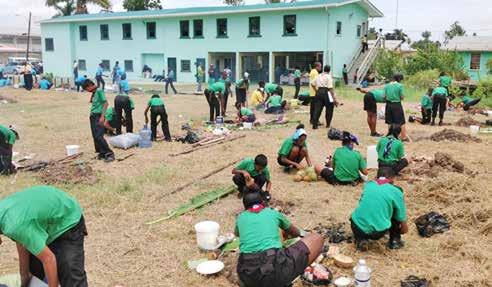
skills, among many other activities.
All of the various activities, although are done across the board in each of the different sections, are also scaled towards the various age groups.
Scouts participate in camping, hiking, cooking, pioneering (building gadgets), sewing, community service, archery, fishing, training in first aid, learning about the environment, peace, local and world issues such as suicide, HIV/AIDS, domestic violence and much more. They also take part in international activities such as Jamborees and youth forums, where they learn about other cultures and meet and interact with
loyalty, courage and respect to name a few which are notable traits of a great citizen. I joined scouting as an adult (a leader) because of my love for helping others and adventure. I have been a part of this movement for almost ten years. What has benefitted me most is the accomplishment when I see young persons come into scouts, who grow and develop from either being quiet and shy or troubled and unmannerly, to persons who are bold and assertive of themselves or are mannerly and has respect for themselves and others. I have also benefitted from scouting in that I too have grown from someone who was sometimes very impatient, short
Commissioner of Police).
Scout Association of Guyana’s future plans are to bring more awareness to scouting in Guyana and to grow into one of Guyana’s leading youth movements. This year, the Association will be hosting the 14th Caribbean Cuboree from July 24 to 29, 2016, where Cub Scouts from across the Caribbean will gather in Woolford Avenue to learn about each other’s cultures and form friendships that will last a lifetime.
Any one desirous of becoming a scout can contact the Scout Association of Guyana on 225-3225 or Ms Domonique Van Sluytman on 623-1052. You can also visit Scout Association of Guyana on Facebook.



Conservationist and hobbyist photographer
Annette ArjoonMartins captures Guyana’s natural beauty in photos which she shares on her Facebook page: Annette & Dave Martins: "Is We Own".
Some of her scenic photos are of remote, rarely visited areas of Guyana, known only among the villagers who spend their daily lives with these picturesque natural landscapes.
This week she shares with Sunday Times Magazine some of her amazing shots of Guyana’s lesser-known waterfalls – though they are familiar landmarks for villagers in the regions they’re found.
The Echillibar Falls is located 20 minutes by road from Monkey Mountain, Region Eight. While it is a cascading wonder, it is also a well-known
route for its nearby residents.
In addition, there is Uchi Falls located in Region Seven. Outsiders can reach this waterfall by travelling three hours overland or 20 minutes by helicopter from Paruima village.
Another scenic spectacle, the Kamana Falls is surrounded by untouched rainforest and a border cliff. It lies near Kamana Village and Iwapai Mountain in Potaro - Siparuni region in western Guyana.
This area of Guyana has wonderful landscapes for tourists and travellers to discover, with several impressive waterfalls near Kamana Village – well-known to residents – and Orinduik.
For more photos of beautiful Guyana, visit Annette & Dave Martins: "Is We Own" on Facebook.


…from Jagan?
Yesterday was the 19th anniversary of the death of Dr Cheddi Jagan, founder of the People’s Progressive Party.
Normally there would’ve been a big pilgrimage to the site of his cremation at Babu Jaan, not far from his birthplace at Port Mourant, Berbice. But this year things were relatively muted. Could it be the present leaders of the PPP are moving on from the total identification of the party with the old leader?
There are those who believe the process is long overdue –and your humble Eyewitness is one of them. Nothing against the old fella personally – it’s just that Jagan was from another era and literally another place and it would be more than passing strange if his diagnosis, prognosis and prescriptions don’t have to be reexamined for relevancy.
There’s been some of this re-examination – but from outside the party. Dr Baytoram Ramharack has critiqued Dr Jagan’s reliance on Marxist analysis of Guyanese society and ignoring
the elephants in the room of race and ethnicity. In that he was invoking CLR James oft quoted aphorism, “The race question is subsidiary to the class question in politics, and to think of imperialism in terms of race is disastrous. But to neglect the racial factor as merely incidental is an error only less grave than to make it fundamental.”
Ramharack found Jagan’s position quite ironic since his support base among the Indian-Guyanese was completely due to their identification with him as an “Indian” and not because of any “class consciousness”. Some of Jagan’s critics saw the situation not as a matter of “irony” but of calculated exploitation of the race card, since in all his attempts at coalition building he took it for granted that he would be the “Indian” leader.
One wonders when the critique from within the PPP will start. It is possible that the powers that be believe that any critique would seem like a “betrayal” of the great man. But why does it have to be? Let’s take Dr Jagan’s Marxist premise that if the party focuses on economic development of the country without discriminating among the ethnic groups, class consciousness would wipe out racial consciousness.
Every election since 1992 has been “fair” and has confirmed the racial cleavages are just as salient as the PPP found them when they took office in that year. Now that can be so only if they either a) discriminated against African Guyanese or b) class is trumped in Guyana by race. And
since every PPP leader would honestly swear it isn’t (a) then they have to accept (b).
And admit that Jagan was wrong – at least in that issue – and the party needs to move on.
…from Burnham?
In Guyana Jagan and Burnham are inextricably linked in the popular mind such that young people believe there was a fella named “JaganBurnham” who was later split asunder. And maybe they were – symbolically. So if there’s going to be a re-evaluation of Jagan in the PPP – can one hope the PNC will follow suit on THEIR “founder leader”?
More than anyone else that can ONLY come credibly from our sitting president – Brigadier (rtd) David Granger. Granger caught Burnham’s eye very early when he was fishing around for options to replace the racially balanced Special Services Unit formed by the British as the core of the soon-to-be country’s army. Granger was sent to Mons and within a decade was heading Burnham’s indoctrination unit in the army. In 1979 he was made head of the army to head off Rodney’s subversion of the officer corps.
His later training in history provides the methodology and the Rodney Commission, the grist. His remarks on the release of the Report will give us a clue of the revisionism of Burnhamism. …on pardoning?
In the wake of the prison rebellion, President Granger now wants a “maximum security” prison. Does this mean no more pardons?





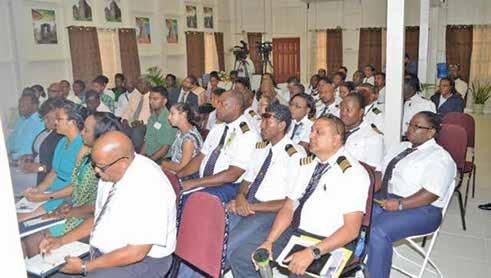
Several local customs officers, as well as stakeholders in the public and private sector benefitted from a customs and trade facilitation capacity workshop, conducted today at the Guyana Revenue Authority (GRA.)
The workshop, held in the agency’s Training Room, at Camp Street, forms part of a slew of capacity building initiatives being implemented across the region, under the Caribbean Forum CARIFORUM–EU (European Union) Economic Partnership Agreement (EPA).
The training project was funded by the EU under the 10th EDF (Economic Development Fund) for capacity building within CARIFORUM states. It focuses not only on custom and trade facilitation, but also on areas relating to competition and public procedure.
Opening the workshop in Guyana were Commissioner-General (ag), GRA, Ingrid Griffith, Chairman of the entity’s Governing Board, Rawle Welch
and Director, EPA Implementation Unit, Carlos Wharton.
Griffith described the workshop as a “win-win situation”, where everybody stands to gain from an initiative that will make the process of trade easier.
The Commissioner-General (ag) observed that Government gains, because the workshop is expected to result in efficient procedures, in the process of moving goods, that will consequently lead to an increase in government revenue.
She noted that businesses gain because they will be able to deliver goods quicker to their customers, and the consumers gain since it is expected that the goods would be had at a much cheaper cost.
She commended the organisers of the training programme and encouraged each participant to raise awareness, and to share the information gathered with other officers and stakeholders.


By Ryhaan Shah
It is a truth that our politicians do not listen to us but, instead, talk to us, at us, and around us. They believe that they do not have to listen because they know what is good for us. Plain and simple, they are “hard ears”.
The other truth is that if we had a culture of listening and communicating, Guyana would be much further along socially and economically.
Listening is a conscious act. You have to be actively engaged to not only hear but to understand and appreciate what the other person is saying. A response with relevant questions or statements would then produce meaningful engagement and dialogue.
Such dialogue is not only absent between our political parties but also within the parties themselves.
Many PPP members say they are tired of trying to get the party leadership to simply listen to what they have to say. Meetings are held and the leaders attend, but never to listen. They come for the platform to speak to them and at them. The party’s radio and television call-in programmes are the same. They are used to disseminate

party propaganda when supporters actually want to engage in discussions.
It is as if the party sees their supporters as unworthy of engagement.
For the PPP, views that differ from the party line are seen as “talking back” and criticism, as negative and oppositional, and even as open attacks.
This, even after the party accepted that apathy among their supporters led to their loss of the majority in the 2011 general elections, and to losing the elections outright last May.
The apathy is a direct result of supporters feeling disengaged because of the widening gap between themselves and the party leadership. Treated with contempt, they reply with apathy.
A surefire way to engage and even impassion supporters is to listen
to their opinions and suggestions and to involve them in deciding the party’s programmes, plans, and political direction. Once invested, they will work to see the party succeed.
A political party that shuts itself off from its support base, stagnates, and no one, looking at both the PPP and PNC/APNU, would disagree that both these behemoths have failed to reform, to keep up with a changing world, and to respond to that change with new directions and policies.
They are both still stuck in the Cold War politics which shaped them and the PNC and its government’s current impasse over the findings of the Rodney CoI is due in great part to the party behaving like its original past self when PNC paramountcy ruled.
Once again, PNC supporters are expected to simply follow the leader when, if the party listens, they will hear that the entire country is ready to unburden itself from that dark past. Should the PNC find the grace and goodness to put country first, we could all be jubilant.
The young people who voted for the Coalition based on their campaign message that the past doesn’t matter have realised by now that it

matters greatly because it is about righting wrongs and exacting justice, values that are essential to sustaining democracy and upholding the national good.
But will they insist and make themselves heard and wrest the changes promised them or will they do as my generation and simply abandon all hope and seek the good life elsewhere?
As it is, no party has to listen to its supporters. Our politics remains locked as a racial battle and we along with it. It did appear that the APNU/AFC Coalition understood that we were battle weary, what with all their campaign promises of change and unity.
It appeared that they had listened and that, having understood, they would deliver with policies to effect the needed changes for progress and development once elected.
As it turns out they weren’t listening, at all. Their ears were fully “corked up” as ever and, because of this, Guyana is set to suffer another cycle of racist and corrupt governance that will take us further downhill.
What a change it would be if our party leaders were elected in a transparent and truly democratic manner where listening to the electorate would be key to winning. We would have better political leaders and a better chance at progress.
The Greek philosopher Diogenes said: “We have two ears and only one tongue in order that we may hear more and speak less.”
Would our political leaders take his advice and just listen to what the people have to say. They will learn much about our hopes and aspirations when they do.

Satiricus was intrigued. He was an avid follower of the letters’ pages and most times that’s where he started his daily reading. Some fellas started at the back page with the Sports, others with the front page and politics. Satiricus wanted to hear “the voice of the people” and he heard it loud and clear on the letters’ pages.
And he was hardly disappointed. Like yesterday when he heard from that Minister fella Patto. Now Patto wasn’t one of your flashier politicians. Quick now!! Can you tell Satiricus if Patto is short or tall? Thin or fat?? “So there!” thought Satiricus with satisfaction.
If the truth be told, Patto was about as exciting to cover as giving updates on grass growing. So he hardly got coverage – which is the kiss of death to an ambitious politician. What’s a Minister to do when no one knows you from a hole in the wall? And you want to build your profile for the next election when your party the KFC’s going the way of the Dodo?
Well, manufacture a controversy! And that’s what Patto tried to do! In his missile…ummm… missive, Patto accused Sato’s newspaper of distorting his words so much he was “afraid” of speaking to them. Now Satiricus as an old newshound didn’t really mind the accusation. He knew that to a politician any publicity was better than no publicity. And Patto’s problem was really NO publicity and he was desperately trying to fix that.
What got Satiricus’ attention was Patto claiming that unlike the Times the other newspapers were paragons of fairness in covering the scene!! “Well really!?!” exclaimed Satiricus, laughing so hard his wife thought was having a coughing fit. “Does Patto really believe, say, the Muckraker’s fair when they persecuted the man who gave the country its first world class hotel, so viciously? Or the Kronic that’s funded by taxpayers’ money to say they should only cover Patto’s Party?
Satiricus didn’t think so. But then, he shrugged. “What’s an anonymous politician to do? Not being noticed is worse than the kiss of death.” And even the prince of death wouldn’t kiss Patto!!

Aman was on Tuesday jailed when he appeared in the Georgetown Magistrates’ Courts before Magistrate Faith McGusty slapped with a simple larceny charge.
Romeo Frank, 20, of Berbice pleaded guilty to the charge which alleged that on March 2, 2016 at North Sophia Georgetown, he stole 1 Samsung Galaxy cell phone valued at Gy$93,000 property of Samantha Allen.
The prosecution facts state that the Virtual Complainant (VC) and the accused are cousins as such the accused was staying at her home.
At around 10:30 hours, the VC put her

phone to be charged and went out. Upon her return, she noticed that her phone was missing
and reported the matter to the Prashad Nagar police outpost.
The accused was con-
tacted by the police and a search was carried out on his person when the phone was found in his pants crutch.
The accused was told of the offense and arrested.
The accused told the Magistrate that he took the phone with intent to sell as he needed money to go to Berbice to see his mother.
The VC explained that she did not want the accused to go to jail but just would like to have her phone returned to her.
McGusty explained to her that the accused must be punished so as not to repeat the act. She then sentenced him to 2 months in prison.
The Ministry of Public Infrastructure will be undertaking remedial works to the Supenaam stelling in Essequibo, which is currently in a deplorable state. The structure provides a critical link to the capital City of Georgetown.
Minister within the Ministry of Public Infrastructure, Annette Ferguson made this announcement during a visit to Supenaam over the weekend. She, along with Minister of Public Infrastructure, David Patterson was at the time inspecting infrastructure in Region Two.
“Some millions were spent on the Supenaam stelling under the previous Administration and in less than 10 years of its existence, the state of the wharf is one that is troubling, and so we did the assessment, and I want to assure the citizens of Essequibo that correc-

tive works will be done,” Minister Ferguson said.
This stelling was built more than six years ago to the tune of Gy$600M.
Minister Ferguson reiterated
that the state of the facility is of great concern to the Ministry and steps will be taken to correct the defective works within the shortest possible time. (GINA)
Sherwin Hopkinson, 30, of Lot 78 North Ruimveldt, Georgetown appeared in the Georgetown Magistrates’ Courts today, to answer to a cause of death by dangerous driving charge.
He pleaded not guilty to the charge which read that on March 5, 2016 at Aubrey Barker Public Road, he drove minibus BBB 1302 in a manner dangerous to the public thus causing the death of 76-year-old, William Trim.
The prosecution’s facts state that on the day in question, the defendant was overtaking
…on cutting budgets
In what is probably a signal that many of the decisions handed down by now retired Chief Justice Ian Chang will be reversed, the Court of Appeal headed by Chancellor (Ag) Carl Singh ruled that budgets can be cut by the Opposition in the National Assembly.
Aficionados would recall when the Opposition APNU and AFC held a majority in the House during the last Parliament, they hacked away at the PPP/C’s budget quite furiously to the tune of $21B.
When APNU Speaker Raphael Trotman ruled that chopping was OK by the rules (as he read them), Attorney General Nandlall did the stipulated thing in these matters and asked the Courts to make the call. While the Assembly can make its own rules, those rules can’t be violative of the constitution. Constitutional supremacy and NOT Parliamentary supremacy rules the roost here – unlike Mother England.
So Justice Chang looked at the Constitution and noted the relevant Article 218 stated without any ambiguity that the Opposition can “approve” the submissions of the estimates by the Executive. He ruled in his inimitable style: “The power to amend MAY involve the power to approve, but a power to approve DOES NOT imply a power to amend.” The point he was making was, if you’re given the power to “approve” something… by its furthest extension you may possibly claim you also have the power NOT to approve.
And that’s what Justice Chang ruled: if the Opposition so desired it could “disapprove” the entire Budget – but NOT cherry pick what it wants to approve and what not to. In your Eyewitness’ estimation, the Chief Justice was spot on to point out if the Opposition were permitted to do that, it’s tantamount to having them BECOME the Executive. It’s the latter’s sole prerogative to craft the budget for the country based on its Manifesto on which it was elected.
More fundamentally the Chief Justice explained (if not in these exact words), if he were to allow the Opposition to craft the budget then he’d be sanctioning a coup d’etat! So on what grounds did Chancellor Singh, the new CJ (Ag) and Justice BS Roy reverse CJ Chang’s ruling? Well on absolutely NO GROUNDS. They did admit they agreed with Justice Chang that the Articles on which he based his judgement were the relevant ones.
All Chancellor Singh could say was: IT WAS ALL A MATTER OF INTERPRETATION!!! Justice Chang saw it his way, and he and his cohorts on the Appellate Bench saw it the opposite way.
This will become the “I say potato (po-tay- to); you say potato (po-taa-to) doctrine!
…on prison catastrophe?
After every administration since Burnham’s closed their eyes to the bubbling cauldron at 12 Camp St, let’s hope this catastrophe of 17 prisoners perishing during protests will bring about some needed reforms. Heck… what is really needed aren’t reforms… but a root-and-branch change in our stance on penology.
several vehicles while speeding when he lost control of the minibus and collided with a motor car.
Trim was in the said car which pitched several feet away from the point of impact. He was picked up in an unconscious manner and taken to a city hospital where he was pronounced dead on arrival.
Chief Magistrate Ann McLennan granted Gy$800,000 bail to the defendant and ordered that his license be suspended until completion of the trial. The matter will return to court on March 30 for statements.
Right off the bat, we need a NEW prison outside of Georgetown. Secondly we need to reform our laws for possession of minor quantities of marijuana. Thirdly, we need a separate facility for remand prisoners: even choirboys will become affected when they come out of remand. Then every civilised state has a social services department to deal with prisoners’ complaints – especially remanded prisoners. Do we?
And if “rehabilitation” is one of the goals of incarceration (in addition to “punishment” and “retribution” etc) shouldn’t we have some job programme to reduce the recidivism rate?
We know jails aren’t supposed to be hotels… but they don’t have to be purgatory or hell, do they?
…at City Hall
Responding to accusations by Team Benschop that City Hall was stymieing its scheduling of meetings, Town Clerk Royston Forde claimed Benschop “attempts to implicate the City’s administration in the Canaille.”
Canaille? It refers to the “masses” but it derives from “dogs”. Ouch!!!
Actress Lisa Ray, who is known for films like “Water” and “Bollywood/ Hollywood”, says girls should be taught bravery, not perfection.
“Teach girls bravery, not perfection. Let’s make a world in which they write their own script rather than follow anyone else’s,” Lisa wrote on her Twitter page on Tuesday.
Lisa, who successfully battled myeloma (cancer), was last seen onscreen in the romantic entertainer “Ishq Forever”, in which she played the role of a secret agent.
Directed by Sanjay


Actor Sidharth Malhotra is leaving no stone unturned for his next project and will train in martial arts for same.
The 31-year-old actor had earlier took a training in martial arts for “Brothers”.
Sidharth has been roped-in by Fox Star Studios to star in their
next venture, an action film. Gossip mills are abuzz that it is a sequel to “Bang Bang”.
“We are doing an action film. It will be called something else. It is not related to the first part (‘Bang Bang’),” Sidharth told PTI.
The movie will have some high octane action.
“There will be a lot of
action sequences in the film. I will start training in martial arts. It (training) is different from what I did during ‘Brothers’,” he added.
According to him, the shooting for the film will begin in a few months.
Besides this movie, filmmaker Karan Johar has expressed his desire to make a sequel to “Student of the Year” that marked debut Sidharth’s Bollywood debut.
“I don’t know about it yet. We might do it… we may not,” the “Ek Villian” actor said.
Sidharth will be seen next in “Kapoor & Sons” alongside Alia Bhatt and Fawad Khan. (Indian Express)

Actress Alia Bhatt says her father Mahesh Bhatt is her go-to person whenever she is caught in a panic situation.
Asked to comment on her bonding with her father, the 22-year-old actress said: “He never makes me realise that ‘I know more than you’. He treats me like an equal and that’s the best way to have a father and daughter relationship. He is like a friend, he is level-headed and he knows how to tackle every situation.
“In a panic situation, the first person I call is my father.”
On the work front, Alia will next be seen on screen in “Kapoor & Sons”, a family film.
She believes that people take their
Still a lot
family for granted.
“We take our family for granted and don’t give them too much of time. I have not met my family for the longest time because of my hectic schedule. So, I feel this should not happen. This film is basically about a Kapoor family and I am not part of that family in this film.
“In fact, my screen space is not too much in this film, but the quality (of work) matters to me and not the quantity.”
Directed by Shakun Batra, “Kapoor & Sons” also features Rishi Kapoor, Ratna Pathak Shah, Rajat Kapoor, Sidharth Malhotra and Fawad Khan. It is releasing on March 18. (Indian Express)
Actress Tabu says things are certainly changing for Indian women but there is a lot still which can be done for their security and safety.
“It’s a multi-layered topic and discussion. We keep discussing and many issues will come out… there is no one generic statement, we can make on this. I think there is some awareness and effort towards making the change.
“There is a lot which can be done for women’s security and safety… it’s a huge issue but, I am glad we are thinking about change,” Tabu told IANS on the sidelines of an event on occasion of the International

Women’s Day to a query how have things changed for women.
“I am glad to support and spread Ariel’s new message which encourages Dads to #ShareTheLoad. Ariel’s own study shows that a significant number of men believe laundry and housework are a woman’s job. As some-
one with many examples in my own family, where men and dads #ShareTheLoad, I think it important to amplify and spread awareness of this conversation. So this women’s day “Gentlemen, we love the flowers but also do the laundry please,” she said. (Indian Express)
losing 35-40 kgs to play the younger version of
Currently in London, Aamir is spending some quality time with his 21-year-old son Junaid, who is studying film making there.
A source said: “He was supposed to be there till the end of the month but will have to cut short his trip and return in six days. His mother (Zeenat Hussain) is in her 80s now and wants Aamir who turns 51 on March 14 by her side on his birthday.”
As promised, Aamir will make it back in time to ring in his 50th birthday with his mother. (Indian Express)
Bollywood actress Athiya Shetty will take to the Amazon India Fashion Week A-W’16 ramp for the ‘Maybelline New York presents Namrata Joshipura’ show in Delhi later this month. She is thrilled about the opportunity.
The “Hero” actress, who is the brand ambassador of Maybelline New York, will be the showstopper for the beauty brand’s show with designer Namrata Joshipura on March 19 at Jawaharlal

ment: “I am thrilled to be representing Maybelline New York as it is a brand which is all about empowering women to express themselves and define their beauty. The idea of high-street fashion and New York style resonates deeply with me as the city has always held a special place in my heart.”
made her debut in Bollywood with

Actress-director Meg Ryan will be honoured with the Sonoma Salute Award at the 19th Sonoma Film Festival.
Ryan, 46, will be celebrated with a special screening of “Ithaca,” her 2015 directorial feature film debut, reported Variety.
A five-day program dedicated to the best in film, food, wine and spirits will also honour screenwriter and SIFF supporter Robert Mark Kamen, whose writing credits include the “Transporter,” “Taken” and “Karate Kid” franchises.
The festival will open with Joachim Trier’s Jesse Eisenberg-starring drama “Louder Than Bombs” and conclude with the French romantic comedy “The Sense of Wonder.”
SIFF runs March 30 to April 3. (Indian Express)
Prized possessions from comedienne Joan Rivers’ Manhattan penthouse are up for auction.
Christie’s, a London based auction house, will put up more than 200 of Rivers’ personal items up for auction in June, reported People magazine.
The items will range from USD 500 to 200,000 and the list includes River’s famous jewelry collection, a Tiffany water bowl engraved with Spike, the name of her Yorkshire Terrier and the Edouard Vuillard painting “Dans L’Atelier.”
The live auction takes place June 22 in New

York, with an online auction being held June 16–23. A portion of it will benefit the charities God’s Love We Deliver and Guide Dogs for the Blind.
“My mother’s legacy as a much loved comedienne and philanthropist
will be commemorated in this collaboration with Christie’s and her generosity to charitable causes is something I will continue to honor,” Rivers’ daughter Melissa Rivers said in a statement.
(Indian Express)
Actor Mark Wahlberg is teaming with US basketball player Caron Butler to develop a movie about his life.
The 44-year-old “Ted”
give up on your dreams,” Wahlberg said.
“When someone like Mark Wahlberg tells you that your life could be a movie, you listen,” Butler added.

star will produce a film based on Caron’s memoir “Tuff Juice: My Journey From The Streets to The NBA”, reported USA Today.
“(Caron is) a perfect example to all the young kids growing up in tough neighborhoods to never
“I’m excited to take the next step towards sharing my story with an even larger audience and it’s a blessing to have someone as well-known and respected as Mark Wahlberg by my side.”
A timeline for the project is yet to be re-
“Hollyoaks” actress Alex Fletcher is expecting her second baby with husband Neil Davies.
The actress, who already has 10-year-old daughter Yasmin with Davies, said it is “slightly surreal” to be expecting a baby boy in just three months time, reported Female First.
“It’s so thrilling and slightly surreal. I’m still on a bit of a high about it all. It’s a big deal isn’t it? I’m 40 in July.”
The pregnancy is particularly special for the actress as she had an ectopic pregnancy, where an embryo begins to grow outside of the womb, last year.

“It felt dangerous and frightening. Luckily, I didn’t need surgery and didn’t lose my Fallopian tubes. I had to take Methotrexate, which wasn’t pleasant and meant we couldn’t try for another baby for six months.
“Having gone through all that, it made me realise how much I wanted a baby – I was on a mission. We were so lucky it only took four months [to conceive again],” she said. (Indian Express)

Veteran actor Harrison Ford opened up about his daughter Georgia’s battle with epilepsy. The 73-year-old “Star Wars” actor discussed her condition at the NYU Langone Medical Center’s Find
‘Star
vealed, but Caron said they have already started to draw up a list of their top picks for writers and actors, it would be a “dream” if “Creed” star Michael B Jordan portrayed him onscreen.
“I think he would do a great job sharing my story,” he said.
Caron suffered through a tough childhood in Racine, Wisconsin, where he became a drug dealer at 11-years-old. He eventually turned his life around and started playing professional basketball in 2002, going on to play for the Washington Wizards and Los Angeles Clippers, among other teams.
He currently plays for the Sacramento Kings. (Indian Express)
a Cure for Epilepsy and Seizures (FACES) event, reported Us magazine.
“When you have a loved one who suffers from this disease, it can be devastating. You know how it affects their lives, their future, their
opportunities and you want desperately to find mitigation. You want to find a way that they can live a comfortable and effective life,” Ford said.
The actor, who came close to tears, while delivering the speech said his 26-year-old daughter had her first seizure as a child during a sleepover. Calling her a “hero” the “Indiana Jones…” star said he is inspired by his daughter.
“I admire a lot of things about her. I admire her perseverance, her talent, her strength. She is my hero. I love her,” Ford added. (Indian Express)
tar Wars: The Force Awakens” has received the most nominations at this year’s MTV Movie Awards, after being selected in a total of 11 categories.
Having been snubbed in all five of
nominated in the best female performance, best hero, best breakthrough performance and best fight categories.
Fellow young star John Boyega was also selected in the best breakthrough category with his co-star, and in best

its categories at the Oscars recently, with no recognition in any of the acting categories or for best picture, the record-breaking movie has scored big at the upcoming awards ceremony to be held here next month, reported Deadline.
The film’s 23-year-old female lead Daisy Ridley, who plays Rey, has been
action performance for his role as the Stormtrooper-turned-good Finn.
The JJ Abrams-directed film will also compete in the movie of the year and best cast ensemble categories when the 25th annual awards ceremony happens on April 10, hosted by Dwayne Johnson and Kevin Hart. (Indian Express)

Young Warriors stormed into the semi-finals of the Berbice Cricket Board (BCB) Memorex Under-19 two innings cricket thanks to Legspinner David Eastman, who spun webs around the Achievers batsmen with a ten wicket match haul to lead his side to a 38-run victory recently.
Playing at the Bush Lot Ground, West Coast Berbice, YWCC won the toss and reached 261 all out due to consistent batting from Berbice youth players Sasenarine Sukhu (64), Trevon Stanislaus (47), Jarron France (42) and Alex
Algoo (31).
Bowling for Achievers Akeem Blackman and Joseph Nicholson took three wickets apiece.
Achievers in reply could only muster 161 all out with the top score of 58 coming from the bat of Titus Webster. He got support from Randy Wade (35) and Adrian Ramnarine 23.
Eastman took 8-34 and Aaron Beharry 2-33. In their second turn at the crease, YWCC batted poorly and was bowled out for 104 with only Sukhu with 27 offering any resistance; Nicholson took six wickets and Blackman four
scalps for the Achievers.
Set a target of 206 for victory, Achievers threatened with a solid opening partnership of 89 between Wade (22) and the classy Ramrach (75).
However, when they went, so was the hope of Achievers who were eventually bundled out for 168. Stanislaus led the way with 5-30 and Beharry 3-25 while Eastman picked up two wickets.
YWCC will now play Rose Hall Town Youth and Sports Club in their semifinal game at Cumberland on March 12 and 13.

By Akeem Greene
Opening batsman of the Golden Jaguars, Tagenarine Chanderpaul during an interview with the Guyana Times International Sport on Wednesday before the team’s departure for Antigua and Barbuda, expressed his pleasure in the work he has been putting in behind the scenes.
The young cricketer stated “I have just been practicing more, putting in some hard work and things have been going well, so hopefully they continue to go that way in the remaining two matches”.
Just at the age of 19, young Chanderpaul has demonstrated maturity when batting way above his age, and on some occasions he has even held the top order together.
Though he averages 25.23 from thirteen First-class matches, with just two half centuries, it his application this season that has been most commendable. From four matches, he has made 285 runs at an average of 35.62 with a top score of 81.
The left-handed batsman whose batting still mirrors that of his father Shivnarine, has been a rock at the top of the order owing to his ability to adapt to circumstances, which sees him having an appetite for long innings.
Most worthy of note is his knock of 65 against Barbados where the
Jaguars playing for a draw saw Chanderpaul bat for close to five hours while facing 205 balls.
“As an opening batsman my job is to see off the new ball and try bat as long as possible into the innings and the game against Barbados it suit my kind of bat-
remaining matches, he bluntly stated, “I’m just hoping I can get a big score in the remaining games”.
The former West Indies Under-19 player believes that the Jaguars are good as they look to retain the title WICB/Professional
ting and it worked out for me”, he explained.
The prospect lies that this will be the first time, the father-son pair will bat together in a First Class-match and he welcomes the idea, since his father would give him helpful advice.
“So far I have never batted with him in a First-class game, we have batted in clubs: he is very helpful, he gives good advice out in the middle when I’m struggling”, he revealed.
Quizzed about what goals he may be looking to achieve in the two
Cricket League (PCL) four-day title.
“I think our chances are quite good to win the next game and seal the tournament, since we have been playing some good cricket thus far”, the player posited.
Table toppers Jaguars, depart Guyana today for Antigua and Barbuda where they play the Leeward Islands Hurricanes at the Vivian Richard’s Cricket Ground in their ninth round match starting on Friday. (akeemg@guyanatimesgy.com)


By Akeem Greene
Often the cry has been that Guyana’s women’s National Football team, the Lady Jags, has a high composition of foreign-based players.
With minimal platforms for local players to showcase talent, the Guyana Football Federation (GFF) is looking to address this problem by investing in the development; this is according to President of the GFF Wayne Forde in an interview with Guyana Times International Sport.
“I have before me a proposal for a Women’s League and we have just received from FIFA, a fairly decent funding


specifically for Women’s football”, Forde revealed.
He added, “We are currently talking to a specialised technical football individual out of the USA to help us streamline a domestic prorgamme in Guyana”.
If there is going to be a domestic competition for women, facilities will need to be put in place and the President is cognizant of this, highlighting that they are several practical issues that need addressing first.
“Women’s football brings its own challenges in terms of getting it started; many of the facilities that we have in terms of grounds do not have the basic things likes washrooms”, he said.
The President went on to illustrate the point that “to ask a young lady to go to a ground and spend four hours in the
afternoon training and not privately use a washroom or dressing room is not something you do, so there are some practical challenges we have”.
Instead of creating new clubs, the President is advocating that there be an utilisation of existing clubs to form these women teams.
“The recommendation that I have made to the women’s group is that they should not be investing any effort into trying to establish women’s teams in separate areas apart from existing clubs”, Forde explained.
Based on history, only when International engagements arise does the Lady Jags convene for training and creating a local group could help bridge that gap between off season and match time. (akeemg@guyanatimesgy.com)

National junior and senior badminton champion Narayan Ramdhani blasted his way into the quarterfinals of the 11 Peru Under-19 Junior International World Ranking Tournament currently being held in Lima, Peru at the Regatas Club Badminton Courts.
The world ranked player reached the quarterfinals in the boy’s singles by defeating Gabriel Urteaga Hammond: 21- 11, 2114.
Ramdhani who is also sponsored by Sunburst teamed up with national junior player Jonathan Mangra to reach the quarterfinals in the boy’s doubles by defeating Mariano Novoa
and Gustavo Alfredo Salazar: 21-17, 21-14.
The tournament is Ramdhani’s first international tournament for 2016 after recovering from a knee ligament injury he picked up at the Suriname Open International late November 2015 after executing a jump smash and landed on a slippery court. This caused his training to be slightly affected but is seemingly coping well. The tournament continues this evening with the players playing to get into the semifinal and the medal round.
Meanwhile Mangra lost his singles match in the first round in a thrilling three setter to Mariano Novoa: 17-21, 21-12, 18-21.

KOLKATA, India – All-rounder
Carlos Brathwaite is poised to take up a lucrative Indian Premier League contract with Delhi Daredevils next month but at the moment, the only thing occupying his thoughts is helping West Indies win this month’s Twenty20 World Cup.
The 27-year-old entered last month’s draft at a base price of $30 000 and walked away with a deal worth US$626 000, after Daredevils battled to secure his services for the cash-rich April 9 to May 29 tournament.
And though the IPL follows quickly on the heels of the World Cup here, Brathwaite was clear on where his priorities were.
“I don’t want to look too far ahead. The most important thing is to do well in the World Twenty20,” Brathwaite stressed.
“It’s wonderful news to be selected for IPL. But for me the first and foremost thing is to win the World Twenty20. Hopefully, I will play an influential role for the Delhi Daredevils as well.”
He added: “The World Cup is of prime importance now. I have an important role in the team and want to concentrate on that.”
Brathwaite was a belated addition to the T20 World Cup squad, following the withdrawal of the experienced Kieron Pollard through injury.
He is a powerful lower order batsman and a steady seamer, and is expected to form a major part of West Indies’ assault on the T20 World Cup.
Brathwaite said the Windies preparation had been helped by the presence of legendary fast bowler Sir Curtly Ambrose who was now the team’s bowling consultant.

BAlANCING ACt: Carlos Brathwaite says his focus is on the World Cup now and not IPl
“(Curtly) Ambrose has been influential, you see he is a legend,” Brathwaite noted. “Now it is up to us to find out his thought process. So far it has been great. He has had a huge impact.”
West Indies will face India on Thursday at Eden Gardens in the first official warm-up match for the T20 World Cup, before clashing with Australia on Sunday in their second and final warm-up.
They will then face a tough group campaign when they come up against England, South Africa and Sri Lanka, along with a yet-to-be determined qualifier.
Long-serving wicketkeeper batsman Denesh Ramdin believes, however, that West Indies possessed what was required to lift the title.
“The West Indies players have been in great demand in various T20 leagues across the world. We have seven, eight of them who are all match winners and I have no doubt that we can go all the way.” (CMC)
KINGSTON, Jamaica –Sprint icon Usain Bolt says his preparations for Rio’s Summer Olympics are on track, despite an ankle injury which kept him out of training recently.
The 29-year-old is bidding to become the first ever athlete to win the 100 and 200 metres title at three consecutive Olympics, when he competes at the August 5-21 global event in Brazil.
“Training is going well you know. I’ve really stepped up the tempo. I was out for a bit because of an ankle problem but everything is going smoothly now,” Bolt said here yesterday.
“I’m really focussed and I really want it, so I’m just pushing myself, working hard and hopefully my coach will give me the go-ahead to compete very soon.”
The Jamaican swept both sprint titles in World record times at the Beijing Olympics in 2008 and repeated his success four years later in London.
He then brushed aside talk of retirement to indicate that he

would defend his titles at the Rio showpiece, setting the stage for one of the most anticipated Olympiads.
Long-time coach Glenn Mills said Bolt’s preparation would continue until August as the athlete looked to make up for lost time.
“The preparation is going to be going right down to the Olympics because he lost valuable time, but he’s back in training and we are pushing the envelope,” he said.
“Usain is highly motivated and he’s a special athlete so we’re expecting that come the right
time he’ll be able to go out there again and do his thing.”
Mills also confirmed Wednesday that Bolt would open his season in May, as part of the buildup to Rio.
“Usain will definitely compete in May but as to the actual date and time I am not able to say at this time,” he said.
Last year, Bolt swept both sprints at the Beijing World Championships, successfully defending the titles he won in Moscow two years prior.
He remains the World record holder in both sprints.