
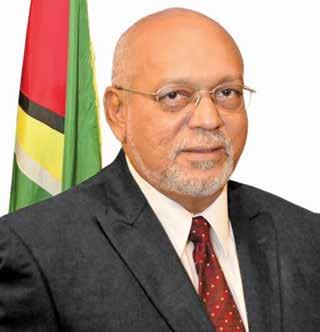




President Donald Ramotar
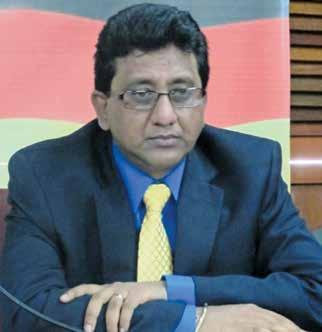
Attorney General Anil Nandlall Kaieteur News
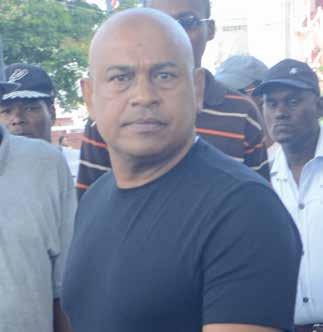
Lall


B y D evina S amaroo
President Donald Ramotar on Wednesday maintained that Kaieteur News Publisher Glenn Lall broke the law when he wiretapped a conversation between one of his reporters and the Attorney General Anil Nandlall.
“It was illegal,” President Ramotar said, referring to the recording which Lall has rendered in filing a complaint with the Police alleging that Nandlall made threats on his life and those of his staff.
Illegal
“Clearly what was done to the Attorney General was an illegal act to record him without telling him he would be recorded,” the President told reporters at the Guyana International Conference Centre.
He said the conversation was not meant for the public’s ears and that “this serious breach exemplifies that persons do not respect the laws of the country”.
While the President repeatedly described the act
as illegal, he said it was for the Police to take any enforcement action.
“The Police are supposed to take legal actions, not me,” Ramotar said when asked. The President stressed that what was done was illegal: “You seem to be missing the point. It was illegal… That’s the first point we must deal with,” he said.
On Monday, hours after the recording was made
public, Government said, in a statement, that the recorded conversation was manipulated and distorted by Lall.
“There are many ways for a keen listener to discern the said manipulation. For example, a listener to the manipulated conversation would easily recognise that on many instances the person’s voice at the other end of the conversation was

inaudible,” he said. President Ramotar clarified what was meant by the statement: “It was taken out of context. What is being done is to take everything out of context, that’s why we talked about manipulation. We’re not talking about doctoring the tape. We’re saying it’s not contextual,” he noted.
In his Police complaint filed on Monday, the Kaieteur News owner claimed the Attorney General was aware of a scheme to destroy him and his newspaper.
Lall, in his short statement to the Police, further claimed that he received several warnings of the imminent danger that threatens his life, and this danger also encompasses the numerous staff at his Saffon Street, Charlestown, Georgetown media house.
Meanwhile, the two parliamentary Opposition parties Alliance For Change (AFC) and A Partnership for National Unity (APNC) have both defended Lall and called on Ramotar to sack Nandlall.
Ramjattan had accompanied Lall to the Police when the AG made the report.
In its defence of Lall, APNU said the Attorney General as head of the Guyanese Bar and the Government’s legal adviser holds a pivotal position in the maintenance of law and order in the country.
“He has breached that trust reposed in that Office by the Guyanese people and must perforce pay the price. APNU calls for the immediate resignation of Anil Nandlall from the Office of Attorney General of Guyana.”
Also defending Lall, for its part, the AFC said it was shocked beyond disbelief at the conversation between the AG and the reporter.
The Working People’s Alliance (WPA) – a key part of APNU – also defended Lall in a separate statement, saying it was convinced that the recording was genuine and was appalled by the Government’s decision to question the authenticity and accuracy of the transcript and recording and to stand by Nandlall.


To contact:
Guyana Times International
New York Office
106-15 Sutphin Blvd, Jamaica NY 11435
Email: guyanatimesnyint@gmail.com Tel no: 718-658-6804
Preferred method of contact via EMAIL
Guyana Office
Ruimveldt, Georgetown, Guyana. Tel no: (592) 227-0704, 227-0709. Fax (592) 225-8696, 227-0685
Email: guyanatimesint@gmail.com
With Internet Communications Technology (ICT) transforming the world as we know it, it is not surprising that the technology would be abused for purposes for which it is not intended. There will always be those who will seek to subvert mechanisms for their own gain and nefarious purposes. In the instance of intercepting communications, so as to gain an advantage in what economists call the information asymmetry, it probably began with eavesdropping at keyholes.
As the technology of communication moved from the oral to the written form, “steaming open” letters became common for the curious – even as various “seals” attempted to prevent this intrusion on privacy.
The telephone speeded up the communication cycle but also brought in the “wiretap”, in which a device “intercepted” the electrical pulse carrying the message and recorded it for later listening. In light of what had preceded it, the invention of wireless communication almost inevitably brought into being new ways of capturing the message unbeknownst to the sender.
In the United States, these interceptions received early legal censure as the US Supreme Court, from the “penumbra” of the US Constitutional Bill of Rights, created rights to “privacy” of individuals that were violated. These were severely punishable. In Guyana, as argued by Anil Nandlall, then a lawyer in private practice, Guyana did not have such laws of privacy on the books.
The comments were occasioned by calls from the People’s National Congress Opposition, because of an intercepted conversation between then Commissioner of Police (and now PNC MP) Winston Felix and PNC MP Basil Williams (now the PNC Chairman) in which the former was captured revealing very sensitive information to the latter, on a massacre in Agricola.
The subsequent debate on persons’ right of security in their communication and the Government’s need to intercept such communications for national security purposes was taken seriously by the Government when it passed the “Interception of Communications Act 2008”. The Act spelt out under which conditions the latter might be effectuated and violations of the former might be prohibited in Section 3.
Section 3(1) warns that “a person who intentionally intercepts a communication in the course of its transmission by means of a telecommunication system commits an offence and is liable on summary conviction to a fine not exceeding five million dollars and to imprisonment for a term not exceeding three years.”
This Monday, the owner of the Kaieteur News, Glenn Lall, submitted a recording of a telephone conversation between the Attorney General and one of his senior reporters. In another section of the press, Lall is quoted as admitting, “Most of the reporters have equipment that has the capability of taping all incoming and outgoing calls.”
Since the reporter was acting as an agent of Lall, with equipment provided by Lall, Lall is unquestionably responsible for breaking the present law by “intentionally intercepting” a communication from another person.
In his newspaper, however, Lall claims that the “Interception of Communications Act 2008” has “no relevance since the communication (on his tape) was not intercepted.” This assertion, however, is clearly rebutted by Section 3(4): “For the purpose of subsection (1), a communication shall be taken to be in the course of transmission by means of a telecommunications system at any time when the system by means of which the communication is being or has been transmitted is used for storing the communication in a manner that enables the intended recipient to collect it or otherwise have access to it.”
Since Lall’s instrument was definitely part of a “telecommunications system” that was “transmitting” a “communication” and also used for “storing the communication in a manner that enables the intended recipient to collect it or otherwise have access to it”, there is absolutely no ambiguity as far as the law of the land is concerned, that the owner of the Kaieteur News illegally intercepted a communication. And he should face the consequences.

The Government of Norway on Friday announced the latest payment under the GuyanaNorway forests and climate change partnership of US$35 million.
Norway will pay Guyana the US$35 million for the global climate services provided by its forest during 2012. The latest payment will bring total funds earned under the Partnership to US$150 million.
In an address to the nation, President Donald Ramotar said the announcement by Norway is also a strong rebuttal to those who have tried for several years to kill the Low Carbon Development Strategy and the Guyana-Norway partnership. “For many years, vested interests in Guyana tried repeatedly to prevent our country from receiving this money from Norway. On failing to do so, some politicians tried in three successive national budgets to stop the money from being invested in our people’s future. More recently, they attempted to kill the flagship of the Low Carbon Development Strategy, the Amaila Falls Hydro Project. I hope that they will now abandon their efforts to destroy one of Guyana’s most pioneering national initiatives,” the Guyanese leader said.
He said Guyana is on the threshold of achieving what few countries in the world have managed. “We should stop to reflect on the fact that we have spent five years building the foundations of a genuinely low carbon economy. We are maintaining 99.5 per cent of our forest, and showing the world that it is possible to do this while simultaneously generating jobs and economic growth from sustainable forestry and mining practices. New low-carbon economic sectors are growing fast; small businesses are creating lowcarbon jobs; Amerindians are achieving secure tenure over
their land; and we are starting to invest in critical flood protection infrastructure.”
Global injustice
Ramotar said the LCDS is grounded in a recognition that climate change is a clear expression of the inequality and injustice that exist in our world – as a problem primarily caused by rich countries, but whose negative impact is felt primarily by poor countries. He reminded that five years ago, Guyana was one of the first countries in the world to set out a vision on what practical steps were needed to begin correcting this global injustice, and called on the world to act before it was too late.
Setbacks
President Ramotar stressed that earning the funds through the partnership with Norway has not been easy. “But we prevailed against these setbacks, and money is now flowing into our priority investments –both from our own budgetary resources and from the money we have received from Norway. Most of this money is now allocated to transformative projects, and in most cases, it is flowing to create real benefits for Guyanese.”
Ramotar told the nation that over 11,000 Amerindian homes have electricity for the first time – powered by solar units. He said low-carbon industries are growing fast – ecotourism in the Rupununi is growing by 20 per cent a year; “our business process outsourcing sector has more than doubled employment in less than five years, and we are seeing innovative initiatives in agricultural development. We can become the world’s most inclusive digital society as 90,000 vulnerable households gain access to computers and training.”
He said using money received from Norway for climate services, “we are working with local banks and other financial institutions to stim-
ulate the creation of 2200 low carbon jobs over three years in small businesses and vulnerable communities. GBTI has started to lend money to local entrepreneurs as part of this programme, I want to pay tribute to their initial efforts, and I look forward to the other private banks following suit.” The payments from Norway, he said, are also enabling the advancement of the LCDS Amerindian Development Fund. “One hundred and eighty-seven Amerindian villages, communities and settlements produced impressive Community Development Plans. In the last year, 26 of them received funding through this programme – creating low-carbon opportunities in ecotourism, sustainable agriculture and manufacturing. In the coming year, the remainder of the plans will start to be implemented. “
President Ramotar said individual examples of local leadership are starting to emerge in communities across the country – such as the ecolodge in Santa Mission which was funded through the LCDS Amerindian Development Fund, and is enabling the community to leverage its already attractive ecotourism offerings. “Thanks to the fund, in the village of Karrau, the community is cultivating five acres of cash crops and has completed their processing facility to focus on the production of farine and tapioca from cassava,” Ramotar said.
Since 2009, Norway has been contributing to Guyana’s efforts to enhance economic development while maintaining over 99.5 per cent of its 185, 000 square kilometre forest. Friday’s announcement of the US$35 million payment to Guyana is based on Guyana’s deforestation rate in 2012, as well as the country’s progress on indicators that will enable agreed goals for forest governance.
Dear Editor,
I am very much relieved to learn that Guyana is off the hook as regards the FATF blacklisting – at least for now.
A GINA report stated that this was largely due to the high-level of commitment of the Government, coupled with demonstrated actions made to address the technical deficiencies identified in the country’s AML/ CFT regime.
However, Guyana will have to continue to be subjected to an “ongoing process in improving compliance” to ensure that it discharges its obligations under the Action Plan which was worked out with the Americans Regional Review Group (ARRG) and submitted as Guyana’s action plan.
Praise must be showered on Attorney General Anil Nandlall for his hard work before and during the Paris conference. I sincerely hope that every step be taken by lawmakers from both sides of the House to ensure that the requirements of the FATF are met.
Countries and territories are blacklisted by the FATF if they fail to cooperate in the global fight against money laundering and terrorist financing and to this end the FATF has set out certain laws and regulations which
should be put in place to prevent mainly money laundering and to finance terrorist groups.
Guyana has failed to comply because the Opposition parties did not cooperate with the Government to pass legislation/regulation in this regard and the country was on the verge of being blacklisted.
At Friday’s meeting in Paris, FATF congratulated Cuba and a few other countries including Argentina, Ethiopia, Tajikistan, and Turkey on their progress in addressing AML/CFT deficiencies earlier identified by the FATF. The FATF also identified jurisdictions which have strategic weaknesses in AML/CTF.
Two days ago the joint Opposition of APNU and AFC met and agreed to press for an early resumption of Parliament to discuss the No-Confidence Motion against the government.
Nothing was said about the move to put the necessary legislation in place to comply with the FATF requirements. I hope that the Opposition will reconsider their stand and work towards putting their house in order as regards the FATF and prevent further embarrassment.
Sincerely, Oscar Ramjeet
Dear Editor,
I have been reading lately that Guyana has the highest rate of suicides in the world. Most of these cases involved ingesting of insecticides or pesticides. The word insecticides or pesticides refers to the destruction of humans.
However, mankind is now fighting the battle with chemical pesticides to solve their problems. All pesticides contain the active ingredients, that is, the chemicals that do the killing of people. They should be carefully controlled by the distributors and Government.
The country should have its regulatory and technical requirements enshrined in law, which should take full account for all chemicals imported and economic conditions, and literacy levels, etc.
What appear usually as the drug labels warn distributors of the potential risks involved in selling to underage children. Our country does not have adequate legislative and regulatory infrastructure for pesticides.
So anyone can purchase the drugs and commit suicide. Citizens of Guyana should seek assistance from various inter-
Dear Editor,
It would be a useful exercise if all of us who are interested in harmony and progress in our country, as well as the well-being of our citizens, should undertake to consider what each of us in the various levels of our society should be doing to really achieve these seemingly illusive goals.
This would, first of all, call for introspection and self-examination of what we have been doing for and against the achievement of these.
Towards this end, I set forward some of the obligations that should be fulfilled by each of the members of our society, as well as those on both sides of this vast artificial divide that we have created in the political and societal structures, and ask that you measure your performance against these criteria, and adjust your actions likewise.
The Government of the day should accept that it is in some way answerable to every one of our citizens, and try to consider the needs and views of everyone in its policies and programmes. They should see the need to try to convince beforehand all concerned, not least the official Opposition, of the efficacy of each of the projects they intend to embark on.
They should appreciate that transparency and accountability in all their activities must be
maintained, and create the structures to ensure this, as well as be willing to address promptly any concerns raised by any quarter.
They should make efforts to ensure that all citizens have the opportunity and means to raise these concerns at any time. They should particularly desist from giving the impression that they are above criticism and dialogue on any policy or project.
Those who consider themselves in the Opposition, whether in the official structure or in our various organisations and communities, should be positive in their actions, appreciating that they should be cooperative as well as critical in their approach to contributing to the development of our country.
They should respect the fact that in a democracy the wishes of the majority must be respected, and that they are obligated to cooperate with the Government of the day to further the welfare of the country as a whole. They must be prepared to confront as well as confer with the Government on all controversial matters, and develop a positive attitude towards resolution of issues.
The media should continuously realise that the vast powers they have at their disposal should be primarily utilised to provide a balanced perspective of all matters political and societal to all sections.
They should appreciate that they would performing the best function to maintain progress in our country by catering for all sections of the society in the opinions expressed, as well as serving as a uniting force between the various groups. They should be willing to be objective, impartial and impersonal in all their efforts to garner and disseminate the news.
The members of our society should strive to make their voices heard in a timely and effective manner on all the problems they face that can be solved by intervention by those in authority. They should be willing to approach respectfully and with factual evidence the relevant officials about any grievances, and try to resolve these peacefully and permanently.
I cannot help but envisage the immense progress that our country can achieve if we should forget our differences and pool all the energies and potential of all our various groups towards a cooperative drive towards this.
I pray that, with the help of the constructive traditions that have been handed down by our forefathers, as well as the tenets of the various religions that most of us still adhere to, that this can be fulfilled.
Sincerely, Roy Paul
national organisations to help draw up legally binding codes to be implemented to help prevent suicides.
The Code of Conduct on the distribution and use of pesticides (1990), which provides guidelines covering some of the important issues, is not being adhered to in our country and Government.
As such, banned pesticides known as the dirty dozen continue to enter the country. In particular, the code of practice which includes the principle of prior informed consent, whereby if a government bans a pesticide, it will notify the Guyana National Bureau of Standards (GNBS), which in turn will convey the information to the designated national authority in the other regions.
No pesticides in this category should be exported into the country.
Pesticides may enter the human body through inhalation, absorption through the skin or by being ingested.
A good awareness, training, education and understanding on the part of the Government would go some way in reducing the risk of suicide.
Yours faithfully, Mohamed Khan
Dear Editor,
The China Chamber of Commerce for Mining, Metals and Chemicals – a Chinese Government-affiliated body – recently launched a set of voluntary Guidelines for Chinese mineral companies that operate mining projects outside of China.
The move by China provides an enormous boost for efforts worldwide to bring Governments in line with global transparency standards, in particular the Extractive Industries Transparency Initiative (EITI), the Dodd-Frank Act Section 1504, as well as the European Union (EU) Directives.
Locally, this announcement, reported by Global Witness, a major international monitoring organization, represents an important development with respect to Chinese involvement with the extractive sector in Guyana.
The Guidelines, which are not online yet, were handed out in hard copy at the launch in Beijing by the China Chamber of Commerce of Metals, Minerals and Chemicals Importers and Exporters.
The Guidelines for Social Responsibility in Outbound Mining Investments speak directly to the standards expected of companies operating in countries such as Guyana.
With respect, for example,
to disclosure of payments made to Governments, the Guidelines state that companies must “disclose all payments which are made to foreign government entities in countries of operation, including in-kind payments and infrastructure projects, in line with global transparency standards, in countries where those apply (FN4)”.
Global Witness noted that “to date, 44 resource-rich countries implement the standard of the EITI, which requires governments to disclose their receipts from mining companies and companies to disclose their payments made to government entities. The figures are reconciled and published in an annual national EITI report, in order to prevent corruption and inform the public about revenues from resource wealth”.
The political significance of China’s endorsement of EITI standards puts considerable pressure on the US to follow suit.
Congressional approval of the Dodd-Frank Act (legislation drafted after the financial crisis of 2008) has been held up by the powerful oil and gas lobby in the US on the grounds that ratification would render them uncompetitive with respect to China. The Chinese move effectively pulls the rug from under this argument.
Along with the announcement from China, the UK also announced its acceptance of candidate status for EITI membership.
The UK EITI, in what Global Witness deemed “a wise move’, is to build into the scheme company reporting on the revenues they have paid for each individual project. Monitoring payments at this level means that money paid for specific projects can be traced through the system into government coffers.
In another related EITI development, the international EITI Board is exploring the terms for what it calls the “enabling environment” for civil society groups to assess whether countries are complying with EITI terms.
This is a central issue to the whole EITI and one of particular interest in Guyana where we have recently adopted a more constructive attitude towards the EITI process. Without a flow of technical information, free from fear of retaliation towards technical staff of public agencies, the central purpose of this scheme – enabling citizens to use the data to hold their governments to account – will not be effectively secured.
Submitted by
The Executive Committee
Guyana Human Rights Association

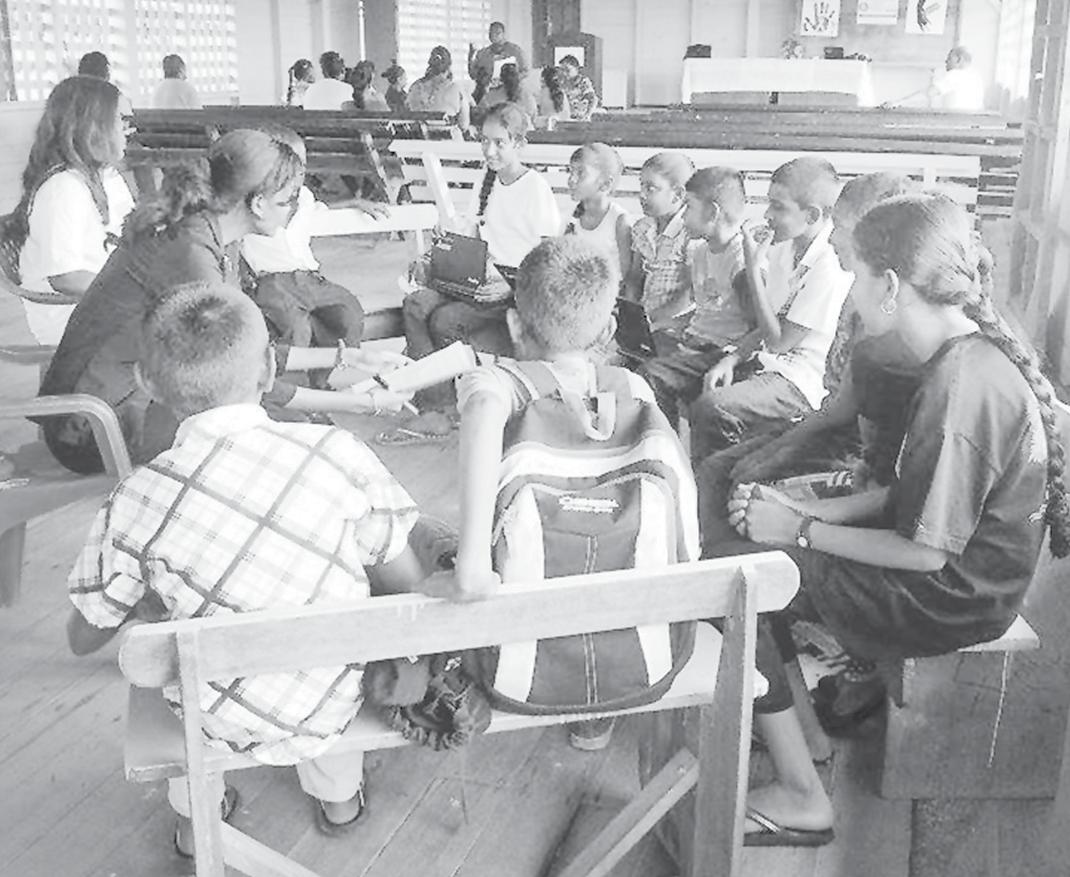
The Caribbean Voice (TCV), a non-profit organisation, launched its series of countrywide workshops to tackle suicide last weekend in Black Bush Polder, Corentyne, Berbice.
The objective of the sessions was to raise awareness on suicide prevention .The workshop was an interactive programme, which saw persons being trained to recognise individuals who are at potential risk, to respond appropriately and where to find help. It was conducted by a team of professionals including Dr Dawn Stewart, TCV Director and Founder; Monique’s Helping Hand; Chief Oba, President, Guyana Physiological Association; Dianne Madray, Caribbean American Domestic Violence Awareness (CADVA) Director; Janelle William, and American University of Research.
Speaking with Guyana Times International, Managing Director and Guyana’s Coordinator, Bibi Ahamad said the community of Black Bush
was chosen due to its high rate of attempted suicide and suicide and also the easy accessibility to chemicals. “We at TCV took an initiative to visit Black Bush to launch this outreach because of its high suicide rate; our main objective is to have an interaction, to find out what are the issues, the causes with the aim of helping.
“We are here to help and if we can help someone from committing suicide, we have achieved something … there are many causes somebody could be abused; it could be depression, domestic violence, peer pressure whatever little we can help to eradicate/ stop suicide we will do,” Ahamad said.
In Guyana, almost all suicides are committed via the ingestion of poisons, especially agricultural chemicals, and hanging, and are generally driven by depression, feelings of helplessness, hopelessness and powerless; an inability to deal with problems and a low level of self-acceptance and/or feelings of inadequacy.
Comprehensive training Ahamad went on to
say that after the workshop, the facilitators will analyse the findings, so as to make recommendations for the follow-up meetings. She stressed that the team will be back in the community to do comprehensive training on suicide prevention.
“We will be identifying persons to work as counsellors in the area to help persons not only

on suicide alone but issues such as domestic violence, various forms of abuse”.
Pandit
Amitnarine Rabindradat, TCV
Executive Member, spoke about the importance of believing in God.
“I believe if everyone follows the spiritual path of life, they will not think
negatively. The spiritual path is very simple; it is the way of life: live a righteous life and fear God and you will not want to harm yourself.”
Similar workshops were conducted in Lesbeholden, Mibicuri and Johanna and saw a number of persons, mainly females, turning out to be part of the session.
Guyana is ranked first in suicides per capita worldwide and according to the World Health Organisation (WHO), the country has 44.2 suicides per 100,000 persons per year. Suicide is also the leading cause of death among young persons aged 15-24 and the third leading cause of death among persons aged 25-44, while in the 15-19 age range, it is the leading cause of death among females and the second leading cause of death among males.
TravelSpan on Monday announced that a Block Seat Agreement to serve the Guyanese travelling to and from the United States has been reached with Dynamic Airways which is scheduled to recommence operations on November 23.
Recently, the US Department of Transportation (DOT) has granted approval for Dynamic Airways, a US Carrier to operate services to Guyana and a variety of destinations in South America.
TravelSpan Chief Executive Officer Nohar Singh said: “The Block Agreement will give the company the additional seats for the holidays, and Air and Hotel Packages for its valued customers. With over 19 years in business TravelSpan has always fought to secure affordable travel options for the travelling public and for the people of Guyana, Singh said.
He added that the TravelSpan staff and management will continue to operate at full capacity, with its Queens, New York Office being open seven days a week to offer a much-needed solution within the market using this new block seat arrangement. With the new arrangements, the company is offering a special

fare for the first flight, $499 round trip, tax included. Those who wish to book with TravelSpan can contact the airline at travelspan.com or follow it on Facebook, Twitter or LinkedIn. Persons can also contact the office at 718-845-0437.
No official approval
Despite the commercial arrangements between the two airlines, Guyana Times International understands that no approval has been given to Dynamic to operate out the John F Kennedy International (JFK) Airport. Likewise, the Guyana Civil Aviation Authority (GCAA) is yet to be formally contacted on the new arrangements or provided with any documents to this effect.
Benn on Friday alluded to the “buzz” in the press about the two airlines returning to Guyana, but said he was unaware of such developments. He said that the Government was concerned over the fly-bynight airlines that operate during the peak season and disappear afterwards.
Earlier in the month, Dynamic Airways Chief Operating Officer (COO) Bill Gray said, “The airline is planning to resume regular flights between New York and Georgetown, Guyana late next month, as well as inaugurate service between Orlando and destinations in Brazil, Canada, and the US.” He added that the flights to Georgetown last summer revealed a tremendous need for reliable, quality air service. Since that time, Dynamic has undergone a substantial internal reorganisation with new management and a new focus on its product and service.
Starting late November, Gray added, Guyanese travellers will have the opportunity to experience comfort and the quality of air service that they deserve. The proposed DOT- approved flights are expected to depart JFK International Airport, Terminal One at 01:00h on November 22, 2014. Flights will continue on Tuesdays, Fridays and Saturdays.
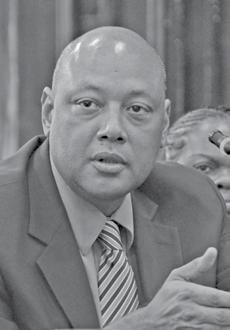
Speaker of the National Assembly, Raphael Trotman on Wednesday said that the country is faced with a “clear and unvarnished constitutional crisis” after the Clerk, Sherlock Isaacs defied his order to fix a date for the reconvening of Parliament.
Isaacs has insisted that the power to do so lay in the hands of the Government. But Trotman disagrees saying that “all stakeholders will have to work together to resolve it”.
He said, as the sitting Speaker, “I invite all well thinking Guyanese to join me in examining all viable options and avenues to break the impasse in the interest of our beloved nation.
“In this regard I stand ready to entertain all reasonable suggestions and anticipate an early closure of this unfortunate development,” Trotman said hours after Isaacs informed him via letter that he could not accede to his request.
Trotman had written Isaacs earlier this week instructing him to set November 6 as
the date for the House to reconvene. The Clerk then consulted with his Caribbean colleagues and on Wednesday responded to Trotman.
He had held the same view earlier when Trotman had asked his opinion on the matter, citing two previous attempts when a similar was made and were turned down by the then clerks.
“Not for the first time in the forty-eight year history of the National Assembly, the Speaker and the Clerk are at odds over the power of the Speaker to convene the sittings of the National Assembly.
Today, October 29, 2014, I was formally notified by the Clerk of the National Assembly that after consideration, my request for the National Assembly to be convened on Thursday, November 6, 2014, cannot be given effect to by him because he is of the view that the Speaker lacks the authority to convene sittings of National Assembly under Standing Order 8 (1) and (2).”
Trotman said in his statement that he will

be writing to the Clerk to register his disagreement with his interpretation of the Standing Orders and his consequent position adopted.
“I will also so advise in writing, as well as to the Leaders of the political parties in the House. This is a most unfortunate position arrived at, and obviously arises out of a very narrow interpretation of the Standing Orders, and of the prevailing circumstances whereby the National Assembly entered into recess and has emerged from that recess, and a majority of Members desire to meet.”
Trotman insists that the National Assembly
must resume sittings and cannot be bound by the whims of the Executive branch to have to await its consent before meeting.
He said such an interpretation flies in the face of the doctrine of separation of powers, and the constitutional right of the elected representatives to meet to perform their functions.
“The roles of Speaker and Clerk of the National Assembly are regulated by the Constitution and the Standing Orders.
“As constitutional officers, both are expected to work symbiotically for the National Assembly to be able to properly discharge
its constitutional roles and functions. It is the duty of the Clerk to convene the sitting by making all arrangements including, summoning and ensuring the attendance of Members, and the preparation and circulation of the Order Paper.
“The Speaker performs the role of “Presiding Officer” once the Assembly is convened; whilst the function of convening National Assembly remains the sole preserve of the Clerk.”
According to Trotman the effect of the Clerk’s decision not to convene the sitting has the effect of crippling the ability of the Members of Parliament to meet.
Meanwhile, A Partnership for National Unity (APNU) has “strongly condemned any attempts to delay the reconvening of the National Assembly.”
APNU affirmed that the present ‘dilly-dallying’ is not in the best interest of the nation, demanding the convening of the National Assembly without any further delay.
After soliciting the advice of his CARICOM colleagues, Isaacs told Guyana Times International prior to Trotman’s statement that his initial interpretation still stands. According to Isaacs when matters are not provided for in the Rules, reference is made to practice and precedents.
According to him the practice is that Sittings are requested by the Government. He added that the Parliament of Guyana there are two precedents one involving Frank A. Narain, C.C.H., former Clerk of the National Assembly and the other involving Elwyn Viapree, former Clerk of the Legislature. The Alliance For Change (AFC) has been urging the swift reconvening of Parliament particularly to deal with the No-Confidence Motion it tabled last August against the Government.
However, Trotman is proposing that the House should proceed with the matters that were on the agenda and if need be, add new ones.

The U.S. Coast Guard rescued 33 migrants on Wednesday from the sea near Boca Raton, north of Miami, after their boat sank, officials were reported as telling media operatives.
"We recovered the 33 migrants some nine ki-
lometers (six miles) east of Boca Raton" in Palm Beach County, a Coast Guard spokesman said, adding that all of the boat people, whose nationality has not been determined, were in good condition.
A Coast Guard helicopter is searching for
two men lost when their boat wrecked Monday when it detected the group of castaways, the agency said.
Eleven Cuban men were rescued Monday near Turkey Point in Biscayne Bay when their boat wrecked. Air and sea search


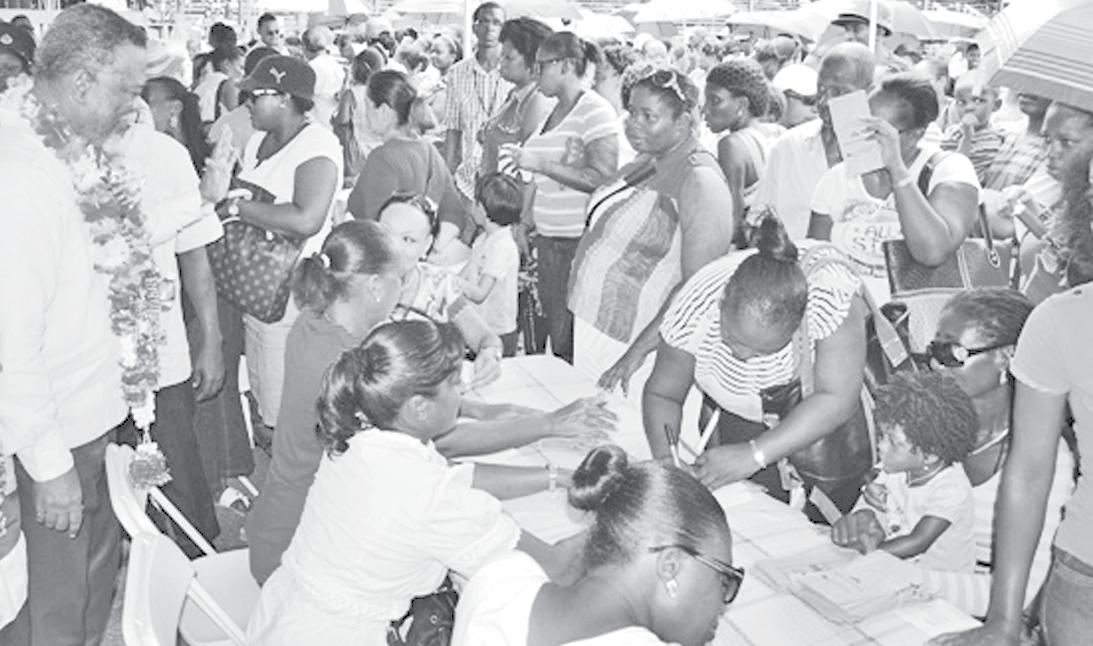
Over 12, 870 parents and guardians on Saturday received the Education Ministry’s “Because We Care” grant

at several locations in Georgetown as the distribution of the Gy$10,000 support continues across the country.
The programme was officially launched on October 11 in Region Seven.
A total of 4,564 parents of primary schools received their vouchers at the National Park, Thomas Lands.
The distribution exercise targeted parents and guardians of children attending Stella Maris, St Margaret’s, North Georgetown Primary, Winfer Gardens Primary, St Angela’s Primary, St Agnes Primary and the David Rose School for the Handicapped.
About 8,315 people received theirs at several other locations, including the Sophia Primary, Graham’s Hall Primary, St Gabriel’s Primary, St Ambrose Primary, West Ruimveldt Primary, Dolphin Secondary, St Pius Primary, FE Pollard Primary, Rama Krishna Primary and Enterprise Primary.
With more than Gy$600 million in vouchers handed over to parents and guardians since its launch, the programme is being executed “incredibly well” Prime Minister Samuel Hinds said. At the National Park with the Prime Minister was Agriculture Minister, Dr Leslie Ramsammy, where hundreds of beneficiaries had gathered to uplift the grant.
The senior Government functionaries were pleased with the civility and speed of the entire process, and pointed out that more than Gy$250 million in vouchers have already been encashed by recipients.
Distribution is slated to end on November 21, and should cover the entire country. The Gy$10,000 voucher can be encashed at Western Union outlets with recipients in riverain and hinterland locations receiving cash.
Several parents at the National Park expressed their appreciation for the education grants being offered. Marcia Bradford
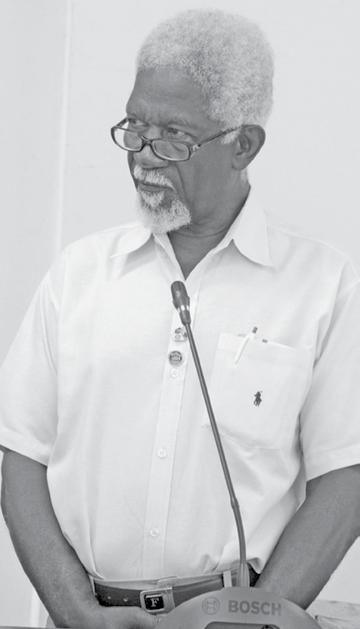
Former Organising Secretary of the Working People’s Alliance (WPA), Dr Omawale on Tuesday appeared before the Walter Rodney Commission of Inquiry, with further evidence that the then ruling Government, the People’s National Congress (PNC), had plotted against and killed Dr Walter Rodney.
Omawale’s evidence was grounded in the oppressive political, economic and social atmosphere which he said existed at the time of the PNC’s rule.
The Social Worker, who was tasked with organising party meetings during that time, said he has always been saddened and devastated by the way Dr Rodney met his demise, maintaining that nothing could convince him that the WPA co-founder was not killed by the State.
Omawale listed the many incidents which have informed his position. These include the sequence of events involving Dr Rodney’s alleged assassin Gregory Smith, particularly the fact that the Guyana Defence Force (GDF) had publicly denied that he was a serving member and the swift effort of the Government to whisk him out of Guyana mere hours after the explosion on June 13, 1980.
Omawale told the Commission that the WPA, particularly Dr Rodney, was among the hard- pressed Opposition of the ruling Government. And while Dr Rodney had no desire in taking the reins of power, he was genuinely interested in teaching the common man about self-emancipation.
The Linden Forbes Burnham regime was threatened by this emerging
bolt of self-determination, which was aimed at stealthily phasing out dictatorial rule.
There were many other occurrences during that period which formulated his stance that the dictatorial PNC had its hand in the death of Dr Rodney and other members of the WPA.
Totalitarian
Omawale crafted a section of his testimony under the caption “Burnham the bully”. That type of behaviour, he said, went as far back as 1969 when he was invited to the then Prime Minister’s Office for a talk.
Omawale said he was at that point actively involved in organising a simple protest in honour of Dr Clive Thomas who was recently ousted from both the University of the West Indies in Trinidad and the Mona Campuses in Jamaica.
He mentioned that he was escorted to the Prime Minister’s Office by the then General Secretary of the PNC, Hamilton Green who was also his cousin. Omawale said he was ordered by the Prime Minister to either drop one of his speakers, Dr Cheddi Jagan from the activity or cancel it altogether. He recalled that he had already received approval for the holding of that protest and boldly told Burnham that he would not be changing his plans.
He went on to report that on the day of the protest, as he got up to speak, someone pulled the microphone away from Dr Jagan, hitting him in his stomach.
Omawale pointed to another incident where Government had banned certain items from the country. These

included a ban on newsprint, which he said was an expression of oppression of the free press.
He admitted that there may have been an economic strain on the country, but noted that Government had even made it difficult for persons to accept free newsprint from overseas.
The WPA executive continued to paint the dictatorial picture as he related his ordeal seeking to leave the country to return to Rome in 1979. He said he went to the airport, and without any
explanation his passport was seized, and he was kept in a room. He said his passport was only returned to him after the plane left the airport.
His family was also prevented from entering the country when they travelled from Jamaica in 1981. At that time, he recalled, his wife, a Jamaican, was travelling with their two young children. But upon landing in Guyana, they were prevented from leaving the plane.
Omawale testified that his being prevented from leaving the country was a “punishment by a dictatorship rulership” which was bent on intimidating anyone who sought a radical change.
Targeted
He spoke too of the assassination rampage that the Police Force through the “death squad” was involved in, especially against the WPA members. He recalled the death of young Keith Caesar, a resident of Tiger Bay who was shot and killed by the “death squad” in the early 1970s. His testimony also included the incident involving another WPA member who was also around the same time killed by the Police, and WPA member Ohene Koama who was also shot and killed.
And although an inquest was held into Koama’s death, nothing significant emerged.
The WPA executive revealed that although he received numerous personal threats on his life, he was never physically harassed by the Police or any agent of the state, including the Government-affiliated House of Israel. He said he was always fortunate
continued on page 10

Attorney General Anil Nandlall has sued the Kaieteur News, its publisher and editor for what he termed libellous articles contained in their Tuesday’s edition alleging that he has revealed a plan to “hit” the owner and the publication’s staff.
In his statement of claim, Nandlall noted that in the October 28, 2014 edition of the Kaieteur News, Publisher, Glenn Lall and Editor, Adam Harris falsely and maliciously published, in unusually large fonts: “Attorney General Reveals Plan to ‘HIT’ Glenn Lall, Kaieteur News”.
He added that at page three in the said edition of the Kaieteur News, the
said headline was repeated and in addition thereto, the Defendants falsely and maliciously made statements and printed and published or caused to be printed or published of and concerning the Plaintiff, the following, inter alia: “Nandlall has revealed chilling plans for the execution of Kaieteur News publisher, Mr Glenn Lall; the Plaintiff advised a senior reporter of the newspaper to get out of the Saffon Street office, which he described as a “dangerous place”; the Plaintiff hinted at an intended hit on the said Lall and the establishment; the Plaintiff was spying on his Saffon Street establishment and that Nandlall would use other weapons against Lall
in place of cameras, if he wanted to destroy him.”
According to the court documents, the said headline and article conveyed the clear impression that Nandlall was engaged in unlawful and criminal acts and that, he is unfit to hold the offices of Attorney General and Minister of Legal Affairs and Member of Parliament.
“The said words in their natural and ordinary meaning meant and were understood to mean: that the Plaintiff was engaged in criminal acts; that the Plaintiff was engaged in a plot to kill and/or cause serious harm to the Second Named Defendant; that the Plaintiff was engaged in acts designed and in-
tended to intimidate, scare and terrorise the Defendants and the staff at Kaieteur News; that the Plaintiff was engaged in acts designed and intended to interfere with the Defendants’ constitutional right and freedom to publish their newspapers; that the Plaintiff is part of or has connections to a criminal gang that fire-bombed a printing press of Kaieteur News at Eccles in 2002 and killed five Kaieteur News pressmen in 2006; that the Plaintiff has committed several criminal offences and that the Plaintiff is unfit to hold the office of Attorney General and Minister of Legal Affairs and a seat as a Member of Parliament,” the court papers stated.


Additionally, Nandlall contends that the words published are untrue and were done so maliciously and are a part of an ongoing campaign to tarnish his reputation. Nandlall, the court papers stated, will rely on several other disparaging and libellous publications of and concerning him by the Defendants.
According to the court papers, the aforesaid libel was calculated to cause and did cause Nandlall great public embarrassment, hold him up to odium and ridicule and to disparage him as the Attorney General and Minister of Legal Affairs and Member of
Parliament, both nationally and internationally. Damages in excess of Gy$10 million are being sought from each defendant for libel contained in headline, “Attorney General Reveals Plan to ‘HIT’ Glenn Lall, Kaieteur News”, published by the Defendants on page three of the Kaieteur News October 28 edition. The same amount is being sought for libel contained in the article captioned, “Attorney General Reveals Plan to ‘HIT’ Glenn Lall, KNews”, published by the Defendants on pages six and seven of the same issue as well as aggravated or exemplary damages in excess of Gy$10 million.
to be informed by sympathisers about any looming threat on his life, pointing out on several occasions he had received telephone calls warning him to be careful. He said he went into safety mode as he was always careful and suspicious of being followed.
He said as Organising Secretary of the party, he was forced on many occasions to hold his meetings in “the dead of night”, in canefields just to ensure safety.
Dr Omawale continued that the oppression was so grave, he has now formed the opinion that the only answer citizens had then was to be engaged in public uprising and protest. He skilfully painted the picture of a government that had taken every bit of freedom, both economical and social from the people and had transformed itself into their worst enemy.
But even though those situations had informed his thoughts and even though the political temperature was rising, Rodney was never given to violence. In fact, at his many meetings he had advised against going in that direction.
Commissioners brought before Omawale the statements made
by Dr Rodney at a WPA meeting where he had engaged participants in the idea that the PNC must go and must go by any means necessary. And further his nicknaming PNC Leader Burnham “King Kong”.
Omawale quickly explained that the leader could not have been speaking in practical terms but figuratively, maintaining that Dr Rodney was not such a person.
He said too that Dr Rodney was of the view that both major political parties at the time, the PNC and the PPP had embraced the wrong approach as it related to them seeking out supporters. To him, it was strictly based on race, and Dr Omawale posited, the WPA leader could not wrap his mind around such concepts.
Although blamed for the June 13, 1980 explosion which killed the historian, the PNC has continued to deny that it was ever involved.
The notion too that the former Army Sergeant William Gregory Smith was used as the medium to carry out the execution plan has been disputed. The blame has been placed squarely at the feet of the historian himself.

By Jomo Paul
The Neal and Massy Group of Companies which was an umbrella company for Geddes Grant Limited, Demerara Oxygen Company Limited, and CCS stores, was on Wednesday officially rebranded to Massy Industries- a move that will see all of the subsidiaries being changed to Massy.
The rebranding comes as the regional conglomerate opened a Gy$200M distribution facility at Montrose, East Coast Demerara at what was once known as the Starlite Drive-In Complex and will serve as the company’s primary distribution center for all products in Guyana.
Aside from those previously mentioned, those facilities and corporate services include Associated Industries Limited, now Massy Industries, NM Services Limited, now Massy Services Guyana Limited, NM Security Solution now Massy Security and Marketing and Distribution, now Massy Trading.
Massy Group of Companies offers services in the insurance industry, auto sales and rentals, pharmacy, distribution, supermarkets, and agricultural
services, among others.
All of these services will still be offered under the Massy brand which came complete with a soca-styled theme song “I am Massy”.
Massy Industries operates in Trinidad, Jamaica, Barbados, the Eastern Caribbean, Bahamas, Nederland Antilles, the USA, Canada, Columbia and Africa. It was explained that the rebranding process initiated in Trinidad and Tobago, then Barbados, then Jamaica and it now arrives in Guyana, the country which holds a wide array of Massy subsidiaries.
Group Chief Executive Officer Gervasse Warner told the gathering of private sector and government officials that the decision to change the brand of the company came as a result of a widespread consultation, which also saw several other changes being made including the development of a company manifesto.
Warner explained that the group which is over 90 years old has and will always be change-friendly and sees this historic modification to its brand as a positive propellant for the company.
“Everything is now Massyfied” said Warner.
The company believes
that redefining its brand will somewhat strengthen the cooperation that is already evident throughout all of its subsidiaries. The company said that as the subsidiaries grew, the bond however weakened and all of the subsidiaries working under one unique brand will now reinvigorate that lost bond.
In addition, it will also provide customers with an enhanced sense of loyalty knowing that all of the companies are linked. “The rebranding maximizes marketing efficacy by powerfully connecting the equity of strong subsidiary brands with the corporate brand vice versa.”
Warner explained that Massy was not a decision arrived at by him or any of the company executives but rather by a consulting firm. He pointed out that Neal and Massy was already commonly known as Massy. The company felt that Massy was a rather strong name that would translate across all borders without much difficulty.
Warner also informed the gathering that the Massy groups have major expansion plans for
Guyana. He said that in 18 months, the Group is hoping to open its first supermarket chain in Guyana. This initiative will create hundreds of jobs, adding to the already 394 staff count at Massy.
Finance Minister Dr Ashni Singh who declared the “Centralised Distribution Warehouse Facility open commended the executives for placing such confidence in Guyana’s sustainability by investing in the economy. The Finance Minister noted that the commissioning of the facility was a “tangible demonstration of confidence that was worked so hard for…a strong expression of confidence in Guyana.

said she was thankful to the Ministry for giving her the opportunity and that she will be purchasing text books for her daughter.
Prime Minister Hinds told the gathering at the National Park that programmes such as the education grant is testimony of the People’s Progressive Party/ Civic (PPP/C) Government’s commitment to Guyana’s children and their education.
The Prime Minister encouraged those gathered to adjust their lifestyle in order to assist their children to take full advantage of the education provided to them by the Government,
as he mentioned the numerous investments of the administration to provide text books, train teachers, provide access to information technology, and new programmes to provide assistance to parents so their children can attend school.
He asserted that “… when we deliver services, we deliver services equally such as, this one… delivering the same amount of money to every child all across the country…”
Approximately 188,400 families of children who attend public schools will benefit from the education grant.


BY DAVID M KINCHEN
It occurred during Guyana-born
Ramphal’s tenure as Secretary-General of the Commonwealth of Nations (formerly the British Commonwealth, and commonly called the “Commonwealth”) during an official visit to the African nation.
He and his wife were treated to a helicopter ride with none other than the brutal dictator in the pilot’s seat. (I hope there was a Co-pilot, but there’s no mention of one!). Ramphal was cho-
a black, also a Muslim – can be as racist as whites.
Humble origins
Ramphal was born in what was then the British colony of British Guiana in 1928. His antecedents came from India as indentured workers, replacing the black slaves who laboured in the sugar cane fields of the future Guyana, enriching the white plantation owners who lived very comfortable lives in “England’s green and pleasant land”, to borrow a phrase from the poem “Jerusalem” by William
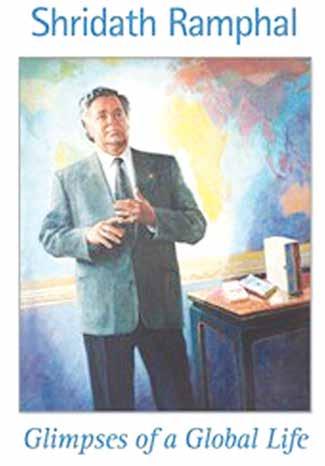
sen by Amin to preside over the dedication of a paint factory.
Ramphal later learned that the factory had already been dedicated.
Amin, 1925-2003, was a former British colonial soldier, who was the third President of Independent Uganda, ruling from 1971-1979. He died in exile in Saudi Arabia.
Not long after the visit to the east African former British colony, Uganda was removed from the Commonwealth.
It has since been reinstated as a member, in spite of the fact that the country is ruled by another Dictator Yoweri Kaguta Musevenim, who came to power in a coup in 1986.
One of the reasons was the forcible ejection of Uganda’s Asian community that consisted of productive people from India. To me, that proves that blacks – Amin was
1990, and Namibia’s Independence the following month. Zimbabwe, formerly called Southern Rhodesia, is of course problematical, as it continues to be ruled by Robert Mugabe, who practices his own form of racism against the whites of the country and has turned the country into an economic basket case. Zimbabwe left the Commonwealth about a decade ago, although Ramphal puts it a different way: “One day, Zimbabwe will return to the Commonwealth –when it is recognised by all sides that Zimbabwe did not leave the Commonwealth, Mugabe did.”
itime boundary with Suriname.
More successful
In many ways, the oftderided Commonwealth was more successful
Blake (1757-1827).
A lawyer and international diplomat, he rose from humble origins to become a key advisor to Queen Elizabeth II as Head of the Commonwealth. Leaders from every continent engaged with him as the longest serving Secretary General of the Commonwealth (1975–1990) and as the only person who served on all the independent international commissions that grappled with the world’s major issues.
Having been a key player in bringing an end to Ian Smith’s Unilateral Declaration of Independence and institutional racism in Southern Rhodesia, he spent much of his last five years as Secretary General, until 1990, in the struggle to end apartheid in South Africa.
He had the satisfaction of playing a part in Nelson Mandela’s release from prison in February
Ramphal – just about everybody who knows him calls him “Sonny” –left the Commonwealth Secretariat as a still youthful 61. He was Chancellor of the Universities of Guyana and Warwick, and the University of the West Indies, and he went on to chair the West Indian Commission which charted a future for the Caribbean region in the 21st century, and he headed the regional negotiating machinery which sought a unified Caribbean trading response to the European Community, the United States and the World Trade Organisation. At the age of 79, he successfully led Guyana’s legal team before a United Nations Law of the Sea Tribunal that peacefully settled the mar-
than the United Nations in bringing about majority rule in Africa, as evidenced by the instances of the former Southern Rhodesia
(Zimbabwe), the former Southwest Africa, now called Namibia, and, of course in the nation of South Africa itself. At


By Devina Samaroo
Presidential
Adviser
on Sustainable Development, Science and Technology, Navin Chandarpal passed away at his Goedverwagting, East Coast Demerara home Tuesday morning after losing his battle with cancer.
His son, Robin Chandarpal told Guyana Times International that his father passed away around 08:00h in the comfort of his own bed. The family said his death did not come as a surprise since he was diagnosed with stage four stomach cancer two years ago. They described his passing as a “peaceful going”, as he did not express any signs of trauma or pain.
“Of course, we’re all very distraught about his passing, but we look at it in the perspective that two years ago when he was diagnosed with stage four stomach cancer, he was told at that time that he had about three months to live so we consider every day since then a bonus,” his son said.
He explained that his father had lost a tremendous amount of weight, and earlier this week his father was struggling to eat and drink anything. His son noted that he was not battling the disease, which had required him to receive medical treatment overseas, alone as he had many visitors and great doctors who kept him in their prayers.
Back in July this year, Chandarpal, a former Agriculture Minister, was taken overseas for treatment after his condition was said to be rapidly deteriorating. He, however, returned to Guyana and was being cared for at home.
Regarded highly by the governing People’s Progressive Party/Civic (PPP/C) for his statistical skills, Chandarpal entered politics while a student at the Richard Ishmael Secondary School and quickly moved up through the ranks to lead the Progressive Youth Organisation. Distinguished service
In a statement, the Parliament Office said: “It was with deep sad-
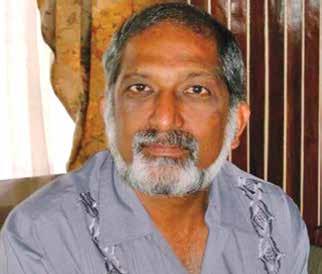
ness that the National Assembly learnt of the passing of Mr Chandarpal, a former Minister of Agriculture and Member of the Seventh and Eighth Parliaments in the PPP/C Administration.”
“Navin Chandarpal served in the National Assembly with distinction for five years, two months and four days, and was well-liked and respected across all political lines,” the Parliament Office said.
“He will be remembered for his principled
positions, his wit, and fearless and very amiable character. He was a friend to all and fierce fighter against injustice and oppression. The Speaker and Members of Parliament and Clerk of the National Assembly extend deepest sympathy to his widow, Mrs Indranie Chandarpal, MP, and his children, relatives, friends and comrades.”
Condolences Opposition Leader David Granger also expressed his condolences. He described
Chandarpal as a devoted member to his party and told GTI that it was a pity that his time in the political arena was cut short.
The Permanent Council of the Organisation of American States also joined in extending condolences to Chandarpal’s family. The Chair of the Council, Ambassador La Celia Prince of St Vincent and the Grenadines described the passing of the longstanding PPP/C member as a great loss. The Ambassador of Antigua and Barbuda, speaking for Caricom Member States, described Chandarpal as a bright Caribbean star and expressed sympathies on behalf of the Region. The other delegations which also expressed condolences were EL Salvador, Costa Rica, the Dominican Republic, Venezuela, Bolivia, Nicaragua, Uruguay, Brazil, Canada, and Mexico.
Guyana’s Ambassador to the OAS, Bayney Karran, thanked the Council for the sentiments expressed. He
stated that Chandarpal was a prominent politician in Guyana where he had made important contributions to sustainable development. Ambassador Karran pointed out that he was also well-known to the Department of Sustainable Development at the OAS and that his widow, Indranie Chandarpal has served as Chairperson of the OAS’ Inter-American Commission of Women. Alliance For Change (AFC) Vice Chairman Moses Nagamootoo said Chandarpal was the last of a crop of committed “Jaganite leaders” and my associate and friend for some 50 years. Nagamootoo, who cut ties with the PPP/C in 2011, said Chandarpal was a student and youth leader, and one of the few revolutionary intellectuals of our times.
“He rose to the top of the PPP/C’s leadership…” Guyana has lost a true son, Nagamootoo said.
“We share the grief and loss of his wife, Indra; his son, Robin; and daughter, Geetanjali. Farewell, Comrade!”

Draped in a gown designed by Randy Madray, Miss Palm Court Niketta Barker was on Sunday evening crowned Miss Guyana Universe 2014 when the pageant was hosted at the Pegasus Hotel, Kingston.
Niketta Barker, 24, who is two years away from attaining her Degree in Medicine and Surgery from the University of Guyana, outshone eight other delegates to cop the coveted title to the delight of her many fans who were present.
Barker also copped the prize for Best Smile and winner of the Intelligence Segment which was aired on national television prior to competition night.
From all indications, Barker would have been judged high on all the judges’ scorecard in the Swimwear, Evening Gown and Intelligence Segments, but more importantly, from the time the pageant was launched.
Guyana Times International caught up with the new queen who was elated to have won the pageant, not-

ing that the months of preparations ahead of the pageant finally paid off.
She recalled that the training as compared to the 2012 pageant was not that tense, claiming that the delegates had some fun time.
On pageant night, Barker stated that while all the dele-
gates brought their unique styles, she was somewhat keeping an eye opened for Soyini Fraser, who looked elegant and gracefull and Joyti Hardat, who looked absolutely stunning.
Will give my best
Now that she has won the pageant, she will be heading to New
York City in January where she will undergo training ahead of the international pageant slated for January 24, 2015 in Miami, Florida.
The jubilant queen, whose platform during the pageant was Importance of Child Mentoring, said she intends to represent Guyana well on the international stage, with the hope of putting the country on the world map.
Taking the first runners up position was reigning Miss Jamzone International Soyini Fraser while coming in as second runners up was Lakota McPhoy, 25, from the mining town of Linden.
Despite not being in the top three, Hardat was adjudged the delegate with the Best Body while Cardella Hamilton and Rochelle Cheddie shared the Miss Congeniality title.
However, the highlight of the evening was the Swimwear Segment which saw the delegates sporting a red two-piece swim suit designed and accessorised by veteran designer Pat Coats. The delegates displayed the skimpy outfits with
charm and pride. They definitely flaunted their bodies to the music which had the crowd going wild.
The Swim Wear Segment was followed by a 20-minute performance by Kees from Kes the Band who added some flavour to the event with his mixture of Reggae and Soca vibes. It caused the patrons to get off their seats and have a blast.
He dished out tunes such as “Endless Summer”, “Take a Wine on Me” and his signature tune “Wotless”.
Soon after, the members of the Classique Dance Group took to the stage as they perform an energetic piece as they made way for the nine delegates in the Evening Wear Segment.
Soon after the Evening Gown Segment, the judges took some time to tabulate the scores, but in the meantime, the audience was entertained with one of two fashion displays by Clearance Enterprises.
As the delegates made their way back on stage, the special prizes were distributed, evok-
ing some rather rude comment.
Nevertheless, it took the judges another 20 minutes to reveal the names of the top three, and when this was done, there was more heckling.
The final three contestants were then serenaded by the Soca sensation and soon after left the stage, making way for the Intelligence Segment which saw stiff competition between Barker and Fraser.
While the judges tabulated their scores, Miss Guyana Universe 2013 Katherine Roshana took her final walk and recapped on her one-year reign.
During her walk, she stumbled but was assisted up by members of the audience. As she stood up, she was given a loud applause. Her speech also had to be cut short after it went over 10 minutes, prompting various remarks from the audience.
Apart from the US$10,000, Barker received the crown and two airfare tickets for her and her chaperon to New York, among other prizes.



The World Health Organization, or WHO, confirmed on Wednesday that 13,703 people have been infected with the Ebola virus since the epidemic began in March.
Of that number, 13,676 of the cases were reported from three West African countries, Liberia, Sierra Leone and Guinea Conakry, where international efforts are focused on controlling the epidemic.
In a country-bycountry breakdown, the WHO said that
6,535 cases were registered in Liberia, 5,235 in Sierra Leone and 1,906 in Guinea.
Regarding the number of deaths, the WHO explained that it has not yet completed the count and that the final figure will be published in the next few hours.
The organization's Assistant DirectorGeneral in charge of the operational response to Ebola, Dr. Bruce Aylward, said at a press conference that "probably the death toll has exceeded 5,000."
Guyana Defence Force (GDF) Major and Attorney-at-Law Michael Shahoud was admitted to the Bar on Friday.
His successful petition was presented before Justice Brassington Reynolds by Attorney Andrew Pollard.
In a release, the GDF said Major Shahoud gained his formal education at the St Theresa’s Primary School in New Amsterdam, and the St Margaret’s Primary, Georgetown.
From there, he was awarded a place at North Georgetown Secondary School, Georgetown after sitting the Common Entrance Examinations.
Upon the completion of his secondary education, Major Shahoud enlisted in the GDF. He benefited from training in several courses, both locally and overseas.
During his service, he held numerous appointments, and is currently a Legal Officer in the Army’s Legal Services Department.
Major Shahoud proceeded to read for a prelaw programme at the University of Guyana in 2008 and later received a military scholarship to pursue a Bachelor’s
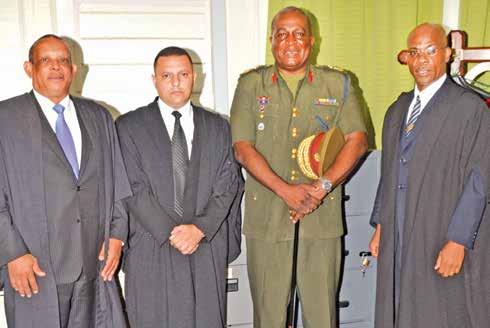
of Law Degree, gaining a distinction, and the Legal Education Certificate at the Hugh Wooding Law School.
He was also awarded the Ann Blue Award for the most outstanding second year student at the University of Guyana.
In accepting the petition, Justice Reynolds stated that he was well aware of the character of the Attorney, and could personally concur with statements contained in the petition.
He commended the young Attorney on his achievements, and urged
him to maintain a high degree of professional discipline, and to avoid the ‘short cuts’, which inevitably destroy the moral fabric of the profession. He then invited Major Shahoud to take the Oath after which he formally welcomed him to the Bar.
Attorney Shahoud expressed gratitude to Justice Reynolds, GDF Chief-of-Staff, Brigadier Mark Phillips, and the GDF for its support, and all those who were directly or indirectly involved in enabling his successes to date.
“Your Honour, I am
quite aware of the long and narrow road ahead. I pledge that I will do my best to uphold the high standards required of me, and will continue to serve this nation in whatever capacity my superiors deem best. Thank you and God bless our great nation.”
Among those present to celebrate his achievement were Brigadier Phillips, GDF officer commanding the GDF Legal Services Department, Attorney Mellissa YearwoodStewart, Mercedez Hernandez, and other friends.



BY INDRAWATTIE NATRAM
Miss World Guyana Rafieya Husain on Diwali Day commissioned a spanking new Gy$$3 million outreach centre at Three Friends Village on the Essequibo Coast, to aide in the fight against domestic violence. The building was rehabilitated, repainted
and toilet facilities were constructed through the kind sponsorship of Mohammed Ramzan Ali Khan, Torgional Paints, GuyAmerica Construction and Twins Manufacturing Chemist.
Miss Husain, who won the Miss World Guyana title on February 23, during her campaign to become queen had promise to establish an outreach centre to help
in the fight against domestic violence.
Her goal was to raise US$10,000 to open an outreach centre in Region Two; however, she has surpassed the amount, acquiring an addition of Gy$1.5 million, compliments of Mohammed Ramzan Ali Khan.
The beauty said the centre was built in continued on page 20

Guyana’s premier secondary school Queen’s College on Monday celebrated its 170th anniversary, with a special General Assembly attended by past and current students.
The audience, which included President Donald Ramotar, Prime Minister Samuel Hinds, and Opposition Leader David Granger, was treated to a delightful cultural presentation by students.
Headteacher Jackie Benn said the institution has always been committed to maintaining high academic standards, its cultural tradition and actively raising the quality of life for every student.
“Our mission here is to provide equal access to quality education regardless of the socioeconomic status of our students,” Benn told the huge Audience.
President Ramotar, who delivered the feature address, congratulated the students who he said have all kept the flag of the distinguished institution flying high.
According to him, the institution has been able to produce some of the greatest minds in almost every sector within the country.
“And I would also agree with those who say that it will contend with any insti-
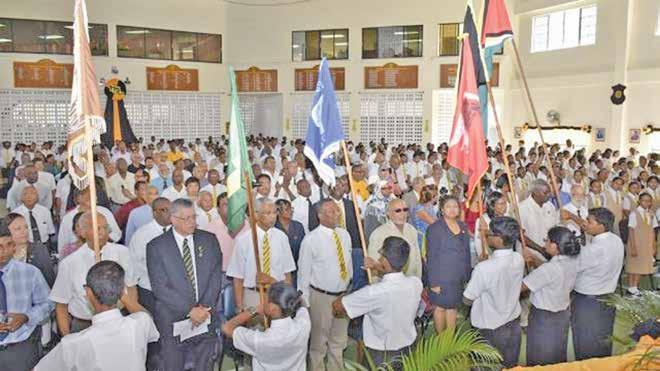
tution in the world for producing graduates with high caliber as Queen’s College has done.”
The head of State said he would like to see Queen’s College being replicated all across the country, pointing out the Government through the Education Ministry is currently working to ensure that the high quality education offered at the institution, be associated with every secondary school in Guyana.
He said the country
is moving in that direction even as he cited the recent accomplishment of the school for producing three of the four students who received top Caribbean awards at this year’s Caribbean Secondary Education Certificate (CSEC) examinations. The fourth came from the New Amsterdam Secondary School.
Quite encouraging
“That shows that the effort we are making to make our other institutions as
Three years of sluggish growth in the exports of Latin America and the Caribbean (LAC) make it urgent to implement policies that facilitate trade, according to a study published last week by the InterAmerican Development Bank (IDB).
The Trade and Integration Monitor 2014 notes that the fall in international demand and in the prices of many basic goods that are exported from the Region highlight pre-existing vulnerabilities in the external sector. Despite efforts to diversify exports, over the past decade the Region’s export basket has been concentrated on basic goods and their by-products, making Latin America and the Caribbean vulnerable to fluctuations in price and demand.
In 2013, the region’s exports rose only 0.1 per cent, after having grown 1.2 per cent in 2012. Mexico and Central America posted moderate growth (2.5 per cent
and 1.6 per cent, respectively), while exports from the Andean countries and MERCOSUR fell slightly (–1.8 per cent and –1.0 per cent, respectively), and those of the Caribbean declined substantially (–4,2 per cent). It is estimated that in the first seven months of 2014, aggregate exports from the Region increased only 0.5 per cent, suggesting that growth for the whole year will come in at less than 1 per cent.
The Monitor argues that, given uncertainty in multilateral trade-facilitation talks, the countries of Latin America and the Caribbean should implement unilateral reforms and other measures linked to preferential accords in the Region so as to stimulate exports. Conservative estimates indicate that only 20 per cent of the commitments included in the Agreement on Trade Facilitation negotiated through the World Trade Organisation have taken force under regional preferential agreements.
The study includes a detailed report on recent trade performance indicators for the IDB’s 26 borrowing-member countries as well as profiles of free trade accords that are in effect. The Monitor is part of a series of annual studies that analyse the evolution of Latin American and Caribbean integration within the global trading system using systematised data available in the INTrade database.
distinguished as Queen's College, we are beginning to get there,” the President said.
Ramotar said Queen’s College students continue to bloom in every part of the world, excelling in every area. He told the current students that they are indeed fortunate to have the many role models who have come out of the institution. He stressed; however, that
while that may be good and pleasing, students should not become complacent, but should push to surpass those achievements that were made.
“You have the advantage that you are standing on the shoulders of giants and I am sure that all of them would expect you to do better than they have done.”
Queen’s College was
established in 1844 as the Queen’s College Grammar School for boys by William Percy Austin DD Bishop of the Anglican Diocese of then British Guiana. The female equivalent was the Bishops’ High School.
The first assembly was held on August 5, 1844 with an enrollment of 15 boys. Although the school started out as an Anglican Church School, Bishop Austin was interested in making it a more broadbased institution to include non-Anglicans. Its first administration, however, consisted only of members of the Church of England.
Formal classes commenced on August 15, 1844 in the Old Colony House; situated in the compound of what is now the Guyana High Courts, previously known as the Victoria Law Courts. The original 15 students had two tutors, with Bishop Austin himself becoming the first Principal. In 1845, the school moved to Main and Quamina Streets.
Its population was rapidly expanding and, with a student body of 70 and three tutors, another move was made in 1854 to its first formal building at Carmichael and Quamina Streets.

The Giftland OfficeMax Mega Mall at Turkeyen, Greater Georgetown, is now expected to have its grand opening around May 2015.
The last deadline was set for before June 2014.
Chief Executive Officer Ian Ramdeo told this publication in an interview that construction is still in progress. He said additional work that was not initially catered for such as traffic control facilities at the main intersection among other infrastructural conveniences are still being developed.
The delay is also owed to a fluctuation of material prices and missed deadlines of some subcontracted works. The 265,000 square-foot mall is going to be self-sufficient, with its own sewerage treatment plant, water well and a 5.75 megawatt power plant with 100 per cent redundancy. However, due to the complexity of the power plant, shipping logistics such as limited availability of equipment to transport, offload and load, the process has taken much longer than the company initially expect-

ed. Nevertheless, moves are afoot to make sure the mall is opened as soon as possible. The company acquired the land in 2007 and construction began in 2009. According to reports, the mall has an estimated cost of US$30 million and is being financed by Guyana Bank for Trade and Industry (GBTI), Citizens Bank, Scotiabank Guyana, two private investors, and the standard grant from the Government of Guyana.
Ramdeo stated that the mall will accommodate Giftland and other tenants, creating job opportunities for over 2000 persons, including security and maintenance. Furthermore, he said
they are in the process of training staff for the new operations at the mall. He noted that so far everyone employed for the mall is either working at the mall or at the retail sister company Giftland OfficeMax.
Being the first of its kind in Guyana, the mall will be introducing a number of exciting amenities such as free drinking fountains; valet parking; a playground featuring zip lines, rock climbing and bungee jumping, and a 90-station sheltered bus terminal.
“We will also be featuring the 560 feet “Strip” comprising four fine dining restaurants, the sports bar, the Brazilian Grill and Bar,
and a British Pub for evening entertainment. The street will be closed for vehicular traffic in the evenings from 6:00 pm allowing us to turn this area into a street entertainment area…This area will also be used to showcase Guyanese culture and exhibitions, talent and other shows, poetry reading, horticultural, crafts and other areas in need of being highlighted in an open-air atmosphere,” Ramdeo highlighted.
With all the exhilarating features and amenities the mall has to offer, the Water and Holmes streets business will be closed and relocated to the world-class shopping plaza when it opens.
memory of her grandfather’s legacy, the late Shaffeek Khan, who was once Regional Executive Officer of Region Two (Pomeroon-Supenaam).
Husain said the outreach centre will be empowering women and teenagers to curb social ills in society.
Giving an overview of the centre, she said it was founded by RIVAHRafieya International Vision and Hope, a Guyana-based non-profit organisation.
She said the organisation is on a mission to instil strong values in young people.
Husain thanked the Region Two Administration for its support and the land that was given for the construction of the complex.
The young lady explained to the audience that she has chosen domestic violence as her platform, because she has a passion for improving lives and making a difference.
She said she is trying to help address the issue at an early stage by visiting secondary schools, meeting with teens and
giving advice on how to deal with teen dating. She has also distributed phamplets and bracelets as part of the “I commit too” campaign.
According to Rafieya’s mother, Salena Khan, who is an executive member of the RIVAH Foundation, the centre will seek to establish and provide useful resources to circumvent circumstances that lead to violent outcomes.
The RIVAH Foundation has also partnered with other non-profit organisation, such as “Hope for All”, “Guyana Red Cross” and “Help and Shelter” to help facilitate a variety of empowerment programmes.
Meanwhile, Ministry within the Agriculture Ministry Alli Baksh, who described Husain as a beauty with a purpose, commended her for being the first young lady to make a meaningful impact on the lives of young people.
He said the centre was commissioned at an opportune time, noting that “suicide” is rapidly increasing in Region Two.

People’s National Congress Reform (PNCR) Leader David Granger said the party is proud of its record as he claimed that the ruling People’s Progressive Party/Civic (PPP/C) is at its weakest.
Granger made the remarks at the PNCR final General Council Meeting for 2014 on Saturday at the party’s headquarters, Sophia, Greater Georgetown.
The meeting was held under the theme “PNCR For National Unity, Good Governance and Development” and was chaired by party Chairman and Member of Parliament (MP) Basil Williams.
Williams said the General Council was occurring at a time of looming elections and the PPP/C’s deployment of outsiders in the Rodney Commission of Inquiry to assist their political campaign.
According to him, Guyana needs the PNC now more than ever.
“This (the PNC) is not a party for the ‘get rich quickers’ but rather one of service… I have no doubt that the PNCR as a partner in APNU will surge to victory at any future elections.”
General Secretary Oscar Clarke in his re-
port to the Council outlined the work of the party’s secretariat during the period between General Council meetings.
He reported on the work of the 11 party regions and the party’s youth and women’s arms.
The highlight of the morning session was the feature address by party leader retired Brigadier David Granger.
In an appeal for national and party unity, Granger said, “The PNC is proud of its record…. Our party has never forgotten and must never forget its duty.
“It must never forsake the working people of this country.
“We must, most of all, remain committed to
achieving national unity and to build bridges to all communities and groups which are interested in the well-being of the people and progress of our country,” he said.
Granger claimed that “the PPP/C Administration is at its weakest in 20 years… our party must be the champion of jobs for all.
“Our party must be the champion of education. Our party must be the champion of equality.
“Our party must be the champion of local empowerment; we must show how the PPP/C has undermined local democracy for the past 20 years and paralysed the entire local Government system.”
Granger quoting from the party’s battle song, called on members of the PNCR to “hold the line of battle… to link their arms in unity… to organise and charge the forces of the haughty enemy”.
He said: “This is the time to achieve our goal of getting back into Government as part of our great partnership.”
The General Council is the governing body and the second highest decision-making forum of the PNCR between Biennial Congresses and meets once every quarter.
With a scintillating speech titled “It’s time to upgrade” and laced with humour, Guyanese Toastmaster Travis Ferreira secured second place at the just concluded District 81 Humorous Speech Contest.
The contest was held during the Caribbean Toastmasters bi-annual Conference activities in St Lucia, October 1619. Toastmaster Ferreira is a member of the Digicel Extraordinaires Toastmasters Club, one of the recently established corporate toastmasters clubs in Guyana.
Toastmasters International is a nonprofit organisation devoted to developing the communication and leadership skills of people. It has a membership of 313,000 in more than 14,650 clubs in 126 countries. On October 22, Guyanese toastmasters joined with toastmasters

toastmaster travis Ferreira (left) displaying his award withtoastmasters International President mohammed murad
around the world in celebrating the 90th anniversary of Toastmasters International which was founded by Ralph Smedley in Santa Anna, California.
Georgetown Toastmasters Club is the first toastmasters club to be established in Guyana and the oldest

Berbice Wedding Expo 2014 was launched with much pomp and flair on Wednesday with the competition set to commence on December 7 at Tain, Berbice Campus.
The launch was held on the lawns of Hand-inHand, New Amsterdam branch and mimics the Roraima Duke Lodge Wedding Expo, but promises “not to be reinventing the wheels”.
Organiser of the Berbice Wedding Expo, Ryan Alexander said the idea was conceptualised after persons from as far as Suriname had been visiting his business place, Party Plus, seeking similar services.
“We have seen a constant demand for services as it pertains to events and events planning; whether it is in cake making, whether it be in decoration… we realise that there is a demand for this.”
Alexander pointed out that Party Plus had in a small way been trying to promote other businesses in the service industry, but felt
the need to do it on a much larger scale.
“The Ministry of Culture, Youth and Sport since 2007 has conducted 117 courses and programmes to equip persons to make themselves economically viable. We at Party Plus have seen lots of people coming for services that those persons have been trained to take care of; tailoring, dressmaking, cosmetology…. We figure the time has come to showcase these persons.”
He said many of them can ill-afford to market themselves, and as a result, Party Plus had in the past been recommending many of
them through a system which the company has set up.
The Berbice Wedding Expo 2014 will give persons who provide event planning services the opportunity to showcase themselves.
Meanwhile, Guyana Tourism Authority (GTA) Senior Product Development and Marketing Officer Annarie Shiwram said the initiative creates a marketplace for buyers and sellers of goods and services associated with weddings to expand their businesses.
“We know that weddings are an integral part of our society and a striving business and Guyana is making efforts to become a wedding destination, among our counterparts in the Caribbean,” Shiwram added.
Region Six (East Berbice – Corentyne) Chairman David Armogan, also speaking at the launch, said expos such as a Wedding Expos are excellent tourist attractions, but also provide useful business opportunities.
Atoastmaster club in the Caribbean.
It was established on March 18, 1959, by Guyanese Derek Adamson upon his return to Guyana after experiencing the toastmasters programme while he was residing in Canada and was eager to share the benefits with all.
US-based Guyanese couple at the center of a remigrant scam which resulted in the State being robbed millions of dollars in taxes through the importation of two luxury vehicles through the remigrant scheme could be extradited from the US, sources close to Government has said.
The couple had fled the jurisdiction when word got out that a probe had been launched despite them being charged on several counts of tax fraud, they were not present at the first hearing last month.
Guyana Times
International was told that authorities in Guyana have been trying to locate the couple and could move towards activating the extradition treaty Guyana has with the United States to have the couple brought back and charged.
Sources at the GRA believe that the absent couple could possibly stall the case, which could temporarily let a popular newspaper owner and his wife, who have been jointly charged in the scam, off the hook.
“We are looking at ways in which we can get the couple stand
in court and extradition is definitely an option,” a source said. Guyana has a valid extradition treaty with the United States, which was amended back in 2009 to correct a lacuna that had prevented Guyana from extraditing fugitives wanted in the United States. The case comes up back on November 24.
The tax regulatory body is claiming that remigrant couple had imported two Lexus LX 570 motor vehicles into Guyana. However, the two vehicles were not kept or used by the remigrants.
BY SVETLANA MARSHALL
Digicel (Guyana) Chief Executive Officer (CEO) Gregory Dean said the uncertainties surrounding the National Assembly are “a major cause for concern”.
During an interview with Guyana Times International on Friday, Dean said Digicel is “extremely worried” that the Telecommunications Bill 2012 might not be placed high on the agenda when the National Assembly holds its next sitting.
However, he said Digicel hopes that the long-awaited Bill would be given priority. Dean disclosed that Digicel last Friday in keeping with a deadline set out by the Parliamentary Special Select Committee considering the Bill, made additional submissions.
Though a date for the next sitting for the National Assembly has not been set, the CEO said he is pleased that the Select Committee is conducting its work.
Asked whether the delays in the passage of the Bill would affect the company rolling out new fibre-optic cable in Guyana, Dean said, “Well, uncertainty doesn’t help.”
However, he explained that Digicel is still in discussion with Government on the installation of another fibre-optic cable to improve the Information Communication Technology (ICT) Sector.
Earlier this year, Digicel Group announced that it received the required approvals from Government and regulatory authorities with regard to the purchase of a submarine fibre network across the Caribbean Region from the Guadeloupe-based Loret Group and Caribbean Fibre Holdings.
In November 2013, the Telecommunications Bill 2012, which was tabled by Prime Minister Samuel Hinds in the National Assembly,

was committed to a Parliamentary Special Select Committee for review. However, 11 months later, the Bill which is responsible for the liberalisation of the telecommunications sector remains with the Committee.
In a prior interview with Guyana Times International, Dean expressed dissatisfaction over the fact that two years after the Telecommunications Bill would have been laid in the National Assembly, it is yet to be debated and passed.
“We are very disappointed and frustrated,” he said, as he underscored the importance of liberalisation.
According to him, Guyana continues to lag behind even as the rest of the Caribbean and the world at large continue to advance in the world of technology and telecommunications.
Finance Minister, Dr Ashni Singh has called on international financial institutions and regional development banks to provide more support to the energy sector in the Caribbean.
The Minister made the call while speaking at a recent high-level Caribbean forum in Jamaica.
Minister Singh argued that unreliable and costly energy is one of the principal sources of uncompetitiveness in the Region, pointing out that apart from Trinidad and Tobago, most of the rest of the Region is burdened with unreasonably high energy costs.
He argued that this imposes a constraint to investment and growth, adds pressure on cost of living, and results in fiscal stress as a result of inefficient energy subsidies that have to be provided by Governments to cushion the effect of high costs among other factors.
The Minister also argued that high energy costs and dependency on imported fossil fuels contribute to the Region’s macroeconomic vulnerability, especially as a result of high and volatile imported oil prices, with concomitant pressure on the balance of payments and on domestic price inflation where there is price pass through.
Resolving the impediment of unreliable and costly energy requires scaled up investment, in-

cluding in renewable energy such as hydropower, Minister Singh argued, but pointed out that given the limited fiscal space available in most Caribbean countries, this investment would have to come from the private sector.
On this basis, Minister Singh called on the Region’s development partners, particularly the multilateral financial institutions and regional development banks to make a more concerted effort to help the region mobilise private investment
into the sector.
Guyana is currently working closely with the Inter-American Development Bank (IDB) to harness its hydropower potential through the Amaila Falls Hydropower Project.
In addition, Minister Singh recently signed with the IDB and the European Union (EU) agreements to finance more than US$64.6 million of investment into modernising the energy sector.
The forum, a collaboration between the International Monetary Fund (IMF) and Jamaica’s Finance and Planning Ministry, was held under the theme “Unlocking Growth in the Caribbean”.
The event focused on ways to unlock growth in the Region and examined key issues such as improving the reliability and efficiency of energy provision, a tax regime to encourage investment, and steps to strengthen the financial sector.

The Customs and Anti-Narcotics Unit (CANU) established several years ago to aid the Guyana Police Force in the fight against drugs has undergone a major revamping which has seen its manpower significantly increased.
This is according to Head of the Presidential Secretariat, Dr Roger Luncheon, who made the announcement at a Post-Cabinet press briefing at the Office of the President on Friday.
Since its establishment, CANU has successfully managed to interdict hundreds of persons who were attempting to traffic drugs, especially cocaine in and out of Guyana via several routes and ports of entry.
Only recently, ranks from CANU and the Guyana Defence Force (GDF) seized a semi-submersible craft in a creek off the Waini River in the
North-West District.
Dr Luncheon said the security reform measure being implemented by the administration was one that is “extremely incisive where law enforcement is concerned in Guyana”.
He said the security reform measure “logically follow inter-current interventions and it recognises the many contributions made by CANU to law enforcement in Guyana. And specifically its functioning in the field of investigations, prosecutions and international collaborations in antinarcotics trafficking”.
He also explained that the human resource capacity will be significantly increased to more than two times its current strength as the Government looks to hire additional staff for the unit.
“The current strength of the Customs and Antinarcotics Unit will be
more than doubled at the end of the implementation of the project,” Dr Luncheon said.
Pointing to the organisational structure of CANU, Dr Luncheon said the revised organisational structure will be better able to respond to the functions of investigations, prosecutions and provide aid in the international fight against the narcotics trade.
It was also noted that the revision of CANU will also deal with job specifications, job description and will see a salary structure being implemented that “ensures relativity” between the other law enforcement entities such as the Guyana Police Force and the Guyana Defence Force.
Eradication exercise
In August, CANU destroyed in excess of Gy$5 billion in cocaine and marijuana that were seized through several

operations in 2013, and the first quarter of 2014.
The drugs, which totalled close to two tonnes, were set alight in the presence of media operatives, members of CANU and the Guyana Fire Service on Homestretch Avenue, Georgetown.
A total of 1970 kilograms of marijuana with a street value of Gy$196
million and 730 kilograms of cocaine with a street value of Gy$5.2 billion, were destroyed.
The value was calculated on the basis of prices in the US and Europe, since the drugs were destined for those countries.
The estimated cost per kilo for cocaine in Europe is reportedly 45,000 euro, while in the US; it is being sold at US$35,000.
Head of CANU James Singh at the destruction exercise told media operatives that the drugs were found at airports and other operations throughout the country.
He also added that apart from Europe and the US, some of the drugs were destined for other parts of the Caribbean and Canada.
Singh noted that ever so often drug mules find the most innovative ways to export the illegal substance, but with the establishment of the task force by the Home Affairs
Ministry, they were able to put a dent in the drug trade.
Quite recently, there have been other innovations that were used to ship the drugs out of the country. These included achar, milk powder, fruits, vegetables, mail and frozen fish, among others.
Singh said despite the limited resources, he was elated to report that local law enforcement officers have seized more drugs than other countries which have the best drug enforcement units. The official stated that a high number of prosecutions are also done.
CANU is not only focused on getting the bigger “fishes”, but also scouring the country for the middle men who will ultimately lead to the dealers. On this note, he stated that it is wrong to say that Guyana is a narco state.
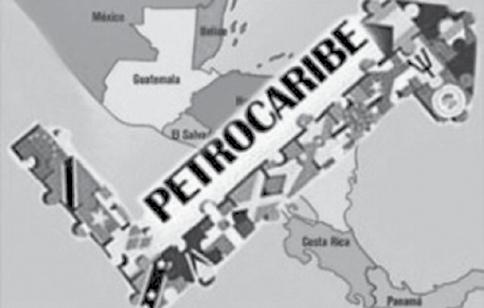
agriculture minister, Dr leslie ramsammy says Guyana’s rice export market will be able to survive in the eventuality the Petrocaribe rice for oil agreement with neighbouring venezuela falls through
BY JOMO PAUL
Rice export for this year will likely reach over 500,000 tonnes, Agriculture Minister, Dr Leslie Ramsammy has said.
Dr Ramsammy said the amount of rice exported so far this year is 401,000 tonnes and there is still 137,000 tonnes left to be exported by the end of 2014.
“That was supposed to be the production in 2020, but that is now the export. Some of you who have followed the story that in January we were being attacked, that we can’t sell our rice, the truth is that we better have a minimum of 160,000 tonnes on hand, because during January, February and March, we have no production as rice is still growing,” Dr Ramsammy said.
In 2013, rice export accounted for about 395,000 tonnes and approximately 58 per cent of the rice was exported to Venezuela with oth-
er significant buyers being Europe, Jamaica, Trinidad and Tobago and other Caribbean countries.
Dr Ramsammy has said Guyana’s rice export market will be able to survive in the eventuality the PetroCaribe rice for oil agreement with neighbouring Venezuela falls through.
The Minister also noted that the Government through the Guyana Rice Development Board (GRDB) and other agencies has been assiduously working to acquire additional markets.
Dr Ramsammy told this publication in a recent interview that everything is moving according to plan and the contract with the Panamanian Government should follow through without any hiccup.
Since the start of October 2014, 5000 tonnes of rice has been exported to Panama under the rice shipment deal signed between Guyana and Panama late August.
Irene Mason was among the oldest victims of the People’s Temple mass murder-suicide, having turned 86 a week before her horrific death. Tony Walker was a 20-year-old security guard who patrolled the cult colony and its livestock in the Guyanese jungle.
Nearly 36 years after the Jonestown Massacre, they now have a place to rest.
Their long-forgotten remains and those of three others discovered this summer in an abandoned Delaware mortuary, have now joined more than 400 other unclaimed or unidentified Jonestown victims in an East Oakland hillside memorial.
Rain drizzled over a small ceremony at the Evergreen Cemetery organised Monday by the son of Jim Jones, the cult preacher who led more than 900 followers – one third of them children – to their deaths in November 1978 after instructing them to drink a cyanidelaced grape punch. Those who survived the suicidal poisoning were shot and killed.
“I have to accept the horrific event, the tyranny that Jim Jones created, but I also have to respect the people who were trying to build a new world,” said Jim Jones Jr, 54, who remembers many of the dead. “They were trying to build a new world and they really believed that.”
Painful memories of the tragedy resurfaced in August when Delaware authorities announced the discovery of nine cremated remains of Jonestown victims in a foreclosed funeral home near Dover Air Force Base, where all 918 bodies were shipped from Guyana in 1978.
A mystery
Why their remains were stored for three decades in the Minus Funeral Home might never be known. The funeral home closed after its owner died in 2012.
All nine were African-American, and five lived in the Bay Area be-
of Corentyne rice farmer
Swift action by the B-3 Division, Corentyne, Berbice Community Policing Group (CPG) members and ranks of the Police Force on Monday night, following the armed robbery of a rice farmer at No. 56 Village, led to the arrest of four of the five men who reportedly carted off the man’s licensed firearm, jewellery and cash.
Radica Ramanandan, the liaison officer, told this publication that she was a part of the CPG mobile patrol policing the community when they received information about the armed robbery of the rice farmer and summoned the police.
She explained that she received word that the bandits were hiding out in an abandoned house at No. 55 Village and they descended on them and arrested four men who were in the building.
Ramanandan added that the arrest took place at about 23:00hrs
on Monday, hours after the family was robbed.
She reported that about 21:00hrs, five masked men armed with guns and a cutlass entered the home of Jaisha and Chunmattie Boadnaraine and terrorised them. They also dealt the woman a chop to her knee after a beating.
The couple were beaten, tied up and placed in their bathroom in the house while the men escaped with jewellery, more than Gy$900,000 in cash which was the proceeds from a horse racing business they spearheaded, and a licensed shotgun. According to reports, one of the four men in police custody told sleuths that he is from Mahaicony, East Coast Demerara, while the others are from Georgetown and they are the group who had been robbing unsuspecting residents of Corentyne, Berbice for some time now.
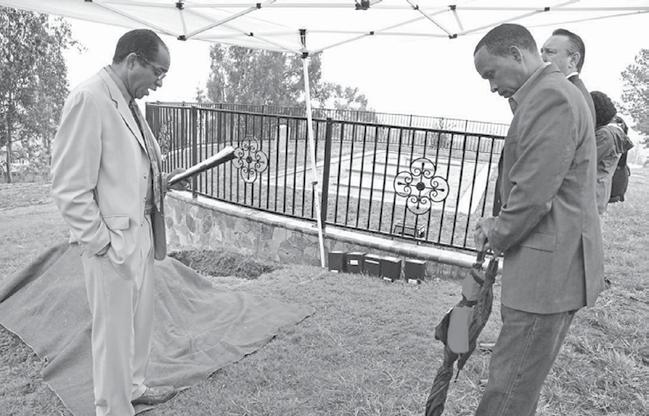
fore they followed Jim Jones in shifting his People’s Temple headquarters from a San Francisco church, USA to a remote jungle clearing in Guyana.
The South American settlement advertised itself as a hub for socialism and racial integration where more than 1000 followers worked the land and gathered for daily assemblies. Defectors who fled back to the United States recounted physical and emotional abuse under a paranoid cult leader.
When a fact-finding team led by US Representative Leo Ryan flew to Guyana to investigate in November 1978, Jonestown followers ambushed the Congressman on an airstrip, killing him, three journalists and a defector, and wounding others. Hours later, the mass suicide and murder of the Jonestown colony began.
When Evergreen Cemetery owner Buck Kamphausen said he would welcome any unclaimed remains of Jonestown victims at his Oakland property in 1979, he went against the trend of other cemeteries and politicians that wanted nothing to do with the bodies.
Unclaimed, unidentified
The US military trucked more
than 420 victims to Oakland and laid their airtight coffins like dominoes in a hillside excavation site. Many of the unclaimed and unidentified were children whose parents had also died.
Until this summer, all of the unclaimed victims were thought to be in Oakland.
With help from The Jonestown Institute, a San Diego State repository of research on the Peoples Temple tragedy, Delaware officials made contact with relatives of seven of the nine victims rediscovered this summer.
Not all of those relatives wanted the remains.
“One of the things we’ve noticed is that 36 years after Jonestown, it still has the power of stigmatisation,” said Fielding McGehee, a cofounder of The Jonestown Institute who helped track down reluctant families.
“There are still people who don’t want to have anything to do with their relatives.”
Family members did claim four of the victims, including Maud Perkins, whose remains were shipped to her husband in Antioch.
Delaware state officials were continued on page 24
Nothing has diminished PPP’s confidence in GECOM Head – Rohee
The ruling People’s Progressive Party’s consistent engagement with the Guyana Elections Commission (GECOM) on issues of concern has raised questions about the party’s confidence in the body’s head, Dr. Steve Surujbally. However, the PPP GeneralSecretary, Mr. Clement Rohee, on Monday, was emphatic in stressing that to date there has been nothing to diminish the party’s confidence in Dr. Surujbally.
“We have not seen anything as yet to make us shift our position on this matter… .I would not say that at this point we have lost confidence in Dr. Surujbally,” he said, at a news conference at Freedom House.
Rohee explained that as Chairman of GECOM, Dr. Surujbally was appointed out of a process set up by the “Carter formula” in which the names submitted for consideration had to be names “not
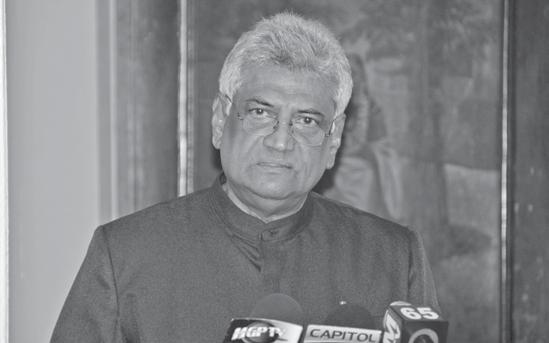
unacceptable” to the Head of State.
He said, “Thus far, neither the President, the Government, nor the PPP has expressed any lack of confidence. We have no interest in moving a no-confidence motion in Dr. Surujbally…we continue to have confidence in him.
“…the process out of which Dr. Surujbally was appointed, the Government and the ruling party, had to have confidence in him for him to be ap-
pointed. Thus far there has not been anything to make us shift from that position.”
The General-Secretary added, however, that with the passage of time the ruling party will continue to raise its concerns with GECOM with the expectation that they be addressed in a “satisfactory” manner.
“We are expecting that they will take up these concerns and address them in a satisfactory manner,” Rohee concluded.

On October 29,
New York Mayor Bill de Blasio marked the second anniversary of Hurricane Sandy and announced continued progress on the City’s housing and business recovery and climate change adaptation. He also highlighted a city that is much safer than it was two years ago, with much more work ahead.
Two years ago, Sandy struck New York City, impacting homes and families across the five boroughs and marking the worst natural disaster in the City’s history. Sandy’s terrible toll on New York City included 44 lives and $19 billion in damages and lost economic activity.
“Sandy was the worst
natural disaster to ever hit our city. As we remember those lost and the destruction Sandy wrought, it’s our responsibility to make every impacted family whole again, while building back stronger and safer to protect against the risks of climate change,” said Mayor Bill de Blasio.
“When we took office, Build it Back wasn’t delivering for families who needed it. Now, New Yorkers across the city have finally gotten the support they deserve, and we’ll continue to speed up relief until every homeowner is served. At the same time, we’re aggressively implementing our comprehensive resiliency plan. We are much safer now than we were two years ago—
and there’s much work ahead,” the Mayor added.
“In the two years since Hurricane Sandy made landfall in New York City, we have made tremendous strides to rebuild a stronger and more resilient City. From Coney Island, to the Rockaways, to Breezy Point, to South Beach, to Red Hook, to Lower Manhattan and beyond, working with our partners in the city, state and federal government, we remain committed to ensuring all New Yorkers hit hardest by Sandy have the resources and assistance they need to fully rebuild their homes and their lives,” said City Council Speaker Melissa MarkViverito.

By Shaikh Moeenul hack
As Ebola spreads in its worst outbreak in history AS WELL AS Chikungunya locally, how can we protect ourselves from these viruses?
Allah is the Creator and does not do anything without a purpose. Ebola is a wake-up call for all, to adhere to the etiquette and ethics which many have been ignored due to lack of knowledge and heedlessness.
Islam as a way of life has provided appropriate mechanisms that guarantee both safety from and prevention of infectious diseases.
First: Prophet Muhammad (SAS) said, “If you receive news of an outbreak of an epidemic (plague) in a certain place, do not enter it and if you are present in the place then do not leave.”
The implication of this is that, it is a religious responsibility not to travel to areas associated with the deadly virus and also for those there not to leave. This is the best way to contain and restrict the spread of the virus. Health-care and relief workers are excluded from this group.
Secondly: Islam is a religion of cleanliness. ‘Cleanliness is half of faith.’ Cleanliness of our bodies, clothing and place of prayers are necessary for the acceptance of prayers. Islam insists on washing of hands with water and soap after urinating and defecating, before and after eating. Those who wash their hands often would guard themselves against the Ebola infection. In addi-

tion, Muslims are prohibited from bathing, urinating or defecating in stagnant pools of water. This is because it is not hygienic and coming in direct contact with bodily fluids would predispose one to infections like Ebola, among others.
Keep surroundings clean
Our surroundings must be kept clean. This is the responsibility of every believer in God Almighty.
Thirdly: Islam prohibits eating of certain animals like pigs, dogs, monkeys and all fanged animals, which have now been identified as vectors of Ebola virus. Medical experts confirm that the disease was first discovered in monkeys.
Fourthly: Based on the principle of Injury and Harm, one of the five principles of Islamic Law, “it is permissible not to wash corpses if washing them would expose the washers to harm”. The same is applicable for decomposed bodies. Islam is pro-life and prohibits any human from performing any acts which will place his/her life in danger.
unable to find any relatives of Ottie Mese Guy, 34, and Ruth Atkins, 74, so they arranged with McGehee and Jones Jr – Co-directors of the Jonestown Memorial Fund – to send them to Evergreen Cemetery, which is still owned by Kamphausen.
Agreed
Investigators also made contact with relatives of Tony Walker, Irene Mason and Wanda Bonita King, a 39-yearold Jonestown teacher originally from Indiana, where the People’s Temple was founded. Their relatives agreed to let them be interred in Oakland.
“Sweet and feisty” is how one former
Therefore, medical personnel treating patients with Ebola must take all precautions, use of protective clothing, etcetera. Also, shallow graves are not allowed in Islam.
As a matter of faith and conviction, Muslims are enjoined to live Islam by adhering to its ethics and etiquette in order to be safe from infections and diseases.
There is no cure presently for the Ebola virus. We have a moral and civic responsibility to protect ourselves and not to travel to the affected areas. In addition, if you know of someone who went or came into contact with anyone from those areas, let us encourage them to get medical help. Protect yourself by washing your hands with soap and disinfect your surroundings.
Finally, we strongly encourage the health authorities to intensify their screening at all ports of entry including Lethem, Ogle, Moleson Creek, CJIA, among others, and equip them with the necessary facilities and tools to deal with this virus.
Islam enjoins Muslims to be compassionate to all, especially those who are sick and in distress. We must support and include them in our prayers. With the amicable relationship between Muslims and nonMuslims, the numerous similarities among the major faiths and the relevance of this message, hopefully we will display collective responsibility and global solidarity absent at the start of this outbreak to bring it to an end.
Peoples Temple member described 86-year-old Mason, who belonged to the church’s Los Angeles branch before moving to Guyana. She was born in 1892 in Alabama.
Oakland resident and Jonestown survivor John Cobb, 54, was part of the same security team as Walker and remembered him as a quiet and hardworking young man.
Cobb stood with Jones Jr, the cult leader’s adopted son, and Cemetery Executive Director Ron Haulman under a canopy on Monday morning and made some brief remarks as gravediggers placed the five small boxes of remains in a hole just outside the existing memorial wall.
Jones Jr and Cobb helped build the fourstone Jonestown Memorial in 2011. Other victims’ family members sued, arguing that it was an insult to the victims to include the name of Jim Jones, the architect of the killing, on the list of dead. The California Court of Appeals dismissed the case and formally closed it last month.
Cobb, who lost eight family members at Jonestown, said he was saddened that these forgotten five victims were just joining the memorial ground Monday.
“They were unidentified and sitting somewhere for a long time,” Cobb said. “It’s good to have this kind of closure.”
least that’s my take after reading “Glimpses of a Global Life”.
I also saw some quite negative views of Ramphal by reader/ commentators on the Stabroek News site based in Georgetown, Guyana’s capital, in the news service’s announcement of the book launch of Glimpses of a Global Life. Any memoir, as I’ve pointed out in my past reviews of the genre, is by its very nature subjective and subject to review by historians.
Toward the end of Ramphal’s tenure as Commonwealth Secretary General, his name came up as a possible Secretary General of the UN.
I think he would have made a much better Secretary General than the fourth man to serve in that position, Kurt J Waldheim, an Austrian who served as an Intelligence Officer in Hitler’s Army during WW II, when Austria was part of the Third Reich. Waldheim served in the UN post from 1972 to 1981 and was the recipient of a telegram from Idi Amin praising the slaugh-
ter of Israeli athletes at the Olympic Games in Munich, Germany in 1972. Waldheim protested that, despite being an Intelligence Officer in the Wehrmacht, he knew nothing about the Third Reich’s crimes against humanity.
Summing up Glimpses of a Global Life offers the reader a cast of the world’s leading characters and the central role Ramphal played alongside them in issues such as ending Apartheid in South Africa; laying the foundations for global concerns about the environment; the reform of global governance, and the resolution of conflicts.
It is an analysis of major problems and challenges that dominated the 20th century and continue to shape the contours of the 21st. Since the major news media rarely cover events in the Commonwealth – except in the cases of terrorist acts like the recent events in Canada, Glimpses of a Global Life will serve to educate readers interested – like the present reviewer –in history. (huntingtonnews.net)
Acting Tourism, Industry and Commerce
Minister Irfaan Ali said Linden, Region 10 (Upper Demerara-Berbice) should not isolate itself from national and international developmental initiatives and the community should rid itself of the “devils of the past”.
At the time, Ali was delivering remarks at the Linden Chamber of Industry, Commerce and Development’s Annual Luncheon. Isolation, he said, can be a stumbling block to economic growth and development, preventing the local economy from capitalising on existing opportunities on the national and international scene. With Guyana experiencing eight years of consecutive economic growth through rapid Private Sector investments, Ali said the leaders of Linden and, by extension, Region 10 should mobilise their people to capitalise on the economic transformation taking place.
He made reference to the controversial Amaila Falls Hydropower Project, telling the regional leaders to think about the potential ben-
efits that can evolve from such a multimillion-dollar initiative that would bring cheaper electricity to Guyana.
The domino effect from this project, which was estimated at US$800 million, would have resulted in Guyanese being provided with reliable and affordable electricity. Additionally, it would have created hundreds of jobs and simultaneously boost the country’s economy.
The project was designed to be constructed where the Amaila and Kuribrong Rivers meet. Electricity produced at the plant would have been
delivered to Guyana’s capital, Georgetown, and its second largest town, Linden, by an electric transmission line.
CJIA expansion
The Commerce Minister also alluded to the Cheddi Jagan International Airport Expansion Project, the Marriott International Hotel, Hospitality Institute and Agro Processing Plant. However, Minister Ali said in moving forward, communities must rid themselves of things from the past. “We need to rid ourselves of the devils of the past. In order for us to move forward, we have to collectively understand that we have to rid ourselves of the devils of the past.”
He argued that communities must confront the present and aspire to the future with recognition that whatever occurred in the past that created negative energy should be a lesson to learn from and not one that dictates process.
“If we cannot release ourselves from that trap, then we would not be able to achieve the ideals, the visions and the objectives
laid out.” He stressed that Linden as the gateway to the interior should unlock opportunities and create a new environment based on cohesion and trust. Businesses, he said, would not prosper and achieve full potential if the society is not cohesive.
Three main problems
Meanwhile, Linden Chamber of Industry, Commerce and Development President Kevin De Jonge said research has indicated that there are three main issues blocking growth and development in Linden, despite its wealth of resources. Politics, lack of unity, and high unemployment were the three factors identified.
According to him, there is a perception that politicians are pursuing their own agenda rather than fulfilling their mandate to serve the people. Though the Linden Chamber is not a political institution, De Jonge said in keeping with its constitutional requirement, the Chamber would serve as a key link between the Private Sector and the Government of the day.

The NEW GPC INC
is proud to announce that it is about to rollout its iconic Limacol splash-on in most of the major markets of the world.
According to Executive Chairman, Dr Ranjisinghi ‘Bobby’ Ramroop, the launch follows a timeline built into Limacol’s expansion strategy that was initiated when the brand became the major sponsor of several major sporting events in Guyana and the Caribbean.
The ensuing broadcasts in every continent made the Limacol Brand a talking point in all the nations where sports, especially cricket, were played.
In the US, the Limacol Brand will be associated with baseball as well as with the new cricket leagues being launched. Now that the Limacol Brand awareness has reached the critical benchmarks set in the strategy, the decision to launch was made.
Limacol – and sev-

eral of its brand extensions – will now be introduced into major new markets in Australia, New Zealand, India, Bangladesh, Pakistan, South Africa and the Middle East.
In the US, Canada and Britain, it will strike out into mainstream outlets, in addition to the traditional Caribbean ethnic market where it has always had a loyal following and customer base. The increased sales in its home Caribbean markets will also be augmented.
This major marketing push will see the Limacol production facilities at Farm, East Bank Demerara ratcheted up to deal with the increased demand.
NEW GPC INC has always been in the forefront of boosting the local manufacturing sector with Limacol and numerous other products.
All of these had been shipped to the traditional export markets. With the massive Limacol expansion occasioned by the new market roll outs, it is projected that Guyana will benefit substantially both in terms of increased employment opportunities and in earning foreign exchange. Dr Ramroop emphasised that his company is very bullish on Guyana.
Limacol is a unique body splash on, manufactured in Guyana since the 1920s. Its signature slogan “Freshness of a breeze in a bottle” is known across the Caribbean –and now it will be on lips across the globe.

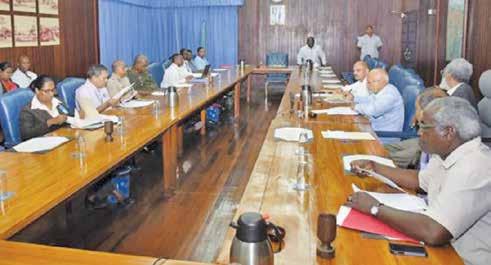
President Donald Ramotar on Friday met with top officials from several sectors including, security, aviation and medical officials to discuss Guyana’s preparedness for any possible Ebola cases. The meeting is one of several scheduled to keep all officials apprised of the latest developments, and possible constraints that may arise in addressing concerns across the sectors in dealing with any possible cases.
The meeting held at the Office of the President was also advised about facilities that have been prepared, and
are being prepared for the quarantining of suspected victims of Ebola.
The Health Ministry has begun training more than 1,600 persons to deal with any suspected cases of the disease. Health care facilities are also being prepared to handle suspected cases, along with the procurement of protective gear and medical supplies. In case of the latter, international support from agencies such as the Pan American Health Organisation (PAHO) and the World Health Organisation (WHO) it is anticipated would provide the necessary sup-
port on a case by case basis, to boost the capabilities of Caribbean member states as needed to respond to suspected cases.
About 5,000 persons have already died from the disease, with close to 9,000 other cases being reported according to the WHO.
Guyana has instituted travel restrictions for persons from West African nations stricken by the disease. Several Caribbean nations have also instituted similar travel restrictions; these include St Vincent, St Lucia and St Kitts and Nevis.


By Bhisham mohamed
Some two years af-
ter a Caribbean Airlines Flight, BW 523, with 157 passengers and a six-member crew, skidded off the Cheddi Jagan International Airport, investigators on Friday disclosed that human error was the instigating factor for the crash.
This was according to head of the investigative team, Paula Mc Adam. The team comprised several high-level aviation experts from Guyana, the Caribbean and the United States of America.
“Our findings show that there was pilot error and more so, poor cockpit management,” she said. There was little or no communication between the pilot and co-pilot. She added that they both had duties to carry out and from all indications, both of them erred.
The lead investigator said that the probable cause of the accident was that the airline (which was coming from Piarco International Airport just after midnight) touched down approximately 4700 feet beyond the runway threshold.
This, she noted, occurred as a result of the captain maintaining ex-
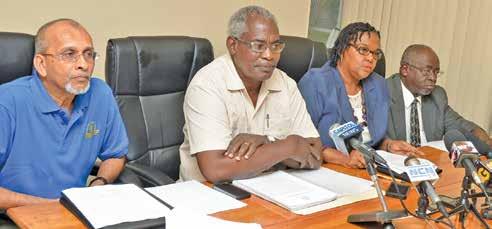
cess power during the flare, and upon touching down, failing to utilise the aircraft’s full deceleration capability hence the aircraft overshot the remaining runway and the fuselage was fractured.
Mc Adam further stated that the pilot increased power to maintain the glide path and did not significantly reduce power when crossing the runway threshold. Also, during the investigation, it was proved that the crew did not command maximum brake pressure until the aircraft was 250 feet from the end of the runway. While the runway was wet, this did not affect the braking capability of the aircraft.
On this note, the report confirmed that the aircraft could have been
brought to a safe stop on the remaining pavement if maximum braking pressure had been applied.
Mc Adam said that while investigations proved the accident stemmed from human error, the team still did not manage to ascertain exactly what took place. “I don’t know what happened in the cockpit. We did a report on the information that was presented to us…The captain is a veteran who has some 25 years’ flying with Caribbean Airlines; the co-pilot is fairly new but they both have a lot of experience flying into Cheddi Jagan International Airport… There is really no explanation for why certain things happened.”


The official also admitted that there was poor coordination in the cockpit and the cabin during the landing, a physical phase of the flight. She explained that during their investigations, it seemed as though the suddenness of the incident prevented the cockpit crew from giving warning to the cabin crew. In addition, she noted, there was damage to the aircraft which affected the communication equipment in the cockpit. Due to the findings, a number of recommendations were made to Caribbean Airlines, including the training of flight crew to ensure that they confirm with and operate within Standard Operating Procedures.
Another recommendation, however, stated that cabin crew must be trained to develop the correct procedures that are pertinent to operating the exits when aircraft are in unusual situations.
On July 30, 2011, the Caribbean Airlines Flight touched down at approximately 4700 feet of the approximately 7448-foot runway – some 1700 feet beyond the runway touchdown zone. The aircraft ran off the runway, broke through a fence and came to a halt at the bottom of an earthen embankment.
Due to the impact, the aircraft broke into two in the vicinity of the first-class bulkhead causing both engines to be destroyed, but fortunately there were no post-crash fire and only one passenger sustained injuries –to his leg which was sub-
sequently amputated.
Moments after the crash, the Guyana Rescue and Fire Fighting Unit based at the CJIA went into action in keeping with the Airport Emergency Manual. Firefighters entered the aircraft and assisted passengers and crew members to evacuate.
Soon after, Caribbean Airlines ground handling staff entered the plane and took precautionary measures to prevent an explosion or fire. Due to the location of the wreckage, the runway was temporarily closed for an estimated 10 hours.
During this time, the aircraft was defueled and fuel samples were taken for testing. The same day, Caribbean Airlines officials out of Trinidad and Tobago arrived in Guyana as well as members of the National Transport Safety Board.

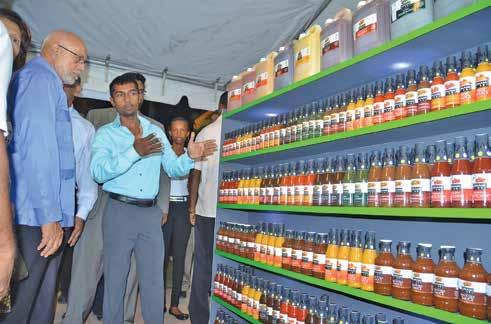
By Vahnu Manikchand
Fairly new to the Guyanese market, Umami Incorporated has already managed to make its mark in the local agroprocessing market with its line of food condiments.
The company was established in November 2013 by remigrants, Chris Persaud and Chanchal Persaud.
According to Chris, while living abroad, he and his partner saw the niche market and returned to Guyana with the aim of giving back to the country.
“We wanted give back to the country, something that is truly owned by Guyanese, something to be proud of. That was the driving force behind the establishment of Umami Incorporated,” Chris explained.
Umami, a Japanese word meaning “pleasant taste”, specialises in the production of food condiments such as pepper and hot sauces, seasonings, bar-b-que sauce, ketchup, Chinese sauce and vinegar, among others.
Chris, a chemist by profession, mentioned that he and his partner observed that the agricultural produce from local farmers is diverse. With their scientific and marketing know-how, Chris and Chanchal decided to tap into the market.
“In Guyana, we noticed that there is a void in the shelf space and packing was lacking appeal. We sought to fill that void by providing goods whereby the packaging could stand against any of the international giants, so we can sit on a shelf in New York, London, France, Germany,” Chris men-
tioned.
The businessman said the response Umami Incorporated has gotten over the months has been phenomenal and experienced an average growth of 25% monthly since its launch last year.
While the management of the company has been focusing on branding, they have caught the attention of international businesses. Umami has been approached by major supermarket chains and distributors in neighbouring Suriname, New York and London.
“Their agents have identified our products as having scope in their market so we are having negotiations with these parties with anticipation of start supplying early in the next fiscal year. We do not want to be in a case whereby we have lost focus on the branding, so our first priority launching the brand was to ensure we had 70-80% brand equity on the local market before we began exporting and I think we have successfully achieved this. There is no sense in us exporting a product and Guyanese do not know it, that is why for the first year we committed all our resources towards marketing the brand right in Guyana,” Chris revealed.
Chris believes that his factory has the capacity to begin exporting after just one year in business. He explained that in establishing Umami Incorporated, they have equipped the factory with adequate technology and machinery that can facilitate large-scale and long-term production.
The factory is semiautomated in order to ensure that there is a human element and employment is provided for citizens. Umami

Incorporation currently employs 15 fulltime staff and an additional 10 on a part-time basis.
As it relates to production, the process is highly automated. “It’s an enclosed process, that is, when it (production) starts, the product goes straight to bottling.”
The company is in a contractual agreement with farmers who would supply ingredients, such as pepper, which will be of certain quality. This type of agreement was adopted to ensure that the company would be locked into relationships with farmers in order to guarantee a consistent supply of quality produce.
Additionally, the factory operates on a batch level and has flexibility in terms of changing production within one hour. Umami has prided itself in the fact that it is producing high quality products that have met international standards and can be able to compete with other products that have been on the local market for years.
“It’s because of the very same competition that has allowed our customers to realise what makes us different. You go to the supermarket and we all have pepper sauces, families even make their own, and we all think it’s the best... what makes us different is the quality our product,” Chris declared.
The company is proud of its packaging style, which the owners explained is unique to the designs that are prevalent on Caribbean products. Rather than adopting a carnival of colours or a loud design, the local company opted for a modern layout that made practical use of the “white space”. (Guyana Times Sunday Magazine)


For over three de-
cades, Major’s Products have found its way into the pots and plates of Guyanese locally and abroad. Current owner Denise Major-Gopple aims to continue this tradition by ensuring that it remains the same products that persons have come to know and love.
Major's was established by Edna Major, a popular businesswoman in Victoria Village, East Coast Demerara. She began her trade with starched clothing, which she did using cassava. She immediately plunged into the food seasoning business with her famous cassareep, before going into making coconut oil and tarts.
The business died with her a few years later, but after sometime, her son, Allan Major, reopened and expanded the product range.
“My dad had learnt the trade from his mother so after sometime, he wanted to continue the business and also wanted to enter the manufacturing sector so he began making pepper sauce
then green seasoning... but he also died about three years ago and his wife took over the business,” Denise recalled.
Following Allan Major's death, Denise sought the help of the legal system to gain possession of the business, which was established by her paternal grandmother.
It has been two years now since 52-year-old Denise has been managing Major's Products and the production line has expanded to include hot sauce, mustard sauce, Chinese sauce, achar and cake colouring.
While business is doing well, Denise said she is focused on recapturing the prestige Major Products once had by regaining the confidence of supermarkets and other major buyers.
Noting that such a business would not find many markets in its surrounding, especially in the countryside where most households would make their own prod-

ucts, Denise said they have been trying to break into new markets.
“There has been a bit of a problem with the company since my father died and so now I’m trying to reverse this and put Major’s Products back on the scene. I know a lot of new competitors out there, but we have a brand that most Guyanese know and love, it’s just about getting it back out there.”
In Guyana, Major's Products have a steady market in Georgetown
and in Linden and would see increased sales during the Christmas season.
Denise explained that while Major’s is known worldwide for its casareep, its other products continue to be of high quality and standard.
“We always try to maintain a certain standard with our products because other companies will make the products, and we can’t stop them, so it’s all about standard and that’s what sets us apart from them,” Denise
pointed out.
Major’s acquires its ingredients through supporting local farmers along the coastal areas. The peppers are sourced from farmers in Berbice and the seasonings from those along the East Coast.
At present, Major’s Products is looking to expand its production line and is currently conducting Denise explained that while they currently manufacturing their products using tradi-
tional methods, Major’s is trying to upgrade its facilities and in doing so has been invited by the United States Embassy to attend a fair in Chicago.
“It is with the intention of expanding that Major’s will be taking advantage of this opportunity because one of the biggest problem we face is acquiring materials and machinery locally and the high cost so by going to the fair, we will be meeting directly with the suppliers which will work out best for us, besides you get better profits when you have more products to offer,” Denise mentioned.
Despite these challenges, Denise is confident that Major’s will remain on the market for a very long time, noting that she will work relentlessly to ensure it does.
“When my father restarted this business, his intention was for it to go on, so that’s what I’m doing and will be working to achieve. It’s my father’s wish and desire and I will fulfil it,” Denise declared. (Guyana Times Sunday Magazine)

The Ministry of Agriculture is currently promoting initiatives in keeping with the government’s aim to add value to Guyana’s produce as part of its development strategy.
Minister of Agriculture, Dr Leslie Ramsammy recently said, “… I am in a position to say that a miller has procured equipment to convert paddy husk into energy to meet the energy needs of the mill, making use of all the byproducts of rice.”
This sort of investment is to ensure that the remains of rice harvest do not create an environmental problem, and are converted into cleaner energy. Cooking gas is also being produced on a small scale locally and Ramsammy said agriculture could contribute more to such initiatives.
In the last couple of years, rice has gone from just being a producer of paddy for mills in other countries to utilising every bit of the rice plant and its product. Ramsammy said he recently had discussions with a group that wants
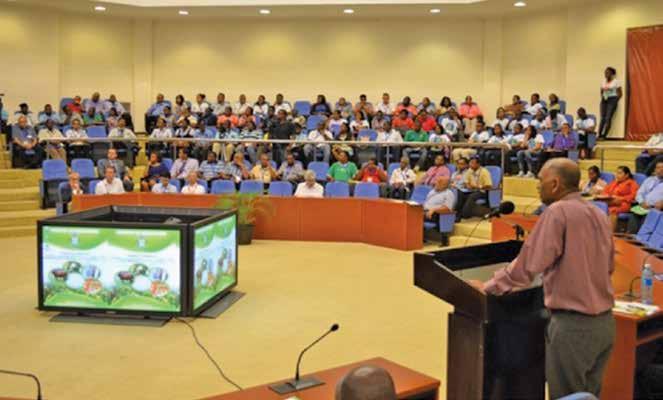
to produce healthy cooking oil using the paddy husk, shell and other byproducts. He added that there are many opportunities for this kind of research.
“We would like to see our university, National Agricultural Research Extension Institute (NAREI), Guyana Livestock Development Authority (GLDA) and
other organisations coming together with an active research programme,” the Minister urged.
Ramsammy commended the work being done at the Rice Research Centre and by young agriculturalists at NAREI and GLDA to improve the varieties of crops and the breeds of animals. Earlier this year, a farm-

Though the Agriculture Ministry seeks to find ways of expanding diversity in agriculture crops, Ramsammy said the issue of climate change must be taken into consideration.
“Guyana stands ready to take on the challeng-
es of agriculture production. While the focus has been food and nutrition security, we have begun to diversify into areas of fuel production, medicine and cosmetics etc,” the Minister explained.
He urged that each investment be looked at to determine ways to maximise the investment potential to further benefit Guyanese, as is
done in other countries.
“We must ensure that the agriculture we practice today in Guyana is very different in 2020, one that will ensure Guyana overcomes the key binding constraint that affects agriculture in the Caribbean,” Ramsammy declared.
The Agriculture Ministry anticipates that by year 2020, some of items/commodities imported will be produced in Guyana; members of the Caribbean will purchase items produced locally, and that farmers will become leading entrepreneurs.
Ministry of Agriculture's Annual Research Conference is part of a strategy that is intended to change agriculture to continue to lead sustainable development goals in Guyana. In the first week of November, a forum will be held on coconut in Guyana.
Guyana has been making major strides in fulfilling its mandate of adding value to products despite the lack of availability of cheap energy.
(Guyana Times Sunday Magazine)


While not a holiday in Guyana, Halloween has become one of the major events many Guyanese look forward to.
Celebrated locally by keeping up parties for adults and children, Halloween is a time when creative costumes are worn and artistic body painting is displayed.
Bravo Arts, a local art company, is famously known for its production of scary and ghoulish costumes and body painting. With depictions of bloody faces, torn flesh and ghostly body paint, Bravo Arts has become the go-to company for Halloween costumes.

Arts comprises
a
loving team of young people who enjoy putting smiles on people's faces even if it means painting them on. It offers its clients an opportunity to transform their body through the medium of body painting, nail art, hair art, makeup, temporary tattoos, and glitter art. Bravo Arts customises its services to meet the unique needs of its clients. Its team of young, talented and dedicated artists and entertainers add to the youthful energy and creativity of the group. Bravo Arts, which was launched in 2009, is the brainchild of local artist, Steve Douglas.





…on Jagdeo’s Norway deal
Guyana just pocketed another US$35 million from the Norway US$250 deal million President Jagdeo had negotiated back in 2009. It’s not surprising the Opposition will never acknowledge this boost for Guyana – not to mention his numerous other accomplishments during his stint at the helm. Especially his role in freeing Guyana from the US$2.1 BILLION debt the PNC had saddled us with in 1992.
The PNC – whether in its PNC-R1G or APNU reincarnation – keeps bleating that most of that debt was actually “accrued interest” and not actually “borrowed” by them. As if this excuses them!!
Actually it damns them more than ever. They should be even more ashamed since the country didn’t even get a pin for all that money owed! Didn’t the wankers know when they default on loans, they incur interest??
Anyhow, back to the money flowing in from Norway. Some think it’s manna from heaven. Yet it’s the same people who scoffed when Jagdeo first broached the idea that Guyana should be paid for not cutting down its forests. In retrospect, it sounds eminently sensible. The planet’s dying from all the Carbon Dioxide the developed countries’d poured into the atmosphere during the last 200 years.
Our forests remove and lock away Carbon Dioxide – purifying their “smoke”, while they keep “puffing” and polluting. If we cut down our trees for whatever purposes – development or otherwise –the developed countries can’t get the free pass we provide. But nobody thought of this at the time. In fact, some said that Jagdeo was trying to blackmail the developed world!! Jagdeo was just willing and ABLE to think outside the box.
Jagdeo was able to sell the idea because he was able to situate the Carbon sequestration programme within a Low Carbon Development Strategy (LCDS). This is now a model for even the developed countries. And it’s why he’s consulted whenever climate change comes up on the global agenda. But like we said before, you’d never know if you go by the local spit press. Which just acts as the Opposition’s handmaidens.
Another reason for what can only be called their “hatred” of Jagdeo is the Opposition’s humiliation at the former’s hands when they played their ultimate card with their “slow fyaah; mo’ fyaah” and he stood them down. Burnham had laid down the dictum, expressed by Hoyte, that the PPP only understood the “language of force”.
Jagdeo was the first PPP leader to turn the tables on the PNC. This sticks in the Opposition’s craw. But why are Jagdeo’s erstwhile comrades so diffident about acknowledging him??
…on Lalloo’s challenge
A week or so ago, that pot-salt struggling for some sort of recognition, Lalloo Ram, challenged the Clerk of Parliament on the AFC’s No-Confidence Motion. He found release in the letters pages: “Clerk needs to explain why he is now excluding discretion of Speaker to convene the Assembly when the public interest requires it.”
Well, the Clerk immediately bitch-slapped him by quoting the same Standing Order that Lalloo had mangled. But not only that. The Clerk quoted two previous Speakers and Clerks and showed that Lalloo was blowing hot (and fetid) air through his nether orifice. Even the present Speaker, who’s from the AFC, hasn’t supported Lalloo.
Now you’d think the wanker would issue some kind of apology to the Clerk, wouldn’t you?? But if you go by the previous bitch-slappings of Lalloo by his betters in the accounting and legal professions, you wouldn’t hold your breath.
Lalloo’s lying low until this humiliation blows over. He’s a sucker for punishment! Like Freddy Kruger, he’ll be back.
…on skeletons
Looks like some Ministers would stand on their heads to placate Mook Lall. Or more precisely, they’ll stand on their face on their Facebook pages. This Eyewitness wonders what skeletons they have rattling around in their closets they’re afraid might be exposed.
Asplash of colour, the pungent scent of incense and the melodious sound of traditional Indian music are just a few things one experiences at a Diwali Nagar, an exposition in celebration of Diwali.
The Diwali Nagar, held at the City Centre located on Water Street, was a heavenly “village of lights”.
“Nagar means ‘village’ and a Diwali Nagar is the display of everything Diwali - lights, food, decorations and so forth,” Pradeep Samtani outlined in an interview with Guyana Times Sunday Magazine
Samtani, a man with a vision, transformed an entire room of his store to create a Diwali village, where persons learnt about the ‘festival of lights’, enjoying a day of music, shopping and food.
Although a commercial activity, Samtani emphasized the educational and entertaining aspect of the Nagar. “The idea is to give Guyanese a taste of their culture, where everyone can respect and see what Diwali is about. It is educational plus it’s entertaining, I call it ‘edu-taining’ - educate
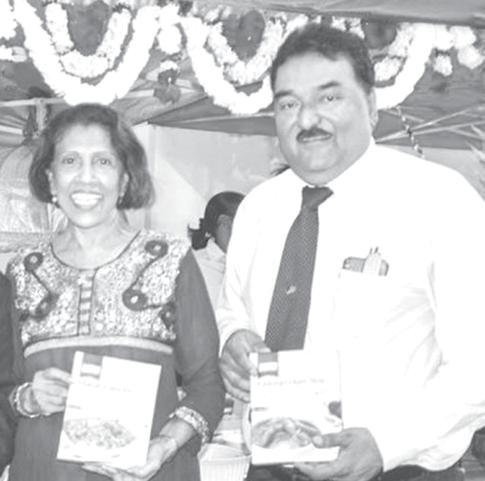
and entertain,” Samtani noted.
The opening of City Centre’s Diwali Nagar saw the attendance of the First Lady, Deolatchmee Ramotar, who cut the ceremonial ribbon and lit a diya to declare the village officially opened. “This is admirable of Mr Samtani, it is nice to know that we can participate in activities like this,” The First Lady stated at the opening of the event.
Upon entering the Nagar, customers are treated to a colourful display of Indian decor, or-
naments in marble and Kashmir (walnut wood) among other things, jewellery, musical instruments, furniture and, of course, an array of lights and diyas. Customers were also allowed to take pictures and were treated to the world renowned Ashoka brand foods.
Ashoka, an ADF Foods Ltd., is a brand of Indian foods, which includes a range of readyto-eat curries and pickles. It was a featured product at the Nagar, distributed by Continental Group.
“Ashoka products
About a month ago, I was sent a photograph (a pic we call it these days) of a new lab built for a small school in Bush Lot, West Coast Berbice (WCB). It was a small space with a sink and a table of wood, a “chemistry lab”.
The school is Vedanta Academy, headed by Mr Rampersaud. Miss Shazeena sent me the pic and asked me to do what I could to help. She also promised that she will MAKE me come to visit the school.
I said I would, and like people of honour, we kept our promise. We helped as much as we could and we visited.
We were welcomed with grace by Mr Rampersaud, members of the Board of Governors, a good Pandit-Ji, parents, and teachers. We met the entire school of students, dressed in the Academy’s orange uniform.
The school is a two-storey building,
L-shaped, neat, with nice land space at the back and front. The desk-type chairs are polished and there is a burnished podium. Downstairs is an auditorium, aback of which is the chemistry space. It is all aligned, neat, clean.
The headteacher, Mr Rampersaud informed me that the school was set up by donors from within and without the country. Salaries and expenses are dependable. Clearly, there are people who care enough to make things well for our children.
The reward is a future for the children that I met and spoke with. It is a future wrought from generosity, vision, effort, dedication, and discipline. The hallmark of the school is discipline.
It is a school dedicated not only to academic performance but also to moral values and ethics. The headteacher, the teachers, the Board,
are very well-known in the US and all over the world. It is from India and 100% vegetarian. Not very heavy on the stomach, you can add to it as you like and its takes two and a half minutes to microwave and it’s ready to eat,” Samtani declared. He added that the products are “for everyone not just Indians”.
City Centre’s Diwali Nagar was opened on Monday 20 October and is planned to run until the 31 October, upon which the store will once again be transformed, this time to a ‘Christmas Village’.
“Well I’m not going to give you the details, but there will be fun things for the kids and adults. The store will be transformed monthly for the various holidays and seasons. From the 15 November it will be converted to a Christmas Village, in February there will be something for Mashramani, then for Phagwah in March, Indian Arrival in May, an African Village in August, and in September something Amerindian will be done.” (Guyana Times Sunday Magazine)
and the supporters understand that academic performance can be measured rather easily.
But they also realise that moral substance, not measured easily, is even more important. Vitally, the children seem to understand this as well.
As Miss Shazeena and Mr Rampersaud said to me: “The concern is for the WHOLE person!” I could not agree more.
Vedanta Academy is built upon moral foundations established in the Vedic texts. Those texts are inclusive instead of exclusive. They embrace good habits rather than rule by brute force and ignorance.
When I entered the Academy, I was told by the headteacher that they were honoured and thankful that I could come down and visit and so on. Mr Rampersaud is clearly a good man, but he was wrong in this instance. It was a simple soul

like me that was honoured to have been asked to be a part of something special. I was honoured and quite a bit shy. They all set me at ease with their welcoming embrace. I have no words to say except thank you and Shanti. This Vedanta Academy took me back to the days when Mrs J C Chandisingh and Mr Haroon Samad created Corentyne High School. I was a child then, as I became again when I visited Vedanta.
This school shall be a model for many, I am confident of it.
By Jomo Paul
Rice farmers across Guyana continue to be concerned about the low prices for their rice, saying that other than the lucrative Venezuela market, the other options are not profitable.
Rice Producers Association (RPA) President Leekah Rambrich speaking to Guyana Times Sunday Magazine disclosed that there are “more than enough” markets available for Guyana to sell its produce. He, however, cautioned that the prices being paid for rice on other markets are not as lucrative. Rambrich explained that Venezuela pays well for Guyana’s high quality rice and paddy, but other countries are not doing the same.
“The millers are worried, the paddy was purchased at a high price from the farmers, prices have been declining for the past two crops on the global scale…they are going to be running at a loss if they sell at certain prices,” Rambrich explained.
One rice miller, in a recent interview, opined that the market for Guyana’s rice is available, but the private sector has to be more proactive in acquiring these markets. Another miller, Abdool Hakh, from
Head of the National Agricultural Research and Extension Institute (NAREI), Dr Oudho Homenauth said the recently launched “Eat What We Produce” campaign will help push locally grown foods.
Enhancing agriculture through family farming and the use of sustainable technology was stressed during the launch of the “Eat What We Produce” campaign, which will help the Agriculture Ministry in getting “Guyana branded” products into the kitchens of the populace.
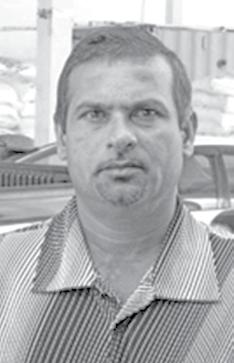
Mahaicony, agreed that sufficient market is available for the exportation of Guyana’s rice.
“The market is there, but the prices are low, the international price, the European prices for that matter, those are low… we can sell rice but we have to sell it at a low price,” Hakh said. According to Hakh, this was due to large amounts of rice on the international market from other countries that have also had bumper crops.
Additionally, Hakh stated that if millers were to accede to the pressures of the supply and demand principles of business, then they would be operating at a loss since they were asked to pay farmers a certain amount of money for the paddy when the spring season had begun earlier this year.
Nand Persaud Rice Mill General Manager, Mohindra Persaud expressed similar sentiments, but noted that the millers must come to terms with the state of affairs and sell at lower prices.
“There are a lot of markets, but you got to sell at market price… Guyana sells rice at a special price, there is market, you just have to accept the price or don’t accept the price,” noted Persaud.
Another rice miller, Rayaadul Persaud said: “The markets are available; the markets are there but all of this negative news is going to have an effect on us as millers.” Persaud also pointed out that other countries are experiencing the same issues as Guyana.
It was reported that the European Union would have imported in excess of 10,000 tonnes of rice and paddy; Jamaica 4000 tonnes; Trinidad 3000 tonnes; Portugal 6400 tonnes; and Venezuela, which is one of Guyana’s most important rice markets, 18,000 tonnes of paddy and approximately 6000 tonnes of premium rice.
Agriculture Minister, Dr Leslie Ramsammy disclosed that the Governments of Panama and Guyana are committed to the continued shipment of rice for
the remainder of 2014. The two governments, in early August, signed the agreement which will see Panama purchasing approximately 5000 tonnes of rice per month from Guyana for the rest of 2014, following a recent meeting between delegations from both countries.
Ramsammy said the success of the new deal has opened the door for private millers to have
with the private sector in Panama onboard,” the minister revealed.
The Agriculture Minister, along with RPA General Secretary Dharamkumar Seeraj and Guyana Rice Development Board General Manager Jagnarine Singh, visited Panama in August during which time the agreement was concluded. There will be further
ally. In addition, since Panama imports about 150,000 tonnes of rice annually – although it produces rice, the country is not able to meet demand – the remaining 100,000 tonnes required by Panama will be purchased through bidders, of whom Guyanese suppliers (the private sector) will have the opportunity to be part. The rice exportation agreement is one aspect of a

direct access to the private sector in Panama.
“The engagement has opened the door for Guyanese private sector to compete with the Americans in Panama who will be supplying these to the government. We have at least three private millers who have separate contracts
discussions for a contract renewal in 2015, but it is expected that the contract will continue throughout 2015, provided that the terms of the agreement are met to the satisfaction of the two countries, which will see 50,000 to 60,000 tonnes of rice being exported to Panama annu-
larger agreement.
Ramsammy told media operatives recently that the Panamanians have engaged themselves in an agriculture and trade partnership with Guyana for which a Memorandum of Agreement was signed. (Guyana Times Sunday Magazine)
The Head of NAREI added that while family farming produces products for healthy and nutritional diets, it also “provides employment opportunities, preserves and enhances the culture, skills and traditions of local communities, and contributes to the conservation of plant and animal species”.
Irrespective of where and what kind of family farming occurs, there is need to ensure it succeeds. Homenauth pointed out that NAREI is poised to do just, which was evident in the Open Day exhibition. The exhibition dis -
Homenauth observed that family farming includes crops, livestock, fisheries and aquaculture producers. He noted that while these enterprises are being done by small and medium scale farmers, they account for 80% of agricultural production and generates more than 50% employment.

played drip irrigation methods along with compost production, hydroponic farming and aquaculture, among other things needed to educate and enlighten family farmers. Crops on display were all grown in Guyana with most from NAREI and its affiliated entities.
Inter-American Institute for Cooperation on Agriculture (IICA) representative, Wilmot Garnett said that family farming should be “technological, institutional and social” so that the 90% of Guyanese farms that are owned by families can survive the progress of the world. He added that while it can contribute to productivity, it can also contribute to the adaptation
and mitigation of climate change. Garnett observed that while family farming increases wealth, it also ensures a safe and nutritious diet.
The “Eat What We Produce” project encourages persons to utilise local products, which are grown in Guyana, substituting them for imported items. This is an effort to reduce the food import bill in Guyana while pushing Guyanese to focus on more reliable nutritious diets.
The initiative, which supports family farming, has received support from IICA and the Food and Agriculture Organisation of the United Nations. (Guyana Times Sunday Magazine)
…on stunted development
One phenomenon that’s unremarked in Guyana is “self-fulfilling prophesies” (SFPs) by the Opposition. In an SFP, a person or group describes a situation in a way that is quite untrue…but the statement is followed by actions ensuring that the original description comes into being.
As the scholar who popularised the term said, “This specious validity of the self-fulfilling prophecy perpetuates a reign of error. For the prophet will cite the actual course of events as proof that he was right from the very beginning.”
Let’s look at what the Opposition’s been saying about Guyana. From the time the PNC were thrown out of their illegal occupation of office, they insisted Guyana wouldn’t develop under the PPP/C. And everything they’ve done since is to make that prophesy come true.
First, there was the incitement of “ethnic cleansing” by Hoyte when the new Government removed some of the “square pegs in round holes” from the Government. Tempers frayed as the political temperature rose. Hoyte came up with his “shoot to kill directive” on some land issue. The Government was transfixed with “outing” PNC fires and it was only due to superhuman efforts by the Administration that the economy grew.
After the PNC’s violent street protests following the 1997 elections, what the SN called “Terror in the City” unfolded as ethnic violence, and was brutally inflicted on presumptive “supporters” of the PPP/C. The Government had to truncate its term of office by two years even though no electoral impropriety had been found. This was development delayed.
A wave of robberies and kidnappings by the notorious “Blackie” London gang then terrorised sections of the country, but Hoyte draped a flag of Guyana over his coffin at the Square of the Revolution.
It should surprise no one that after Hoyte unleashed his “slow fyaah, mo’ fyaah” strategy of violent attacks against the Government, “Blackie” London’s lieutenant Andrew Douglas continued with the “Buxton Insurrection”.
Another six years of marking time ensued as the PPP/C – under a new leader Bharrat Jagdeo –continued to struggle heroically to stave off the waves of attacks by the bandits, while trying to continue with their development programme for Guyana. But the success of the Jagdeo Administration in both areas didn’t stop the PNC from pushing their self-fulfilling prophecy for stymieing Guyana’s development.
Under Granger, they’ve merely changed the approach. Now it’s more subtle: economic sabotage like derailing the Amaila Falls Hydro, raising political risk factors to Bosai in Linden, blocking the AML/CFT Bill, etc.
As Burnham taught his acolytes, there are many ways to kill a cat.
…or inexorable logic
But, of course, not everything happens as “selffulfilling prophesies”. There are those situations where folks will jump up and down and deny something’s going to happen, but then, lo and behold, it does!!
Not being Marxist or anything like that, this Eyewitness doesn’t know about “dialectics” acting out, but there’s always the inexorable logic of some situations that lead to inevitable conclusions.
Just take a look at the AFC. We know with all that’s going on in that House of Sleaze, you’d want to avert your gaze…but bear with us. As even their new comrade David Hinds pointed out, the AFC began by promising to remain untethered to either of the two big parties – the PPP/C and PNC. They’d support or oppose both of them depending on their stand on specific issues.
But the moment the AFC declared war on the PPP/C –it was only a matter of time they’d be in bed with the PNC. We hear there’s a coalition/marriage in the works – with Nagamootoo as the PM/bride.
The marriage kiss will be the “kiss of death” for the AFC!
…denial
Harmon says reconvening Parliament’s not on the table in the Ramotar-Granger talks. So exactly how are the two heavyweights able to ignore this elephant in the room??


a health worker checks the temperature of a baby entering mali from Guinea. the global number of cases in the Ebola outbreak has exceeded 10,000, with 4922 deaths, according to the latest estimates by the World Health organisation released on Saturday (Joe Penney/Reuters)
On October 24, rumours spread wildly that Guyana had its first Ebola patient. It was amazing how quickly it seemed that all of Guyana knew of the case. Fortunately, it turned out not to be.
One could sense genuine fear in the population and the story was not just a wicked rumour. There was a basis for the story. A woman showed up with certain symptoms and it happens that she had travelled to a West African country on the border of Guinea, one of the most affected countries. She was discharged from an isolation unit and sent home after doctors had determined that she did not have Ebola.
There is a sense of worry whether we are truly ready to deal with a real Ebola case. Important questions are being asked and the Ministry of Health must provide comprehensive answers.
Kudos to the healthcare staff that responded to the possibility that Guyana might have had its first Ebola case. The statement from the Georgetown Public Hospital Corporation (GPHC) was timely and allayed the mounting fears. A private physician acted with urgency in alerting the GPHC and President Donald Ramotar ensured that all necessary personnel and expertise were gathered to respond.
The Ministry and the
GPHC must meet with other experts for a forensic and clinical audit of the case to determine what improvements, if any, might be needed for future response.
The President must insist that such a detailed step-by-step analysis be made to identify any weaknesses. This will help to ensure that should a real Ebola case occur, Guyana will be ready.
The GPHC immediately extracted the patient away from the physician’s office and directly to an Ebola isolation unit. But was the emergency team that did the extraction properly equipped? Was the team Hazmat-ready? Any response must assume that the patient has Ebola and must act in accordance with this assumption.
Even as the doctors were engaged in determining the cause of illness, certain actions had to be taken assuming that this was an Ebola case. For example, what happened at the private doctor’s office? Were this doctor and his staff subject to any kind of quarantine, voluntary or imposed? Was a tracking team in place? Was any sanitisation initiated for the doctor’s office and the ambulance? Was there protective equipment for the staff at the GPHC?
Ebola has appeared in about six countries outside Africa. Where
infection occurred outside of Africa, it has been health workers affected. It kills health workers by exposing them to patients who, by the end, exude up to 10 litres of virus-laden fluids a day. Were the medical personnel properly equipped for the Ebola response? What kind of testing service was available?
The GPHC statement failed to answer some of these questions. The authorities may have taken these factors into consideration, but such information should be provided to allay fears and uncertainty. Ebola has stirred great fear; hence, information on processing possible cases must be provided.
As rumours circulated and fears mounted on October 24, no one at the Ministry or at the GPHC was in any position or willing to talk to the media and to other interested parties. This compounded the problem.
The Ebola Readiness and Response Programme must have a communication focal point that could answer questions and provide information to prevent wild rumours from becoming the story.
The medical and clinical team at the GPHC appeared competent in their response and their first test in a possible Ebola case. This should allay some of the fears and Guyana is particularly proud of the team.
But the communication component of the response was almost nonexistent.
After the case was determined, the Ministry failed to hold a full media briefing to inform and assure the nation of Guyana’s readiness. Questions as to how the woman came back from a West African country and was never screened were not answered.
The Ministry also failed to convene a mandatory assessment of the overall response. For countries like Guyana, and given that the possibility of Ebola is a new experience, an audit of the response is vital.
Overall, Guyana passed its first test. The 2014 Ebola outbreak is raging on. While Senegal and Nigeria have been declared Ebola-free, Sierra Leone, Liberia and Guinea are reeling. Mali is now another West African country that has declared a case of Ebola.
Guyana has in place a policy of no visas for visitors from West Africa. Guyana is also advising against travelling to West Africa. But one citizen did not heed the advice and was the subject of a close call. This close call provided Guyana with an opportunity to examine itself and answer the question: Are we ready in case Ebola comes?
Readers are invited to send their comments by email or Facebook to times.notebook@gmail. com.



Once a captain on his ship was disturbed by his assistant telling him, “Sir! Sir! There are 5 enemy ships on the horizon.”
The captain tells the man,” Get my red coat and prepare for battle!”
The assistant runs without question to get the captains red coat and prepares for battle.
After their victory the assistant asks the captain why he wanted his red coat.
The captain tells the assistant “If I was shot you would not be able to tell I’m bleeding and you would keep fighting.”
The assistant thought this was a great idea. The next day the assistant came to the captain, “Sir! Sir! There are twenty enemy ships on the horizon!”
The captain was stunned. He looked at the assistant and told him “Get me my brown pants!”
Q. What do mummies like listening to?
A. Wrap music!
Q. What are a ghost’s favourite rides at the fair?
A. The scary-go-round and roller-ghoster!
Q. What would you find on a haunted beach?
A. A sand-witch!
Q. Why couldn’t the ghost see its mom and dad?
A. Because they were trans-parents!
Q. Which ghost is the best dancer?
A. The Boogie Man!
Q. Why are there fences around cemeteries?
A. Because people are dying to get in.
Two men waiting at the pearly gates strike up a conversation. "How'd you die?" the first man asks the second.
"I froze to death," says the second.
"That's awful, how does it feel to freeze to death?" says the first.
"It's very uncomfortable at first, you get the shakes, and you get pains in all your fingers and toes. But eventually, it's a very calm way to go. You get numb and you kind of drift off, as if you're sleeping.
How did you die?" says the second.
"I had a heart attack", says the first guy. "You see, I knew my wife was cheating on me, so one day I showed up at home unexpectedly. I ran up to the bedroom, and found her alone, knitting. I ran down to the basement, but no one was hiding there. I ran up to the second floor, but no one was hiding there either. I ran as fast as I could to the attic, and just as I got there, I had a massive heart attack and died."
The second man shakes his head. "That’s so ironic," he says.
"What do you mean?" asks the first man.
"If you had only stopped to look in the freezer, we'd both still be alive."
Bobby was sitting on the porch talking to his grandpa when he innocently asked, “Grandpa, do you know how to make animal sounds?”
“I sure do,” grandpa replied. “What sort of animal sound would you like to hear?”
“How about a toad? Do you know how to sound like a toad?” Bobby asked.
“Sure!” said grandpa, cupping his hand to his mouth. “Croaaak croaaak, how did you like that?!”
“Yipee!” screamed Bobby jumping up and down. “We are going to Miami!”
“Huh?” questioned grandpa. “Why’s that?”
“Because grandma said so,” Bobby patiently explained. “She said that after you croak we’ll all go to Miami!”
For those living in Linden, swimming at Bamia creek, which is along theLinden/Soesdyke Highway, is a regular fun feature on weekends, where friends and families get together for drinks and a cool swim. It is lesser known among residents of Georgetown, who are more familiar with the creeks closer to the highway junction nearer to the city.
Bamia Creek is the last creek before meeting the Linden junction: about 10 minutes before the bauxite-mining town.
Bamia itself is a quiet community surrounded by lush nature.The few households live closely and are self-sufficient. Everyone depends on the rich black water creek, which divides the community from the main road, for cooking, drinking and washing.
The next time you are travelling along the highway or visiting Linden, ensure you visit this little oasis and indulge in a revitalising swim. For more information on Bamia and other tourists’ sites in Linden, visit www.guymine.com
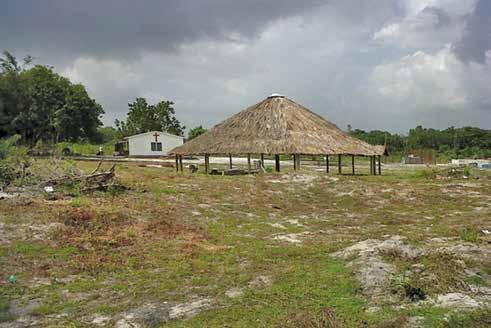
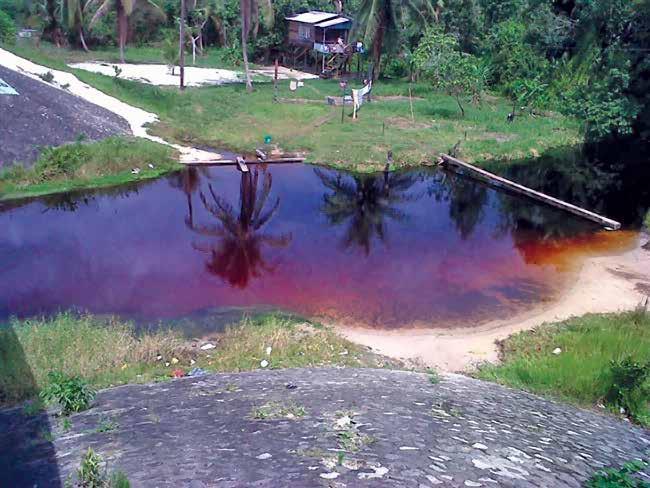
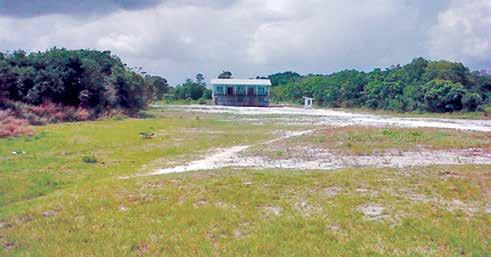




PORT-OF-SPAIN,
TRINIDAD: A Muslim cleric has branded the Islamic State (ISIS), as a “terror organisation” which poses a physical threat to the survival of the human race and must be exterminated from the surface of the globe.
Addressing the third day of the Jalsa Salana, staged by the Ahmadiyya Muslim Community at its centre, Polo Grounds, Preysal on Monday, Maulana Ibrahim Bin Yaqub, also identified the Ebola virus as another catastrophe which is creating havoc in the world.
Bin Yaqub said, “I speak about ISIS and
Ebola. As far as the ISIS is concerned, it is a terror organisation consisting of fanatically-driven Muslims. Their interpretation and understanding of Islam is quite different from what we know. This organisation is a menace to the world and the world should treat it as such. The world must do everything to exterminate it from the surface of the globe.”
And regarding the deadly Ebola virus which has claimed 4,922 lives worldwide, the majority of deaths having occurred in West African countries, Bin Yaqub said the world is frightened because the world
does not have a cure for the deadly virus.
The Muslim cleric said, “We can run but we cannot hide. It is only a fool who will be daydreaming and thinking that he is far away from the epicentre of the deadly Ebola virus. At the moment, the world has to turn to God Almighty, for without his intervention, we stand upon the precipice of total destruction.”
Canadian High Commissioner, Gerard Latulippe, who attended the event, delivered greetings and thanked the Ahmadiyya worldwide community, especially in Canada, for their condemnation of last week Wednesday’s attack on the Canadian Parliament building in which two soldiers were killed. He said the attack was a direct attack on Canada’s democratic institutions and by extension, all Canadians and democracy.
Latulippe said, “This underlines the global reach of such threats to our core values. Canada and Canadians will not be intimidated by terrorists. I would like to take this opportunity to thank the Canadian Ahmadiyya community who categorically and
unequivocally, publicly condemned the terror attacks on the Canadian Parliament and the national war memorial.”
The Canadian High Commissioner said the world could learn a lesson from Trinidad and Tobago, regarding its religious tolerance, saying Trinidadians and
Tobagonians did not only respect each others religious observances, but also actively participated in the observances. Latullipe said, “For a foreigner, it is amazing sometimes that to see Trinbagonians not only pay respect but even celebrate the religious holidays of their fellow coun-
trymen.” Also addressing the convention was Minister of Planning and Sustainable Development, Dr Bhoendradatt Tewarie, who observed that the term “jihad” had been used by muslim fundamentalists to justify their acts of terrorism. (TT Newsday)





Rashaun 'Kush' McAnuff came of age in the 1990s, an era usually considered the golden age of dancehall. However, he has always been drawn to classic roots-reggae.
McAnuff is drummer/lead singer of the Uprising Roots band, which is preparing to release its second album, Black to I Roots, in early 2015.
The sextet's debut, Skifiya, was released in March 2011. McAnuff says while he and his bandmates have matured as musicians, their focus has not changed.
"Is the same works highlighting I an' I culture, the message of truth and rights an' upliftment," he told the Jamaican media.
McAnuff, bassist Ruel Ashburn, percussionist Junior Sutherland and keyboardist/dub poet Lloyd Palmer, are Uprising Roots' core
members. Veteran guitarist Winston 'Bo Pee' Bowen and keyboardist Kimmy Gold are also members of the present line-up.
Though the band has strong ties to dancehall (they have toured and recorded with Gyptian), McAnuff believes there is not much regard for roots bands in Jamaica.
"Wi have nuthin' gainst dancehall but fi a country dat produce Bob Marley I an' I as a roots musician shoulda get more respect," he said.
Two songs have been released from Black to I Roots which was produced by the band -- Time and the title track.
While there has been an almost four-year gap between albums, Uprising Roots has maintained a steady live schedule. They have performed in Europe and North America on shows such as the Sierra Nevada World Music Festival. (Jamaica Observer)
BRIDGETOWN, BARBADOS:
The Barbados government on Monday said it would not seek assistance from the International Monetary Fund (IMF) to help turn around an ailing economy, insisting that the fiscal programme it has embarked upon is working, despite having laid off thousands of public workers.
“What we have to do is to do the things that would help us achieve the (economic) growth,” Finance and Economic Minister Chris Sinckler told a news conference.
“Based on what we are seeing we know growth will return,” he said, telling reporters that the government was working to achieve the two per cent economic growth as predicted by the Central Bank of Barbados.
Sinckler said that in relation to the discussion pushed by the private
sector for the Freundel Stuart government to contemplate a programme with the IMF, “we have said what our position is.
“We are measuring the situation and we feel at this stage that (IMF programme) is not required at this stage,” he added.
Last year, the government announced the plan to cut public service jobs in a bid to save BDS$143 million (One BDS dollar = US$0.50 cents). Government said it would also institute a “strict programme of attrition” across the central public service, filling posts only where it is absolutely unavoidable, over the next five years, ending 2018-2019.
Asked whether any of these cuts would result in further layoffs within the public service, Sinckler replied:” No, that is why I said not in any major or dramatic way. Caribbean News)
JAMAICA: As members of the western Jamaica workforce fall prey to the Chikungunya virus, immediate past president of the Montego Bay Chamber of Commerce (MBCCI), businessman Davon Crump, has called on the Montego Bay business sector to get involved in the fight against the disease.
As an example, Crump, who is CEO of Global Outsourcing Solutions, a call centre in the Montego Bay Freezone, contributed Ja$25,000 to the Western Health Authority towards the fight against the virus.
He urged the commercial sector to join the fight particularly because workers are absent from work when they fall ill, resulting in a negative impact on productivity.
"As everyone here is aware, persons all across the island are being ravaged by the Chikungunya virus, and whilst I've seen where a few companies in Kingston are getting involved in mitigation ex-
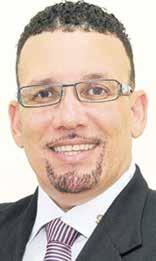
crump... contributed Ja$25,000 to the Western Health authority towards the fight against the virus.
ercises, I'm yet to see a company in Montego Bay doing so, even though their workforce is being affected, as more and more staff members are being affected," Crump argued."In my very own company and by the most recent tabulation from our Human Resources department to date, we have had about 37 employees affected by this virus. That's about 25 per cent of my workforce that had to be out of office for approximately five to seven days on average."
He stressed that with
that many people out sick "or even a tiny fraction of that for most organisations could be crippling".
"That could cause some serious effects to already ailing businesses in our country. And let me point out very clearly, I don't want to be insensitive to the situation, but let me just explain that in dollar value what that means to me and for those who are not familiar with my type of business, we invoice our clients for the amount of hours that our employees work each day. In the call centre business the more hours you are able to bill the client the more you earn. So just a quick math: 37 employees out for approximately one week, we lost approximately US$20,000 or Ja$2.2 million dollars just for that one week of those agents being out sick," the immediate past president of the MBBCI argued.
He was delivering the keynote address at the St James Parish Council Junior Mayor competition held at the Montego Bay Civic Centre last week. (Jamaica Observer)



KINGSTON, JAMAICA: Information
Minister Senator Sandrea Falconer last week responded to ques-
tions raised about what the government is doing to assist Paul Stephens, a Jamaican in jail in Qatar. Following is her statement which was re-
leased to the press:
“I have asked for and the Ministry of Foreign Affairs (MFAT) has updated me on this matter. The Embassy of

Jamaica in Kuwait has been taking steps with regard to the welfare of Mr Paul Stephens. He has been visited by the Ambassador and there have been several calls made to him from the Embassy. MFAT has been in touch with his next of kin in Jamaica and MOST IMPORTANTLY we have transmitted to the government of Qatar a formal request for a pardon.
“The ministry will continue to do its best to see to his welfare and secure his release, as we try to do for the many hundreds of Jamaicans who are incarcerated in numerous countries around the world.
“As the matter is being handled by the Ministry of Foreign Affairs and Foreign
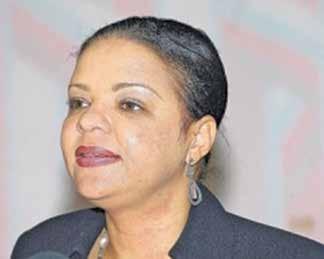
Trade, it would not only be inappropriate but would send the wrong message if another ministry interferes with the diplomatic work which is the purview of MFAT.
The ministry does not provide details of any of the cases it is involved with publicly, other than to the next of kin.
Jamaican media sources said the government’s request for pardon for Stephens, who was jailed for an alleged sexual incident, could be successful, as prisoners are expected to be released during Ramadon as is the practice during the holy month.
(Jamaica Observer)
KINGSTOWN, ST. VINCENT:
St Vincent and the Grenadines (SVG) is celebrating 35 years of political independence from Britain with the leaders of the two main political parties providing contrasting views on the future direction of the country.
Prime Minister Dr Ralph Gonsalves noted that since 2011, positive economic growth has been recorded annually while Opposition Leader Arnhim Eustace sug-


gested that there is nothing to celebrate this independence.
Gonsalves said that the aggregate real economic growth in St Vincent and the Grenadines has increased by 4.9 per cent for the three-year period 2011-2013, inclusive.
“This improvement has just about edged ahead of the aggregate decline in the economy for the three-year period 2008 to 2010, inclusive.
“Still, the economic recovery is too slow, and uneven, to absorb an acceptable level of new entrants to the labour market while maintaining the existing workers at their jobs, particularly in the private sector,” he added.
Gonsalves said employees in the public sector have not been laid off as a consequence of any economic or fiscal challenge, adding that there are special employment programmes for public works and for university and Community College graduate.
Gonsalves, said that in the last five years, the island has been struck hard by five major adverse climate events: Hurricane Tomas in October 2010, the April Floods of 2011, the Christmas Eve disaster of 2013, and two pro-
longed droughts in the first five months of 2010 and 2014.
Gonsalves, who is also Minister of Finance, said these natural disasters caused loss and damage amounting to EC$600 million or onethird of the country’s gross domestic product. The Christmas-eve disaster alone amounted to EC$330 million (One EC dollar =US$0.37 cents) or 17 per cent of GDP, he said of the trough system, which also claimed 12 lives.
“Over the last 10 months since the Christmas-eve disaster, our people and their government have responded admirably to rebuild the lives and material conditions of families, communities, and the nation. In this process, we have been accorded prompt, and on-going assistance, from friendly governments and institutions regionally, in our hemisphere, and internationally.
“We thank them from the bottom of our hearts. In our profound gratitude, we assert that we are not, as yet, out of the proverbial woods. There is much work to be done in the enterprise of relief, rehabilitation, and sustained recovery,” Gonsalves said. (Jamaica Observer)
BY STEPHEN ORNDORF
When most people think of Guyana, they think of the 1978 mass suicide of Jim Jones, and members of the Peoples Temple.
Today, the few tourists who visit this South American country of about 800,000 people, are often drawn to see Kaieteur Falls, an impressive 741-foot waterfall that is four times the height of Niagara Falls and twice that of Africa’s Victoria Falls.
For fishermen, however, there is a different but equally impressive attraction in Guyana – the Arapaima or Pirarucu, the largest scaled freshwater fish in the world. These fish can reach lengths of nine feet and weigh in excess of 400 pounds.
Arapaima typically surface to breathe air every 10 minutes or so, a trait which, when combined with the fact that they are good to eat, has resulted in severe drops in their population throughout South America.
Eighty per cent of Guyana is pristine trop-
ical rainforest, and the country is essentially unpopulated in its interior. This is one of the few places that arapaima can still be caught, and the Essequibo River is the place to find them. It is strictly catch-andrelease fishing, and bait fishing is not allowed.
Over the past 40 years, I have made more than 15 fishing excursions to different countries in the jungles of South America. Guyana and its Arapaima had been on my wish list for some time, and my friend, Dave Coffin, and I journeyed there in late September. Dave and I worked together at Napa Pipe before it closed, and we have fished together in Costa Rica and Brazil.
Our Guyana trip was organised through Adventure Travel Alliance, an outfitter based in Southern California that seeks remote fishing locations around the globe.
From Georgetown, Guyana’s capital, we flew on a charter plane with five other fishermen to Apoteri, a remote jungle town with a population of 275. Most of the inhabitants today are

Macushi Indians, and they attempt to augment an otherwise meagre existence by promoting fishing.
Maintained by machetes
The Apoteri airstrip was cleared out of the surrounding jungle, and its condition is maintained by continuous use of machetes. I asked the village chief whether they had considered sheep or goats as an alternate approach to this arduous task, and he advised me that they had brought in 200 sheep for that purpose (and for food), but the resident
jaguar and puma population had killed all but five of them.
We spent the first night in Apoteri, where we slept in a rudimentary open-air structure with beds covered by mosquito netting. The netting was a welcome sight, as the outfitter had advised us that there was a serious outbreak in Guyana of Chikungunya, a virus similar to dengue fever that results from being bitten by infected mosquitoes.
Before going to sleep that first night, we discovered that an enclosed
300- square-foot structure next to ours was the home for more than a dozen pink-toed tarantulas the size of your hand, along with a healthy population of bats. We all agreed it would have made a tremendous Halloween haunted house.
Our base camp for the trip was about 50 miles south of Apoteri. We had our choice of sleeping in tents or hammocks, and Dave and I opted for the former. The camp had been recently hacked out of the jungle about 30 feet up from the
Essequibo.
English is the official language in Guyana, and being able to communicate with our guides was a definite plus. Each camp boat had two Macushi guides to accompany two fishermen. All of the Arapaima fishing was in lagoons connected to the river by long, shallow and sinuous waterways, which were marginally passable due to low-water conditions.
Challenge
Catching an arapaima using lures proved to be challenging. We were using 85-pound braided lines and very large lures, the hooks of which had been upgraded due to the size of the fish. Arapaima are skittish, and with flat calm conditions you need to throw the lure a long way. The best technique is to wait for a fish coming up to breathe and to heave your lure into that spot. The hits were few and far between, but when one was on the line, there was little doubt that something special was at hand. Arapaima jump when hooked, and seeing fish in the 100- to 300-pound range eruptcontinued on page 47

KINGSTON, JAMAICA:
The Ministry of Transport, Works and Housing says that several options are being looked at to address Jamaica’s growing housing needs.
In an interview with the Jamaican media, Chief Technical Director for Housing in the Ministry, Doreen Prendergast, said that some of the solutions that are being consid-
ered are: “providing incentives to developers, and getting persons to consider renting [as] everyone will not be able to own a home.”
As part of the Ministry’s Joint Venture Programme, public/private partnerships with greater responsibility are also being encouraged.
“We do think that they can work, but we have to ensure that whoever we are partnering

with, have some stake in the process, and that they bring some collateral to the table,” said Mrs. Prendergast.
The recommendations came following a recent Caribbean Association of Housing Finance Institution (CASHFI) Conference that was held earlier this month.
The conference provided the ministry with an opportunity to assess the state of the housing sector, to look at the challenges and the policy measures. It also provided an opportunity to be exposed to best practices.
Data from the Planning Institute of Jamaica (PIOJ) reveals that just over 4,000 housing units are being generated annually. However, a projection done by the ministry in 2001 indicated that over 13,000 units are needed annually to address the
housing deficit. Mrs. Prendergast informed that a draft National Housing Policy has been prepared by a University of Technology/Sir Arthur Lewis Institute for Social and Economic Studies (UTech/ SALISES) team. That draft is now being revised by the ministry, with expectation that it will be tabled in Parliament early next year. (JIS)


De Festival of Lights come and gone and it supposed to bring wid it a lotta light and tek away a lotta darkness. But it look like is only some people who get some of de light and de rest of dem leff in de darkness.
David Blind not only leff in de darkness, but he beginnin to sound and look exactly how he last name spell. Although every body know that Rum Jhaat and de Nagga Man is two blind mice leadin one another, yuh can never be sure wid David Blind.
A big eye doctor seh that is partly because David Blind does see whah he wanna see and then turn blind when he don’t wanna see. Or, according to de eye doctor, it could be that only one eye blind, so he does only see outta de other eye.
That mean if David Blind right eye blind, he can only see tings from he leff side, and if he leff eye blind, he can only see tings from he right side. Either way, according to de eye doctor, he only seein one side of every ting whah he see.
Or it could also be that David Blind does keep he eye half shut when he sleepin and half open when he wake up. Either way, according to de eye doctor, David Blind gon only see half of whah he supposed to see. And yuh not sure if he seein de bigger half or de smaller half, or back front, side, top or bottom.
Yet another eye problem wid David Blind, according to de eye doctor, could be that he born wid cock-eye. In that case, every ting gon look screwed up. And looking screwed up ain’t got nutten to do wid Rum Jhaat face in this case.
Ting-a-ling-a-ling…friend tell friend…mattie tell mattie! After all that diagnosis, de eye doctor conclusion is that whah ever is de problem wid David Blind eye, he definitely don’t see tings de right way. And it ain’t got no spectacle fuh that kinda eye problem!
Since her primary school days Lindianne Marshall had always dreamed of a career in law or politics.
“I actually wanted to become the first female Prime Minister in Trinidad,” she laughed during an interview with the TT media.
Even though Prime Minister Kamla PersadBissessar claimed that title, Marshall remains undaunted.
Growing up in Village Council Street, Laventille, the 27-yearold said she had an ordinary childhood.
“Life in Laventille was not as bad as others may think it is. I would hear the things going on around but my immediate neighbours were not involved in anything so it was not hitting home that often,” she said.
While Marshall added she is lucky to have never been a victim of criminal activity in the area, she said she has been indirectly affected as she had previously lost a family member to crime.
Despite the reputa-

tion of the area and several killings in the street over the years, Marshall noted she had nothing to fear partly because both her father and brothers were police officers, and partly because of her faith in God.
Fearless and determined, Marshall continued to pursue her dream of a legal career, graduating with a Bachelor of Laws (LLB) from the University of London in 2009 and obtaining a post-graduate diploma in mediation studies
and behavioural sciences from The University of the West Indies (UWI) in 2012. Not stopping there, the ambitious Laventillian recently completed her studies at the Hugh Wooding Law School and is awaiting graduation.
Now, she is anticipating being called to the bar in November.
Her hope for the future is to work in criminal law and prosecutions and, with the first female Prime Minister title taken, her aim is to become
a judge. She credited her parents, Eleanor and Lindley Smith, her three elder brothers and her husband, Yohan Marshall, who she said have all been instrumental in her success thus far.
Marshall noted that the road to her accomplishments was not always a smooth one as she experienced financial strains to pay registration and examination fees not covered by the Government Assistance for Tuition Expenses (GATE) programme. Additional fees and books would amount to approximately TT$10,000 each year, she said. However, she was grateful for the Higher Education Loan Programme (HELP), which she said she was eventually able to access and which helped to fund her three years of study at the University of London. She said she wants more youngsters from the Laventille area to take advantage of these kinds of programmes that are available for their benefit. (TT Express)

President Anthony Carmona condemned persons who use the Internet to denigrate others, an hour after the Office of the President confirmed legal action against radio host, Rachel Price, for alleged defamation of his wife, Reema.
Carmona launched a sustained attack on cyber-bullying as he gave the graduation address at the first day of the 2014 Presentation of Graduates at the University of the West Indies (UWI), St Augustine, where he received an honorary doctorate along with former Calypso Monarch, McCartha “Calypso Rose” Lewis.
“Regrettably, in all these fora, like-minded minds tend to recycle and restate their agreed opinions. Graduates, you have a responsibility to bring more enlightened, dispassionate approach to the discourse on issues of national and regional importance,”
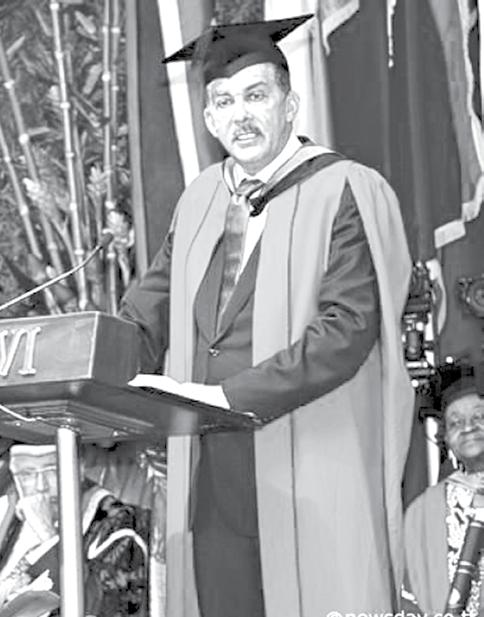
urged Carmona. He reflected on man’s inhumanity to man as he related TS Elliot’s poem, “The Wasteland” which he said speaks to our dark side.
“What are you doing about this, young graduands? Will you contin-
ue that mean streak so prevalent in our society, because, ‘you’ve got the power’, and are engrossed in that obsession that your culture calls ‘me, myself and I?”
Carmona hoped for changes to legislation that debars anyone un-
der age 25-years-old being a Senator, and hoped UWI would establish a Department of Philosophy. Topically given the diplomatic tensions between Jamaica and TT, Carmona spoke of how his days as a university student in Jamaica and Barbados had shaped his personality such that today he calls himself a “TriniJam-Baj” in nationality. Barbados had taught him civility, while in Jamaica he had seen unrelenting nationalism and the aspirations of democratic socialism for a just, fair and equitable society, all set against a backdrop of the splendor of the sands of Negril Beach, the climbing of the Blue Mountains and crayfish catching in Spanish Town River, plus the despair of the voiceless of Trench Town. Carmona said he was humbled by his award and he hailed Calypso Rose whose song “Tempo” he quoted to the delight of a smiling Mrs Carmona seated in the audience. (TT Newsday)
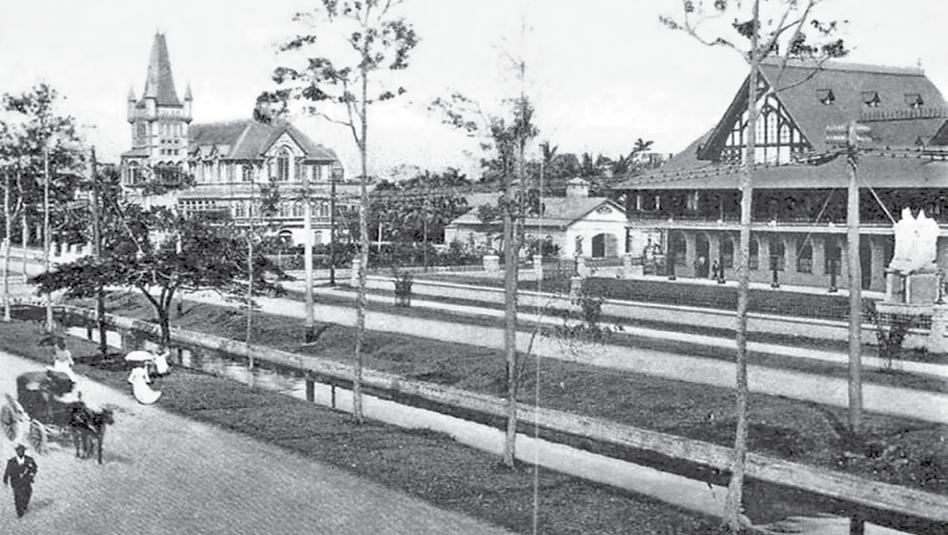

Message of condolence to Mrs. Indraine Chandarpal, her family and the Government and people of Guyana from the
Guyana has lost one of its best sons - Navin Chandarpal. His physical body may die. . But his honesty and legacy will live on and will remain deep within us.
Please accept my heartfelt condolences on the loss of a great son of Guyana who was a true leader. I have been much grieved to learn about his demise. Guyana has lost an outstanding icon and a prominent politician that modern time will never see again.
Navin Chandarpal’s resolve, courage and devotion to his country was and will continue to be an example of strong leadership and patriotism for all of us. In this hour of deep sorrow, I wish you and the entire family strength and fortitude.
On behalf of the Humanitarian Mission of New Jersey Arya Samaj along, with its Guyana and Canadian
Chapters and the entire International and local Arya Samaj Community, I extend our deepest sympathy to you and your family and the people of Guyana. Please accept, Mrs. Indraine Chandarpal, the assurance of my highest esteem.
As we honor his memories and celebrate his life, I hope each of one of us will take comfort in knowing that his commitment to his family, the people and Government of Guyana will never be forgotten. We will always carry them deep in our hearts, and his legacy of service will inspire us as we work together toward a better Guyana, a better world.
I offer our heartfelt sympathy. May his sacrifices be rewarded with eternal peace.
Pandit Suresh Sugrim President, HM of NJASM

Pulling
De whole of Waste Indies cricket deh in problems right now since dem fellas decide to pull out from India. Is not often that cricketers does pull out from any ting so easy when dem gettin pay.
If any ting, dem does wanna stay in too long, but in de wrong tings.
Chanderpaul is de only one who does stay in fuh very long and de fans does still like he when he deh in. And now at 40 years old, Chanderpaul still deh in and de fans still don’t want he to pull out.
WICB tink Chanderpaul can’t bang de ball so dem pull he out from de One Day team. But a lotta people tink dem should put he in back, because dem other fellas don’t ever last fuh long.
Even Gayle don’t last fuh long and when he in de middle some bowler does pull he out. And dem other fellas does keep goin in and comin out too fast. After all, Chanderpaul born in a fishin village, so no body understand why de WICB tink de man ain’t able.
Now it look like de ICC gon pull out from de WICB just like how de GCB pull out Sarwan from de Guyana team and can’t find no body like he to put back in.
Dem pull out a fella from Barbados and every body know whah dem Bajans like when it come to pullin out and puttin in. It musbe some body at de GCB who like whah dem Bajans like.
These days, one big man beggin another big man name Sattaur to pull out and beggin he not to ever come back in. It look like de big man had never know that it woulda get so painful wid de big Sattaur in fuh so long. Now is every day he bawlin, “Ow Sattaur”.
Ting-a-ling-a-ling…friend tell friend…mattie tell mattie! And all de time Rum Jhaat was happy when Green Jah was in. But since Green Jah pull out from Rum Jhaat, it causin big problem.

Satiricus was titillated. Satiricus wasn’t too proud to deny that he liked his share of eye candy. So he had no quarrel with the new dispensation in which the fairer sex had dumped the Victorian mores in which it was a scandal if an ankle was revealed!
While he wasn’t old enough to remember when the revolution had begun, he’d read of the “bra-burning” demonstrations back in the 1960s.
Satiricus was happy the revolution had eventually spread to Guyana. Even though sometimes he wondered about that when he attended events at the National Cultural Centre. No pants for women?? Please!! Would the revelation of the contours of the derrière throw the performers off their lines?? “Hey!” thought Satiricus, “They’re sitting on their buns, aren’t they?”
Now Satiricus had always figured if the new “letting it all hang out” ethos in clothes had spread geographically, sooner or later, it had to spread socially. Meaning the upper crust would have to “get with it” and reveal some skin.
No one batted an eye when the French and Italian PMs’ wives and girlfriends (they’re allowed simultaneously over there) bared it all on the beaches of Monaco. They never had their “Victorian” era, after all. But when Michelle Obama bared those arms and made sleeveless dresses all the rage in Washington, that caused some comments, remember?
What’s next? Was the Queen over in old Blighty going to throw off those hats at Ascot?? Let’s not go as to whether she’ll be more revealing in other areas. But her young’uns like Princess Di did give folks more than a peek, didn’t they??
So Satiricus was more than a wee bit surprised when a storm erupted over the Trinidadian President’s wife’s bared mid-riff. Seems she took a pic standing next to the wife of the UN head honcho and wore an outfit that bared her belly. And some (female) radio host took her to task. Now Satiricus had a position on this midriff exposure.
He absolutely would forbid those Indian women with their saris who routinely bared their naked midriffs – if they had more than two rolls of fat hanging out. Three rolls was too gross even for the stolid Satiricus. But Jeez, the TT President’s wife had a very sculpted midriff, thank you. Not as sculpted as Michelle Obama’s arms…but good enough.
“And,” thought Satiricus, “this is Trinidad, for goodness sake!!” Did the radio host want their country’s top lady to be wrapped in a burqa?? Hey, the lady was only selling TT’s top product –Carnival!

ing out of the water close to your comparatively flimsy boat is a spectacular experience.
My biggest was estimated at 160 pounds, but after a 20-minute fight, it managed to jump off the line about 10 feet from the boat as we were getting out for a picture. Dave managed to get a 115-pounder for a photo. It turned out to be the smallest one caught by anyone in our camp. Another angler, Kevin Mattson of San Diego, caught a couple that weighed about 300 pounds.
The Essequibo River in this area has a healthy population of black caiman, the South American version of alligators. They grow to 13 feet long and were more aggressive than those I’ve encountered in the past.
On many occasions, they were attracted right up to the boat by fish that we were catching. In fact, I lost the biggest peacock bass I had on the line when a caiman appeared from nowhere to try to take the fish. The peacock luckily got off the line while I was hoisting it up on the bank and it managed to escape.
Our guide, Katuf, whom we nicknamed Cactus, subsequently tied a rope around the tail of a piranha, heaved it in the water to lure the caiman back over for a brief but exciting tug-ofwar.
Three caiman attacks I asked the guides whether caimans posed a threat to the residents of Apoteri. They said there had been three recent attacks, one of which resulted in a nine-year-old boy being dragged under the surface in broad daylight. A guide’s son was also attacked while in shallow water, but he was able to dispatch it with his bow and arrow, and the boy sustained only modest injuries. Another young Amerindian lost a leg in an attack.
Based on these stories and our close encounters (I almost stepped on an unseen five-footer while fishing from a rocky island in the river), we were on high alert while taking our nightly baths off of a sandbar in the river.
When one of the Macushi went back to Apoteri for supplies, he learnt that two village residents had drowned the prior day when their boat was sucked into a whirlpool. That incident apparently occurred far-

ther up the river, as there weren’t any dangerous rapids where we were fishing, and there wasn’t an adequate supply of gasoline for us to advance much farther up.
The outfitter informed us that before more organised fishing excursions became available, people would occasionally fly into Apoteri and ask one of the locals to take them upriver to explore, hunt and fish. One such boat with the guide and two customers never came back, and no trace was found of them or the boat.
Unpleasant experience
The second day, Paul Silva, a fisherman from New Jersey, had an unpleasant experience. The Indian guides on the Essequibo unhooked all of the fish, a chore that we particularly appreci-
ated when dealing with a piranha. Paul, temporarily separated from his guides while fishing on a small rocky island, tried to get a relatively small nine-inch piranha off the line without his needlenosed pliers.
The result was two angry-looking, quartersized bites in the palm of his right hand. That was the end of his fishing for three days. The piranhas there were ubiquitous and large. Dave and I caught more than 100 on one afternoon, and the average weight was about three-and-a-half pounds. The outfitter said they grow to more than 10 pounds in the Essequibo.
While the Guyana trip was not one of the most successful for me from a fishing perspective, it was incredibly informative. All of the
Amerindians were gracious and accommodating, and they truly seemed to enjoy what they were doing.
Dave and I are introducing two friends to jungle fishing in late January on a trip to the Mataveni River in Colombia. My older brother and I fished for peacock bass and payara on the Mataveni with great success more than 30 years ago. For quite some time, fishing in Colombia has been essentially off limits due to dangers associated with FARC (Revolutionary Armed Forces of Colombia) rebels. The outfitter for this trip has assured us that the fishing is still fantastic, and that there are no threats from FARC. As of today, there is still one slot open for the trip. (Napa Valley Register.com)

Hugh Jackman has suffered from skin cancer for the third time in less than a year, however the actor is "all good" now, it has been revealed.
The 'X-Men' star had earlier posted pictures both times of him wearing a plaster on his nose, the Mirror reported.
The actor first got the sacre in November 2013, then again in May this year, and he had just recovered for a third time.
Jackman also encouraged people to take precautions and wear suncream, before getting it again in May this year.
Basal cell carcinoma is a form of skin cancer which results in a sore on the skin which comes from long-term exposure to the sun.(TOI)


Taylor Swift's new album titled '1989' has finally hit the stores and is reportedly getting good reviews from the music pundits.
Billboard's Jem Aswad declared the album as Swift's best work saying that it is a sophisticated "pop tour de force" that deserves to be as popular commercially as with Robyn-worshipping bloggers, CNN reported.
Rolling Stone's Rob Sheffield stated in his review that the country singer had already penned enough great songs for two or three careers.
Sheffield added that the 24-yearold's new record was deeply weird, feverishly emotional, wildly enthusiastic and sounded exactly like the nothing she's ever tried before. (TOI)
Russell Brand has revealed that he is "absolutely not" planning to run for Mayor of London.
The 39-year-old comedian, who is interested in "real change," said that if people want a daft comedian running London, they should just leave the things as they are, as Londoners have already got a comedian who's more known for his hair than his policies, Sky News reported.
Discussing "funny and affable" Mayor of London Boris Johnson, who has got a nice way with him, in the interview, Brand added that this is a time where a lot of Londoners are facing real fear about their homes.
Brand continued that the elected mayor, who was elected to look af-

ter people of London, takes five times more meetings with bankers than he does with civil servants, or representatives of the fire brigade, or any ordinary Londoner. (TOI)

Kristen Stewart is allegedly struggling to keep her old pals in her life, as her childhood pals are "are dropping like flies".
According to sources, the 'Twilight' star doesn't even resemble the person that we knew from before she was with Rob and used to be a very low-key, cool girl, the Mirror reported.
Insiders claimed that her inflated ego has convinced her that even her childhood friends only want to hang out with her because of 'who she is.'
The 24-year-old actress' friends have ditched her due to her change in behaviour and "inflated ego" since dating her co-star, English hunk, Robert Pattinson in 2008.(TOI)


Scurrent girlfriend - singer FKA Twigs. Pattinson, Miller and Sturridge all went to see Twigs in a concert. Pattinson loved her music, a source told eonline.com.
After spending time together over the past few months, it was confirmed in September that Pattinson and Twigs are officially dating. The couple was first spotted together in New York while hanging out with Sturridge. They recently enjoyed a date at Soho House in West Hollywood.
"They were with a big group of friends, sitting at a table in the garden dining area, about 10 people," a source said at the time.
And just last week, the pair went on a romantic getaway to France. Pattinson and Twigs were photographed together during a shopping trip.(TOI)
It's India calling for Christopher Nolan! The Hollywood director who awaits release of his forthcoming movie ‘Interstellar’, will reportedly be in Mumbai Dec 28 to attend Indian Institute of Technology-Bombay's annual festival Mood Indigo.
The 44-year-old's visit to Mumbai was announced via a post on the official Facebook page of Mood Indigo, the college cultural festival, which is slated to be held Dec 26-29.
"'It's not a mountain, it's a wave'. The first event of Mood Indigo, IITBombay's Illuminati 2014 is outChristopher Nolan," read a post along with a poster on the page.
IANS confirmed the news with the organisers. However, it is not yet clear
as to what Nolan plans to do at the fest.
Nolan, highly acclaimed worldwide for ‘The Dark Knight’ trilogy, is also credited with popular movies including 'Memento', ‘The Prestige’ and ‘Inception’. The news of his visit seems to have created waves on social media.
The institute is also running a special contest.
"Presenting the #NolanInIndia contest. Answer questions about Nolan's best movies and get a chance to attend the event at #MI2k14," read a tweet from @iitb_moodi, the official Twitter handle of the event.
Mood Indigo started in 1971, and it will celebrate its 44th edition this year. (TOI)
the first time wasn't a great experience.
"When I stepped on the set, I freaked out," she said about her first day shooting ‘Interstellar’, reports people.com.
"And when I put on the space suit, I freaked out!" she added.
Hathaway and Matthew McConaughey play astronauts trying to find a new planet to house the citizens of the Earth, which has been ravaged by famine. (TOI)
ADiaz, who sparked rumours of her engagement to Madden when she sported a new diamond ring at various events , has turned to his stylist sisterin-law for advice, reports contactmusic. com.
"Cam (Diaz) has never been a big fan of weddings, so she has no idea where to start," OK! magazine quoted a source as saying.

Playback singer Nikhita Gandhi, who has crooned her first title track for A.R. Rahman in upcoming Tamil magnum opus "I", says the double Oscar winning composer never lets his singers get nervous.
Nikhita's song ‘Ladio’ is already a chartbuster.
"I've recorded with Rahman sir in the past, but this was my first title track. When I walked into his studio to record 'Ladio', I experienced the 'Oh my god!' moment, but it lasted only for seconds because he doesn't give his singers the time to get nervous," Nikhita told IANS.
She has also crooned to Rahman's tunes in films such as ‘Jab Tak Hain Jaan’ and ‘Raanjhanaa’.
"I'm sure one of the challenges for Rahman sir must be dealing with people who get nervous when they come to record with him. But you feel so comfortable around him and he never makes you feel that he's a celebrity," she said.
Nikhita, who's half Bengali and half Punjabi, recorded the song in four hours.

"The biggest challenge was the language, but thanks to the lyricist Madhan Karky, I didn't have to struggle to learn the song. The whole recording process only took us about four hours. We took about one hour to get familiarised with the lyrics and then we recorded the song," she added.
She wrote the song in Hindi and recorded it.
A former student of Rahman's K.M. College of Music and Technology, Nikhita's first association with Rahman was during the Indo-German exchange.
"I was part of the
choir which performed with German orchestra during the exchange program few years back. Rahman sir then heard me individually and auditioned me for a project called 'Qyuki' with Shekhar Kapur," she said.
Nikhita, who recently cut her debut album in Bengali titled ‘Kotha’, is also part of a Sufi band called ‘Noor', and is a trained Odissi dancer as well.
She was one of the vocalists of the Tamil song ‘Modern Kalyanam’ from Tamil adult comedy ‘Kalyana Samayal Saadham’. (TOI)

‘Welcome To Karachi’ is a satire directed by Ashish R Mohan, based on two Indian characters, played by Arshad Warsi and Jackky Bhagnani, who unknowingly land themselves in Karachi, without even their passports.
The story is about them trying to find their way back into India and while we don't know whether they will finally manage to come back or not, we bring you the first look from the film from a situation where these two gentlemen find themselves in the middle of the Taliban, who give them a special look much like themselves, to help them escape. (TOI)
Actress Shraddha Kapoor, known for her roles in ‘Aashiqui 2’ and ‘Haider’, will be seen as a glamorous item girl in Karan Johar's production venture ‘Ungli’.
Directed by Rensil D'Silva, ‘Ungli’ stars Emraan Hashmi and Kangana Ranaut in the lead.
"I don't know whether to call it an item song or a promotional song, but yes, it's a very different thing that I am doing," Shraddha, who will team up with Emraan in the song, told IANS.
"Karan offered me the song and said: 'You have never been seen like

We were the first to tell you that Sanjay Gupta cast Aishwarya Rai Bachchan and Irrfan in his action suspense thriller ‘Jazbaa’.
We learnt that he has found his third key character, who is a college professor, played by the powerhouse performer Shabana Azmi. The story is about
a lawyer (played by Aishwarya) who will race against time to achieve the impossible, of a suspended cop (played by Irrfan) who will go beyond the call of duty and it has a mother (played by Shabana Azmi) who will fight both of them for her own justice.
The film will be shot entirely in Mumbai and
shooting starts early December. And it's not just the actors who are racing against time in this thriller; even Sanjay will do everything he can to ensure that he finishes the film in time for the Cannes Film Festival in 2015, having Aishwarya and Irrfan, two of India's most popular stars there. (TOI)
Singer Tulsi Kumar got engaged to beau Hitesh Ralhan, a Jaipurbased garment and home furnishings exporter, last week. The couple has been in a relationship for over a year, after she first met him at a common friend's wedding.
Revealing that the proposal happened at a Juhu hotel, Tulsi says, "He popped the question with a ring on October 21. It was sudden and I was definitely not expecting it." The formal ceremony followed on October 24 at her Worli residence in the presence of both the families.
The wedding is slated for February 22 in New Delhi, while the celebrations will begin as early as February 8 — with one function scheduled in Jaipur, three in the Capital and a reception in Mumbai . (TOI)

this before. It's a very glamorous song.' So all that excited me and I said yes to it. The moment I heard the song, I was all the more excited as it's such a catchy song," she further added.
Titled ‘Dance Basanti’, the song choreographed by Bosco-Caesar will go on air Tuesday.
When asked does the song have any link to Hema Malini's Basanti from ‘Sholay’, she said: "I guess, it's definitely a take from original Basanti. It's a modern day twist. I can't compare myself with Hemaji's Basanti. She is the original legendary Basanti." (TOI)

The wrestler-turned-actor is busy shooting for the show and told us,"I am playing the character of Armaan Kumar, who is an actor and always plays a superhero in his films. He goes by the character of Aryaman in all his films. My superhero character is a rage among the kids."
When asked about the reason for taking up the role, he said, "JD Majethia, the producer of the show, is a friend. The lines that I have are quite funny and my entry sequence on the show is also hilarious - I make an entry hanging from a crane! It's a mix of action and comedy." At present the role will be a cameo, but Sangram says that it might get extended if it receives positive feedback from viewers. (TOI)
By Rajiv Bisnauth
One of the main sponsors of the fourth edition of the Guyana Softball Cup, Guyana Telephone and Telegraph Company (GTT), reinforced its commitment to partnering with the Guyana Floodlights Softball Cricket Association (GFCA) for an impressive 2014 tournament.
The fourth edition bowls off on Friday at various venues across the capital city, Georgetown.
The company presented a cheque worth Gy$500,000 to the GFSCA in its canteen and GT&T Marketing Officer, Nicola Duggan, disclosed that the entity is proud to be part of the development of softball cricket in Guyana.
“We at GT&T for the past two years had an outstanding relationship with the GFSCA and we are pleased to continue that relationship,” Duggan said.
She also encouraged all Guyanese to come out and support the threeday event.
President of the GFSCA, Ramchand Ragbeer, expressed gratitude to GT&T for coming onboard for the second year, noting that sponsorship is critical to the success of a tournament of the magnitude of the Guyana Softball Cup.
Format
As was the case in previous editions of the tournament, there will be two categories – one for teams contesting the Men’s Open and the other for the Masters players, aged 45 and over.
The champion team in the Men’s Open is guaranteed a whopping Gy$800,000 first prize and a huge trophy, while the losing finalist will have to settle for Gy$200,000 and a trophy. In the Masters’ division, the winning team will pocket Gy$600,000 with the runner-up assured of Gy$150,000.
The Man-of-theMatch in both finals will receive a trophy.
Two 14-karat gold bracelets, accentuated with diamond studs, have been put up as

the prizes for the Most Valuable Players (MVPs) of the Open and Masters categories, compliments of Steve’s Jewellery.
On the day of the final, there will be lots of hampers and giveaways for spectators. Additionally, two spectators can win return tickets from Survival Travel Agency to the beautiful island of Aruba.
All the spectators need to do is retain their half tickets and listen for their numbers to be called over the Public Address system during the final.
Two dozen teams will compete in this year’s event, with 12 from Guyana, seven from New York, three from Florida and two from Canada.

During the three-day championship, there will be a total of 36 preliminary games, followed by four semi-finals and two finals.
Trophy Stall and New York Better Hope are the
defending champions of the Open and Masters categories respectively, while the previous champions were NYSCL New York (Open) and Savage Masters in 2012 and Cotton Field Wild Oats (Open) and Regal Seniors (Masters) in 2011. According to information emanating from the GFSCA, this year’s tournament has an estimated budget of around Gy$10 million.

TRINIDAD: TT’s senior footballers lost their second of three opportunities to book their first ever spot at the Fifa Women’s World Cup, on Monday, after conceding two goals in extra time in a 4-2 loss to Mexico in the Concacaf Women’s Championship third place playoff, in Pennsylvania.
The disappointing loss, after another gruelling 120 minutes of football, followed only two days after Costa Rica defeated the Soca Princesses on penalty kicks after a 1-1 draw at full time at the semifinal stage.
The loss, again, was not the last chance for the team as it now remains with a third and final chance of qualifying for the World Cup via an intercontinental twomatch playoff against Ecuador.
The South Americans will host the first leg on November 8, three weeks before TT hosts the second on December 2.
Monday’s loss was
perhaps more disappointing as the TT players conceded a sloppy goal immediately after taking the lead late in the second half.
And, even though TT started with much more purpose than it did against Costa Rica on Friday, efforts on goal were hard to come by. In fact, Mexico registered 19 shots, while TT made only three attempts, two of which resulted in goals.
The Las Tri enjoyed a 1-0 lead at half-time after Sandra Mayor scored in the 24th minute, which clearly spurred TT onto a much more positive second half performance.
But it took another 10 minutes to get the ball rolling for TT in a desperate attempt to overturn the deficit. But coach Randy Waldrum’s team did just that in the 57th minute when Kennya Cordner scored her third goal of the tournament to level the scores.
Cordner met a beautiful cross from Ahkeela Mollon on the head and threw her frame forward
to make it 1-1, a move very similar to Cordner’s two previous goals.
Buoyed and confident, TT continued to enjoy more forward movement despite the hindrances of fatigue and capitalised once again to take a shock lead from Shade. Cordner with a strong run on the left side of the penalty box crossed in for Brianna Ryce who chested down in the path of an onrushing Mariah Shade to finish.
This time, Mexico scored another two goals to ensure its second straight spot at the Women’s World Cup. Waldrum and his charges are expected to head back into camp almost immediately upon their return in order to regroup ahead of the playoffs, starting in under two weeks’ time.
Line-ups:
TT: Kimika Forbes, Arin King, Brianna Ryce, Lauren Hutchinson (Patrice Superville 93rd), Khadidra Debessette (Tasha St Louis 105th+2), Maylee Attin Johnson, Karyn Forbes (Anique Walker 68th), Liana Hinds, Ahkeela Mollon, Mariah Shade, Kennya Cordner. Mexico: Pamela Tojonar, Kenti Robles, Alina Garciamendez, Christina Murillo, Bianca Sierra, Teresa Noyola (Lydia Rangel 48th), Sandra Mayor, Monica Ocampo (Tanya Samazich 105th+2), Karla Nieto, Veronica Perez (Dinora Garza 115th), Veronica Corral. score: Mexico 4 (Sandra Mayor 24th, Monica Ocampo 78th, Veronica Corral 104th, 106th) v TT 2 (Kennya Cordner 57th, Mariah Shade 78th) (TT Guardian)
By avenash Ramzan
Guyana’s male volleyball team left an indelible mark on last weekend’s second leg of the Inter-Guiana Games, defeating both hosts Suriname and French Guiana to reclaim the title they last won in 2007 when Guyana hosted the Games.
The Guyanese were the toast of a packed Ismay Van Wilgen Sporthal in Paramaribo on the two nights of action, breezing past the French 25-19, 25-13, 25-15 in the three-bestin-five format on the opening night, before outplaying the home town boys 25-18, 17-25, 25-20, 25-17 on the final night.
The fact that Guyana dropped just one set was indicative of the level of dominance they portrayed, something the experienced Coach Levi Nedd is now highly enthused about, expressing great optimism about the
future of male volleyball.
During an exclusive interview with this publication at the conclusion of the Games, Nedd reflected on Guyana’s performance and the way forward.
“We have had a lot of well-wishers. I think persons were a bit negative before we started because we were losing all the time, but with good preparation and dedication by the players we managed to pull it off,” Nedd commented.
The volleyball fanatic had led the team through a vigorous encampment period at the National Gymnasium prior to travelling to Suriname, and his early assessment of the players had given him the confidence that they could release the shackles and reclaim the top podium spot.
He continued, “I had a feeling they would do well because everyone was equally skilled. Previously, we had one or two talents that stood
out, but this time we had one of the better teams in a long while.”
The 53-year-old Nedd, who has over 38 years experience as a national player and coach, said unlike previous years, Guyana was able to outperform their Suriname and French Guiana counterparts in all facets of the game.
“We were better than them,” he said emphatically. “Our tactics won it for us, while psychologically we were also above them.”
This year’s squad included three players who returned from the 2013 competition, namely two setters and a midfield attacker. According to Nedd, who is attached to the GuySuCo Training Centre- Port Mourant (GTCPM) where most of the players come from, majority of the current squad will be eligible for participation at the next two IGGs, something he will be looking to capitalise on ahead of the 2015
edition of the Games.
Nedd pointed out that since 90 percent of the players reside in Berbice, an indoor facility in the Ancient County would be very much welcomed since it would allow for more training and playing time, as the weather would not be a hindrance.
The articulate Nedd said while the players did the job on the court and won gold for Guyana, it would not have been possible without the support
of several parties. He singled out the National Sports Commission and the Guyana Volleyball Federation for praise, noting that both bodies would have played their part in ensuring adequate preparation of the champion unit.
The IGG champion squad reads: Devendra Latchman, Samuel Anthony Fraser, Madan Kumar Budhram, Yoganand Dhoray, Steven Anthony Veerapen, Muaaz Inshan,
Rolwyn Heywood, Ryon Mangrau, Rick Daniel Ritchie, Klondyke Rodney, Joshua Jagmohan, Ravi Rampartab and Xavier Lambert. Nedd and Rashaad Razak were the officials.
Ten of the players were from GTCPM, while there was one each from New Amsterdam Technical Institute, Lower Corentyne Secondary and Professional Learning Institute.
- over 50 golfers confirmed participation so far
By Rajiv Bisnauth
All systems are in place for this weekend’s Guyana Open golf tournament, at the country’s lone golf course at Lusignan, East Coast Demerara.
This was the assurance given by president of the Lusignan Golf Club (LGC), David Mohamad on Wednesday.
Over fifty local and overseas golfers have confirmed their participation so far, according to Mohamad.
He, however, indicated that the number is expected to increase before

Friday’s deadline for registration.
“Presently almost all the Guyanese golfers, along with golfers from Canada, Florida –United States of America and Barbados have confirmed their participation,” Mohamad said.
The LGC top brass

also indicated that golfers from Trinidad and Tobago and Suriname are also expected for the tournament.
French Guiana was part of last year’s tournament, but according to Mohamad the country has not yet indicated their participation.
ST JOHN'S, ANTIGUA: Antigua and Barbuda are celebrating their highest-ever FIFA World ranking after they jumped this week to 70th in the world.
The Benna Boys, as they have come to be known, have improved 10 places over their September ranking and are now only behind powerhouses Trinidad and Tobago in the Caribbean Football Union (CFU) rankings at number two.
Their movement has come as a result of their impressive form in the recent second round of the Caribbean Cup qualifiers as they qualified for the Finals in Jamaica next month.
Playing in Group Seven earlier this month in Port of Spain, they beat St Lucia 2-1, drew nil-all with the Dominican Republic before losing 1-0 to hosts TT. Antigua now lie seventh in the CONCACAF rankings.
Meanwhile, French Caribbean side Haiti, minnows Barbados and Trinidad and Tobago were some of the biggest movers in the latest rankings.
Haiti, who slipped to their worstever FIFA ranking of 119 last month, jumped 26 spots to 93rd in the world. Like Antigua, this movement was driven largely by their good run in the Caribbean Cup qualifiers where they won Group 8 in Port-au-Prince by going unbeaten.
Barbados, meanwhile, rose 15 places to 146th in the world despite failing to qualify for the Finals of the Caribbean Cup when they finished bottom of Group 8.
They are 12th in CFU and lie 20th in CONCACAF.
TT were the most dominant movers, leaping 47 places to 49th in the world to achieve their best ranking in 13 years.
(Jamaica Observer)
With respect to ground preparation, Mohamad said the LGC has been working assiduously to get the course in top shape.
The course according to Mohamed is in excellent condition, “All the roughs, the fairways the Greens are in the best position. So in terms of the ground preparation, we have that under control,” he asserted.
Apart from the playing area and club house, the environs have also received a facelift.
The LGC head said the organisers are anticipating a large turnout of competitors on the ninehole course, with heated rivalry in the First
Flight (0-9 handicap), Second Flight (10-18), Third Flight (19-28) and single Ladies Flight.
When the competition gets underway, Arvinda Kishore dethroned his more illustrious brother Avinash Persaud in the male category.
However, there was no such changing of the guard in the ladies segment as defending champion Christine Sukhram successfully defended her title to engrave her name on the trophy for the seventh time.
Playing off a five handicap, Kishore ended the tournament with a total gross 151 and a 141 net to hold off Patrick Persaud, who finished
with a aggregate gross of 153 and a net 137 playing off an eight handicap, while 2012 winner Avinash Persaud closed with a total 153 gross and a 147 net from a three handicap to occupy the third spot.
In the Ladies Division, Sukhram topped the field in both the total gross and net aggregates after registering 151 and 136 respectively to relegate long time rival Joann Deo to the runner-up position, while Shaunella Webster finished third. Deo ended with a gross of 194 and a net of 150, while Webster closed on a 210 gross and a 144 net.


The rebranded Netball Jamaica has embarked on a campaign dubbed 'Gold Rush Down Under', seeking to raise Ja$63 million to offset the cost of sending the senior Sunshine Girls to represent Jamaica at the 2015 World Cup in Sydney, Australia, scheduled for August 7-16.
Jamaica is among 15 countries that will be participating at the World Cup, including numberone ranked Australia, New Zealand, England and South Africa. Jamaica's best finish at the Netball World Cup was third in 1991, 2003 and 2007. Australia have won 10 times and New Zealand four.
Delivering the keynote address at the launch of the Gold Rush Down Under campaign and the new website at the Jamaica Olympic Association (JOA) offices on Tuesday, minister with responsibility for Sport Natalie NeitaHeadley said the gov-
ernment of Jamaica is 100 per cent behind the Sunshine Girls in their quest to the 2015 Netball World Cup.
"Today (Tuesday) marks the beginning of a new phase of the Jamaican netball team as they seek to raise funds to represent our country at the World Cup. Based on the team's record over the years, I believe they can reach the top of the world," the minister said.
Marva Bernard, president of Netball Jamaica, said that her organisation is unable to raise the financial support to adequately fund training programmes and to send the senior team to compete at the World Cup and so she is calling on Jamaicans for their support.
"Gold Rush Down Under is the formal campaign slogan Netball Jamaica will be using to describe the preparation for the Netball World Cup and it will cost Ja$63 million to send the team to Australia, which includes preparation costs along
with hosting test series," she said.
Bernard noted that netball has never depended solely on external support, but has initiated its own fund-raising programmes over the years.
In addition, Netball Jamaica has also launched its new webstie, which is located at www.mynetballjamaica. com.
"We have been very successful at disseminating information via our social media platforms and now we are launching this new webstie which is strategic to kick off our campaign. The site is a resource for students, sponsors, fans, members and stakeholders. It will feature pictures along with stories and players' profiles as well as our annual reports will also be available on it," she said.
The Sunshine Girls will depart the island on Sunday to represent Jamaica at the 2014 Fast5 Netball Series in Auckland, New Zealand, November 8-9. (Jamaica Observer)
Lennox Braithwaite defied inclement weather and poor lighting conditions to win last Sunday’s Recorded Shoot at the Timehri Rifle and Pistol ranges.
The competitors found the going tough against adverse weather, but the reigning Caribbean individual champion dropped just two points to win the match with an overall score of 148 points with 12 V-bulls to win the X Class Grand Aggregate from a grand aggregate of 150 points with 30 Vs. Braithwaite shot a possible 50 points with 6 V-bulls at 600 yards and recorded scores of 49.3 at 300 yards and 49.3 at 900 yards on his way to victory. National Vice Captain Dylan Fields also recorded 148 points but he had 11 Vs with scores of 49.2 at 300 yards, 50.4 at 600 and 49.5 at 900 yards.
The current national champion Ransford Goodluck, who was the winner of the previous competition, finished in the third spot with 146 points and 10 Vs with scores of 47.2 at 300 yards, 49.4 at 600 yards and 30.4 at 900 yards.
Leo Romalho placed fourth with 144.11 (49.6, 49.5 and 40.0). Peter

Persaud topped the competition in ‘O’ Class with 127 points and 9 Vs. He shot 45.3 at 300 yards, 50.5 at 600 yards and 32.1 at 900 yards. In second position was Sherwin Felicien, who ended with 122.10 (45.6, 46.3 and 31.1), while Chaflin Velloza shot 107.2 with scores of 42.1, 39.1 and 26.0.
Inspector Dane Blair and Colin Loncke were also in action as they fine tune preparations for the National Senior and Junior Championships, which will fire off on Saturday at Timehri starting at 10:00 hours.
Via sources close to the Guyana Football Federation (GFF) Guyana Times International Sport was able to uncover the names of the five members of the Normalisation Committee that will now run the affairs of the GFF.
The five members are as follows; Clinton Urling, Karen Pilgrim, Robin Chanderpaul, Stuart May and Tariq Williams according to sources.

As stated by the world governing body of football, FIFA, these persons named have no previous links to football in Guyana.
The Normalisation Committee was put in place by FIFA after two failed congresses by the GFF earlier in the year.
At a high level meeting held last Tuesday at The Pegasus Hotel,
FIFA’s Head of Member Associations Primo Corvaro dished FIFA’s intervention.
“The lack of quorum paralysed the GFF. We at FIFA and CONCACAF tried to fill the vacancies and find solutions and twice failed due to the legitimacy surrounding the delegates” Corvaro stated.
The Committee will be tasked with establishing constitutional reforms of all the constitutions of the nine regional associations as well as to adopt a new GFF constitution and amend the current one, to organise electoral process and run the business of the GFF.
By Rajiv Bisnauth
West Indies star batsman Shivnarine Chanderpaul’s second half-century of the match, propelled Leon Johnson’s X1 to a massive lead and left Vishual Singh’s X1 with a formidable task of saving the first fourday practice match at the Georgetown Cricket Club (GCC) ground. At the close of the penultimate day on Wednesday, Vishual Singh’s X1 were 29 without loss, replying to a winning target of 334.
Tagnarine Chanderpaul and Kandasammy Surujnarine will resume today (Thursday) on 14 and 13 respectively, with their team still 305 runs
away from the winning target.
Once again, it was Chanderpaul who was at the heart of his team progress on the penultimate day, stroking an elegant 64 to follow up his half-century in the first innings.
Opener Rajendra Chandrika, who was the fulcrum of the Leon Johnson’s X1 batting effort during the final session on the second day, compiling an unbeaten 53, along with discarded West Indies middleorder batsman Narsingh Deonarine (8 not out), resumed on the penultimate day with an overall lead of 119 runs.
However, the spinners’ reaped considerable reward in the morning session with off-spinner Steven
Jacobs (3-56) quickly removing the right-hander, Chandrika for 55.
Deonarine was joined by the talented Chanderpaul Hemraj, and the pair added 40 for the fourth wicket,
before leg-spinner Amir Khan claimed the wicket of Deonarine to end a watchful innings of 35 from the left-hander.
The 21-year-old Hemraj (25) then surrendered his wicket
to off-spinner Royston Crandon (1-31) off the final ball before the break.
Christopher Barnwell was the not out batsman on one, when lunch was taken at 137-5, an overall lead of 183.
Veteran West Indies batsman, Shivnarine Chanderpaul joined Barnwell, but the latter was unfortunately run out for 19.
The left-hander Chanderpaul and Jonathan Foo came together mid-way through the pre-tea session and posed 56 runs by the time the session came to an end.
Chanderpaul, West Indies’ most capped player on 55, while Foo on 19.
It took the left-hander 70 balls to reach his half-century, inclusive of
five fours and three sixes.
After the interval Foo (20) was removed by Khan (2-62) and Chanderpaul was trapped leg before wicket to left-arm spinner Anthony Adams (1-35). Anthony Bramble made a positive unbeaten 38 but Chanderpaul’s dismissal triggered the declaration at 287-8.
Play today, the final day continues from 09:30h. Admission to the venue is free.
The game is the first of two practice games that will be use to select the Guyana Jaguars team for the inaugural West Indies Cricket Board (WICB) Professional Cricket League Regional Four-Day Franchise Tournament which starts on November 14.
St Vincent’s Prime Minister Dr Ralph Gonsalves is advocating the assembling of a three-member CARICOM panel to help resolve the ongoing contract dispute between West Indies players, their union WIPA and the West Indies Cricket Board.
In a letter to WICB president Dave Cameron last week, Gonsalves said the current crisis was too serious a matter to be solved by the Board alone, and suggested the wider of engagement of CARICOM.
Gonsalves proposed the panel be comprised of current CARICOM chairman, Antigua’s Prime Minister Gaston Browne; Grenada’s Prime Minister Dr Keith Mitchell and former Jamaica prime minister PJ Patterson.
“I consider that a mature engagement with regional governments through CARICOM may assist in finding satisfactory ways to the impasse,” Gonsalves wrote in the letter, which he read on the popu-
lar Mason and Guests cricket show on 92.9 FM Radio here Tuesday.
He added: “I do not think that this huge complicated issue can be handled in an ad hoc manner or by the WICB alone. This is an extraordinary enterprise which takes us beyond the boundary.”
The experienced leader, who played a key role in resolving the impasse between the WICB and Chris Gayle two years ago, said while his proposal was not a new one “the urgency of now demands its embrace.”
According to Gonsalves’s proposal, the CARICOM panel would focus not only on solving the current impasse, but on several other key issues in West Indies cricket. These include the sustainable funding of West Indies cricket, the reform of the management of the WICB and the tensions between the WICB and the Indian Cricket Board.
“The CARICOM group is well placed to assist not only with the
cricketing authority in India but possibly with the Indian government,” Gonsalves wrote.
The long-serving Vincentian leader said the impasse called for “exceptional leadership, a well-articulated strategic path and … wise feasible tactical approaches.”
“The ultimate goal is wrapped up in a process for the survival, consolidation and renaissance of West Indies cricket,” Gonsalves wrote in the letter.
The crisis erupt-

Wavell Hinds, and for a return to the terms of the old CBA.
When their requests were ignored by both WIPA and the WICB, the players took the decision to quit the tour following the fourth match in Dharamsala. They had been scheduled to play another one-dayer in Kolkata, a one-off Twenty20 in Cuttack and a three-match Test series carded to start October 30th.
ed two weeks ago when the West Indies one-day team abruptly walked off the tour of India in protest over the terms and conditions of the newly signed Collective Bargaining Agreement that WIPA struck with the WICB.
One-day captain Dwayne Bravo, the spokesman for the players, contended the new CBA would result in a drastic reduction in their earnings. The players also called for the resignation of WIPA president and chief executive,
Gonsalves, also an ardent cricket enthusiast, said the situation was of major concern to him.
“The fact that I took time out to write a letter is an indication of my own concern about the seriousness of this matter. West Indies cricket as we all know goes beyond the boundary, and in this particular case for the tour to be directorially terminated, is a serious matter,” he told the radio show.
“India is the powerhouse of cricket but other than that, other than the lucrative contributions they make to the coffers of West Indies
cricket, the fact of the matter is you don’t break a tour half-way through. I am not assigning blame to one side or the other –I’ve read all the public exchanges – but what I would like to see is for this matter to be settled amicably.
“That’s why I made a proposal for a particular structure to facilitate the West Indies Cricket Board and the other stakeholders, in arriving at some resolution, and to address some other matters attendant to the cancellation of the tour, the abrupt breaking of the tour mid-way.” He continued: “We have to take this matter very seriously. It is not a life and death matter in the sense there’s the threat of Ebola hanging about … but clearly the meaning of cricket to our people. It is an embarrassment; it’s a humiliation frankly for our people in the region in the eyes of the world that we can’t handle our affairs.”
The WICB announced last week it would set up a task force to investigate the matter. (CMC)