




Ramesh d kalicarran



AGUYANESE
man’s packages of powdered custard brought into John F. Kennedy International Airport last month turned out to be powdered cocaine, U.S. Customs and Border Protection said on Wednesday. According to reports, NY authorities arrested a man who tried to sneak nearly 18 pounds of cocaine in packages of custard powered through airport security in New York. U.S. Customs and Border Protection
officials at John F. Kennedy International Airport stopped 35-yearold Godfrey Cassius of Georgetown, Guyana, as he passed through baggage check.
The incident occurred on April 22nd.
Officers asked Cassius, who had just flown in from Cheddi Jagan International Airport in Guyana, if he was carrying any food into the country (United States), to which Cassius admitted bringing eight packages of ‘Champion’ brand custard powder al-
legedly for an aunt.
Agents then probed the packages in which they found a white powder that eventually tested positive for cocaine.
In all, customs confiscated 17.9 pounds of cocaine — which officials said has an approximate street value of US$300,000.
Some section of the Guyanese media reported that “Cassius did not know he was carrying the substances into the country (United States)”, and that he was paid US$5,000 to take the suitcases into the country.
“Cocaine is a dangerous narcotic, and CBP does its part in keeping these drugs off the streets,” customs’ Director of New York Field Operations Robert Perez said in a statement. “Our officers are determined to protect the American people from these illicit substances.” (www.metro. us/newyork)
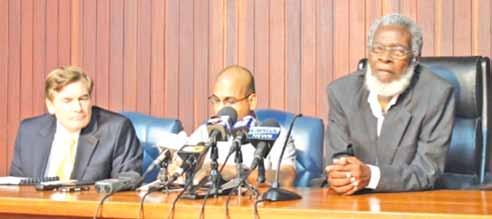
The United States (US) and Guyana on Thursday announced that they have agreed to suspend the implementation of the Americanfunded Leadership and Democracy (LEAD) project to pave the way for the holding of talks on its design.
“The governments of Guyana and the United States of America have agreed that the implementation of the activities of the USAID
(United States Agency for International Development) LEAD project would be put on hold temporarily during the reengagement on the design of that project the two sides have agreed would commence immediately,” the two sides said in a joint statement.
After the joint news conference, Head of the Presidential Secretariat
AToshao was on Wednesday remanded to prison when he appeared before Chief Magistrate Priya Sewnarine-Beharry at the
Georgetown Magistrates’ Courts on a charge of rape. The man was charged with raping and impregnating a 10-year-old relative. The incident was

No time frame has been set for the completion of the reengagement process but Luncheon and Hardt hoped that the UDS$1.2 million project could resume to the benefit of both countries.
The American envoy reiterated that the LEAD project reflects a 2009 agreement between USAID and Guyana on governing justly and democratically.
Dr. Roger Luncheon and US Ambassador to Guyana, Brent Hardt began the talks immediately.
said to have occurred in Region One.
The Toshao was arrested last week after the child fell ill and was taken to seek medical attention, after which the
startling discovery was made. The welfare officials and Police were called in and tests prove that the girl was four months pregnant.


To contact: Guyana Times International
New York Office
106-15 Sutphin Blvd, Jamaica NY 11435
Email: guyanatimesnyint@gmail.com
Tel no: 718-658-6804
Preferred method of contact via EMAIL Guyana Office Ruimveldt, Georgetown, Guyana. Tel no: (592) 227-0704, 227-0709. Fax (592) 225-8696, 227-0685
Email: guyanatimesint@gmail.com
The customary outrage that comes after any incidence of Police excesses was not evident last week when a Cadet Officer shot Alex Griffith in the mouth during the process of escorting him to the Brickdam Police Station on allegations that he was witness to a robbery of the said officer’s relative.
The silence by citizens and the scores of human rights organisations in Guyana today is perhaps an indication of how sick our society has become of these types of atrocities from our lawmen. Still to resolve the episode involving Colwyn Harding and the countless others, the Guyana Police Force (Service?) could have done well without what transpired at East La Penitence last week Sunday.
It came at a time when new Commissioner of Police (ag) Seelall Persaud is forging ahead with his much vaunted Impact Programme in Albouystown, aimed at retaking the community from the clutches of criminals, the shooting of young Griffith in a neighbouring community could only undermine that initiative and further massage the distrust among residents of the Force.
From all reports Griffith, only 15 years old, was arrested at his home by policemen who accused him of being present when someone was robbed. The teenager denied being on the scene and also provided an alibi. His mother also testified that he was not a witness to the robbery, but the Police did not believe their story and as such arrested Griffith with the intention of taking him to the Police station.
What happened minutes later is the officer placing a gun in Griffith’s mouth and shooting him.
This type of behaviour is symptomatic of a Force that is badly in need of reform and, though authorities often boast of measures that are being taken to improve policing, the Force remains in shambles. The lack of respect for citizens, particularly those of a certain social class and the often high-handed display of force are too frequent the complaints of a wary citizenry of the premier law enforcement agency of the country.
Griffith’s experience also shows how callous some of our lawmen have become. That one could be moved to shoot a young boy in his mouth for reportedly failing to provide information on an alleged robbery is to render human lives cheap. It is in this area for many citizens, our policemen and women need training – respecting the rule of law and upholding human rights.
A Police forum at Eve Leary was recently told that human rights and democratic practices are essential components to modern policing and can no longer be considered as “addons” to the policing process. The forum heard that all aspects of policing – investigations, arrest procedures, use of force, recruitment and relations with communities? have to be reviewed from the new perspective of democracy and human rights, and that the wide-ranging implication of a shift to democratic policing extends to recruitment and the need to screen out elements which are hostile or unsuited to this new approach to policing.
Any reform of the Police Force should factor this, making it clear that it is far more prudent, in the long run, if we insist on prudent Police behaviour and rigorous enforcement of standards. Alex Griffith’s case, however, is not unlike the many about which people complain all too often, mostly without consequence.
But increasingly, victims are pursuing civil cases, which was the approach of Twyon Thomas, the young boy who was tortured while in custody at the Leonora Police Station a few years back. The court had awarded Gy$6.5 million in damages to a teenager who had sued the State after his genitals were doused with methylated spirit and set alight by police during a murder investigation in 2009.
For, what should be pellucid, assuming, somehow, it was not clear before, is that an out-of-control Police Force is not only bad for the society, but potentially expensive business for the state. And that, ultimately, means added burden for taxpayers.

Less than two months remain to the agreed deadline for the conclusion of talks on a free-trade agreement between Caricom and Canada, and the tensions are showing.
In a signal of its frustration, the department of Foreign Affairs Trade and Development Canada, or DFATD, said Caribbean negotiators are not as forthcoming as Canada needs them to be to strike a new trade deal that will replace the current arrangement known as CaribCan.
"Canada has communicated our desire to conclude negotiations in the immediate term, and urging Caricom to bring an appropriate level of ambition to the table to do so," said DFATD spokeswoman Caitlin Workman in response to queries solicited by Jamaican media.
Workman was not forthcoming on the specifics of the Caribbean's lack of ambition when asked to clarify, citing the "confidential nature" of the ongoing negotiations.
"I can tell you that Canada is seeking an ambitious outcome from Caricom that ensures the interests of both sides are addressed," she said.
Meantime, Jamaican officials said they would offer a unified response after consultations.
Margaret Lim, the head of communications for Jamaica's Ministry of Foreign Affairs and Foreign Trade, said Tuesday that Permanent Secretary Ambassador Paul Robotham had began those consultations.
Previously, sources within the foreign ministry said the
parties were still deadlocked on market access for goods, services and investment, development, and environment and labour standards.
It is understood that some of the hold-up is due to concerns by some Caricom countries that the shift to a reciprocal arrangement could lead to the opening up of a trade gap in Canada's favour and less revenue collected at the port.
As far back as 2001, Caricom and Canada started exploring the possibility of a reciprocal free-trade agreement.
Jamaica's Foreign Ministry said the agreement would supersede the non-reciprocal arrangement in CaribCan, which has existed since 1986. A sixth round of negotiations was held in Kingston on March 3-7 and concluded in Ottawa, Canada, between March 31 and April 4.
A World Trade Organisation waiver that facilitates dutyfree access to Canada's market expired in December. However, Canada is still according dutyfree treatment to goods from Caricom under CaribCan, but both sides have set June 30 as the date to finalise a replacement trade pact.
Gaps
CaribCan's duty-free access was secured through exemption under the Most Favoured Nation non-discrimination principle of the WTO. It differs from a free-trade agreement which would receive a permanent waiver under the General Agreements on Tariffs and Trade.
"While there was some progress, gaps remain between
both sides on key issues related to market access for goods, services and investment, and labour and environment. Both sides agreed to reflect on the state of play and thus a date was not set for a seventh round of negotiations," said Jamaican foreign affairs sources.
The issue is said to be on the agenda for the 38th session of Caricom’s Council for Trade and Economic Development, under way in Guyana from May 6 to 10.
Traditional friendships Jamaica enjoys a trade surplus with Canada.
Workman said last week that for Jamaica itself, a Canada- Caricom trade deal would expand its existing duty-free access into Canada for top exports such as chemicals, metals, alcoholic beverages, fruits and vegetables, processed agricultural products and fish and seafood.
She said Canada wants to "work together" with Caricom to grow and expand their trade and investment relationship.
Members of the Organisation of Eastern Caribbean States may be among the most vociferous objectors to reciprocal free trade with Canada.
The territories say they have little to export, while the new agreement would open up their economies to Canadian products entering duty-free or with preferential access, according to news reports.
In such a scenario, those economies will lose revenue from Customs duties.
(Excerpted from Jamaica Gleaner)
Bank of Guyana (BoG) Governor Lawrence Williams died on Wednesday morning, the Head of the Presidential Secretariat, Dr Roger Luncheon announced later in the day.
Williams, 59, lost his battle with cancer at a local hospital.
Finance Minister, Dr Ashni Singh, in a condolence message, said it was with great sadness that he learnt of the passing of Williams. “I offer my personal, sincere condolences to his immediate family and many friends,” Dr Singh said.
He said he and Williams shared a long professional and personal association dating back to well before Williams was appointed Governor and himself a Minister. “His elevation through the Bank and my own appointment as Minister provided us with additional opportunities to collaborate.”
Dr Singh recalled that Williams was a man defined by quiet competence, attention to detail, thoroughness, an ability to remain calm under pressure, quiet wit, sharp intelligence, and
impeccable demeanour. “He was a gentleman and an astute professional. Over the years, we developed a strong personal friendship and I came to value his wise counsel and level-headed advice,” the Minister stated.
In his message of condolence, Opposition Leader, Brigadier (retired) David Granger said the nation has been robbed of the extensive knowledge, experience, and expertise which were embodied in the form of Williams. “Our deepest condolences to his close family, relatives, and friends.”
Williams leaves to mourn his wife, Valerie; his three children Runda, Lauren, and Lawrence Jr also known as Gavin and grandson Andrew Brown. A book of condolences will be opened on Friday at the Bank of Guyana.
Appointed Governor of the Central Bank in 2005, Williams had over a quarter of a century of diverse cumulative central banking experience. In 1979, just after successfully completing a Bachelor of Social Science Degree (Management), he joined

the staff of the Bank as an Assistant Principal in the Exchange Control Department where he held major responsibility for implementing and maintaining the system for monitoring exports and collection of export receipts.
Foreign exchange management
Subsequently, in 1982, he was appointed Principal, at which level he undertook the accounting and investment function of the Export Development
Fund. In January 1984, Williams was appointed Supervisor of Export Development Fund. His duties included dayto-day management of the World Bank-funded project, which provided the foreign currency financing for non-traditional exporters to meet the cost of imported raw materials, capital and intermediate goods. During the six years that Williams served as Supervisor, he acquired considerable experience in foreign exchange
management and investments.
Consequently in January 1991 he rose to the position of Senior Supervisor of the Exchange Control Department. However, his stay there was shortlived, since by the following January, he was named Assistant Head of the Debt Management and Exchange Control Department where he held major responsibility for the domestic debt operations and the administration of exchange controls.
Soon after, in January 1995, Williams was appointed Director of the Operations Department. There he held day-today responsibility for the management of the Banking, Currency, and Money Market Divisions. His vast experience over the years especially in managing the Export Development Fund, coupled with his exposure to the Debt Management and Exchange Control
Department prepared him for even greater challenges.
Fostering monetary stability
In August 1995, Williams was appointed Banking Manager by the Minister of Finance. At this level, he was responsible for overseeing the operational departments of the Bank (Accounts and Budgeting Department, International Department, and Banking, Currency and Money Market Divisions). In addition to other duties, he chaired a number of Standing Committees and was also a Trustee of the Staff Pension Scheme.
In November 2004, Williams was appointed acting Governor of the Bank by President Bharrat Jagdeo. Less than a year later, on Wednesday, June 8, 2005, Williams was sworn in as Governor by the President.
Correction
Last week we mistakenly published a photograph referring to Mr Clifford Reis as Chairman of Demerara Bank; infact it is Dr Yesu Persaud who holds that position. Clifford Reis is rather the Chairman of Citizens Bank Guyana Ltd.

Amid much pomp and ceremony, 25-year-old Divya Sieudarsan was crowned Miss Guyana India Worldwide 2014 at the New Thriving Banquet Hall by the outgoing queen Katherina Roshana.
Sieudarsan, who is no stranger to the pageant world, has now taken up the mantle to represent Guyana at the Miss India Worldwide Pageant in Dubai come June. In delivering her maiden speech as Miss Guyana India Worldwide, Sieudarsan pledged to campaign against child abuse. This scourge that continues to affect the lives of children all across the world must be eradicated, she stressed. It was with sadness, Sieudarsan said, she watched the brutal beating of a 12-year-old girl who posted inappropriate pictures on Facebook. The Trinidadian teen was beaten by her mother who subsequently uploaded the video on Facebook to register her disgust. The new queen said child abuse must not be condoned despite the justification given.
Sieudarsan said “abuse is abuse”. According to her, this

outgoing Miss Guyana India Worldwide Katherina roshana crowning the 2014 Miss Guyana India Worldwide Divya
in the presence of the franchise
global problem is yet to be adequately addressed on the international arena. “It is my belief that all that beauty and all that light is most useful when they work to place focus on and erase the darkness and ugliness in the world….and there are only a few things darker and uglier than the abuse of children.”
Persistence
The beauty queen said she was overwhelmed
with joy to see President Donald Ramotar on the front page of local newspapers commissioning the Guyana Hindu Dharmic Sabha’s hospice for abused children.
Sieudarsan, who hails from the Number 69 Village, first appeared on the pageant scene as a delegate of the 2010 Miss Guyana Universe Pageant. She subsequently vied for the Miss Guyana India Worldwide

India Worldwide earlier in the year. Of all the intellectuals and beauties that applied, Sieudarsan stood out. The Miss Guyana India Worldwide Franchise Holder Chandini Rambalak, supported by a panel, selected Sieudarsan.
But before Sieudarsan was crowned, Apsara, which is also owned by Ramnarine, put on a fascinating show, highlighting the rich Indian culture in Guyana. The Apsara Dance Troupe swept the audience off their feet with its enticing dance performance. The entertainment level went to a new high when upcoming artiste Andy Rattan took the microphone. His melodious voice left the elegantly dressed participants craving more.
crown in 2011. Her failure did not deter her spirit. Determined to be crowned queen, Sieudarsan applied to be the 2014 Miss Guyana
But it became an emotional scene when Miss India Guyana 2013 Katherina Roshana took her last walk. Decked in an exquisite rose pink
sari, Roshana gracefully walked about the hall. In her final words as the reigning queen, Roshana said it was a privilege to serve the vulnerable population of Guyana, especially differently-able children. Tuesday night marked the end of an incredible chapter of her life, she said. As an Indian Ambassador of Guyana, she was given the opportunity to build on her potential, while being a positive influence in the lives of her peers and even the older folks. The event was also attended by Miss Guyana World 2013 Ruquayyah Boyer and the recently crowned Miss Earth Guyana Stacy Ramcharan. The first Miss Guyana India Worldwide was selected in 2010 and Alana Seebarran won the global competition in 2012, bringing home Guyana’s first international pageant crown.
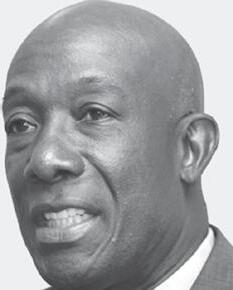
With just two weeks to go before the People’s National Movement (PNM’s) internal election, one political analyst is predicting victory for incumbent leader Dr Keith Rowley.
“There is no question about it, Rowley will definitely win,” says Dr Bishnu Ragoonath, head of the Department of Behavioural Sciences at the St Augustine Campus of the University of the West Indies.
Speaking with TT media in an interview last Friday, Ragoonath predicted a win for the Opposition Leader on two fronts.
He said Rowley, who became leader of the PNM in May 2010, has the support of the PNM’s rank and file after steering the party to victory in three of the four elections that took place within the past year.
In January 21, 2013, the PNM obliterated the Ashworth Jack-led Tobago Organisation of the People, walking away with all 12 seats in the Tobago House of Assembly (THA) election after holding eight seats at the time of the poll.
Nine months later, on October 21, 2013, the PNM again claimed victory in the Local Government election,
gaining eight of the 14 corporations.
And in November 2013, the PNM’s Terrance Deyalsingh was elevated from a senator to Member of Parliament for St Joseph after winning the constituency’s bi-election. The seat had been left vacant following former Justice Minister Herbert Volney’s defection to the Independent Liberal party in the aftermath of the Section 34 fiasco. Having bounced back from its humiliating 29-12 defeat in the May 24, 2010, General Election, Ragoonath said there was a perception among many PNM members and supporters that the status quo should not be changed so soon before another general election, constitutionally due in 2015.
“Many members are saying that it is either too soon or too late to change leaders in preparation
for a General Election. That is the thinking. They feel that the PNM should not change leaders at this time,” he said.
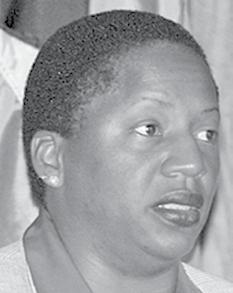
Ragoonath said incumbent lady vicechairman and former senator Pennelope Beckles-Robinson, who is contesting the leadership, is likely to face stiff competition as a result of this view.
“Penny has been running an excellent campaign, but the membership may be reluctant to change leaders at this time,” he said.
“The Penny factor would have been better if the internal election had taken place last year. The feeling out there is will she be strong enough to take on Rowley between now and the election. Her strategy is excellent, but it is the timing that would be the problem.” (Excerpted from TT Newsday)
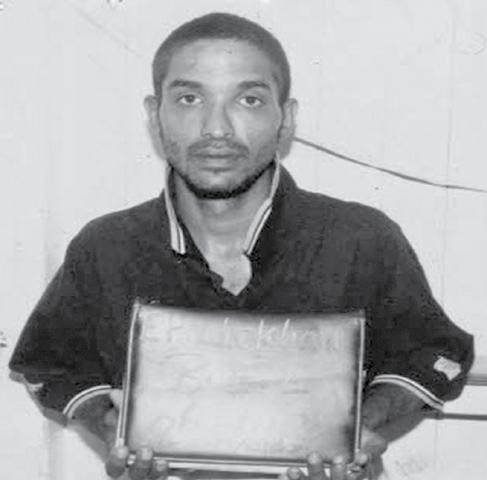
Lomattie Ramdat, the wife of slain fisherman Chetram Bharrat, told investigators that it was her lover, Errol Khan, who carried out the fatal attack on her husband last Friday at the couple’s Haslington, East Coast Demerara home.
The woman who initially stated that she and her now dead husband were attacked by two bandits on the day in question confessed on Tuesday evening that Khan entered the home and attacked her husband with a cutlass in the wee hours of Friday.
Ramdat reportedly told investigators that after she intervened, the man had threatened to kill her and her family thus she retreated, but was still chopped about her body. She added that after the attack, Khan left but not before again threatening
to “wipe out” her family if she told the Police that he killed her husband.
Ramdat, a source told Guyana Times International, is in protective custody at the Georgetown Public Hospital and Police are presently analysing the fingerprints gathered at the scene to confirm it was indeed Khan who committed the heinous crime.
Police had already issued a wanted bulletin for Khan for questioning into the murder of Bharrat based on initial information gathered during the investigation.
Ramdat reportedly told the Police that Khan had threatened to poison her husband and children before, so out of fear, her children moved in with her sister at Clonbrook, East Coast Demerara.
She also confirmed
The selection process for the 11th Caricom Triennial Award for Women 2014 got underway in Bridgetown, Barbados on Monday. The Selection Committee comprised representatives from Antigua and Barbuda, Dominica, Haiti, Jamaica and Montserrat. This year there were eight nominees from five member states.
The aim of the award is to honour a Caribbean woman who has made an outstanding contribution to the development of the community. The recipient of the Caricom Triennial Award will receive a 15 carat gold broach/pendant with the Caricom logo presented in a jewel box, as well as a scroll with a citation in a leather cylindrical holder.
The 11th Caricom Triennial Award for Women will be presented this year at the opening ceremony of the 35th meeting of the Conference of Heads of Government to be held in Antigua and Barbuda in July 2014.
Since its inception, 10 distinguished individuals have been recipients of this award.
that she and Khan lived together for about four months after her husband went to Suriname. Her husband, she added, knew of the af-
fair, but forgave her and reportedly asked her for reconciliation. In his attempt to salvage the marriage, Bharrat instructed Ramdat to stay
at her sister’s home until his return.
Spurned
At that point, she reportedly broke all ties with Khan, but that did not go down well. Ever since, he has been attempting to contact her. The desperate man even visited the woman’s sister at Clonbrook and requested a meeting with her.
Ramdat’s brotherin-law, according to information received, intervened and warned Khan not to return to his home. A few weeks later, Bharrat returned from Suriname and they moved back to their home at Haslington.
However, Khan persisted in his attempts to contact the woman and requested to meet her,
but was repeatedly rejected. On the morning of Friday, he reportedly entered the couple’s home via a window and attacked Bharrat who was sleeping on the bed.
Ramdat told investigators that she pleaded with the man to leave her husband alone, but he continued to throw chops indiscriminately, leaving her husband in an unconscious state.
Bharrat subsequently bled to death. A postmortem performed on Bharrat proved that he died as a result of multiple chop wounds.
Ramdat remains a patient of the Georgetown Public Hospital nursing chop wounds to her head, arm, face and leg. The Police are yet to make an arrest.
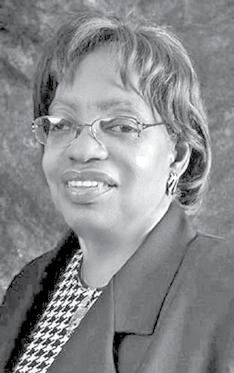
The individuals honoured for their significant contributions to politics and academics in their respective countries and to the region are Nesta Patrick of Trinidad and Tobago, 1984; Dame Nita Barrow of Barbados, 1987 (deceased); Dr Peggy Antrobus of St Vincent and the Grenadines, 1990; Magda Pollard of Guyana, 1993; Dr Lucille Mathurin Mair of Jamaica, 1996 (deceased); Professor Joycelin Massiah of Guyana/Barbados, 1999; Professor Rhoda Reddock of Trinidad and Tobago, 2002; Justice Desiree Bernard of Guyana, 2005; Professor Barbara Evelyn Bailey of Jamaica, 2008; and Professor V Eudine Barriteau of Barbados, 2011.
The Selection Committee has arrived at a recommendation of the two top candidates who will be presented to the Council on Human and Social Development (COHSOD) being held in Georgetown, Guyana on May 14-15 for a final decision.



Caribbean Airlines (CAL) recorded a one-third drop in passengers since last year amid the growth in privately-owned Fly Jamaica, according to official data on Jamaica's airports.
government owning 16 percent of CAL.
the education Ministry’s Visually-impaired resource unit
Manickchand made it clear, however, that the People’s Progressive Party/Civic (PPP/C) Government has invested heavily in the development of the Education Sector. Turning back the pages of history, she said when the PPP/C took office in 1992; the Education Sector was in a terrible state.
“We found a broken country, we found a di-
he Education Ministry is now in a better position to address the needs of the differently-able population, subject Minister Priya Manickchand said as she commissioned the Visually-Impaired Resource Unit at Albert Street, Georgetown. Minister Manickchand said major attention has been given to “Special Education Needs”, but noted that the commissioning of the unit will be followed by greater investments.
lapidated education system… our buildings were in a state of disrepair,” she contended. She further pointed out that there was a lack of resources and trained teachers.
Understanding the importance of education in transforming a country, Minister Manickchand said the PPP/C in 1992 took a decision to undo the harms done. Boasting of
continued on page 10

The decline reflects a reduction in its CAL flights, but also in reduced activity at the Norman Manley International Airport (NMIA), stated the Planning Institute of Jamaica in its annual Economic and Social Survey Jamaica (ESSJ) 2013.
"The reduction in flight frequency by CAL on a number of its major routes, starting in April 2013," said the ESSJ, which added other overseas airlines Jet Blue and Cayman Airways reduced flights whilst Virgin Atlantic ceased flights into Kingston.
"For the July-September 2013 quarter, CAL, which accounts for 40 percent of traffic at the NMIA, posted a 36 percent decline in passengers."
In 2010, the government of Jamaica sold the cash-strapped national carrier Air Jamaica to CAL in a deal of giveand-take that effectively resulted in the Jamaica
The airline initially operated as two brands but shortly thereafter staff and route rationalisation occurred along with the removal of the Air Jamaica livery from the planes.
In 2013, however, Fly Jamaica owned jointly by Guyana and Jamaican interests led by captain Paul Ronald Reece and captain Lloyd Tai began operating a single aircraft between Jamaica, Guyana and New York, USA.
Despite the new entrant passenger traffic at NMIA declined seven percent year on year to 1.3 million passengers.
"The 28.7 percent growth recorded by the intransit category, which reflected the contribution, in the main, of Fly Jamaica with its John F Kennedy (JFK)Kingston-Guyana and Guyana-Kingston-JFK routes, was insufficient to stem the overall reduction," stated the just released ESSJ.
Last month, the Turks and Caicos-based airline InterCaribbean Airways began offering expanded regional and cross-country service.
It's the latest airline
to attempt to offer connectivity to Kingston and Montego Bay following the cessation of Jamaica Air Shuttle and Skylan Air.
Other carriers offering the service via scheduled or charter service include Caribbean Airlines, TimAir, Airways Limited and Caribbean Aviation Training Centre.
Total passenger movements at the island's international airports grew marginaly more year on year to 4.86 million or about 2,000 more than a year earlier, data indicates.
"The overall higher passenger movement was supported by the improvement in traffic volumes at the Sangster International Airport (SIA) in contrast to the fall-off recorded at the NMIA and the Ian Flemming International Airport (IFIA)," stated the ESSJ. Passenger traffic at the SIA expanded by 3.1 percent to 3.48 million aided by the addition of new flights by Europeanbased airlines including Condor Airline from Germany, Transaero from Russia; Thomson Airlines from the UK and Scandinavian Airlines from Sweden. (Jamaica Observer)

Why I referred to the
as cavalier and irresponsible
Dear Editor,
In my personal opinion, if collateral damage is to continue being the order of the day come budget time, Guyana’s fragile developmental trajectory cannot continue to suffer these multiple annual interruptions to its progress without irreparable damage to its competitiveness. This is patently not why our electorate enfranchised the Opposition with a majority.
In addition to Mr Ramjattan’s letter, I note a letter in response to mine from Mr Sasenarine Singh, who if it is the same person, was a year or two ahead of me at Queen’s College. Whilst I wish to thank Sase (if this is the same person I went to school with, I feel he would be comfortable with the use of his first name) for his kind words,
especially those directed at the institute, I also at the same time would like to encourage him to not rush to label those who comment as peddling propaganda.
I do understand that Sase has chosen to be politically involved, but I would like to ask him to respect that I on the other hand have carefully chosen, over the eight years I have been Director of IAST, to remain scrupulously apolitical.
And I think it is important for those who would be our political leaders of tomorrow, such as Sase, to make room for the technocracy of this country to have a say and not to rush to place them in political categories.
To lose what little of that voice we have left in this country is to en-
tertain a barren, desolate society which is too Orwellian for comfort. I welcome opinions that are opposed to mine –as a person whose entire life has been spent in the pursuit of scientific explanation of our natural world, I value different perspectives. But I do not take kindly to being accused of peddling propaganda.
And lastly, I have been exhorted by Mr Alfred Bhulai to apologise to the Opposition. I have never met Mr Bhulai, although I know of him by reputation from students of his who later did their MSc and PhD degrees under my supervision.
Unanimously, they all had glowing praise for his mentorship, and therefore by extension, I also have held Mr Bhulai in high esteem.
Journalists must recommit to Guyana’s developmental agenda
Dear Editor,
The People’s Progressive Party/Civic (PPP/C) wishes to recognise the important contributions made by the press corps to the development of a more democratic and developed Guyana as the world observes Press Freedom Day 2014.
World Press Freedom Day 2014 is being observed in Guyana at a time when the press has never been freer to criticise, report and give coverage to all matters under the sun and all issues of national importance.

out their tide of hardship imposed by the spiteful political Opposition in its reckless desire to cut off critical information to the public.
Despite this esteem, however, I am afraid I shall not be apologising to the Opposition. One, because I did not seek to insult them, but simply to ask them to fulfil a role which they were elected to serve, and two, because as Mr Ramjattan’s letter clearly established, no offence was taken by my letter.
Mr Bhulai seems to also labour under the assumption that the IAST enjoys a privileged position because its Director expects that its staff should be paid. Until and unless the Government chooses to shutdown the institute or fire its staff, then I shall tirelessly work to ensure that they are paid, dear Editor.
There is no privilege in this – simply compensation for their hard work, protection for which is enshrined in
our laws and codices and hard won by our country’s long years of valued trade unionism. As for capital funding which the agency has received over the years, I am happy to provide to Mr Bhulai the very thorough justifications for funding which is provided by staff at the institute whose compensation he is willing to regard as privileged.
Not only the justifications, but the many cuts and checks and balances at multiple hierarchies that are usually a part of the process, and the sustained level of advocacy and representation that I have personally invested to convince Government of the wisdom of research and development expenditure.
All my professional life I have competed for research funding and until now, have never been
accused of enjoying privileges because of my funding success, despite, for example, being responsible for more than 25 per cent of the entire research funding received by Trent University; an institution with multiple hundreds of faculty members such as myself. It is therefore somewhat odious to be so accused, but I shall not demand an apology from Mr Bhulai. Instead, I encourage him, as I have multiple others at the University of Guyana, to continue to fulfil the pivotal roles they have provided to so many students over the years, and to partner with the IAST to provide much needed research innovation to our growing country.
Yours sincerely, Suresh Narine Director, IAST
Use the CoI to determine the real cause of Rodney’s death
Dear Editor, Even after acknowledging all the advantages of holding the Commission of Inquiry (CoI) into Walter Rodney’s death, I believe that we need to look at the possible implications of this course of action and the dire consequences it may have on the general peace and harmony in our country when all would have been said and done.
stop and think whether it would be worth it to dig up the past, when the time that has elapsed may work against our getting at the real truth.
Witnesses will have to depend on their memory to relate what they observed, and this can make the whole process very unreliable in getting at what really transpired.
because of some party wanting to score political points, then surely they have not assessed, or are unmindful of, the collateral damage that this may cause to the peaceful co-existence of our people, which in their position, they must surely be expected to have at heart.
The PPP/C acknowledges the right to report freely without undue Government interference and coercion and will continue to support any and all media entities that put the future of Guyana and its people first by safeguarding their interests.
The party holds the view that considering the atrocities faced by the press during the early 1970s and 1980s, there is much to celebrate in Guyana today as the whole media fraternity has come a long way.
As we celebrate World Press Freedom Day, the PPP/C calls on all responsible and impartial press entities to reflect on the murder of Catholic Standards Journalist Father Bernard Darke, the circumstances which led to the censorship of the media by the PNC regime (now led by David Granger), the banning of news print and several other atrocities which undermined press freedom in Guyana during that era.
The party condemns in the strongest terms the barefaced attempts by the Opposition to financially strangulate the State Media and its right to report and air freely the developmental agenda of the Government and the people of Guyana.
The PPP/C stands four square behind the National Communications Network (NCN) and the Government Information Agency (GINA) through-
The party demands an end to politically-inspired acts aimed at depriving the State Media of critical funds and the allocations disapproved in the 2014 Budget.
The party notes the political venom and hate spewed by the Opposition media, namely, Kaieteur News and Stabroek News in their attempts to destabilise and undermine the ruling PPP/C administration. The party wishes to remind the Opposition media that their acts by their very nature undermine the principal tenets of press freedom and freedom of expression in Guyana.
Additionally, the PPP/C calls on all Guyanese journalists to recommit themselves to a higher level of journalistic practice which will enable them to focus on the promotion of the developmental agenda of the country.
The party believes that journalists need to address the development agenda with the same zeal and intensity as they pursue their own selfish and narrow political interests.
The PPP/C is committed to an environment where the news and information is fuelled by facts and not the whims and fancies of the rumour mills.
Sincerely, PPP/C, Freedom House
Whatever comes out of this attempt to find the guilty party in this gruesome affair is bound to cast a shadow on relationships at various levels of our national co-existence, and we have to
Again, it is very unlikely that the person or persons who may be deemed responsible for the suggested assassination are still around to face the consequences of their actions.
If this CoI has been organised at this time
I therefore call on the members of the commission to use this opportunity to just ascertain the real cause of death of this great son of our soil and refrain from naming any group or individuals suspected of being responsible.
Yours sincerely, Roy Paul
Ronald Webster served Guyana well
Dear Editor,
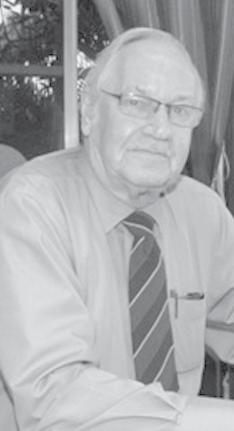
The Alliance For Change expresses deep regret at the sudden passing of former Chairman of the Private Sector Commission, Mr Ronald Webster.
Ron as he was fondly known had an extensive career of service to Guyana for more than five decades that ranged from his early days with the then Bookers which preceded GuySuCo, at DDL, at Seals and Packaging Limited, SAPIL and most recently at Caribbean Containers Limited.
The AFC recognises his distinguished career dedicated to contribut-
ronald Webster
ing to the development of Guyana through the many non-governmental and service organ-
isations, which he was a part of. Most recently this was highlighted in his role as Chairman of the Private Sector Commission and his commitment to assisting on behalf of the PSC, in negotiating positions of compromise between Government and the Opposition parties on contentious issues.
The Alliance For Change expresses condolences to his family, members of his staff at Caribbean Containers Ltd and to the members of the Private Sector Commission.
Respectfully submitted AFC
Attorney General and Legal Affairs
Minister Anil Nandlall believes the combined Opposition – A Partnership for National Unity (APNU) and the Alliance For Change (AFC) – seems prepared to face the effects of the pending blacklisting by the Financial
Action Task Force (FATF) for Guyana’s delay in passing the AntiMoney Laundering and Countering the Financing of Terrorism Bill.
Speaking at an Indian Arrival Day event at Highbury, the Attorney General told the crowd gathered
for the event: “We face an Opposition in the National Assembly who is prepared to cause us to be blacklisted, thereby financially and economically estranging us from 190 countries who may sever trade relations with us and affecting our ability to access financing from developmental

partners.”
He pointed out that the Government has been unrelenting in its efforts to have the AntiMoney Laundering and Countering the Financing of Terrorism (Amendment) Bill 2013 passed in the National Assembly and enacted into law. However, the Opposition has been equally set to stymie any progress in that regard, but “the Government remains ready, able and willing to lead that struggle”, Nandlall said.
“We can only achieve that by working tirelessly to create a world where all of our people are unshackled from the chains of poverty and exploitation of every kind and where hunger is absent. Our task is, therefore, a perpetual one from which we must never shirk,” said the legal representative of the Government as he explained that momentous task that lies ahead for the Government in devel-

oping a better Guyana.
Long-delayed Nandlall pointed out that as a Government, it is its responsibility to facilitate development to ensure that the ideals and aspirations of Guyana’s people are realised and in particular, those that are still relevant to the development of Guyana.
Presently, the AML/ CFT Bill is with the Chief Parliamentary
Counsel Cecil Dhujon where it will be finalised before being tabled in the National Assembly, possibly at the next sitting.
The Bill in its current state includes the amendments made at the level of the Special Select Committee where it has spent several months being deliberated on and modified by way of amendments by parliamentarians.
the achievements made thus far, Manickchand said Guyana has moved from having 30 per cent trained teachers to more than 70 per cent today. For the past five years, approximately 15 per cent of the national budgets have been dedicated towards the Education Sector. Because of the choices taken by the Government, every student in the primary education system is given text books for the four core subjects: Mathematics, English, Science and Social Studies.

from page 8

Grades Seven to Nine students in secondary schools are also given texts for the main subject areas, including Spanish and Agriculture Science. She said it was necessary to better the system before venturing into other areas.
Promise fulfilled Manickchand said too that the commissioning of the VisuallyImpaired Resource Unit is a fulfilment of a promise made to the people of Guyana, in particular the disabled population. She explained that prior to the 2011 General and Region Elections, the PPP/C in its man-
ifesto had pledged to strengthen the Special Needs Education system by ensuring that the differently-able are empowered to achieve personal fulfilment and make a contribution to the country. “That manifesto has guided… Government.”
The commissioning ceremony of the VisuallyImpaired Resource Unit was attended by scores of student, teachers and educational officials, including Principal Education Officer (Georgetown) Baydewan Rambarran and National Commission on Disability Chairperson Evelyn Hamilton.
By Svetlana MarShall
Bosai Minerals Group Guyana Incorporated (BMGGI) on Tuesday said it has shelved its US$100 million expansion project owing to the challenges being faced on the global bauxite market.
In 2012, the bauxite company in Linden announced its intention to invest approximately US$40 million to mine additional ore in an area called Block 37, in addition to the construction of a third kiln to the tune of US$57 million. This massive expansion project was designed to create more than 500 jobs in the second largest town in the country, which is said to be starving for job opportunities.
During the 2014 Budget Debate in the National Assembly, Natural Resources and Environment Minister Robert Persaud disclosed that the Government of Guyana took a decision to retain Block 37 due to the challenges faced on the international scene, but Bosai was looking at alternatives.
Slowdown in demand
Speaking with Guyana Times International on Tuesday, BMGGI’s General Manager Robert Shang said Bosai has respectfully accepted the Government’s decision. “If that’s the Government’s decision, we are okay with that. Maybe in the future, if we have another expansion plan, maybe we will reapply,” he said. Shang made it clear, however, that Bosai will not be pursuing the US$100 million expansion project, positing that bauxite remains a challenge. “Right now the global market for calcined bauxite is very, very limited. The global bauxite market is not as good as before. With competition from China, that plan has already been derailed,” Shang told this publication.
Bauxite is the main raw material used in the production of aluminium. Though there are many advantages in producing aluminium, the current supply surplus and the energy-intensive nature of processing aluminium from bauxite have resulted in demand reducing signifi-

cantly. The situation on the global market is further compounded by the fact that approximately 75 per cent of the material ever smelted is still being used. But despite these challenges, output continues to increase especially in China and Australia, the largest single producers of bauxite.
The Natural Resources Ministry had expressed the view that BMGGI would have moved ahead with the construction of the third kiln, as it seeks alternative mining blocks to

develop. Alternative areas such as East Bank Kara Kara and on the West Bank of Linden were identified, but the BMGGI’s General Manager said “it’s just a plan… but we haven’t decided as yet, because we have to do all kinds of feasibility studies.”
Declining production
Currently, Bosai’s operations predominantly take place at the Dacoura and East Montgomery Mines, in Linden, Region 10. Despite the challenges, Shang said the company will not be downsizing its operation.
“Guyana bauxite is still good, our quality is good. That is a very good advantage, the market is still there, but it is limited but we are trying our best to maintain this market….the demand is always at a certain level, but we cannot go above that,” he explained.
Questioned about the rate of production for 2013, Shang declined to answer, stating that such information is not given to the press. However in 2013, Bosai disclosed that it had failed to meet its 2012 production target.
At the commencement of 2012, Bosai had announced its intention to rake produce 250,000 tonnes of Refractory “A” Super Calcine (RASC) and 150,000 tonnes of the Size Chemical Grade Bauxite (SCGB) by the end of the year. The company later revised the production targets, to 212,000 tonnes for RASC and 150,000 tonnes for SCGB, but even these new targets were not met.
Actual production stood at 205,000 tonnes of RASC and 118,000 tonnes of SCGB when operations closed for 2012. These figures represented production shortfalls of 18 per cent and 21 per cent respectively in terms of the initial targets and 3.3 per cent and 7.09 per cent respectively on the revised targets. In 2013, it was expected to produce 230,000 tonnes of RASC, 100,000 tonnes of SCGB, and 50,000 tonnes of Cement Grade Bauxite (CeGB). Metallurgical Grade (MAZ) bauxite was expected to be added to the production list. The company was hoping to produce 500,000 tonnes of the material.

Crime Chief Leslie James said the Police have already cracked a number of cases with the new Automated Fingerprint Identification System (AFIS) gifted to them by the United States Government through its Caribbean Basin Security Initiative (CBSI), which was launched in 2010.
Speaking briefly at the equipment handing over ceremony, James related that the new system has been tested and has assisted the Force in making major breakthroughs in numerous cases. These include three murder cases, 53 break and enter and larceny cases, three simple larceny cases and four robberies under arms. He said “this piece of
equipment will take us a long way in the crime fight and in my report to you, it is clear that we will be having successes”.
He too pointed out that there has been an increase in public trust since the Force began using the equipment. He expressed thanks to the US representatives for the initiative and all other efforts to foster a robust relationship between the two countries.
United States Ambassador to Guyana, D Brent Hardt counted it a privilege when he formally handed over the equipment to the Guyana Police Force on Tuesday at Eve Leary. AFIS is the world’s leading international standard for criminal investigation and rapid

aFIS is the world’s leading international standard for criminal investigation and rapid identification
identification and will assist prosecutors in building solid cases against suspects by providing unequivocal evidence against them. In his address to the gathering, which included police officers and stakeholders, Ambassador
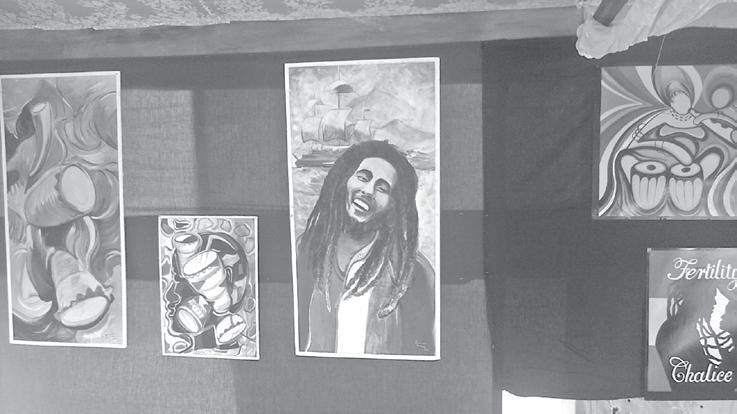
The Linden Reparations Committee is joining with Guyana and the rest of the Caribbean in demanding that reparations be paid to descendants of those who were enslaved by European governments during the slave trade.
On Saturday, the Guyana Reparations Committee (GRC) joined their Linden counterparts and hosted its first outreach conference in the community, as part of the community’s celebration of the Linden Town Week of activities. The event was held at the reparations village, which is currently set up in Linden, and featured speeches from African Cultural and Development Association Chairman Eric Phillips and Region 10 Chairman Sharma Solomon, among other dignitaries.
According to the GRC, “international law provides that the economic and social system
referred to as chattel slavery – the legal denial of persons’ rights to human identity and the control over their bodies – was a crime against humanity subject to reparatory justice…Reparation seeks to heal, atone and bring closure to the human tragedy of mass slavery.”
Currently, all National Reparations Committees report through the Culture Ministry in their respective countries, through Cabinet, to the Head of State. Guyana is on board with compiling its reparations report.
Caricom has since established a 10 Point Action Plan for discussion, in the areas of: a formal apology, repatriation, an indigenous Peoples Development Plan, cultural institutions, an African knowledge programme, addressing the public health crisis, illiteracy eradication, psychological rehabilitation, tech-
nology transfer, and debt cancellation.
Repairing the damage
Jonathan Adams, who is a member of the National Reparations Committee as well as the Linden Reparations Committee, said the body is working assiduously to achieve justice in the fight for reparations. According to him, in an effort to obtain information for the reparatory cause, the local committees recently made contact with lecturers from the University of Central Holland as well as the University of Central London.
“The time has come for us to repair that shattered African culture. Technically put, if you have a glass and it falls and break and you like that glass, you’re going to pick it up and repair it. The African people’s culture has been broken, has been shattered, and Caricom is saying it’s time for us to repair that,” he stated.
sphere.
Massive undertaking
Hardt related that since the advent of the CBSI, the United States and Guyana have enjoyed mutual benefits on many successful programmes.
The CBSI is one pillar of the US security strategy focused on citizen safety throughout the hemi-
Hardt told the gathering that experts have been working with the Guyana Police Force in a “massive undertaking” to transform the record system into a new centralised high-quality database. According to him, records will not disappear from the new system. The Ambassador said the new system has many advantages, which include increased public trust for both the Guyana Police Force and the justice system.
In his address, Home Affairs Minister Clement Rohee said the new system is a very important one to the Criminal Investigations Department (CID) branch. He said the Guyana Government
values highly the contributions made by the US Government. He noted that the US has been making significant contributions to the Government and People of Guyana, particularly to the security sector.
“This gift from the US, through the CBSI, to the Guyana Police Force is aimed at building capacity within the organisation,” Rohee said. He noted that improvement of the Force’s technological capacity within the organisation cannot be avoided. The Minister added that if the Force is to be on par with law enforcement agencies around the world; it must have the capacity, knowledge and tenacity to deal with the challenges presented by criminal enterprise.
Awoman is now scared for her life and her children’s safety after her former reputed husband reportedly lit her belongings on fire on Monday evening.
Bejede Aeridge of Lot 176 South Sophia, Greater Georgetown, and her six children were out in the yard around 20:00h when her ex-reputed husband of 18 years allegedly sneaked into her small house and set her, and their children’s, belongings on fire.
Guyana Times International understands that the man, Wayne “Aubrey” McCoy and Aeridge separated a little over a year now. The couple have nine children.
The distressed woman told this newspaper that she was constantly abused by McCoy and so she decided to end the relationship; however, their separation did not deter the man from continuing to abuse her. She explained that he would come to their house from time to time to drop money off for his children, but she would stay away from him since he would go after her if she said anything.
Aeridge further related that after their separation she began working, something which he had forbidden her from doing while they were together, and so whenever he goes to the home and she is not there, he would hurl verbal abuse and say she has “a man”. Aeridge alleged that

McCoy threatened to kill her on several occasions, with the last encounter being on Saturday night.
She said she was not at home and McCoy took her cellphone, underclothes and some of her other belongings. The woman noted that she reported the matter to the Police, but nothing serious was done to apprehend the man.
On Monday evening, Aeridge said she was in the yard which also holds the homes of her sister and mother, when she noticed someone in her house and subsequently, flames coming from the bedroom area. She noted that McCoy then ran out of the house and upon seeing him, she ran out of the yard to get help.
The man ran up the road towards C Field, chased by relatives of the woman and neighbours. Scared The scared woman explained that she does not know where McCoy lives. She noted that whenever he does his “wrong wuk”, he goes into hid-
ing at various places so even when she reports the matter to the Police, he cannot be found.
Aeridge said she works hard to maintain her children and it was only Saturday that she bought school materials for them to go school, but their father destroyed all the supplies. She noted that he took all her clothes, the children’s clothes, their school materials, bedsheets and other items that were in a barrel and burnt them on the bed.
She further lamented that while putting out the blaze, fire fighters had soaked the house and so everything got wet. She noted that she is now forced to separate her children by sending them to different places to sleep, since they cannot sleep in the house. She further stated that McCoy’s actions were not only making her suffer but their children as well, since they were unable to attend school because their belongings were destroyed.
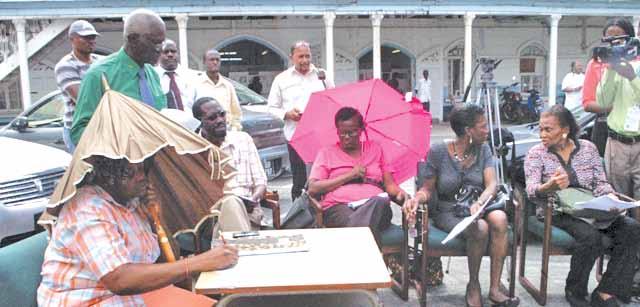
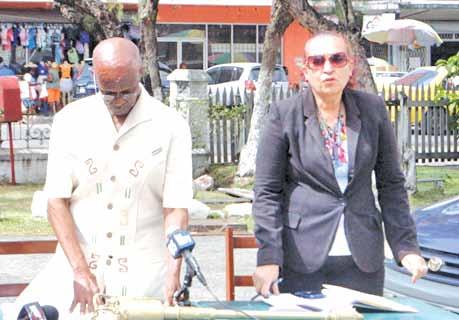
Confusion reigned at the Mayor and City Council on Tuesday when Acting Town Clerk Carol Sooba locked the Council’s chambers, denying Mayor Hamilton Green and councillors entry. However, the Council persisted in their efforts to hold an extraordinary meeting and retreated to the compound during which they voted to instal Royston King as the Acting Town Clerk.
The installation of King came about through one of three motions which were successfully tabled and passed by the Opposition-dominated Council headed by Green, a former Prime Minister under the People’s National Congress Administration. Sitting under the hot afternoon sun in the compound of the City Hall, the 13 councillors present voted unanimously in favour of the motion tabled by Councillor Gregory Fraser and seconded by Councillor Eon Andrews to send Sooba packing and to have the Council’s Public Relations Officer Royston King appointed to act in that capacity.
The motion stated that Sooba was unlawfully and unjustly appoint-
ed by a Minister who had no power or authority to do such. The motion also deemed Sooba as being incapable of executing the responsibilities required of the Chief Executive Officer of the Council, alleging that on numerous occasions she refused to summon meetings of staff to discuss any Council-related
of Georgetown as well as the members of the Council would like to see her go.
Garrett under the gun
The second motion which was tabled and passed sought to have the sale of the Easter vending spots deemed illegal and all the monies collected from individuals for use of space on the
Fraser, sought to have the Chairman of the Finance Committee, Junior Garrett immediately relieved of his duties and removed from his position for: the making of “unilateral” and “capricious” decisions and the signing off of payments without the Council’s permission; the presentation of an inap-
matters and she has shown racial bias in the execution of her duties as Town Clerk.
The councillors said too in the motion that Sooba had been imposed on the City Council by the Minister and the time has come for the Council to stand up for its rights. They said that she has become a liability and burden on the city and the residents
sea wall returned as soon as possible. The motion further sought to have the Council ascertain the names and positions of the officers who were involved in the activity and for them to be disciplined accordingly. It was unanimously supported with all of the 13 councillors voting in favour.
The third motion, which was moved by Councillor Gregory

of the Council to address the needs of the city. The motion was seconded by Councillor Eon Andrews and was supported by every member of the council who was present at the meeting.
propriate letter riddled with grammatical errors; his inability to encourage Republic Bank to release money to be returned to the Japanese Government; the presentation of a forged financial document as the budget of the Council this year and the spending of the Council’s monies without consultation or authority, to strategically inhibit the ability
Aggressive fight Mayor Green related that the decisions of the councillors through the passage of the motions will be forwarded to the relevant authorities with the hope that they would be sanctioned. He noted that through every decision taken by the Minister, the Council remained quiet, but that will no longer be the case as the decisions made are a reflection of the Council’s thoughts and it will fight aggressively to see that they become a reality.
The Council’s motion against Sooba stemmed from the recent ruling of Acting Chief Justice Ian Chang deeming the appointment of the Town Clerk illegal, since the Local Government Minister does not have the power to appoint her. The court, however, ruled that the Minister can appoint Sooba to act in the position. The decision had come about after King had moved to the High Court last December, challenging the appointment of Sooba, contending that she was deemed the least qualified of several candidates who had applied for the post. King was one of the four applicants for the post. He was represented by Attorney Nigel Hughes.

The 15-year-old boy who was shot in his mouth by a Cadet Officer was discharged from the Georgetown Public Hospital on Tuesday.
Shortly after being discharged, the teen, Alex Griffith, along with his mother, Marcel Griffith, and Mark Benschop picketed the Criminal Investigations Department (CID) at the Guyana Police Force’s Headquarters Eve Leary, calling for an attempted murder charge to be laid against the Police officer who fired the gun on April 30. They were picketing at a time when Home Affairs Minister Clement Rohee, Acting Police Commissioner Seelall Persaud, Crime Chief Leslie James and US Ambassador D Brent Hardt were meeting at the CID to participate in a simple ceremony for the formal handing over of the Police’s Automated Fingerprint Identification System (AFIS).
Last Wednesday night, the teen was shot in his mouth at approximately 20:55h by a Police rank who accused

him of witnessing a robbery in the North East La Penitence Squatting Area earlier that day. The accused who was released from Police custody has since indicated that he shot Griffith by accident.
Deliberate act But Griffith while picketing CID told Guyana Times International that the act was “deliberate”. Griffith recalled that on the night in question, he was at his mother’s East La Penitence home with his family when a number of policemen armed with guns dragged him out of the house. Initially, the Police told Griffith they were taking him to the Brickdam Police Station, but instead took him to North East La Penitence where the robbery had
unfolded earlier that day. While the robbery victim indicated that Griffith witnessed the crime, she had stated that he had no part to play in it, since he was inside the house watching television.
“But when the girl tell them that, they started beating me up, lashing me with a torchlight in my belly, twisting my foot and standing on me,” the teen alleged.
The beating did not stop there. Griffith was dragged into the vehicle again and in the vicinity of Brickdam, the Police van came to a halt and Griffith was thrashed for a second time. The teen recalled that the officer who shot him instructed his colleagues to drag him out of the vehicle before he pulled the trigger.
continued on page 22
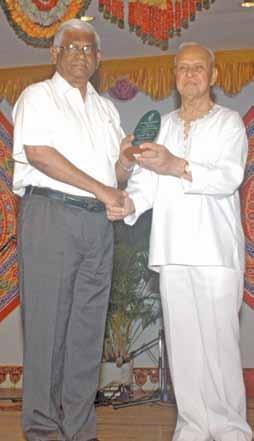
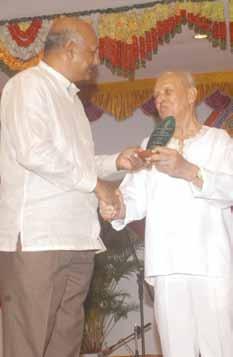
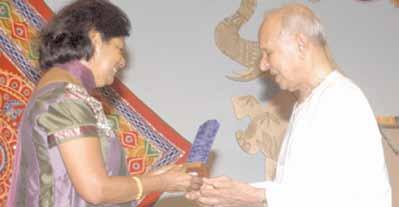
The Indian Commemoration Trust hosted its 14th Pushpanjali “Offering Flowers” at the Monument Gardens, Church and Camp Streets on Monday. At the event, organisers honoured three persons for their outstanding contributions.
acting chancellor of the
for


THE police have released two detainees whom they had arrested shortly after the death of four persons who had ingested cocaine-laced SSS Tonic on Sunday, April 03rd, even as the older child who had ingested the ‘tonic’ is gradually recovering.
Police are now hunting two other suspects as their probe into this incident continues.
A senior officer said the police are trying to catch the culprits who are responsible for the tragedy, and the Force would continue to investigate this matter until the case is solved.
The four who died after ingesting the SSS Tonic laced with liquefied cocaine are Alex Blair, 42, and Simone Pryce, 36, along with their child Jahaquel Blair, 7, and their best
friend, Natasha George, 36, all of Cocorite Street, East La Penitence, Georgetown.
Twelve-year-old Jamal Waterman was hospitalised after ingesting the same tonic also.
The SSS Tonic along with some other foodstuff had been packed by another family member for shipping to New York, but was left behind after the family member who was to take it there said she would be travelling to Pennsylvania instead of New York.
Police investigations have so far revealed that the bottle of purported SSS Tonic, along with casareep and ‘chicken foot’, had been left at the house by a man known to the family. After the family’s guest did not carry the items to USA, the victims consumed some of the ‘SSS Tonic’.



Children and women who are victims of abuse and domestic violence will now have a safe haven with the commissioning of the multimillion-dollar “Bal Nivas”(Centre for Abused Children) on Monday at Ankerville, Port Mourant in Berbice.
The centre, an initiative of the Guyana Hindu Dharmic Sabha (GHDS), is capable of providing temporary housing for up to 60 children and their mothers from across the country.
It also houses a counselling area, a skills training centre, computer centre, library, and health care facilities, which help to make life better for victims by providing the necessary support and assisting in the creation of an atmosphere of love and warmth. GHDS President, Dr Vindyha Persaud said the building was constructed to serve the people of Guyana.
“It is a sad day when our children need these kinds of facilities, because you would like to think every child has a safe place to be. However, we are aware of the realities of life,

we are not blind to those realities and because of those realities, because of the fact that our children need safety and security, because of the fact that we feel the sense of responsibility and because of the fact that we adhere to the motto of the GHDS taken from the Gita “action thy duty, reward not by concern” – today, this shelter is born”.
Dr Persaud reflected on the vision of her late
father, Pandit Reepu Daman Persaud who founded the GHDS, as it was his vision that is finally a reality.
In his address to the massive gathering, President Donald Ramotar congratulated the Sabha for the timely completion of the home. He noted that the centre is one which will benefit the entire country and complement the existing legislation and facilities in place.

Extremely impressed
“At the level of Government, we have introduced legislation: new laws on sexual offences, laws against domestic violence and human trafficking, but it is very clear that passing these legislation is not enough; we need more in order to enforce them. It is facilities like this that help to create an atmosphere in this country where everyone will speak out and when
that would have happened, we would have gone a very far way to eradicate these anti-social behaviours from our society.”
The guest of honour, legendary Bollywood Playback Singer Sonu Nigam, who was there from the beginning of the project, expressed his appreciation to the Sabha for allowing him the opportunity to be part of this historical event in Berbice.
“Guyana has touched me in a way different, there is so much of innocence in this country, purity in the souls. I am really humbled by the love shown to me by Guyanese. I am extremely impressed with the simplicity of the Guyana Hindu Dharmic Sabha and allowing me to be part of Bal Nivas from the beginning to now. I can see what all of you dreamt and now it has manifested. I know the people that will benefit from this; I wish you prosperity for the shelter,” he said on Monday, one day after his “Klose to My Soul” concert before a huge crowd at the Guyana National Stadium, the proceeds of which went to the centre. In May 2012, Nigam, along with President Ramotar, unveiled the plan and design for the shelter. The facility was constructed by Kascom Engineering who came in for tremendous praise from everyone for a job well done. The Sabha expressed gratitude to all those who assisted in making this project a reality and also appealed for continued support of the facility that should be operational in July.

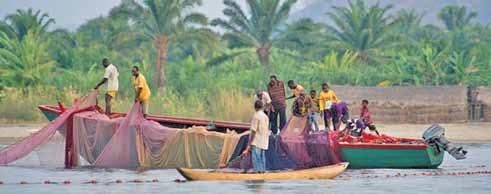
The Belize-based Caribbean Regional Fisheries Mechanism (CRFM) says the region is closer to adopting a fisheries policy which it describes as a progressive agreement for the cooperative management of shared fisheries resources in the Caribbean.
It said advocacy, awareness-building strategy and effective use of in-country mechanisms to facilitate adoption of the Caribbean Community Common Fisheries Policy (CCCFP) by the Caricom leaders were the main agreements emanating from a three-day meeting in Dominica last week.
“The policy is a progressive agreement for
Rodney CoI
Rthe cooperative management of shared fisheries resources in the region and many of the principles, goals and objectives of the CCCFP are already integrated into the activities of the CRFM whose mandate includes concentrating on efforts to develop related protocols to harmonise various systems critical to a regional approach to fisheries management systems,” the CRFM said in a statement.
CRFM Executive Director Milton Haughton said the recent meeting was of particular historical significance to the region, noting that the first sub-regional Fisheries Management Plan (FMP) to facilitate cooperation in the
conservation, management and sustainable use of the flying fish resources shared among countries in the Eastern Caribbean was endorsed by the forum.
“This action paves the way for a new era of fisheries management in the region,” he said, “one that engages stakehold-
ers in the management decision-making process and utilises a holistic approach that considers human well-being, ecosystem and governance issues.”
He said the FMP will be presented to the Ministerial Council for endorsement at its next
meeting scheduled for May 23 and formalised through signature of an accompanying resolution by the Flying fish Ministerial SubCommittee.
Other concerns discussed at the meeting include the impacts of climate change and illegal, unreported and un-
regulated fishing as well as initiatives to improve fisheries monitoring, control and surveillance and to foster regional cooperation in the management the region’s flying fish, lobster and queen conch fisheries resources and related ecosystems. The forum reviewed a draft declaration on the conservation, management and sustainable use of the Spiny Lobster, which is to be updated with recent scientific information and inputs from stakeholder consultations by member states through the CRFM Fisheries Working Group before submission to the Ministerial Council for approval. (CMC)
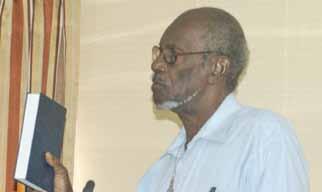
etired Reverend Rueben Gilbert said he has forgiven the hierarchy of the People’s National Congress (PNC) and all those who were involved in oppressing him during the 1970s.
He made the disclosure last Friday, just before the curtains came down on the first session
of the Walter Rodney Commission of Inquiry at the Supreme Court building. He had returned to be further cross- examined by PNC’s legal representative, Basil Williams and members of the Commission.
At the beginning of his testimony last Wednesday, Gilbert told the hearing that he

had suffered tremendously at the hands of the then ruling PNC Government headed by the late Linden Forbes Sampson Burnham. According to him, his illtreatment was directly related to his close association with the founding leader of the Working People’s Alliance (WPA), Dr Walter Rodney.
Queen’s Counsel Jacqueline Samuels Brown, during her crossexamination, asked the Reverend, if – given all the atrocities that were allegedly meted out to him by the PNC Government – he, as a minister of religion, has forgiven those who caused him grave dis-

Guyana Trades Union Congress (GTUC) General Secretary Lincoln Lewis said he is not pleased with way the Guyana Sugar Corporation (GuySuCo) is managed, contending that the operation of the struggling industry is now a “political football”.
Lewis was at the time speaking at GTUC’s Labour Day rally on Thursday last at the Critchlow Labour College, Woolford Avenue. He noted that the sugar industry was built on the labour of slaves and indentured servants, but today, de-
spite being in the hands of the free, it is being treated as personal property.
“The belief by the PPP [People’s Progressive Party] and the Government that no one except them must speak or seek to influence the direction of GuySuCo must now be cast aside,” he stated.
Lewis pointed out that GuySuCo is a state entity and it belongs to the people of this country, and as such, the GTUC has a responsibility to speak out against the problems affecting the industry.
According to Lewis,
the state of the industry is not as a result of the lack of financial invest-
ments, but because of poor management.
“With all the technical support, the lot of the sugar workers has not improved; industrial activities still remain the highest in all Guyana’s workforce. Cane cutters and factory workers are exposed to dangerous factory and field conditions. It is time sugar workers learn the truth about the industry within which they work,” he stressed.
The GTUC General Secretary explained that the calls by many for the Government to account for and provide a constructive recovery plan
comfort. He responded: “I have written in recent times and in those articles, I said that I have forgiven those persons who have done me wrong.”
Gilbert said he gave the same answer to a Guyanese Journalist who had interviewed him back in 1992, a few months before general elections. The Journalist, Gilbert related, had asked him if he would wish to see his enemies brought to justice, should
the PNC Government change. He had replied “to prove that would cause Guyanese to suffer greater suffering than they have gone through during that period”.
Gilbert recalled returning to Guyana in 1969 with a Bachelor of Science degree and being unable to obtain a job for almost two years. According to him, it took the intervention of then Opposition Leader Dr Cheddi Jagan to secure him a job as a teacher in
1971.
Gilbert was asked by Queen’s Counsel Samuels-Brown if he had ever taken legal action against the PNC Government by way of claim or compensation. He explained that he could not because of the political situation at the time.
“The condition of the country at that time, it would be a waste of time going to the Police, it would be a waste a time to say that you would try
to get justice through the system. It was a kind of situation you would find in countries that were run by dictators,” he said. He explained that one attempt may have been made, but did not get anywhere. He said the Education Ministry, then headed by Shirley Field-Ridley, had claimed that it could not locate his credentials and he went to see the Ombudsman, seeking redress to his problems.
have fallen on deaf ears.
Unanimously passed
Lewis emphasised on the fact that the basic living conditions of the sugar workers have not improved much over the years, and this, he pointed out is evident in the way in which they are transported to work.
“Workers are transported in crowded trucks with minimal physical space between them, and in this age where human rights take precedent over any economic activity. It is not that GuySuCo could not have invested in improved transportation and other facilities for field and fac-
Meanwhile, PNC’s Basil Williams, during his cross-examination, recalled Gilbert’s testimony whereby he said he had asked his brother Neville, who was also a member of the PNC, to stay at his home, while he fled for safety. Gilbert told the Inquiry on Wednesday, that because of plans by the Youth Socialist Movement (YSM) to have him killed, he had asked his brother to stay at his home, while
tory workers,” he opined. At the end of the rally, a motion was presented by the GTUC and unanimously passed for Government to “ensure that there is a development of a comprehensive plan for GuySuCo that is feasible and can return the industry or reform it into a viable economic entity”.
The motion resolved that a multi-disciplinary and multi-agency taskforce should be established to “investigate and analyse the relevant industry and make recommendations for the development of the industry”.
he sought refuge for the night at the University of Guyana. He said it was not until the following morning, while his brother was relaying what had transpired the night before, that he revealed the plan of the PNC Government to have him killed.
Williams had submitted that he was not thinking about the safety of his brother. However, Gilbert maintained that he had a duty to protect himself.

Guyana Telephone and Telegraph Company (GT&T) Chief Executive Officer Radha Krishna Sharma on Wednesday said while the company has some reservation with the Telecoms Bill, it is not opposed to it as reported by some sections of the media.
“I am not aware of any view that we are against liberalisation,” the CEO said, noting that Guyana’s leading telephone company has always supported, and will continue to support the initiative.
“We have publicly spoken for liberalisation. We have no issue with liberalisation. There is need for the telecommunication sector to be deepened and strengthened,” he noted.
However, Sharma related that while the company has welcomed the Bill, it did not mean that all was well and that they had no concerns.
“We obviously have some concerns and those concerns have been articulated in our submissions to the Select Committee,” Sharma disclosed. The Telecommunications Bill is currently sitting be-
fore the Parliamentary Select Committee, which is expected to address the concerns relating to the Bill.
Asked by media operatives to disclose what were some of the concerns GT&T had with the Bill, he communicated that he had debated in his mind whether he should pronounce on the concerns raised at the level of the Select Committee and came to the conclusion that it was not the wisest idea.
He was quick to assure, however, that once the issues had been ironed out, the public will be the first to be informed. The Telecommunications Bill, which was first in-
troduced in 2011, was seen as a major disruption to an industry which has for more than two decades been dominated by GT&T. If the Bill is passed, the way for competition from other companies will be paved.
GT&T is currently the only company licensed to install and operate landlines. It also offers cellular and Internet service as well.
Cabinet Secretary, Dr Roger Luncheon, who had first spoken publicly of the Bill, had noted that following the implementation of such legislation, the terms and conditions of the agreement that GT&T had signed with the People’s National Congress (PNC) back in the day will become nonexistent.
The company also controls the international calling sector, since all international calls have to be routed through their switches. Digicel, on the other hand, which has branches in a number of regional territories, has been offering only cellular service across the country. The latter company is however required to route its international calls through GT&T.

Rice farmers across the country have welcomed the recent announcement by the Agriculture Ministry on the implementation of a quota system for the export of rice.
Speaking with Guyana Times International, a wellestablished rice farmer noted that the system will aid in ensuring that millers pay farmers the standard price for paddy, which would be the paddy price recommended by the Guyana Rice Development Board (GRDB) and the Agriculture Ministry.
“I personally feel that the quota system for the Venezuelan market is a wonderful thing. If you pay the price that the Ministry or GRDB set, that’s good… but if you want the quota system and don’t want to pay the price… you are going to have to agree with those who are allocating quotas,” said the rice farmer who hails from the West Coast of Demerara.
The farmer, who asked for anonymity during the interview, also noted that the Government ought to be fair when it is distributing the rice quotas for the Venezuelan export market and in doing so, ensure that all of the millers who would have acted in accordance with recommendations by the Ministry and the GRDB are rewarded with sufficient markets for their efforts.
The veteran rice farmer said “rationally when the price is set, nobody can rob the farmer”, adding that without the operations of mill-
ers, rice farmers’ produce would go to waste and without the farmers, millers essentially have no way of earning an income.
“It is a two-way street… give them markets according to their quota intake,” the farmer said, adding that if a miller should choose to suspend or close down his milling operations in a particular area because he feels slighted by the Government or the farmers, the consequences for farmers would be dire since paddy is a perishable good and it takes quite some time to effectively set up milling operations.
Fair millers to be given priority
Agriculture Minister, Dr Leslie Ramsammy had said millers who were paying rice farmers “next to nothing” for their paddy will be the last to be served, as new shipments begin under the rice export deal with Venezuela.
He said those who were “fair” would be given priority by the Government and this practice would continue in the future. “If you do not treat the rice farmers with the fairness and respect they deserve, then
there will be consequences that may be severe to your businesses,” Dr Ramsammy had warned millers in an interview with GTI
The Minister told this newspaper that he recalled that at the beginning of the current crop, the millers were being “profoundly unfair” to farmers in that they were offering them just about Gy$3100 per bag of paddy.
On a similar note, the rice farmer related that he was disgusted with the Rice Factories (Amendment) Act of 2006, which replaced the Rice Factories Act of 1998 and repealed the Rice (Regulation of Manufacturing and Marketing) Act of 1985. He related that the 42 days stipulated for millers to complete payments to farmers have proven to be disadvantageous to farmers and should be amended.
“That legislation is faulty and should be removed,” he declared, explaining that not only should there be stricter penalties for the millers who fail to adhere to the regulations of the Act, but there is also need for the enforcement of the Act.

President Donald Ramotar and First Lady Deolatchmie Ramotar were among the thousands who Sunday evening enjoyed the talent of renowned Bollywood Playback Singer Sonu Nigam.
Nigam was backed by a 25-member troupe from Mumbai, including a large selection of Bollywood’s best musicians at the Guyana National Stadium, Providence.
The concert, organised by the Guyana Hindu Dharmic Sabha, was held to commemorate the 176th anniversary of Indian Arrival in Guyana and the Sabha’s 40th anniversary.
The proceeds went to

cert, applauded their support for a worthwhile cause and encouraged their support of other such ventures.
The President also hailed the concert as
six children from India, the first batch of immigrants, arrived onboard the Whitby at Highbury to supplement the multiethnic, multicultural society on which Guyana

the Sabha’s Bal Nivas home for vulnerable children. The facility, which is located at Ankerville, Corentyne, Berbice, has the capacity to house comfortably, approximately 60 persons. The facility materialised after a series of massive fund-raising events, including mega concerts featuring Bollywood’s singing sensations.
President Ramotar, who briefly addressed the thousands of supportive Guyanese at Sunday evening’s con-
a fitting tribute to the Indian foreparents who came to Guyana and despite difficulties, managed to upkeep their culture. “Today, 176 years after, we have the top artistes of India coming to entertain us, that is a testimony of the fact that our foreparents managed in difficult and very harsh circumstances to maintain this culture and to give it also a specific Guyanese flavour,” he said.
On May 5, 1838, 233 men, five women and
today prides itself.
The concert which also featured a performance by upcoming Bollywood Playback Singer Jonita Gandhi, was also the Guyana leg of Sonu Nigam’s 2014 World Concert Tour titled “Klose to My Soul”, featuring tributes to Indian musical legends such as Mohammed Rafi, Mukesh, Manna Dey, Lata Mangeshkar, RD Burman and Kishore Kumar, the Government Information Agency (GINA) said.
The NY Daily news has reported that a nine-year-old girl who had just left church was killed in Brooklyn, New York (NY) on Sunday when a motorist suspected in a hit-and-run crash fled a traffic stop and caused a three-car wreck, Police said.
Rebecca Ramnarine, a fourth-grader from St Albans, Queens, died at Brookdale University Hospital shortly after the17:00h accident in Canarsie. A 62-year-old man driving with a suspended licence had been pulled over because his Honda Odyssey matched a description of an SUV involved in a hit-and-run crash, Police said.
As police were talking to the driver, he drove off, raced for a few blocks and rammed into the back of a Hyundai Elantra in which Rebecca was a backseat passenger, Police said. A third car was also involved in the crash.
“I saw the EMS try to take my daughter out of a mangled car. She was lifeless and
had blood all over,” said Rebecca’s mother, Abiola Ramnarine, 38.
According to the NY Daily, the mom and her husband were in a car about two minutes behind Rebecca, who was riding with a friend, Faith Cummings, 11, and her mother, Esther Cummings, 42. They had just left services at Restoration Temple Assembly of God in Canarsie and were headed to dinner when the crash happened.
Rebecca was a rambunctious girl who loved fashion, her mother said. “She loves to dance. She wanted to be a paediatrician. She had a heart of gold.”
As the grieving mother and father, Richard Ramnarine, stood outside the emergency room at Brookdale, the man suspected in the crash that killed their daughter was inside the hospital being treated. “He took my daughter’s life and I’m hurting, but I don’t feel like I want to go in there and hurt him,” Richard Ramnarine said. Rebecca’s father said that when he reached the scene of the crash and saw the crushed car his daughter was in, he was forced to take a step back.
“I didn’t know the condition of my daughter. I just knew it was something I wasn’t ready to deal with,” the father said. As for the driver of the Odyssey, he said, “I’ll let the system take its course.”
Esther Cummings, her daughter and three other people who were riding in the second vehicle hit by the Odyssey, a Toyota minivan, were all being treated at Brookdale. Police said all five had minor injuries, but friends said Faith Cummings had a broken pelvis.

In many communities across Berbice, the Guyana Police Force (GPF) has taken the lead in implementing innovative juvenile crime prevention and intervention efforts as part of an overall community-oriented approach to policing.
In line with this, the Development Association of Fort Ordinance (DAFO) in collaboration with the GPF B Division last Wednesday launched a youth group in the community.
This launch complemented a series of youth clubs across Berbice by the Police in B Division. President of DAFO Stanley Jacob stated that the aim of the organisation is all about development and making the community a better place in every aspect
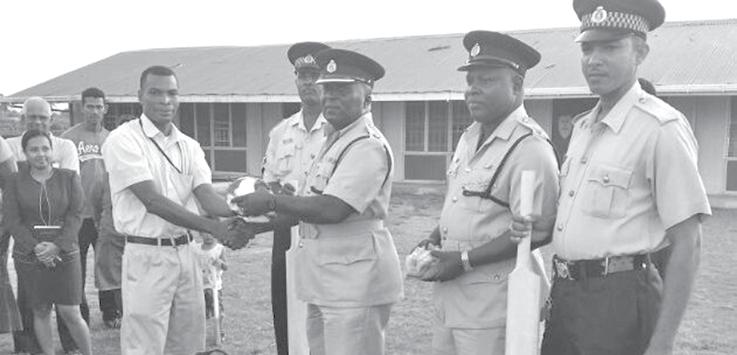
of their livelihood. Since its formation, he said DAFO has formed a community policing group and installed several street lights in its effort to assist in curbing criminal activities in the area. He said too, they continue to work assiduously on several other projects so as
to ensure the community is safer.
“Youths are the future of tomorrow and we want our youths to become more actively involved in every area and aspect of development,” Jacob said.
Deputy Commander Stephen Mansell, who was elated to be a part
of the event, explained that the initiative aims at supporting strong measures to prevent juveniles from becoming involved in illegal activities. He said through youth-focused community oriented policing, they are hoping to reduce the availability of firearms to youth, strengthening
anti-drug and anti-gang measures, and building healthy communities through expanded youth opportunities.
The senior Superintendent of Police added that the main focus of the group is to engage the youths meaningfully in sport and educational activities.
The Deputy Commander also highlighted that the young people will also be placed into a Scout Group to enhance their skills, while underscoring that they will also be a part of the GPF’s summer camp and work study programme this year.
“They will be taught to become computer literate, assist those who cannot afford to attend school and educational items and whatever nec-
essary needs the less fortunate youths may incur,” he stated.
“The bottom line of this youth club is discipline and therefore we need our youths to be positive, competitive and to excel in their every endeavour,” Mansell said, while encouraging the parents to take an active part in the success of this first launching in the community.
The initiative is part of an ongoing outreach programme of the Police Force in order to give back to society and to increase public confidence and the force’s image.
He said that the Police alone cannot fight crime but the citizens need to work in partnership with the force to stamp out crime and ensure safety and security.
The International Monetary Fund (IMF) has predicted a 4.3 per cent growth rate for Guyana this year even as it is projecting that economic activity in Latin America and the Caribbean will stay in low gear in its 2014 forecast for the region.
During his budget speech, Finance Minister, Dr Ashni Singh had stated that Guyana’s economy is projected to expand by 5.6 per cent in 2014, with the non-sugar economy projected to grow by 5.2 per cent.
He told the National Assembly that the inflation rate is pegged at five per cent compared to 0.9 per cent last year, the lowest rate in decades.
Real Gross Domestic Product (GDP) grew by 5.2 per cent last year while the non-sugar GDP rose by 6.3 per cent. In 2013, the country’s economy recorded its eighth consecutive year of growth.
Meanwhile, the IMF said the recovery in the US and other advanced economies are expected to bolster export growth, but lower world commodity prices and rising global funding costs are likely to weigh on activity across the region.
The IMF’s Regional Economic Outlook for the Western Hemisphere released on April 24 in Lima, Peru, projects regional growth of 2½ per cent in 2014, down from 2¾ per cent in 2013. Weak investment and subdued demand for the region’s exports held back activity in 2013, as did increasingly binding supply bottlenecks in a number of economies.
For 2015, the IMF projects a modest pickup, to three per cent.
According to the report, Latin America still faces a number of downside risks. The key risk is a sharper decline in commodity prices caused
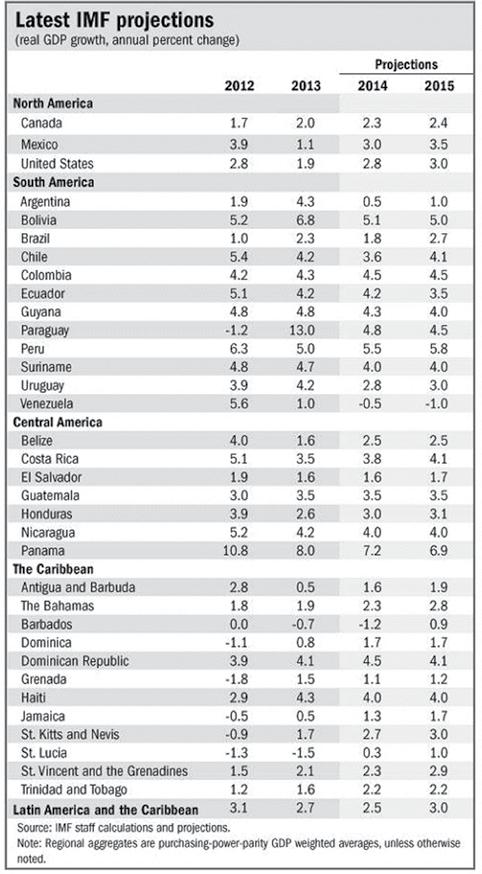
by weaker demand from some of the major commodity-importing economies, especially China. Although the effects from a gradual and orderly normalisation of US monetary policy should be contained for most of the region, increased capital flow volatility also remains a risk. Divergent growth dynamics
Growth in the financially integrated economies – Brazil, Chile, Colombia, Mexico, Peru, and Uruguay – in 2014 is expected to remain the same as in 2013, at 3½ per cent. However, the average growth number masks considerable divergence across countries.
Mexico’s economy is expected to rebound to three per cent this year, owing to a stronger US recovery and normalisation of domestic factors.
Russian roulette
“He tek out all the bullets out of the gun then but one, then he shoot and nothing ain’t come out, then he shoot again and it hit me,” he recalled. As blood gushed from his head, Griffith was taken to the Georgetown Public Hospital by the ranks who had taken him into custody. “They just carry me at the hospital and left me deh.”
Still disturbed over the incident, Griffith’s mother said the police-
In Brazil, activity is expected to fall below two per cent in 2014, as weak business confidence continues to weigh on private investment.
The IMF said the key policy priorities for the financially integrated countries include a careful calibration of macroeconomic policies, a clear focus on reducing financial vulnerabilities, and stepped-up structural reforms to remove obstacles to growth.
Growth in the other commodity exporters – Argentina, Bolivia, Ecuador, Paraguay, and Venezuela – is projected to fall sharply in 2014, to about 2¾ per cent from nearly six per cent in 2013. The IMF said that fundamental policy adjustments are needed in Venezuela to avert the risk of disorderly dynamics.
from page 14
man who pulled the trigger should be charged with attempted murder.
“I need justice, I want him (the police officer) to be taken before the court, I need justice,” the woman cried. The police officer who had been on close arrest is now required to report to the Police weekly as a condition of his release.
Marcel complained that the officer who allegedly shot her son is allowed to walk freely on the road when her son will be scarred for the
Having just recently returned from attending the Third-Caricom Mexico Summit and meeting of the Association of Caribbean States (ACS), in Mexico, President Donald Ramotar said there is consensus that agriculture development must be expanded as food security remains in sharp focus.
The President noted that there is also agreement that overall production has to be increased, therefore, “We need to start thinking of some sort of specialisation for countries in the region so they can increase production.”
Communication and transport sectors must become stronger to realise this reality, he noted as, “Right now it is probably cheaper for Caribbean countries to import their food from the north because of their connections, than from the countries in the region”.
The President had said during his address at the summit, that if the agriculture sector in the region is to be improved, then transportation, both air and maritime needs must be addressed, and that countries of the community must also aim to transform their agricultural products from just being raw materials to agro- industries. This is important to create jobs, both in agriculture and in industry where additional skills would be required and where value

would be added.
Technology
The use of technology is also essential to improve regional security, according to President Ramotar as “There has been a traditional belief that agriculture is just sheer labour, not skill.”
It takes a lot of technology, he noted, and said that for production and productivity to increase, there must be farmers who are au fait with technology and with its usage to enhance production within the agriculture sector itself.
The Jagdeo Initiative, conceptualised and proposed by former Guyanese President, Bharrat Jagdeo, the Head of State said, continues to be a guiding principle for the Caricom nations as far as agricultural development and production are concerned.
This initiative, the President explained, has seen Barbados investors for example, begin the Santa Fe Farm in the southern part of Guyana and there is now strong interest from Trinidadians to be
involved in agricultural development locally, adding that, “The initiative (Jagdeo) is alive and well.”
While in Mexico, President Ramotar welcomed the Mexican President’s announcement regarding his Government’s financial contribution to the Inter-American Institute for Cooperation on Agriculture for assistance to Caricom States, to support the improvement of the agricultural sector.
President Ramotar pointed out that despite the many initiatives taken; the Caricom region was still a net importer of food with the food bill amounting to more than US$4 billion per year. He said that it was clear that the region needed a joint agricultural policy through which member states could complement each other and raise their production to reduce the vulnerability in the sector, in the process examining the many problems that have emerged and those that were emerging.
The Guyana Sugar Corporation (GuySuCo) can turn around its present crisis with good management and a satisfied labour force, Seepaul Narine, General Secretary of the Guyana Agricultural and General Workers’ Union (GAWU) has said.
rest of his life. According to her, the Guyana Police Force is not doing enough. “I am not seeing anything being down and the man is on the road. I am not getting any justice and the man is on the road.”
Questioned whether she is willing to settle the matter via compensation, Marcel responded in the negative. “It is not about compensation alone, is about justice,” she posited. (svetlanam@guyanatimesgy. com)
Speaking at last Thursday’s May Day rally at Port Mourant, Narine said the sugar industry which plays a vital role in the development of Guyana’s economy and employs thousands of Guyanese has the turnaround ability.
“The wide interest shown in the industry in recent months testifies to the value of this industry to our country. GAWU welcomes the interest shown but cannot see eye-to-eye with those
GaWu General Secretary Seepaul Narine
who offer ill thought out solutions like selling out estates or diversifying to ethanol or put lands to aquaculture, at the same time as a stakeholder we would like to see the industry becoming viable as this would surely impact on the quality of life of our membership”, Narine stated.
He went on to say, that with the knowledge to grow with good management, a satisfied labour force and various innovations, GAWU is confident that the industry can regain its profit-
ability status in a short time. Despite challenges faced in the sugar industry, they are confident that the industry will meet its target of 216,000 tonnes in 2014. Member of Parliament, Dr Vishwa Mahadeo congratulated GAWU. “People will come to you and tell you all sorts of things about your union, they are saying the union is not representing its workers, you have an industry that is not meeting its target and yet the workers in that industry get an increase every year. Had it not been a union like GAWU that would not have happened, so GAWU must be commended for standing beside it workers.” Mahadeo also reiterated Government’s commitment towards the sugar industry.

TT’s acting Commissioner of Police Stephen Williams says while he intends to assemble the largest team in the country’s history to investigate the killing of Dana Seetahal, SC, he has not requested any regional or international assistance just yet. He made the comment Tuesday as police continued their probe into the matter and hunt for suspect/s in the case.
Shortly before midnight Saturday, Seetahal left the Ma Pau casino car park on French Street, Port-of-Spain, on her way to her One Woodbrook Place apartment. She drove south down French Street before turning west onto Wrightson Road and later turning north onto Hamilton Holder Street, Woodbrook. Police said as she approached the Woodbrook Youth Facility, she was ambushed and shot five times, twice in the head, twice in the right forearm and once in the chest.
Intelligence sources, based on video captured by CCTV cameras, have since claimed that a lone gunman armed with a high powered weapon— part of a plot originating from behind prison walls—was responsible for the shooting death. Video clearly shows a white Wingroad pulling to the front of Seetahal’s Volkswagen SUV, while a panel van pulled to her right at O’Connor Street, Woodbrook.
A man is then seen sliding open the side door of the panel van armed with a gun and firing at Seetahal, the bullets entering through her right side window. The footage also shows the bullets striking Seetahal on the head and upper part of the body and the attorney slumping over her steering wheel.
An autopsy report revealed Seetahal was shot five times.
According to well placed sources, a prisoner is believed to have ordered the hit from behind the walls of the Port-of-Spain prison. Arrangements were put in place with instructions to the shooter, said to be a gangster, on how the hit should be carried out.
It has been reported that Seetahal was followed for several days by the killers who knew her every movement including what time she arrived at home, where she hang out and shopped, and every other detail about her whereabouts.
Seetahal, who was involved in many highprofile cases, was a state prosecutor in the ongoing trial of 12 men accused of the murder of central businesswoman Vindra NaipaulCoolman.
Int’l help on the cards
Meanwhile, as the brutal slaying of the prosecutor sent shock waves across the Caribbean, TT's National Security Minister Gary Griffith said international assistance in finding the killers is definitely on the cards.
Speaking to reporters during an interview at the start of Tuesday’s sitting of the Senate at the Parliament building of the International Waterfront Centre, Portof-Spain, Griffith said “…we have spoken to the Commissioner of Police and my job is to protect the Police Service with the support that they require at any time, which also may include international assistance. I have already spoken to the U.S. authorities and they are more than willing and able and they are prepared to do so. But that is only if and when the Trinidad and Tobago Police see it fit that they can and should receive international assistance,” he said.
“So it is definitely on the cards. As at this time, I do not think it is necessary,” he said.
The TT gov’t has since offered a TT$3.5 million reward for any information on or regarding the murder.
Laparkan Shipping is offering free shipment of an economy box with the shipment of a barrel to five major destinations in the Caribbean, the company announced recently. The offer is for barrel shipments to Guyana, Jamaica, Antigua, Barbados and Point Lisas and Portof-Spain in Trinidad and Tobago.
“In an effort to help our customers provide a little extra to their fam-
Opposition Leader David Granger said Acting Police Commissioner Seelall Persaud has started off on the “wrong foot” with Project Impact Albouystown.
According to Granger, the Acting Commissioner of Police should first address burning issues plaguing the Force and, to a larger extent, Guyana. His comments come in support of criticisms made by President Donald Ramotar during the recently-concluded Annual Police Officers’ Conference held at Eve Leary, Georgetown.
The President criticised the Force for its track record of weak prosecutions due to the lack of evidence.
Reference was made to the disastrous collapse of murder cases involving cricketer Carlyle Barton, who was caught on video, and businessman Rondy Jagdeo. On Friday, the Opposition Leader said Acting Commissioner Persaud has “made a big splash by launching the Albouystown Impact Programme,” when he should be paying attention to issues raised by the President. “The President’s remarks
should be a wakeup call,” he stressed.
Efficiency
He said before Persaud attempts to go outside the Force to make “headline news”, attention should be given to the deficiencies of the Police Force. “Efficiency starts at home as far as the Police Force is concerned, not in Albouystown,” Granger opined.
This is the second time the Opposition Leader has openly criticised the Acting Commissioner of Police on Project Impact Albouystown. He had initially warned Persaud about the initiative, contending that it could
backfire if it was not done with the support of the community. He said while the intention behind the programmes was good, executing it without consultations with, and the support of, the community can have negative consequences. He also warned Persaud against the stigmatising of certain communities. Project Impact Albouystown was launched in April. Since then the response to the Project has been overwhelming. The Police Force remains optimistic that the initiative will create positive changes in the community despite criticisms.

JetBlue has announced a substantial increase in its inter- and intra-regional routes servicing the caribbean
Wilies back home at this time we are offering a free shipment of an economy box which can accommodate fifty pounds when you ship a barrel. This is limited to one shipment per customer,” said Sherry Mohamed, Manager of Laparkan’s Northeast region.
This special pre-summer offer is now in effect and will run until June 15th.
ith the addition of its second route between TT and the United States, JetBlue Airways last week launched four additional nonstop Caribbean routes. One of the new routes connects Newark Liberty International Airport with the Dominican city of Santiago. The other routes link the Fort Lauderdale-Hollywood International Airport with Montego Bay, Jamaica; Port-of-Spain, Trinidad; and Punta Cana, Dominican
Republic. The airline said in a release that a lack of intra-regional flights in the Caribbean impedes the movement of passengers and cargo among the local economies, most of which suffer economic difficulties. In recent months, JetBlue has announced a substantial increase in its inter- and intra-regional routes servicing the Caribbean, making Puerto Rico its regional hub and covering the gap left when American Eagle exited that market a year ago.
“We now offer customers 69 nonstop routes from the U.S. to the Caribbean and more than 200 daily flights to, from and within the Caribbean, which is more than any other airline,” JetBlue President Robin Hayes said. “We will continue to expand our presence in this region to better connect families and friends, create international business opportunities and bring Americans to the wonderful leisure destinations across the Caribbean,” he added. (TT Guardian)

The Guyana Sugar Corporation (GuySuCo), which continues to demonstrate its remarkable resilience, is seeking to make further strides, by adding to its list of manufactured goods and services.
Through a technical cooperation; “Expanding bio-energy opportunities in Guyana” and with funding from the InterAmerican Development Bank (IDB) in August 2013, the Government of Guyana formally commissioned a Bio-ethanol demonstration plant at GuySuCo’s Albion Estate with the objectives of demonstrating production of fuel grade ethanol from the estates’ available feed stock, increasing the mass of trained personnel in the area of bio-fuel through training and research, and demonstrating the utilisation of bio-ethanol fuel.
Today, the BioEthanol E-10 fuel produced at GuySuCo’s Albion Estate was formally launched for trial run in a number of vehicles, with the expectation that before the end of 2014, approximately 25 vehicles would be routinely utilising the fuel, but moreover, the pilot plan developing in the future towards the production of commercially available blended fuel.
Agriculture Minister,
Dr Leslie Ramsammy delivering the feature remarks at the event noted that Albion has always been a lead estate in many ways, and therefore it is ‘poetic justice’ that this new thrust of development for sugar is coming out of it.
But importantly, the Minister noted, that efforts at Albion is not just for a ‘show piece’, but in fact the first step in adding a new commodity for the sugar company. The Minister said that the Government is also hoping that GuySuCo’s effort is the first step in making it a national programme.
He noted that Government in its determination to pursue a fuel blend with ethanol, looking towards the country’s future, established a National Commission on bio-energy and set as one of its goal the hope of introducing legislation to mandate the use of blended fuel.
Even as GuySuCo launched the new E-10 blend of fuel, it will continue efforts at a determined cost and efficiency towards this goal of commercial production, he stated.
One of the studies that is to be conducted over the coming months is to consider in addition to molasses derived out of sugar, what other sub-strains can be used,
for example cassava, in the production of bio-fuel. This will ensure that even when sugar is not in production, the company can continue to produce bio-fuel, with the other sub-strains.
But Albion is set to go from demonstration of bio-ethanol to production; and Minister Ramsammy also reiterated that GuySuCo’s and the Government of Guyana’s goals for the sugar company remains sugar cane cultivation and sugar production.
There will come a time when GuySuCo will support other industries such as aquaculture, but the Minister reiterated that the sugar cane fields will not be converted into tilapia farms.
“Guyana has enough land to develop aquaculture, we do not have to give up cane fields for aquaculture… if [we] think that debate is dead… there will always be those who will come out with such staggering suggestions, I am too polite to call people names, but therefore I would simply say it is not GuySuCo’s intention to abandon our cane fields and convert them into tilapia (farms) but where the Ministry of Agriculture develops aquaculture, GuySuCo will support those and engage and bring its expertise to help,” he said.
Local Government Minister Norman Whittaker and a team of officials in Region One last week stumbled upon several boats with smuggled fuel at Port Kaituma, Region One. In a release from his office, Whittaker said the discovery was made during a visit to the area where a boat recently ex-
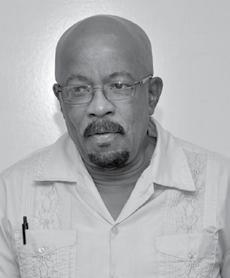
Amerindian Affairs Minister Pauline Sukhai on Tuesday met with residents of Santa Rosa, Koko and Kamwatta, Region One, where she held meetings to update residents on the recently concluded 2014 National Budget.
The Minister sought to enlighten the residents of the disapprovals to the national budget and the impact they will ultimately have on their lives and the development of the country at large.
The first meeting was held at the Santa Rosa Secondary School and was well attended by residents including Community Support Officers (CSOs). There, the village’s Toshao Richard Cornelius noted that following the outcome of the budget, they have joined with the rest of those affected in condemning the disapproval of the Amerindian Development Fund (ADF).
Cornelius said that, personally he feels betrayed by the Opposition Parliamentarians, and urged that they explain the reasoning behind the disapproval.
“These people show no regards for us, the first people, they never come to our community so they cannot know what our needs are, so how can they sit in Parliament and determine that we do not need money?” he asked.
Hence, the Toshao called on the combined Opposition to let good sense prevail, and restore the sums they voted down. In addition, Amerindian Affairs Ministry Permanent Secretary Nigel Dharamlall in his address to the residents called on them to unite and not be intimidated, but let their voices be heard.
He told the residents that as a result of the non-approval of funds to the Ministry’s capital budget, several critical

developmental projects will be affected, not only for their community, but also for the other 187 Amerindian communities around the country.
The Permanent Secretary added that the Government will explore every possible legal avenue to ensure that the funds are restored.
Meanwhile, Minister Sukhai in her address to the gathering said she was disheartened by the outcome of the recent budget as the disapproval will have devastating impacts on not only Amerindians, but the country at large.
On the issue of the disapproval to the Amerindian Affairs Budget, the Minister said the further development of youths in 187 hinterland communities will be affected.
The Opposition disapproved the entire capital budget of Gy$1.1 billion from the Amerindian Affairs Ministry.
The Minister told residents that several training programmes for youths have been affected. Most importantly, funding for the CSOs was cut.
According to Minister Sukhai, the plan this year was to increase the number of CSOs which would have meant more employment and capacity building for other interested youths, but that will now be put on hold.
“Every time we meet with communities, we hear that there are no employment opportuni-
ties and many youths cannot afford to move out of their communities to seek employment or training in preparation for employment so the CSO programme was geared specifically to target that issue.”
Another area of development, which will be hampered by the outcome of the National Budget, will be the wood working facility for the Moruca area.
This facility the Minister told residents would have been able to provide employment opportunities, as well as generate income for the community.
Funds for the wood working facility were also allocated under the Ministry’s capital budget for 2014.
Meanwhile, over at Koko where another outreach meeting was held, the residents were eager to hear how the cuts would affect them, and more so, were prepared with questions. The Minister went into details about the disapproval of the ADF. Projects affected are the National Secure Livelihood Programme and Youth Entrepreneurship and Apprenticeship Programme, the construction of village offices and multipurpose buildings, purchase of sport gear, musical instruments, drip irrigation systems, tractors and implements and support for other projects and programmes including eco-tourism.
ploded. The vessels apparently containing dieseline were moored at the Turn Basin area.
He added that upon enquiring from those on the vessels, none could produce documented evidence of approval from the Maritime Administration Department (MARAD) or other authorised agen-
continued on page 26
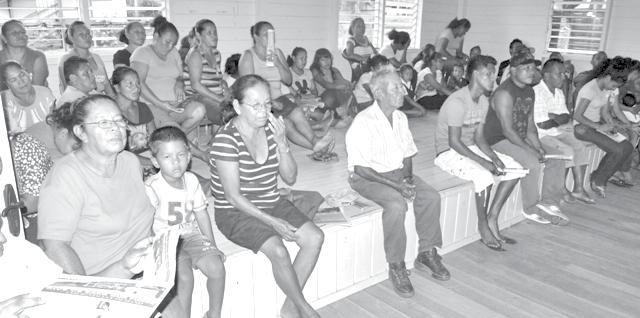
The New Building Society (NBS) said its mortgage portfolio continues to grow due to the many housing schemes being established in Guyana, with some Gy$7.8 billion being granted in mortgage loans, putting the bank’s portfolio at Gy$32.9 billion compared to Gy$27.7 billion the previous year.
“As a responsible mortgage provider, we ensure our borrowers can afford their mortgages not just now but also in the future,” Chairman of the bank, Moen Mc Doom told the institution’s 74th Annual General Meeting held on April 26.
He stated that a consultative approach has been taken to deal with borrowers who have difficulties in payments. This, according to Mc Doom, has resulted in a more encouraging arrears position, with 1393 accounts in arrears and a default value of Gy$68 million in 2013.
Meanwhile, he noted that the bank has recorded another successful financial year in 2013, raking in some Gy$993
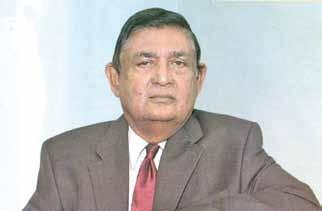
million when come compared to Gy$813 million in 2012.
Mc Doom in his report said the bank’s performance has remained exceedingly strong.
“The Society continues to balance delivering value and service to our customers and members and, maintaining our financial strength for the long term. Aggressive competition in the financial services sector compounded further with high levels of liquidity, resulting in low yields on our investments in Treasury Bills, did not deter the Society’s efforts to deliver these excellent results,” Mc Doom stated.
There was an increase of 10 per cent in the Society’s total assets, amounting to Gy$54 billion. Of this amount, 61 per cent is made up of mortgages while Liquid Assets accounted for 30 per cent and savings for nine per cent. As it relates to the Liquid Assets portfolio, the Chairman noted that their focus has been to ensure that there is sufficient liquidity rather than maximising the absolute liquidity levels, which does not rake in much. With total liquid assets of Gy$16.4 billion by the end of 2013, the Society’s liquidity position still exceeded the minimum statutory requirements.
“We have consistent-
ly provided long-term value to our customers and members by helping them to make the best choice for their finances, never mislead them, conducted our business efficiently to maximise customers and members’ benefit and provided a superior level of customers service,” Mc Doom said, adding that these are the core principles that have guided the Society for over 70 years; thus resulting in its saving portfolio increasing by Gy$3.7 billion in 2013.
The Chairman explained that his bank’s performance came
against a slothful global economic growth; however, he noted that it is expected that the global activity will strengthen moderately as time progresses. Locally, he pointed out that despite the grappling performance of the sugar industry, the rice, mining, and forestry sectors, among others have seen improved growth, contributing to the growth of the economy.
Customers first
Meanwhile, the NBS has remained committed in putting the interests of its customers and members first. Mc Doom has recommitted to up-
keeping this objective while at the same time looking into the interests of its employees.
The Society has recorded yet another low rate of employees’ turnover. “We intend to continue our framework to ensure our employees’ potential is fully realised by providing opportunities for their development,” the Chairman said.
Moving forward in 2014, Mc Doom stressed that with the housing drive on a roll, the Society will continue to provide benefits to customers through affordable mortgage financing.



Acting Tourism, Industry and Commerce
Minister Irfaan Ali has called on all Guyanese to become tourism ambassadors of Guyana as the Ministry seeks to create lasting impressions on visitors.
The Minister issued the call on Friday at the launch of the Guyana Festival at the Guyana International Conference Centre, Liliendaal, Greater Geogetown.
“We are hoping to bring home thousands of Guyanese and to bring in thousands of our brothers and sisters, all across the globe to celebrate with us the wonderful history and culture of
ours,” Ali stated.
He said the event is indeed a tourism endeavour, but it also has a very important business aspect, which will become an integral part of the Ministry’s tourism drive.
Ali noted that the festival will be celebrating everything Guyanese.
“It’s our rich culture that sets us apart from the rest; six cultures fused together by the independence of one people, a colourful adventure that is a melting pot for all our cultures, brewed together by unity,” Minister Ali stated.
The Guyana Festival will see a mixture of the country’s traditional music, dance, food, arts and
craft being exhibited at the Guyana National Stadium, Providence, East Bank Demerara, on August 8 to 10.
This three-day event, which will be marketed in North America and the Caribbean, is aimed at bringing awareness of Guyana’s diverse cultural heritage, and generally the nature of its tourism product locally, regionally and internationally.
On Saturday, August 9, there will be a night for local legends which will see renowned celebrities such as Dave Martins, Sammy Baksh, Eddy Grant, and Terry Gajraj performing. There will also be a day set

cies to import, transport, store or sell fuel of any sort.
“Many residents and business persons and NDC [Neigbhourhood Democratic Council] and RDC [Regional Democratic Council] officials also expressed concern for the many, including schoolchildren who traverse the waterways in areas contiguous to where this illegal fuel operation takes place,” Whittaker said.
aside for games and will see various communities coming out to compete in cricket, football and other sport with the aim of winning trophies and other prizes.
The event will culminate with a culinary cook-off competition of traditional Guyanese cuisine, such as duck curry, pepper pot, cookup, metemgee and black cake, followed by a grand concert aimed at promoting the next generation of Guyana’s music industry and help to develop new/young talent. Performing will be Jumo “Rubber Waist” Primo, Adrian Dutchin, Melissa “Vanilla” Roberts and others.
He said residents also pointed to the discharge of fuel in these waterways and its use as a toilet and a garbage dump by the many who work on these boats, and opined that it would not be long before there is another gastro outbreak.
Suggestions
Suggestions that all fuel be discharged at the Morawhanna Port of Entry or in an area at the commencement of the canal were offered. The Minister said it was reported that there are five licensed fuel dealers in the area and scores of unlicensed dealers. He undertook to bring the situation to the Director General of MARAD and the Ministers concerned. Whittaker was accompanied by Regional Chairman Paul Pierre,
Regional Executive Officer Nigel Fisher, Matarkai Neighbourhood Democratic Council IMC Chair Margaret Lambert and other Local Government, RDC and Matarkai NDC officials.
Early last month, a boat at Port Kaituma exploded after a fuel pump malfunctioned and jets of diesel sprayed on the hot surface of the pump. A fire consequently ignited and engulfed the vessel.
The lone crew member, who was onboard, attempted to put out the fire, but the heat was too much, causing him to jump overboard. He swam ashore and was rushed to hospital for medical treatment.
Simultaneously, the fire spread to other boats and buildings nearby, destroying four buildings used as dwelling houses, shops and storages. Five boats were believed to have been destroyed. The blaze extended on top of the river as well, as the diesel leaked overboard onto some combustible garbage in the water.
Residents had formed a bucket brigade and were successful in stopping the fire from spreading to other buildings ashore.


Over 2000 single parent females are currently benefiting from the five-year microcredit programme, Woman of Worth (WoW), founded by Human Service and Social Security Ministry in collaboration with the Guyana Bank for Trade and Industry Limited (GBTI).
The main purpose of the WoW Programme, which was launched in June 2010 and will last until June 2015, is to remove the obstacles single parent women face in society, to enhance their self-esteem, to empower them to take advantage of the economic opportunities around them and increase their participation in society.
The ultimate goal of the five-year project is to provide intervention and financial support to ensure WOW participants manage and sustain successful business ventures.
To finance the project, the bank has provided Gy$500 million and the Government of Guyana will provide an
estimated Gy$50 million per annum.
The WOW Programme allows women to borrow between Gy$100,000-$250,000 from the bank to build their businesses while the interest rate applicable to the loan is six per cent per annum, providing that it does not exceed 24 months. To be eligible, female single parents must be between the ages of 18-60.
All recipients must have a minimum level of training in the proposed area of business; in addition, they must not be earning more than Gy$40,000 per month.
According to Human Services Minister Jenifer Webster, women across Guyana are turning out in their numbers to borrow money to start their businesses such as salons, catering services, and farming.
No penalty enforced
She noted that if the due date passes and the required installment is not paid, no penalty is enforced, but instead professionals would usually intervene and try to

assist the women who are experiencing difficulties in making payments.
At the moment, the bank is considering expanding the life-span of the WOW Programme and intends to work with the women to have bigger and brighter futures.
Thus far, 1326 women have received loans under the WoW Programme, allowing them to establish small businesses, while 447

business
One of the women who declined to have her name published related that she is a single parent of three and was struggling to make ends meet at the time she heard about the initiative. She stated that she had always wanted to establish her own business, and as such, applied to the bank for the loan.
single parents were certified through the Board of Industrial Training.
Webster stated that her Ministry is currently engaging stakeholders in dialogue to maximise the benefits for the women in the programme.
Guyana Times International spoke to several of the beneficiaries of the loans who noted that their lives have definitely taken a turn for the better with the provision of the loans.
“Well I applied for the loan, I tried to meet all of the requirements and fortunately I got through. I took the money and invested it in a salon to cater for the women in my community and today it’s a booming business. It has done a lot for me and my children; we have better lives today because of it,” the woman related.
The proud business owner noted that had it not been for the initiative, she would not have made it to the point of success she is now at.
“I went through the process and I didn’t think that I would have gotten through ‘cuz I didn’t have collateral and so. But when I applied I applied for a loan to start, a poultry rearing business. You know to begin at first was a little difficult but after the first three months or so, things began to look up for me and my two children. I have a business with over 50 clients and my loan has been paid back,” said Adams.
Since the introduction of the WoW Programme in 2010, there have been 15 second time loan recipients in Region Six, 39 second time loan recipients in Region Four and 34 in Region Two; totalling 88 second time borrowers. In Region Two, there has also been five third time and two fourth time loan recipients.
Another business owner, Jackie Adams, 42, told GTI that the initiative has benefited her tremendously over the past three years. She told this publication that she applied for the loan in 2011, one year after its implementation and was fortunate enough to become a beneficiary.

TT’s late President and Prime Minister Arthur NR Robinson will be memorialised in a museum in the Tobago village of Castara, announced former Independent Senator Dr Eastlyn McKenzie.
She announced that the ANR Robinson Library, Museum and Ethics Centre will be built in Castara as she delivered a tribute to Robinson at the State Ecumenical Service Saturday at the Dwight Yorke Stadium, Bacolet.
“Dollar by dollar we
raise and block by block it will be erected,” she said.
McKenzie encouraged young people to study Robinson’s life and take example from him, grasping opportunities as he did and to find the hero, mentor, visionary, conqueror and academic with ethical behaviour and integrity.
“Learn to stand up and stand out for what is right even if you stand alone,” she advised.
She said through his work Robinson has left the world a better place and the island must car-
ry on the struggle to ensure that Tobago takes its rightful place in the nation.
Tobago House of Assembly Chief Secretary Orville London said the two outstanding tributes that can be paid to Robinson would be to ensure his vision of an autonomous Tobago and a strong, united and democratic state is realised and for leaders to emulate the courage of character “which made the ‘Castara Kid’ a special human being”. (Excerpted from TT Newsday)



Civil engineers have one of the world’s most important jobs: with creativity and technical skill, civil engineers plan, design, construct facilities essential to modern life, ranging from roads, bridges, to highway systems and are responsible for shaping our country’s infrastructure.
Jean Ramkhelawan holds not only the title of civil engineer, but the coveted title of the first female civil engineer of Indian descent in Guyana.
With determination and resiliency demanded by this taxing profession, as a civil engineer Jean has been able to tangibly contribute to Guyana’s development.
On 13 May 1955, Jean entered the world as the third child of her East Coast Demerara resident parents. There were many rough patches for this large family living in Industry, as her father was a cane cutter and her mother was a housewife. Overcoming those hurdles, she attended Cummings Lodge Secondary School on the East Coast from 1966–1972 where she successfully attained four GCE O’ Levels. Her first job was as a typist/ clerk at the Ministry of Public Works in 1974.
In 1975, she took another step in life when she married. Shortly after her marriage in 1976, she was transferred to the materials division of the public works ministry as materials technician in the lab. Her curiosity about the field was aroused while working in the civil engineering lab at the ministry. This innate inquisitiveness and quest to learn more propelled her join GTI (Government Technical Institute) in 1978.
In 1980, she graduated with a technician diploma in building and system civil engineering (City and Guilds). Still main-
taining her full-time job at the ministry and not satisfied with just a diploma, she enrolled at the University of Guyana in 1982 to study civil engineering.
At that time engineering, which was her passion, was a field dominated by males. In her class, she was the only female among 16 males. Not intimidated by the male presence, she was able to hold her own, as she was treated equally, and garnered their respect. After four years of hard work and keeping the same pace with the men, she graduated in 1986 with her civil engineering bachelor’s degree.
While she was breaking barriers in her academic and professional life, she was also a wife, and had become a mother in 1976, when her first son was born. She has five children.
By this time, her contract with the Ministry of Public Works was also up, but she decided to remain there with an upgraded position as Foils Engineer. In 1992, she was promoted to Chief Materials Officer and then Deputy Chief Road Officer before resigning from the ministry in 1994.
She left public service completely in 1994 and started consultancy for a series of private firms. Her first consultant job for E and A Consultant Services entailed supervising construction of roads and minor design works. She later worked for a series of companies including Seeram Brothers and DIPCON Engineering Services, before returning to the public sector in 2000.
At the same time, she started lecturing at the Faculty of Technology at the University of Guyana. In 2005, she simultaneously lectured and did a short course in Project Planning and Project Management at the Critchlow Labour

College. She resigned from the University in 2006 and enrolled for the Masters programme at the University of the West Indies (UWI) in Trinidad. Jean graduated in January 2009 with a distinction in construction management.
The professional’s distinguished career and achievements were augmented with time as she continuously work for the development of Guyana’s infrastructure. From 2010 to March 2012 she served as president for the Guyana Association of Professional Engineers (GAPE) and, on concluding her two-year service, she remained as an executive member for GAPE. She is also a member of the IDB Civil Society Consulting Group and a member of the American Society of Civil Engineers.
In an interview with Guyana Times Sunday Magazine, Jean stated she is currently employed as a site engineer on the East Bank Four-Lane Expansion Project.
Outlining her challenges during her career, Jean disclosed that during her career she worked with both contractors and consultants. “Some of the challenges I face are, supervising male workers on projects, performing to the same status as my male counterparts, and being the leader of a team of foreign workers. On construction sites, the culture is that men are the dominant species. The Guyanese culture is so cut out that men are the bosses. To be taking orders from a female engineer on site was something many coworkers were not too pleased about. But on site these workers were told to respect an individual's position and be co-operative, even if they do not appreciate the individual,” she recalled.
She also revealed that she was expected to perform just as equal as her male

counterparts as they were all at the same level. Being in the men's domain and earning a salary at the same scale and with almost the same educational background, Jean said she had to give her best at all times.
She noted that this was one of the toughest positions she held during her career. She recalled that at one time she had about 10 foreign workers under her supervision for a special task for the company she was employed with. Although she met with some resistance at first, through motivation, determination and good leadership, she was able to help the team improve on their performance.
This exemplary woman certainly is someone who should be emulated. Her advice for women is to have a sound educational background and develop skills so that they can be their best.
“It is said that for a woman ‘beauty without brains is a waste of time’. However, education is knowledge, and our knowledge increases every day, while beauty fades as we age. Knowledge can take anyone to great heights,” she declared. (Information from 2012 Horizons Guyana Magazine)

Jamaican philanthropist and business leader Karl Hendrickson is the 2014 awardee of the Dr Martin Luther King Humanitarian Award for his outstanding contribution to human development in Jamaica.
The Jamaica America Friendship Association (JAFA), presenters of the award which is given to individuals or organisations serving their communities in the spirit of the late American civil rights leader and winner of the 1964 Nobel Peace
Prize, said Hendrickson will be presented with the award at a banquet at the Jamaica Pegasus Hotel on May 24.
Dr King, whose philosophy was based on selfless service and non-violent activism, campaigned for racial

equality and human development, serving as an inspiration to persons not only in the United States of America but all over the world, including Jamaica.
The Dr Martin Luther King Award has been established in several communities and countries to help ensure that the legacy of Dr King as peacemaker and humanitarian will be passed on through generations to come.
will be presented with the award at a banquet at the Jamaica Pegasus Hotel on May 24 (Jamaica Observer photo)
and Edward Seaga; Lady Bustamante; Abe
International;
Sir
and Food
In a distinguished career spanning decades, Hendrickson, Chairman of National Continental Corporation Limited, has made a significant and sustained contribution to facilitating human development. His record of philanthropy, particularly in the field of education, is well established, a JAFA release said.
Past Jamaican recipients of the award include former prime ministers Michael Manley
JAFA, which was launched in 2006, is made up of Jamaicans committed to strengthening the links between the peoples of the United States of America and Jamaica. Proceeds from the awards function will go towards JAFA bursaries and scholarships to the University of the West Indies and the University of Technology. (Jamaica Observer)
Lights, cameras, action … It’s time to hit the STAGE. The highly anticipated, star-studded event is back and promises to be bigger and better than ever before, according to organisers.
In a prelude to Antigua’s Carnival 2014, all roads will lead to the Antigua Recreation Grounds (ARG) on Saturday, June 14 for the event that promises to bring together some of the biggest names in soca.
Headlining the show, once again, will be Machel Montano, who is the current International Jumpy and Road March winner for Trinidad and Tobago. Also headlining is newcomer Kerwin Dubois, the International Groovy Monarch for Trinidad and Tobago.


this year as the organisers are undertaking to surpass last year’s expectations.
Additionally, there will be a host of local artistes to include Tian Winter & the Iconic band, Claudette Peters & Taxik, Drastic & PULSE, Laurena Davis and the Tonic Band and Ricardo Drue & ID6 completing the line-up.
A large number of local deejays will also be on STAGE. The event is being organised by Townhouse Mega Store and LAVA International, whose principal agents are Martin Mansoor, Elizabeth Makoul, Jamal Thomas, Doyle Carter, Brian Barnes and Sharon Hall.
Carter told Antiguan media that preparations are still being made and the public can expect to hear much more about the event in the coming weeks. He said the stakes are even higher
“People can expect a high energy show. It’s a show that you want to be there from the start so that you don’t miss anything. We have a lot in store for the people. Preparations right now are being made – getting the promotional events in gear, signing off with the sponsors and trying to some preliminary start work with the venue set up.
“Our intention is to showcase what local talent can do, in terms of putting on world class or international class events. This is what our team is working towards. Our full campaign should be rolling at the end of the month. We want to ensure everyone who comes out to the event will have a mind blowing experience,” he said. (Antigua Observer)
By Odeen Ishmael
The Immigration Ordinance enacted in 1891 regulated labour conditions on the sugar plantations. It was signed into law by the Governor after approval from the Court of Policy.
The ordinance provided for employment of indentured Indians by the task and by the day. Except for Sundays and holidays, a field worker was obliged to work for seven hours a day, while a factory worker's work day lasted for ten hours. Despite these new specifications, many sugar plantation owners kept their workers on the job for even longer hours but were not prosecuted for breaching the law.
The minimum wage was twenty-four cents per day for able bodied men, and less than sixteen cents for other workers who were not “able bodied”. This latter group included boys and women.
The payment for task work was supposed to be equivalent to that paid for day-work, but this did not generally occur. As such, some workers from time to time expressed their dissatisfaction to the plantation managers and to the immigration agents.
The ordinance also directed that if the task of a worker was not properly performed he could be punished by being fined or jailed. The punishment was a fine of five dollars or fourteen days imprisonment on the first conviction; this penalty was doubled for a second conviction. Absence from work was punished with a fine of ten dollars or one month in jail. However, workers who were ill were excused.
Other offences included drunkenness, wilful deceit in the performance of work, and using insulting words or gestures to employers or anyone in authority. Serious offences included encouraging other indentured workers to refuse to work, and damaging employers' property. Punishment for these more serious acts was a fine of twenty-four dollars or imprisonment for two months.
The indentured labourer was also restricted to the plantation. It was also illegal for him to work for anyone else. Actually, he could not leave the plantation unless he obtained permission from the owner. He was entitled to a pass for
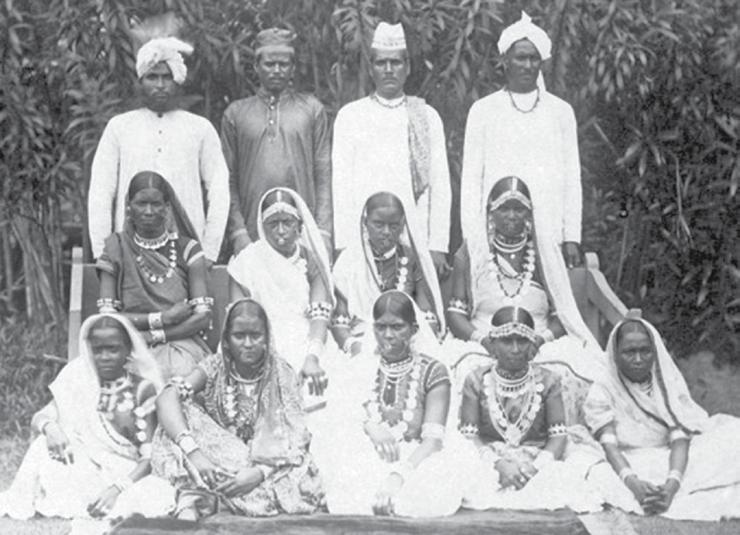
one day and night if he worked for two consecutive weeks. If he was absent without leave for more than seven days from the plantation, he was declared a deserter and a warrant was issued for his arrest.
There was an important exception to this rule. A pass was not required by worker if he was leaving the plantation to make a complaint to a magistrate or the office of the Immigration Agent-General. But in doing so, he could not leave in the company of more than four other indentured persons. This requirement was not always enforced and on many occasions larger groups left the plantations to lodge complaints about their treatment at the office of the Immigration AgentGeneral in Georgetown.
Based on the regulations of the 1891 ordinance, the Immigration Agent-General had to investigate the complaints of indentured workers and make rulings without any lengthy delays.
The ordinance of 1891 also instructed the employers to provide suitable housing for the workers and a fine could be levied if this was not done. Despite this, no plantation owner was ever convicted even though their workers were housed in unsanitary and dilapidated living quarters which also offered them no privacy.
The Non Pareil Riot
Indentured workers complained regularly that the ordinance imposed harsh penalties on them, and that it was imposed for the benefit of the plantation owners. These conditions resulted in a riot at Non Pareil (on East Coast Demerara) on 13 October 1896 after Indian indentured workers staged a strike. One of the strike leaders was Gooljar who
originally was indentured in 1871, and after he completed his contract, he became a cloth seller, and worked with the police force. He returned to India in 1890, but came back to Guyana in 1894 as a re-indenture to the Non Pareil sugar plantation where his experience and leadership qualities won the respect of the other Indian indentured workers.
The strike itself stemmed from actions taken by a planter who attempted to transfer to other plantations several Indian indentured workers whom he considered troublemakers. This arose after the workers protested against low wages and increased tasks at the plantation, and also the repeated sexual assaults on Indian women and girls by the White overseers. After they halted work, they went to the Immigration AgentGeneral's office to complain. On their return, they were confronted by a party of police, commanded by Captain G. C. De Rinzy, widely regarded as one who generally applied violent methods in curbing workers' protests. They attempted to arrest four of the men, but the crowd quickly prevented this action. The police, without reading the riot act, then opened fire on the crowd, killing five persons, including Jungali, who had earlier complained that his wife was abducted and raped by one of the overseers. Others who died were Kandhai, Chinahoo, Rogy and Mahabir. In addition, fifty-nine indentured workers were injured in the hail of police fire. Bechu's criticisms of the indenture system
It was this massacre that spurred the indentured Indian, Bhoshunath Chattopadhyay (known
ed in 1897. In his first letter published in the Chronicle in November 1896, he condemned the White overseers' sexual exploitation of Indian females; refusal of estate hospitals to provide medical treatment to un-indentured Indians; and the planters' frequent breaches of labour laws in order to impose their total control of the Indian indentured workers and their families.
as Bechu) to write letters for the next four and half years to the editors of the Chronicle and several newspapers in which he brilliantly championed the cause of the immigrant labourers. His letters sharply upset the planter class and on two occasions (1898 and 1899) he was prosecuted for libel, but divided juries could not find him guilty.
Buchu expressed opinions most forcefully against the severe working conditions and the penalties imposed on
So powerful was his condemnation of the indenture system that the West India Royal Commission, appointed by the British government to examine working and living conditions of the people in the British Caribbean, invited him to present evidence and a written submission to the fourmember commission when it visited Guyana in early 1897.
In his submission to the Royal Commission, Bechu cited his own personal experience as an indentured worker, pointing out that the concept of equality embodied in the contract was never applied in practice nor were the specific provisions of the
gested Indian immigrants on the completion of their indenture, should be provided an incentive to settle in the country by providing them land instead of return passage to India. His writings in the local newspapers drew sharp responses from the sugar planters some of who responded by writing rebuttal letters to the same newspapers. But these only acted to encourage him to respond with other letters to dissect their arguments. Bechu eventually returned to India in 1901. Unfortunately, all the exposure of the ills of the indenture system by Bechu and subsequently by other Indians failed to move the authorities to apply remedies. For more than twentysix years their demands for the immigration ordinance to be amended fell on deaf ears, and it was not until 1917 that the Court of Policy finally decided to amend this law. The Court of Policy, no doubt, was sensitive to the representations of the Indian government which expressed concerns over the treatment of indentured Indians in
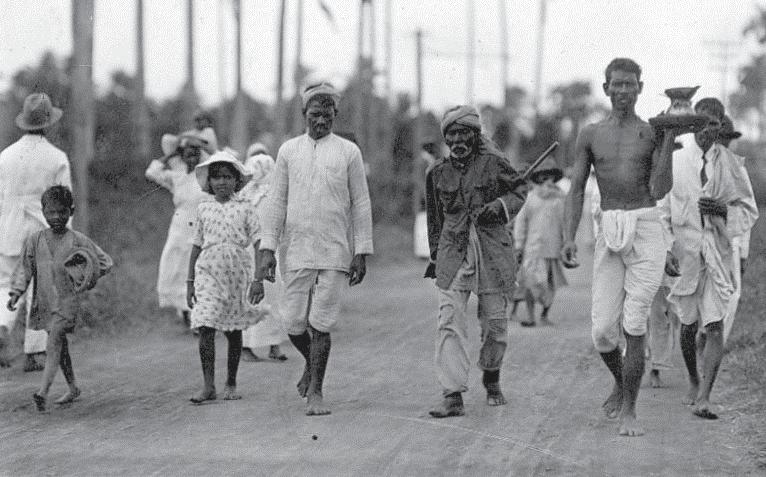
the indentured Indians. He himself was a relatively highly educated Bengali immigrant who was well versed in the English language. As an orphan, he was raised by Presbyterian missionary lady in Calcutta and had lived and worked with other missionaries as a copyist and domestic help. Though he was never educated in a school, he had been taught by his missionary guardian as a child and as he matured he developed a keen interest in English literature.
As an adult, he indentured himself to British Guiana and he was contracted on Plantation Enmore in 1894 where he worked in the house of the deputy manager until his indenture end-
contract applied by the planters or enforced by the colonial government. Workers also were afraid to complain against the drivers and overseers because they feared being prosecuted on trumped up charges.
Bechu noted the rampant practice of concubinage and sexual exploitation of Indian women by overseers and managers which he explained was a serious source of management-worker conflict and which resulted directly in the frequency of wife murders among Indians.
He opposed further immigration on the grounds that it was contrary to the interests of the indentured and free Indians in Guyana. As an alternative, he sug-
Guyana. In addition, the influential role of the anti-emigration movement in India, which was supported by Mohandas Gandhi, was instrumental in pressuring the colonial authorities to amend the ordinance. The amended ordinance stipulated that criminal actions against indentured workers were abolished. Civil measures including repatriation to India, in extreme cases, were now to be applied. Penalties were drastically reduced and fines could not exceed one-third of the weekly wage. Imprisonment for labour offences was also abolished. (Extract from The Guyana Story by Odeen Ishmael. Permission granted by the author.)
Demerara 'coolie' girl
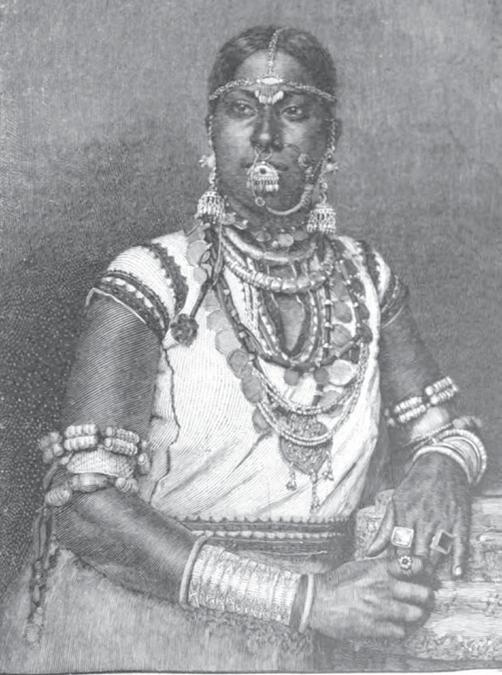
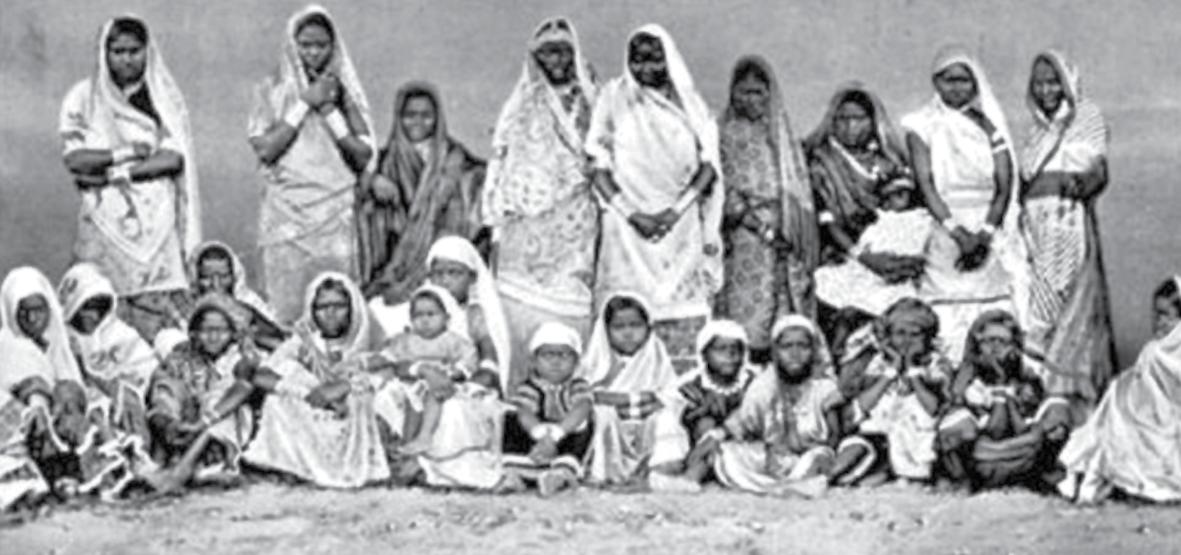
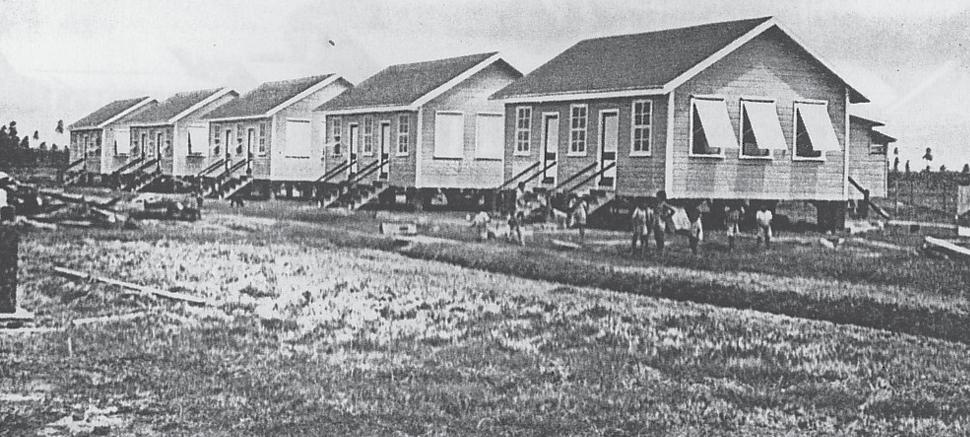
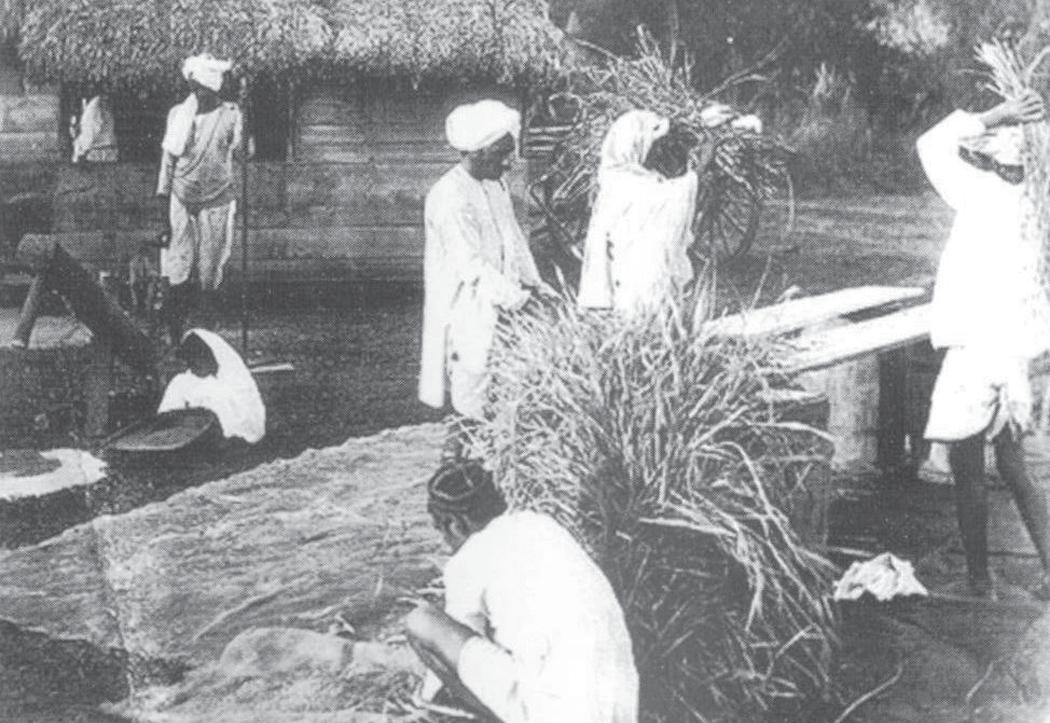
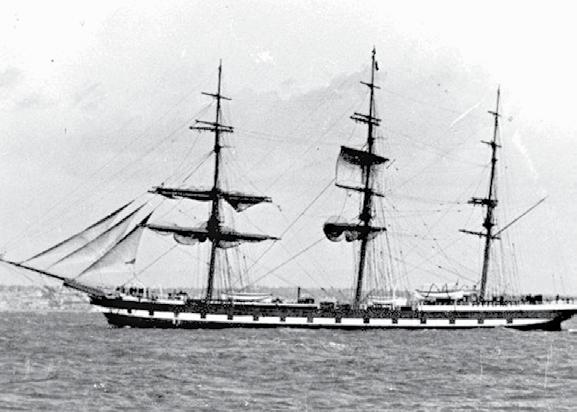
Semi-detached labourers' cottages at Plantation Ogle (Photo credit B.G. Sugar Producers' Association)
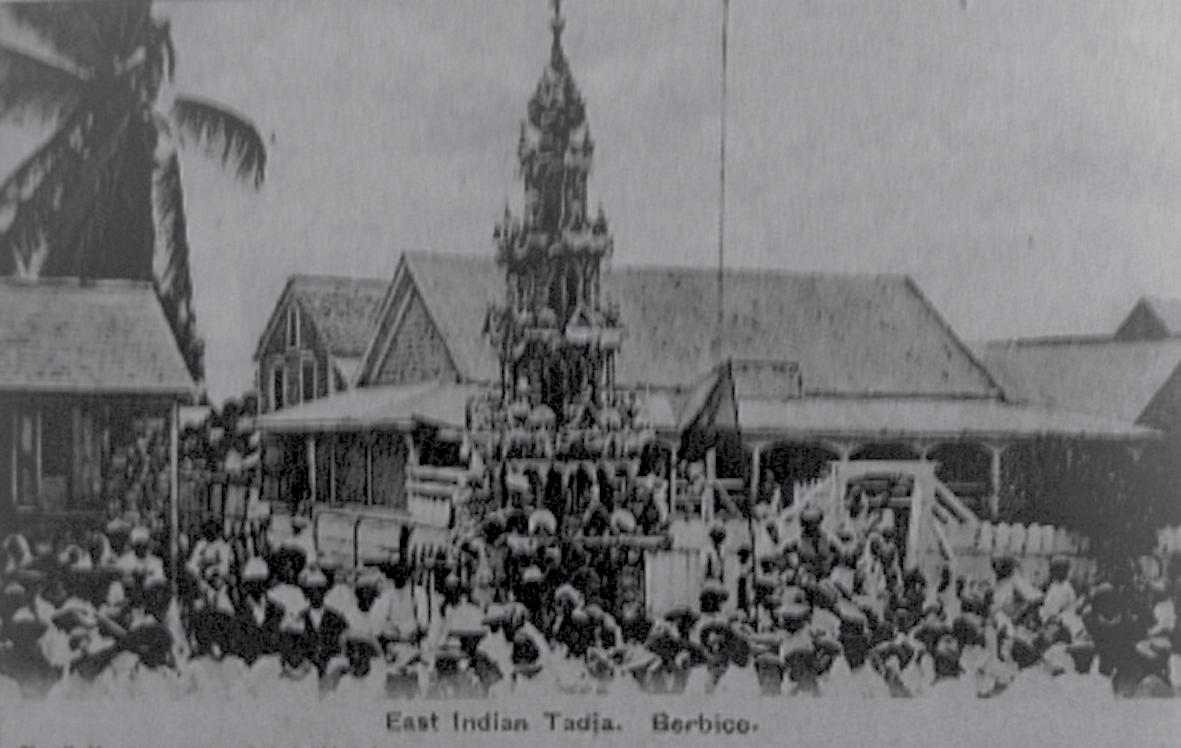
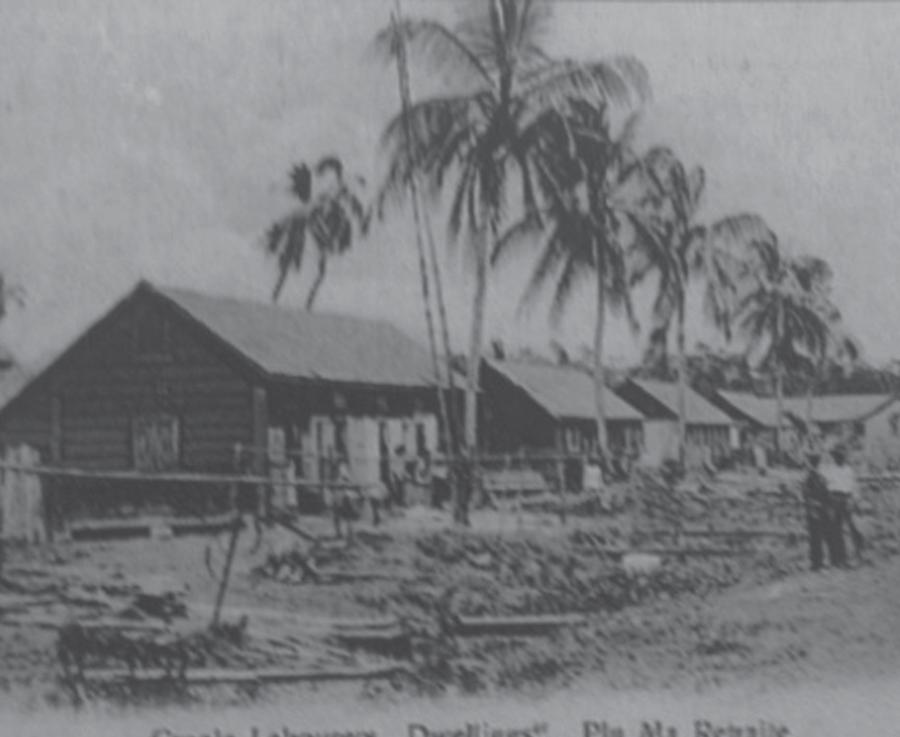
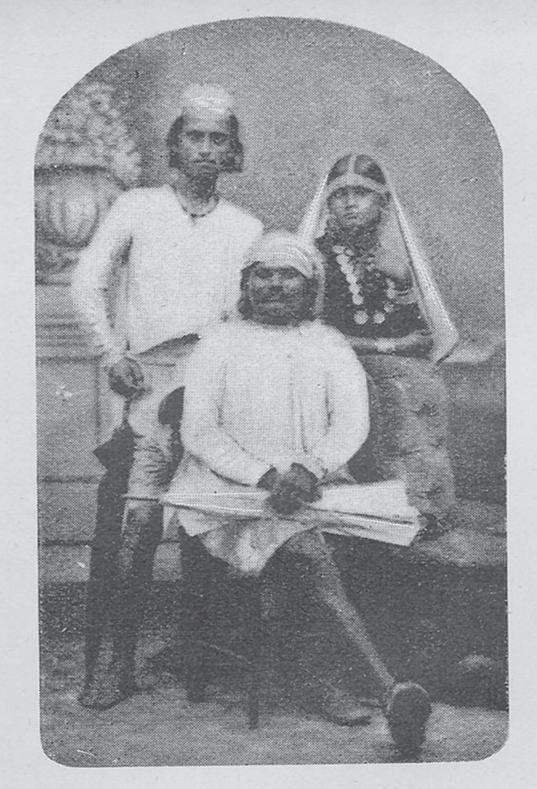

…racists
Your Eyewitness has written before about some folks stricken by the mental illness of hypergraphia. These people just can’t stop writing…they go on and on and on…You’ve seen them in the letters’ pages day after day, haven’t you? Asquith Rose, Harish Singh, Ms Maxwell. Be kind to them – the condition’s actually caused by a physical defect in the brain. But apart from the obsessive writing, they’re just like other folks.
But their compulsion opens a window into their minds. Look at the latest letter written by Rose and his sidekick Singh. It reveals the racist assumptions of a lot of folks when it comes to African Guyanese. The hypergraphia sufferers made the following syllogistic argument.
Major premise: Indians vote PPP, Africans vote PNC, and Mixed and Amerindians vote PPP. Minor premise: Indians have migrated. Conclusion: the PPP can never, ever regain a majority in Guyana. Now you see the humungous, racist flaw in all of this, don’t you? Even if their major premise was correct, these racist wankers assume that no matter what the PPP does, Africans, who’re now the majority, will never vote for them.
Now people who hold one set of beliefs about other people – no matter what the latter do – are holding stereotypes about those people. And when the beliefs are linked to race – the PPP’s “Indian” – the stereotype is racist. But your Eyewitness will never believe Rose and Singh’s contention that African Guyanese are so racially fossilised, they won’t vote for the PPP – regardless of the latter’s policies and record.
Sadly, however, while most Guyanese might not be afflicted by hypergraphia, some do think along similar lines when it comes to the voting behaviour of African Guyanese. They obviously believe that the latter are so imbued with anti-Indian emotions they can never change their behaviour.
And what’s even sadder is, it’s precisely this assumption about Africans that made Europeans enslave them. Slavery was “for their own good”, since they couldn’t reason for themselves, they had to be taught by those who could.
Your Eyewitness believes that it’s high time Guyanese come down hard and denounce this standing libel against African Guyanese. While as a minority, African Guyanese might’ve huddled together in fear for their security, now they’re the majority – we’re certain they’ll display rational choice behaviour.
And they’ll vote for the party that’s shown it developed the country during their turn at the helm, rather than the one that ran it into the ground. And we all know which is which, don’t we?? Even the hypergraphia afflicted.
…fence sitters
Ex-Speaker Ralph Ramkarran said a mouthful on the Rodney Inquiry in his latest column in the Stabber News. (We’ll dispense with the fig leaf of the “blog”.) The gist of what he said is that all the players in the highly charged 1978-1980 political landscape ought to give testimony. He thus agrees with the PPP on the point over which APNU has broken a long lance: that the said time frame is too “expansive”.
But Ramkarran went beyond his usual homilies about the lamb lying down with the lion and living happily ever after. He named some of his erstwhile comrades – “Clement Rohee, Gail Teixeira, Harry Nokta and Moses Nagamootoo, now of the AFC” –and asked that they talk about the “rigged elections, authoritarian rule, violence, intimidation, lack of permission to travel to the hinterland, to hold public meetings, deprivation of newsprint and more.”
But if “Nagamootoo, now of the AFC” should testify, shouldn’t Ramkarran – 50 years inside the PPP – get off the fence he’s teetering on, and do the same? Show some testicular fortitude, Ramkarran! …invertebrate
Because he fears a racial Armageddon, an exMuckraker wanker Roy Paul proposed the Rodney CoI “just ascertain the real cause of the death of (Rodney) and refrain from naming any group or individuals suspected of being responsible.”
It’s the truth that’ll set you free, spineless wanker.
Those of you who have travelled anywhere would know that the first impression of a place or people is formed at the airport. The tourist lands at CJIA, climbs down the stairs from the plane, and walks a bit into the airport.
Those planes are small, but the relatively small number of people suddenly seem like a great crowd, as if multiple planes from multiple airlines have landed all at once. The five or so immigration lines are long, although the immigration officers try to move it along as quickly as they can.
The tourist waits his turn, gets the old stamp stuff done and then proceeds to the single carousel to collect their two suitcases. The trolleys are free. The tiny airport seems like a relief, until the heavy suitcases have to be lifted onto the large scanner. The impression is not a good one, but he knows that he is in a Third World nation, so it is okay.
The tourist comes, sees Georgetown, the town that people say is the nastiest in the world. Then there are the usual tourist things: Kaieteur Falls, Essequibo, Berbice, Number 63 Beach. The tourist is well fed and drinks his fill. He is impressed by the landscape and our hospitality.
He hears the noise we call music and thinks it quaintly primitive and childishly foolish. He
By Professor Daizal Samad
sees our recklessness and thinks charitably that we are an adventurous people. The numerous rum shops represent our version of entrepreneurship, and our filthy language is just a “cultural” thing.
One of the ways to read a nation is to visit the pages of the local newspapers. He reads the “anti-government” papers and the news appals him. The rapes and murders and violence and corruption, and the simplicity and viciousness of Third World politics are on show.
He reads the “progovernment” papers and sees little or nothing of the sort. It is all good news, and the great progress we have made could have been even greater were it not for Opposition forces. The language in the papers is also quaint, but then we just learned English, so better cannot be expected.
There are analysts
and letter writers and columnists and such whose language is so bloated that the tourist chuckles. The tourist feels even more special – superior even, and everyone needs to feel superior once in a while.
But it is time to leave, back to home where hard work has to be done. So back to CJIA. Our hospitality is of such that his two large suitcases and much heavier than when he came. But that matters not, for he has help. His driver and a friend roll the heavy cases towards the airport door while our tourist rolls his hand luggage.
Our tourist has time and the airport is tiny and the night of drinking was long, so there is time and need for a cup of coffee. He leads his two companions/helpers to the two small cafes outside of the airport. The places are open, but there is no one behind the counters. He stands and waits with the two

Satiricus felt the pride in being Guyanese rise in his bosom (or was it his stomach?) as he read about the latest stand on principle in that bastion of principles called “City Hall”. Too many of his fellow countrymen and women missed the point about what was going on in that Gothic structure. They were cruelly singing, “City Hall is falling down; falling down; falling down/City Hall is falling down… My Dark Mayor.”
“And that’s the point, isn’t it?” mumbled Satiricus to himself. So what if City Hall is crumbling, or as the latest report said, was “structurally unsound”? The Mayor for Life couldn’t let any Tom, Dick or Government get involved, could he?
What the heck would “City Mayor” mean if he wasn’t controlling every penny (well, “dollar” nowadays) spent on the City? It was the principle of the thing: the Mayor knows best when it came to money. Those who said that the Mayor for Life wanted to control spending because of his other principle on money – “10 for me – one for the City” – was just bad-minded. They had forgotten he’d changed.
But on this latest brouhaha in the City Council, no one would be able to point any dirty finger at the
locals. No one appears. He waits some more. No one.
Finally, he calls out: “Hello! Hello! Is anyone there? Hellooo!” Finally, a woman appears from behind a door, half of her showing, the other half hidden. She raises her hand, her palm outward, signalling that our tourist should wait.
Minutes after, another woman comes out to the coffee counter. No apologies, no “good morning”. She stands there. He orders a coffee. Takes it, walks away. Takes a sip, and throws the rest into the garbage.
Then our tourist and his local companions head to the airport door. They are stopped by a lone woman in uniform. She tells him that his companions cannot go in. But how would he wheel two heavy suitcases and his hand luggage? He leaves one, wheels two, joins a long line and then returns for his third piece of luggage. The other two are left alone. On the screen, there is a warning that one should not leave luggage unaccompanied. He smiles. Oh well, this is the Third World. It is to be expected.
There are several lines at the airport counters. But only two people are working. They take passengers from all the other lines and his line remains unattended. People in his line begin to grumble loudly. But what can they do, it is the Third World.
Mayor for Life. Under his leadership, the struggle at City Hall had reached new heights in his unremitting efforts to deliver the best service and City to the residents. This time, the fight the Mayor for Life had to lead was over the power of prayer in the running of the city. Imagine the Town Clerk felt that her reading the stipulated prayer was enough to make meetings of the City Council properly “constituted”.
“What nonsense!!” exclaimed Satiricus with a snort. “Didn’t the Town Clerk know that desperate times called for desperate measures?” Well, luckily for the citizens and denizens of GT, the Mayor for Life was there to save the day. This man, who’d launched the programme for “moral renewal” in all Guyana, now ordered that all around the City Council table should henceforth pray for the City.
The meeting to discuss the so-called “pressing problems” facing the City was cancelled. This principled man was standing up for the sacrosanct principle that in prayer, as in partying, “the more the merrier”. Such depth…such vision…such leadership!!!
“Then again,” wondered Satiricus, “the wily old fox might be conceding that the only thing that can save the city of GT is Divine Intervention?”
1837 - John Gladstone suggests East Indian indentured labour as a solution to the drifting of Africans from the plantations to the towns. Permission is granted to bring 'Coolies' for his two plantations.
1838 - The first indentured labourers drawn from the hill areas of South India arrive in Guiana. 156 East Indians arrive from Calcutta on the "Hesperus". They are under indenture for a five year period, and for the first part, they are housed and given rations, but are not paid. Great mistreatment of the labourers results in prosecution of some of the planters.
1843 - The end of the first period of indenture. Many of the labourers return to India.
The 1840's - England suspends the indentured labourer system. Immigrant labour from India, Portugal (mainly Madeira) and China is permitted, under Government control.
1853 - January 12th. The first contract Chinese labourers arrive in British Guiana on the "Glentanner". Most are assigned to Windsor Forest, Pouderoyen and La Jalousie estates.
1860 - March 11th. The first female Chinese labourers arrive on the "Whirlwind".
1874 - The last contract Chinese labourers arrive in Demerara.
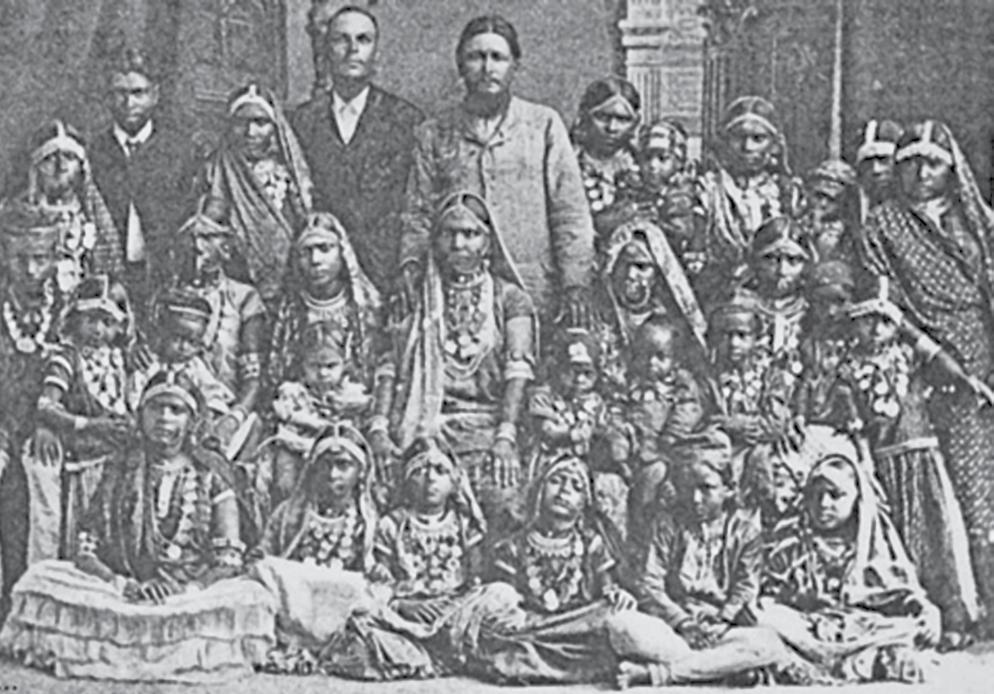
1917 - The Government of India abolishes the indentured system. No more East Indian labour is allowed to enter Guiana.

Between 1838 and 1917, almost 240,000 East Indian indentured workers were brought to British Guiana. The indentured workers had the right to be repatriated at the end of their contracts, but as of 1890, most of the East Indian indentured workers had chosen to settle in British Guiana.
Although the great majority of the East Indian immigrant workers were from northern India, there were variations among them in caste and religion but on the colonial plantations they were housed together and placed in work gangs without consideration of caste.
The process of assimilation has made the culture of the modern Indo-Guyanese more homogeneous than that of their caste-conscious immigrant ancestors.
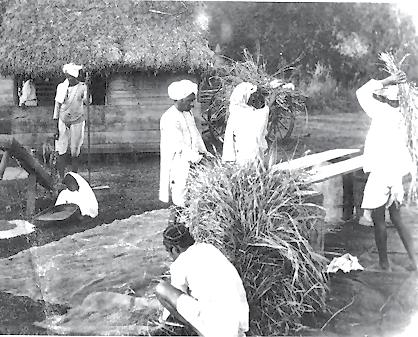
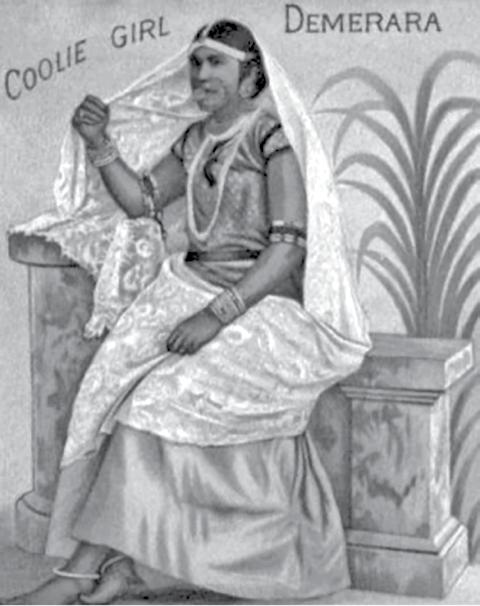
On May 5th 1838, the very year of final slave emancipation in the British West Indies, a small batch of 396 Indian immigrants popularly known as the 'Gladstone Coolies' landed in British Guiana (Guyana) from Calcutta. This was the beginning of the indenture system which was to continue for over three-quarters of a century and whose essential features were very reminiscent of slavery. Within a decade Indian immigration was largely responsible for changing the fortunes of the sugar industry, the mainstay of the economy, from the predicted 'ruin' to prosperity.
Having been recruited and registered, the emigrant was taken to the depot where he immediately began the process of 'seasoning' for the long, monotonous voyage to the West Indies. At embarkation certain precautions were taken to ensure health and safety en route. Social intercourse between crew and emigrant women as well as the carrying of firearms or inflammable material was strictly prohibited. Besides the officers and crew, each emigrant vessel was provided with compounders, interpreters and topazes. The compounders dispensed medicine and often acted as interpreters; the topazes or sweepers ensured that the deck and water closets were kept clean.
On arrival in British Guiana the indentured worker quickly came under the regularity and discipline of the plantation system. The plantation under slavery has been described as an economic unit producing agricultural commodities for export. It employed a relatively large body of unskilled labour and had a rigidly stratified social structure based on occupational status and divided along race and colour lines. Decision- making was centralised, orders emanating from the master were issued to the slaves through the driver (headman). With emancipation the social structure was somewhat adjusted but the basic feature of plantation society remained similar to that of slavery. In fact, many of the characteristics survived well into the twentieth century.
From the 1860s to the abolition of indenture in 1917, Indians comprised the hulk of the immigrant work force. They were indentured for five years but were required to serve for ten before being entitled to a free return passage to India.
By Ashook RAmsARAn
My personal quest for my own connection to India was always a yearning long before I met with Minister Jagdish Tytler of the then newly formed Ministry of Overseas Indian Affairs (MOIA) in Brussels, Belgium in October 2004.
My continuing search and inquiries led me through many pathways but nothing definitive that would allow me to pursue a direct link to the ancestral village of my great grandfather Pooriya who arrived in Guyana (then British Guiana) as an Indian indentured laborer in 1853 aboard the ship Adelaide. That information was shown in the single line entry in the birth record of my grandfather Ramlochannd born March 10, 1867 in Guyana. That single line entry also listed my great grandmother Radhah having arrived in Guyana in 1860 aboard ship Colgrain. With no ship records of 1853 or 1860 available in the archives in Guyana, my search moved beyond Guyana to other possible sources such as India and the United Kingdom where I was hopeful that secondary records were kept.
In conjunction with that pursuit, I wanted to become more involved in civic organizations that focused on persons of Indian origin (PIOs) living in various countries. In 1998, I co-founded of the Guyanese East Indian Association (GEICA) which focused on adaptation and assimilation of PIOs from Guyana (and other parts of the Caribbean) in the United States. That same year, I became a life member of the Global Organization of People of Indian Origin (GOPIO International) and shortly thereafter advanced to the position of Secretary General.
From both my vantage point as Secretary General of GOPIO and my regular interaction with other PIOs and non-resident Indians (NRIs) on a global scale, I was able to view the entire global landscape of PIOs and the history of emigration from India during the 19th and 20th centuries. In particular, I acquired historical details, more in-depth knowledge and valuable information on Indian indentured laborers from 1834 through 1920. This appealed to me since I was interested in knowing more about my great grandfather and his journey to Guyana, with
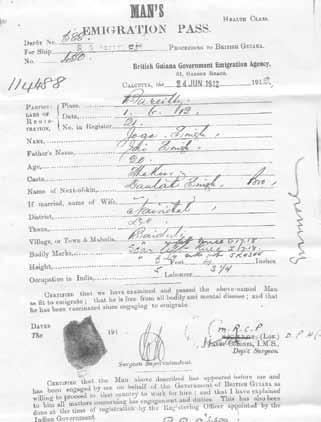
the intent that perhaps someday I would be able to find his ancestral village.
After review of my proposal and subsequent discussions, Minister Tytler of MOIA was convinced that my request to initiate and chair a session at PBD2005 was a worthwhile one: I chaired the first “Tracing The Roots” session at Pravasi Bharatiya Divas (PBD) 2005 in Mumbai, India. That session spawned renewed intensity among PIOs and encouraged MOIA to establish “Tracing The Roots” initiatives within MOIA and those were qualified to do actual searches for families in Indian based on emigration information obtained in the countries of destination. A few Indian states, including Bihar, also initiated programs to assist PIOs to trace their re-

spective families and their ancestral villages.
I considered this a welcome trend that contributed to more interest among descendants of Indian indentured laborers and their quest to connect to their ancestral villages and, in effect, to India itself. It was a very successful session that drew on the experiences of many in PIO countries, historians, academicians and custodians of records of Indian emigration, in particular Indian indentured laborers from 1834 through 1920.
Thereafter, I was emboldened and encouraged to seek more and to do more to fulfill that personal desire to find and connect with the land (even the village) of my ancestors.
Since that time and previous as well, it has been a journey into the unknown, seeking those I have not known but wanting to know. Yet somehow it felt that I may have known them all along but have been missing the connection that could fulfill a long desire that exists as a vacuum. For lack of success in my own quest, that personal quest was quickly transformed to a universal one, representative of the descendants of those who left India from the ports of Kolkata (Calcutta), Chennai (Madras) and Mumbai (Bombay). In so many ways, it was fulfillment of another kind, for the larger good – and how fascinating this journey has been at every single point for me.
While I was standing with Leela Sarup and MOIA officials on the Kidderpore Depot docks on July 7, 2010, that realization came to fruition when the agreement was made with Dr A Didar Singh, Secretary of MOIA, to embark on a two-phase effort to pay tribute to Indian indentured laborers of 19th and 20th centuries (in particular, from 1834 through 1920): Installation of a memorial plaque at Kidderpore Depot (to be unveiled on January 11, 2011) to be followed by a memorial museum and resource center in a suitably significant site in Kolkata. In that respect, the July 7, 2010 meeting was quite historic indeed.
Born in Guyana, Ramsaran resides in the USA. President of GOPIO Int’l and advocate of interests of PIOs, spearheading the Kolkata Memorial project. (Indian Empire Magazine. Permission granted by editor)

By Clement Sankat
The decision of various areas of the Government of India to collaborate with the Global Organisation of Peoples of Indian Origin (GOPIO) to install a memorial to the 1.4 million girmityas (agreement signers) who left India between 1834 and 1917 as indentured labourers, many bound for the Caribbean, is a significant milestone in the story of the Indian diaspora’s achievement.
I thank the Government and people of India for keeping the memory of its indentured sons and daughters alive. To locate such a memorial at the Demerara Dock at Kidderpore on the Hooghly River demonstrates that the planners were cognizant of the long years of departure from those docks and the others in the Garden Reach area which was a receiving centre for hundreds of thousands who were huddled there after their long treks from Bahraich and Lucknow, from Kandahar and Gonda. Almost one half of these “bonded coolies” some 500,000, were dispatched to the Caribbean, the largest numbers being sent to Guyana and Trinidad. The first two ships, the Hesperus and Whitby land-
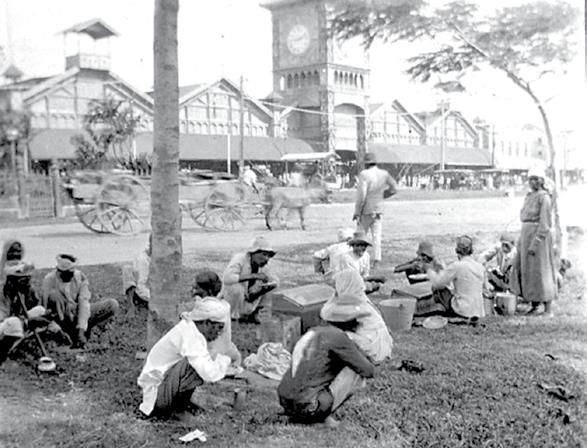
ed their first two batches of human cargo at Georgetown in May 1838. These were destined to the Gladstone Estates but the further transference of labourers was suspended thereafter because of the poor treatment of the Indians.
By 1845, the British felt that conditions had been sufficiently improved to resume the trade to the Caribbean and from that year to 1917, there was the transportation of some half a million people. Indentureship finally came to an end in January 1920. In commemorating the
176-year-old Indian presence in the Caribbean, it would be good for us to remember that India’s loss was the Caribbean’s gain. In the first place, the Indians did in fact fulfil the purpose for which they had been brought here. That was the resuscitation of the sugar industry particularly in the areas of new cultivation in the Southern Caribbean such as the Rosehall Estate in Canje, Berbice, Guyana, which to this day is a thriving centre of sugar production. They functioned not only in the sugar industry, but equally
in the various colonies, in other areas such as the introduction and cultivation of many varieties of swamp rice. They revived moribund coconut and cocoa estates and in their Jahagi Bandals (ship’s belongings) they brought an extensive array of seeds and cuttings which transformed the host environment: mango, Indian guavas, pomegranate, and many varieties of spinach (bhagi), lentils (dhalls), a wide range of spices, tamarind, jackfruit (cowa), Indian drumsticks (saijjan) and other fruits. The Indian Zebu cattle and the water buffalo (bhaisa) became regular replacements for the less sturdy estate mules as major means of sugarcane transportation. These animals were brought as accompanying baggage on the indenture ships; these ships also brought members of the cattle-rearing caste (ahirs) who would tend these treasured animals.
The Indians also brought considerable engineering “know how”, gleaned from thousands of years of experience in land reclamation and water control in the vast Indo-Gangetic plains from which most of them came. With those skills, they were able to continue the vast drainage schemes in Guyana
and Suriname which had been initiated by the early Dutch settlers, thus creating new cultivable land for principally rice production in the narrow coastal regions of the Guyanas. Guyana became the rice bowl of the Caribbean. Similarly they created many villages (now towns) in the swamps of Caroni and Naparima in Trinidad, in the Westmoreland wetlands of Jamaica or the Mesopotamia valley in St. Vincent; here they planted rice in the wet season and vegetables during the dry season: melons, bodi, ochroes, ginger, pumpkins and mustard all with seeds brought from India. After their period of bondage, thousands of them reverted to their original caste occupations and in this way added to the variety of occupations in the receiving countries (sonars) jewelers, kisans (cultivators), bhandaris (cooks), kumhars (potters), darzis (tailors) and religious leaders. A few returned and died in the motherland, India.
Sankat is a Guyanese educator and principal of the St. Augustine Campus of the University of West Indies in Trinidad (Indian Empire Magazine. Permission granted by editor)

Today, Richmond Hill in Queens New York is synonymous with the presence of the IndoGuyanese community in New York City. By all estimates, it forms the largest concentration of Indo-Guyanese outside of Guyana. How did this occur? It started with one young man named Ramesh Dalchan Kalicharran, who hails from Bush Lot, Essequibo.
Popularly known as Kali, the eldest of 11 children, born to Ramdayal and Mangani Kalicharran, did well in his GCE exams and became a teacher. He wanted to move up. After a brief stint, Kali responded to a newspaper ad for Physicians Assistants and left at the age of 21 for New York in 1970. He was one of the early Indo-Guyanese to emigrate to the US. (Before this, England was the preferred destination, but changes in their immigration laws closed it off.)
Working full time to fund his studies, he graduated in 1973 but was forced to abandon his quest for higher education and sought work to support his relatives back in Guyana. The situation there was deteriorating under the PNC. He joined Bellevue Hospital as a lab technician (Pathology Department) and simultaneously did studies in medical illustration at Hunter College. Then he supplemented his income as manager at a department store where he met his wife, Judy. They got married in 1974. This successful union produced three talented children: Jagdesh, Nadesh, and Romanee - all of whom have become ambassadors (musical artistes and dancer) in Indian culture.
In 1976, Kali made a bold move: he entered the real estate profession, first
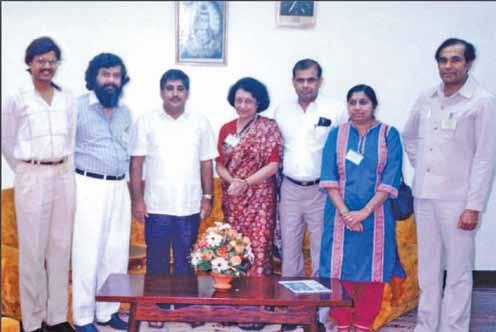
as a salesperson and subsequently as a broker. He ended up taking an enormous risk for a person who had no prior background in real estate by purchasing the business, Arcel, from its Italian owners. But he ended up blazing a trail in real estate, which formed the foundation for the community in Richmond Hill.
Kali made one of the first sales on Liberty Ave to a Narbada Persaud. Soon the flood of Guyanese immigrants started and they were steered to homes by Kali and others that followed in his pioneering path. The entire area was transformed. But Kali did not rest on his real-estate laurels: he became own-

er and president of the Kali group of companies (Kali Realty, Kali Travel, which undertakes semi-annual yatras to India, and Arcel Driving School).
Additionally, in these areas, he was followed by others who saw the opportunity and took the risks to service the burgeoning Indo-Guyanese community.
But Kali was more than just a businessman. He used much of the proceeds from his business ventures to support culture - earning the title of cultural philanthropist.
He helped to found or support numerous organisations to help the Guyanese immigrants become a
community. There were the IndoCaribbean Federation, Gyaan Bhakti Satsangh, Laxhmi Mandir, USA Pandits Parishad, Phagwah Parade, Caribbean Voice Magazine, and USA Hindu Parishad, Federation of Mandirs, GOPIO, India Festival Committee, just to name a few. Very significantly he helped to deform linkages with the organisations that serviced the "Indian from India" community in New York.
He has been generous in sponsoring cultural activities, including various Indian beauty pageants, India Day Parade, Diwali Festival, Phagwah Parade, and many others. He was also a member of ICONS, a director of India Festival Committee, and the Caribbean co-ordinator of GOPIO. In addition, he has helped to organise numerous social, cultural and political events that hosted elected leaders in NY from the Caribbean, Fiji, and India. He also played a significant role in struggling for the restoration of democracy in Guyana and for assisting in a number of fund raisers for the late President Jagan when he was in the opposition. He also fundraised for former Prime Ministers Mahendra Chaudhry and Basdeo Panday.
Kali's activist community work has seen him aggressively raising the consciousness of New York City's officials to the presence of the large and vibrant Indo-Caribbean community in Queens and their culture.
For his commitment and dedication to public life, Kali has received numerous accolades, citations, and awards, including from politicians, or-

By Janet a naidu
The first arrivals in 1838 on the sailing ships, Hesperus and Whitby, numbered 396, of whom only 22 were women.They lived in logies with poor sanitary conditions throughout the indenture period. Children and young women worked on sugar plantations in the ‘weeding gang’ and later in the ‘task gang’ or ‘creole gang’, earning poor wages.
In the late 1940s, women would leave their babies at the estate crèche and go to work in the fields. They would also carry their babies in the fields, until an old-

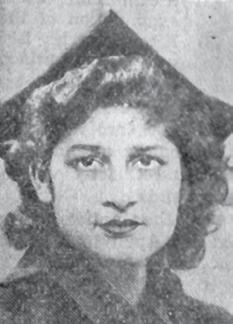
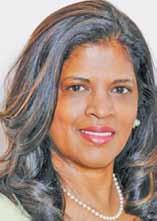
er child was able to stay home and look after the younger sibling.
The role of women such as ‘Sita’ of the Ramayana and ‘Radha’ of the Mahabarata were
portrayed as the pure and ideal wife, and these representations continued to influence gender relationship expectations between men and women (at least among the Hindus).
Women who resisted
or were accused of violating the oppressive patriarchal structures within Indian family structure were abused or even murdered. Among the women killed in this early period were “Anundai, Baumee, Goirapa and Saukalia,

for allegedly deserting their husbands.”
Although the gross disparity of women created the conditions for sexual exploitation, it also served to strengthen their resistance movements throughout the indenture period.
Sugar planters imposed harsh working conditions on labourers so that many strikes (riots) occurred. Labour unrests were often because of workers’ protests against mistreatment of estate workers, especially since the first riots on estates broke out in 1869.
Women also participated in protests against planters’ mistreatment of workers on sugar estates. In 1903, at Plantation Friends in Berbice an indentured woman, Salamea, urged Indians to fight against the plights of indenture. Moreover, after indenture ended in 1917, while Indian women continued to protest as they struggled for justice, they also became victims of the planters’ oppressive practices on the sugar estates.
In 1964, Kowsilla, at age 44 and mother of 4, was “mowed down by a tractor [at Leonora sugar estate]. She became another martyr of the Guyanese working people movement.” Her death on May 6 is remembered for a woman who stood up bravely against a system of exploitation and oppression as during 1964 especially, many suffered during the sugar workers’ strike. Few such experiences and forms of resistance were recorded against planter oppression.
While many Indian women, especially among the working poor, had not attended school, they were working to maintain their families and to send their children to school. Thus these women contributed significantly to their household and community, especially as ‘financial managers’, developing ways to improve their economic position. These included planting their backyard with greens, raising chickens, goats, sheep, looking after their cows, selling milk, and buying and selling produce. Some also managed little shops in the villages and as-
sisted in their husbands’ businesses, such as the tailor-shops and grocery shops.
In the early 1930s and 1940s, Indian women preserved domestic life by participating in ‘throwing box hands’ to save money for their children’s education or marriage and, in some cases, they would ‘pawn’ their jewellery to obtain sufficient funds. In spite of the tremendous responsibilities they had to shoulder, their strength sustained the home greatly. Without birth control, many Indian women had large families, some having between 6 to 10 children or more, and therefore had to find ways to increase the family income to support a large family.
Urban women make their voices heard
At the same time, a small group of middleclass Indian women in the urban areas were beginning to participate in public circles.
One of the first known women to demonstrate resistance against the injustices of colonialism was Esther Saywack Mahadeo, (born in 1872) who was widowed at the age of 28, with four children. Having inherited a small shop, she refused her parents’ offer to return home. Instead, she became one of the leading merchants in New Amsterdam. As a young girl, she learned business skills while her father went to work selling oil on a donkey cart. With determination, she looked after her children and never remarried. She became very involved in the business and community, and became the first woman President of the Berbice Chamber of Commerce.
Recognizing the injustices against plantation workers, she took a petition, signed by hundreds, to the Governor in Georgetown, protesting the shooting of innocent workers who participated in a riot at Plantation Rosehall, Canje where Indians were shot and some killed in 1913. At this time, it was unthinkable for a woman to have done this, especially an Indian woman and a widow. She died in 1948, leaving a legacy of an Indian woman’s early voice against oppression.
Ram S. Singh was born March 26, 1912 in Alexander Village to indentured parents who had arrived in the colony of British Guiana in 1894. His father died in 1938 and his mother 10 years later.
Singh began his career with the British Guiana Museum of the Royal Agricultural and Commercial Society as a “washer or museum assistant” in 1924 at just age 12, after completing his basic education at the Ruimveldt Anglican School on what was then considered the East Bank of Demerara.
The then museum curator Walter E. Roth, along with P.S Perberdy, who was to succeed Water Roth as curator, further mentored the young Singh. In 1939, Singh was awarded a Diploma in Taxidermy of the North-Western School of Taxidermy in Omaha, Nebraska; then in July 1946,Singh was sent to the U.S under a special scholarship, to take a course in modern, scientific and educational techniques of taxidermy and exhibition arrangement at the Chicago Museum of National History.
By courtesy of the director of the museum Colonel Clifford Gregg,
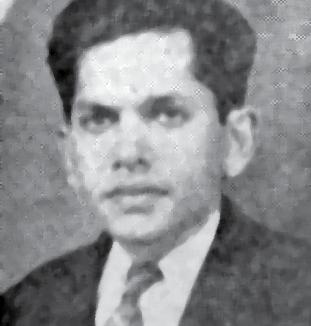
Singh also received an eight-month practical course in Taxidermy, Botany, Anthropology and Zoology, and went on to study the preparation of school exhibits. Upon completion, Singh was invited to study at the Colorado Museum in Denver for two months, in which time he visited the premier museums in San Francisco, Los Angeles, Iowa, Milwaukee; the American Museum of Natural History in New York and the Smithsonian Institute in Washington.
During his time in the U.S, Ram Singh received a diploma in zoology, and was highly praised by both staff and students for the
quality of his work. He became a member of the American Ornithological Union (MAOU) and the British Ornithological Union (MBOU). He returned to British Guiana June 11, 1947 to continue his work for the BG museum, when he was appointed assistant curator.
Ram Singh was also an expedition pioneer. Before his studies in the U.S, he accompanied both Walter Roth and Perberdy on interior scientific expeditions; going with Perberdy on the Pinkus-Perberdy Mount Roraima Expedition of 1938-1940. In 1939, Singh accompanied Dr E. Davis of Harvard University on
a field expedition up the Mazaruni River.
After the Feb. 23, 1945 Great Fire of Georgetown destroyed the museum and many of its exhibits, Singh would lead at least 11 special expeditionsinto Guyana’s interior to collect new material for the museum. He first travelled to the Abaryregion
Feb. 4, 1946; two years later, he reached the upper Abary, the Demerara River, through the northwest regions and the Rupununi district, collecting specimens.
He also travelled extensively along the coastlands from Essequibo to Berbice.
The specimens were
stuffed in the field before being brought to Georgetown; something, it was said, that had never been done before in the colony. With his extensive knowledge gained from travels in the US, British Guiana and Brazil, Singh was able to collect, preserve and exhibit museum specimens.


The dwellings of the immigrant population in Guyana represented a tale in substandard living conditions that had seen little improvement since the time of slavery.
Immigrants were assigned to sugar plantations lying along the coastline of Guyana. The logies were notoriously dilapidated, many having been built during slavery to house the enslaved Africans. Erected on low-lying land that lacked mechanisms for adequate drainage, the immigrants lived in perpetual damp and suffered periodic flooding.
Coffee logies were described as the worst type of estate dwelling, consisting of an immense edifice, rigged up inside with "crazy floors and staircases" and inhabited as thickly as an ant's nest.
One at Plantation Friendship and Sarah at Wakenaam Island in 1870 is reported to have had big barrack rooms each inhabited by between 20 to 30 men and boys with hardly any furniture, and was in a miserable state of disrepair. Consequently, there
were problems of chronic ill-health and death among the immigrants, little privacy and no security.
Some immigrants were provided with materials to construct their own homes, but building materials were of poor quality and limited in supply. It was not uncommon to have the walls made of clay and the floors daubed with a mixture of cow dung and clay to provide a smooth surface. There was hardly any furniture and some East Indians slept on katiyas (cots made of ropes tied together).
Others survived on mats made of the leaves of the coconut palm.
During the 1860s, a new type of structure was experimented with at Plantation Diamond.
Twenty seven of two-family cottages were built on brick pillars about two feet high and were topped with shingled roofs. Each cottage measured 20' by 14' and was fitted out with a partition running down the centre of the structure. A stairway in each section led to the bedroom area above.
A steeply pitched roof fitted out with a window in
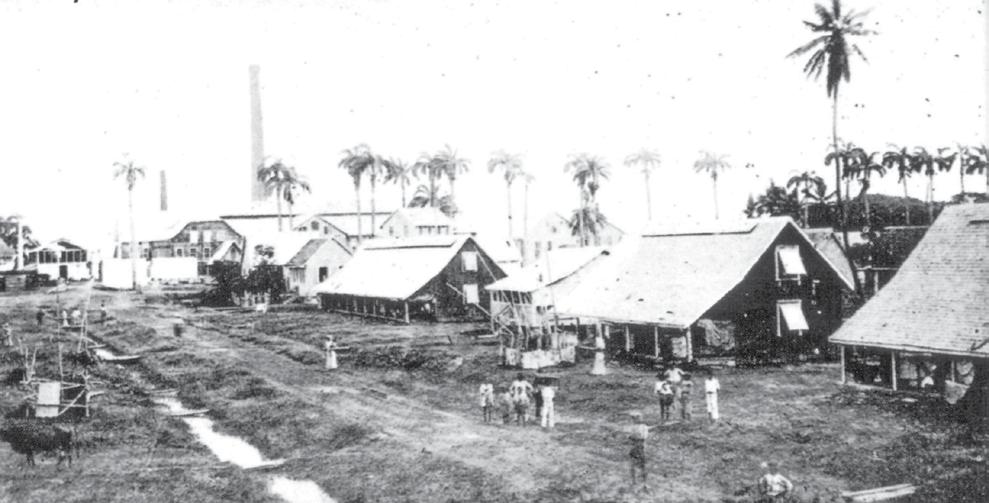
each gable supplied light and ventilation to the bedrooms. A kitchen located to the rear of the structure served two cottages and thus four families.
Logie-type housing would endure as the typical immigrant dwelling until the 1950s when housing schemes on estate lands began to proliferate.
Another type of immigrant dwelling was evident during the nineteenth and early twentieth century in Guyana. Mostly found in the es-
tates in Berbice, these "wattle and daub cottages" were built by the Indians themselves sometimes at their own cost, although sometimes the materials were provided by the estate [owner]. This was precisely the type of houses that they built after leaving the estates.
Generally, the estates did not encourage the erection of private cottages or save an inducement for the immigrants to re-indenture. The planters felt that if the workers were scattered
over a large area, there would be greater difficulty in enforcing discipline or turning them out to work. Moreover, some of the cottages were not well built since the immigrants were generally too tired after a full day's labour.
The houses were generally small, with walls made of wattle and covered with clay sand cow-dung, which gave a smooth, compact appearance. Inside there were a thick, substantial hearth [fireside] called the choolah, and the roof was
always thatched with palm coconut or palmyra leaves. The door was low and the shuttered windows small.
Although these houses were generally small, the occupants retained considerable privacy and security generally lacking in nor-mal estate accommodation. These were also generally spotless, and the occupants took great pains to supply themselves with such "luxuries" as furniture and household utensils. (Centre for IndoCaribbean Studies)

BY ALBERT BALDEO, ATTORNEY AT LAW
IF YOU ARE STOPPED FOR QUESTIONING
Stay calm. Don't run. Don't argue, resist or obstruct the police, even if you are innocent or police are violating your rights. Keep your hands where police can see them.
Ask if you are free to leave. If the officer says yes, calmly and silently walk away. If you are under arrest, you have a right to know why.
You have the right to remain silent and cannot be punished for refusing to answer questions. If you wish to remain silent, tell the officer out loud.
IF YOU ARE STOPPED IN YOUR CAR
Stop the car in a safe place as quickly as possible. Turn off the car, turn on the internal light, open the window part way and place your hands on the wheel.
Upon request, show police your driver's license, registration and proof of insurance.
If an officer or immigration agent asks to look inside your car, you can refuse to consent to the search. But if police believe your car contains evidence of a crime, your car can be searched without your consent.
Both drivers and passengers have the right to remain silent. If you are a passenger, you can ask if you are free to leave. If the officer says yes, sit silently or calmly leave. Even if the officer says no, you have the right to remain silent.
You have the right to remain silent and do not have to discuss your immigration or citizenship status with police, immigration agents or any other officials. You do not have to answer questions about where you were born, whether you are a U.S. citizen, or how you entered the country. (Separate rules apply at international borders and airports, and for individuals on certain nonimmigrant visas, including tourists and business travelers.)
If you are not a U.S. citizen and an immigration agent requests your immigration papers, you must show them if you have them with you. If you are over 18, carry your immigration documents with you at all times. If you do not have immigration papers, say you want to remain si-
lent.
Do not lie about your citizenship status or provide fake documents.
If the police or immigration agents come to your home, you do not have to let them in unless they have certain kinds of warrants.
Ask the officer to slip the warrant under the door or hold it up to the window so you can inspect it. A search warrant allows police to enter the address listed on the warrant, but officers can only search the areas and for the items listed. An arrest warrant allows police to enter the home of the person listed on the warrant if they believe the person is inside. A warrant of removal/deportation (ICE warrant) does not allow officers to enter a home without consent.
Even if officers have a warrant, you have the right to remain silent. If you choose to speak to the officers, step outside and close the door.
If an FBI agent comes to your home or workplace, you do not have to answer any questions. Tell the agent you want to speak to a lawyer first.
If you are asked to meet with FBI agents for an interview, you have the right to say you do not want to be interviewed. If you agree to an interview, have a lawyer present. You do not have to answer any questions you feel uncomfortable answering.
Do not resist arrest, even if you believe the arrest is unfair.
Say you wish to remain silent and ask for a lawyer immediately. Don't give any explanations or excuses. If you can't pay for a lawyer, you have the right to a free one. Don't say anything, sign anything or make any decisions without a lawyer.
You have the right to make a local phone call. The police cannot listen if you call a lawyer. Prepare yourself and your family in case you are arrested. Memorize the phone numbers of your family and your lawyer. Make emergency plans if you have children or take medication.
Special considerations for non-citizens:
- Ask your lawyer about the effect of a criminal conviction or plea on your immigration status.
- Don't discuss your immigration status with anyone but your lawyer.
- While you are in jail, an immigration agent may visit you. Do not answer questions or sign anything before talking to a lawyer.
- Read all papers fully. If you do not understand or cannot read the papers, tell the officer you need an interpreter.
You have the right to a lawyer, but the government does not have to provide one for you. If you do not have a lawyer, ask for a list of free or low-cost legal services.
You have the right to contact your consulate or have an officer inform the consulate of your arrest.
Tell the ICE agent you wish to remain silent. Do not discuss your immigration status with anyone but your lawyer.
Do not sign anything, such as a voluntary departure or stipulated removal, without talking to a lawyer. If you sign, you may be giving up your opportunity to try to stay in the U.S.
Remember your immigration number ("A" number) and give it to your family. It will help family members locate you.
Keep a copy of your immigration documents with someone you trust.
IF YOU FEEL YOUR RIGHTS HAVE BEEN VIOLATED
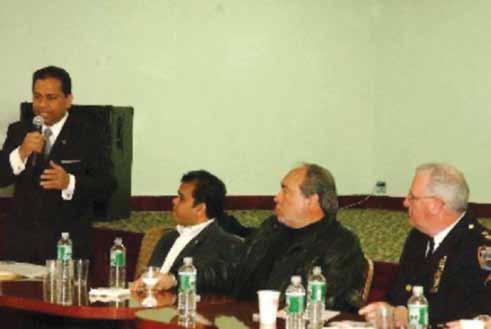
Remember: police misconduct cannot be challenged on the street. Don't physically resist officers or threaten to file a complaint.
Write down everything you remember, in-
cluding officers' badge and patrol car numbers, which agency the officers were from, and any other details. Get contact information for witnesses. If you are injured, take photographs of your injuries (but seek medical attention first).
File a written complaint with the agency's internal affairs division or civilian complaint board.


This year we celebrate the 173rd anniversary of the arrival of Indians to Guyana. Avid researcher Evan Persaud, who has been doing extensive research of Indian emigrants to Guyana, sat down with Guyana Times Sunday Magazine to reveal the interesting findings on his ancestors.
Persaud, lecturer at the University of Guyana and executive member of the Indian Arrival Committee (IAC), said he
has been doing researching for decades now, and found an interesting piece of story on a distant relative. It was the husband of his great grandmother’s eldest sister. His name was Reverend James Persaud.
Rev. Persaud was born in New Amsterdam on March 6, 1868 and was the son of Gaurishankar, a Brahmin, who arrived on the ship Francis Ridley in 1852 and was indentured at Plantation

Providence on the East Bank of Berbice. James was born after his father had converted to Christianity, and attended services at St. Columba East Indian Mission Church, which was located in Theatre Alley, New Amsterdam in Berbice.
At the age of 19 and after acquiring a small shop, James Persaud married Emma Maria Saywack in 1887. She was the 17-year-old daughter of Alexander Saywack, a prominent merchant in New Amsterdam, who had arrived on the Cossipore in 1852, and was indentured at Plantation Port Mourant. Their first son W.W. Persaud, a poet, was born in 1888 and died in 1959; in 1890 D.D. Persaud was born, and later died in 1961. Both sons were very brilliant and attended Queen’s College.
Evan Persaud added that Rev. Persaud, who was fluent in Hindi, qualified as an interpreter, and worked in the Law Courts in Berbice. He became a lay reader and then catechist in the late 1890’s. He then left for England in 1902 to pursue theological studies at Saint Boniface’s College, Warminster. After his return to the colony, Rev. Persaud was ordained Deacon in St. George’s Cathedral by the Right Rev. Edward Archibald Parry, Bishop of Guiana on August 24, 1904. On May 1, 1908 Rev. Persaud became an ordained Deacon of the Anglican Church. He became the first East Indian to be raised to the priesthood of the Church of England in British Guiana.
Commenting on the reverend’s many achievements, Persaud stated that between 1904 and 1913 Rev. Persaud served as Priest-in-Charge of the Soesdyke Mission; assistant Curate of St. Phillip’s, Georgetown for work among East Indians; as East Indian Missionary and Principal of the East Indian Training College, Bel-
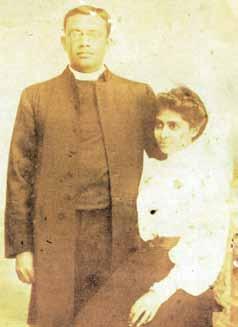
Air and finally as acting rector of Saint Matthew’s East Bank Demerara. Rev. Persaud was appointed Vicar of the Parish of Beterverwagting on November 10, 1913 being stationed at St. Mary-Ye-Virgin’s Church and later acting Vicar of Buxton in 1917. Following his appointment as Vicar of the combined parish Buxton- Beterverwagting in 1921, his final placement was Vicar of Buxton on December 11, 1922. “While at Buxton he became seriously ill on December 7, 1926 and died in New Amsterdam on January 24, 1927.”
Spending more than three decades of his life in the service of the Anglican Church, Rev. Persaud saw only a very small percentage of East Indians being converted to Christianity. However, he died faithfully sticking to his religious convictions.
Noted for his passion in fulfilling duties in the Church, Rev. Persaud while stationed at Buxton plunged a sword into a desk after being challenged by disgruntled parishioners and dared them to remove it. According to Persaud no one attempted to remove the sword.

She took part in social work and was the first woman President of the Berbice Turf Club. To have achieved this singular position in this time in a colonial environment showed a tremendous influence, resilience and courage.
Alice Bhagwandai Singh
Alice Bhagwandai Singh, born in Suriname and married to Dr. J. B. Singh, (a former President of the British Guiana East Indian Association - BGEIA) directed several plays directed several of the plays produced by the British Guiana Dramatic Society of which she was president. In June 1927, she founded the East Indian Ladies’ Guild, which emerged about 10 years after the BGEIA and which functioned primarily in a social, cultural and religious capacity representing Indian concerns. As president of the Ladies’ Guild, she and other women organized and promoted cultural events. In April 1929, they produced the play ‘Savitri’ based taken from the Hindu epic the Mahabharata. Her husband, Dr. J.B. Singh played Satyavan and Miss I. BeharryLall played Savitri.
Later in 1936, Alice moved towards a greater role in terms of reaching out to the poor. She founded the BalakSahaitaMandalee, a voluntary child-welfare society, which belatedly recognized by the Indian middle-class for its work addressing the “desperate poverty on the estates.” It was a time when few Indian women would have been accepted in the public and in contrast to many women in the countryside, most women in the middle class and in Georgetown were supported by their husbands and other male associates to participate in organi-
zations.
One daring young girl left her foster home at Aurora Village, Essequibo, at age 13 and travelled to Georgetown with the hope of staying with her aunt. By dint of fate, she began a singing career and later acting in the 1930s. She performed throughout Guyana, in Suriname, Trinidad and Venezuela, and became the “Indian version of the famed Madame O’Lindy”. Her name is Pita Pyaree.
Pre and post-independence efforts
In relatively recent times few women writers emerged, notably Rajkumari Singh and Mahadai Das, whose poetry reflects themes of pain, oppression and gender assertion. Rajkurmari Singh, a one-time Indian radio announcer at the Demerara Radio Station, wrote the play “Jitangali” and published “A Garland of Stories” in 1960. She was instrumental in staging plays at the Theatre Guild. Today even though many Indian women are now educated and have moved up in the social, political and religious organizations, they are still marginalized. In some cases, many educated Indian women who are capable of becoming leaders continue to be restricted. While it can be argued that, in earlier times, many women suffered from a form of subservience reinforced by religious patriarchal indoctrination and other social demarcations, one can recognize that there is still a long road ahead for women to access higher leadership in such areas are unions and politics.

Ever since de Town Clerk cut off de Mayor-fuh-Life gas money fuh he gas guzzler vehicle whah he does drive around GT de garbage town wid, half a Green Ham runnins get cut off. That had to be de only reason why de Mayor-fuh-Life was tryin to cut off de Town Clerk from sayin a prayer fuh a council meeting and from doin she lawful wuk.
Then, of course, de Mayor-fuh-Life was also tryin to cut off de Town Clerk from tekkin care of de garbage situation in GT de garbage town over de Easter weekend. This musbe a man who like garbage apart from bein garbage he self. De longer Green Ham deh in de wuk, is de more garbage pilin up in and outta de s*ity council.
When yuh tink of garbage in Guyana, yuh can only naturally tink of Green Ham. One a de councillors seh de Mayor-fuh-Life certainly lookin de part and some days he does be smellin de part. In terms of Green Ham words and deeds, well it ain’t got no doubt bout that bein garbage.
De other day, some body see de Mayor-fuh-Life bummin a ride pun de Cemetery Road wid two five-gallon containers in he hand. That was after he run outta gas while drivin around to see if de Town Clerk was doin any ting in GT de garbage town.
A minibus stop fuh he, but before he coulda get in de bus, de conductor tell he that he can’t bring water in to de bus. But Green Ham assure de conductor that it wasn’t water and that de containers was empty. Well, every body doubt he, because dem know he like to tell lies since de days a de Pee-N-C.
Ting-a-ling-a-ling…friend tell friend…mattie tell mattie! And imagine de bus had some people who does vote fuh he. It was only when de Mayor-fuh-Life explain that he was actually bummin a ride to meet Ram Sammy in Berbice to collect some bio gas fuh he vehicle, that dem believe he!

part 1
Winston Shyam Liaquat Kassim was appointed to the Order of Canada on July 1, 2009, and officially invested June 18, 2010, for his worldwide humanitarian work spanning an impressive 30-year period. The Order of Canada or Ordre du Canada is an honour for merit that is, within the Canadian system of honours, the highest civilian award administered by the Governor-General-inCouncil. Kassim became the first Guyanese to achieve this distinction.
Kassim was born at 132 King Edward Street, Albouystown, Georgetown, to Hajjin Noorun Nisa Kassim and late Subaydar Kassim.
The sixth of seven children, Kassim obtained his primary education at St. Patrick’s Anglican School in East Canje, Berbice, and St. George’s Anglican School in Georgetown.
His family moved to Adelphi Village when he was an infant. He fondly remembers Adelphi, East Canje as a young child, as the village that moulded his formative years. Kassim recalls, “Although my father did not make much money at that time, my mother raised hens and had a large vegetable garden as such we might have been considered well to do in that time and place. So although we did not have mon-
Pey for luxuries, we had a roof over our heads, clothes on our back, and food in our stomach. Considering our life in Canada, our early life in Guyana could be considered financially poor, but I maintain that we were much more fortunate than others in Guyana, and around the world.”
As a teenager, Kassim began his professional career at Barclays Bank after concluding his secondary education at Indian Education Trust College in Georgetown. This foray into the world of finance was to chart the course of the young man’s career choice. He quickly demonstrated his aptitude in banking by rapidly advancing through senior positions, running various banking operations in Dominica, St. Lucia and Barbados. At age 22 he was appointed senior supervisor at Barclays Bank (now GBTI) in Guyana. Ever the academic, while working full-time, he concurrently studied for and completed all his banking exams by that age. Kassim credits his mother for instilling in him his passion for community service. She advised, “Take care of the underprivileged, but to do so in a quiet manner.”
It was his father’s experiences that instilled in him the zeal for formal education. His mother had the equivalent of a Grade Five education, while his father who grew up on the estate had the equivalent of a
rofessional development has always been critical for teachers, and at the recent Microsoft in Education Global Forum 2014 in Barcelona, over 1,100 attendees received a crash course on education, including Keith Laban, an Information Communication Technology teacher from Trinity College East in Trinidad.
Laban won the Ministry of Education’s eCAL ICT in Education Innovate Award last November, and he travelled to Spain’s second largest city to attend the event held in March. This year’s Forum recognised and celebrated the world’s most innovative school leaders and educators who effectively use ICT in the classroom to transform education for the 21st century and to help students maximise their potential. This is the second time Laban has attended a Global Forum.
“Ever since I attended the first Forum, it has significantly impacted me as an educator and as a teacher trainer. I have held several professional development sessions since then based on 21st century learning and the use of Microsoft tools in the classroom,” Laban said. “I am using the training received from Microsoft to design learning activities that engage students in the much needed 21st century skills, as well as to train and update my colleagues on the changing education paradigm and the use of ICT in education.”
Celebrating its 10th year, the Microsoft in Education Global Forum provided an opportunity for education’s best to learn from their peers, share classroom triumphs and challenges, and collaborate to help transform education for the 21st century. It was attended by top education leaders, school leaders, ed-
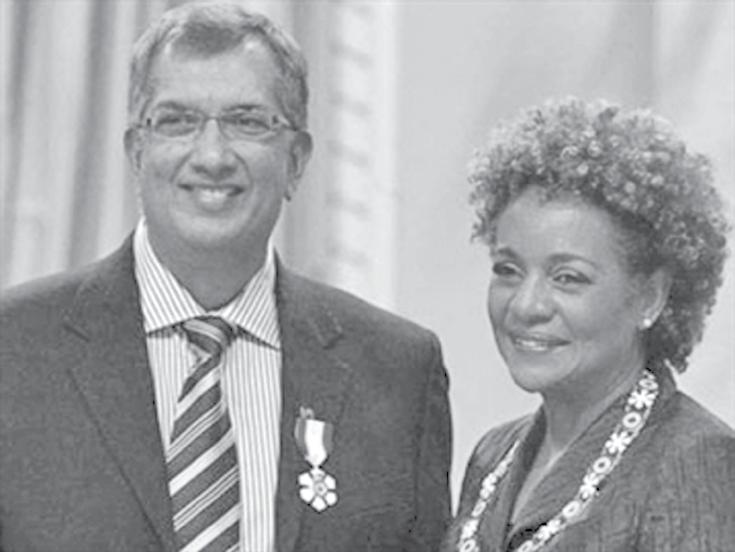
grade two education. His father was determined to elevate himself academically and that drive was noted by Percy Liverpool - a headmaster who was his neighbour. Liverpool agreed to tutor his father on a part-time basis free of cost. This act of generosity enabled his father to attain a high school level education. His father’s educational development transformed the family’s circumstances and opened new windows of opportunity. His father, the late Subyadar Kassim, rose to the prominent position of Superintendent of Police and retired in 1971. His elder brother retired Deputy Commissioner of Police, Sultan Feroze Kassim followed in his father’s footsteps. His other sib-
lings are all professionals and include his brother, the late Dr Sultan Farook Kassim and his sisters Bibi Fernando, Dolly Dhaniram, Anne Sawh and Ingrid Innes, who are all currently residing in Canada.
The act of kindness by Liverpool instilled in the impressionable youth the sentiment that to help those in need was a duty and not a luxury. Kassim feels that “education is the fundamental part of trying to upgrade a person’s skills… because had it not been for education I would not have been here today”.
As the second youngest in the family, he is forever grateful for the hand that his parents and each of his six siblings had in raising him. Kassim notes that he

ucators, government officials, and others from more than 97 countries. The Forum also offered educators best-practices to help expand their knowledge of the ways technology can make a difference to students, both inside and outside the classroom, and prepare them for work and life.
Since his return and to sustain momentum on the ground, Laban is using the knowledge he gained from his participation at the Forum to influence his colleagues in trying inventive practices, with a hope of achieving education reform in Trinidad and Tobago.
“I am keen on sharing what I’ve learned with
Ontario and United Way. He was instrumental in the fundraising and establishment of two prominent Greater Toronto Area mosques in 1981, the Sunatul Jamaat of Ontario Canada and the Malton Islamic Association, and continues to be involved in advisory capacities to their community programs.
By the late 1980s and early 1990s, he had assisted in establishing four more community centres for other faithbased groups, which serve as venues for social events, education and skills training.
stands on the shoulders of his siblings and on the heads of his parents.
Presently, the Head of Strategic Portfolio Management, Canadian Banking of RBC, Kassim holds an MBA from Athabasca University. In 1975, Kassim married Kameni Cheddie. He was encouraged by his wife to move to Canada to begin a new life and look for more opportunities. He continued his career in the world of banking with a new position as a management trainee at Royal Bank of Canada. Migration did not affect his humanitarian efforts; he continued to dedicate his efforts equally to his profession and community work. He volunteered for organisations such as the Junior Achievement of
Kassim feels comfortable in the religious world and although he regularly attends masjid, he also attends mandir and church to encourage interfaith dialogue and understanding. Through his family ties, he straddles both the Islamic and Hindu religions. He grew up in a Muslim family with his maternal grandfather as the first Imam of the Adelphi Village Mosque in the early 1900s and his marriage into Kameni’s family strengthened his Hindu ties. In the subsequent years, Kassim expended his energies towards community building and created initiatives through his banking experience to encourage development of life skills by delivering financial seminars to various groups. (TO BE CONTINUED NEXT WEEK)
fellow educators at my school and with educators in other schools throughout the country. I have already done some teacher training and participated in Webinars as part of my year-long Microsoft Expert Educator agreement,” Laban said. (TT Newsday)
ganisations, the Queens Borough Office, Flushing Cultural Council, GOPIO, Guyana Festival Committee, India Tourist Board, among others. He has been honoured for his achievements in business and for his outstanding contributions to culture (including sponsoring music) as well as for his invaluable services to the Indian diaspora (humanitarian work, youth involvement, religion, promoting tourism to India, and much more). His long list of contributions is testimony of his qualification for any award.
In honouring him a
from page 39
few years ago, the president of Queens County said: “As an outstanding business and civic leader of the Guyanese community in Queens, you have generously given time, talent and resources toward the betterment of your community and the preservation of its cultural heritage. I, President Schulman, wish to express my sincere gratitude for your valuable contribution to the cultural richness and vitality of our borough.” Kali is the epitome of entrepreneurship that is tied to a social conscience.
The name "Mattai" has long signified Indian spices in Guyana. In any culture, the food is the most persistent trait that survives: but it can only do so if the ingredients are made available. Mattai was one of those that identified this need and had the entrepreneurial drive to take the risk to become directly involved in importing the spices that distinguished Indian cuisine and also just as important, move to the Stabroek Market, which was the bazaar of Guyana.
The beginning: sugar and rice
Founded by Nuckshed Liliah Mattai and Shamdayee Mattai, N&S Mattai started from very humble beginnings. Nuckshed’s parents arrived in Guyana from India as indentured labourers. Starting out at the Uitvlugt Estate, on the West Coast of Demerara, the family eventually moved to Hague Backdam where they started a rice mill to service the rice farmers who had bought plots of land on the ex-sugar estate. The father would have plunged all his hard earned savings into this venture.
Nuckshed worked with the family business for years until the passing of his parents. This was one of the foundations of Indian entrepreneurship: the entire family supplied their labour to the enterprise. Nuckshed married Shamdayee in 1948 and over the course of their marriage the couple was blessed with ten children - five boys and five girls.
N&S Mattai & Company was formed in 1949 with the opening of a stall in Stabroek Market. This was a bold and risky move, but the young couple appreciated that the greater number of shoppers meant greater opportunities. The risk was taken. Nuckshed and Shamdayee worked tirelessly to supply the public with basic groceries. This hard work paid off as the business steadily grew and the Mattai family moved from owning one stall at the market to owning seven.
During these years, both husband and wife made countless sacrifices in order to keep the business and the family afloat. Nuckshed spent many nights sleeping at a gas station across from Stabroek Market just so
that he could open his stall as early as possible and close it as late as possible. He often waited until the 6:45am bell rang at the Market so that he could race to remove the shutters on his stall and make the first sale. Shamdayee gave birth to the couple’s first child in 1949. During this time, poverty often prevented Nuckshed from visiting his family on the East Coast. Weeks passed without him being able to visit his children. During this time, Nuckshed also overcame language barriers to become fluent in English, having grown up speaking primarily Hindi.
In the early 1960s, Nuckshed was able to achieve his dream of owning a business in Water Street - the epitome of the Guyanese business community. The business was moving up. He purchased the building and land at 4A Water & Hope Streets, where N & S Mattai & Company still exists today. But the couple still remained rooted in the market for a number of years. Nuckshed often managed the seven stalls in Stabroek Market while Shamdayee managed the business in Water Street. His sons often helped him after school and on weekends.
Those who knew Shamdayee at the time often describe her as a force to be reckoned with. Ever much the businessperson as her husband, she also ran the store, working side-by-side with her husband even though he was opposed to her being at the market. She simultaneously raised ten children and still managed to be known as a fashion icon in society, often sporting high heels and saris. Upheaval and migration
Shamdayee and Nuckshed, along with most Guyanese, faced incredible difficulty in the 1970s and 1980s, when most basic food items such as potatoes, onions, and split peas were banned by the government. The business was hit especially hard since unavailability of these goods undermined the company’s survival and their family’s livelihood. The couple made the decision to move with their five youngest children to Canada.
The trauma of uprooting from roots, which had been so painstakingly nurtured, was alleviated somewhat because
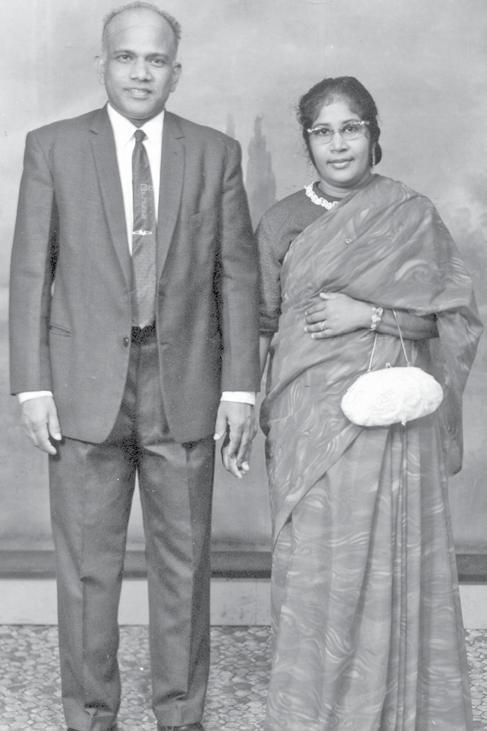
they were able provide their children with educational opportunities that were unavailable in Guyana. Like most of the Indo-Guyanese entrepreneurs, they remained adamant about proper education for all of their children.
The family ran a small convenience store in Mississauga for approximately five years, which culminated in the opening a supermarket in the heart of Toronto. This was run by four of their children – Harry, Vickram, Nehaul and Vidya. During this time, the family managed to run N&S Mattai & Company in Guyana, since the sons stayed in Guyana for months at a time with their families to run the store via a shift-like system. Nuckshed and Shamdayee regularly travelled to Guyana to oversee the business and ensure that the company’s burgeoning reputation in quality and service continued.
The return
Shortly after Nuckshed’s passing in 1994, the supermarket in Canada was closed and Nuckshed and Shamdayee’s third son Harry returned to Guyana with his wife Bharati and their three children to run the business fulltime. The closure of Canada operations has not done much to stem the popularity of Mattai’s Garam Masala and spices in Guyanese communities abroad.
After Harry returned to Guyana, he was able
Hope Streets today.
N&S Mattai & Company continues to expand to accommodate Guyana’s diversified dietary needs and desires, offering hundreds of products from around the world. N&S Mattai was the first company in Guyana to import Indian foods, spices, pickles, seasonings and snacks, catering to the Indian national community as well as the wider Guyanese population, and continues to lead the market in this area today. The company is actively involved in various areas of the community such as culture, charity, education, environment and recreation.
to demolish the old existing building in Water Street and construct a new building. Over the years, additional stories have been added to create the extensive building that sits on Water &
Harry has also transformed the company’s scope, expanding a successful grocery store into a place where customers can become more educated shoppers and have an overall better shopping experience. He makes it a point to educate himself on food trends, nutritional information and health benefits and shares this with his customers by making himself accessible for a con-
versation anytime and via the company’s radio programmes. Harry stays true to the company’s commitment to quality and health. The company’s history still plays a significant part in day-to-day operations. Its original sign still hangs proudly inside the store and pictures of Nuckshed and Shamdayee are permanent fixtures in Harry’s office. Harry honours his father’s love for racehorses and football by supporting horse racing events and sponsoring a football team in Tiger Bay. Shamdayee remains vehement that family name remain a source of pride and regularly reminds the family that she and Nuckshed worked too hard to have others squander it.
Anybody who spends five minutes with Harry can plainly witness the contentment he feels by living the legacy and carrying on the family’s name and traditions.
Today, N&S Mattai & Company stands proudly as a testament to the power of hard work, determination and prayer.

‘I
Everything about Amitabh Bachchan may seem likeable to his multitude of fans. But the megastar says he "hates everything" about himself, and hopes that he can be a better observer.
At the behest of one of his fans, IANS asked Big B about the one thing he hates about himself.
He was quick to respond: "I hate everything about me (myself)!"
"There are so many things that are not cor-

rect (about me) and an effort is made to correct it," said the 71-year-old,
who is an institution in himself to aspiring actors and performers.
Even after nearly five decades of entertaining audiences via films, he says that even now when he faces the camera, there's a whole lot to learn.
He says observation can be an actor's biggest strength, and he feels he lacks it--even though his intricately descriptive pieces of writing on his blog speak another story.
(TOI)
Filmmaker Aditya Chopra, who got married to actress Rani Mukerji in a private ceremony in Italy late last month, hosted a reception for his friends at the Yashraj Bungalow on Sunday night. Several Bollywood celebrities like Karan Johar, Anupam Kher with wife Kirron Kher and choreographer Vaibhavi Merchant attended the party.
A DNA report says that security was beefed up for the reception and no photographers were allowed around the venue. The couple did not even step out for a moment to pose for curi-

ous photographers and did their best to keep the party away from the media eye.
Earlier in the day, Rani was clicked by a fan at the Mumbai airport. She was dressed casually
in jeans and a red jacket.
Aditya and Rani were dating for a few years before they got married on April 21 and announced their marriage through a statement the next day.
(TOI)

Aamir Khan, who is known as ‘Mr. Perfectionist’ of Bollywood, has managed to entertain his fans through different films. When he made his Bollywood debut with ‘Qayamat Se Qayamat Tak,’ he kissed his costar Juhi Chawla and created a new record in the mid-eighties. Their famous kiss in the film paved a new path for film-makers and helped them to showcase their bold romance. Both
the actors have shared screen space in many films.
Karisma Kapoor created a new height after kissing Aamir Khan in ‘Raja Hindustani’ and after a few years Bebo too kissed Aamir and made it one of the most sensual on-screen kisses in Aamir's filmography. Truly in love with Ranchoddas Chanchad (Aamir), Pia (Kareena) expresses her love after meeting him in ‘3 Idiots’. Kareena and Aamir shared a great chemistry in the film and they had everyone talking about their lip smack in ‘3 Idiots’. (TOI)
Actor-filmmaker
Farhan Akhtar, who recently received the best actor award from the Dadasaheb Phalke Academy, has been honoured at the ongoing Indian Film Festival of Melbourne (IFFM).
"Thank you to the jury and government of Victoria, Australia for honouring me with best
Actress Priyanka Chopra says she does not mind if there is a biopic on her life, but wants it to be made at the right time.
Aseem Merchant, rumoured to be Priyanka's friend during her modelling days, is reportedly planning to make a movie on her.
Aseem, who was last seen in a small role in Salman Khan starrer 'Wanted', is turning producer with this biopic on Priyanka.
"It is mind-blowing to hear that I have become so big that people are making a film on my life. Jokes apart, I don't think I have become so big that people would make a film on me," Priyanka, 31, said recently.
"I really haven't heard about if someone is doing it. There are a lot of things that I still need to achieve.

Maybe when I turn 40, people can decide to make a film because I am sure I will achieve whatever I want to by that age," she added. (TOI)
There always seems to be a lot of buzz when it comes to Bollywood's favourite lovebirds Ranbir Kapoor and Katrina Kaif. Now the latest gossip that is doing the rounds is that Ranbir and Katrina are rumoured to be throwing a house warming party for Ranbir's new bachelor pad.
But this isn't all, gossip mongers are abuzz that with Ranbir's house warming party, the two are going to make an official announcement soon. According to a report in Sahara Samay, Ranbir and Katrina are planning to make an announcement about their relationship at Ranbir's

house-warming party. Ranbir and Katrina have been together for long now, however, the two have never come out and spoken about their relationship to the media. Ranbir and Katrina's affair came out in the open for ev-
eryone when pictures of them holidaying in Ibiza were leaked. It was believed that Ranbir's father Rishi Kapoor didn't like Katrina dropping in at their bungalow in Mumbai and so Ranbir decided to get a place of his own. (TOI)

Actress Poonam Pandey was seen at a police station in Mira Road last Friday night. She was apparently questioned by the police for "indecent conduct".
A local police officer told Indian media, "Yes, we detained a person by the name of Poonam Pandey, along with a man, for indecent conduct. But we let them off with a warning."
Poonam, however, said, "I had gone on a drive with my brother when they stopped us. We were listening to loud music, but is that a crime?" (TOI)
Aactor at the Indian Film Festival of Melbourne," Farhan tweeted.
The actor bagged the best actor award for his work in ‘Bhaag Milkha Bhaag’.
Rajkummar Rao, who was honoured with the National Award in New Delhi for his performance in ‘Shahid’, was also nominated in the category. (TOI)
ctor Sanjay Dutt, who is facing a sentence for his role in the 1993 Mumbai blasts, will be a part of a talk show that will throw light on crime-related issues. Though the actor will only be able to participate in the talk show when he is released, his wife Maanayata is doing all the planning for the show.
A Mid-Day report says the show will be named ‘Dutt The Way’ and will be produced by Sanjay Dutt Productions. The report adds that the production house has already registered a film and television show under the same title.
Sources reveal the show will highlight crime-related issues and will not
Songstress Selena Gomez is set to sell her Tarzana, California home.
The 21-year-old singer bought the six-bedroom pad in 2011 for just over 1.25 million pounds, and now she is moving out after putting it up for sale for 2.2 million pounds, reported Daily Express.
Gomez recently bought a new mansion in Calabasas, California, where her on-and-off boyfriend Bieber used to live before selling his home to Kim Kardashian's sister Khloe earlier this year. (TOI)

It looks like pregnant Mila Kunis has a craving for sweets as her fiancé and actor Ashton Kutcher was clicked shopping for ice cream.
Kutcher was seen stocking up on some Baskin Robbins ice cream over the weekend, reported dailymail.co.uk.
Kunis was probably craving caffeine too as he stopped at Coffee Bean to grab two iced coffees before heading to a private residence in Studio City.

At around the same time, a large bunch of blue balloons were delivered to the property, but it is still not known whether it was an impromptu baby shower or gender celebration. (TOI)

Actress Drew Barrymore says she often wants to "kill herself" when she goes to wardrobe fit-
tings because the clothes don't suit her.
The 39-year-old star recently gave birth to her second child with ‘Intern’ actor Will Kopelman and she's admitted that while she can easily find clothes that fit her in high street stores, she can't stand trying on expensive outfits for red carpet appearances.
"In real life, you can find something that suits you and feel great. Then you get to a wardrobe fitting, try on their outfits and you just want to kill yourself," contactmusic.com quoted her as saying. (TOI)
Actor Johnny Depp accidentally got smacked in the face by his own bodyguard.
The incident occurred when an overzealous autograph hunter got too close to the actor outside Ed Sullivan Theater, New York. The actor's bodyguard stepped in between, where Depp was on the receiving end of a slap.
"Johnny looked quite startled," said a source.
Depp's fan complained of signing just two pictures.
"The guy had the nerve to complain,

'You usually sign a dozen pictures for me, but this time you only signed two'," added the source. (TOI)

Actress Sarah Jessica Parker says that reading "mean stuff" written about her on social networking site Twitter often hurts her feelings.
Actor Brad Pitt has reportedly bought a painting of singer Justin Bieber for his son Pax, who is a fan of the musician.
Pitt got the portrait by street artist Bambi after her agent offered him the artwork.
"Pax loves Justin and so Brad thought this would be the perfect gift for him. Brad loves Bambi's unique style and this is his third purchase from her," dailystar.co.uk quoted a source as saying.
"When he found out she'd done a piece with Justin, he knew he'd have to get it for Pax. The Justin artwork is done on a panel of wood and he loves how unique it is," added the source.
The painting portrays the pop star alongside the words, "Rebel without a clue". (TOI)

Dame Helen Mirren has confessed that twerking is mesmerising to her.
The ‘Elizabeth I’ star told HELLO! Magazine that the way stars like Beyonce wiggles their hips on stage inspires her, Contactmusic reported.
The 68-year-old actress said that it's unbelievable how stars twerk and she always likes it when a new dance arrives on the scene.
When asked if Mirren secretly practices in front of a mirror, she replied saying that she might have. Earlier in 2013, when Mirren was being honoured with Harvard University's Hasty
Actor Hugh Jackman says he was a "fearful" child and was particularly scared of the dark.
‘The Wolverine’ star has admitted that when he first became a parent to his adopted children, 14-yearold Oscar and 8-year-old Ava, with his wife Deborra-Lee Furness, he didn't have any idea how to be a father and thinks it's because he was an anxious child who had various fears, reported contactmusic.com.
The 45-year-old said: "I was surprised how little my own parenting instincts kicked in. I was a bit of a pain in the a** at first, insisting he couldn't have a bottle straight before bed because I'd read up on it.
"My own mother finally said, 'Look, you may have read a lot of books, but

the kid (Oscar) hasn't, so put them down.' But I was quite a fearful kid myself. Heights, the dark..." (TOI)
The actress said that she scrolls Twitter with one eye closed because she sees awful things written about her on the social networking site every day, reported contactmusic.com
"I see mean stuff every day when I look at Twitter and I scroll with one eye open and one closed," said the 49-yearold actress.
Mother of three---son James, 11, and four-year-old twin daughters, Marion and Tabitha, with husband and actor Matthew Broderick, she lashed back at relationship expert Sarah J. Symonds.
Symonds criticised Parker in a series of tweets that read: "Sarah Jessica wasn't her children's biological mother because her daughters were carried by a surrogate." (TOI)
in 2013' saved

saved their marriage.
A source claimed to Radar Online that the 38-year-old star and her hubby have been telling their friends that their arrest was the best thing to have happened for their marriage and was a huge wake-up call.
The couple now has a changed lifestyle with a new fitness regime, has cut down on the drinks, and Witherspoon has even restricted her expenses on clothes after realising that she had splurged 60,000 dollars in just a year.
The Oscar winning star had even apologised for the incident on 'Good Morning America' saying that they had made an "embarrassing" mistake, and promised that it will "never happen again". (TOI)
CONCACAF
President Jeffrey Webb says the historic merger between his confederation and CONMEBOL in staging the Copa America in the USA in 2016 is in keeping with a broad vision of forming beneficial intercontinental working relationships with football colleagues.
In what is considered a bold move in unifying the age-old Copa America in its centennial year and six CONCACAF nations for a super tournament as a first gesture, both confederations vowed to continue working beyond the 2016 project to grow the game for mutual benefit.
"You know what they say, unity is strength... for
us this merger with Copa America is for 2016," said Webb.
In a joint press conference in Miami last Thursday, Webb and his CONMEBOL counterpart Eugenio Figueredo hinted towards further co-operation beyond the Centennial Cup America, details of which will become available in "due course".
"We have started work with other confederations as well. We have started co-operation with Africa and recently we have signed an MOU with UEFA.
"I believe in learning, I believe that we must continue to evolve, we must continue to develop, and when we continue

to do that, that's how we will continue to be better and grow," Webb told the Jamaica Observer.
Webb, who is also a FIFA vice-president,
said every understanding of co-operation with any other confederation is built on the consideration of broad-based development of the game
in CONCACAF, particularly in the more needy Caribbean and Central America regions.
"At the end of the day, CONCACAF is about football, we think football every day; we are not just about the Gold Cup and the Champions League, we are about grassroots football development as well.
"CONCACAF is prepared to do whatever it takes, form all necessary partnerships in growing our game and co-operation with other confederations is one way we see in achieving that fundamental objective," said the FIFA Anti-racism and Discrimination chief protagonist.
Just last month,
CONCACAF signed a Memorandum of Understanding (MOU) with the Union of European Football Associations (UEFA) for mutual co-operation towards the development of the game.
The agreement is a framework to provide CONCACAF with technical assistance and support, while fostering cooperation and dialogue for the purpose of "building a strong legacy with sporting, social, cultural and educational benefits".
The MOU with UEFA follows on the heels of a similar one signed between CONCACAF and Confederation of African Football (CAF) in April last year.
TT’s national Time Trial champion Emile Abraham has been recovering nicely after a brutal crash in the elite criterium men’s USA Crits Speed Week Athens Twilight event in Georgia last week. Abraham was one of many cyclists who suf-
fered severe injuries in an endurance course which was marred by multiple crashes. The 39-year old road speedster escaped the first crash but was not so lucky in the second incident, which also comprised a larger number of riders.
The Team Predator cyclists could not get up from the ground before the lead car and moto came around. However, swift work from race officials Frank Travieso and Bill Sampson ensured that the oncoming peloton did not run over Abraham.

In the end, the national standout rider sustained a concussion, broken nose, six stitches above his right eye, an injured shoulder and multiple abrasions.
As serious as it sounds, Abraham revealed Tuesday via his Facebook Page that he is healing quickly.
“Amazingly, like in January when I fractured my rotated cup in my left shoulder, my recovery process is accelerated to the extreme! Today (Tuesday) I will get back on the bike after just nine days since the horrific accident.
My stitches are out, black eye is almost gone, right shoulder has 90% movement, headaches from concussion has gone. I am so thankful that my mind, body and soul healed so quickly. Thanks again to each and everyone for their support, it certainly helped the process of recovery and I will see you soon,” said an elated but recovering Abraham.

The former Rossetti Devo Cycling Team manager and representative also heaped praises on the officials who protected him as he lay motionless on the Georgia roadway. At that time, if Abraham had encountered with an oncoming cyclist, his physical and mental situation would have been significantly
worse. Throughout his recovery process, the exnational endurance champion was forced to sleep for 15 plus hours per day and suffered constant headaches from the concussion that occasionally got intense with some lower back pain.
He is hopeful however, to make an even sooner return to the American circuit than expected. On the other hand, the amount of crash-
es that took place during the Athens Twilight has also sparked a bit of controversy about how well officials and racers handled the situation, and what types of safety measures can be implemented in future criterium (s) to avoid such accidents. This incident prompted safety discussions, including the ban on rider’s use of race radios, amongst some riders and promoters. (TT Newsday)
'Don't
Despite not making his seasonal debut with a quarter of the year elapsed, Usain Bolt has reassured fans that things are going to plan and that they have absolutely nothing to worry about.
"There is never anything to worry about," he told Jamaican media at the press conference at the Jamaica Pegasus hotel last Thursday to announce the Caribbean broadcast rights for the 2016 Rio Olympics.
"For me, I take my time throughout my seasons and you know the season is never perfect—niggles here, niggles there, but the coach will decide when I start and hopefully I'll start very soon," he noted.
Bolt, 27, the first man to win six Olympic gold medals in sprinting and is deemed a living legend with mind boggling world record times of 9.58 and 19.19 seconds for the 100m and 200m, respectively, said the next two years will be crucial in his already glittering career.
"I am just taking my time and going through the season because in the Commonwealth year, I try to take it as easy as possible. I want to run less races because the next couple of years will be very important," said Bolt.
He has constantly set goals for himself throughout his brilliant athletics career and went into the 2012 London Olympics aiming to acquire legendary status by becoming the first runner to win back to back 100m, 200m and 4x100m relay titles. And that he did.
A repeat of those performances at the Rio Olympics in Brazil will more than likely put him among the immortals of track and field and hence, he is trying to preserve that body for the extra push when he will be 29 years old, going on 30.
Meanwhile, the inaugural World Relays in The Bahamas are just three

weeks away to be held on May 24 and 25, and Jamaica are expected to make their mark in the 4X100m, 4X200m, 4X400m, 4X800m and 4X1,500m.
However, Bolt unsure about his participation in the event that will serve as a qualifying competition for the 2015 IAAF World Championships.
"Hopefully, I am in shape (for it), but it's the coach who will decide if it's necessary... and if it makes sense," said Bolt.
"But the coach makes the call where I run and when I run," he added.
Recently Bolt, who has over 14 million followers on his Facebook page, announced that he ran a personal best over the 400m in training, but he refused to reveal the time. He has an official personal best over the distance of 45.28 seconds done in 2007.
"I won't say (what the time was), but we will see. For me, it's always just fun because everybody wants me to run the 400m," said Bolt. (Jamaica Observer)

Jamaica’s men's table tennis team lead by coach Barney Reed and team captain Michael Hyatt won their first ever World Table Tennis Championship in Tokyo, Japan, Sunday.
Playing unbeaten in Division Five of the competition, Jamaica defeated South Africa 3-2 in one of the most thrilling divisional finals in the overall 2014 World Championships.
Playing sumptuous table tennis, the Jamaica team of Chris
Marsh, Michael Hyatt, Kane Watson and Simon Tomlinson ended the World Championships as one of the only unbeaten teams in the Men's Team competition, after posting a record eight wins and no loss to be crowned Division Five champions.
And in typical Jamaican team fashion, Hyatt, Tomlinson and Watson each won a match in the final to lead Team Jamaica to a historic first ever World Championship title. In the last match of
By RavendRa Madholall
Cricket enthusiasts and players based in Canada continue to express disappointment after learning that the 2014 Limacol Caribbean Premier League (CPL)T20 opening ceremony and first-round matches will no longer be staged in Toronto.
The first segment was expected to get cracking on July 5 at the two selected venues, Maple Leaf King City and Toronto Cricket Club, but according to a report from CPL, the action will now be heading to the Caribbean island of Grenada. The organisers further stated that predominantly Cricket Canada failed to fulfill its obligation to have the games in Toronto, but now that time has expired, nothing can be done and hence the CPL mangers were forced to switch gear.
The inaugural tournament last year turned out to be a phenomenal success as a massive number of T20 stars from around the globe represented the six Caribbean territories. Jamaica Tallawahs emerged as the champion team defeating Guyana Amazon Warriors.
The other four participating countries were: St. Lucia Zouks, Barbados Trident, Antigua Hawkbills and Trinidad and Tobago Red Steels.
Cricket Canada’s President Ravin Moorty, who recently resigned, was responsible for the negotiations for CPL to be held in Toronto and was in contact with executives from the West Indies Cricket Board on a consistent basis.
Meanwhile, Canada-based cricketers Jeremy Gordon, Ravin Babulall and Ricky Sukhandan as well as fans Everal Tinglin, Stephen Henry and Andrea Dawkins have also indicated their disappointment at the fact that the Limacol CPL would not be reaching Toronto, as previously thought.
“I [am] very disappointed, but I heard we don’t have proper facili-

ties to host such an event in the city,” Canada’s fast-bowler Gordon declared. The former Guyana cricketer is however hoping for the best in the future.
Both Guyanese Babulall and Sukhandan shared similar feelings that Canada Cricket should have capitalised on the opportunity to host the matches and the opening ceremony. They added that it would have certainly highlighted the country’s willingness and passion for the game and that is why they believe Canada Cricket could have taken a more aggressive approach to it.
Jamaicans Tingling and Henry said they are ‘big’ fans of their countryman Chris Gayle and were very excited to see him in action, but now, knowing that the games would not reach Canada is sad.
Dawkins of Trinidad and Tobago said she will be in the twin island republic during the July-August season and is looking forward to catch some of the CPL action.
the final, Watson defeated his South Africa opponent 3-2 (11-9 in the 5th) to carve the emphatic win for Jamaica.
Jamaica will now move up to Division Three to rub shoulders with the Dominican Republic with regional heavyweights Cuba campaigning in Division Two.
Based on the unprecedented feat, it is said movie producers have begun to enquire about making a film called ‘Pong Runnings’. (Jamaica Observer)

President of the Guyana Baseball League (GBL), Robin Singh, will leave Guyana today (Wednesday) to attend the historic and first-ever World Baseball Softball Congress in Africa, which was announced last month.
Officials of the world governing body for baseball and softball, the World Baseball Softball Confederation (WBSC), have announced a new key agreement with the Japan-based Mizuno Corporation, establishing Mizuno as WBSC’s first Global Sponsor and the Exclusive Official Game Ball Supplier of all 2014 Baseball and Softball World Championship platforms- from youth to professional leveloverseen by the WBSC.
“The WBSC is proud to partner with a sports industry leader like Mizuno, which will help keep the WBSC at the forefront of youth sport and further strengthen our youth engagement platforms,” stated WBSC co-presidents Riccardo Fraccari and Don Porter.
The WBSC leadership also hailed the agreement as highlighting the value baseball and softball could deliver to the Olympic movement, if included on the Olympic programme.
“The WBSC remains committed to Olympic Games inclusion, and this strategic-partnership- the sponsorship of our youth, women and men’s competition platforms- is critical to strongly demonstrating baseball and softball’s youth and commercial appeal, and gender-balance,” the co-presidents added.
“We are confident that under the Olympic umbrella, baseball and softball’s global assets could further en-

hance and sustain the uniqueness, year-round message and economic positioning of the Olympic Games, while making the Games increasingly relevant to women and vice-versa.”
About the WBSC Headquartered in Lausanne, Switzerland, the World Baseball Softball Confederation (WBSC) was established in April 2013 and granted recognition as the sole competent authority in baseball and softball by the International Olympic Committee at the 125th IOC Session in September 2013. The WBSC will be led by an Interim Executive Board until the Inaugural WBSC Congress in May 2014. The WBSC has National Federation members in 141 territories across Asia, Africa, Americas, Europe and Oceania.
Jamaican Craig
Chin was a very surprised winner of an all-expense-paid trip to watch the FIFA World Cup quarter-final match on July 4 in Rio de Janeiro, Brazil.
The trip for two is courtesy of the Scotiabank Visa Credit and Visa Debit Card promotion. The presentation was made by Portmore Branch Manager Regald Reid and Tishan Lee, manager, marketing programmes at the branch in Portmore, Tuesday morning.
Chin, who was invited to the bank by his financial adviser, Dwight Johnson, to conduct business, did not know that he had won two Category Two tickets and will stay in Brazil for four days and three nights at a four-star hotel.
"It was a pleasant surprise. I thought that I was at the bank to conduct business. While relaxing, I was surprised by some football jugglers and managers," Chin said.
"I consider myself very lucky and am thankful to Scotiabank, where I have been a
member for over 20 years. I always wanted to go to South America. It is a trip for two. I wish to take my brother along with the other ticket," he disclosed.
"I am really looking forward to this trip and the experience of watching a World Cup football match should be tremendous," Chin added.
The promotion show-
National Under-15 captain Bhaskar Yadram was in top form recently, hitting four half-centuries during a seven-match tour by the Enterprise Busta Sports Club (EBSC) to Trinidad and Tobago.
The EBSC won just two and lost five of their games, but the diminutive Yadram was outstanding throughout, scoring 348 runs from five innings at an average of 69.6 with a highest score of 83.
In the opening game against Gaff Road, the EBSC made 175 with B. Yadram hitting 79 and Parmanand Dindyal scoring 44. Gaff Road easily overhauled the target.
In game two against Cosmos ‘B’, Dindyal topscored with 66 and Latchman Yadram made 60 in EBSC’s 225, before Kharan Ramdoon and Videsh Lall grabbed 3-16 and 3-24 respectively to limit Cosmos ‘B’ to 190.
Playing against Evergreen, the home team made 180, but EBSC fell agonisingly short, making 177 with first-class open-
er Rajendra Chandrika making 46 and L. Yadram 36.
Game four also ended in defeat for EBSC, who made 223 with B. Yadram scoring 83, before Cosmos knocked of the target. In the other two games against Cosmos, the EBSC lost both, despite B. Yadram’s 75 and 79 and Lall’s 4-16.
The EBSC’s second victory of the tour came in the final game against Cavaliers. B. Yadram made 32 in his team’s total of 160, before a combined team effort limited Cavaliers to 120. Not surprisingly, B. Yadram was named MVP of the series, copping a whopping four Man-of-the-Match awards.
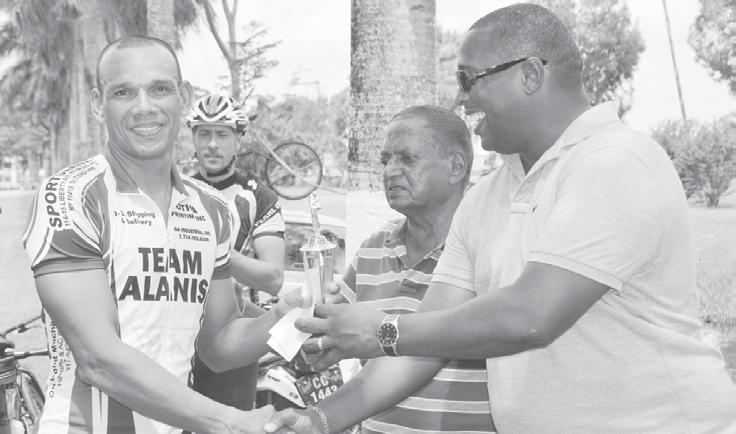
Veteran rider Paul Choo Wee Nam will look to keep his hands on the trophy on Saturday when he defends the feature 35-lap School Boys and Invitational race sponsored by Banks DIH Limited through its Powerade energy drink for the third year in succession.
cased the value and benefit of using Visa debit Scotia Card and Scotiabank Visa credit card as primary methods of payment. Cardholders earned a ballot for every Ja$6,500 they swiped between February 1 and March 26, 2014.
There will be another winner for a trip to the World Cup. (Jamaica Gleaner)
Choo Wee Nam outgunned fellow veteran rider Stephen Fernandes in the main race in 2013 at the inner circuit of the National Park, finishing in a time of one hour, 18 minutes, 12 seconds (01h: 18m: 12s) to take the trophy and two prime prizes.
This time around though, the defending champion will face a tough task, as all the riders will be using the event to test their preparedness for the 32nd annual Independence ThreeStage meet, billed for May 17-18.
Saturday’s race is the last before the staging of the gruelling 171.5 miles/275.1km event sponsored by the National Sports Commission.
Among the cyclists looking to test Choo Wee Nam are Raynauth Jeffrey, Alanzo Greaves, Paul DeNobrega, Hamzah Eastman, Marlon Williams, Junior Niles and Albert Philander.
The other category winners last year were Eastman (Juveniles), Niles (Veteran U-50), Lancelot Rose (Veterans O-50), Maurice Fagundes (Veterans O-60), Stephano Husbands (Mountain Bikes), Alfie Soonaram (12-14 Boys and Girls), Jeremiah Harrison (BMX Boys 6-9), Sherwin Sampson (BMX Boys 9-12), Jamal John (BMX Boys 12-14) and Hazina Barrett (Females).
As he did last year, Banks DIH Limited’s Outdoor Events Manager, Mortimer Stewart, will witness the races and later assist in the presentation of prizes to the top three finishers in the respective categories.
The day’s activities are being organised by long-serving national cycling coach, Hassan Mohamed. (Avenash Ramzan)
PollarD… lost
75 per cent of his match fee

West Indies all-rounder
Kieron Pollard and Australian pacer Mitchell Starc have been fined for their heated altercation during a match of the Indian Premier League (IPL) on Tuesday.
Pollard, who plays for Mumbai, lost 75 per cent of his match fee, while RCB player Starc was penalised 50 per cent by match referee Andy Pycroft after their teams clashed in a tense tussle at the Wankhede Stadium.
Both players have admitted to level 2 offences under the IPL's code of conduct.
Penalties for a first offence range from a fine of between 50 and 100 per cent of match fee and/or a suspension of up to two
matches.
The incident occurred in the 17th over of Mumbai's innings after Starc bowled a bouncer at Pollard, who was beaten as he attempted a hook.
Starc went up to Pollard and spoke a few words prompting the Trinidadian cricketer to wave him off.
As Starc ran in to bowl the next ball, Pollard pulled out of the delivery by backing away outside leg stump just as the bowler was approaching his jump.
However, Starc did not abort the delivery, though; instead he bowled the ball in anger close to Pollard's legs, forcing Pollard to respond by swinging his bat which slipped out of his hands. (CMC)
Guyanese Lennox Braithwaite, the reigning West Indies Fullbore individual ‘X’ Class shooting champion has taken the lead, while United States-based compatriot John Fraser is in charge of ‘O’ Class on day one of the individual competition at the West Indies Fullbore shooting championships at Twickenham Park ranges in Spanish Town, Jamaica.
Braithwaite dropped six points to finish the day with an overall 129 points with six V-bulls as the weather dictated the day’s events, first with winds changing from left to right before a windstorm later in the afternoon made the situation difficult for all the shooters.
The reigning two-time champion was consistent, shooting 34.3 at 300 yards, 48.1 at 600 and 47.2 at 900 yards to lead Canadian Alpar Katona who shot an overall 128 points with six V-bulls including a possible at 300 yards.
The experienced Norris Gomez of Trinidad and Tobago is third overall and second among Caribbean shooters with 127 points; and 11 V-bulls including a possible at 600 yards.
Another Canadian Serge Bissonnette is currently in fourth place with 127 points with eight V-bulls.
Jose Nunez of Jamaica and Guyanese Ransford Goodluck are currently in fifth and sixth places respectively, with scores of 126.10 and 125.8 .
Goodluck shot 31.2 at 300 yards, 47.4 at 600 and 47.2 at 900 yards.
National vice- captain Dylan Fields is 11th overall with 123 points and five V-bulls.
Fraser, who holds the 12th position overall is the leader in ‘O’ Class with 122 points and four V-bulls.
He shot 30.2 at 300 yards, 47.2 at 600 and 45.0 at 900 yards to lead Oscar Waldron of Trinidad and Tobago with 119 points and seven V-bulls, while Guyana’s Leo Romalho is third with 118.7.
There were three possible scores at 300 yards with Bissonnette shooting 35.4 and Katna 35.3, while Trinidadian

Perez also shot 35.3. Braithwaite dropped just one point at the 300 yards range with 34.3 out of a highest possible score (HPS) of 35.7. National captain Mahendra Persaud shot 33.1, Terrance Stuart 33. 0 and Goodluck 31.2.
At 600 yards, Braithwaite shot 48.1; Stuart also 48.1; Fields 47.5; Goodluck 47.4; John Fraser 47.2; and Leo Romalho 46.3, while Paul Slowe and Sherwin Felicien had scores of 45.2 and 45.1 respectively.
Trinidad and Tobago’s Norris Gomez shot the only possible at 600 yards with a score of 50.5. (Story and photos courtesy of Troy Peters in Jamaica)


Guyana’s marquee squash player Nicolette Fernandes, has remained unmoved in the latest world ranking issued by the World International Squash Players Association (WISPA).
In the May 2014 release, the 30-year-old Fernandes is ranked 19th, maintaining the same ranking she received at the start of April.
The phenomenal athlete will look to further improve on her careerbest ranking when she competes in the British Open, set to be held from May 11-18 at the Sports Arena, Hull, England.
A victory in the opening round would certainly boost Fernandes’s chances of moving further up the rankings, as she is pitted against world number nine, Madeline Perry of Ireland.
Perry, 37, recently created history by becoming the oldest player to ever
be ranked in the top 10.
Remarkable turnaround
Her rise up the ranking is a remarkable turnaround for Fernandes, who only at the start of 2009 was rated a lowly 249, after a recurring knee injury had kept her out of competition for a protracted period.
Since returning from injury however, Guyana’s most decorated squash player has been on the rise, significantly moving up the rankings with each passing competition.
Such was her outstanding performance that at the end of 2009, Fernandes, who is based in England and is under the expert guidance of award-winning coach Carl Ince, had taken her ranking below 100, ending the year at 88.
Since then, it has been a steady climb up the ladder for the multiple National Sportswoman-of-the-Year, consistently racking up points and making her way up the WISPA leaderboard.
In 2013, Fernandes played in 13 WSA World Tour/Series in seven countries, namely the United States of America, Malaysia, Ireland, England, China, Monaco and Hong Kong. So far in 2014, she has been involved in four competitions.
In August last year, Fernandes returned home to claim her fifth Caribbean senior title, taking less than 30 minutes to dispose of perrenial rival Karen Meakins of Barbados 11-6, 11-2, 11-5 in the final of the Caribbean Area Squash Association Senior Championships at the Georgetown Club, Camp Street. (Avenash Ramzan)

Trinidad and Tobago’s junior water polo teams had a great outing last Friday as the first day of the CARIFTA Water Polo Championships began at the Benny Leito Pool in Willemstad, Curacao.
The 19-and-under team humiliated Barbados 44-0 with every member, excepting goalkeeper Sebastian van Reeken scoring. Jonathan Gillette and Kieron Emmanuel led the scoring with 13 and eight goals respectively, while Johann Callender was next in line with six.
Aaron Sheppard and Adrian Hinds chipped in with five apiece, Justin Bodden contributed four goals, Kyle Ferreira
notched a double and Nabeel Hosein got the other.
The TT 19-and-under squad had such an easy time that coach Alan Too-a-Foo did not even call a single time-out.
In the afternoon, the 19-and-Under squad showed no sympathy towards their hosts, as they romped to a 34-1 win. Gillette led the scoring once again with 11, while Emmanuel registered seven, Bodden six and Ferreira four (coupled with five steals and three assists). Also getting their names on the scoresheet were Sheppard, Hinds and Callender, who netted two goals each.
TT’s 16-and-Under team was not to be out-
done as they too won their two encounters. First up was a battle with hosts Curaçao, a game that ended 222. The goals came from Leon Daniel and Joseph Herrera who blasted in seven goals each, Liam Smith was steady with two while Kyle Simmons, Danny West, Kegan Ford, Kryztien Sharpe, Ethan Elliott and Massimiliano Di Cola chipped in with one each. And they followed up with a 16-5 spanking of the Bahamas, with Daniel scoring a game-high seven, while Herrera had four, Liam Howell two, with one apiece from West, Sharpe and Di Cola. (TT Newsday)