


Police rank accused of mistreating former Miss Guyana Universe contestant Culture Ministry mulls changing Mash route



Essequbians calling for snap polls if AML Bill is not passed
Essequibo farmers protest low paddy prices, payment delays Cabinet reviewing Education Bill

West Dem dance troupe wins Dharmic Sabha’s contest

UG security problems being addressed –UGSS President


monday, march 10, 2014| guyanatimesgy.com
The Culture, Youth and Sport Ministry will be looking at changing the Mashramani parade route to accommodate the growing number of spectators, subject Minister, Dr Frank Anthony said.
The parade usually starts at Camp and Church streets (heading east), north into Irving Street, then into Dr JB Latchmansingh Road, proceeding west into Thomas Road, culminating at the National Park.
“The crowd did not disappoint us this year, some would say it was over 9000 people, and we need to seriously contemplate to change the route of the parade,” Minister Anthony said during the annual Mashramani awards ceremony, to culminate the month of activities in observance of Guyana’s 44th Republic Anniversary.
Speaking at the prizegiving event at the Umana Yana, Kingston, Georgetown on Friday evening, Minister Anthony expressed gratitude to all who played a role in making the celebration a success, especially the corporate sponsors.

Dr Anthony pointed out that a lot of work was put into the celebration, noting that the calypso, soca and chutney monarch, and steel band competitions would have created an opportunity for persons to experience the creativity of Guyanese music.
The magnificent children’s parade and many other activities for children,
Minister Anthony said were very successful. He said, he was impressed with the level of creativity shown at the children’s parade, contending that it is now rivalling the adult parade in terms of creativity and colours.
Another special feature was the street fair; there were also the child art and essay competitions which saw great participation.

The Republic Lecture Series and the exhibitions at the National Museum and Castellani House were also well received by the public.
Early preparations
Minister Anthony disclosed that for the 45th anniversary, the Mash Committee will be looking at ways to make the festival grander, and will be hosting stakeholders’ consultation and engaging the public on their views on how the route of the parade can facilitate the growing number of spectators.
At the prize-giving ceremony, awards were distributed to competitors in the children’s, chutney, masquerade, bright up Guyana, steel band, child art and essay, calypso, Carib Soca
Monarch, costume and float parade competitions, and other special awards.
Shontelle Gittens won the Junior Calypso Monarch, while in the senior category, Lester “De Professor” Charles, copped the prize, followed by Roger Hinds in second and Kenroy “Mighty Believer” Fraser in third spot.
Pooran Seeraj, Fiona Singh and Roger Hinds secured first, second and third place respectively in the Chutney Soca Monarch, while for the Carib Soca Monarch, Kawasi Edmonson was placed first; Jumo Primo, second; Orlando Johashen, third; and Jonathan King, fourth.
Digicel Guyana and the Culture, Youth and Sport Ministry received prizes
for gaining first and second in the Large Band Full Costume category. In the medium group, the Tourism Ministry was placed first, followed by the Labour and Amerindian Affairs Ministries at second and third place respectively.
Small Full Costume category In the Small Full Costume category, the Education Ministry, GT Recyclers and the Local Government and Regional Development Ministry secured the top spots.
In the Semi-Costume category, the Progressive Youth Organisation (PYO) received the first prize, followed by the Federation of the Independent Trade Unions of Guyana (FITUG) in second, while in the Medium category, Digicel brought first, while Region Five and the Health Ministry tied for second.
The Amerindian Affairs Ministry was awarded the King and Queen Costumes, while Digicel Guyana got the male individual costume and the Tourism Ministry, the female individual costume.
The Culture Ministry also received the prize for topping the Non-Commercial Float category. Designer Olympia Small-Sonaram once again won the Designer of the Year Award, for the fifth consecutive year, while Melissa “Vanilla” Roberts was named Road March Queen.

After alleged attacks on media operatives, the police have now turned their attention to a former beauty queen whom they reportedly assaulted while she was awaiting justice at the Providence Police Station.
Former Miss Guyana Universe contestant Ali Williams was on Saturday allegedly manhandled in front of her husband and children at the Providence Police Station. Williams queen is calling on the higher authorities to institute charges against an officer who she feels acted unprofessionally.
In a statement to the media, the Advertising and
Marketing Executive said that while driving to work on Saturday morning, she was involved in a minor accident when another car crashed into hers, causing damage to the bumper. As such, she decided to visit the Providence Police Station with the intention of filing an official report which would ensure that the errant driver stands all expenses to repair her car.
After waiting for over 30 minutes for a police officer to take her report, Williams said she inquired what was holding back the process, but this spurred a reaction by the police officer who thought that she was not in authority to question their work.
Unreasonable request
The woman added that after some time, the report was eventually taken but upon completion, the policeman informed her that her vehicle had to be lodged at the police station for the night and demanded that she hand over the keys. Not too happy about the request, the woman began to question the reason for the police keeping her vehicle after she would have already filed a report and photographs of the damage could have been taken or provided.
Williams said she went
into the station and was followed by “Officer Tracey”, who instructed her to sit on the bench and told her when she was ready to hand over the keys, she should inform him. She again refused to do such, telling him he needed to give an explanation for keeping her vehicle overnight. She then took out her mobile phone and contacted a family member relating her ordeal.
“Officer Tracey then grabbed me by my arm, pulled me up from the bench, dragging me more than 10 feet while wringing my hand to take away my personal phone, then chucking me to sit on the station bench like a common criminal in the presence of my two crying children,” she said in the statement.
Williams said she has since made a report to the higher authorities and requested that charges be instituted against the police rank. She also obtained a police medical certificate which stated that she had lacerations to her wrist and legs.
Williams said she will file an official complaint with the Police Complaints Authority and moreso, will seek an audience with the Police Commissioner and the Office of Professional Responsibility.







By Alexis Rodney
While Natural Resources and Environment
Minister Robert Persaud has called for a more proactive approach to the issue of wildlife smuggling in Guyana, a local trader has lashed out at the Ministry and the organisation responsible for wildlife exportation, for failing to adequately address issues that have caused legal exporters to be cut off from the market.
Local exporter Imo Fox, who, along with his family, has been in the wildlife trade for close to two decades said among the issues is the failure to carefully screen animals before exportation. Speaking to this publication recently, Fox said the issue has caused his family to lose out on major markets. “Among those aspects of concern are the health and the well-being of the trade, and tracking and keeping account of diseases such as psittacosis, which is a serious neurological disease in the bird trade. It is also one of the many concerns throughout trading countries of the world,” Fox told Guyana Times
He said the disease, which is becoming widespread, can lead to fatalities among humans. As a result, the trade is becom-

ing less viable for him and other exporters who have already invested millions of dollars. Because of the serious threat of the disease, wildlife trading in Hong Kong has already closed down. And as other countries move towards banning the trade, exporters like him will continue to feel the effects “This does not allow for exporters to do their business in the right way, because fewer markets become available and as this happens, the trade becomes more competitive.”
“Discriminatory policies”
Noting that his family was responsible for the many deals which emanated out of Guyana, he lamented, credit was not rightly given. He claims too that “discriminatory policies by the wildlife division” has also been rampant. “We bring in the markets and we don’t get the quota to fill the numbers of animals that importers would like, so that after we bring in the markets, our quotas are diminished, when we apply for extras, we are not granted the extras but other exporters are given these quotas.”
Fox said this was unfair, since his family has invested more than $15 million in the trade. He said too that his family, in 2012, discovered a new species of primate along the Linden-Soesdyke Highway.
That discovery, he claimed, was reported to the Natural Resources and Environment Ministry, but the information was never made public. Fox said he was upset, because such discovery would positively impact deals such as the one shared with Norway and would benefit all Guyanese.
Wildlife trade in Guyana, Fox explained, is governed by the Convention of International Trade of Endangered Species (CITES). Quotas for exportation are allotted based on the results of scientific stud-
ies carried out on the animals by local scientific bodies and CITES, which is based in Switzerland.
His family exports various species of birds and mammals, Fox revealed.
Last Monday, Guyana joined the rest of the world in observing World Wildlife Day. Government recently said data on the scale and extent of the illegal trade in wildlife was not readily available, but acknowledged that smuggling was a pervasive problem across the world. Several persons have, over the years, been accused of being involved in the illegal business, but not much has ever been done to address the issue.
The Natural Resources and Environment Ministry said then it concurred that the illegal trade in wildlife can have deleterious effects on Guyana’s biodiversity, and as such, viewed the problem of smuggling very seriously.
It said it was cognisant of its responsibility to protect and conserve Guyana’s wildlife resources and this could be seen by the successful piloting and gazetting of the Wildlife Management and
Conservation Regulations in November 2013. This is to be followed by the Wildlife Import and Export Bill, which deals specifically with the regulation of international wildlife trade (import, export, re-export and introduction from the sea). The Wildlife Import and Export Bill will be tabled in Parliament in the very near future as it is under review by the Parliamentary Council.
“These efforts will put in place measures to address illegal wildlife trade. The efforts to combat the illegal trade in wildlife must be done in a holistic manner with cooperation from other agencies such as the Guyana Revenue Authority (Customs) and the Guyana Police Force,” the Ministry said.
In his World Wildlife Day message, the Natural Resources and Environment Minister urged all stakeholders to work together to stamp out wildlife smuggling.
That observance was held simultaneously in several organisations. A simple ceremony held by the United States embassy, at its High Street, Kingston Office to commemorate the day was also held.
There, Economic and Commercial Officer Jeff Barrus related that while the United States continue to lead global efforts to protect the world’s iconic animals and preserve the planet’s natural beauty, combating wildlife trafficking would require the shared understanding, commitment and efforts of the world’s governments and non-governmental organisations.




Editor: Nigel Williams
Tel: 225-5128, 231-0397, 226-9921, 226-2102, 223-7230 or 223-7231. Fax: 225-5134
Mailing address: 238 Camp & Quamina Streets, Georgetown
Email: news@guyanatimesgy.com, sales@guyanatimesgy.com
The moral factor is now a big one for schools, as issues of all types seem to stem from it. The challenge is to manipulate and inculcate moral values among students. It is a big question, as schools are now facing different types of behavioural problems among students. It could be the influence of modern and liberal times, the effect of improper care by parents, or the result of changes in society and the family environment.
Recently in Trinidad and Tobago, this kind of talk came up. It was the same here not too long ago, when Mashramani was being celebrated. The argument in TT is that the soca songs encourage young people to “wine down low and jam on a bumper”. But Port of Spain Mayor Raymond Tim Kee finds this “vulgar and reprehensible”.
In Guyana, one contestant said that even though the dances and songs are admittedly “vulgar”, they sell, and judges go for them, as well as they have crowd appeal. This is the classic case where popularity beats profundity.
For many, the condemnation is that there is nothing cultural – they are nothing but vulgar behavioural tendencies. For others, it is not possible to have fun and enjoyment without going to these extremes. Many parents opine that children are not just looking, but are participating and are being prepared to pass these traits on.
Young people are culturally propagating some things that parents and teachers do not approve of in the daily lives of children at school. Education must sew together the fact that the lack in moral values and the unhealthy attitudes of students is a main reason for many problems that exist in schools.
This forms a very good reason for making overt and persistent the teaching of moral education, even though everyone may not agree in a clear-cut way what exactly this is all about. When students skip classes, listen to all kinds of music, learn different dance moves, turn to drugs, practise bullyism, and are sexually involved, then it is time to act and not debate the finer points of what constitutes morality.
Sociologists and psychologists teach that human beings are social animals and that they have to live and react within the society. They have to learn different social habits like helping, being gentle, showing respect, working hard, and practising honesty. These good habits make them good social creatures and they become worthy citizens, capable of personal and national good.
When students attain these qualities, they become responsible and are able to behave well within the society. When they learn these kinds of qualities within their school time, their preparation is for the good adult life, which right now seems to be eluding many.
Many schools have been seeking explanations for the moral decadence that now prevails. They have been working hard on developing good moral values among students. However, everyone must realise that moral values are integrated parts of the education system – they are not taught en bloc and separately.
Moral education is not a specific timetabled subject for schools – it is culturally propagated under different subjects like languages and literature, and in the general classroom setting. Like language itself, morality is better caught than taught. The right atmosphere must be planted and maintained.
There are many festivals, days, and occasions for many special ideas or special events. When schools carefully organise these, they have great and innovative opportunities to impart moral lessons. This is part of creating an environment for moral education.
Moral education can be effective under various programmes and activities such as Carnival and Mashramani. Teachers can use these to demonstrate moral education lessons. Cultural activities, comprising songs and dances, can play an important role in arresting negative values and traits that beset students. It, indeed, makes little sense to have to end up fighting at a later stage against what was allowed to fester.

Dear Editor,
“Bad music can be compared to junk food; good only in small doses, not much there to keep you alive. Good music can be compared to real whole foods; it gives you lots of energy and power, and keeps you going for a long time” – Neil Slade, music aficionado.
The modern era, enhanced by rapid technological development, is one that allows access to music of all sorts. Internet radio stations are born as quickly as they die, and many countries are overwhelmed with radio stations, even if they are merely parochial.
The big feature of most of these radio stations is their musical outpourings. This is so much a part of them that radio stations worldwide use musical promos and tags as key identifying markers, a sharp distinction from say the BBC.
Since music is what attracts many listeners, we need to ask ourselves if there is something like good and bad music, and this quest is bereft of genre, even though many feel that we can grade this aspect of music as well. This
clearly says that we need the ability to accurately hear musical energy and utilise it. If not, we may end up with a penchant for musical fast foods.
In today’s current music scene, we have become quite filled with pre-packaged assembly line bands and singers, and these range from rap to chutney. They target those who have a predilection for quickies that allow for superficial indulgence and even self-flagellation.
For most, this kind of high is good as it affords a release and escape, but only until the feelings disappear. Quickly they want more and ready to fulfil this need are the many ‘fly by night’ bands and singers.
Many fabricated bands and singers exhibit a minimum level of talent. For example, the Backstreet Boys’ (BSB) members were actors, trying to get a job in Orlando, Florida, a virtual hotbed for aspiring young stars. None had any musical history; however, they were hired on an audition for a band, because they were marketable, and not necessarily for the right reasons.
An article from the Montreal Gazette written
in July 1998 stated that boy bands are a “massmarketed phenomenon, manufactured for overnight success”. Not one of the five members of the BSB can play a musical instrument. Out of over 40 songs they released, the band only wrote three of them.
Part of this musical taste can be tightly tied into the unrealistic, noxious images and standards the bands and singers depict. Take the case of Christina Aguilera, and we get a super scrawny Barbie doll. We never find a teen pop sensation who is overweight, has acne, and a bad hair do. Singer Brittney Spears is a notorious example of provocative imagery.
She was rumoured to have had breast implants and as a fact television shows reported that she has a tanning bed on her tour bus so she will always “glow”. Brittney has enraged parents repeatedly, the most noteworthy incident being the MTV music awards 2000.
Spears strip-teased to her Rolling Stones cover of “I can’t get no satisfaction”, revealing a tight, skin-coloured le-
otard underneath her clothes. Her song, “Oops, I did it again”, containing the lyrics, “I played with your heart/I made you believe we’re more than just friends... You think you’re in love/But I’m not that innocent”, teaches a horrible message to young girls to use sex appeal to get what you want in life.
So we ask if this is what we want our people to absorb and emulate. We believe that boy bands and singers have no true staying power. We wish that all, especially teenagers, can look past all the glitz and glamour of these musical imposters and see through the facade for what they are: pre-packaged and assembled to the feelings of the moment.
Former MTV veejay Matt Pinfield said it quite succinctly: “I’m tired of all the lame-ass, tameass, sorry excuses for singers and musicians who don’t even write their own songs... All that disposable crap isn’t going to matter in three months.”
It will! The legacy is a people with bad, unquenchable taste.
Sincerely, Annalisa Ally
Dear Editor,
In light of recent articles and letters published in the print media about magistrates not doing a good job in delivering justice, I wish to single out a particular magistrate who must be congratulated for the manner in which he conducts the affairs of his courtroom.
In recent times, I have been visiting courtrooms within the Essequibo Magisterial District and the calm, humane and collective approach that is displayed by Magistrate Sunil Scarce must be registered publicly and due encouragement must be sent to him publicly.
Just for the record, this man would sit unmoved in
that honourable chair and listen to everyone and, if for some reason, he senses that someone does not understand what he is saying, you would be pleased to witness how simple he puts his statements over, and that person is sure to understand.
I do not have enough words in my vocabulary to pen the good qualities of this noble man, hence, it is my only desire that he continues to do the good work he is currently doing.
I wish to further state that I am in no way related to this gentleman. His qualities deserve recognition.
Best regards, Ganesh Mahipaul
Dear Editor, Guyana is slowly adapting to a new cultural trend that involves looking after our disabled and semidisabled people. However, though we have a substantial amount of legal framework to support this cause, we still have some adapting to do as it relates to their needs.
At the international level, the Caribbean Community (Caricom) has been continuously working to strengthen its commitment to protecting the right of persons with disabilities.
Several Caricom countries have committed themselves to the implementation of several treaties inclusive of the Kingston Accord on the Responsibilities of States with respect to Persons with Disabilities, the United Nations Convention on the Rights of Persons with Disabilities, and the InterAmerican Convention on the Elimination of all Forms of Discrimination against Persons with Disabilities,
in accordance with the Constitution and laws of respective member states.
At present, we still have incidents where people can be quite inconsiderate and insensitive to those who are disabled. In fact, not so long ago, I had to render my assistance to a blind man who was trying to cross the road, after vehicles refused to give him a pass.
Additionally, though their ability to move around may be restricted, they still deserve to be a part of recreational and social activities. It would be nice if we could suggest a few new ideas which will give disabled people the opportunity to engage in activities, which will help to lift their spirits and make them feel better.
Disabled individuals should not be taken for granted because of their conditions. They are human beings just like us and many of them have similar needs.
Sincerely,
Corinne Lewis
Dear Editor, Indo-Guyanese
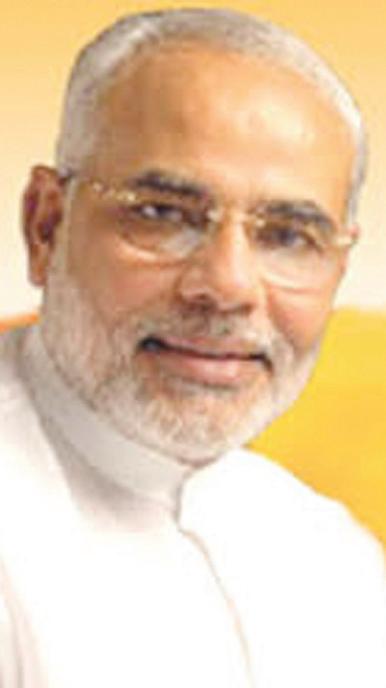
Americans are keenly watching India’s elections from half a world away. Some are backing the Bharatiya Janata Party (BJP) and its prime ministerial candidate, Gujarat Chief Minister Narendra Modi, who is leading in the polls against the corruption-stained Congress Party.
Some Guyanese and Trinidadians have been canvassing for support for the Indian politician who they see as the best hope to fast track development in their ancestral homeland. Many Guyanese visit India to connect with their faiths and for tourist purposes and they feel Modi will help to effectively transform India. Several Indo-Caribbeans are working closely with Indian nationals to help Modi win the election.
A majority of Indian Americans are also supporting the BJP to win and Modi as Prime Minister. One study found support for Modi is vociferous and passionate with the Gujarati community; several Indo-Caribbeans are married to Gujaratis. Modi himself visited Guyana in 1999 and was the guest of Swami Akshananda on the West Coast Demerara speaking at his school.
There is unanimity across the board that Indo-U.S. relations would thrive in the event of a Modi prime ministership and that he would develop closer relations with the Indian diaspora. Many Guyanese and Trinidadians I spoke with say the IndoCaribbean diaspora would benefit enormously if the BJP and Modi were to control the government.
They are confident Modi will increase scholarship and assistance to IndoCaribbeans. Indian and Guyanese-Americans who visited Gujarat and, or met Modi found him a pleas-
ant and pragmatic leader. I have met the prime ministerial candidate several times since 2003. He is charming, attractive and very intelligent. He is a no-nonsense character. He is incorruptible and a man of integrity and efficiency. I found him caring and compassionate and a nationalist.
India and the Indian diaspora are his main concern and his ideas for growth, progress, and development. And that is why I feel the Indian diaspora, especially in places like Guyana, will benefit enormously from his governance. And I believe the U.S. will very soon lift the ban on his visa that was
cancelled about a decade ago. He will be welcomed in the U.S. because he is for improving India-U.S. relations seeing it in Indian’s interest as well as in the Indian diaspora’s interest.
The U.S. Ambassador to India, Nancy Powell, left Delhi and went all the way to Gujarat to meet and chat with Modi who found time for her. With polls showing him in the lead, the U.S. don’t want to isolate a future Prime Minister. In addition, every major foreign leader who went to India met with Modi and or visited Gujarat. They had only praises for the Chief Minister because of his focus on development and progress.
Head of the American Association of Physicians of Indian Origin (AAPI), Dr Jayesh B Shah described Modi as “sedate and mature”. Shah said most of his American colleagues are “extremely positive” about Modi.
Silicon Valley entrepreneur Vish Mishra told an Indian publication that “the U.S. has a record of working successfully with governments or foreign leaders who have been considered adversaries at times. I see no issue with the U.S. embracing Modi and even welcoming him at a state dinner.”
Mishra feels that Indian American support for Modi is substantial. “There is plenty of support of Modi becoming India’s next Prime Minister across the community here. The community wants to see India becoming a major world leader and grow its economy at a faster rate,” he said.
Mishra said he is optimistic about India under Modi. “Modi has demonstrated success in Gujarat as far as entrepreneurship and business and economic development. Hopefully, he can apply and scale this to the entire country,” said Mishra.
Like most IndianAmericans, Guyanese and other Indo-Caribbean Americans are optimistic about Modi’s chances in the general elections that will be held in nine phases from April 9 through May 15. It was the BJP that renewed links with the Indian diaspora in meetings with Indo-Caribbeans with then Prime Minister Atal Behari Vajpayee meeting with Guyanese and Trinidadians in New York. Indo-Caribbeans are confident that if the BJP wins, the diaspora will see an increase in benefits.
Yours truly, Vishnu Bisram

– ChildLinK’s vision is a Guyanese society where every child enjoys the right to a childhood in a safe and caring family, free from poverty, violence, and exploitation


Eight-year-old Susie and her four-year-old brother, Billy, live in a two-bedroom house with their mother and step-father. Susie attends a primary school four villages away while Billy attends a nursery school within the community. At school, Susie is described as a bright child. However, her teachers have observed that Susie is often absent from school for weeks until suddenly she reappears with written excuses stating that she was ill. The teachers thought it was strange because Susie loves school and is doing so well in her work. These concerns were passed on to a ChildLinK counsellor working at the school due to Susie’s reoccurring long absences throughout the school term. They also noted that Susie was no longer involved in the outdoor activities she had once loved. Instead, Susie would sit in a corner and watch while the other children played games in the yard.
The counsellor contacted Susie’s mother via
telephone to schedule a meeting to further discuss these concerns. However, Susie’s mother did not show up for the meeting. The following day Susie’s cousin Ronella, who also attends the same school, visited the counsellor to express her own concern for her cousin. According to Ronella, Susie and her brother would get “bad licks” from their mother for everything. She shared that whenever they are beaten, they would be kept at home until the bruises heal. Given this information, the counsellor invited Susie to the counselling room to further investigate the situation. During the discussion, the counsellor noticed that Susie avoided eye contact and was fidgeting a lot. Susie informed the counsellor that her mommy doesn’t beat her. The counsellor also noted that Susie had a mark under her eyes. When Susie was questioned about the mark, she said she got it as a result of a fall. Realising that Susie was not being completely honest, the counsellor decided to further


investigate by talking to other family members about the allegations made.
“Bad licks”
There were two other cousins attending the same school and they were invited to the counselling room to have a discussion. During

the conversation, both cousins confirmed that Susie and Billy often got “bad licks” from their mother. They reported that their cousins would be beaten with wires, wood, pot spoons …basically anything Susie’s mother could get her hands on. They told of a time when Susie was hit with a belt buckle under
the eyes and was kept at home for days for the resultant bruise to heal. After speaking with Susie’s cousins, the counsellor visited the home of relatives and spoke with aunts, uncles and grandparents about the situation. In speaking to these extended family members, the counsellor was told that Susie’s mother would beat her children like an insane person.
“We do tell she don’t beat them because if she kill them, no police ain’t go lock we up,” an aunt stated. The counsellor asked why they had never reported this to the relevant authorities, explaining if they had done so, the children could have been protected. They all said that nobody can talk to the children’s mother; whenever they tried to in-

tervene, she would become violent and “cuss them out”. One uncle recalled the time he intervened, she got so angry that she took Susie’s head and slammed it into the septic tank. “When we told her to stop and threatened to call the police, she cussed out me and my wife.”
Dangerous situation
Susie’s grandmother was incredibly upset by the situation, “I don’t know what is wrong with my daughter, why she has to beat those children like that. I never beat her like so bad. She does put Susie to wash and iron her own clothes, make her own breakfast, wash the dishes and fill two large drums of water every day.” The grandmother also stated her daughter had beaten Susie so badly on her back that her clothes would stick to her skin. “One day when their mother was on her usual beating rampage, she took Susie’s head and slammed it onto the concrete wall. I became so scared that I told Susie and Billy to run, but she ran behind them shouting ‘I gon kill ya’ll, ya’ll don dead to me already, I gon poison ya’ll out’. When I asked her why she is doing this to them children, she started to “cuss” me out and tell me to stay out of her affairs”.
The counsellor was shocked by the information she was given and immediately made contact with the relevant authorities for further assistance and to ensure that the children were protected. The matter is currently being handled by the authorities, who have since taken action against the mother for physically abusing Susie and Billy.
Child protection is everyone’s business. Do not hesitate to report child abuse; you could be saving a life; children deserve to grow in an environment free of abuse. If you know a child that is being abused, please make urgent contact with the Child Care and Protection Agency on telephone numbers 227-4082 or 2270976.
Please contact us on telephone number 231-7174 or at programmes.childlink@networksgy.com for any support you may need on parenting and any other challenges that you may be experiencing with your children.
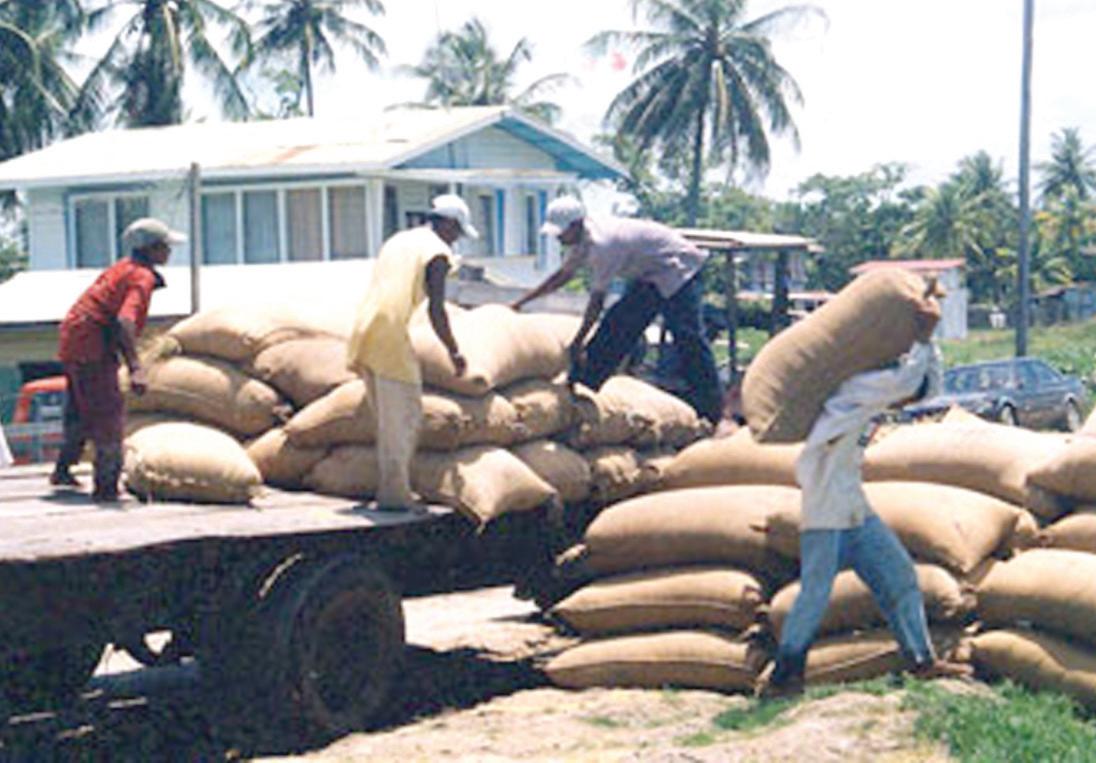
Chairman of Region Six, David Armogan has stirred grave concern among rice farmers in Berbice, telling them that already there are more than 200,000 tonnes of rice which Guyana is trying to sell and does not have a market for.
He says the once-secure Venezuelan market has become unstable with the current unrest in that country and that ships with rice at ports in Venezuela cannot offload and are forced to wait for days. The demurrage cost has to be borne by Guyana. Only recently, Agriculture Minister, Dr Leslie Ramsammy announced that Guyana’s rice export to Venezuela is expected to resume once all logistics have been completed between the two governments. He stated then that the agreement, which is in its final stage, remains a significant one for Guyana, noting that in early February, a Memorandum of Agreement (MoA), was inked between La Casa (on behalf of the Venezuelan Government) and Guyana’s Ambassador to Venezuela, Geoffrey Da Silva. “We have made progress in completing arrangements for shipment of rice to begin. There are three stages in terms of the annual shipment of rice to Venezuela… at the end of every year, we have to have a period of reconciliation in order for Venezuela to issue payment to the Ministry of Finance,” he said.
“There will be a change in paddy versus white rice and once the contract is inked, we will announce that, but the MoA has already established those numbers,” Minister Ramsammy said. With the MoA already inked, the final stage of the Guyana/ Venezuela agreement is near completion. This would include the purchasing order and shipment schedule. With the 2014 rice harvesting (first crop) already started, shipment of rice has already commenced to Europe, the Caribbean and to new
destinations.
In the past, the reconciliation process, which is critical in the Guyana/Venezuela rice deal, took months to be completed; however, this year it was completed in a much shorter time and shipment is now closer to recommencement, Ramsammy had said. In 2013, 110,000 tonnes of white rice and 88,000 tonnes of paddy were shipped to the Spanish-speaking country. However, this new agreement will incur a slight change in shipment.
Meanwhile, Armogan said the boom in the rice industry could be detrimental, noting that already 2500 acres of paddy has been harvested in Region Six for this current crop, with farmers not receiving all the benefits that they enjoyed during the last crop. The farmers are receiving $5600 per tonne of paddy of A grade and $1000 less per grade downwards.
Chairman of the Regional Agriculture Committee, Thakoor Persaud, weighing in on the matter, said while the yield is 42 bags per acre, farmers are already feeling the squeeze when they go to the millers. “No transportation by millers is being paid to farmers for this crop.”
Armogan predicts that if Guyana cannot secure markets quickly, the current spring crop production will see more rice being left on the hands of millers who may start refusing to buy paddy from farmers. “It is also going to be harder for us to get markets because right across the world, more rice is being produced and soon, we would not be able to sell all that we produce,” Armogan cautioned.
The Chairman noted that farmers have been making huge investments in the rice industry recently, but questioned whether farmers will be able to make full use of the equipment that have been purchasing recently. “We are heading for a sim-
ilar situation that existed a decade ago which resulted
in some farmers pulling out of the industry and others downsizing their operations. Many also left expensive pieces of farming equipment idle,” the Chairman noted.
Caribbean diplomat Sir Ronald Sanders, in a recent publication, had urged leaders of Caribbean countries that are members of the PetroCaribe Agreement to “begin preparing for the worst-case scenario and start thinking about buying oil at market prices”.
He wrote: “This is especially important for the countries of the Eastern Caribbean that appear to have made little provision for the possibility that the arrangement with Venezuela would end abruptly.” He said that the Nicolas Maduro Government, which has been in power for the past 10 months, is facing one of its worst unrests over food
and foreign currency shortages. He continued that there have been numerous calls for steps to be taken to reverse Venezuela’s economic decline. PetroCaribe accounts for 30 per cent of Venezuela’s production, Sanders revealed. Sanders predicted that
countries that are benefiting from the deal will be required to increase their productivity and eventually pay the original price for oil. He said the effects will be strenuous on Guyana, which depends on fossil fuel. He noted that some of the monies Guyana receives under its rice-for-oil agreement with Venezuela are used to pay rice farmers. However, with the instability in Venezuela, the Guyana Government and farmers should be nervous, as the situation “spells real trouble”.
Some 21 persons have so far died in the massive political protests, which began some four weeks ago. More than 500 persons have been charged and 50 have been thrown in jail. And as the tension continues to mount, more than 150 persons have been injured.

With the imminent retirement of recently-appointed Commissioner of the Guyana Police Force, Leroy Brumell, there is need now more than ever for the establishment of the Police Services Commission (PSC), Chairman of the Parliamentary Committee of Appointments, Dr George Norton has said.
In an interview with Guyana Times, Dr Norton said the establishment of the PSC is integral now, particularly with the pending retirement of Brumell and the vacancy in several other high ranking posts. “The actual state the Police Force is in at the moment with respect to the Commissioner of Police expected to retire and the next in command suppose to be leaving shortly and we already had Mrs Primo leaving… we might be asked to work overtime to get the establishment of the Commission done because the appointment of the Commissioner of Police as well as its Deputy and different other aspects, the Police Service Commission plays a … part there,” he stated.
The Police Services Commission came to an end late last year; however, it was rendered inactive since November 2012 with the
death of its Chairman Dennis Morgan. With the absence of a fully-constituted PSC, the effective operation of the Police Force has been hindered, particularly as it relates to promotions, appeals from officers for redress, and applications for cadetship.
The Appointment Committee is tasked with reconstituting the Commission and appointing a new Chairman; however, the Committee is currently taxed with bringing up to date all the commissions and is yet to deal with the PSC. Dr Norton explained that while he was cognisant that they are behind time, the Committee is making headway. He noted that the Committee will be
looking into the PSC in due time and there should not be many difficulties.
“It is much easier now than it was before, because the bodies that we have to identify for consultation and to invite nominations are already established and we don’t think there are much changes to be made,” he stated.
The Appointment Committee Chairman pointed out that Parliament has been busy and there has been setbacks as members are not attending statutory meetings. He added that the Committee has written to each entity and this process often takes much time especially when entities do not respond in a timely manner. “We want as much as possible to get everybody involved,” he stated.
However, he noted that with the PSC, it should not be that difficult, since the Committee will be using the four entities that largely represent the Guyana Police Force to present recommendations and nominations for appointments. These entities are: the Police Association, the Association of Former Members of the Guyana Police Force, the National Commission on Law and Order, and the National
Committee on Policing Executive.
Asked whether the Committee can broach the idea of bringing forward the PSC on its agenda given the current state of the Police Force, the Chairman said it can and would do so if necessary. However, he explained that with all the different committees in Parliament, sometimes members spend the entire day moving from one meeting to another. “Priorities will have to be taken into consideration and the fact that you will also have to meet in the National Assembly, but, if it is necessary, we certainly can do that; I see no harm in doing so. It does not seem to be contentious, so we can arrive at a conclusion,” he explained.
On the other hand, Dr Norton stressed that in the past circumstances were different, as the People’s Progressive Party/Civic government had six members while the opposition had four, but that is reversed now, since there is a minority government. However, he stated that this should not cause any undue delays. Over the past two years, many officers within the Police Force have expressed concern over the languishing promotional opportunities with the absence of a PSC.
Today, Chief Parliamentary Counsel (CPC) Cecil Dhurjon is expected to deliver draft portions of the A Partnership for National Unity (APNU) sponsored amendments to the Anti-Money Laundering and Countering the Financing of Terrorism (AML/CFT) Act of 2009.
Presidential Adviser on Governance and AML/ CFT Parliamentary Select Committee Chairperson Gail Teixeira said the drafts are expected today, ahead of the AML Committee meeting on Wednesday. The CPC has had difficulties in composing the draft amendments being proposed by APNU, with queries
being sought on several occasions at the level of the select committee.
Through its amendments, the opposition coalition is pushing to remove the power of the Finance Minister to appoint the Director of the Financial Intelligence Unit (FIU) and transfer it to an AML Authority comprising

10 members appointed by the House. Additionally, the coalition has proposed the seizure of in excess of $10 million found in possession of anyone anywhere in Guyana by the police, customs, or the FIU, once there are reasonable suspicions that the proceeds are linked to money laundering or terrorism.
While the CPC has not directly indicated to the press what were his main issues in drafting the amendments to the Principal Act, Legal Affairs Minister and Attorney General Anil Nandlall has spoken extensively on the matter. According to him, the CPC is having difficulties with the proposed amendments because of the many contradictions. “How do you draft something knowing, that (1) it is [Caribbean Financial Action Task Force] CFATF non-compliant and maybe unconstitutional…”
The Legal Affairs Minister has partially based his argument on sentiments expressed by CFATF Financial Adviser Roger Hernandez during his visit to Guyana on February 21. Shortly after a meeting with the AML/CFT select committee members at the Parliament Building, Hernandez expressed concern about some of the opposition-proposed amendments, saying CFATF is concerned that the amendments may make those that were compliant, non-compliant. However, he stated clearly that CFATF does not get directly involved in countries’ legislative pro-

...on COI
You remember the old calypso that asked “Tell me why yuh bad-minded so?” Well, with the present dumping on the Rodney Commission of Inquiry, we don’t have to guess. The fact it’s the same motley crew that dumped on the Linden Commission of Inquiry (after the hearings) gives the answer. After the killing of the three Lindeners in the protests, the Opposition AFC, APNU, GHRA, TUC –you name them and they came out of the woodwork –demanded an inquiry.
They insisted on “foreign” Commissioners – preferably Caribbean ones. The locals, the Opposition said, would be inordinately influenced by the Government. How? We’ll never know, but from their vehement insistence, it appeared the government must’ve achieved mind control over local legal luminaries. Or that the latter fraternity was weak-minded and weak-kneed.
And the Opposition got their wish. The Linden COI was chaired by former Jamaican Chief Justice Lensley Wolfe. The others were another Jamaican, Queen’s Counsel KD Knight; Trinidadian Senior Counsel Dana Seetahal; former Guyana Chancellor Cecil Kennard and former Appellate Judge Claudette Singh. There were more foreigners than Guyanese! The Opposition crew sang hosannas to the COI. But pretty soon the same Opposition, subjected to the piercing questions of the Caricom Commissioners – their members has been the instigators of the protests and had to take the stand – were crying foul! The sad but cynical truth was that the Opposition was counting on the “kith and kin” sentiments that’d kept the PNC in office for 28 years without Caricom censure, to be still operating. It wasn’t. And hell hath no fury like a politician caught with his pants down.
The other truth was that the COI demand wasn’t for Justice for Lindeners but merely to “GET ROHEE!!!” And there was weeping and wailing and gnashing of teeth when they failed ignominiously. And it is this bad-mindedness that’s playing out on the Rodney Inquiry. The Opposition want to ensure the PNC doesn’t get blamed for Rodney’s contemptible murder. And that was murder most foul –by whatever measure. But knowing that exonerating the PNC’s as unlikely as rain not falling in Guyana when cricket’s scheduled, they’re raising all kinds of red herrings.
How could they object to Senior Council Jairam from Trinidad just because he’d been once retained by the government. Didn’t Nigel Hughes assure us that being hired as a lawyer has nothing to do with impartiality? And wasn’t this reasoning accepted by AFC, APNU, TUC and GHRA?
Why the bad-mindedness? Malice, spite and hunger for power.
...in media
We know the media is usually a dog-eat-dog business. Journalists are alpha-competitive and when the criteria for success are defined by the number of scoops, you’d expect the competition to be something fierce. But when you have a backtracker and a journalist-house slave running a newspaper – you never fail to be surprised at how low standards can sink. Or how petty they can get.
Take the case of the Guyana Times. As the new kid on the block, we expect our share of brickbats. But hey, when the ABC Diplomatic Corps and the cream of the NGOs all base their call for local government elections on a Guyana Times editorial, you’d think it’ll be mentioned by the rest of the press, wouldn’t you? Especially when the editorial is quoted twice? Sadly, even the Stabber News succumbed to the envy attack.
Then the GMSA awards to NEW GPC. Mentioning them sarcastically in “Dem Boys Seh” but not in news? Jealousy can lead to terminal bad-mindedness.
...towards Guyana
Sometimes the bad-mindedness knows no bounds and extends so far as to even include the bad-minded ones themselves. It’s then like cutting the branch you’re sitting on. Like the Opposition ensuring sanctions be instituted against Guyana.
Do they think they’ll be immune? Bad-mindedness eventually consumes even the bad-minded.
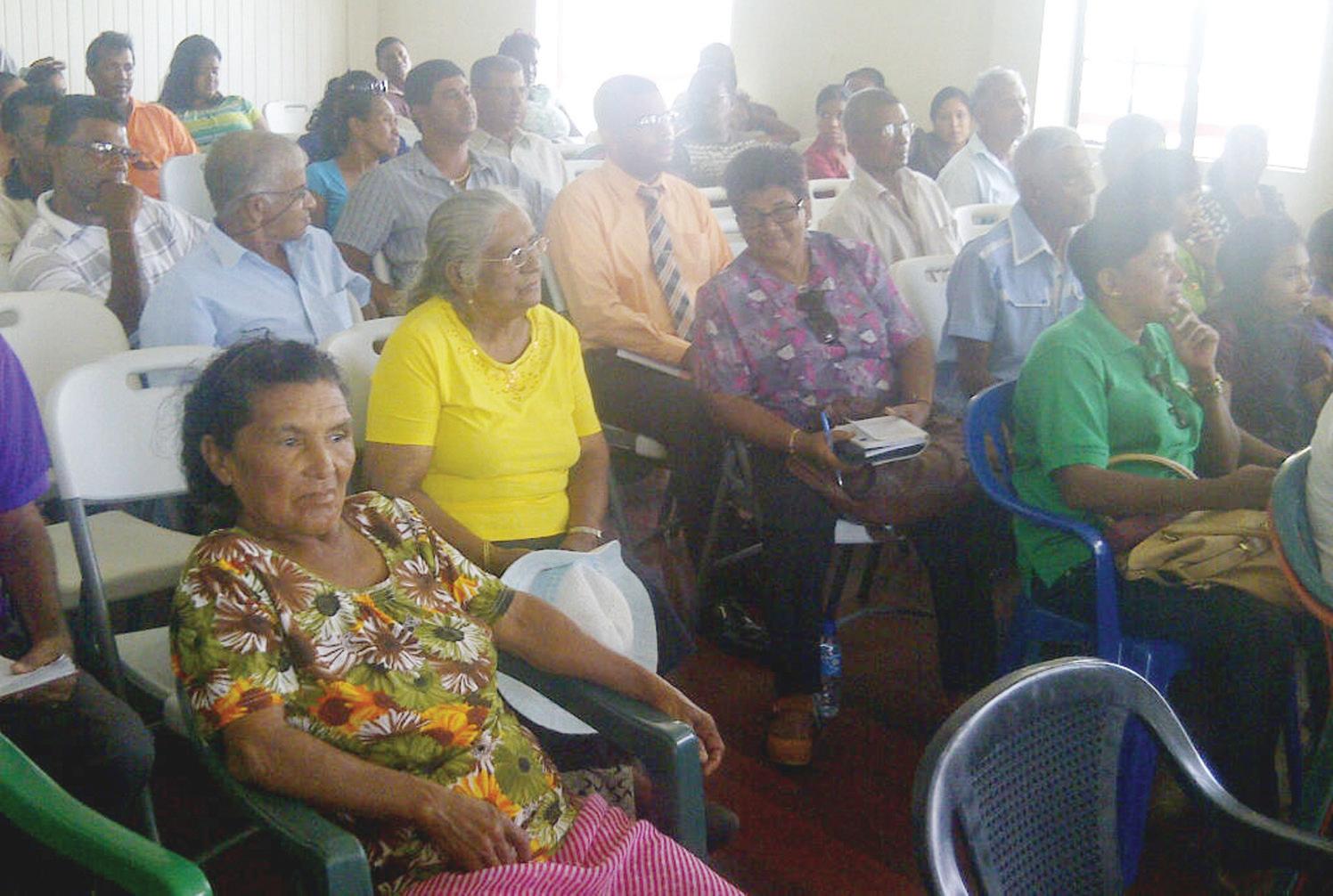
Scores of Essequibians are calling for a snap election if the AntiMoney Laundering and Countering the Financing of Terrorism (Amendment) (AML/CFT) Bill is not passed by the opposition in Parliament.
The calls were made at a public forum held at the Anna Regina Town Council on Friday. Persons from both public and private entities voiced their opinions on the Bill, and said the opposition is using its one-seat majority in Parliament to slow down development in Guyana. Essequibians who attended the forum said they believe the delay in the passing of the Bill will significantly affect Guyana’s economy. As such, many suggested a snap election. Others called for picketing exercises against the opposition to hasten the passing of the Bill, which will mean change for Guyana.
Speaking on behalf of women in Region Two was Juliet Coonjah, who said if the Bill was not passed, women in particular will suffer. Coonjah said most Guyanese depend on the extra money received from their families overseas to assist them and if the Bill is not passed, many persons will suffer. She stressed that the opposition should not bring politics into the passing of the Bill, but rather should think of Guyanese welfare.
Former PPP/C Member of Parliament Farouk Khan told the gathering that Guyana is advancing and if the Bill is not passed, it will send the country back into the “dark days”. Representing farmers from the Pomeroon was Vilma Da Silva, who also called for the passage of the Bill. She said many farmers in the Pomeroon are in the business of exporting and are earning money from overseas investments. She noted Guyana being blacklisted will hamper foreign investment.
Meanwhile, Finance Minister, Dr Ashni Singh explained in detail the Bill
and cautioned Essequibians of the consequences of not passing the legislation. The Minister said the opposition parties in Guyana continue to employ delaying tactics by proposing three amendments to the AML/ CFT Bill that the National Assembly’s legal drafters had difficulty drafting. Government had proposed that the Bill be passed in its current form, and the opposition amendments be considered later.
The opposition refused to accommodate this suggestion and voted against proceeding with the clauses on which there is agreement and which would have addressed the Caribbean Financial Action Task Force (CFATF) recommendations.
Instead the opposition insisted that the committee be adjourned until the drafters could produce a draft of the Bill based on its instructions, thereby effectively making it impossible for the Bill to be passed by the recommended deadline.
This refusal by the opposition to proceed, Singh said, continues to frustrate passage of the Bill far beyond the deadline, thus jeopardising Guyana’s economy and bringing hardship to the Guyanese people.
The Finance Minister noted that money laundering is an issue that should be put above politics. “This Bill if it is not passed will not just affect PPP, it will affect Guyanese at large.”
Dr Singh said Essequibians has a voice and a duty to support the Bill. He urged the opposition councillors who were present at the meeting to advise their leaders about passing the Bill.
Examining the consequences for Guyana if the Bill is not passed in a timely manner, the Finance Minister said the country will be sanctioned. He called on Essequibians to pause for a minute to think about the impact on the economy if the interna-
The Alliance For Change (AFC) is insisting that local government elections must be held on, or by August 1, as approved by legislation in the National Assembly last month.
tional banks refused to conduct business with Guyana. The CFATF blacklisting is already taking a toll on Guyana’s financial sector.
Speaking also to Essequibians on the bill was Minister within the Agriculture Ministry Alli Baksh. Baksh, who is in charge of the Region Two constituency, called on all Essequibians to support the Bill and to take time to reflect on how life was in Essequibo when the opposition was in government. Baksh, who is also a parliamentarian, explained the current situation in Parliament.
Another PPP/C Parliamentarian, Manzoor Nadir, who also addressed the meeting, called on Essequibians to rise up and spread the message about the Bill. Nadir said the opposition is pushing Guyana back to 30 years ago when the opposition was in government. Nadir said Guyana has gone a far way in all the sectors and will continue to prosper.
Minister within the Finance Ministry Juan Edghill also spoke at length about the Bill. Attending the public forum also were Region Two Chairman Parmanand Persaud and Regional Vice Chairman Vishnu Samaroo.
In a statement last week, the party commended the diplomatic community and civic/social organisations for what it described as their forthright position in support of holding these elections by August 1. “Everywhere, from our cities to our villages, our communities are in shambles and suffer from gross neglect. We call on the Chairman of the Elections Commission to pronounce on GECOM’s readiness to hold these elections and not allow to pass the ambivalence of the Attorney General, Anil Nandlall when he asserted that GECOM was preparing for National Elections; or the Home Affairs Minister to cast doubts on whether or not this body charged with conducting elections could hold these polls.”
Red herrings
The AFC noted that new red herrings are being thrown into the pool of misinformation and doubt such as a 180-day timetable after the date for local government elections is announced by the relevant Minister, demarcation of new local government area boundaries, and public education.
“The AFC urges the holding by August 1 of elections, as a viable start, in the existing NDCs [Neighbourhood Democratic Councils], which need no further demarcation and in the towns, including Georgetown. We are against any political, bureaucratic and administrative humbugs that have jettisoned elections, due since 1997.”
The AFC also urged the completion of the constitutional mandate for fully monitoring the integrity of persons in public life, by having a fully composed and functioning Integrity Commission.
The party then turned its attention to the establishment of the hotly-de-

bated Public Procurement Commission. “We say that the Executive is in breach of the Constitution that commands the establishment of a Public Procurement Commission. The Executive is in breach of the law that says that the role of Cabinet in procurement shall phase out after the establishment of the Public Procurement Commission. The PPP/C [People’s Progressive Party/ Civic] has, for too long, paid lip service to the need for good governance, with full accountability and transparency in Guyana, which is why the floodgates of corrupt practices have been open wide.”
Last week, the ABC [America, Britain and Canada] countries, along with a number of civil society organisations, here reiterated their call for the holding of local government elections this year.
In a joint statement, the local embassies of United States of America, Britain and Canada said a year ago, political party leaders, civil society, private sector representatives, and members of the diplomatic community expressed their hope that 2013 would be the year that Guyana moved to ensure its citizens benefit from strong and effective local governance.
The statement noted that while 2013 passed without local government elections being held, significant progress was made to set the stage for these histor-
ic elections in 2014. “Four bills establishing a reinvigorated framework for local governance were approved by the National Assembly and three received presidential assent. Together with the 2010 Local Authorities Act establishing the electoral framework for local elections, the legislative path to elections has been cleared,” said the statement. According to the organisations, in anticipation of local government elections, GECOM has intensified its preparations and expanded voter education outreach to familiarise people with the voting process.
The opposition recently approved a motion for local government elections to be held by August 1, but PPP General Secretary Clement Rohee said while his party was ready for local government elections, the Guyana Elections Commission (GECOM) was not. PPPappointed commissioners of GECOM have advised the party that the Commission has yet to establish boundaries and provide voter education about the new system, he revealed.
“For instance, in Georgetown, there will be a mixture of first past the post and proportional representation. We get the distinct impression from our Commissioners that it doesn’t seem that they are ready for local government elections,” he said. The polls have not been held since 1994.


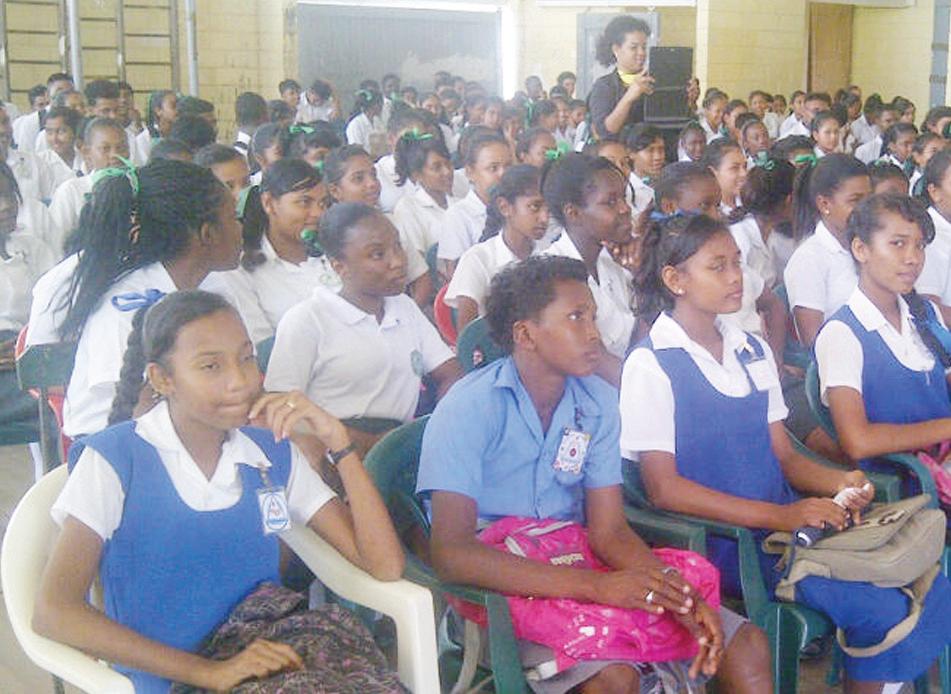
Students from secondary and primary schools on the Essequibo Coast now have wider knowledge of Parliament and its various functions after selected Members of Parliament (MPs) conducted an outreach in the area last Friday.
The legislators were involved in an interactive ses-
sion with the students at the Anna Regina Multilateral Secondary School. Speaking to students, People’s Progressive Party/ Civic (PPP/C) MP Dharamkumar Seeraj said it is the desire of Speaker of the National Assembly Raphael Trotman to inform students about the work of the National Assembly.

Seeraj said the aim of the outreach is to bring Parliament to young people. During the interactive sessions with students, Seeraj told them about the various roles of Parliament. A dramatic play on what usually takes place in Parliament was done.
Another Region Two

PPP/C MP Alli Baksh informed the students about the Mace, Constitution and Standing Orders.
Baksh told the students that whatever they may want to become in the future, to set their goals and work towards achieving them. He said education is better than silver and gold and they should make the most out of it.
Interactive sessions were done at the Taymonth Manor and CV Nunes primary schools and the Cotton Field and Abram Zuil secondary schools.
Similar outreaches were conducted in Regions Four, Eight and 10. Attending the outreach were Regional Education Officer Baramdai Seepersaud, District Education Officer (Nursery) Shondele Hercules, and PPP/C MP Cornel Damon.

De chicken feed man finally decide to break he silence bout de money, which in de fuss place ain’t no kinda chicken feed whah gone missin from de chicken feed place whah does look like a chicken pen.
De real problem is that de chicken feed man was behavin like a chicken. Now that a really big brass man decide that he gon cut de chicken wings, de chicken open he mouth and start to cluck.
But even if de money ain’t missin as de chicken feed man seh, it still showin up pun de books as paid, although nutten ain’t pay to no body yet. No body name who deh pun de books as paid got any clue when dem get chicken feed money.
One man seh he does fuhget when people tek he money, but he does never fuhget when people give he money. That is because he does always remember to give tanks to God and to the man who give he. And he ain’t get no chicken feed money to this date.
It musbe that de money get pay out to one man who coulda be de chicken feed man. That is just like sayin de money missin. If de money get pay out and de people who supposed to get de money ain’t get it, then de money damn well missin – no matter whah de excuse. It missin in somebody pocket.
At least if de chicken feed man had tek de money and fix de hothell ceilin, people woulda seh it get put to good use. Unless de plan is to mek that another chicken pen just like de other chicken pen whah den pun Water Street and de one whah Mook Lall put Adumb in.
Ting-a-ling-a-ling…friend tell friend…mattie tell mattie! That’s a lotta chicken pens to look after. Is no wonder de chicken feed man can’t account fuh de chicken feed money. But de chicken feed man tek over two months to find a excuse. Some ting smellin fishy wid this whole chicken business.
Almost two weeks after Crime Chief Seelall Persaud said the police are on the lookout for two suspects linked to the gunning down of Eccles, East Bank Demerara money changer Bridgelall Persaud, there has been no new development.
With the evidence at their disposal, the police are still searching all corners for clues that will crack the case, but this is not likely anytime soon. A police rank said that while they are in possession of the descriptions of the alleged gunmen, locating them is another issue.
The police are reportedly looking for a “high com-
plexion” man while the other might have been sporting dreadlocks. According to reports, the armed men disembarked a white motor car which was reportedly trailing the businessman.
These men might have already absconded to the interior or even out of the country, the official stated. Bridgelall’s death is being treated as a robbery/murder, but relatives and close friends think otherwise.
Darren Persaud, a son of the dead man, said his father was the pillar of his family and with his loss; it has left a void that cannot be filled.
He said the police remain tight-lipped with respect to investigations, while noting that the car in which his father was executed was handed over to the family.
Persaud added that his family is coping with his father’s death and much emphasis is being placed on his younger siblings. The 42-year-old businessman was gunned down in the vicinity of the lumber yard, and the gunmen escaped with a bag containing $1 million.
According to information received, the man was in his blue Toyota Raum, and
as he approached the truck park at Lombard Street, two men armed with handguns exited a white car that was parked some distance away, walked up to his vehicle and opened fire. He was shot once in the head and once in the abdomen.
At the time of the shooting, traffic was moving at a snail’s pace due to the frequent congestion in the area. After shooting the businessman, one of the robbers reportedly reached into his car and removed the bag containing the money. They then made good their escape in a waiting vehicle which went through a cross street, then into Princes Street and vanished. The businessman was rushed to the Georgetown Pubic Hospital where he was pronounced dead on arrival. The businessman was operating in the vicinity of America and Water Streets for the past 20 years.
Pathologist, Dr Vivekanand Brijmohan has confirmed that the businessman was shot twice. Police are yet to say what type of weapon was used in the shooting since ballistic tests are still to be conducted on the two warheads recovered at the scene.

Abolition of the death penalty is a controversial subject. The United Nations (UN) says the world must abolish the death penalty and the trend in the last 30 years has been towards abolition of the death penalty. Which country do you think will be the last to abolish the death penalty?
To think that Guyana might want to, and to even contemplate which country might be the last to end judicial death penalties might not have been a reasonable question to ask 20 years ago. But Guyana must now decide whether it will continue to use the death penalty and Guyanese and people around the world can now contemplate such a question.
The UN Commission on Human Rights (UNCHR) has mandated Guyana to review its laws and abolish the death penalty. Several other countries in the Caribbean Community (Caricom) must do the same. Presently, 97 countries have completely abolished the death penalty, eight others have abolished it for ordinary crimes, and 36 have implemented a moratorium and are not sentencing people to death, making the total 141.
In 1970, only 16 countries had abolished the death penalty. On an average, about three countries abolished the death penalty per year since. Today, only 57 countries are allowing death sentences and allowing judicial executions. Last year, 682 persons were executed in 21 countries. There were 1722 death sentences in 58 countries in 2013.
No place for capital punishment
Guyana has about 30 persons on death row. In 2012, five people were sentenced to death. But while we have not abolished the death sentence and persons could still be sentenced to death in Guyana, persons are not being executed. Even though Caricom countries still retain the death sentence, only Barbados, Guyana and Trinidad and Tobago have utilised death sentences in recent years, the last being in 2012. But there have been no executions for some time in Caricom.
By the time the world celebrates the 66th anniversary of the UN’s adoption of the Universal Declaration of Human Rights on World Human Rights Day on December 10, the tide would
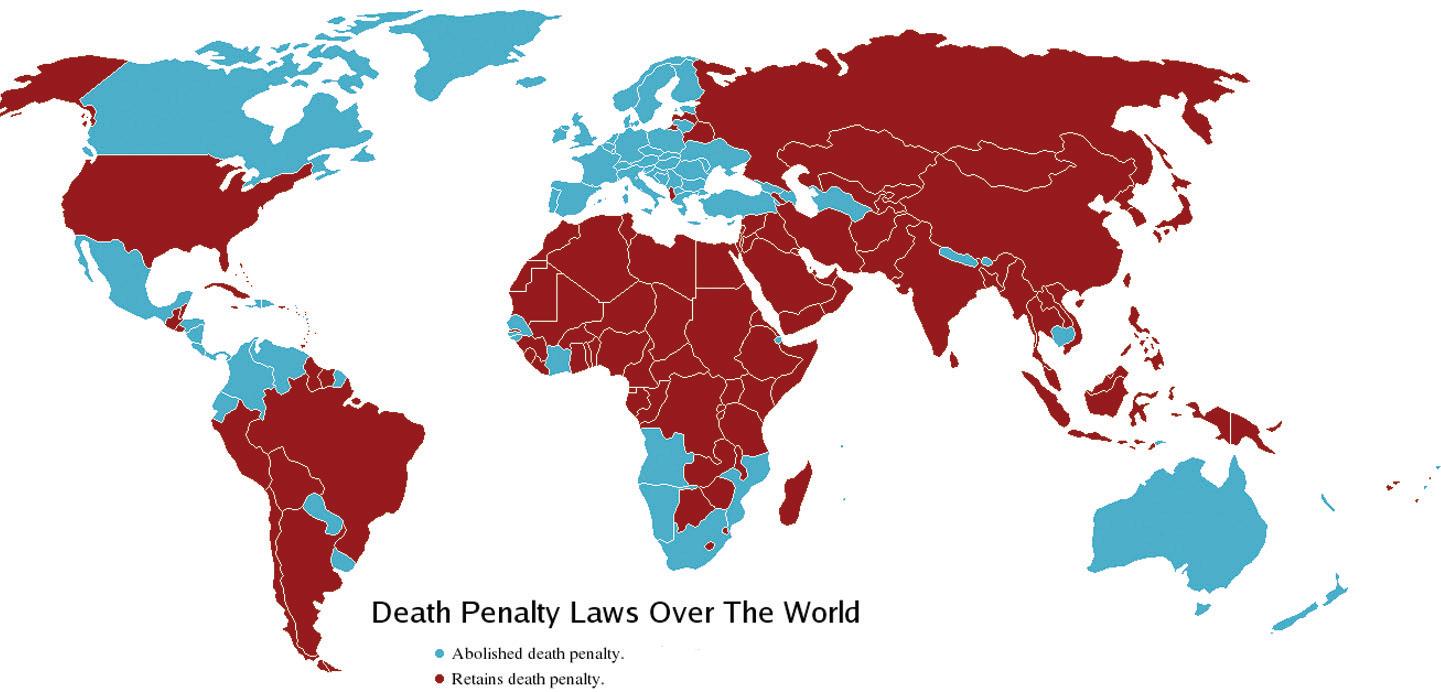
have turned irreversibly in the long battle against the death penalty, an inherently cruel and deeply flawed punishment that has done incalculable damage to countless individual lives and whole societies. Globally, we are now on the trajectory of abolishing the death penalty.
Experience and evidence demonstrate that the death penalty is cruel, irrevocable and a violation of the right to life. It damages and poisons society by endorsing violence, and by causing injustice and suffering. It has no particular deterrent effect on violent crime, and in fact, abolitionist nations often have lower murder rates than those that still execute.
Increasingly, the world’s community of nations is sending a clear, collective and powerful political message that there is no place for capital punishment in humanity’s future. In December 2012, the UN General Assembly voted overwhelmingly and decisively for a global moratorium on the death penalty. This was the fourth such vote since 2007 and on every occasion the number of nations supporting a moratorium has risen.
Backpedalling
This latest UN call was supported by a record 111 countries, with Central African Republic, Niger, South Sudan and Tunisia all voting in favour for the first time. Meanwhile, several nations – including Afghanistan, Papua New Guinea, and Indonesia –moved from a negative vote to abstention. Guyana abstained.
Some countries have backpedalled and have resumed executions or death sentences after de facto moratoriums in countries such as India, Indonesia, Kuwait, and Nigeria. A major stumbling block is the behaviour of a small group of hard-
core executing states such as China, Iran, Iraq, North Korea, Saudi Arabia, the
U.S., and Yemen. The U.S. is the only country with active judicial execution in the
Americas. But the U.S. is slowly drifting toward abolition.
In December 2013, former President Jimmy Carter called for a nationwide moratorium on the death penalty in the U.S. and for the U.S. Supreme Court to reintroduce the ban on capital punishment it had imposed between 1972 and 1976. In 1976, when the ban on the death penalty in the U.S. was removed, it was governors like Jimmy Carter that fought to bring back the death penalty. But today, Jimmy Carter has joined in the campaign to abolish the death penalty.
Guyana must not be one of the last countries to ban judicial death penalties. As Times Notebook shines a spotlight on this ultimate abuse of human rights, we ask that Guyana’s Parliament demonstrate its courage by moving the process in the Special Select Committee to immediately suspend use of the death penalty as a step toward full abolition of judicial death sentences.
Readers are invited to send their comments by email or Facebook to times. notebook@gmail.com.

monday, march 10, 2014
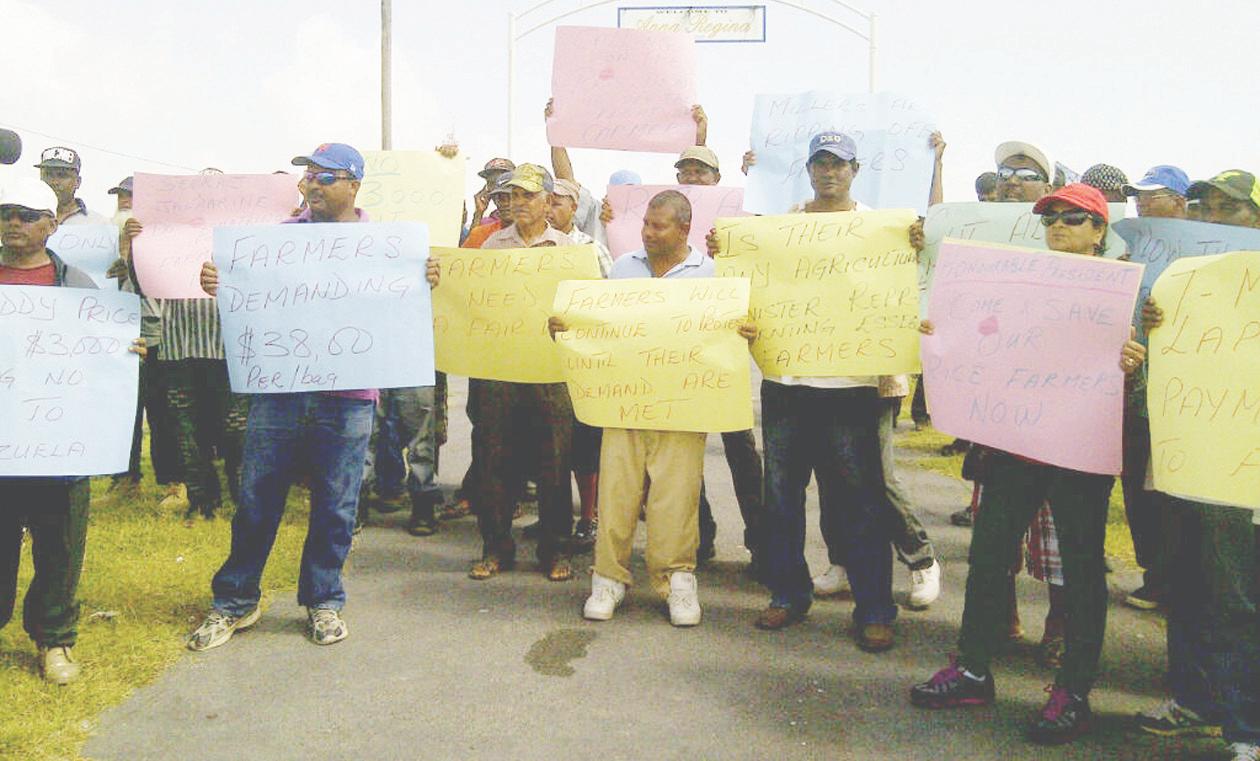
Scores of rice farmers on the Essequibo Coast last Friday staged a peaceful protest against low paddy prices and the chronic delays in payment for their products.
Farmers milled around the Anna Regina High Bridge armed themselves with placards, chanting “we want more price for paddy this crop, we want we money now.”
The protest organised by the Essequibo Paddy Farmers Association (EPFA) commenced at 10:00h. The placards had various messages such as: “If paddy price remain $3000 per bag, no paddy to Venezuela”, “We have no confidence in RPA in EBO”, “Essequibo paddy farmers wake up RPA from their sleeping slumber”, “Farmers will continue to protest until demands are met”, “Is there any Agriculture Minister representing Essequibo farmers?”.
Speaking on behalf of the farmers, Alliance For Change (AFC) Councillor Naitram, said the protest will continue until the farmers’ demands are met.
Naitram, who is the chairman of the Essequibo farmer’s group, said a request was made one year ago for the farmers’ group to meet with President Donald Ramotar and Agriculture Minister, Dr Leslie Ramsammy, and to date, a meeting cannot be organised.
Naitram said that there has been a significant de-
crease of $1000 for a bag of paddy as compared to the last crop. He is of the opinion that the rice industry is not being given the attention it deserves. The chairman of the group also explained that some farmers are owed for approximately seven months and they need the money to keep their businesses afloat.
Failed promises
The AFC Councillor said farmers were promised assistance by the Agriculture Ministry during the paddy bug infestation period, but that has not been delivered.
Meanwhile, farmers who spoke with Guyana Times said the prices being offered are unacceptable and cannot support them financially.
The farmers explained that $3000- $3500 cannot cover
the crop expenses. Farmers said they are thankful that millers are accepting the paddies at their factories; however, the prices offered are unreasonable.
Bhimsain also known as “Cat Eye”, owner of five acres of rice lands, noted that the Agriculture Ministry is not representing rice farmers’ welfare. Another farmer, Jerry Sankar, also noted that the drop in paddy prices cannot pay, deeming it a disaster for those farmers who are renting rice lands. He said when expenses are taken out, farmers are not left with any profit. Another farmer, Dinesh Deonarine from Richmond, said millers need to be reasonable with farmers when it comes to pricing.
Meanwhile, in addition to the low prices, farmers
said the delay in payments, poor weight and measure and drainage and irrigation problems are factors hampering their business. Farmers are calling for a “bailout” in the same manner the government bails out the sugar industry. They are requesting a subsidy for fertilisers and fuel.
The decrease in prices offered by millers is said to be as a result of the low prices for rice in the European and Caribbean markets. Meanwhile, harvesting is in full swing and approximately 1500 acres have already been harvested.
The average yield per acre is 36.3 bags. Approximately, 37, 200 acres of rice is expected to be harvested and production is expected to surpass the target of one million bags of paddy.
Several bills including one to radically revamp the education sector are currently in draft format before Cabinet for review, Presidential Adviser on Governance, Gail Texeira said.
According to Teixeira, the bills in varying stages of draft are expected to be tabled before the National Assembly in the near future. These include the highly anticipated Education Bill.
Teixeira, who was speaking to media operatives at last Friday’s post-Cabinet press briefing, noted that the other bills include the Solid Waste Management Bill and the Hire Purchase Bill.
Speaking with Guyana Times, Education Minister Priya Manickchand noted that the education legislation when comes it into force will repeal the current Education Act and allow the Education Ministry to adopt a more modern and handson approach to various issues impacting the education sector.
The Bill, among other things, seeks to address issues such as private schools licensing, requirements for persons to be employed as a teacher and students admis-
sion age at the nursery level.
She noted too that the current Education Act does not have much regulation as it relates to private schools. She noted that there are clauses in the Bill that will stipulate how private schools should function and be managed.
The Minister also related that the Bill will address the highly contentious issue of corporal punishment. The Bill was drafted after extensive stakeholder consultations countrywide.
The Minister added that the regulations governing the Bill are expected to be tabled at the same time.
Hire purchase
As it relates to the equally anticipated Hire Purchase Bill, earlier this year, acting Tourism Minister Irfaan Ali had said when this legislation comes into force, consumers will no longer be at the mercy of hire purchase schemes, noting that the current system that prevails is disadvantageous to consumers.
“We are working on having the hire purchase legislation laid in Parliament before the recess,” he said, adding: “I know we have

been having a lot of problems with the repossession in the automobile industry and now also with the gold miners… we have persons paying as much as 80 per cent and just because of the remainder not being paid, they lose the items and the money they would have already paid.”
This, he explained is a grave disadvantage to consumers.
Ali also added that the bill is not only being drafted with the protection of the consumer in mind, but also that of the companies which
offer hire purchase plans to consumers. As it stands right now, consumers who would have failed to complete payments on items bought on hire purchase would have their items repossessed by the stores. This would be done even though the consumers have paid a large part of the total amount of monies owed for the item.
Ali further stated that the Bill is not only being drafted with the protection of the consumer in mind, but also that of the companies which offer hire purchase plans.
With regards to the Solid Waste Management Bill, acting Local Government and Regional Development Minister Norman Whittaker early last month said government is very close to tabling the Bill in the National Assembly.
The Finance Minister was asked to have a second look at the section of the bill that deals with the issue of financial arrangement.
The Solid Waste Management Bill seeks to, among other things, bring order to the way in which solid waste is managed, primarily by the way of a Solid Waste Management Authority.
Stakeholders involved in the Conservancy Adaptation Project (CAP) met on Saturday to discuss the results and future investments for the 2008-2013 project.
The project results include enhanced government's knowledge and capacity to manage the East Demerara Water Conservancy (EDWC) and the coastal drainage systems as well as a US$123 million package of investments critical for flood management.
Agriculture Minister, Dr Leslie Ramsammy in his remark to the gathering at the Regency Hotel, Hadfield Street, Georgetown, noted the importance of the project since Guyana’s development, he said, is largely dependent on, and is driven by agriculture.
“The fact also is that agriculture and everyday living superimpose themselves on each other because we live where we work and agricultural areas are also where people live”. Hence, the Minister pointed out that water management has always been critical to the success of agriculture, the development of a country and equally important for the quality of life of its people.
“If we are to look at it this way, we should look back at the 2005 flood when we saw how people’s lives were disrupted and livelihood were threatened, and we also saw how agriculture and therefore the overall development of our country was affected.”
Minister Ramsammy alluded to the fact that because of the 2005 flood, more than 60 per cent of Guyana’s Gross Domestic Product was affected. To this end, he noted that Guyana must as a priority now focus on infrastructural advancement for sustaining its developmental path, but importantly for accelerating that path.
"Guyana has ambitions to be a high middle income country. I remember a long time ago in 1991 listening to Dr Jagan as he outlined his own vision for Guyana that it is not impossible for Guyana to become a developed country, and that within the life time, we can in fact emerge as a high middle income country.”
Today, the Minster said, Guyana is well on its way to reaching that ambition, but reiterated that the development of the country’s infra-
structure is critical in the pursuit of that ambition; hence, the CAP is a good example of ensuring continued development.
The Agriculture Minister also pointed out that the CAP also ties in well with the Ministry’s 2013-2020 Strategic Plan that will include components to build capacity for the use of technologically advanced equipment and methods for flood control management.
“There would be technology and tools that are not new, but have not been integrated into the capacity-building programmes of Guyana, we have flirted with them, but we have not built capacity for their usage,” the Minister stated.
Another component of the Ministry’s 2013-2020 Strategic Plan will include modelling the prediction of flood, which is an important area for developing agriculture, and developing the infrastructure of Guyana.
Minister Ramsammy said it is his hope that all these components can be achieved as they will all aid in taking the country into a different direction to accelerate development.
The Minister further lauded the efforts and support received from the World Bank towards the CAP which was designed to help Guyana adapt to climate change by reducing the vulnerability of the low-lying coastal areas to catastrophic flooding. The CAP, a Global Environment Facility grant of US$43.8 million, is a flagship project for Guyana and the Caribbean in applying modern technology to support a long-term strategy to reduce flood risk. The project was subdivided into three components: pre-investment studies for engineering works, investments in specific adaptation measures and institutional strengthening.

The Jewan Ka Nritya Dance Troupe of West Coast Demerara on Saturday danced its way to the top spot in the Guyana Hindu Dharmic Sabha’s annual Folk Dance Festival held at the Guyana International Conference Centre, Liliendaal, Greater Georgetown.
The dance troupe, which consisted of just over 20 talented dancers, thrilled the audience and the judges as they performed a masterpiece to retain the title for the second consecutive year.
Well decked out young men and woman portraying Hindu gods acted a script from the Mahabharata (holy Hindu text), wowing the audience with every step they took on stage.
It was a presentation that undoubtedly left the packed conference centre craving more. From Lord Krishna to Ram’s consort Sita, the setting created the right atmosphere to usher in Holi, which will be celebrated next Monday.
Tying for second position were the members of the West Demerara

Dancing Delights and the Kanhaiya Dance Troupe from Essequibo. They also performed to the satisfaction of the crowd. Their presentations were very colourful and powdery, but it was worth the while.
The first prize was $50,000 plus a trophy while the second place winners received $35,000 each plus trophies. The trophies were
donated by the Guyana Bank of Trade and Industry (GBTI) and Digicel.
The dance troupes that participated in the event were rewarded with trophies and monetary awards.
These were the Central Corentyne Dance Troupe, the Indu’s Dance Works, the Neha Flix Dance Troupe out of West Berbice and the Saraswati Dance Troupe


from Essequibo.
Members of the Neha Flix Dance Troupe had the audience cheering lustily as they perform an excellent routine, one that was led by a young man who definitely exposed his talent in the form of dance.
The night started with some spectacular singing from melody kings Jeffrey Iqbal and Purnash Durgaprasad.
Their smooth voices set the tone for a fabulous evening. Dishing out songs from the old to new, Iqbal, who is one of the judges for the E-Networks singing competition, showcased his talents.
These talented young men were backed by the E-Networks Orchestra which comprises musicians from India and Guyana.
Also singing at the event was Omesh Singh out of Canada, who stayed
on stage for a short while, but he had his fans singing and cheering along. From famous Phagwah to filmi songs, he performed exceptionally well.
Rekha Singh, Sookrane Bookdhoo, Mona Gowkarran, Aarti Sookhai, Govinash and Arisha Pooran as well as two singers from the E-Networks singing competition also took the stage.
In addition, more than 30 dancers from the Sabha’s own Dharmic Nritya Sangh
performed several breathtaking choreographies.
The bazaar also featured numerous food stalls that offered a variety of sumptuous dishes and sweets, mehndi booths, games for all as well as great shopping deals on everything from Indian clothes and jewellery to Phagwah supplies.
The occasion was attended by President Donald Ramotar and First Lady Deolatchmee Ramotar, Cabinet ministers and other dignitaries.


BY ANDREW CARMICHAEL
Prime Minister Samuel Hinds urged party supporters on Sunday to bring in new members to the fold as the People’s Progressive Party (PPP) sets its sights on regaining the majority in the National Assembly.
Hinds made the comments while addressing a gathering at Babu John as the party paid tribute its late founding leader, Dr Cheddi Jagan on his 17th death anniversary.
Absent at the ceremony was President Donald Ramotar, who is attending the Caricom Heads of Government meeting in St Vincent and the Grenadines.
Guyana’s third Executive President, the late Dr Jagan was remembered by his party as a man who gave his life for the betterment of all Guyanese. Acting President Hinds in a brief address said the annual pilgrimage to Babu John should be used as a time for supporters to re-commit themselves to serve the Guyanese people.
“Cheddi was committed towards the growth and development of the Guyanese people.”
He said some may see the former President as a “master of seeking assistance”.
“The world sees him as a fighter of debt relief…. There was a great need to have the debt of Guyana written off and he led the way,” Hinds said, adding: “Building the nation and uniting the people was one of Dr Jagan’s foremost goals."
The acting President urged youths to see a good example in the late President and to serve the people of the country well.
“We lost quite a lot when Dr Cheddi died in 1997,” Hinds noted, but added that he has left a good example for all to follow.
“We must ensure that we
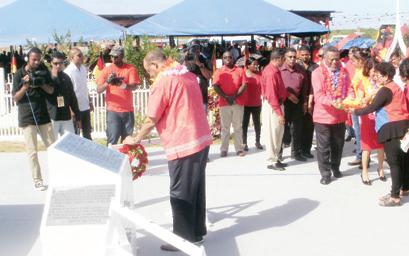
do the best we can, whether we are young or old, we must provide the best service to Guyanese.”
Invite Hinds encouraged party supporters to invite others to join the party so that the party can secure a majority at the next general elections.
“The people of Guyana must see Cheddi in us,” he said, noting that the combined opposition, the A Partnership For National Unity and Alliance For Change, controls the National Assembly with their one-seat majority.
Meanwhile, reading a message by the President, First Lady Deolatchmee Ramotar said her husband regrets being unable to attend the event. Noting that 17 years have already gone by since Dr Jagan died, the President in his message said almost on a daily basis, he looks at Dr Jagan’s work and methodology for guidance.
Ramotar said that the joint opposition in the 10th Parliament has made life difficult for Guyanese. The
opposition has created havoc on the proposal to increase electricity subsidy for Linden, which resulted in riots and loss of life. The President said that he engaged the opposition in almost every national project in Guyana since he took office. “I am determined that the Amaila Falls Project will be built so that all Guyanese can have a better standard of living.”
AML Bill
Ramotar also made mention of the opposition’s reluctance to allow the AntiMoney Laundering Bill to pass. “The sad reality is that they are well aware of the consequences of their action…. Yet they continue in their path. What I am doing is what I believe Comrade Cheddi would have done, that is to bring to the people’s attention to some of the issues which affect the unity and further development of Guyana.”
He added: “United we will be able to turn things around and I am confident that we will be able to turn things around,” the message said.

The event was attended by family members of the late Dr Jagan and former President Janet Jagan, senior government officials, members of the diplomatic corps, representatives of the Progressive Youth Movement and officials from Regions Five and Six.
During the programme, students from schools on the Corentyne read extracts from Dr Jagan’s writings and speeches.
Recommitment
Meanwhile, PPP General Secretary and Home Affairs Minister Clement Rohee called on those in attendance to remember what the Jagans stood for.
He said Dr Jagan has left the party a rich legacy which is still relevant today.
“He has taught us to fight against all forms of dictatorship. He has taught us to fight against political bullyism in whatever form it may take,” Rohee said.
Earlier, party officials and family members, along with members of the diplomatic corps, laid wreaths at the monument at the Babu John Crematorium.
Dr Cheddi was described as a man who promoted the arts and in reflection of that, the Central Delight Dance Troupe of Corentyne and other groups performed.
Dr Jagan suffered a heart attack on February 15, 1997 and was taken to the Georgetown Public Hospital before being flown by a U.S. military aircraft to Walter Reed Army Hospital in Washington, D.C. later that day.
He died in Washington on March 6, 1997.
Prime Minister Sam Hinds succeeded him as President and declared six days of mourning, describing Jagan as the “greatest son and patriot that has ever walked this land”.
Women cannot be absent from making decisions to help define the development agenda after the year 2015, Economic Commission for Latin America and the Caribbean (ECLAC) Executive Secretary Alicia Bárcena said.
She expressed the view on at the commemoration of International Women’s Day on Saturday, March 8.
In a process led by the United Nations, the international community aims to establish a new agenda for sustainable development to succeed the Millennium Development Goals (MDGs), which countries agreed upon in 2000 and committed to achieving by 2015.
Bárcena explained that it is not about “including” women in this new development agenda, but rather “building a development model that is based on equality between men and women and on the eradication of all forms of discrimination”, which is what ECLAC proposes.
“In all areas of debate of the Post-2015 agenda, women should participate at parity with men, which represents an important challenge for Latin America and the Caribbean,” said the highest representative of this regional United Nations organisation.
According to data from ECLAC’s Gender Equality Observatory for Latin America and the Caribbean (OIG), six Latin American and Caribbean countries will be governed by women in 2014: Argentina (Cristina Fernández), Brazil (Dilma Rousseff), Chile (Michelle Bachelet), Costa Rica (Laura Chinchilla), Jamaica (Portia Simpson) and Trinidad and Tobago (Kamla Persad-Biss essar).
Low representation
Nevertheless, women represent no more than 26 per cent of lawmakers, high court justices and Cabinet ministers in the region. They account for 25.6 per cent of City Council members and just 11.7 per cent of mayors. Thirteen Latin American and Caribbean countries had implemented gender quota laws by 2012. In the last three years, only El Salvador (in 2013) joined that group, which demonstrates that there is still a significant number of nations that have not adopted measures to improve the participation of women in
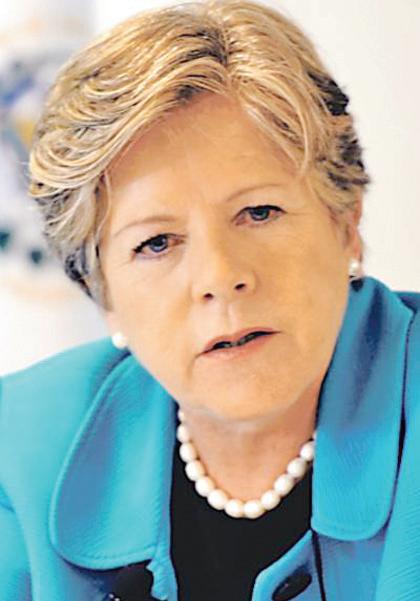
electoral politics.
On another point, Bárcena said “the Post-2015 development agenda can’t be limited to reducing poverty, and instead must be seen as a comprehensive process that covers both productive and reproductive arenas”.
This implies, among other things, changing the current patterns of production and consumption – which are not environmentally sustainable – and collectively taking on issues such as unpaid work and the socalled care economy that today mainly falls to women, affecting their development.
According to OIG data, no Latin American country has women in a parity situation with men in terms of economic participation. Five of every 10 women are still outside the job market and unemployment among women is two percentage points higher than among men (7.8 per cent versus 5.9 per cent).
Women’s autonomy is a key factor for guaranteeing they can exercise their human rights in a context of full equality, said ECLAC, underlining three main pillars: physical autonomy (control over their bodies), economic autonomy (the capacity to earn income and generate their own resources), and full participation in making decisions that affect their lives and their group.
The need to strengthen women’s autonomy and their voice inside the debate on the Post-2015 development agenda was highlighted in the Santo Domingo Consensus, approved in October 2013 at the XII Regional Conference on Women in Latin America and the Caribbean, organised by ECLAC in Santo Domingo, The Dominican Republic.
“Women must make the post-2015 development agenda, in all its dimensions, their own,” emphasised Bárcena.

Officials investigating the disappearance of a Malaysia Airlines jetliner with 239 people on board suspect it may have disintegrated mid-flight, a senior source said on Sunday, as Vietnam reported a possible sighting of wreckage from the plane.
International police agency Interpol confirmed that two passengers on the flight had used stolen
Austrian and Italian passports, raising suspicions of foul play.
An Interpol spokeswoman said a check of all documents used to board the plane had revealed more “suspect passports” that were being further investigated. She was unable to say how many, or from which country or countries.
Malaysia’s state news agency quoted Home
Minister Ahmad Zahid Hamidi as saying the passengers using the stolen European passports were of Asian appearance, and criticising border officials who let them through.
“I am still perturbed. Can’t these immigration officials think? Italian and Austrian (passport holders) but with Asian faces,” he was quoted as saying late on Sunday.
Nearly 48 hours after the last contact with Flight MH370, mystery still surrounded its fate. Malaysia’s air force chief said the Beijing-bound airliner may have turned back from its scheduled route before it vanished from radar screens.
“The fact that we are unable to find any debris so far appears to indicate that the aircraft is likely to have disintegrated at around 35,000 feet,” a source involved in the investigations in Malaysia told Reuters. (Excerpt from Reuters)
Indian politicians are expected to spend around
US$5 billion on campaigning for elections next month — a sum second only to the most expensive U.S. presidential campaign of all time — in a splurge that could give India’s floundering economy a temporary boost.
India’s campaign spend, which can include cash stuffed in envelopes as well as multimillion-dollar ad campaigns, has been estimated at 300 billion rupees by the Centre for Media Studies, which tracks spend-
ing. That is triple the expenditure the centre said was spent on electioneering in the last national poll in 2009 — partly a reflection of a high-octane campaign by pro-business opposition candidate for Prime Minister, Narendra Modi, who started nationwide rallies and advertising last year.
“They started much before, and they are also focusing on states where they are traditionally not strong. They are leaving no area untouched,” said Centre for Media Studies Chairman N
Bhaskara Rao.
The campaign spending for this election could give a boost to the economy, which has been heading for its longest slump since the 1980s. Economists have forecast a second year of growth below five per cent in the financial year ending this month.
Candidate and party funding in India is opaque and the source of much of the spending is hard to ascertain, but the Centre for Media Studies and other transparency advocates say the main contenders have built up large war chests. (Excerpt from Times of India)
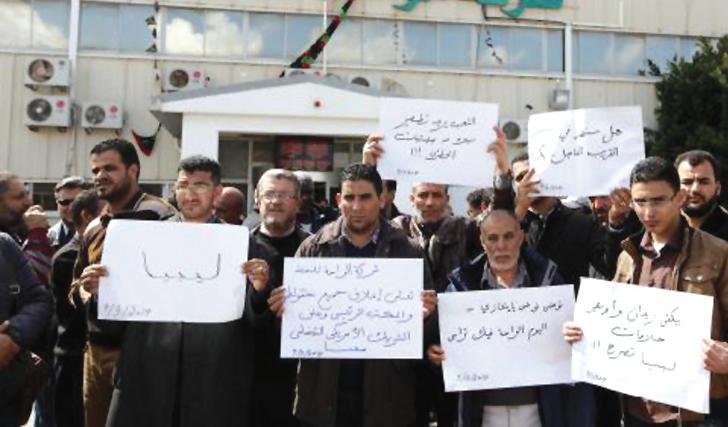
Armed protesters in eastern Libya traded threats with the government on Sunday in a tense stand-off over the unauthorised sale of oil from a rebel-held port.
A North Korean-flagged tanker, the Morning Glory, docked on Saturday at the port of Es Sider and local
daily al-Wasat said it had loaded US$36 million of crude oil. Prime Minister Ali Zeidan has said the military will bomb the 37,000-tonne vessel if it tries to leave.
Officials said on Sunday that the navy and pro-government militias had dispatched boats to stop it from getting out. The rebels said
any attack on the tanker would be “a declaration of war”.
The escalating conflict over the country’s oil wealth is a sign of mounting chaos in Libya, where the government has failed to rein in fighters who helped oust veteran ruler Muammar Gaddafi in 2011 and who now defy state authority.
The protesters, who also include former soldiers and ex-oil guards led by a former anti-Gaddafi commander, Ibrahim Jathran, have seized three eastern ports in the OPEC member country.
The Defence Ministry issued orders to the air force and navy to deal with the tanker. “The order authorises the use of force and puts the responsibility for any resulting damage on the ship owner,” it said in a statement. (Excerpt from Reuters)
China has said that it will work with Afghanistan to fight “terrorism”, after it blamed a deadly train station attack on “extremists” from its western Xinjiang region, which shares a short border with the war-torn nation.
Saturday’s announcement from Foreign Minister Wang Yi comes as Beijing expressed increasing concerned about security in restive Xinjiang, where it says Muslim fighters receive help from those in neighbouring
countries.
China says separatists from the region, home to a large Muslim Uighur minority, launched an attack in the south-western city of Kunming last week, killing at least 29 people and injuring about 140.
China will work with the international community for political reconciliation in Afghanistan and support reconstruction, the Foreign Minister said at a press briefing during an annual session of China’s largely
rubber-stamp Parliament.
“We will also work with Afghanistan and other neighbours to resolutely fight all terrorist forces,” he said. China will host a foreign ministerial conference on Afghanistan in August to encourage “a move toward lasting peace”, Wang added. Wang visited Afghanistan last month as U.S. and allied troops prepare to draw down their forces after more than 12 years of fighting the Taliban.

Germany’s Angela Merkel delivered a rebuke to President Vladimir Putin on Sunday, telling him that a planned Moscow-backed referendum on whether Crimea should join Russia was illegal and violated Ukraine’s Constitution.
Putin defended breakaway moves by pro-Russian leaders in Crimea, where Russian forces tightened
their grip on the Ukrainian Black Sea peninsula by seizing another border post and a military airfield.
As thousands staged rival rallies in Crimea, street violence flared in Sevastopol, when pro-Russian activists and Cossacks attacked a group of Ukrainians.
Russian forces’ seizure of the region has been bloodless, but tensions are mounting following the decision by
pro-Russian groups there to make Crimea part of Russia. In the latest armed action, pro-Russian forces wearing military uniforms bearing no designated markings sealed off a military airport in Crimea near the village of Saki, a Ukrainian Defence Ministry spokesman on the peninsula said. The operation to seize Crimea began within days of Ukraine’s proRussian President Viktor Yanukovich’s flight from the country last month. Yanukovich was toppled after three months of demonstrations against a decision to spurn a free trade deal with the European Union for closer ties with Russia. Ukrainian Prime Minister Arseny Yatseniuk will hold talks with United States President Barack Obama in Washington on Wednesday on how to find a peaceful resolution to the crisis, the White House said.
(Excerpt from Reuters)
The Arab League has backed Palestinian President Mahmoud Abbas’s rejection of Israel as a “Jewish state”, as U.S.-backed negotiations approach a deadline next month.
League chief Nabil Elaraby called on Arab countries to take a “firm stand” against Israel’s demands, calling it a deviation from an agreed-upon framework for peace talks.
El-Araby delivered his remarks on Sunday as Arab foreign ministers extended their support for the Palestinian
leadership at a meeting in Cairo.
“The council of the Arab League confirms its support for the Palestinian leadership in its effort to end the Israeli occupation over Palestinian lands, and emphasises its rejection of recognising Israel as a ‘Jewish state’,” Arab foreign ministers said in a statement in Cairo.
Abbas had earlier complained that Palestinians were being asked for something that had not been demanded of Arab countries that
have previously signed peace treaties with Israel.
“We recognised Israel in mutual recognition in the Oslo agreement, why do they now ask us to recognise the Jewishness of the state?” he asked.
“Why didn’t they present this demand to Jordan or Egypt when they signed a peace agreement with them?” Abbas added.
Abbas has said he will never recognise Israel as a Jewish state. (Excerpt from Al Jazeera)
Asuicide bomber driving a minibus packed with explosives killed at least 45 people and wounded 157 on Sunday in the southern Iraqi city of Hilla, police and medical sources said.
The attacker approached a main checkpoint at a northern entrance to the largely Shiite Muslim city and detonated the minibus, a police officer said on condition of anonymity.
At least 50 cars were
set ablaze with passengers trapped inside and part of the checkpoint complex was destroyed, the officer said.
Sunni Islamist insurgents linked to al Qaeda have been regaining ground in Iraq over the past year, particularly in the western province of Anbar bordering Syria.
No one claimed responsibility for Sunday’s attack, but the Deputy Chairman of Hilla Provincial Council, Aqeel alRubaie, accused al Qaeda of
being behind the bombing. Rubaie said the local government had received tips that al Qaeda-affiliates hiding in farmland north of Hilla were plotting a strike.
He said the violence was a spillover from fighting in neighbouring Anbar, where the Shiite-led government has been battling the al Qaeda faction the Islamic State of Iraq and the Levant (ISIL) around the cities of Ramadi and Fallujah. (Excerpt from Reuters)
Despite LIAT’s desperation for investor dollars, it wants no “buccaneers” coming to buy any part of its fleet. This is the view of Chairman of the airline’s four shareholder countries, Dr Ralph Gonsalves, who revealed that many letters came to LIAT offering investment in the 58-yearold cash-strapped airline, but many of them were from people of dubious repute.
“I don’t want any buccaneer to write me about any
involvement in this matter. You have a lot of private sector buccaneers, not of any reputable type, holding out that they have US$200 million and US$300 million from some entity somewhere in Europe, Kazakhstan or Azerbaijan or some place. No buccaneers write me and I reply to them,” he told journalists at the end of a meeting of LIAT shareholders at Hilton Barbados Thursday.
“I want serious people with serious proposals. And
believe me, we get a lot of letters from buccaneering types, and when they can’t succeed, they take to the Internet and say that we are stupid and we don’t want to have any investors coming,” he added.
Gonsalves, who is also Prime Minister of St Vincent and the Grenadines, said he had always told people, especially private sector critics, that if they believed they could make money in LIAT, then they should become an equity partner. (nationnews)
U.S. economy adds 175,000 jobs in February
The jobs figures, from the U.S. Labour Department, were better than many had been expecting and marked a rebound from two weak months.
It had been thought the figures would be affected by recent harsh weather, which had hit much of the country.
But the unemployment rate, based on different statistics, went up slightly from January’s 6.6 per cent to 6.7 per cent.
February’s jobs figure,
known as non-farm payrolls and based on a survey of employers, compares with the 129,000 new jobs created in January. Analysts had been expecting a rise of about 150,000 last month.
“It is stronger than expected on several fronts,” said Camilla Sutton, from Scotia Capital. “That these numbers came even while weather was bad shows the underlying strength of the U.S. economy.”
A large chunk of the gains came from financial and other
services, which were responsible for an extra 79,000 jobs.
Construction companies, many of which had been affected by the bad weather, added 15,000 jobs.
But the information sector lost 16,000 jobs, most of them in film and sound recording.
Average hourly earnings in the private sector rose by 3.7 per cent, or about nine cents, to US$24.31, the figures show. Over the year, average hourly earnings have risen by 2.2 per cent. (BBC News)
Competitiveness in France and Europe must be improved regardless of how strong the euro is, France’s Finance Minister said on Sunday, in a rebuttal to critics who blame the currency’s rise for French firms’ export woes.
Several French politicians and companies including carmaker Renault and energy management firm Schneider Electric have in recent months raised flags over the impact of
the euro’s strength on profits.
“The euro is at a high level...(But) we must not make a scapegoat out of currency,” French Finance Minister Pierre Moscovici told BFM TV.
“What we must first restore is the health of our companies, their competitiveness...The euro’s strength must not be a scapegoat or a pretext to avoid reforming Europe and France.”
France’s trade deficit, which hit a record of 74 bil-
lion euros in 2011, is one of the signs of French firms’ loss of competitiveness on international markets. Although it has got smaller since then, figures suggest this is mainly due to exports falling less quickly than imports.
French Industry Minister Arnaud Montebourg has called for a more aggressive push from Europe and the European Central Bank to bring down the euro’s value in order to boost exports. (Reuters)
Chinese companies and banks were once seen as bold and fearless as they invested in countries Western investors deemed too risky. But this may now be changing.
In 2007, when two Chinese state-owned companies struck a deal with the Congolese government to build the biggest mine the country had ever seen, all involved were riding high. In a mega-deal
originally worth some US$9 billion, Sinohydro and the China Railway Engineering Corporation (CREC) would gain access to 6.8 million metric tonnes of copper, the future profits of which were to underwrite the prior building of hospitals, roads, and other infrastructure.
At the time, the China’s involvement in Africa was booming and the Sicomines deal embodied much that was
symptomatic of Sino-African relations: it was massivescale, involved vast infrastructural construction linked with similarly vast mineral resources, and was taking place in a country many other investors would have deemed too unstable. It was not long, however, before confidence in the deal began to wane, especially amongst the deal’s financers, China’s ExportImport Bank (Exim). (allAfrica)
Europe’s and Asia’s industrial health will be closely watched in the coming week for an indication of how solid – or weak – a footing the global economy was on at the start of the year.
With China’s leaders seeking to rebalance the world’s industrial powerhouse more toward consumer spending, and with bad weather distorting most United States data since the start of the year, some clarity would be helpful.
After private sector busi-
ness surveys suggesting services activity around the world is on the up, investors and policymakers will shift their focus to industrial production figures for the eurozone, Britain, Japan, and China.
Industrial output growth in China, the world’s second largest economy, is likely to have slowed further in January from 9.7 per cent in December, hurt by weaker local and foreign demand.
Economists in a Reuters poll forecast a decline to a 9.5
per cent annual pace, which is still strong and would not yet show the kind of rebalancing policymakers are looking for. Those figures are due on Thursday.
“China’s export growth is likely to have softened in February after the surge in January due to the frontloading of exports before the Lunar New Year,” said David Mann at Standard Chartered. Beijing says it is aiming for economic growth of about 7.5 per cent this year. (Reuters)
Arabtec Holding, Dubai’s largest listed construction firm, has signed a deal with the Egyptian army to build one million houses in a project worth 280 billion Egyptian pounds (US$40.23 billion), it said in a statement on Sunday.
The project, one of the biggest in the region, is seen as a boost to the country of 85 million which has been strug-
gling to attract tourists and foreign investors, amid political turmoil, and saw its foreign reserves drop to a critical low last year.
It will cover 160 million square metres across 13 sites in Egypt for lower income individuals. The company said it expected that work on the project would start in the third quarter of this year and be completed before 2020.
The firm did not say how the project will be financed, but Arabtec’s Chief Executive Hasan Ismaik told Reuters on the sidelines of a press conference in Cairo said that the land will be given for free. Ismaik added that there will be an agreement with around 40 banks in Egypt to provide financial facilities for limited income individuals. (Arabianbusiness)
Five years ago, the United States was in the midst of its worst recession in seven decades, and stocks were feeling it.
On March 9 in 2009, the S&P 500 hit its nadir, closing at 676.53. That low marked a climax of a 16-month selloff that took more than half the S&P 500’s value.
Since that day, the Standard & Poor’s 500 index has gained more than 177 per cent, the best rolling five-year performance since the June 1996 to June 2000 period that covers the dot-com bubble. Naturally, some investors are questioning whether the bull run is nearing an end. Investors cited a number of reasons to be nervous. Though a number of these factors have been present
for some time, the following stand out as concerns:
* Valuations: Profit growth, and especially revenue growth, may not be strong enough to support current price levels. Profit growth has slowed considerably from the peaks of this earnings cycle. There are concerns that revenue growth will be lacklustre while economic growth remains mediocre.
The S&P 500’s forward price-to-earnings ratio, at 15.8, is its highest since the fourth quarter of 2008, Thomson Reuters data showed. It comes as revenue growth has slowed, eating into profits, and productivity growth declined in the first quarter, suggesting slimmer margins in the next earnings period as well.
S&P 500 revenue growth has averaged just 3.2 per cent since March 2009, while earnings growth has averaged 16.2 per cent, Thomson Reuters data showed. For the most recent reporting period, revenue growth is estimated at one per cent while profit growth is forecast at 9.8 per cent. The stock market has seen higher price-to-earnings ratios - notably during the technology bubble and the end of the 2007-2008 run, but to some, that’s not comforting.
“A lot of people say the multiple is not that high, compared to history, but in no time in history, did you have these types of tailwinds pushing asset prices for five years,” said Michael O’Rourke, chief market strategist at JonesTrading in Greenwich, Connecticut.(Reuters)

BY SVETLANA MARSHALL
Environmental engineering scientists are putting systems in place to exploit the nutritional value of human urine, Associate Professor Maya Trotz told a Rotary Club of Georgetown dinner last week.
Held at the Pegasus Hotel, the dinner coincided with the club’s “World Understanding Day” celebrations. Dr Trotz’s presentation was based on “Water and Sanitation”.
Dr Trotz, a former Queen’s College student, is an Associate Professor at the Civil and Environment Engineering Department, University of South Florida, U.S.A. In her presentation, Dr Trotz brought the audience up to date with environmental engineering with regard to sanitation and water regeneration.
She noted that there are 2.5 billion people in the world without any safe access to sanitation, and according to the Associate Professor, mechanisms are
being put in place to capitalise on the nutritional value of urine. “Our urine has most of the nutrients we want and less of the pathogen and the stuff that would make us sick.”
It was pointed that urine has a high per cent of nitrogen; hence, individuals and organisations operating within the engineering and environmental fields are devising technologies that can separate urine from the feces, thereby allowing for the effective use of urine.
When separated, it can be harvested in a centralised location at the level of the home or community and utilised as fertiliser. This is already occurring in communities across the world that has very little access to water and lower access to imported nutrients or fertilisers.
Turning her attention to water, Dr Trotz pointed out that there are approximately 715 million people in the world who have no access to safe water, noting that per-

University of Guyana Student Society President Richard Rambarran said measures were being put in place to address the security of students on the Turkeyen Campus.
In an interview with the Guyana Times, Rambarran explained that security was a major concern for the UGSS. Many students have been attacked and robbed around the environs of the University of Guyana.
sons should always practise water conservation.
Dr Trotz also questioned the mechanisms put in place to protect residents from overtopping. The Public Works Ministry has constructed strobe walls on the sea walls. The strobe wall has been designed to break wave energy to avoid overtopping.
While acknowledging that the adaptation technology has been implemented to make communities more resilient, she asked whether it is sufficient as sea levels continue to rise. She further pointed out that the Georgetown sea wall was built since 1855.
“Is it resilient enough… or should I be worried that my mother lives in front of this and I don’t know how long this structure will last?”
Dr Trotz, who acquired her PhD in Civil Engineering at Stanford University, has major interest in sustainability, water quality, ecotourism and small-scale mining impacts on sustainable livelihoods, climate change and environmental engineering education.
Her research and teaching are focused on geochemistry, water quality and global sustainability
Meanwhile, the Rotary Club of Georgetown Dinner drew participation from Barbados, Canada, Finland, Haiti, Brazil, Jamaica, The Netherlands, the Russian Federation, St Vincent and the Grenadines, Trinidad and Tobago and the United Kingdom.
Rotary Club of Georgetown President Harry Parmesar, Vice President Liz Cox, Past President Paul Chan-ASue, Past President Johnny Carpenter, Past President Errol Cheong, Director Michele Ming, Members of Parliament, politicians, doctors, engineers, musicians and teachers were among those present.
Rambarran revealed that he have engaged in discussions with the University’s administration and the Minibus Association to implement systems that will be more secure for students, especially those travelling from the University in the evenings. He disclosed that from those discussions, the parties have come to an agreement on transportation from the UG compound. The agreement, he said, has already been drafted and is before the parties for them to sign off.
The UGSS President noted that one of the measures included in the agreement is a guaranteed bus service at the campus from 08:00h to 21:30h. Another measure is transportation for students travelling along the East Coast Demerara corridor; this, he said, will ensure that students do not have to travel down to Stabroek for transportation to go up the coast or walk out to the main road.
Shuttle services
“Given that the route of the bus is 44, they can now use a bus from the University of Guyana, buses that are headed in that direction,” he
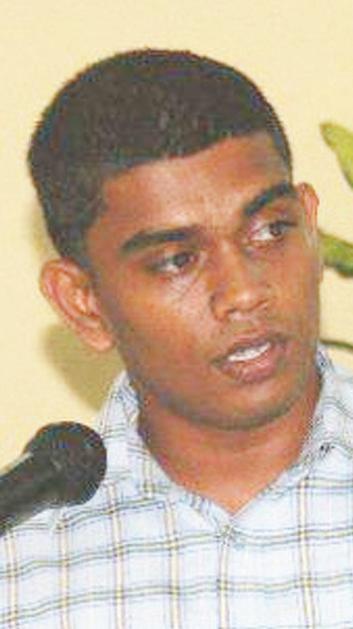
pointed out. In addition, Rambarran explained that they have also agreed for the minibus operators to be in uniform, and to improve their decorum and the presentation of their buses. He continued that for students living in close proximity of UG, shuttle services to the University have been agreed upon.
He further revealed that the UGSS has also been in discussions with taxi drivers. “I will be asking some of those drivers, not many of them because the demand would not be great as during the day, if they can provide their service to facilitate this shuttling in and around the environs of Turkeyen and Industry late in the night,” the UGSS President said. Rambarran noted that the drafting of this agreement is almost complete.
He went on to say that there have been several complaints of students being attacked and robbed late in the evening while walking out of the University’s
compound which is dark. He disclosed that, after constant calls by the UGSS, the University’s administration installed floodlights along the pathway to ensure the safety of the students.
Meanwhile, another issue affecting students is unsanitary washrooms. The UGSS has closed several washrooms that were in deplorable condition.
“We currently are in talks with the Vice Chancellor, because it has been related to us that the University of Guyana has already designated monies to refurbishing the rooms which are in the worst state possible; and in the best interest of the students, I don’t think these washrooms should continue functioning and herein our move to close them,” he stated.
The UGSS President revealed that he was made to understand that the University is waiting for the tender process to begin. Rambarran said the UGSS is also concerned about the presence of stray animals in the compound. “Myself, representing the University of Guyana Student Society, along with the University of Guyana Administration is working assiduously, to ensure that this issue through the stray catching division at the Ministry of Home Affairs is addressed as soon as possible,” he noted.
Additionally, the UGSS President disclosed that his society is also working on several other projects to improve the environment for students, including refurbishing the gym and refurbishing the lecture theatre into a modern theatre.
Twenty-one-year-old Inshan Ramlakhan, of Good Hope, East Coast Demerara, is still in critical condition after he was shot during a robbery early Thursday morning.
According to the injured man’s brother, Ravi, doctors say he is not yet out of danger. “All we can do is hope and pray for the best… he clinging to life… but they (doctors) doing everything they could to save him,” he said.
The brother noted that Inshan is currently on life support and while he regains consciousness regularly, he has to be sedated owing to the pain he is experiencing. Ravi said his brother was not talking but using gestures to communicate and was unable to move his feet.
The worried brother stated that doctors performed surgeries to pump out blood that filled the
lung which was punctured by the bullet, but they were unable to remove the bullet. “They say they can’t touch the bullet yet and have to wait but they already repair all the damage that the bullet did,” he disclosed.
On Thursday around 05:15h, Inshan and a younger relative were walking in the vicinity of Conversation Tree when they were confronted by a man armed with a handgun. The perpetrator tried to relieve Inshan of his haversack, but he resisted, causing the gunman to discharge a round at him. Inshan was shot to the left side of his chest just above the heart; however, the bullet travelled through his body causing damage to his spine and lung. The perpetrator managed to relieve the injured man of his cellphone before making good
his escape.
The relative who witnessed the entire ordeal rushed to a nearby relative with whom Inshan works for help, and they rushed him to the Georgetown Public Hospital where he remains a patient.
Ravi further revealed that police took someone into custody on Saturday for the robbery; however, they need to conduct an identification parade before any further action is taken. He added that he was not told much by the police about the suspect they have in custody and was told to return today for more information.
The brother noted that taking into consideration the critical condition of Inshan, the relative who witnessed the attack will go to the ID parade. The family is worried about their safety as both Inshan and the younger relative saw the perpetrator’s face.










If you need to boost your credentials, do so. Seeking out a challenging new position will motivate you. Do your research and learn the skills required to help you achieve your goal.

By Bernice Bede Osol

(June 21July 22) (Jan. 20Feb. 19) (Dec. 22Jan. 19)
It’s a good day to get in touch with old friends. You will find that you all still have plenty in common. Sharing your views will give you a much greater perspective regarding a certain situation.

You will have a tendency to overreact. If you remain levelheaded, your plans can be turned into reality. Make the necessary effort to keep your emotions in check today.

Don’t be shy about presenting your ideas. A little self-promotion is necessary if you want to be successful. Determine who your allies are, and share your thoughts with them.

(Aug. 23Sept. 22)
(July 23Aug. 22) (Feb. 20-March 20)
Your home and family life should be your priority today. Do what you can to improve important relationships. You could run into trouble if important details escape your notice.

(March 21-April 19)
You will have difficulty concentrating on your career if there are unresolved issues at home. Once your mind is clear of domestic problems, you can dedicate yourself to your work.

(April 20-May 20)
There are people in your circle who claim that they can assist you with important projects. Some will be a great help, and some will be more of a hindrance. Choose your allies carefully.

(May 21June 20)
Direct your focus toward money matters. Consider asking for a raise, or find a way to supplement your income with a part-time job. Reducing financial stress will improve your outlook.
Think carefully before making any decisions. You will end up in a much better position if you sit back and wait for others to make the first move.

(Sept. 23Oct. 23)
Don’t be reluctant to offer help to a close friend. The reassurance you give him or her will make a difference to your relationship. Loyalty will win you favours and support. Share something with people you care about.

(Oct. 24Nov. 22)
Let your creativity and imagination drive you today. You should finish projects that you’ve been putting off. Feelings of accomplishment will lead to new beginnings and opportunities.

(Nov. 23Dec. 21)
You may think that someone you relied on has turned out to be untrustworthy. Although you feel hurt, make sure to get your facts straight before making any accusations.

Dentures provided in 72 hours from as low as $4500. Contact Dr B Stuart, 209B Charlotte St, Lacytown. Tel: 225-5034

Shalom Driving School. Lot 2 Croal Street. Call 227-3835, 227-3869, 622-8162 and enjoy 20% discount

Music is fun! Register now and learn to







Agricultural tractors and machinery; single and 4-wheel drive: Massey Ferguson, Ford, John Deere, New Holland and Fiat. Also available spares parts for these machines. Phone: 6194483, 601-7883, 226-6325
Spare parts for 1-2-3-4 and 6 cylinder diesel engines for Lister, Pieter, Kobota, Perkins, Veutz, Fiat, John Deer, Case IH, Cummings, Bedford and Leyland Daf. Also all middles of diesel generators: super silence and open air from 3KVA- 600KVA. Contact Rams Auto Spares on telephone 226-6325, 2271454, 619-4483 and 685-3568 Chinese-made gas stoves. Call 2315866, 231-5857
Cheap earth delivered to spot on ECD and EBD. Call 627-9977 &698-0182
Clean garden earth and builders waste; our services also includes Bobcat rental, excavating, clearing and leveling. Call 616-0617 or 663-3285

Healthworld Holistic Centre offers clinical psychotherapy for suicidal thoughts, attempted suicides, depression, stress, mood disorders, psychotic disorders, homicidal thoughts, hallucinations, loneliness, conflicts, anger management, relationship & sexual problems, paranoia and much more. Call +592-6210552 and make that appointment now before it’s too late. 12:00PM – 6:00PM. Mondays - Fridays. Email: healthworldhc@gmail.com



Two storey wooden building. Bare Root. Phone: 687-5653
Property for sale at 48 Light Street, Alberttown (between third and fourth streets) Contact Ram on telephone: 619-4483 685-3568 and 226-6325.
First Phase Good Hope, Anna Catherina, East bank Demerara (property with ongoing business). Call 6735546, 695-4382, 669-3313, 231-4586.

Da Silva’s Optical. For Your Eyes Only, Look Better See Better. Phillip A Da Silva OD, Shannon L Da Silva OD, Natalie Da Silva OD. 248 South Road, Bourda. Phone: 227-3529, Linden: 444-6376, Corriverton: 339-3536, Meten-Meer-Zorg: 275-0322, Grand Cayman Islands: (345) 943-1515 for the perfect

J Eastman & Associates. Taxation (VAT, income & Property), Cash Flow Projections, Business Development Plan, Personal Financial Adviser, Accounting & Consultancy. 190 Church Street, South Cummingsburg, Georgetown, Guyana (two buildings east of Austin’s Book Store. Phone: 223-2105, 662-7467 Quality Troweltex and painting work at guaranteed low cost. Phone: 687-0930 Learn Portuguese in little time with beginners and advanced DVDs & CDs. Call 657-0482

Suriname Astrology Palmist and Djuka Healing, the most powerful spiritualist in the world, are you suffering from the following problems (any religion) love, marriage, family, health business, husband and wife relationship, property, court, children, promotion, visa, pregnancy, education, depression, job, sexual, jealousy, enemy, money, drinking? Also you can have all evil forces destroyed such as black magic, witchcraft, voodoo, obeyah etc and give powerful protection. We also do upliftment for clearing of land, dredging operations strictly in the interior. For private and confidential service call 674-2112.
Get your home or business spiritually clean to enhance good luck and prosperity. Telephone: 687-5653
& Visa Services We handle all Canadian, USA and UK immigration and visa matters. Self sponsorships, holiday/visitor’s visas, work permits, students visas, family, class, immigration forms, embassy enquiries, appeals for refused cases, US green card lottery, business class waivers, pardons, etc. Get your visa approved. High success rate. Balwant Persaud & Associates. Certified Immigration Consultants, 68 Sixth Street, Alberttown, Georgetown (Between Cummings & Lights Sts) Tel: 225-1540, 622-8308, 655-3105. Email: balwantpersaud@yahoo.ca TO lET

Key Shop, 125 Carmichael Street, Georgetown. Phone: 225-3923, mobile: 6213249.
Cleansing of spiritual problems of all kinds. Powerful Ifá protection against evil. Get help to overcome problems with love, relationships, legal, sexual, pregnancy, business, sickness, jobs, enemies, work, money. Call 592-6901824 from 10:00-16:00h Email:anewlife@live.com
Dutch spiritual healing in removing evil spirit, bad luck, evil sickness, spells, reuniting lovers and prosperity to businesses. Call: 612-6417, 2200708, 687-5653.

JUST ARRIVED: TOP QUALITY RECONDITIONED VEHICLES; TOYOTA NOAH; TOYOTA VOXY; TOYOTA IST (NEW SHAPE); SUZUKI SWIFT; DAIHATSU MOVE (660CC); MERCEDES BENZ C200 KOMPRESSOR; COROLLA AE100 WAGON; HONDA CRV RD4; LAND CRUISER (FULLY LOADED); MAZDA
PROCEED 4WD EXTRA-CAB PICKUP; TOYOTA HILUX 4WD EXTRA CAB PICKUPS - 3RZ, 5L, 3L SOLID DEFFERNTIAL; MITSUBISHI CANTER TRUCKS 4 TONS FREEZER; 3 TONS OPEN TRAY; 2 TONS 4WD; 3 TONS DUMP TRUCK; NISSAN ATLAS 2 TONS OPEN TRAY TRUCK. PREORDER YOUR UNITS EARLY AND GET THE BEST PRRICES. FULL AFTER SALES SERVICES AND FINANCING AVAILABLE. DEO MARAJ AUTO SALES, 2 CHIMNEY ROAD, CHATEAU MARGOT, ECD. 624-0762, 2205177. A NAME AND SERVICE YOU CAN TRUST.
4x4 Nissan Titan fully powered Immaculate condition $3.5M. No reasonable offer refused. 622-7740

Full & part time security guards. To arrange an interview, call 231-5866, 231-5857

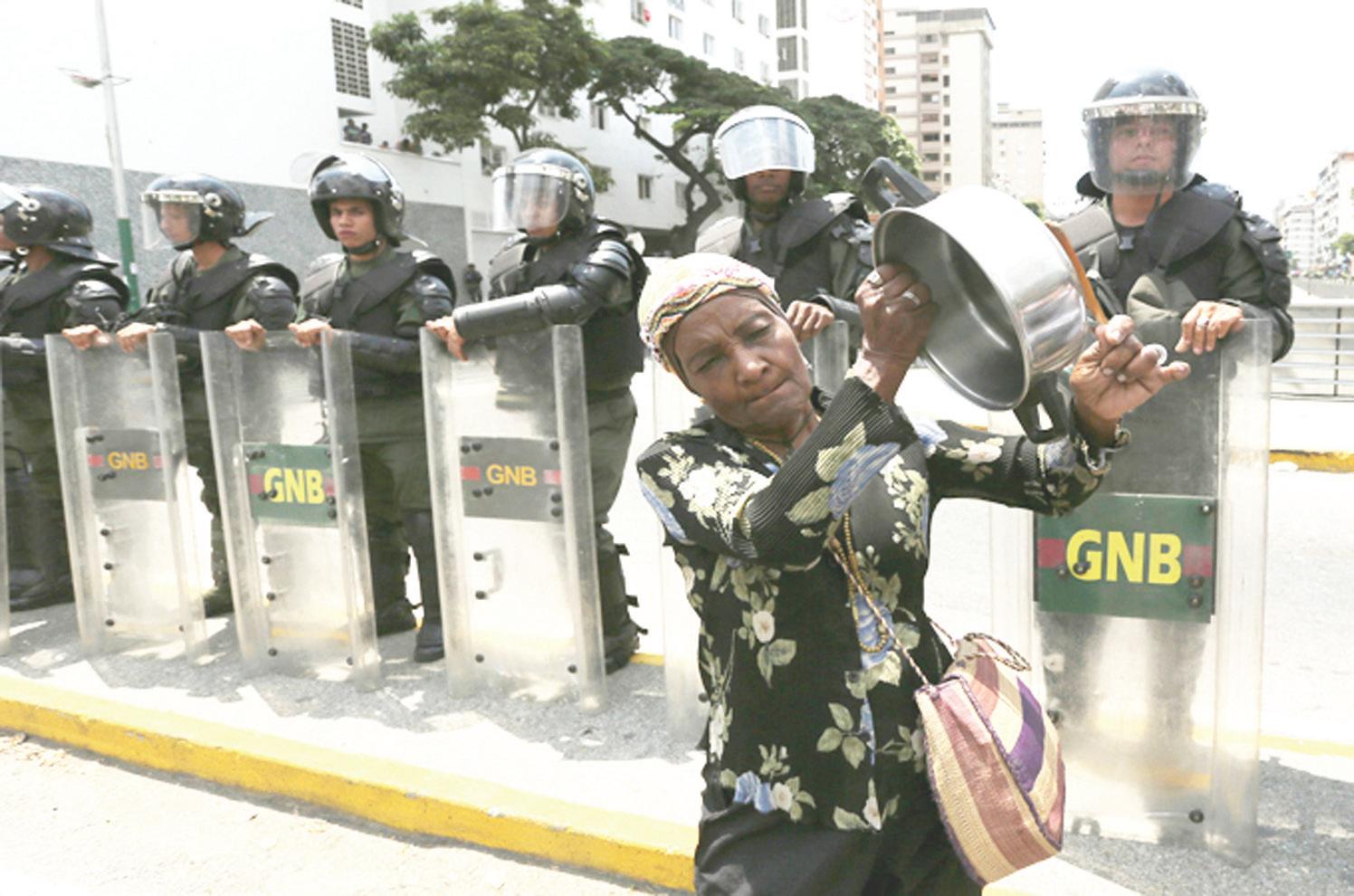
Hundreds of National Guardsmen in riot gear and armoured vehicles have prevented an ‘empty pots march’ from reaching Venezuela’s Food Ministry to protest against shortages of staple items.
More than 5000 protesters banged pots, blew horns and whistles, and carried banners in Caracas, the capital, on Saturday to decry crippling inflation and nowchronic shortages of basics including flour, milk, and toilet paper.
Protests were also held in several other cities, including Maracaibo, San Cristobal, Valencia, Isla de Margarita and Puerto Ordaz. Local television did not broadcast any images of the marches, the AFP news agency reported.
All over Venezuela, people spend hours every week queuing up at supermarkets, often before dawn, without even knowing what may arrive.
“There’s nothing to buy. You can only buy what the government lets enter the country because everything is imported. There’s no beef. There’s no chicken,” said Zoraida Carrillo, a 50-yearold marcher in Caracas.

The capital’s government-allied mayor had refused the marchers a permit to hold the rally, leading opposition leader Henrique Capriles to accuse authorities of trying to “criminalise” peaceful protests, the AP
news agency reported.
“Nicolas [Maduro] is afraid of the empty pots of our people. He mobilises hundreds of soldiers against empty pots,” he said of the man who defeated him by a narrow margin in presidential elections last April.
Capriles also reiterated opposition complaints that the government is sending “functionaries and groups of paramilitaries, which they have armed, to put down protests”.
President Nicolas Maduro has faced several weeks of daily student-led protests across the nation that he says are an attempt by far-right provocateurs to overthrow him.
They have been joined by mostly middle-class Venezuelans fed up with inflation that reached 56 per cent last year and one of the highest murder rates in the world.
Full support
Maduro’s socialist government, meanwhile, celebrated as a diplomatic victory, as an Organisation of American States (OAS) declaration supported its professed efforts to bring a peaceful solution to the country’s worst political violence in years.
The U.S., Canada and Panama were the only nations to oppose the declaration.
Late Friday, in
Washington, the OAS approved a declaration that rejected violence and called for justice for the 21 people the government says have died since February 12 in street protests.
The declaration offered “full support” for a government peace initiative that the opposition has refused to join until dozens of jailed protesters and an opposition leader are freed.
Twenty-nine nine countries voted in favour of the declaration after 15 hours of debate spread over two days.
After Panama sought discussion of the crisis in the body, Venezuela broke off relations and expelled its ambassador and three other diplomats.
The objections from Washington and Panama attached to the declaration were longer than the declaration itself.
They argued that it violated OAS rules by taking sides, AP reported.
“The OAS cannot sanction a dialogue in which much of the opposition has no voice and no faith,” according to the U.S. objection.
“Only Venezuelans can find the solutions to Venezuela’s problems, but the situation in Venezuela today makes it imperative that a trusted third party facilitate the conversation as Venezuelans search for those solutions.” (Excerpt from Al Jazeera)
Aformer Marxist guerrilla leader is expected to win El Salvador’s presidency on Sunday after vowing to expand welfare programmes for the poor and fending off his opponent’s claims that he will impose radical policies.
Recent polls showed Salvador Sanchez Ceren of the leftist Farabundo Marti National Liberation Front (FMLN), the rebel group in the country’s 1980-92 civil
war, with about 55 per cent support heading into the second round run-off vote on Sunday.
One of the wartime leaders of the FMLN, Sanchez Ceren faces conservative rival Norman Quijano, the former mayor of the capital, San Salvador, who trailed in polls with about 45 per cent support as voting got under way.
A Sanchez Ceren win would give the FMLN a second consecutive term and the
affable, media-shy 69-yearold has vowed to build on its social programmes, which include a glass of milk a day for children and free school uniforms, shoes and supplies.
“I have seen a change under this government,” said Carlos Cornejo, a 20-year-old medical student, as he voted for the first time shortly before polls closed on Sunday. “What lots of us want is for the welfare schemes to keep flowing.” (Excerpt

As forecast, a West Indies comeback gave England nightmares at Kensington Oval, but the much-heralded return of Chris Gayle was overshadowed by Marlon Samuels
Samuels is the Yohan Blake to Gayle’s Usain Bolt, the silver-medallist support act, but his unbeaten 69 from 46 balls was a reminder ahead of the World T20 that both batsmen possess a considerable threat.
Samuels, a vital component of West Indies World T20 victory in Sri Lanka 18 months ago, spoke at the interval of getting fit in the gym, and with lots of running. As ever with Gayle, his expression hidden behind shades, one imagined that his fitness levels had been explored more languidly. It was no surprise that their joint presence persuaded West Indies’ captain Darren Sammy to announce that their bid to retain their World T20 crown in Bangladesh started here.
If it did start here then England are in a considerable mess. They made much play of picking a side to win in Barbados, and letting Bangladesh take care of it-
self. But Kensington Oval encouraged spin bowling, just as Chittagong - where England are based - can be expected to.
England relied upon four fast bowlers on a good batting surface of decent pace and conceded 170 and then, before a sizeable contingent of English holidaymakers, stumbled to 70 for 6 in return against West Indies’ spinners. The target had been challenging, but not impossible. An eventual defeat by 27 runs was a merciful release.
To make matters worse, the captain, Stuart Broad, is suffering from tendonitis, an ailment bad enough to restrict him to two overs and then see him run out, limping, by the West Indies wicketkeeper Dinesh Ramdin. Another cortisone injection looks bound to follow. West Indies also have injury concerns over Sunil Narine, who was heading for a scan on a knee which he jarred attempting a stop on the boundary.
England’s state of mind at present against spin bowling is dreadful. They improved as the ODI series in Antigua went on, but here their befud-
dlement returned. Samuel Badree rolled out his legspinners to such good effect that he dismissed the top three for only 17 runs - Alex Hales and Luke Wright stumped in successive balls. If Hales’ demise spoke of his weakness against slow bowling, Badree easily spotting his ineffectual advance down the wicket, Wright’s wind-up, first ball, was staggeringly misconceived as he missed by distance, held the pose, and was adjudged by the TV umpire to be out of his ground. It was not all good news for Badree, though: on a night when the physios were never far from the action, Badree also damaged a finger near the end of his spell.
The other West Indies slow bowler to be briefly unhinged was Samuels - but that was due to a tart comment from Ravi Bopara in mid-pitch.
As it followed Samuels’ contentious quicker ball, one can only guess the legitimacy of his action might have got a mention. Both umpires and the West Indies captain Darren Sammy were involved before a truce was negotiated. (excerpt from Cricinfo)
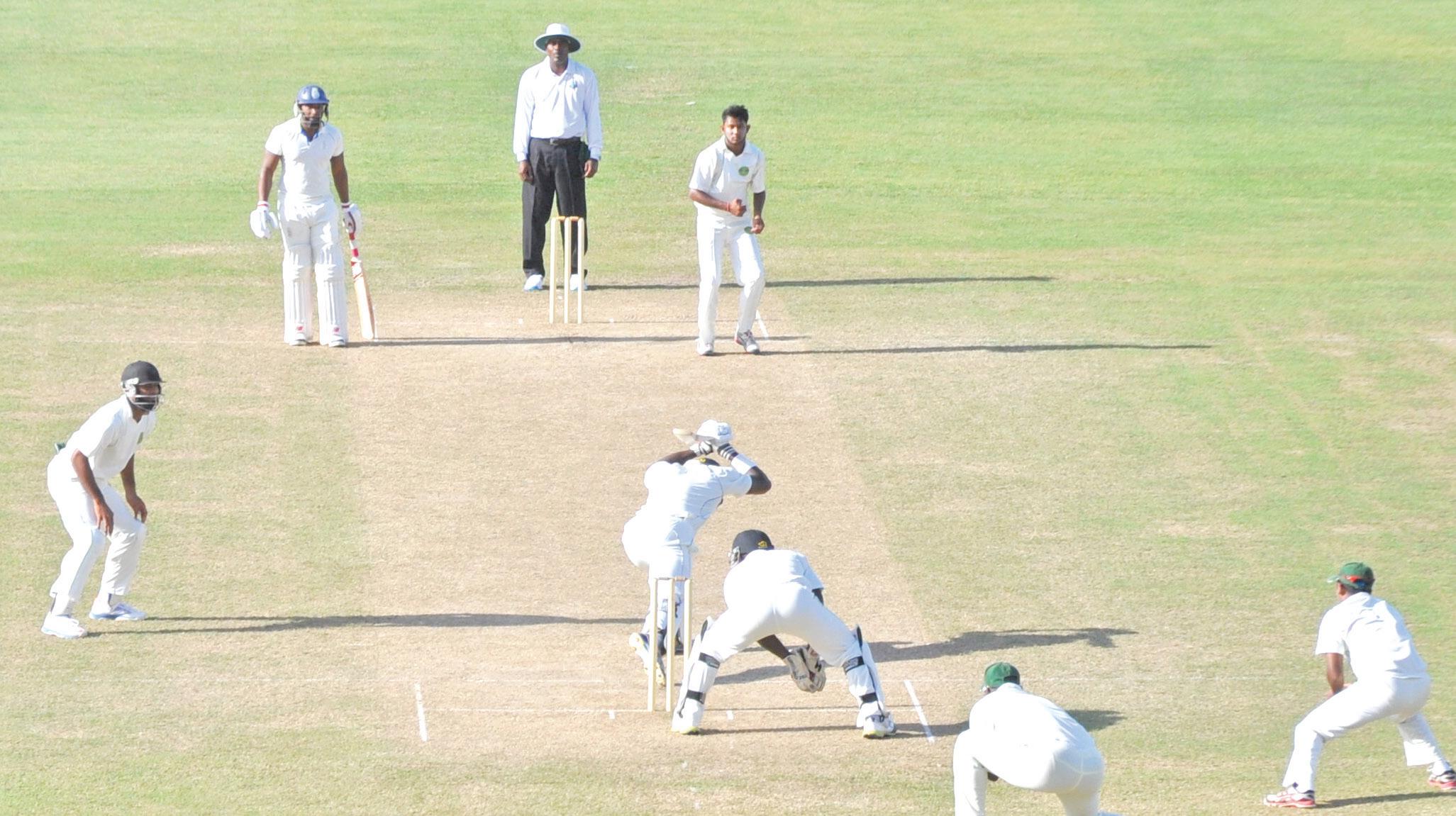
By Rajiv Bisnauth
Guyana dramatically collapsed to hand Barbados a comprehensive 136-run victory on the third day of their second round West Indies Cricket Board (WICB) Regional Four-Day cricket match at the Guyana National Stadium, Providence, Sunday evening.
The Guyanese lost nine wickets for just 72 runs, and were eventually dismissed for 94, 30 minutes into the final session.
Carlos Brathwaite first produced a ferocious spell of fast bowling in the pre-tea session to inspire the visitors before spinners Ashely Nurse and Sulieman Benn undermined the lower order batsmen.
Brathwaite finished with four for 35 off 15 overs, while Nurse and Benn claimed (3-39) and (2-8) respectively.
Resuming on 116 for four, Barbados crumbled to 186 all out, 20 minutes before the lunch interval with Bishoo the catalyst for the collapse. Bishoo ended with figures of five for 71 from his 21 overs, to complete his tenth 5-wicket haul.
Overnight batsmen Kevin
World number one
Tiger Woods made eight birdies in a 66 to move within three shots of the lead going into the WGC-Cadillac Championship’s final round.
The defending champion’s six-under-par round was the lowest of the week and leaves him joint fourth with Welshman Jamie Donaldson on one under at Doral.
American Patrick Reed, the joint overnight leader, had an eagle in his 69 to lead by two shots at four under.
Rory McIlroy is seven adrift after a 75 and Graeme McDowell (73) is five back.
After Friday’s gusting breezes caused mayhem, with more than 100 balls finding water, conditions were much calmer in the Florida sunshine
for day three at the remodelled Trump National course, nicknamed the Blue Monster.
Woods, seven times a winner of this event, began the day six strokes adrift but holed some impressive
putts, including a 35-foot effort at the 16th, and made four birdies on both the front and back nines.
The 38-year-old withdrew in the final round of last week’s Honda Classic because of a back injury and said of the problem: “It’s a little better but it gets progressively sore as the day goes on.
“It was nice to get back in the tournament again.”
World number 44 Reed has won two PGA titles - the Wydham Championship in North Carolina last August and the Humana Challenge in California in Januaryand is in contention for a third at Doral.
The 23-year-old rattled in a 25-foot putt to eagle the eighth and drove pin high at the par-four 16th to collect his third birdie of the round. (BBC Sport)
Stoute and Shane Dowrich took the score to 148, before Bishoo effected the key breakthrough. Stoute who dug in for his 28 was caught in the slip by Christopher Barnwell.
Things had taken a dramatic twist for the Barbadians when they lost five wickets for just 38 runs in the space of 12 overs.
Dowrich made a useful 23 before he edged a regulation catch to wicket-keeper Anthony Bramble off the bowling of the left-arm spinner Veersammy Permaul.
All-rounder Carlos Brathwaite was then trapped leg before wicket to Permaul for 5, before Bishoo flattened the trio of Nurse (2), Tino Bess (2) and Sulieman Benn, who made a 16-ball 20, inclusive of four boundaries.
Veersammy Permaul finished with two for 54 while Keon Joseph, Raun Johnson and Narsingh Deonarine finished with one wicket each.
Set a winning target of 231, Guyana openers Sewnarine Chattergoon and Tagnarine Chanderpaul successfully navigated their way through to the luncheon interval.
After the interval, the hosts looked in firm control of proceedings with the partnership progressed to 22, before
Carlos Brathwaite charged in and took four quick wickets, including the key scalps of Chattergoon, Assad Fudadin and Narsingh Deonarine.
Chattergoon was bowled for nine and Fudadin was trapped leg before. Fudadin’s wicket showed evidence of reverse swing and Brathwaite produced more as he clattered into the off stump of Narsingh Deonarine (0) the very next ball, leaving the Berbician with a pair in the match.
Vishual Singh (1) was run out from a direct hit from Jonathan Carter, after which Christopher Barnwell was caught at the wicket off Brathwaite and Chanderpaul (14) was trapped leg before to Ashley Nurse.
Nurse then struck aagain, removed Devendra Bishoo (3) and by tea, Guyana reached 55 for seven.
With 176 runs still in the hunt for victory, Nurse accounted for Anthony Bramble (21) before Benn removed Veersammy Permaul (21) and Keon Joseph (3), to send the home team crashing to appalling defeat.
Guyana will now meet the Windward Islands from Thursday from 10:00h daily at the Guyana National Stadium.
Carmelo Anthony
shook off a horrid shooting start and scored 26 points, leading the New York Knicks to their third straight victory, 107-97 over the Cleveland Cavaliers on Saturday night.
Amare Stoudemire add-
eight rebounds for the Cavs, who retired centre Zydrunas Ilgauskas’ No. 11 jersey at halftime.
JAZZ 104, 76ERS 92
Gordon Hayward scored 22 points, Alec Burks added 19 and Utah sent Philadelphia to its 16th con-

ed 17 points and 12 rebounds for the Knicks, whose winning streak began after a seven-game slide and amid reports Phil Jackson may accept a job in New York’s front office.
Anthony missed his first six shots, but found his touch in time to help the Knicks in their late-season run at the playoffs. J.R. Smith scored 17 and Tyson Chandler added 15 points and 11 boards for New York.
Kyrie Irving had 30 points, eight assists and
secutive loss.
Derrick Favours contributed 15 points and 14 rebounds, Enes Kanter had 13 points and 10 boards, and Diante Garrett scored 11 points for the Jazz (22-41), who snapped a five-game losing streak and completed a six-game road trip at 1-5.
Tony Wroten scored a career-high 30 points for the Sixers (15-47), who hadn’t dropped 16 in a row since a franchise-worst 20 straight losses during the 1972-73 season, when they finished
9-73. The Sixers also lost their franchise-worst 13th straight home game.
GRIZZLIES 111, BOBCATS 89
Mike Conley scored 20 points, Zach Randolph added 16 and Memphis turned up the offence in the second half to beat Charlotte.
Marc Gasol added 14 points and nine rebounds, while Kosta Koufos had 11 of his 12 points in the fourth quarter and grabbed 10 boards.
Al Jefferson scored 17 for Charlotte, shooting just 7 of 17 from the field. Chris Douglas-Roberts finished with 15 points, his fourth straight game in double figures, but Kemba Walker had just 11 and 3-of-13 shooting. Charlotte shot 40 per cent for the game.
Memphis broke the game open after halftime, outscoring Charlotte 59-45 in the final two quarters.
SPURS 121, MAGIC 112
Tony Parker scored 30 points, Manu Ginobili added 24 and San Antonio overcame a lethargic performance to beat Orlando.
Kawhi Leonard added 17 points, Tiago Splitter scored 14, Danny Green 12 and Tim Duncan had 11 points and 10 rebounds as the Spurs (46-16) extended their winning streak to six games.
Tobias Harris scored
23 points, Nikola Vucevic added 19 points and 13 rebounds, and Arron Afflalo had 17 points for Orlando (19-45). Maurice Harkless added 12 points and 10 rebounds for the Magic, who were swept in the season series.
Coming off the emotional high of a 111-87 victory over Miami two nights earlier in an NBA Finals rematch, San Antonio appeared listless against the Southeast Division’s last-place team.
WIZARDS 114, BUCKS 107
Bradley Beal scored 12 of his 23 points in the fourth quarter, helping Washington avoid blowing a 28-point lead and beat Milwaukee.
Washington opened a 7143 lead in the second quarter, but the Bucks cut the deficit to 104-101 on a pair of free throws by Ersan Ilyasova with 2:13 to go.
Beal then scored on a driving layup and hit a baseline 3-pointer to give the Wizards a 109-101 lead with 2:01 left. Washington won for the eighth time in nine games.
John Wall, Washington’s leading scorer at 19.9 points per game, was held to nine points and missed 10 of 14 shots. Trevor Ariza scored 17 of his 26 points in the first quarter.
Brandon Knight scored
Assistant coach Paul Collingwood says England must focus on victory in the Twenty20 series in the West Indies not preparation for the ICC World T20.
Following their 50-over series victory, the tourists have three T20s, the first of which is on Sunday, before the World T20 begins in Bangladesh on 16 March.
“It’s going to be difficult to find a strategy that will work in Barbados and also in Bangladesh,” Collingwood said.
“I think confidence is a key thing going into a world T20 tournament.”
He added: “A few wins under your belt [is] more crucial than going in with the team that you think you’re going to play [in Bangladesh].”
England will be without all-rounder Joe Root, who returned home with a broken thumb sustained in making a century in the deciding one-day international in Antigua.
The Windies welcome back cavalier opener Chris Gayle following a back injury but are still without powerful all-rounder Kieron Pollard because of a knee problem that will also keep him out of the World T20.

Collingwood, working alongside one-day coach Ashley Giles in the West Indies and Bangladesh, is England’s only winning captain to date in a global competition, having led them to the 2010 ICC World Twenty20 title in the Caribbean.
“The game has changed a lot in those four years,” he said. “You would think it has got the same principles and the same strategies - but they wouldn’t work in this game.
“The scores people are getting these days are a lot higher.
“Back then, we went on a nine-game unbeaten run - and the top score was 149 against us.
“That doesn’t happen these days. The game has
changed massively - for the better as well - and we have to come up with new strategies to overcome these powerful batsmen.”
Collingwood, who was part of the coaching team that guided Scotland to victory in the qualifying tournament for a place at the 2015 World Cup, has a seven-week contract to assist Giles.
“Scotland was a great experience, having nine weeks and trying to develop a team and a strategy to put other teams under pressure was very exciting,” he told BBC Sport.
“I think I learned out lot out of that and it’s been great to come here and get a series win with England, and we’ll see what happens in the future.
“I’m determined to go back to Durham and be captain again for the season - which is probably going to be my last seasonand I’m determined to have a good season.
“I’ve enjoyed coaching. It’s certainly an option that’s out there.”
Giles is in charge on a temporary basis but has already expressed his interest in a full-time role and Collingwood said: “I’m sure he knows it’s a trial seven weeks for him and we all want to do the best possible for him to get the job.”
West Indies captain Darren Sammy says the three-match series will help him finalise his team for the defence of the World T20, which they won by beating hosts Sri Lanka by 36 runs in the 2012 final.
“We still have the power in the team, and if we go out and perform to our full potential we know we will be the team to beat,” he said.
“Yes, England did win the one-day series, but we’ve shown that, once we put them under pressure, they don’t respond too well.
“We’re looking to do that in Twenty20 - and being defending [world] champions, we have to go out and play like that.”
(BBC Sport)

25 points for Milwaukee (1250), the first NBA team to lose 50 games this season.
CLIPPERS 109, HAWKS 108
Blake Griffin had 27 points and eight rebounds, Chris Paul added 19 points, including a go-ahead layup in the final minute, and Los Angeles beat Atlanta for its season-high seventh straight victory.
The Pacific Divisionleading Clippers got 13 points and 12 rebounds from DeAndre Jordan, and 17
points from Matt Barnes on the eve of his 34th birthday. Los Angeles shot 53.2 per cent from the field, improving to 22-1 when shooting 50 per cent or better. Griffin made 11 of 19 shots while extending his career-best streak of games with 20 or more points to 22. Jamal Crawford had three points in 10 minutes off the bench after missing three games with a left calf strain. DeMarre Carroll scored 19 points in Atlanta’s 14th loss in 15 games and sixth in a row.

Juventus went 14 points clear at the top of Serie A with a victory over Fiorentina thanks to Kwadwo Asa moah’s brilliant goal.
Second-placed Roma, who have two games in hand, visit third-placed Napoli later on Sunday.
But Juve extended their lead for a few hours at least, keeping up their perfect home record in the process.
The defending champions, who have now won all 15 home games in Serie A this season, almost went ahead when Asamoah’s deflected shot was saved by Viola goalkeeper Neto.
The Ghana midfielder
put another shot wide and team-mate Paul Pogba volleyed over, before Asamoah’s moment of magic three minutes from half-time. He produced a clever drag-back in the area to find space from a group of defenders before firing into the top corner.
Fiorentina, who remain seven points behind the Champions League places, almost salvaged a draw when substitute Ryder Matos headed off the crossbar with 10 minutes left. But Vincenzo Montella’s side - the only team to beat Juve in Serie A this season - were unable to take points off their hosts for the second time. (BBC Sport)
By Avenash Ramzan
Alanzo Greaves had just enough in the tank to pip Paul deNobrega and win the Senior category of the 17th annual Cheddi Jagan Memorial Cycling on the East Berbice roadways on Sunday.
In what turned out to be a heated sprint finish by a large group that swarmed the Port Mourant roadway with the finish line in sight, Greaves, the Roraima Bikers Club marquee rider, was the first to cross the fin-
ish line, pipping deNobrega by the slightest of margins to win in two hrs, 17 mins, 03 secs (02h: 17m: 03s).
The cheeky victory was Greaves' second for the 2014 season.
The race started in front of Freedom House, New Amsterdam, then proceeded to Number 55 Village, Corentyne, before returning to Port Mourant for the finish, attracting 60 starters.
"I think my form is good at the moment. Hopefully I would continue to win," Greaves told the media after
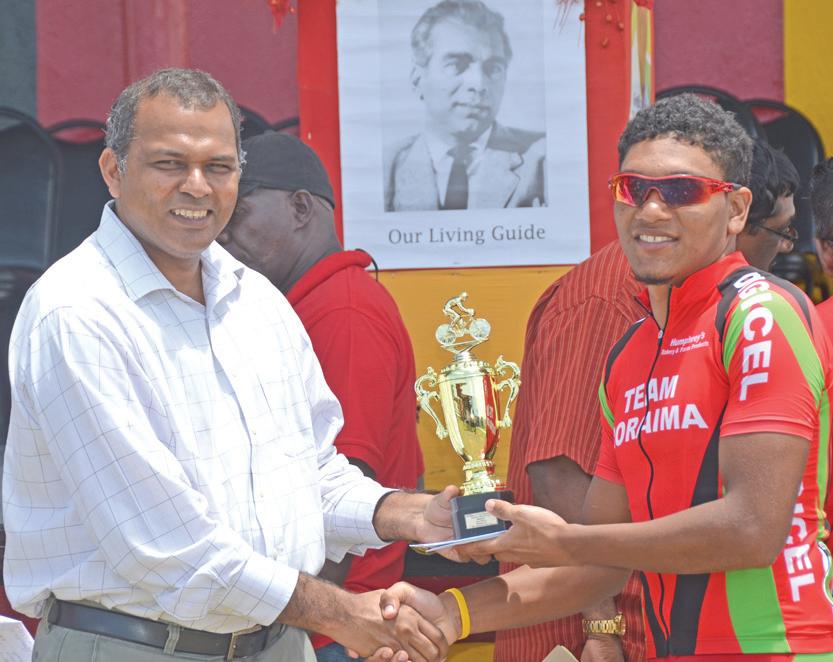
his victory.
Junior Niles, a former winner of the Berbice leg, finished third, followed by Linden's Orville Hinds, the talented Geron Williams and the promising Delroy Hinds.
In the Junior category, Alonzo Ambrose continued his rise in the sport by claiming the top spot, leaving Stephano Husbands and Andrew Hicks to settle for second and third positions respectively.
Naomi Singh kept her record intact in the Ancient County, winning the Female category ahead of Toshanna
Doris in second and Deancae Welch third.
Berbician Thuran Harris protected home territory by copping the Veterans category. Jaikarran Sukhai, making a return to the sport, took the runner-up spot ahead of Wilbert Benjamin.
Clyde Jacobs demonstrated that his victory in the Mountain Bike category of the inaugural CIDI 11-race cycling programme on Saturday was no fluke, as he repeated the effort on Sunday.
His namesake Nigel Jacobs took second best, while Wayne Nurse was
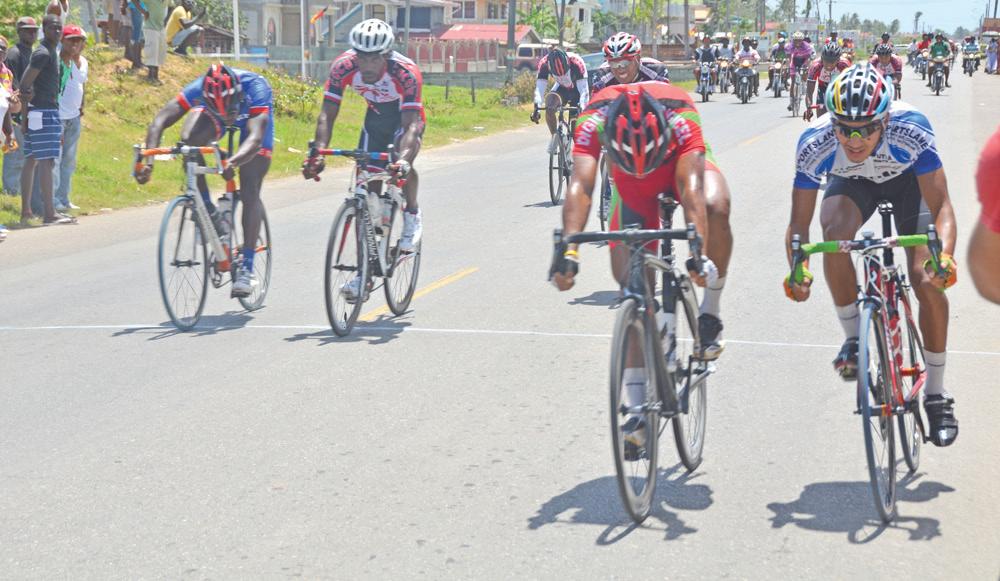
third.
At the presentation ceremony which followed, 72-year-old Anthony Fariah was rewarded with a trophy for being the oldest rider to
that Dr Jagan always had an interest in sport and was an advocate of camaraderie.
Sport Minister Dr Frank Anthony said Dr Jagan was serious about fitness, add-
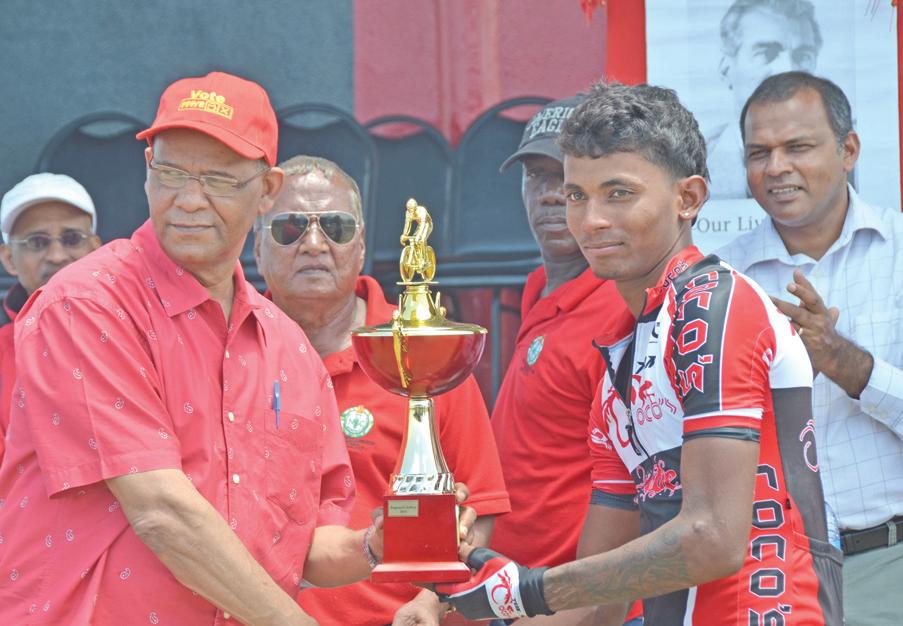
be among the starters.
Apart from the other generic prizes, Raynauth Jeffrey was given a trophy for being the top rider at the event over the last two years when the points system was introduced.
The top six finishers of each of the three races held in memory of the late President Dr Cheddi Jagan were awarded points. Jeffrey accumulated 38 points for 2012 and 2013, followed by Robin Persaud (30) and Orville Hinds (21).
Jagan's vision
Speaking at the presentation ceremony after the race, Chairman of the Jagan Commemoration Committee Navin Chandrapal noted
ing that the staging of the annual race is a fitting tribute to former President's aspirations of having a fit nation.
General Secretary of the People's Progressive Party (PPP) and Home Affairs Minister Clement Rohee reflected on Dr Jagan's memory, noting that the late founder of the party believed in living healthy.
The third and final leg of the Cheddi Jagan memorial cycling race will be staged in Essequibo on March 23.
The first leg was held earlier this month on the West Demerara roadways, with youngster Michael Anthony copping both the Senior and Junior titles.
Jamaica’s Veronica Campbell-Brown said she lacked sharpness as she qualified for the World Indoor Championships 60m semifinals - her first race since she was cleared of a doping charge.
The defending champion, 31, finished third in her heat in Sopot, Poland and was 13th fastest overall going into the next round on Sunday.
“When you don’t compete for a while, you got to feel a little rusty,” she said, after
her first race since May.
Britain’s Asha Philip also qualified.
The 24-year-old former world youth champion posted a time of 7.18 seconds in her heat, while teammate Sophie Papps joined her in the semis after coming second in her race. The 19-year-old clocked a personal best of 7.22 secs, to finish behind fastest qualifier Murielle Ahoure of the Ivory Coast, who crossed the line in 7.09 secs.
“I’m glad it’s out the way,” Philip said. “I didn’t
want to take it too easy because you never know what can happen out there. I got through and that’s the main thing. Tomorrow should be a good day.”
Other British athletes impressed on the second morning of the three-day competition, although there was major disappointment in the men’s high jump where Olympic bronze medallist Robbie Grabarz failed to reach the final.
The 26-year-old and team-mate Tom Parsons were both unable to clear
2.28m.
Johnson-Thompson is competing in the long jump after failing to qualify for the pentathlon
There was better news in the men’s 60m hurdles where Andy Pozzi posted the joint fastest qualifying time of 7.56 secs, equalling his personal best.
“It’s a great start,” said 21-year-old. “I was a bit concerned being in lane one with some of the fast guys on the other side of the track, but it allowed me to focus on my race and I could
not ask for much more.”
Team-mate Will Sharman will also compete in Sunday’s semi-finals after winning his heat with a new personal best of 7.59 secs. Meanwhile, both Shara Proctor and Katarina Johnson-Thompson are into Sunday’s women’s long jump final. Proctor, 25, recorded the third longest jump in qualifying - 6.69m - while Johnson-Thompson, who failed to qualify for the pentathlon because of illness, leapt out to 6.60m.
In the 4x400m relays, the British teams led from start to finish to win their semi-finals.
Conrad Williams ran an extra 120m after the recall gun went off accidentally during the first leg of the men’s race, but the quartet still managed to finish first in 3:06.09.
Team captain Eilidh Child, along with Shana Cox and sisters Victoria and Christine Ohuruogu recorded 3:30.60 to finish ahead of Russia and qualify fifth fastest overall. (BBC Sport)
Guyanese Adam Harris, who is based in the U.S.A., crashed out of the World Indoor Championships being held in Poland on Saturday in the semifinal round of the men’s 60 metres dash.
Harris, who finished second to Dwain Chambers of Great Britian in his heat, had the slowest reaction time of 0.161s out of the blocks on his way to a third place finish in a time of 6.59 secs.


Marvin Bracy of the U.S.A. won the semifinal in a time of 6.52, as Harris was unable to match his personal best of 6.55 secs that would have seen him make the final.
Newcomer Melissa Caddle, who is also a U.S.A.-based Guyanese, could not move past the first round of the women’s 400 metres at the championships, finishing fifth in her heat with a time 54.56 secs.
Shaunae Miller of the Bahamas was the winner of the heat in 52.10 secs. Meanwhile, despite the disappointment for Harris, he is rated as ninth in the world in the 60 metres dash for 2014, while being the fastest South American across the distance for the year.
By Treiston Joseph
Jerome Jarvis scored in the dying minutes to put Cummings Lodge Secondary ahead for a 4-3 win against Christ Church Secondary, when the Petra organized Milo Under-20 Schools’ Football tournament continued on Sunday at the Education Ministry ground, Carifesta Avenue, Georgetown.
The game started with both teams looking haphazard in the field, as passes went wayward from their intended targets. However, a series of fluent football that started on the right wing saw Elijah Grant sinking the opening goal for Cummings Lodge in the 18th minute.
Sylvester Grant then put Cummings Lodge up 2-0 in the 26th minute, before Christ Church responded just before the half with a goal in the 34th from Kadeem Blackman to send the game that had picked up in pace to the halftime break at 2-1. On resumption, Christ Church struck first to level the score on 2-2 with a goal from Javontay Best in the 46th minute.
However, Jarvis scored in the 57th to put Cummings Lodge up 3-2, as they entered a more defensive game.
Two minutes later, Christ Church equalized in the 59th minute, with a darting goal from Best for his double, before Jarvis’ goal in the 62nd that ended the game.
Charlestown Secondary demolished New Campbellville Secondary 6-1 in a one-sided affair.
The game started slow before a rush of goals, which started with a 28th minute strike from Omari James to put the team up 1-0.
Aroydy Branford, who is also a talented hockey player, put Charlestown up 2-0 in the 30th minute to send the game into halftime.
After halftime, the game was no different, as Charlestown continued to attack with Branford scoring his double in the 39th minute. Branford then dropped in two more goals for a quadruplet, with goals in the 48th and 66th minutes, while James doubled in the 68th minute to give Charlestown a 6-0 advantage in the dying minutes of the game.
Already in celebration mode, Charlestown gave away a consolation goal by playing easy defense, as Eukini McPherson scored for New Campbellville on the 70-minute mark.
Freeburg Secondary came from behind to pull off
a 2-1 victory against a balanced North Georgetown side.
North Georgetown opened the score sheet in the 25th minute with a goal from Joshua Ferreira that saw both teams going to the halftime break with the score still on 1-0.
The change of goals would prove the game changer, as Freeburg scored twice in the 47th minute from Ronell Roberts and in the 52nd minute from Junior Simon, which ended the game.
The final game of the afternoon saw North Ruimveldt walking away with a 3-0 victory over a shorthanded Tucville Secondary.
Shamar McPherson opened the scoring for North Ruimveldt in the 30th minute, despite Tucville being two men down from the start of the game due to players being absent.
While Tucville made some runs at the goal, their shorthanded team suffered, as Carl Griffith scored in the 45th minute to put North up 2-0, before Jeremy Garreth’s 63rd minute goal to seal the deal.
Games in the tournament will continue next week, as the league heads to the knockout round from next weekend.
U.S.-based Guyanese Euleen JossiahTanner keeps racking up the wins with yet another victory in the Dental 5k Road Race on Saturday morning in Atlanta, Georgia.
Jossiah-Tanner clocked in at 15 mins 54 secs to defend her title in the event, despite the 30-degree temperature which faced the athletes.
“I feel great, I used it as a recovery run and it feels great to defend my title. There was some competition and there were heavy wind gusts, but I would like to thank my coach (Kenrick Smith) for the time he is putting in to prep me, as we begin phase two of our programme,” Jossiah-Tanner

told Guyana Times Sport Meanwhile, JossiahTanner’s next competition will be on March 23 in the Publix ING 5k Road Race.




4-0-36-0, B Stokes 2-0-30-0, R Bopara 4-023-2, J Tredwell 4-0-16-1. England (Target; 171) M Lumb c Rampaul b Badree 18 A Hales st Ramdin b Badree 3 L Wright st Ramdin b Badree 0 E Morgan c sub (J Charles) b
7-101 (Bopara, 14.3
8-123 (Broad, 17.6
9-133 (Tredwell, 18.6
West Indies Bowling: S Badree 4-0-17-3, R Rampaul 3-031-0, S Narine 2-0-8-1, DM Bravo 4-0-30-1, M Samuels 4-0-21-2, D Sammy 1-0-120, A Russell 2-0-21-0.

Seestory on page22