



Requirements to become a magistrate inadequate – Bernard De Santos

APNU will maintain anti-money laundering bill amendments – Granger
Book by Guyanese author released here
Five arrested after robbing gas station at Nimes 20 Puisne Judges to be appointed










civil law but none in criminal law.
Those in the latter situation, he explained are at a grave advantage when they go on to become magistrates because most of the courts in Guyana are criminal courts, with the exception of Courts Eight and Nine at the Georgetown Magistrate’s Court.
Flirting with the law
“They only flirt with the criminal law, they don’t have the necessary experience to effectively sit on the bench as a magistrate,” De Santos observed.
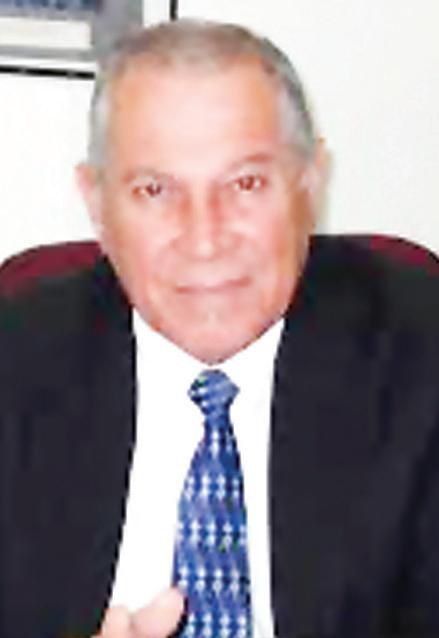
Amid criticisms of the local magistracy regarding the handling of a number of matters, Senior Council and former Attorney General Bernard De Santos has called for a review of requirements for persons sitting on the bench.
Speaking with Guyana Times, De Santos said the current requirements are inadequate.
“Frankly, I don’t think it’s enough, they are virtually little children being appointed as magistrates,” said De Santos as he referred to the age of some of the sitting magistrates.
Currently, persons must have a first degree and three years in legal practice to be considered for the post by the Judicial Service Commission.
According to De Santos, persons wanting to become magistrates usually spend three years working at either the Office of the Director of Public Prosecutions (DPP) or the Office of the Attorney General before they are appointed to serve on the bench.
He said law professionals who would have served at the Office of the DPP would have some experience in criminal law, but little or none in civil law.
On the other hand, he said those at the Office of the Attorney General would have a lot of experience in
The practising attorney pointed out that some years back, he suggested to the serving chancellor at that time that prospective law professionals decide what branch of law they want to pursue before they embark on their law careers.
This system, he explained, would allow for persons who want to become criminal magistrates, to be exposed to the work of a criminal magistrate, as a form of specialisation.
Likewise, those who want to become state prosecutors would be trained in that area of law.
The Senior Council also said that some reform is also needed at the level of government.
He pointed out that a law that was passed in Parliament under the Burnham administration allowed for the salary of the Attorney General and Chancellor of the Judiciary to be the same.
This, he said should not be, contending that the Chancellor of the Judiciary is superior to the Attorney General.
Still on the issue of salaries, he said the packages that magistrates and judges receive are meagre, compared to what they could earn as an attorney.
“I don’t expect them to pay the high salaries like

the other countries but they can do a lot better,” he said, noting that the government could enhance the salaries of magistrates by providing adequate allowances.
De Santos believes that this move would persuade serving magistrates to stay on the bench, and attract more seasoned lawyers to the post.
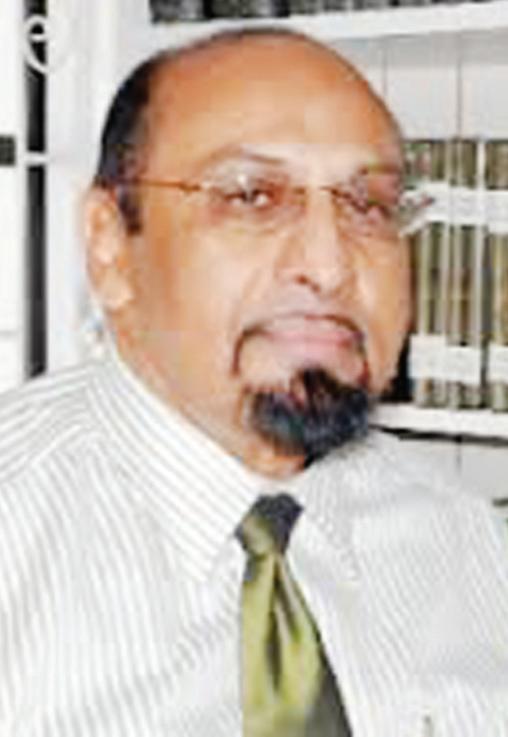
Former Chief Magistrate K A Juman-Yassin also contended that the salaries of magistrates are inadequate, and called for seasoned attorneys to serve on the bench.
He said some magistrates are appointed to the bench at a young age and have little experience handing cases involving criminals, and as such, are not fully knowledgeable regarding the thinking of these people.
Young magistrates
The former Chief Magistrate also noted that the influx of young magistrates can be attributed to the reluctance of more seasoned attorneys to become magistrates.
Only recently, former Chancellor Cecil Kennard also decried the state of the local magistracy. Kennard said the appointment of too many young magistrates and judges to the bench can be blamed for the current backlog of cases and sloth-
fulness of the justice system
Speaking with Guyana Times in a recent interview, Kennard said bluntly: “We are appointing members of the judicial system when they lack the necessary experience,” pointing out that some of the magistrates and judges are somewhat tardy in the discharge of their duties.
Red Thread Director Karen DeSouza had contended that local magistrates need regular training so that they will be properly guided in their dispensation of justice.
Invest in training
“The training of the magistracy is seriously lacking… the sense of power I guess and privilege that magistrates might have are not tempered by regulations, guidelines or monitoring.
"The laws in modern times are supposed to protect all equally and they are supposed to be applied equally to all, and that is certainly not what we are seeing today,” DeSouza added.
DeSouza believes that government should invest more in training persons within the judicial system and keep them abreast with the law.
Acting Chancellor of the Judiciary, Justice Carl Singh has also spoken on the matter, pointing out that both magistrates and prosecutors must equip themselves with the requisite skills that will make them more effective in executing their duties.
The acting chancellor had said that this is essential to ensure better legal services at the magisterial level, while calling for more training to be provided for other legal professionals as well.




Sunday Times Editor: Tajeram Mohabir
Tel: 225-5128, 231-0397, 226-9921, 226-2102, 223-7230 or 223-7231. Fax: 225-5134
Mailing address: 238 Camp & Quamina Streets, Georgetown
Email: news@guyanatimesgy.com, sales@guyanatimesgy.com
Today as we commemorate the 44th anniversary of our attainment of Republican status, it might be apropos to recall what such a status implies and to reflect on how well we are living up to its ideals. Like all concepts, “Republicanism” arose out of concrete historical circumstances and evolved as new contingencies were faced.
For Guyana, we would have to stress the original Roman origins that rejected rule by a monarch and insisted on leaders being elected according to specified rules for specific lengths of time. It is for this reason that even though we became “independent” in 1966, because the GovernorGeneral remained our “Head of State” as the representative of the Queen of Great Britain, it necessitated his removal before we could be called a “Republic”. We appointed our own “President” as the Head of State.
But Republicanism goes beyond the procedural aspects of how we choose our leader and head of state: substantively, it stresses political liberty. And as with all liberties, it does not only demand the freedom from government interference in private affairs – negative freedom – but positively, the need for citizens to practice self-discipline and self-reliance. Ultimately, it is this facet of Republicanism that will determine how well we are living out the true meaning of the Republican creed.
Overarchingly, the procedural and substantive aspects of Republicanism are encapsulated in a Constitution that spells out the laws by which all – including the rulers – are to be governed. The duty of the rulers is to safeguard and facilitate the flowering of the potentialities of the citizens. In Guyana today, the overweening focus of discussions on the state of the Republic concern the role of the government, opposition and the state, but almost nothing of the duty on the citizens to be self-disciplined and self-reliant.
Republicanism, as such, has been turned on its head since we are replicating the status quo ante, where the citizens looked to the political ruling class for their cues to act. It is said that “a people get the rulers they deserve”, but this should not only be taken in a negative sense. If the people behave as citizens of a Republic ought to, then their political classes will have to fall into line and govern for the common weal of the country.
What will occur today is a perfect illustration of a citizenry either being ignorant of the meaning of Republicanism or being led astray by misguided leaders. Rather than stressing the values of Republicanism, today is now known as “Mashramani Day” in which everyone from the youngest child upwards are exhorted to “mash down”.
In our Friday’s “Arts & Entertainment” supplement, Magda Pollard, from the generation that brought us to Republican status, expressed her disappointment at the vulgarity into which the commemoration of Republic Day has descended. And well she should – as should all Guyanese.
For our celebrations, intended to be that after “hard labour”, has been totally disjunctured from any precedent action of the part of the citizenry. Instead it is totally redolent of the Roman monarchical era in which the Emperor gave the citizens “bread and circuses” to distract them from the challenges facing their country. And this brings us to the present state of our republic.
Here we have a government/executive that has been elected in accordance to the rules of the Constitution. Yet even though the court has ruled that the Opposition is acting ultra vires to prevent that government from executing its programme for the development of the country, they have announced they will flout the court’s ruling and continue to act illegally.
Just as egregiously, they have rejected the warning of the representative of the Caribbean Financial Action Task Force (CFATF) that failure to approve the present AML/CFT Bill will result in severe consequences for this Republic.
Today, our Republic is facing perilous times. And we are “mashing”.

Electricity in Lethem is back to normalcy after a mechanical failure
Dear Editor,
I read Carl A Parker’s long-winded letter in another section of the press under the headline, “Lethem rates were raised in 2009 with a promise of electricity 24/7, it did not happen then, it will not happen now”.
Parker is a People’s National Congress/A Partnership for National Unity (PNC/APNU) activist and Regional Councillor in the Region Nine Regional Democratic Council (RDC).
Parker is known in Lethem to be likened to a barrel that makes the most noise. He said in his letter that Prime Minister Sam Hinds has been misinformed about his role and has called on residents not to follow him.
Dear Editor, I am most disheartened by the recent robbery that took place in the town of Rose Hall, resulting in the unfortunate death of a security guard. The incident has since left residents very restive and concerned about their overall well-being.
It appears as though noise is a great contributing factor to most crimes these days. Many thieves and murderers choose to attack their victims in instances where the noise
Well, the Prime Minister is totally correct and in order. Can Parker say why he is not welcome in Kwaimata Amerindian Community any longer?
Parker in his letter said, “The people are my bosses and they instruct what issues I must represent”. The few people that Parker claims to represent in Lethem are misguided PNC/APNU supporters. Many residents of the Rupununi region are aware that Parker does not help them.
His letter dealt a lot about Lethem’s electricity situation and even referred to the MocoMoco hydro power scheme which is currently not in operation.
But the truth is that Parker is not an electrical en-
factor is great, thereby making it almost impossible for others to take notice of any kind of commotion or cries for help.
On that note, it is essential for matters of noise pollution to be addressed immediately by the relevant authorities, since it continues to have multiple negative implications.
Additionally, it is becoming almost critical for the owners of businesses and other facilities to consider the in-
gineer, neither is he an expert in hydro-electricity, and on this basis is not qualified to make technical pronouncements on the electricity situation in Lethem which can definitely be misleading and technically not feasible.
Yet Parker’s letter gives the impression that he wants to have a debate with the Prime Minister at a meeting in Lethem on the electricity situation, knowing full well that he is not qualified to do so and his actions are merely being anti-government and not progressive for Lethem residents.
Parker accuses the management of the Lethem Power Company Inc (LMPCI) of malpractices, which is absolutely misleading. The prob-
Dear Editor, If I had my way, 2014 would be a year completely dedicated to the enhancing of the environment. Aside from preserving the aesthetic value of the environment, we also need to eliminate all chances of creating breeding grounds for disease infested pests. Evidently, an unhygienic environment can
have severe consequences for those who have to dwell in it.
Additionally, I must commend the Local Government and Regional Development Ministry for encouraging governmental institutions to maintain their surroundings. In fact, approximately 27 hospitals and health centres were presented with
stallation of cameras. These devices can greatly help us to identify those who attempt to intrude and trespass on private premises. It will therefore help to curb criminal activities.
The job of a security guard is no easy one. They are often required to endure long hours of work and at odd hours too. It is only fair that they are properly accommodated at their place of work and provided with the conveniences that will help to make their
brush cutters.
This was indeed a great gesture on behalf of the ministry and it is therefore important for the beneficiaries to take good care of the equipment. Additionally, no staff member should be allowed to use or borrow the instrument for the purpose of personal reasons.
The maintaining the en-
lem with Parker at Lethem is that he may be job-hunting and wants to be hired by the company.
But this is Parker’ style of marketing himself. He blows out of proportion little things which take place in Lethem’s public sector, just to regain political relevance and to capture the attention of the PNC/ APNU leadership that he is working.
My information is that the PNC/APNU is on the decline in the Rupununi region. Parker is not truthful with the Lethem residents, whom he called his “bosses”. Electricity in Lethem is back to normalcy after a mechanical failure.
Yours sincerely, Peter Persaud
job easier.
Evidently, it is guards that are unarmed and properties that are poorly lit and have no alarm or security system in place that are often targeted.
Aside from the work of the police force, we all need to play our parts in order to ensure that crime fighting techniques are heightened and most effective.
Sincerely, Rhoda Richardson
vironment is every person’s responsibility and I ask that we all play our role. As for those who are guilty of deliberately and carelessly sabotaging our environment, I hope that when they are caught they are dealt with accordingly.
Yours truly, Zamina Khalid
Dear Editor, Guyana is observing the 44th anniversary since becoming a republic. On February 23, 1970, the People’s National Congress (PNC) government headed by the late dictator Forbes Burnham broke all ties with the British crown.
The granting of independence in May 1966 placed Guyana on the path towards a dictatorship that was established right after the 1968 election rigging.
Burnham proclaimed the nation a republic without their approval. He used his “magic majority” that he obtained from the rigged election of 1968 to alter the constitution against the desires of the population.
Guyanese made very little input into the decision making process to sever ties with the mother country. They were not consulted on whether the country should be a republic. Republican status provided Burnham the vehicle to further institutionalise what has been described as a “fascist dictatorship”.
When Guyana obtained her independence in May 1966, it was one of the most progressive liberal states in the world with one of the freest presses and one of the highest standards of living. But Burnham transformed it into a repressive autocracy.
To understand how Guyana became a dictatorship under Burnham’s control, it is necessary to understand colonial politics. The influence of the White planters permeated the entire colonial system obtaining favourable treatment from the British administrators.
Agitation led by Dr Cheddi Jagan and others forced the British to introduce modest constitutional reforms resulting in Universal Adult Franchise in 1953.
The united People’s Progressive Party (PPP) under Jagan and Burnham’s leadership won a landslide victory at the polls. The party governed the colony for six months when the British suspended the government for what it perceived as a “threat to transform Guyana into a communist satellite for the Soviet Union”.
The British subsequently engineered a split between Burnham and Jagan resulting in two different factions. When constitutional rule was re-established and elections held in 1957, the Jagan faction, supported by Indians, won and he became Premier and was re-elected in 1961.
Burnham renamed his African aligned faction the PNC after losing the 1957 elections.
Racial disturbances, ri-
ots, looting, and strikes were fomented by the PNC and the churches in collaboration with the Central Intelligence Agency (CIA) during the period 1962-64 when it became clear that Jagan would lead the colony to independence as was agreed upon by all parties at a constitutional convention before the 1961 election.
The race riots instigated by the British and the PNC gave the British the excuse they wanted to deny independence to Guyana under Jagan’s leadership.
The British helped promote racial conflict between Indians and blacks and worked towards the ascension to office of Burnham.
(Part two in Monday’s edition)
Respectfully submitted Vishnu Bisram
Dear Editor, On February 15, the new bridge to span the Hope Canal was opened by President Donald Ramotar. The bridge was handed over to the Public Works Ministry by the Agriculture Ministry which had executed the project.
This bridge is one part of a project aimed at opening another route to drain the conservancy during the rainy seasons when we have too much water in the system. In his remarks, President Donald Ramotar told the audience that the project was undertaken from a humanitarian point of view.
For years the people of Mahaica and Mahaicony rivers have been flooded out over and over again. President Ramotar told the meeting that he had gone into those areas on many occasions when they were affected.
He told the meeting how heart-wrenching the situation was. Noting that farmers are some of the most hard working people in the world. When they see their crops flooded and can do nothing about it, it is extremely painful. The
whole family, the community and the country suffer. Labour is lost.
The flooding not only destroys crops but kill off livestock. The President noted how pained he was to see animals, mainly cattle wading through flooded areas, with only their heads above water. Many die from drowning due to cramps.
President Ramotar noted how agonising it always is to release water from the conservancy in those two rivers. The alternative would be worst, flooding the whole East Coast.
President Ramotar said that when completed it is expected that it will be a big boost to the agriculture in the area, pointing out that he was expecting greater yields and higher production in the area.
This, he suggested would go a far way in securing Guyanese food supply. He noted also that Guyana can also make a contribution to the Caribbean food security as well. In so doing the economy can benefit.
He noted that the region imports more than four bil-
lion U.S. dollars (US$4B) in food per annum. He said Guyana can make a contribution in reducing this huge food bill of the region.
The bridge is also important in adapting to climate change. All the scientific evidence shows that the world climate is undergoing changes.
In the U.S. and Canada huge snow storms and rains are creating big problems on the Eastern side of the country. While in the West, California, drought is leading to the rationing of water. The drought is the worst in five hundred years.
In the UK, dramatic floods are causing great inconvenience and damage in many parts of Britain. The Thames River is overflowing due to unusually heavy rainfall.
That is why the project, when completed, will be important in preparing for the likely changes that the weather will bring for Guyana. The bridge is now open to traffic.
Sincerely, Name withheld by request
Some magistrates usurp powers they don’t have
Dear Editor, This type of egregious overreaching by grasping magistrates has already poisoned Guyana’s laws. That’s why people in this country have become increasingly vitriolic and bitter with a recent sentence which was handed down.
Are the courts now going

into polling business before rendering decisions? Isn’t turning consensus into law or instituting a change in law a function of elected legislative bodies? But this ruling is not unusual, since some magistrates in this country’s courts have increasingly usurped powers they don’t have.
For decades some magistrates in Guyana’s courts, high and low, have been behaving like legislators, making laws as they see fit. Not content with usurping legislative powers, these judicial autocrats have threatened human rights.
I am aghast at some penalties and power grabbing by some magistrates, which makes a mockery of the separation of powers and checks and balances that our founding fathers took such pains to enshrine in Guyana’s Constitution.
Yours faithfully, Mohamed Khan


Today is Republic Day
– the day we recognise that we govern ourselves, we’re not under the rule of a monarch and I’ve been thinking about leaders and leadership. What Shakespeare said about “greatness”, can be paraphrased for leaders: “Some are born leaders, some achieve leadership and some have leadership thrust upon them.” I’ve encountered a fair number of leaders from all three backgrounds, over the years and this year at Med School I’ve met even more. We have weekly PBL (Problem-Based Learning) sessions where we’re broken into small groups and everyone has to take a turn at leading the group discussions. So after a while, everyone gets a chance to be group leader and I found that most of them exemplified quite distinct leadership styles, approaches and qualities.

“You don’t lead by hitting people over the head –that’s assault, not leadership” – Dwight D Eisenhower
sen. I was awed by these students who were all-rounded and carried themselves with decorum. These prefects welcomed us to speak to them freely, but by mutual understanding, there was a boundary we never crossed. These were the type of prefects I tried to emulate when I became Head Prefect in Upper Six.
integrity since a leader can’t lead if he doesn’t have the trust of followers. Leaders must show honesty, wellcontrolled emotions (that’s right, no screaming your head off at your charges!).

A good leader is assertive yet approachable. During my early years at Queen’s College, I was always impressed with the prefects cho-
Another fundamental trait of leaders is that a true leader inspires others to achieve. And the best leaders do this not by telling – but by doing. The line from Portia in the Merchant of Venice has stuck with me: “I can easier teach twenty what were good to be done than be one of the twenty to follow mine own teaching.” It can be hard, but to be good leader, that’s absolutely necessary. A good leader can inspire dedication and great feats from followers, through leadership by example.
Good leaders must show
In our Professionalism Course, we’re constantly reminded about the importance of integrity – as doctors we’ll have to work along with other doctors, we’ll need the trust and support of the nurses and other members of our medical team to ensure that we care for our patients successfully.
Leaders must also have high self-respect and selfesteem. After all, if a leader doesn’t respect himself / herself, how could they earn the respect of others? Yes, respect is earned, not demanded. Good leaders should have the respect of their subordinates and also give due respect to their subordinates.
My tradition emphasises the need to delegate tasks and to groom new leaders for the future. In my estimation, this is a defining quality that all leaders should possess. That leader who tries to singlehandedly tackle all of the objectives and challenges of the group usually risks biting off more than they can chew and simultaneously demotivates the rest of the members.
Leaders should also always be conscious that they can’t be the leader forever –there comes a time to step down and pass on the torch. New times demand new skills and new visions.
One of the more overlooked qualities a leader should possess is a sense of humour! Humour can be an effective tool to energise persons and ease tension. More often than not, leaders choose the too-serious approach – a balance should be struck.
In conclusion don’t believe that I’m only talking about leaders of countries and corporations. In every endeavour that we embark on in groups, there is the need for leaders. We never know when leadership may be thrust upon us: be prepared.
Happy Republic Day!

BY KatY aBel
“My Hero”

takes.
Seven-year-old Ben S has three heroes in life: Superman (“because he’s really strong and he can punch your head off”), New England Patriots quarterback Tom Brady (“because he’s really great at football”), and his mom (“because she works really hard at my school”).
Eleven-year-old Jacqueline L cites her parents as her heroes, and rejects the idea that a hero must be famous or especially brave. “It’s someone who sets a good example for you, someone you can look up to,” she explains. “But if you don’t have great family members or your mother or father died, then you don’t have a lot of direction. So you would probably pick a firefighter who went into the World Trade Centre.”
One of life’s great certainties (along with death and taxes) is that somewhere in the course of your child’s education at least one teacher will ask him to compose an essay about a favourite hero. It’s a routine assignment, but these days concern about the effects of terrorism and the darker aspects of media culture have parents, educators, and even policymakers paying close attention to a child’s need for inspiring role models.
“Lots of kids use sports and entertainment figures as heroes,” says Jeanne Meyers, co-founder of MyHero.com, a website devoted to children’s heroes. “What we’ve observed in classes is that kids learn to rethink their choice of heroes. They might say that a celebrity like Jennifer Lopez is their hero. Then they ask, ‘Is Jennifer Lopez doing something to help people in her community?’”
“What they initially present to you are the media stereotypes,” agrees Mo Randall, a ninth-grade English teacher at Roxbury Latin School in Boston. “For boys, the heroes might be from hip-hop culture or the WWF (World Wrestling Federation). As a teacher, you have to work to expand what they think is heroic.” Randall’s students spent six weeks studying The Odyssey. They discover that ancient heroes, unlike modern ones, were warriors who also cried and made mis-
Literature can broaden a student’s understanding of heroism, but influencing a child’s behaviour requires more than reading and class discussion. If students are asked to write about a hero, but aren’t expected to emulate the hero through good deeds of their own, then the effect is minimal, educators say.
Different ages, different heroes Researchers in moral development say children’s heroes follow a fairly predictable pattern. Young children often choose their parents or teachers as heroes, because the immediate caretaker has the greatest moral authority. As children grow and begin to question their parents’ influence, they choose peers as heroes – often someone close to their own age who has “made it big” as a rock star or sports figure. Older teens admire people who have the ability to think for themselves. In adulthood, there is a new appreciation for family heroes, those who worked hard and sacrificed to help us get where we are today.
Patricia Harned, PhD, director of Character Development and Research for the non-profit Ethics Resource Centre (Ethics.org) in Washington, DC, believes parents and teachers need to show children that heroes are often complex people with less than flattering attributes. The grandfather who won a medal for bravery in World War II may also have been a bigot who used racial slurs at the dinner table. Dr Martin Luther King, Jr, while a great leader, was also once accused of plagiarism. Rather than shy away from discussing these moral discrepancies, Harned urged parents and teachers to confront them head-on.
“That’s an important message because nowadays, that’s the reality about public figures,” says Harned. “It’s important for children to realise that even though they’ve made mistakes and done things they regret, they can change their way of behaving. Being a hero is the sum of a life, not just an event that happens. The mistakes we make are just as important as the successes, if we learn from them.” (Familyeducation.com)


The People’s Progressive Party/ Civic (PPP/C) extends Mashramani greetings to all Guyanese on the occasion of 44 years of republican status.
Mashramani is an Amerindian word which means celebration after a hard day’s work. As Guyanese, we have every reason to celebrate. We have worked hard to overcome the numerous challenges that stood in our way.
The Guyana we live in today is vastly different from the Guyana which obtained during the time of independence and the attainment of republican status.
Indeed, it would be an understatement to say that the country has made progress since the granting of republican status.
New Guyana
What we are celebrating today is a new Guyana in which there is democratic rule, respect for the rule of law, an independent judiciary, economic and social justice and cultural pluralism.
The PPP/C is proud of the fact that it has been successful in laying the foundations for the flourishing of the artistic and creative potential
of the Guyanese society in a manner few multi-ethnic societies have managed to do.
In this regard, all Guyanese should take pride in the cultural fabric that has been woven over the years by our individual and collective efforts.
The PPP/C wishes to take this opportunity to call on all Guyanese to put aside whatever differences they may have and become a part of this exciting task of nation building.
The party is convinced that there is room for each and every Guyanese to contribute to the national good regardless of ethnic or political affiliation.
Let us use this occasion to reflect on the difficult road we have traversed over the decades and the challenges that are before us as we strive to build a peaceful, progressive and prosperous society in which we can all be proud of.
The PPP/C salutes all Guyanese on this significant milestone and extends a special welcome to all those overseas Guyanese who have graced the occasion by their presence in Guyana at this time.
A happy Mashramani to one and all!

The start and run-up to the culmination of the Mashramani “Season” sometimes tend to submerge the main event which is really the annual observances of Guyana’s republican status.
The Guyana Agricultural and General Workers Union (GAWU) has nothing against the fun, frolic and creativity surrounding the Mashramani component of this national anniversary.
However, as a major representative of the country’s labour movement and the bargaining agent for thousands of workers from various vital sectors of the economy, GAWU is obliged to attempt to assess just what 44 years as a republic has delivered for the working class.
Workers, especially the humble, hardworking labourers, factory workers, agricultural harvesters, heavy-duty drivers, the hundreds of ladies in the sea food and the commercial sectors, among others, represent the base and foundation of any economy.
GAWU will never disrespect the role of academics, teachers, nurses, lawyers, architects, engineers and other professionals. All
are needed to manifest levels of production largely left to the toils of the lower levels. Obviously, there must be collaboration at all levels for productivity and economic progress to be sustained.
Guyana’s two major political parties provided the governments between the republic year of 1970 to 1992, 22 years; then 1992 to the present, another 22 years. What then has been the socioeconomic legacy after the past 44 years?
Worker-friendly
To be fair, the PPP/C governments have provided an enabling environment through worker-friendly legislation, for effective worker representation.
Whether today’s trade unions are properly organised, structured and funded to be effective is another story.
From GAWU’s perspective, the most negative occurrence in the recent history of the republic is the real, clear and present danger to Guyana’s sugar industry which employs thousands of our members.
The blame game can never restore the fortunes of this life line economic in-

dustry.
A revamped GuySuCo board and management skill sets; motivation for harvesters and factory workers to return to the fields and ancillary projects, among oth-
er things, all must combine to bring sugar back.
Elsewhere in the republic, GAWU sees the need for political dialogue at the highest levels to resolve differences affecting the productive management of the state, its resources and governance.
Selfish “victories” should not prevent brilliant minds from both sides of the aisle, to bargain agreements to overcome parliamentary, budgetary, legislative or even judicial challenges.
The 2011 electorate expects nothing less from our parliamentary legislators and political representatives.
GAWU, therefore, urges sober reflection and wise peaceful counsel among all citizens during and after the joyous celebration of Republic Day 2014.


Xcite Fridays, a collaborative effort between Xcite Guyana, Gtmemoirs and Park Vue Hotel, premiered Friday evening under the theme “Pre Mash Soca Wine Up” at the Park Vue Hotel, Farm, East Bank Demerara.
Xcite Fridays will become a regular feature at the hotel, starting from 18:00h to 23:30h.
The highlight of the evening was the sizzling display of the four tantalising costume sections for the 2014 Xcite Mash Band.
The show stopper was the 600 plus individually inserted beads on the customised Surinam Airways piece, which like all the other costumes, were specially designed by Surida Nagreadi, the owner/designer of the Xcite Band.
The costumes were done in three categories: Allure, the sold out VIP personalised section which is heav-
ily punctuated with pink and orange; Serenity, the frontline section, depicting green, blue, yellow and silver; and Fusion, the back line section which is Park Vue Hotel’s official costume. This section is portrayed in blue, pink and yellow.
The t-shirt package is solely for the party section.
At the launch, special Amazon Warrior energy drink and Blue Spring water were given away. The occasion was attended by scores of representatives of major sponsors of the 2014 Xcite Band, including entertainment icon Joel Ganshaam.
The Xcite Band, which is sponsored by Park Vue Hotel, Gt Courtyard, Evocative Print, Amazon Warrior Energy Drink, Blue Spring Water, Hifi Sound System, Royce Energy Drink, Surinam Airways and Zoon will be going down the road, but not competing this year.
After the road tramp, all



In a wonderful display of Republican egalitarianism, the Attorney General of the land engaged an ordinary citizen in the usually arcane minutiae of constitutional law. Well, the citizen wasn’t so “ordinary”, since he’s been around since the beginning of politics in Guyana – Eusi Kwayana. Our local Methuselah, so to speak. And like the original oldster, Kwayana has “begat” quite a few descendants – in his case, more political than chromosomal.
The AG is a brave soul, since the style of Kwayana is so elliptical and arcane that one needs highly refined hermeneutical skills to figure out what exactly he might be saying. Might. Maybe that opacity comes with age, but we hope the AG doesn’t confuse it with senility. Kwayana has sparred with the best of them – from Jagan and Burnham down – and is still having the last word.
Kwayana advises that “our problem is not the Standing Orders, but the political culture” and begins by quoting himself – from his previous letter. Now lest the AG, with his legal training, thinks this is the logical fallacy of “bootstrapping” – in that you can’t be your own authority – he should be advised that this is the latest big thing in writing. It’s called “reflexivity” and it’s like echoing yourself. As you get older, you do begin to talk to yourself – and presumably become totally selfreflexive.
Anyhow Kwayana insists that a “Committee of Supply with elaborate procedures and no power is a farce, but clearly only if its customary powers are finally declared non-existent as the court has ruled so far”. But he seems to forget that even though the Committee of Supply consists of the entire House – a Committee writ large – it’s only a COMMITTEE, having no more powers than any other committee.
As such, the Committee may make RECOMMENDATION to that presented to it – in this case the budget estimates – but they can’t do a darned thing unless the government agrees to it. And when the Committee transforms itself back into the House of Assembly – then, as the CJ advises – let them either pass the damned budget or reject it in toto. And then we'll have an election for the people to echo the younger Kwayana: "This confounded nonsense must stop!!!"
But Kwayana slyly picks a bone with the AG because the fella alluded to the "1980 Constitutio". Surely, even though Kwayana is reaching 90, he hasn't forgotten he was in Parliament when he and others completely revamped the Constitution in 2000??
...in celebration
By the time you’re reading this, the festivities would’ve have started. Yesterday the shops and markets were overrun by hordes looking for chicken and other edibles for the feast today. For sure the bars and liquor shops look like a hurricane had hit them – the shelves are bare. It’s Mash Time – and the joint has to be jumping.
But all the hustle and bustle set us thinking. With all the doom and gloom being preached by the Opposition, about poverty and hunger stalking the land, you’d think the people would’ve been unable to shop till they dropped, wouldn’t you? I mean where would the money be coming from? As we know to our cost, we don’t use credit cards like over in the states – and so we can’t just say to the checkout clerks – CHARGE IT!!!
Fact of the matter is that Guyanese are much better off than they were last year – or any previous year for the last 21 years. Of course, things could be better. Your Eyewitness would love to be tooling around in a Ferrari. But what the heck?
The new Allion he picked up last year is a far cry from the Morris Oxford his dad used to drive!
...in the streets
With all its downsides, today in the parades, everyone will be equal in their tramping. Let's just keep it within the bounds of propriety.
Notwithstanding the pronouncements by Caribbean Financial Action Task Force (CFATF) Financial Advisor Roger Hernandez that the amendments proposed by the A Partnership for National Unity (APNU) for the anti-money laundering bill are noncompliant with international standards, Opposition Leader David Granger said its recommendations will stand.
Granger made the terse comment to Guyana Times on Saturday, when asked for a reaction to the CFATEF official’s position on the amendments to the Anti-Money Laundering and Countering the Financing of Terrorism (AML/CFT) Bill.
APNU has requested that Hernandez meet with the parliamentary special select committee to look at the bill to advise on the way forward.
Hernandez said that the APNU’s proposed amendments to the AntiMoney Laundering and Countering the Financing of Terrorism Act of 2009 can jeopardise Guyana.
The government had expressed concerns about APNU’s proposed amendments. These proposed amendments would seek to limit the powers of the Finance Minister to appoint the director of the Financial Intelligence Unit (FIU).
Hernandez said while CFATF does not get directly involved in the legislative process, it has concerns about some of the amendments proposed by the main opposition party.
“The concern that we have is that the amendments that were put forward may make those that were formerly compliant, non-compliant. There is a risk with that.” said
Hernandez.
He also pointed out that some of the other amendments proposed are outside the ambit of the recommendations tabled by the CFATF.
APNU had lashed out at the government, contending that it was in the game of fabricating deadlines such as the new February 28 deadline. But Hernandez confirmed that the deadline must be met, noting that Guyana must submit a report to CFATF on its follow up process. He added that Guyana is not the only country that is subjected to the February 28 deadline to submit a report to CFATF.
It was explained that in order for the bill to be considered by CFATF plenary, it has to be passed and enforced by February 28 and submitted with a report to the regional institution.
This is necessary, he said for CFATF to scrutinise the bill for compliance, paving the way for a report to be submitted to the plenary in May 2014.
Guyana and Belize were blacklisted by CFATF in November 2013 for their failure to meet several deadlines to be legislatively compliant with international standards.
However, if the bill is passed, Guyana would be assessed continuously on its process of implementation before it is removed from blacklisting status.
“So it is not just a matter of passing the legislation, Guyana would also have to demonstrate implementation before they can be taken off the list,” Hernandez said.
It will take Guyana approximately 18 months to two years before it can come off of the regional listing of blacklisted countries.

After more than one year in the making, the West Indies Vodka Cooler, which comes in six different flavours, was launched on Friday evening in grand style at the Gravity Lounge, Camp and Regent streets, Georgetown.
The beverage produced by Caricom Bottle Company is the product of a $1 billion investment which will no doubt hit the export market.
Caricom Bottle Company Chairman, Dr Joshua Safeek said the company shared a very close relationship with GoInvest and they have come together to put Guyana first in an effort to strengthen its economy.
Addressing his guests and the media on Friday, Dr Safeek said he was pleased to announce that this is the first time in the history of Guyana that a company has launched six beverages on one night; this he said is no ordinary accomplishment.
He said Caricom Bottling Company Inc is a $1 billion in-

vestment, comprising of an alcoholic facility, brewery and a beverage bottle line. The West Indies Vodka Cooler is the first in a series of beverages to be launched by the company.
In the next 30 to 60 days, it will launch its beer line.
In addition, the West Indies Lemon Lime and Bitters (LLB) beverage will be ready for the market as well as the Cran Water (Cranberry flavoured water). The businessman is optimistic that the products are “priced right” to compete with any vodka product on the market.
Tourism, Industry and Trade Ministry representative Tameca Sookdeo welcomed the initiative by the Caricom Bottling Company Inc, reiterating that Guyana’s stable, social and political environment, coupled with the government’s probusiness policies, have created the right environment for foreign and domestic investments.
She added that between 2006 and 2012, Guyana record-
ed US$1.3 billion investment in foreign direct investment and during the same period, foreign investment in the private sector grew from $30.6 billion in 2006 to $82.6 billion in 2012, an increase of 300 per cent.
Sookdeo said the government has developed a comprehensive action plan to improve Guyana’s business environment. This plan comprises of more than 60 competitiveness and efficiencies enhancement reforms and will be implemented in 10 targeted policy areas, including paying taxes, starting of businesses, getting electricity, registering businesses and more importantly, protecting investors.
She noted that the new investment will create jobs and wished Caricom Bottle Company all the best in its future endeavours.
The six flavours of the West Indies Vodka Cooler are orange, yellow, clear, blue, mild red and green. They are made from local ingredients including fruits and others products.

Moments after robbing a gas station at Nismes, West Bank Demerara (WBD), police were successful in apprehending the five robbers at a road block in the vicinity of the Demerara Harbour Bridge on Friday evening.
D Division Commander Eric Bassant told Guyana Times that after the police received information that a robbery was in progress at the “On the Go” service station, they set up several road blocks at the Demerara Harbour Bridge area and managed to apprehend three of the bandits in a minibus.
Another was arrested at Vreed-enHoop in the getaway car while the other was subsequently arrested at Hunter Street, Albouystown.
According to information received, the five men might have been staking out the gas station and when they realised that the staff was busy watching wrestling, they carried out the attack. Two of the men who were not wearing any masks were armed with hand guns while the others were armed with a knife and an ice pick.
As they pounced on the four staff, three pump attendants and a security guard, one of the men with the gun instructed

them to lie on the ground and demanded the day’s sales. Out of fear for their lives, the pump attendants handed over an undisclosed sum of money to the bandits.
As the bandits were leaving, they reportedly dowsed the building with a flammable substance and threatened to set it alight. They also destroyed the recording of the surveillance footage before making their escape.
The attendants reportedly contacted the owner of the business, Stephen Persaud, who in turn alerted the police.
Persaud praised the police for their quick response. The police confirmed that the men escaped with $13,600 and two mobile phones. The phones were later recovered from the men.
Commander Bassant also noted that the road block exercise was a joint operation by police stations on West Bank Demerara. He said the police will continue to remain vigilant in curbing crime in his division, and called for support of residents in this regard.
Another operation
The official also revealed that there was another successful operation by the police who apprehended two men who hijacked a motor car on Friday.
According to information, about 15:45h, Narine Bahadur, 52, a taxi driver of Canal Number Two Polder, WBD, was attacked and robbed of his motor vehicle by two men who had hired him to travel from Vreed-en-Hoop to Parika.
At New Road, Vreed-en-Hoop, the men, one of whom was armed with a handgun, held up Bahadur and took away his vehicle. The police responded to the report and discovered the vehicle at Vreed-enHoop. Acting on information, the police arrested the perpetrators in a restaurant at Harlem, West Coast Demerara.
The seven men are expected to make a court appearance on Tuesday at the Vreed-en-Hoop and Wales magistrates court respectively.


Satiricus was ecstatic. As he’s confessed before, when he was a small boy, he’d always hoped to be a lawyer.
Using all those fancy words, like “sine die”, and “sine qua non”; jumping up and shouting “incompetent, irrelevant, immaterial!!” (Young Satiricus had seen Perry Mason on TV) ...and more to the point, earning the big bucks, had made lawyering his lodestar.
Only his miserable grades at CSEC had stood in his way. So he’d done the next best thing – become a news hack where his editor could yell how “incompetent, irrelevant and immaterial” his articles were. But now hope beat anew in the breast of Satiricus. It didn’t matter he couldn’t make it through the door of the law school at UG – much less Hugh Wooding: anybody could now practise law! And not only ordinary law. Like finding out whether a fowl thief of his mother’s fowl also had rights over the fowl and so could not be charged for larceny – whether petty or grand. Now ordinary folks could even argue Constitutional Law! All you needed was to have an opinion on something and you could tell even Senior Counsels they are “incompetent, irrelevant and immaterial!” It helped too, if you were part of the Opposition.
Take this lady Jam-it Bull-Can. For years Satiricus has seen her long – very long – letters in the press about our trees. Satiricus had never read any of them – there was only so many hours of the day, after all – but he’d figured she certainly knew a lot about trees. Satiricus had this mental image of Bull-Can always hugging one tree or another.
Occasionally, however, Satiricus wondered if Bull-Can could see the forest for the trees. Not least because that’s tough when you’re clinging on to a trunk for dear life. But here it was Bull-Can had solved – just like that! – a legal conundrum that had divided Courts, the Attorney General, the Ex and Present -Speakers of Parliament and every lawyer in town!
The legal issue had to do with a similar problem that’d confronted Hamlet hundreds of years ago: to cut or not to cut, that is the question. Like the little boy who told the Emperor he had no clothes, Bull-Can cut the legal Gordian knot by ruling “cut!” Why? Well...”Duh” she retorted: didn’t everyone see “the importance of the budget as the ultimate lever of control of the legislature over the executive in tripartite Jeffersonian government”.
Now Satiricus hazily remembered from his news backgrounding grunge work that in the U.S., the Legislature has been explicitly given “the spending power”, and the same wasn’t true for Guyana. But what did poor, unlettered Satiricus know?
He could only see the forest, not the trees.
U.S. Secretary of State John Kerry on behalf of President Barrack Obama has extended greetings to Guyana on its 44th republic anniversary.
Below is the full text of Secretary of State Kerry’s message.
“On behalf of President Obama and the people of the United States, I am delighted to extend best wishes to the people of the Co-operative Republic of Guyana on your nation’s 44th anniversary.
“The United States and Guyana share a dynamic partnership based on common interests and aspirations for peace, democracy, and respect for universal rights and freedoms.
“Our partnership through the Caribbean Basin Security Initiative enhances the security and
prosperity of the region by increasing law enforcement capacity. We are working with the youth of Guyana to provide training for better economic opportunities. And through PEPFAR, we are proud to join with Guyana to reach its goal of Getting to Zero: zero new HIV infections, zero stigma and discrimination, and zero AIDSrelated deaths.
“Our efforts to promote a cleaner, healthier and more resilient natural environment are important to the entire region. We look forward to strengthening our cultural, business, and personal ties to help build a prosperous, secure, democratic, and healthy Guyana.
“As you gather for Mashramani festivities, I wish all Guyanese peace, happiness, and a productive year ahead.

Health Minister, Dr Bheri Ramsaran on Friday joined with the residents of Region Four at the Regional Democratic Council (RDC) office, Triumph, East Coast Demerara as they commemorated the country’s 44th republic anniversary with the traditional flag-raising ceremony.
Guyana gained republican status on February 23, 1970, close to four years after it achieved independence from Great Britain in May 1966.
Minister Ramsaran said that while a lot has been achieved over the past 44 years, many challenges still remain.
Maternal health has been a sore one and one for which the Health Ministry has been heavily criticised. Minister Ramsaran explained that in 2012, there were 25 women who lost their lives in childbirth. This has been drasti-
cally reduced as a result of the interventions that have since been made. Last year, only 18 such deaths were recorded, 11 of which were directly related to pregnancy.
Additionally, the ministry has partnered with Guyana Help the Kids, a Canadian charity to expand the service of neo-natal intensive care in various health institutions, namely the Georgetown Public Hospital Corporation (GPHC) and the Linden and New Amsterdam hospitals. In terms of eradicating hunger and extreme poverty, Guyana has received an award from the Food and Agricultural Organisation (FAO) for being one of 17 countries in the world to reduce hunger and address food security.
“I will like to encourage us to continue in this harmonious fashion, of addressing our differences, respecting our diversity and building from strength to strength…
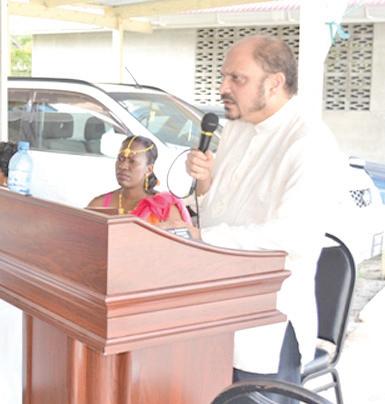
Guyana is back on track, let’s keep it there,” the Health Minister said.
Meanwhile, Region Four Chairman Clement Corlette said he is very pleased with the region’s performance in executing its 2013 work programme.
Under the region’s current work programme for the financial year ending December 31, 2013, $2.95 billion was spent, which accounts for about 98.49 per cent of the finances allocated.
Under drainage and irrigation, 98.24 per cent was spent; 100 per cent for maintenance of other infrastructure, 96.79 per cent under public works, 92.19 per cent on health and 99.27 per cent under capital expenditure.
Corlette added that while the strides made in the last 44 years must be recognised, there are still many issues that need addressing such as correcting the local government system.


Released in North America, Europe and Australia in January 2014, Backslider written by University of Guyana lecturer Julia Kanhai was officially launched on Saturday with a book signing ceremony at EMTEC headquarters.
The publication, which promises to be Kanhai’s first of many, explores several themes including sexual abuse. Backslider, written under the pen name “Terry K”, traces the journey of a pastor’s daughter who tries to assert independence in her personal life.
While on her first date, Rachael (the protagonist) is drugged by someone who turns out to be a serial rap-
ist. In her quest for revenge, she commits a few crimes but she eventually decides between drowning in her pain and resurfacing to face her God. The book is a vivid description of the trauma, denial, depression and doubts a victim experiences as well as the small steps that can be taken to regain trust in others and, more importantly, themselves. While the book is fictional, Kanhai explained that a lot of the material came from stories she had heard from different sources.
Among those in attendance at the launch was the Culture, Youth and Sport Minister, Dr Frank Anthony, who congratulated Kanhai for her work and willing-
ness to address a topic which some still consider to be taboo.
He said he hoped the book would spark a movement locally where others are motivated to write. Also making brief remarks was the Dean of the Faculty of Education and Humanities, Alim Hosein, who provided a brief background about the author and her journey in the literary arts.
For more information about Julia Kanhai or her book Backslider, kindly visit the author’s official website, terryk.ws. Copies of the book cost $5000 and are available at EMTEC headquarters located at 80 Duncan Street, Newtown, Kitty.

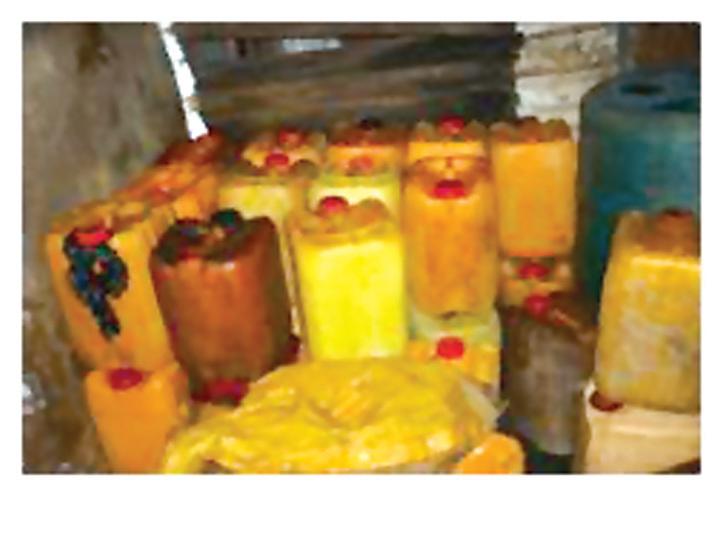
Prior to 2003, Guyana was facing a large number of fuel smuggling and associated tax losses. Non-taxed fuel was being smuggled into the country and sold illegally to retail sites while taxed road fuels were being adulterated with lowtax kerosene.
With no means of identifying which fuels were legally imported and which were smuggled, and recognising the ruinous effect of fuel smuggling on legitimate businesses, the government of Guyana implemented the Fuel Marking Programme (FMP) in 2003.
“Because of poor sales of diesel and gasoline compared to usage, numerous reports of fuel smuggling, coupled with local companies complaining of unfair competition with fuel smugglers it was necessary for some form of intervention to combat these problems… that intervention came in the form of the Fuel Marking Programme,”
said FMP Division head William Holder.
With the technology being new to Guyana and the region at the time of its introduction, there was need for specialised legislation.
The Guyana Energy Agency Act 1997 was therefore amended in 2004 to provide specifically for licensing of the different classes of fuel dealers and for the marking of all legitimately imported fuel. Subsidiary legislation in the form of the Petroleum
and Petroleum Products Regulations 2004 was also created to regularise fuel operations. The act was further amended in 2005, and again in 2011, after a review of the system revealed deficiencies.
The FMP was charged with the responsibility of ensuring that all gasoline, diesel and kerosene were properly ‘marked’ at a known concentration at all legitimate import points and also collecting and testing samples of fuel
from various parts of the country including wholesalers, retailers, distributors, transporters, commercial consumers and any person in possession of fuel for the relevant marker(s).
The marking process involves adding a mixture of marker chemicals in liquid form to legally imported fuel before it is released for use or sale. At the time of its implementation, this was done manually.
Bolstered
However, the FMP was bolstered in 2010 with the addition of a mechanised system to add the chemical marker into the bulk storage tanks. This bulk marking system utilises self-powered injectors to automatically inject the chemical marker concentrate during discharge of fuel from the international vessels into the bulk storage tanks.
“This system of bulk marking has improved security and integrity by tak-

ing the domestic marker out of the hands of the marking staff where ‘losses’ have been experienced in the past… the change from manual to mechanical marking further enhanced the programme whilst minimising impact on terminal operations,” said GEA Chief Executive Officer, Dr Mahender Sharma.
In addition to fuel related tax losses and the negative effect on legitimate businesses, illegally smuggled fuel can also affect consumers owing to the fact that usually, the illegal fuel that comes into the country is of a poorer grade than the legal one.
“We have found that often the illegal fuel is smuggled in dirty containers and it is exposed to salt water (sea water) which causes it to become contaminated…. The use of contaminated fuel damages equipment…contaminated fuel can cause damage to fuel pumps, cause injectors to become blocked, damage fuel filters and spark plugs,” said Dr Sharma.
The issue of fuel adulteration not only covers evasion of taxes on fuel, but also encompasses instances where tax-free fuel is being utilised for unauthorised purposes. In this regard, the programme has had tremendous success. Analysis of the laboratory results of samples collected from various sites from 2007 to 2012 revealed that there was a reduction in the number of sites found with adulterated/illegal fuel.
Drastic decline
For the years 2007 to 2010, there was a continuous increase in the number of incidents of illegal fuel being found at inspected sites.
The numbers, however, dramatically decreased in 2011 and 2012, with 2011 recording a 60 per cent decrease from 2010 and 2012, recording a 38 per cent decrease from 2011. This was despite there being an increase in the number of sites being sampled annually.
This consistent reduction of numbers prompted internal investigations after which, due to lack of confidence in their ability to carry out their duty, several employees’ services were terminated in accordance with their contracts. Following this, incidents of illegal fuel being found increased by 169 per cent from 2012 to 2013, again with more sites being sampled than previous years.
The Guyana Energy Agency Act creates various offences penalising the possession of or general dealings with fuel smuggling.
Those offences include being in possession of, storing, purchasing, transporting, and selling illegal pe-
troleum. Owing to the fact that legislation of this nature was new to the region, restrictions in the initial definition of illegal petroleum, the lack of equipment to scientifically determine the type of fuel found to be illegal, among others, hampered the agency’s ability to successfully prosecute persons found with illegal fuel.
Additionally, in some instances charges were filed after the statutory limitation period had expired causing the matters to be struck out. Having addressed such issues, the conviction rate significantly increased in 2012, a year in which 15 convictions were recorded. Following the implementation of the programme, the conviction rate, representing a total of 26 convictions to date, has dramatically increased and will continue to increase in years to come. For the year 2013, there were 35 incidents of illegal fuel and 13 prosecutions continuing before the Magistrates’ Courts in

Guyana. Two convictions along with one dismissal were recorded for the year.
The preceding would not have been possible without the partnership and support of other agencies. In 2007, a taskforce on fuel smuggling and contraband was convened under the auspices of the Home Affairs Ministry to coordinate the efforts of the different law enforcement agencies in the fight against fuel smuggling and contraband.
The resulting cooperation between the Guyana Police Force, the Guyana Revenue Authority (GRA), the Guyana Defence Force Coast Guard and the Customs Anti-Narcotics Unit (CANU) aided in several interdictions of illegal fuel and assistance in capturing, escorting and securing various transport vessels (both land and water). Cooperation from the Guyana Police Force in the detention of suspects and the GDF Coast Guard and the GRA in joint operations have proven invaluable in combating the illegal fuel trade.

There are serious consideration being given to have Guyana adapt its nurse training facilities and examinations to meet a standard regional requirement, Chief Medical Officer (CMO), Dr Shamdeo Persaud said.
He made the disclosure at the conclusion of a threeday meeting recently held by the Regional Nursing Body (RNB).
On Thursday, the RNB members paid a courtesy call on President Donald Ramotar at the Office of the President, in the company of Health Minister, Dr Bheri Ramsaran and the CMO.

The Caricom-based group, comprised of chief medical nurses, who are ex-
ecutives of the RNB, from regional territories, recently met at the Caricom headquarters to discuss the measures needed for the proposed move to have lo-
cally trained nurses trained and prepared to a regional standard.
According to the CMO, these measures include “the building of capacity in terms of trainers, accreditation for training schools, facilities, and teaching curriculum. Once these measures are implemented, the Guyana Nursing Examination will be adopted to suit the requirements of the regional standards.
The Regional Examination for Nurse Registration commonly known as the RENR, will see the Caribbean Examination Council (CXC) joining with
the RNB, to not only assess the grades of potential nurses when they sit their final exams, but also to build local capacity within the ranks of local trainers and medical professionals who will be called upon to help with the assessments.
These moves are part of effort by the Health Ministry to boost the standard of nurses trained locally and will assist regional efforts at ensuring that all Caricombased nurses attain one internationally accepted standard before practising their profession, the Government Information Agency (GINA) reported.
Earlier this year, Supriya SinghBodden, founder of the Guyana Foundation, and a member of the Baptist Health Founders Society, approached the Baptist Hospital about teaming up on joint fundraising efforts to garner material donations for both organisations, and professional support for the Guyana Foundation’s projects.
According to a release, Guyana Foundation was given a donation for the use of a palatial estate owned by British philanthropist Joe Moore for one week. The estate is located in Mallorca, Spain. This was auctioned at a recent event organised by the Baptist Hospital.
The luncheon event was held in Miami, and the keynote speaker was Sir Richard Branson. As stated by Baptist officials, “It is
an honour to enjoy the presence of Sir Richard Branson whose forward thinking is an inspiration universally.” The Baptist Cardiac and Vascular Institute performed a life saving cardiovascular procedure for Sir Richard Branson’s wife Lady Joan Branson. In appreciation, Sir Branson made available to Baptist Health South Florida, one seat on the Virgin Galactic Flight to outer space. The US$250,000 ticket was auctioned at the luncheon event along with the Guyana Foundation’s donation of the use of the exclusive estate in Spain.
A Baptist Hospital release stated: “Baptist Health Foundation has partnered with the Guyana Foundation to make available to attendees to our fundraising event, the use of an exclusive property

in Mallorca. Funds raised through the auction will benefit both organisations.
Singh-Bodden.”
Baptist Cardiac and Vascular Institute is part of Baptist Health South Florida, the largest faithbased not-for-profit healthcare organisation in the region. It also includes Baptist Hospital, Baptist Children’s Hospital, South Miami Hospital, Doctors Hospital, West Kendal Baptist Hospital, Homestead Hospital, Mariners Hospital, Baptist Outpatients Services and Baptist
Medical Group.
The Guyana Foundation continues its mission “to release the power of people globally to assist Guyanese to transform their communities, bring fulfilment and well-being to their families, enabling them to build relations of trust and friend-
ship among themselves irrespective of race and beliefs”.
“We continue to search the globe for skilled individuals who would like to travel to Guyana on a purely voluntary basis to impart their skills and experience in a variety of fields to less fortunate persons who are unable to access adequate training. Some of the areas the foundation is focused on include youth training and women empowerment programmes, care of the elderly programmes, raising mental health awareness, literacy programmes. Members of the public who would like to assist are asked to contact us at 592-225-4414, via email at guyanafoundation@gmail. com, or on Facebook at www.facebook.com/theguyanafoundation,” the release concluded.

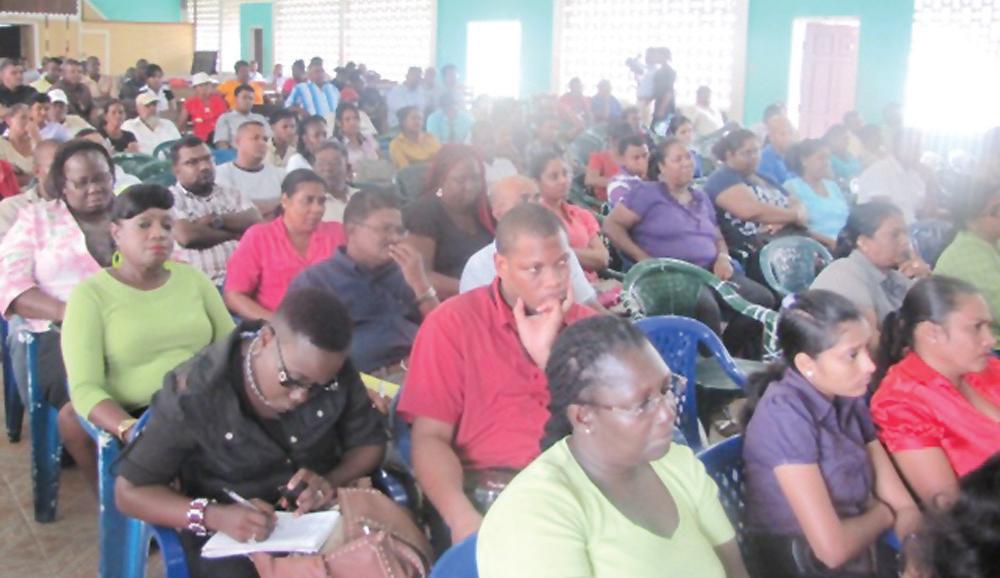
Guyana’s blacklisting status will have implications for everyone regardless of their political affiliations, several government ministers told a large public gathering of New Amsterdam residents on Friday evening.
They also reiterated their call for residents to reach out to their politicians and ensure the passage of the Anti-Money Laundering and Countering the Financing of Terrorism (AMLCFT) (Amendment) Bill in the National Assembly by February 28.
The meeting, which was conducted at the Berbice High School, and saw addresses by Finance Minister, Dr Ashni Singh; junior Finance Minister, Juan Edghill; and Attorney General and Legal Affairs Minister Anil Nandlall, was among three planned by government targeting opposition strongholds, given their stance on the AMLCFT Bill. On February 19, a meeting was held with residents of Linden, while another was held on Friday with residents in Bartica, Region Seven.
Mislead
In tackling the claim by an Alliance For Change (AFC) member that the matter does not concern the ordinary Guyanese, but only the rich, Minister Singh said nothing could be further from the truth because “they are attempting to mislead the people of Guyana into believing that their current position on the matter is not a harmful position against the people of Guyana. I am saying to you today, that if the bill proposed by government to Parliament in response to the Caribbean Financial Action Task Force (CFTAF) recommendations is not passed in Parliament, the implications will be grave for each and every Guyanese citizen,” Minister Singh told Berbicians.
The Minister, clarifying the dozens of channels, through which blacklisting will affect Guyana, emphasised that the country risks becoming isolated by the international community
if it is identified as a jurisdiction that has not taken steps to fight money laundering.
“No investor that raises money on the international capital market, the stock exchange or banks overseas would do business with a jurisdiction that is viewed as not having taken steps to fight money laundering, they cannot afford to do business with such a country,” he said.
The Minister explained that, “no bank will lend money to an investor; no stock market will generate funds for any investor that is coming to put that money in a jurisdiction that is seen as soft of money laundering,” and therefore, the result will be no new investors for Guyana. It will also mean the pulling out of those already in Guyana.
No boundary
“There is no boundary, there is no line that insulates anyone of us that says we would be protected from the adverse consequences of this blacklisting and the inevitable consequence will be that Guyana will once again return to where we were prior to 1992...” Minister Singh said.
“We must never forget no matter how they dress themselves up, what new name they assume, the tiger does not change its stripes and Mr (Carl) Greenidge was the Minister of Finance at the time who presided over the criminalising of Guyanese for choosing to eat what they wanted to. It is Mr Greenidge that made flour an illegal commodity as cocaine and the destruction and decimation of the Guyanese economy and they want to repeat it again... the chief architect of that destruction of the Guyanese economy is at work again... and he is attempting to repeat the destruction that he wrought on the people of Guyana. We must stand up against it,” he said.
For 10 months, APNU stalled on the implementation of the AMLCT Bill in accordance with the CFATF guidelines. It was only on February 10, they
of suspicion that they are in possession of the proceeds of money laundering, and if such persons are found with $2 million worth of currency or more, it can be seized and the persons locked up.
APNU is also proposing to change the whole government structure of the Financial Intelligence Unit (FIU), removing the power of the appointment of the director of FIU from the Minister and placing it in a committee of the National Assembly. They further proposed the establishment of an authority comprising 10 persons nominated by the National Assembly after consulting with stakeholders.

proposed to move forward amendments to the principal act and not the bill itself. The APNU is now proposing that police and customs officers be given the power to stop and search persons, on the basis
Blackmail
“They have said that although they agree with the clause of that bill, they will not support the clause of that bill unless they get what they want, including
cash seizure. That is blackmail! That is highway robbery! That is putting a gun to your head and say give
me your money or else I would pull the trigger,” Minister Singh pointed out to the town hall meeting.
“The consequences, if we do not get this bill passed will not discriminate in its impact, it will not only affect and devastate the lives of people who voted for the PPP, but it will damage and it will adversely affect the lives and the business of all the citizens of this country,” Minister Nandlall said. He said, he, ministers Edghill and Singh attended the consultation because “it is what we believe in because we are patriots and we are serving our country and we are serving the people of our country and this is bad for the people of our country,” the Government Information Agency (GINA) reported him as saying.

On February 23rd, 1970, Guyana declared itself a “Cooperative Republic”, loosening all connections with the British monarchy, and making way for a leadership that would be freely chosen by is people. The Governor General was replaced with a Head of State by a ceremonial President. Relations with neighbouring countries, once severed by a high-handed government were improved, and Guyana became a force in the Nonaligned Movement.
Life prior to 1970 was less than comprehensive. The 1968 general elections allowed the then ruling People’s National Congress (PNC) to govern exclusively, winning some 30 seats from the overall 53. The remaining 23 seats were unequally shared between the budding People’s Progressive Party (PPP ) with 19 and the United Force (UF) with four. Many observers; however, had claimed that the elections were stained with manipulation and coercion by the ruling party. It is reported too, that the PPP and UF had formed part of Guyana’s political landscape, but were ignored as the then Prime Minister Linden Forbes Burnham converted the mechanism of state into “an instrument of the PNC”.
But those days are long gone, and according to leaders of the two main political parties in Guyana, citizens, while hoping for improved lives, need to take stock and work towards the fulfilment of this and other objectives regarding the collective betterment of their country.
Major step
Opposition Leader, Brigadier (retired) David Granger has agreed that Guyana becoming a republic, 44 years ago, was a major step in its sovereignty, allowing it to display its political maturity. He said that Guyana has made significant strides in achieving its objectives, noting that the occasion was a significant constitutional event, which helped the country to achieve political growth. The establishment of a democratic presidency and systems of honours, he noted, are symbols of accomplishments in this regard. He said also that the country was able to set up its own Court of Appeal, and Local Government. Generally, progress was made.
“We have made some economic strides also, in terms of developing a system of housing schemes for the working people and have been able to
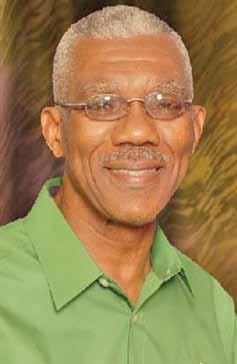
diversify our economy,” Granger told Guyana Times on Friday.
He, however, pointed out that the past 24 years have seen a massive eruption of events that require urgent attention.
“We are trying to rectify those movements, for example, criminality has soared particularly narco traf-
ficking; this did not exist 24 years ago.” He said that much still needs to be done in order to “fulfil the dreams of the people who brought us to republican status 44 years ago”.
Prime Minister Samuel Hinds, while expressing similar sentiments shared by the Opposition leader, said he hopes citizens of Guyana would be

able to “learn the lessons from our history and would get in step so that we would be able to realise our motto of becoming one people, one nation, one destiny”.
New leaf
He pointed out that Guyana’s years of republicanism is also in sync with its 48 years as an independent nation. He continuously married the two occasions, noting that he sees particular difference between them.
The prime minister said the country should be “turning new leaves from these adolescent years to becoming matured”. Hinds stressed that the country, as an independent unit, has achieved much, however, more still needs to be done.
The prime minister said that Guyana is now at a time when closure must be made to the “chapter of win ning and the opening of a new chap ter of being independent”. Clarifying this point, he explained that much has been said by citizens about the days of colonialism; a system of leadership under which Guyana was subjected. However, each Guyanese has the abil ity to make things better for him, said. “Before independence, we would say, look how the colonial master have us living. After that we have to say,


lessons from our get in step so that realise our motto people, one nation,
leaf that Guyana’s 44 republicanism is also in sync as an independent continuously married the noting that he sees no difference between them. minister said the country new leaves from years to becoming stressed that the independent unit, has however, more still minister said that time when closure the “chapter of winopening of a new chapindependent”. Clarifying explained that much has citizens about the days system of leadership Guyana was subjected. Guyanese has the abilbetter for him, he independence, we would colonial master have that we have to say,
look how we have ourselves living.”
He explained that the lives lived by Guyanese are a mere reflection of how good each citizen is in producing goods and services for the benefit of others. The prime minister contended that a better life for all can be had if every citizen perseveres. “I think that where we are now, we can have an improved life, if we are considerate and caring about each other and ourselves.”
Asked if he thinks the objectives set out in 1970 were achieved, Prime Minister Hinds said that he chooses not to look at what people are proclaiming, but what has happened. He said he remains hopeful that Guyanese, especially those of the younger generation, would fully comprehend the importance of reflecting on the past and making wise choices that will improve their lives. He therefore urged all Guyanese to be responsible citizens and their brother’s keeper.
Guyana, officially named the Cooperative Republic of Guyana, is the only nation state of the Commonwealth of Nations on the mainland of South America. It lies north of the equator, in the tropics, and is located on the Atlantic Ocean. Guyana is bordered to the east by Suriname, to the south and south-west by Brazil and to the west by Venezuela.
The People’s National Congress Reform (PNCR) is pleased to extend greetings and good wishes to all of the people of Guyana as we celebrate the 44th anniversary of our republican status.
The anniversary of the republic, apart from the national celebration of Mashramani, is an occasion for reflection and assessment of the state of our nation, 44 years after Guyana was declared a republic. In that regard, it must be evident to all that we, as Guyanese, need to undertake a frank and honest evaluation of whether our nation is headed in the direction that would bring us all, particularly our young people, progress and prosperity.
Our party has joined our partners in APNU to declare and dedicate our

energies to making 2014 the Year for Workers. However, we are conscious that, as a nation, we are challenged to remove the threats posed by the scourge of criminality and violence; corruption; the continued lawlessness in high places; the intolerance of views, other than those expressed by the administration; all of which contribute to infusing a sense of despair and the feeling of hopelessness that is currently afflicting the young people of this nation.
Accordingly, the PNCR wishes all of the Guyanese people a Happy Republic holiday, and a joyous celebration of Mashramani, as we pray that the spirit of peace, love and unity will dwell among us on the 44th anniversary of our republic.
The Alliance For Change (AFC) joins with all Guyanese in observing our 44th Republic Anniversary. It has been a year of hard work and in the true spirit of Mashramani, let us celebrate!
But even as we celebrate, let us be reminded that this republic anniversary comes at a time when we find ourselves struggling to preserve one of our symbols of nationhood, and some may argue our most important – our Constitution. This supreme law, which sets out our identity as a nation and as a people is under threat.

we have made over the years. Through strong and continuous advocacy, we have seen the Office of the Ombudsman being filled. Many other constitutional offices remain either vacant or filled by persons in an acting capacity. This is against both the dictate and spirit of our Constitution and must not be allowed to continue.
Sections of this national charter are today being subjugated by leaders intent on imposing partisan party doctrines above the articles of our Constitution and in the process undermining the democratic progress
The Alliance For Change is committed to upholding the rule of law, starting with our Constitution and calls on all Guyanese to lift their voices for the promotion and protection of this – the supreme law of our country. Let this be our resolve as a nation as we enter another year as a republic and recommit to forging a democracy that offers all citizens of Guyana a place we are proud to call home. Happy Mashramani Guyana!





Attorney General and Legal Affairs Minister
Anil Nandlall has announced that President Donald Ramotar has issued the Puisne Judges (maximum number) Order 2014, increasing the number of Puisne Judges to 20
The attorney general in a release said the order was issued on February 3 and was made pursuant to Section Three of the High Court Act, Chapter 3:02. It was duly published on February 8, in the Official Gazette.
According to Nandlall, the decision to increase the complement of Puisne Judges was made after due consultation with the Judiciary. It is yet another demonstration of the Executive’s commitment to adequately resourcing the Judiciary and supporting its institutional strengthening in order to ensure that in the end, justice is delivered to our people efficiently, competently and with dispatch.
He said it is the administration’s hope that this new measure will assist in bringing much needed alacrity to the rate at which cases are heard and determined in the judicial system. From all indications, it appears that the current complement of Puisne Judges is wholly inadequate to meet the volume of litigation engaging the justice system. At a spe-
Attorney General Anil Nandlall
cial sitting of the Caribbean Court of Justice in Guyana on February 19, in her farewell presentation, Justice Desiree Bernard echoed a call for an increase complement of Puisne Judges.
“We are pleased to note that the administration had already acted on the matter.
“We trust that those who are endowed with the high constitutional responsibility of recruiting candidates to fill the new vacancies, will discharge this responsibility with due care and circumspection in order to ensure that the new appointees are imbued with the requisite competence and integrity befitting the office to which they seek appointment. In this regard, we hope that quality will never be sacrificed for quantity,” the attorney general concluded.
On March 4-6, the Inter-American Investment Corporation (IIC) will host the eighth Conference on Corporate Governance for Development Financial Institutions (DFIs) at its headquarters in Washington, DC.
The conference will focus on implementation of the Corporate Governance Development Framework (CGDF) and the sharing of new developments in the field of corporate governance among its signatories.
More than 50 DFI representatives from over 25 countries as diverse as Burundi, the Philippines, Saudi Arabia, and South Africa have confirmed their participation.
Vnesheconombank, the Development Bank of Russia and Nacional Financiera, Mexico’s largest development bank, will be welcomed as new members to the framework in a signing ceremony scheduled for Tuesday, March 4, bringing the number of signatory institutions to 33.

Organisation of Eastern Caribbean States (OECS) Authority Chairman and Antigua and Barbuda Prime Minister Baldwin Spencer, announced on Friday that the OECS Authority has selected Dr Didacus Jules as the organisation’s new director general.
The position became vacant when the former director general, Dr Len Ishmael, demitted office at the end of December 2013. The organisation canvassed widely and received applications for the position from across the region and beyond. Having deliberated inconclusively on this matter during the 58th meeting of the OECS Authority in November in Montserrat, the authority made the final selection during an ad hoc meeting held in Havana, Cuba, during the CELAC summit in January.
Dr Jules is currently the registrar and chief executive officer of the Caribbean Examinations Council (CXC) and will be expected to take up his position as director general on May 1, 2014.
“The authority is confident that the correct choice has been made,” said Spencer, “and we look forward to working with Dr Jules in ushering in a new dispensation at our organisation”.
Spencer indicated that Dr Jules beat out a strong field of candidates for the position and pointed out that he came with a strong reputation as executive who strove for efficiency and who was not afraid to go after transformational change. Spencer said that, given the challenges facing OECS countries in the coming years, Dr Jules
was the best person for the job.
Jules, a national of Saint Lucia, met with Spencer recently in Antigua and Barbuda and both men spoke at length regarding the organisation’s mission and priority focus. The OECS Commission Secretariat is located in Saint Lucia.
Tremendous loss
Meanwhile, Dr Jules’ departure has been described as “a tremendous loss to CXC”.
“While I applaud the appointment of Dr Didacus Jules as director general of the Organisation of Eastern Caribbean States (OECS), his leaving CXC will represent a tremendous loss to the organisation,” said University of the West Indies Vice Chancellor and CXC Chairman, Professor Nigel Harris.
“During the six years of his tenure as CXC registrar, Dr Jules sought to accomplish transformational changes in the organisation,” Harris stated.
These, he said included
the aggressive use of information and communication technologies to make CXC an IT-intelligent organisation, expansion of outreach to global education organisations, significant broadening of international recognition and currency for CXC certification, and the engagement of regional leaders in both government and opposition in confronting some of the challenges of the region.
Harris also praised Dr Jules for his leadership in securing a new CXC headquarters in Barbados and noted that this would be one of his enduring legacies.
Dr Jules expressed his appreciation for “the tremendous privilege and trust extended by the council in my appointment and in fully supporting the transformation of the organisation over the past six years”.
“I am confident that once we have completed the new Strategic Plan 2020, which will be brought for approval in April, the transformational direction of CXC will be consolidated and expanded,” he added.
(Caribbean News Now)

The booming world fish trade is generating more wealth than ever before, but countries must help small-scale fishers and fish farmers benefit too, the Food and Agriculture Organisation (FAO) said.
Global fishery production from wild capture fisheries and aquaculture is expected to set a new record in 2013 at 160 million tonnes, up from 157 million tonnes the previous year, while exports will reach US$136 billion, according to preliminary data published ahead of the FAO Sub-Committee on Fish Trade meeting in Bergen, Norway, next week.
“The record trade figures reflect the strong growth in aquaculture output and the high prices for a number of species such as salmon and shrimp,” said FAO Products, Trade and Marketing Branch chief Audun Lem.
“This is underpinned by firm underlying demand for fish products from world markets.”
Aquaculture production is expected to hit about 67 million tonnes in 2012 and projections for 2013 point towards fish farmers producing 70 million tonnes – 44 per cent of total fishery output and 49 per cent of fish for direct human consumption.
“The proportion of fish production being traded internationally is significant, at around 37 per cent in 2013,” said Lem. “This makes the fisheries sector one of the most globalised and dynamic industries in world food production.”
Support for smallscale fishers
Developing countries continue to play a major role in supplying world markets, accounting for 61 per cent of all fish exports by quantity and 54 per cent by value in 2012.

Their net export revenues (exports minus imports) reached US$35.3 billion, higher than those for other agricultural products
combined including rice, meat, milk, sugar and bananas.
But benefits from international trade are not

including in Africa.”
Countries need to provide small-scale fishers with access to finance, insurance and market information, invest in infrastructure, strengthen small-scale producer and trader organisations, and ensure that national policies do not overlook or weaken the small-scale sector, the FAO said.
Uses for by-products
As greater quantities of fish are processed for export, more by-products such as heads, viscera and backbones can potentially be turned into valuable products also for human consumption, the FAO said.
always trickling down to small-scale fishing communities, even though small-scale fishers and fish farmers constitute about 90 per cent of the sector’s global workforce, the FAO said.
The organisation is urging countries to assist small-scale fishers and fish workers – around half of whom are women – to overcome a number of barriers such as lack of bargaining power and access to credit, difficulty in meeting market access regulations and poor trade-related infrastructure, so that they can access local, global and especially regional markets.
“There are exciting opportunities in regional markets at the moment as emerging economies such as Mexico, Brazil, Indonesia and Malaysia want more fish and are looking to their neighbours to supply it,” Lem said. “At the same time, this growing demand is stimulating new investments in local aquaculture production,
“We must ensure that these by-products are not wasted from an economic but also a nutritional point of view,” Lem underlined. “By-products often have a higher nutritional value than fillets, particularly in terms of essential fatty acids, vitamins and minerals, and can constitute an excellent means of combating micronutrient deficiencies in developing countries.”
New markets for byproducts are already opening up, he said, noting growing demand for fish heads in some Asian and African markets, while there is also potential to use fish heads and bones to meet the rising global demand for fish oil and mineral supplements.
Greater potential also exists to use by-products to make the fishmeal and fish oil used as feed in aquaculture and for livestock, indirectly contributing to food security, according to the FAO. This would allow some of the whole fish utilised today for meal and oil production to be used for direct human consumption.

Guyana has come a long way since gaining Independence in 1966 and becoming a Republic in 1970, even as the country celebrates its 44th Republic Anniversary with much pomp and ceremony. All Guyanese must be reminded that age does not necessarily translate to maturity much less progress.
The truth is, as the country marks yet another milestone in its history, it is facing new and emerging challenges which are threatening the peaceful coexistence of the democratic state and its resolve.
Guyana is turning 44 amid a troubling external environment which is being defined by high levels of economic instability, the decline of Marxist-Socialist regimes and a new trend which has seen attempts being reportedly made to oust legitimate and democratically-
elected governments.
This environment has also witnessed over the last decade a decline of super-powers and world powers and has seen the emergence of Brazil, Russia, India, China and South Africa (BRICS) as alternative leaders in the world state system.
The challenging regional hemisphere is categorised by the underachievement of the Caricom Single Market and Economy (CSME), several failed regional integration bodies and the decline of critical aid and trade agreements with former imperial and colonial states which have kept small developing countries afloat.
Surprisingly, this country’s independence is also occurring at the same time when one of its neighbours which has long stood up to the sometimes unjust policies of the United States government is reporting
that its democratically elected government may fall victim to a planned coup.
At the same time, Haiti, which is one of the first countries to achieve independence and become a republic, is also the victim of marginalisation. Most of the democratically elected governments have been undermined by political interference from the North and Western powers and badly crafted international economic and social reform policies.
At home, Guyana has found itself with a complex political system and culture which is breeding deadlocks, gridlocks and symptoms akin to a constitutional crisis. The new parliamentary configuration has seen the axing of budgets; the opposition which has a majority in the legislature beating its chest and passing lessthan controversial legislation; and a minority government


which is unwilling to let go of executive power vested in it by a Constitution, which was originally designed to avoid the clashes between arms of the state.
Additionally, Guyana is also faced with a situation in which crime is spiralling upwards. There appears to be a concerted attempt to undermine the institutions which are tasked with causing a reduction in crime for political mileage. In some instances, many will argue, these institutions are deserving of criticisms because of the actions of their members and the culture of lawlessness which has developed.
The justice system must be further modernised and the citizens must have full confidence in the judiciary to execute its functions in a timely and effective manner. This remains a challenge.
While attempts are being
made to reduce poverty and the government must be commended for its remarkable achievement in this respect, the levels of inequality still remain among the masses.
More challenges lie ahead for the Guyana which will have to keep abreast with technology and the need to diversify its economy. As the country ages, the dependence on sugar and rice must be removed and focus on non-traditional forms of sustainable agriculture must become the order of the day.
The Dear Land of Guyana must be proud of the gains she has made in improving the quality of education and health care of its citizens. She must be humbled by the plethora of infrastructural reforms piloted over the last 44 years, which has no doubt led to unprecedented improvements in the quality of life of all citizens.
Recently, the visit of the

Caribbean Court of Justice (CCJ) reminds Guyanese of other aspects of their independence. Some Caribbean territories still rely on the Privy Council. This last vestige of colonialism was consigned to oblivion since 2005 when Guyana opted to make this entity its final appellate court.
At 44, Guyana’s spirit is unbroken and its hunger for development remains strong. Its culture continues to be transformed, and today is one of the most dynamic multi-religious, multi-ethnic and ever tolerant societies in the world.
However, as we celebrate this momentous occasion, new challenges lie ahead and we must face them as one people, one nation, with one destiny so that Guyana will be the land we all want it to be.


Iam always wary about what passes for journalism in this nation. The language is often poor, and there is always an anti-government or pro-government twist. There is always a smallness that makes one blush with embarrassment. There are columns that scream with the hysteria of adjectives and adverbs. Language renders us nobly clothed or shamefully naked.
Thusly, one is cautious about believing what is vomited on pages for
public consumption. That caution being in place, there was an article in this daily about homosexuality. The article purportedly reflected the sentiments of “religious leaders” about gays and lesbians. The sentiments seem to respond to a statement from an organisation called AIDS (Artistes In Direct Support). This is way too clever and studied for people like me. But they mean well, I am sure. So, AIDS makes a
comment that the “religious community is not doing enough to stop discrimination against gays”. Now, AIDS is probably right. But we have no real way of knowing. Then comes the reported response of “religious leaders” from “three religious communities”. Remember the caution in the first sentence, please.
Here goes: “According to the religious leaders, beating and verbally abusing someone who is gay can be seen as an attack against an


innocent citizen.” This may be “diplomatic reporting”, but it rings true. “Can be seen”!! Rubbish! It IS an attack! Ask the good law enforcement officers!
It gets worse: “While they view homosexual behaviour as unacceptable, it is wrong to discriminate against them.” If someone pillages your home and violates your children, it is unacceptable. But let us not discriminate against them. It could be poor reporting, but I have heard this idiocy many times! Gay or un-gay, the laws are the laws! If we think the actions of people are “unacceptable” then we must not discriminate against them.
The true measure of a civilised society is not the simplicity of the number of votes. All those folk who call themselves social scientists and such grand things must know this: a civilised or democratic society is measured by how we treat our most vulnerable! The more vulnerable you are, the stronger we must be in keeping you safe. Without fear or favour, without malice or ill will.
And my goodness, it gets even worse! The article quotes an “imaam” from a “masjid” who said that the Quran teaches that “the curse of Allah is on all
homosexuals”. I would bet (I would win!) that this chap cannot speak a word of Arabic! Hamar! He simply memorised a thing and a few rituals and then condemns people.
This religious leader reportedly goes on: “We don’t accept homosexual and we don’t accept AIDS.” And it is then reported in indirect speech: “The deadly virus is spread primarily because of homosexual activities.”
My great grandfather is entombed in the compound of the New Amsterdam mosque! There is no name on the gravestone. No signal.
This “imaam” that spoke to the press does not speak for me! And he does not speak for the good man in that grave in the compound of the New Amsterdam mosque.
I hope that this chap does not speak for the Muslims in this nation. I have lived in Muslim countries for more than 20 years! The best Muslims did not get their goodness from the religion. They got it from inside of themselves, from the Creator that dwells in their hearts. If you do not “accept” the sick and the ailing and the sinners, what good is the place of worship? Is it for the saved only?
I am much more admiring of Father Traher’s position: “Anyone who has a disease has a right to receive care.” Equally admirable is what was reportedly said by Pandit Deodat Persaud: “The mandir has been offering programmes for persons infected with HIV/AIDS and does not discriminate, regardless of the sexual orientation of the victim.” Humbly, one would worship alongside these two. With the other, not so. A year ago or so, a young man “came out” publicly about being gay. He told me about his “gayness” long before, and he was worried that I would think less of him. Quite to the contrary, I was proud of him. Not because he was gay and admitted it! I was proud to know him for his courage, and I will continue to respect him because he is a good and decent, caring and compassionate human being. I adore him for Simply the Truth!

enezuelan leader
VNicolas Maduro has invited U.S. President Barack Obama to join him in talks aimed at resolving the problems between the two countries. Maduro said the meeting would help “put the truth out on the table”.
He has accused U.S. conservatives and media organisations of plotting to overthrow his government.
Earlier on Friday Venezuela revoked the accreditations of CNN reporters covering the country’s crisis. Eight people have died in recent protests.
In a news conference on Friday, Maduro said: “I call for a dialogue between Venezuela and the United States and its government.”
Let’s initiate a high-level dialogue and let’s put the truth out on the table.”
The dialogue will be “difficult and complex”, Maduro
said, until the American government accepted “the full autonomy and independence of Latin America”.
On Sunday Venezuela expelled three U.S. diplomats accused of meeting violent groups linked to the opposition.
‘War propaganda’
Earlier Venezuela had revoked the accreditation of CNN’s Caracas-based reporter, Osmary Hernandez, and those of two other CNN journalists sent to Venezuela to cover a wave of opposition marches.
The government says the protests are part of a coup attempt. But U.S. Secretary of State, John Kerry, denounced the latest action on Friday.
“I call on the Venezuelan government to step back from its efforts to stifle dissent through force and respect ba-
sic human rights.
“The solution to Venezuela’s problems can only be found through dialogue with all Venezuelans, engaging in a free exchange of opinions in a climate of mutual respect.”
On Thursday, Maduro threatened to “take action” against CNN unless it ceased what he described as hostile coverage.
“I won’t accept war propaganda against Venezuela. If they don’t rectify themselves, out of Venezuela,” he said. One of the two U.S.-based CNN journalists who had their work permits revoked, Patricia Janiot, said she had been harassed by Venezuelan officials as she left the country. In a statement, the net-
work said it was still negotiating with the authorities.
“We hope the government reconsiders its decision. Meanwhile, we will carry on covering events in Venezuela in a fair, accurate and balanced manner,” read the statement.
A close ally of the late president, Hugo Chavez, Maduro was elected by a narrow margin last April. Political divisions have deepened since the election, and the economy has taken a downturn.
Henrique Capriles, who was defeated in last year’s presidential election, and other opposition leaders have called on people to take to the streets on Saturday, in marches “against violence”.
(BBC News)
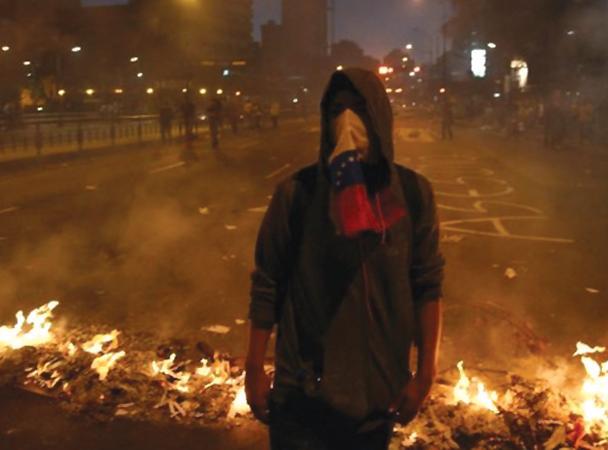
The military and security forces can make a meaningful contribution to national development, as seen in the Barbados Defence Force’s recent contribution to national efforts to develop an animation industry in Barbados.
Colonel Alvin Quintyne, Chief-of-Staff of the Barbados Defence Force (BDF), made this observation as he addressed Defence Force officers from Barbados and the region, who were recently armed with new and ad-
vanced technical skills in the management of data communications.
Quintyne noted that the Barbados Defence Force was indeed pleased to make its contribution recently, to support national efforts to develop an animation industry in Barbados.
“During the period October to November last year, the BDF facilitated the conduct of a content animation course here at this training facility,” the chief-of-staff noted as he spoke from the IT
Training Room of the BDF.
“This achievement is indeed a clear demonstration that the military and other security forces, whether in Barbados or in your respective islands, can make a meaningful and positive contribution to national development,” he told those gathered.
Last year’s workshop saw 21 young people from West Toons and the Caribbean Digital Media Centre (CDMC) undergoing training. At that time, Phil Phillips, a local consultant for Toon
Boom Animation who spoke with the media at the animation training workshop at the Barbados Defence Force, suggested that the Caribbean has the potential to become the centre of animation excellence, thereby attracting outsourcing work from major studios in Hollywood and other places.
He stated that this is a billion-dollar industry, which could create several employment opportunities for the youth in the region. (Excerpt from Barbados Advocate)

The United States says one of the world’s most wanted drug barons, Joaquin Guzman, known as El Chapo or Shorty, has been arrested in Mexico.
He was the leader of the Sinaloa cartel, which smuggles huge amounts of illegal drugs into the U.S. Shorty’ Guzman had been on the run since escaping a high security prison in a laundry basket in 2001.
He was arrested in Sinaloa state, in a joint operation with United States anti-drugs forces. Guzman was at a hotel in the north-west-
Opposition Leader Dr Keith Rowley Friday slammed the Salaries Review Commission (SRC), saying it was disrespectful and out of step in its 98th Report for salaries and other benefits for MPs.
The report was presented for debate in the House of Representatives by leader of government business, Dr Roodal Moonilal.
It contained salary increases and other benefits for some 900 top officials in the country, including the President, Prime Minister, Chief Justice and Opposition Leader. The SRC recommended a 24 per cent hike in monthly salary for many of those officials.
But Rowley was not impressed by the SRC report, saying it was done in a “poor” and “illegal” manner.
Admitting to legislators he had a problem with the document, Rowley said it appeared the SRC felt the work of MPs had diminished, or that the country cannot af-
ford to pay MPs proper salaries.
He said: “The deputy chairman of the SRC earns more than a MP. That’s madness, doesn’t make any sense.
“I think there is a certain amount of malevolence that comes from the commission to members of this House. And if the rest of you want to accept it that is a matter for you. I reject it.”
Rowley said he worked very hard “for whatever is given to me as my emolument and I haven’t been complaining, but I will complain now when I see I am being disrespected by a commission that takes the position that my time and effort are worth nothing.”
Noting that the SRC was established in 1976 to review the salaries and other conditions of officials under its purview, Rowley said this was done to prevent parliamentarians from setting their own terms and conditions of employment. (Excerpt from Trinidad Guardian)
Attorney General Anand Ramlogan is taking former Justice Minister and High Court judge Herbert Volney, to court for defamation.
In a claim filed in the Supreme Court Friday, Ramlogan is alleging his former Cabinet colleague, acting out of malice and motivated by a desire to rehabilitate his own reputation on being fired from government, made defamatory statements in an internet email blog.
Representing Ramlogan are Avory Sinanan SC, Gerald Ramdeen, Kelvin Ramkissoon and Richard Jagai. In the claim, Ramlogan is seeking damages, aggravated and exemplary, for the libel which was published throughout 2013 on the Internet chat forum on Yahoo via herbvol52@hotmail.com, which the lawsuit contends belongs to Volney.
mentation of the legislation, namely the Chief Justice and the Director of Public Prosecutions, the lawsuit stated.
ern resort of Mazatlan, the AP news agency reported.
The U.S. state department had offered a reward of up to US$5 million (£3.2 million) for information leading to his arrest. He has been indicted on federal trafficking charges and US officials want him extradited if he is ever captured.
Several close associates of ‘Shorty’ Guzman had been arrested over the past two years in the U.S. and Mexico. Forbes magazine has estimated Guzman’s fortune at about US$1 billion (£600 million). (BBC News)
According to the claim, the statements made by Volney on the chat forum allege impropriety on Ramlogan’s part in relation to the Section 34 debacle and the former St Joseph MP’s dismissal as well as allege the AG abused his office by coercing Chief Justice Ivor Archie and DPP Roger Gaspard, to join in a conspiracy to get rid of the former minister.
Volney was fired from Cabinet by Prime Minister Kamla Persad-Bissessar on September 20, 2012, for misleading Cabinet and Government in respect of the early proclamation of provisions of the Administration of Justice (Indictable Proceedings) Act 2011 and in particular section 34 and for misinforming, and/or misrepresenting to the Cabinet and the Government the position and views of important stakeholders in the imple-
Copies of the blog transcripts as well as the unconfirmed minutes of the Judicial and Justice Sector Committee meeting of July 24, 2012, held in the CJ’s conference room at the Hall of Justice, Portof-Spain, at which Volney, Gaspard, the CJ among others were present when Archie raised concerns about an early proclamation of section 34, were included as exhibits in support of the AG’s claim.
The libel claim noted that the blog was open to and participated in by the public and statements made by Volney were understood to mean Ramlogan orchestrated a conspiracy to remove him from ministerial office by presenting a false claim against Volney.
The lawsuit also alleged that Volney’s statements suggested the AG was the chief architect of the conspiracy to get rid of him from office; incited the CJ and the DPP to participate in that conspiracy and in so doing was guilty of ‘gross constitutional impropriety in seeking to compromise the office of the CJ and the independence of the judiciary as well as that of the office of the DPP.

Ukrainian MPs have voted to oust President Viktor Yanukovych and hold early presidential elections on 25 May. The vote came after police stopped guarding presidential buildings allowing protesters in and parliament appointed high-level officials. Yanukovych described events as a “coup” and vowed not to stand down. Also on Saturday afternoon, prominent opposition leader Yulia Tymoshenko was released from detention, hours after parliament autho-
rised the move.
A BBC correspondent saw Tymoshenko driven away in a car after leaving a hospital in the eastern city of Kharkiv where she was being held under prison guard. She is now reported to be heading to Kiev’s Independence Square – also called the Maidan –which has been the focal point of anti-government protests. MPs had voted to pave the way for her release on Friday. She was sentenced to seven years in prison in 2011 after being convicted of abuse of power over her actions during
Algerian President Abdelaziz Bouteflika
will run for a fourth term in April’s election, his office said on Saturday in comments carried by national television.
The president has informed the interior ministry of his intention to run in the April 17 poll and has collected appropriate documents, the television quoted Bouteflika’s office as saying. The electoral law requires candidates to gather at least 60,000 signatures from supporters across no fewer than 25 provinces by midnight on March 4, and the documents will be used to that end.
Prime Minister Abdelmalek Sellal said Bouteflika made his decision in “response to the encouragement of citizens from all over the country.”
Bouteflika, who suffered a stroke last year, has not made any public address since returning home from hospital, has only received a few foreign dignitaries and chaired just two cabinet meetings.
The comments from his premier and ally Sellal were the clearest indication so far on his intentions before midApril elections in the North African oil producer. (Excerpt from Al Jazeera)
her tenure as prime minister. Her supporters have always maintained this was simply Yanukovych taking out his most prominent opponent, and her release has always been a key demand of the protest movement.
‘Coup’ denounced The opposition is now in effective control of the capital Kiev, with Yanukovych arriving in Kharkiv, near the Russian border, late on Friday night. The Interfax news agency reported parliament speaker Oleksandr
Turchynov as saying Yanukovych had been stopped by border police in an attempt to flee to Russia and was now somewhere in the Donetsk region.
Earlier on Saturday, protesters walked unchallenged into the president’s office and residential compounds. Ukraine’s army released a statement on Saturday afternoon saying it would not get “involved in the domestic political conflict”.
The vote to “remove Viktor Yanukovych from the post of president of Ukraine” was passed by 328 MPs. Such ballots, passed by what is called constitutional majority, are binding and enter into force with immediate effect, the BBC’s Ukraine analyst Olexiy Solohubenko reports.
In an address televised before the vote to impeach him, Yanukovych described events in Kiev as a “coup”. He insisted he was the “lawfully elected president” and compared the actions of the opposition to the rise to power of the Nazis in 1930s Germany. (Excerpt from BBC News)
The UN Security Council on Saturday unanimously adopted a resolution to boost humanitarian access in Syria that threatens to take “further steps” in the case of non-compliance, demands cross-border aid access and condemns rights abuses by the Syrian government and opposition armed groups.
Russia and China, which have shielded Syria’s government on the 15-member Security Council during the country’s three-year-long civil war, voted in favour of the resolution. They had previously vetoed three resolutions that would have condemned Syria’s government and threatened it with possible sanctions.
“This resolution should not have been necessary. Humanitarian assistance is not something to be negotiated; it is something to be allowed by virtue of international law,” UN Secretary-General Ban Ki-moon told the council.
The United Nations says 9.3 million people need help and that well over 100,000 people have been killed in the civil war. The resolution “demands that all parties, in particular the Syrian authorities, promptly allow rapid, safe and unhindered humanitarian access for UN humanitarian agencies and their implementing partners, including across conflict lines and across borders”. It also “demands that all parties immediately cease all attacks against civilians, as well as the indiscriminate employment of weapons in populated areas, including shelling and aerial bombardment, such as the use of barrel bombs, and methods of warfare which are of a nature to cause superfluous injury or unnecessary suffering.”
(Excerpt from Reuters)
“Profoundly shocking to me is that both sides are besieging civilians as a tactic of war,” he said after the vote. The resolution asks Ban to report back to the council in 30 days on the implementation of the resolution and “expresses its intent to take further steps in the case of non-compliance.” Diplomats say Russia is unlikely to agree to any action against Assad’s government if is it found to be in non-compliance.
China’s foreign ministry has summoned a senior U.S. embassy official in China after U.S. President Barack Obama held low-key talks with the Dalai Lama at the White House despite warnings from Beijing the meeting would damage ties. Chinese Vice Foreign Minister Zhang Yesui summoned Daniel Kritenbrink, charge d’affaires of the U.S. embassy, on Friday night, according to a statement posted on the Chinese foreign ministry’s website, where he expressed his country’s rejection of “U.S. interference in China’s internal issues.”
“China expressed strong

indignation and firm opposition” to the “erroneous acts” of the U.S. in interfering in China’s internal issues, Zhang said in the
Matteo Renzi was sworn in Saturday as Italy’s youngest Prime Minister, alongside his new Cabinet of 16 ministers. It’s a step many hope will bring muchneeded political stability to the country.
The former Florence mayor, who won control of the Democratic Party in a primary a couple of months ago, ousted fellow party member Enrico Letta in a party vote last week.
Renzi, 39, is nicknamed il Rottomatore –or “the demolition man” – for his pugnacious style of politics. After the

swearing-in ceremony at the presidential palace, he headed to the Italian Prime Minister’s office, the Palazzo Chigi, to hold his first cabinet meeting. The line-up for Renzi’s
new government was published on his website Friday. Italy’s new Finance Minister is Pier Carlo Padoan, currently deputy secretary-general and chief economist
of the Organisation for Economic Co-operation and Development (OECD.) Serving Interior Minister Angelino Alfano, of the Nouvo Centro Destra party, keeps his job in the new government. Half of Renzi’s ministers are women, the largest proportion in Italian history. Most of the ministers are young by Italian standards, with an average age of 48. Renzi is expected to outline his new policies Monday in the Senate, where he will face a confidence vote. Letta held on to the top job in Italian politics for less than a year. (Excerpt from CNN)
statement, the Reuters news agency reported. The talks between the Dalai Lama and Obama went ahead on Friday, despite China warn-
ing against the visit and urging the U.S. to cancel it. Paying no heed to Beijing’s threats, Obama offered “strong support” for the protection of Tibetans’ human rights in China during the one-hour meeting with the Nobel Peace Prize laureate. Beijing considers Tibet an integral part of its territory and regards the Dalai Lama as a separatist. The Tibetan spiritual leader has lived in exile in India since 1959 after a failed uprising against Chinese rule. “Tibetan issues fall purely into the domestic affairs of China,” Zhang said in the statement. “The U.S. has no right to interfere.” (Excerpt from Al Jazeera)
Didn’t break law, got funds from Indians only: AAP to Delhi high court
Rejecting the allegation of illegally receiving foreign funds, Aam Aadmi Party has told the Delhi high court that it got donations worth Rs 30 crore from Indian citizens only, out of which about Rs 8.5 crore came from NRIs.
Denying having violated any foreign exchange or other laws, AAP contended that the PIL accusing it and its founding members of having illegally received foreign funding is “scandalous, frivolous, motivated and baseless”.
The party, in its response filed in the high court, has said that it has “very small amount of funds and also the most transparent method of political funding amongst all parties”. “It is the only party whose all financial records, and the names of each and every donor is on its website, open
for public view,” the affidavit, filed by AAP national secretary Pankaj Kumar Gupta, said and sought dismissal of the PIL.
AAP, while rejecting the contentions in the petition for lodging of a criminal case against it and its members, said that the high court “must direct a thorough investigation of the funding sources (including foreign funding) of major political parties, particularly the Congress and the BJP”.
“These are the parties that have received donations officially running into thousands of crores from unknown sources. Other hidden donations that are not shown in their books may be much higher and deserve a thorough investigation in order to clean up our political and electoral system,” the party has said in its response. Excerpt from Times of India)








CAPRICORN
(Dec. 22Jan. 19)
Don’t be too hasty choosing a new investment. Remain professional in your financial dealings. Good results will be achieved if you resist acting impulsively. Make choices based on sound facts and figures.

AQUARIUS
(Jan. 20Feb. 19)
Committees are always searching for creative fund-raising ideas and would be very interested to hear your innovative thoughts. Your talents will lead to an offer that could be prosperous.

(Feb.20March 20)
Travel and education should take top priority today. Delve into difficult cultures or attend a conference or trade show that offers food for thought regarding future projects.

(March 21-April 19)
Your confident and easygoing nature will attract an interesting friendship. Consider teaching or lecturing about a skill, knowledge or lifestyle at which you have excelled. Sharing what you know will encourage advancement.

(April 20May 20)
This is not a good time to travel or deal with authority figures. Focus on reuniting with relatives or friends whom you haven’t seen for some time, using video chat, email or phone.

(May 21June 20)
Someone close to you will be demanding. Take precautions to ensure that you aren’t taken for granted. You can nurture important relationships without being used emotionally, physically or financially.
By Bernice Bede Osol

(June 21July 22)
Don’t punish yourself by obsessing about the past. There is nothing you can do to change what has already happened. Save yourself from heartache − look forward, not back.

(July 23Aug. 22)
Don’t get stuck in a routine. Fend off boredom by trying something new. Share your adventure with someone you love. Making plans for the future will give you incentive to change.

(Aug. 23Sept. 22)
Someone close to you is facing a difficult situation. Be prepared to offer assistance. Take care to be especially tactful and sensitive in your approach to avoid causing embarrassment.

(Sept. 23Oct. 23)
Prepare for the unexpected. Don’t get drawn into a power struggle. Visit a friend or take a day trip to avoid a situation at home that could end up being costly.

(Oct. 24Nov. 22)
An unusual request may catch you off guard. Perform your duties as instructed and without argument. Maintain a close watch over your financial situation to avoid any unexpected surprises.

(Nov. 23Dec. 21)
Refrain from hiding your feelings. Expressing your thoughts clearly will help you avoid a situation that has the potential to escalate, costing you emotionally or financially. Offer the world honesty and integrity.



Dentures provided in 72 hours from as low as $4500. Contact Dr B Stuart, 209B Charlotte St, Lacytown. Tel: 225-5034

Shalom Driving School. Lot 2 Croal Street. Call 227-3835, 227-3869, 622-8162 and enjoy 20% discount

Available: Fresh long-stemmed roses, fresh dried and silk floral arrangements, gift items, bridal boutiques and wreaths. Nesha’s Flowerland. 78 Church Street (opposite St George’s Cathedral). Tel: 227-3553/225-3315



Scenes from the Children’s Costume and Float Parade in Linden

Nursery and primary school students from across Region 10 took to the streets on Friday, as schools there participated in the annual costume and float parade in commemoration of Guyana’s 44th republic anniversary.
The creative and flamboyant floats, each depicting the rich and diverse Guyanese culture and the spirit of Mashramani, Guyana’s Republic celebration, lit up the streets of Republic Avenue and Greenheart, as the students pranced to the lyrics of soca and other cultural music.
Scores of onlookers and parents also lined the streets and eagerly awaited the students as the procession made its way through.
Gyrating to musical sounds, the students marched from the Five Corner area, Mackenzie, along Republic Avenue, then through Greenheart Street, where the parade culminated at the Mackenzie Sports Club Ground (MSC).
At the MSC, the various schools had the opportunity of showcasing their costumes on stage and they also participated in various cultural activities such as dance and poetry.


Agricultural tractors and machinery; single and 4-wheel drive: Massey Ferguson, Ford, John Deer, New Holland and Fiat. Also available spares parts for these machines. Phone: 6194483, 601-7883, 226-6325
Spare parts for 1-2-3-4 and 6 cylinder diesel engines for Lister, Pieter, Kobota, Perkins, Veutz, Fiat, John Deer, Case IH, Cummings, Bedford and Leyland Daf. Also all middles of diesel generators: super silence and open air from 3KVA- 600KVA. Contact Rams Auto Spares on telephone 226-6325, 2271454, 619-4483 and 685-3568
Chinese-made gas stoves. Call 2315866, 231-5857



Immigration & Visa Services We handle all Canadian, USA and UK immigration and visa matters. Self sponsorships, holiday/visitor’s visas, work permits, students visas, family, class, immigration forms, embassy enquiries, appeals for refused cases, US green card lottery, business class waivers, pardons, etc. Get your visa approved. High success rate. Balwant Persaud & Associates. Certified Immigration Consultants, 68 Sixth Street, Alberttown, Georgetown (Between Cummings & Lights Sts) Tel: 225-1540, 622-8308, 655-3105. Email: balwantpersaud@yahoo.ca

Professional Key Shop, 125 Carmichael Street, Georgetown. Phone: 225-3923, mobile: 6213249. We cut any type of key, service and repair all types of locks. Get your extra key today.

Da Silva’s Optical. For Your Eyes Only, Look Better See Better. Phillip A Da Silva OD, Shannon L Da Silva OD, Natalie Da Silva OD. 248 South Road, Bourda. Phone: 227-3529, Linden: 444-6376, Corriverton: 339-3536, Meten-Meer-Zorg: 275-0322, Grand Cayman Islands: (345) 943-1515 for the perfect trendy touch. OpTiciAN

Two storey wooden building. Bare Root. Phone: 687-5653
We buy cash any land in Parfaite Harmonie. Call: 675-7292
Property for sale at 48 Light Street, Alberttown (between third and fourth streets) Contact Ram on telephone: 619-4483 685-3568 and 226-6325.
One unfurnished three-bedroom flat concrete house with concrete fence at Parfaite Harmonie. Call 2310821 or 643-4740.
First Phase Good Hope, Anna Catherina, East bank Demerara (property with ongoing business). Call 673-5546, 695-4382, 669-3313, 231-4586.
One two- storey concrete house located at Mon Repos,

Trails & Treasures. Learn to decorate with balloons. Class begins March 1, 2014. Call 225-3133, 613-7513 for registration and more information. Healthworld Holistic Centre offers clinical psychotherapy for suicidal thoughts, attempted suicides, depression, stress, mood disorders, psychotic disorders, homicidal thoughts, hallucinations, loneliness, conflicts, anger management, relationship & sexual problems, paranoia and much more. Call +592-6210552 and make that appointment now before it’s too late. 12:00PM –6:00PM. Mondays - Fridays. Email: healthworldhc@gmail.com

Suriname Astrology Palmist and Djuka Healing, the most powerful spiritualist in the world, are you suffering from the following problems (any religion) love, marriage, family, health business, husband and wife relationship, property, court, children, promotion, visa, pregnancy, education, depression, job, sexual, jealousy, enemy, money, drinking?
Also you can have all evil forces destroyed such as black magic, witchcraft, voodoo, obeyah etc and give powerful protection. We also do upliftment for clearing of land, dredging operations strictly in the interior. For private and confidential service call 674-2112.
Get your home or business spiritually clean to enhance good luck and prosperity. Telephone: 687-5653
Cleansing of spiritual problems of all kinds. Powerful Ifá protection against evil. Get help to overcome problems with love, relationships, legal, sexual, pregnancy, business, sickness, jobs, enemies, work, money. Call 592-690-1824 from 10:0016:00h Email:anew-life@live.com
Dutch spiritual healing in removing evil spirit, bad luck, evil sickness, spells, reuniting lovers and prosperity to businesses. Call: 612-6417, 220-0708, 687-5653.

2 Modern Apartments located in Campbellville; hot and cold water etc. Call 219-4535
House located at Lamaha Gardens; hot & cold water. Call 219-4535

JUST ARRIVED:
COROLLA AE100 WAGON; HONDA CRV RD4; LAND CRUISER (FULLY LOADED); MAZDA PROCEED 4WD EXTRA-CAB PICK-UP; TOYOTA HILUX 4WD EXTRA CAB PICKUPS - 3RZ, 5L, 3L SOLID DEFFERNTIAL; MITSUBISHI CANTER TRUCKS 4 TONS FREEZER; 3 TONS OPEN TRAY; 2 TONS 4WD; 3




An Under-19 World Cup quarter-final involving India goes down to the wire, by default. England’s eighth-wicket pair of Rob Jones and Rob Sayer held their nerve in a stand of 23 to take them home in the final over in their chase of 222, knocking out defending champions India. England looked favourites to get home comfortably at one stage, with Ben Duckett leading the way with a fifty before India’s spinners seized control. But it came down to the team with the more reliable lower-order depth as England booked their place in the semi-finals. It was a match that ebbed and flowed. England’s fast bowlers pinned India down to 24 for 4 before their lower order, led by Deepak Hooda and Sarfaraz Khan shored them up to a competitive 221. It was then a contest between England’s batsmen and India’s spinners. Duckett’s handling of the slower bowlers gave England the confidence that they could pull a win after a shaky start, but a few false shots that found the fielders brought India back into the game.
Round-up
Bangladesh Under-19s crushed Canada Under19s by nine wickets and 217 balls to spare in the playoff for the ninth place. Bangladesh put Canada in after winning the toss and their bowlers made the most of the morning conditions in Abu Dhabi.
Canada’s openers got to 11 before the crash began. They lost six wickets for 17 runs to slump to 28 for 6, before limping to 75. They were dismissed in 27.1 overs. Mustafizur Rahman claimed 3 for 11 for Bangladesh, while Saeed Sarkar and Mehedy Hasan took two each.
Bangladesh made short

work of the chase, achieving the target in 13.5 overs.
TThe openers added 73 before Joyraz Sheik was dismissed for 33. He was the only wicket they lost. Shadman Islam was unbeaten on 35.
A patient half-century from Ryan Burl helped Zimbabwe Under-19s to a six-wicket win against Namibia Under-19s in the ninth-place quarter-final playoff in Abu Dhabi. Burl hit only one four during his 55 not out, and put up 66 for the fourth wicket with Kieran Geyle, as Zimbabwe successfully chased down 195 in 45.1 overs.
Namibia, put in to bat, were restricted to 194 for 8 from their 50 overs thanks to some incisive bowling from the offspinner Patrick Mambo who finished with 4 for 31 as he ran through Namibia’s top order. Xander Pitchers top-scored with 78 and added 87 for the sixth wicket with SJ Loftie-Eaton, but apart from them, only two other batsmen reached double digits for Namibia. (Cricinfo)
India Under-19s innings
AK Bains† c †Clarke
b Winslade 3
AA Herwadkar c †Clarke
b Fisher 2
VH Zol* c Duckett b Sayer 48
SV Samson c Duckett b Fisher 0
RK Bhui c Duckett b Fisher 7
DJ Hooda run out (Tattersall) 68
SN Khan not out 52
AA Gani c Sayer b Higgins 7 Kuldeep Yadav run out (Winslade) 16
CV Milind not out 7
Extras: (lb 1, w 10) 11
Total: (8 wickets; 50 overs) 221
Fall of wickets: 1-7 (Bains, 1.6 ov), 2-8 (Herwadkar, 2.4 ov), 3-8 (Samson, 2.5 ov), 4-24 (Bhui, 8.1 ov), 5-111 (Zol, 32.5 ov), 6-147 (Hooda, 39.6 ov), 7-161 (Gani, 42.5 ov), 8-196 (Kuldeep Yadav, 47.5 ov)
Bowling: MD Fisher 10-1-553 (4-w), JR Winslade 10-2-441 (1-w), RJ Sayer 10-0-27-1, WMH Rhodes 10-0-35-0 (1w), RF Higgins 4-0-21-1 (2w), R Jones 6-0-38-0 (1-w)
England Under-19s innings
(target: 222 runs from 50 overs)
JA Tattersall c & b Hooda 23
HZ Finch lbw b Monu
Kumar 10
RF Higgins c Samson b Milind 1
BM Duckett c Zol
b Kuldeep Yadav 61
E Barnard c Samson b Gani 24
WMH Rhodes*
b Kuldeep Yadav 10
J Clarke† c Zol
b Kuldeep Yadav 42
R Jones not out 28
RJ Sayer not out 10
Extras: (w-13) 13
Total:(7 wickets; 49.1 overs) 222
Fall of wickets: 1-30 (Finch, 7.1 ov), 2-36 (Higgins, 8.6 ov), 3-41 (Tattersall, 10.5 ov), 4-117 (Barnard, 25.5 ov), 5-138 (Duckett, 29.4 ov), 6-148 (Rhodes, 33.4 ov), 7-199 (Clarke, 45.3 ov)
Bowling: CV Milind 7.1-1-271 (1-w), Monu Kumar 5-021-1 (4-w), DJ Hooda 100-59-1, AA Gani 10-1-37-1, Kuldeep Yadav 10-0-46-3 (5w), SN Khan 7-0-32-0 (1-w)
The West Indies Cricket Board (WICB) Selection Panel on Saturday announced a change to the squads for the upcoming One-Day Internationals against Ireland and England.
Dwayne Smith has been called up as replacement for Chris Gayle for the four matches.

Gayle experienced stiffness in his lower back following the first T20 International against Ireland on Wednesday. He did not play in the second T20 International on Friday. He had precautionary scans and will have medical man-
agement and necessary treatment in Jamaica.
Smith was the highest runscorer and MVP in the recent NAGICO Super50 tournament in Trinidad and Tobago.
He made 232 runs in four innings at an average of 58 runs per innings to help Barbados win the Clive Lloyd Trophy.
The West Indies will face Ireland on a one-off ODI today at Sabina Park. They will travel to Antigua on Monday for three ODIs at the Sir Vivian Richards Cricket Ground. (WICB Media)
his was much more like the sort of cricket you come to expect from the No. 1 team in the world; aggressive, hostile bowling followed by forceful batting to set up a position of complete dominance with two days to go. With Hashim Amla stroking the ball beautifully to reach 93, South Africa’s lead stands at 369 although Graeme Smith will not be without a quandary or two with a dodgy forecast for the final day and Wayne Parnell unlikely to bowl again in the match due to a groin strain.
However, given the state his side was in a week ago this position represents an overwhelming turnaround of fortunes. South Africa must now give themselves every chance to level the series - and set up a humdinger of a finale in Cape Town - and it will be a good test of Smith’s instincts when he feels the balance of runs and time is where he wants. If they are still denied by weather, or a rearguard, then that is the game but he must not be cautious.
Untroubled Amla, who earlier dislocated a finger when he missed a tough chance in the gully, ensured South Africa’s innings was always moving at the sort of tempo needed after Australia had been removed for 246. By his standards he has endured a lean time of late - seven innings with a best of 36 including a first-innings duck here - but he made a mockery of any talk about his form as he unfurled a collection of exquisite boundaries, his off-side drives from front and back foot one of most pleasing sights the game currently offers.
Amla was given a life on 83, when he glanced Mitchell Johnson down the leg side and Brad Haddin could not hold on, and took a glancing blow on the helmet from a sharp bouncer but was barely troubled otherwise. It was only towards the close that he reigned himself in a touch, ensuring he was there for the charge in the morning. His partner-

Hashim Amla’s unbeaten 93 helped South Africa extend their lead beyond 350 against Australia on the third day in Port Elizabeth
ship with AB de Villiers was, for the 67 deliveries it lasted, a masterclass of batting from the pair as they increasingly did what they pleased to push South Africa’s lead forward at five-an-over.
The pair’s quality was put into further context by the fact that other batsmen still had to work hard for their runs. Graeme Smith’s difficult series continued when he fell to Johnson, an inside edge cannoning into leg stump. Tensions had become frayed even before a ball was bowled when Smith was not ready to face the first ball. If smoke was not coming out of Johnson’s ears then, it was when the ball was eventually clipped for four.
Peter Siddle removed Dean Elgar from round the wicket and his delivery to find Faf du Plessis’ edge, lifting and nipping away off a length, will not have gone unnoticed by the South Africa pacemen. This is not the lifeless pitch that it appeared to be on the opening day.
Still, with time perhaps being an issue later in the game, one thing South Africa will have to do in the second innings is take all their chances. Their catching has been unusually fallible so far in this series - and today Robin
South Africa 1st innings 423
Australia 1st Innings
Rogers lbw b Philander 5
Warner c Smith b Philander 70
Doolan c AB de Villiers
b Parnell 8
S Marsh c AB de Villiers
b Parnell 0
Clarke c Elgar b Philander 19
Lyon b M Morkel 15
Smith c AB de Villiers
b M Morkel 49
Haddin b Steyn 9
Johnson b Duminy 27
Harris c du Plessis
b M Morkel 26
Siddle not out 11
Extras: (1-nb, 2-w, 4-lb) 7
Total: (all out; 57 overs) 246
Bowling: Steyn 13-3-551, Philander 13-0-68-3, M Morkel 17-0-63-3, Parnell
8.3-2-31-2, Elgar 0.3-01-0, Duminy 5-0-24-1
Fall of wickets: 7 (Rogers), 41 (Doolan), 41 (S Marsh), 81 (Clarke), 120 (Warner), 128 (Lyon), 168 (Haddin), 205 (Johnson), 209 (Smith), 246 (Harris) South Africa 2nd Innings Smith b Johnson 14 Elgar c Haddin b Siddle 16 Amla not out 93 du Plessis c Haddin b Siddle 24 AB de Villiers c Haddin b Johnson 29 de Kock not out 9
Extras: (2-b, 5-lb) 7
Total: (for 4 wickets; 47 overs) 192
Bowling: Johnson 12-0-482, Harris 10-1-53-0, Lyon 122-31-0, Siddle 13-2-53-2
Fall of wickets: 20 (Smith), 42 (Elgar), 112 (du Plessis), 167 (AB de Villiers)
Peterson, on as sub for Amla, dropped a dolly at square leg to reprieve Steven Smith - but the bowlers continued to create enough opportunities that no single miss proved overwhelmingly costly, although the errors could yet add up to hurt.
Huge lead
David Warner had been among those given a life when he was dropped on the second evening by AB de Villiers, but his innings was ended early in the morning session when he was tempted to drive a full delivery from Vernon Philander.
Four balls later, Nathan Lyon was dismissed for the first time in nine innings spanning 160 deliveries when Morne Morkel’s barrage from round the wicket succeeding in forcing Lyon into playing the ball into stumps from way outside leg. South Africa could have had another scalp in the next over when Amla dropped Haddin on 1 and Smith cashed in on his lifeline from Peterson.
Halfway through his ninth over, Parnell pulled out of his delivery stride and, on trying to start again, aborted all efforts. He walked to Smith, handed him the ball and trudged off with a slight limp. He was immediately taken to hospital for scans which confirmed a strain, but not a more serious tear. He is unlikely to bowl in the second innings.
Dale Steyn continued to find movement with the ball beginning to reverse and following an appeal for lbw, when one tailed back into Haddin, he then found a gap between bat and pad as the keeper went for a drive, the ball snaking to take out middle stump. With a bowler down, Smith had little choice but to introduce spin and Australia briefly counterattacked against JP Duminy but life was much tougher at the other end.
Morkel produced another fierce spell, battering the ribs and helmet of Johnson, and it was a wicket for Morkel whatever the scorebook might say when Johnson missed a straight delivery from Duminy.
Shortly after lunch, Smith became Morkel’s second when he was given caught behind via the DRS, the third umpire using a spike on Snicko to decide it was sufficient proof to over-turn the on-field not-out. The look on Darren Lehmann’s face suggested he did not believe it was conclusive proof.
Siddle and Ryan Harris showed that the surface remained true for batting with a pesky last-wicket stand of 37, although Siddle could have been out for nought if South Africa had reviewed for a gloved short ball off Steyn. Instead, Harris cleared the follow-on target with a six over midwicket off Philander - although it was unlikely Smith would have enforcedbefore giving Morkel a third which was the least he deserved. (Cricinfo)
Thirty-five year-old former national champion Regan Pollard was pure class on semi-final night of the 2014 Bounty Farm Mash Handicap tournament organised by the Guyana Squash Association (GSA) in collaboration with its number one corporate sponsor, Digicel Guyana.
Pollard (-16) overcame last year’s runner-up Nicholas Narain (-8) in the first semi-final to advance to the final. In the final, Pollard is set to meet another former Caribbean junior champion Jason Ray Khalil, who is also the reigning champion of this tournament.
Pollard’s plethora of shots took the life out of Narain during the two-game encounter. Instead of getting into a fast paced, power hitting duel with Narain, Pollard slowed the pace and controlled the tempo of the match. Pollard’s strategically placed shots and the slower game play was just what he needed to conserve on his energy to go the distance and sink the fitter, faster, younger more agile Narain.
Two-time, defending champion Khalil, who is playing with a -22 handicap, is one match away from his third tournament victory in four years. That impressive streak can only become a reality if he manages
to get by the experienced former national champion Pollard. Khalil made light work of Lloyd Fung-A-Fat (7) in straight games 15-13, 15-13. Fung-A-Fat had won his quarter-final encounter against Ryan Rahaman (9) just a few hours earlier and was attempting to double his fortune on Friday night. Realising that he could not match the fitness, retrieval and shot placement skills of Khalil, Fung-A-Fat tried to kill the ball off Khalil’s serves but found the tin or tin line most times.
Makeda Harding (2) stormed into the Category A final where she is expected to play Jonathan Edwards. Harding defeated Madison Fernandes (11) 15-12, 15-13, while Edwards (6) defeated
Savannah Mendes (0) 15-13, 15-8. After being knocked out of the main draw on opening night, national hockey player Ashley deGroot (2) rebounded to advance to the Open plate final where she will take on fellow multidiscipline athlete Alex Cheeks (11). Last year’s Category A winner Rebecca Low (11) who was eliminated from the main draw, was able to savour some consolation by defeating her father Robin Low (9) on Friday night. In the other two matches in the Classic Plate, Stephen Fernandes (7) defeated Daniel Islam(11), while Alec Melville (2) got the better of Matthew Phang (9). The final matches of the tournament were set to be played last evening.

Den Amstel and Pouderoyen football clubs have booked their places in the semi-finals of the Slingerz Football Club organised Stag Beer/West Side Mashramani Champions Cup, which kicked off on Friday last at the Den Amstel Community Centre ground.
Watched by an almost full house at the West Demerara facility, Den Amstel, last year’s runners-up, crushed Eagles 6-1 in the second game of the night’s double-header. In opening game, Pouderoyen FC sealed a come-from-behind 2-1 victory over Young Achievers in extra time.
Delon Lanfaman (25th and 60th minutes) and Jeffery Periera (fourth and 46th) netted a double each for Den Amstel, who led 5-1 at half-time.
Travis Hilliman (12) and Andrae Hector (14) rounded off the scorers for the eventual victors, while Eagle’s lone goal came from Jain Williams, who had scored in the fifth minute to level the scores at 1-1 after Periera’s opening goal.
However, Den Amstel will have to finish the tournament and probably the rest of the football season without their animated goalkeeper Sherwyn Lanfaman, who suffered a broken leg when he collided with his teammate.
Thrilling encounter
Meanwhile, the Pouderoyen/Young Achievers clash set the tone of the night when the two teams with a statement to make on the ‘West Side’ met head to head.
After the two sides ended a scoreless firsthalf with no one really creating any real opportunity, fans were certain that the game would’ve had a thrilling climax.
Nathan Allicock fired home a thunderous right footed shot from a set piece just on top of the 18-yard area in the 59th minute and his side celebrated as if they had already won the game.
Pouderoyen nonetheless, never seemed out of the contest and maintained composure; countering on every chance given and their relentless effort paid off in the 70th minute.
Delon Josiah was able to collect a pass while breaking away on the right wing and thanks to some clumsy defending and poor goalkeeping by Young Achievers, the player

was able to calmly tuck a well placed ball at the back of the net.
Apart from the two goals, the match never really had a bright moment but it took literally, the last second to decide a winner.
Regulation had gone and the two sides were in a heated battle in extra time when Phillip Moore’s header hailed him as the hero of the night and ensured that the resurging Pouderoyen team booked a place in the semifinals against Den Amstel.
The tournament will continue on Monday at the Uitvlugt Community Centre ground when defending champions and tournament host Slingerz FC clash with Bagotsville in the opening game of a planned double-header from 18:00 hours.
Game two will bring together the battle of neighbouring villages and rivals, Uitvlugt and Stewartville.

The West Indies Cricket Board (WICB) advised on Saturday that this year’s regional four-day tournament will begin this coming Friday, February 28, with two matches.
Jamaica will open the season on home soil, when they face Guyana at Sabina Park; four hours later Windward Islands host defending champions Barbados at the Beausejour Cricket Ground in St. Lucia in the first of nine day/night matches to be played this season.
batting and bowling points for performances in the first 110 overs of each first innings only and retained

Leeward Islands and Combined Campuses and Colleges then start their season the following day at Warner Park in St. Kitts.
This year, the tournament will see the introduction of a batting and bowling points system in an effort to encourage and incentivise positive play.
Teams will be awarded
the result of the match.
A maximum of five batting points will be awarded based on runs scored by each team as follows: 200 to 249 runs - one point; 250 to 299 runs - two points; 300 to 349 runs - three points; 350 to 399 runs - four points and 400 runs or over- five points.
A maximum of three batting points will be awarded
based on wickets taken by each team as follows: three to five wickets taken - one point; six to eight wickets taken - two points; and nine to 10 wickets taken - three points.
The WICB also advised that the teams will be playing for two trophies this year.
The team that accumulates the most points following the seven preliminary round matches will be awarded the WICB President’s Trophy and will qualify as one of four teams for the semi-finals of the tournament to play for the George Headley/Everton Weekes Trophy.
Barbados claimed an unprecedented 21st regional first-class title, following an innings and 22-run victory over long-standing, sporting arch-rivals Trinidad and Tobago with a day-and-ahalf remaining in the final last May on home soil at Kensington Oval.
New West Indies Cricket Board
(WICB) Director of Cricket Richard Pybus said recently that he was looking forward to this year’s Regional Four-day tournament to further understand the depth of talent in the Caribbean.
The WICB advised on Saturday that the West Indies first-class championship will begin this coming Friday, February 28, with two matches.
Jamaica will open the season on home soil, when they face Guyana at Sabina Park; four hours later Windward Islands host defending champions Barbados at the Beausejour Cricket Ground in St. Lucia in the first of nine day/night matches to be played this season.
Leeward Islands and Combined Campuses and Colleges then start their season the following day at Warner Park in St. Kitts.
Strategy
Pybus said the new firstclass season will be a chance for him to further devise a strategy to bring the best talent to the surface in a bid to take the West Indies team back to the pinnacle of the game.
“My initial concern coming out to the Caribbean was what is the depth in first-class cricket in the Caribbean,” said Pybus at a WICB media conference last Monday in Trinidad.
“Having watched the NAGICO Super50 Tournament over the last few weeks, the depth in the fast and spin bowling departments is exceptional, but what I will say is that where we need to improve is how we are managing and devel-
oping our talent.”
Pybus said part of the plan to assist with the improvement in the quality of play is to professionalise the first-class game in the short term.
“We want to have core groups of players regionally who will be afforded the opportunity to be fully professional cricketers,” he said.
“We want to have professional set-ups like there are overseas in county cricket, state cricket and franchise cricket. We want to have professional set-ups where we have full-time staff who are supporting full-time players and that is the ultimate goal.”
He added: “All that is going to allow us to do over the next three years is to actually get the West Indies team on a level playing field with the top sides in the World.
“That is not going to make us the best side in the world. If we were running a race it will be like us catching up to the top sides in the world. That is a key priority for us- to actually get to the starting line, so we can run an equal race.”
More matches
Pybus said one of his recommendations was the need for regional players to play more matches and identifying a clear pathway for players to move the system from age group player to club amateur to regional and then international cricket.
“We want to have a clear avenue for players who are playing first-class cricket to go on to play international cricket,” he said.
“First-class cricket is not the finishing school for international cricket. Our players need to be learning and

growing their game so by the time they get to the international set-up, they will be up to the fitness standard, the skill-sets and the understanding of what is being a professional player.”
He added: “In the past, the great players from the region would play the domestic season and then go over to the United Kingdom and play for the county teams and in league cricket as overseas professionals, so they had six months of cricket.
“So the better players in the region would have a season which was nine to 10 months long. As we stand now, the current season is three months long and then we have the shorter formats.”
Pybus concluded: “We need enough volume of games. The NAGICO Super50 was very exciting, but in reality, we need more games to give players more opportunities to put the numbers together in terms of volume of runs and volume of wickets taken, so they can put pressure on the incumbents in the West Indies setup and put the selectors under pressure. That is a huge priority for us.” (WICB Media)
Roddy Estwick, the West Indies U-19 coach, has challenged his batsmen to step up if they intend to overcome Australia in the ICC World Cup quarter-finals.
Estwick said his side’s loss to South Africa exposed frailties in the lineup as they crumbled for 104, chasing 199. Though West Indies posted over 270 against Zimbabwe and Canada, Estwick sees room for improvement.
“We started off terribly against South Africa,” he said. “But after that, we batted first and lasted the entire 50 overs and we hope to continue like this against Australia.
Before we left the Caribbean, we knew we weren’t doing well battingwise and that’s still a challenge. We need to spend more time in the crease, build big partnerships and get top scores from the people in the top four [positions].
“We’re doing some work in the nets in the short
Roddy Estwick
space of time we have and we have gotten accustomed to the conditions here,” he said. “Our batsmen need to play what they see and not what they expect. Take it one ball at a time.”
Estwick said Australia were not as strong a side as in the past and was confident West Indies would be able to hold their own.
“Watching the scores,
the games they played and such, they’re not playing spin as well as other Australian teams so once we focus on this as well as our game, and we concentrate on keeping our discipline, we’ll do well,” he said.
Australia lost to Afghanistan, were beaten by Zimbabwe and Pakistan in the warm-ups and before that came to the tournament on the back of a difficult tour of Sri Lanka.
Having played their first game in Dubai, Estwick counted on the advantage of familiar conditions to challenge Australia, who are yet to play at the Dubai International Cricket Stadium.
“It was colder in the earlies but now it’s getting hotter and pitches are moving from green to drier,” he said. “Balls are moving around more too and this showed when we played Canada at Abu Dhabi. We have adjusted to the heat and also in case the pitch loses liveliness.” (Cricinfo)


By Treiston Joseph
TA Christ Church player tries to get around the defense of South Ruimveldt tried to crawl their way back into the game, but would only strike twice late in the game with a 62nd minute goal from Sean Murray and a goal from Akeem Giddings eight minutes later.
he Petra organised Milo Under-20 schools football championships continued on Saturday with some thrilling action as Kingston Secondary topped David Rose Secondary at the Education Ministry ground, Carifesta Avenue.
It was a tentative start to the game as both teams passed the ball poorly from the blast of the opening
Carmel Secondary then held off Richard Ishmael Secondary 2-1 for a much needed win in the tournament.
The game started at high pace with Ishmael immediately making their mark
West Indies Women suffered a ninewicket loss, following an unbroken, century, second-wicket stand between New Zealand Women’s captain Suzie Bates and Sara McGlashan in the first One-day International on Saturday.
None of the Windies Women’s bowlers distinguished themselves, as Bates, with an undefeated 95 from 91 balls to earn the Player-of-the-Match award, and McGlashan with 60 not out from 61 balls were the backbone of the White Ferns’ successful chase of 182 for victory at Bert Sutcliffe Oval.
Tremayne Smartt claimed the only scalp for the visitors, when she had Samantha Curtis caught behind for 14 in the ninth over.

West Indies Women innings
Kycia A Knight c RH Priest
The game started fast with Chase wasting no time in attacking and capitalising when the defense of Tutorial caved and allowed Shamar Borrow to release a brutal right footer to open the scoring in the seventh minute.
Tutorial High would then gift Chase Academy a goal in the 26th minute when their defense made another crucial mistake
whistle finding it hard to catch their rhythm during the opening minutes.
However, Kingston started to push the tempo of the game giving them some momentum on counter attacks as the defense of David Rose broke down that resulted in Tremaine McCurdy blasting in the opening goal of the game for Kingston in the 14th minute.
Kingston kept constant pressure on David Rose and it resulted in the defense being breached again in the 21st minute, this time by Nemar Douglas to put Kingston up 2-0.
Vincent Thomas would then increase Kingston’s advantage with a goal in the 30th minute before Shawn Grovesnor slotted one in on the 34th minute to put Kingston up 4-0 just before the end of the first half to turn the game into a blowout.
On resumption , instead of attacking Kingston would play deep in their defense to fend off the desperate attacks by David Rose who
with a goal in the second minute that sent their team into uproar.
Their celebrations would not last long as Carmel equalised quickly in the fifth minute with a goal from Marlon Need.
Need would then score two minutes later to make the game 2-1 as the rest of the game played out with both teams going back and forth with attempts that did not come close to scoring another goal.
Chase Academy kept Tutorial High School scoreless, defeating them 3-0 and taking three points from the encounter.
coughing up an own goal before the first half ended 2-0.
The second would see Tutorial going on the attack several times resulting in fruitless shot attempts to the goal before Borrow ended all hope in the 60th minute with another goal to finish the game 3-0.
The final game of the day saw South Ruimveldt needling Christ Church Secondary with a goal from Keith Caines in the 30th minute.
Meanwhile, action in the tournament will continue on March 1 at the Education Ministry ground.
But the Windies Women failed to make further inroads into the hosts’ batting, as Bates, recently named ICC Women’s ODI Playerof-the-Year, and McGlashan put on 142 to take their side over the finish line with 123 balls remaining.
Earlier, the Caribbean side had an early sign Bates would be a thorn in their side, as they were restricted to 181 for eight from their allocation of 50 overs, after they chose to bat.
Though Stafanie Taylor hit top score of 36, Kycia Knight made 30 and Shanel Daley got 24, the Windies Women lost wickets at regular intervals, as Bates collected 2-25 from seven overs and Sophie Devine took 2-43 from 10 overs.
The second of three ODIs
b MJG Nielsen 30 NY McLean c KT Perkins
b SW Bates 13
SR Taylor run out (SFM Devine) 36
SA Campbelle c SRH Curtis
b HNK Jensen 16
MR Aguilleira c NJ Browne
b FL Mackay 6
SF Daley b SFM Devine 24
SACA King c SJ McGlashan
b SW Bates 12
SL Quintyne not out 12
A Mohammed c FL Mackay
b SFM Devine 5
SC Selman not out 2
Extras: (lb-9, wd-12, nb-4) 25
Total: (for 8 wickets, 50.0 overs) 181
Fall of wickets: 1-45 (Kycia
A Knight, 12.3), 2-70 (NY McLean, 19.5), 3-98 (SR Taylor, 27.4), 4-113 (SA Campbelle, 33.2), 5-139 (MR Aguilleira,
(17:30h on
40.4), 6-152 (SF Daley, 43.5), 7-161 (SACA King, 47.2), 8-173 (A Mohammed, 49.2) Bowling: MJG Nielsen 10-3-221, HR Huddleston 4-1-17-0 (1w, 3-nb), SFM Devine 10-0-432 (2-w), HNK Jensen 8-1-34-1 (1-w, 1-nb), SW Bates 7-0-25-2 (2-w), NJ Browne 2-0-7-0 (3w), FL Mackay 9-0-24-1 (3-w) New Zealand Women innings SW Bates not out 95 SRH Curtis c MR Aguilleira b TD Smartt 14 SJ McGlashan not out 60 Extras: (b-4, wd-8,
on
The Kennard Memorial Turf Club (KMTF) will commence its season with the annual Phagwah horse race meet on March 23 at the club’s track at Bush Lot Farm, Corentyne.
Seven races are slated for the day and as usual, there will be lots of excitement for turfites and big prize monies for top horse owners.
The feature attraction will be the A and Lower Class over a distance of six furlongs. The top prize is $1 million, while the second place finisher will receive half that amount.
Horses that place third and fourth will receive $250,000 and $125,000 respectively.
The other six furlongs races are the E and Lower, I and Lower and J1 and Lower.
The winner of those three races will pocket $400,000,
$150,000 and $200,000 respectively.
The G and Lower race offers a first prize of $300,000, while the Three-year-old event for Guyana bred horses has a top prize of $280,000. Both races will last a distance of seven furlongs.
The final race of the day is for J3 and Lower animals for a top prize of $150,000 over five furlongs.
The deadline for registration is March 16 and horse owners can register their animals with Roopnarine Matadial on 325-3192, Ivan Dipnarine on 331-0316, Cecil Kennard on 226-1399, 2254818 or 623-7609, Isabella Beaton on 693-7812 and Dennis Deroop on 609-9143.
Everest Cricket Club and Gandhi Youth Organisation (GYO) have announced their respective team to compete in today’s first-ever Goodwill Republic Twenty20 Cricket Festival.
The four-team tournament will be played at the
Bath Settlement Community Centre ground, West Coast Berbice. The other two teams are West Berbice Cricket Association Super Kings and D’Edward Sports Club.
The event will see a plethora of national Twenty20 players in action, while there will be a surprise appearance
from a national cricket icon in Guyana.
According to the coordinator Abel Seetaram, there will also be lots of side attractions, so fans can celebrate Mashramani in Berbice in grand style.
Admission to the venue is minimal and patrons will
have a chance of winning gate prizes.
The Everest team reads: Troy Gonsalves (captain), Joseph Perry, Javed Rasheed, Chanderpal Hemraj, Shaheed Mohamed, Mohan Ramdeen, Azad Mohamed, Christopher Surat, Ryan Dhanraj, Riyad
Sattaur, Rishi Heralall and Tapash Singh. The GYO squad reads: W. Walker, C. Deonarine, G. Suknandan, G. DeRoche, B. Sukram, D. Ramjattan, K. Crosse, T. France, M. Jeenarine, R. Hoyte, C. Reid, A. Ifill, A. Rahim and S. Hiralall.
primes.
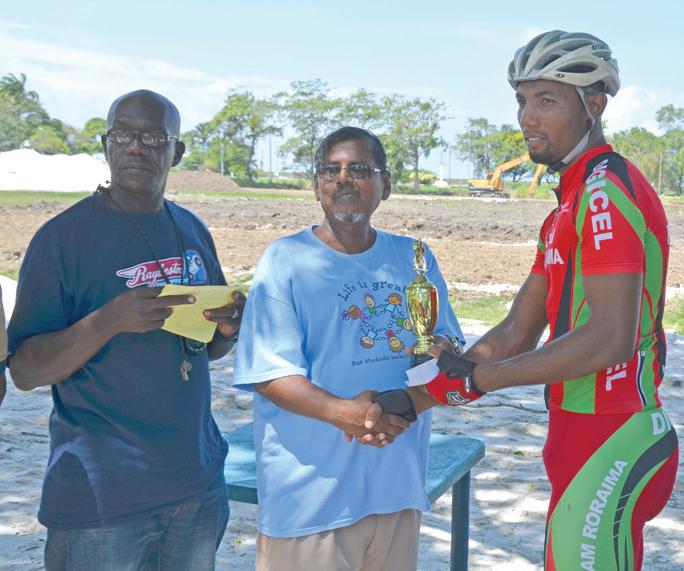
By Rajiv Bisnauth
The experienced Marlon “Fishy” Williams powered his way to an exciting win over rival and clubmate Alanzo Greaves to win the 23rd annual R&R Internationalsponsored pre-Mashramani 11-race cycling programme at the inner circuit of the National Park on Saturday.
Competing in the feature 35-lap School Boys and Invitational race, Williams edged Greaves in a heated battle to the finish line with a winning time of one hour, 19 minutes, 10 seconds (01h: 19m: 10s).
Hamzah Eastman ended third, while Raynauth Jeffrey, Alonzo Ambrose and Paul DeNobrega rounded off the top six in that order.
Greaves carted off four of the eight sprint prizes on offer, while Eastman won two. Jeffrey and Williams shared the other two.
Earlier in the programme, which was organised by national cycling coach Hassan Mohamed, Sherwin Sampson rode
away with the BMX Boys’ 6-9 event from Alexander Leung and Esan Talsingh. Sampson again took pole position in the BMX Boys’ 9-12 race from Taran Garbarran and Darrius Marshall.
In the BMX Boys’ 1214 category, Stephan Wilkinson took the top position from Ammo Gomes and Brighton John with Adrian Sharma defeating Gomes and John to take the BMX 12-14 Open event.
Jamal John copped the 12-14 Boys and Girls race ahead of Christopher Griffith. John also won the prime prize on offer.
In the Veterans’ Under-50 race, Ralph Williams took the top podium finish from Kennard Lovell, while Shameer Baksh finished third. Linden Blackman won the Over-50 category from Virgil Jones and Wilfred Thom. Williams won the lone prime prize on offer.
Maurice Fagundes rode away with the Veterans’ Over-60 category from Anthony Fariah, while Raul Leal took the top position in the Juveniles 10-lap event,
race
the
morning from 08:00
from





Upper East Coast Tigers eased to a seven-wicket victory over West Bank Demerara Mavericks to be crowned champions of the Demerara Cricket Board (DBC)/Raj Singh Insurance Brokers/ Trophy Stall over-40, 20-over competition on Saturday at the Everest Cricket Club ground, Camp Road.
The men from West Demerara took first strike and succumbed for just 89 in 16.4 overs. Abid Hanif topscored with 18, while Deoram Persaud and Dion Williams chipped in with 15 and 13 respectively. Bowling for Upper East Coast Tigers, Desmond Butts grabbed 2-13, while six other bowlers accounted for one wicket apiece.
Tigers’ chase was led by opener and captain, Sheik Mohamed, who smashed the first over of the match for 20 runs. The former national wicketkeeper/batsman and former senior national selector was dismissed for 32 in the eighth over. After that, it was Mark Malone who saw the Tigers home with a solid 26. Malone’s performance got him the Man-ofthe-Match award.
At the presentation ceremony which followed the game, Vice-president of the
DCB, Anand Sanasie, congratulated both teams for playing competitive cricket throughout the tournament. He further lauded the DCB president, Raj Singh for bringing back Over-40 action and using his initiative to sponsor it. Raj Singh said as the sponsor he is satisfied with the competition and congratulated both teams as well. He noted that from a Guyana Cricket Board (GCB) perspective, they are looking to have an InterCounty Over-40 competition some time in the future.