Acting Tourism Minister Irfaan Ali (second left); Public Relations Consultant Kit Nascimento (left); and Roraima Group of Companies Chairman, Captain Gerry Gouveia with selected couples at the launch of the sixth Wedding Expo on Friday at Duke Lodge, Duke Street, Georgetown (Carl Croker photo)
Third installment of Norway funds approved
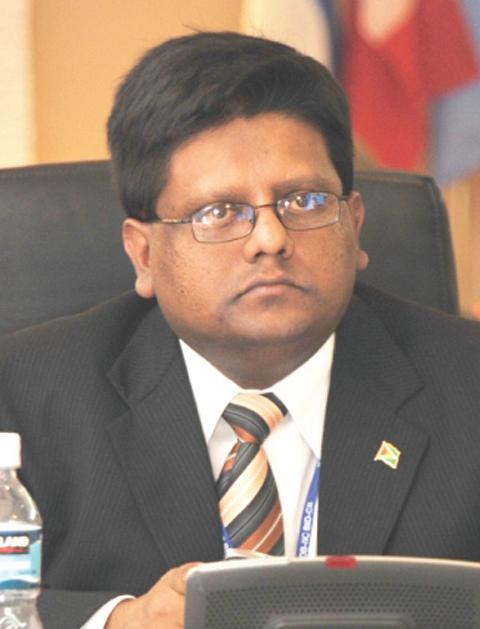
Finance Minister, Dr Ashni Singh said approval was granted for the disbursement of the third tranche of money from the Guyana and Norway agreement, with approximately $1672 million already spent on various projects.
He told media operatives that there is an institutional mechanism in place for the administering of the fund.
Once qualified, funds are disbursed into a trust fund and approval is then given by a partner before the funds are channelled to Guyana.
“Funds have been approved by Norway and disbursed into the trust fund and in relation to a number of specific projects, some of those funds have in turn been transferred to the partner entity for the execution of certain projects,” Dr Singh added.
According to him, the Inter American Development Bank (IDB) is the partner agency that will release the funds for various projects to be undertaken.
In providing details of some of the projects, Dr Singh said that institutional strengthening and capacity building
for various agencies are currently taking place. The agencies include the Guyana Forestry Commission, the Office of Climate Change and the Environmental Protection Agency, among others.
“In addition to that, we are implementing with the United Nations Development Fund (UNDP), an Amerindian Development Fund (ADF) programme to look at promoting village economies.”
The Guyana REDD+ Investment Fund (GRIF) is a multi-contributor trust fund for the financing of activities identified under the government of Guyana’s Low Carbon Development Strategy (LCDS). The GRIF was established in October 2010, with the World Bank as a trustee, following an agreement signed between Guyana and Norway in November 2009.
Norway agreed to provide Guyana up to US$250 million by 2015 in performance-based payments for avoided deforestation in support of Guyana’s LCDS. Guyana has received three tranches of funds from the multimilliondollar agreement.
An online paper, Redd-monitor.org reported in August 2013, that Norway’s International Climate and Forest Initiative Director Per Fredrik Pharo said, “Given the uncertainty to the further funding mechanism of the partnership, we have made a consensual decision to delay the payout while working on improving the financial mechanism”.
However, the World Bank has said that Norway is one of the biggest donors to the World Bank’s Forest Carbon Partnership Facility (FCPF), which consists of two funds: the Readiness Fund and the Forest Carbon Fund.
Of the US$258 million in the Readiness Fund, only US$11 million has been disbursed and from the US$390 million in the Forest Carbon Fund, no disbursement has been made, as no country has so far demonstrated that it has reduced deforestation.
Justice Chang’s ruling can trigger a constitutional crisis – Granger
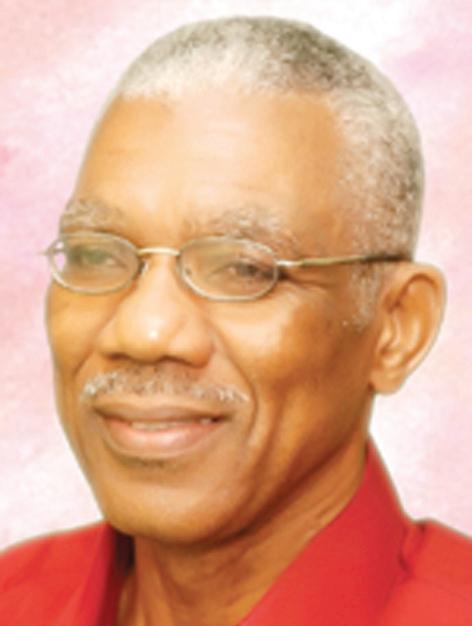
Acting Chief Justice Ian Chang’s ruling in the budget cut case, could trigger a major constitutional crisis, Opposition Leader David Granger contended on Friday.
Approximately two years after the Donald Ramotar administration moved to the High Court to challenge the move by the A Partnership for National Unity (APNU) and Alliance For Change (AFC) to cut the 2012 national budget, the acting chief justice on Wednesday ruled that the National Assembly does not have the power to cut the national estimates presented by the finance minister.
The chief justice also ruled that the opposition can only approve or disapprove the budget in its entirety or sections within.
Speaking at his Hadfield Street, Georgetown office, Granger registered his coalition’s dissatisfaction with the ruling, contending that it can have unintended consequences.
“The opposition, if it is dissatisfied with any item in the 2014 budget, according to a rational interpretation of the decision, must refuse to approve the entire budget in order to give effect to their disapproval.”
He added: “The government in this situation, if it refuses to amend the budget to the satisfaction of the opposition, would precipitate a major constitutional crisis and trigger a consequent general elections.”
The opposition leader further opined that Justice Chang’s decision seems to suggest that the APNU cannot defend the decision of the National Assembly in the courts of law, if taken there by the government side.
“The chief justice’s decision coming after 18 months of litigation, but just before the presentation of the 2014 budget, seems intended to neutralise the opposition’s vital oversight role in the National Assembly.”
Granger also accused Finance Minister, Dr Ashni Singh of ignoring the decision of the National Assembly, as reflected in the approved 2013 Appropriations Act, by spending monies that were not approved by the House.
As a result, Granger lamented that Dr Singh should be censured by the House. It was noted that the opposition is already taking the necessary steps to censure the finance minister.
Despite a July 1, 2013 pledge by President Donald Ramotar, the opposition leader said there will be likely a “crisis” because APNU and the People’s Progressive Party/ Civic (PPP/C) budget negotiations have not been fruitful. “It is very likely, therefore, that the concerns of the A Partnership of the National Unity have not been taken on board, and if the People’s Progressive Party brings a budget to the National Assembly which is contrary to the public’s interest, we are going to exercise our constitutional right to amendment the budget and the courts cannot intervene, the courts cannot intrude in the rights of the National Assembly,” he declared.
Asked whether APNU is ready to take on a challenge, if the country is forced to hold snap elections due to failure to agree on the 2014 national budget, Granger told reporters that the coalition is focusing on local government elections.
Implications
Speaker of the National Assembly Raphael Trotman has also signalled his disapproval of the decision of the acting chief justice, arguing that the ruling will have far-reaching implications for the Commonwealth parliamentary system. Contrary to Chang’s ruling, Trotman said the National Assembly has the power to approve and amend budgetary estimates, noting that this is a long-established right.
“The principle of comity dictates that the three branches of government – the executive, the legislative and the judicial – are all separate and equal and are to respect the right and authority of each other,” he said.
Trotman said while the High Court’s ruling will be respected, the National Assembly has the right to appeal the decision.
Finance Minister, Dr Ashni Singh
Opposition Leader David Granger
Acting Chief Justice Ian Chang
Substance abuse an alarming problem in Region Eight – APNU
Some 26 students in 2011 were expelled in Region Eight for the use of marijuana, Opposition Leader David Granger said, painting a gloomy picture of the education system in the Potaro-Siparuni region.
A concerned Granger said substance abuse by school children within the district remains a problem, but made it clear that this issue is not limited to Region Eight.
In addition to the prevalence of illicit substances among school students, Granger said only two secondary schools serve the Potaro-Siparuni district, with the Paramakatoi Secondary School surpassing its designated intake. The school has approximately 600 students; however, there is a severe shortage of trained teachers and teaching materials.
“The vital 180-km long Bartica-Potaro trail which was built over a hundred years ago to connect Mahdia in the PotaroSiparuni region to Bartica in the Cuyuni-Mazaruni region needs to be reconstructed,” Granger said, as he alluded to another ailing sector of the district.
Deteriorating roads
In addition to deteriorating roads in the region, residents of Mahdia are now coping with a 12hour a day electricity supply from the Mahdia Power and Light Company, while water supply remains a problem due to the inability of the Salbora Water Project to function effectively.
According to him, exploiting the economic resources, sustaining the livelihoods of the residents and protecting the environment demand a new approach to the administration of the district.
“The A Partnership for National Unity (APNU) calls for a fresh approach
to local government and regional development in order to meet the social, economic and political needs of this important part of Guyana’s territory,” he said.
Challenge In support of the opposition leader, former People’s National Congress/Reform (PNC/R) Member of Parliament (MP) Gloria Bancroft said the distribution of pharmaceuticals in sub-region one is a major problem.
It was explained that drugs are flown into Kato and subsequently distributed to satellite villages via all terrain vehicle (ATV); however, this often poses a problem.
“This proves difficult as ATVs cannot transport the drugs in bulk, because of this, the drugs remain in storage at Kato, sometimes past their expiration date,” she said.
Itabac, Kanapang, Monkey Mountain, Taruka and Chenapau are among villages often left without critical medical supplies when the transportation system fails.
Adding to earlier sentiments expressed by Granger concerning the education system within the district, Bancroft told reporters on Friday that for the past six months, the Mahdia Secondary School has been without a headteacher.
As a result, some subject teachers are often asked to act within the capacity, thereby dividing their time between the classroom and administrative duties.
No IT lab
“A batch of computers was delivered to Mahdia for the purpose of incorporating information technology (IT) into the school’s curriculum. However, the school has no IT lab and the computers remain sitting in the region’s education office,” she complained.
Meanwhile, APNU MP Desmond Trotman said the coalition, since its formation, has had the concerns of Region Eight residents at heart.
With a vibrant gold mining industry, Trotman said the district contributes tremendously to the country’s revenue base, but little is done for the people of the region.
He said APNU has been championing the cause for the government to assign more resources to the district through a development programme, but to no avail.
“APNU believes that it is important for more resources to be assigned to this region, and that its elected officials be allowed to play their part, ensuring that financial resources earmarked for the region are spent in keeping with the purposes they are allocated for,” said Trotman. The Potaro-Siparuni region is home to the majestic Pakaraimas, the Kaieteur and Orinduik falls. It is also famous for the Iwokrama International Centre for Rainforest Conservation and Development, a botanical and zoological laboratory.
APNU MP Desmond Trotman
Editor: Nigel Williams
Tel: 225-5128, 231-0397, 226-9921, 226-2102, 223-7230 or 223-7231. Fax: 225-5134
BBhutto Zardari is once again in the international spotlight – this time weighing in on the issue of how best the Pakistan government should deal with the militants who have been terrorising the citizens of that country for years now.
In a recent interview with the BBC, Bhutto, whose mother was assassinated in 2007 by militants operating in various parts of the country, was quoted as saying that politicians must “wake up” to the threat posed by armed groups such as the Taliban.
He believes a more radical approach of launching military action against the militants is the best way to go, considering the fact that the government has exhausted many options before in trying to bring an end to the high level of terrorist activities taking place in the region.
During Bhutto’s party’s term in office, while his father was president, the Pakistani Taliban and other militant groups grew in strength, despite limited military action undertaken in some parts of the north-west. In fact, terrorism has long been a problem in Pakistan. Soon after former President Pervez Musharraf decided to support the U.S. in its war against terrorism, Pakistan turned into a frontline state in that war.
Over the years, the country’s internal security situation has deteriorated, and it took the law enforcement agencies years to learn to cope with the new threat. In addition to the economy taking a beating, official figures show that more than 49,000 civilians and over 3500 military personnel have lost their lives in terrorist attacks and combat.
The hard-line approach suggested by Bhutto, who is only 25 years old, came as no surprise as many Pakistanis are wary of the extremist elements operating there. Some also believe that this is an attempt by Bhutto to show both traditional and young supporters of his mother’s party that he is maturing into politics and has the ability to gradually take over the leadership of the party and government.
He has made it clear that he is considering standing in national elections due in 2018 and hopes to take on more responsibilities in the workings of his party, which was badly defeated in last year’s elections. Pakistan’s National Assembly is meeting to discuss the country’s response to a series of recent militant attacks, including one on an army convoy earlier this month. The assembly’s session recently ended without decision amid differences over whether or not to talk to the Taliban, which the government is in favour of.
It was reported that at least 13 people were killed in a suicide bombing near Pakistan’s army headquarters in the city of Rawalpindi on January 20. It came a day after 20 soldiers were killed when a bomb blast struck an army convoy in the north-west.
Last week, Pakistani military aircraft bombed suspected Taliban positions in North Waziristan, following a wave of attacks against security forces. In essence, the crisis looks far from over and unless there is a high level of maturity and compromise from all players involved, the violence and instability will continue.
Experts say the recent escalation in violence is renewing concerns about the country’s strategy for dealing with militancy. Most political parties, including Bhutto’s, had agreed to pursue talks and are hoping that they will find a solution to the crisis. It is not certain as to whether or not the government will take the position proffered by Bhutto to take military action against these extremist elements.
A military operation to clear the area of militants is a huge task, and there is a chance of collateral damage as well, hence launching military action would be a risky option for the government. There are people among the militants who are tired of militancy and have realised that they are being used by the religious leaders to achieve political gains.
Such people are looking for an opportunity to break away from the militants and the dialogue offers them an opportunity to do so. Pakistanis want to live in peace and work towards developing their country, hence the need for all stakeholders to negotiate and make the necessary compromises in the nation’s interest.
Mike Persaud’s misrepresentation on ethnicity
Dear Editor,
My response to Mike Persaud on his deliberate misstatement of my positions and arguments on ethnicity (January 23) was not published by the same newspaper which gives Persaud all the space needed (so much for a free press!). As such, I kindly request your paper to publish my response for the record.
Persaud completely ignores Devanand Bhagwan’s advice on debating one’s opponent – be respectful, do not misrepresent the other’s position, and do not engage in personality attacks. Persaud is guilty on all three accounts.
Bhagwan likens Persaud’s writing to that of a columnist who makes arguments without supporting evidence and who attacks people’s character when his claims are debunked. A debater delves into the gutter and adopts an attacking mode when he loses a debate.
Bhagwan praised my commentary for substantiating conclusions with evidence and chastised Persaud for failing to make his argument with supporting evidence. In a debate, there is no right or wrong response. It is about making a convincing case based on evidence, and that is where Persaud has been lacking in his endless ripostes and rejoinders.
Persaud missummarised my position as “endorsing ethnic voting”. I cannot fathom (through what deductive or inductive reasoning) how Persaud forms the conclusion that my critique of ethnic tokenism means I am supportive of ethnic parties and that makes me a racist, etc.
Critiquing an idea does not mean you are against it or for some other idea. Academia and logic don’t operate in that context.
Persaud failed in every letter to provide quotes and citations of where I appealed to people to vote “ethnic” in Guyana.
Persaud claims I have a “core racist ideology” executing this unsubstantiated attack knowing fully well that all of my writings have consistently stated that one race cannot govern Guyana or other societies. It was wrong for the People’s National Congress (PNC) to persecute Indians during the dictatorship. It can’t be right now for any group to govern Guyana alone, even if their party wins democratic elections.
Ideological racism is yet another concept on which Persaud has demonstrated a paucity of knowledge. In anthropological and sociological studies, a racist ideology is a fixation on the superiority of one’s race. It manifests itself in policymaking and is tied with institutional oppression of ethnic groups.
Can Persaud point to specific cases (with quotes and citations) where I am guilty of such policymaking or advocacy? Where have I advocated ethnic superiority or called for the domination of one race over another? Like other challenges, this one will also be ignored and will be followed by more personality attacks, mischaracterisations and misrepresentation of my views on the subject – the hallmark of someone who has lost a debate.
Persaud penned that America has no ethnic domination and racism. He is wrong and should read the numerous studies that documented the domination and racism suffered by black Americans and other minorities. Ideological racism is prevalent in America – replete with de jure and de facto policies (read Barbara Fields’s “Racism and Ideology in America”).
The PNC practised ideo-
logical racism as commented on by outstanding writers like Percy Hintzen, John Gafar, Mark Dacosta, Brackette Williams, Ravi Dev, Dr Cheddi Jagan, and Ralph Premdass, etc). I disagree with Persaud’s comment that America does not have ethnic voting, domination or racism. If such were the case, why did so many African leaders partake in the civil rights struggle?
I note that Revs Jesse Jackson and Al Sharpton, and Barbara Jordan, among other blacks ran for leadership of the Democratic Party and several ran for leadership of the Republican Party without success. It took a long time before there was a breakthrough by Barack Obama to lead the Democrats. It will also happen in Guyana, but leadership should not come from ethnic appointment as Persaud heretofore suggested. Members are likely to reject such an appointment as happened in Trinidad, Fiji, etc.
I am in agreement with Bhagwan-ji’s endorsement of political parties transforming themselves into ‘nonethnic’ entities. Presumably all Guyanese are also supportive of the idea. That is a goal not a process (how to do it). No ethnic party has been successfully transformed into a non-ethnic party, as so many eminent academics (Donald Horowitz, Brackette Williams, etc) have revealed in their studies on ethnic conflict.
Contrary to what Persaud penned, Trinidad is not an example where cross ethnic leaders was tried. Both major parties have their own ethnic leaders. In fact, when Basdeo Panday tried to appoint an African successor, he lost support in the Indian community and subsequently power. When Eric Williams tried in 1978 to groom Kamal Mohammed,
he met resistance from supporters and stalwarts like Karl Hudson Phillips. Fiji and Mauritius are also examples where Persaud’s ethnic token strategy was tried and led to dismal results – I partook in political struggles for ethnic equality and opinion polling in these societies and am familiar with their experiences.
Proposals on ending ethnic conflict must be based on reality and pragmatism. Several theorists have propounded on the issue. I offered some proposals in my doctoral dissertation (a work in progress). Consociationalism, ethnic coalitions, and decentralisation of power a la federalism (of Dev and Baytoram Ramharack) are some of the theories discussed in the literature.
Ethnic tokenism, appointing leaders, which is advocated by Persaud, is not one of the suggested solutions though it has been used effectively to control and suppress conflicts but not solve the problem.
I reiterate my position on leadership – members of a party should democratically choose their leadership (using America as an example) with membership open to the public.
Once members are convinced into voting for a cross racial candidate, it is a sign that a society could transcend ethnicity. Guyana is far from there.
Persaud should not make utterly irresponsible statements and advocate hopelessly unrealistic objectives and should pay more attention in telling the truth. Also, heed Bhagwan-ji’s advice on how to make commentaries! I leave Persaud to wallow in his ignorance on the subject of ethnicity.
Yours truly, Vishnu Bisram
President Donald Ramotar on arrival in Cuba for the second summit of the Community of Latin American and Caribbean States received a rousing welcome from his hosts (Sandra Prince photo)
ilawal
Radioactive Japanese vehicles
Dear Editor,
When the most recent devastating tsunami hit Japan, causing national havoc and even serious turbulence in the nuclear power plants there, causing nuclear power plant shutdowns, and escape of radioactive waste material in the environment, I predicted that nations importing used Japanese motor vehicles and parts will be sold those with radioactivity.
I spoke to prominent citizens and government officials of such a possibility and most disagreed, saying the companies will not want to tarnish their names, nor their country.
But if vehicles are discarded by principled corporations, and then picked up by desperate business people, wishing to make a dollar at any cost, they buy or get the vehicles for next to nothing, cut them up and sell the parts to countries like ours, which are hungry for parts and for cheap vehicles. They will do the same for whole vehicles.
Environmental Community Health Organisation (ECHO)
Executive Director Royston King is seriously urging our government to pay attention to this matter, as we could have a serious health crisis in Guyana if this is the case.
If radioactive vehicles are exported from Japan, even by private individuals and companies, the government of Japan has to be held responsible.
It should establish regulations and systems to ensure poisoned vehicles and parts are not dispatched to our country and others in
the world.
Persons and businesses importing vehicles and spare parts from Japan should make it a must to get legal disclaimers from the company, verifying that, nay, certifying that its vehicles and spare parts are not contaminated with radioactive waste. I will now demand this.
While our government is not responsible for this, I would urge it in the interest of our people and country to conduct some random tests of vehicles which came into Guyana after the tsunami in Japan, and even set a system to educate our people as to how to identify radioactive contamination on persons, and how to deal with it, and where to go to have further tests.
Yes, this has a cost, but our people have a right to protection, and our government has to give serious consideration to this.
The government of Guyana has to get in contact with its Japanese counterpart for assurances that vehicles exported from Japan have not been contaminated, and should our country and people be affected, that government has to take the responsibility to correct and compensate.
My compliments to King and ECHO for highlighting this situation in the interest of the nation and the wellbeing of Guyanese.
Royston is a great son of the Guyanese soil, a patriot and a wise person. I do not see politics in people, only talents and wisdom, or lack of them.
Yours truly, Roshan Khan
Enthused about police consultations with communities
Dear Editor,
The Guyana Police Force has now inaugurated a programme by which the divisions around the country are having consultations with the various sectors of the society within their jurisdiction to form “partnerships” which they feel would lead to the development of a mutual effort in the execution of their functions.
I personally am very enthused about this innovative and refreshing approach by this essential service, which can only re-
No
sult in better relations with members of the public, and which has an immense potential of reducing crime in all its forms and achieving peace and understanding between the communities in the various areas around the country.
At the meeting I attended in my division, the commander listened patiently to all the contributions of the participants, which included the complaints which we usually have against the behaviour of police officers, and we came away with some satisfac-
tion that we are, at last, on the way to effectively ridding ourselves of the constraints which members of the public have against developing a collaborative relationship with the police.
As everyone knows, I am especially concerned with youth education, and I offered some suggestions about how our police can connect with our young people, and even get them to cooperate in their functions, as well as help them to lead lawful lives and assist in some effort to do the same for others.
I, therefore, would like to encourage those who may have some reservations about this bold and worthwhile initiative to contribute fully when the programme is instituted in your area. Let us together take the outstretched hand that we have previously seen as an iron fist, and realise that it is now covered with a velvet glove, which can only serve to smooth the path to a peaceful and productive society.
Sincerely, Roy Paul
place for the likes of David Hinds
Dear Editor,
I have a few comments to make in response to David Hinds’ letter, “Guyana should applaud Number 48 villagers, but why were Lindeners treated differently?” The two scenarios are completely different, but I have to revisit a few things in uttering my response.
There is a Nigel Green who boldly spouted a resounding truth when Hinds sought the support of Buxtonians for the Lindeners in the infamous 2012 protests. (http://thebestcaribbeansite.com).
At that time, many Buxtonians were asking what tangible contributions had David Hinds made to aid in their causes and development. Green said that this particular overseasbased Guyanese comes from the Buxton village, but could not come to terms with the fact that “ties were being strengthened between the current administration and the Buxton community.”
The man made mention of the fact, that like so many others, Hinds is a politi-
cal opportunist. He realised that too much government affiliations with Buxton (at the time) would have weakened any political influence that the opposition parties may have had in that community.
Green was very upset with “Hinds’ constant ‘washing his mouth’ on them, and judging from his letters, that’s all he ever does. His constant berating of People’s Progressive Party/Civic (PPP/C)-Buxton relations is nowhere near being in the interests of Buxtonians”. Hinds must read this. So as regards credibility, there is little that can be ascribed to him.
As for the Linden situa-
tion, that was a pre-planned and prolonged disturbance as well as it had no sudden fillip, in terms of a specific injustice that was meted out. The collateral damage is still having so many negative impacts even now.
A protest that is spontaneous and that has a temporal stimulant (as what happed in Berbice) is something quite different. Nobody burned any building, people were not robbed, places were not looted, and innocent citizens were left alone. It makes no sense to dig up the sordid details.
A lot of progress is now being made where Linden is concerned and the flopping of the planned shut-down is
evidence therein. The many Hinds of Guyana are all about filibustering and creating mayhem. They are giving the impression that if they cannot have their way, then the resort is to be most destructive. I am glad that the recent situation in Berbice was handled properly and whatever follows out of it, I am sure that the people will accept in a most amicable manner. After all, some people “have promises to keep, places to go and miles to travel” before they go to sleep or protest foolishly.
Respectfully, Charran Ramkissoon
You can send your letters with pictures to: Guyana Times, 238 Camp & Quamina Streets, Georgetown, Guyana or letters@guyanatimesgy.com
Truancy can be broadly divided into two categories:
* Those teens that skip off school once in a blue moon
* Those who are away from school more often than they are there
Why do children skip school?
A) Truancy – like smoking, drinking, and drug taking –is a cry for help. The U.S. Department of Education states in its Manual to Combat Truancy that truancy “is the first sign of trouble; the first indicator that a young person is giving up and losing his or her way.” When your child decides to skip school, not just once, but chronically, this usually means that the school (the custodian of the child) is somehow not serving this individual.
B) Truancy is often a standard response to trouble at home.
C) Some experts cite bullying at school as a significant cause of truancy. Here the desire to escape ongoing exposure to torture causes the victims to take the matter into their own hands. When you scratch the surface of many incidents of truancy in teens, you come up with actions that are sometimes appropriate, or at least understandable responses to inappropriate circumstances.
What to do
* Be involved with your teen’s school.
* Get to know their teachers, the school administrators by attending Parent’s Night and other school functions.
* Volunteer to help where
you can. Schools are always looking for parents' help with chaperoning dances or field trips, or running the concession stand at sporting events. The more involved you are in your teen’s school, the less likely they are to try and get away with skipping class.
* Keep the lines of communication open with your teen when it comes to their school environment. Allow them to vent to you if they need to about a teacher, a certain class, etc. We all need to blow off steam. If there seems to be a major problem, work with the school and the teacher to find an answer.
* Let your teenager know what the consequences are for being truant. Find out what your local laws are for truancy.
* If truancy becomes a problem, set up an action
plan. Write down all of your expectations, the limits, and the consequences.
* If your child is between five and 16 years old and is registered with a school, remind him that you are legally responsible for making sure he attends school regularly – and that you could get into trouble too if he skips school.
Other points to consider Don’t delay. Truancy must be addressed quickly. The longer it goes on, the less chance the problem can be easily resolved, and the greater risk of your child getting into even more trouble.
Let him know how you feel. Although it’s important not to lose your temper with child, you must let him know how upset you are. But at the same time, be careful not to make
them feel too guilty about it. Remember there may be a valid reason why your child doesn’t want to go to school.
Listen to what they have to say. Addressing truancy means addressing the reasons behind it. And the only way you’ll find out these reasons is through your child. Sit him down and ask him calmly why he’s not going to school. Tell him you won’t be angry with what he tells you, and reassure him that you’ll help him get through the problem, whatever it is.
Stay calm. It’s a natural reaction to fly off the handle when you find out your son or daughter has been skipping school. But shouting and screaming won’t help you get to the bottom of the problem. You need to stay calm to try to identify the reason why your child doesn’t want to go to school.
Work with the school
The more you cooperate with your child’s school, the better chance you have of resolving the underlying problem, as well as avoiding too harsh a punishment. Teachers and headmasters appreciate parents working with them rather than against them.
School refusal vs truancy
School refusal is when a youngster does not want to go to school, or is afraid to go to school. Often these children will be sick or miserable in the mornings. They want to stay at home rather than go out and do other things.
Truancy on the other hand is when children leave for school or go to school but then
slip off to meet with friends or do something that may involve breaking rules.
What is school refusal?
School refusal is when a youngster does not want to go to school or actually refuses to go to school. It can be very distressing for both the moms and dads and the youngster. Often moms and dads are blamed, as if it is their fault, which makes them feel worse. If your youngster does not want to go to school, it is usually not your fault but there are some things you can do that might help.
Children who don’t want to go to school usually:
• are more likely to be the youngest member of a family
• don’t have any serious behaviour problems
• don’t try to hide their wish not to go to school from their moms and dads
• get upset about going to school and may have stomach aches or headaches, or do not feel well without a physical cause
• want to stay at home with moms and dads
School refusal can happen at any age but is likely to be at times of change such as starting school or starting high school. In the long term, these children usually do well, they get back to school and don’t have any after effects.
The short-term problems are about missing school work and not having the chance to enjoy playing with friends. These can happen if it goes on for a long time, as it sometimes does.
(myoutofcontrolteen.com)
Poor school performance: how parents can help “A
lot of high schools,” says Dr Coleman, “have study-buddies programmes where teachers assign a peer-aged student or an older student to tutor a child at home or at school.” Local colleges and organisations smay also offer tutoring.
Tutors can also help bridge the gap of time that teens are out of school because of a brief illness, extended family trip, and so on. Instead of falling behind during these short but crucial periods, tutors can make sure students stay caught up and on track until they return to the classroom.
Chronic complaints of feeling either bored or overwhelmed at school may be an indication that a youngster is trudging along on the wrong academic track. The student who yawns at schoolwork that leaves most of his classmates scratching their heads is more likely to thrive if his day includes some more challenging courses, while the perennial D student who has never shown much interest in school may be best served by a vocationally oriented programme.
In the past, boys and girls belonging to the latter group might have been written off as lost causes destined to drop out. Since the 1970s or so, the educational system has made a greater effort to reach out to these youngsters. Some schools have implemented policies specifically designed for high-school freshmen with histories of academic failure, truancy and misconduct.
As we noted earlier, ninth grade is a critical fork in the road for such students, who are considered high risks for quitting before the end of the year. According to the U.S. Department of Education, strategies like those below have been successful at helping them achieve school success:
Allow students to delay some required courses that may prove too difficult and discourage them to the point of dropping out. In their place they may take more courses that interest them.
Assemble these students into small groups, who then go from class to class together, offering one another support.
Establish alternative schools and mini schools for alienated students, either within the school building or off-campus. Youngsters who function poorly in a conventional school environment may find the less-structured, less demanding environment to their liking and be able to graduate.
(healthychildren.org)
(CONTINUED FROM FRIDAY)
Guyana, EU sign €14.8M EDF agreement
The government of Guyana and the European Union (EU) on Friday signed a financing agreement to the tune of 14.8 million euros under the 10th European Development Fund (EDF) Sea and River Defence Sector Budget Support Programme.
Finance Minister, Dr Ashni Singh said the support is most welcomed since Guyana remains vulnerable to climate change, particularly rising sea levels. Some 90 per cent of the population lives on the coast.
“Guyana’s topography renders it vulnerable to natural risks related to climate change and sea level rise as most of the country’s key assets are located in vulnerable low-lying areas and are protected by sea defences,” a joint statement by the two parties noted.
All of Guyana’s towns and major settlements and the vast majority of all non–mining industrial activities, including agriculture and other economic activities are undertaken within the coastal zone.
But despite these vulnerabilities, Dr Singh said the Guyana government has made extraordinary contributions to the global fight
against climate change with the preservation of its pristine rainforests. He expressed appreciation that the EU has recognised these efforts and has come onboard to assist Guyana in confronting the challenge.
“Government continues to invest extensive resources into this sector to protect and maintain the structural integrity of the sea and river defence infrastructure and advancing sustainable shore zone management systems in Guyana, and has been partnering with the EU to protect and maintain the structural integrity of these systems,”
the statement added.
Heartened
Meanwhile, EU Ambassador Robert Kopecký said it was heartening to partner with Guyana in this regard and underscored how savings can be garnered in the future from investing in proper infrastructure now.
Kopecký said the EU’s investment stretches beyond the upgrading of sea defences by means of construction as it includes the restoration plan for a mangrove forest at various locations (river or sea defence) countrywide.
The EU’s partnership
Guyana appears headed for full blacklisting – Nandlall
… cites opposition’s posture in special committee meeting
Attorney General and Legal Affairs
Minister Anil Nandlall said based on the opposition’s behaviour in the special select committee working on the antimoney laundering bill, it appears as though Guyana will be unable to meet its February deadline.
Nandlall made the comment in an interview with Guyana Times following the AntiMoney Laundering and Countering the Financing of Terrorism (AML/CFT) Bill committee meeting on Thursday.
Last week, Opposition Leader David Granger said he is confident that the deliberations of the committee will be completed before the February 13 deadline set by the Caribbean Financial Action Task Force (CFATF).
However, during a recent meeting with the Private Sector Commission, the opposition leader had reportedly indicated to the commission that he will not be supporting the legislation.
The CFATF has recently named Guyana as one of the countries, most likely to be selected by the Frenchbased Financial Action Task Force (FATF) for the International Cooperation Review Group’s (ICRG) re-
view this month.
On the CFATF website, Guyana is ranked as one of the most delinquent countries.
Guyana has already been blacklisted by CFATF and blacklisting by FATF would mean that the country will be viewed internationally as a terrorist state, supporting money laundering. Every transaction from Guyana at overseas banks will be rigorously scrutinised.
According to a source, the opposition’s alleged move to not support the bill is strange, as it will be hurtful to the image of the country, the private sector and the people of Guyana.
The only explanation that can be given is that the opposition is working at all costs to protect its private and obviously shady interest, the source contended.
Meanwhile, the committee met on Wednesday and Thursday, during which several presentations were made. On Thursday evening, presentations were heard from Guyana Bar Association President Ronald Burch-Smith and Chartered Accountant Christopher Ram. The previous day, presentations were made by economist, Dr Clive Thomas and the Bankers Association of Guyana.
with the government in this sector dates back to the Seventh EDF programme signed on February 24, 1994, at which time 12 million euros was committed.
A further 20 million euros and 18.018 million euros were committed under the eighth and ninth EDF programmes respectively. Overall, the EU has contributed about 50 million euros to the sea and river defence sector here. This investment saw the construction, rehabilitation and/or maintenance of approximately 35 kilometres of sea defence structures in Regions Two, Three, Four, and Six.
Builds
The 10th EDF financing agreement builds on previous sea and river defence programmes undertaken by the government and the EU. The previous financial com-
mitments made under the seventh, eighth and ninth EDFs have been implemented through project interventions, but recent policy developments have set the environment for continuing EDF assistance to the sea and river defence sector through sector budget support.
A detailed implementation plan for sea and river defences was developed in 2012 by the government of Guyana to facilitate progressive adoption and enforcement of the policy by all stakeholders. The implementation plan focuses on an initial developmental period of five years from 2013 to 2017. During this time, a number of activities will be pursued with the objective of improving the efficiency and sustainability of the sea and river defence sector.
In order for Guyana to
qualify for financial disbursement under the 10th EDF financing agreement, the sea and river defence sector would have to satisfy specific performance criteria in investment and performance targets, including a detailed annual implementation plan, capacity-building plan, annual condition surveys of all 160km of manmade sea defences and implementation of an annual infrastructure programme. This is outlined in the sector policy implementation plan. In order to equip the sector and place it on the right trajectory towards achieving these performance targets, government would have to invest over G$5.5 billion into the sector, over the next three years before it can satisfy the eligibility criteria and qualify for disbursements amounting to the 14.8 million euros.
Additionally, Thursday’s meeting also saw the committee discussing the issue of stakeholders and the media being allowed into the meetings. The government maintained that the media and stakeholders should be present to observe the committee meeting; however, the opposition is of the view that the meeting should only be opened for selected sessions. A definitive decision is yet to be taken.
According to Nandlall, “the government position is we want the press to be there, we want the private sector and any other interested stakeholders to be there, but their (oppositions) position is that they don’t want the press or the stakeholders throughout, that they can only be there for selected sections.”
The next sitting of the National Assembly is on February 10, and in order to meet the FATF deadline, the committee must complete deliberations on the AML/CFT Bill and present it to the House for approval by the combined parliamentary opposition.
Guyana has already missed deadlines in May, August and November last year, resulting in the country being blacklisted by CFATF.
Finance Minister, Dr Ashni Singh flanked by Transport Minister Robeson Benn (left) and EU Ambassador Robert Kopecký with the agreement signed on Friday
Deportee refused bail on cocaine trafficking charge
Robin Wills of Republic Park, East Bank Demerara, was on Friday remanded when he appeared at the Georgetown Magistrates’ Courts before Chief Magistrate Priya Sewnarine-Beharry having been charged with trafficking in narcotics.
The man, a deportee, pleaded not guilty to the charge which alleged that on November 17, 2013 he attempted to smuggle 2.232
kilograms of cocaine to the United States of America.
Customs Anti-Narcotics Unit (CANU) Prosecutor Oswald Massiah related to the court that on November 9, 2013 a female had arrived in Guyana to attend a funeral.
While in the country, she allegedly made contact with the defendant. Wills had offered to assist the woman in the process of getting her passport renewed, and he
had assisted both the woman and her sister in getting accommodations.
The accused later approached them to transport some crème liqueur to the United States to which they agreed. It was not until a routine check was done on the woman’s luggage as she was preparing to leave the country that the illegal substance was found in her suitcase among her clothing.
Massiah added that the woman was arrested and
taken to CANU headquarters and an investigation was undertaken.
Subsequent to the investigation, an arrest warrant was issued for Wills who later turned himself in to the police.
Magistrate SewnarineBeharry refused the defendant bail and transferred the matter to the Providence Magistrate’s Court for February 7.
Suspected car thief remanded
Eighteen-year-old
Lorenzo Forde was remanded when he appeared at the Georgetown Magistrates’ Courts on Friday before Magistrate Judy Latchman, after being slapped with two charges of robbery.
The teen pleaded not guilty to both charges. The first charge alleged that
on December 26, 2013, at High Street, Kingston, Georgetown, in the company of others, he robbed Marvin Benjamin of a Toyota car valued $2 million, a cellular phone valued $10,000 and $18,000 cash.
The second charge alleged that on December 30, 2013, in Kingston, being with others, he also robbed
Elijah Adams of a Toyota car valued $1.5 million, property of Colin Stewart.
The court heard that the young man had approached the victims, armed with a broken bottle, and he and the other men proceeded to relieve them of their valuables and the vehicles. They then made good their escape.
Police Prosecutor Vishnu
Hunt objected to bail, citing that the young man had committed the acts on two separate dates. He added that Forde had been on the run from the law since the first incident.
Bail was refused by Magistrate Latchman who ordered the defendant to return to court on February 17.
Eyew tness
Stirring up...
...racial discord
There are some folks who have race on their brains. Their neurons have become hard-wired to see race in any and all situations – regardless of what other variables may be operating. It’s either that or they’re determined to stir up racial hatred in the country for their own selfish aims. Those aims, of course, to divide the people so they can get into office – and more to the point, get their hands on the Consolidated Fund.
Case in point is this fella David Hinds who’s one of the geriatric remnants of the WPA. Rather than raising some fuss for the inquiry into the assassination of the charismatic Walter Rodney to get going finally, he sees “race” playing out in the Berbice protest against alleged police complicity and inaction on crime. But then, why would he want the inquiry to take place? The WPA got a squeeze from PNC/APNU to appoint some MPs – with the by-the-way (?) duty free cars – didn’t they?
But back to Hinds’ racial incitement. Hinds claimed that when Indians protest (as in Number 48 Village, Berbice) they’re praised and the government falls over itself to support their claims. Unlike, according to Hinds, what happened when people from an African community like Linden protested. Imagine this is the simplistic nonsense that’s spouted by individuals who claim not only to be influenced by Rodney... but actually call themselves “Rodneyites”!
Where is the analysis that includes the biggest variable of all in the two situations – political incitement? In Berbice, we have people who were pushed over the brink with the depredations from bandits. They work all day in the fields – rice and sugar – and then they have to stay up all night to “keep watch” (that’s all rural folks mean by “vigilante”) for bandits. And when they recognise a bandit in a police car, what do you expect them to do?
In Linden, on the other hand...it was sadly just a matter of some members of the opposition trying to prove to the people of the community who had more “cojones”. The AFC’s Ramjattan and Nagamootoo, stung by their rejection by Lindeners during the elections, tried to outflank the APNU. It was all about cold, calculated politics. In Berbice, Ramjattan’s from the village that the protests started. Even he couldn’t lie that the government played politics to start those protests.
People always retain the right to petition their representatives. But when those representatives abandon the established political mechanisms to settle differences and exploit the people’s sentiments, then the guardians of the law must ensure order and the rule of law is maintained.
Say no! to racist incitement!!!
...judicial undermining
We know citizens must be getting tired of the “back and forthing” on the court ruling on the budget cuts. But your Eyewitness advises patience: the wheels of democracy do sometimes grind rather slowly. But finely. The prize we have to keep our eyes on during all the rigmarole that the opposition will be throwing up is this: while we cannot ignore the precedents from other parliaments and systems of governance – our Constitution is our supreme law. So it trumps everything.
And so nothing that anyone does – be it the executive or the legislature – can violate the Constitution. To do otherwise would be “bootstrapping”. Like the legislature making its own rules and then claiming because the Constitution permits this – it’s OK if the rule’s application is offensive to the Constitution? What nonsense!!!
All rules have to be interpreted to be given effect and what the court is saying is that the opposition’s interpretation and application is unconstitutional. It’s just plain wrong! But this will not stop them from stirring up trouble.
...complaints
It would seem that if there’s one silver lining coming out from the Colwyn Harding allegations, it’s the increased scrutiny of the police-citizens relationship. The police have to stop treating citizens as objects.
Attorney general urges Speaker to uphold the Constitution
– following Justice Chang’s ruling in budget cut case
The final ruling of acting Chief Justice Ian Chang in the now infamous budget cut case, has laid a number of legal issues to rest, many of which were novel, given the parliamentary configuration where the opposition holds a oneseat majority.
Speaking on the television programme Political Scope, recently, Attorney General and Legal Affairs Minister Anil Nandlall said that ruling has vindicated the position that the government has firmly held over the past two years; which is, the parliamentary opposition cannot, by a mere majority vote, alter the country’s national estimates of expenditure as presented by the finance minister.
No power to cut
In 2012, the opposition rocked the nation when it inflicted several cuts to the budget, totalling $20.8 billion. At that time, the attorney general, as well as several other government Members of Parliament (MPs) presented to the Parliament, cogent arguments, all pointing to the unconstitutionality of this action.
These initial arguments have finally been validated by Justice Chang’s ruling which states that the powers of the National Assembly are limited to giving or withholding approval for the annual estimates of expenditure presented by the executive through its finance minister.
The National Assembly, more specifically the opposition, therefore, has no power to reduce the said estimates. Minister Nandlall explained that apart from having no power to inflict a reduction, the opposition cannot substitute their own estimates, and use their majority of one to pass that substitution, since the constitution clearly states that the responsibility for the presentation of national estimates is that of the finance minister.
The doctrine of the separation of power resides in the executive, the power to prepare and present to the legislature, estimates of expenditure for the country on
an annual basis.
“A part of the legislature cannot arrogate unto itself a power which the Constitution resided with the executive and using mere majority votes in the National Assembly to hijack that power from the executive and seek to exercise it,” Minister Nandlall explained.
He recalled that having failed in persuading the Speaker and the opposition to withdraw the motion to cut on the basis of its unconstitutionality, the government was left with no choice but to seek recourse in the courts, which is the appropriate resort when any organ of state violates the supreme law of the land.
Preliminary ruling
Minister Nandlall recalled that when the preliminary ruling on this matter was made, the opposition refused to be bounded by it.
“They incredulously and irrationally felt that they can disregard that ruling; that somehow that ruling has no force and they were calling upon us to have a final ruling,” he said.
He explained that there are no ambiguities in the law as it relates to court rulings, whether preliminary or final, the Government Information Agency (GINA) reported.
“Every person who has a fleeting knowledge of and/or is acquainted with the law knows that a ruling from a court, unless and until it is set aside, whether it is interim or final, it must be obeyed,” Nandlall said.
One of the arguments advanced by the opposition was the power to cut the national estimates was conferred on them by the Parliament’s Standing Orders. This issue was thoroughly dealt with by the chief justice in his ruling.
The attorney general relayed that Standing Orders are merely rules of procedures for the internal operations of the National Assembly; they are not laws and are not published in the Official Gazette. Moreover, these Standing Orders do not require the assent of the president and therefore they do not have the force of law.
“The Standing Order cannot confer a power; it just regulates a procedure… legal powers are conferred by law or the Constitution, and it is the Constitution that confers powers on the minister of finance and on the opposition in the National Assembly, a power to approve or withhold approval,” he explained.
He reminded that the Constitution, as the supreme law of the land, prevails over any law that conflicts with it, and similarly, if Standing Orders, which do not have the force of law, collide with the Constitution, then they too will be deemed unconstitutional and unlawful.
Final arbiter
Importantly, Parliament does not have the power to declare provisions of the constitutions and since the court is the final arbiter on matters of law in Guyana’s legal system, then its declaration is final and binding on every agency of state, including the president and the Parliament.
Should the opposition proceed to cut the 2014 national budget, as they have already indicated, then according to the attorney general, the Speaker would be put in an invidious position, since a large part of the chief justice’s judgment clearly outlines the direction in which the Speaker ought to be guided.
The ruling declares what the final position is in relation to motions that can be filed in the National Assembly.
“The Speaker on repeated occasions has said openly and publicly that he has some power of review over what transpires, so in his power of review, he has to ensure that the Constitution is not violated,” the legal affairs minister highlighted.
The National Assembly is a creature of the Constitution and is bound by it. The court in its ruling as the final arbiter, gave its interpretation of the Constitution.
If this interpretation is deemed to be inaccurate, then the legal system provides a method by which that inaccuracy can be rectified.
“It is not open to any agency or person or authority to flout what is the final pronouncement coming from the court of law on matters of law and the Constitution.
"All are bound, including the Speaker, the executive, and even the judiciary itself by what the judiciary declares to be the Constitution and the intention of the framers of the Constitution and by what it interprets to be the law of the land,” the attorney general concluded.
Change is underway, says Caricom secretary general
The Caribbean Community (Caricom) Secretariat has begun the process of restructuring with reforms instituted in corporate areas, human resource management, finance, and in the way projects are managed, Secretary General, Ambassador Irwin LaRocque, said on Friday.
Delivering remarks at the opening of the 33rd meeting of the Community Council of Ministers at the Caricom Secretariat, the secretary general announced that the secretariat’s work programme had also been redesigned to provide for a more outcome-oriented focus guided by goal management.
“There is still some way to go, but change is underway,” Ambassador LaRocque told the gathering of ministers and delegates who hold responsibility for community issues.
Progress in undertaking reform, he pointed out, has encountered some challenges, including those that relate to the secretariat’s aging information technology infrastructure, staff retention and the increasing inflexibility in the use of donor resources.
“Taken all together, these factors along with the challenging economic and fiscal
situation faced by our member states, affect the ability of the secretariat to maintain and improve on our service to the community and the implementation of the work programme. In the face of ever increasing mandates, the need for prioritisation, which lies at the heart of the decision by heads of government to devise a strategic plan, becomes paramount in order to ensure the focused and optimal use of our human and financial resources,” the secretary general said.
Strategic plan
His comments were made in the context of the finalisation and approval of the community’s first community strategic plan, a major component of the reform process which is now being conducted and under which the restructuring of the Caricom Secretariat falls. The secretariat’s restructuring will be significantly influenced by the strategic plan.
The consideration of the executive summary of the five-year strategic plan of the community is one of the key agenda items of the one-day meeting of the Community Council. The final draft of the plan is to be placed before the heads of government of Caricom at their 25th intersessional meeting to be held in St Vincent and the Grenadines on February 2425. The Community Council will also deliberate on the budget of the secretariat, contingent rights and the implications of the Shanique Myrie ruling handed down by the Caribbean Court of justice (CCJ), the ruling of the Dominican Constitutional Court on nationality and matters related to sustainable development of the region.
Announcement forthcoming on Backer’s return
APartnership for National Unity (APNU) Member of Parliament and Deputy Speaker Debra Backer, who was recently hospitalised for an undisclosed illness, will shortly announce whether she will return to the National Assembly before the presentation of the 2014 national budget.
APNU Leader David Granger made this disclosure on Friday at the coalition’s weekly press briefing. He told reporters that Backer is currently in Trinidad and Tobago recovering from her illness.
He said before the next sitting of the National Assembly on Monday, February 10, Backer will make a public statement on
her future role as a parliamentarian.
Backer’s situation came up for discussion during the last shadow cabinet meeting on Tuesday. Granger said the decision
on Backer’s further role will be made by her. “We have given her the option to assess the reports of the tests which she underwent and give us a feedback; she is aware of our views and we are aware of her health.”
In December 2013, the Deputy Speaker fell ill. In early January, she was flown to the United States for medical attention. Although details of her illness remain sketchy to date, reports indicate that following treatment at a hospital in Florida, Backer travelled to Trinidad and Tobago where she is currently resting. It is unclear when the parliamentarian will return to Guyana.
Speaker Raphael Trotman
Attorney General Anil Nandlall
Deputy Speaker and APNU parliamentarian Debra Backer
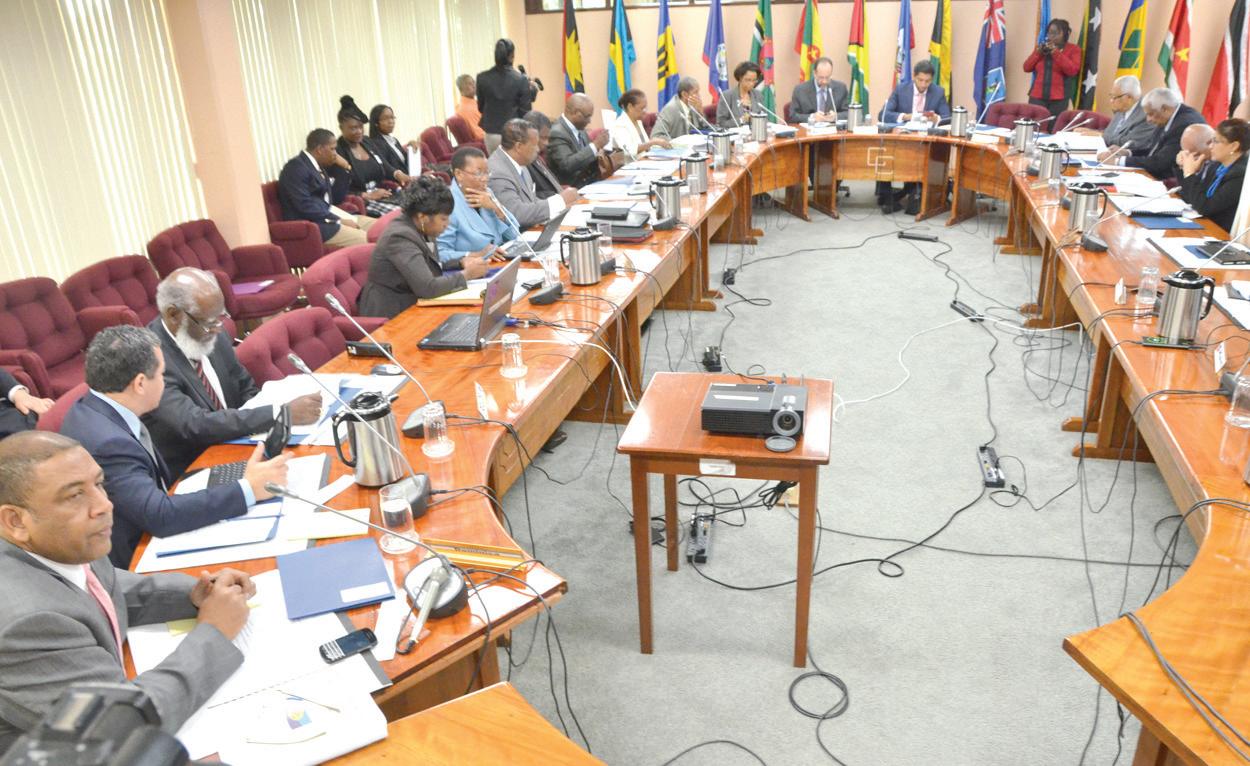
Representatives at the 33rd meeting of the Community Council of Ministers at the Caricom Secretariat on Friday
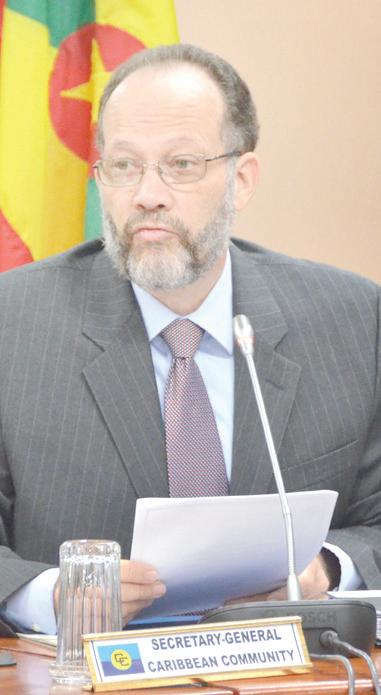
Caricom Secretary General Irwin LaRocque
Two ranks likely to face criminal charges in Harding saga
Police Complaint
Authority (PCA)
Chairman Cecil Kennard on Friday stated that he will make his recommendations in the Colwyn Harding saga today, after which the file will be sent to the director of public prosecutions (DPP) for legal advice on Monday.
The former chancellor of the judiciary explained that based on the evidence he reviewed, at least two police ranks may be charged with criminal offences while disciplinary actions will be taken against several others. He disclosed that in any case, the files will have to be sent to Police Commissioner Leroy Brumell and DPP Bibi Shalimar Ali-Hack.
Delay
Justice Kennard justified the delay in his investigations, pointing out that he wanted addition information on the background of the police rank in the controversy and the injured man who was sent to Jamaica to seek further medical attention.
He said that information was provided to him late
Thursday evening. Kennard further stated that the Office of Professional Responsibility (OPR) has done a thorough job on the file, noting that 45 statements were taken from several persons, including the prisoners who were in the Timehri lock-ups at the time the victim was assaulted.
He said once the file leaves his desk on Monday, it will be up to the DPP to decide whether to accept his recommendations and/or to make her own recommendations.
Harding alleged that he was raped with a baton by a
police rank attached to the Timehri Police Station sometime between November 17 and 19, 2013. Harding accused the police rank of shoving a baton with a condom up his behind while he was in police custody for an alleged theft.
Since the incident, the young man has been hospitalised and was recently flown to Jamaica to receive further medical attention. Based on information received, Harding has suffered severe injuries to his intestines.
Surgery Guyana Times understands that a medical professional examined the injured man and concluded that he cannot undergo further surgery until he is properly healed. Doctors in Jamaica are monitoring his condition.
The young man was hospitalised at the Georgetown Public Hospital and the matter was first brought to the forefront after the mother of the young man decided to approach the media. The matter was reported by the mother to the police commissioner, who thought it was “just an
assault” case; thus, instructing A Division Commander George Vyphius to investigate.
After weeks, there was no progress until a recording of what transpired was made available to the police. The OPR launched an investigation into the allegation, but thus far, all the ranks stationed at the Timehri Police Station have denied involvement.
A corporal was placed under close arrest while several others were transferred to locations closer to Georgetown. Ever since the incident, various organisations have been calling for an independent probe, claiming that the “police cannot investigate police”.
Meanwhile, President Donald Ramotar recently stated that he is in full support of an independent investigation, reiterating that his government is against any kind of torture.
People’s Progressive Party/Civic (PPP/C) General Secretary Clement Rohee said he is saddened by the fact that some politicians have used the situation to gain political mileage.
UG students on visit to U.S. through cultural exchange programme
The U.S. embassy, in partnership with the U.S. non-governmental organisation (NGO) One World Youth Project (OWYP), the University of Guyana (UG),and educational institutions in the U.S. and Guyana, is bringing students together in a dynamic cross-cultural exchange.
The programme, Virtually there: Expanding cultural exchanges between the U.S. and Guyana”, is providing an opportunity for 11 students from the UG to participate in the exchange programme to the U.S. from January 25 to February 2.
During the programme, participants have the opportunity to engage with their peers from Georgetown University in Washington, DC and Boston University. Students met with officials from the Department of State and the U.S. Institute for Peace, as well as Guyana’s
Leff hand suppose to know whah right hand doin
De world is not a island and no body can live all alone even if dem call dem self hermit or monk or single. Every body does gotta have some body to do some ting fuh dem, although nuff a dem does play big and don’t want to admit it.
Every body does get a leff hand or a right hand, or both. Some people can’t survive wid out dem right hand and leff hand. De right hand man is de main man. De leff hand man does be second man. Old people seh when yuh leff hand don’t know wha yuh right hand doin, is a bad ting.
Nuff woman nowadays does get leff hand and right hand. Leff hand does try to cross over to de right hand side and right hand does try to hold on strong and don’t move. Some a dem get nuff leff hand and nuff right hand all at de same time. That is a lotta hand pun some body at one time. And that is whah does bring trouble and fightin does start.
That is just whah happpen de other day wid a woman in Guy Hug Park. And it couldn’t be just by chance that she was livin wheh she livin. She had a right hand and a leff hand. Right hand was in de house when leff hand show up. Like leff hand musta been a newbie so he didn’t know that he ain’t suppose to turn up same time wid right hand.
Or maybe de woman tell both a dem that dem was right hand. Well, when leff hand turn up, he get turn down. And after he still show up was a big show down. Right hand end up givin leff hand a right hand and suddenly leff hand pull a gun wid he right hand.
the year to develop a servicelearning programme at the university, whose participants in turn train fellow students to become experts in a global mindset curriculum.
UG students interact virtually through social media with university students at Georgetown University and Boston University. At the same time, they facilitate weekly lessons and a virtual exchange between the Richard Ishmael Secondary School in Guyana and counterpart classrooms at U.S. middle schools. The year-
ambassador to the U.S. to discuss issues that are important to youth in Guyana. They also had an opportunity to visit the campuses of Georgetown and Boston University to briefly witness U.S. university student life and participate in community-building and service projects.
The “Virtually There” exchange programme follows a long-term project spearheaded by OWYP to provide enhanced, multifaceted social media interaction between students and schools and to strengthen global skills training.
OWYP works with UG student leaders throughout
long curriculum, as well as the “Virtually There” exchange, offers these secondary and tertiary students a unique cross-cultural experience to develop global life skills that will enhance their readiness for a range of careers requiring international experience and understanding.
Ting-a-ling-a-ling…friend tell friend…mattie tell mattie! Now right hand gone and leff hand gone some where else and it look like he gon now turn somebody else right hand inside dem four walls whah does get a small window. And most likely that right hand gon be a policeman.
Hire car driver charged for causing death by dangerous driving
Niroyon Ally Yacob, 33, a hire car driver of Lot 55, Number 67 Village,Corentyne was on Friday charged for causing death by dangerous driving when he appeared before Magistrate Rabindranath Singh at the Springlands Magistrate’s Court.
He was placed on $600,000 bail.
According to reports, about 15:00h on Wednesday, January 28, Talisha Persaud, seven, of Lot 40, Number 70 Village, Corentyne, Berbice, and a pupil of Number 70 Primary School, was on her way home from school when motor vehicle HC 2120, owned and driven by Yacob, hit her down.
The child reportedly ran across the road, and in the process, came into contact with the vehicle, which was reportedly speeding.
However, according to an eyewitness, the student was walking on the side of the road on her way home when motor car HC 2120 swerved off the road and struck her.
The eyewitness alleged that the driver was speeding and lost control of the vehicle, ending up in the path of the child. A post-mortem examination conducted on Friday on the body of the child, gave her cause of death as fractured skull due to vehicular accident.
Meanwhile, Yacob will have to return to court on February 26. His driver’s licence and passport have also been lodged. Persaud is survived by her parents and only brother.
Police are continuing their investigations.
The pupil was rushed to the Skeldon Hospital where she succumbed while receiving treatment. The accident reportedly occurred about 300 yards from the pedestrian crossing.
PCA Chairman Cecil Kennard
U.S. Ambassador D Brent Hardt (sixth left) with local students on the Virtually There: Expanding cultural exchanges between the U.S. and Guyana Programme
University of Guyana students on a visit to the White House
Shot Port Mourant survivors thankful to be alive
Speculations as to the motive are rampant, but families of the slain and critically injured labourers who were attacked separately by unknown gunmen about 15:00h on Thursday at the Port Mourant backlands are at a loss regarding the reason for the attack.
Guyana Times spoke to one of the survivors, Clement Griffith, 48, a patient in Ward Eight of the New Amsterdam Hospital, who recounted the ordeal.
“We bin deh ah come out ah wuk with a boat when we see two people with gun point at we… we frighten so we stop… them start firing load wild, wild,” he said.
The injured man, who is in a stable condition, but still in much pain, received gun shots wounds to his ears, hands and shoulder.
He related that he began working with a rice farmer in the area about three weeks ago.
Griffith recalled that fearful for his life, he kept his eyes downcast and started to pray.
Terrifying
“Dem den drag abbie out ah the boat put we on the dam an still ah shoot abbie… me lie down flat and na move… when me stop hear any noise me ask fat bai (David Harpaul) fa try and crawl in ah boat fa he cellphone and call Spreadys bai,” he related.
He said bearing the pain, he and another injured man David Harpaul, 36, of Rose Hall Town, managed to climb back into the boat and went for help.
However, on their way Harpaul was losing a lot of blood and lost consciousness. “Fat bai start see dark and like he na able drive ah boat na moe… abbie almost meet ah Tain koka when he black out… thank God some lil bai bin deh deh and dem help we,” he said.
Griffith told Guyana Times that they were afraid to move their injured collegue Zamil Ibrahim, 26, of Port Mourant, who he said sustained sevral injuries and was pleading for help.
“He saying he go dead and bear blood ah run out ah
Almost 100 per cent of under-five children vaccinated
In 2013, Guyana recorded a 96 per cent vaccination rate in children under five, according to initial data.
Health Minister, Dr Bheri Ramsaran disclosed in an exclusive interview with Guyana Times that babies born in Guyana over the past 11-15 years have all received vaccines for preventable diseases.
“In recent years, we have been able to touch as much as 95 per cent to 96 per cent of our vaccinated population, that is, the babies that we need to vaccinate for vaccine preventable childhood illness,” he said.
he skin all ova de ground,” Griffith said. According to reports, Ibrahim succumbed to his injuries at the Geogetown Public Hospital on Friday.
Asked if he was aware of the motive for the shooting, Griffith said, “Me na know and me na want know… me thank God me live fa see me family back.”
He also disclosed that he was unaware of the death of Krishnand Jagdeo of Free Yard, Port Mourant, who he maintained was not in their company and had no interaction with them at anytime during the day.
Still critical Harpaul, who went into the theatre about 16:30h at the New Amsterdam Hospital and came out early Friday morning, is still in critical condition.
He was transferred to the Georgetown Public Hospital for further treatment. According to sources, Harpaul sustained over 38 holes in his bowels. He is also a diabetic.
Harpaul's family members, including his wife Trisha, 34; daughter Jennifer, 15, a student of J C Chandisingh Secondary; and his son Randy, 13, a student of Corentyne Comprehensive School, broke down in tears and sobbed when they saw him on his way to the ambulance.
In the meantime, a police source close to the investigation has disclosed that it is suspected that shot guns were used in the brutal shooting.
The source also revealed that based on investigations and information received on the suspects, the motive for the attack was reprisal.
The source said based on investigations, Jagdeo was shot some distance away from the others. It is alleged that he was the target.
However, the source continued that from all indications, it seems that the villains were fearful that the labourers saw them in the act and they decided to wipe out all the evidence.
Police have intensified their investigations.
Dr Ramsaran pointed out that the Health Ministry is looking at the sustainability of this programme, noting that vaccines are quite expensive and are administered free of cost in Guyana, unlike in other countries.
The health minister explained that owing to the
change in market conditions, Guyana’s ability to pay for these vaccines is under threat.
However, the ministry is confident that “the government of Guyana will find those resources to continue this flagship programme for which Guyana has been given several international awards in recent years”.
Working assiduously
Dr Ramsaran pointed out that the small percentage of children under the age of five who did not receive their immunisation shots are those in the most remote areas within the hinterland regions. He noted that the ministry is working assiduously to reach those communities.
The latest vaccine to be added to the government’s vaccination programme is the human papillomavirus (HPV) vaccine, which seeks
to help prevent cervical cancer and is administered to young girls between the ages of nine and 11.
The immunisation programme has seen a drastic expansion over the past decade, in the number of vaccines provided to combat preventable childhood diseases. In the 1970s, the pro-
gramme started with vaccinations against six diseases: measles, tetanus, whooping cough, polio, diphtheria, and tuberculosis. Over the years, it has grown to encompass HPV, yellow fever, hepatitis B, mumps, haemophilus influenza, rubella, pneumococcal, meningococcal C, and rotavirus vaccinations.
Guyana has moved from focusing solely on children over the last decade to include adolescents and then the entire family. The health minister noted that the ministry’s motto is “Not any child or family left unvaccinated”.
Constant monitoring is being done for signs and symptoms of any vaccine preventable disease. Testing for these vaccine preventable diseases is being done in collaboration with the Pan American Health Organisation/World Health Organisation (PAHO/WHO).
Health Minister, Dr Bheri Ramsaran
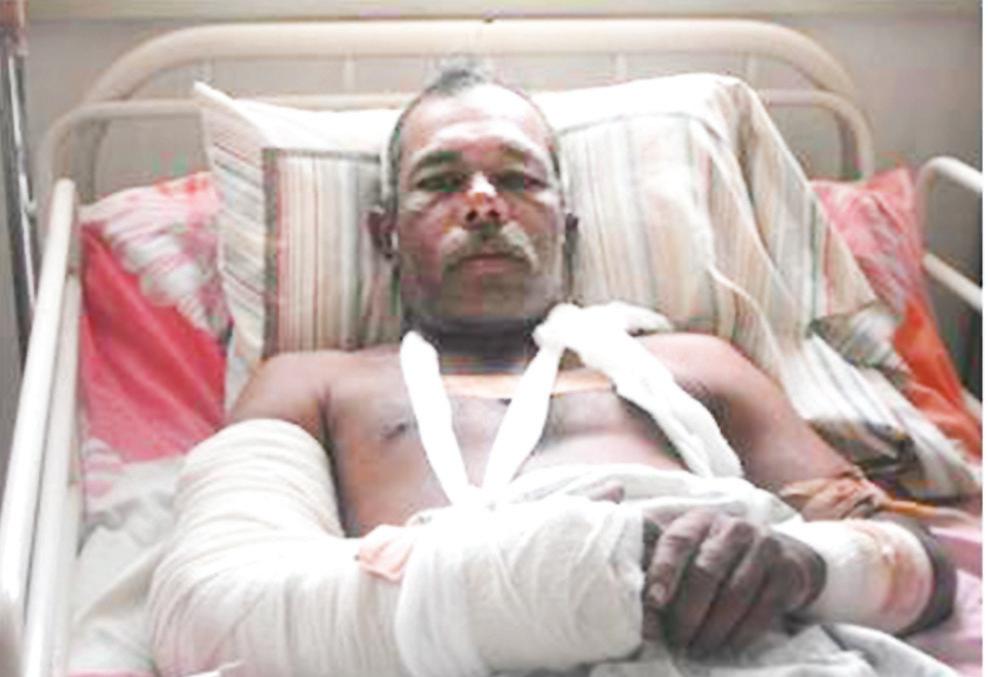
Clement Griffith spoke to Guyana Times from his hospital bed on Friday
Agriculture Ministry pushing cultivation of imported food crops
The Agriculture Ministry has commenced testing the production of several imported beans and vegetables, in a move to displace some of the food imported into the country, and reduce the food import bill.
In 2013, emphasis was placed on the reduction of imports of corn, soybean, black-eye, and certain vegetables such as cauliflower, broccoli and sweet peppers, as well as spices.
Twenty-two varieties of hybrid corn, obtained from the International Maize and Wheat Improvement Centre (CIMYT), were evaluated on savannah soil at Ebini and since then, five of the best varieties have been selected
for commercial planting.
Additionally, blackeye and hybrid corn were sourced from Belize, while soybean was sourced from Brazil. These are currently being produced at Mon Repos, East Coast Demerara and Essequibo with the acquisition of equipment for planting, harvesting and threshing in progress. Based on the results of these evaluations, it is proposed that cultivation will be expanded on farmers’ fields.
The strategy is that corn and soybean would be used to formulate livestock feed and in this regard, a plan of action for these two commodities is currently being finalised. The displacing of some of the food imports is among strategies being em-
ployed to strengthen food and nutrition security.
There is also focus on increased agricultural mechanisation of certain crops, including spices and cassava. To this end, in 2013, equipment was sourced from India for processing spices, and these will be located at Hosororo in Region One, a Government Information Agency (GINA) release said. The entire facility at Hosororo is being refurbished and the acquisition of processing equipment aims to add further impetus to the spice industry, especially in the region.
With regards to cassava, work continues with the United Nations Development Programme (UNDP) to provide training and technical support in the establishment of agricultural enterprises in hinterland communities. Under the first wave of the project, cassava plots have been established at several places including Parikwarnau, Massara, and Ruperti.
Works were also initiated with the communities of Tapacuma, Region Two and Woweta, Region Nine, to improve on the production practices for cassava with demonstration plots being established in these communities.
Suriname, Guyana important access points to South America
Although Suriname’s economic structure differs much from that of most members of Caricom, the country is not a standout.
Caribbean Association for Trade and Industry (CAIC) Chairman Ramesh Dookhoo is convinced thatSuriname fits in perfectly in the Caribbean. During the CAIC meeting in Paramaribo this week, Dookhoo said Suriname and Guyana have much in common.
Both countries have booming economies and continue to focus on Caricom, while at the same time looking towards the south. Both countries could be instrumental in facilitating export to Caricom and Latin America.
One crucial factor would be shipping lines between Caricom nations and Dookhoo sees an important role for Suriname as a shipping hub.
“The move to modernise the port now comes in very handy.” If northern Brazil is further developed, countries like Suriname and Guyana could provide access to sea.
And competition between the ports of Suriname and Guyana is good, Dookhoo said.
“There is no need for a gigantic harbour to facilitate both countries. South America is a large continent so there is room for several access points.”
The CAIC official foresees an increase in transport between South America and Africa in the near future.
Not only trade associations from Caricom countries are affiliated to the organisation, but associations from The Dominican Republic and the French and Dutch Antilles.
These countries have an
associate status in Caricom.
The Dominican Republic has a very complex relationship with Caricom and had applied for membership, but the request was put on ice last year to protest the move against thousands of Dominicans of Haitian descent.
Many Caricom nations consider The Dominican Republic a threat, as its economy is as big as that of all Caricom nations put together. The question is whether it would be wise to keep such a regional economic superpower out. Dookhoo is convinced that Caricom needs The Dominican Republic because the nation has a lot of experience that could be beneficial to the rest of the region.
“‘I haven’t noticed any tyranny or dominance in their business approach,” he said, but noted the need to draft special agreements with The Dominican Republic because of its enormous economy and its ties to Europe.
“We can’t accept them to be a full Caricom member and still allow them to maintain a special relation with the EU,” Dookoo said.
Major reforms planned for GPHC’s A&E Unit
The Georgetown Public Hospital Corporation (GPHC) will be moving to make several critical changes to the Accident and Emergency (A&E) Unit at the hospital, and by extension, how medical professionals respond to emergencies across the country.
Head of the A&E Unit, Dr Zulficar Bux said a team from the Vanderbilt Medical Centre is creating a plan to effect changes to how the hospital responds to emergency calls.
Dr Bux said the plan is not specific to the GPHC as the team is working to develop a National Emergency Response System (NRS).
The team of one doctor and two paramedics is also helping to establish a department within the GPHC, to address issues arising there.
Medical professionals would be trained to assist the team in responding to emergency situations.
In addition, Dr Bux noted that the team is assisting in setting up a communication department that will help to respond to emergency cases.
With the establishment of this department, there will be a more cohesive approach in handling these issues. Currently, while persons would call for the ambulance service at the GPHC, there is no emergency response unit to handle these issues.
Structured system
“Once you have a structured system, once you have somewhere you can communicate properly, you can actu-
Weather outlook
ally have a more appropriate response. So by creating this national or pilot project that we are doing… we expect to expand and have a national emergency medical system where we could actually coordinate these activities and assist in a timely manner.”
Dr Bux said the hospital will work towards meeting the ultimate goal of responding to all emergencies within 15-20 minutes, but this will take some time to achieve. Dr Bux explained that the unit recently received approval from the GPHC board of directors to create a department, instead of a unit for emergencies. This, he said will now create an opportunity for expansion and improved services at the unit.
“We will be creating policies on job description, having run sheets that are ticked off and have these computerised so we would have systems to do quality improvement. It’s a learning process and we wouldn’t be perfect initially, but we have quality improvement plan ahead. Once we see this is moving ahead, we are going to get better daily.”
Smooth transition
Dr Bux explained that the unit is also working to have medical technicians on every ambulance dispatched. This will ensure that patients are monitored and the transition from the ambulance to the A&E room is smooth, allowing doctors in the ward to work effectively on patients based on initial treatment and reports from the NRS team.
Based on the latest model output and satellite data, please note that we are anticipating 24 hours rainfall accumulation between 30 mm and 70 mm over areas along the coast. The highest totals are expected over Regions One to Four.
With the spring tide in effect, coupled with the expected adverse weather conditions residents of riverine, coastal and low lying areas are advised to exercise precautionary measures against possible flooding due to combined effect of above normal high tides and prevailing weather conditions.
Current conditions:
Regions One to Six, Seven and 10 are ob-
Acelebration will be held on Saturday to mark the 10th anniversary of the Episcopal Ordination of Bishop Francis Alleyne, at the Cathedral of Immaculate Conception, Brickdam, Georgetown.
According to a release, the event to celebrate the bishop’s milestone gets underway from 18:00h and admission is free. Everyone is encouraged to be part of this memorable occasion.
On October 30, 2003, Bishop Alleyne, a Trinidadian, was appoint-
He said often times patients would complain about the time they have to wait at the A&E unit, but the waiting period he said is determined on the seriousness of the injury sustained.
According to Dr Bux, many times people turn up at the A&E Unit, with minor injuries, which could be treated at a health centre, but demands treatment at the unit. However, with plans to improve services at the hospital, patients will soon be educated on other centres they can access care for minor injuries.
The A&E Unit on average treats at least 200-250 patients daily, but this figure could be as many as 300 on some days. Dr Bux noted that this is mainly due to the fact that the GPHC is the main referral centre for the country.
No neglect
“We have to take care of who we think are sick. So it’s not that we are neglecting anyone. We will try to take care of all the patients that are there, but it’s just that the timings vary according to how sick patients are coming to us. Having said that, there is definitely room for improvement,” Dr Bux stated.
The plan to improve emergency response at the GPHC and nationwide is part of a partnership between the hospital, the Health Ministry, the University of Guyana and the Vanderbilt Emergency Centre, Tennessee, U.S.A.
serving cloudy to overcast skies with moderate to heavy showers, isolated thundershowers and light intermittent rain; other regions are experiencing partly cloudy to cloudy skies with scattered showers.
Expected conditions
Regions One to Six, Seven and 10 can expect moderate showers and heavy downpours at times, while other regions can expect light to moderate showers. Wind gusts are expected over some areas.
Tides
Lowest: 0.11 of a metre at 22:41h
Highest: 3.22 of metres at 04:57
ed bishop of Georgetown, Guyana. He was ordained on January 30, the following year.
Prior to this, he was ordained a Catholic priest on July 7, 1985, in Trinidad and Tobago and a few years later, he became the abbot of the Mount St Benedict Monastery in the twin island republic.
On December 8, 1975, he was inducted into the Order of Saint Benedict – a Catholic order that stresses the importance of frequent daily prayer and monastic life.
The Agriculture Ministry in 2013 placed emphasis on the reduction of imports of corn, soybean, black-eye, peas and other vegetables
CAIC Chairman Ramesh Dookhoo
Bishop Francis Alleyne
Gender equality commission urges some singers to treat women with respect
The Women and Gender
Equality Commission
has again reiterated its disgust over the negative portrayal of women through song lyrics, and is calling on artistes, especially locals, to take a page out from soberminded singers who have the positive upliftment of women at heart.
The commission said singers such as Bob Marley, Beres Hammond, John Legend, and Taurus Riley will forever remain positive role models in the music industry, as they promote what is true and right about women.
In an exclusive interview with Guyana Times, Commissioner Nicole Cole said that the organisation has always been working with the media, seeking to encourage the proper portrayal of women through the contents being broadcasted.
“The commission calls on radio and television stations to look at how they are putting out their ads and the kind of music they are playing and those that speak to treating women violently.
"Last year, we spoke out vehemently against the song
‘Kick En She Back Door’ that was banned in Antigua, but found its way here on our airwaves,” she said.
Cole said the impact is far-reaching and inadvertently affects the lives of the youth, encouraging inappropriate behaviour.
“We remain forever vigilant as it relates to the influence of music upon our young people and the type of behaviour it can encourage, especially as it relates to violence among the youth, women and boys,” she noted. Meanwhile, chairperson of the commission, Indranie Chandrapal said there are a
number of social issues that have captured the attention of the commission.
She related that the organisation last year launched the Access to Justice Programme in every region of the country. That programme, she said, provided a forum for residents to air their concerns.
“Out of that, we had the opportunity to receive and record their recommendations as well,” she said. Chandrapal revealed that the recommendations have somehow reformed their plans for this year, and have helped in shaping the five-year strategic plan that was implemented in April last year.
Chandrapal said based on the complaints and concerns raised, the commission would meet with the officials related to the concerns. “As we see the problems and based on recommendations, we then try to work with the agency that is responsible, whether it is policy or legislation,” she said.
Another commissioner Vanda Radzik said the commission joins the public in condemning the recent alleged police brutality on
Republic Bank Group records
US$45.6M
profit in first quarter
The Republic Bank Group has recorded a profit attributable to shareholders of US$45.6 million for the three-month period ended December 31, 2013.
This represents an increase of 2.2 per cent over the corresponding period last year. The group’s total assets stood at US$9.1 billion at December 31, 2013, an increase of 6.7 per cent from December 2012 and 0.5 per cent over the year ended September 2013.
Republic Bank Chairman Ronald Harford, in announcing the group’s results, said,
“We are encouraged by the growth and stability of our loan portfolio, which was reflected in a year-on-year increase of 7.3 per cent and a
reduction in loan impairment expense of over US$2.3 million from the corresponding period in 2012.
The results of this quarter
also include a contribution of US$1.6 million from our 40 per cent investment in HFC Bank Ghana Limited.”
Harford said the bank expected this good performance to continue for the remainder of the year, as focus continues to be placed on maintaining a high-quality loan portfolio, cost containment and growth in non-interest income.
He noted, however, that the group continues to be challenged by high liquidity which is leading to declining margins, and indicated that investments in Barbados and the Eastern Caribbean will continue to be closely monitored, once difficult economic conditions persist in those territories.
23-year-old Colwyn Harding, and urges the authorities to launch an independent inquiry into the matter.
“We are really concerned about the increase in criminality and violence. We are willing to work with all other agencies to help change the negative and destructive attitudes of those who seem hell bent in harming others…
"We urge enforcers of our laws to desist from any forms of these beastly types of behaviours towards suspects and their families,” Radzik said.
The Women and Gender Equality Commission in April last year had launched a five-year strategic plan for the period 2013-2018, with four distinctive thematic priorities: organisational and institutional strengthening of the commission; women, leadership and governance; women and economic empowerment; and gender-based violence.
The thematic priorities within the plan are a summation of the range of contributions from commissioners and staff, as well as government and non-governmental stakeholders.
IAC shocked at robbery of UG student
The Indian Arrival Committee (IAC) said it is shocked and horrified at the brutal robbery of a young female student of the University of Guyana (UG) on Thursday, who happens to be an IndoGuyanese.
The robbery occurred about 20:00h. The student, whose name was given as Hoodith, had finished her classes and was still on campus, having walked past the main guard hut situated west of the building housing the Institute of Applied Science and Technology.
The IAC, in a release, said it understands that very close to where the student was attacked and robbed,
there is a wooden plank connecting the UG campus to the public road, immediately to the east of the campus. That area does not have the benefit of lighting, and in fact, has been unlit for a very long time.
The IAC also understands that the adjoining area to the east of the campus comprising, First to Third Fields Cummings Lodge/Sophia, is a haven for criminal elements who, in the absence of effective policing, whether by the Guyana Police Force or by the community policing group, have pounced on a large number of people, especially UG students, many of whom are Indo-Guyanese.
“The IAC is calling upon the authorities that govern the University of Guyana, the Guyana Police Force and the community policing group to act immediately to ensure that students and other persons are protected from these opportunistic criminal elements.
“The IAC is even more horrified that this brazen criminal act has taken place in the first week of this second semester of the academic year 2013-2014,” the release concluded.
Women and Gender Equality Commission Chairman Indranie Chandrapal
Republic Bank Chairman Ronald Harford
Regional Record Brazil heat pressures crops, energy prices, govt
Even by Brazilian standards –man, it’s hot. January was the hottest month on record in parts of Brazil including its biggest city, São Paulo. The heat, plus a severe drought, has kindled fears of water shortages, crop damage and higher electricity bills that could drag down the economy during an election year for President Dilma Rousseff.
The scorching conditions do not constitute a crisis quite yet, officials say. Weather has been mostly normal in other regions including Brazil’s soy belt, where a record crop is still expected. Summer rains could return in February and March to refill reservoirs, as they did last year when similar concerns over a possible energy crisis proved to be overhyped.
Still, the risks are considerable because Brazil’s economy is so fragile at the moment. Any disruption to food supplies or power costs would complicate the government’s ability to meet the centre of its 2014 inflation target of 4.5 per cent, and the region’s orange and coffee crops are already showing signs of stress, farmers say.
São Paulo’s average maximum daily temperature in January through Friday was 31.9 degrees Celsius (89.4
degrees Fahrenheit), a degree hotter than the previous January record and surpassing February 1984 as the city’s hottest month ever, according to INMET, Brazil’s national meteorological institute. Meanwhile, a high pressure system
has blocked normal tropical afternoon rains during what is usually the year’s wettest month. São Paulo’s main reservoir is now at less than a quarter of its capacity, a 10-year low.
Meteorologists are not hopeful for a change anytime soon. (Excerpt from Reuters)
Smoking landfill causes shutdown of schools, offices in Port of Spain
The Trinidad Office of Disaster Preparedness and Management Chief Executive Officer (CEO), Dr Stephen Ramroop Thursday came under fire from environmentalists for saying burning rubbish, including plastic, in back yards could produce similar levels of air pollution to the levels currently being emitted by Beetham landfill smoke.
Ramroop made the comment during an inter-agency press conference at the National Operations Centre in Port of Spain, as he said people were panicking unnecessarily because the situation at the Beetham landfill was not a disaster, even as smoke from the landfill continued to cover the capital in a cloud of toxic fumes which forced the shutdown of schools, business and government offices for a fourth straight day.
A man walks through the Beetham landfill Wednesday with items he collected at the site, even as workmen (background) carried out work to put out fires started there earlier this week
Venezuelan bikers protest nighttime riding ban despite high crime
Nearly 2000 motorcyclists protested in Caracas on Friday, hooting horns and waving Venezuelan flags outside a government office to show displeasure with a ban on night-time riding, which has been imposed to cut crime in one of the world’s most dangerous cities.
Motorbikes are used in many of the robberies, kidnappings and homicides for which the country is notorious. Stung by criticism of numerous failed efforts to make the streets safer, officials in Caracas and other areas this month made it illegal to ride a motorcycle after 21:00h.
The so-called “motorizados”, a term applied mostly to couriers and motorbike taxi drivers, gathered in the Petare slum before riding to the peaceful demonstration.
They said the new rule
contravened their right to work and move about freely, and that students and lowpaid labourers who could not afford to hire cars would not be able to find transportation.
“They hassle us all the time,” said Una Levera, a 30-year-old motorcycle taxi driver at the protest, nodding at the dozens of police officers nearby.
“The only solution is for them to let us get on with our work... not one motorizado is in favour of the new regulations.”
The protest dispersed after the bikers delivered a letter to the National Institute for Terrestrial Transport, and an official came onto the street to hear their complaints.
For many in Venezuela’s opposition and middle class, the motorizados are the frightening face of crime.
(Excerpt from Reuters)
JUTC extends trial period for Mandela Highway bus lane
The Jamaica Urban Transit Company (JUTC) has received authorisation from the Transport, Works and Housing Ministry to extend the trial period of the Mandela Highway Bus Lane for another three months from February 1 to April 30.
a success. It is of note that Spanish Town has now been ranked the highest revenue earner of the three depots,” said Campbell.
moved in January 2014.
According to Campbell, with the introduction of the bus lane on November 1, 2013, the JUTC transported 718,610 passengers compared with 686,483 in October 2013.
“When we light our fires, there are more toxins than SWMCOL (Solid Waste Management Company), because they have been doing a marvellous job,” Ramroop said at the press conference. “A disaster is when people are affected, livelihoods are affected or people are injured. This is an environmental hazard that has impacted communities.”
ronmental group Papa Bois Conservation, described them as “scary” and “ignorant.” “We are surrounded with pollution... I don’t know what the health in the country will be like in the future,” Broadbridge said. He said he felt the fire at the Beetham landfill was a wake-up call.
He said to a large extent, people’s lives had not been affected. Environmentalists, however, took issue with those statements. Stephen Broadbridge, of the envi-
There are many reports that several people in Port of Spain are wearing face masks, and are concerned about the health risks posed by inhaling the fumes. (Excerpt from Trinidad Guardian)
Brazilian police arrest Amazon tribesmen for murder
Police in Brazil’s Amazon region have arrested five indigenous members of the Tenharim tribe accused of killing three contractors who have been missing since midDecember.
The tribe denies any involvement in the disappearance of the three men.
Local groups accused tribe members of killing the three government workers in retaliation for the death of
an indigenous leader. The incident led to riots in the nearby city of Humaita. Tension in the area began when indigenous leader Ivan Tenharim was run over by a car in the tribe’s reserve on December 3, 2013.
Other indigenous leaders accused local townspeople of killing him deliberately.
There is anger among residents of Humaita and nearby towns over the indigenous practice of setting
up roadblocks and demanding money from drivers going through their lands. On December 16, the three contractors disappeared in the area. The men were last seen on a road that crossed the tribe’s indigenous reserve.
They were named as Luciano Ferreira Freire, Stef Pinheiro and Aldeney Ribeiro Salvador, who were working for the federal governmentowned electricity company, Eletrobras. (Excerpt from BBC News)
Managing Director of the JUTC, Colin Campbell, requested that the project, which was going through a three-month trial period from November 2013 to January 2014, be extended under the same conditions.
“The JUTC is pleased to report that the temporary JUTC Bus Lane has been
The passenger load dropped in December because of the school break but it did not affect revenue intake which showed an improvement over November, Campbell said.
JUTC projects that 747,000 passengers will be
The JUTC managing director said that revenue earned during the threemonth trial period of the Mandela Highway Bus Lane showed an increase of J$1 million in November over October, J$1 million in December over November and is projected to show an increase also of approx J$1 million in January 2014 over the previous month. The ease of traffic congestion created by the bus lane also saw the JUTC saving on fuel consumption by five per cent. (Excerpt from Jamaica Observer)
Barbadian govt committed to restoring balance – PM
Government is committed to the layoff process to get the Barbadian economy back on track.
This is according to Barbadian Prime Minister Freundel Stuart, as he responded to questions at the Barbados Chamber of Commerce and Industry’s (BCCI) luncheon at Hilton on Friday.
“I am interested in the budgetary targets which the government has to make to restore balance to the economy. I have not got carried away with talking about 1000, 2000, 3000; I am concerned with making sure the national economic edi-
fice is sound. The government is committed to this programme, because the restructuring of Barbados public administration and the restructuring of the Barbados economy has to take place,” he explained.
“We are not going to keep going through this over and over again. Every time something happens in the economies of our traditional trading partners, we go through this anguish here and as soon as it passes we go back to old habits. This time we are putting this on a sustainable path and we are going to make sure it stays on that path,” he assured.
The PM added: “I am
not in a position to answer with any definitiveness how many people would have gone home on Thursday.
The Ministry of the Civil Service has been working around the clock to respond to the decisions of the government in terms of dealing with a very serious problem which our public finance has been experiencing.
The process is transparent and we have adopted many of the procedures that were employed in 1991 to ensure those workers that have to go home are not put to any particular disadvantage and I’m allowing the processes to work.” (Excerpt from Barbados Nation)
A Brazilian vendor sells bottles of drinking water between cars during a warm summer day in São Paulo, January 31
Syria peace talks end in recriminations
The Syrian government and opposition have traded insults after a week-long peace conference in Geneva ended with no firm agreement.
Foreign Minister Walid Muallem said the opposition was immature, while the opposition’s Louay Safi said the regime had no desire to stop the bloodshed.
However, United Nations envoy Lakhdar Brahimi said he had seen some “common ground”, and scheduled more talks for February 10.
The opposition has agreed to take part, but Muallem has refused to commit.
“We represent the concerns and interests of our people. If we find that [another meeting] is their demand, then we will come back,” he told reporters.
humanitarian issues and possible ways to end the violence. They made some agreements on local ceasefires to allow access for humanitarian workers.
UN aid chief Valerie Amos said the deals had allowed some aid to get through to a few thousand families. But she said that, so far, an agreed ceasefire in the besieged city of Homs had not had any effect, and no aid has got through.
Parts of Homs have been under government siege for more than 18 months. Some residents have told the BBC that they are eating grass to survive.
Opposition leader Ahmed Jarba said he and his colleagues had “stood up to the regime, a regime that only knows blood and death”.
The two sides discussed
More than 100,000 people have died in Syria since the uprising against President Bashar al-Assad began in March 2011. (Excerpt from BBC News)
U.S.-Canada oil-pipeline project clears hurdle
The proposed oil pipeline between the United States and Canada has cleared another hurdle, with a U.S. State Department study saying it will do little to slow the expansion of Canada’s oil exploration.
The 11-volume environmental impact study on the 1897km Keystone XL, released on Friday, raises pressure on President Barack Obama to approve the project, which environmentalists see as a major climatechange problem.
That finding is largely in line with what oil-industry executives have long argued.
The study, however, does not recommend whether Obama should grant or deny an application by TransCanada Corp to build the US$5.4 billion line, which would transport crude from Alberta’s oil sands to U.S. refineries.
The report reaffirmed the idea that Canada’s heavy, bituminous oil sands reserves require more energy to produce and process – and, therefore, result in higher
U.S. President Barack Obama is under pressure by both the oil industry and environmentalists to decide on the pipeline issue (EPA)
But after extensive economic modelling, it also found that the line itself would not slow or accelerate the development of billions of barrels of reserves that environmentalists say would exacerbate global warming.
“The approval or denial of any single project is unlikely to significantly affect the rate of extraction of the oil and the oil sands, or the
refining of heavy crude on the U.S. Gulf Coast,” a State Department official said in advance of the report’s release.
U.S. Secretary of State John Kerry will consult eight government agencies over the next three months about the broader national security, economic and environmental impacts of the project before deciding whether he thinks it should go ahead. (Excerpt from Al Jazeera)
Ugandan rebuke for UK archbishops
The head of the Anglican Church in Uganda has given a critical response to a letter from the Archbishops of Canterbury and York warning that gays and lesbians should not be victimised. Their letter was sent to all presiding archbishops of the Anglican Communion.
It was also sent to the presidents of Uganda and Nigeria, which have recently introduced anti-gay legislation. Archbishop Stanley Ntagali responded that “homosexual practice is incompatible with Scripture”.
He said he hoped the Church of England would “step back from the path”
it had set itself on “so the Church of Uganda will be able to maintain communion with our own Mother Church”.
In the letter, Archbishops Justin Welby and John Sentamu said they were responding to questions asked about the Church of England’s attitude to laws penalising “people with same-sex attraction”.
Homosexuals were loved and valued by God and deserved the “best pastoral care and friendship”, they said. Nigerian President Goodluck Jonathan has recently signed a law banning same-sex marriages and shows of same-sex public affection.
In Uganda, President Yoweri Museveni has delayed passing a parliamentary bill allowing for greater punishments for gay people.
The Ugandan Church, along with others in Africa, has broken its ties with Anglicans in North America over the issue of gay ordinations and same-sex blessings. Archbishop Ntagali makes it clear that he thinks Anglican leaders from the U.S. and Canada should not be invited to the 2018 Lambeth Conference.
The Church of England does ordain gay clergy as long as they are celibate. (Excerpt from BBC News)
Ukrainian protest leader tells of torture
AUkrainian anti-government activist who disappeared a week ago has appeared on television, his face badly beaten and with wounds to his hands, saying his abductors had “crucified” him.
Dmytro Bulatov, 35, who was one of the leaders of antigovernment protest motorcades called ‘Automaidan’, was taken to hospital after he appeared on Ukrainian TV 5th channel.
“They crucified me. They punctured my hands,” he said on Friday, pointing to marks on the backs of his hands. “They cut off my ear, slashed my face. There’s not a single alive spot on my
body. But I am alive, thank God,” he said.
The spokesman for the United Nations High Commissioner for Human Rights, Rupert Colville, called for an investigation into claims of torture in Ukraine.
Bulatov was reported missing on January 23. He was involved in several motorcade protests in which scores of cars would drive to the homes of Ukrainian leaders.
In the biggest such protest, about 2000 cars drove to the country residence of Yanukovich at Mezhyhirya, outside the capital Kiev, on December 29. They came
within 300 metres of his residence before being stopped by security roadblocks. Traffic police have begun to try to identify participants in the ‘automaidan’ protests and protest groups say that about 20 people so far have been detained for questioning.
Bulatov’s reappearance came two days Prime Minister Mykola Azarov offered his resignation in a bid to ease the two-month crisis. Ukraine’s army meanwhile called on embattled President Viktor Yanukovich to take “urgent steps” to ease the political crisis in the ex-Soviet country. (Excerpt from Al Jazeera)
United Nations Lakhdar Brahimi said the gap was wide but there had been some progress
Caribbean
Columbus pushing cloud services amid projections for 18 per cent growth in the region
Latin America and the Caribbean will see 18.5 per cent growth in cloud services this year, according to popular American IT research and advisory firm Gartner.
Cloud services enable local businesses to avoid costly investment in IT infrastructure, such as servers and software licences, by using the resources managed by a telecommunications company rather than buying expensive computing equipment and software.
North America
The projections for growth in demand for cloud services and the desire by businesses to cut communications costs has prompted Jenson Sylvester to push those services locally.
The director of government and strategic accounts at Columbus Communications said that about 100 of Columbus Business Solutions’ commercial customers currently use different aspects of the company’s cloud.
Sylvester claims that his company’s cloud voice solu-
tion can save users 10 to 15 per cent of the cost of putting in and maintaining a PBX system, while specific institutions that use the company’s services have saved about 30 per cent of their total cost of ownership for the solution.
“You would have to go out and procure these services that would sit in your office; it means you will have to find money upfront,” he said. “You would have to ensure you have the right staff contingent to support all of this equipment.” (Jamaica Observer)
Fed draws criticism from abroad as emerging markets still reeling
The Federal Reserve’s decision to keep trimming its economic stimulus drew fire on Friday as India’s central bank chief said Americans should be more attuned to the global impact of their policies, and the IMF called for vigilance given strains in financial markets.
The push-back came on Fed Chairman Ben Bernanke’s last day on the
Europe
job and two days after the U.S. central bank reduced the pace of its huge asset purchase programme. The Fed made the move on Wednesday despite a bruising selloff in emerging markets that was prompted in part by the prospect of less U.S. monetary support.
With the turmoil in currencies and stocks spreading into more emerging mar-
kets on Friday, Fed officials, addressing the rout for the first time, offered no hint the sell-off would influence their policy stance unless the U.S. economy were threatened.
But in Mumbai, Reserve Bank of India Governor Raghuram Rajan said the United States “should worry about the effects of its policies on the rest of the world”.
(Reuters)
Fall in eurozone inflation rate fuels deflation concerns
Calls for European Central Bank action
to help protect the eurozone’s fragile recovery have grown after the release of inflation and jobless data.
Official figures showed that eurozone inflation fell to 0.7 per cent in January, down from 0.8 per cent in December and further below the ECB’s two per cent target.
It has fuelled worries about whether the euro bloc could
Separate data showed the unemployment rate in December was unchanged at 12 per cent.
The European Union’s statistics agency, Eurostat, said that although there was a 1.7 per cent rise in the cost of food, alcohol and tobacco in January, energy costs fell 1.2 per cent.
Many economists had forecast the eurozone’s inflation rate would rise slight-
ly in January. The rate last touched 0.7 per cent in October, which was the lowest reading for the 18-nation eurozone in almost four years.
Concerns about possible deflation – where the price of goods and assets are locked in long-term decline, hitting corporate profits, wage growth, and tempting consumers to delay purchases in the hope of further falls – have grown in recent months. (BBC News)
Africa
South Africa raises interest rates
South Africa’s central bank has raised interest rates, a day after a similar move by Turkey. South Africa’s Reserve Bank surprised observers by boosting its main interest rate to 5.5 per cent from five per cent.
Bank governor, Gill Marcus said “the depreciation of the rand exchange rate” was the primary cause of the rate rise. She added that the global financial crisis was in a
Australia
“new phase” and was “creating new challenges for emerging market economies”.
The rand – South Africa’s currency – has been under pressure recently, but the bank had still been expected to leave rates on hold. Marcus explained that since the previous meeting of the Monetary Policy Committee, “the expected cutback in quantitative easing by the U.S. Fed has begun”.
“Although the initial re-
sponse in global financial markets was generally fairly muted, emerging markets have subsequently experienced a high degree of turbulence, particularly in the wake of renewed fears of a slowdown in China.”
“While the Fed action signals a recovery in the U.S., and the UK economic outlook is also improving, it does not mean that the global financial crisis is over.” (BBC News)
Australia Great Barrier Reef dredge dumping plan approved
Australian authorities have approved a project to dump dredged sediment in the Great Barrier Reef marine park as part of a project to create one of the world’s biggest coal ports.
The decision was made by the Great Barrier Reef Marine Park Authority.
Scientists had urged it not to back the project, saying the sediment could smother or poison coral. Several com-
Middle East
panies want to use the Abbot Point port to export coal reserves from the Galilee Basin area.
Abbot Point lies south of Townsville on the Queensland coast. Late last year, the government approved an application for the coal terminal to be expanded. The dredging is needed to allow ships into the port.
The approved disposal site for the dredged sediment is
located approximately 25km (16 miles) east-north-east of the port, GBRMPA said in a statement.
“It’s important to note the seafloor of the approved disposal area consists of sand, silt and clay and does not contain coral reefs or seagrass beds,” it said. The disposal operation would be “subject to strict environmental conditions”, it added. (BBC News)
IMF raises UAE growth forecast, warns over property bubble
The International Monetary Fund has raised its 2014 economic growth forecast for the United Arab Emirates to 4.5 per cent but warned of a potential property bubble if authorities were not careful.
The UAE’s real gross domestic product growth will remain firm and at the same level as now estimated for 2013, driven by ongoing momentum in non-oil activity. Oil-fuelled growth could be limited due to
an ample global supply, the IMF said.
“The real estate sector in particular has seen a steep recovery, with prices in the Dubai residential real estate market having increased rapidly in selected areas,” said Harald Finger, the IMF’s mission chief, following a staff visit.
In October, the Washington-based lender forecast that the world’s number three oil exporter would
see inflation-adjusted GDP expand 3.9 per cent in 2014 and 4.0 per cent in 2013. Analysts polled by Reuters this month forecast stable 4.3 per cent growth in the UAE in 2013-2015. Growth should be aided by a number of megaprojects, although their total cost, pace of execution and financing remain uncertain, and Dubai’s hosting of the Expo 2020 exhibition, the IMF also said. (Arabianbusiness)
A beginner’s guide to tax-efficient investing (part
Tax efficiency is essential to maximising returns. Due to the complexities of both investing and U.S. tax laws, many investors don’t understand how to manage their portfolio to minimise their tax burden. Simply put, tax efficiency is a measure of how much of an investment’s return is left over after taxes are paid. The more that an investment relies on investment income – rather than a change in its price – to generate a return, the less tax-efficient it is to the investor. This article will detail common strategies for creating a more tax-efficient portfolio. It will discuss tools commonly overlooked by in-
one)
vestors, which results in lower lifetime returns due to paying higher taxes.
Taxable, tax-deferred and tax-exempt accounts
Before investors can take any steps toward tax-efficient investing, they must first determine how their accounts are structured under the law. Generally speaking, accounts can be taxable, tax deferred or tax exempt. For taxable accounts, investors must pay taxes on their investment income in the year it was received. Taxable accounts include individual and joint investment accounts, bank accounts and money market mutual funds. On the other hand,
Business concept – Offset
Futures and
in the same delivery month.
tax-deferred accounts shelter investments from taxes as long as they remain in the account. Any kind of retirement account – 401(k), IRA or Roth IRA – is a tax-deferred account. For tax-exempt accounts such as Canada’s taxfree savings account, investors do not need to pay taxes even at withdrawal. Both types of savings accounts have their advantages and disadvantages. As a general rule of thumb, tax-efficient investments should be made in the taxable account, and investments that are not tax efficient should be made in a tax-deferred or tax-exempt account – if an investor has one. (Investopedia)
Amaila Falls access road 80 per cent complete – Walter Willis
Public works consultant in the Transport and Hydraulics Ministry
Walter Willis said the access road to the Amaila Falls is 80 per cent complete, and by March 31, the remaining 20 per cent will be completed
Willis stated that this portion of the road will end at Kuribrong and another portion of road leading to the falls will commence shortly. The consultant explained that the road is being done in several phases, noting that at the end of December 2012, it was 30 per cent complete, but at the end of 2013, this improved to 80 per cent.
He added that the other 20 per cent is basically to place laterite on the 120km surface, and if good weather prevails, it will be completed on schedule. Willis added that works on another part in section two of the project, close to the Essequibo River, is moving smoothly.
The consultant also noted that there are some outstanding works to be done, including the two Greenheart bridges to be erected in section two of the project. One Greenheart bridge will be installed in section six and a steel bridge will be built in section seven.
Dynamic Engineering has been awarded the $393 million contract to construct a four-span bridge with steel caissons across the Kuirbrong River, which is still to be completed.
Minister Robeson Benn stated that in 2012, the project received a US$20million advance to commence work, but this sum was expended and an application for supplementary funding was made, but did not find favour with the parliamentary opposition. He said that the entire project is being funded from national funds.
This, he said means that they will now have to wait on the 2014 budget when it
is presented in the National Assembly, noting that once clearance is given, the project will be completed.
To date, Willis added that the road is being done by several contractors, including China Railway, Mecdeci Construction, Ivor Allen, Dwarka Nauth and Toolsie Persaud Limited.
The US$840 million hydro electric plant involves the construction of a hydropower plant in the area where the Amaila and Kuribrong rivers meet.
Electricity produced at the plant will be delivered to Guyana’s capital, Georgetown, and its second largest town, Linden, by a transmission line. The project, once completed, will result in significant foreign exchange savings and a regular supply of inexpensive, reliable electricity for Guyanese.
The project is a fundamental component of Guyana’s LCDS, and will significantly lower the nation’s carbon footprint, while reducing its long-term energy costs and exposure to imported oil price volatility.
The road way will be seven metres wide with a 20-tonne capacity; while bridges crossing creeks will have a 120-tonne capacity.
Five TIP victims rescued in Region Seven
With just one month into 2014, the Guyana Women Miners Organisation (GWMO) has rescued five teenagers who were trafficked to Cuyuni, Region Seven. The girls ages 16 and 17, were rescued during an operation by GWMO on Friday.
Speaking with Guyana Times on Friday, GWMO President Simona Broomes said the $3 million mission to the Cuyuni district was funded by the British High Commission to sensitise persons on the negative impacts of trafficking in persons (TIP) and simultaneously rescuing victims.
Some of the girls were rescued in the vicinity of “Chiny Landing” on Friday. According to Broomes, one of the 17-year-old girls is known to the police and the organisation.
She was rescued last November during a similar operation. It is unclear how the teenager was trafficked for a second time. The case involving her is still before the court.
Broomes said while interacting with a shopkeeper in the presence of a police officer, the 17-year-old girl jumped through the shop window to get her attention. She was reportedly locked away by the
shopkeeper. Another victim is reported to have a child.
The five victims were brought out of the mining community and transported to Parika where they were expected to be handed over to officials from the Human Services Ministry.
2013 statistics
In 2013, GWMO rescued 29 TIP victims; 16 of those rescued were under the age of 18 years. Against this backdrop, the organisation believes that sexual exploitation of young girls is widespread in the interior.
During a ceremony held less than two weeks ago to mark its second anniversary, the GWMO accused the government of not taking steps in keeping with the Combating of
Teen arrested for Internet café robbery
Ateenager is assisting police in Berbice with their investigations into the brake and enter and larceny of an Internet café in New Amsterdam on Monday morning.
According to reports, workers at the Just Click Internet Café, situated at Main and Magdalen streets closed shop and secured the building about 23:15h on Thursday.
However, when staffers reported to work on Friday morning, the door was open.
Sources close to the café told Guyana Times that the business was ransacked with several items missing. According to the source, the robber(s) cut six padlocks to gain entry into the building.
Several items were missing, including an undisclosed sum of money, phone cards, a computer, gift sets, monitors and other accessories.
According to one employee, when her colleagues were leaving on Thursday, a bicycle left unattended was bracing against the fence in front of the café.
“So we took the cycle and put it in front of the barbershop (next door) and closed the gate and left,” the em-
ployee said. Guyana Times understands that when staff members summoned the police and were awaiting their arrival, a young man with a hat pulled down on his face, rode pass the café, acting in a suspicious manner.
He was riding the very cycle that was left in front of the café on Thursday evening, the staffer clamed.
The man was followed and was seen entering a house in Angoy’s Avenue. Moments later, another man brought the bicycle to the barber shop and said he saw someone in front of the barbershop (next to the café) on Thursday evening.
51.64kg cocaine
at CJIA in 2013
Trafficking in Persons Act 2005.
The 2005 TIP Act stipulates that appropriate housing should be provided, in addition to psychological counselling, medical assistance, legal assistance, employment and education.
Failure to put effective systems in place may be a leading cause for victims being re-trafficked.
According to GWMO 2013 TIP Report, the reality is “eight years since the law was introduced, survivors of trafficking in Guyana have been poorly treated”.
The report accused the home affairs, human services and education ministries of failing TIP victims.
“Further, the Child Care and Protection Agency (CC&PA) to an extent has also failed our young victims of trafficking.
"The agency has no structure in place to specifically meet the needs of survivors and this includes adequate housing and access to counselling,” the report stated.
The extensive period of investigation is also a concern of the women miners. They believe that while not compromising the integrity of the case, police should accelerate the rate at which investigations are executed.
He said he had a scuffle with the person and took away the cycle and was now returning it for the owner to collect.
The cycle is now in the possession of the police. Shortly after the police left, a teenager turned up inquiring about the cycle, claiming that it was his and that he had lent it to a friend who works at the barbershop.
The friend was not on duty at that time. Police have subsequently arrested the teenager, who is assisting with the investigations.
intercepted
Cheddi Jagan International Airport (CJIA) Chief Executive Officer (CEO) Ramesh Ghir on Friday reported that some 51.64 kilograms of cocaine was unearthed at the airport in 2013.
The CEO however noted that over 16kg managed to pass through screening process at the airport, ending up abroad.
Ghir was at the time delivering the yearly report for the CJIA at a press conference hosted by Transport Minister Robeson Benn at the Prime Minister’s Office.
Ghir further stated that the discoveries came as a result of cooperative efforts between the CJIA and law enforcement.
During the last year, cocaine was found in vegetables, fake suitcase bottoms and in one instance, pepper bottles.
Ghir noted that some improvements have been
made to the airport security systems. He said that the airport has hired an additional 30 aviation security officers, and approximately 160 airport personnel underwent further training.
Scanner
In addition, a non-intrusive body scanner was acquired. The scanner incorporates modern technology that is active wave millimeter radio frequency to scan individuals.
This machine can scan up to 300 persons per hours and detects any objects that are foreign to the body. The privacy of the passengers is guaranteed as potential threat areas are displayed on screen using a generic mannequin.
When questioned on the probability that some airport staff members might be involved in the process of smuggling, he did not dismiss the possibility, but said such information is
not available to him.
Last year, some 15kg of cocaine was found in a shipment of vegetables. The cocaine was found in seven boxes of ochroes destined for a Bronx, New York address. On another occasion, 10 parcels of cocaine weighing 11.5 kg found in a suitcase, intended for a Caribbean Airlines Flight destined for New York was intercepted. The bag was detected by Customs Anti-Narcotics Unit (CANU) ranks at the baggage area.
The ranks owe the discovery to an old label which meant that the suitcase did not go through the normal security checks.
Report
According to the National Drug Report for 2012, compiled by the Narcotic Drugs and Illicit Weapons Taskforce, CANU Ranks intercepted 103.66 kg of cocaine valued some $93 million and 111.564 kg of cannabis (ganja) valued over $20 million.
During this period, 33 cases were made out with 36 person charged.
Meanwhile, the GRA’s enforcement unit seized 561.78kg of cocaine (valued $504,900,000) for which two cases were made out and two persons were charged.
In total, 151 people were charged for cocaine trafficking and/or consumption, in a total of 139 cases.
The building that houses the barbershop and the Internet café that was robbed in New Amsterdam
Transport and Hydraulics Ministry consultant Walter Willis
GWMO President Simona Broomes
CJIA CEO Ramesh Ghir
SUDOKU
Offering goods or services may be a way to make a bit of extra cash. Think about ways to include the whole family in a business venture.
Do not allow anyone to play with your heart or call your emotional stability into question. Give yourself some time to think. Uncertainty around your love life is evident.
Your lover may feel the need to resort to emotional blackmail if you have been neglecting his or her needs. Burn your energy through physical activities.
Be careful what you say to your colleagues today, or they may misinterpret you. Think carefully about your reactions. Taking a drastic approach will not make up for past mistakes.
(Aug. 23Sept. 22)
(July 23Aug. 22) (Feb. 20-March 20)
Secret encounters may lead to a thrilling adventure. Be cautious about sharing details about private affairs. Now is a great time to take a pleasure trip if you can.
(March 21-April 19)
You may have an unrealistic idea about your environment and your current position. Be sure that you’re clear about your range of obligations.
(April 20-May 20)
Emotional deception may lead you down the wrong path. You must face whatever is at the heart of the matter if you want to put it right. Be precise and completely honest.
(May 21June 20)
It’s best not to promise anything that you can’t actually deliver. You are prone to spending too much right now. Resist the temptation to agree to any joint financial ventures.
Children may choose to fib about their whereabouts today. Travelling will work out well, whether for business or pleasure. Avoid get-rich-quick investment schemes.
(Sept. 23Oct. 23)
Problems with gas, oil or water in your home may mess up your day. Be careful if you choose to fix your own appliances. A family member may be overindulgent.
(Oct. 24Nov. 22)
Bureaucratic delays may cause anxiety today. Get all of your papers in order carefully. Avoid institutions or hospitals if at all possible.
(Nov. 23Dec. 21)
A business trip may lead to a new opportunity. Be willing to make any move that will broaden your horizons.
Peanuts
Calvin and Hobbes
arCHie
dilbert
FlOWERS
EXECUTIVE 2 STOREY BUILDING; 3 BEDROOMS WITH ALL MODERN CONVENIENCES. MEADOW BROOK GARDENS. CONTACT MR. NARINE ON 696-8230
Two storey wooden building. Bayroot. Phone: 687-5653
Versailles, WBD: almost brand new five-bedroom house for sale, master room & all rooms self-contained with A/Cs & fans, open concept kitchen/ dining/living room, large pantry, office/library room and powder room. Beautiful landscape and wrap around patio. Priced to sell - $75M. Phone: 592-624-8704, 592-684-9203, 592220-7809.
We buy cash any land in Parfaite Harmonie. Call: 675-7292
Property for sale at 48 Light Street, Alberttown (between third and fourth streets) Contact Ram on telephone: 619-4483 685-3568 and 226-6325.
Agricultural tractors and machinery; single and 4-wheel drive: Massey Ferguson, Ford, John Deer, New Holland and Fiat. Also available spares parts for these machines. Phone: 619-4483, 601-7883, 2266325
Spare parts for 1-2-3-4 and 6 cylinder diesel engines for Lister, Pieter, Kobota, Perkins, Veutz, Fiat, John Deer, Case IH, Cummings, Bedford and Leyland Daf. Also all middles of diesel generators: super silence and open air from 3KVA- 600KVA. Contact Rams Auto Spares on telephone 226-6325, 227-1454, 6194483 and 685-3568
Are you suffering from abnormal behaviors, addictions, stresses, or psychosomatic sickness? Feeling suicidal, low self-esteem, loneliness, unloved, anger, conflicts and relationship problems? For appointments call 592-621-0552 from12:00-18:00h Email: healthworldhc@gmail.com
Immigration & Visa Services
We handle all Canadian, USA and UK immigration and visa matters. Self sponsorships, holiday/visitor’s visas, work permits, students visas, family, class, immigration forms, embassy enquiries, appeals for refused cases, US green card lottery, business class waivers, pardons, etc. Get your visa approved. High success rate. Balwant Persaud & Associates. Certified Immigration Consultants, 68 Sixth Street, Alberttown, Georgetown (Between Cummings & Lights Sts) Tel: 225-1540, 622-8308, 655-3105. Email: balwantpersaud@yahoo.ca
WITH ALL MODERN CONVENIENCES; FUNISHED/ UNFURNISHED. MEADOW BROOK GARDENS. CONTACT MR. NARINE ON 696-8230.
2 modern apartments located in Campbellville; hot and cold water etc. Call 219-4535
House located at Lamaha Gardens; hot & cold water. Call 219-4535
JUST ARRIVED: TOP QUALITY RECONDITIONED VEHICLES; TOYOTA NOAH; TOYOTA VOXY; TOYOTA IST (NEW SHAPE); SUZUKI SWIFT; DAIHATSU MOVE (660CC); MERCEDES BENZ C200 KOMPRESSOR; COROLLA AE100 WAGON; HONDA CRV RD4; LAND CRUISER (FULLY LOADED); MAZDA PROCEED 4WD EXTRA-CAB PICK-UP; TOYOTA HILUX 4WD EXTRA CAB PICKUPS - 3RZ, 5L, 3L SOLID DEFFERNTIAL; MITSUBISHI CANTER TRUCKS 4 TONS FREEZER; 3 TONS OPEN TRAY; 2 TONS 4WD; 3 TONS DUMP TRUCK; NISSAN ATLAS 2 TONS OPEN TRAY TRUCK. PRE-ORDER YOUR UNITS EARLY AND GET THE BEST PRRICES. FULL AFTER SALES SERVICES AND FINANCING AVAILABLE. DEO MARAJ AUTO SALES, 2 CHIMNEY ROAD, CHATEAU MARGOT, ECD. 624-0762, 220-5177. A NAME AND SERVICE YOU CAN TRUST.
Toyota Hilux 4x4 Extra cab pickup. Excellent condition, $3M. Phone: 6490707 or 264-2682
Honda Jazz PLL Series. Phone 2273471, 614-1069
2004 Toyota Raum. Price $2.150M. Call 657-1796 or 626-9590
Land to buy in Parfaite Harmonie. Call: 675-7292
One
231-0821 or 643-4740.
Plans in train to make Guyana a wedding destination
The sixth annual Wedding Expo was launched on Friday at Roraima Duke Lodge, Duke Street, Georgetown, with about 10 couples, who want to be officially paired, gracing the occasion.
Roraima Group of Companies Chairman, Captain Gerry Gouviea said the annual exposition continues to raise the platform for small business to showcase their work and build partnerships.
Gouviea said the Guyana tourism sector is on the rise, and called on all to get involved.
“Tourism entities are not coming on board… I believe that with more partnership, Guyana’s tourism sector can thrive,” he said.
Meanwhile, acting Tourism Minister Irfaan Ali, who also addressed
the establishment of a “wedding direct webpage” showcasing Guyana, the country will quickly gain recognition in this regard.
The minister applauded the sponsors whom over the years have made the Wedding Expo a memorable one for the participants.
This year’s Wedding Expo will be held from March 28-30. The sponsors include Roraima Inn, Arrowpoint Resort, Kings Jewellery World, Fly Jamaica, Hand-in-Hand Insurance Company, K&Y Party Rental, Guyana Times and Karen’s Cake, Bromeliad Make Up, among others.
On a different note, Minister Ali pointed out too that more persons have
the launch, said plans are in train to make Guyana a wedding destination, with more partnerships from both the public and private sectors.
Ali added that with
been asking for a second dinner at Fort Island, after the great experience from the first ever “Romancing the Fort” in December 2013.
Gunman robs Port Mourant chicken outlet
Alone gunman on Thursday robbed a Port Mourant, Corentyne, Berbice chicken outlet, carting off thousands of dollars in cash.
The robbery occurred around 14:00h.
According to the owner of Ryan Live and Pluck Chicken Outlet, Sabita Nandoo called “Babita”, she was at the back of the business lighting the fireside that was extinguished due to the rain, when the robbery occurred.
Nandoo related, that she felt someone over her and when she turned around, she saw someone’s feet, and upon raising her head, she saw that the person was masked.
The woman said the robber was attired in a long sleeved black jersey that covered his fingers, a pair or blue jeans and black boots, leaving nothing exposed except his eyes.
She related that the man asked her to empty the day’s earnings which were kept at the back of the shop and she complied, but he was not satisfied and demanded more.
“Business slow, this a all the money me get,” she recalled telling the man, but he got more angry and pulled a gun from his waist.
“It looked like one ah dem old time gun,” she said, noting that the bandit pointed the weapon at her, requesting her to walk into the house.
“He instructed me not to scream. I was scared for my life so I followed all his instructions,” the woman recalled.
She added: “He took me to the kitchen and I gave him a bag that I had with about $160,000 under the fridge.” That was the
money Nandoo had saved to purchase chicken today at the market.
This was still not enough, she said, noting that the bandits also demanded jewellery. The woman said she pleaded with him to spare her life and gave him Brazilian gold (fake gold). The bandit then asked her to remain quiet and stay in the kitchen as he made his escape in a white Toyota 212 that had no number plates.
The matter was reported to the police and Nandoo is hoping that the robber will be caught and brought to justice.
KEy CuTTINg
unfurnished three-bedroom flat concrete house with concrete fence at Parfaite Harmonie. Call
Sabita Nandoo standing in front of her business
A couple speaking at the launch of the sixth Wedding Expo
A cake on display at the expo
Taylor, Williamson seal 4-0 win
Ross Taylor hit his second successive oneday hundred as New Zealand wrapped up a 4-0 series victory with a crushing 87-run win over India in Wellington.
Taylor made 102 from 106 deliveries and Kane Williamson hit 88 as the hosts amassed 303-5 after being put into bat at the Westpac Stadium.
India got nowhere near in reply, bowled out for 216 in the final over. Virat Kohli once again top-scored for the tourists with 82, including sharing a 67-run stand for the fifth wicket with his skipper, Mahendra Singh Dhoni (47).
However they were always up against it once the top order had slumped to 30-3 inside 14 overs, Matt Henry making a sparkling start to his international career with two early wickets.
The 22-year-old seamer went on to dismiss Ambati Rayadu (20) and Bhuvneshwar Kumar, who made 20 in the closing stages, by which time the game was already over as a contest, to finish with figures of 4-38 on debut.
All-round performance
Fellow paceman Kyle Mills, who bowled his first six overs at a cost of eight runs, claimed 2-35 while Williamson completed a fine all-round performance by taking 2-19 with his off-spin, Dhoni one of his victims.
He had earlier registered a fifth consecutive half-century in the series, putting on 152 for the third wicket with Taylor - their third three-
Luis Collazo kicks starts career with win over Victor Ortiz
Luis Collazo has breathed life back into his career after the former welterweight world champion knocked out Victor Ortiz in the second round at the Barclays Center on Thursday.
Collazo, a former holder of the WBA strap, had fallen out of the world picture after his loss to Andre Berto for the WBC title in 2009.
The 32-year-old went on to be stopped by Freddy Hernandez in 2011, however he has now strung together a run of four wins and holds the WBA international belt.
However the manner of his win over Ortiz, a former world champion himself after he beat Berto for the WBC belt, could now find himself back among the best in the division.
Ortiz has now lost his last three fights since beating Berto, having been knocked out in four rounds by Floyd Mayweather Jnr while a broken jaw forced him to retire against Josesito Lopez.
Ortiz (29-5-2) had hoped to kick-start his own career against Collazo - and he started brightly and looked to impose himself on the New Yorker. However Collazo (35-5) was happy to box off the backfoot and it was a beautiful counter right as Ortiz came in that ended the fight with a second left of the second round.
It was the 18th stoppage of Collazo’s career, with “The People’s Champ” now setting his sights on a possible showdown with Mayweather later this year.
(Sky Sports)
weighed in with an unbeaten 34 off 19 balls to take New Zealand past 300, leaving India, whose recent losing run has seen them slip from the top of the ICC rankings, a tall order if they were to salvage some pride.
They were unable to do so despite the best efforts of Kohli; Dhonis’ side will hope for better fortunes in the upcoming two-Test series against the Kiwis, the first of which gets underway in Auckland next Thursday.
SCOREBOARD
figure partnership against India in 2014.
They had come together after the opening duo of Martin Guptill (16) and Jesse Ryder (17) had both fallen during a tentative start from the Black Caps.
Williamson eventually departed when he sliced a Varun Aaron delivery to Ajinkya Rahane at point. Brendon McCullum came
out and quickly contributed 23 off 18 balls before he was caught at cover trying to drive Kohli.
Taylor brought up his 10th ODI ton with a boundary through mid-wicket, but was out next ball attempting to launch into Mohammed Shami, who recorded figures of 1-61 despite three early maidens.
Jimmy Neesham
Flower’s England tenure over
Andy Flower is to leave his position as England team director after five years in the job. England suffered a 5-0 whitewashing in Australia earlier this month, losing the Ashes in humiliating fashion, and it appears that Flower has now paid the price. However, it remains possible that he could take up another position within the ECB hierarchy.
Despite saying in the aftermath of the Test series that he wanted to continue and oversee England’s rebuilding, according to the Telegraph, Flower was told in a meeting with the new managing director, Paul Downton, that the ECB had decided differently. Downton, who officially begins in the job on February 1, has been conducting a review of England’s disastrous tour, which got worse on Friday with defeat in the T20 series.
No. 1 ranking Flower, who took over in 2009, led England to the No. 1 ranking in all three formats, winning three consecutive Ashes series and the World Twenty20 during his time in charge. He returned to England after the Ashes and had been expected to begin discussions about the way forward with Downton and Alastair Cook, the Test and one-day captain. Instead, it is expected the ECB will announce he is stepping down later today.
The limited-overs coach, Ashley Giles, is currently in charge of the team and England do not play a Test
series until June. Indications are that Giles will take on the added responsibility, at least in the short term, with a press conference scheduled for Saturday morning, Australia time. Flower had been due to travel to Sri Lanka and join the Lions tour, running an eye over the next generation of Test players, but that trip has now been cancelled.
Reports of a rift with Kevin Pietersen - Flower denied having made an ultimatum about Pietersen’s involvement in the team but pointedly did not give the player his backing - had clouded the end of a stormy tour of Australia, during which England’s senior players collectively failed to live up to their billing. After the defeat in Melbourne, ESPNcricinfo’s George Dobell, said it was time for
Flower to go.
However, the ECB chief executive, David Collier, insisted in January that Flower retained the backing of the governing body until 2015. That support has seemingly evaporated, with Downton making the hardest of calls to begin his tenure as Hug Morris’ successor.
Flower is believed to have been offered a position at the ECB’s National Performance Centre in Loughborough, where he would still exert considerable influence over England’s future success. He relinquished control of England’s limitedovers teams at the start of 2013, due to the considerable demands of touring, and a role in the UK would enable Flower to spend more time with his young family.
As in 2006-07, a 5-0 Test defeat in Australia has pre-
cipitated a change in head coach. Flower, like Duncan Fletcher before him, ends on the lowest of notes but his reign will be remembered as one of the most successful in England’s history. Taking over from Peter Moores, after a damaging internal dispute that also cost Pietersen the captaincy, Flower improved England’s fortunes in all three formats - initially winning the 2009 Ashes, then securing a first global limited-overs trophy in the Caribbean, at the 2010 World T20.
Historic
An historic 3-1 win in Australia - England’s first Ashes triumph away from home in 24 years - followed, as Flower and the captain, Andrew Strauss, developed a highly efficient, widely regarded partnership. The 4-0 whitewashing of India at home in 2011 took England to No. 1 in the Test rankings, though the next two years produced more fitful success as a slow decay set in. Defeat in the UAE against Pakistan presaged the loss of the top ranking against South Africa and Strauss’ retirement; but, in Cook’s first series as permanent Test captain, England won in India for the first time since 1984-85.
A 3-0 victory over Australia last summer gave England their third consecutive Ashes, a feat not achieved in more than 30 years, but they held the urn for only a few months longer, eviscerated by Australia on a debilitating tour. (Cricinfo)
New Zealand players uncork the champagne and celebrate their 4-0 win
Luis Collazo celebrates knocking out Victor Ortiz
Andy Flower
Ireland lose heavily to Guyana in first game
Ramnaresh Sarwan spoiled any hopes Ireland had of getting their Caribbean tour off to a winning start by blitzing the visitors for a ruthless 89 not out off 62 balls in a 114-run win for Guyana at Queen's Park Oval.
Sarwan took full advantage of an excellent platform laid by openers Trevon Griffith and Shivnarine Chanderpaul, who made Ireland pay for sending Guyana in to bat first by putting on 129 runs for the first wicket.
Griffith and Chanderpaul were hardly troubled during their lengthy partnership, milking runs on a slow pitch that offered little assistance to the bowlers.
Both men fell attempting to accelerate the scoring rate, Griffith courtesy of a brilliant catch by Max Sorensen at mid off to intercept a lofted drive while Tim Murtagh took a more straightforward chance at mid on off a similar shot to get rid of Chanderpaul.
Kevin O'Brien claimed his third wicket when he induced a top edge from Christopher Barnwell to midwicket off a slower ball to make it 225 for 3 midway through the 45th over.
O'Brien lacked support though and the rest of the Ireland bowling unit struggled to find the right length in the final overs, bowling a string of full tosses in the process.
Alex Cusack was given the harshest treatment, torched for 21 off the final over as Guyana surged in the final five overs with 73 runs to eclipse 300.
Ireland's chances of chas-
ing the total were dealt a major blow ahead of the match when Paul Stirling was ruled out with a hamstring strain. Niall O'Brien had no reason to complain when he was struck full on the crease to an inswinger from Paul Wintz five balls into the chase.
Captain William Porterfield was harshly given out to Ronsford Beaton to a ball that struck him high before Wintz claimed Gary Wilson to a tame drive to cover. Wintz snapped up his third wicket when Cusack dragged a full delivery onto his stumps to leave Ireland 27 for 4 three
balls into the ninth over.
Kevin O'Brien chased Wintz out of the attack by smashing him for two fours and a six in the 11th and teamed with Andrew Poynter to help Ireland save face with a 59-run partnership.
It came to an end when O'Brien missed a sweep to a flatter delivery from Devendra Bishoo and was pegged on the back leg in front of middle.
Poynter should have been out for 16 in the next over when he edged an attempted cut into Leon Johnson's lap at slip off Veerasammy Permaul. (Cricinfo)
SCOREBOARD
Guyana innings (50 overs maximum)
TA Griffith c Sorensen b KJ O'Brien 62
S Chanderpaul c Murtagh b KJ O'Brien 79
RR Sarwan not out 89 CD Barnwell* c NJ O'Brien b KJ O'Brien 31
LR Johnson not out 27
Extras (b 4, lb 1, w 8) 13
Total (3 wickets; 50 overs) 301
Did not bat: A Bramble†, N Deonarine, D Bishoo, V Permaul, RR Beaton, PG Wintz
Fall of wickets: 1-129 (Griffith, 29.2 ov), 2-160 (Chanderpaul, 37.6 ov), 3-225 (Barnwell, 44.3 ov)
Bowling: MC Sorensen 5-0-
29-0, TJ Murtagh 8-0-57-0, AR Cusack 10-1-70-0, AR McBrine 10-0-34-0, GH Dockrell 4-029-0, JF Mooney 3-0-210, KJ O'Brien 10-2-56-3
Ireland innings (target: 302 runs from 50 overs)
WTS Porterfield* lbw b Beaton 0 NJ O'Brien lbw b Wintz 4
Bowling: PG Wintz 6-0-303, RR Beaton 7.3-1-41-2, CD Barnwell 7-0-3-40, V Permaul
10-1-31-1, D Bishoo 6-0-411, N Deonarine 2-0-6-2
England mauled in Melbourne
Australia made sure of a clean sweep on home soil against England, wrapping up the Twenty20 series with an emphatic eightwicket win in Melbourne. Having battled bravely to make 200 in a losing cause in a run-filled series opener in Hobart on Wednesday England faltered to 130-9 after winning the toss and choosing to bat first at the MCG.
Jos Buttler top scored with just 22 as the hosts bowled - and fielded - superbly to restrict their opponents to a below-par total that they passed with ease.
Cameron White and George Bailey both made unbeaten half-centuries, the latter taking just 24 deliveries to reach the landmark, as Australia coasted home with 31 balls to spare. The duo put on an unbroken stand of 78 after Aaron Finch (10) and Glenn Maxwell (two) had fallen in quick succession, raising brief hope for the visitors.
That was soon distinguished by Bailey, however, as the home skipper smashed seven fours and three sixes in his unbeaten 60. White, who had given the run chase a fast start with a plethora of boundaries, finished up 57 not out.
It all meant it was another disastrous day for England on a tour that seemingly can’t
end soon enough. After the Ashes and the one-dayers, the Twenty20 fixtures have offered no end to their misery Down Under.
They had seemed to get off to a decent enough start on Friday in their bid to draw level, taking 10 runs off the opening over bowled by Brad Hodge. However, things began to unravel when Michael Lumb (18) departed. Luke Wright lasted just
two balls, caught superbly by Hodge, handed a recall at the tender age of 39, at cover off Mitchell Starc, who then held on himself to a steepling catch at third man to send Alex Hales on his way for 16.
The tourists did themselves no favours when the next two wickets fell to run outs, Eoin Morgan the first of them when he was done by the busy Hodge’s throw - and a bouncing bat. (Sky Sports)
Bowling: BJ Hodge 1-0-10-0, NM Coulter-Nile 4-0-29-1, MA
Runs galore as Jamaica edge champions
Jamaica recovered from a wobbly position to beat Windward Islands by 14 runs on the backs of powerful half centuries from Tamar Lambert and Andre McCarthy in the opening match of the NAGICO Super50 tournament at the Queen’s Park Oval here on Thursday.
Jamaica slid precariously to 32 for three, jolted by right arm seamer Mervin Mathew, but a century stand between Lambert and McCarthy revived their innings to 282 for five in their 50 overs.
An unbeaten century from middle order batsman Keddy Lesporis, who starred in a couple of half century stands, offered the champions hope on the run chase but they fell short and was only able to get to 268 for 8 in their 50 overs.
Decisive stand
Starc 4-0-19-1, JR Hazlewood
4-0-30-4, GJ Maxwell 1-07-0, JM Muirhead 4-0-171, CL White 2-0-14-0
Australia innings
CL White not out 58
AJ Finch lbw b Bresnan 10 GJ Maxwell c Bresnan b Tredwell 2 GJ Bailey* not out 60
Extras: (w 1) 1
Total: (2 wickets; 14.5 overs) 131
Did not bat: BJ Hodge, CA Lynn, MS Wade†, MA Starc, NM Coulter-Nile, JR Hazlewood, JM Muirhead
Mathew snapped up the first three wickets including debutant John Campbell for 16 runs to have the Jamaicans reeling but Lambert and Mccarthy pulled the innings around with a decisive stand of 179.
McCarthy was unlucky to miss his century top scoring with 93 off 124 balls with ten fours and two sixes while Lambert made 88 off 99 balls before he was caught off Delorn Johnson.
Late hitting by Andre Russell (28 not out) and Carlton Baugh (28 not out) took Jamaica past the 280 mark.
Opener Devon Smith and Johnson Charles gave
Windward’s a fiery start by putting on an opening stand of 62.
But when Nikita Miller was brought on the breakthrough came when he removed Charles for 40 and the Windwards stumbled to 97 for three.
Charles was caught by Campbell after hitting seven fours and facing 33 balls.
Lesporis, who will have bragging rights for the first century of the season, arrived to add impetus to the chase and worked with Smith and later Mathew to carry the Windwards closer to the target.
Lesporis shared in a 52 run fourth wicket partnership with Smith who picked up four boundaries in an 81
ball 52 before he was caught by Lambert.
However when Smith departed the Windwards lost their way and seemed out of the contest at 215 for 8 in 44.3 overs.
The St. Lucian batsman, whose century from 98 balls included 11 fours and two sixes, featured in a fighting 9th wicket stand with Mathews that produced 53 runs in 4.3 overs. Mathews was not out on 25 but their efforts were not enough to overhaul Jamaica’s score.
Miller finished with 3 for 35 while the off spinner Lambert capped an allround performance with 2 for 32 to be named Man-ofthe-match. (WICB Media Release)
SCOREBOARD
Jamaica innings
H Miller c Smith b Matthew 9
J Campbell c Theophile b Matthew 16
N Bonner c Fletcher b Matthew 1
T Lambert c Fletcher b Johnson 88
A McCarthy c Emmanuel b Mathurin 93
A Russell not out 28
C Baugh not out 28
Total: (5 wickets; 50 overs) 282
Extras: (3 nb, 14 w, 2 lb) 19
Fall of Wickets: 1-11, 2-28, 3-32, 4-211, 5-232
Did Not Bat: D Bernard Jr, S Cottrell, A Richardson, N Miller. Bowling: D Johnson 10-2-471, M Matthews 8.1-2-33-3, K Peters 10-1-66-0, G Mathurin 9.5-0-51-1, L Sebastien 100-53-0, J Charles 2-0-14-0.
Tamar Lambert drives down the ground
Andre McCarthy after reaching his half-century
AAG set to host senior championships on sunday
By Treiston Joseph
Athletics
The
Association of Guyana (AAG) will look to make up for lost ground by hosting the 2013 Senior Athletics Championships on Sunday at the Enmore Community Centre Ground.
A well anticipated day of action is expected as all of Guyana’s top athletes will match strides to declare the best out of the lot.
While the season is still young and athletes are currently in their preseason work outs, going through strength and speed endurance training, the association’s President Aubrey Hutson noted that the coaches believe that the early competition can be beneficial.
“Most people are still in the strength phase but the coaches do agree that competition during this period is beneficial because they can judge where their athletes are, but we must have this championship to complete our 2013 mandate before March,” Huston noted.
Further, an influx of junior talent will be joining the fray as the championships will be allowing athletes from age 16, which should make for some in-
teresting match-ups especially since the likes of Alita Moore, Stephan James, Chavez Ageday and Jevina Straker will all be out of the meet due to their current scholarship in the U.S.A.
While Olympian Winston George who is currently preparing for the South American Championships and top sprinter Alisha Fortune is expected to dominate the sprint events, eyes will be on the upcoming crop of junior athletes.
One interesting matchup that should get the track and field fraternity buzzing is the collision of top
junior female sprinters Tirana Mitchell and Jevina Sampson.
The two have come to head before but Mitchell was clearly the superior with her explosiveness as Sampson struggled to recover from a quadriceps injury that made her look like a shell of herself.
However, with Sampson’s recent resurgence at the 2013 School’s Nationals Championships, the 16 year old seems to be fully recovered and in top form as Mitchell went down with a hamstring injury that will definitely be in the back
of her mind if she is not fully recovered for Sunday’s meet.
Further, with the meet serving as a preview to the Junior Carifta Trials set for later in the year, Mitchell will be looking to quell all speculation on the recovery of her hamstring and her health.
Meanwhile Local distance queen Alika Morgan is expected to dominate the distance field especially with Straker out of the country while national 1500 and 5000 metres record holder Cleveland Forde could possibly find himself in a heated battle with Cleveland Thomas in the 1500 metres who started his season on a high note with a cross country win in Berbice last Sunday.
In addition, national Javelin record holder Leslain Baird will also be in action and is expected t be his usual dominating self while the likes of Julio Caesar and Cordell English will duke it out in the shot put and discus throws.
Further it will be interesting to see how the athletes react to a high level of sprinting during the preseason period.
Moreover, an intense day of athletics is expected with some huge explosions and maybe some surprises.
Charlie Shreck joins Ramnaresh Sarwan at Leicestershire
Ramnaresh Sarwan
Leicestershire have confirmed that West Indies batsman Ramnaresh Sarwan will return as the club’s overseas player next season and have also signed bowler Charlie Shreck on a one-year contract.
The return of Sarwan, 33, was expected as he signed a two-year deal in 2012.
Former Notts seamer Shreck, 36, has taken 432 first-class wickets at an average just above 30, but was released by Kent at the end of last season.
“I’m looking forward to a new challenge at Leicestershire,” he said.
“The opportunity to play a major role in the bowling attack and lend my experience to an excit -
ing young squad is something that appeals to me and I can’t wait to play a part in helping the club move forward.”
Shreck was Kent’s leading Championship wickettaker in both his seasons with the club, taking 55 wickets in 2013 and 33 last summer.
Director of cricket Phil Whitticase said: “It is great to have Charlie on board. He has been a consistent performer over the years and has lots to offer us. He is just the bowler we have been looking for in terms of quality and experience.
“We are also delighted to have Ronnie back. They are the two experienced players we have been looking for.” (BBC Sport)
Coach Moore leading BCB’s preparations for U-15 season
Guyana Cricket Board’s senior coach Julian Moore has begun preparations for the upcoming Under-15 season in Berbice by kicking off a coaching programme for the team of Under-15 cricketers in the East Bank/New Amsterdam/ Canje zone at the Cumberland ground in Canje.
Nearly 30 youths attended the first session on Tuesday where they engaged in physical fitness and fielding drills. These sessions will continue for four afternoons a week- Mondays to Thursdays from 15:30 hours to 17:30 hoursand will utilise the Cumberland, Rose Hall Welfare and Berbice High School grounds on a weekly basis. The programme is geared specifically to prepare the zone teams for the upcoming NCN Under-15 interzone two-day competition from which players will be selected to represent Berbice in the 2014 Limacol Under-15 intercounty competition. Similar sessions are to be held in the other geographical areas of Berbice.
Winston George Alika Morgan Cleveland Forde Tirana Mitchell
Jevina Sampson
Cleveland Thomas
Coach Julian Moore (right) taking the players through catching drills
Fourth Scotiabank/Pepsi schools’ football academy launched
By AvenAsh RAmzAn
Scotiabank and Demerara Distillers Limited (DDL) through its Pepsi brand, in partnership with the Guyana Sports Development Foundation (GSDF), on Friday kickstarted their fourth annual schools’ football academy with an impressive launch at the Pegasus Hotel.
The academy, which started in 2011 and has been held every year since, has provided an avenue for young aspiring footballers to hone their skills in a competitive environment.
The event will officially kick off on February 10 with the training of Physical Education teachers as coaches, while the players will swing into action when the four-month league phase starts on March 8.
That will be followed by a championship playoff for the top teams of each region, according to president of the GSDF, John Yates.
“Our focus in 2014 is to strengthen our current programme before expanding to the other areas in 2015; a partnership with the national coaches association to have them make available approximately 15 coaches who will work with the schools individually during the programme duration and to promote a stronger relationship with the schools and the PTA [Parent Teachers Association] for their involvement,” Yates related.
Sponsors pleased
As has been the case from the inception, the academy has received corporate support from Scotiabank and Pepsi, and representatives of both companies were pleased to renew their support in 2014 and share their thoughts on the progress made thus far.
Marketing Manager of Scotiabank, Jennifer Cipriani, said the bank has been sponsoring the programme under its Bright Future Programme, which is the entity’s corporate-giving initiative, which channels funds and employee volunteer hours towards projects benefitting children in the areas of education, sport, health and social well-being.
“The Scotiabank/Pepsi schools’ football academy is a trailblazer. Apart from including females in the academy, we were the first to include training on coaching and refereeing as part of the programme.
"Our vision was to contribute to the development of football in a meaningful way by focussing on training players, coaches and referees so they learn the game correctly from their perspectives.
"We also felt that good attendance and academic performance were important, so we made this a part of the requirements for playing and have seen improvements in many of our play-
ers,” Cipriani said.
She added, “Other schools’ football programmes are also now following in the same vein – and that is a good thing - because it means we are doing something right. I thank co-sponsor DDL and the GSDF for partnering with Scotiabank again and I look forward to another exciting year for the academy.”
Marketing Director of DDL, Sharda VeerenChand, said her compnay is pleased to one again partner with the other stakeholders to keep youth football alive.
“Four years ago, we were quite excited when the Guyana Sports Development Foundation first approached us because not only did it fit perfectly into our philosophy of contributing to the development of sports, but it also provided a great opportunity for positive engagement of our young people,” VeerenChand noted.
She further stated, “Each year we have seen this programme get better as the learnings from previous years are taken on board. This year we are pleased to welcome on board the Guyana National Coaches Association who we are told will make approximately 15 coaches available to work with the schools through the duration of this programme.
"We are pleased that we will be engaging the PTA’s of the respective schools to ensure continuity of the programme through the year and we are happy to see the increased age limit for the female talent from 15 years to 17 years.”
Well-rounded individuals
Sport Minister Dr Frank Anthony, in endorsing the programme, said it has made significant progress over the years.
“But what is even more pleasing is that we’re not just having a tournament. It’s easy to have a tournament, but what is important is to have holistic developemtn and I think that is what this whole organisation is about,” the minister pointed out.
Dr Anthony, who delivered the feature address, also used the opportunity to remind the gathering of the
importance of sport, not just for the human body, but for the tremendous benefits society can derive from it.
He lauded the key partners- Scotiabank, Pepsi and the GSDF- for staging the academy for a fourth year in succession, thereby pro-
viding an avenue for the talents in the school system to be showcased.
Guyana Football Federation president Christopher Matthias said he is hopeful the programme will churn out better individuals as he lauded the
structure of the academy.
“FIFA, CONCACAF, CFU and the Guyana Football Federation would have recognised that Caribbean football would have failed simply because we would not have had a structure for a number of
years. Quite recently, under the presidency of Jeffrey Webb [of CONCACAF] that has been the emphasis and there must be a structure; it cannot be business as usual,” Matthias intimated.
Chief Education Officer Olato Sam echoed similar sentiments, noting that the aim should be to develop well-rounded individuals, who can excel at both academics and sports.
“I certainly want to see us get to the point where we go beyond the prerequisite of having our young people meet a certain percentage of attendance to participate, but put in that Grade Point Average as a prerequisite for participation. We haven’t done that yet, but it has to happen in the not too distant future,” Sam reckoned. The launch was attended by representatives of the various schools, as well as officials of the other stakeholder bodies of the academy.
Sport Minister Dr Frank Anthony delivering feature remarks at the launch at the Pegasus Hotel