





Essequibo speedboat captain, vendor fined $580,000 for traffic offences
Motorcycle duo nabbed with over 7kg ganja on Hadfield St Police find ganja hidden in tyre at Mahdia

commission urges documenting of traditional medicinal plants, practices
Guyana drives regional growth as Caribbean economies face slower expansion – CDB


WEDNESDAY, MARCH 4, 2026 | GUYANATIMESGY.COM










The Berbice Bridge will be closed to vehicular traffic on: Wednesday, March 4 –05:00h–06:30h, and Thursday, March 5 – 05:30h–07:00h.
Parika and Supenaam departure times – 05:00h, 10:00h-12:00h, 16:00h, 18:30h daily.
Light showers are expected to clear to late afternoon sunshine, followed by clear skies at night. Temperatures are expected to range between 23 degrees Celsius and 29 degrees Celsius.
Winds: North-Easterly to East North-Easterly between 3.57 metres and 5.81 metres.
High
Low Tide: 11:00h and 23:17h reaching minimum heights of 0.46 metre and 0.48 metre.











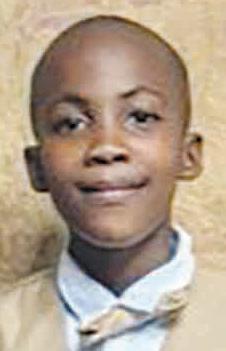
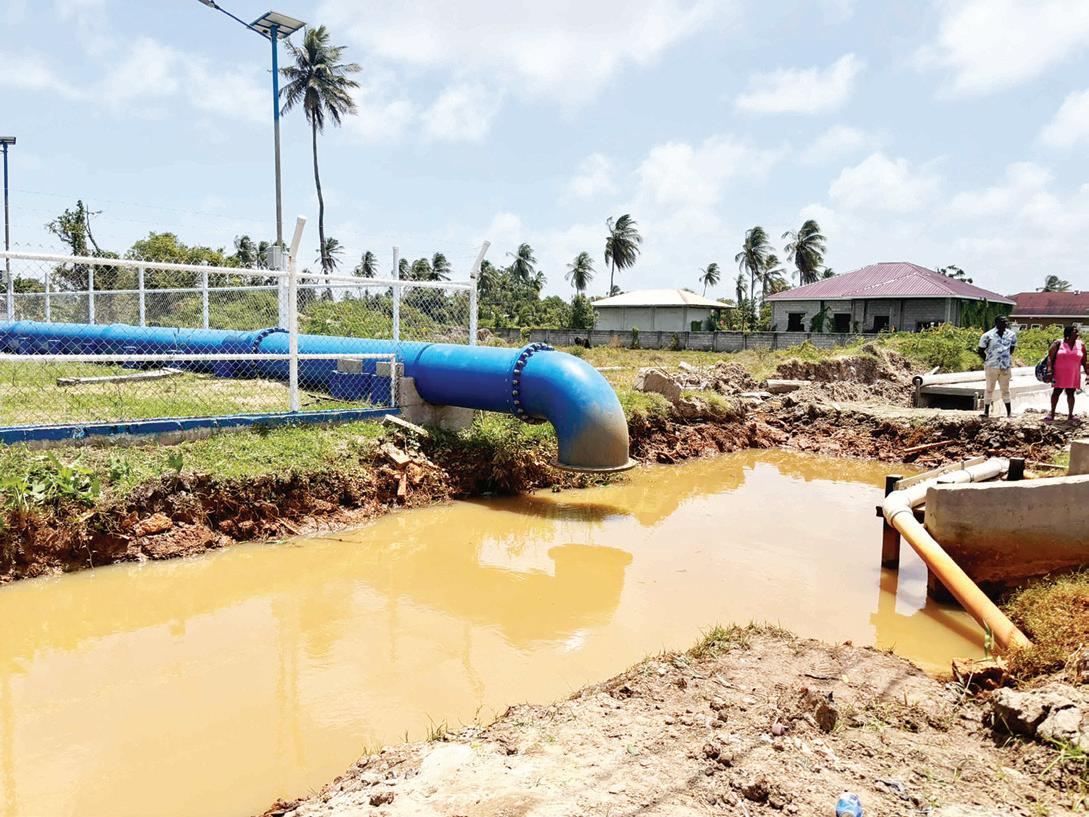
Tragedy struck in the community of Enterprise, East Coast Demerara (ECD), on Tuesday morning when two siblings drowned after reportedly falling into a trench at a construction site. Dead are nine-year-old Tianna DeCourte and 10-year-old Jadon DeCourte, both pupils of Melanie Damishana, ECD. According to Police, the incident occurred between
“I hear the ambulance siren coming in… their medical team was on foot running towards the kids to try to save them,” he said. The trench, residents said, was part of ongoing road and drainage works in the area. Questions were also raised about the role of the Guyana Water Incorporated (GWI) in relation to water reportedly being discharged into the trench.
08:00h and 11:05h along the Melanie Damishana/ Enterprise Access Road.
Investigators said the children were in the area with their mother when they reportedly wandered away. At about 11:05h, information was received that two children were found motionless in a trench. Police said that emergency medical technicians (EMTs) responded and pronounced them dead at the scene. No marks of violence were observed on their bodies, Police reported. Following the incident, the children’s father, Jason DeCourte, told reporters that the siblings had joined relatives to play Phagwah, a yearly tradition in the area.
“It’s an annual thing. Every year is an annual thing. They must go and play,” the grieving father said. He explained that Tianna had reportedly gone to refill her water gun from the trench, which had become filled with water due to ongoing construction works. She is believed to have slipped and fallen in. Her brother, Jadon, immediately attempted to rescue her but also fell into the water. He said that by the time he arrived at the scene, the children had already been pulled from the water and were lying motionless as residents gathered. The ambulance arrived shortly after.
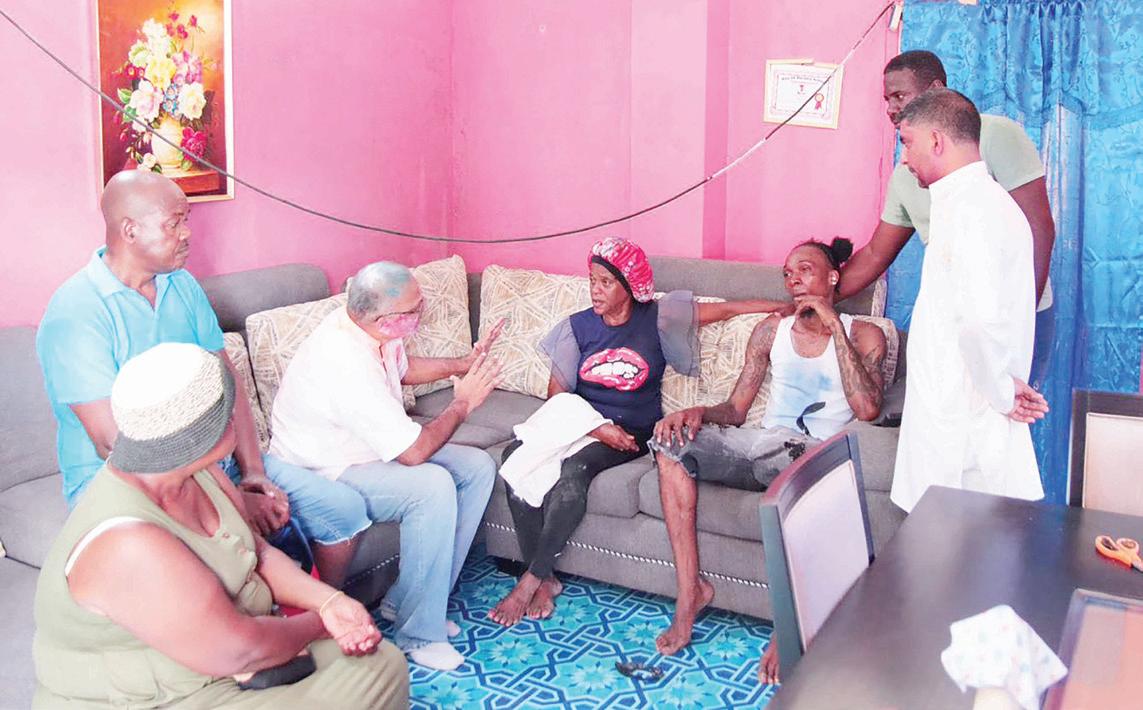
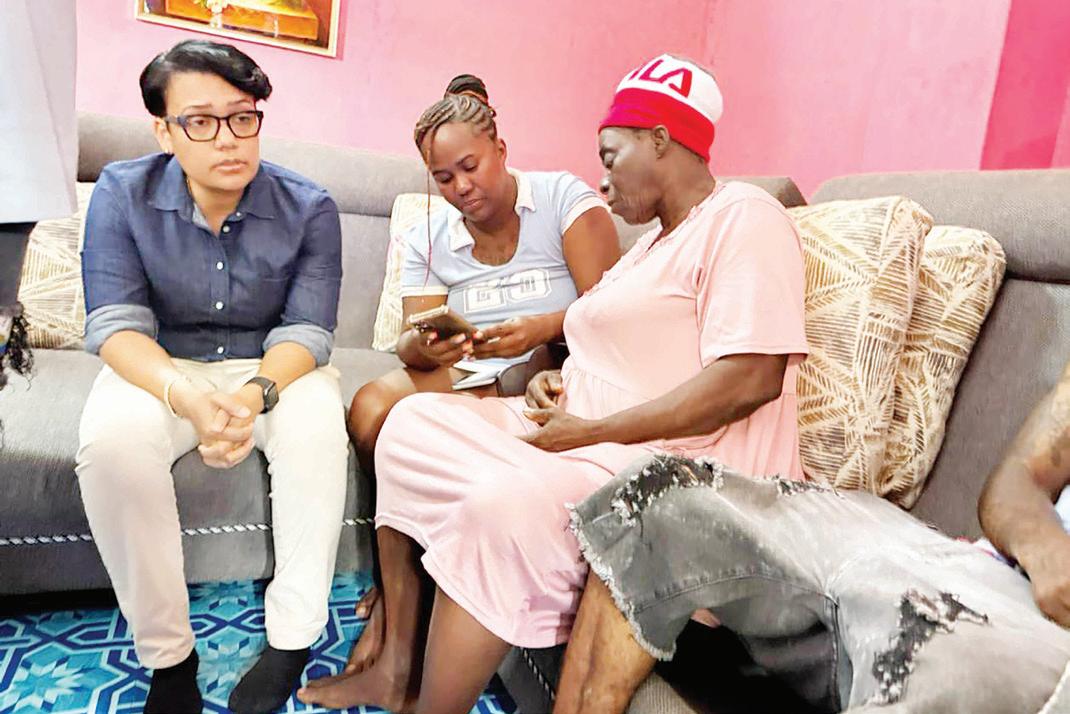
Minister Dr Frank Anthony and Tourism, Industry and Commerce Minister Susan Rodrigues visited the family to convey the Government’s sympathies and assure them of full support.
“No words can truly ease the pain of such a devastating loss, but please know that you are in our thoughts and prayers. We stand with you and will ensure that every possible support is pro-
Legal Affairs Minister Anil Nandlall, who also visited the family, urged that the tragedy not be politicised.
“While we celebrate the great Festival of Holi, I ask that we pause to bear in our thoughts Jadon and Tianna DeCourte, who tragically perished today,” he said. The children’s father noted that Tianna, who was a twin, would have celebrated her birthday on March 21, while
Govt’s support
Meanwhile, President Dr Irfaan Ali expressed condolences on his official Facebook page after the incident occurred, stating that Health
vided as you navigate this period of profound grief,” the President stated. Education Minister Sonia Parag also visited the family on Tuesday. Attorney General (AG) and
Jadon had turned 10 just last month. The siblings were among five children. Police said further updates will be provided as investigations continue.


Editor: Tusika Martin
News Hotline: 231-8063 Editorial: 231-0544, 223-7230, 223-7231, 225-7761
Marketing: 231-8064 Accounts: 225-6707
Mailing address: Queens Atlantic Industrial Estate Industrial Site, Ruimveldt, Georgetown
Email: news@guyanatimesgy.com, marketing@guyanatimesgy.com
The observance of World Wildlife Day on March 3 offers a timely reminder of the interconnection between biodiversity and human wellbeing. This year, under the theme “Medicinal and Aromatic Plants: Conserving Health, Heritage and Livelihoods”, the focus falls on the critical role these plants play in health, culture, and economic stability. For Guyana, endowed with rich biodiversity and deep-rooted cultural traditions, this theme resonates with both urgency and opportunity.
Medicinal and aromatic plants have long held a central role in the daily lives of Guyanese communities. Generations have relied on herbal remedies derived from the natural environment to treat ailments ranging from common colds and fevers to hypertension, skin conditions, and other health challenges. Plants such as aloe (Aloe vera), fever grass (Cymbopogon citratus), miney bush (Cassia bicapsularis), black sage (Cordia curassavica), and leaf of life (Bryophyllum pinnatum) are not merely botanical resources; they are living repositories of traditional knowledge, embodying the practical wisdom and cultural heritage of countless families.
Global research underscores the importance of these resources, as the World Health Organisation estimates that between 70 per cent and 95 per cent of people in developing countries rely on traditional medicine as their primary healthcare. Yet, despite their widespread use, many medicinal and aromatic plants remain under-researched, and indigenous knowledge is frequently overlooked. This disconnect threatens the continuity of cultural practices and sustainable livelihoods.
In Guyana, many aromatic and medicinal plants face pressures from habitat loss, unsustainable harvesting, and illegal trade. Without systematic efforts to document, protect, and regulate their use, these plants risk depletion, along with the irreplaceable knowledge associated with them. The call by the Guyana Wildlife Conservation and Management Commission (GWCMC) to prioritise preservation and documentation is both timely and essential.
The benefits of a coordinated conservation strategy are manifold. Safeguarding medicinal and aromatic plants ensures continued access to natural remedies that complement modern healthcare, especially in rural communities. It supports economic development by creating opportunities for sustainable cultivation, processing, and marketing of herbal products. Globally, demand for natural remedies is rising, presenting potential markets for Guyanese producers who adhere to best practices. Preservation of traditional knowledge also strengthens cultural identity, affirming the value of practices passed down over centuries.
Implementing such strategies requires a collaborative approach, and scientific research must intensify to document the properties, uses, and cultivation methods of local plants. Conservation policies should integrate traditional knowledge, recognising and protecting indigenous practices while guiding sustainable use. Public education campaigns can foster appreciation for these resources, encouraging responsible collection and utilisation. Enforcement mechanisms must prevent illegal trade and overexploitation, preserving both plants and the communities that rely on them.
The advantages extend beyond immediate healthcare or economic gains, as medicinal and aromatic plants connect contemporary society with the wisdom of generations while ensuring that future generations inherit a natural and cultural legacy intact. Guyana has the opportunity to position itself as a leader in sustainable management of medicinal plant resources, with additional benefits for the Caribbean and Latin America.
As the nation marks World Wildlife Day, proper documentation, conservation, and promotion of medicinal and aromatic plants are essential steps in safeguarding health, heritage, and livelihoods. By embracing this responsibility, Guyana can harness the full potential of its biodiversity, preserve the cultural knowledge embedded in its communities, and foster sustainable economic growth.
The conservation of medicinal and aromatic plants is a positive endeavour, one that recognises the intrinsic value of nature and the wisdom of traditional practices. Protecting these resources is an investment in health, cultural heritage, and the prosperity of future generations.
Guyana’s path forward is a commitment to preservation; today lays the foundation for a healthier, more prosperous, and enriched tomorrow.


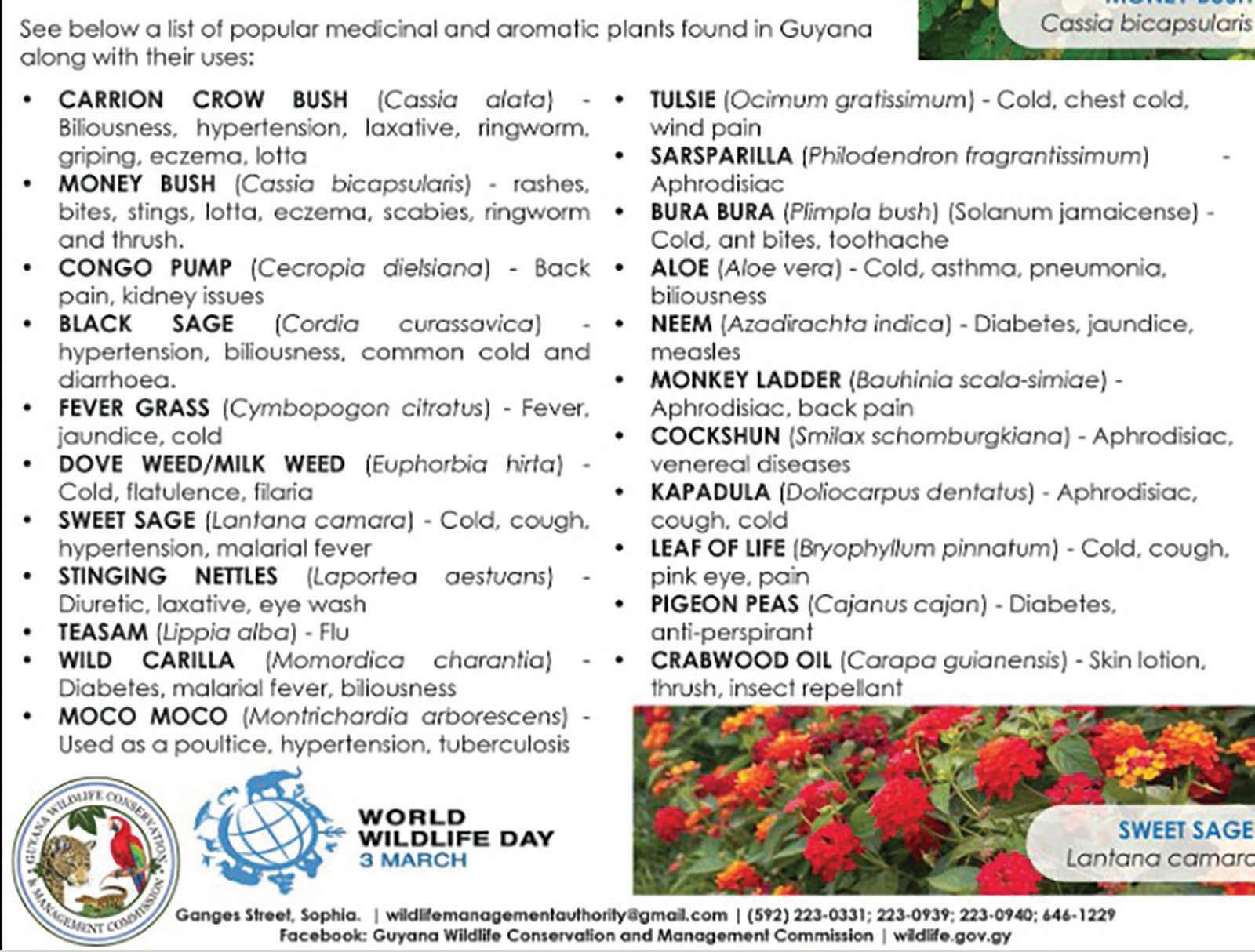
The Guyana Wildlife Conservation and Management Commission (GWCMC) has urged the preservation and proper documentation of medicinal and aromatic plants as the country joins the global observance of World Wildlife Day celebrated on March 3. This year’s commemoration under the theme “Medicinal and Aromatic Plants: Conserving Health, Heritage and Livelihoods” spotlights the critical role these plants play in the health, wellbeing, culture and economic stability of the nation. In its message marking the occasion, the commission on Tuesday noted that medicinal plants are deeply embedded in the history and
culture of the Guyanese people, with many families relying on herbal remedies passed down through many generations. According to the World Health Organisation (WHO), it is estimated that between 70 and 95 per cent of people living in developing countries depend on traditional medicines for primary healthcare. Despite this, there remains limited scientific research of medicinal plants, and the indigenous knowledge is often underutilised in policy and conservation efforts. The commission further noted that many aromatic and medicinal plants are currently under great threat as they are being traded illegally, facing loss of habitat and even overharvest -
ing. It emphasised the need to document and preserve traditional knowledge to ensure sustainable use of these resources for the future generations. Among the commonly used medicinal plants found in Guyana are aloe (Aloe vera) , fever grass (Cymbopogon citratus) , miney bush (Cassia bicapsularis) , black sage (Cordia curassavica) and leaf of life (Bryophyllum pinnatum) , which are traditionally used to treat ailments ranging from common colds and fevers to hypertension and skin conditions. World Wildlife Day is observed annually to celebrate wild fauna and flora and to raise awareness of the need of their conservation and protection.
Dear Editor,
The tragic death of 14-year-old Aleena Preetam and the reported stabbing of 15-year-old Tiana Chapman have understandably shaken our nation and have personally shaken me. Any harm to a child – regardless of background – demands sober reflection, compassion, and accountability, free from partisan framing or political opportunism.
Guyana does, in fact, have a child protection framework designed at the policy level to prevent, detect, interrupt, and respond to the exploitation of minors. Our laws provide legal authority, investigative capacity, protective intervention, and coordinated services intended to safeguard a child’s physical safety, psychological well-being, and long-term development. The pressing question, however, is not whether a framework exists, but whether it is functioning at the level and consistency envisioned by its architects.
The Childcare and Protection Agency Act establishes the Childcare and Protection Agency (CCPA) with clear authority to intervene in cases of abuse, neglect, and exploitation. Similarly, the Sexual Offences Act criminalises sexual activity with minors (below 16 years) and provides investigative and prosecutorial pathways. These are substantive, enforceable statutes – not symbolic declarations. The national conversation must therefore centre on implementation: Are these laws being applied consistently? Is
there seamless coordination between the CCPA and the Guyana Police Force and the hospitals? Are reporting and investigative protocols operating as designed? This is not a moment for blame but for constructive reform. An urgent, calm, and coordinated national dialogue is required to strengthen what already exists and address areas of operational weakness.
In this regard, Guyana is fortunate to have principled and compassionate leadership committed to social development. Dr Vindiya Persaud has consistently demonstrated a rare combination of empathy, administrative discipline, and forward-thinking vision in matters affecting women, children, and vulnerable communities. Her capacity as both a builder of systems and a healer of communities places her in a uniquely strong position to guide a comprehensive strengthening of our protective architecture. We should put her in charge of the required national conversation with all stakeholders to truly fix the challenge, and this conversation has to be concluded with some haste; there are too many unnecessary deaths. I have total confidence in her leadership and her work.
One reform worthy of consideration is the establishment of a specialised arm within the Guyana Police Force dedicated exclusively to crimes involving women and children. An instructive model can be found in India’s “Mahila Thana” (Women
Police Stations). Policing in India is historically governed by the Police Act of 1861 and modern state reforms, under the policy oversight of the Ministry of Home Affairs. Within this structure, specialised stations staffed primarily by trained women officers focus on social crimes such as sexual abuse, domestic violence, and child exploitation.
These units receive focused training in victim-sensitive interviewing, investigative procedures in sexual offences, coordination with social services, and community outreach, and they are trained in exclusive women-populated and -led training schools. This is easy to fix.
By concentrating expertise in one division, the regular police structure remains responsible for general criminal matters while a dedicated unit ensures specialised attention to vulnerable victims who are children and women when it comes to crimes like child and women exploitation. A similar model in Guyana could enhance reporting confidence, strengthen investigative outcomes, and improve inter-agency coordination with the CCPA, the Police and health services.
At the same time, we must acknowledge a broader societal responsibility. No child protection system anywhere in the world can intervene in circumstances that remain concealed and secretive. When child pregnancies are hidden within families, abuse is normalised. When communities remain silent in cases of children’s and women’s exploitation, the system’s
reach is inherently limited. Effective protection depends on collective vigilance at a community level following the principle “see something; say something”.
Strong child protection requires:
Mandatory reporting compliance (meaning in abuse, even the neighbours can be charged for not reporting the exploitation)
• Public awareness and education (unfortunately, the Guyana Police in its current construct – men-led –cannot advance this cause effectively)
Accessible and trusted complaint mechanisms (who better to speak to when you have been socially exploited than a mother/woman)
• Timely and professional investigation
Adequate staffing and resources
If any of these links weaken, tragedies can occur – even in the presence of sound laws. Guyana’s path forward is not to declare institutional collapse but to refine, strengthen, and modernise our approach in line with global best practice. Countries with complex social challenges have improved outcomes through specialisation, training, and accountability. Here in Europe, with the increase in migration of non-Europeans (with their different social customs) into Europe, serious review had to be done swiftly, and the authorities, especially in the Netherlands, did it competently. We can do the same.
We are a small nation
with immense potential.
Every child represents not only a life to be protected but also a future to be cultivated.
The loss or near-loss of any young life diminishes us all.
Let us respond not with despair, but with disciplined reform, thoughtful leadership, and collective resolve.
Yes, we can fix this!
Yours sincerely, Sasenarine Singh – a father of a girl child

WEDNESDAY, MARCH 4, 2026

1. What is a set in mathematics?
a) A set is a single number.
b) A set is a type of equation.
c) A set is a collection of distinct objects.
d) A set is a group of repeated objects.
2. What are the objects in a set called?
a) The objects in a set are called factors.
b) The objects in a set are called variables.
c) The objects in a set are called elements.
d) The objects in a set are called digits.
3. What types of things can be included in a set?
a) A set can contain numbers, letters, or other items.
b) A set can only contain numbers.
c) A set can only contain letters.
d) A set can only contain shapes.
4. Which symbol is used to represent a set?
a) The symbol is used to show a set.
b) The symbol is used to show a set.
c) The symbol is used to show a set.
d) The symbol is used to show a set.
5. How many elements are in the set ?
a) The set has one element.
b) The set has two elements.
c) The set has three elements.
d) The set has four elements.

Materials
• Cardboard Box
• Paper
• Thin Card
• White Tissue Paper
• Scissors
• Battery Powered Lights
• Clear Tape
• Masking Tape
• Jute Ribbon/Twine
• Pencil Instructions
1. Draw the template shapes on a sheet of paper and cut them out.
2. Position the template pieces on the cardboard and draw around them with a pencil.

3. Unfold the box to make it easier to cut from, then carefully poke a hole into each shape for ease of cutting.

4. Cut out the shapes with scissors. For smaller shapes, you may need to use
6. What is true about an empty set?
a) An empty set has one element.
b) An empty set has no elements.
c) An empty set has two elements.
d) An empty set has infinite elements.
7. Which statement is correct about the set ?
a) The set does not contain the element .
b) The set contains only numbers.
c) The set contains four elements.
d) The set contains the element .
8. How are sets usually written?
a) Sets are usually written with parentheses.
b) Sets are usually written with square brackets.
c) Sets are usually written with curly braces.
d) Sets are usually written with quotation marks.
9. What is true about the elements in a set?
a) A set cannot have duplicate elements.
b) A set can have duplicate elements.
c) A set must have at least one duplicate element.
d) A set can only have duplicate numbers.
10. What kind of numbers are in the set ?
a) The set is a set of even numbers.
b) The set is a set of odd numbers.
c) The set is a set of prime numbers.
d) The set is a set of negative numbers.
a scalpel and cutting mat.

5. Cut a piece of the white tissue paper to fit over your design inside the cardboard box. Secure it in place with tape.
6. Fold the box back into shape.



7. Tape the fairy lights into the bottom of the cardboard box, ensuring you cover each area with lights evenly.
8. Carefully poke a hole in each side of the box, then thread through the jute ribbon or twine to make a handle.

9. Knot the ribbon at each end to secure it.
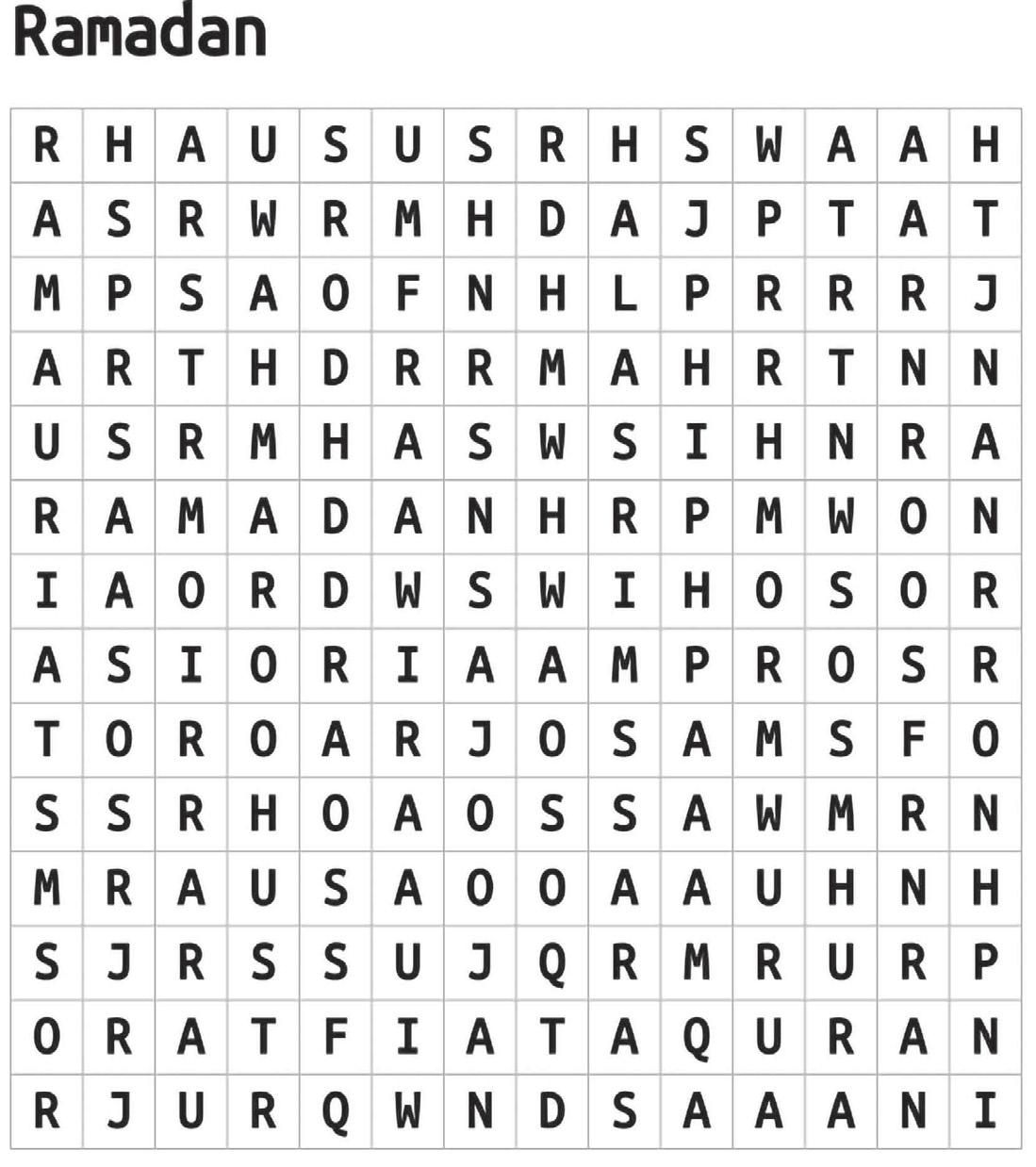
10. Your Ramadan lightbox is now complete and ready to decorate your room!
Template

(Adapted from hobbycraft.co.uk)
BY WS MERWIN
I am trying to decipher the language of insects they are the tongues of the future their vocabularies describe buildings as food they can instruct of dark water and the veins of trees they can convey what they do not know and what is known at a distance and what nobody knows they have terms for making music with the legs they can recount changing in a sleep like death they can sing with wings the speakers are their own meaning in a grammar without horizons they are wholly articulate they are never important they are everything
(Source: Poetry [October/November 1987])



…“It is a people-oriented project” – Site Manager
By Mishael henry
The US$10.8 mil-
lion Guyana-China Friendship-Joe Vieira Park is nearing completion, with its official opening slated for April.
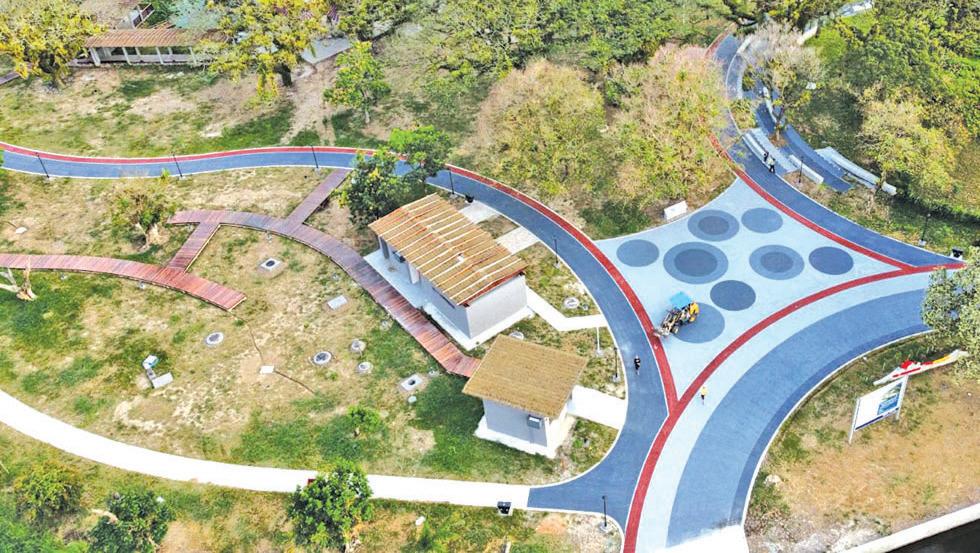
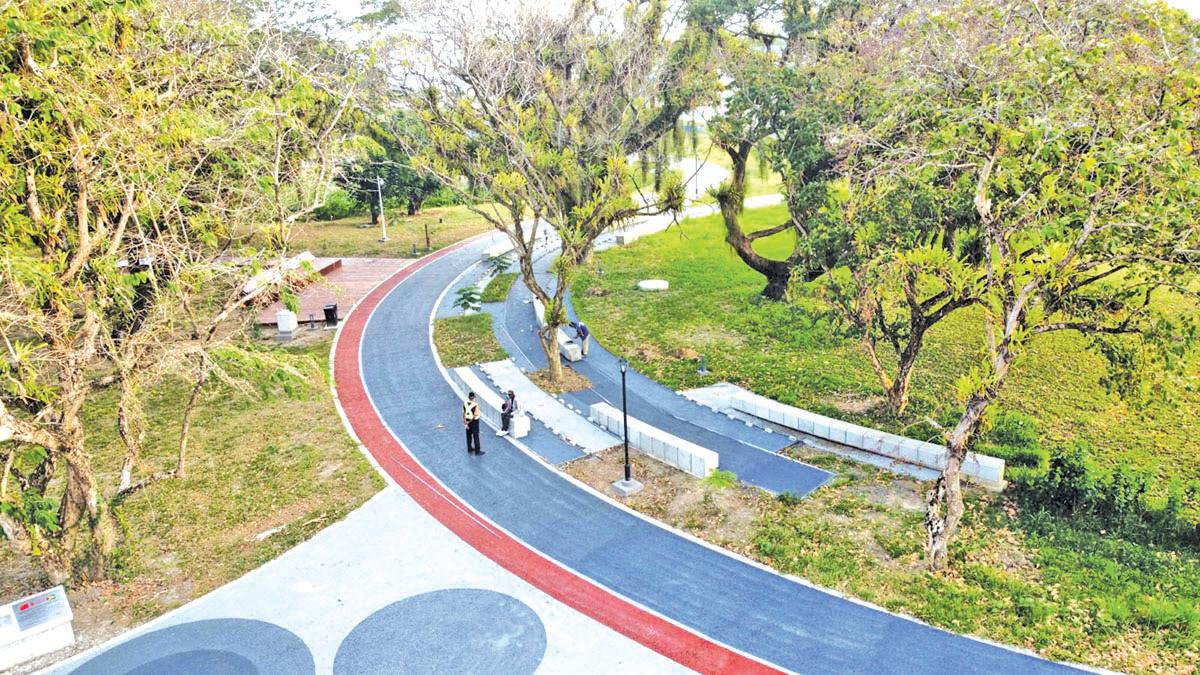
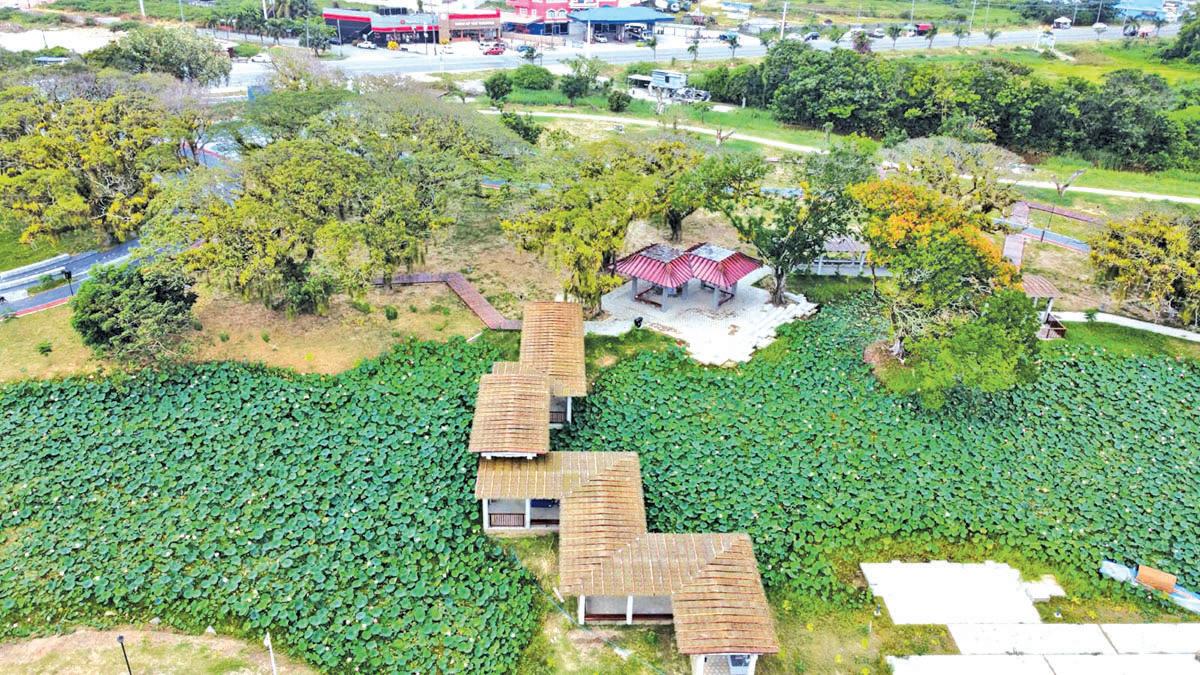
The Joe Vieira Park, now the Guyana–China Friendship Park, features a wide range of amenities, including a forest picnic area, wooden walkways, a Mandarin duck pavilion, a landscaped lake, bridges
and corridors, a hydrophilic platform, football fields with seating for approximately 500 spectators, pavilions, and a manufacturing plaza.
The construction of the park is being completed by China Southwest Architectural Design and Research Institute Corp Ltd and CSCEC Southwest Consultancy Co Ltd.
Before these upgrades, the park was gifted to the Government of Guyana by
its former owner, Joseph Rudolph Vieira, in 1982.
In January 2022, Guyana and China signed an implementation agreement under the China-Guyana Friendship Initiative to transform the park into a modern recreational space aimed at improving public health and well-being, similar in function to the National Park.
Upon completion, the park will be maintained and managed by the Protected Areas Commission (PAC).
This newspaper spoke with site manager Ni Shunhuani on Tuesday, who provided this publication with a firsthand look at the ongoing preparations.
“The construction within the park has been largely completed. The municipal electricity connection work and the external road on the east side of the park are expected to be completed by the end of March, and the park is sched-


uled to open in April. This park draws on the design style of traditional Chinese gardens while taking into account the needs of citizens,” he said.
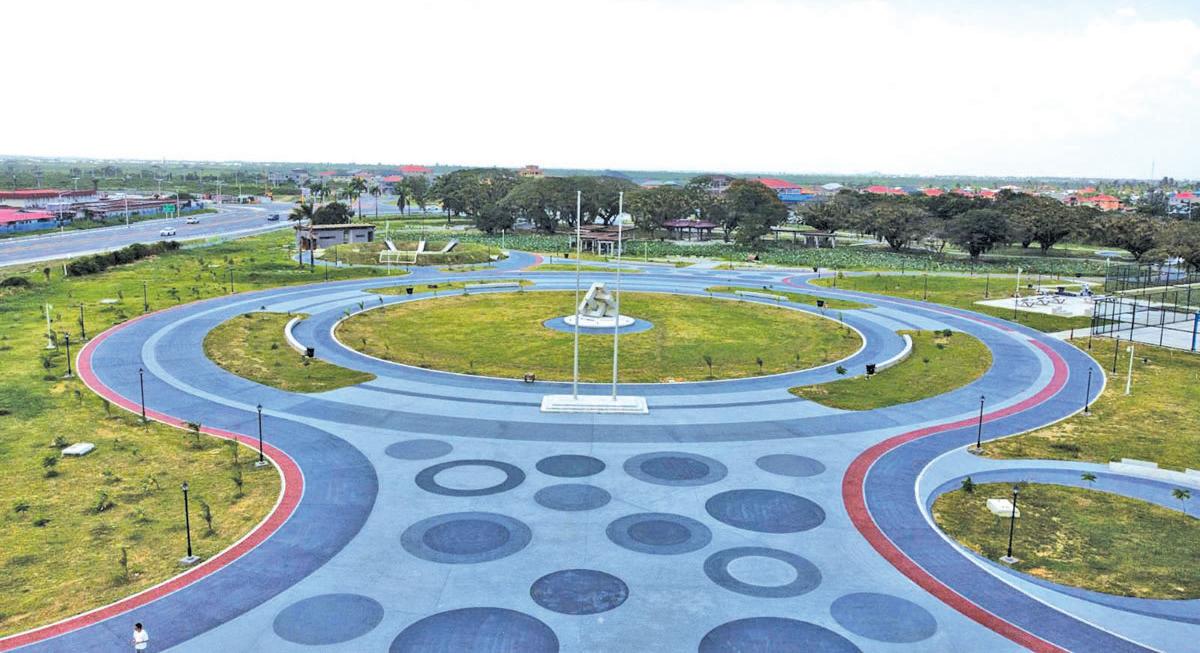
“We have built the park to feature Chinese-style pavilions and corridors, wooden roofs, football fields with stands, basketball courts, tennis courts, table tennis courts, children’s activity areas, and a central lake.”
The park also includes forest picnic areas, wooden walkways, and coloured concrete roads. It boasts an impressive monument named the Lu Ban Lock, which adds to its visual appeal. The monument symbolises the hand-in-hand and heart-to-heart bond between China and Guyana and represents strong cooperation between the two nations.
“It is a people-oriented project,” he added.
Security is one of the park’s main focuses, with sig-
nificant efforts being made to ensure the safety and well-being of visitors.
“Yes, security cameras have been installed, and multiple guard rooms have been set up to ensure the safety of the people. We have about 20 cameras here right now.”
Routine maintenance will be handled by the Protected Areas Commission (PAC), which has also been overseeing the completion process.
When asked whether persons can apply for vending
spots, the manager explained that there are many spacious areas within the park suitable for sales activities.
“The application process for vending must meet the subsequent management requirements of the PAC. This park includes a football field, basketball court, tennis court, table tennis court, a children’s activity area, and picnic areas under the trees. The specific application process must comply with the relevant regulations of the PAC.”



We all make noise when we’re happy, don’t we?? And today being “the day after Phagwah”, there’s a whole cacophony of noise that’s gonna be made!! Celebrations have always been accompanied by noise – whether of music or of raised voices. Can you imagine celebrating, say, hitting the lottery and not whooping it up?? Now this ain’t no recent innovation but goes back to the furthest antiquity! In the Western tradition, remember the Greeks and Romans with their Dionysian and Bacchanalian revelries?? They even had gods of “sporting” and making noise!! And in every tribal culture we made merry – noisily! – around our campfires!! Heck!! Your Eyewitness bets that when those cavemen brought back that deer from the hunt, they carried on like banshees!!
But outside of festivals, folks are complaining about noises that are driving them to distraction – and having them climbing the walls!! What gives?? Imagine our minibus operators take the trouble to provide entertainment to their passengers – free!! – and some spoilsports call it “noise pollution”!! Can you believe it?? Now, Dear Reader, you may say bus drivers could keep the music low – but then you’d miss the entire point of being West Indian!! How in God’s name can you listen to dancehall, soca or chutney “low”? Unless you’re going to a funeral, of course!!
Then there are the complaints about the music played all night – and all weekend – at wedding houses. Especially those Indian Guyanese seven-day weddings. Now this ain’t anything new – is it? In the old days the musicians would be playing live, and the entire village would be getting down like there was no tomorrow!! In fact, did you know that the entire bawdy chutney genre – with its “rum till I die” ethos in the Caribbean – originated from those goings-on at Indian weddings?
But the loudest (yes… “loudest”!!) complaints about the sounds of merriment and celebration are about our “rum shops”. Now let’s be real. Even the Indigenous Peoples –who weren’t shanghaied to labour on our plantations back in the day – celebrated after hard work. Mashramani, they called it, no?!! Now you think they only worked one day a year?? If you said “yes”, that just shows how you’ve bought into the racist European stereotypes!! Now don’t you think the slaves and indentured also wanted to celebrate after their gruelling labours in the fields? So after emancipation, they turned to the rum shops that were conveniently provided by the ever-solicitous planter!!
So, Dear Readers, the noise around us is part and parcel of our culture in our neck of the woods!! Aren’t we a “happy-go-lucky” set of people?? And it’s part of the charm to those uptight folks from up north, whom we can fleece as tourists!!
…starvation?
Your Eyewitness periodically reads accounts of folks “struggling” in our dear land of Guyana. It’s based on the rising “cost of living”. Now, while there’s no question the reports are describing a reality – your Eyewitness is thinking about how we’ve come to this when we have some 83,000 square miles of that land – with not even a million people!? The focus of the reports seems to be that the Government ought to be doing something about this situation.
And hey!! They should!! But in the meantime, what about us?? How about the kitchen garden that used to be standard back in the day?? Each of the hard-luck stories your Eyewitness reads about concerned folks who were living in homes with backyards!! Is it that they don’t want to get their hands dirty to plant some poi bhagee and bigan?? And how about minding some fowls??
Now don’t get your Eyewitness wrong; there ought to be a governmental safety net, but let’s help ourselves, shall we??!!
…tail-wagging dog??
Your Eyewitness just learnt the Yanks launched their attack on Iran because Israel – on their own – had already decided to launch an attack!! They figured the Iranians would automatically attack them – and decided on preemptive strikes!!
Tail wagged the dog??





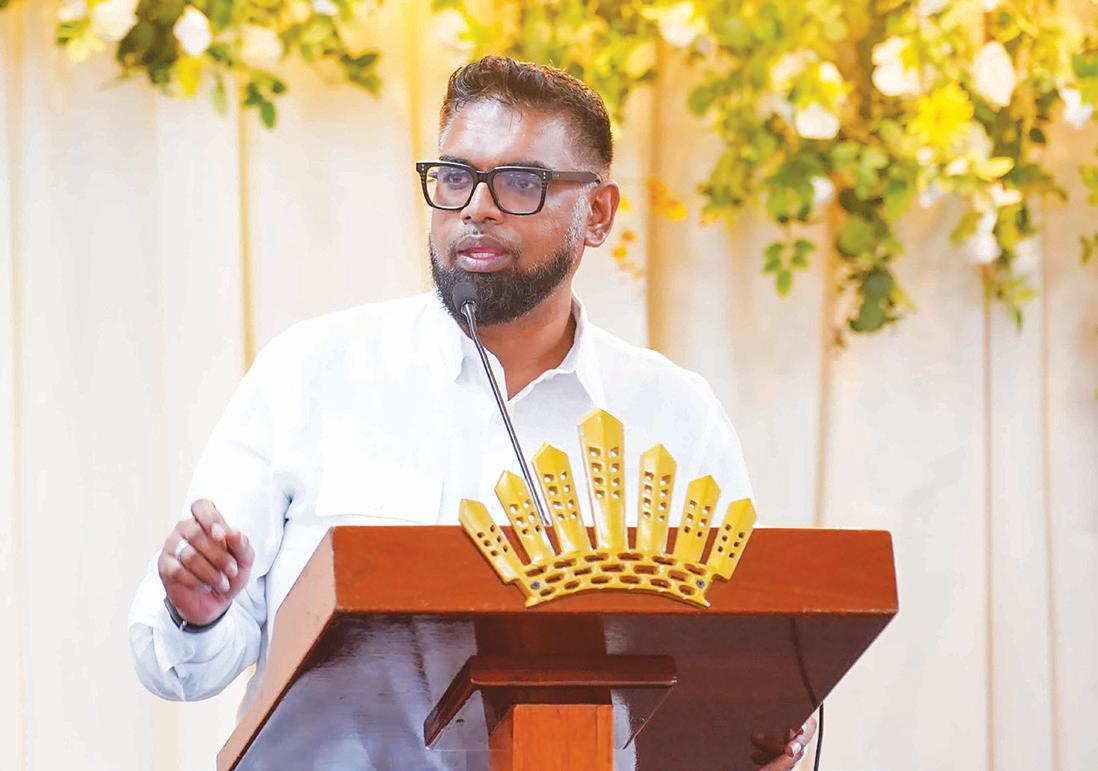
President Dr Irfaan Ali has urged the global community to prioritise dialogue as tension escalates in the Middle East, emphasising the need for peace, restraint and protection of civilians, particularly women and children. Speaking at the Phagwah celebration held at the State House on Monday, the Head of State highlighted the human cost of ongoing conflicts, noting that every second, war and destruction are affecting countless innocent lives. He stressed that while many may seek peace, which in their open comes along the road of war, for us in Guyana
open and to allow the table of conversation to supersede the table of strength, to ensure long lasting peace among the nations, with dignity, freedom and respect for the rule of law. He framed his message citing Guyana’s diverse and peaceful context, emphasising that dialogue must remain the central focus to ensure conflict resolution. He expressed, “we call upon all the stakeholders, all the countries in the Gulf, Israel, Iran, the US and everyone to allow the table of conversation to supersede the table of strength and let the table of conversation deliver lasting peace with re-
we say the road to peace is dialogue. “On this occasion I ask you to remember the rest of the world, especially in the Middle East and other places where war, conflict and destruction is occurring every second. Especially for women and children. We’ve already seen in this war, in a disproportionate manner, more women and children are affected than anyone else. And the funny thing is that, everybody wants peace, but in their opinion, the road to peace is war. For us in Guyana, we say the road to peace is dialogue. The road to peace is promoting and ensuring that we don’t remove ourselves from the table of conversation,” the President said. The President called upon all parties involved, including the counties in the Gulf, Israel, Iran and the United Sates (US) to keep communication channels
spect with the rule of law, with freedom, with dignity and with honour and we do so today in a Guyana that is diverse.” Earlier in the week the Foreign Affairs and International Cooperation Ministry released a statement condemning the unprovoked attacks by Iran on the Kingdom of Bahrain, the United Arab Emirates (UAE), the Kingdom of Saudi Arabia, the Republic of Iraq, the State of Qatar and the State of Kuwait, describing the actions as unjustified and a breach of international law. The Ministry also called on all parties to deescalate and restraint tensions in the interest of regional peace and stability. It also expressed full solidarity with the Governments and people of the affected nations, condemning all acts of aggression and hostility against these countries.
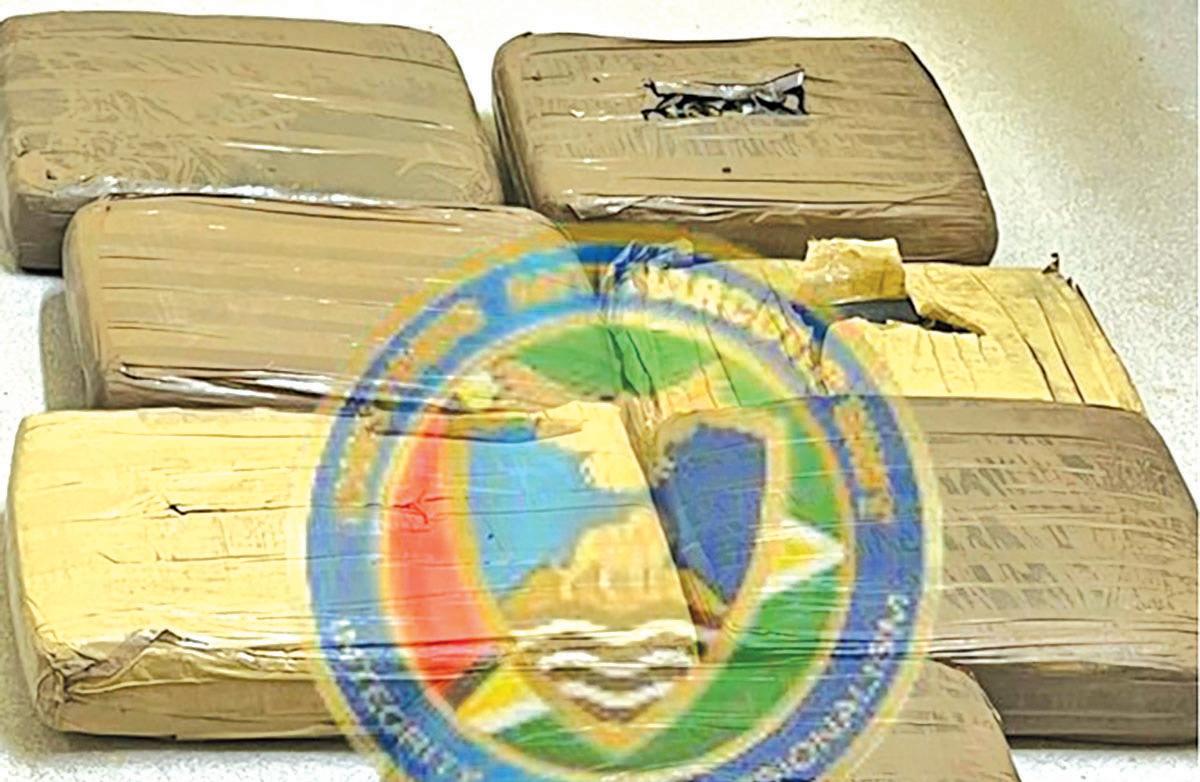
Officers of the Customs Anti-Narcotic Unit (CANU) on Monday intercepted two men on Hadfield Street, Georgetown, after acting on information received.
According to CANU, the operation was carried out on March 2 in the vicinity of Hadfield Street, where ranks stopped a motorcycle bearing registration CL
4761. According to CANU, a search conducted on the suspects led to the discovery of several parcels containing cannabis.
The men, Jaleel Bagot and Quincy McDonald, were arrested and escorted to CANU Headquarters along with the narcotics. The cannabis seized has a total weight of 7.028 kilograms. Investigations are ongoing.
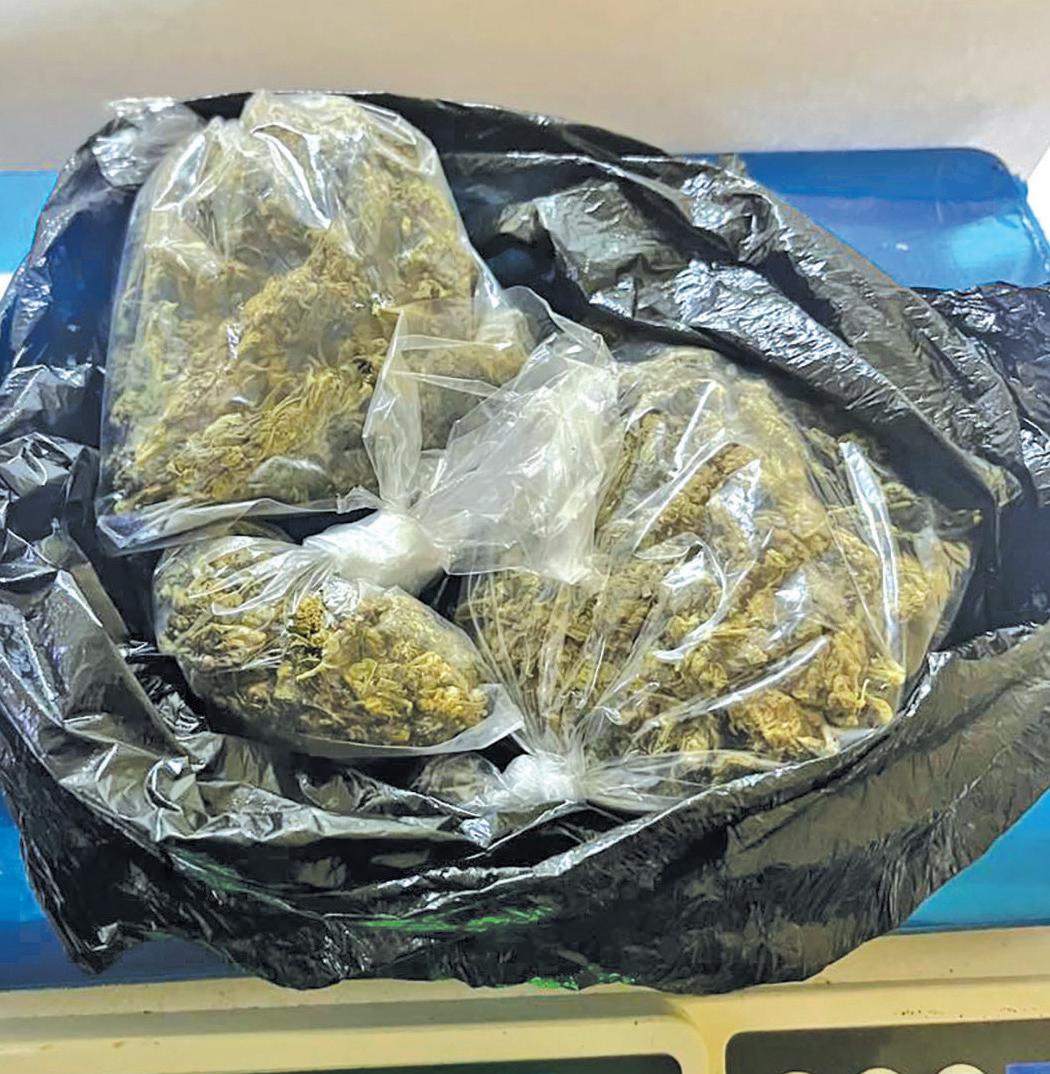
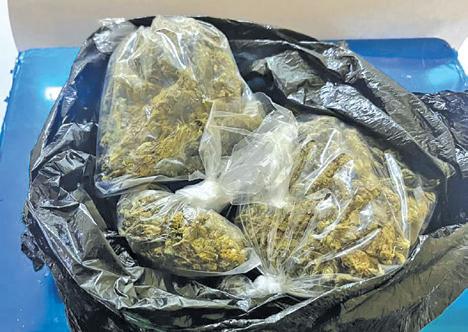
Police in Regional Division Eight found a quantity of cannabis during an operation on Sunday night at School Street, Mahdia, Region Eight (Potaro-Siparuni).
According to Police, the exercise was conducted between 21:30h and 22:30h on March 1. During the operation, ranks searched an abandoned yard in the area


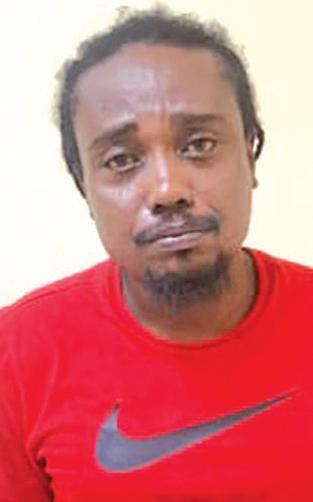
Charged: Kevin Grant
and found a bulky black plastic bag concealed inside a tyre in nearby bushes.
The bag contained three transparent plastic parcels with leaves, seeds and stems.
The narcotic was taken to the Mahdia Police Station, where it was weighed and amounted to 130 grams. No arrests have been made, and investigations are ongoing.
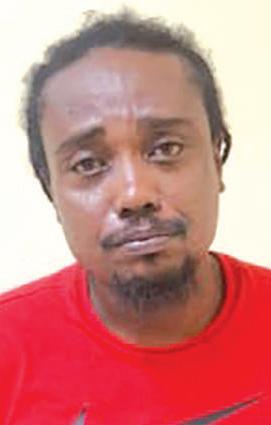
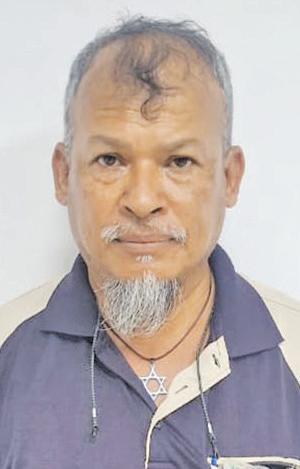
A30-year-old porter of the Diamond Housing Scheme, East Bank Demerara (EBD), has been slapped with a charge of possession of narcotics for the purpose of trafficking. Kevin Grant appeared on Monday before Magistrate Teriq Mohamed at the Bartica Magistrate’s
Court, where the charge was read to him. He pleaded not guilty. The charge was instituted under Section 5(1)(a)(i) of the Narcotic Drugs and Psychotropic Substances (Control) Act, Chapter 10:10. He was granted $400,000 bail, and the case was adjourned to April 2.

Two men from the Essequibo Coast were fined a combined $580,000 after pleading guilty to a series of traffic offences at the Charity Magistrate’s Court on Monday.
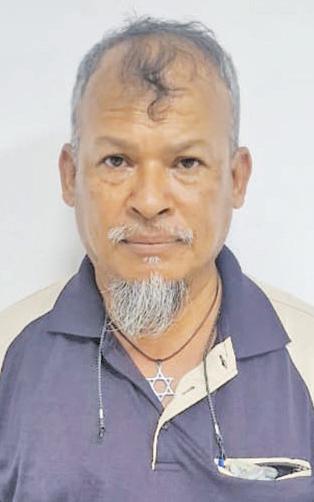
Adrian Deane, 33, a speedboat captain of Good Hope, Essequibo Coast, was charged with driving while his breath alcohol level exceeded the prescribed limit, unlicensed driving, failing to have identification marks
displayed on the front and rear of his vehicle, operating an unlicensed motor vehicle, and operating an uninsured motor vehicle.
The offences occurred on Monday, February 16, 2026, at Good Hope Public Road, Essequibo Coast. The charges were laid under the Motor Vehicle and Road Traffic Act, as amended by Act 17 of 2022, and the Motor Vehicle Insurance Third Party Risk Act. When the matter was called be-
fore Magistrate Ravindra Mohabir, Deane pleaded guilty to all charges.
He was fined $200,000 for driving while his breath alcohol level exceeded the prescribed limit, with six months’ imprisonment in default of payment. For unlicensed driving, he was fined $30,000, with three months’ imprisonment in default. He was fined $50,000 each for failing to display identification marks on the front and rear of the vehicle, with
three months’ imprisonment in default for each offence. Additionally, he was
fined $10,000 for operating an unlicensed motor vehicle, with two weeks’ imprisonment in default, and
$40,000 for operating an uninsured motor vehicle, with three months’ imprisonment in default. The total fines imposed on Deane amounted to $380,000.
In a separate matter, Einstein Farouse, 61, a vendor of Lot 4 East Public Road, Lima, Essequibo Coast, was charged with driving while his breath alcohol level exceeded the prescribed limit. The offence occurred on Sunday, February 5, 2026, at La Belle Alliance Public Road, Essequibo Coast. The charge was also laid under the Motor Vehicle and Road Traffic Act. Farouse pleaded guilty when he appeared before Magistrate Mohabir and was fined $200,000, with six months’ imprisonment in default of payment.

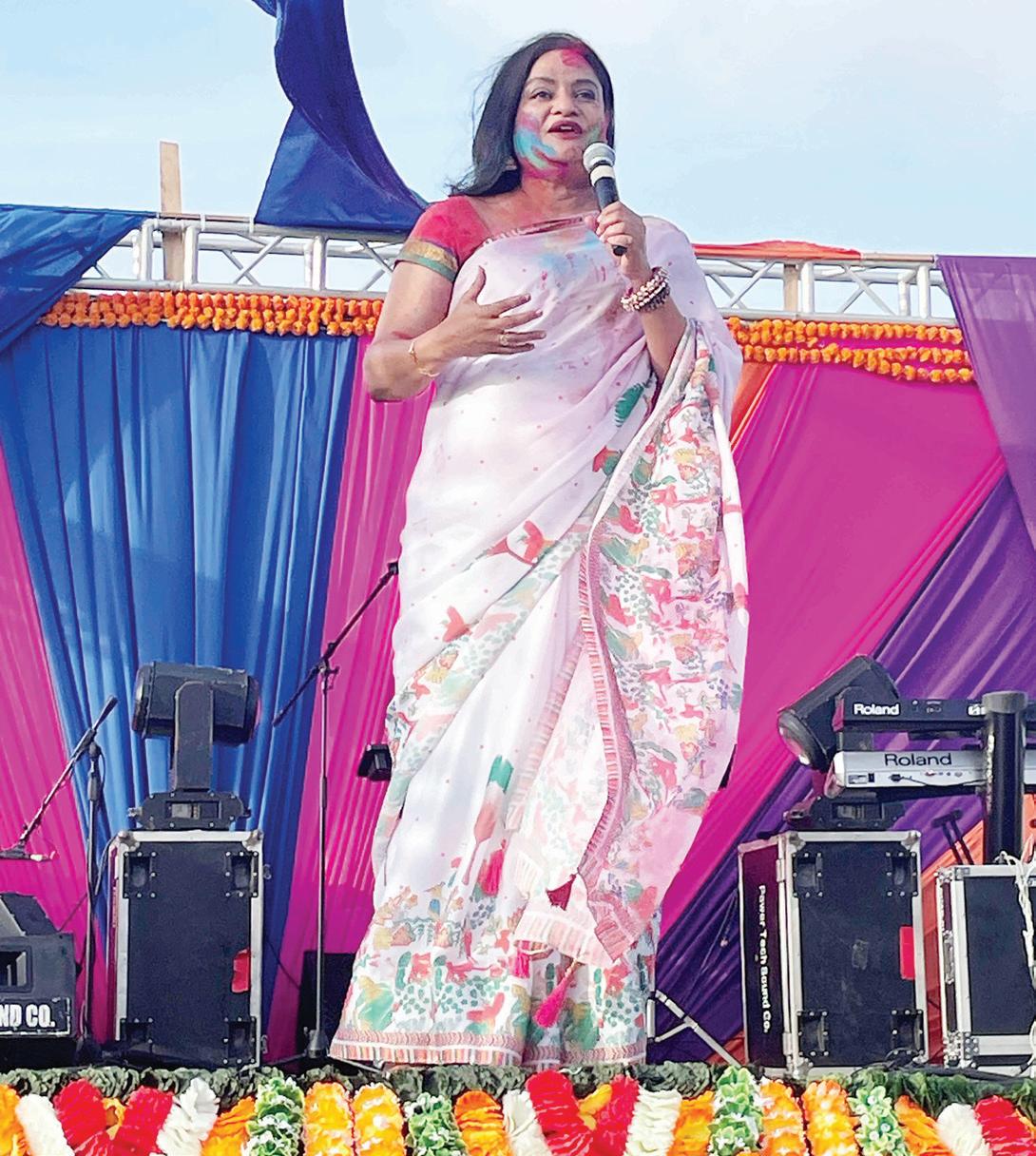
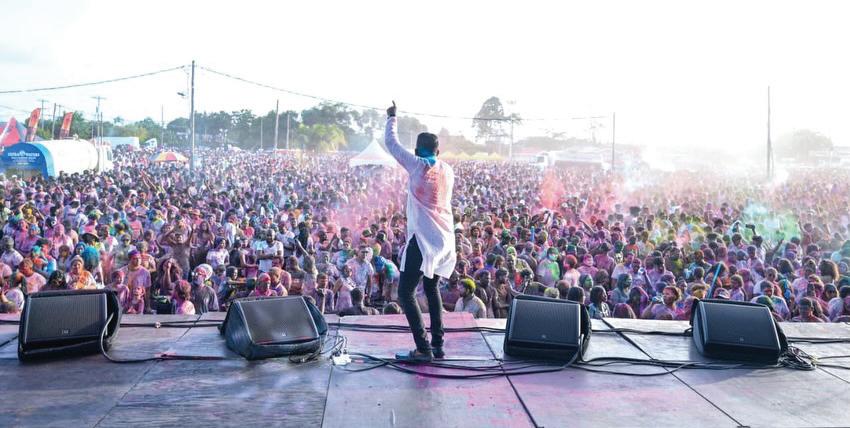
With clouds of crimson, blue, green, pink and yellow rising into the air, the atmosphere was filled with the sound of laughter, music and rhythmic beats at the Guyana Hindu Dharmic Sabha’s (GHDS) Holi Ustav, the High Commission of India event and the One Guyana Phagwah Festival on Tuesday, where Guyana’s rich and vibrant multicultural spirit was on display during the Phagwah celebrations.
day filled with colour, camaraderie and cultural pride. The Phagwah celebrations at the Indian High Commission featured traditional dancing, chowtal singing and musical tributes which transformed the atmosphere into a live canvas of Guyanese cultural and social harmony. As the persons of all ages enthusiastically played Phagwah together, the atmosphere was filled with the spirit of joy and happiness. At all three of the main events on Tuesday, danc-
performances while others clapped along. When singers mounted the stage, the atmosphere grew even more interactive.
The audience echoed the verses of familiar tunes, clapping in rhythm and dancing to the beat, as melodies filled the air. As music blended with laughter and vibrant splashes of abeer and powder, the atmosphere turned the entire gathering into one unified celebration of culture, colour and community. Delivering remarks at the Indian High Commission event, Attorney General (AG) and Legal Affairs Minister Anil Nandlall extended Holi greetings on behalf of President Dr Mohamed

celebrations in the Hindu calendar,” Nandlall said, noting that in Guyana, the

Irfaan Ali, who sent his regrets for not being present. Nandlall praised the Indian High Commission for its con-

The events hosted at the Everest Cricket Ground and the Guyana National Stadium brought together political leaders, the diplomatic corps, cultural and religious organisations, and people from all walks of life for a
ers dressed in beautiful and colourful attire twirled around the stage with energetic dance moves which symbolised renewal and joy. Applause rang out as spectators swayed to the rhythm, some rising to capture the
sistent role in hosting the annual celebration and commended the performers for what he described as an “explosion of culture, talent and joy”.
“Phagwah is one of the most important events and
festival has long transcended its religious boundaries.
“It is not only a Hindu festival; it is a national festival, and we celebrate it ap-
propriately with a national holiday being declared, and that has been the position for many decades.”
He highlighted the deeper meaning of the observance, referencing the triumph of good over evil, the victory of Prahlad and the celebration of spring and renewal.
Echoing similar sentiments, acting High Commissioner of India, Manoj Kumar, described Phagwah as one of the most joyful and vibrant festivals in Indian tradition and praised Guyana for preserving its inclusive character.
“In Guyana, Phagwah holds a special and unique significance. It is not only a festival of the Indo-Guyanese
community but also a celebration of multicultural harmony,” Kumar added. At the National Stadium, Providence, where thousands gathered, Culture, Youth and Sport Minister Charles Ramson, Member of Parliament (MP); Steven Jacobs, MP, Minister within the Ministry; and Minister within the Office of the Prime Minister (OPM), Kwame McCoy joined patrons in celebrating this significant cultural and religious occasion. The President of the GHDS, Dr Vindhya Persaud, who is also the Human Services and Social Security Minister, led the GHDS Holi Ustav at Everest Cricket Ground.


Kudos, Guyana – we have a chance to eliminate cervical cancer by 2050
Today is International Human Papilloma Virus (HPV) Awareness Day. More than 80 per cent of us are likely to be infected by HPV in our lifetime. There are more than 200 different kinds of HPV that are circulating among humans. Most are harmless. But there are several HPVs which cause cancer. More than 90 per cent of cervical cancers are caused by only a handful of HPVs. The main ones that cause cervical cancer are HPV16 and HPV18, both of which are prevalent in Guyana.
Guyana is part of a global effort to eliminate cervical cancer, one of the most prevalent forms of cancers in women. The UK, Western Europe and North America are on track to eliminate cervical cancer between 2040 and 2050. The President Irfaan Ali-led PPP Government is positioning Guyana to eliminate cervical cancer by 2050. Minister Frank Anthony and the MOH are working hard to ensure Guyana achieves this milestone.
Cervical cancer is the second most common cancer among women in Guyana, with approximately 121 new cases and 63 deaths reported annually. The disease disproportionately affects women, ranking second for both incidence and mortality among women aged 15–44. Highrisk HPV (16/18) is a major factor, with high prevalence rates noted, particularly among indigenous populations. With an incidence rate of more than 20/100,000 women, Guyana’s cervical cancer rate is very high.
On March 13th, Guyana’s Permanent Mission in Geneva will join Permanent Missions from different countries around the world to push for global elimination by 2080. Guyana’s Permanent Representative in Geneva has been a lead proponent for a global push to eliminate cervical cancer by 2080. The elimination of cervical cancer before or by 2080 will mark only the second time that the world would have achieved the end of a disease. It will also mark the first time we would have eradicated a cancer.
While the WHO global strategy envisages global elimination of cervical cancer by 2120, a growing number of public health experts have joined Guyana’s Permanent Representative in Geneva to urge acceleration to end cervical cancer by 2080, 40 years before the WHO’s global elimination deadline. With the robust strategy in Guyana, our country can play a leading role by trying to achieve national elimination by 2050.
The latest available global data reveal approximately 600,000 new cases of cervical cancer and 338,800 deaths annually, constituting 6.5 per cent and 7.7 per cent of total new cancer cases and deaths in women, respectively. Low-Human Development Index (HDI) countries have the highest incidence and mortality rates of cervical cancer, with incidence rates three times higher than those in countries with high-HDI and mortality rates six times higher.
With vaccines on hand and remarkable scientific and technological advancements, the world can duplicate the lessons of smallpox eradication to eliminate cervical cancer. Several Ambassadors in Geneva, led by Guyana’s ambassador, have issued a call to action. These ambassadors argue that just as the world, working together, eradicated smallpox, we can together, today, eliminate cervical cancer. These ambassadors urge nations to strive as ONE WORLD to end cervical cancer before May 8, 2080, when we celebrate the 100th anniversary of the eradication of smallpox.
Over thousands of years, from as early as 1350 BC, smallpox, a highly infectious, deadly disease, killed hundreds of millions around the world. But today, it remains the only human infectious disease to have been eradicated. The beginning of the end was when the World Health Assembly in 1958 issued a call for the eradication of smallpox, a global call to action. In 1959, the WHO launched the Smallpox Eradication Program, with mass vaccination as the foundation of the eradication strategy. In the height of the Cold War, British, Canadian, Cuban, French, Russian, and US vaccines were given freely to the WHO and distributed onwards, sometimes with the strategic financial support of Sweden. The result was that the WHO declared zero cases of smallpox in the world as of October 26, 1979; a Global Commission of Scientists certified the eradication of smallpox on December 9, 1979; and on May 8, 1980, the WHO at WHA33 declared smallpox officially eradicated.
National, regional and global investments in the fight against HPV and cervical cancer are a “best buy”, an option we ignore at great peril for people, particularly for women in resource-poor settings. Remarkable advancements in science and technology, an armoury of tools, provide countries with the real possibility for ending cervical cancer before 2050 in many countries and before 2080 in all countries. Guyana can be a leading light by ending cervical cancer by 2050.
Ending a cancer for the first time will be monumental. The progress we have made in the fight against cervical cancer in the past two decades must motivate us to reach the finish line in eliminating cervical cancer. The question must not be “if” we can; it must be “when”.
On November 17th, 2020, Member States of the WHO adopted the Global Strategy for Cervical Cancer Elimination. An important outcome of the strategy is for countries to achieve an incidence rate of below four per 100,000 women. As a first step towards reaching this goal, countries must achieve the “90-70-90” targets by 2030. The 90-70-90 targets are 90 per cent of girls vaccinated with the HPV vaccine before the age of 15; 70 per cent of women screened using a high-performance test by the age of 35 years and again by the age of 45; and 90 per cent of women with precancer treated and 90 per cent of women with invasive cancer managed.
Although daunting, the global ambition to eliminate cervical cancer before the 100th anniversary of the eradication of smallpox is possible. We, the world, must not abdicate this responsibility. It will be reckless and immoral for us not to grab the opportunity for a public health milestone that is staring at us.
Guyana’s sustained, though slightly slower, economic growth helped offset a broader slowdown across the Caribbean in 2025, according to findings shared Tuesday at the Caribbean Development Bank (CDB) Annual News Conference. Excluding Guyana, regional growth dropped to 0.6 per cent in 2025, down from 1.4 per cent in 2024. When Guyana’s double-digit expansion is included, overall regional growth reached 4.7 per cent, highlighting the country’s continuing contribution to the Caribbean economy. “Small, open economies remain highly exposed to external shocks,” said Jason Cotton, Acting Deputy Director of Economics at CDB. “What is more concerning in this moment is the persistence of uncertainty and the narrowing room for policy error.”
exporters, Suriname recorded faster growth supported by ongoing oil-related investments, while Trinidad and Tobago saw modest expansion. Service-exporting economies experienced slower growth as tourism momentum eased. In Jamaica, Hurricane Melissa compounded prior damage from Hurricane Beryl, resulting in a second consecutive year of contraction. Inflation moderated to an average of 3.4 per cent regionally, down from a 2022 peak of 9.7 per cent. Labour markets showed improvement in several countries, with declining unemployment and rising workforce participation, though disparities remain among youth and women.
Fiscal pressures re-emerge
ital spending, the surplus dropped to 0.2 per cent of GDP. Regional central government debt-to-GDP ratios fell slightly to 46.6 per cent, but nine countries still recorded debt above 60 per cent of GDP. In some cases, fiscal responsibility frameworks helped manage climate shocks through escape clauses.
2026 Outlook: modest growth, elevated risks
“Resilience is built through credible policy choices, stronger institutions, disciplined execution, investment in our people, and regional solidarity,” Cotton said. “If we rise to meet this moment, we will shape a more stable, inclusive and sustainable Caribbean future.” WEDNESDAY, MARCH 4,
Climate shocks, sectoral divergence
In a release on Tuesday, CDB said that economic performance across the region varied. Among commodity
Fiscal consolidation weakened in several of the Bank’s 19 borrowing member countries. Excluding Guyana, the regional primary surplus narrowed to 1.3 per cent of gross domestic product (GDP) as expenditure growth outpaced revenues. Including Guyana, reflecting significant cap-
Looking ahead, the Bank projects modest growth for 2026. Excluding Guyana, regional GDP is expected to expand by 1.1 per cent, with Guyana’s growth projected to exceed 20 per cent, where overall regional growth could reach 6.2 per cent. Commodity-exporting economies will remain closely tied to global prices and production trends. Serviceexporting economies are expected to see modest growth, supported mainly by tourism and construction. Inflation will continue to reflect global commodity market dynamics. However, risks including global uncertainty, geopolitical tensions,


tation capacity to translate plans and financing into results; diversifying economies to reduce dependence on single industries; building resilience through climate-resilient infrastructure, disaster-risk financing and adaptive social protection; safeguarding debt sustainability via stronger fiscal institutions and broader adoption of fiscal responsibility frameworks; and investing in people by equipping citizens with skills and expanding decent work opportunities.
climate shocks and fiscal vulnerabilities, especially in highly indebted countries, continue to challenge the outlook.
CDB emphasised key priorities for the region: strengthening implemen-
Two officers attached to the Child Care and Protection Agency (CCPA) have been suspended with immediate effect after video circulated on social media showed them dragging a schoolgirl along the roadway. Human Services and Social Security Minister Dr Vindhya Persaud, on Tuesday, described the incident as appalling and confirmed that the Guyana Police Force (GPF) has been called to investigate the matter urgently. “They have been suspended with immediate effect, and the Police have been called in to take action. They will be held accountable for their conduct which runs counter to the values and operational procedures of the Child Protection Agency,” the Minister stated. In the video, which was seen by this publication and which has been shared on social media, two female officers are seen pulling the girl by her arms and hair, dragging her along the roadway in her school uniform. In the video passers-by plead with them to stop, adding that they will be releasing the video recording of their actions. The footage has since
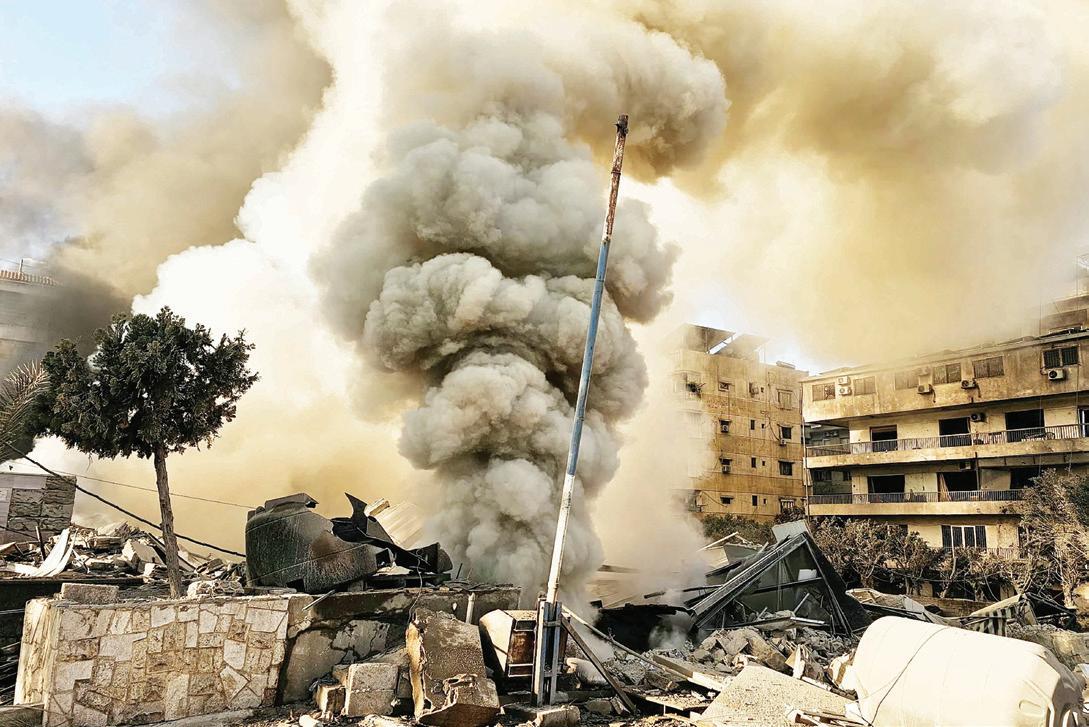
The call for peace and dialogue come amid intensifying conflict in the Middle East. On Sunday evening the BBC reported that US and Israel have bombed targets across Iran for a fourth day, as President Donald Trump declared that the country’s air defences, air force, navy and leadership were “gone”. According to the BBC report, the Israeli military said it had struck Iran’s Presidential Office, a

sparked widespread condemnation. Persaud, in her statement, emphasised that such conduct will not be tolerated and reaffirmed the
Ministry’s commitment to protecting the children of Guyana. “Incidents such as this cannot and will not be tolerated,” she said.
covert nuclear compound, and a Revolutionary Guards commander in Tehran, while the US military said it had destroyed command facilities, missile launch sites and airfields. Iranian authorities did not comment, the BBC report stated, but added that explosions were reported across Iran, where the Red Crescent has said 780 people have been killed since Saturday. Iran has responded to the strikes by
launching deadly missile and drone attacks on Israel and Gulf states hosting US bases. According to the BBC, A drone hit a car park adjacent to the US consulate in Dubai on Tuesday evening and “set off a fire in that place”, US Secretary of State Marco Rubio said. It came hours after two drones hit the US embassy in Saudi Arabia’s capital Riyadh and caused a “limited fire”, according to the Saudi defence Ministry.
The Director General of the Inter-American Institute for Cooperation on Agriculture (IICA), Muhammad Ibrahim, begins a four-day working visit to Brasilia this week, where he will meet with Brazilian Ministers and other senior Government officials with a view to further strengthening the work of the specialised agency for agricultural and rural development in the South American country. Ibrahim, a prestigious Guyanese agronomist who assumed the position of Director General of IICA in January, will also take part in forums in the Brazilian capital with Ministers from other countries in the Americas and hear directly from local farmers, cooperatives and private sec-
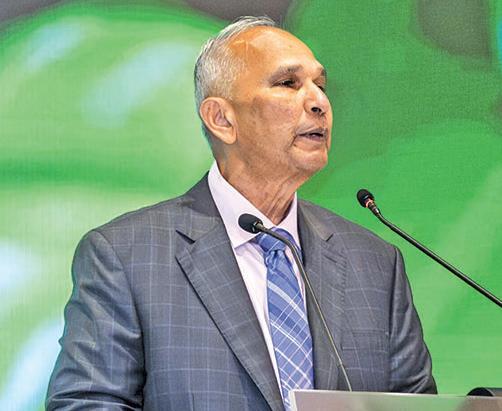
tor stakeholders regarding their situation and needs.
According to IICA, during his visit to Brazil, whose Minister, Carlos Fávaro, serves as the chair
of IICA’s highest governing body, the Inter-American Board of Agriculture (IABA), Ibrahim will also participate in a meeting of the Southern Agricultural
GPHC performs rare transhepatic procedure to restore dialysis access for patient
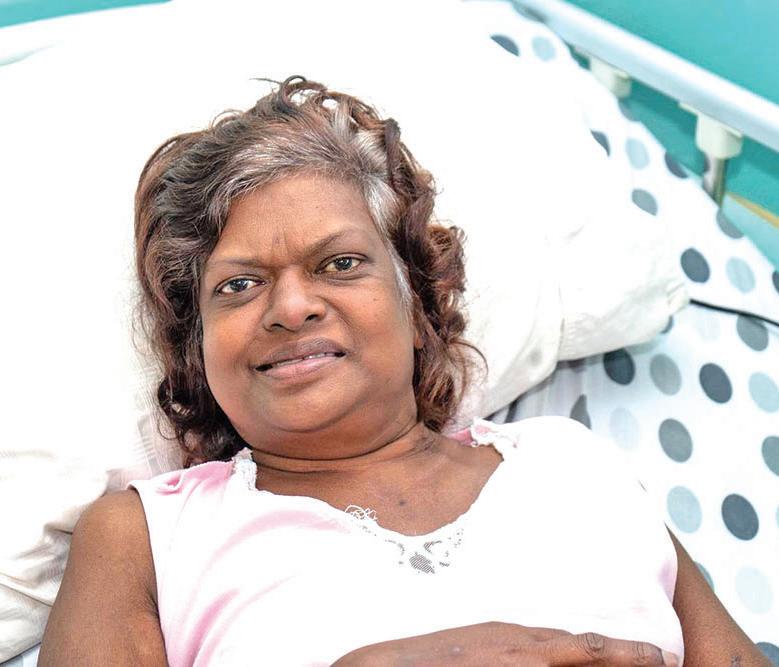
The Georgetown Public Hospital Corporation (GPHC) has announced that it has successfully performed a complex transhepatic dialysis catheter insertion, restoring life-sustaining treatment for a patient who had exhausted all conventional vascular access options. According to the hospital, the patient, Diana Parasram, suffers from kidney failure and had been undergoing chronic haemodialysis when repeated vascular access procedures resulted in significant vein damage. According to medical officials, long-term dialysis can cause scarring and blockages of major veins, limiting available sites for catheter placement. Dialysis is a life-sustaining medical procedure that filters waste products, tox -
ins, and excess fluid from the blood when the kidneys fail. It acts as an artificial kidney, primarily using haemodialysis (machine filtering) or peritoneal dialysis (abdominal lining filtering). Treatments are usually required several times a week.
However, Parasram’s case became increasingly complicated after imaging revealed that her upper body veins, typically used for dialysis access through the jugular vein into the superior vena cava, were no longer viable. Efforts to assess and reopen the veins proved unsuccessful.
Transhepatic approach
With traditional access routes no longer available, the nephrology team referred the case to interventional radiology for advanced intervention. At
the time, Parasram was dependent on a femoral vein catheter inserted in the groin. Medical professionals note that femoral catheters are considered temporary solutions and are associated with higher risks of infection and thromboembolic complications, including blood clots that can migrate to the lungs.
Faced with limited alternatives, the hospital stated that the medical team proceeded with a specialised transhepatic approach, a highly technical procedure in which a catheter is inserted through the liver into the inferior vena cava, the large vein that returns blood to the heart. The approach is typically reserved for patients who have exhausted standard vascular access sites. GPHC confirmed that the procedure was completed successfully.
Parasram was able to undergo dialysis using the newly placed catheter the following day without complications. Medical officials indicated that the case highlights the complexity of managing longterm kidney failure and highlights the importance of multidisciplinary collaboration between nephrology and interventional radiology teams in delivering advanced care locally. Parasram is expected to continue dialysis treatment while awaiting a kidney transplant.
Council (CAS). This is the Ministerial forum for consultation and the coordination of regional actions, comprised of the Ministers of agriculture of Argentina, Bolivia, Brazil, Chile, Paraguay, and Uruguay. With IICA managing its technical and administrative secretariat over the last 20 years, the CAS has achieved consensus on major issues.
Muhammad Ibrahim will inform the CAS Ministers of the progress being made with IICA’s Medium-Term Plan (MTP).
This is the organisation’s institutional roadmap for the period 2026-2030, drafted with input from stakeholders and consultations with the Member States, in order to tailor the technical cooperation offered to the countries’ needs. Ibrahim will also hold bilateral meetings with Uruguay’s Minister of Livestock, Agriculture and Fisheries, Alfredo Fratti,
and Paraguay’s Minister of Agriculture and Livestock, Carlos Giménez.
During his stay in the Brazilian capital, IICA’s Director General will be attending the Food and Agriculture Organisation of the United Nations (FAO) Regional Conference for Latin America and the Caribbean (LAC), where IICA will moderate a panel discussion on the challenges facing the region’s agrifood systems.
Caribbean and Central American
The IICA on Tuesday stated that it will also meet with Caribbean and Central American Ministers, Brazil’s deputy foreign Minister, Maria Laura da Rocha, and the President of the Caixa Econômica Federal (CEF) state-owned bank, Carlos Antonio Vieira Fernandes. Another important activity will be a meeting with Silvia Massruhá,
President of the Brazilian Agricultural Research Corporation (EMBRAPA), with whom he will discuss a project aimed at creating an innovation hub for the Caribbean and Central America.
A Brazilian public entity, EMBRAPA is a regional and global leader in the field of science and technology applied to agriculture. In addition, the IICA Director General will meet with Brazil’s Minister of Social Development, Wellington Dias, and senior Ministry of Planning officials. He will also hold meetings with Senator Tereza Cristina, a former Minister of agriculture, and with the heads of the Brazilian Cooperation Agency (ABC), the Confederation of Agriculture and Livestock of Brazil (CNA), the Organisation of Brazilian Cooperatives (OCB) and the Corteva Agriscience and Toyota corporations.
Labourer granted $100,000 bail on attempted felony charge
A23-year-old labourer of Bounty Hall, Essequibo Coast, has been charged with attempting to commit a felony against Ramkumar, also known as Prince, a 65-yearold businessman of Richmond Housing Scheme and Bounty Hall, Essequibo Coast, Region Two (Pomeroon-Supenaam). Chakall Sugrim appeared at the Charity Magistrate’s Court on Monday before Magistrate Ravindra Mohabir. The charge was
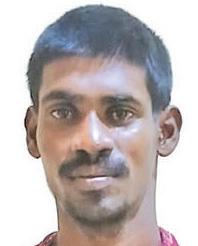
read to him, and he was not required to enter a plea. The prosecution applied the Administration of Justice Act (AJA), and Sugrim pleaded not guilty. The charge stems from an incident which allegedly occurred on Thursday at Lot 7, Bounty Hall. The charge was laid under Section 36 of the Criminal Law (Offences) Act, Chapter 8:01. Sugrim was granted bail in the sum of $100,000. The matter was adjourned to March 23.

Prime Minister (PM)
Kamla PersadBissessar announced that President Christine Kangaloo has declared a State of Public Emergency with effect from Tuesday, March 3, 2026, following urgent advice from the National Security Council.
The decision comes just weeks after the previous State of Emergency (SoE) ended on January 31.
According to the PM, security briefings presented to the National Security Council on Monday revealed a troubling increase in violent crime across the country, much of it linked to organised criminal gangs.
Officials reported multiple deaths from mass shootings and warned of escalating reprisal attacks that threaten public safety.
The Council were also told of credible intelligence indicating planned attacks on Police Officers, prison Officers, and members of the legal services.
In a stern warning, the Prime Minister said criminal gangs and recently-re-
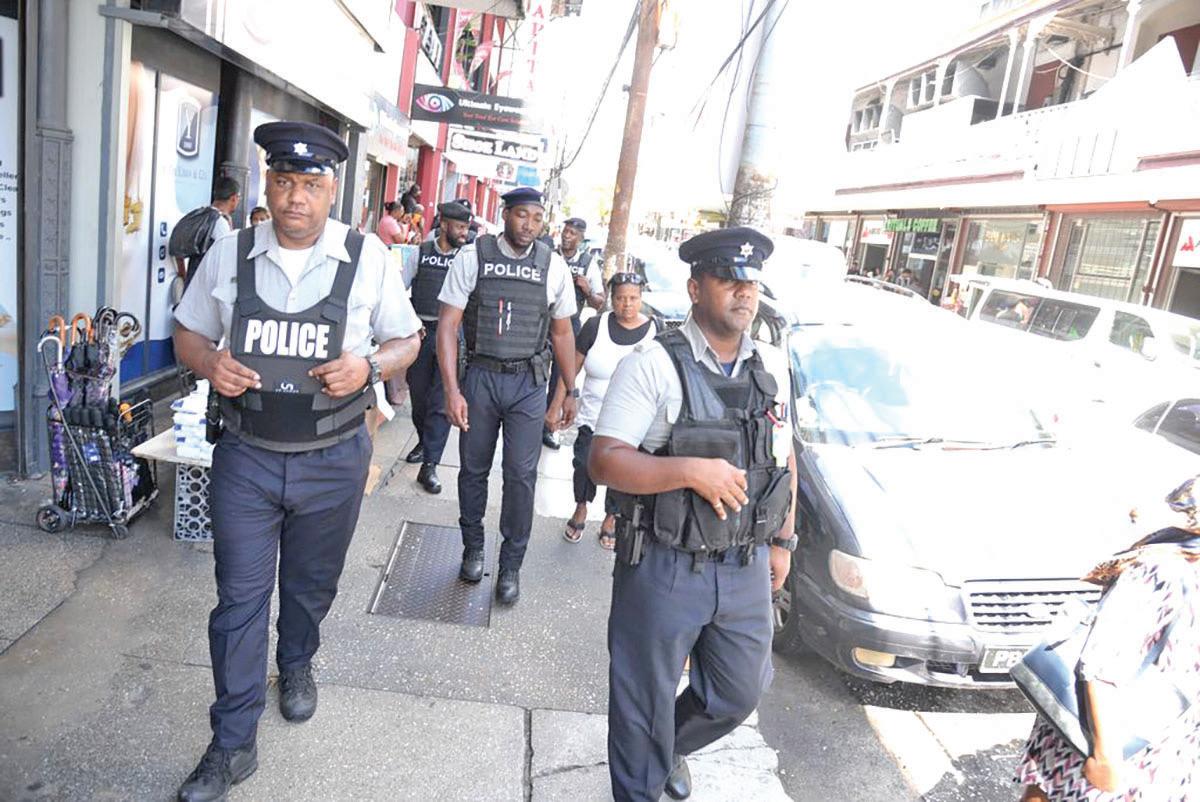
leased detainees had been cautioned that law-abiding citizens were “fed up” – and that another SoE would be declared if violence continued.
She reiterated that violent gang members would be returned to prison, adding that those who aid and abet criminal activity – including friends and relatives – would face consequences as well.
The Government says the emergency measure aligns with its zero-tolerance approach to crime,
pointing to recent joint operations by the Trinidad and Tobago Police Service and the Armed Forces, new legislation aimed at strengthening law enforcement, and reforms within the criminal justice system.
Officials insist the move is necessary to prevent recent gains in reducing murder rates and violent crime from being reversed.
Further details on the specific regulations under the new State of Emergency are expected in the coming days. (Trinidad Guardian)
St Lucia voices “extreme concern” as nationals caught in Middle East crossfire
Saint Lucians living and working in parts of the Middle East are witnessing scenes many never imagined they would experience first-hand as armed conflict between the United States, Israel and Iran escalates.
Nationals currently in the United Arab Emirates (UAE), Qatar and Cyprus have reached out to St Lucia Times, sharing images and videos showing smoke trails from intercepted missiles and reporting loud explosions in the night sky. In one case, a Saint Lucian swimmer said she and her team were evacuated from the UAE as a precaution amid rising tensions.
As the conflict appears to be extending across neighbouring territories where Saint Lucians are
present, Prime Minister (PM) Philip J Pierre on Monday expressed what he described as “extreme concern” over the safety of nationals abroad.
Speaking at Monday’s pre-Cabinet press briefing, Pierre said the Government is actively monitoring developments.
“Anything we can do to assist them, within our capabilities, we will do. The Ministry of External Affairs has been asked to reach out to them. We hope that they can be safe,” the PM said.
With US officials declaring that it will “take time” to achieve the objectives of the military action, concerns remain about how long tensions could persist.
Pierre acknowledged that Saint Lucians overseas may be facing uncertainty through no fault of
their own.
“That’s the sad part about it,” he said. “The Government is very concerned about our students, our workers and our people in the army.”
Shifting his focus to matters at home, the PM urged Saint Lucians to take greater responsibility in addressing national challenges, particularly during a time of global instability.
He implored citizens to “change our attitudes” toward issues affecting the country and to play a more active role in safeguarding Saint Lucia’s social and economic stability. While external conflicts may be beyond the island’s control, Pierre suggested that how Saint Lucians respond internally is firmly within their power. (St Lucia Times)
A36-year-old Jamaican is assisting Antiguan Police following the seizure of 60 pounds (lbs) of marijuana during a joint drug interdiction operation at the VC Bird International Airport last Sunday. Reports are that Officers attached to the Narcotics Department, along with members of the K-9 Unit and
the Customs Enforcement Unit, conducted a coordinated operation at the airport and seized one black suitcase and one green suitcase with a total of 19 sealed packages of cannabis with a street value of EC$360,000.
The Police said that the 38-year-old Jamaican man was subsequently arrested and taken into custody in
connection with the ongoing investigation and that he is expected to be charged and brought before the court.
“The Royal Police Force of Antigua and Barbuda remains resolute in its commitment to disrupting drug trafficking networks and safeguarding the nation’s borders,” the statement said. (Jamaica Observer)
Three men were killed in separate violent incidents on Sunday and two others injured, leaving the communities of Cave Hill, Chapman Cross Street and Frere Pilgrim in shock and prompting renewed concern about rising acts of violence on the island.
Barely an hour into Sunday morning, the first slaying happened at a business during an event. Twenty-four-year-old Tyrese Skinner of Fustic Village, St Lucy, who attended the event, was discovered in a car park near the venue. He was taken by private vehicle to the Queen Elizabeth
Hospital, where he later died from his injuries.
Later at 13:30h, a man was shot at Chapman Cross Street in The City following an altercation at a bar.
Police said he had left the establishment when gunshots were heard. He died at the scene. He has been identified as 33-year-old Neil Renville of Adventist Gap, Jackson, St Michael.
Around 15:30h, a man identified as 75-year-old Nigel Gibbs of Cave Hill was walking along a track at Bridge Gap, Cave Hill, when he was approached by another man who inflicted multiple stab wounds.
He died at the scene, Police said. An elderly woman in the area said she only learned of the incident after returning home from church and was overcome with shock.
Another resident suggested that too many young men were becoming involved in drugs, leading them to act out violently.
The killing is the latest in a string of violent incidents affecting communities across the island over the weekend.
These killings bring the homicides for the year to eight. (Excerpt from Barbados Today)
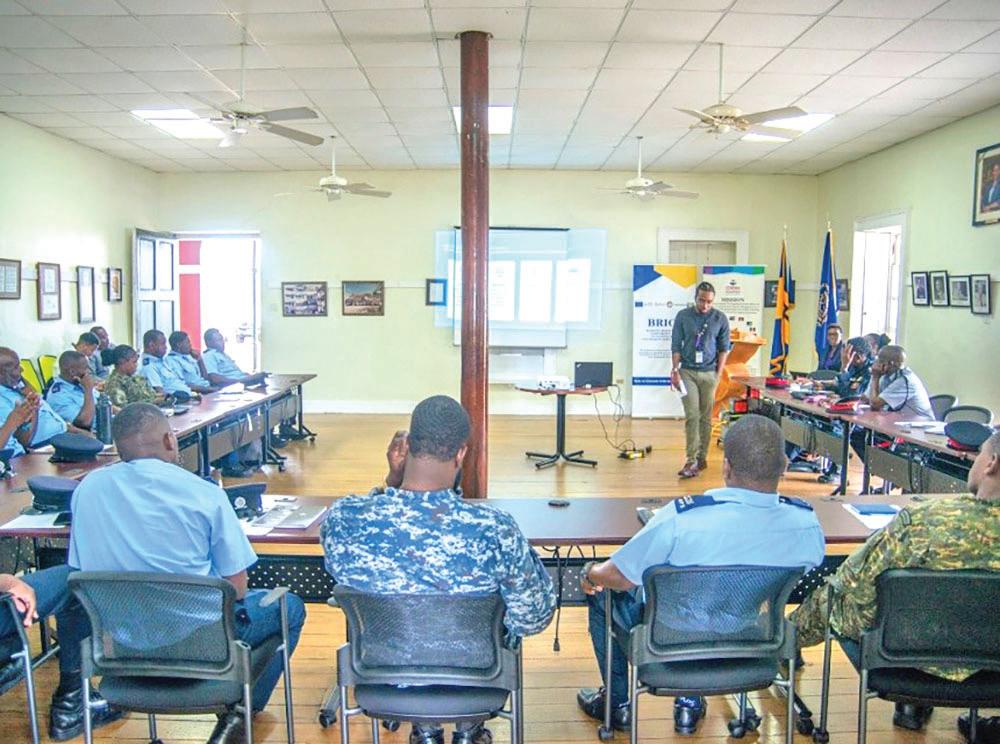
The British Virgin Islands (BVI) sharpened its disaster-response skills last week as regional first responders converged on the territory for an intensive field deployment exercise.
From last Monday through last Saturday, a 15-member team of personnel from around the region took part in training led by the Caribbean Disaster Emergency Management
Agency, according to the Government.
They were joined by 16 VI Police and fire Officers as part of efforts to strengthen the territory’s readiness for major disasters.
The main objective was to prepare participants for deployment as part of the Caribbean Community Disaster Relief Unit, which supports CDEMA participating states that request assistance after a disaster.
Disaster Management Director Jasen Penn said the exercise would bolster regional response capacity by ensuring qualified personnel can be deployed quickly.
“Training like this enhances the resilience of the entire region,” Mr Penn said, adding, “Our Officers and the participants from neighbouring islands gain experience working together and practise responding to a major multi-island impact.”
Mr Penn noted that the session would also allow regional responders to familiarise themselves with local Officers and the territory’s geography in case of a major disaster here. Previous deployments, he said, supported recent responses to hurricanes Beryl and Melissa as well as the La Soufrière volcano eruption in St Vincent.
The last time a team was deployed to the VI was in 2017 following Hurricane Irma. (Excerpt from The BVI Beacon)
Haitian Police on Monday, March 2, arrested a key suspect in the killing of two young sisters on La Gonâve Island, detaining him just about 24 hours before the children’s funeral.
Janel Louissaint, known as “Tiga”, is accused of killing seven- and five-year-old Wilandia and Wisberline Stimphile, according to Saint-Luc Paul, a Communal Section Administrative Council (CASEC) official in Anseà-Galets, who confirmed
the arrest in a phone interview with The Haitian Times. Louissaint remains in custody as investigators work on the case.
The arrest brings the total number of people detained in the investigation to eight. Four suspects, including Louissaint, remain in custody. The others were released after questioning but placed under judicial supervision as the investigation continues.
The sisters were killed the evening of February 18 in Kafou Dèl, the fifth com -
munal section of Picmy, Anse-à-Galets. Their bodies were later found in a wooded area near their home after their mother, Roselor Stimphile, returned from the market.
The killings shocked residents across La Gonâve and prompted protests demanding justice and stronger protection for children.
In the days following the deaths, local advocacy groups organised marches calling for accountability. (Excerpt from Haitian Times)


Oil prices settled up 4.7 per cent on Tuesday, the highest since January 2025, as US–Israel battles with Iran intensified, disrupting energy shipments from the Middle East and stoking fears of a longer conflict.
Brent futures settled up US$3.66, or up 4.7 per cent, at US$81.40 a barrel, its highest settlement since January 2025. US West Texas Intermediate crude settled up US$3.33, or 4.7 per cent, at US$74.56, the highest settlement since June.
Brent is up 12 per cent since the conflict began on Saturday.
Israeli and US forces pounded targets across Iran on Tuesday, prompting Iranian retaliatory strikes around the Gulf as the conflict spread to Lebanon.
Iraq, the No. 2 crude producer in the Organisation of the Petroleum Exporting Countries behind Saudi Arabia, cut production by nearly 1.5 million barrels a day. The cuts could more than double within days as the country runs out of storage space for crude it cannot export due to the crisis.
Iran has responded with strikes against regional energy infrastructure and tankers in the Strait of Hormuz, through which a fifth of the world’s oil and liquefied natural gas typically passes.
Tankers and container ships are avoiding the strait after insurers cancelled coverage for vessels and global oil and gas shipping rates soared. Concerns increased after Iranian media reported on Monday that Iran will fire on any ship trying to pass through the strait. (Excerpt from Reuters)
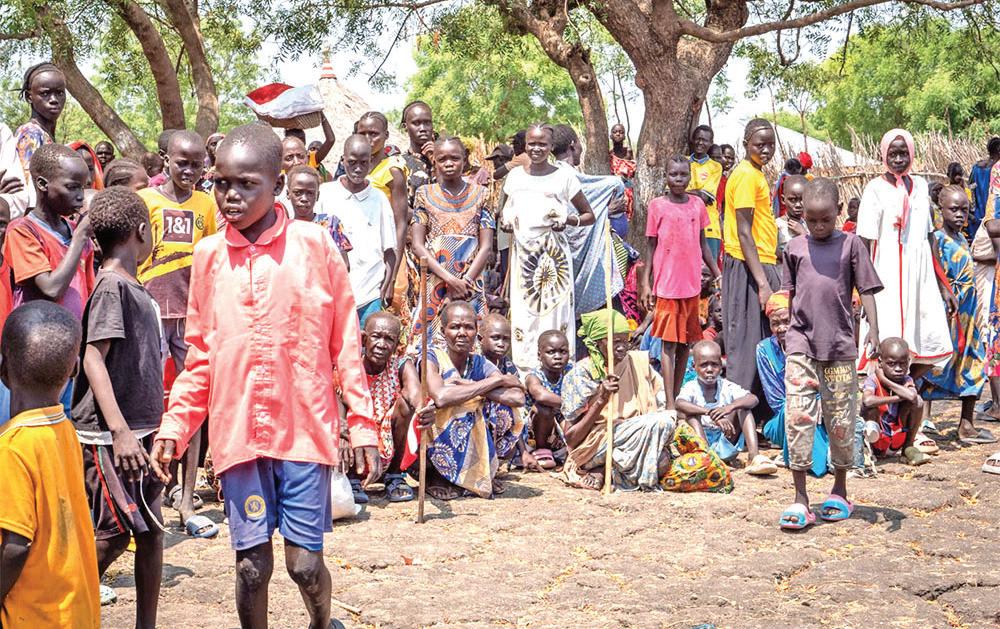
South Sudan is reeling from an escalating conflict between the Government-aligned army and opposition forces and allied groups that observers say risks returning the country to a full-blown civil war.
Violent confrontations in the world’s youngest country between the military, which is loyal to President Salva Kiir, and insurgents believed to be allied to the suspended Vice President, Riek Machar, have increased in recent weeks.
On Sunday, at least 169 persons were killed after armed youth from Mayom County in the north raided a village in neighbouring Abiemnom County near the Sudan border.
The victims included women, children and members of Government security forces, said James Monyluak Majok, the information mi-
nister for the administrative area of Ruweng, where Abiemnom is located.
The UN mission in South Sudan said it was sheltering more than 1000 civilians in its base in the area and providing medical care to those injured. It said about 23 persons were wounded in the attack.
Stephano Wieu de Mialek, the chief administrator of Ruweng, said the assault was carried out by people linked to the White Army, a militia that was allied to Machar during the civil war, alongside forces affiliated with Machar’s political party and rebel group, the Sudan People’s Liberation Movement-inOpposition.
The group denied responsibility for the attack and said it had no military presence in the area. (Excerpt from The Guardian)
US President Donald Trump has said his Administration’s war against Iran “successfully knocked out” the country’s air force and navy.
“We’re doing very well,” Trump said on Tuesday, during a news conference at the White House with German Chancellor Friedrich Merz before their meeting.
“They have no navy; it’s been knocked out. They have no air force; it’s been knocked out. They have no air detection – that’s been knocked out,” Trump said.
Trump’s comments came on the fourth day of US–Israeli strikes on Iran as Tehran closed the Strait of Hormuz and continued its retaliatory missile and
US

drone attacks on US and allied targets across the Gulf region.
Trump said he had ordered the attack against Iran on Saturday because he “had a feeling” that Iran
would strike first as negotiations over its nuclear programme stalled.
Asked if Israel might have “forced” his hand on attacking Iran, Trump responded, “No, actually, I
might have forced their hand.”
On Monday, US Secretary of State Marco Rubio had said that the US attacked Iran because it knew Israel was about to bomb that country and because the Trump Administration believed that Iran would then strike US facilities in the region.
Reporting from Washington, DC, Al Jazeera’s Kimberly Halkett said Trump’s comments are “going to have a tremendous place in the US because the US President doesn’t have the power to declare war unless there is a threat to the US.”
“The US President has not offered any evidence of that,” she said. (Excerpt from Al Jazeera)
The Trump Administration is quietly building a le-
gal case against Venezuelan interim President Delcy Rodríguez, including rea-
World’s largest acidic geyser wakes up in Yellowstone from 6-year slumber

The world’s largest acidic geyser is putting on a show again, erupting for the first time in six years after a quiet hiatus, officials at Yellowstone National Park say.
The Echinus Geyser – located in the park’s famous Norris Geyser Basin – had been in slumber since 2020, and it’s unknown whether the eruptions will continue into the summer.
Researchers say geysers can sometimes become active for a month or two before falling dormant again.
”Geysers are always turning on and off.
”That’s Yellowstone being Yellowstone!” the US Geological Survey wrote on X.
A geyser is a spring of water which has been heated geothermally and which erupts at various rates.
It is formed from a tube-like hole that goes down into the Earth’s surface and is filled with water. When the water at the bottom, which is
near molten rock called ’magma’, heats in the tube, it begins to boil and is forced upwards and erupts.
After eruption, the water slowly goes back down into the tube. Then the process starts again.
The Echinus Geyser used to erupt at regular intervals, which is why viewing platforms were built around it.
In the 1970s, the geyser would erupt regularly at 40- to 80-minute intervals. In the decades after, the eruptions would sometimes last up to 90 minutes, blasting water as high as 75ft (23m) into the air.
The eruptions resumed on February 7, and have now returned to 2017-era rates. These eruptions have lasted for up to three minutes, with water heights reaching up to 30ft.
It’s unknown whether the geyser will continue to erupt during the busy summer tourist season. (Excerpt from BBC News)
dying a draft criminal indictment, one of several tools it is using to strengthen its leverage with Caracas, according to four persons familiar with the matter.
Federal prosecutors have put together possible corruption and money laundering charges and have communicated to Rodriguez that she is at risk of prosecution unless she continues to comply with Trump’s demands following the US ouster of former Venezuelan leader Nicolás Maduro in January, the sources said.
The US Attorney’s Office in Miami is preparing the draft charges, the people said, adding that the document has been evolving over the past two months. The probe focuses on Rodriguez’s alleged involvement in laundering funds from Venezuela’s state oil compa-
ny PDVSA, three of the sources said, and covers activities between 2021 and 2025, two of the sources said.
The Department of Justice declined to comment on the story. After a summary of the report was published on the Reuters World News morning podcast, Deputy Attorney General Todd Blanche wrote on X, ”Completely FALSE from @ reuters. Not sure how such fake news makes its way to publication.”
In a statement, Reuters said: “We stand by our reporting that the Department of Justice is preparing an indictment against Delcy Rodriguez, the new President of Venezuela.”
The White House and the US State Department did not respond to Reuters’ questions for this story. (Excerpt from Reuters)
Amazon says drones hit 3 of its Middle East data centres amid Iran conflict
Amazon said drones struck three of its Middle East data centres, causing outages related to the ”ongoing conflict in the Middle East”.
Drones directly struck two Amazon Web Services (AWS) facilities in the United Arab Emirates, and a drone strike near an Amazon data centre in Bahrain also damaged that facility, the company said in a post on Monday on AWS’ health dashboard.
”These strikes have caused structural damage, disrupted power delivery to our infrastructure, and in some cases required fire suppression activities that resulted in additional water damage,” AWS said.
Operations in the Middle East remain ”significantly impaired”, AWS said, noting that ”customers are experiencing elevated error rates and degraded availability for services.”
Amazon said it is working to restore services and repair physical damage to its facilities, while cautioning that the ”broader operating environment in the Middle East remains unpredictable”.
The company encouraged its customers in the Middle East to back up data and consider migrating workloads to servers in other regions.
Shares of Amazon declined US$3.40, or 1.6 per cent, to US$204.99 in early trading. (CBS News)












Give yourself time to rejuvenate. Delve into something you find relaxing and enjoyable. Use your creative imagination and put your talents to work for you. Embrace change, declutter, sell off, or rid yourself of the dead weight in your life. Focus on what’s meaningful to you, and it will bring you peace of mind and new possibilities.














Take care of small, but essential details. Your patience and additional touches to whatever you pursue will win you well-deserved praise. A change to where or how you work will have a positive impact on your health and emotional well-being. Be honest with yourself about your happiness. Physical upgrades will boost your confidence. Romance is on the rise.
Take charge, initiate change, and focus on friendships, helping others, and walking away from toxic situations. It’s time to recover your peace of mind and to honor the promises you’ve made to yourself. Take the plunge and do something that restores your faith. Be the one to make a difference by putting your energy into what matters.
Express yourself openly and make suggestions that help you gain recognition. A chance to expand your skills, interests, and possibilities is heading your way. Don’t miss out or let someone outmaneuver you. Assess what it takes to broaden your awareness and launch a plan that leads to personal, financial, or professional gains. Romance is in the stars.
Put your energy where it brings the highest return. Learn something new, travel, communicate, and make special plans with those who inspire you to try new things and challenge you to grow intellectually. Expand your plans to include what and who makes you feel good about yourself and your plans. Initiate your attributes and goals.
Get ready to shift your attention and bring about positive change. How you deal with people and respond to requests will influence your position and reputation amongst your peers. Step up, lead the way, and rewards will follow. Participating in an event that lets you connect with people striving for similar outcomes will encourage partnerships.
Emotions will spark your imagination, allowing you to articulate what you want in an elegant manner that is sure to attract attention. Consider some of the suggestions you receive and offer your input to those you feel comfortable working with. If you mix business with pleasure, positive options and an acceptable offer will unfold.
Attend functions that allow you to further your interests. Communication and learning are on the rise and will help you fine-tune your skills to fill fast-growing needs. An opportunity to move or redesign your space to accommodate your plans will put your mind at ease and clear the path forward. Social opportunities will promote love, romance, and self-improvement.


Be careful what you share with whom. Someone will be eager to twist your words and put you in a precarious position. Clear your mind and take the initiative to do something physical. It will prompt you to hit the reset button on your daily routine. Strive for better health, less worry, and a simple lifestyle.






You’ve got more going for you than you realize. Take advantage of whatever comes your way and shoot for the stars regarding your dreams and desires. Speak up, share your intentions, and make plans that point you toward greater security. Home and self-improvements are on the rise and will give your life a positive spin.
Size up your situation, budget, and the changes necessary to relinquish any doubt you have about your lifestyle and prospects. A change that helps declutter your life and space will clear the path for new opportunities. Launch a plan that enables you to grow personally, financially, and emotionally. Invest in yourself, your health, and your wealth.
Let kind gestures be your calling card. How you treat others will set the stage for what you receive in return. Discussions and self-education will also pave the way for the necessary adjustments to reach your goals, ensuring freedom and peace of mind. A positive lifestyle change will promote unique encounters and unexpected offers. Partnerships look promising.






an external result to qualify. They owe their place in the last four to a commanding win over Sri Lanka, one which had its own hiccups along
The good thing about the South Africa-New Zealand semi-finals is that it gives neutrals at least one team to cheer for in the final. Two generally likeable sides who have – somehow – yet to lift an ICC white-ball trophy between them since 2000 vie for yet one more crack at it as they look to edge each other out. South Africa’s heartache in these tournaments is well-documented, but New Zealand make the semi-finals more consistently than any other side over the past two decades and are yet to string the two matches together from this stage onwards that would propel them to glory.
There is, often, little to choose between these two, but, this time around, a clear favourite has emerged. South Africa is unbeaten in this tournament, and that includes a trouncing of New Zealand in the group stages. They have played all their games in India, which has allowed them to make full use of their fast bowlers without needing to turn to spin in any extensive way, which plays into their strengths.
With 268 runs at a strike rate of 175, Captain Aiden Markram has been arguably the best opener in the tournament, while a middleand lower-order comprising Dewald Brevis, David Miller, Tristan Stubbs and Marco Jansen is the envy of any side in the competition. Jansen, Corbin Bosch, Kagiso Rabada and Lungi Ngidi – the highest wicket-taker remaining in the tournament – have high pace as well as great variety, with Keshav Maharaj getting through the spin overs. It is hard to imagine how South Africa could have covered all bases more comprehensively.
New Zealand’s campaign has proved much less straightforward, and it is harder to gauge the true nature of their quality and their ability to contend for this title. They beat Afghanistan, Canada and the UAE through the group stages, before a washout against Pakistan and defeat to England left them relying on
They have had to adjust, though, playing their group matches in India before going off to Sri Lanka for the Super Eight. They are back in India again, with Kolkata the venue for the semi-final, which will likely see them pull back their use of spin and turn to the quicker bowlers again. Their strength is a gun top order, with Finn Allen and Tim Seifert in consistently explosive form, and great flexibility with the ball thanks to a surfeit of all-rounders, a deep batting order, and fast bowlers that can neatly blend back into the side for spinners without disrupting the balance of the lineup.
Both sides have been knocking on the door for silverware for long enough. Once more, they chip away at it in the hope that this time, their efforts will be enough to blow the house down.

he played a central two-in-one role for New Zealand in the Super Eight in Colombo, where the ball gripped and stopped, but on the flatter strips of Eden Gardens, it is with the bat that he will be more important to New Zealand. Ravindra has a phenomenally good ICC record, but at this tournament, his batting hasn’t quite clicked in the same way. All that can be put to rest facing a team against whom he has enjoyed bigmatch success.
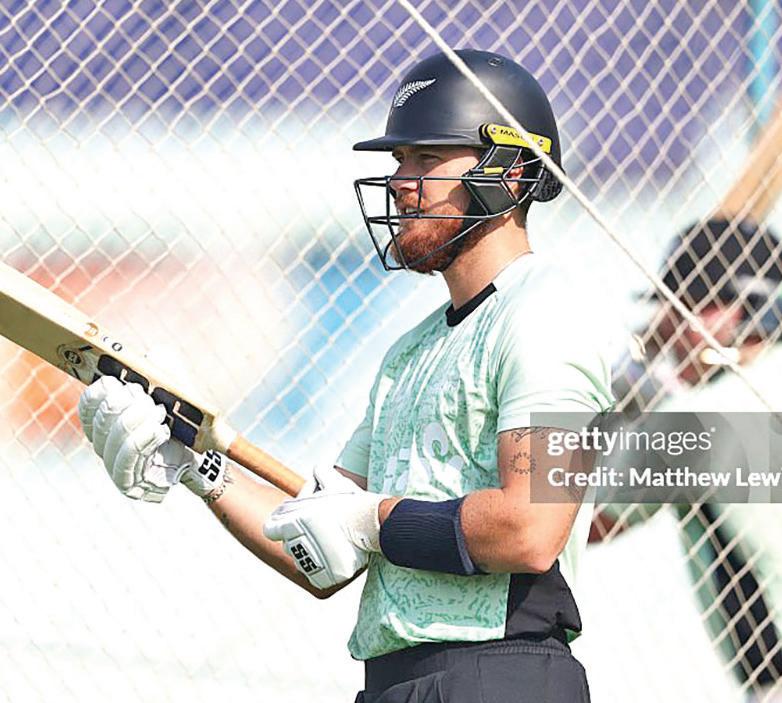
In the spotlight Rachin Ravindra was the standout player in Lahore last year, the last time these two sides met in an ICC semi-final at the 2025 Champions Trophy. He scored a century that set New Zealand on its way before keeping things tight with the ball. At this tournament,
Aiden Markram has towered over almost any other batter at this tournament and is the highest run-scorer among sides still alive. He saved his best innings for the game against New Zealand in the groups, pulverising an unbeaten 86 off 44 to seal a comfortable win. It is one of three destructive half-centuries he has scored at this World Cup. His clean aerial hitting through the
powerplay has proven almost impossible to counter for bowlers when in this kind of form, especially if he cannot be snared early, as India and Zimbabwe recently managed. Markram has also demonstrated his ability to rise to the biggest of occasions, as evidenced by his fourth-innings hundred in the World Test Championship final against Australia last year. A semi-final here is unlikely to overawe him.
Team news
Matt Henry arrives in Kolkata tonight after returning home for the birth of his second child. He will not train but is likely to line up in the XI on Wednesday. With New Zealand returning to the less spin-friendly India, Ish Sodhi might make way for Jimmy Neesham.
New Zealand: 1 Tim Seifert (wk), 2 Finn Allen, 3 Rachin Ravindra, 4 Glenn Phillips, 5 Mark Chapman, 6; Daryl Mitchell, 7; Mitchell Santner (capt.), 8; Cole McConchie/Jacob Duffy, 9; Jimmy Neesham, 10; Matt Henry, 11; Lockie Ferguson
South Africa’s top seven are set in stone. On a pitch as flat as Kolkata’s, they are unlikely to go with any more than one spinner.
South Africa: 1 Quinton de Kock (wk), 2 Aiden Markram (capt), 3 Ryan Rickelton, 4 Dewald Brevis, 5 David Miller, 6 Tristan Stubbs, 7 Marco Jansen, 8 Corbin Bosch, 9 Kagiso Rabada, 10 Keshav Maharaj, 11 Lungi Ngidi
Pitch and conditions
The strip used for the semi-final is of a darker shade, which, theoretically, means it should be somewhat conducive to spin bowling. Both Captains were coy about whether chasing or defending was the better strategy, suggesting the toss may not necessarily play a significant role. However, some dew in the evening is not out of the question, which will likely influence the deci-
sion at the toss. A warm evening is expected in Kolkata, with no chance of rain.
Stats and trivia
South Africa has never lost to New Zealand in T20 World Cup cricket, winning all five encounters between the sides.
However, the sides have never previously met at the knockout phase of the T20 World Cup. New Zealand have had the upper hand in their previous such encounters in 50-over ICC events, winning one quarter-final and two semi-finals.
Aiden Markram is 32 runs away from becoming the sixth player to reach 300 runs at a single T20 World Cup.
Mitchell Santner has not enjoyed bowling to South Africa in this format. His economy rate against tomorrow’s opponents is 8.57 in T20Is, with a wicket every 54.33 runs. It is poorer ER and average than he has managed against every other full member.
Quotes
“Watching Pakistan-Sri Lanka was pretty tough, pretty nervy. I had a few of the boys in my room and I had to leave because it was pretty tough.”
New Zealand Captain Mitchell Santner on watching from the sidelines to see if his team would make the semi-finals.
“It’s always a great effort to win a Test series and I was proud to be part of it. Obviously, there are a lot of guys who were not there who are part of the white-ball set-up. They would have watched it and seen cricket as a whole is trending in a good direction in South Africa and now, with a World Cup, it’s a good time to be part of it.”
Aiden Markram reflects on the tone South Africa’s WTC win may have set for belief in the camp. (ESPNcricinfo)
President’s College surged to the top of the School Basketball League standings after a hard-fought 67–53 victory over St Rose’s High School in an exciting matchup that showcased momentum swings, standout performances, and high-intensity action.
President’s College (PC) got off to a strong start in the opening quarter, establishing an early 13–10 lead. Their defensive pressure and quick transition play allowed them to dictate the tempo in the early stages. However, St Rose’s High responded confidently in the second quarter, tightening up defensively and executing well on offence to win the period 15–10. Their effort gave them a narrow 25–23 advantage heading into halftime.
The turning point of the game came in the third quarter. PC came out of the break with renewed energy and completely shifted the momentum. An explosive 24–6 run overwhelmed St Rose’s High, as President’s College’s defence forced turnovers and converted them into fast-break points. That dominant quarter ultimately sealed control of the contest.
The fourth quarter turned into an offensive showcase, with both teams trading baskets in a high-scoring finish. St Rose’s High edged the quarter 22–20, but the deficit created in the third proved too large to overcome. President’s College closed out the game comfortably to secure a 67–53 win and climb to the top of the league table.
Leading the charge for
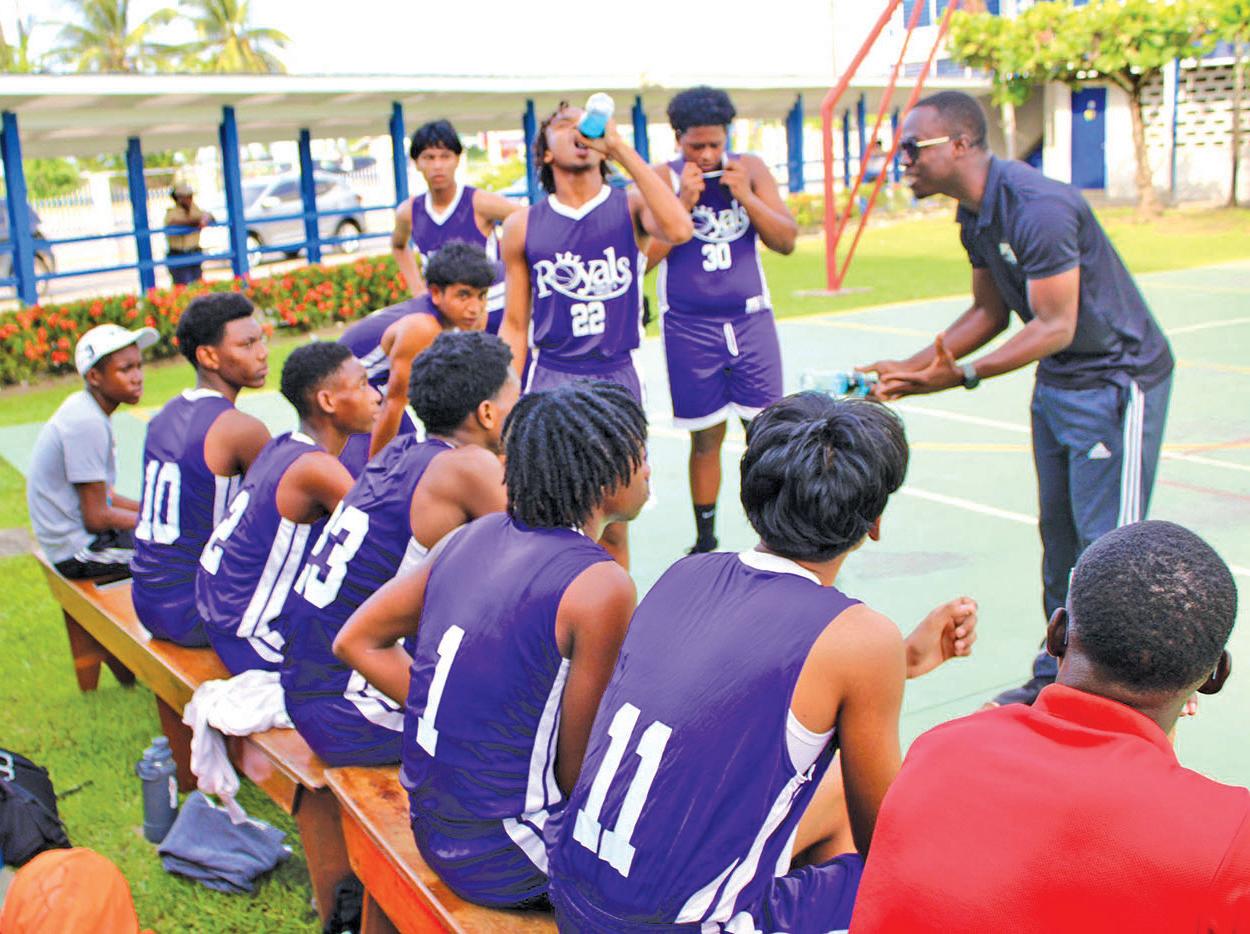
APresident’s’s College was Mattaniah Fordyce, who delivered a stellar performance with 30 points and seven rebounds. He was well supported by Romarion Wolfe, who added 19 points, three rebounds, and four assists in an all-around effort.
For St Rose’s High, Chazaiah Bernard scored 14 points and grabbed two rebounds, while Nathan Williams contributed 14 points and nine rebounds in a strong showing despite the loss.
With this statement victory, President’s College not only claims bragging rights but also strengthens its position as a championship contender in this season’s School Basketball League. Meanwhile, St Rose’s High will look to regroup and bounce back as the competition continues to heat up.
t the Police Sports Club Ground, Malteenoes Sports Club (MSC) Warriors delivered a commanding performance to defeat Police Academy All-Stars in the Sherwin Williams second Division T/20 Cup, piling up a massive total before sealing a comprehensive victory.
After winning the toss, MSC opted to bat first, a decision that paid rich dividends as they powered their way to an imposing 219–9 in their allotted 20 overs.
Leading the charge was Jonte

Thomas, who produced a scintillating knock of 79, punctuated by seven fours and five towering sixes. Thomas set the tone early, attacking the Police Academy bowlers and keeping the scoreboard ticking at a brisk pace.
He received solid support from Colis Rimple, who contributed 32, and Adrian Hinds, who struck 32 in an entertaining innings that included three sixes and two fours. The middle-order contributions ensured MSC maintained momentum throughout the innings, consistently finding boundaries and capitalising on loose deliveries.
Despite the onslaught, the Police Academy found some resistance through D Grant Stuart, who returned impressive figures of 3–29 from his four overs. K Leitch also bowled economically, claiming 2–24 in his full quota, but the target had already ballooned beyond comfortable reach.

Chasing a daunting 220 for victory, Police Academy All Star never truly found the acceleration needed. They closed on 129-9 in their 20 overs, falling well short
P Singh offered some resistance with 34, striking three fours and two sixes, while R Budhram chipped in with 25, including four boundaries. However, regular wickets stifled any hopes of a sustained partnership.
The star with the ball for MSC was Delon Dalrymple, who delivered a match-winning spell of 4-17 from four overs. His disciplined lines and variations proved too much for the Police batsmen, as MSC maintained pressure throughout the innings. MSC’s all-round dominance, highlighted by explosive batting and disciplined bowling, secured them a convincing 90-run victory. The Warriors’ commanding display sends a strong message to the rest of the competition as the Sherwin Williams second Division T/20 Cup continues.
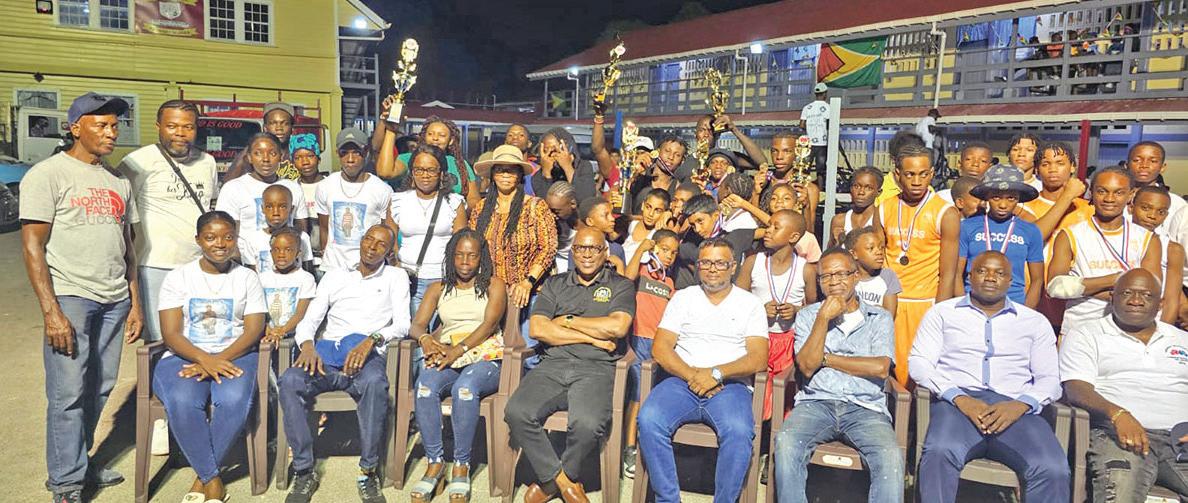
The Guyana Boxing Association (GBA) staged an exciting developmental tournament on Saturday last at the Rose Hall Primary School tarmac, combining competitive youth action with a heartfelt tribute to long-time boxing contributor Gregory “Chasse” Cort.
The event formed part of the association’s ongoing grassroots drive to strengthen amateur boxing across Guyana while recognising Cort’s invaluable contributions to the sport over the years.
Before the opening bell, special acknowledgement was given to Cort for his dedication and service. A consistent supporter of youth programmes and developmental initiatives, he has played a pivotal role in nurturing young talent and promoting discipline, structure and opportunity through boxing.
The tournament featured ten scheduled bouts and attracted fighters from Harpy Eagle Boxing Gym (HEBG), Andrew Lewis
Boxing Gym (ALBG), Pace and Power Boxing Gym (P&P), and New Amsterdam Boxing Academy (NABA).
In the opening contest, Abu Barker (HEBG) dominated gym mate Ragheen Alexis, sweeping all three rounds in their 20–23kg clash.
Omar Morris (HEBG) followed with a narrow but deserved victory over Nathon Sugrim in the 26–29kg division, winning two of the three rounds.
Richard Da Silva (HEBG) delivered a polished performance to outclass Imotex Vanderstoop (ALBG), while the scheduled bout between Junior Madray (ALBG) and Kellon Mullin (HEBG) was cancelled after Mullin failed his pre-fight medical examination.
Dellon Andrews (HEBG) impressed with a second-round stoppage of Terique Venture (HEBG), prompting the referee to halt the contest.
Ishmeal Ramsaroop (P&P) secured a firstround victory over Malachi
Samuels (P&P), and Itavius Vanderstoop (ALBG) produced a similar stoppage win against Travolta Harris (HEBG).
Curtis McDonald (NABA) and Lennox Lawrence (ALBG) went the distance in one of the day’s more competitive bouts, with McDonald earning the nod on the judges’ scorecards.
Ken Harvey (ALBG) reinforced his reputation as one of the Caribbean’s promising young punchers, stopping Emmanuel Sandiford (P&P) in the second round.
To close the programme, Simeon Hamer (ALBG) outclassed Terron Wintz (NABA) over the scheduled distance. At the conclusion of the tournament, Richard Da Silva (U15), Itavius Vanderstoop (U17) and Ken Harvey (U19) were named Best Boxers in their respective categories. Harpy Eagle Boxing Gym claimed the Best Gym award, with Andrew Lewis Boxing Gym finishing as runner-up.
The Ministry of Culture, Youth and Sport has again given its stamp of approval and support to the One Guyana T10, which enters its fourth season.
While the National Stadium in Providence has hosted the national finals of the tournament for the past three years, the 2026 national finals will be held at the new Anna Regina National Stadium in October.
The Ministry will soon commission the new facility.
The tournament will be played between August and October, and the organisers, FL Sport, indicated that it will follow the same format in 2025, with four zones.
The zones – Berbice, Essequibo, East Bank Demerara/West Demerara and Georgetown/East Coast Demerara – with the four zone winners heading to the national finals at Anna Regina.
Furthermore, FL Sport reemphasised that each zone is open to any team, as the concept remains focused on bringing the tournament to communities.
Registration will open in April on a first-come, firstserved basis. According to FL Sport, precise details on the registration fee and the updated team prize structure will be announced soon.
Sport Ministry hails growth
During a recent meeting with Ministers Charles Ramson Jr and Steven Jacobs, both commended the organisers for the tournament’s growth over the past four years and foresaw exponential growth in the pipeline, with other major tournaments currently in the discussion phase.
Minister Ramson Jr reminded the organisers of the plan they brought four years ago and how the strategic partnership helped the tournament to blossom into one of the most popular and lucrative in the Caribbean.
Minister Jacobs, who has been a staunch supporter of the tournament, noted the popularity of the tournament gives opportunity for talent to be exposed, some of whom have transitioned admirably to the conventional
“hardball” cricket.
The director of the tournament, John Ramsingh, expressed gratitude for the Ministry’s support and, by extension, for President Dr Irfaan Ali’s patronage and strong support.
“Partnerships are key, and we certainly welcome the support of the Ministry. 2026 is going to be a tremendous year for sport, with five new stadiums set to be opened, and we will be taking the matches to some of those new stadiums,” Ramsingh expressed.
He indicated that while Providence has been a lovely home for the national finals, it was imperative that all counties get the opportunity to host, and with top facilities in each county, the national finals will move around to accommodate all.
“We are looking forward to Essequibo again; we had tremendous support in 2025, even with the facility not fully completed. We felt it was imperative to give all teams adequate notice of where the national finals would be held before the registration period opens,” he outlined.

Experienced Race
Director Phillip Paruag is assuring that the upcoming Nitro Kart Klash, being hosted by Jumbo Jet Events and AJM, in collaboration with the Guyana Motor Racing and Sports Club (GMR&SC), will be a safe and fairly conducted competition.
The inaugural event was unveiled by organisers at the 555 Speedway on Monday afternoon, where over $5M in cash and prizes was announced for the multi-class competition ranging from cadets to seniors.
Amidst the pomp and splendour, Paruag got down to the nitty-gritty, giving his assurance for safety as
he tackles the chief steward position during race day on March 29.
“We make sure that the entire day is run fairly, in the ambience of safety and with the strict adherence to the rules that would’ve been laid out for each of the classes. We have a team that is working on that. We’ll have our flagmen; we’ll have the relevant people in the right place to make sure that while the event is being run off, persons act and conduct themselves well enough so that we can have fair competition throughout the day and our results that we’ll have will not be questioned,” Paruag told stakeholders gathered for the launch at the Albert Street and Thomas Lands venue.
The chief steward went on to add, “Also stewarding entails that if persons have an issue, they can come, and we’ll resolve it. So, being a part of this, the first at this magnitude, I am very honoured again.”
The racing classes on the day are the Briggs and Stratton (sealed engine) for both heavy and light (weight classes) for seniors as well as the juniors (1315 years) and cadets (612), the 200cc Honda fourstroke promoters class as well as a light class, the 125cc IAME two-stroke heavy and light two-stroke, the U12 60cc IAME, the time attack open (five laps), and the 555 Speedway rental karts race as well as Supermoto 250cc bikes.
The two-day event kicks off with scrutineering and qualifying on March 28, 2026, from 10:00h and will be followed up racing from 10:00h the following day, with gates opening at 08:00h.
The Nitro Karting Clash also has Banks DIH, AJM Enterprise, KP Jagdeo General Contractors, J’s Supermarket, 555 Speedway, SCI (Sawhs Construction Inc.) Precision Service Centre and Ramchands Autobody onboard as sponsors.
According to the director, “Without question, the cash prizes have increased for 2026, and we will soon unveil new initiatives aimed at giving more to players and fans at the matches.”
In 2025, the Leon Johnson-led Titans AllStars defeated Eccles AllStars to defend their national title.

the tournament
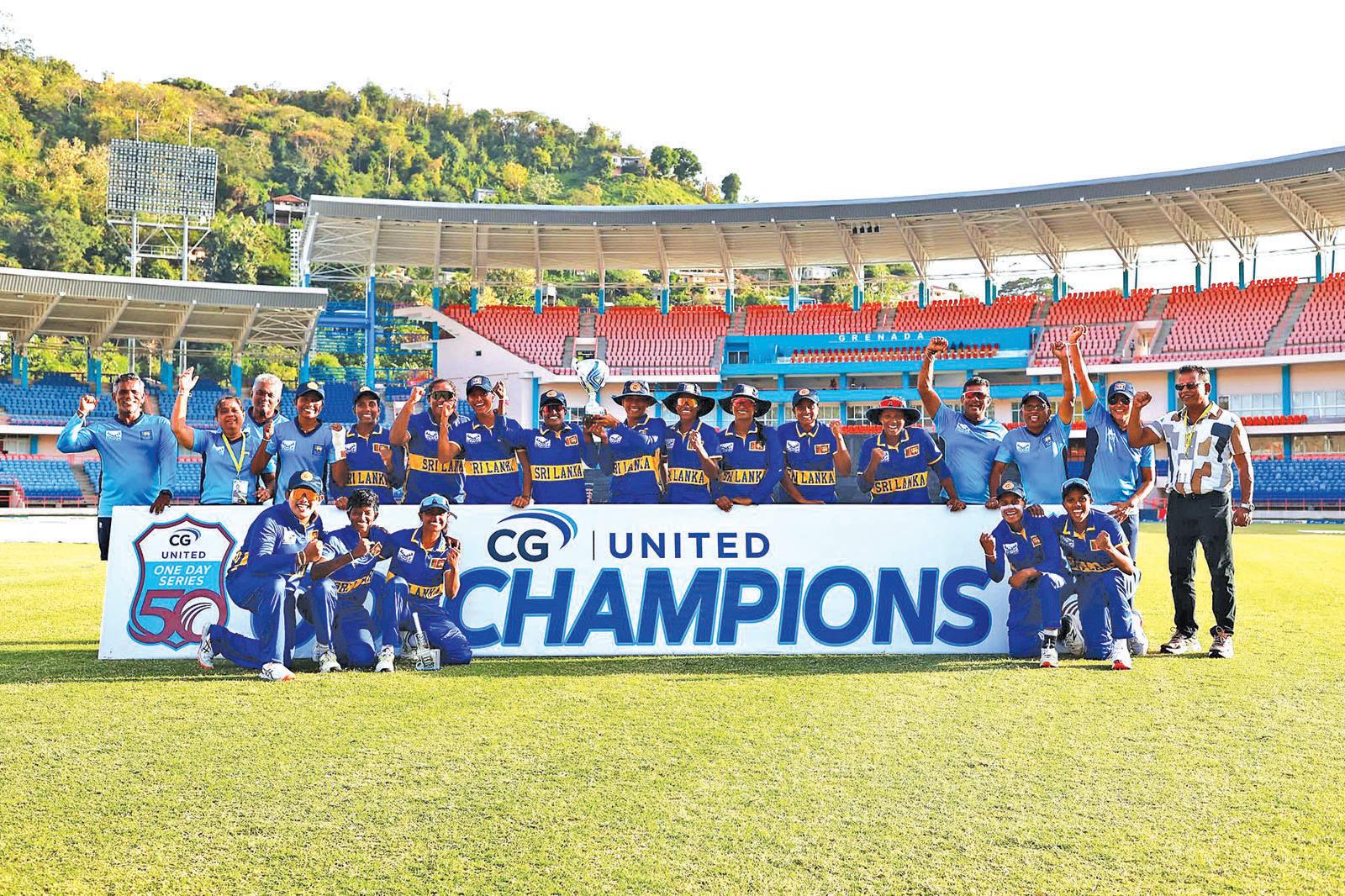
Sri Lanka won both the ODI and T20 series
The West Indies Women suffered an embarrassing 2–0 Twenty20 International series defeat to Sri Lanka Women after going down by nine wickets in the third and final match on Tuesday, with their opponents having 14 balls to spare. The opening fixture of the three-match series had been washed out, leaving the Caribbean side without a win in the series.
After being sent in to bat, the West Indies stumbled badly at the top of the order and were reeling at 28 for three inside the powerplay. Early wickets and a lack of fluency put them on the back foot, raising fears of a sub100 total.
The middle order, however, staged a modest recovery. Chinelle Henry struck an unbeaten 32 off 15 balls to inject late impetus, while Deandra Dottin battled for 28 from 39 deliveries and captain Stafanie Taylor added 24 off 39. Their efforts guided West Indies to a competitive but ultimately inadequate 119 for five from their 20 overs.
Sri Lanka’s bowlers maintained disciplined lines throughout, with Inoka Ranaweera (two for 16) and Sugandika Kumari (two for 32) doing the early damage to expose the fragile top order.
Any hopes of defending the total quickly evaporat-
ed as Sri Lanka produced a composed and commanding chase. Opener Hasini Perera anchored the innings with an unbeaten 52 from 59 balls, while Imesha Dulani contributed a fluent 34 not out off of 25. Captain Chamari Athapaththu’s brisk 32 off 22 balls ensured there were no late nerves as the hosts cruised to 121 for 1 in 17.4 overs.
Afy Fletcher claimed the lone wicket to fall, finishing
with one for 14, but the West Indies attack struggled to apply sustained pressure on a placid surface. The defeat seals a disappointing tour for the West Indies, who failed to capitalise on key moments throughout the series. Despite glimpses of resistance from the middle order, their recurring top-order collapses and lack of penetration with the ball proved costly.