Body of missing crew member onboard sunken molasses barge recovered
Lindsayca among 10 bidders submit proposals for fertiliser plant at Wales
US-based Guyanese man dies after falling into pothole on Liberty Avenue
Rupununi father, 2 sons on bail for gun, ammo possession charges
Lindsayca among 10 bidders submit proposals for fertiliser plant in Wales
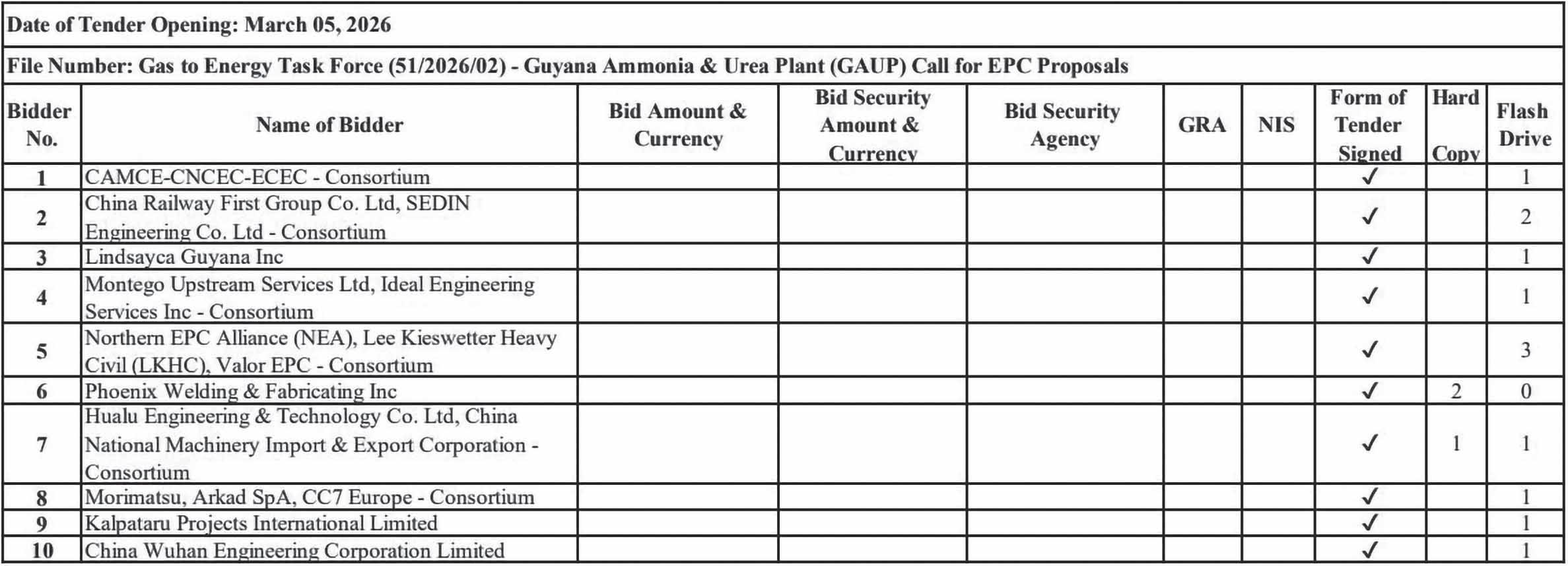
At least 10 companies, many of which are consortiums, have submitted proposals to design and build an ammonia/urea plant at the Wales Industrial Zone, West Bank Demerara, utilising the rich natural gas being produced offshore Guyana.
As part of Phase Two of the Gas-to-Energy (GtE) Project, the Guyana Government plans to utilise the excess natural gas that will be piped onshore from the prolific Stabroek Block for several industrial projects at Wales, including a fertiliser plant.
Back in October 2025, the Government invited proposals to design, engineer, construct, and operate an ammonia/urea plant, to which 10 submissions were received when the bids closed last Thursday.
These include a proposal from United States-based Lindsayca Guyana Inc –
the company constructing the highly anticipated Gasto-Energy (GtE) Project at Wales.
Also interested in the fertiliser plant are several Chinese consortiums: China CAMC Engineering Co (CAMCE), China National Chemical Engineering Co (CNCEC), and Dubaibased East Consulting Engineering Company (ECEC); China Railway First Group Co Ltd and SEDIN Engineering Co Ltd; Hualu
Engineering & Technology Co Ltd and China National Machinery Import & Export Corporation; and China Wuhan Engineering Corporation Limited.
Phoenix Welding & Fabricating Inc, a Trinidad-
based company operating in Guyana; Ideal Engineering Services Inc, a locally registered company in a consortium with Nigeria-based Montego Upstream Services Ltd; Northern EPC Alliance (NEA); Lee Kieswetter Heavy Civil (LKHC); and Valour EPC of Canada were also among the bidders.
Another consortium of Japan-based Morimatsu, Arkad SpA of Italy, and Netherlands-based CC7 Europe; and Kalpataru Projects International Limited – an India-based company operating in Guyana – also submitted proposals.
According to the Engineering Procurement and Construction (EPC) document, interested companies will enter into a public-private partnership model via the Guyana Ammonia and Urea Plant (GAUP) company to manufacture 300,000 tonnes of fertiliser per annum, using no more than 20 million cubic feet per day (MMCFD) of gas from Phase II of the Wales Pipeline.
The project, pegged at approximately US$300 million, is expected to be ready by 2027/2028, when the Gasto-Energy Phase II comes online.
The proposed Guyana Ammonia and Urea Plant will manufacture and sell fertiliser to the local and regional markets. According to the EPC document, the objective of GAUP is to lower fertiliser prices for Guyana and the broader region, including northern Brazil and the Caribbean.
In addition to the fertiliser plant, the Guyana Government is also looking to construct a cooking gas bottling plant at the Wales site and has already received 10 proposals last month.
These include local company Guygas in a joint venture with Makeen Energy out of Denmark and the Indian-headquartered Ramco Industries; Lindsayca Inc; Trinidadbased Massy Gas Products; Sol Guyana Inc – part of the Caribbean operator, Sol Group; French-owned Rubis Guyana Inc; Indian-based
Divyan International Inc (Guyana); Gas Zipa SASESP (Colombia) JV Fix It Depot and Standard Energy Company; Gate Ventures and Consulting Guyana Inc in a consortium with Propak Systems Ltd (Canada) and Makeen Energy (Denmark); ILF Consulting Engineering Inc India in collaboration with MAHAPREIT (Mahatma Phule Renewable and Infrastructure Technology Limited); and BB Energy (BBE) and Dec Ogeco (Ogeco) (Singapore).
Currently, at the Wales site, construction is ongoing on a 300-megawatt (MW) combined cycle power plant and a Natural Gas Liquids (NGL) facility that will utilise the gas from offshore. When this project comes online later this year, it will not only bring cheap and reliable power but also halve the costs of electricity.
Already, about 250 kilometres of 12-inch pipelines have been laid to bring the gas onshore. However, only 40 per cent of the pipeline’s capacity will be used by the GtE Phase I to supply the power plant and NGL facility with 50 million standard cubic feet per day (MMSCFD) of dry gas. With the pipelines having the capacity to push as much as 120 MMSCFD of gas, the Government is moving ahead with Phase II of the Gas-to-Energy project that will utilise the remaining 60 per cent capacity of the pipeline to bring additional gas onshore.
The GtE Phase Two will see the construction of another 300 MW power plant and NGL facility at the Wales site, using only 20 MMSCFD. With the remaining natural gas available, the Government is planning to set up other major industrial projects, including the cooking gas bottling plant and a fertiliser manufacturing plant in Wales.
Only back in January, Prime Minister Brigadier (Ret’d) Mark Phillips, whose office has responsibilities for the country’s energy sector, noted that investments in these two projects will be central to reducing costs in Guyana, especially food prices.
BRIDGE OPENING
MARCH 12,
The Berbice Bridge will be closed to vehicular traffic on: Thursday, March 12 –11:00h–12:30h, and Friday, March 13 – 12:20h–13:50h.
FERRY SCHEDULE
Parika and Supenaam departure times – 05:00h, 10:00h-12:00h, 16:00h, 18:30h daily.
WEATHER TODAY
Thundery showers are expected to ease into light rain in the evening, before returning later at night. Temperatures are expected to range between 23 degrees Celsius and 29 degrees Celsius.
Winds: North-Easterly to East North-Easterly between 3.12 metres and 5.36 metres.
High Tide: 10:21h and 22:30h reaching maximum heights of 2.04 metres and 1.93 metres.
Low Tide: 16:45h reaching a minimum height of 1.18 metre.
WIN’s Tabitha Sarabo-Halley shows limited grasp of Guyana’s foreign policy, regional issues on BBC World Questions …as
Govt reinforces foreign policy
Guyana’s foreign policy and its relationships with regional and international partners came under discussion during the BBC World Questions broadcast on March 11, where Government, opposition, and civil society representatives responded to questions on global alliances and the country’s stance on Cuba.
During the programme, moderated by Jonny Dymond of the BBC World Service, Finance Minister Dr Ashni Singh highlighted the Government’s position, stating that Guyana remains fully committed to regional integration and its relationship with the Caribbean Community (CARICOM).
Responding to suggestions that Guyana had distanced itself from the regional body, Singh rejected the claim, noting that the coun-
try was a founding member and host of the CARICOM Secretariat.
“It is not accurate that we have separated ourselves from CARICOM at all,” Singh contended during the discussion. “Guyana was a founding member, and we remain fully committed to the regional integration movement and its objectives.”
He added that Guyana maintains close relationships with all CARICOM member states and continues to work collaboratively on regional initiatives, including food security.
The discussion also addressed remarks by President Irfaan Ali regarding Cuba and whether Guyana’s position aligns with the United States’ policy.
Called for improvements
During an interview on Saturday with Fox News while in Florida, the Guyanese leader said the time has come for the status quo in Cuba to change in order to improve the lives of the people there and ensure they enjoy prosperity and democracy in the Caribbean nation.
According to Singh, the president had made no reference to regime change in Cuba and instead called for improvements in the lives of the Cuban people. He maintained that the Guyanese Government’s position remains consistent with the broader regional approach. Only earlier this week, Health Minister Dr Frank Anthony disclosed that it was the Government of Cuba, and not Guyana, that terminated the Cuban medical brigade operating in Guyana. He said the Cuban authorities made the decision to withdraw their medical workers in February during engagements between the two Governments.
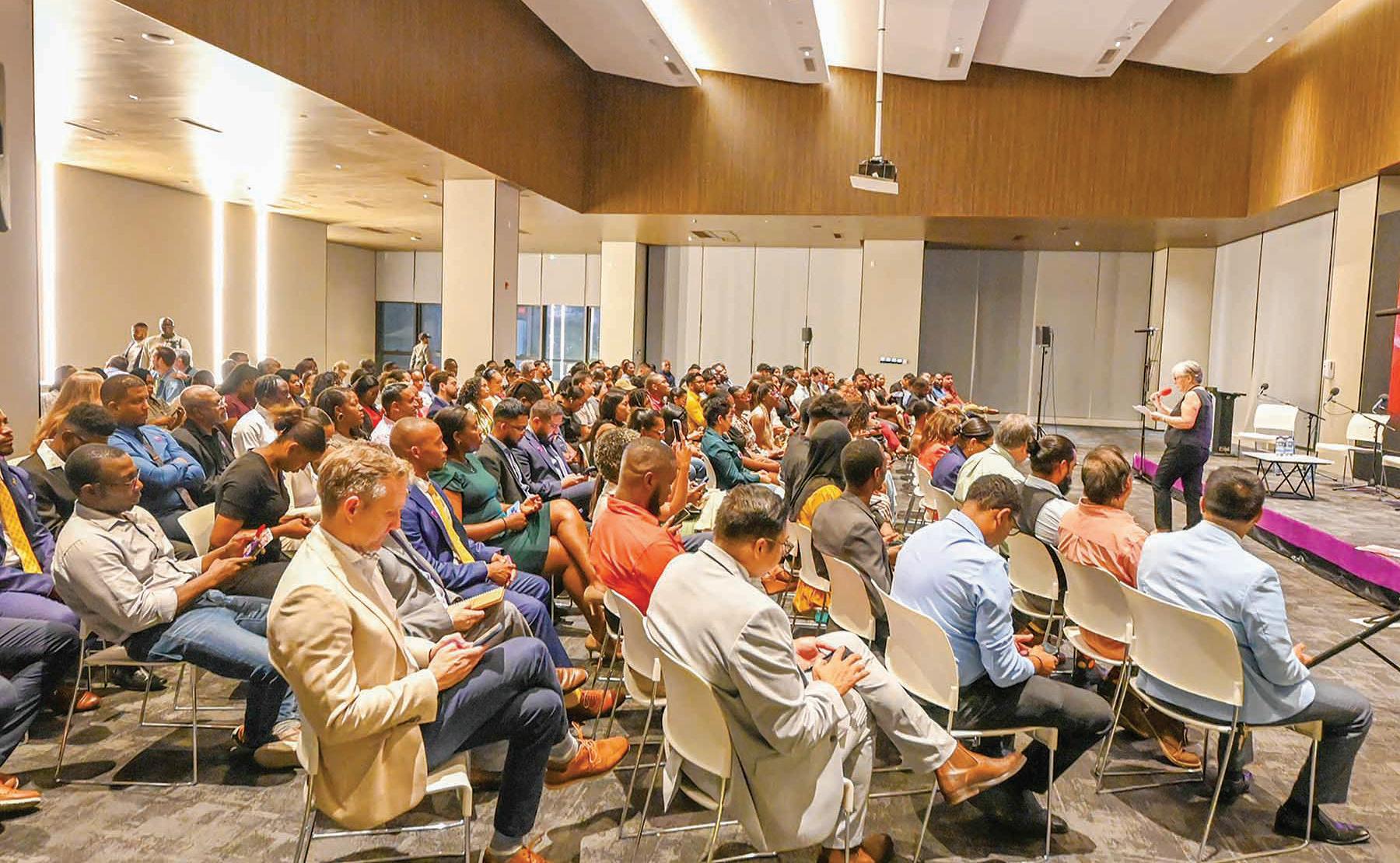
A section of the audience at the hosting of the BBC World Questions programme at the Pegasus Corporate Suites in Georgetown on Tuesday
(L-R) Activist & businesswoman, Ayodele Dalgety-Dean; Finance Minister, Dr Ashni Singh; BBC World Service host, Jonny Dymond; Opposition Member of Parliament Tabitha Sarabo-Halley and Secretary of the Private Sector Commission, Clinton Urling, on the panel of the Guyana edition of the BBC World Questions programme
The incident at a Georgetown primary school, where a Grade Five pupil took a loaded 9mm pistol to class, highlights a chilling lapse in responsibility that cannot be ignored. This cannot be dismissed as a story of youthful misjudgement but rather as a warning about the perils of negligence, both at home and in society at large. At the heart of this incident lies a fundamental failure by the firearm’s owner to ensure the weapon was securely stored. A firearm is not a toy, and it is incumbent upon those who possess such lethal instruments to maintain absolute control over them. Leaving a loaded pistol accessible, particularly in a domestic environment where children are present, is an act of recklessness that borders on criminal irresponsibility. The potential consequences of such carelessness are unthinkable. In this case, a catastrophe was narrowly averted, but it required a vigilant peer and a watchful teacher to prevent what could have easily escalated into a tragedy.
Equally noteworthy is the conduct of the teacher and the student who first reported the suspicious sound. Their prompt action, attentiveness, and refusal to ignore even the slightest warning signal exemplify the kind of vigilance that every school community must cultivate. The alertness of both the reporting pupil and the teacher turned what could have been an unimaginable calamity into a controlled situation. Their conduct must be lauded and used as a benchmark for how educators and students alike should respond to potential threats in the school environment. The dangers of firearms in schools are not theoretical, as across North America, school shootings have left indelible scars on communities, claiming the lives of innocent children and teachers alike. These tragedies illustrate how a moment of negligence can have irreversible consequences. While the circumstances in Georgetown differ in scale from the mass shootings that have devastated schools in the United States and Canada, the underlying risk remains identical: a child in possession of a loaded gun is an immediate hazard to themselves and everyone around them. There is no margin for error, and the societal expectation is that adults exercise due diligence in keeping weapons out of reach of minors.
Accountability in this case must extend to all responsible parties. The pupil who carried the firearm was only 10 years old and must be treated in accordance with juvenile justice procedures but with compassion. The primary onus lies with the adult who allowed the weapon to become accessible. A manager at a prominent utility company and his family had the opportunity to secure the firearm and prevent its removal. Their failure to do so is inexcusable. Investigations must be thorough, and any legal implications for the firearm holder must be fully explored to establish a clear precedent. Negligence involving firearms, regardless of intent, carries serious consequences.
Schools should not have to serve as arenas where parental irresponsibility manifests in potentially lethal ways. This incident is an unadulterated reminder that the responsibility for children’s safety extends beyond the classroom. Parents, guardians, and anyone in possession of dangerous instruments have a duty to ensure that access is strictly controlled. In failing to do so, they place not only their own children at risk but also every child who enters a shared space.
This incident highlights the extreme risks associated with careless firearm storage, the life-saving impact of vigilance within the school and societal responsibility to protect children from preventable dangers. Let this episode galvanise a commitment to responsibility, oversight, and awareness because the cost of inattention, in this instance, is measured in lives that cannot be replaced.
Sudan’s devastating war rages on as regional rivalries deepen
…Yet the Iran crisis may push Gulf rivals to set aside their differences and revive stalled diplomacy on Sudan
By Shewit woldemichael, criSiS Group’S Senior analySt for Sudan
Sudan’s civil war will soon enter its fourth year, with no end in sight.
The conflict has drawn in other regional actors, who support and sustain the war by backing Sudan’s belligerents. This risks precipitating a much wider fallout in the region, with severe consequences in and out of Sudan. Sudanese civilians are paying the price.
Militarily, momentum has swung back and forth between the Sudanese army and the paramilitary Rapid Support Forces (RSF). Today, the front line largely runs along west-central Kordofan, with no decisive breakthrough in sight. As the war edges towards its fourth year, the conflict is steadily regionalising into the Horn of Africa and the Red Sea, making any settlement that much harder to reach. External patrons with deep pockets are turning Sudan into an indirect theatre of confrontation. Their money, weapons, and logistical support shape battlefield calculations, sustain fighting capacity, and at times shift military momentum, prolonging the conflict and reducing incentives for compromise.
On one side stands the Sudanese army, which has assembled a coalition of supporters: Egypt, Eritrea, Turkiye, Qatar, Iran and, increasingly, Saudi Arabia, initially a neutral mediator. These countries, along with the United Nations and the Arab League, recognise army chief Abdel Fattah al-Burhan as Sudan’s Head of State. Most frame their backing as support for a Government confronting an internal rebellion.
On the other side, the United Arab Emirates (UAE) has been the RSF’s main patron, providing financial, military, and logistical support. That backing helped the RSF sustain major operations, including the long fight for el-Fasher. When the city fell after a siege stretching roughly 18 months, images and testimonies of atrocities spread: Executions, torture, abductions and sexual violence. The horror prompted a wave of critical coverage of Abu Dhabi’s role, but this has not
had an effect on Emirati support.
Sudan’s geostrategic position helps explain why outside powers remain deeply invested. The country sits at the crossroads of the Red Sea, the Horn of Africa, the Sahel and North Africa. For some regional powers, the war is not only about Sudan itself, but about their own national security interests as well as the projection of influence in a rapidly-changing and contested regional order.
Sudan’s African neighbours are also being drawn into the conflict, sometimes due to direct national interests and other times due to the incentives offered to serve as transit hubs for arms and supplies. These dynamics risk worsening existing fault lines across the Horn of Africa and potentially merging multiple regional conflicts, with Sudan at the epicentre.
Tensions swallow diplomatic efforts
On September 12, 2025, after months of US-led negotiations, the Quad – the United States, Saudi Arabia, the UAE and Egypt – proposed a roadmap to end the war. There was some initial diplomatic progress within the Quad format, including agreement on broad principles and indirect talks. In theory, alignment among these external backers could generate meaningful pressure on both the Sudan army and the RSF to negotiate an end to the war.
But, instead, mounting tensions between two Quad members, Saudi Arabia and the UAE, now overshadow the roadmap negotiations.
In December, those tensions erupted publicly. The UAE-backed Southern Transitional Council in Yemen launched a surprise offensive near the Saudi border against Saudi-backed forces, provoking Riyadh’s ire and triggering a rare, open rupture between the two Gulf heavyweights. Saudi Arabia publicly rebuked the UAE and demanded a full UAE withdrawal. The UAE then announced a pullout. Yet the rift has not closed. Saudialigned media now regularly accuse the UAE of “destabilising the region”, including in Sudan.
The UAE-Saudi feud risks deepen-
ing the intractable nature of the war. It could, for example, drive even more overt support for the army from Egypt, Turkiye, Qatar and Saudi Arabia. And few expect the UAE to scale back its support for the RSF.
The US must push harder
The US remains at the centre of the push to end the war, despite ongoing questions about whether the Trump Administration is committed to seeing those efforts through. Those questions are likely to grow amid the war launched by the US and Israel against Iran, which has retaliated by also striking States across the Gulf.
All of these developments raise doubts about whether Quad negotiations over Sudan will make progress in the short term. As Gulf States respond to an unprecedented security threat, their attention is unlikely to be trained on Sudan. Yet the same crisis could also create an opening. Faced with a shared security challenge, Riyadh and Abu Dhabi may find reason to set aside some of their differences, including over Sudan. If they do, the effects could be constructive, helping revive stalled diplomatic efforts to end the war. The US and European powers, as well as other regional actors such as Turkiye, Egypt and other Gulf States, should try to help broker a Saudi-Emirati detente, and use it as a critical step on the way towards a truce in Sudan. Any such truce between the two warring parties would, in turn, need to set in motion an intra-Sudanese political process, possibly facilitated by the African Union and the UN.
There is also an urgent need to cool temperatures in the Horn of Africa, which appears on the precipice of a wider regional war driven in part by rivalries over Sudan’s conflict. It is time for African and other leaders to step up and try to ward off any escalation.
Even as the war with Iran intensifies and consumes global attention, it is vital not to forget that Sudan’s conflict is also primed to spread unless more is done to stop it. (Al Jazeera)
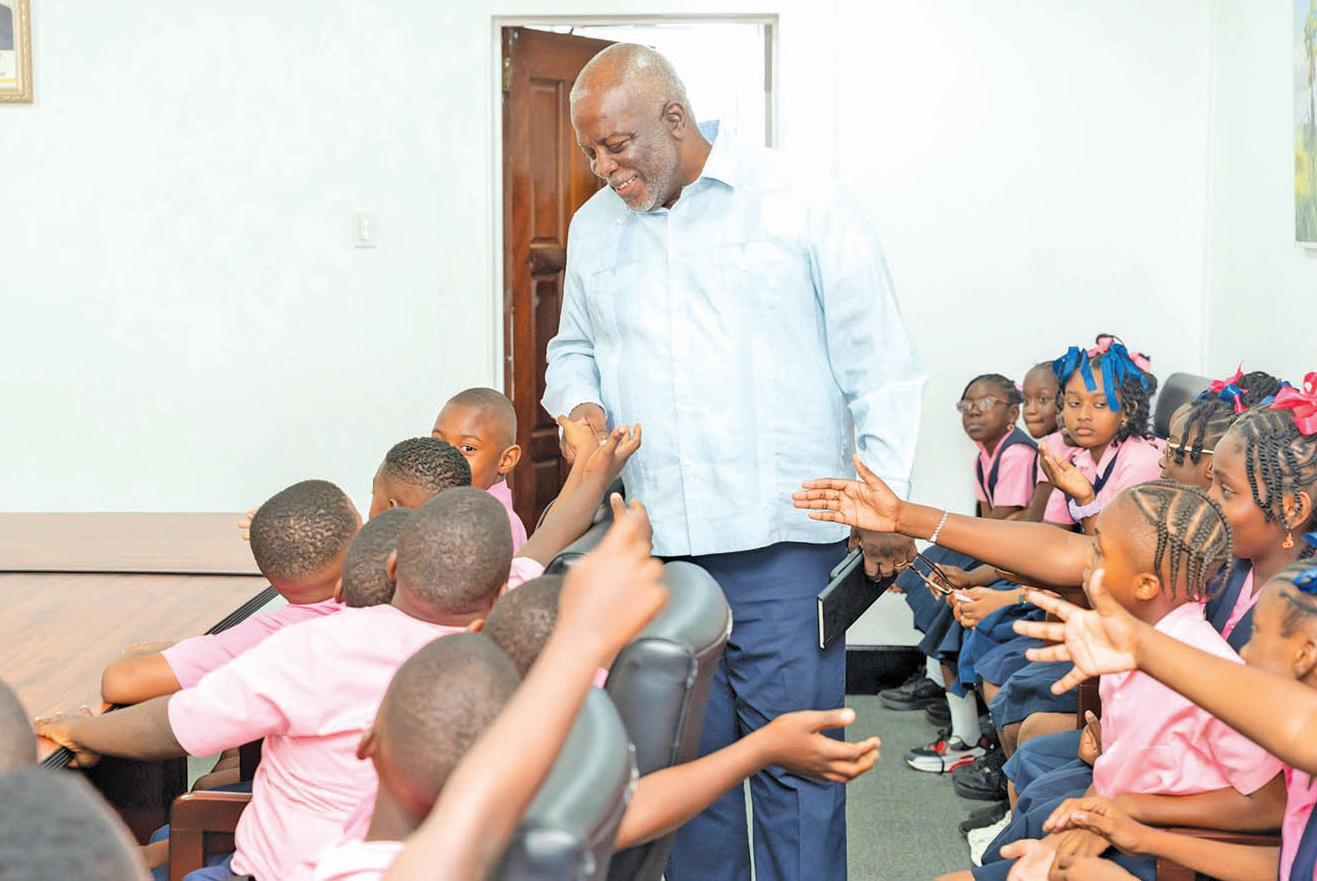
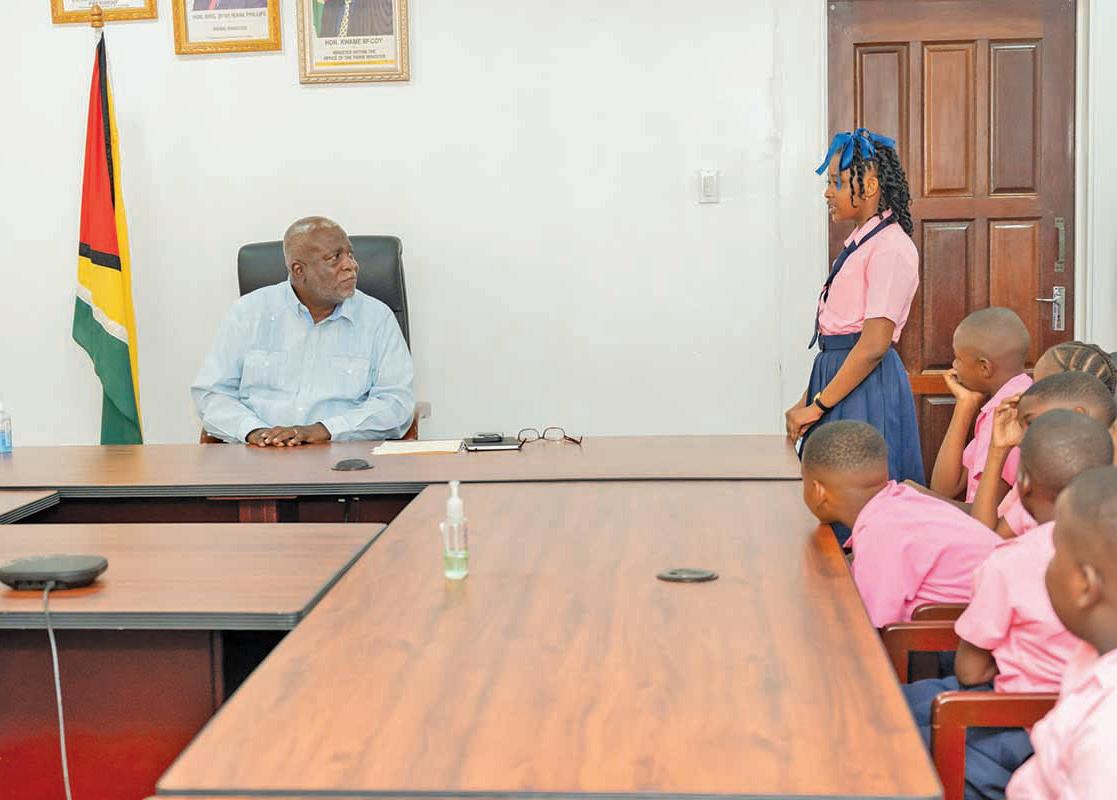
Prime Minister Brigadier (Retired) Mark Phillips chats with Hopetown Primary School students during their visit to the Office of the Prime Minister on Camp Street, Georgetown, encouraging them to stay disciplined and focused and to embrace reading as a key to leadership and success (Office of the Prime Minister photos)
Piloting biometric voting in LGE
Dear Editor,
I write to advocate for biometric voting at the next local Government elections as a small first step on the road to expanding biometric verification for elections nationwide.
Conducting a trial at the local Government level would allow the commission to test logistical feasibility during actual voting, assess risks and challenges beforehand, and make improvements to the process before considering biometric verification for future general and regional elections.
Biometric voter verification systems, which general-
ly refer to fingerprint or facial scanning technologies, are implemented to bolster voter ID integrity and reduce administrative weaknesses inherent to handwritten registers and first-vote-only ID cards. Done right, biometric verification allows electoral commissions to limit duplicate voting and impersonation, as well as administrative inconsistencies by verifying that every voter who votes is only one registered voter. Done wrong, biometrics are susceptible to poor planning, lax data security and voter profiling, ineffective training and procedures, poor
technology, and lack of transparency. For these reasons, I believe a nationwide rollout of biometric verification should only be implemented after extensive pilot programmes and not during the first election in which biometrics are used nationwide.
Local elections present an opportunity to trial this technology on a smaller scale. In contrast to general elections, local Government elections have fewer registered voters per constituency, far fewer constituencies to manage, and more flexible logistics. In this scenario, election management
bodies would have the capacity to install biometric devices at polling stations, run mock registration and verification exercises, and measure performance indicators like average verification time, failed device rate, queue length, and the number of voters requiring assisted or alternate verification.
This also provides the opportunity to assess the impact of biometric verification on the voters’ experience, including accessibility for seniors, persons with disabilities, and voters whose fingerprints cannot be easily read due to wear or job-related hand is-
Caricom pays for Trinidad’s oil in US dollars
Dear Editor,
Even though Guyana became CARICOM’s largest oil producer in 2023, no CARICOM country imports oil from this country. In fact, Guyana imported US$21 million of fuels, oils and distillation products from Jamaica in 2024, a reflection of the fact that Jamaica has an oil refinery and Guyana does not.
Barbados and the Eastern Caribbean Currency Union (ECCU) do import some fuels from Trinidad and Tobago, until recently CARICOM’s only major oil and gas producer, although their main suppliers are the US and India. There is minimal intra-Caribbean trade in fuels; the Caribbean market is too small to make it profitable to refine crude oil at home or to ship it across the Caribbean Sea for sale within the region. The region’s refineries were all built to serve the North American market, and the residual amounts they sell within CARICOM have stagnated with the closure of refineries in Trinidad, Aruba and elsewhere.
What is of significance for the balance of payments of CARICOM countries is the fact that Guyana’s payments to Jamaica, Barbados’ payments to Trinidad and Tobago, and
all other fuel purchases among CARICOM members are made in US dollars, just like these countries’ oil imports from the US and India. It makes no difference to Guyana or to Trinidad whether they sell oil to Barbados or the US because the price is the same in either case and payment is always in US dollars. Equally, it makes no difference to Barbados whether it buys in the US or in Trinidad, because the impact on the foreign currency market is the same.
Across the region, the specific terms of individual contracts may matter, but it is of no consequence whether the source of the product is Guyana, Trinidad or an extra-regional supplier.
In the absence of a single currency in common use throughout the region, intra-CARICOM trade does not provide any foreign currency benefit to member countries. Imports of food, pesticides and other manufactured products from member countries are paid for in US dollars, just like imports from non-member countries.
With the advent of oil production in Guyana, there is now no prospect of that country becoming the bread basket of
CARICOM, but that makes no difference to the balance of payments of any member country because imports of food from Guyana are paid for in US dollars, just like all other imports. Prior to 1971, when the US went off the gold standard, the countries that now form the Caribbean Community all had local currencies that were fixed to the US dollar: four dollars, 80 cents Eastern Caribbean currency per US dollar, 83 cents Jamaican per US dollar and one dollar Bahamian per US, a rate which remains unchanged (the EC dollar was the common local currency for countries from St Kitts south to Guyana, and the Jamaican dollar was also used in Belize). The value of the local currency never changed, and the local issue was fully backed by US dollars or an equivalent amount of pounds sterling. Local currencies were therefore readily accepted across the region.
In the 1970s, when currency values in the region began to diverge, CARICOM central banks devised a regional clearing mechanism, the CARICOM Multilateral Clearing Facility (CMCF), to facilitate regional circulation of local currencies. However, the CMCF broke down in the early 1980s and
has never been replaced.
The last credible attempt to establish a regional CARICOM currency came in 1982 when the Heads of Government agreed to a proposal made in Time for Action, the report of the West Indian Commission, for a single currency pegged at par to the US dollar. It was to have been implemented in stages by countries, based on criteria related to the stability of individual country currencies and minimum levels of foreign currency reserves, government deficits and levels of government debt. The agreement was never put into effect because neither Trinidad and Tobago nor Jamaica, which together made up two-thirds of CARICOM’s GDP, met the criteria. By now, over 30 years later, there is no prospect that CARICOM countries will use any common currency for trade, finance and commerce, other than the US dollar, the world’s currency. CARICOM leaders and the populations of the region should consider adapting their exchange rate strategy to this reality.
Yours sincerely, DeLisle Worrell
Ernie Ross’ book “Intangience” is a gem of experience and advice
Dear Editor, Ernie Ross and I were teenage friends. We lived a few houses apart in Prashad Nagar, and I visited his home frequently. Ernie called me by my nickname “Shully”, as those who were close to me back then did. In the early 1970s, many a Sunday evening would find us at the cafeteria at the Starlite Drive-In cinema at Montrose on the East Coast. We multitasked: watched the movie, had a few drinks, and discreetly admired the pretty girls in and around the cafeteria.
Ernie had a creative streak. He was into music, literature, and the arts in general. I remember him playing the harmonica, or, as we Guyanese call it, the mouth organ. He was a perceptive observer and thinker, but not rigid or opinionated. He was open to the free and easy exchange of views and ideas. All of this was a foreshadowing of the man he would become.
Sometime after high school, Ernie left Guyana for Trinidad. Starting from scratch, he gradually built up an advertising business. Tapping into his creative abilities and keen insights into human psychology, his advertising business grew exponentially. His company, Ross Advertising, won numerous awards over the years. He became an advertising, branding, and marketing star and practically a household name in Trinidad. He also worked on the successful political campaigns of President Janet Jagan of Guyana and Prime Minister Kamla PersadBissessar of Trinidad and Tobago. Additionally, he founded “ReThink”, a philanthropic organisation.
Ernie recently published a wonderful book entitled “Intangience”. The subtitle is “How Human Connection Creates Value Between People, Brands, and Ideologies”. “Intangience” is a portmanteau (blend) of “intangible” and “sci-
ence” or – more fully – “intangible values” and the “science of human connection”. The book is beautifully written, engaging, and insightful. The first of its ten chapters is set in 1970s Guyana, a depressing period in our history.
In other chapters, Ernie relates real cases from his career that showcase the Intangience methodology in action and validate the effectiveness of the branding framework. In the tenth and last chapter, “How It All Started”, he goes back to relate the story of his arrival in Trinidad, the success he achieved, his quest for fulfilment and purpose, and how Intangience was born.
Something that really impressed me is actually not in the book. There is no ego in the book. No hubris, no boasting. Instead, Ernie shares his experiences in a straightforward, matter-of-fact way. His sure-footed writing and delivery are serene, almost Buddhist in tone. He was Guyana’s
Honorary Consul General to Trinidad and Tobago for well over a decade, but there is no mention of that in the book. So modest.
“Intangience” is a gem of experience and advice. The book is available from Indigo (store and website) and also on Amazon. At this time, it is in hardcover format. Hopefully, a trade paperback will be released later. The Kindle electronic version on Amazon is reasonably priced.
This is good news for those in Guyana who may not be able to get the printed copy of the book. Those who have a Kindle device, or the free Kindle app on their iPad, can purchase the Kindle version from Amazon as an instant download. For those in Canada, Ernie is expected to be at the Indigo bookshop in Toronto’s Yorkville district for a book signing on May 23.
Yours faithfully, Sieyf Shahabuddeen
sues. Importantly, all the information collected during a local Government election pilot can be used to refine device procurements, device specifications, polling station user experiences, contingency planning, and more.
There are already examples from other countries we can learn from that illustrate that biometric verification, when planned properly and implemented correctly, can improve the credibility of voter identification at polling stations. Although there were operational issues with Ghana’s verified biometric voter registration and voter verification exercise during general elections in 2012, the mere presence of biometric verification at polls was lauded by voters as a means of limiting impersonation and multiple voting.
What Ghana’s election shows us is that technology is not a silver bullet. Biometric verification will only limit administrative weaknesses if election commissions build strong procedural guidelines around the technology. Parts of Ghana’s election were successful because their commission maintained transparent practices, trained verifiers effectively, and prepared reasonable contingency plans for voters who could not be verified biometrically.
The pilot for our local Government elections should have defined goals and key performance indicators. Whether our priorities are accuracy and inclusiveness (low false rejection rates), consistency (backup power, device backups, and offline capabilities), data security, voter education, or public transparency,
setting clear goals for the implementation of this technology will help make the case for biometrics (or against it) with concrete data. Of course, this data will only be useful if the trial is auditable.
Things like device logs, incident logs, independent monitoring, and a publicly available post-election trial report will help instil confidence in the implementation of this technology. If voters are led to believe biometric voting is being introduced to suppress votes rather than increase accuracy, participation in that election will suffer.
If, after a local election trial, we can determine that biometric verification is sufficiently accurate, inclusive, and cost-effective, then we can justify using biometric verification during the next general and regional elections. But if we find that there’s too high a likelihood that devices will fail on election day, exclude legitimate voters from participating, or significantly slow down voter throughput at polling stations, we can delay the integration of biometrics until we have had more time to consider these challenges.
Biometric voting at the upcoming local Government elections is a low-risk election that allows us to trial voting technology during actual voting conditions and make an educated decision moving forward. If we find that biometric voting works, we’ll have even more reason to introduce it at the next general and regional elections. If it doesn’t, we’ll have hard data to show why not.
Yours sincerely, Philip Inshanally
Page Foundation
◄ Understanding percent
Notice the term per cent has the smaller word cent in it. You know cents from dealing with money. Every dollar can be divided into 100 cents, that is 100 hundredths. Therefore, it probably will not surprise you that cent means hundredth. Per means by. A percent is a particular kind of ratio that is used to compare numbers to hundredths. The % sign is used to identify percents. However, a percent is really a decimal that goes to the hundredths place. A percent can also be expressed as a fraction, with 100 as the denominator.
Remember:
Every percentage can be displayed as a percentage, a decimal, or a fraction with a denominator of 100.
Exercises:
Express the following as decimals and fractions
Stained glass is a colourful way to let your art shine on.
Supplies/tools
Acrylic paint
Colouring pages
Glue
Paintbrushes
Watercolours
Craft sticks
Hot glue gun
Measuring spoons
Picture frame(s) Squeeze bottle(s)
Directions
Step 1: Pour glue into a squeeze bottle.
Step 2: Mix in 1/2 tbsp black paint to colour the glue. Add more paint for a darker colour.
Step 3: Have an adult remove the glass and backing from a picture frame. Place glass on top of printed artwork of your choice.
Step 4: With your glue and paint mixture, trace the artwork directly onto the glass. Let dry 2-3 hours.
Step 5: Paint the glass with watercolours. Blend colours to
create a stained glass effect. Let dry 1 hour.
Step 6: Have an adult use a hot glue gun around the edges of the frame to secure the glass.
Step 7: Hang or display in a window so the sun shines through your artwork! (Adapted from crayola.com)
By Khaty Xiong
I tell him to touch his toes. He reaches for them in a squat. He stabs them with his little fingers. One toe. Two toes. Then we say our letters, spell out all the sounds we will deliver because the death of a child is no small death. I extend to him an open palm where he makes a fist and slams it into my hand, a form, he wearily shouts, is “a butterfly coming home!” We play “give me a five” and continue swatting at the butterflies until the sun goes down.
I don’t recall ever playing with my mother like this. Late one morning, my son caught me pinching the sides of my head, my face wet from so much crying. He punched my arm, which knocked one hand off of my face. Ashamed that he saw me, I laughed very loudly which brought him concern and happiness. He never mentioned it again and I never forgave myself. My good son, running through the garden in giggles. He is waiting for me to catch him. Once I pretended to have fallen in a pit. I did not tell him it was a grave. Very quickly he sprinted over and stood beside my body. “Your hand!” he demanded. Like a little father. I gave him my hand. “Now, the other hand!” I give him the other.
(Source: Poetry [June 2019])
Write a story about a monumental event.
No increases in fuel prices – GUYOIL assures amidst rising global prices
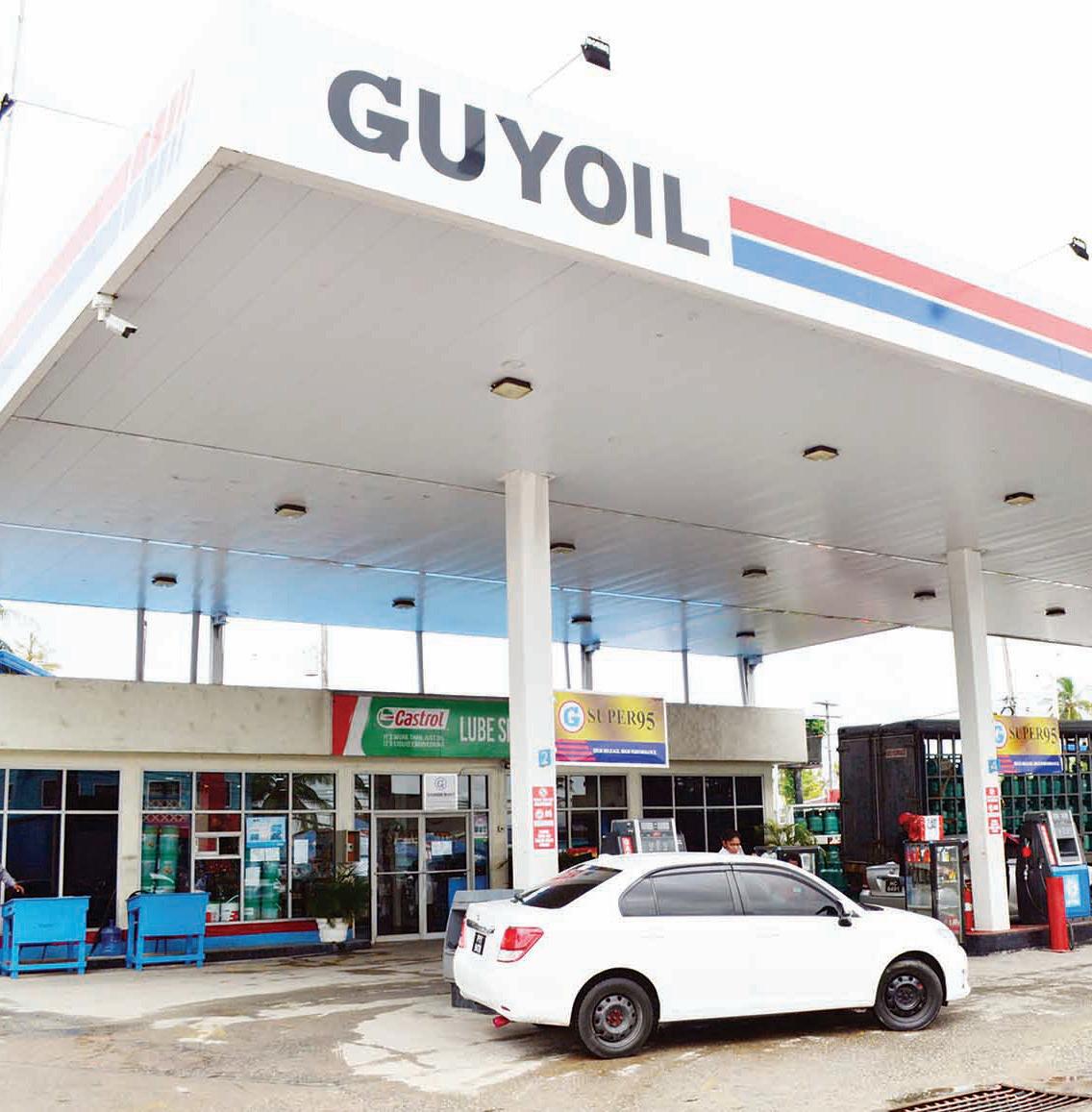
With global prices for oil hovering at nearly US$100 per barrel due to the ongoing war in the Middle East, several local gas stations in Guyana have hiked their prices for fuel, with the exception of the state-owned Guyana Oil Company Limited (GUYOIL), which has assured consumers that there will be no increases.
On Wednesday, there were reports that vehicles were flocking to GUYOIL gas stations across the country to fuel up in an apparent fear of prices going up.
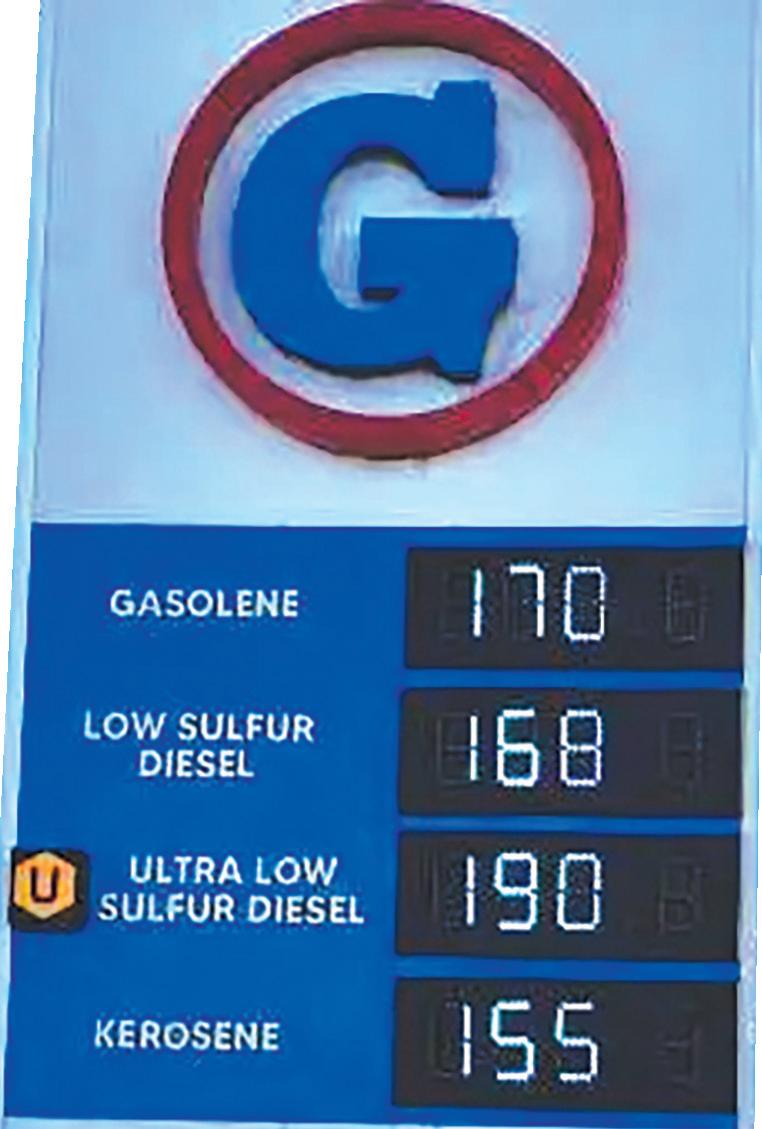
But in a statement on Wednesday evening, the state-owned company said it “...wishes to categorically state that there have been no increases in fuel prices for gasoline, diesel, kerosene, or ultra-low-sulphur diesel (ULSD) at any of its service stations across the country.”
According to the oil company, prices remain the same at: $170 per litre of Gasoline; $168
per litre of Diesel; $155 per litre of Kerosene; and $190 per litre of ULSD in Georgetown and on the East Bank of Demerara (EBD).
GUYOIL, any reports suggesting otherwise are false, misleading, and malicious and should be disregarded. This comes on the heels of online reports which stated that fuel prices have skyrocketed.
“GUYOIL urges the public to disregard such claims and rely only on the company’s official prices. Misinformation circulated through unofficial sources can undermine public confidence and distort the facts surrounding issues of national importance,” the missive detailed.
The company went on to remind us that it is guided by a strict regulatory and compliance framework that ensures transparent pricing while safeguarding consumers from undue market volatility.
“As a state-owned company with a national mandate, GUYOIL continues to work closely with the relevant regulatory authorities to ensure that fuel supply and pricing across its network of service stations remain stable, fair, and consistent with national policy. GUYOIL remains committed to maintaining a reliable fuel supply and competitive pricing for motorists, businesses, and households across Guyana,” it noted.
Further, GUYOIL urges the public to rely on official statements issued by GUYOIL and other competent authorities for accurate information regarding fuel pricing and supply.
“Misinformation circulated through unofficial sources can undermine public confidence and distort the facts surrounding issues of national importance.”
Since March 2022, the Guyana Government
has been actively subsidising fuel imports to block global price surges from being passed on to consumers. Another specific intervention to combat rising global prices was the reduction of excise tax on gasoline and diesel from 10 per cent to now zero per cent.
However, the recent United States-Israel war with Iran has resulted in world market prices for crude peaking over the last few weeks and reaching as much as almost US$120 per barrel on Monday as global fears continue over the conflict having lengthy disruptions to ener-
gy supplies from the Middle East.
Since the war began, traffic through the Strait of Hormuz – a narrow waterway through which oil from the Middle East, about a fifth of the world’s supply – has halted. Iran has threatened to bomb oil tankers passing through the major shipping route for oil produced by Gulf States, and according to international reports, the country has been laying mines in the Strait to target oil tankers. In fact, Iranian leaders have threatened to take oil prices to as much as US$200 a barrel.
Prior to the war in Iran, Brent was priced at around US$73 per barrel. By Monday, it went up to US$120 before dropping into the 80s on Tuesday but then soaring to over US$90 on Wednesday.
In order to curb the disruptions to oil flow in the Middle East, the International Energy Agency (IEA) on Wednesday released some 400 million barrels of crude from its members’ strategic reserves to stabilise global supply and prices.
Meanwhile, this surge in oil prices since the war began has been feeding through to pump prices in the US and the United Kingdom (UK).
The BBC reported that in the US, average petrol prices have risen above US$3.50 per gallon from about US$2.92 a month ago, while diesel had risen from US$3.66 to US$4.78 over the same period, according to the American Automobile Association.
In the UK, it was reported that average petrol prices have hit £1.3895 a litre, while diesel has hit £1.5512, having risen by £0.0612 and £0.1274 respectively since the end of last month, according to motoring firm the RAC.
Border communities are frontline of Guyana’s sovereignty – Home Affairs Minister
over $200M Imbotero Police Station commissioned
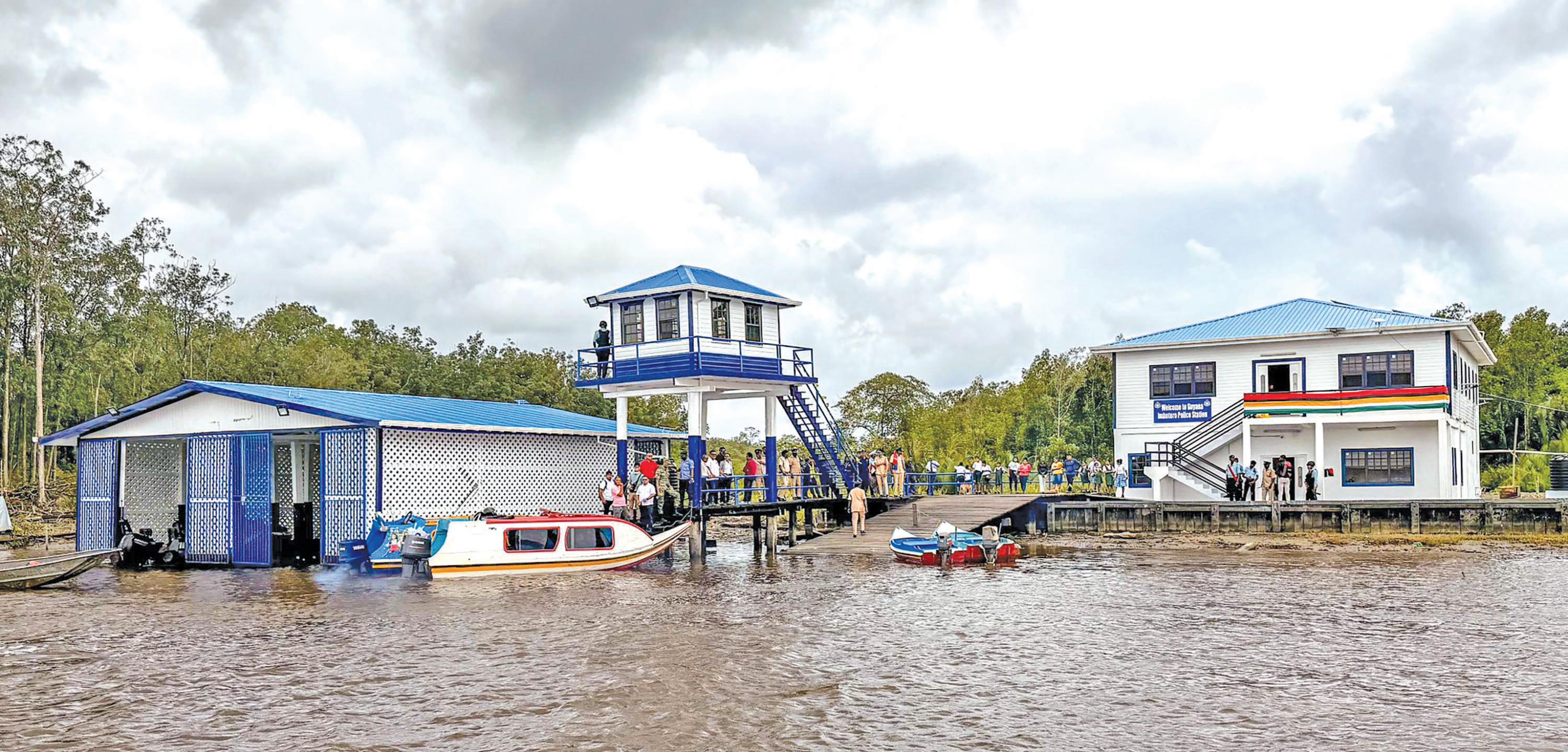
The Government has strengthened its security presence in Region One (Barima–Waini) with an investment of more than $200 million for the reconstructed Imbotero Wharf, a new Police boathouse, and the rebuilt Imbotero Police
Station along the Barima River.
The facilities were commissioned on Wednesday during a ceremony attended by Home Affairs Minister Oneidge Walrond, who said the investments are part of the Government’s strategy to reinforce law enforcement capacity and safeguard Guyana’s borders.
“Border communities are not the edges of Guyana; they are the frontline of our sovereignty,” the Minister stated.
According to Walrond, the upgraded infrastructure will support expanded river patrols and improve monitoring along the Barima River corridor. The facilities are also expected to enable quicker responses to incidents in surrounding communities.
The new Police boathouse will provide operational support for river patrols in the area, while the reconstructed wharf will as-
sist with docking and logistical activities for law enforcement operations. The rebuilt Police station is expected to improve the working envi-
ronment for officers and enhance service delivery to residents in nearby communities.
The Imbotero Wharf, a new Police boathouse and the rebuilt Imbotero Police Station along the Barima River
Bartica massacre Court dismisses appeals for 2 dead killers, upholds life imprisonment for others
The Guyana Court of Appeal on Wednesday dismissed the appeals of two deceased men convicted in connection with the 2008 Bartica Massacre while resentencing the two surviving appellants to life imprisonment. The unanimous ruling was delivered by Justice Jo-Ann Barlow, who explained that the right to appeal is personal and generally cannot continue after an appellant dies.
The appeals were filed by attorney at law Nigel Hughes on behalf of Mark Royden Williams, Dennis Williams, Michael Caesar, and Clebert Reece, who were convicted between 2016 and February 2017 for their roles in the February 17, 2008, attack in Bartica, Region Seven (Cuyuni-Mazaruni).
During that attack, gunmen stormed the Bartica Police Station and other locations, killing 12 persons, including three Police Officers stationed at the facility.
However, two of the convicted killers died before their appeals could be heard. Royden Williams was killed in 2023 during a confrontation with the Joint Services in Region Seven, weeks after escaping from the Mazaruni Prison in a daring May 2023 jailbreak. It was his second escape from custody, having previously broken out of the Camp Street Prison in 2017
before being recaptured later that year. Dennis Williams died in July 2024 while serving his sentence at the Mazaruni Prison after a period of illness.
No exceptional circumstances In addressing those matters, Justice Barlow said the court determined that the appeals could not continue because the appellants were deceased.
“In relation to the appeals after the deaths of Royden Williams and Dennis Williams, the court determined that an appeal is a personal act, and when an appellant dies, there is no right that exists that allows for that appeal to continue,” she said.
The court noted that while it has discretion to proceed in exceptional circumstances, the grounds of appeal in the cases did not warrant such action.
The court also referred to the circumstances surrounding Royden Williams’ death, noting that he had escaped from custody before being killed. Justice Barlow said the court believed that because Williams had taken himself out of the legal system by escaping, he could not reasonably expect the system to work on his behalf while he was at large. As such, the Judges declined to exercise their discretion to continue the appeals.
The court then turned its attention to the surviving appellants, Michael Caesar and Clebert Reece, both of whom had pleaded guilty to the lesser offence of manslaughter.
Severe penalties justified
In Caesar’s case, the appellate Judges dealt with resentencing for both the Lusignan Massacre and the Bartica killings, even though he had filed a single notice of appeal covering both matters. The court found that the determinate sentence previously imposed for manslaughter, 75 years, effectively exceeded the statutory maximum penalty of life imprisonment.
Justice Barlow explained that while severe penalties were justified given the gravity of the crimes, the punishment must remain within the limits established by legislation. As a result, the court set aside the earlier sentence and conducted a resentencing exercise.
For the Lusignan massacre, Caesar was resentenced to life imprisonment with 38 years to be served before eligibility for parole. However, eight years were deducted for time spent on remand, leaving 30 years to be served before parole eligibility.
For the Bartica killings, the court imposed life imprisonment with 40 years to be served before eligibility
for parole. In that instance, no deduction was made for time spent on remand because the time served would have been equivalent to the remand period, one of the exceptions recognised in sentencing law. The court ordered that the sentences for the Lusignan and Bartica matters run concurrently.
Callous disregard for life, property
The Judges also noted that the Bartica massacre represented the second known set of killings involving Caesar and highlighted his role during the attacks. According to the court, Caesar admitted that he was armed and fired shots during the incident, demonstrating what the court described as a callous disregard for life and property.
The Court of Appeal also resentenced Clebert Reece for his role in the Bartica massacre. Although the court noted that there was no evidence that Reece carried or fired a firearm during the attack, it found that he played an important role by transporting members of the gang responsible for the killings.
Justice Barlow explained that the court considered several factors in determining the appropriate sentence, including Reece’s involvement in facilitating the crime as well as his personal circumstances.
The court also took into account evidence that Reece joined the group out of fear that harm could come to him and his family and that he had previously lived an unblemished life. Additionally, the Judges noted his efforts while in prison to reform himself.
Taking those factors into consideration, the court determined that his eligibility for parole should be set at 34 years, from which eight years were deducted for time spent on remand. This resulted in a final sentence of life imprisonment with 26 years to be served before eligibility for parole on each count.
Driver caught on camera driving recklessly fined $90K
Thirty-one-year-old
Narendra Jherry of Martyr’s Ville, Mon Repos, East Coast Demerara (ECD), who was caught on video driving in a dangerous manner along the Beterverwagting Public Road, was on Wednesday slapped with two traffic-related charges.
Jherry, who was arrested one day after the video surfaced on social media, was charged for dangerous driving and the breaching of a one-way street. He appeared before Senior Magistrate Clive Nurse at the Sparendaam Magistrate’s Court, where the charges
Charged: Narendra Jherry
were read to him.
It was reported that Jherry drove motor car PAL 3206 in a dangerous manner along the Beterverwagting Public Road, ECD, causing several other motorists to take evasive action to avoid a collision.
The information technology technician was arrested on Monday at his residence. He was taken to the Beterverwagting Police Station, where he was charged.
He pleaded guilty and was subsequently fined $50,000 for dangerous driving and $40,000 for breaching a one-way street.
Fulfilling…
…a prophecy??
In the Bible we’re told about the Four Horsemen of the Apocalypse – the first riding a white horse and bringing pestilence; the second on a red horse and being the creator of war, conflict and strife; the third a food-merchant riding a black horse and symbolising famine, while the last is pale and accompanied by the god of death. Well, here we are, in 2026, and we’ve survived the pestilence on the white horse of Covid-19 since 2020 with over seven million deaths – but it looks like the fella on the red horse of war has been doing very well for himself, thank you!!
There’s that war up in Ukraine that’s been going on since February 2022 – when Putin rode in on his red horse. He shows no sign of letting up anytime soon!! Even though Putin says it ain’t really a “war” but a “special operation”, between 200,000 and 300,000 persons have been killed so far!! I!!! The huge indeterminacy being a sign that truth is the “first casualty of war” – and neither side’s revealing the true carnage!! And we’re supposed to be thankful that only our wheat (and flour) supplies have been disrupted since no nukes have been launched to date!!
Then, of course, there was that genocide… erm… “reprisals”… by Israel against the Palestinians on the West Bank – or wherever they’re found – including just last week, in Lebanon!! The Palestinians had killed some 1147 Israelis, while to date between 90,000 and 100,000 Palestinians have been killed – mostly children. The indeterminacy here seems to be the lesser worth of Palestinians since they’re not counted so accurately as Israelis' deaths!!
Even more beneath the radar – because of their lack of worth – is the civil war in Sudan between the Sudanese Armed Forces and the rebel Rapid Support Forces. Since 2023, when the latest upsurge began, some 150,000+ Sudanese have been killed overall – with one battle alone in Khartoum accounting for 61,000 deaths. Yet you’d be hard pressed to’ve read about this war even in the socalled “newspapers of record”!! Over in nearby Ethiopia, rebels in their Tigray and surrounding regions have inflicted between 500,000 and 600,000 deaths – with the fellas on the black horse of famine and white horse of pestilence generously pitching in!!
Another under-the-radar war that gets lost in the shuffle of other conflicts that doesn’t involve countries that matter – like the US and Israel! – is the Yemeni Civil War that’s been dragging on for a decade! There’ve been 377,000+ deaths – many from famine and disease – in the conflict among the Yemeni government, Houthis and a Saudi-led coalition!!
So what can we conclude from all of this?? We’re in a period in which war’s normalised. So we better get prepared!!
…free market’s destiny
One thing we should learn from the present upsurge of the free-market economy is that companies gotta always exploit opportunities – to make more money. There’s NEVER too much profit, baby!!. And it ain’t just about finding the cheapest labour pool to produce our widgets –like the US did with China since 1972!! They’re now flocking to India, Vietnam, etc. to do the same now that China isn’t just the enemy – but more critically, its labour costs ain’t rock bottom no mo!!
Another tactic is to register your company where they’ll be taxed and regulated the least – or just as profitable; the regulations ain’t as stringent!! So we see Exxon quitting NJ, where they’d registered 144 years ago in 1882 as Standard Oil Company (SO or Esso, get it? And then Exxon). They’ll be moseying down to Texas to register as ExxonMobil –the legal, tax and regulatory landscape is so much more friendly to the bottom line!
No pesky pollution regulators!!
…futility
Sanction Man and his Daady just lost their latest bid to halt their extradition process in the Magistrate Court, which they’d filed in the Appellate Court. That court ruled the trial must continue – while they mull over the not-sosubstantive points raised!!
Convicted killers: Mark Royden Williams (dead), Dennis Williams (dead), Michael Caesar, and Clebert Reece
US-based Guyanese man dies after falling into pothole on Liberty Avenue
A46-year-old USbased Guyanese man died after crashing his standing scooter in Queens, New York, near a stretch neighbours say has long been plagued by potholes.
The deadly incident happened around 21:30h Monday in Ozone Park. Authorities say the man was heading east on Liberty Avenue when he fell near 109th Street.
According to NBC New York, the now deceased was pronounced dead after suffering critical head injuries. His identity has not yet been released, pending family notification.
Fresh blacktop now covers sections of Liberty Avenue where the crash occurred. Candles have been placed near the spot where the man’s body was found.
Surveillance video obtained from a nearby business shows the 46-year-old leaving the establishment and riding down Liberty
Avenue. The footage shows him passing a white car moments before he suddenly hits the ground at the intersection.
“When I looked, I saw the guy face down, but he was wearing a jacket,” said Ann Murak, who lives in Ozone Park and said she saw the victim lying in the roadway. “I’m looking right, and the scooter looks like maybe a few feet from him, but he was not moving.”
Local residents in the area say potholes have been a persistent problem along the stretch of Liberty Avenue, raising concerns about road safety.
“If you go up and down Liberty, you’ll see there’s nothing but potholes,” said Monica Sanchez, who lives in the area.
The city’s Department of Transportation (DOT) said it had not received any formal complaints about potholes on that section of Liberty Avenue for “years”.
In a statement, the DOT said, “This is a terrible
tragedy, and our thoughts are with the victim of this
crash and his family. NYC DOT has crews working
around the clock across the five boroughs to fill potholes and make emergency roadway repairs – with more than 10,000 potholes filled in just the last week alone and plans to resurface more than 1100 lane miles this year.”
Potholes are a recurring issue across New York City, particularly after dramatic temperature swings that cause pavement to expand and contract. While they are often considered a seasonal nuisance, neighbours say this crash highlights how dangerous they can become.
“But one thing is that what we’ve seen from this city is that people have to lose their lives before they fix things, you know?” Sunny Bacchus, who lives nearby, stated. It remains unclear whether a pothole directly caused the crash. The investigation is ongoing. Anyone who sees a pothole is asked to call 311.
The scene in Ozone Park on Liberty Avenue on Monday
Loaded 9mm gun found under desk of 10-yearold in school
…owner claims firearm went missing from safe
AGrade Five pupil attached to a primary school in Georgetown is now in hot water after he reportedly took a loaded firearm belonging to his uncle to school on Monday.
Based on reports received, a pupil requested to use the washroom, and after she returned, she reportedly informed her teacher that she was hearing a clicking sound coming from under the desk of another child.
However, upon questioning the 10-year-old child, he denied hearing anything, prompting the teacher to check his haversack, but nothing was found.
Shortly after, another child picked up a firearm from the ground under the 10-year-old’s desk and handed it over to the teacher, who immediately contacted the Police.
Upon inspection, the investigators confirmed that the firearm was a 9mm
Taurus pistol with the serial number ACT 282510, along with a magazine containing 11 live rounds of matching ammunition.
The child was interviewed and stated that on March 3, 2026, he visited his cousin’s home at Parfaite Harmonie, West Bank Demerara, who gave him the firearm and told him to put it in his brother’s car.
Instead, he wrapped it up, put it in his haversack, went home, and took it to school.
Meanwhile, the owner of the firearm, a manager attached to Guyana Power and Light, when interrogated, told investigators that on Sunday, he checked his safe for the firearm and realised that it was missing.
As such, he was assisted by his family members in an intense search, but the firearm could not be found. Investigations are ongoing.
Rupununi father, 2 sons on bail for gun, ammo possession charges
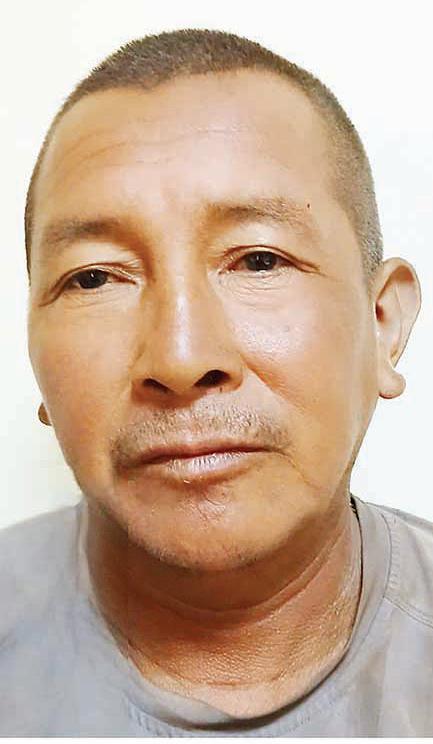
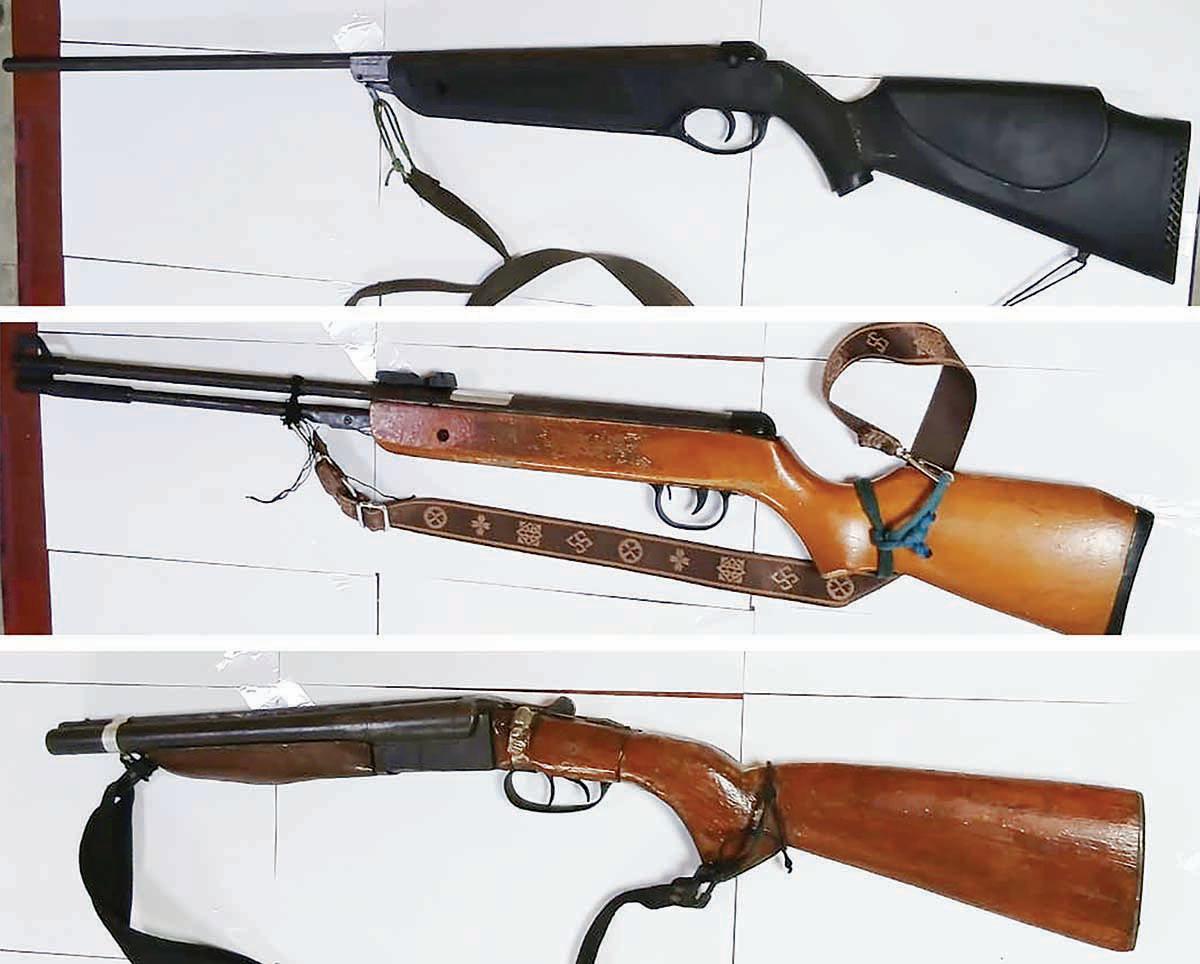
Afather and his two sons, who were arrested following the discovery of several firearms and ammunition at their South Rupununi, Region Nine (Upper Takutu–Upper Essequibo) home, have been charged and granted bail.
Franklin Edwards, 53, and his two sons, 20-year-
Region Nine, appeared be -
ammunition charge.
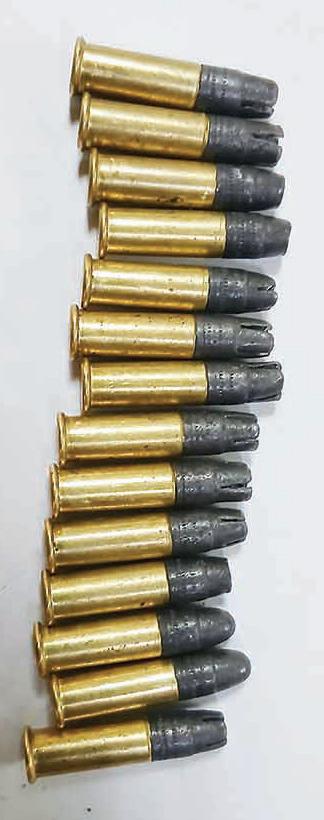
As part of their bail conditions, the defendants are required to report to the Police every Friday at 10:00h. The matter was adjourned to April 1, 2026. It was reported that the three men were arrested on Saturday following the discovery of two .22 rifles, one airsoft rifle, and 14 rounds of .22 ammunition.
Police stated that ranks acting on information received went to the home of the three men, where the guns and ammunition were handed over.
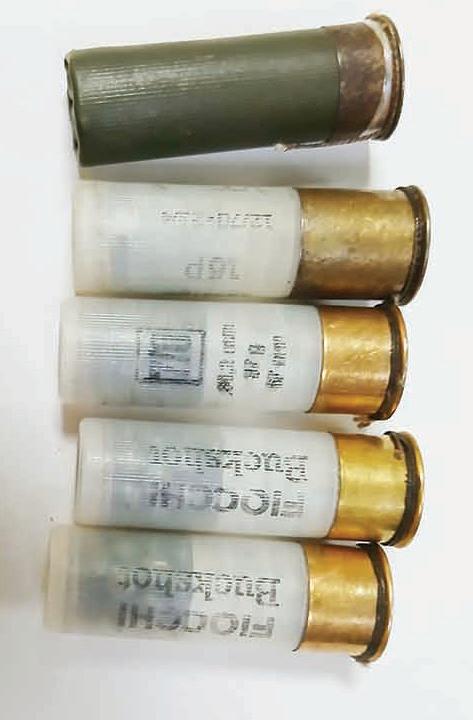
Further checks were conducted in the kitchen area of the premises, during which one 12-gauge double-barrel shotgun, along with five rounds of
fore Magistrate Omadatt Chandan at the Lethem Magistrate’s Court, where the charges were read to them.
They all pleaded not guilty and were granted bail in the sum of $100,000 each for the firearm charge and $75,000 each for the
matching cartridges, was found.
The trio were questioned by ranks and stated that they were not holders of firearm licences. As such, they were arrested and taken to the Lethem Police Station, where charges were instituted.
old Romauld Edwards and 22-year-old Francisco Edwards from Shea Village, South Rupununi,
The ammunition found at the home of the trio
Charged: Franklin Edwards
The firearms found during the raid
Charged: Romauld and Francisco Edwards
1st Avianca cargo flight touches down at CJIA
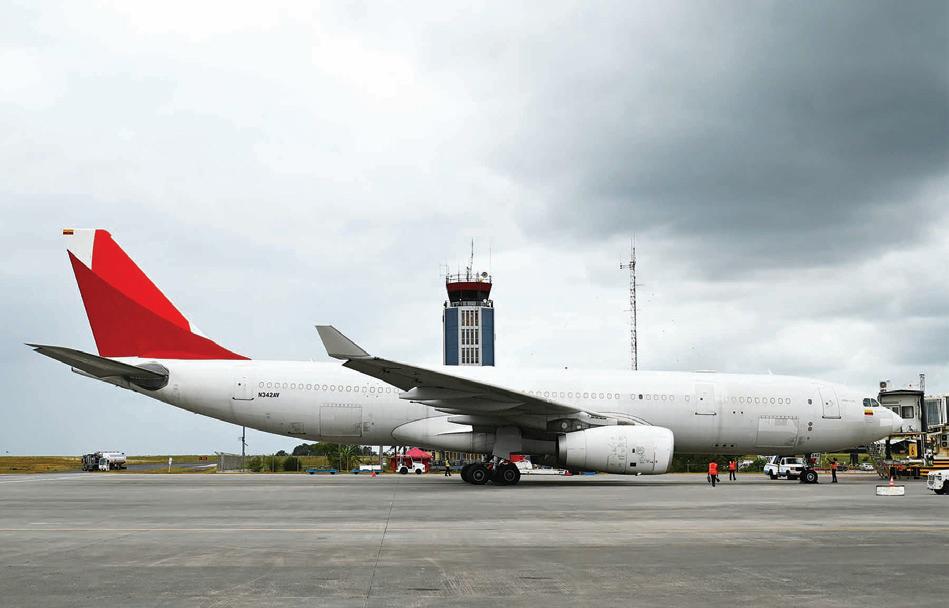
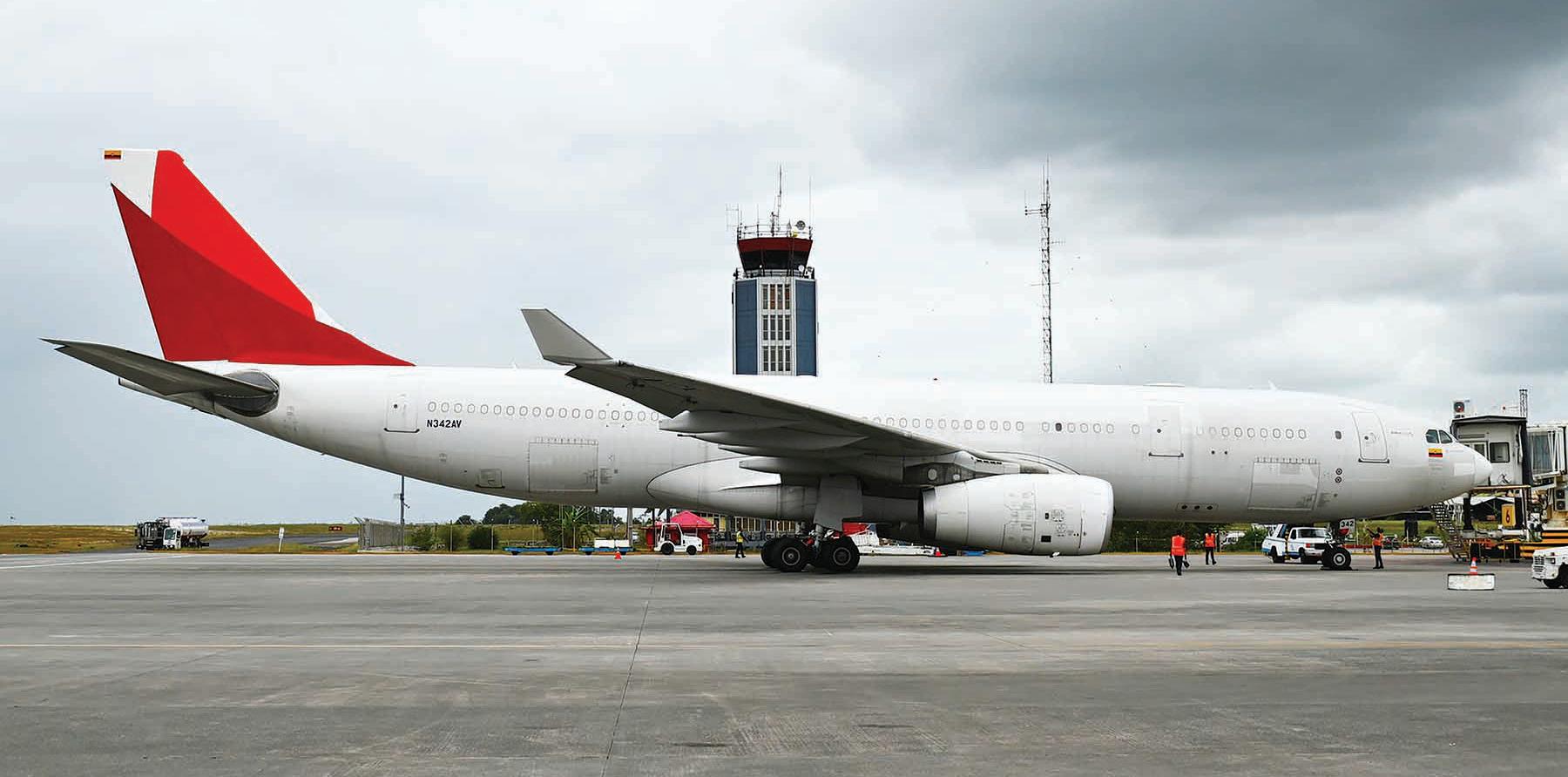
The inaugural cargo flight operated by Avianca Cargo arrived on Wednesday at the Cheddi Jagdeo International Airport (CJIA).
In a social media post, the airport said the cargo service expands the airline’s presence locally, as Avianca already operates passenger flights to the country. The cargo aircraft, an Airbus A330-300, arrived in Guyana and was greeted with a ceremonial water salute to mark the milestone.
The aircraft has a cargo capacity of approximately 53 tonnes and represents the airline’s first dedicated cargo flight to Guyana. The airport said the move strengthens air freight connectivity and supports the country’s growing logis-
tics sector.
According to earlier information released by the Government, the service officially commenced on March 2, operating weekly flights
between Guyana and Miami.
Public Utilities and Aviation Minister Deodat Indar previously announced that the cargo operations would be conducted using an
Airbus A330-243F aircraft, capable of transporting up to 65 tonnes of cargo per flight.
The Minister said the new service comes as Guyana experiences a significant increase in international cargo volumes. Since 2020, cargo movement through the country’s international airports has nearly doubled, reflecting increased commercial activity and expanding trade.
Indar had said the new weekly service is intended to strengthen the country’s aviation and logistics infrastructure while supporting the needs of businesses and individuals.
“This additional 65-tonne weekly capacity is a critical resource for both our business community and
private citizens. It provides a reliable, high-volume link for the shipment of commercial goods, agricultural exports, and personal effects,” the Minister said.
The direct air cargo connection to Miami is expected to provide exporters with faster access to international markets, particularly for agricultural and commercial products.
Government officials have said the initiative also supports efforts to position Guyana as a major supplier of food within the Caribbean region, enabling farmers and manufacturers to move products more efficiently to overseas markets.
Avianca Cargo has been involved in cargo operations since 1973.
Sophia man dies after speeding car turns turtle at Rockstone
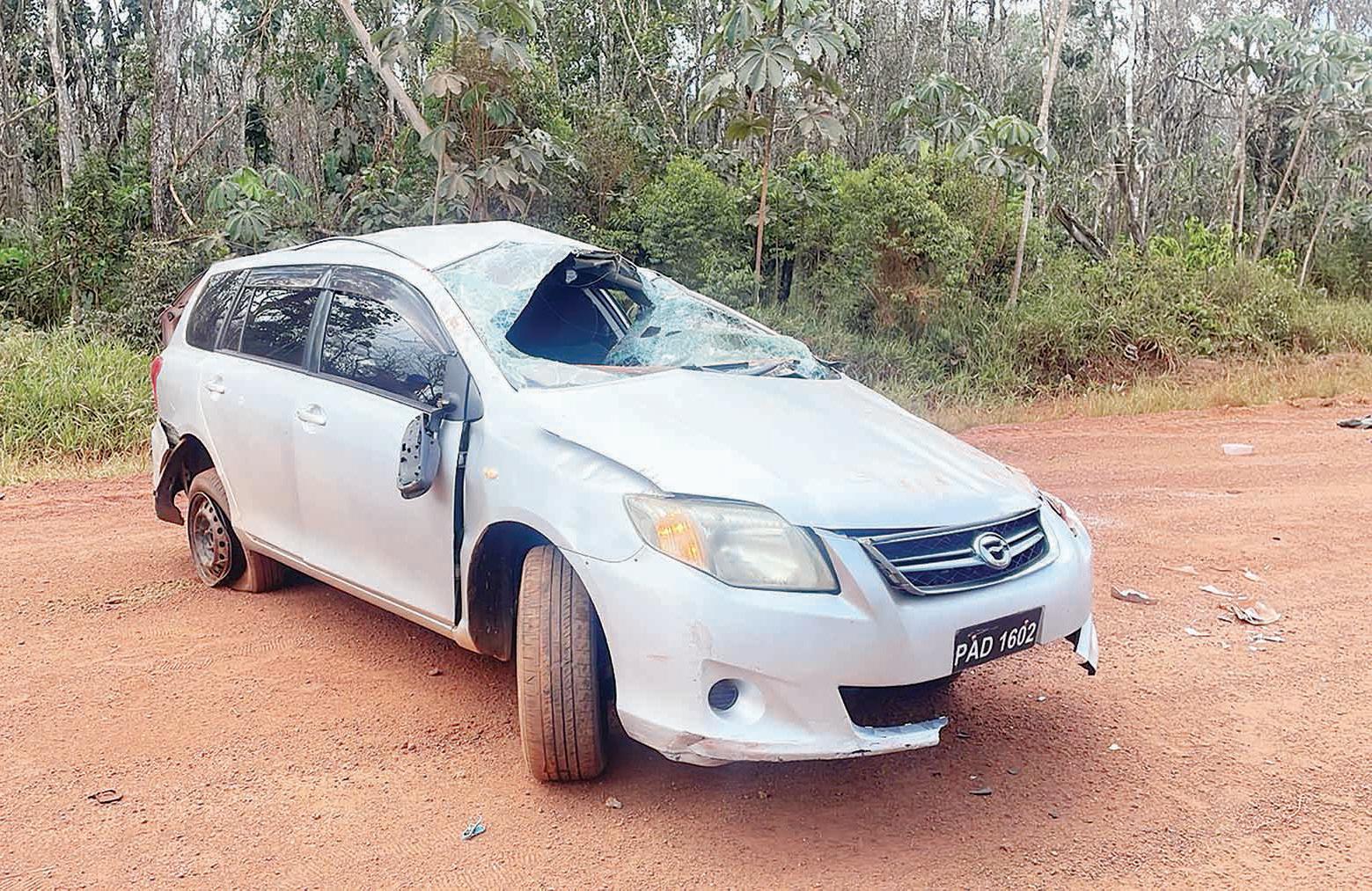
ASophia, Greater Georgetown man was killed on Wednesday after the vehicle he was travelling in turned over along the Rockstone Trail, Linden, Region Ten (Upper Demerara–Upper Berbice).
The deceased is 54-yearold Steve George.
Based on reports received, the accident occurred at about 10:11h involving a motor car, PAD 1602, which was at the time driven by a 25-year-old male from Herstelling, East Bank Demerara (EBD).
According to the Police, the motor car was speeding along the Rockstone Trail when the driver reportedly lost control, resulting in the vehicle toppling several times before coming to a halt. Police stated that both the driver and George sustained injuries to their bodies. They were rushed to the Linden Hospital Complex, where George was pronounced dead. The driver of the motor car was treated and subsequently taken into custody pending investigations.
The cargo flight at CJIA on Wednesday
The mangled car after the accident
Linden man dies in 2-vehicle smash-up at Loo Creek
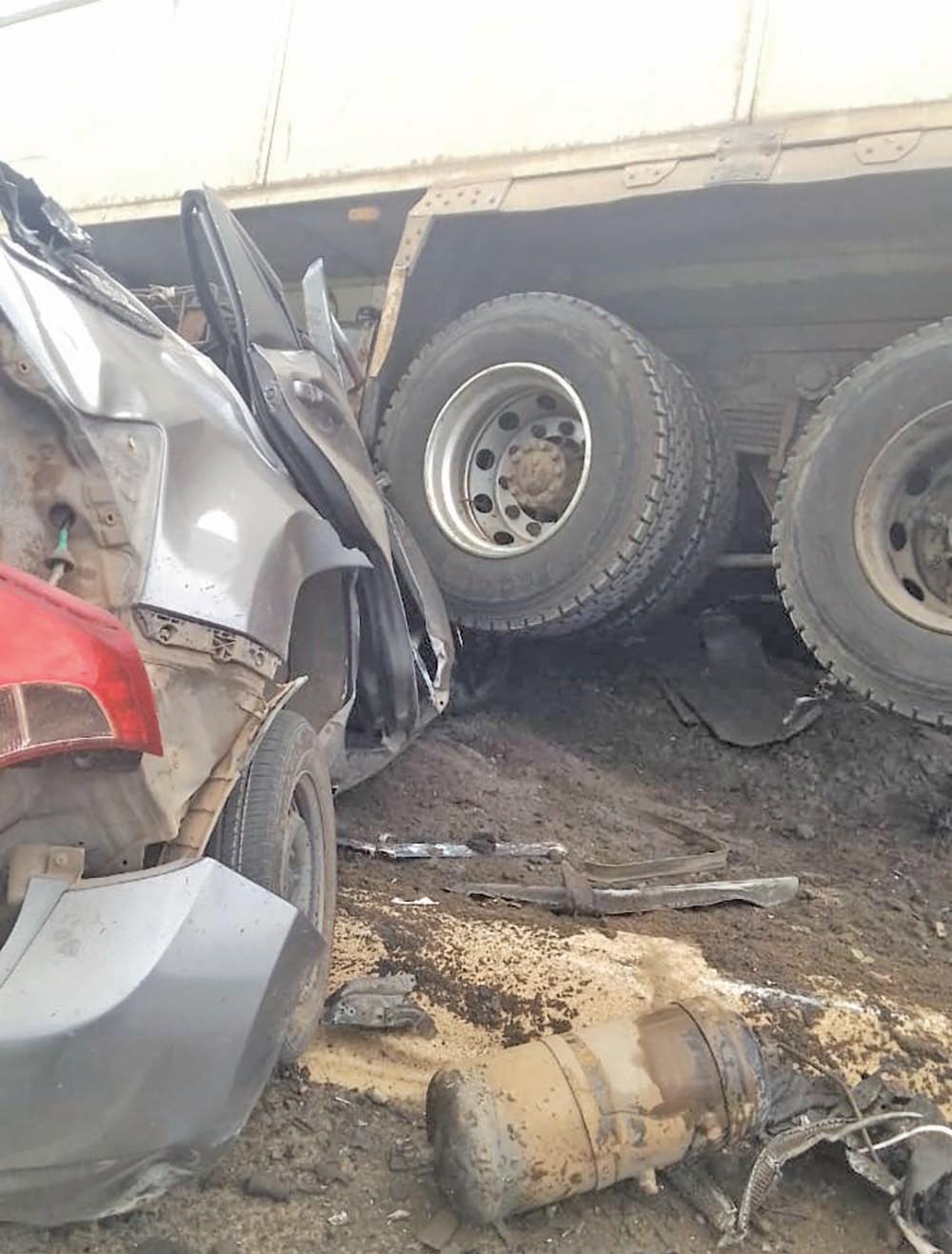
Ahead-on collision along the Loo Creek Public Road, Linden/ Soesdyke Highway, on Wednesday has claimed the life of 31-year-old Keiran Warner of Central Amelia’s Ward, Linden.
Based on reports received, the accident involved a motor car bearing registration number PZZ 934, driven by Warner, and
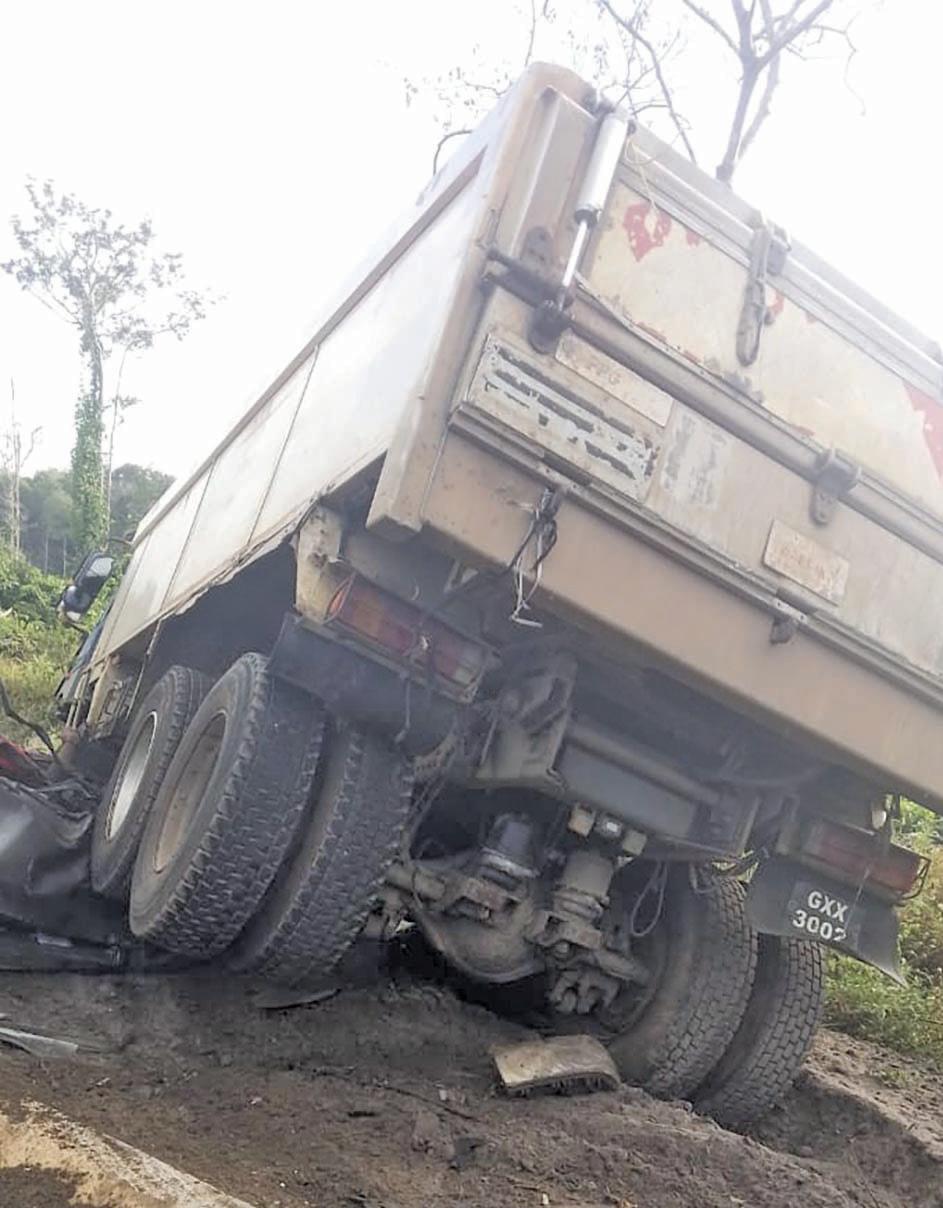
a motor lorry, GXX 3002, which was at the time being driven by a 50-year-old resident from Half Mile, Wismar, Linden.
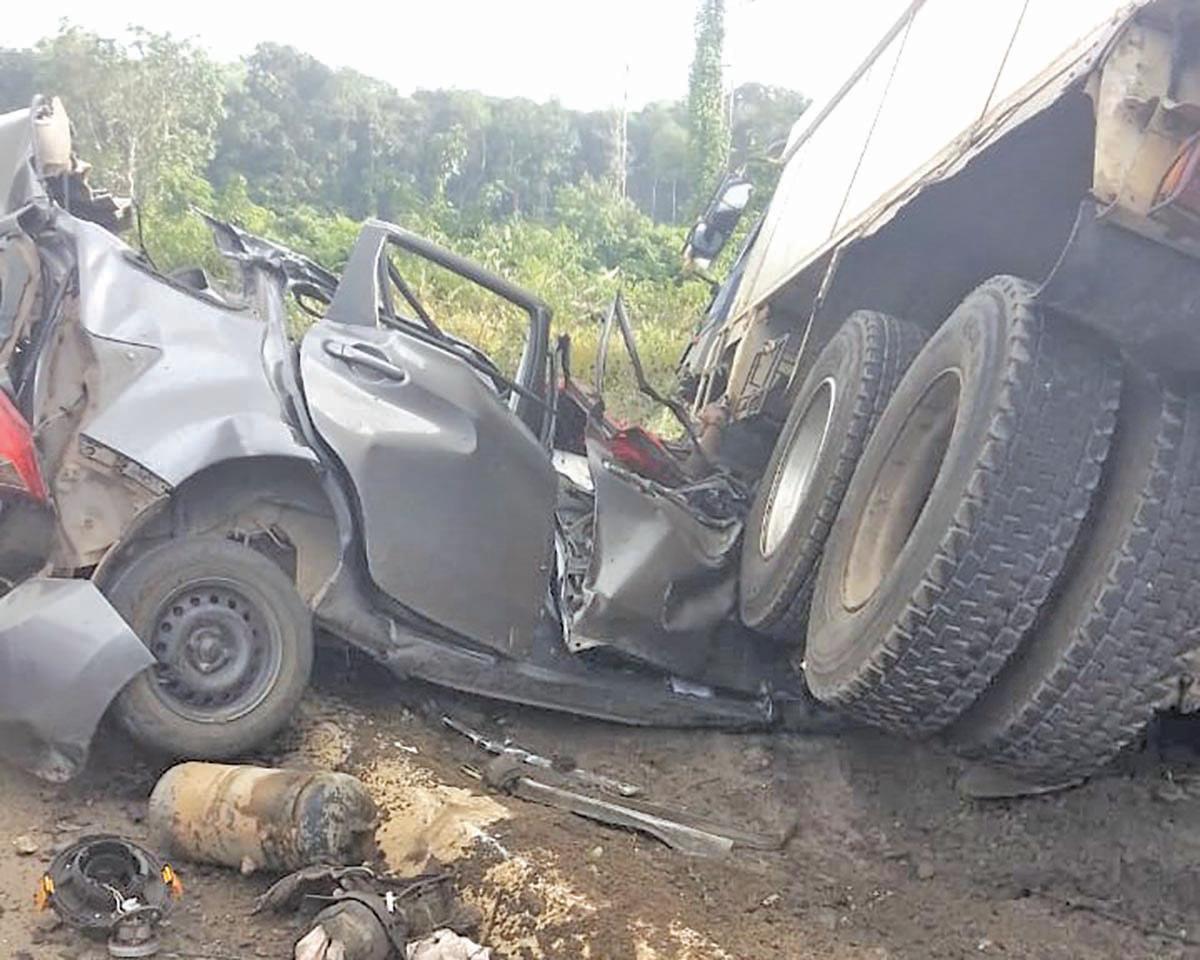
Guyana Times understands that Warner, who was heading to Linden at a fast rate, reportedly swerved into the path of the truck, which was travelling in the opposite direction, resulting in a head-on collision.
Due to the impact, Warner was reportedly pinned in the motor car, which ended up under the lorry. He was pulled from the wreckage in an unconscious state and was pronounced dead at the scene by emergency medical technicians (EMTs).
A breathalyser test conducted on the driver of the motor lorry showed that there were no traces of alcohol in his system. He was, nevertheless, taken into custody and is assisting with the investigations.
Following the death of Warner, the management
WIN’s Tabitha
However, despite the withdrawal of the Cuban Medical Brigade, the Guyanese Government is still open to employing
The lorry that was involved in the fatal smash-up The wreckage at the scene
and staff of the Linden Hospital Complex in a social media post extend their most sincere condolences
to his family, friends, and loved ones.
“He will be remembered for his dedication and the
Sarabo-Halley
Cuban medical professionals individually, and according to the health Minister, several Cuban medical workers have already taken up this
option and are now serving within the country’s public health system.
This development comes on the heels of the United
role he played in supporting the work of healthcare within our community. His presence will truly be
missed by all who had the privilege of knowing and working alongside him,” the post added.
shows limited grasp...
States pushing countries in the Caribbean to end their partnerships with the Cuban regime regarding overseas medical missions, citing issues of human rights abuses and forced labour practices. In fact, the Donald Trump administration has been mounting pressure for regime change in Cuba.
In fact, during the BBC programme, another panellist – the private sector representative, Clinton Urling – framed his comment on the Cuba issue within the realities of international relations. Urling said small states such as Guyana must adopt pragmatic foreign policy approaches given global power dynamics.
He argued that geopolitical realities require countries to maintain flexible relationships, particularly amid regional security concerns, including the longstanding territorial controversy with Venezuela.
Limited understanding of foreign policy
Meanwhile, Tabitha Sarabo Halley, a representative of the main parliamentary opposition party, We Invest in Nationhood (WIN), questioned the Government’s communication of its foreign policy positions.
During the discussion, she repeatedly demonstrated a limited understanding of foreign policy, relying instead on media reports and public perception to frame her responses. When asked about Guyana’s stance on Cuba and its international
alliances, she admitted that her comments were based largely on what she had seen in the media rather than on her own understanding and verified information.
“I can only go based on what I’m hearing in the media,” Sarabo-Halley said, reflecting a reliance on second-hand interpretations rather than a clear grasp of the country’s foreign policy or regional realities.
“We have asked time and time again what is the foreign policy in relation to different issues that are happening around the world,” she said, adding that the country must be more “tactical” in responding to global shifts.
However, when pressed during the programme on whether Guyana was trading long-standing partnerships for closer alignment with the United States, Sarabo-Halley said she did not have complete information on the issue and based her assessment largely on public perception.
Further pressed by the host, Sarabo-Halley said Guyana should not be “… choosing one over the other. I don’t think that is the way to do it… I believe the approach has to be an understanding of where we are as a country. The understanding of…what is the reality. And based on that, I think we, as a nation, need to make certain decisions. Whether or not they disagree about giving up friends… I can only go based on what I’m hearing in the media, and I have no evidence to show that.
For example, the Minister of health said today [Tuesday] that Cuba actually stopped the decision to bring in a person. So, if Cuba made that decision, then Guyana did not… But I don’t have all of the information. But based on the perception of the population, it looks as though Guyana is choosing to push Cuba aside in the interest of the United States. If that is what Guyana’s doing, I don’t think that’s right. I don’t think that would be the right approach.”
Other participants in the programme referenced the historical relationship between Guyana and Cuba, particularly in areas such as healthcare and education. Concerns were raised about the possible implications for medical cooperation if relations were to change.
Balanced, pragmatic foreign policy
Throughout the discussion, Dr Singh emphasised that Guyana continues to pursue a balanced and pragmatic foreign policy while maintaining its regional commitments and strategic partnerships.
The debate was part of the BBC World Questions forum, which brings together policymakers, analysts and members of the public to examine political and international issues affecting countries around the world.
The full Guyana edition of the BBC World Service programme will be broadcast this Saturday, March 14.
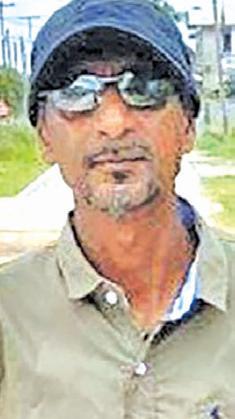
Dead, Keiran Warner
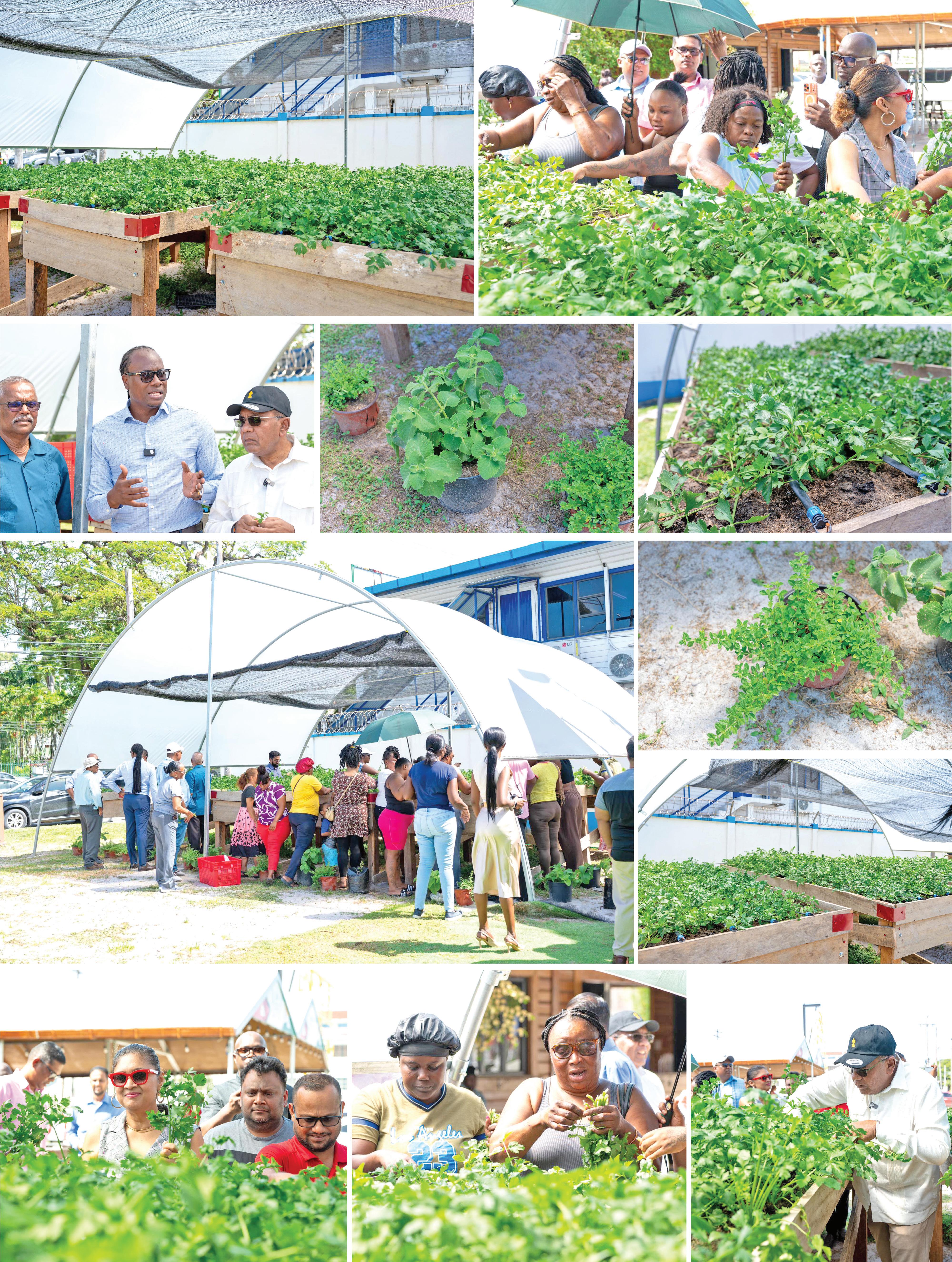
In just over six weeks, the Shade House Demonstration at the One Guyana Kitchen on Main Street recorded its first harvest of 35 pounds of celery, with the first batch sold to Massy at $1300 per pound. Over the next 32 weeks, an average of 45 pounds will be harvested weekly, bringing total production for the cycle to approximately 1475 pounds and generating an estimated $1.9 million in revenue. Piloted by President Dr Irfaan Ali, the initiative is designed to empower women from the Tiger Bay community by providing hands-on training in shade house farming while creating real income-earning opportunities through sustainable agriculture. (President Dr Irfaan Ali Facebook page photos)
Chevron ready to support Guyana’s transformative energy journey – CEO reaffirms
Following its US$53 billion acquisition of Hess Corporation, which gave it a 30 per cent stake in Guyana’s prolific Stabroek Block, Chevron says it brings “deep offshore experience” to support the country’s transformative energy journey.
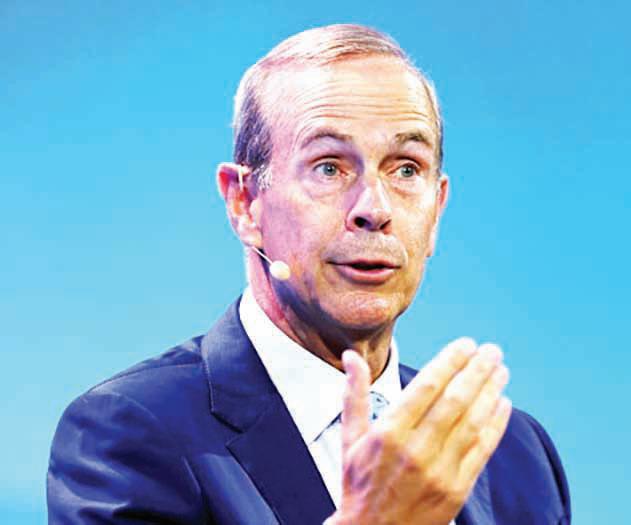
The Chief Executive Officer (CEO) of Chevron, Mike Wirth, says that in just a few years, Guyana has experienced an extraordinary rise, becoming a major source of new oil discoveries and one of the world’s fastest-growing economies.
He made the remarks via a LinkedIn post on Tuesday, reflecting on his participation at the Guyana Energy Conference in Georgetown last month.
Wirth noted that “Chevron is proud to now be
part of that journey, bringing deep offshore experience and a long-term commitment built on partnership. In today’s complex global energy system, no country or company can do it alone.”
He said progress depends on collaboration between Governments, industry, and communities, working together to deliver energy that supports prosperity, energy security, and responsible development.
“As global energy demand continues to grow, Guyana has an opportunity to demonstrate how energy abundance can help lift a nation, reduce energy poverty, and create opportunity not for a few but for all. Chevron is honoured to partner with Guyana, and we’re excited about what the future holds
for the country, the region, and the world,” he added.
Chevron completed its US$53 billion acquisition
of Hess in July 2025, securing a 30 per cent stake in Guyana’s prolific Stabroek Block, which holds more
than 11 billion barrels of discovered recoverable resources.
Output has already reached roughly 900,000 barrels per day, and this is expected to climb to 1.7 million barrels of oil per day by 2030. ExxonMobil affiliate ExxonMobil Guyana Limited is the operator and holds a 45 per cent interest in the Stabroek Block, while the China National Offshore Oil Corporation (CNOOC) holds a 25 per cent interest.
Back in December 2025, Chevron Corporation’s announced 2026 capital programme puts fresh emphasis on Guyana, underscoring the company’s deepening stake in one of the world’s most prolific oil basins, following its acquisition of Hess Corporation.
The company unveiled an organic capex range of US$18-19 billion for 2026. While the overall figures mirror previous guidance, the details reveal how central Guyana has become to Chevron’s global upstream strategy.
Chevron said global offshore spending will total about US$7 billion in 2026, and that this allocation will “primarily” support development in Guyana, the Eastern Mediterranean, and the Gulf of Mexico. Within that offshore envelope, the company disclosed that about US$0.4 billion in capitalised interest is tied to Guyana assets, a rare indication of the scale and importance of its investment footprint in the Stabroek Block.
Govt hands over garbage trucks to 3 communities
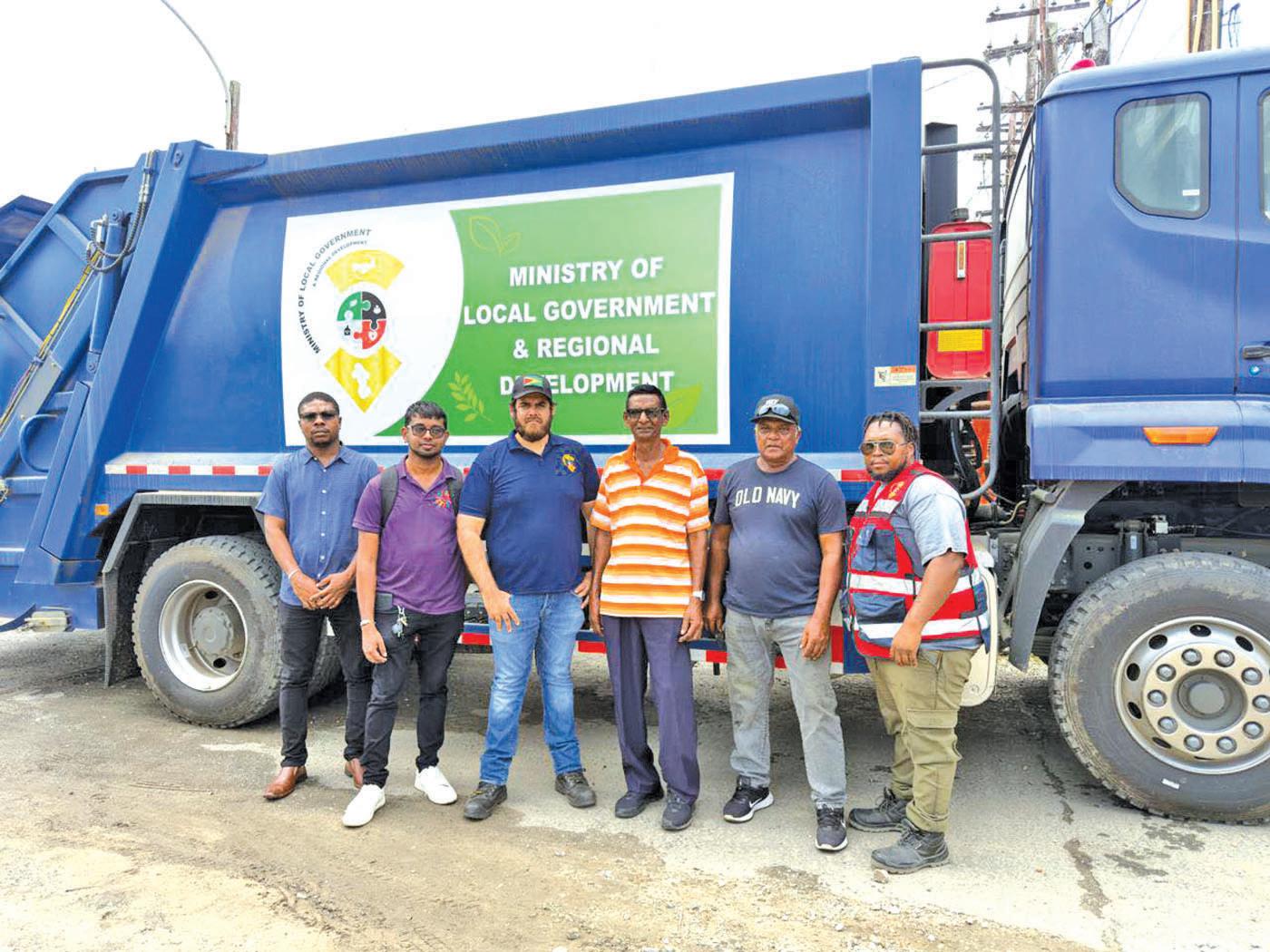
In its ongoing efforts to strengthen solid waste management across the country, the Ministry of Local Government and Regional Development recently handed over three garbage collection trucks to Port Kaituma, Mabaruma, Region One (Barima–Waini) and Rosignol in Region Five (Mahaica–Berbice).
The trucks were handed over by Deputy Permanent Secretary (Administration), Dr Josh Kanhai. The Ministry stated
that the addition of these vehicles will significantly enhance the operational capacity of the respective local authorities, enabling more timely and consistent garbage collection services for residents and businesses.
“Improved collection schedules will contribute to cleaner communities, reduce incidents of illegal dumping, and promote a healthier environment for all,” the Ministry added.
Further, this initiative forms part of the Ministry’s broader strategy to modernise waste management systems across Guyana by ensuring that municipalities and neighbourhood democratic councils are equipped with the resources needed to deliver reliable sanitation services.
By strengthening waste collection capacity in these communities, the Ministry continues to advance its commitment to improved public health, environmental protection, and an enhanced quality of life for citizens.
Body of missing crew member onboard sunken molasses barge recovered
– Search on for 2nd crew member
The lifeless body of one of the two men who went missing after a molasses tanker sank in the Atlantic Ocean has been recovered late Wednesday afternoon.
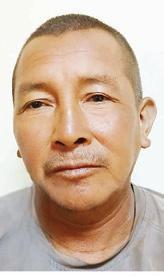
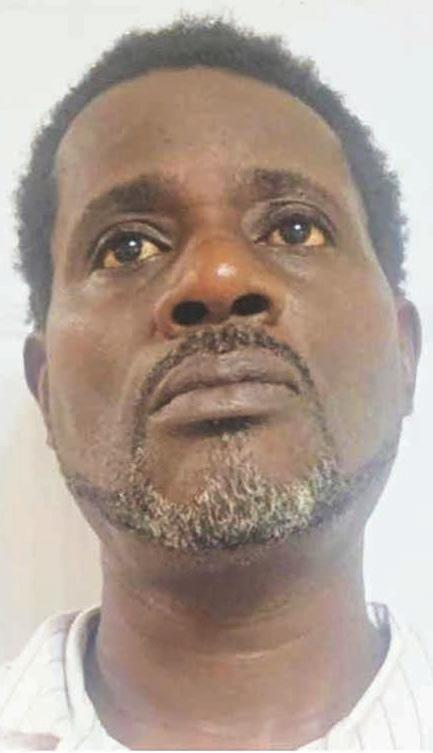
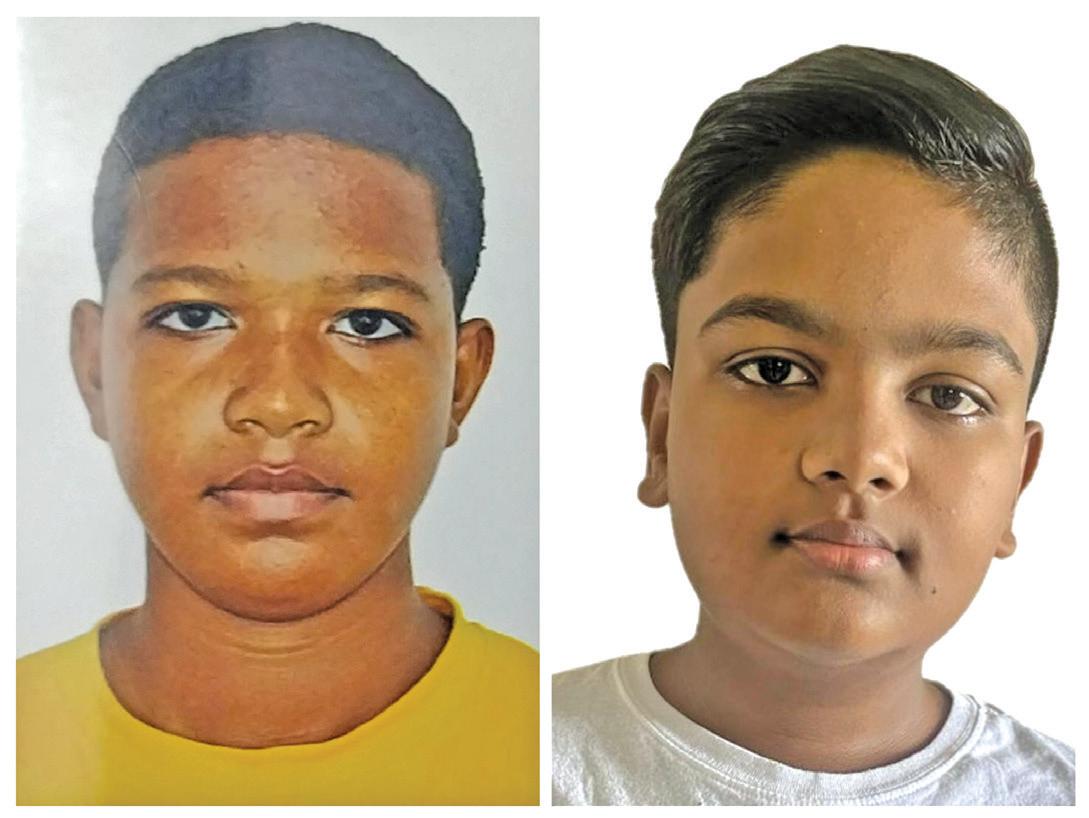
The body of 22-yearold Ravindra Bissoondyal, also known as “Videsh”, of Goed Bananen Land, Canje, Berbice, was reportedly found near a sea buoy off the Demerara River following an operation with family and members of the joint services.
When contacted on Wednesday, Minister of
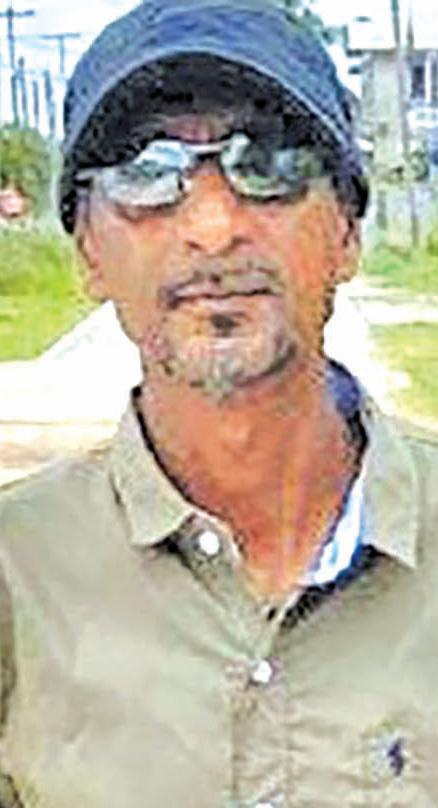
Public Utilities Deodat Indar told the Guyana Times that a body was recovered near the sea buoy, but authorities are still working to determine the person’s identity. However, the body was subsequently confirmed to be that of Bissoondyal by family and friends who took to social media. Another crew member, 52-yearold Gregory Singh, called “Greg”, remains missing.
The Maritime Administration Department (MARAD) stated that the vessel sank approxi-
mately 9.5 nautical miles off Buxton, East Coast Demerara, on Monday.
MARAD had stated that it received a distress signal about the incident shortly afterward. In its statement, the agency explained that it was alerted to the emergency and immediately launched a response.
“Immediately upon receipt of the distress communication, emergency response operations were activated for the missing persons,” MARAD stated.
The agency noted that the vessel had been trans-
porting molasses at the time of the incident. “At the time of the incident, the barge was engaged in the transport of a cargo of molasses from Berbice to Georgetown,” the statement said. Search operations were reportedly launched soon after the distress call. Meanwhile, as the search continues for the second person, Emergency Operations Coordinator Capt John Flores is leading the efforts with the support of the Guyana Defence Force Coast Guard and the vessel owner.
Deputy Permanent Secretary (Administration), Dr Josh Kanhai, handing over two of the trucks
Chief Executive Officer (CEO) of Chevron Mike Wirth
Still missing, Gregory Singh
Dead: Ravindra Bissoondyal
CID trainees receive courtroom guidance from Acting Chief Justice
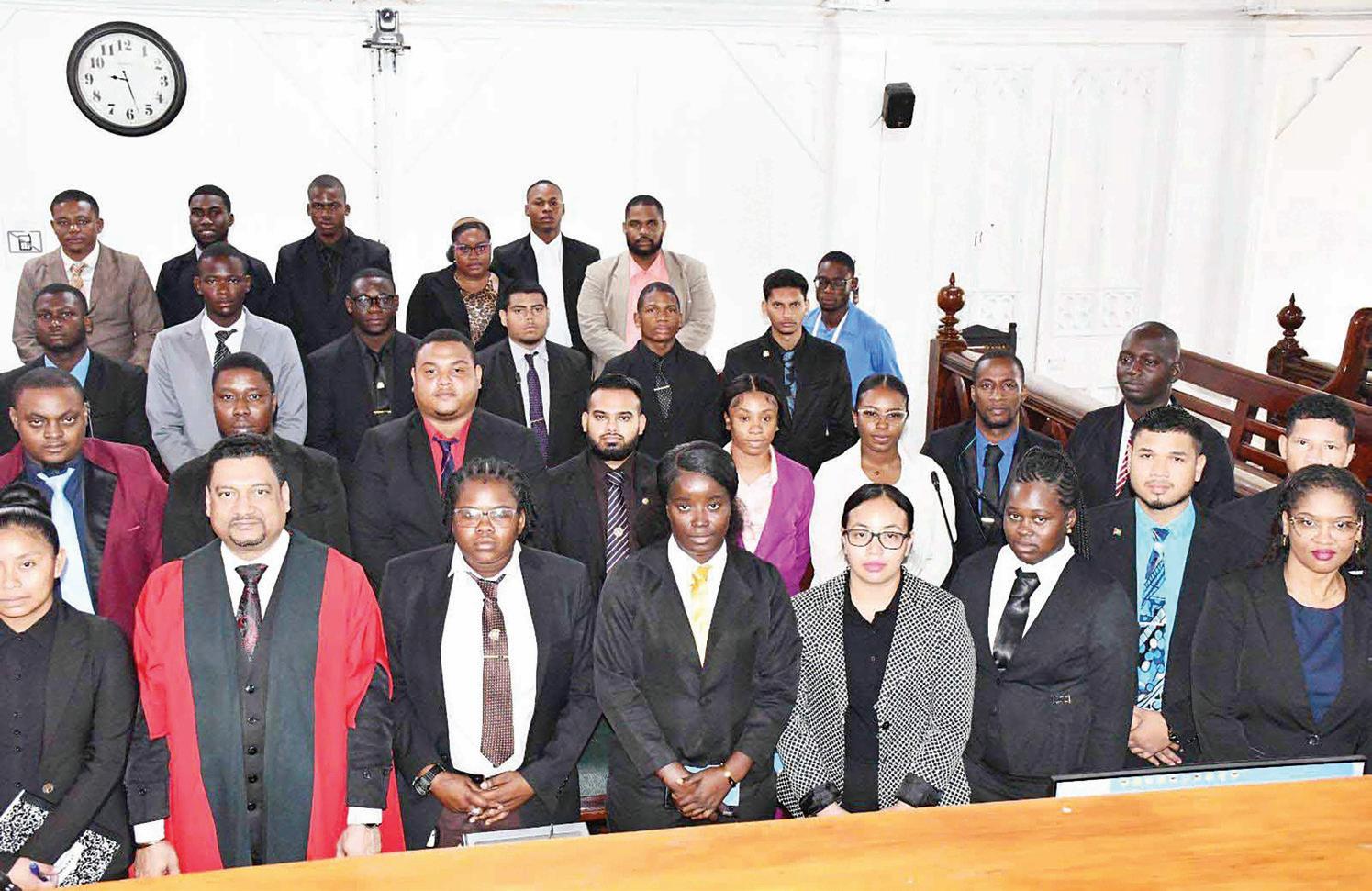
Investigators currently undergoing the Criminal Investigation Department (CID) Induction Course 1/2026 were on Wednesday given firsthand insight into courtroom procedures during a visit to the Supreme Criminal Court, where they met with Acting Chief Justice Navindra Singh.
Addressing the group, Justice
Singh spoke about the critical role investigators play in the administration of justice and the need for thorough, well-documented investigations. He underscored that evidence presented before the courts must be gathered lawfully and carefully, noting that investigators must maintain high levels of professionalism and accuracy when preparing matters for trial.
The Acting Chief Justice also walked the officers through the framework of the criminal justice system, explaining the various stages a criminal case goes through once it reaches the court.
The session included discussion on courtroom procedures and expectations of investigators who are called to testify, providing the participants with a clearer under-
standing of how their work fits into the broader judicial process.
The induction programme brings together 63 participants from several state agencies, including the Guyana Police Force, the Guyana Revenue Authority, the Guyana Defence Force, and the Customs Anti-Narcotics Unit.
The course is nearing completion, and participants are expect-
ed to sit their final examination on Thursday.
Officials said the court visit formed part of the training programme aimed at improving investigative practices, encouraging collaboration among law enforcement bodies, and strengthening the overall effectiveness of the criminal justice system.
Blind community raises concerns over road conditions, accessibility challenges
Representatives of the Guyana Association for the Visually Impaired are calling for urgent attention to road infrastructure, pedestrian behaviour, and public attitudes, warning that several conditions along Guyana’s roadways create serious challenges for persons who are blind or visually impaired.
The concerns were raised during the “Road Safety and You” programme hosted by the chairman of the Guyana National Road Safety Council, Earl Lambert, where the President of the Guyana Association for the Visually Impaired, Leon Amsterdam, and senior member Andrew Greene discussed difficulties members of the blind community face while navigating public spaces.
Amsterdam explained that many roadways and pedestrian walkways were not designed with persons with disabilities in mind, making movement difficult and sometimes dangerous.
“To commence with, I do not think with the construction of the roads today, I don’t think the engineers would have catered for people who are challenged,” he stated.
He noted that poor infrastructure across parts of Georgetown continues to pose risks.
“Pavements are not properly done up to accommodate comfortably people who are blind,” Amsterdam said, while adding that “there are sometimes uncovered manholes in the city of Georgetown, which pose a big danger and a risk to peo-
ple who are using the roadways.”
According to him, these conditions often force visually impaired persons to alter how they move through the city.
“Because of the fact that persons might have had an experience whereby they would have stepped into a manhole, they tend to walk more on the roads,” he explained.
The association also highlighted the impact of vending on pavements, which they said limits pedestrian access to sidewalks and forces people into traffic.
“We have also, because of the economic situation that is facing the country, a lot of vending taking place,” Amsterdam said. “The people who are vending… all they’re concerned about is their stalls, so someone will attempt to pass the stall and the person collides with the stall… What that causes is people now using the roadway not to want to walk in the way of these stalls, thus endangering themselves.”
Amsterdam said the challenges are made worse by the rapid increase in vehicles using Guyana’s roadways.
“There is a craziness in terms of the importation of vehicles in this country,” he said, explaining that the road network has not expanded at the same pace as vehicle imports. “The roads are not built fast enough with the amount of vehicles that are imported in this country, and that by itself poses a very serious risk because we are now having more vehicles and fewer
roads.”
Beyond infrastructure issues, Amsterdam also criticised the behaviour of some drivers, stating that a lack of courtesy and patience on the road often puts vulnerable pedestrians at risk.
“There is a culture in this country where people are generally selfish,” he said. “They care only about themselves… they care not about pedestrians; they care not about the blind; they care not about cyclists.”
He further pointed out that basic principles of responsible driving appear to have been forgotten by many road users.
“When I was driving, the emphasis was heavily on the five Cs… care, courtesy, common sense, caution, and consideration,” Amsterdam stated, adding, “To my mind, the five Cs are absent with drivers.”
According to Amsterdam, the issue is not only about accidents but also about the limitations imposed on persons with disabilities who must navigate unsafe or poorly designed environments.
“The issue right now is removed from accidents to the vulnerability that exists for the blind and visually impaired people,” he said.
He explained that many persons in the blind community avoid travelling independently because proper systems are not in place to support them.
“The people who are blind and visually impaired are simply scared to use the road because proper systems are not in place to cause the roads to be blind-friendly,” Amsterdam said, noting
that the situation prevents them from living normal, independent lives.
“They are not allowed to live their normal lives, so the issue right now is removed from accidents… to the vulnerability that exists for the blind and visually impaired people, which obviously causes them not to be able to do their normal chores, and they cannot live normal lives like people who are sighted,” he added.
During the programme, Andrew Greene, a senior member of the association who became blind in 2002, also shared insights into the challenges faced by visually impaired persons.
“I became blind in September 2002, and I’ve been a member of the organisation since then,” Greene said. “Even accepting blindness is very important because it allows you to readjust your modus operandi and to have a better understanding or better relationship with persons who are sighted.”
Greene also highlighted the importance of preserv-
ing eyesight and educating the public about preventable causes of blindness.
“One of the tenets… was the preservation of sight because most sighted persons tend not to know how to preserve their sight,” he explained.
He also pointed to environmental factors such as dust particles which may affect eye health, particularly in developing regions.
“I would have observed that in third-world countries where there are a lot of dust particles in the air… that by itself affects a person’s sight,” Greene noted.
Amsterdam emphasised that addressing the challenges faced by visually impaired persons will require cooperation among several stakeholders, including the Guyana Police Force, engineers responsible for road design, municipal authorities, and vendors who operate along sidewalks.
“There needs to be a consultation or a collaboration of effort amongst ourselves… that’s the blind and visually impaired, police,
the city engineer, and even people who are vending,” he said.
He stressed that sensitisation of the wider public is also critical to improving safety and accessibility for persons with disabilities.
“People need… a whole metamorphosis,” Amsterdam stated, adding that greater awareness and proper upbringing could help foster more considerate behaviour toward vulnerable road users.
The Guyana Association for the Visually Impaired provides services to persons who are blind or visually impaired, including rehabilitation for individuals who lose their sight and programmes aimed at preventing blindness through screenings and public education.
According to Amsterdam, the organisation currently has approximately 60 members and holds statutory meetings on the first Saturday of every month at its location at 107 Lamaha Street, Georgetown.
Chairman of the Guyana National Road Safety Council, Earl Lambert; President of the Guyana Association for the Visually Impaired, Leon Amsterdam; and senior member, Andrew Greene
CID trainees during the guidance training
Regional Food Hub at Yarrowkabra 60% complete
The regional food hub at Yarrowkabra along the Linden-Soesdyke Highway is about 60 per cent complete.
This was revealed during a meeting on Wednesday with Agriculture Minister Zulfikar Mustapha and a delegation from Blumberg Grain, a United Statesbased company that is partnering with the Government of Guyana on the construction of the Regional Food Hub.
The delegation was led by the Chairman of Blumberg Grain, Philip Blumberg.
The Ministry of
Agriculture stated that during the meeting, the officials reviewed the progress of the project, where it was disclosed that construction of the facility is currently approximately 60 per cent complete.
The discussions also explored additional opportunities for investment, particularly in Region Five (Mahaica–Berbice), as Guyana continues to expand its agricultural production and agro-processing capacity.
The Regional Food Hub forms a key part of the Government of Guyana’s strategy to strengthen food
production, storage, processing, and distribution systems while positioning the country as a major supplier of agricultural products to the Caribbean.
The facility forms part of Guyana’s contribution to strengthening regional food security under the Caribbean Community’s food import reduction initiative. It is expected to support the aggregation, processing, packaging, and export of agricultural produce to markets across the region.
President Dr Irfaan Ali has previously noted that the Regional Food Hub will
play a strategic role in improving the efficiency of Guyana’s agricultural supply chains while supporting the country’s goal of becoming a major supplier of food to the Caribbean.
Minister Mustapha has also emphasised that the project represents a significant investment in modern agricultural infrastructure, explaining that the hub will provide farmers with improved market access, enhance value-added production, and strengthen Guyana’s capacity to support regional food security while expanding opportuni-
Lethem man charged, granted bail for narcotics possession
Fifty-year-old
ties for the local agriculture sector.
Once completed, the facility will support the aggregation and value-added processing of agricultural commodities, improve logis-
tics and export capacity, and play an important role in advancing the region’s food security agenda in keeping with ongoing efforts to reduce the Caribbean’s food import bill.
Mahaica youth gets bail on narcotics possession charge
Twenty-three-yearold Joshua Hunter, a miner from Squatting Area Helena No. One Village, Mahaica, East Coast Demerara (ECD), who had 52 grams of cannabis in his possession, was charged and fined on Tuesday.
The young man was arrested on Sunday in the vicinity of Mahaica Market Area, ECD, with the ganja. He was subsequently charged and appeared before Magistrate Allan Wilson at the Mahaicony Magistrate’s Court, where the charge was read to him. He pleaded not guilty and was granted $50,000 bail.
He will make his next court appearance on March 31, 2026.
Mahaica woman charged with allowing unmuzzled dog
to be at large
Mortimer Dick, of Tabatinga, Lethem, Central Rupununi, Region Nine (Upper Takutu–Upper Essequibo), was charged and granted bail for trafficking narcotics on Tuesday. Dick appeared before Magistrate Omadatt Chandan at the Lethem Magistrate’s Court, where the charge was read to him. He reportedly pleaded not guilty and was granted $100,000 bail.
Police every Friday. The matter was adjourned to April 1, 2026.
As part of his bail conditions, the defendant is required to report to the
Police stated that they discovered a quantity of cannabis on Friday during an operation conducted at Tabatinga, Lethem, Central Rupununi.
Enquiries revealed that
ranks conducting an operation at a business found a bulky black plastic bag containing several parcels of cannabis in an unoccupied building.
The ganja was weighed and amounted to 2129 grams. At the time, a 25-year-old suspect was arrested, but after further investigations, charges were instituted against Dick.
Nadira Persaud, a 52-year-old businesswoman of Helena No. One Mahaica Village, East Coast Demerara (ECD), was on Tuesday charged and fined for allowing an unmuzzled ferocious dog to be at large.
Persaud was arrested on September 29, 2025, in relation to the offence committed against Melissa Ann Bynoe at Helena No. One Mahaica Village, ECD, which occurred on September 13, 2025.
The accused appeared before Magistrate Allan Wilson at the Mahaicony Magistrate’s Court on Tuesday, where the charge was read to her. She report- edly pleaded guilty and was fined $10,000.
Charged: Nadira Persaud
Charged: Joshua Hunter
The ganja that was found on the premises
Charged: Mortimer Dick
Ongoing work on the hub at Yarrowkabra
Agriculture Minister Zulfikar Mustapha and a delegation from Blumberg Grain
Surge recorded in development financing approvals across Caribbean – CDB
The Caribbean Development Bank (CDB) has reported a significant increase in project financing and disbursements for 2025, approving US$464 million in new support. The milestone marks a 50 per cent increase in financing over 2024. The Bank disbursed US$429 million, reflecting a 30 per cent rise compared to the previous year.
Presenting highlights at CDB’s Annual News Conference on March 3, Director of Projects Lennox O’Reilly Lewis outlined the bank’s expanded development footprint across its Borrowing Member Countries (BMCs) over the past year.
“Across the Caribbean, CDB continues to support the transformation of our region. From energy security to climate-ready infrastructure, from water systems to worldclass airports, these new investments represent commitments to stronger economies, empowered people, and a Caribbean that is ready to compete on a global stage,” Lewis said.
CDB’s investment portfolio advanced major national and regional priorities, including US$27 million for Belize’s Eighth Power Project to modernise the electricity grid for about 114,000 households and businesses. In The Bahamas, the bank approved US$30 million for water supply improvements in the Family Islands, benefiting roughly 5000 residents, and US$6 million to create a polytechnic and accreditation training hub for more than 800 youth and graduates. Elsewhere in the region, the bank provided US$46 million to upgrade Saint Vincent and the Grenadines’ Canouan Airport to strengthen climate resilience and connectivity; US$8.7 million for Grenada’s Battery Energy Storage System to enhance grid stability for over 90 per cent of the population; and US$47 mil-
lion for Barbados’ Grantley Adams International Airport expansion, which will double passenger throughput and improve operations.
Despite ongoing challenges, CDB continued to deliver targeted investments supporting Haiti’s development. The Quality Enhancement Education Project improved learning outcomes for more than 17,000 primary and secondary students, half of them girls. In agriculture, a climateresilient initiative trained 250 farmers – 48 per cent women – and introduced a 23.5hectare irrigation scheme to boost productivity and protect livelihoods. Meanwhile, sustainable energy investments are expanding access to reliable electricity, with a new solar installation set to provide renewable power to over 2000 rural customers.
The Basic Needs Trust Fund (BNTF), CDB’s flagship community development programme, delivered 92 subprojects across nine countries under its tenth cycle, strengthening essential services and resilience. Notably, it supported the first Special Education Needs School in Region Two, Essequibo, Guyana. Building on these achievements, CDB approved a USD 53.6 million BNTF Eleventh Cycle to be implemented over four years in ten countries.
CDB also advanced private sector initiatives focused on expanding opportunities for youth and women. Through the DigiLab Finance Programme, delivered with the IFC and the Caribbean Association of Banks, the Bank improved data analytics and financial service delivery for more than three million people across ten institutions. Support for the cultural sector continued through the Cultural and Creative Industries Innovation Fund, which assisted 200 creatives in 14 countries and provided grants to 12 micro, small
Director of Projects, Lennox O’Reilly
Lewis
and medium-sized enterprises (MSMEs). Women entrepreneurs benefitted from SheTrades Caribbean, which equipped 1300 womenowned firms with training and market access.
The bank brought together regional partners across education, gender equality, risk management and sustainable infrastructure. The Second Transforming Education Symposium and Policy Dialogue resulted in the formation of the Caribbean Coalition of National ParentTeacher Associations, strengthening parental engagement across regional education systems.
As the Caribbean continues to confront climate, economic and social vulnerabilities, the bank’s strategic focus remains on its core sectors – transport, water and sanitation, education, and sustainable energy – alongside a deeper focus on resilience and technology-driven service delivery.
“Our work in diagnosing implementation capacity challenges will be critical, ensuring that BMCs not only design transformative projects but also implement them effectively. Together, with our partners and the communities we serve, we will continue to deliver results that strengthen resilience and create lasting opportunities for our Caribbean people,” Lewis said.
FBI assists A&B Police with cold case reviews
Police in Antigua and Barbuda (A&B) have sought assistance from the United States’ Federal Bureau of Investigation (FBI) as investigators review several long-standing unsolved cases, officials revealed during a media briefing at Police Headquarters on American Road.
Deputy Commissioner of Police Albert Wade said the force’s cold case unit is now operational and has begun reviewing files connected to investigations that have remained unresolved for years. He disclosed that ex-
ternal support has already been requested to help advance the work.
“To begin with, this top story, the Federal Bureau of Investigations has been contacted to provide assistance in reviewing several court cases being reviewed by the Royal Police Force of Antigua and Barbuda”, Wade said, explaining that cold cases refer to matters that have remained unsolved for many years.
Officials did not identify which specific investigations are being examined by the unit.
Authorities said the Government has pledged to
Trial begins in Miami for 4 accused in former Haitian President assassination plot
Prosecutors said that greed, arrogance and power were the driving forces behind four men charged in the US for the 2021 assassination of Haiti’s last elected President, Jovenel Moïse, during opening statements on Tuesday.
Federal prosecutors and defence attorneys began presenting opening statements in the trial in Miami for Arcangel Pretel Ortiz, Antonio Intriago, Walter Veintemilla and James Solages. They are charged with conspiring in South Florida to kidnap or kill Haiti’s former leader.
Defence attorneys argued that the investigation initiated in Haiti was a mess and that their clients were manipulated into taking the blame for an internal coup.
Moïse’s assassination led to unprecedented turmoil in the Caribbean nation, where gang leaders have grown increasingly violent and empowered. He was killed on
July 7, 2021, when about two dozen foreign mercenaries – mostly from Colombia – attacked his home near Port-au-Prince, officials said. According to court documents, South Florida was a central location for planning and financing the plot to oust Moïse and replace him with someone the conspirators chose.
Ortiz and Intriago were principals of Counter
Terrorist Unit Federal Academy and Counter Terrorist Unit Security, collectively known as CTU, and Veintemilla was a principal of Worldwide Capital Lending Group. Both companies were based in South Florida. All four defendants face possible life sentences and have pleaded not guilty. (Excerpt from The Haitian Times)
St Lucia: HAPA urges awareness for Autism Awareness Month
As Autism Awareness and Acceptance Month approaches in April, President of the Helen Association for Persons with Autism (HAPA), Dr Delia Samuel, is urging Saint Lucians to embrace greater awareness, acceptance and inclusion of autistic individuals.
During a news conference on Wednesday, she linked the country’s upcoming activities to her own journey as both an advocate and the autistic mother of two autistic sons.
“I stand before you today as the autistic mother of two autistic young men. I say
this not with sadness, but with pride, joy, honour and abundance of love,” she said.
Samuel explained that her journey into autism advocacy was one she had never expected, describing it as both difficult and transformative.
Like many parents, she initially struggled to accept her sons’ diagnosis.
She admitted that in those early years, she often questioned why she had been placed in that position.
“I remember asking God repeatedly, ‘Why me?’” she recalled.
Over time, however, her perspective shifted dramat-
ically. Samuel said that eventually she reached acceptance and discovered something even more powerful.
Samuel emphasised that autism should not be viewed as something that needs to be cured.
“Autism is not a disease. It is not something that needs to be cured,” she said.
During the news conference held at the Mount of Prayer in Coubaril, Sol Cares presented a $5000 donation to the association in support of its efforts to increase the inclusion of autistic children in Saint Lucia. (Excerpt from St Lucia Times)
J’ca: GGPAJ welcome proposed amendments to cannabis licensing regulations
Tprovide whatever resources may be required to support the effort. According to the update, investigators are actively reviewing case files in an attempt to generate new leads.
“I believe that pretty soon you may see some traction as we try to shed new light on those cases,” one official said while outlining the progress of the review process.
The developments come as the Royal Police Force continues broader efforts to address crime and improve investigative outcomes.
(Excerpt from Antigua Newsroom)
he Ganja Growers and Producers Association of Jamaica (GGPAJ) has welcomed proposed amendments to cannabis licensing regulations. The association’s President, Maurice Ellis, sees the move as a meaningful step towards inclusivity and recognition of the historical role of small farmers in Jamaica’s cannabis sector.
“We are encouraged that the Government has recognised the stagnation and is now prepared to address all the issues. This is a meaningful step toward improving access for our small and legacy cultivators who have long struggled to participate in the regulated cannabis industry,” Ellis told the Jamaica Observer.
The proposed community cultivation model could
allow groups of small farmers to cultivate up to 10 acres of marijuana for medicinal purposes, promoting a more inclusive framework.
Addressing the Standing Finance Committee in the House of Representatives on March 6, Minister of Industry, Investment and Commerce Senator Aubyn Hill said amendments to the Dangerous Drugs (Cannabis Licensing) (Interim) Regulations are being finalised. The regulations will govern the licensing regime for the cultivation, harvesting, processing/ manufacturing, transporting and retailing of ganja. They will pave the way for the Cannabis Licensing Authority (CLA) to begin the issuance of licences, permits and authorisations.
The Minister noted that, with the changes, fees are to be waived for the first two years.
The GGPAJ’s Ellis emphasised the need for safeguards to prevent larger investors from exploiting these licences.
Ellis also wants the National Commission on Drug Abuse to ramp up public education on cannabis use and wants commercial banks to work with legitimate ganja growers.
“The commercial banks currently will not accept deposits from any cannabis company or individuals,” he said, an often-aired grouse of cannabis farmers.
He is optimistic that changes to the Dangerous Drugs Act will address some of these concerns. (Excerpt from Jamaica Observer)
Haiti’s former President Jovenel Moise
Around the World
OIL NEWS
Stocks dip, Treasury yields jump as oil pushes higher
Global shares fell and benchmark Treasury yields spiked on Wednesday after data showed US inflation picked up as expected while oil prices resumed their climb as the USIsraeli war on Iran dragged on.
Data from the labour department showed the consumer price index rose 0.3 per cent in February, in line with forecasts and above January’s 0.2 per cent increase. The CPI rose 2.4 per cent in the year to February, while the core rate, which excludes food and energy prices, rose 2.5 per cent, both in line with forecasts.
Wall Street’s main stock indexes finished flat to lower. The Dow Jones Industrial Average fell about 0.6 per cent, while the S&P 500 and the Nasdaq Composite were little changed.
The consumer price report did not capture the steep rise in gasoline and other items since the outbreak of war in the Middle East 12 days ago. Markets already show traders believe there is a rising chance that most central banks’ next move on interest rates will be to hike.
“February’s inflation numbers were heading in the right direction, but then along came the conflict in the Middle East, and now the path is changing. Instead of deflation from energy, we will get inflation. Food prices could show signs of inflation acceleration as the fertiliser market is in chaos,” Annex Wealth Management chief economist Brian Jacobsen said. (Excerpt from Reuters)
South Africa summons new US ambassador over “undiplomatic remarks”
South Africa’s Government has summoned the United States ambassador to the country to discuss his “undiplomatic remarks”, a sign of the deepening rift between Pretoria and Washington.
Foreign Minister Ronald Lamola announced that Ambassador Leo Brent Bozell III had been summoned Wednesday, following a series of comments from the envoy.
“We have called in the ambassador of the United States, Ambassador Bozell, to explain his undiplomatic remarks,” Lamola said.
A conservative media advocate, Bozell has been a long-time ally of Trump. In late February, he took up his role as ambassador to South Africa and recently came under fire for comments denouncing what he called “hate speech”, as well as remarks critical of the country’s post-apartheid policies.
Speaking to a meeting of business leaders on Tuesday, his first public appearance as ambassador, Bozell addressed an apartheid-era chant: “Kill the Boer, kill the farmer.”
The chant has been disowned by many leaders of the anti-apartheid movement and remains controversial in South Africa.
However, the country’s courts have ruled that the chant does not constitute “hate speech” and should be viewed in the context of the struggle against white-minority rule that ended in 1994.
“I’m sorry, I don’t care what your courts say. It’s hate speech,” Bozell said on Tuesday.
Bozell appeared to backtrack on Wednesday, saying in a post on the social media platform X that his remarks reflected his “personal view”. (Excerpt from Al Jazeera)
Ukraine says it has hit a Russian “missile component” plant
Ukrainian forces have struck one of Russia’s “most important military factories”, President Volodymyr Zelenskyy has said.
“The plant produced electronics and components for Russian missiles. The very missiles that strike our cities, our villages and civilians,” he said.
British Storm Shadow missiles were used to hit Kremniy El plant in the border region of Bryansk, Ukraine’s military said.
Russian local authorities say at least six civilians were killed and 42 injured in the “terrorist
Russia says civilians were killed and injured in the attack
missile attack”. President Vladimir Putin’s spokesman said it was “obvious that the launch of these missiles was impossible without British specialists”.
3 brothers of Iraqi origin
“In order to prevent such barbaric actions by the Kyiv regime from continuing, the special military operation is being conducted,” Dmitry Peskov said, using the Russian de-
scription for the full-scale invasion of Ukraine that Putin ordered on February 24, 2022. Russia, for its part, has also been receiving help from its allies, including Shahed drones supplied by Iran and soldiers sent by North Korea.
One of those drones was used in an attack which killed two people and injured another five in the second-largest city of Kharkiv on Wednesday, Ukrainian officials said. Both sides have continued attacks, even though the war has reached a stalemate recently.
(Excerpt from BBC News)
arrested in connection with US embassy explosion in Norway
Three brothers have been arrested in connection with an explosion at the US Embassy in Oslo, Norway, authorities said on Wednesday.
The brothers were Norwegian citizens of Iraqi origin, Police prosecutor Christian Hatlo said in a news conference. They have been arrested around 15:30h local time on suspicion of a “terrorist bombing” at the building. The men are in their 20s and were not previously known to Police, Hatlo said. Investigators are still working to determine a motive, Hatlo said.
“We are still working from several hypotheses. One of them is wheth-
er this is an order from a Government entity,” Hatlo said. “This is quite natural given the target – the US embassy – and the security situation the world is in today,” he said.
US intelligence says Iranian Government not at risk of collapse
US intelligence indicates that Iran’s leadership is still largely intact and is not at risk of collapse any time soon after nearly two weeks of relentless US and Israeli bombardment, according to three sources familiar with the matter.
A “multitude” of intelligence reports provide “consistent analysis that the regime is not in danger” of collapse and “retains control of the Iranian public”, said one of the sources, all of whom were granted anonymity to discuss US intelligence findings.
The latest report was completed within the last few days, the source said.
With political pressure building over soaring oil costs, President Donald Trump has suggested he will end the biggest US military operation since 2003 “soon”. But finding an acceptable end to the war could be dif-
ficult if Iran’s hard-line leaders remain firmly entrenched.
The intelligence reporting underscores the cohesion of Iran’s clerical leadership despite the killing of Supreme Leader Ayatollah Ali Khamenei on February 28, the first day of the US and Israeli strikes.
Israeli officials in closed discussions also have acknowledged there is no certainty the war will lead to the clerical Government’s collapse, a senior Israeli official told Reuters.
The sources stressed that the situation on the ground is fluid and that the dynamics inside Iran could change.
The Office of the Director of National Intelligence and the Central Intelligence Agency declined to comment.
The White House did not immediately respond to a request for comment. (Excerpt from Reuters)
Hatlo said investigators are still working to determine what role the broth-
ers played in the bombing, which caused minor damage to the building but did not result in any casualties or injuries. Hatlo said that Police believe one man placed the bomb outside the embassy and the other two were “complicit in the act”. Hatlo said Police are not ruling out links to “criminal networks”.
The explosion occurred at one of the entrances to the US Embassy around 1 a.m. local time, and the blast hit the entrance of the embassy’s consular section. (Excerpt from CBS News)
At least 17 killed after drone strikes school in Sudan
At least 17 people, most of them schoolgirls, were killed on Wednesday when an explosive-laden drone blamed on Sudan’s paramilitary Rapid Support Forces struck a secondary school and a health care centre.
At least 10 people were wounded in the strike in the village of Shukeiri in the White Nile Province, according to Dr Musa al-Majeri, director of Douiem Hospital, the nearest major medical facility to the village.
Al-Majeri said three girls suffered serious injuries; two underwent surgeries at the hospital while the third was evacuated to the capital, Khartoum.
The war-tracking Sudan Doctors Network reported the strike first, saying those killed included two teachers and a health care worker.
The group said there was no military presence in the village.
Both the medical group and al-Majeri blamed the
paramilitary Rapid Support Forces (RSF) for the strike.
The RSF did not respond to a request for comment.
“This horrific crime represents a continuation of the violations committed by the RSF in the White Nile,” said Dr Razan Al-Mahdi, a spokesperson for the medical group, adding that the paramilitaries attacked several civilian facilities in the past two days, including a student dormitory and a power station.
The strike in Shukeiri was the latest deadly attack in Sudan’s nearly threeyear war. Sudan slid into chaos in April 2023 when a power struggle between the military and the RSF exploded into open fighting in Khartoum and elsewhere in the country.
The devastating war has killed more than 40,000 people, according to UN figures, but aid groups say that the true number could be many times higher. (Excerpt from The Guardian)
Ambassador Leo Brent Bozell
Norwegian Police and forensic experts inspecting the site of the explosion
Lay the foundation for your pursuits, but don’t reveal your intentions until you have everything in place. Don’t share your personal matters with outsiders or business associates.
SUDOKU
Listen and learn. The information you gather will far exceed what you gain from doing all the talking. A kind gesture will result in rewards and recommendations.
Put goodness back into your life through your actions. Participate in events that address issues that concern you. A function will lead to an unexpected encounter.
Protect yourself against injury or illness. An emotional situation will erupt if you put yourself in a vulnerable position. There is more power in your words than in your actions.
Discipline will help you make your way to brilliance. Don’t let someone else’s jealousy or ego ruin your plans. Participating in events that motivate you will spark love.
Plant your feet firmly on the ground and do your thing to the best of your ability. Speak up, embrace changes and broaden your vision, and you can exceed your own expectations.
Getting into the swing of things and mixing business with pleasure will change the dynamics of your relationships with your associates. An unusual concept you devise will take hold.
Put your energy into bringing about positive change. Use your skills and discipline to bring your vision to life. Find an outlet that helps you relax and makes you grateful for your life choices and prospects.
Spend less time exhausting your resources and more time taking better care of your life, your home and your family. Follow your heart and forge ahead.
How you handle responsibilities and finances will determine how you relate to others. An open dialogue and willingness to compromise will help you push your through your agenda with support from others.
Reshaping your surroundings to meet your demands will make your life easier. Don’t let anyone play emotional mind games with you or lead you astray with misinformation.
Sign up for a seminar, event or activity that will offer a different approach or outcome. Don’t be shy; start a conversation that embraces truth, logic and communication.
ARCHIE
Two local youth archers will take aim at the IV South American Youth Games Panama 2026, Archery Guyana disclosed on Wednesday.
The two promising archers will represent the Golden Arrowhead, with Brandon Cummings in the Individual Recurve category and Ravish Singh in the
Individual Compound category. Both athletes have been engaged in an intensive training programme under the guidance of World Archery Level 2 Certified Coach Ryan McKinnon, who will accompany the athletes to Panama to provide technical support and mentorship throughout the Games.
The archery competi-
tion is scheduled for April 15-April 18, 2026, and will be held at the Estadio de Tiro con Arco at the Ciudad Deportiva Irving Saladino in Panama City.
The Games are expected to bring together more than 1500 athletes from 15 National Olympic Committees of the Organización Deportiva Suramericana (ODESUR),
Following the conclusion of an electric International Cricket Council (ICC) Men’s T20 World Cup 2026, which saw India secure a record third title, the ICC has confirmed the final distribution of the tournament’s prize money.
A total of US$11.25 million in players’ prize money will be distributed among the 20 participating nations, in line with the record-breaking increase to ICC prize money announced in 2024.
India take home the biggest share, with the reigning champions earning US$2,639,423 after defeating New Zealand by 96 runs in the final. New Zealand, who had featured in just their second men’s T20 World Cup final, received the second-largest share, taking home US$1,422,692.
The total reflects the base amount of US$225,000
received by all participating teams, along with bonuses based on final placements, win bonuses, and progression through each stage of the tournament.
Semi-finalists South Africa were the only other side to breach the million-dollar mark, earning US$1,005,577. The Proteas were unbeaten throughout the tournament before New Zealand got the better of them at the Eden Gardens after pulling off a sensational chase on the back of Finn Allen’s blazing ton.
The fourth semi-finalists, England, who came close to ending India’s title defence in the semi-finals, earned US$974,423 for their efforts.
West Indies and Pakistan earned US$538,269 and US$522,692 respectively, while Zimbabwe’s stellar performance, during which they stunned Australia, saw them take home a healthy
purse of US$491,538. The remaining Super 8 team, tournament co-hosts Sri Lanka, earned US$475,962.
USA, who had reached the Super 8s in the previous edition, and impressed in the group stage with two wins in the 2026 tournament, ended with US$309,808. This was also the amount secured by Australia and Afghanistan.
Scotland (US$278,654) and Ireland (US$271,731), who secured a win each in the tournament, come next.
The tournament witnessed a thrilling debut by Italy, who defeated Nepal to register their maiden win. The European side are slated to take home US$256,154.
The same amount was received by Netherlands; United Arab Emirates (UAE) and Nepal.
On the other hand, Canada, Namibia, and Oman each took the base payment of US$225,000. (ICC)
2 archers for IV South American Youth Games in Panama
representing countries including Argentina, Bolivia, Brazil, Chile, Colombia, Ecuador, Paraguay, Peru, Uruguay, Venezuela, Suriname, and host nation Panama. These Games serve as a major multi-sport platform for the region’s emerging athletes and promote excellence, friendship, and the Olympic spirit.
As Archery Guyana divulged, in preparation for the event, Cummings and Singh have been undertaking focused training sessions aimed at sharpening their technical execution, mental focus, and competition readiness. Their preparation reflects Archery Guyana’s continued commitment to developing athletes capable of competing at the highest regional and international levels.
The Board of Directors of Archery Guyana wished to express their sincere appreciation to President Godfrey Munroe and the Executive
Committee of the Guyana Olympic Association (GOA) for their support in facilitating the country’s participation in these Games.
The Association noted that it looked forward to travelling alongside the other disciplines that will represent Guyana and proudly showcasing the nation’s talent on the international stage.
Logistical preparations for the delegation are cur-
rently being coordinated with Chef-de-Mission Carolyn Garraway, as final arrangements are made to ensure the athletes are well supported throughout the competition.
As such, Archery Guyana extended its best wishes to Cummings and Singh as they prepare to compete and represent Guyana with pride in Panama.
Iset to host football Speed Camp this weekend
nSync Therapeutics, in partnership with corporate partners, recently announced the launch of its inaugural Speed Camp, a high-performance training initiative designed for footballers seeking to improve speed, acceleration, and overall athletic performance.
The three-day camp will take place at the National Training Centre from Friday, March 13 to Sunday, March 15, running daily from 10:00h to 12:00h.
According to a statement from InSync Therapeutics, speed is one of the most decisive attributes in modern football. However, it is not merely an inherent trait— it is a trainable skill that can be developed through targeted strength and conditioning, improved sprint mechanics, and neuromuscular training. The Insync Speed Camp will introduce selected athletes to evidence-based performance methods commonly used in elite sport environments to
enhance acceleration, explosive power, and sprint efficiency.
Throughout the camp, athletes will participate in structured drills, biomechanical analysis, and performance testing designed to improve how they produce force, accelerate, and move efficiently on the field. Participants will also gain exposure to modern sports performance technologies used in professional football to assess and monitor athletic development.
According to the organising team at InSync Therapeutics led by current Lady Jaguars Team Physiotherapist Natisha Mokutnauth and Managing Director Neil Barry, “This initiative represents an important step toward introducing structured high-performance methodologies to local footballers.”
“By combining physiotherapy, strength and conditioning, and objective performance testing, we aim to give athletes the tools to
better understand and develop their physical capabilities.”
The Speed Camp will host a small, select group of footballers to ensure a focused training environment where athletes can receive individualised feedback and coaching. The camp will also feature exciting nutrition, recovery and hydration stations, powered by Deja Brew Cafe, Gateau Catering and Rainforest Water.
Through initiatives such as the Speed Camp, Insync Therapeutics continues to promote the integration of sports medicine, strength and conditioning, and applied sports science to support the development of competitive sport in Guyana.
The camp has been supported by corporate Guyana including C&L Construction Inc, Royal International Hotel, Jai Signs, Tropixx Patio and Grill, Techlify and Cornbread Hangout Bar.
A look at the speed testing with timing gate technology
West Indies will pocket US$538,269 after reaching the Super 8s
India’s earnings for the recently-concluded T20 World Cup surpassed the US$2 million mark
Brandon Cummings (left) and Ravish Singh will represent Guyana at the South American Youth Games
GCB unveils squads for GHE practice matches
The Guyana Cricket Board (GCB) on Tuesday unveiled a pool of players selected for a series of practice matches under the Guyana Harpy Eagles (GHE) programme as preparations intensify for the upcoming regional season.
According to a statement from the GCB, the programme forms part of the Board’s strategic preparation for the next edition of the West Indies Championship, with the selected players given the opportunity to showcase their readiness for possible selection to the Guyana Harpy
Eagles (GHE) senior team.
The players selected for the preparation matches are Tevin Imlach, Raymond Perez, Kemol Savory, Kevlon Anderson, Nial Smith, Isai Thorne, Tagenarine Chanderpaul, Ronaldo Alimohamed, Matthew Nandu, Sylus Tyndall, Junior Sinclair, Jonathan Van Lange, Richie Looknauth, Antony Adams, Brandon Jaikaran, Keemo Paul, Mavendra Dindyal, Zeynul Ramsammy, Thaddeus Lovell, Shamar Apple, Golcharran Chulai, Afraz Ali Budhoo, Tomanni Caesar, Sachin Balgobin, Chanderpaul Ramraj,
Micah Amsterdam, Darwin Joseph, Navindra Persaud, Yudestir Persaud, Kevin Sinclair, Veerasammy Permaul, and Nityanand Mathura.
The Board further advised that Kevin Sinclair, Permaul, Anderson, Budhoo, and Tyndall will join the squad following the completion of their commitments in the Berbice Cricket Board (BCB) Two-Day Final scheduled for this weekend.
Junior Sinclair will join the squad upon recovery from an injury sustained recently.
In the interim, Aryan Persaud, Bruce Vincent,
“This is business” – Allicock, Marques to face off for featherweight title
Guyana’s featherweight title will be on the line on March 28 at the Pegasus Hotel and Corporate Suites in a highly-anticipated bout featuring Olympian Keevin Allicock and experienced professional campaigner Dexter Marques.
Allicock and Marques, usually sparring partners, will face off in the squared circle for the first time.
As the pugilists exchanged words during a recent press briefing, Allicock declared it will be business and Marques agreed.
“I’m an Olympic fighter; I’ve been representing Guyana all my life, but this is different. This is business. This is where Keevin Allicock takes over. You know, I’ve started my professional journey 3-0, this will be my fourth, 4-0. I’m speaking into existence,” Allicock declared.
In turn, Marques warned: “I played with you all the time, but you know it’s boxing, like you said it’s
business and I really thank you for this opportunity ‘cause I will skin you up.”
Delving further into their impending clash, both boxers had words of caution for the other.
Referencing his “Lightning” nickname, Allicock expressed, “I’m letting everyone know that this is serious business; this is not like amateur; this is eight ounces on my fist, I hit much more harder. According to Dexter, he said I’m just fast but for those that experience lightning when it strikes, it comes with power, not just speed and come the 28th of March, it’s going to be exciting. Dexter is going to be lying flat on his face.”
“It’s two ways this fight will go down, it’s either I punish him first and then knock him out or he gets knocked out early. So, he gets that choice to make,” Allicock cautioned.
However, Marques responded, “Keevin, I want to say thanks to Keevin for
Joshua Jones, and Richard Ramdeholl will replace the aforementioned players during the initial phase of the preparation matches.
A total of three practice matches will be played as part of the preparation programme.
Matches will be played at Everest Cricket Club (ECC) Ground and Georgetown
Cricket Club (GCC) Ground, with all matches scheduled to bowl off at 09:30h.
The first match will be played from March 12 to March 14 at Everest. The second match will be played from March 17 to March 19 at the GCC, Bourda, while the third match is scheduled for March 22 to March 24 at the same venue.
The preparation matches also form part of the Harpy Eagles’ build-up for a three-match bilateral series against the Windward Islands Volcanoes in Saint Vincent and the Grenadines under a new competition structure confirmed by Cricket West Indies (CWI) on Thursday, March 5, 2026.
BCB Smalta U19 Tournament…
RHT Pepsi A advance to quarter-finals as runners-up in Zone C
making this step, to be a man and not a little child.
Like he said, he was fighting amateur, he’s an Olympian and stuff, but I’m not seeing no medal, nothing. All his fights, I’m not seeing nobody knocked or anything, but it’s a different time between professional and amateur.”
“He called me out on the last occasion and I was like, ‘Keevin serious?’ he called me out to fight. You know, I respect him, very good youngster, but I’ve got to discipline him. I will discipline him,” Marques later assured.
The March 28 fight night will be headlined by an International Boxing Organisation (IBO) Super Bantamweight World Title clash between Guyanese Elton Dharry and Tanzania’s Salmin Kassim.
Tickets for the event are on sale at the Pegasus Suites in Kingston, Georgetown. Gallery seating will cost $10,000, ringside $20,000, VIP $40,000 and VVIP $60,000.
The Rose Hall Town Pepsi A team have qualified for the quarter-finals of the Berbice Cricket Board (BCB) Smalta Under-19 tournament.
The team, under the leadership of Khomalchand Ramnarace, defeated arch-rivals Port Mourant and Rose Hall Town Pepsi B while they lost to Albion. They emerged as the runners-up in Zone C while Albion advanced as the winners.
Playing their counterparts Pepsi B at the Area H Ground, the Rose Hall Town Pepsi A scored 170 all out from 37 of their allotted 40 overs. The match was reduced from its original 50 overs owing to early-morning showers.
Roshawn Crandon (30); Ramzan Koober (25); Jonathan Hicks (20); Tameshwar Deonarine (20) and Leon Reddy (21) were the main scorers for the Pepsi A team while Nicholas Cameron (3 for 10); Anthony Budhoo (2 for 5) and Austin Narine (3 for 28) were the
main bowlers for Pepsi B.
In reply, the B team were bowled out for 69, with Cameron top-scoring with an even 50, which included four sixes and five fours.
Off-spinners Ramnarace (4 for 8 from six overs) and Balraj Narine (4 for 6 from three overs) were the destroyers.
Next, competing at the Area H Ground versus Port Mourant, the home team amassed 232 for 9 from their 50 overs.
The principal scorers were opener Koober (49); the in-form Deonarine (60), Roshawn Crandon (33) and national Under-13 player Jayden Ganpat (20).
The best bowlers for the visitors were Munesh Ramparsaud 3 for 36 from 10 overs and Joseph Persaud 2 for 14 from 8 overs.
In reply, needing 233 runs from 50 overs, the visitors were bowled out for 206 from 39 overs with the aggressive Vishaul Williams top-scoring with 86 (9x4s, 3x6s) with support coming
Bowling for the home team, leg spinner Asif Marimuthoo claimed 4 for 28 and Ramnarace 2 for 28. They were the top bowlers as the Pepsi A team won by 26 runs.
Then, Albion defeated Rose Hall Town Pepsi A by seven wickets at the Albion Community Centre.
Rose Hall Town Pepsi A found themselves 126 all out in 45 overs. Hicks (20), Deonarine (35) and Koober (15) were the top batters. Off spinner Rovin Lallbehari’s 3 for 12 were the best bowling figures for Albion while Nathaniel Ramsanmy and Nicholas Lepps took two wickets each.
In reply, Albion reached 129 for 3 in 25 overs to win by seven wickets. Ramsanmy returned with the bat to top-score with a composed 42 while Saeed Jumratty (30) and Sahid Gajnabi (24 not out) also batted well in the victory chase.
from Navin Boodwa – 53 (3x4s, 2x6s).
The Rose Hall Town Pepsi A team
Dexter Marques and Keevin Allicock during their verbal exchange
Shamar Apple
Jonathan Van Lange
Tevin Imlach
Kevlon Anderson
The second edition of the revamped National Secondary Schools Track and Field Championships unfolded at the National Track and Field Centre (NTFC), Leonora, West Coast Demerara (WCD) on Wednesday morning, bringing together over 1200 of the country’s best athletes.
The championships will see several schools from the 15 Districts battling to dethrone inaugural champions President’s College.
As a combined band led the athletes in a pomp-andsplendour-filled march past, Prime Minister, Brigadier (Retired) Mark Phillips expressed Government’s commitment to sport, highlighting its transformative efforts over the years.
“Events such as this celebrate talent and discipline and provide a platform for young people to test their abilities and push their limits in pursuit of their athletics dream. Sports, as a whole, play a vital role in the development of our youth,” Phillips remarked.
The Prime Minister divulged, The “Government of Guyana, that I represent here today, remains deeply committed to supporting sports among you, our young people, recognising its importance in shaping well-rounded and healthy
2nd National Secondary Schools Championships underway
Championships as one of the most important events in Guyana.
“This is one of the most significant sports events in our country, because what it does is it identifies our future Olympians and World Champions. And amongst all of you here, the 1250 athletes, just know that we are behind you 100 per cent,” Ramson Jr declared.
individuals.
“Ladies and Gentlemen, Students, we have come a far way. Fifty years ago, when I was a hundred and 50 pounds lighter and was in secondary school, there was nothing like this. There was no all-weather track, we had to compete on grass fields. Today, with the investments by our Government, we are now having international-standard facilities for you, our
Meanwhile, Education Minister Sonia Parag, under whose purview the Championships fall, disclosed its new venue for 2027.
Parag announced, “And our excellent MC, who has been on the mic, stating perhaps we can see Region 10 being the hosts next year. Well, I want to formally announce that Nationals will be held at Bayrock Synthetic Track next year, 2027. So, we will
athletes to compete on,” Phillips went on to state.
Also speaking during the opening ceremony, Sport Minister Charles Ramson Jr described the
be taking it to Region 10.”
The National Secondary Schools Championships will run until Friday, March 13 at the same venue.
Cotton Tree beat Achievers to reach BCB 2nd Division West Berbice final
he Cotton Tree
TCricket Club defeated Achievers by five wickets in the semi-final of the Anil Lalsa Construction Berbice Cricket Board (BCB) Second-Division Tournament. Played at the weekend at Bush Lot, West Coast Berbice, Cotton Tree won the toss and chose to bowl. They restricted Achievers to 164 all out in 22.2 overs. The pugnacious righthander Shamal Angel led the way with 48, while Shelton Ramsay supported with 23.
Leg-spinner Kevon Jawahir bagged 5 for 35 from six overs to restrict Achievers. He received support from Roshan Gaffoor, who had 3 for 18 from 5.2 overs.
In reply, Cotton Tree
reached the target comfortably, scoring 165-5 in 28.4 overs. The right-handed Tyrone Jairam made 52 not out, while Jawahir capped off a complete game with 37 runs with the bat. Pooran Persaud sup - ported with
19 not out as Cotton Tree danced into the final.
Cotton Tree will now meet D’Edwards in the final of the West Berbice zone at a venue and date to be announced.
DeSantos impresses on 1st day of Nationals
Akroy DeSantos of Zeeburg Secondary stood out easily on the first day of the 2026 National Secondary Schools Championships with a stellar performance on Wednesday afternoon at the National Track and Field Centre (NTFC), Leonora, West Coast Demerara (WCD).
After a colourful opening ceremony, DeSantos looked cool, calm and collected to easily dominate the boys’ Under-14 1500 metres final with a time of 4:44.98s. Lovell Bernard from Sand Creek Secondary (4:51.35s) and Edenan Hercules (4:52.42s) of Dolphin Secondary finished second and third respectively. Shanea Moore of Charlestown Secondary was equally impressive in the girls’ Under-14 discus throw, with a distance of 24.56 metres to claim gold. Acacia Ogle of Mackenzie High threw 22.75 metres for silver while Imani Hawker of President’s College recorded a distance of 21.26 metres for bronze.
Switching to the boys’ Under-20 100 metres, CARIFTA-bound Onesi Dunn of Chase Academic Foundation copped gold
with a time of 10.58s while Ezek Willington of Mahaicony Secondary took silver with a time of 10.61s. Gordon Thompson of Mackenzie High rounded out the podium with bronze in a time of 10.62s.
Meanwhile, Nyoscie Wright of New Amsterdam Multilateral won the girls’ Under-20 100 metres in a time of 12.74s. Leanna Fraser of Mahaicony Technical And Vocational Training Centre (MTVTC) finished second in 13.30s while Malia Primo of North Georgetown claimed third in 13.79s.
In other results, Areanna Bart of Stewartville Secondary won the girls’ Under-14 1500 metres in 5:32.25s. Ebo McNeil of Mackenzie High won the male Under-20 1500 metres in 4:17.36s. Adanya Glen won the girls’ Under-20 1500m in 5:11.12s. Omari Welch of Corentyne Secondary won the male Under-16 100m in 10.93s while Angel Jeffery of Christianburg won the girls’ Under-16 100 metres in 12.05s.
The National Schools Championships will continue today, Thursday with the male and female 200 and
Education Minister Sonia Parag announced that Nationals will move to Region 10 next year
The cauldron is lit by students of President’s College signalling the commencement of the games
Akroy DeSantos wins the boys’ Under-15 1500 metres
Over 1200 athletes from 15 Districts will compete at this year’s National Secondary Schools Championships
Prime Minister, Brigadier (Retired) Mark Phillips addresses the opening ceremony
Kevon Jawahir and Tyrone Jairam led Cotton Tree into the final
Scenes from the National Secondary Schools Championships
The sun was out in all its splendour after a brief bout of inclement weather as the second edition of the National Secondary Schools Championships took centre stage at the National Track and Field Centre (NTFC), Leonora, West Coast Demerara (WCD) on Wednesday. Whether it was marching, running or field events, Guyana Times Sport was able to catch a bit of Wednesday’s action (Jemima Holmes photos)