








March 22 – 06:00h–07:30h and Monday, March 23 – 06:40h–08:10h.

16:00h, 18:30h daily
WEATHER TODAY















March 22 – 06:00h–07:30h and Monday, March 23 – 06:40h–08:10h.
16:00h, 18:30h daily

President Dr Irfaan Ali is encouraging Muslims to carry the lessons of Ramadan beyond the holy month and into their daily lives, as he underscored the importance of finding inner peace through contentment.
“As we conclude Ramadan, there are some aspects of Ramadan that we must take forward that would help us to be better individuals, that would help us to appreciate life in a greater way, that would help us to inculcate humility and honour in our daily life. That would help us to understand our responsibilities to our parents, our responsibilities to the elders, our responsibilities to our families, our responsibilities to the community and our responsibilities as members of the family of humanity,” the Head of State noted.
On Saturday, the Guyanese leader joined hundreds of Guyanese for an early morning prayer at the Muslim Youth Organisation (MYO) ground on Woolford Avenue, Georgetown, to celebrate the joyous occasion of Eid-ul-Fitr, marking the end of the holy month of Ramadan. Addressing the congregation, the President delivered a message focused on inner peace, unity and compassion, noting that societies which enjoy peace must never take it for granted.
“Today [Saturday] as we gather here in Guyana to celebrate Eid, we do so under circumstances in a world where peace is elusive,” he said. President Ali went on to urge worshippers to remember the spiritual discipline cultivated during Ramadan, such as patience, humility, charity and mindfulness, and apply those lessons beyond the holy month.
“Ramadan was that period that allowed us to demonstrate and prove to ourselves that we are capable of executing these responsibilities; that we are capable of sharing love, that we are capable of being charitable, and that we are capable of honouring our parents and elders,” he said. The President also spoke about the concept of inner peace in Islam, explaining that it
begins with remembrance of God. Quoting the Quran, he reminded the gathering that “in the remembrance of Allah do hearts find rest", noting that prayer and faith strengthen the direct connection between believers

achieve inner peace, we are able to spread peace with those around us. We are able to lift others up, spread joy and teach patience in our own lives,” President Ali said. The Head of State also used the occasion to emphasise the importance of family bonds by urging citizens
simply say Eid Mubarak.” He reminded the gathering that caring for parents and elders is a central teaching in Islam and one of the highest forms of service. Following the prayers at the MYO grounds, President Ali continued his annual Eid observances by travelling to his childhood home

and their Creator.
He outlined several principles for achieving inner peace, including contentment with God’s decree, patience during hardship, gratitude during times of blessing and purifying the heart from jealousy, greed and hatred. “When we
to honour their parents and maintain unity among relatives. “Too many of our families are broken by siblings fighting against each other,” he said. “Let this Eid be the one in which you bury your pride…pick up the phone and call your sibling and
in Leguan and later to his residence in Leonora, where he hosted his traditional Eid breakfast. The President also visited several families throughout the day, extending Eid greetings and joining them in their celebrations.



Editor: Tusika Martin
News Hotline: 231-8063 Editorial: 231-0544
223-7230,223-7231,231-0544, 225-7761
Marketing: 231-8064 Accounts: 225-6707
Mailing address: Queens Atlantic Industrial Estate Industrial Site, Ruimveldt, Georgetown
Email: news@guyanatimesgy.com, marketing@guyanatimesgy.com
It has been asserted by many that at Independence, we “inherited a state but not a nation”. With the vast majority of Guyanese arbitrarily dumped into Guyana over the last few hundred years to join the Indigenous peoples already here, it was posited we simply did not have the collective wherewithal to conjure up a nation “looming out of an immemorial past”, as one writer proposed. The Government has decided to deal with the bricolage we are by proposing the goal of “One Guyana”.
The question of “national culture” is then placed on the agenda since culture in the widest sense of the word always becomes a trope for contestation for power in civil society as well as the state. This therefore precipitates a wider struggle than merely the “political”. Part of the problem is that ever since the beginning of European colonisation, the model of the “nation” imposed onto the Guyanese population –notwithstanding some rhetoric to the contrary – has been for our peoples to “assimilate”. This stance totally privileges “unity” over “diversity”, and the “one” in “One Guyana” unfortunately suggests this.
The premises of the assimilationists are that the people within a state must all share values and a common culture so that they would feel a sense of oneness – to better work towards achieving the “national” goals. The 64-thousanddollar question, of course, is who decides on what constitutes the “national culture” into which everyone is to be assimilated?
There have been several variants of the assimilationist school, ranging from the demand that individuals entering such societies jettison their “old” cultures and practise the new to such individuals being exhorted to intermarry with others from the “mainstream” so that they physically disappear. The American “melting pot” remains the most famous example of the assimilationist school, even though their state, especially through its school system and its very explicit “citizenship” examinations, couched their values to be assimilated in ideological, rather than cultural” terms.
This was feasible because the WASP cultural ideal was so deeply imbedded in the state structure that there was no need to emphasise it. In reality, for American citizens to enjoy the full rights of citizenship, they had to conform to the “societal” culture – which was overwhelmingly British. The French, following Rousseau, have been the most faithful to the model in terms of explicitly demanding French culture as the standard.
The sad fact is that the assimilationist project has only worked at the price of great suffering, and even then, never very successfully. America has had to concede that instead of a “melting pot”, it has had to accept that it can only be a “salad bowl”. Ultimately, assimilation can only work under the extreme demand that there is complete physical intermixing between the various populations. But this is very unlikely: modern communications facilitate the dissemination and forging of ethnic bonds. Simultaneously, modern international norms of “equality” and “self-determination” of peoples militate against cultural hegemony being accepted by even “subordinate” groups.
It is rather ironic that multicultural societies are actually the norm in a world of “nation-states”. Individuals from the several cultural groups will have different experiences and will become different to the extent that culture shapes and gives meaning to our life plans. Significantly, the participation of members helps to change the culture itself. Out of this relationship between people and their cultures arises a sense of identity and belonging.
The Government’s “One Guyana” model has rejected this assimilationist view of society and has proposed that unity in diversity should be our watchword. The challenge is to find the right balance between the demands of the two concepts that is appropriate for our circumstances so as to have a political system that is cohesive and stable while facilitating the cultural aspirations of all our peoples. The Government is fostering an ideological notion of “Guyaneseness” for our nation based on equality of opportunity, which simultaneously incorporates all our present cultures.

Dear Editor, Rabble-rousers are at work again, and I join Minister within the Office of the Prime Minister, Kwame McCoy, in pointing out that the political Opposition is misrepresenting the “established and known” facts surrounding the Friendship land debacle, which is a dispute between a private landowner and persons claiming to be occupants of the land. So, first thing’s first, as this is indeed a “private” matter, with a well-documented history:
Rozel Di Leon Investment Limited is the bona fide, sole and rightful owner of the property, by virtue of holding the Certificates of Title, consequential to “lawfully purchasing the said Property from Elaine Adam, who previously owned it.” This transaction, the dates and participants thereof, can all be verified from available and already-displayed court documents. This issue, by the way, goes back to 2009, adding the fact that “at the time of the sale, the company was given vacant possession, and all persons occu-
pying the land were given notice prior to and following the transaction.”
So, Rozel Di Leon Investment Limited, who now “legally” owns the entire property, did nothing illegal or unethical when the supposed over 50 families were evicted, as this resulted from a court order, way after the occupants were given more than 18 months’ notice to move and they did not comply. By way of information, I am referring to the parcels of land at Friendship, East Bank Demerara, now being made a political “hot spot” to target the totally uninvolved People’s Progressive Party/ Civic Government.
Let me add that outside of all legalities, now being rightfully imposed, “… all persons occupying the land were given notice prior to and following the transaction.” The issue then should have been met with complete acquiescence; in fact, occupants should not have been there by now. They have exhausted “overtime”.
Secondly, and this is quite bizarre, the New Friendship Farmers’ Cooperative Land
Society, on behalf of the “illegal” occupants, did file legal proceedings against the company, Elaine Adams, and the company’s Principal, Leon Rutherford. Is this not laughable?
The occupants, both then and now, have no stakes between the seller and buyer and, instead of “scramming” during their extended mercies, acted and are still acting with insolence and impunity. Look at this, please!
“The Society sought to have the Company’s titles declared void based on allegations of fraud.” This nonsensical manoeuvre ended when Justice Peter Hugh dismissed the Society’s application in its entirety, noting that the Court found no merit in the allegations of fraud and thus granted the Company’s application for an order for vacant possession.” Yet these “squatters” are being obstreperous and have political mavericks rallying behind them. This exercise is one of silly otiosity.
Editor, I quote: “At that hearing [I made mention of], representatives of the Society and their attorney were pres-
ent in court when the Judge made the order. The Society subsequently gave an undertaking to vacate the Property by January 31, 2025 … [and] A copy of the Order was formally served on the Society.” So why and how this act of mischief? It was only after the Society failed to honour its undertaking that the Company said it was left with no choice but to seek enforcement of the Court’s ruling. Who does argue with this?
I need not go on, except to join the chorus that, indeed, there is a “disturbing trend of disinformation and misinformation” emanating from opposition figures surrounding the ongoing land matter. As the Minister intoned and as I have delineated, “At no time, as is being claimed by mischievous elements of the opposition, has the PPP/C Government had any hand in the removal of the squatters on the Friendship land.” The matter is simply being “rightfully” and legally played out.
Yours truly, Raymond Anderson

By Ryhaan Shah
have been writing thus far about diet, exercise, and keeping mentally fit in order that we may stay as healthy as possible as we age. But there are many who are dealing with chronic illnesses that come with ageing and have need of much more courage, resilience and hopefulness since they are likely to be in much pain, discomfort and distress.

The conditions that often come with age range from hearing loss and loss of sight, stroke, heart disease, arthritis, joint damage, especially of the knees, cancer, and illnesses like Alzheimer’s and dementia. And some could be dealing with more than one condition.
My father had knee replacement surgery when he was 80. He had cataracts removed at around the same age. He lost sight in his left eye due to wet AMD (age-related macular degeneration) in his mid-90s and was receiving treatment to save the sight in his right eye. In his final years he had laser surgery for a very enlarged prostate. He received his medical treatments right here in Guyana, except for his prostate surgery, which was done in Trinidad.
I mention this availability of medical treatment locally to emphasise that there is expert care right here. But access through private hospitals can be expensive even with NIS support, so there needs to be continued improvement in the public health system to ensure the best possible care for everyone.
Coping with pain and illness as we age is not easy. There needs to be the will to live, to not surrender, just as Welsh poet Dylan Thomas wrote, “Rage, rage, against the dying of the light.”
Research actually shows that a negative mindset tenses the body, which limits blood flow, which can actually increase chronic pain. Thinking positively can be difficult in these circumstances, and it is often best to accept the limitations of severe illness and find practical ways of circumventing any negative impact, if possible.
My father liked to read the newspaper every day, and when his eyesight started to fail, he got me to buy him a magnifying glass. While accepting his reality, he found a way of dealing with it.
For those dealing with severe physical and mental illnesses, it is often the family that has to adopt a caring and positive attitude. None of us want to be a burden to our family, and here is where much distress adds to an already painful situation.
While there is the option of retirement homes, many of our elderly are cared for at home. But gone are the days of the extended family home where both the grandparents and the newborn are simply part of the household and are cared for by the many close relatives on hand.
While migration and a move to nuclear family units have changed this dynamic, many of us still have the option of remaining at home during our senior years.
Caring for the elderly at home is not just making sure that we eat well, take our medications, and get some exercise: it can also mean accompanying us to doctors’ appointments, keeping watch on our changing condition, and listening to us and making sure our needs are understand.
Accompanying elderly relatives to doctors’ clinics takes time away from work for many and can be costly. It’s the transportation cost plus the price of medications and any special diet that may be required. Adjustments may have to be made at home to make sure an elderly parent or grandparent can move about safely, and there could be a need to accommodate a walker or wheelchair.
While caring for the elderly can be physically and emotionally draining at times, many persist and insist because they want their parents or grandparents to have the best possible care.
There are many bright quotes to lift the spirit and give hope in these situations, but they can sound both trite and hollow in the face of the daily routines that have to be undertaken to relieve the stress, pain and discomfort of a loved one faced with a chronic illness.
It’s a matter of love and respect and an acknowledgement of the years they spent in bringing you up and providing you with the best possible care and the best opportunities to help you succeed.
A supportive environment can make all the difference, and many view it as a privilege to provide care and comfort for an elderly parent. It’s the time more than ever to return the unconditional love and support you received while growing up.

Dear Editor,
This is a long overdue move, that is, the GPHC moving to the High Court over “vendor encumbrances around the hospital”. The whole thing of selling in that precinct or nearby vicinity is abhorring. Overall, street vending near hospitals is often considered a poor practice due to significant public health, safety, and logistical concerns. While street vendors can sometimes offer convenience and food, their proximity to any healthcare facility introduces high risks, including the spread of pathogens, lack of nutritional options, and traffic congestion, all of which can result in avoidable fatalities. I am really all for the Georgetown Public Hospital Corporation’s filing the “… legal proceedings in the High Court, seeking to compel the Georgetown Mayor and City Council (GM&CC) to remove vendors and other obstructions from streets surrounding the country’s main public health facility.”
Editor, we are in a rapidly changing Guyana, and as societies keep evolving and the various determinants of health are becoming more and more enlightened and understood, it is quite clear that what determines health is how society overall, rather than the health care system alone, is organised. The GM&CC, being the level of Government closest to the day-to-day life of citizens, local public health agencies and municipal Governments have an important impact on health directly and indirectly through, among other functions, policing and community safety; transit
and transportation; zoning, housing and the environment; and social services. My point is that local decisions and policies can and should be designed to meet the specific health needs of each community. This is important, as the particular health issues and the potential interventions that can mitigate them may well differ between different communities in priority, form, and magnitude. Perspectives on issues held in common may also vary between local and higher orders of Government, which can result in different opinions on what needs to be addressed to safeguard population health.
In this backdrop, then, the GPHC is very much in order for “asking the court to order the removal of food, beverage and other vendors and hucksters… including vehicles, pushcarts, drays, barrels, boxes, dustbins, pallets, structures and all things left, placed or stored on the street, parapet and pavement in areas surrounding the hospital”. Without waiting for legal intervention, the GM&CC should have been spearheading this as a default role, especially in the “name of health and well-being”. For too long, these areas (Lamaha Street, East Street, New Market Street and Middle Street corridors described as critical to the hospital’s daily operations) have been “humbuggily” infested, and this must not go on.
The general “best practices” norm is that local public health practice policies have on occasion been driven by municipal deci-

sions. Conversely, municipalities have sometimes tailored provincial decisions to better fit the relevant community context. What has been prevailing for too long is an unacceptable situation where public health and safety concerns are facing too many encumbrances that are obstructing easy access for both patients and staff. A mere casual survey will show that vendors have been affecting quite negatively “ingress to and egress from” the GPHC, resulting in the hampering of the medical and professional staff as well as patients seeking medical services, especially via emergency vehicles. I surmise that the GM&CC will be peeved, but let us remember that health must not be stymied. This said body is definitely acting in a way that is quite inimical to the well-being of the city and the country as a whole. For example, we recall the attorney general, Anil Nandlall, having to sound a stern warning to Mayor Alfred Mentor and the M&CC for their illegal attempt to implement a controversial “financial regulation” that seeks to waive interest on outstanding
property rates and taxes. The truth is that in seeking this ruse, the M&CC is arrogating to itself the legal authority to enact such a regulation. The law only allows for this via the Minister of Local Government, who has the power to make financial regulations for local councils (as outlined in the Municipal and District Councils Act). This by itself is not automatic, and the process is quite long and detailed. I am in no way surprised, therefore, that this specific dereliction of duty forms a part of the modus operandi of the GM&CC. It is quite clear that they are revolting, as under the Municipal and District Councils Act and the city’s by-laws, the council has a clear, non-discretionary obligation to keep public spaces free from obstruction. Succinctly put, it is that “the City Council has failed to uphold its legal responsibilities under the Municipal and District Councils Act.” Hopefully, this matter will be resolved and the GPHC will be facilitated in its desire to better serve the public.
Yours truly, Hargesh B Singh


The Flash S2 E15

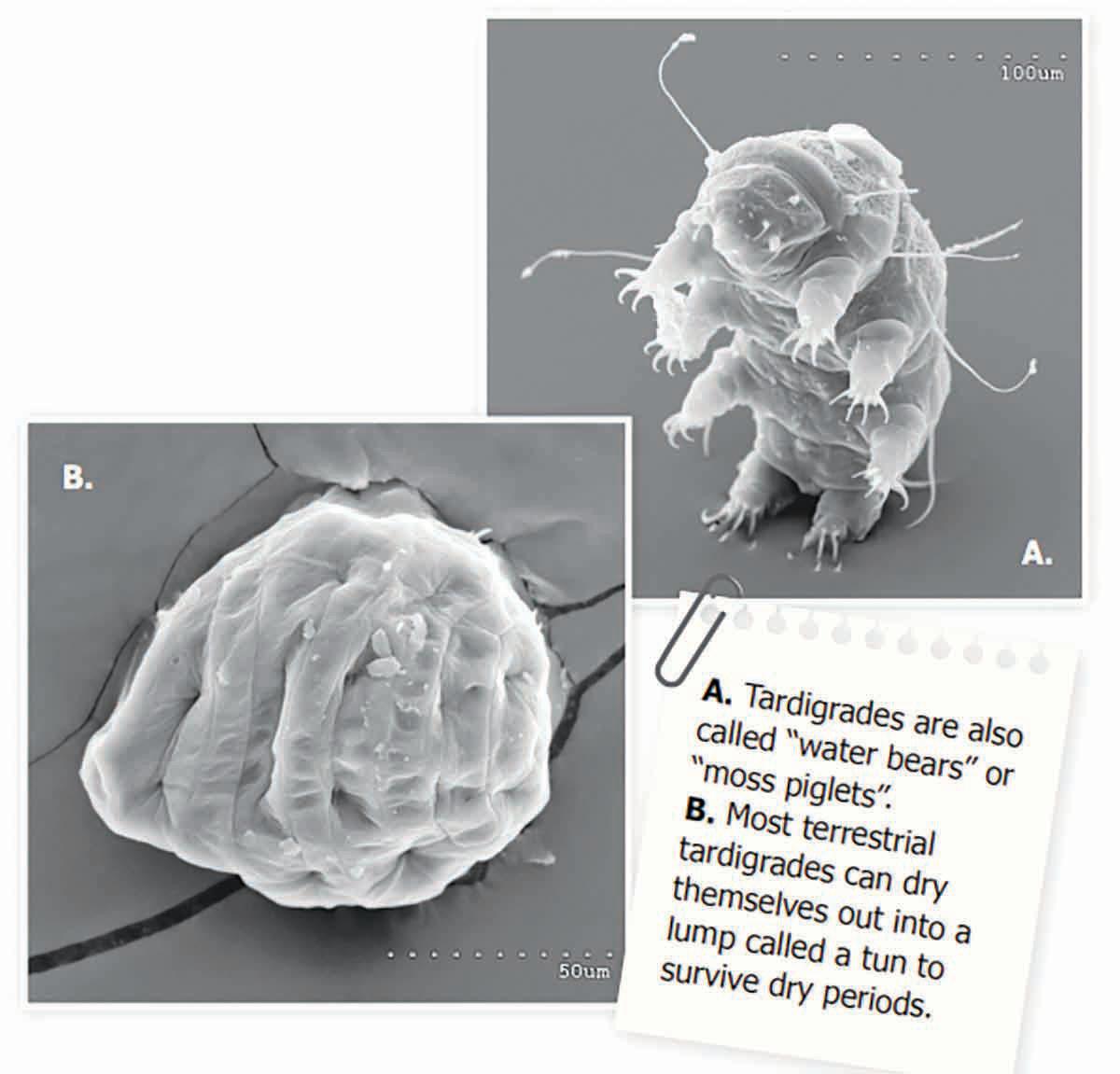
Eight legs, grasping claws, a body like a caterpillar, and a round mouth, probing for food. Is it an alien? A latenight monster movie? No, it’s a tiny creature called a tardigrade, one of the most resilient animals on the planet! Tardigrades can be found almost everywhere on Earth, from the tropics to polar regions. They live in mosses, lichens, the roots of grasses, soil, or water sediments. The biggest tardigrades are only a little more than one millimetre long.
Tardigrades are extremely tough. Even though they need to be in water to be active, eat, and reproduce, they can survive for months or even years without a drop of water! They can survive intense heat and cold and can even survive being in outer space! Scientists keep learning more about how tardigrades perform such amazing feats of survival.
Water bears have a trick they use to survive dry
spells. They curl up into a small lump and push all the water out of their bodies.
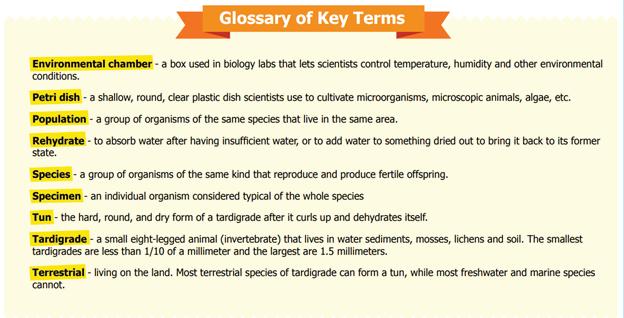
Scientists call this transformed tardigrade a “tun” Then, when water is available again, the tardigrade rehydrates. There are over 1400 species of tardigrades. Some are herbivores and some are predators. But most terrestrial tardigrades have the ability to form a tun.
Scientists have conducted lots of experiments with different tardigrade species. But it’s hard to compare the results because the experiment methods can be very different from each other. This is why they wanted to see how different species of tardigrades recover after being without water, using the same experimental conditions.

Most tardigrades in this study came from soil and moss samples collected in different regions of Poland; some next to a railroad, on a concrete wall, in the soil at a national park, and on the lawn of a university. They also studied some that originally came from Madagascar, making sure that all the tardigrades were healthy adults. In total, they studied 2450 tardigrades!
This research included five populations of tardigrades from four different species, divided into seven experimental groups. Each group included 70 specimens from each population. They were placed into Petri dishes, which were then placed in a special box called an environmental chamber to let the dishes dry inside for three days.
Each experimental group stayed dry for a different amount of time, ranging from 0 to 240 days. Next they rehydrated the tardigrades by adding a small amount of water to
the petri dishes. Then a microscope was used to examine the tardigrades until they moved. How long it took for them to start moving was recorded, as well as how many tardigrades didn’t move after 24 hours of being in water.
The longer each tardigrade was in its tun stage, the longer it took for us to see the first movement after adding water. When the tardigrades were only in their tun stage for a short time, they came back to activity in three to 13 minutes. After 240 days without water, the first sign of movement took longer. The differences between species were larger, too. The first movement for Macrobiotus pseudohufelandi happened after 33 minutes on average, while the urban population of Echiniscus testudo took 96 minutes.
The groups that spent the longest time without water had the smallest number of tardigrades survive. For some species, there was hardly any dif-
ity after short dry periods than after long dry periods. Most tardigrade species only needed a few minutes to recover – even after a few months of dry conditions! Responding quickly to water helps tardigrades survive. It can be hard to know how long water will be available. By acting quickly, tardigrades can make sure to find something to eat before the water dries up again.
There were some differences from early studies. In our study, E Testudo had a low survival rate compared to the other species. But earlier studies showed E Testudo reviving after being in their tun stage for many years. Scientists think that it might be due to differences in how quickly the tardigrades were dried in our experiment compared to earlier experiments. In the natural environment, the drying-out process is probably not as harsh as it was in the laboratory.
Animal species have to adapt to survive in their en-
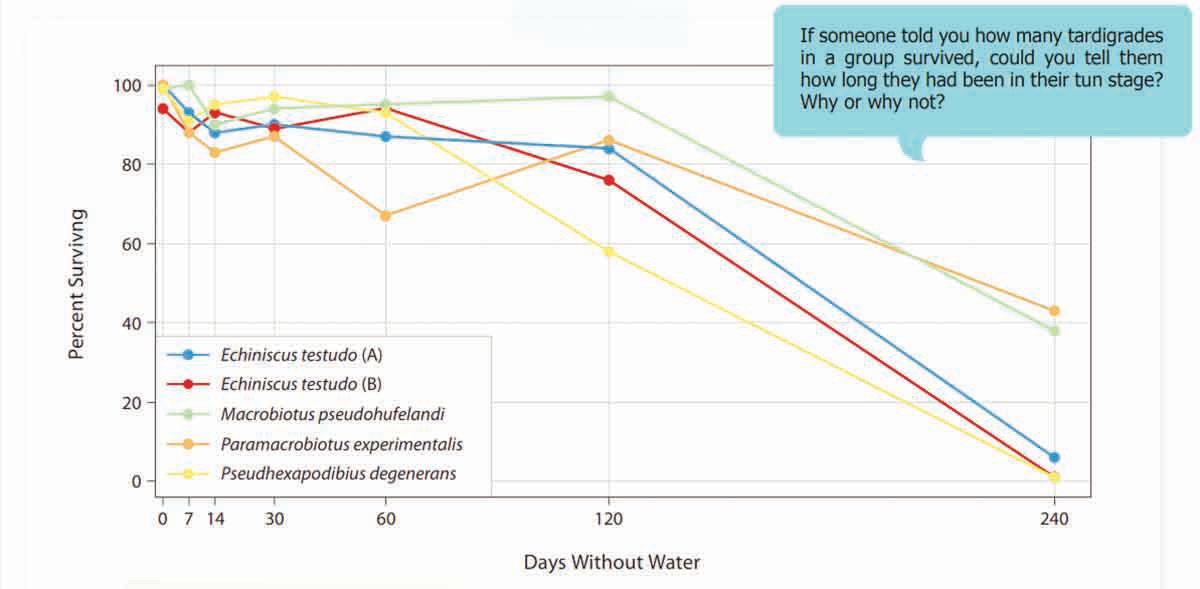

ference between the number of tardigrades that survived for a few days and the number that survived after 120 days. There were larger differences among species after 240 days. For that group, only one per cent of the Pseudhexapodibius degenerans started moving again within the 24hour observation period, compared to 43 per cent of Paramacobiotus experimentalis.
This study showed some interesting similarities and differences between tardigrade species. All the populations studied had more success returning to activ-
vironment. When the environment changes, animals have a harder time surviving. People change the environment in many ways. One way we can help animals survive is by helping to restore habitats. If your family has access to a garden, you can choose native species to plant. You can help clean up litter at a local nature area. You can also help limit habitat destruction by being careful about how much water and electricity you use.
(sciencejournalforkids. org)
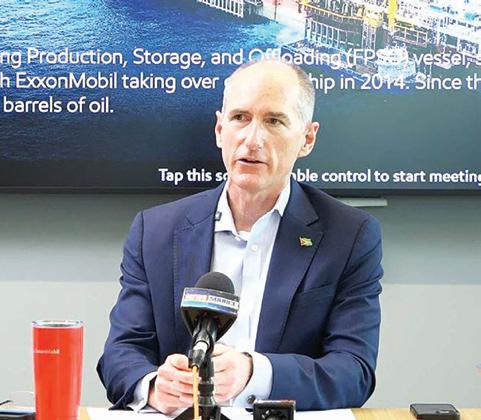
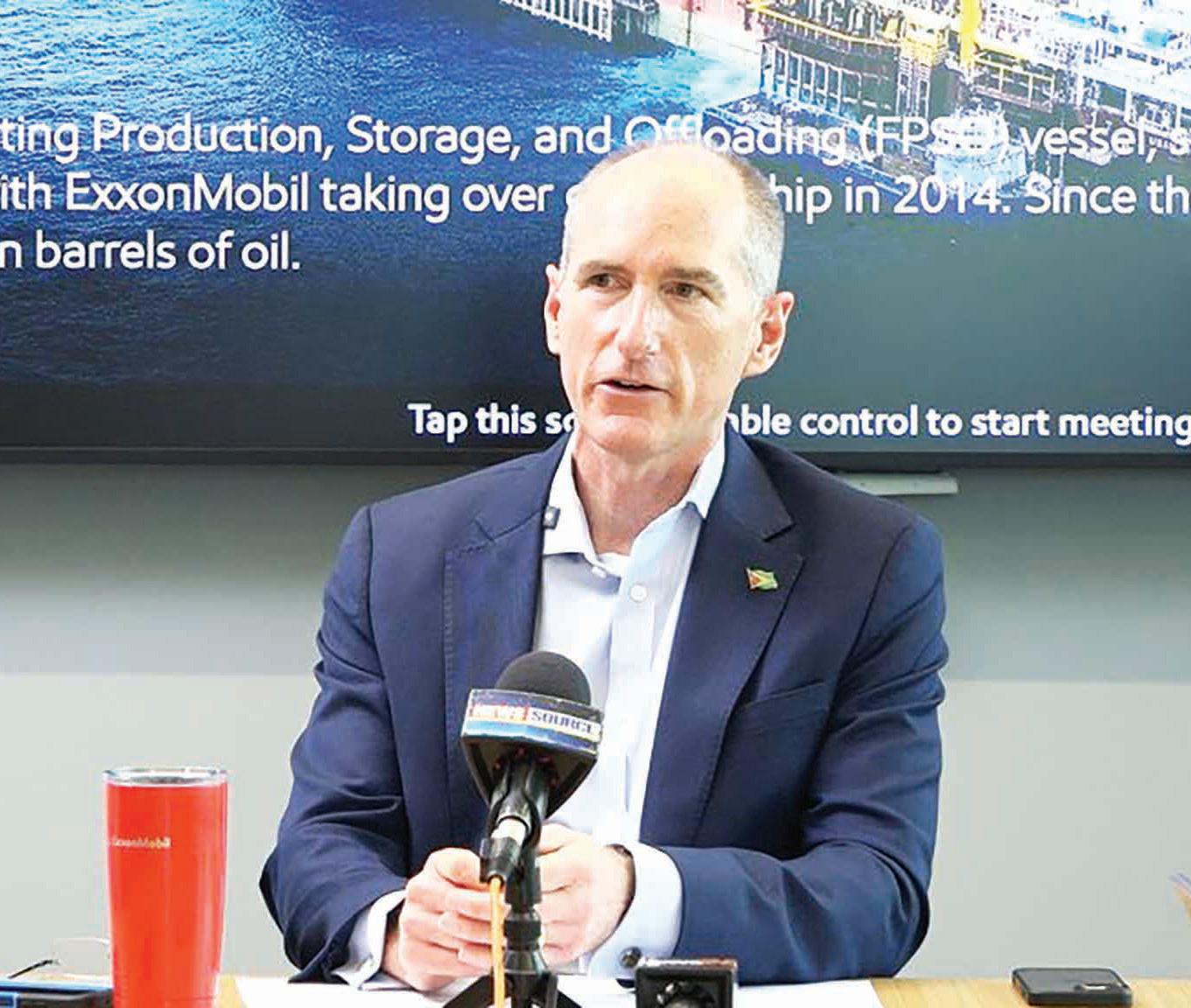
The Guyana Government and ExxonMobil are yet to decide on a sole expert to oversee the settlement of the US$214.4 million cost oil claim, flagged during an audit of the United States (US)-based oil company’s expenses between 1999 and 2017. Country Manager Alistair Routledge said that if the ongoing negotiations reach a stalemate, the parties would have to approach the International Chamber of Commerce (ICC) International Court of Arbitration to identify a third-party expert.
“We would agree to go to the ICC, and they would appoint a sole expert. That is the next step. So, if we can’t agree, then we have a third party identify that sole expert, and then we move forward with that sole expert,” Routledge told reporters during a press conference last week at the ExxonMobil Guyana Limited (EMGL) headquarters at Ogle, East Coast Demerara. The International Court of Arbitration, which was established by the ICC, is an institution for the resolution of international commercial and business disputes.
In 2019, British firm IHS Markit conducted an audit of EMGL’s cost oil expenses incurred between 1999 and 2017 from its operations in Guyana and flagged US$214.4 million as questionable costs. Following months of its own review, the Guyana Revenue Authority
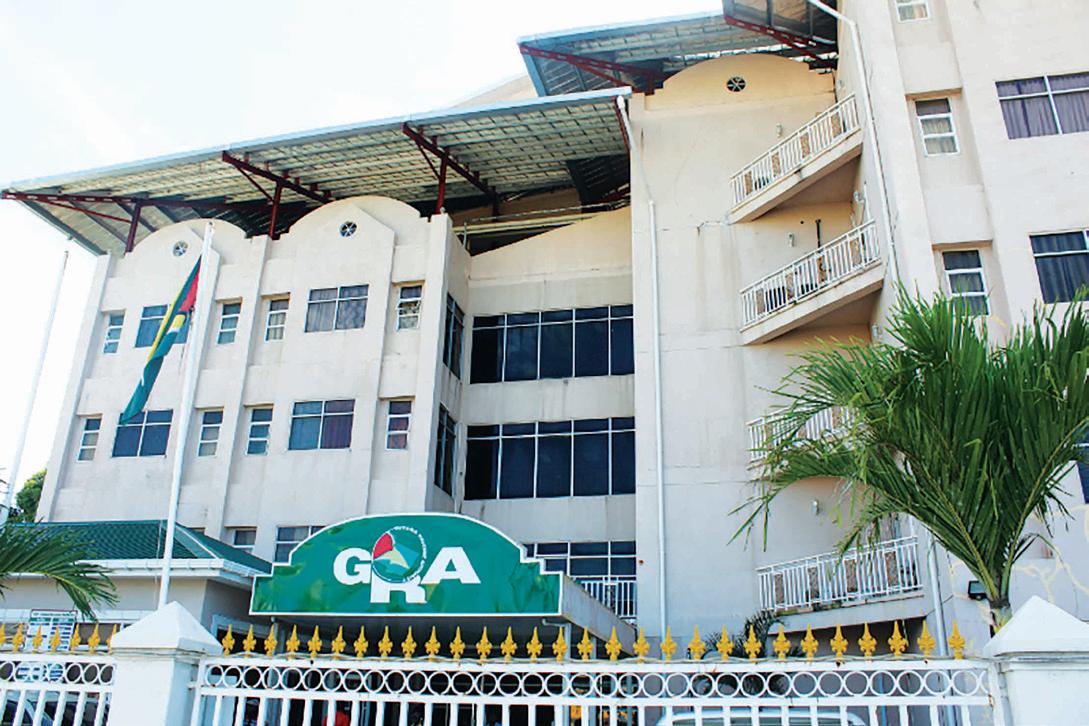
(GRA) – the technical body tasked with advising the Government on the audited oil expenses – had given it no objection since 2023 to the British firm’s recommendation to adjust the cost bank by US$214.4 million, something which was supported by the Government.
Section 1.5(b) of Annex C to the 2016 Stabroek Block Petroleum Agreement, signed between ExxonMobil and the then A Partnership for National Unity/Alliance For Change (APNU/AFC) Government, allows for the submission of disputes concerning the audit to expert determination within sixty days of being informed of the final position. Since last year, the Government had indicated that it would initiate the process to recover the disputed cost oil claim. Both sides subsequently agreed to activate the provision for a sole expert, as enshrined in the Production Sharing Agreement (PSA).
The sole expert is an established dispute resolution mechanism, which can resolve disagreements over the cost-recovery claims. The Government has submitted multiple nominees for the sole expert. ExxonMobil, acting on behalf of the co-venturers, has until May 31, 2025, to provide its response. But according to reports, the Government and ExxonMobil are unable to decide on an expert to mediate and make a determination on the possible repayment of the sum. Both sides have selected their own candidates to be the sole expert and have rejected each other’s choice. Based on reports, the candidate identified by Exxon has previously carried out contractual assignments for the oil company, thus raising concerns of conflict of interest.
Still engaged
Nevertheless, the EMGL President explained during
last Thursday’s press conference that the company and the GRA, which is representing the Government, are still engaged in the selection process. “That process is ongoing, and we expect to have one selected soon,” Routledge stated, adding that there could be additional candidates presented by the two sides even before they head to the ICC.
According to the EMGL president, while there is no deadline set for the selection of the sole expert, it is important for both sides to have confidence in whichever third-party expert is landed on.
“Depending on which steps are followed or taken, then it can take a little longer. We also mutually agreed, between the GRA and ourselves, on where it makes sense to take more time to ensure we are doing the right reviews. Because part of this process is each side providing candidates they nominate as experts. We did not want to put undue pressure on the review of the candidates. Each side is comfortable when we land on the third-party expert. There should be no concern that they are acting in the interest of all parties.
“One way or another we’re going to get to a sole expert. But what I would say is the discussions have been had with the right approach, both sides wanting to make sure that they understand the credentials of the people and the organisations being
proposed and also that they don’t have any conflicts of interest. It’s extremely important, I think, to both parties that we are comfortable ultimately with whoever it is that is the sole expert,” the EMGL President stated.
In March last year, Guyana’s Vice President (VP) Dr Bharrat Jagdeo had stated that this process initiated by the GRA could eventually lead to arbitration. Meanwhile, even as the two sides are attempting to settle this first audit, there are two more oil audits of Exxon’s expenses in Guyana. In the second audit, done by a consortium of local and international firms, VHE Consulting, some US$7.2 billion in expenses incurred between 2018 and 2020 were examined. Of this amount, US$65.1 million was not accepted by the
Government. Routledge told reporters during Thursday’s press conference that Exxon has reviewed and provided feedback on those findings and is now awaiting another round of feedback on its comments submitted. “I think what is happening is the process is working in the sense that audits are taking place, and questions are being raised, and we’re going back and revisiting the data and the information we’ve supplied to make sure it’s clear. We have found certain areas; we’ve made adjustments, but those have been de minimis, really,” the EMGL head stated.
Moreover, the third cost oil audit, covering the period 2021 to 2023, was completed and submitted to the Government. The GRA has been reviewing that report.
As oil prices rise amid tensions in the Middle East, the impact is being felt by the global transport industry, and the local businesses are now bracing for being hit by that inflation.
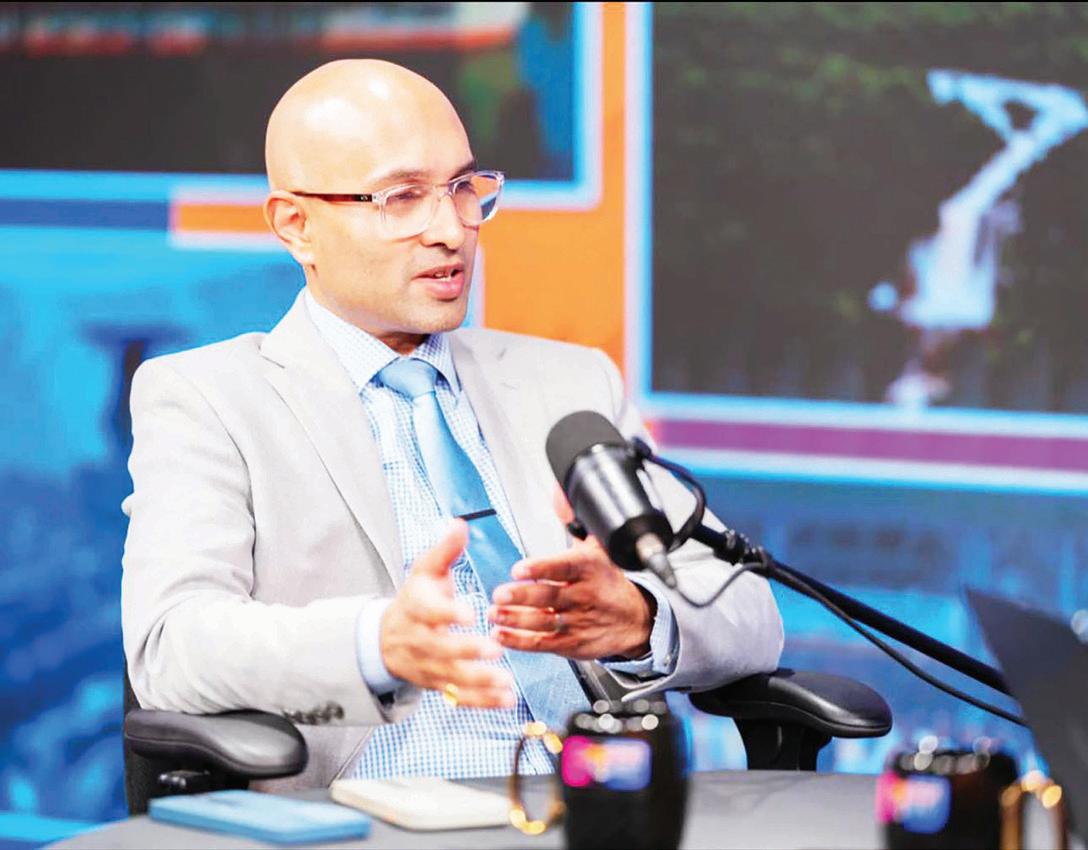
This is according to the director of the Vreeden-Hoop Shore Base Inc. (VEHSI), Nicholas DeygooBoyer, during an appearance on the Starting Point podcast. While the podcast will be published in full today, a snippet of the episode was shared online of the businessman and former Private Sector executive speaking about the impact of the ongoing war in the Gulf.
Deygoo-Boyer, who also serves as a director at his family’s company, National Hardware Guyana Limited, warned that while Guyana is better positioned to withstand the effects of the war as a result of key government measures, some external shocks could still be felt in the country.
“At our National Hardware businesses, we've already received heads-up notices from the shipping
companies that costs will be going up for importing product. And again, this is not profiteering. This is passing costs on. So, you feel it for them, and nobody's doing this with a smile on their face. They're all very glum when they're passing these messages on. But it's the reality.”
“And for a lot of us, it's a tough thing to deal with because especially if you have not had a large savings base, that inflation is going to hit you hard… For businesses, our issue is that a lot of us are expanding, which means we have taken on debt to fund new projects. So, it's very hard to not pass on the inflation,” the businessman emphasised.
Rising tensions in the Middle East have placed renewed global focus on the Strait of Hormuz amid an escalating conflict involving Iran, Israel, and the United States. The ongoing military exchanges, including airstrikes on Iranian energy infrastructure and retaliatory attacks, have heightened fears of disruptions to one of the world’s most critical oil
transit routes. As a result, global markets remain on edge, with concerns mounting over potential spikes in fuel prices, increased shipping costs, and wider impacts on international trade if instability in the region persists.
Since 2020, the Guyana Government had introduced a series of interventions to combat the surge in global shipping costs, including rolling back freight charges to pre-pandemic levels for
calculating import duties, excise taxes, and VAT, a policy extended through 2025–2026 to relieve importers and, ultimately, consumers. Additionally, the government has maintained a zero per cent excise tax on gasoline and diesel since March 2022 to combat rising fuel costs, down from 50 per cent in 2020.
Permanent solution
Even with these interventions, Deygoo-Boyer,
who previously served at the helm of several Private Sector bodies in Guyana, says that there needs to be a more permanent solution to offset the global shocks on the local economy.
“I think that it might be well worthwhile to reanalyse whether a refinery is feasible or a strategic reserve is feasible. I'm no expert in this field, but I think that what we took for granted as the world is how much of the product we're demanding – diesel, petrol, jet fuel, et cetera – and how much that product is controlled by a small region and passing through that tiny area… And that has implications for the average person today because we're likely to see quite a bit of inflation that is uncontrollable by the government,” Deygoo-Boyer stressed.
Reignited discussions on national refinery
The businessman’s comments come just days after President Dr Irfaan Ali reignited discussions on a national refinery, emphasising
that the strategic development of regional resources is essential to safeguarding the Western Hemisphere’s economic stability and energy security.
Speaking at the 136th General Meeting of the Georgetown Chamber of Commerce and Industry (GCCI) on Thursday, the Head of State drew attention to the ongoing conflict in the Middle East and the developments surrounding the Strait of Hormuz. Global experts say that the disruptions in that critical waterway have skyrocketed fuel prices, which in turn affect transport, fertiliser production and food processing.
According to President Ali, “This is a massive disruption, and that is why we support every effort to have the Strait of Hormuz open and functional and every effort in bringing the war to an end." We also support every effort to protect key energy infrastructure in the Gulf States. There is no other option – we are all going to suffer under these circumstances.”


Your Eyewitness returns to APNU and WPA’s Black Pudding Man’s call for “revolution” against the PPP Government for legal evictions by the owner of private lands at Friendship on EBD!! Now this fella’s been around the block and then some when it comes to protests against the PPP Invariably it comes down to inflicting violence against those who’re considered supporters of the PPP – and as Black Pudding Man insists, these are Indian Guyanese!! Violent protests in Guyana are always ethnically directed violence – against Indian Guyanese down the line!!
Now that’s a subject that should’ve received a lotta attention over the decades it’s been happening. But obviously nothing meaningful has been done about it since it keeps on happening with numbing regularity. In these matters there’s one thing those who unleash violence have in their minds – what’s the downside risk when they go after any group? They know since Black Friday 1962 to Scrapes seeking “justice” for Adrianna in 2024, Indians and their businesses are easy marks!!
The other thing is what the “protestors’” idea of the reaction of the Police and other upholders of law and order is gonna be to the mayhem they create. In Guyana, they know in most instances they’ll be treated with kid gloves. Didn’t one of Black Pudding Man’s cohorts actually dare the Government to send the Disciplined Forces against them rioting?? He predicted they’d never turn their guns on them!! Desmond Hoyte explicitly called the Disciplined Forces, “Kith and Kin”!!
And so protesters targeting Indian Guyanese have absolutely got to fear. Even if they’re arrested – as some were after the Mon Repos Anti-Indian Mayhem protesting Police excesses - they know at best they’ll get a slap on the wrists. One person wrote that rather than punish these miscreants, they should be trained, given jobs, given food, the community should be counselled, etc!! Okay… then what?? What about that thing called “deterrence”?? Just like all work and no play make Jack a dull boy, all carrots and no stick make rioters into hard-core criminals!!
And now for the Indian Guyanese folks at the receiving end of the sticks at Mon Repos? Okay… They were compensated for their loss of goods – and for their stalls and cars, etc that were vandalised. But what about the trauma they had to go through?? “How much more time, Bhagwan?” they must be wailing. Who’s gonna compensate them and all those in the past and in the future for the uncertainty they face about their lives – for the rest of those lives?
But most of all, will the handful of Wild Men like Black Pudding Man not even get a slap on the wrist for stirring up hate among African Guyanese – which will be directed against Indian Guyanese??
…of new colonisation
We had four hundred years of colonisation by the West – never mind Gabriel Marquez’ “One hundred years of solitude”. We were never cut off from the tentacles of Western power through the myriad forms assumed – art, culture, language, politics, economics and so on. But in all those years, we in the south were never “settler colonies”. The bottom line was the British, for example, would live here for a while, crack their whips, but in the end return to Old Blighty to end their days.
Even when the Americans took over from the Brits – after they installed Burnham in power – they never descended on us like the proverbial swarm of locusts. And even before that, when they built our airport and stationed troops there during WWII, didn’t they get out before Sparrow could say, “Yankee Dollar Bill”?? Well, there’s a new coloniser in town – the Chinese. But unlike the West, they send in their folks to actually settle here. How’d you deal with locusts??
...for Paul??
Remember that old saying, “Peter pays for Paul and Paul pays for all?” Well, it looks like in Guyana, Indian Guyanese are the incarnation of Paul, and they’re supposed to pay for whatever sins are cast their way.



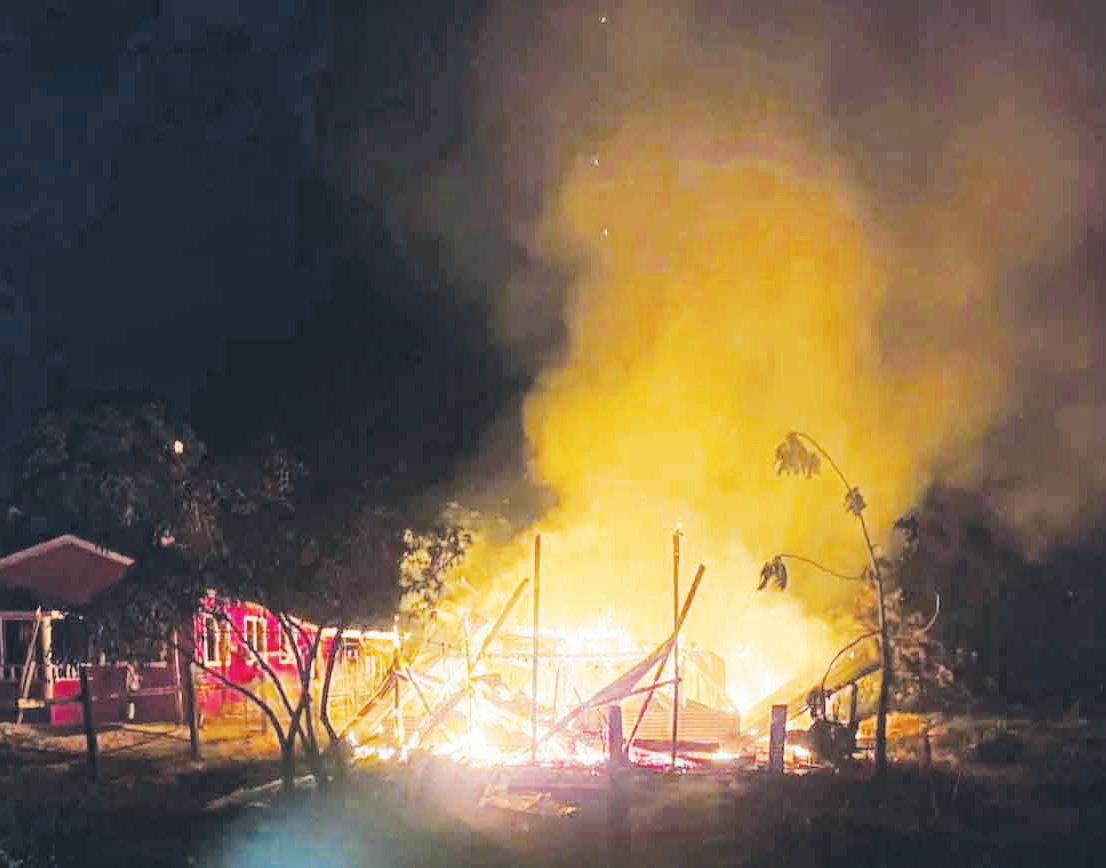
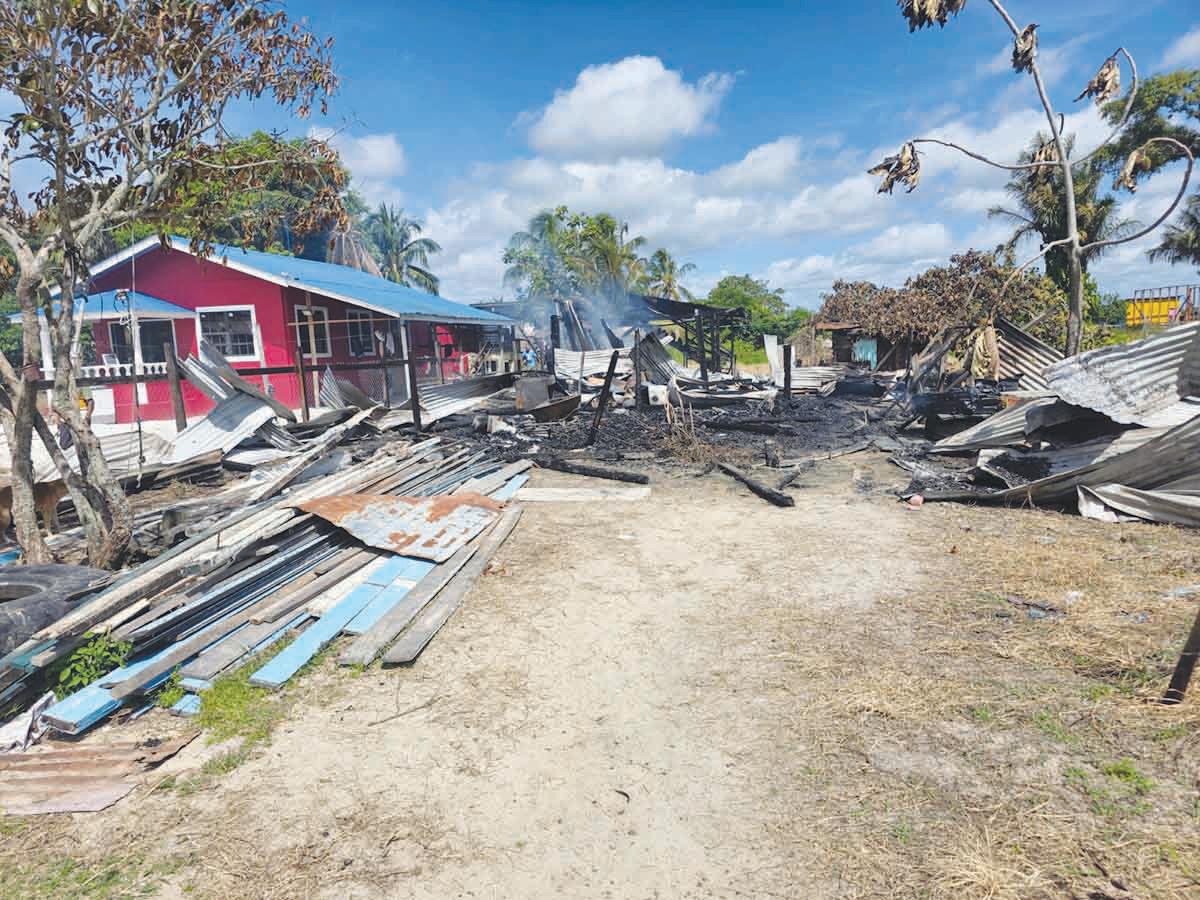
Adevastating fire, reportedly set by a relative, has left a Good Hope family homeless after two wooden houses were completely destroyed, resulting in millions of dollars in losses. The blaze occurred between 03:30h and 04:25h on Saturday, at Lot 368 Good Hope, Region Two (Pomeroon–Supenaam).
At the time, nine persons were inside the back house, while 74-year-old Narima Hamilan, called “Aunty Mom”, was alone in the front house. The back house in the yard, owned by Narima Hamilan’s son, Mohamed Hamilan, was occupied by his wife, five children, and grandchildren. Mohamed Hamilan, a security guard, was at
work when the fire erupted. According to Mohamed Hamilan, called “Soap Power”, the fire was allegedly set by his nephew, of Good Hope. He explained that the young man arrived at the home sometime around 02:00h and requested entry. However, the grandmother Hamilan reportedly refused to open the door, telling him to leave due to his alleged drug habit.
It is alleged that, after being denied entry, Khan proceeded to set fire to furniture on the verandah, including a chair and table. The flames quickly spread, engulfing both structures. Narima was rescued by a relative from the back house before the structure was completely destroyed
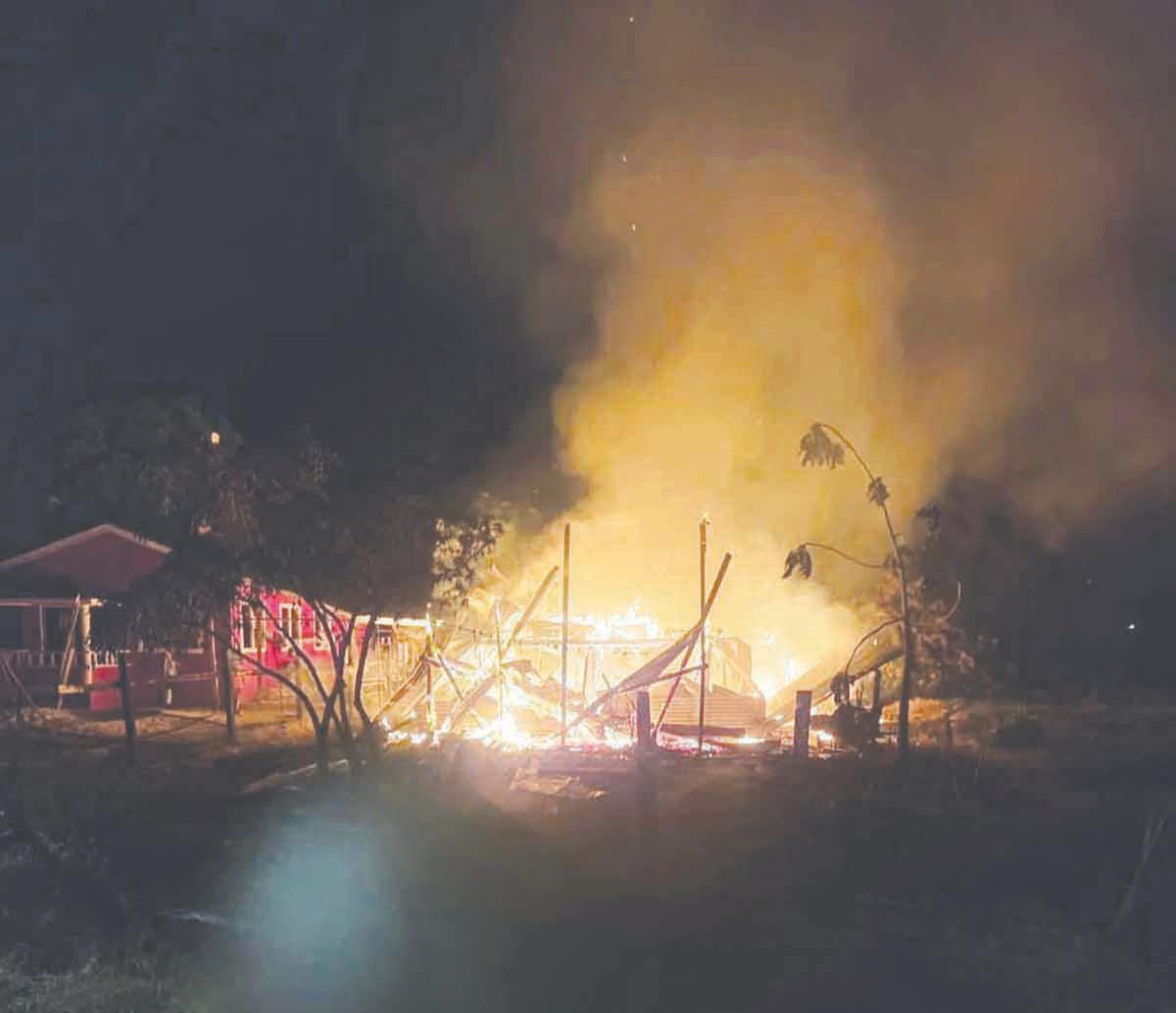
and was subsequently rushed to the hospital, where she is currently receiving medical treatment.
Despite efforts by the Guyana Fire Service (GFS) to contain the blaze, the

fire had already consumed the buildings by the time it was brought under control. Nothing was salvaged. Mohamed Hamilan expressed distress over the incident, noting that the family had worked tirelessly to build and furnish their home, only to see it reduced to ashes within minutes. He estimated the damage to the two buildings at approximately $6 million. “This land we’re on, we have been renting it for over 21 years... we worked very hard to build these houses to make us comfortable, and in just a few minutes, everything
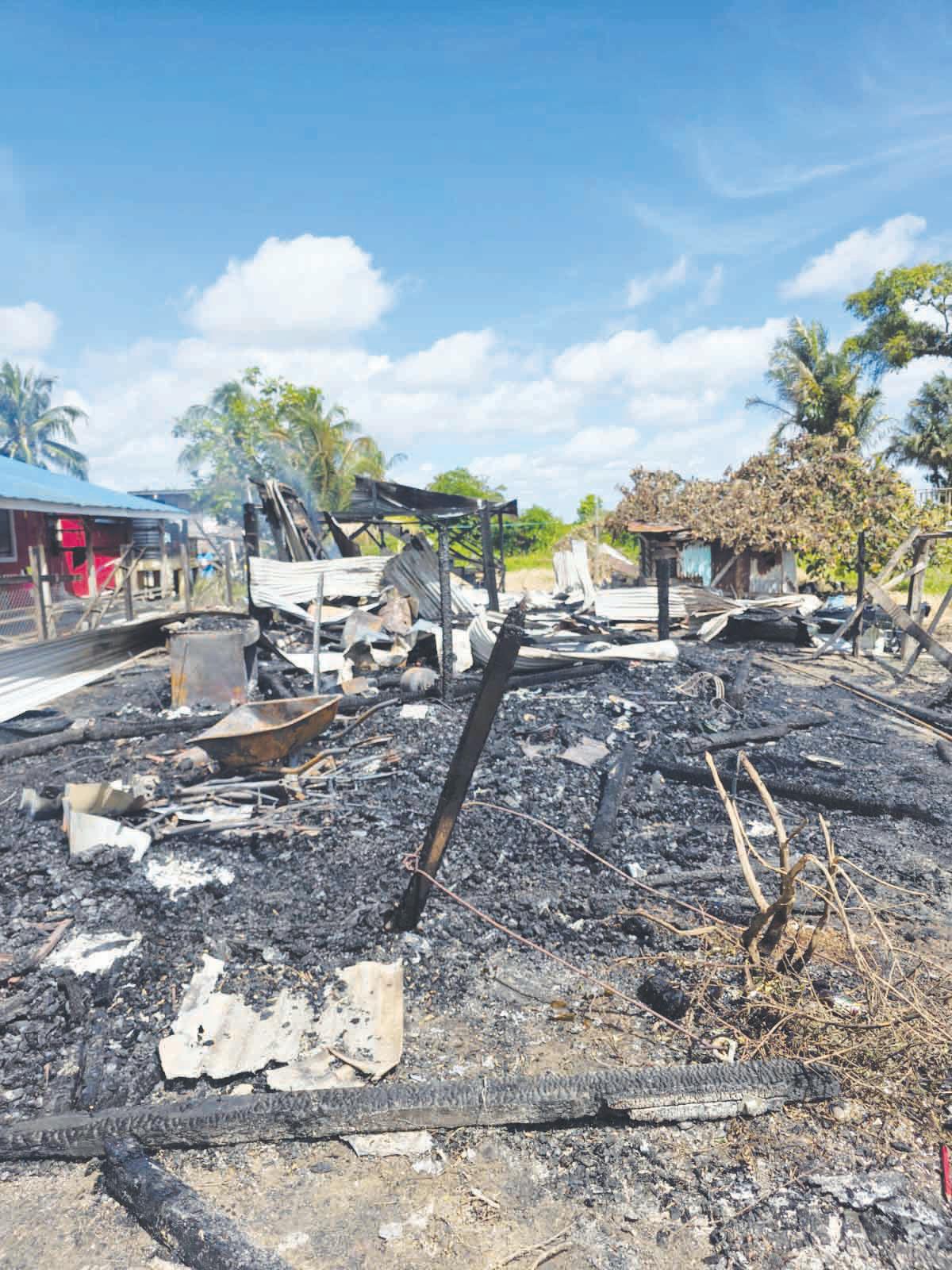
is gone. It’s heartbreaking and very sad for us. We need assistance to build back our homes so we can live comfortable with our family again,” he said.
Now displaced, the family are appealing to the Government and the public for assistance in re -
building a safe and comfortable home so they can begin to recover from the tragedy. The family can be reached on telephone number (592) 764-4265.
Police have since launched an investigation and are searching for the suspect.


For me, cricket in Guyana and the Caribbean always makes me return to CLR James’ masterpiece, “Beyond the boundary”, in which he ruminates on the question, “What do they know of cricket that only cricket knows?” With the CPL tournament coming up in August, perchance we can apply some of his insights in looking ahead, along with his caveat that context is always paramount. Even though the book is autobiographical and, as such, anchored in events from a century ago, his observations still resonate.
While some purists may sniff that T-20’s showmanship is over-the-top, even back then when Test cricket was the only format in existence, he insisted cricket was “a spectacle”. “Cricket is first and foremost a dramatic spectacle. It belongs with the theatre, ballet, opera and the dance.” And like all those art forms, while they may have originated elsewhere, to take root, cricket on and off the field, had to become integrated into the lived experience of the local society. James again: “The cricket field was a stage on which selected individuals played representative roles which were charged with social significance.” James wrote about a neighbour, seen as coarse and crass by his prim and proper spinster aunts, who becomes transformed into a hero as he plays strokes of sublime beauty on the cricket pitch. He uplifts all the spectators, who are mostly from his social strata: they see themselves refracted in his performance, and it offers them hope.
In my village of Uitvlugt, the Community Centre, built in the mid-fifties by Bookers, was a pilgrimage site to which I gravitated every Sunday to view our local sugar workers transformed from plantation drudges into flannel-clad stars as they battled teams from the surrounding villages on the cricket field. Even as a boy, a total klutz in the game, I could appreciate cane-cutter Fogo whipping that ball off his toes as “a thing of beauty is a joy forever”. It was for these sugarestate grounds that Bookers hired the great Clive Walcott as a coach and which produced the flamboyant and unorthodox Rohan Kanhai. James was to describe Kanhai: “In Kanhai’s batting what I have found is a unique pointer of the West Indian quest for identity, for ways of expressing our potential, bursting at every seam.” It was due to James’ lobbying that Worrell was made Captain of the West Indies cricket team in 1960, breaking the colour barrier and validating merit as the criterion for selection of leaders. Independence for Trinidad and Jamaica in 1962 was an expression of that confidence writ large.
In terms of the flamboyant style of CPL cricket, this is a continuation of the early subversion of colonial cricket by players like Kanhai, who would deliberately fall on his back to hook a ball for four. Along with other WI players, they unhitched cricket from “Englishness” to de-Victorianise the sport that was supposed to usher us natives into “modernity”. The spectacle of the CPL T20 cricket tournament with its carnivalesque crowds and kaleidoscopic uniforms creates an indigenous Caribbean identity by using tools that had turned us as colonised subjects into colonised objects. We are playing Caribbean cricket, and the erstwhile masters can now only try to imitate to catch up.
Coming to the seemingly excessive support by the Guyanese public (domestic and foreign) for the Amazon Warriors, James had noted that the cricketers’ success “atoned for a pervading humiliation and nourished pride and hope”. He drew a historical parallel between our euphoric feelings on the excellence of our cricketers and the Greeks’ iconisation of their athletes: “The Greeks believed that an athlete who had represented his community at a national competition and won had thereby conferred a notable distinction on his city. His victory was a testament to the quality of his citizens”. And in like fashion, so was his defeat, hence our national mood of depression following the Warriors’ too-frequent elimination from the tournament.
James also connected cricket to a philosophy of West Indian life inculcated in the schools: “I acquired the discipline for which the only name is Puritan. I never cheated. I never argued with the umpire, I never jeered at a defeated opponent, and I never gave a friend a vote or a place which could be seen as belonging to a stranger.” Would our politicians have inculcated such values?






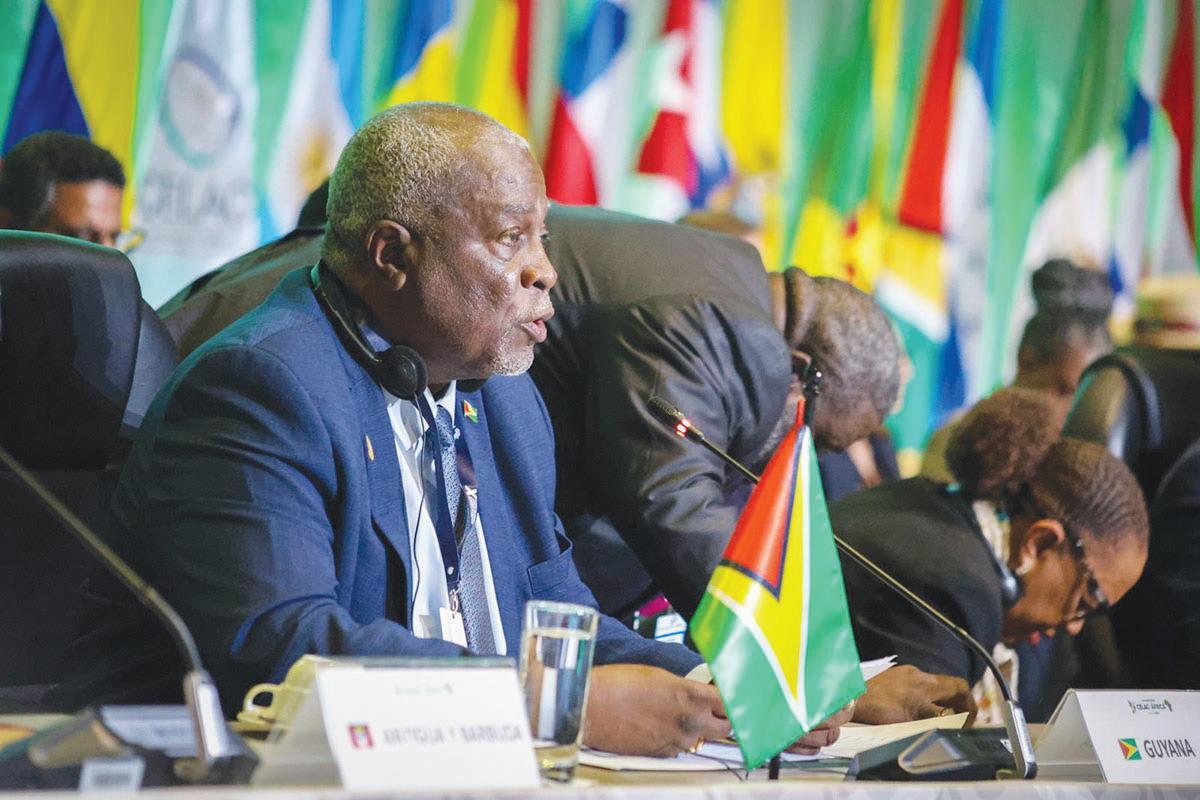
Prime Minister Brigadier (Ret’d) Mark Phillips speaking at the CELAC-Africa High-Level Forum in Colombia
Prime Minister (PM)
Brigadier (Ret’d)
Mark Phillips has urged enhanced SouthSouth cooperation and deeper integration between the Community of Latin American and Caribbean States (CELAC) and Africa. Speaking at the CELACAfrica High-Level Forum in Colombia on Thursday, PM Phillips highlighted key areas for collaboration, in-
gy to be shared across our continents, which can support sustainable and climate-resilient agri-food systems,” he said.
He also touched on historical and cultural links between Africa and the Caribbean, highlighting the importance of reparatory justice and CARICOM’s ongoing ten-point action plan. Economic cooperation featured prominently in his ad-
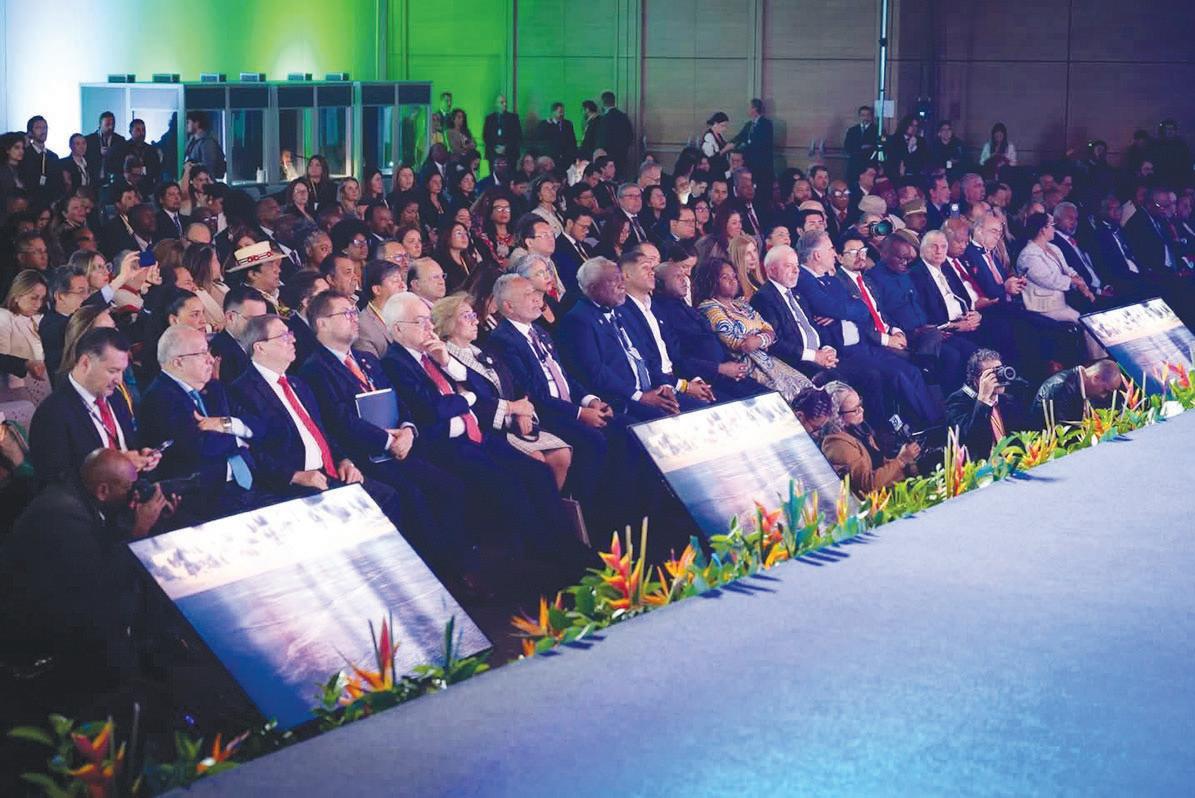
cluding climate change, food security, health systems, digital connectivity, technology and peace and security.
“Issues of the environment, climate change, food security, improved health care systems, digital connectivity and technology, and peace and security can be the pillars of our development cooperation,” he said. He stressed climate change as a priority, noting Guyana’s vulnerability as a low-lying coastal nation, and reaffirmed the country’s commitment to the Low Carbon Development Strategy (LCDS) and the Global Biodiversity Alliance. He also called for collective efforts to achieve the 1.5 degrees Celsius target and secure financing for resilience building, adaptation and loss and damage. On food security, PM Phillips proposed joint research programmes, coordinated sharing of agricultural technology, and exchange of best practices to strengthen climate-resilient agricultural systems.
“There are lots of lessons to be learned and technolo-
dress, with a focus on trade and investment. PM Phillips called for bi-regional trade agreements, targeted private sector partnerships and improved transport connectivity to boost market access and economic growth.
Looking ahead, he stressed the need to institutionalise the CELAC-Africa partnership through the establishment of a Joint Commission to ensure sustained and productive engagement.
He praised Colombia, as pro tempore president of CELAC, and Burundi, as chair of the African Union, for leading the forum, describing the event as a milestone in formalising cooperation between the regions.
“Let us seize this historic opportunity as leaders of countries within our regions to demonstrate our determination and resolve to forge a sustainable and equitable future for our countries,” he urged. PM Phillips reaffirmed Guyana’s commitment to the CELAC-Africa partnership and the implementation of programmes aimed at inclusive and mutually beneficial socio-economic development.


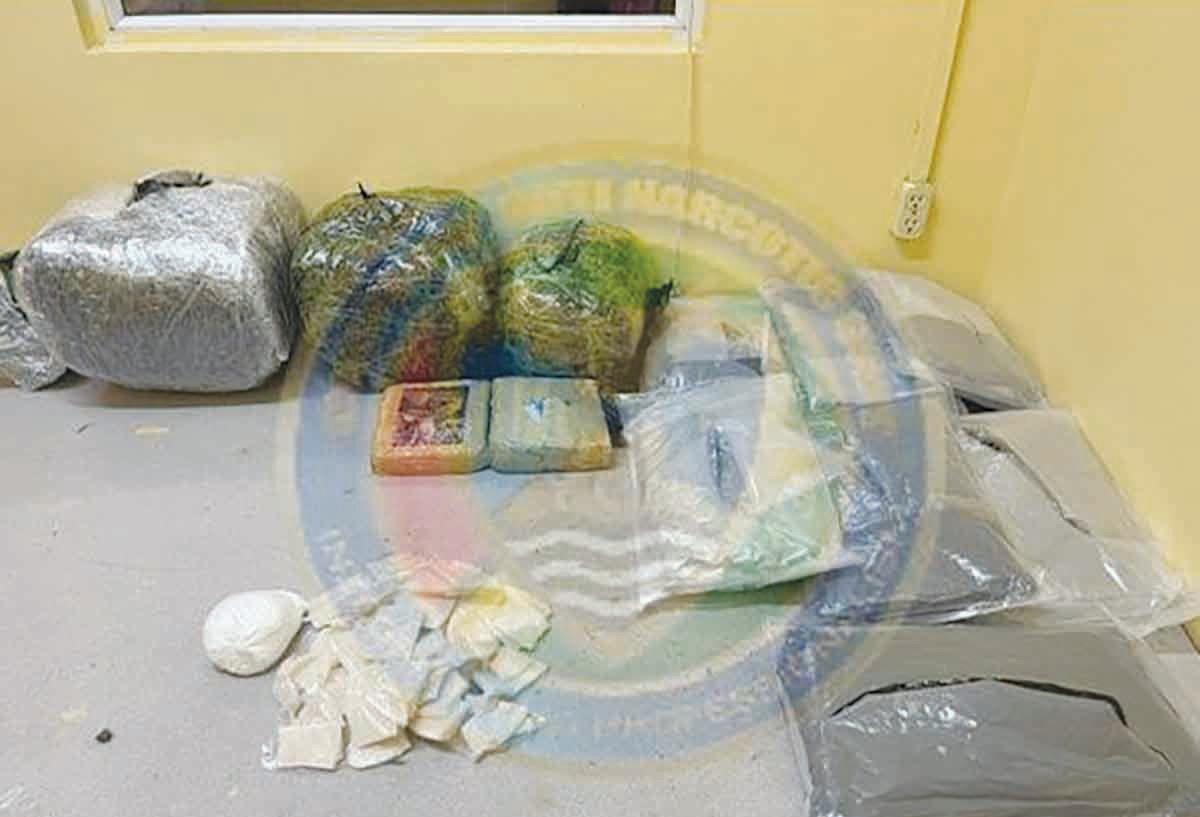
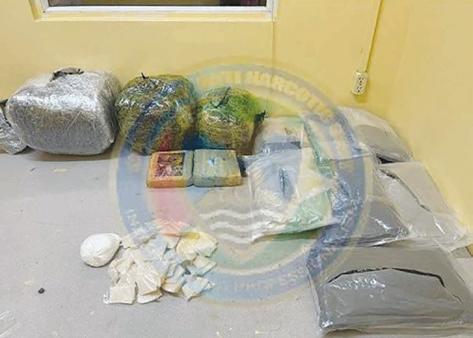
Officers of the Customs Anti-Narcotic Unit (CANU) on Friday conducted an operation at Transport Wharf, Water Street, Kingston, Georgetown, which resulted in the seizure of cocaine and cannabis and the arrest of a suspect. According to CANU, the operation was carried out after officers acted on information received. During the exercise, ranks intercepted a man carrying two cardboard boxes at
the wharf. A search of the boxes revealed 13 parcels containing cannabis and one parcel containing rock cocaine. The suspect, a 46-year-old of Mon Repos, East Coast Demerara (ECD), was taken into custody and escorted to CANU Headquarters along with the narcotics. CANU stated that the cannabis weighed 12.104 kilograms (kg), while the cocaine amounted to 1.272 kg. Investigations into the matter are ongoing.
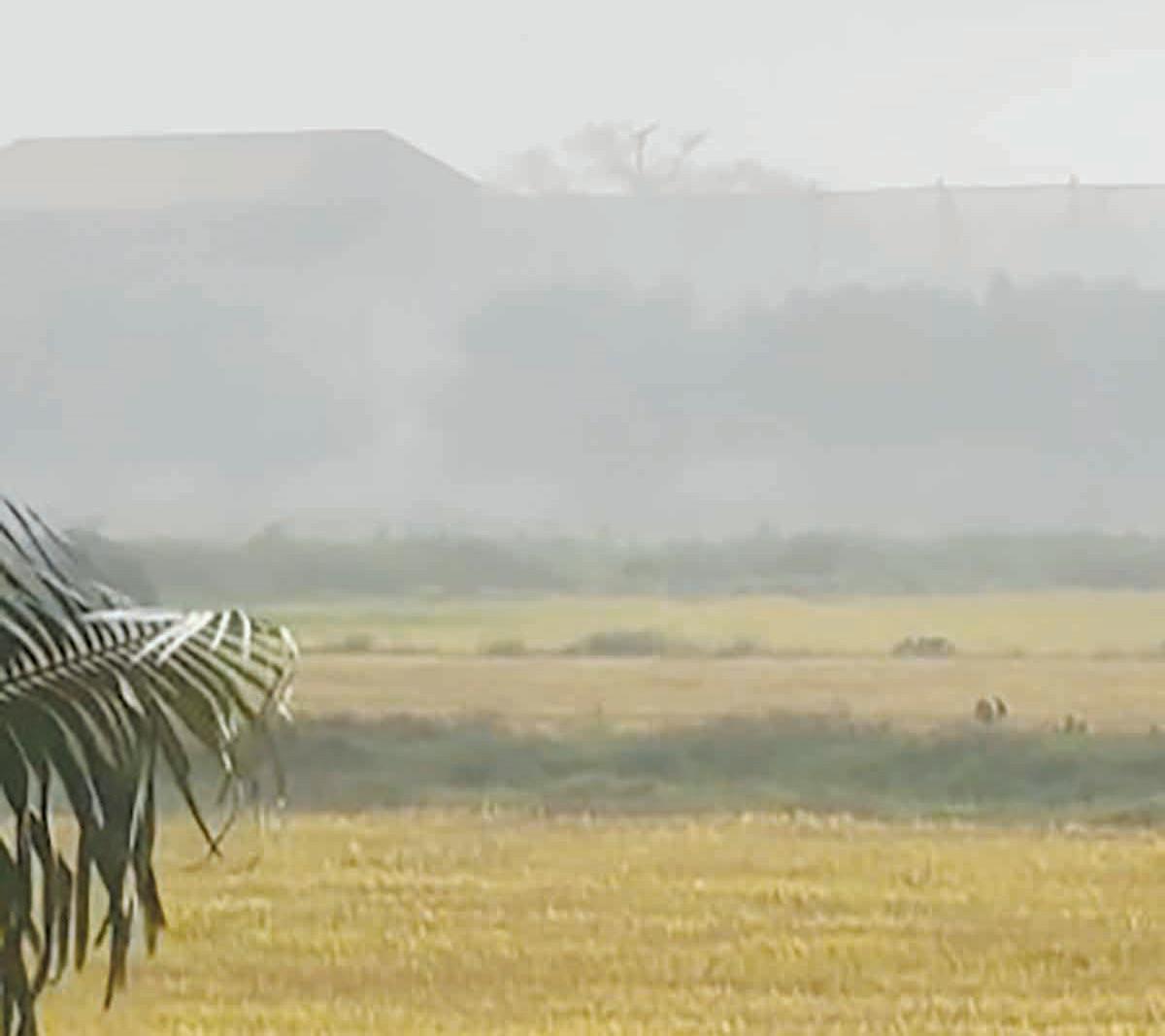
The Environmental Protection Agency (EPA) has confirmed that complaints regarding dust emissions from Vilvoorden Investment Inc on the Essequibo Coast, Region Two (Pomeroon-Supenaam) are now before the court.
The Magistrate has instructed that the company’s compliance with required mitigation measures be formally assessed and reported at the next hearing, scheduled for June 4.
As part of the process, Vilvoorden has been directed to submit documentation to the EPA detailing the steps it has taken to address dust emissions, as well as any proposed alternative measures.
The EPA will review these submissions to determine whether they meet regulatory standards.
Following the review, the EPA will conduct a com-
pliance inspection and may present additional evidence or amend its statements to the court if necessary. The Agency, in a press release to the media on Saturday said that it has already visited the Vilvoorden site several times and attempted to engage with residents regarding mitigation efforts, though it was able to reach only some members of the community.
The EPA emphasised its commitment to protecting public health and enforcing environmental standards, noting that all administrative and legal remedies will be pursued in line with the law. Residents affected by the dust are urged to engage with EPA officers to ensure their concerns are fully addressed.
Residents in the community had complained that the issue has been a long-standing matter and had accused the EPA of inaction.
The Ethnic Relations Commission (ERC) on Saturday joined the international community in observing the International Day for the Elimination of Racial Discrimination, calling for continued vigilance and collective action to address racial prejudice. Observed annually on March 21, this year’s theme, “Mobilising Political Will: 60 Years of Commemorating the International Day for the Elimination of Racial Discrimination", highlights both global progress and the need for sustained efforts to eliminate discrimination.
In a statement, the Commission noted that

Guyana’s diversity remains a defining element of its national identity and stressed that social harmony must be actively maintained through understanding, respect, and inclusive engagement. The ERC reaffirmed
its constitutional mandate to promote harmony and good relations among all ethnic groups, underscor-
ing that social cohesion is critical to national development. Over the past year, the Commission reported that it has undertaken several initiatives to strengthen awareness and encourage responsible conduct.
These included school and community outreach programmes and Diversity, Equity and Inclusion (DEI) training across public and private sector organisations, as well as ongoing media monitoring and investigations into incidents of racially insensitive or prejudicial remarks, particularly on digital platforms. The ERC acknowledged that while progress
has been made, challenges persist, especially in online spaces. It urged citizens to exercise responsibility in public discourse and to contribute to fostering mutual respect.
Marking the observance, the Commission also called for continued collaboration among public institutions, civil society, the private sector, and communities to reinforce the values of tolerance and inclusion. The ERC reiterated its commitment to promoting a society in which ethnic diversity is respected, differences are understood and citizens coexist in an environment of peace and harmony.

The Guyana Civil Aviation Authority (GCAA) hosted a fiveday technical training from March 16 to 20, focused on the development of a Civil Aviation Master Plan (CAMP) at its Georgetown head office. The initiative, held under the auspices of the International Civil Aviation Organisation (ICAO), brought together senior representatives from key aviation stakeholders, including Cheddi Jagan International Airport (CJIA), Eugene F Correia International Airport, local international air operators, the Air Navigation Service Provider (ANSP), the Guyana Tourism Authority (GTA), and the Civil Aviation Training School.
The sessions were facilitated by ICAO Aviation Specialist Roberto Sosa, who provided participants with technical guidance and international best practices.
Public Utilities and Aviation Minister Deodat Indar described the training as timely, noting that the Government is developing a CAMP aligned with President Dr Irfaan Ali’s vision and informed by industry stakeholders. Director General Lt Col (Ret’d) Egbert Field, A A, highlighted the strategic significance of the initiative, emphasising that it aims to strengthen technical capacity and institutional
knowledge to produce a robust national aviation plan. A CAMP provides a longterm roadmap for the development and modernisation of a country’s aviation sector, covering areas such as infrastructure expansion, airspace management, safety oversight, security, and economic regulation. The plan ensures that aviation goals are aligned with broader economic development objectives and ICAO’s Standards and Recommended Practices (SARPs).
The Government of Guyana is pursuing significant investments in the aviation sector in 2026, including a second passenger terminal at CJIA, relocation and construction of a new Air Traffic Control Tower complex at the same airport, development of new municipal airports in Lethem, Region Nine (Upper Takutu–Upper Essequibo) and Rose Hall, Region Six (East Berbice–Corentyne) and rehabilitation of over 30 airstrips across the hinterland. The training also focused on updating Guyana’s 2020 CAMP to reflect the country’s growth, expanding aviation infrastructure, and long-term development goals.
The programme was funded by the Government of Japan and conducted by ICAO’s Global Aviation Training Office.
“This, of course, brings us very importantly to our policy decisions moving forward. One of the strategies is to increase our storage capacity and take it to a level where we can better control price differentials and cushion extreme shocks on the market,” he said.
President Ali said that there must be a renewed focus on discussions surrounding a refinery and energy security.
“Now, I believe we should return to the conversation of a refinery and security. This challenge has opened up discussions globally and reinforced what the US policy for the Western Hemisphere has been –that we must optimise our resources and the development of those resources for the protection and economic viability of the hemisphere.”
“These are no longer farfetched ideas; they are now realities that we must embrace. An important part of this reality is ensuring we have a secure, rule-based hemisphere in which our shared values of democracy and freedom are upheld. We cannot continue to look
beyond our hemisphere for solutions when we have so many resources within the Western Hemisphere that must be developed if we are to secure a sustainable future for ourselves. It is in this context that we must view this conference,” he declared.
Ali also highlighted Guyana’s growing global recognition, noting that the country is attracting increasing international investment. He emphasised that as Guyana rises, it must do so inclusively, warning that growth that excludes others risks fracturing, while growth that includes endures.
The president further cautioned that rising global tensions could lead to higher costs across industries. He explained that even everyday commodities, such as plates and cups, could be affected by a potential 20 per cent increase in maritime transport costs, which might add up to US$200 per 20-foot container in some locations. He added that the government has already maximised available adjustment tools to mitigate such impacts.
“No, it can’t be my son” –
recalls

By LaWanda McaLLister
ATuschen, East Bank
Essequibo (EBE) father is grappling with shock and grief after seeing his son’s lifeless body in a video circulating on social media just hours after the two shared what he described as a routine, eventful conversation at home.
Dead is 24-year-old taxi driver Nicklas Lillah of Lot 918 Tuschen Housing Scheme, EBE, who would have celebrated his 25th birthday on April 1. He was killed on Saturday evening in a horrific crash along the Airy Hall Public Road, East Coast Demerara.
Also dead is 33-yearold Seerochanie Khemraj, a mother of one, who was seated in the front passenger seat.
When Guyana Times visited Nicklas' home on Saturday, his father, Jamie Lillah, said his son worked with the Travel Safe Taxi Service. He said the tragedy is made even more painful by how suddenly everything unfolded.
“Yesterday [Friday] morning… around minutes to eight, I come in from work, and he was here,” the elder Lillah recalled. “That was the last I saw him.”
His son, he said, appeared to be going about his normal routine, and later that afternoon, when he returned home, his son was not at home.
“When I come back about around 2:30 [14:30h], minutes to three, he wasn’t around. He had already done left to go to his work or collect these people,” he said.
Jamie said when he arrived home, he was told that his son had taken on a hire to transport a family to Berbice, a trip his father said was not unusual given his years in the taxi business.
“He get a hire to go to Berbice, and he was taking the people,” he explained. “He did not go through the base. Anytime they got something to do, they just call him, and he just go. This is not the first time he went up there to go and drop off anybody. Even to buy groceries, he takes them.”
According to Jamie, Nicklas had been driving for close to a decade and was experienced on the road.
“He has been working taxi for a good while… about eight to ten years. He does drive long… he understands himself,” he said.
“No, it can’t be my son."
However, the dead man’s father said the moment the family learnt of his son’s death would remain etched in his mind. He said on the night his family received the news, he was attempting to rest before heading out to work when his wife received a call that immediately raised an alarm.
“My wife got a phone call… All of a sudden, I hear she shout out and say, ‘No, it can’t be my son.’ I said, ‘something wrong,’” he recounted.
Moments later, Jamie said his daughter came across a video that began circulating, one that confirmed their worst fears.
“I saw my daughter had her phone and pelted it outside in the sand and started crying… when I go and pick up the phone, I see my son lying down in the grass corner like it was an animal get knocked down in the grass,” he said. “I was so shocked. I said, ‘no he look like he done dead.’”
The father said the image of his son lying motionless has been difficult to erase.
“I just can’t catch myself still… it’s very hard,” he added as he cried bitterly.
According to Police, the fatal crash occurred at approximately 18:45h and involved a hire car, HD 5859, which was being driven east along the northern side of Huntly Public Road at a fast rate of speed behind a line of vehicular traffic.
Investigations revealed that Nicklas allegedly attempted to overtake the line of vehicles, but, in the process, the left side of his car collided with the rightside rear-view mirror of motor car PAN 2760, which was proceeding in the same direction ahead of him.
Police said despite the collision, the hire car continued east at a fast rate of speed, and as the vehicle approached the Airy Hall Public Road, the driver reportedly lost control while negotiating a sharp bend.
The car first slammed into an aluminium rail on the eastern side of the road, then continued further before crashing into a Guyana Power and Light (GPL) utility pole. The impact left the vehicle extensively damaged.
Pulled from wreckage
Nicklas and Khemraj sustained severe head and body injuries and were pulled from the wreckage in an unconscious condi-

tion by public-spirited citizens. They were rushed to the Mahaicony Public Hospital, where both were pronounced dead on arrival.
Meanwhile, four other occupants of the vehicle, two female teenagers, aged 14 and 17, and two boys, aged 14 and 12, all from Tuschen New Housing Scheme, East Bank Essequibo, were rescued conscious from the wreckage. They were treated for minor injuries and admitted as patients.
Even as investigations continue, the grieving Nicklas’ father said he cannot say exactly what led to the crash but dismissed suggestions that alcohol
may have played a role.
“To be honest with you, I can’t say if he was tired… but I know he wasn’t drinking,” he said. “The passengers already said nobody was drinking in the vehicle.”
He maintained that his son was a careful and experienced driver, making the accident even harder to understand.
“I don’t know how this incident happened… I wasn’t there,” he said.
Friendly, easy-going
The grieving father remembers his son as a friendly, easy-going man who kept to himself and avoided trouble.
“Nicklas is a very friendly person. He doesn’t find himself into problems… he loves making jokes; he loves to laugh…" he said.
He added that his son was not one to boast about plans, preferring instead to work quietly.
“Whatever he got in mind, he just keeps it to himself… when he ready, he just do it,” he said.
Now, the older Lillah said the family is left not only mourning his loss but also confronting the void left in the lives of his children, who must grow up

without their father.
“It’s very shocking… I never expected this. He has two children, a girl who is in nursery school and a two-year-old son. This is very hard. I can’t even sleep. Every time I close my eyes, I keep seeing how my son's body was. He was the first of seven children. He was the first to come and the first to go,” the grieving father said.
“When we went to the hospital in Mahaicony, his face was smashed in, he lost one of his hands… and
his neck was broken. When I was shocked to see my son like that…" he said as he burst into tears.
Meanwhile, when Guyana Times visited the home of Khemraj, none of her family members were at home. Neighbours told this publication that they last saw her alive on Friday afternoon, sometime before leaving to go to Berbice to visit family members.
Police have since launched further investigations into the fatal crash.

SUNDAY, MARCH 22, 2026 | GUYANATIMESGY.COM




SUNDAY, MARCH 22, 2026 | GUYANATIMESGY.COM


Two Guyanese men were detained by Surinamese Police this week after a sizeable quantity of mercury was uncovered in their vehicle on Schietbaanweg, Paramaribo, authorities have confirmed.
According to information from the Suriname Police Corps, officers acting on detailed intelligence from the Counter-Terrorism and Intelligence Unit (CTIU) and the Suriname Inter-Agency Crime and Intelligence
Division (SIGMA), with support from the Paramaribo Regional Assistance Team, stopped a black Lexus SUV during a targeted operation on Saturday evening.
During the stop, the occupants, identified only by initials B.E., 37, and S.P., 53, both of Guyanese nationality, were found in possession of 15 sealed containers later determined to contain mercury, a toxic substance strictly controlled due to its use in artisanal gold mining and its
severe health and environmental hazards.
Following their arrest, both men were transferred to the Central Criminal Investigation Department (CCID) in Paramaribo, where they remain as investigations continue into the origin of the mercury and whether it was intended for illegal distribution or use.
Mercury is internationally recognised as a hazardous substance, and its transport, sale, and use are regulated in

both Guyana and Suriname. In Suriname, the importation and trade of mercury are prohibited except under authorised circumstances, a measure designed to curb environmental contamination and protect public health. Its prevalence in cross-border smuggling is a known challenge for law enforcement in the region.
In Guyana, law enforcement officials along with mining wardens also regularly intercept illegal mercury as part
of efforts to suppress its use in gold mining. In December 2025, the Customs Anti Narcotics Unit (CANU) intercepted a vehicle at Crabwood Creek, Corentyne, uncovering mercury with a reported street value of GY$18 million that was allegedly being smuggled from Suriname into Guyana. A suspect was taken into custody, and the substance was handed over to the Ministry of Natural Resources for proper disposal.
Additionally, in a coor-
dinated transnational law enforcement effort in late 2025, Police and prosecutors from Brazil, French Guiana, Guyana, and Suriname took part in Operation Guyana Shield, resulting in nearly 200 arrests on charges linked to illegal gold mining, gold smuggling, and related offences. That operation saw the seizure of cash, unprocessed gold, and cylinders of mercury concealed within vehicles, underscoring the extent of the illicit trade across borders.

As the Caribbean grapples with rising global energy prices, Guyana is emerging as a regional example of how strategic policies can protect citizens and stabilise domestic fuel markets.
During a panel discussion last week on Caribbean Business Review, Guyanese economist Richard Rambarran and Jamaican sustainable energy expert Sherry-Ann Farquharson explored the implications of the global energy crisis. While the conversation covered regional and global trends, Rambarran highlighted specific measures in Guyana that set the country apart.
“Guyana has set out its GuyOil Company, which acts as the market leader to tell the rest of the private downstream operations where they should go in terms of prices,” Rambarran said.
“There is never this non-cooperative or cooperative oligopoly on downstream petroleum providers about holding prices high when it really ought not to be, because GuyOil in Guyana acts as the market-stabilising force.”
He also praised the Guyana Government’s use of excise taxes to shield consumers.

“Since 2022, Guyana first moved its excise tax on fuel down from, I believe, 30 per cent. At this juncture, we’re at zero per cent, and it has remained zero per cent for the past two fiscals. That is an incredible example, I believe, for the rest of the region to follow.”
Rambarran further noted the potential for Guyana to use its sovereign wealth fund as a stabilising mechanism. A sovereign wealth fund (SWF) is a stateowned investment fund that Governments use to invest surplus revenues and other financial reserves.
“Part of the sovereign wealth fund is to help stabilise situations like this, perhaps provide even a small subsidy to fuel consumers, whether it be by way of the pump, whether it be by way of ensuring that you reach negative excise tax, and so forth. These are all levers that ought to be played with, and I don’t think Governments should…be using this time to really extract high amounts of excise tax. It will flatline economies.”
Long-term energy planning
Meanwhile, Farquharson emphasised that Guyana’s approach demonstrates the importance of long-term energy planning and fiscal prudence.
“Energy security has to
be a priority from an economic standpoint,” she said.
“We cannot expect that we’re going to turn this around in a matter of days, weeks, or maybe even months. It is cyclical, but we do know prices are going to go back up again. We have all of the ingredients already to make a better kind of a cake this time around.”
The discussion also shed light on Guyana’s potential role in regional energy security. Rambarran and Farquharson noted that with Suriname and other territories emerging as energy producers, Guyana’s policies and production could have concomitant benefits across the Caribbean, particularly if countries collaborate on trade and resource sharing.
According to the 2026 National Budget report presented by the finance minister, Dr Ashni Singh, in January, Guyana will continue its zero per cent excise tax on petroleum products, a measure aimed at shielding consumers from the impact of volatile global energy prices.
The Government has also prioritised projects such as the Gas-to-Energy initiative, which is expected to reduce electricity costs by up to 50 per cent, further strengthening the country’s energy security.
Since 2020, the Guyana Government had introduced a series of interventions to combat the surge in global shipping costs, including rolling back freight charges to pre-pandemic levels for calculating import duties, excise taxes, and VAT, a policy extended through 2025–2026 to relieve importers and, ultimately, consumers. Additionally, the Government has maintained a zero per cent excise tax on gasoline and diesel since March 2022 to combat rising fuel costs, down from 50 per cent in 2020.









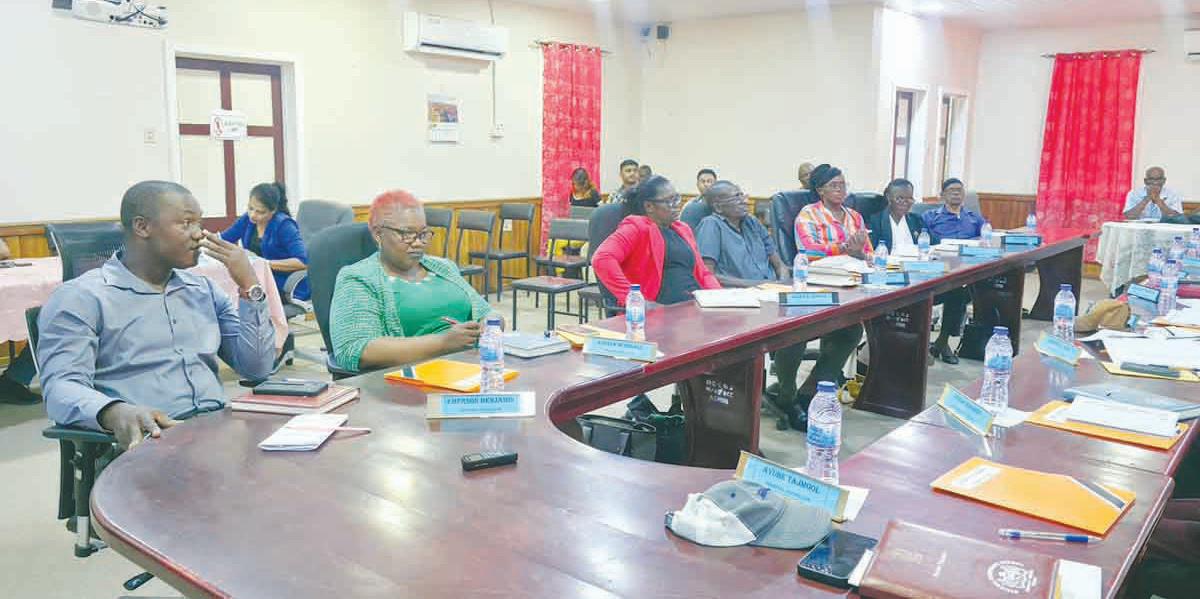
Calls are being made for increased attention and development at Belladrum/ Paradise Beach on the West Coast of Berbice, with concerns raised during last Thursday’s Region Five (Mahaica-Berbice) Regional Democratic Council (RDC) meeting about the condition and potential of the area.
Councillor Emerson Benjamin told the meeting that while some improve-
ments have been made, more needs to be done to enhance the beach and its surrounding infrastructure. He pointed to ongoing works in the area but said additional measures are needed to maximise its use.
“I went up there last Sunday, and I noticed a good road there, so I welcome that,” Benjamin said, while calling for further development of the site.
He noted that the loca-
tion is one of only a limited number of accessible beach areas in the region and suggested that greater investment could improve its appeal and usability.
“I would like to see more interest… to redefine this one, because I think this is one of two access beaches we have in this region,” he said, adding that infrastructure such as lighting could further enhance the area.
“If we can propose some

solar lights for those beaches,” he added.
In response, Regional Chairman Ricardo Dwain Phillips acknowledged the concerns raised and indicated that the matter would be discussed at a Government level.
“We’ll engage the Office of the Prime Minister on this,” Phillips said, while noting that the Works Committee would also visit the area to carry out an assessment.
Belladrum/Paradise Beach on the West Coast of Berbice has, for years, featured in public discussion as an Atlantic foreshore access and recreation site,
with successive plans and works aimed at improving the area. Among the interventions highlighted over time were efforts to upgrade the access road between Belladrum and Paradise and proposals to install lighting.
Official reports have also indicated that organised activities at the beach were at
one stage relocated due to ongoing construction works at the site, pointing to efforts to carry out physical improvements within the beach area itself. The location has also been linked to initiatives to promote community-based tourism along the West Coast corridor.
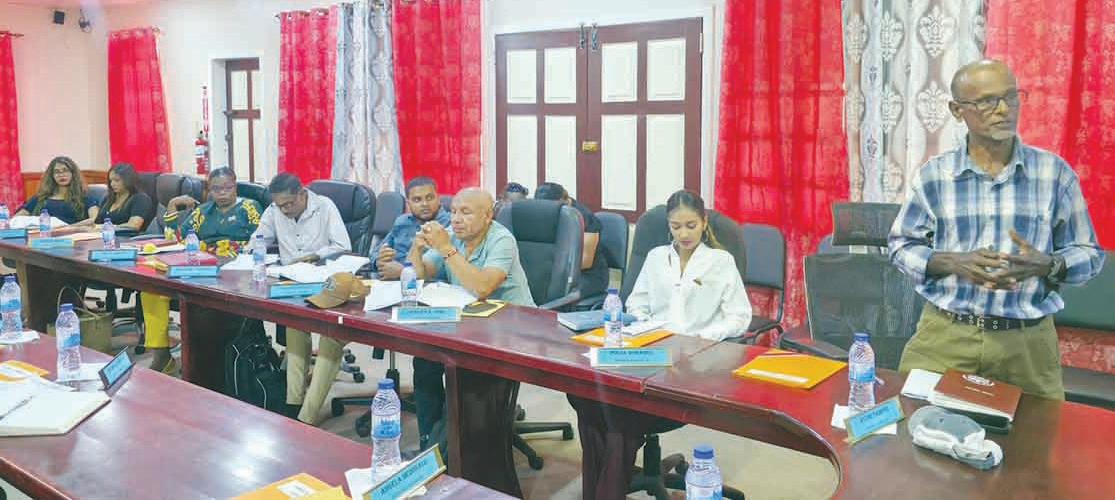

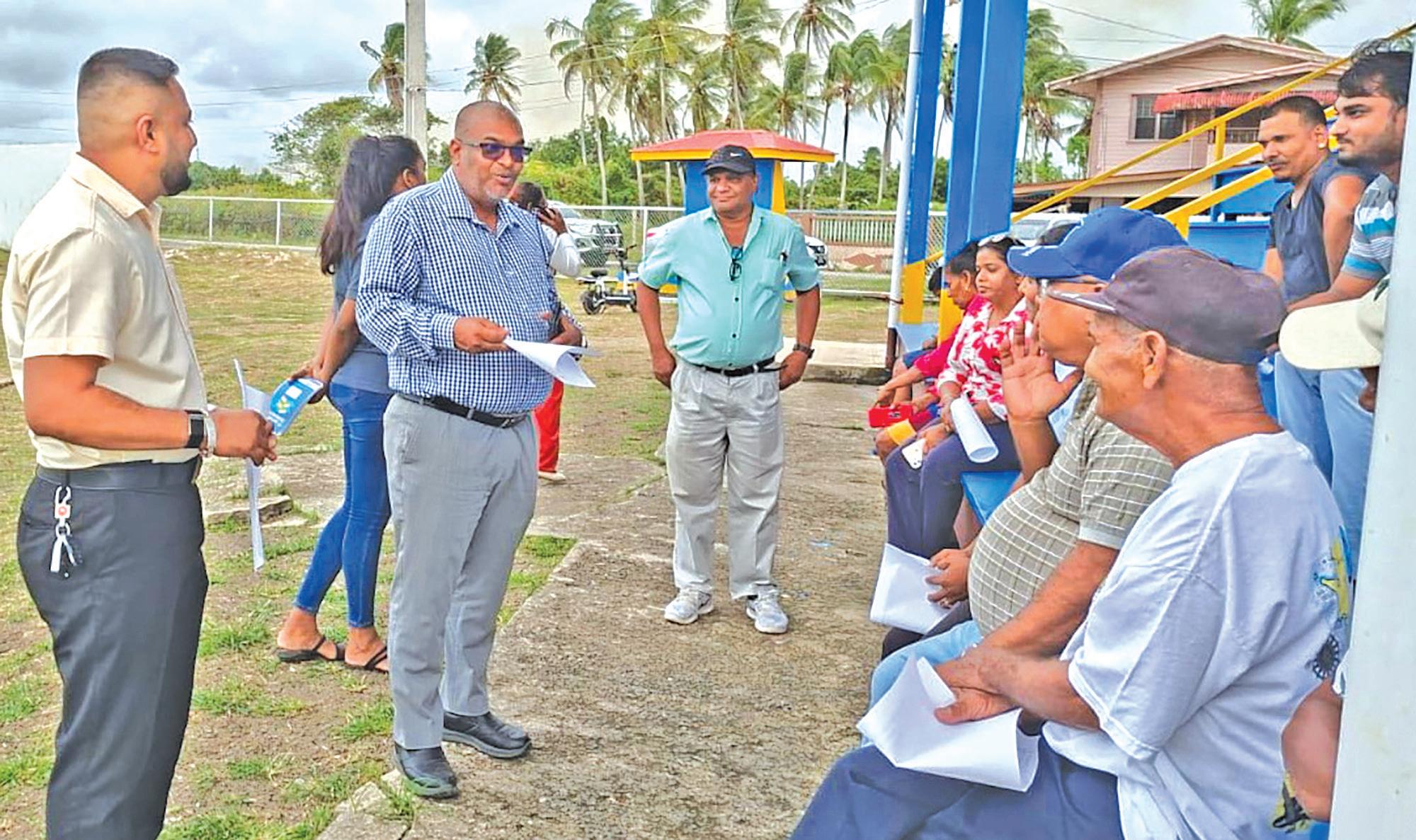
Efforts to strengthen local governance in Region Six (East Berbice–Corentyne) are gaining momentum, with a series of engagements between the Regional Administration and Neighbourhood Democratic Councils (NDCs) aimed at improving coordination, addressing community concerns and ensuring that development priorities reflect the needs of residents.
Regional Executive
Officer Narindra Persaud has, in recent days, met with residents and councillors in several communities, including Number 19, Ordnance/Fortlands, and Canefield/Enterprise, as part of ongoing consultations at the local level. The engagements, as outlined in posts from the Regional Democratic Council (RDC), focused on strengthening collaboration between the regional administration and NDCs while identifying
key issues affecting communities.
The consultations are part of efforts to improve service delivery and ensure that resources are directed to priority areas, with emphasis placed on closer coordination between residents, local councils, and the Regional Office. Discussions centred on community concerns, development priorities, and the need for more responsive governance at the village level.



Inspiration often finds those who actively chase it, but 11 years ago it arrived quite discreetly, settling on the most unexpected moment for Mahendra Ramkellawan.
Eleven years ago, this unlikely inspiration landed directly in his mind, sparking a journey, diversifying itself against the normal traditions of night concerts.
Eleven years later, that single spark has evolved into Clash of the Titans, a major show drawing regional and international attention.
As the event prepares to kick off on March 28, this publication caught up with Ramkellawan, where he spoke about the genesis of the event, ultimately granting revelations about the show.
Reflecting during the interview, Ramkellawan provided insight into the evolution of the event and what patrons can expect.
According to him, he was consistently packing venues for shows previously with patrons eager to know what his next move would be.
Among those asking was a close friend, Junior Baksh, whose curiosity would help shape the future of the show.
“I had a friend named Junior Baksh, and he asked me, ‘What’s next?’ I told him I wanted to bring together artists from every part of the world – chutney, Indian music, everything – on one stage for one night. He said, ‘Let’s do that,’ and he helped finance it,” Ramkellawan recalled.
“I told him I wanted all the bands to clash one night at the National Stadium. I already had ‘Clash’, and he told me, ‘Put Titans to it.’ And just like that, it became Clash of the Titans,” he said. Since its inception, the event has undergone significant transformation.
While its early years attracted massive crowds, Ramkellawan noted that continuous upgrades have been essential to keeping the show relevant.
“From then to now, everything has evolved – the sound systems, the lighting, the décor. But more impor-
tantly, it’s a new generation now,” he explained. That generational shift has required deliberate outreach efforts. Despite the event’s established name, Ramkellawan emphasised the importance of maintaining strong grassroots promotion.
“You still have to do the groundwork. Some young people don’t even know what Clash of the Titans is because they were too young back then. That’s why you see the billboards everywhere. If you’re in Guyana and don’t know when it is, then you’re not paying attention,” he said.
This year, organisers have made a move to reflect changing audience tastes by refreshing the line-up.
At the same time, the show is placing greater emphasis on local talent, with Guyanese artists now making up a significant portion of the line-up.
“We’re bringing in a new generation of performers. We dropped some of the usual names and introduced new talent like Yung Bredda to connect with younger patrons. We have so many talented Guyanese artists now – they make up half of the show with 30 to 50 artists on stage; everything has to be organised. While one person is performing, the next is already lined up. That’s how we keep it flowing smoothly,” Ramkellawan explained.
Behind all of the frontstage glitz and glam, meticulous planning ensures the smooth execution of what is often a packed schedule of performers. He credited his experienced team, including DJ Sheriff and WR Reyes, for maintaining high production standards and ensuring tight time management. Preparation for the event, he noted, begins well in advance.
“The preparation already started very early; his is not something you wait on – it takes serious planning,” he said.
Beyond Clash of the Titans, Ramkellawan is also exploring expansion opportunities through his other ventures, including Regent
Street Lounge, as Guyana’s entertainment and hospitality sector continues to grow.
“Guyana is changing. Prices are matching places like New York, and that
shows there’s opportunity. We’re looking at expanding and building something even bigger,” he said.
Clash of the Titans 2026 is exploding on March 28
at the National Stadium with the biggest names in Chutney and Soca – Young Bredda, Ravi B, KI & the band, Tony Cutzz, Vicadi, Nisha B, Geeta Bistram,
Trinidad and Tobago (T&T)’s Prime Minister Kamla Persad-Bissessar said the United States (US)operated radar once based in Tobago “did serve us well” as she addressed concerns over its removal.
She spoke on Saturday after Eid-ul-Fitr celebrations at the MarakazAl-ASJA Jamaat in Charlieville, where she also defended the Government’s crime measures, including the latest State of Emergency.
“We were lucky to have it the time we had it. They need it for their own use, as you know. They’re on another front, and they
probably need it for that purpose. But it did serve us well, and we thank them very much for it,” she said.
The Opposition People’s National Movement has raised concerns over transparency surrounding the radar’s installation and removal from the ANR Robinson International Airport site in Tobago.
Deputy political leader Sanjiv Boodhu said the country remains unclear on whether the system benefited Trinidad and Tobago.
Persad-Bissessar said crime strategies are producing results, pointing to a drop in killings. “We continue in the fight against crime. We
have several initiatives. Some have already borne fruit. We have seen crime at the lowest it has been in many, many years. The murders have been down by 42 per cent. Let’s not forget that.”
She defended the decision to impose another SOE.
“People are saying, ‘Why another SOE?’ Because only 42 per cent down. We need to bring it down by the largest number, so 100 minus 42 is what? 58 per cent more that we have to work to bring down. We continue to work on that. Safety and security remain very high on our priority.” (Excerpt from Trinidad Guardian)
Volunteers in Mexico loaded a fleet of modest boats bound for Cuba with rice, baby wipes and other supplies in a growing grassroots effort to help the island as it grapples with the fallout of a US squeeze on oil imports that has led to power outages and a worsening economic crisis.
At a port in the southeast Mexican state of Yucatan, less than 800 kilometres across the Gulf of Mexico from Havana, several dozen persons hoisted boxes out of cars and trucks alongside a hand-painted banner declaring: “Let Cuba Live.”
“At the beginning we felt like we were going against the tide, trying to get enough aid,” said Marisela Vega, one of the volunteers. “And suddenly it overflowed… When everyone started finding out, little by little they responded more and more.” Beans, baby formula,
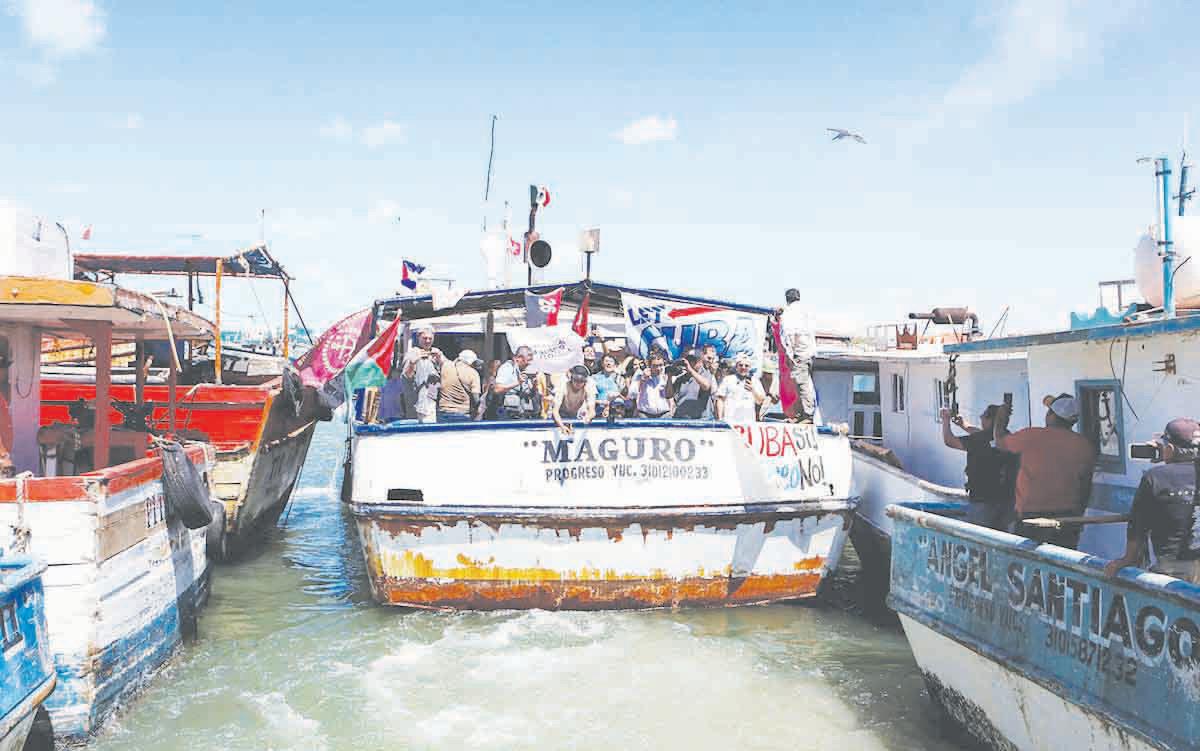
“Cuba, yes! Blockade, no!” An aid
shampoo, and feminine pads have been donated, said Vega. Medications also have been purchased through donations.
The boats were expected to depart on Friday as part of “Nuestra America Convoy”, or “Our America Convoy”, a non-Government initiative that is urging volunteers worldwide to send
essential goods – especially food, medicines and energy supplies such as batteries and flashlights – to a single collection site in Cuba by Saturday, in direct response to measures taken by US President Donald Trump at a time of extreme tension between Washington and Havana. (Excerpt from Reuters)
national tsunami preparedness exercise involving thousands of residents has given authorities a clearer picture of how Antigua and Barbuda (A&B) would respond in the event of a real threat.
The National Office of Disaster Services (NODS) said about 5000 persons took part in Thursday’s Caribe Wave exercise, which simulated a magnitude 7.6 earthquake near the Cayman Islands and tested evacuation to designated safe zones.
Public Relations Officer
Mitzi Francis described the overall response as encourag-
ing, noting that participation levels reflected growing public awareness of disaster risks.
The annual drill, part of a wider regional initiative, also assessed the effectiveness of emergency alert systems, including the Common Alerting Protocol, which delivers warnings through mobile apps, radio and sirens.
Participants were generally able to reach safe zones in a timely manner, although officials acknowledged that not everyone treated the exercise with the same level of seriousness. Some issues were identified during the simulation,
including reports of sirens sounding at incorrect times, which officials attributed to possible miscommunication.
Despite these challenges, NODS said coordination among emergency agencies, radio stations and response teams functioned well overall, providing a solid foundation for future improvements.
Officials stressed that continued public participation and regular training will be essential to strengthening national readiness, particularly in a region where tsunami threats, though infrequent, have been recorded historically. (Antigua Newsroom)
Four occupants have been displaced, and two others sustained injuries after a fire at Skeete’s Road, Bank Hall, St Michael, early this morning.
Divisional Officer Marlon
Small said they received the call just before 09:00h and responded with three appliances from the Bridgetown Fire Station, including two water tenders and one tanker. A total of 13 officers, including Small, attended the scene.
The incident marks the 17th house fire reported this year, prompting the Barbados Fire Service to urge residents to remain vigilant in the home.
“When leaving home, make sure all appliances are shut down,” Small advised. “Even when at home, if you feel tired,
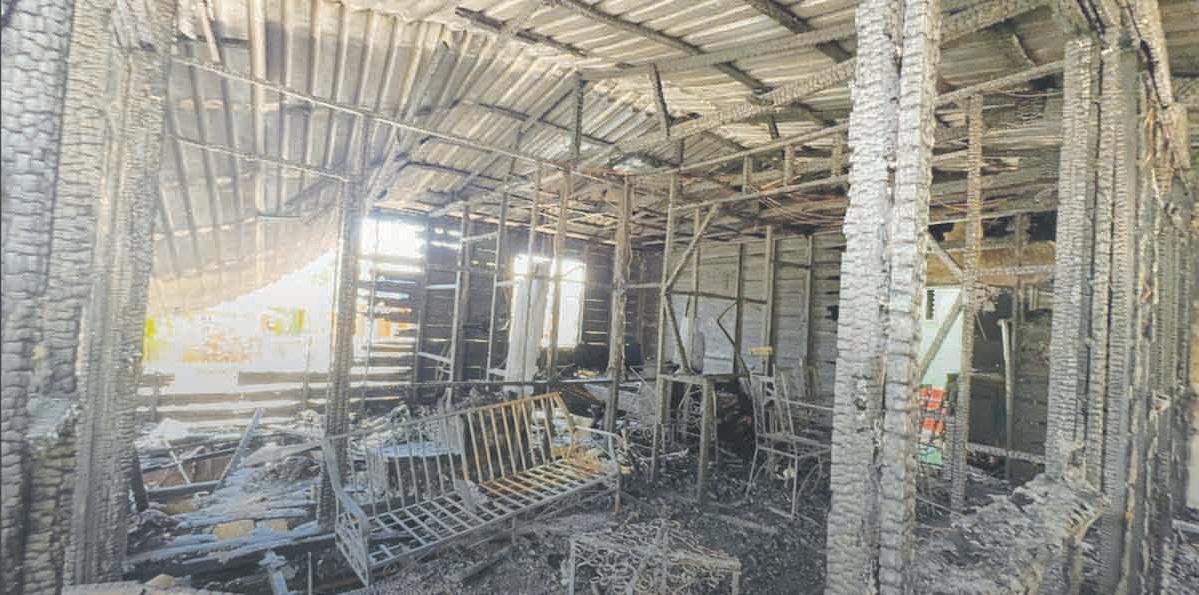
avoid cooking or using potentially hazardous equipment.”
Small also thanked community members who helped contain the fire and alerted them promptly, helping to prevent the blaze from spreading to neighbouring structures.
None of the affected homes are currently liveable, with the properties extensively dam-
aged. The Reintegration and Rehabilitation Unit has been contacted and is on site to assist displaced occupants. Investigations into the cause of the fire are ongoing. Small said crews are still cooling down hot spots, and a formal investigation will follow once the area is secure.
(Nation News)
An aeroplane operated by Florida-based carrier IBC Airways skidded off the runway Friday afternoon while landing, missing a well-travelled roadway by inches. The pilots had trouble braking because the runway was flooded from heavy rains, airport and company officials told The Haitian Times.
The aircraft was carrying 10 passengers from Miami to the newly opened Antoine Simon International Airport in the southern Haitian city, they said. The plane came to a stop in the airport’s safety zone, with its nose extending toward National Road Seven, just outside the perimeter fence.
No injuries or fatalities were reported. However, passengers, passers-by and nearby vendors were shaken by the incident, which occurred as Haiti’s southern region remains under a yellow weather alert due to heavy rainfall forecasts.
A crew member who spoke on condition of anonymity to avoid repercussions said that as the aircraft approached Les Cayes, the capital city of the South Department, with about 200,000 residents, it faced heavy rain and low visibility. Given the conditions, the plane – an Embraer ERJ145 jet with the capacity of carrying 50 passengers – cir-
cled the airspace multiple times.
After about 30 minutes, it was cleared to land on the airport’s sole runway of about 6070 feet.
At touchdown, the landing gear was midway along the airstrip, reducing the available braking distance. The pilot, facing limited visibility, struggled to stabilise the approach, but the aircraft veered off course, struck part of the airport fence and exited toward the roadside.
Disaster on the ground was only narrowly averted; four other aircraft on the ramp at the time were not affected. (Excerpt from The Haitian Times)
The skies over this farflung coffee-growing hub went charcoal black, the heavens opened and one of Brazil’s greatest mysteries was born.
“It really was something unique,” recalls Marco Antônio Reis, a zoo director, who was at his ranch outside Varginha one stormy day in January 1996 when, he says, an otherworldly creature came to town.
Reis and other locals claim the unusually ferocious downpour heralded a series of disturbing and seemingly paranormal events.
At least six of the zoo’s animals, including a spider monkey, a tapir and a raccoon, died mysteriously after a horned interloper with bulging red eyes was spotted in the vicinity by a woman who had gone out for a smoke. When a vet examined their corpses,
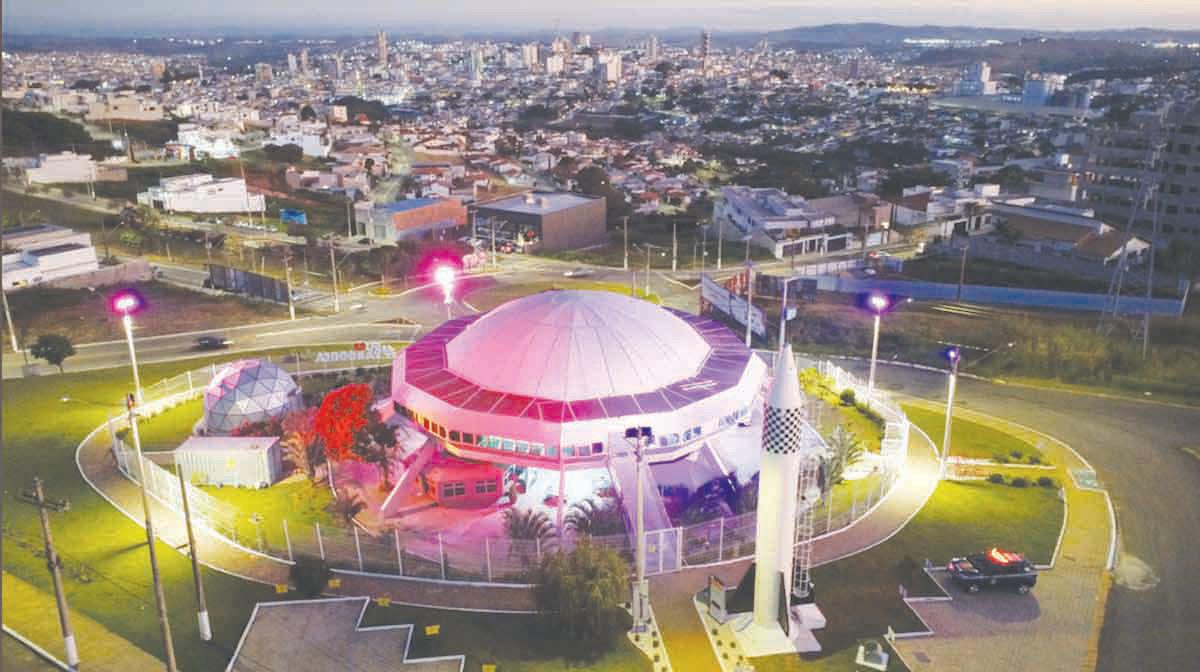
The ET museum in Varginha hosted a two-day UFO conference this year
“they were all black inside”, Reis claims.
On a nearby wasteland, three young women spotted a peculiar and malodorous being with a heart-shaped face and three lumps on its head cowering beside a wall. “I’ve seen the devil,” one of those witnesses would later tell her mother.
Soon afterwards, an un-
explained infection was rumoured to have killed a strapping Police intelligence officer who was said to have grappled with the oleaginous unidentified being.
Three decades later, Reis says he is convinced Varginha received a non-human visit. His only doubt was from where it came. (Excerpt from The Guardian)
US President Donald Trump has threatened to send agents from Immigration and Customs Enforcement (ICE) to provide security at airports unless a deal is reached to fund the Department of Homeland Security (DHS).
"I will move our brilliant and patriotic ICE agents to the airports, where they will do security like no one has ever seen before," Trump posted on Truth Social on Saturday.
The DHS has gone without funding since mid-Feb-
ruary, after Congress failed to reach a funding agreement – leaving normal airport security without pay.
A bill that would fund DHS and provide payments for Transportation Security Administration (TSA) agents at airports failed to advance in the Senate on Friday.
The Trump Administration has blamed the delay on Democrats, who have declined to pass funding without reforms to ICE, which operates under DHS.
The hold-up has meant
thousands of staff for the TSA – which also operates under DHS – have been working without pay for more than a month.
More than 300 TSA employees have reportedly quit in that time, while US media reported unscheduled absences had more than doubled.
Long lines have formed at airports, and union officials have reported some officers are taking on second jobs. Some airports are collecting gift cards and food parcels for TSA staff.
(Excerpt from BBC News)
There has been confusion and unease
in Japan after US President Donald Trump used the Pearl Harbour attack during World War II to justify his secrecy before launching the war on Iran.
Trump was asked by a reporter why he did not tell allies in Europe and Asia in advance of the US–Israel attack on Iran. He cited Pearl Harbour to defend his decision, saying, “Who knows better about surprise than Japan? Why didn’t you tell me about Pearl Harbour?"
Following the remarks, social media reaction has
ranged from accusations of ignorance and rudeness by the US President to claims that he does not see Japan as an equal partner.
Tsuneo Watanabe, a senior fellow at the Sasakawa Peace Foundation, said in an opinion piece that the remarks signalled Trump is “not bound by existing American common sense”.
“I get the impression that the comment was intended to bring the Japanese reporter [who asked the question] or Ms Takaichi into complicity in order to justify his ‘sneak attack’ on Iran during diplomatic negotiations and
without telling allied countries,” Watanabe wrote.
Takaichi was praised by some for not reacting to Trump’s comments, letting them pass with a roll of her eyes and a glance at her Ministers seated nearby.
Some, however, criticised Takaichi for not speaking up.
Hitoshi Tanaka, a former diplomat and a special adviser at the Japan Research Institute think tank, wrote on X, “As national leaders, they are equals. To make an equal relationship is not to flatter,” he said. (Excerpt from Al Jazeera)
Hawaii remains under a state-wide flood watch after a severe storm hit the state and prompted officials to order evacuations.
The potential for flash floods threatens the island of Oahu and parts of Maui County, Governor Josh Green said on Saturday.
The storm that struck this weekend is the second severe weather event to hit the archipelago in the last week.
Some parts of the state received 40 to 50inches (127cm) of rain in the last 10 days, according to Green. Oahu could receive four to six more, while parts of Maui could experience between four and 12inches, he said.
"Don't take this storm lightly," Green said in a video statement. No deaths had been reported, he said, but there have been few serious injuries.
The state has activated a programme for people displaced by the storm that al-
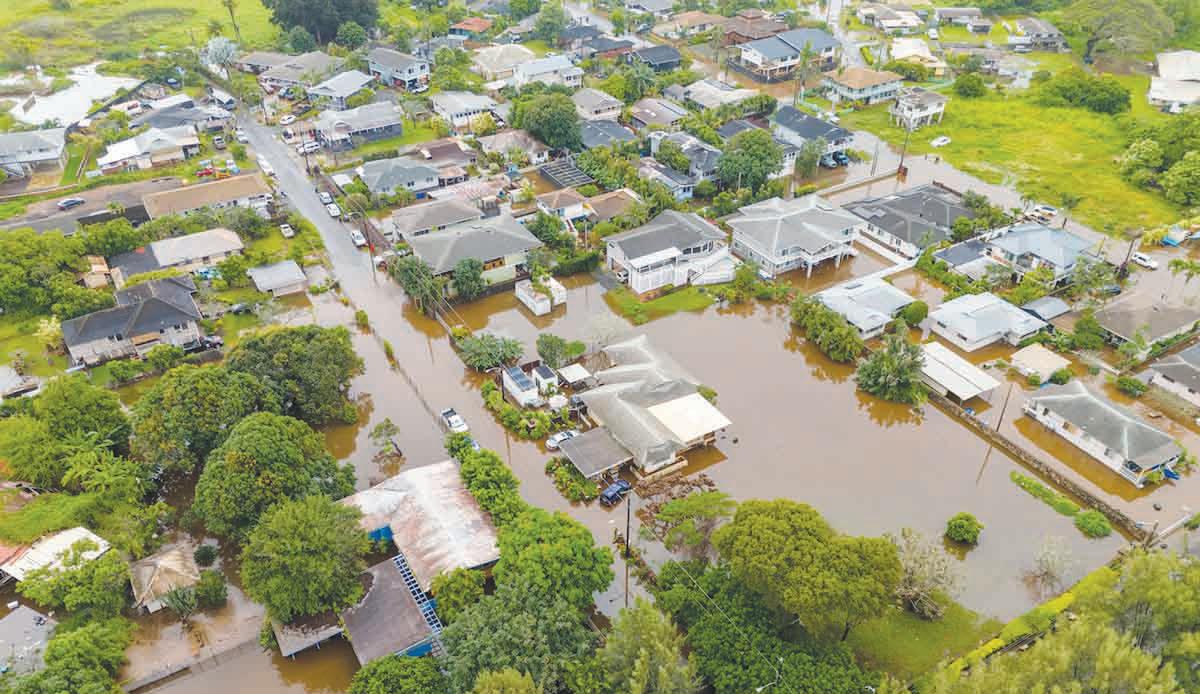
lows them to get discounted hotel rates.
In a subsequent post, the Governor warned that, because the ground had already been saturated by the earlier rainfall, "it will take much less rain to trigger flooding, road closures and damage".
The damage from the storms could exceed $1bn, according to Honolulu Mayor Rick Blangiardi.
More than 230 persons have been rescued so far, Blangiardi told a news confer-
Yesterday, United States President Donald Trump shared some fresh comments on Iran on his social media platform, Truth Social.
He said the US has "blown Iran off the map" as he addressed recent analysis from the New York Times about his war record.
He dismissed suggestions that he has failed to achieve his goals in Iran, saying, "Yes, I have, and weeks ahead of schedule. Their leadership is gone, their navy and air force are dead, they have absolutely no defence, and they want to make a deal. I don't."
In a second post soon after, Trump said the US will "obliterate" Iranian
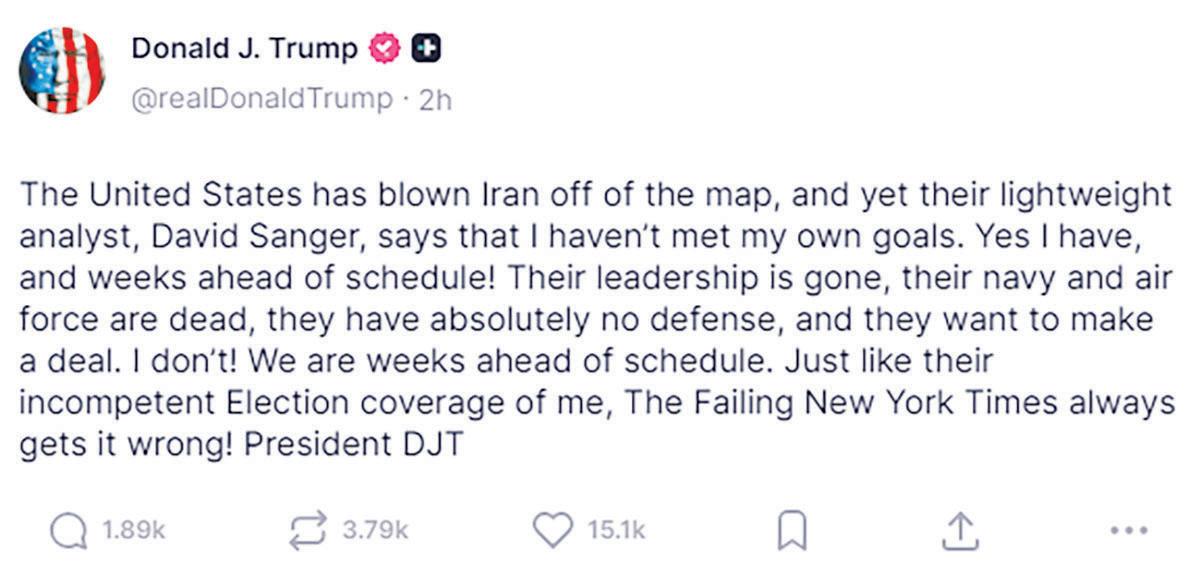
power plants if the Strait of Hormuz – the vital waterway for global oil shipping – is not open within 48 hours.
Here is the Truth Social post in full:
“If Iran doesn’t FULLY OPEN, WITHOUT THREAT, the Strait of Hormuz, within 48 HOURS from this exact point in
time, the United States of America will hit and obliterate their various POWER PLANTS, STARTING WITH THE BIGGEST ONE FIRST!”
This was posted at 23:44h GMT on March 21. That means Iran has until 23:44h GMT on March 24 (03:14h in Tehran on March 24) to open the Strait.
Madagascar’s military President has said new Ministers will have to pass lie detector tests to root out corrupt candidates after he dismissed the Prime Minister and cabinet without explanation earlier this month.
Michael Randrianirina came to power in a coup in October after weeks of youthled protests under the banner “Gen Z Madagascar”. However, young people were quickly disenchanted by his choice of government officials, which they saw as being part of the old, corrupt elite.
Randrianirina told local media: “We have decided to use a polygraph. It is with this polygraph that the background integrity checks will be carried out.”
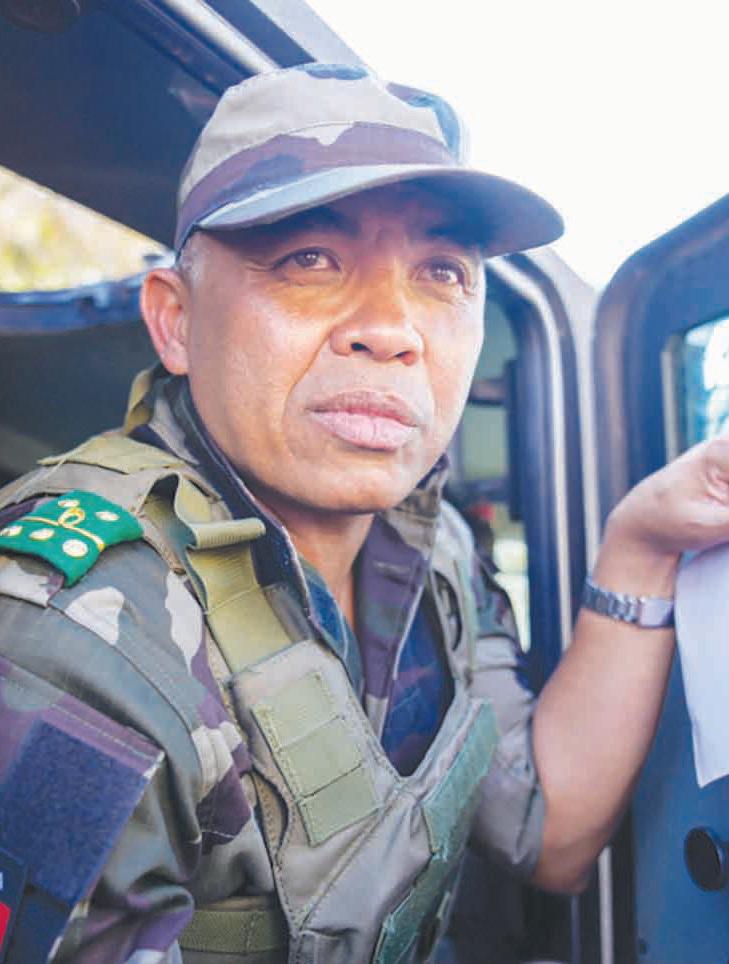
the country for Dubai on a French military plane.
Randrianirina was sworn in as interim President and has pledged to hold elections by late 2027. Gen Z activists have been pushing him to confirm the date while criticising his appointments over their perceived ties to the previous regime.
ence on Friday.
The Honolulu Department of Emergency Management has issued multiple flash flood warnings and urged residents to move to higher ground and avoid flooded areas.
Flood watch warnings have also been issued for Maui, Molokai and The Big Island.
Blangiardi urged residents to "stay safe" and "take the storm as seriously as you can". (Excerpt from BBC News)
The President said a new Cabinet would be announced early next week. “We will know who is corrupt and who can help us, who is going to betray the youth struggle,” he said.
On October 11, the elite military unit Capsat, in which Randrianirina was a colonel, came out in support of protesters. The next day, the President, Andry Rajoelina, reportedly fled
Randrianirina fired the Prime Minister and Cabinet on March 9, then announced on Sunday that the anti-corruption chief, Mamitiana Rajaonarison, would be the new Prime Minister. He and Rajaonarison would only interview Ministerial candidates who passed a lie detector test, he said on Thursday. He said, "We're not looking for someone who is 100 per cent clean, but over 60 per cent. That way, Madagascar will finally be able to develop.” (Excerpt from The Guardian)
Two skiers died and five others were injured on Saturday when an avalanche rumbled down on them in the Italian Alps, in the Trentino-Alto Adige region, the mountain rescue service said.
The service's operation centre received an alert around midday that a dozen skiers were caught up in the avalanche, a spokesman said.
"Six helicopters were dis-
patched," and nearby hospitals were notified, he said.
The avalanche happened at an altitude of around 7874 feet on the slopes of the 8757-foot Hohe Ferse near the town of Ratschings, close to the border with Austria, the Associated Press reported.
Dozens of rescue personnel, as well as firemen and law enforcement, participate in the search-and-rescue effort.
A total of 25 skiers were on the mountainside where the avalanche occurred, but most had escaped the brunt of the slide of snow, rocks and ice.
A few days ago, in the same region, a Polish man was killed by an avalanche. The avalanche warning given for the region on Saturday evaluated the danger as between low and moderate. (Excerpt from CBS News)











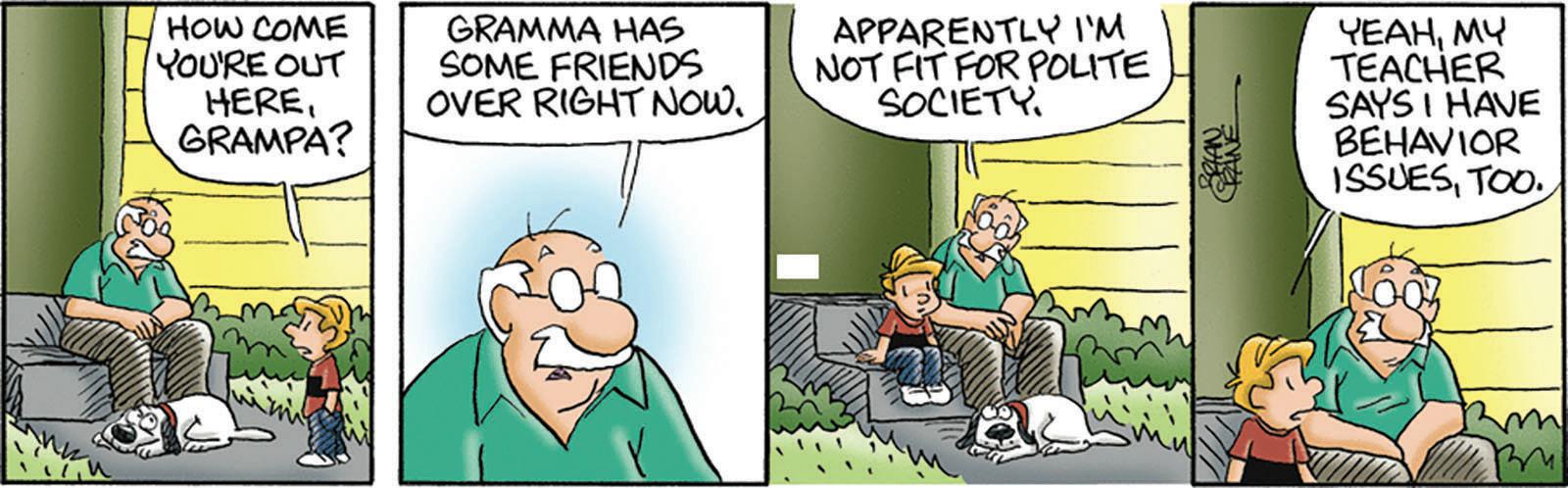





ARIES
(March 21April 19)


TAURUS (April 20May 20)

GEMINI (MAY 28June 20)

CANCER
(June 21July 22)


LEO (July 23Aug. 22)


VIRGO (Aug. 23Sept. 22)

LIBRA (Sept. 23Oct. 23)

SCORPIO (Oct. 24Nov. 22)


SAGITTARIUS (Nov. 23Dec. 21)

CAPRICORN


Believe in yourself, your ability, and your desire for peace of mind. Refuse to let the upsets overrule your demeanor and lessen your chance to experience the perks that come with hard work and paying it forward. Direct your strength, wisdom, and experience to self-improvement and building a solid base to house your heart and hopes.
Seek help from those with more knowledge and experience, and you’ll make a lasting connection. How you conduct yourself in situations that require your attention will make or break how others feel about you and your contributions. Too much talk and not enough action, giving in to temptation, or neglecting to share will cost you.
Change requires willpower, time, effort, and action. Look around you and draw strength from what you observe. Let those who set a good example be your vision for the future. Say no to extravagance and yes to a wasteless lifestyle. Don’t let anger rob you of joy; adopt a positive attitude and thrive. Choose love, dismiss hatred.
Use your head. Come up with a plan, and do your best to see it through to completion. Distance yourself from those who are shortsighted and self-serving. Join forces with like-minded people and do your best to have a positive impact on others. Take care of your responsibilities to avoid criticism. Choose to make a proactive, peaceful push forward.
Take the path that leads to knowledge, experience, and the wisdom to make the best choice. Put your energy to work for you and clean up unfinished business. Put the past behind you, liberate your soul from temptation and sorrow that stands between you and new beginnings. Let go, embrace what lies ahead, and something good will happen.
You’re on the right path. Be receptive to suggestions and ready to align what you receive with what you can achieve. Intellect and action go hand in hand when living, learning, and interacting with others are present. Embrace partnerships with equality in mind, and happiness will find its way into your heart. Change begins with you.
Choices, temptation, uncertainty, and consequences are apparent. Stick close to home, keep busy, and take care of matters you’ve left undone. Discipline will be necessary to avoid letting someone suck you into their dreams. Taking a back seat when your reputation or relationships are in jeopardy puts you in a vulnerable position. Do what’s best for you.
Emotions will cloud your memory. Don’t lose sight of the past. The best route forward is the one that remembers past mistakes. Let your experience guide you into a free and prosperous future. Use your intelligence and foresight to bring about changes that promote love, peace of mind, and happy memories. Delete negativity and hit the reset button.
Stay away from those who try to rule your life. Arguing is a waste of time, and hanging out with those who disrupt your life, values, or prospects is best avoided. Protect your home, your health, and your financial well-being. Focus on self and home improvements, and follow your dreams. Choose love over discord and thrive.

(Jan. 20Feb. 19) (Dec. 22Jan. 19)
Avoid crowds, travel, and situations that create uncertainty. Use your intelligence, clout, and connections to harness your desires and get the most out of whatever you pursue. A positive change is within reach if you verify information and use strength and courage to manifest opportunities and ward off temptation. Set a budget and save for a brighter future.
AQUARIUS


PISCES
(Feb. 20Mar. 20)

Keep the momentum and money flowing in a direction that offers greater security and safety. Avoid emotional decisions and spending that promise the impossible and fall short. Take time to review your long-term plans and what your to-do list dictates you should do to reach your destination, before letting temptation lead you into ambiguous shortcuts. Put yourself first.
How you earn and manage your money will lead to unexpected opportunities. Deal with authority figures to ensure you have complied with rules and regulations and achieve the best results. An opportunity can change how or where you live. A social event will pose challenges if you are indulgent, while intellectual heart-to-heart talks yield higher returns.






Guyana’s Senior Men’s National Team, the Golden Jaguars, will travel to the Dominican Republic later this week for a two-match international friendly series, with several first-time call-ups headlining the squad selected by the Guyana Football Federation (GFF).
The matches form part of the officially sanctioned Confederation of North, Central America and Caribbean Association Football (CONCACAF) Series, a developmental initiative designed to give member nations competitive opportunities outside of major tournaments. Guyana will face Dominica on March 27 and Belize on March 30 at the Estadio Cibao.
The squad features a blend of established senior players and emerging talent, with five players earning their first call-ups to the senior national team.
Goalkeeper Grant Wyles, midfielder Shemar Scott,

defender Walker ShabazzEdwards, forward Reiss Parris and locally based winger Bryan Wharton have all been included for the first time at this level.
Wharton and Parris are stepping up from the youth ranks. Both players were recently involved at the U-20 level and now transition into the senior setup.
The inclusion of these newcomers comes alongside a core of experienced internationals such as Akel Clarke, Liam Gordon, Terence Vancooten, Nathan Moriah-Welsh, Elliot Bonds, Omari Glasgow, and Kelsey Benjamin, who are expected to provide stability and leadership during the series.
The CONCACAF Series serves as a key platform for teams no longer engaged in the FIFA World Cup 2026 qualifiers, offering structured international competition aimed at improving rankings and overall performance. For Guyana, the matches present an oppor-
tunity to test squad depth and integrate new talent.
Golden Jaguars Squad – CONCACAF Series
Goalkeepers:
Akel Clarke
Grant Wyles
Joshua Narine
Defenders:
Terence Vancooten
Raushan Ritch
Walker ShabazzEdwards
Liam Gordon Jalen Jones
Nathan Ferguson
Kvist Paul
Brandon Solomon
Midfielders:
Curtez Kellman
Shemar Scott
Nathan Moriah-Welsh
Elliot Bonds
Forwards:
Kelsey Benjamin
Bryan Wharton
Reiss Parris
Maliq Cadogan
Kyle Reid
Osaze DeRosario
Enoch George
Omari Glasgow
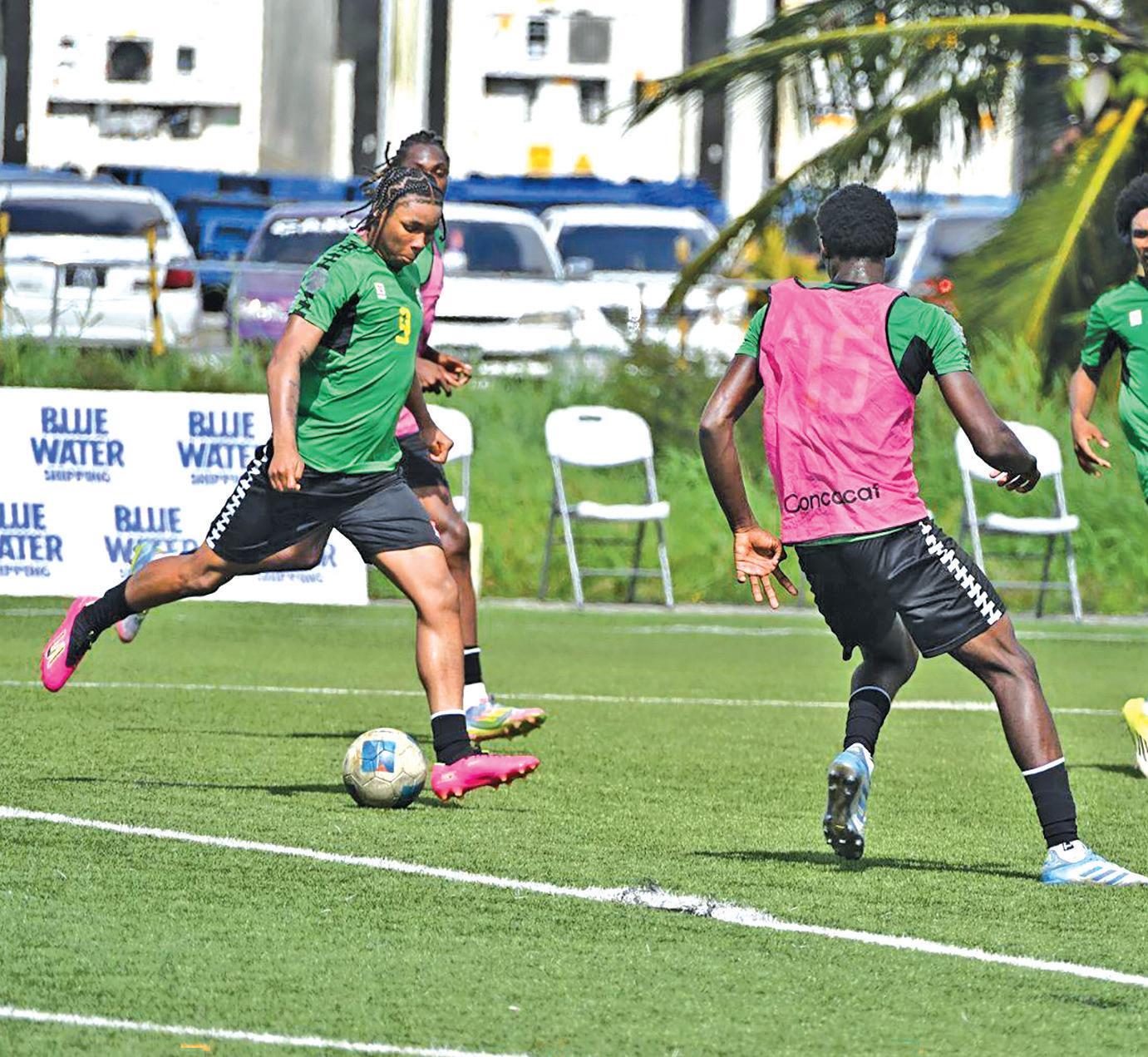
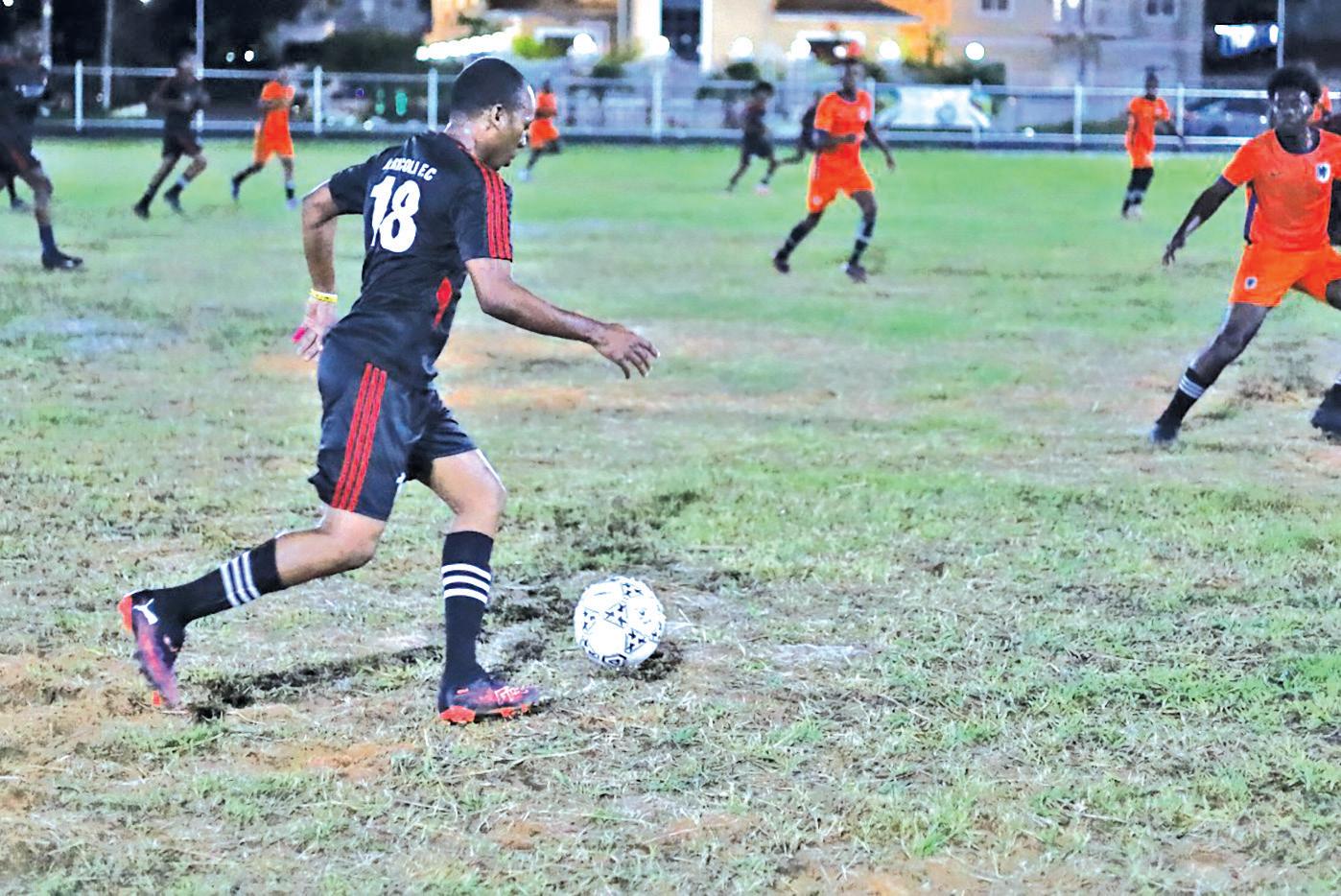
Defending champions
Candidate Master (CM) Taffin Khan and Woman Candidate Master (WCM) Aditi Joshi strengthened their grip on the 2026 National Chess Championships as the competition continued yesterday at the David Rose Special School, with both players producing commanding performances through Rounds Five and Six Khan, the reigning men’s champion, leads the Open standings with 5.5 points from six rounds, maintaining his unbeaten run and holding a slim advantage over CM Sachin Pitamber, who is on five points. The seasoned campaigner has been in dominant form and
reinforced his position with back-to-back wins in Rounds Five and Six.
In Round Five, Khan defeated Jaden Taylor, while Pitamber kept pace with a victory over CM Ronuel Greenidge. International Chess Federation or World Chess Federation (FIDE) Master (FM) Anthony Drayton remained in contention after overcoming Alexander Zhang, and Kyle Couchman also secured a win against Rolex Antoine Alexander.
Round Six saw Khan extend his lead with another important victory, this time defeating Greenidge. Pitamber delivered one of the key results of the round by beating Drayton, keeping
the pressure on the leader. Couchman added to his tally with a win over Taylor, while Keron Sandiford defeated Alexander. Zhang completed the round with a win against Leslie Campbell.
The chasing pack remains tightly grouped, with Drayton, Couchman, and Sandiford all on 4.5 points, setting up an intriguing battle for the top positions as the tournament progresses.
Meanwhile, in the Women’s Championship, defending champion WCM Aditi Joshi has been in imperious form, registering six consecutive wins to lead the standings with a perfect six points. Her dominance has placed her firmly on course to retain her title.
Joshi continued her flawless run in Round Five with a victory over Sana Sreebalakumar before defeating Ciel Clement in Round Six to remain unbeaten.
WCM Jessica Callender and WCM Sasha Shariff remain her closest challengers, both on five points after six rounds. Callender recorded successive wins over Anaya Lall and Sreebalakumar, while Shariff defeated Italy’s Tonne-Chung in Round Five and then played to a draw with Treskole Archibald in Round Six.

on three and 2.5 points, respectively.
Clement sits fourth with four points, while Kataleya Sam and Anaya Lall remain within reach of the leaders
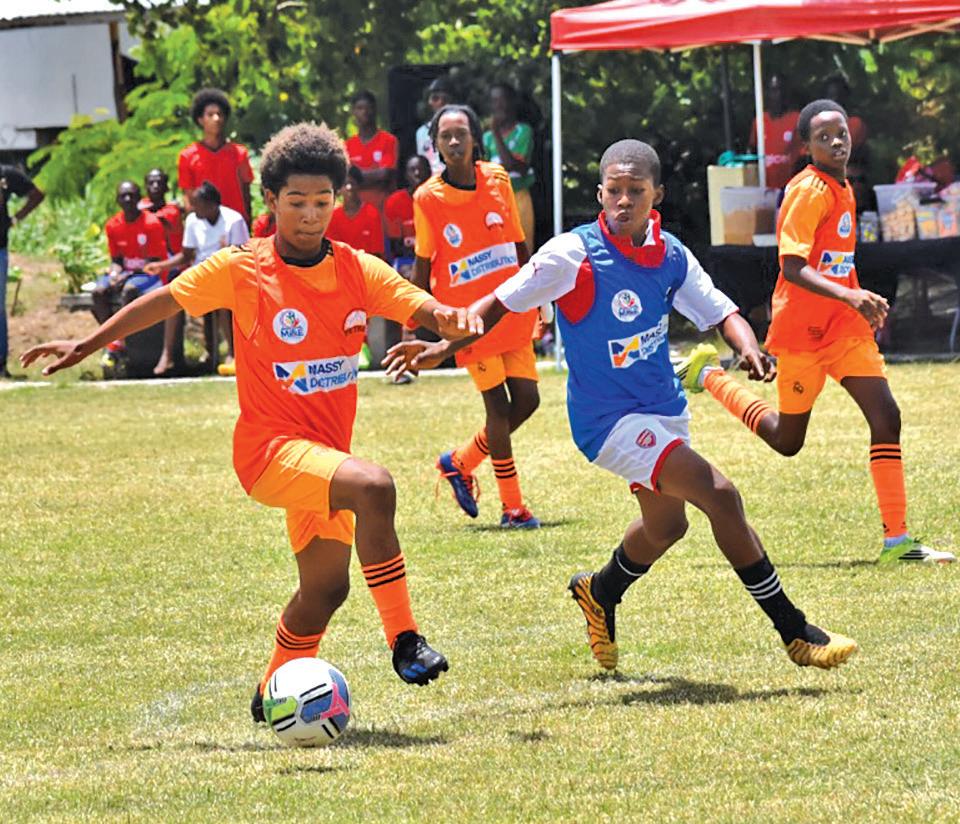
The rebranded Massy Under-18 Schools
Football Tournament got off to an exciting start yesterday at the Queen’s College (QC) ground, with a major upset highlighting the
opening round of matches. Defending champions
Dolphin Secondary suffered a 4–2 defeat to Ann’s Grove Secondary in one of the standout encounters of the day. Despite a brace
from Seon Grams, Dolphin were outplayed by an Ann’s Grove side led by Kennard Halley, who netted twice, while Isaiah Williamson also contributed to the scoring effort.
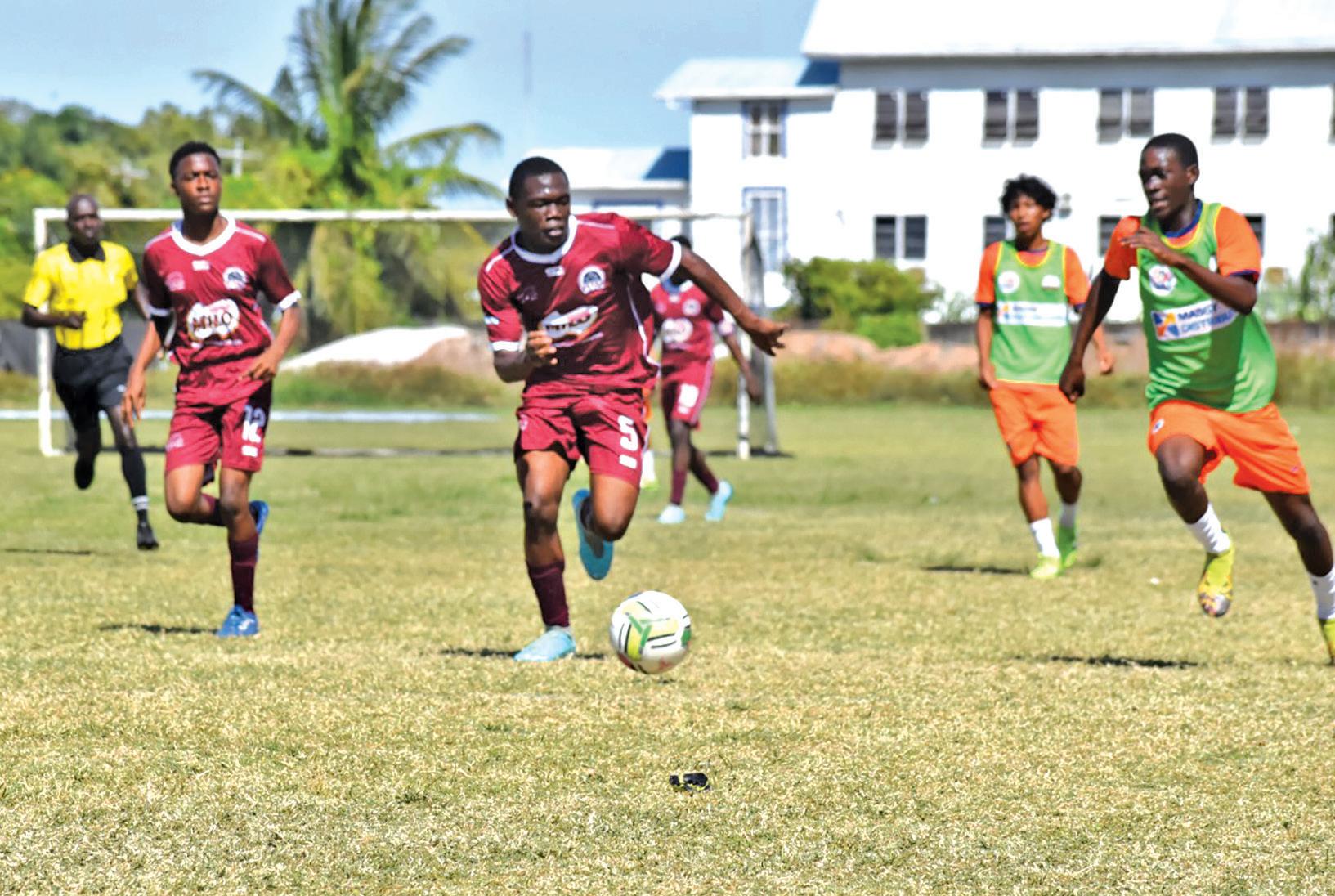
The championships are set to intensify today at the same venue, with Rounds Seven and Eight scheduled to be contested. It will conclude next Saturday, March 28, with the ninth and final round. Khan will aim to maintain his narrow lead in the Open division, while

Elsewhere, West Ruimveldt Secondary delivered one of the most dominant performances of the day, blanking Yarrowkabra Secondary 3–0. Donovan Welcome led the charge with a double in the 10th and 20th minutes before Lydon Grey added a third. Welcome’s impressive outing was slightly marred by a red card late in the contest.
Zeeburg Secondary also secured a comfortable 2–0 victory over Hope Secondary, with Quincy Evans and Anthony Cameron scoring in the second half.
On the other hand, Patentia Secondary played to an entertaining 2–2 draw against East Ruimveldt Secondary. Patentia’s Johnathan Redman and Yohan Bobb struck in the 27th and 41st minutes, respectively, while Josiah Norton and Jaheim Herbert rescued a point for East Ruimveldt with strikes of
their own in the 42nd and 56th minutes.
Charity Secondary edged Vryman’s Erven Secondary 2–1 in a competitive affair, with Johnny Smith scoring both goals for Charity, while Andel Samuels found the back of the net for the opposition. Meanwhile, Westminster Secondary and St Joseph High played to a 1–1 draw, with early and late strikes from Alexandro Sankar and Leeman McAbee, respectively.
The only goalless encounter of the day saw Charlestown Secondary and St John Secondary battling to a 0–0 stalemate, as both teams failed to break the deadlock despite several attempts.
The competition continues today at the QC ground with another full slate of round one matches, as teams look to secure early momentum in the prestigious schools tournament.



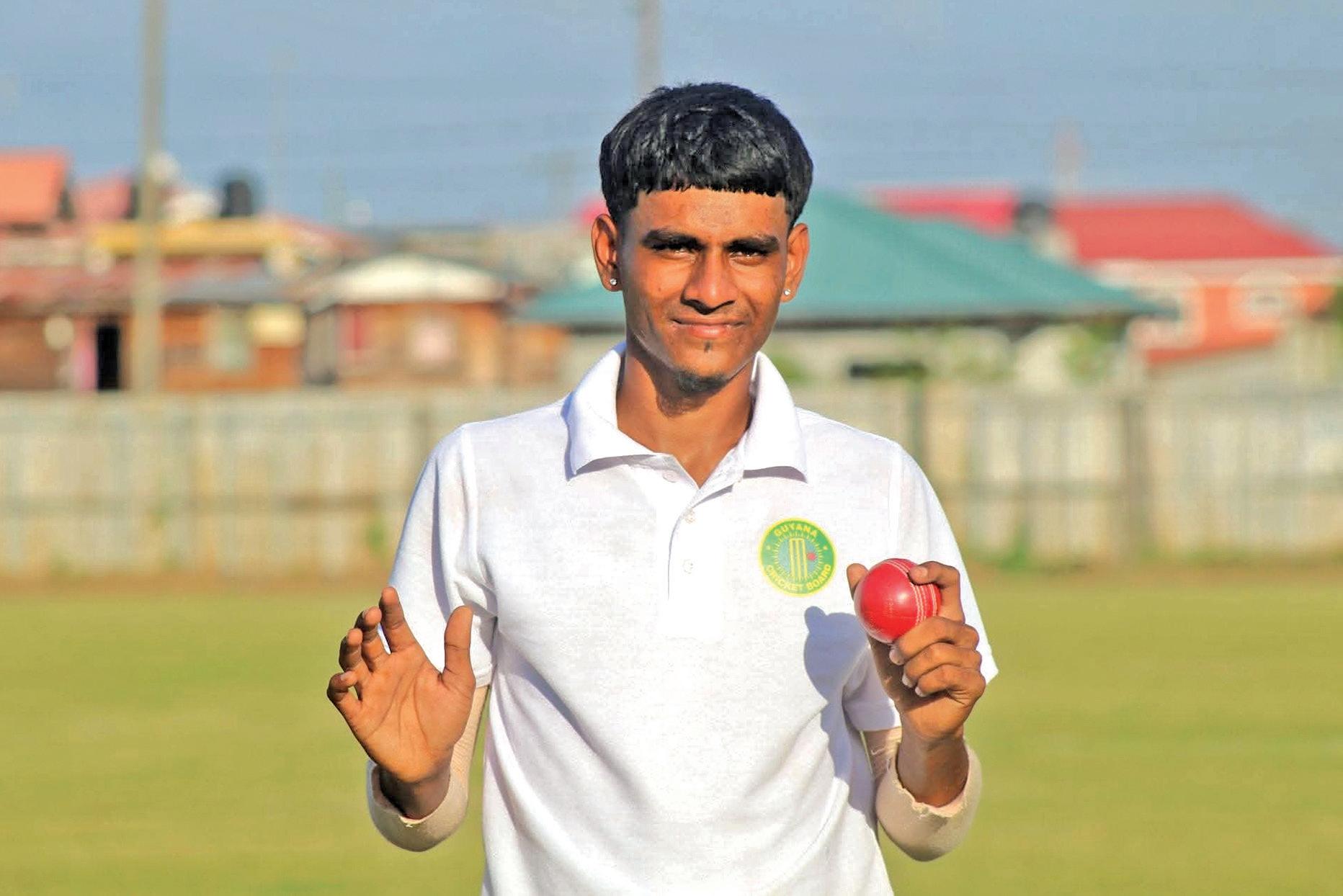
Action in the Sherwin Williams Second Division T20 Cup 2026/27 continued yesterday across various venues in Georgetown, with GYO Mystic Marvels and Guyana Defence Force (GDF) registering convincing victories in their respective encounters.
GYO Mystic Marvels pulled off a hard-fought 16-run win over Guyana National Industrial Company Incorporated (GNIC) in a competitive clash. After losing the toss and being sent in to bat, Mystic Marvels were bowled out for 134 in 16.1 overs. Dequan Wray led the scoring with 28, while Kevon Hooper provided late momentum with a quickfire
25 off just 13 deliveries. GNIC’s bowling effort was spearheaded by David Dick, Jamain Grosvenor, and Chandrika Persaud, each claiming three wickets.
In response, GNIC faltered in their chase despite a spirited effort from Chandrika Persaud, who remained unbeaten on 27 from 21 balls, striking five boundaries. Jamain Grosvenor contributed 18, but the rest of the batting lineup struggled against disciplined bowling. Amir Khan was the standout performer, delivering an impressive spell of four for 20 to help dismiss GNIC for 118 in 19.4 overs.
In another match, the Guyana Defence Force delivered a commanding performance to crush the
University of Guyana by eight wickets. After electing to field first, GDF’s bowlers dominated from the outset, skittling UG for a paltry 32 in just 12.1 overs. Yeshua Hutson was the lone batsman to reach double figures, scoring 10.
Nigel Deodat led the bowling attack with four wickets, while Shamal Angel provided strong support with three scalps. GDF made light work of the chase, reaching 36 for two in just 5.4 overs to seal an emphatic victory.
The tournament continues to gather momentum, with teams vying for supremacy in what has already proven to be an exciting and competitive T20 season.
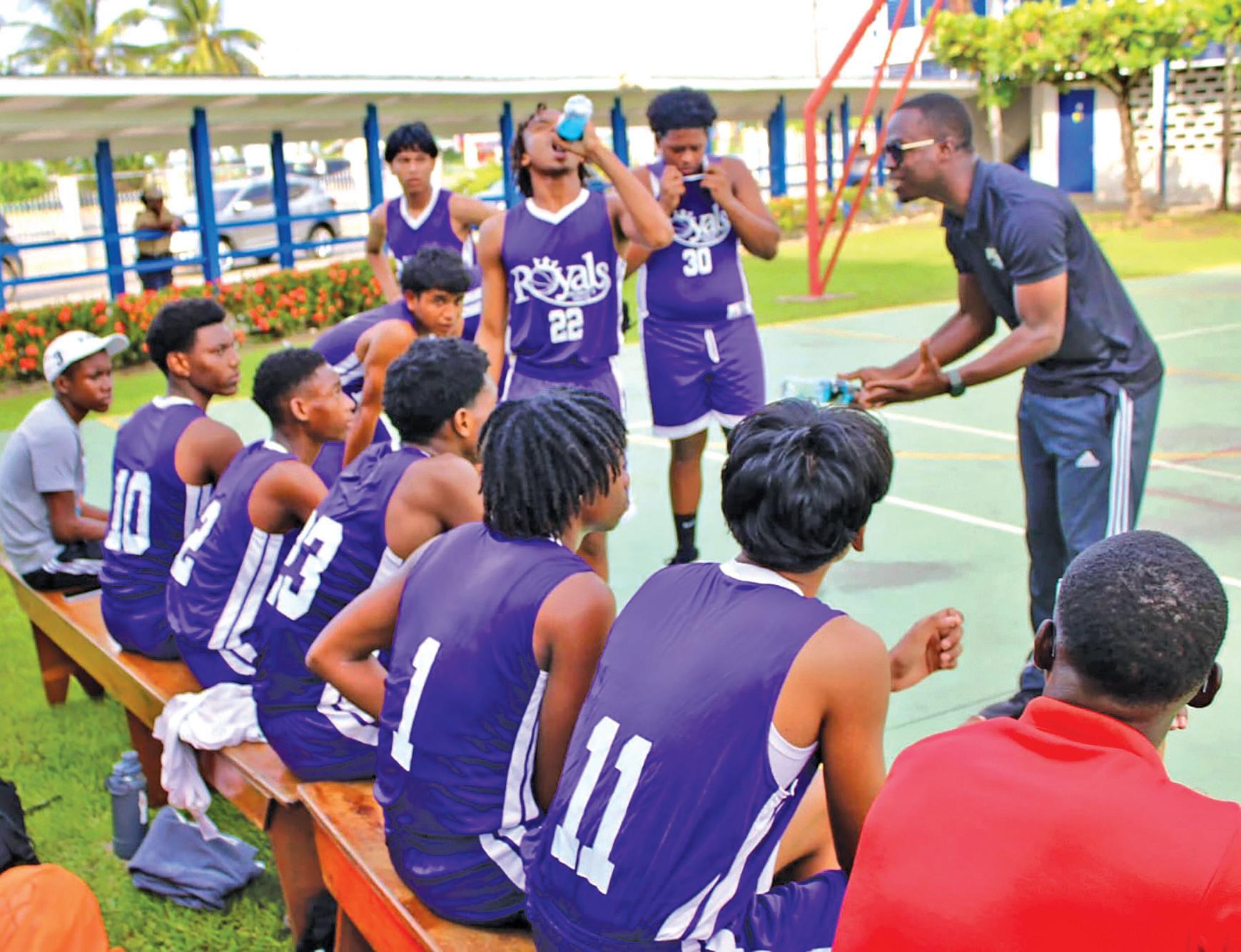
Apulsating encounter at the Queen’s College Court on Thursday brought the Schools’ Basketball League season to a thrilling conclusion, as President’s College edged Queen’s College 56–54 to secure the championship title after 10 games.
Entering the decisive matchup as a top-of-thetable clash, both teams knew the stakes were high, and the game delivered. Queen’s College (QC) started strongly, taking the first quarter 11–9 with disciplined defence and sharp execution. However, President’s College (PC) responded emphatically in the second quarter, dominating 17–6 to seize con -
trol heading into halftime.
PC continued their strong form in the third quarter, outscoring QC 21–12 to build what seemed like a comfortable lead. But QC mounted a spirited comeback in the final quarter, producing a 25–11 run that brought them within touching distance.
Despite the late pressure, President’s College held their nerve in the closing moments to secure the narrow victory and, with it, the league title.
After 10 league games, President’s College finished as champions with 18 points, while Queen’s College placed second with 16 points, underlining the fine margins between the two top teams throughout the season. In the other fixture at Burnham Court, St Rose’s High School defeated Government Technical Institute (GTI) 50–45 in a competitive contest. The game began evenly, with the first quarter ending 10–10. St Rose’s took charge in the second quarter with a 15–5 advantage and extended their lead in the third, winning 12–6. GTI rallied late with a strong 24–13 fourth quarter, but Saint Rose’s did enough to hold on for the victory. Meanwhile, on Friday, in the final match of the inaugural season, Marian Academy hosted Saint Stanislaus and conceded a heavy 35–67 defeat.
Corporate support continues to play a vital role in the development of local sport, and that contribution was once again highlighted as Cevons Waste Management stepped forward to assist Guyana’s Masters hockey programme.
In a recent statement, the Guyana Hockey Board expressed sincere appreciation to the company for its sponsorship of uniforms for the Guyana Masters women’s team. The timely donation comes as the team prepares to compete at the World Masters Indoor Hockey World Cup 2026, which will be hosted at the David Ross Sports Village in Nottingham from March 26–31.
The contribution from Cevons ensures that the Guyanese players will be properly outfitted as they take on international competition, removing a significant financial burden and allowing the athletes to focus on performance. The Guyana Hockey Board noted that such partnerships are critical in enabling teams to participate in global events, particularly at the masters level, where funding can often be limited.
This year’s tourna-
ment is expected to feature more than 98 teams across multiple age categories, with over 200 matches scheduled. Guyana will be strongly represented, with four teams set to compete:
Over-40 Women, Over-40 Men, Over-50 Men, and Over-55 Men –marking one of the country’s largest-ever showings at a Masters World Cup. The support from Cevons
also builds on the momentum of Guyana’s previous success on the international stage. At the 2024 Masters World Cup, the nation’s Over-45 Men’s Team produced a memorable cam-
paign, defeating England in the preliminary round before narrowly losing to the hosts in the final.
As anticipation builds for the 2026 tournament, the Guyana Hockey Board
emphasised that contributions like Cevons’ sponsorship not only provide essential resources but also serve as a morale boost for players representing the Golden Arrowhead abroad.