The Berbice Bridge will be closed to vehicular traffic on:
Sunday, March 1 – 14:55h–16:25h, and Monday, March 2 – 15:40h–17:10h.
BRIDGE OPENINGS FERRY SCHEDULE
Parika and Supenaam departure times – 05:00h, 10:00h-12:00h, 16:00h, 18:30h daily
WEATHER TODAY
Partly
High
…as new Dr Balwant Singh Outpatient Pavilion commissioned
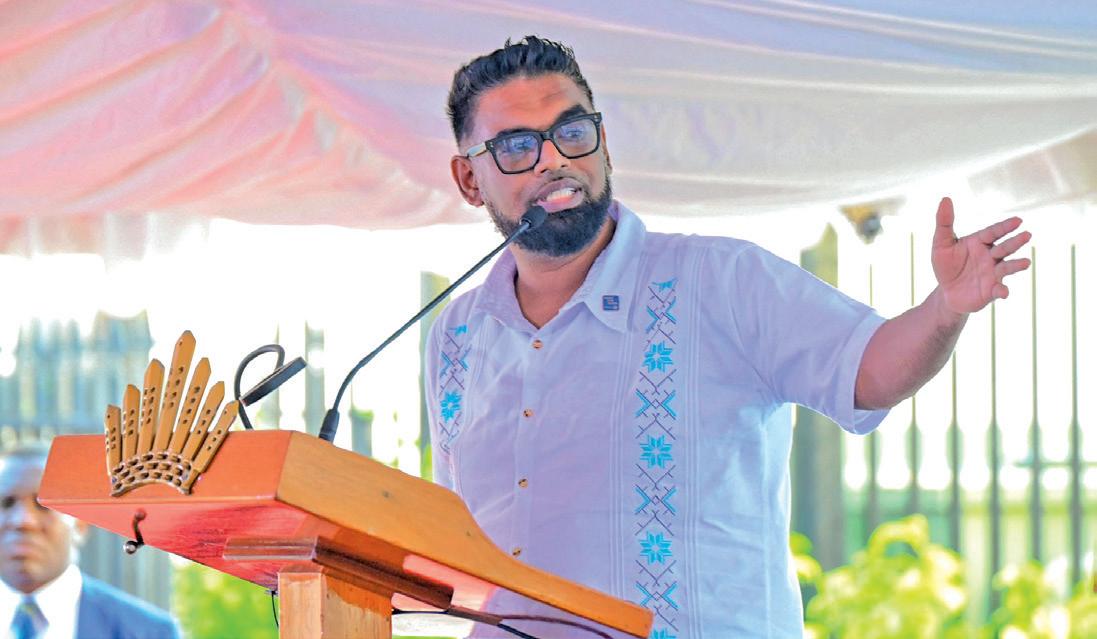
The Guyana Government is building out an expansive healthcare sector that will see the country moving beyond merely buying and selling towards the manufacturing of pharmaceuticals. This is according to President Dr Irfaan Ali, who noted that the aim is to position Guyana as the Caribbean hub for medicines. “We recognise today that hospitals cannot function without medicines. That is why we want [to] move towards an integrated platform for medical supplies in our country. Not only buying and selling, we want to create the framework here where we will manufacture for the rest of the Caribbean.
(AG) and Legal Affairs
Minister Anil Nandlall outlined that more than 40 bills and regulations are slated to be introduced in the National Assembly this year, including the Food Safety (Amendment) Bill, Medicines Regulation Bill and Medical Practitioners (Amendment) Bill, among others. Guyana is pushing to set up a pharmaceutical and vaccine manufacturing hub with the aim of reducing the country’s, as well as the region’s, dependence on imports and making access equitable.
This comes on the heels of experiences during the COVID-19 pandemic when developing and small countries were left battling to
secure vaccines after being put on waitlists by the big pharma manufacturers and having to depend on donations from partner countries and international organisations.
Forefront of robotic surgery
Meanwhile, the next
"We're going to play in every sphere of the ecosystem,” he said on Saturday. The Guyana Government has already been working on laying the foundation for pharma companies to establish their manufacturing base in Guyana.
Only last year, Health Minister Dr Frank Anthony disclosed that legislative reforms were underway to modernise Guyana’s Food and Drug Department regulations, which currently date back to 1974. These changes will improve the regulatory framework for medicines, medical devices and vaccines, creating a more conducive environment for investment in the pharmaceutical sector. In fact, Guyana has been working with the Pan American Health Organisation (PAHO) and Rwanda on drafting new laws for the local pharmaceutical industry.
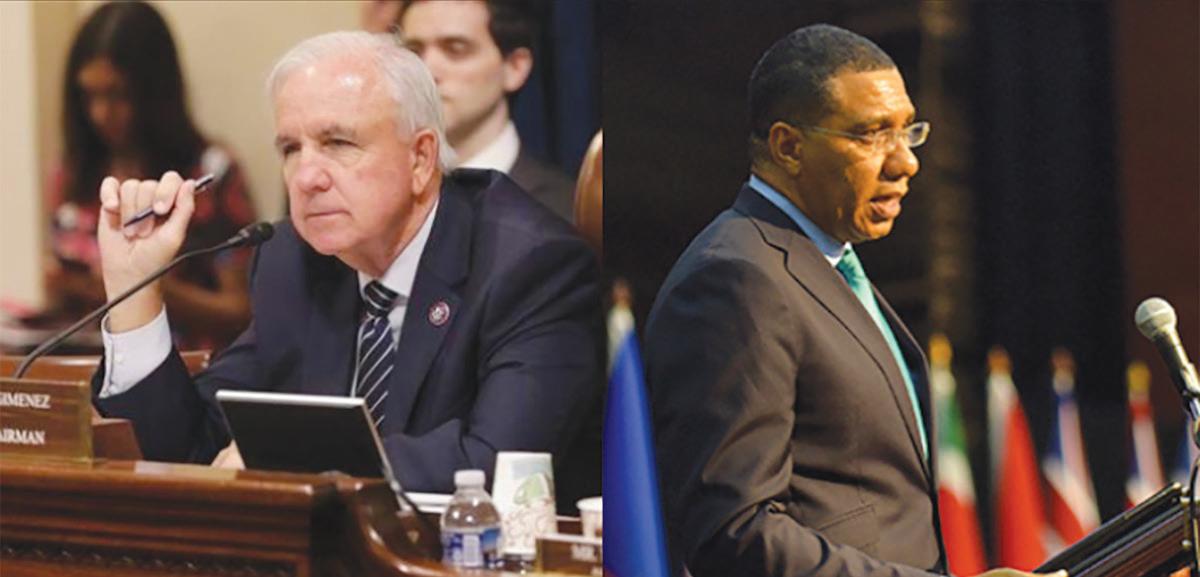
Moreover, an agreement was signed with the European Union (EU) to support the establishment of a pharmaceutical manufacturing hub here. Just last month, Attorney General
wave of development for the local health sector will be Guyana being positioned at the forefront of robotic surgery in the Western Hemisphere.
According to President Ali, “We want robotics here yesterday. We want to be the first country, maybe in the Western Hemisphere, to have a transatlantic surgery performed through robotics here in Guyana. And I've already set that challenge to the team. We are going full robotics; no turning back.”
“There are some simple surgeries that can be done through robotics that will save us from the human fatigue. Human fatigue restricts how much we can do. It restricts our performance. It restricts the quality of care. After you do four or five [surgeries], you get tired… But imagine the same level of performance on the first surgery versus the 20th surgery on the same day. That is what it allows us to do. So, we are going there. It's not ‘if’, it's not ‘but’ or ‘when’. I'm telling you today, we are going there.”
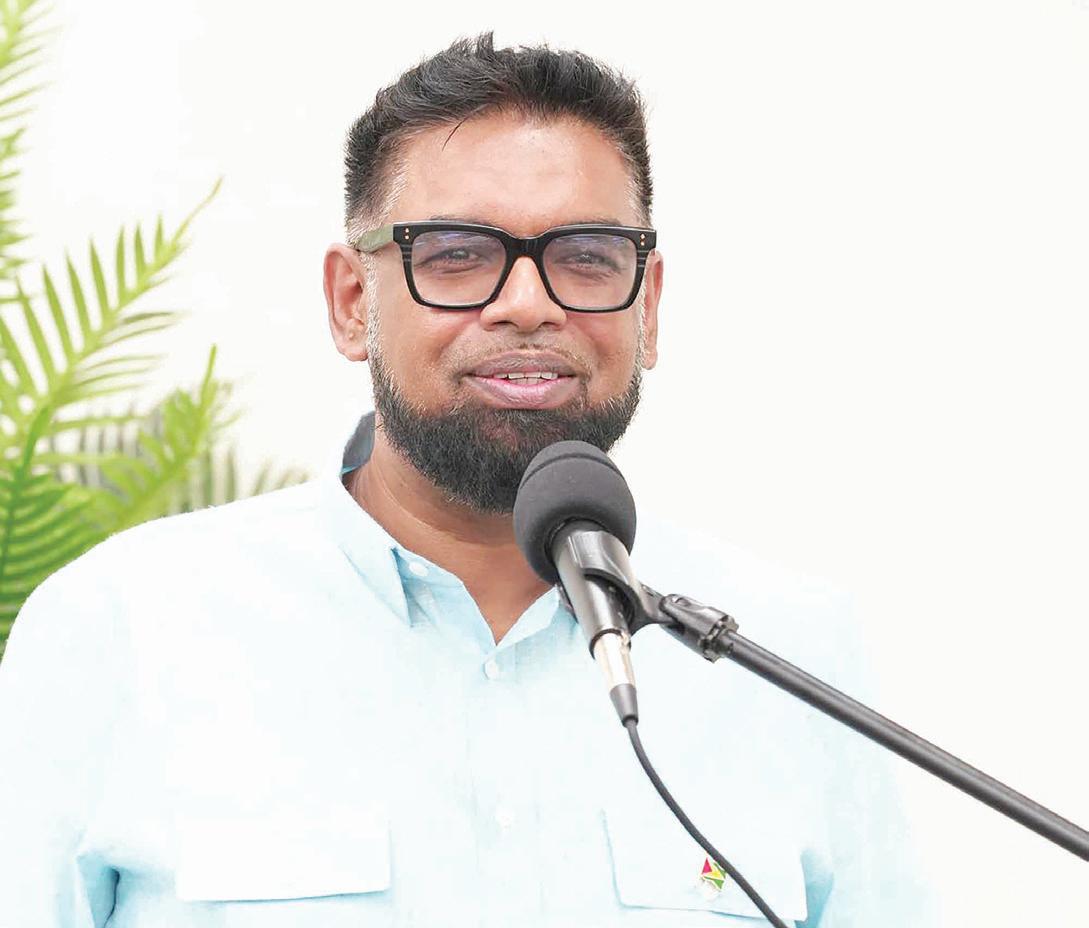
President Dr Irfaan Ali
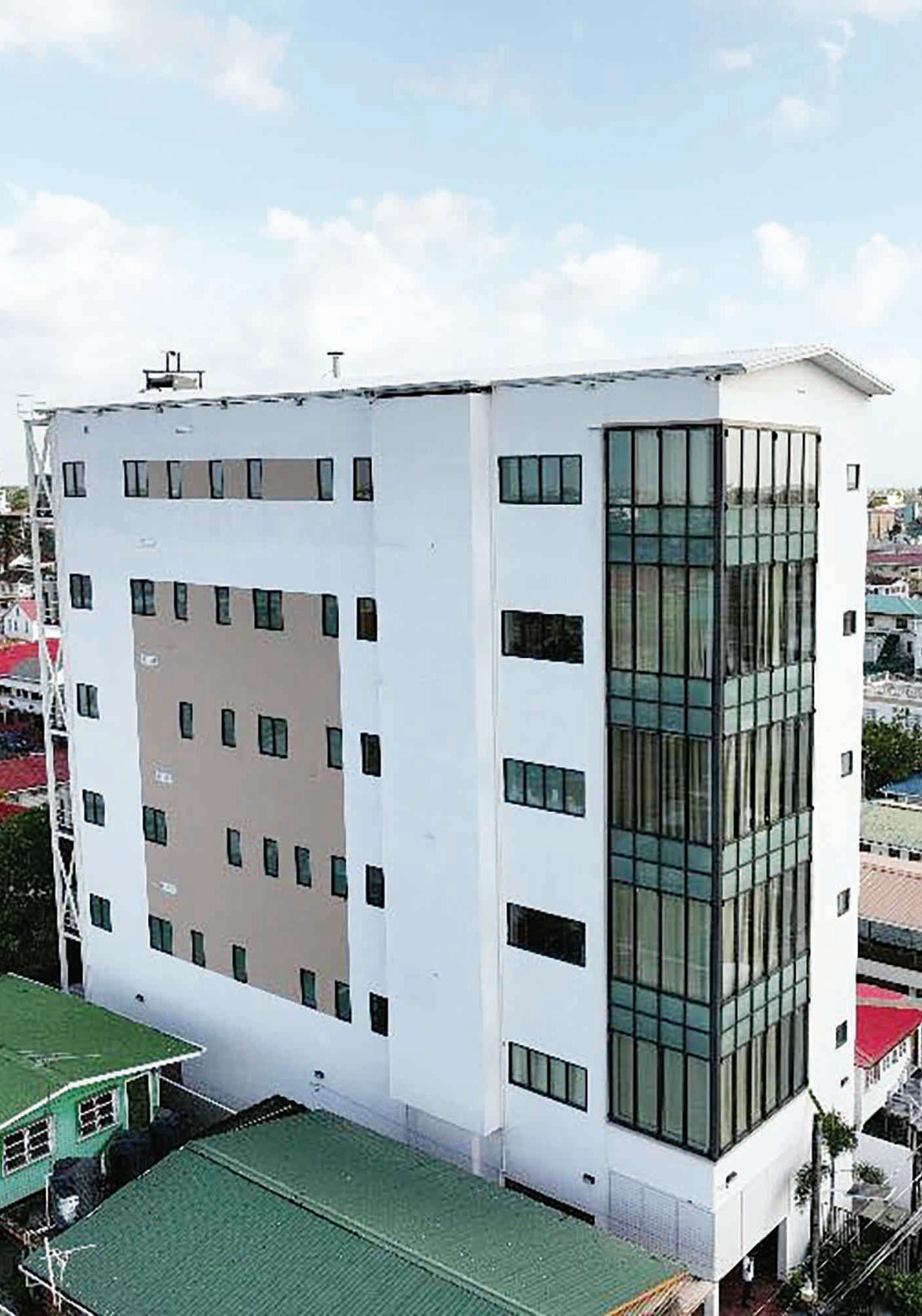
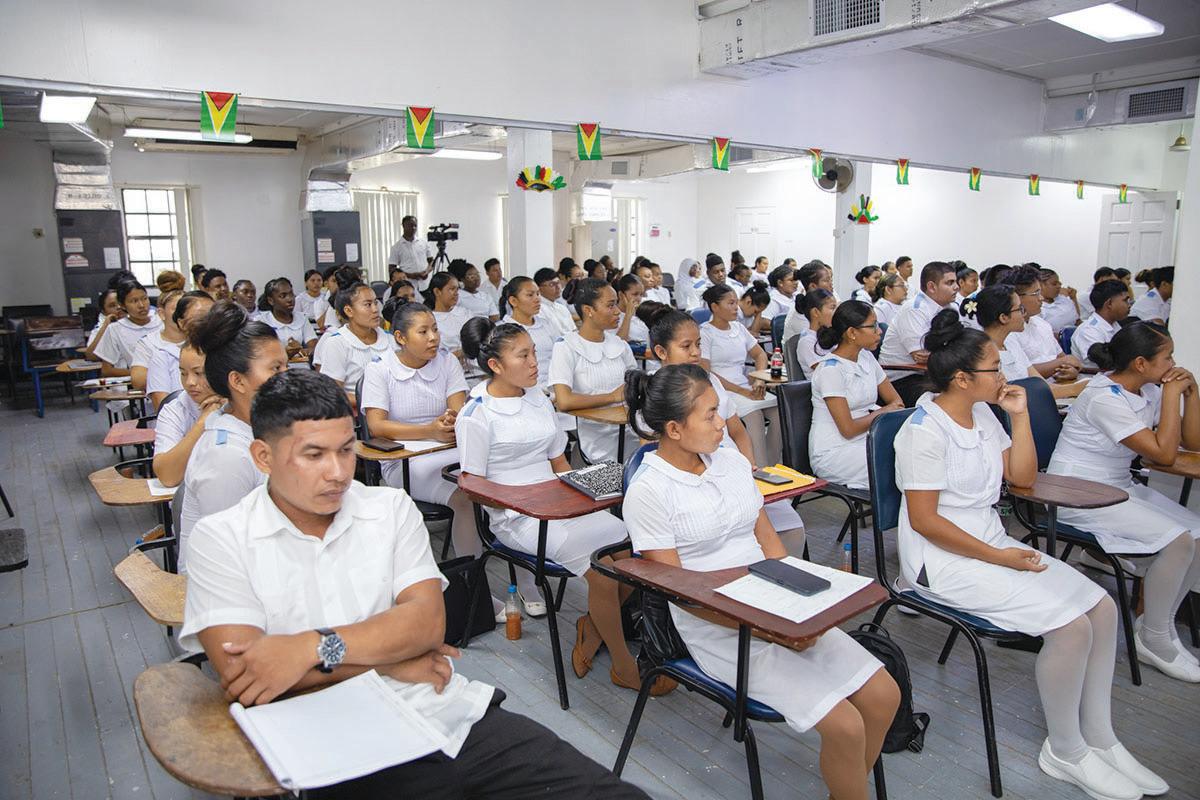
A section of the inside of the new Outpatient Pavilion at Dr Balwant Singh’s Hospital on East Street, Georgetown
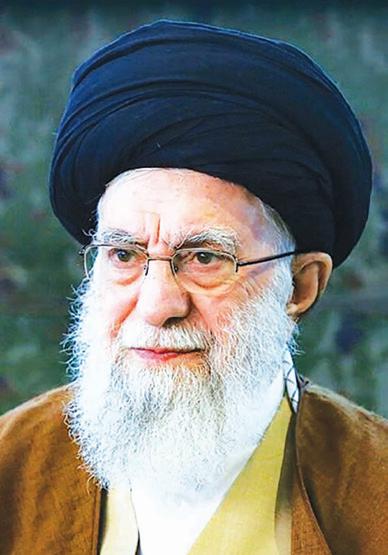
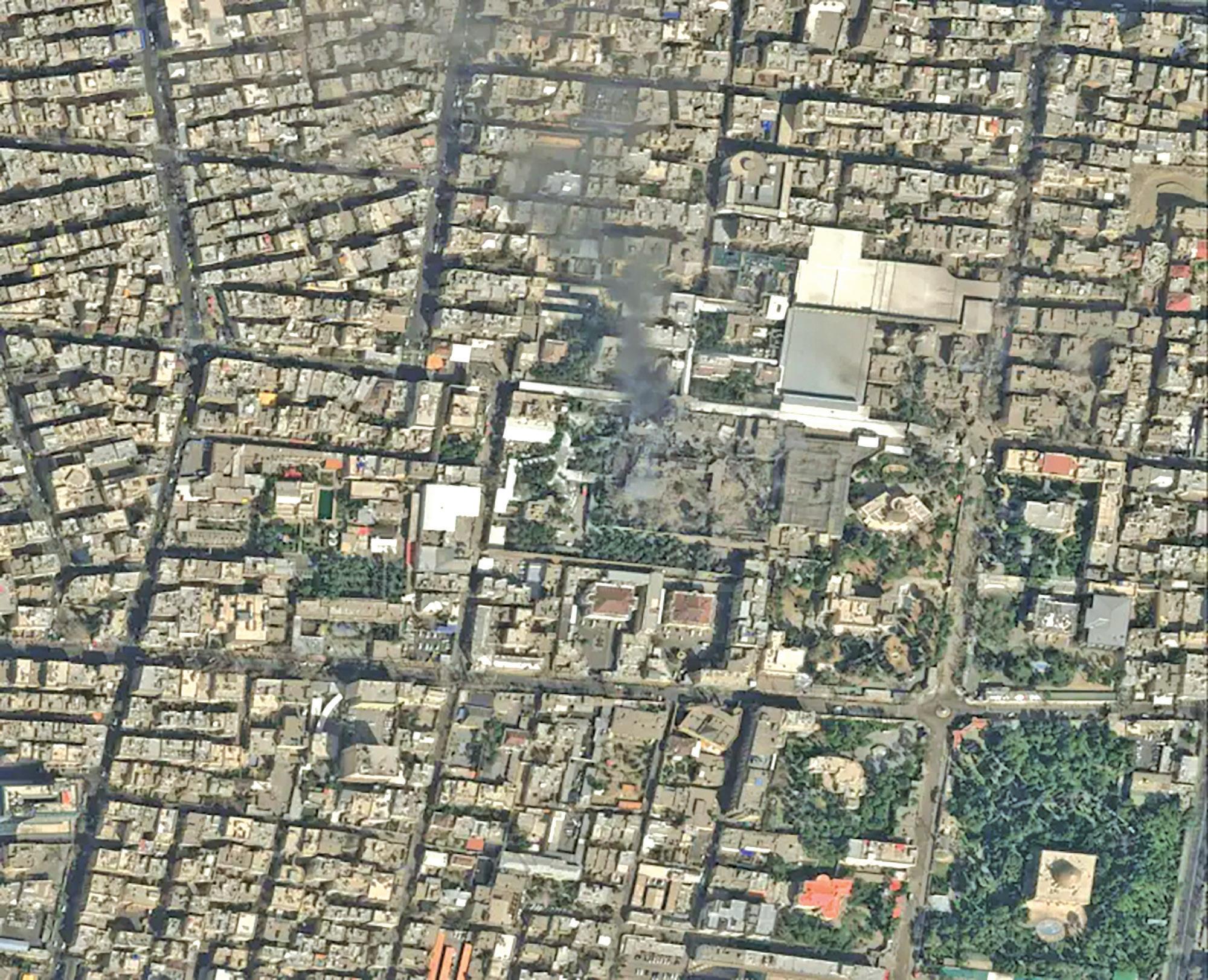
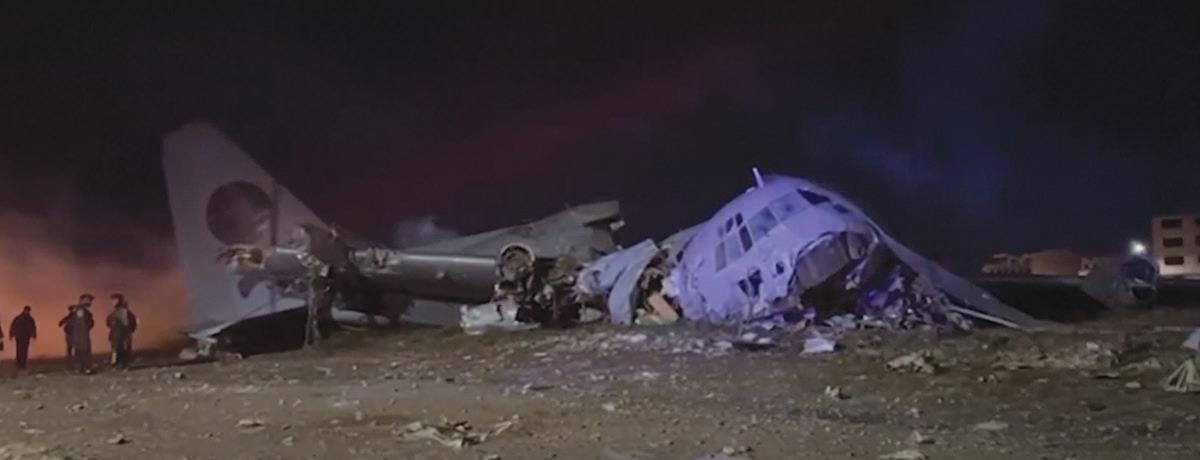
Following its months-long assembly of a massive fleet of warships and fighter jets in the region, US President Donald Trump yesterday announced a “major combat operation”, named “Operation Epic Fury”, after talks with Iran to prevent it from producing nuclear weapons ended inconclusively. Israel’s President Netanyahu, meanwhile, said the goal was “regime change”. These attacks followed the earlier massive bombings of Iran’s uranium enrichment facilities during Israeli drone attacks in June 2025. This year, Iranian President Khamenei has warned of “a regional war if new attacks are launched.” This is a very credible threat since Iran could use allied militias (e.g., in Iraq, Lebanon, and Yemen) to launch proxy attacks across the Middle East, dragging neighbours like Iraq, Lebanon, Syria, and Gulf states into the conflict. In addition to Israel, Bahrain, Abu Dhabi and Qatar, all of which have US bases, have reported being bombed by Iran.
Russia has denounced the US-Israeli bombings as “a preplanned and unprovoked act of armed aggression against a sovereign and independent UN member state” and announced it is seeking an urgent meeting of the UN Security Council to mediate a ceasefire. China has taken a measured response over the last few months as tensions escalated but announced providing air defence assets to Iran. Discussions for CM302 antiship cruise missiles that are both ship and ground-launched and could target US vessels in the Arabian Sea or closer to Iran’s shoreline in the Gulf of Oman and Persian Gulf were not consummated.
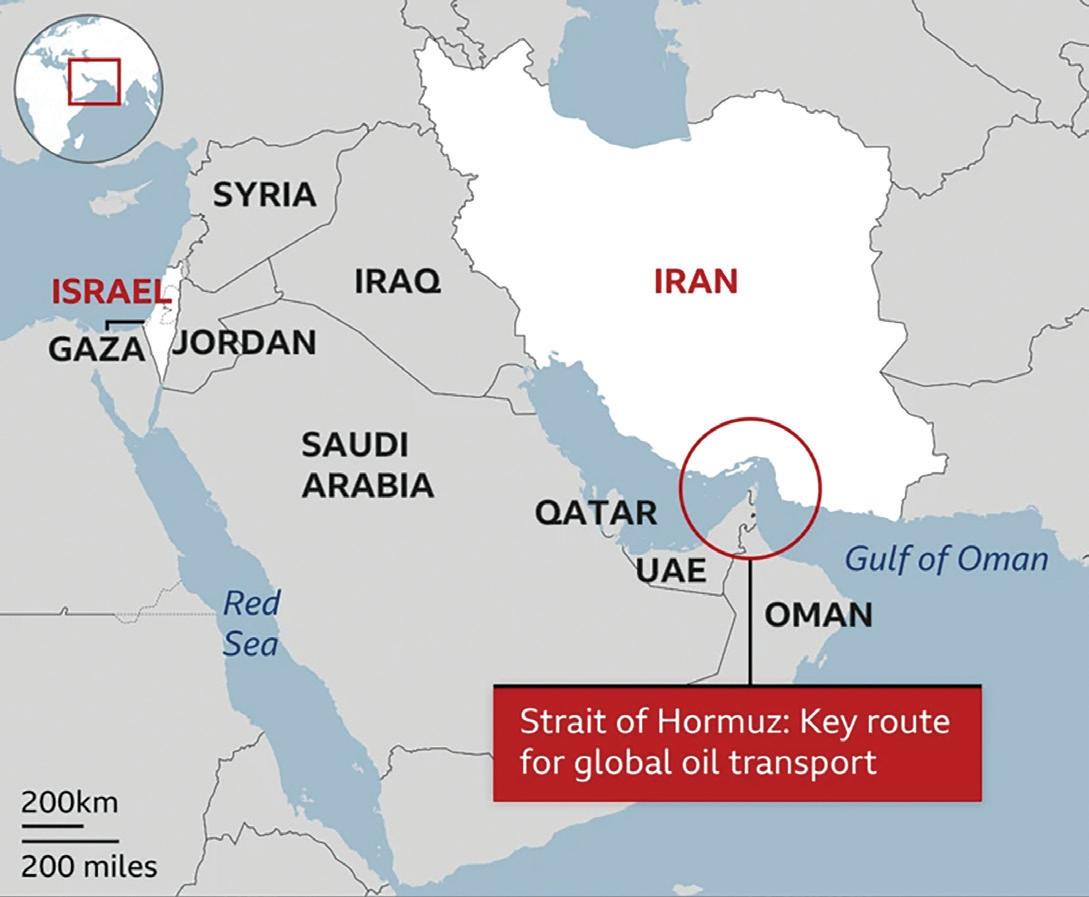
While Guyana is over 7000 miles from Iran, there will be several specific repercussions of which we should be aware and integrate into our own plans for national development and security. With Iran as the third largest producer of oil in OPEC, at three million barrels per day – and also having de facto control of the Straits of Hormuz, through which 20 per cent of the world’s oil traffic passes – oil prices are certain to head northwards for the duration. With our own oil production to reach one Mbpd imminently, our 14.5 per cent of revenues should appreciate significantly in the near term. Analogously, since investors typically become very skittish during wars – especially involving such a major power as the US and the very volatile Middle East – we should also expect another rush into gold as a “safe haven”. This will push prices far above the present US$5000/oz. The Government’s collection of royalties should also consequently increase – especially if the announced measures to control gold smuggling take root.
There are also strategic implications for us. The US has once again demonstrated – after its Venezuelan Operation Absolute Resolve of last January that removed President Maduro to face narco-trafficking charges in Miami – that it will act forcefully to secure what it defines to be its interests. And that is a key distinction. Invocations of notions of “the greater good” will not go very far, as was shown at the meeting between US Secretary of State Marco Rubio and Caricom leaders. Rather than the bombastic rhetoric of, say, ex-PN Ralph Gonsalves of St Vincent, the more measured tone of the Caricom leaders that included the previously vociferous Barbados PM Mia Mottley, which took cognisance of the US stated rationale for intervention – such as the return of democratic governance in Cuba – bore fruit. There was a joint declaration for providing “humanitarian relief” to the Cuban people.
We have reiterated the point that we are in a fortuitous position in this hemisphere, which the US has declared to be within its zone of interest. The US has reiterated its support for the ICJ as the vehicle for settling the border controversy raised by Venezuela, which claims two-thirds of our national territory. That their “control” over that country is accepted by the present Government should have some influence on their reaction to the imminent ICJ decision that should favour our position that the 1899 Arbitral Decision stands.
We should support a return to dialogue between the US and the Iranian regime over their nuclear programme, which even China had expressed concerns about in the past.
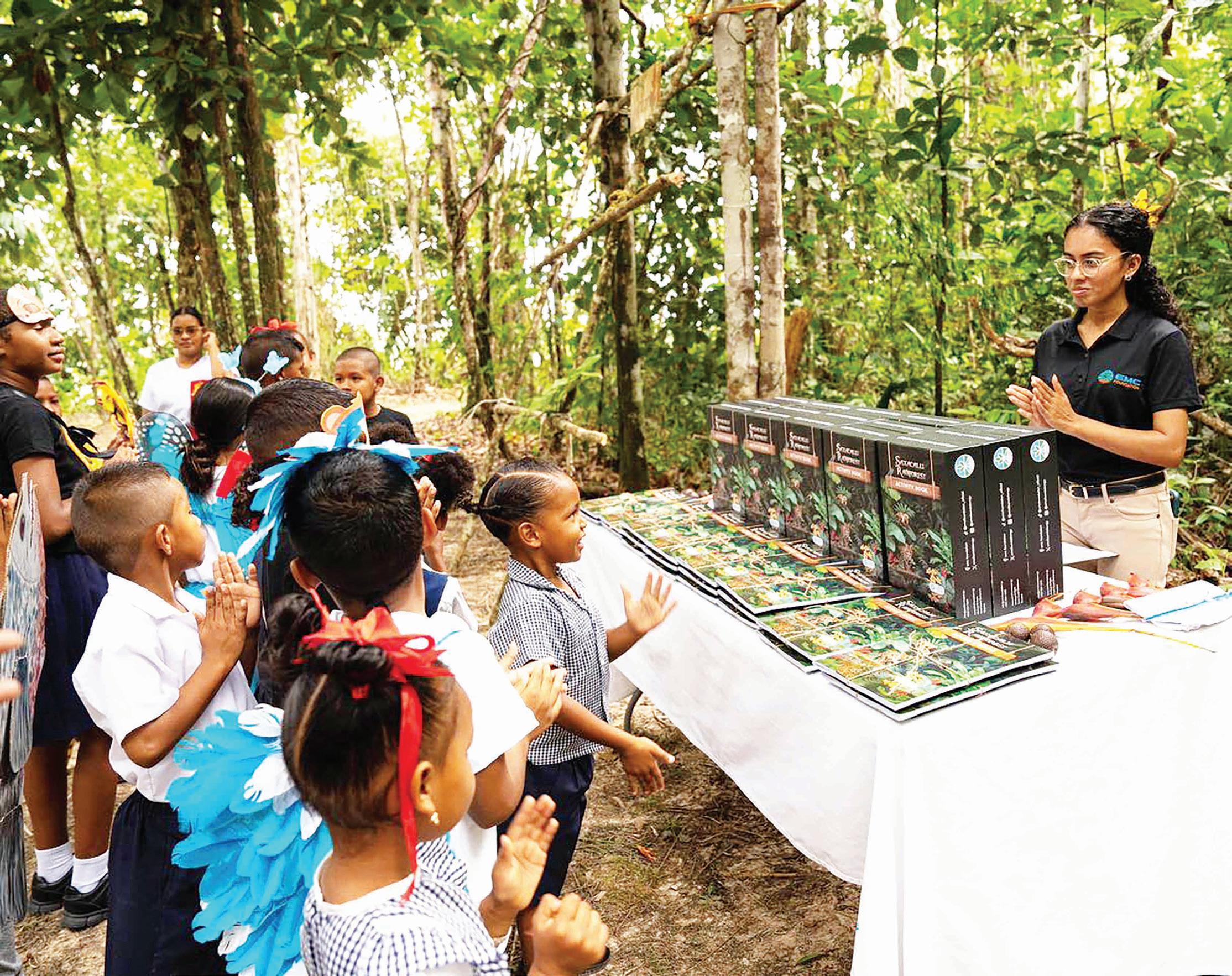
“Saxacalli Rainforest Activity Book” was launched on Friday at the Saxacalli Rainforest Centre on the left bank of the Essequibo River. The publication, developed by the EMC Foundation, the non-profit arm of Environmental Management Consultants (EMC), aims to strengthen environmental literacy among pupils of the Saxacalli Primary and Nursery Schools. Education Minister Sonia Parag, along with Managing Director of EMC Shyam Nokta, delivered the keynote address and encouraged students to see themselves as “agents of change”, reminding them that leadership can begin at any age (Education Ministry photos)
Focusing on World Wildlife Day
By LeeLa Ramdeen
On Tuesday, March 3, we will observe World Wildlife Day. The UN theme this year, Medicinal and Aromatic Plants: Conserving Health, Heritage and Livelihoods, “highlights the vital role of these plants in sustaining human health, cultural heritage, and local livelihoods, and showcases the growing pressures they face from habitat loss, overharvesting, and climate change.”
T&T possesses a rich diversity of medicinal and aromatic plants which are often used for teas, to flavour culinary dishes and to treat certain ailments. Our “bush medicine” is linked to Indigenous, African, East Indian and European traditions. Here are a few which you can buy in some markets, herb shops, etc.: Chadon Beni –used for seasoning or in tea to treat fevers and colds. Lemongrass/Fever Grass – used in tea to treat fever and colds. Ginger – used in tea to treat nausea. Basil – used for both culinary and calming, stress-relieving purposes. Zebapique –used in teas to treat fevers, colds, and coughs. Noni –used to boost the immune system, reduce inflammation, manage pain, and improve skin health. Neem –used to treat diabetes and for “cooling” (cleansing). Vervain – used for colds,
inflammation, anxiety, and insomnia. Aloe vera – used for skin, gastritis, and as a blood tonic. Citronella Grass – used as a mosquito repellent. Hibiscus Flowers – used in tea to treat high blood pressure and as a diuretic. Mango leaf, papaya leaf, guava leaf, and soursop leaf are also used for different medicinal purposes.
T&T’s efforts to protect wildlife include government policies, legal frameworks and NGO initiatives. Although conservation, habitat protection, research and combating illegal wildlife trade are high on the agenda, educating the public about wildlife protection and enforcement of our laws are critical steps to be taken to achieve our goals. We continue to face challenges, e.g., illegal hunting, habitat loss and illegal wildlife trade. Let’s leverage the use of digital platforms, e.g., social media, apps, and consistent, longterm online campaigns, in our education programmes. Pope Francis’ 2015 encyclical, Laudato Si’ (On Care For Our Common Home), is a call for conversion of hearts, minds and lifestyles if we are to save our planet. He reminds us that we have a moral imperative to protect biodiversity. He condemns the human-driven extinction of thousands of species as a loss to God’s glory. He warns that hu-
man activity is causing species to disappear forever, noting, “We don’t have the right” to destroy these creatures. “Any harm done to the environment is harm done to humanity.”
He calls for an “ecological conversion”, urging a shift from a “throwaway culture” to one of care. He calls us to promote authentic human ecology, which connects ecological issues and life issues.
World Wildlife Day provides us with “an opportunity to celebrate the many beautiful and varied forms of wild fauna and flora, to raise awareness of their many benefits, and reminds us of the urgent need to step up the fight against wildlife crime and human-induced reduction of species, which have wide-ranging economic, environmental and social impacts” (UN).
According to the UN, 50,000 wild species meet the needs of billions worldwide.
“Around 9 per cent of plant species used globally for medicinal and aromatic purposes are threatened with extinction due to overharvesting, habitat loss, climate change and illegal trade. One in five people rely on wild plants, algae and fungi for their food and income. Seventy to 95 per cent of the population in developing countries rely on traditional medicine for primary healthcare.”
The Conference of the Parties (COP), the governing body of the Convention on Biological Diversity (CBD), comprising 196 nations, “meets biennially to negotiate, monitor, and enforce global biodiversity goals.” The UN Biodiversity Conference (COP15), which ended in Montreal, Canada, on December 19, 2022, saw the adoption of the Kunming-Montreal Global Biodiversity Framework (GBF) – a landmark agreement which aims to halt and reverse nature loss.
“The framework consists of global targets to be achieved by 2030 and beyond to safeguard and sustainably use biodiversity” (UN).
The post-2020 Global Biodiversity Framework comprises “measures to transform society’s relationship with biodiversity by 2050. Among its goals: restore 20 per cent of degraded ecosystems and reduce the introduction or settlement of invasive alien species by 50 per cent” (UN).
Let’s focus on actionable solutions to ensure a sustainable future for our planet and “develop a form of ecology based on reconciliation, a new form of environmental ethics where humans learn to preserve biodiversity by living with it, rather than isolating it” (UNESCO). ( T&T Guardian )
BEAUTY AT EVERY AGE
By Ryhaan Shah
Junko Sakai was 66 years
old when she entered the Miss Universe Japan competition last July. She found out that the age restriction of 18 to 28 for Miss Universe was lifted for last year’s pageant, and since she had already won the Mrs Universe Japan division for those 60 and older, she decided to try for a place in the Miss Universe pageant.
She has been married for 30 years and has four children and three grandchildren. Her family were all totally supportive of her entry into pageantry, first with the Mrs Japan contest and then the Miss Universe Japan competition.
She did not make it to the final round but did place as one of the 42 preliminary finalists, and the rigorous training required for competition has given her a message not only for older women but for the younger generation as well.
“In Japan, women are often seen as only having value when they’re young. And in today’s world, it’s hard for young people to have hope for the future. It’s too sad to think that once youth is gone, life is over,” she said.
She now teaches high-heel walking at events organised by municipalities and within companies. She tells her students, “It’s more beautiful to walk tall and look up than to hunch over worrying about others.”
Her students include university graduates wearing heels for the first time for job interviews and women who walk with canes due to disabilities.
Junko Sakai (pictured here) hopes that her lessons teach the spirit of “living joyfully and brightly”.
All over the world people are living longer. There are various factors involved, including better health care generally and more effective treatments for age-related conditions. Living well into our senior years opens up more opportunities for new experiences, and as Junko Sakai so bravely and proudly displays, there is no typical older person. She learned to walk in sky-high heels for her pageant and beat out dozens of younger contestants.
She tapped into the psychological aspect of maintaining not just good health but also taking care of her appearance. Being well-groomed is actually linked to better mental health, optimism, and good social engagement. It is seen as a way for us to feel cared for and cared about.
While the anti-ageing cosmetic industry is still huge, there is a notable shift towards “pro-ageing”, with more brands embracing the ageing process with their products rather than trying to counteract it.
How we feel about ourselves often starts with how we see ourselves and the image we project to the world. Wrinkles, grey hair, and the need for spectacles or a walking stick can make us feel less like the person we once were.
Taking time to care for our physical appearance and grooming can give us a positive boost and encourage us to stay socially active, which is good for our overall wellbeing. This sense of connection can improve our mood and our outlook on life, making our beauty routines – getting our hair trimmed, our nails manicured, or getting a facial – part of staying positive and engaged as we age.
Simply put, being well-groomed and keeping up our appearance can be the best confidence booster for anyone. This is not the case for women only; men should also keep themselves well-groomed and well-dressed since such routines of self-care are known to provide them with similar benefits.
While some societies value their elders and respect them as wise and experienced people who can still make important contributions to society, others view us as frail and dependent.
These are ageist attitudes that public health professionals, and society as a whole, need to change since they can lead to discrimination, affect the way policies are developed and lessen the opportunities for older people to experience healthy ageing.
It is important that society view the elderly not as burdensome but as people who have contributed to the nation in myriad ways and deserve the best care when they need it most.
Junko Sakai does not view ageing as a time to mourn lost youth but as an opportunity to embrace life’s journey with a positive spirit. As she says, life is not over once youth is gone, and all of life is to be lived “joyfully and brightly”.
“I owe everything to Guyana” – David Dabydeen on Nobel Prize nomination
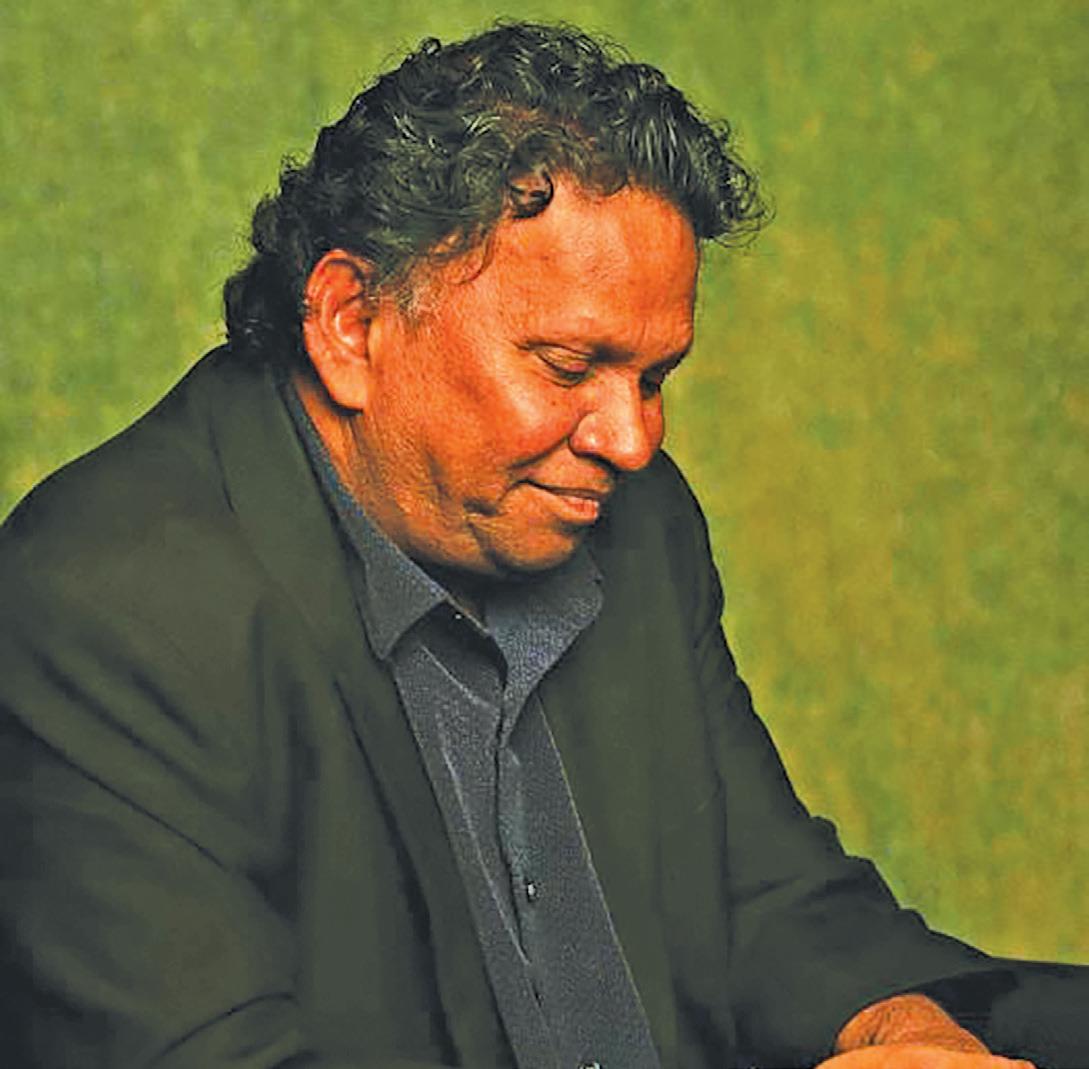
David Dabydeen: Guyanese-born broadcaster, novelist, poet, and academic. His words carry such weight that they tip the scales, nudging the needle toward the Nobel Prize in Literature.
The Nobel Prize in Literature is a Swedish award, presented annually to an author from any country who has, in the words of Alfred Nobel, “in the field of literature, produced the most outstanding work in an idealistic direction.”
He was formerly Guyana’s Ambassador to UNESCO from 1997 to 2010 and was the youngest member of the UNESCO Executive Board, elected by the General Council of all Member States of UNESCO.
Across the world, Dabydeen’s work has earned accolades and recognition that reflect the breadth and
“The rays of praise”, the scholar added, “were not shone on me but rather directed to the very soil in which I grew up – Guyana.”
From his perspective, all of his inspiration comes from Guyana itself, and thus he must give thanks to God for this.
“No, I don’t see this mo-
depth of his literary and intellectual impact.
In 2004, he was awarded the Raja Rao Prize for Literature, an honour reserved for writers who have made an outstanding contribution to the literature and culture of the South Asian diaspora – a nod to his ability to navigate history, identity, and memory with unmatched skill.
His third poetry collection, Turner: New and Selected Poems (1994), led to his recognition as one of Britain’s twenty “New Generation Poets”, celebrating the country’s leading living voices. The eponymous poem, “Turner”, was even adapted into a ballet by Italian choreographer Mattia Mantellato, bridging the worlds of literature and performance art. These accolades are a mere tip of the iceberg, yet they illustrate why he has recently been nominated for the Nobel Prize in Literature.
Speaking to this publication, the novelist shared his feelings upon being nominated:
ment as gratitude for myself… I really don’t see it for myself – not because I’m modest, but because everything I write about is on Guyana. I owe everything to Guyana. Without Guyana, I wouldn’t have a subject, and I wouldn’t have imagery. My immediate instinct when I found out that I was nominated was, “Thank God for Guyana.”
Carrying a flaming torch of talent and expertise is not something he foresees doing alone. In his view, carrying on his legacy means sharing his flame with other writers so they can carry the mantle as well.
On this note, he offered several tips for writers in Guyana honing their craft. “It’s a matter of reading, continuing to read to see how other writers craft their novels or poems. In other words, if you’re learning, for young writers, you’re almost like an apprentice, and then when you find your own voice, it’s just a matter of persisting, persisting in your writing. And also, really im-
portantly, taking criticism seriously.”
There is an indescribable feeling that comes when the ball of the pen strikes across every page that Dabydeen writes – one that he says those who are not writers may not fully understand.
“I mean, put it this way. When I finish writing a page, I’m happy that whether you have money in your pocket… It doesn’t matter… It doesn’t matter what’s going on in the world… I can be so happy [just] because I’ve completed a page, and that’s strange for people who are not writers to understand… Just a little page, which is 480 words, 500 words, can make a human being happy.”
The Nobel Prize in Literature has been awarded 118 times to 122 laureates between 1901 and 2025.
Among Dabydeen’s many accolades, he served as Guyana’s Ambassador to the United Nations Educational, Scientific and Cultural Organization (UNESCO) from 1997 to 2010. He worked closely with Mrs Carmen
Jarvis, General Secretary of the Guyana UNESCO Office, to raise hundreds of millions of Guyanese dollars for various educational programmes, including projects at the University of Guyana. As Guyana’s Ambassador to China (2010–2015), he persuaded the Chinese government to establish and fund a Confucius Institute at the University of Guyana, which, since 2014, has taught Mandarin to hundreds of students. In 2011, when the government sought to sell its minority shares in GT&T, it initially received an offer of 7 million USD. Dabydeen was asked to explore whether any Chinese companies were interested. After 18 months of negotiation, he secured an offer of 30 million USD, payable in two instalments, or 35 million USD, payable in five instalments.
“Negotiating was relatively easy for me since I spent about 14 years as chief fundraiser for the Centre for Caribbean Studies at Warwick University,” Dabydeen said, having obtained over one million USD from individuals and educational bodies for scholarships, conferences, and fellowships.
While a professor at Warwick, Dabydeen gathered a team of 50 scholars worldwide to write introductory essays for the Guyana Classics book project he created and managed entirely voluntarily. From 2009 to 2014, the project reprinted and republished 83 volumes on the history and culture of Guyana, making it the largest book publication programme in modern Guyana.
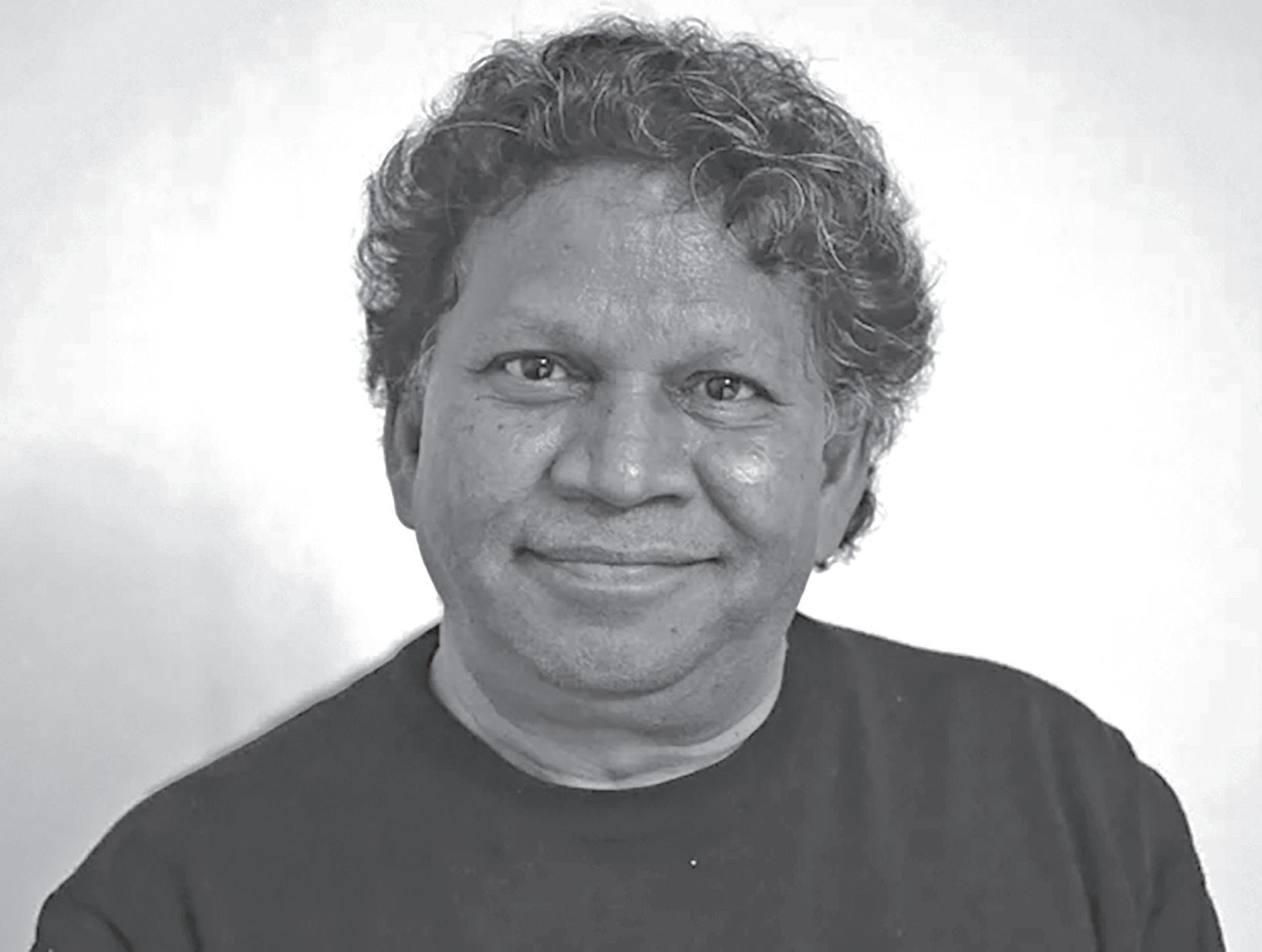
David Dabydeen – Guyanese-born broadcaster, novelist and poet
David Dabydeen
Foundation
How does bird flu make cows sick?
Have you ever had the flu? If so, you might remember coughing, being tired, and feeling achy. Other animals get the flu, too! It is caused by a virus . There are lots of different forms of the flu virus that infect different animals. In certain cases the flu virus that infects one type of animal can also “jump” across species and infect other animals.
This jump from one type of animal to another is called spill-over . This can happen due to the virus’ ability to change its genetic code (its RNA ). The changes in the viral RNA are called mutations. RNA can mutate when viruses replicate.
Flu viruses can also gain mutations by swapping pieces of RNA with other flu viruses – usually when they infect the same animal. It is important to keep track of how viruses like the flu spill over from one animal species into another. One way to track
the spread of viruses is to compare how closely their RNA matches. We can create a family tree of the virus RNA.
In this tree, viruses that are closely related appear near each other, just like siblings in a family. The sibling viruses likely come from the same source. Distantly related viruses come from different sources.
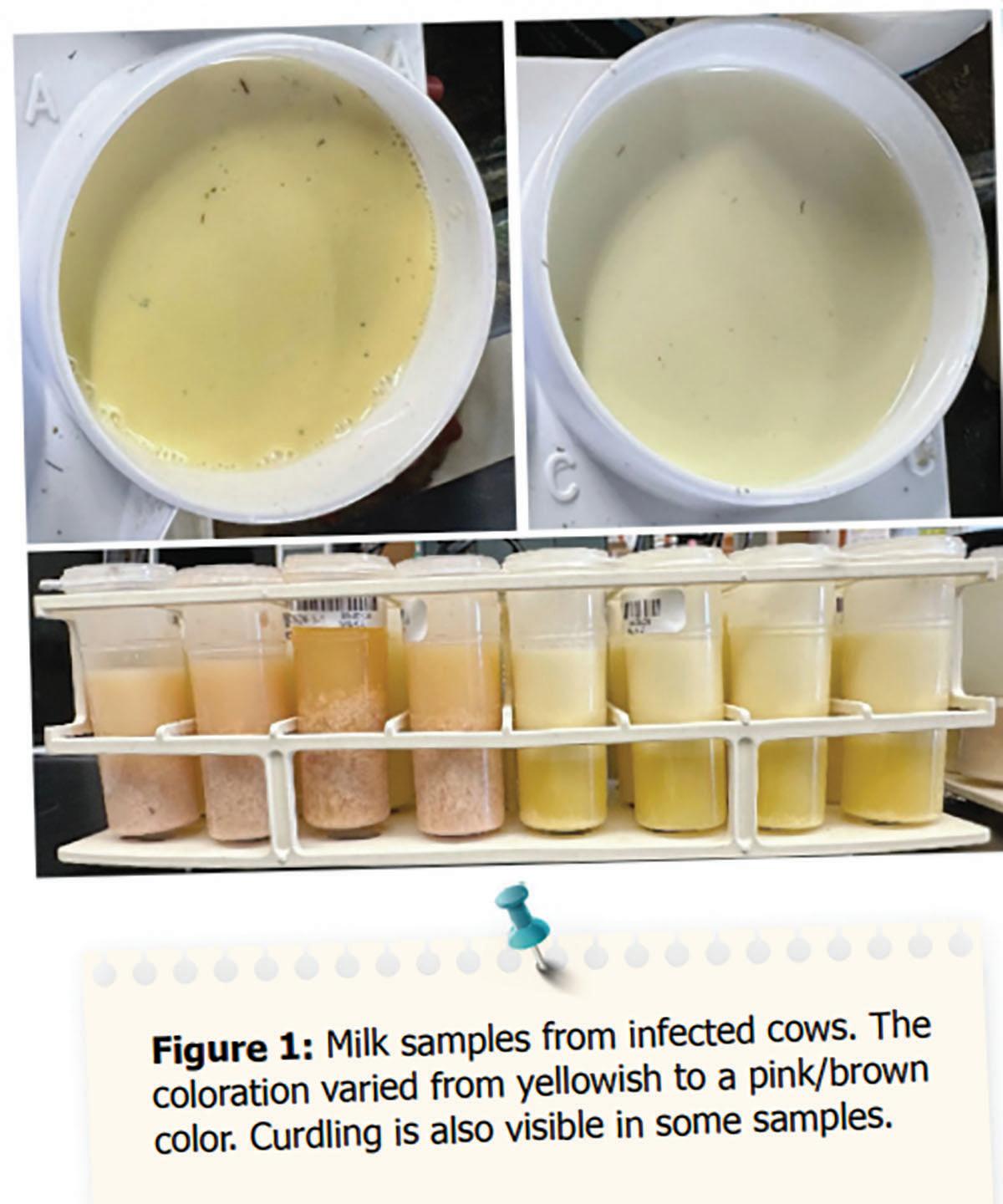
In early 2024, American farmers noticed strange flulike symptoms in their dairy cows. Plus, their milk was sometimes thick and yellow. Several of the sick cows even stopped producing milk. This was worrying. A new version of the bird flu virus had already spilt over into wild mammals like cats, foxes, and seals.
Scientists wanted to investigate the possibility that bird flu spilt over into dairy cows. They also wanted to understand how it spread. This important information can help protect farm animals
from getting sick in the future.
Using animals from nine farms that reported sick dairy cows in early 2024, they collected over 300 samples from dairy cows. These included nose swabs, blood, urine, faeces, and milk (Fig. 1). They also took samples from wild animals found dead on the farms.
In the lab, it was confirmed that the animals had bird flu. Then they examined three questions:
1. How much virus was in each sample?
This was done by extracting viral RNA and using specific methods to detect the quantity of RNA in the samples. Then, they used a microscope and virus-specific staining techniques to see where the virus was in different tissues – mainly in the lungs, intestines, and mammary glands
2. How long had the animals been making/
producing viral particles that could infect other animals?
Extra samples were collected for testing three, 16, and 31 days later.
3. What was the RNA sequence (the genetic fingerprint) of the viruses in the sick animals?
Scientists used this information to understand how the virus spread.
Luckily, the virus was no longer infectious after the third day.
When the scientists looked at the virus’s RNA in samples from sick cows, the sequence was different from other versions of bird flu that they know about. The virus’s RNA had accumulated mutations.
They also tracked ap -
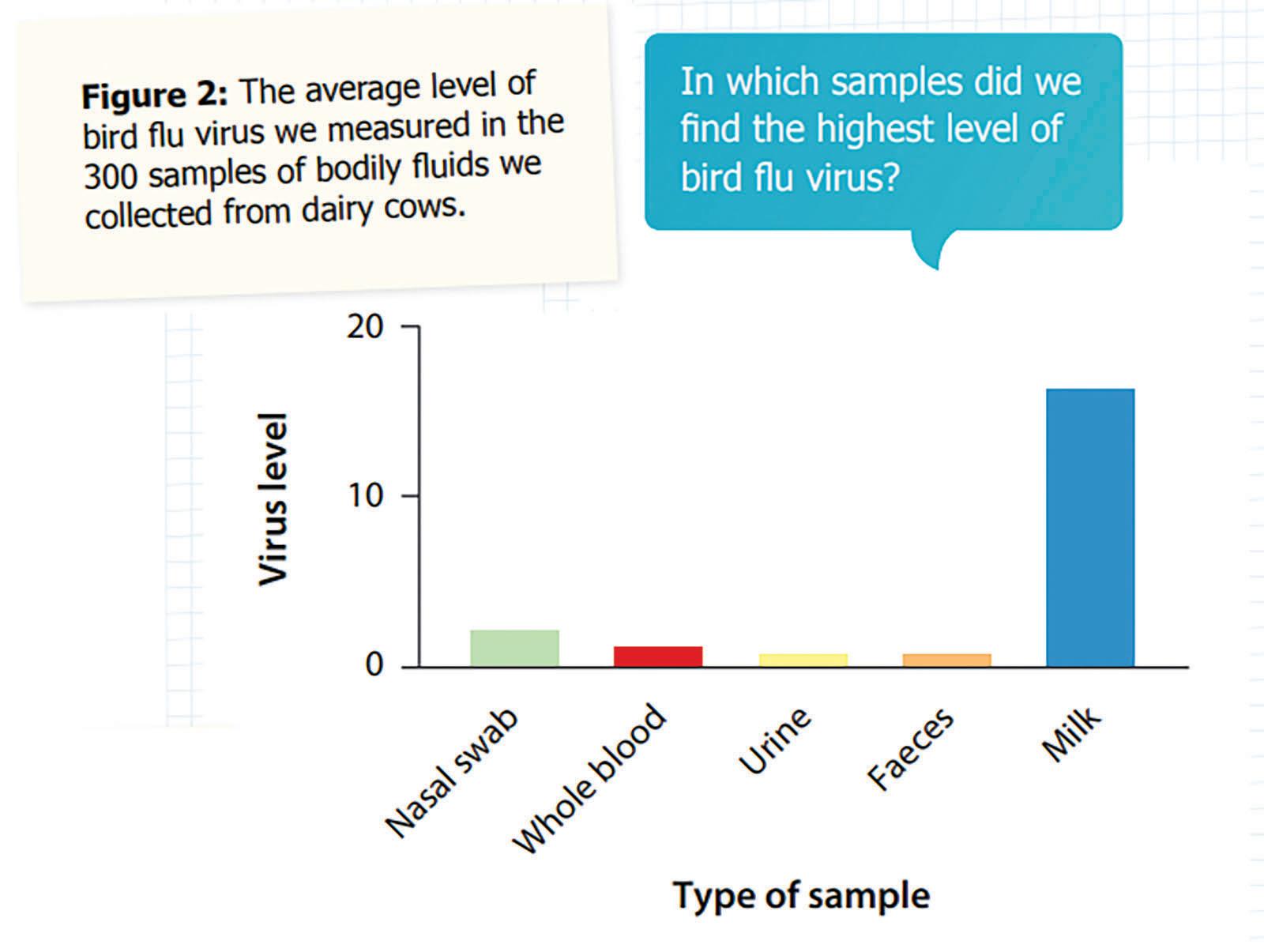
They found that milk from sick dairy cows had the highest level of bird flu virus (Fig. 2). Their mammary gland tissue, which produces milk, had similarly high levels. The bird flu virus RNA was detected for up to 31 days.
parently healthy dairy cows from one farm to another, where those cows infected others at the second farm. So, they were actually carrying the virus
version of the bird flu virus as the dairy cows and were probably infected after swallowing raw milk from the sick cows. The virus infects and replicates in the mammary glands. This causes high quantities of virus in the milk. Some of the farm animals may have been infected by drinking raw milk. Luckily, pasteurising milk can kill the bird flu virus.
Many of the sick cows live on farms along a major bird migration route. So, wild birds may have infected them. Even more concerning is that an infected cow could pass the virus on to other cows and animals on the farm.
This was the first time scientists had clearly documented sustained transmission of the bird flu virus between dairy cows, showing that cows can spread the virus to one another.
You might think that cows, wild birds, and humans live in very different environments. But our lives are all connected. As humans build more farms, towns, and cities, we are moving into spaces where wild animals live. This makes it easier for diseases, like bird flu, to spread between animals. And even to us! Fortunately, drinking only pasteurised milk can protect us from many infections. Farmers, veteri -
Finally, it was discovered that some of the wild mammals (raccoons) and cats on the farms were infected. They had the same
narians, and researchers must continue working together to limit the spread of diseases.
2 men kill each other in violent confrontation over ECD woman
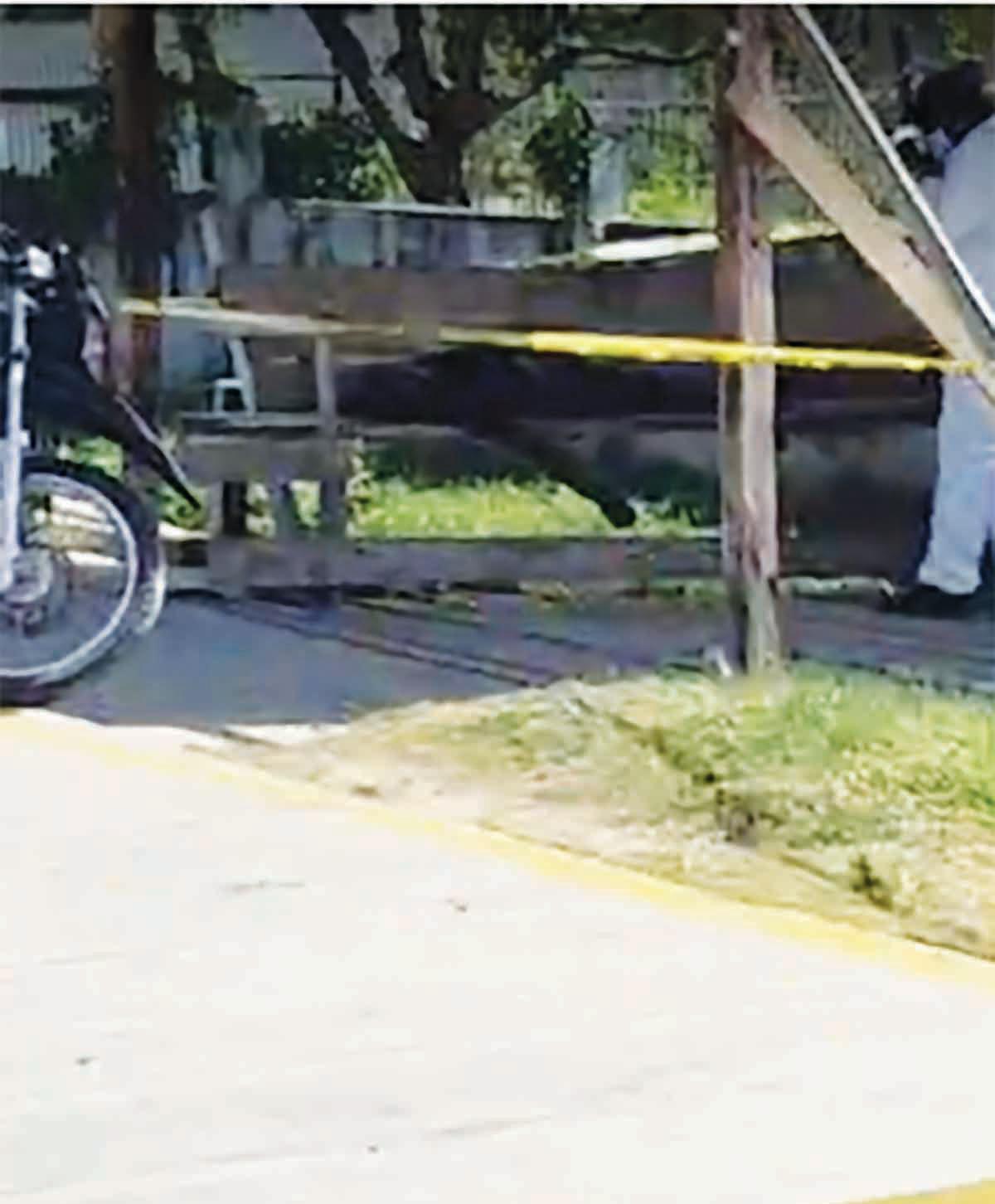
The area where Hassan’s lifeless body was found
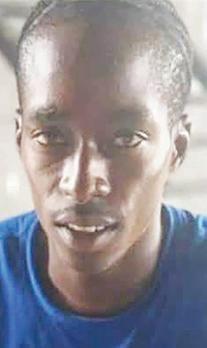
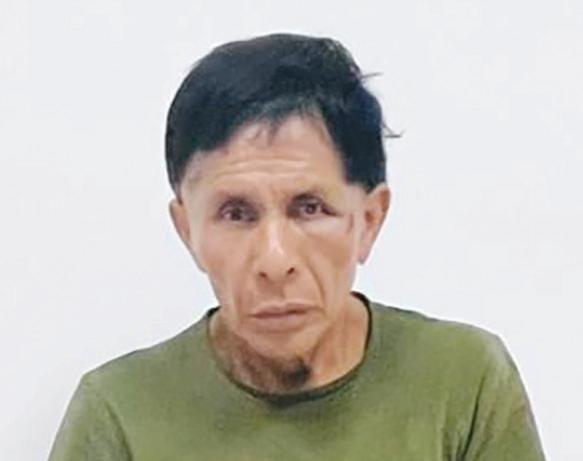
Aviolent confrontation between two men in Bare Root, East Coast of Demerara (ECD), on Saturday morning left both of them dead in what residents revealed was a dispute over a woman. Dead are Joshua James, 22, also known as “Racoon,” and Jonathan Hassan, 26, also called “Cutto/Nico", a father of one. The incident occurred at about 09:00h at the woman’s house at Bare Root. According to reports, the two men became involved in a heated argument, allegedly over
a woman, which quickly escalated into a knife fight. Both men are said to have inflicted stab wounds on each other. One resident recounted the shocking scene to Guyana Times and said that the situation could have been avoided. “Both of them, after fighting over the girl, just hugged each other and started stabbing each other, and both of them died. One of the guys that died –the girl is his child’s mother. They fought over her; both of them dead, and she is still standing. They lost their lives stupidly,” the resident recalled. Meanwhile, an eyewitness at the scene told the publication of the events leading up to the deaths. “He (Hassan) was going up to the shop; the three of we was there: me, the owner of the shop where he died, and another guy. We were standing up there, gaffing…when I looked, I saw the guy (Hassan) banked (the corner) with the motorbike. He stopped at the shop. I saw blood all over his skin, and I thought he crashed with the bike,
Guyana condemns Iran’s attacks on Gulf States, calls for regional stability
The Government of Guyana on Saturday night issued a statement condemning the attacks by Iran on the Kingdom of Bahrain, the United Arab Emirates, Qatar, and Kuwait.
In a statement from the Foreign Affairs & International Cooperation Ministry, the Government de -
scribed the attacks as unprovoked, unjustified, and in violation of international law.
Guyana called for all parties to de-escalate tensions, emphasising the importance of sustained peace and stability in the Middle East.
The statement further expressed full solidarity with the Governments and peo -
ple of Bahrain, the UAE, Qatar, and Kuwait, and reiterated Guyana’s condemnation of Iran’s actions against these sovereign states.
The Ministry stressed that lasting peace and stability in the region remain a priority for the international community and urged dialogue to prevent further escalation.
and he came here for assistance. When he came, he couldn’t get off; I went, held the bike so he could come off and sit down.” “I asked him what happened. Who juk you up because his skin was all over with blood? He just kept tossing, and tossing, and tossing. Then he turned and said it was a boy in his child’s mother’s house. We tried to get him to the hospital. The owner for the show went to get his car to take him, and while doing that, he made one last kick, stretched out, and trembled. After that, I knew he was dead, so we called the police and ambulance,” the resident recalled. “…I saw slashes on his hand and blood pouring from the left side of his chest. I feel like he got stabbed in the heart. It like he was heading home… but he couldn’t
make it,” one of the eyewitnesses said.
“I can’t believe my brother is dead”
Meanwhile, Hassan’s sister, Jessica Hassan, confirmed to reporters that the confrontation occurred at her brother’s child’s mother’s residence.
“The child mother told me that my brother got bore. She said she had somebody inside the house, and my brother, Nico, went there. She told me Nico was confronted, and the boy who was staying there said that he didn’t appreciate my brother coming there, and they had an argument, and things escalated. The child mother told me Nico stabbed the guy, but when I found out, both ended up stabbing each other,” the grieving woman related. The sister added that her
brother frequently visited the house to see his oneyear-old child, and she never believed this would have escalated to this magnitude. “He normally goes there to see his child, take stuff for him, or bring him by me so he can play with the kids. I never expected something like this to happen. I can’t believe my brother is lying down here. I can’t believe my brother is dead,” she said.
Not in relationship
Nevertheless, a relative of Hassan’s child’s mother told this publication that while Hassan has a child with the woman, they were allegedly not in a relationship. The relative said on Saturday, Hassan went to his child’s home, and while there, he asked his child’s mother to braid his hair. The relative said that while braiding Hassan’s hair, James pulled up in his vehicle, saw Hassan at the house, and told him that he should not be visiting. It was then, according to the woman’s relative, that Hassan became angry and allegedly went for a knife and began stabbing James. In the process, James stabbed Hassan also. Following the incident, police secured the area, and the bodies were removed from the scenes. Up to press time on Saturday, police have not released a statement on the issue.
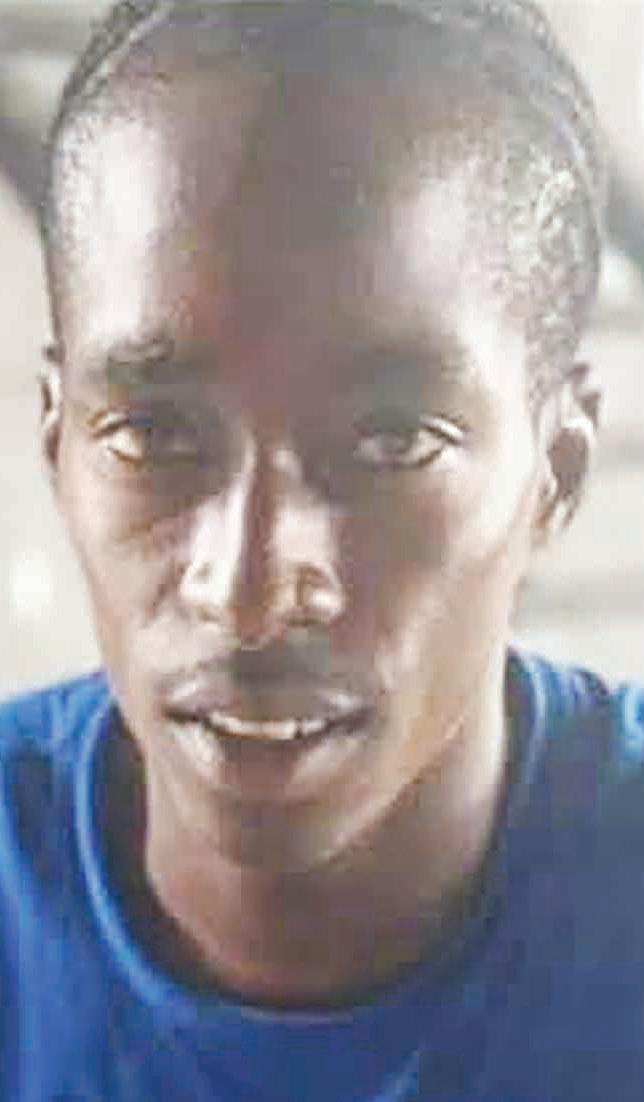
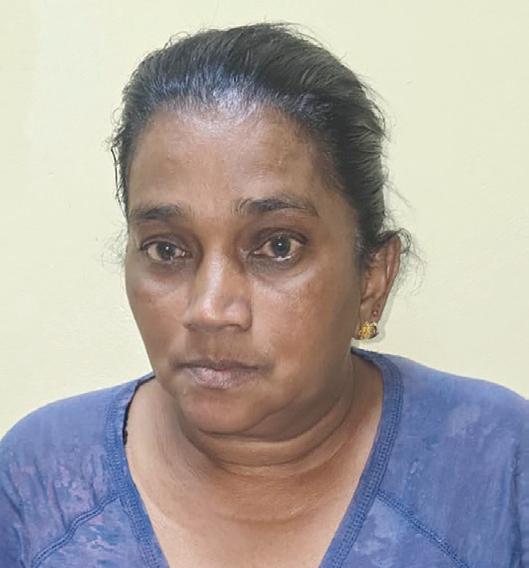
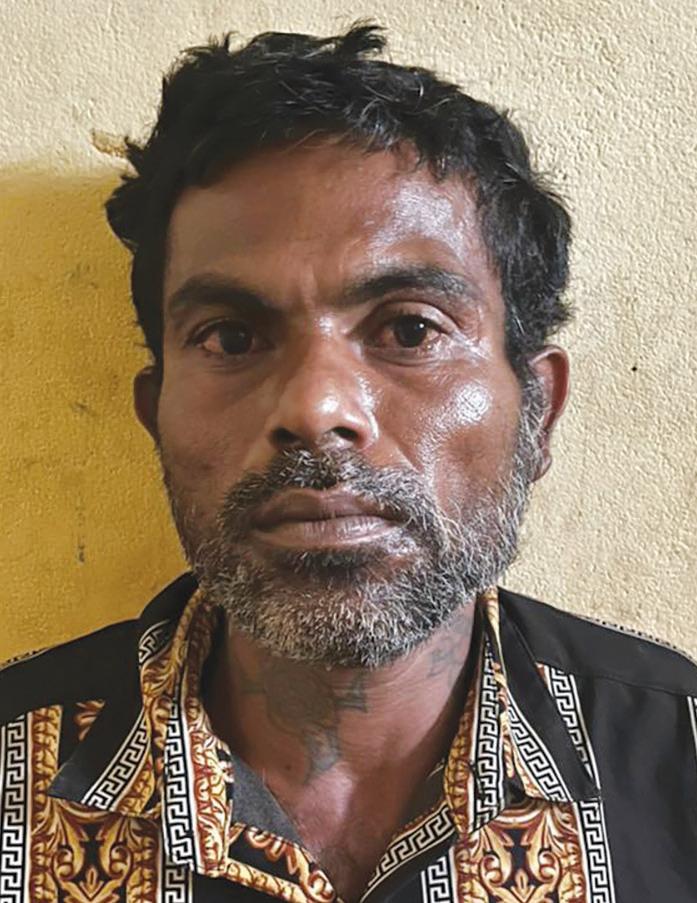
Dead: Joshua James, also known as "Racoon", and Jonathan Hassan, also called “Cutto” or "Nico"
It’s war… …against extradition!
Well, well, well!! How the times are a changin’!! Sanction Man and his WIN vehicle to prevent his extradition to face their justice system for criminally breaking their laws – along with his Daady –had trenchantly criticised the PPP Government for hiring lobbyists in the US to further this country’s interest!! Now, hiring lobbyists to petition lawmakers and other movers and shakers in the US Government is as American as apple pie – not to mention motherhood!! They evoke warmth, comfort and nostalgia for the “American Way”!!
But the way Sanction Man told the tale, it was a devious trick to subvert the legal system – and as such, they condemned the PPP!! Of course, going by what he claimed publicly, the way to win friends and influence folks in Government is to pass them oodles of moolah under the table!! But here it is Sanction Man just announced that he’d hired a lobbyist with an initial down payment of US$250,000!! Now we’re talking real money here!! Epstein kinda money!! For US$250,000 you can tickle many an official’s fancy!!
But apart from raising questions about Sanction Man’s political expediency, cynicism and opportunism – which have been exposed time and again! – there’s the question as to how the lobbyist was paid!! US$250,000 ain’t just pocket change which some WIN flunkey could jet up with stateside!! There is, after all that travelling, a US$10,000 or more declaration hurdle that gotta be cleared!! But even without that hurdle there’s the one as to where the US$250,000 came from – since all of Sanction Man’s bank accounts have been closed due to the OFAC sanctions!! It was said that WIN made the payment – but that just moves the questions one step backwards – where did WIN get the money from??!!
But what all this reveals is that Sanction Man realises time is longer than twine – and the twine of objections and appeals in court was never gonna be very long to begin with!! Not to mention not showing up in court because of “illness” or tyres getting slashed!! They clearly thought they could pull a Jack Warner – who delayed a FIFA-originated extradition request for ten years, by which time the matter became moot!! They didn’t realise that the AG Office had anticipated his not-so-artful dodging and that this was originated by the US Govt!!
So what can the lobbyist actually do since this ain’t a matter before some Congressional Committee or suchlike? This is a matter for the courts – and the Yanks are awfully proud of “judicial independence”!! They not only frown upon bagmen trying to bribe Judges but even “lobbying”!!
More critically, the Judge who’s gonna deal with Sanction Man’s gold smuggling charges ain’t even been appointed yet!!
…with a smile
After all the sturm and drang, it was announced that the US – along with Caricom – is gonna send “humanitarian aid” to Cuba!! It just goes to show that folks don’t have to take a no holier-than-thou attitude to power politics. Like Kenny Rogers advised in his song “The Gambler” – you gotta know when to hold it – and you gotta know when to fold it!! It all has to do with being honest when you look at the cards you’re holding in your hands!!
We in Caricom never had a strong hand to begin with! We were always too small and not possessing some strategic resource, facility or production, like, say, Singapore!! With OUR reserves of sweet, light crude –which stack up nicely against Venezuela’s vaunted 300B barrels of crude, since these are mostly not commercially exploitable – we have a good card!!
But we have gotta know not to overplay it. So Pressie was very wise to let T&T’s Kamla do all the screaming while he was the peacemaker!!
…at LGE
WIN just announced they’ll be aggressively contesting the upcoming LGE!! They’re counting on their local outreaches to bring in the votes.
However, Sanction Man’s gonna be in the docks by then – and another (harsher) tune will be playing!!
Guyana poised to be powerhouse in Caribbean’s energy security – Pres Ali
…says country ready to supply LPG, LNG to region
With the Caribbean now heightening focus on energy security in order to reduce its reliance on imported fossil fuels and lower high electricity costs, President Dr Irfaan Ali believes that the energy needs of the region can be met within as Guyana positions itself to be a major supplier. The Guyanese leader made this remark during a recent en-
gagement while in St Kitts and Nevis, where he travelled last week for the 50th Heads of Government Conference of the Caribbean Community (CARICOM).
Addressing the Guyanese community in St Kitts on Friday, President Ali spoke about the unprecedented transformation in Guyana led by its burgeoning oil and gas sector – a development he says must tran-
sition to the prosperity of the region, especially in the area of energy.
“Our energy strategy is also linked to ensuring that we have energy security in this region, ensuring that when we proceed to LPG (Liquefied Petroleum Gas) and LNG (Liquefied Natural Gas), our off-takers would be the people and the countries in this region, and that the energy securi-
ty of the region can be met from within the region,” the Guyanese leader stated. As part of its efforts to transition from heavy fuel oil to cleaner energy, the Guyana Government is currently undertaking the highly anticipated Gas-to-Energy (GtE) Project at Wales, West Coast Demerara (WCD), utilising natural gas that will be piped onshore from oil operation activities in
the Stabroek Block offshore Guyana. Under this project, a 300-megawatt (MW) combined cycle power plant and a Natural Gas Liquids (NGL) facility are currently being constructed and set to deliver clean and reliable power at a cheaper cost when they come into operation by yearend.
Already, some 250 kilometres (km) of 12-inch pipelines have been laid to bring the gas onshore. This first phase, however, will only utilise 40 per cent of the pipeline’s capacity, bringing 50 million standard cubic feet per day (mmscfd) of dry gas onshore. But with
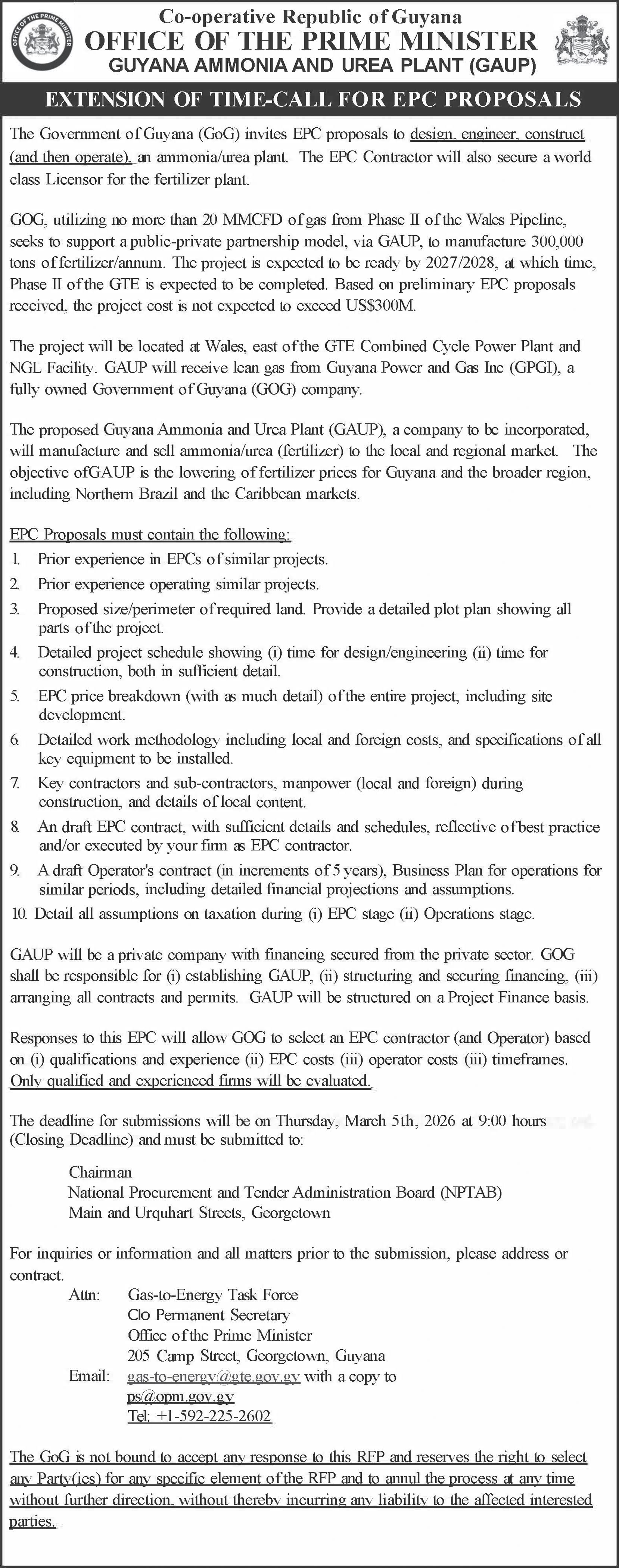
business, submitted proposals to design, build and operate a cooking gas bottling facility at Wales. Currently, another invitation is out for Requests for Proposals (RFPs) for the Guyana Ammonia and Urea Plant (GAUP) – the deadline for which is March 5. Outside of the GtE initiative, the Guyana Government is also laying the foundation for a broader energy economy with a second massive gas project in Berbice, Region Six (East Berbice-Corentyne). United States (US) energy firm Fulcrum LNG Inc. has been selected to develop a poten-
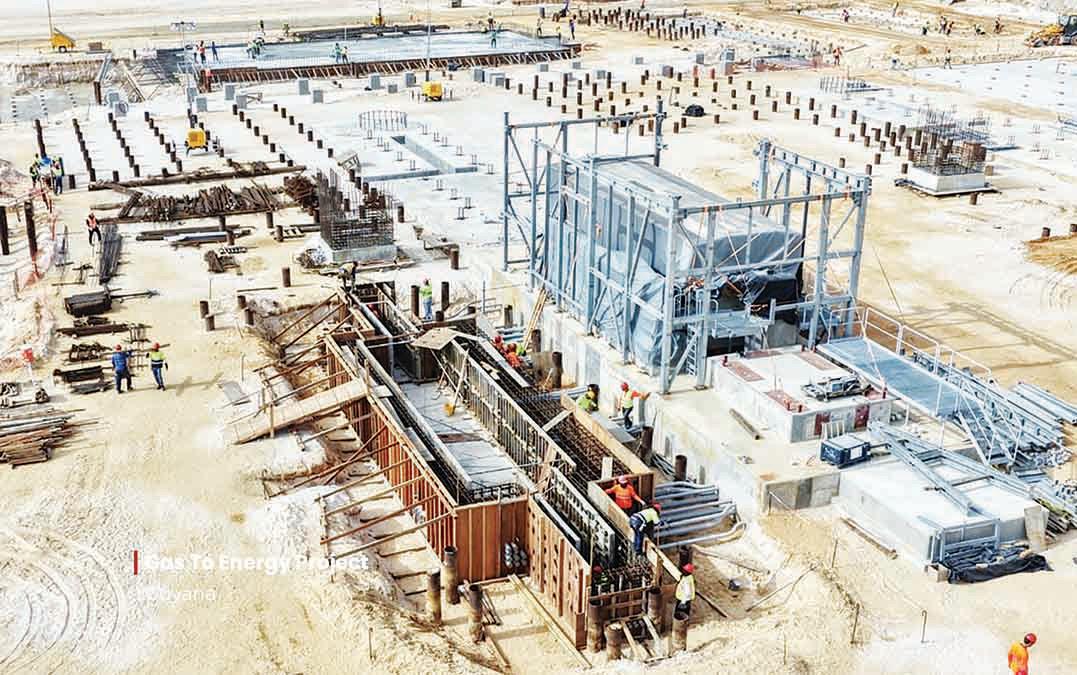
Works progressing on Guyana’s model Gas-to-Energy Project (GtE) at Wales, West Bank Demerara
the pipelines having the capacity to push as much as 120 mmscfd of gas, the Government had moved ahead with Phase Two to utilise the remaining 60 per cent capacity of the pipeline, which will see an additional 75 mmscfd of rich gas brought onshore to power a second 300 MW power plant and NGL facility right at the Wales, Region Three (Essequibo Islands-West Demerara) location.
Five companies have been prequalified for GtE Phase Two and are expected to submit their proposals this month to the Government to design, finance and operate the second project.
The GtE Phase One and Two are expected to generate significant excess ‘lean gas’ which will be available for other industrial projects such as fertiliser production, a data centre and a gas bottling plant. In fact, only last week, 10 international and regional companies, including a Guyanese
tial gas project in a tripartite arrangement with the Guyana Government and US oil major ExxonMobil, which is operating the prolific Stabroek Block offshore Guyana.
The Government has already touted large-scale industrial projects such as power plants, data centres and alumina plants, among other heavy industries, for the Berbice Gas Project – an initiative that will be separate from the GtE Project at Wales. With these resources, Guyana is keen on establishing a regional energy corridor. In fact, President Ali declared at the Guyana Energy Conference and Supply Chain Expo (GECSCE) recently held in Georgetown that his Government is eager to partner with Suriname on developing the neighbouring country’s natural gas resources.
President Dr Irfaan Ali
Roopnarine and that abandoned 2005 Rodney COI
With co-leader of the WPA Rupert Roopnarine’s passing, I reintroduce a 2021 piece that commented on his role in an aborted attempt to have a COI into Dr Walter Rodney’s death in 2005. At that time. I was a Member of Parliament, representing ROAR since 2001. Sadly, Rupert never responded.
Ravi Dev
“In the beginning of the year, ROAR had proposed a “Centre Force” rather than the “Third Force” that was gaining currency between the several smaller parties in (GAP, WPA and ROAR) and out of Parliament (UP, VP, Civil Society Group and several individuals). One of the crucial differences between the two proposals was that “This Centre Force can deny both the PPP and the PNC a majority in Parliament and support either on programmes that were in Guyana’s interest.” This initiative encouraged a slew of meetings that included Rupert Roopnarine as the main representative of the WPA before and after the group was formally launched in October 2005, by which time there were weekly meetings with a rotating chair.
A special commemoration to mark the 25th anniversary of the assassination of Walter Rodney was being planned by a very broad-based group that included ROAR because of our respect for the great man’s contributions. This necessitated many meetings with WPA leaders again, including Roopnarine. ROAR organised the event on the Essequibo Coast and assisted with the one at Uitvlugt, WCD, my home village. The main event would be held at Queens College in Georgetown.
Along with those events, there was an initiative launched to have the National Assembly pass a motion to establish a COI into the cause of Dr Rodney’s death. As such, the PPP Government introduced such a motion but insisted that it be an inquiry into his “assassination”. The entire opposition, including ROAR, disagreed with this formulation since it was stating a conclusion. Sadly, the PPP abstained on the final wording on June 25, 2005: “That this National Assembly, in paying tribute to the memory of this illustrious son of Guyana and on the occasion of the 25th anniversary of his untimely and tragic death, support an international enquiry being conducted without delay into the circumstances surrounding the death of Dr Walter Rodney.”
The COI was never conducted because Rupert Roopnarine told me and others that the wife of Walter Rodney did not want the COI at that time since the PPP would use it for political mileage. It was therefore to my great surprise that in late 2019, in a Zoom broadcast from London, Mrs Rodney revealed, “I was in Guyana (in 2005) attending an international conference on Walter; it was agreed that, yes, we would have a Commission of Inquiry. By the time I got back to Atlanta, I don’t know what happened, but it was quashed.” Dr Roopnarine should explain this discrepancy for the historical record, if not for his fallen comrade.
During my discussions on the 2005 Third/Centre Force, I became very close to Dr Roopnarine and spent quite some time at the WPA Headquarters on the East Coast. At one point he revealed he had been holding talks with Robert Corbin, leader of the PNC. Now, in and of itself, there is nothing wrong with such talks: as a matter of fact, I had extended discussions with My Hoyte early in 2002, before he passed away.
But Roopnarine’s initiative violated the premise of the independent Third/Centre Force we were working on. I informed Dr Clive Thomas and Moses Bhagwan, who happened to be in Guyana at the time. But apart from a very nasty spat with other WPA executives, including Desmond Trotman, over emails around the WPA secretly engaging the PNC, nothing happened. The Third/Centre Force eventually collapsed over the insistence of Roopnarine and Joey Jagan to engage the PNC with the aim of joining their Big Tent. The group did meet with the PNC in late December while I was the chair but out of the country. ROAR then formed a coalition with GAP for the 2006 elections with Paul Hardy of GAP as the Presidential candidate. “
In his booklet, “Ethno-Politics and Power Sharing in Guyana”, David Hinds wrote, “The decline of the Third Force led to a new initiative by some individuals associated with the Reform wing of the PNC. The “One Guyana Platform comprising the PNC, WPA and NFA was launched.”
Contemplation of this initiative actually tanked the 2005 Rodney COI initiative.
Message from the Guyana Wildlife Conservation and Management Commission for World Wildlife Day
Medicinal and Aromatic Plants: Conserving Health, Heritage and Livelihoods
Medicinal and aromatic plants are intertwined in Guyanese culture. Many would be familiar with their elder relatives recommending some kind of plant to use whenever they suffer from various ailments. Given their importance, this year, the theme for World Wildlife Day seeks to emphasise the importance of medicinal and aromatic plants.
Across the world, the World Health Organization (WHO) estimates that 70–95 per cent of human populations in developing countries rely on traditional medicine for primary healthcare. However, in spite of their importance, there is limited scientific data available on medicinal and aromatic plants, and sadly, Indigenous knowledge on these plants is usually underutilised in policy and conservation efforts. Additionally, many medicinal and aromatic plants face growing threats from habitat loss, overharvesting and illegal trade.
Considering all of this, it is therefore important for the traditional knowledge of these plants to be documented and preserved to ensure their preservation and proper utilisation throughout the years.
See below a list of popular medicinal and aromatic plants found in Guyana along with their uses:
Carrion crow bush (Cassia alata) – biliousness, hypertension, laxative, ringworm, griping, eczema, lott Money bush (Cassia bicapsularis) – rashes, bites, stings, lottas, eczema, scabies, ringworm and thrush.
Congo pump (Cecropia dielsiana) – Back pain, kidney issues
Black sage (Cordia curassavica) – hypertension, biliousness, common cold and diarrhoea.
Guyana Wildlife Conservation and Management Commission
Region 2 RDC driver slapped with drunk driving charge
A44-year-old driver attached to the Regional Democratic Council (RDC) in Anna Regina, Region Two (PomeroonSupenaam) has been charged with driving while his breath alcohol level ex-
ceeded the prescribed limit following a fatal accident on the Lima Sands Access Road, Essequibo Coast. Eickey Persaud of Cotton Field, Essequibo Coast, was charged under Section 39A (1) of the Motor Vehicle and Road Traffic Act, Chapter 51:02, as amended by the Motor Vehicle and Road Traffic Amendment Act 17 of 2022. The charge stems from an incident that occurred on February 22. Police said a breathalyser test conducted on Persaud recorded readings of 67, 75 and 73 micrograms of alcohol in his breath. The prescribed legal limit was exceeded, resulting in the charge. The case was heard on February 26 at the Anna Regina Magistrate’s Court before Magistrate Ravindra Mohabir and the charge was read to Persaud, who pleaded not guilty. Bail was granted in the sum of $200,000 and his driver’s licence was suspended pending the outcome of the trial. The matter was adjourned to March 13. The charge follows a collision that claimed the life of a teenager and left another injured. Reports indicate that at about 20:00h on Sunday, February 22, motorcar PAD 3341, owned and driven by Persaud, was proceeding south along the western side of the Lima Sands Access Road when it became involved in a collision with an unregistered motorcycle travelling north along the same lane. According to police
enquiries, the motorcycle was being ridden without lights at the time of the collision. Investigators said neither the motorcyclist nor the pillion rider was wearing a safety helmet. The collision occurred in the centre of the access road. Both riders were thrown onto the roadway and sustained injuries. They were assisted by public-spirited citizens
and transported to the Lima Regional Hospital. The motorcyclist, Sudesh Ram John of Lima Sands, Essequibo Coast, was pronounced dead on arrival at the hospital. The pillion rider, 21-year-old Satesh Persaud, also of Lima Sands, was examined and admitted as a patient. Investigations into fatal accident are still ongoing.
Causing death by dangerous driving: accused on $750,000 bail
Shawn Gonsalves, the driver that was involved in a fatal accident, was charged and was taken before Magistrate Abigail Gibbs at the Sparendaam Magistrate’s Court on Friday to answer a charge of causing death by dangerous driving.
While Police did not reveal any details on the accident, specifically the
Charged: Shawn Gonsalves
identity of the victim and the date of the accident, the report stated that the accused pleaded not guilty to the offence, which falls under Section 35(1) of the Motor Vehicles and Road Traffic Act (Chapter 51:02).
Magistrate Gibbs granted bail to Gonsalves for $750,000 bail, and the matter was adjourned to April 28.
“We will manufacture medicines...
Underscoring the Government’s forward-looking approach, the President said Guyana is aggressively deploying technology, artificial intelligence (AI) and digitisation to improve efficiency and eliminate shortages in the health sector.
“There should be no shortages with the investments we are making,” he stated but noted that “shortages are based completely on human inefficiency – and that is why we are going to use AI and technology to remove that inefficiency from the system.”
No distinction
The Head of State made these remarks on Saturday during the commissioning of the new Outpatient Pavilion at Dr Balwant Singh’s Hospital on East Street, Georgetown – a facility he described as a symbol
of Guyana’s rapidly transforming and integrated healthcare system.
President Ali emphasised that the investment by Dr Balwant Singh’s Hospital is part of a broader, national strategy to eliminate the divide between public and private healthcare.
“We want healthcare to have no distinction between public and private,” he declared, noting that, “You go to public or private as a choice, and that is where we want to take healthcare.” He defended the Government’s decision to partner with private hospitals to clear a backlog of diagnostic tests, rejecting criticisms that the move amounted to outsourcing responsibility.
“We were not bankrolling private healthcare.
“We were bridging the divide,” he said while stating that “smart governance means leveraging every asset in the national interest.”
“We made it very clear that we wanted a health sector that exceeds global standards and one in which the public and private sectors are acutely integrated,” the President stated. Through partnerships with leading international institutions, including Mount Sinai, Northwell Health and Apollo Hospitals, Guyana is aligning its services with global benchmarks.
“I have had the opportunity to visit this facility,” President Ali said, explaining that, “Those who go through it will be stunned at the level of infrastructure, the cleanliness and the quality feel.”
He disclosed that visiting international specialists recently indicated that Guyana’s new regional hospitals are on par with global facilities. He said this feedback motivates the Government to push even further.
Charged: Eickey Persaud Dead: 17-year-old Sudesh Ram John
Rotary Club of Stabroek, Nextech Inc host 12th annual Peace Art Competition
The Rotary Club of Stabroek, in collaboration with Nextech Inc hosted its 12th Annual Peace Art Competition on Saturday, engaging young students in creative expression centred on the theme “Peace is…”. Fourteen students between the ages of 12 and 14 participated in the competition. The students represented St Joseph High School, St George’s School of Science, North Georgetown Secondary School and Christ Church Secondary School. They were challenged to interpret the peace theme through visual art. The initiative is
part of the Rotary Club of Stabroek’s youth development and peacebuilding efforts, encouraging students to explore unity, tolerance and understanding through creativity. The competition aligns with Rotary’s global focus on peace as a key area of service. February is observed as World Understanding Month by Rotary International, which marked its 12th anniversary on February 23, commemorating the first Rotary meeting held in 1905. At the awards ceremony, prizes were presented to the top perform-
ers. Angel Skeete of St Joseph High School secured first place and received a $20,000 cash voucher. Thalia Best of North Georgetown Secondary School placed second and received a $15,000 voucher, while Makayla Williams, also of North Georgetown Secondary School, earned third place and received a $10,000 voucher. All participants received gift vouchers to shop at Nextech and at Future Care Pharmacy. President of the Rotary Club of Stabroek, Dr Karen Gordon Boyle, said the club remains committed to sustaining the annual com-
petition as a platform for youth engagement, artistic growth and the promotion of peace across Guyana. Representatives of the club also expressed appreciation to Nextech Inc for its continued partnership in supporting young people through education, innova-
tion and the
representative,
congratulated the participants on their interpretation of the theme.
arts. Nextech Inc’s
Penny Francis,
From left: Rotary’s Assistant Governor for Guyana, Rafeek Kassim; Future Care Pharmacy, Jagdesh Tooknauth; 2nd place Thalia Best; 1st place Angel Skeete; 3rd place Makayla Williams, Rotary’s District Governor for District 7030 Soraya Warner-Gustave, Sales Manager of Nextech Inc, Penny Francis; President of the Rotary Club of Stabroek; and Dr Karen Gordon-Boyle
5 in custody after LBI supermarket robbery
Five persons were taken into custody following a robbery committed at a supermarket on La Bonne Intention Public Road, East Coast Demerara (ECD), on Friday. Police stated that two males entered the supermarket, and one of them allegedly removed eight packs of cheese and concealed them on his person.
The act was reportedly observed on the establish-
ment’s CCTV system. The suspects, along with other occupants of a motor vehicle, subsequently attempted to leave the scene. Police ranks responding to the report intercepted the vehicle at Triumph Public Road, ECD.
In custody are a 48-yearold construction worker from Campbellville, Georgetown (driver); a 35-year-old construction
worker from Stevedore Housing Scheme, South Ruimveldt, Georgetown; a 28-year-old from Section C, Sophia, ECD; a 35-yearold gold miner from Princes Street, Lodge, Georgetown; and a 19-year-old stevedore from South Ruimveldt, Georgetown.
A cutlass was recovered from the vehicle, which has since been lodged. Investigations are ongoing.
Like Guyana, Suriname is also on the verge of a major offshore oil and gas boom resources. with first production expected by 2028.
And according to President Ali, Guyana is looking for “like-minded partners”, as he directly appealed to Suriname to join Guyana in scaling up the second gas initiative planned for Berbice. “If you look at what we are doing, you will see that we are on that path of integration.
A36-year-old fish vendor from River View, West Ruimveldt, Georgetown, was attacked, shot, and robbed by two men on Thursday.
derway, emphasising the need for decisions to be made in a timely manner in order to lock in investors. “We are hoping that very quickly we can have some decisions because our investors are waiting for those decisions, and those decisions are critical for your future and our future. We want this partnership. We want that, just like we are partnering with our friends in Roraima and Brazil on transport and logistics and the food partnership, we want that partnership [with Suriname],” the Head of State had noted.
Fish vendor shot, robbed of cash & jewellery Guyana poised to be...
The armed suspect reportedly discharged several rounds in his direction, causing him to sustain gunshot injuries to his upper right thigh and right hip.
The other suspect then relieved the injured man of
Police stated that the victim was standing in front of his yard when two unidentified males, one armed with a handgun, confronted him.
a quantity of jewellery and an undisclosed sum of cash before both escaped on foot.
The victim was taken to the Georgetown Public Hospital, where he was admitted for treatment. His condition is listed as stable. Investigations are ongoing.
For the Berbice Gas Project, we want to do this with our friends in Suriname, and we are hoping that our friends in Suriname can take the decision to join us by bringing their gas with our gas so we can move from a medium-sized project to a larger-scale project for both of our countries and for the region,” the Guyanese leader noted at the opening of the energy conference just last month.
President Ali revealed that discussions with Suriname are already un-
Meanwhile, during the energy conference, the Ministers responsible for the energy sectors in Guyana, Suriname and Trinidad and Tobago have all called for the strengthening of cooperation among the three nations. In addition, President of the Caribbean Development Bank (CDB) Daniel Best, during a presentation at the energy conference in Georgetown, had recognised Guyana’s ability to lead the Caribbean’s energy transition in a climate-smart and future-ready manner.
Stop at pedestrian crossings – Police warn drivers
Traffic ranks attached to the Guyana Police Force (GPF) have raised concerns over motorists who continue to ignore pedestrian crossings, warning that failure to yield is both unlawful and dangerous. Speaking during a recent episode of “Road Safety and You”, Sergeant Tenesha Punch, who is stationed in Region Three (Essequibo IslandWest Demerara), Leonora Traffic Department, de -
scribed what she regularly observes on the roadway.
“I see people on pedestrian crossings…they are in the middle of the pedestrian crossing, and drivers are driving past them and honking their horns too, and it’s not right,”
Sergeant Punch said. She urged motorists to respect pedestrians’ right-of-way.
“Drivers, you need to give way to the pedestrians,” she appealed.
Another traffic rank ex -
plained the legal obligation placed on motorists when approaching a designated crossing. “The law states that each and every vehicle has to stop at a pedestrian crossing. As long as you’re seeing pedestrians standing there, it’s your job, your priority, to stop there and allow those pedestrians to cross,” the officer stated. According to Corporal Jennifer Doris, who is stationed at the Ogle Police Outpost Traffic
Department, East Coast Demerara (ECD), pedestrian crossings are clearly marked and are not installed without warning.
Advance notice
Meanwhile, the Chairman of the Guyana National Road Safety Council (GNRSC), Earl Ambert, emphasised that drivers are given advance notice.
“These pedestrian crossings are not there by themselves. “There are signs ahead telling motorists that a pedestrian crossing is ahead,” Ambert noted. The officers also highlighted the importance of reducing speed when approaching crossings, explaining that excessive speed limits a driver’s ability to react in time. “You cannot anticipate these pedestrians. You know a pedestrian is coming, and if you’re driving… you’re supposed to know that a pedestrian is coming up, and then you need to slow down. But no, they’re (motorists) going to drive fast… and they
care nothing about you,” Sergeant Punch said.
While motorists bear the primary responsibility to yield, Police reminded pedestrians that they too must exercise caution.
“Yes, it’s a pedestrian crossing. When you get there, observe the traffic, and then you cross,” Sergeant Punch advised. “Pedestrians, you also need to take precautions with these drivers. Because not everybody is the same.” The officers also warned that pedestrians can face charges if they disregard road safety practices.
“These pedestrians can also be charged… pedestrians would walk across the road; they don’t care. They wouldn’t even exercise the curb drill,” Sergeant Punch cautioned.
Traffic officials are urging both drivers and pedestrians to follow the law and exercise patience, noting that simple compliance at crossings can prevent serious injury or loss of life.
Only three days ago, on the Industry Public
Road, ECD, 69-year-old Anjanie Mohabir was struck and killed while crossing the road at a pedestrian crossing by a motorcycle, prompting an ongoing Police investigation. According to Police reports, the traffic had stopped to allow her to cross, but a motorcycle travelling on the pedestrian walkway collided with her; she later died at the Georgetown Public Hospital Corporation (GPHC).
Months before that incident, 15-year-old Navindra Mahes of Annandale Secondary School was fatally struck on a pedestrian crossing on Success Public Road, ECD. A Police corporal driving the vehicle was taken into custody and later charged in connection with the death. Over the past years, statistics have also shown that pedestrians have consistently accounted for a significant share of road fatalities in Guyana. Statistics from 2025 showed that 25 pedestrians were killed on the roadways.
Brother charged over death of sibling
A56-year-old labourer was on Tuesday remanded to prison after being charged for the murder of his brother Leslie Edwards at Capoey Mission, Essequibo Coast, Region Two (PomeroonSupenaam). Neil Francis, also known as Neil Edwards, of Capoey Mission, appeared before Magistrate Ravindra Mohabir at the Anna Regina Magistrate’s Court on Tuesday. He was charged with the offence of murder, contrary to common law, allegedly committed on February 20, 2026, at Capoey Mission. The charge was read to the accused, who was not required to enter a plea to the indictable offence, and he was remanded to prison. The matter was adjourned to April 7. Police in Regional Division Two had launched an investigation into the murder of Leslie Edwards, also known as “Bumpy”, following the incident at
Capoey Mission. According to reports, the incident occurred at about 14:10h at the home the deceased shared with his brother.
Police said an argument reportedly developed between the two men and escalated during the confrontation. It is alleged that the suspect armed himself with a garden hoe and dealt Leslie Edwards several
blows about his body. Police ranks responded to a report and found Leslie Edwards lying motionless in the yard. He was transported to the Lima Regional Hospital, where he was pronounced dead on arrival. The accused was taken into police custody and later escorted to the Lima Regional Hospital for medical attention before being formally arrested.
The traffic officers on the “Road Safety and You” programme
Charged & remanded: Neil Francis, also known as Neil Edwards
Guyana eyes stronger ties in food, energy security with DR …as
embassy celebrates its 182nd Independence Anniversary in Georgetown
Prime Minister (PM)
Brigadier (Ret’d)
Mark Phillips has reaffirmed Guyana’s commitment to deepening its partnership with the Dominican Republic (DR), especially in the areas of food and energy security. He made these remarks on Friday evening at a reception hosted by the Dominican Embassy in Georgetown to commemorate the country’s 182nd independence anniversary. According to PM Phillips, deepening collaboration with DR in areas such as agriculture, energy, tourism, air services and oil and gas is critical to advancing Guyana’s national development agenda. In fact, he specifically highlighted Guyana's interest in partnering with the DR to strengthen regional food resilience as well as the country's evolving energy framework, which integrates hydropower, natural gas, solar and wind to meet future demand. This approach, the PM stated, demonstrates the Guyana Government’s drive to provide affordable, stable and reliable energy for households and businesses. They also align with Guyana’s
national development priorities of economic diversification, social transformation, and broad-based growth. Phillips further outlined the growing opportunities in technical and vocational training, investment, and trade, especially through the Guyana-Dominican Republic Chamber of Commerce and Industry. As both countries work to build on 55 years of diplomatic relations, which were celebrated in October 2025, the PM emphasised that the relationship between Guyana and the DR is grounded in shared democratic values. “Through individual and collective efforts, our Governments have maintained common values, including democracy, the rule of law, adherence to the United Nations (UN) Charter and International Law and respect for sovereignty and territorial integrity,” he stated.
Stability and sustained performance
PM Phillips went on to laud the Spanish-speaking nation’s emergence as a leading regional economy, commending the country's
institutional stability and sustained economic performance. Against the backdrop of global uncertainty, including climate change, food insecurity and energy challenges, the PM stressed the need for stronger regional cooperation among small developing states to build resilience and drive sustainable development. “As we look to the future, I
tween the two nations, which he said will be characterised by deeper economic cooperation, strategic collaboration and strengthened people-to-people ties.
Solid bilateral relationship
am confident that through cooperation, innovation and shared resolve, our countries can successfully navigate today’s uncertainties to secure lasting prosperity for our citizens,” Phillips stated, welcoming the DR’s recent accession to Guyana’s Global Biodiversity Alliance (GBA). The PM also expressed confidence in the next phase of relations be-
Similar sentiments were shared by Ambassador Extraordinary and Plenipotentiary of the DR, Ernesto Torres Pereyra, during Friday evening’s reception at the AC Marriott Hotel, Ogle, East Coast Demerara (ECD). The DR diplomat also emphasised his country’s commitment to deepening cooperation with Guyana through private sector investment and strategic partnerships, reaffirming a solid bilateral relationship between the two countries that is grounded in shared values and an ever-closer collaboration. “Our bond with Guyana is being built on consistent expressions of goodwill and solidarity, and we will continue to work tirelessly to keep expanding the scope of the cooperation,” he affirmed. Ambassador Pereyra also used the opportunity to reflect on the DR’s history of resilience, detailing its long
and difficult path to independence, subsequent political instability and eventual transition to sustained economic growth and democratic governance. He noted that despite historical challenges, including wars, dictatorship and natural disasters, the DR has achieved consistent economic expansion, major infrastructure development, and strong tourism growth, now welcoming approximately 12 million visitors annually. Further, Ambassador Pereyra also highlighted ongoing efforts to strengthen transparency, accountability and the rule of law under President Luis Rodolfo Abinader Corona. Friday’s reception was also attended by Minister of Foreign Affairs and International Cooperation Hugh Todd, Minister of Home Affairs Oneidge Walrond, Minister of Tourism, Industry and Commerce Susan Rodrigues, and Foreign Secretary Robert Persaud, and members of the Diplomatic Corps, among other dignitaries. The evening included a folklore display that proudly celebrated the DR's culture.
Prime Minister Brig. (Ret’d) Mark Phillips and Foreign Affairs
Minister Hugh Todd sharing a toast with Ambassador Ernesto Torres Pereyra to celebrate the Dominican Republic’s 182nd independence anniversary
“We will give you access to opportunities” – Pres Ali tells diaspora in St Kitts
…urges diaspora in St Kitts to participate in Guyana’s development
President Dr Irfaan Ali has lobbied the Guyanese diaspora in St Kitts and Nevis to return and participate in Guyana’s ongoing development, assuring them that they will have access to the many opportunities that are available here. The Head of State was at the time addressing Guyanese living in St Kitts, where he travelled last week to attend the 50th Caribbean Community (CARICOM) Heads of Government Meeting. According to President Ali, “We will be implementing a number of measures that will give you access to the opportunities that we have back home. And the decision is in your hands as to how you want to participate, if you want to participate and at what level you want to participate.” These measures, the Guyanese leader explained during Friday’s engagement, will be birthed from a development framework that will be established between Guyana and St Kitts and Nevis. Grounded in a number of Memorandum of Understandings (MoUs), the framework will identify a
number of priorities that the two nations will pursue together in the interest of their respective countries and the peoples.
“We are going to work on a cooperation agreement on food security, exchange of technology, exchange of skills, and we want to create a framework that will allow a smooth movement of goods and services between St Kitts and Nevis and Guyana. We have to build a stronger mechanism of supporting you. This is the first step in building that mechanism,” President Ali stated, renewing his commitment that Guyana’s development must be an instrument for regional prosperity. However, Dr Ali pointed out that the rapid pace of this unprecedented transformation has presented challenges – chief among which is the “extraordinary shortage” of labour in Guyana, especially in the booming construction sector.
“If you go to any construction site now, the most common language might be Spanish on the construction site. And that is because of the pace of development and what is tak-
ing place. So much of our labour in the construction sector [and] much of our skills are coming now from neighbouring countries and countries from within the region.”
“We have a lot of Guyanese who were in the construction sector in Barbados, Trinidad and Tobago, who would have returned also because, of course, with the expansion, the payment structure would have changed also,” he noted.
First reintegrate and participate
While noting that persons in the diaspora expect to have access to new land
and housing when they return to Guyana, President Ali contended that they must first reintegrate and participate in the country’s transformation. “Whilst we can do as much as we can to ensure that you get allocation and you can rebuild your homes in Guyana, you also must take that first step in getting back into the economy, getting back into the community. We have a massive shortage of key personnel… [But] we have to build up that capacity [and] we have to take a risk with our own people in building our own future,”
he posited. To this end, the Head of State encouraged those diaspora members in St Kitts to return home and also participate in Guyana’s development. In fact, the President is committed to making their travels easier with access to services for the Guyana documentations, such as passport, foreign certificate replacement and national identification (ID) card replacement, among others. “What I can assure you is that if there is a major backlog in passport renewal and [other] documentation, we are going to set up a special team to come here, [even] if they have to spend a week, …and to work on clearing up that backlog. And that will also allow you in the processing of certificates and IDs to have your right documents so that your process here of regularisation can also be completed,” the Guyanese leader noted.
No deportation
In fact, the Prime Minister (PM) of St Kitts and Nevis, Dr Terrence Drew, who was also at the engagement on Friday, assured the
Guyanese community there that they will all be regularised. “We have taken a decision that we will not deport any Guyanese at all,” PM Drew declared, adding, “There was a meeting that was held with the advisor to help to accelerate the residency process and the citizenship process as well. There are some glitches here and there, but the overall policy we have outlined – nobody to be deported. Everyone to get regularisation.” According to the St Kitts leader, this was among some of the issues he discussed with President Ali during his visit to Georgetown about a week ago. Also discussed was the tightening of the bilateral relations between the two nations. “In a few weeks, I'm taking a contingent to Guyana to visit with His Excellency, President [Ali], to formalise a number of MoUs and agreements that we think will redound to the benefit of your community, specifically here in St Kitts and Nevis. There are about seven things that we're going to work on together,” the PM stated.
A section of the Guyanese Diaspora in St Kitts and Nevis
Legendary “Link Show” hits local TV
The legendary “Link Show”, Guyana’s longest-running theatre production and a beloved staple of the nation’s cultural landscape, is set to reach television audiences for the first time from March 7 to 15, 2026.
First staged at the National Cultural Centre in 1981, the annual satirical
production has entertained generations, staging 37 consecutive productions that have toured from Charity to Corriverton, Linden, and even abroad to Canada, New York, New Jersey, and Washington. Known for drawing crowds at the National Cultural Centre, Link Show has become a cultural phenomenon that
blends satire, music, and comedy to reflect and critique Guyanese society.
A release from the show’s coordinators stated that Link Show 25 ran for an unprecedented 15 nights at the National Cultural Centre before travelling for another 10 performances across Guyana’s outlying regions, cementing its
status as a theatrical institution and a symbol of Guyana’s rich artistic heritage.
Launched by The Theatre Company in 1981 with directors the late Ron Robinson, Gem Madhoo, and Ian McDonald, the show will now continue on television.
On March 7, 8, 14, and
15, the one-hour show will be aired on TVG28, NCN11, HGPTV65, ENET1, MTV65, and Ignite Channel 6/ENET6 at varying times from 17:00h to 22:00h.
GEMS Theatre
Productions will now produce the show, directed by Gem Madhoo-Nascimento with a team consisting of Michael Ignatius, Mark
Luke-Edwards, Sean Budnah, Rovindra Persaud, Brandon Singh, Simone Dowding, Le Tisha DaSilva, Tchaiko Rodney, Latiefa Agard, Marisa MorganBonie, Amrita Koshall, Stephen Asif Mohamed, and Aliyah David. Link Show 38 continues to provide entertainment and laughter.
Miner on bail for selling unlicensed liquor, noise nuisance
Aminer of Vigilance, East Coast Demerara (ECD), was charged with multiple offences last week, relating to the sale of liquor without a licence and causing a public nuisance.
According to Police reports, the charges stem from an event held at Church Road, Buxton, ECD, by Kevon Hatton, popularly known as "Smokey", which gained the attention of Police after a post was made on social media about the gathering that appeared on February 23.
It was reported that Hatton was arrested two
days later and brought before Senior Magistrate Sunil Scarce at the Vigilance Magistrate’s Courts.
He faced charges for selling spirituous liquor without a licence, contravening Section 44(2) of the Intoxicating Liquor Licensing Act; for licensing of premises for public entertainment under Section 3(1) of the Music and Dance Act; for using unlicensed premises for public entertainment under Section Seven of the Music and Dance Licence Act; and for making loud and contin -
uous noise under Section 174A(1) of the Summary Jurisdiction (Offences) Act.
Hatton pleaded not guilty to all charges, and bail was set at $20,000 for the liquor licensing offence, while he was placed on self-bail for the other matters. The case has been adjourned to March 16.
The Intoxicating Liquor Licensing Act (Chapter 82:21) makes it an offence for any person to sell, offer for sale, or expose liquor for sale without proper authorisation. Licensed holders are also required to follow certain duties, such as
preventing drunkenness on their premises and ensuring alcohol is not sold to intoxicated persons. Additionally, the Summary Jurisdiction (Offences) Act (Chapter 8:02), Section 174A, prohibits making loud and continuous noise that causes a nuisance to nearby residents or occupants. Any person who operates music or other sound at a volume that unreasonably disturbs others can be charged under this law, which aims to protect the public from disturbances and maintain order.
(Participants) Tchaiko Rodney, Michael Ignatius, Rovindra Persaud (front) Mark Luke Edwards, Steven Asif Mohamed and Brandon Singh (back row)
Some songs are written in studios. Some are carefully planned over months. And then there are songs that simply happen; they are born from emotion, timing and destiny. For Guyana’s celebrated singer, Poonam Singh, “Guyana’s Lullaby” was exactly that. A drive through Georgetown that changed everything.
One evening, while casually driving through Georgetown, the familiar melody of “La Isla Bonita” by Madonna played on the radio. Like many of us, Poonam sang along. But something unexpected happened. The lyrics began to change effortlessly and naturally, incorporating Guyana into them.
It wasn’t calculated, and it wasn’t strategic; it was love. When she got home, she decided, almost jokingly, to post a TikTok of herself singing the rewritten version over the instrumental. Just for fun, within hours, the video exploded with comments pouring in from Guyanese at home and abroad.
“Please do a full studio version.”
“We need this on Spotify.”
“I want to play this in my car on my way to work.”
At first, she brushed it off. Poonam is known for writing and composing her own original melodies; reworking an existing rhythm wasn’t her usual creative lane. But when a second, longer version also went viral and the demand only grew louder, she realised something powerful.
“This song didn’t belong to her alone anymore…it belonged to her people.”
And that was the moment “Guyana’s Lullaby” became real. Instead of a tribute to a distant island, her words became a tribute to Guyana – its beauty, its
warmth, its magic. Determined to give her supporters what they asked for, Poonam stepped into the studio with producer Darrell Pugsley of DP Records. She didn’t just sing the track; she wrote it, performed it, edited it and directed the entire vision herself. But she didn’t stop at the music. She really wanted the visuals to feel like home, so she decided for the video to take her viewers on a breath-taking journey across Guyana to Region Eight (Kato Village), the Amazon Rainforest, the Rupununi Savannah, the Georgetown Seawall and Stabroek Market.
Every scene was intentionally chosen by Poonam to remind Guyanese of what makes our country extraordinary. From lush green landscapes to iconic city landmarks, the video isn’t just beautiful –it’s patriotic, emotional, and deeply personal.
A Journey Built on Consistency Long before “Guyana’s Lullaby” captured hearts,
Poonam Singh had already cemented her place as one of Guyana’s most respect - ed musical voices. One of her most defining moments came with the release of her patriotic tribute “GUYANA”, launched in celebration of Guyana’s 50th Independence Anniversary. The song became more than a commemorative track; it was embraced as a heartfelt tribute to our nation’s resilience, diversity and beauty. For many Guyanese at home and in the diaspora, it became a soundtrack of pride during a historic milestone in the country’s journey. Her musical achievements continued to reflect both local and international impact; her single “Happy Place” reached number one on the iTunes Chart in Guyana, showcasing her strong connection with her home audience.
“Forever Alone” broke international ground by reaching the Top 25 on the iTunes Chart in Norway, proving her artistry resonates far beyond the Caribbean. Her col -
laborations, like “Touch Meh” (featuring Natural Black), highlighted her versatility and ability to blend genres seamlessly. Poonam’s consistent catalogue of original music, which includes “Life Is Your Gift”, “Unspoken” and “Hold On”, reflects her depth as a songwriter and storyteller.
Beyond chart positions, her greatest success may lie in something less measurable: her ability to unite people through music. Whether it’s a patriotic anthem or a soulful ballad, Poonam has continuously used her voice to uplift, inspire and represent Guyana with pride.
More Than Music – A Mindset
What makes Poonam’s story powerful isn’t just the viral success. It’s her mindset. She speaks openly about the tears, the hard work and the consistency required to chase a dream.
Her message is clear: “If you have a dream, chase it even if it feels impossible; even if it takes years, be a lion or lioness. Stand strong even when you stand alone. In a world filled with doubt and noise, choose focus. In a world quick to criticise, choose creativity. While she keeps her upcoming projects low-key, Poonam believes strongly in protecting her energy.
She confirms new music is on the way, and if “Guyana’s Lullaby” has shown us anything, it’s that when passion meets purpose, magic happens. “Guyana’s Lullaby” is more than a song; it is a reminder that sometimes the greatest creations come when you least expect them – during a simple drive home, with your heart leading the way.
And in giving Guyana a lullaby, Poonam Singh has given her country something even greater: a soundtrack to its pride.
PAS Cargo launches Guyana’s 1st commercial off-port customs facility
PAS Cargo Guyana
Inc has launched a new commercial logistics facility at Rome, East Bank Demerara (EBD), marking what it described as a significant development in the country’s trade infrastructure.
The company, in a release to the media, announced that the facility is the first commercial off-port customs operation approved by the Guyana Revenue Authority (GRA). The approval allows customs services to be conducted at the private site, moving certain operations away from the traditional waterfront transit shed model.
PAS Cargo, a 100 per cent Guyanese-owned and operated company, has been in operation for more than 14 years. The company said the new facility reflects its response to increased demand in the logistics sector in Guyana’s economic expansion.
Executive Director
Shridat Naraine said the Rome location was designed to function as a “one-stop” ecosystem for commercial clients, integrating warehousing, customs clearance and brok-
ing services at a single site.
The facility operates in a bonded environment and is structured to handle commercial cargo more efficiently. Among its features are container-height loading docks that allow for sheltered loading and unloading, reducing exposure to weather conditions for both goods and personnel.
PAS Cargo also introduced end-to-end RFID tracking at the facility, enabling clients to monitor cargo inventory in real time. The company stated that this is the first implementation of such tracking technology in Guyana’s commercial logistics sector.
The site includes vertical racking systems, yard space for container storage and 24-hour physical and CCTV security. According to the company, the layout is intended to streamline cargo handling and improve organisation.
GRA’s approval, presence
A central component of the new operation, the release stated, is the presence of on-site customs officers. With GRA approval, customs processing can now be completed directly at the Rome facility. The company said this arrangement is expected to reduce delays associated with transporting cargo between port facilities and separate clearance locations.
In addition to on-site customs officers, PAS Cargo operates an inhouse licensed broking team. The company noted that commercial clients shipping less-than-container loads (LCL) stand to benefit from faster processing times under the integrated system.
The launch of the Rome facility comes as Guyana continues to experience rapid economic growth, with increased import and export activity placing additional demands on logistics services.
PAS Cargo is scheduled to host an official launch event at the Georgetown Marriott Hotel on March 25.
Domestic worker, miner jailed for narco trafficking
A60-year-old domestic worker of Good Hope Sand Top, Essequibo Coast, Region Two (Pomeroon-Supenaam) has been sentenced to 56 months’ imprisonment on two counts of possession of narcotics for the purpose of trafficking.
Shameena Budhoo was charged with two counts of possession of narcotics for the purpose of trafficking, contrary to Section 5(1)(a) (i) of the Narcotic Drug and Psychotropic Substances (Control) Act, Chapter 10:10. The charges related to 14.05 grams of cocaine and 1.05 grams of cocaine. She was also charged with two counts of possession of narcotics, contrary to Section 4(1)(a)(i) of the Act, in relation to 5.01 grams and 2 grams of cannabis. The offences occurred on June 26, 2025, at Good Hope Sand Top, Essequibo Coast.
Budhoo appeared virtually from Timehri Prison before Magistrate Ravindra Mohabir at the Anna Regina Magistrate’s Court for a decision in the matter. The court found her guilty
2 men slapped with larceny, burglary charge
Two men appeared before the Anna Regina Magistrate’s Court on Thursday on separate charges of simple larceny and burglary. Shivanande Ramkissoon, a 48-yearold labourer of Henrietta, Essequibo Coast, was charged with the offence of simple larceny committed against Khalawattie Chaitram, a 32-year-old vendor also of Henrietta. The offence allegedly occurred on Wednesday at Henrietta, Essequibo Coast. The charge was laid under Section 66(c) of the Summary Jurisdiction Offences Act, Chapter 8:02. Ramkissoon appeared before Magistrate Ravindra Mohabir at the Anna Regina Magistrate’s Court, where the charge was read to him. He pleaded not guilty and bail was granted in the sum of $50,000. The matter was adjourned to June
23. In a separate matter, Joseph Kennedy, a 20-yearold seaman of Caria Caria, Essequibo River, was charged with burglary, contrary to Section 233 of the Criminal Law (Offences) Act, Chapter 8:01. The charge alleged that the offence was committed against Charlene Atkinson, a 16-year-old student of Abrams Zuil Secondary
School and resident of Pomona Housing Scheme, Essequibo Coast. Kennedy also appeared before Magistrate Mohabir at the Anna Regina Magistrate’s Court Thursday. He was not required to plead to the indictable charge. An application for bail was made, and he was granted $200,000 bail. The case was adjourned to March 20.
on all four charges.
Magistrate Mohabir sentenced her to 56 months’ imprisonment on each count of possession of narcotics for the purpose of trafficking and 24 months’ imprisonment on each count of possession of narcotics. Time spent on remand will be deducted from the sentence.
Miner jailed In a separate matter, a 20-year-old miner of Charity Back Street, Essequibo Coast, was also sentenced on a narcotics charge. Ovid Akiem
Williams was charged with possession of narcotics, contrary to Section 4(1)(a) (i) of the Narcotic Drug and Psychotropic Substances (Control) Act, Chapter 10:10. The charge stated that he had 1.07 grams of suspected cannabis in his possession on February 4 at Charity Back Street, Essequibo Coast. Williams appeared before Magistrate Ravindra Mohabir at the Anna Regina Magistrate’s Court on February 6 where the charge was read to him. He pleaded guilty. The matter was adjourned to February 16 for the presen-
tation of a report, the street value of the suspected narcotic, and sentencing. Bail was granted in the sum of $200,000.
However, Williams failed to appear in court on the adjourned date. As a result, Magistrate Mohabir issued a warrant for his arrest. He was subsequently arrested on February 24 and taken before the court. Taking into consideration that Williams had several previous offences of a similar nature, the Magistrate sentenced him to 18 months’ imprisonment.
Largest Medex training cohort with 100 students lunched
The Health Ministry has launched its largest Medex Training Programme cohort to date, enrolling 100 students as part of efforts to strengthen healthcare delivery across the country. The launch ceremony on Saturday was held at the Health Sciences Education Division and brought together trainees from all 10 administrative regions. The new batch will undergo a hybrid training programme combining theoretical instruction with structured clinical practice. Delivering the feature address, Health Minister Frank Anthony said the initiative reflects the Ministry’s focus on building healthcare capacity at the community level. He explained that recruiting trainees from villages and hinterland communities is intended to improve access to care nationwide.
“We are deliberately trying to bring people from the various villages because once you train and you go back, you are more likely to remain there and serve,” the Minister said.
“This ensures that communities benefit directly from the skills and knowledge acquired.”
Director of the Health Sciences Education Division, Chandrountie
Persaud, also addressed the gathering. She urged the students to commit to the demands of the programme, noting that it is structured to develop clinical competence, professionalism, compassion and leadership within the healthcare system. The Medex Training Programme is part of the Ministry’s ongoing efforts to expand the healthcare workforce in every region.
A section of the Rome, EBD facility
Shivanande Ramkissoon Joseph Kennedy
Jailed: Shameena Budhoo Jailed: Ovid Akiem Williams
Some of the new participants in the Medex Training Programme on Saturday
One of the foundational principles of Hindusim is good only begotten good and it is instilled in the minds of all Hindus from a young age. They are taught to do good deeds as a way of life. They are taught that one’s soul only attains Moksha (liberation in this life) through good karma (deeds). Around this time, we are quite often reminded about the consequences of good karma with the celebration of Holi-the festival of colours.
Holi or Phagwah as we know it is the Spring Festival celebrated on the last full moon day of the lunar month Phalguna (Phalguna Purnima), which usually falls in the later part of February or March. There are several legends, depending on the various areas you are living in. However, the most common legend is the story of young Prahlad and his evil aunt Holika signifying the triumph of good over evil.
The Legend
There was once a demon king by the name of King Hiranyakashyapu who won over the Kingdom of Earth through years of prayers. He was the King of the demonic Asuras and according to the Bhagavata Purana he was granted a boon (wish) that he could be killed by neither a human being nor an animal, neither indoors nor outdoors, neither at day
with his aunt, came out unharmed, as the lord blessed him for his extreme devotion. Thus, Holi derives its name from Holika. And, is celebrated as a festival of victory of good over evil.
nor at night, neither by astra (projectile weapons) nor by any shas-
Holi is also celebrated as the triumph of a devotee. As the legend depicts that anybody, howsoever strong, cannot harm a true devotee and those who dare torture a true devotee of god shall be reduced to ashes.
Guyana on the night before the Phagwah celebrations. The festival of Holi gets its name from this very ritual of Holika Dahan.
The phrase Holika Dahan literally means burning Holika. The day when Holika is burnt is also known as Choti Holi or small Holi.
The people create a bonfire on this day and celebrate the triumph of
word Holi or Holika is derived from Holka or grains. These parched grains were used to perform ‘hawana’ or sacred fire.
The sacred ash obtained from this fire ritual was known as the Bhumi Hari. This ash was smeared on the forehead of the person participating in the ritual to keep away evil spirits. Till date,
this ritual of offering food grains to the bonfire is followed.
The preparations of Holika Dahan start 40 days before the festival. People gather twigs, logs, dry leaves etc. Then on the night of Phalgun Purnima, the bonfire is set alight amidst chanting of the Rakshogana mantras which help to ward off evil spirits. Next morning the ashes of the fire are collected and smeared on the body before taking a bath.
The burning of Holika signifies the triumph of good over evil and that the bad forces around you can never win if you have a strong will. Holika represents the negative forces which get burnt against the strong will of human which is denoted by Prahlad.
Afestival that celebrates the victory of good over evil and a celebration of the arrival of spring and harvests to come. It’s the festival of colors, emotions, and happiness. And what better way to express yourself than with the vibrant colors of the rainbow?
The central ritual of Holi is the throwing and applying of colored water and powders on friends and family, which gives the holiday its common name “Festival of Colors.” Come Holi, and the country is painted in mesmerizing hues of blues, yellows, magentas, greens, violets, and more. Clouds of colors dancing in the wind carry the message of love and happiness across walls, neighbors, and hearts.
Brightly colored powders are the mainstay of Holi, during which men, women, and children carry powders and liquid colors to throw and smear on the clothes and faces of neighbors and relatives. While dry powder colors are called “gulal,” colors mixed with water are called “rang.” Tables with bags of colors are lined up as neighbors and family await the others to enter the grounds. It’s a day to celebrate and let go — loud music, local brews, and fun-filled chatter are all essential elements of the celebrations.
Holi is the day when you will see streets and homes doused in almost every color imaginable. Each color has significance, religious or otherwise. And there is a color for almost every occasion, moment, or celebration. Each color symbolizes a force in life, and thus color and life are inseparable.
While the most popular colors are the brightest — blue, yellow, red, purple, pink, and green — there are colors that are conspicuously absent, traditionally. These include black and white.
Though white symbolizes a sense of purity, it is also a color of mourning. Widows in India,
otherwise called the “Flame of the Forest.” The flowers, once plucked, were dried in the sun and then ground to a fine dust. The powdered dust, once mixed in water, gave way to the most brilliant hue of saffron-red. The saffron-red pigment and colored powdered talc called “aabir” were the mainstay
loons, waiting to attack unassuming passers-by. Every color means something special in the Indian psyche. Red, for instance, is a mark of matrimony; brides in India wear red most often at their wedding since it symbolizes fertility, love, beauty, and, most importantly, is a sign of
unlike in their western counterparts, retire to a white-only dress code. And while black is considered ugly, evil, and undesirable, it is relied upon heavily to ward off evil, as is evident in the ceremony of putting a black dot on a newborn baby’s face to ward off the evil eye.
During the early days, the “gulal” colors of Holi were made at home using flowers of the tree,
at Holi celebrations, long before the chemical colors of today. Squirting colored water, throwing colored water balloons, and throwing fistfuls of powdered colors at friends, family, and even strangers is not considered out of place or offensive, and is in fact a part of the festival. Children and teenagers line up at strategic vantage points, armed with buckets of colored water and little water bal-
a married woman. It is considered custom in the ways of Hinduism to wear red powder-Kumkum on the peak of their forehead. Most often considered the prerogative of a married woman, a red dot is worn between the eyebrows to symbolize blissful matrimony. Yellow is yet another important color in the Indian psyche. Yellow is almost synonymous with turmeric, an ingredient of great
importance at auspicious functions across religions. It is perhaps revered more so because of its medicinal use right from the ancient times. Turmeric is used even today for the treatment of inflammatory and digestive disorders.
Other colors that tease the skies on Holi include blue, the color of the revered god in Hinduism, Lord Krishna. Green symbolizes new beginnings, harvest, and fertility, and is also the sacred color of the Muslim community in India. Saffron is often associated with Hinduism, piety, and strength. Today, keeping pace with technological advance, the primary colors used initially have been supplemented by metallic colors and various unimaginable shades and mixtures. But the spirit of the festival remains the same. It cuts across all classes, castes, and religions and brings people together. Together, they celebrate the onset of spring by filling their day and life with the colors of joy, prosperity, happiness, and peace.
The colors of India, though diverse, speak the language of its people, from the red and ochre walls of village huts to the pristine white of the Taj Mahal. Color, art, and culture in the subcontinent have surpassed all odds and continue to hold the country together in a spell binding tryst of hues. Holi is a festival celebrated in great revelry and belief, where citizens of the country paint the skies and their surroundings in the magnificent colours of joy. (excerpts from zeenews.india.com, timesofindia.com)
Holika Dahan or the burning of Holika will take place across Guyana on the night before the Phagwah celebrations. The festival of Holi gets its name from this very ritual of Holika Dahan. The phrase Holika Dahan literally means burning Holika.
The day when Holika is burnt is also known as Choti Holi or small Holi. The people create a bonfire on this day and celebrate the triumph of good over evil.
Story of Holika
Once there was a demon king named Hiranyakashipu who was against the worship of Gods. Hiranyakashipu had a boon that he would neither be killed by a human nor an animal, neither at night nor at day, neither in his house nor outside, neither by any arms nor ammunition. After he received this boon, Hiranyakashipu became arrogant and started believing that he was invincible. He started treating everyone cruelly and banned the worship of Gods and Goddesses in his kingdom. Hiranyakashipu had a son
named Prahlad. Prahlad was a staunch devotee of Lord Vishnu. Hiranyakashipu tortured him in every way so that he would stop worshipping Lord Vishnu. But Prahlad was adamant. So, as a last resort Hiranyakashipu summoned his sister Holika to kill Prahlad. Holika had a boon that she would never be harmed by fire. So, Holika took Prahlad on her lap and sat on a burning pyre. As she committed an act so sinful, her boon became unfruitful. She was consumed by the fire and Prahlad came out safely. Thus, the evil was destroyed and faith of the people on God was restored.
Tradition of Holika Dahan It is stated in the Vedas that one day before the Holikotsav a sacred fire was burnt and specific mantras to ward off evil were recited during the burning ritual. The fire was burnt with the objective to destroy the demonic forces. Some texts also mention a different version of Holika Dahan. According the texts, the parched cereals and grains are collectively called ‘Holka’ in Sanskrit. It is believed
that the word Holi or Holika is derived from Holka or grains. These parched grains were used to perform ‘hawana’ or sacred fire . The sacred ash obtained from this fire ritual was known as the Bhumi Hari. This ash was smeared on the forehead of the person participating in the ritual to keep away evil spirits. Till date, this ritual of offering food grains to the bonfire is followed. Significance Of Holika Dahan The preparations of Holika Dahan start 40 days before the festival. People gather twigs, logs, dry leaves etc. Then on the night of Phalgun Purnima, the bonfire is set alight amidst chanting of the Rakshogana mantras which help to ward off evil spirits. Next morning the ashes of the fire are collected and smeared on the body before taking a bath. The burning of Holika signifies the triumph of good over evil and that the bad forces around you can never win if you have a strong will. Holika represents the negative forces which get burnt against the strong will of human which is denoted by Prahlad.
Families across the country are in preparation mode for the highly anticipated Phagwah/ Holi 2026 festivities. While the occasion is marked by many traditions, this celebration also includes the preparation, and consumption, of traditional foods including; sweet rice, pera, polourie and much more. There are many well established eateries in Guyana which make these delectable goodies for sale and they are quite popular around this time. This would be ideal if you are on the go. However, there are many traditionalists, like myself, who count the days leading up to this cherished holiday anticipating the great food to come and wishing
that I could grow a second stomach for that day.
As far back as I can remember, Phagwah has been an exciting occasion to cook up some best-loved family recipes, to connect with friends and family and revel in the colourful traditions associated with occasion. A typical Guyanese family would celebrate all the local traditions and holi days, and Phagwah was no exception and while my family were primar ily Christian, the tra ditions of this holiday were embraced none theless.
My earliest memories of Phagwah involved see
ing my grandmother in the kitchen very early in the morning, mixing and chopping and measuring the ingredients for all the goodies to come later that day. She would rise before anyone else and I would be quick on her heels, as the grating of the coconut would be my alarm clock. For me, this sound held the promise of sweet Gujiyas to come.
names of these delicacies then, the only thing that resonated with me were the smells and the mouth-watering flavours.
Preparation of the sweet treats could last for hours! At times I could tell that my grandmother grew weary, but she kept baking and frying well past lunch time, never disappointing the eager mouths waiting. Another fond memory was helping her to roll the pera into their delicious mounds (most ended up in my mouth). It was also customary to make sweet rice at this time and the smells of the boiling sweetened rice, garnished with nuts, sultanas, and cardamom would waft through the house making everyone feel happy. While I enjoyed being Grandmother’s helper, the other
children would be busy smearing colours on each other’s faces. When the preparation was over, I would watch as she lovingly placed small parcels of the treats in special packages to give to the neighbours. Those days have long past, but the tradition of preparing the family’s sweet treats continues. These days, my mother in law has taken up where my grandmother left off. It has now become a tradition to travel to her home, in Soesdyke, the night before to assist in the preparation process. The smells emanating from her kitchen still bring back fond childhood memories of the cornucopia of flavours during Phagwah time. Most of the day is still taken up in the kitchen but I still enjoy the process and the opportunity it provides to carry on the Phagwah traditions.
The Bruning of Holika in Guyana
Vermicelli
Gulgula
Sweet Treats
Ingredients
Pastry:
2 cups all-purpose flour
1/2 tsp baking powder
1/2 tsp white sugar
1 tbsp shortening
1 cup ice-cold milk
A few drops of vegetable oil (for the top of the dough ball)
Filling:
3–4 cups grated coconut
2 heaping tbsp fresh ginger, grated
3/4 tsp ground cinnamon
1/2 tsp ground nutmeg
1 tsp almond essence
2 tsp vanilla or mixed essence
1 cup brown sugar
1 tsp red food colour
1/4 cup water for sealing dough
Flour for fork when sealing Oil or ghee for frying
Instructions
Make the dough. Mix flour, baking powder, and sugar together. Rub in shortening until fine crumbs form. Add cold milk a little at a time until the dough comes together. Knead until the dough is smooth.
Rub a little oil on top of the dough ball and cover with a damp paper towel. Let it rest for a minimum of one hour.
Grate ginger and add to bowl with coconut. Add remaining ingredients. Mix well, and set aside until ready to assemble.
Pinch off small pieces of dough, golf ball sized. Cover all dough balls with a damp paper towel to keep from crusting. Roll dough ball thinly to 1/8 inch thickness. Dip a finger or pastry brush in water and rub the edges of the dough. Place 1 1/2 tbsp coconut mixture in the centre. Fold dough over coconut, press with fork to seal edges. Repeat until all dough has been used up. Remaining coconut can be frozen for later use. Heat oil for frying. Deep fry goja until light golden brown. (Alica RamkirpalSenhouse)
Ingredients
2 ripe bananas
1/4 cup brown sugar
2 tbsp sugar
1/2 tsp ground cinnamon
1/4 tsp ground nutmeg
1 tsp vanilla extract or mixed essence
1/2 cup all-purpose flour
1 tsp baking powder
a handful of raisins
maraschino cherries, chopped (optional) oil for frying
Instructions
In a large mixing bowl, peel and mash bananas until smooth. Add sugar, spices, and vanilla extract; mix in well; set aside.
In a separate bowl, sift flour and baking powder together.
Stir flour into banana mixture; combine thoroughly. Fold in the desired amount of raisins or chopped maraschino cherries. Let the mixture rest for 20 minutes.
Heat a deep pot with enough oil to fry
Ingredients
3 cups all-purpose flour
½ tsp ground cardamom (elaichi)
¼ tsp ground ginger
8 tbsp butter (1 stick)
1 ¼ cup cold evaporated milk
1 ½ cups grated coconut
½ tsp ground aniseed
½ tsp ground cinnamon
½ tsp ground nutmeg
Canola oil to fry
Sugar Syrup
inch of oil and heat over medium fire. When oil is hot, gently add the dough and fry until both sides are golden brown. Place on a plate lined with paper towel to drain. Work in batches so the oil doesn’t drop in temperature; this will cause the dough to be oily. When all the dough has been cooked, set it aside.
To make the sugar syrup
Place the sugar and water in a small pot and boil until sugar crystals begin to form on the side of the pot. In a heat-safe bowl pour syrup over the fritters and stir gently until it dries. (Jehan Ingredients
1
3 1/2 tbsp
1
1/2 tbsp butter, melted
1/4
3 tbsp yoghurt vegetable oil or ghee for frying
Directions
Place the milk powder, flour and baking powder in a bowl and mix well. In a separate bowl, milk and melted butter. Add milk/butter and yoghurt to dry ingredients and stir to form
1 cup sugar
1 cup water
To make the dough
Place flour, spices, coconut and ginger in a large bowl. Cut the butter into small cubes, and then rub it into the flour using your fingers. Next, add evaporated milk and combine to form a soft dough.
On a floured surface, roll dough to about ¾ inch thickness, then cut into small diamonds about 2-3 inches in length. You can also pinch off small pieces of dough and form them into an almond shape. In a shallow pan add about 1
1 tsp each of cinnamon, nutmeg, and cardamom
Directions
Line a pan with parchment paper and set aside. Place milk, sugar, spices and butter in a heavy-bottomed saucepan over medium to low heat and melt sugar while stirring for about 10 minutes. Next bring to a boil.
Allow the fudge to simmer for about 10 minutes while stirring
Test the fudge by dropping a teaspoonful of it in a cup of cold water to see if it has reached the soft boil stage. If a soft boil forms, then remove from heat. Beat vigorously until the fudge has thickened; this should take
When the fudge becomes thick, pour it into the prepared pan and
Allow to cool before cutting into pieces. (Jehan Can Cook)
Instructions
In a pot add evaporated milk, milk, sugar and spices. Warm milk until sugar is dissolved, stirring constantly.
In a heavy skillet or pot, melt butter, add cinnamon stick and flour, and stir continuously until golden brown. This should take 15-20 minutes on medium heat. Add soaked raisins, stirring until plumped up.
and
gulgula. Use two small spoons to shape batter and drop into hot oil. Scoop up some batter with one spoon and use the other to sort of shape the batter before dropping it into the oil. Turn frequently to ensure even browning. Fry until dark brown. (Alica Ramkirpal-Senhouse)
Iran’s Supreme Leader Ayatollah Ali Khamenei is dead after US-Israeli strikes – Pres Trump
Sirens blared across Israel at around 08:15h local time (06:15h GMT) yesterday, warning residents that missiles might be incoming.
Families rushed to shelters, schools and streets emptied, and panic spread across cities as people braced for potential attacks.
The escalation began hours earlier in Tehran, where three massive explosions shook downtown. Iranian media reported that missiles struck the Republic area of the capital, while Israel described its strikes as a pre-emptive measure to neutralise threats.
Israel’s Defence Minister, Israel Katz, declared a “special and permanent state of emergency” across the country, urging citizens to remain alert as the military moved to counter potential missile threats.
The strikes came amid delicate diplomatic talks between the US and Iran over Tehran’s nuclear programme. Just a day earlier, US President Donald Trump had said the United States had not made a “final decision” about military action, though he expressed frustration with Iran’s negotiating stance.
Earlier in the week, indirect negotiations in Geneva had suggested some progress toward a deal. Washington had been pressuring Tehran to agree to a new nuclear deal, with Trump repeatedly stating the US was “ready, willing, and able” to act “with speed and violence, if necessary.”
The Israel Defence Forces (IDF) said the operation had been planned over several months, targeting sites where senior Iranian political and security figures were gathered. Military targets included locations in Kermanshah, Qum, Isfahan, Tabriz, Karaj, and naval facilities in Kenarak.
Satellite imagery later showed significant damage to part of Leadership House in Tehran, the office of Supreme Leader Ayatollah
Ali Khamenei. The IDF said it had eliminated elements of Iran’s defence leadership in what it described as its “opening salvo”, though Iranian media denied senior officials had been killed.
The IDF released a statement to the public:
“A short while ago, sirens were sounded in several areas across the country following the identification of a missile launched from Iran toward the State of Israel.
The public is requested to follow the instructions of the Home Front Command.
At this time, the Israeli Air Force is operating to intercept and strike threats where necessary to remove the threat.
The defense is not hermetic, and therefore it is essential that the public continue to adhere to the Home Front Command’s guidelines.
The public is requested to continue to follow the instructions of the Home Front Command.”
Israeli Prime Minister Benjamin Netanyahu addressed the Iranian people directly, saying the strikes could help them “unshackle themselves from tyranny.”
He urged citizens to “take to the streets en masse” and seize what he called a “once in a generation chance.”
Trump confirmed US involvement in an eight-minute video posted on Truth Social:
“We sought repeatedly to make a deal. We tried. We are going to destroy their missiles and raze their missile industry to the ground. It will be totally … obliterated.”
He added that Iran had tried to rebuild its nuclear programme and continue developing long-range missiles capable of threatening US allies in Europe, American troops overseas, and eventually the US homeland.
Trump described the operation as a “massive” effort to prevent a “very wicked radical dictatorship” from threatening America.
At the time, roughly
30,000 to 40,000 American troops were deployed across 13 bases in the region, including a large contingent at Al-Udeid Air Base in Qatar, headquarters of US Central Command. Reports indicated hundreds of personnel had recently been moved out of the base, while satellite images showed empty airfields and ships departing from the US Fifth Fleet base in Bahrain.
Iran’s Supreme National Security Council promised a “crushing response”, saying its armed forces had already begun retaliatory measures. Authorities urged residents to remain calm while travelling to safer areas, announcing school closures and reduced Government operations.
Hours later, Iran launched air and missile strikes targeting Israel
and drones.
Air travel across the Gulf region was disrupted, with major airlines rerouting or cancelling flights. Virgin Atlantic cancelled services from London Heathrow to Dubai; British Airways suspended flights to Tel Aviv and Bahrain; Wizz Air halted operations to several regional destinations; and Emirates, Lufthansa, Air India, and Turkish Airlines also announced cancellations, leaving families and travellers stranded.
Alongside the military escalation, Iranian statelinked news agencies report-
and neighbouring countries hosting US military installations. Explosions were reported across Doha, Dubai, Bahrain, and Kuwait. Jordan said its forces intercepted ballistic missiles entering its territory.
Bahrain’s National Communication Centre said the US Navy’s Fifth Fleet service centre had been subjected to a missile attack. US Central Command later reported no casualties, saying its forces had successfully defended against hundreds of Iranian missiles
ed widespread cyberattacks, leaving major news websites and online services inaccessible from abroad.
Iranian Foreign Minister Abbas Araghchi condemned the US-Israeli strikes as “wholly unprovoked, illegal, and illegitimate,” while confirming retaliatory attacks on American bases. He said Iran was acting in “self-defence” but remained open to negotiations if attacks ceased.
Iranian state and international media reported that Supreme Leader Ayatollah Ali Khamenei had
been killed in the strikes. US President Donald Trump confirmed Khamenei’s death, calling it “justice” and saying military operations would continue:
“Khamenei, one of the most evil people in History, is dead. This is not only Justice for the people of Iran, but for all Great Americans, and those people from many Countries throughout the World, that have been killed or mutilated by Khamenei and his gang of bloodthirsty THUGS. He was unable to avoid our Intelligence and Highly Sophisticated Tracking Systems and, working closely with Israel, there was not a thing he, or the other leaders that have been killed along with him, could do. This is the single greatest chance for the Iranian people to take back their Country. We are hearing that many of their IRGC, Military, and other Security and Police Forces, no longer want to fight, and are looking for Immunity from us.
As I said last night, “Now they can have Immunity, later they only get Death!”
Hopefully, the IRGC and Police will peacefully merge with the Iranian Patriots, and work together as a unit to bring back the Country to the Greatness it deserves. That process should soon be starting in that, not only the death of Khamenei but the Country has been, in only one day, very much destroyed and, even, obliterated. The heavy and pinpoint bombing, however, will continue, uninterrupted throughout the week or, as long as necessary to achieve our objective of PEACE THROUGHOUT THE MIDDLE EAST AND, INDEED, THE WORLD!
Thank you for your attention to this matter.”
Khamenei, who had been
Iran’s Supreme Leader since 1989, controlled the country’s military, security forces, and nuclear programme, making his death a dramatic escalation in the conflict.
Iran’s Red Crescent later reported over 200 persons killed and hundreds injured across 24 provinces, including casualties at a girls’ school in Hormozgan province. Families mourned children, neighbours, and relatives as rescue teams combed through the rubble. World leaders urged restraint. European Commission President Ursula von der Leyen called on all parties to protect civilians, while Russia described the strikes as reckless and called for a return to diplomacy. The UK, France, and Germany also issued warnings against further escalation.
Tasnim News Agency, an outlet affiliated with Iran’s Islamic Revolutionary Guard Corps (IRGC, external), reports that the strategic Hormuz Strait – located in the south of Iran between the Persian Gulf and the Gulf of Oman – will be closed.
Tasnim quotes “sources” saying that ships are receiving messages from the IRGC saying that no ship is permitted to go through the Strait.
The UK Maritime Trade Operations (UKMTO) also says they have received multiple external reports that vessels had received warnings of a closure of the Hormuz Strait.
The strait is considered to be one of the world’s most significant maritime trade routes and a crucial chokepoint for oil transit. Approximately one fifth of the world’s oil and gas passes through it. (Excerpts from BBC News, CBS News)
The Hormuz Strait is to be closed, an Iranian outlet reports
Satellite imagery showing significant damage to part of Leadership House in Tehran
Smoke is seen in the sky over Bahrain after blasts were heard earlier on Saturday
Cuba says attacking speedboat had nearly 13,000 rounds of ammunition
Acommando of Cuban exiles who intended to infiltrate Cuba on a speedboat was armed with nearly 13,000 rounds of ammunition, 13 rifles and 11 pistols, Cuban officials said on Friday, providing new details about Wednesday's deadly exchange of gunfire at sea.
The Government in Havana has said 10 Cuban nationals coming from the United States entered Cuban waters and opened fire on a border guard vessel, leading Cuban forces to return fire, killing four and wounding six others, who were taken into custody.
In an attempt to dispel doubts about its account to date, senior Cuban Interior Ministry officers displayed the captured armaments from the studio on a special television programme, including bins full of at least some of the 12,846 recovered rounds.
The confrontation took place at a fraught moment in US-Cuban relations,
Cuban authorities say a huge collection of weapons was recovered from a speedboat in Cuban waters
with US President Donald Trump pressuring the island by imposing a virtual oil blockade after capturing and ousting Venezuelan President Nicolas Maduro, a crucial Cuban ally, on January 3.
Cuba has identified the assailants as Cuban exiles, some of whom had been previously placed on a list of accused terrorists, who came from the United States with the intent to sow chaos and
attack military units on the Communist-ruled island.
"The intent of this group is to infiltrate, to promote public disorder. To incite the people to unite. To carry out something violent. Attack military units in order to incite social unrest and to unite the people in order to steal the revolution. "That has been duly proven," said Colonel Victor Alvarez of the Interior Ministry. (Excerpt from Reuters)
Haiti: 2 dead after overloaded sailboat
capsized near La Gonâve
Two persons have died after a small sailboat carrying passengers and hundreds of sacks of cement capsized in rough waters near Anse-à-Galets on the Golfe de La Gonâve Island. The accident once again exposed persistent safety concerns in Haiti’s maritime transport sector.
The vessel, Massa Lasa, left the Carriès dock, about 40 miles north of Port-au-Prince, bound for Anse-à-Galets with six persons aboard and car -
rying 600 sacks of cement when its engine failed near the Trou Sable area around 14:20h, according to Haiti’s Maritime and Navigation Service (SEMANAH) and the boat’s captain.
“Within minutes, the boat capsized under the pressure of the waves,” Captain Montal Milord said.
Osener Bisserette, known as "Blan", a sailor and father from La Gonâve, and another resident – Berlineda Brice,
26 – drowned. Four survivors were rescued and transported to Wesleyan Hospital in Anse-à-Galets. They were treated for shock and minor injuries, local sources said.
Milord said worsening winds and waves made repairs impossible after the engine stopped.
“When we arrived at Trou Sable, the engine stopped,” he said. “I tried to repair it. But the large waves and wind overturned the boat.” (Excerpt from The Haitian Times)
Mexico’s cartel violence fuelled by trafficked firearms from US
Mexico experienced a wave of violence this week, after the capture of the drug lord Nemesio Rubén Oseguera Cervantes, “El Mencho”, as members of his Jalisco New Generation Cartel blew up trucks, opened fire on Police Stations, and engaged in gun battles with Mexican security forces.
The chaos eventually calmed after 62 persons had been killed. The scale of the carnage, as well as the arsenal involved, has underscored a key ele -
ment of Mexico’s struggle against organised crime: cartels are armed to the teeth, and most of their weapons are trafficked from the US.
Mexico’s defence minister, Ricardo Trevilla Trejo, said the vast majority of weapons seized after El Mencho’s capture had come from across the border.
Since the start of the Administration of President Claudia Sheinbaum, Trejo said, Mexican authorities had seized 23,000 weapons, of
At least 20 killed after military plane carrying banknotes crashes in Bolivia
At least 20 persons have been killed and others injured after a Bolivian air force cargo plane crashed in the western city of El Alto, the country's authorities say.
The incident happened at 22:15h GMT on Friday as the plane was arriving at El Alto's airport from the city of Santa Cruz, aviation officials said. It reportedly skidded off the runway and hit nearby vehicles.
The Defence Ministry later confirmed its C-130 Hercules was involved and that it had been transporting banknotes to the Central Bank of Bolivia. There were eight persons aboard the plane, the air force commander said.
Police fired tear gas to disperse crowds allegedly trying to take the scattered banknotes.
Firefighters had given an earlier death toll of at least 15.
Video footage showed the plane on the ground and badly damaged vehicles. In other videos, people could be seen
running away from the tear gas and Police officers, some holding shields, forming a line. Some in the crowds are seen throwing rocks.
"While news crews were covering the accident, individuals attempting to steal the transported money attacked the press with unusual violence," the National Association of Journalists of Bolivia said in a statement.
It said a mobile TV unit was "directly targeted", while other Journalists "were attacked with stones, suffering serious injuries while carrying out their work".
The Government-run
Bolivian News Agency reported that at least a dozen persons were arrested for stealing banknotes.
Bolivia's Air Force commander Sergio Lora confirmed there were eight crew members on board the plane, "including cargo personnel and flight crew".
Bolivia's Health Ministry said 31 persons were injured in the incident. It also issued an urgent appeal for blood donations.
El Alto International Airport was temporarily closed following the crash. (Excerpt from BBC News)
US congressman threatens “consequences” for Jamaica PM’s
AUS congressman has condemned Jamaica’s statement on Cuba and has warned that the country will face consequences.
Speaking on the opening day of the CARICOM Heads of Government meeting in St Kitts and Nevis last week, Prime Minister Andrew Holness highlighted the economic hardship, energy shortages, and growing humanitarian challenges being experienced in Cuba.
Holness, the outgoing CARICOM chairman, said Jamaica stands for democracy, human rights, accountability, and open, market-based economies and will continue to stand in solidarity with the Cuban people while supporting practical steps that lead to stability and shared prosperity for the region.
statement on Cuba
But in a quote tweet referencing Holness’ comments, Congressman Carlos Gimenez accused Jamaica of covering up for the Cuban dictatorship. He wrote, "I harshly condemn this and find it lamentable that the JLP [Jamaica Labour Party] would cover up for the moribund dictatorship in Cuba when the Castro regime repeatedly intervened in Jamaica’s politics to exacer-
T&T’s Persad-Bissessar
open
which 80 per cent came from the US.
Mexico has extremely strict gun ownership laws: the country only has two gun stores, both run by the Mexican military, which enforces strict regulation on the purchase of weapons.
But in the US, loose gun legislation and a national obsession with firearms mean guns are readily available to buy and traffic south of the border. (Excerpt from The Guardian)
bate partisan tensions & undermine the JLP!” Gimenez, who is a member of the US House Committees on Armed Services and Homeland Security, added that Jamaica will face consequences.
Congressman Gimenez is an immigrant from Cuba. He represents Florida’s 28th congressional district.
leaves door
to deeper US military ties
... says Trump’s Govt spending US$3M daily on Tobago radar
Prime Minister (PM)
Kamla PersadBissessar has expressed the possibility of an additional US March 7. And she has revealed that the US is pumping US$3 million daily into the operations of the radar in Tobago. She said that safety and security are at the top of the summit’s agenda but again sought to remind the public that military partnerships with the US are not new.
Asked if this puts the country at the mercy of the US, Persad-Bissessar said, “We are not at the mercy of anyone except the good Lord. And the other ones I am at the mercy of are the people of
Trinidad and Tobago.”
Pivoting to the USinstalled radar in Tobago, Persad-Bissessar revealed a new piece of information on the high-tech and controversial equipment.
“I don’t know why there was such a big noise because a few people were here from the US military in Tobago with the radar. You know they are paying US$3 million a day for that radar. Not us. They are paying that. Therefore, they kept some of their military personnel there to ensure that the radar would be safe.”
The PM explained that the US$3 million per day is the US’ operational cost, which includes salaries, ac-
commodation and upkeep. That means in the 93 days since the radar was first spotted at the ANR Robinson International Airport, maintaining the radar would have so far cost the United States US$ 279 million.
Asked how many US military personnel are still in the country, Persad-Bissessar said, “I still can’t say how many because they are leaving in groups.”
However, she added that it is not a “massive amount".
But the PM said those soldiers will not have any authority over the people of Trinidad and Tobago. (Excerpt from Trinidad Guardian)
The crash site in El Alto
US Congressman Carlos Gimenez (left) and PM of Jamaica Andrew Holness (right)
Around the World
Blind refugee found dead in New York after being released by immigration
Anearly blind, non-English-speaking refugee from Myanmar has been found dead in upstate New York after being released from federal immigration custody.
Nurul Amin Shah Alam was found dead on Tuesday, days after US Customs and Border Protection (CBP) dropped him off at a coffee shop miles from his home in Buffalo, where temperatures have been below freezing.
Buffalo Mayor Sean Ryan called Shah Alam’s death “deeply disturbing” and called for an investigation.
The Department of Homeland Security, which oversees CBP, said the man had accepted a courtesy ride to the shop and showed “no signs of distress, mobility issues, or disabilities requiring special assistance” when he was dropped off.
The department said that
the coffee shop was closer to his home compared to being released “directly from the Border Patrol station”, and it was determined to be “a warm, safe location”.
The Washington Post posted a video from outside the Tim Hortons coffee shop where he is thought to have been dropped off. It is datestamped 19 February and appears to show Shah Alam walking by and not going inside, as it was after the restaurant had closed.
Weather reports from that night show the temperature was forecast to be around 36°F (2.2°C).
Shah Alam’s cause of death has not been made public, and the Buffalo Police Department is investigating what happened to the 56-year-old.
He was found dead on 24 February, nearly 9.7 kilometres from the coffee shop, according to Buffalo Police.
A passer-by called 911 to report seeing a man wearing khaki pants and a dark parka who did not appear to be moving or breathing, although he had been when she walked by three hours earlier.
According to a timeline provided by the Buffalo Police Department, Shah Alam’s lawyer reported him missing on 22 February, saying he had been released to federal authorities on 19 February and had no identification. Shah Alam’s son told Police he believed his father had been held by federal authorities starting 19 February.
Reuters reported that CBP released him from their custody after finding he entered the US as a refugee and could not be deported legally.
Shah Alam’s family has said they weren’t notified of when or where Shah Alam had been dropped off. (Excerpt from BBC News)
Bill Clinton to lawmakers investigating Epstein: “I saw nothing”
Bill Clinton told lawmakers on Friday that he “saw nothing that gave me pause” when he spent time with Jeffrey Epstein, as the former President gave closeddoor testimony about his relationship with the late sex offender.
Clinton’s closed-door appearance before the House of Representatives Oversight Committee marked the first time a current or former President has been compelled to testify before Congress.
Democrats on the panel said President Donald Trump should be subpoenaed as well, but the committee’s Republican chairman, James Comer, said that was not going to happen.
In his testimony, Clinton told the committee that he would not have flown on the late financier’s plane if he had known about his alleged sex trafficking of underage girls and would have report-
ed him if he did.
“We are only here because he hid it from everyone so well for so long,” Clinton said, speaking near his main residence in Chappaqua, New York.
Clinton flew on Epstein’s plane several times in the
early 2000s after he left office, and a tranche of millions of documents released by the Justice Department includes photos of Clinton with women whose faces are redacted.
“I saw nothing, and I did nothing wrong,” Clinton said.
(Excerpt from Reuters)
Kyiv says Russia accepted US plan for Ukraine security guarantees
Russia said at recent talks in Geneva it would accept the US proposal for Ukraine’s post-war security guarantees, Ukrainian President Volodymyr Zelenskyy’s Chief of Staff said on Saturday.
“At the last talks, the Russian side said, for example, that they would accept the security guarantees offered to Ukraine by the United States,” said top aide Kyrylo Budanov in an interview aired on Ukrainian tele-
vision.
US President Donald Trump is urging Moscow and Kyiv to strike an agreement to end Europe’s biggest war since 1945, though Zelenskyy has complained that his country is facing more pressure to make concessions.
Ukraine is seeking ironclad security guarantees which commit the US and its European allies to action if Russia attacks again after a peace deal is reached. The last round of peace
talks, which took place in Geneva last week, did not achieve a breakthrough and was described as difficult by Kyiv and Moscow, although Washington said it saw “meaningful progress”.
Budanov also said that at present, Russia had not agreed to a summit between Zelenskyy and Russian President Vladimir Putin, which had been floated earlier as a possibility by US special envoy Steve Witkoff.
(Excerpt from Reuters)
After the North Korea party congress, Kim gifts rifles to officials, his daughter
North Korean leader Kim Jong Un has presented new sniper rifles to top Government and military officials following a weeklong governing party congress lauding his leadership.
State media highlighted an image of his teenage daughter taking aim at a shooting range as her increasingly prominent ap-
pearances stoke speculation that Kim is grooming her as a future leader.
Kim presented the rifles to senior party and military officials on Friday, calling them a sign of his “absolute trust” and gratitude for their commitment over the past five years since the last Workers’ Party of Korea congress in 2021, according to North Korea’s of-
ficial Korean Central News Agency on Saturday. Earlier this week, Kim dismissed dialogue with South Korea, claiming his forces could “completely destroy” his southern neighbour, while signalling that the future of talks with the US required Washington to discard “hostile” policies towards Pyongyang. (Excerpt from Al Jazeera)
Ghana says at least 55 killed after Russia “lured” them to fight Ukraine
At least 55 Ghanaians have been killed in Russia’s war with Ukraine after being “lured into battle”, Ghana’s Foreign Minister has said after a visit to Kyiv in which officials raised the issue of Russian recruitment of African people.
Reports of African men being attracted to Russia by promises of jobs and ending up on Ukraine’s frontlines have become more frequent in recent months, creating tensions between Moscow and some of the countries involved.
Russian authorities have denied illegally recruiting African citizens to fight in Ukraine. The Foreign Minister, Samuel Okudzeto Ablakwa, said in a post on X on Thursday, “We were informed that 272 Ghanaians are believed to have been lured into battle since 2022, for which an estimated 55 have been killed and two captured as prisoners of war.”
At a media briefing on Tuesday, Andrii Sybiha, the Ukrainian Foreign Minister, who was standing alongside Ablakwa, said more than 1780 Africans from 36 different countries were fighting in the Russian army.
Ghana, which has economic and diplomatic ties to Russia, intended to raise
awareness about recruitment and to dismantle “dark web illegal recruitment schemes operating within our jurisdiction”. Ablakwa said in his post on X. “This is not our war, and we cannot allow our youth to become human shields for others.” (Excerpt from The Guardian)
Rare 2000-year-old treasure unearthed by metal detectorists in Wales
Metal detectorists in western Wales found two lead ingots that date back to the Roman era, a Welsh museum said Tuesday. The pieces are the first of their kind to be found in the region.
The ingots, also known as lead “pigs”, were used to produce tools and weapons, according to CBS News partner BBC News. They date back to AD 87, based on lettering written on them, the museum said. During that time, Rome was ruled by Emperor Domitian, who was known for empire building, the BBC reported.
In 2005, archaeologists found the remains of a Roman lead smelting site in a peat bog in Ceredigion. Nearby mines may have supplied the lead, the BBC reported at the time, and the metal may have been transported throughout the Roman empire.
Metal detectorists Nick
Yallope and Peter Nicolas found the pieces while searching land owned by farmer Geraint Jenkins in Ceredigion, according to a news release from Welsh national museum Amgueddfa Cymru. The pair had permission to search and dig on the land.
The pieces were found on grazing land about 18 inches deep. The pieces were less than six feet apart from each other, the museum said.
The pieces will be displayed in a new archaeology gallery opening at the Amgueddfa Ceredigion museum in spring 2027, Canham said.
Former US President Bill Clinton stands with Jeffrey Epstein in this image released by the DoJ in Washington, DC, on December 19, 2025
Volodymyr Zelenskyy welcoming Samuel Okudzeto Ablakwa before a meeting
Lead pig found by Nick Yallope and Peter Nicolas after being dug out of the ground
Let your imagination and ingenuity take over, and your creativity and discipline help you complete your mission. Chat with people you find inspiring, and it will enhance your vision and encourage you to up your game. Fixing up your personal space to promote greater productivity will pay off. Don’t reveal secrets or let your ego cost you.
You may want to address how and when to let go of what no longer benefits you. Shedding negativity or whatever weighs you down or holds you back will exhilarate you once you start. It’s a new month and a time to fastforward toward what completes you. Trust your instincts and put your plans in motion with discretion. Use intelligence, charm, and wit to win favors. A colorful approach to promoting and presenting your capabilities will grab attention.
you’ll gain the freedom to carry on without feeling guilty. Be true to yourself, your beliefs, and your passion.
Peanuts
Calvin and Hobbes
Pickles
Sahibzada Farhan’s record-breaking hundred and Fakhar
Zaman’s blazing 84 off 42 balls gave Pakistan a fiverun win over Sri Lanka in Pallekele, but it wasn’t enough to put them in the T20 World Cup semi-finals. It was New Zealand who became the second team from Group Two to qualify for the knockouts.
After being sent in, Pakistan needed to win by about 65 runs to qualify, and for a large part of their innings, they were in business. Having made three changes – Babar Azam, Saim Ayub and Salman Mirza made way for Khawaja Nafay, Naseem Shah and Abrar Ahmed – they opened the innings with Fakhar and Farhan, and the two added 176 in 15.5 overs. It was the highest partnership for any wicket in T20 World Cups, bettering Finn Allen and Tim Seifert’s unbroken 175 against UAE from a few days ago.
Farhan’s hundred was his second of the tournament. No one else has made more than one in a single edition of the T20 World Cup. En route, he also broke Virat Kohli’s record for the most runs in a T20 World Cup. Kohli had scored 319 in 2014; Farhan finished on 383.
After the massive opening stand, Pakistan looked set for 220-plus. But the last four overs brought only 35 runs at the loss of seven wickets. As a result, they could post only 212 for eight and needed to restrict Sri
ICC T20 WC: Farhan, Fakhar get win but not semi-final spot for Pakistan
Lanka to 147 or below.
Despite Abrar’s three-for, Sri Lanka breached that mark in the 16th over. But Dasun Shanaka wasn’t satisfied with just that. He wanted to win. When Shaheen Shah Afridi came on to bowl the final over, Sri Lanka needed 28. Shanaka started with four, six, six, and six to make it six required from two. Afridi went way outside off to beat a reverse scoop. Now it was six off one. Afridi tried to hide the ball again. Shanaka left it expecting a wide. It was extremely tight, but the umpire decided the delivery was legal, and the game ended in total anticlimax.
Farhan, Fakhar’s recordbreaking stand Farhan and Fakhar showed positive intent right from the start. Facing his second ball, Fakhar stepped out and slogged Dilshan Madushanka through midwicket for four. From the other end, Farhan steered Dushmantha Chameera through cover point before launching Madushanka for
a four and a six in the third over. The pair took Pakistan to 64 for 0 at the end of the powerplay.
Even after the powerplay, the duo kept finding the boundary. The 11th over was the first and only boundary-less over of the innings. By then, Pakistan had crossed 100, and Farhan had brought up his fifty. Fakhar got to his in the following over, off 27 balls –five fewer than Farhan.
Sri Lanka were also let down by their fielders. Dunith Wellalage dropped Farhan on 75. Janith Liyanage caught him on 76 but stepped onto the boundary cushion. Chameera eventually broke through in the 16th over when he had Fakhar dragging a wide delivery onto his stumps. Farhan brought up his hundred off 59 balls, but Pakistan kept losing wickets at the death in search of quick runs, which didn’t come.
Naseem, Abrar strike early Playing his first match of the World Cup, Naseem needed only three balls to pick up his first wicket. With Pathum Nissanka backing away early, he slipped in a back-of-thehand slower ball, full and wide outside off. Nissanka reached for it but could only lob it towards extra cover, where Mohammad Nawaz back-pedalled to
complete the catch. Kamil Mishara was steering the chase singlehandedly, but Abrar bowled him in the fifth over for 26 off 15. However, Charith Asalanka and Pavan Rathnayake took Naseem for 12 in the sixth over to finish the powerplay on 49 for two.
Rathnayake, Shanaka crush Pakistan’s hopes Asalanka and Rathnayake took Sri Lanka to 75 in the ninth over before Abrar struck again. He beat Asalanka’s slog sweep and bowled him. With the final ball of his spell, he sent back Kamindu Mendis too. When Mohammad Nawaz castled Liyanage, leaving Sri Lanka 101 for five, Pakistan’s hopes were renewed. But Rathnayake and Shanaka crushed them with a flurry of sixes. In the space of ten balls, the pair hit four sixes and a four. Rathnayake brought up his fifty off 32 balls, and when Shanaka picked up a single off Tariq to take Sri Lanka to 148, Pakistan were knocked out.
Shanaka almost pulls off a miracle
Sri Lanka needed 53 from four overs. Shanaka started the 17th with a six off Naseem, but Afridi gave away only six in the 18th and also removed Rathnayake. But Shanaka refused to give up. With 46 required from 12 balls, he took Shadab for two sixes in the 19th and then tore into Afridi. The way he was batting, Sri Lanka appeared to be the favourites, with six needed from two balls.
On the penultimate delivery, Shanaka shaped up for a paddle sweep. But the ball was well wide outside off stump. Shanaka tried
to go reverse last minute but couldn’t connect. For the final ball, Afridi once again went full and wide. Shanaka left it alone, expecting it to be given a wide. On most days, the decision
would
but
have been in his favour,
tonight the umpire remained unmoved, leaving him on 76 not out off of 31 and Sri Lanka agonisingly close to their target. (ESPNcricinfo)
Abrar Ahmed celebrates a wicket
Pakistan are officially out of the World Cup
Dasun Shanaka played a fighting knock
Sahibzada Farhan breaks Virat Kohli’s record
At the National Cricket Stadium in St George's, the opening match of the three-match T20I series between the West Indies women's cricket team and the Sri Lanka women's national cricket team was brought to a frustrating end as persistent rain robbed fans and players of a result.
After winning the toss and electing to bat first in the rain-affected encounter, West Indies found themselves in deep trouble from the outset. With the match reduced to 18 overs per side, the hosts endured a dramatic batting collapse, eventually being bowled out for a paltry 49 in just 13.3 overs.
Sri Lanka's spin attack proved far too strong
CG United Women's T20 Series
Sri Lanka spinners wreck Windies before rain washes out opener WI Women to take on Australia in white-ball series ahead of T20 World Cup
der with precision and control. She was ably supported by Inoka Ranaweera and Sugandika Kumari, who claimed two wickets apiece as the visitors' spinners accounted for seven of the ten wickets to fall.
West Indies’ batting line-up struggled throughout, unable to build partnerships or find momentum. Alarmingly, no batter managed to reach double figures, with the top score of just seven runs shared by three players – a stark reflection of the dominance exerted by Sri Lanka's bowlers.
In response, Sri Lanka began cautiously. Openers Hasini Perera and Chamari Athapaththu were at the crease as the visitors reached seven without loss after 2.5 overs.
on a surface offering assistance. Kavisha Dilhari led the charge with outstanding figures of three for five, dismantling the middle or-
However, just as the chase was beginning to take shape, rain intervened once more. With conditions failing to improve, officials were
GPF cricket team backs Guyana Blind Cricket Team for upcoming engagements
The Guyana Police Force (GPF) cricket team has thrown its support behind the Guyana Blind Cricket Team as they continue their development and preparation for upcoming engagements.
Deputy Commissioner Ravindradat Budhram, who serves as Chairman of the GPF cricket team, led the initiative as part of the Force’s ongoing commitment to community partnership and inclusivity through sport.
The funds were received
by the team’s all-rounder and captain, Leroy Phillips, who expressed gratitude on behalf of the Guyana Blind Cricket Team. He noted that the support will assist the team in advancing its preparations and strengthening its overall programme.
left with no option but to abandon the match.
The no result means the series remains finely poised heading into the second
T20I today, scheduled for 13:00h at the same venue.
The West Indies will be eager to regroup and deliver a far stronger batting per-
formance,
Cricket West Indies (CWI) on Saturday confirmed that West Indies Women will host powerhouse Australia Women in a thrilling six-match whiteball series across St Vincent and the Grenadines and St Kitts and Nevis in March and April 2026.
Featuring three high-intensity T20 Internationals and three fiercely contested One Day Internationals (ODIs), the Maroon Warriors will go head-to-head with the world’s top-ranked side in both formats.
Lanka in Grenada. CWI’s Director of Cricket, Miles Bascombe, underscored the magnitude of the encounter: “With the ICC Women’s T20 World Cup just a few months away, this series against Australia is a pivotal benchmark in our preparation. It gives our players the opportunity to challenge themselves against the very best and to elevate their performance under pressure.”
ahead of the ICC Women’s T20 World Cup. This series forms a central part of that preparation, allowing us to concentrate resources and build combinations. We remain committed to the longterm growth of women’s Test cricket, and discussions are already underway for a future red-ball opportunity, including a highly anticipated series against England in 2027,” Bascombe said.
Police Force’s commitment to supporting positive initiatives that promote resilience, teamwork, and equal opportunity for all athletes.
Budhram emphasised that sport remains a powerful tool for empowerment, unity, and national pride. He reiterated the Guyana
The gesture reflects the Force’s continued dedication to fostering meaningful community relationships while encouraging excellence and inclusivity within the sporting fraternity.
With the International Cricket Council (ICC) Women’s T20 World Cup in the United Kingdom just months away, every ball, every run, and every wicket will matter.
Australia currently sits at the summit of the world rankings, while West Indies women are ranked fifth in T20Is and ninth in ODIs, setting the stage for a captivating clash between global dominance and Caribbean flair.
The series also marks a crucial phase in the team’s preparations for the global showpiece, following their ongoing contest against Sri
While initial discussions included a one-off Test match, strategic focus this year will centre on maximising white-ball readiness ahead of the global tournament.
"Our planning this year prioritises maximising white-ball readiness
Cricket fans in both St Vincent and St Kitts are encouraged to take advantage of the free entry to all matches to come out in their numbers to support the Maroon Warriors.
Further details on squad announcements, start times, and broadcast information will be released soon.
Series Schedule
T20 Internationals – Arnos Vale, St Vincent
First T20I – Thursday, March 19
Second T20I – Saturday, March 21
Third T20I – Monday, March 23
One Day Internationals – Warner Park, St Kitts Fist ODI – Friday, March 27
Second ODI – Sunday, March 29
Third ODI – Thursday, April 2
while Sri Lanka will take confidence from their clinical display with the ball as they look to seize control of the series.
Australia National Women’s Team
West Indies Women’s Team
Deputy Commissioner Ravindradat Budhram hands over the donation to the captain of the Blind Cricket Team, Leroy Phillips
The two Captains with the championship trophy
Kavisha Dilhari was impressive in her spell
The inaugural One Guyana Karate Championship was officially kicked off on Saturday at the Cliff Anderson Sports Hall (CASH), Homestretch Avenue, Georgetown.
Inaugural “One Guyana” Karate Championship kicked
This landmark tournament brings together athletes from ages nine to adults, all competing in both Kata (forms) and Kumite (fighting), showcasing discipline, technique, and competitive spirit across multiple age categories.
The two-day championship, running February 28 – March 1, will not only crown the nation’s top karateka but will also see medallists receiving cash prizes, further incentivising excellence and performance.
The One Guyana Karate Championship represents
a significant investment in sport development, youth empowerment, and the continued strengthening of karate in Guyana.
In brief remarks, Prime Minister (PM) Mark Phillips, who opened the tournament, commended the organisers for staging the championship and encouraged participants to uphold karate’s core values, which are grounded in discipline, control, humility, and respect. He urged competitors to keep these values at the forefront throughout the competition, especially in moments of victory.
He also reminded athletes that while success in competition is commendable, it must be accompanied by humility and re-
spect. These qualities, he explained, set a positive example for younger participants who will represent the country’s future leadership.
The championship, he explained, embodies the spirit of national unity.
“We gather in the spirit of One Guyana, which calls on us to be united and purposeful in our endeavours. We also gather because we believe in the ideals that karate teaches: discipline, respect, perseverance, and the firm belief that we can rise above distraction and doubt.”
The PM was also reminded of the Government’s proactive approach to
Anna Regina Stadium on track for month-end opening
Ahead of the opening of the Anna Regina Stadium in Region Two (PomeroonSupenaam) later this month, Minister within the Ministry of Public Works Madanlall Ramraj and Ministers of Culture, Youth and Sport Charles Ramson Jr and Steven Jacobs inspected ongoing works at the facility.
According to reports, the facility is on schedule for completion and grand opening. The stateof-the-art cricket facility, once completed, is poised to significantly strengthen sporting infrastructure in Region Two.
The stadium will feature a modern players’ pavilion, fully equipped commentators’ booths, enhanced seating facilities, upgraded sanitary amenities, and improved access and circulation areas to ensure comfort and functionality for athletes, officials, and spectators alike.
The project marks a major milestone in the Government’s continued investment in sports development, creating opportunities for regional and national competitions while providing a modern space for community and cultur-
al events in the PomeroonSupenaam region.
Back in January, the Bayroc National Stadium in Region 10 was commissioned in grandeur, and according to Minister Ramson, it will be op-
cluding the one in Anna Regina, are slated to be opened this year, including several indoor facilities aimed at broadening the country’s sporting capacity.
The flurry of open-
erated similarly to the Guyana National Stadium, Providence, which comprises a full staff complement.
The Bayroc National Stadium is expected to serve as a key venue for sporting events and community activities. Ramson also stated that the Mackenzie Stadium will also be designated a national stadium and is set for an April opening.
Additionally, the Minister disclosed that four other stadiums, in-
ings forms part of the Government’s broader push to strengthen sports infrastructure nationwide, promote youth development, and position Guyana as a competitive host for regional and international sporting events.
With multiple facilities nearing completion and full staffing arrangements underway, the coming months are expected to mark a significant expansion in the country’s sporting landscape.
sport development. “As a Government, we pledge our continued support for policies that strengthen training programmes, expand access across every region, and ensure opportunities are available to every young Guyanese who seeks them.”
Phillips added that the inaugural championship is only the beginning of a broader vision for the sport. This tournament comes one day after the Government handed over mats to the Guyana Karate Federation, fulfilling a commitment made by President Mohamed Irfaan Ali to support athlete development and competition.
The Schools’ Basketball League delivered another exciting round of action on Friday as Government Technical Institute (GTI) produced a commanding performance against Marian Academy, while Queen’s College narrowly defeated St Stanislaus College in a nail-biting encounter.
GTI cruises past Marian Academy Government Technical Institute came out strong in the opening quarter, establishing early control with a 15–8 lead. Marian Academy responded in the second quarter, outscoring GTI 12–7, but still found themselves trailing 27–15 at halftime.
After the break, GTI shifted into another gear and never looked back. Their sharp offence and disciplined defence overwhelmed Marian Academy as they extended their advantage throughout the second half. By the final whistle, GTI had secured a convincing 61–42 victory.
The loss marked Marian
Academy’s seventh consecutive defeat, deepening their struggles in the competition, while GTI’s dominant display reinforced their status as serious contenders.
Queens College Edge
St Stanislaus
In the day’s other matchup, league leaders Queens College were pushed to the limit before edging St Stanislaus College 44–42 in a thrilling finish.
Queens College set the tone early, taking the first quarter 10–4. They maintained their momentum in the second quarter with a 10–8 advantage to carry a slim lead into halftime.
The third quarter was evenly contested, ending 10–10 as both teams traded baskets in a tense battle. St Stanislaus mounted a strong comeback in the fourth quarter, winning it 20–14, but their late surge fell just short as Queens College held on for the twopoint victory.
The win keeps Queens College firmly at the top of the standings, while St
Stanislaus College will take positives from a spirited performance despite the narrow defeat.
Action continues today
The excitement in the School Basketball League continues today as St Rose’s College faces President’s College from 16:00h. Fans can expect another competitive showdown as teams battle for crucial points in the standings.
Queens College remain at the top of the table with 12 points
One of the centres at the ground
Ministers Charles Ramson Jr and Steven Jacobs in discussion with contractors during the inspection
Some of the action at the Sport Hall on Saturday
Prime Minister Mark Phillips addressing the audience
As the West Indies cricket team prepares for a do-or-die clash against the India national cricket team at the iconic Eden Gardens, head coach Daren Sammy has embraced the magnitude of the occasion with belief, clarity, and a touch of history.
Speaking ahead of the high-stakes encounter, Sammy acknowledged the scale of the challenge that awaits his side. With an expected capacity crowd of nearly 68,000 at the historic Kolkata venue and millions more backing India across the globe, the atmosphere promises to be electric.
“You’re absolutely right,” Sammy said. “In order for you to win this tournament, you have to go through India at some point. Tomorrow
T20 WC: WI head coach confident of “Something Special” at highstakes India showdown
is that day for us. We’ve got to play a good game of cricket in order to come out victorious, and I’m excited for the contest.”
The former Captain likened the fixture to a “David and Goliath” showdown, referencing the daunting task of overcoming a cricketing powerhouse on home soil. Yet, he drew confidence from the West Indies’ own history of defying the odds – notably their triumphant 2016 campaign, when they stunned the cricketing world to lift the T20 crown.
“Like I said in 2016, David did defeat Goliath,” he remarked. “So that’s what I’m going to tell my boys.”
Sammy was candid about the respect his team holds for the Indian line-up, highlighting the presence of world-class performers on both sides. While he did not single out individuals by name, he alluded to India’s top-ranked T20 bowler and the meticulous preparation
underway within the Caribbean camp.
“I think last time I checked, he was the number one bowler in T20 cricket. “We respect every opposition,” Sammy noted. “Do we have our plans against each bowler? Yes. And vice versa – our bowlers versus their batsmen? Yes.”
fielding.
“It’s a battle of who executes with both bat and ball. And I add the fielding as well,” he said.
“The team has quality. They’ve got match-winners, just like we do.”
For Sammy, the match will not be decided by reputation, but by execution.
He emphasised the need for a complete performance – disciplined batting, sharp bowling, and alert
The Guyana women’s national football team delivered a commanding performance in their CONCACAF Women’s Qualifiers campaign with a decisive 3–0 victory over the Dominica women’s national football team on Friday evening at the Leonora National Track & Field Stadium.
Shaking off the disappointment of their opening-round setback, Guyana responded with determination and attacking intent from the first whistle. The breakthrough came early when Otesha Charles found the back of the net in the eighth minute, setting the tone for what would be-
Beyond tactics and matchups, Sammy pointed to the mindset within the West Indies camp as a source of optimism. He revealed that from the early days of the tournament, he sensed a
shift in focus and belief among his players.
“I feel something special is about to happen,” he recalled saying earlier in the campaign.
“The mindset, the attention to detail, the preparation – I saw it.”
Despite the enormity of the occasion, Sammy insisted the focus remain internal: preparation, clarity of roles, and seizing key moments under pressure.
As the floodlights prepare to illuminate one
of cricket’s grandest stages, the narrative is compelling – a home favourite backed by a billion voices versus a proud cricketing nation determined to script another chapter of resilience. If Sammy’s words are anything to go by, the West Indies will walk into the cauldron of the Eden Gardens not overawed, but inspired –ready to test whether history can, indeed, repeat itself.
Lady Jags keep qualification hopes alive with dominant 3–0 triumph
come a dominant display. Despite creating numerous opportunities throughout the first half, the Lady Jags were repeatedly denied by a resilient Dominican defence that worked tirelessly to limit clear chances. However, Guyana’s persistence paid off in the second half as they capitalised on crucial moments to seal the result.
Adelina Ritchie doubled the lead in the 75th minute, providing breathing room for the home side. Just two minutes later, Sandra Johnson added a third, putting the match firmly out of reach and se-
curing all three points for Guyana.
Head Coach Omar Khan praised his team’s effort and patience following the victory.
“I think we started okay, created a lot of opportunities. Good defending attitude from Dominica prevented us from scoring. I think in the second half in crucial moments we scored two times, so that’s good for the team,” Khan said.
The win moves Guyana to third place in the group standings after two matches, keeping them firmly in contention despite the demanding nature of the competition. With only the six group winners ad-
vancing to join the United States and Canada in the eight-team Confederation of North, Central and Caribbean Association Football (CONCACAF) Women’s Championship, Guyana will have little margin for error. With renewed confidence, the Lady Jags now turn their attention to their next encounter on March 5, when they travel to face the Antigua and Barbuda women’s national football team in Antigua. As the qualification race intensifies, Guyana remains determined to stay in the hunt for the coveted top spot in the group.
Culture, Youth and Sport Minister Charles Ramson Jr with other officials and the team after their win
The Lady Jags team
Guyana goal scorers Otesha Charles (left), Adelina Ritchie and Sandra Johnson
India’s batsman, Abhishek Sharma Romario Shepherd during a warm-up ahead of the clash
India’s fast bowler, Jasprit Bumrah, at a practice session
West Indies explosive batsman Shimron Hetmyer at a practice session