




ACCA President calls for responsible AI use, strong data integrity in accounting
Body in Uitvlugt trench Suspect found dead in cell at Leonora Police Station
RCC, UNICEF launch “SEE. SAY. SAFE.” campaign to raise child abuse awareness

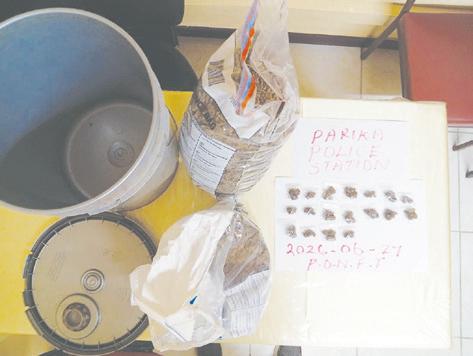
Parika labourer busted with ganja hidden in bucket
WeLead Conference "Everything that is inside you is your potential" –Minister Ramson encourages women to lead boldly





The Berbice Bridge will be closed to vehicular traffic on:
Sunday, June 28 – 15:35h–17:05h and Monday, June 29 – 16:20h–17:50h

Parika and Supenaam departure times – 05:00h, 10:00h-12:00h, 16:00h, 18:30h daily




Early morning sunshine is expected to give way to thundery showers lasting into the late afternoon. Skies may briefly clear before more thundery showers return overnight. Temperatures are expected to range between 23 degrees Celsius and 30 degrees Celsius.
Winds: East-North-Easterly to South-SouthEasterly between 2.68 metres and 4.91 metres.
High Tide: 15:35h reaching a maximum height of 2.30 metres.
Low Tide: 09:08h and 21:19h reaching minimum heights of 0.79 metre and 0.91 metre.











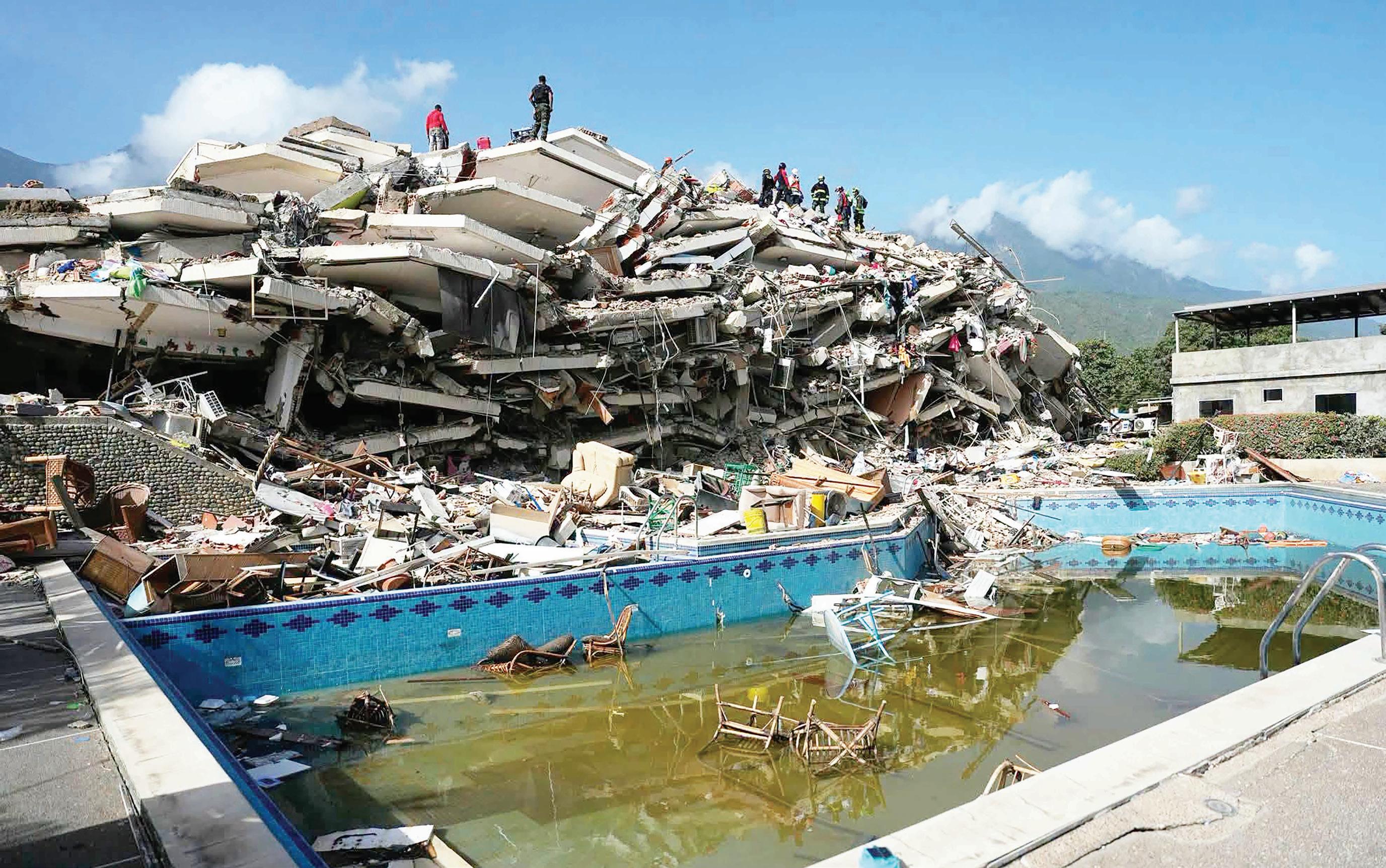
The Guyanese Government is organising a massive donation drive to mobilise humanitarian aid for the people of Venezuela following Wednesday’s 7.2- and 7.5-magnitude earthquakes that have devastated the neighbouring country’s capital.
Based on reports coming out of Caracas on Saturday, at least 1430 person have died, and thousands of others are missing and injured after the twin quakes collapsed houses and other buildings. Speaking at a briefing on Saturday from State House in Georgetown, President Dr Irfaan Ali described the destruction as unimaginable, assuring the Venezuelan people of Guyana’s strong support.
“We are responding to one of the greatest humanitarian needs as a result of a disaster in Venezuela at a scale and magnitude that is unimaginable. As good neighbours, we must reach out... The people of Guyana stand ready to support in whatever capacity we can,” the Guyanese leader stated. According to President Ali, an 8000-tonne vessel has been mobilised to transport the aid to the neighbouring country. The humanitarian aid donation drive will run from June 27 to July 1, 2026, and the dropoff location will be at the Muslim Youth Organisation (MYO) on Woolford Avenue, Georgetown.
The Guyana Defence Force (GDF) and the Guyana Civil Defence Commission (CDC) will be on-site 24 hours a day at the drop-off location to receive donations and package the items for shipment. Among the items needed are drinking water and non-perishable foods such as canned vegetables, beans, fruit, soup, tuna, chicken, dry pasta, rice, oats, cereal, peanut butter, shelf-stable or powdered milk, pasta sauce, canned tomatoes, crackers, granola bars, trail mix, instant noodles, boxed meals, baby food or formula, cooking oil, flour, sugar, salt, spices, tea, coffee and hot chocolate mix.
Personal hygiene items, including soap, toothpaste, toothbrushes, shampoo, deodorant, toilet paper, sanitary napkins, nappies and other essential hygiene supplies, are also required.
Additionally, sleeping items such as sleeping mats and/or mattresses, blankets and sheets, as well as flashlights, batteries, solar char-
gers and cutting equipment, are needed. It was noted that all donated items should be unopened, unexpired and in good condition. Moreover, easy-to-prepare foods and pop-top cans are especially encouraged.
Already, five containers of critically needed pharmaceutical items have been procured, as well as several containers of food items. However, much more is still required to fill the 8000-tonne vessel that will transport the aid. A second 7000-tonne vessel is also on standby if required. However, Guyana is also coordinating with other Caribbean Community (CARICOM) nations that are also interested in sending aid to Venezuela. St Vincent and the Grenadines has already mobilised three containers of humanitarian aid for Venezuela. According to President Ali, the aim is to have the vessel depart Guyana on Friday, July 3, 2026, for Venezuela.
GDF deployment
In addition to the humanitarian aid, the Commanderin-Chief of the Armed Forces also disclosed on Saturday that a GDF contingent would also be deployed to aid in the recovery efforts as Venezuelan authorities race against time to rescue survivors trapped under collapsed buildings. “We have offered to
have a team from the Guyana Defence Force on the ground to help in the recovery efforts in Caracas at this moment,” Ali revealed on Saturday.
Meanwhile, Prime Minister (PM) Brigadier (Ret’d) Mark Phillips will be leading and coordinating Guyana’s response and support efforts. Persons interested in making large-scale donations can contact his office, which will be open every day until the close-off time for the donation drive. A flyer is also being circulated online with additional information on this exercise. It was further explained that the vessel would be available by Wednesday to start the loading process.
While members of the public are encouraged to support these efforts, a special appeal is being made to the local private sector. Persons or companies that are interested in making donations of particular items, such as rice or food items, are being asked to coordinate and fill out a container of each category, which would work out to be more economical for shipping purposes.
“This is not an easy task. It’s an intense logistics operation, but we hope to have this done efficiently for our neighbours and the people of Venezuela. We are also a country with a large number of Venezuelan nationals who work here and who live here, and that community, along
with the general Guyanese population, would have reached out and is responding in an unbelievable way,” President Ali noted.
On Thursday, President Ali took to social media, stating, “We stand in solidarity with the people of Venezuela. As neighbours, we are ready to offer assistance within our capacity. Our love, prayers, and thoughts are with the families of those affected and the people of Venezuela.” His message was seen and welcomed by acting Venezuelan President Delcy Rodríguez, who expressed gratitude to President Ali after he extended solidarity and support following the disaster.
According to the Venezuelan leader, “We would like to thank Guyana’s President Irfaan Ali for his solidarity and his willingness to offer support to the Venezuelan people during these difficult times. His message conveys solidarity, respect and a sense of neighbourliness toward Venezuelans.” This show of solidarity and support between Guyana and Venezuela comes as the two South American neighbours are embroiled in a decades-long border controversy. The matter is currently before the International Court of Justice (ICJ), which is expected to deliver a ruling sometime later this year or early next year.



Editor: Tusika Martin
News Hotline: 231-8063 Editorial: 231-0544
223-7230,223-7231,231-0544, 225-7761
Marketing: 231-8064 Accounts: 225-6707
Mailing address: Queens Atlantic Industrial Estate Industrial Site, Ruimveldt, Georgetown
Email: news@guyanatimesgy.com, marketing@guyanatimesgy.com
After the PNC launched its co-op socialist economy after independence, successive Governments have attempted a shift to a free-market economy. This institution needs to be appreciated by our citizens as the PPP Government attempts to use its premises to develop our country – and ourselves.
The following is from a US Federal Bank: A market economy is an economic system in which individuals own most of the resources – land, labour, and capital – and control their use through voluntary decisions made in the marketplace. It is a system in which the Government plays a small role. In this type of economy, two forces – self-interest and competition –play a very important role.
Why do you go to work? Why do you go to school? There may be many reasons, but at their core, you probably go to work and school because you are self-interested. To be selfinterested simply means you seek your own personal gain. You go to work because you want to get paid so you can buy the things you want. You go to school so you can be qualified for a better-paying job someday to buy the things you desire. In fact, most economic activity we see around us is the result of self-interested behaviour.
Why does the baker choose to bake? The answer is selfinterest. The baker wants to earn enough money to feed his family and buy the things he wants, and the most effective way he has found to do that is to bake bread for you. In fact, his bread has to be good enough and the service friendly enough that you are willing to give up your money freely in exchange for his bread. The baker, while serving his selfinterest, has produced a product that is valuable to you. The miracle of a market system is that self-interest produces behaviour that benefits others.
Is being self-interested greedy? Is it immoral? While the term “self-interest” has negative connotations, it does not necessarily imply greedy or immoral behaviour. Self-interest just means that you seek your goals. In fact, your self-interest might lead you to study hard for your maths test, give money to your favourite charity, or volunteer at a local school.
Doesn’t self-interest lead to price gouging, corruption, and cheating? Sometimes it does, but most often it is held in check by competition. Because other self-interested people are competing in the marketplace, my self-interest is held in check. For example, if I were a baker, the only way I would be able to earn your dollars is to produce bread that is better, cheaper, or more convenient than the bread produced by the other bakers in town. If I were to increase my price too much, you would likely buy bread from my competitors. Thus, competition is the regulator, a check on self-interest because it restrains my ability to take advantage of my customers.
Adam Smith described the opposing but complementary forces of self-interest and competition as the “invisible hand”. While producers and consumers are not acting with the intent of serving the needs of others or society, they do. When you work, your goal is to earn money, but in the process, you provide a valuable good or service that benefits others and society. The amazing part of this process is that there is very little Government control. The bread you buy at the store arrived as the result of hundreds of self-interested people cooperating without a Government bread agency managing production at each step along the way. In the words of Adam Smith, it’s as if they were being guided by an invisible hand that directed resources to their most valued use.
The discussion of self-interest and competition usually results in a discussion of the proper role of Government regulation. Some see a market economy as largely selfregulating, assuming there are enough firms competing in the market to be a check on self-interest. Others point to examples of fraud where competition has failed to be an adequate check on self-interest – they argue that Government must take a more active role in regulating economic activity.” Hard work, not handouts, is the way forward.
President Dr Irfaan Ali hosted a reception in honour of the Prime Minister of Jamaica, Dr Andrew Holness, and his delegation on Friday evening. The Jamaican Prime Minister led a two-day state visit to Guyana

By Ryhaan Shah
ccentricity in our senior years refers to unconventional, quirky, or nonconforming behaviours that are fundamentally harmless and bring us joy. While sometimes viewed as odd by society, true eccentricity is a stable personality trait rather than a mental illness. It is, however, important to distinguish between endearing quirks and sudden, dangerous medical changes that would require attention.

Psychologists and geriatric experts suggest several reasons why these traits often become more pronounced in later life. As we age, social inhibitions and the need to conform to peer pressure often fade. Many of us reach a point where we prioritise personal comfort and our authentic selves over social expectations.
In older adults, “eccentricity” often refers to heightened or uninhibited personality traits rather than mental decline. While eccentric individuals are generally creative, nonconforming, and happy, these behaviours can intensify with age as social inhibitions drop or neurological changes reduce adaptability.
Studies show that reduced plasticity of the nervous system could make us less adaptable to new social norms to which we are unaccustomed, allowing for the continuation of lifelong behaviours and traits which could appear odd – or old-fashioned and endearing – in the new normal.
The lowered adaptability allows for the dropping of social filters that undergird conformity, and nonconformity is often a deliberate deviation from known routines or societal expectations. But those of us who are viewed as odd or eccentric – or even difficult or “own-way” – know exactly what we are doing and are simply choosing to express our true selves.
Notable seniors who have embraced their eccentricity include Maggie Kuhn, an American activist who founded the Gray Panthers movement when she was forced to retire at the mandatory retirement age of 65. She is well-known for the witticism “Old age is an excellent time for outrage. My goal is to say or do at least one outrageous thing every week.”
The loss of structured daily routines that comes with retirement, as in Ms Kuhn’s case, could also increase our solitude, which can result in the development of highly individualised daily habits that could be viewed as eccentric behaviour.
Such behaviour can grow out of a well-earned confidence that comes with ageing. We can become more decisive about our choices and sentiments and feel no need or pressure to conform, but to simply go our own way – a way to which we are probably more accustomed and with which we are more comfortable.
It is crucial to recognise, however, when benign eccentricity crosses the line into a medical condition, such as the onset of dementia or neurodegenerative diseases that affect the brain’s frontal lobe.
If we are fully aware of what we are doing and why, have healthy social connections, and enjoy our activities, then there is probably no harm in what may appear odd to others.
However, there could be a need for medical evaluation if our quirks become dangerous or actively impede daily living. Examples of this include a sudden lack of personal hygiene, severe and unsafe hoarding, extreme aggression, or losing the ability to recognise social situations.
If someone is exhibiting bizarre, inappropriate public behaviour such as stealing, making inappropriate sexual comments, or undressing in public, there would be a need to seek medical help. Someone having delusions or hallucinations, being confused, or living in squalid conditions could be experiencing a serious health crisis that requires medical intervention and treatment.
However, eccentric behaviours in older adults, such as mischievous humour, saying exactly what we feel or think without caring much about the reaction, teasing loved ones, or playing harmless pranks, could all be viewed as harmless oddities.
Some of us may take to dressing in a bolder, flamboyant style, this again being a result of the lowering of social filters that dictated more conservative dress to fit the norms and expectations of society.
For such harmless traits, the best approach for family, friends, or caregivers to take is to embrace the person’s habits and let them express themselves freely.
A well-known eccentric actually built a flourishing business empire on childhood fantasies and entertainment that appeal to both children and the child in all of us. That was Walt Disney, who said, “Growing old is mandatory; growing up is optional.” It’s safe to say he never grew up.
Disneyland and other playful experiences can help us all keep the twinkle in our wrinkles; and if there are passions and interests that bring us joy and do no harm to anyone, then we must surely keep on twinkling. If not now, when?

Dear Editor,
I am writing in my private capacity to respond to the article in the Kiskadee Watch dated June 27, 2026, and captioned “APNU wants independent survey of squall damage”.
Let me begin: a squall hit the Essequibo Coast, creating much damage to many buildings. I agree that there needs to be transparency and proper oversight, especially when public resources are being used, but I have to say I am troubled by the fact that they chose to use Mr Dennis Jaikaran as their voice on these matters.
Let me be clear. I am not throwing around accusations here. I am relying on the auditor general’s report for 2019 to arrive at my concern and conclusion. That report paints a very troubling picture of the Region Three Administration when Mr Jaikaran was the Regional Executive Officer, the actual Accounting Officer for that region. Under his watch, the Regional Administration could not even provide basic records to show whether people living in Government quarters were actually enti-
tled to be there.
Forty-three out of 59 occupied buildings were occupied by persons who were never declared to the Office of the Auditor General. That is what the report highlighted. The administration could not say who was entitled to rent-free accommodation or explain why rent was not being collected. This is not some small clerical error. This is a total failure of management and accountability in Region Three during his tenure as the chief accounting and executive officer.
We all know the rules. Public servants in Government quarters have to pay rent unless they have special approval (in writing) for free accommodation. But under Mr Jaikaran, the Region Three Administration could not even produce the documents to show who was supposed to pay what. The Audit Office had to step in and tell them to get their act together, and yet upon his departure, he could not account for this mess (see the 2020 audit report). This is the man who is now out there talking about
good governance and accountability.
Now, just two days after the squall, Mr Jaikaran is out there questioning damage assessments and raising concerns about construction quality. Two days. Is that genuine concern for the people of Region Two, or is it just a quick attempt to grab a headline? In times like these, we should be focused on getting help to people who need it, not rushing to the press to score points.
The Fiscal Management and Accountability Act sets out how emergencies are funded. When monies are taken from the contingency fund, it has to go to the National Assembly for clearing. That is when the scrutiny happens. That is the proper time and place – not a press conference two days after a disaster. This sort of behaviour is most unfortunate.
I am not saying we should ignore the concerns about the damage. The people of Region Two need help, and they need it fast. His Excellency President Irfaan Ali has shown that he will do whatever he can to assist,
but he has to work with the system we have. And that system depends on the people in the public sector.
I would like to humbly recommend the University of Guyana’s Engineering Department and the Institute of Chartered Accountants of Guyana as two independent agencies that are suitable candidates to help the national efforts with the monitoring and evaluation part of the project. That would bring some independent technical expertise to the table and give people confidence that the work is being done right. But let us be honest about Mr Jaikaran. With his track record, he is not the person to be lecturing anyone on transparency or accountability. If APNU, the smaller of the two main opposition parties in Parliament, is serious about these issues, they can find better people to speak for them.
Let us focus on helping the people of Region Two and leave the cheap theatrics for another day.
Yours sincerely, Sasenarine Singh
Reference is made to an article on page 8 of Kaieteur News, Thursday, June 25th, 2026, bearing the caption “Doctors fired over toddler’s death quietly rehired by Ministry of Health, placed at Diamond hospital.”
The first paragraph of the said article alleges that “the Ministry of Health has reportedly rehired two doctors terminated by the Georgetown Public Hospital Corporation (GPHC) for gross negligence.” Please be informed that while the contracts of the two doctors named in the article, Dr Marissa Seepersaud and Dr Yala Gomez, were indeed terminated by the Georgetown Public Hospital, the terminations were executed in accordance with the terms of
each contract, and the two doctors were paid in full, all their benefits, including salary, gratuity, allowances, vacation allowance, monies for leave earned under the contract, along with salary in lieu of notice.
For the avoidance of doubt, neither contract of employment was terminated for gross negligence as alleged in the article or at all. You must be aware of the damning impact your allegations have, if left unanswered.
In the circumstance, we request that the appropriate correction and or retraction be made by you at the earliest next opportunity and that the same be accorded the same prominence which the offensive article enjoys.



Imagine being a tiny baby snail in the huge ocean. You float around for months before finding a safe place to grow into an adult. That’s what happens to Kellet’s whelk babies – just like to thousands of other marine species.
But something interesting is happening. In the past, Kellet’s whelks lived only in the warm waters of Southern California and Mexico. In recent years, some have moved 300 kilometres north, where the water is colder.
Like all living things, snails have DNA . DNA contains genes – special instructions that make each living thing unique. It’s why you and your friends might have different hair colours. Sometimes, DNA changes. These changes are called mutations. Occasionally, a mutation helps an animal survive better in a new environment. Scientists call this adaptation
So how can you tell if an animal has adapted? Sometimes it’s easy
to see. For example, polar bears have white fur to blend in with snow, while brown bears in woody forests have darker fur. But Kellet’s whelks are trickier – the northern and southern snails look the same on the outside. To spot differences, you’d need to look at their DNA.
Scientists wanted to find out if northern snails
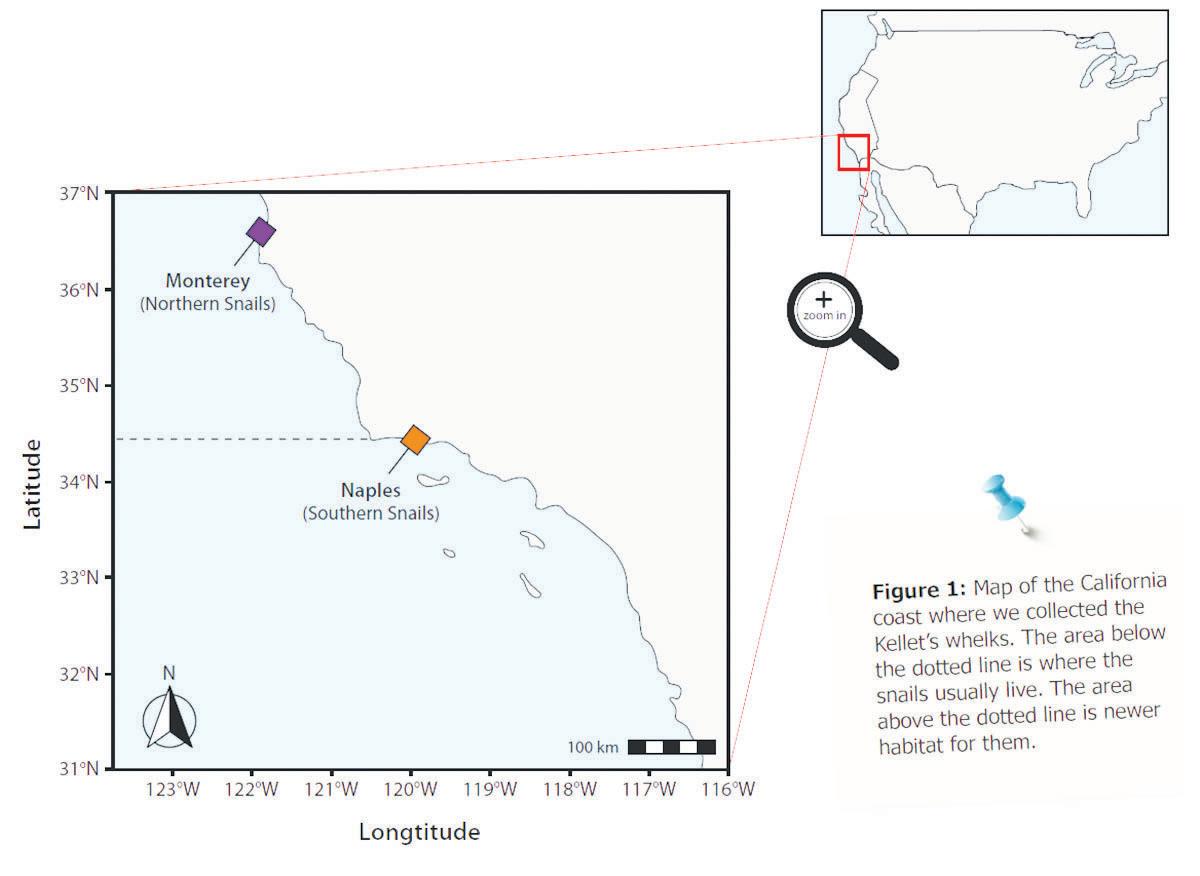
had adapted to colder water. To do this, they compared the genes of snails from the north and the south.
They collected Kellet’s whelks from different places along the California coast: Southern snails from warmer waters Northern snails from colder waters farther
up the coast
They were brought to a special aquarium and kept in identical tanks. They all had the same water and food. Then, scien -


tists waited for them to have babies, called larvae.
They studied the babies’ DNA because they had all grown up in the same environment. That way, any differences they found had to come from their genes –not from where they lived before.
When they compared the DNA, there were lots of differences. Northern snails had 2770 genes working differently, and 64 per cent of those genes were more active. That means they were doing more work in the snails’ bodies.
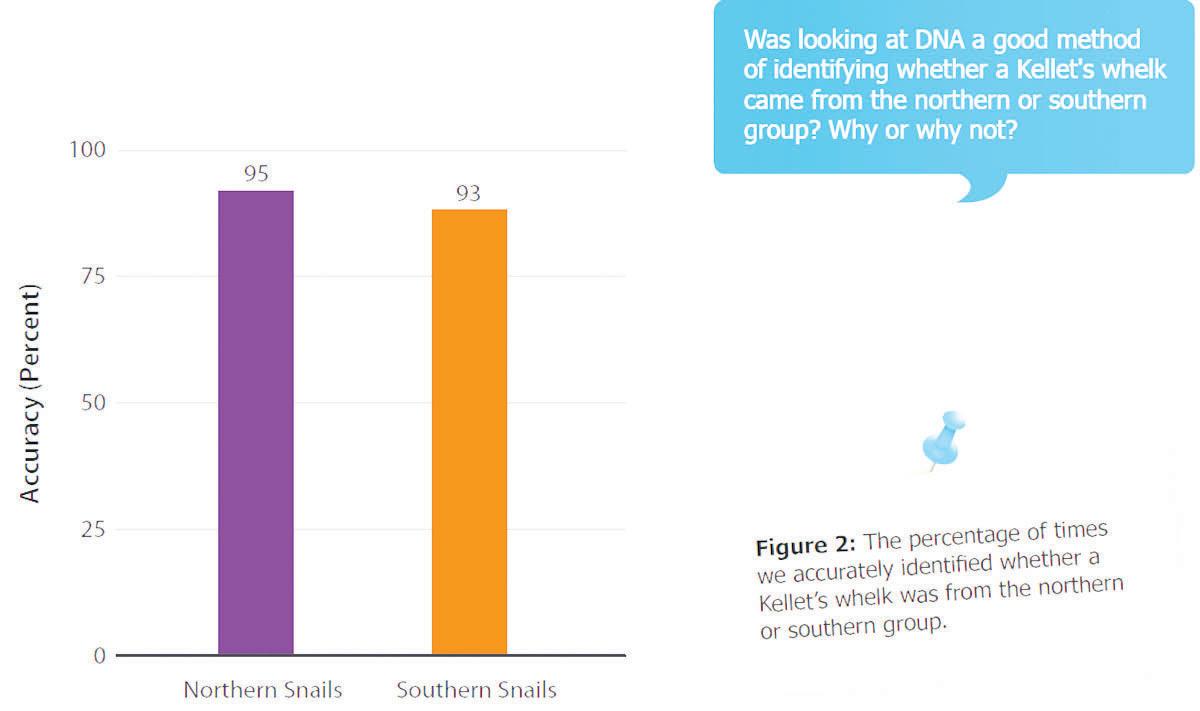
These differences were so clear that scientists could tell whether a baby snail came from northern or southern parents just by looking at its DNA, with 95 per cent accuracy for northern snails and 93 per cent for southern snails!
This suggests that northern snails have adapted to their colder environment. Their genes have changed over time. If they hadn’t, we wouldn’t be able to tell them apart.
Climate change is causing many animals’ habitats to change. But why did the snails move north in the first place?
One important change involves a gene that makes a protein called TPI. This protein helps snails turn food into energy. That’s especially important in cold water, where their bodies work more slowly. Northern snails have a more active version of this gene, helping them stay energised.
This study shows that even ocean animals, whose babies drift long distances, can adapt surprisingly quickly. Kellet’s whelks may look the same on the outside, but their DNA tells a different story.
Climate change is affecting where many animals can live. Studies like this help scientists understand how species respond – and how we can protect them. Kellet’s whelks are also eaten by people, so this research can help make sure they are not overfished.
The ocean is always changing, and the animals in it must adapt to survive. We humans can learn something from that, too. When life changes – like moving to a new school –it can feel scary. But it can also be a chance to grow. Ask yourself: “What can help me succeed here?” And don’t forget – you can also help others who are new feel welcome.
(Sciencejournalforkids)
Changing ocean currents carried some baby snails farther than usual. Sometimes, warmer water currents helped them survive in colder areas. Some snails already had helpful genetic differences that made it easier for them to handle the cold. Those snails survived and had babies, passing on those helpful traits.

The United States (US)based Lindsayca, the company building Guyana’s highly anticipated Gas-to-Energy (GtE) project, is reaffirming its commitment to conducting lawful and transparent operations. This comes as the company responds to a series of attacks in the local media, which it describes as false accusations, incomplete information, and misleading narratives regarding its operations both in Guyana and in the US.
“We categorically deny these allegations,” Lindsayca declared in a statement on Wednesday, expressing its suspicions about the timing of these publications. “We also find it noteworthy that these attacks have intensified at a time when multiple competitive bidding processes are underway. While we will not speculate beyond the facts, we believe it is important to recognise that misinformation can serve the interests of parties seeking to undermine legitimate competition and proven performance,” the missive detailed.
Lindsayca is currently constructing the GtE Project, which comprises a
300-megawatt (MW) combined cycle power plant and a Natural Gas Liquids (NGL) facility being built at Wales, West Bank Demerara (WBD), in the first phase.
As part of Phase Two of the GtE Project, the Guyana Government plans to utilise the excess natural gas that will be piped onshore from the prolific Stabroek Block for a number of industrial projects at the Wales site, including a fertiliser plant.
Lindsayca Guyana Inc. was among 10 companies that submitted proposals back in March to design, engineer, construct, and operate an ammonia/urea plant at Wales. Additionally, the US-based company has also entered the race to design, build, and operate a cooking gas bottling facility at the Wales site.
Nevertheless, Lindsayca pointed out in Wednesday’s statement that it has served as a trusted Engineering, Procurement, and Construction (EPC) provider for the power generation and oil and gas industries for more than 40 years, delivering complex infrastructure projects with safety, quality, and accountability at the centre of everything
it does.
“Throughout our history, we have successfully executed more than 140 EPC projects across the Americas and have worked in more than a dozen countries. Our track record has been built on performance, transparency, and long-term relationships with clients, partners, suppliers, and communities. We are proud that, in many cases, clients have repeatedly entrusted Lindsayca with additional work based on the results we have delivered,” it posited.
According to the company, it operates under a transparent management system covering quality, safety, compliance, and human resources. Lindsayca went on to add that its processes are documented, auditable, and aligned with international standards. This, it noted, includes extensive recruitment and interview procedures, proper documentation, and internal controls designed to ensure fairness, accountability, and compliance with applicable laws and regulations.
“Our position is clear: Lindsayca’s only purpose is to fulfil its responsibilities, honour its commitments, and provide our clients with concrete solutions that meet international standards,” the company emphasised.
Guyana operations
When it comes to its oper-

ations in Guyana, Lindsayca said they are fully cooperating with the Government of Guyana and are in the process of submitting all requested documentation.
“We are confident that the facts, records, and evidence will demonstrate the truth and confirm Lindsayca’s commitment to lawful, responsible, and transparent operations. Despite these distractions, our teams remain focused on the work. We continue to move forward with discipline, professionalism, and determination to deliver a world-class facility for the benefit of the people of Guyana,” the company stated.
Lindsayca further noted that it “will always defend its reputation with facts, not speculation; with transparency, not rhetoric; and with
performance, not distractions.” Wednesday’s statement from the company comes just a few months after it gave similar assurances, especially regarding the transparency of its supply chain, which it said is run by a globally recognised system that cannot be manipulated.
This was in response to reports of “highly irregular and deeply troubling manoeuvres” in the award of subcontracts for the project. However, Lindsayca explained that their supply chain management platform is run by a data processing programme – Systems, Applications, and Products (SAP). This Germanfounded, multinational software company is famous for creating the Enterprise Resource Planning (ERP) software that helps busi-
nesses manage finances, logistics, human resources, and supply chains in real-time.
Currently, construction is progressing at the Wales site, where Lindsayca is accelerating works to deliver the power plant by this year’s end. Only recently, the contractor successfully installed all four heat-recovery steam generator (HRSG) bypass stacks.
“Activity continues across the site as progress advances on multiple fronts,” the company said last month, adding in another update on June 5, saying that “...many efforts are taking place simultaneously across the GtE Project, from structural works and substation activities to the installation of major equipment.”

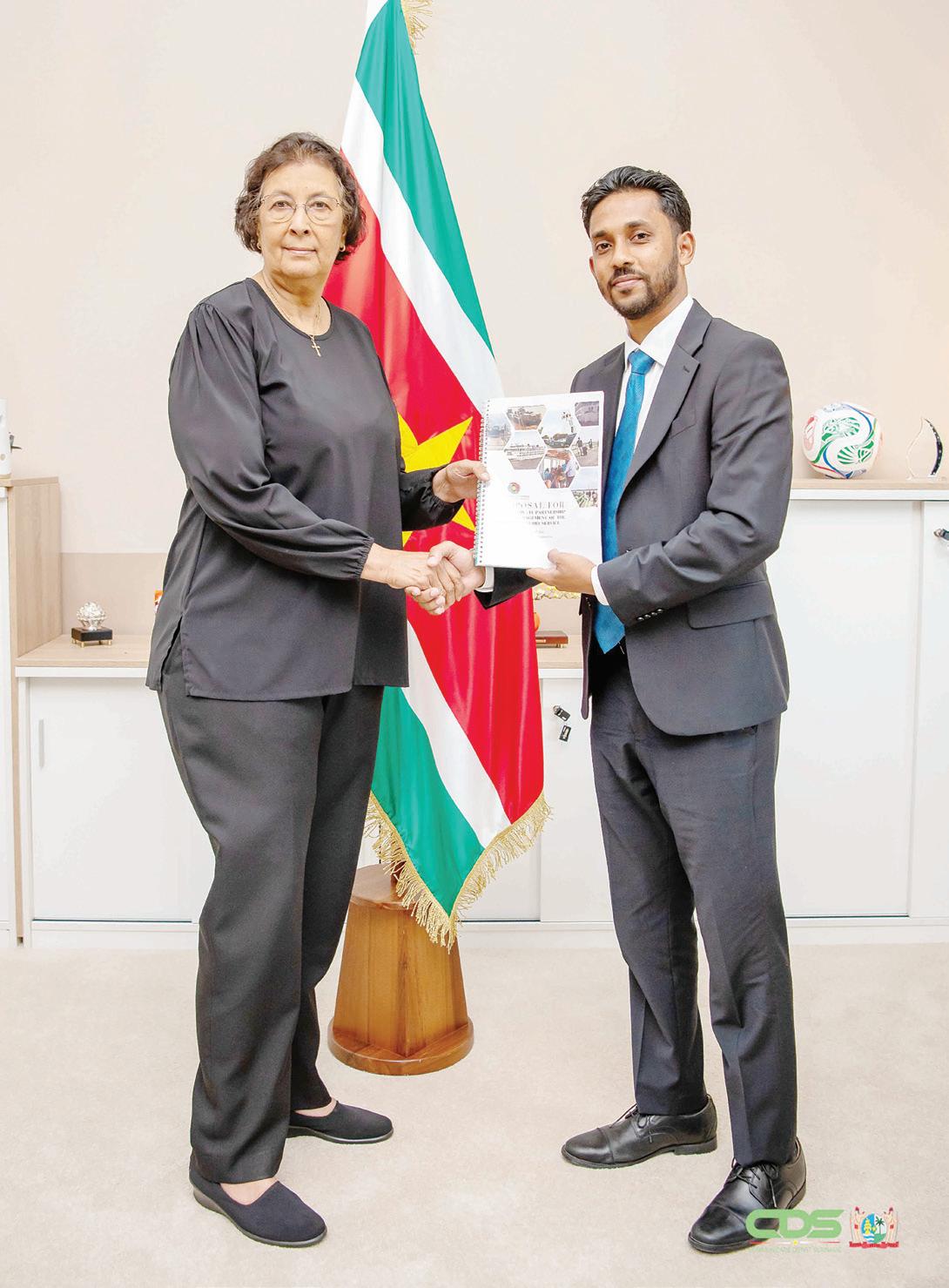
Opportunities to potentially expand bilateral trade, facilitate investment and improve connectivity are being highlighted to further strengthen economic cooperation between Guyana and Suriname.
These issues were among strategic priorities pre-
sented to the Surinamese President, Jennifer Geerlings-Simons, by the Board of Directors of the Suriname-Guyana Chamber of Commerce (SGCC) during a recent engagement held in Paramaribo.
According to SGCC, the engagement reflected a shared appreciation for the
longstanding relationship between the two neighbouring countries and the importance of deepening collaboration in ways that deliver tangible benefits for businesses, investors and citizens.
“Discussions focused on practical opportunities to expand bilateral trade, fa-
cilitate investment, improve connectivity, strengthen institutional cooperation and support sustainable economic development. There was broad recognition that Suriname and Guyana possess complementary strengths and are well positioned to build one of the Caribbean’s most dynamic economic partnerships,” the Chamber stated in a missive on Saturday.
As part of the meeting, the Chamber presented its vision for the fourth International Business Conference (IBC) Suriname to be held in October 2026, positioning the event as a strategic platform to convene Government leaders, investors, development partners and the private sector. The conference is expected to catalyse new partnerships, support investment promotion and showcase emerging opportunities across Suriname, Guyana and the wider region.
One day after confessing to killing his wife and dumping her body in a trench at De GrootEnkline, Uitvlugt, West Coast Demerara (WCD), the suspect's lifeless body was found in his cell at the Leonora Police Station on Saturday.
Forty-four-year-old Hemat Kumar Mohamed of lot 645 De Groot-Enkline, Uitvlugt (WCD), was accused of murdering his wife, 46-year-old Shavannie Hanoman, on June 24, 2026. Her body was later found submerged in a canal a short distance from where they lived the following day. As such, the suspect was arrested and escorted to the Leonora Cottage Hospital, where he underwent medical treatment and was admitted. He was subsequently discharged and placed in
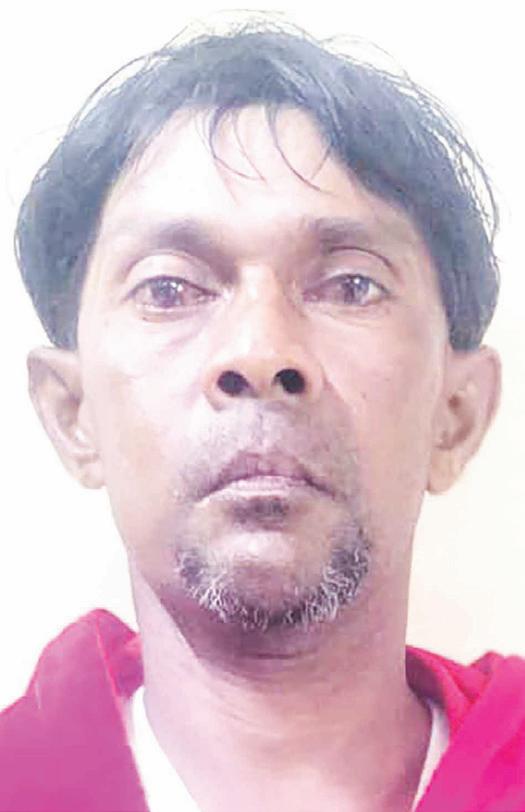
44-year-old Hemat Kumar Mohamed
a cell at the Leonora Police Station. According to reports received, at 11:24h on Saturday, his son Rajkumar Mohamed took lunch for him, and as he made his way down to the station lockups, he called out to his father but got
no response. He later discovered his father hanging from a white vest that was tied to the grill of the window. An alarm was raised and an investigation was launched.
It was reported that Hanoman, also called "Bo," a housewife, was reported missing after she failed to return home on Wednesday.
On Thursday at about 08:30h, residents discovered her body floating in a trench in the community and alerted Police. According to Police, an examination revealed injuries to her neck and other parts of her body.
While being interrogated, Mohamed related that his wife told him she would be returning home late and did not want him accompanying her; he followed her on his motorcycle. He told investigators that he confronted her at a bridge, where an argu-
ment developed.
"I just jook she two times," he reportedly told investigators during his confession. Police said Mohamed admitted that after being shoved during the confrontation, he took out a knife and stabbed Hanoman twice – once to the chest and once to the chin –before pushing her into the trench. He also told investigators that the knife fell at the scene.
After the confession, Mohamed accompanied investigators back to the scene, and he escorted them to a wooden bridge at De GrootEnkline, where he indicated the location where he allegedly stabbed Hanoman and pushed her into the trench. Mohamed remained in custody until the time of his demise. An investigation is underway into the circumstances leading to his death.
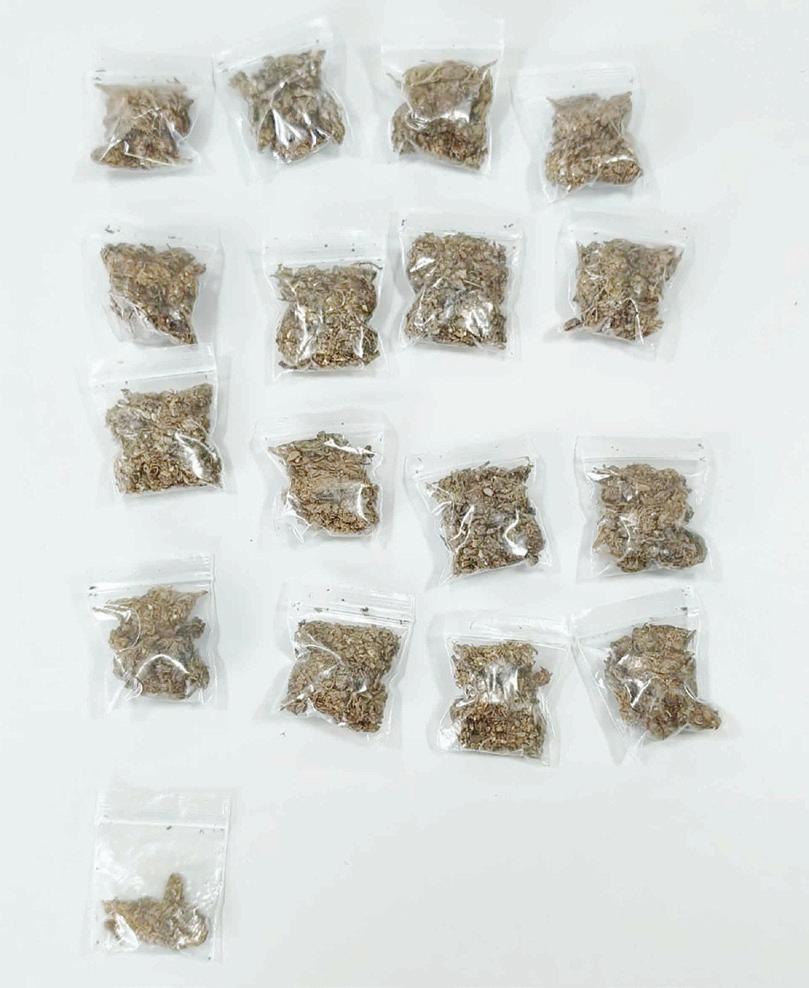
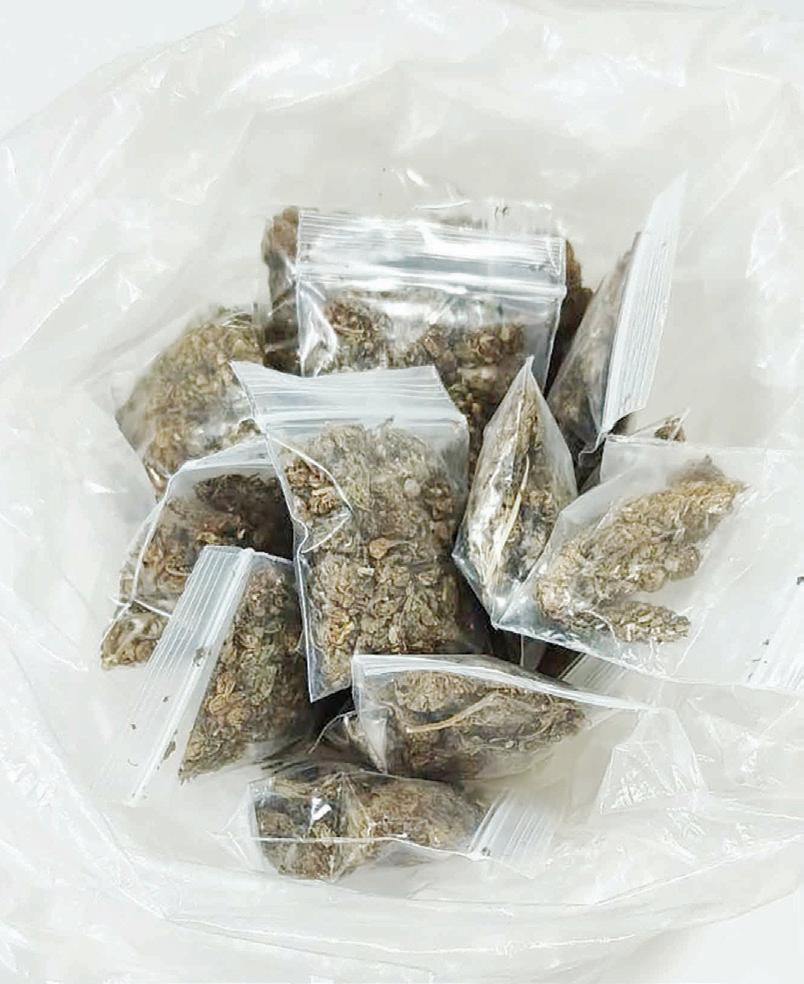
A45-year-old farmer of Swan One Mile Turn, Soesdyke-Linden Highway, was taken into custody on Friday following the discovery of a quantity of ganja during a Police patrol in the vicinity of Soesdyke Junction, East Bank Demerara (EBD).
During the Police operation, a search was conducted on his person, during which a haversack was found containing one transparent plastic parcel with 17 Ziploc bags containing the cannabis.
As such, he was arrested and taken to the Timehri Police Station, where the cannabis was weighed and amounted to 66 grams. He remains in custody as investigations continue.


Your Eyewitness is quite impressed with the number of initiatives that have been unfurled by Pressie with our CARICOM cohort Jamaica during the visit by their PM Holness. Maybe he might’ve missed the announcement, but this 2-day state visit by Holness on his way back from that O&G business gathering in Suriname – where the latter bunch of ingrates insulted us once again with their passiveaggressive flag gesture – has been a pleasant surprise!! Especially with the welter of MOUs signed in several areas to advance collaboration between our two countries –including but not limited to the areas of energy, tourism, finance, defence, agriculture, etc.
Holness summed up our relationship rather succinctly: “It is very much clear that Jamaica and Guyana are very much aligned, and we have a similar outlook on the world and a similar understanding of the changing dynamics and the new nature of global politics, but we also share a very positive outlook on our economic prospects.” For his part, Pressie emphasised, “We believe that we have found a common path in many areas and look forward to a stronger, relentless, resilient and sustainable partnership with the government and people of Jamaica.”
On the “global politics” front, this was exemplified last year after US Secty of State Rubio visited Jamaica over the issue of Cuban doctors. In a realpolitik manner, Holness didn’t try to score points like Barbados’ Mottley – who mounted her high horse – but pragmatically signalled the need for change in Cuba and explained – or our Pressie also did – that our arrangement didn’t involve direct payments to the Cuban government!! Jamaica is our largest CARICOM partner and, along with T&T, could help shape the ongoing realignment of hemispheric power relationships with the US as a key ally.
Let’s not make any bones about it – in the coming year with the ICJ scheduled to deliver our victory over the Venezuelans in the controversy they created over our Essequibo border – we’re going to need diplomatic support!! But not of the equivocating type of the likes of Mia Mottley!! And as far as our local politics are concerned, how can we forget the contribution to our discourse by former Jamaican PM Golding, who dubbed Granger a “Sanctimonious Gangster”!!
Rather concretely, there’s an agreement on where to build 300 houses in Jamaica – with our wood and expertise!! Our timber products were once a mainstay in our exports to the Caribbean – and maybe this will be its resuscitation –in value-added form!! Reciprocally, while we mightn’t have their surf and sand, their hotel services are second to none – and we can learn!
Now if they could offer some tips on how they’ve marketed their culture globally, where even in Japan reggae’s a rage – we’ll be set!!
…common cause back then Now Jamaica and we share a lot!! Hadn’t Burnham and Manley struck their leftist pose and decided we were going to feed ourselves back in the day?? Were they talking about “food security” before there was “food insecurity”?? Naah… they were just reacting to their economies imploding and didn’t have the foreign exchange to import the foods we’d been weaned on. And craved. After all it wasn’t apocryphal that Burnham cried out for “condensed milk” on his death bed, was it??
Anyhow, while there’s nothing wrong about growing our own food and moving off “foreign foods”, what they attempted was an ancient economic notion called “autarky”! Your country has to be completely self-sufficient and become an island (no pun intended) unto itself!! This had been debunked by the “free trade” theory, where countries concentrate on things they have (or can acquire) a comparative advantage in – produce and export those things – then use the foreign exchange earned to buy WHATEVER else is desired!!
We should ask Jamaica about producing Irish potatoes right now – but at EIGHT TIMES the imported price!!
…sinecures
UG’s been around for 60+ years, yet many graduates can barely read and comprehend beyond primary school level?? Gotta end tenure where no one’s fired!!


An investigation has been launched into a collision involving a fire tender and a motor vehicle attached to the Housing Ministry at the Guyana National
Stadium, Providence, East Bank Demerara (EBD), on Saturday.
Enquiries disclosed that a 50-year-old leading fireman attached to the Guyana Fire Service (GFS) was driv-
ing the fire tender at the time, and as he attempted to exit a gate from the eastern side of the tarmac, the fire tender came into contact with a portable light pole, which then struck the sta-

tionary motor vehicle that was parked on the tarmac.
As a result, the motor vehicle sustained damage to the right-side driver’s door and fender.
During the course of the
investigation at the scene, a commotion occurred involving the driver of the fire tender, Police ranks, and other GFS ranks.
The commotion reportedly stemmed from efforts to
have the driver accompany ranks as part of the investigative process. The situation was subsequently de-escalated. Investigations are ongoing.



Baytoram Ramharack’s release of his book, “The Wismar Massacre: A Case of Ethnic Cleansing of Indians in Guyana”, coinciding with our 60th Independence Anniversary commemoration, has unleashed a new wave of narratives and histories of the 60s when that independence was birthed. I would like to emphasise, however, as I have done over the past few decades, that histories are not only written within a particular “space of experience” –the ways that the past is remembered in the present – but also with a “horizon of expectation” – the anticipation of the not-yetknown future beyond the horizon. The pertinent question for the interlocutors is what kind of future they are trying to create with their narratives.
A history of our present, in the words of Caribbean anthropologist David Scott, demands that “histories of the past ought to be interventions in the present, strategic interrogations of the present’s norms as a way of helping us to glimpse the possibilities for an alternative future.”
Somehow our narratives now circulating about the events in Wismar during May 1964 just keep looking backward at what was “then”. But our “problem space” – the threats and opportunities that confront us in our present sociohistorical conjuncture – is radically different. At a minimum, the “us” and “them” of the narratives during the ethnic violence of the 1960s, as the PPP and PNC struggled to inherit governance of our country, has radically changed. The new demographics demand rationally that political parties mobilise across the old ethnic divides for a “One Guyana” to gain political power.
What then should be our “horizon of expectation”? Our interlocutors should note that criticism is always strategic. What is it they want for our society as a consequence of their criticisms, narratives, actions, and exhortations? What, in a word, is their “good”? While there will never be an identical horizon of ends for all of us because of our inherent diversity, I am hoping that among the various possibly competing ends, that of a more harmonious society would be common to all formulations. I am suggesting that with the privilege of hindsight, we should reject the assumption of retrospective determinism and connect the past with the present in a broader narrative that is healing rather than destructive. We cannot change the past, but we do not have to repeat it and can then change the future.
Our horizon of expectation must generate strategies that speak to our normative end of living together in a truly independent Guyana rather than further dividing us as some seem determined to do. A constructive narrative cannot then picture our opposing groups locked forever in mortal combat. John Paul Lederach’s definition of “constructive social change” should recommend itself to us: “the pursuit of moving relationships from those defined by fear, mutual recrimination, and violence toward those characterized by love, mutual respect, and proactive engagement.”
Lederach has advised that “transcending violence is forged by the capacity to generate, mobilise, and build the moral imagination.” We must recognise the complexity of relationships and not fall prey to an “us vs them” mentality. During the violence of the 1960s, there were always accounts of those who risked their lives to help the “other”: there can be no “dualistic polarity” as advocated by our revisionists. Moral imagination is a matter of creating links between memory and vision and is, to a large extent, the vocation of communities. As I have often mentioned, the plots of the Indian Mahabharata War between the Pandava and Kaurava cousins and Hegel’s famous interpretation of Antigone as the paradigmatic Greek tragedy might be particularly apt to our situation.
In this narrative, both “sides” are morally right: the conflict is not between good and evil but between “goods” on which each is making an exclusive claim. Isn’t this the situation that our mutually exclusive narratives of victimhood, with their facile binary oppositions in a zero-sum struggle, have delivered us into –which, ironically, neither political nor economic competition now demands? The plot of our narrative should suggest compromise rather than a battle of one side overcoming. That would be a constructive narrative for our time, place, and circumstances after Independence 60.
By shifting the meaning of the past through a differential emphasis on particular events, we can transform how we act in the present. The past may not literally exist – any more than the future does – but it can live in its consequences based on our narratives. Our past was not all hate or division.











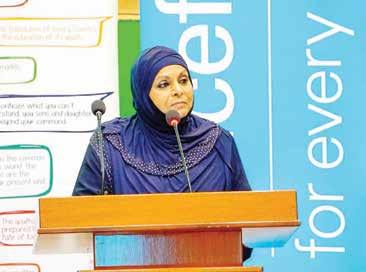
The Rights of the Child Commission (RCC), in partnership with UNICEF and the Office of the Director of Public Prosecutions (DPP), has launched a National Child Protection Awareness and Prevention campaign titled “SEE. SAY. SAFE.", aimed at strengthening public awareness on child safety and encouraging early reporting of abuse in Guyana. The campaign aims to equip both children and adults with the knowledge needed to recognise and respond to unsafe situations, as well as support the prevention of child sex-
ual abuse. The nationwide effort will utilise radio, television, social media, schools and community outreaches to reach children and families across the country.
“Many children who experience harm do not speak about it, often due to fear or uncertainty. This campaign is about ensuring that children feel safe to speak and that adults are prepared to listen, respond appropriately, and take action,” said Ms Aleema Nasir, Chairperson of the RCC. Over the coming months, the campaign will focus on helping adults recognise the signs that a child is being abused and
adopt protective and safeguarding practices in order to better ensure children’s safety, teaching children about safe and unsafe behaviours, addressing stigma that prevents disclosure and promoting clear and accessible reporting pathways. The initiative also emphasises that abuse can occur in familiar environments and that all children, including boys, deserve protection, support and belief. UNICEF Child Protection Specialist in Guyana Dr Loria-Mae Heywood noted that "when families and communities are informed and respond appropriately, children are safer," while adding that the campaign strengthens the link between awareness and action.
Noting that early intervention plays a critical role in protecting children and supporting justice processes, Assistant Director of Public Prosecutions (ADPP). Teshana Lake stressed the importance of prompt reporting of such serious matters to the Guyana Police Force (GPF). “Timely reporting in sexual offences helps to preserve evidence, and it allows survivors to


ed to participate in a short anonymous survey online to help stakeholders better understand awareness levels and enhance child protection services. The RCC, UNICEF and the Office of the DPP, along with key stakeholders, are encouraging all members of the public to take part in the campaign by looking out for trigger signs that a child is being abused, listening to children, and reporting concerns to the appropriate authorities like the Childcare and Protection Agency (CPA) on the 914 hotline or the nearest police station.








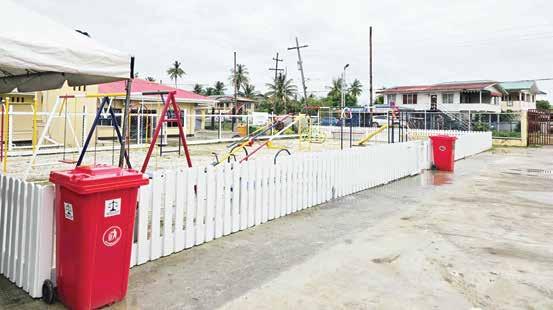
Children in the Fort Ordinance community, Region Six (East Berbice-Corentyne), now have a modern and secure place to engage in co-curricular activities with the commissioning of the $3.2 million play park on Friday. The project spearheaded by the Rotary Club of New Amsterdam was financed entirely through funds raised from its Fish Fry, Barbecue and Expo Cocktails fundraising events. Located adjacent to the Fort Ordinance Nursery School, the fenced facility is equipped with swings, seesaws, slides,
that the play park was intended to become a place where children could build friendships, create lasting memories and simply enjoy being children in a safe environment.
“This park is a place where laughter will fill the air, friendships will be formed and memories will be created for years to come,” he said. Hansraj noted that the successful completion of the project demonstrated what could be achieved when people united behind a common vision of service. “We stand here as a reminder of what can be achieved when peo-
hope and unity, Hansraj urged the community to view it as an investment in the future.
“As we officially commission this play park, let it serve as a symbol of hope, unity, and the belief that when we invest in our children, we invest in the future,” he said. He concluded by encouraging the community’s young people to dream beyond perceived limitations. “May this park bring joy to all who visit, and children always remember that the sky is not the limit,” Hansraj said.
Remarks were also delivered by the chairman

climbing equipment, benches and other play structures, creating a secure recreational environment for children in the community. Speaking at the commissioning ceremony, President of the Rotary Club of New Amsterdam, Roopnarine Hansraj, said the project represented far more than the construction of another recreational facility. “Today, we celebrate more than the opening of a play park. We celebrate an investment in our children, our families, and our community,” Hansraj said. He explained
ple come together with a shared vision to serve others,” he said. Thanking everyone who contributed to making the project a reality, Hansraj said the generosity and commitment shown by supporters had created a lasting legacy that would benefit generations of children. “To everyone who contributed to making this project a reality, thank you for your commitment and generosity. Your efforts have created a lasting impact that will benefit generations of children,” he said. Describing the facility as a symbol of
of the Fort Ordinance Neighbourhood Democratic Council (NDC), Ramsundar Phagwah, and the headteacher of the Fort Ordinance Nursery School. The play park formed part of the Rotary Club of New Amsterdam’s major community projects for the outgoing Rotary year. Over the years, the club has undertaken numerous initiatives across Region Six in the areas of education, health, youth development and community enhancement, reflecting Rotary’s long-standing motto of “Service Above Self”.

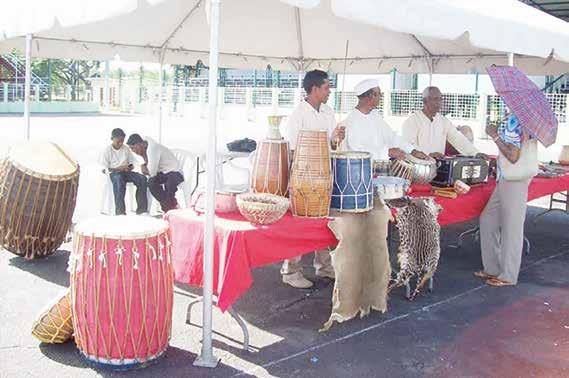
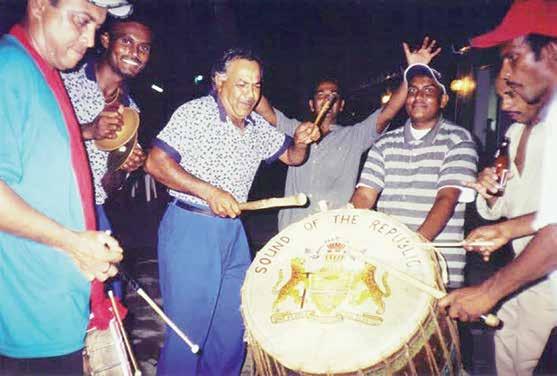
“Tam-tam… boomboom…” That is the sound of the historical Tassa drum, beating like a heartbeat across Guyana’s cultural landscape for more than half a century.
Rising from a fami ly-run workshop at Richard’s Town, Lusignan, East Coast Demerara (ECD), the tradition has helped shape the nation’s rhythmic identity since the 1960s.
From Raghu’s Tassa Tadja and Craft, thousands of handcrafted drums have been produced and generations of players trained, carrying the sound of tradition far beyond local yards and into communities across Guyana and the diaspora.
The Guyana Times caught up with 42-yearold Akhilanand Raghunandan, the leader of the tassa drum group, who explained the deep history and rise of the band.
identify as tassa drummers, most only use tassa drums alone.
He described the instruments as large, likening them to the size of rum barrels.
tassa drumming, many of whom continue to perform today, with some going on to become well-known musicians.
“We are probably the only group that still plays
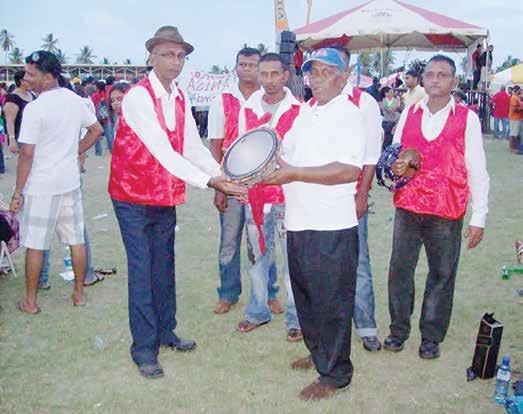
He said that since the 1960s, the group has been in operation, using both tassa and taja drums as its primary instruments. He noted that while many other bands
ther explained that, in addition to crafting new drums, the group also repairs instruments made primarily from goat skin and deer skin.
Over the years, he said, they have trained between 2000 and 3000 people in
main themes and repairs drums. The Tassa drum is the big one. At one point in time, it represented almost everything around Guyana. It was usually associated with Muslim gatherings, and it was once very active in Guyana. It was

even banned at one point by pandits, but in places like Trinidad it still thrives… Over time the drum evolved into something that represented all races – Indian, African, Chinese, and others. When that drum sounded years ago in Guyana, it brought everyone together.”
dition’s international reach.
In fact, he and his father are currently setting their sights upon teaching the history of Tassa drums and the contributions his family has made in the realms of Tassa making – in their very own book.
“My father is now in his late years. He has been playing drums for over 60 years, and he was award-
segregation in Guyana and so on,” he said, noting that tassa drumming events often brought African, Indian, and other communities together in shared cultural expression.
He also reflected on his pride in the group’s work, particularly its efforts to preserve traditional techniques while adapting to modern materials. He said the organisations have trained many young people, often from difficult circumstances, using music as a form of structure, discipline, and opportunity.
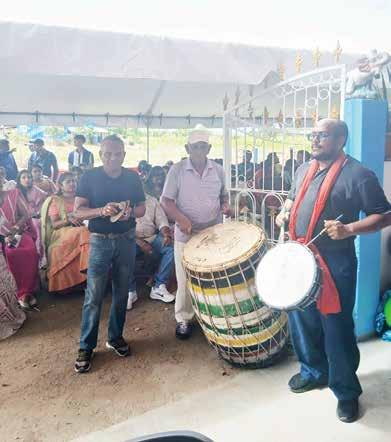
years the group has pro duced thousands of drum sets for clients and cultural groups across Guyana, as well as for export to North America and other regions.
He noted that during his days of studying at university he recalled that the drums were taken there and introduced within academic and cultural spaces. He also relayed that there was one early instance of Guyanese drums being introduced in Cuba through scholarship-linked cultural exchange.
Following this, he said, other countries began adopting similar practices, with drum-making and cultural exchange extending to parts of Africa, including Gambia, Ghana, Egypt, and Morocco. He explained that Guyanese drums were shared with groups in these regions, helping to elevate their cultural visibility internationally. He added that this period of expansion and exchange took place between 2004 and 2009, marking a significant phase in the tra-
have been playing for the last 40 years, and I have worked alongside him throughout. We have played drums in all parts of Guyana and outside of Guyana as well. He is well known in cultural circles as Teacher Raghu, and when he goes to the ministry, everyone knows who he is.”
He noted that despite periods of decline in recognition, the tradition survived through families who continued to preserve the craft. He said his own family’s involvement spans generations, with knowledge passed down from India through his grandfather’s lineage.
According to him, large community gatherings in earlier decades often featured extensive drumming ensembles, sometimes involving dozens of players across ethnic lines. He described these events as moments of social cohesion during otherwise divided periods in Guyana’s history.
“In those days you had
Among its recent developments, he highlighted efforts to help form a national Tassa association alongside other senior groups in Guyana. He described the initiative as still in its early stages but significant in bringing together long-standing practitioners to formalise the craft.
Looking ahead, he expressed concern about the future survival of the tradition, noting that much of its history remains undocumented and preserved mainly through oral memory.
“What I want to see is a format in which this type of drum can be preserved in something more than just oral tradition,” he said, adding that there is currently little written or archived material on the instrument.
He further suggested that the tassa drum may have developed uniquely in Guyana, shaped by the constraints of indentureship-era life, where communities adapted available materials to create instruments that became culturally distinct over time.
He added that while interest in tassa drumming is growing among younger generations, there remains a need for structured publication, research, and cultural investment to safeguard what he described as a significant but under-documented part of Guyana’s heritage.
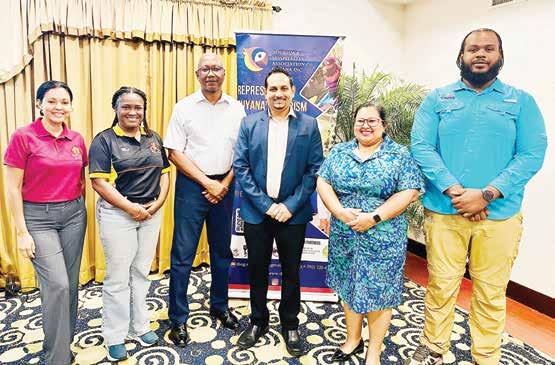
The Tourism and Hospitality Association of Guyana (THAG) on Friday hosted its 33rd Annual General Meeting (AGM) at the Ogle Room, Herdmanston Lodge, where members reflected on the association’s achievements over the past year and elected its Executive Committee for the 2026–2027 term.
The High Commissioner of Belize to Guyana, Gale Miller Garnett, who was the keynote speaker, highlighted the importance of sustainable tourism development, environmental stewardship and regional collaboration. She encouraged stakeholders to continue working collectively to strengthen tour-
ism offerings and foster meaningful Caribbean partnerships. In his President’s Report, Mitra Ramkumar reflected on THAG’s continued growth and advocacy efforts, citing the success of flagship initiatives such as Guyana Restaurant Week, Flame & Flavour, Tapas, Rum and Wine, and the Student Work and Internship for Tourism (SWIFT) Internship Programme.
He also reaffirmed the association’s commitment to regional partnerships and advancing Guyana’s position as a premier destination for nature, culture and adventure tourism. Following the keynote address, the audited financial statements and the election of the executive
ADeputy Superintendent of Police attached to the Immigration Department within the Guyana Police Force (GPF) is now nursing a fractured right arm after the vehicle she was driving collided with a motor lorry along the Garden of Eden Public Road, East Bank Demerara (EBD), on Friday.
Based on reports received, motor car PAF 8496, driven by the 49-year-old
immigration officer, was proceeding south along the Garden of Eden Public Road when the motor lorry, GAD 9996, driven by a 26-yearold male from Ogle, East Coast Demerara (ECD), reportedly veered onto the eastern driving lane and collided with the right front portion of the motor car.
As a result of the collision, the motor car spun and then came to a halt. The driver sustained injuries to
her body.
She was assisted by an emergency medical team and transported to the New Diamond Regional Hospital, where she is being treated for pain throughout her body and a fractured right arm.
A breathalyser test conducted on the driver of the motor lorry showed no traces of alcohol in his system. An investigation is underway.
The SGCC said President Geerlings-Simons welcomed the initiative and recognised its continued contribution to Suriname’s investment agenda.
Moreover, the Chamber also presented its public-private partnership management proposal for the Canawaima Ferry, developed as a practical framework to support the long-term sustainability, efficiency and commercial viability of this critical transportation link. The proposal focuses on strengthening operational management and improving service delivery for businesses, travellers and border communities that depend on the crossing.
SGCC reaffirmed its readiness to continue engaging constructively with the relevant authorities as discussions progress.
Recognising that investment competitiveness extends beyond infrastructure, the Chamber also expressed its willingness to support national efforts aimed at strengthening financial digitisation, investment readiness, streamlined business processes and the overall ease of doing business.
The discussions examined several priority sectors where closer collaboration can generate long-term value, including fisheries, agri-
culture, tourism, education, healthcare, construction, renewable energy, infrastructure, aviation and logistics.
It was further noted that particular attention was given to the fisheries industry, recognising its importance to livelihoods, food security and cross-border commerce. The Chamber encouraged continued engagement between relevant authorities and private sector stakeholders to create greater clarity, predictability and confidence for businesses operating in the sector while also supporting responsible joint investment and value-added production.
Regional connectivity was also highlighted, including continued improvements to the Canawaima Ferry service and the development of the Corentyne Bridge. Both were recognised as important to improving the movement of people, goods and services and to strengthening commercial integration between the two economies.
The Chamber further emphasised the importance of enhanced logistics and trade connectivity, including opportunities to strengthen commercial linkages with Brazil and other Caribbean partners. Improved regional transport and supply chain networks were identified as critical to expand-
ing exports, lowering business costs and positioning Suriname and Guyana as gateways for regional commerce.
During the engagement, SGCC also highlighted the value of an enabling environment for cross-border business, including the conclusion of a bilateral double taxation agreement, continued improvements to investment frameworks and greater regulatory certainty for companies operating across both markets.
The meeting reinforced the importance of sustained public-private dialogue in translating opportunity into measurable outcomes. As neighbouring countries with complementary economies and growing regional influence, Suriname and Guyana are well positioned to build a stronger economic partnership grounded in practical collaboration, mutual respect and shared prosperity.
In Saturday’s missive, the SGCC expressed its appreciation to the Surinamese President for the opportunity to engage on these important matters, adding that it looks forward to continued collaboration with public and private sector stakeholders in advancing sustainable economic growth and regional integration.
committee were done. Ramkumar was subsequently re-elected as President for the 2026–2027 term.
Also elected to serve on the Executive Committee were its Vice President Carla Vantull, who serves as the General Manager of Wilderness Explorers, and Proprietor of 592 Tours, Malcom Rhodius, as the Treasurer. The committee members include Paul Waldron, Abigail Ally, Yonnick David, and Cherry-
Ann Greene. The committee will also comprise the immediate past President, Dee George. In accepting his re-election, Ramkumar thanked members for their continued confidence and reiterated the association’s focus on advocacy, collaboration and member engagement.
“THAG exists to serve its members. We encourage businesses, regardless of size, to engage with the association, share their challenges and utilise our platform. Together, we can continue to strengthen Guyana’s tourism and hospitality sector and ensure it remains a source of pride and opportunity for our country,” he stated. THAG remains committed to championing policies and initiatives that support a resilient, sustainable and globally competitive tourism industry while fostering partnerships that contribute to Guyana’s continued growth.

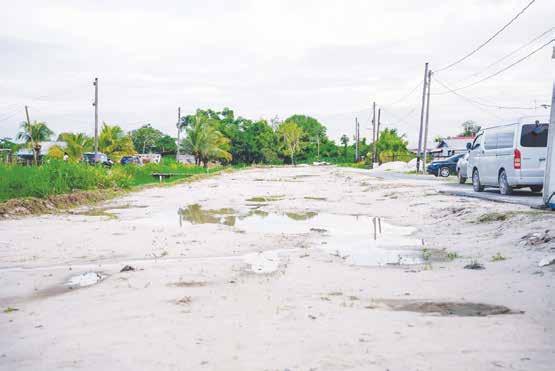
The sod was officially turned for the construction of the first-ever recreational park at Skull City and Area L, Patentia, Region Three (Essequibo Islands-West Demerara), on Friday.
This also marks the commencement of the first park under the Local Government and Regional Development Minister, Priya Manickchand.
The park represents another step in the Government’s commitment to improving public infrastructure while creating spaces that foster healthier lifestyles, stronger communities, and enhanced quality of life.
Delivering feature remarks, Manickchand said the investment reflects the Government’s belief that community development extends beyond roads, bridges, and buildings.
She explained that thoughtfully designed public spaces have far-reaching benefits, contributing not only to physical health but also to mental well-being, social cohesion, and a
stronger sense of community pride.
Manickchand further noted that the significance of the park extends well beyond recreation, describing it as a space where memories will be created, friendships strengthened, and generations brought together.
“There will be a day when you’ll be able to sit in this park and gyaff about long ago, discuss the happenings of the present, make important decisions through conversation, and learn about one another,” she told residents, adding that the value of such spaces grows over time as they become part of a community’s shared history.
She also emphasised that investments of this nature are central to building stronger communities.
“These spaces help us to develop stronger families, communities, and a nation.”
The Minister also linked the initiative to the Government’s broader vision for national development, noting that while Guyana continues to mod-
Saturday brought a wave of grief across the music community following news of the passing of one of Guyana’s most promising young musical

talents, Emmanuel James, aka “Lil Saint”. The rising artiste died from complications after a recent surgery, which he had undergone following the discovery of a mass on his pancreas.
Lil Saint placed second in the Ministry of Culture, Youth and Sport’s Dancehall Monarch competition (2025) and also received the Best Newcomer award, marking him as an up-and-coming figure in local music.
The Culture, Youth and Sport Ministry took to social media to express its deepest condolences on the passing of the young and promising dancehall artiste.
“Lil Saint was an emerging force in the local entertainment landscape, recognised for his versatility across the dancehall and soca genres. His passion,
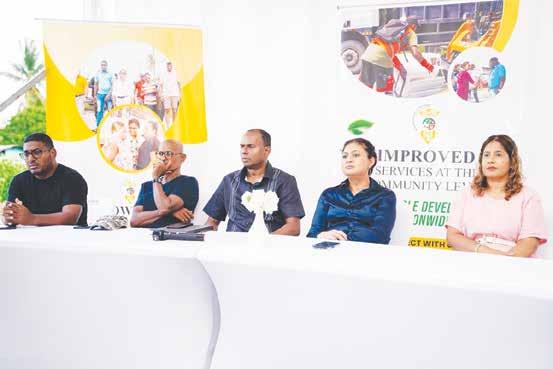

ernise through major infrastructure projects, equal emphasis is being placed on improving the everyday lives of citizens – “a people-centred country”.
Addressing residents directly, Manickchand encouraged them to embrace the park as their own and work
collectively to preserve it for future generations.
“You will always have the distinction of being the first,” she told the gathering, noting that the facility would serve as a lasting symbol of the community’s development.
The chairman of the Uitvlugt/Patentia Neighbourhood Democratic Council (NDC), Mark Khan, welcomed the commissioning, describing the project as evidence of the Government’s commitment to improving communities through meaningful investments.

creativity, and dedication left a lasting impression on audiences and fellow musicians alike.”
The full circumstances surrounding his passing remain unclear at this time.
The Ministry joined his family, friends, fans, and the wider creative community in mourning this tragic loss. It honoured his contribution to Guyana’s cultural and musical landscape and extended heartfelt sympathies to all who knew and loved him.
In an emotional Facebook Live broadcast recorded before his death, Lil Saint revealed that he had been battling serious health complications for the past four years, which he attributed to excessive alcohol use.
Speaking candidly to his followers, he said he
“This is our park. We’re going to care for it, we’re going to beautify it, and we’re going to make sure everyone has a part in it,” he added.
“At the Ministry, we recognise that parks are much more than open spaces. They are places where children can play safely, where families can gather, where young people can engage in healthy recreation, and where communities can come together to build stronger social connections,” Project Manager responsible for Parks, Recreation, and Public Spaces, Saeed Zameen, shared.
Meanwhile, Manickchand called on residents to work alongside the Government to ensure the park remains a source of pride for the community.
“Partner with us as we do this. We need each other.”
The recreational park forms part of the Ministry’s prioritised programmes of investing in community infrastructure that promotes healthier living, strengthens neighbourhood ties, and creates safe, welcoming public spaces for citizens.
had suffered persistent abdominal pain and vomiting and had undergone medical evaluations at several public health institutions, including hospitals in Lethem and Georgetown. According to the artiste, doctors eventually diagnosed him with a condition affecting his pancreas, and he was preparing to undergo what he described as major surgery. Although he admitted he had been frightened by the prospect of the operation and had postponed it twice, Lil Saint said he had found the courage to move forward.
He also used the livestream to express heartfelt gratitude to his wife, crediting her with standing by him through his illness and encouraging him during some of his darkest moments.
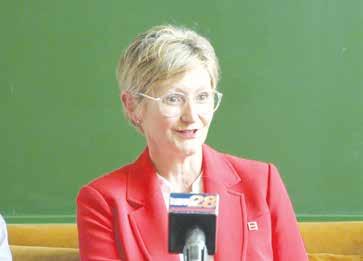
The President of the Association of Chartered Certified Accountants (ACCA) Melanie Proffitt urged accounting professionals and educators in Guyana to promote the responsible use of artificial intelligence (AI), emphasising that while AI can improve efficiency, it cannot replace the fundamental knowledge and judgement required in the profession.
The ACCA President made the remarks during an interview with the Guyana Times, one day after the signing of a Memorandum of Understanding (MoU) between the University of Guyana (UG) and the Association of Chartered Certified Accountants (ACCA). The agreement is aimed at advancing accounting education and professional development in Guyana. According to her, accountants will continue to play a vital role as guardians of data integrity, providing ethical judgement and the human element required in decision-making and driv-
ing businesses forward.
“Whilst you’ll have these [Artificial intelligent] tools that will make life easier, they won’t replace it, and you still need that basic understanding. They need to teach responsibility. It is a call for educators to ensure that when they’re teaching young people how to use these tools, they also teach them about the risks associated with them. I think one of the biggest concerns is incorrect data and the integrity of the data from which decisions
are made. Anything you’re using to make decisions on needs to be credible, and that’s what the accountant does,” she said. Proffitt said the responsible use of AI is currently a major issue, adding that professional accountants have an important role to play in ensuring its ethical application.
“There is concern around bias being ingrained in AI and it being used for things that it shouldn’t be used for. That is where the human
element is very much required in the profession going forward. It’s a hot topic at the moment in terms of using AI responsibly, and that’s where the professional accountant plays a key role. As a professional accountant and a member of a professional body, you’re bound by a code of ethics. You have a degree of accountability that is perhaps unique to our profession. It’s definitely something that will be a key consideration, and I’m sure regulation will follow,” she explained. Whilst speaking, she relayed that UG and the ACCA on Monday signed a Memorandum of Understanding (MoU) aimed at advancing accounting education and professional development in Guyana.
She noted that the MoU would strengthen UG’s accounting programme while making it more attractive to prospective students. She explained that the agreement would allow students to earn their academic qualification through UG while also
moving one step closer to obtaining the ACCA professional qualification. “What it will do is make the programme more attractive for the younger generation coming through. They will gain their academic qualification through the University of Guyana, but they will also be in a position where they’ve taken one step towards gaining the ACCA qualification.
ACCA is a professional qualification that builds on the academic qualification they’ve gained from the University of Guyana. Hopefully, it will encourage students to continue their learning journey and attain that professional qualification.” She added that ACCA is an internationally recognised qualification with a presence in more than 180 countries around the world. Meanwhile, she pointed out that while AI and emerging technologies are changing the way people work and live, they are not expected to replace accountants. “There’s no doubt that AI and new technolo -
gies are changing the way we work and the way we live, and they will have an impact on the accountancy profession. However, ACCA’s view, supported by the research we’re sharing, is that AI will likely take away some of the more repetitive tasks. Being guardians of good data and providing ethical judgment and the human element in decision-making and driving businesses forward will still be very much required. “Whilst AI may change the way we work, I don’t think it will replace accountants. In fact, I believe it will push us further towards providing the strategic direction businesses need to succeed. Sustainability is another area that is increasingly coming into focus for accountants, requiring us to provide ethical judgment and guidance to businesses that need to survive and thrive in today’s world, where corporate social responsibility is becoming increasingly important to long-term success.”
“Everything that is inside you is your potential” –Minister Ramson encourages women to lead boldly

A section of the gathering on Saturday
Culture, Youth and Sport Minister Charles Ramson Jr on Saturday delivered a powerful address as the first-ever male speaker at the WeLead Association Conference, held at the Pegasus Corporate Suites, Kingston, Georgetown.
The conference, under the theme “Women Building Global Bridges”, brought together female leaders from across Guyana to inspire, empower, and encourage them to take up
space in leadership and society.
Addressing the gathering as a male ally, Ramson, referring to the concept of “psychocybernetics”, emphasised that leadership begins with mental preparation long before a title is conferred, sharing how he had mentally prepared himself for the role of Minister years before his appointment in 2020.
He also highlighted the progress women have made in leadership, reaffirmed
that women are equally capable leaders, and encouraged participants to reject outdated limitations, build meaningful networks, and actively contribute wherever opportunities arise.
Reflecting on the historical fight for equality, Minister Ramson noted that in 1920s England, the right to vote was a strictly qualified privilege for women and was only obtained through struggle. This is entirely unthinkable for this generation and the pre-
vious one.
While acknowledging that current global leadership metrics remain in the low double digits, with women heading 11 per cent of Fortune 500 companies, alongside 16 female heads of state and 28 heads of Government globally, the Minister pointed out, “Seventy years ago, that number was a staggering zero. While the numbers are still low, women continue to make a definitive, undeniable impact. The trend is moving upward, slow but sure.”
He further highlighted Guyana’s milestone constitutional reform in the early 2000s, which legally mandates that at least one-third of parliamentary representatives must be women, ensuring that any young girl in Guyana can look at the highest levels of governance and see a clear path for her own aspirations.
Present at the conference were Director of Culture Tamika Boatswain and Assistant Director of Sport Melissa DowRichardson, both of whom were recognised by Minister Ramson for their exemplary leadership and significant contributions to the development of culture and sport in Guyana.

In closing, Ramson reminded attendees, “Everything that is inside you is your potential, and
the only person who can unlock it is you. There is nothing worse than wasted potential.”

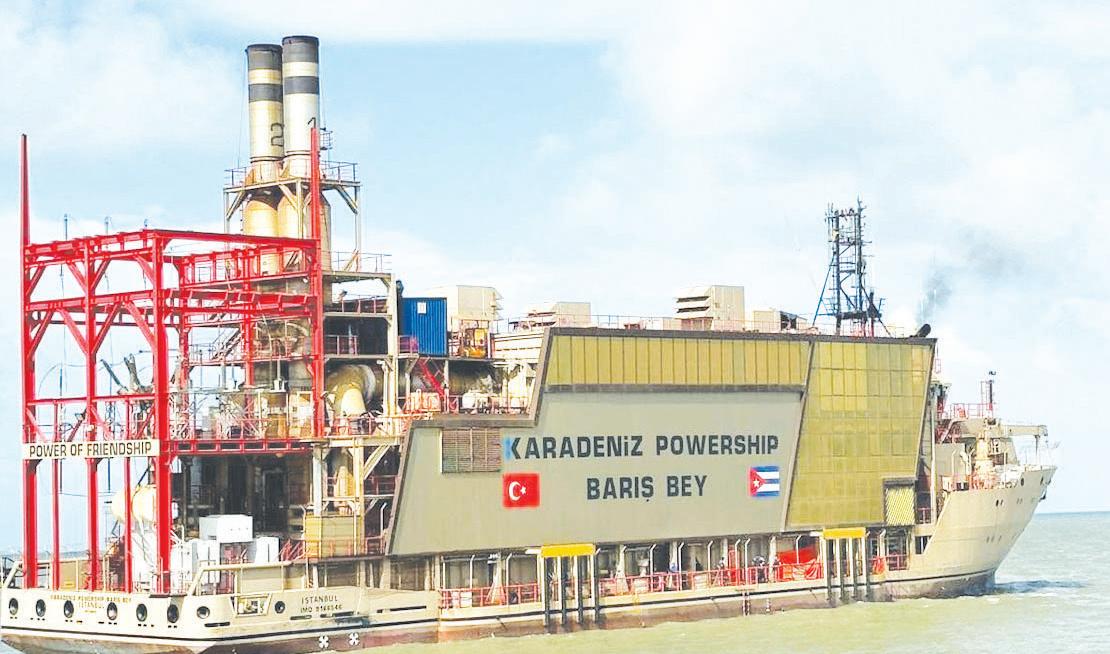
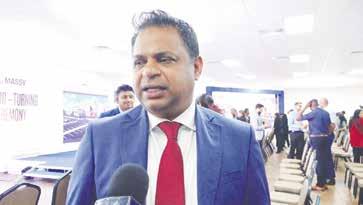
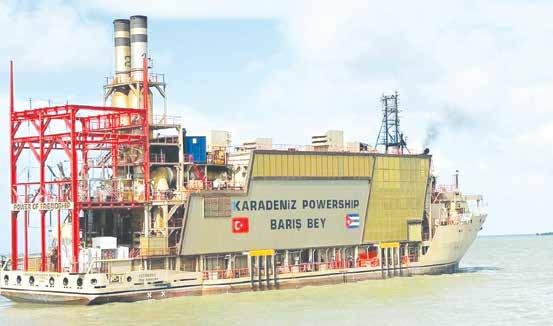
Negotiations between Guyana Power and Light (GPL) Incorporated and Turkish energy company Karpowership’s new agreement for the continued supply of electricity is 99 per cent complete, according to Public Utilities Minister Deodat Indar.
Although the Minister had indicated that GPL would issue a statement by Friday outlining the outcome of the negotiations and the way forward, no such statement had been released up to Saturday evening.
Nevertheless, providing an update on the negotiation, Indar declined to discuss the substance of the talks but explained that the negotiations were being conducted by GPL and Karpowership and should be allowed to con-
clude before details are made public.
“GPL and the company were doing the negotiations. Allow them to issue the statement. They should do so in one day. There is no reluctance in providing information. I spoke about this at length all the time... There is
no reluctance, but you don’t negotiate in the public. It is not concluded; it is 99 per cent,” Indar said.
While maintaining that the negotiations were nearing completion, the Minister refrained from disclosing any details of the proposed agreement, saying it would be in-

appropriate to comment publicly before the process was finalised.
His comments come against the backdrop of growing public interest following the expiration of GPL’s agreement with Karpowership last month.
The power supply arrangement, under which the floating power generation company has been providing a significant portion of the country’s electricity generation capacity, expired on May 21.
Government officials have previously assured the public that electricity generation has
not been affected and that negotiations were ongoing to secure a new agreement while maintaining an uninterrupted supply of power.
Questions have since been raised about the status of the negotiations, the terms of any new arrangement and when the public would be updated. Although Indar had indicated on Thursday that GPL would issue a statement by Friday addressing the negotiations and outlining the way forward, the power company had not done so up to Saturday evening.
It remains unclear when GPL intends to make the out-
come of the negotiations public or whether the parties have since concluded discussions.
The negotiations are being closely watched as Guyana continues to rely on Karpowership’s floating power generation to supplement the national grid while longer-term electricity projects, including the Wales Gas-toEnergy Project, advance.
Any new agreement between GPL and Karpowership is expected to play an important role in maintaining the country’s electricity supply until additional generation capacity comes on stream.
The International Building Expo 2026 is proving to be more than a showcase of innovation and development, as it is also serving as a one-stop hub where members of the public can directly access a wide range of essential Government services and opportunities.
Among the agencies engaging patrons is the Guyana Online Academy of Learning (GOAL), which is providing information on its tuitionfree scholarship programmes while assisting prospective applicants with the application process.
According to GOAL’s programme manager, Anika Edwards, the online application portal is currently open


until July 12, and many visitors have taken the opportunity to learn about programmes ranging from short-term certificates to Bachelor’s, Master’s and Doctoral degrees.
“We want to tap into the interesting people who come so they can ask questions, and we can encourage them to take the opportunity to apply, especially those who need a second chance,” she said.
Particular interest has been generated by GOAL’s “Get Ready for Opportunities to Work” (GROW) programme, which offers individuals who did not complete secondary school or were unsuccessful at CSEC a pathway to continue their education.
Meanwhile, the Ministry of Health is delivering critical healthcare services on-site, ensuring patrons can access preventative care while attending the expo.
Visitors are benefitting from free eye screenings, assistance with the Government’s eye care vouch-
er programme, blood donation services through the National Blood Transfusion Service, random blood sugar testing, and the distribution of educational health materials.
Persons requiring corrective eyewear can also receive on-the-spot eye assessments before accessing the $15,000 spectacle voucher, making quality eye care more accessible and affordable.
With a wide range of essential services being accessible at the event, the strong response from patrons highlights the growing value of integrating public services into major national events.
The International Building Expo 2026 is eliminating barriers to access, increasing public awareness of available programmes, and ensuring more citizens benefit from the services and opportunities being delivered by the Government of Guyana.

Councillor on the Georgetown Mayor and City Council (M&CC) and activist for the People’s Progressive Party/ Civic (PPP/C) Jai Narine Singh, commonly known as “Don Singh”, died at the age of 56 after suffering a serious stroke last week.
Following his death, tributes poured in on Saturday. Among those who expressed sadness at Singh's passing was President Dr Irfaan Ali, who said he had hoped and prayed for his recovery. "I am deeply saddened by the untimely passing of Don Singh. Don Singh will be remembered as someone whose presence in civic life carried both substance and character," the Head of State noted in a statement.
According to the President, though Singh
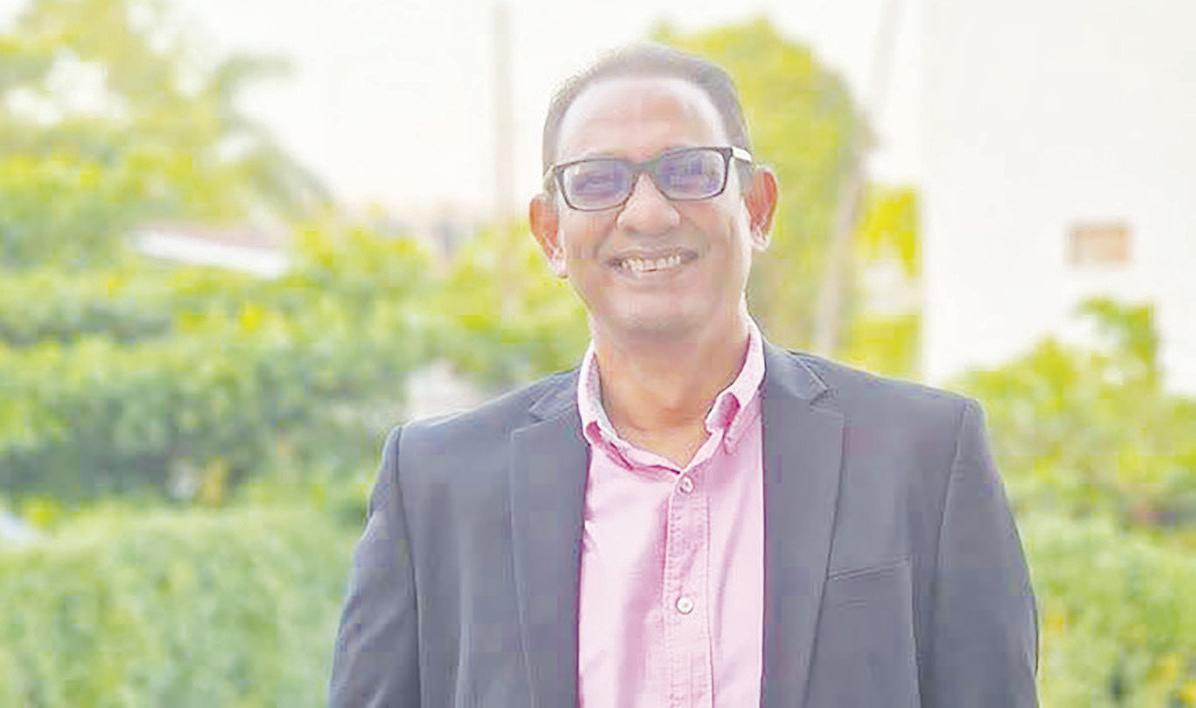
him of making a more substantive contribution to national life. But he will be remembered not only for what he did but also for the infectious spirit in which he did things," Ali stated.
The President extended condolences to Singh's family, friends, and all who mourn his passing.
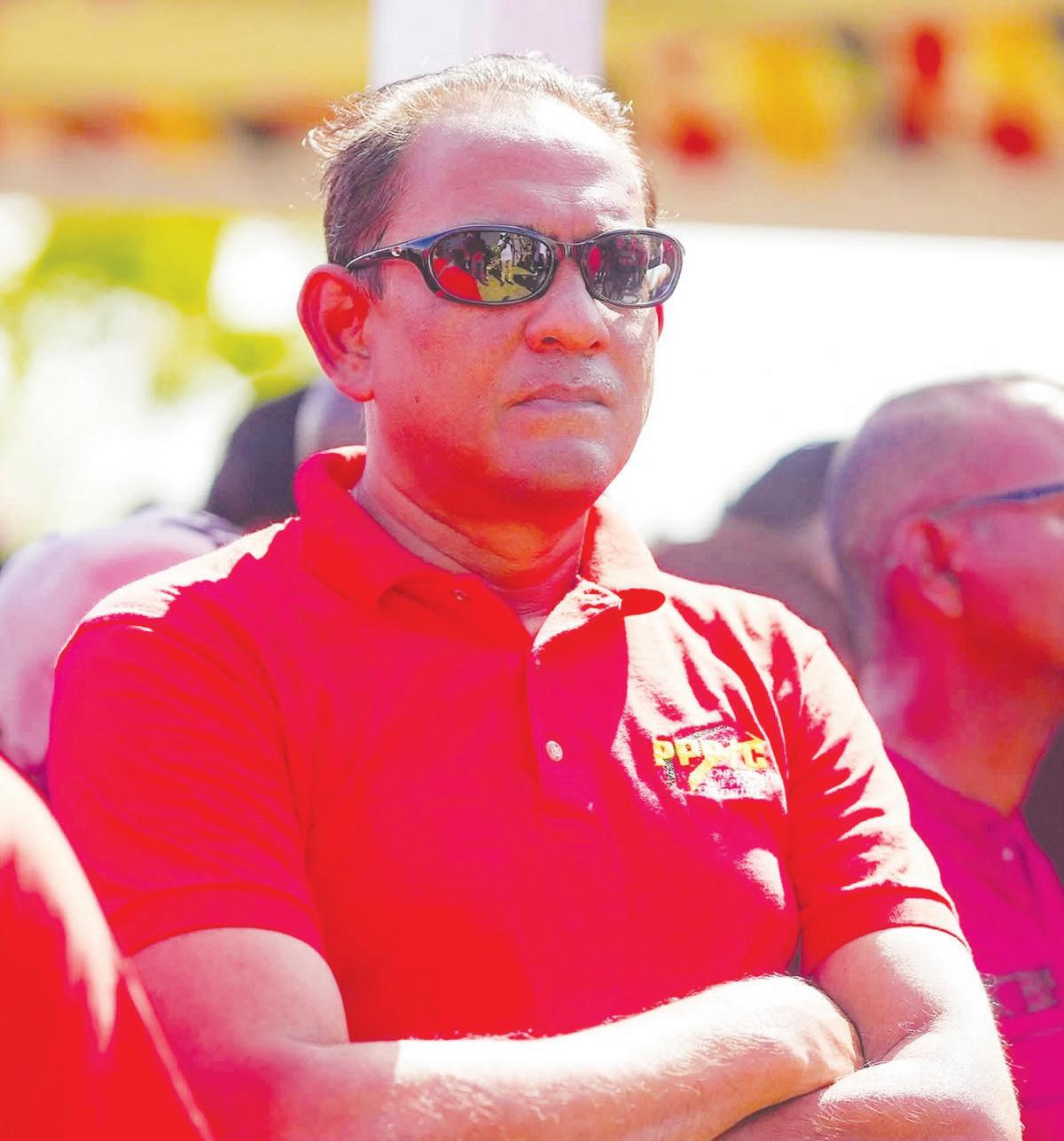
came from a family with a strong legal background and a long-standing involvement in the political life of Guyana, he distinguished himself not through his lineage but through a style that was both lively and unmistakably his own.
"He brought energy to his work as a Councillor of the Georgetown City Council. He could be excessively witty but also brutally frank. That candidness gave voice to concerns in a direct and unvarnished manner, reminding all that municipal politics exists to respond to real, everyday problems," Ali posited.
The Guyanese leader added that Singh understood that public life does not have to be devoid of warmth or humanity.
"In his interactions, there was often wit – sometimes gentle, sometimes pointed – but rarely without a sense that he was fully engaged with the people around him. He carried an evident commitment to improving the well-being of citizens. Fate has robbed
Meanwhile, the PPP/C –the party Singh represented on the Georgetown City Council – also expressed deepest condolences on his passing, describing him as a dedicated party activist and a Councillor.
"Mr Singh served the Party and the people of Georgetown with commitment and humility. His passing is a significant loss not only to his family and loved ones but also to the Party and the wider Georgetown community," the Party said in a brief statement on Saturday. Other associates and colleagues have also taken to social media to share their condolences regarding Singh's passing.
Indelible mark
In addition to serving on the Georgetown City Council, Singh was also elected President of the Georgetown Cricket Club (GCC) earlier this year.
The GCC's executive and members are also mourning Singh's passing, saying that his unwavering devotion to
the club and the game of cricket has left an indelible mark on the institution.
"For most of his 56 years, Don's life was inseparably linked to GCC. His lifelong connection to the club began in 1975, when, as a five-year-old, he was taken by his father to Bourda to watch his first cricket match. That memorable experience ignited a passion for cricket and for the club that remained with him throughout his life," the club stated.
From an enthusiastic supporter in the stands, Singh became a dedicated and long-serving member of GCC. This commitment, the club noted, culminated in his election as President in January of this year – a role he accepted with humility, purpose and an unwavering determination to serve.
"An avid cricket aficionado, Don was deeply passionate about the development of the game. His decision to seek the presidency was driven by his firm belief that the time was right to lead the development agenda of Guyana's most iconic cricket club," the GCC said.
It went on to add that Singh had many ambitious plans for the club during his tenure as President; foremost among them was creating a conducive environment where players could develop their skills and elevate their game.
"Don was a candid and benevolent leader whose honesty, generosity and genuine concern for others earned him the respect and affection of all who knew him. He was never afraid to speak his mind when it was in the best interest of the club, yet he always did so with kindness, fairness and a sincere desire to see others succeed."
Although his tenure as President was far too brief, Don's vision, enthusiasm and commitment inspired everyone who worked alongside him. His legacy will endure in the values he championed, the aspirations he instilled, and the love he had for the club that was such an important part of his life," the club noted.

The Development Bank of Latin America and the Caribbean (CAF) on Saturday announced the establishment of the Venezuela Recovery and Reconstruction Fund, a mechanism designed to gather, mobilise and channel public, private, and international contributions toward the country's recovery priorities following the earthquakes that struck on June 24. The initiative is in addition to the US$300,000 in humanitarian aid already announced by the CAF to assist in the emergency efforts.
The Fund will receive contributions from Governments, international organisations, companies, foundations, individuals and other partners and bring them together under a common framework of administration and accountabil -
ity. Resources will be directed toward recovery and reconstruction initiatives identified and prioritised by the Government of Venezuela. In doing so, it aims to deliver a coordinated response that avoids the fragmentation of efforts and accelerates the delivery of resources to the affected areas.
As an initial commitment, CAF will contribute US$1 million to launch the fund and finance the priority initiatives. CAF will not charge any fee for administering or implementing the fund so that every dollar contributed goes toward addressing the emergency and supporting reconstruction.
“Acts of nature are met with acts of humanity and solidarity, and Venezuela needs us today more than ever. Venezuela is a founding country and home to the headquar -
ters of CAF, and that is why we are launching this fund for reconstruction: an agile and transparent mechanism that we invite Governments and the private sector to join so that their contributions, together with ours, become part of an effective response. Our commitment is to accompany the Venezuelan people not only during the emergency but also throughout the entire path of recovery and reconstruction that lies ahead,” stated Sergio Díaz-Granados, Executive President of the CAF.
The mechanism is designed to adapt to the different stages of the response. In the first phase, it will support immediate assistance, including humanitarian aid, essential supplies and support for the institutions leading the emergency response. It will then help rehabilitate
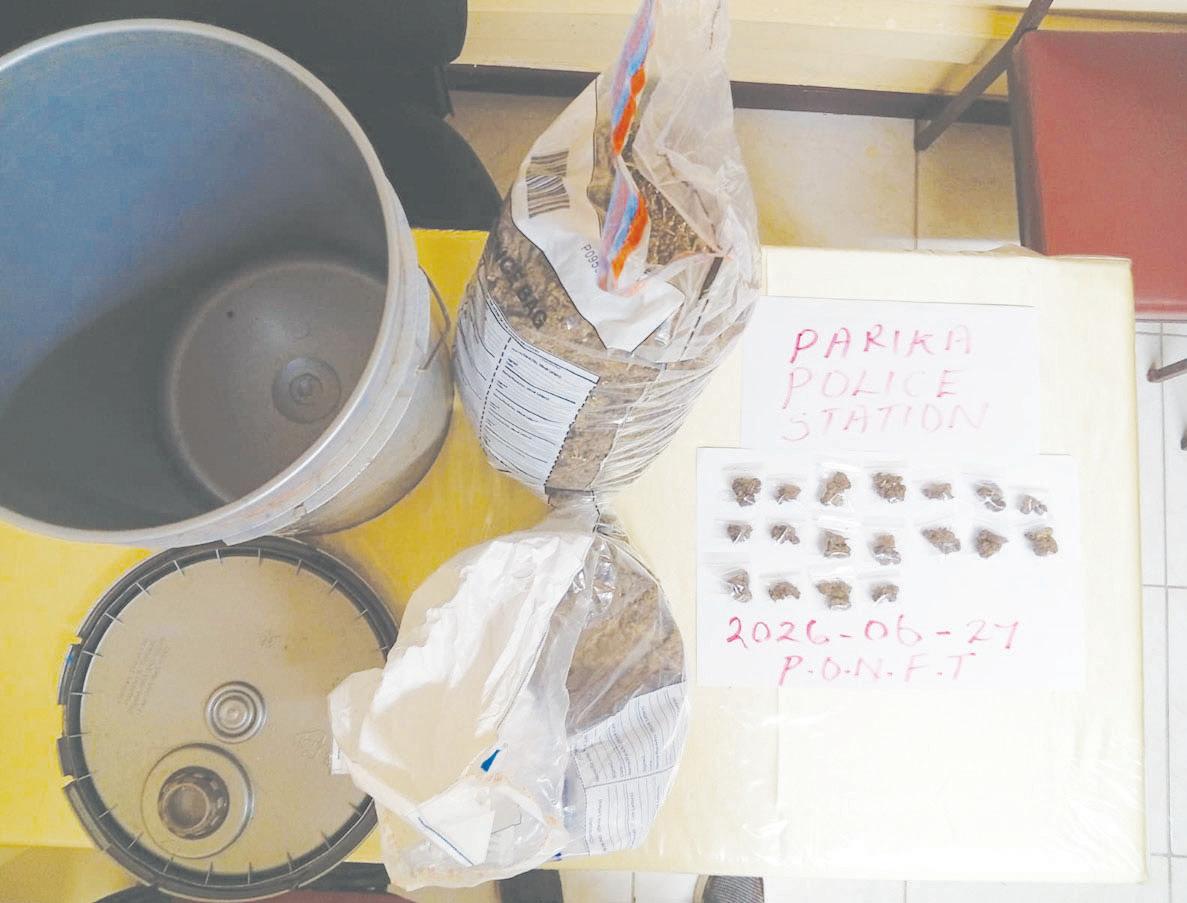
home
A37-year-old labourer from Parika Sea Dam, East Bank Essequibo (EBE), was arrested on Saturday after a quantity of ganja was found hidden in a bucket at his home. Police stated that ranks conducted an exercise along the Sea Dam, during which the cannabis was found in several Ziplock bags that were concealed in a plastic bucket. The suspect, along with the cannabis, was escorted to the Parika Police Station, where the ganja was weighed and amounted to five pounds. The labourer remains in custody pending further investigations and charges.
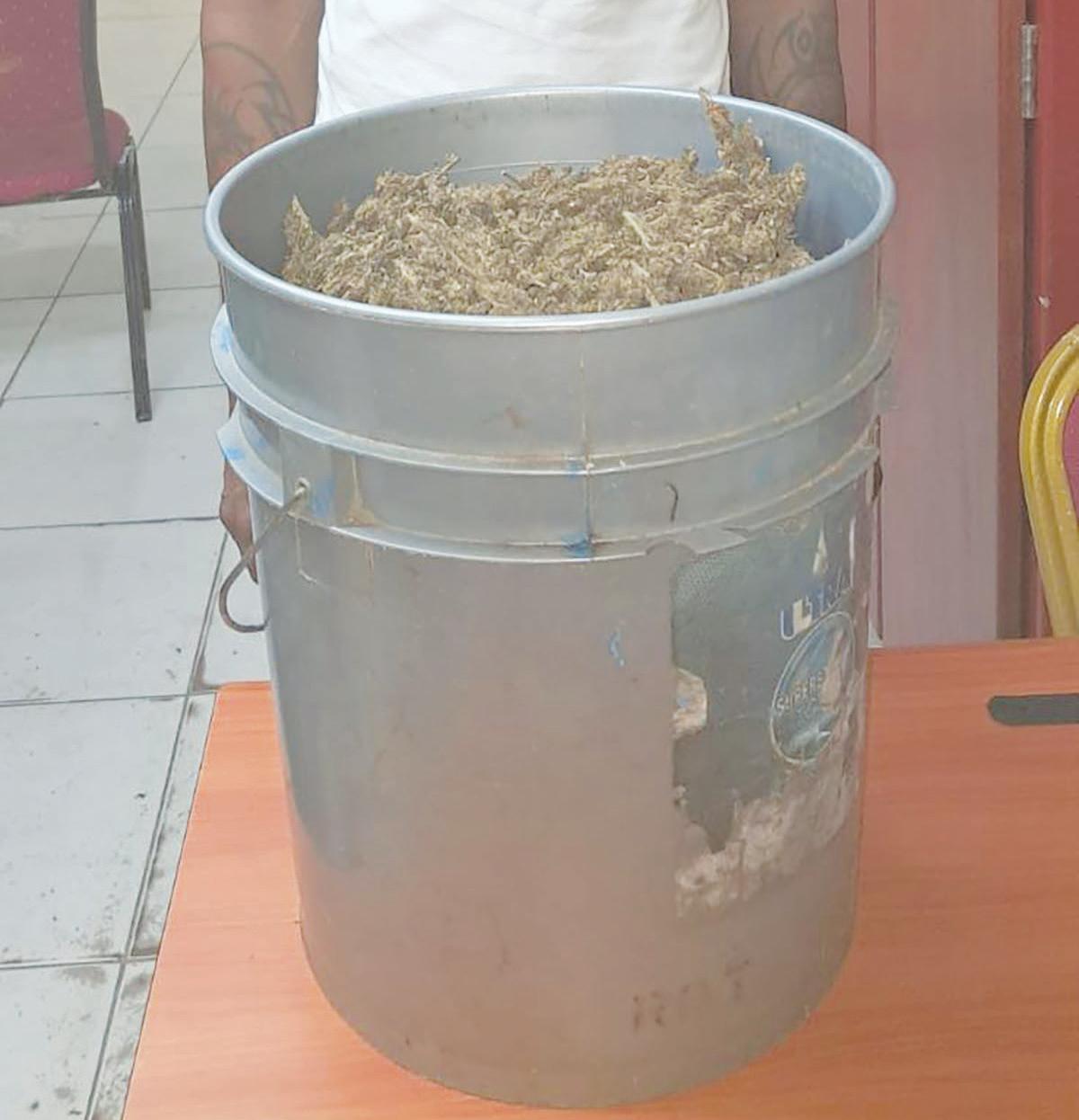

critical services in areas such as health, water and sanitation, energy, education and connectivity. In a later stage, the fund will
support recovery and resilience efforts, including early reconstruction, the restoration of livelihoods and actions to reduce vul -
nerability to future events. Interventions will be defined progressively, based on damage assessments and the priorities established by the Government.
The Fund will operate with resources that are ring-fenced and independent from CAF’s own resources. It will include traceability by intervention, periodic financial reporting and independent audits. Contributions may be made in USD or Euros, and resources may be executed flexibly, either through eligible implementing entities or, where more efficient, through direct management by CAF. CAF’s historical bond with Venezuela as a founding country and the location of its headquarters reinforces the Bank’s commitment to accompany the Venezuelan people and their institutions in the response, recovery and reconstruction efforts that this emergency will require, placing its technical and financial capacity at their disposal to mobilise the solidarity of the region and the international community.
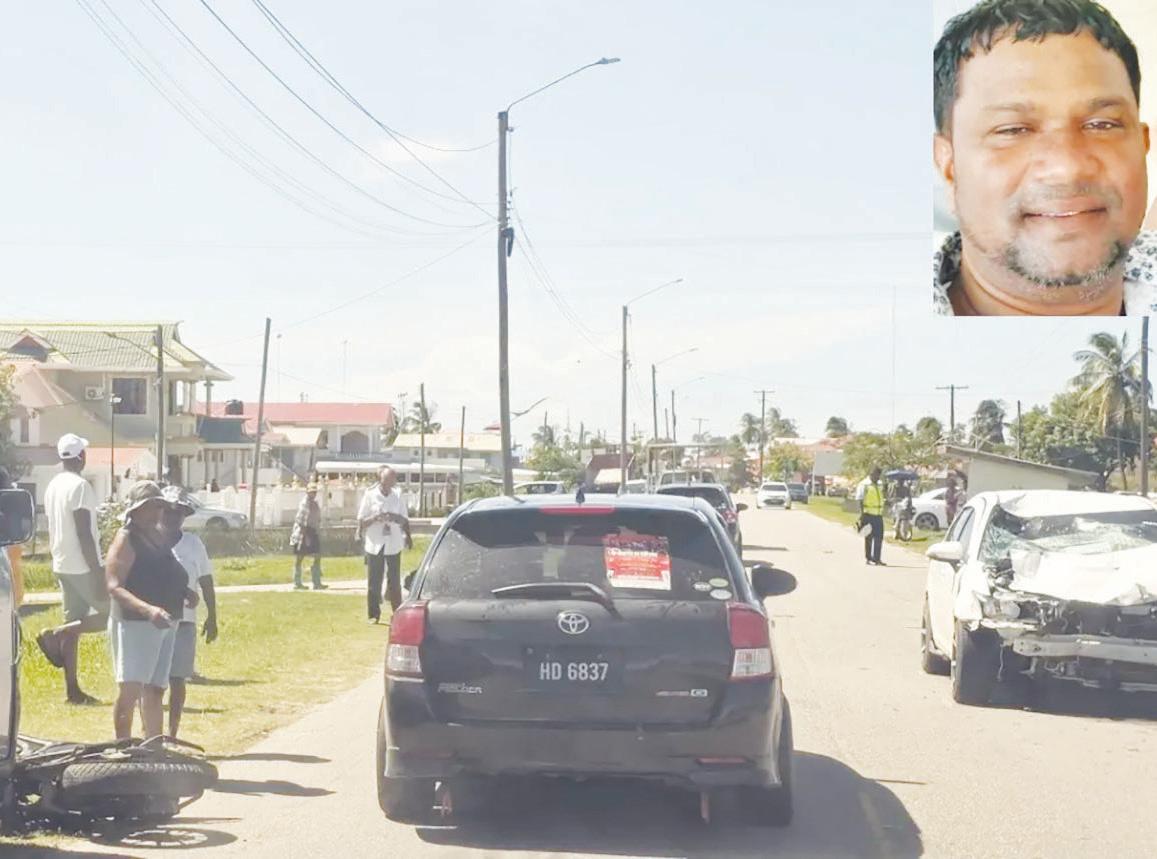
Amotorcyclist was killed on Saturday following a two-vehicle collision along the Reliance Public Road, Essequibo Coast, Region Two (PomeroonSupenaam).
The deceased has been identified as Satesh Persaud, also known as "Tony", of Reliance, Region Two (PomeroonSupenaam).
According to information received, Persaud was exiting a street and attempting to get onto the Reliance Public Road without checking for oncoming traffic.
At the time, a motor car was travelling north along the western carriageway at a fast rate of speed and collided with the motorcycle.
As a result of the impact, Persaud was flung
several feet into the air and eventually landed on the roadway with severe head and bodily injuries. He was transported to the Lima Regional Hospital, where he was pronounced dead on arrival by a doctor on duty. The driver of the motor car was taken into Police custody as investigators launched a probe into the fatal accident.
The US military said it struck Iran again, hours after a tanker was hit in the Strait of Hormuz, in the worst escalation since the two sides signed an interim peace deal two weeks ago.
Each of the warring sides has accused the other of violating the agreement reached two weeks ago to end the four-month-old conflict.
"There may come a point when we are no longer able to be reasonable and will be
forced to militarily complete the job that we very successfully started. If that happens, the Islamic Republic of Iran will no longer exist!"
US President Donald Trump posted on social media on Saturday.
US Central Command said its forces carried out fresh strikes after a Panamaflagged tanker was attacked by an Iranian drone early on Saturday. In Iran, state broadcaster IRIB said early Sunday local time that explosions were heard in Sirik
in southern Iran, without providing further details.
"Iran was given a chance to honour the ceasefire agreement but elected not to," US Central Command said in a statement. It said the strikes were "in direct response to continued Iranian aggression against commercial shipping" and targeted Iranian military surveillance, communications, air defence, drone storage and mine-laying facilities.
(Excerpt from Reuters)
Israeli air strikes in Lebanon have killed one person, the country's Health Ministry said, a day after the two countries signed a deal aimed at paving the way to a lasting peace.
Lebanon's state news agency said an Israeli drone hit the southern town of Nabatieh al-Fawqa and later reported further strikes in the area, with at least two more people wounded.
The Israeli military said it carried out the drone strike on an individual who posed a threat to its forces, without providing details.
The leader of Lebanon's
Hezbollah militant group – which was not involved in negotiating Friday's USbrokered agreement – rejected it and accused the Beirut Government of undermining Lebanon's sovereignty.
Israeli Prime Minister Benjamin Netanyahu called the agreement reached in Washington "historic" and "a blow to Iran and Hezbollah".
Under the four-point framework, Israel will withdraw its forces from the South Litani area, with the Lebanese army taking exclusive control of the vacated territory.
But Israeli forces are permitted to remain in an
expanded security area in southern Lebanon.
On Saturday Hezbollah leader Naim Qassem accused the Lebanese Government of making damaging concessions.
Qassem criticised provisions linking Israel's withdrawal to the group's disarmament, saying they crossed "all red lines".
Later on Saturday Israeli Defence Minister Israel Katz said Israeli forces had been ordered to "prepare for an extended stay in the security zone" – referring to an area up to 10 kilometres inside Lebanese territory. (Excerpt from BBC News)
Temperatures hit record highs from Switzerland to the Czech Republic and Denmark on Saturday as a heatwave that baked western European countries this week moves to central and eastern parts of the continent.
Germany hit a record 106 degrees Fahrenheit on Saturday, provisional data from the national weather service showed, marking a new all-time high, the AFP reported.
Unusually high temperatures were recorded even in Nordic countries not known
for sweltering summers. The Danish Meteorological Institute reported a new record of 98.6 degrees Fahrenheit in Ødum, north of Aarhus – the warmest day since records began in 1874.
In Switzerland, a record of 101.8 degrees was set in the city of Basel.
Train operator Deutsche Bahn and other rail companies advised against all nonessential train travel this weekend.
The Czech Republic also saw its hottest day on record, with 105 degrees in the northern town of Doksany. Forecasters said it may still
rise.
In France, temperatures were easing as the peak of the heat wave was starting to pass in some parts of the country. But hospitals remained under intense pressure in the face of heat-related emergencies, including heart attacks, heatstroke and dehydration.
Three-quarters of France, encompassing tens of millions of people, was put under a red alert for extreme heat on Thursday and Friday as the mercury topped 104 degrees in some locations, including in Paris. (Excerpt from CBS News)
The EuropeanMediterranean Seismological Centre (EMSC) has reported that another earthquake has hit Venezuela. The magnitude 4.8 quake was detected at 15:20h local time near Venezuela’s northern Aragua state.
There have been reports of several aftershocks and smaller quakes after Venezuela was hit by two major earthquakes on Wednesday, one with a magnitude of 7.2 and the other 7.5.
Rescuers were still racing to rescue possible survivors of those earthquakes when Saturday’s seismic activity hit.
At least 1430 people have been confirmed dead so far after Wednesday’s quakes. Another 51,000 have been reported missing.
Authorities have said that recovering survivors will become increasingly unlikely if they are not found within the first 72 hours af-

ter an earthquake strikes. Many people are believed to be buried under the rubble from collapsed buildings, and the death toll is expected to climb.
The latest earthquake was located 70 kilometres west of Venezuela’s capital, Caracas. No damage related to that quake was immediately reported.
Wednesday’s earthquakes caused the most devastating damage in La Guaira state, with some
neighbourhoods in Caracas also hard-hit.
Residents, meanwhile, have complained of a lack of organisation in the Government’s recovery efforts, with the situation made worse by mobile and internet outages in some areas.
On Saturday, Venezuela’s Government said 1600 members of foreign rescue teams had arrived in the country. (Excerpt from Al Jazeera)
The Government has launched a nationwide humanitarian relief effort for earthquake-ravaged Venezuela, mobilising state agencies, the private sector and municipal corporations in what it describes as a coordinated national response to the unfolding humanitarian crisis.
In a media release issued yesterday, the Ministry of Foreign and Caricom Affairs said the initiative was launched on the instructions of Prime Minister Kamla Persad-
Bissessar following a high-level stakeholder meeting convened jointly with the Ministry of Rural Development and Local Government.
According to the release, the Government and private sector agreed on a coordinated relief programme in the aftermath of Thursday’s devastating earthquakes.
Collection points will operate daily between 08:00h and 16:00h through all 14 municipal corporations across Trinidad, the Tobago Emergency
Management Agency (TEMA) and participating supermarkets.
To ensure relief efforts remain focused on the country’s immediate needs, the Government is asking donors to contribute only specific categories of supplies.
Officials said limiting donations to these items would help ensure aid reaches those affected quickly and efficiently while reducing logistical challenges. (Excerpt from Trinidad and Tobago Guardian)
The Jamaica Teachers’ Association (JTA) has expressed concern over what it says is the deplorable and hazardous conditions under which students and teachers in sections of western Jamaica continue to teach and learn, eight months after the passage of Hurricane Melissa.
According to the JTA, last week its team, accompanied by colleagues from the American Federation of Teachers (AFT), visited schools across Westmoreland, St Elizabeth, and St James, and what was observed was deeply troubling.
The teachers group said it acknowledges that Hurricane Melissa was a
catastrophic Category 5 weather event that left a significant trail of destruction across sections of the island, recognises the enormity of the recovery effort, and appreciates the challenges associated with restoring damaged infrastructure.
“However, eight months after the passage of the hurricane these challenges can no longer serve as a justification for students and teachers being subjected to conditions that are unsafe, undignified, and inimical to effective teaching and learning.”
The JTA said it has written to the Ministry of Education, Skills, Youth and Information for a second time, “once again highlight-
ing these serious concerns and demanding that urgent and decisive measures be implemented to alleviate the unacceptable learning and working conditions currently being endured by students, teachers and school leaders.
“The association maintains that no child should be expected to learn, nor any teacher expected to work, in conditions that compromise health, dignity, safety and educational outcomes. Eight months after the passage of Hurricane Melissa it is unacceptable that members of the school community continue to bear the burden of delayed recovery efforts, the release continued.” (Excerpt from Jamaica Observer)










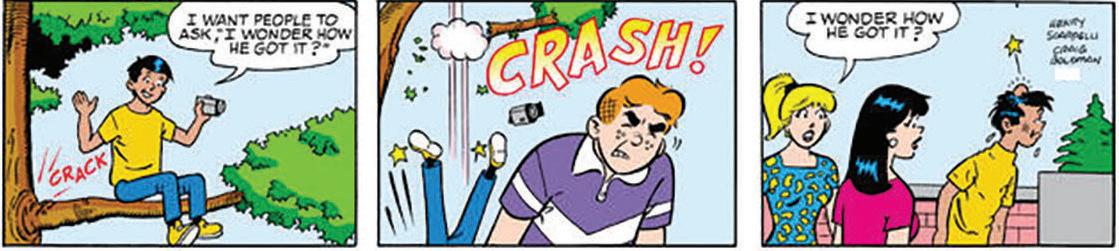





ARIES


TAURUS (April 20May 20)


GEMINI (MAY 21June 20)

CANCER


LEO (July 23Aug. 22)


VIRGO (Aug. 23Sept. 22) (March 21April 19)


Put yourself and your ideas out into the universe, and the feedback you receive will be revealing. The confidence you gain from what you hear will kick in, making it easy to elaborate and collaborate until you feel at peace with yourself and your direction. Events geared toward creativity, self-improvement and love will help you flourish.
Don’t nix something you want to pursue to please someone else. Follow your heart, negotiate on your behalf, socialize and network with people who are as helpful as you are. Put your energy into domestic improvements and using your skills, gifts and creative endeavors, but first, put safety, integrity and a strict budget in place.
Pick up the pace, and rely on your curiosity and intelligence to lead you down the right path. Those you connect with will offer a different perspective, but before you take their word as gospel, validate the information others share. A connection you have with someone special will grow substantially if you talk about intentions and plans.
Stick to facts, and push forward with plans that don’t rely on outside influences or input. Refuse to trust what others say. Do your part to verify and perfect any information or suggestions you receive. Look at the big picture and decide what’s best for you. Put your energy into presentation, perfection and getting the most in return.
Participate in events or activities that challenge you or offer a meaningful experience. A desire for stability and security in your life will help you make commitments to honor and fulfill your dreams and promises. A unique approach to life, love and learning will open doors that lead to greater opportunities. Positive change is within reach.
Reach out and lend a helping hand, but don’t let anyone take advantage of you. Emotional issues will surface, and discipline, paying attention to detail and setting boundaries will be in your best interests. Put your energy into dispersing negativity and replacing it with a positive attitude.
LIBRA (Sept. 23Oct. 23)

SCORPIO (Oct. 24Nov. 22)


CAPRICORN (June 21July 22)
Pay attention to what’s happening around you. Don’t be oblivious to someone’s interest in what you do or in spending more time with you. Partnerships will deepen with honesty and compromise. A change will offer insight into new possibilities. Updating your appearance will attract attention and liven up your personal life. Romance is in the stars.
Be forward with your rhetoric and spell out what’s important to you. Set high standards and boundaries, make clear what your intentions are and what you are willing to contribute, and find out where you stand. Exploring different lifestyle possibilities will help you choose what’s best for you. Traveling, learning and adopting healthy habits are highlighted.
SAGITTARIUS (Nov. 23Dec. 21)
Indulge in personal upgrades, home improvements and using your creative talents to bring about positive changes to your daily routine. Consider how you can turn something you enjoy doing into additional income or a healthier lifestyle. High energy and loyalty will bring you closer to someone who shares your values and concerns. Romance is on the rise.


AQUARIUS
(Jan. 20Feb. 19) (Dec. 22Jan. 19)


PISCES
(Feb. 20Mar. 20)
You’ll face opposition or limitations if you try to sneak something past someone today. Keep your conversations light but factual, encouraging and meaningful, not negative or critical, and you will gain respect and make headway. Emotions will be close to the surface, and patience will be necessary if you want to achieve what you set out to do.
Put your energy into home projects, domestic relationships and putting a little pizzazz back into your love life. Participate in events or activities that allow you to show off your talents, skills and vibrant personality, and you’ll attract someone who can help you in a unique and profitable manner. A new look will boost your morale.

Spend more time socializing or participating in activities that offer mental or physical challenges. Stretch your imagination and embrace new adventures. Expand your interests, but use your intelligence and intuition to nix any suggestion or offer that lacks substance or benefits. Discipline is necessary; don’t take risks that can lead to injury or illness. A creative project will flourish.







It took Ireland 22 attempts across five editions of the T20 World Cup to win a match. They beat West Indies, for whom a win would have secured a semi-final spot, in a low-scoring thriller in Bristol. This win brought defending champions New Zealand back into contention – their final group game against England gaining significance. More importantly for Ireland, it ended a long run of nearly-theres, including a four-run defeat to New Zealand last week, and proved they can compete and beat big teams.
Ireland were economical with the ball and limited West Indies to 128 for seven, with none of their batters able to get more than Chinelle Henry's 27 off 21
balls. Ireland's spinners were the stranglers-in-chief as leg-spinner Cara Murray was the standout in their attack, as her four overs brought a return of two for 13 while left-arm spinner Aimee Maguire took two for 22.
Chasing a modest total, Ireland were positive in the powerplay and on 37 for one after the first six overs. Though they lost captain Gaby Lewis for nine, Amy Hunter and Orla Prendergast put on 62 off 53 balls for the second wicket.
Prendergast scored her second half-century of the tournament to put West Indies on the brink. But once she was dismissed, nerves jangled until Rebecca Stokell and Louise Little took it home.

Ireland's women's team caps off a celebratory 24 hours for their country after the men's team beat India for the first time in any format in a T20I in Belfast on
area and then clipped her through square leg. By the third over, Shemaine Campbelle was in on the act when she edged an Arlene Kelly outswinger for four. But she then sent a lead ing edge high for Hunter to run back and settle under. Stefanie Taylor was at No. 4 after batting lower down previously and cut the first ball she faced through point for four. After three overs, West Indies were 31 for two, with 24 runs in bound aries and two wickets down.
Matthews, Taylor, Dottin get starts but don't get going
After their rapid start, West Indies were tied down by four boundary-less overs before Matthews was offered a short, wide ball from Jane and sent it through point for her second four. She went from 10 off six balls to 22 off 24, and then, searching for another boundary, she swept Murray straight to square leg, where Stokell accept-


Friday.
West Indies: all or bust at the beginning Brought back into the side after missing the England game, Qiana Joseph started with a bang when she blasted the third ball she faced to Jane Maguire at square leg, but it was hit so hard it burst through her hands for four. She hit the next ball through midwicket for a second successive boundary but then tried to finish the over with a full-blooded sweep and top-edged to Leah Paul at short fine leg. In the next over, Hayley Matthews edged Prendergast through the vacant short third
ed a simple chance. Taylor had a much less fluent start and worked her way to 16 off 26 balls before she skipped down the track to meet an Aimee delivery on the full and hit it straight to Prendergast at long-on.
Deandra Dottin had a slow start and was on two runs off 10 balls before she got down on one knee to sweep Aimee behind square for four. That was the only boundary she hit. She worked her way to 21 off 28 balls, then got a full toss from Jane that she hit straight to Prendergast at extra cover. There was a thought that it could have been a no-ball for height, but it was deemed legal.
at the time and rubbed salt into the wounds when she advanced on Matthews and hit her between midon and mid-wicket for four. Then, she followed up by hitting Matthews over cow corner for six, and Ireland had two boundaries in two balls. Hunter went on to score 28 and batted until the 13th over, when Ireland were already in a good position on 88 for one before miscuing Afy Fletcher to Taylor at point. Ireland needed 40 runs from 42 balls when she was dismissed.
Prendergast sparkles to take Ireland over the line She scored a half-century in Ireland's chase against New Zealand, where they fell short by four runs. Her dismissal triggered a collapse, so Prendergast would have known the importance of her seeing it through
this time. She was 46 off 35 balls when Hunter departed and reached her fifty on the next delivery. She hit Ashmini Munisar between deep mid-wicket and deep square leg for her seventh four. Later in the over, Prendergast threaded one through the gap between cover point and backward point, showing off her back foot play on both sides of the wicket. In the next over, Prendergast was given out caught behind down the leg side off Fletcher but reviewed immediately and successfully. She then took one risk too many when trying to hit Matthews over mid-wicket but did not get enough on it and was caught by Dottin on the rope. Ireland needed 21 runs off 28 balls as she left the field. (ESPNcricinfo)
(c) c Stokell
b Murray 22
Shemaine Campbelle † c
†Hunter b Kelly 4
Stafanie Taylor c Prendergast
b AK Maguire 16
Deandra Dottin c Prendergast
b J Maguire 21
Chinelle Henry not out 27
Jahzara Claxton c Kelly
b Murray 4
Jannillea Glasgow c AK
The last time England played New Zealand at Trent Bridge, they made light work of a fourth-innings run chase to launch a new regime under Ben Stokes and Brendon McCullum. Four years on, the intense scrutiny on that same pair is mounting after New Zealand seized control of this series decider, leaving England needing a repeat dose.
Stokes and Joe Root are the only survivors from the team that gunned down 299 in 50 overs in June 2022, and it is hard to see how England will chase a target any bigger than that one this week, no matter how much longer they have to do so. A hitherto docile pitch suddenly came to life on Saturday and will continue to deteriorate after another day in the heat.
Moving day lived up to its reputation: after 661 runs and 12 wickets across the first two days, the third returned a combined score of 241 for 11. The temperature never reached 30 degrees,
but the pitch started to misbehave, with New Zealand’s seamers exploiting the variable bounce to run through England’s middle order.
New Zealand then lost their top three in a hurry, Jofra Archer removing both openers in a hostile burst after tea. But Rachin Ravindra counterattacked with support from the more reserved Daryl Mitchell, and England’s heads started to drop as their unbroken 69-run fourth-wicket stand took New Zealand’s advantage past 200 late in the day.
This would be a famous win for a New Zealand side forced into three changes between Tests and a fourth when Blair Tickner reported concussion symptoms on Friday afternoon. They have shaken Kane Williamson’s mid-series retirement off seamlessly and showed their resilience on Saturday by forcing their way back into the ascendancy.
For England, a rare series defeat at home – their first in a series of three Tests or more since 2012 – could

prove terminal for at least one of Stokes, McCullum and managing director Rob Key, whose tight bond in the early years of Bazball has frayed significantly over the past 10 months. They are still in with a chance but will need to rediscover their love of the chase.
McCullum said in the build-up to this Test that England’s batters had been
Jude Bellingham dragged England out of a rainy New Jersey grind on Saturday, scoring one goal and creating another for Harry Kane as Thomas Tuchel’s side beat Panama 2-0 to top Group L and avoid a nervy route through the World Cup knockout phase.
England finished with seven points, ahead of Croatia at six, after their 2-1 win against Ghana, who ended on four. Panama lost all three matches and finished at the bottom. England will play one of the eight best third-placed teams in the Round of 32.
After a flat first half and a frustrating hour in which England dominated possession without cutting Panama open, Bellingham finally forced the breakthrough in the 62nd minute.
Bukayo Saka’s corner from the left dropped into a crowded box, where Bellingham, despite being held by a defender, wrestled enough space to stab a left-footed finish past goalkeeper Orlando Mosquera.
Five minutes later, Bellingham took charge again on the left and clipped in a cross for Kane, who rose above his marker to head home. It was Kane’s 11th World Cup goal for England, moving him past Gary Lineker’s mark of 10 and making him the country’s all-time leading scorer at World Cups.
The goal transformed the mood at the New YorkNew Jersey Stadium, where anxious England supporters who had spent much of the afternoon biting their nails were soon singing along to Bon Jovi during the hydration break.
“A solid performance again, against a side with

fast, tricky players,” Kane told broadcaster ITV.
“They had few moments, but overall we controlled it pretty well. The first half maybe was a little bit sloppy in the final third; it got better in the second half. Would have liked to see out the game a little bit easier.
“Overall just a good win.
Another proud one (record) to reach; let’s hope it’s not the last instalment.”
Five changes and similar struggles
Tuchel had made five changes from the side held 0-0 by Ghana. Reece James missed out with a hamstring problem, with Jarell Quansah starting at right back, while Nico O’Reilly returned at left back.
Declan Rice was rested, and Morgan Rogers came into a more attack-minded midfield. Saka and Marcus Rashford replaced Noni Madueke and Anthony Gordon.
Rashford had England’s first clear opening in the seventh minute, driving a low shot from the edge of the box that forced Mosquera into a fine save. Much of England’s early work came through Rashford and Bellingham on the left, but Panama re-
mained dangerous on the break, and Jordan Pickford had to save well from Jose Rodriguez in the 26th minute.
England became increasingly predictable. Rashford saw plenty of the ball but often held it too long, while Saka was isolated on the right and quickly surrounded whenever he tried to drive forward.
Rashford headed wide from close range in the 37th minute, and Elliot Anderson tested Mosquera from distance. Rashford then curled a free kick narrowly wide before halftime.
Tuchel made no changes at the interval, and England continued to labour. Kane failed to control a ball from close range in the 51st minute after Panama almost turned it into their own net before Mosquera parried another Kane effort six minutes later.
But Bellingham’s intervention changed everything, giving England a victory built more on persistence than fluency – and sending them through as group winners.
There was still time late on for Jordan Henderson to come on and become the first England player to play at four World Cups. (Reuters)
when Mitchell held an excellent low slip catch to remove Jamie Smith off the bowling of his namesake Nathan, England had lost three wickets in the first 31 minutes of the day.
Brook made the only score of note, cruising to a 66-ball half-century before lunch, but New Zealand successfully dried up his scoring options and tested his patience with a split field. He hit five boundaries in his first 38 balls but none in his next 42, the last of which decked away past his outside edge to take out his offstump.
“talking about this for quite a while”, but his batters struggled to combat accurate, medium-fast seam bowling with the wicketkeeper up to the stumps once again as they lost eight wickets for 121 runs in the day.
Nathan Smith and Zak Foulkes – New Zealand’s eighth-choice seamer, who replaced Tickner on Friday evening – shared seven second-innings wickets between them, five of them with Tom Blundell standing up: Smith pinned Root on the front pad with an inducker, and Foulkes’ leg-cutters cleaned up both Harry Brook and Stokes.
Neither Root (21) nor Jacob Bethell (74) – who edged Will O’Rourke to second slip while attempting to pull his bat out of the line of the ball – added a run to their overnight scores, and
It has become a familiar story for Brook. Since his outrageous 111 against India at The Oval last summer – his most recent Test century – he has reached 30 in 10 of his 15 innings but has only once managed 60 in one of them. He is England’s second-highest scorer in this series, but scores of 56, 0, 24, 58 and 58 reflect a run of missed opportunities.
Gus Atkinson and Archer stuck at it, adding 28 in 72 balls for the eighth wicket. They were both put down off O’Rourke’s bowling – a fumbled return catch for Archer and a sitter shelled by the out-of-sorts Ben Sears at mid-on for Atkinson – but England’s tail folded quickly against the second new ball,
losing their last three wickets for four runs. Archer came out firing in his first over, beating Tom Latham’s outside edge before thumping him on the knee roll of his back pad with a perfect outswinger. In his third, he struck Devon Conway on the back of the helmet with a sharp lifter, then wheeled away in celebration after his thick outside edge flew to Root at first slip.
Henry Nicholls was reprieved from Josh Tongue when Brook, as a solitary, wide slip, failed to go for a thick outside edge that flew between him and Smith but gobbled up a near-identical chance exactly six balls later when Atkinson found the edge. But Ravindra calmed things down with a flurry of early drives through mid-off on his way to an 81-ball 50, while Mitchell bedded in at the other end.
England’s early energy quickly faded, their struggles epitomised by Tongue’s lazy misfield on the boundary; a wild beamer from Shoaib Bashir which reached Ravindra at head height; and the sight of Smith coming up to the stumps to first Atkinson and then – for one ball, at least – Archer. Quick wickets on Sunday morning are their only route back.
(ESPNcricinfo)

Ned in Luka Modric’s 83rd-minute corner to lift Croatia to a 2-1 victory over Ghana on Saturday and a second-place finish in World Cup Group L.
Vlasic’s perfect finish off the inside of the left post came 10 minutes after Derrick Luckassen had pulled Ghana level on his international debut, with half the time in between spent on a VAR review determining whether he was onside.
Petar Susic scored early for Croatia, who needed only a draw to reach the last 32. Claiming the second-place spot guaranteed the 2022 third-place finishers a meeting with the second-placed team in Group K, most likely Portugal or Colombia, on
Thursday in Toronto.
Ghana, who finished third in the group, were already assured of qualification and will meet the winners of Group K, Portugal or Colombia, on Friday in Kansas City.
Susic gave Croatia a deserved lead after 31 minutes with a long-range strike into the bottom left corner.
Ghana were much improved in the second half, but Luckassen’s 73rd-minute goal was their first effort on target.
Ernest Nuamah delivered an in-swinging free kick over Croatia’s defensive line, and Luckassen clearly came from an onside position to knock the ball into the net at the back post.
Referee Drew Fischer was summoned to the mon-
itor, where he determined that Kwasi Sibol, who was in an offside position, did not interfere in the play.
Luckassen was only on the field because manager Carlos Queiroz spared his three players on yellow cards.
Ghanaian joy was shortlived, however, as Modric’s corner sailed beyond the penalty spot towards the back post, where Vlasic was given space to meet it with the side of his head and nod it downwards in the one place goalkeeper Benjamin Asare could not save it.
Ghana forward Antoine Semenyo limped off in the late stages after suffering an apparent ankle injury but was able to return to complete the 90 minutes.
(Reuters)
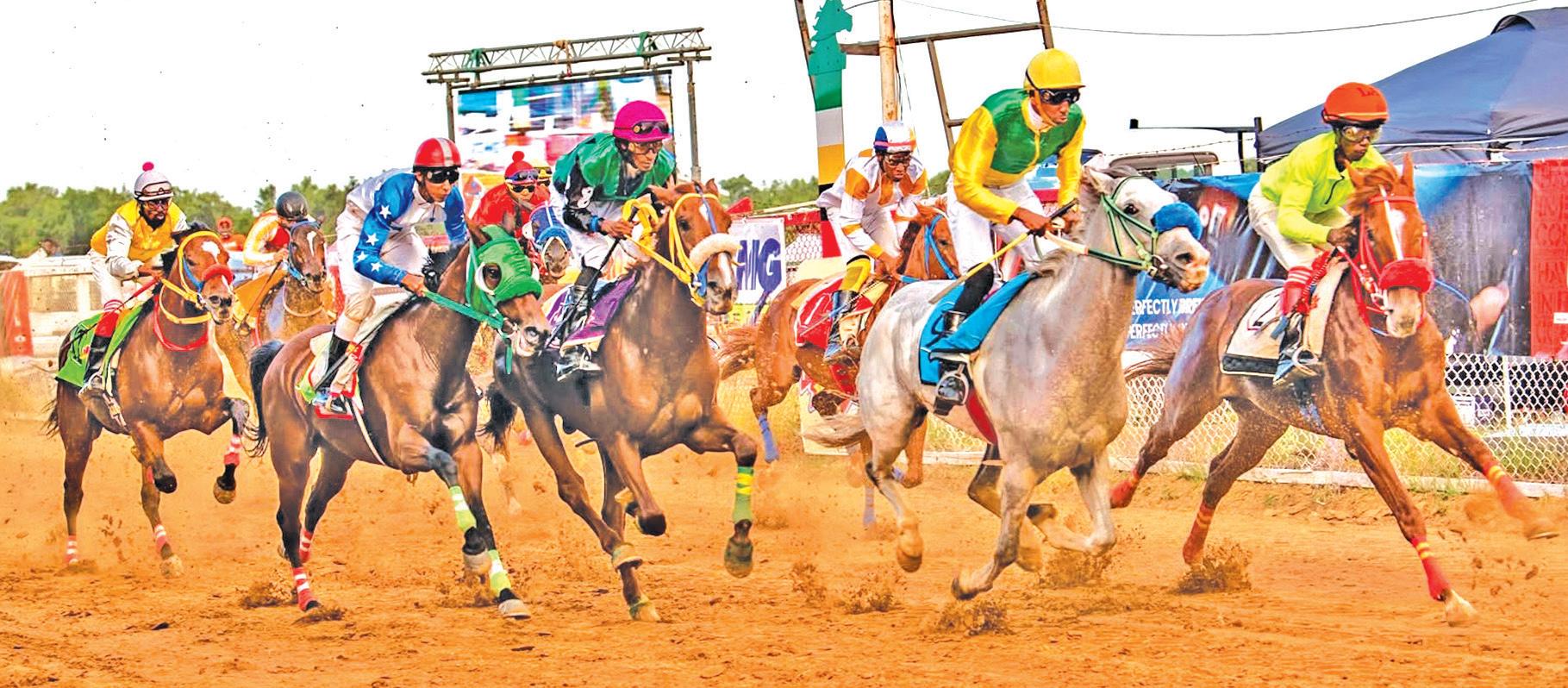
Entries are pouring in rapidly for next week’s CARICOM Cup horse race, which is set for Sunday, July 5, at Bush Lot United,
West Coast Berbice. Close to 100 horses secured entry for the highly anticipated horse race and the headline event will see
the clash of Dataman and Olympic Kremlin. Initially, 11 races were on the cards, but due to the overwhelming entries, or-
ganisers are pushing for a 12-race programme.
for grabs at next week’s race meet.
in Guyana; and the E Class and lower.
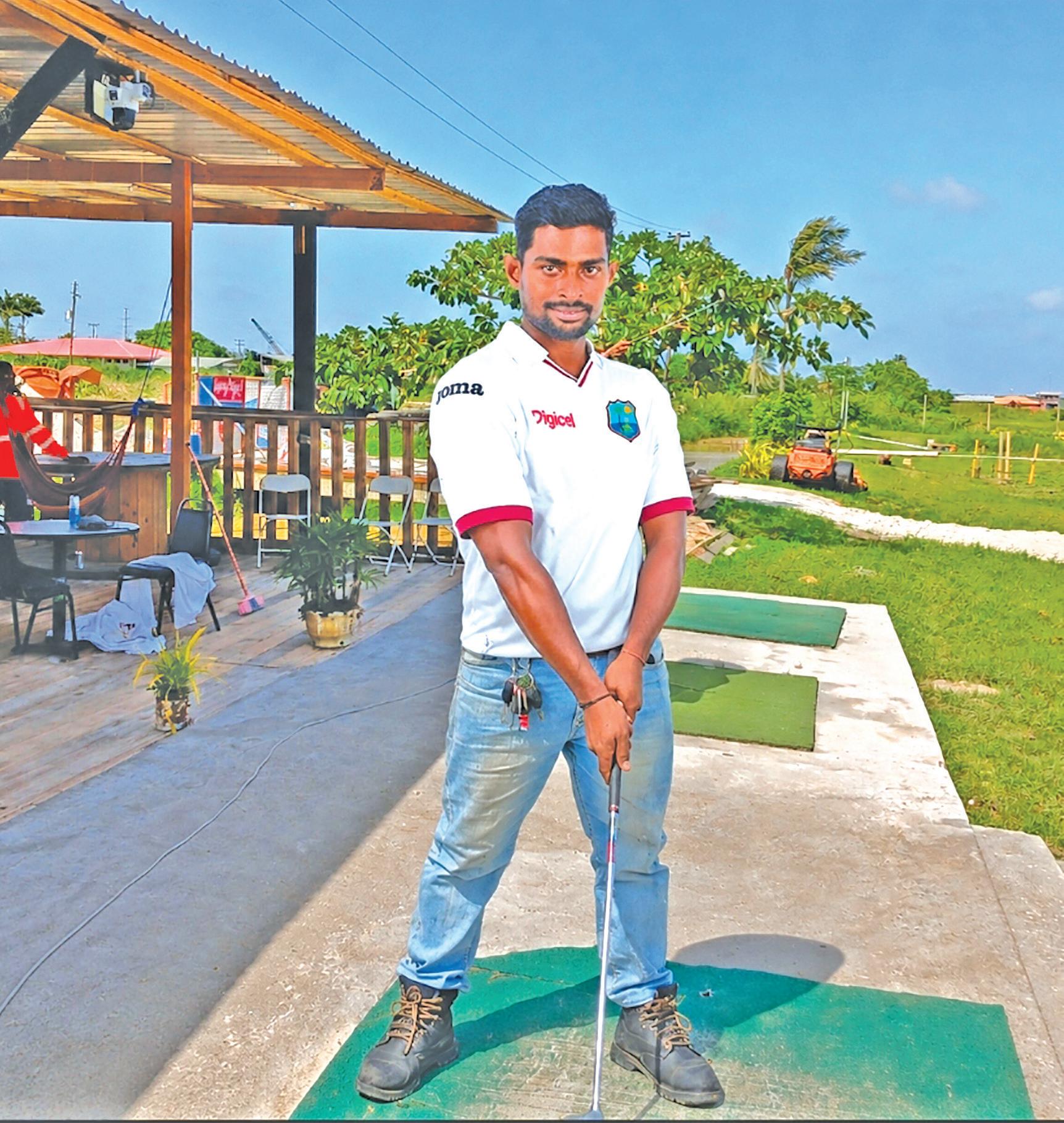
Cricket and golf will come together on Sunday, July 5, when the ER Small Engines Rookie Golf Tournament tees off at the Westside Golf Course in Vreed-en-Hoop.
The tournament will bring together cricketers and first-time golfers for a day of competition, with GY$100,000 in prizes up for grabs. The event is designed specifically for beginners, with teams of three competing for top honours.
Several players associated with cricket teams, including Brian Headley’s Mystic Marvels, are expected to take part. Well-known cricket personalities such as Ravindra Kissoon, former Guyana and West Indies
player Rajendra Chandrika, prolific tapeball run-scorer Jonte Thomas, Jermaine Dewsbury of Transport Cricket Club, N L&B Fuel Pump Repairs and others will trade their cricket bats for golf clubs on the day.
Organisers say the tournament is aimed at creating a bridge between Guyana’s oldest sport, cricket, and one of the country’s fastest-growing sports, golf.
The Westside Golf Course, in partnership with the Guyana Golf Association, has been working to introduce golf to more players across Guyana. Located just off the Schoonord Highway at the Crane Roundabout, Westside is Guyana’s only
public golf course and features a lighted driving range and a restaurant, which is open daily from 07:00h.
Registration is open to all beginner golfers. Interested players can contact Dave at ER Small Engines on 6470016.
Golf clubs and balls will be provided free of charge, while complimentary practice sessions will also be available for registered participants.
The event is sponsored by Comfort Sleep, Toolsie Persaud Ltd, Madewini Gardens Eco Resort, Excel Guyana Inc, Puran Bros, Party Castle, Rommel’s Wholesale Beverages, Regal Stationery and Kumar Auto Spares.
The two-year-old race will be carved into two, with fillies and colts running in respective races. Organisers disclosed that there has been a packed list of Guyana-bred two-year-old horses that will be battling for supremacy.
This CARICOM Cup will be the perfect preparation race for the Guyana Cup, which is set for August 23.
More than GY$15 million in cash and prizes will be up
The CARICOM Gold Cup feature will be open to all three-year-old and older horses going at a distance of 1900 metres. A total purse of four million will be up for grabs, and the top horse will receive two million.
Other races on the programme include the CARICOM Sprint Stakes open to all four-year-olds and over; the CARICOM Derby open to three-year-olds bred
There is also the Rising Star Stakes, open to threeyear-old imported horses; the three-year-olds and over WI Bred winners; the H Class and lower WI Bred non-winners in Guyana; three-year-olds and over I/J/K Class; L Class winners; K&L Maidens; and the future star stakes two-yearold Guyana-bred juveniles, which will now have two races.
West Indies Women's head coach Shane Deitz admitted his side produced their poorest performance when it mattered most after suffering a six-wicket defeat to Ireland in their final group match, leaving their qualification hopes hanging by a thread.
With a place in the next stage within their control, the Caribbean side failed to deliver under pressure, posting an underwhelming total before Ireland comfortably chased it down to secure a vital victory.
Despite the defeat, West Indies are not yet eliminated and could still progress to the next round depending on the outcome of the remaining group fixtures.
Reflecting on the disappointing performance, Deitz did not hide his frustration.
"Yeah, obviously extremely frustrating. We probably bought our worst game for the most important game. Destiny was in our hands, and we weren't able to get across the line, so it was very disappointing, more disappointing than frustrating, because we probably didn't deserve to win.
"So it's not that we played a good game and we just lost; we played a pretty poor game. Ireland took the
opportunities, and congratulations to them."
Deitz acknowledged that the conditions suited Ireland's bowling attack, with the slow surface re warding changes of pace, but insisted the wicket was not the main reason behind his team's struggles.
"Yeah, we saw it was a bit slow. Taking pace off the ball was going to be the way forward, and they bowled quite slow, so the conditions definitely suited them a lit tle bit, but we talked about it.
"I think the wicket or the way they bowled didn't con tribute to a lot of wickets. I think we contributed to a lot of the wickets ourselves, so we really ain't got ourselves to blame, not the wicket.
"We should have scored. We had opportunities with some bad balls we could have put away, and we got out to some of them, and we didn't capitalise on the bad balls enough."
The Australian coach believes West Indies left at least 20 to 30 runs on the field, suggesting a more competitive total would like ly have changed the out come.
"There was enough there, I think, and we should have scored 150, and I think that would have been enough to
win the game."
The defeat left the West Indies facing an anxious wait as they now rely on other group results to deter-


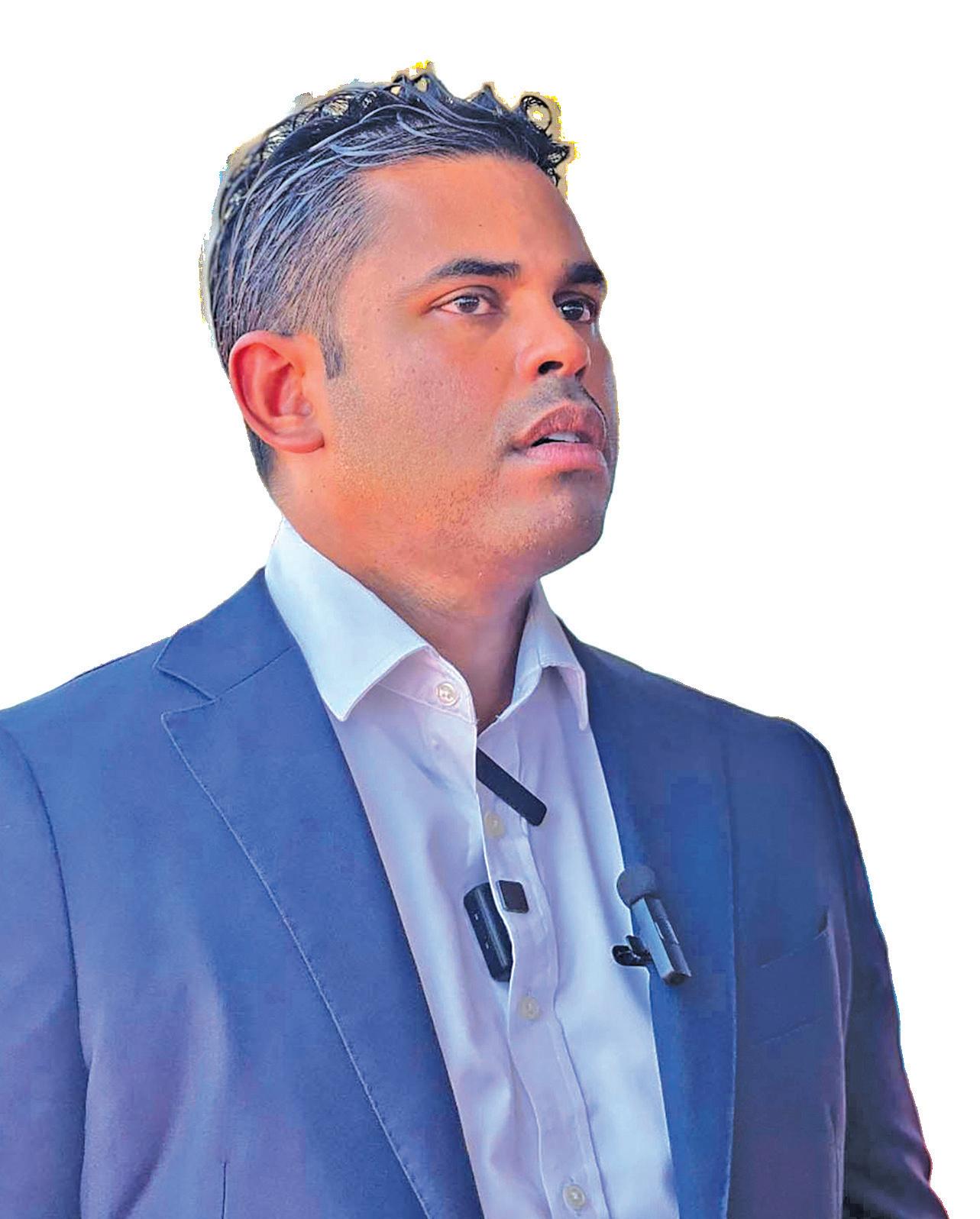
By Michelangelo JacoBus
lengthy discussion before giving its approval.
he Guyana Horse Racing Authority has been approved by Cabinet and is now expected to begin the work needed to formally regulate the sport, according to Minister of Culture, Youth and Sport Charles Ramson Jr.
Speaking on the sidelines of an event on Saturday, Ramson said the authority has already been formed and the Cabinet has completed its review of the body’s membership and composition. He said the names of the members, including the person selected to chair the authority, are expected to be published in the coming week.
According to the Minister, the authority has likely already been gazetted, but the Ministry will still issue a public release to make the information more accessible.
“The body is already formed,” Ramson said, noting that Cabinet had a
Ramson explained that while the establishment of the Authority is an important step, the real work now begins. He said the body will be responsible for carrying out the regulatory functions required under the Horse Racing Authority Act, including the licensing of racetracks, jockeys and other key areas connected to the sport.
He said the Government pushed to have the legislation passed and enforced because horse racing had been operating in an unregulated environment for many years. That lack of regulation, he explained, made it difficult for races and meets to be officially sanctioned or recognised.
Ramson said proper regulation is also important if Guyana is to attract international competitors and gain the confidence of other countries. He noted that overseas participants must be assured that they are competing under fair rules
and standards that are recognised globally.
The Minister said the persons selected to serve on the authority were carefully chosen based on their expertise and the type of work the body will be required to carry out.
Horse racing, he added, has experienced significant growth over the past three years, driven by both Government support and private investment. Ramson said those two factors have helped create an environment of growth and transformation within the sport.
However, he stressed that the authority must now move beyond simply being appointed and begin executing its mandate.
Ramson said the passage and enforcement of the Horse Racing Authority Act, along with the appointment of the authority, mark a major step forward for the sport. He said the focus must now shift to the practical work of regulating horse racing and ensuring that the sport operates under clear and recognised standards.
The Guyana Cricket Board (GCB) has extended condolences on the passing of Jai Narine “Don” Singh, a former President of the historic Georgetown Cricket Club (GCC) and a respected figure in public life and cricket.
In a statement, the President, executives and staff of the GCB expressed sympathy to Singh’s family, relatives, friends, colleagues, the GCC and all those affected by his passing.
Singh was remembered as a distinguished public servant, a prominent councillor of the Georgetown mayor and city council, and someone who made meaningful contributions to local government, public affairs, community development and cricket in Guyana.
The GCB said his long association with the GCC and his service to the wider cricket fraternity reflected his passion for the game and his commitment to its growth and development.
According to the board, Singh’s leadership, dedication and public service left a lasting impression on those who had the opportunity to work with him and know him.
The GCB joined the wider cricket community in mourning his passing while recognising his contribution to both the sport and national life.

On behalf of GCB President Bissoondyal Singh, the executives, staff, and the board, sincere con-
dolences were offered, and prayers were said that Singh’s soul rests in peace and rises in glory.
Preparations for the upcoming Masters World Cup in Guyana have moved another step forward, following a planning meeting between the Cricket West Indies Masters Association (CWIMA) and Government officials at the Ministry of Culture, Youth and Sport.
The tournament, which will feature veteran cricketers from 16 nations, is scheduled to run from October 17 to November 1 at venues across Guyana.
CWIMA Chairman Raj Singh and Finance Convenor Ramdeo Kumar met with Minister of Culture, Youth and Sport Charles Ramson Jr and Minister within the Ministry Steven Jacobs in the Ministry’s boardroom to review the work completed so far and discuss the next steps needed to stage the tournament.
The discussions focused on several key areas, including the preparation and readiness of cricket grounds, television broadcast and live streaming plans, hotel accommodation, transportation, security, and the recruitment of match officials and event personnel.
The meeting also addressed the need for match referees, umpires, venue managers, liaison officers, volunteers, event staff and catering services as organisers continue to prepare for

the two-week competition.
Singh said CWIMA has made strong progress in several operational areas but noted that an event of this size requires close cooperation with Government and local partners. He said the
meeting helped all parties to agree on the remaining priorities as Guyana prepares to welcome teams and visitors.
Minister Ramson commended CWIMA for its planning and reaffirmed the
Government’s support for the tournament. He said the Masters World Cup provides an important opportunity for Guyana to strengthen sports tourism, create economic activity and show its ability to host major inter-
national events.
Minister Jacobs also pointed to the importance of strong broadcasting and security arrangements, noting that the tournament will place Guyana before a global audience. He said
Government and CWIMA are working together to ensure the necessary physical and digital systems are in place for fans locally and overseas.
During the visit, Singh presented World Cup shirts and caps to the Ministers in recognition of their continued support of master cricket over the years.
Further announcements on fixtures, participating teams and ticket availability are expected in the coming weeks.

Amir Jangoo amassed 233; Roston Chase hit 194; and through a record-breaking 401run partnership, the pair slow-roasted Sri Lanka on day three in Antigua. Their gargantuan stand delivered West Indies to a position of extraordinary strength, securing them a 318-run first innings lead. In the four overs they got to bowl at Sri Lanka, West Indies dismissed the dangerous Pathum Nissanka and created other chances, buoying them further heading into day four.
Jangoo and Chase now not only have the highest sixth-wicket stand in the history of Test cricket, but they also have the sec-
ond-highest partnership for the West Indies, behind only Garfield Sobers and Conrad Hunte. Both batters improved on their previous first-class high scores, Roston Chase easily beating his 137 not out and Jangoo surpassing his domestic 219.
That Jangoo produced a knock of such astonishing concentration and expansive range in just his third Test innings was especially impressive. Until he got out attempting to accelerate about midway through the last session, his innings were largely chanceless. He batted 373 deliveries on his own, and he and Chase batted 100.2 overs, seeing out three complete sessions together. Though they had
begun slowly, both batters sped up through the day and were finding boundaries off both the quicks and spinners through the second and third sessions of the day.
Sri Lanka's attack found the pitch utterly docile for most of day three. They were missing their quickest fast bowler, Lahiru Kumara, who went off the field with a hamstring niggle early the previous day. Their quicks were earnest in the first hour, but once Jangoo and Chase saw out the second new ball (the ball was four overs old when day three began) with a period of disciplined batting, Sri Lanka's quicks lost some venom, and captain Dhananjaya de Silva went increasing-
Minister of Culture, Youth and Sport Charles Ramson
Jr on Saturday handed over a lawnmower to Camptown Football Club, strengthening the club’s ability to maintain the Campbellville Community Ground.
The presentation was made during a simple ceremony on the ground, where Camptown FC President Selwyn Robertson thanked the Minister and the Ministry for the continued support. In addition to the lawnmower, the club has also benefited from recent -
mained an important one because of the club’s proud history and past success at a high level.
The Minister praised the club’s leadership for its support of the Ministry and Government, adding that Camptown had made strong progress in a short period. He described the club as a strong football brand with the potential to grow further.
However, Ramson urged the club and its players to take responsibility for the upkeep of the ground. He said the lawnmower was

ly installed lights at the facility.
Ramson said the donation formed part of the Government's ongoing relationship with residents and communities in Campbellville, Bel Air, Prashad Nagar, Sophia and surrounding areas. He noted that the partnership had been built over time through trust and continued investment in community sport.
According to the Minister, 24 grounds in Georgetown have been upgraded through landfill, tilling, ploughing and levelling works, with several also receiving fences, pavilions and lighting. He said those improvements are aimed at giving communities better spaces for sport and recreation.
Ramson also pointed to the Ministry’s push for street football, explaining that it helps keep players active during extended rainy periods when regular football can be affected. He said Camptown’s story re-
being handed over fully to the club but stressed that the facility must be kept in good condition.
He also encouraged the footballers to take pride in small acts of discipline, including helping to clean and maintain the ground. Ramson said discipline remains a key difference between good players and great players, both in sport and in life.
Camptown committee member and former Club President Troy Mendonca also expressed appreciation to the Minister for the assistance and requested further support for the facility. He asked for two additional lights on each post, as well as a small washroom facility, noting that the club would continue to play its part in developing and maintaining the ground.
Ramson said while the occasion was small and ceremonial, it was still important because it represented another step in the continued partnership be-
ly to his spinners – Sonal Dinusha in particular.
The one exception for Sri Lanka was Milan Rathnayaka, who was intense in each of his day three spells and created chances even in a dreary second session, having Chase dropped by a diving wide slip for 108. Later in the day, it would be Rathnayaka who would break the enormous stand and would go on to complete a well-deserved five-wicket haul, finishing with 5 for 124. Dinusha, the left-arm spinning allrounder, conceded 234 runs himself in this innings, though he did also pick up two wickets, including that of Chase.
they plundered 136 runs at a rate of more than five an over. Jangoo was especially strong square of the wicket on the offside and down the ground. Chase was excellent through the covers. Jangoo, additionally, would sometimes tonk the spinners over the straight boundary.
tween the Government, the community and the sporting fraternity.
Patience had defined Jangoo and Chase's batting in the first hour. Jangoo, for example, didn't score off the first 15 deliveries he faced on day three, while Chase was only marginally less defensive. When conditions began to ease after the first hour, however, they began to slip into more fluent modes of operation. In the afternoon session, when the pair really propelled West Indies into the ascendancy,
Right through the day the pair would notch up milestones – both for themselves and the partnership. The milestone that drew the most raucous celebration came soon after tea, when Jangoo completed his double with a sweep through square leg, leaping in the air as he took off for the run. Although only hundreds were in attendance, the house was on its feet for him, coach Daren Sammy and the West Indies dressing room giving him an especially warm ovation. Having come into the XI only as a replacement player for the injured Shai Hope, Jangoo has essentially made himself undroppable for the second Test.
After tea the pair took the scoring up even one further gear, Jangoo hitting
some memorable sixes over square leg, while Chase continued to drive powerfully. Jangoo was out attempting to repeat a pulled six, though the ball was not quite short enough for that shot. The resultant top edge was gobbled up by the wicketkeeper. Chase was out much later, under-edging Dinusha into his stumps when a sweep went awry. He was six short of what would also have been his first double century.
Rathnayake would take two further wickets before the West Indies declared the innings. Nissanka was caught behind, feeling for a Jayden Seales away-swinger, the first ball of the second over. Nightwatcher Kasun Rajitha could have been out too had Jangoo at short leg held a sharp, low chance off the bowling of Kemar Roach. (ESPNcricinfo)
Summarised scores: Stumps Sri Lanka 308 and 15 for 1 (Rajitha 4*, Madushka 2*, Seales 1-5) trail West Indies 626 for 9 dec. (Jangoo 233, Chase 194, Rathnayaka 5-124) by 303 runs.