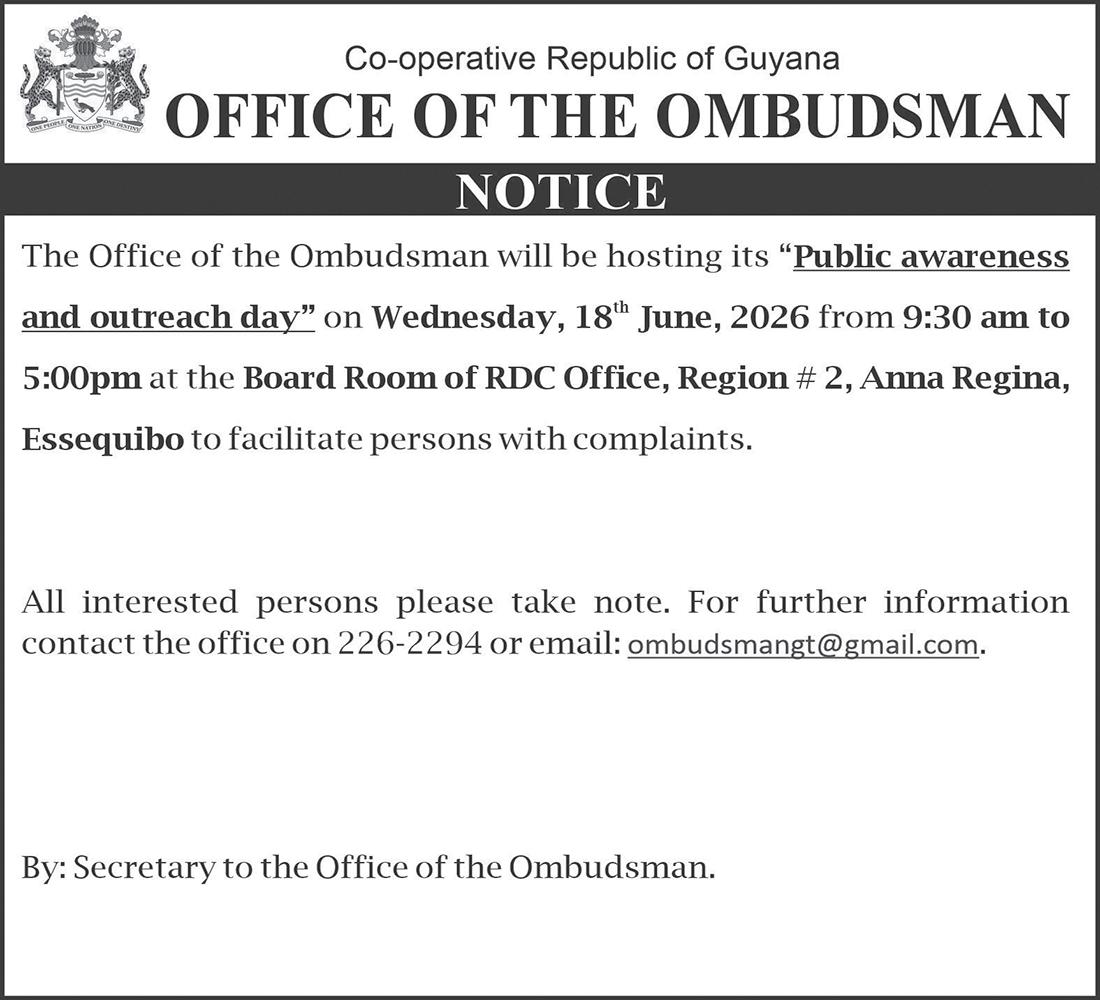
The Berbice Bridge will be closed to vehicular traffic on:
Sunday, June 14 – 16:10h–17:40h and Monday, June 15 – 17:05h–18:35h
BRIDGE OPENINGS FERRY SCHEDULE
Parika and Supenaam departure times – 05:00h, 10:00h-12:00h, 16:00h, 18:30h daily
WEATHER TODAY
Early morning sunshine will turn to thundery showers by midday, continuing into the night. Temperatures are expected to range between 23 degrees Celsius and 30 degrees Celsius.
Winds: East-North-Easterly to East-South-Easterly between 3.12 metres and 5.36 metres.
High Tide: 16:02h reaching a maximum height of 2.58 metres.
Low Tide: 09:32h and 21:47h reaching minimum heights of 0.45 metre and 0.66 metre.
“Be actively involved” in national consultations – Pres Ali urges churches …underscores importance
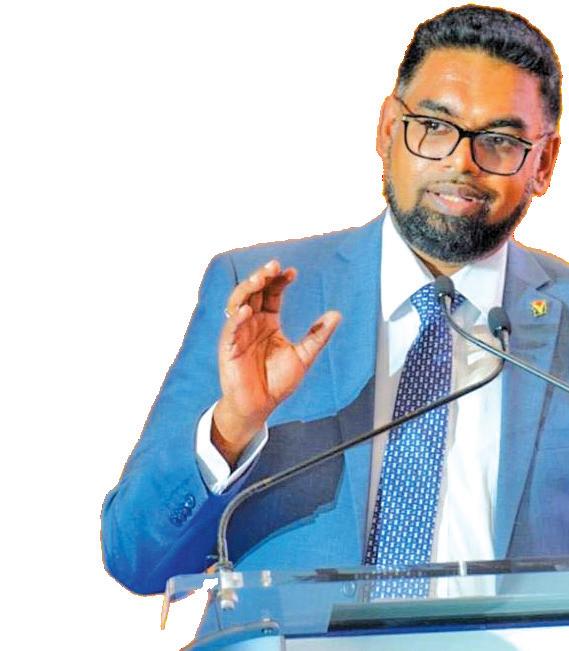
President Dr Irfaan Ali has called on churches to be more involved in key national discussions, especially ongoing consultations on social media and its consequential effects on children. The Guyana Government has launched a nationwide discussion on the risks of social media for children with a series of public consultations across various regions already yielding more than a thousand recommendations and feedback.
Engagements with civil society bodies and other stakeholder groups are ongoing as a special taskforce prepares to review and finalise the suggestions and comments received into a national action plan. Addressing the Centennial celebrations of the Caribbean Union Conference of Seventh-day Adventists on Saturday in Georgetown, President Ali believes that the church also has a role to play in these efforts.
“I want the church to be actively involved in the consultation on social media. The church must be actively involved in this. I want the Seventh-Day Adventist Church to partner with us,” he stated. According to the Guyanese leader, a nation that develops economically but neglects the character formation of its youth risks undermining its own future. This, he outlined, is where the church has to become more involved in the school system. The President pointed to examples of school children watching and filming classmates fight and then upload same on social media, thinking it’s a form of normalcy. This practice, he notes, even occurs in hinterland regions as they get easier access to the internet.
“Something is seriously wrong from the home, from the community and from the minds of these children. And you have to call a spade a spade, because the Bible teaches us that if all of them understood that while they, together, collectively, look on as a wrong is being done in front of their eyes, there are consequences spiritually to that. This is an issue and a challenge that we have to address… because it's being normalised…”
“…You must strengthen value-based education. The future of any nation rests in the hands of its young people. While schools teach knowledge and skills, values also must be taught and reinforced. The church can continue to instil honesty, discipline, respect, humility and responsibility in our youth,” Ali posited. This was one of five areas in which the Head of
State suggested that the Seventh-Day Adventist Church can continue to make a valuable contribution to enhancing citizens’ lives.
Strengthening the family unit
The second area he highlighted was strengthening the family unit. The President stressed that the church has a unique role in supporting marriages, strengthening parenting and nurturing healthy family relationships. He believes that strong homes create strong communities, and strong communities create strong nations. The Guyanese leader further called on the church to promote ethical leadership, noting that the organisation has a powerful voice in public service, public life, and community leadership.
“The church role in national life and national development and national leadership is critical for the survival of the church. Because if your values are to be intertwined with national development strategies, then the church must not be reactive but proactive in this role,” he stated. Fourthly, Ali underscored the need to deepen community service and social responsibility through care and compassion. He further suggested that the church nurture spiritual resilience and national unity, especially in the face of uncertainty, anxiety and division. According to President Ali, embedding these areas into the framework of the church system
is even more critical today – at a time when the country is undergoing unprecedented economic development.
“Regardless of what development and what wealth
nation, I will say, without a shadow of a doubt, rests in faith, love, unity and the will of God,” he posited.
Contending that economic transformation alone does not guarantee national
come before us, we have a soul that we must protect as a nation. We must have a value system that we protect as a nation. We must have principles that we will protect as a nation. And those principles, values and the soul of the
success, the Head of State went on to highlight examples around the world of countries that became wealthier, richer and more prosperous but not necessarily stronger, happier or more united.
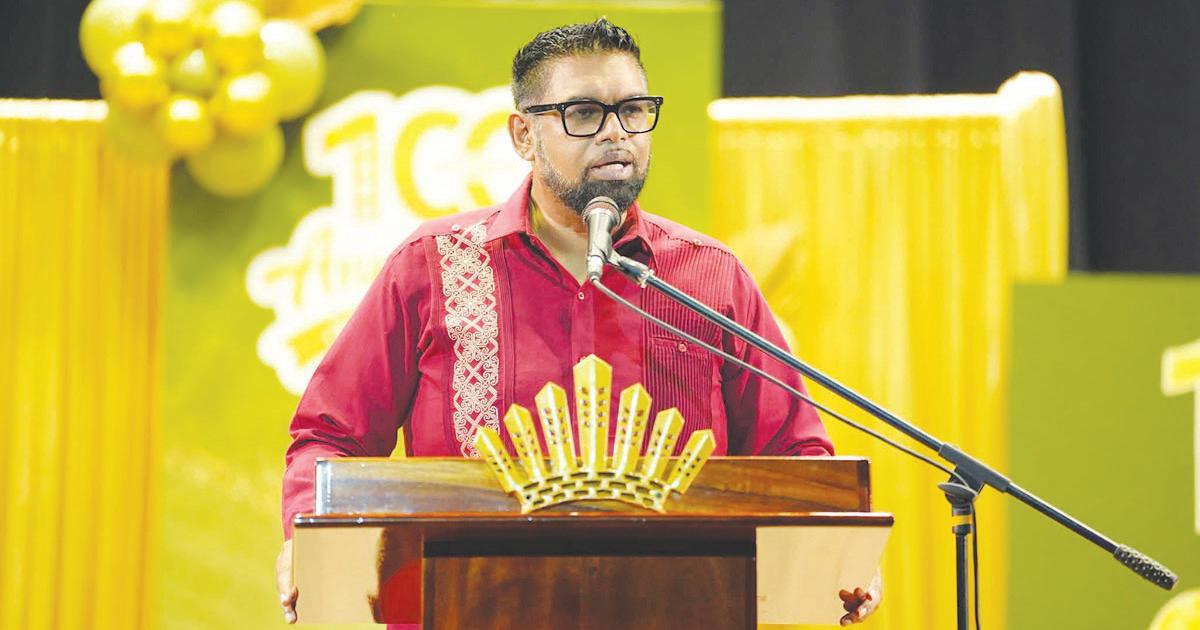
President Dr Irfaan Ali addressing the Centennial Celebrations of the Caribbean Union Conference of Seventh-day Adventists in Georgetown on Saturday (Caribbean Union Conference photo)
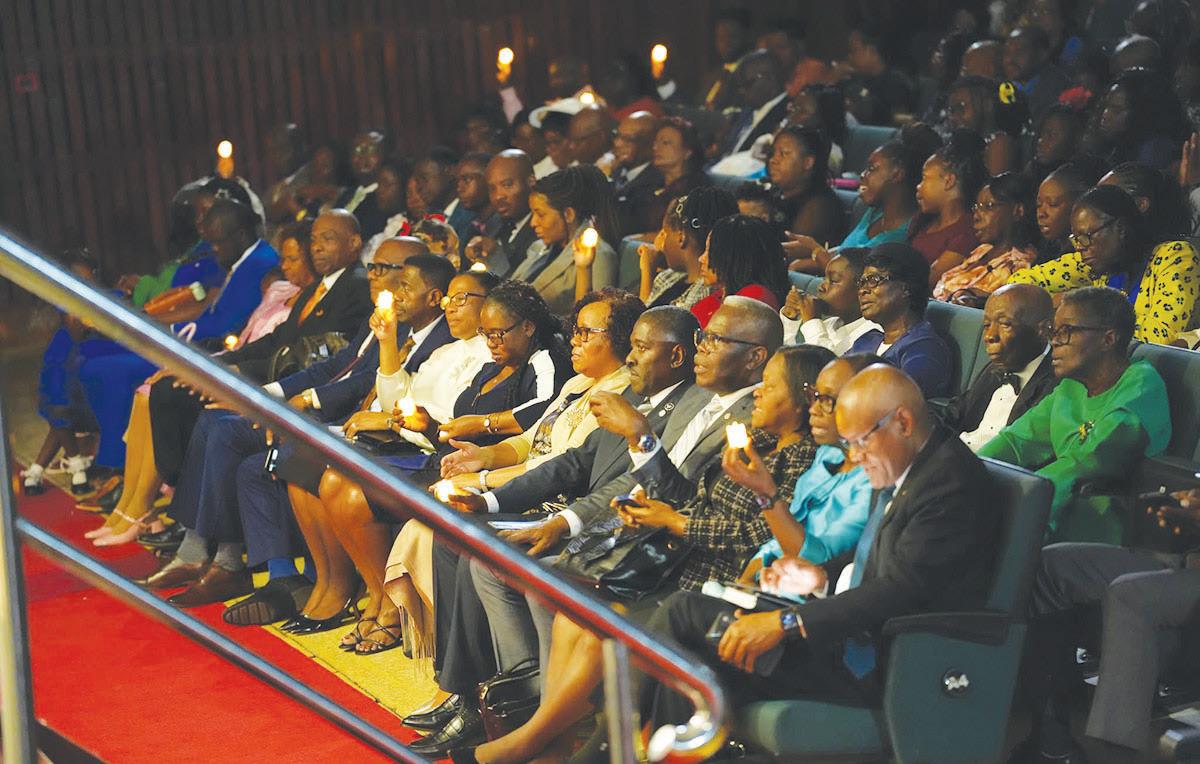
Sections of the gathering at the Caribbean Union Conference of Seventh-day Adventists Centennial Celebrations at the National Cultural Centre in Georgetown on Saturday (Caribbean Union Conference photo)
There is a question that modern societies rarely ask because they assume they already know the answer. When we celebrate
“educational progress”, what exactly are we celebrating? In public discussions, rising literacy rates, increasing enrolments, expanding universities, and growing numbers of graduates are often treated as evidence of educational success. But a society may become highly literate without becoming genuinely educated.
The difference is not merely semantic. It goes to the heart of what education is meant to accomplish. Literacy enables an individual to read words, complete forms, understand instructions, and access information. Education, by contrast, develops the capacity to interpret information, question assumptions, evaluate evidence, and exercise judgement. Literacy teaches people how to receive knowledge. Education teaches them how to think about it.
This distinction has become particularly important in the twenty-first century because information is no longer scarce. Never before in human history have people had such immediate access to facts, opinions, data, and explanations. Yet despite this abundance, societies continue to struggle with misinformation, prejudice, pseudoscience, ideological extremism, and increasingly polarised public discourse. The problem is no longer that people lack information. The problem is that many lack the intellectual tools required to evaluate it. The gap between literacy and education has therefore become one of the defining questions of contemporary education.
For much of human history, literacy itself was a remarkable achievement. The ability to read and write opened doors that had previously been closed to large sections of society. Literacy remains indispensable and should never be undervalued. However, problems arise when literacy is mistaken for the final objective rather than the foundation upon which education must be built. Reading words is not the same as understanding ideas. Accessing information is not the same as possessing wisdom. A person may be capable of reading hundreds of pages and yet remain unable to critically examine a claim, identify a flawed argument, or distinguish evidence from assertion.
This reality is visible across societies. Highly literate individuals are not immune from rumours, misinformation, conspiracy theories, or prejudice. Degrees and certificates do not automatically produce intellectual independence. History offers numerous examples of educated-looking societies that possessed technical competence but lacked the habits of critical inquiry necessary to challenge falsehoods and dangerous assumptions. The ability to read does not guarantee the ability to reason.
At its deepest level, education is not primarily concerned with information. It is concerned with judgement. An educated person is not someone who knows everything. Such a person does not exist. Rather, an educated individual possesses the intellectual discipline to ask meaningful questions, recognise uncertainty, analyse competing arguments, and modify conclusions when confronted with better evidence. Education develops habits of mind. Literacy develops skills. Both matter, but they are not interchangeable.
Unfortunately, many educational systems continue to confuse the two. Students are frequently rewarded for memorising information rather than analysing it, reproducing established answers rather than questioning them, and conforming to expectations rather than exploring alternative perspectives. Examinations often measure retention more effectively than understanding. Academic success can therefore become detached from intellectual growth. Students may learn how to perform well within the system without necessarily learning how to think beyond it.
This distinction becomes especially important in higher education. Universities and colleges increasingly face pressure to produce employable graduates. The concern is understandable. Students invest significant resources in their education and expect professional opportunities in return. Yet employability and education are not identical concepts. A system focused exclusively on producing workers may succeed in supplying labour to the economy while failing to cultivate thoughtful citizens, responsible professionals, and informed decision-makers.
The emergence of artificial intelligence makes this distinction even more important. Machines can increasingly retrieve information, generate summaries, and answer factual questions with remarkable speed. If education is reduced to information recall, technology will inevitably perform many educational functions more efficiently than humans. The enduring value of human education lies elsewhere. It lies in curiosity, judgement, creativity, ethical reflection, and the capacity to ask questions that have no predetermined answers. These are qualities that cannot be measured simply through literacy statistics or examination scores.
(Adapted from Countercurrents)
The best candidate for UN's Secretary General is Guyana’s Carolyn
Dear Editor, Some time ago, I called Ambassador Carolyn Rodrigues and said to her we should put forward her candidacy for the Secretary General (SG) of the United Nations (UN). She laughed and said it is not up to her. On Friday night, President Irfaan Ali stepped forward with a nominee for the position of SG of the United Nations.
She is simply the best candidate for the SG of the UN at this time. Her name is Carolyn Rodrigues. And she is from Guyana. President Irfaan Ali on Friday night announced her candidacy for the post of SG of the UN when the 193 countries with voting rights at the UN will have an opportunity to elect a new candidate.
The UN is 80 years old. In over eight decades, the UN has had nine SGs. The organisation has never had a woman serving as the SG. The time is now to elect a woman. The nine SGs have come from Europe, Africa, Asia, and Latin South America. There has never been a Caribbean SG. The time has come for a Caribbean citizen to serve as the SG for the UN. In fact, the time has come for the world to elect the best candidate among the nominees for the SG position.
Carolyn Rodrigues, Guyana’s nominee, fits all the above and is the best candidate, period.
There comes a time when the world must come together and do what is best for humanity. As we prepare to elect the next SG, the world needs to find a special candidate to be the UN’s SG. Carolyn Rodrigues is a special candidate, the right person at the right time.
As an Indigenous woman, she has had an exceptional career as a national and global public servant. When we served in Parliament and in the Cabinet together (she was first appointed as Minister of Amerindian Affairs in 2001 at the age of 25), she was the youngest Cabinet Member and the youngest Parliamentarian at the time.
When she became Minister of Foreign Affairs in 2008, in which she
served until May 2015, Carolyn became Guyana’s first-ever woman Foreign Affairs Minister, one of only a handful of women in the world who served in such a position, and perhaps the first woman of Indigenous descent in the world to do so. She still holds a record as one of the youngest persons in the world who has ever served as a Foreign Affairs Minister.
Carolyn Rodrigues excelled as Minister of Amerindian Affairs, Minister of Foreign Affairs and as a Parliamentarian. We all remember the remarkable job she did in chairing the Special Select Committee of Parliament when she piloted the Amerindian Act through Parliament and to enactment.
Prior to being selected to be Guyana’s Permanent Representative at the UN in New York in 2020, Carolyn served as a director of the Food and Agriculture Organization (FAO), first in Rome and then in Geneva. At the UN in NY, she successfully navigated Guyana’s election to the Security Council. In regard to non-permanent members of the Security Council, Guyana’s term in the Security Council has been ranked as one of the most influential non-permanent members’ terms. Indeed, serving twice as the President of the Security Council, Carolyn became one of the most admired PRs among those who serve in NY.
Carolyn is a special person, a special lady, a person that the UN desperately needs at a time when the UN desperately needs reinvigoration. Her journey, from Santa Rosa, a hinterland community, from being born into an Amerindian (Indigenous) family, in circumstances where education opportunities were limited and where access to food, potable water, electricity and health were limited, to one of the most important jobs in the world – she is uniquely a special person. The UN needs a candidate like Carolyn. Many people and many countries today believe that the UN has outlived its usefulness. The UN was born out of war, and its mission in 1945 when
Rodrigues
it was established was to end wars, to promote peace and to end hunger and poverty. In 1945, the world came together as the UN to end forever “holocaust” as a human phenomenon. As the UN prepares to elect a new SG, the world has been plagued by wars and conflict (there are more than 120 conflicts ongoing presently); the threat of nuclear war has never been greater; the threat of a third world war has never been more real; “holocausts” now ring as a pathway to "peace"; and gains in ending poverty and hunger are at either a standstill or being reversed. The UN’s anti-poverty instrument –the SDGs – is seriously off-track. The threats of more pandemics, worse ones than COVID-19, are staring us in the face. The UN has never appeared more impotent.
The UN needs a special person. Guyana’s nominee, Carolyn Rodrigues, is a special person. At a time when the UN must be reengineered to be “fit for the future” and “fit for purpose”, we need a candidate like Carolyn Rodrigues. In 2025, we boldly and enthusiastically embraced the Pact of the Future, which laid the groundwork to revitalise multilateralism, turbocharge the SDGs, and adapt the UN system to 21st-century challenges, such as climate change and biodiversity threats. As the UN80 Initiative is being formulated, the most extensive UN reforms will be on the table in 2027, plans that will lead to funding cuts and the search for efficiency; we need the voices of every region in the world. Carolyn Rodrigues is the right person at the right time to mobilise the voice of the world.
CARICOM and Guyana have a chance to stand as one behind our nominee. Let us wave the Guyana flag and the CARICOM flags. The UN needs a special person, and Guyana and CARICOM have put forward a special person.
Yours sincerely, Dr Leslie Ramsammy
World Custard Pie Championships 2026: The championships, which take place in Maidstone, Kent, were dreamed up as a way of raising funds for Coxheath Village Hall about 50 years ago. (Photograph: Gareth Fuller/PA)
BEING ALIVE TO LOVE OUR AGE
By Ryhaan Shah
“Ilove living. I love that
I’m alive to love my age. There are many people who went to bed just as I did yesterday evening and didn’t wake this morning. I love and feel very blessed that I did.” This is a quote from American poet Maya Angelou.
There are other statements that laud old age as a privilege and a triumph and note that not everyone has the good fortune to experience growing old. And being old is not a downhill journey or battle by any means if we keep to a proper diet and exercise regimen, have an active mind, a good social life, and take our prescribed medications if necessary.
The ageing process is a gradual, lifelong development typically categorised into stages based on age and functional independence: young adulthood (18-29), middle adulthood (30-45), middle-to-late adulthood (40-65), and older adulthood (66 plus). These stages involve gradual physical changes, such as decreased muscle density and skin elasticity, alongside social shifts as we retire and no longer have a regular work schedule and workplace interaction.
Research shows that we often start to feel a decline in physical energy as early as our late 30s to early 40s. Referred to as the “fatigued 40s”, this is generally when our body’s natural processes start to slow down and recovery time begins to get longer.
This is when we get that middle-age spread because our metabolism slows down and our muscle mass starts to diminish. It is also when we might begin to lose visual sharpness and would need glasses. Some might notice some hearing loss as well, especially of high-frequency sounds.
The second wave of ageing occurs in our early 60s when the loss of our muscle mass becomes significant, especially if we are not exercising regularly. This, too, is when the daily fatigue and stress from work and family responsibilities can become harder to shake off.
We could also start to experience hair loss – both men and women – and notice other signs of ageing, like the loss of the skin’s elasticity, which results in wrinkles and crepe-y skin. At this age our bone density starts to drop, and this could result in a little loss of height.
While retirement provides freedom to pursue personal hobbies and passions, it could also come with age-related conditions, most of which can be treated to ensure a continued healthy and long life. Type 2 diabetes can be treated and even reversed with proper diet and exercise.
Ageing stiffens our arteries and could slow down our heart rate at the same time as our lung elasticity decreases. The risk of cardiovascular issues like a stroke or a heart attack increases, especially if we are not paying attention to our overall health.
While the health risks increase with the physical shifts that we undergo as we age, growing old is not all negative. It is a profound privilege and an opportunity for deep, authentic freedom. Instead of viewing ageing as a decline, we can embrace it as the accumulation of life experiences.
Many of us welcome the freedom from seeking external validation through, especially, career goals and ambitions. Growing older gives us an unapologetic confidence, and we find that we no longer feel the need to please everyone and that we can now do exactly what we want without the need for explanations or caring too much about societal expectations.
We know that our body is changing, but we do not have to let age define our capabilities. Accepting the inevitability of change allows us to enjoy the present and do whatever it is that brings us joy.
There is wisdom in the advice that we should stop focusing on what we are losing and express gratitude, instead, for the strength and resilience that have kept us well. Life changes are inevitable and normal; they are part of the rich tapestry of life.
This is the time to not only enjoy the memories of times past but also understand that there is time still to make new memories.
Maya Angelou was 60 when she wrote her poem entitled “On Ageing”. It is written from the point-of-view of an older person asking everyone to treat her normally. The poem rejects pity, unwanted help, and the assumption that she needs saving.
It ends with the lines, “I’m the same person I was back then/A little less hair, a little less chin/A lot less lungs and much less wind/But ain’t I lucky I can still breathe in?” She took her last breath at age 86.
Why Guyana’s Development Bank could create thousands of new business owners
Dear Editor, The establishment and soon-to-be operationalisation of Guyana’s SME Development Bank by President Ali’s Government has the potential to become one of the most transformative economic initiatives in our nation’s history. At a time when our country is experiencing unprecedented economic growth, it is critical that ordinary citizens are given the opportunity not only to benefit from that growth but also to actively participate in creating it.
For decades, access to financing has been one of the greatest barriers preventing many Guyanese from turning business ideas into successful enterprises. The SME Development Bank has the potential to change that reality by providing entrepreneurs, particularly young people, with access to capital and business support that can help transform ambition into opportunity.
It is in this regard that special recognition must be given to President Ali for
his administration’s vision and leadership in advancing initiatives such as the SME Development Bank. While many have spoken over the years about empowering citizens through entrepreneurship and expanding access to financing, his Administration is taking concrete steps to transform those aspirations into reality. This initiative reflects a commitment to ensuring that economic growth reaches ordinary Guyanese and not just large businesses and investors.
The true value of the SME Development Bank lies in its ability to help Guyanese become owners rather than merely employees. Through access to financing, individuals can establish poultry farms, agro-processing facilities, construction companies, block-making operations, hardware stores, laundry and commercial cleaning services, transportation services, car and truck wash bay services, eco-lodges, restaurants, technology firms, digital marketing agencies, and numerous
other small businesses capable of creating jobs and generating wealth.
The impact on communities could be profound. Every successful small business creates employment, increases household incomes, stimulates local commerce, and keeps more money circulating within communities. This is especially important for townships such as Linden, Bartica, Lethem, and many rural and hinterland communities where entrepreneurship can become a powerful engine for economic development.
Our young people stand to benefit significantly, and I encourage them to seize these opportunities. Rather than waiting solely for employment opportunities, they can access financing to launch businesses, develop innovative services, and become job creators themselves. In doing so, they can build assets, create wealth, and establish enterprises that can benefit their peers and others but, importantly, future generations.
As our country continues
its remarkable transformation, the SME Development Bank represents an investment in the creativity, determination, and entrepreneurial spirit of its people. If effectively managed and broadly accessible, it can help create a stronger middle class, stimulate community development, reduce economic disparities, and foster a new generation of Guyanese entrepreneurs.
The true wealth of Guyana is not found only in its natural resources but also in the talent and potential of its people. The SME Development Bank provides an opportunity to unlock that potential and build a nation where more Guyanese can become business owners, employers, and active participants in the country’s growing prosperity.
Yours respectfully, Jermaine Figueira Former Member of Parliament Educator and Community Empowerment Advocate
Where do whale sharks have their babies?
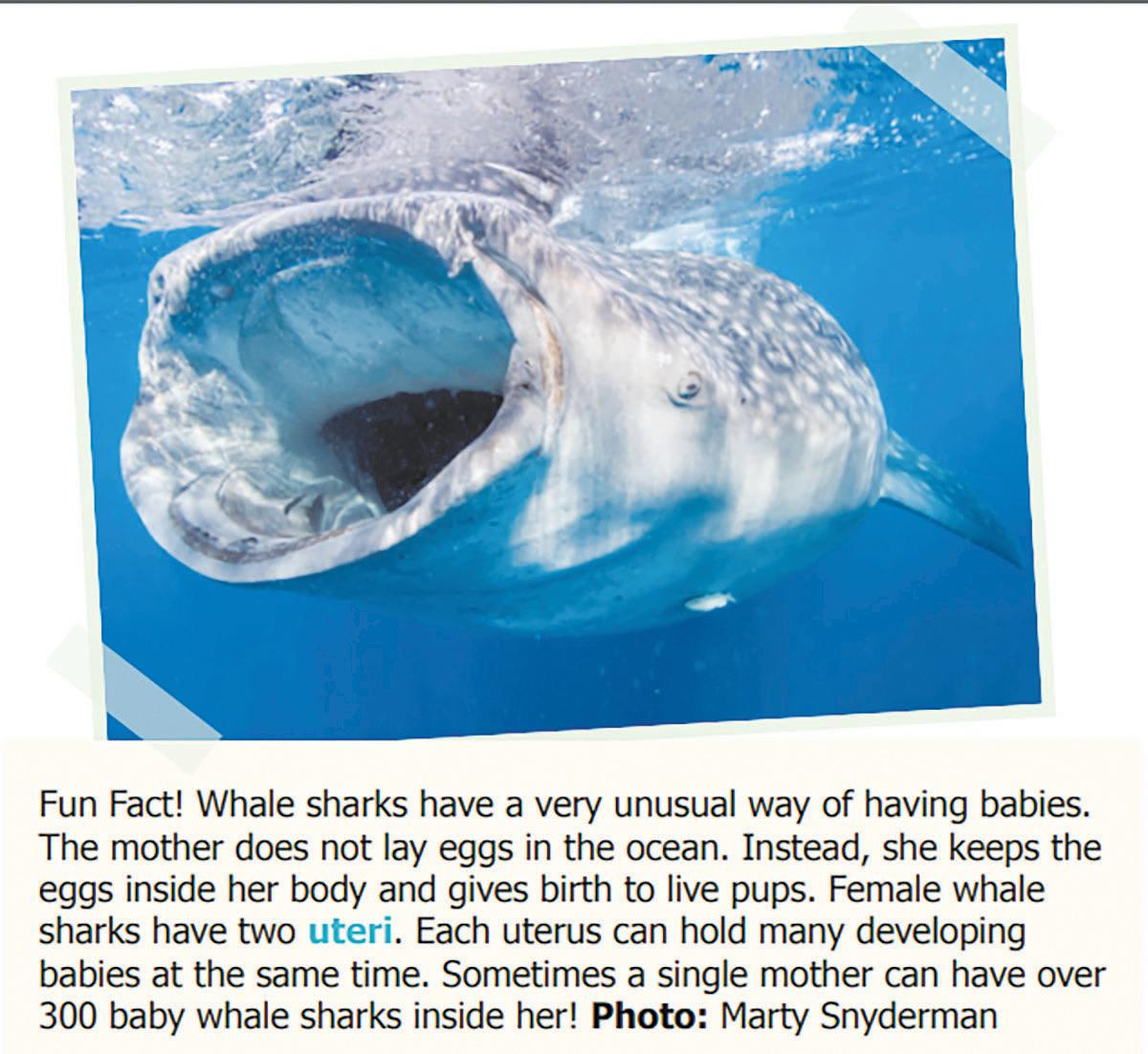
Imagine an animal as long as a school bus. It lives in warm oceans around the world. Yet no one has ever seen one give birth in the wild! That animal is the whale shark. Sadly, it is endangered and needs our protection.
Even though they are giants, whale sharks eat tiny animals by filtering them
from the water. People often see teenage whale sharks feeding in places like Australia, Mexico, and the Maldives. But we do not know where baby whale sharks grow up. The babies are very small, so they need to stay safe until they grow bigger. These safe, early-life areas are called nurseries. Because these nurseries are
hidden and hard to find, we rarely see newborn whale sharks. Since 1970, people have reported only 33 babies worldwide. Although sightings are becoming more common, this small number makes research difficult.
Researchers wanted to see if there was a pattern in the sightings of baby whale sharks. They also wanted to explore what conditions make for good whale shark nurseries, so they set out to find the answers.
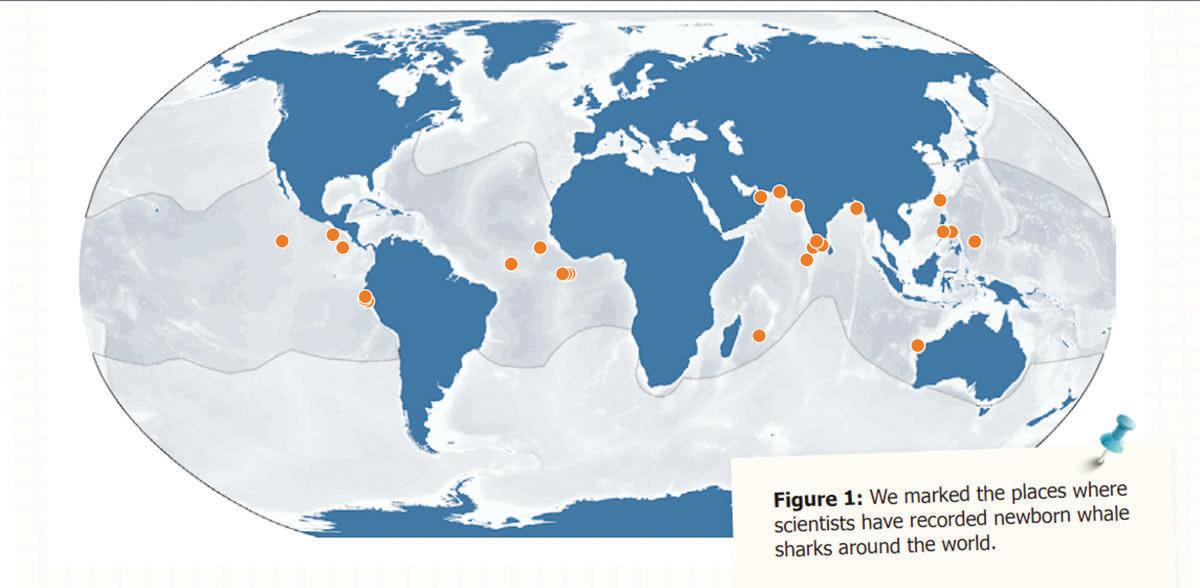
Researchers did not go out on boats to search for baby whale sharks. They are far too rare for that. Instead, they collected every known (scientific) report of newborn whale sharks from around the world. They only included whale sharks shorter than 1.5 metres. They marked each sighting on a map (Fig. 1), then gathered ocean data for those same locations.
The study focused on:
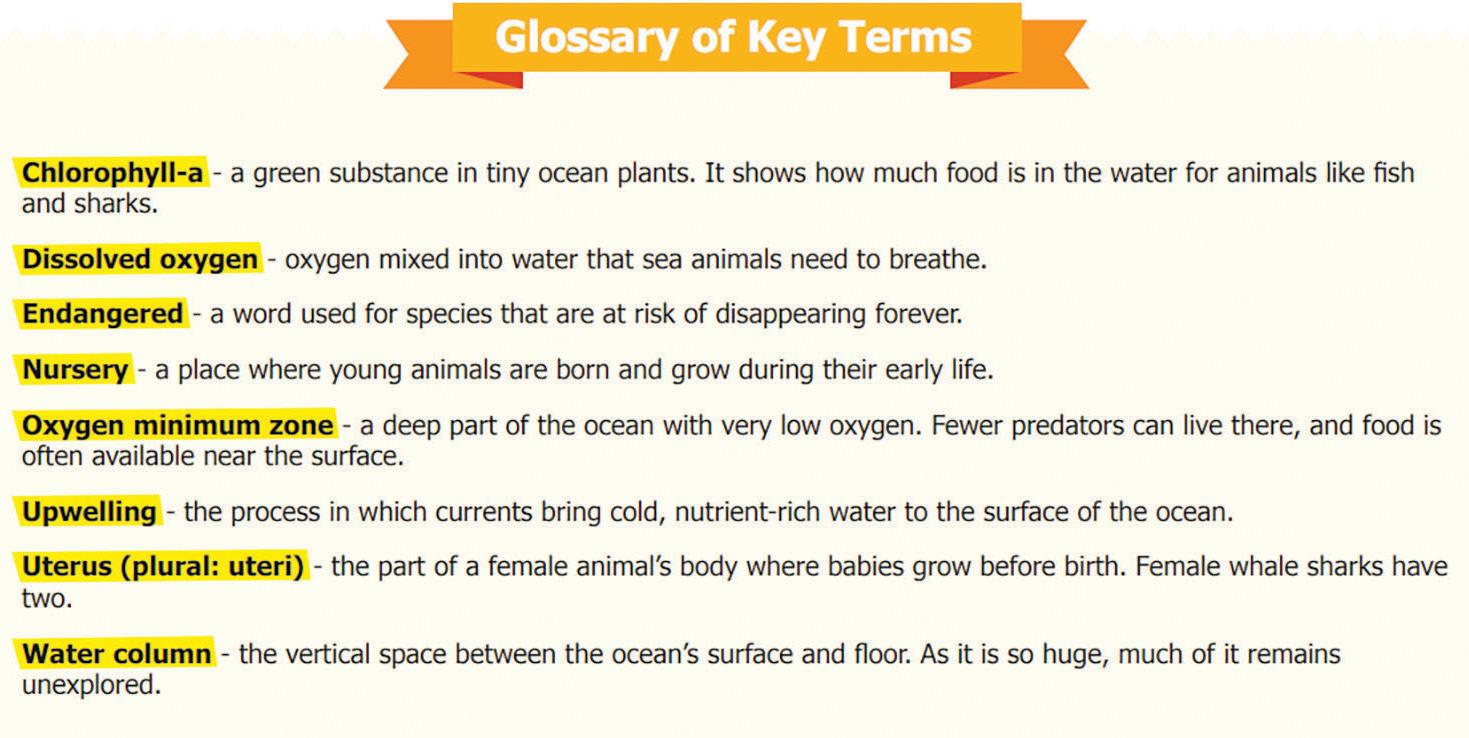
• surface chlorophyll-a (tiny plants in the water that support the ani-
mals whale sharks eat), dissolved oxygen (oxygen that marine animals like fish need to breathe), and water temperature and other features.
They also looked at random points across the ocean,
el to predict where newborn whale sharks might live. When researchers looked at where people had seen baby whale sharks, they found fairly strong patterns. Most newborn sharks appeared near parts of the ocean with very low oxygen deep below the surface. These places are called oxygen minimum zones. Near the surface, oxygen minimum zones have many tiny plants linked to a process called upwelling. These plants support food chains and provide food for many ocean dwellers. These sightings happened more often than we would expect by chance, especially in areas with very low oxygen deep in the water column.
They also had moderate chlorophyll levels near the surface. This means food was available for the baby whale sharks. Oxygen minimum zones have warm sur-
more food, shown by chlorophyll levels. This gives baby whale sharks easy access to meals. The water was warmer as well, which may help baby whale sharks stay active and grow.
Alternatively, mothers may give birth in many places. But low oxygen may keep the babies closer to the surface. As a result, we can spot them more easily. If babies in other areas stay deep underwater (where there is plenty of oxygen and more predators), we cannot see them.
Now researchers need to track pregnant whale sharks and newborns to find out more! Better tools could show where mothers travel and where babies grow up. Once they become teenagers, they are frequently spotted in the ocean.
Whale sharks face many threats. Fishing, ship collisions, and climate change
comparing these areas to the real whale shark sightings. This helped them see if baby whale sharks prefer certain environments. Then, they built a computer mod-
face water. This matches the temperatures whale sharks usually prefer.
The model predicted that researchers might expect to find newborn whale sharks in other oxygen minimum zones. This suggested that these zones may be good nurseries for baby whale sharks. These results also suggest that whale shark nurseries will not be found in random places in the ocean.
So, do whale sharks choose low-oxygen areas to give birth? And if so, why? The results suggest two possible answers.
First, mothers may choose oxygen minimum zones on purpose. Many large predators need more oxygen to survive. So, low oxygen levels may help keep babies safer if they move into these areas where predators cannot follow. The surface waters here also have
all reduce their numbers. If oxygen minimum zones help baby sharks survive, protecting these areas could help the species recover.
Baby whale sharks remain one of the ocean’s greatest mysteries, but ocean conditions may shape where they are born or survive early life. This knowledge matters. It helps protect whale sharks when and where they are most vulnerable.
You can help too! Keep the ocean clean by recycling, using reusable bottles, and never littering. Plastic can reach the sea and harm whale sharks. Ask your family to choose seafood caught in ways that protect ocean wildlife. Small choices can help keep whale sharks safe and healthy.
(Adapted from sciencejournalforkids)
“Quiet giant” – former MP, Region 2 Vice Chair hailed for
“selfless leadership”
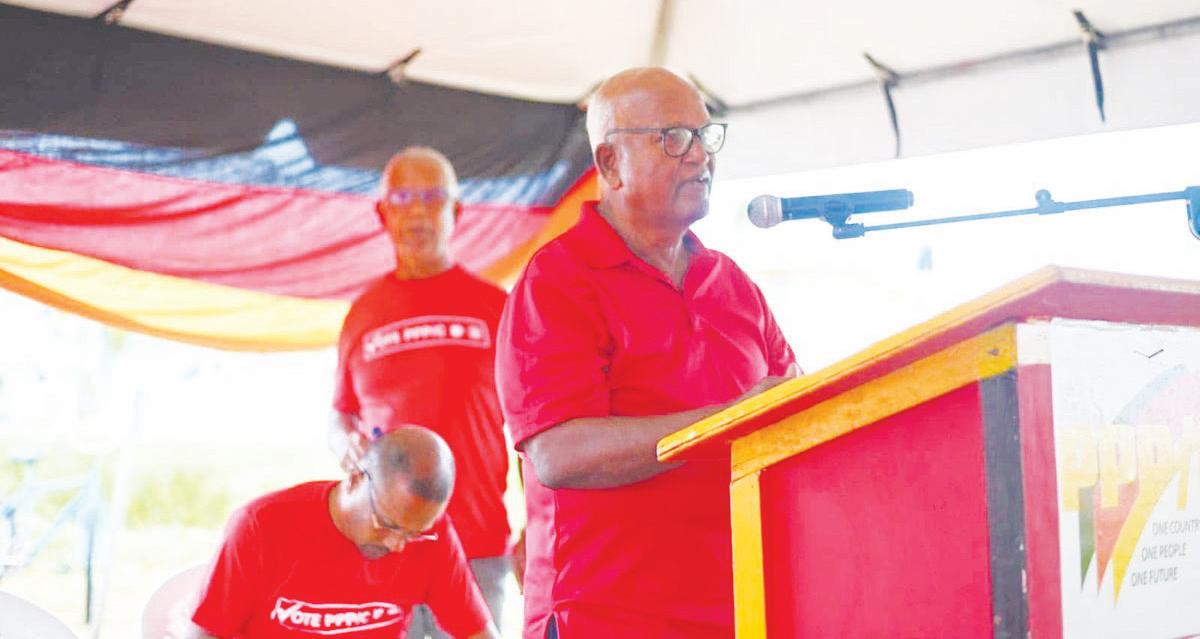
Former People’s Progressive Party (PPP) Member of Parliament and Vice Chairman of the Regional Democratic Council for Region Two (PomeroonSupenaam), Vishnu Samaroo, has been hailed as a quiet giant for his selfless leadership over the years.
“Comrade Samaroo represented a generation of selfless leadership,” President Dr Irfaan Ali stated while addressing mourners during the funeral service at Lima, Essequibo Coast, on Saturday.
Describing Samaroo as a “quiet giant”, Ali recalled that the long-standing party stalwart was at fore when the PPP/C embarked on rebuilding efforts in 2015 after losing office. According to the Head of State, Samaroo played a leading role in organising major party events in Region Two and was present at every single meeting – a trait he says must be emulated in order to build a stronger movement within the PPP.
“[Samaroo] had a quality that is called ‘presence’. Many of our comrades sometimes believe that ‘you know somebody else is coming; I don't need to be there.' But whatever the event was, once it was party-related and his Government-related, he would be present. Even if he is there sitting quietly, he will be present because he understands that presence carries a greater meaning.
Presence carried the
meaning of association, the meaning of agreement and the meaning of being part of a great movement. And Comrade Samaru was present at every stage of this party development and this Government achievement, and I think that is one of the characteristics that we don't speak much of, the importance of presence,” Ali stated.
He recounted that during the 2025 elections campaign trail, when the party held rallies in Region Two, Samaroo, though not in the best of health, would still show up.
“Even then when he was not in his full health, his family was preparing him to go to the rally, to drive him past the rally because he wanted that presence to be there. Even if it was just to drive past, knowing that he was there for his party, present for his party when his party requires him to be – an extraordinary quality,” Ali noted.
According to the Head of State, this quality is already being embraced by the current PPP/C Administration with not just Government leadership but also party leadership being present on the ground to serve citizens.
Pointing to Vice President and PPP General Secretary (GS) Bharrat Jagdeo’s recent public outreach in Region Five, President Ali noted that presence among the people is non-negotiable and is an important part of the party’s DNA.
The President went onto note that while Samaroo’s passing leaves a void that cannot easily be filled, his life and the legacy he has left behind will be celebrated.
“The example he set will continue to guide future generations of public servants and political activists… Farewell, Comrade Vishnu Samaroo. You served your people well. You served your region well. You served your country well. You served your party well. And for that, you will always be loved and remembered,” President Ali stated.
Sacrifices of family
Meanwhile, GS Jagdeo, in his remarks, recognised not just the contributions made by Samaroo but also the sacrifices of his family, from whom he had to spend considerable time away in service to the party and the country.
Jagdeo recalled that Samaroo, like many other PPP stalwarts, had struggled immensely when they joined the party, facing discrimination and hardships in their fight for freedom.
However, in celebrating the life of the late Samaroo, the PPP GS stated that this current era brings different types of struggles for the party and its members. He said the hard work and memory of stalwarts like Samaroo must be used as inspiration to ensure the PPP’s future is secured and does not become perilous, especially at a time when social media is being used to sway people.
“So how do we, in this new era, live up to this wonderful struggle and memory of people like Comrade Samaroo and rise to that challenge? That's what is before us now. Or else, we will not be serving their memory and their struggles well… We have to plan for the future. We have done that from Cheddi Jagan's
days and progressively, year after year. Once we are in Government, the country changes for the better,” Jagdeo stated.
The PPP GS went on to outline the importance of ensuring the younger generation remembers the struggles of the past – something he says is key not only to prevent reoccurrences in the future but also to continue the type of hard work that members like Samaroo did to keep the party strong.
“And that's the only way we can really pay tribute to Comrade Samaroo…and all of these giants who stood on this course. They inspired all of us as young people. They inspired us. They supported young people, you know, to rise in the party… And so don't think that we can sit every day and live on past glory and the struggles of comrades like Samaroo.
Every day we have to struggle… That's the only tribute we can pay, to allow the memories of Samaroo and others who went before him to use that memory to continue to strengthen the party and provide leadership in the country,” the GS stated. Also speaking at the funeral services were past PPP General Secretaries, former President Donald Ramotar and Agriculture Minister Zulfikar Mustapha.
“Be actively involved”
“This is why institutions such as a church become even more important during times of national transformation. The church serves as society's moral compass. It reminds us that true development is always about character, is about integrity, is about compassion, is about justice, [and] is about responsibility to one another. Transformation is only complete when it strengthens not only the economy but also the moral foundations upon which a nation stands. The church, therefore, has a critical role to play in helping Guyana navigate this new era,” the Guyanese leader asserted.
Witness
Meanwhile, turning his attention to the milestone 100-year celebra-
tions, President Ali extended congratulations to the Caribbean Union Conference, which he says has stood as a witness to faith, service, education, health, community development and the proclamation of the gospel over the past century.
“The Caribbean Union Conference enters its sec-
ond century with an extraordinary legacy behind it and tremendous opportunities ahead of it. The same faith to sustain institutions for the past 100 years will guide it into the future. The same commitment to service that built this legacy will continue to inspire generations yet unborn,” the Head of State noted.
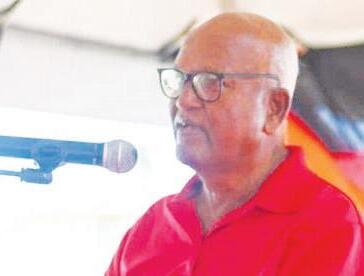
The late PPP stalwart, Vishnu Samaroo
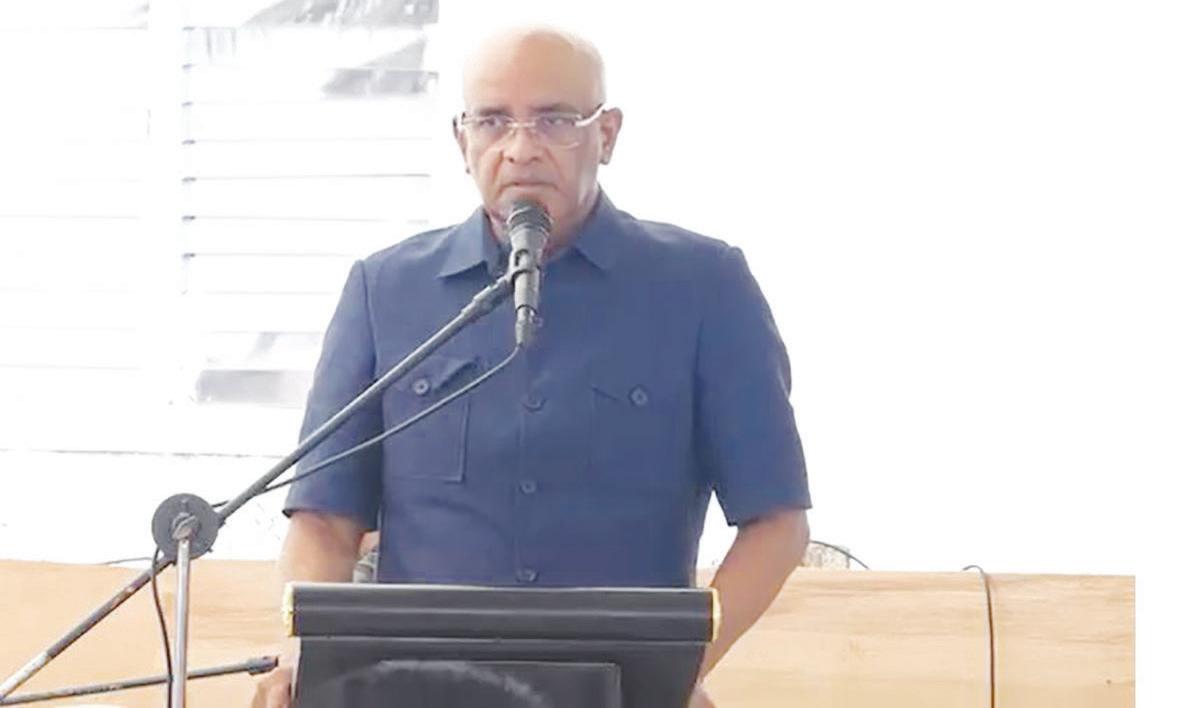
PPP General Secretary Bharrat Jagdeo
“It is always better to prevent a crime than solve it” – Crime Chief …as 36 ranks graduate junior investigators course
The investigative capabilities of the Criminal Investigation Department (CID) of the Guyana Police Force (GPF) have been strengthened following the completion of the Junior Investigators Course 2/2026 by 36 ranks from across various Police divisions.
The four-week training programme began on May 18 at the Officers’ Training Complex and concluded on June 12. It was designed to enhance investigative knowledge, practical skills and professional standards among junior investigators as part of ongoing efforts to modernise the force's crime-fighting capacity. The Officers’ Training Complex provided logistical support and meals throughout the course. Training was delivered by senior and junior Police advisers, along with experienced officers of the GPF, who facilitated both lectures and practical sessions.
Participants received instruction in key areas of criminal investigation, including homicide investigations, interview techniques, crime scene management, report writing, case file preparation, elements of crime and offences, committals and in-
quests, laws of evidence, defences to crime and criminal law and procedure.
The programme also included refresher sessions to reinforce core investigative principles, as well as exposure to emerging investigative tools and technologies aimed at improving operational effectiveness.
To assess competency, participants completed three examinations comprising both theoretical and practical components. At the closing ceremony, Deputy Commissioner (Law Enforcement) Wendell Blanhum, who is also the Crime Chief, congratulated the participants on completing the programme and urged them to maintain professionalism.
“I want to commence by commending and congratulating every one of you for successfully making it to the end of this Junior Investigators’ Course,” Blanhum is quoted as saying in a release posted on the GPF’s social media page. He stated that the Force will continue to invest in building investigative capacity, including identifying and developing young officers and providing opportunities for overseas training. He also emphasised that meritocracy will guide advancement within the CID.
According to the Crime Chief’s remarks delivered at the event, the course aims to strengthen investigative skills and prepare ranks to respond to emerging threats, including organised crime and criminal networks. Blanhum noted that practical exercises and real-life scenarios were included to better prepare participants for field operations. He urged graduates to remain disciplined and committed in their duties, describing them as representatives of
the Force. He also stressed the importance of teamwork among divisions, encouraging collaboration between detectives, traffic ranks, general duty ranks and special branch ranks.
“We have a very sacred duty as detectives… it is always better to prevent a crime than having to solve it,” he said. Lance Corporal Nickomo Blackman topped the course, while Corporal George Fraser placed second and Corporal Tanesha Johnson placed third.
Honouring... ...Walter
Today, the surviving geriatric, self-styled “Rodneyites” from the WPA – all four of them!! – are rehabilitating the dictator “Fat Boy” Burnham for his “progressive” foreign policy, his “socialist” nationalisations, and his regional outlook!! While “honouring” Walter Rodney on the 46th anniversary of his assassination!!! Well, today your Eyewitness will let the great man speak on Burnham in his own words – uttered just before Burnham snuffed out his life in a hired assassination!!
“The Burnham dictatorship has masked and camouflaged itself. It would prefer that its vices be hidden from the public. Why is this? Men in the past have boasted of being dictators...like Idi Amin. (But) the world has come to shun racist regimes...and all dictatorial Governments. This climate of international opinion offers the first explanation as to why the Burnham dictatorship prefers to remain disguised.
“The Burnham dictatorship presents itself as its own opposite… as a democracy... like Hitler, who subverted German bourgeois democracy in the 1930s. Burnham has taken a similar road to power – subverting the democratic system of which he was part in 1953. Hitler had a mad wish to rule the world. For this reason, he is generally described as a megalomaniac. Hitler's megalomania was backed by the powerful German economy and the might of the German army. Burnham's megalomania is closer to comedy and farce. It takes the form of wearing a general's uniform and hoping that the army will conquer his own people.
“Like all classic dictatorships, that which exists in Guyana has fostered the cult of the personality. The minority PNC regime has used all manner of tricks and gimmicks to make the "Comrade Leader" appear to be a demigod. (Like) on the exercise books of school children, the face of the reigning English Monarch was simply replaced by that of the Prime Minister. (There is also) the highly personalised nature of the dictatorship. The dictator and his cronies make it their business to hire and fire. The state control over the economy was the main weapon used to keep people in line. (or) who to prosecute in the courts...
“Burnham encourages around himself individuals who are weak or corrupt because he then exercises vicious control over them...On the international scene, Burnham could never be a powerful force. But he has proved crafty and cunning in achieving his ends within Guyana. An old woman at Bourda shouted at a recent political meeting that ‘Burnham mek Satan cry!’
“The Burnham dictatorship crept up upon Guyanese people like a thief in the night. His violations of human rights were frequent, but they were sufficiently gradual that many persons did not realise what was going on until it was too late.”
And then Burnham had Rodney assassinated! And ensured his party’s extinction!!
…the contract
Some PPP haters wanna have their (oil) cake and eat it too!! Some have made common cause with the woke crowd in the WEIRD world – Western, Educated, Industrialised, Rich, and Demented!! – for us to “save the earth” by leaving our oil under the Atlantic!! Yup!! The world presently produces 100 million barrels daily – of which we’re straining to get to ONE million per day – and by holding it back, we’ll save Earth from vaporising into a supernova!!
Another branch is hauling the Government over the coals for bringing the associated gas ashore to fuel generators, fertiliser plants and data centres – for the same reason!! An offshoot is honing in on what they see as a contradiction in the Government saying the gas is “free” while Exxon says it’s deducting the cost of the pipeline from the cost of oil!! Where’s the contradiction?? The gas is ours up to a porthole in the FPSO! Exxon paid for the pipeline to bring it ashore – and gotta be paid!!
…our Indigenous Peoples
The Government’s nomination of Carolyn Rodrigues for the UNGA’s Secretary General post must be seen for what it is!! Not just an honour for her dedicated service to our country – but an honour to our Indigenous Peoples!!
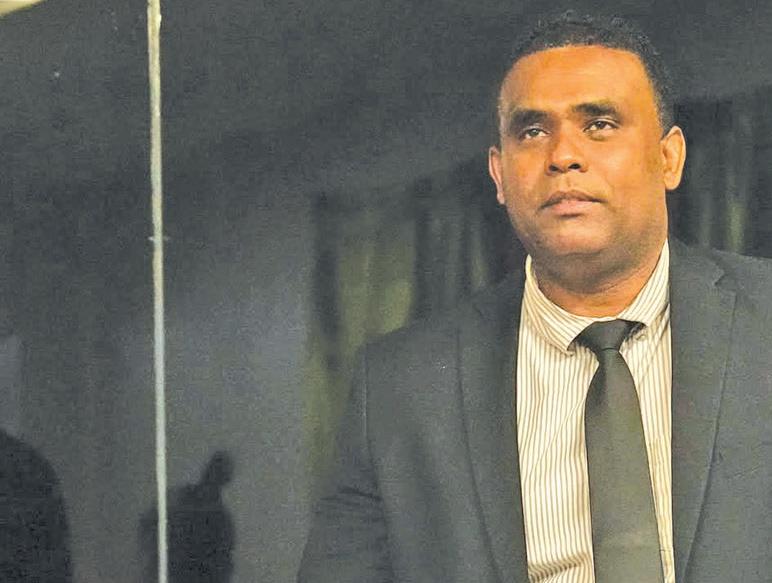
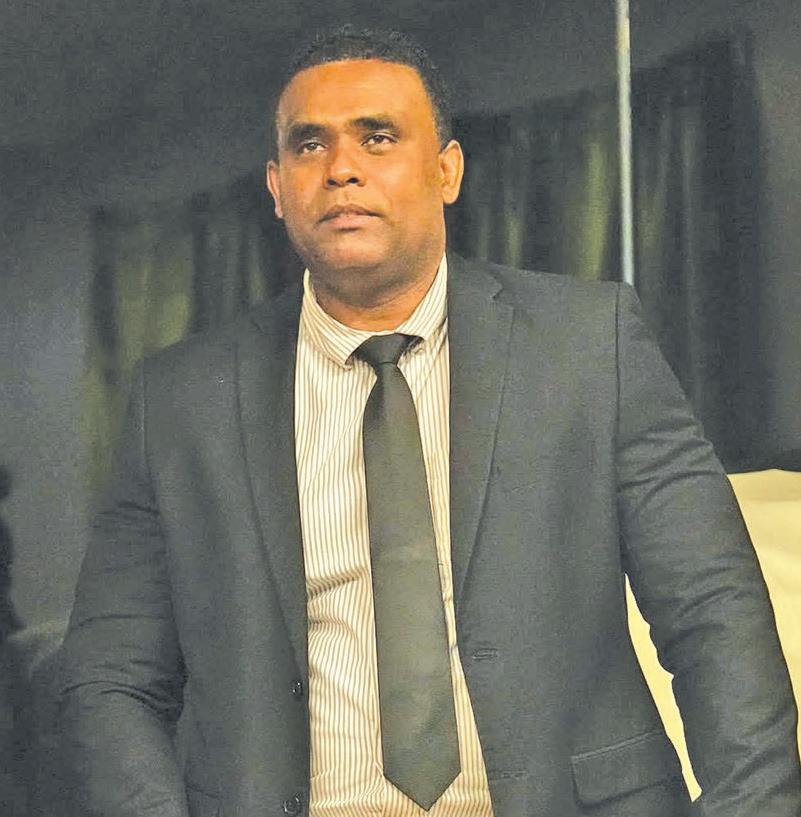
Deputy Commissioner (Law Enforcement) and Crime Chief, Wendell Blanhum
Guyana’s candidacy for UNSG Ready to advance “peace, development and human rights for all” – Guyana’s UN Chief nominee
Following President
Dr Irfaan Ali’s announcement on Friday evening of Guyana’s candidature for the Secretary-General (SG) of the United Nations (UN), former Foreign Affairs Minister and current Permanent Representative of Guyana to the UN, Ambassador Carolyn Rodrigues-Birkett, has expressed gratitude for the
support she has received. “I extend my heartfelt gratitude to His Excellency President Mohamed Irfaan Ali for his decision to put forward my candidacy for the post of Secretary-General of the United Nations. It is both an honour and a privilege to receive his support and that of the Government,” Rodrigues-Birkett said in a statement on Friday eve-
ning. Looking ahead, the Guyanese Diplomat declared her readiness to serve the international community, continuing her advocacy for international peace and security as well as for human rights across the globe.
“As I embark on this campaign, the experience and skills I have gained over the last decades serving in successive PPP/C
(People’s Progressive Party/Civic) Governments and in the international community will guide me on this journey, where I aspire to serve as the world’s chief public servant working with the 193 Member States of the United Nations and partners in advancing the cause of international peace and security, development and human rights for all,” Ambassador RodriguesBirkett stated. Guyana is seeking the UNSG seat, which will become vacant when the tenure of current UNSG Antonio Guterres, ends on December 31, 2026. In his announcement on Friday evening, President Ali explained that the nomination of Ambassador Rodrigues-Birkett will continue Guyana’s tradition of international engagement and service. He believes she has acquired the experience, expertise, judgment and diplomatic skills necessary to perform ably and effectively carry out the duties of SG of the UN. Ambassador Rodrigues Burkett currently serves as Guyana’s Permanent Representative to the UN, a position she has held since 2020, and during this time, she presided over Guyana’s historic tenure on the Security Council from 2024 to 2025, playing a leading role in advancing Guyana’s position on matters relating to international peace and security. Prior to her current appointment, Ambassador Rodrigues-Birkett served as Director of the Food and Agriculture Organisation (FAO) Liaison Office in Geneva from 2017 to 2020. Before that, she served as Guyana’s Minister of Foreign Affairs from 2008 to 2015 as well as Minister of Amerindian Affairs from 2001 to 2008. According to President Ali, “Throughout her career, Ambassador Rodrigues-Birkett has demonstrated a consistent commitment to inclusion, social development, gender equality and sustainable development. Her experience spans governance, diplomacy, development cooperation, international negotiations and multilateral leadership. The Government of Guyana believes that the next SG must possess not only a thorough understanding of the challenges confronting the international community, but also the ability to build trust among Member States, strengthen confidence in multilateral institutions, and lead the organisation with a vision.”
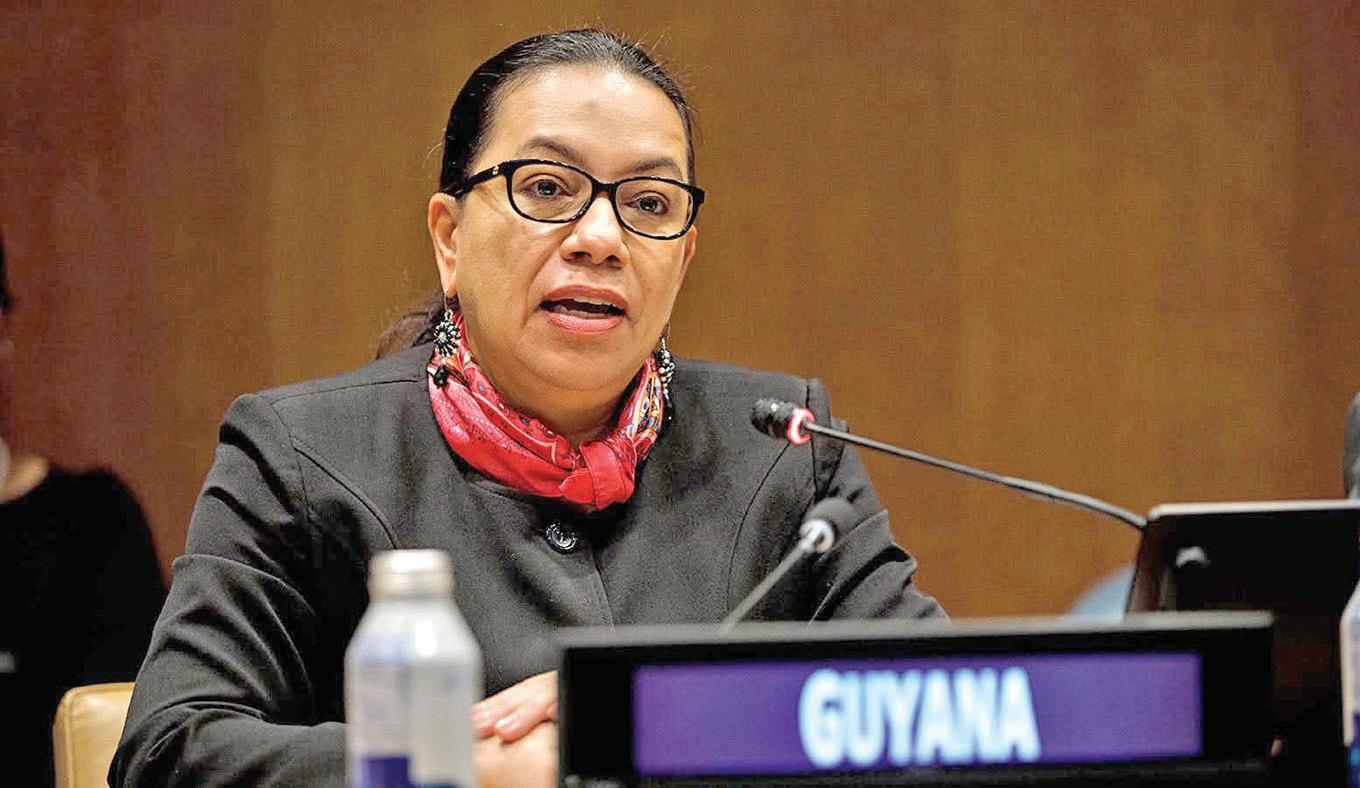
Ambassador Carolyn Rodrigues-Birkett
Wismar Massacre: what’s
Pin a name?
NC leader Aubrey Norton joined former Reg 10 PNC Chairman, Solomon Sharma in rejecting the word “massacre” used by professor Dr Baytoram Ramharack in the title of his recent book describing the horrific events in Wismar on May 25th 1964. According to the COI Report, there were “57 cases of assault, including rape, which were treated at the Mackenzie Hospital (hundreds more were unreported). Two persons were killed and at least 197 houses (eventually 220 counted) were destroyed in addition to several cases of looting…The number of families displaced is 744 comprising 1,249 adults and 2,150 children making a total of 3,399 individuals…(yet)… no member of the Volunteers or Police admitted witnessing any cases of assault or rape, looting or arson.” They all had to be evacuated to Georgetown the following day.
Mr Norton also quoted from the COI to support his rejection of the word “massacre”: “The recent disturbances: in Wismar-Christianburg-McKenzie have been examined by your commissioners in the context of the wider pattern of planned violence, murders, arson, bombings, reprisals and counterreprisals that characterize life in British Guiana during 1964. Although the number of deaths caused by violence and the amount of property destroyed was greater in the rest of the Colony, Wismar does, however, bring the months of violence into sharp focus.” Mr Norton then asserted conclusively: “This conclusion that the violence and property destroyed in the rest of the country was far more than what happened in Linden precludes the description of what happened in Linden being called a massacre since the activities in the rest of the colony were far more than what happened in Linden, but not being described as massacres.”
Mr Norton, however, disingenuously ignores the reason for the COI’s comparison of six months of violence across the country with that of two villages Wismar- Christianburg on a single day: that it brought the countrywide violence “into sharp focus”. And what was that “focus”? Ironically it was stated in the paragraph preceding the one cherry-picked by Mr Norton: “We (the Commission) have come to the conclusion that the disturbances…were politically and racially inspired…(and)…the destruction was not “spontaneous” but was organised, and well organised.”
And it is this willful act of omission that betrays Mr Norton’s rationale for fixating on a definition of the term “massacre”, then asserting that the events of May 25th 1964 doesn’t satisfy that definition. Shifting the focus to the body count allows him to ignore the broader, documented reality of the event: the systematic “ethnic cleansing,” – a term not then in existencemass sexual violence, arson of hundreds of homes, and the forced exodus of the entire population of Indo-Guyanese from the Wismar-Christianburg area. He ignores Nietzsche’s caution that, “all ideas in which an entire process is semiotically summarized elude definition. Only something which has no history is capable of being defined.” In 1964, Indian-Guyanese were grappling with the enormity of the tragedy and have ever accepted Cheddi Jagan’s initial description. But Mr Norton linguistically deflects - since he himself mentions the historical context - in a classic example of definitional parsing (or semantic pivot), used to limit political liability, de-escalate historical blame, and woo his party’s constituency.
He ignores, for instance, the COI’s Report that: “Several witnesses have alleged that Mr. Robert Jordan, …(PNC MP)… bears a major responsibility for the events of May 25th and 26th. Mr. Jordan was said to have been seen on Thursday May 21st and again on Saturday May 23rd, inciting African people to violence against East Indians.”
Probably hoping to recover the constituency he recently lost to WIN, he condemns what he terms the “false categorization of Linden and Lindeners,” by reframing the community not as aggressors, but as actors caught up in a wider, multi-sided national conflict. But he – and all of Guyanese who want us to go forward more harmoniously - have to interrogate the group psychology which allowed, as the COI said, “a total section of a community (to be) attacked, outraged and subsequently had to be evacuated. Nearly all their property was maliciously destroyed, while the majority of their erstwhile friends and neighbours either took part in the destruction or stood idly by.”
We must follow David Scott’s stricture that “histories of the past ought to be interventions in the present, strategic interrogations of the present’s norms as a way of helping us to glimpse the possibilities for an alternative future.” (“Wismar Massacre” book launch, Grand Coastal, 6-20-26 at 5pm)
Ravi Dev
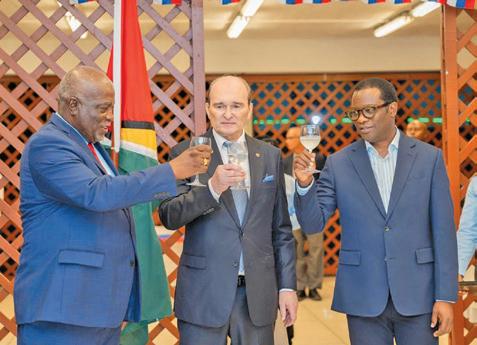
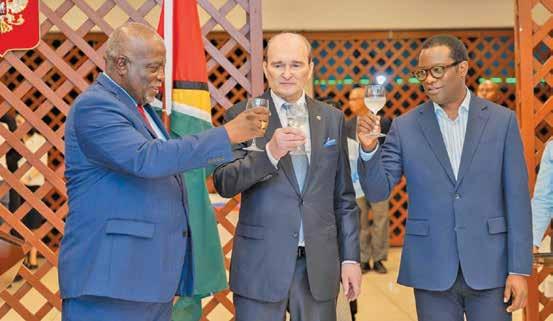
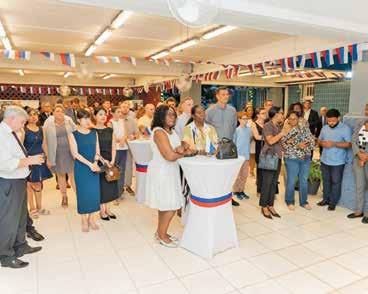
Guyana, Russia celebrate 55 years of diplomatic ties
Prime Minister (PM) Brigadier (Ret’d)
Mark Phillips has underscored the longstand -
ing and enduring partnership between Guyana and the Russian Federation during a reception hosted by the Ambassador of
the Russian Federation, Andrey A Pritsepov, in commemoration of Russia’s National Day 2026. In a post on the PM’s
social media page, it was stated that Phillips on Friday evening lauded the national pride and celebration of the occasion, while noting that 2026 marks the 55th anniversary of diplomatic relations between the two countries. He described the mile -
Guyanese students have benefitted from Russian scholarships and academic opportunities. These students, he explained, have returned home with knowledge and expertise that continue to contribute meaningfully to Guyana’s development. According to the post, PM Phillips also spoke about longstanding contributions between the two nations, including in the bauxite industry, and pointed to future collaboration in areas such as agriculture, climate and the environment.
stone as one built on mutual respect, cooperation and shared values. The relationship, he emphasised, has not only been formal but genuinely driven by people to people exchanges, especially through culture and education.
The PM highlighted that generations of
The PM’s wife, Mignon Bowen Phillips; Foreign Affairs and International Cooperation Minister Hugh Todd; Home Affairs Minister Oneidge Walrond; members of the Diplomatic Corps; and other distinguished guests also attended the event.
Ready to advance...
The Guyanese Leader went on to note that the decision to contest for the UNSG seat comes against the background of Guyana’s rising international profile, and is consistent with its long-standing commitment to strengthening the multilateral system at a time when the world faces increasingly complex and interconnected challenges. “Over the past several years, Guyana has emerged as an influential voice on the global stage. Our successful election to the United Nations Security Council (UNSC), and the successful completion of our 2024-2025 term on the body, have demonstrated to the world that Guyana can provide leadership at various levels of the global system,” the President emphasised.
Outpouring support
Meanwhile, since the announcement of Ambassador RodriguesBirkett’s UNSG candidacy, there has been outpouring support from colleagues, especially within the ruling PPP/C and Cabinet
Ministers. The Regional Democratic Council (RDC) of Region One (BarimaWaini), where RodriguesBirkett hails from, also extended support for her bid to serve as the next UNSG.
“As the first female Minister of Amerindian Affairs and the first female Amerindian to serve as Minister of Foreign Affairs, Ambassador RodriguesBirkett has distinguished herself through exemplary leadership, dedication, and service to Guyana and the international community,” Regional Chairman, Brentnol Ashley, said. He added, “The people of Region One are immensely proud of her achievements and remain confident that, if elected, she will serve with excellence, integrity, and vision, bringing pride to Guyana and making a meaningful contribution to the world.” Moreover, Ambassador RodriguesBirkett also received political strong support with the Alliance For Change (AFC), a partner in the former 2015-2020 Coalition Government, endorsing her UNSG candidature.
Celebrating 55 years of diplomatic ties: Prime Minister, Brigadier (Ret’d), Mark Phillips and Foreign Affairs Minister, Hugh Todd, at a reception hosted by the Ambassador of the Russian Federation, Andrey A Pritsepov, in commemoration of Russia’s National Day 2026
“I never gave up" – cancer survivor Desiree Edghill now walks beside others in their darkest moments
…turned 9-year survival journey into mission of hope
The disparity shaped between fear and survival is one that needs to be leapt over, not lived in. For Desiree Edghill, that leaping moment came with a diagnosis of a rare cancer and a decision that survival would not be the end of her story but the beginning of a new one dedicated to helping others through theirs. Desiree Edghill’s journey with cancer began with a sign she could not ignore.
In 2017, at the age of 61, she experienced two weeks of abnormal bleeding, an alarming symptom for a woman who had already reached menopause. What followed was a diagnosis of leiomyosarcoma, a rare and aggressive form of uterine cancer. For Edghill, the news was the beginning of a long and uncertain medical journey that would take her across borders, through surgery and chemotherapy and ultimately into survival.
tests, I was told I had leiomyosarcoma, and I remember just asking, 'What happens now?' because your mind just goes blank in that moment and you are trying to understand what your next step in life will be.”
Uterine cancer
Uterine cancer primarily refers to cancer of the endometrium (the inner lining of the uterus). The most common symptom is abnormal vaginal bleeding, such as post-menopausal bleeding or bleeding between periods. The standard treatment is surgery (a hysterectomy), often combined with radiation or chemotherapy. From that point, her life shifted into a series of urgent medical decisions, and surgery was quickly recommended, with medical professionals outlining a radical hysterectomy as the immediate course of action.
am always the one help ing people. But when it became me, I had to stop and ask myself, if some one came to me and said they were diagnosed with cancer, what would I tell them? That is when I got up; I reached out for help, and I started calling peo ple because I knew I could not go through this alone.”
As Edghill sought guid ance from doctors local ly and abroad, she was confronted with conflict ing opinions and ur gent advice about where and how she should be treated.
She recalled the moment of realisation, when something inside her told her that what she was experiencing was serious and needed immediate attention. “I saw the sign, and I just knew something was wrong because I had about two weeks of bleeding, and as a menopausal woman, that is not normal. When I went to the hospital, I told the doctor straight away that something was wrong because I could feel it in my body. After the
However, navigating the healthcare system proved to be just as overwhelming as the diagnosis itself. She described the emotional weight of going home after receiving the diagnosis, unsure of what the future would hold, and turning to the only instinct she knew, helping others while needing help herself.
“I went home and I cried because I really did not know what to do. I have been a counsellor for years, especially in HIV work, so I
Specialists from the United States (US) and Trinidad raised concerns about local capacity at the time, particularly in relation to gynaecological oncology expertise. She said the process taught her not only about medicine, but also about urgency, timing and the importance of specialised care in cancer treatment. Even through the midst of these battles, one hurdle came her
way strongly – chemotherapy. She said it stripped her physically and emotionally but also reshaped her mindset. It became a period of surrender, resilience and acceptance, supported by family, friends and fellow survivors who stood beside her through every stage.
Giving Hope Foundation Ambassador Desiree Edghill
TURN TO PAGE 23
“He matters” – Digicel CEO personally apologises to elderly customer, gifts him TV, free internet
…fires 2 employees after viral video of elderly customer sparks outrage
Asocial media video
showing an elderly man seeking assistance at a Digicel store has led to the dismissal of two employees and prompted the telecommunications company to publicly apologise to the customer and the wider public.
The video, which circulated online earlier last week, showed the elderly customer visiting a Digicel location for help with connecting his television to the internet. During the interaction, employees appeared to record the encounter and later shared the footage on social media.
The video quickly attracted criticism, with many viewers accusing the employees of ridiculing the man while he was seeking technical assis-
tance. The incident sparked widespread condemnation and calls for accountability.
Following an internal review, Digicel announced that the two employees involved had been terminated.
In a public statement, the company said the conduct displayed in the video was unacceptable and did not reflect its values.
“It has been brought to our attention that a video circulating on social media shows two members of our staff behaving in a manner that is completely unacceptable and wholly inconsistent with the values we uphold as a company,” the company stated.
Digicel said every customer who enters its stores should be treated with respect and re-
ceive quality service, regardless of age or technical knowledge.
“Every customer deserves to be treated with dignity, patience, and genuine care. That this gentleman came to us for help and was instead met with ridicule is something we take very seriously and do not take lightly. The two employees involved in this incident were dismissed from the company effective this morning,” the company said.
The company also sought to make amends to the customer through a personal outreach effort led by its Chief Executive Officer, Gregory Deonarine. In a video message, Deonarine visited the elderly man and offered an apology on behalf of the company.
During the visit, Digicel presented the customer with a number of gifts, including a 50-inch television, a Samsung smartphone and free internet service for one year.
Deonarine said the incident served as a reminder of the importance of treating every customer with kindness and respect.
“An elderly gentleman came into our store looking for help, and he did not receive the kindness he deserved.
That stayed with us because he matters,” he said.
The CEO explained that the gifts were intended as both an apology and an expression of appreciation for the customer, while also marking the upcoming Father’s Day observance.
Digicel said it had also reached out directly to the customer and his family to offer its apologies and ensure his concerns were addressed.
The company thanked
members of the public for holding it accountable and pledged to continue working to ensure that all customers feel welcomed, valued and respected when interacting with its staff.
The incident has sparked wider discussion on social media about the treatment of elderly persons, particularly when seeking assistance with technology, and the importance of patience and empathy in customer service.
Digicel CEO Gregory Deonarine and team taking the new TV for the elderly customer to his home
Technology will cut bureaucracy, bring Govt services closer to citizens – Finance Minister
The Government is continuing to expand the use of digital technology to improve public service delivery, with plans to make it easier for citizens to access Government services, lodge complaints, and receive feedback without having to travel to Government offices.
Senior Minister within the Office of the President with responsibility for Finance, Dr Ashni Singh, outlined the Administration’s vision during a public outreach by Vice President Dr Bharrat Jagdeo held in Region Five (MahaicaBerbice) on Friday. According to Singh, while community outreach, public days and cabinet engagements remain important avenues for interacting with citizens, the Government is simultaneously investing in digital solutions that will make services more
accessible and responsive.
“Ultimately, what we’re seeking to do is build out more digital solutions so people can go online and log a complaint, so they can get feedback online and so they can apply for Government services online,” Singh said.
The Minister explained that the move forms part of a broader effort by President Dr Irfaan Ali’s administration to modernise Government operations and improve the efficiency of public institutions.
“So President Ali’s vision is a vision where all Government agencies are operating efficiently and are delivering services using modern electronic and digital technology,” he stated.
Singh noted that the Government has already been pursuing several initiatives aimed at bringing services
closer to citizens, including public outreaches, cabinet engagements and the establishment of Government service centres in communities across the country.
He explained that these centres were created to ensure that key Government services are available within communities and that citizens can access assistance without having to travel long distances.
“We have multiple Ministerial outreaches. We have, on President Ali’s instruction, the establishment of citizen service centres or Government service centres at which key Government services are brought into the community and a centre is established for the ongoing provision of those services,” he said.
The Minister noted that digital platforms represent
the next stage in that evolution, allowing citizens to access services and interact with Government agencies from their homes or mobile devices.
While acknowledging that some Guyanese have not fully embraced digital services, Singh said the transition will take time and that the Government remains committed to accommodating citizens who still prefer face-to-face interactions.
He pointed to the ongoing cash grant programme as an example, noting that despite the availability of online registration and digital payment options, some persons continue to prefer in-person transac-
tions.
“We have rolled out, for example, the cash grant, and we have said we’re going to deliver the cash grant digitally to you without you having to leave your home. Some people are saying, ‘I don’t want to go online to register. I don’t want to go online to put in my bank account details. I want to come and join the line to get my cash grant.’ They are free to do so.”
According to Singh, the Government will continue expanding digital solutions while ensuring that traditional methods of accessing services remain available.
“We are rolling out digital solutions that make life easier
for the Guyanese citizens, and I would say we will continue to develop these digital solutions and digital Government.”
The Minister said the ultimate goal is to create a public service system where citizens can access most Government services electronically and receive timely responses without unnecessary delays.
“I hope that we get one day to a point where all citizens embrace these digital solutions so that we get to a point where you don’t need events such as these. That would be the ideal outcome.”
However, he stressed that public outreaches and direct engagements will continue for as long as citizens find them useful.
“As long as there continues to be this need, the People’s Progressive Party will ensure that that need is met because we are here to serve.”
The Government has increasingly incorporated digital platforms into service delivery in recent years as part of its broader effort to improve efficiency, reduce bureaucracy and expand access to public services throughout the country.
Senior Minister within the Office of the President with responsibility for Finance, Dr Ashni Singh, at the Region 5 Public Day, which was led by Vice President Bharrat Jagdeo on Friday at the Fort Wellington RDC compound
“One-size-fits-all medicine is ending” – Health Minister
...says drive now towards precision medicine
Guyana must begin preparing for a future in which medical treatments are tailored to the unique genetic makeup and health profiles of individual patients, as the global healthcare industry rapidly shifts away from the traditional “one-sizefits-all” approach to medicine.
This was the view of Health Minister Dr Frank Anthony, who spoke at the Excellence in Pharmacy awards ceremony on Friday at Cara Lodge Hotel, Georgetown. Anthony said advancements in technology, genetics and pharmaceutical research are paving the way for precision medicine, where medications, implants and other treatments can be customised to meet the specific needs of each patient, resulting in more effective healthcare outcomes.
Dr Anthony said the Government’s vision is not only to conduct scientific research but also to translate research findings into the development of pharmaceuticals, nutraceuticals and other innovative health products. He noted that achieving this goal
would require a highly skilled local workforce and emphasised the importance of training Guyanese professionals to participate in emerging industries.
According to the Minister, while efforts continue to address existing challenges within the healthcare system, the country must also position itself to advance and embrace cutting-edge developments in medicine and research.
“So, we want to be at the edge of whatever is happening in medicine. And if we’re going to do that, then
we need to train people. We need to embrace the technology so that we can be at that cutting edge.” He noted that there is also a shift in how medicine is being practiced globally.
“You’re moving from a one-size-fits-all to more precision medicine. So, right now, if somebody comes in, whether they’re obese or thin or tall or whatever, generally you’ll give them maybe 500 milligrams of Panadol or something.”
However, he explained that such an approach does not take into consideration a person’s metabolism, ge-
netics and other individual factors that should influence treatment. While this model of medicine has served patients for decades, Anthony said it is no longer precise enough.
“Therefore, we have to evolve to a system where whatever we are dispensing can be customised to that patient. And we need to get closer to that type of arrangement. So, in the future, things would be manufactured for that patient. And we need to embrace that.” He further noted that advances in technology could soon make highly
personalised treatments a reality.
“In the near future, if somebody needs some kind of implant or something, they’ll be able to 3D print it for that person. And that would be unique for that person.”
Anthony said that while such developments may sound like science fiction, companies are already working on creating artificial organs using 3D-printing technology and living cells.
“Very soon, in a couple of years, you would start seeing more of these types of things. Think about when a diagnosis is made for a patient. You now 3D print the
meds, combine them in the right proportion based on that person’s genetic profile and metabolism, and you’re able to make something more precise for that patient.” He added that Guyana must begin embracing this mindset and preparing a new generation of researchers and healthcare professionals to participate in the development of future medical technologies.
“That is where medicine is going. And we need to start embracing these types of mindsets to be able to get there. But we also want people who are going to be part of that research to develop some of these things.”
Captain dies, nephew injured after boat crashes into tree
A55-year-old businessman/boat Captain, John Henry, called “Johnny”, of Kumaka Waterfront, Moruca, NorthWest District, was killed, and his nephew, Stephon, is currently hospitalised following a boat mishap at the Moruca River Mouth, Region One (Barima-Waini), on Friday.
The incident occurred at around 16:00h as the two men were returning to Kumaka via a boat, owned and operated by Henry.
Based on reports, they had left to go to Charity to purchase groceries and other supplies for their shop. While on the Essequibo Coast, however, Henry was reportedly seen consuming alcohol before eventually departing with his nephew at around 15:40h to return home.
But on the way to Kumaka, along the Moruca River Mouth, the boat operator reportedly lost control of the vessel and collided into a large tree limb that was leaning over the southern side of the river. The right bow of the boat struck the tree, causing extensive damage to the entire right side of the vessel. As a result of the impact, the deceased sustained severe injuries to his body, while his nephew, who was seated on the left side of the boat, also sustained injuries.
Another boat Captain of Moruca, Amear Shahabodeen, told investigators that he had seen an intoxicated Henry earlier at the Charity Wharf and enquired, “Uncle Johnny, you good?”
He said Henry responded
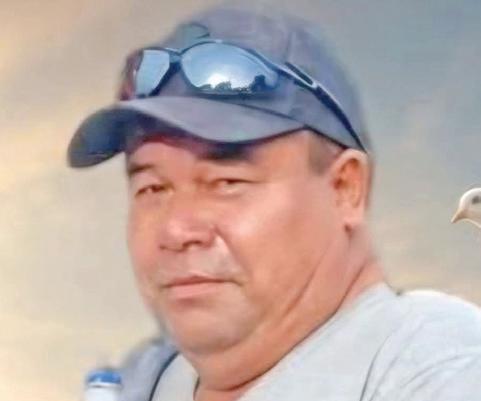
Businessman/boat Captain John Henry, called “Johnny”
by giving him a thumbs-up. According to Shahabodeen, around 16:30h, whilst travelling back to Moruca by boat, he observed several broken pieces of white-painted wood floating in the river. He then noticed the deceased’s boat at the side of the river with extensive damage. Henry was observed lying unconscious in the boat. He enquired from the nephew what had transpired; but Stephon related that he had fainted and was unable to provide an account of the incident.
Both Henry and his nephew were placed on Shahabodeen’s boat and transported to the Kumaka District Hospital, where they received medical treatment. While there, however, Henry succumbed to his injuries at about 17:04h on Friday. His body is currently at the Moruca District Hospital Mortuary awaiting a post-mortem examination. Meanwhile, Stephon was subsequently transferred to Lima Public Hospital, where he is currently admitted as a patient. His condition is regarded as stable. Investigations are ongoing.
A section of the gathering at the Excellence in Pharmacy awards ceremony at Cara Lodge on Friday
Over 120 farmers receive on-the-spot assistance
…as Govt “breaks down bureaucracy” – Agri Minister
More than 120 persons sought assistance in the agriculture section of the Government’s public outreach held in Region Five (Mahaica-Berbice) on Friday, with most of the concerns being addressed immediately, according to Agriculture Minister Zulfikar Mustapha.
The Minister made the disclosure while highlighting the benefits of the Vice President (VP)’s outreach programme, which allows residents to engage directly with Cabinet Ministers and senior Government officials on issues affecting their communities and livelihoods.
The outreach, led by VP Dr Bharrat Jagdeo, is part
of a series of engagements being conducted across the country to bring Government services closer to citizens. Similar exercises have already been held in Regions Two (Pomeroon-Supenaam), Four (Demerara-Mahaica) and Six (East BerbiceCorentyne).
Speaking with media operatives during the outreach held at the Regional Democratic Council (RDC) Compound in Fort Wellington, Mustapha said the initiative provides an important avenue for residents to raise concerns, make suggestions and seek solutions without having to navigate lengthy administrative processes.
He noted that the Government’s approach is
rooted in ensuring that citizens have a direct voice in decision-making and access to those responsible for addressing their concerns.
According to Mustapha, the outreach programme also helps to eliminate bureaucratic hurdles that often delay the resolution of issues raised by residents.
“We are also breaking down the bureaucracy that exists in regions. For example, many issues people would have raised with officials and technical officers are sometimes not getting proper attention from them. When they come here directly with the Minister and the vice president, they have direct contact, and the issues are being dealt with immediately,” he explained.
Mustapha revealed that the agriculture section alone saw a significant turnout, with farmers and other residents seeking assistance on a wide range of matters.
“As a matter of fact, since morning [Friday], in the agricultural area, I have seen over 120 persons,” he said.
The concerns raised included issues relating to land, farming operations and access to services and support required by farmers.
“And most of the issues that were raised were resolved immediately. Things like land issues, farming issues, health, what farmers would have needed, and things like that,” the Minister stated.
Region Five remains one
of Guyana’s most productive agricultural regions, with thousands of residents involved in rice cultivation, cash crop farming, cattle rearing and other agricultural activities. Farmers in the region have traditionally raised concerns relating to land access, drainage and irrigation systems, farm-tomarket infrastructure, access to support services and other matters affecting production.
Engaging directly with the Govt Mustapha said the strong turnout at the outreach shows that citizens see value in engaging directly with Government officials and are obtaining solutions to problems affecting them.
“So, I think that this is
a good way of having residents and citizens come and make direct contact with Government officials, with the highest people in office, the Minister, the vice president, and things like that,” the Agriculture Minister said. He added that the increasing participation in these engagements is evidence that the initiative is delivering results and providing residents with meaningful redress.
“This is the philosophy of our Government... It shows with the number of persons that are coming to these outreaches; it shows that these outreaches are having results, and they are getting proper redress,” Mustapha said.
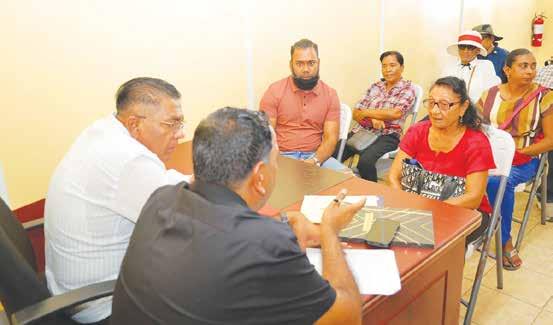
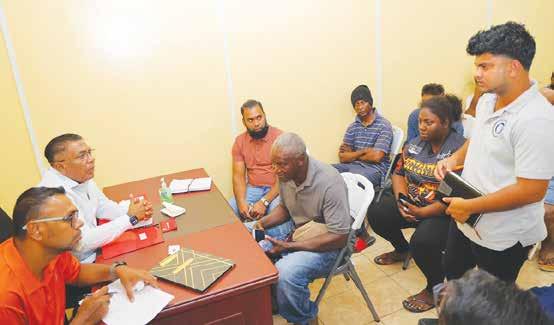
Persons raising concerns at the Region Five outreach on Friday
Guyanese company achieves historic 1st with new offshore pipe fabrication scope
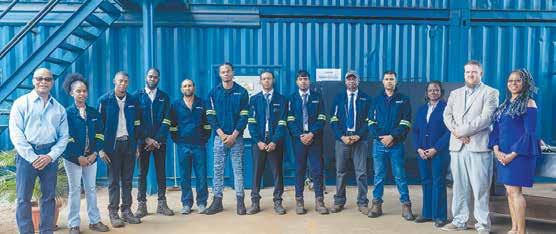
Friedlander Guyana has successfully completed the Water Injection Riser Depressurisation (WIRD) Project, marking the first time a high-pressure process pipe fabrication scope for a Floating Production Storage and Offloading (FPSO) vessel has been executed in Guyana by Guyanese workers under internationally recognised offshore standards.
The project, delivered for the FPSO Liza Unity, is a major milestone for the local industrial fabrication sector and for Friedlander Guyana, a new entrant to the market. The scope is regarded as one of the most technically demanding in offshore fabrication, involving pipe systems designed to operate under
Opening
some of the highest water pressures on the vessel.
According to project partners, the work was completed with zero weld defects and zero weld repairs, a performance that underscores the technical capability of the local workforce involved in the execution. Government officials, industry representatives and private sector stakeholders gathered at Friedlander Guyana’s facility on June 9 to mark the achievement with a ceremony hosted by SBM Offshore in collaboration with ExxonMobil Guyana and Friedlander Energy (Guyana).
SBM Offshore Guyana General Manager (GM) Martin Cheong said the project demonstrates the value of collaboration be -
tween international operators and local industry.
“The WIRD project is more than a milestone; it is evidence of what can be achieved when world-class partners place confidence in local talent,” Cheong said, adding that it reflects the growing role of Guyanese companies in the energy sector. Friedlander Guyana Director and Coowner Dr Carla Crawford said the success was driven by the workforce involved in executing the project under strict technical requirements.
She noted that teams carried out cutting, fitting, welding, testing and painting while meeting international offshore standards.
“They learned, they adapted, they pushed themselves to meet inter -
national standards, and they succeeded,” Crawford said. To complete the scope, Friedlander Guyana underwent a detailed qualification process that included vendor audits, weld procedure qualification, material testing in internationally accredited laboratories under supervision of the American Bureau of Shipping (ABS), and ABS classification approvals.
The process also involved training and certification of welders, along with non-destructive testing, hydrotesting, blasting and painting. ExxonMobil Guyana Production
Manager Huzefa Ali said the project reflects ongoing efforts to build local technical capacity to support the industry’s long-term development.
“As Guyana’s energy partner, ExxonMobil Guyana remains firmly committed to building capabilities as this event demonstrates,” Ali said. Natural Resources Minister Vickram Bharrat, delivering the feature address, commended the collaboration between stakeholders and the contribution of local firms to national development.
He said the project high -
bank accounts is about financial empowerment, not just cash
he Government’s ef-
Tforts to encourage more Guyanese to open bank accounts are aimed at promoting longterm financial empowerment and inclusion, rather than simply facilitating the distribution of cash grants, according to Senior Minister within the Office of the President with Responsibility for Finance, Dr Ashni Singh.
Speaking with this publication on the side-lines of a Government outreach in Region Five (MahaicaBerbice) on Friday, Singh said the initiative forms part of a broader strategy to bring more citizens into the formal banking system and improve their access to financial services and economic opportunities.
The Minister noted that while the Government has encouraged citizens to provide bank account information for the direct deposit of cash grants, the objective extends well beyond the current programme.
lights opportunities for continued investment and growth in Guyana’s energy sector, describing it as a reflection of collective effort across industry and Government.
The initiative also resulted in Guyanese welders participating in the development and qualification of welding procedures, while additional personnel obtained ABS certification, strengthening the country’s pool of internationally qualified technical professionals. Similar scopes are expected to be expanded to other FPSOs in future projects.
grants – Ashni Singh
“This is not only about opening bank accounts to get the cash grant. This is also about opening bank accounts to establish a relationship with the bank,” Singh explained. According to the Finance Minister, many Guyanese who have never participated in the formal banking system may find it difficult to access credit and other financial products when they need them.
“You can’t want to go into the bank for the very first time to say you want a loan. You have to build a relationship with the bank. The banking system knows you, and you build a track record with the banking system,” he said.
Singh disclosed that thousands of Guyanese have already opened bank
accounts for the first time since the Government intensified its efforts to promote digital payments and financial inclusion.
He noted that the process has been made significantly easier through simplified account-opening requirements and the introduction of online registration systems by commercial banks.
“The banks now have online platforms that you can go to on your phone and register to open a bank account. So we have made it simpler to open bank accounts. Thousands of persons have opened bank accounts for the first time, and we welcome that and we encourage it,” he said.
The Minister stressed that encouraging citizens to enter the banking system is part of a wider national effort to expand financial inclusion.
“There is something called financial inclusion, and financial inclusion is all about getting people into the formal banking system. And we are promoting financial inclusion. We want as many people to be part of the formal banking system,” Singh explained.
He added that maintaining a banking history can improve a person’s chances of accessing loans and other forms of financing in the future.
“The longer you are part of the formal banking system, the more likely you are able to get a loan. If you have
a long track record with the bank, they are more likely to give you a loan than if you just walked into the bank for the first time to say, ‘I want a loan,” he said.
Singh said President Dr Irfaan Ali’s Administration views greater participation in the banking sector as an important component of economic advancement and personal financial development.
“There is a reason why President Ali is encouraging people to open bank accounts. It is part of financial inclusion and financial empowerment,” the Minister stated.
He noted that the Government will continue to encourage citizens to utilise digital and financial services as it works towards modernising service delivery and expanding opportunities for Guyanese across the country.
According to Singh, greater financial inclusion will not only improve access to banking services but also help more citizens participate fully in the country’s rapidly expanding economy.
The fabricators with the co-owners of Friedlander Guyana
Natural Resources Minister Vickram Bharrat, along with General Manager of SBM Offshore Guyana Martin Cheong, Director and Co-owner of Friedlander Guyana Dr Donald Culley and Dr Carla Crawford, along with Production Manager of ExxonMobil Guyana Huzefa Ali, among others, viewing the pipes fabricated for the WIRD project
Remanded rape suspect's wife accuses brother-in-law of raping her
...woman says attacker threatened to kill her, daughter during ordeal
The wife of a man currently on remand in connection with a sexual assault matter has reported to Police that her brotherin-law sexually assaulted her during an ordeal at her Berbice, Region Six (East Berbice-Corentyne) home on Thursday night.
The 26-year-old woman alleged that the man entered her home while she and her eight-year-old daughter were inside and threatened to kill them if she raised an alarm. Speaking with reporters on Friday, the woman recounted the events that unfolded after she retired to bed following a day of work. According to her, she heard noises outside the house but did not see anyone. Later, she was awakened by sounds coming from inside the building. “I hear a sound like a foot thump in the house. And I jump up and I look; there is my brother-in-law, my husband brother. When I go to scramble the tablet, he
done rush up to me and snatch me, and he start to choke me,” she alleged. The woman claimed that the suspect quickly overpowered her and warned her against making any noise. “He said ‘If you make any noise, everybody dead.’ So, I didn't make no sound because I was very frightened,” she said. According to the woman, the man repeatedly threatened her while she feared for the safety of her daughter, who was asleep in the house at the
time. She alleged that the suspect then sexually assaulted her.
During the ordeal, she claimed the man attempted to justify his actions.
“He said that today is his birthday and me didn't give him nothing. I tell him, 'I don't have anything to give you',” the woman recalled. After the alleged assault, the woman said the suspect remained at the house for a short period. She said that she attempted to use a tablet to capture an
“I never gave up...
Chemotherapy
In fact, she underwent four rounds of chemotherapy.
“Chemotherapy was the hardest part because it changes everything about you. I could not walk properly, I could not breathe sometimes, I lost my hair, and I remember people saying that when you lose your hair, it means you are really sick, and that broke me.
But I never gave up. I told myself that if I am still here, then I am here to fight. I had people who supported me through every session, friends who stayed with me, and someone who was also a survivor who would encourage me and say, ‘You are looking at stage one here; I am stage four, and we are going to get through this.’ That kind of support carried me through when I felt like I could not carry myself.”
Cancer ambassador
Today, nearly a decade later, Edghill describes herself as a nine-year cancer survivor. More than that, she has transitioned into a role she says was shaped by her own experience, supporting others who are now walking the same difficult path she once walked. She now works as a cancer ambassador with the Giving Hope Foundation, accompanying patients to appointments, chemotherapy sessions and scans, while offering both emotional and
practical support. Her work, she says, is rooted in the belief that no one should face cancer alone.
“When I came back to Guyana, I was cancer-free, and now I am a survivor of almost nine years. I am currently a cancer ambassador with the Giving Hope Foundation, and I walk with patients through their journey. I go with them to their first doctor’s visit, their first chemotherapy session, and their scans because when you are going through something like that, you are not thinking clearly. Sometimes you are scared; sometimes you are overwhelmed, so having
someone there makes a difference. I have walked with many patients, and even though I have lost some, I know that I am helping others to survive, and that gives my life meaning.”
In fact, Edghill also lost her beloved daughter to cancer, but this tragedy has only strengthened her resolve. Today, at 70 years old, Edghill continues to strongly advocate for greater awareness, earlier diagnosis, and stronger cancer care systems in Guyana and the wider Caribbean – determined that her journey will not be hers alone but one that helps ensure other lives are saved.
image of him, but he noticed what she was doing and confronted her once again. “He said, 'Don't do anything stupid. Don't tell nobody.’ And he said if I tell anybody and he come back, he gon kill me,” she alleged.
The woman said it was only after the suspect had left that she realised her daughter had witnessed part of the incident. According to her, the child later revealed that she had been awake.
“‘Mommy, when me hear the knock, me wake up and see Daddy buddy. When he choke you and tell you that if you make any noise he would kill you and me, I pretend to sleep back on the bed’,” the woman said her daughter told her.
The woman said she immediately contacted friends, who assisted her in notifying the Police. Officers later responded, escorted her for medical attention and took a
statement. The woman also revealed that there had been longstanding tension between herself and the accused.
The victim’s husband, her alleged rapists brother, is currently before the courts on accusation of raping a 66-year-old woman from the said village and is currently before the court and remains on remand. Meanwhile, Police arrested the suspect on Friday.
Essequibo Coast man jailed 3
months for threatening to kill mother
A23-year-old chainsaw operator of Essequibo Coast, Region Two (PomeroonSupenaam), has been sentenced to three months in prison after pleading guilty to using threatening language against his mother.
Maranno Fedricks of Onderneeming Sand Pit, Essequibo Coast, appeared before Magistrate Ravindra Mohabir at the Charity Magistrate's Court last week.
Fedricks was charged with the offence of threatening language, contrary to Section 141(a) of the Summary Jurisdiction (Offences) Act, Chapter 8:02.
The charge stemmed from an incident that occurred on June 4 at Onderneeming Sand Pit, during which Fedricks
Jailed: Maranno Fedricks
threatened to kill his mother, 45-year-old Yonette Christian, a pathway worker.
When the charge was read to him, Fedricks pleaded guilty.
Taking into account the seriousness of the threat made against the victim, Magistrate Mohabir sentenced Fedricks to three months' imprisonment.
Essequibo Coast traffic offenders fined $360,000
…1 granted $200,000 bail
Four men appeared before the Anna Regina Magistrate's Court this month on a series of traffic-related offences, resulting in fines totalling $360,000, while another defendant was granted bail after pleading not guilty. Abdool Shameer, 33, a labourer of Anna Regina, Essequibo Coast, was charged with driving without a licence, breach of insurance and failing to display an identification mark on the rear of the vehicle.
The offences were committed on June 3, at the Anna Regina Access Road, and were laid under the Motor Vehicle and Road Traffic Act and the Motor Insurance Third-Party Risk Act. When he appeared before Magistrate Ravindra Mohabir on June 9, Shameer pleaded guilty to all three charges.
He was fined $30,000 for driving without a licence, $30,000 for breach of insurance, and $75,000 for failing to display a rear identification mark. In default of payment, he faces three months' imprisonment on each charge. The fines total $135,000.
In a separate matter,
Ravindra Ganpat, 21, an operator of Plot 'C', Anna Regina Squatting Area, was charged with driving while his breath alcohol level exceeded the prescribed limit. The offence occurred on May 25, 2026, along the Reliance Public Road, Essequibo Coast. Ganpat appeared before
Magistrate Mohabir on June 9 and pleaded guilty. He was fined $200,000, with a default sentence of six months' imprisonment.
Meanwhile, Govin Naipaul, 41, a taxi driver of the Richmond Housing Scheme, Essequibo Coast, was charged with refusing to provide a breath spec -
imen for a breath alcohol test. The offence was allegedly committed on May 26, 2026, along the Anna Regina Public Road. Naipaul appeared before the court on June 12 and pleaded guilty to the charge. He was fined $25,000, with a default sentence of three months' imprisonment.
Also appearing before the court was Dameion Anthony Jones, 41, a taxi driver of Church Street, Annandale, East Coast
Demerara (ECD). Jones was charged with driving while his breath alcohol level exceeded the prescribed limit following an incident on May 18, 2026, along the Aurora Public Road, Essequibo Coast. When the matter was heard before Magistrate Mohabir on June 12, Jones pleaded not guilty. He was granted bail in the sum of $200,000, and the matter was adjourned to June 19.
Mackenzie High School wins JOF Haynes Memorial Secondary School Debating Competition
Mackenzie High School of Region 10 has been declared the overall winner of the 2025–2026 JOF Haynes Memorial Secondary Schools Debating Competition, following the grand finale held on Friday at the St Rose’s High School Auditorium.
In the final round, Mackenzie High School faced off against Region Seven
(Cuyuni-Mazaruni) Three Miles Secondary School, with Mackenzie representing the opposition and Three Miles defending the proposition. Mackenzie High School’s team comprised First Speaker, Nephlyah Farrel; Second Speaker, Tahir Gomes; and Third Speaker, Rhea Persaud. Three Miles Secondary School’s team comprised First Speaker,
Richard Mohabeer; Second Speaker, Mia Shanks; and Third Speaker, Bhavani Sieucharran.
The students debated the socio-economic moot: “Be it resolved that implementing a universal basic income from oil revenues is the most effective way to eliminate poverty in Guyana.”
After a competitive and thought-provoking ex-
change, Mackenzie High School emerged victorious, while Three Miles Secondary School secured second place. Both schools were presented with official plaques in recognition of their outstanding performances. Nephlyah Farrel of Mackenzie High School was adJudged Best Debater.
In addition to the plaques, all debaters from both finalist teams, along with their teachers and coaches, received gift vouchers. The debaters were also awarded cell phones, accessories, and stationery in recognition of their hard work, discipline, and commitment throughout the competition.
The 2025–2026 competition was officially launched on April 28, 2026, at the National Centre for Educational Resource Development (NCERD) Auditorium by the Ministry of Education’s Secondary Sector. The opening debate featured Mackenzie High School and North Ruimveldt Secondary School, with students examining whether the Safe Road Intelligent System is a more effective deterrent for traffic accidents in Guyana than physical police presence. Mackenzie High School won the inaugural matchup. Round One began on April 29, 2026, with schools debating whether Guyanese secondary schools should replace traditional textbooks with mandatory digital tablets. Annai Secondary, New Amsterdam Secondary, Three Miles Secondary, and Santa Rosa Secondary advanced from
that round, while West Demerara Secondary moved forward after drawing a bye.
The competition intensified in Round Two on May 13, 2026, when students debated whether the shift towards smart classrooms in Guyana creates a digital divide that outweighs the benefits of educational modernisation.
West Demerara Secondary, Three Miles Secondary, and Mackenzie High School won their respective matchups and advanced to the next stage.
By Round Three, held on May 29, 2026, the tournament had narrowed further.
Mackenzie High School secured an away victory over West Demerara Secondary during a debate on whether social media is the primary factor responsible for the erosion of traditional Guyanese culture and values. Three Miles Secondary School advanced to the final after drawing the official bye.
Throughout the competition, Judges used a revised Ministry of Education debating scoresheet to assess students across four main
categories: Content, Style, Organisation, and Rebuttal. The updated scoresheet also included areas such as thesis link, citation, audience engagement, enunciation, and the validity of rebuttal arguments.
Following the conclusion of the tournament, the Ministry of Education’s Secondary Sector will continue to facilitate training for students and coaches, with particular emphasis on strengthening rebuttal development and delivery. Training will also continue for Judges to support objectivity, consistency, and professionalism in future debates.
The Ministry of Education’s Secondary expresses appreciation to the Departments of Education, participating schools, host venues, the Guyana Learning Channel, and all stakeholders who contributed to the successful staging of the 2025–2026 JOF Haynes Memorial Secondary Schools Debating Competition.
Mackenzie High School of Region 10 has been declared the overall winner of the 2025–2026 JOF Haynes Memorial Secondary School's Debating Competition
Trump says US military strike killed leader of Venezuela's Tren de Aragua gang
President Donald Trump said on Friday
US forces carried out a strike that killed Hector Rusthenford Guerrero Flores, also known as Niño Guerrero, the leader of Venezuelan prison gang Tren de Aragua.
"At my direction, the United States Southern Command delivered a swift and lethal kinetic strike to successfully execute Nino Guerrero, the infamous leader of Tren De Aragua, one of the most bloodthirsty terrorist organisations on Planet Earth," Trump said in a post on Truth Social on Friday evening.
"This action was coordinated closely with our friends in Venezuela, with whom we are working very well."
Pentagon Chief Pete Hegseth posted on X that the strike was conducted earlier this week and that Guerrero "was confirmed killed during the strike".
Venezuela's information
Ministry said that during the operation in the country's Bolívar state, there were clashes with members of criminal groups, in which the leader, Guerrero, was neutralised.
The operation involved specialised technological support and was carried out through cooperation and intelligence sharing between authorities of both countries, the Ministry said.
The Trump
Administration has repeatedly targeted Guerrero and other leaders of the Tren de Aragua organisation with sanctions over alleged involvement in criminal activities such as illicit drug smuggling, human trafficking and money laundering.
The State Department has designated Tren de Aragua a foreign terrorist organisation. (Excerpt from Reuters)
Police dress up as World Cup mascots to arrest drug suspect in Peru
Two Peruvian Police Officers disguised as World Cup mascots Clutch and Maple helped to arrest a suspected drug dealer in Lima, the latest in a series of law enforcement operations in the country involving officers using creative costumes to apprehend accused criminals.
Col. Carlos Alcántara, head of the Green Squadron – a unit that combats common crime – said they captured Carlos Cabrera, 48, with the help of the two undercover agents on Thursday during the opening match of the World Cup between Mexico and South Africa.
"Thanks to intelligence work, we realised that this person was a diehard football fan and was caught up in World Cup fever," Alcántara told The Associated Press. "Therefore, we decided to disguise personnel as World Cup mascots so we could approach him without raising suspicion and apprehend him."
The officers in mascot costumes used a metal sledgehammer to break down a door to enter with colleagues. Police posted video of the raid on social media, showing officers collecting evidence at the scene and apprehending the suspect.
Police said 2524 packets of cocaine base and a gun were found during the operation. In Perú, the micro-trafficking of drugs is punishable by three to seven years in prison when a person is found with five to 50 grams of cocaine base.
(Excerpt from CBS News)
Gunmen abduct senior security official in Haiti’s capital
Armed men in Haiti have kidnapped James Boyard, Cabinet Director of the Defence Ministry and a highly respected security expert who also serves as inspector general of Haiti’s Police, a person with knowledge of the situation said Saturday.
He is the highest-ranking official to be kidnapped in the gang-wracked Caribbean country in recent years.
A person with knowledge of the situation who was not authorised to speak publicly about the case confirmed the kidnapping to the Associated Press.
Local media reported that Boyard was seized Thursday in Bourdon, one of the few areas in Port-au-Prince that is considered relatively safe. An estimated 70 per cent of the capital is controlled by a powerful gang coalition known as
Cuba gets inventive to save its pristine reefs amid US blockade
At 08:00h, scuba divers gather to collect plastic and drinks cans from the sea at Cuba’s Ciénaga de Zapata national park. Amid a power crisis that has virtually paralysed the country’s economy, they use an electric trailer to move to a designated spot. In only a few hours, they have collected five sacks of cans and waste.
Lack of environmental awareness, invasive species, and the climate crisis have long threatened the island’s pristine marine ecosystem, but as US sanctions and economic scarcity take their toll on the country, scientists and community conservationists are working with even scarcer resources to protect a vital ecosystem for the Caribbean and the world.
Coral cover in the Caribbean has decreased by 48 per cent since 1980, according to a recent report
by the Global Coral Reef Monitoring Network, making joint action between countries essential. Yet deteriorating relations between the US and Cuba are hindering conservation efforts in the Gulf of Mexico.
With the help of volunteers such as Mesa and Sánchez, marine biologists at the National Aquarium are using freediving techniques to conduct experi-
ments at a depth of 17 metres in a spot accessible by swimming from their workplace – a way to reduce fuel use and address scarcity. They are also developing their own substrates for coral restoration and using recycled materials, such as broken clay and leftover cables from the national telecoms company. (Excerpt from The Guardian)
Venezuela demands T&T take responsibility as oil slick reaches its shores; T&T downplays incident
Trinidad and Tobago (T&T)’s state-owned oil company Heritage Petroleum says there is currently no evidence to support the presence of large amounts of hydrocarbons in the sea, following an immediate investigation into an alleged oil spill flagged by Venezuela.
The company said it launched a multi-agency response after receiving a report yesterday of a potential hydrocarbon sighting originating within T&T’s waters.
Despite a diplomatic and environmental alert from neighbouring Venezuela, comprehensive sweeps by local authorities have yielded
no signs of contamination, Heritage said.
The mobilisation followed an official communiqué issued yesterday by the Venezuelan Government, accompanied by multi-temporal satellite analysis that it claims shows a major hydrocarbon slick originating near Trinidad and moving northwest into the Gulf.
The Venezuelan Foreign Ministry described the development as a renewed environmental threat and referenced what it claims is a significant cross-border pollution event affecting sensitive coastal and wetland systems.
Despite high-level bilater-
al talks on May 22 involving Energy Minister Dr Roodal Moonilal and Venezuela’s Minister of Ecosocialism Freddy Ñáñez to strengthen joint spill response coordination, relations now appear strained again amid conflicting technical assessments.
FFOS is calling for the immediate release of all satellite data, trajectory modelling, water quality assessments, and response measures. It also wants a full public inquiry into both the May and June incidents, as well as the establishment of a compensation mechanism for affected fishing communities. (Excerpt from Trinidad Guardian)
A&B reaffirms support for Cuba, CARICOM relief efforts
TViv Ansanm, which the US designated as a foreign terrorist organisation in May last year.
Boyard, who is also a political scientist, was tasked with helping rebuild Haiti’s armed forces and has helped assess Haiti’s National Police to implement reforms. It was not clear who kidnapped him or whether a ransom had been requested.
(Excerpt from St Lucia Times)
he Government of Antigua and Barbuda (A&B) has reaffirmed its commitment to supporting Cuba as the island continues to face economic and humanitarian challenges, while pledging to play its part in regional assistance efforts being coordinated through CARICOM.
The issue arose during Thursday’s post-Cabinet media briefing when Director General of Communications Maurice Merchant was asked about ongoing regional support for Cuba and whether Antigua and Barbuda had contributed to CARICOM’s humanitarian initiative.
Merchant said the mat-
ter was not discussed during Wednesday’s Cabinet meeting but noted that Foreign Affairs Minister E P Chet Greene is currently attending regional meetings where issues concerning Cuba remain on the agenda.
He stressed that A&B remains committed to assisting Cuba and stands ready to fulfil its obligations under regional support initiatives.
Merchant described Cuba as a longstanding friend of A&B and said the Government remains prepared to provide assistance where possible.
“Anything to lessen the burden of the people of the Republic of Cuba; Antigua
and Barbuda stands ready to give support,” he said.
CARICOM leaders have repeatedly expressed concern about the economic hardships facing Cuba and have explored ways to provide practical assistance through regional cooperation and humanitarian support initiatives.
A&B has historically maintained close diplomatic relations with Cuba, particularly in the areas of healthcare, education and technical cooperation, and Government officials say that partnership remains an important aspect of the country’s foreign policy. (Excerpt from Antigua Observer)
An explosion following what US President Donald Trump said was a strike carried out by US forces that killed Hector Rusthenford Guerrero Flores, also known as "Nino Guerrero", the leader of Venezuelan prison gang Tren de Aragua
Two Peruvian Police Officers disguised as World Cup mascots Clutch (left) and Maple (right) to arrest a suspected drug dealer in Lima
Alejandro Acebo and Jorge Sánchez, members of the scuba divers’ volunteer group, during the cleanup at Playa Larga
Around the World
Trump says US-Iran deal to be signed on Sunday; Tehran casts doubt on timing
President Donald Trump has said a deal to end fighting between the US and Iran is scheduled to be signed on Sunday, after Iran cast doubt on the timing.
Pakistan, a key mediator, also said the deal was expected to be finalised within 24 hours and they were “preparing for the electronic signing”.
Mourners line Bangkok streets to pay respects to Thailand’s Princess Bha
AIn a post on Truth Social, Trump wrote: “The deal is scheduled to get signed tomorrow, and immediately after it is signed, the Hormuz Strait is OPEN TO ALL.”
In an apparent reference to Iran’s enriched uranium stockpiles, Trump said that “at the appropriate time, when all is calm, we will go in and get the nuclear dust”, adding it
Before Trump’s comments, Iranian Foreign Ministry spokesman Esmaeil Baghaei expressed caution over the timeline, saying: “We will have to wait and see about the exact date of the signing of the Memorandum of Understanding, although it will not be tomorrow.”
would later be destroyed.
For decades, Iran has been accused by Western countries of trying to build a nuclear weapon. It has denied the accusations, saying its programme is for peaceful purposes – to generate electricity and for research purposes.
Trump also warned that if things would not “work out quickly, easily and smoothly”, Washington had “the ultimate alternative, hopefully never to be used again!” (Excerpt from BBC News)
Ukrainian drone attack kills 1, injures 3 in southern Russia
AUkrainian drone attack killed one person and injured three in Russia’s southern Krasnodar region, local officials said Saturday, as part of Kyiv’s campaign of strikes on military and energy targets deep inside Russia.
Drone debris sparked a fire at a sea terminal, local Governor Veniamin Kondratyev said. He did not give details, but Russian news outlets reported that a Black Sea export terminal transporting crude oil, petroleum products and liquefied gas in the village of Volna was damaged.
Ukraine’s General Staff
did not comment on the Krasnodar strike Saturday but said that its forces had hit an oil preparation and pumping station overnight in Russia’s Volgograd region, as well as Russianoccupied areas in Ukraine’s Donetsk and Zaporizhzhia regions.
The attack comes after Ukrainian President Volodymyr Zelenskyy said his country’s forces had struck several military and energy infrastructure sites deep inside Russia, including a military factory that he said supplied components for Russian drones and missiles.
He said on Wednesday that Ukrainian FP-5 Flamingo long-range missiles had hit the facility in Cheboksary, in the Chuvashiya region, more than 900 kilometres from the front line.
Mr Trump and Zelenskyy last met in December, when the Ukrainian leader visited Mr Trump at his Mar-aLago resort in Palm Beach, Florida.
Elsewhere, Russian attacks injured nine people in Ukraine’s Dnipropetrovsk region, setting fire to a local marketplace, regional authorities said. (Excerpt from CBS News)
Protesters tear down Albanian development site fences amid anger over coastal projects
Some 200 protesters on Saturday tore down metal and razor-wire fences surrounding a luxury development site on Albania’s Adriatic coast, in another sign of growing anger against construction in environmentally sensitive areas.
Albanians have been protesting for weeks against a planned luxury resort backed by a company linked to Jared Kushner, the son-in-law of US President Donald Trump, near Vlora, which is famed for its flamingos and a turtle nesting site.
On Saturday, villagers from Rrjoll, located in an area of sandy beaches and pine forests in north-western Albania, protested against another project, saying it was being built on their confiscated land.
They waved Albanian national flags and shouted “Revolution” as they tore down the fences. Some scuffles with Police broke out, but the Police did not stop them from removing the fencing.
“The protests will not stop until the residents of the village of Rrjoll are compensated. We are 200 families whose land has been seized,” said Zeke Nikolle Shullani, 56, one of the landowners who have been protesting for several months.
An Albanian company has been developing a five-star luxury tourist resort on the site, and the project was grant-
ed “special status investor” by the Albanian Government.
“What is happening in this country is madness,” said Nikolin Markpalaj, 60, another local landowner. “We asked the investors to come and consult with the people, but they refused. They think they can take all this wealth without blood or anything else that might happen here?”
(Excerpt from Reuters)
s the sun began to set on the golden spires and gilded finials of Bangkok’s Grand Palace, the gates were open, waiting for the return of a Princess.
Since December 2022, Princess Bajrakitiyabha had been in hospital, having collapsed while out training her dogs. After nearly four years in a coma, the Princess died earlier this week on Thursday.
On Saturday afternoon, her body finally left the hospital in a royal funeral procession of flashing motorcycles and cars travelling through the city centre’s empty streets, which were closed to traffic but lined for kilometres with nurses from the hospital bowing prostrate, thousands of Thai citizens dressed in black, and ending with officials in white suits with black armbands.
They had been waiting for hours for the Princess’s arrival in a silver van, with her father, the king, in a cream-coloured car behind her. The officials present saluted, while the crowd – remaining seated on the sidewalk – silently bowed their heads towards their hands. Many were in tears.
From morning, mourners had gathered on the edges of the streets with umbrellas and fans to cope with the hot and humid conditions in the heart of the city. The Princess, known affectionately in Thailand as Princess Bha, trained as a lawyer and served the country in several official roles, including as an ambassador to Austria and in the royal security command.
But it was the care she took for the ordinary citizens of Thailand, including campaigning for the rights of female prisoners, that those gathered on Saturday remembered.
After devastating floods hit Bangkok in 1995, Bajrakitiyabha and her mother personally cooked meals, packed medicine and waded into cut-off areas to deliver aid directly to the stranded, according to local media. In October that year she founded the Friends in Need (of “Pa”) project, under the Thai Red Cross Society, that provided people with tools to evacuate before disaster struck, as well as frontline services, and helped people affected by the floods out of poverty. She was 47 years old when she died. (Excerpt from The Guardian)
Thousands rally in Rome for rival pro-, anti-migration marches
Tens of thousands of people have taken to the streets of the Italian capital for rival demonstrations over migration policy, as a far-right proposal seeking hard-line migration measures is set to advance to discussion in Parliament.
An anti-migration march in Rom’s Prati neighbourhood on Saturday drew several thousand participants, while a competing pro-migration event in a separate part of the city attracted tens of thousands.
Thousands of Police were also deployed to ensure the two rival groups would remain apart.
The demonstrations come after a petition advocating for sweeping measures targeting foreigners – including coercive returns to their countries of origin – gathered the 50,000 signatures needed to trigger Parliamentary discussion.
Named “Remigration and Reconquest”, the petition has
pushed the once-fringe concept of “remigration” – which in far-right contexts can mean the mass deportation of ethnic minorities – into the political mainstream.
“We want to kick the illegal immigrants out – force them out – because they shouldn’t be here,” Luca Marsella, spokesman for the neofascist group Casapound, said at the anti-mi-
grant rally Saturday.
“And since we’re not politically correct, we’ll say we want to send the legal immigrants home, too – the ones who clearly haven’t assimilated or integrated.”
The debate on migration represents a delicate balancing act for Prime Minister Giorgia Meloni’s right-wing coalition.
Indian Air Force plane crash kills all 5 onboard
An Indian military aircraft crashed on Saturday during a routine flight, killing all five people on board, the Indian Air Force said in a social media post on X.
The IAF said the accident, which occurred in the eastern Indian state of Assam, involved an An32 aircraft – a turboprop, twin-engine transport plane.
The five killed in the accident were all Indian Air Force personnel, it said, adding that initial enquiries
and crash site management were ongoing.
“IAF deeply regrets the loss of lives and stands firm-
ly with the bereaved families in this time of grief.” The post stated.
The crash site of an Indian military An-32 transport aircraft near Jorhat Air Base in north-eastern India
Protesters who say their land has been taken unjustly tear down the fence where a tourist resort is to be built by the Adriatic coast in Rrjoll, near Shkodra, Albania
The procession transports the Princess’s body to the Grand Palace in Bangkok
Demonstrators wave Italian flags as red smoke rises during a “remigration” anti-migration march in Rome, Italy
ARIES
TAURUS (April 20May 20)
GEMINI (MAY 21June 20)
CANCER
VIRGO (Aug. 23Sept. 22) (March 21April 19)
A creative interest will flourish if you are disciplined. Market yourself and your creative endeavors, and you’ll receive constructive criticism and a path forward. Exploring the possibilities and social opportunities will develop with people who share your interests and your beliefs. A romantic gesture will encourage closer ties with someone special. A new look will boost your ego.
Refuse to let the changes others make interfere with your plans. Being true to yourself will help you build confidence and encourage you to engage in activities that broaden your choices, outlook and how you use your time. Distance yourself from temptation, and concentrate on doing your best. Take better care of your health, home and well-being.
Let your actions lead the way; the results you get will speak for you. How you present yourself to others will determine who you attract. A new look will give you the confidence to upstage anyone who tries to take over or get in your way. Your strength is in your words and in your ability to charm those you encounter.
LEO (July 23Aug. 22)
LIBRA (Sept. 23Oct. 23)
SCORPIO (Oct. 24Nov. 22)
CAPRICORN (June 21July 22)
Listen more than you talk, and you’ll gather information that helps you size up situations and take advantage of opportunities others share. Helping a cause will lead to an unexpected offer or financial gain. Pay attention to medical issues, and put a plan in place that encourages you to look and feel your best.
Participate in something you enjoy, and show off what you can do. The connections you make will lead you down an unusual path that changes your perspective on life and what you want to pursue. Physical activity will be intense and rewarding. A partnership or personal improvement will encourage romance, a lifestyle change or commitment.
Stop dwelling on the past or something you have no control over. Start putting more thought, time and effort into projects that boost your morale and make a difference. Refuse to let anyone take advantage of you. It’s time to take better care of yourself and let those who lean on you too much fend for themselves.
Keep your thoughts private. Listen and observe, and socialize with people who enjoy the same physical activities as you. You’ll thrive when challenged or in competitive situations that depend on your physical abilities. Discipline and strategy will help you conquer your fears and excel beyond your expectations. A change in social circles will prompt new beginnings.
Speak from the heart. Let your creative imagination lead the way. Bare your soul and find out where you stand. A passionate approach to your pursuits will make others take note, pitch in and encourage you to keep making a difference. Dedicate more time toward setting an example and leading the way. Love is in the stars.
SAGITTARIUS (Nov. 23Dec. 21)
Harness pent-up energy and put it to good use. Consider what you value most and protect yourself, your possessions and your reputation from anyone showing jealous or vengeful tendencies. Opportunity is apparent, and taking advantage is your duty to yourself and those you love. A positive change in your household and in your meaningful relationships will improve your self-esteem.
Take advantage of an opportunity to make new friends. Attending an event that offers something unique or gives you a different perspective on life, love and finding your bliss will help ground you and give you peace of mind. Reflect, revise and rejoice in what you have and what’s available to you. Turn opportunities into new beginnings.
AQUARIUS
(Jan. 20Feb. 19) (Dec. 22Jan. 19)
PISCES
(Feb. 20Mar. 20)
Get physical, and become the best version of yourself. Socialize, make new friends and explore what lies ahead. A change in your domestic scene will encourage you to take a path that excites you and become the driving force behind what you want to pursue. The world awaits your bright mind and entertaining perspective. Embark on a new adventure.
Speak up, voice your opinion and follow the path that makes the most sense to you. Opportunity comes to those willing to step up and make things happen. Refuse to let what others do get in your way or lead you astray. Put your energy into selfpreservation, finding your people and doing what you enjoy most.
Peanuts
Calvin and Hobbes
Pickles
Litchfield, spinners hand Australia big win over South Africa
Australia may have come into this Women's T20 World Cup with doubts over their invincibility after entering a tournament without a title for the first time since 2017, but a strong all-round show in their opening match against South Africa all but quelled those theories.
A quickfire innings from Phoebe Litchfield, aided by cameos from Georgia Wareham and Annabel Sutherland, propelled Australia to 172 for eight before their four-pronged spin attack squeezed South Africa to register a net-runrate-boosting 65-run win. South Africa were bowled out for 107, their second-lowest total in a completed T20I innings against Australia, to receive a jolting start to a campaign they entered as one of the favourites.
Litchfield injects early momentum
South Africa's perilous new-ball pair, Marizanne Kapp and Shabnim Ismail, were reunited with the latter's retirement reversal. They gave the perfect start, dismissing Australia's openers inside four overs and keeping the batters in check with the subtle movement they generated. But Litchfield isn't one to take an over-cautious approach. She switched gears by using her feet to hit Kapp for successive fours in the penultimate over of the powerplay. In the next, she hit Ismail for a sequence of four, four, and six to help Australia finish the powerplay on 52 for two.
Litchfield missed Australia's last warm-up game because of a quadricep issue. In her first proper outing in the tournament, she raced to a 23-ball 50. It took a change-up from Ayabonga Khaka to get rid of her for 50 off 24. The others, including extras, had contributed 11 off 17 at that stage.
Despite walking in in the fourth over, Ellyse Perry had faced only four balls by the time Litchfield was dismissed in the seventh. She could afford to take her time because of how Wareham got into her act quickly. She managed to find the boundary in each of her next two overs before both Perry and Wareham took three fours off Khaka's second over, the 12th of the innings.
They continued to raise the pace of Australia's scoring and added 58 off 38 for the fifth wicket. Their partnership only ended when Laura Wolvaardt grabbed a screamer at extra cover to end Wareham's stay for 32 off 22. Two overs later, Perry fell for a 26-ball 36. Twice in the innings Australia lost wickets in quick succession; the phase between those gave them a base to put up a score that would eventually prove enough.
Mlaba helps South Africa exert a little control
With two right-handers in the middle after Litchfield's fall, South Africa introduced left-arm spinner Nonkululeko Mlaba, and she struck with her second ball. Ashleigh Gardner looked to take her down but miscued her inside-out shot straight to extra cover. She bowled three overs in the middle phase and also accounted for the set Perry's wicket in the 16th over.
This performance of Mlaba's showed a glimpse of why she has been so successful in T20Is for a while now – her 41 wickets since the start of 2024 are the most for South Africa.
However, her effort ended up in a losing cause.
Molineux and Co spins a web around South Africa
In a departure from their tactics from the warm-up fixtures, Sophie Molineux took the new ball against South Africa, and the move paid off early. Sune Luus moved back to pull a length ball across the line, but it skidded on to trap the South Africa opener lbw in the first over. Kim Garth was at her accurate best from the other end, castling Annerie Dercksen, who batted one-drop.
But Molineux had seen enough to not feed South Africa the pace that their batters so enjoy. She kept rotating her bowlers, and the fast bowlers bowled only four overs. Alana King, perhaps brought in because of her superior One Day International (ODI) record against South Africa, almost struck in her first over. Nadine de Klerk, batting at No. 4, slog-swept her straight to deep midwicket, but Gardner parried it over for a six.
Fellow leg-spinner Wareham eventually dismissed de Klerk and picked up two more towards the end. Molineux also returned in the 14th over to dismiss Wolvaardt, with South Africa's asking rate mounting. Australia's spinners picked up eight for 72 in 12.4 overs. A satisfying win to send a timely reminder to the other teams after being challenged at various points in the game. (ESPNcricinfo)
Summarised scores:
Australia 172 for 8 (Litchfield 50, Perry 36, Mlaba 2-22, Khaka 2-33, de Klerk 2-3). 5) beat South Africa 107 (Wolvaardt 44, Wareham 3-13, Molineux 2-17, King 2-26) by 65 runs
US thrash Paraguay 4-1 for dream World
The United States opened their World Cup campaign with a 4-1 win over Paraguay on Friday, powered by a first-half double from striker Folarin Balogun, but the victory was tempered by concern over the fitness of Christian Pulisic.
The emphatic Group D win marked a dream start for the co-hosts, whose four goals were their most ever in a World Cup match. Balogun became the first US player to score twice in a World Cup game since the 1930 tournament.
“Amazing result,” US Captain Tim Ream said. “It’s exactly the way we wanted to start the tournament.”
The US broke through Paraguay’s vaunted defence in the seventh minute when Pulisic deftly split two players and found Weston McKennie, whose cross was kicked into the net by Damian Bobadilla for an own goal.
Shortly after the first-half hydration break, Pulisic raced with the ball up the left side and sent a perfect cross to Balogun, who angled his shot past the diving goalkeeper Orlando Gill for a 2-0 lead.
Balogun struck again on the stroke of halftime, taking a long pass and shaking off a sliding defender and hammering a left-footed shot into the top corner of the net to wrap up a flawless half for the home side.
Pulisic injury concern
The only blemish on the night for the US came when Pulisic was substituted at halftime by coach Mauricio Pochettino because of tightness in his calf.
“It was difficult for him to walk, but I
hope that it is not a big issue and he can be ready for the next one,” Pochettino said.
Paraguay came out of the break with more intensity and finally got on the board in the 73rd minute with a goal from substitute Mauricio, who took advantage of a defensive lapse by the US
But the Americans continued to control the game, and Gio Reyna scored from the edge of the box with the outside of his right foot in the closing action of the match.
“The opposition were better than us,” Paraguay defender Junior Alonso said.
“We were able to play further forward (in the second half). These are things we need to improve on for the next match. We have two games left, and we must improve.
Regretting things won’t help us at all; we need to use these mistakes to improve and put in a better performance that brings us closer to victory.”
Ream said his team would seize on the momentum.
“There are not a whole lot of words to describe the feeling,” he said.
“You want to start the tournament off on a good foot, scoring four goals and getting three points. It sets you up for the rest of the group stage, for sure.”
High-profile spectators
Played under Los Angeles Stadium’s massive, semi-translucent roof, the game
Cup start
drew a crowd of high-profile spectators, including Tom Cruise and David Beckham, who was honoured with a star on the Hollywood Walk of Fame earlier in the day.
Despite pre-tournament concerns over high ticket prices, Los Angeles Stadium was sold out for the match, with the NFL home of the Rams and Chargers – and site of next year’s Super Bowl – configured for a World Cup capacity of 70,492.
“Massive thank you to the fans because the energy they gave to the team was amazing,” Pochettino said.
“We can do amazing things if the fans are in this as well.”
The US entered the tournament looking to improve on their last-16 finish in Qatar. Paraguay, meanwhile, came through the demanding South American Football Confederation (CONMEBOL) qualifying campaign to make their first appearance in the tournament since 2010.
The first men’s World Cup match on US soil in 32 years included a pregame performance by singer Katy Perry and a parade of nations, where some booing could be heard when the flag of Iran was carried into the stadium. Iran plays their first match of the tournament in Los Angeles on Monday.
US Secretary of State Marco Rubio watched the match alongside Paraguay President Santiago Pena and FIFA President Gianni Infantino.
The US will again be favoured when they face Australia on June 19 in Seattle, while Paraguay will look to bounce back when they travel to Santa Clara to face Turkey. (REUTERS)
Wareham shows all-round worth
Gio Reyna scored from the edge of the box with the outside of his right foot (Reuters)
Sophie Molineux struck in the first over (Getty Images)
Georgia Wareham played a quick innings from No. 6 (Getty Images)
JC Chandisingh, Tutorial, Berbice High, Skeldon Line Path advance to Region 6 YBG Finals
JC Chandisingh
Secondary, Tutorial Academy, Berbice High School, and Skeldon Line Path booked their places in the Region Six Ancient Regional finals following semi-final victories on Friday in the Youth Basketball Guyana (YBG) competition.
The winning teams will now turn their attention to the regional finals scheduled for June 25, where JC Chandisingh Secondary will face Tutorial Academy in the girls' championship game, while Berbice High School and Skeldon Line Path will
clash in the boys' final.
In the girls' division, JC Chandisingh Secondary secured a 14-8 victory over Vryman's Erven to earn their place in the title match.
Shequeen Collins led the way for the winners with eight points and was named Player of the Game, while Mayah Wahab contributed four points. Vryman's Erven was paced by Venicia Myres, who scored six points in the losing effort.
Tutorial Academy joined JC Chandisingh in the final after producing an emphatic 18-2 victory over Skeldon
Line Path in the second semi-final.
Jelicia Myers delivered a standout performance with 12 points, two rebounds and two steals to claim Player of the Game honours. Jada Alexander also made a strong contribution with eight points, three rebounds and four steals as Tutorial Academy dominated the contest from start to finish.
The boys' semi-finals produced more competitive encounters.
Berbice High School edged JC Chandisingh Secondary 28-23 to secure their place in the champion-
Shemaine Campbelle converted her maiden T20I fifty into a mighty, match-seizing knock of 90 not out from 62 balls, as the West Indies did to the defending champions, New Zealand, what they had done to England in another famous victory in Dubai at the last T20 World Cup – and outmuscled them in a raw display of power-hitting that induced error after error after error from a shellshocked fielding unit.
No fewer than seven clear-cut chances went begging for New Zealand's fielders – not to mention the opportunities that didn't go to hand quickly enough –as Campbelle crashed seven fours and three sixes to overhaul a taxing target of 163 with a solitary ball to spare.
The back of the chase was broken in a 74-run stand for the second wicket with her Captain, Hayley Matthews, who regained her composure after the shocking second-over run-out of her opening partner, Qiana Joseph, to set the tempo with 48 from 37 balls.
New Zealand's missed opportunity was summed up by the inordinate tension of the contest's closing moments. With just four runs to defend, New Zealand's oldest stager, Sophie Devine, did her damnedest to pull off a miracle.
Despite two runs off the first ball of the over, she restricted the West Indies to two scrambled leg-byes from the next four, with an air-
ship game.
Avion Kesney starred for Berbice High with a game-high 18 points and was named Player of the Game, while Shimron Jafer supported with six points and five rebounds.
JC Chandisingh was led by Donaldo Henry's 14 points, while Mark Mendonca added eight points.
The second boys' semi-final saw Skeldon Line Path hold off Berbice Educational Institute (BEI) for a narrow 23-20 victory.
Daniel Joel Sukram produced an impressive allround display with 14 points
and three rebounds to earn Player of the Game hon ours. Daniel Duke chipped in with eight points and four steals for the winners, while Shaquan Mark led BEI with eight points and three rebounds.
now completed, attention shifts to June 25, when the Region Six ancient regional champions will be crowned.
tion is being sponsored by Edward B Beharry Ltd, G-Boats Inc, the National Sports Commission, the Ministry of Education and Banks DIH Ltd.
Campbelle, Matthews
New Zealand to land famous victory
around her.
New Zealand drop the ball – literally
shot from Jahzara Claxton adding to the tension. But Campbelle put her head down for one last charge and beat Izzy Gaze's breaking of the stumps by a whisker to land a famous win.
Run-out rage
If only New Zealand's fielders had stood up to Matthews with the same intent that her own opening partner had shown in what briefly looked like being the true flashpoint of the night.
The innings was just 10 balls old when Matthews, fresh from lacing back-toback fours through deep third off Bree Illing, patted a third shot in the same direction and instinctively set off for a single. There was never a run as point charged in, but rather than accept her own fate, she chose to jog past a dumbfounded Joseph and sacrifice herself instead.
Joseph was livid, and bumped shoulders with her Captain while giving her a piece of her mind as she stalked back to the pavilion. Her indignation could have been righteous just two Matthews balls later, when a top-edged sweep sailed high to deep backward square, but Izzy Sharp made a meal of the opportunity.
Matthews was somewhat chastened for the remainder of a 35-run power play and hampered too by an attack of cramp after pulling out a dive for a tight second run. But the longer she lurked, the more uncomfortable New Zealand seemed
A 13-run seventh over played its part in Melie Kerr's crass review for lbw that came straight off the toe of Matthews' bat, whereupon Campbelle –barely less of a threat on a runa-ball 19 – survived a clanger of a stumping chance from Gaze as she ran straight past Devine's first ball of the night.
Kerr thought she'd broken through when Campbelle missed a reverse sweep on 24 but was shown to have been struck outside the line, but when Matthews landed her lustiest blow of the night – a massive inside-out six over extra cover – the wheels came off New Zealand's fielding effort. Nensi Patel immediately dropped a leading edge off her own bowling to give Matthews another life.
One ball later, Kerr spilled a dolly on the cover ring, as Campbelle miscued a hoick down the ground.
Green did manage to buck the trend when Matthews finally holed out to long-on off Jess Kerr, and she then bettered that effort three overs later with a startlingly composed take at the opposite end of the ground, reaching up and then clawing down a typically huge mow for the fences from Deandra Dottin.
In the meantime, however, the West Indies had galloped out of sight. Campbelle battered a brace of huge sixes off Kerr, either side of another drop off her own bowling, to march through to a 39-ball 50. She then added another in Kerr's final over when – with 27 needed from three – the time was nigh for the pain train to arrive at its destination.
Gaze starts with a blaze
New Zealand's composure hadn't seemed quite so brittle at the outset of
the contest, while Gaze was launching their innings with enterprise in glorious batting conditions.
Twice in the opening over she guided Zaida James behind square on the off-side, and she had picked off eight fours in the first five overs, almost before her new opening partner, Georgia Plimmer, had had a look-in.
In a sign of things to come, Gaze did benefit from a significant let-off when Matthews failed to cling onto a regulation return chance in the third over, stooping to her right. Her frustration was compounded when Gaze took her for three more fours in her next over to march along to 37 from 23 balls. At 49 for nil in the sixth over, the defending champions were playing with the freedom that their Captain, Kerr, had promised on the eve of their campaign.
Stars align for Alleyne
Aaliyah Alleyne was an unassuming means for West Indies to come roaring back into the contest. Defiantly medium-pace, albeit with a high nagging action, she put the skids under New Zealand with three prime wickets in six balls. Plimmer was the first to succumb, as she looked to launch a short ball high over the leg side but picked out the bucket hands of Deandra Dottin at deep backward square.
Then, after Kerr had an-
nounced her intentions with a ramp for four through deep third, Alleyne ripped the guts out of New Zealand's innings with a rinse-and-repeat pair of breakthroughs. Kerr tried to launch her next delivery clean down the ground but found herself cramped for room as Alleyne shaped the full length into her pads, and Karishma Ramharack scooped up her nothing shot at mid-on.
Moments later, after a first-ball single for the incoming Devine, Gaze gave it away in identical fashion. Another fluffed drive through the line looped off the toe of the bat for Ramharack to seal the deal once more. At 56 for three in the eighth over, that flying start was a thing of the past.
Halliday and Green hold the line for NZ
New Zealand had hinted at a changing of the guard at the toss when it was confirmed that Suzie Bates would be missing from their XI for the first time in the entire history of the Women's T20 World Cup. Their other old stager, however, had another important holding role to perform. Just weeks after an incredible knock of 87 from 57 balls had rescued New Zealand from 11 for four against England, Devine joined Brooke Halliday in a vital injection of impetus.
She made just 22 from 15
balls before succumbing to another sharp catch in the deep, this time from Claxton, but the stand of 45 from 29 balls helped to signal New Zealand's charge through the back end. Halliday took control, alternating powerful thumps down the ground with well-timed reverse sweeps to make 40 from 32, before Alleyne – inevitably – induced another scuff to mid-on to close out the impressive figures of four for 27.
New Zealand weren't done yet, however. Green put the hammer down in the closing overs, making 35 not out from 22, including a lusty straight six off Afy Fletcher, and four fours from her final eight balls as West Indies struggled to close out a battling display in the field. Ultimately, their struggles weren't a patch on those that they'd inflict on their opponents.
(ESPNcricinfo)
Alleyne claimed two wickets in three balls to derail New Zealand
Shemaine Campbelle celebrates West Indies' victory
Tutorial’s Jelicia Myers
Beharry Schools U19 T20
Charity Secondary opens Zone 1 campaign with victory over Anna Regina Secondary
Charity Secondary began its campaign in the Beharry Group of Companies Schools Under-19 T20 tournament with a three-wicket victory over Anna Regina Secondary in the opening Zone One (Regions One and Two) quarter-final at the Joe Jagmohan Ground on Saturday.
After winning the toss and electing to bat, Anna Regina Secondary struggled to build partnerships and was dismissed for 89 in 18 overs. Captain Darius
Pearson provided the main resistance with a quick 24 from 15 balls, while Jonathan Barry contributed 18 and Jamari Rose added 11. Extras also played a significant role, contributing 14 runs to the total.
Charity's bowlers shared the workload effectively. Javon Ramdunhar led the attack with figures of 3-14 from four overs, while Jeral Gildharie and Brandon Perreira claimed two wickets each. Ranveer Kewall also picked up two wickets as Anna Regina failed to bat
their allotted overs.
In reply, Charity Secondary reached 90-7 in 16.2 overs to secure the win with 22 balls to spare.
Donald Peters top-scored with 21 from 23 deliveries, striking four boundaries at the top of the order. Jeral Gildharie added 19, while Brandon Perreira remained unbeaten on 14 to guide his team over the line.
Anna Regina's bowlers kept the contest alive despite the modest target. Darius Pearson returned figures of 2-28, and
Diamond Jubilee hockey
Hikers edge GCC; Old Fort Inferno, Saints play out draw
Hikers secured a hardfought 2-1 victory over Georgetown Cricket Club (GCC) in the men's division, while Old Fort Inferno and Saints battled to a 3-3 draw in the women's competition as the Guyana Hockey Board's (GHB) Diamond Jubilee Independence Competition continued on Friday evening at the National Stadium, Providence.
The men's contest proved to be a closely fought affair with neither side able to break the deadlock during the opening period or by halftime.
Hikers eventually found the breakthrough in the 22nd minute when David Williams converted from a penalty corner to put his side ahead 1-0. Just two minutes later, Jamarj Assanah doubled the advantage with a field goal, giving Hikers a comfortable cushion heading into the latter stages of the encounter.
GCC continued to press
for a way back into the contest and were rewarded in the 52nd minute when Devin Hooper scored from open play to reduce the deficit to 2-1. However, Hikers maintained their composure during the closing minutes to secure the victory.
The women's fixture delivered plenty of excitement as Old Fort Inferno came from behind twice to earn a share of the points against Saints.
Saints made an ideal start, taking the lead in the fifth minute through Kaiyra Scott before Malcaylah Poole doubled the advantage one minute later to put her side 2-0 ahead.
Old Fort Inferno responded through Carolyn Deane, who found the back of the net in the 10th minute to halve the deficit. Deane struck again in the 22nd minute to level the scores at 2-2 and complete her brace.
Saints regained the lead in the 35th minute when Poole converted a penalty
corner for her second goal of the evening and a 3-2 advantage.
Old Fort Inferno refused to go away and eventually found the equaliser in the 55th minute through Keitanna Percival, ensuring the contest finished level at 3-3.
The tournament opened on Thursday evening with GCC Elite and Old Fort Top Form recording victories in the first matches of the competition.
GCC Elite dominated Hikers 10-0 in the women's division after establishing a commanding 5-0 lead at halftime, while Old Fort Top Form defeated Saints 4-2 in the men's category.
The Diamond Jubilee Independence Competition continues over the weekend at the National Stadium, Providence, with teams looking to strengthen their positions ahead of the category finals, which are scheduled for Monday.
Tyrese Stephney claimed 2-20, while Vidal Narine and Mark Daniels took one wicket each. However, Charity benefited from 22 wides during the chase, which eased the pressure as they steadily worked towards the target.
The victory gives Charity Secondary a winning start in the Zone One competition and a place in the next round, while Anna Regina Secondary's campaign comes to an end after a closely contested opening encounter.
Abram Zuil hammers
Cotton Field
In the other Zone One quarter-final, Abram Zuil
Secondary produced a dominant performance to defeat Cotton Field Secondary by 10 wickets.
After electing to bowl first, Abram Zuil Secondary dismantled Cotton Field's batting line-up, dismissing them for just 19 runs in seven overs. Ezekiel Christopher top-scored with eight runs, while Sudesh Jacobs made four. The innings was highlighted by an outstanding bowling display from Ravid Fredericks, who claimed seven wickets for 14 runs from his four overs. Eshwar Tilak supported with one wicket, while two run-outs further compounded Cotton Field's troubles.
Chasing a modest target of 20, Abram Zuil Secondary needed only 1.2 overs to complete the task without losing a wicket. Marc Anthony Obermuller struck an unbeaten nine from three deliveries, including two boundaries, while Fredericks finished unbeaten on six as the pair guided their team to victory.
The comprehensive win secured Abram Zuil Secondary's place in the next round and was built around Fredericks' remarkable seven-wicket haul, which proved decisive in one of the most one-sided matches of the opening day of the Zone One competition.
GMR&SC sets June 28 for Dakota 100 Round 2
The Guyana Motor Racing and Sports Club (GMR&SC) has announced that the second round of its endurance championship, the Dakota 100, will be held on June 28 at the South Dakota Circuit as the venue prepares to debut a newly upgraded racing surface.
The announcement was made on Saturday, with the club confirming that enhancement works at the circuit are nearing completion ahead of what is expected to be a key event in the 2026 circuit racing season. The endurance race, which begins at 12:00h, will also feature motorcycle competition and track-day activities.
According to the GMR&SC, the event is expected to attract many of the country's leading drivers and riders as competitors continue their pursuit of championship points. The second round follows a competitive opening event and could prove crucial in shaping the standings as
the season progresses.
Fans can expect a packed programme of activities, with circuit racing and motorcycle action complemented by a track day segment designed to give participants the opportunity to experience the circuit in a controlled environment. The initiative is intended to help drivers improve their skills, assess vehicle performance and gain valuable track time.
The June 28 meeting will also serve as the first competitive event on the upgraded South Dakota Circuit. Club officials revealed that while the layout remains unchanged, competitors will encounter several notable differences due to the resurfacing and modification works completed over recent weeks.
One official noted that drivers and riders will have to familiarise themselves with a completely new racing surface and a number of changes around the facility.
Among the major improvements is the flatten -
ing of the front straightaway, removing a dip that had become a familiar feature of the circuit over the years. Officials believe the modifications will create new challenges for competitors as they adapt to the updated conditions.
With racers needing time to adjust to the revamped venue, the club is also exploring unofficial practice sessions ahead of the GT3 Challenge De Las Americas, which are scheduled for July 12 and 13.
The event has received support from sponsors Castrol, GUYOIL, E-Networks and One Guyana, whose continued backing has contributed to the development of local motorsport.
As work on the circuit enters its final stages, attention now turns to June 28, when competitors will get their first opportunity to test themselves on the upgraded South Dakota track in what promises to be an important round of the endurance championship.
The GMR&SC has announced that the second round of its endurance championship, the Dakota 100, will be held on June 28 at the South Dakota Circuit
Old Fort’s Keitana Percival on the attack against GCC
Part of the action between Charity Secondary and Anna Regina
Charity Secondary beat Anna Regina by three wickets at the Joe Jagmohan Ground in Essequibo
GCB announces structural reforms and unveils new official logo
The Guyana Cricket Board (GCB) has unveiled a new official logo as part of a broad modernisation and transformation agenda aimed at strengthening governance, improving operational efficiency, embracing technology, and expanding cricket development across the country.
The announcement was made on Saturday, June 13, as the Board outlined a series of administrative, structural, and developmental reforms designed to modernise cricket administration and position the organisation to meet the demands of contemporary sport management. The logo launch forms part of a wider initiative being spearheaded by the Bissoondyal Singh-led administration, which has already begun implementing new systems and technologies to improve communication, planning, reporting, decision-making, and overall organisational effectiveness.
According to the Board, the transformation programme extends beyond a visual rebrand and reflects a renewed commitment to accountability, transparency, institutional discipline, and modern governance. Efforts are underway to improve internal controls, reporting mechanisms, documentation standards, administrative procedures, and operational workflows to create a more structured and responsive organisation.
As part of the restructuring process, the GCB has established a dedicated Cricket Operations Department to oversee the planning, coordination, execution, and evaluation of competitions, development programmes, tournaments, fixtures, and other cricket-related activities. The department is expected to strengthen coordination among national programmes, county competitions, coaching initiatives, youth development
structures, and player preparation systems.
The Board has also created a Media Management Department aimed at improving communication, public relations, branding, digital content, media coordination, and public engagement. The department is expected to support a more professional and consistent communication strategy while improving the dissemination of information across official platforms.
Further strengthening its administrative framework, the GCB announced plans to introduce the positions of Chief Operations Officer and Chief Financial Officer. The Chief Operations Officer will be responsible for improving internal coordination, communication, and departmental efficiency, while the Chief Financial Officer will oversee financial planning, budgeting, compliance, reporting, and resource management. The Board said both positions will play key roles in enhancing accountability, operational oversight, and fiscal discipline.
The modernisation effort will also extend to the country's three county boards –Essequibo, Demerara, and Berbice – which are expected to undergo a structured alignment process to ensure consistency with the national body's new systems and procedures. Following consultations with stakeholders, the county boards will be guided through administrative, governance, financial, and developmental adjustments, including digitised record-keeping, strengthened internal controls, improved reporting mechanisms, and enhanced communication systems.
Technology and data-driven decision-making form a major component of the Board's future plans. The GCB intends to develop a digitised database to assist with
player tracking, performance mon itoring, talent identification, and long-term cricket development. The Board believes the use of technol ogy and artificial intelligence-sup ported platforms will improve planning, data management, pro gramme evaluation, and the cre ation of a more organised pathway for young cricketers.
A significant aspect of the develop ment strategy is the planned implementa tion of a Hinterland Cricket Development Programme. The initiative will be pur sued in collaboration with the Ministry of Amerindian Affairs and the Ministry of Culture, Youth and Sport and aims to increase access to cricket opportunities in hinterland and riverine communities. The programme is intended to provide greater access to coaching, competition, equipment, exposure, and long-term player development opportunities for young people in remote areas.
Inter-County Tournament. The Board said plans are in place to establish an additional eleven training centres across Demerara and Berbice as resources become available, further strengthening player development and talent identification systems nationwide.
The Board highlighted the progress already made in Indigenous cricket development, noting that since 2021, eighteen Indigenous cricketers from hinterland regions have represented their respective counties and subsequently gone on to represent Guyana. The GCB also credited the Essequibo Cricket Board, led by President Deleep Singh, for supporting the expansion of cricket activities in communities including Pomeroon, Moruca, Warapoka, Sebai, Barima-Waini, and other areas within the North West District.
Development efforts have also included the establishment of seven cricket academies and training hubs in Essequibo, along with the implementation of the Under-13
At the grassroots level, the GCB continues to operate its Primary School Cricket Programme under the guidance of former West Indies Test cricketer and current ICC Match Official Reon King. Supported exclusively by Republic Bank Ltd, the programme is designed to introduce cricket to children at an early age while promoting participation, teamwork, discipline, and talent development.
The Board also announced plans to establish a Commercial and Marketing Arm to strengthen sponsorship acquisition, branding, revenue generation, and corporate partnerships. The initiative is expected to improve financial sustainability and provide greater support for national, county, youth, women's, school, and community cricket programmes.
KFC National School Basketball Festival set for 19th edition later this month
Youth Basketball Guyana (YBG) has officially launched the 19th edition of the KFC National School Basketball Festival, which is scheduled to run from June 28 to July 5 at the Cliff Anderson Sports Hall (CASH).
The launch ceremony, held on Friday, brought together sponsors, Government officials, teachers, coaches, student-athletes and members of the media as organisers outlined plans for what is expected to be another significant chapter in the development of school basketball across Guyana.
Speaking at the launch, YBG Co-Director Chris Bowman said the organisation's focus extends beyond
competition and remains centred on the holistic development of young people through sport.
Bowman noted that Youth Basketball Guyana continues to use basketball as a platform to promote leadership, scholarship and personal growth while also encouraging athletic excellence among student-athletes.
He highlighted the continued expansion of the sport nationwide and revealed that the 2026 festival is expected to feature several historic milestones. Among them is the anticipated debut of St Ignatius Secondary School from Region Nine and the first-ever participation of teams from Region Two at the national champi-
onship.
According to Bowman, increased investment in school and community basketball courts is creating more opportunities for young people across the country to participate in the sport. He added that Berbice is also expected to field one of its strongest contingents to date, including girls' teams.
This year's championships will be contested in four divisions: Under-14 Boys, Under-16 Boys, Under-18 Boys and Under-16 Girls.
Bowman explained that the age-group structure was deliberately designed to encourage continuity and longterm athlete development. He also reaffirmed YBG's policy that student-athletes can compete in only one di-
vision during the festival. He said the measure is intended to preserve the integrity of each championship, promote competitive balance and ensure players compete within their appropriate age categories.
Representing Edward B Beharry and Company Limited, Malisa Jeffers reflected on the company's long-standing association with the tournament. She said the festival has consistently demonstrated its value by helping to develop disciplined, confident and well-rounded young people who make positive contributions to their schools and communities.
KFC Guyana representative Jonathon Milford also addressed the gathering,
encouraging student-athletes to continue developing their skills and making full use of the opportunities available through sport. He reaffirmed the company's commitment to supporting youth development initiatives throughout Guyana.
Remarks on behalf of Minister of Culture, Youth and Sport Charles Ramson Jr and Minister within said Ministry, Steven Jacobs, were delivered by Deputy Director of Sport Frankly Wilson.
Wilson congratulated Youth Basketball Guyana on maintaining the programme for nearly two decades and highlighted the Government's continued investment in sports infrastructure. He point-
ed to ongoing construction and upgrade works at the CASH, noting that the improvements will strengthen the facility's ability to host national events and support organisations such as YBG.
A highlight of the launch was the unveiling of the four championship trophies, which was assisted by student representatives from Queen's College, President's College and St Rose's High School.
Held under the theme "Laying the Foundation, Building the Future", the 19th KFC National School Basketball Festival will bring together schools from across Guyana for eight days of competition, celebration and student-athlete development.
YBG has officially launched the 19th edition of the KFC National School Basketball Festival, scheduled to run from June 28 to July 5
The female championship trophy was unveiled by students and KFC representative Jonathon Milford
The new GCB logo
Brazil held by Morocco 1-1 in World Cup opener
Brazil were held to a 1-1 draw by Morocco in their World Cup Group C opener on Saturday, with Vinicius Jr’s fine strike cancelling out a goal from Ismael Saibari.
Morocco made the brighter start and took the lead in the 21st minute when Saibari finished a swift counter-attack, racing through the middle to convert Brahim Diaz’s through ball.
They controlled much of the first half and threatened again before Brazil levelled through a moment of quality from Vinicius, who cut in from the left and curled a right-footed shot into the top corner in the 32nd minute.
Brazil improved after halftime following several substitutions by coach Carlo Ancelotti, pressing higher and enjoying more possession. However, they struggled to break down Morocco’s low block as both sides earned a point. (Reuters)
Brazil’s Igor Thiago in action with Morocco’s Brahim Diaz (REUTERS/Jeenah Moon)
Ismael Saibari scores their first goal past Brazil’s Alisson Becker (REUTERS/Dylan Martinez)