United Minibus Union backs mandatory driver training, certification - says indiscipline rife
GPHC makes history with first caesarean delivery for patient with bleeding disorder
Aurora Gold Mining introduces paid paternity leave for workers
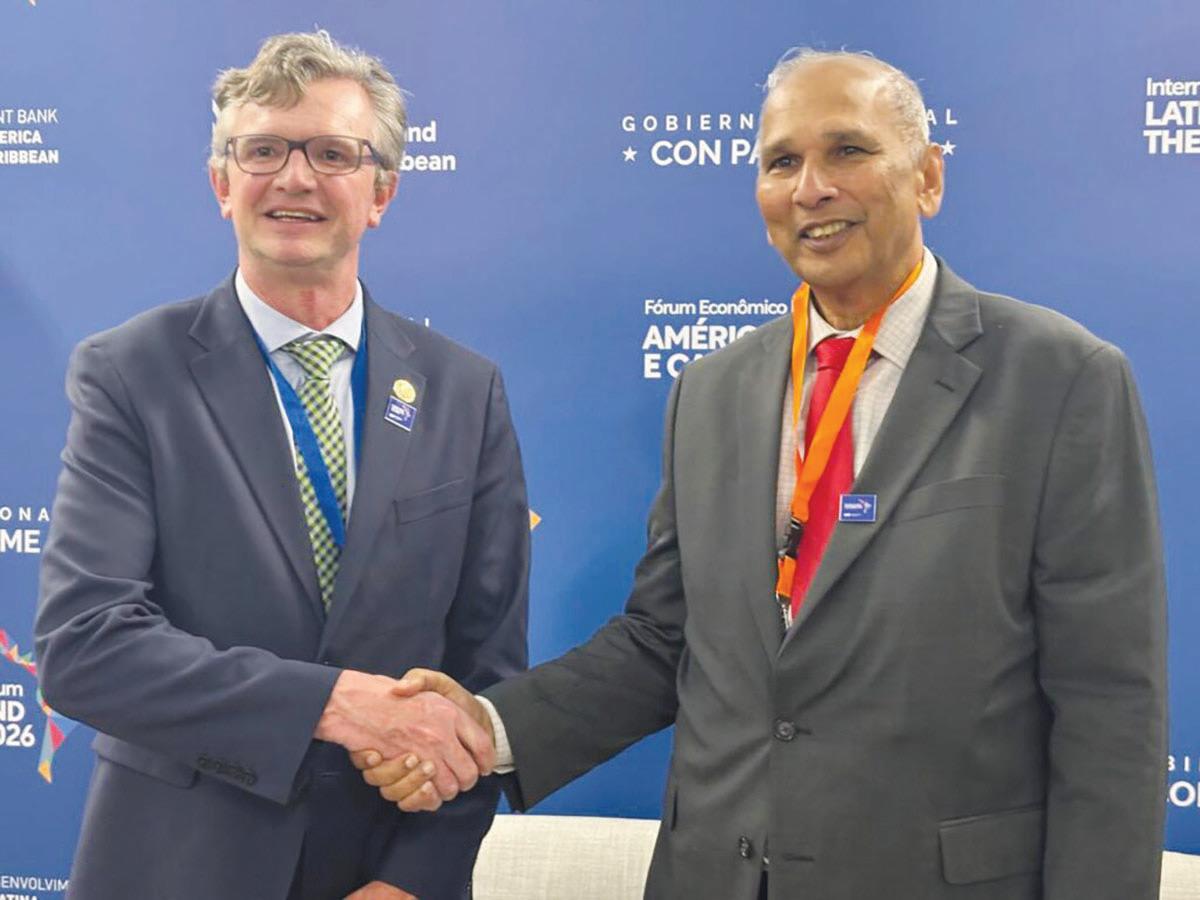
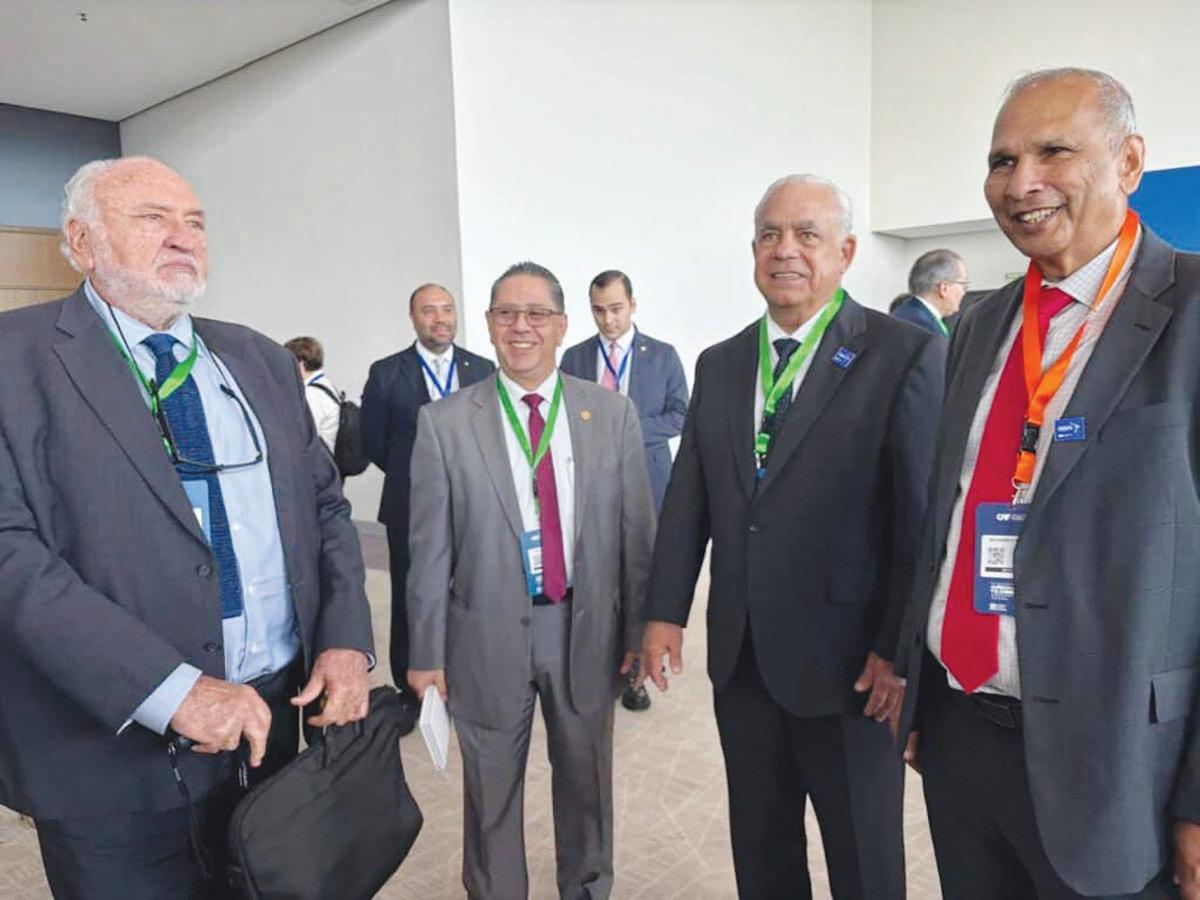
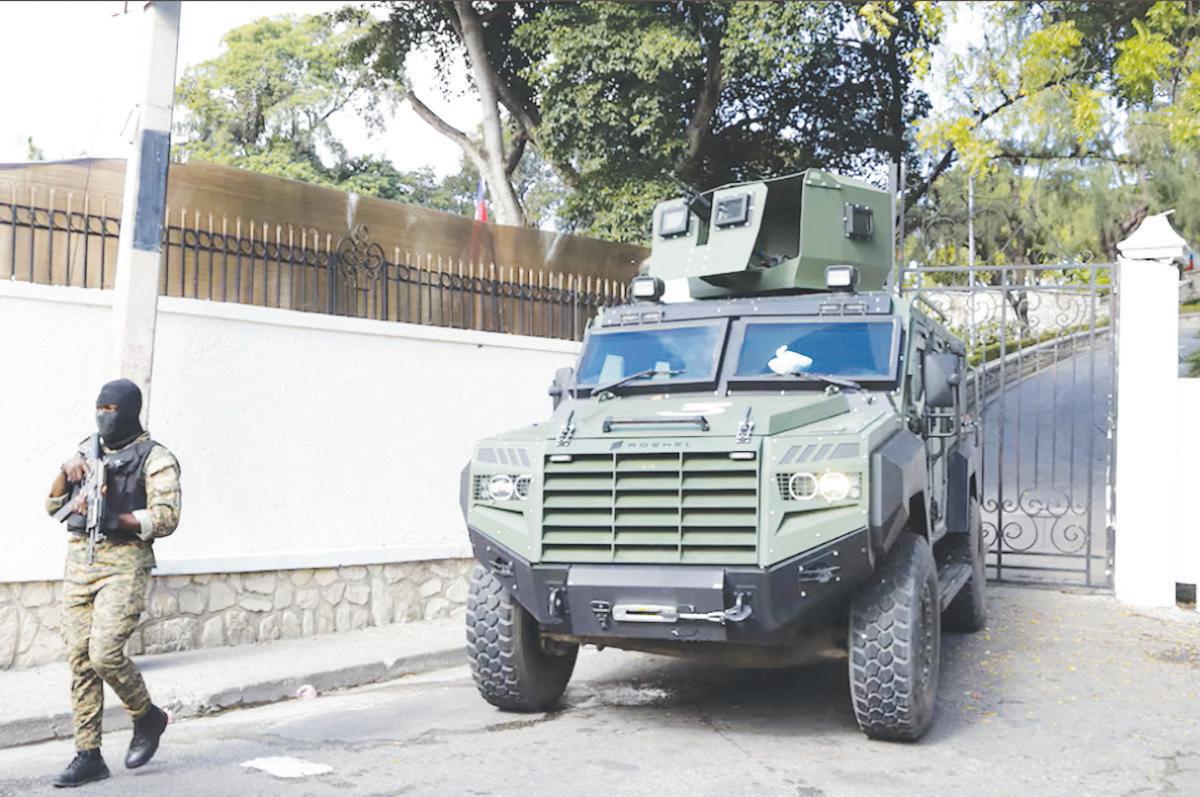
CPSO applauds Belize, Guyana sugar refinery projects as strategic investments Haiti enters political limbo as transition Govt mandate ends AI programme a success story
FEBRUARY 8,
The Berbice Bridge will be closed to vehicular traffic on:
Sunday, February 8 – 08:05h–09:35h and Monday, February 9 – 08:50h–10:20h.
BRIDGE OPENINGS FERRY SCHEDULE
Parika and Supenaam departure times – 05:00h, 10:00h-12:00h, 16:00h, 18:30h daily
WEATHER TODAY
Thundery showers will clear to late-afternoon sunny skies, followed by clear skies at night. Temperatures are expected to range between 23 degrees Celsius and 29 degrees Celsius.
Winds: East North-Easterly to Easterly between 2.68 metres and 4.47 metres.
High Tide: 07:38h and 20:13 reaching maximum heights of 2.45 metres and 2.20 metres.
Low Tide: 14:13h reaching a minimum height of 1.24 metres.
PPP/C always “put people first” – Finance Minister
– says Parliament composed of “most fragmented, weakest opposition in living memory”
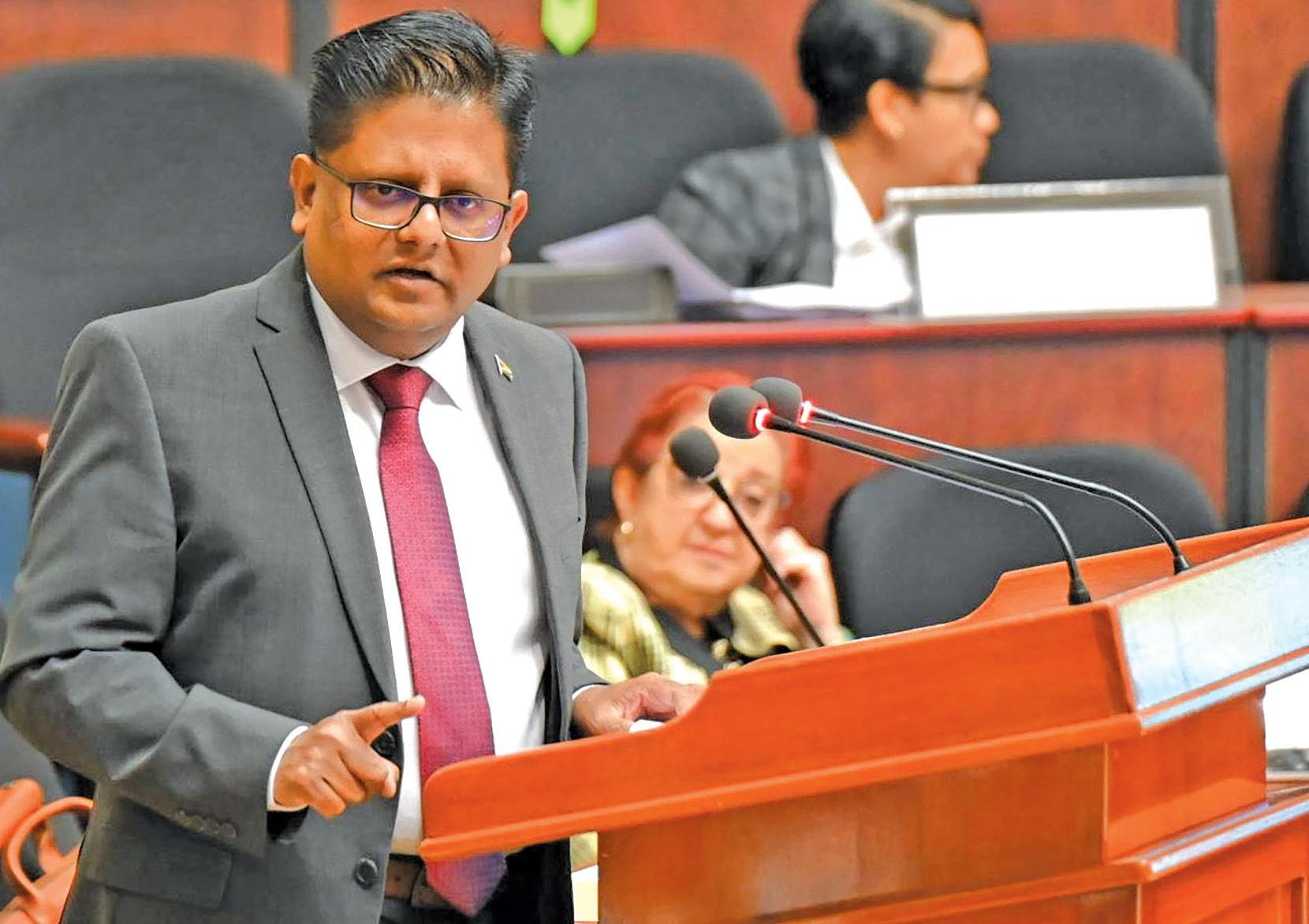
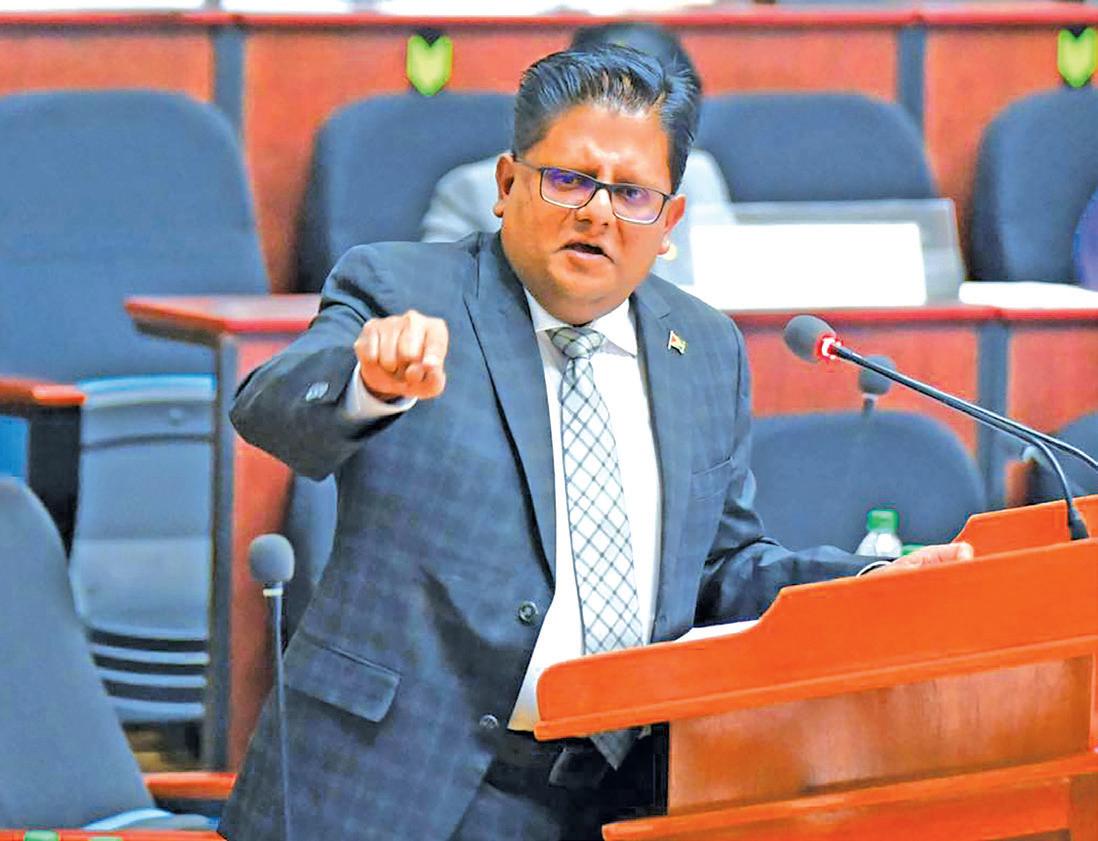
Senior Minister with Responsibility for Finance Dr Ashni Singh on Friday evening delivered a fiery and passionate presentation to close off the week-long debates on the massive $1.558 trillion Budget 2026, which he says will see the People’s Progressive Party/Civic (PPP/C) Government continuing to put the Guyanese people first and delivering to them. This year’s budget is the President Irfaan Ali-led PPP/C’s first fiscal plan for the country since being re-elected to office in September 2025.
Under the theme “Putting People First”, Budget 2026 is 12.7 per cent larger than last year’s and is focused on improving the lives of and creating opportunities for the Guyanese people. But over the past week, members of the combined 29-seat Parliamentary opposition –comprising A Partnership for National Unity (APNU), We Invest in Nationhood (WIN) and Forward Guyana Movement (FGM) – claimed that the budget has nothing for the citizens. In dismissing this notion, Minister Singh pointed to the PPP/ C’s unenviable track record of delivering on promises, which has handed the ruling party its 36-seat majority in the National Assembly.
“I presented this budget under the theme ‘Putting people first’. Well, we have always put people first,” Dr Singh stated in response to the criticisms from the People’s National Congress Reform-led APNU.
“Selfish objectives”
The Finance Minister then turned his attention to WIN leader and Opposition Leader, United States (US)-indicted Azruddin Mohamed, who in his contributions to the debates said Budget 2026 is “putting people last.” But according to Dr Singh, the newly elected Leader of the Opposition (LOO) is “endangering” Guyanese for his “selfish” gains.
He was referring to the indictments of the LOO and his father, Nazar Mohamed, by a grand jury in the US District Court for the Southern District of Florida on 11 criminal charges ranging from wire fraud and mail fraud to money laundering, primarily connected to the export of gold to the US by his family’s company, Mohamed’s Enterprises.
Prior to the indictment, the father-and-son duo, along with their companies, were sanctioned by the US Treasury’s Office of Foreign
Assets Control (OFAC) for large-scale corruption, including gold smuggling, money laundering and bribery, which involved avoiding over $50 million in taxes for the Guyanese Government. Locally, the Mohameds faced charges for billions of dollars in tax evasion that were withdrawn to facilitate their extradition to the US to answer to the 11-count indictment. During his nearly three-hour-long presentation, Dr Singh drew a parallel to the cautionary tale of Pablo Escobar –a Colombian drug lord, narcoterrorist and politician whom the Minister said exploited vulnerable people in pursuit of a very narrow personal effort to save himself.
Similarly, according to Dr Singh, Mohamed has chosen to ensnare Guyanese in his political movement with a speculative hope that this will somehow protect
him.
“We have seen callous in Guyana before, particularly from the PNC (People’s National Congress). We have seen mercilessness, but this is a particularly callous effort to ensnare and endanger people…with purely selfish objectives,” the Minister contended. According to the Finance Minister, this is the pattern of behaviour that is being displayed by the current Parliamentary opposition. “We are in this Parliament with the most fragmented and weakest opposition in living memory,” he posited. This, Dr Singh highlighted, was demonstrated during the debates by the Opposition MPs over the past week as the House was regaled with spurious statements, comments and absurdities.
Building a modern Guyana
In contrast, he said the Government
Parliamentarians presented an unmatched calibre, backed by the experience of towering political giants and a rich pride of newcomers, who championed the PPP/C’s fiscal plan for the next year. Dr Singh noted that Budget 2026 is the first instalment of the PPP/C implementation of its manifesto upon which the Guyanese people re-elected the party into office for the next five years. “We will continue to spend every single day… not only this week and this month, every day for the next five years, to ensure that the people of Guyana see steady and sustainable improvements in their lives… We are working hard; we are trying to build a modern Guyana, and we spent the whole of the last week speaking about the modern Guyana that we're building. Have we solved every problem already? We haven't. But we're working every day to solve problems. That's what we do; that is what responsible Governments do,” he stressed. According to the Minister, the PPP/C is building a Guyana in which people can get a good quality education and training so that they can get good quality jobs and earn for themselves and their families, become home and vehicle owners and live comfortably in a safe and secure society that is developed with proper roads, utilities and social services.
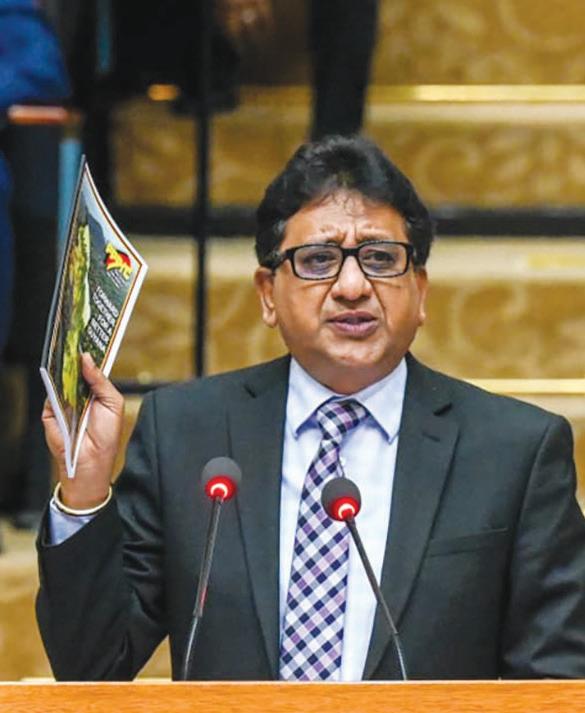
Senior Minister with Responsibility for Finance Dr Ashni Singh
The International Commission of Jurists (ICJ) has announced it will begin oral hearings on the Venezuelan Border Controversy case starting May 4, following which it will deliberate and issue its final judgement on the merits, which will be binding on the parties. It would appear that our long struggle for justice against Venezuelan revanchism might be coming to an end, and as such, maybe a review is appropriate. The United Nations Secretary-General, acting in his official capacity according to Article 33 of the UN Charter, had referred the matter to the International Court of Justice (ICJ) in accordance with the terms of the 1966 Geneva Agreement, to which Venezuela is a signatory. This was the most significant development in decades for a resolution.
For too long since 1966, Guyana had gone along with every one of the measures contained and elaborated by that agreement, which also has Great Britain as one of the parties. The Agreement is very clear that the only matter to be addressed was Venezuela’s claim that the 1899 full and final award was “null and void”. The proposed Mixed Commission in the Agreement, for instance, met to examine Venezuela’s proof of this “nullity”, but Venezuela was unable to proffer such proof and went on to make the same demand they have kept on trumpeting: that the settled frontier between the two countries be revised in a “practical settlement of the controversy”. Eventually the Mixed Commission had to be abrogated after its stipulated four-year term because of Venezuela’s intransigence, and a decade-long moratorium was declared.
Ironically, in 1983, it was Venezuela that proposed its controversy be placed under the auspices of the SecretaryGeneral of the UN, in accordance with Article IV Sec 2 of the Geneva Agreement, which complied with Article 33 of the UN Charter concerning the means of peaceful solutions of controversies. After much discussion, by 1989, there was finally an agreement on one of the means – the Good Officer process of the UN Secretary-General. This kicked off the following year with a number of prominent individuals, such as Norman Girvan, serving in that role. Girvan passed in 2014 without any settlement to the controversy because Venezuela would once again not budge from its position of a “negotiated settlement”.
Finally, towards the end of 2016, the predecessor to the present Secretary-General, Antonio Guterres, Ban Kimoon, signalled his intention to move the controversy to the ICJ if progress was not made within a year. Venezuela did not make any formal protest to this proposal, and for it to subsequently reject the UN Secretary-General’s telegraphed decision was to palpably demonstrate bad faith.
Venezuela was depending on its rejection of the jurisdiction of the ICJ to halt the process – over which Guyana has exercised the patience of Job. Even as Venezuela under Nicolas Maduro moved to annex Essequibo by holding a referendum to give its move “legitimacy”, Guyana’s President Ali participated in the Argyll Agreement with Venezuela’s President Maduro to have the Caribbean remain a “zone of peace”. Yet Venezuela embarked on overt acts of hostilities, such as Government-supported Sindicatos firing at GDF soldiers across the Cuyuni River border and having one of their warships challenge an FPSO in our Exclusive Economic Zone (EEZ).
Upon application by Guyana, the ICJ issued a declaration to no avail that Venezuela refrain from the referendum and the consequent appointment of officials over the territory. Guyana has filed two written pleadings on the merits, as has Venezuela – with the latter’s caveat of non-recognition of the ICJ’s jurisdiction. There is precedence in international law for the court to deliver a decision on the controversy, and it is hoped that with the US, which has supported the ICJ process for a settlement, present in Venezuela, the Government of President (Ag) Delcy Rodriguez will accept the decision. This would be a great victory for the region, since it would demonstrate conclusively that Venezuela is finally willing to settle its controversy by one of the most trusted peaceful methods – judicial settlement.
Off to school safely and in comfort. The Ministry of Amerindian Affairs (MOAA) received thanks for their support in providing a 50hp outboard and boat to transport students of the hinterland community of Aruau, Mabaruma, Region One (Ministry of Amerindian Affairs –
@Chris Debideen Facebook)
HERE’S MY STORY
By Ryhaan Shah
Ihave been writing about the importance of a good diet, regular exercise, and getting medical help when needed, and, in fairness, I should share with you my regimen and what guidelines I follow.
To start with, I have greying hair which I have never dyed, and I have my share of wrinkles and, from time to time, lapses of short-term memory. I have needed reading glasses since I was forty and get my prescriptions renewed every few years.
There is heart disease in my family, and I am hypertensive, so I take medications each day to control my blood pressure. I have a full medical check-up once a year. My doctor prescribes a series of blood tests that check every-
thing from my cholesterol levels to my kidney function and my heart attack risk.
This can be quite expensive, so I am advocating here that the Government should offer a free annual medical check-up for every senior citizen in our country. This would go a long way in helping to catch symptoms of chronic illnesses early when they can be more successfully treated.
Our population would enjoy a longer and healthier life with such preventative health care, which would also favour the national bottom line by reducing health care costs in the long term.
I try to eat as healthily as possible. Once a week, I eat no meat, and once or twice a week, I have fish. I have a good breakfast, then a full lunch and a small meal or just a snack later in the day.
I consciously try to manage my weight. I have done this all of my life, and my regular exercise regimen includes walking, yoga and some tai chi as well. I do gentle exercises so as not to strain and stress any joints or muscles.
While most exercise regimens include advice on walking thirty minutes at least five times a week, those minutes can be broken down into five- or ten-minute stints. I also try to not sit for long pe-
riods of time. Being sedentary is not recommended, so I get up and walk about or do a chore if I am watching television or reading a book.
I get my mental exercise from writing this weekly column, which, for each, can take up to six or eight hours of research, writing, editing and rewriting. Most days, I also do some mental arithmetic: simple additions, subtractions, and divisions in my head. I still get the correct answer within seconds; this as I approach 75 this year.
I have always been a bookworm, so I continue to read extensively, whether it’s a novel, magazine or newspaper, and I keep up with what is happening in the news from around the world.
There are days when I feel absolutely lazy and do absolutely nothing. I might binge-watch old movies on TV all day and have KFC for lunch. The occasional laziness and indulgence make me feel relaxed and happy, and I do believe it does more harm than good to feel absolutely pressured into a regimen of exercise and healthy eating.
Give yourself a break if you feel like it. There must be room in our lives for indulging in ice cream and television binge-watching as long as these bouts of indulgence do not become so regular that they undo the good of our healthier habits.
And, if you are ill and have doctor’s orders that require regular medications, therapy, or diet, please follow those guidelines for your health’s sake.
While we try to find the joy in living, not every day is completely joyous. We all have bleak days when we feel sad or down-in-the-dumps. For me, they have not ever become serious bouts of depression, and I move through them knowing – thus far –that the feeling will lift and the next day will be brighter. Feelings of loneliness, or feeling irrelevant to family and friends, or, perhaps, even being a burden are not uncommon among the elderly. Reaching out to someone close can be of immense help in alleviating feelings of anxiety about losing our independence and control over our lives.
My father died at age 98, and in his final years, he was frustrated with his inability to do simple things without assistance. He could walk but needed a cane to help him with his balance. He refused to use a walking stick for months; he said it made him look like an old man!
Caring for an elderly relative can require much patience and understanding. Remember, one day, we will all be there ourselves.
Enlightening discussions
Dear Editor, Your letter column came alive in the past few days with enlightening discussions on poverty in Guyana. This is a very important debate which I hope the opposition and Government officials will consult.
I appreciate the quality of the writings and the high level of content from Dr Gampat, Dr Yhip, and Professors Khemraj and Persaud.
These men exposed us to a high level of economic commentary ranging from economic development, budget matters and issues of finance. I hope these standards will be sustained in the letter columns.
Unfortunately, during the enlightening debates, one University of Guyana Senior Lecturer, Dr Thomas Singh,
threw a low blow at our President, His Excellency Dr Mohamed Irfaan Ali. While the abovementioned experts discussed complex and high-level topics, this UG “scholar” showed us that his contribution is at the level of Introduction to Macroeconomics, which is taught to first-year students.
Yours sincerely, Kevin Persaud
Long before oil, PPP/C social transfers built household wealth
Dear Editor,
Long before the discovery of oil, successive PPP/C Governments had already established a strong record of providing both cash and in-kind transfers to support Guyanese families.
Since 2021, both the number and value of these transfers have increased, reflecting a continuation and expansion of long-standing social policies rather than a new phenomenon driven solely by oil revenues.
Guyanese are well familiar with initiatives such as the “Because We Care” cash grant, the “One Laptop per Family” programme, the “National School Feeding Programme”, and the provision of free textbooks, many of which predate the discovery of oil.
Similarly, the national housing programme, which has transformed the lives of tens of thousands of citizens, began in the 1990s at a time when the country was heavily indebted and emerging from decades of economic and social decay.
Of all these interventions, I believe the housing programme is among the most effective in preventing intergenerational transmission of poverty. Under this programme, beneficiaries receive multiple layers of support. To begin with, there is a substantial land subsidy: low-income beneficiaries pay only 25 per cent of the market value of house
lots, effectively receiving a transfer equivalent to 75 per cent of the land price.
This is complemented by infrastructure subsidies that increase the value of these lots as roads, drains, water, electricity, and other utilities are installed within housing schemes.
Over the years, low-income households have also benefited from reduced interest rates on low-income mortgages. The savings generated by these interest rate adjustments, made possible by the Government forgoing taxes on income from such loans, amount to a significant share of the interest that would otherwise be due and payable.
The Government went further by introducing Mortgage Interest Relief, allowing homeowners to benefit from tax breaks. Over the life of a loan, these savings are equivalent to countless mortgage instalments, further easing the financial burden on working families.
When these transfers are monetised, they amount to millions of dollars received and enjoyed by beneficiaries of Government house lots. More importantly, the receipt of a Government house lot often leads to ownership of one of the most valuable assets a household can possess: a home.
That home, in turn, is linked to the accumulation of other assets, including household furnishings
and vehicles, thereby enhancing overall household wealth and stability. Based on my calculations, the housing programme has been responsible for a significant number of individuals moving from low-income to middle-income households.
All members of these households benefit from this upward mobility, not only through access to adequate housing but also through the long-term security the home provides, including the potential to be inherited by future generations.
These transfers, such as free tertiary education, scholarships for post-secondary training, Government payments for CXC subjects, and other education-related programmes, deliver benefits that extend far beyond a single year. They provide a lifetime of opportunity, creating households that can stand on their own and thrive without dependence on handouts.
I therefore welcome this budget and look forward to future budgets that will continue to deliver such transformative interventions, further reducing intergenerational poverty and helping to build a more progressive and resilient society well beyond 2030.
Yours sincerely, (name withheld)
Response to the Statement Made by the Guyana Teachers’ Union
I have taken note of the press statement issued by the Guyana Teachers’ Union (GTU), concerning remarks made during my presentation on Budget 2026 in the National Assembly.
I wish to clarify that no breach of confidential or sensitive information occurred at any point during my contribution to the Parliamentary Budget Debate.
To vote or not to vote, that is Budget 2026’s question
Dear Editor, The cultural reading of the famous National Budget and the traditional debate finished last Friday, allowing the 13th Guyana Parliament to reach its two-thirds completion mark and now awaiting the final third part for the customary consideration of the estimates of Guyana’s National Budget 2026 to commence before it is put to the House for the inevitable passage.
Enjoying a 36-majority seat, without any problem, the elated PPP/C Government foresees no challenge and anticipates no surprise in getting the trillion-dollar budget passed. As a practice, the Opposition (a combination this year) is ceremoniously expected to walk out before the vote is called for the ayes and nays! As clean as a whistle, there is no Charrandas-type furore in this third sitting to create any uproar or upset!
Like the West Indies win in their primary game in this year’s Male World Cup T20 Cricket Series, many young and talented Members of Parliament are drawing first blood. Getting into the Big League is no easy feat, and one has to be prepared to lock horns with the seasoned players. There are many budding flowers, like baby-faced 14-year-old Sooryavanshi, playing his record-breaking role in the U19 Cricket 2026 World Cup.
The conventional address of the adjective “Honourable” was fully exhausted and applied in all its merits and demerits to demarcate respect or dishonour in its real sense. Shakespeare utilised Mark Antony’s speech in “Julius Caesar” to display this irony or sincerity and praise or sarcasm. The statement, “Yet Brutus is an honourable man,” is phrased as a pause for effect, to influence an opposite appeal.
The Honourable Dr Hinds’s loyalty to the APNU (PNC) and his duty to the IDPADA-G befriended his cause to succumb to the concept of narrowing the catchy word “people” to refer to a prejudiced interpretation. In the same vein, the Honourable Dr Campbell drew a parallel when he revealed his true colour by reflecting in the mirror of intolerable discrimination.
by explaining, “Not that I loved Caesar less, but that I love Rome more.” As portrayed in the budget’s debate, the golden field of opportunity presents a propitious moment for the WIN Party to capitalise on a porous PNC “scattered” displacement, to take advantage and traverse on the backs of those mentored by a Burnham ideology.
On his maiden voyage, the Honourable Azruddin Mohamed trod uncharted waters when he swam with the sharks to wet his feet as the Leader of the Opposition (LOO). It will be remembered that the late Gordon Todd, a past President for the CCWU, was also taken for a PNC helicopter ride against his will to the middle of the ocean and asked if he wanted to swim with the sharks!
Without his playboy’s sunshades to reveal eyes mirroring a tale of error and terror, the Honourable MP ventured into a maze of explosive revelations which sent shock waves throughout Guyana. Guyanese overheard unspoken anecdotes, way above the head of a tsunami wave, leaving unfiltered imagination to take a walk in the park with their heart in their hand, wanting to know what more will be divulged!
The Honourable Gail Teixeira, a veteran of exemplified diplomacy, dignity and décor, displayed a doyen dominance to devote her time to commandeering the House to rapid attention as she coolly, calmly and calculatedly cajoled members with political, Parliamentary and personal coaxing. No wonder her presentation remained
undisturbed, unquestionable and undefeated, especially when accompanied by the uncomfortable historical facts and accentuated with inconvenient truth!
While sentiments, sorrows and sadness do send shock waves of appeal to play on emotions to create commotions, it is well advised to look beyond the curve for any cloaked dagger. As the Honourable Prime Minister advised, when you come to the National Assembly as the cream of the crop and not as a backbencher, it is worthy to read widely, research wisely and remember willingly.
Budget 2026, undoubtedly, has room for each and every Guyanese, irrespective of race, religion, belief, caste, creed, sex, age, political affiliation, location, status, affluence or influence. It may not immediately and appropriately satisfy the needs, wants, desires, dreams, or wishes of a personal or collective choice, but the Government will be mandated to fulfil the promises with dignity, sincerity, and loyalty by truly putting people first in order to maintain a “One Guyana” and to sustain peace, progress, and prosperity for the country and Guyanese, holistically. Guyanese should remain all for one and one for all, regardless if you vote or don’t vote for the passing of Budget 2026, in particular as we await the ICJ decision later this year over our Guyana/Venezuela border issue.
Yours sincerely, Jai Lall
It is also important to underscore that the Honourable Gordon Barker is now a sitting Member of Parliament. As with all elected officials, his public conduct and professional record are subject to legitimate scrutiny within the National Assembly. Parliamentary debate, by its nature, involves accountability and transparency, particularly where public service delivery is concerned.
any suggestion that any remarks were politically motivated or intended to undermine the dignity of the teaching profession. On the contrary, my comments were made in the context of advocating for accountability, improved standards and the best possible outcomes for our children.
I categorically reject
Ministry of Education, Office of the Minister Hon Savitri Sonia Parag MP
One cannot help but pun with the play “Julius Caesar”. WPA joining hands with the PNC was long configured when Caesar remarked, “Et tu, Brute?” One of Dr Walter Rodney’s famous quotes sounds a warning: “….. [A]ll white people are enemies until proved otherwise, and this applies to Black intellectuals; all of us are enemies of the people until we prove otherwise.”
Brutus justifies staining his hands with Caesar’s blood
Page Foundation
How do octopuses coordinate their arms?
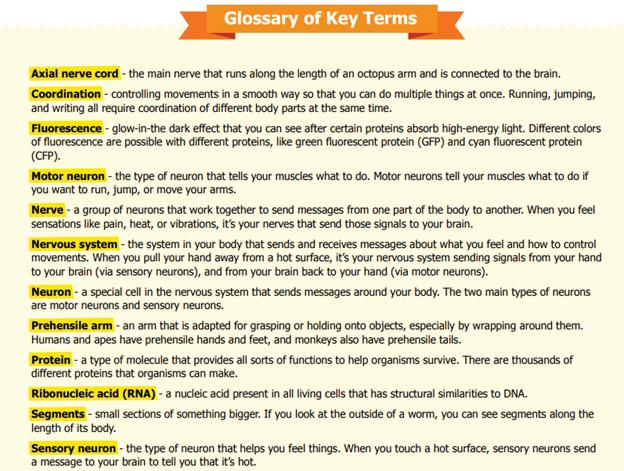
Did you know that your ability to move and feel comes from your nervous system? The nervous system helps with communication in an animal’s body. It is made up of cells called neurons. Neurons send messages to each other along nerves. Nerves are like roads that cars use to travel places. But instead of using gas, they use electricity and chemicals. For example, neurons in your brain can send messages through the nerves in your spine to tell your feet to move.
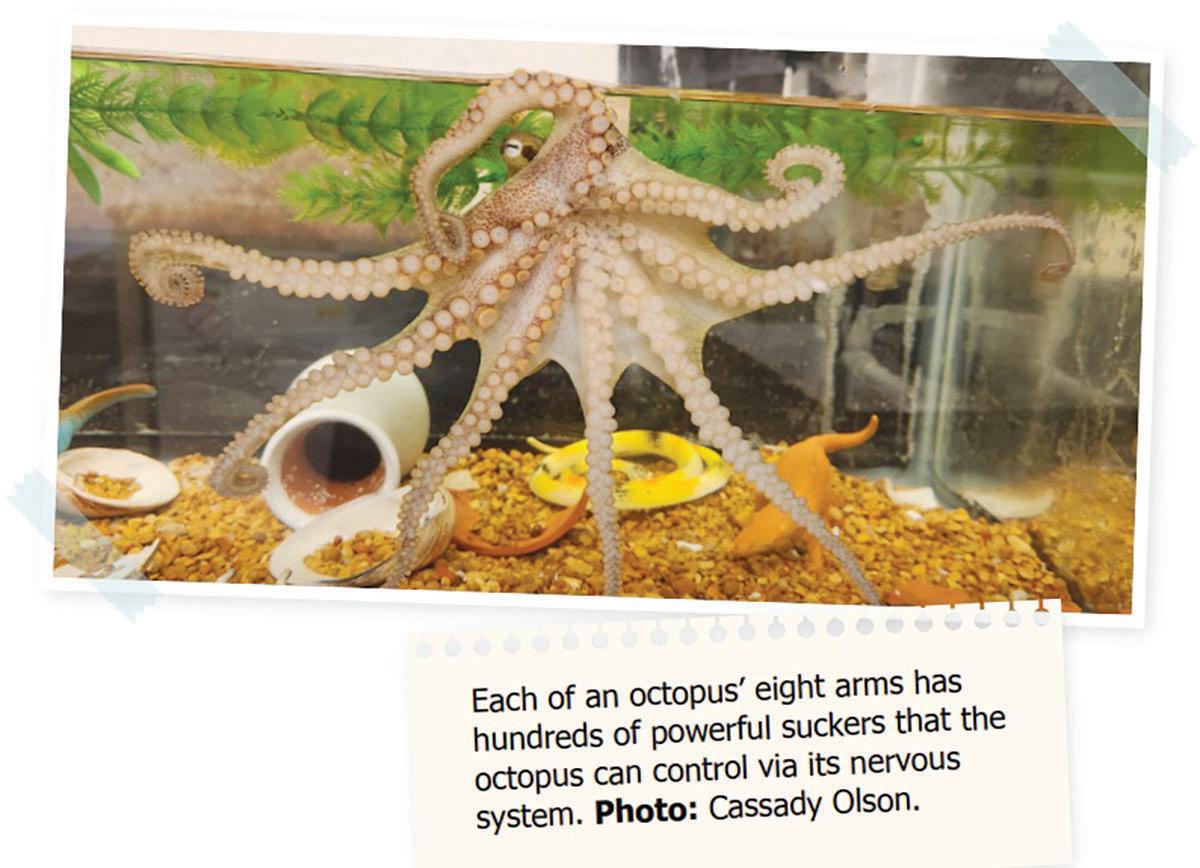
The organisation of the nervous system varies in different types of animals. This relates to the shape of the animal. But it also connects to how the animal interacts with its environment. Imagine an octopus. They have eight prehensile arms that are soft and flexible. They also have hundreds of powerful suckers on each arm. They use the suckers to taste, feel, and grab onto objects. Can you imagine the coordination it would take a human to control eight arms at once? Well, the octopus has mastered that coordination!
Scientists know that octopuses have more neurons in their arms than in their
brains. But they did not know much about the small-scale organisation of the octopus nervous system.
So, they had several questions:
1. How are the nerves in octopuses organised to help coordinate arm movement?
2. What about the nerves that reach the suckers?
3. Is this organisation the same for related animals, like squid?
or
Octopus bimaculoides. They also looked at three squids from the species Doryteuthis pealeii, which have eight arms and two tentacles with suckers at the end. They took samples of the animals’ arms and cut them into very thin sections – thinner than a human hair!
Then, they used colourful stains to see different parts of the nervous system. Each stain sticks to a different protein or structure they wanted to look at. Some stains are like dyes.
Scientists studied 17
Other stains are actually made of specific proteins or ribonucleic
axial nerve cord to the suckers. A special kind of microscope was used to see both the colourful dyes and fluorescence. Strips of neurons were found
This research shows that the octopus is an incredibly complex animal! Scientists think segmentation helps control and coordinate these suckers, and
When you look at them under a certain type of light, they are fluorescent.
They looked at the central nervous system in each arm, called the axial nerve cord. This is like the spinal cord for each arm. They also looked at the smaller nerves that connect the
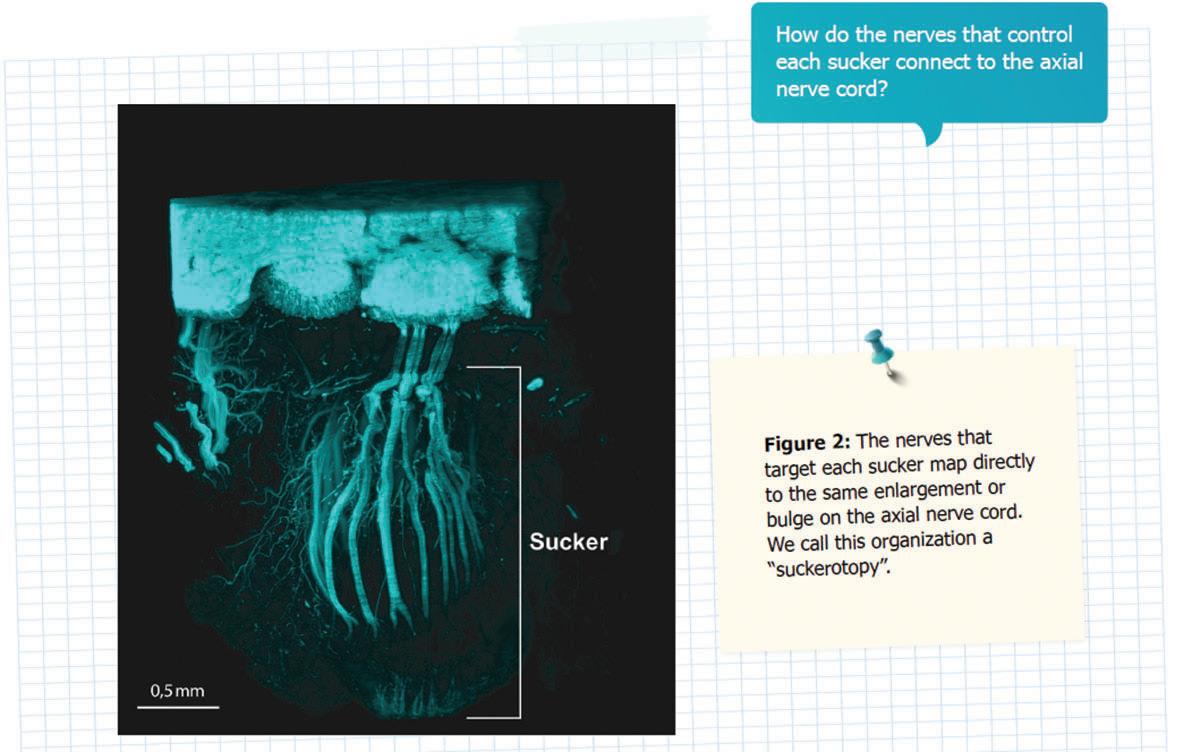
separated by gaps in the axial nerve cord. This means the axial nerve cord is segmented. They saw an average of 7.5 segments for each sucker, and noticed that the axial nerve cord bulges out toward each sucker. When scientists looked more closely at the axial nerve cord, they found that:
1. Sensory neurons and motor neurons are not separated, as they are in many other animals.
2. Neurons from neighbouring segments can communicate with each other.
3. The nerves that connect to a sucker all come from the same bulge or enlargement. This gives a map of the nerves that control the suckers. This is called a “suckerotopy”.
They found that squid arms with suckers had the same segmented structure as the octopus. There were no segments in the parts of the squid tentacles without suckers.
arms without suckers might not need the same level of control. Suckers are complex. They can “taste” things, feel the environment, and move in lots of directions. It is important for an octopus to be able to control one or a few suckers at a time. The nerve map, or “suckerotopy”, helps explain how they can do this. Let’s say an octopus wants to grab something with one sucker. They can send a signal through the axial nerve cord. The signal then travels through the nerves in the “bulge” to that specific sucker.
In the future, scientists want to study the nervous system in more animals. Do other animals have the same segmented pattern we found in the octopus? How common is a segmented nervous system? How might a segmented nervous system have evolved? There is lots more to explore!
(Adapted from sciencejournalforkids)
octopuses from the species
acid (RNA). These attach to pieces of protein
RNA in the octopus arms. They label specific types of cells, like sensory neurons or motor neurons.
CANU nets over 161 kg narcotics; firearms & ammo in January
– 12 charged, 3 convicted
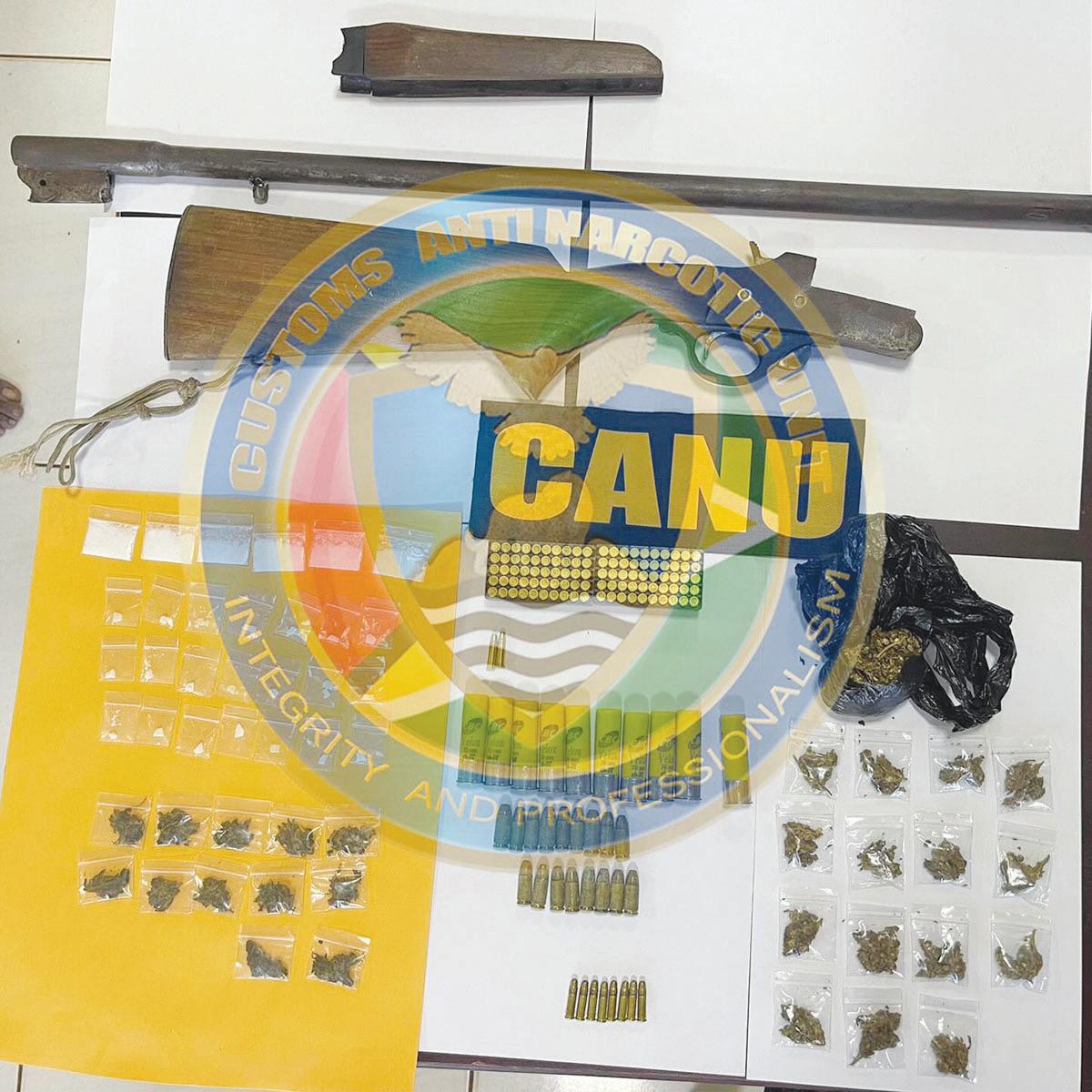
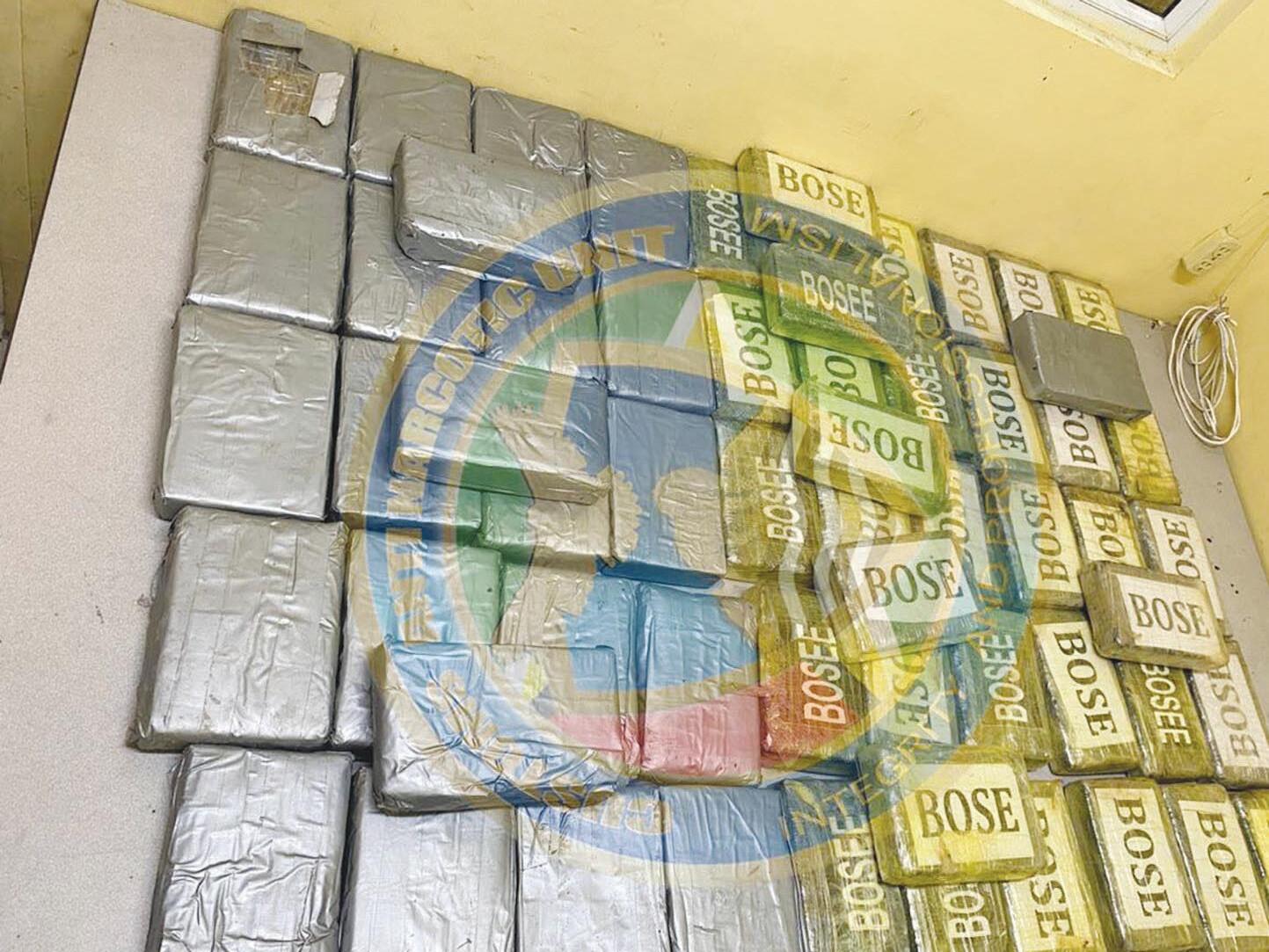
The Customs AntiNarcotics Unit (CANU) has removed approximately 161.09 kilograms (kg) of illicit narcotics, two firearms and some 137 rounds of ammunition from the streets of Guyana during the month of January.
In a monthly newsletter released by CANU Director James Singh on Saturday evening, it was noted that these discoveries were made during 11 intelligence-led operations across multiple regions in the country.
Of the 161.09 kg of narcotics seized last month, 92.46 kg were cocaine, 68.39 kg were cannabis, 229 g were ecstasy (MDMA), and 84 g were suspected crystal methamphetamine.
“Cocaine and cannabis continue to dominate seizure profiles, reinforcing established trafficking trends and market demand. Although synthetic drugs remain low in volume, their presence highlights an emerging risk that warrants continued monitoring and early-warning attention,” the anti-narcotic agency stated.
Among the total narcotics seized, 142.20 kg, or 88 per cent, were discovered at roadways; 15.76 kg, or 10 per cent, at airports; and 3.13 kg, or two per cent, at residences. CANU pointed out, “Road transport remains the primary method of trafficking. Airport interdictions, while lower in volume, are operationally significant given their implications for international trafficking.”
These seizures were largely recorded in Region Two (Pomeroon-Supenaam),
which accounted for 43 per cent with 70 kg of cocaine, followed by Region Nine (Upper Takutu-Upper Essequibo) with 31 per cent, including 49.89 kg of cannabis, 8.6 g of cocaine and 65 g of ecstasy.
Region Three (Essequibo Islands-West Demerara) saw the seizure of 22.44 kg of cocaine and 2.71 kg of cannabis; Region Four (DemeraraMahaica) had 22.44 kg of cocaine and 2.71 kg of cannabis, and Region Six (East Berbice-Corentyne) had 84 g of suspected crystal meth.
“This distribution underscores the continued vulnerability of hinterland and border regions, particularly along the Guyana–Brazil transit routes,” CANU said.
The 92.46 kg of cocaine discovered last month carried a domestic street value
of some G$92.456 million but was worth some US$2.773 million and €3.698 million on the United States and European markets, respectively.
On the other hand, the 68.39 kg of cannabis fetched G$20.517 million in Guyana but only US$170,981 and €150,258 in those markets.
According to CANU, “The increase in cocaine’s market worth from domestic to US and European markets emphasises its role as a high-value trafficking commodity, where smaller quantities yield higher criminal profits. This disparity shows that enforcement success should be judged not just by weight but by market impact, as cocaine interdictions more effectively disrupt trafficking networks and criminal financing.”
Guns and ammo
Meanwhile, also in January, CANU unearthed a .32 revolver and a 12-gauge shotgun during its operation. These discoveries also include 110 rounds of .22 calibre ammunition, 10 rounds of 12-gauge cartridges, and 17 rounds of 9 mm ammunition – all connected to the narcotics find.
The anti-drug unit said this highlights the continued nexus between drug trafficking and the illegal possession of firearms and ammunition. “These seizures underscore the elevated risk to community safety and reinforce the Unit’s focus on intelligence-led operations to disrupt organised criminal activity and reduce the circulation of illicit weapons within communities,” it added.
<<< Charges and convictions >>>
Moreover, these 11 intelligence-led operations in January led to the arrest of 17 individuals (16 males and one female), 12 of whom were
Construction of law school to start this year – AG
Attorney General (AG) and Legal Affairs Minister Anil Nandlall, SC, has revealed that the 2026 budget has earmarked funds to commence construction of the highly anticipated Council of Legal Education (CLE)accredited law school in Guyana. “In this budget, we have the first capital injection, and during the year 2026, we will begin the construction of a law school in Guyana,” the Minister stated during his debate presentation on Budget 2026 in the National Assembly on Friday.
During his September 7, 2025, inauguration address after being re-elected at last year’s General and Regional Elections, President Dr Irfaan Ali announced that Guyana received approval from the West Indies’ CLE to pursue this much-needed project.
AG and Legal Affairs Minister Anil Nandlall, SC, during the 2026 budget debate
According to Anil Nandlall, during his debate presentation, the milestone follows unsuccessful efforts, dating back to 1996 under the Cheddi Jagan-led People’s Progressive Party/Civic (PPP/C) Administration, to secure approval for an accredited regional law school in Guyana. He added that the initiative was revived in 2022 at the direction of
President Mohamed Irfaan Ali.
“I am proud to announce that under President Dr Mohamed Irfaan Ali, we secured the permission of the Council in September 2025 for the construction of a regional law school in Guyana,” the AG stated. Guyana had previously conducted a feasibility study for the establishment of a local law school, and the findings were handed over to the CLE last September. The CLE had outlined a series of requirements that Guyana needed to fulfil, including the conduct of a comprehensive feasibility study in which the country had to illustrate the number of students the school will attract and accommodate, as well as the Government’s capacity to fund the construction of the facility and its initial operation cost. A high-level sub-
committee, which included AG Nandlall and other prominent officials across the Caribbean, was appointed to review Guyana’s application.
UG’s Turkeyen Campus location
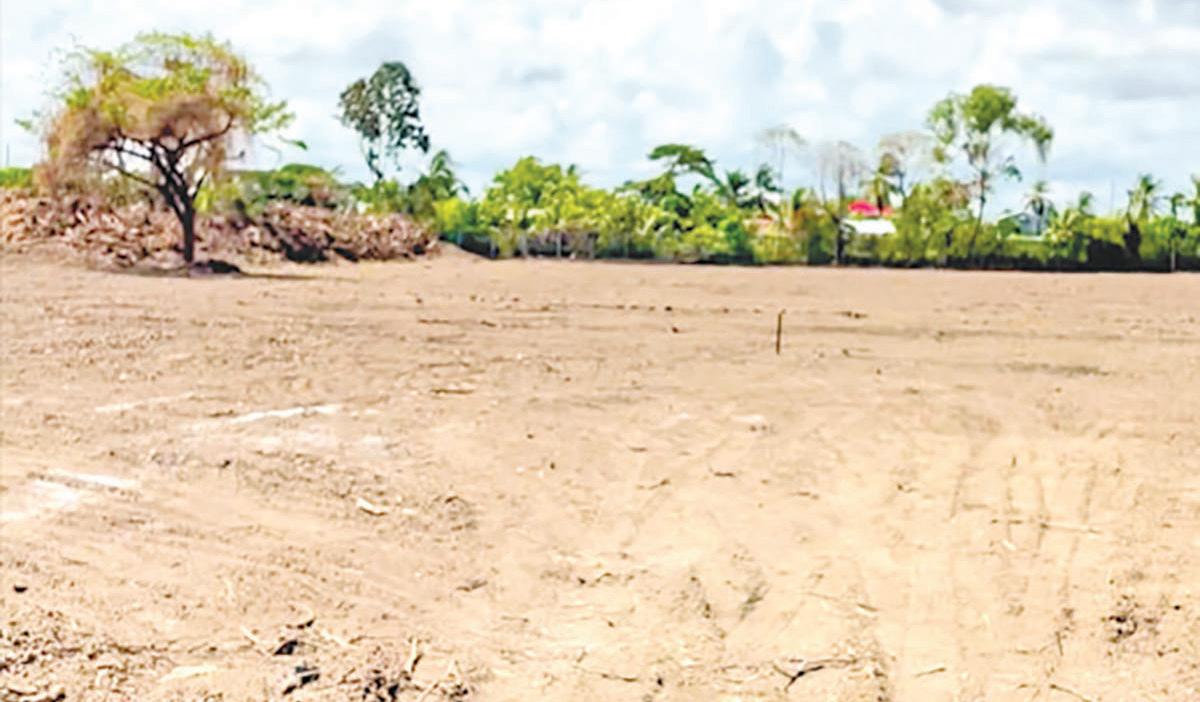
The Guyana Government has already identified an eightacre plot of land at the University of Guyana (UG)’s Turkeyen Campus, Greater Georgetown, to accommodate the main building and other facilities relating to the Caribbean’s newest addition to its current complement of accredited law schools. The plot, located at the southwestern section within the university’s compound, has already been cleared and prepared for the construction works to commence.
charged for narcotics-related offences, and three convicted.
“The outcomes reflect sustained enforcement pressure on trafficking networks operating along roadways, border corridors, residential areas, and international entry points,” CANU stated.
Of those arrested, eight individuals were charged with possession of cannabis, five with possession of cocaine, three with possession of ecstasy, and one with possession of crystal methamphetamine. Additionally, five of the suspects were found in possession of more than one controlled substance, including three individuals arrested for possession of both cannabis and cocaine and two others arrested for possession of both cannabis and ecstasy.
Going forward, the Unit said continued emphasis will be placed on roadway and border corridor interdictions, monitoring emerging synthetic drug threats, and strengthening intelligence fusion and analytical capacity.
To further enhance its operational capacity, CANU continued to build its professionalism and intelligence-led enforcement in January with a series of targeted training programmes, including a Weapon Handling & Safety Training facilitated by the Guyana Defence Force (GDF); a Basic Narcotics Investigation Seminar and Intelligence Analysis & Structured Analytical Techniques hosted by REDTRAC in Jamaica; and a local Open-Source Enterprise Workshop.
“As the year progresses, the Unit remains focused on strengthening operational capacity, enhancing information-sharing with national and international partners, and engaging the public as a critical partner in crime prevention. Through sustained vigilance, professionalism, and accountability, the Unit will continue to work to reduce the availability of illicit drugs and protect communities across Guyana,” CANU said in its January newsletter.
During the reporting period, the Unit secured three convictions for possession with intent to distribute, all involving male defendants and approximately 22.984 kg of narcotics, including 22.394 kg of cocaine and 0.426 kg of cannabis, as well as 0.164 g of ecstasy. According to CANU, January’s results confirm that intelligence-driven operations, inter-agency cooperation, and sustained border vigilance remain critical to disrupting trafficking networks.
Items unearthed by CANU officers after intercepting a Brazilianregistered motor vehicle in Region Nine on January 30
CANU officers seized 70 kg (154 lbs) of cocaine, which was found at Parika on January 18
Ending…
…the cacophony
Well, there you have it – the end of the most highly anticipated budget debate since the PNC days – when bruised and battered citizens would anxiously await finding out what else was banned or prices doubled!! Remember those were the days of price control, eh?? But frankly, this budget anticipation had nothing to do with the budget per se – and everything to do with how the new LOO – Sanction Man – would perform!! And let’s face it – being in the National Assembly’s ALWAYS about performances, innit??
So how did Sanction Man perform?? Based on his appearances during his three-month election campaign, whenever asked a question, his standard response was to furrow his brow – as if he were thinking!! – behind his dark shades but then say, “I gonna get back to you”!! It was as if he was the Guyanese equivalent of Gary Cooper – that old-time American “star boy” whose taciturn replies were confined to “Yup!!” and “Nope”!! Not surprisingly –even though his also-US-sanctioned Daady insisted he was “intelligent” because he could remember “car numbers” since he was a boy!! – Most concluded he was also the Guyanese answer to the US’ “dumb blonde” caricature!! Your Eyewitness had already announced that he was looking forward to listening to Sanction Man giving his hour-long LOO response to the Finance Minister’s Budget Speech – without reading from a script!! After all, while he’d occasionally appear on social media speaking for a while, it was clear from his fixed gaze he was reading from a teleprompter – or a cardboard held over the camera!! In the National Assembly, however, the rule was you gotta speak extemporaneously – with at best (or worst!) being allowed to occasionally glance at your notes!!
So what did Sanction Man do?? Well… READ, of course!!
The man who’s barefaced enough to pronounce on how OUR tax dollars oughta be spent – when he didn’t pay HIS share after smuggling tonnes of gold and evaded BILLIONS AND BILLIONS in taxes – was barefaced enough to flout the time-honoured rule!! Over from the other side of the aisle, Government Whip Gail Teixeira jumped up and down like a cuckoo on steroids to protest to the Speaker about the clear breach of the rules. To no avail!!
Even though Sanction Man had announced that the Speaker was “biased” against him – for calling him an “international fugitive”, which earned Sanction Man’s Daady claim the fella was “ungrateful”!! – the latter perfunctorily acknowledged Teixeira’s protest but allowed Sanction Man to blithely continue reading! Sanction Man’s stumbles clearly showed he’d been handed the script – of which fact he was frequently reminded by PPP/C MPs!!
So what did Sanction Man actually read?? Sadly, there was no creativity or punch. Just the usual platitudes consultants come up with!!
…poverty
Much of the cacophony in the House during the budget debate was about “poverty in Guyana”. The Opposition insists there’s 58 per cent poverty in the country – and 32 per cent abject poverty – while asking plaintively how this could be allowed in “the fastest growing economy in the world” – as the Government boasts!! These are quoted from IADB – while some quote from the World Bank – which had 48 per cent poverty on its website!!
And this highlights the problem with statistics – the sources. The Government point out that those stats are dated – going back to the end of the PNC’s 2020-2025 Government!! Since then, while poverty couldn’t be ELIMINATED in five years – it’s certainly been REDUCED!! And will continue to be reduced, the Government promises!!
One problem is that poverty’s a relative concept – in the richest countries, what would be considered “poor” might be “middle class” in a poor one!! As such, your Eyewitness has already discussed a satisfaction of “Basic Needs”.
And who can say this hasn’t improved in Guyana? Honestly now!!
…inequality
The Opposition seems to be demanding an end to inequality when speaking about poverty. But is this possible?? One proposal is that if unequal benefits result in creating greater benefits for all – then it’s justified!! Or else we can all remain equally poor!!
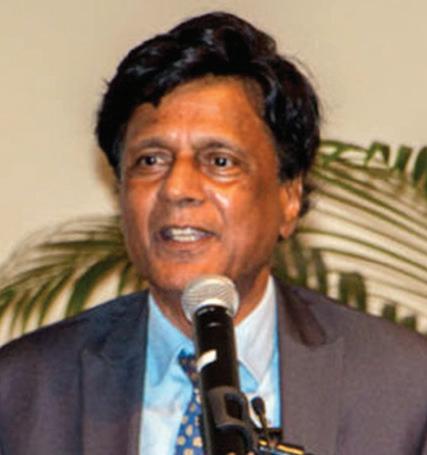
Existential threat from Venezuela remains
LGPHC makes history with first caesarean delivery for patient with bleeding disorder
Tast Thursday, President Irfaan Ali addressed the GDF officers’ conference under the theme “Transforming the Force to Better Confront the Nation’s Present and Future Challenges by Enhancing Its Awareness, Adaptability and Agility Capabilities.” Committing to continue the enhancement of our national forces across all domains, he emphasised a strategic shift toward technologydriven defence, including artificial intelligence and enhanced intelligence capabilities. Significantly, he took pains to note, “The present situation in Venezuela does not remove or diminish the threat to Guyana’s territory… Guyana must not drop its guard. Guyana must not blink… Readiness is not something you scramble to assemble when trouble arrives. It is something you build quietly, steadily, and professionally.”
I am heartened. Following the extraction of Venezuelan President Nicolas Maduro by US Special Forces to face narcotrafficking charges in the US, I wrote last month, “We must prepare for the possible post-Venezuela scenarios – a fragmented Venezuela and the subsequent spill-over risks; a nationalist rebound with renewed border claims; and, more positively, normalisation, which will be subject to negotiation pressure. Our diplomatic and defence responses must be tailored accordingly since we must be ready whether Venezuela stabilises or not.
“In terms of our national security, as we have consistently advocated, we should continue to utilise the Venezuelan crisis as a catalyst for boosting our defences. As such, with US and European assistance, we should continue expanding our coast guard and maritime surveillance capabilities, which become even more critical to protect our offshore oil FPSOs. We suggest a UAV (drone) squadron for EEZ and border monitoring. We repeat our suggestion that we establish a military base in NW Essequibo to boost our rapid response, to which the US can have access through an explicit agreement as a longer-term deterrence to Venezuelan revanchism, which will not disappear. We should also retain the presence of GDF personnel along the Venezuelan border that were augmented after the US military intervention. We must have a plan in place for Venezuelan refugee flows across that border, which has remained “porous” for far too long.
“We should also begin planning post-ICJ enforcement diplomacy since even a partial ICJ ruling will lock in long-term security and trigger responses from forces in Venezuela. Our cooperation with Brazil should be augmented and formalised since she has in the past, and will in the future, share many of our concerns and fears vis-à-vis Venezuela.”
With the US accepting the accession of Maduro’s deputy Delcy Rodriguez as acting president and evidently working out a modus vivendi on the operations of the Venezuelan oil industry, there has been no overt “fragmentation” to date. But it would be naïve to believe that the institutions created by the Chavista regime over three decades – the armed, far-left colectivos, the armed sindicatos, and the communes (50,000), along with the state military apparatus whose leadership has been bought out through rentierism, etc – have disappeared. There would also be restive elements in the ruling PSUV party, which controls the National Assembly, led by Delcy’s brother, Jorge Rodriguez. There is the opposition Unitary Platform, credibly adjudged to have won the 2024 presidential elections under the nominal leadership of Edmundo Gonzalez, standing in for the pro-capitalist and right-wing Maria Machado after she was arbitrarily disqualified. Her party has now been joined by the formidable centrist opposition leader Henrique Capriles, which adds another dimension to the fissures. If true, Machado’s announcement that she expects elections later this year will catalyse these imminent divisions, in which the Border Controversy will feature as a low-hanging fruit to be exploited along with the American presence.
Even if there are no elections, the announcement that the ICJ will commence hearings on the merits of the case on the Venezuelan Border Controversy on May 4 will ensure those divisions manifest themselves. Delcy Rodriguez has been a most vociferous supporter of Maduro’s “annexation” of Essequibo and, in fact, presented her country’s rejection of the ICJ’s role in resolving the controversy over the validity of the 1899 Arbitral Award. While, like all Venezuelans, Machado also supports the Venezuelan position on the award, she is on record as supporting the ICJ’s intervention.
The refusal to release details of the December 2023 helicopter that killed five high-ranking military officers should hopefully spur discussion of my suggested drone squadron and military base in Essequibo since the possibility of the helicopter controls being jammed by the Venezuelans will be revived. We must discourage any upcoming Venezuelan adventurism.
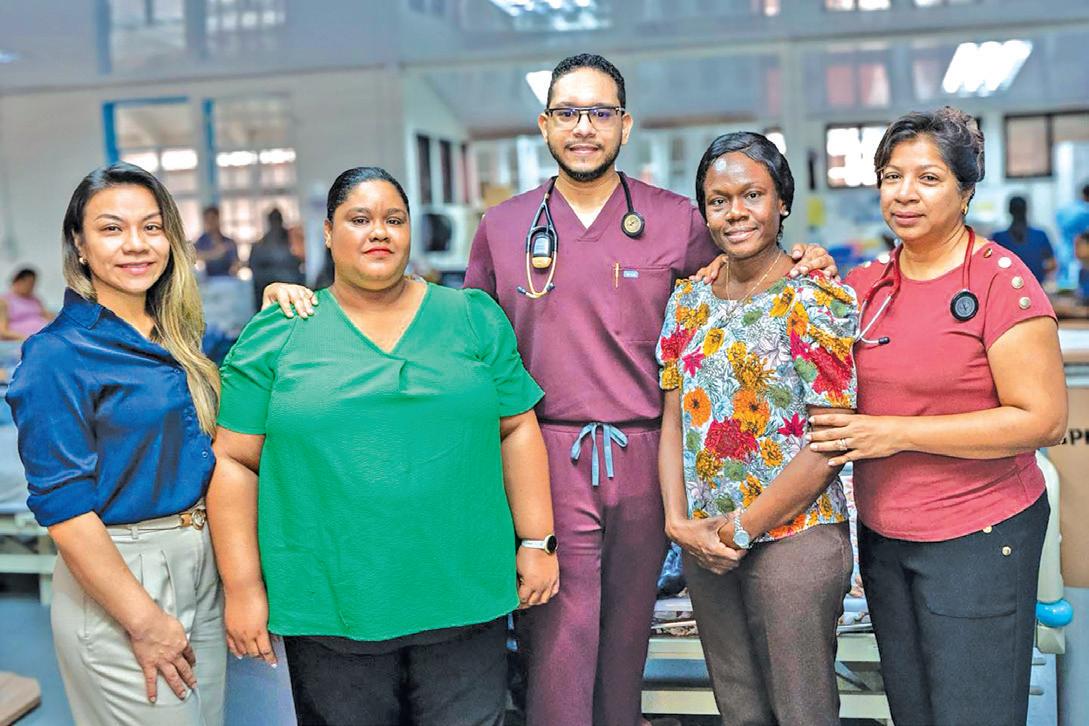
he Georgetown Public Hospital Corporation (GPHC) has recorded a major medical breakthrough with the successful caesarean (c-section) delivery of an infant of a woman living with Haemophilia A, marking the first time such a procedure has been performed in Guyana on a patient diagnosed with a bleeding disorder.
Both mother and baby are reported to be doing well and were discharged in stable condition with a structured follow-up plan in place.
Haemophilia is a rare inherited condition that affects the body’s ability to clot blood, and poses serious, potentially life-threatening risks during surgery and childbirth. Medical offi-
cials said the patient’s condition placed her at high risk for severe bleeding, particularly during operative delivery.
Despite these challenges, the procedure was successfully completed through
extensive pre-surgical planning, specialised treatment, and coordinated multidisciplinary care. Expected blood loss was minimal, and no blood transfusion was required.
The patient underwent
a planned c-section following detailed antenatal assessments. A comprehensive bleeding management strategy was developed collaboratively by GPHC’s Haematology and Obstetrics teams. Special clotting factor medication was administered around the time of surgery, along with additional medications to reduce bleeding, while the patient was closely monitored before, during, and after delivery.
Hospital officials revealed that the patient initially presented with severe anaemia, with a haemoglobin level of 4.8 – significantly below the normal range of 12 to 16 for women. Further diagnostic testing and evaluation led to the eventual diagnosis of haemophilia A.
Ravi Dev
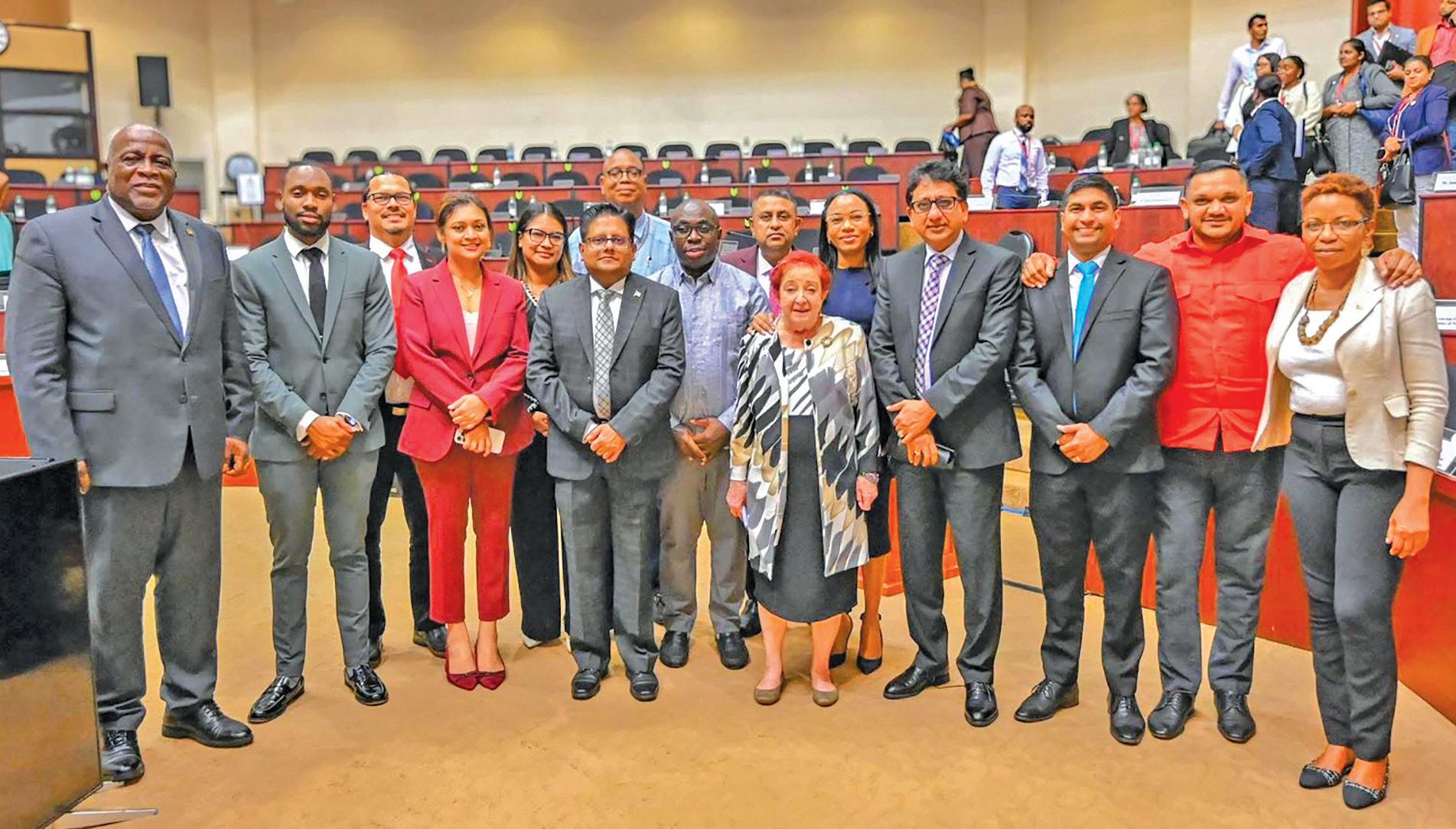
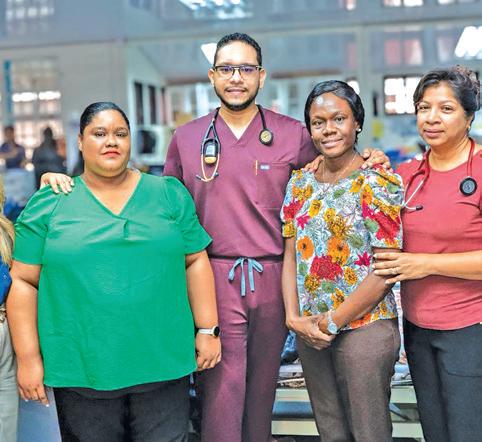
The patient, along with doctors from GPHC
United Minibus Union backs mandatory driver training, certification
- says indiscipline rife in society
President of the United Minibus Union (UMU)
Eon Andrews is calling for the revival of mandatory driver training and certification for public transport operators, warning that the absence of a structured system is contributing to indiscipline and unsafe practices on the nation’s roads.
Andrews made the call during a recent episode of the “Road Safety and You” programme, where traffic ranks from several divisions discussed ongoing challenges affecting road safety and public transportation.
Recalling a previously existing framework, Andrews said there was once a system that required drivers to be trained before being allowed to operate minibuses.
“…start training drivers. I remember – I have a booklet, right, and when they would have been trained, they would put a sticker on their vehicle that said, ‘I am a trained driver,’ so the Police would know this is somebody who has been trained.”
According to Andrews, the intention was to link driver training directly to the licensing process.
“We were trying to get the GRA, so that when you go to renew your licence or to get a new licence, unless you turn up with the same driving certificate, you can’t get it.”
He warned that the break-
down of that system has allowed inexperienced individuals to begin operating public transport vehicles.
“Because a fellow walking through the park there, just moving a fellow bus from here to there, I know he’s not a driver. But then, a couple of months later, he’s driving a bus. Without any experience.”
Traffic ranks participating in the programme echoed those concerns, noting that inexperienced and untrained drivers are often involved in traffic violations.
Sergeant Anjan Bhangradian, who oversees traffic operations in the Kitty, Georgetown area, said many road users fail to properly apply the rules outlined in the Highway Code.
“For many of the people who would go through the the-
oretical exam, and they read the highway code, and they cram just to pass. That highway code has over 115 rules. You do not only apply just to do the exam, but there should be a continuity of learning those rules, and let them stick in your head.”
Bhangradian stressed that road safety is a shared responsibility and not solely the duty of the Police.
“Road safety is everyone’s business. It is not just the Police business… It is a duty; it is your duty as a driver, as a person, to know what you’re required to do and to ensure that you do it.”
Meanwhile, Andrews said the minibus union’s support for training is rooted in the need for collaboration among all stakeholders.
“This perception about
having a minibus union, this perception that you’re looking after minibuses – yes, you are. But then again, our relationship has to do with a lot of other stakeholders.”
He added that addressing road safety challenges requires cooperation rather than confrontation.
“So, it’s really a family thing. It’s a work in progress. It’s not going to be easy because basically we have – indiscipline is rife in the society, and this is one of the things we have to work on.”
The traffic officials further noted that while enforcement and education campaigns continue, the reintroduction of a formal training and certification framework could help professionalise the public transport sector and improve safety outcomes on the road.
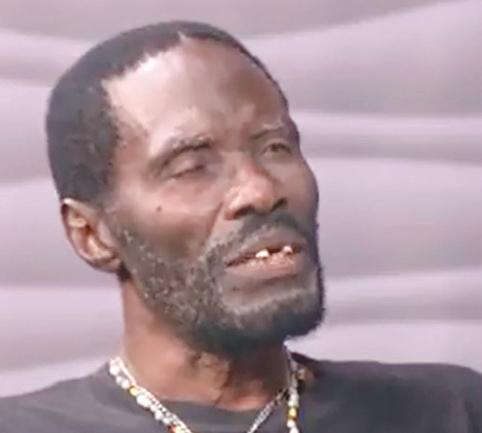
President of the United Minibus Union (UMU), Eon Andrews
Sergeant Anjan Bhangradian
PPP/C always “put people first” – Finance...
“And we are seeing that, Mr Speaker, in every single social indicator: number of students attending high school, number of students passing examinations, access to improved health care. Whatever your political orientation might be, if you want training to become a doctor or nurse, we encourage [and] we train you for free, and you are guaranteed a job when you finish your training. We recognise that we need engineers, and we want young boys and girls to become engineers. We will now deliver engineering in Region Two, in Region Six, and Region Three. You can’t come to the coast to have access to university education? We will deliver it to your home, in your vil-
lage, through the GOAL (Guyana Online Academy of Learning) Scholarship Programme… this is the Guyana that we’re building.”
Putting people first Dr Singh went on to hit back at the indicted businessman-turned Opposition Leader’s criticism of the budget. “The Leader of the Opposition [on Friday said the budget is] putting people last. He said that with a lot of mirth and amusement. But to all of the children, who will be enjoying improved access to quality education in the more than 100 newly constructed modern schools across the country and who will benefit from the 40 additional schools that we are build-
ing right now, we are putting those children first. Their parents, who no longer have to buy textbooks, their teachers, who no longer have to worry about buying basic school necessities because we are giving school grants – we are putting those teachers and those parents first.” He added that the Government is also prioritising around 14,000 students, whose parents no longer have to pay fees for up to eight Caribbean Secondary Education Certificate (CSEC) and Caribbean Advanced Proficiency Examination (CAPE) subjects, as well as 206,000 schoolchildren, each of whom will receive $85,000 this year through the “Because We Care” cash
grant, uniform voucher, and transportation grant.
“So, when you say the budget has nothing for anybody, tell that to the parents of those children, the more than 90,000 old-age pensioners who will receive an increased pension, they’re not going to be benefiting from this budget. I could go on in every sector, in the farming communities, the sugar workers who will continue to be able to work in the sugar industry as we continue to strive to modernise the industry and make it viable and competitive. They don’t count. The rice farmers who will continue to benefit from our extension services and our support with paddy and fertiliser, they don’t count. The cash crop farmers who
will benefit…they don’t count. The farmers who will be planting the 100,000plus acres of new land that will be opening up for cultivation, they don’t count. Well, Mr Speaker, we count them, and I can assure you we will continue to put all of those people first,” Dr Singh declared.
According to the Finance Minister, under the PPP/C, more Guyanese are working and have a level of disposable income as well as assets that can be used as collateral to further increase their wealth. “We want to make sure that every single Guyanese who wants to set up a small business, we want them to be able to access credit, access financing. We will establish an SME (Small and Medium
Enterprise) Development Bank. This budget includes US$100 million, and Mr Speaker, we’re going to use that money to give small business loans to small entrepreneurs at zero interest, at zero collateral… I could go on for a very long time, but…we really are at a truly historic moment in our country’s history in so many ways… And our pledge to all Guyanese is that not a single day will go by over the course of the next five years…that we, led by our President, will not be working hard to convince every single Guyanese person…that the People’s Progressive Party remains vastly superior amongst all competing political alternatives,” the Minister emphasised.
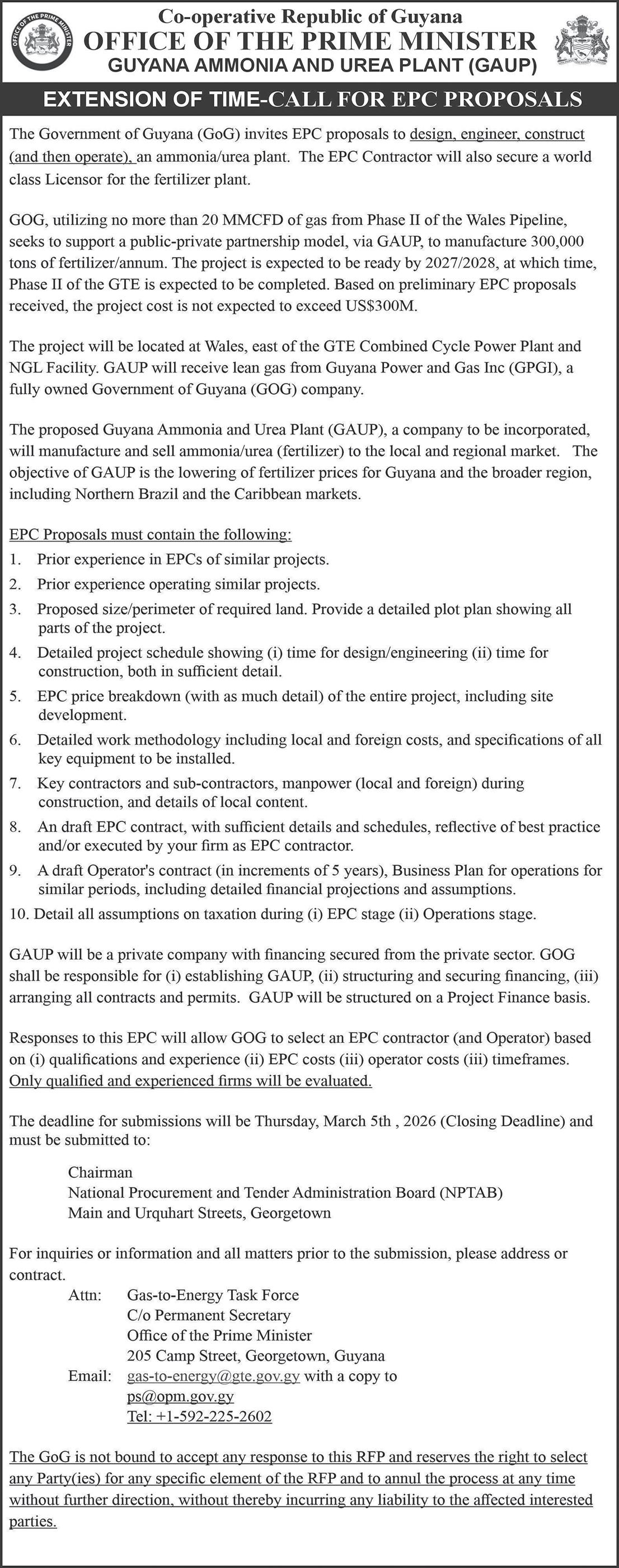
GtE Project to make Guyana more attractive for investments – former British envoy
Former British High Commissioner to Guyana, Jane Miller, is of the view that Guyana will become a much more attractive destination for investments when the highly anticipated Gas-to-Energy (GtE) Project comes on stream.
Located at Wales on the West Bank of Demerara, the GtE Project comprises a 300 megawatt (MW) combined cycle power plant and a Natural Gas Liquids (NGL) facility, utilising natural gas that will be piped onshore from oil operation activities in the Stabroek Block offshore Guyana.
The project is expected to be operationalised by the end of this year, delivering stable and reliable clean energy and slashing the current high cost of electricity by half – something which Miller says will bolster the business climate in Guyana.
“All businesses want to make a profit. And if it's cheaper to provide the services, if it's cheaper to do manufacturing, it will make Guyana more attractive. I think if the price of electricity halves, it's going to be important for all businesses, whether they're office-based or manufacturing; it will reduce costs. So, it will make Guyana more attractive,” the former British diplomat told the Guyana Times during a recent interview before ending her four-year tenure in Georgetown.
The US$759 million GtE project at Wales is currently under accelerated construction, with the contractor, USbased Lindsayca, already moving into round-the-clock operations in order to deliver power this year.
Reshaping the economy
Only last Friday evening, Prime Minister (PM) Brigadier (Ret’d) Mark Phillips, whose office has responsibilities for the country’s energy sector, said the massive investments into the GtE Project, along with other renewable power initiatives, are reshaping Guyana’s economy.
Delivering his debate presentation on Budget 2026 in the National Assembly on Friday evening, Phillips noted that the Government’s energy investments form the backbone of economic transformation.
“The Gas-to-Energy project remains the most consequential investment undertaken by this Government and is aimed at transforming Guyana’s economic foundation,” he posited.
According to the PM, construction at the Wales site has moved firmly from planning into large-scale execution, with foundations, turbines and transformers already in place. He added that the project is on track to deliver results within the Government’s stated timeline.
“We will have electricity from that project in the last quarter of 2026, reliable and low-cost electricity,” PM Phillips declared.
The PM explained that cheaper, more stable power would enable heavy manufacturing, anchor the Wales Development Zone and attract both local and foreign investors, with wide-ranging benefits for the economy.
“That will have a tremendous industrial and economic impact here in Guyana,” the
Former British High Commissioner Jane Miller
senior Government official added.
This power plant and NGL facility under construction are just Phase One of the GtE Project. The second phase will see another 300 MW power plant and NGL facility con-
structed at the same Wales site, utilising the excess rich gas from offshore.
Already, some 250 kilometres of 12-inch pipelines have been laid to bring the rich gas onshore. The first phase, however, will only utilise 40 per cent of the pipeline’s capacity, bringing 50 million standard cubic feet per day (mmscfd) of dry gas onshore.
But with the pipelines having the capacity to push as much as 120 mmscfd of gas, the Government had moved ahead with Phase Two to utilise the remaining 60 per cent capacity of the pipeline, which will see an additional 75 million cubic feet per day (mmcfd) of rich gas brought onshore for the second power plant and NGL facility right at the Wales location.
CONTINUED ON PAGE 19
GPHC makes history...
Medical professionals are urging members of the public to seek immediate medical attention if they experience symptoms such as persistent anaemia, heavy or prolonged bleeding, or unexplained health concerns, noting that early diagnosis can be life-saving.
The successful outcome was credited to strong collaboration among multiple clinical teams. The Haematology team was led by Consultant Haematologist Dr Kamela Bemaul-Sukhu, with Senior Medical Officer Dr Jamal Shamsudeen coordinating ongoing care. Obstetric
management was led by Consultant Obstetrician Dr Natasha France, supported surgically by Registrar Dr Shury, alongside anaesthesia, nursing, and laboratory teams.
Health officials noted that until recently, limited access to clotting factor treatment and the absence of structured care pathways would have made managing such a case extremely high risk. The procedure now reflects GPHC’s expanding capacity to treat complex medical conditions locally, reducing the need for overseas referrals and improving patient outcomes.
EPA reports improved compliance across key communities in 2025
The Environmental Protection Agency (EPA), through its Investigations and Enforcement Department, has recorded notable improvements in environmental compliance across several communities during the period January to December 2025. The findings reflect the impact of targeted enforcement, follow-up inspections, and sustained engagement with operators.
Scope of the Assessment
The assessment focused on eight communities: Canal Polders (Belle West and L’Esperance), La Bonne Intention, Success, Good Hope, Mon Repos, Lusignan, Tuschen, and Uitvlugt. These areas were selected due to recurring complaints mainly related to noise and air pollution from activities operating within residential zones.
Overall Improvement in Compliance
The assessment revealed an overall 27% increase in compliance compared to 2024, demonstrating that targeted enforcement combined with compliance assistance can yield positive results.
Canal Polders were the most notable, achieving about 90% compliance by the final quarter of 2025. This improvement was attributed to corrective actions such as the relocation of operations, installation of enclosures, and the use of extractor fans. On the other hand, communities including Good Hope, Mon Repos, and Lusignan showed steady progress, recording compliance rates between 50 and 70%. Dust control measures, improved ventilation, and technical guidance contributed to reduced emissions and lower noise levels.
Communities Requiring Continued Attention
Despite overall progress, La Bonne Intention, Success, Tuschen, and Uitvlugt continue to experience persistent non-compliance. Common issues include open-air spraying and improper handling of waste oil.
Uitvlugt recorded the lowest compliance rate at 25%, identifying it as a priority area for intensified enforcement. Despite the issuance of orders and directives, adherence remains limited, underscoring the need for closer oversight and sustained EPA intervention in 2026.
How the Assessment Was Conducted
The assessment was conducted using a structured approach that included:
• Reviewing complaints from residents and Neighbourhood Democratic Councils (NDCs)
• Conducting site inspections
• Measuring air quality and noise levels
• Classifying operations based on compliance status
• Issuing enforcement actions such as warnings, compliance orders, and prohibition notices
• Undertaking follow-up inspections to verify corrective measures
Notably, an increase in follow-up inspections was conducted in the last quarter of the assessment period, with 75 per cent of enforcement actions resulting in measurable improvements.
Key Trends Identified
The assessment found that hollow block-making operations showed the greatest level of improvement once dust suppression and enclosure measures were implemented. In contrast, furniture, spray painting, and fabrication workshops continue to lag due to inadequate ventilation systems and delayed corrective action. Communities with strong engagement and cooperation with the EPA consistently recorded higher compliance levels, while resistance or limited cooperation contributed to ongoing challenges in other areas.
Strengthening Compliance Going Forward
The EPA concludes that enforcement actions supported by technical guidance are effective in improving compliance levels. Moving forward, the Agency will:
• Prioritise lagging communities for intensified monitoring in early 2026
• Expand compliance assistance programmes for small-scale operators
• Apply graduated penalties for repeat offenders while recognising consistently compliant operators
• Repeated assessment of hotspot communities
The EPA remains committed to protecting public health and the environment through sustained enforcement, collaboration with local authorities, and continued engagement with communities.
You can share your ideas and questions by sending letters to: “Our Earth, Our Environment”, C/O Communications Department, Environmental Protection Agency, Ganges Street, Sophia, GEORGETOWN, or email us at: communications@epaguyana.org. Follow us on Facebook and Instagram and subscribe to our YouTube channel.
Aurora Gold Mining introduces paid paternity leave for workers
Aurora Gold Mining Inc (AGM Inc) has introduced a new policy granting paid paternity leave to its employees, marking a significant step forward for workers’ rights in Guyana.
The decision comes after a series of meetings between the Ministry of Labour and Manpower Planning and AGM Inc to review the company’s internal systems and policies.
The Ministry, in a statement, welcomed the move and described it as
a win not only for the men working with the company but also for their families, providing workers the security to spend meaningful time with their loved ones without fear of job loss.
The initiative aligns with the Ministry’s broader mandate to promote workplace practices that enhance employee efficiency while supporting their physical and emotional wellbeing. Paid paternity leave is widely recognised as an important measure for fostering fam -
ily support and gender-inclusive workplace policies.
The Labour Ministry congratulated AGM Inc. on demonstrating continued commitment to employee welfare and inclusive employment practices, noting that such initiatives strengthen both families and the workplace.
The series of meetings, come after the Ministry launched an independent investigation late last year into working conditions at Aurora Gold Mines, following the circulation of several videos on Facebook.
Minister of Labour and Manpower Planning, Keoma Griffith, had instructed the Occupational Safety and Health (OSH) Department to launch a thorough and immediate investigation into the allegations showcased in the videos, which included claims of unsafe working conditions, wage disputes, and issues surrounding salary increases and fringe benefits.
Just last month, the Labour and Manpower Planning Ministry welcomed the signing of
a two-year Collective Labour Agreement (CLA) between AGM and the National Association of Agricultural, Commercial and Industrial Employees (NAACIE), which was expected to result in significant wage increases and expanded benefits for hundreds of workers at the mining operation.
Effective January 1, 2026, all eligible male employees of the company will be entitled to one week of paid paternity leave. This benefit applies to employees whose child is born or
legally adopted on or after January 1, 2026.
The introduction of paid paternity leave recognises the important role fathers also play in early childcare and family bonding. The policy is intended to support employees during a significant life milestone while promoting a healthy work-life balance, the company said Friday in a statement. AGM is considered the first and largest operational gold mine in Guyana to engage in underground mining.
SUNDAY, FEBRUARY 8, 2026 | GUYANATIMESGY.COM
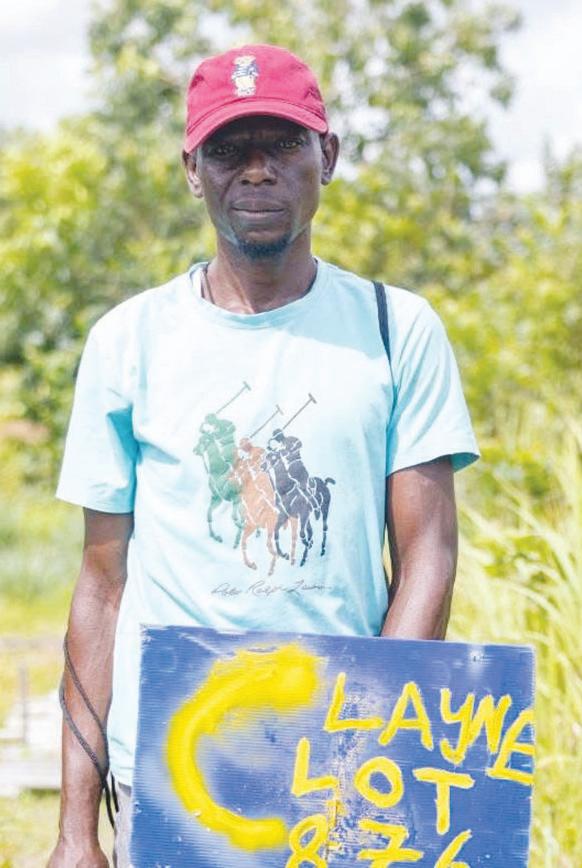
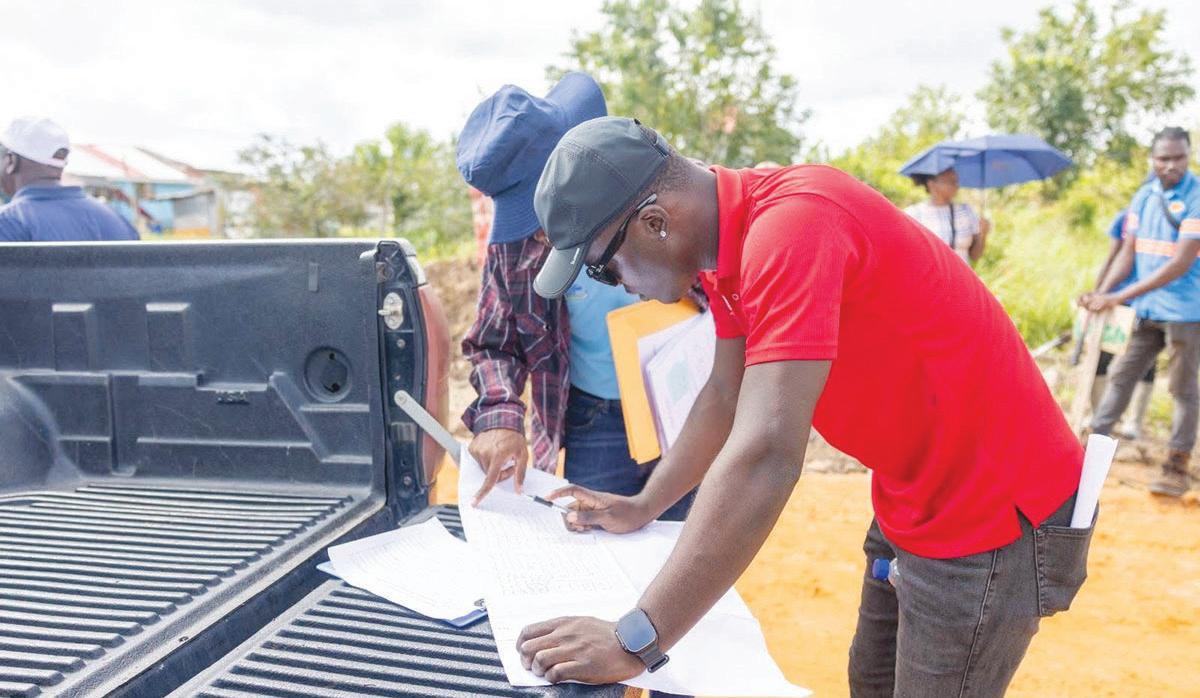
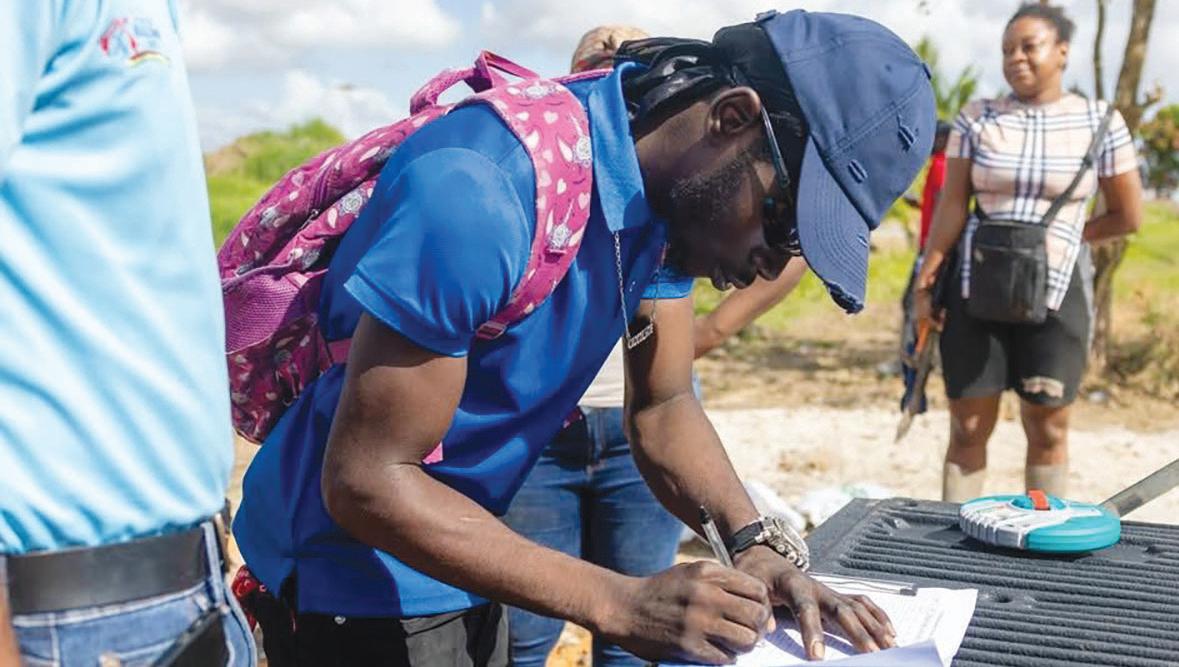
Mocha Arcadia informal settlers take part in lot ID exercise at new location
The first group of Mocha Arcadia, East Bank
Demerara informal settlers (squatters), who were recently allocated house lots, on Friday took part in a lot identification exercise, allowing them to view the boundaries of their respective house lots.
According to the Housing Ministry, the exercise was facilitated by the Surveys Unit, the Community Development Department and the Enforcement and Compliance Department of the Ministry of Housing – Central Housing & Planning Authority (CH&PA) Friday morning.
The informal settlers being relocated include persons within the alignment of a new access road being constructed at Fields 1–3 to serve recently regularised residents, as well as individuals occupying lands at Fields 4–6.
Both groups are being relocated to vacant house lots at Fields 1–3, marking an important step in their transition from informal, illegal occupancy to secure tenure and improved living conditions through the government’s intervention, the ministry noted.
the Surveys Unit, Community Development Department and the Enforcement and Compliance Department
GtE Project to make Guyana...
The Government had issued a request for proposals (RFP) to qualified firms to design, finance, and operate Phase Two of the project under a 20- to 25-year Power Purchase Agreement (PPA).
Initially, seven international companies had submitted bids for GtE Phase Two, but there has been an extension for submission, which the PM said is yielding positive results.
“There has been an extension of the period for submission of bids… However, the response is good so far,” Phillips told this newspaper last month.
Value-added development
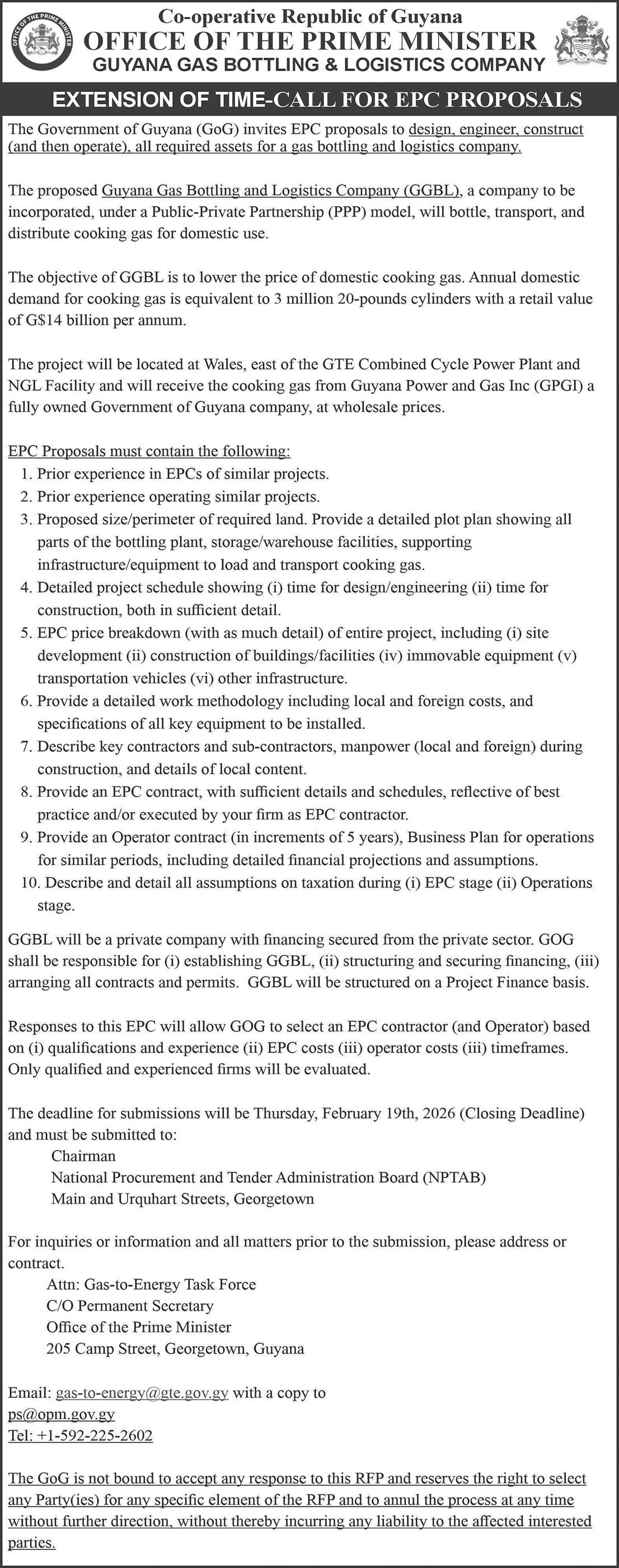
Meanwhile, beyond power generation, the Guyana Government is also laying the foundation for a broader energy economy through gas bottling and logistics, as well as value-added industrial development, as part of a long-term strategy to tackle the rising cost of living in Guyana.
During a recent appearance on the Starting Point podcast, PM Phillips disclosed that the proposed gas bottling and fertiliser plants at the Wales Industrial Zone will play a critical role in cost reduction for consumers.
The Government plans
to use the excess natural gas from the pipeline to also set up these two major industrial projects at the Wales location. Currently, invitations are out for requests for proposals (RFPs) for the Guyana Gas Bottling and Logistics Company (GGBLC) and the Guyana Ammonia and Urea Plant (GAUP) – both of which are still open, February 19 and March 5, respectively.
PM Phillips had noted that these investments will be central to bringing down costs in Guyana, especially food prices.
“Once we can reach the stage of manufacturing our own fertiliser, that will have a positive impact on agriculture, on our farmers. That has a trigger effect because if you cushion the effect in terms of the cost of production in the farming sector, it will also have an
effect on the food that goes on our table and the price that we pay for food,” he had noted.
Currently, the Guyana Government is subsidising the cost of fertiliser to the tune of some $2 billion as part of efforts to support the local agriculture sector. The PM had pointed out that once Guyana starts producing its own fertiliser, it will not only reduce the cost but also bring in income through export to the Caribbean region.
Similarly, PM Phillips had further stated that Guyana could also be exporting excess bottled gas after meeting local demands.
These two initiatives are set to come onstream when Phase Two of the Gas-toEnergy project is operationalised by 2030.
The exercise allowed persons to view the boundaries of their respective house lots
Persons being relocated include those within the alignment of a new access road being constructed
The exercise was facilitated by
PM Brigadier (Ret’d) Mark Phillips during a visit to the Gas-to-Energy Project site on January 9, 2026
Both groups are being relocated to vacant house lots
AI programme a success story in Region 9 livestock sector
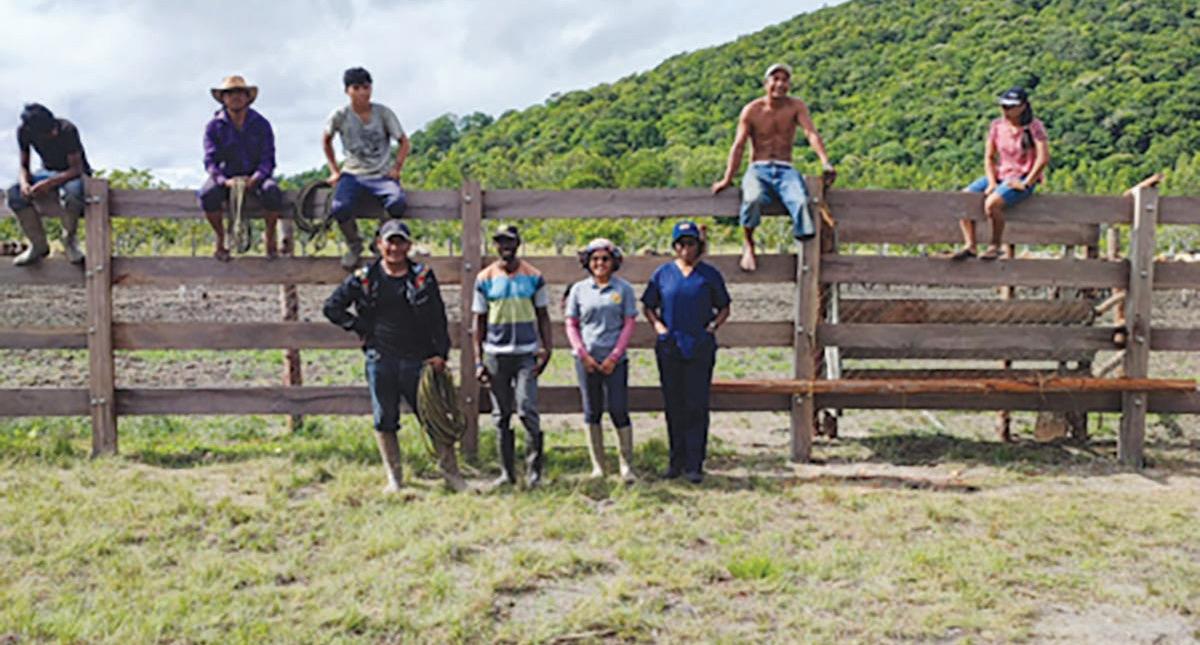
What began in 2023 as a strategic effort to enhance herd performance and meat production has now yielded tangible results, including the birth of a promising bull calf in 2024. In June 2023, artificial insemination (AI) — the placement of a semen suspension into the female reproductive tract — was conducted on 66 animals at Aranaputa, North Rupununi, by staff of the Guyana Livestock Development Authority (GLDA), as part of a targeted livestock genetic improvement programme. The activity was led by a team from GLDA’s Genetics Laboratory, including Dr Renita Lashley, Head of the Genetics Unit; Lyndon Stanley, AI Technician; and Melissa Boston, Livestock Extension Officer (LEO). Other GLDA staff in the region who assisted were Dr Andray Pearson, Elvan Hamilton and Joshua Hinds. The AI programme for cattle fulfilled a promise made to the people of the community by President Dr
ventilation pens, hatcheries, genetic improvements, AI, abattoirs and processing plants are being developed to boost production of poultry, beef, and dairy.
By 2030, these initiatives, he added, will position livestock as a major driver of growth, innovation, and food security. The bull, a direct product of a successful
AI initiative, carries a genetic composition of 50 per cent Beefmaster, 30 per cent Charolais, and 20 per cent local breed; a blend carefully designed to combine strong growth and meat-producing traits with adaptability to local environmental conditions, giving farmers in the Rupununi region access to better breeding stock and improved future herd performance.
The animal is considered a testament to the positive outcomes that can be achieved through applied reproductive technologies and the dedication of livestock professionals working with ranchers and farmers of Region Nine. (Agriculture in Region 9 photos)
Irfaan Ali when he visited the community back in 2023. The President had said that concerning livestock, the Government is investing heavily in the future. Tunnel
From right: team members Dr Lashley, Melissa Boston and Lyndon Stanley in 2023
Breeding bull as a calf in 2024
The animal carries Beefmaster, Charolais and local breed composition
Royal Commonwealth Society announces rebrand of flagship youth writing competition
With a renewed vision for creativity and inclusion, the Royal Commonwealth Society (RCS) has unveiled a new chapter in one of its most celebrated youth initiatives. Its flagship programme, long known as The Queen’s Commonwealth Essay Competition, has been rebranded as The Queen’s Commonwealth Writing Competition – a change that signals a broader embrace of written expression in all its forms and a continued commitment to amplifying young voices across the Commonwealth. The Queen’s Commonwealth Essay Competition, now The Queen’s Commonwealth Writing Competition (QCWC), is the world’s oldest international writing contest. Delivered by the Royal Commonwealth Society for over 140 years, it provides a platform for young people to express their ideas, aspirations and experiences through creative writing. The competition is open to under-18 nationals or residents of all Commonwealth countries and territories, Hong Kong, Ireland, and Zimbabwe, plus residents of non-Commonwealth countries with a Royal Commonwealth Society (RCS) branch or partner organisation (entries via local branch). Each year, the theme is drawn from Commonwealth values and principles. It encourages young people to engage with pressing issues
of the day, such as the environment, equality and youth leadership, to foster an open-minded and empathetic world-view. Since 2010, this high-profile competition has engaged over 278,000 young people, over 5700 schools, and thousands of volunteer judges across the Commonwealth, with a record number of participants in 2025. At the heart of the Royal Commonwealth Society’s latest reimagining of its flagship youth writing programme is a simple but powerful idea: every young voice deserves space to be heard, no matter where in the Commonwealth it comes from.
Evolution
As part of this evolution, the newly renamed Queen’s Commonwealth Writing Competition has been redesigned to invite broader participation and deepen regional representation. The competition will now be open to all Commonwealth nationals or residents under the age of 18, bringing young writers together within a single age category. Alongside one overall winner, the programme will also recognise outstanding entries from each of the Commonwealth’s five regions – ensuring that talent, creativity and excellence are celebrated across borders.
Janet Cooper OBE, Chair of the Royal Commonwealth Society, described the changes as both timely and neces-
sary, noting that the reimagined structure reflects the organisation’s enduring values while responding to the needs of a new generation of young writers. “As we look to the future of this historic competition, this reimagining marks an important and timely evolution,” Cooper said. “By strengthening regional representation, we are ensuring that a greater diversity of voices, perspectives and experiences are reflected and celebrated. This renewed structure honours our long-standing legacy while positioning the competition to
Construction of law...
The AG had previously told the Guyana Times that after funding is secured in this year’s budget, the procurement process to select a contractor will commence. The plan and architectural design of the new law school are already drawn up and were part of the proposal that was presented to and approved by the Council. AG Nandlall told the National Assembly that when completed, the law school will not only benefit Guyanese law school students but also those from around the region, thus bringing in income for the country. “It is going to be a regional law school. It will attract students from across the Caribbean. And of course, it will provide cheap and accessible legal education to our own Guyanese. This is not only an academic institution, but it is also an economic venture because people of the Caribbean will come here. They will have to live. They will have to find accommodation. They will have to board lodges and eat, and Guyanese will benefit from those investments,” the Minister noted on Friday.
An almost 30-year effort
For nearly three decades, Guyana has been trying to establish a law school within its jurisdiction since Guyanese law
FROM PAGE 7
The eight-acre land that was cleared for Guyana’s first law school
students are forced to attend the Hugh Wooding Law School in Trinidad. However, only the 25 top law students from Guyana are allowed each year into the programme. UG’s Law Degree programme usually has about 40 students per year. Moreover, the high cost of living in Trinidad has deterred many persons from further pursuing a legal career, but in response, the Guyana Government started offering limited fully funded scholarships to Hugh Wooding Law School. Under the previous A Partnership for National Unity/Alliance For Change (APNU/AFC) Coalition Administration, attempts were made to establish the Joseph Oscar Fitzclarence Haynes Law School. However, the CLE
was not approached about the project initially, and when permission was eventually sought, it was denied in late 2017. “My predecessor, Basil Williams, went ahead, and he turned the sod. He made the front page of the paper. He named the law school, but he never got permission from the lawful authorities to construct the law school. So, it turned out to be a dupe. It turned out to be a sham,” Nandlall stated during Friday’s presentation. The CLE is a regional organisation which operates the Hugh Wooding Law School in the Republic of Trinidad & Tobago, the Norman Manley Law School in Jamaica, and the Eugene Dupuch Law School in the Bahamas.
be more inclusive, accessible and responsive to young people across all regions.”
The shift is also visible in the competition’s refreshed visual identity. Its new logo draws on the Royal Commonwealth Society’s five brand colours, with a crown formed from five pen nibs –a symbolic nod to creativity, the written word and the unity of the Commonwealth’s five regions coming together through storytelling.
The competition continues to enjoy the support of Her Majesty the Queen, Vice-Patron of the Royal
Commonwealth Society and a longstanding advocate for literacy. Her commitment to reading and writing as tools for opportunity, connection and understanding remains closely aligned with the competition’s mission – an alignment reflected in a remarkable 53 per cent growth in participation over the past year. Through this rebrand, the Royal Commonwealth Society reinforces its dedication to inspiring young people, championing education, and nurturing a shared sense of identity and creativity across the Commonwealth.
The Queen’s Commonwealth Writing Competition will officially open to entrants on March 4, 2026, inviting a new generation of writers to share their stories with the world. The Royal Commonwealth Society (RCS) is a network of individuals and organisations committed to improving the lives and prospects of Commonwealth citizens across the world. Through youth empowerment, education, and high-level advocacy, the Society champions education, equality, and the environment across the Commonwealth’s 56 member nations. Our unique position within the Commonwealth family allows us to play a pivotal role in convening and connecting the Commonwealth’s political and diplomatic representatives, civil society, business and youth leaders on a wide range of issues, as well as to deliver highlights of the Commonwealth calendar, such as the annual Commonwealth Day Service of Celebration at Westminster Abbey and the High Commissioners’ Banquet at Guildhall or Mansion House. Founded in 1868, the Society is privileged to have His Majesty the King as Patron and Her Majesty the Queen as Vice-Patron. The Society is non-partisan, independent of governments and relies on public generosity to achieve its mission.
Her Majesty the Queen, Janet Cooper OBE, Jacqueline Wilson, Geri Halliwell Horner, Monica Galletti, Joan Armatrading, Gyles Brandreth, and the Competition’s 2025 Winners at the Buckingham Palace Award Ceremony. Image credit: Ian Jones
within the University of Guyana’s Turkeyen Campus
22 FEATURES
Aseasoned mixology professional is turning years of industry experience into a training initiative aimed at strengthening Guyana’s hospitality sector. The programme is designed to equip Guyanese with practical skills and professional standards for the industry.
That’s all I do,” he said.
He also highlighted one of the main challenges he faced early in his career – his fast-paced work style.
For Jumal Mitchell, who has over 15 years of experience in the mixology industry working with various crews, early exposure to the craft helped chart his path into professional training.
He is now providing structured instruction for Guyanese through his training programme titled “Shake wit Love”, a multiday initiative dedicated to teaching and inspiring participants across the country.
“Well, this journey started when I was a kid. I grew up with my grandparents, and my grandfather would usually send me to the shop to buy a quart of high wine. When I got back, he would say, ‘Just put it in the half bottle and pour water in it – make it a whole.’ So I started at a young age. When you start young, you begin trying things on your own, and that’s where the flow started,” Mitchell explained to this publication.
The fast-bottle magician began his professional career around 2011, working in roles such as serving-related activities, bar service in restaurants, and painting. Although he officially started in 2011, his journey gained real momentum in 2013, when he became strongly motivated to enter the cruise industry.
From 2013 onwards, he actively pursued opportunities within the cruise sector, though his initial efforts were unsuccessful. It was not until 2020, following the COVID-19 period, that he achieved his breakthrough and
secured a position in the cruise industry.
His first cruise line employment was with Celebrity Cruises, which is part of the Royal Caribbean Group. He later transitioned to Norwegian Cruise Line (NCL). Through these roles, he has gained extensive experience working on large international cruise ships, travelling globally and participating in numerous international voyages.
With the training he received, Mitchell made it clear that he is a professional in his field, committed to ensuring every customer leaves satisfied and eager to return.
“I’m a master – that’s what I would say. I’m not bragging or anything, but I know my craft. My passion is making guests happy, making customers happy.
“One of my key challenges was that I started as a bar waiter, and I’m fast. I move fast, I serve fast – everything fast. The bartenders and mixologists were slower, but they motivated me to step up. I realised that if I was already serving and doing everything myself, it made sense to step up.
That’s what pushed me to become a bartender and mixologist,” he explained.
When asked about a core focus of his training programme, Mitchell emphasised customer service.
“Customer service is key. I go to restaurants in Guyana and see people treating customers poorly, and I ask myself, ‘Why are they like that?’ Customers are the ones giving you money. But then I know it’s because they don’t have proper training. With
the right training, people would understand how to speak to customers properly and provide all the details a guest needs about what’s being offered,” he said.
Mitchell, who was interviewed by this publication, said his primary focus is hospitality through his own training programme –an area he believes holds significant potential for growth and improvement in Guyana.
Approximately 20 spots are available each week on Thursdays and Fridays, running from March 5, 2026, through May 1, 2026.
The programme costs $15,000 per person and will cover key areas such as bar service sequencing and other essential hospitality skills.
Cummings Lodge development empowers young Police Officer
The tea is certainly warm, as the fruits of a 29-year-old Police Officer’s efforts begin to show. He is reaping the rewards in Cummings Lodge of an opportunity handed to him by the Government, following land upgrades carried out five years ago.
This was highlighted recently as President Irfaan Ali launched a new programme, Tea on the Terrace, designed to engage directly with Guyanese and showcase development across the country. The show involves visits to terraces and verandas around Guyana, where the President meets with citizens to discuss local progress and improvements in their communities.
According to the President, the programme was created to provide a platform for citizens to witness and discuss the real changes taking place in the country, countering negativity and misinformation that can overshadow positive developments.
Through the programme, it was highlighted that when President Ali assumed office, the area now known as Cummings Lodge spanned 700 acres of swamp and forested land, which required extensive drainage and land elevation before it could be developed. Significant investment and planning were undertaken to transform the area into a functional and thriving community, bringing the residential, commercial, and industrial infrastructure seen today. The project reflects a concerted effort to convert previously unusable land into sustainable, well-planned spaces that benefit residents and the wider community.
The 700-acre Cummings Lodge development now features not only residential housing but also dedicated spaces for commercial, medical, and industrial services. According to President Ali, the planning was designed to make the commu-
nity sustainable, with opportunities for job creation and easier access to workplaces for residents.
When asked about his past and the experience of receiving his home, the young Police Officer in Cummings Lodge reflected on how the opportunity had transformed his life.
“First of all, I would like to say, Mr President, thank you, a big thank you for what you have done for me. Because from where I came from, I didn’t have anything; I owned nothing. And to where I’m at right now, I’m really grateful for owning my own home. I have my own vehicle and all of this stuff. And almost every home here has a vehicle now,” he said.
The officer, whose name was not mentioned in the interview, noted that more than a hundred of his colleagues from the Guyana Police Force now own homes in the area, describing the community’s development
as a “story of empowerment”.
Within less than two years, the officer refinanced his home and undertook extensive improvements, including reconstructing the yard, installing a fence, and adding concrete drains to address drainage issues. The upgrades not only improved the functionality of the property but also significantly increased its value, bringing it to over $20 million.
While conversing with the head of state during the programme, the officer shared that some of his colleagues had been able to refinance their homes for as much as $35 million.
The President highlighted the story as a clear example of how homeownership and access to financial support can empower young Guyanese, strengthen families, and create opportunities for growth and development within the community.
“That is financial empowerment. That is what
this investment by this Government, the People’s Progressive Party Civic Government, is doing –changing real lives. At 29 years old, he owns his own home, valued at $7.5 million initially, and the latest bank evaluation [of the home] is $40 million. His home has been improved tremendously, and we just tested it with the bank to confirm its value,” President Ali said.
The young Police Officer also offered words of encouragement to other Guyanese, particularly young people, urging them to take advantage of opportunities for homeownership and personal advancement. He described the programme as a “good opportunity” provided by the Government and emphasised that it could help young people uplift their lives and the lives of their colleagues.
“Take the opportunity. Take it. It’s something good for you to improve your life and others around you,” he
said, highlighting the potential for empowerment through accessible housing and financial support.
President Ali gave credit to the many individuals and teams involved in transforming Cummings Lodge into a thriving community. He acknowledged the efforts of development planners, surveyors, contractors, Ministers of Housing, staff from the planning authority, and all others who worked alongside the Government’s policies and vision to bring the project to life.
The 700-acre development now includes more than 769 allocated house lots, over 458 homes constructed and handed over to residents, 16 acres of commercial land, 26 acres designated for medical services, and 22 acres for light industrial and commercial use. The community also features a Police station, a recreational facility, and 16 kilometres of newly constructed roads.
(Photos from Instagram Shake Wit Love @jm_shakewitlove)
Guyana highlights case-backlog reduction at regional judicial reform talks
Guyana’s use of plea-bargaining legislation to reduce criminal case backlogs took centre stage when Director of Public Prosecutions (DPP) Shalimar Ali-Hack, SC, addressed a regional judicial reform conference in Barbados last month.
Ali-Hack participated in the Second Attorney General Regional Roundtable Conference on Advancing Judicial Reform, Regional Collaboration and Backlog Reduction, held on January 22 and 23, where Caribbean justice leaders examined practical solutions to delays within their criminal justice systems.
At the forum, Guyana highlighted the effectiveness of its Plea Bargaining Agreement Act of 2024, which officials said is actively being applied and has resulted in fewer matters being listed during criminal assizes, contributing to faster case resolution.
Speaking on the sidelines of the conference, DPP Ali-Hack described the agenda as “excellently prepared”, noting that discussions were focused on addressing systemic delays to ensure accused persons have their matters heard within a reasonable time.
"It was an excellently prepared agenda which focused on the relevant is -
sues to address the backlog in the criminal justice system so that persons will have their trials within a reasonable time," she said.
The two-day conference, held at the Lloyd Erskine Sandiford Centre and sponsored by the United Nations Development Programme (UNDP), the European Union, and their Partnership of the Caribbean and the
2 drivers plead guilty to DUI, fined
Court.
Two motorists, Eon Martin Perreira and Zaheer Khaleel, each appeared before separate magistrates’ courts last week, where they pleaded guilty to Driving Under the Influence (DUI) and were fined a total of $350,000 in relation to their traffic offences committed on February 4, 2026.
European Union on Justice (PACE Justice) project, focused on harmonising criminal justice reform across the Caribbean. Key areas included Judgealone trials, plea bargaining frameworks, and improved inter-regional cooperation.
Challenges facing Caribbean states Attorney General (AG) and Minister of Legal Affairs Mohabir Anil Nandlall, SC, MP, who accompanied the DPP, presented on regional best practices in witness protection, outlining institutional gaps, legal constraints, and operational challenges facing Caribbean states. Witness protection
frameworks formed a major part of the discussions, with several jurisdictions sharing their legislative experiences. Gang-related crime and prosecution strategies were also examined, with Jamaica outlining its anti-gang legislation and enforcement outcomes.
Legal aid and public defence systems across the region were additionally discussed as part of broader efforts to strengthen access to justice.
The conference brought together senior legal officials, including former Jamaican DPP Paula Llewellyn, CD, KC; Glen Jackson, Director of Jamaica’s Witness Protection Unit; Trinidad and Tobago’s AG John Jeremie, SC; and Justice Mark Mohammed of the Trinidad and Tobago Court of Appeal. Regional security perspectives were provided by Lt Col Kerry Waterman of the Regional Security System (RSS).
Plea-bargaining Act
The regional presentation comes months after Nandlall publicly called for greater domestic use of plea bargaining, expressing concern that the mechanism was being underutilised by attorneys despite its potential to modernise and streamline the courts.
“The lawyers, unfortu -
nately, are not using it. But you can help by reminding the lawyers, in appropriate cases, that they should not consider exploring avenues and opportunities presented by the plea-bargaining act,” the AG told Magistrates during a restorative justice training exercise in Georgetown in November.
Describing the legislation as “a beautiful piece of legislation”, Nandlall said it was crafted through collaboration between the Government, judiciary, Guyana Police Force and the DPP to correct shortcomings that prevented earlier efforts from working.
“We engaged the judiciary. We engaged the Police. And we found out why it never worked. And we corrected those deficiencies,” he said.
Passed unanimously in the National Assembly, the Act allows negotiated pleas that can reduce the need for full trials, incorporates victim impact statements, and establishes safeguards, including legal representation for accused persons and oversight by the Director of Public Prosecutions.
Officials say the measure is intended to speed up case resolution while maintaining fairness and accountability within the justice system.
Perreira was arrested on the night of the incident and subsequently charged on Friday, February 6, contrary to Section 39(A)(1) of the Motor Vehicle and Road Traffic Act, Chapter 51:02.
He appeared at the Friendship Magistrate’s Courts before Magistrate Temeika Clarke, where the charge was read to him. Perreira pleaded guilty and was fined $150,000, with four months’ imprisonment in default of payment.
Meanwhile, Zaheer Khaleel, the driver of minibus BAB 5549, also pleaded guilty to a DUI charge when he appeared before the Diamond Magistrate’s
In the first case, Perreira, 49, of MetenMeer-Zorg, West Coast Demerara, was charged with driving a motor vehicle while his breath alcohol level exceeded the prescribed limit, following investigations into a minor accident that occurred around 23:00h on Wednesday, along Hauraruni on the Soesdyke–Linden Highway.
Khaleel first appeared on Thursday, before Magistrate Dylon Bess, where he admitted to driving under the influence of alcohol. He was fined $200,000.
On the following day, Khaleel was again brought before the court in relation to a charge of dangerous driving, stemming from an incident that occurred on Wednesday, February 4, at 14th Avenue, Diamond, East Bank Demerara. He pleaded guilty to the charge.
However, the court was informed that the parties involved in the accident were not offering any evidence against him. As a result, the dangerous driving charge was dismissed.
Director of Public Prosecutions (DPP) Shalimar Ali-Hack and AG and Minister of Legal Affairs, Honourable Mohabir Anil Nandlall, at the event
Eon Martin Perreira Zaheer Khaleel
IICA Director General tours region to bolster agricultural development
The new Director General of the Inter-American Institute for Cooperation on Agriculture (IICA), Muhammad Ibrahim, took part in the International Economic Forum for Latin America and the Caribbean (LAC), organised by the Development Bank of Latin America and the Caribbean (CAF), where he held meetings with senior officials from Jamaica, Ecuador, Paraguay and Panama, as well as representatives of other international organisations, to discuss scaling up programmes and projects aimed at supporting agricultural development, the well-being of rural producers and food security in the region.
On his first international mission after taking office as IICA Director General on January 15, the Guyanese agronomist held dialogues and meetings with the Prime Minister (PM) of Jamaica, Andrew Holness; the Minister of Agriculture, Livestock and Fisheries of Ecuador, Juan Carlos Vega; the Minister of Agricultural
Development of Panama, Roberto Linares; and the Minister of Industry and Trade of Paraguay, Javier Giménez.
“Risk management and disaster prevention in the Caribbean; the issue of food security in Haiti, a country where IICA is one of the few international organisations with a presence in rural areas; capacity building with a focus on rural youth and women; the creation of clusters of small producers
to facilitate better access to quality seeds; and issues related to animal health, biofuels, and bio-inputs. These were the topics addressed in the conversations with Ministers to strengthen agendas between IICA and the countries,” Ibrahim commented after the meetings.
The Director General of IICA was also among the guests at a meeting led by the President of Bolivia, Rodrigo Paz, together with
several of his Ministers, at which opportunities for investment and trade, as well as actions to strengthen agriculture and food security in the Andean country, were discussed. Prior to his participation in the CAF Forum, Ibrahim met with national directors of Panama’s Ministry of Agricultural Development, representatives of the country’s agricultural institutions and leaders of the
main sectoral associations, with whom he addressed key issues such as the development of ethanol production, the strengthening of livestock farming and innovative projects in the forestry and rice production sectors.
The visit by IICA’s Director General to Panama took place at a time when the Institute’s work plan is under review and adjustment, making it possi-
ble to gather direct inputs from the technical areas of the Ministry of Agricultural Development (MIDA) to guide future cooperation in a strategic manner aligned with national priorities.
“The need was raised to transform the traditional agricultural extension model, moving away from conventional schemes and advancing toward a more modern, hybrid and technology-supported model, incorporating the use of drones, satellite monitoring and digital tools, for the benefit of the competitiveness of Panamanian producers,” Ibrahim noted. The Director General of IICA also held talks with Andrés Rebolledo, Executive Secretary of the Latin American Energy Organisation (OLADE), with whom he agreed to strengthen collaboration in promoting biofuels, and with René Orellana, Food and Agriculture Organisation of the United Nations (FAO) Assistant DirectorGeneral and Regional Representative for Latin America and the Caribbean. (St Vincent Times)
CPSO applauds Belize, Guyana sugar refinery projects as strategic investments
- says will help
The CARICOM Private Sector Organization (CPSO) expressed its support for the sugar refinery invest-ments being made in Belize and Guyana by joint ventures involving Sucro Limited, Santander Sugar Limited, and GAICO Construction & General Services Inc, which will expand the regional supply of re-fined sugar within the CARICOM Single Market and Economy (CSME).
CARICOM currently sources a significant amount of refined sugar from extra-regional sources. Ac-cording to CPSO estimates, in 2024, the region imported just over USD 150 million in refined sugar.
The Belize and Guyana sugar refinery investments will therefore add regional refining capacity and reduce the region’s dependence on external sources by allowing more of the region's raw sugar to be processed within the community, it stated.
The Belize project, under Caribbean Sugar Refinery Limited, will be located within the
reduce CARICOM food import bill
Santander complex in the Valley of Peace and is expected to commence operations before June 2026.
In Guyana, Demerara Sugar Refinery Inc, located at the former Wales Estate, will utilise proven refinery assets and technology being relocated from Canada, alongside raw sugar produced by Guyana Sugar Corporation (GuySuCo), to support a quick commencement of operations.
The CPSO commended President Dr Irfaan Ali, of Guyana, and John Briceño, Prime Minister of Belize, for their leadership and commitment in championing the refinery investment and for their support for the CARICOM sugar industry.
Noting that this policy commitment was publicly reaffirmed before the Belize National Assembly on February 2, 2026, the CPSO emphasised that the clear policy signal transmitted from the highest polit-ical level would further bolster private sector confidence to increase investments in the agrifood sec-tor and position CARICOM as a stable and secure market for regionally produced goods.
Dr Patrick Antoine, Chief Executive Officer and Technical Director of the CPSO, described the refinery investments as strategic for the rebuilding of CARICOM’s sugarcane production capacity.
He noted that the projects are closely aligned
with both the region’s agrifood policy and strategy. under the 25 by 2025 plus 5 (2030) agenda and the Community’s Industrial Policy.
Dr Antoine further noted that the immediate priority must be to meet intra-regional demand with regionally processed output. By securing the CARICOM market first, the CSME will provide the opportunity for the refineries, supported by expanding sugar production, to achieve the scale and competitiveness required for long-term sustainability.
He added that strong regional policy coordination will be essential to support investments of this scale, making the point
that “Private capital can only transform regional agriculture into agroindustry, where market certainty and policy coherence exist across CARICOM. For these investments to achieve their full regional impact, they must be supported by coordinated trade, agriculture, and industrial policies.”
The refinery projects, together with expanded sugarcane production, represent a critical shift for the Caribbean sugar and sweetener value chain. The expansion of regional refining capacity is fully aligned with the Community’s objective of reducing the extra-regional food import bill and deepening regional val -
ue chains under the 25 by 2025 plus 5 (2030) agenda.
CPSO
The CARICOM Private Sector Organization (CPSO) is the most recently accredited Associate Institution of the Caribbean Community. The CPSO is a “Service Organization” to mobilise and advance private sector participation in CARICOM, with a mandate to contribute to the full implementation of the CARICOM Single Market and Economy (CSME). The membership of the CPSO is comprised of private sector entities operating in the CARICOM space, including Micro, Small and Medium Sized Enterprises (MSMEs).
Juan Carlos Vega, Minister of Agriculture, Livestock and Fisheries of Ecuador; and Muhammad Ibrahim, Director General of IICA
Jorge Werthein, Special Advisor to the IICA Directorate General; Miguel Arvelo, Representative of the IICA Office in Panama; Roberto Linares, Minister of Agricultural Development of Panama; and Muhammad Ibrahim, Director General of IICA
T&T blogger, former radio host charged with sedition
ATrinidad and Tobago
(T&T) blogger and former radio host has been charged with sedition after a post on social media allegedly invited foreign parties to target the official residence of the Prime Minis-ter (PM).
The T&T Police Service said Krystle Horwood appeared before Master Mohammed at the Port-ofSpain High Court Friday, where the charge was laid
summarily and she pleaded not guilty.
After hearing submissions, the court granted Horwood bail in the sum of $100,000 with a surety.
As part of the bail conditions, she must surrender her passport to the Registrar of the Court, report to a specified Police Station once per week and reside at her parents’ address.
The matter has been adjourned to March 6 and
will be heard in the Port-ofSpain District Court.
In its statement, the Police Service reminded the public that freedom of expression carries legal respon-sibilities, warning that “posting content that encourages violence against individuals or destabilising acts can have serious legal consequences, including arrest and prosecution.”
(Trinidad and Tobago Guardian)
Haiti enters political limbo as transition Govt mandate ends
Haiti entered political limbo on Saturday as the mandate of the Caribbean nation’s transitional govern-ing council, a body intended to curb a bloody gang conflict and bring about long-delayed elections, ended with no succession plan in place.
The nine-member Transitional Presidential Council (CPT) was installed in April 2024 after PM Ariel Henry resigned. It has been led by a rotating roster of council Presidents.
However, its term has been marked by a deterioration in security, corruption accusations and political infighting.
The US also said the CPT must leave power and has imposed sanctions on five council members.
A day earlier, three US warships arrived in the Bay of Port-au-Prince. The embassy said their presence “reflects the United States’ unwavering commitment to Haiti’s security, stability, and brighter future.”
Although there is broad
agreement between Haiti’s civil and political leaders that the CPT should step down, a consensus has yet to emerge over what structure should replace it.
Speaking to the Miami Herald on Wednesday, former lawmaker Antoine Rodon Bien-Aime, who has been involved in discussions, said there had been many proposals, but an agreed solution has yet to emerge.
The Caribbean’s most populous nation has been without an elected President since the 2021 assassina-tion of Jovenel
Moise, and its last senators’ terms expired over three years ago. It last held elections in 2016. The spread of armed groups over the capital, Port-au-Prince, the Artibonite farmlands and central parts of the country has further complicated the logistics of organising a free and fair vote.
Around 1.4 million people were internally displaced across Haiti by October, according to UN data, a million more than when the CPT began their mandate. (Reuters)
J’ca utility companies urging strong action against attacks on infrastructure
The country’s four major utility providers are calling for stronger, united action to combat the increasing incidents of vandalism and theft of utility equipment.
The appeal was made during a webinar hosted by the Office of Utilities Regulation titled “Utilities Network Vandalism and Theft: The Real Cost”.
Charles Douglas, Senior Manager for Government & Regulatory Affairs at Flow, said addressing the issue requires a shared response across all sectors of the society.
Mr Douglas highlighted the need to have a joint approach to show that the national infrastructure belongs to every Jamaican.
Brithney Clarke, Business Marketing Lead at Digicel, urged the country to take a stand against these destructive acts that hold the nation hostage.
On the same note, Garwaine Johnson, regional manager for Clarendon & St Catherine at the National Water Commission, described vandalism as an attack on
Reconsider deal with Chinese for hospital – US Ambassador tells Bahamas
In a recent statement, the US Ambassador to The Bahamas, Herschell Walker, expressed concerns about a deal with China to finance the construction of a new hospital in western New Providence, sug-gesting it might not align with the best interests of The Bahamas, and emphasised that the United States is prepared to assist in securing a “better deal” for the nation.
Earlier this week, Minister of Health and Wellness Dr Michael Darville confirmed that as part of its loan agreement with China’s Export-Import Bank for the construction of the hospital, there is a stipula-tion for a 50-50 Bahamian-to-foreign
construction worker ratio.
In a press release, Walker urged the Government to reconsider the hospital’s financing and staffing.
“It doesn’t appear to be in the best interests of the Bahamas to submit to Chinese law and labour stand-ards on their own soil,” stated Ambassador Walker.
“It would be better to look at other financing options that adhere to international norms. President Trump believes in fair deals that benefit both nations, and the United States is committed to being the economic and security partner of choice.
“We stand ready to work with The Bahamas to help secure a better deal – whether
from private or pub-lic sources – to provide the healthcare infrastructure Bahamians deserve.”
The United States Department of Treasury Office of Foreign Assets Control placed China Railway Construction Corporation Ltd, the main contractor for the planned hospital, on its restricted investment list due to its links to China’s military-industrial complex.”
Last year, the Government signed an agreement to borrow $195 million from the China Export-Import Bank to cover around 73 per cent of the 200-bed hospital’s funding. (Source: The Nassau Guardian)
Mexican cartels use US-made ammunition to fight Police
Mexican cartels are using ammunition made for the US military to go to war with the Police.
Drug gangs have acquired. 50-calibre bullets made in a Missouri factory, which are designed for the military to destroy vehicles and light aircraft, the New York Times reported.
The ammunition, each round roughly the size of a Corona cigar, has allowed criminals to take on Police in gun battles, shoot down helicopters, assassinate Government officials and massacre civilians.
A major source of the cartels’ firepower is said to be the
Lake City Army Ammunition Plant, which is owned by the US Government and is the largest manufacturer of the US military’s rifle rounds.
Agreements between the US Army and contractors have allowed military-grade ammunition to enter the market for American civilians and from there to head across the border into the hands of the drug gangs.
Since 2012, the US Government has seized at least 40,370 rounds of .50-calibre ammunition in states bordering Mexico. Lake City reportedly accounts for a third of this, more than any other manufacturer.
The cartels have also pro-
cured. 50-calibre ammunition from companies located in Brazil and South Ko-rea.
Chris Demlein, a former US agent who spent years investigating gun smuggling to Mexico, said the bul-lets “really tip the scale” in favour of the cartels.
A US Army spokesman said commercial sales from Lake City had saved taxpayers about $50m (£37m) annually by lowering the Government’s cost for ammunition.
The Telegraph has independently approached the US Army for comment. (Excerpt from The Telegraph)
Missing Morales mystery as Bolivia’s ex-President goes to ground
For more than a year, he stayed hidden in plain sight: despite an arrest warrant for human trafficking charges, former President Evo Morales moved freely in at least one region of Bolivia, attended rallies, received foreign Journalists and went to the polls to cast his vote in the 2025 Presidential election.
the entire country while calling for stronger partnerships between utility companies and law enforcement.
The utilities noted that vandalism and theft have resulted in millions of dollars in losses, disrupted es-sential services, and exposed communities to significant safety risks.
The Jamaica Public Service Company says it has had losses of up to $200 million each year, with 19 per cent of all electricity generated being stolen. (Radio Jamaica News)
But shortly after the United States attack on Venezuela – and the detention of Nicolás Maduro – Morales disappeared from view; a month later his whereabouts remain a mystery.
Bolivia’s first Indigenous President immediately criticised the attack on Caracas as “brutal imperial ag-gression”, both on social media and, the day after the strike, on his Sunday radio programme broadcast from the heart of the Chapare, a coca-producing region in central Bolivia.
Since then, however, the man who was once one of the most recognisable faces in Latin America has not been seen either on his programme – missing four editions – or
at the public events he used to at-tend. His disappearance has fuelled a flurry of theories, including claims by a conservative MP that he has fled the country.
The disappearance comes as the centre-right President, Rodrigo Paz Pereira, tightens ties with the US in search of support for the battered economy and an acute dollar shortage.
The official version – put forward by political allies and the coca growers’ unions – is that Morales has not fled but is instead ill.
On the first edition of his radio show without Morales, the presenter said the former President had “caught dengue”, a mosquito-borne viral illness common in Latin America. As dengue symptoms, at least in milder cases, do not usually last more than a week, political analyst Jo-sé Orlando Peralta believes that “either Morales has fled or he is more seriously ill – it is not typical of him to disappear from the media agenda for this long.” (Excerpt from The Guardian)
Haitian security forces guard the Prime Minister’s office and the headquarters of the Transitional Presi-dential Council (CPT)
Former President Evo Morales
Around the World
US wants Russia, Ukraine to end war by June, says Zelenskyy
broke out at a warehouse in the city of Yahotyn as a result of Russia’s continued attacks on Ukraine's
Ukrainian President Volodymyr
Zelenskyy says the US wants the war with Russia to end by June, adding both sides had been invited to the US for talks next week.
"America proposed for the first time that the two negotiating teams – Ukraine and Russia –meet in the United States of America, probably in Miami, in a week. We confirmed our participation," he said.
There was no immediate comment from Washington or Moscow, but US President Donald Trump has been pushing for an end to the conflict since he took office again
more than a year ago.
Meanwhile, Russia has continued its attacks on Ukraine's energy infrastructure – causing further widespread blackouts during freezing conditions.
In comments released on Saturday, Zelenskyy told reporters what had taken place during the second round of US-brokered peace talks in Abu Dhabi, which ended on Friday with no reports of a breakthrough.
Zelenskyy said "difficult issues remained difficult", including territorial concessions that Ukraine is under pressure to make.
He said the parties discussed, for the first time, the possibility of a tri -
lateral meeting between leaders, not simply representatives, but cautioned, "Preparatory elements are needed for this."
Asked whether a time frame had been given for an agreement, the Ukrainian leader replied, "The Americans say that they want to do everything by June."
"Why before this summer?" he added. "We understand that their domestic issues in the US will have an impact."
These issues include the November midterm elections, which could affect the balance of power in the US Government. (Excerpt from BBC News)
If US attacks, Iran says it will strike US bases in region
Iran will strike US bases in the Middle East if it is attacked by US forces that have massed in the region, its Foreign Minister said on Saturday, insisting that this should not be seen as an attack on the countries hosting them.
Foreign Minister Abbas Araqchi spoke to Qatari Al Jazeera TV a day after Tehran and Washington pledged to continue indirect nuclear talks following what both sides described as positive discussions on Friday in Oman.
While Araqchi said no date had yet been set for the next round of negotiations, US President Donald Trump said they could take place early next week. "We and Washington believe it should be held soon,” Araqchi said.
Trump has threatened to strike Iran after a US naval buildup in the re -
gion, demanding that it renounce uranium enrichment, a possible pathway to nuclear bombs, as well as stop ballistic missile development and support for armed groups around the region. Tehran has long denied any intent to weaponise nuclear fuel production.
While both sides have indicated readiness to revive diplomacy over Tehran's long-running nuclear dispute with the West, Araqchi baulked at widening the talks out.
"Any dialogue requires refraining from threats and pressure. (Tehran) only discusses its nuclear issue ... We do not discuss any other issue with the US," he said.
Last June, the US bombed Iranian nuclear facilities, joining in the final stages of a 12-day Israeli bombing campaign. Tehran has since said it
has halted uranium enrichment activity.
Its response at the time included a missile attack on a US base in Qatar, which maintains good relations with both Tehran and Washington.
In the event of a new US attack, Araqchi said the consequences could be similar.
"It would not be possible to attack American soil, but we will target their bases in the region,” he said.
“We will not attack neighbouring countries; rather, we will target US bases stationed in them. There is a big difference between the two.”
Iran says it wants recognition of its right to enrich uranium, and that putting its missile programme on the negotiating table would leave it vulnerable to Israeli attacks.
(Reuters)
Massive trove of Epstein files appears to contradict official accounts
Newly released Department of Justice documents show that investigators reviewing surveillance footage from the night of Jeffrey Epstein's death observed an orange-coloured shape moving up a staircase toward the isolated, locked tier where his cell was located at approximately 22:39h on August 9, 2019.
That entry in an observation log of the video from the Metropolitan Correctional Center appears to suggest something previously unreported by authorities: "A flash of orange looks to be going up the L Tier stairs – could possibly be an inmate escorted up to that Tier."
It also appears, according to an FBI memorandum, that reviews by investigators led to disparate conclusions by the FBI and those examining the same video from the Department of Justice's Office
of Inspector General.
The FBI log describes the fuzzy image as "possibly an inmate".
The final report by the Inspector General stated, "At approximately 22:39h, an unidentified CO appeared to walk up the L Tier stairway and then reappeared within view of the camera at 22:41h."
The new records raise more questions about activity near Epstein's pier late that evening. Official reviews of Epstein's death make no
mention of the figure in orange, and later pronouncements from authorities, including the Attorney General at the time, were that no one entered Epstein's housing tier the night of his death. Official reports state that Epstein died by suicide some time before 06:30h, when his body was discovered by a corrections officer delivering his breakfast. No official time of death was ever determined.
(Excerpt from CBS News)
RSF drone attack kills 24 fleeing fighting in central Sudan, says doctors group
Adrone attack by a paramilitary group has hit a vehicle carrying displaced families in central Sudan, killing at least 24 people, including eight children, a doctors’ group said on Saturday.
The attack by the Rapid Support Forces (RSF) took place close to the city of Er Rahad in North Kordofan province, according to the Sudan Doctors Network, which tracks the country’s war. The vehicle was transporting displaced people who fled fighting in the Dubeiker area, the group said in a statement. Among the dead children were two infants.
Several others were
wounded and taken for treatment in Er Rahad, which suffers from severe medical supply shortages, like many areas in the Kordofan region, the statement said.
The doctors’ group urged the international community and rights organisations to “take immediate action to protect civilians and hold the RSF leadership directly accountable for these violations”.
There was no immediate comment from the RSF, which has been at war against the Sudanese military for control of the country for about three years.
In a strongly worded statement on Saturday,
Saudi Arabia’s foreign ministry criticised the RSF for its recent drone strikes, including on the vehicle of displaced families, the WFP convoy and a hospital in Kordofan that killed 22 people.
The Saudi statement called for the RSF to stop its attacks on civilians and aid convoys and called out foreign parties that continue to “deliver illegal arms, mercenaries and foreign fighters” – an apparent reference to the United Arab Emirates, which has been accused by rights groups and UN experts of arming the paramilitary group. The UAE has denied the accusations. (Excerpt from The Guardian)
Spain, Portugal brace for new storm after floods kill 2, displace 11,000
Spain and Portugal are bracing for a new storm, just days after Storm Leonardo’s deadly floods killed at least two people –one in Portugal and one in Spain – and forced more than 11,000 residents to evacuate their homes.
On Saturday, authorities in Portugal mobilised more than 26,500 rescuers as Storm Marta approached, forcing three municipalities to postpone Sunday’s Presidential vote until next week due to severe weather.
Both countries issued warnings of further flooding after previous heavy rains had submerged roads, disrupted train services, and displaced thousands. Portuguese forecasts warned of heavy rain, strong winds, and rough seas, with alerts active across the country.
In Spain, much of the
south, particularly Andalusia, and the northwest were placed on orange alert for heavy rain and violent storms, the national meteorological agency Aemet said.
Other regions, including Castilla La Leon, Galicia, Murcia, and the Valencian Community, also received warnings. While rainfall was expected to be less “exceptional” than during Storm Leonardo, authorities cautioned that saturated ground
increased the risk of flooding and landslides.
New downpours in Andalusia added to earlier rain that had already caused widespread flooding and landslides and forced more than 10,000 people from their homes.
Many roads remained closed, and rail services were largely suspended, with officials urging residents to limit travel wherever possible.
(Excerpt from Al Jazeera)
A fire
energy infrastructure
FBI analysis of video footage describes "possibly... an inmate" moving up the stairs
Volunteers wade through a flooded street after Storm Leonardo passed by Alcácer do Sal, Portugal
ARIES
TAURUS (April 20May 20)
Use your imagination, and you’ll discover how you can help others and make a difference in your community. Your kindness and generosity will stir a host of feelings, making you grateful for who you are and what you have. Personal growth and making excellent connections are on the rise. Adopt a frugal lifestyle and live in the moment.
Take a moment to assess situations. Too much, too fast, will lead to second thoughts and trying to reverse an emotional situation midstream. An open and honest approach, along with understanding and compassion, will help you make the most out of whatever situation you encounter. Be methodical and thorough; time is on your side.
GEMINI (MAY 21June 20)
Take care of responsibilities first. Someone will complain if you neglect to do your part. All talk and no action will get you into trouble. Make a concerted effort to lend a helping hand. Be careful not to overlook essential updates or take risks that could result in illness or injury. Be open to suggestions.
CANCER
LEO (July 23Aug. 22)
VIRGO (Aug. 23Sept. 22) (March 21April 19)
LIBRA (Sept. 23Oct. 23)
SCORPIO (Oct. 24Nov. 22)
CAPRICORN (June 21July 22)
Participation is key, but be sure to cap your spending on socializing and entertainment. Getting out and mingling will lead to debates that expand your knowledge and encourage new pastimes and friendships. A little discipline will go a long way in helping you keep up with the time and complete whatever mission you pursue.
Domestic issues will surface if you don’t do your fair share or someone else disappoints you. Don’t make rash decisions or complain without reason. Put your energy into creative pursuits, travel, documentation, or eliminating unfinished business. Time spent getting your affairs in order, updating your appearance, or charming your way into someone’s heart is favored.
A positive change is long overdue. Sign up for something that interests you, expand your mind, and connect with people who are venturing down a similar path. How you perceive people, situations, and yourself will determine how you can make a difference. Possibilities come from thoughts, plans, and using your skills and knowledge to pursue your heart’s desires.
You can make headway, but don’t make promises if you cannot follow through. Taking on too much to impress someone isn’t worthwhile; instead, consider what will satisfy your soul and focus on that being your destination. Let personal gain, fitness, and health take top priority on your to-do list. Reconfigure your surroundings to make life easier.
Keep tabs on who says what and the promises others make. Only suggest what you know you can handle yourself if need be. Look at the big picture and sum up what’s entailed. A physical change, relationship, or renovation will not turn out as you expect. Choose intelligence and common sense over winging it and being ill-prepared.
SAGITTARIUS (Nov. 23Dec. 21)
What you do counts. Turn your thoughts into something concrete, and your ability to see matters through to completion will be how others regard and remember you. Adapt to what’s happening around you at home. Keep the peace, stick to a budget, and don’t shy away from domestic work that helps lower overhead or make your life more convenient.
(Jan. 20Feb. 19) (Dec. 22Jan. 19)
Embrace change. Visit a place you find engaging, peaceful, or entertaining, and you’ll have a chance to see your life and future through a different lens. Adopting a plan that helps you turn skills you enjoy using into a lucrative pastime. A partnership can open doors to interesting connections and outlets. Romance is on the rise.
AQUARIUS
PISCES
(Feb. 20Mar. 20)
Remain calm, size up situations, and back away from chaos or harsh communication. Funnel your attention in a direction that promises a positive return. Refuse to take a physical risk that can result in illness or injury. See the good in others, and that’s what you’ll attract. Keep a low profile when dealing with uncertainty.
Speak up, you will miss an opportunity. By letting matters escalate, without intervening, an argument is likely to erupt. Truth matters, and a concise outpouring will sway others to see things your way. An open heart and thoughtful words will lead to a positive response and unexpected rewards. Choose peace over friction. Romance is in the stars.
Peanuts
Calvin and Hobbes
Pickles
Suryakumar’s 84* against USA hands India 1st win in T20 title defence
The shortest official format of the game, T20, it turns out, is long enough to build someone up and then break their hearts.
The USA were the third team on the opening day of the T20 World Cup 2026 to threaten an upset, reducing India’s much-feared batting to 46 for 4 and 77 for 6, but met the same fate as the Netherlands and Scotland.
Suryakumar Yadav –dropped on 17 off 15 – scored a masterful 84 not out off of 49 to give India plenty to defend on a surface where the ball gripped enough to make shot-making fraught.
Suryakumar scored 48 off the last 18 balls he faced, including 21 off the last over, dragging seven deliveries from wide outside off to the leg-side boundary, often ending up on his back after completing the shot. The bowlers, led by the early strikes from Mohammed Siraj and Arshdeep Singh, never let the chase get going to ensure the lowest successful defence in a T20I at
Wankhede Stadium.
A bit of planning, a bit of changes of pace
last World Cup, and here they were on a generally true batting surface, a small playing field and an associ-
to deep cover. Shadley van Schalkwyk then took three wickets in the last over of the powerplay: Ishan Kishan to a slower full ball, Tilak Varma to a quick short ball and Shivam Dube for another golden duck to a slower short ball. Perhaps because of extra grass and moisture in order to have the square last the tournament, the pitch just had a bit of grip to make these wickets possible.
the 17th over, two things were clear. That even a tall left-hand batter was struggling to time left-arm spinners, which meant India had a chance. And that Suryakumar still had work to do.
Ranjane drops Suryakumar Grandson of Vasant Ranjane, who played seven Tests for India, Shubham Ranjane played his last match for Mumbai under the Captaincy of Suryakumar. Now an international for the USA, he started off the night at his former home ground with a dive to save four runs. Then he dropped Kishan for not much damage. When he
The moment the USA asked the clearest of favourites in any T20 World Cup to bat first, talk revolved around 300. Not without reason: India have crossed 250 three times since the
ate team to take on.
USA began with square leg and sweeper cover as the two men outside the ring. Abhishek Sharma, the best T20I batter in the world, fell for a golden duck
started bowling, he created a return chance from his former Captain but put it down by his shoelaces.
Mohsin and Harmeet tie India down
A tall and quick legspinner, Mohammad Mohsin kept the chokehold in the middle overs. Not having conceded a single boundary in the first 15 balls, he created a long-on catch from Rinku Singh. Harmeet Singh, another former Mumbai player, then got the current Mumbai Indians Captain, Hardik Pandya, caught at deep cover, again the ball stopping on him.
Suryakumar stands tall; USA falls apart
Once Harmeet got Axar Patel caught at deep midwicket to make it 118 for 7 in
Just as India started to open up, Ali Khan – two overs for 13 runs – injured himself while diving. Ranjane took up the bowling job, bowled well and then injured himself diving in his follow-through. Suryakumar then took full toll of the 20th over, bowled by Netravalkar, who now holds the record for most runs conceded in a T20 World Cup match: 65.
Arshdeep and Siraj land blows Siraj was not supposed to be a part of this World Cup. Then Harshit Rana injured himself in the warm-up fixture against South Africa. He still wasn’t supposed to be in the XI, but Jasprit Bumrah fell sick. On he came, playing a T20I for the first time in two years, and took a wicket fourth ball, sending back the big-hitting Andries Gous. Arshdeep Singh, who set the tone with
India (20 ovs maximum)
Ishan Kishan †c Milind Kumar
b van Schalkwyk 20
Abhishek Sharma c Krishnamurthi
b Ali Khan 0 Tilak Varma c Patel
b van Schalkwyk 25
Suryakumar Yadav (c) not out 84
Shivam Dube c Netravalkar
b van Schalkwyk 0
Rinku Singh c Milind Kumar
b Mohammad Mohsin 6 Hardik Pandya c Mukkamalla
b Harmeet Singh 5 Axar Patel c Mohammad Mohsin b Harmeet Singh 14
Arshdeep Singh c Milind Kumar b van Schalkwyk 4 Varun Chakravarthy run out (Mohammad Mohsin/†Gous) 0
Bowling O-M-R-W Saurabh Netravalkar 4-0-65-0 Ali Khan 2-0-13-1 Shadley van Schalkwyk 4-0-25-4 Mohammad Mohsin 4-0-16-1 Shubham Ranjane 2-0-16-0
no runs off the bat in the first over, got stuck in with the wicket of Monank Patel. Siraj made it three similar wickets when he had Saiteja Mukkamalla caught at short midwicket. All three were mistimed slightly because of the slowness of the pitch.
Spinners seal the deal With no dew around, Varun Chakravarthy and Axar proved to be too good for the USA on this surface. A period of 22 balls without a boundary was broken by a six by Milind Kumar, but Varun soon had him stumped. Sanjay Krishnamurthi hung in, bringing the equation down to 62 off the last five overs, but Axar ended the fight with two wickets in two balls. (ESPNcricinfo)
Mohammed Siraj reacts after taking a wicket
India overcome an early scare
Shadley van Schalkwyk’s early wickets had India in trouble
Suryakumar Yadav played a Captain’s inning
Guyanese duo shine as Hope applauds WI's strong start at T20 WC
West Indies (WI) began their campaign in emphatic fashion, defeating Scotland by 35 runs in their opening match, with Shimron Hetmyer and Romario Shepherd producing standout performances that underlined the depth and balance of the Caribbean side.
Batting first, WI were anchored by a fluent and aggressive innings from Hetmyer, who struck 64 off just 36 deliveries to earn the Player of the Match award. Recently promoted to number three, Hetmyer showcased both responsibility
and freedom, blending controlled stroke play with his trademark explosiveness.
WI Captain Shai Hope praised Hetmyer’s growing consistency and maturity, revealing that the team had challenged him to take on a more prominent role in the batting order.
“Hetty, again, he’s been in some tremendous form. His last four innings have been 40-plus scores, and that consistency is something we asked of him,” Hope said. “We wanted him at number three to show more responsibility, and he’s taken it with both arms.”
Hope also highlighted that the move was designed to maximise Hetmyer’s potential, which he felt had not been fully utilised lower down the order. “We know how good a player he is, and I don’t think we were maximising his true potential at the bottom. He accepted the challenge, and clearly, it’s been paying off,” he added.
WI posted a competitive total that proved beyond Scotland’s reach, despite a spirited response early in the chase. Any hopes of a comeback were effectively extinguished by Romario Shepherd, who delivered
a devastating spell of fast bowling to finish with remarkable figures of 5 for 20, including a hattrick.
Hope was full of praise for Shepherd’s continued development, noting his transformation into a genuine match-winner with both bat and ball. “Sheppie is always willing to learn and improve. He came onto the scene more as a bowling all-rounder, but now he’s one of the most dangerous finishers in world cricket,” Hope said.
lighted Shepherd’s versatility and tactical discipline. “Today was about executing the team plans – breaking that partnership and sticking to the plan. He’s a very good yorker bowler, and it’s all about confidence. He’s been bowling well with the new ball and in the middle overs, which makes him extremely valuable for us.”
Hetmyer thriving in his new role and Shepherd making an immediate impact, West Indies sent an early message to the rest of the tournament. As Hope noted, performances like these are exactly what the team needs as they look to build momentum and challenge strongly in the weeks ahead.
The Georgetown Cricket Association (GCA) completed an unbeaten run to lift the Demerara Cricket Board (DCB) Under-16 title after a commanding performance on the final day of competition at Lusignan.
In the feature encounter, DCB’s select XI were dismissed for a mere 66 in 28.5 overs, struggling against disciplined bowling.
Noel Madramootoo was the lone batsman to reach double figures, top-scoring with 10. Mario Singh was the chief destroyer with the ball, claiming 4 for 12 in an incisive spell.
GCA made light work of the modest target, reaching 67 for 2 in just 5.3 overs. Openers Lomar Seecharran and Makai Dowlin remained unbeaten on 24 each, sealing a comfortable victory and underlining GCA’s dominance throughout the tournament.
Meanwhile, in the other match of the day, West Demerara Cricket Association (WDCA) registered a 33-run victory over East Bank Cricket Association (EBCA).
After winning the toss, WDCA elected to bat and were bowled out for 81 in 21
overs. Jadyon Birch led the scoring with a patient 22, striking four boundaries. EBCA’s bowling effort was led by Shane Dewa, who captured an impressive 5 for 22 from five overs, while Jamal Samuels supported well with 2 for 18 from five overs.
In reply, EBCA were dismissed for 48 in 17.5 overs, despite Jamal Samuels’ top score of 13, which included three fours. WDCA’s bowlers proved too strong, with Krishna Mahase taking 4 for 16 from five overs and Ishan Harricharran claiming three for seven from 3.5 overs. Mahase was later named Player of the Match for his decisive contribution.
one half-century. Shane Dewa ended as the leading wicket-taker with 15 wickets, highlighted by his best figures of 5 for 22.
At the conclusion of the tournament, GCA finished unbeaten to emerge as deserved champions of the 2026 DCB U16 InterAssociation competition, while WDCA secured the runners-up position. Individually, Lomar Seecharran topped the batting charts with 264 runs, including one century and
Ishan Harricharran was judged the tournament’s Most Valuable Player for his outstanding all-round performances, finishing with 84 runs at an average of 42 and eight wickets, with best bowling figures of three for six.
The tournament once again showcased the depth of emerging cricketing talent across Demerara and provided an encouraging glimpse into the future of the game at the youth level.
The skipper also high-
The silence at the South Dakota Circuit was shattered last Sunday, February 1, as the Guyana Motor Racing and Sports Club (GMR&SC) officially launched its 2026 competitive season.
In a landmark opening round of the Endurance Championship, Chris Lall and the duo of Matthew Vieira and Christopher Brijmohan stood tall amidst a massive field of competitors, marking a triumphant start to the national racing calendar.
The event, which featured the high-stakes Dakota 100 car race and a gruelling bike endurance battle, drew a significant turnout, underscoring the growing popularity of the discipline. Race Director Phillip Parag confirmed that over 50 competitors took to the grid, with 34 cars and 12 bikes competing to test their mechanical reliability and physical grit.
In the headline car event, Chris Lall delivered a masterclass in endurance racing. Lall navigated the demanding 100-lap dis-
tance with clinical precision to secure the overall victory, while simultaneously clinching top honours in the 1600cc category. His performance set the tone for a season that promises to be one of the most competitive in recent memory.
The action was equally intense across the other car classes. In the Unlimited Class, the pair of Kamal and Shane Seebarran showcased a superior strategy to take the win. Mark
Williams continued his streak of consistency by securing the 2000cc class, while the competitive 1500cc category was rounded out by the impressive efforts of Zackary Persaud and Ryan Rahaman.
The bike endurance segment provided its own brand of high-octane drama. Twelve riders faced a punishing 30-lap race that demanded flawless coordination and stamina. Matthew Vieira and his teammate Christopher Brijmohan emerged as the class of the field, working in tandem to outlast their rivals and claim a hard-fought victory. Their win establishes them as the early favourites in the two-wheel championship standings.
With a packed grid, Race Director Phillip Parag expressed his satisfaction with the day's proceedings. He noted that the influx of more than 50 competitors for the season opener is a testament to the club's efforts to revitalise endurance racing in Guyana.
The strong participation in both the car and bike categories provides a solid foundation for the championship as it heads into the second round.
Chris Lall collecting his winning trophies
Matthew Vieira and Christopher Brijmohan
Winning GCA Team with DCB Chairman of Competition Avishkar Ramgobin and Shaun Massiah
Inshan Harricharran received MVP from DCB Chairman Competition Avishkar Ramgobin
West Indies Captain Shai Hope
With
Stewart strike secures opening win for Guyana U-17s in CONCACAF qualifiers
Guyana’s Under-17 national football team opened their Concacaf U-17 Championship campaign in impressive fashion, securing a hard-fought 1–0 victory over Bermuda in Group H on Friday at the Estadio Francisco Morazán.
The encounter was keenly contested from the opening whistle, with both sides showing attacking intent and physical commitment. Guyana looked composed in possession early on, while Bermuda responded with quick transitions and pressure in midfield. Despite several promising moves from both teams, clear-cut chances were limited as defenders on either side stood firm.
The first half ended scoreless, reflecting the evenly balanced nature of the contest. Guyana’s backline remained organised under pressure, while their midfield worked tirelessly to disrupt Bermuda’s rhythm and launch counterattacks.
Bermuda, meanwhile, tested Guyana’s resolve with a series of probing passes and set-piece opportunities, but the breakthrough proved elusive.
The match came to life in the second half as Guyana
increased the tempo and began to assert greater control. That persistence paid off in the 66th minute when Matthew Stewart produced a moment of brilliance to decide the contest.
After receiving a perfectly weighted assist from Mark Glasgow on the left side of the penalty area, Stewart shifted the ball onto his favoured left foot and arrowed a superb shot into the top left corner, sending the Guyanese bench into celebration.
Following the goal, Guyana showed maturity beyond their years, managing the game intelligently and maintaining their defensive shape. Bermuda pushed forward in search of an equaliser, but Guyana’s disciplined approach and timely interventions ensured their slim advantage remained intact until the final whistle.
The victory gives Guyana a valuable three points to begin their Concacaf U-17 journey and provides a confidence boost as the competition intensifies. Attention now turns to their next challenge – a daunting encounter against hosts Honduras on February 8 at 22:00h.
With momentum on their side, Guyana will be hoping
to build on this strong opening performance as they continue their quest for success on the regional stage.
Wins for Jamaica, Canada, Cuba and El Salvador Group F Group F kicked off with Cuba defeating Curaçao 1-0 at Estadio Cementos Progreso in Guatemala City, Guatemala.
Deibi Borell scored the winner for Cuba in the 19’, striking with a powerful left-footed finish inside the box, assisted by Yankarlos Iglesias.
In another encounter, El Salvador secured a comeback in a 3-1 victory over Belize at Estadio Cementos Progreso in Guatemala City, Guatemala.
Belize’s Andy Pop got the opening goal in the 12’, picking up a loose ball in the centre of the box and tucking it away.
El Salvador’s Andrew Sorto then stood out as he led the comeback with a first-half hat trick. He cut in from the left flank and fired a splendid hit from outside the box in the 20’ before handing La Selecta took the lead with a finish from in the box after a short clearance in the 35’. Sorto wrapped
Guyana to host 23-member team from English Rifle Association
The Guyana National Rifle Association (GNRA) recently met with the National Sports Commission (NSC) as part of the Commission's ongoing consultations with national federations and associations, with infrastructure development emerging as a key priority for the sport's growth.
Leading the NSC delegation were Director of Sport Steve Ninvalle and Assistant Director of Sport Franklin Wilson, while the GNRA was represented by Vice President Col (Ret'd) Enoch Gaskin, Honorary Secretary Ryan Sampson, and Assistant Secretary/Treasurer Lennox Braithwaite. Central to the discussions was the urgent need for an indoor shooting range, which GNRA officials identified as critical to the sport's long-term development in Guyana.
According to the association, their usual indoor facility at the Guyana Police Force's Tactical Service Unit (TSU), Eve Leary, was re-
moved, forcing the body to rely on the outdoor range at Temehri for both handgun and rifle shooting.
"So presently, we're in need of a building where we'll have indoor shooting, and this will enable us to have air rifle and air pistol shooting, where we'll be able to train persons who are interested in the sport," Sampson said.
Sampson explained that air rifle and air pistol shooting are Olympic disciplines, and the absence of a dedicated indoor facility restricts the GNRA's ability to fully participate in that pathway. An indoor range, he noted, would significantly boost training opportunities and talent identification.
According to Sampson, with air shooting being an Olympic sport, having their own indoor facility will enable the GNRA to not only enhance their skills in the sport but also scout new talent.
Sampson described the meeting more as a family gathering that allowed for free and frank discussions.
up the result by placing the ball at the bottom-right corner from a tight angle in the 45’+1’.
Group G
In Group G Jamaica earned a 3-nil win against Aruba at the Costa Rican Football Federation Field One in Alajuela, Costa Rica.
Kelvin Brown broke the deadlock to place Jamaica in the lead in the 45’+5’, sending the ball to the bottom-left corner with a firsttime finish from close range. Jahmarie Nolan posted the assist on the play by cutting back a pass from the right end of the box.
Jamaica goalkeeper O’Mario White had a crucial intervention in the 78’ to preserve the lead for the Reggae Boyz, making an acrobatic save to deny a longrange attempt from Lukas Beyer headed towards the top-right corner.
Justin Hayles doubled Jamaica’s advantage in the 82’ with a longrange thunderbolt to the topright corner.
Nolan secured his second of the match to round out the result for Jamaica in the 90’+4’.
In addition, Canada opened its campaign with a 3-nil victory against the Cayman Islands in Group G at the Costa Rican Football Federation Field One in Alajuela, Costa Rica.
Parker added a second in the
Van Parker placed Canada in the lead in the 17’, controlling a pass from Vicente Lourenço before breaking into the box and unleashing a powerful hit to the centre of the goal.
Governance and administration were also on the agenda, with the GNRA providing an update on its upcoming elections scheduled for February 19.
Sampson indicated that the current president, Guyana Defence Force (GDF) Chief of Staff Brigadier Omar Khan, is expected to return to the post, noting, "He has been doing a good job."
Looking ahead to competition, Sampson revealed that the GNRA is preparing to host a 23-member team from the English Rifle Association from April 13 to 20.
The visit will serve as preparation for the West Indies Fullbore Shooting Championships, which are set for April 25 to May 3 in Antigua and Barbuda.
The meeting formed part of the NSC's broader effort to engage sporting bodies, assess their needs, and support structured development across disciplines in Guyana.
Niko
Vieira endorses Boodhoo in re-election to lead GMR&SC
– Cites golden opportunity for future of motorsport in Guyana
Veteran racing champion Mark Vieira has officially thrown his weight behind Mahendra Boodhoo for re-election as President of the Guyana Motor Racing and Sports Club (GMR&SC). In a statement emphasising the high stakes of the upcoming vote, Vieira framed the election as a defining moment that will shape the sport's trajectory for the next decade.
Vieira described the current era of Guyanese racing as a golden opportunity, one that requires experienced leadership to fully realise. He cautioned that while the potential for growth is immense, it is also fragile. He noted that the right leadership could push the sport ten years into the future, whereas a move in the wrong direction could just as easily push the sport ten years back if the wrong hands are at the helm.
The endorsement is rooted in years of hands-on involvement at the South Dakota Circuit. Vieira pointed out that the progress seen today is the result of deep personal commitment rather than just administrative policy. He spoke candidly about the manual labour and financial commitment required to complete the track extension, noting that he is often at the facility before every race meet, helping to cut the grass and ensure
the work gets done. According to Vieira, the community invest personal time, resources, and finances because they believe in the sport's potential.
A major pillar of the re-election platform is the completion of the international-standard drag strip. Vieira addressed the project directly, acknowledging the complexities involved in such a massive undertaking. He confirmed that while work has already started, these developments do not happen overnight and require significant funding to meet global standards.
The goal, according to Vieira, is to bring the final of an international drag racing championship to Guyana. He emphasised that for an event of that magnitude to occur, the facility must be finished correctly. He stated firmly that the project must get done and that there is no "if" or "but" about that commitment.
Furthermore, Vieira highlighted the upcoming GT Challenge de las Américas, scheduled to take place in Guyana in July 2026. This prestigious series, featuring elite GT3 machinery from brands like Ferrari and Porsche, represents the first international series in the country since the end of the CMRC. Vieira
noted that hosting a series of this calibre is a massive undertaking that requires the stability Boodhoo provides to ensure Guyana remains a hub for international motorsport excellence. As the GMR&SC prepares for the polls, Vieira’s message to the membership is clear: continuity and proven dedication are the only ways to safeguard the investments made by drivers, riders, and fans alike. With international eyes turning toward Guyana’s racing scene, the veteran driver believes that sticking with the current vision is the only way to ensure the sport continues to accelerate.
23’ with a right-footed finish from inside the box after taking advantage of a loose ball.
Wood further extended Canada’s lead in the 59’, capping off a fantastic team play with a grounded shot from the centre of the box.
Mahendra Boodhoo
Officials from the NSC and GNRA
Guyana goal scorer Matthew Stewart
SUNDAY, FEBRUARY 8, 2026
Hetmyer heroics, Shepherd hat-trick headline WI
T20 World Cup opener against Scotland
Shimron Hetmyer's explosive half-century carried West Indies to respectability and ultimately victory after a sluggish start to their T20 World Cup opener against Scotland, iced by Romario Shepherd's stunning five-wicket haul, which included a hat-trick.
Head Coach Darren Sammy's master plan to use Hetmyer's experience and power up the order at No. 3 continues to pay off. In his three most recent innings in the position, Hemyer had scored 48, 75 and 48 not out against South Africa in the lead-up to this tournament, and he saved his best for the big stage.
Smothered by Scotland's spinners, West Indies had managed just 33 runs in the
powerplay. But Hetmyer negated a slow pitch to lift his side from 58 for 2 in the 10th over to set Scotland a target of 183 with his 64 off 36 balls, 44 of those runs coming in boundaries.
Handy cameos from Rovman Powell, who shared an 81-run stand with Hetmyer for the third wicket off just 37 balls, and Sherfane Rutherford helped push West Indies' total up. Their dismissals amid some tight bowling at the death by Brad Currie limited the damage for Scotland.
Hetmyer couldn't steer clear of the action, his brilliant catch reducing Scotland to 37 for 3. But it was Shepherd's five-for, which included four wickets in five balls in the 17th over,
Bowling O-M-R-W Matthew Forde 2-0-15-0 Jason Holder 3.5-0-30-3 Romario Shepherd 3-0-20-5 Shamar Joseph 4-0-26-1
Gudakesh Motie 4-0-29-1
Akeal Hosein 2-0-26-0
that stole the limelight in Scotland's run chase as the tournament's late ring-ins fell short.
Just a fortnight after being called into the World Cup as replacements for Bangladesh, Scotland skipper Richie Berrington and New Zealand recruit Tom Bruce produced a 78-run union for the fourth wicket. With them out of the way, though, Shepherd tore through the remainder of the line-up as West Indies launched their campaign in style.
Maximum Hetmyer
Hetmyer shrugged off his late arrival in India –he only landed on Friday afternoon due to a visa issue – to launch a full-blooded assault from the outset. With his side desperately needing to break the shackles, he sent the second ball he faced, off debutant spinner Oliver Davidson, over long-off for six, the first of six maximums in total for Hetmyer's innings.
He helped himself to two more in three balls off Michael Leask in the next over, and from that point it felt like West Indies could finally breathe. But Hetmyer didn't ease up on Scotland's spinners, heaving Mark Watt into the stands over deep midwicket and producing a devastating slog-sweep for consecutive sixes in the next over, which went for 17 runs.
A return to seam didn't provide any respite for Scotland as Safyaan Sharif leaked another 17 runs off the next. Hetmeyer brought
for 3 inside the powerplay.
Jason Holder had already removed Michael Jones for just one in the second over, and the in-form McMullen, who had slammed a 39-ball 95 against Namibia in their warmup game, managed just 14 before he shovelled a Shepherd delivery onto his stumps in a botched scoop.
Shepherding WI to victory
up his half-century off just 22 balls in wonderful style with a six off Davidson over deep cover, the fastest fifty by a West Indian at a T20 World Cup. It took a stunner of a catch from Brandon McMullen to remove him, running round to wide longon and diving at full stretch to gather a skied full toss off Sharif in his fingertips.
Still in the action
Akeal Hosein's theatrical bow to his teammate summed up Hetmyer's day after he clung onto a spectacular catch to remove George Munsey and upstage McMullen's effort, which had removed him. Running a long way round from fine leg, Hetmyer launched himself to his right and plucked the ball from the air to collect Munsey's pull off the bowling of Shamar Joseph. It reduced Scotland to 37
Having removed the threat posed by McMullen, who then conceded 15 runs off his second over, Shepherd returned for his third and all but ended the match with four wickets in five balls. His wide yorker to Matthew Cross found Rutherford at point, and he had Leask caught by Powell for a first-ball duck. With the 21-year-old Davidson left to face the hat-trick ball, Shepherd beat the inside edge and pinged the top of the off stump.
It was Shepherd's second T20I hat-trick after his effort against Bangladesh in October, and thoughts turned to whether he could match Jason Holder's four wickets in four deliveries against England in their bilateral series in 2022, but Sharif guided the next ball safely into the off side. No matter for Shepherd, though, when Sharif tried in vain to send the following ball over mid-off but managed only to pick out Holder. Fittingly, Holder and Shepherd combined for the last wicket when Mark Watt advanced to the former, and Shepherd dived backwards at short third to
take the catch.
Scotland's early squeeze After Brandon King carved the first ball of the match, a McMullen loosener, authoritatively through the covers for four, West Indies made a tentative start in the face of some otherwise disciplined Scotland bowling. At the end of the powerplay, the West Indies were 33 without loss and in need of some acceleration. King duly advanced down the pitch to Sharif and muscled the first ball after the drinks break down the ground for six, and back-toback fours followed as West Indies took 17 off the over. Berrington turned to left-arm spinner Davidson in the eighth over, and he conceded just four off it. He was joined next over by experienced off-spinner Leask, who struck with his second ball, which skidded on from its leg-stump line to take out Shai Hope's off stump. With one ODI to his name, against UAE in 2022, Davidson claimed his maiden international wicket in the next, removing King as Munsey swallowed a catch at backward point. But with Hetmyer at the crease, Scotland's elation was short-lived.
(ESPNcricinfo)
West Indies open their campaign with a win
Shimron Hetmyer hits the fastest half-century by a West Indian at the T20 World Cup
Romario Shepherd and Hetmyer celebrate after the hat-trick