








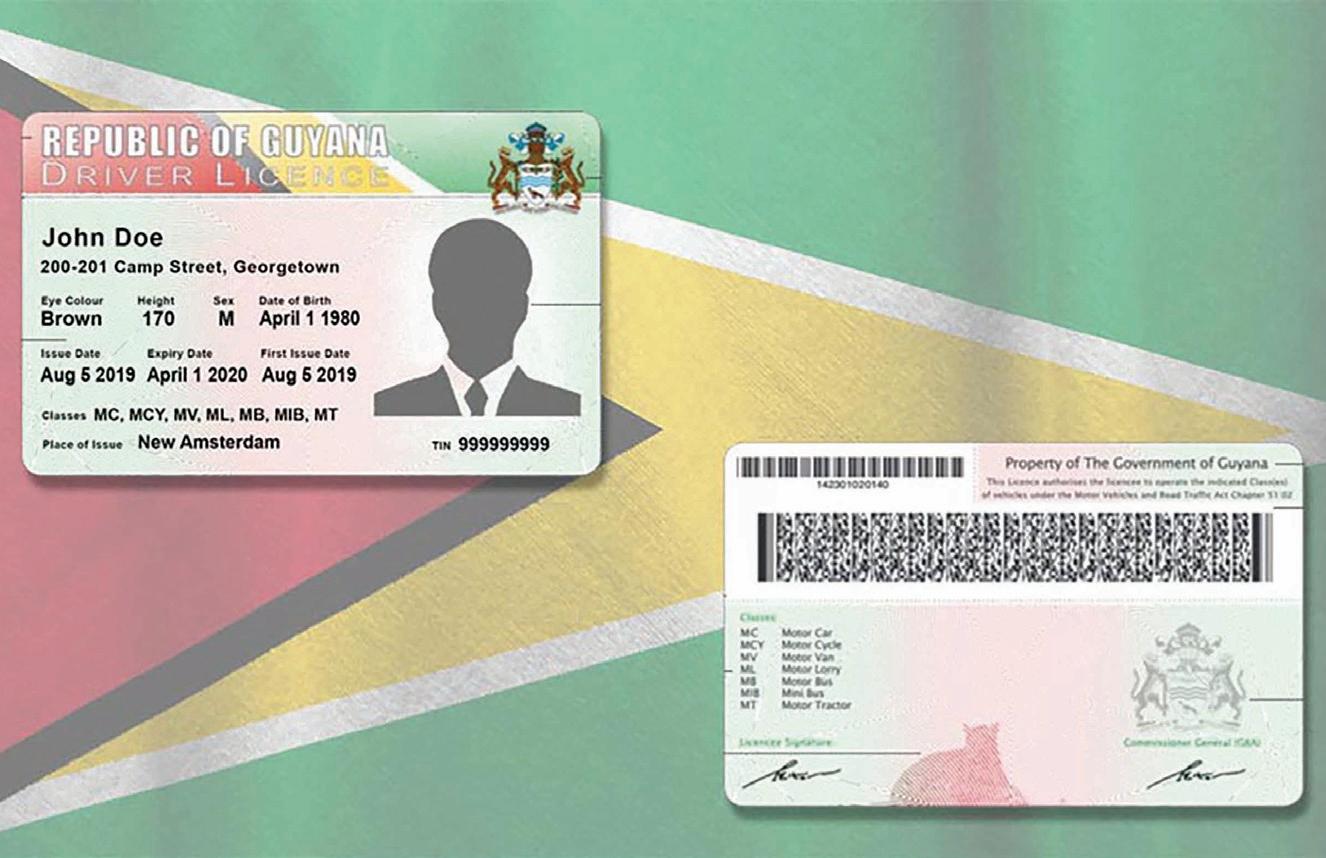
As part of efforts to crack down on illegally obtained drivers licences, the Guyana Police Force’s Traffic Department has written to some 1600 persons to ascertain how they obtained their licences.
“The Traffic Chief [Mahendra Singh] would have sent out 1600 letters to persons whom they’re interested in to find out how they acquired their driver’s licences… And this will be interesting,” President Dr Irfaan Ali revealed during a press conference on Friday.
This move comes on the heels of the head of states previously announcing back in December a sixweek deadline for persons who illegally obtained their drivers’ licences to turn themselves in and be given a chance to redo their licences; otherwise, they would face a suspension of their licences and possible prosecution.
Traffic Chief Singh told Guyana Times on Friday that as far as he is aware, no one took advantage of that amnesty period. “No licences would have been submitted to us or surrendered to us or brought in at Traffic Headquarters,” he noted.
While the Guyana Revenue Authority (GRA) is the official licensing agency, the Traffic Chief further indicated that he was not informed of any such submissions there.
This crackdown on the licensing process followed a comprehensive post-audit conducted by the
Government in collaboration with the GRA, the Ministry of Home Affairs, and the Ministry of Public Service, Government Efficiency and Implementation.
The audit, powered by integrated digital systems, exposed serious discrepancies in the driver’s licencing process, specifically, cases where individuals obtained practical certifications and licences without ever passing the mandatory theoretical examination.
“If 150 people pass the theory but 400 receive practical certificates, something is wrong,” the President had stated last December. “Technology has allowed us to trace every step, and we have all the names.”
During an interview with a panel of local journalists at the
time, the Guyanese leader had warned that all parties involved in the irregularities would face the consequences.
Moreover, the Government is also looking to migrate the theoretical examination for drivers’ licences from the Police Force to the Guyana Digital School, where the questions would be automatically generated.
According to President Ali on Friday, “Nobody would have any question paper two days before. [With the automated system], if you go now to write it, 10 minutes after, the questions are completely different. It’s random sampling. The system throws up the questions and marks them immediate-
ly, so you can know your results there.”
This new process aligns with ongoing efforts to enhance road safety across the country through smart traffic interventions, including artificial intelligence (AI) traffic cameras, radar systems, and smart traffic signals, among others that are slated to be rolled out across the country within the next year.
With AI being an important component of Guyana’s national security operations, the head of state noted that this is already bearing fruits.
“We have launched the smart traffic cameras, and we have seen a massive reduction in accidents and speeding in the areas where we have launched the cameras. Now, we went a step further. AI can now generate for us who the repeat offenders in traffic offences are, so you don’t need to go through days of documents. In milliseconds, we can generate a report about repeat offenders so that that can be integrated in the judicial system, and the judicial system can take the appropriate action based on the repeat offenders,” he noted.
Additionally, President Ali disclosed that they are on the verge of introducing our mobile units that will be deployed on the road and automatically detect vehicles with outstanding traffic offences, and
they would be pulled over. In fact, he noted that several pilot tests were successfully completed with this new unit.
“The test a few nights ago, on the East Coast alone, found 250plus vehicles with outstanding tickets, just by driving through. And no human can interfere with the system, because the system would pick them up, document it on a screen, put it in a database, and then turn on even the sirens to stop the vehicle.”
“This mobile unit can also be parked in any location, and it’ll have 360 degrees of coverage of the traffic in that location to look at offences. This is some of the latest technology that we are applying. We are now going to move this at scale to national levels,” he noted.
Moreover, the Guyanese leader also spoke about integrating sensor-enabled infrastructure into the intelligent traffic system in order to streamline the use of the road. For instance, sensor-orientated traffic lights would be installed across Georgetown and would operate based on real-time traffic situations.
“The timing of the lights will change to allow efficiency in the system… You know, sometimes the traffic is going out of the city, sometimes in the city, so the sensors will pick this up in a predictable way and then make the decisions and adjustments within the system itself,” the President explained.


The Berbice Bridge will be closed to vehicular traffic on: Saturday, May 23 –09:30h–11:00h and Sunday, May 24 – 10:35h–12:05h


Parika and Supenaam departure times – 05:00h, 10:00h-12:00h, 16:00h, 18:30h daily.




Thundery showers are expected during the day, easing briefly in the evening before returning overnight. Temperatures are expected to range between 23 degrees Celsius and 28 degrees Celsius.
Winds: East-North-Easterly to Easterly between 2.68 metres and 4.02 metres.
High Tide: 09:56h and 22:44h reaching maximum heights of 2.24 metres and 2.19 metres.
Low Tide: 16:06h reaching a minimum height of 0.96 metre.










Following multiple attacks against the Guyana Defence Force (GDF) patrols along this country’s western border areas, President Dr Irfaan Ali informed on Friday that Guyana has informed its allies as it responds with a blend of diplomacy, intelligence, and enhanced military readiness.
“The Cuyuni River incident – as you know, we have addressed this with our allies. We have addressed this diplomatically with Venezuela. We have addressed this from a national security standpoint. We have placed greater assets… We are using our intelligence and information from allies to see whether there is a pattern and whether it was linked to particular circumstances,” the president told a press conference.
He said that additional security resources are being deployed to strengthen protection along the border, while expressing confidence in the country’s ability to safeguard its sovereignty and territorial integrity.
“We have two new assets and other assets that we are deploying to further enhance security there. But we are confident about protecting our sovereignty and our borders… The border patrol unit, of course, is a unit that is working with the community policing group, transferring them into a border patrol unit to help us in this very thing: intelligence sharing, more monitoring, real-time information, and having the capacity infrastructure to support what we are doing,” he added while underscoring border patrol linking with community integration.
Ali said that a lot of work is currently being undertaken, and as this is done, challenges are noted, but strategies are being implemented to deploy efficient systems targeted to eliminate those challenges.
Apart from national measures, the president said that Guyana is deepening its role in regional security through the Shield of the Americas, a recently established multinational security and political alliance, unveiled in March of this year by United States President Donald Trump. The coalition unites 18 nations, inclusive of Guyana, to synchronise intelligence sharing and joint military actions targeting transnational narcotics cartels.
He highlighted Guyana’s founding membership in this alliance, which unites like-minded countries to uphold democracy, rule of law, and sovereignty.
More joint exercises
“The Shield of the Americas, of course, we are
a proud founding member of the Shield of the Americas. This is a coming together of like-minded countries to ensure the rule of law and democracy are upheld in the region; the protection of our sovereignty; and the rooting out of criminal elements, including smuggling and drug trafficking, within the region, and it is about building a common security platform, an integrated security platform, on which we work together to ensure the safety, security, and prosperity of our region,” he said.
“So, you will see more integration, more joint exercises, greater information-sharing platforms, and higher participation among members,” he added.
Tensions between Venezuela and Guyana escalated throughout 2025 due to multiple armed attacks in the Cuyuni region. The incidents involved Venezuelan-based armed men firing upon Guyanese military patrols and personnel, including those escorting election officials.
In February of last year, armed Venezuelan men attacked a GDF patrol boat on the Cuyuni River, injuring six soldiers. The GDF returned fire, and the attackers retreated. In May, armed men from the Venezuelan shore launched three separate attacks on GDF troops conducting riverine patrols; no Guyanese soldiers were injured during these attacks.
Then in August, a Guyanese Joint Services patrol escorting election officials and ballot boxes came under fire from the Venezuelan side of the
Upper Cuyuni River. No one was harmed, and the team successfully completed its mission.
Earlier this month and while the ICJ case was nearing, a GDF soldier was shot and injured on Monday morning after a patrol escorting civilian vessels came under fire along the western border in Region Seven. The GDF had issued a statement and said the incident occurred around 11:30h in the vicinity of Black Water as ranks conducted a boat patrol operation between Makapa and Eteringbang. According to preliminary reports, the patrol was escorting three civilian boats transporting personnel and cargo when unknown assailants opened fire. The soldiers returned fire and were able to safely manoeuvre the convoy out of the area.
One soldier sustained two gunshot wounds to the right leg. He was treated at
the scene and was medically evacuated to Georgetown for further care.
The GDF said it has maintained an active presence along the western border and reaffirmed its commitment to protecting its personnel and defending the country’s territorial integrity.
President Ali has emphasised that while Guyana maintains respect for the Venezuelan people and continues to welcome those seeking refuge and opportunity, the territorial controversy must be settled peacefully through the International Court of Justice (ICJ) – not through aggression or coercion.
“Guyana stands firmly on the side of justice and legality,” he said. “We reject all forms of aggression and any attempt to impose solutions through force. Peace, dialogue, and international law must define the way nations interact in our hemisphere.”



Editor: Tusika Martin
News Hotline: 231-8063 Editorial: 231-0544, 223-7230, 223-7231, 225-7761
Marketing: 231-8064 Accounts: 225-6707
Mailing address: Queens Atlantic Industrial Estate Industrial Site, Ruimveldt, Georgetown
Email: news@guyanatimesgy.com, marketing@guyanatimesgy.com
The concerns raised by President Dr Irfaan Ali regarding escalating incidents of student misbehaviour across the national school system reflect a troubling social development that can no longer be treated as episodic or isolated. The scale, distribution, and evolving nature of school-based violence and indiscipline point to a structural challenge requiring sustained, multi-sectoral intervention rather than ad hoc disciplinary responses.
Official reports indicating incidents across hundreds of schools nationwide underscore the breadth of the problem. With hundreds of institutions recording varying degrees of indiscipline, the issue has clearly moved beyond the confines of specific communities or school types. The geographical spread across multiple administrative regions further confirms that the phenomenon is not region-specific, but rather nationally embedded, influenced by broader social, economic, and behavioural trends affecting young people.
First, the scale of the problem justifies a national emergencystyle response.
When disciplinary breaches are documented in such a large proportion of schools, the education environment is placed under strain that affects teaching quality, student safety, and institutional credibility. The concentration of reported cases in densely populated regions reflects demographic pressures, but also signals the intensity of urban and semi-urban social challenges being replicated within school settings. The frequency and consistency of these reports reinforce the argument for coordinated national action.
Second, cyberbullying and digital exposure have fundamentally altered the dynamics of student conflict. The migration of peer conflict into online spaces has amplified humiliation, extended the lifespan of disputes, and intensified peer pressure. Digital platforms have enabled conflicts to escalate rapidly beyond school boundaries, often drawing in wider peer groups and external actors. The introduction of structured reporting systems and nationwide consultations represents a necessary foundation for policy formulation. Equally important is the emerging use of digital tools, including analytical technologies, to detect behavioural trends and enable earlier intervention. Such measures signal an evolution from reactive discipline to preventive governance.
Third, school violence is increasingly linked to broader behavioural risks such as gang affiliation, substance use, and vaping.
These influences introduce external criminal and social dynamics into educational environments, complicating traditional disciplinary frameworks. The presence of such factors within schools elevates routine behavioural issues into matters of safety and security. Strengthening surveillance mechanisms, improving monitoring capacity, and reinforcing institutional safeguards are therefore not punitive measures but rather protective ones, aimed at preserving safe learning environments for both students and educators.
Fourth, the role of family structures and community institutions remains indispensable.
Schools alone cannot be expected to absorb the full burden of behavioural correction. Parental engagement, community accountability, and the involvement of faith-based and civic organisations are essential pillars in shaping values and reinforcing discipline outside the classroom. The erosion of consistent adult supervision in some environments has contributed to behavioural drift among students, making external guidance and mentorship even more critical. Sustainable behavioural reform requires alignment between home, school, and community systems.
Fifth, educator welfare, school capacity, and institutional support structures require urgent strengthening.
Concerns regarding the declining presence of male teachers, combined with reported incidents of aggression against educators, highlight vulnerabilities within the school environment. The safety of teaching staff is central to maintaining authority and order in classrooms. Investments in security infrastructure, improved supervision mechanisms, and enhanced emergency response systems are therefore essential. Alongside physical safeguards, expanded counselling services, teacher training in behavioural management, and structured mentorship programmes such as scouting initiatives can contribute to stabilising school culture and reinforcing positive behavioural norms.
Taken collectively, these dimensions validate the administration’s call for a comprehensive and integrated response framework. Fragmented interventions will not adequately address a problem that is simultaneously behavioural, technological, social, and institutional in nature. The introduction of coordinated systems, data-driven monitoring, community engagement, and strengthened school infrastructure reflects a policy direction aligned with the complexity of the challenge.
The trajectory of school misbehaviour, if left unchecked, risks undermining educational attainment and weakening social cohesion in the long term. A disciplined, safe, and supportive school environment remains fundamental to national development. The emphasis on multi-layered solutions represents an educational imperative.
In observance of Guyana’s 60th Independence Anniversary, the Amerindian Affairs Ministry hosted an Inter-Department Tuma Cookout Competition (Amerindian Affairs Ministry/Facebook)




Dear Editor,
In the last six weeks two different rooms in Guyana have delivered the same message to the same audience, and most of the audience missed it.
In April, at the ECONOME Business Conference’s Region Three investment forum, Michael Monroe of the Local Content Secretariat laid out the entry ticket(s) for any firm that wants to win an oil-and-gas contract. Four documents: the business’ registration, the business’ NIS, the owner’s TIN, and the owner’s ID. Firms without those four watch others win the work.
Yesterday at the Guyana Marriott, the Guyana Manufacturing and Services Association hosted a business luncheon with Hon Zulfikar Ally, Minister of Public Service, Government Efficiency and Implementation, to walk SMEs through the documentation the new Guyana Development Bank will require to lend. Different room. Different agency. Same message. If your house is not in order, the money walks past you.
That message is being read narrowly. Most of the business owners I speak with are taking it to mean the following: get your tax clearance up to date, pay your NIS contributions, and refresh the business registration. Treat it like an annual chore. File the paperwork, get back to running the business.
That reading is wrong, and the next four years will be expensive for the firms that hold it.
What compliance actually means now Tax, NIS and business registration are not compli-
ance. They are the price of being legally allowed to operate. They tell a regulator that your firm exists. They say nothing about how your firm handles money, who actually owns it, how it screens its customers, what it does with suspicious activity, or whether anyone inside the firm has the authority to stop a transaction that smells wrong.
Corporate compliance is that second category. It is the system of controls a firm builds to prevent it from being used, knowingly or unknowingly, to launder money, finance terrorism, evade sanctions, deceive a counterparty, or breach the duties it owes its customers and the public. It includes anti-money-laundering and counter-financing-of-terrorism programmes. It includes beneficial ownership disclosures that name the human being who actually benefits from the company. It includes internal audit functions, a compliance officer with real authority, written policies that are followed and not just printed, board-level oversight, employee training, and the discipline to file the right reports to the right regulator on time.
Most Guyanese firms have built none of this. The culture still treats compliance as a paperwork ritual, something you fix on a Friday afternoon before a registration lapses.
“The international principals who are arriving to write the contracts treat corporate compliance as the precondition for a relationship.”
The Compliance Commission Act is already on the books.
In August 2023, the National Assembly passed the Guyana Compliance Commission Act. It created
an independent statutory body to supervise non-financial businesses and nonbank financial institutions for AML and CFT compliance. Accountants, lawyers, real estate agents, dealers in precious metals and stones, trust and company service providers, and others were brought into a registration regime. Beneficial ownership disclosures became a legal obligation. Higher-risk entities were told to appoint a compliance officer who meets a fit-and-proper standard and to commission an annual independent audit.
The penalties are not symbolic. Failure to register can attract a fine of GY$10 to 25 million and up to five years’ imprisonment. Obstructing an audit can cost up to GY$20 million and five years. Providing false information to the Commission can cost up to GY$10 million and three years. Administrative penalties run as high as GY$10 million, with daily fines of GY$100,000 for continuing breaches.
It has been on the books for nearly three years to allow businesses sufficient time to adjust to it, and enforcement comes next. Most reporting entities in Guyana have done nothing to comply with it. Many do not yet realise they are reporting entities.
A growing number will discover that they are reporting entities the hard way. The wake-up call will come when an oil major’s procurement team asks them for an AML programme they have never written, or when the Guyana Development Bank’s credit committee asks for board minutes documenting beneficial ownership verification.
The next wave of oil-andgas suppliers is not compet-
ing on price. It is competing on whether it can pass a counterparty due diligence questionnaire. Most cannot. And the same gap is sitting in the non-profit sector.
The Caribbean Financial Action Task Force mutual evaluation cycle for Guyana is approaching. CFATF’s standards require non-profits that handle cross-border donations to operate beneficial ownership controls, donor due diligence, and counter-financing-of-terrorism screening. Years after the first warning, most Guyanese NGOs have built none of this. The failure mode is not theoretical: small donations to apparently legitimate causes have funded violence elsewhere, and CFATF expects non-profit boards to engineer against that risk before it surfaces, not after. The sector deserves a longer treatment, and I will give it in a follow-up piece. For now, every non-profit board in this country should read the Compliance Commission Act, look at the international donor framework they accept funds under, and ask whether their organisation could withstand a serious examination. For almost all of them the honest answer is no.
The four years between now and 2029 will sort Guyanese firms into two groups. The ones that used the window to build real compliance systems. And the ones that kept treating compliance as an administrative chore and watched the contracts, the credit lines and the partnerships go elsewhere. The first group will be smaller than it should be. It does not have to be.
Yours sincerely, Theon Alleyne
Dear Editor,
A new advisory opinion from the International Court of Justice affirming the right to strike under the United Nations International Labour Organization’s Convention No. 87 on Freedom of Association and Protection of the Right to Organise: The Clerical & Commercial Workers’ Union (CCWU) welcomes the International Court of Justice’s recent historic ruling affirming that the right to strike is protected under international law. For more than 70 years, the International Labour Organization’s superviso-
ry bodies have held that the right to strike is essential to the right to organise.
This decision affirms decades of judicial precedent and the understanding shared by workers around the world: there is no right to organise and bargain collectively without the right to strike. When workers are barred from collective action on the job, they cannot defend their rights or demand the workplace conditions and contracts they are owed. At a time when workers’ organisations face sustained attacks worldwide, this opinion reaffirms that the freedom to withhold one’s
labour is not a privilege granted by the powerful but a fundamental human right grounded in international law. The CCWU commends the International Trade Union Confederation and its
legal team for their efforts in achieving this result.
Yours sincerely, Sherwood Clarke General Secretary, CCWU

The closure of the Strait of Hormuz
Dear Editor, The closure of the Strait of Hormuz – a critical artery through which approximately 20 per cent of the world’s traded oil and a significant portion of global liquefied natural gas (LNG) transits – has triggered a cascading global economic shock. While Guyana is not directly dependent on Middle Eastern oil imports, the ripple effects of this closure are being felt acutely across our supply chains, fuel costs, and household food security.
The global energy market has responded with sharp price increases. Shipping freight rates have surged as vessels reroute around the Cape of Good Hope, adding thousands of miles and days to journey times. These costs are being passed directly to consumers in small and import-dependent economies such as ours.
Guyana faces the following immediate pressures:
▪ Fuel and energy cost escalation affecting transportation, electricity generation, and agriculture
▪ Rising prices of imported food commodities including wheat, rice inputs, and processed foods
▪ Increased shipping and freight costs for all imported goods
▪ Supply chain delays affecting availability of essential medicines and consumer goods
▪ Inflationary pressures on the cost of living for
ordinary Guyanese citizens One may ask, why is Guyana affected if it produces its own oil? The answer is simple; Guyana’s crude oil production is largely exported as a raw commodity. Our domestic fuel supply, like most CARICOM nations, is still subject to refined petroleum product imports and global pricing benchmarks.
The decisions made in distant seas and troubled straits have reached into every Guyanese kitchen and every family’s pocket. The closure of the strait – a narrow waterway thousands of miles from our shores – has sent shockwaves through the global economy. The price of fuel has climbed. The cost of food has risen at our markets. Transportation has become more expensive. These are real pressures on real families. From the mother stretching her budget at the market, to the minibus driver absorbing higher fuel costs, to the small business owner watching margins tighten, all are adversely affected. When global shipping routes are disrupted, small nations feel it first and feel it hardest. Since Guyana imports a significant portion of goods, when freight costs surge and fuel prices rise on world markets, those costs come home with every cargo ship that docks at our ports.
Yours sincerely, Floyd N Haynes

SATURDAY, MAY 23, 2026
00:00 Sign Off 06:00 TVG Devotional Hour
07:00 Evening News (RB)
08:00 Cartoons
08:30 Stop Suffering 09:30 KTLT
10:00 TATA IPL LSG vs PBKS (Willow) 14:00 Movie - Tafiti: Across the Desert (2025)
15:30 Movie - 14 Love Letters (2022) 17:00 Documentary: Nat Geo Animals 18:00 Evangelistic Hour
18:30 Hephzibah Ministries
19:00 Movie - A Greek Recipe for Romance (2024)
20:30 Movie - My Boyfriends’ Dogs (2014)
22:00 Movie - Godzilla vs. Kong (2021)
1. If 15² = 225, then the square root of 0.0225 is (A) 0.015
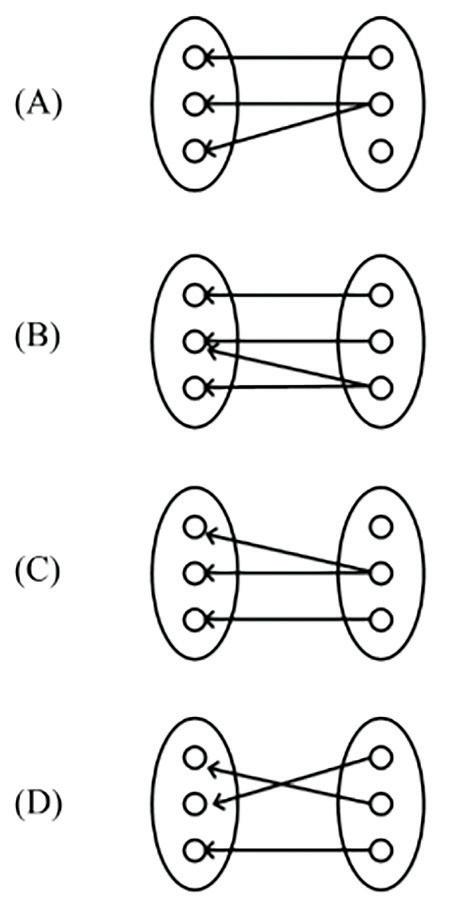
2. Which of the following diagrams illustrates a function?
3. A function f is defined as f(x)=3x-1. The value of f(-3) − is (A) -12 (B) -10 (C) - 6 (D) 12
4. Given f(x)=x²-3x+1, then f(-1) is (A) -3 (B) 3 (C) 5 (D) 6
4 x
5. Which of the following represents the equation of a straight line? (A) y= (B) y=²x+3 (C) =x²-4 (D) y=x²+2x-5

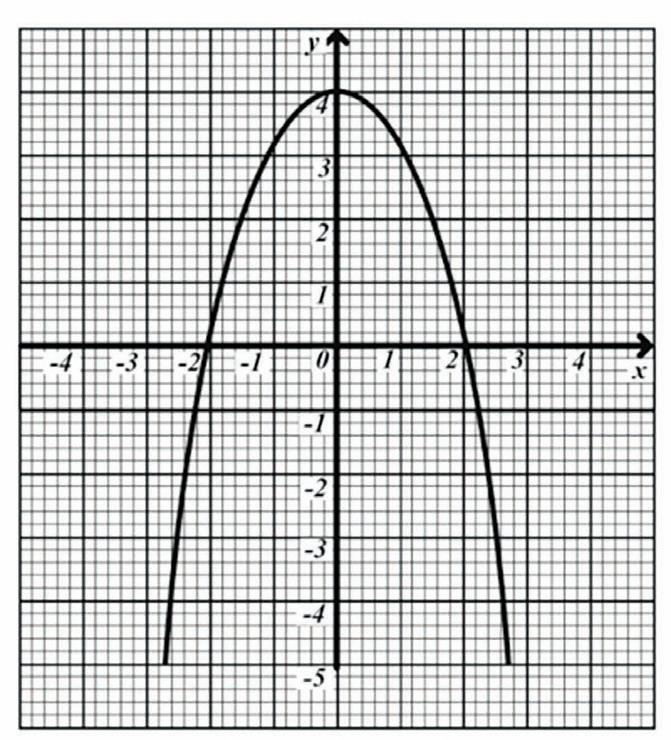
6. From the graph above, the values of x when y = −1are (A) 1 and -1 (B) 2.2 and -2.2 (C) 2.5 and -2.5 (D) 2.8 and -2.8
Question 7 refers to the following diagram.
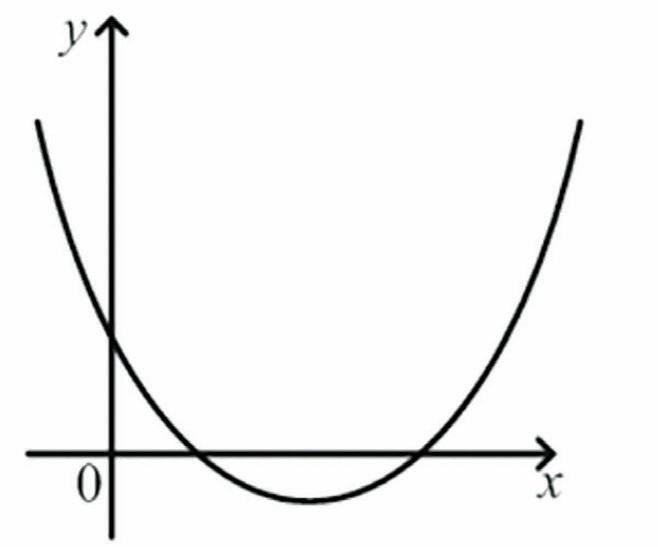
7. The diagram above shows a graph. If a, b and c are constants and a > 0 , the equation of the graph could be (A) y=ax²+c (B) y=c-ax² (C) y= ax²+bx+c (D) y=c+bx+ax²
8. The distance around the edge of a circular pond is 88m. The radius, in metres, is

Question 9 refers to the following diagram.


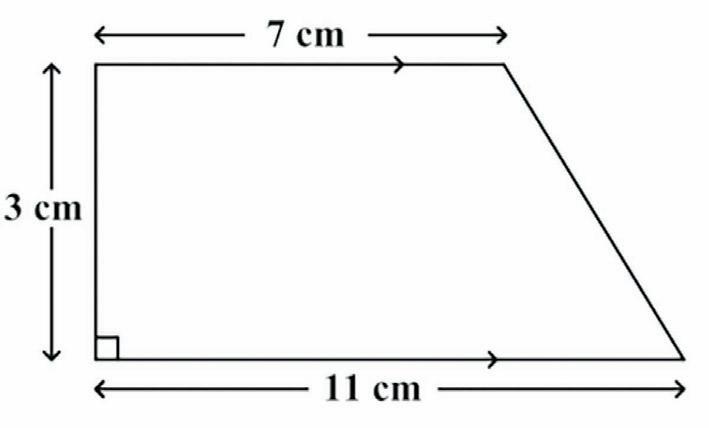
9. The area, in cm², of the trapezium above (not drawn to scale) is (A) 21 (B) 27 (C) 33 (D) 54
Question 10 refers to the following diagram.
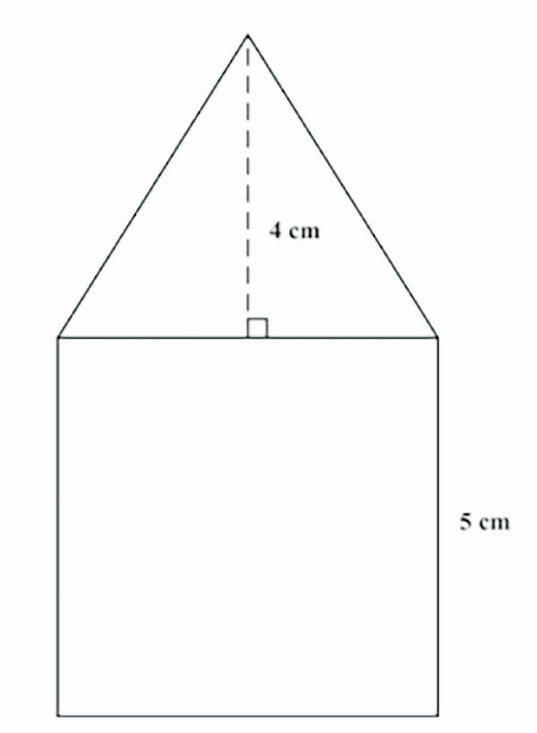
10. The figure above, not drawn to scale, consists of a triangle resting on a square of side 5 cm. The height of the triangle is 4 cm. What is the TOTAL area of the figure? (A) 35cm² (B) 45cm² (C) 50cm² (D) 100cm²


By Anne StevenSon
After writing on Sylvia Plath
A glass jar rattles its split peas and pasta. Those cysts look innocuous, but they wriggle through the kernels, hatching into terrible insects. Something’s on the floor there, buzzing like a swat wasp. A belly like a moist rubber thimble sucks and stings my finger. Ach, my heel reduces it to sewage. String the creatures up, then, Hang them on the Christmas tree. They glisten there like fish, or softly lengthen into milliners’ feathers. See, they are only moths, paper moths or horses, not even paper but the Paisley curtain sifting ashy patterns from the winter light. Order, they order, order. The flame gropes for a fire. The dream asks meaning to patch its rags. The flying words want paper to nest in. Six colours rake the white reach of the rainbow. Even the smallest hours crawl by with a number. These letters are marching straight into an alphabet: X Y Z, not to infinity.
(Source: Poetry [October/November 1987])

List 10 things you hope to have accomplished 10 years from now. Which of these is most important to you?

President Dr Irfaan Ali on Friday said that the International Court of Justice’s ruling will give finality to the border controversy with Venezuela, and this country will wait with patience and dignity, as he also called on Caracas to change its defiant stance and choose peace.
“Guyana has pledged repeatedly, including at these oral hearings, that it will abide by the court’s judgement, whatever it may be. Guyana is confident, in fact, that after the oral hearings, we are even more confident than ever that the Court will uphold the legal validity of the 1899 Arbitral Award and the finality and permanence of the international boundary between Guyana and Venezuela,” the President on Friday told a press conference he hosted at the Office of the President.
The President underscored that disputes between states must be resolved peacefully and never through military force, and pledged this country’s commitment to patience and dignity while awaiting the ICJ’s final ruling, expected, he believes, by the end of the year. “We will await the court’s final judgement on the merits with patience, dignity, and optimism. We’ll continue to address Venezuela in a spirit of peace, cooperation, and friendship, and as sovereign equals,” he said.
The ruling is expected by year-end or early in the new year.
Respect rule of law
With Venezuela maintaining its position throughout the case and Acting President Delcy Rodríguez informing the court that her country rejects any ruling it may issue and continues to insist that the court lacks jurisdiction, President Ali urged that the rule of law be upheld.
“It is our fervent hope that Venezuela’s expression of disrespect for the court and for international law reflects the emotions that often accompany litigation of this kind. We hope that after passions recede and responsible Government officials reflect, they will conclude, as we have done, that both states are best served by an end to this long-standing conflict, and that the only way to secure a just and lasting peace, and an enduring friendship is by respect for, and compliance with, the court’s final judgement, whatever it may be, as required by the United Nations Charter,” he said.
He reasoned that the very fact this case reached the ICJ and that the written and oral phases of the proceedings were carried out to completion represent a triumph for the rule of law and the rules-based international order.
Ali reminded of the genesis of Venezuela’s claim, which came more than six decades after Caracas had accepted the ruling and at a time it knew this country was nearing independence from Great Britain.

“After accepting, respecting, and complying with the award on the boundary without protest for 63 years, Venezuela made this very belated protest precisely at the time Guyana was nearing its independence,” he explained.
He noted that Venezuela’s timing coincided with the departure of British troops, leaving Guyana militarily vulnerable. “Venezuela would have a significant military advantage with which to press its unfounded claim to nearly three quarters of Guyana’s territory, the very claim that a tribunal of five preeminent arbitrators unanimously rejected in 1899,” Ali said.
Caricom’s support Ahead of the ruling, the Caribbean Community (Caricom) has reaffirmed its unwavering support for Guyana’s territorial integrity and the judicial process.
This position was conveyed by Caricom Assistant Secretary-General Elizabeth

Solomon on Thursday during the opening ceremony of the Centre for International and Border Studies Conference in Georgetown.
“Sovereignty is not a static achievement but a continuous work of diplomacy, intellectual rigour and national resilience. Within this context, I reiterate the unwavering position of the community regarding the Guyana–Venezuela border controversy. Caricom remains firm in its support for the judicial process before the International Court of Justice and continues to advocate for a peaceful, legal resolution that respects Guyana’s territorial integrity and maintains our region as a zone of peace,” she expressed.
Guyana approached the International Court of Justice (ICJ) in 2018 to obtain a final and binding legal affirmation of the 1899 Arbitral Award, which establishes the land boundary between Guyana and Venezuela. The World Court
will likely deliver a ruling by year-end or early 2027, having concluded both written and oral phases of the proceedings.
Guyana has already maintained that it will abide by the judgement, noting that it is waiting with patience, decorum, dignity, and optimism.
Venezuela, on the other hand, insists that it will ignore the ruling and continues to reject the ICJ’s jurisdiction to resolve the matter, even though it participated in the proceedings.
In fact, Venezuela’s interim President Delcy Rodríguez told the World Court on the final day of oral hearings on Monday that “this Court was created to resolve conflicts, not to encourage them. Only a political and negotiated solution to the territorial dispute can lay a solid and stable foundation for good neighbourliness, cooperation, shared economic development, and the promotion of secure investment in the region.”
However, Guyana has since urged respect for the World Court’s ruling, noting that the international community would not allow Venezuela “to defy the most fundamental rules of international law, which demand a world order based on the rule of law”.
Moreover, Guyana noted that it will continue to address Venezuela “in a spirit of peace, cooperation and friendship and as sovereign equals. We will respect
Venezuela’s sovereignty, as we have always done, and insist that Venezuela refrain from trespassing on, or threatening, Guyana’s sovereignty.”
Diplomatic engagements
Only recently, United States Under Secretary of State for Economic Affairs Jacob Helberg said Washington continues to monitor the border controversy case before the ICJ while also pursuing private diplomatic engagements on the matter amid continued threats from Venezuela. He told a news briefing in Guyana on Wednesday that “we’re monitoring that event at the ICJ very, very closely. We understand and agree that security is a precondition for prosperity, and ultimately a lot of those conversations right now will be private, and we believe that we can make progress through private conversations.”
His comments come on the heels of United States Congresswoman Maria Elvira Salazar, Chair of the House Foreign Affairs Subcommittee on Western Hemisphere Affairs, issuing a statement sharply criticising Venezuela’s interim President Delcy Rodríguez over continued threats to Guyana’s territorial sovereignty.
On Friday, President Ali also expressed thanks to Guyana’s legal team and representatives, whom he believes did a stellar job throughout the process.


As the trial in the 2020 elections fraud case continued on Friday, the remaining General Elections Statements of Poll (SoPs) for Regions Five to Ten and Regional Elections SoPs for Regions One to 10 were able to be completed and able to be entered into evidence before the court once again adjourned.
The trial in the case will resume on June 15 at the Georgetown Magistrates’ Courts before Acting Chief Magistrate Faith McGusty. The trial will run every day from June 15 to 19 and again from June 22 to 26 before once again being adjourned. Trial dates for July remain tentative pending the availability of the attorneys on both the prosecution and defence sides.
Additionally, during Friday’s proceedings, Magistrate McGusty noted that she would be proceeding on leave
from July 20. Hence, there will be no trial in July if dates cannot be agreed upon before she leaves.
The SoPs for the GRE were entered into evidence during the testimony of Supreme Court Registrar Sueann Lovell, who was the sole witness of the day on Friday. This was Lovell’s second appearance, after she first appeared on Wednesday when the original General Elections SoPs for Regions One to Four were tendered into evidence.
There were a total of 2339 polling stations for the March 2, 2020 General and Regional Elections (GRE), resulting in 2339 SoPs and 2339 Statements of Recount (SoRs) for the general and regional elections, respectively.
The lodging of the SoPs and SoRs as evidence is expected to be completed when the case resumes and cross-examination of Lovell is expected to be done.

Lovell has been the gatekeeper of the original SoPs and SoRs since January 2021, when the High Court had ordered the Guyana Elections Commission (GECOM) to transfer all original SoPs and SoRs from the 2020 elections to the custody of the High Court for safekeeping and as official evidence. The documents were delivered to the High Court by former Chief Elections Officer Keith Lowenfield, in the presence of GECOM Chairperson Claudette Singh. Lowenfield is one of the defendants currently charged in the case.
The documents were ordered to be handed over given that the Representation of the Peoples Act (ROPA) allows the Chief Elections Officer (CEO) to destroy all elections documents after a 12-month period has elapsed.
During Wednesday trial, Lovell testified to the strict chain of custody that the documents were under. Subsequent to the court’s possession of the documents in May 2021, copies of the original SoPs and SoRs were made and handed over to the Director of Public Prosecutions (DPP) and the Guyana Police Force (GPF) as evidence in the election’s fraud case.
During the handing over of the copies to the Police, an audit process was conducted to ensure that the copies handed over were an exact match to the original documents held by the registrar.
Police Inspector Nigel Stephens, who received the certified copies from the Registrar, is also a witness in the case, making his first appearance in the trial on Thursday during which the certified copies of the SoPs and SoRs also began being tendered as evidence.
Lowenfield is one of nine persons charged with conspiracy to commit electoral fraud in relation to the tabulation of votes for Region Four in the 2020 GRE.
Those charged include former Deputy CEO Roxanne Myers; former Region Four Returning Officer Clairmont Mingo; former A Partnership for National Unity + Alliance for Change (APNU+AFC) Minister Volda Lawrence; former APNU+AFC Chief Scrutineer Carol Smith-Joseph; and former Guyana Elections Commission (GECOM) employees Enrique Livan, Sheffern February, Michelle Miller, and Denise Bobb-Cummings.

Your Eyewitness rides the bus… not every day, but enough to know what’s going on behind the present furore being raised by bus drivers/owners over their unilateral hiking of their fares. He’s old enough to’ve experienced the “Tata Big Buses” and the Government handling of public transportation – and he experienced the “Minibus” revolution that took place as part of the Government encouraging the Private Sector to deal with moving folks from point A to point B!!
But things have changed since then, innit?? The economy’s improved to such an extent that we’re experiencing a situation of “a car in every home” and, in many cases, a car for every adult member of the family!! There are also the “Taxi Base” in every village – from where you can summon taxis to get you from even the back of your village to the front!! This means that bus users nowadays are generally those folks who can’t afford cars – and there’s greater competition for their bodies since expenses for the bus drivers gotta be met!!
And we return to the face-off between the bus drivers who wanna raise fares and the Government that says they can’t!! Now there are some who’ll say the Government should butt out since this economy’s being run on private enterprise principles!! Meaning that the market of demand and supply should be making the decisions on the cost of the service the bus drivers provide!! Also meaning that Governments should keep their big noses OUT!! But it aint so simple, is it??
To encourage private buses to take over from the old Tata buses back in the day, the Government made a HUGE concession to minibus owners!! The customs duties that DOUBLED the prices of vehicles brought into Guyana were effectively WAIVED for them – saving them MILLIONS!! Then when gas prices started going up recently because of the war games in the Strait of Hormuz, the Government intervened to ease the burdens by waiving taxes on gas –making it CHEAPER than before the Middle East flare-up!! So yes… the Government can act for the “greater good” – by helping poor commuters afford getting around!! The bus drivers want to eat their cake and have it too!! They want the Government to subsidise their operations but not the man in the street who wants to be the man in the bus!! Well, they can do what’s done in free enterprise economies when businesses can’t make a profit – get out of the bus business!! The Government will then be forced to start from where they got involved in the first place – bring back the Big Buses even if they aren’t Tatas!!
We might even finally solve the scourge of boom box noise pollution in buses!!
…a democratic deficit?
The one-woman FGM party of ex-PNC thwarted wannabe leader Walton-Desir has provoked a storm over what she claims to be the Government stifling democracy in our fair (if rainy!) land – for not convening Parliament in over three months!! As usual with opposition politicians who criticise the Government for not being “independent” enough and being too thick with western furrin Governments, she complained to the self-same western furrin Governments!! These worthies, in turn, sanctimoniously intoned as to how frequent meetings of parliament are the very essence of democracy!!
Government rep Texiera responded – like the terrier she resembles! – by snapping that at least they coulda checked with her Government!! And if they’d done so, they would’ve found out that a setting was being scheduled two weeks down the road!! Your Eyewitness thinks Walton-Desir’s upset that the opposition leader’s in the news – and wants to show she’s relevant by speechifying in Parliament!!
She doesn’t wanna accept that the opposition can also oppose by working in the field!! Lazy!!
…Mad Maduro’s operatives
The trial of the Venezuelan bomber of that gas station in Midtown GT should get greater coverage!! Our people and the world oughta know about the vicious war Mad Maduro – and his deputy Dangerous Delcy – waged against us!!

President Dr Irfaan Ali has expressed concerns at the alarmingly high number of misbehaviour reports coming out of schools in Guyana, something which he says requires a multipronged response. He was at the time responding to a question during a press conference on Friday about the Government’s intervention to curb the increase in school violence across the country.
According to the Head of State, “This is a big problem…we had reported incidents of misbehaviour in 353 schools nationwide. If you look at recorded instances over the years across all regions, it is alarming.” The President revealed that 41 per cent of these reported cases stem from Region Four (Demerara-Mahaica), followed by Region Six (East Berbice-Corentyne), then Region Three (Essequibo Islands-West Demerara), Region Five (MahaicaBerbice), and Region 10 (Upper Demerara-Berbice). He attributed this pattern to the population size of the regions.
In terms of registering the most and consistent number of reports, the Guyanese leader went on to name Diamond Secondary as the school with the highest levels of challenges, then Soesdyke Secondary, East Ruimveldt Secondary, Linden Foundation Secondary, Canje Secondary, and Bartica Secondary.
“This has become a very complex issue. We are seeing rising gang activity, increased substance use and vaping, and cyberbullying on social media. This is a major escalation in the entire school system,” he posited. Only earlier this month, a 14-year-old male student attached to the Tuschen Secondary School was taken into police custody for the alleged stabbing of two other male students, who were treated and discharged from the hospital. Previously, the Guyanese Government had announced that there would be nationwide public consultations on addressing cyberbullying and the impact of social media on children.
President Ali indicated on Friday that, “Teachers and parents are reporting the increasing and alarming nature of cyberbullying that leads to consequential effects in the school system.”
We have seen that this extends beyond the school compounds of the school. We are also seeing, based on reports and analysis, a lot of copycat behaviour and amplification of humiliation and trauma. Sometimes what you see on social media has ripple effects… so, addressing these issues is critical.”
Late last year, the Education Ministry launched a major campaign against bullying and violence among students and young people. Those consultations continue this year with a series of
One boat Captain is now dead while another is feared dead following separate boat collisions on Thursday along the Cuyuni River, Region Seven (CuyuniMazaruni), and the Barima River, Region One (BarimaWaini), respectively.
In the first incident, 57-year-old Steve Daniels of Kartabo Village, Lower Mazaruni River, died while a passenger was critically injured following a boat mishap in the vicinity of Tapir Landing, Cuyuni River.
Police stated that a 26-foot wooden boat, powered by a 200 HP Yamaha outboard engine, was proceeding in the vicinity of Tapir Landing with four occupants when it collided with an 18-foot aluminium boat, powered by a 40 HP Yamaha outboard engine and operated by the now-deceased.
As a result of the collision, the Captain of the 18-foot aluminium boat and three occupants of the wooden boat received injuries to their bodies.
The Captain reportedly died at the scene.
The injured passengers were taken to the Bartica Regional Hospital, where one of them was admitted in se-
weekly anti-bullying consultations across the country to gather feedback and recommendations from stakeholders at the community level. Additionally, the Ministry has launched an AntiBullying Reporting System (ABRS) in November 2025. Last month, it was reported that since its launch, 58 reports of bullying were received via the digital platform, and 48 of those have already been resolved.
It was noted that data from the platform, combined with feedback from nationwide consultations, will help shape a comprehensive national policy on anti-bullying and school violence prevention.
Multi-prong response
Meanwhile, the Head of State said that a series of other initiatives have been launched that will allow coordination among Government agencies, increased counselling services, a standardised
referral system, and the use of artificial intelligence (AI) to help address predictable behavioural patterns so that the response can be more proactive rather than reactive. However, the Guyanese leader outlined that tackling these issues also requires greater parental guidance and community involvement in children’s lives. In fact, he underscored the important roles religious bodies and leaders play in addressing these challenges.
In the same breath, he stressed that reforming national policies is also key in dealing with and addressing cyberbullying. Another challenge the President highlighted is the lack of male teachers within the school system. With the males falling out of the teaching profession, he said this leaves female teachers at risk of aggression, especially from male students. Back in January, a female teacher came under attack by a male student at the Charity

Secondary School in Region Two (Pomeroon-Supenaam).
A separate incident that month saw another female teacher attempting to part a fight between two girls at the Carmel Secondary School in Georgetown, during which she came under attack by several female students.
While both incidents were condemned by the Education Ministry, President Ali contended that “we have to find a mechanism to give our female teachers that support in the system – more school monitoring, investment in security cameras, implementing it in high-risk areas, maybe a scanner system,
small scanners for bags, and so on.”
In addition to the reporting and monitoring systems, the Head of state also emphasised the need for more training for teachers, especially to deal with violent behaviours from students. Moreover, the President also touted heavy investments in counselling, coaching and the building out of Scouts programmes in different schools, especially some targeted institutions, where there can be father figures and mentors as Scout guides to curb atrisk behaviour and create a more positive mindset among young people.
rious condition. Police have since arrested the Captain of the wooden boat, and he is assisting with investigations.
Meanwhile, a boat Captain only identified as “King” is feared dead after the boat he was operating collided with another in the vicinity of Kokerite Village, North West District (NWD), Barima River, Region One.
According to information received, a small ballahoo was proceeding along the Barama River from Bamboo Landing, North West District, to Charity with four passengers when it collided with a small aluminium boat.
Police stated that as a result of the collision, the two occupants of the aluminium boat fell into the river. A 23-yearold male from Kariako Village was rescued, but the aluminium boat’s Captain disappeared underwater and has since not been found.
The rescued occupant was taken to the Moruca District Hospital, where he was treated and remains under observation. The Captain of the ballahoo was arrested and is assisting Police with the investigation.

“The water was really
…vessel located but rough seas, tangled seine prevent recovery
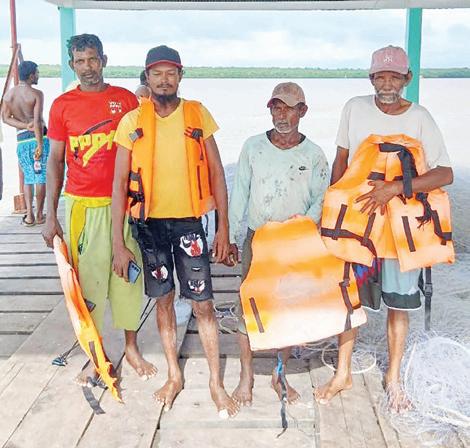
Days after four fishermen survived a harrowing ordeal at sea when their drift seine boat sank in the Atlantic Ocean, members of the crew said that they have been unable to recover the submerged vessel, engine and fishing seine despite locating the boat on Wednesday.
Ganesh (only name given), a 60-year-old fisherman of Rosignol Village, West Bank Berbice, Region Five (Mahaica-Berbice), said the crew returned to sea in hopes of salvaging the vessel, but rough con -
ditions and the tangled seine made recovery impossible.
“I’ve been finding the boat, but now the seine and the boat wrap up so you can’t pull them,” the veteran fisherman explained.
According to the fisherman, only the front portion of the vessel remained partially visible while the remainder stayed submerged beneath the water.
“The boat raise, only the front of the boat raise, and when you pull on the boat, the boat duck down,” he said.
Ganesh explained that

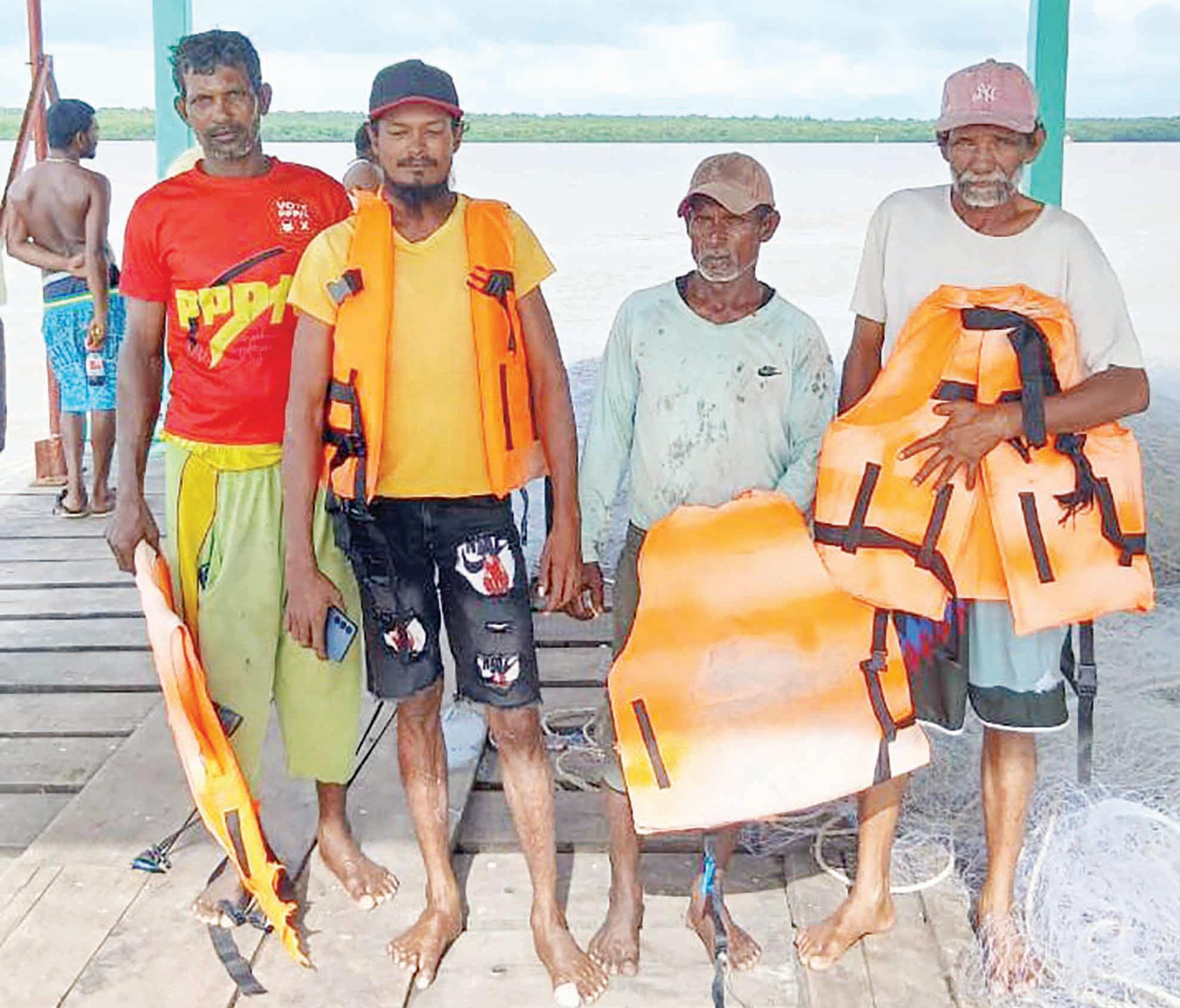
the vessel began taking in water while the crew was hauling in the seine during fishing operations offshore.
“When we started picking up the seine, the boat end up taking water,” he recalled.
The crew attempted to pump the water from the vessel using onboard pumps, but worsening conditions forced them to

abandon efforts to save the boat.
The fisherman said the men tied together containers, life rings and life jackets to create flotation support while drifting in rough waters.
One member of the crew reportedly could not swim.
Ganesh said the crew remained together in the water for several hours before managing to attract
the attention of a passing vessel.
“All four of us get together all the time,” he said.
He recalled that after approximately one and a half hours drifting, another boat finally responded to their signals before the Guyana Defence Force Coast Guard later arrived and took them to safety.
The fisherman admit -
ted that the crew feared the worst as the rough Atlantic waters continued pounding around them.
“The water was really rough,” he said.
Ganesh added that had nightfall caught them while still stranded in the water, the outcome could have been far worse.
“If the night fall and catch us, it would have been something else,” he said.
The veteran fisherman, who said he has spent approximately 35 years working as a boat captain, described the incident as the first experience of its kind in his career.
“First time,” he stated. The crew also lost fish, ice and other supplies while trying to stay afloat after the vessel sank.
According to Ganesh, the engine, fishing seine and other equipment remain underwater, resulting in millions of dollars in losses.
“Everything gone down in the water,” he lamented.
Despite the traumatic experience, the fishermen said they still intend to return offshore in hopes of eventually recovering the vessel and equipment.
“Yeah, we going back out,” Ganesh said.


Four drivers were fined $855,500 after appearing before the Charity and Anna Regina Magistrates’ Courts on a series of traffic offences, including drunk driving, driving without insurance, and other breaches of the Motor Vehicle and Road Traffic Act.
At the Charity Magistrate’s Court on May 18, Magistrate Ravindra Mohabir heard matters against 32-year-old miner Sherwin Benjamin of Charity Squatting Area, Essequibo Coast. Benjamin pleaded guilty to driving while his breath alcohol level exceeded the prescribed limit, driving without a licence, and breach of insurance.


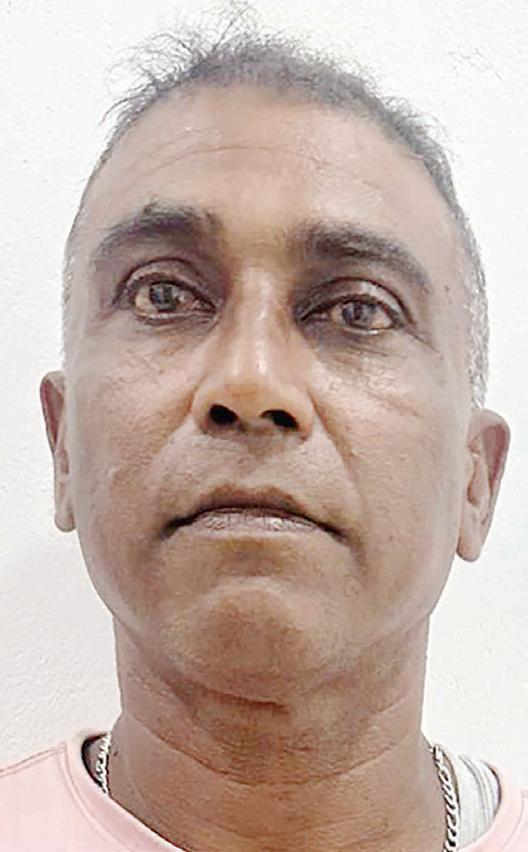

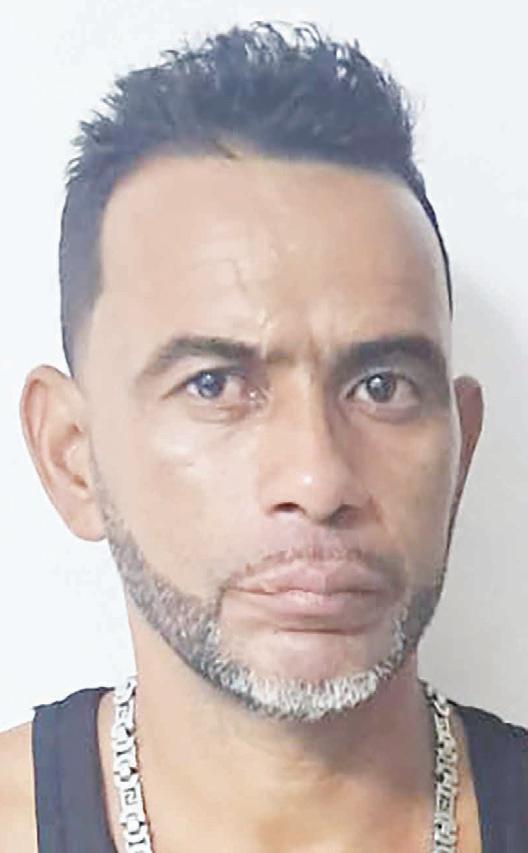
The offences occurred on April 13 along the Charity Public Road and were charged under the Motor Vehicle and Road Traffic Act Chapter 51:02 and the Motor Vehicle Insurance ThirdParty Risk Act Chapter 51:03. Benjamin was fined $200,000 for the breath alcohol offence, $30,000 for driving without a licence, and $30,000 for breach of insurance. The latter two offences carried default sentences of three months’ imprisonment. He paid a total of $260,000 in fines. Also appearing before the Charity Magistrate’s Court was 35-year-old businessman Rajit Daljit of New Road, Essequibo Coast. Daljit faced multiple charges stemming from an inci-

The charges included failure to provide a name and address, failure to wear a seatbelt, failure to display an identification mark at the rear of the vehicle, failure to produce a driver’s licence, defective brake lights, a defective indicator, and poor maintenance of a motor vehicle. Daljit pleaded guilty to the charges. He was fined $10,000 for failing to provide his name and address, $7,500 for not wearing a seatbelt, $150,000 for failing to display an identification mark, and $10,000 for failing to produce a driver’s licence. The defective brake light, defective indicator, and maintenance offences resulted in reprimands and discharges. The matters relating to uninsured and unlicensed motor vehicles were withdrawn.
TURN TO PAGE 12

Caribbean Airlines has announced that it will discontinue flights on the Ogle, Guyana, to Suriname route from June 1, 2026, as part of changes to its regional network.
The airline said the move also affects services to Dominica and St Kitts, while flights to Martinique and Guadeloupe will be reduced to twice weekly.
In a statement issued on Friday from Port-ofSpain, Trinidad, Caribbean Airlines said passengers holding bookings on the affected routes beyond the discontinuation dates will be contacted directly by the airline or through their travel agents.
According to the airline, affected customers will be offered re-accommodation on alternative regional services where possible, including revised itineraries through Caribbean Airlines and partner connections.
Passengers may also opt for a full refund of the unused
portion of their ticket or retain the ticket value as future travel credit, subject to fare conditions.
The airline said it is currently working to finalise a codeshare agreement with a regional airline partner. According to Caribbean Airlines, the proposed arrangement is intended to provide customers with access to a wider network through coordinated schedules, integrated ticketing and seamless connections. Caribbean Airlines added that it will undertake the required operational and regulatory processes to ensure a smooth transition for affected passengers.
The carrier said the network adjustments are part of efforts to maintain “strong regional connectivity through a sustainable and commercially responsible network” while focusing on operational reliability, customer service and longterm financial stability.


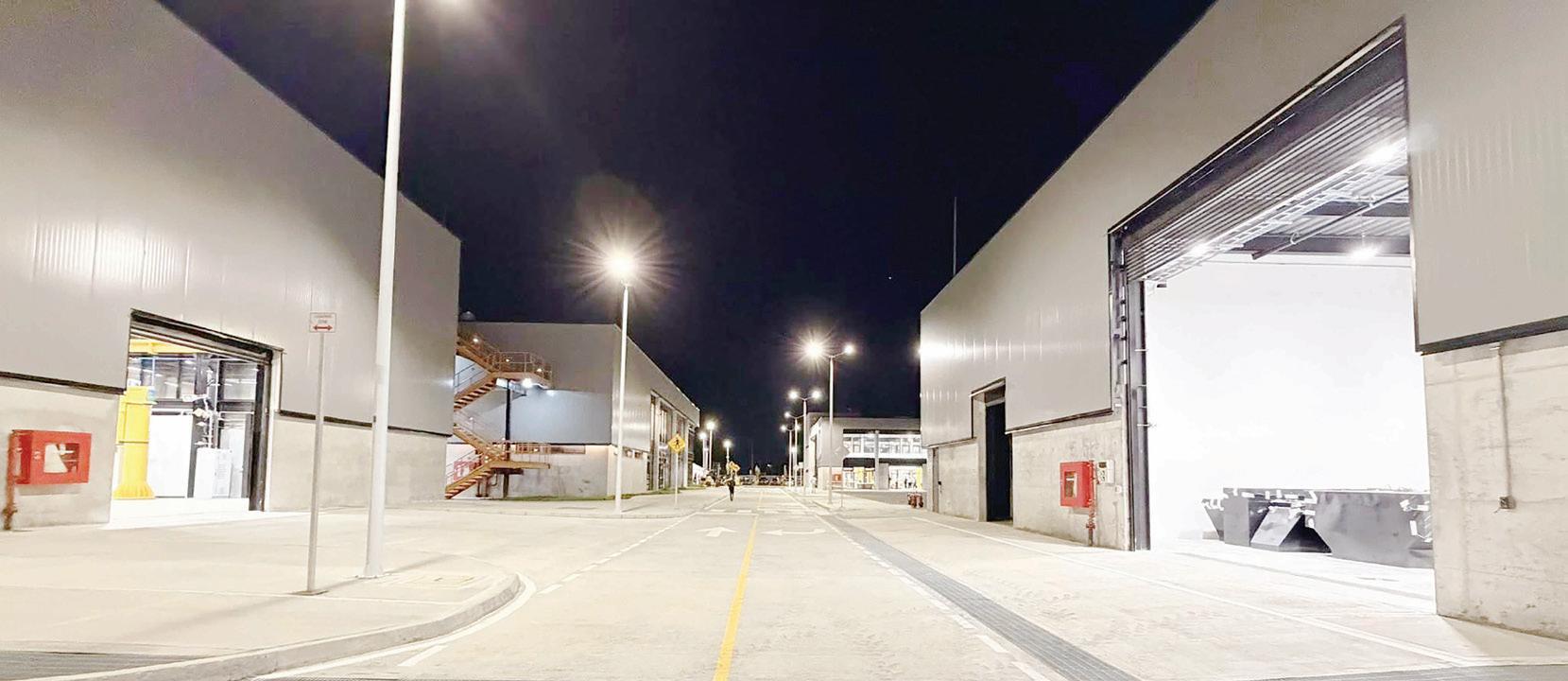
Machinery Corporation of Guyana (MACORP) officially opened its new US$35 million integrated industrial facility on Thursday at Covent Garden, East Bank Demerara.
While speaking at the launch event, President and General Manager of MACORP Guyana, German Consuegra, highlighted the swift progress achieved in completing the facility within a three-year timeframe.
“What has happened over these last three years is the execution of a long-term vision that truly began in 1993. This facility is another step in that journey. It represents our conviction that Guyana’s present and future deserve world-class industrial infrastructure, world-class technical capabilities, and long-term partners willing to invest alongside the country’s development. It also reflects a country evolving at extraordinary speed and cre-
that the facility includes a learning centre equipped with a wide range of equipment designed to support the construction sector and provide technical training opportunities.
“This learning centre includes equipment simulators, classrooms dedicated to hydraulics, electrical and electronic components, self-assisted learning classrooms, and certified instructors accredited to international standards. But when building this facility, perhaps the most important component was the human element. We had over 1400 people partici-

ating the conditions for longterm investment of this scale and ambition.”
He outlined the scale of the project and highlighted the extensive infrastructure developed within the complex.
“This new integrated industrial complex spans more than 450,000 square feet across seven specialised buildings connected to an extensive heavy-duty infrastructure specifically de-
signed to support the industries we serve every day,” he said.
He noted that the development required significant engineering, coordination and commitment, stating that more than 10,500 cubic yards of concrete were installed, over 550 tonnes of structural steel were erected, and 40 kilometres of electrical cables were deployed throughout the site.
Consuegra also noted


panies, which demonstrated exceptional professionalism, resilience, and execution capability. According to him, these achievements are worthy of recognition and celebration.
Additionally, he emphasised that nearly hundreds of work hours were completed safely without a single loss or injury, describing it as one of the project’s most significant accomplishments.
Meanwhile, Public Works Minister Juan Edghill, in delivering the feature address at the opening ceremony,
and specialised technical support.”
“In many ways, facilities such as this one are part of the backbone of national development because modern economies cannot function without reliable equipment and technical support services. But while the machinery is important, machines alone cannot build a nation.”
Edghill encouraged other companies to follow MACORP’s example in providing training opportunities for persons in the operation of heavy equipment.
pating throughout the execution of the project, representing multiple nationalities, trades, and specialities.”
He also highlighted the tremendous contribution of Vietnamese talent and companies throughout the project, noting that contractors, suppliers, technicians, operators, and professionals all played a direct role in making the mission a reality.
He further pointed out that several of the participating businesses were small and medium-sized enterprises, including women-led com-
However, Daljit pleaded not guilty to the charge of operating an uncertified motor vehicle. He was granted $20,000 bail, and the matter was adjourned to June 29 for trial. Total fines imposed amounted to $195,500.
Meanwhile, at the Anna Regina Magistrate’s Court on May 21, 52-yearold carpenter Sasenarine Chandrika of Windsor Castle, Essequibo Coast, pleaded guilty to driving while his breath alcohol level exceeded the prescribed limit. The offence occurred on May 13 at Henrietta Public Road. Chandrika was fined $200,000 – or six
underscored the critical role that robust infrastructure and technical support play in sustaining the nation’s upward trajectory.
“Facilities such as this one are part of that transformation. They help strengthen the support systems that modern industries depend on. They help improve efficiency, expand technical capacity, and reinforce Guyana’s reputation as a country that is open to investment, innovation, and progress. All of this progress requires machinery, generators, heavy-duty equipment,
months’ imprisonment in default. In a separate matter, 49-year-old construction worker Godwin Shepherd of Danielstown, Essequibo Coast, also pleaded guilty to driving while his breath alcohol level exceeded the prescribed limit. The offence occurred on May 13 at Windsor Castle Public Road.
Shepherd was fined $200,000 or six months’ imprisonment in default.
Teacher Andrea Pryce, 26, of Charity Back Street, Essequibo Coast, appeared before the Anna Regina Magistrate’s Court on May 20 charged with refusing to provide a breath specimen for a
“This is why I encourage companies within the engineering, industrial, and heavy equipment sectors to support scholarships, technical training, and partnerships with educational institutions. That is why I would like to see more companies, especially those involved in the supply and servicing of heavy-duty machinery, invest in the teaching and development of Guyanese talent. Corporate Guyana must recognise that investment in people is just as important as investment in buildings and equipment.”
breath alcohol test. The alleged offence occurred on May 17 at Richmond Public Road. Pryce pleaded not guilty and was granted $200,000 bail. The matter was adjourned to September 9 for trial. Farmer Leon Daymeion De Silva, 48, of the Essequibo Coast, was also charged with driving while his breath alcohol level exceeded the prescribed limit following an incident on May 21 at Cotton Field Public Road. De Silva pleaded not guilty when he appeared before Magistrate Mohabir on May 21. He was granted $200,000 bail, and the matter was adjourned to October 1 for trial.

President Dr Irfaan Ali took a short break from his afternoon schedule on Thursday to share smiles and laughter with pupils and teachers visiting State House. Students from Strath Campbell Primary School in Mahaicony and Victoria Lily Primary School in Tuschen enjoyed the special tour, posing for photos and sharing a light-hearted moment with the President, Cabinet members and other officials (Office of the President photos)



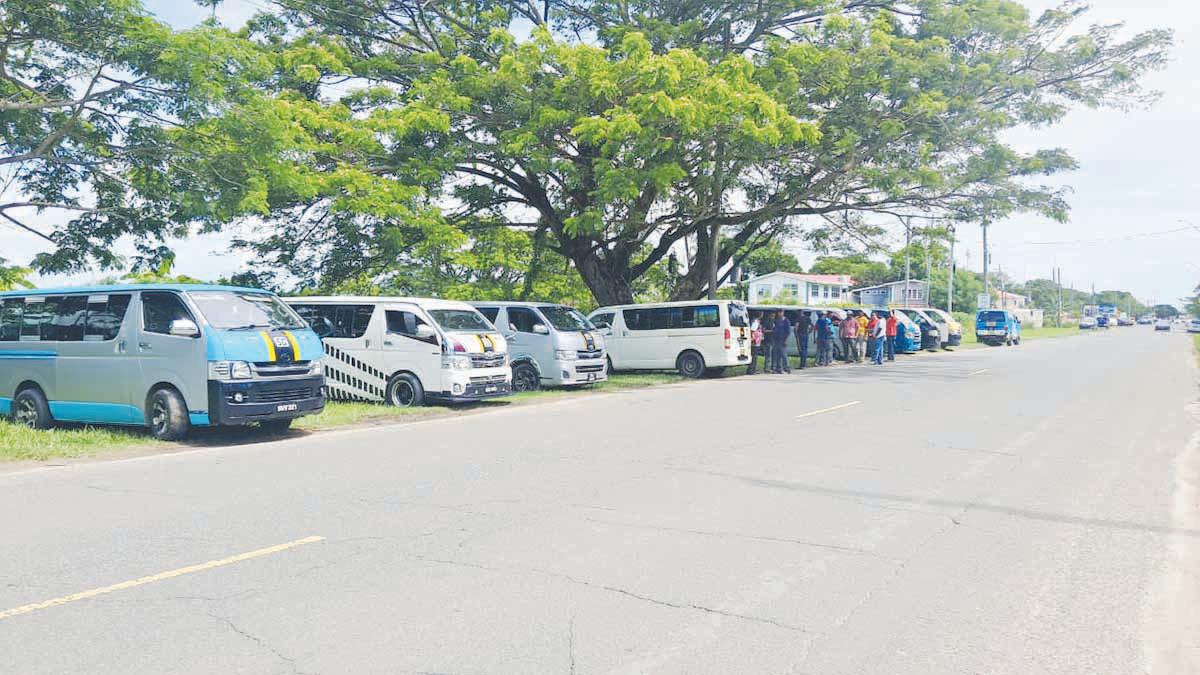
Commuters, including schoolchildren and workers attempting to return home on Wednesday, were left stranded along sections of the West Coast Berbice (WCB) corridor after minibus operators withdrew their service in protest over transportation fares they say have remained largely unchanged for more than three decades.
The strike action came days after Public Works Minister, Juan Edghill warned that the Government has not approved any increase in public transportation fares and that operators forcing commuters to pay higher rates could face penalties. President Dr Irfaan Ali on Tuesday last urged transport operators and other Private Sector stakeholders benefiting from Government fuel subsidies to “be fair to the public”, arguing that many have not passed on the savings to consumers despite billions of dollars in tax relief and subsidies aimed at cushioning the impact of rising global fuel prices.
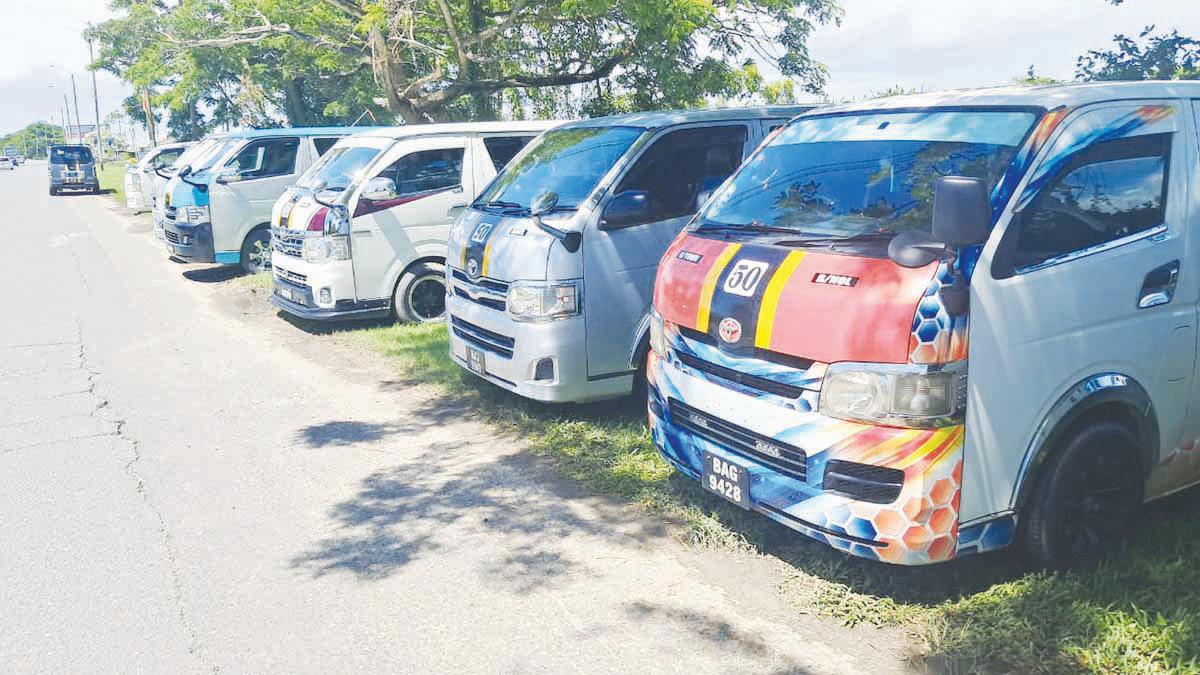
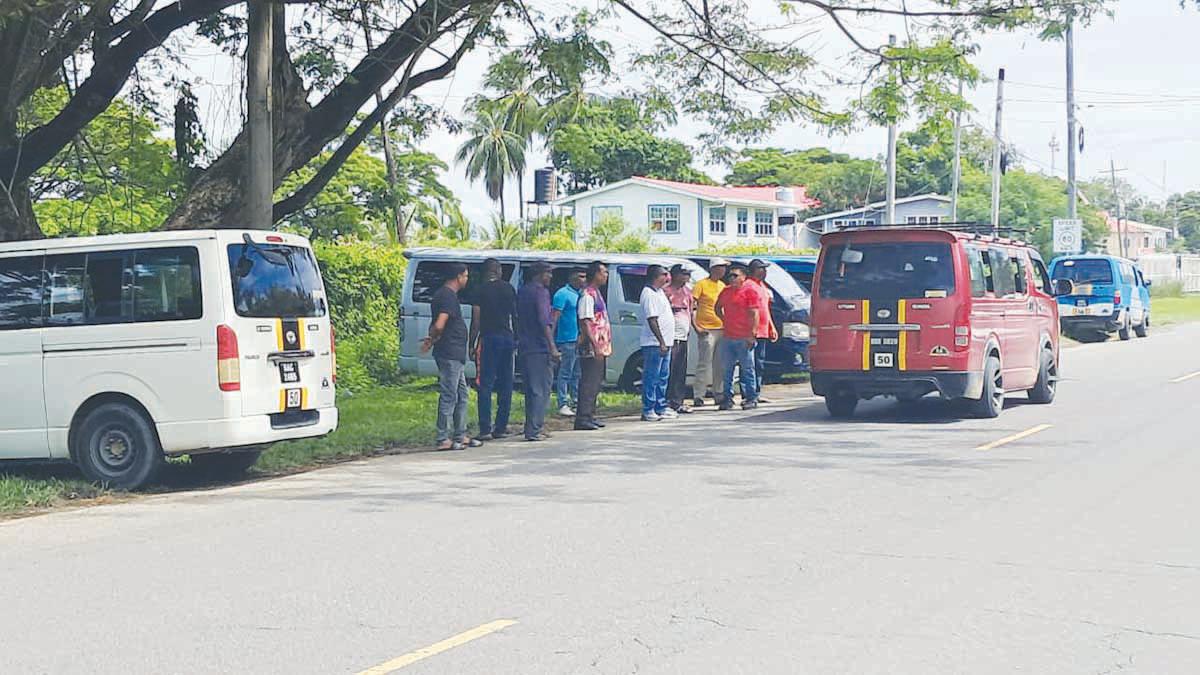
However, operators along the Route 50 corridor said that enforcement warnings prompted many drivers to remove fare notices from their minibuses and park their vehicles in protest. Drivers operating the Rosignol to Onverwagt and Bush Lot routes had been seeking an increase from the current $100 fare to $200, while operators travelling the shorter Rosignol to Belladrum and Shieldstown route were seeking to move fares from
$160 to $300.
However, the proposed increases sparked objections from commuters, some of whom argued that the hikes were too steep and would place additional pressure on persons already struggling with the rising cost of living.
Operators, however, argued that the existing fare structure is no longer financially viable given the distances being travelled and the rising cost of operations.
The Rosignol to Belladrum journey covers approximately 32 kilometres (km), while the Rosignol to Onverwagt and Bush Lot routes stretch close to 50 km. Sixty-fiveyear-old minibus operator Inderlall Deolall, who said he has been in the transportation business for nearly four decades, recalled that fares were last adjusted in the early 1990s.
“In 1993 it was $100, and it never raise back,” Deolall said. He explained that fuel prices, tyres, spare parts and general maintenance costs have increased significantly over the years.
“The gas gone up. The cost of living gone up. Everything gone up,” he said, adding that “before, tyre was $4000. Now it is $11,000 and $12,000.”
Another operator, Wilton Reece, said the current fare structure places tremendous strain on drivers trying to earn a living.
“$100 from Rosignol all the way to Bush Lot become very, very stressful,” he said. Reece explained that
beyond fuel prices, operators also face maintenance expenses and rising household costs. “Maintenance is very, very costly,” he stated while noting that drivers also have children to send to school and families to maintain.
“Everybody getting a little raise. We remain the same for many years,” he added. Meanwhile, Seepersaud Raymond, who said he has spent more than 35 years in the transportation sector, noted that operators initially increased fares but later backed down amid complaints and fears following warnings.
He argued that operators using foreign-used vehicles are constantly faced with costly repairs and maintenance. Raymond also pointed to fluctuating fuel prices.
Maxed out direct fuel subsidies
Last week, President Ali called on the Private Sector to share the burden of rising fuel prices, as the Government has maxed out direct fuel subsidies, and assured that exploring plans for ports and a refinery here continue as key to this country’s long-term energy stability amid global disruptions. “We were able to take excise tax to zero. What that did is that it gives us now no room to adjust the excise tax. And now that the price has increased at the national market, we are asking those, all the stakeholders who would have benefited from the zero per cent excise tax, to be nationalistic in their approach,” Ali had
said in an address on his Facebook platform.
Although Guyana is a significant crude oil producer, he reminded us that it lacks refining capacity. As a result, all refined products are imported at world market prices. To cushion citizens, the Government removed excise taxes on fuel imports, a measure that has cost
ket, given the operators benefited significantly from fuel subsidies.
“In practical terms, when we took off the zero per cent, when we took excise tax to zero per cent, that translated to approximately $500 savings for citizens on every gallon of diesel or gasoline purchase. It was a $500 saving, providing substan-
all stakeholders within this framework now have to play their role. Because this is something that is affecting us at the national level,” he added.
No approval given The Government has reaffirmed that no fare increases have been approved for any form of public transportation, includ-
the treasury more than $100 billion Guyanese dollars annually. The Government has also directly subsidised diesel and gasoline since March of this year, further reducing profit margins to stabilise the market.
With private-sector transportation, especially by minibus operators, increasing by over 100 per cent recently, the Government’s balancing act between fiscal responsibility and consumer protection, Ali reasoned, underscored the urgent need for shared sacrifice in a volatile global energy mar-
tial relief to households, businesses, and the wider economy. For minibuses operating in Georgetown and consuming an average of, let us say, more than 12 gallons of fuel per day, which is 50 litres, the policy delivers savings of about $6000 per day, directly improving, of course, profitability and helping to keep fares affordable,” he said.
“Now that we have this challenge and we have fully utilised that tool, this tool that was available to us, I think the minibus operators, the taxi and speedboat operators, and of course, truckers, and
ing minibuses, taxis, hire cars, speedboats and airport services. Public Works Minister Juan Edghill on Tuesday last restated that existing fares remain in effect and warned that passengers must not be subjected to any unauthorised price hikes. Government officials emphasised that transport operators have no authority to impose increased fares and that passengers who are forced to pay higher rates or face harassment are encouraged to report such incidents to the Public Utilities Commission for investigation and action.

Management of quarry company EKAA HRIM Earth Resources has committed to paying outstanding salaries and wages to its aggrieved workers by next Wednesday, May 27, as investigations continue into allegations of labour and occupational safety and health violations and suspected trafficking of Indian nationals, who work at the quarry’s operation in Batavia, Region Seven (Cuyuni-Mazaruni).
The decision was announced following a multi-agency meeting on Friday between the quarry company, the Labour and Manpower Planning Ministry and a number of other agencies, including the
Indian High Commission.
“An inter-agency meeting comprising officials from the Ministries of Legal Affairs and Home Affairs as well as Human Services, led by the Ministry of Labour & Manpower Planning, assembled at the Ministry and met with the workers and representatives of the company. The acting Indian High Commissioner was also present and engaged in this process,” the statement noted.
According to a statement from the Ministry, during Friday’s meeting both the aggrieved workers and the company raised other matters “for which they have undertaken to supply additional supporting documen-
tation in the new week”.
“In this regard, the Ministry emphasises that the process remains ongoing and continues to be guided by the principles of due process and compliance with the laws of Guyana,” the statement said.
The workers’ situation has been under investigation since earlier this week when some 38 Indian nationals working at the company made several damning allegations against the company, including unsafe health and safety working conditions, workplace injuries, allegations concerning the reported death of a worker on May 12, allegations of workers being prevented from leaving the worksite, unjus-

The Trump administration said Friday that people with temporary visas seeking to adjust their immigration status to obtain green cards must return to their home countries to “do so through consular processing,” in a major change from current practice.
“From now on, an alien who is in the U.S. temporarily and wants a Green Card must return to their home country to apply, except in extraordinary circumstances,” U.S. Citizenship and Immigration Services spokesperson Zach Kahler said in a statement. “When aliens apply from their home country, it reduces the need to find and remove those who decide to slip into the shadows and remain in the U.S. illegally after being denied residency.”
The statement said that those who come to America on non-immigrant visas, including students, temporary workers and tourists, are expected to be in the United States for a short time and for a specific purpose.
“Our system is designed for them to leave when
their visit is over. Their visit should not function as the first step in the Green Card process,” Kahler said.
“Following the law allows the majority of these cases to be handled by the State Department at U.S. consular offices abroad and frees up limited USCIS resources to focus on processing other cases that fall under its purview, including visas for victims of violent crime and human trafficking, naturalization applications, and other priorities,” he said in the statement.
He said this process would “make our system fairer and more efficient.”
Former USCIS official Doug Rand said that in a typical year, 1 million people apply for green cards and half of those apply from within the U.S. to change their status while they are living here.
“The purpose of this policy is exclusion,” Rand said in a statement. “Remember that Trump has banned people from over 100 countries from returning to the U.S., so forcing them to go abroad for consular processing is no pathway at all.”
The move is the latest by

tified salary deductions and that their passports and other property were being withheld by the company’s management.
Additionally, according to reports, the workers’ employment contracts included a number of questionable clauses which required the workers to pay thousands of US dollars to the company if they chose to leave.
The company has denied all wrongdoing. Following the intervention of the Minister Keoma Griffith, the passports were returned
to the workers.
The Indian nationals were reportedly employed by Ekaa Hrim Earth Resources for the past three years. Statements have been obtained from all of the victims, and officials at the Indian High Commission in Georgetown were engaged.
Trafficking in Persons (TIP) in Guyana is governed by the Combating of Trafficking in Persons Act. It states that “any person who, for the purpose of trafficking in persons and acting or purporting to act as
another person’s employer, manager, supervisor, contractor, employment agent, or solicitor of clients such as a pimp, knowingly procures, destroys, conceals, removes, confiscates, or possesses any travel document or other Government identification document, whether actual or purported, belonging to another person commits an offence and is liable on summary conviction to a fine of one million dollars together with imprisonment for five years.
the Trump administration targeting legal immigration in the country.
World Relief, a Christian humanitarian organization, said in a statement that the policy was “cruel” and “anti-family.”
The group said the change largely halts “the longstanding practice of allowing non-citizens who entered the United States lawfully and now qualify under U.S. law for Lawful Permanent Resident status to ‘adjust status’ within the United States.”
Myal Greene, the president and CEO of the organization, said the policy would have immediate consequences for families.
“This policy, impacting individuals who meet the legal requirements for a green card, will force apart husbands from wives and children from their parents,” Greene said in the statement. “There’s simply no compelling reason for this cruel, anti-family policy change, and I hope and pray it will be reversed, whether by administrative reconsideration, congressional action or the courts.”
(NBC News)

“We are now working aggressively to have this project completed”
…as 72% completion marks phase 2 expansion
resident Dr Irfaan
PAli has affirmed that the Government is intensifying efforts to complete the Gas-to-Energy (GtE) Project, even as it has exceeded its original completion timeline. Speaking at a press conference on Friday, the Head of State noted that the administration is not satisfied with the delays but is moving swiftly to bring the project to completion. “We are now working aggressively to have this project completed. I can say we are; I can’t say that we’re happy that the project has gone beyond timeline. We wanted this project to be completed as quickly as possible but that is the reality that is before us. They had various challenges. We are not happy and we said that before but we have to now take this project to the end. That is a priority. The priority is finishing this project in the interest of Guyana and the Guyanese people,” he said. Shifting gears, the President then revealed that the Government has already moved towards the second
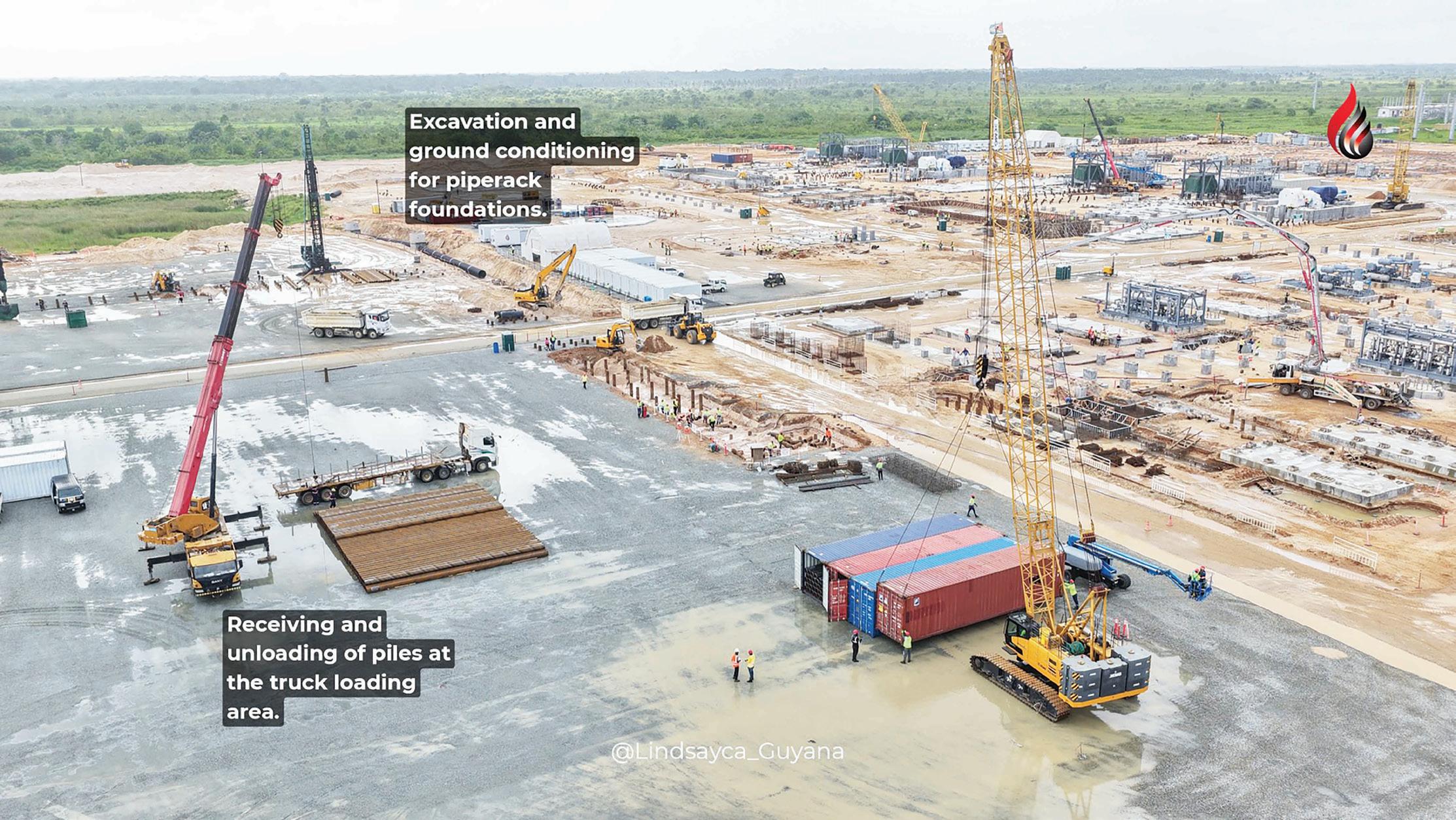
phase of the GtE initiative – GtE2. Phase Two of the Wales development is expected to feature an additional 250 to 300 megawatt (MW) combined-cycle power plant to support the country’s growing manufacturing and commercial
demand. “We are already in the process of GtE2 because, you know, we are already projecting that the power that will be needed from what is happening in the economy will definitely consume all of GtE1 in its initial phase. So we are

already on that, the GtE2 Project. The natural gas liquids component is important for the building out of the Wales Development Zone, of course the Wales Development Zone and the type of industries that will go there.”
Wales Development Zone
In fact, the Government is already focusing on ammonia production and several other major facilities to support the vision for the Wales Development Zone. “Already we know we are looking at an ammonia and urea plant, a gas bottling and logistics facility, a glass factory, a data centre, NGL storage and LNG facilities.”
Guyana’s US$759 million Wales GtE Project, which is expected to slash electricity costs by 50 per cent, is currently 72 per cent complete, with several major components still scheduled to be added as the project moves toward completion.
This was revealed by Public Utilities and Aviation Minister Deodat Indar during an episode of the Starting Point Podcast hosted on Thursday evening. Guyana’s landmark GtE Project is a transformative national infrastructure initiative designed to transport natural gas from the offshore Stabroek Block to an integrated facility at Wales, West Bank Demerara (WBD).
Scheduled for completion by the end of 2026, the project aims to deliver a reliable 300 MW power supply and significantly reduce domestic electricity costs.
Substantial portion
According to the Minister, a substantial portion of the project has already been completed as the Government continues to push ahead with implementation. “So the power plant, the last update that I have — and I get updates very often on a weekly basis through reports — is that it is about 72 per cent complete. A lot of the procurement has been completed, including the construction of equipment for the wastewater treatment plant, the tanks, fuel tanks, water treatment plant and the natural gas liquefaction plant. We have the transformers on site and we also have all of the turbines in the country,” he said. He further added that a major milestone is expected by the end of the year when the facility begins generating its first power.
“Some of the turbines are already on site as well. What we have now are some component parts that are on their way to Guyana. We were assured by the contractor at a recent engagement that by the end of the year, we should have first power coming from the plant. “The plant is
structured to use gas as a feedstock, and we already have the pipeline from offshore terminated at Wales. Exxon put that pipeline there, so it is already in place,” he explained. Meanwhile, he highlighted that all of the related infrastructure are already in place and prepared for dispatch to the end user. He explained that once the natural gas facility becomes operational and the power plant is fully connected with the necessary electrical systems in place, the plant will begin generating power using natural gas as its feedstock. He further noted that the project’s first phase is expected to generate 228 MW of electricity through four gas turbines operating in a simple-cycle configuration. Additionally, the facility will include two steam turbines operating in a combined-cycle system, where the steam turbines work in conjunction with the gas turbines to improve efficiency and overall power generation. Providing proof, he asserted that aerial views can back his statements.
“If you fly over Guyana during the day, you will see all of these major metal structures rising from the ground. They are very high, but those are the transmission structures needed to move the bulk power. Then you have to dispatch that power,” he said. The Government is also moving toward constructing a new control centre aimed at supervising and monitoring the national power grid.
Last Thursday, the Government said the 300 MW Wales GtE Project — the country’s largest infrastructure initiative — continues to advance, with construction works progressing and key contractual issues resolved.
In a statement issued by the Office of the Prime Minister (OPM), PM Mark Phillips said the contractor has made significant progress in recent months and remains committed to delivering first power to the national grid by the end of 2026. He described the project as a major step in Guyana’s energy transition and said the Government remains satisfied with the pace of implementation.

As Guyana continues to strengthen its healthcare system, accurate measurements remain essential for reliable laboratory results. The Guyana National Bureau of Standards (GNBS) provides calibration services to laboratories, ensuring that their instruments are accurate.
The Georgetown Public Hospital Corporation (GPHC) Medical Laboratory is one of several laboratories in Guyana certified to the National Standard, GYS 170:2021 – General Requirements for the Operation of a Laboratory, which requires the calibration of their measuring instruments.
The GPHC Medical Laboratory offers several specialised services, including andrology, biochemistry, immunology, immunohaematology, haematology, microbiology and urology, all of which require strict quality controls and precise measurements to ensure accurate and reliable results for patients and healthcare providers.
Quality Manager of GPHC Medical Laboratory, Adeila Melville, stated that continued certification by GNBS reflects the laboratory’s unwavering commitment to delivering reliable and traceable results.
“Maintaining our certification to the GYS 170:2021 standard is an exceptional achievement which shows our laboratory’s commitment to quality results and improved healthcare to the people of Guyana,” Melville shared.
She disclosed that for more than 18 years, the GPHC Medical Laboratory has relied on GNBS calibration services to ensure
its equipment performs accurately and consistently. Among the equipment regularly calibrated by the GNBS are automated micropipettes, electronic balances and digital thermometers, which are calibrated every 6 months, annually and every two years.
In 2025 alone, the laboratory calibrated 34 automated pipettes, 12 digital thermometers, two electronic balances and one mechanical scale at the GNBS.
Melville explained that calibration plays a fundamental role in maintaining confidence in laboratory results, adding, “Regular calibration not only confirms the usability of a measuring device, but it also helps to determine whether that device is drifting out of tolerance or requires adjustment. Overall, it ensures that all your measurements are accurate and reliable.”
She further emphasised that calibration ensures that the readings of equipment in use are comparable to recognised standards, ensuring that results remain traceable to international measurements and consistent over time, regardless of the user operating the equipment.
Melville noted that the impact of calibrated equipment extends directly to patient care, explaining that the calibrated balances are used to weigh blood products before transfusions are administered. This process is especially critical for neonates, who require blood products in precise proportions based on body mass.
“Inaccurate results can cause harm, especially to neonates who require proportional amounts of blood products to body mass,”

Melville explained.
Calibrated balances are also essential for oral glucose tolerance tests used in diagnosing and managing diabetes, as well as for preparing microbiological culture media used to identify infections and determine appropriate antimicrobial therapy.
Micropipettes are used to measure blood samples and prepare quality control materials that verify analytical instruments are functioning correctly. Meanwhile, calibrated thermometers help ensure that laboratory reagents are stored at appropriate temperatures to prevent deterioration and inaccurate test results.
Melville highlighted that GNBS calibration services are not only important for daily laboratory operations but are also mandatory for maintaining certification under the GYS 170 Standard
and for international accreditation under the International Organisation for Standardisation (ISO) 15189 Standard for medical laboratories.
Like calibration, the verification of measuring instruments by the GNBS extends beyond measuring equipment used in the GPHC laboratory. Melville underscored the significance of verifying scales used to weigh patients in the healthcare facility.
“This verification process is very important to ensure that medication given to patients is accurate, since the weight of a patient is used to calculate dosage,” she said. “For neonates and paediatric patients, a verified scale means accurate measurement; an unverified scale can (adversely) impact the life of the patient.”
The GPHC Quality Manager also praised the GNBS for its sup-
port through training programmes, consultation and certification services over the years.
“The support received from the GNBS has propelled the laboratory to the forefront of public hospitals in Guyana,” she stated.
Melville said that GNBS can look to exploit additional opportunities to provide other calibration services within the health sector, particularly for humidity readers used in laboratories.
“I have been awaiting the calibration services of the humidity readers for a long time now, and I would be happy to see this service being offered by the GNBS,” she highlighted.
Melville encouraged laboratories and organisations to prioritise calibration, verification and conformance to standards. She advised that laboratories should not hesitate to contact the GNBS.
“Ensure that your devices are calibrated and verified. Contact the GNBS Legal and Industrial Metrology Departments and speak with a staff member; they are eager to help support your journey,” she advised.
With more medical and testing laboratories across Guyana continuing to implement national and international standards, the GNBS anticipates the increased demand for its metrology services. In response, the Bureau will continue to deliver these services to ensure patients and healthcare providers benefit from reliable and quality diagnostic services across the health sector.
For further information, contact GNBS on telephone numbers 219-006466 or WhatsApp 692-4627 or visit the GNBS website www.gnbsgy.org. (Feature written and submitted by GNBS)
Belladrum and several surrounding West Coast Berbice (WCB) communities are expected to benefit from a new recreational park under the First Lady’s national beautification and community enhancement initiative. The announcement was made on Thursday by Chairman of Region Five (Mahaica-Berbice) Ricardo Phillips during the region’s statutory meeting, where discussions centred on community development, infrastructure and public services. According to Phillips, the proposed recreational facility will serve residents of Belladrum, El Dorado, Profit and nearby villages, while promoting greater social interaction and recreation for families and children. “The First Lady will also be con-
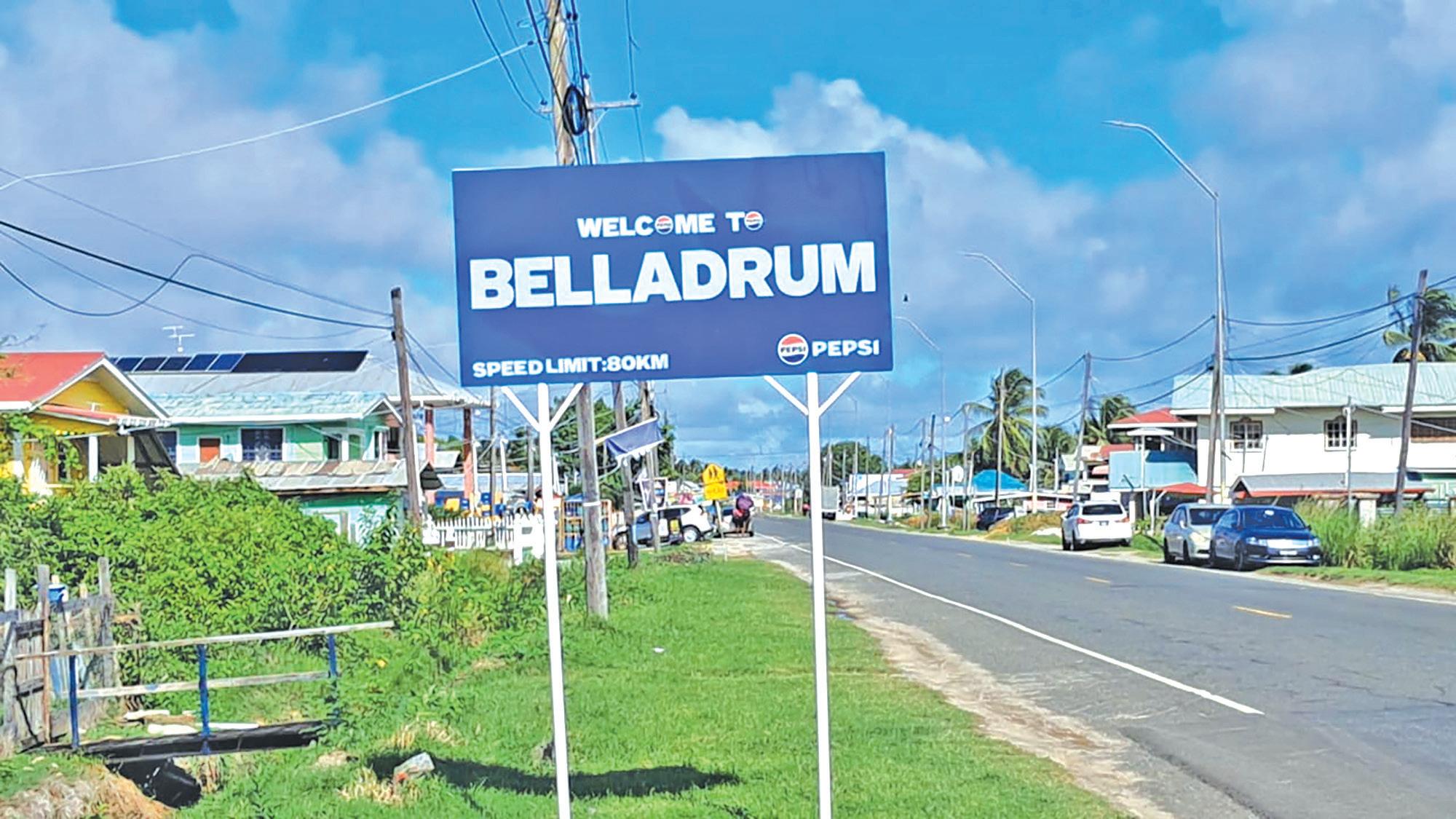
structing one at Belladrum and surrounding communities, which will benefit Belladrum, Profit, El Dorado and all of these surrounding communities benefit from this,” Phillips told
the meeting.
He explained that the parks are intended to serve multiple communities rather than individual villages and pointed to recently commissioned facilities in
other parts of the region. Phillips noted that a recently opened recreational park at Bush Lot serves residents from Hopetown, Lovely Lass, Armadale, Number 28 and surround-
ing communities. He also referenced the recreational park at Bath, which he said attracts visitors from across the region. “These parks are not for one village. It’s for everyone,” the chairman stated.
During the discussions, Regional Councillor Emerson Benjamin raised concerns that more communities across the region should benefit from similar initiatives. He suggested that the land in front of the Hugo Chavez Centre could also be transformed into a recreational facility capable of serving several nearby villages.
Benjamin also called for the area opposite the Fort Wellington Hospital to be cleaned and properly maintained, noting that overgrown vegetation and accumulated waste had be-
come an eyesore despite recent cleanup efforts across the region. Responding, Phillips said the recreational park initiative reflects Government’s wider “One Guyana” vision of promoting cohesion and community development.
“I would like to thank Her Excellency again for bringing these initiatives to Region Five. They are meaningful, and the people of Region Five are thankful for these initiatives,” he said. Several modern recreational parks have been opened across the country in recent months under First Lady Arya Ali’s National Beautification Project. The initiative focuses on transforming public spaces through environmental enhancement, recreational development and community engagement.
Thousands of Cubans gathered on Friday before the US embassy in Havana to protest a US decision to indict former President Raúl Castro over the downing of two civilian aeroplanes 30 years ago.
The pro-Government demonstration, which began shortly after sunrise on Havana’s waterfront, came as Cuban officials rallied this week around the island’s revolutionary hero.
The 94-year-old elder statesman was not present.
Cuban lawmaker Gerardo Hernandez, a national hero and former spy, conveyed a message thanking the Cuban people and friends around the world for their solidarity.
“As long as I live, I will remain at the forefront of the revolution, with one foot in the stirrup,” Hernandez quoted Castro as saying.
Thousands of Cubans waved flags during the nearly hour-long rally, chant-

ing “Viva Raul!” and “Patria o Muerte (Homeland or Death)!”.
President Miguel DiazCanel and Prime Minister Manuel Marrero attended the rally, as did several of Castro’s family, including daughter Mariela Castro, son Alejandro Castro and grandson Raul Rodriguez Castro.
Rodriguez Castro, known in Cuba as “Raulito” (Little
Raul) or “El Cangrejo” (The Crab), often serves as his grandfather’s bodyguard and met last week with CIA Director John Ratcliffe during a rare visit by a US spy chief to Havana.
Mariela Castro, interviewed shortly after the protest, told Cuban state-run media that her father was doing fine. (Excerpt from Reuters)
Drones – some laden with explosives – regularly trace across the skies above Catatumbo, a region long marked by clashes between rival armed groups and the state.
The menacing mechanical whir sends Sandra Montoya’s young son running to the toilet to hide. It’s the only solid, concrete space in their small home of wooden planks.
“I always hear them before I see them, if I see them at all.” Montoya says, who used a pseudonym due to security fears.
Twenty-four-year-old mother and youth leader Joy St Omer was shot and killed while sitting in a vehicle in Marigot on Wednesday night. Since then, her estranged husband has turned himself in to authorities.
The incident has sparked widespread public outrage.
A petition calling for the reinstatement and active enforcement of capital punishment in Saint Lucia has gained thousands of signatures amid public outrage, less than 24 hours after her death.
Directed at the Prime Minister, Attorney General and members of Parliament, the online petition urges authorities to enforce the death penalty for capital murder and other heinous offences, arguing that escalating violent crime requires stronger legal consequences.
The petition argues that capital punishment is necessary as a deterrent against violent crime, particularly gang-related killings and other serious offences. The document also maintains
that enforcing capital punishment would provide justice and closure for grieving families, while helping to protect society by permanently removing dangerous offenders.
“We do not make this request lightly. We make it out of love for Saint Lucia and a desire to see our communities thrive in peace once again,” the petition states. “By signing this petition, we declare that enough is enough.” (Excerpt from St Lucia Times)
One of the Venezuelan men sent from the US to El Salvador’s most notorious prison by Donald Trump has moved to Spain to request asylum.
Andry José Hernández Romero left Venezuela for Spain in early February and is due for his first asylum hearing in court there.
cent increase over 2024, when 61 effective incidents were recorded.
The use of drones – or uncrewed aerial vehicles (UAVs) – has risen sharply in the last year as Colombia continues to contend with a decades-long internal conflict.
The country’s Ministry of Defence reported 8395 weaponised drone attacks in 2025, 333 of which were “effective” in striking their target.
This marks a 445 per
The noise always emerges from a small mountain behind her home near Tibu in Colombia’s Catatumbo region, part of a tree-quilted landscape stitched with winding rivers along Colombia’s border with Venezuela.
While Catatumbo, along the Venezuelan border, has been a hub for drone-related violence, it is not the only affected region in Colombia. Attacks have been reported in multiple areas.
Last month, three soldiers were killed following a drone attack by an armed group in Narino, in the southwest of the country.
Overall, according to the Defence Ministry, 20 persons were killed by drones in 2025 and 297 were injured.
(Excerpt from Al Jazeera)
At least 24 killed in two
AThe 33-year-old hairstylist and makeup artist originally came to the US from his home in western Venezuela to escape persecution as a gay man and the risks of opposing the Government of its then President, Nicolás Maduro.
Hernández gained global attention last year when he and 252 other Venezuelan migrants were abruptly deported from the US without due process or any word to their families and, in defiance of a judge, flown by the Trump administration to the brutal mega-prison for alleged terrorists in El Salvador known as Cecot.
International human rights groups found Hernández and the other detainees faced psychological

People stage a rally against the imprisonment of Venezuelans in a Salvadoran jail
and physical abuse, including cases of sexual violence, before they were suddenly released in a prisoner swap last summer and returned home.
However, after a few weeks he began fearing for his life once more after a knock on his family’s door in Táchira.
“I had received a call from the vice-President’s office, and I was offered a job, which I declined, and then they came to my house, and my family had to tell them I wasn’t there,” Hernández said. He had actually hidden during the visit. He
didn’t want to have ties to a Government that had persecuted him as a gay man, he said.
“That’s when I made the decision to come to Spain.” Spain has a strong record of taking in immigrants, especially Venezuelans seeking international protection, like Hernández.
Speaking in a video call from southern Spain, Hernández is still recovering from the trauma of his experiences in Venezuela, the US and El Salvador but expressed optimism about his new surroundings.
t least 24 people have been killed, including four police officers, in two separate violent incidents in Honduras on Thursday.
The first attack reportedly took place at a ranch in Trujillo, where at least 19 workers were shot and killed, authorities said.
A second shooting occurred in the coastal town of Omoa near the border of Guatemala, where at least four police officers were killed, National Police spokesperson Edgardo Barahona has said. One civilian was also reported to have been killed in the second attack.
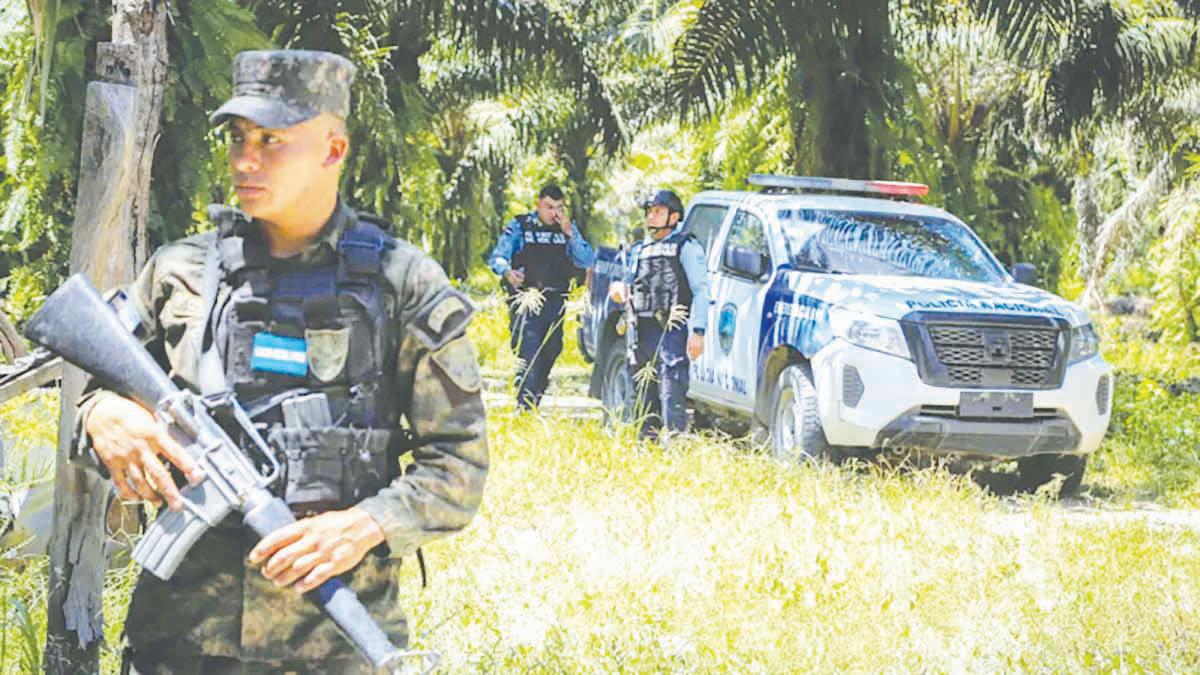
JFollowing the two attacks, the National Police issued a statement that said it will respond with “direct intervention” in both of the areas. No motive has been identified for the attack on workers at the ranch in Trujillo. However, northern Honduras has been the site of ongoing agrarian conflict for years.
an anti-gang mission, police have said.
CI Antigua, on behalf of JCI West Indies, proudly hosted the 2026 JCI Conference of the Americas from 13 to 16 May 2026, welcoming approximately 338 delegates from 40 countries to the shores of Antigua and Barbuda for one of the region’s premier leadership and development conferences.
al event.
The officers who were attacked while travelling to Omoa from the capital, Tegucigalpa, were part of
The total death toll in the Trujillo ranch attack remains unclear because relatives of the victims had begun collecting the bodies of their loved ones, Barahona said, according to the Associated Press.
(Excerpt from BBC News)
This year’s conference was especially historic, as it marked only the third occasion that the Conference of the Americas has been hosted within the West Indies, the last being in 1987, and represented the very first time that Antigua and Barbuda served as host nation for the region-
Delegates participated in an extensive programme of activities, including leadership and development training sessions, public speaking and debate competitions, networking engagements, cultural showcases, and the JCI General Assembly, where critical discussions and decisions regarding the future of the organisation and the region were undertaken.
The successful hosting of the conference followed a competitive international bidding process which began three years ago. JCI Antigua, supported by JCI West Indies, successfully secured the rights to host
the conference after presenting a compelling vision for Antigua and Barbuda as an ideal destination for regional engagement, leadership development, and Caribbean hospitality.
JCI Antigua reaffirmed its commitment to leadership development, active citizenship, and regional collaboration and expressed appreciation to all delegates, sponsors, partners, volunteers, participating countries, and supporters for contributing to the success and historic significance of the 2026 Conference of the Americas in Antigua and Barbuda. (Excerpt from Antigua Newsroom)


Oil prices climbed on Friday, as investors worried that the US and Iran would be unable to reach a peace agreement that would allow shipping traffic to return to normal in the Strait of Hormuz.
Brent crude futures settled at US$103.54 a barrel, up 96 cents, or 0.94 per cent. US West Texas Intermediate futures finished at US$96.60 a barrel, up 25 cents or 0.26 per cent. Both had risen over three per cent earlier in the session.
On a weekly basis, Brent was 5.48 per cent lower and WTI was down by 8.37 per cent, with prices volatile as expectations for a peace deal between Iran and the US shifted.
“We have so many headlines back and forth, it’s hard to keep up,” said Phil Flynn, senior analyst with Price Futures Group. “The story now is Iran will deliver the uranium for the lifting of sanctions. But they keep changing the news before the ink is dry on the newspaper.”
A diplomatic source in Islamabad told Iran’s state news agency IRNA that Pakistan’s army chief had left for Iran. A senior Iranian source told Reuters earlier that gaps with the US have narrowed, and US Secretary of State Marco Rubio spoke of “some good signs” in talks. (Excerpt from Reuters)

Organisers of a Gazabound aid flotilla say freed foreign activists who were abducted from international waters faced abuse while in Israeli detention, including at least 15 reporting incidents of sexual assault or rape.
The Global Sumud Flotilla organisers added in a statement on Telegram on Friday that several activists were hospitalised with injuries, a day after hundreds were deported from Israel.
Germany said some of its nationals who were on board the flotilla had been injured and that some accusations were “serious”, without giving further details. A legal source in Italy said prosecutors there were investigating possible crimes, including kidnapping and sexual assault.
“We’re very concerned by these reports,” United Nations spokesperson Stephane Dujarric said when asked about the allegations at a regular brie-
The Trump Administration was preparing Friday for a fresh round of military strikes against Iran, according to sources with direct knowledge of the planning, even as diplomacy continued.
No final decision on strikes had been reached as of Friday afternoon.
”Circumstances pertaining to Government” are keeping President Trump from attending his son Donald Trump Jr’s wedding this wee-
kend, he said in a social media post. The President had planned to spend Memorial Day weekend at his golf property in New Jersey but will now return to the White House.
Some members of the US military and intelligence community cancelled their plans for the Memorial Day weekend in anticipation of possible strikes, several sources said.
Defence and intelligence officials began updating recall rosters for US installa-
tions overseas as tranches of troops stationed in the Middle East rotate out of the theatre, part of an effort to reduce the American military footprint in the region amid concern about possible Iranian retaliation.
The US and Iran have largely refrained from striking each other since a temporary ceasefire began in early April, buying time for indirect talks on a longer-term deal.
White House spokesperson Anna Kelly told CBS News that Mr Trump has
”made his red lines abundantly clear: Iran can never possess a nuclear weapon, and they cannot keep their enriched uranium.”
In Washington, House Republicans on Thursday abandoned an effort to hold a vote limiting President Trump’s authority to conduct military operations against Iran after concluding they lacked the votes needed to stop the resolution from advancing. (Excerpt from CBS News)
The Ebola outbreak in the Democratic Republic of the Congo (DRC) poses a “very high” risk to the country, the World Health Organization (WHO) said on Friday, revising its threat assessment upwards.
The outbreak is spreading rapidly, WHO leaders said, with almost 750 suspected cases and 177 suspected deaths, up from 246 cases and 65 deaths when it was first reported a week earlier.
The situation is “deeply worrisome”, said Dr Tedros Adhanom Ghebreyesus, the WHO Director General.
On Thursday, tents and medical supplies outside a hospital in Rwampara, Ituri province, were set on fire

as medics tried to set up an Ebola treatment centre. A crowd was reportedly angry at not being allowed to retrieve the body of a local man who had died at the hospital. The bodies of Ebola pa-
tients must be buried according to strict infection control protocols to prevent further spread.
Tedros warned that “significant distrust of outside authorities among the local
population” was causing issues for the response to the outbreak.
“Building trust in the affected communities is critical to a successful response, and is one of our highest priorities,” Tedros said.
The WHO’s representative in the DRC, Dr Anne Ancia, said the incident in Rwampara would “significantly jeopardise” the response operation there.
The treatment centre that was attacked was designed to separate Ebola patients from others being treated in the same hospital. Ancia said she was hopeful that it would be able to be up and running again within 24 hours.
(Excerpt from The Guardian)
Ifing on Friday, pointing to the reports from activists as well as videos shared by an Israeli minister “which show the humiliating treatment of the people who were detained by the flotilla”.
Israeli forces abducted about 430 persons on board 50 ships in international waters on Tuesday to halt a flotilla of volunteers trying to bring aid supplies to the Gaza Strip.
On Wednesday, Israel’s far-right National Security Minister Itamar Ben-Gvir released a video showing him taunting the foreign activists at an Israeli landing craft, which had been converted into a makeshift prison with barbed wire and shipping containers in Israel’s city of Ashdod.
Dujarric said those still being held “need to be released and sent home”, adding that “people who were responsible for that treatment should be held to account”.
(Excerpt from Al Jazeera)
ran’s publication of a new map asserting its control over the Strait of Hormuz risks extending an already punishing ordeal for thousands of mariners trapped on ships in the Gulf.
More than 20,000 sailors are stuck on around 2000 vessels in the Gulf, many of them unable to leave ship, lacking adequate supplies of food and fresh water, and fearful of an uncertain future at sea in a warzone.
Sailors interviewed by Reuters in recent weeks have described the hardships and

anxieties of their experience, and a federation representing them warns of dire conditions.
”The only thing we do
here is plan how to spend the night and pray to God that we do not get hit during an attack,” Indian sailor Salman Siddiqui said by pho-
ne from his stranded ship last month.
When Reuters travelled on a resupply boat to vessels moored off the Saudi coast this week, sailors on a tanker gathered by the handrail to wave, a rare moment of contact with the outside world.
For nearly three months, the sailors trapped in the Gulf have led isolated lives, each with a small group of shipmates, moving between tiny living quarters, communal dining areas and scorching, sun-baked decks.
(Excerpt from Reuters)
Tulsi Gabbard will resign from her position as the US director of national intelligence in the Trump administration, citing her husband’s recent bone cancer diagnosis.
”His strength and love have sustained me through every challenge,” she wrote in her resignation letter on Friday. ”I cannot in good conscience ask him to face this fight alone while I continue in this demanding and time-consuming position.”
President Donald Trump said in a social media post that Gabbard ”has done an incredible job, and we will miss her”.
Her resignation is effective 30 June. Aaron Lukas, the principal deputy director, will step in as acting director, Trump said.
Gabbard, a loyal supporter of Trump during his 2024 Presidential campaign, was confirmed as one of the most powerful figures in US intelligence-gathering weeks af-
ter he returned to the White House in 2025. But this year, she has largely been out of public view even as the US took military action against Iran, put pressure on Cuba, and notably removed Venezuela’s President.
In her resignation letter, Gabbard said her husband, Abraham, ”faces major challenges in the coming weeks and months”.
Trump posted on social media that Gabbard ”rightfully” wants to be with him, bringing him back to good health as they currently fight a tough battle together. I have no doubt he will soon be better than ever.” (Excerpt from BBC News)
Gabbard is the fourth Cabinet member to depart the Trump administration after Lori Chavez-DeRemer left her position as labour secretary in April. Homeland Security Secretary Kristi Noem and Attorney General Pam Bondi both left the administration earlier this year.















Creative investments and accounting will help you get your finances in order. Be careful when dealing with home improvements or domestic issues that can easily go over budget. A tempting offer may not be as good as it sounds. Before you commit to additional financial responsibilities, consider the consequences. Educational pursuits are in your best interest.



Put uncertainty aside, do your part to get to the bottom of what’s happening around you or influencing your life. A take-control attitude will help ward off anyone who may want to take advantage of you. Social events that require physical energy will also promote camaraderie that will change how you feel about someone in your close circle.











Sit tight. Making an impulsive emotional move will fall short if you don’t go through the proper channels. Make sure you understand the instructions, have the right paperwork ready, and are physical up for whatever task you pursue. Choose your words carefully to ensure your voice impacts those you want to impress, influence, or join forces with.
Take better care of yourself. Refuse to let anyone take advantage of you. Pay attention to medical, financial, and legal matters. Choose to display your emotions and intentions with kindness and courtesy. Dealing with agencies, institutions, and red tape issues will test your patience and can cost you if you aren’t astute in how you handle matters.
Keep impatience and anger at arm’s length. Protect your image and do whatever is necessary to make a difference. Don’t mistake what others are asking for or willing to contribute. Compromise and working as a team player will have its downfalls and its benefits. A partnership that offers balance and equality will help you gain momentum.
Hang on, momentum is building along with uncertainty, making it necessary to take a second look at everything you encounter before you make a commitment. Emotions will be difficult to put aside when money and love surface. Don’t pay for someone else’s mistake or enter a joint venture with someone who doesn’t have as much to offer.
Let your creative mind wander. Drift back and forth between what’s real, what you want to unfold, and what you need to let go of. Having the vision and discipline to shape your future into something that excites you will play a role in the outcome. Recognize and protect yourself from those trying to outmaneuver you.
Take every opportunity to spread your vision. The interest you attract and the input you receive will help you stand out amongst your associates. A networking function will also offer social aspects that can enhance your love life. Someone who offers comfort and kindness will turn into one of your go-to people. Romance is in the stars.


Keep your emotions steady and your conversations specific to the changes you want to pursue. Take the initiative to stick to a budget and to inch your way forward at a rate and expense you can handle. Timing and budget will be the key to reaching your goal without worry. Strive for domestic comfort and peace.



Create opportunities instead of waiting for things to come to you. Verifying information will help you to avoid misinformation and scams. The more convenient your space is, the more you will achieve. Distance yourself from people using emotional manipulation to part you from. your cash. Make love, romance, and self and home improvement projects your focus.



Set yourself up for a day of comfort and joy with people you love to spend time with. Host an event or clear your space to make room for a hobby or physical activity you want to integrate into your daily routine. Be honest with yourself regarding personal goals and map out a plan that encourages your success.
Stick close to home. Travel and communication will lead to confusion or disappointment. Personal improvements to yourself or your living arrangements will pay off. An emotional decision will have a negative impact on how someone feels about you. Honesty is the best way to ensure you are treated fairly. Stick to facts, be open to suggestions.







Sunrisers Hyderabad (SRH) won, and yet it didn’t feel like a win. Royal Challengers Bengaluru (RCB) lost, but it didn’t feel like that either. In a nutshell, that’s how Friday night went in Hyderabad as RCB secured a top-two finish – they finished No. 1 –
Eliminator.
RCB secure top spot
despite a 55run defeat, while SRH remained third.
On the back of half-centuries from Abhishek Sharma, Heinrich Klaasen and Ishan Kishan, SRH posted a monster total of 255 but had to restrict RCB to 166 or below for a chance to move into the top two. Rajat Patidar’s 56, Venkatesh Iyer’s 44, and Krunal Pandya’s unbeaten 41 ensured there were no blushes for RCB even as they finished the league stage with a defeat.
That left the top three teams all on 18 points, with Gujarat Titans sandwiched between the two teams at No. 1 and No. 3. Eventually, it came down to net run rate to decide which team would go to Qualifier One and which team would play the
Going into the game, RCB wanted to win but also wanted to ensure they didn’t slip outside the top two should they lose.
After SRH pumped 255 for four in 20 overs, the equation became clear –RCB had to avoid losing by 90 or more runs.
The start given by their new opener, Venkatesh, calmed the nerves. He gave Pat Cummins a four-six jab in the first over and saved his best for the fourth over delivered by left-arm wrist-spinner Shivang Kumar. He punished Shivang for two sixes in one over, with a boundary sandwiched in between. Venkatesh fell for a 19-ball 44, but by then RCB had already scored 60 in 4.3 overs.
Even though Virat Kohli (15) failed to leave a mark in the game with the bat, a spunky 21 from No. 3 Devdutt Padikkal ensured RCB stayed on course for 166 even if the chase looked to get out of hand. Sakib Hussain, who delivered one for 31 in four overs, was a major reason why RCB could not push on.
aries off Eshan Malinga, Cummins and Harshal Patel but fell to part-timer Travis Head. Krunal stayed till the end with an unbeaten 41 in 31 balls as RCB finished on a commendable 200 for four by the end.
Abhishek hurts butterfingered RCB
Dropped in the sixth, seventh and eighth overs, Abhishek made full use of the chances RCB’s fielders offered him. On a flat surface with no grass, he did not let purple-cap holder Bhuvneshwar Kumar settle. His early boundaries over the off-side against Bhuvneshwar’s away-swingers moved into his takedown of Suyash Sharma’s googly and Romario Shepherd’s seam-up balls.
Abhishek was finally out in the ninth over, but by then his turbo-charged innings had SRH almost touching triple-digits.
Klaasen, Kishen reach new highs

yet
allowed SRH to pump 73 runs across overs 11 to 15.
while batting at No. 4 or lower in a T20 tournament.
Klaasen’s story was similar, starting off with only five runs in nine balls, but one that was unlocked with his takedown of Josh Hazlewood in the 13th over.
Patidar scored his fourth half-century of the season, staying in from the sixth over to the 19th. His 39-ball 56 included crisp bound-
Sunrisers Hyderabad (20 ovs maximum)
Abhishek Sharma c sub (JM Cox)
b Suyash Sharma 56
Travis Head b Rasikh Salam 26
Ishan Kishan † c Padikkal
b Rasikh Salam 79
Heinrich Klaasen c Iyer
b Pandya 51
Nitish Kumar Reddy not out 29
Extras (w 14) 14
Total 20 Ov (RR: 12.75) 255/4
Fall of wickets: 1-45 (Travis Head, 3.6 ov), 2-97 (Abhishek Sharma, 8.2 ov), 3-210 (Heinrich Klaasen, 16.2 ov), 4-255 (Ishan Kishan, 19.6 ov)
Bowling O-M-R-W
Bhuvneshwar Kumar 4-0-51-0
Josh Hazlewood 4-0-55-0
Rasikh Salam 4-0-52-2
Suyash Sharma 3-0-36-1
Romario Shepherd 3-0-37-0
Krunal Pandya 2-0-24-1

Kishan had three fifties against RCB in his last three outings, and on Friday, he made it four in a row with a 46-ball 79. While Abhishek was going, Kishan took his time to score nine off his first ten balls but then found his groove.
His best shot of the night was probably the legside slog towards the bigger boundary against Krunal in the 11th over, a sign that timing and form continued to be on his side. A sixth 50plus score for Kishan this season also made IPL 2026 his most prolific as a batter. His sweeps, cuts and pulls
Royal Challengers Bengaluru (T: 256 runs from 20 ovs)
Venkatesh Iyer c Abhishek Sharma
b Malinga 44
Virat Kohli c Smaran
b Sakib Hussain 15
Devdutt Padikkal c Abhishek Sharma
b Malinga 21
Rajat Patidar (c) c Smaran
b Head 56
Krunal Pandya not out 41
Tim David not out 15
Extras (lb 2, nb 1, w 5) 8
Total 20 Ov (RR: 10.00) 200/4
Fall of wickets: 1-60 (Venkatesh Iyer, 4.3 ov), 2-74 (Virat Kohli, 5.5 ov), 3-94 (Devdutt Padikkal, 8.5 ov), 4-178 (Rajat Patidar, 18.2 ov)
Bowling O-M-R-W
Pat Cummins 4-0-48-0
Eshan Malinga 4-0-33-2
Shivang Kumar 2-0-32-0
Sakib Hussain 4-0-31-1
Harshal Patel 4-0-37-0
Nitish Kumar Reddy 1-0-10-0
Travis Head 1-0-7-1
One six over cow corner and two more over long on made Hazlewood leak 27. His effortless loft of Bhuvneshwar over extra cover took him close to yet another landmark, and he brought up his sixth half-century of the season in the 16th over. He fell in the 17th over to a low-arm slinger from Krunal for 52, but not before becoming the first player to cross 600 runs
Nitish Kumar Reddy scored a blazing unbeaten 29 in 12 balls to give SRH a late push. He hit Krunal for two sixes in his first three balls in the crease and then deposited them for Hazlewood for another.
The late flourish took SRH past 250 while also leaving RCB’s senior seam-bowling pair of Bhuvneshwar and Hazlewood ducking for cover. Hazlewood conceded 55 on the night while Bhuvneshwar leaked 51. They both finished the evening wicketless.
(ESPNcricinfo)

Sharma

Young footballers at-
tached to the Police Force Youth Academy received words of encouragement and a quantity of football gear on Thursday ahead of their participation in the upcoming Georgetown Football Association (GFA) Youth Ensemble Under-15 Tournament.
The meeting was held at the Police Sports Club in Georgetown and included Deputy Commissioner (Administration) Ravindradat Budhram; Senior Superintendent Jermaine Johnson, who serves as Chairman of the Police Force Football Club; Sports Development Officer Colin Boyce; Youth Club Coach Joel Gibson; and Cricket Coach Joel Alleyne,
along with the players and their parents.
The initiative formed part of preparations for the GFA Youth Ensemble U15 competition, which is scheduled to begin this weekend.
During the engagement, the young footballers were presented with several items to aid their preparation for the tournament. The distribution included shin pads, footballs, uniforms, and other football gear.
Speaking briefly at the event, Senior Superintendent Johnson described the items as a simple gesture but one intended to motivate the youths as they prepare for the competition.
Deputy Commissioner Budhram also addressed the players, encouraging them

Tto remain disciplined, focused, and committed both on and off the field. He highlighted the importance of balancing academics with sports while reminding the youngsters of the opportunities available within the Guyana Police Force through education and athletics.
Budhram urged the players to continue developing themselves through football, teamwork, discipline, and education as they work towards building successful futures.
The Deputy Commissioner also thanked parents for supporting the programme and allowing their children to participate and engage positively with the Guyana Police Force.
Leading wicket-taker
Gudaksh Motie has placed his name into the selection hat ahead of next month’s Test series against Sri Lanka. Motie is in line to be the lead spinner after he claimed 29 wickets in the 2026 West Indies Championship.
Trinidad and Tobago Red Force Captain Joshua Da Silva was the leading run-scorer with 413 runs. He will be hoping to return to the Test side after a successful campaign. Amir Jangoo was behind Da Silva’s tally by two runs, ending the tournament with 411 runs.
Guyanese Tagenarine Chanderpaul had 401 runs in the season, and he will be hoping to keep his place in the Test side next month.
Barbadian Kevin Wickham, who took the tournament by storm with three centuries on the trot, finished with 393 runs.
Matthew Nandu, who scored the highest score of 237 by a batsman this season, scored 353 runs in the tournament. He rounded out the top five leading run scorers.

After Gudakesh Motie’s 29 wickets, seamer Anderson Phillip ended with 24 wickets in the tournament. Jayden Seales claimed 23 wickets in the tournament with the best bowling figures of 7-34 in the tournament.
Guyana Harpy Eagles pair Veerasammy Permaul had 18 wickets, while Nial Smith had 16 scalps to round out the top five leading bowlers in the West Indies championship. In
addition to Nandu’s double century, Da Silva and Jangoo scored double centuries of their own.
The first West Indies and Sri Lanka Test match is set to start from June 25 at the Sir Vivian Richards Stadium in Antigua. Teams are expected to be named in the coming weeks for all three formats.
he male playoffs of the Demerara Volleyball Association (DVA) continued this week at the National Gymnasium with exciting clashes between Groups A and B as teams battled for supremacy in the first-to-30-points format.
Tuesday’s Group B playoff action featured three competitive teams — Premier Eagles, Glasgow Rangers, and Castrol Strikers – each looking to secure a strong position in the standings.
In the opening encounter, Glasgow Rangers delivered a commanding performance to defeat Castrol Strikers 30-18. Rangers controlled the tempo throughout the contest with disciplined serving and effective attacking play.
The second match saw
Premier Eagles edge past Glasgow Rangers in a highly competitive showdown. After a closely fought battle, Premier Eagles emerged victorious 30-25 to stamp their authority in the group.
Premier Eagles then returned to the court for the third and final game of the evening and completed a perfect outing by defeating Castrol Strikers 30-22. Their consistent attacking and defensive coordination proved too strong as they finished the night unbeaten.
On Wednesday, Group A teams took centre stage with Classic Ball Blasters (CBB), Vanguard and Queens College (QC) competing for the top spot in the playoffs.
CBB opened their night in dominant fashion with a convincing 30-16 victory
over QC. CBB displayed excellent teamwork and composure from the start. Vanguard followed with another impressive showing against QC, securing a comfortable 30-17 win to remain in contention.
However, the feature match of the evening belonged to Classic Ball Blasters and Vanguard. In a clash between the group’s top performers, CBB maintained their unbeaten run with a strong 30-22 victory over Vanguard to top Group A.
With the playoffs intensifying, fans can expect more thrilling volleyball action as the teams continue their quest for championship glory at the National Gymnasium.

The inaugural round of the Guyana Football Federation (GFF)/ East Demerara Football Association (EDFA) Youth Ensemble Under-13 League has already delivered excitement, emerging talent, and fierce competition as teams battle for early supremacy in the EDFA competition last weekend. According to the latest standings released on May 20, 2026, Buxton Stars sit proudly at the top of the table after an impressive opening performance. The young side secured a convincing 3-0 victory to earn three points and the league’s best goal difference of +3.
Close behind are Melanie
Football Club (FC) and Haslington Stars FC, both also on three points after winning their respective opening matches. Melanie FC recorded a strong 3-1 victory, while Haslington Stars edged their opponents 2-0 to claim third place.
Golden Stars FC occupy fourth position after a narrow 1-0 win in their first outing. Meanwhile, Victoria Kings FC and BV/Triumph United opened their campaigns with a draw, earning one point each.
At the lower end of the standings, Plaisance FC, Mahaica Determinators, Mahaicony Western Lions, and Ann’s Grove United are all searching for their first
The scheduled matches are:
Melanie FC vs Mahaicony Western Lions – 10:00h
Haslington Stars vs Plaisance FC – 11:00h
BV/Triumph United vs Mahaica Determinators – 12:00h
Buxton Stars vs Golden Stars – 13:00h
Ann’s Grove United vs Victoria Kings – 14:00h
points of the season after suffering opening-round defeats.
The next round of fixtures is set for today, May 23, 2026, at the Buxton Ground, where fans are expected to witness another exciting day of youth football action.
The headline clash of the day is expected to be the encounter between league leaders Buxton Stars and fourth-placed Golden Stars FC, with both teams hoping to maintain their winning momentum.
Organised under the GFF’s Youth Ensemble initiative in collaboration with the EFDA, the competition continues to provide a vital platform for youth development and grassroots football across the region.
With only one round completed, the standings remain tight, and teams will be eager to make an early statement as the race for Under-13 supremacy intensifies.

Cyclists from across the country are set to converge on Linden today as the Guyana Cycling Federation’s annual Independence Three-Stage Road Race pedals off with more than GY$1 million in prize money up for grabs as part of Guyana’s 60th Independence celebrations.
The prestigious event, organised by the Guyana Cycling Federation in collaboration with the Ministry of Culture, Youth and Sport (MYCS) and the National Sports Commission (NSC), officially gets underway this morning with Stage One along the Mabura Road in Region 10.
Speaking in invited comments ahead of the event, GCF General Secretary Mark St Clair assured that all systems are in place for the successful hosting of the competition.
“Everything is in place logistics-wise, and we expect competitive cycling along the new routes,” he said.
Riders will tackle a demanding 45-mile course beginning from 07:00h in Linden before returning later today for Stage Two, a 60mile ride from Kara Kara to Long Creek and back, which is scheduled to start at 14:30h.
The final stage is slated for tomorrow morning and will take competitors from Schoonord to Parika and back across the Demerara Harbour Bridge before finishing in front of the Cliff Anderson Sports Hall.
This year’s edition will feature notable route changes from the traditional Independence race layout, with organisers expecting the Mabura Road course and bridge corridor finish to pro-
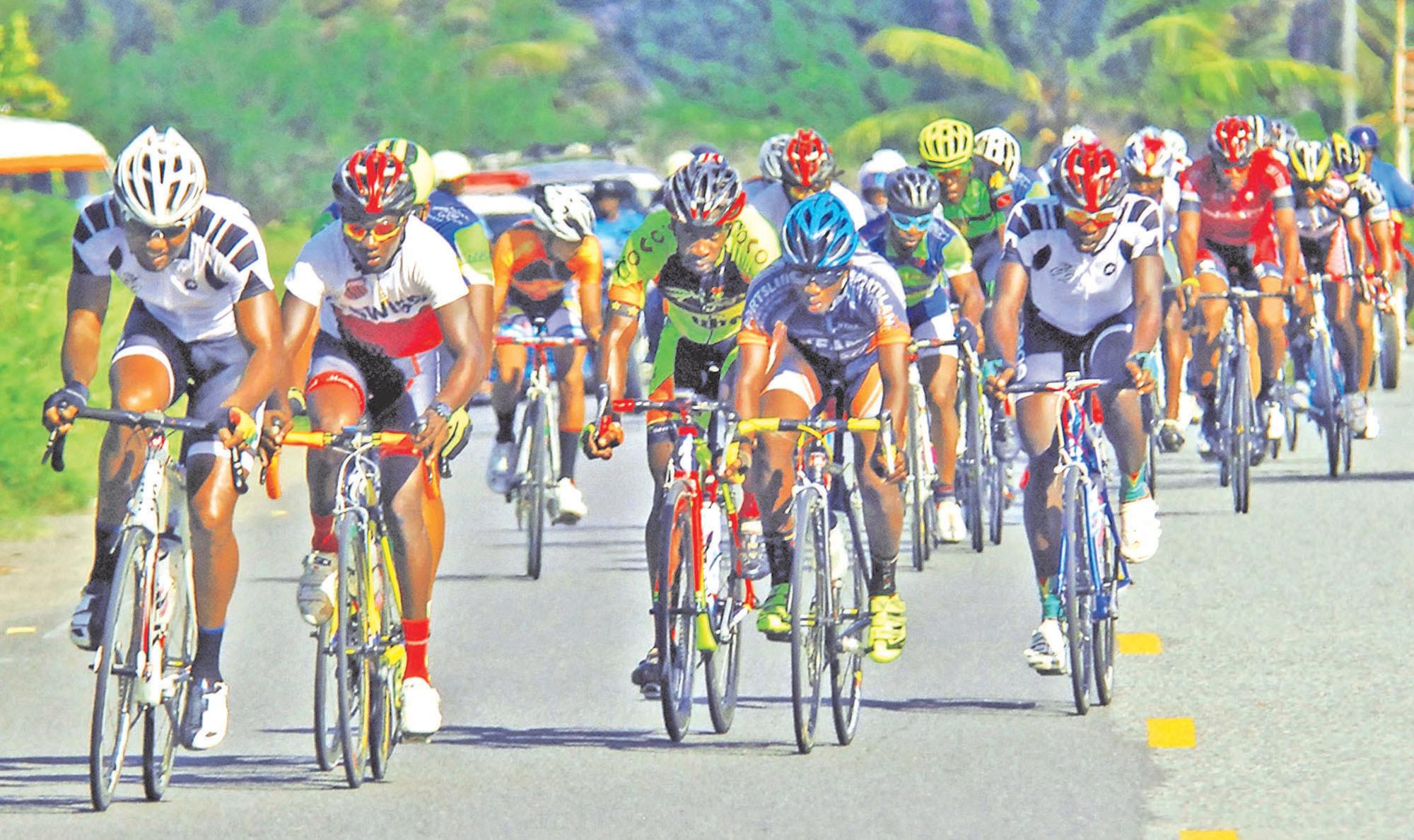
vide an added challenge for the riders.
The elite category champion is set to receive GY$275,000, while second to fifth place finishers will earn GY$200,000, GY$145,000, GY$100,000 and GY$70,000, respectively.
Cash incentives will also be awarded across the Masters 35-plus, Masters 50-plus, Category Four, junior, female and juvenile divisions, while stage winners in every category will collect GY$10,000 bonuses.
Elite cyclists will additionally compete for sprint prizes worth GY$5000 at
five sprint points during each stage.
Last year’s overall title was won by Colombian cyclist Mateo Garcia Castaneda, who represented Trinidadian-based Team Raiders during the 42nd edition of the event. Garcia dominated the competition by winning all three stages across Berbice and Demerara to secure the overall crown.
The Independence Three-Stage Road Race remains one of the marquee events on the local cycling calendar and continues to be a major feature of Guyana’s Independence celebrations.
Emerging table tennis talent Malachi Moore is brimming with confidence ahead of this weekend’s 60th Independence Table Tennis Tournament, with the young standout eager to test himself after recent international exposure.
Fresh off competing in Panama, Moore believes his game has reached new heights and is keen to translate that growth into a strong showing on home soil.
“I’m kinda [excited] to see how the tournament will go based off the preparations I have had, and because I recently came back from Panama, where the competition was at a high level, my level is where it has never been,” Moore noted. The Rising Stars player explained that the hard work in training, coupled with the experience gained overseas, has left him feeling optimistic about challenging for top honours.

The Guyana Football Federation (GFF) continued its investment in local coaching development on Wednesday with the start of Block Two of its Second Confederation of North, Central America and Caribbean Association Football (CONCACAF) C-Licence Coaching Course at the National Training Centre in Providence.
The three-day programme, which concluded on Friday, was led by three Coach Educators:
Technical Director Bryan Joseph, Head of Coach Education Linsworth Gilbert, and Technical Development Officer Lyndon France.
The session combined both theoretical and practical components as participants were exposed to various aspects of modern football coaching and player development.
Eight coaches took part in the latest block of the course, including several current and former na-
tional team players. Their participation highlighted the federation’s continued effort to improve coaching standards while strengthening the grassroots and developmental levels of football across Guyana.
The CONCACAF C-Licence programme forms part of the federation’s wider technical development strategy aimed at producing more qualified coaches capable of guiding players at the youth and community levels.
Emerging table tennis talent Malachi Moore is brimming with confidence ahead of this weekend’s 60th Independence Table Tennis Tournament

“Recently I have been putting in the work, and I am looking forward to playing my best and finishing on the podium in every category that I play,” Moore shared.
The annual tournament will conclude on Sunday at the National Gymnasium with the junior divisions taking centre stage this weekend while senior competitors will begin their campaign next week.