The Berbice Bridge will be closed to vehicular traffic on: Monday, March 9 –07:10h-08:40h and Tuesday, March 10 – 07:40h-09:10h.
FERRY SCHEDULE
Parika and Supenaam departure times – 05:00h, 10:00h-12:00h, 16:00h, 18:30h daily.
WEATHER TODAY
Thundery to light showers are expected throughout the day, into the night. Temperatures are expected to range between 24 degrees Celsius and 29 degrees Celsius.
Winds: North-Easterly to East North-Easterly between 4.02 metres and 6.25 metres.
High Tide: 07:43h and 20:10h reaching maximum heights of 2.49 metres and 2.32 metres.
Low Tide: 13:43h reaching a minimum height of 0.76 metre.
Guyana Development Bank critical to bring people out of poverty, create equitable society
Recognising the importance of access to financing, Parliamentary Affairs and Governance Minister, Gail Teixeira, has said that the Guyana Development Bank (GDB) will be critical to bringing citizens out of poverty and create a more equitable society. The highly-anticipated development bank will provide collateral-free and interest-free loans to small and medium-sized enterprises (SMEs), especially those led by vulnerable groups such as women, youth, persons living with disabilities. The aim of this state-backed institution is to empower local entrepreneurs, stimulate innovation and dismantle long-standing barriers to financing - something which Minister Teixeira noted is key to reducing poverty. “What we’re doing now, I think, are some of the correct moves in terms of access to the commercial banking on a much easier way and, the Guyana Development Bank in terms of zero interest. These are critical areas to bring people out of poverty and to make a much more, what you call, equitable society,” she stated. The Minister was at the time speaking during an appearance on the Starting Point podcast, where she was asked about what can be done to give people a greater shot at advancing. “Lots of areas [like interventions for] social protection are important, but I believe one of the key areas is access to either zero interest rates, particularly for those who are poor and vulnerable, and/or low interest loans,” she posited. Already, the Guyana Government has allocated an initial US$100 million in Budget 2026 to launch the GDB this year. This sum is part of a US$200 million capital pledge from the Government and is one of the key commitments made by the ruling People’s Progressive Party/Civic (PPP/C) in its 2025 elections manifesto. The Development Bank is expected to serve as an alternative financing option for those entrepreneurs who may not qualify for traditional loans from commercial banks, thus empowering more Guyanese to take advantage of national economic opportunities. Currently, the Government through the Attorney General (AG) Chambers is working on the legislation for the operationalisation of the development bank. When launched however, the bank will offer collateral free, interest free loans of up to $3 million, with the possibility of an additional $7 million in financing from commercial banking institutions at preferential rates. President Dr Irfaan Ali has stated that along with the development bank, there will also be a special incentive regime introduced to encourage commercial banks to increase lending to SMEs, similar to incentives used in the housing sector. In
return, these banks would be required to reduce collateral demands and lower interest
terventions to drive housing development has not only been one of key markers in Guyana’s economic develop-
ing is enormous on the economy… and again, going back to people, there’s sense of security collateral in that piece of land, that house, that opens up many opportunities that they never would have had before,” she noted. In efforts to make homeownership easier for Guyanese, the Ali-led Administration has rolled out a number of incentives in collaboration with the local banking sector over recent years including the reduction of interest rates on housing loans to as low as 3.5 to 5 per cent; the increase of low-income mortgage ceiling to now $30 million, which would also be ex-
rates to below the current four per cent.
Aggressive housing interventions
According to Minister Teixeira, during the podcast, the PPP/C’s aggressive in-
ment over the last five years but also an important security for the more than 50,000 persons who have benefitted from either their house lot or a prebuilt house along with their lands. “That impact of hous-
tended to approved insurance companies and the lowering of collateral requirements and a 50 per cent discount on negotiation fees for specific housing products, among others.
Parliamentary Affairs and Governance Minister Gail Teixeira
President Irfaan Ali’s decision to sign on to the United States’
“Shield of the Americas” initiative last weekend marks a significant moment in Guyana’s evolving role in regional security. Announced by US President Donald Trump as part of a hemispheric coalition aimed at confronting drug cartels and transnational criminal networks, the initiative calls for closer intelligence sharing, coordinated enforcement actions, and stronger security collaboration across the Americas.
For Guyana, participation in such an initiative reflects both opportunity and risk. As our country’s economic profile rises –driven largely by our oil boom – so too does our exposure to transnational crime. Drug trafficking routes have long passed through our Region One into the Caribbean Basin, exploiting our vulnerabilities as a small state with limited resources and vast land and maritime spaces. In this context, strengthening partnerships with major powers such as the United States is not only sensible but necessary.
This newspaper has long argued that collaboration with Washington could significantly enhance our capacity to confront transnational organised crime. Access to advanced surveillance technology, intelligence networks, and specialised training that have already been initiated will strengthen local law enforcement agencies and the Guyana Defence Force that already face considerable challenges.
Additionally, aligning with the United States on a major regional security initiative will deepen diplomatic and economic ties with our most influential partner in the hemisphere. In a period when Guyana’s growing energy sector has elevated its geopolitical importance, maintaining strong relations with Washington also serve broader strategic interests. From this perspective, joining the initiative can be seen as pragmatic diplomacy: an effort to ensure that Guyana is part of the regional conversation on security rather than observing it from the sidelines.
However, the decision is not without legitimate concerns. One of the ticklish aspects of the initiative is its apparent emphasis on military action in the fight against drug cartels. Some US officials have suggested that the coalition could include offensive operations against criminal organisations. For many observers, this raises longstanding questions about the militarisation of the drug war—a strategy that has produced mixed results in Latin America – especially in Colombia – over the past several decades. However, we have already experienced the degradation of the Venezuelan Sindicatos that support the Venezuelan Chavista regime and have openly attacked GDF patrols. The latter should be buttressed as part of the new initiative.
There are also broader geopolitical considerations. The “Shield of the Americas” initiative reflects Washington’s effort to reinforce its security partnerships in the hemisphere at a time of growing global competition. For a small State like ours, navigating such dynamics requires careful diplomacy which the PPP Government under Pres Ali has amply demonstrated.
Equally important is the question of sovereignty. Any regional security framework must respect the autonomy of participating States and ensure that national authorities retain full control over decisions affecting their territory and security forces. Guyana’s participation should, therefore, be guided by clear limits and transparent agreements that protect our national interests.
Ultimately, the decision to join the initiative reflects the difficult balancing act faced by many small nations in an increasingly-complex security environment. Guyana cannot ignore the threat posed by transnational crime, nor can it afford to isolate itself from regional security efforts. Cooperation such as with the “Shield of the Americas” initiative can provide valuable tools to strengthen national security.
At the same time, partnership must not come at the expense of prudence. Our leaders will need to approach this initiative with a clear understanding of both its potential benefits and its risks. The true measure of success will lie not in the signing of agreements, but in ensuring that any cooperation enhances security while safeguarding the country’s sovereignty and long-term stability.
As Guyana steps onto a larger regional stage, the challenge will be to remain both a responsible partner and an independent actor. That balance will determine whether the “Shield of the Americas” becomes a meaningful tool for regional security – or another chapter in the long and complicated history of the hemispheric war on drugs.
Are attention spans really shrinking?
By ReBecca Watson
How far will you make it into this column before you switch to something else? If you’re reading me on a screen, then an incoming WhatsApp or email might divert you. If you’re holding a newspaper, then maybe it’s Janan’s face, calling you from above, or the glint of your phone screen in your lap. Regardless of the format, something I say might take you down a different track, your mind wandering to a dream or a half-remembered intention, or an article you once read on shrinking attention spans . . . Even before the invasion of phones and computers, our fizzing heads and environments steered us in competing directions. It is impossible to take the world one thought at a time when we inhabit a pinball machine of associations, connections and diversions. If you have followed the fear-mongering news line over the past few years, then you’re probably worried about your attention span. Why your attention span is SHRINKING?.?.?.?Human attention spans are now shorter than a goldfish’s?.?.?. so goes the narrative, as if we are de-evolving at rapid speed, racing our way back to primordial soup. The human attention span is touted as 47 seconds, but the de-
tail around the figure gets shrugged off in the spectacle. The trouble with statistics is that they can be misused. A figure is rigid but context tells a story. The psychologist Gloria Mark, who is often quoted in relation to our degrading attention spans — and some of whose research landed us at this median number — said on a podcast last year: “I don’t believe that our basic ability to pay attention has changed.” So what does it mean? Mark’s research is not a sweeping assessment of our brain’s capacity to take in information. Her experiments were focused on how people use technology — beginning, in the early 2000s, by sitting behind people at their desks, “clicking a stopwatch every time they switched computer screens or picked up a phone”, as she writes in her book Attention Span. The observation was partly an assessment of the modern demands of the workplace, where we navigate multiple platforms and interfaces and deal with the ability and pressure to communicate constantly. It can be easy to take the line that humankind is doomed — but let’s at least be specific Our so-called shrinking attention span, seen this way, is less about diminishment than our impressive adaptability. (It also high-
lights the extent of what we are asked to achieve at work.) The headlines tend to skip the fact that the fabled figure relates only to our screen use, not our capacity to focus in all aspects of life. It is our environment that has dramatically shifted and it’s an important distinction. We have developed new behaviour in response, not shed something we once possessed. And, by the way, the research points to a uniform effect across the generations. So despite the fondness for using this argument to criticise the brain rot of Gen-Zs, it doesn’t stand up. Is it convenient to believe that we’ve lost our attention span — or had it stolen? Catastrophising takes the control right out of our hands. The narrative that we are all degenerating is one of resignation, and perhaps an excuse, too, to keep on scrolling rather than admit focus can still be a choice. (Talking of choice: the decision to not have my phone charging in my bedroom was a simple decision I would never undo. Radio alarm is the answer to your next question.) The dominance of screens and the addictive quality of phones and social media, which tech companies have long monopolised, is something to react against. Even the presence of your phone is a trigger,
now looped into automatic function. It is productive to be clued up about how our brains interact with screens. But the solution is not the interminable cry of optimisation: attention isn’t something you can just ramp up and up and up. We need breaks. Natural slumps occur during the day. Different forms of attention demand more of us. Mindless scrolling can actually provide your brain with relief, while letting the mind wander can be creatively or philosophically vital. Or it might just feel good. If you’re still reading this, then congratulations, I didn’t doubt you for a second. Or 47, for that matter. It can be easy to take the line that humankind is doomed — but let’s at least be specific. Concern yourself with the addictive effect of the infinite scroll on your phone, a tool even the creator regrets having brought into existence; or investigate the research into the organising framework of a child’s brain and how a screen might alter that development. But let’s not absorb the fear-mongering without first paying attention to what it really means. (Financial Times) (Rebecca Watson is a commissioning editor and writer for FT Weekend and author of the novels “I Will Crash” and “little scratch”)
Two members of the Il Posto vertical dance company perform at the opening ceremony of the Milano Cortina Winter Paralympics, Verona, Italy (Photograph: David Ramos/Getty Images)
President Dr Irfaan Ali: Strategic diplomacy in a changing hemisphere and the realities of Caribbean geopolitics
Dear Editor,
It may be difficult for some to see and accept, but I assure you that President Dr. Irfaan Ali did the right thing and uttered the right words.
In the practice of statecraft, the mark of a wise leader is not merely ideological consistency, but the ability to navigate complex geopolitical realities while safeguarding the national interest.
Those who are attuned to both local and international politics would have seen and heard the President’s recent comments regarding Cuba. I dare say that his remarks must be understood within the broader context of shifting hemispheric politics, evolving security threats, and the strategic imperatives confronting our country as a small state in a volatile region.
President Ali’s remarks, delivered during an international interview while attending the inaugural “Shield of the Americas” Summit in the United States, emphasized that “the status quo cannot remain” in Cuba and that any transition must ultimately lead to improved living conditions, democracy, and
prosperity for the Cuban people.
This statement has drawn criticism from some observers who perceive it as a departure from the historically cordial relationship between Guyana and Cuba. Yet such critiques overlook the essential nature of diplomacy: the balancing of difficult decisions with principle and prudence.
For decades, Cuba has been a valued partner and friend to many Caribbean nations, including Guyana. Cuban medical brigades, technical assistance, and educational opportunities have contributed significantly to the development of several states in the region. Our country, like many of its CARICOM partners, recognizes and appreciates this legacy of friendship and solidarity. However, international relations are not governed solely by historical gratitude; they are shaped by contemporary strategic realities.
Today, Guyana finds itself at the center of an evolving geopolitical landscape. The country is experiencing rapid economic transformation due to its emerging oil sector while
simultaneously confronting persistent territorial claims from neighboring Venezuela over the resource-rich Essequibo region.
In this context, the support of major international partners particularly the United States has become critically important. Washington has repeatedly signaled that it would respond forcefully to any Venezuelan aggression against Guyana. For a small state facing a larger and historically assertive neighbor, such security assurances are not trivial diplomatic gestures; It is a big deal, they are matters of national survival.
Furthermore, regional dynamics have become even more fluid in recent months. The removal of Venezuela’s presidential leadership by U.S. forces and the subsequent disruption of the longstanding Caracas–Havana alliance have dramatically altered the political calculus across the Caribbean basin.
Cuba, long dependent on Venezuelan oil, now faces profound economic uncertainty, while Washington has intensified its rhetoric toward
Havana. In such an environment, Caribbean leaders must tread carefully, balancing moral sympathy with pragmatic diplomacy.
President Ali’s comments should therefore be interpreted not as hostility toward Cuba, but as a carefully calibrated expression of diplomatic realism.
By intentionally emphasizing dialogue, incremental change, and improved living conditions for the Cuban people, he positioned Guyana within a framework that aligns with broader CARICOM discussions while maintaining constructive engagement with the United States. This approach reflects a recognition that Guyana’s prosperity and security depend on stable relationships with global powers, particularly at a moment when the hemisphere is undergoing significant political realignment.
Critics who demand a more confrontational stance misunderstand the responsibilities of good and prudent leadership. The question one must ask is: what would be gained if Guyana adopted a defiant posture to -
India’s impressive incredulity in the world of cricket
Dear Editor,
India blasted its way with the smashing bats, the scorching balls and their scintillating fielding when they made history yesterday in claiming a number of firsts as they celebrated the win as ICC 2026 Men T20 Champion.
Resoundingly beating a flustered but fighting New Zealand team, India pulverized all its ammunition to defend a humongous 255 for 5 from 20 overs. They eventually but evidently dismissed not a submissive but a surprised team which caved in at 159 all out from 19 overs.
India continues to storm the international stage as a country not only known for religious beliefs, eco friendly tourism, wonders of the world, its colorful festivals, foods, peace , truth and non-violence, but a nation progressively challenged to surpass its economic growth(4th wealthiest nation), its technological advance-
ment in the spectrum of Artificial Intelligence (AI), computer literacy, improvising social media platforms and its space programs(first nation to successfully land on the southern part of the moon).
Overnight, India has once again reminded the world that the country earns the right to be regarded as the Mecca of cricket, replacing Lord’s, and the land where to become a cricketer, is a major past dream for a number of boys’ and girls’ ambition! Not so much for the lucrative pay, but hugging the camera, being in the limelight, touring the world, and being afforded a chance to be in the eyes of the world, is of paramount importance as it is to be a patriotic citizen to make India proud as a person given an opportunity to play and serve the country.
India became the first nation to win back-to-back
championships (2024 and 2026) and the first to do so while playing at home. They have carved a niche as the first team as a three times champion in the T20 game. They have smacked the highest team total with 255 runs as the first team to attain this figure. With Jasprit Bumrah’s match winning bowling figures of 4 for 15 off his allotted 4 overs, India secured another first as the team with a bowler for the highest wicket-taker in a single ICC men’s T20 World Cup final.
Congratulations to
India for its perpetual attack and defense, Captain Suryakumar Yadav’s astuteness, the rest of the players’ perseverance, the resilient support from an entire management team and of course, a roaring and overwhelming exuberant crowd which loyally continued to fill the pavilions, match after match. India has won the world’s appreciation for making the game of cricket exciting, entertaining and envious.
Yours respectfully, Jai Lall
ward the United States at a time when the country’s greatest external security threat Venezuela remains unresolved?
Diplomacy is not theater; it is the quiet art of advancing national interests without unnecessary confrontation. A small state must be especially adept at this art.
It is also worth acknowledging a difficult but equally important reality. While Cuba has historically supported many Caribbean nations, its response to the recent escalation of Venezuelan rhetoric against Guyana and its legal territory was largely muted. This silence is understandable, given the depth of Cuba’s economic reliance on Venezuela.
Yet it illustrates a broader truth about international relations: every nation ultimately prioritizes its own survival and strategic interests.
President Ali’s stance reflects this same logic. His responsibility is first and foremost to the people of Guyana, and we should all appreciate the prudence of his decision.
In an era when geopolitical tensions, energy politics, and regional se-
curity concerns intersect with unprecedented intensity, prudence becomes the highest form of patriotism.
Indeed, leadership sometimes requires making decisions that is unpopular, that will not please everyone. Yet history often vindicates those who exercise restraint, foresight, wisdom, and diplomatic skill.
President Ali’s approach demonstrates an understanding that Guyana’s future depends not on ideological rigidity but on strategic engagement with all partners old and new alike.
In this sense, the President is not abandoning friends, nor is he surrendering principles. Rather, he is practicing the timeless craft of diplomacy: speaking carefully, positioning strategically, and ensuring that Guyana navigates a turbulent geopolitical moment with wisdom and dignity. Such leadership does not merely respond to the present; it prepares a nation for the future.
Yours respectfully, Jermaine Figueira Former Member of Parliament
Page Foundation
◄ Ratios
A ratio compares two numbers by using division.
Example: Six people want to share one pizza. Of course, each person wants a slice of the same size. To find out what part of the pizza each person gets, set up a ratio.
Divide: 1 pizza ÷ 6 people.
Step 1: Express the problem as a fraction:
Step 2: Remove the words: 1/6. 1 pizza 6 persons
By using a ratio, you found that if you cut one pizza into six equal parts, each person gets of the pizza.
Exercises: Solve
1) A group of 4 friends has 10 dollars to share. What is
each person’s share.
By Fatimah asghar
Get creative with cotton swabs and Crayola Watercolors in this simple, yet impressive, painting project!
Coloured pencils
Supplies/Tools
Crayola Watercolors
Pencils
Cotton swabs
Heavy paper
Newspaper
Paper towels
Water Directions
Step 1: Lightly draw some circles on your paper in an interesting arrangement with coloured pencils.
Step 2: Dip a cotton swab in water to dampen it. Be careful not to soak the cotton swab completely. Select a colour of Crayola® Washable Watercolors, and rub the damp cotton swab in the paint. Using the drawn circles as a guide, dab the paint-covered cotton swab on the paper to create a series of colourful dots!
Step 3: Continue covering each drawn circle with bright watercolour dots.
Step 4: Fill in the blank areas of the paper with even more dots to create vivid circles and swirls! (Adapted from crayola.com)
2) John rode his bike 25 kilometres in 3 days. How many kilometres did he ride every day?
3) Henry uses 3 kilograms of butter in a recipe for 15 loaves of bread. How much butter did he use for each loaf?
4) It took six tonnes of crusher run to cover 3 kilometres of road. How much gravel was used for each kilometre?
5) Sunil puts eight litres of gasoline in a 23-litre tank. How much of the tank did he fill?
6) At Mario’s, 5 friends want to share 2 pizzas. If there are 12 slices in each pizza, how many slices does each person get?
Their names have been lost only the winds & only the mountains keep them. we’ve forgotten the names of the mountains, my people, the more we bent our knees to worship the gods of the city, the gods with jaguar eyes who sit in the smog, which could be mistaken for clouds but for the ink they leave in our lungs, rorschach paintings doctors dissect. what do you see? my death, certainly but still no names of the women before me, or the names of the mountains & rivers, the promises my ancestors made to the spirits & then betrayed when they fled exchanged land for new land. what was her name? i ask the room of my uncles & am met with disinterest. where did she come from? & I receive silence. that must be it then: she came from air. from wind. from the earth, stilling to quiet. & in the right moment, when the sun hits the water, when no one is around when i can see the mountains breaking the sky, i can almost hear them, the women in my family, the ones who remember their names.
Source: Poetry (January/February 2025)
Write a story that doesn’t include any dialogue at all.
“Status quo cannot remain” – Pres Ali on Cuba’s humanitarian crisis
President Dr Irfaan Ali has said that the time has come for the status quo in Cuba to change in order to improve the lives of the people there and ensure they enjoy prosperity and democracy in the Caribbean nation. His comments come on the heels of the United States (US) continuing to mount pressure for regime change in Cuba. On Saturday, the Guyanese Leader attended the Shield of the Americas Summit hosted by US President Donald Trump in Florida. Speaking with Fox News’ Aishah Hasnie on the sidelines of the summit, President Ali pointed out that the humanitarian crisis on the island nation has been a concern for regional leaders.
“We have had many discussions at the CARICOM level. We had discussions recently with Secretary [of State, Marco] Rubio, and we all agree that the status quo cannot remain. We agree that there must be an attempt to have the status quo changed, and we all are aware that it will take time. It has to be incremental,” the Guyanese Head of State noted. He went on to state that, “There must
be dialogue, but those changes must lead to the improvement of the people of Cuba, must lead to better conditions for the people of Cuba, must lead to a society in which the rule of law, in which democracy, in which freedom is celebrated. So yes, a transition that involves these…a type of transition that allows the people of Cuba to benefit from prosperity and democracy.” During Saturday’s summit, President Trump hinted that, like Venezuela, great
changes will also come soon for Cuba. “Cuba’s at the end of the line. They have no money; they have no oil. They have a bad philosophy. They have a bad regime that’s been bad for a long time. They are negotiating with Marco [Rubio] and myself and some others and I would think a deal would be made very easily with Cuba… but Cuba is in its last moments of life. It will have a great new life,” the US President said to about a dozen regional leaders at the
summit.
Just last month, CARICOM signalled its intention to provide humanitarian support to Cuba in light of the crisis in the Spanish speaking country. Following the 50th Meeting of the Heads of Government, CARICOM Chairman, Prime Minister (PM) of St Kitts and Nevis Dr Terrence Drew, said that regional leaders discussed the situation in Cuba and agreed to take steps to support humanitarian efforts. He ex-
plained that the Community is preparing a coordinated response, with a detailed plan to be finalised shortly. The US Secretary of State had attended the CARICOM Conference and discussed a transition framework with the Caribbean leaders. In fact, President Ali, who had also attended that meeting in St Kitts and had bilateral discussions with the Secretary Rubio, told reporters on the sidelines that those talks included the humanitarian crisis in Cuba. “We spoke about Cuba and of course, in dealing with Cuba, it’s not a simple issue,” the Guyanese Head of State posited, adding “…but speaking about a framework of which CARICOM could be a part of that would deal with Cuba and deal with transitions that are necessary for the people of Cuba and for the development of Cuba… so, it is for us to work out what that framework is.” “On the issue of humanitarian aid, Guyana’s position has always been very clear. And even Secretary Rubio would have alluded to the fact that there is nothing preventing humanitarian aid from going to Cuba. But the challenge that Cuba has is a
challenge of power. So, where do you store the food if you don’t have power and energy to store food.” In lamenting on the situation in Cuba however, President Ali ruled out any possibility of Guyana supplying the island-nation with fuel. Responding to questions posed, the Head of State explained that oil is an economic commodity that is traded via strict regulations that Guyana subscribes to.
This comes on the heels of the US Treasury Department announcing it could send oil from Venezuela to Cuba to bring relief to the humanitarian crisis there. Rubio explained, after being questioned during the press briefing in St Kitts, that the idea is to sell the oil directly to the Cuban private sector – not the Government.
“These would be sales to a very small private sector that exists in Cuba, and that’s always been legal… But that alone will not solve Cuba’s very dramatic problems that have been caused by 60-someodd years of mismanagement, ineptitude and a failed economic model,” the US Secretary of State had noted.
Guyana Development Bank...
“So, the combination of social protection plus access to the areas of programmes like housing [have] radically change their lives. And when they do that, it changes the society as well. It brings in a culture of thrift. There’s a variety of things, as well as security, but also in terms of the construction industry, the raw materials industry, transportation, a whole range of issues, technology, lights, water, etc. It radically changes how the economy and the society functions. And we saw it, and we’ve seen it, and it’s now galloping much more in that way,” Minister
Teixeira asserted. Among the Government’s housing plan for the next five years is the construction of 40,000 new homes across the country. This year, the Housing Ministry is targeting the construction of 8,000 new homes across all income categories along with the issuance of at least 7,000 land titles, and transport.
In light of this commitment, Housing Minister Collin Croal, back in October last year, engaged the various financial institutions to strengthen co-
ordination, address existing challenges and identify new partnership opportunities within the housing sector. Representatives from the New Building Society (NBS), Republic Bank (Guyana) Limited, Guyana Bank for Trade and Industry (GBTI), Citizens Bank Guyana Inc., Demerara Bank Limited (DBL) and Bank of Baroda provided valuable insights and recommendations aimed at streamlining the financing and construction processes for homeowners.
President Dr Irfaan Ali with US
President Donald Trump
Mother of 6 stabbed to death by reputed husband
Aman was caught trying to turn the knife on himself after brutally stabbing his common-law wife multiple times early Sunday morning at Long Creek, Soesdyke-Linden Highway. Dead is 39-yearold Caslene Toney, a housewife from Long Creek. The woman was reportedly found with several stab wounds at her home. According to information reaching this publication, the gruesome discovery was made by the woman’s sister shortly after the incident. The sister recalled that between 05:30h and 06:00h, the suspect went to her home and called out to her. She
said when she looked outside, she saw the man walking away into the backlands with a bloodied knife in his hand. Realising that something was wrong, the woman rushed over to Toney’s home, where she found her sister dead outside the house. Police were subsequently alerted; they arrived on the scene and launched a search for the suspect. He was later found by ranks in the Long Creek backlands, still armed with what appears to be a knife and was allegedly attempting to take his own life by stabbing himself. Investigators intervened and prevented him from further harming himself. Toney leaves to mourn six children, the oldest being 18 years old and the youngest just three. Relatives said that Toney endured years of abuse at the hands of her reputed husband. Only recently she was severely beaten by him but did not want to pursue criminal charges against him. Meanwhile, the Banakari Women in Action Group, of which Toney was a part, said it is deeply saddened by the tragic death of one of its members. The Banakari Women’s Group is a commu-
nity organisation based in Banakari, located along the Linden-Soesdyke Highway. The group primarily focuses on socio-economic empowerment through agricultural development and sustainable farming.
In a statement, the group said it was “deeply saddened at the unexpected, tragic loss of our sister, companion, mother and member of Banakari Women in Action Group.” The organisation extended “heartfelt thoughts and solidarity to the late Caslene Toney’s family and
loved ones during this devastating time.” The group is also urging authorities to ensure the matter is fully investigated. “Banakari Women in Action Group is urging all relevant authorities to conduct a full, transparent and swift investigation into the circumstances surrounding this heartbreaking situation,” the statement added. Police investigations into the incident are ongoing. Up to press time, the Guyana Police Force (GPF) had not released an official statement on the matter.
30-year-old remanded on wounding with intent to murder charge
A30-year-old man was on Friday remanded to prison after he appeared before acting Chief Magistrate Faith McGusty, at the Georgetown Magistrates’ Courts, charged with wounding another man with intent to murder him during an incident earlier
last week at North Sophia, Greater Georgetown. It was alleged that on March 3, at Pike Street, North Sophia, Stephon Allen wounded Shadrach Andrew with the intent to murder him. Allen, who was represented by Attorney-at-Law Shemar Britton, was told of the allegation when the matter was called. During the hearing, Britton told the court that his client is “a stranger to the court with no convictions.” The lawyer further indicated that Allen is “fully aware of the seriousness of the offence he is charged with” and would comply with any conditions set by the court if granted bail. However, the prosecution objected to bail, citing the condition of the virtual complainant, Andrew, who is currently hospitalised. Prosecutors told the court that the injuries observed on Allen were sustained after persons in the area intervened when he allegedly attacked Andrew. Britton however, told the court that his client had been attacked by a group of men following the incident involving Andrew. However, Magistrate McGusty noted that Allen appeared in court with visible injuries. His head was bandaged, and he had injuries on his face. After hearing submissions, the Magistrate denied bail, citing the nature of the offence and the reported condition of the injured man. Allen was subsequently remanded to prison and the matter was adjourned to March 27.
Taking care…
…of health
As a colony for hundreds of years - first the Dutch then the Brits - medical care wasn’t exactly high on their agenda for the enslaved people that literally did all the heavy lifting for them! You’d think even as a business proposition they would’ve wanted those slaves they paid good money for, to be kept fit c as long as they could. To slave away and make them rich. But the poor souls were treated like cattle and died like flies.
It wasn’t till the indentureds replaced the liberated slaves that Hospitals started to spring up on the plantations to join the two hospitals in new Amsterdam and Georgetown that catered to the elite. The Indian govt insisted!! Those hospitals helped ensure sick workers were back to the fields chop chop!! The colonial state, to its credit, did expand the hospital system so by Independence, we had cottage hospitals in most of the far-flung regions. Down in Lethem, even the Brazilians across from Boa Vista came over for medical care.
Sadly, when Burnham took over - like everything else - that medical system collapsed. Being sent the Georgetown “Big Hospital” was seen as a death sentence! It was rather ironic that Burnham passed away at the institution while on an operating table for a supposedly routine throat procedure. The Cuban doctors operating signalled the departure of the famed Guyanese doctors who’d qualified in British Medical Schools!
But thank God, whatever our gripes, gone are the days when rats nibbled away at the toes of newborns at the GHPC. However, starting from such a low base there’s still a far way to go !! But since the PPP’s stints at the helm following free and fair elections in 1992, we’ve we’ve improved by leaps and bounds!! Of great help was the medical school at UG but this wasn’t enough to staff the new hospitals built in the regions as well as the expanded GHPC. And now in their present iteration it’s clear that the PPP government is determined to bring us on par with the developed world as far as medical care is concerned.
There’s that multibillion state-of-the-art paediatric and maternal hospital at Ogle coming up and most of new Regional Hospitals at Enmore, Anna Regina, Reg 2; De Kinderen, Reg 3; Diamond, Reg 4; Bath, Reg 5 and Number 75 Village, Reg 6 are up and running!
But there’s gonna be a problem – staffing!! Cuba was very helpful both in supplying some of their doctors and training some of ours. However, with the US clamping down on that source, we will have to intensify our already launched efforts to widen our recruitment net!!
From our Cuban experience, let’s insist on English proficiency!
…of GT
With Regional and Municipal elections due this year, some feel the PPP might actually be able to grab Georgetown!! Now Georgetown’s been controlled by the PNC when there was barely a PNC!! After the PPP split for the 1957 elections and Burnham lost, the man became Mayor in 1959 - just months after he’d launched the PNC!! That’s right folks – Burnham was Mayor of Georgetown! It was an in-your-face move by him against Cheddi to mark out HIS territory! “You may rule in the sticks Buddy Boy, but I’m king in the bright lights!!”
And the political import of that boast was evident in 1962 when as Martin Carter wrote “a city of clerks became men and burnt the business district to the ground on Black Friday!! The blip in 1994 was just a pi55ing contest between Dessie and Hammie to show who was (PNC) maan!! Hammie won because he controlled the lumpen elements!!
But with WIN hiving them off the PPP can win in a three-horse race!!
…of security
Pressie stood tall in Miami with Pres Trump at the “Shield of the Americas” summit to sign a major regional security alliance aimed at eradicating drug cartels across the Western Hemisphere.
Meaning for us, zapping Venezuela’s Sindicatos!!
Stephon Allen
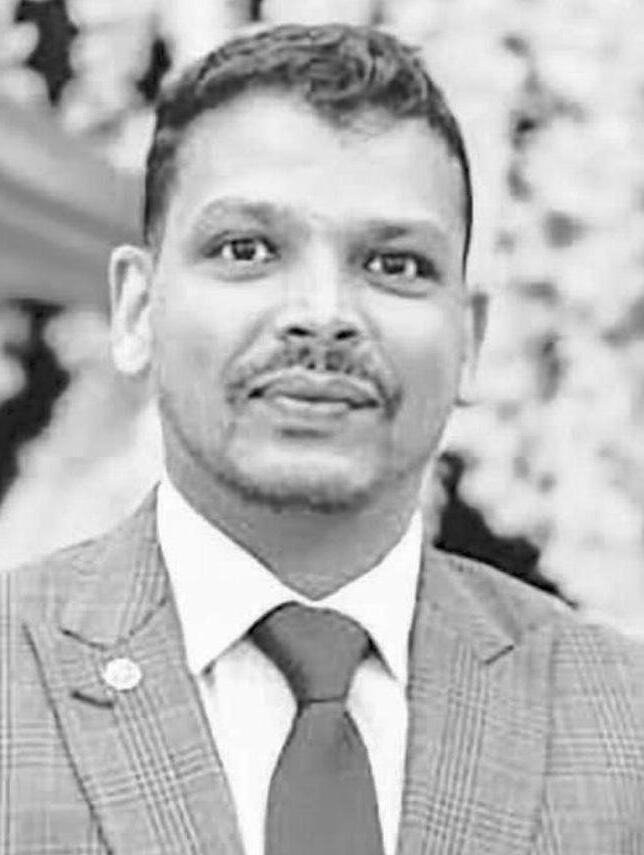
Dead: Caslene Toney
2-year-old found dead in Pomeroon River
…body found 1 mile from home; Police investigating
Police in Regional Division No. Two are investigating the suspected drowning of a two-year-old of Kabakaburi Mission, Upper Pomeroon River, Region Two (Pomeroon-Supenaam).
Dead is Samirah Evans. The incident reportedly occurred between 12:30h and 17:30h on Saturda at Kabakaburi Mission. According to police enquiries, the child lived with her mother, Shenella Jacobus, 23, a housewife; her father, Leon Evans, 23, a labourer; and other relatives at their home located on the left bank of the Pomeroon River. The child’s mother told investigators that at about 12:30h on Saturday she was washing clothes at the back of the house when Samirah began crying and went to breastfeed her. After feeding the child, Jacobus said she placed Samirah in the kitchen area and returned to washing clothes. When she later finished and began hanging the clothes in the yard, she called out for the child but received no response. She then began searching the kitchen and surrounding areas but was unable to find the toddler.
The mother said she later checked the landing area,
located about 300 feet from the house, where she discovered a piece of underwear the child had been wearing. An alarm was raised and relatives, along with residents of the community, began searching for the child, but initial efforts were unsuccessful. Police said that at about 17:00h on Saturday, ranks from the Charity Police Station joined a search party comprising relatives and community members after the incident was reported at about 16:40h
on Saturday. Searches were conducted around the landing area, nearby trenches and surrounding areas but yielded no results. At about 17:30h, additional searches were carried out in the vicinity of Warapana, Upper Pomeroon River. During the search, the body of the child was discovered floating in the river by a 48-year-old resident of Warapana, along with other members of the search party. Police said the body was located approximately one mile from the Kabakaburi Mission landing. The body was transported to the Charity Farmers’ Wharf, where it was examined by police. Investigators observed that the child’s body was clad only in a diaper and suspected fish bites were seen. Police reported that the right foot appeared to have been partially eaten by fish, believed to be piranhas, and similar marks were observed on the face. The body was subsequently escorted to the Oscar Joseph Public Hospital at Charity, where it was examined by the doctor on duty from the Charity Cottage Hospital and officially pronounced dead. Police are awaiting a post-mortem examination as investigations continues.
Severed head found in NYC believed to be missing Guyanese woman’s
Ahuman head was discovered in a Queens bird sanctuary on Thursday night and is believed to belong to a Guyanese woman whose torso was found in a trash bag six months ago, police sources said on Saturday. Homicide detectives located the severed head at the Jamaica Bay Wildlife Refuge while tracking cellphone tower data linked to a suspect in the case. The dismembered torso was discovered on September 23, 2025, near Idlewild Park, roughly 10 miles from the refuge, a marshland area near John F. Kennedy (JFK) International Airport, according to the sources.
Two workers from the New York City Department of Sanitation (DSNY) made the grisly discovery while collecting trash near the intersection of 149th Avenue and Brookville Boulevard, according to the New York Police Department (NYPD). The employees had loaded the covered remains into the hopper of a vehicle before noticing a foul odour, sources said. The torso was missing its head, arms, and legs- and was wrapped in tape and rope, said cops, who believe a saw and a knife were used. The partially decomposed body had several visible tattoos including a flower and three names, cops have said. The city Medical Examiner’s Office is investigating the remains to confirm the victim’s identity and cause of death, officials said. (New York Post)
Dead: Two-year-old Samirah Evans
The head was found at Jamaica Bay Wildlife Refuge near JFK Airport in Queens (Jessica Kirk – stock.adobe.com)
Police believe the head that was found Thursday night belongs to a woman’s torso discovered in September about 10 miles away, sources said (Obtained by NY Post)
Guns, ammo found at highway resort, Rupununi home
AGlock 17 pistol, along with several other firearms and rounds of ammunition, was discovered during separate incidents on Saturday along the Soesdyke, Linden Highway and at Shea Village in the South Rupununi, Region Nine (Upper Takutu-Upper Essequibo). In the first incident, a suspected firearm was found at a resort located on the Soesdyke, Linden Highway at about 20:30h. Police reported that a 34-year-old security guard attached to the resort was conducting routine checks around the compound when he observed what appeared to be a firearm near a small drain along a concrete walkway. The security guard took possession of the firearm and con -
tacted the police. Ranks from Regional Division #4 ‘A’ (Georgetown) responded and the security guard handed over the gun. It was taken to the Timehri Police Station, where it was examined and observed to be a Glock 17 pistol with a magazine containing seventeen (17) 9mm rounds of ammunition. The firearm and
pending further examination and investigation.
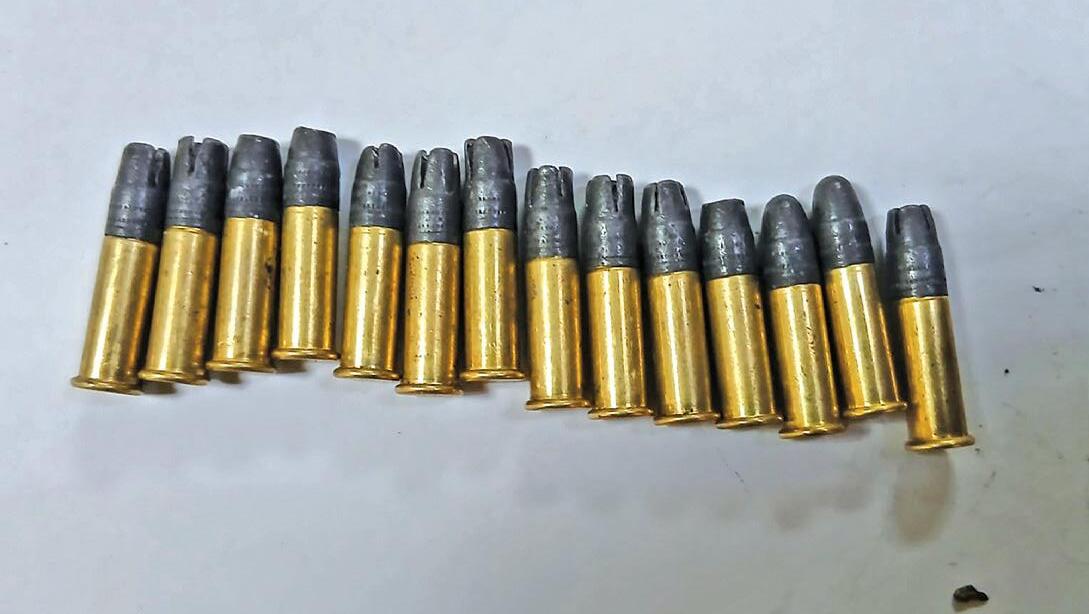
Guns, ammo at Shea Village Meanwhile, during an intelligence-led police operation conducted at about 09:00h on the same day at Shea Village, South Rupununi, several firearms and ammunition were discovered at the home of a 53-year-old farmer. According to police, ranks from Regional Division Nine acting on information received went to the farmer’s home, where he was contacted along with his two sons, ages 20 and 22, who also reside at the same address. Searches were conducted on the trio and around the premises, during which they handed over two .22 rifles, one airsoft rifle and 14 rounds of .22 ammunition. Further checks were
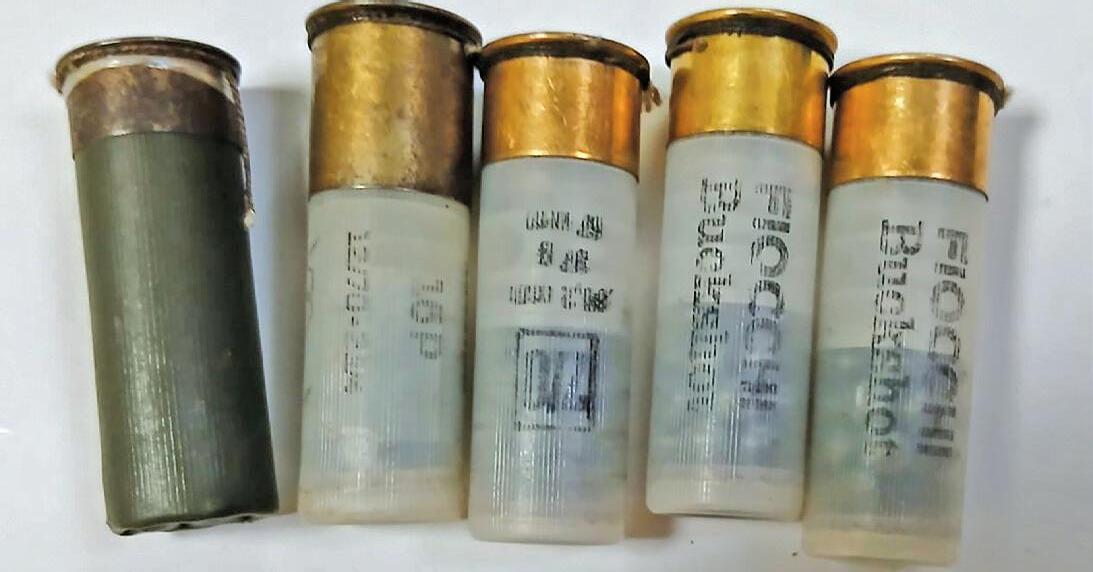
carried out in the kitchen area of the premises, where one 12-gauge double-barrel shotgun, along with five 12-gauge cartridges were found. Police said the trio indicated that they were not holders of firearm licences. The three men were arrested and es -
corted to the Aishalton Police Station and subsequently to the Lethem Police Station, along with the firearms and ammunition, which were lodged pending examination. The suspects remain in police custody, assisting with investigations.
ammunition were lodged
The firearm and ammo that were found by Police
Police using surveillance cameras to track hit-and-run drivers - Road Safety Council
Motorists who damage vehicles or become involved in accidents and flee the scene are being warned that surveillance cameras are increasingly being used to identify and prosecute offenders.
Chairman of the Guyana National Road Safety Council (GNRSC), Earl Lambert, during a recent episode of “Road Safety and You”, issued the warning, revealing that the Police Force is currently reviewing cameras following recent hit-and-run accidents. “Last week, there was an incident outside the immigration office in Camp Street. A young immigration officer who bought her car last November came to work. She parked her car in the corner, and some other vehicle drove in a manner as to damage that vehicle and drove away,” Lambertt said.
According to Lambertt, investigations are ongoing and the driver responsible could soon be identified through surveillance footage. “I want to tell that vehicle that they’re checking the cameras to see who it was so that you could be held accountable because there is an offence when you commit that accident, and you drive away, you can be charged,” he stated. Lambertt stressed that many motorists believe they can escape responsibility by leaving the scene of an accident. “So, if you tell yourself that because your vehicle was damaged, you don’t have to repair the other vehicle. I’m just cautioning drivers that it is an offence if you get into an accident or you jam somebody’s vehicle or even a pedestrian and you drive away, it is an offence and you will be charged when caught,” he said. The Road Safety Council chairman also warned that technological
monitoring systems are making it increasingly difficult for traffic offenders to evade detection. “Don’t feel that you did it and you’re going to get away. Their cameras aren’t wrong and because of those cameras, the system is able to pick up a lot of defaulters and traffic offenders,” Lambertt added. He made the comments while he was joined by several members of the Guyana Police Force (GPF) Traffic Department, including Inspector Khanoo, Sergeant Lucky, Sergeant Leitch and Sergeant Ali. He noted that the council contin-
ues to raise awareness about responsible road use as more people, particularly young people entering the workforce, are purchasing vehicles.
“We have disposable income at our disposal and so everybody is trying to get a vehicle to move around so that you don’t have to depend on public transportation, especially our young people,” Lambertt said. He urged motorists to act responsibly and comply with traffic laws to avoid penalties and ensure the safety of other road users.
Local poultry farm installs US$650,000 manure drying system to support egg production
Directors of Edun Poultry Farm Inc, Saeed and Sharda Edun
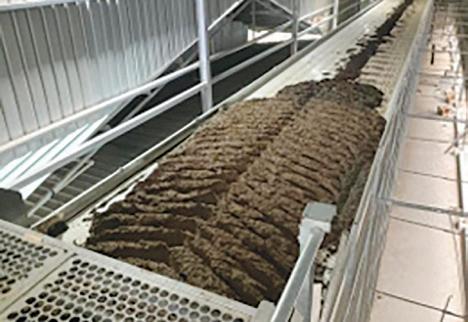
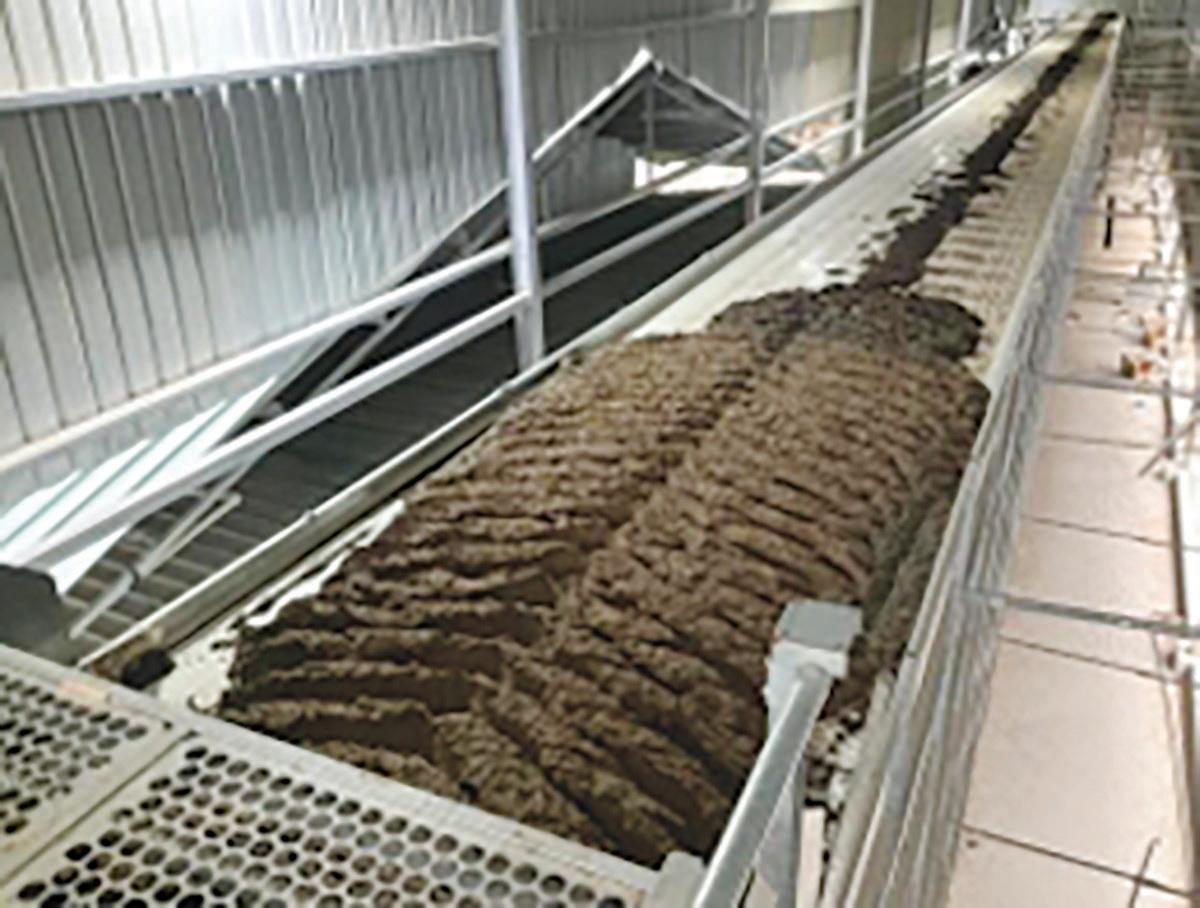
The Caribbean Poultry Association (CPA) has highlighted a sustainability initiative undertaken by Edun Poultry Farms Inc in Guyana with the installation of the Optisec Poultry Manure Drying System at its commercial layer farm in Garden of Eden, East Bank Demerara (EBD). The facility produces approximately 50,000 table eggs daily and the manure drying system project, valued at US$650,000, began in May 2023 and was completed in January 2026. According to the CPA, the system was introduced to improve the management of poultry waste while converting it into a useful resource for agriculture. The Optisec system uses air extracted from tunnel-ventilated poultry houses and heat generated by the birds to dry poultry manure. The process reduces the moisture content of the droppings from about 70 to 80 per cent to approximately 15 per cent within two to three days. The result is a stable and easier-to-handle product. By lowering the moisture content and over-
all volume of the manure, the system also reduces odour and improves storage, handling and transportation. The drying process further reduces the risk of leaching and contamination of nearby soil and water sources. Operations are monitored remotely from a control room equipped with a touchscreen panel that allows continuous management of the system. The dried manure is currently being used as fertiliser on corn and soybean
ing nitrogen, potassium, phosphorus and calcium and also contributes to improved soil structure. The CPA said the investment reflects a commitment to innovation and environmental management within the regional poultry sector. It noted that the installation is the first of its kind in the Caribbean and demonstrates the growing use of modern technology in large-scale poultry production. The association also commended Edun Poultry
fields at Dubulay Ranch and Tacama Gold Inc. in Guyana’s Intermediate Savannahs. The fertiliser provides nutrients includ-
for advancing sustainable practices within the industry while supporting agricultural production in Guyana.
Education Ministry expands NGSA support across regions
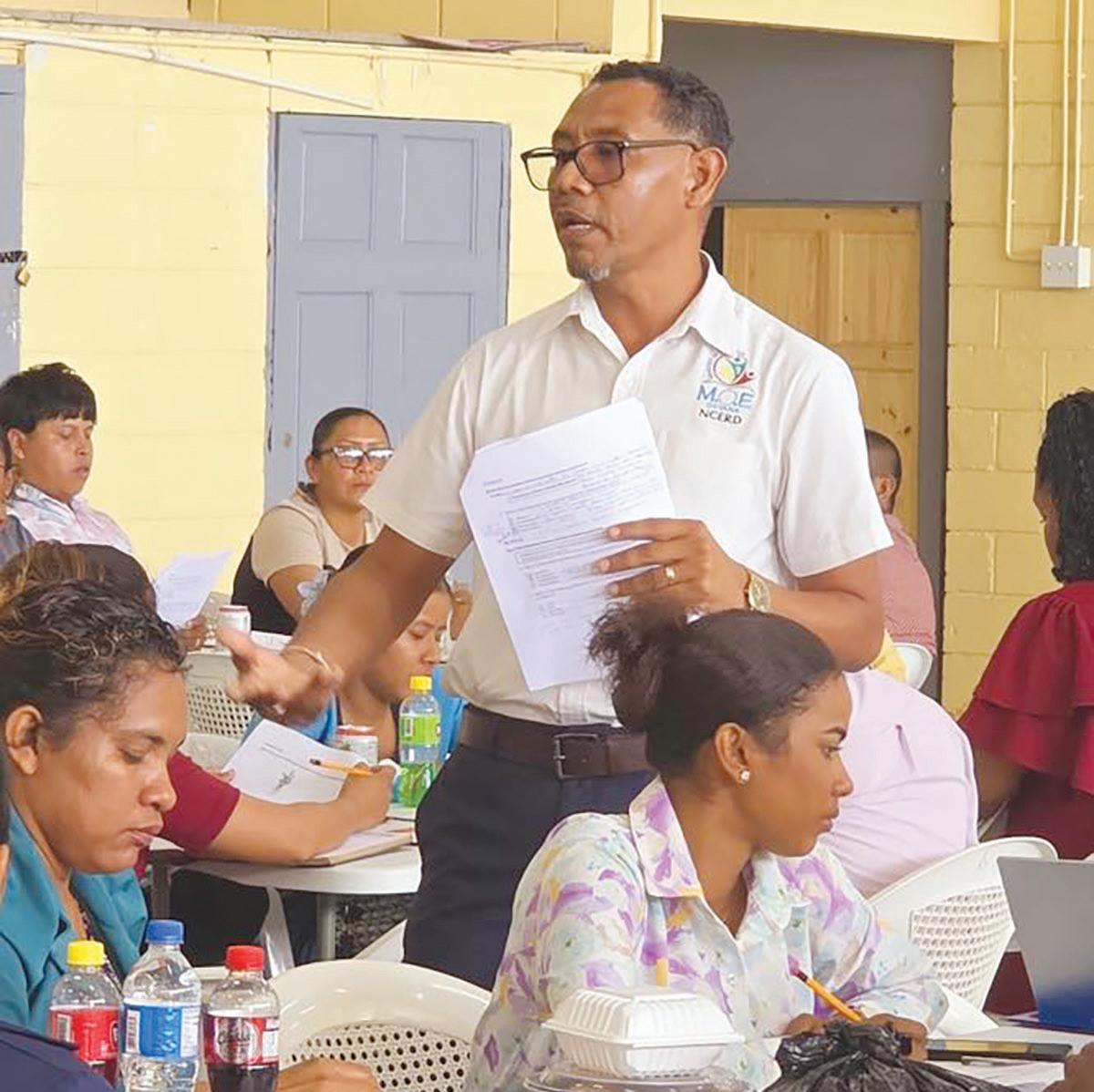
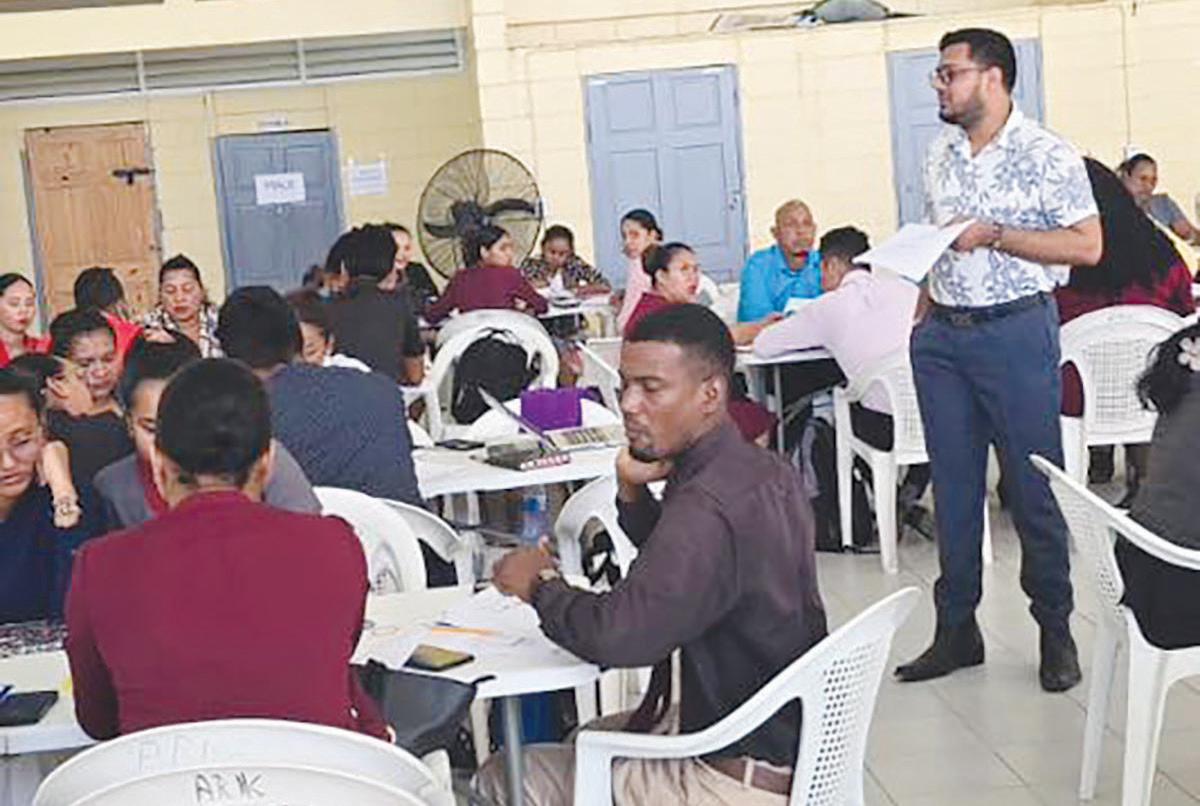
The Education Ministry, through the National Centre for Educational Resource Development (NCERD), is intensifying its efforts to strengthen preparation for the National Grade Six Assessment (NGSA) with targeted training for Grade Six teachers nationwide. On March 5 and 6, a training session was held in Region Two (Pomeroon-Supenaam), where 104 teachers participated. The focus was on reinforcing key concepts and sharpening instructional practices to better support learners ahead of the NGSA examination, the Education
Ministry said on a social media post. Meanwhile, with NGSA lessons now expanded to 41 locations across Regions Two; Three (Essequibo Islands-West Demerara); Four (DemeraraMahaica); Five (MahaicaBerbice); Six (East BerbiceCorentyne) and 10 (Upper Demerara-Berbice), as well as Georgetown, NCERD Math Unit providing wider access to critical academic support. More than 1,500 pupils are currently benefiting from the programme, which aims to boost their confidence, knowledge and skills in preparation for the exams.
Farms
Poultry manure being processed through the Optisec Manure Drying System at Edun’s Poultry Farms in Garden of Eden, East Bank Demerara, Guyana
Chairman of the Guyana National Road Safety Council, Earl Lambert, and the officers on the programme
Training session held in Region Two (Pomeroon-Supenaam)
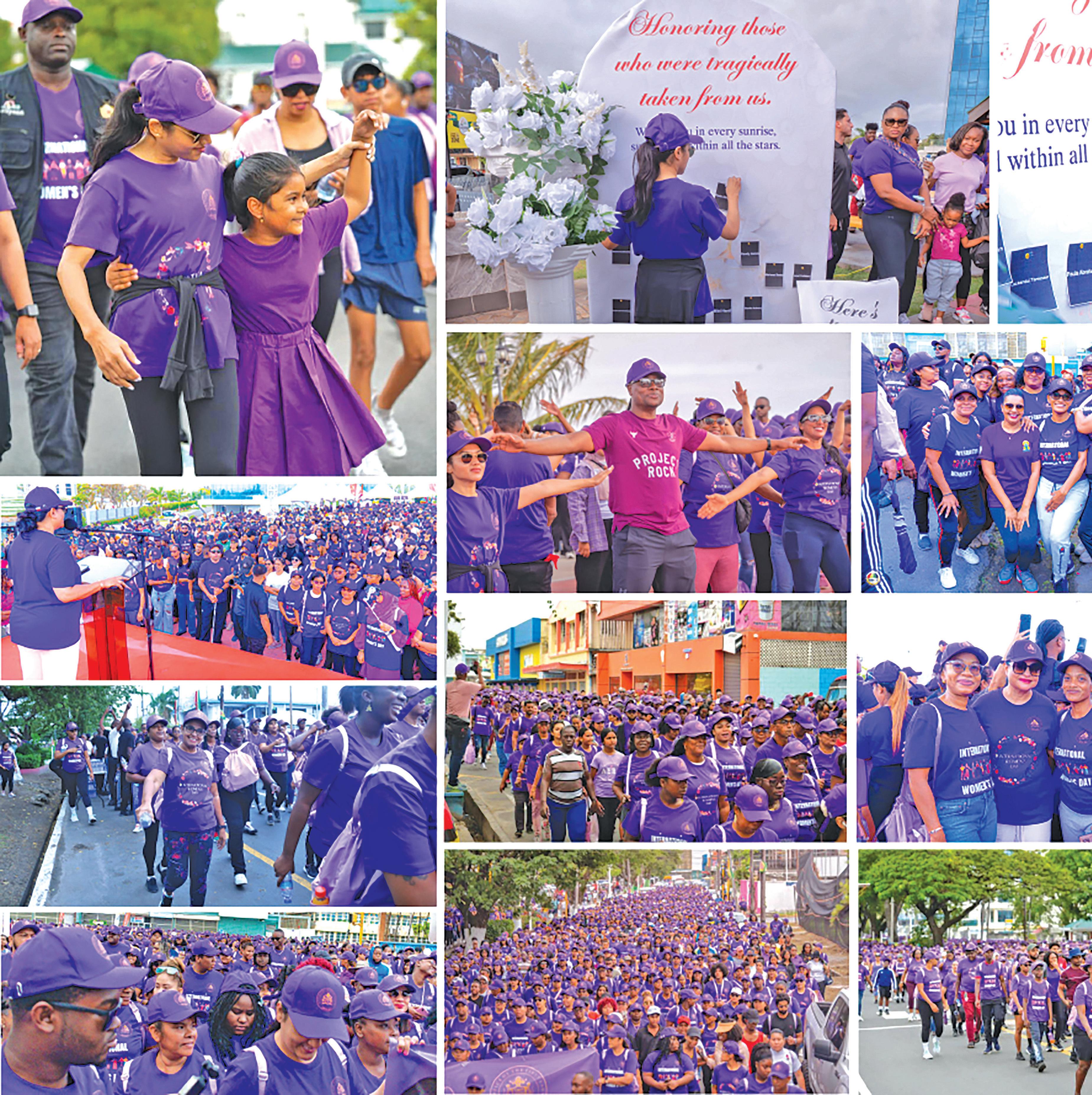
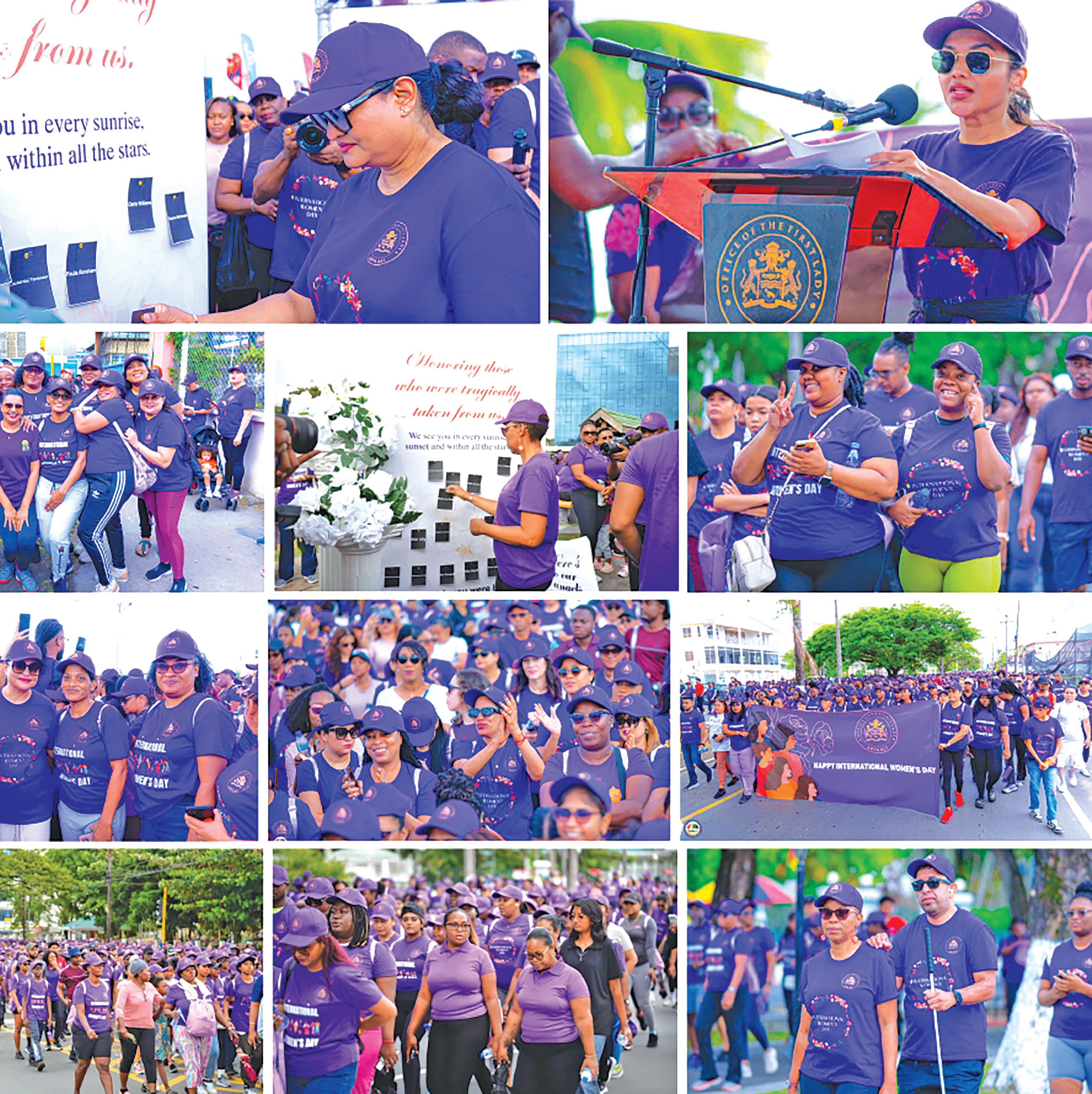
Participants walk in observance of International Women’s Day 2026 in Georgetown on Sunday, girls across Guyana. The event was led by First Lady Arya Ali and brought together Cabinet (Photos courtesy of Minister within the Housing Ministry, Vanessa Ministry; Education Ministry; Amerindian Affairs Ministry;
Georgetown on Sunday, joining a national call for unity, equality, and empowerment for women and together Cabinet members, members of the diplomatic corps, business leaders, and citizens. Ministry, Vanessa Benn; the Human Services and Social Security Affairs Ministry; and Labour Ministry/Facebook)
40 families relocated from Zeelugt sea defence, drainage reserve
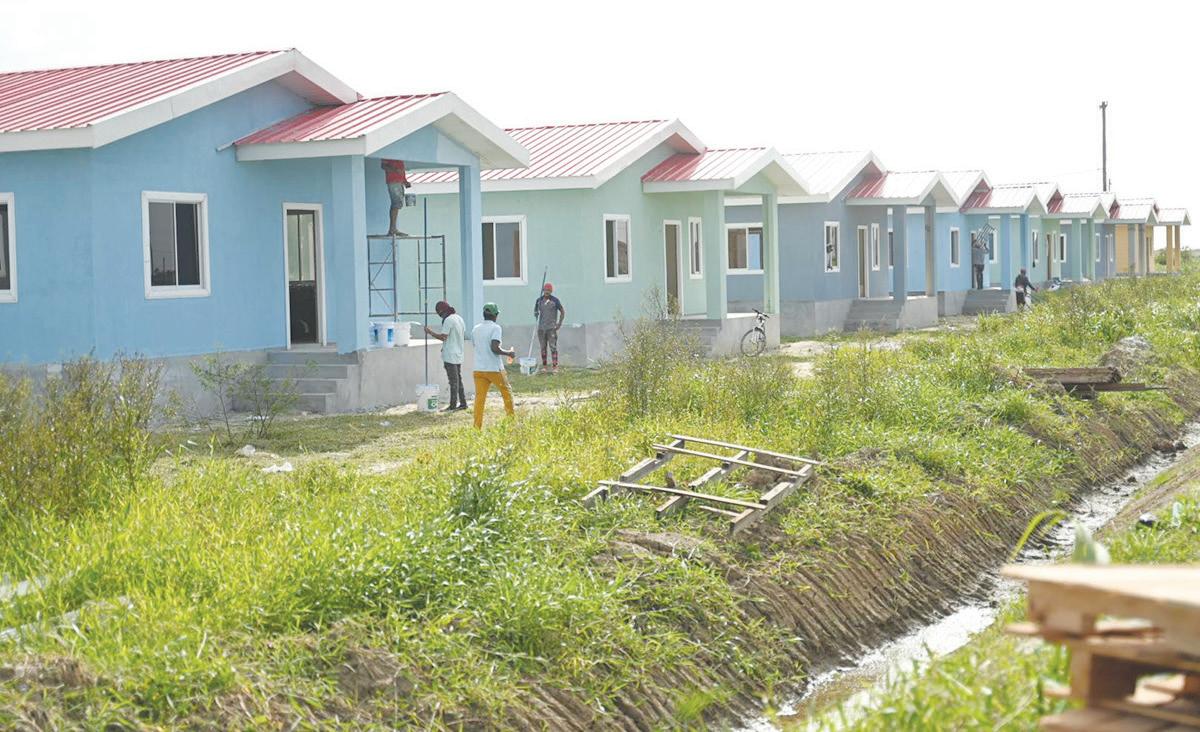
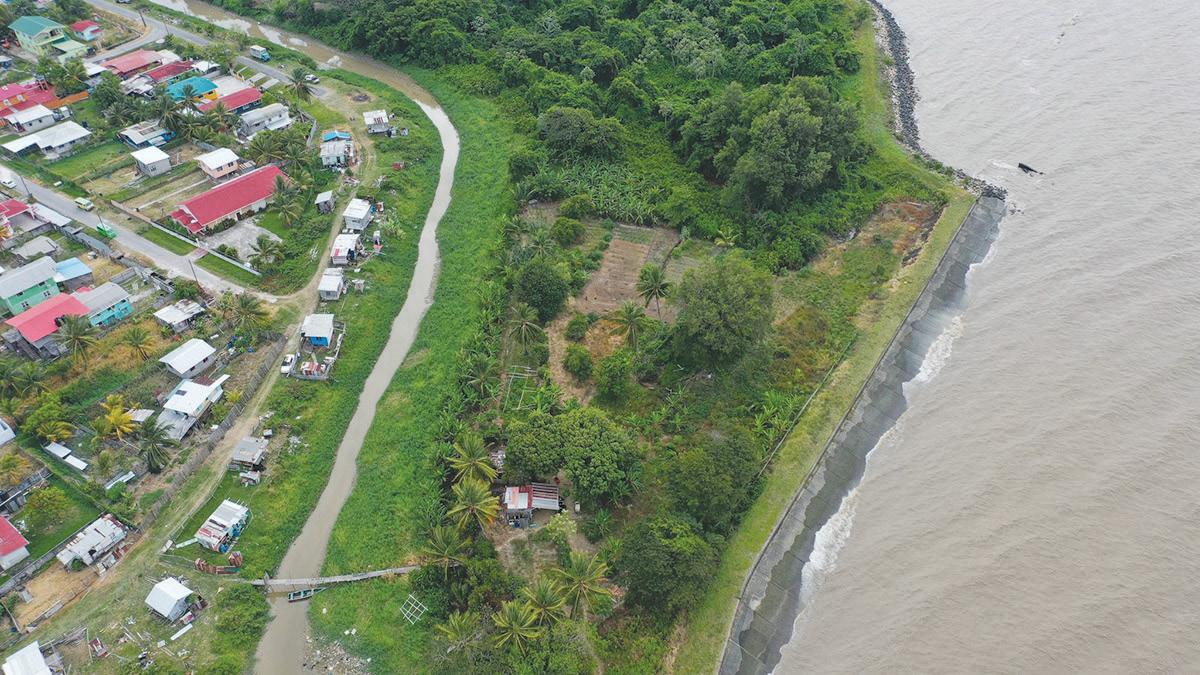
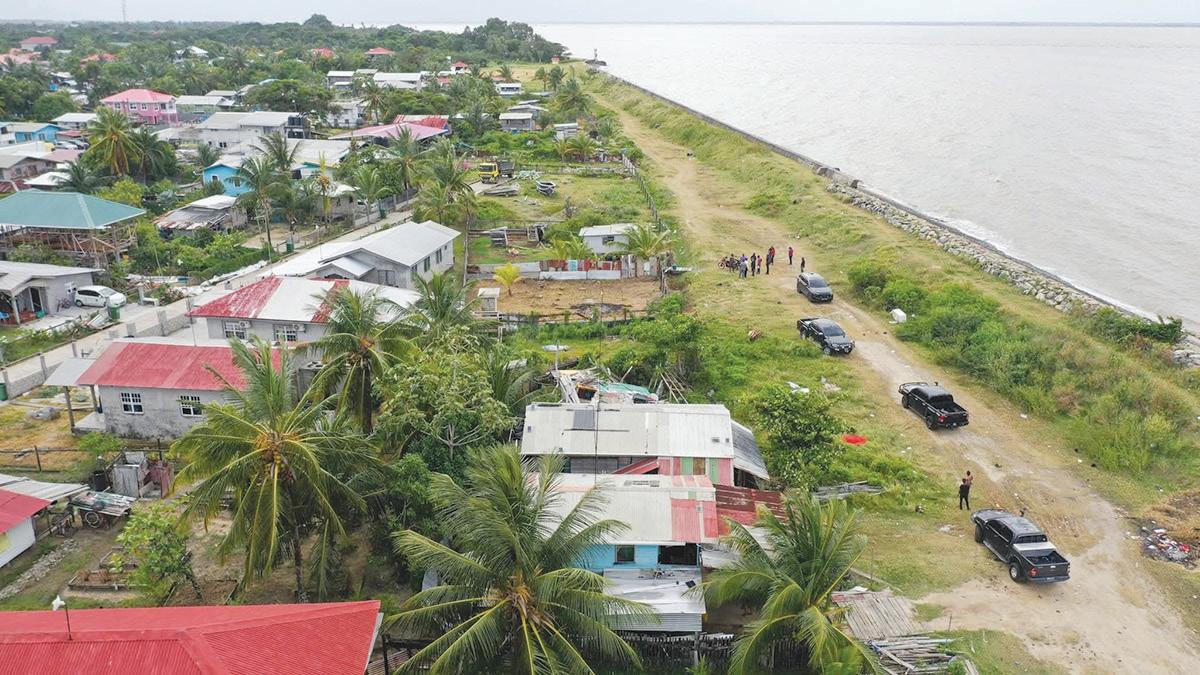
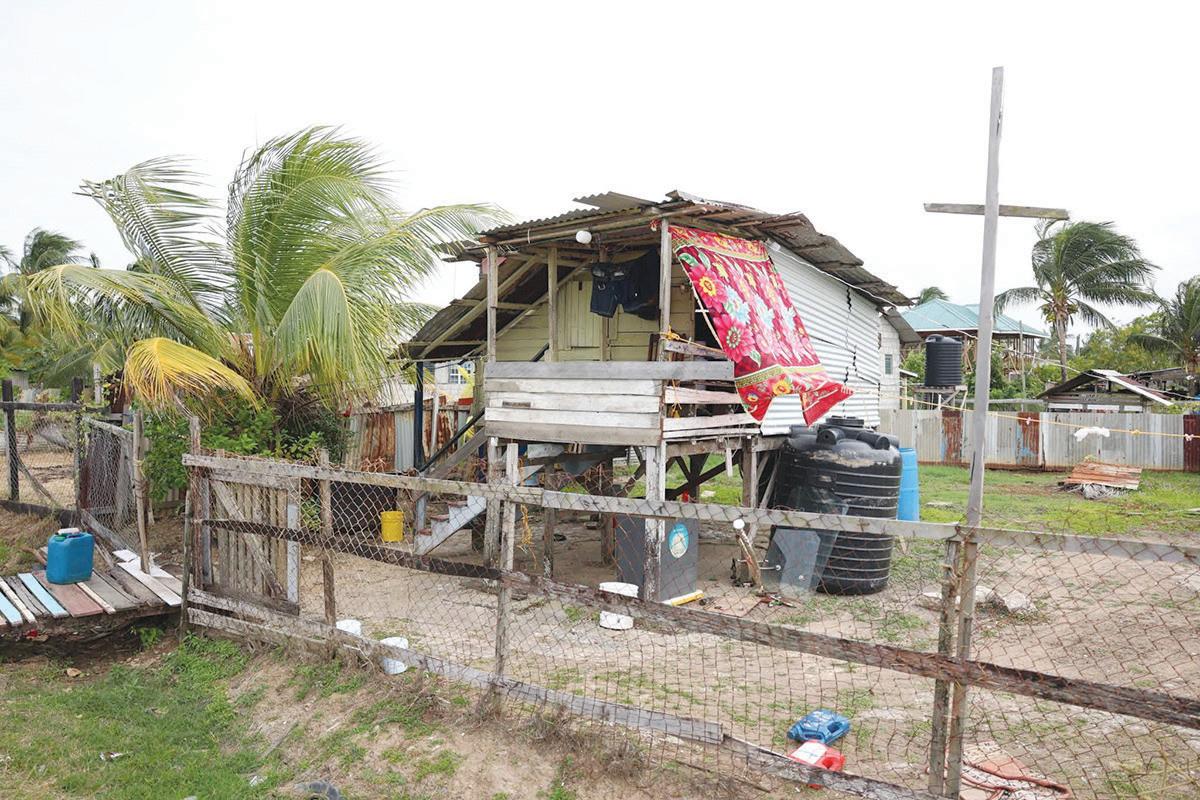
The relocation of persons occupying the sea defence and drainage reserve areas at Zeelugt, East Bank Essequibo (EBE) is progressing with majority of affected families already resettled in a new housing scheme. Housing Minister Collin Croal on Friday visited the Region Three (Essequibo Islands-West Demerara) community to engage residents on the relocation process and address any concerns they may have. He was accompanied by Community Development Director Gladwin Charles, along with several technical officers from the Ministry. During the visit, Croal expressed satisfaction with the progress made thus far, noting that while a few occupants have shown some reluctance to relocate, the overall exercise has been moving forward as planned. At the start of the inventory exercise, a total of 48 structures were documented along the Zeelugt Sea Defence and Drainage Reserve. As part of the relocation initiative however, 34 of these structures have since been demolished. In addition, 40 households have been allocated house lots in a new housing area, with many families already resettled. In a statement from the Housing
Ministry, residents expressed gratitude for the assistance provided by the Government throughout the relocation process. While acknowledging that relocating can present challenges for families, the Housing Minister assured residents that the Government remains committed to making the transition as smooth as possible and noted that discussions will continue with other agencies to further streamline the relocation process and provide additional support where necessary. Also on Friday, Croal and the team visited the Parika Waterfront area, EBE, to engage residents and assess the progress of the relocation exercise. According to the Housing Ministry, relocation efforts for families residing along the Parika Sea Dam continue to progress steadily as part of preparations for the construction of the $4.2 billion modern international port facility at the Parika Waterfront. During the visit, Minister Croal had reaffirmed the Government’s commitment to ensuring that the relocation process is conducted in a fair and orderly manner while advancing a major national development initiative. While the majority of households have largely
cooperated with the Ministry, there are six families remaining to be relocated from the area.
These relocation initiatives are part of efforts to address informal settlements in
Sea Defence and Drainage Reserve were among those areas as well as the Zeelugt Burial Ground and Parika Sea Dam. Other zero tolerance areas in Region Three that Ministry will be relocat-
vulnerable areas.
“Zero-tolerance”
Just last month, during the consideration of the 2026 Budget Estimates in the National Assembly for the Housing Ministry, Croal had indicated that there would be heightened efforts this year to relocate persons from what he described as “zero-tolerance” areas. The Zeelugt
ing persons from this year include Plastic City, Best Railway Line, Greenwich Park Sea Defence, Anna Catherina Sea Defence, Cornelia Ida Sea Defence, Ruby Back Dam, Tuschen Sea Defence, Plantation Vergenoegen, Good Hope Drainage Reserve, and Wallers Delight Drainage Reserve. “In all of those areas… we have identified that those persons have to
relocate. Those are what we call zero tolerance,” the Housing Minister had stated in the National Assembly. Meanwhile, as part of the Housing Ministry’s $159.4 billion Budget allocation for 2026, is some $1.1 billion earmarked for the regularisation of informal settlements.
“So, we intended to address all these areas this year,” Croal noted. According to the Housing Minister, there is an aggressive programme to address squatting across the
in July
Dr
reaffirmed his administration’s commitment to resolving squatting at Zeelugt North, commonly referred to as Sideline Dam, in Region Three. During an impromptu visit to the area, the Guyanese Leader emphasised that the existing conditions were not conducive to a good quality of life and did not provide a safe environment for children. He further pledged the Government’s
country in the same aggression that is being applied to addressing those applications that came through the system.
continued support in relocating affected residents to safer and more developed housing schemes, ensuring improved living conditions for families.
Oil surges past US$100 a barrel for 1st time in 4 years
Oil prices surged over the $100-a-barrel threshold for the first time in almost four years, as traders bet widening conflict in the Middle East would lead to weeks-long supply disruptions.
Brent, the international benchmark, leapt almost 20 per cent in Asia trading on Monday to $109 a barrel. US marker, West Texas Intermediate, rose 20 per cent to $109.05.
It follows a record weekly increase in oil prices last week following US and Israeli attacks on Iran on February 28, and a decision by some of the Middle East’s largest producers to begin curtailing production over the weekend.
President Donald Trump said on Truth Social shortly after trading began: “Short term oil prices, which will drop rapidly when the destruction of the Iran nuclear threat is over, is a very small price to pay for U.S.A., and World, Safety and Peace. ONLY FOOLS WOULD THINK DIFFERENTLY!”
Traders warned that the oil sector was facing one of its greatest ever challenges, with Iran’s attacks on tankers in the Strait of Hormuz affecting production in countries responsible for about a quarter of global crude supply.
“Traders have shifted away from being unable to imagine a prolonged closure of the Strait of Hormuz a week ago, to pricing in the largest oil disruption — by a factor of two — in history,” said Bob McNally, founder of Rapidan Energy Group and a former adviser to George W Bush.
Saudi Arabia, the United Arab Emirates, Iraq and
Kuwait are all either throttling back output or shutting fields entirely, as they risk maxing out storage tanks while crude backs up in the Gulf. Iran’s production had been depressed by years of US sanctions before the war, and its exports have also fallen sharply in the past week.
Further attacks on oilfields and energy infrastructure over the weekend also pose a new threat that could cause prices to soar, just four years after Russia’s full-scale invasion of Ukraine triggered the last energy crisis.
Michael Alfaro, chief investment officer at Gallo
Partners, an energy and industrials hedge fund, said the surge in oil prices above $100 reflected growing market concern that de-escalation may not come quickly.
“Product movements through the Strait of Hormuz remain largely halted, and reports that special forces could be deployed to secure uranium sites suggest this may be a more prolonged situation. At the same time, world leaders are warning about the risk of the conflict broadening, with Lebanon, Russia and China potentially becoming involved in different capacities,” he said.
“In the near term that keeps a geopolitical risk premium embedded in crude, and I wouldn’t be surprised to see oil test higher levels before eventually retracing.”
Last week, West Texas Intermediate posted its biggest weekly rise on record, surging 36 per cent to $90.90 a barrel, while Brent crude hit $92.69. Both Brent and WTI were trading around $60 a barrel in early January.
Gains accelerated towards the end of last week, with Brent rising 8.5 per cent on Friday and traders increasingly betting on a prolonged shutdown of the Strait of Hormuz — a chokepoint that normally accounts for at least a fifth of global oil and liquefied natural gas supplies.
Richard Bronze, head of geopolitics at consultancy Energy Aspects, said: “There’s been no real signs of a diplomatic off-ramp emerging while more Gulf producers are announcing production cuts, most tankers still aren’t risking going through the Strait of Hormuz and more energy infrastructure is getting attacked.”
Goldman Sachs, one of the most influential banks in commodity markets, said late on Friday that crude and refined products such as gasoline and diesel could hit all-time highs “if Strait of Hormuz flows were to remain depressed throughout March”.
Brent hit $147.50 a barrel on the eve of the financial crisis in 2008, which, adjusted
for inflation, is the equivalent of $218 today.
Refined fuel prices have already soared in the past week, with the Gulf becoming a significant supplier of diesel and jet fuel to Europe in recent years, often replacing Russian supplies.
Saudi Arabia’s oil-producing facilities were attacked for the first time in the current conflict on Saturday, with the kingdom saying it had intercepted 21 drones targeting the 1mn-barrel-a-day Shaybah oilfield, while the Berri field was also attacked.
Kayrros, a company that uses satellites to monitor oil infrastructure, said its latest imaging suggested Saudi Arabia had already reduced oil production as it looked to delay the point it runs out of storage. State oil company Saudi Aramco, the world’s top oil exporter, is rapidly trying to reorientate its crude shipments from the Gulf to the Red Sea through its backup East-West pipeline. (Excerpted from Financial Times)
Back
2024, President
Irfaan Ali had
Relocation at the Zeelugt sea defence and drainage reserve advancing
Housing Minister Collin Croal engaging a resident at the Zeelugt sea defence during a recent visit
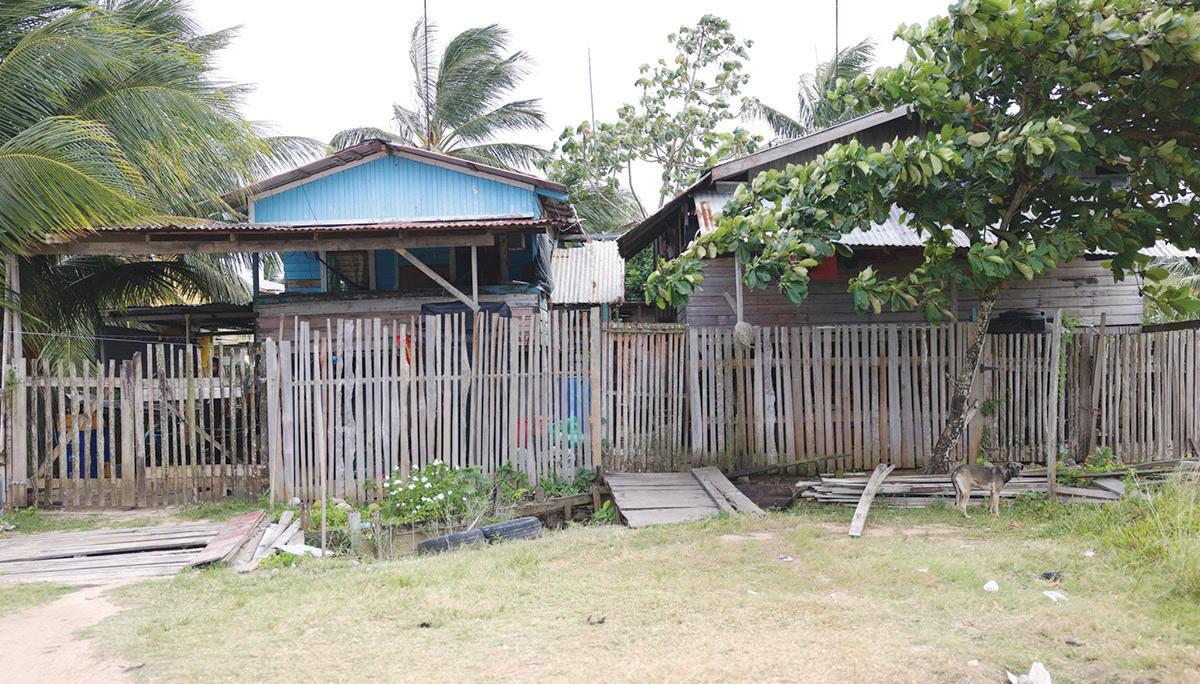
One of the families that have to relocate from the Zeelugt sea defence in Region Three
UG begins search for new Vice Chancellor
The University of Guyana (UG) has launched a search for a new Vice Chancellor as the contractual term of its current head, Paloma Mohamed-Martin, comes to an end after seven years in the role. Mohamed-Martin, who also served the university for a total of 19 years in various academic and administrative capacities, confirmed her impending departure in a message circulated to alumni. “As you may have been apprised, after seven years at the helm of the University of Guyana and 19 years as a staff member, my contractual obligation to the University as Vice Chancellor is coming to an end,” she stated. Reflecting on the milestone, Mohamed-Martin noted that the number seven holds personal significance for her and expressed
support for the process to select her successor. “The number seven has special significance for me on several levels. As such, I fully support the search for a new Vice Chancellor and hope that if any of you or anyone in your network would wish to offer themselves for this most significant and noble service, you will share or respond to this advertisement for a new Vice Chancellor for our beloved University,” she said.
She added, “May UG grow from strength to strength in every positive way.”
Mohamed-Martin was appointed Vice Chancellor (VC) on June 9, 2020, becoming the first woman to hold the position at the university. Prior to that appointment, she served in several key roles during her nearly two decades at the institution. These included Chair of the Transitional Management Committee, Deputy VC responsible for Philanthropy, Alumni and Civic Engagement (PACE), Professor of Behavioural Sciences, Director of the Centre for Communication Studies, and Dean of the Faculty of Social Sciences.
New leadership
In a statement on Sunday evening, Chancellor and Guyana-born Antigua and Barbuda diplomat Ronald Sanders as Chancellor, in
his capacity as Chancellor and Chairman of the University Council, it was disclosed that the Council had already taken steps to initiate the process of identifying new leadership. According to Sanders, the Council decided on February 16 to establish a Search Committee to identify and recommend a new VC and Principal for the institution. “The Council took this decision in order to ensure that the process for selecting new leadership for the University proceeds in an orderly, transparent and merit-based manner, consistent with the governing framework of the institution and the Council’s responsibility to secure the best possible leadership for the University,” Sanders said. The announcement of the search and the public advertisement for the post were scheduled for release on March 9. Sanders noted that the appointment of a new VC comes at a significant moment not only for the university but also for the country, as Guyana continues to undergo rapid economic and structural transformation. “Guyana is now undergoing one of the most dynamic periods of economic growth and structural transformation in its modern history. Expansion in energy production, infrastructure modernisation, economic diversification and
wider international engagement are reshaping national priorities and workforce demands,” he stated.
Central role in supporting national progress
He emphasised that in light of these developments, UG must play a more central role in supporting national progress. “As the country’s premier public university, the University of Guyana must play an even more central role in producing highly qualified graduates, expanding postgraduate education, strengthening research, and contributing independent expertise, innovation and practical knowledge to national and regional development,” Sanders added. According to the university’s public notice inviting applications, the VC serves as the Chief Academic and Administrative Officer of the institution and is accountable to the University Council for the university’s strategic direction, academic quality, research development, financial stewardship and overall institutional performance. The successful candidate will be expected to provide strategic leadership that advances research development and postgraduate education, particularly in areas aligned with national and regional priorities. The individual will also be required to modernise
academic programmes to ensure they respond effectively to emerging workforce demands and industry needs. In addition, the new VC will be tasked with strengthening the university’s financial sustainability and operational efficiency, building durable international partnerships, and expanding opportunities for external funding. The university also emphasised that the successful candidate must foster a culture of performance, integrity and academic excellence within the institution while upholding principles such as academic freedom, shared governance and institutional accountability. The Council is seeking a candidate with a distinguished academic record, normally at the rank of full professor or equivalent, along with significant senior executive
leadership experience within a university or a comparable institution. The ideal candidate is also expected to demonstrate a strong record of involvement at senior levels in institutional growth, research expansion and performance improvement, as well as sound experience in financial management and institutional administration. Further, the candidate must have the capacity to lead organisational transformation and complex change while also possessing strong interpersonal, communication and diplomatic skills. The University Council has indicated that it would prefer candidates with experience working within the Caribbean region or in developing country contexts. However, applications from distinguished candidates across the wider international academic community are also being encouraged. According to the advertisement, the VC will be appointed by the University Council in accordance with the University of Guyana Act and will serve for a fixed term, which may be renewed subject to performance and Council approval. Submissions are to be made either in hard copy to the Registrar, UG, P.O. Box 101110, Greater Georgetown, or electronically via email. The closing date for applications is April 17.
Cuban authorities never responded – J’ca Govt
The Government is insisting that despite repeated efforts to correct “serious concerns” about payment and freedom of movement of doctors in the Cuban Medical Brigade programme and have them continue working in Jamaica, it has received no response from the Cuban government.
Noting that it had pushed for the agreement to continue and proposed that Jamaica pay the doctors directly among other changes, the Government
in a statement on Sunday said:
“The Government of Jamaica is disappointed that the Cuban government has chosen to withdraw their medical personnel when all that is required is for them to agree to terms which they have already accepted with other Caribbean countries.”
Acknowledging that the United States had raised concerns about the programme, including a denial of access to travel docu-
ments, restricted freedom of movement and salary payment matters, publicly, the Government said it considered it necessary to review the existing arrangements to ensure compliance with domestic and international legal obligations.
That review found two issues, the first being that Cuban personnel were not in possession of their own passports.
“Once that was brought to the Government’s attention, immediate steps
Rihanna’s Beverly Hills mansion was struck by gunfire on Sunday afternoon while the singer and businesswoman was home, according to the Los Angeles Police Department and sources with knowledge of the investigation.
The suspect, a 30-yearold woman, has been arrested, the LAPD said. The motive was not immediately
clear and the investigation is ongoing.
Sources told ABC News Rihanna was at home, but nobody was hurt.
Multiple shots were fired at the residence, but none penetrated the inside of her home, only the exterior, sources said. Multiple rounds did hit the outside of the home, though, as well as a vehicle parked out front.
(ABC News)
were taken to correct it. The issue was raised with Passport, Immigration and Citizenship Agency as well as the Cuban authorities locally to ensure that all personnel were allowed to hold their passports,” the release indicated.
The other issue, the government said, was that salary payments for Cuban medical personnel while calculated at the same level as their Jamaican counterparts were being made by Jamaica to the Cuban authorities in US dollars.
Further, the only payments made directly by the Government of Jamaica to the personnel themselves were overtime payments and there was no contractual provision specifying what share of those salary payments was to be paid to the workers.
“That arrangement raised serious concerns under Jamaican labour and tax laws as well as under international labour conventions,” the release said.
Maintaining that it chose the path of “respectful engagement and quiet diplomacy” the government said beginning in July of last year, Jamaica
commenced formal discussions with the Cuban authorities aimed at restructuring the arrangement.
The restructuring exercise would require that workers be paid directly and have control of their travel documents.
Following Cabinet discussions, a formal proposal was made in October, and this was followed up by a further formal communication in December.
The Government said these efforts were reinforced by direct enquiries to both former and current Cuban ambassadors, as well as informal engagements at the ministerial level.
“For absolute clarity, the Government of Jamaica proposed continuation of the programme with adjustments. It remains disappointed that despite these repeated efforts, no substantive response was ever received whether verbally or in writing from Cuba,” it said.
“Unfortunately, the continued lack of response had the practical effect of preserving an arrangement that Jamaica could not justify. Given our legal obligations, our duty to ensure fairness to workers in Jamaica, and the need for compliance with our own laws and international conventions, the Government ultimately concluded that continuation on the existing terms was untenable,” the Government said.
While noting that Jamaica has always valued the contribution of the Cuban medical professionals, the government said: “Jamaica’s position is therefore clear: we value the contribution of Cuban medical personnel, we respect the Cuban people, and we remain committed to cooperation. However, no programme operating in Jamaica can continue on terms that are inconsistent with Jamaican law and international conventions.” (Jamaica Observer)
The Government noted that at the same time, Jamaica became aware that other Caribbean countries had arrangements under which Cuban medical personnel were paid directly, which made it even clearer that a lawful and transparent alternative was possible.
Vice Chancellor, Paloma Mohamed-Martin
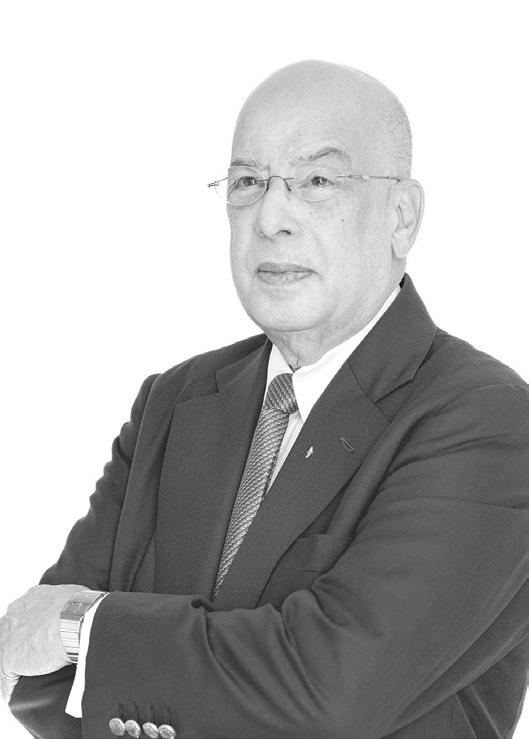
Chancellor of UG, Sir Ronald Sanders
Rihanna
120 women receive business starter packs to boost their businesses
One hundred and twenty women from across Guyana received business starter packs to launch and strengthen their entrepreneurial ventures at the closing of the Women Empowering, Leading, Innovating, and Flourishing Together (WE LIFT) 6 Conference and Expo, held at the Arthur Chung Conference Centre (ACCC) in Liliendaal on Sunday. Two women were selected from each region, the Department of Public Information (DPI) reported, adding that they underwent training in social media marketing, graphics design, garment construction, child care and care for the elderly. These courses were completed under the Women’s Innovation and Investment Network (WIIN) through the Guyana Women’s Leadership Institute (GWLI). Women who completed the garment construction programme were provided with industrial sewing machines, while those trained in child care received toys and learning materials for children. Participants in the social media marketing programme were equipped
with laptop computers to support their digital business activities. In addition to the distribution of starter packs, several Memoranda of Understanding (MoUs) were also signed with key partners to expand support services for women entrepreneurs. Human Services and Social Security
Govt invites bids for major fire station projects
The Government, through the Ministry of Home Affairs, has officially invited bids for the construction of two new fire stations in Rosignol, Region Five (Mahaica-Berbice), and Cumberland, Region Six (East BerbiceCorentyne). As outlined in the recently passed GYD$1.558 trillion national budget, the Ministry has been allocated GYD$52.1 billion to improve emergency services. Several key projects are already yielding results as part of the Government’s nationwide push to strengthen firefighting infrastructure, according to a report from
the Department of Public Information (DPI). New fire stations at Soesdyke, Wisroc and Onderneeming have already been completed, significantly boosting response capacity in those areas, while works are continuing to complete the Diamond and Mahaicony Fire Stations and a marine station is planned for Georgetown. Additionally, the Campbellville Fire Station is currently under reconstruction, while rehabilitation and furnishing works are planned for the New Amsterdam fire station. An electrical upgrade is also scheduled for the
station. Interested bidders can obtain bid documents from the Ministry of Home Affairs Finance Department in Georgetown staring Tuesday, March 10, 2026. Bids must be submitted by 09:00h on April 2, 2026. and will be opened in the presence of bidders or their representatives. The Government emphasises that all bids must include valid compliance certificates from the National Insurance Scheme (NIS) and the Guyana Revenue Authority (GRA). The Home Affairs Ministry retains the right to reject any or all bids without assigning reasons.
Minister, Dr Vindhya Persaud said the initiative is designed to remove barriers that often prevent women from pursuing their business ambitions.
“For me, it has always been about dismantling barriers, especially for women who have potential that many times delay exploring it be-
cause of the many challenges they face,” the Minister stated. She explained that many women begin their entrepreneurial journey from their homes, balancing family responsibilities while working to grow their businesses. Through initiatives such as WIIN, the Government is creat-
ing pathways for women to transition from micro-enterprises to sustainable small and medium-scale businesses. The MoUs signed during the event are intended to strengthen the support ecosystem for women entrepreneurs by providing training opportunities, mentorship and additional business development resources. The WE LIFT 6 Conference and Expo brought together women entrepreneurs from across the country, offering opportunities for networking, product exhibitions and access to programmes aimed at fostering business growth.
The distribution of starter packs and the signing of the agreements marked another step in the Government’s efforts to empower women economically while encouraging more entrepreneurs to enter and succeed in the business sector.
Paving works completed at Stanleytown Bridge
The paving works at Stanleytown Bridge have been completed. The three new concrete bridges in Stanleytown, West Bank Demerara (WBD) is fully paved and the structures are now fully open to two-lane traffic, the Public Works Ministry
Bartica fire
Proprietress of Jofa Products, Fay Gilgious-Greaves signs her MoU
Human Services and Social Security Minister, Dr Vindhya Persaud poses with some of the beneficiaries of the starter packs
Wisroc Fire Station
Br Dr Tariq Jagnarine Fam meD, enDocrinology/ DiaBeTes
Why food safety matters
Food brings families together. It nourishes our bodies and is central to our culture and daily life. But when food is not handled, stored, or cooked properly, it can also make people sick. Foodborne illness, commonly called food poisoning, occurs when harmful bacteria, viruses, or toxins contaminate food.
In Guyana, warm temperatures and humidity create ideal conditions for germs to grow quickly, especially when food is left out too long or not cooked thoroughly. Children, older adults, pregnant women, and people with weakened immune systems are especially vulnerable to severe illness. The good news is that most food poisoning can be prevented with simple habits at home.
What causes food poisoning
Food poisoning is usually caused by germs such as Salmonella, E coli, or Campylobacter. These bacteria can contaminate raw meat, poultry, seafood, eggs, vegetables, or water contaminated with faeces. They multiply rapidly if food is kept at the wrong temperature or handled without proper hygiene.
HEALTH TIPS
Food Safety at Home: Protecting Your Family from Food Poisoning
Simple steps every household in Guyana can take to prevent illness
Contamination can also occur when dirty hands, unwashed utensils, or kitchen surfaces that have touched raw foods later come into contact with cooked foods. This is known as cross-contamination and is a common cause of foodborne illness.
Common symptoms
Symptoms of food poisoning often begin within a few hours to a few days after eating contaminated food. These symptoms may include nausea, vomiting, diarrhoea, stomach cramps, fever, and weakness. While many people recover within a few days, severe cases can lead to dehydration or complications requiring medical attention.
If symptoms are severe, persistent, or occur in young children, elderly persons, or pregnant women, medical care should be sought promptly.
The four key principles of food safety
Food safety at home can be simplified into four key actions: Clean, Separate, Cook, and Chill.
Clean
Always wash hands thoroughly with soap and water before preparing food and after handling raw meat, poultry, seafood, or eggs. Kitchen surfaces, cutting boards, and utensils should also be cleaned regularly to prevent the spread of germs.
Washing fruits and vegetables under clean running water helps remove dirt, bacteria, and pesticide residues.
Separate
Raw foods should always be kept separate from cooked or ready-to-eat foods. For example, raw chicken should not be placed on the same cutting board as vegetables unless the board has been thoroughly washed.
Using separate cutting boards or plates for raw and cooked foods helps prevent cross-contamination.
Cook
Cooking food thoroughly kills most harmful bacteria. Meat, poultry, seafood,
and eggs should be cooked completely. Undercooked food may still contain dangerous germs that can cause illness. Leftovers should be reheated until hot throughout before eating.
Leftovers should be stored in the refrigerator within two hours after cooking. If food has been left out overnight, it is safer to discard it.
Food safety at markets and street vendors
Food safety does not begin in the kitchen; it begins when food is purchased. When buying food at markets or from vendors, look for clean environments and proper food handling practices. Meat and seafood should appear fresh and be stored appropriately.
Hot foods should be served hot, and cold foods should be kept cold. If food appears poorly handled or has an unusual smell, it is best to avoid it.
Special care for vulnerable groups
Bacteria grow rapidly at room temperature, especially in warm climates like Guyana. Perishable foods should not be left out for long periods. Refrigeration slows bacterial growth and keeps food safer for longer.
Young children, elderly individuals, pregnant women, and people with chronic illnesses are more likely to develop serious complications from food poisoning. Extra care should be taken when preparing food for these groups.
Milk and juices should be stored properly, meats cooked
thoroughly, and leftovers handled safely. Clean drinking water is also essential for preventing foodborne illness.
Small habits that make a big difference
Food safety does not require expensive equipment or complicated systems. Consistent, simple habits can protect families from illness.
Washing hands before cooking, cleaning surfaces regularly, separating raw and cooked foods, and storing food properly are powerful steps that prevent contamination.
Teaching children these habits also helps create lifelong awareness of hygiene and health.
The role of families and communities
Food safety is a shared responsibility. Families, food vendors, and communities all play a role in protecting public health. Schools, workplaces, and community groups can also promote awareness of safe food practices.
When everyone understands the importance of proper food handling, the risk of foodborne illness decreases for the entire community.
Food poisoning is often preventable. Simple actions in the kitchen can protect your family from unnecessary illness. Clean your hands, separate raw foods. Cook thoroughly. Store food safely. Healthy meals should nourish, not harm those we love.
Food safety begins at home. Protect your family with safe food habits every day.
Chill
Regional
Colombia counts votes for next Congress, presidential hopefuls
Colombians voted on Sunday to elect a new Congress and choose three of the presidential candidates who will run in elections this May, a vote that will shape the next President’s ability to push through legislation and fulfil their agenda.
Voters chose from over 3000 candidates to fill 102 Senate seats and 182 House seats, in a peaceful election analysts have predicted will be divided among some two dozen parties, likely forcing the next President to form a coalition government.
While polls closed at 16:00h (04:00pm) local time (2100 GMT), results for the Senate and House were too early to call at around 19:30h (07:30pm).
Alongside the legislative elections, right-wing, leftist and centrist groups held primaries to choose candidates for the May presidential election.
With over 86 per cent of the primary vote reported, it was clear that the rightwing primary was won by Democratic Centre Senator Paloma Valencia, while former Senator Roy Barreras, an ally of Petro, prevailed for the leftist group. Former Bogota Mayor Claudia Lopez won the centrist primary.
Gustavo
papers before casting his
in congressional
and party primaries for a presidential candidate, in
Colombia, March 8, 2026 (Reuters/Luisa
The three winners will take part in the May presidential election and will face Abelardo De La Espriella, Ivan Cepeda and Sergio Fajardo — other representatives of the right, left and centre, respectively — who did not take part in the primaries and chose to run directly in the first round.
“It is very important to come and exercise the right to vote. The most important thing is for Colombia to decide its future and for the results to be respected,” said Federico Rodriguez, a 32-year-old business administrator, after voting in Bogota’s north.
“It is a source of pride
that we can go out and exercise our right to vote and to democracy, but I also have uncertainty about the results, about knowing what Colombia’s future will be in the next four years,” said university student Isabella Suarez, 21.
President Gustavo Petro, whose term ends in August, has repeatedly questioned the software being used for the vote count in the elections, alleging possible irregularities, while National Registrar Hernan Penagos has guaranteed the transparency of the vote and said party observers can verify the software’s results. (Excerpt from Reuters)
Massy’s gas CEO resigns
Massy’s gas CEO resigns Massy Holdings Ltd on Saturday announced the resignation of Vaughn Martin, its group’s Executive Vice President and Chief Executive Officer (CEO) of its gas products portfolio, effective March 31.
The notice of the material change appeared on the Trinidad and Tobago Stock Exchange, with the company thanking Martin for his years of service to the group.
“The Chairman and the Board of Directors would like to thank Mr Martin for his years of dedicated service to the Group,” the company noted in the filing, which was made pursuant to Section 64(1)(b) of the T&T Securities Act, 2012.
Martin’s departure comes at a time when Massy Holdings Ltd has been expanding its regional footprint through a series of acquisitions, particularly within its gas products portfolio.
One of the most significant transactions in recent years was the acquisition of Industrial Gases Ltd in Jamaica in 2023 through its subsidiary Massy Gas Products Holdings. The deal, valued at roughly US$140 million, gave the conglomerate full ownership of the Jamaican industrial and medical gas producer and expanded its footprint in that country’s manufacturing and energy supply chain.
The acquisition strengthened Massy’s Gas Products portfolio, which supplies in-
dustrial, medical, and liquefied petroleum gases across the Caribbean and Central America. The transaction also required regulatory clearance in Jamaica due to competition concerns, given the group’s existing presence in the LPG distribution market.
In the same year, the group completed another major transaction when it acquired the local subsidiary of global industrial gas company Air Liquide in T&T.
The acquisition was viewed as a strategic move to deepen Massy’s presence in the industrial gas market and strengthen supply capabilities across its regional network.
(Excerpt from Trinidad Guardian)
Normal operations resume at Barbados airport
Operations at Grantley Adams International Airport gradually returned to normal on Sunday following Saturday s industrial action by air traffic controllers which forced a temporary shutdown of Barbados airspace.
The action halted inbound and outbound flights for more than seven hours and resulted in several cancellations, diversions and
delays affecting international travellers.
Airport officials said airlines were continuing to rebook passengers and adjust schedules after the interruption, which saw American Airlines flights cancelled while a JetBlue service from New York returned to JFK and an Air Canada flight went back to Canada.
Once the airspace reopened on Saturday after-
noon, inbound services from the United Kingdom operated by British Airways and Virgin Atlantic were among the flights able to land as operations resumed.
Inside the airport terminal, the atmosphere was markedly calmer than the confusion and frustration that unfolded during the shutdown, though many passengers were still trying to secure revised travel arrangements. (Nation News)
Spectacular images reveal unique sea creatures and corals off Caribbean islands
The waters off the glittering coastlines of Britain’s Caribbean territories have long been a mystery.
But now scientists on the first expedition beyond the islands’ shallows have discovered an underwater mountain range, a massive “blue hole”, coral reefs apparently untouched by climate change and never-before-seen sea creatures.
Operating 24 hours a day for the last six weeks, researchers subjected cameras and other equipment to extreme water pressure, recording as deep as 6000m (19,700ft).
To navigate the Cayman Islands, Anguilla and Turks and Caicos, they were forced to rely on decades-old maps with serious errors and whole areas missing.
The UK Centre for Environment, Fisheries and Aquaculture Science (CEFAS) has shared their footage and discoveries exclusively with BBC News.
The UK government
shares responsibility for protecting the islands’ nature and up to 90 per cent of Britain’s unique species are found around these and other British Overseas Territories.
Now scientists say the race is on to protect this “relatively pristine” environment from the threats of climate change and pollution.
“This is the first step into environments people have never seen, and in some cas-
es didn’t know existed,” says Dr James Bell, leading the expedition on the British research ship RRS James Cook with scientists from the three islands.
“Just yesterday we found a kind of type of swimming sea cucumber, and we still don’t know what it is,” he added, calling the diversity he’s seen “really, really astonishing”.
(Excerpt from BBC News)
T&T PM calls for action on women’s
rights
Trinidad and Tobago
Prime Minister Kamla
Persad-Bissessar extended greetings to women and girls locally and internationally as the country marked International Women’s Day 2026.
In a message issued on Sunday, Persad-Bissessar said the observance carries the theme, “Rights. Justice. Action. For ALL Women and Girls”, which celebrates progress while reminding societies that equality must be protected through decisive action.
“On this International Women’s Day 2026, I extend my very best wishes to women and girls across the world, and especially in Trinidad and Tobago,” the Prime Minister said.
Persad-Bissessar said women in Trinidad and Tobago have secured equal legal access to education, professional advancement, and public participa-
tion. However, she said the country must also confront threats to the safety and dignity of women and girls.
She said criminal networks involved in narcotics trafficking, human trafficking, and organised gang violence across the region prey on vulnerable people.
The Prime Minister also warned that where authoritarianism rises, women’s
freedoms are often among the first curtailed, while societies that uphold democratic governance and human rights empower women and girls to learn, lead and live without fear.
“In this spirit, Trinidad and Tobago stands with our international partners in supporting democratic governance. Advancing democracy ultimately advances justice and opportunity for women everywhere,” Persad-Bissessar said.
She urged citizens to use the observance to renew their commitment to protecting rights, strengthening justice and taking decisive action both locally and internationally.
“For when women and girls are guaranteed safety, protection, justice, and dignity, societies grow stronger, economies prosper, and nations move closer to their highest ideals.”
(Trinidad Guardian)
Jamaica: Man arrested in murder probe while attempting to board flight
A30-year-old man has been charged with murder in relation to a stabbing incident along the Salt Spring main road in St James last year.
Adam Carey, otherwise called Chin-Chin , of Rosemount, St James, is accused of murdering 46-yearold Christopher Clarke, otherwise called Ally , a labourer of Birch Hill in Salt
Spring.
Reports from the Mount Salem Police are that about 08:55h, Carey allegedly stabbed Clarke along the main road. Clarke reportedly attempted to drive himself to the hospital, but lost consciousness. The motor vehicle subsequently hit an embankment and overturned.
The Police were summoned, and Clarke was tak-
en to the hospital where he was pronounced dead. On Thursday, March 5, 2026, Carey was arrested at an airport while attempting to board a flight to Panama. He was handed over to the Police, after which he gave a caution statement and was subsequently charged following an interview. His court date is being finalised. (Jamaica Observer )
Trinidad and Tobago Prime Minister Kamla PersadBissessar
Colombian President
Petro shows the ballot
vote
elections
Bogota,
Gonzalez photo)
OIL NEWS
US energy chief defends waiver on Russian oil sanctions, blames fear for higher gas prices
Trump Administration ?officials on Sunday defended a decision to temporarily lift some sanctions on Russian oil and predicted that a sharp increase in ?gasoline prices resulting from the Iran war would last only weeks.
Appearing on multiple TV talk shows, Energy Secretary Chris Wright and US Ambassador to the United Nations, Mike Waltz said a waiver issued last week to allow Indian purchases of Russian oil would alleviate pressure on the global market.
”It’s a 30-day pause to allow, which is just kind of common sense, ?to allow the millions and millions of barrels of oil that are sitting out on ships to go to Indian refineries,” Waltz ?said on NBC’s ”Meet the Press”.
Wright told CNN’s ”State of the Union” that the waiver can help ”tamp this fear of shortage ?of oil, tamp the price spikes and the concerns we see in the marketplace”.
With the war now in its second week and no end in ?sight, Americans are grappling with higher prices at the pump, a new complicating factor for the US economy, which unexpectedly lost 92,000 jobs in February.
As of Friday, ?the national average price for regular gasoline stood at US$3.32 a gallon, up 11 per cent from the previous week and the highest since September 2024, according to data from the motorists group AAA. Diesel was at US$4.33, up 15 per cent from a week ago, surging to the highest level since November 2023.
”Short term oil prices, which will drop rapidly when the destruction ?of the Iran nuclear threat is over, is a very small price to pay for U.S.A., and World, Safety and Peace,” President Donald Trump ?wrote in a Truth Social post on Sunday night. ”ONLY FOOLS WOULD THINK DIFFERENTLY!”
Earlier on Sunday, Wright said there is no shortage of oil or natural gas and blamed price increases ?on ”fear and ?perception” that the Iran operation will be a drawn-out affair.
”But it won’t be,” Wright said on ”Fox News Sunday,” echoing Trump’s prediction that the war will last weeks rather than months.
US crude futures surged more than 20 per cent in early trading in Asia today, hitting their highest since July 2022, as the expanding war fuelled fears of tighter supply and prolonged disruptions to shipments through the Strait of Hormuz.
In a statement late on Sunday, Senate Minority Leader Chuck Schumer ?called on Trump to sell oil from ?the Strategic Petroleum Reserve, which currently ?holds about 415 million barrels of oil, or more than the entire world uses in four days.
”Trump should release oil from the SPR now to stabilise markets, bring prices down, and stop the price shock that American families ?are already feeling thanks to his reckless war,” said Schumer, a New York Democrat.
The Energy Department did not ?immediately respond to a ?request for comment.
Trump on Thursday told Reuters that he was not looking to tap the strategic reserve.
Senator John Kennedy, a Louisiana Republican, criticised energy speculators.
”The oil prices have gone up because you’ve got a bunch of oil traders out there in their Gucci loafers, with their caramel Frappuccinos who are bidding up the price,” Kennedy ?said on ”Fox ?News Sunday.”
Political analysts say a persistent rise in gasoline prices could hurt Republicans in the ?November midterm elections when control of the US Congress will be at stake. A Reuters/Ipsos poll last month found that most respondents rejected Trump’s characterisation of the economy as ”booming”. (Reuters)
Around the World
Iran names Khamenei’s hardline son Mojtaba as new supreme leader
Iran today named
Mojtaba Khamenei to succeed his father Ali Khamenei as supreme leader, signalling that hardliners remain firmly in charge, as the week-old US-Israeli war with Iran pushed oil above US$100 a barrel.
Mojtaba, a cleric with influence inside Iran’s security forces and vast business networks under his father, had been viewed as a frontrunner in the leadup to Sunday’s vote by the Assembly of Experts, a body of 88 clerics tasked with choosing Ali Khamenei’s successor.
”By a decisive vote, the Assembly of Experts, appointed Ayatollah Seyyed Mojtaba Hosseini Khamenei as the third Leader of the sacred system of the Islamic Republic of Iran,” the Assembly said in a statement issued just after midnight Tehran time.
Iran’s President Masoud Pezeshkian on naming the new supreme leader, said it is the manifestation of Iran’s
will to strengthen national unity.
The position gives Mojtaba the final say in all matters of state in the Islamic Republic.
The White House did not immediately respond to a request for comment on the announcement of Iran’s new supreme leader.
Mojtaba’s appointment will likely draw the ire of US President Donald Trump,
who said on Sunday that Washington should have a say in the selection. ”If he doesn’t get approval from us, he’s not going to last long,” he told ABC News. Israel, ahead of the announcement, threatened to target whoever was chosen.
Mojtaba’s father, Supreme Leader Ali Khamenei, was killed in one of the first strikes launched against Iran more than a
week ago.
Washington on Sunday ordered the departure of non-emergency employees at its embassy in Saudi Arabia, the latest drawdown of US diplomats as Iran has struck US facilities in the region.
The US military reported a seventh American has died from wounds sustained during Iran’s initial counter-attack a week ago, a day after Trump presided over the return to the United States of the remains of the six others killed.
The US-Israeli attacks have killed at least 1332 Iranian civilians and wounded thousands, according to Iran’s United Nations Ambassador.
Iranian state media said the leadership of Iran’s armed forces had pledged allegiance to Mojtaba Khamenei and the Islamic Revolutionary Guard Corps said in a statement they are ready to follow the new supreme leader. (Excerpt from Reuters)
Marches for International Women’s Day denounce war, abuse and oppression
Thousands of demonstrators have taken to the streets around the world to mark International Women s Day, taking a stand on a number of issues including the USIsraeli war with Iran and gender-based violence.
In Spain, where the Government drew the ire of the United States for refusing to allow it to use Spain s military bases for strikes against Iran, thousands of women took to the streets of major cities to call for an end to the war.
It is within our power to stop the war, to stop the barbarity, and to win rights, said Yolanda Diaz, Spain s Second Deputy Prime
Israel says it targeted Iranian commanders in Beirut as
death toll nears 400
Israel’s military said it ?hit Iranian commanders in the Lebanese capital early on Sunday, expanding the scope of its campaign to the heart of Beirut after days ?of strikes that have left nearly 400 persons dead.
The drone strike was the first within the city limits of Lebanon’s capital since Israel-Hezbollah hostilities resumed last week, and came amid heavy bombardment on Beirut’s southern suburbs and the country’s south and east.
Israel said it targeted
key commanders of Iran’s elite Quds Force of the Revolutionary Guards but did not name them.
”The commanders of the Quds ?Force’s Lebanon Corps operated to advance terror attacks against the state of Israel and its civilians, while operating simultaneously for the IRGC in Iran,” ?the Israeli military said in a statement.
An Israeli military source said the strike targeted five ?senior Quds Force members, including intelligence and finance personnel.
Lebanon says four per-
sons were killed in the strike, part of a rapidly-rising death toll that has reached ?394 persons, the Health Ministry said on Sunday, including at least 83 children and 42 women.
Lebanon’s Health Ministry does not otherwise distinguish between civilians and military personnel.
Israel’s military ?has so far killed about 200 Hezbollah militants, spokesman Nadav Shoshani said in an online briefing. Hezbollah has not published a toll for its fighters.
(Excerpt from Reuters)
Minister. We proclaim ourselves in defence of peace, in defence of the Iranian people, in defence of Iranian
women.
On the first day of the joint US-Israeli war on Iran, strikes on a primary school
in the city of Minab killed 165 girls, most between the ages of seven and 12, during class hours the deadliest single attack on civilians so far.
In France, where more than 150 demonstrations were held, 73-year-old rape survivor Gisele Pelicot led a march calling for an end to sexual violence, telling a crowd in Paris, We won t give up . Pelicot became a global symbol in the fight against sexual violence after she waived her right to anonymity during the 2024 trial of her ex-husband and dozens of strangers who raped her while she was unconscious.
(Excerpt from Al Jazeera)
As Fukushima memories fade, Japan embraces a nuclear-powered future
Takuma Hashimoto was three years old when a massive earthquake and tsunami struck on March 11, 2011, triggering nuclear meltdowns at the Fukushima Daiichi plant just an hour’s drive from his home.
As the worst nuclear disaster since Chornobyl unfolded, ?his terrified family was trapped, unable to flee like their neighbours because they could not find gas for their car.
Now 18, Hashimoto wants to become part of Japan’s next generation of nuclear talent.
”I don’t think nuclear power ?should be treated as something that’s automati-
cally dangerous,” said the engineering student at a technical college in Iwaki, where a monitoring station still keeps check on local radiation levels.
Reuters spoke with Hashimoto, as well as a former crisis management official and a nuclear industry veteran, ahead of the 15th anniversary of the disaster. Their stories illustrate how Japan is pivoting back to a power source it had all but shunned.
Resource-poor Japan was once one of the world’s biggest proponents of nuclear power, which provided roughly 30 per cent of the country’s electricity from 54 reactors.
The Fukushima disaster saw public opinion swing dramatically against nuclear, ?and all reactors were ordered to be shut down for safety inspections and upgrades. In 2012, the Government even decided to phase out nuclear energy. That decision was reversed two years later, but reactor restarts have been slow and ?many have been shut permanently.
Now Tokyo’s staunchly pro-nuclear leader Sanae Takaichi, buoyed by a thumping election win, is pushing to accelerate restarts and advance new nuclear technologies ?to wean the country off costly imported fossil fuels.
(Excerpt from Reuters)
Working women against war & oppression : Women’s rights activists gather at a rally to mark International Women’s Day, in Karachi, Pakistan, on March 8, 2026 [Ali Raza/AP Photo]
A picture of Iran’s new supreme leader, Mojtaba Khamenei, is displayed on a screen in Tehran, amid the US-Israeli conflict with Iran, in Tehran, Iran, today, March 9, 2026 (Majid Asgaripour/WANA (West Asia News Agency) via Reuters)
Put your energy into something you care about. Check into courses, government grants or volunteer work that address your concerns. Make fitness and a healthy diet part of your daily routine.
Initiate change. Your words and actions will carry weight and resonate with those who offer support. Fine-tune your skills and apply for positions that excite you.
Say less and do more. How you reach out to others will determine what you get in return. A helping hand will fetch better results than criticism. Put a cap on your spending.
Listen, be reasonable and stick to the truth. Funnel your energy into keeping up, recognizing your value and using your intelligence, knowledge and expertise to uphold your reputation.
Participate in events that offer insight into subjects, professions or hobbies that interest you. What you discover will motivate you to take on something new and exciting.
Keep your emotions to yourself. Someone will use the information you share without concern for your safety or your reputation. Don’t reveal financial, personal or health matters.
Stick close to home. Nurture relationships and rearrange your space to encourage greater creativity and initiative. Make healthy choices that encourage you to look, feel and do your best.
Learn as you go. Avoid shared expenses and joint ventures that add stress to your life. Don’t hesitate to say no or to change your mind if you have doubts. Trust your instincts.
Invest more time in yourself. Pay attention to your needs and what you can do to maintain the happiness and lifestyle you desire. Make peace and love a priority.
Be willing to help others, but don’t pay for someone else’s mistakes. Your foresight and spontaneity will change the dynamics of your professional relationships for the better.
Discipline will pay off. A passionate display of what you can do will have an impact on others. Personal growth and financial gain are within reach. Take a chance and find your bliss.
You are overdue for a shift that will rewrite your destination. It’s up to you to let go of what’s standing in your way and to make the changes necessary to reach your goal.
ARCHIE
It was a sea of blue at the Narendra Modi Stadium, and a blackand-blue beating for the luckless nearly-men of world cricket, as India –the hosts and pre-tournament favourites – delivered their third T20 World Cup title, and second in a row, with a ruthless 96-run victory over New Zealand in Ahmedabad.
Just as had been the case in their epic semi-final over England, India were asked to bat first, but responded to the challenge with a fast-forwarded display of power-hitting. Abhishek Sharma and Ishan Kishan both topped 200 strike rates in a brace of otherwise-contrasting fifties, but it was Sanju Samson who again seized the plaudits. He capped an epic late run of form with his second score of 89 in consecutive innings, to take his tally to 275 in 138 balls since finding his range in India’s pivotal win over West Indies.
By the time India had piled on a massive total of 255 for 5 – two better than they had managed in the more cramped environs of the Wankhede – New Zealand were in need of a display even more eye-popping than they had produced in their own semi-final against South Africa, where Finn Allen had belted a tournament-record 33ball hundred.
Instead, they ran into that man Jasprit Bumrah, who served up the unanswerable figures of 4 for 15 in four overs – each of those wickets delivered with that delectable dipping offcutter that every player in the sport knows is coming, but none has yet found a means
India crush New Zealand for third T20 World Cup title
called for a marginal wide, and Abhishek pounced with two fours in as many balls. Lockie Ferguson bowled the fourth, but was launched for 24, with Abhishek slicing him over the covers for six, before Samson launched a leading edge over deep third. Neither stroke was remotely timed, but both carried to the ropes comfortably to confirm the true nature of this mixed-soil surface.
was Kishan, whose timing was Rolex-worthy, right from the moment of his first-ball drive to long-on. Mitchell Santner had kept his team-mates relatively becalmed in conceding 13 runs from his first 14 balls, but Kishan clubbed him deep into the midwicket stands with a glorious slogsweep, then repeated the dose in Santner’s final over en route to a 23-ball fifty.
helped over the rope by a full-length fumble from Santner at long-off. It would have been a blinder had he reached the catch, but those were the standards his team’s situation required.
India outflank New Zealand’s openers
to combat.
It was left to Tilak Varma to seal victory with another well-judged take at long-on off the lesser-spotted spin of Abhishek, as India became the first team to retain their title in T20 World Cup history, and give Ahmedabad the home coronation that had eluded them against their previous Antipodean opponents, Australia, at the 50-over World Cup in 2023.
For New Zealand, alas, it was a familiar tale of last-hurdle woe. This was their fifth final across International Cricket Council (ICC) events since they first broke their semi-final hoodoo in 2015, but this was the most emphatic beating of the lot.
Abhishek batters the best-laid plans
New Zealand’s battleplan was to be elusive, to burgle cheap overs through a churn of rotating options and hope that India’s batters would fail to line each new man up before it was time to assess another one.
For precisely two overs, the ploy worked a treat. Matt Henry trusted himself to aim full for four consecutive dot balls to Samson, who then pumped a shorter ball over long-on, as if to prove the point. And in the absence of Cole McConchie, whose solitary over had wrecked South Africa in the semi-final, Glenn Phillips’ offspin filled the void instead, with three singles and a two in the first powerplay over of his T20 International (T20I) career. But then, as quickly as the plan had taken shape, it unravelled. Jacob Duffy bowled the third over, but lost his radar after being
Henry returned for the fifth change in as many overs, but by now India’s horse was bolting. A diet of slower balls and wides –- four in six balls, out of a total of eight in the power play, the most they’ve ever conceded in a T20I – confirmed that New Zealand were already trying to hide their deliveries outside of the hitting arc. But after the tournament he has endured, Abhishek wasn’t in the mood to play cat and mouse.
By the end of Duffy’s second over, Abhishek had hacked his way to an 18ball fifty, the fastest ever in a T20 World Cup knockout game. True to his tournament form, Abhishek still hadn’t truly found the middle of his bat despite smacking 20 runs in five balls, including a top-edged swing that just eluded Mark Chapman before rolling away for four. But the “how many” mattered significantly more than the “how”. On his watch, India had racked up 92 for 0 in the power play, 80 of which had come from its last four overs.
Samson on the charge
Abhishek’s fun ended soon afterwards, as he snicked a wide one off Rachin Ravindra’s first ball. Their next eight overs realised a further 105 runs –technically at a slower rate than what had gone before, but the purity of the strokeplay was now off the charts. Samson had not needed to extend himself in reaching his fifty from 33 balls. But now he celebrated with two brutal sixes off the hapless Ferguson, who retreated with figures of 2-0-480, and was not seen again. And, with his eye now truly in, Ravindra was planted into the stands three times in a row, including one of the flattest, fiercest inside-out drives imaginable, to take India to drinks on 191 for 1 after 14 overs.
At the other end, there
Neesham nails the middle order
For those first 15 overs, the catchers in the crowd had had more success than New Zealand’s fielders –with at least two excellent efforts in the stands. All that changed in Jimmy Neesham’s second over, which began with a real sense that 300 could be on, and instead ended with that same crowd stunned into silence by three wickets for one run in six balls. His first ball to Samson was a high full-toss, and McConchie, who wasn’t in the XI, still found a means to make his mark on this final with his sure-footed take at the longon boundary.
Four balls and a single later, and India’s other set batter was gone – this time to the low full-toss. Kishan could not connect cleanly on a lusty swing, and Chapman, at long-on, had a far simpler take to complete. Suryakumar Yadav, however, required a rather more superhuman effort to extract him. His firstball pick-up over backward square seemed to have been timed to perfection, but Ravindra galloped round the rope for a brilliant diving take.
Astonishingly, New Zealand could and should have made it four wickets for two runs in eight balls, but Tilak’s first-ball cut off Duffy burst clean through Allen’s taped-up hands at backward point. It did not prove to be especially costly, with Tilak failing to find the boundary in his eightball stay, but it was indicative of a fielding effort that was not as good as those isolated moments of brilliance had suggested it could have been.
After limiting India to 28 runs in 24 balls from overs 15-19, Shivam Dube was on hand to apply a final smack-down, as he clubbed Neesham’s final over for 24 with two sixes and three fours, the first of which was
In the first over of the chase, Arshdeep Singh should have accounted for the key man, Allen, only for Dube to drop a steepling slog at mid-off. In the second, Tim Seifert pumped Hardik Pandya for two sixes and two fours to suck all the air out of a suddenly-nervous home crowd.
Bumrah was held back for the third over as well, and with good reason, as Axar Patel – preferred to Varun Chakravarthy too – cramped Allen for room from round the wicket and induced a slap to long-on for 9 from 7. And that … that was the signal. At 32 for 1 after three, with Ravindra new to the crease and on strike, in came Bumrah with the inevitable magic in his fingertips.
As with Harry Brook in the semi-final, and as with Ryan Rickelton and Roston Chase before him, Ravindra doubtless knew to expect the first-ball offcutter, but he could not help but
India (20 ovs maximum)
Sanju Samson † c sub (CE McConchie) b Neesham 89
Abhishek Sharma c †Seifert
b Ravindra 52
Ishan Kishan c Chapman
b Neesham 54
Hardik Pandya c Santner
b Henry 18
Suryakumar Yadav (c)
c Ravindra b Neesham 0
Tilak Varma not out 8
Shivam Dube not out 26
Extras (w 8) 8
Total 20 Ov (RR: 12.75, 102 Mins) 255/5
Did not bat: Axar Patel, Arshdeep Singh, Varun Chakravarthy, Jasprit Bumrah
climb through the apparently-overcooked length. He was days early on the stroke, and it still needed Kishan at deep backward square to seal the deal with a superb sprawling take, that nearly popped out. With the handbrake duly applied in a four-run over, that might have been that. But then Axar exposed Phillips’ tournament-long weakness by bowling him for the fifth dismissal in a row, so back came Bumrah for a rare double powerplay burst. Five more grudgingly conceded runs, and at 52 for 3, New Zealand’s chase was already dead in the water.
Seifert carried the fight as best he could with a 23ball fifty, but Chakravarthy bagged him with a long hop to confirm his status as the tournament’s leading wicket-taker, by which stage Chapman had chopped on to Pandya for 3. What little fight remained was carried by the Captain, Santner, with 43, and Daryl Mitchell, who at least stood up for himself after being struck by an errant throw from an initially-unapologetic Arshdeep, but became Axar (and Kishan’s) third victim soon afterwards. The true jeopardy had long since left the venue. (ESPNcricinfo)
Tim
b Varun 52
Finn Allen c Tilak Varma b Patel 9
Rachin Ravindra c Ishan Kishan b Bumrah 1 Glenn Phillips b Patel 5
Mark Chapman b Pandya 3 Daryl Mitchell c Ishan Kishan b Patel 17 Mitchell Santner (c) b Bumrah 43 James Neesham b
New Zealand
(T: 256 runs from 20 ovs)
Seifert † c Ishan Kishan
Jasprit Bumrah wreaked havoc in the death overs
FJones is latest to benefit from “Project Cricket Gear”
Association Under-16 cricket competition.
The Demerara Cricket Club (DCC) fast-bowling all-rounder is a student of Campbellville Secondary School. Young Jones was high in praise for the support and promised to balance his cricket and academic life.
Over the years, many Guyanese cricketers have benefited from the project, some of whom went on to represent West Indies at different levels.
According to the facilitators, this project will continue to improve the lives of youths in every community. “We are pleased to be part of the development of young cricketers in Guyana. Our aim is to keep them off the streets and get them actively involved in sports, cricket in particular.”
ing used to purchase cricket gear requested and not available at the time.
ourteen-year-old
Makhaya Jones was the recipient of one pair of batting gloves from the “Cricket gear for young and promising cricketers in Guyana” project, a joint initiative between Anil Beharry and Kishan Das.
Jones recently participated in the Demerara Cricket Board (DCB) Inter-
Total cricket-related items received/purchased so far: $786,146 in cash, thirteen coloured cricket uniforms, one set of stumps, two trophies, thirty-six pairs of cricket shoes, forty pairs of batting pads, forty-nine cricket bats, forty-eight pairs of batting gloves, twenty-nine thigh pads, three pairs of wicket-keeping pads, six arm guards, two chest pads, two boxes, fifteen gear bags, thirteen bat rubbers, seven helmets, one fibreglass bat, one floppy hat, sixteen boxes and four of white cricket balls, thirteen boxes of red cricket balls, one bat cone, one pair of batting inners and twenty-eight footballs. In addition to the above, gear valued over $600,000 was donated by Sheik Mohamed, a former national wicketkeeper-batsman. All cash collected is be-
To date, one hundred and five players, male and female, from all three counties of Guyana have benefited directly from cash, ten gear bags, two trophies, four arm guards, forty-two bats, four boxes, six helmets, thirty-eight pairs of cricket shoes, twenty-two pairs of batting pads, twenty-five thigh pads, one bat grip, forty-two pairs of batting gloves, one pair of wicketkeeping pads and four pairs of wicketkeeping gloves. Many others benefited indirectly. In addition, two clubs in the Pomeroon area benefited from two used bats. Pomeroon, Leguan and Wakenaam Cricket Committees and Cotton Tree Die Hard also received one box of red cricket balls each; Cold Fusion Cricket Club got thirteen coloured uniforms while RHCCCC received six boxes of balls, fifteen white cricket shirts, one pair of junior batting pads, one pair of wicketkeeping gloves with inners, and two sets of stumps and bails. Other beneficiaries are the Essequibo Cricket Board, the town of Lethem, youth coach Travis Persaud (one box of red cricket balls); male and female teams playing the traditional hardball and softball in the Upper Corentyne area; No 65 Young Titans 30 T-Shirts; youths of Just Try Cricket Club; Wakenaam Cricket Academy (one box of white balls); Shamar Joseph, Nehemiah Hohenkirk, Shamar Apple, Leguan Cricket Committee, Tucber Park Cricket Club, Malteenoes Sports Club (nine cricket balls each);
Kendall’s Union cricket club twelve red balls; Lower Corentyne, Corentyne Comprehensive and JC Chandisingh Secondary Schools twelve red balls each; Thaddeus Lovell one pair of cricket shoes; GCC two boxes of white cricket balls; Bush Lot United Sports Club one box of red balls; West Demerara Cricket Association one box
of white balls; Blairmont Cricket Club one pair of batting pads, one cricket bat, one helmet and balls; Tagore Memorial Secondary School, St Cuthbert’s Mission cricket team one box of balls; Port Mourant CC three boxes of cricket balls, white cricket uniforms and one bat stick; DCB one bat; Precision Sports one box of balls;
and Berbice High School, Cotton Tree Die Hard CC youth section, Adrian Emmanuel, one cricket bat. As a part of the initiative, cricket-related items, used or new, are distributed free of cost to young and promising cricketers in Guyana. Skills, discipline and education are important characteristics of the recipients.
Georgetown Cricket Club (GCC) delivered a commanding performance on Saturday, March 7, in the Sherwin Williams Second Division T20 Cup 2026/27 when they defeated the University of Guyana (UG) at the GCC ground.
After winning the toss, GCC opted to bowl first – a decision that quickly paid dividends as their bowlers dismantled the UG batting lineup. The University of Guyana struggled to build partnerships and were eventually bowled out for 88 in 16.5 overs.
Despite the collapse, Naseem Khan provided some resistance with an entertaining cameo of 32 from 20 balls, striking four sixes before being run out. Farhan Elmodeen added 19 runs, but the rest of the batting order failed to make a significant contribution as GCC’s bowlers kept the pressure firmly applied.
The standout performer with the ball was Yeudistir
Persaud, who produced a superb spell to finish with 4 wickets for just 5 runs in 3.5 overs, ripping through the middle and lower order. He was well supported by Krsna Singh and Dhanesh Persaud, who claimed two wickets each to ensure UG were restricted to a below-par total.
Chasing a modest target of 89, GCC made steady progress despite losing an early wicket. Leon Johnson was the only casualty, scoring 14 from 17 balls before departing.
From there, Martin Pestano-Bell led the charge with a fluent 41 off 24 deliveries, striking one four and three sixes to put the chase firmly under control. At the other end, Navindra Persaud played a composed innings of 32 from 41 balls, ensuring there were no further setbacks.
George Russell took a comfortable victory in the Australian Grand Prix at the start of a new era of Formula 1 after a brief early scrap with Ferrari’s Charles Leclerc. Russell and Leclerc staged a close fight for the first 10 laps with frequent lead changes before Ferrari’s decision to stay out during a virtual safety car (VSC) period took them out of contention for the win.
The Briton led home Mercedes team-mate Kimi
Antonelli while Leclerc had to be satisfied with the final podium position ahead of Lewis Hamilton in the other Ferrari.
“I’m feeling incredible. It was a hell of a fight at the beginning. We knew it was going to be challenging and I got on the grid and I saw my battery level had nothing in the tank,” said Russell.
“I made a bad start and obviously some really tight battles with Charles, so I was really glad to cross the finish line.”
McLaren’s world cham-
Norris finished fifth, fending off a challenge in the closing laps from Red Bull’s Max Verstappen, who recovered from 20th on the grid to finish sixth.
Norris’ team-mate Oscar Piastri crashed on his way to the grid of his home race, losing control over a kerb and getting a spike of unexpected power to spin into the wall.
Arvid Lindblad, 18, became the youngest Briton to race in F1 and impressed on his debut to take eighth behind countryman Oliver Bearman in the Haas.
That meant the five British drivers finished in the top eight.
The key stories of a race that faded in interest after early excitement were: Mercedes’ dominant victory to mark a return to the front of F1 after four difficult years
Questions over Ferrari’s strategy again
The new type of racing with increased hybrid power and new overtaking methods
How Russell won Russell’s pole position 0.8 seconds clear of the fastest non-Mercedes car had sent shockwaves through the paddock on Saturday, but the race was initially much closer than qualifying.
Both Ferrari drivers made their expected electric starts, and Leclerc vaulted from fourth on the grid to take the lead at the first corner.
Russell powered past the Ferrari on lap two between Turns 10 and 11 by using extra electrical energy.
But Leclerc was not to go down without a fight and
ing a comfortable victory and continuing their strong showing in the tournament.
GCC eventually reached 94 for 1 in 13.4 overs, seal-
With both their bowlers and batsmen contributing significantly, GCC will be confident heading into their upcoming fixtures in the Sherwin Williams Second Division T20 Cup.
Russell wins 1st race of new F1 era in Australia
drove past the Mercedes in a similar fashion on the run to Turn Nine on lap three.
Russell tracked Leclerc closely. He challenged for the lead into Turn One on lap nine only for the Ferrari driver to fend him off and leave Russell to fight to retain his position from Hamilton, who by now had joined the leading train of cars.
Antonelli, who had dropped to seventh at the start before fighting back past Norris, Lindblad and Isack Hadjar’s Red Bull, then joined them to make it four cars in the leading group after 10 laps, and they circulated together until Hadjar retired on lap 12.
The Frenchman, who had been running fifth, pulled off on the back straight, bringing out the VSC, usually the trigger for teams to pit and benefit from the reduced time loss compared with pitting under racing conditions.
But while Russell and Antonelli pitted, Leclerc and Hamilton did not. Hamilton immediately questioned the call, saying over the radio:
“At least one of us should have pitted.”
Instead, they ran long, sticking to their pre-race plan of a one-stop strategy. By the time Leclerc pitted on lap 25, Russell was only five seconds behind him, and the Ferrari emerged 14 seconds adrift of the lead.
On fresher tyres, Leclerc might have been expected to narrow the gap to Russell, but he did not, and the fight at the front was over. (BBC Sport)
Yeudistir Persaud
George Russell is the first Mercedes driver to win in Australia since Valtteri Bottas in 2019
Young Makhaya Jones displays his new gloves
Police hand Slingerz 2-1 sentence in Elite League Cup final
Pandemonium broke out at the Guyana Football Federation’s National Training Centre (NTC) in the late hours of Saturday night as the Guyana Police Force (GPF) Football Club broke a year’slong jinx to lift the inaugural Elite League Cup.
The monumental battle with the highly-rated Slingerz Football Club had promised to be a mouth- watering one and that it was, as some of the nation’s best ballers drew their battle lines.
Reigning Elite League champions Slingerz probably went into the contest as favourites against Police, who could only manage to hold to the second position in the 2025 season. However, hanging dangerously over Slingerz’ head was their inability to get across the line against Western Tigers in the year-end Super 16 Cup, an early indication of their recent lack of proficiency in knockout competitions.
The skills were on display on both sides of the pitch in the first half of the contest, so much so that the first 45 minutes ended goalless.
However, Police had different plans for the second segment and inflicted their first blow in the 63rd minute. Nicholas McArthur made the advance down the right wing, crossing the ball into the box from the edge of the penalty area. At the goal mouth, Beveney McGarrell waited, unmarked, before executing the right-footed shot into the right corner of the goal, narrowly escaping the grasp of Slingerz keep-
er Sese Norville to put Police ahead.
As expected, the Slingerz camp woke up almost instantaneously, but eventual Most Valuable Player (MVP) McGarrell’s ability to shut down Kelsey Benjamin on the wind on multiple occasions proved vital in breaking down Slingerz’s attack in the final third.
Slingerz’s nightmare soon saw the introduction of a new boogie man when Police extended their lead in the 76th minute. Again, it was McArthur making the run down the wing for Police, executing another brilliant pass into the box. This time though, McArthur’s pass did not find its intended target in Makayah Jervis but did one better, deflecting off a sliding Romaine Brackenridge to register a Slingerz own goal.
In the dying minutes of the game, hope visited the boys in orange as their Captain Quincy Adams capitalised on a set piece from the corner, heading it into
the back of the net to pull one back in the 90th minute. But it was a little too late for the league champions, as a lengthy bout of additional time would expire with the scores remaining 2-1 in favour of Police.
key is definitely off our back and when we won the game the other night against the army, that was a jinx broken. This also is another jinx broken because those are the two teams that has denied us for the longest
Police Head Coach Wayne Dover was a relieved man after the final, admitting that they have finally broken a jinx.
Dover told Guyana Times Sport, “Oh definitely, a mon-
while. We know once we could break this jinx and win games against these teams, we could be the champions of any tournament we embark on.”
The Police gaffer went on
to discuss his team’s performance in the championship game, “The plan was for us to implement the things that we work on in training, so, we had a structure and we see players come out and maintain that structure and execute all the work that we did in training which helped us to cross the line tonight.”
Earlier, Western Tigers stunned the Guyana Defence Force (GDF) to capture the third-place trophy. Chris Macey had handed the lead to GDF in the 38th minute, but Western would have other plans in the second half. In the 78th minute, Rondell Peters capitalised on a badly-gathered ball by GDF’s keeper, slotting the ball home to equal-
William Europe then put the West Ruimveldt outfit ahead in the 84th minute, converting a set piece by sending a rocket into the roof of the net for Western’s game-winner.
While McGarrell was named the tournament’s MVP, his teammate Akel Clarke was adjudicated to be the best goalkeeper in the competition. Meanwhile, Slingerz FC’s Kemar Beckford was hailed as the highest goalscorer.
Police FC carted off a $1 million grand prize for their stellar efforts while Slingerz FC settled for a $700,000 second prize. Western Tigers and GDF will be rewarded with $500,000 and $300,000 respectively.
The Mahaicony Technical Institute (MTI) tasted sweet victory on Sunday afternoon as they triumphed in the inaugural final of the MODEC Tertiary Education Football Tournament, hosted at
MTI maul Upper Corentyne to lift inaugural MODEC Tertiary trophy
the Queen’s College Ground in Georgetown.
The high-scoring encounter between the eventual champions and the Upper Corentyne Industrial Training Centre (UCITC) saw endto-end fireworks but when the dust settled, it was Mahaicony that prevailed 6-3.
Youance Francis broke the ice between the two side in the 17th minute, capitalising on a loose ball in the box to send a right-footed shot into the back of the net. However, Upper Corentyne hit back when Joshaun Marshall’s
breakaway run resulted in him curling the ball into the left corner of the net in the 30th minute.
At 1-1, it was anybody’s game, but the Mahaicony strikers were relentless. By the 43rd minute, Omar Williams handed MTI the lead once again while Tyrel Delph made it a 3-0 affair by the stroke of halftime.
Niron Thom extended Mahaicony’s tally in the 62nd minute while a late brace from Winton Hartman (71st, 82nd) put them in the driver’s seat. However, their dominance was met with some resistance from Upper Corentyne. Rarvon Simon converted a penalty oppor-
tunity in the 80th minute while Aakiah Jacobs’ shot in the 83rd found favour in the net.
Earlier, Essequibo Technical Institute (ETI) dominated New Amsterdam Technical Institute (NATI) by the same margin to ensure the third-place trophy would head back to Region Two.
NATI started well as Amare Caesar’s first-half hat-trick in the 8th, 14th and 23rd minutes gave them what seemed like an unassailable lead. However, Jim Carter began ETI’s comeback with a strike in the 26th minute for a 3-1 score at the half.
Carter completed his brace in the 59th minute while Deangelo Davidson (50th), Jamaal Smith (62nd), Austin Hernandes (75th) and Morries Henry (80th) added one goal each to surpass NATI for the victory.
During the presentation ceremony, MTI swept the tournament’s individual awards. Goalkeeper Jeremy Thornhill was adjudged as the best in the tournament whilst Nyron Thom’s seven goals were good enough for the highest goal scorer award. Winton Hartman was named as the tournament’s Most Valuable Player (MVP). The MODEC champions will receive a $300,000 grand prize that will go towards a school project of their choice. Upper Corentyne will receive $200,000, and ETI and NATI will cart off $100,000 and $50,000 respectively.
ise.
Mahaicony Technical Institute (MTI) celebrate their championship win
Winton Hartman receives the MVP trophy
Niron Thom was the tournament’s highest goalscorer
A look at the final between Police FC (blue) and Slingerz FC
The Guyana Police Force players and staff celebrate their Elite League Cup triumph