…as cleaning hampers distributed to flood-affected persons
New York Mayor Zohran Kwame Mamdani (right) along with Minister within the Ministry of Local Government and Regional Development, Pauline Sukhai; Guyana’s Consul General in New York, Michael E Brotherson and Fazal Yussuff along with staff of the Consulate General of Guyana in New York (Mayor Zohran Kwame Mamdani, NCN photos)
$100,000 cash grant
Time, money saved with direct bank deposits – Pres Ali
President Dr Irfaan Ali has emphasised that the convenience of receiving the $100,000 cash grant directly into bank accounts outweighs the $50 bank transaction fee charged by some institutions. He spoke on the issue on the sideline of another event last week, when he addressed concerns raised by Opposition Member Ganesh Mahipaul, pointing out that direct deposit system saves recipients both time and money. “Yes, ideally banks should not charge these fees, but consider the reality. People no longer need to spend money on taxis to go to a bank or lose hours of productive time depositing a cheque. Now, the funds are in their accounts from the comfort of their homes,” he said last week in addressing the issue.
However, President Ali dismissed these calls, emphasising that despite the minor charge, the initiative will still deliver significant benefits to citizens. The Government has already begun depositing the grant directly into public servants’ bank accounts and has launched an online platform for other citizens to submit their banking information. As a matter of fact, within 24 hours of the online registration portal going live, more than 6000 Guyanese had completed their regis-
tration. To be eligible, individuals must be Guyanese citizens aged 18 or older as of February 28, 2026, hold a valid National ID or passport, have a local bank account in their name, and be physically present in Guyana at the time of registration. Applicants will also have to undergo a facial recognition test or a liveness test, as well as provide their bank account information. While there has been some criticism about this method of distributing the cash grant, Finance Minister, Dr Ashni Singh has said during a update that there has been a tremendous response, with scores of persons taking advantage of this self-registration tool.
No one will be denied
While this online registration portal was designed specifically to target persons who want the money to be deposited directly into their bank accounts, the Finance Minister has given assurances that no one will be denied their cash grant if they do not have a bank account. “In the event you don’t have a bank account and you would still like to receive your cash grant, alternative arrangements will be made for you. But those alternative arrangements will necessitate you, at the appropriate time, having to leave the comfort of
your own home. So, the surest and easiest way to be able to receive this cash grant is, of course, via the electronic banking system… But fear not, if you don’t have a bank account or you choose not to use your bank account for this purpose, you’re still going to get your cash grant,” Dr Singh assured.
This latest cash grant initiative was rolled out last week, with nearly 50,000 Central Government employees being the first category of beneficiaries to receive their $100,000. That first cohort of 48,858 employees, comprising public servants, teachers and members of the disciplined services, received their cash grants via their bank accounts, amounting to some $5 billion. Meanwhile, in anticipation of the rollout of this 2026 cash grant, the Ministry of Finance, together with the Central Bank, collaborated with financial institutions to simplify the process of opening bank accounts as well as to facilitate the opening of these accounts online.
Among the commercial banks that have since been facilitating the online opening of bank accounts are Demerara Bank Limited (DBL); Guyana Bank for Trade and Industry Limited (GBTI); Republic Bank (Guyana) Limited;
and Scotiabank Guyana Incorporated. During the previous national cash grant initiative in late 2024 into 2025, more than $60 billion of disposable income was transferred into the pockets
of over 600,000 Guyanese. Another $60 billion is expected to be transferred in this second round of distribution. These two cash distribution exercises come on the heels of the first National Cash
Grant of $25,000 per household that was paid when the People’s Progressive Party/ Civic (PPP/C) resumed office in 2020 in the midst of the COVID-19 pandemic.
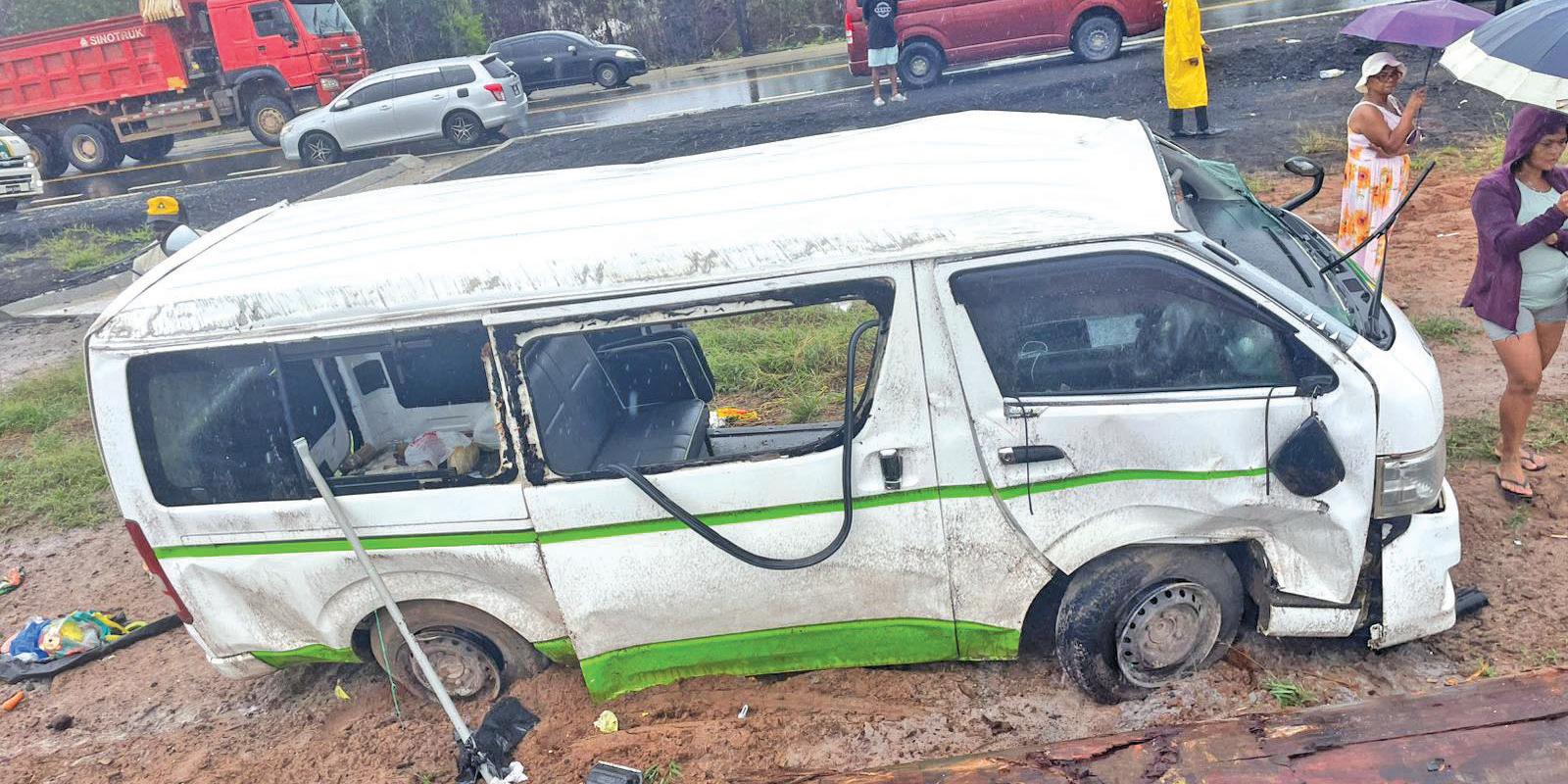
Teen dies after minibus overturns multiple times
A19-year-old died on Saturday morning after a minibus reportedly lost control and overturned multiple times along the Linden-Soesdyke Highway at Moblissa. Dead is Sarah Simon, a resident of Moblissa. Reports are that the accident occurred at about 09:45h in the vicinity of Rubin Sawmill and involved minibus BAK 9272, driven by a 22-year-old man also of Moblissa.
According to initial enquiries, the minibus was proceeding south along the eastern side of the Moblissa Public Road at an alleged fast rate of speed when, while negotiating a left bend, the driver reportedly lost control of the vehicle.
The vehicle subsequently turned turtle several times before ending up on the east-
The minibus that was reportedly involved in the accident
ern parapet. Both the driver and Simon were picked up in an unconscious condition by public-spirited citizens and transported to the Linden Hospital Complex. Simon was pronounced dead on arrival, while the driver was admitted as a patient. Her body was later transferred to the Linden Senior Citizens Association Funeral Home, where it awaits a post-mortem examination (PME). Police said the minibus has been lodged for examination as investigations continue.
The Berbice Bridge will be closed to vehicular traffic on: Monday, March 30 –14:40h–16:10h and Tuesday, March 31 – 15:20h–16:50h.
FERRY SCHEDULE
Parika and Supenaam departure times – 05:00h, 10:00h-12:00h, 16:00h, 18:30h daily.
WEATHER TODAY
Thundery to light showers are expected during the day and at night. Temperatures are expected to range between 24 degrees Celsius and 29 degrees Celsius.
Winds: North-Easterly to East North-Easterly between 2.68 metres and 4.47 metres.
High Tide: 15:13h reaching a maximum height of 2.51 metres.
Low Tide: 08:48h and 21:08h reaching minimum heights of 0.77 metre and 0.68 metre.
Major drainage overhaul planned for Albouystown
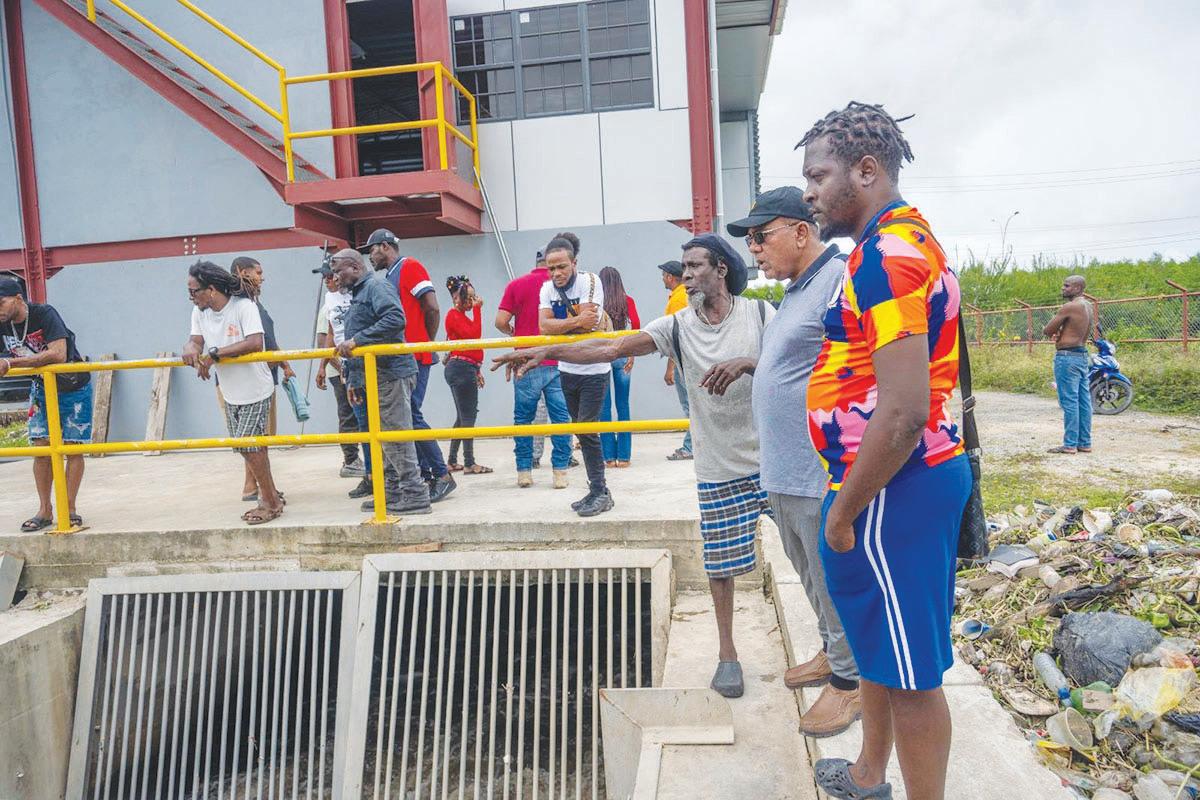
…as cleaning hampers distributed to flood-affected persons
The Local Government and Regional Development Ministry will soon be conducting a comprehensive overhaul of the drainage and other related infrastructure in Albouystown, Georgetown, following Saturday’s flash floods in the community.
A 24-hour intense rainfall from Friday saw several sections across Georgetown inundated all day Saturday into the night. By Sunday morning, however, the water had receded in nearly all the flood-affected –
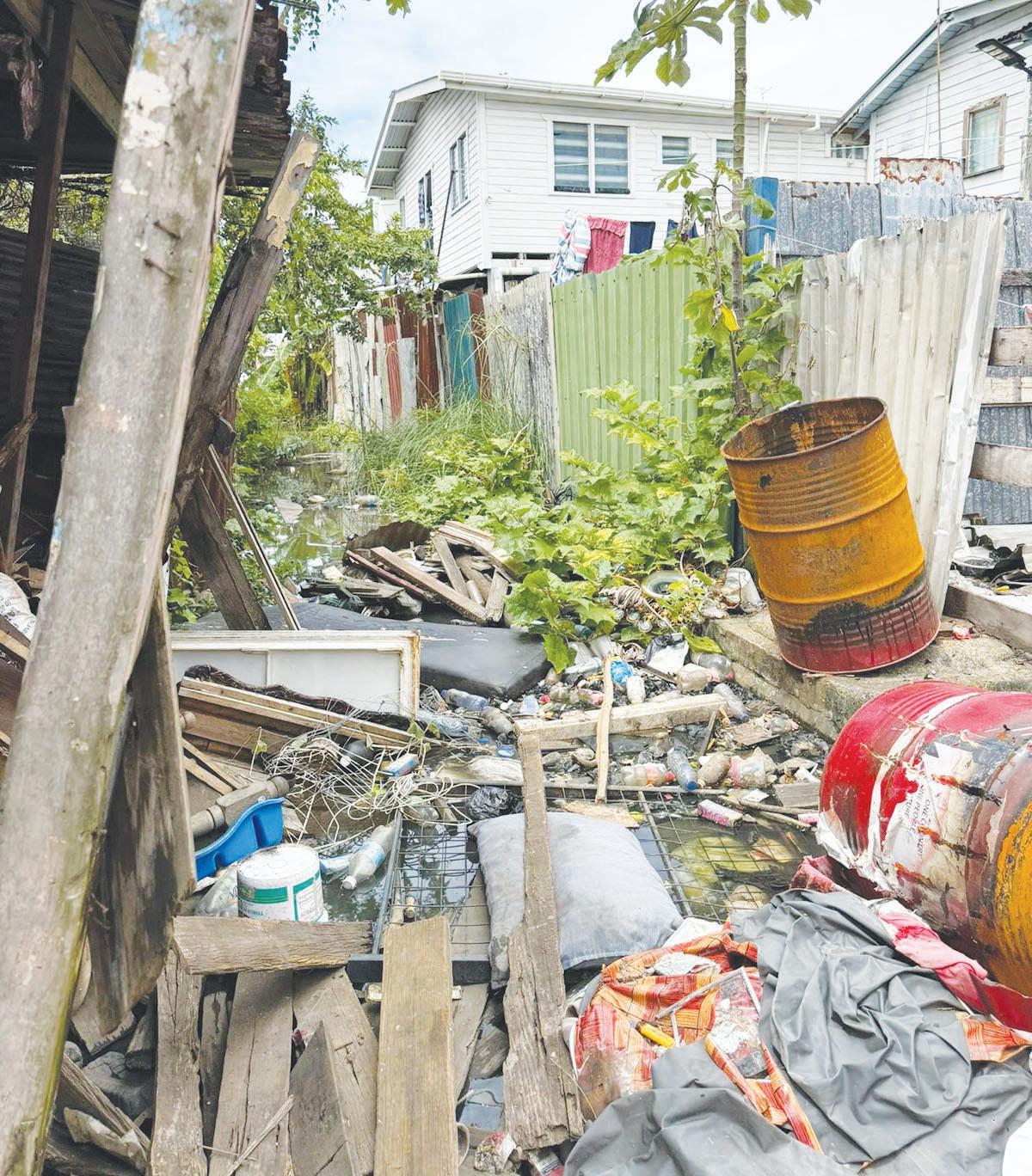
tured dialogue with residents, community leaders and technical teams to collaboratively identify practical and sustainable solutions. Nevertheless, during Sunday’s visit, the Local Government and Regional Development pointed to the clogged drains filled with litter and construction over key drainage systems that compounded the flooding in the area. “We got to have some order… We all have to be a little disciplined in how we dispose of our garbage…and how we build...
something which President Dr Irfaan Ali says was due to the interventions of the Central Government to improve drainage in the capital city. “Through the clearing of internal drains, the installation of pumps and the desilting of outfall channels, floodwaters receded quickly,” the Head of State noted in a Facebook post on Sunday. “What remains a major problem, however, is an incompetent City Council that has failed at the most basic responsibilities, including keeping drains clear and ensuring proper garbage collection — failures that were once again exposed by the flooding.”
Similar sentiments were expressed by Local Government and Regional Development Minister Priya Manickchand even as she committed to enhancing the city’s drainage and irrigation systems. During a visit to Albouystown on Sunday, Minister Manickchand announced that her Ministry will be returning to the community after the upcoming Easter holiday to host a community meeting focused on “the comprehensive overhaul and improvement of the area’s drainage and related infrastructure.” It was noted that this engagement will allow for more struc-
So as citizens, we have to be more responsible than we were before and a Central Government, we’re going to
have to step in to make sure that this doesn’t continue, because we cannot leave people to live in these environments,” Manickchand stated.
Not dependable
But even as she committed to fixing the community’s drainage system, the Minister said while Central Government does not want to absorb functions of the Georgetown Mayor and City Council (M&CC), they are forced to do so. “City Council is supposed to be cleaning these dreams, picking up garbage and the problem is, when they clean the garbage, when they don’t pick up the garbage, then it ends up in in our waterways and our drainage places. And so, you know, it’s clear that we won’t be able to depend on them,” Manickchand stated. She also used to opportunity to called out persons, including some Opposition
Members of Parliaments (MP), over what she describes as a deliberate effort to shield the City Hall from taking responsibility for its negligence. Nevertheless, the Local Government and Regional Development Minister’s visit to Albouystown was in keeping with a commitment made the previous day, when she treaded the flood waters to assess the situation and engaged affected residents. On her return on Sunday, Manickchand did a walkthrough in several sections of Albouystown to observe firsthand the aftermath of the floods and the challenges being faced by residents. She engaged with residents, listened to their concerns, and gathered feedback on how persistent water accumulation has affected their daily lives, livelihoods and overall well-being.
Local Government and Regional Development Minister Priya Manickchand with residents in Albouystown on Sunday
Last week, President Irfaan Ali issued a statement indicating that his Government had sent a diplomatic note to the Government of Suriname formally protesting their imposition of fees for vessels transporting timber and stone on the Corentyne River. The statement said: “It has been brought to my attention that the authorities in the Republic of Suriname have instituted charges for the use of the Corentyne River, particularly affecting timber and quarry operators. These reports represent a troubling development that has implications for economic activities and the long-standing arrangements between Guyana and Suriname...We have raised our concerns in the spirit of dialogue and mutual respect, mindful of the importance of preserving the cooperative and friendly relations between our countries.”
In our estimation, President Ali has struck an appropriately principled but pragmatic response by stressing the possible wider economic repercussions. “It is my sincere hope that, in the interest of sustaining and strengthening bilateral trade, fostering Private Sector development, and upholding the principles of good neighbourly relations, the Government of Suriname will give urgent attention to this issue. Measures of this nature risk creating unnecessary barriers to commerce and could undermine the confidence of businesses that rely on predictable and fair operating conditions.” The Surinamese have since responded by reiterating their “legal right” to charge fees for vessels using the river, but could apply for “waivers” which they claim they have previously issued for sugar from GuySuCo.
President Ali chose not to raise the question of sovereignty over the Corentyne River that goes back to colonial-era arrangements, especially the Anglo-Dutch Treaty of 1814, under which the Dutch retained control over the river and which the United Nations Convention on the Law of the Sea (UNCLOS) in the Guyana v Suriname arbitration 2007 tribunal implicitly accepted.
In our estimation, our Government should have the Surinamese agree to a binding agreement that guarantees non-discriminatory access to the Corentyne River in which Guyanese vessels should not face higher charges than presently applied – and certainly no arbitrary charges that actually are disguised restrictions on trade. We note the justas-vexed issue of fishing licences for Guyanese operators where agreements are only observed in the breach and our fishermen have the possibility of always being arrested hanging over their heads like a sword of Damocles.
Against this background, in his initial statement, President Ali pragmatically invoked the principle of “reciprocity” in interstate dealings. “I wish to remind the Government of Suriname that Surinamese businesses and investors have long benefited from opportunities within our economy, where they have operated without discrimination or undue restriction. This openness has been a cornerstone of our engagement.
“Reciprocity remains a fundamental principle underpinning our relationship. We therefore expect that the Surinamese authorities will reconsider and ultimately desist from any actions that may be perceived as arbitrary or detrimental to the shared objective of deepening cooperation. Such steps are essential to ensuring that our relations continue to be guided by mutual respect and good neighbourliness.” In other words, two can play the “game” that Suriname appears to think our usage of the Corentyne River is and which is based on denying mutual economic benefits.
In this era where we have seized the initiative and moved ahead in the exploitation of our oil and gas resources that lie under the continental shelf of the Atlantic Ocean that we both share, Guyana has generously offered its help to Suriname, especially in the use of its natural gas potential. Likewise we have actually taken a lead in the proposal to have a fixed bridge across the Corentyne River. It would appear that Suriname would insist that the Bridge across “their” river is also theirs and as such, we should insist they pay entirely for its construction and charge a fee for landing on our bank.
The dark reality of insanity
By Dr Jason McKay
Irecently wrote about an incident in which a number of street people believed to be insane were abducted in the 90s from the city of Montego Bay and forcibly relocated — or should I say dumped — in another parish.
Since then, I have received communications from a number of people that reflect what I would call a significant misunderstanding of the reality of suffering endured by people with mental illnesses.
To assist you to better understand what it is like to be suffering from a mental illness, I will tell you about an incident that occurred in 2021 in Portmore, St Catherine. While on duty I was called to a scene where a Police party was engaged in a shooting. The shooter had barricaded himself in a house. A Police Officer had been shot.
My purpose there was to conduct a high-risk entry with my team. Upon arrival I was told that the target of the operation was a mental patient and he had taken his family hostage in the house. My purpose then changed from high-risk entry operative to hostage negotiator. It was not a difficult transition for me. I am a certified hostage negotiator and had been for many years.
This particular negotiation was made much easier as his wife was able to assist us to talk him down and surrender. He was a licensed firearm holder and a former member of the military.
I escorted him to hospital, as he was also shot, and I guarded him in the initial hours after his shooting. I inquired of him after he was treated and given the appropriate medication for his mental illness.
I asked him how he felt about the damage he had done. He had not only shot a young Police Officer, but prior to that he had opened fire on his neighbour, which, in fact, was what resulted in the Police intervention.
What he said gave me some perspective on mental illness that I perhaps did not quite understand before. He told me he didn’t see his neighbour, he saw a man with a rifle about to attack him from his gate so he fired first in an effort to protect himself and his family. When the Police party turned up, what he saw was the man’s gang, who were all armed and planning to attack him
and his household, so he fired again. He was, in reality, experiencing a psychosis. In plain English, he was seeing what was not there.
This is the world of many people suffering from mental illnesses. They see stuff that is not there, and it is not pleasant. I agree, they are scary. I agree, they are dangerous. I agree, the first thing we need to do is protect ourselves from them or any threat that we have to face. But we have to be cognisant that we are not in combat with bad people, we are in combat with sick people. They didn’t make themselves sick. A mental health condition is an illness just like kidney disease or diabetes. Like all diseases it puts you in a world where you would rather not be. The issue with mental illness is that it often results in you being in that world alone. It is the exclusion they experience that often makes their condition less tolerable, lonelier, and much harder to treat.
The psychotics are not the only people who have their unique hell. I have spoken to people who have experienced a nervous breakdown who hear voices even when they are asleep. The voices never stop. The voices are never telling them nice things, the voices are never telling them to do things that are good for them. It is not demons talking to them, it is simply a manifestation of their illness.
Think about that for a moment, a voice in your head that never stops. Picture living with that and then being scorned, people avoiding having conversations with you. You will be there in a group but no one engages with you or encourages your participation.
About two years ago I was in a shooting incident which resulted in damage to my right eardrum. It created a whistling sound, well more like a ringing. This ringing never stopped, it lasted for six weeks, and sometimes if I closed my eyes I still heard it, but I knew it was my imagination. This may sound ridiculous, but it was unimaginably difficult. I can just imagine what someone who is hearing voices goes through for years.
Now back to the psychotic. It is important you understand that oftentimes they are not seeing what you see when they are stoning innocent people. In their head they may be repelling an attack. It is not them being “bad”.
Our approach has to be different because we are defending ourselves from sick people, not evil people. And I totally acknowledge how dangerous they can be. The recent murder of a woman by an insane man in Portmore is fresh in my mind. The defence of ourselves and the weak is paramount, but we cannot approach the problem in a vacuum.
Exclusion, cynicism, neglect and scorn will only make the problem worse. Some years ago I worked with a detective who suffered from a form of mental illness. He developed it in his late 30s. I literally watched him deteriorate. It started with him not taking his medication. Why? Because it turned him into a ‘zombie’! The medication in those days were horrible.
Then there was the exclusion, the scorn, and the culture of mocking. One of the most important factors is first accepting that this person is ill, and that he didn’t make himself ill. His behaviour is simply a manifestation of the illness. His behaviour does not define him. The social dynamics that define us also define him. As we desire acceptance, admiration, and adoration, so does he. Most times his illness can be controlled. We are often the contributing factor to it becoming worse.
Our medical services need to do more.
There have been improvements in public information since Camille Buchanan took over the role as CEO of Bellevue Hospital. However, more resources need to be given to her if we are to truly impact the presence of mentally ill people on our streets, looking dirty and dangerous. Then there has to be the requisite infrastructure to have them removed to the hospital, and to be treated until they are cured.
Law enforcement is significantly more trained than they used to be in dealing with mentally ill people. More training is needed. The country needs to be sensitised to look on them as ill people, and less like criminals.
There is an African proverb: ”A child not embraced by the village will burn it down to feel its warmth.”
I wonder if this is playing out because of how we treat our mentally ill from they are old enough to need the embrace of the village, and conscious enough to feel its scorn. (Jamaica Observer)
Members of the clergy walk at the end of the Palm Sunday mass led by Pope Leo XIV in St Peter’s Square, Vatican City (Photograph: Marco Bertorello/AFP/Getty Images). Inset: Pakistani Christians attend a Palm Sunday mass at St Anthony church, Lahore, Pakistan (Photograph: Mohsin Raza/Reuters)
“Entrepreneurs Connect” hosted to mobilise young professionals
More than 100 entrepreneurs, government officials, and development partners gathered on Friday evening for the inaugural Entrepreneurs Connect: March Mixer, hosted by the Guyana Youth Entrepreneurship Chamber (GYEC). Organizers described the event as the first step in a structured, long-term effort to anchor young Guyanese professionals within the country’s expanding economy.
The event, hosted at the GAICO Construction Building on New Market Street, Georgetown, drew a wide cross-section of public and private sector leaders, including Labour Minister Keoma Griffith, MP; Chief Investment Officer, Dr. Peter Ramsaroop, MP; and James Bond, MP. Private sector representatives included Josephine Tapp, President of the Women’s Chamber of Commerce; Govindra Raghubansi, Executive Director of the GMSA; Samantha Reid, President of the Berbice Chamber; Richard Leo, Executive Director of AmCham Guyana; and Lorena Salazar, IDB Country Representative in Guyana. Representatives from Brand Youth Global and the Center for Local Business Development were also in attendance.
The evening, chaired by GYEC Senior VicePresident, Juliana Lopes,
focused on mobilizing youth for national economic development. Speakers including Josephine Tapp and Selwyn Collins, Founder and CEO of Brand Youth Global, commended the Chamber’s initiative and pledged institutional support for upcoming programmes.
GYEC Junior VicePresident, Khishan Singh emphasized the Chamber’s mandate: “Our goal is to give young entrepreneurs the opportunity, mould them and give them every bit of access we can to ensure Guyana stays on track.”
In the featured address, Dr. Ramsaroop encouraged young professionals to invest their careers locally.
“If I was 18, 19, 20 or 21 today, I would not leave this country,” he said, highlighting expanding opportunities
and the growing demand for local talent. He also stressed the importance of networks and mentorship, noting that
personal ambition alone is insufficient without structured collaboration and shared knowledge.
Meanwhile, GYEC Executive Director, Dennon Lewiss said, “Tonight [Friday] marks the beginning of partnerships that will create opportunities, businesses that will shape industries, and leaders who will define generations.”
The Chamber credited its President, Dr Rosh Khan, for the vision and leadership that led to the founding of GYEC and the assembly of its core membership. Under his guidance, the organization aims to serve as a credible platform connecting youth entrepreneurship with private sector interests and national development priorities.
08:30 Movie - The Witches (2020) 10:30 Movie - Curious George (2006) 12:00 News Break
12:05 Movie - Curious George 2: Follow That Monkey! (2009) 13:30 Movie - Curious George 3: Back to the Jungle (2015) 15:00 Cartoons
16:00 KTLT (RB) 16:30 Indian Soaps 17:00 The Young & The Restless 18:00 Documentary: Nat Geo Animals 19:00 The Evening News
20:00 Movie - Around the World in 80 Days (2004)
22:00 9-1-1 S6 E10 23:00 House of Cards S4 E1
GYEC plans
series of similar events and is inviting youth entrepreneurs, professionals, and corporate partners to participate in future initiatives.
Labour Minister Keoma Griffith, MP; Chief Investment Officer, Dr Peter Ramsaroop, MP; and James Bond, MP among others, including Private Sector representatives and entrepreneurs at the Entrepreneurs
Connect: March Mixer, hosted by the Guyana Youth Entrepreneurship Chamber in Georgetown on Friday (Labour Ministry photo)
Page Foundation
NGSA Questions
1.
4. Which of the solids below has 6 faces, 8 vertices and 12 edges? (A) Cube (B) Prism (C) Sphere (D) Cylinder
5. How many millilitres of milk are contained in a six-litre bottle of milk? (A) 6 (B) 60 (C) 600 (D) 6000
2. Which of the fractions below represents the sum of the shaded regions in the diagram?
7/4
8/12
7/12
13/12
3. Which pair of sets below is equal?
(A) {1, 3, 5, 7} and {7, 5, 3, 1}
(B) {7, 5, 3,1} and {2, 3, 4, 5}
(C) {1, 3, 5, 7} and {2, 4, 6, 8}
(D) {2, 4, 6, 8} and {2, 3, 4, 5}
T6. If 25% of a pack of sweeties is 15, a full pack numbers (A) 15 (B) 30 (C) 35 (D) 60
By Edward SalEm
Ten years ago, I told my cousin, Khaled— West Bank cologne salesman, aspiring chicken factory farm owner— I’d come back in six months.
I embarrassed him once, accidentally revealing to his mother that he wrote love poems on Facebook. I didn’t know it was a secret he kept from her.
The sunken look of betrayal he gave me, seated side by side on squeaky computer chairs, is the same look I imagine he has when he thinks of me now. It’s the look I give myself.
Heavy rain expected to persist across Guyana until Tuesday
h e
THydrometeorological Service says that periods of rainfall, with the potential to cause flooding, are expected to persist across Guyana from Sunday through Tuesday based on atmospheric conditions and model guidance. In a Special Information Bulletin issued over the weekend, the Service emphasises that ongoing rainfall will significantly elevate the risk of flooding, particularly in low-lying and poorly drained areas. According to the Hydromet office, while the current forecast indicates that wet conditions are expected to persist until at least Tuesday, on Sunday, however, there was a gradual shift in rainfall activity, which decreased across the country. But wet conditions are expected on
Monday and Tuesday, with the highest accumulations expected over inland and
southern regions. Weather projections indicate mostly cloudy skies with intermit-
Major drainage overhaul...
The residents highlighted a number of issues, including inadequate drainage, blocked canals and the need for more consistent maintenance of existing systems. In response, the Minister assured those present that their concerns are being taken seriously and will inform the Ministry’s ongoing and future interventions in the area such as the proposed overhaul works. It was noted that the upcoming planned meeting forms part of a broader effort by the Ministry to ensure that interventions are not only responsive but also inclusive, giving residents a voice in the development and implementation of works that directly affect their communities. The Ministry, in a statement, reiterate its commitment to improving drainage systems and reducing the impact of flooding across vulnerable communities, particularly during periods of heavy rainfall.
“[Sunday’s] visit underscores the importance of continuous monitoring, direct engagement and decisive action in addressing longstanding infrastructural challenges. Minister Manickchand reaffirmed that the Government will continue to work alongside residents to bring meaningful and lasting improvements to Albouystown, ensuring safer and more resilient living conditions for all,” the Ministry stated.
Cleaning hampers
Meanwhile, Manickchand’s visit to Albouystown on Sunday coincides with the distribution of cleaning supplies to flood-affected resi-
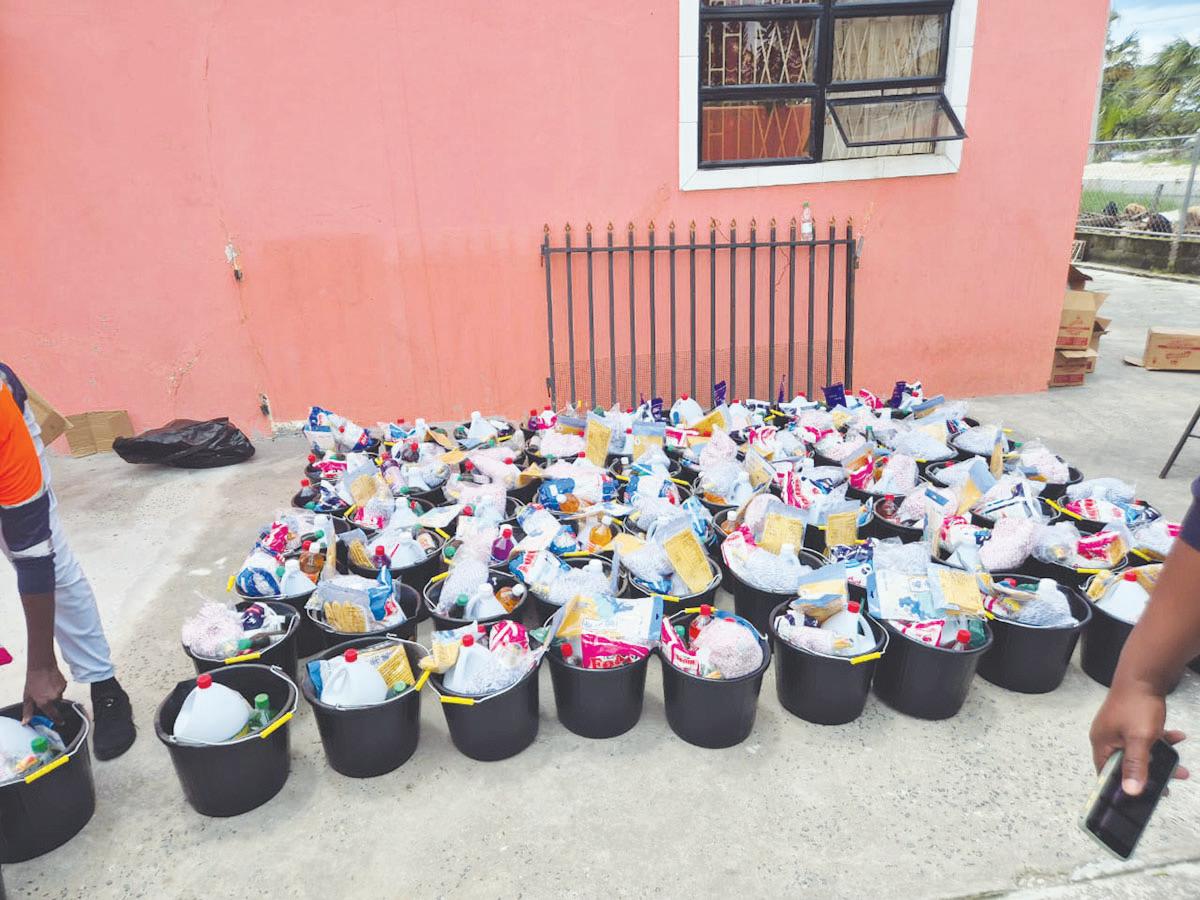
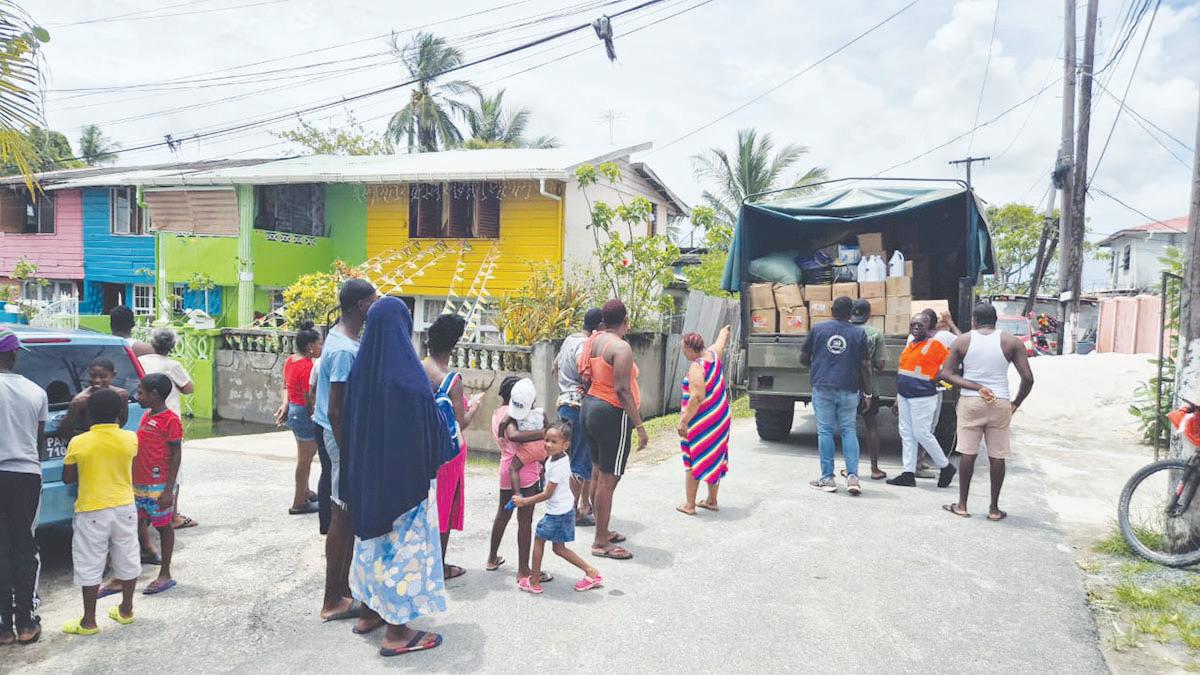
dents by the Civil Defence Commission (CDC). The Minister along with the CDC distributed dozens of cleaning hampers to residents in La Penitence and Albouystown. Additionally, the Commission also handed over another 300 hampers to the Regional Democratic Council (RDC) of Region Three (Essequibo IslandsWest Demerara) to aim in its ongoing relief and recovery efforts in communities that were affected by the torrential rainfall over the weekend. According to the CDC, this initiative aims to assist affected households with essential supplies needed to begin cleaning and sanitising their homes after the floodwaters have reced-
ed. The hampers included items such as disinfectants, cleaning agents and other basic sanitation materials to reduce health risks and support safe recovery. Nevertheless, the CDC emphasises its continued commitment to providing timely assistance to communities impacted by natural disasters and encourages residents to take necessary precautions during the cleanup process. The Commission said it continues to assess the situation in affected areas and will provide additional support where necessary as recovery efforts progress across the country. Flood affected persons can reach out to the CDC on 600 7500 and 226 1117/2261114.
tent showers on Sunday, with rainfall between 10 and 30 millimetres (mm).
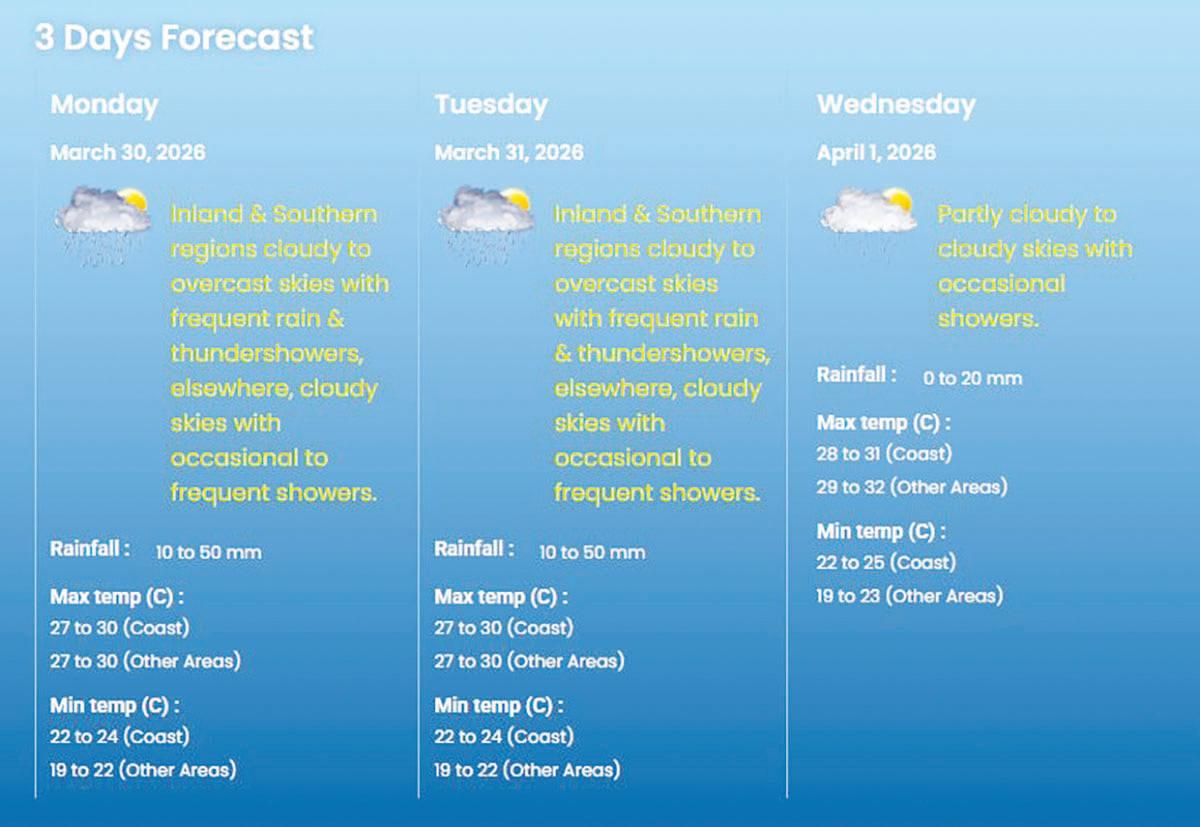
On Monday, inland and southern regions are expected to see heavier rainfall, ranging from 30 to 60 millimeters, while other areas may receive between 10 and 25 millimetres. Showers are forecast from early morning through the afternoon. Conditions are expected to ease slightly by Tuesday and Wednesday, with cloudy skies and scattered showers producing between 10 and 20 millimetres (mm) of rainfall. The Hydrometeorological Service further forecasted that hilly regions could face an increased risk of mudslides, while thunderstorms may bring strong winds and lightning, adding to already hazardous conditions.
In light of these forecasts of rainfall with the potential for significant flooding until Tuesday, the Civil Defence Commission (CDC) is urging members of the public to take the necessary precautions during periods of rainfall and flooding. These include: avoiding flood-prone areas whenever possible; exercising extreme caution when driving or walking during rainfall, especially in areas affected by pooling water; keeping drains, trenches and waterways clear to reduce the risk of flooding; and securing important documents, household items and other valuables in the event of floods. On Sunday, the Hydrometeorological Service reported that weak to moderate rainfall intensities continued throughout the day over Regions Five and Six as well as along inland areas along Regions One to Four. It noted that coastal regions, from One to Four, had recorded partly cloudy and sunny skies. Meanwhile, based on infor-
mation from several rainfall stations across the country, the Hydromet office reported a total of 24 hours of accumulated rainfall between 08:00 hours on Saturday, March 28, 2026, and 08:00 hours on Sunday, March 29, 2026. The highest rainfall recorded by the Hydrometeorological Service’s network of rainfall gauges was at Fort Island, in Region Three, which recorded 52.8 mm.
These reports come after a previous 24-hour persistent rainfall from Friday into Saturday that saw widespread flooding across many low-lying areas along Guyana’s coast including in Georgetown. During that period, the highest rainfall recorded was at Strathavon, Cane Grove in Region Four, at 145.0 mm. This saw several cultiva-
ing efforts to alleviate flooding in the area. Meanwhile, Minister Mustapha also conducted site visits to the Liliendaal, Riverview and other pump stations around Georgetown as part of ongoing assessments of the country’s drainage and irrigation systems. “We are working to ensure that those [low-lying Georgetown) areas, we are putting things in place there. And I think with our plans that we have in the future, there will be a massive drainage project being executed in this area,” he noted.
During the inspections, Mustapha highlighted that despite significant Government investments aimed at improving drainage infrastructure, the indiscriminate dumping of garbage into trenches and
tion areas being flooded, prompting the intervention of the Government through the Ministry of Agriculture. Minister Zulfikar Mustapha had visited the area and engaged affected residents. He made immediate intervention to have the water drained faster. As such, tractor driven pumps were installed at several locations in the Mahaica River area on Saturday as a short-term measure.
The following day however, in keeping with the commitments made by the Agriculture Minister, several critical interventions were implemented to bring relief to affected communities. This includes an additional pump being installed at Strathavon, while a discharge tube was put in place at Belmont, Mahaica to enhance drainage capacity. Additionally, the issue affecting power supply at the Cane Grove Pump Station had also been resolved in collaboration with the Guyana Power and Light (GPL) Inc., resulting in two electric pumps at the station now being fully operational. Further, a mobile pump has been deployed and was set up at the Joyce Phillip Pump Station, thus strengthen-
canals continues to severely hinder the effective operation of pump stations. This, he noted, remains a major contributor to flooding in several communities. The Minister also criticised the Georgetown Mayor and City Council (M&CC), stating that the body continues to “play politics” with residents and has not been effectively collecting garbage in and around the city. “This shows the ineptitude of the city council. They just want to control things and they can’t execute the work in the city,” he stated, reminding of the City Council’s failure to manage critical kokers in Georgetown on Saturday that compounded the flood situation in the city. Nevertheless, Mustapha went onto emphasised that proper maintenance and responsible waste disposal are critical to ensuring the efficiency of the drainage system, especially during periods of heavy rainfall. To this end, he once again issued a strong appeal to citizens to desist from dumping garbage into waterways, warning that such practices undermine national efforts to combat flooding and protect communities.
The Civil Defence Commission distributed cleaning hampers to Albouystown residents on Sunday
The Hydrometeorological Service’s forecast for the next three days
Agriculture Minister Zulfikar Mustapha inspecting the Liliendaal Pump Station on Sunday
Launching…
…boots on the ground?
Well, here we are in the second month of the war against Iran – which was supposed to’ve been over within a week after the missiles-from-the-skies blitzkrieg by the Israelis and Americans!! To date, more than FIFTEEN THOUSAND targets inside Iran have been hit – including that school for girls where 153 of them were killed. But ironically, the Iranians seem to be imitating David – who’d become King of the Jews! - -who took out an attacking all-powerful Goliath – a giant Phillistine – with a simple stone lobbed from his slingshot!! Hunkering down in their rope-a-dope posture, the Iranians are still lobbing their comparatively cheaper missiles from their even cheaper mobile launchers! Even if one out of a hundred missiles gets through the Israeli and Gulf States defences, they feel they’re that much ahead of the game!! David must’ve been the first to demonstrate this strategy of “asymmetric warfare”!! The Gulf States and Saudi Arabia –which had been sold the notion that they could “outsource” their security to the Yanks and Israel – might soon begin to rethink that option!!
So it appears that the war is about to take on a whole new phase by going back to the oldest feature in warfare – putting boots on the ground to take out the enemy. Eight thousand US Marines are on their way to the Gulf – and are expected to insert themselves into Kharg island where 90 per cent of Iranian oil production is processed, refined, and shipped. Fatally crippling the Persian economy!! The trouble with this strategy, however, is that in modern times, the enemy ain’t gonna oblige by massing their troops to face the incoming attackers!! No Siree Bob!! The Russians showed Hitler’s Nazi troops the folly of that strategy in WWII when they attacked Stalingrad for a knockout punch to the Ruskies!! The latter dug in in an urban environment known to them and fought house to house – eventually slaughtering the German army!!
This is exactly what the Iranian Revolutionary Guards are going to be doing!! They would have dug in on Kharg!! In the close-up fighting that’s gonna ensue, the Americans will not have any technologically superior equipment – this battle will practically be mano a mano!! And as your Eyewitness has been emphasising, the Shia Iranians will not back down since they’ve been assured they’re fighting forces of the Great Shaitaan – the Devil!! Dying for that cause guarantees them a place in heaven!! They’re also counting on the unwillingness of the American people for their “boys” to be brought back in body bags – and rise to the fore to force Pres Trump to call the attack off!!
But your Eyewitness knows Pres Trump won’t TACO out!!
…real flood protection
Your Eyewitness hopes yesterday you, Dear Readers, realised he was just kidding when he suggested we accept the flooding of our coastland – by raising our yards and allowing the streets to become canals à la Venice!! During the day he had to traverse a goodly stretch of the said coastland and realised he’d better get serious!! The solution, Dear Readers, lies in our history, which we’re studiously ignoring.
We gotta accept – and APPRECIATE – our coastland’s at least 5 feet below sea level. Let’s compare how WE deal with the drainage system the Dutch left us via the Brits – versus how THEY’VE dealt with the same acreage – 5000 sq kilometres – they DRAINED to live in their own homeland!! The Zuider ZEE was a bay open to the North Sea that was blocked by a Sea Dam like ours!! The 15-feet-below-sea-level land was “empoldered” – dikes, canals and kokers!!
Water still gotta be pumped out – but it’s the discipline of the people that keeps it viable!! The fault, Dear Readers, lies in ourselves!!
…Cuban regime change?
While things are tough in Cuba, regime change gonna be more difficult than in Venezuela. Unlike there, there aren’t entrenched factions that can be played off against each other à la Delcy!!
Drivers not system failures fuel road deaths – traffic officials
Traffic officials have warned that drivers, not systemic failures, are largely responsible for road fatalities, emphasising that education and enforcement must go handin-hand. Speaking on the ‘Road Safety and You’ pro -
gramme, Chairman of the Guyana National Road Safety Council (GNRSC) Earl Lambert, said motorists often blame the police or Government when accidents occur. “Somewhere or the other, when folks get on the road, and they commit themselves, cause ac -
cidents, especially when somebody dies, the blame shifts. It shifts to the police. It shifts to the system,” he said.
Lambert cited a recent accident at Huntley Mahaicony on the East Coast of Demerara (ECD) as an example of driver
negligence. “What I read was that the driver would have overtaken several vehicles going into the turn, and hence causing the crash and fatalities. Who do we blame? Why wasn’t the driver observing the five Cs?” He also urged the imposition of stricter penalties to deter reckless driving. “I would call on the authorities to make stricter penalties, put stricter penalties in place, so that the defaulters can feel it in their pocket.”
Officerin-Charge of Traffic in Region Three (Essequibo Island- West Demerara), Superintendent Maniram Jagnanan, emphasised that technology and systems are in place to monitor compliance. “The Government at the end of the day is putting all the necessary infrastructure and the technology in the sky in place. For instance, the SRS (Speed Radar System), which we have at various points in different regions, the speed cameras… it is there to sensitise. It is there to preserve life.” Jagnanan added that drivers must take
personal responsibility.
“The system is there…so, it means that we have our personal responsibility to ensure that we drive within the speed limit. We obey all laws, rules and regulations. That’s the way we preserve life.”
Inspector Lindon Williams of Kitty Police Station in Georgetown acknowledged enforcement challenges but insisted that drivers bear the ultimate responsibility.
“Because every day, we receive reports of different offences that persons are committing on the roadway, and the police can only do so much… Now with the new intervention with technology, we have the cameras, we have the speeding system, which also assists the police in detection of these offences. Because we have persons monitoring you according to your vehicle number, and so on.”
Meanwhile, President of the United Minibus Union, Eon Andrews, also highlighted systemic improvements that could support safer driving, including re -
training for minibus operators. “I think that when one would have had the licence, especially when you’re looking after passengers, these people need to get retraining. Like every, you know, year or six months you go and you have an update and they can check to see. You would find that a lot of these buses we’re calling to get retrained have violators.” He warned that lawless behaviour on the roads continues to put lives at risk. “You can be different. You can choose to be lawless or you can choose to be different. So, like I said, one way to bring back the order on the roadway is education and enforcement.”
So far it has been reported by police that between January 1 and March 21, at least 28 people have lost their lives in road accidents across Guyana. Many of these fatal crashes have been linked to speeding, with authorities noting that reckless driving, failure to obey traffic laws and driver error remain key contributors.
Officers and officials on the Road Safety and You” programme
Curb noise nuisance or face hefty fines – EPA warns public about health risks
Noise pollution is becoming an increasingly serious public health concern in Guyana, with prolonged exposure linked to conditions such as elevated blood pressure and mental disorders, according to Head of the Investigation and Enforcement Department at the Environmental Protection Agency (EPA), Surijpaul Singh.
Speaking during an interview on the Guyana Today Show, Singh warned that the effects of excessive noise extend beyond mere disturbance and can significantly impact the well-being of individuals, particularly those considered vulnerable.
“So definitely, it is something that is very serious because we have, I would say, a lot of sensitive receptors. And when I say sensitive receptors, these are persons who are affected by noise severely,” Singh
explained. “Exposure to noise… [can have] severe consequences. So, whether it's elevated blood pressure, you can even get mental disorders from continuous noise.”
Duty of care campaign
Singh’s remarks come as the EPA continues to roll out its Duty of Care Campaign, an initiative aimed at educating citizens about their responsibility to minimise the environmental impact of their activities, including noise.
“Our Duty of Care Campaign is basically there to let people know of their responsibility, let them know what they're responsible for, what actions they can take to actually mitigate impacts from their activities,” he said.
As part of ongoing efforts to address noise nuisance, the EPA has been working closely with the Guyana Police Force through a formal agree-
ment, allowing for joint interventions and investigations.
“So we have an existing memorandum of agreement with the Guyana Police Force, where they assist us, and we assist them. So, it's a joint effort where we can investigate matters together… and address noise nui-
sance collectively,” Singh noted.
He explained that while the EPA has direct oversight of commercial entities such as bars and nightclubs, members of the public are encouraged to first report domestic noise disturbances, such as loud music from neighbours or supermarkets, to the nearest police station.
“For noise nuisance cases… we would advise persons to first reach out to the closest police sta-
tion. The proper channel is you call, you lodge a complaint… and then the police act upon it. After that, if they need further intervention, that’s where the EPA steps in,” he said.
Singh also outlined the national standards governing acceptable noise levels, which are established by the Guyana National Bureau of Standards and adopted by the EPA.
“For example, residential areas… [have] a decibel level of 75 during the daytime and 65 during the nighttime,” he explained.
He added that noise levels are measured to determine compliance. He further noted that daytime hours for permissible noise typically run from 06:00h to 18:00h, while limits differ across commercial and industrial zones.
According to Singh, noise nuisance is defined under the EPA’s regulations as “any unwanted sound that is loud and continuous,” and may also include vibrations.
He urged businesses, particularly bars and nightclubs, to take proac-
tive steps such as soundproofing their establishments and adhering to approved operating hours and noise limits. At the individual level, Singh stressed that simple acts of consideration can go a long way in reducing the problem.
“So I have just one message for viewers… when you're engaged in activities that will generate noise, just be mindful of your neighbours or the environment in general. Just be considerate, play your music at a moderate level, and we all can coexist,” he said. The EPA has also been increasing its outreach through social media and community engagement as part of the campaign, encouraging citizens to utilise its online platforms and reporting systems to lodge complaints and seek assistance.
Noise nuisance offenders in Guyana can face substantial fines ranging from $300,000 to $750,000 GYD, along with potential imprisonment for up to one year and seizure of sound equipment.
Unidentified teen’s body found in Demerara River
The body of an unidentified male, who appeared to be of African descent and in his early teens was discovered on Saturday morning in the Demerara River behind the Marriott Hotel at Kingston, Georgetown.
The discovery was made at about 10:40h when individuals walking along the jetty at the Kingston Seawall r observed the body floating in the river and raised an alarm.
According to police reports, the body was later retrieved and examined by a doctor and no visible marks of violence were observed during the preliminary examination.
The remains have since been transported
The body of the teen after it was found
to the Memorial Gardens Funeral Home, where they await identification and a post-mortem examination. Investigators are expected to review footage
from CCTV cameras in the vicinity as part of efforts to determine how the teen ended up in the river. Investigations are ongoing.
Head of Investigation and Enforcement at the EPA, Surujpaul Singh
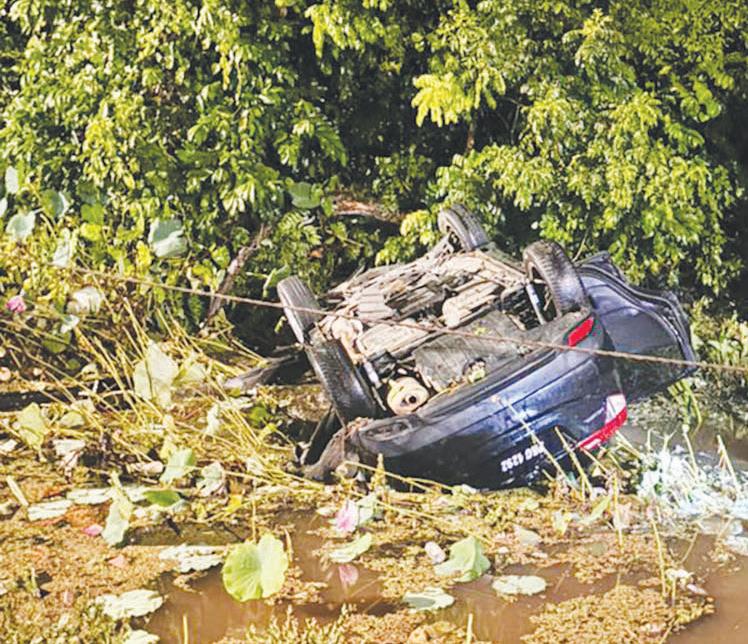
Driver on life support after car slams into utility pole, flips into trench
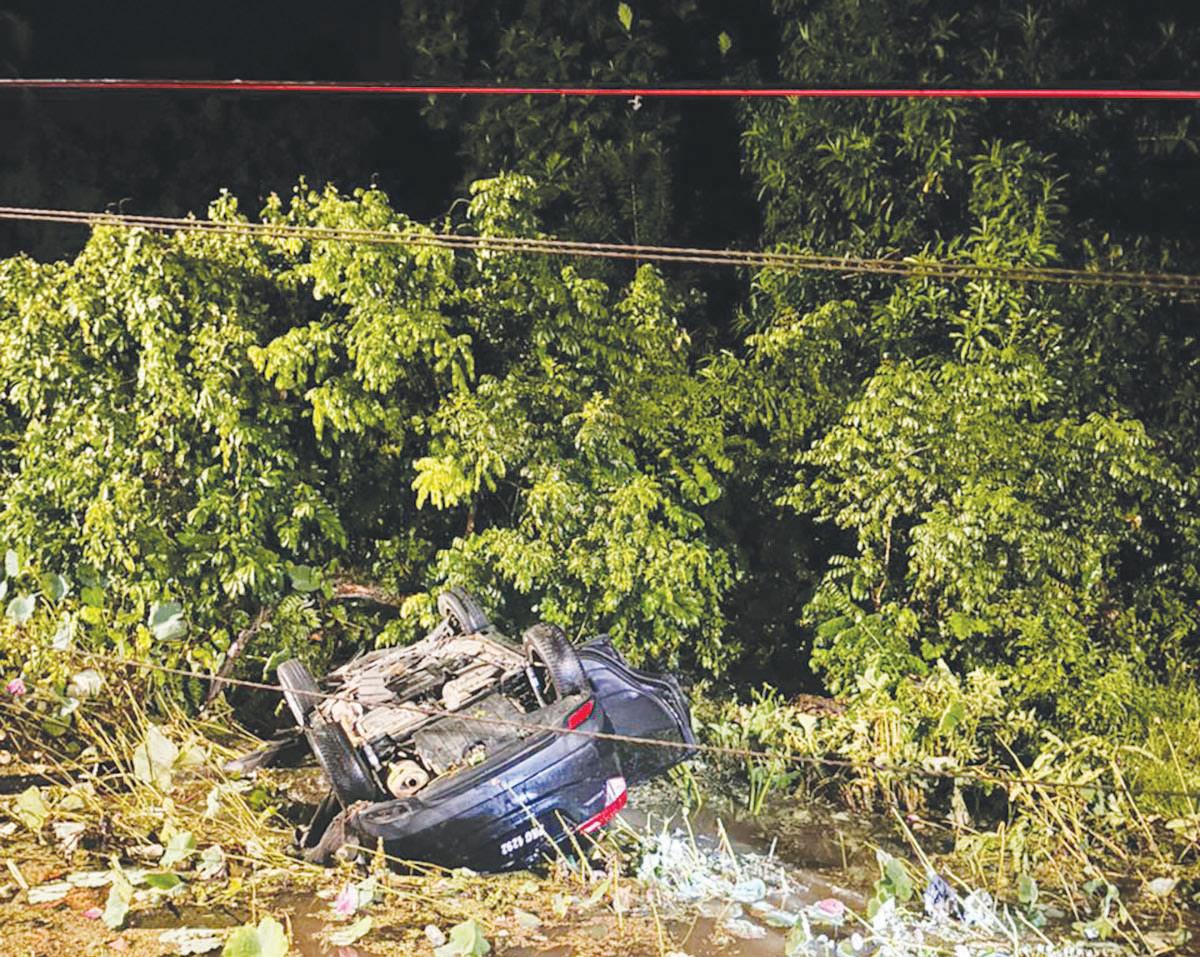
Adriver who was allegedly speeding along the Zorg Public Road, Essequibo Coast, Region Two (Pomeroon-Supenaam) and collided with a utility pole before plunging into a trench, is in a serious condition at the Lima Public Hospital in a critical condition. Injured is Fazil Hussain, a 23-yearold mechanic of Good Intent, Essequibo Coast. Police said
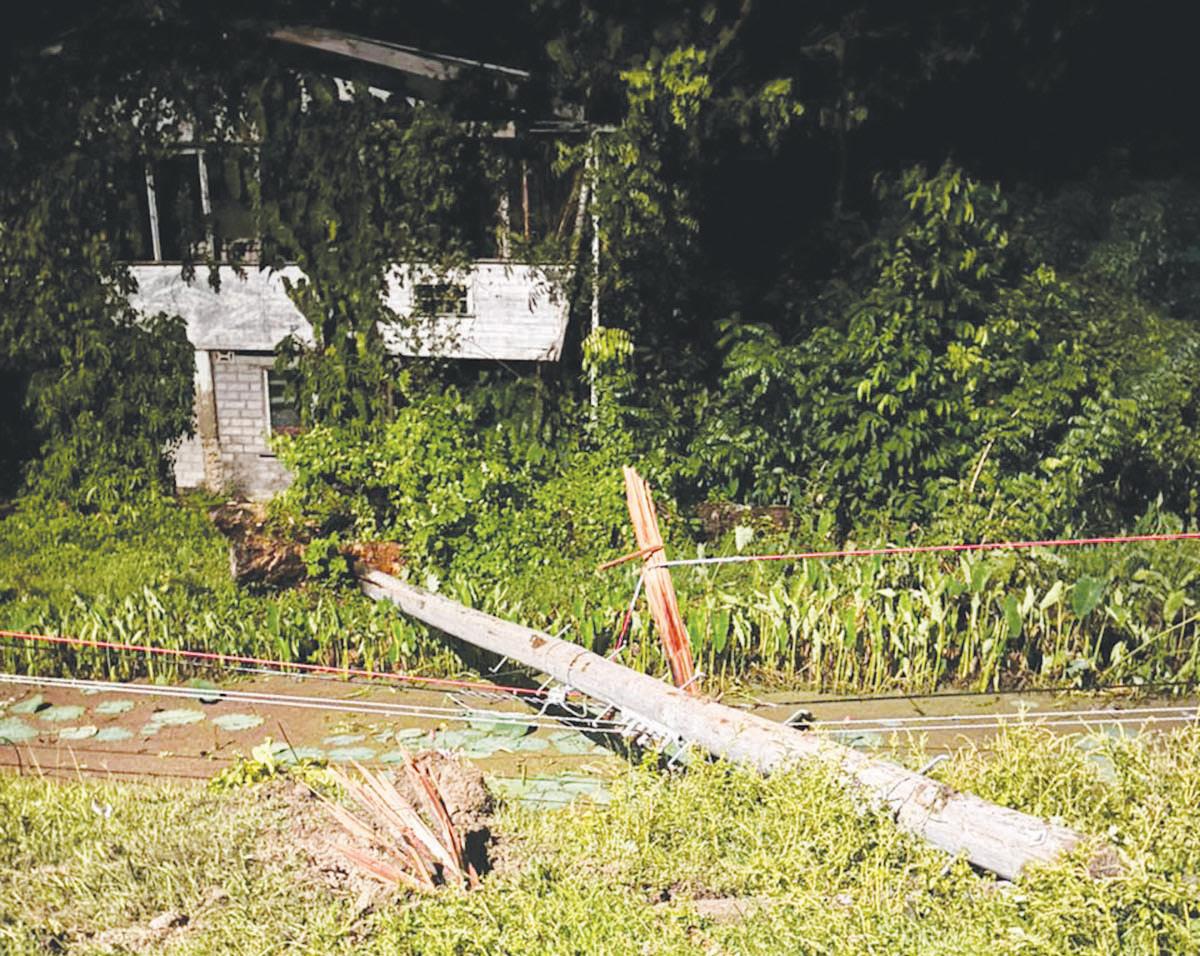
preliminary enquiries revealed that at about 01:40h the motorcar, PAG 4292, was proceeding north along the western lane at a fast rate when, while negotiating a double bend, the driver lost control and collided with a utility pole on the eastern side of the road.
The impact caused the pole to fall onto the vehicle, after which it toppled and ended
up in a nearby trench with its wheels facing upwards.
The vehicle was owned and driven by Hussain, and he was accompanied by Toshar Samaroo, a 21-year-old of Spring Garden.
Reports are that residents assisted in removing the men from the vehicle and while Hussain was found unconscious, while Samaroo was conscious but fled the scene.
No bribes – Traffic Chief warns motorists, cops to obey laws
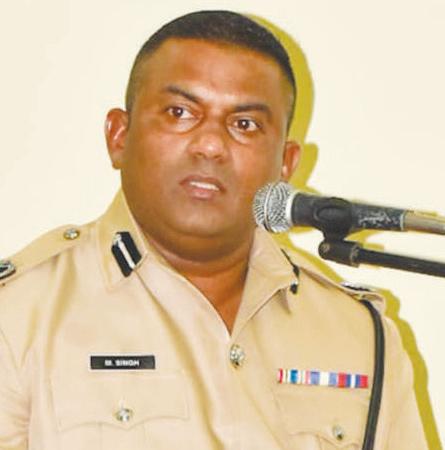
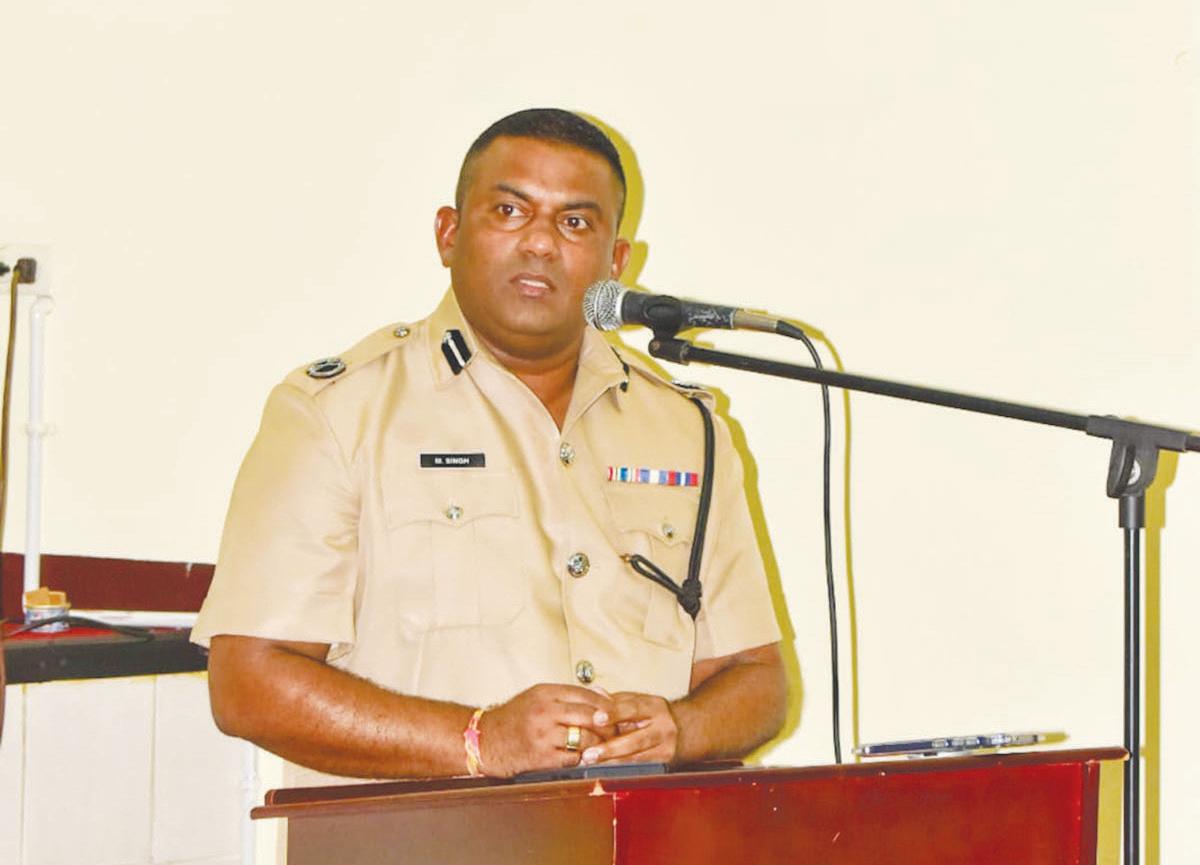
Traffic Chief, Assistant Commissioner, Mahendra Singh has issued a stern warning to motorists against offering bribes to traffic ranks, reminding them that bribery is a criminal offence for both the person offering and the officer accepting. The advisory was issued during a recent Traffic Watch segment carried by another section of the media, where Singh stressed that road users must comply with traffic laws rather than attempt to evade penalties through illegal means. “I’d like to encourage the public, most importantly, that you should not be giving any traffic policeman throughout this country anything, any gift, any money, any reward to achieve anything,” Singh said. “You comply with the laws of this country… You don’t have to pay anything to anyone.”
He underscored that members of the Traffic Department are already compensated by the State and should not be soliciting or accepting payments from the public. “I want the public to be very clear on this. I am not appointed as the Traffic Chief of the country to let you know that you must pay me to do my work. I’m being paid from taxpayers’ money already. So are all of the rest of them in traffic department,” he stated. At the same time, Singh cautioned motorists against engaging in what he described as hypocritical behaviour, offering bribes and later accusing ranks of corruption. “Don’t be
guilty of soliciting the help of that traffic policeman to forego prosecution and then… you want to say the police are demanding a bribe from you,” he said. The Traffic Chief urged members of the public to report any instances where officers demand bribes, noting that there are several avenues available for lodging complaints. “Where there is a demand, report it to the appropriate places. In the regions, there are the commanders, their deputies, there’s a traffic officer and a CID (Criminal Investigation Department) officer,” Singh explained. “If you don’t get the satisfaction… there’s the Office of Professional Responsibility (OPR), and very importantly our Commissioner’s Office is always willing and ready to listen.” Singh also encouraged citizens to play an active role in holding officers accountable, particularly if ranks themselves are found breaching traffic laws. “If
you know that a traffic policeman or woman… has his or her personal motor vehicle which is not in compliance with that legislation, you’re to take photographs and report it right away,” he said.
He noted that such reports should be supported with evidence and submitted promptly so that appropriate action can be taken. Looking ahead, Singh referenced upcoming measures to strengthen enforcement, indicating that both officers and the public will be expected to adhere strictly to the law. “I’d like to tell every traffic rank out there, you’re expected to comply; likewise, the public is,” he said. “No one is above anything… It is the law at the end of the day.” The GPF continues to urge motorists to obey traffic regulations and avoid engaging in unlawful practices, as authorities seek to improve transparency and accountability within the system.
The injured man was taken to the Suddie Public Hospital, where he was examined by a doctor on duty and diagnosed with internal bleeding and fluid in the lungs. He was later transferred to the Lima Public Hospital in a critical condition and remains in the Emergency Care Unit on life support.
The vehicle was subsequently removed and lodged at the Suddie Police Station for examination and according to
Police CCTV footage from the area will be examined.
Meanwhile, as a result of the crash, power was lost in the area and the Guyana Power and Light Inc (GPL)
had advised that customers from La Union to Supenaam experienced a service interruption between 10:00h and 12:00h to facilitate works to replace the damaged utility pole.
Teacher arrested with 15.4 grams of ganja
A28-year-old teacher of Waramuri Village, Region One (Barima Waini) was taken into custody on Saturday, after police discovered 15.4 grams of cannabis in his possession at Moruca, North West District.
The ganja that was found in the teacher’s
According to police reports, the incident occurred around 17:30h when police ranks approached the suspect and conducted a search. During the search, a transparent plastic bag containing leaves, seeds and stems suspected to be cannabis was found in his pants pocket. The cannabis was seized, and the teacher was escorted to the Acquero Police Station and in his presence the substance was weighed and confirmed to be 15.4 grams. Police have stated that investigations into the matter are ongoing.
The damaged motor car and utility pole following the accident
Christians across Guyana joined in commemorating Palm Sunday, marking the beginning of Holy Week, the final week of Lent leading up to Easter Sunday. Palm Sunday celebrates Jesus Christ’s triumphant entry into Jerusalem, when crowds welcomed him with palm branches, laying them on his path as a sign of honour and respect. Scenes from Catholic churches nationwide, captured by Catholic Media Guyana and St Sidwell’s Anglican Church, show parishioners participating in processions and prayers as they honour this important event in the liturgical calendar. (Catholic Media Guyana and St Sidwell’s Anglican Church photos)
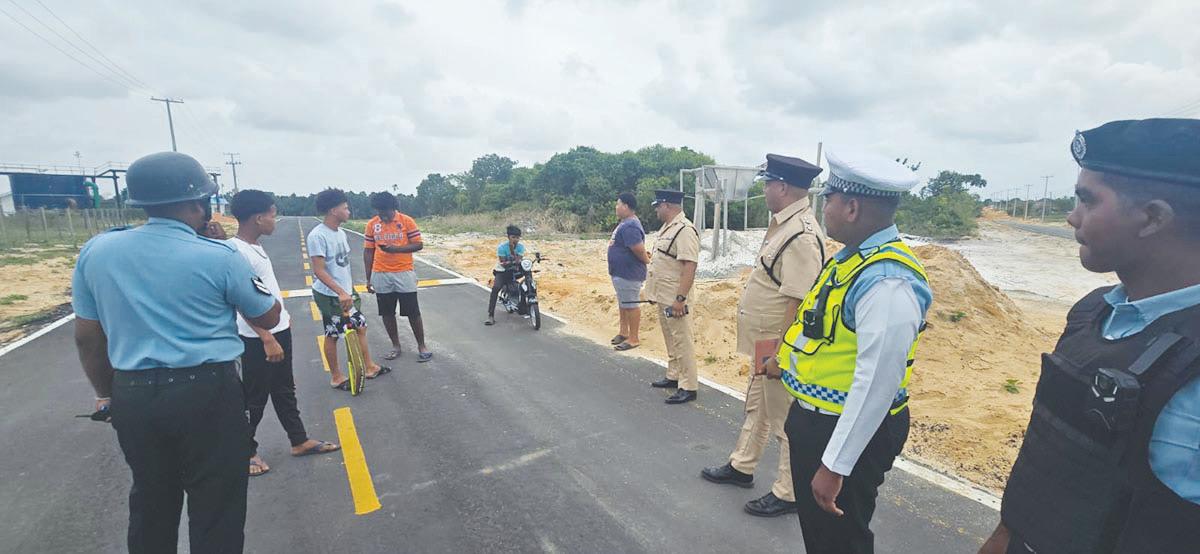
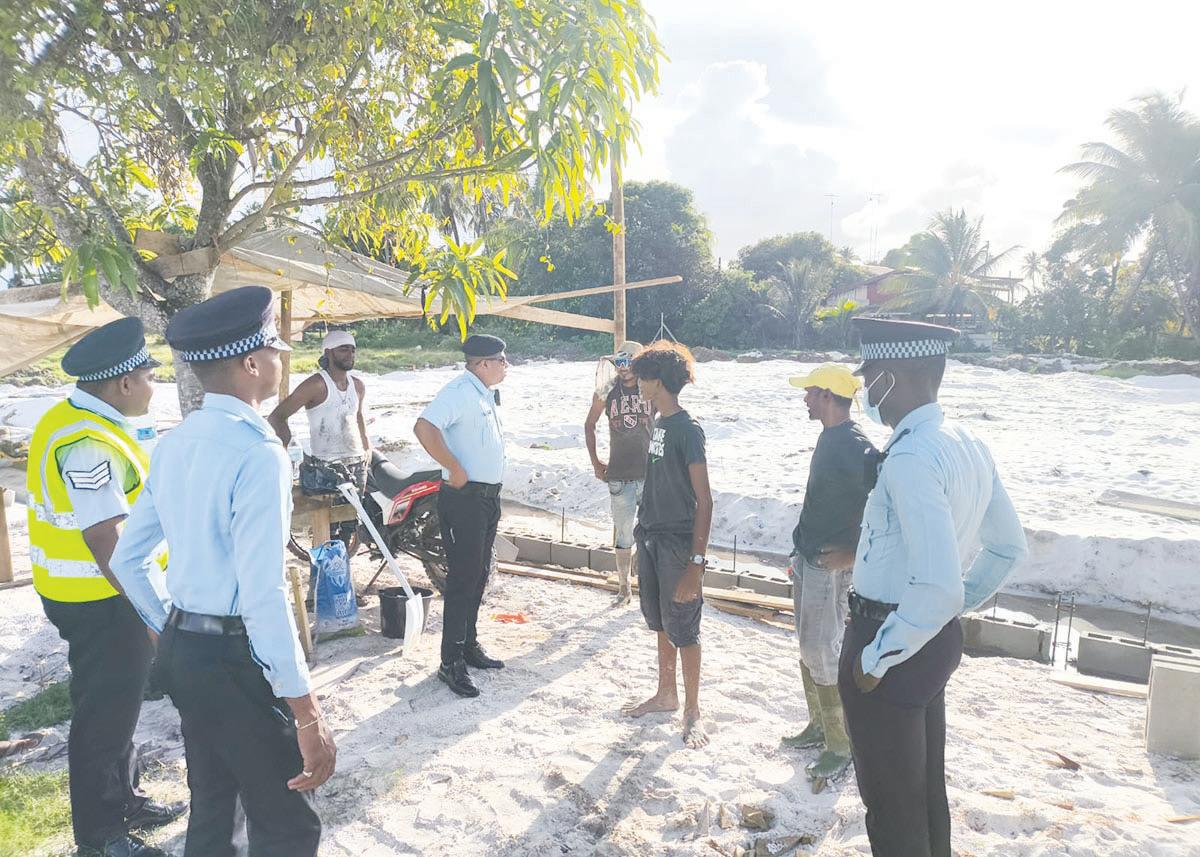
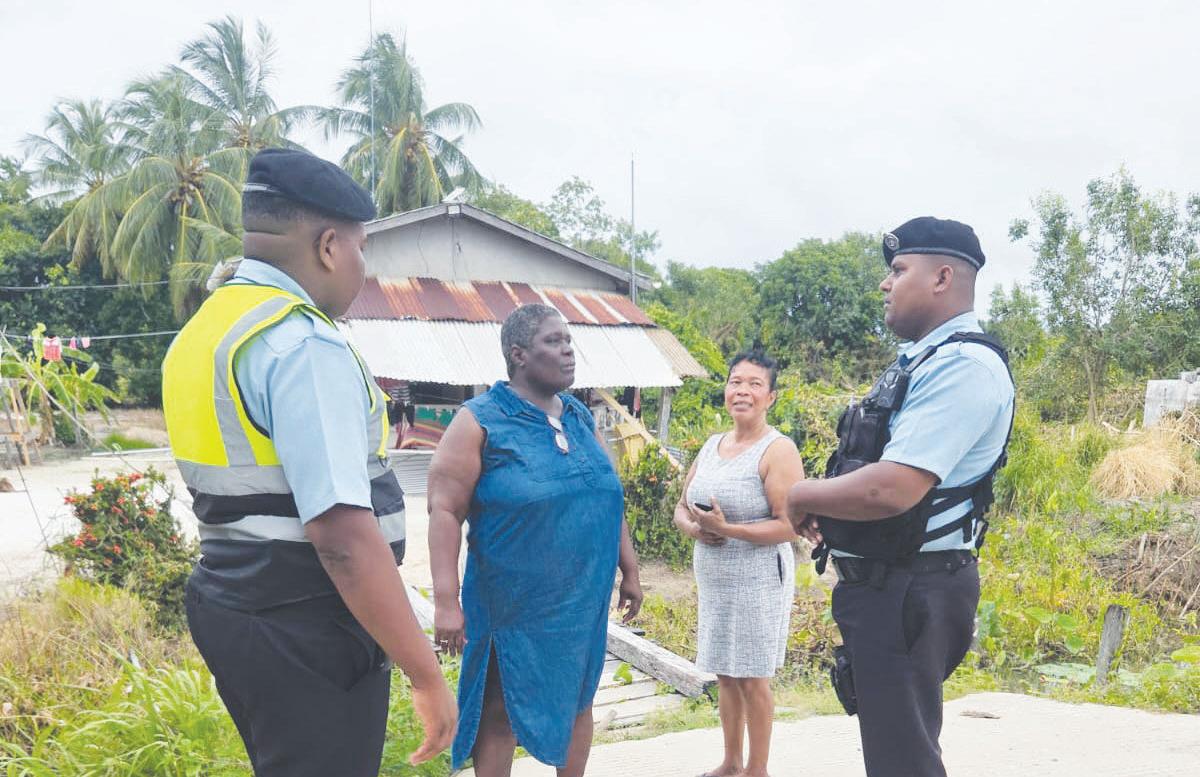
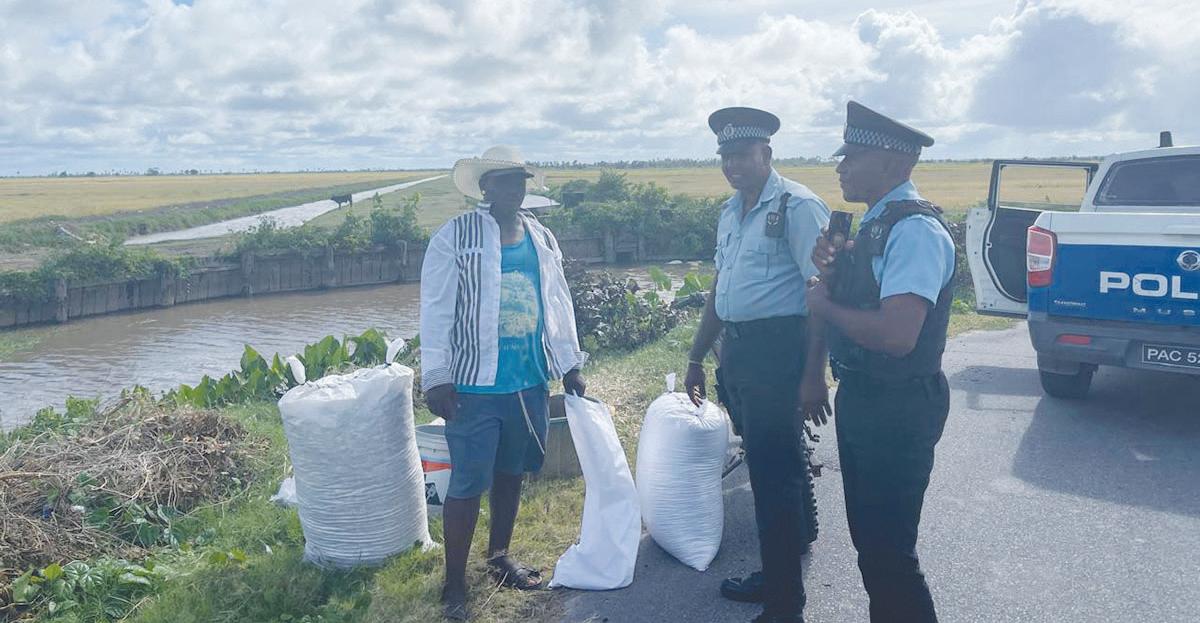
Police in Region 2 expand community outreach on crime, social issues
Ranks of Regional Police Division
Two, Region Two (Pomeroon-Supenaam) have intensified community outreach activities across the division as part of the force’s focus on crime prevention and public engagement. The engagements target a range of issues including crime, traffic safety and the importance of community partnerships. Officers are also conducting patrol-focused discussions with residents to strengthen collaboration and improve responsiveness. In addition, the outreach programme addresses concerns affecting young people, including vaping among juveniles, alcohol consumption by children and school bullying. Police are also educating communities on child abuse, child labour, and inappropriate sexual activities involving minors. Other areas of focus include noise nuisance and family violence, with ranks encouraging residents to report incidents and seek support where necessary.
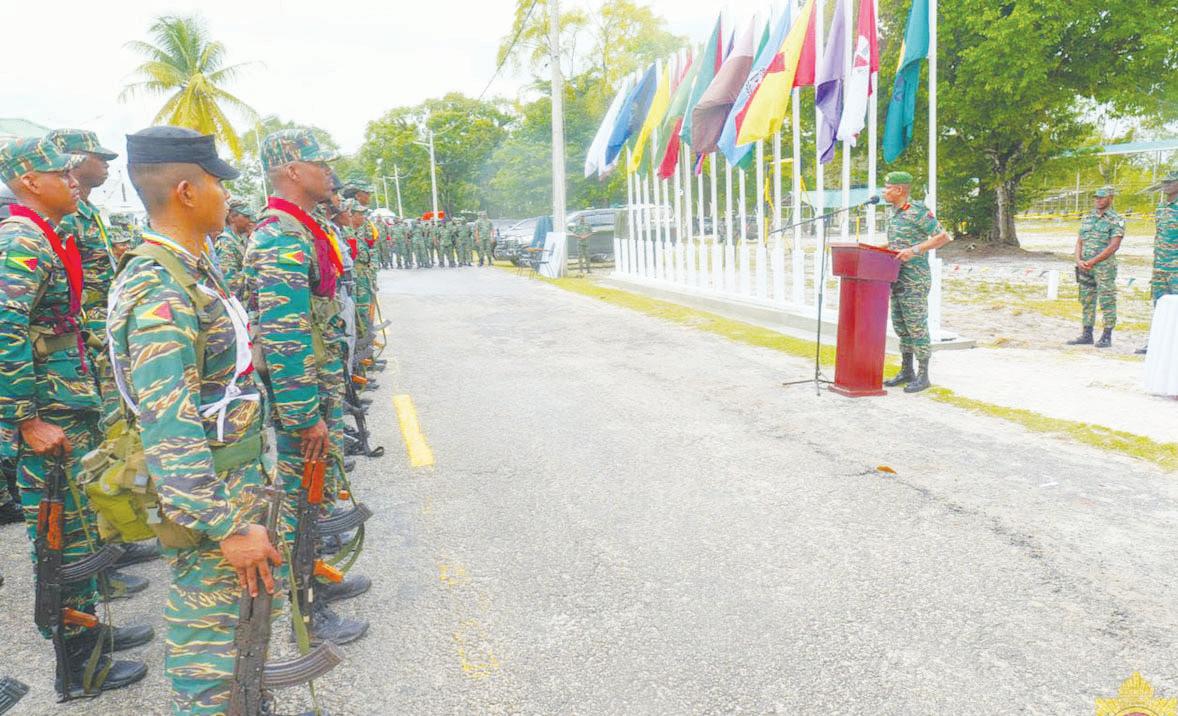
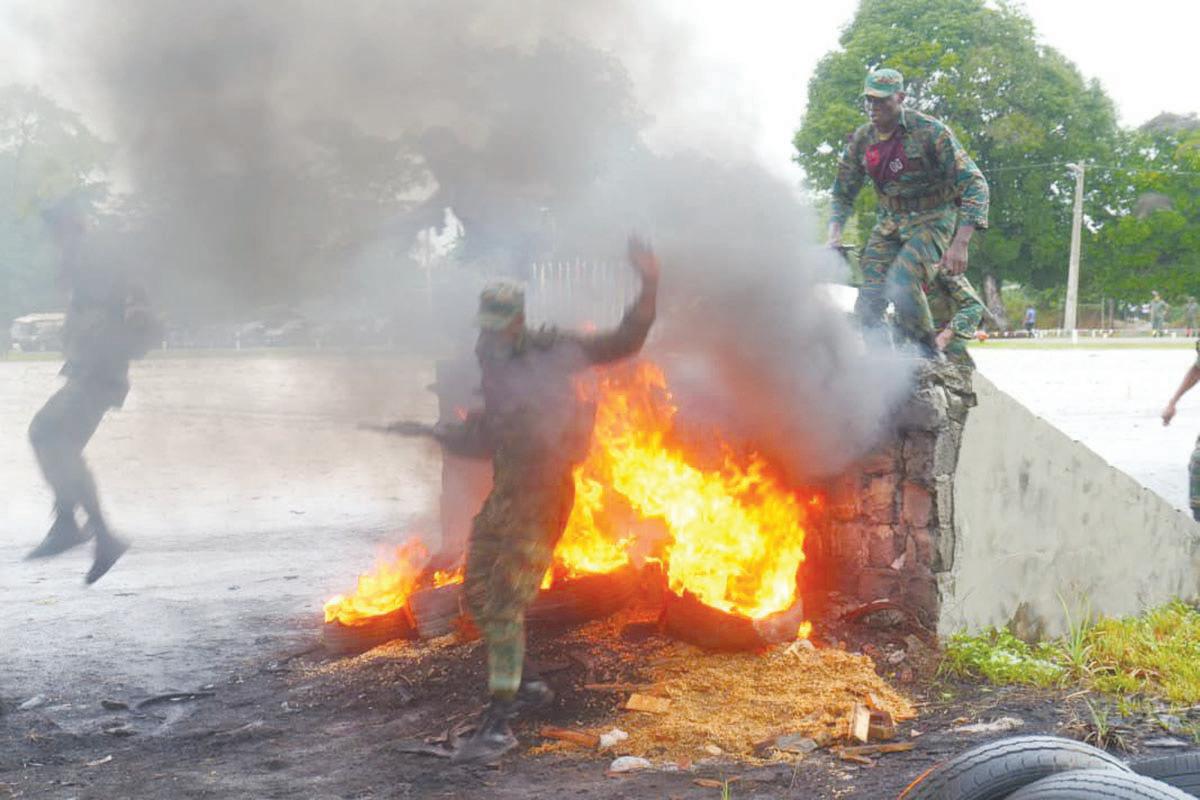
Fitness competitions key to readiness, mission success - GDF Chief
The Guyana Defence Force (GDF) has concluded its First Quarterly Fitness Competition for 2026, with the 1 Infantry Battalion securing first place in the male
category after a strong overall performance. The 3 Infantry Battalion placed second following a consistent showing, while the 31 Special Forces Squadron finished third to complete the top three posi-
tions. In the female category, the Guyana National Reserve A Team claimed first place. The Coast Guard took second position, with the Guyana National Reserve B Team finishing third.
In a social media post on
the GDF’s page, it was stated that the competition, held at Base Camp Stephenson, tested participants through a series of physically and mentally demanding activities aimed at assessing endurance, coordination and performance under pressure.
According to the GDF, the event is part of its ongoing efforts to evaluate operational readiness and maintain high fitness standards across the Force.
Chief of Defence Staff Brigadier Omar Khan, said such competitions are critical in assessing readiness and ensuring ranks remain capable of responding to evolving operational demands. He urged participants to continue striving for excellence, noting that fitness, discipline and teamwork remain essential to mission success and the overall effectiveness of the Force.
The Guyana Defence Force’s 1st Quarterly Fitness Competition for 2026 (GDF photos)
NY Mayor, Guyanese Govt Minister join thousands for Phagwah Parade in NYC
The 38th Annual Phagwah Parade in Richmond Hill, New York, drew participation from city officials, members of the Guyanese diaspora and thousands of celebrants marking the Hindu festival of Phagwah on Sunday. Mayor Zohran Kwame Mamdani attended the event and highlighted the cultural contribution of Indo-Guyanese and Indo-Caribbean communities
to the city. “It was a joy to return to Richmond Hill to celebrate Phagwah alongside the Indo-Guyanese and IndoCaribbean communities who make this city so vibrant,” he said, noting that the parade signaled the city’s readiness to welcome spring. Phagwah, also known as Holi, is a Hindu festival that celebrates the triumph of good over evil and the arrival of spring. The event is traditionally
marked by the throwing of coloured powders, music and cultural performances. Also participating in the parade were Pauline Sukhai, Minister within the Ministry of Local Government and Regional Development; Michael E. Brotherson, Guyana’s Consul General in New York; and Fazal Yussuff along with staff of the Consulate General of Guyana in New York.
38th Phagwah Parade in Richmond Hill on Sunday (Mayor Zohran Kwame Mamdani, NYPD, NCN photos)
66-year-old woman sexually assaulted during home invasion
…no Police contact after 48 hours
A66-year-old woman is now living in fear after enduring a knifepoint confrontation during a home invasion, with the victim reporting that more than 48 hours after the incident, police had not visited the scene. The woman said the terrifying incident began sometime between 23:20h and 23:30h on Friday, as heavy rainfall battered the area and continued until about 01:45h on Saturday.
“He put a knife on my
throat and tell me if I make a sound, he gon’ bore me,” she recalled. According to the woman, her dogs had been barking persistently earlier in the night, prompting her to check the yard on two separate occasions. However, she saw no one and eventually returned to bed. But shortly after the invader entered her home and confronted her while she was in bed. She explained that the intruder, whose clothing was soaked, overpowered her, covering
her mouth while holding a knife. In a desperate attempt to defend herself, she grabbed the weapon.
“I grab the hand with the knife and I tell him, ‘Don’t bore me,’” she said.
The man then demanded cash. “He tell me, ‘Give me all the money you got.’”
But during the struggle, the woman said she came face to face with her attacker and recognised him. “When I turn and see his face, I realise it is the same boy who did
work for me,” she said. The suspect, she explained, had spent several weeks at her home earlier this year carrying out construction work. Fearing for her life, she said she made a calculated decision to comply to survive. After he eventually left the house around 01:45h, the woman raised an alarm and contacted neighbours, who responded and assisted her before she made a report to the police. She said she was able to identify the suspect
to the investigators and he was subsequently contacted by law enforcement.
Lack of response
However, the woman has raised serious concerns about the lack of a response from the Blairmont Police Station, noting that up to Sunday evening, more than 48 hours later, no officers had visited her home. “No police come here to check the house or see how he get in,” she said. It was only af-
ter the incident that she discovered how the intruder had gained access, observing that several window panes had been removed from the kitchen area, allowing entry into the house. The woman noted that the suspect was familiar with the layout of the home. The woman was taken for medical attention following the incident. She said she spent several hours under observation. “I can’t sleep, I can’t eat… I still traumatised.”
Couple’s painful start to parenthood
Afirst-time father is seeking to shed light on what he alleges is negligence by staff at University Hospital of the West Indies (UHWI) that resulted in his fiancée being in labour for almost 20 hours and their baby being admitted to the neonatal intensive care unit (NICU) for three weeks.
According to the father, who requested anonymity, he and his fiancée went to the hospital at about 1:00 pm on a Wednesday because she was in “active labour”. He said his fiancée had been stuck at 8cm dilated and needed medication to help her along in the process. However, at about 11:00 pm, the nurse who was supposed to administer the medication reportedly told him that her shift had ended and she would hand over to her colleague.
The father said that throughout the night, medical officials checked on his wife to see if her dilation was progressing, but no one administered the needed medication. He said the following day, a doctor came by at about 8:00 am and questioned why his fiancée had not yet given birth. It was then that he said medical personnel sprang into action and administered the medication.
According to the father, the baby was placed in the NICU due to a lack of oxygen and a bacterial infection. Attempts over the past two weeks to get a response from the hospital were unsuccessful up to press time.
“The fact that the baby was in there for so long and they didn’t administer the medication, the baby was in distress, and she [the mother] was in distress. When the baby came out, he cried, but he was barely breathing. They had to put him on oxygen and all of that stuff,” the father told the Jamaica Observer.
“The baby’s doing way better because he went to the NICU. Now he’s in the nursery section, but I know that it’s as a result of them not acting on time and do-
ing things according to protocol — that’s what I think really caused this situation because if they had just administered the medication when they were told to or when they were planning to, the baby wouldn’t have been in distress,” the father reasoned, adding that the newborn also had to be sedated.
He shared that, in speaking with a doctor at the hospital regarding the situation, he was told that the baby’s condition was likely due to the prolonged period of labour.
While she could not speak to the specifics of the case, because she was not the doctor who intervened or the doctor on the case, obstetrician, gynaecologist, and family practitioner Dr Shantell Neely James said, generally, babies can be exposed to bacterial infections if the cervix is open for an extended period of time during labour.
“The uterus is normally a very sterile place that is kept walled off and enclosed, so with every dilation it allows more and more things that are potentially in the vagina to have the potential to move up into the uterus… There is a potential risk for there to be some kind of an infection from the cervix being opened and dilated all the way up to eight centimetres for such a prolonged period of time, and that could have exposed the baby, potentially, to infections,” she explained to the Sunday Observer.
First-time parents, the father said he and his fiancée are traumatised by the experience. “It’s been three weeks that we’ve been back and forth, coming here [to UHWI], checking on the baby, and hearing what they’re doing. It’s just been a stressful, expensive situation that could have been different if they had just operated properly. This experience has been so bad to the point where I don’t feel like I would want to have any more kids, or if I do, I wouldn’t want it to be at
UHWI. I wish I could gather every other parent who is sitting up there in the nursery waiting for their kids, the stories that they have, it’s beyond me,” the father told the Sunday Observer.
“It’s still terrifying, honestly, because no parent is prepared to hear all of these things. I think two days after the baby was in there, or two to three days afterwards, when we spoke to the doctor she said — and this is the exact words, she said: ‘This is the sickest baby in this unit, and he is deteriorating.’ Nobody wants to hear that. No parent wants to hear that their baby is deteriorating. It has been extremely stressful,” he said, adding that they are leaning on God for strength.
He further chastised the Government for appealing to citizens to have more babies, arguing that hospitals are not equipped with adequate resources and staff members need better training.
The appeal for Jamaicans to procreate has come from Health and Wellness Minister Dr Christopher Tufton, who stated that Jamaica’s total fertility rate has declined significantly from 4.5 births per female between 1973 and 1975 to 1.9 in 2021, which is below the replacement level of 2.1 required to maintain a stable population.
The first-time father argued that Jamaicans should not be having children under less than ideal circumstances. He called on the Government to address the existing issues before they make an appeal.
“I don’t encourage anybody to be having babies out here. They should take all the extra precautions because even the facility, it doesn’t have a lot of resources. I’m not going to lie, the doctors in the NICU section, they are trying their best, they are doing what they can, but part of it for us was really the labour department where they could have acted with more care and urgency,” said the fa-
ther.
He argued that “people shouldn’t be having kids in a hospital like this. It’s expensive, and the resources are lacking. Some of the nurses are doing their minimum because they are here to work and not because they really love and enjoy it. If you really love and enjoy something, you wouldn’t see a new mom in a situation like this and think you are going to leave her for the next shift. You don’t do that to people”.
The father acknowledged that while it is hard for the Government to address the attitude of medical professionals, they can address the issue of re-
sources.
“I feel like the doctors and nurses’ morale are built in terms of getting the resources, because if you are working somewhere and you don’t have enough resources to do what you are supposed to do, you are going to be annoyed every day at work. It has to start from having enough resources and having motivated staff as well. The Government doesn’t have any control over the nurses’ attitude or doctors’ attitude towards their job, but I feel like if they at least have resources, then that would kind of put them in a better place,” he reasoned.
The Government main-
tains that it is committed to improving maternal and newborn care to safeguard women and their babies. Minister of State in the Ministry of Health and Wellness Krystal Lee last month handed over a new neonatal manual and maternal health (emergency obstetrics) protocol at Spanish Town Hospital in St Catherine.
The document’s aim is to raise the standard of care across public health facilities in keeping with Jamaica’s commitment to improve maternal and newborn health outcomes as stated in the United Nations Sustainable Development Goals. (Jamaica Observer)
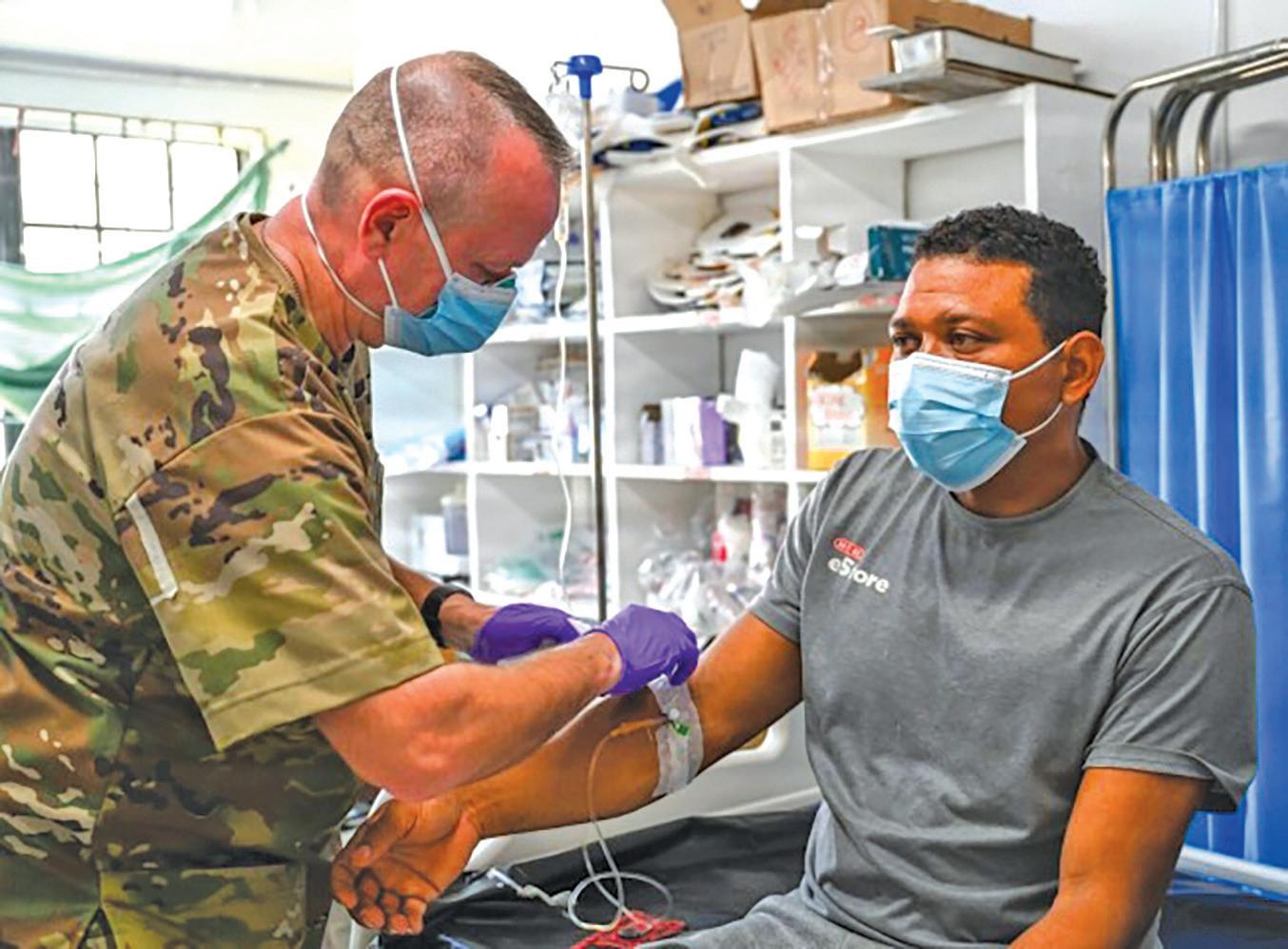
Guyana-US medical mission delivers 3000 patient services, 500 procedures
The 2026 Lesser
Antilles Medical Assistance Team (LAMAT) mission concluded on Friday after delivering thousands of medical services across Guyana over a two-week period. The team recorded nearly 3,000 patient encounters across 26 medical specialties, significantly expanding access to care in communities served during the mission.
During a closing reception at State House in Georgetown on Friday evening, President Dr Irfaan Ali thanked the mission for strengthening Guyana’s healthcare system and ex -
panding access to care for thousands of citizens. “I say on behalf of a grateful nation, thank you to all of you for this mission to Guyana,” he is quoted as saying in a Department of Public Information (DPI) report. “Over the past few days, your work has moved beyond hospitals, health centres, clinics and consultation rooms and into the lives of our people – and that is important.”
United States Air Force (USAF) Brigadier General (Dr) Leigh Swanson, Air Mobility Command Surgeon and Chief, Air Force medical Corps, said “Over the past two weeks,
medical professionals from both of our countries work side by side, sharing expertise, strengthening professional relationships and forging true partnerships.”
According to the DPI report, the joint mission also carried out approximately 500 surgical and dental procedures, alongside 600 emergency encounters, and conducted dozens of mental health evaluations. The total value of services delivered was estimated at close to US $500,000. Apart from procedures, the combined biomedical team repaired more than 130 critical medical devices, contributing technical expertise val -
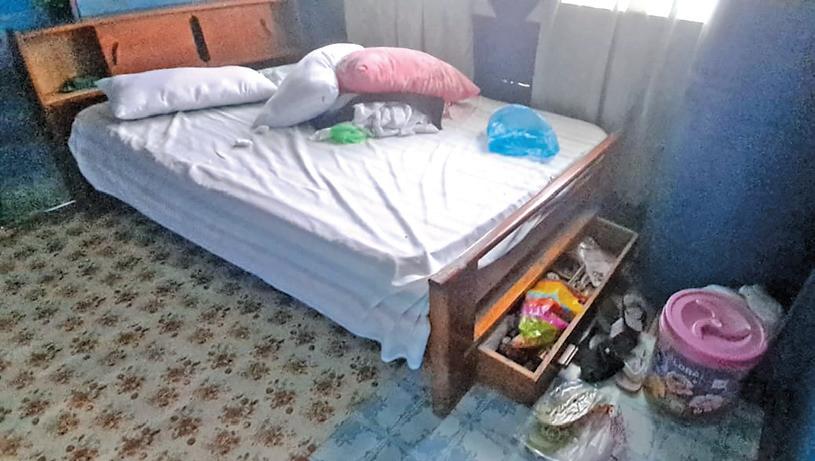
“Me frighten to sleep” – pensioner who found home ransacked
…no Police contact after 48 hours
An 87-year-old woman is now living in fear after returning home to find her house ransacked, with the elderly resident reporting that more than two days after she made a report to the police, no officers had visited the scene. The woman, Bebi Rahim of Number 1 Settlement, Blairmont, West Bank Berbice (WBB), Region Five (MahaicaBerbice), who lives alone, said she discovered the break-in on Saturday morning when she returned to her home. “When me come home morning time, me see all the place tumble up,” she said. According to the elderly woman, the house had been thoroughly searched, with items scattered across multiple rooms.
“All the cupboard disarrange… mattress and pillow everything tumble up,” she explained. She said doors were left open and the interior of the house was in
complete disarray, leaving her shocked and confused as she tried to make sense of what had occurred. The woman explained that she has been living alone since the death of her son last year, and had already been fearful of staying at the house even before the incident. “Me frighten to sleep at house,” she said. Still shaken by what she saw, the woman said she reached out to a neighbour before making her way to report the matter, despite inclement weather. “If you see how the rain fall… This same dress I wear in the rain me go for police [police outpost]. When me go there by myself, they send me to the station [Blairmont Police Station], and me go through the rain again to reach there,” she said. She explained that she reported the matter on Saturday morning and provided her address and details to offi-
cers. “Yesterday morning [Saturday] me go to the police… until now they ain’t come,” she said on Sunday afternoon. The woman said she remained at home throughout Saturday waiting for Police response, but no officers visited. On Sunday, she said she was forced to leave the house briefly to purchase food, noting that she has not been feeling well since the incident. The elderly woman also indicated that she was unsure whether any money or valuables had been taken, explaining that she was overwhelmed by the condition of the house and struggled to immediately assess what was missing. Neighbours have expressed concerns about the responsiveness of law enforcement, particularly given that she first went to a nearby police outpost before being redirected to the Blairmont Police Station.
ued at approximately US $150,000. Beyond direct patient care, the mission also focused on improving operational readiness and technical capacity. US military medical personnel completed over 5,500 specialty-specific readiness tasks, ensuring preparedness to respond to crises and emergencies globally.
US Ambassador to Guyana, Nicole Theriot, also addressed the gathering, noting that a total of 76 USAF and Army Personnel participated, working closely with local healthcare providers. She said that among the most critical achievements were 29 complex retinal surgeries, restoring sight to patients who would have otherwise faced permanent blindness.
Of these, 17 individuals who were completely blind regained both vision and independence, marking one of the most profound human outcomes of the mission.
Additional life-changing
interventions included saving the eye of a patient with a severe post-surgical infection and restoring vision to a young patient diagnosed with Marfan syndrome.
“The Guyanese doctors were then able to perform and master this and other procedures so they can help many more patients. These invaluable skills will remain long after our team departs, empowering your doctors to independently deliver world-class care to their own communities for years to come,” she stated. Also attending were the Minister of Health Dr Frank Anthony and Chief of Defence Staff, Brigadier Omar Khan, along with other officials and medical personnel. LAMAT missions form part of a broader health security cooperation initiative led by Air Forces Southern (AFSOUTH), integrating US military medical services with host nation providers like Guyana.
3 arrested in Paris after attempted bomb attack outside Bank of America
Three people have been arrested in connection with a suspected foiled bomb attack on the Bank of America’s headquarters in Paris, France’s anti-terrorism prosecutor’s office said.
An initial suspect was detained at the scene after he placed a device containing five litres of liquid, believed to be fuel, and an ignition system close to the bank, a police source said, as reported by AFP.
On Sunday, French security services said two more people had been arrested in connection with the incident, which happened at about 03:30 local time (01:30 GMT) on Saturday in the city’s 8th arrondissement, a couple of streets from the Champs-Élysées.
France’s Interior Minister Laurent Nuñez said the attempted attack could be linked to the USIsrael war on Iran.
“In this type of conflict, you have a number of
Iranian services that are likely to carry out actions such as these through proxies,” he said.
“There is a significant suspicion, but it is for the investigation to determine.”
The Iranian embassy in France has not commented on Nuñez’s remarks.
The initial suspect, who was detained at the scene, was accompanied by a second person, who appeared to be taking photos and videos with a mobile phone, but who fled when officers arrived, according to a police source, as reported by AFP.
“Two further individuals were taken into police custody last night as part of the investigation launched on March 28, 2026 into the offences committed against Bank of America,” the prosecutor’s office said on Sunday.
The custody of the first suspect, who is a minor, had been extended, it added.
Under French law, suspects in terrorism cases can be held for 96 hours. This
period can be extended by a court.
Nuñez claimed similar attacks have been foiled in other European nations, including France, Netherlands, Britain and Norway.
He urged security services to be “extra vigilant” and increase their presence at transport hubs and other locations across the country.
France’s anti-terrorism prosecutor’s office said it had immediately taken over the investigation, which was looking into “attempted damage by fire or other dangerous means in connection with a terrorist undertaking” and a “terrorist criminal conspiracy”.
The Paris judicial police and France’s domestic intelligence service, the General Directorate for Internal Security, are also involved in the investigation, according to the anti-terrorism prosecutor’s office.(BBC News)
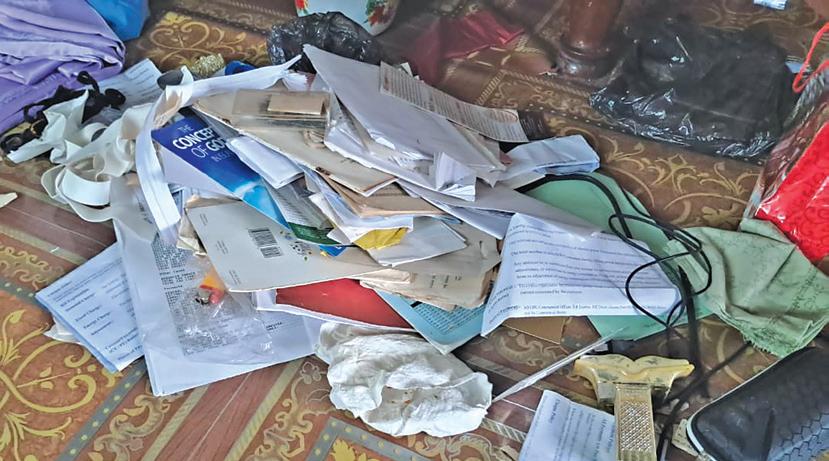
Inside the house that was broken into at Number 1 Settlement, Blairmont, West Bank Berbice
US Air Force Brigadier General (Dr) Leigh Swanson, Air Mobility Command Surgeon and Chief, Air Force Medical Corps
US Air Force medical professional offering a medical service
US Air Force professionals look on as Guyanese doctors perform surgery to repair a patient’s broken tibia at the De Kinderen Regional Hospital in Tuschen
By Dr Tariq Jagnarine, Fam meD
Why this matters in Guyana
Guyana’s warm, humid climate means the body loses water quickly through sweating, even during normal daily activities. For people working outdoors, such as farmers, miners, vendors, and construction workers, the risk is even higher.
Despite this, many people do not drink enough water throughout the day. Some rely on sugary drinks, while others simply ignore thirst. The result is a growing but often overlooked problem: dehydration and heat-related illness
What is dehydration?
Dehydration occurs when the body loses more fluids than it takes in.
Water is essential for maintaining body temperature, supporting organ function, and maintaining stable blood circulation.
Even mild dehydration can affect how you feel and function. More severe dehydration can lead to serious health complications.
HEALTH TIPS
Dehydration and heat illness – a hidden risk in Guyana’s climate
…Not drinking enough water can become dangerous faster than you think
How heat affects the body
When the body is exposed to heat, it tries to cool itself by sweating. This process leads to loss of water and important salts. If fluids are not replaced, the body struggles to regulate temperature.
This can lead to a range of heat-related illnesses, from mild discomfort to life-threatening conditions.
Signs of dehydration
Early signs include thirst, dry mouth, fatigue, headache, dizziness, and reduced urination. Urine may appear dark, which is a common warning sign.
As dehydration worsens, symptoms may include confusion, rapid heartbeat, weakness, and fainting. At this stage, urgent medical attention may be required.
Understanding heat illness
ness, and even death if not treated immediately.
Who is most at risk
Certain groups are more vulnerable to dehydration and heat illness. These include children, elderly individuals, people with chronic illnesses, and those working outdoors.
People with conditions such as diabetes and kidney disease are also at higher risk, as dehydration can worsen these conditions.
Common mistakes people make
Many people wait until they feel thirsty before drinking water. However, thirst is often a late sign of dehydration. Others replace water with sugary drinks or alcohol, which can worsen dehydration.
Electrolyte replacement may be helpful during prolonged sweating, but water should always be the primary source of hydration.
The role of employers and communities
Workplaces and communities play an important role in prevention. Employers should ensure access to drinking water, provide shaded rest areas, and encourage regular breaks for workers.
Schools and community groups can also promote hydration awareness, especially among children and young adults.
Why this matters for health
Wearing heavy clothing, working long hours in the sun without breaks, and ignoring early symptoms also increased risk.
Heat stroke can cause high body temperature, confusion, loss of conscious-
Heat illness occurs when the body can no longer cope with high temperatures. It ranges from heat cramps and heat exhaustion to heat stroke , which is a medical emergency.
Prevention: Simple but powerful steps
Preventing dehydration is straightforward. Drinking water regularly throughout the day is the most important step. People working outdoors should take frequent breaks in shaded or cool areas.
Light clothing, avoiding peak sun hours, and increasing fluid intake during illness or physical activity are also important measures.
Dehydration not only causes immediate symptoms, but can also affect long-term health. Repeated dehydration has been linked to kidney problems and reduced physical performance.
In a country like Guyana, where heat exposure is constant, addressing hydration is essential for maintaining overall health.
Dehydration is common, preventable, and often ignored. In a hot climate, it can quickly become dangerous.
Do not wait until you feel thirsty. Drink water regularly, take breaks from the heat, and recognise the warning signs early. Stay hydrated. Stay safe. Protect your health.
CAL seeks new Govt bailout
Caribbean Airlines
Limited (CAL) is seeking a financial bailout from the Trinidad and Tobago Government to counter the rising cost of fuel as a result of the USIsrael war against Iran and its impact on the carrier’s operational costs.
Guardian Media understands the CAL Board put forward several options to the Ministry of Finance during a meeting two weeks ago to cushion the airline – the introduction of a fuel surcharge on tickets, the removal of the subsidy on the airbridge, an increase in the overall cost of tickets and a further slashing of low-
er-revenue routes.
However, CAL is also seeking further financial support from the State, which sources say could come in the form of a billion-dollar debt write-off.
And according to the 2026 budget document, Details of Estimates of Recurrent Expenditure, dated March 25, 2026, the Government has allocated $626.84 million for the principal repayment on the CAL’s local loans. That sum is triple the revised allocation for principal repayment of $200.8 million in fiscal 2025.
As a last resort, without any support, there is the
possibility of shutting down the airline.
Guardian Media understands there is a division of opinion on the Board about the airline’s viability. While CAL’s Chair, Reyna Kowlessar, is pushing to get further State support to realign the airline’s business model, at least two directors believe it should either be shut down or sold.
Across the world, airlines are grappling with higher fuel costs, with several airlines already introducing fuel surcharges, raising fares and rationalising routes. (Excerpt from Trinidad and Tobago Guardian)
Jamaica: Brown wants increased stipend paid to Senators
Opposition Senator Lambert Brown is calling for the implementation of the 2023 proposal that would have seen the stipend paid to senators who are not part of the Executive increased to J$148,000 per sitting.
Senators are currently paid J$53,000 per sitting; the proposed increase would move it up by 179 per cent.
Ironically, former Finance Minister Dr Nigel Clarke rescinded the proposal after objections from Opposition Senators who shot it down in September 2023, due to the backlash to the massive salary increases for politicians at the time.
A trade unionist, Brown, used his contribution to the debate on the Appropriations
Bill to point out that, apart from some University of the West Indies employees, only Senators are yet to benefit from the reclassification exercise.
“I want today to make a plea on behalf of the 16 non-executive Senators, I don’t care what is the reason, but I believe, and I’m making a call to the Minister [of finance] as a trade unionist, as a senator, this is not a party call — that the non-executive senators are the only ones in the Parliament who have not benefitted from the compensation review,” said Brown.
(Excerpt from Jamaica Observer)
US to allow Russian oil tanker to reach Cuba, New York Times reports
The United States is allowing a Russian tanker full of crude oil to reach Cuba, the New York Times reported on Sunday, possibly granting a lifeline to the Caribbean island amid a de facto oil blockade imposed by Washington. Ship-tracking data showed the Russian-flagged tanker Anatoly Kolodkin on Sunday was just off the eastern tip of Cuba.
The Times report, citing a US official briefed on the matter, said it was unclear why the US Coast Guard was allowing the shipment to go through. A move by Washington to block the tanker by force, however,
could have raised tensions at sea with Russia.
The Coast Guard referred queries on the matter to the White House, which did not immediately reply to a Reuters request for comment.
US President Donald Trump has effectively blocked all oil shipments to Cuba in an attempt to pressure the Government in Havana. Separately, the US temporarily eased sanctions on Russia to help improve the flow of oil that has been restricted by the US-Israeli war with Iran.
In the meantime, the Anatoly Kolodkin has been making its way to Cuba. The vessel departed from Russia’s
Primorsk port carrying some 650,000 barrels of crude, LSEG ship-monitoring data also showed.
It could soon discharge at Cuba’s Matanzas port if it does not change its current course, according to ship tracking site Marine Traffic. That much oil would provide significant relief to Cuba, which, according to President Miguel DiazCanel, has not received any oil imports for three months, leading to strict rationing of gasoline and exacerbating an energy crisis that has resulted in multiple power outages across the communist-ruled nation. (Excerpt from Reuters)
T&T public health system on the brink amid nursing crisis – Beckles
Trinidad and Tobago Opposition Leader Pennelope Beckles has warned that the country’s public health system is facing a crisis due to a growing standoff between nurses and the Government.
In a statement Saturday, the Opposition Leader said several health facilities were forced to close last night because there were not enough nurses on duty, with student nurses being drafted to fill gaps. She linked the shortages to what she described as the Government’s failure to pay nurses what they are owed.
On Friday in Parliament, Beckles questioned Health Minister Dr Lackram Bodoe about the Government’s plan to address tensions with nurses. She said he responded that he was unaware of any impasse, a stance she said was now at odds with the situation on the ground.
Beckles cited reports of protests by the Trinidad and Tobago National Nurses Association (TTNNA) over stagnant salaries and concerns about patient care.
The protests, she said, have raised the possibility of a national demonstration.
The Opposition Leader criticised the Government for promising a 10 per cent salary increase to public servants while nurses are effectively taking home less. She questioned whether the Government is reducing, withholding, or clawing back funds owed to nurses.
(Excerpt from Trinidad and Tobago Guardian)
PAHO releases new clinical guidelines for severe yellow fever patients
The Pan American Health Organisation (PAHO) has released new clinical guidelines for the management of patients with severe yellow fever in the Americas, including the Caribbean.
The guidelines come amid concerns that the disease has re-emerged as a growing public health matter, with PAHO noting that since 2024, outbreaks have been reported in several countries – including in areas outside the traditional Amazon basin – confirming an expansion of risk zones.
Last year, PAHO said a total of 346 confirmed cases and 143 deaths were reported across seven
countries in the region –Bolivia, Brazil, Colombia, Ecuador, Guyana, Peru, and Venezuela.
In the first seven weeks of this year, PAHO said 34 human cases and 15 deaths have already been confirmed in Bolivia, Colombia, Peru and Venezuela and while there is no specific treatment for yellow fever, vaccination remains the most effective preventive measure.
It said a single dose provides lifelong immunity and that most confirmed cases and deaths reported in 2025 and 2026 occurred among unvaccinated individuals.
The health organisation said it continues to support
countries in strengthening epidemiological surveillance, expanding vaccination coverage among at-risk populations, and improving the capacity of health services for early detection and timely clinical management of severe cases.
“The new guidelines aim to contribute to these efforts by providing health teams with a practical, evidence-based tool to deliver safe, standardised care and reduce mortality associated with the disease,” PAHO said, adding that the guidelines aim to strengthen the capacity of health workers and support timely, life-saving care. (Excerpt from CMC)
5 Caribbean countries to benefit from new IICA initiative
The Inter-American Institute for Cooperation on Agriculture (IICA) has introduced a new initiative designed to strengthen the competitiveness, operational efficiency and market access of agricultural micro and small enterprises (AgriMSEs) in five Caribbean Community (Caricom) countries.
It said that the AgriMSE Business Development and Regional Market Integration Project funded by the Barbados-based Caribbean Development Bank (CDB) will include Antigua and Barbuda, Dominica, Grenada, St Lucia, and Trinidad and Tobago.
The Representative of the IICA Delegation in Trinidad and Tobago, Diana
Francis, has underscored the importance of strengthening AgriMSEs as key drivers of agricultural value chains, rural livelihoods, and food security.
She said that integrating AgriMSEs into the economy and markets required strong and continuous partnerships among regional institutions, development partners, the Private Sector, and most importantly, the consumers.
The IICA official said the engagement and support from distribution, marketing and logistics firms will also be critical to ensure that products from the AgriMSE sector can be successfully moved within domestic markets and to markets across the region and abroad.
The AgriMSE Business
Development and Regional Market Integration Project will be implemented over an 18–24-month period.
“This has to be seen as more than just a project. While it is similar to several past and possibly future projects, it is overpoweringly focused on ensuring that agri-food products from micro and small agribusinesses (AgriMSEs) meet the quality and price-competitive requirements to enter and establish presence in domestic and export markets,” she said, adding that the project also intends to strengthen the base for continued organised and collaborative engagement in support of AgriMSEs through the IICA-CPSO partnership and other like-minded collaborators. (Excerpt from CMC)
Jamaican Opposition Senator Lambert Brown
Flashback: TTNNA President Idi Stuart, at right, leads a protest outside the San Fernando General Hospital in early March 2026 (Innis Francis photo)
Finance Minister Davendranauth Tancoo (second from right) and Finance Ministry Permanent Secretary Michelle Durham-Kissoon (third from left) with CAL Board members: Vice Chairman Videsh Praim (left); Amit Krishan Mahabir; Chairman Reyna Kowlessar and Selwyn Cudjoe (T&T Finance Ministry Facebook page)
OIL NEWS
Stocks slide in Asia, Brent crude heads for record monthly rise
Stock futures slid in Asia on Monday as investors dug in for a protracted Gulf conflict that already has oil prices heading for a record monthly rise, bringing a spike in inflation and the risk of recession to much of the globe.
Pakistan said on Sunday it was preparing to host “meaningful talks” to end the conflict over Iran in coming days even though Tehran earlier accused Washington of preparing a land assault as the US military sends more troops to the region.
Yemen’s Iran-aligned Houthis also launched their first attacks on Israel since the start of the conflict.
“Iran’s control of the Strait of Hormuz, capacity to disrupt global energy and food markets, and sustained missile and drone capabilities give it little incentive to concede, pressuring the US to escalate,” said Madison Cartwright, senior geo-economics analyst at CBA.
“We expect the war to run at least into June, with the risk tilted to a longer conflict.”
The clampdown on the Strait has sent prices for oil, gas, fertiliser, plastic and aluminium surging, along with fuel for planes and shipping. Prices for food, pharmaceuticals and petrochemical products are all set to rise.
That is bad news for Asia, as much of the region is highly dependent on energy from the Middle East. Futures for Japan’s Nikkei were trading down at 50,870, pointing to a steep fall from Friday’s close of 53,373.
S&P 500 futures lost another 0.6 per cent, while Nasdaq futures fell 0.7 per cent.
Brent crude rose 2.4 per cent to US$115.33 a barrel, bringing its gains for the month to 59 per cent and topping the jump that followed Iraq’s invasion of Kuwait in 1990. US crude climbed 3.0 per cent to US$102.52, making a monthly rise of 53 per cent.
“The longer the Strait remains closed, the sharper the drawdown in buffer supplies that could spark dramatic increases in the price of crude oil, natural gas, and other commodities,” warned Bruce Kasman, global head of economics at JPMorgan.
“A scenario in which the Strait remains closed for an additional month would be consistent with oil prices rising towards US$150/bbl and constraints on industrial consumers of energy supply.”
The war in Iran has knocked the global economy off the path to growth, according to the Organisation for Economic Cooperation and Development (OECD). (Excerpt from Reuters)
3 dead in Russian attack on Kramatorsk in eastern Ukraine – Police
ARussian strike on the eastern Ukrainian city of Kramatorsk killed three persons and injured 13 on Sunday, Police said, one of several attacks in frontline areas.
Ukraine’s national Police said a boy of 13 was among the dead. A statement said Russian forces used glide bombs in the strike on Kramatorsk, which has been a frequent target throughout the four-year-old war pitting Kyiv against Moscow.
Around the World
Pakistan prepares to host peace talks as Iran accuses US of ground assault plans
Pakistan said on Sunday it was preparing to host ”meaningful talks” to end the conflict over Iran in coming days even though Tehran said it is ready to respond if the United States moves in with soldiers on the ground.
Speaking after talks between regional Foreign Ministers, Pakistan’s Foreign Minister Ishaq Dar said they had covered possible ways to bring an early and permanent end to the war in the region as well as potential US-Iran talks in Islamabad.
”Pakistan will be honoured to host and facilitate meaningful talks between the two sides in coming days, for a comprehensive and lasting settlement of the ongoing conflict,” he said.
It was not immediately clear whether the US and Iran had agreed to attend.
The US State Department and the White House did not immediately respond to requests for comment on potential talks in Pakistan.
Complicating Pakistan’s bid are the maximalist positions set out by the United States, Israel and Iran on
what it would take to end the conflict.
Iran’s parliament speaker Mohammad Baqer Qalibaf earlier accused the US of sending messages about possible negotiations while at the same time planning to send in troops, adding that
Tehran was ready to respond if US soldiers were deployed. Initial discussions between Pakistan, Saudi Arabia, Turkey, and Egypt had focused on proposals to reopen the Strait of Hormuz to shipping, sources familiar with the matter said. Iran’s effective blockade of oil and gas shipments through the strait since the US and Israel began attacking the country on February 28 is spreading economic pain around the world. As the conflict entered its second month, it showed no signs of slowing. Israel’s military said it had launched over 140 air strikes on central and western Iran, including Tehran, over the 24 hours to Sunday evening, hitting ballistic missile launch sites and storage facilities, among other targets.
(Excerpt from Reuters)
Israel blocks Cardinal from Jerusalem’s Holy Sepulchre on Palm Sunday, sparking outcry
Israel blocked Jerusalem’s Catholic cardinal from marking Palm Sunday at the Church of the Holy Sepulchre, sparking an international outcry that led Prime Minister Benjamin Netanyahu to reverse the ban for the remainder of Holy Week.
built on the site where Christians believe Jesus was crucified and rose from the dead.
The Police cited security concerns related to the war in Iran for the ban.
cial media just after midnight that he instructed relevant authorities to grant full and immediate access to the cardinal.
enable the Patriarch to hold services as he wishes.”
Other cities hit in Russian attacks included the nearby town of OleksiievoDruzhkivka and the city of Sloviansk, farther north.
Kramatorsk and Sloviansk are heavily-defended cities lying on what has been dubbed the ”fortress belt” – seen as key targets in Russia’s slow westward advance to capture Donetsk Region.
Reuters could not independently verify battlefield accounts. (Reuters)
Kramatorsk came under a new attack two hours after the initial strike.
RSF attack on Sudan’s South Kordofan kills at least 14, including children
An attack by Sudanese paramilitaries on South Kordofan has killed at least 14 persons, including five children and two women, according to a medical group.
The Sudan Doctors Network said the Rapid Support Forces (RSF) and their allies in the Sudan People’s Liberation Movement–North shelled residential areas in the city of Dilling in an attack that lasted hours, leaving at least 23 others wounded, including seven children.
The military, which this
year broke an RSF siege on the city that saw supplies cut off and frequent bombardment, said it fended off the attack on the capital of South Kordofan province.
The doctors’ group warned of a possible “catastrophic scenario” akin to the one that occurred in the Darfur city of el-Fasher. The RSF invaded that area in October in an attack that United Nationscommissioned experts said bore “hallmarks of genocide”. (Excerpt from Al Jazeera)
The Latin Patriarchate of Jerusalem said Israeli Police prevented Cardinal Pierbattista Pizzaballa and Friar Francesco Ielpo from entering the Holy Sepulchre,
”As a result, and for the first time in centuries, the Heads of the Church were prevented from celebrating the Palm Sunday Mass at the Church of the Holy Sepulchre,” it said in a statement.
Netanyahu posted on so-
”Today, out of special concern for his safety, Cardinal Pizzaballa was asked to refrain from holding Mass at the Church of the Holy Sepulchre,” he said.
”Even though I understand this concern, as soon as I learned about the incident with Cardinal Pizzaballa, I instructed the authorities to
Israeli Police said all holy sites in Jerusalem’s Old City – including those sacred to Christians, Muslims and Jews – had been closed to worshippers since the start of the US-Israeli war on Iran, particularly locations without bomb shelters.
Police said they had rejected a request from the Patriarchate for a Palm Sunday exemption. (Excerpt from Reuters)
Partial Government shutdown becomes the longest in US history
The partial US Government shutdown has become the longest in American history, as lawmakers in Washington continue to fight over funding for the Department of Homeland Security (DHS).
On Sunday, the shutdown reached 44 days, surpassing the previous longest funding lapse, which ended in November 2025.
The current impasse has led to chaos at airports, due to
a shortage of Transportation Security Administration (TSA) officers at security checkpoints as employees go without pay cheques.
Congress is now on a twoweek break so a deal to fund the DHS – which covers TSA agents, as well as immigration agencies – appears unlikely to pass any time soon.
On Friday, lawmakers failed to agree to a deal to reopen the DHS, which has been shut since February 14.
The US Senate passed a compromise deal that would partially fund the DHS and aimed to alleviate airport travel delays, but Republicans in the US House of Representatives rejected the bill and instead voted to approve a short-term measure that funded the department in its entirety.
The Senate is not expected to pass that short-term measure, as Democrats have opposed funding for the department, which oversees
Trump’s immigration agenda, without reforms, such as bans on Immigration and Customs Enforcement (ICE) agents wearing masks and racial profiling. At airports, thousands of TSA officers have not been getting paid amid the ongoing dispute. This has led to some not turning up for work and around 500 agents quitting, according to DHS.
(Excerpt from BBC News)
Fugitive accused of killing 2 Australian Police Officers shot dead
Australian Police have shot dead a fugitive gunman who had been on the run since August after allegedly killing two officers in the state of Victoria, Australian media reported today. Police had been hunting for Dezi Freeman, previously known as Desmond Filby,
since the shooting on a rural property that also injured a third officer. Authorities had offered a reward of A$1 million (US$684,700) for information leading to his capture.
Freeman allegedly opened fire on a team of 10 Police Officers, including members of the sexual of-
fences and child investigation team, when they arrived at a property in Porepunkah, about 300 kilometres (186 miles) northeast of Melbourne, to execute a search warrant.
Believed to have expert bushcraft skills and multiple powerful firearms, Freeman fled into bush-
land at Mount Buffalo National Park and had been described by local media as a ”sovereign citizen” who regards the government as illegitimate.
The 56-year-old was shot at about 08:30h (2130 GMT, Sunday), the Australian Broadcasting Corp reported. (Excerpt from Reuters)
Foreign Ministers Badr Abdelatty of Egypt, Prince Faisal bin Farhan Al Saud of Saudi Arabia, Ishaq Dar of Pakistan and Hakan Fidan of Turkey meet to discuss regional de-escalation, amid the US-Israel conflict with Iran, in Islamabad, Pakistan, March 29, 2026 (Muammer Tan/Turkish Foreign Ministry Handout via Reuters)
SUDOKU
HOROSCOPES
Base your decisions on the time and energy it will take to complete what you set out to do. Be cautious not to take on more than you can handle or projects that are unrealistic.
21-April 19)
20-May 20)
Make the first move; start conversations, address matters that concern you and take care of your backlog of updates, cancellations and deadweight. Choose comfort, peace and love.
21-June 20)
21-July 22)
Choose brain over brawn to fight your battles. Knowledge is your path to solidarity and innovative suggestions, and following through with actions will put you in the spotlight.
Lean in, take the lead, say what’s on your mind and live up to your word. The sky is the limit when you focus on what’s important to you; rewards will follow.
23-Aug. 22)
23-Oct. 23)
Choose discipline over distraction. Avoid risks that can damage your reputation, position or financial well-being. Adopt a positive attitude and work diligently.
You’ll dazzle everyone with your words of wisdom. Focus on the effect you will have on others, and offer positivity and support to all those you encounter.
Follow your passion. Use your skills to work on a project that’s suited to the changing times. Review your relationships and stick with the people who have made a positive impact on you.
Sort out any differences you have with the people you live with you or nearby. Get ready to make your voice heard. Do your research, volunteer and be part of the solution.
24-Nov. 22)
23-Dec. 21)
Take time to rest, rethink and come up with a plan to bring about positive change. Invest in how you look and feel, and upgrade your skills and qualifications.
Check your investments, move money around and consider how to use your skills to excel. Jealousy, ego and competition will stand between you and your dreams.
Consider how you earn and spend your money. Nothing is for free; if you think you’re getting something for nothing, ask direct questions and negotiate on your behalf.
Be open to events that encourage movement, socializing and fulfilling your heart’s desires. Sitting idle will get you nowhere, but the moment you do something that resonates, magic will happen.
ARCHIE
Guyana v Barbados U15 1st-round clash washed out
The first round of the bilateral series between Guyana and Barbados’ Under- 15s as part of the revamped Cricket West Indies (CWI) Rising Stars U15 Men’s tournament met a truncated end on Sunday, after being washed out.
Following persistent rainfall along Guyana’s coastline on Saturday, the inclement weather continued into Sunday forcing the first match in the five-match bilateral series between the two countries to be abandoned without a ball bowled at the Lusignan Sports Club Ground, East Coast Demerara (ECD).
Organisers and players will be hoping that weather conditions in Guyana improve over the next few days, with the second-round game scheduled for Tuesday, March 31 at the same ECD venue. Game three will move to the Everest Cricket Club Ground in Georgetown on Thursday, April 2 while the final two matches are slated for the Georgetown Cricket Club Ground on April 4 and April 6.
The Guyanese Under-15 squad reads: Captain Lomar Seecharan, Brandon Grimmond, Gautam Dhanraj, Luke Amsterdam, Akash Ramdewar, Nathan Bishop, Asgallary Nabbie, Altaf Ali, Makai Dowlin, Leon Reddy, Johnathan Barry, Devraj Persaud, Ravid Fredricks, and Jaydan Ganpat.
The team is being steered by Head Coach Yeuraj Khemraj and Manager Terry Newton.
According to CWI, the Under-15 Tournament is primarily focused on talent identification. In shaping this year’s format, the body placed priority on maintaining playing opportunities, broadening scouting reach, and creating meaningful development experiences for players across the Caribbean.
Kimi Antonelli knocked George Russell off the world championship summit after he claimed his second win in a row at Sunday’s Japanese Grand Prix.
Antonelli took advantage of a safety car period following British driver Ollie Bearman’s 191-miles-per-hour crash in Suzuka to land a free pit-stop and leapfrog his rivals.
The Italian teenager, who landed his debut win in China a fortnight ago, took the chequered flag 13.7 seconds clear of McLaren’s Oscar Piastri, while Charles Leclerc kept Russell at bay to finish third.
Russell, who yelled “unbelievable” after he changed tyres just moments before the race-changing safety car, now trails Antonelli by nine points following a 13-point title swing in favour of his 19-yearold Mercedes teammate.
Lando Norris finished fifth, one place ahead of Lewis Hamilton, with fourtime world champion Max Verstappen eighth.
Antonelli, aged 19 years and 216 days, becomes the first teenager to lead the
Antonelli comes back from 6th to win Japanese GP
the Spoon Curve on the 22nd lap.
He ended up on the grass on the left-hand side of the circuit, crashing through multiple polystyrene distance boards and ending up in the barrier.
Bearman was assisted away from his Haas by two marshals before he slumped to the floor. He was then taken away in a car to the on-track medical centre for X-rays which determined he had suffered a right knee contusion.
sport’s new power unit regulations have had on a flatout lap at Suzuka.
A three-fold increase in the deployment of electrical power under the 2026 regulations has resulted in situations on track where cars are either running out of electrical power or forced to harvest energy on straights or in corners.
be fifty per cent of the team members, I think, at least can drive in Suzuka.
world championship.
He started from pole position, but was sixth by the first corner following a desperately-slow start in his Mercedes.
Russell, who was alongside him on the front row, lost two places with Piastri clearing both Mercedes drivers to take charge of the race.
Leclerc slotted into second with Norris third, Russell fourth and Hamilton in fifth, ahead of Antonelli.
Russell picked off Norris and then Leclerc on the third and fourth laps, with Piastri just 1.8 seconds up the road. And at the final chicane on lap eight, Russell swatted Piastri aside only for the McLaren man to race back past on the pit straight.
On to the sole round of pit stops and Piastri changed tyres on lap 18, with Russell briefly promoted to the lead before his stop three laps later.
But just moments later, Bearman was in the wall and the complexion of the race changed in a heartbeat.
Bearman lost control of his Haas as he attempted an aggressive pass on Alpine’s Franco Colapinto for 15th at
Russell knew the safety car had cost him. “Unbelievable”, he yelled over the radio. In came Antonelli, who had been running a net third, for his free change of tyres as the field was neutralised. And the Italian emerged at the head of the pack.
Russell was back on the radio: “Wow. F---. Our luck in these last two races.” The comments referenced a mechanical problem in qualifying at the previous round in China.
Russell’s mood deteriorated when Leclerc and Hamilton relegated him to fifth after the safety car peeled in on lap 27.
Russell did see off Hamilton on lap 43 and then thought he had cleared Leclerc at the final chicane with three laps left only for Leclerc to swoop back ahead on the main straight.
It would be Antonelli’s day, while Piastri also deserves credit for a fine drive having failed to even start the first two races of the season.
It hurts your soul Lando Norris, Fernando Alonso among those underwhelmed by Suzuka qualifying
Several Formula 1 drivers finished qualifying at the Japanese Grand Prix lamenting the impact the
In qualifying, some of Suzuka’s most iconic highspeed corners appeared neutered as drivers were forced to recharge the car’s battery rather than push to limit of grip.
The two main straights also saw speeds dip long before the next braking point as engine power was either transferred to charging the battery of the hybrid system, known as super clipping, or drivers lifted off the throttle and coasted before braking.
Lower speeds in corners and strange speed profiles on straights have been two of the biggest criticisms of the impact of the new rules on qualifying sessions, and Suzuka was no exception.
“It still hurts your soul when you see your speed dropping so much 56 kph [kilometre per hour] down the straight,” reigning champion Lando Norris said of the top speed of his McLaren.
Fernando Alonso, who said he was driving so far below the limit in highspeed corners during preseason testing that Aston Martin’s chef could have been behind the wheel, said the challenge of Suzuka qualifying was now lost.
“It’s gone,” he said.
“I told you in Bahrain, Turn 12, the chef could drive the car now and may-
“Because, as I said a few times already, highspeed corners now became the charging station for the car. So you go slow there, you charge the battery in the high speed, and then you have the full power on the straight.
“So driver skill is not really needed anymore. You just need to back off the throttle or turn down the battery and you charge the thing. So, yeah, no more challenge in the high speed.”
Williams driver Carlos Sainz said the limitations of the regulations were particularly apparent in qualifying than practice sessions as drivers start to push harder and spend more time at full throttle.
“A bit disappointed in qualifying as the more you pushed the slower you went,” Sainz said. “That’s what happened to me in Q2.
“I think I had a bit less slipstream in my lap and I was in clean air. I went quicker in every corner, slower in every straight and I went 0.1 seconds slower.
Despite the F d ration Internationale de l\’Automobile’s attempts to mitigate the problem by limiting the amount of electrical energy drivers were allowed to harvest in qualifying at Suzuka, Sainz said he was forced to exercise different techniques to keep the battery topped up.
“Super clipping came into the deployment a bit and there was lift and coast also in that quali lap, so overall not good enough for F1,” he said.
“Listening to the FIA yesterday they seem to be pushing and have a plan in mind, but I’m a bit worried that some teams will push back and be against changing it too much because they have other interests.
“But I think we have made it clear from the drivers that it needs to get better and hopefully, they will listen to the drivers instead of the teams.” (ESPN)
“And that’s simply because I spent more time full throttle because I went faster in the corners and pushed harder at a high speed, pushed everywhere.”
In other parts of the Region on Sunday, the Leeward Islands took on Windward Islands at the Coolidge Cricket Club Ground in Antigua while Jamaica battled Trinidad and Tobago at Melbourne Park, Kingston, Jamaica.
Lando Norris was among the drivers underwhelmed by Saturday’s qualifying session in Japan
Kimi Antonelli moved top of the world championship standings with his win in Suzuka
Inclement weather over the weekend forced a washout in the first U15 game between Guyana and Barbados
Mumbai Indians 221 for 4 (Rickelton 81, Rohit 78, Narine 1-30) beat Kolkata Knight Riders 220 for 4 (Rahane 67, Raghuvanshi 51, Thakur 3-39) by six wickets
Before Sunday, Mumbai Indians (MI) had never chased down a 220-plus target in their previous seven attempts. MI had never won their opening game of the Indian Premier League (IPL) since 2012. On day two of IPL 2026, MI broke two jinxes as they chased down 221 in 19.1 overs to begin their season with a comfortable six-wicket win over Kolkata Knight Riders (KKR). Rohit Sharma wound back the clock, smashing 78 off 38 balls, while Ryan Rickelton thumped 81 off 43, the duo adding 148 runs for the opening wicket off 71 balls.
That KKR were coming into this opening game severely depleted on the bowling front was known. The extent of it was visible on Sunday night with Vaibhav Arora and Blessing Muzarabani toothless, Varun Chakravarthy ineffective and Sunil Narine a
ball. By the time the power play was done, Rohit had raced to a 23-ball fifty, his fastest in the IPL and MI’s chase was on course.
They raced to 80 in the first six, past 100 in 8.1 overs and by the time Rohit fell, thanks to a lovely catch by Anukul Roy running back from mid-off, MI’s required rate had gone below nine – at the start of the innings it was above 11 an over.
Rickelton justifies selection
with a four and six against Ghazanfar and then launched Thakur over longon. Raghuvanshi added 60 off 30 balls with Rinku Singh for the fourth wicket, reaching his fifty off 28 balls as KKR raced past 200 in the 19th over. Rinku struck unbeaten on 33 off 21 as KKR finished on 220 for 4, but it was not enough. (ESPNcricinfo)
shadow of his former self.
At the halfway mark, KKR might have been happy reaching 220 for 4, their second-highest score against MI in the IPL. Ajinkya Rahane, who at the toss said that he had “never seen so much of grass at Wankhede”, scored 67 off 40 balls while Angkrish Raghuvanshi, another Mumbai lad, made 51 off 29 as KKR breached the 220 mark. But against a KKR unit missing several of their frontline seamers, MI barely had any hiccups, completing the highest-successful IPL chase at the Wankhede with five balls to spare.
Hitman turns back the clock
It was a typical Rohit innings that Wankhede has witnessed so many times, laced with some of the most pristine shots. He was on 12 off eight at one stage, but once in, he lit up Mumbai like only he can. Coming into the game, he had a strike rate of less than 100 against Varun in T20s. So, what did he do? He lofted the spinner inside-out over covers first ball and then lifted him for six the next
There were a few raised eyebrows when Rickelton was picked over the more experienced Quinton de Kock, but the former justified his selection. Rickelton needed just the first couple of overs to get a hang of the surface and once he did, there was no stopping him. He deposited Arora for back-to-back sixes, one over extra cover and then over deep midwicket, and that kickstarted a brutal takedown of the KKR bowlers. While he saw Rohit do his thing in the power play, Rickelton took on Narine after the six-over mark. He slog-swept him over deep midwicket in his first over and then launched him over the ropes twice in three balls in the next to raise a 24-ball fifty. He did not stop there and only fell courtesy a stunning direct hit from the deep by Anukul. Suryakumar Yadav, the Impact Sub, came and went, but Hardik Pandya and Tilak Varma took MI closer. Hardik finished on an unbeaten 18 off 11 balls, while Naman Dhir hit the winning runs off Anukul as MI started their IPL 2026 in style.
Rahane and Allen go bang, bang Finn Allen brought his stellar form from international cricket to the IPL.
After facing five dot balls against Hardik, he went
after MI debutant AM Ghazanfar, pumping him to the deep square fence and then spanking him for an 86-metre six over wide long-on. Another six capped off Ghazanfar’s opening over. Rahane then went after Hardik, thumping him for back-to-back sixes and Allen then got on strike and went 4, 4, 4. A monster 26run over against Hardik helped KKR race past fifty in 3.5 overs, their fastest against MI in the IPL.
Shardul Thakur, on MI debut, then brought his experience into play and sent back Allen, who shovelled a slower-length ball to longoff, but Rahane carried on. He struck two fours off Thakur as KKR finished on 78 for 1 in six overs.
Thakur and Raghuvanshi shine
Two Mumbai boys on opposite ends were critical to their team’s cause. After removing Allen, Thakur sent back Cameron Green, whose innings lasted just 10 balls and he then dismissed
Rahane with a hard-length delivery outside off that was mistimed to extra cover. At this point, KKR were still going at over 10 an over but had lost steam, thanks to some terrific bowling from Jasprit Bumrah, Trent Boult, and Thakur.
Enter the other Mumbai boy, Raghuvanshi. He was on 17 off 14 at one stage, but found a new lease of life after being dropped by Rohit at long-on. He closed out the 15th over
Ryan Rickelton and Rohit Sharma added 148 for the first wicket
Golden Jags hunt 2nd CONCACAF Series win today
Guyana’s senior men’s national football team, the Golden Jaguars, will head out onto the park in Santiago de los Caballeros, Dominican Republic for the second time in the cur-
rent international window, to take on Belize in the CONCACAF Series.
The CONCACAF Series has been providing teams who are no longer engaged in the FIFA 2026 World Cup Qualifiers with
the opportunity to compete in competitive friendly matches.
As such, on the heels of a comfortable 2-0 victory against Dominica on Friday, the Golden Jaguars will be looking to keep their
RHTY&SC, Bakewell renew alliance for 26th consecutive year
”Bakewell is the second longest of our sponsors after Farfan and Mendes Ltd and is, without doubt, one of the main reasons why the Rose Hall Town Youth and Sports Club (RHTY&SC), MS, is the success it is today. The club and Bakewell are the products of sheer hard work, discipline, and visionary leadership.”
Those were the words of RHTY&SC Cricket Manager Robby Kissoonlall on Wednesday last when long-serving sponsor Bakewell renewed sponsorship of the club for the 26th consecutive year.
Kissoonlall stated that the popular bakery has been sponsoring the club’s Under-17 and SecondDivision teams since 2000. Bakewell became the second official sponsor of the RHTY&SC, joining Farfan and Mendes Ltd, after a visit to the club by its founder, Naeem Nasir, and General Manager Rajendra Ganga.
The sponsorship started with the Second-Division team and later expanded to the Under-17 team. The two teams have won a combined 26 titles and reached close to 20 semifinals over the years. Kissoonlall spoke on the importance of the Bakewell sponsorship as it allows the players to play the game of cricket without worrying about the expenses associated with it. Club Secretary Hilbert Foster noted that membership of the club is totally free and the club stands all expenses of playing the game.
The former President of the Berbice Cricket Board (BCB) and former Director of Cricket West Indies (CWI) stated that the teams have, over the years, produced three Test cricketers, 10 international players, and 130 Berbice players. The only Berbice players produced by the RHTY&SC that have no connection to the Bakewell sponsorship are Ingram Dey and Neil Williams.
Some of the players who played with the Bakewell teams are Kevin Sinclair, Esaun Crandon, Royston Crandon, Assad Fudadin, Kelvon Anderson, Shemaine Campbelle, Eon Hooper, Clinton Pestano, Jonathan Rampersaud, Dominique Rikhi, Akshay Homraj, Delbert Hicks, Jeremy Sandia, Matthew Pottaya, Junior Sinclair, Keith Simpson, Sylus Tyndall, Shenetta Grimmond, Erva Giddings, and Shabika Gajnabi.
Foster spoke highly of the role that the Bakewell sponsorship played in the careers of Test players Anderson, Fudadin, and Sinclair. He recalled also that Rikhi and Homraj, former players of the Under-17 and SecondDivision teams, have gone on to play international cricket for the United States of America.
The 2026 Under-17 team would be led by national player Leon Reddi, with fellow national player Jayden Ganpat as his deputy. The Second-Division team would be led by veteran left-handed batsman Ryan Kissoonlall and
he would be assisted by Vice Captain Jonathan Rampersaud. The management team for both teams would be Robby Kissoonlall, Keith Hicks, and Tyrone Pottaya.
The two teams under the sponsorship would undertake about 50 community-related programmes and projects during the year. These programmes would be held under a variety of sub-headings including sports, culture, education, charity, environment, community development, and youth development. Among the main activities to be hosted by the Bakewell teams in 2026 are Tribute to Teachers, Tribute to Students, Cricket Academy, Republic Bank Grade 6 Summer Camp, Basil Butcher Trust Fund, Annual Youth Magazine, Naeem Nasir Memorial Tournament, feeding programmes, and the annual Christmas Village.
Bakewell General Manager Ganga was loud in praise for the remarkable work of the Bakewell teams over the last 25 years. He noted that the company was pleased to be associated with such a dynamic organisation, and was very pleased with the club’s ability to produce outstanding players. He urged the management of the club to uphold the high standards it has set. Apart from the sponsorship of the two cricket teams, Bakewell co-sponsors the RHTY&SC annual magazine, Cricket Academy, and the annual Christmas Village.
record clean today as they wrap up their participation in the series with a clash against Belize.
Head Coach Thomas Dooley, prior to the commencement of the pair of matches, had shared his expectations for the Belize encounter.
Dooley told Guyana Times Sport, “The second game against Belize will be a little bit more competitive, I think, and that’s another thing, again we want to have a clean sheet and we want to score and win the game.”
“The second game against Belize, that’s a little bit different. We’re also going to play different formations,” the Head Coach went on to share, making
a comparison to the formations he intended to use for the Dominica game. The battle between
Goalkeepers: Akel Clarke
Grant Wyles Joshua Narine
Defenders: Terence Vancooten
Raushan Ritch
Walker Shabazz-Edwards
Liam Gordon Jalen Jones
Nathan Ferguson Kvist Paul
Brandon Solomon
ISKF-Guyana graduates 130 in 1st 2026 grading; 2 earn Black Belts
The International Shotokan Karate Federation Guyana (ISKF-Guyana) has successfully completed its first grading exercise for 2026, with 130 students earning higher Kyu ranks following two days of assessments at its National Park headquarters dojo.
The grading, held on Thursday, March 26 and Friday, March 27, was conducted under the supervision of Sensei Christopher Chaves (6th Dan), who led the technical evaluation of participants. The exercise also featured students from several partner institutions, including Georgetown International Academy, New Eden School of Excellence, and Canadian School of Arts and Science.
Among the standout performances was Jonathan Butters, who secured a double promotion from 8th Kyu to 6th Kyu after demonstrating strong discipline and technical ability during the assessments.
The two-day programme
also saw notable achievements at the senior level, with Britney Bettencourt and Christopher Harrison earning promotion to Shodan (1st Degree Black Belt). Their examination, conducted on March 27, assessed the core elements of Shotokan Karate – the Kihon, Kumite, and Kata. Both candidates were praised for their execution, speed, and power throughout the process.
Midfielders: Curtez Kellman
Shemar Scott
Nathan Moriah-Welsh
Elliot Bonds
Forwards: Kelsey Benjamin
Bryan Wharton
Chris Macey
Maliq Cadogan
Kyle Reid
Osaze DeRosario
Enoch George Omari Glasgow
ISKF-Guyana credited the success of the exercise to the efforts of its instructional team.
Support was provided by Sempais Marlon George, Alex Rodrigues, Kristalia Chaves, Kristian Chaves, Brandon Yong, Justin
helped coordinate the event.
The organisation said the programme formed part of its continued focus on discipline, character development, and technical growth within the local karate community.
The Golden Jaguars Squad reads
Sampson, Feonia Yong, and Jessica Callender. Additional assistance came from senior black belts Stephanie Kerry, Talitha Kissoon, Rosita Katchay, and Mena Chetty, along with junior black belts who
Guyana and Belize is expected to kick off at 15:00h local time at the Estadio Cibao in Santiago.
The Golden Jaguars will be hunting their second win in this international window today
Secretary Natasha Bhikhari hands over the sponsorship cheque to Nicholas Cameron while Robby Kissoonlall and Balraj Narine look on
The latest ISKF-Guyana Shodans Britney Bettencourt (left) and Christopher Harrison (right) along with Sensei Christopher Chaves (6th Dan)
GCB names Harpy Eagles team for restructured 4-Day season
The Guyana Cricket Board (GCB) ion
Sunday evening announced the Guyana Harpy Eagles (GHE) squad for the opening round of the 2026 Cricket West Indies (CWI) Four-Day Championship.
Guyana, the defending champions, will begin their title defence against the Windward Islands Volcanoes from April 12-April 15 at the Sir Vivian Richards Stadium in Antigua.
Matthew Nandu serving as Vice Captain, under the watchful eyes of Head Coach Ryan Hercules.
According to a missive from the GCB, the team will be led by Tevin Imlach, with
The GHE squad reads: Tevin Imlach (Captain); Matthew Nandu (Vice Captain); Tagenarine Chanderpaul; Raymond
Day championships will be contested under a revamped format, with teams engaged in a series of bilateral encounters. Guyana will play three matches against the Windward Islands Volcanoes across venues in Antigua.
At the conclusion of the preliminary phase, the top three teams will advance to the playoffs, with the first-
CARIFTA-bound
place team progressing directly to the final, while the second- and third-placed teams contest a semi-final.
Having secured three consecutive titles, the Harpy Eagles will be aiming to extend their dominance and capture a fourth successive championship.
As such, the GCB wished Coach Hercules and the selected team every success in the competition.
uyana’s junior CARIFTA Games contingent delivered several strong performances at the “CARIFTA vs The Rest” meet, which concluded on Saturday at the National Track and Field Centre (NTFC), West Coast Demerara (WCD), providing a timely assessment ahead of the regional championships set for April 4-April 6 in Grenada.
Among the standout performers was sprint sensation Onesi Dunn, who won the boys’ 100 metres in 10.23 seconds. Gordon Thompson (10.63) and Malique Kendall (10.87) were also among the top finishers in the event.
In the girls’ 100 metres, Angel Jeffery placed sec-
ond in 12.16 seconds behind Kenisha Phillips, who won the event in 11.85 seconds, while Savannah Adams finished third in 12.19 seconds.
The 400m events were won by Joanna Anthon (1:07.21) in the girls’ division and Quency Marks (50.90) in the boys’. Several CARIFTA-bound athletes, including Tishawn Easton and Malachi Austin, were expected to feature in the one-lap event and relays.
In the field, Yohance Bourne took top honours in the boys’ long jump with a leap of 7.25 metres, while CARIFTA selectee Jarel Campbell placed fourth with 6.75 metres. Kaidon Persaud, another member of the national team, se-
with a throw of 46.36 metres, as Leslain Baird won the event with 60.39 metres.
Distance action saw Odida Parkinson claim victory in the boys’ 5000 metres in 15:47.15, with Cleveland Thomas and Daniel Harvey completing the podium.
The relay events also provided encouraging signs, with the CARIFTA Under-20 team winning the boys’ 4x100 metres in 41.76 seconds, ahead of teams from the Guyana Defence Force and Police Progressive Youth Club.
The CARIFTA contingent is expected to depart from Guyana later this week.
cured third place in the javelin
The nation’s junior athletes are gearing up for this year’s CARIFTA Games in Grenada (file photo)
The Guyana Harpy Eagles will have to defend their Four-Day title in a restructured format
Tevin Imlach will once again lead the Harpy Eagles side