


Demerara Bank records 35% profit growth, declares higher interim dividend

11-year-old NGSA student assaulted at school
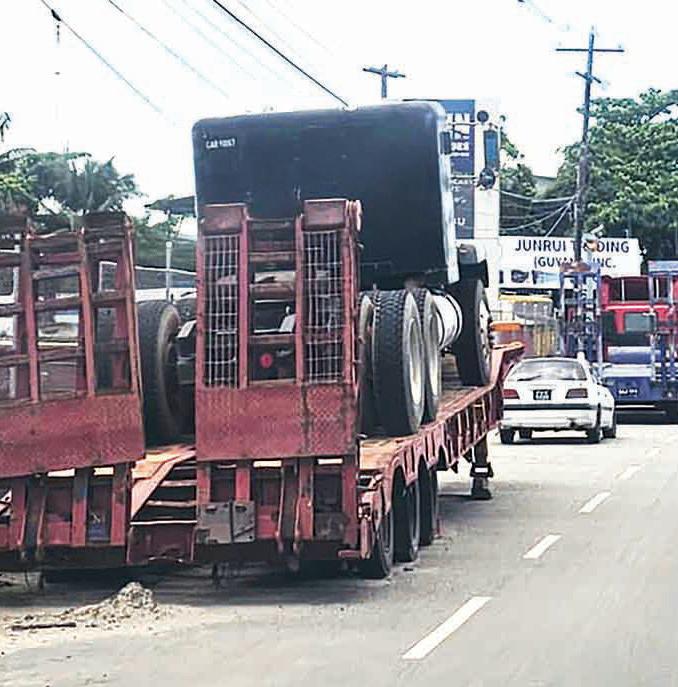
24-hour removal order issued for containers, vehicles blocking roadways






Demerara Bank records 35% profit growth, declares higher interim dividend
11-year-old NGSA student assaulted at school
24-hour removal order issued for containers, vehicles blocking roadways
The Berbice Bridge will be closed to vehicular traffic on: Friday, May 1 – 16:10h–17:40h and Saturday, May 2 –16:45h–18:15h


Parika and Supenaam departure times – 05:00h, 10:00h-12:00h, 16:00h, 18:30h daily.




Thundery showers are expected during the day, briefly interrupted by afternoon sunshine, before easing to cloudy skies overnight. Temperatures are expected to range between 24 degrees Celsius and 30 degrees Celsius.
Winds: East-North-Easterly to Easterly between 3.57 metres and 5.81 metres.
High Tide: 16:24h reaching a maximum height of 2.59 metres.
Low Tide: 09:59h and 22:09h reaching minimum heights of 0.51 metre and 0.65 metre.










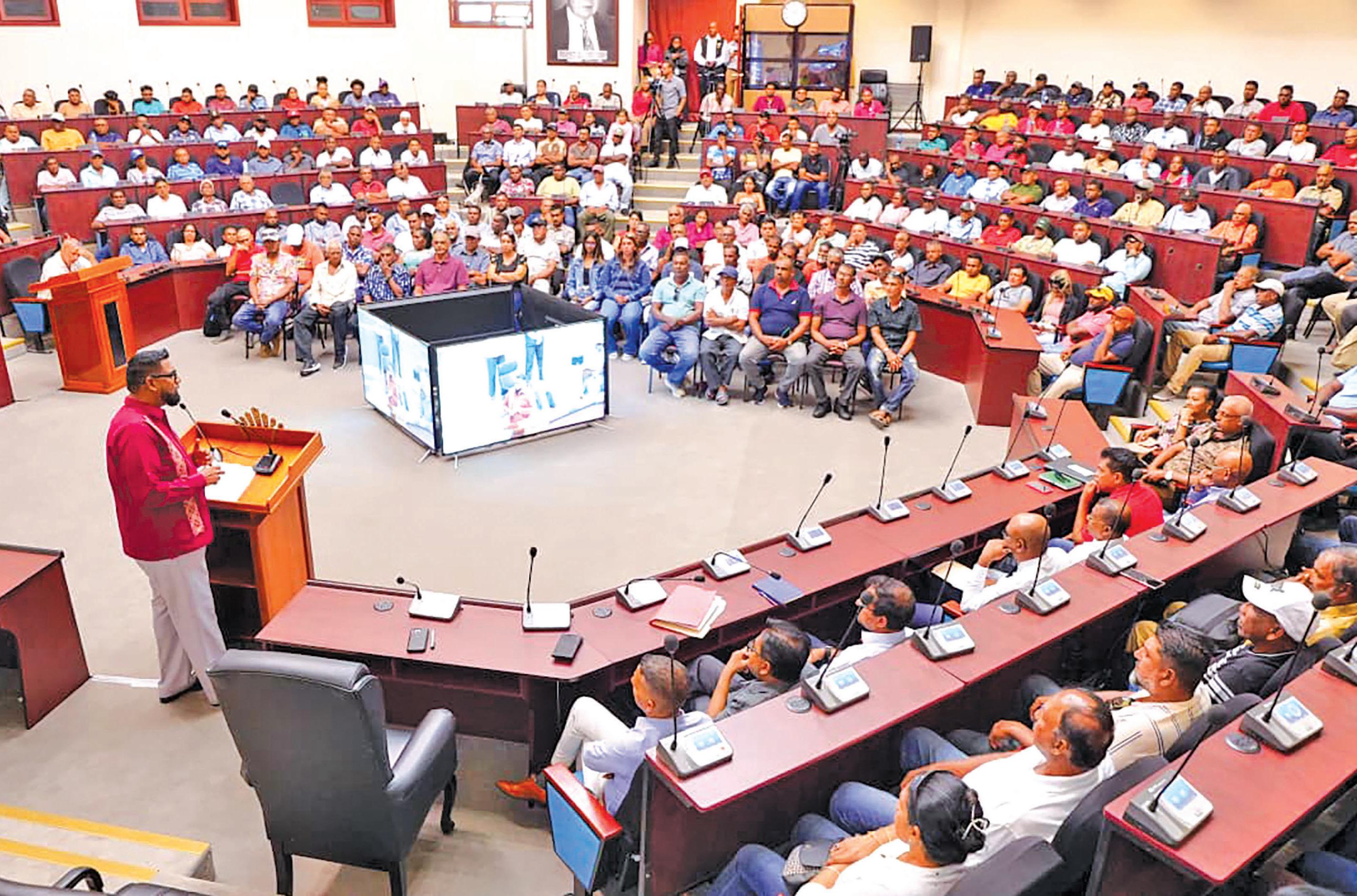
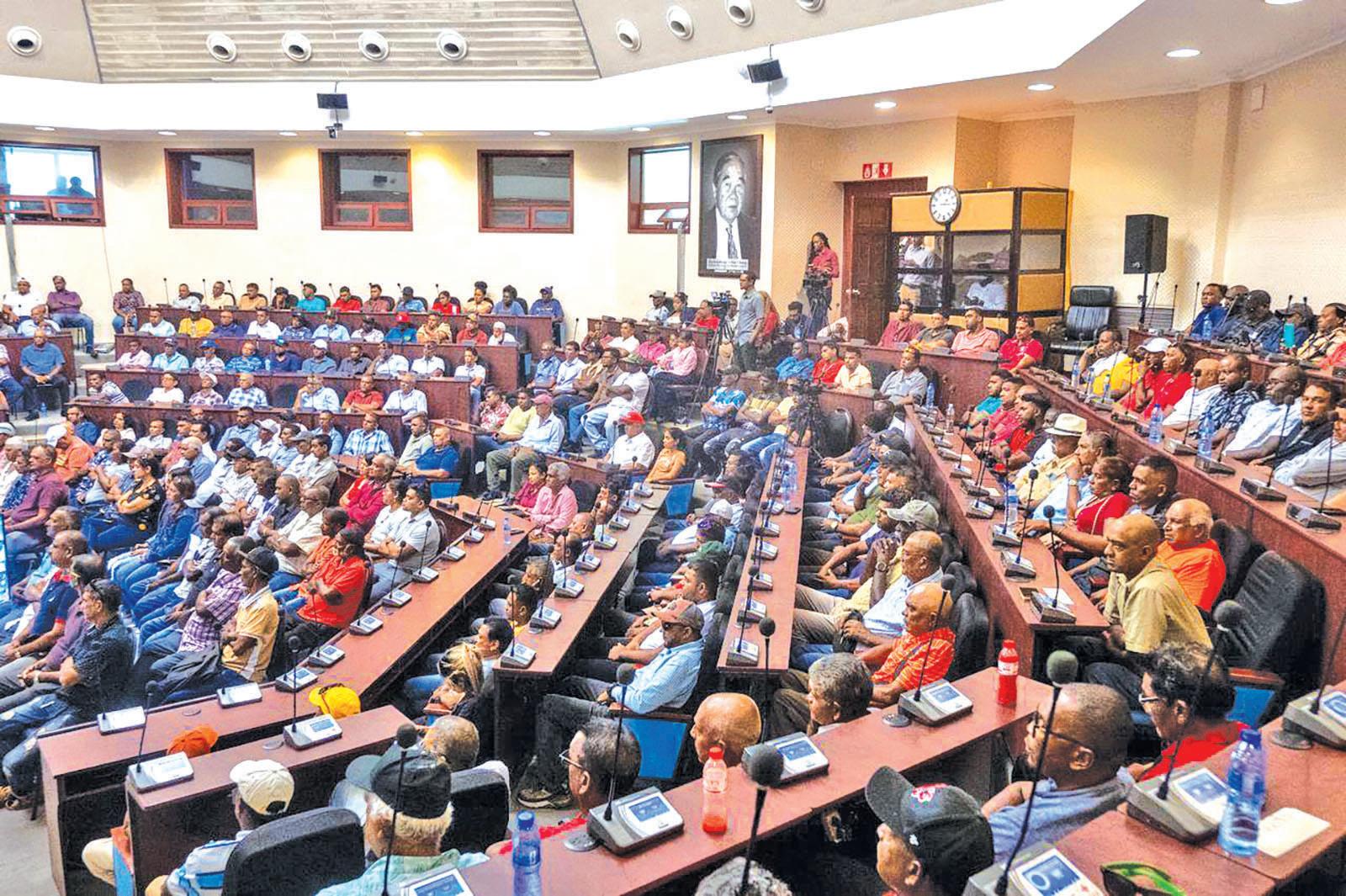
President Dr Irfaan Ali on Thursday announced a new $3 billion investment to support rice farmers as the Government intensifies consultations to determine how best to deliver the assistance.
The Government launched a nationwide consultation with farmers to address challenges facing the local rice industry, many of which have been intensified by ongoing global developments.
Speaking at the Arthur Chung Conference Centre (ACCC) during the meeting, President Ali said the $3 billion in funds will be tailored based on farmers’ direct input, ensuring the support reflects their real and varied needs.
“We want to set aside $3 billion to help you once more, but we want you to help us finalise what format it should be in,” the President told stakeholders.
The Head of State outlined options, including direct cash support, fertiliser assistance, subsidies, and acreage-based payments.
He emphasised that the Government’s approach remains consultative and data-driven, noting that decisions are shaped by continuous engagement with farmers and careful assessment of market realities.
The majority of the farmers who gathered at ACCC voted for direct cash transfers.
The $3 billion will be distributed in the following way: $15,000 per acre for farmers with less than 50 acres of rice fields and $10,000 per acre for farmers with more than 50 acres of rice fields.
Challenges
Meanwhile, addressing the rice farmers, Ali had noted, “We are here today to find ways in which we will address some of the global challenges that we face today.”
A major issue is declining international rice prices, driven by oversupply and high global production. This directly reduces what farmers earn locally, even when production is strong.
Farmers are also faced with rising production costs, including fuel and fertiliser, which has already doubled in price from $6000 to some $12,000. This is exacerbated by the ongoing conflict in the Middle East.
“We are here together as partners, and we are here to find the best possible initiatives, ideas, and solutions for the industry as a whole. And you are part of this solution-based mechanism. We believe strongly in including people in solutions, and that is why you are here today,” the Head of State emphasised.
In this regard, President Ali informed farmers that the forum is intended to develop a comprehensive strategy for the industry with the main goals of reducing the cost of production, improving productivity, and supporting di-
versification by maximising opportunities to earn from their lands.
“So, if you have ten acres of land, how can we convert one acre in those ten acres into a high-value crop or some high-value initiative that allows you to earn more, allows you a diversification of income with rice and some other crop or some other additional income?” he explained, noting that the Government is also prepared to co-invest with farmers.
“And we are not only doing the research; we are preparing ourselves to work with you in a co-investment way so that, for example, we can support the infrastructure build-out and the capital costs to allow you to have this additional ability to earn from your land and to supplement the income from rice farming and also to withstand some of the shocks that you undergo in the rice industry,” he noted.
Oversupply
Addressing the issue of oversupply of rice on the market, President Ali explained to farmers that “what happened is places like India had a lot of rice stored during COVID, and they then released it onto the market. So, there was an oversupply on the market. It took a toll on price.”
“From then to now, we have seen what is taking place with markets and the geopolitical situation around the world, whether it be Cuba, the situation in Venezuela, and the Middle East. All of this, when you take it in totality, has had a tremendous impact on the global system. And as you know, we are part of that global system. We cannot escape these global reali-
ties,” he further informed.
To address this issue, the Government previously announced its intention to construct a massive drying floor and storage facility along the Essequibo Coast over the next five years. In fact, some $1 billion has been budgeted this year for the construction of these climate-controlled silos, which would have the capacity to store some three million bags of paddy.
Partner together
President Ali encouraged stakeholders to work with the Government on solutions, assuring that the People’s Progressive Party Civic (PPP/C) will always support the rice sector.
“One thing about the People’s Progressive Party Civic: we will never leave your side. We will always be by your side. We will always be here walking this journey with you. We will always be here walking this journey with you. And this journey requires us to work together, to partner together, to make decisions together,” he noted.
Previous support
President Ali reminded that over the years, rice farmers have benefited from tremendous support under the People’s Progressive Party Civic (PPP/C) Administration. He reminded us that “we used different tools over the years to help our farmers, whether it was tax incentives on machinery or – and this is outside of the capital investment – bringing in fertiliser in the days when we had limited resources. We brought in fertiliser to support farmers. We worked on getting support on agrochemicals and extension services.”
The Head of State also reminded them of the support offered when the PPP/C returned to office in 2020, noting that “when we came back into Government, a lot of persons who abandoned the fields came back to the fields and came back to planting because we had removed back all of those taxes and licence fees and land rent fees and D&I fees that were instituted by the then-APNU+AFC Government.”



Editor: Tusika Martin
News Hotline: 231-8063 Editorial: 231-0544, 223-7230, 223-7231, 225-7761 Marketing: 231-8064 Accounts: 225-6707
Mailing address: Queens Atlantic Industrial Estate Industrial Site, Ruimveldt, Georgetown Email: news@guyanatimesgy.com, marketing@guyanatimesgy.com
abour Day has always been more than a ceremonial observance.
LIn Guyana’s case, the historic role of labour carries even deeper significance. The struggle for better wages, humane conditions and fair treatment was closely linked to the national movement for political representation, justice and independence. As Guyana marks sixty years of nationhood, the tribute paid to workers is both timely and deserved.
The messages issued by President Dr Irfaan Ali and Prime Minister Brigadier (Ret’d) Mark Phillips reflect an important truth: the country’s progress rests on natural resources or capital investment, as well as the efforts of teachers, nurses, farmers, miners, builders, security personnel, public servants and private sector employees whose daily labour sustains the economy. Their contribution remains the foundation upon which national prosperity is built.
Yet the value of this year’s Labour Day reflections lies not in recognising history but in confronting present realities. Across the world, workers face growing uncertainty. Inflation has strained household budgets. Technological change is reshaping industries. Climate pressures threaten livelihoods. Supply chain disruptions and geopolitical tensions continue to create instability. These are not distant concerns. They are forces that directly affect living standards, employment security and the cost of doing business in developing economies.
Against this backdrop, the Government’s emphasis on a renewed partnership among labour, employers and the State deserves support. The traditional model of adversarial industrial relations, while rooted in past struggles, is increasingly unsuited to modern economic demands. Confrontation for its own sake benefits no one. Prolonged disputes harm workers through lost income, burden employers through reduced productivity and ultimately slow national development.
A cooperative framework built on consultation, mutual respect and problem-solving offers a stronger path forward. Such an approach does not weaken labour rights but, on the contrary, it can strengthen them by creating predictable mechanisms for dispute resolution, fair bargaining and shared accountability. It can also help Guyana respond more effectively to economic shocks by ensuring that all stakeholders are engaged in protecting jobs and preserving purchasing power.
The Government has already signalled that worker welfare is central to policy. Tax reforms that raised the income tax threshold and eased burdens on families and second-job earners place more disposable income in the hands of citizens. Wage adjustments across the public sector, along with allowances and bonuses, recognise the importance of compensating workers more fairly in a changing economy. Targeted grants, utility support and transportation assistance further cushion families from imported inflation and rising costs.
A worker’s quality of life is also shaped by access to housing, healthcare, education, childcare, transport and opportunities for advancement. In this regard, investments in free education, school support programmes, housing allocation and improved infrastructure are rightly framed as worker-centred policies. When families are supported, the workforce becomes more stable, productive and resilient.
Prime Minister Phillips was equally correct to stress that economic growth must be measured by how it improves lives. Guyana is experiencing unprecedented expansion, attracting investment and opening new sectors. However, growth figures alone are insufficient indicators of success. Development must translate into safer workplaces, stronger labour protections, skills training and upward mobility for ordinary citizens. If prosperity does not reach households, it cannot be considered complete.
This is why the role of the Labour and Manpower Planning Ministry is especially important at this stage of national development. Enforcement of labour standards, occupational safety, mediation services and workforce training must continue to evolve alongside the economy. New industries require new competencies. Emerging sectors require updated regulations. Expanding investment requires confidence that Guyana can provide both skilled labour and a fair industrial environment.
Trade unions’ historical achievements are undeniable, and their relevance remains strong; however, modern unionism must balance advocacy with constructive engagement. Protecting workers today requires participation in training initiatives, productivity reforms and collaborative policymaking.
Guyana now stands at a rare moment in its history as rapid economic transformation provides opportunities that previous generations could scarcely imagine. But with opportunity comes responsibility. Trade unions can either repeat the divisions of the past or forge a new consensus grounded in shared prosperity and national purpose.
Labour Day 2026 should be remembered as more than a celebration of workers’ sacrifices.
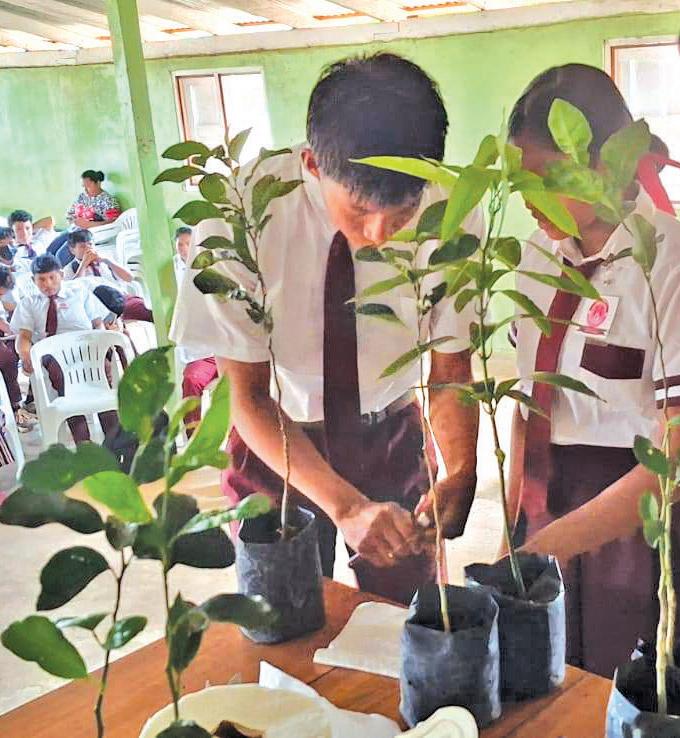
Farmers and Grade 10 students
led by National Agricultural Research and
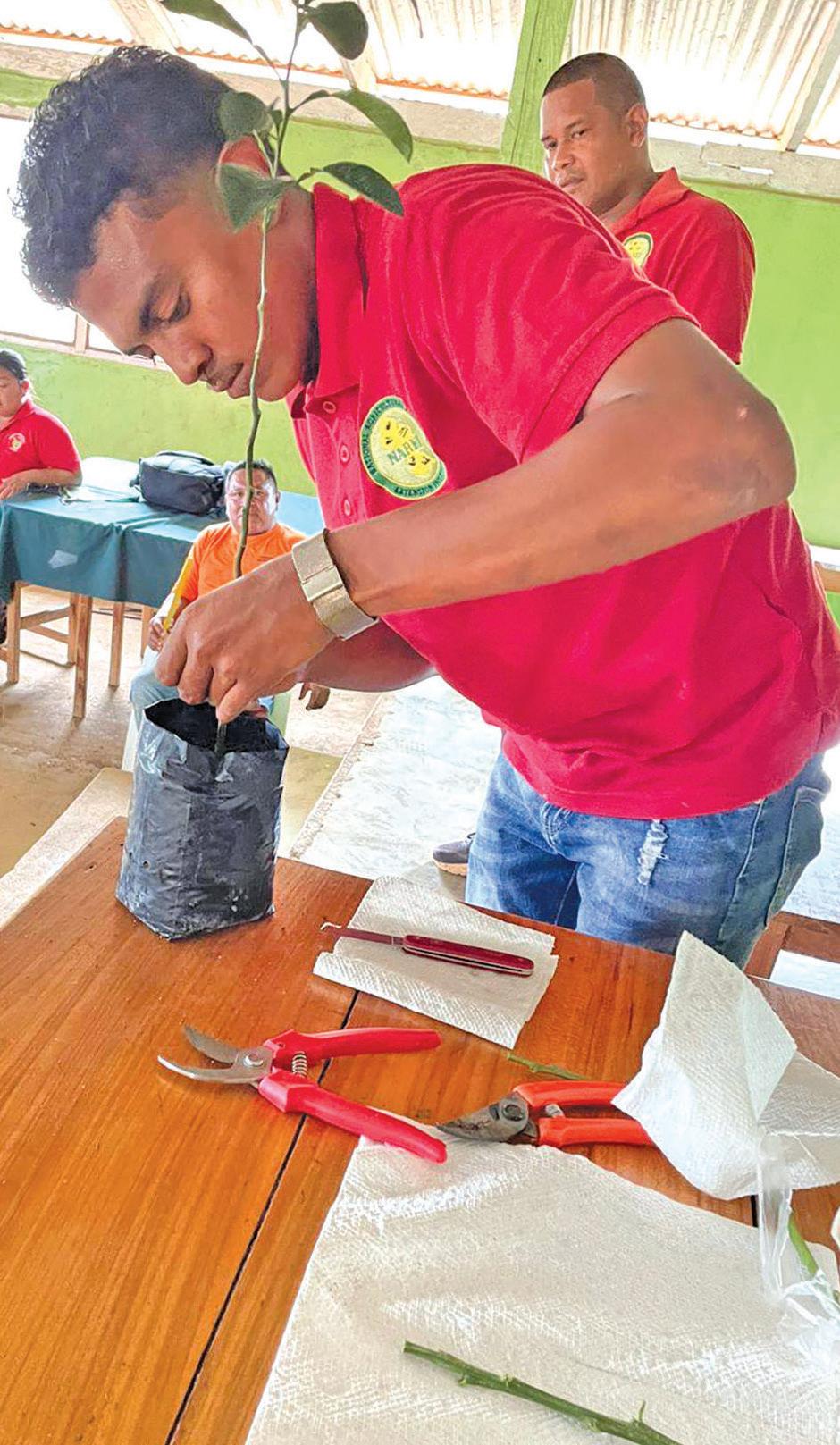
application, and pest and disease management to boost agricultural productivity and sustainability
principle,
…territorial claims are decided in court, not worn on a lapel
By Sir ronald SanderS
There are moments in international affairs when a seemingly small act reveals a much larger contest of principle. The recent controversy over the wearing, during official engagements in the Caribbean, of a brooch depicting Guyana’s Essequibo region as part of Venezuela is one such moment.
It would be easy and politically convenient to dismiss the issue as trivial. Some have suggested that concern over the display amounts to little more than sensitivity to matters of personal attire. That characterisation is not merely dismissive; it is misleading.
The matter is not about dress. It is about conduct.
When a Head of Government displays, in official engagements with other states, a symbol that asserts a territorial claim against a neighbour, that act ceases to be personal expression. It becomes an instrument of state policy. It is intended to communicate, to reinforce, and to normalise a position that is very much in dispute.
That dispute is not abstract. It is currently before the International Court of Justice, to which Guyana has turned for a final and binding determination of the validity of the 1899 Arbitral Award that fixed the boundary between the two countries.
Venezuela now asserts that its position is grounded in international law and in the Geneva Agreement.
That claim requires careful scrutiny. The Geneva Agreement did not determine sovereignty, nor did it invalidate the 1899 Award. It established a mechanism
for the peaceful resolution of a controversy and, ultimately, the pathway that has led the matter to the Court. It is therefore incorrect to suggest that the Geneva Agreement justifies unilateral assertions of territorial entitlement while the very question it addresses is before judicial determination.
In that context, it is difficult to reconcile assertions of fidelity to international law with conduct that appears designed to shape perceptions of a matter that is sub judice. A state cannot credibly submit a controversy to judicial settlement while simultaneously seeking, through symbols, legislation, or administrative acts, to advance the outcome it desires outside the courtroom.
The wearing of a brooch, displaying Essequibo as part of a map of Venezuela, is part of a wider pattern. It accompanies legislative measures purporting to annex the territory, the appointment of officials for it, and a sustained narrative of sovereign entitlement. Taken together, these actions suggest not restraint pending adjudication, but a parallel effort to consolidate a claim by political means.
In this connection, the response of the Caribbean Community (Caricom) assumes particular importance.
Caricom’s statement of April 28, 2026 was measured, but it was also clear. It reaffirmed the sovereign right of Member States to engage with external partners. But it placed that right within a framework of collective obligation under the Revised Treaty of Chaguaramas. Most significantly, it un -
derscored that community platforms must not be used, directly or indirectly, to advance or appear to legitimise claims that are before the court.
That formulation is a quiet but firm assertion of regional discipline, even amid claims of disunity in the integration movement.
The Caricom statement protects the integrity of the judicial process. It preserves the unity of the community. And it signals that, while Caricom will not interfere in the bilateral relations of its members, neither will it allow its forums to become instruments in the prosecution of a territorial claim against one of its own. That latter point must not be discounted.
President Irfaan Ali’s response, in writing to the Chair of Caricom, was therefore both justified and necessary. It was not an overreaction, nor an exercise in rhetoric. It was a defence of principle at a moment when ambiguity could easily have taken hold.
I worked with Delcy
Rodríguez between 2015 and 2017 when I opposed efforts by some member states of the Organization of American States to impose measures against the Venezuelan Government outside the established rules of the Organization. I did so out of respect for procedure, law, and fairness. I respected her as a formidable advocate for her Government in a difficult and contested period.
But this matter is not about personalities, political alignment, or attire. It is about principle, process, and respect for a matter now before the court.
The broader issue is whether all parties will match their stated commitment to international law with conduct consistent with it.
If the controversy is to be resolved peacefully, finally, and in accordance with international law, then the process before the Court must be allowed to proceed free from actions that risk prejudging or politicising its outcome. That requires restraint, not symbolism; discipline, not theatre.
A lapel pin cannot alter a boundary. But the conduct it represents can either support or undermine the principles by which that boundary is to be determined. In this instance, the Caribbean has chosen, quietly but firmly, to stand on the side of law.
The author is Ambassador of Antigua and Barbuda to the United States and the Organisation of American States and Chancellor of the University of Guyana. The chancellorship is not a paid position. The views expressed are entirely his own.





On this Labour Day 2026, the People’s Progressive Party extends heartfelt appreciation to the hard-working men and women of Guyana whose dedication, sacrifice, and resilience continue to drive our nation’s progress and prosperity. Today, we honour workers across every sector – teachers, nurses, farmers, miners, public servants, members of the disciplined services, construction
workers, entrepreneurs, and private sector employees – whose daily efforts are building a stronger and more prosperous Guyana. Labour Day stands as a reminder of the historic struggles fought to secure workers’ rights, fair wages, safe working conditions, and dignity in the workplace. The PPP remains firmly committed to protecting those gains while advancing policies that create
more opportunities, improve incomes, and enhance the quality of life for all Guyanese. Over the years, our government has worked tirelessly to expand employment opportunities, increase wages and pensions, invest in education and training, improve workplace conditions, and strengthen social services for working families. As Guyana continues on its path of unprecedented development, we remain
focused on ensuring that the benefits of growth reach every worker and every community. This Labour Day, we reaffirm our commitment to social justice, economic empowerment, and inclusive national development. Together, through unity, hard work, and shared purpose, we will continue building a Guyana where every citizen can thrive.
Happy Labour Day to all Guyanese workers.
Dear Editor,
Venezuela’s acting President, Delcy Rodriguez, by virtue of the fact that Nicolas Maduro has been removed by the US Government and is on trial in the US, has drawn considerable and concerning attention to herself by flaunting a brooch worn on her lapel of a map of Venezuela, including the Essequibo as a part of Venezuela, while in meetings with Caricom Heads of State.
Rodriguez has also inflamed, with deliberate intention for public attention, the illegitimate claim of Venezuela to our Essequibo. President Irfaan Ali wasted no time in responding appropriately.
It is good, however, that Rodriguez has reminded us and, indeed, our allies, including the US, that the Venezuelan regime (they are not an elected Government) has every intention of pursuing this pernicious claim at a time when Guyana is about to make its oral presentations to the International Court of Justice, which will, early next year, decide on the validity of the 1899 Arbitral Award and the boundary established by the 1905 Boundary Agreement.
We know that Venezuela, never once, for over 62 years, challenged the validity of the 1899 Arbitral Award. We also know that it was the Venezuelan Government that pressed the British Government that the demarcation of the boundary between Venezuela and Guyana, in accordance with the Award, be settled on January 10, 1905.
It is particularly ironic that Rodriguez chose the in-your-face display of a false map of Venezuela when, in fact, successive Venezuelan Governments since 1911 published maps consistent with the Award and the 1905 Agreement, again in 1928, in 1937, in 1939, in 1940, in 1947, in 1950, in 1955 and in 1956. In fact, the Venezuelan Government published about 16 official Venezuelan maps between 1911 and 1962, demarcating the boundary between Venezuela and British Guiana, faithfully depicting the 1899 Arbitral Award and the 1905 Boundary Agreement, until its recent foolishness.
It is history that when Guiana’s independence from the United Kingdom approached in the 1960s, the United
Kingdom, which had responsibility for British Guiana’s external relations, contended to the United Kingdom that the 1899 Arbitral Award was a nullity, which the United Kingdom firmly rejected but agreed to have any relevant documentary material in support of Venezuela’s claim examined by experts of the UK, BG and Venezuela. The UK representative who made the offer at a UN Special Political Committee on November 12, 1962, made it plain, however, and said, “In making this offer, I must make it very clear that it is in no sense an offer to engage in substantive talks about the revision of the frontier.”
Venezuela accepted the offer. The three countries examined the documents, and both the United Kingdom and British Guiana agreed with the experts that there was not a scintilla of evidence to support the Venezuelan contention. Eventually, on the eve of independence, the United Kingdom and Venezuela, with Guiana’s concurrence, concluded the Geneva Agreement, Article 1 of which reads:
“A mixed commission shall be established with the task of seeking satisfactory solutions for the practical settlement of the controversy between Venezuela and the United Kingdom which has arisen as a result of the Venezuelan contention that the Arbitral Award of 1899 about the frontier between British Guiana and Venezuela is null and void.”
From its inception, successive Venezuelan Governments have refused to recognise or honour the purpose of the Geneva Agreement, continuously insisting that the purpose of the Geneva Agreement was to agree on redefining the borders between Venezuela and Guyana on the assumption that the Arbitral Award of 1899 was a nullity.
As might have been expected, negotiations and discussions were fruitless and unproductive, and agreement was not reached on one of the means of settlement listed in Article 3 of the United Nations Charter, which includes judicial settlement, and, therefore, as the agreement stipulated, the choice of the means of settlement was left to the Secretary-General of the United Nations, and that choice is binding on the two parties.
Eventually, the UN SecretaryGeneral, Antonio Guterres, decided, in accordance with Article IV (ii) of the Geneva Agreement, that the next means of settlement would be judicial settlement by the International Court of Justice, and he so informed both Governments of his decision.
The Venezuelan Government, even now, with Delcy Rodriguez reporting directly to the US Government, is determined to misrepresent and disregard the Geneva Agreement, and as we are on the eve of our 60th year of independence, it seems appropriate to recall the words of our first Prime Minister, Forbes Burnham, spoken on July 12, 1968, in the National Assembly and as relevant today as when they were spoken: “I cannot tell with any certainty where this ill-advised course of action of which the Government of Venezuela has embarked will lead us. We must be prepared, however, for further and even more aggressive demonstrations of international lawlessness from the Government of Venezuela. We will need all our courage and strength to withstand these efforts to break our will and despoil our land…In our stance for survival we shall call upon the conscience of all peace-loving people to speak out in our cause, and we shall need all our unity as a people so that our voice may be heard in all corners of the world and in all the councils of the world’s institution of peace.”
I conclude with the words from President Dr Mohamed Irfaan Ali in his letter to Prime Minister Dr Terrence Michael Drew of St Kitts & Nevis and Chairman of Caricom: “The use of Caricom engagements to project or promote a territorial claim against a member state risks being interpreted as acquiescence or tolerance. No action, whether deliberate or inadvertent, should create the impression that the community’s platforms may be used to advance claims now before the International Court of Justice. Caricom’s principled support for Guyana must be reflected not only in declarations but also in the context and conduct of official engagements.”
Yours sincerely, Kit Nascimento
ERC
The Ethnic Relations Commission (ERC) proudly joins the nation in commemorating Labour Day as we honour the dedication, perseverance, and achievements of workers across Guyana. Workers whose efforts continue to propel the country’s growth and development. Labour Day is not only a celebration, but also a moment of reflection. It beckons us to remember the generations of workers who organised, sacrificed, and persevered to secure the rights and protections that Guyana’s workforce benefits from today. As a constitutional body with labour represented among its core constituencies, the ERC occupies a unique position in advocating for the welfare of workers across all sectors of society. In keeping with its mandate to promote harmony and good relations
among Guyana’s diverse peoples, the Commission remains steadfast in its commitment to fostering workplaces that are inclusive, respectful, and free from discrimination. As part of its ongoing efforts, the ERC provides Diversity, Equity, and Inclusivity (DEI) training and sensitization programmes to organisations across both the public and private sectors. These initiatives are designed to promulgate mutual understanding, reduce workplace discrimination, and strengthen the social cohesion that underpins a productive and harmonious workforce. As Guyana commemorates Labour Day, the ERC salutes the invaluable contributions of the nation’s workforce and reaffirms its commitment to supporting safe, inclusive, and harmonious working environments for all.


1. i. Using a ruler, a pencil and a pair of compasses, construct accurately, the square EFGH where EF = 6 cm
ii. Measure, and state in centimetres, the length of the diagonal FH.
2. The diagram below shows a map of an island drawn on a grid of 1 cm squares.
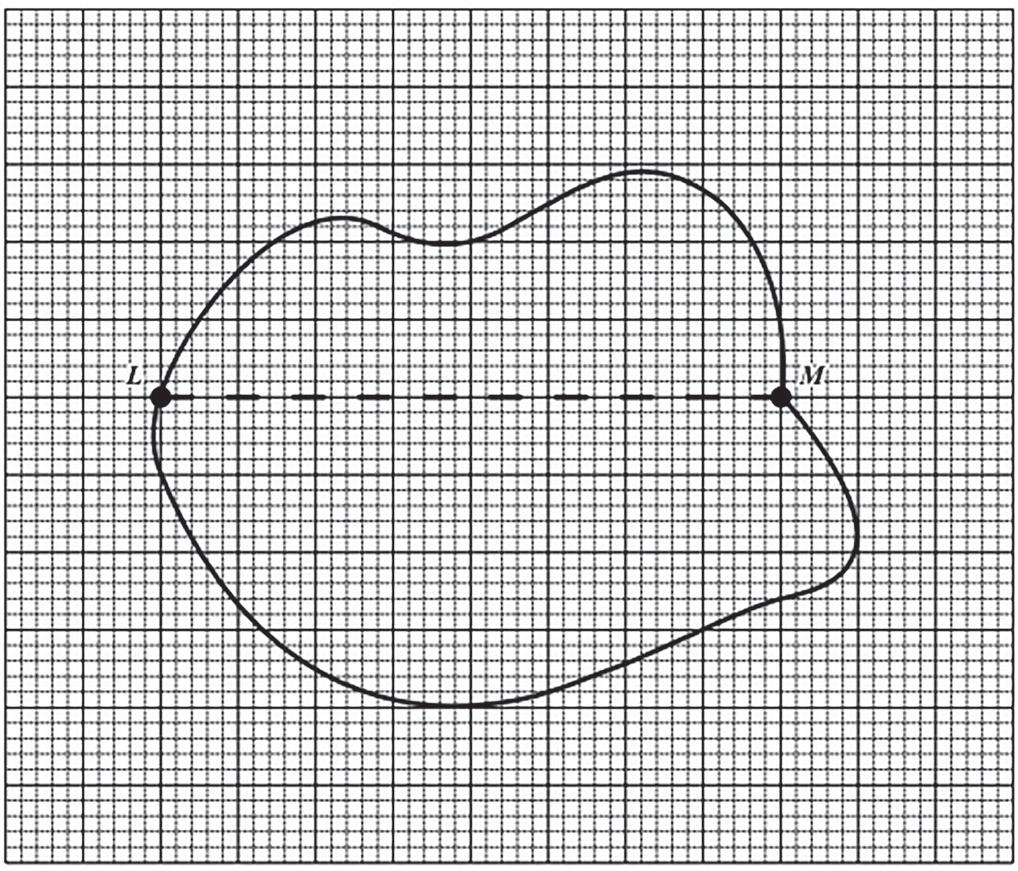
i. State, in cm, the length of LM as shown in the diagram ii. Estimate, by counting squares, the area of the map shown in the diagram.
iii. On the island, the actual distance LM is 20 km. Therefore, on the map, 1 cm represents how many km?
iv. Write the scale of the map in the form 1 : x.
v. What distance on the island will be 3 cm on the map?
vi. What area on the island will be represented by 3 cm2 on the map?
3. The diagram below, not drawn to scale, shows a prism with cross section PQRST and length 20 cm. PQRST is made up of a rectangle PQRT and a semicircle RST such that PQ = 6 cm and QR = 5 cm.
Use π = 3.14
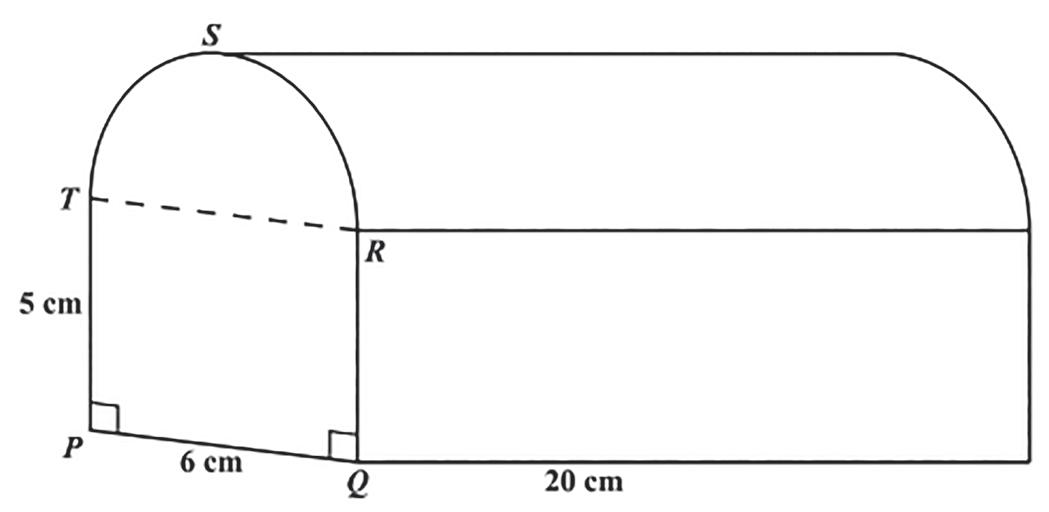
i. Calculate the area of the cross section PQRST.
ii. An engineer needs a similar prism whose volume is NOT more than 900 cm3 . Estimate, in cm, the length of the longest prism he can use.
4. In the following diagram, not drawn to scale, ST = 6 m, WR = 11.2 m, WT = 14.8 m and angle WRS = 90°.


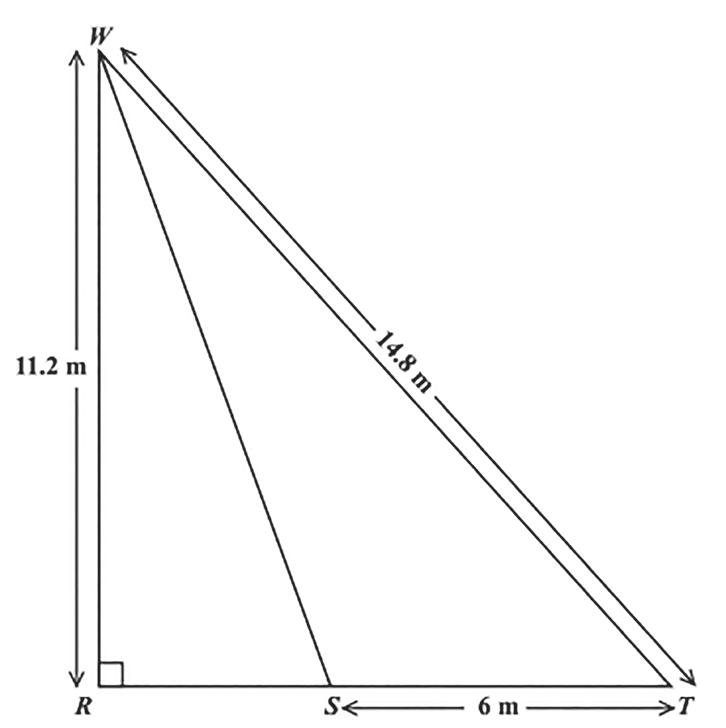
Calculate, giving your answer to 1 decimal place:
i. The length RS
ii. The measure of angle RTW
5. A line JK has equation 2y = 5x + 6.
i. Determine the gradient of JK.
Another line GH, is perpendicular to JK and passes through the point (5, –1).
ii. State the gradient of the line GH.
iii. Determine the equation of line GH.
6. The graph below shows a triangle ABC and its image A'B'C' after undergoing a single transformation.
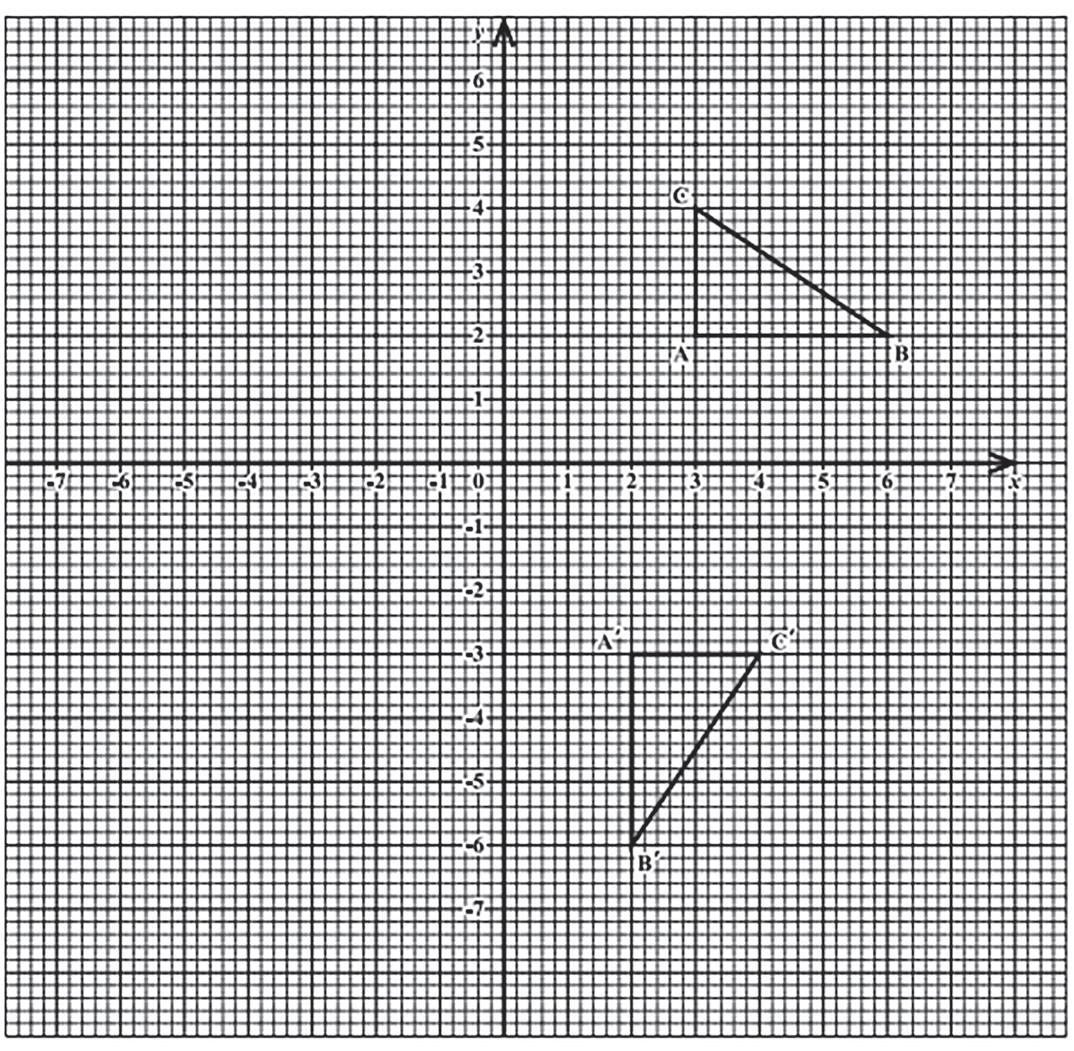
i. Write down the coordinates of the vertices of ∆ABC.
ii. Write down the coordinates of the vertices of ∆A'B'C'.
iii. Describe FULLY the transformation that maps triangle ABC onto triangle A'B'C'.
iv. On the graph, draw the line x = 1 AND the triangle A˝B˝C˝, the image of triangle ABC after a reflection in the line x = 1.
v. State ONE geometrical relationship among ∆ABC, ∆A'B'C' and ∆A˝B˝C˝
By Martin Carter

This is the dark time, my love,
All round the land brown beetles crawl about. The shining sun is hidden in the sky Red flowers bend their heads in awful sorrow. This is the dark time, my love, It is the season of oppression, dark metal, and tears. It is the festival of guns, the carnival of misery. Everywhere the faces of men are strained and anxious. Who comes walking in the dark night time?
Whose boot of steel tramps down the slender grass? It is the man of death, my love, the strange invader Watching you sleep and aiming at your dream.
Questions
1. What is the central theme of the poem?
2. What does the phrase “dark time” mean?
3. Who is the author of the poem?
4. Describe the tone of the poem.

You find yourself stranded on a deserted island with only 3 things in your bag. What would you want them to be, why so, and what would you do with them to get to safety?


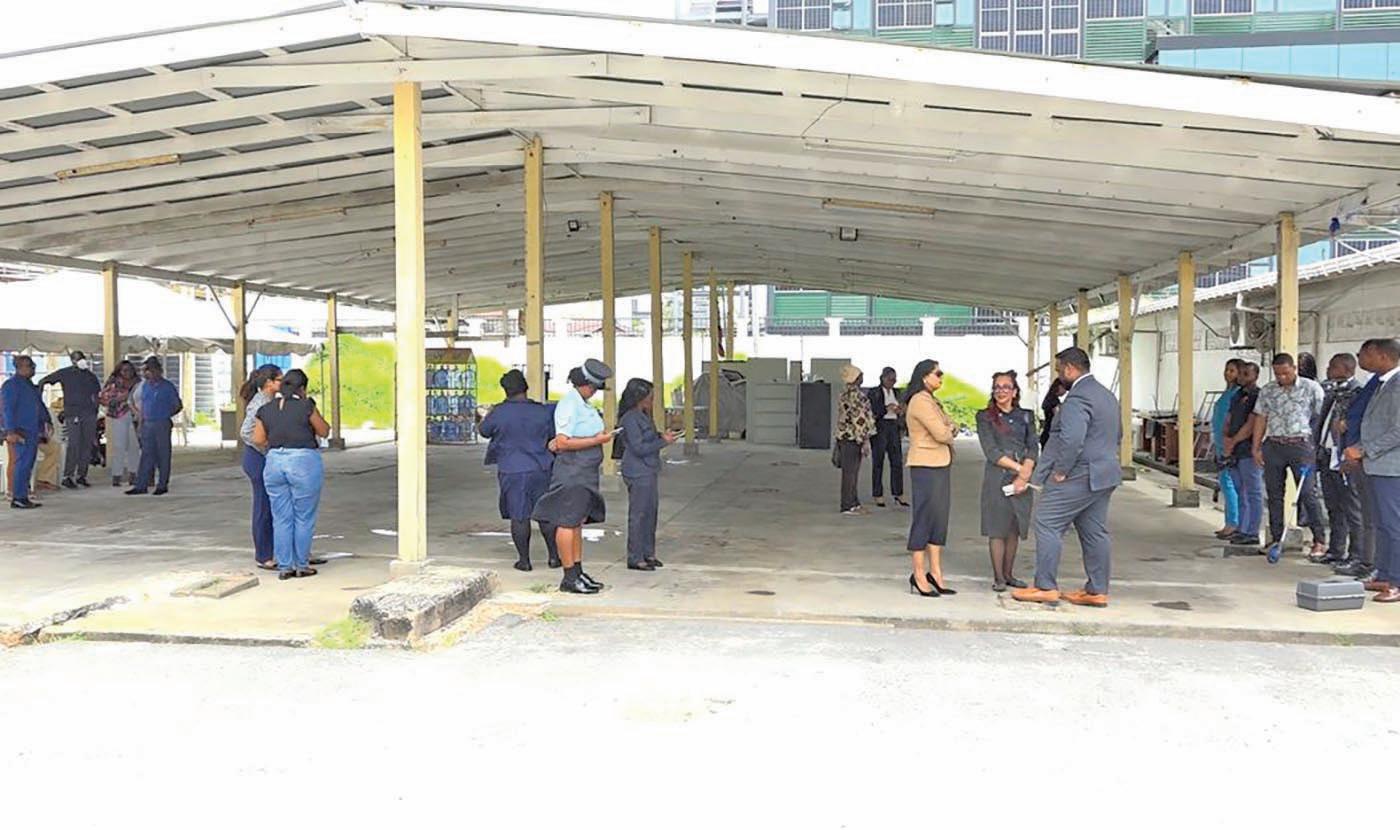
The Georgetown Magistrates’ Courts trial into the March 2020 elections fiasco continued on Thursday with a site visit at the Guyana Elections Commission (GECOM) headquarters on High Street in Kingston, Georgetown, where several witnesses recounted the layout of the infamous bedsheet tabulation area.
Education Minister Sonia Parag, then observer with the American Chamber of Commerce of Guyana (AmCham Guyana) Rosalinda Rasul, and former executive member of A New and Unity Guyana (ANUG) Jonathan Yearwood were the state witnesses present during the site visit.
The GECOM head office was the location where the March 13, 2020, declaration, the second of two controversial declarations, was made for District Four by the then Returning Officer for Region Four (DemeraraMahaica), Clairmont Mingo, who is one of nine accused persons in this trial slapped with several counts of electoral fraud charges.
Chief Magistrate (ag) Faith McGusty, along with the prosecution, defence attorneys, and seven of the accused, was present as each witness pointed out the layout of an area under a shed at GECOM that was trans-
formed into a tabulation area during which a bedsheet was used as a screen to project the Statements of Poll (SoPs).
The witnesses showed where they, along with others present at the time, were seated and the distances where they were from the bedsheet screen. Those areas highlighted by the witnesses were marked and measured.
In addition, Yearwood also pointed out to the court where he got into a confrontation with A Partnership for National Unity’s (APNU) chief scrutineer, Carol Smith-Joseph, who is also one of the accused persons.
Defence attorney Dexter Todd sought permission to cross-examine the witnesses on site, arguing that new evidence was being introduced. However, this request was rejected by the presiding Magistrate, who explained that the cross-examinations would have to be done in the courtroom where there would be a recording system.
Todd later told reporters after the visit that the prosecution was trying to recreate the scene from nothing. In fact, he contended that the prosecutor is attempting to do what the Police should have done in the first place during its investigation.
“If the Police were careful in their investigations, one of the first things that they ought to have done, after taking the statements from the prospective witnesses, is to visit the scene and allow the witness to point out various locations in an attempt to reconstruct the scene so that you can have proper measurements. Now, almost or over six years pass, and you have a situation where the witnesses are revisiting the scene, and they are trying to, of course, rely on memory to reconstruct the scene… It’s just a situation of guessing,” the lawyer posited.
Dismissed defence’s claim
However, Special Prosector, Latchmie Rahamat, explained to reporters that the site visit was to help the court understand the layout of the area that was referenced by the three witnesses during their testimonies in the trial.
“So, the layout and the scene and the pointing out of specific locations by Minister Parag, Ms Rasul and Mr Yearwood are so important ultimately for the finder of fact, who in this matter is the Magistrate, when it comes time for her to put the evidence together. And so, this application for the site visit was made by the state, and all of the witnesses who have been invited today have spoken about being at this High Street location. And so, they are just able today [Thursday] to show us where they were, and that could only be beneficial to the court,” Rahamat noted.
Responding to Attorney Todd, the special prosecutor dismissed the defence’s claim that new evidence was being introduced.
“I would disagree that it is not part of the evidence. When you had these very

witnesses testifying under oath about this location, where they were, what they saw, what they heard the GECOM staff saying and not being able to follow… These are witnesses whom the State are relying on, who were present at the time the tabulation was being done, and so their evidence is important,” she contended.
Thursday’s visit to the GECOM head office was the
second site visit conducted during this trial; the first was at Ashmin’s Building on Hadfield and High Streets, which was being used as the District Four tabulation centre during the 2020 elections.
According to Special Prosecutor Rahamat, the state has more than 10 other witnesses to testify in the trial, which will resume on May 18.
Nine persons are cur-
rently on trial, accused of conspiring to manipulate the outcome of the March 2020 elections in favour of the APNU+AFC coalition. Among the accused are former Chief Elections Officer Keith Lowenfield; former Region Four Returning Officer Clairmont Mingo and his deputy Roxanne Myers; as well as former minister Volda Lawrence and several other GECOM staff members.

The Home Affairs Ministry has recorded significant progress in its digital transformation efforts, with the General Registry’s online services now 85 per cent complete, and 6873 work permits and 4427 employment visas have already been approved through the system.
This was according to Home Affairs Minister Oneidge Walrond on Tuesday, during the National Stakeholders Forum hosted by the Parliamentary Affairs and Governance Ministry under the theme “Strengthening Access and Accountability through Digital Platforms”, held at the World Trade Centre, Kingston, Georgetown.
“So the online immigration services have been one of the services that we have put digital over the past couple of years. There are other services like the General Registry services that we are working to put online as well, making them digital. It is already halfway there – actually 85% there – and in a couple of months, that will be a fully online service, as well as the Passport Office,” the Minister stated.
According to the Minister, this accomplishment is of high importance

to the Ministry as it moves to upgrade its services.
“And we are particularly proud of that as it relates to reducing service time from months to just about two weeks – sometimes shorter, depending on the service that you need.”
TURN TO PAGE 19

Your Eyewitness has said we gotta watch out for Venezuela’s Devious Delcy after she had the plum of their presidency dropped into her lap when the Yanks “extracted” Mad Maduro – like the rotten tooth he was!! Clearly, she woulda been looking out for other Chavistas taking offence at what they would see as “selling out the revolution” by reversing some of the controls over the economy they’d imposed. And so – just as Mad Maduro did when he had to face grumbling over EIGHT MILLION VENEZUELANS fleeing the country – Devious Delcy has resorted to the low-hanging fruit of their border controversy to rally potential opponents behind the Venezuelan flag!!
So here we have Devious Delcy – who’s carefully cultivated and curated her public political persona to be dubbed “The Tiger” by Mad Maduro – now disingenuously trying to pass off her flaunting of our Essequibo appended to Venezuela’s flag as simply an innocent “fashion statement”!! Fashionista Delcy!! Responding to Pres. Ali’s trenchant deconstruction of her “calculated and provocative assertion” in front of Caricom leaders, she snickered, “Now they are bothered even by how one dresses”!! But we know that SHE knew what she was doing by her very next sentence in her public avowal: “I told the Foreign Minister, well, ask them if they’re also going to come and burn the history, because Venezuela’s rights over the Essequibo are historical; they are irrefutable.”
So Pressie had called out quite pellucidly what she was doing in pointing out the significance of these matters all having to do with context: “Venezuela cannot, while the case is before the Court, seek to normalise by symbols, maps, legislation, appointments or official display what it has failed to establish in law.” And that’s what it’s all about, innit, Deceitful Delcy?? She’d probably read Pressie’s relatively calm reaction to her previous “brooch stunt” in Grenada – in front of PM Dickon Mitchell – as a sign of passivity or weakness. Hence her repetition of the provocation in her meeting with Barbados’ PM Mia Mottley.
But what had to’ve pushed her on her backfoot was Pressie’s formal complaint to Caricom Chairman Dr Terrance Drew – describing Rodriquez’ actions as threatening to undermine regional unity. He warned Caricom leaders that allowing such displays during official engagements risks being interpreted as “acquiescence or tolerance” of Venezuela’s claims – which contradict OFFICIAL Caricom positions!! Caricom’s reaction was immediate as Chm Drew cautioned that while Member States retain the sovereign right to conduct bilateral relations with external partners, they MUST reject being used to push claims that are before the ICJ!! But we know Devious Delcy’s gonna continue her hybrid warfare!! Your Eyewitness hopes today the TUC will march with FITUG to denounce her deviance!!
…US corporations’ taxes
The US Ambassador made the quite reasonable request that “Guyana could do itself a huge favour, not just for US companies, but for all international companies if they looked at modernising the tender process.” She mentioned specific improvements such as digitising submissions and strengthening oversight of major public contracts. Now aren’t we digitising everything in our dear land of Guyana??? Should be no problem!!
But she also raised an even more pressing need – one that could benefit us immensely! Pointing out that one of the other concerns of US companies looking to do business here is that they shouldn’t be subject to double taxation – both here by the GRA and in the US by the IRS. “We do not have a bilateral tax treaty. That is something that my office, my embassy here, has been working very closely with Washington on.”
Well, let’s do that!! It’ll settle all the claims and counterclaims on Exxon’s taxes for their Guyana operations!! The tax treaty should prohibit the claimed Exxon doubledipping!!
…May Day
So today, your Eyewitness will be all teary-eyed as he observes his erstwhile comrades marching like a sea of red through the streets of GT – paying homage to our “workingclass” struggles!!
Are those struggles over??







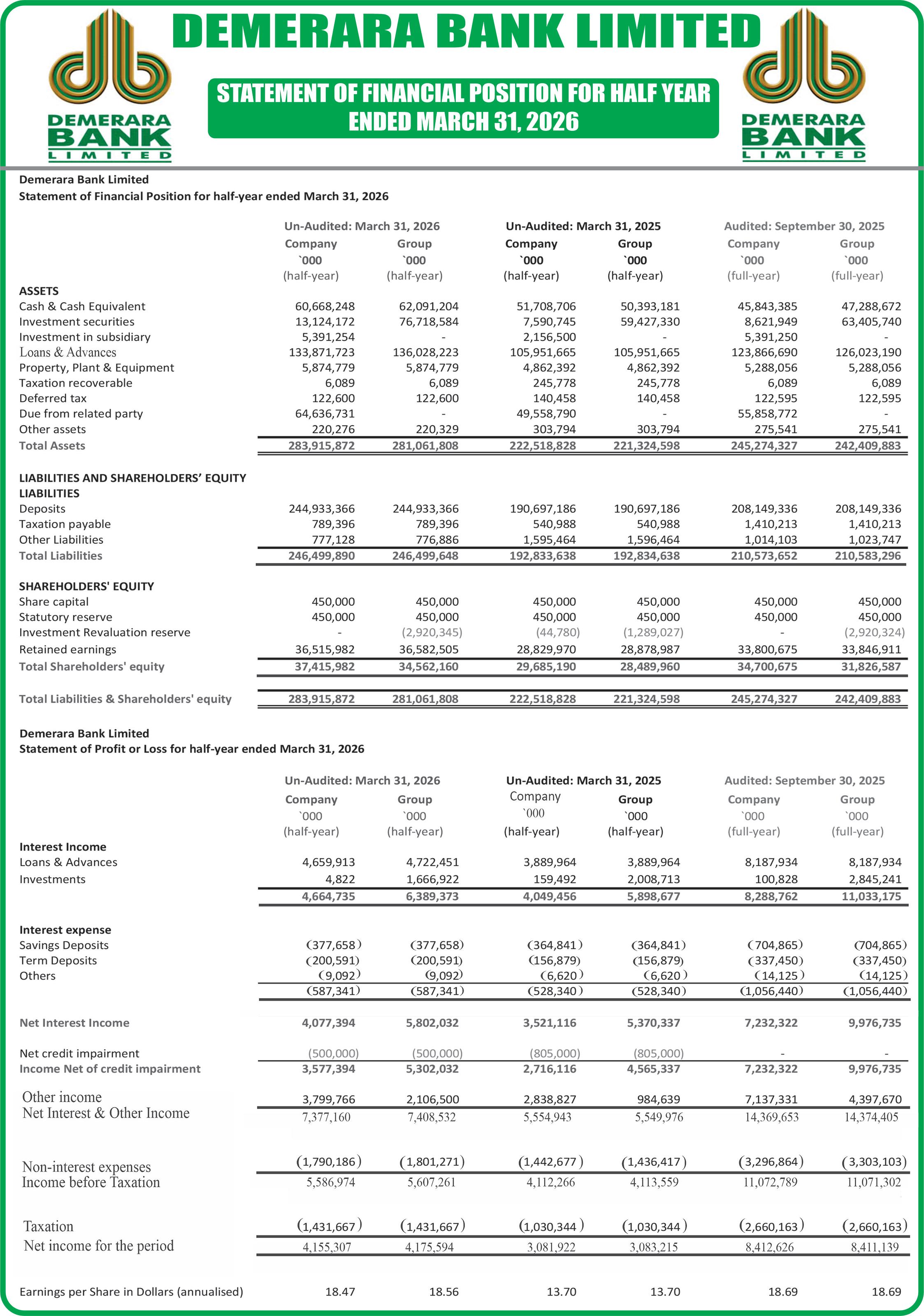
Demerara Bank Limited has reported a profit after tax of GY$4.18 billion for the sixmonth period ended March 31, 2026, representing a 35.43 per cent increase compared to GY$3.08 billion for the same period in 2025.
In a statement on its halfyear results on Thursday, the bank said the performance reflected continued growth across its core business lines and alignment with economic activity in Guyana.
Customer deposits rose by 28.44 per cent to GY$244.9 billion, while loans and advances increased by 28 per cent to GY$136 billion. The bank said growth in lending was driven by demand in the housing, services, agriculture, and manufacturing sectors.
The institution noted that it continues to play a role in financial intermediation, supporting both individuals and businesses participating in the expanding economy.
Chairman Komal Samaroo said the results reflect a disciplined approach to growth, adding that the bank remains focused on scaling operations responsi-

bly, strengthening customer relationships, and investing in human resources and infrastructure to support longterm value creation.
He said the bank is maintaining its financial stability while adapting to increasing demand for credit and financial services.
The report showed that capital and liquidity levels remained above regulatory requirements during the period, while asset quality and risk management indicators remained stable.
The bank also highlighted ongoing investment in digital transformation, including upgrades to customer platforms and operational systems. It said these improvements are aimed at increasing efficiency and
Additionally, over $3.1 billion in fertiliser support has been provided, more than $96 million in seed paddy distributed, and additional resources deployed to combat paddy-bug infestations.
When prices fell during the first crop of 2025, the Government intervened decisively with a $300 per bag subsidy, ensuring farmers received no less than $4000 per bag. This amounted to approximately $1.9 billion in direct support.
Moreover, the Government has continued to implement practical measures to build resilience within the industry. Hope-like canals are being constructed in Regions Three, Five, and Six to improve drainage and reduce flooding. Drying floors and storage facilities have been developed to enhance post-harvest handling, while farmers are being organised into clusters to better manage machinery provided by the Government, ensuring efficiency and shared access.
Investment is also ongoing in research to develop new and improved rice varieties, while extension services are being modernised to provide farmers with timely, technology-driven support. Farm-to-market roads are being upgraded and expanded to ease transportation challenges, and new markets are continuously being secured through Governmentto-Government arrangements to guarantee demand for Guyana’s rice.
The Government is also rolling out technology-driven extension services to provide farmers with real-time
FROM PAGE 3
access to information on weather patterns and disease management via mobile platforms.
President Ali had also secured a crop insurance product for Guyana, and according to the Ministry of Agriculture, this mechanism is in place and functioning, with 4433 rice farmers registered to date.
In July 2025, the Government launched a crop insurance programme for rice farmers across the country. Under the initiative, for the next three years, more than 6000 rice farmers will have access to insurance for their crops without having to pay a cent on premiums. It is a first-of-its-kind initiative in the Caribbean, covering losses from extreme weather like floods and droughts.
The crop insurance programme is a result of a unique partnership between the Government of Guyana, UPL Costa Rica, and Philip Morris International (PMI).
Other support
Meanwhile, President Ali reminded us of other Government interventions made amid global shocks that benefitted not only the rice sector but also the wider economy.
Guyana has extended its policy allowing importers to use pre-pandemic freight costs to calculate customs duties, VAT, and excise taxes, rather than higher actual rates. This relief, designed to lower consumer costs, is valid until December 31, 2026. The Government also maintains zero excise tax on fuel.
expanding service delivery channels.
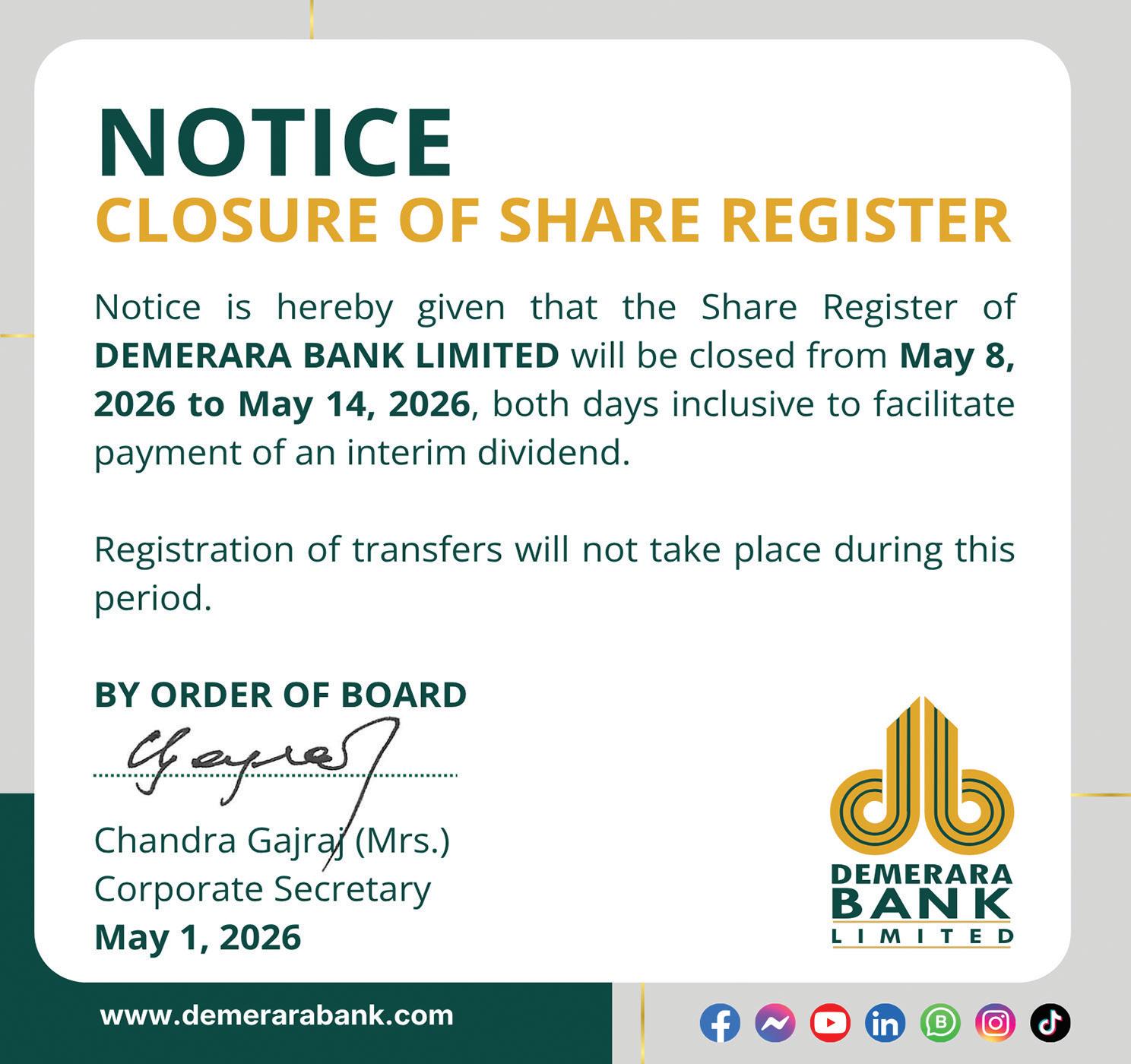
The Board of Directors has recommended an interim dividend of GY$1 per share, up from GY$0.80 per share in the corresponding period last year.
Demerara Bank Limited said it will continue to focus on expanding its market presence, improving service delivery, and leveraging technology to support growth in the financial sector.

In its drive to eliminate cervical cancer – the second most common cancer among women in Guyana – the Government has achieved 69 per cent human papillomavirus (HPV) vaccination coverage and has set a goal of immunising 60,000 persons within one month.
This is according to Health Minister Dr Frank Anthony during the launch of Vaccination Week on Saturday last.
“Over the last year, we would have been able to do about 26,000 doses. Our cov-
erage right now has moved up steeply. We are now at 69 per cent across the country, and according to PAHO-WHO, if we are aiming for elimination, we have to take the coverage up to about 90 per cent and keep it there consistently for a number of years so that everybody

in the population would then be covered,” he explained.
“So, we want to make this happen because we can protect people from dying from cervical cancer,” the Minister added.
Cervical cancer remains one of the most significant public health challenges in Guyana and across the Caribbean. Driven mainly by the HPV, the disease is the second leading cause of cancer deaths among women in Guyana, with a mortality rate of 30.3 per 100,000 women in 2022.
With the rollout of the universal HPV DNA testing voucher programme, more women than ever before were able to receive free high-quality HPV testing close to home. This initiative resulted in some 20,000 women being screened. Guyana also upgraded the vaccine from the quadrivalent to the nine-valent vaccine in 2025. This vaccine is provided free of cost to women, girls, and boys.
The Ministry of Health has intensified campaigns in schools and communities, aiming to reach the WHO target of 90 per cent by 2030.
Over the last two years, there has been a strong focus on children between nine and 15,
both boys and girls, being vaccinated, but Minister Anthony said women within the age group of 16 to 45 can also take the vaccine. The vaccine costs about US$360 per dose, but it is being offered for free in Guyana, something he is urging citizens not to take for granted.
In this regard, he announced the Government’s goal of having 60,000 persons immunised within a month.
“So, on the 26th of May, we’ll be 60th. It’s our 60th independence anniversary, right? So, what a better way of celebrating by ensuring that we can at least have 60,000 Guyanese getting HPV vaccines,” he remarked.
Meanwhile, Dr Anthony also spoke about the national screening programme, wherein $8000 vouchers are being offered to subsidise HPV DNA testing. He is encouraging more citizens to utilise these vouchers.
“Now we know sometimes people don’t want to come to the public facilities, but you can take those vouchers and go to the private institutions that are working with us. And you go there, you present the voucher, and they’ll do the test for you. We’ll get back the results. If we see that you’re HPV positive, we can bring you into the system and work with you to make sure that we can help to detect early and fix any problems that you might have early. By doing that, what we’re trying to do is if there are any changes in the cervix, we detect them and we fix them so that you don’t necessarily have to develop cervical
cancer. And that’s how we believe that we can prevent this. And if we find that anybody got early signs of cervical cancer, then we can take the necessary steps at any one of our hospitals to prevent that from spreading,” the Health Minister explained.
“So, catching it early would help people to survive. We must make this move from the second most prevalent cancer among women to almost getting it to disappear from our country. And I really believe that that’s possible,” he added.
“What it takes is a systematic approach, hard work, getting a lot of public education out there, and making sure that people utilise the service. We’ll probably be able to save every year, maybe about 200 lives just by this intervention alone,” he further noted.
Beyond HPV, the Health Minister said Guyana has made significant strides in vaccination, covering 21 antigens.
“Most of our antigens, with the exception of one, are more than 95 per cent. And in fact, they’re at 98 per cent and 100 per cent...[in 2024] we had one antigen that was in the 80s. And when we had the internal discussions in the ministry, they told me that they are going to take that up into the 90s. So, they kept their promise. It’s at 91 per cent right now,” he explained, noting that the goal is to go up to 95 per cent.
Other key aspects of the national vaccination programme are the training of healthcare workers to administer the doses and the improvement of cold chain storage to avoid spoilage.
Twenty-one women from Linden, Region 10, have successfully completed the GuySol Women in Solar Apprenticeship five-week programme.
The initiative introduced participants to various aspects of solar systems, equipping them with practical skills to enter the renewable energy sector.
Speaking on the programme, participant Shania Richardson described the experience as a concise and well-structured training in which participants were properly guided by their lecturers, ensuring effective understanding throughout.
Richardson, who previously worked as a cashier, noted that the programme provided clear direction and strong practical support.
“Completing this training has been quite an experience. I’ve gone from knowing very little about solar systems to understanding system components. It was much easier with the training, and the lecturers were great – they gave us important insights and showed us how to apply the skills properly,” she said.
She added that she does not intend to stop there, as the programme has motivated her to pursue further personal development.
“With the knowledge gained, I plan to pursue an entrepreneurial idea and start my own business in the future, most likely a solar panel company or initiative down the line,” Richardson explained.

Kavasha Shiverly
Meanwhile, Kavasha Shiverly, another participant, said her experience was completely new, noting that she learned many mechanical skills she had not been exposed to before.
“It was very informative. The training was interesting and engaging, and it helped me learn a range of new things, such as different wire sizes and components. If things are not sized properly, it can lead to overheating. I am currently still studying another programme at the Linden Technical Institute,” she said. She added that she is pursuing these opportunities to expand her expertise, as she has other goals and sees this as contributing to her overall development.
“I would say it is something I may or may not continue longterm, but it is definitely something I would do part-time,” she added.
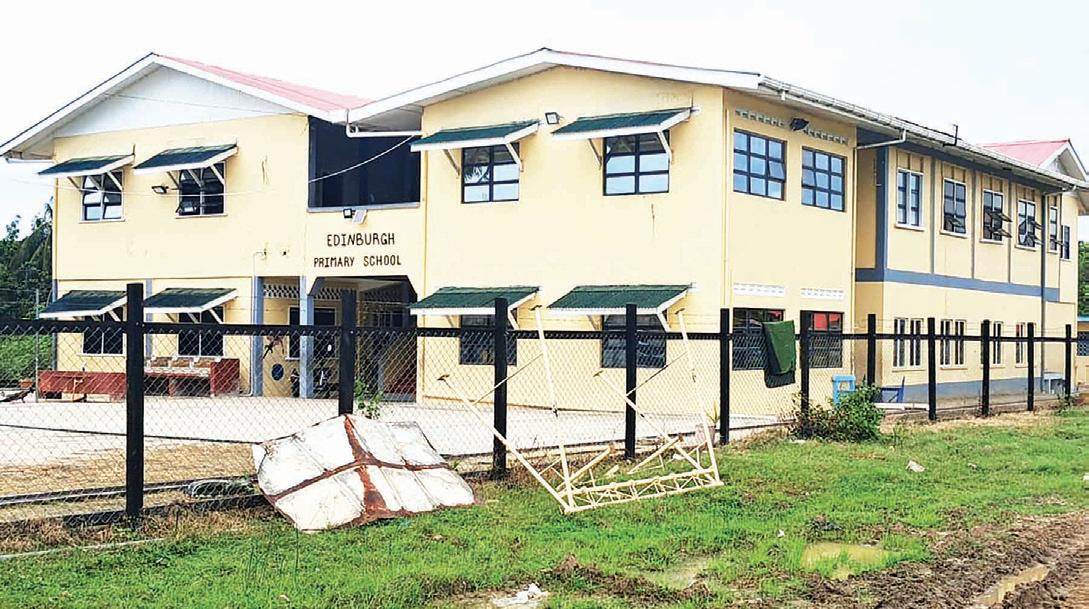
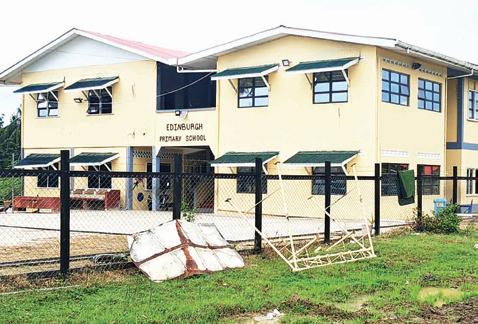
An 11-year-old pupil sitting the National Grade Six Assessment (NGSA) at Edinburgh Primary School, East Bank, Berbice, was allegedly attacked by two fellow students on Wednesday, moments after completing his first day of exams.
The incident occurred while his guardians stood outside the locked school gate, unable to intervene. His grandmother also claimed that efforts to report the matter to Police were met with delays and no clear response.
According to the child’s grandmother, the incident unfolded shortly after dismissal when students began exiting the school building. She said she observed one boy, kicking her grandson, while another child struck him to the head with an object.
The situation, she noted, escalated as several parents remained gathered outside the school, prevented from entering by security despite
the disturbance unfolding inside.
The grandmother further claimed that the incident was not isolated, pointing to previous situations in which the child was injured while at school. On one occasion, she said he began bleeding from the nose after being struck and later suffered a similar episode after being hit with a book in class.
She noted that the school had been informed of the child’s medical condition, describing it as a “head issue”, but expressed dissatisfaction with how those earlier matters were handled, stating that the response appeared limited.
Following Wednesday’s incident, the grandmother said she went to the Police station in an effort to make an official report but was unable to do so.
She explained that upon arrival, she was directed to a Sergeant, who was reportedly unavailable. After waiting for several hours, she said she was eventually told to
return at another time, with no statement taken.
“I waited from the afternoon into the night, and nothing was done,” she said, adding that she was neither given clear guidance nor offered an alternative to have the matter formally recorded.
The grandmother said the lack of response has left her deeply concerned, particularly given the child’s condition and the timing of the incident during a critical examination period.
“If something happens to this child, the Police will come to me,” she said, expressing frustration that no immediate action was taken despite her efforts to seek help.
Speaking with this publication, the grandmother said that situation became even more troubling on Thursday, when welfare officers attached to the Department of Education allegedly told her she should not have gone to the Police.
For the family, that response raised a serious concern: whether the priority was protecting the child or discouraging the report from reaching law enforcement.
She is now calling on the relevant authorities, including the Ministry of Education, to investigate both the incident and the circumstances under which it occurred, including supervision at the school and the handling of previous reports.
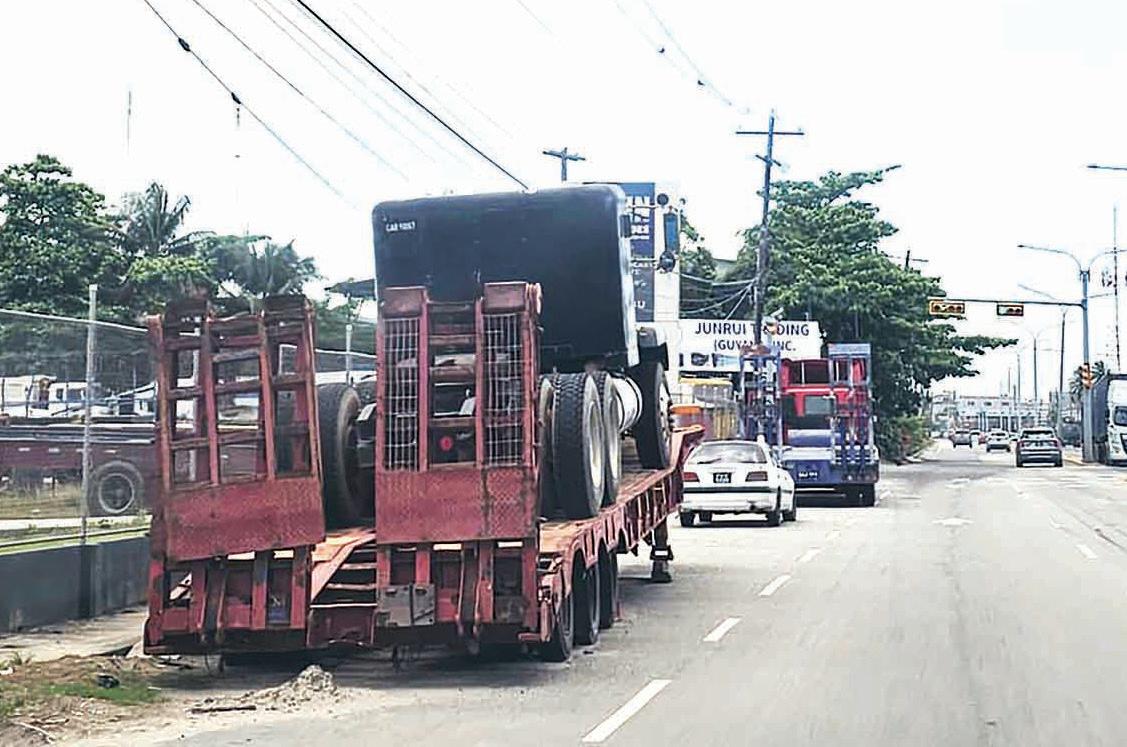
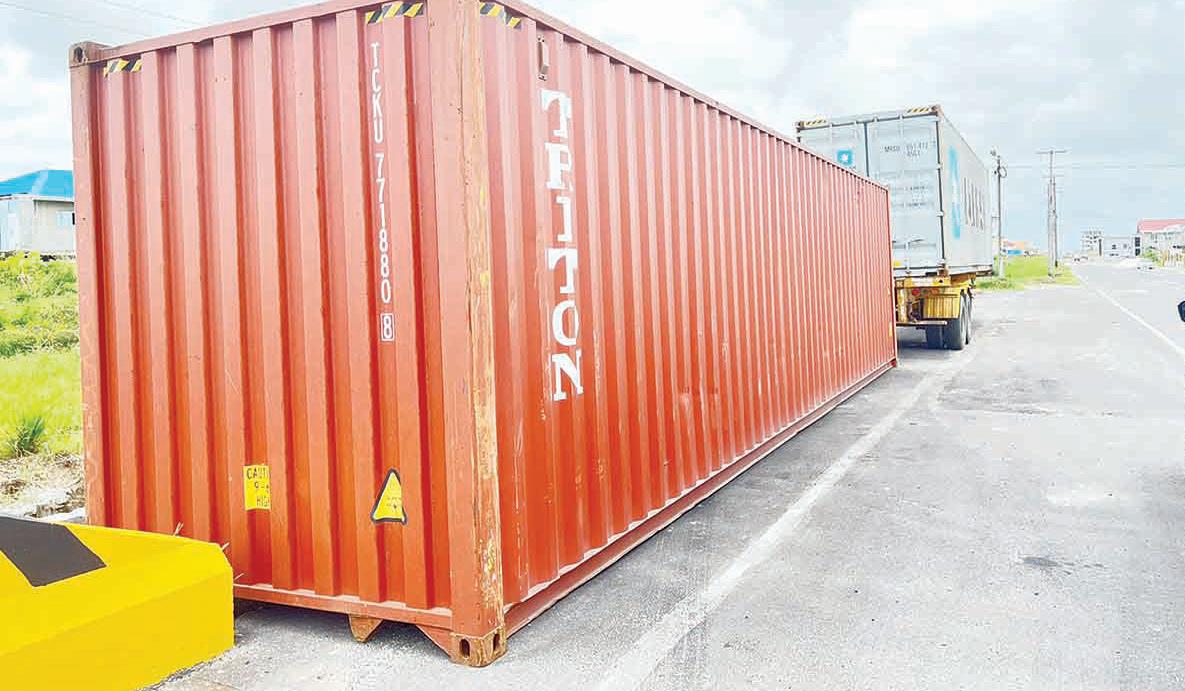
The Public Works Ministry has issued a 24-hour notice for the removal of containers, vehicles and trailers obstructing sections of roadways in the Eccles area and along Back Road, Mandela Avenue.
In a public notice, the Ministry said owners of containers situated along Eccles Access Road are required to remove them within the specified time. It also direct-
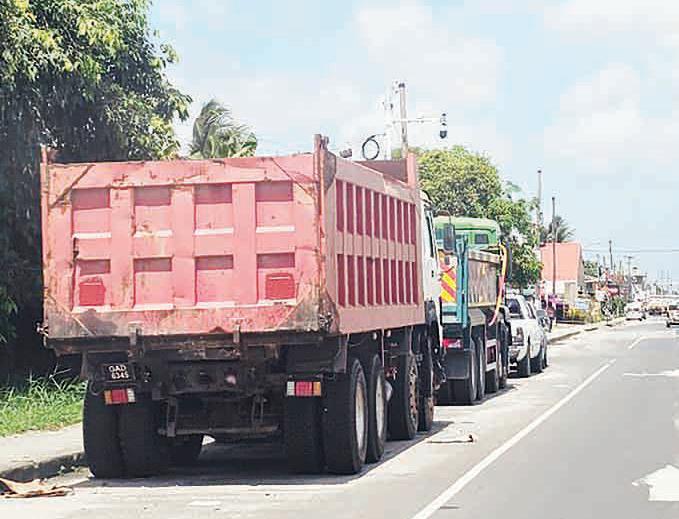
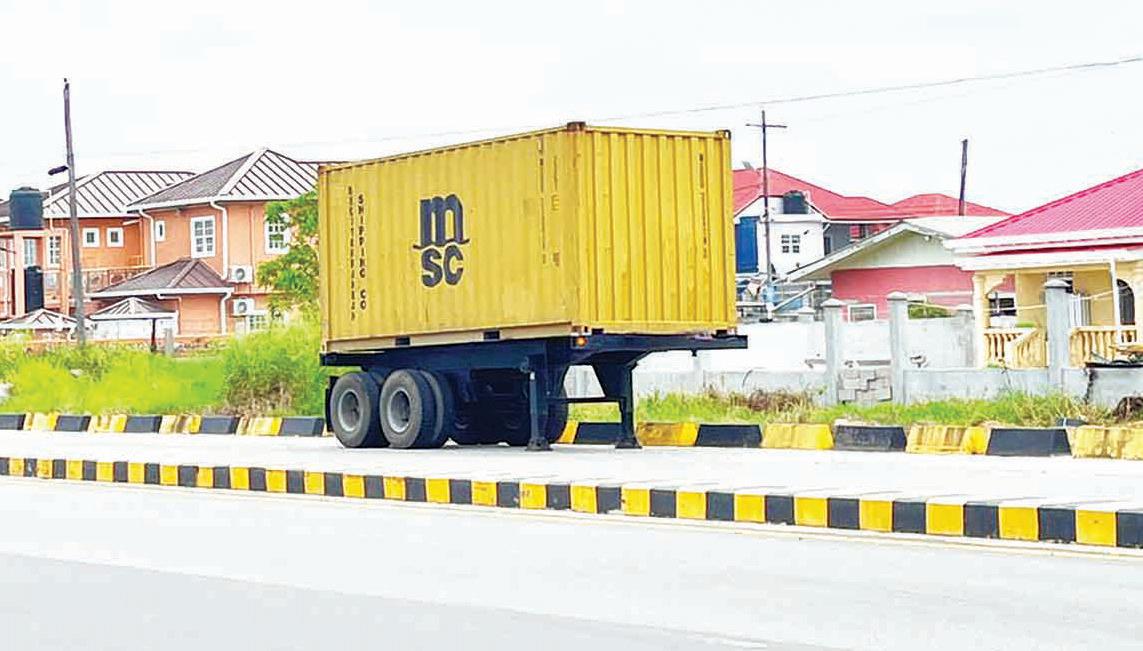
ed owners of all vehicles and trailers parked along Back Road, from the Demerara Harbour Bridge traffic light to the Mandela Roundabout, to clear the area within 24 hours.
According to the Ministry, failure to comply will result in the Government stepping in to remove the items as part of its standard procedure.
The Ministry stated that
it has no interest in permanently withholding private property. However, it warned that all costs associated with the removal process will be borne entirely by the defaulting owners.
Persons seeking to reclaim seized property will be required to visit the Ministry and settle the outstanding removal charges before the items can be released.
Four individuals have lost their lives thus far this year while working in the mining sector, but the Guyana Geology and Mines Commission (GGMC) has rolled out a series of initiatives to curb these fatalities and improve operational safety at mining sites.
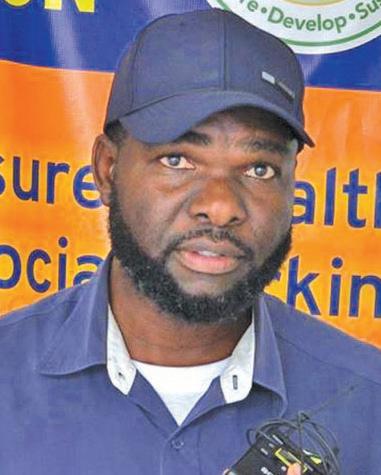
This is according to the safety inspector at the GGMC’s Occupational Safety and Health (OSH) Unit, Irvie London.
“The figure last year was 12,” he stated when asked for the mining fatalities recording for 2025, while adding that for this year, “there are four so far.”
London told the Guyana Times that these figures are a significant reduction from previous years. During the period 2000 to 2010, between 15 and 18 fatalities were being recorded in
the mining sector annually. Only in May 2015 did the largest mine fatality occur in the history of Guyana when 11 miners were killed in a single incident after a mining pit caved in at Mowsie/ Pepper Creek, Region Eight (Potaro-Siparuni).
But according to London, who has responsi-
bility for mine safety, the Commission has been working with miners and other stakeholders to enhance safety in their operations –something that is reaping fruitful results.
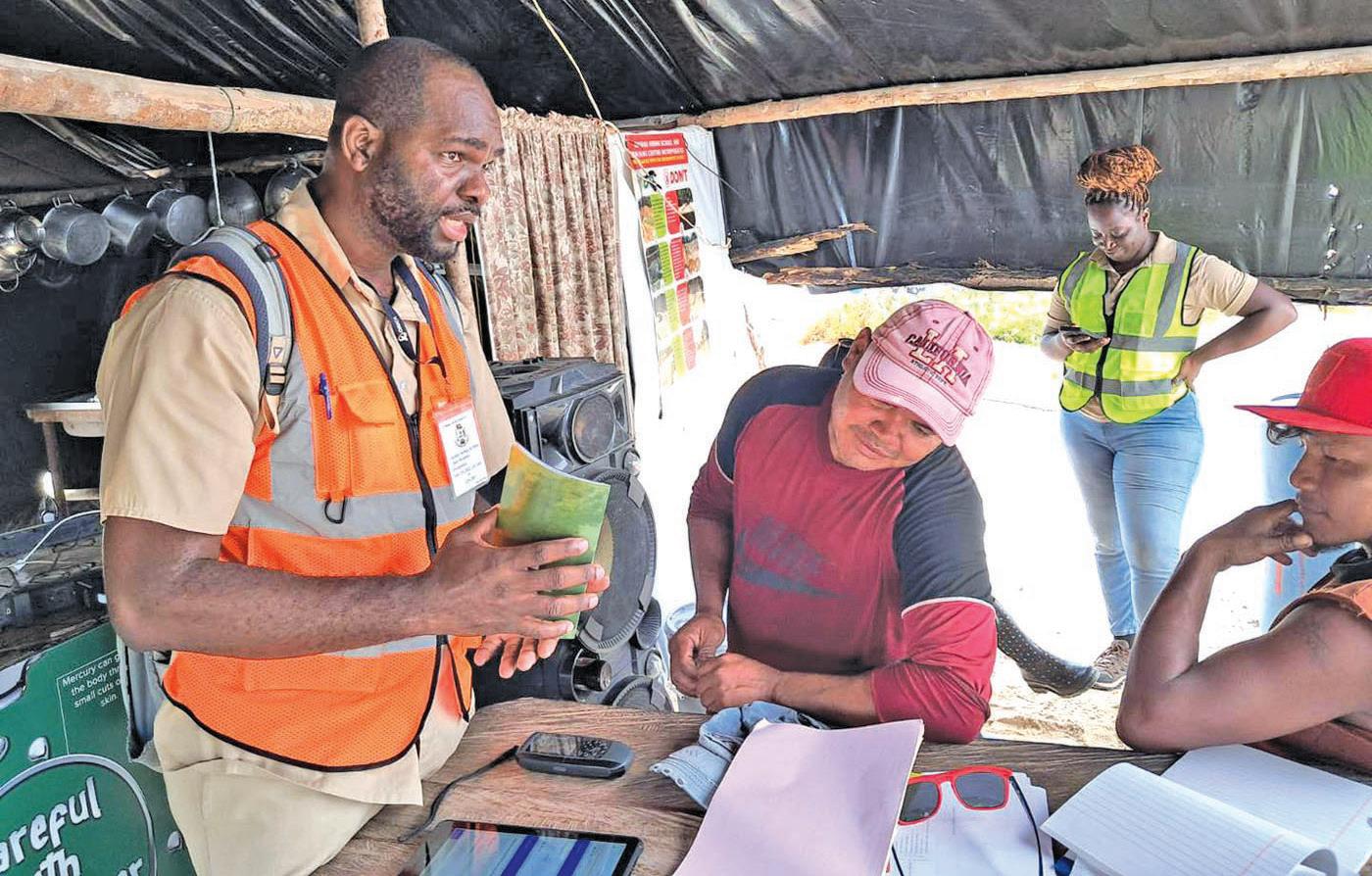
“GGMC has embarked on a stringent educational awareness campaign since 2023, where we visit mining districts and we engage miners on a one-on-one basis. We sit with them, we spend time at their camp and we hear their concerns,” he noted.
In fact, the GGMC has introduced something, the Technical Assistance to Miners (TAMS) initiative –a programme whereby the Commission provides information and technical support to miners with respect to benching, sloping, pit condition, pit clearance, tree clearance on the pit crest, and mining environmental-
ly sustainably and safely.
“So GGMC is doing a lot, and we are receiving significant welcome feedback from the miners because something like this has never happened before,” London stated.
Moreover, the safety inspector added that GGMC has also been working on improving the health and wellbeing of miners, collaborating with key partners such as the Ministry of Labour’s OSH Department and the Ministry of Health’s malaria division.
“We go out to the various mining districts, not only to do compliance but to ensure that we are following the regulations with respect to mining. We go there; we meet miners, having oneon-ones with them. We provide information through brochures, and we also provide nettings,” he said.
The GGMC’s safety inspector spoke with this newspaper on Thursday at the OSH Village and Job Fair hosted by the Ministry of Labour and Manpower Planning as part of the Occupational Safety and Health observances.
Only earlier this week, Labour Minister Keoma Griffith revealed during the OSH Symposium that while strides have been made to curb workplace fatalities, some 13 lives were lost and 60 persons injured on job sites between January and April of this year.
“This increase is unacceptable and underscores the urgent need for stricter compliance and health and safety protocols. We must therefore confront this conundrum head-on, and it demands from us a decisive paradigm shift, one that moves us beyond reactive compliance to a culture of proactive prevention, accountability, and zero tolerance for unsafe practices,” the minister emphasised on Tuesday.
Against this backdrop, Griffith noted that the Government will continue to strengthen enforcement and compliance in health and safety.
“We will expand the capacity to reach our inspectorate, and we will take the necessary steps to ensure that our legal and policy framework remains responsive, modern, and fully equipped to address evolving workplace risks and fatalities. Occupational safety and health standards must not be optional. They
must be rigorously enforced across every sector in our economy.”
Between 2020 and 2025, the Labour Ministry conducted 6186 occupational health and safety inspections across high-risk and low-risk sectors. According to the minister, more than 27,000 workers benefited from OSH inspections nationwide during that period, thus strengthening prevention and workplace resilience. These efforts, he noted, led to measurable improvements, including a 12.78 per cent decline in work-related fatalities and a near 50 per cent reduction in non-fatal incidents.
The latest workplace fatality occurred earlier this month when 46-year-old Radish Domingo, a carpenter from Mon Repos, East Coast Demerara (ECD), was killed while several others were injured after a building under construction at Atlantic Gardens, ECD, collapsed.
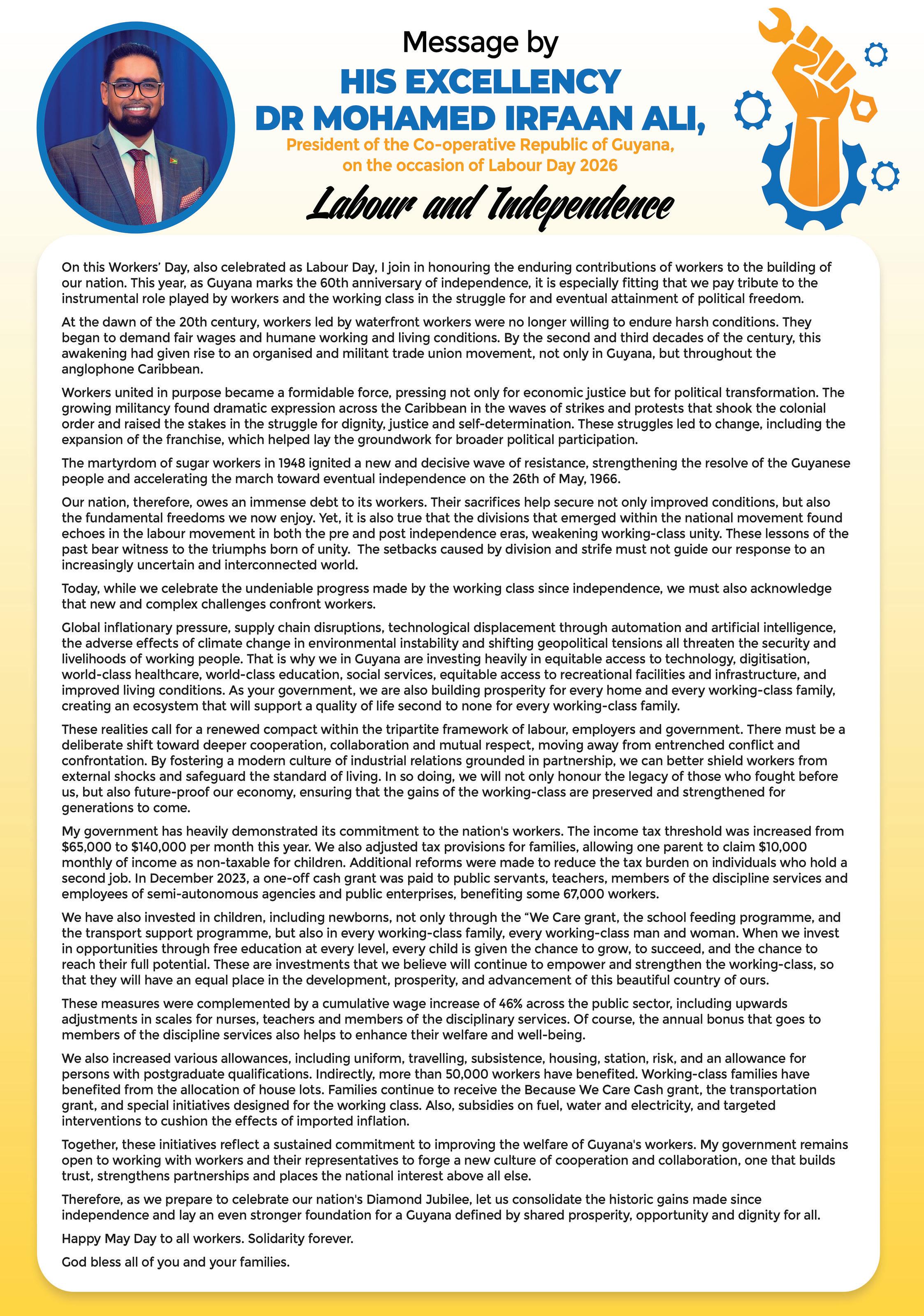
President Dr Irfaan Ali said on Thursday that a modern culture of industrial relations demands deeper cooperation among stakeholders such as labour representatives, employers and the Government.
He made this remark in his message to commemorate today’s observance of Labour Day.
According to the Head of State, while Guyana celebrates the undeniable progress made by the working class since independence, the country must also acknowledge that new and complex challenges confront workers.
“Global inflationary pressure, supply chain disruptions, technological displacement through automation and artificial intelligence, the adverse effects of climate change in environmental instability and shifting geopolitical tensions all threaten the security and livelihoods of working people. That is why we in
Guyana are investing heavily in equitable access to technology, digitisation, world-class healthcare, world-class education, social services, equitable access to recreational facilities and infrastructure, and improved living conditions,” he asserted.
President Ali noted that his Government is also building prosperity for every home and every working-class family, creating an ecosystem that will support a quality of life second to none for every working-class family. However, he pointed out that this calls for a renewed compact within the tripartite framework of labour, employers and Government.
“There must be a deliberate shift toward deeper cooperation, collaboration and mutual respect, moving away from entrenched conflict and confrontation. By fostering a modern culture of industrial relations grounded in partnership, we can better shield
workers from external shocks and safeguard the standard of living. In so doing, we will not only honour the legacy of those who fought before us but also future-proof our economy, ensuring that the gains of the working class are preserved and strengthened for generations to come,” the Guyanese leader stated.
Highlighting that Labour 2026 comes as Guyana is about to mark its 60th anniversary of independence, Ali says it is especially fitting to pay tribute to the instrumental role played by workers and the working class in the struggle for and eventual attainment of political freedom. He noted that martyrdom of sugar workers in 1948 ignited a new and decisive wave of resistance, strengthening the resolve of the Guyanese people and accelerating the march toward eventual independence on May 26, 1966.
Manual and highly cumbersome
Meanwhile, Head of the Immigration Department, Melissa Pinheiro, during her presentation on the Immigration Support Services (ISS) e-Services Platform, explained that the process was previously manual and highly cumbersome, given the large volume and variety of applications, leading to frequent issues, with an average of approximately 60 applications being handled daily.
Additionally, limited office hours restricted both submission and processing capacity, resulting in an average of approximately 60 applications being handled daily.
Recognising these challenges, Pinheiro said the department sought to modernise its operations.
An initial step involved introducing a hybrid system in 2022, which combined manual and digital processes for visitor visas and extensions of stay. While this approach reduced manual errors and improved efficiency, it remained somewhat cumbersome due to the coexistence of both systems.
She explained that a pilot phase was subsequently implemented to gather feedback from staff and applicants. Based on this feedback, there was a clear preference for a fully online system.
Accelerated efforts
This, along with the Government’s push for digital transformation, accelerated efforts to streamline the process, although some challenges persisted during the transition period.
“More so, I must speak about since the system has been implemented as of October, we issued 13,530 approvals, and out of those approvals, 6873 were work permits, so we could see the vast amount, and employment visas were 4227 approvals.”
In fact, because of moving to a fully digital system in October 2025, with the exception of citizenship services, which remain manageable due to lower demand, applicants can complete submissions in as little as five minutes, and the platform offers a centralised, transparent, and predictable process. In many cases, once all required documents
FROM PAGE 7
are submitted, approvals can be granted within a few days, sometimes as quickly as three days.
“Some persons may, once they have all the documents, receive an approval within three days. The average number of applications issued per day now is about 150 approvals, and the staff take five to 10 minutes to process those applications. So we learnt a lot, and we move forward. As I stated, the available services that we have, and here I will show you, because of the system that was implemented – our fully digitalised system in October 2025 –the system is very effective.”
“The system captures a way of addressing issues with applications. If you have an issue with your application, we have a mechanism where we respond within that central system – it is not a separate email. So we have that in all of those applications. Out of those, 2792 applications did not meet the requirements or had missing documents, but they are sent back to the applicants, and we are awaiting their response. So we see how transparent the system is.”

“Our nation, therefore, owes an immense debt to its workers. Their sacrifices help secure not only improved conditions, but also the fundamental freedoms we now enjoy. Yet, it is also true that the divisions that emerged within the national movement found echoes in the labour movement in both the preand post-independence eras, weakening working-class unity. These lessons of the past bear witness to the triumphs born of unity. The setbacks caused by division and strife must not guide our response to an increasingly uncertain and interconnected world,” he emphasised.
The president went on to note his Government has heavily demonstrated its commitment to the nation’s workers, outlining the various initiatives implemented such as Public Sector salary increases, raising the income tax threshold, tax adjustments for families, reforms to reduce the tax burden on individuals, cash pay-outs, social welfare programmes, and targeted interventions to cushion the effects of imported inflation, among others.
According to the Head of State, these are investments that will continue to empower and strengthen the working class so that they can have an equal place in the development, prosperity, and advancement of the country.
“Together, these initiatives reflect a sustained commitment to improving the welfare of Guyana’s workers. My Government remains open to working with workers and their representatives to forge a new culture of cooperation and collaboration, one that builds trust, strengthens partnerships and places
the national interest above all else. Therefore, as we prepare to celebrate our nation’s Diamond Jubilee, let us consolidate the historic gains made since independence and lay an even stronger foundation for a Guyana defined by shared prosperity, opportunity and dignity for all. Happy May Day to all workers. Solidarity forever. God bless all of you and your families,” President Ali declared.
Story of labour
Meanwhile, Prime Minister (PM) Brigadier (Ret’d) Mark Phillips also echoed similar sentiments, calling for collective action among stakeholders to ensure workers’ rights are protected and that sustainable working conditions are fostered. This responsibility, he pointed out, cannot rest with Government alone.
“Employers, trade unions, workers’ organisations and every stakeholder in the labour sector must continue to work together in a spirit of consultation, cooperation and mutual respect. Industrial harmony, fair treatment and productive workplaces are best achieved when there is open dialogue and a shared commitment to the national good,” he noted.
In his message, PM Phillips said Labour Day is a reminder that the rights and conditions that are now upheld were hard-won through the courage and collective resolve of passionate men and women before us, such as Hubert Nathaniel Critchlow – one of the forefathers of the labour movement that started in pre-independent Guyana.
According to the PM, the labour movement in Guyana
has always been more than a call for better wages and improved working conditions but part of the wider national journey towards dignity, social justice, equality and development.
“From the estates and factories to the public service, schools, hospitals, security services, construction sites, private enterprises and emerging industries, Guyanese workers have helped to build the foundation on which our country continues to advance.”
“We celebrate this day each year because the story of labour is never finished. Every generation inherits both the progress made and the responsibility to protect and advance it. In a modern and evolving economy such as ours, the value of our labour force lies in qualities such as our skills, innovation and our ability to adapt to new demands,” he stated.
The PM further stated that at this important stage in Guyana’s development, that growth must be matched by stronger protections, better skills, safer workplaces and an improved quality of life for workers and their families. He said national development must be measured not only by infrastructure and investment but also by how well it improves the lives of the men and women whose labour makes that development possible.
“As we honour this day, I urge that we recognise that Guyana’s strength rests in the hands of its people. So, we must ensure we invest in our workers; in doing so, we are making a direct investment in Guyana’s future. Happy Labour Day, Guyana, as we continue to work together!”





The excitement of the annual Town Week football tournament reached a fever pitch on Wednesday evening as two thrilling encounters at the Bayroc National Stadium determined the finalists in this year’s competition.
The tournament, presented by the Kashif & Shanghai Organisation in collaboration with the Upper Demerara Football Association (UDFA), has been a highlight of the Linden Town Week celebrations, drawing enthusiastic crowds and showcasing some of the community’s finest football talent.
In the first matchup at 18:00h, Group B contenders Blueberry Hill/ Christianburg/Alleys & Valleys delivered a commanding performance against Block 22/Wisroc. Demonstrating clinical finishing and solid defensive organisation, Blueberry Hill/Christianburg/Alleys & Valleys secured a resounding 4–0 victory to book their place in the final. The dominant display underscored their intent to challenge for top honours and the lucrative prize on offer.
Later in the evening, fans were treated to a dramatic Group A showdown at 20:30h as Half Mile/One
Mile/Scheme faced Amelia’s Ward/Kara Kara/Bamia. The contest lived up to expectations, with Amelia’s Ward taking a narrow 2–1 lead into halftime after an energetic first-half performance.
However, Half Mile/One Mile/Scheme regrouped after the break and mounted a spirited comeback. Showing resilience and attacking flair, they netted twice in the second half to edge Amelia’s Ward/Kara Kara/Bamia 3–2 in a pulsating encounter. The victory sealed their spot in the championship match and ended Amelia’s Ward’s hopes despite a commendable effort.
With the field narrowed from six teams to two, all eyes now turn to the grand finale on May 1. Half Mile/ One Mile/Scheme will clash with Blueberry Hill/ Christianburg/Alleys & Valleys at 21:30h under the lights at the Bayroc National Stadium.
As Linden Town Week festivities continue, supporters can anticipate another thrilling night of football, with pride, community bragging rights, and a multi-million dollar prize at stake. The stage is set for an electrifying finale as two in-form teams battle to be crowned champions.






Leopold Street and Bent Street B advanced to the championship final of the Guinness “Greatest of the Streets” Georgetown Championship following
contrasting semi-final wins on Wednesday night at the National Cultural Centre Tarmac.
Former champions Leopold Street delivered the most emphatic performance
of the night, crushing New Bay Ballers (Tiger Bay) 6–0 to book their place in the final.
Following the game, Captain Samuel Hunte expressed a desire for his team

to rise to the summit of the competition once again.
“Everybody know Leopold is a street football giant, but since 2012 at Guinness in the Streets, nobody ain’t see we back. So, we come back now to punch

back. Come out and witness sparkling, exciting football. At Guinness in the streets, it’s a different trophy; this bragging rights trophy is different. This Guinness here does put you on the map, and we coming for it.
Look out,” Hunte expressed.
Bent Street B, meanwhile, continued their impressive run with a narrow 1–0 victory over Island All-Stars to secure a historic first appearance in the championship decider.
Their coach, Troy Lambert, lamented their wait for a Guinness Championship, noting that they will be bringing their A-game to the final.
Lambert shared, “This is the 19th year of Guinness, and to be honest, this is our first-ever finals as one of the top teams in the country overall. So, you aint got to ask the feelings; we’re taking it one game at a time. We aint saying we going and win it, but we need it. So, definitely, we coming forward with we best foot forward and looking to put it in the cupboard.”
“That’s the only thing missing from the cupboard”, the Coach added.
In the Plate segment quarterfinals, Festival City defeated North East 2–0, while National All-Stars edged Team Cruel 2–1. Gold is Money also progressed with a 4–2 win over Albouystown.
The results set the stage for the final night of competition, with Day Six scheduled for tonight, May 1, at the same venue, featuring the Plate semi-finals, thirdplace play-off, and championship final.
In the Plate semifinals, National All-Stars will oppose Festival City at 19:00h, while Gold is Money faces Sparta Boss at 19:45h. The winners will advance to the Plate final set for 21:00h.
Attention will then shift to the championship segment, where Island AllStars and New Bay Ballers meet in the third-place playoff at 21:45h.
The feature contest is the championship final at 22:15h, where Leopold Street will face Bent Street





The Republic Bank Caribbean Premier League (CPL) has officially announced the Player Acquisition and Draft Rules for the 2026 season, marking the start of a new three-year contract cycle covering 2026 to 2028.
The updated framework introduces several key changes aimed at improving competitive balance, supporting emerging talent, and integrating a seventh franchise into the competition.
The draft selections will be announced on the CPL’s social media channels on Friday, May 15, 2026.
Each franchise will assemble a 17-player squad consisting of:
• Nine senior West Indies players
• Five overseas players
• Three Breakout Players
Jamaica Kingsmen –Special Draft Provision
As the league’s new franchise, the Jamaica Kingsmen will receive special draft privileges:
• They will have the option to make the first three picks in the draft, restricted to selecting only Jamaican

players
• The Kingsmen are not obliged to use all three of these picks.
• These selections cannot be challenged using the Right to Match Option (RMO).
• During this phase, the Kingsmen may select a maximum of one player from any single existing team.
• Any team that loses a player to
the Kingsmen will receive an additional RMO.
From this point onwards, selections will follow a structured order based on the 2025 league standings, ensuring competitive parity across all teams.
Franchises will have access to
RMOs, allowing them to retain players from their 2025 squads if those players are selected by another team during the draft.
• Each existing team will begin the draft with four RMOs.
• Three of the RMOs can be used on players who were in any salary slot on their 2025 roster.
• One RMO can only be used on players who were in salary slots seven to 17 and are nationals in the franchise’s home territory
• Teams that lose a player to the Jamaica Kingsmen at the start of the draft will be given one additional RMO, exercisable in any round on players who were in any salary slot on their 2025 roster.
• The Jamaica Kingsmen will have one RMO, which may be exercised on any Jamaican player. If this player played in the 2025 CPL, he must have occupied a salary slot between seven and 17.
Breakout Player Retention
Each existing franchise was allowed to retain one Breakout Player from its 2025 squad prior to the draft. This is the only pre-draft retention mechanism
permitted for 2026.
Breakout Player Requirement
Breakout players remain central to CPL’s development strategy. Each team must include at least one player selected in Rounds 15–17 in every matchday XI throughout the tournament.
Overseas Players
• Teams may sign up to five overseas players through direct negotiations.
• Overseas players will not be part of the draft.
• A maximum of four overseas players may be included in any matchday XI.
Michael Hall, CPL’s Tournament Operations Director, said: “We have worked closely with the seven CPL franchises, Cricket West Indies, and other key stakeholders to develop a framework that allows us to successfully introduce a seventh team while maintaining competitiveness and fairness across the league. We are excited to see how the squads take shape and are confident that the expanded tournament will raise the standard of the CPL even further.”