Toronto-bound Guyanese nabbed at CJIA with cocaine
Creative industries in Americas raked in US$87B in 2011 – study Amendment to Summary Jurisdiction Act is all about raising money –
Eccles businessman commits suicide
The top brass of the Guyana Power and Light Inc (GPL) – Chairman Winston Brassington, board directors, Chief Executive Officer Bharat Dindyal and other executives – as well as Prime Minister Samuel Hinds visited the new 26-megawatt power plant under construction at Vreed-en-Hoop, West Bank Demerara on Friday (Carl Croker photo)
saturday, January 18, 2014|
Food For The Poor donates medical supplies to hospitals
Food For The Poor (Guyana) Inc on Friday donated large quantities of medical supplies and equipment to medical institutions such as the West Demerara Regional Hospital, the Regional Health Office, Berbice Regional Health Authority, and the Linden Hospital Complex.
Present at the handing over ceremony were Chief Medical Officer (CMO), Dr Shamdeo Persaud; Food For The Poor (Guyana) Chairman Kent Vincent; and representatives from the West Demerara Regional Hospital and the Linden Hospital Complex.
Vincent said whenever the organisation gets medical supplies and equipment, they are distributed in various parts of the country so that all Guyanese can enjoy the benefits of proper health care. The CMO stated that the generous donations from Food For The Poor have given the health sector of Guyana another boost.
He pointed out that the items donated are essential and sometimes critical to providing a high standard of healthcare service.
“All of the items have met the criteria of the policies,”
Persaud stated, adding that “all the items here are in sync” with the receiving facilities. He spoke of the Health Ministry’s focus on maternal health and pointed to the donations of the infant cots and birthing beds as critical.
Dr Persaud also added that the health sec-
tor is growing, noting that Guyana is seeing many more doctors and nurses graduating. Some of the items donated were overthe-counter drugs, aspirators, surgical beds, infant cribs, IV poles, and other hospital accessories. The CMO called on Guyanese society to take better care
of their health and to make use of the medical facilities, not only when their condition has worsened but at all times.
The representatives from the various beneficiary medical institutions expressed their gratitude for the various items donated.
No arrest yet for stabbing of prominent doctor
CCricketer disappears: No sign of Orange Walk murder accused
Exactly one month after the Director of Public Prosecutions (DPP) ordered the reopening of the preliminary inquiry (Pl) into the murder of Shawn Nelson, who was gunned down early last year on Orange Walk, allegedly by Carlyle Barton, police have failed to arrest the suspect.
At a recent press briefing at police headquarters, crime chief Seelall Persaud disclosed that the police have no information about the cricketer’s whereabouts.
He noted that several searches have been conducted of the man’s residence, but there were no signs of him.
The police have also failed to check with the deputy Chief Immigration Officer to confirm whether there is any record of Barton leaving these shores.
Absentia
witnesses did not show up and video evidence of the murder, captured by Closed Circuit Television (CCTV) cameras of a nearby business was not rendered. The video evidence allegedly shows the cricketer shooting Nelson, a long-time friend, and was instrumental in Barton being charged.
On DPP Bibi Shalimar Ali-Hack’s advice, the file was sent to the police on December 6, for an investigation to be carried out. On December 11, the police file was returned to the DPP’s chambers for further legal advice, and it is presently in the hands of the prosecutor.
Frustration
Hours after the magistrate’s decision was handed down, relatives of the dead man vented their frustration.
rime chief Seelall Persaud on Friday confirmed that the police are continuing their investigation into the stabbing incident involving Dr Leslie Carter during a foiled robbery a few days ago. He said the police have not made an arrest but are working on several leads.
ing the people in the community and its environs.
When Guyana Times called the residence of the prominent doctor, a relative disclosed that he was in good health and is continuing his practice, serv-
Dr Carter was stabbed during a robbery attempt by two bandits at his clinic located at his residence at Lot B Nonpariel, East Coast Demerara.
It was reported that Dr
Carter was about to close his clinic when two bandits entered the premises under the pretext of seeking medical care, claiming that they had contracted malaria.
After the doctor recognised that one of the men was shivering, he agreed to provide his service. As the men entered, one of them reportedly took a haversack from his back and gave it to the other man who attempted to pull out a handgun.
Upon noticing this, Dr Carter raised an alarm resulting in one of the men escaping, while the other bandit remained in the examination room with the doctor. It was during a scuffle with the bandit that the doctor was stabbed twice: once to his hand and another to his abdomen.
Upon receiving the stab wounds, the doctor retreated thus the bandit escaped. The doctor was taken to the Georgetown Public Hospital by one of his patients, said to be a police rank in plain clothes who was at the clinic earlier.
Charging Barton in his absence, Seelall added, can be done, but in the case of a PI, most times, the defendant has to be present. From reports received, the man left the country the day after the magistrate dismissed the case against him on account of lack of evidence.
In November, Magistrate Fabayo Azore discharged the case at the PI stage, saying that a prima facie case was not made after police
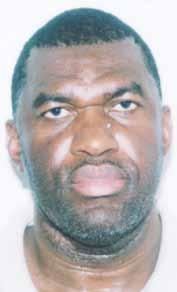
The Customs AntiNarcotics Unit (CANU) on Friday issued a second wanted bulletin for United States deportee Robin Llewlyn Wills for questioning on drug-related activities.
The 43-year-old man once occupied three addresses: Lot 20 J Duncan Street, Campbellville, Georgetown; 145 Guyhoc Park, North East La Penitence, Georgetown; and Lot 625 Republic Park, East Bank Demerara.
Anyone with information that could lead to the arrest of Wills can make contact with CANU on 225-3507. All information will be kept confidential.
Magistrate Azore had announced that she was forced to set Barton free, owing to the lack of evidence, since the witnesses failed to show up despite adjournments to ensure their presence. Barton made his first court appearance on May 28, 2013 before Magistrate Sueanna Lovell and was not required to plead to the indictable charge, which stated that on May 27 at Orange Walk, he murdered Nelson. The matter was then transferred to another court where the PI commenced.
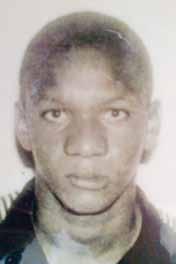
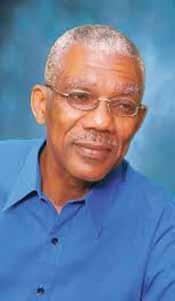
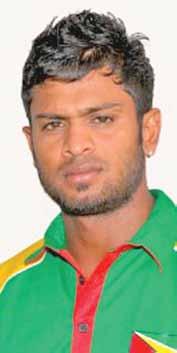
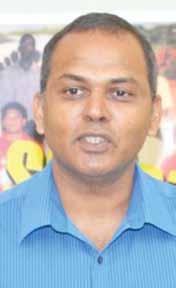
Murder suspect Carlyle Barton
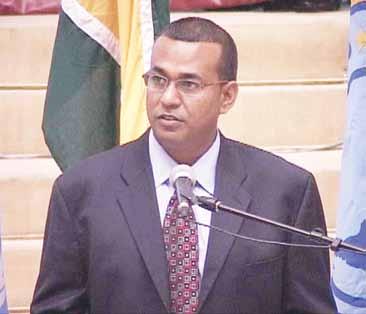
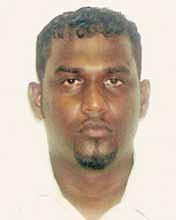
Dead: Shawn Nelson
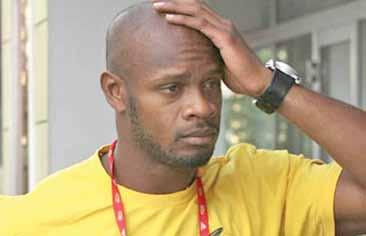
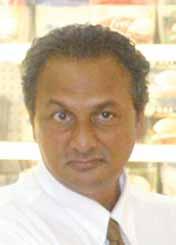
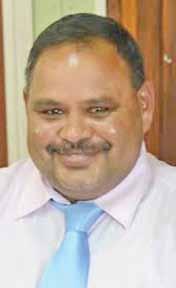
Wanted: Robin Llewlyn Wills
Food For The Poor Chairman Kent Vincent hands over supplies to CMO, Dr Shamdeo Persaud while representatives from the medical institutions look on
WEATHER TODAY
Guyanese-Canadian, son killed in car crash
Winds: East north-easterly between 3.33 and 3.88 metres per second.
High Tide: 05:43h and 17:56h reaching maximum heights of 2.56 metres and 2.66 metres respectively.
Low Tide: 11:31h and 23:53h reaching minimum heights of 0.64 metre and 0.57 metre respectively.
Aman and his son were killed on Friday when a speeding car ploughed into them as they were walking towards their home on the Land of Plenty Public Road, Essequibo Coast.
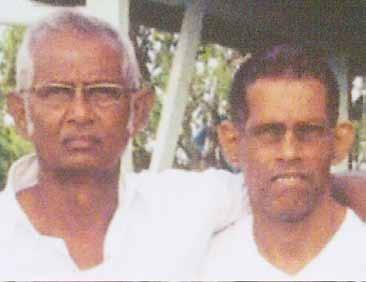
Dead are: Muntaz Baksh, 72, and Rafmat Baksh, 44, of Land of Plenty Village. Muntaz Baksh, a Canadian citizen, and his son were walking to their home from Anna Regina when they were struck down by the speeding car around 14:30h.
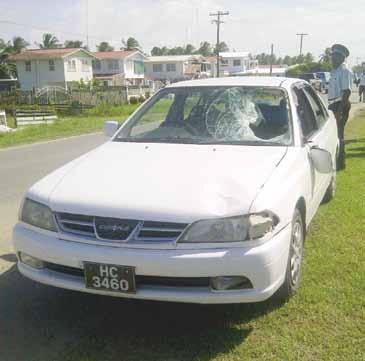
The driver of HC 3460 is said to be in police custody assisting with investigations. According to police, the driver of the hire car claimed that the pedestri-
ans walked into his path. The car was proceeding north and the pedestrians were heading south when the accident occurred.
One eyewitness told this newspaper that he heard a loud crash while he was in his house. Upon checking, he saw one man stuck in the car’s windscreen with blood oozing about his body. The son was then pulled out from a nearby trench.
Nureen Baksh, the dead man’s daughter, said her father and her mother, Zoorul, came to Guyana from Canada to spend Christmas with the family. She said her parents were expected to return to Canada in April.
She explained that the family went shopping at the Anna Regina Market and was returning home when her father insisted that he wanted to walk home as a form of exercise.
She said she allowed her father and brother to walk home, while she and other relatives continued on in the family car.
Nureen said her son then went out, but returned to inform her that her father and her brother were involved into an accident. “I was shocked, just half hour back I saw my fa-
ther and brother walking home, they were just 20 minutes away from home,” the daughter said.
The two men were taken to the Suddie Public Hospital in an unconscious state. They were pronounced dead on arrival.
Both father and son sustained injuries to their head, hands and face. The men were described as very loving and shared a very strong father-son bond.
Muntaz (left) and Rafmat Baksh in happier times
The car that was involved in the accident
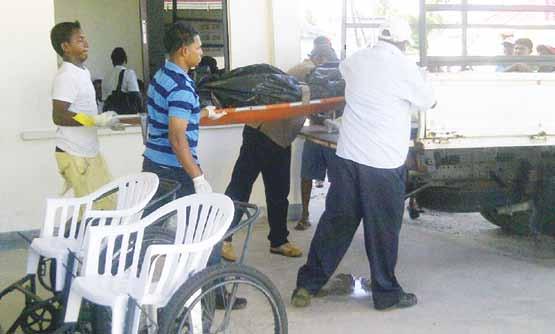
The men were pronounced dead on arrival at the hospital
Weather: Heavy rain showers are expected during the day with light cloud cover in the evening over coastal regions and near inland locations. Temperatures are expected to range between 24 degrees and 28 degrees.
Editor: Nigel Williams
Tel: 225-5128, 231-0397, 226-9921, 226-2102, 223-7230 or 223-7231. Fax: 225-5134
Haiti was struck by a massive earthquake which left behind it a trail of destruction, including the death of about 220,000 persons and thousands more displaced. The country’s infrastructure was also left in tatters requiring millions of dollars to rebuild.
Four years on, some persons are asking what has happened since then in the country, in terms of rebuilding and getting life back to normalcy. Is the country now better prepared to respond to future disasters? Are the necessary investments being made to ensure the country is more resilient to natural disasters, especially considering there is high probability of it being hit with future natural disasters due to its location? What about the people? Are they getting the kind of support they need?
There are many challenges which continue to plague the rebuilding efforts, and some would wish that the process picks up pace. Haiti itself cannot do it. The country does not have the financial and other resources needed to get this massive task done. It would require continuous assistance from the international community in every respect to not only ensure the country gets back to normalcy, but that it continues along the development trajectory.
There are notable developments which have taken place over the last four years which must be mentioned. The United Nations Development Programme (UNDP) has reported that more than 80 per cent of the 10 million cubic metres of debris generated by the earthquake have been cleared from the streets of Port-au-Prince. An intervention by the UN not only resulted in one million cubic metres of rubble being cleared, but the debris was recycled, turning it into paving stones, stairs and public places where children can play.
Additionally, to help in the fight against poverty in the country, development partners such as UNDP have been working with the relevant ministries to support the transition from emergency to development and to ensure that recovery efforts are sustained, integrated directly into public policy and managed by Haitian institutions.
With technical support from UNDP, the government was able to establish the Coordination Unit for Housing and Public Buildings Construction, and the National Housing and Habitat Policy was launched.
Through targeted training programmes and infrastructure projects directly managed by Haitians, citizens learned how to better meet the needs of their communities while deciding the development priorities of their own neighbourhoods, from rehabilitation of roads to job creation to vocational training, or evaluation of urban risk and the installation of solar lamps to ensure the safety of women at night.
International development partners must continue providing whatever assistance possible to minimise the effects of such disasters in poor, developing countries such as Haiti. In 2012, the international community had teamed up to form a high level panel dubbed “Political Champions for Disaster Resilience”. The panel consists of high-ranking officials from leading international and national institutions, with its main aim being to leverage collective political capital for increased attention and resources towards disaster resilience in at-risk countries. It would be useful to find out how successful this panel has been as it relates to achieving its objectives.
There were millions of dollars in pledges made by various international organisations and governments, but it is quite unfortunate that not all of them lived up to these promises.
As the situation currently stands, Haiti will require continuous humanitarian assistance unless the root causes of fragility are addressed. While the interventions made by UNDP and other development organisations continue to bear fruit, Haiti still has enormous hurdles to clear before it can secure its position as an emerging country in 2030.
As rightly stated by the UNDP, these challenges can only be tackled in partnership under the aegis of the national authorities, with the commitment of the Haitian people and the support of international partners.
Sookram’s innate capacity earned him various positions of responsibility
Dear Editor, It is with profound sadness of mind and lively memories that I mark the passing of Manikchand Rishi Sookram who served selflessly in key organisations in Guyana. I have had the privilege of working along with him, and seeing the contributions he made before I entered the mining sector. His innate capacity earned him various positions of responsibility at the Guyana Sugar Corporation (GuySuCo), the most significant being as regional director of the Demerara estates. He simultaneously delivered on the chairman -
ship of the Guyana Gold Board, from 2004 to 2010, with distinction. Rishi believed in Guyana and served well within his faculties up to the time of his departure to divine calling. I wish to convey the condolences of the Natural Resources and Environment Ministry, the Guyana Gold Board, and my personal sympathy to his wife Dolly, his children, and all other family and colleagues. We have you in our thoughts during this time of bereavement.
Robert Persaud, Natural Resources and Environment Minister
PPP/C is not a minority government
Dear Editor, How democratic is the United States of America?
This is a question that almost no person will ask because we were conditioned by the western media to believe that America is the world’s model of democracy. This, Americans feel, by some twisted form of logic, gives them the right and moral justification to intervene in other countries to make them “democratic”.
A layman’s view of democracy is simply a citizen’s right to choose who he wants to be governed through a system of free and fair election, on the basis of one man, one vote and the right to have his vote counted. The layman’s concept of a winner is that one who receives the most votes at a free and fair election. The substance of this layman’s understanding of democracy cannot be disputed by any combination of fancy words.
However, this is not exactly how democracy works in the “world’s model democracy”, the United States of America.
It would come as a surprise to almost all Guyanese that under the American electoral system the president (and vice president), who forms the government, can be elected by a minority of “popular votes” and it will
be perfectly normal and lawful. It would also come as a surprise to most Guyanese that the right of a voter to demand that his vote is counted is also limited. Both of these scenarios occurred in the 2000 American presidential election, when George W Bush was declared elected president of the United States.
Bush received 50,456,002 (47.87 per cent) and Al Gore received 50,999,897 (48.38 per cent) of popular votes, but Bush was declared president elect. Not to mention reported manoeuvres by republican activists in Florida to prevent supporters of Gore from voting. Manoeuvres that not only prevented voters from reaching polling stations, but were also successful in preventing many thousands from having their votes counted.
The American Supreme Court, then dominated by conservatives, ruled against a recount of votes in Florida. A recount, which would have resulted in a convincing victory for Gore. For a more detailed account of the U.S. 2000 presidential election, I advise that they read “The stolen Presidential Elections” by Michael Parenti (www. michaelparenti.org/stolenelections.html).
After reading that article, you would understand
why the American ambassador is insisting on building the capacity of opposition parties in Guyana. You would also wonder whether the Americans have been training the People’s National Congress/A Partnership for National Unity (PNC/APNU) how to rig elections through the ballot box.
The opposition’s actions leading up to and during the 2011 elections seems to be pointing to just that. Some actions of the Guyana Elections Commission (GECOM) staff mirror what the Republicans did in Florida in 2000.
Where else in the world can a president be elected by a minority of over half a million of popular votes? Only in the “world’s model democracy” –the United States of America. We all know what has been the result of the appointment of a minority president of the world's most powerful nation. Many peaceful and prospering nations have been reduced to war zones and living hells for tens of millions of human beings.
Guyana’s president was elected by a majority of popular votes and thus speaks for the majority of Guyanese. The American ambassador must respect this and shelve his controversial project. The opposition likes to call the
People’s Progressive Party/ Civic (PPP/C) a minority government, but is that really so? The Alliance For Change (AFC) received 10.33 per cent of popular votes. This simply means that 89.67 per cent of Guyanese considered that the AFC is unfit to govern Guyana. The PNC/APNU received 40.83 per cent of popular votes. This means that 59.17 per cent of Guyanese considered the PNC/APNU unfit to govern Guyana. The overwhelming majority of Guyanese therefore did not see neither the AFC nor APNU fit to govern Guyana. The current PPP/C government is no minority government. If the AFC and APNU want to justify their claim that the government is a minority one by claiming a vote for one is a vote for the other, then the deliberate deception of their supporters prior to the 2011 election will become even clearer. The PPP/C has always maintained that a vote for the AFC is a vote for the APNU. If the AFC and APNU don’t want to accept this fact then they are left with the only alternative of accepting that the PPP/C government is not a minority one.
Yours sincerely, Faruk Mohamed
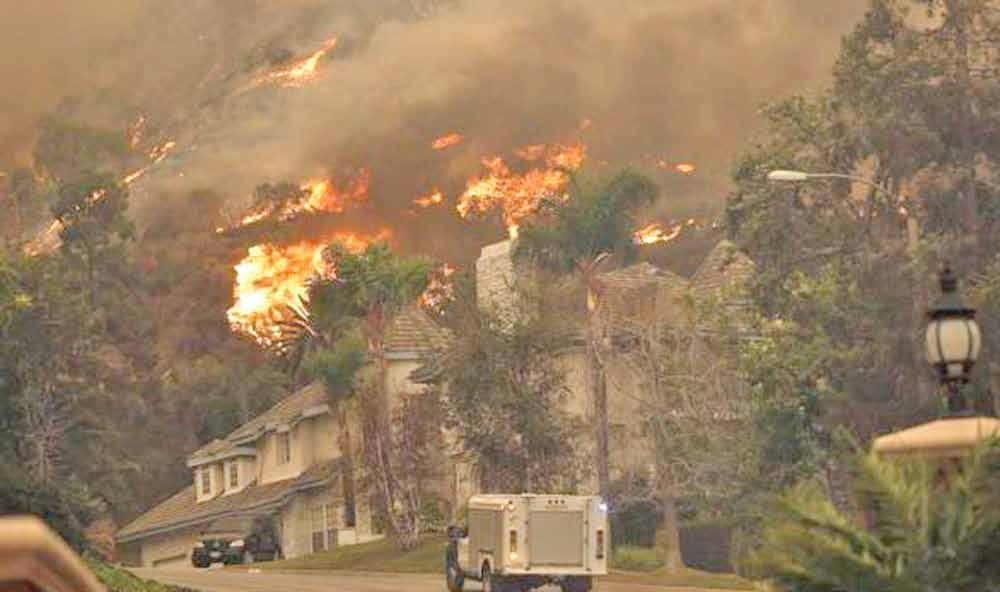
The Colby fire burns in the hills above Glendora, California, January 16 (Reuters/Mario Anzuoni)
No one is denied employment based on political, ethnic affiliation
Dear Editor,
Regarding your news item (Guyana Times, January 15) in which the combined opposition is going after head of e-governance Alexei Ramotar because he is the son of the president, I don’t think the young man or government should pay much heed to the opposition charge of nepotism.
Government should not deny any qualified person employment on account of their association with anyone in government. As long as someone has demonstrated competence and is educa-
tionally qualified for a position, nepotism should not be cited as a factor to deny employment. In Guyana, everyone knows someone in government. If we disqualify people on account of association or relationship, then we won’t find many qualified people to fill vacancies or service the state.
I wish to applaud the government for its employment practices. No one is denied employment based on political or ethnic affiliation. Under the People’s National Congress (PNC) dictatorship, ethnic qual -
ification and loyalty were almost the only criteria for hiring people. Many of us were victims. We ended up with square-pegsin-round-holes personnel that led to economic bankruptcy.
Since the restoration of democracy, people are hired primarily based on merit –qualification, professionalism and competence – and no one has been denied a job on account of their ethnicity and political affiliation.
I came across many people who were affiliated with the United Republican
Party (URP), Democratic Labour Movement (DLM), Working People’s Alliance (WPA), National Republican Party (NRP), PNC and The United Force (TUF), among others, now employed in the state sector. Under the PNC, that would have been unimaginable. As a result of the government’s nondiscriminatory policies, the economy has made a dramatic turnaround from its collapsed state of the late 1980s when political and ethnic victimisation reigned supreme.
On a side note, sever-
al of us (overseas and within Guyana) who fought for the restoration of democracy in Guyana were denied employment – Paul Tennassee was among the more well known victims. Several of us who contributed to the liberation of Guyana have not sought employment. We are safely ensconced in jobs in America and elsewhere and are not the least bit jealous of those who have gained employment – those who sided with the dictatorship or stood on the sidelines while others carried out the struggle.
Although we gave a lot of our time and money and did not benefit from the success of the revolution that toppled the ethnic dictatorship, we are pleased that the country is prospering and jobs are being created for everyone based on their qualification and ability to get the job done. Alexei is one of those skilled personnel who was employed long before his father became president – there is no nepotism.
Yours truly,
Terry Holder was the most productive, best secretary general in the history of CBU
...tribute delivered at St Andrew’s Kirk, Georgetown, January 15
Dear Editor,
For those of us of a certain age, memories are our only happiness. I would like to share with you some unforgettable memories and reflections about my friend, Terry Holder – not all of them happy. My most recent happy memory was one of Terry just a few days before Christmas, when he up-ended the purpose of my visiting him by cheering me up instead of my cheering him up.
There was I, on my arrival in the country, full of anxiety for Terry’s welfare, being whisked to his home by our mutual friend Vic Insanally. Unknown to me, Terry had just moved into the very street where my Guyana home is located.
Anticipating a one-onone visit, I did not know I would be joining a select group who had foregathered at Terry’s request, so that he could be with them for what, it is now sadly clear, he foresaw would be the last time.
And then, Terrence Holder, made his entrance, wheel-chaired and frail, but with a mind, memory and wit as sharp and sparkling as ever, holding us all in his thrall. With me, he joshed as to whether, by finding himself now on the same street where I lived, he had moved up or down in life.
And he recounted some minutiae of our past encounters which I, in allegedly better condition, was hard put to remember. I doubt that any of us who were there would have left not uplifted by Terry’s last hurrah.
Curiously, although of the same country and broadly of the same vocation, Terry and I had been distant journeymen on separate routes, until fate brought us together, not in Guyana, but in the wider Caribbean sphere – Terry as president, then secretary general, of the Caribbean Broadcasting Union (CBU) and I responsible for the United Nations Educational, Scientific and Cultural Organisation (UNESCO) communication
inputs in the region.
It was at a time when the CBU, a once vibrant organisation founded by another Guyanese, Hugh Cholmondeley, had fallen prey to that well known and still-going-strong Caribbean syndrome of ramshackle glossed over by big-talk.
And here was Terry Holder, coming from an operational background, steeped in the then heady wine of Guyanese broadcasting at its best, and blessed with a non-abrasive personality and an equable temperament.
Here indeed was Terry, artful and gifted, on a mission to unite a disunited Union and energise it for the advancement of all its member systems.
If you ever thought Terry had his hands full dealing with one radio station in his earlier career, consider his new theatre of operations –at least 35 radio and television systems in 18 countries, each system, each country with its own needs, its own priorities.
At the same time, Terry had to contend with a CBU board, forthcoming with directives to the secretary general, but backsliding with resources. Yet he made the best of what he could muster, while becoming the convenient football for board members who preened themselves on the presumption that by making demands they had done their work.
Terry kept his cool – until at one meeting he had had enough and made a simple retort, to which there was no comeback, and which is now legend in the CBU.
Terrence Holder, under attack, quietly asked: “If bashing the secretary general is the answer, what is the question?”
Into this milieu stepped UNESCO with money-bags and expertise, but also with – to use an ugly word – conditionalities.
Maybe it helped that we came from the same country
and background, but importantly we subscribed to the same standards of professionalism and quality, and Terry took it to heart that for every privilege there was an obligation.
Our negotiations therefore tended to be conducted in a kind of shorthand, and out of a free-flowing partnership between the CBU (that is, Terry Holder) and UNESCO emerged improvements in broadcasting capabilities and outputs at a level and of a spread never before or since achieved.
Then, in the midst of a thriving relationship that was short on talk but big on delivery, Terry got homesick, forsook the CBU and returned to the country he loved to begin the third phase of his remarkable career.
I, on the other hand, remained around the CBU long enough to cement my view that Terrence Holder was the most productive, indeed the best secretary general, in the history of the CBU.
It was with the ending of our institutional relationship and his return to Guyana that our personal relationship truly began – one in which Terry felt free to decry the decline in the quality of broadcasting in this country and his helplessness to do anything about it.
And not only in broadcasting, he told me, but in so many other areas was Guyana caught in that decelerating vortex of being spun down to the lowest common denominator.
Terry was passionate about this loss of standards and despaired that it may be beyond reclaim. He feared that the mediocrity of yesterday had become the excellence of today. This insight brought to mind these words of a poet, slightly misquoted:
“ Degradation is a monster of so frightful mien
As to be hated needs to be seen.
Yet, seen too often, familiar with her face, We first endure, then pity, then embrace.”
The question therefore becomes: How can a generation that has embraced degraded values be made to recognise perennial excellence?
Fossils like me are long forgotten. But Hugh Cholmondeley strove, failed and is gone. Terry Holder agonised, failed and is now gone. And what of my other proteges – Vic Insanally, Ron Robinson, Rovin Deodat, Carlton James, who are still among you? Perhaps it is more expedient to send them too into pre-mature
fossilage?
Terry Holder, among the last holdouts from an era when standards really mattered, lamented what has become of his beloved country as a whole...while I, an ancient mariner with a narrower perspective, have been searching in vain, amidst the tawdriness of a garbage and concrete jungle, for the Garden City of my youth.
Is anyone even noticing that the Philistines are taking over our city and our country? Even in the little elegant avenue where Terry and I last lived, I see the Philistines rising. And I am left to wonder how paltry is any trib-
ute of soon-forgotten words to such as Terrence Holder? How long will we ignore our prophets? When will we gather the collective will to stand behind them and say: Enough?
Or shall we continue to stand aside and look?
The life and stifled dreams of the prophet, Terrence Holder, should bestir us to think on these things, and to rise up and act so that, one day, we who survive can lift our voices triumphantly in Guyana’s Redemption Song.
Thank you, Rafiq Khan
with pictures to: Guyana Times, 238 Camp & Quamina Streets, Georgetown, Guyana or letters@guyanatimesgy.com
Vishnu Bisram
Page Foundation
The ill-effects of carrying heavy schoolbags
BY KRITI SARASWAT
The vacations are over and children have headed back to school. But one of the reasons they may dread doing so every day could be the heavy schoolbags they have to carry on their delicate shoulders. This can not only hamper their studies but also cause back and posture problems. Dr Zinal Unadkat says, “Children lose interest in coming to school with the stress of carrying heavy bags. Their mind is burdened with the weight of the books and this leads to low attention span.”
So what should be the ideal weight of schoolbags?
According to Dr Zubeir Patel, the maximum weight a child should carry is one tenth (10 per cent) of their body weight including all things like their water bottle, lunchbag, etc. But the trend these days seems to be 20 per cent or more. What happens when the weight exceeds the said limit?
Carrying very heavy backpacks can lead to musculoskeletal problems, especially if children carry the bag on one shoulder. It puts extra pressure on one side, tilting the spine. Dr Zinal also points out that keeping the bag down and then carrying it again is more dangerous for a growing spine than continuously walking with static weight.
Dr Patel explains, “To carry a heavy bag, the child has to lean forward. This leads to developing a bad posture. The
spine is a stack of bones called the vertebral column with the bones separated by a cartilage called the inter vertebral disk and held upright by the muscles and ligaments around it. The excess weight puts undue stress on the muscles, ligaments and disk, thus damaging them. The alignment of the column is also disturbed causing it to bend, mostly for ward or sideways.”
In other words, a heavy bag puts the child’s health and physical development at risk which can hamper his/ her overall growth.
“Children’s skele tons are still devel oping, and having a heavy bag slung over one shoulder can ex ert unnatural force on the spine, muscles and attachments,” says Dr Smarajit Chakrabarty.
What immedi ate and long-term harms can it cause on the child’s health?
Immediate ill-effects
* Back, neck and shoul der pain along with tingling, numbness and weakness in the hands.
* Fatigue and an early development of poor posture.
Long term ill-effects
* Strain on the neck and shoulder leading to head aches.
sideways.
* Reduced breathing capacity due to pressure on the lungs resulting from a forward or sideways bent posture.
* Back pains and muscle spasms as young adults which can be traced back to heavy schoolbags.
more comfortable than a bag that puts strain on only one shoulder, but even a backpack shouldn’t be overloaded.
* When buying a bag, buy a sturdy, well-designed bag with wide, padded shoulder straps that reduces pressure on the neck and shoulder area. Buy a bag with adjustable straps which can be altered as the child grows.
* Damage to the spine giving rise to problems like kyphosis – hunched back or spine bent forward.
* Scoliosis – spine bent
growth centres leading to stunted or abnormal growth of the bones of the child.
Here are some useful suggestions by Dr Smarajit Chakrabarty: A backpack is usually
* Check your child’s posture after he has put the bag on. If you notice your child leaning forward or slouching, check if the bag is too heavy or if it has been packed incorrectly.
* Make sure your child is only carrying the items they need for school that day – remove any unnecessary books and equipment.
Other tips to reduce weight
* School authorities should make it mandatory for students to carry light bags.
* There should be lockers (that can be secured) where students can keep their books and other things which are only needed in the classroom.
* Schools can allow students to carry one big notebook with sections for all subjects instead of different ones for various subjects.
* These are a few possible solutions that teachers and parents can implement in order to reduce the weight of their child’s schoolbags. It is important that they understand the gravity of this situation before it is too late. (health. india)
Think back to last Halloween for a minute. Television programmes featured vampires, ghosts, or bony skeletons grinning back at you. Vampires and ghosts don’t really exist, but skeletons sure do!
Every single person has a skeleton made up of many
bones. These bones give your body structure, let you move in many ways, protect your internal organs, and more. It’s time to look at all your bones – the adult human body has 206 of them!
What are bones made of?
If you’ve ever seen a real skeleton or fossil in a museum, you might think that all bones are dead. Although bones in museums are dry, hard, or crumbly, the bones in your body are different. The bones that make up your skeleton are all very much alive, growing and changing all the time like other parts of your body. Almost every bone in your body is made of the same materials:
* The outer surface of bone is called the periosteum. It’s a thin, dense membrane that contains nerves and blood vessels that nourish the
* The next layer is made up of compact bone. This part is smooth and very hard. It’s the part you see when you look at a skeleton.
* Within the compact bone are many layers of cancellous bone, which looks a bit like a sponge. Cancellous bone is not quite as hard as compact bone, but it is still very strong.
* In many bones, the cancellous bone protects the innermost part of the bone, the bone marrow. Bone marrow is sort of like a thick jelly, and its job is to make blood cells.
How bones grow
When you were a baby, you had tiny hands, tiny feet, and tiny everything! Slowly, as you grew older, everything became a bit bigger, including your bones.
A baby’s body has about 300 bones at birth. These eventually fuse (grow together) to form the 206 bones that adults have. Some of a baby’s bones are made entirely of a special material called cartilage. Other bones in a baby are partly made of cartilage. This cartilage is soft and flexible. During childhood, as you are growing, the cartilage grows and is slowly replaced by bone, with help from calcium. By the time you are about 25, this process will be complete. After this happens, there can be no more growth – the bones are as big as they will ever be. All of these bones make up a skeleton that is both very strong and very light. (Kids health)
Bandit killed during Annandale home invasion
– two others escape
By Bhisham mohamed
Abandit was shot dead
Friday morning in the home of a rural constable attached to the Annandale Community Policing Group (CPG) during an exchange of gunfire, while two others made good their escape.
The identity of the man was not immediately available, but, based on reports, he was shot to his face with a 12-gauge shotgun that is registered to the Annandale North CPG.
The bandits were about to carry out an armed robbery on the Jeffrey family at their Lot 10 Annandale North, East Coast Demerara home about 02:00h. A .38 revolver with three rounds and a spent shell were recovered in the home and another firearm of the same calibre was found in the yard close to the fence.
Investigation
In a statement issued a few hours later, police said that they are conducting an investigation into the shooting incident. The release stated that at 02:00h, businessman Ishwari Jeffrey was roused by the barking of his dogs.
Thinking that something was amiss, he woke his son Mariano, who is licensed to use the policing group’s firearm. The young man armed himself with the shotgun and went to check the prem-
him that there were bandits in the yard.
“I ask he ‘weh de thief deh’ … he took me to the window that he looked through and we see them… he saw them from the bathroom window in the upper flat of the building. Like he went to urinate and something tell he peep through the window and then is when he see the three men in the yard.”
He said as he looked through the window, he saw one of the men making his way into the house through one of the windows of the bathroom in the lower flat. At that point in time, he contemplated discharging a round to scare them off.
ises, only to be confronted by three men in the building.
“One of the men discharged a round at Mananno Jeffrey who returned fire, fatally wounding the man while the other two men managed to escape,” police stated.
At the home of the businessman on Friday, occupants were busy, cleaning the blood from the walls and the tiled floor. There was at least one bullet hole in the wall and a beaded skull chain belonging to one of the bandits on the ground.
Mariano Jeffrey told Guyana Times that he was awakened from sleep by a rapping on his bedroom door and went he got up to answer, his father whispered to
“After I see one of them made entrance into the house, I decide against it and thought it was time to protect my family,” he explained. He stealthily attempted to make his way into the lower flat via an inner stairway, but was confronted by the bandit, who was heading to the upper flat.
Shootout
“When I see he with the gun in he hand, I bust a shot to scare he away… he ran into the downstairs bedroom, so I went and tek cover at the side of the room bracing on a wall waiting to see what he gon do next,” the younger Jeffrey recounted. The young man further explained that the bandit attempted to es-
U.S. hails PEPFAR’s impact on Guyana’s HIV fight
cape through a window in the bedroom, but he was unable to do so because all the windows are fully grilled, so the only way out was through the same door he went through.
“After a few minutes, on he way out, he shoot… when he fire, I exchange shots… I shot him and he fell to the ground… After I know he injured, I rushed outside to apprehend the other two, but, by the time I reach out, they already escape,” the rural constable said.
Untimely
He stated that he was not sure if the now dead bandit was alive when the police arrived and took him away. Jeffrey said the man was shot in the vicinity of his jaw and almost half of his chin was ripped apart. The spent shells and the guns were also taken into police possession as evidence.
At the time of the ordeal, Jeffrey said, his parents, wife, two children and sister were at home. He believes that had he not been around, they could have been the ones shot. He added that he had never seen the dead bandit before.
He said from now on, he and his family have to be very careful and take precautions with the people around them, but he was ready to do what he had to do to keep his family safe. The Jeffrey family recently moved into the newly-constructed house.
Guyana Times understands that the ranks at the Vigilance Police Station took more than 90 minutes to arrive on the scene, which is about a mile away. When the family contacted the police, they claimed that they were at a murder scene.
After the shooting, the policing group members went to the police station to report the matter and offer transportation, only to be told that there were no ranks available. Attempts to make contact with the divisional commander proved futile, but there were no reports of a murder in that division.
UStates Ambassador to Guyana D Brent Hardt Friday evening placed in the spotlight the tremendous impact the President’s Emergency Plan for AIDS Relief (PEPFAR) has had on Guyana’s health sector.
Speaking at a reception held at his Cummings Lodge residence to welcome members of the Howard University Hospital Medical Association, the ambassador said the PEPFAR programme has been “instrumental in boosting Guyana’s response to the HIV/AIDS epidemic”.
It was explained that partnerships which evolved between the Guyana government and non-governmental institutions have allowed for the rapid expansion of voluntary counselling and testing facilities. This move, he emphasised, now gives Guyanese the opportunity to know their HIV status, faster and easier.
Pregnant women
“Treatment for pregnant women to prevent motherto-child transmission has been effectively and efficiently distributed.” It was owing to the resounding success of the programme that the United States Congress unanimously renewed funding for the initiative.
“With President Obama’s signature of the PEPFAR Stewardship and Oversight Act of 2013, the United States has reaffirmed our commitment to the global struggle to eradicate this disease,” Ambassador Hardt told his distinguished audience with pride.
Channelling the world’s attention to non-communicable diseases (NCDs) is a timely intervention, he said, positing that significant strides have been made in addressing communicable diseases on the internation-
al stage.
NCDs have emerged as the leading threat to people in Guyana and the broader Caribbean, hence it is pivotal for medical practitioners and regular citizens to understand the behaviours and habits that contribute to the high incidence of NCDs.
Taking stock of this trend would allow for the development of strategies necessary to change those behaviours and foster healthier lifestyles.
Strengthen relationship “I am confident that through exchanges such as this, our countries can continue to strengthen our professional relationships and advance that goal,” said an optimistic Hardt.
He told his attentive audience that it is the continuous involvement of American groups and organisations such as the Howard University that helps the country to progress in the medical field.
The Howard University Hospital Medical Association is currently in Guyana collaborating with more than 150 local healthcare professionals for the staging of a medical education programme that seeks to examine key issues and current research in areas such as diabetes and hypertension.
The association will also be in Guyana when the world, particularly the U.S., marks the beginning of the Martin Luther King Jr Holiday weekend. On Monday, the Howard University Association will celebrate the life and courageous work of King.
The Howard University situated in the heart of Washington, DC, was founded in 1867. It is one of the oldest historically black universities in the United States. Alluding to the successes of the world renowned
university, the U.S ambassador pointed out that distinguished alumni include the Supreme Court Justice Thurgood Marshall, who “famously argued in 1954 in Brown versus Board of Education that ‘separate but equal’ was unconstitutional”.
Landmark decision
“This landmark decision is often cited as a turning point in the Civil Rights movement of the 1960s, which led to the emergence of Dr Martin Luther King Jr and the passage of the Civil Rights Act of 1965,” he added.
Howard University has also produced other great men and women, including civil rights activist Stokely Carmichael, Douglas Wilder; the first African American Governor of the United States; UN Ambassador and Atlanta Mayor Andrew Young; New York Mayor David Dinkins; and Guyana’s own Dr Cheddi Jagan and the current head of the Presidential Secretariat, Dr Roger Luncheon. “Howard University is indeed a special place that has made and continues to make an impact on the world through its diverse and distinguished alumni.”
Howard University Hospital Medical Association Chairman Phillip H Omohundro, MD, said it was a pleasure to be in Guyana. He has pledged the association’s support to the people of Guyana in the medical arena. In addition to members of the Howard University Hospital Medical Association, ministers of government, members of the diplomatic corps, and members of the Guyana Women Miners Organisation were also in attendance, among other persons.
The house owned by the Jeffreys
The window used by the bandit to gain entry into the house
nited
U.S. Ambassador D Brent Hardt shaking hands with Chief Medical Officer Dr Shamdeo Persaud in the presence of Howard University Hospital Medical Association Chairman Phillip H Omohundro
Former Muneshwers employees granted bail
Three former employees of Muneshwers Ltd on Friday appeared in the Georgetown Magistrates’ Courts before Chief Magistrate Priya Sewnarine-Beharry, each slapped with three charges of embezzlement.
The women, Bibi Tuleda Ali, Sabrina Rahaman and Bibi Shaimoon Ali all pleaded not guilty to the charges which alleged that
on three dates between January and October last, they embezzled a total of $629,295 while being employed as clerks at Muneshwers Ltd.
Their defence attorney Nigel Hughes told the court that his clients have been employed with the company for a number of years. He further stated that in October last, his clients were accused and locked
up. They were later granted station bail and were reporting to the police station on a weekly basis. He also added that Rahaman resided in North Ruimveldt while the two Ali’s resided at Industry, on the East Coast of Demerara.
Police Prosecutor Bharat Mangru objected to bail citing the prevalence and seriousness of the matter. He also told
the court that other charges were likely to be instituted against the women as the investigations are ongoing. He added that the company had estimated their losses to be around $50 million as a result of the embezzling.
The trio was granted bail in the sum of $150,000 each which was paid shortly after. They are to return to court on February 21.
Fraud accused gets bail
Komanlall Latchman, an Atlanticville, East Coast Demerara resident on Friday appeared before Magistrate Priya Sewnarine-Beharry at the Georgetown Magistrates’ Courts charged with fraud. Represented by attorney Paul Fung-A-Fat, Latchman pleaded not guilty to the charge which alleged that he attempted to sell motor truck GNN 7931 to Ganesh Persaud, knowing himself
not to be the rightful owner of the vehicle.
Police Prosecutor Bharat Mangru told the court that the accused had bought the car from Transpacific Auto Sales but was still in arrears for the canter, since he did not pay for it in full. Transpacific learnt of the attempted sale and contacted the defendant. Charges were subsequently instituted against the defendant.
Fung-A-Fat told the
court that his client was willing to pay $1.2 million to Transpacific which was the outstanding amount that he had owed them for the truck. He added that they had $500,000 in court at the moment to pay the virtual complainant and the balance would have been paid later in the day. Much to the dismay of the defence attorney and the accused, that sum was promptly refused by the company’s represent-
ative who demanded that the money be paid in full.
The defendant was granted bail in the sum of $500,000, an amount which the magistrate thanked the defence attorney for suggesting by earlier indicating to the court that they had $500,000 to pay the virtual complainant and ordered to return to court on January 24. On this date they will report whether they were able to settle the matter.
City optician slapped with damage to property, threatening behaviour charges
Bernard Da Silva, an optometrist attached to the Da Silva’s House of Optics was on Thursday placed on $5000 bail and bonded to
keep the peace after he appeared before Magistrate Ann McLennan in the Georgetown Magistrates’ Courts to answer two charges. The first being the use of threatening behaviour and the second being damage to property.
The defendant pleaded not guilty to the first charge which alleged that on Wednesday, January 15 at Middle Street, Georgetown he used threatening language against Devika Da Silva.
He opted to enter a guilty plea for the second charge which alleged that on the same day he damaged one Samsung laptop and four car tires, a total cost of $263,000 property of Devika Da Silva.
Police Prosecutor Deniro Jones told the court that on the day in question the virtual complainant (VC) went out with a relative who resides in Campbellville. Upon return to her home,
the defendant arrived and demanded that she leave the home. The VC noticed a knife in the defendant’s hand and fearful for her life, she refused to venture out of the house. The defendant then used the knife to damage her car tires and her laptop.
The defendant related to the court that he and the virtual complainant are married but have been separated for two years.
He also said that a year ago, the VC assaulted him and damaged his car and some clothing.
The VC took responsibility for the allegations but added that it was his mother who had damaged the car.
Da Silva further indicated to the magistrate that he was willing to repay the costs for the articles. Both parties are to return to court on February 3.
Eyew tness
Dutty behaviour...
...with a baton
Contrary to what might’ve immediately flashed into your mind, your Eyewitness is referring to the filth that the warped minds over at the MuckrakerKN put together in their latest “Dem boys seh”. Oh, we know they try to pretend it’s a “gyaaf”, but you’ve got to be really depraved to come up with that kinda stuff. The old people say, “All skin teeth na laugh.”
Imagine when the whole country’s waiting to find out whether some police did, in fact, abuse the fella with a baton, Mohan Lall and his house slave suggested that the baton be used on another human being. This is the same kind of mentality that can produce not only private violations, but public genocide. For them to even suggest that another human be abused like that means that they have already written off that person’s humanity.
But none of this should be new to anyone who’s read the rag: their latest putrid excrescence has been par for the course for anyone who’s in or near the PPP/C. We know in some societies, politics can get pretty hot – but what the MuckrakerKN’s done is to expose their own extremist compulsions.
And we hear Mohan Lall is getting into politics. Can you imagine him on the hustings come the next elections, after his wish to use a “baton” on an opponent? What’s next? Burn the PPP/C? Stone them and all who support them? Is this what we’re reduced to?
But the problem reveals a sickness at a very deep level – which is why the Muckraker has been able to sustain its “hard on” against the PPP/C for so long. When your Eyewitness first heard about the allegations against the policemen and the baton, his stomach literally turned. Couldn’t bring himself to read the whole story at one sitting. So he’s wondering about Lall and his cohorts who could so gleefully contemplate “greasing” a baton to be used in the alleged fashion.
Stories have long circulated about the perverted sexuality of the said fellas...and if their recently expressed wish is not a Freudian slip that reveals their dark, sick desires, what else is? The point we’re making is if in fact such a depraved act could be committed by anyone, the full force of the law must be brought to bear on the sicko.
If the MuckrakerKN’s owner and pal could revel in such an act by someone else, it’s only a matter of time before they try it themselves – if they haven’t already done so.
Hope there’ll be no poetic justice in an (in)famous Camp Street address.
...all over the land
We don’t often agree with the folks over at APNU. Nothing personal – but it’s pretty difficult to warm up to people who’d jumped into bed with the post-2002 terrorists of Buxton. But when one of their stalwarts – Volda Lawrence – proposed a motion for them to join hands with their opponents across the aisles to clean up Georgetown, how could you not cheer? It suggested that maybe at long last, the PNC (forget the fig leaf of “APNU”) might put country before power (their own).
It was their chance to show up the PPP/C? And then again, maybe she was shamed into her action by the (well publicised) stunt of the U.S. ambassador who’d donned galoshes and speared some garbage. Anyhow, Volda’s vote was back in March – almost a whole year ago. And we’ve had several floods – with their dutty debris floating all over the place – but no bi-partisan clean-up.
What can you say? It’s the old PNC dutty “all talk and no action” routine.
...to slight a notable alumni
There’s a team of doctors from the famous Howard University in Washington, DC, visiting Guyana. The MuckrakerKN mentioned a dozen U.S. “notable” alumni, but not our own Dr Cheddi Jagan. Why they so bad-minded so?
Amendment to Summary Jurisdiction Act is all about raising money – APNU
The National Assembly on Thursday unanimously passed a bill to amend the Summary Jurisdiction Procedure Act, which seeks to allow a person who is issued with a traffic ticket to pay the prescribed penalty to the clerk of the court of any magisterial district, regardless of where the offence was committed.
But the main opposition A Partnership For National Unity (APNU) said the amendment was merely aimed at raising revenue and much more focus needs to be placed on meaningful programmes that will lessen the road carnage.
In 1998, Guyana introduced traffic tickets; however, the law then prescribed that those tickets be paid in the same magisterial districts in which they were issued.
However, Attorney General and Legal Affairs Minister Anil Nandlall, who presented the bill to the
House, said that over the years, it became apparent that this arrangement was of tremendous inconvenience to the populace when they had to travel to the place where the ticket was issued to pay it.
“Someone who may have been issued with a ticket in Lethem but lives in Georgetown would have had
to travel to Lethem, expending far more than the cost of the ticket simply to pay it… this bill, all it seeks to do is to allow for the payment of tickets to be done in any area and not confined to a particular magisterial district,” the AG explained.
Practical
He added that this amendment bill is very practical and will improve the efficiency of the ticketing system and even encourage people to comply with the system, given that they will now be able to pay their tickets at locations that are most convenient to them.
People’s Progressive Party/Civic (PPP/C) parliamentarian Joe Hamilton responding the APNU’s dismissal of the bill as a revenue-raising measure, said one of the measures in place to curb reckless driving is the ticketing system, and the amendment is simply seeking to strengthen that measure.
Home Affairs Minister Clement Rohee said the bill is timely and has a dual purpose, in that, not only will it raise revenue but it would ensure that people who commit traffic offences, honour their obligations as well.
On January 2, a meeting was convened by Minister Rohee engaging a number of stakeholders, including the Guyana Police Force and the Guyana Road Safety Council.
At this forum, several recommendations were also made. Some of these include: special programmes for young drivers, stricter monitoring of night clubs, and greater use of Closed Circuit Television (CCTV) footage to intercept delinquent drivers.
The ministry had also stated that it was prepared to analyse several recommendations advanced by members of APNU that were found agreeable and implementable in principle.
Bosai working to curb Linden blackouts
Bosai Minerals Group Guyana Incorporated (BMGGI), Linden’s main supplier of electricity, said it will continue to work feverishly with the Linden Electricity Company Incorporated (LECI) and the Linden Utility Services Co-op Society Limited (LUSCSL) to provide a more reliable supply of power.
A damaged breaker within the company’s power plant has resulted in the electricity woes. BMGGI Power Plant Supervisor Nigel Anthony said troubleshooting continues and damage were sustained to an Automatic Voltage Regulator (AVR) and a Programmable Logic Control (PLC).
“Our auxiliaries (within the plant), everything went dead (on Wednesday)... we started troubleshooting and it took us a while, at that time to realise that the problem was actually internal, (and not internal as in the plant)... we have a switch pad that feeds the community. The current transformers down there were shorting, so that is what initially brought everything down,” he said.
He noted that during the process, a feedback was created which caused damage to some of the company’s hardware and software. He said the problem then became an unavailability of engines, since the company had only four engines available.
“As we know, number five (engine) is down, number two is down. We actually
had generator numbers one, three, four and six was available, but after this initial feedback, we only had generator number one and four available. We lost number three, because of the software and for number six, we lost an APR.
Anthony noted, however, that technicians were successful in getting the number six generator up and running, which includes three Wärtsilä engines, along with three CAT generators, which he noted were “more than sufficient to supply the community” with electricity.
However, he noted that this was so, until technicians realised that the community feeder began developing technical problems, which resulted in intermittent electricity flow.
Feedback problem
“It’s actually not an internal problem, but a feedback, we (BMGGI) only generate, we have nothing to do with transmission. So apparently the problem is existing on the transmission side, which the Linden Electricity
Company is responsible for.”
Anthony said LECI is working diligently along with the company to have the problem rectified. He said a decision was made on Thursday evening to leave Wismar without electricity for the evening.
“Wismar is much larger than Mackenzie and after numerous attempts, we realised that it was Wismar that was causing the lights to go on and off. We also decided to test the waters to see if the problem was directly at Wismar or on Mackenzie... and the problems were encountered again in the morning when we decided to power up Wismar,” he explained.
BMGGI Senior Personnel Officer Trudel Marks said the breaker damaged all components within the system. “It’s an external problem that is affecting our generator sets. The breaker that feeds the community is defective and because of that it is giving a power surge as it comes back into the plant, shutting us down. In order to rectify that, both parties
saturDay, January 18, 2014|
guyanatimesgy.com
Pensioner found hanging at Bounty Hall
Seventy-seven-year-old
Edward Bradford from Bounty Hall Village on the Essequibo Coast ended his life on Thursday evening by hanging.
Bradford’s body was discovered by a neighbour hanging from his ceiling. The pensioner was last seen in the neighbourhood around 14:30h on Thursday.
According to the neighbour, Roxanne Liveian, she saw the pensioner’s body hanging in his house. She said she peeped through her window and noticed him. Liveian explained that it was customary for her to check on the pensioner occasionally as he was living alone.
An alarm was raised and police were subsequent-
ly summoned to the scene. There were no marks of violence on the pensioner’s body. Guyana Times was reliably informed that the pensioner was suffering from a terminal illness.
The first suicide case recorded thus far for 2014 in Essequibo was that of 28-year-old Leo Rodrigues whose body was discovered on Tuesday by relatives at his mother’s residence in Suddie on the Essequibo Coast.
The man was found hanging at his mother’s house in the backyard, mere hours after he allegedly killed his 16-year-old lover and dumped her body in a trench in Kuru Kururu, along the Linden/ Soesdyke Highway, not far from her home.
Wash bay attendant remanded
A23-year-old resident of Sophia, Georgetown was on Friday remanded to prison after he appeared in the Georgetown Magistrates’ Courts before Magistrate Priya SewnarineBeharry charged with larceny.
(BMGGI and LECI) have to work together,” she stated. These sentiments were expressed by BMGGI Vice General Manager Robert Shang who stated that the problem is “common interest” to the company as well as the community.
Junior Kenny pleaded not guilty to the charge which alleged that he stole a Samsung smart phone, a tablet, a television set, a DVD player and a pair of headphones, a total value of $258,000 from Feona Halley.
An unrepresented Kenny stood calmly as these charges were read to him. He then told the court that he is a miner
and wash bay attendant. He also told the court that at the time of the alleged theft, he was staying in North East La Penitence, Georgetown with a sibling.
Prosecutor Bharat Mangru told the court that the television set and DVD player have since been recovered from the home of the accused. He further objected to bail citing the fact that the accused knows the virtual complaintant and it is likely that he will tamper with the witness. He also added that the defendant was previously sentenced to the New Opportunity Corps. The accused is to return to court on February 7.
APNU MP Basil Williams
Fire destroys Topoo home
Afire of unknown origin on Thursday night destroyed a two-storey building located at Topoo Village on the Corentyne, Berbice, leaving six persons homeless.
According to Indranie Deodat, 44, the owner of the house, the family was awakened at approximately 22:00h by an alarm raised by neighbours who saw the blaze coming from the house.
She said everyone quickly got up, and saw the blaze emanating from the back of the house. She said they ran out and screamed for help. After which, neighbours came out and formed a bucket brigade.
Losses
The Rose Hall Market vendor said she estimated her losses to be over $4 million as the home was fully furnished and equipped with all modern amenities.
The fire service was called and arrived some 25 minutes after. According to Sumesh Deodat, 21, another occupant,
when the fire service arrived at the house, it was already about 50 per cent engulfed. However, the swift ac-
tion of the firemen prevented the fire from spreading to the next building in the yard which is also owned by the Deodat Family.
An eyewitness recalled noticing the blaze coming from the house after he got up from watching television to close the windows.
He said the occupants of the house were not aware of the fire until neighbours raised the alarm.
The family who had been living in their home for the past 22 years related that they will occupy the next building for the time being until they decide what to do next. Indranie said the house was owned by their family for more than 50 years.
All dem boys want one ting
Old people seh easy snake does bite hot. And old people always right. Some people does have a way in which dem does hide dem feelins and keep every ting to dem selves. Dem does look easy and quiet. Dem does hardly even talk. Dem does hardly get vex and show emotions.
But a lotta times dem feelins does boil up and suddenly every ting does explode. That is when every ting does come to light and people does know who dem really is an whah dem like to do. And most times when dem explode it does be a big explosion. Tings does get outta control.
Well, most people already know that dem boys who seh dem is boys does only wear boy clothes to fool people. But dem boys does still hide dem emotions. And dem boys gotta lotta feelins fuh another and fuh other boys whah dem does hide.
De other day one of dem name Rum Jhaat suddenly explode and bawl out a minister name. He had want de minister to haul he ass. Then right after that, another one name Rum Karran stick out he ass fuh Rum Jhaat.
It just go to show that when it come to ass, dem boys ain’t no ass. And all dem boys concern wid is ass when de day done. That is why when dem boys hear bout baton in ass, dem boys couldn’t hold back dem ass.
Mook Lall and de headitor was two of dem boys who ain’t even wait to find out de truth. De two of dem ass was freezin when dem hear bout baton. Is right away dem two find dem ass back in GT de garbage town one behind de other.
Ting-a-ling-a-ling…friend tell friend…mattie tell mattie! Now dem boys got big baton fight. Who never get baton want baton and dem who baton not wukkin want baton. Dem who baton small want big baton. And now that every ting come to light, it look like all dem boys want one ting at de same time.
Guyana, Guatemala sign political accord
Foreign Affairs Minister
Carolyn RodriguesBirkett made a twoday visit to Guatemala at the invitation of her counterpart, Luis Fernando Carrera Castro, on January 15-16.
The local envoy discussed tourism, sugar and handicraft, the Foreign Affairs Ministry said in a statement.
Guatemala Sugar Association President Fraterno Vila expressed a keen interest in working with Guyana in the sugar sector.
Himself a private miller and farmer, Vila has more than 35 years’ experience in sugar and owns one of the most efficient and productive companies in the sugar sector.
According to the ministry, he guided Minister Rodrigues-Birkett on a tour of his operations. Guatemala is the fourth largest sugar exporter in the world and third in terms of efficiency and productivity. Guyana will continue to engage Guatemala in cooperation on this sector.
Guatemala also boasts a developed handicraft industry, which is closely linked to the tourism sector. At a
Foreign Affairs Minister Carolyn Rodrigues-Birkett and her Guatemalan counterpart Luis Fernando Carrera Castro signing an agreement to enhance political consultations
meeting with officials from these two sectors, assistance was offered to Guyanese women in particular, as Guyana seeks to develop its handicraft industry.
Guyana and Guatemala established diplomatic relations in 1992, but bilateral relations have not been very active. In an effort to strengthen these relations, Minister RodriguesBirkett had invited Minister Carrera to Guyana and he paid a working visit in August 2013.
During her visit, Minister Rodrigues-Birkett and Minister Carrera signed an Agreement on Political Consultations which would provide a mechanism for Guyana and Guatemala to develop coordinated positions on several matters, as well as allow regular exchanges on issues of common interest on the regional and international agendas.
Minister RodriguesBirkett was accompanied by Foreign Service Officer Jevon Rodrigues.
Fire destroyed this house at Topoo, Corentyne Thursday night
ICT, human resource development catalyst to economic growth in Caricom – Mitchell
Information Communication Technology (ICT) and human resource development fused together could be the catalyst to enhancing prospects for sustainable growth and development for Caricom, Grenadian Prime Minister, Dr Keith Mitchell has said.
He was at the time speaking at the opening ceremony for the 48th Special Meeting of the Council on Trade and Economic Integration (COTED) on Information and Communication Technologies (ICTs) in Grenada on Friday.
The meeting is a precursor to the Inter-sessional Meeting of Heads of Government to be held next month in St Vincent and the Grenadines, where both ICT and human resource development will be the major topics for focused deliberations at the meeting.
According to Prime Minister Mitchell, if managed, exploited and maximised, ICT and human resource management could bring the Caribbean Community (Caricom) to a place that affords opportunities to develop new services, industries, and markets that create jobs, return profits, and drive growth.
Climate for prosperity
He said all Caricom member states were at a crossroad with respect to the development of their economies, and providing a climate for the prosperity of their citizens. According to him, the way forward is to do things differently.
“The platform that we need to embrace is that of Information and Communications Technology. And the time to do so is now,” Dr Mitchell said. The Grenadian prime minister noted that this COTED meeting was particularly important, because its aim was to develop a regional digital development strat-
Courts hands over tickets to lucky island hoppers
egy, through the Caricom Secretariat, that will help inform member states on some of the critical sectors in which ICT can be effectively applied.
“Today, we will focus on and give consideration to some strategic ICT elements that have been identified as critical to the development of our economies, and some critical processes and actions to be taken in operationalising the regional digital development strategy” he said.
He also pointed to the presentation from the Caribbean Research and Education Network (C@ribNET) earlier in the ceremony which “promises much with respect to the potential of transforming our region. I believe that our region should be very proud that today, through C@ribNET, we are connected to one another through broadband,” he said.
Caricom Secretary General Irwin LaRocque said C@ribNET was a step in the right direction for the regional bloc. C@ribNet is a high-capacity broadband research and education network implemented by the Caribbean Knowledge and Learning Network Agency (CKLNA).
Digital
economy
The secretary general noted that a successful digital economy was hinged on Caricom’s ability to harness research, innovation and education, and C@ribNET, if utilised fully, could facilitate advancement in those areas and other sectors such as health.
“Mechanisms must be put in place to take advantage at the national level of the possibilities offered via C@ribNET. Thus C@ribNET should be celebrated as a regional ‘win’ and a public good,” LaRocque said.
He noted that although ICT development was slow in some Caricom countries, a Regional Digital Development Strategy with an accompanying action plan for implementation has been designed to help rectify this situation.
He explained further that in the Regional Digital Development Strategy, there was a role for regional institutions and the private sector.
He said some of those institutions, such as the Caribbean Telecommunications Union (CTU), CARICAD, and Caribbean Examinations Certificate (CXC), along with the regional universities, were already engaged in initiatives which would assist in achieving the objectives of the strategy.
Three lucky winners of the Whirlpool Island Hop received their tickets for an all-expense paid trip to three Caribbean destinations.
The handing over was done at Courts Main Street branch on Friday. The three winners: Lynette Paul of Charlestown, Georgetown;
Trotman of La Bonne Intention (LBI), East Coast Demerara; and Leona Morrison from Sophia, Georgetown. They all expressed their excitement after being awarded with two tickets each for the all expensepaid vacation for five days to Barbados, St Lucia and
St Vincent.
Paul and Trotman said they already have their swimwear packed for the trip, while Morrison disclosed that she will be taking along her husband to soak up the Caribbean sun.
Courts Guyana had partnered with the Whirlpool brand to offer
the exquisite packages to three loyal customers and a person of their choice.
During the period of November 1, and December 31, 2013, customers who purchased a Whirlpool product got a chance to enter a draw to win two tickets to three Caribbean destinations.
Toronto-bound Guyanese nabbed at CJIA with cocaine
AToronto-bound Guyanese was on Friday afternoon intercepted at the Cheddi Jagan International Airport (CJIA) with 4.09kg of cocaine stashed in the false walls of his suitcase.
The 36-year-old man was arrested at the checkin counter about 16:00h by ranks of the Police Narcotics Branch. He was scheduled to board a Caribbean Airlines flight to Toronto, Canada.
Guyana Times understands that it was during the process of scanning his suitcase that something suspicious was seen.
This prompted the ranks to pull the baggage and a search was conducted, during which the cocaine was found concealed in welltaped black bags in the false walls.
The man was arrested, cautioned, and told of the
allegation. He was subsequently interviewed but denied having any knowledge of the cocaine.
Earlier in the month, a Trinidadian national, Edward Jones, also bound for Canada, pleaded not guilty to the charge of possession of cocaine for the purpose of trafficking.
Jones was pulled off a flight after the 9.545 kilograms of cocaine was discovered in false bottoms of his suitcases at the CJIA.
Suspicious substance
Police had said that Jones was taken off a Caribbean Airlines Limited (CAL) flight bound for Canada that was in transit from Trinidad by ranks of the narcotics branch after they found a suspicious substance in his luggage.
The man was reportedly on the aircraft when his bag-
gage was scanned by members of the drug enforcement unit at the main port of entry. Last year, 555.077kg of cannabis was destroyed while 20kg of cocaine seized, along with 1.7kg of LSD. This resulted in 775 persons being prosecuted.
Grenadian Prime Minister, Dr Keith Mitchell
Dainne
The Island Hop winners along with Courts staff and Wanita Huburn
saturday, january 18, 2014 | guyanatimesgy.com
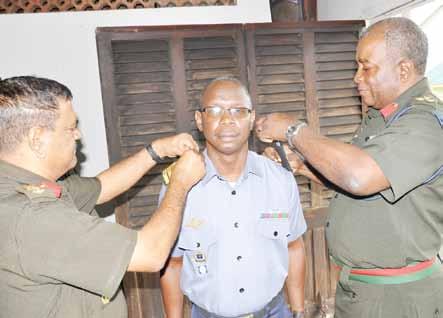
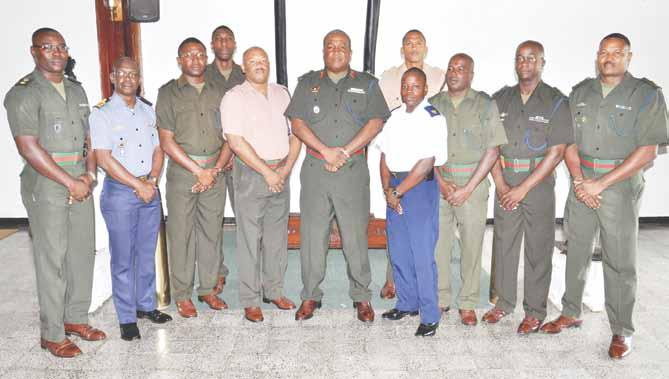
GDF promotes 348 officers, other ranks
Commander-in-Chief, President Donald Ramotar has approved the promotion of 88 officers and 260 other ranks of the Guyana Defence Force (GDF), the army confirmed on Friday.
Chief-of-Staff, Brigadier Mark Phillips made the announcement in accordance with the Defence Act Chapter 15:01 of 1977. The promotions took effect from January 1.
According to a GDF statement, 42 officers and 96 other ranks were confirmed in their rank while 46 officers and 164 ranks were elevated in rank.
Leading the promotions list are Lieutenant Colonels Sherwin Anderson and Godfrey Bess who were confirmed in their rank.
Lieutenant Commander Orin Porter of the Coast Guard was promoted to acting commander, while Majors Dwain Jervis, Trevor Bowman and Kenlloyd Roberts have been promoted to the rank of
acting lieutenant colonel.
In addition, four majors, including one female, have been confirmed in their rank, while substantive captains Dwayne Carter, Mark St Claire, James Fraser, Julian Archer and Drumson Mc Caulay have been promoted to acting majors. Seventeen acting captains, including three females, are now confirmed in their rank, while Substantive Lieutenant Jocelyn Mc Allister has been promoted to the rank of acting captain with effect from January 1, 2012.
Ten other substantive lieutenants, including one female, are now acting captains. Ten acting lieutenants have been promoted to substantive lieutenant, while 10 second lieutenants have been promoted to acting lieutenant.
In the Coast Guard, acting lieutenants (CG) Nigel Backer and Wayne Richmond have been confirmed in their rank, while substan-
tive sub lieutenants Paul Castello and Travis Morgan have been promoted to acting lieutenant (CG) and seven acting sub lieutenants have been confirmed in their rank.
Further, the GDF said Midshipmen Derrick Johnson, Rudolph Singh and Rondel Douglas are now acting sub lieutenants. In the GDF Reserve, Substantive Captain Earl Edghill has been promoted to acting major, while 10 second lieutenants have been promoted to acting lieutenant.
Two hundred and sixty other ranks have been promoted. Of this number, 96 have been confirmed in their rank, while 164 have been elevated in rank. Heading this group is Staff Sergeant Christopher Harmon who has been promoted to acting warrant officer class two.
Warrant officers class two;
Creative industries in Americas raked in US$87B in 2011 – study
The Organisation of American States (OAS), the InterAmerican Development Bank (IDB), and the British Council jointly commissioned a report, a first of its kind, to show the important contributions to growth, jobs, and trade in the hemisphere generated by creative and cultural activities such as the arts, design, music, and advertising, amongst others.
Some US$640 billion was the value of the world’s exports of creative goods and services in 2011, of which US$87 billion or 14 per cent originated in the Americas, according to data compiled by Oxford Economics in the study, “The Economic Impact of the Creative Industries in the Americas”.
The report surveys 44 countries – including 34 countries in the Americas and 10 benchmark countries from other regions – around the world.
It also recommends ways to improve and standardise national measurement frameworks to better track trends within and across countries and support more evidence-based policymaking.
The contribution by creative industries to Gross
Domestic Product (GDP) varies widely across the region: from just under two per cent in Chile to more than 10 per cent in Brazil and the United States. Growth rates in the sector are consistently higher than the average of the economy.
The creative sector is also an important provider of employment in some countries; between five per cent to 11 per cent of jobs in Canada, Colombia, Mexico, and Trinidad and Tobago. Moreover, the sector has a higher percentage of youth employment than the rest of the economy.
Creative exports
The sector is becoming increasingly international. Creative exports from the countries in the Americas accounted for 2.2 per cent of all their exports of goods and services.
The leading creative export categories for the Americas include: Design goods (US$21.7 billion) –comparable to the value of remittances to Mexico; personal, cultural and recreational services (US$18.2 billion) –comparable to the economy of Honduras; architecture and
related services (US$12.8 billion) – three times the Foreign Direct Investment received by the Caribbean countries combined and visual arts goods (US$8.2 billion) – comparable in value to Brazilian coffee exports.
In presenting the study at the 6th World Summit on Arts and Culture in Santiago, Chile, on January 16, the OAS, IDB, and the British Council expressed their hope that the study would raise awareness of the creative sector’s enormous potential for economic development and innovation for the region.
They also pointed to the critical need to move forward towards more harmonised and rigorous measurement mechanisms already underway to ensure appropriate policy responses to the sector’s needs and opportunities.
The three institutions pledged to continue their joint collaboration to promote the creative economy in the hemisphere.
The study is composed of a narrative report that includes summary dashboards for seven countries, which can be downloaded from any of the following websites: OAS, IDB, British Council.
Dwayne Layne, Marcia Williams, Sherlock Rigby, Dyanor Wilson, Leyland Liverpool and Hesley Craig were confirmed in their appointment.
The remaining 253 other ranks were promoted through ranks ranging from acting warrant officer class two, to acting lance corporal.
Other promotions in the Coast Guard saw Substantive Petty Officer Dexter Fraser being elevated in rank to acting senior petty officer.
Meanwhile, three acting petty officers were confirmed in their rank, while five substantive leading ratings are now acting petty officers. Six acting leading ratings are now confirmed in their rank. Additionally, three substantive able ratings have been promoted to acting leading ratings while five
acting able ratings have been confirmed in their rank.
Ordinary Rating, Collis Parkinson has been promoted to acting able rating/substantive able rating and four other ordinary ratings have been elevated to the rank of acting able rating. Soldiers confirmed in their rank have earned the substantive (Sub) in that rank, after previously holding the acting rank. At a simple badging ceremony the recently promoted senior officers were decorated with their new badges of rank by Brigadier Mark Phillips who was assisted by Deputy Chief-of-Staff, Colonel Kemraj Persaud.
The officers were congratulated by the other senior officers present and the recently promoted majors were welcomed to the Corps of Senior Officers.
Regional success stories needed
Antigua and Barbuda’s Prime Minister Baldwin Spencer on Thursday defended the regional integration movement and appealed to regional broadcasters to play a meaningful role in educating the Caribbean population about the achievements of the 40-year-old institution.
Addressing the start of a two-day workshop for regional broadcasters on the regional integration and the Caribbean Community (Caricom) Single Market and Economy (CSME), Spencer acknowledged that over the last few years, Caricom and specifically the CSM component, has been going through a period of consolidation.
He reminded delegates that last year, the Trinidad-based Caribbean Court of Justice (CCJ) delivered a ruling on the landmark case involving the Jamaican national, Shanique Myrie, who claimed she had been discriminated against by Barbados when she sought to enter the island a few years ago.
Region's story
“To heads of government and member states, the judgement means that it cannot be business as usual,” Spencer said. Workshops such as these offer media practitioners the opportunity to tell the region’s story more accurately and in a manner that the average Caribbean person can appreciate.
“That is why I am of the opinion that broadcasters are indeed and should be the champions of the regional integration message,” Spencer said, noting that the benefits of the Caricom from its inception “have suffered from a lack of media buss.
“The paparazzi syndrome never caught on to Caricom and the integration movement.
Very often we hear in the media, negative commentary and discourse about the lack of implementation or the 'talk shop' stigma regularly attached to regional bodies.
“We hear very little about how a private sector business operating in the CSME has been able to benefit from the regimes, or how an artisan has been able to move through the region as a skilled national, or even how successful regional bodies like CXC (Caribbean Examination Council) or CARDI (Caribbean Agricultural Research and Development Institute) have been in implementing their mandate and impacting the people of the region”. (CMC)
Antigua and Barbuda’s Prime Minister Baldwin Spencer
The chief-of-staff affixes Acting Commander (CG) Orin Porter’s new badge of rank. He is assisted by the Deputy Chief-of-Staff Colonel Kemraj Persaud
The newly-promoted senior officers with Chief-of-Staff Brigadier Mark Phillips
Harding didn’t tell doctors about baton assault – GPHC
By Vahnu Manikchand
As the controversy surrounding the alleged sexual assault on Colwyn Harding continues, the issue took a new twist on Friday when officials of the Georgetown Public Hospital Corporation (GPHC) disclosed that the man did not inform the institution about being sexually assaulted.
This is according to Medical and Professional Services Director, Dr Sheik Amir, at a press briefing on Friday. He said the institution was unaware of Harding being sexually assaulted until the matter was disclosed in the media last week.
Dr Amir noted that there are no records of the man informing the doctors about being sexually assaulted. “We were not aware until the press released their story,” he said.
Allegation
Harding, 23, is accusing a police officer of the Timehri Police Station of inserting a condom covered baton in his anus sometime in November last.
When asked if any examination was done regarding the allegation, the director said: “You’re coming in with a certain emergency condition, nobody tells us about anything else, why would we be assuming that this happened, that’s not a normal thing that we would look for.”
He noted that although the matter is in the public domain, they cannot go ahead and do any examinations on Harding until he himself tells them about the assault. "If we were to go with what was written in the press, then there are a lot of things we
would need to do to all our patients,” he said.
The doctor said it was difficult for him to say whether the strangled hernia could have been caused by a baton inserted in the man’s anus.
“Any contraction of the abdominal wall will increase the pressure of the abdomen and usually causes the hernia to come down, so I’m not going to say that it was caused by the hitting of the abdomen,” he explained.
In response to a question as to whether a test could be done to verify if Harding was indeed sexually assaulted, Dr Amir pointed out that injuries would heal after two to three weeks and it is already nearly two months now, since this incident is alleged to have happened.
Scars
However, he did note that dependent on the seriousness of the injuries, there may still be scars left.
Dr Amir further explained that Harding is being treated for a strangled hernia which causes the death of the bowels and it develops in a many
men. He said Harding’s case is nothing the doctors are not accustomed to, since they get many hernia cases from the interior.
Diagnosis
The doctors explained that Harding was first diagnosed with a hernia on December 13 last year, and was referred to a clinic; however, he returned to the Accident and Emergency Unit around 22:35h on December 17, in worse condition.
He was experiencing severe pains, increased swelling around his genitals, and vomiting. He was subsequently further diagnosed with a “strangulated inguinal scrotal hernia”, which called for an emergency surgery that was done on December 18 and another one followed on December 27. Another surgery is to be performed some three months from now.
Meanwhile, GPHC Chief Executive Officer Michael Khan rejected the allegations that the hospital does not have critical medical supplies needed by Harding. “I wish to say categorically, this is not
true,” he stated.
According to the CEO, the records shows that all the drugs needed by Harding were given to him with the exception of one instance where the nurses failed to administer the drugs.
Khan disclosed that the colostomy bags were available at all times, if not in the ward, then it would be available in other wards.
The CEO noted that there are other patients in need of the bags and so they have to be in stock.
“It is my view that Mr Harding has not been treated in shoddy manner and the hospital and nurses have done their duty,” he maintained.
Khan said he regrets that the GPHC has been accused of neglect, since its task is already difficult; however the institution has done right by Harding.
In addition, the hospital officials noted that they are not against Harding seeking private advice; in fact, two doctors from the Davis Memorial Hospital were expected to see him Friday morning. (vahnum@guyanatimesgy.com)
House passes amendments to Deeds Registry Act
The Deeds Registry (Amendment) Bill, which was tabled and debated in Parliament in 2012, but was subsequently sent to a select committee, was finally passed unanimously on Thursday, following the adoption of the report of the said committee.
The bill seeks to amend the Deeds Registry Act to elevate an agreement of sale of immovable property to the status of a bond, a lease or other encumbrance.
The agreement of sale of immovable property would therefore be registrable in the Deeds Registry and can be annotated on or recorded against a transport or other duly recorded deed. Importantly, both the agreement of sale and the annotation can be cancelled, reported the Government Information Agency (GINA).
Attorney General (AG) and Legal Affairs Minister Anil Nandlall spoke highly of the work of the select committee, which comprised members of all parties. He said during the deliberations, many differences of opinions arose, but they
were subsequently reconciled and all decisions were consensually arrived at.
Singular mischief
The Guyana Bar Association, one of the most important stakeholders, was lauded by all members for its invaluable input in guiding the work of the committee. The association attended many sessions of the committee’s meetings and made written and oral presentations that were adept and showed
much researched positions.
“I will concede that the bill, which will now be presented for its third reading, is an almost overhaul from what was initially tabled, though it captures the singular mischief which it was intended to address, which is to ensure that a transported holder is not free to sell that property subject of the transport, fraudulently to more than one purchaser,” the AG explained.
He added that while the general concept was retained, the Bar Association and the members of the committee were able to devise a far more elaborate mechanism. This bill will allow persons in possession of an agreement of sale of immovable property to register it in the Deeds Registry.
This will enable the agreement to be recorded or annotated against a transport or other duly recorded deed to the property in question.
With regards to what percentage of the purchase price is required to be paid before a person can be injuncted from selling a property, the association was calling for an amend-
Eccles businessman commits suicide
An Eccles, East Bank Demerara businessman on Friday evening committed suicide by hanging himself at his home.
Eleem Taj Mumtaz, 48, of Lot 96 CC Eccles, was found hanging from the ceiling of his bathroom by his brother-in-law about 17:45h.
Police at the scene confirmed that there were no marks of violence on the man’s body, which was taken to Carmen’s Funeral Home.
Relatives who gathered at the scene could not say what might have caused the man to take his life. Mumtaz occupied the two-storey wood and concrete building with his brotherin-law. He was described as a very quiet and reserved person.
Reports reaching Guyana Times revealed that the man spent Thursday night by his relatives on the West Coast of Demerara and returned home on Friday morning.
The man’s brother-in-law reportedly told police that when he left for work on Friday morning, Mumtaz was not at home.
When the brother-in-law, who has his own keys, returned home in the evening, he recognised that the house was still locked and thought that Mumtaz had still not returned. He opened the door, went in and called out for the man but there was no answer.
As he made his way to the washroom, he saw the man hanging by a piece of rope from the ceiling. He immediately contacted the police who arrived on the scene and examined the body for possible marks of violence.
Another relative told this publication that Mumtaz only returned from the United States of America a few weeks ago. He is a permanent resident of the U.S., but chose to return home to take care of the family business in Stabroek Market. His wife and children live overseas.
The man said he last saw Mumtaz alive on Thursday evening, and he was left in a state of shock upon learning of his demise. He said that even if the man had problems, he would never confide in any one.
Two bills tabled in the National Assembly – one new, one resubmitted
The Recording of Court Proceedings Bill No 1 of 2014 and the Local Authorities (Elections Amendment) Bill No 3 of 2014 were tabled in the National Assembly on Thursday.
The Recording of Court Proceedings Bill, tabled by Attorney General and Legal Affairs Minister Anil Nandlall, seeks to provide that proceedings in any court of law in Guyana shall be recorded by electronic or other means.
ment to the law to allow for a 50 per cent deposit; however, the members of the committee stood strongly for the maintenance of the standard 10 per cent downpayment.
Currently, an agreement of sale confers upon the purchaser no interest in land, which is the subject of that agreement.
Third party
Over the years, there have been several reported cases of purchasers of land being defrauded by the land being resold to a third party and the transport passed to that third party without the knowledge of the original purchaser.
The purpose of this bill is to clothe a purchaser of land held by transport with some form of protection until the transport is conveyed.
Basil Williams from the A Partnership for National Unity ((APNU) and Moses Nagamootoo from Alliance For Change (AFC) also spoke of the concerted efforts of all involved at the level of the select committee in the bid to create a better, more efficient Deeds Registry.
Further, the bill provides that the registrar of the Supreme Court or the clerk of magistrates’ courts, shall cause a transcript of the record of the proceedings to be prepared.
The latter shall be verified by certificates of those respon-
sible for the accuracy of the recording of the proceedings. Access to the transcript and recordings may be provided upon payment of the requisite fee.
The Local Authorities (Elections Amendment) Bill No 3 was tabled, repealing the previous bill, because the contents of that bill, which was gazetted, differed from the contents which were submitted to the National Assembly. Hence, the bill was resubmitted to the House.
The bill seeks to amend the Local Authorities (Elections) Act to provide for the postponement of elections of councillors of local democratic organs. The bill was tabled by Local Government Minister Ganga Persaud.
CCJ lacks mechanism to enforce judgements, says judge
Ajudge with the Trinidadbased Caribbean Court of Justice (CCJ) Friday said there was no mechanism to enforce its judgement following the recent ruling in the case involving Jamaican Shanique Myrie. Myrie successfully sued the Barbados government after she was refused entry into the island in 2011.
The CCJ, which was established in 2001 to replace the London-based Privy Council as the region’s final court, and also functions as an international tribunal interpreting the Revised Treaty of Chaguaramas that governs the regional integration movement, awarded pecuniary damages in the sum of Bds$2,240 (One BDS dollar = US$0.50 cents) and non-pecuniary damages to the tune of Bds$75,000.
Justice Ralston Nelson, speaking at the workshop for regional broadcasters on the regional integration and the Caribbean Community (Caricom) Single Market and Economy (CSME), said there was no order to implement the court’s ruling. He told the broadcasters to the workshop, organised by the Guyana-based Caricom Secretariat with funding from the 10th European Development Fund (EDF), that there is also no power in the national laws for a CCJ order to be treated as a national order.
Speaking with the Caribbean Media Corporation (CMC) after his two-and-ahalf-hour presentation, Justice Nelson said that the situation is not one that is “unusual”. (CMC)
Dr Navin Rambarran, Dr Sheik Amir, and GPHC CEO Michael Khan at the press briefing on Friday
Attorney General and Legal Affairs Minister Anil Nandlall
Regional Hudson-Phillips dies suddenly in UK
Prominent Queen’s Counsel Karl HudsonPhillips was remembered as a powerful luminary, a classy politician and a larger-than-life character who dominated the political and legal landscape during his distinguished career. He was a former attorney general and a former judge of the International Criminal Court and was awarded the country’s highest honour, the Order of the Republic of TT, in 2010. The tributes came in after Hudson-Phillips, 80, passed away peacefully in his sleep in the United Kingdom on Wednesday. He was reportedly there to attend a birthday celebration for his son. The news of his passing made regional headlines,
Queen’s Counsel Karl Hudson-Phillips
including being reported in the Jamaica Observer and Grenada’s SpiceIslander TalkShop, which posted
brief details of his passing from as early as 07:00h on Thursday.
Hudson-Phillips’ sudden death plunged the legal fraternity into mourning, however, and many senior attorneys ON Thursday could not come to terms with the fact that he was gone for good.
President of the Law Association Seenath Jairam, SC, described HudsonPhillips as a powerful “legal luminary and an outstanding and formidable advocate,” whose career spanned over 50 years at the local and regional bars.“He was a mentor, friend and benefactor to countless junior counsel/attorneys around the region. He will be sorely missed,” Jairam said. (Excerpt from Trinidad Guardian)
Jamaican police nab robbers after high-speed chase in city
Frightened motorists and pedestrians in Jamaica’s capital city, Kingston, on Thursday afternoon took all the safety precautions they could as police, sirens blaring and lights flashing, chased a stolen Toyota Coaster bus on the busy streets.
The driver was forced to abandon the bus as police fired warning shots and cornered the vehicle in the vicinity of Calabar Mews. He and another man, who were said to be among four men who commandeered the vehicle and forced the driver to hand over the keys along Seaview Drive, a few miles away, were arrested.
“... About 3:45 pm (15:45h) police received information that a group of men had stolen the bus from Waterhouse and were travelling in the area,” said a senior officer from the St Andrew North Police Division.“A police team travelling along Seaview Drive saw the bus and ordered the men to stop but the com-
mand was ignored and the driver sped off,” the police told the Jamaica Observer.
Police said that during a high-speed chase shots were fired and the men were cornered in the vicinity of Calabar Mews where two
of the alleged robbers were held. The other two escaped, police said. “It really left me traumatised,” said one resident of Calabar Mews, an apartment complex on Red Hills Road. (Excerpt from Jamaica Observer)
Mexican government says “vigilantes not the target”
The Mexican government has tried to reassure vigilantes in the western state of Michoacan that they are not the target of its security operation.
Hundreds of troops have been sent to the area to restore order after groups of vigilantes clashed with members of the Knights Templar drug cartel.
Many of the “self defence groups” have refused to heed the government’s call to lay down arms. The in-
terior minister said “they’re not our target, the criminals are”.
Minister Miguel Angel Osorio Chong said he wanted to convince the vigilantes that “we are going to do our job”. He said that the security forces had identified the three top leaders of the Knights Templar cartel and were hunting them down.
Two alleged members of the cartel were arrested on Wednesday, but the self defence groups dismissed them
as “minor players”.
About 2000 members of the security forces were deployed to Michoacan on Monday after the “self defence groups” launched an offensive to drive out the Knights Templar from the area.
The vigilantes accuse the government of not doing enough to protect locals from the extortion and violence carried out by the pseudo-religious drug gang.
(Excerpt from BBC News)
Trinidadian national on U.S.
“most wanted” list may be residing in
Barbados
Andre Neverson has ties to Barbados, Trinidad and Tobago, Jamaica, The Bahamas, Grenada, St Vincent and Canada. U.S. authorities are offering a US$25,000 reward for information leading directly to his arrest
United States law enforcement authorities are seeking the public’s assistance in locating a Trinidadian man wanted in that country for allegedly killing his sister and an ex-girlfriend in 2002.
Andre Neverson is believed to have fled the United States and may be residing in Barbados or other Caribbean islands, the U.S. embassy there said in a statement on Thursday.
Neverson has ties to Barbados, Trinidad and
Tobago, Jamaica, Bahamas, Grenada, St Vincent and Canada and U.S. authorities are offering a US$25,000 reward for information leading directly to his arrest.
Neverson allegedly murdered his sister by shooting her in the head and stomach on July 8, 2002.
The next day, he allegedly abducted a former girlfriend. She was found dead two days later with a mortal head wound.
The U.S. embassy statement said at the time of both
murders, he was on parole in the State of New York for attempted murder in the second degree, assault in the first degree and criminal possession of a firearm. In November 2002, Neverson, armed with a handgun, allegedly entered the home of another ex-girlfriend in an attempt to visit his daughter. The woman’s brother interrupted the unannounced visit, and Neverson fled with no further incident. (Excerpt from Caribbean360)
Youths earn respect for executing inaugural political debate
The triumphant party – if there is to be a winner – of last night’s National Youth Forum dubbed debate – was still to be determined. What was clear, however, even before the first question was asked, was that the youth had commanded respect.
The invitation from the organisers for the ruling United Progressive Party (UPP) and the main opposition Antigua Labour Party (ALP) begat the UPP team of Harold Lovell, Senator
Joanne Massiah and Senator Shawn Nicholas. On the other side was Senator Lennox Weston, Melford Nicholas and Senator Samantha Marshall.
The organisers requested a combination of youth, female and elder, and the incumbents went for the second in command of the party and in the Cabinet pecking order, Lovell, who is the deputy political leader of the UPP, finance minister and usually the acting PM when the chief servant is out of the
state. Massiah, a junior minister in Legal Affairs, is contesting her third elections, hoping that she can bring it home this time. Nicholas is the new kid on the block. For the ALP, none of the representatives are elected members of the House of Representatives, neither are they senior members of the ALP.
Podium aside, the audience included Prime Minister Baldwin Spencer and members of his party.
(Excerpt from Antigua Observer)
Suriname experiences first freak hail storm in decades
“It’s raining ice outside,” a young woman in southern Paramaribo yelled on Thursday night as she ran out into her yard, using her smartphone to record the history making event.
Rocks of ice rattled her zinc roof and that of her neighbours.
“Here, see, it’s hailing in Suriname,” she said, as social media became alive with Surinamese bloggers recounting their experiences of the unprecedented weath-
er phenomenon.
“I was home when it happened. I saw it too,” radio journalist Rudi Esajas reported. He said it had not been particularly cold when the hail started. “Just a bit more than usual, and when it stopped hailing, the clouds opened up and it briefly rained really hard,” he added.
The hail lasted at least four minutes and was experienced mainly in Flora and Uitvlugt, the southern neighbourhoods of the city.
National disaster officials Friday reported there was little or no damage. There were also no reports of personal injuries even as citizens recounted stories of their cars and houses “being pelted with stones”.
“I never thought I would experience this in Suriname,” an elderly lady said. The hail rocks were about the size of grapes. The Meteorological Office said it was not the first time it hailed in Suriname. (Excerpt from Caribbean360)
Police at the scene outside Calabar Mews where men abandoned a Coaster bus that they stole along Seaward Drive in Kingston on Thursday
Wife of Indian minister found dead
The wife of an Indian government minister has been found dead in a New Delhi hotel room days after she was involved in a row with a Pakistani journalist over Twitter.
It was not immediately clear how Sunanda Puskhar Tharoor, wife of junior human resource development minister Shashi Tharoor, died, Delhi police spokesman Rajan Bhagat said on Friday
“She was lying in bed. There were no signs of any foul play or any struggle. She had no sign of poisoning or anything,” the minister’s personal assistant Abhinav Kumar told reporters gathered outside the hotel.
The death came after Sunanda, 52, was embroiled in a spat with a Pakistan-based journalist, Mehr Tarar, whom she accused of stalking her husband in a series of Twitter posts.
Tarar denied she was having an affair with the Indian minister and hit back at Sunanda for making what she said were wild allegations. On Thursday, the Indian couple issued a statement saying they were distressed by the controversy caused by unauthorised use of their Twitter accounts.
They said they were happily mar-
ried and intended to stay that way. Tharoor, a former UN diplomat, married Sunanda in 2010. That same year he had to resign from his first minis-
terial job over allegations of wrongdoing in bidding for a cricket team in the Indian Premier League. (Al Jazeera)
Coup backer Rajaonarimampianina declared president-elect of Madagascar
Madagascar on Friday declared Hery Rajaonarimampianina as the country’s new president following elections aimed at restoring democracy. The Canadian-educated former finance minister is backed by incumbent Andry Rajoelina, who staged a coup in 2009.
Rajaonarimampianina, 55, was “declared officially president of the Republic of Madagascar,” with just over 53 per cent of the votes, said the president of the electoral court, Francois Rakotozafy.
The new president-elect vowed to work together with his opponents and bring prosperity to the Indian Ocean island nation. “I will be the president of all of you without distinction,” he said in Malagasy after the court’s announcement. “I’m asking for your help so we can develop the country.”
His backer, incumbent strongman Rajoelina, seized power from then-president Marc Ravalomanana
five years ago, plunging Madagascar into political and economic crisis.
Their proxy candidates dominated the vote, after the two rivals were prevented from running for office due to international pressure over fears of a return to violence.
The announcement of the
election result had been delayed pending the court’s ruling on allegations of voting irregularities, following a challenge by runnerup Jean-Louis Robinson. Robinson, 61, who was backed by Ravalomanana and garnered 46.51 per cent of the vote, on Friday rejected the court’s declaration. (Excerpt from France24)
Suicide bomber kills 15, mainly foreigners, in Kabul restaurant attack
Up to 15 people, mainly foreigners, were killed in Afghanistan on Friday when a suicide bomber blew himself up outside a popular Lebanese restaurant in the capital Kabul, police said.
Islamist Taliban insurgents claimed responsibility for the assault in the upscale Wazir Akbar Khan district, which hosts many embassies and restaurants catering for expatriates.
The United Nations said four of its staff were unac-
counted for. General Ayoub Salangi, an Afghan deputy interior minister, said between 13 and 15 people, mostly foreigners, were killed but their nationalities were not immediately clear.
A Taliban spokesman said that those killed were German nationals. In Berlin, the German foreign ministry said it could not confirm that Germans were involved.
The assault took place during a busy dinner time
on a Friday evening when expatriates in Kabul tend to eat out. The heavily fortified diplomatic district also houses many wealthy Afghans and business people. Bursts of gunfire followed the attack.
“First there was a suicide attack near a restaurant for foreigners where a man detonated his explosives attached to his body, and then possibly one or two insurgents entered the restaurant,” one Afghan security source said. (Excerpt
Syria offers Aleppo truce as rebels argue over talks
The Syrian government, preparing for peace talks with rebels next week, handed the Russian co-sponsors of the conference a proposal on Friday for a ceasefire in Aleppo and an exchange of prisoners.
The offer was dismissed by some of President Bashar al-Assad’s disparate opponents, whose very attendance at the talks due to start on Wednesday in Switzerland remained in doubt, despite fresh assurances from Washington that negotiations would lead to Assad’s departure from power.
After nearly three years of war, and over 100,000 deaths, however, Assad’s forces have been making gains, helped by in-fighting among the rebels as well as support from Iran and new
arms and equipment from Russia.
Syrian Foreign Minister Walid al-Moualem, visiting Moscow, said he gave Russian officials a plan for a truce in Aleppo, Syria’s biggest city, where government forces have been unable to dislodge rebels over the past year. He also said Damascus was ready to exchange prisoners, something rebels want.
Moscow and Washington, which respectively protected and opposed Assad since the uprising in 2011, have urged both sides to make concessions, including ceasefires, access for aid and prisoner exchanges, to build confidence before the conference.
But there is little sign of coherent negotiating positions – nor of violence abating. (Excerpt from Reuters)
Obama orders curbs on NSA data use
President Barack Obama has ordered curbs on the use of bulk data collected by U.S. intelligence agencies, saying civil liberties must be respected. Obama said such data had prevented terror attacks at home and abroad, but that in tackling threats the government risked overreaching itself.
However civil liberties groups have said the changes do not go far enough.
The announcement follows widespread anger after leaks revealed the full extent of U.S. surveillance operations. The leaked documents revealed that the U.S. collects massive amounts of electronic data from communications of private individuals around the world, and has spied on foreign leaders.
The latest revelations claim that U.S. agencies have collected and stored almost 200 million text messages every day across the globe, according to the Guardian newspaper and Channel 4 News.
In his much-anticipated speech at the Department of Justice, Obama said he
would not apologise for the effectiveness of U.S. intelligence operations, and insisted nothing he had seen indicated they had sought to break the law.
It was necessary for the U.S. to continue collecting large amounts of data, he said, but acknowledged “the potential of abuse”. “The reforms I’m proposing today should give the American people greater confidence that their rights are being protected, even as our intelligence and law enforcement agencies maintain the tools they need to keep us safe,” he said. (Excerpt from BBC News)
More than 1000 rhinos poached in South Africa last year
More than 1000 rhinos were poached for their horns in South Africa in 2013, a record number and an increase of over 50 per cent from the previous year, the country’s department of environmental affairs said on Friday.
Rhino hunting is driven by soaring demand in newly affluent Asian countries such as Vietnam and China, where the animal’s horns are prized as a key ingredient in traditional medicine. Rhino horn has a
street value of more than US$65,000 a kg in Asia, conservation groups say, making it more valuable than platinum, gold or cocaine.
The data is sure to ring conservation alarm bells about a downward population spiral in a country that is home to almost all of Africa and the world’s rhinos, and it may bring renewed pressure on the government to do something to halt the slayings.
In 2013, 1004 of the massive animals were illegally
killed in South Africa, compared with 668 the previous year and 448 in 2011. Most of the killings are taking place in South Africa’s flagship Kruger National Park, which lost 606 rhinos last year and 425 in 2012. The park service has been turning its rangers into soldiers, using drones to patrol airspace and sending out crack units by helicopter when suspected poachers are sighted. South Africa’s rhino population totals around 20,000. (Excerpt from Yahoo!)
Sunanda Puskhar Tharoor (right), wife of India’s Minister of State for Human Resource Development Shashi Tharoor, poses with her husband at the Indian F1 Grand Prix at the Buddh International Circuit in Greater Noida, on the outskirts of New Delhi, October 27, 2013 (source: Reuters)
U.S. President Barack Obama; ‘’We will not monitor the communications of... our close friends and allies’’
Madagascar president elect Hery Rajaonarimampianina
FirstCaribbean Bank seeks 10 per cent cut in regional employee costs
Confirming plans to reduce regional employee costs by 10 per cent, based on a workforce of 3500, CIBC FirstCaribbean International Bank (FCIB) said that it received a “reasonable response” to its voluntary separation offer Caribbeanwide and is now looking to make a decision on how many redundancies may have to follow in order to achieve cost reduction targets.
In an emailed response to Guardian Business, Debra
North America
King, director, corporate communications for FCIB, said the bank will be looking first at “redundant positions that have come about due to consolidation, automation, process re-engineering and improvement” as it looks to further trim its workforce.
Her comments represent the first time the bank has detailed the extent of cost cutbacks it is hoping to achieve through restructuring. What is not clear to date is what portion of the overall cost reduc-
Caribbean Asia
tions sought will be achieved in The Bahamas.
At the beginning of October 2013, Guardian Business exclusively revealed plans by CIBC FirstCaribbean to restructure its operations throughout the Caribbean, driven by a trend of rising costs and declining profitability. The bank has suffered significant losses in The Bahamas and Barbados in particular, in light of high levels of loan arrears. (Caribbean News Now)
IBM commits US$1.2B to cloud data centre expansion
IBM, the global computing giant, has said it is investing more than US$1.2 billion (£735 million) expanding its data centres and cloud storage business.
It plans to build 15 new centres around the world, bringing the total number up to 40 during 2014.
IBM bought cloud services company SoftLayer for US$2 billion last year, and this investment will double the subsidiary’s storage capacity, the company said.
Europe
IBM believes the cloud services market could be worth US$200 billion by 2020. Businesses are increasingly leasing data storage, computing power and web hosting services from a growing number of specialist cloud companies – effectively outsourcing their IT needs to cut costs and improve efficiency.
IBM says it has added 2400 new clients since it acquired Dallas-based SoftLayer. In a related announcement last week, IBM said it would
spend US$1 billion creating a new division for Watson, its supercomputer.
Watson, which aims to mimic how people think, using natural language capabilities and analytics, beat its human rivals in the U.S. TV quiz show Jeopardy in 2011.
IBM plans to farm out Watson’s abilities to businesses and consumers via SoftLayer, and is encouraging developers to create new apps that tap in to the supercomputer. (BBC News)
Shell’s profit warning linked to cost of drilling in Arctic waters
The costs of a troubleprone drilling programme in Arctic waters off Alaska have contributed to Shell being forced to issue a shock profit warning which has shaken investor confidence. Shares in the Anglo-Dutch oil group slumped in early trading after its newly-installed chief executive admitted that fourth quarter earnings would be around 70 per cent lower than
the same period last year.
“Our 2013 performance was not what I expected from Shell,” Ben van Beurden said.
“Our focus will be on improving Shell’s financial results, achieving better capital efficiency and on continuing to strengthen our operational performance and project delivery.”
Shell made no mention of mishaps in the Arctic but admitted that its American ex-
ploration business had made a loss. And sources said that financial writedowns had come from dry wells and costs associated with the Alaskan operation. The group was only able to engage in a vastly reduced Arctic drilling programme in the Chukchi sea rather than the wider scheme in the Beaufort sea after equipment failures and a rig grounding during 2012 which continue to cost it money. (The Guardian)
Africa
Power Africa draws new investment to region
The U.S. initiative that aims to double access to electricity in sub-Saharan Africa has drawn new investments to the fast-growing region, according to representatives of three key agencies that support the project.
“We are seeing developers investing for the first time in power in emerging markets. We’re seeing developers we’ve never seen before. We are also seeing with the private sector in Africa an opportunity to partner with American companies,” said
Mimi Alemayehou of the U.S. Overseas Private Investment Corporation (OPIC). OPIC mobilises private capital to help solve critical challenges in developing countries.
Alemayehou, Andrew Herscowitz of the U.S. Agency for International Development (USAID) and Kamran Khan of the Millennium Challenge Corporation (MCC) provided an update on Power Africa at the Centre for Global Development, a Washington think tank.
President Obama announced the Power Africa initi-
ative in June 2013. Through a public-private approach, Power Africa wants to increase generation capacity by about 10,000 megawatts in six partner countries with the objective of increasing access to electricity for 20 million people, improving reliability and reducing costs for African businesses.
OPIC has committed US$1.5 billion to Power Africa for its first five years, Alemayehou said, and MCC has committed around US$1 billion to the initiative, according to Khan. (allAfrica)
Apple China Mobile launch could spark costly subsidy war
Apple Inc is finally launching its iPhone on China Mobile Ltd’s vast network on Friday, opening the door to the world’s largest carrier’s 763 million subscribers and giving its China sales a short-term jolt.
Underlining how much the launch means for Apple, Chief Executive Tim Cook was on hand as the carrier’s flagship store opened in Beijing’s financial district. With China Mobile Chairman Xi Guohua alongside, Cook gifted signed
Middle East
iPhones to a handful of customers and posed for pictures.
The long-awaited deal could trigger a limited turnaround for Apple, whose fortunes have wavered in China in the face of stiff competition from marketleader Samsung Electronics Co Ltd and up-and-coming local rival Xiaomi Tech.
Samsung had a 21 per cent share of China’s smartphone market in the third quarter of 2013, with Apple trailing in fifth place with just six per cent, according to re-
search firm Canalys. But the arrival of the iPhone could be a double-edged sword for China Mobile, with some analysts predicting a costly subsidy war as rival carriers compete to lure customers.
“I don’t see a price war coming where Apple is engaged in the war, but I do think you’re going to see a subsidy war coming,” said Michael Clendenin, managing director of Shanghai-based RedTech Advisors. (Reuters)
Dubai launches entrepreneurship academy
Dubai officially launched its first entrepreneurship academy this week in order to support the emirate’s growing small medium enterprises (SMEs).
The academy, which is an initiative from Dubai SME –an agency mandated to develop the emirate’s SME sector – aims to equip the local entrepreneurs with skills and knowledge they need to become future businesspeople.
Dubai Entrepreneurship
Academy is an addition to the Dubai SME services portfolio, which comprises varied programmes to identify, nurture, qualify and promote entrepreneurial talent and SME potential in the emirate.
The institution’s official launch was also combined with the graduation of its first batch of students who completed diploma programmes in entrepreneurship and hospitality management.
“The Dubai Entrepreneurship Academy
is a novel initiative, which will lead to a stronger support system for SME owners and future entrepreneurs and ensure that they have the necessary skills and experience to succeed,” said Abdul Baset Al Janahi, chief executive officer of Dubai SME.
“The programmes offered by this academy will go a long way in turning entrepreneurial ideas into business plans and lead to more enterprises being launched in the UAE.” (Gulf Business)
Stafford subsidised and unsubsidised loans
These educational loans are guaranteed by the U.S. Federal Government via its Department of Education and can be used to pay tuition and other educational expenses. The subsidised Stafford Loans require financial need to be demonstrated and do not accrue interest while you are in school, while the unsubsidised Stafford Loans are not based
on financial need and accrue interest as soon as the loan is disbursed. Both types have a fixed interest rate, and payments are not required while you remain in school.
Direct PLUS loans
The U.S. Federal Government funds Direct PLUS Loans for educational purposes that currently carry a fixed interest rate of 7.9 per cent and have more relaxed
credit requirements. The loan amount that a qualifying student can obtain is up to the attendance cost, less any other financial aid received that year. Be sure to check with your prospective school’s financial aid office to see what options are available and whether they can provide you with further assistance in finding the educational financing option that is right for you. (Business Dictionary)
Granger wants better standard of living for Region 10
The A Partnership for National Unity (APNU) has expressed its disappointment at what it termed the government’s lackadaisical methods of improving the quality of life for persons living in the Upper Demerara-Upper Berbice region (Region 10).
The party is calling for a renewed regional and economical development initiative to improve the quality of life of residents. This was announced by APNU leader David Granger, at the party’s weekly press conference on Friday.
Granger said, “The region’s mining and logging resources have been exploited for decades; the agricultural potential of its vast intermediate savannahs is still untapped; its physical infrastructure is undeveloped, and its tourism resources are largely unexplored. The region is rich in resources but the residents remain poor.”
The APNU leader claimed that the government may be neglecting Region 10, along with Regions Eight and Nine, since they are perceived to
be opposition strongholds. He pointed out that the region has great economic potential; however, the government has been reluctant to implement comprehensive, administrative measures to improve the standard of living in the areas.
Reform actions
APNU, therefore, recommends that stringent reform actions be taken in the sectors of education, employment, health and transportation services. He noted that the areas suffer a large number of school dropouts and poor student performance, along with improper learning environments. Granger continued that employment opportunities are few especially for school leavers, most of whom are forced to migrate. He noted that while mining companies provide a somewhat slight relief in this regard, many labour issues remain unresolved.
Health services is another issue the residents of these areas are troubled by, since the serving institution, the Linden Hospital Complex, is not ful-
ly equipped with the technicians needed and there is a gross need for “river ambulance” for the riverine areas.
The APNU leader further stated that residents complain about the improper roads they have to use. “Residents complain that owing to the almost impassable roads in some areas, minibus drivers charge higher fares and some road trips that should take like 90 minutes can take up to five hours,” he stated.
Developmental plan
Granger noted that the standard of living in the region is very low and programmes such as the Linden Economic Advancement Fund (LEAF) are starving for funds, hence depriving poor people from escaping poverty.
He talked about the fiveyear developmental plan which the government had announced, but never fully implemented. “Its objectives were to be the reduction of the region’s traditional dependency on mining and the achievement of long-term economic diversification and collaboration between the
state, the private sector, and the community. That plan targeted the agriculture, infrastructure, manufacturing, transport, tourism, information communication technology and mining sector,” he recalled.
In addition, he further stated that the government has also failed to implement essential elements of the August 2012 agreement between the central government and the regional administration, some 17 months after its signing.
Three Berbice schools get new wings
The Local Government Ministry on Friday commissioned new wings for three schools in Region Six.
Approximately $30.7 million was spent adding new wings to the Tagore Memorial Secondary, the Tutorial Academy Secondary School (TASS), and the Berbice High (BHS). Each of the schools received a new wing which was commissioned by Local Government and Regional Development Minister Ganga Persaud.
The largest, a two-storey building constructed in the compound of BHS, will accommodate six classrooms.
According to Headteacher Jenifer Rollins, the $12.3 million project will be put into use right away. The new building will house grade seven students.
Minister Persaud speaking at the commissioning ceremony noted government’s commitment to education delivery.
He said government’s faith in education remains strong. “As from independence until now, all that
would happened is that government’s support got stronger.”
Noting that the seeds were planted at independence, Minister Persaud said with the kind of investment being made, the local education system in Region Six keeps improving.
There are 1572 teachers scattered in 151 schools across the region, 28 of which are secondary schools. Persaud also took time out to
admonish the students present to care for the new facility, which will not only benefit them but those who will come after.
“If you don’t care, you will not only be doing yourself a disservice, but also you will be doing a bad service to those who come after you.” The minister urged the students to focus on opportunities that exist in the classroom.
The $8.2 million wing at Tagore will house three class-
saturday, January 18, 2014|
Farm machinery and sustainable agriculture must evolve together – FAO
Farm machines have revolutionised agriculture and reduced drudgery for millions of farm families and workers, but the machinery of tomorrow will have to do more than that – it will also have to contribute to agriculture that is environmentally sustainable.
A new FAO book, Mechanisation for Rural Development: a review of patterns and progress from around the world, explores the inexorable rise of the use of machinery in farmers’ fields, drawing lessons for policymakers and economists from some of the big winners and also the regions lagging behind. For example, Bangladesh went from using human muscle and ox power in the early 1970s to being one of the most mechanised agricultural economies in South Asia, with 300,000 low-power two-wheel tractors, a million diesel powered irrigation pumps and widespread mechanised crop threshing.
On the other hand, Africa, which has comparatively the most abundant land resources, has less than 10 per cent of mechanisation services provided by engine power. About 25 per cent of farm power is provided by draught animals and over 60 per cent by people’s muscles, mostly from women, the elderly and children. Mechanisation for rural development draws lessons from these trends, with in-depth studies of mechanisation in countries and regions in Africa, Asia, the Near East, South America and Eastern Europe, as well as chapters on themes such as development needs, manufacturing and information exchange.
rooms to cater for the school’s growing population. A similar extension was commissioned at Tutorial Academy also on Friday. That $10.2 million wing will also house three classrooms.
Speaking at the commissioning ceremony, ParentTeachers Association (PTA) President Odetta Felix expressed concern that the PTA was not involved from the inception in order to advise on the best location for the building.
Minister Persaud, in explaining that there is a procedure that is followed before such projects becomes a reality, noted that the journey begins with the first step. “I think the journey at this school has started.”
Region Six Vice Chairman Bhopaul Jagroo noted that once a project is commissioned, it is one step forward in the development of a country. Also attend all three commissionings was Regional Education Officer Valika Jaikishun.
“The book delves into many aspects of farm mechanisation, not only how machines will contribute to an environmentally sustainable future, but also what policies will put machines at the service of family farms so that they too can profit,” said Ren Wang, assistant director-general of FAO’s Agriculture and Consumer Protection Department.
Future of agriculture
The book also looks to the future, arguing that the design of agricultural machinery must evolve in parallel with the roll out of Sustainable Crop Production Intensification (SCPI). That means fewer chemicals, more efficient use of water, and more efficient use of machines. Farm machinery needs to be intelligent, lean, precise and efficient in order to minimise the impact on the soil and the landscape.
Two of the farming activities that have the greatest impact on the environment are soil tillage, because it
can severely damage soil ecology, and pesticide application.
Conservation agriculture is an approach that reduces or eliminates soil tillage and pesticide use. To control weeds, conserve soil moisture and avoid soil disturbance, a mulch layer of crop residue is retained on the unploughed field. Special machinery is needed to plant seeds and apply fertiliser through the mulch at the correct depth without disturbing the crop residues. An added advantage to this type of mechanisation is that, without the need for high-draught tillage, lower powered and therefore cheaper tractors can be used. These lighter machines have the added advantage of not compacting and therefore damaging the soil like a heavy tractor would.
The use of agrochemicals for the management of insect pests, disease and weeds can have a significant impact on the environment. Besides reducing pesticide use overall through integrated pest management including biological control, when chemicals are necessary they can be used with greater precision since it is estimated that about 50 per cent of all pesticides applied do not reach their intended target. Many technological innovations exist to improve this situation, for example, low drift nozzles and spray shields. In irrigation, technologies such as micro sprinklers or drip irrigation that save water and consume less power are the environmentally friendly way of the future, according to the book.
Defeating poverty Mechanisation for rural development argues that government policies should encourage the agricultural machinery sector to develop markets for agricultural mechanisation, especially for conservation agriculture, and to establish the required infrastructures.
“Such support, especially to the smallholder sector, can have a dramatic impact in moving farm families out of poverty into a more profitable, commercially oriented agriculture,” said the book’s lead editor Josef Kienzle.
“The global agricultural machinery industry should provide more support to smallholder farmers with equipment designs and models that better suit the needs of smallholder farmers and service providers,” he said.
“Without this change in the machinery sector, the needs of developing countries for food security, poverty alleviation, economic growth and environmental protection cannot be achieved.”
APNU leader David Granger
A student cutting the ribbon to the new wing at Berbice High School
The new wing at the Berbice High School
SUDOKU
Don’t let impulse take over, or you may make a costly mistake. Make choices based on knowledge and facts, not hearsay and fear of missing out. Love should be a priority.
Speak up and let everyone know what you think and how you feel. Someone will try to take advantage of your kindness and enthusiasm if you’re not careful. Protect your heart and your money.
Partnerships should take top priority. Offer something special, or make a move on someone you want to get to know better. An unusual discovery will result in a moneymaking idea.
Your willingness to make the changes that are necessary to keep your personal relationships running smoothly will not go unnoticed. An unusual offering will lead to certainty and security.
(Aug. 23Sept. 22)
(July 23Aug. 22) (Feb. 20-March 20)
Join a group that will help you reach your personal goals. Starting a diet or a new exercise routine will get you back on track and boost your confidence.
(March 21-April 19)
A fast-paced approach to whatever you do will attract interest. Develop your ideas and share your thoughts. A partnership with someone who is pursuing a similar dream will help you excel.
(April 20-May 20)
Staying in the background may be difficult. Someone will try to flesh out your ideas. Focus on what you can offer physically, rather than mentally, and you will avoid an unsettling situation.
(May 21June 20)
Enjoy your home today. Entertain friends and new acquaintances, and share what you have to offer. Your hospitality will result in an interesting proposal that could lead to good fortune.
Participate in community events or activities that will allow you to be indulgent with friends, family or someone you love. Don’t let an impulsive move quash your good time.
(Sept. 23Oct. 23)
Be careful how you handle domestic situations. Invest your time and money wisely. Home improvements, a move or altering the way you live will result in greater happiness.
(Oct. 24Nov. 22)
Keep your emotions well-hidden. Consider what you can do to help a greater cause. A unique approach to the way you live will make you feel more at ease.
(Nov. 23Dec. 21)
Let your competitive side take over. Play a game of chance or make a personal change that will inspire you to follow your dreams.
Peanuts
Calvin and Hobbes
arCHie
dilbert
YELLOW PAGES
saturday, January 18, 2014
Dentures provided in 72 hours from as low as $4500. Contact Dr B Stuart, 209B Charlotte St, Lacytown. Tel: 225-5034
EDUCATION
Music is fun! Register now and learn to play the Keyboard, Guitar, Drums and do Voice Training. Call Foundation 7 on 225-1151/617-4200.
FlOwERS
Available: Fresh long-stemmed roses, fresh dried and silk floral arrangements, gift items, bridal boutiques and wreaths. Nesha’s Flowerland. 78 Church Street (opposite St George’s Cathedral). Tel: 227-3553/225-3315
hEAlTh
Are you suffering from abnormal behaviors, addictions, stresses, or psychosomatic sickness? Feeling suicidal, low self-esteem, loneliness, unloved, anger, conflicts and relationship problems? For appointments call 592-621-0552 from12:00-18:00h Email: healthworldhc@gmail.com
&
Services We handle all Canadian, USA and
immigration and
matters. Self sponsorships, holiday/visitor’s visas, work permits, students visas, family, class, immigration forms, embassy enquiries, appeals for refused cases, US green card lottery, business class waivers, pardons, etc. Get your visa approved. High success rate. Balwant Persaud & Associates. Certified Immigration Consultants, 68 Sixth Street, Alberttown, Georgetown (Between Cummings & Lights Sts) Tel: 225-1540, 622-8308, 655-3105. Email: balwantpersaud@yahoo.ca
Professional Key Shop, 125 Carmichael Street, Georgetown. Phone: 225-3923, mobile: 6213249. We cut any type of key, service and repair all types of locks. Get your extra
Da Silva’s Optical. For Your Eyes Only, Look Better See Better. Phillip A Da Silva OD, Shannon L Da Silva OD, Natalie Da Silva OD. 248 South Road, Bourda. Phone: 227-3529, Linden: 444-6376, Corriverton: 3393536, Meten-Meer-Zorg: 275-0322, Grand Cayman Islands: (345) 9431515 for the perfect trendy touch.
Two storey wooden building. Bayroot. Phone: 687-5653 Versailles, WBD: almost brand new five-bedroom house for sale, master room & all rooms self-contained with A/Cs & fans,
SpIRITUAlITy
Get your home or business spiritually clean to enhance good luck and prosperity. Telephone: 687-5653
Suriname Astrology Palmist and Djuka Healing, the most powerful spiritualist in the world, are you suffering from the following problems (any religion) love, marriage, family, health business, husband and wife relationship, property, court, children, promotion, visa, pregnancy, education, depression, job, sexual, jealousy, enemy, money, drinking ? Also you can have all evil forces destroyed such as black magic, witchcraft, voodoo, obeyah etc and give powerful protection. We also do upliftment for clearing of land, dredging operations strictly in the interior. For private and confidential service call 674-2112.
Dutch Spiritual work. Unite lovers, get rid of evil, enhance prosperity, good luck baths and charm bowu guards, etc. Phone: 220-0708, 6126417, 687-5653
Cleansing of spiritual problems of all kinds. Powerful Ifá protection against evil. Get help to overcome problems with love, relationships, legal, sexual, pregnancy, business, sickness, jobs, enemies, work, money. Call 592-690-1824 from 10:0016:00h Email:anew-life@live.com
VEhIClES FOR SAlE
Toyota Hilux 4x4 Extra cab pickup. Excellent condition, $3M. Phone: 649-0707 or 264-2682
Bill passed to regulate land surveying sector
The National Assembly endorsed the Land Surveyors (Profession) Bill 2013, clearing the way for the establishment of A Land Surveyors Board.
The People’s Progressive Party/Civic (PPP/C), A Partnership for National Unity (APNU) and the Alliance For Change (AFC) arrived at a welcomed consensus, following a brief debate on Thursday.
In presenting the Land Surveyors (Profession) Bill 2013 for the second reading, Natural Resources and Environment Minister Robert Persaud told the House that the surveying sector has been grappling with serious issues, which the bill will address when it becomes law.
Contribution
Persaud argued that while the surveying sector has been contributing significantly to the nation’s development, it is currently unable to meet the demands of the public and private sector as Guyana’s economy continues to evolve.
“We have a situation in our country where we do not have land surveyors…
we don’t have the full complement to meet the developmental needs of the public sector… and the private sector,” the minister explained to the National Assembly under the watch of Speaker Raphael Trotman.
It was further pointed out that the shortage of land surveyors has resulted in persons infiltrating the sector illegally. “… we found too over time there have been complaints about the quality of work, complaints about ethics and even complaints about
persons professing and presenting themselves as land surveyors… and they have been misleading individuals and that has led to a whole host of other problems.”
The five-man Land Surveyors Board will address many of these problems. The board will consist of the commissioner of the Guyana Lands and Surveys Commission (GLSC), three land surveyors with at least 10 years of local experience and one other person. Additionally the board will
prescribe any additional qualifications necessary for registration as a land surveyor, adopt procedures for the review and approval of the courses of study in land surveying at institutions of higher education based on prescribed educational requirements and examine the qualifications of persons holding a certificate of competency in land surveying and desiring to practice in Guyana.
Registration
The bill also paves the way for the registration and licensing of land surveyors and the overall regulation of the sector.
Minister Persaud made it clear that penalties have been attached for persons who act in contradiction of the laws governing the sector.
APNU parliamentarian Rupert Roopnaraine said the bill is a step into the right direction. “It’s worth noting that the 2013 bill breaks new grounds in setting out the laws in which land surveyors are expected to develop some similarity.” Roopnaraine told the House that the bill will also address the legion of vexatious issues surrounding land tenure in Guyana.
Healthy, sustainable food systems crucial to fight hunger – FAO
Creating healthy and sustainable food systems is key to overcoming hunger and malnutrition around the globe. This sentiment was expressed by Helena Semedo, FAO deputy director general at the Green Week in Berlin on Friday.
"Food production has tripled since 1945 and average food availability per person has risen by 40 per cent," Semedo said at the Global Forum for Food and Agriculture 2014.
Huge flaws
"But there are still huge flaws in how the globe's food systems operate, and we have to increase our efforts to fix these problems." The international community is facing several nutritionrelated challenges, Semedo said. The health of more than half of the world's seven billion people is affected by under- and overconsumption.
Despite the abundance of food supplies, there are still 840 million people that go hungry every day. This affects their ability to work, it negatively impacts the development of their children, exposes them to illness and leads to premature deaths. The health of another two billion is compromised by nutrient deficiencies.
On the other hand, another 1.5 billion people are overweight or obese, consuming more food than their bod-
ies need and exposing them to greater risks of diabetes, heart problems and other diseases. Semedo also underlined that much of the high food output achieved in the past has placed great stress on natural resources. It has degraded soils, polluted and exhausted fresh water supplies, encroached on forests, depleted wild fish stocks and reduced biodiversity.
"Intensive farming systems, combined with food wastage on a massive scale, have also contributed to greenhouse gas emissions," she said.
Food systems
"Our common approach to food production is simply not sustainable today, or in 2050, when we will have to provide food for a population of 9.6 billion people. Fortunately, we have the means to drastically change our production systems and consumption patterns; that means creating healthy food systems for healthy people," she said.
"Creating strong and resilient food systems, that take into account the special needs of women, is the most practical, cost-efficient and sustainable way to address and prevent all forms of malnutrition."
"We need to produce nutritious food for all people today while also protecting the capacity of future generations to feed themselves.
Nutrition must become one of the primary objectives of food system policies and interventions, ensuring a diverse, balanced and adequate combination of energy and nutrients." The priorities for agricultural research and development must become more nutrition enhancing, with a stronger focus on nutrient-dense foods such as fruits, vegetables, legumes and animal-source foods, as well as local biodiversity and diversified farming systems.
At every stage along the way, from farm to fork, resources must be used efficiently, Semedo emphasised. Getting the most food from every drop of water, plot of land, speck of fertiliser and minute of labour saves resources for the future and makes food systems more sustainable.
Livestock production
An additional challenge is to manage livestock production sustainably. Demand for livestock products will grow 70 per cent by 2050. Consumption of meat, milk and eggs is growing rapidly in developing countries, providing nutritious diets to previously food insecure populations.
"The livestock sector improves livelihoods and creates economic growth and incomes in rural economies. However, livestock is also associated with its contribution to climate change,
land use change, and disease transmission. Managing the livestock sector sustainably is crucial. Building an international coalition of stakeholders committed to working together to improve the environmental performance of the livestock sector is therefore key," Semedo said.
Better governance
"All key sectors and players throughout the food system must be involved to make better use of food systems for improved nutrition. This requires better governance, based on sound data, a common vision and, above all, political leadership."
Consumers need help to make healthy food choices. Promoting behavioural change through nutrition education and information has proved effective. Behavioural change can reduce food waste and contribute to the sustainable use of resources. Investing in better nutrition also leads to strong economic returns, the FAO deputy director general stressed.
"If the global community invested US$1.2 billion per year for five years on reducing micronutrient deficiencies, the results would be better health, fewer child deaths and increased future earnings. It would generate annual gains worth around US$15 billion – a benefit to cost ratio of almost 13 to one."
Natural Resources and Environment
Minister Robert Persaud
Mathews and Perera tire Pakistan
Sri Lanka’s prospects of winning their first away series since 1999-00 (excluding those in Bangladesh and Zimbabwe) improved significantly after their captain Angelo Mathews and debutant Dilruwan Perera, picked primarily for his offspin, batted vast periods of time on the second day in Sharjah.
Both batsmen were dismissed in the 90s, and because of their slow run rate Sri Lanka scored only 428 despite batting nearly two days, but Pakistan’s inability to take ten wickets deprived them of precious time in a Test they need to win to level the series.
Having resumed on 220 for 5, Sri Lanka continued at snail’s pace. They scored 82 runs in 35 overs for the loss of Prasanna Jayawardene during an extended first session, and 57 runs in 29 overs for the loss of two wickets in the second.
They were quicker in the third - 69 in 18 overs - but
Sri Lanka’s last two wickets added those runs. Pakistan had not bowled so many overs in an innings - 172since the Rawalpindi Test
Bowling: Junaid Khan 32-5-813, Mohammad Talha 32-3-993, Saeed Ajmal 55-16-120-2, Abdur Rehman 50-14-101-1, Azhar Ali 3-0-11-0
Pakistan 1st innings Khurram Manzoor not out 14 Ahmed Shehzad not out 5
Extras: 0
Total: (0 wickets; 6 overs) 19
To bat: Azhar Ali, Younis Khan, Misbah-ul-Haq*, Asad Shafiq, Sarfraz Ahmed†, Saeed Ajmal, Junaid Khan, Abdur Rehman, Mohammad Talha Bowling: HMRKB Herath 3-1-7-0, RAS Lakmal 1-0-40, MDK Perera 2-1-8-0
against India in 2004. They were able to keep their sense of humour, though, and several players shook Saeed Ajmal’s hand after he bowled his 50th over.
The day’s centrepiece was the seventh-wicket stand between Mathews and Perera that spanned 53.2 overs and produced 112 runs. But their resistance would not have reached such proportions if Pakistan had better luck.
They had been on the wrong end of four reviews on the first day - three umpire’s-call decisions went Sri Lanka’s way - and the trend continued.
In Abdur Rehman’s first over, the day’s fifth, Mathews was struck low on the front pad while pushing forward to defend, but umpire Richard Kettleborough said not out.
On review, replays indicated the ball would have hit a sizeable portion of leg stump, but the on-field umpire’s call remained. Pakistan’s count of unsuccessful reviews in this series was now 14 out of 15, and Mathews went on from 34 to score 91 off 256 balls.(cricinfo)
Faulkner pulls off stunning heist
Just when England’s grim, debilitating tour looked as though it would have a moment of relief, James Faulkner carried Australia to a heart-stopping one-wicket victory at the Gabba with three balls to spare. Left with No. 11 Clint McKay for company and 57 runs still needed, Faulkner calmly turned down singles and backed himself to find the required boundaries, which he did with regularity as he knocked off the final 25 needed in seven deliveries.
He hit five sixes in total, including two in the penultimate over off Ben Stokes (who Faulkner hit for all his sixes), then closed out the match with three consecutive boundaries in the final over from Tim Bresnan to leave England shattered and now facing the prospect of another whitewash. Bresnan appeared to have calmed England nerves with two wickets in the 35th over - Brad Haddin taken at mid-off and Glenn Maxwell swinging to midwicket - but
he could not defend 12 when it came to the crunch. That Australia still had three balls
Bowling: WB Rankin 7-036-1, CJ Jordan 9-0-53-2, TT Bresnan 9.3-0-64-2, BA Stokes 10-0-74-1, JE Root 9-046-2, RS Bopara 5-0-19-1
only added to the incredulity of it all. It was a reprisal of Faulkner’s heroics in India, when he hit 64 off 29 balls to win the match in Mohali and then struck a hundred from No. 7 - Australia’s fastest ever - in a failed chase in Bangalore
His unbeaten 69 here was the third-highest score by a No. 9 in ODIs and his stand with McKay was the secondhighest tenth-wicket partnership to win a match. Australia were in touch with the asking rate for a large proportion of the innings but no one could build the substantial score to give them an anchor. The chase was hit immediately when Aaron Finch, the century-maker at the MCG, drove on the up to midoff where Gary Ballance this time held the catch, one-handed above his head. However, Chris Jordan’s grab, in his follow through, to remove David Warner was even more spectacular and meant that the two batsmen who could have very quickly made a target of 301 look much smaller were back in the pavilion. (cricinfo)
Andy Murray set for Feliciano Lopez test at Australian Open
Andy Murray will face less brutal conditions but a far tougher opponent when he plays Feliciano Lopez at the Australian Open on Saturday.
Murray and Lopez have been scheduled for the third match on the Hisense Arena, not before 03:30 GMT.
The Wimbledon champion did not drop a set in rounds one and two - only his third and fourth competitive matches since recovering from back surgery.
He boasts a 7-0 record against Lopez, but their last meeting was a close one.
“I had a tough match with him at the US Open on the hard courts two years ago where he played well,” said the Scot.
“I think it was 7-6 in the fourth set on a very, very hot day.”
The temperature has been the theme of the opening week in Melbourne, with highs of over 40C for four days in a row, but the arrival of cooler air is forecast to bring a sharp dip to around 23C on Saturday.
Lopez, the 26th seed, has also reached the last 32 without dropping a set, but the 32-year-old from Toledo, Spain, is relishing the prospect of a more comfortable playing environment.
“Hopefully it’s going to be a little bit cooler and we’re going to play in better conditions,” he told BBC Sport.
Asked how he would go about ending his run of defeats against the British
number one, Lopez added:
“It’s tough to say what I really need to do to beat Andy.
“He’s a great player. We played so many times and I
never beat him. A couple of times I was close - the best match I played was at the US Open [in 2012] when I was really close, but I didn’t
get it.
“So I have to play the same but still a little bit better, because that was not enough.”
The fact that Murray has only been involved in four competitive matches since September is not something that has instilled a greater confidence in Lopez.
“It’s always tough for a player to get back after surgery, and it’s tough for Andy because he hasn’t played so many matches,” said Lopez.
“I think it’s obviously something that counts, but not a lot when he already won two matches here. He’s going to be ready.” Murray, 26, is still feeling his way back into the highest level of tennis after his surgery but has shown
flashes of his major-winning form in beating Go Soeda and Vincent Millot in Melbourne.
Lopez is a classier opponent, however, ranked 27th but the world number 15 just two years ago.
“He’s got a great serve,” said Murray. “He obviously comes to the net a bit and has a different game style to all of the guys nowadays.
“So that will, again, be another good test for me and naturally get tougher.”
Saturday’s night session will begin with defending champion Victoria Azarenka against Austrian Yvonne Meusburger at 08:00 GMT, followed by world number one
Rafael Nadal against French 25th seed Gael Monfils. (BBC Sport)
Andy Murray
James Faulkner struck 25 from his last seven deliveries to pull off a dramatic run chase
Dilruwan Perera was picked for his bowling but made a telling contribution with the bat
Cricket Administration Bill deferred yet again
By Rajiv Bisnauth
The National Assembly has yet again deferred consideration of the 2012 Cricket Administration Bill which was initially tasked by Culture, Youth and Sport Minister Dr Frank Anthony.
Thursday marked the third time the critical piece of legislation has been deferred. This time, the sport minister was absent from the sitting and could not move the second reading of the legislation.
Prime Minister Samuel Hinds during Thursday’s sitting of the 10th Parliament confirmed that no one else on the side of the government was prepared to pilot the second reading and moved that it be deferred to January 23.
Constitutions
The bill was tabled by government in December 2011 in a bid to end the impasse over the national game. It provides constitutions for the Guyana Cricket Board (GCB), the Demerara Cricket Board (DCB), Berbice Cricket Board (BCB) and the
Essequibo Cricket Board (ECB) and is divided into five parts with one schedule giving respective boards the powers to effectively manage the affairs of local cricket.
The absence of a corporate structure for the county boards had been exposed when secretary of the BCB Angela Haniff challenged the validity of the GCB elections of June 10, 2011.
Legal non-entities
Acting Chief Justice Ian Chang threw out the matter on the grounds that all of the associations embroiled in the matter were legal nonentities and had been so from their inception. Therefore they could not sue or be sued.
In the name of the sport minister, the bill tabled in Parliament seeks to remedy this by establishing the boards as corporate bodies and conserves their status and operations.
The bill was tabled following an acrimonious row between the government of Guyana and its Interim Management Committee (IMC) and the GCB over the state of cricket in Guyana.
Powell drug case adjourned to February 12
Former 100m world record holder Asafa Powell will have to wait until 12 February to find out if he faces a twoyear ban from athletics.
The 31-year-old is accused of taking the banned stimulant oxilofrine, but his trial was adjourned on Wednesday.
On day two of the hearing, a toxicologist claimed Powell would have gained no advantage from the drug.
Powell’s camp have defended the manner in which coach Chris Xuereb, who the sprinter blames, was appointed.
“I simply relied on the referrals of well-known and trusted physios who we had worked with in the past,” Powell’s agent Paul Doyle told the hearing in Kingston.
Powell, who set a world record of 9.74 seconds in 2007, was one of five Jamaicans, along with former training partner Sherone Simpson, to test
The bill was sent to a Special Select Committee after it was laid in the National Assembly by the sport minister. Several amendments have been made to the bill, including changes to provisions that the West Indies Cricket Board (WICB) had objected to.
In the initial bill, one of the provisions stated that the rules, regulations, bylaws and constitutions of the former GCB are replaced by the constitution of the GCB and further that “each and every office established under the rules, regulations, bylaws and constitutions” of the former GCB shall cease to exist at the commencement of this act.
Dis-solution
This provision was at the crux of the cricket impasse as the WICB had said it will not recognise any dissolution of the GCB. In the amended bill, the term former GCB means the entity, institution, association, society, company, body or collection of persons known as or functioning as the GCB immediately before the commencement of
the act.
In relation to elections to the executive committee, Part 11, Clause 7 of the bill says that the first elections shall be held in accordance with section 17 on the date appointed in writing by the minister acting in consultation with the WICB.
Consultations
In respect of this election, the minister, after meaningful consultations with the WICB shall be responsible for the appointment of a cricket ombudsman, who shall be responsible for the verification of the register of clubs and for performing the functions of returning officer.
Following the first election, the bill makes it clear that the minister has no part to play in respect of the holding of subsequent elections of the GCB and the election and appointment of the ombudsman.
The ombudsman, the bill says, shall hold office for a period of three years after he/she has been elected by a two-thirds majority of the members present and voting at an extraordinary meeting
of the GCB.
The primary task of the cricket ombudsman shall be the responsibility for the verification of the register of clubs and for performing the functions of returning officer for the elections of the membership of the GCB.
Transfer
Part 11, Clause 5 of the bill deals with the transfer of rights to the GCB. When the bill is signed into law, all employees of the former GCB are deemed to be employed by the GCB. All assets, funds and resources and movable and immovable property held by the former board will stand transferred to the GCB.
In addition, the rights, interests, obligations and liabilities of the former GCB existing on or before the commencement of the act will be transferred to the GCB.
Contracts or instruments shall be of the same force and effect against or in favour of the GCB and shall be enforceable as fully and effectively, as if by the former GCB.
Also, proceedings or ac-
tions taken by or against the former GCB shall be continued. Similar provisions are made for county boards.
Further, the bill makes provision for the books of the GCB and county boards to be audited and the reports shall be laid before the National Assembly within a month of the completion of the audit. The bodies, not later than May 31 every year, shall present to the National Sports Commission (NSC) copies of the auditor’s report and the annual report on its work and activities for the period of 12 months preceding the date of the report, and the plan of action and activities of the board for the ensuing 12 months.
Meantime, the constitution of the GCB sets out term limits for the president who shall serve for a period not exceeding three terms. A term is two years. There are no term limits for other executive committee members.
The current president of the GCB is Drubahadur who was elected in January 2013, but once passed and signed into law, new elections could be held.
WBC president Jose Sulaiman passes on – GBBC, CABOFE pay tribute
World Boxing Council (WBC) president Jose Sulaiman, who fought his entire life to transform boxing into a safer and more humane sport, has died. He was 82.
Sulaiman, who was affectionately known as Dan Jose the world over, succumbed on Thursday last in Los Angeles, California after being hospitalised with a heart condition since October 2013.
positive at the Jamaican national championships in June.
Professor Wayne McLaughlin of Caribbean Toxicology told the Jamaican Anti-Doping Commission trial that oxilofrine “does not improve speed”.
Tests have shown the stimulant is present in a supplement known as Epiphany D1, a substance Powell and training partner Simpson, whose trial resumes on 4 February, claim Xuereb supplied.
The trainer denies supplying the supplement, but the court heard that he was also administering Powell’s anti-inflammatory injections and Vitamin B12, despite not being certified as a doctor, massage therapist, chiropractor or physiotherapist.
On Tuesday, Powell told the court he did not list all his supplements at trials as he could not remember their names.
Reacting to the news of the passing, President of the Guyana Boxing Board of Control (GBBC) and the Caribbean Boxing Federation (CABOFE) Peter Abdool said the boxing fraternity is “deeply saddened” at the loss of one of boxing’s “towering figures”.
“The Guyana Boxing Board of Control joins with the WBC Caribbean Boxing Federation in offering our deepest condolences to the Sulaiman family and the WBC board of governers, the WBC federations and the WBC extended family,” Abdool said via a press release.
“Jose Sulaiman was a tow-
ering figure in the world of boxing whose absolute dedication to the sport, concern for the well-being of boxers and tremendous empathy with the poor and underpriviliged forever changed the way in which the sport is conducted. This one man’s tremendous positive impact on the sport of boxing is immeasurable,” he said.
Abdool, through the correspondence, stated that Sulaiman’s “inspirational leadership will be great-
ly missed in boxing circles around the world”.
“On a personal note, he was a mentor and a friend and a man for whom I had great admiration and the highest possible regard. I believe that he shall always be the light of the WBC,” added Abdool.
Man of integrity
According to the WBC website www.wbc.com, “Jose Sulaiman will be remembered as a man of integrity, honorability and pure heart.
Inspired by his heroes, he believed in unbreakable values and principles and lived a life to the fullest and he did it his way, as Frank Sinatra would sing on ‘My way’.
“Always successful, a natural leader who would never give up, there are no impossible tasks, some just take a bit longer. That was the spirit of Don Jose. His life dedicated to the service of others, inspired by his parents education and example, led to a life full of satisfactions, he took tremendous joy by helping others, specially the underprivileged
and the discriminated,” the site said.
“Our dear father fought the last 12 rounds of his life, inspired by his hero Muhammad Ali, his corner formed by many doctors, nurses, care partners, therapist, lift team and staff at 7ICU at UCLA and with thousands cheering him from all over the world….The final bell rang, Jose Sulaiman, winner by unanimous decision!” the site said.
Jose Mourinho: Chelsea boss insists he will never walk away
Chelsea boss Jose Mourinho says he will never walk away from Stamford Bridge, as long as the club want him to stay.
The Portuguese, 50, is in his second spell at the club - having left in 2007 after winning two Premier League titles, he returned in 2013 following spells at Inter Milan and Real Madrid.
“I stay until they want me not to stay,” he told BBC
Football Focus.
“No club moves me from Chelsea until Chelsea wants me to move because I want to be where I am loved.”
Mourinho first arrived at Stamford Bridge in the summer of 2004, weeks after guiding Porto to Champions League success.
As well as two league titles, he also won the FA Cup and two League Cups but could not steer the Blues to European glory.
Mourinho claimed the Champions League for a second time at Inter, as well as securing two Serie A titles, before winning La Liga with Madrid.
But he says his longterm future is at Chelsea, as long as club owner Roman Abramovich is keen for him to stay beyond his four-year contract.
“I want to think about the contract I have now, which is a four-year contract - and I have three and
a half years left,” he said. Mourinho’s side have scored the fewest goals among the Premier League’s top four and his strikers have only contributed 20 percent of Chelsea’s goals this season - the lowest by any strikers in the Premier League.
Mourinho’s Chelsea are third in the Premier League, nine points ahead of Sunday’s opponents Manchester United, who are seventh. (BBC Sport)
Asafa Powell
Peter Abdool Jose Sulaiman
Guyana’s best chance of winning 10th One Day title – Fudadin – aims to strengthen One Day career
By Rajiv Bisnauth
National middle-order batsman Assad
Fudadin believes the upcoming West Indies Cricket Board (WICB) NAGICO Super50 competition is Guyana’s best opportunity of winning their 10th One Day title.
Guyana’s last One Day title was achieved in 2005 when they defeated Barbados in near darkness in the final of the KFC Cup at the GCC ground, Bourda, but the local boys have not made a serious impact at this level since.
Prior to 2005, Guyana reigned supreme in 1980, 1983, 1985, 1993, 1995, 1998, 2001 and 2003.
Confident
Fudadin said, however, he was confident that Guyana could pull off an upset in the January 30-February 15 tournament slated for Trinidad and Tobago.
“I have a gut feeling that we can win this tournament. We have the perfect combination for a long
time,” the 28-year-old said. “It’s one of the strongest teams we’ve had in a while, all the senior players are here and are available, so we have a very good chance of winning this year’s tournament.”
The Guyanese side will face a tough campaign in Group A, as they have been pitted against ICC affiliate
side Ireland, Jamaica and defending champions the Windward Islands.
Fudadin said that despite the big names, Guyana possesses the potential to defeat any opposition on the day.
“We have some quality players in the ranks and once they have a good day we could see positive results,” the Berbician said.
Aim
Fudadin, who represented the regional side in three Tests, admits that he is desperate to strengthen his One Day career during the upcoming tournament.
“I want to dominant this format of the game this year and that is my main aim,” Fudadin opined.
Meanwhile, the Rose Hall Town Youth and Sports Club (RHTY&SC) left hander stated that preparations leading up to the tournament have been good, adding that the valuable preparation is vital for such tournament.
“All of us have been working hard and have been putting in a lot of ex-
tra work. On the fitness side everyone looks fit and ready to go,” Fudadin concluded.
The NAGICO Super50 competition features eight teams – Guyana, Barbados, Trinidad and Tobago, Jamaica, Windward Islands, Leeward Islands, Combined Campuses and Colleges and ICC affiliate side Ireland.
The Chris Barnwellled Guyana team will open its quest for honours against Ireland in a Zone A match on January 31. The Guyanese will then play the Windward Islands on February 4 before taking on Jamaica on February 8.
Squad
Guyana’s 14-man squad reads: Robin Bacchus, Trevon Griffith, Leon Johnson, Shivnarine Chanderpaul (vice-captain), Narsingh Deonarine, Christopher Barnwell (captain), Ramnaresh Sarwan, Royston Crandon, Assad Fudadin, Anthony Bramble (wicket keeper), Devendra Bishoo, Veerasammy Permaul, Ronsford Beaton and Paul Wintz.
Albion cricket club names sub-committees for 2014
The newly-elected executives of the Albion Community Centre Cricket Club, under the presidency of Lloyd Kanden, met recently and have named the club’s various sub-committees, captains and vice-captains of the club’s respective teams among others for the year 2014.
The club’s selection committee will once again be chaired by Vemen Walter and will include Orvin Mangru and Muniram Lalbeharry, along with the captain and the manager of the team.
Vice-president Imtiaz Baccus will head the disciplinary committee, with Totaram Haricharran, Dhanraj Budhu, Kanden and Walter being the other members.
Walter will also chair the cricket development committee with Muthuswammi Permaul, Mangru, Lalbeharry, Sewnarine Chattergoon, Budhu and the club’s coach Andre Percival making up the remainder of
the committee.
Treasurer Permaul is the chairman of the fundraising committee which also comprises of businessman Deonarain Balram, Romeo Singh, Lalbeharry and Mangru.
West Indies left-arm-spinner Veerasammy Permaul was re-appointed captain of the club’s first division team with fellow West Indies spinner Davendra Bishoo as his deputy.
Lalbeharry will captain the club’s second division team with Berbice Under-17 opener Balchand Baldeo as the vice-captain. West Indies Under-19 left-arm-spinner Gudakesh Motie will be the man captaining the club’s Under-21 team with Berbice senior inter-county opening batsman Kandasammy Surujnarine being his vicecaptain.
Guyana Under-19 allrounder Sharaz Ramcharran and Baldeo are the captain and vice-captain respectively
of the Under-19 team, while Jousha Harrrichand will captain the Under-17 team with Mathews Hardial as the vicecaptain.
Kelvin Omro is the club’s new Under-15 captain with Ramesh Kassinauth as the vice-captain, while at the Under-13 level, Vishal Permaul will be at the helm with Jitendra Outar being the vice-skipper.
The club’s various teams will again be managed by Permaul, with Kanden and Mangru providing assistance. Permaul and Walter will be representing the club at the Berbice Cricket Board (BCB) level with Mangru being the alternate.
Budhu and Harricharran are the club’s two representatives on the Albion Community Centre Council.
Sport Editor Letter to the Local boxing needs more input
Dear Editor,
Local boxing (amateur and professional) needs a boost. We are a far way from what used to be. I recall live coverage of so many boxing matches and the interest level was very high. I even recall promotional activities for major bouts. I vividly remember open announcements from the backs of trucks, using the old fashion loud speakers. It seems as though we just cannot build a momentum anymore.
Over in South Africa, boxing is set to get big and what the people did? They had Floyd Mayweather in the country. This was part of a week-long, four-city visit, where the organizers really are serious about revamping boxing in the nation. They chose a big name and they did the awareness work. This is the same kind of thinking that must be embraced.
Boxing events must be well promoted and via as many means as possible. This is the day of easy communication, so advertising events should not really be that hard. Also coverage is vital. We have so many outlets and we must maximise on the. I personally am not going to listen to some of the commentary, whether on television or radio. Why? It is just too pathetic-no flair, poor language use, lack of knowledge (by the people doing it) and no broadcasting skill. If I add the poor turn out, then it makes matters more depressing.
I am not asking for a Mayweather to come here. All I am saying is that we have to generate interest. I recall three bouts (Lennox Blackmore and Jonathan Dele for the Commonwealth title and two against Claude Noel). Blackmore won all three and these were brought live via radio.
All of us as ardent supporters of the sport were glued to our radios. Why? The bouts were well publicized. There was a build-up. We need some of our old stalwarts here too – they can contribute greatly and there will be the added interest level rising again. Our boxing history is quite good too. We have quite a good list of old timers to talk about – Lennox Beckles, Vernon Lewis and Brian Muller, among others.
If we can capitalise on the input of government, I am sure that we can turn things around. I was very down with the reading of the news that the Guyana Boxing Board of Control (GBBC) had shelved its plans to host the 31st edition of the Guyana Fight Night Pro Am card. This was slated for January 26 and the reason given is that of a lack of sponsorship. The event, dubbed, “Jamaican Invasion”, is now rescheduled for February 22, and I want to hear a buzz.
I urge all the organizing people to really hype up the occasion.
Sincerely,
Monty Archibald
GFRC names winners of fund raising raffle
Dwayne Griffith of William Street Kitty and ticket holder
1716 is now the owner of a brand new 150cc Titan Motor Cycle after the Guyana Football Referees Council (GFRC) held the drawing of its fund raising raffle on Friday at the Culture, Youth and Sport Ministry’s head office on Main Street.
Second place went to Neomi James of Mocha, with ticket number 5953, who won a trip to the United States of America (USA) compliments of Caribbean Airlines Limited (CAL).
Julio Edwards of La Jalousie, West Coast Demerara (ticket 0982) won the third prize of a trip to Barbados compliments of LIAT, while the fourth place prize of a Blackberry Smart phone compliments of the Guyana Telephone and Telegraph Company (GT&T), went to Devendra
Gangaram of Garnett Street, Kitty. The fifth place prize of a day trip to Arrowpoint
et holder 4851 Candacee Kewley, of Hughhanie Park, Cummings Lodge, East
Mahaica (ticket 8724) won a consolation of a microwave, compliments of NEW GPC. Enid Younge (ticket 4262) of Reid Avenue, Timehri, East Bank Demerara won a hamper, compliments of Neal and Massy Group of Companies, while referee Deon Feassal won a special prize of a trip to one of LIAT’s destination for selling the most tickets.
Secretary of the GFRC Troy Peters noted that the fund raising raffle was well supported and thanked all of the participants. The GFRC also thanked the sponsors – the Culture, Youth and Sport Ministry, CAL, LIAT, GT&T, Demerara Harbour Bridge, Neal and Massy Group, Roraima Group of Companies and NEW GPC –for their support.
Officials of the GFRC will be making contact with the respective winners to present the prizes.
Assad Fudadin
Nature Resort went to tick-
Coast Demerara, while Raymond Daw of Helena,
Vemen Walter Gudakesh Motie
Culture, Youth and Sport Ministry Permanent Secretary Alfred King shakes the ticket box as the winners are named from the drawing
GHB trims men’s squad to 24
After five weeks of training focussed on physcial preparation and individual skills, the Guyana Hockey Board (GHB) has trimmed the national men’s squad from 38 to 24 players.
The players are preparing to compete in the Pan American Indoor Cup later this year. They were put through a series of strength, endurance and skills tests before the squad was broken down. According to the coaching staff, the focus of the next five weeks will be on small unit play and learning new systems. The squad will then be divided into teams to engage in a warm-up tournament before being broken down to 15.
The final team of 12 players will be chosen in the weeks leading up to the Pan American Indoor Cup sched -
uled for Montevideo, Uruguay from April 7-13. The team’s management has embarked on an ambitious fund-raising plan to accomplish the formidable task of acquiring the $6 million budgeted for the team’s participation in the tournament.
In 2005, Guyana narrowly lost to the USA in the third place playoff and placed fifth at the 2010 edition of the Indoor Pan American Cup.
This year’s tournament is a senior continental World Cup qualifier, with the winning team earning an opportunity
to compete at the highest level in the 2015 FIH World Cup.
The 24 players shortlisted are: Orland Semple, Kevin Spencer, Raphael DeGroot, Andrew Xavier, Eric Hing, Mark Sargeant, Medroy Scotland, Robert France, Devin Munroe, Randy Hope, Colonel Heywood, JamarjAssanah, Aroydy Branford, Rayon Branford, Andrew Stewart, Michael Harding, Shane Samuels, Laured Stewart, Jason Hoyte, Joel Hunte, Aderemi Simon, Jason DeSantos, Anthony Cole and Timothy Baker.
GFRC receives gear from Sport Ministry
The Guyana Football Referees Council (GFRC) received new shirts from the Culture, Youth and Sport Ministry at a simple handing over ceremony on Friday at the ministry’s head office on Main Street. The donation was made to the GFRC by supply officer of the Sport Ministry Winsley Josiah after a request for the new gear was made to the ministry by the council.
Vice-president of the GFRC Dion Inniss said he was pleased that the ministry answered its request, adding that the Sport Ministry has always been one of their biggest supporters.
“We approached the ministry with the request and they gladly acceded to our request, and we were provided with two sets of shirts and we are very grateful for it.
“They (the Sport Ministry) have been our biggest supporters and we are thankful for that and would like to thank them for this donation,” Inniss told this publication at the simple handing over ceremony.
Cutlure, Youth and Sport Ministry Permanent Secretary Alfred King, who was present, noted that the ministry supports all sport disciplines and has recognized the hard work of the GFRC.
“Generally the ministry is inclined to support any form of sport and we always try to lend help, in this case, to the officials who are important to sport.
“The GFRC has done a tremendous job throughout 2013 and uniform is important and key in making the sport look good, and once the request was made, we were happy to assist, and we hope it helps in the performance and development of the game,” King stated.
WDFA/Slingerz West Side KO Cup set for month-end launch
Eight of the best teams from the West Demerara Football Association (WDFA) will be on show when the second Slingerz Football Club’s Stag West Side Mashramani knockout tournament kicks off on February 16. The event will officially be launched on January 31 where all participating teams will be named
apart from tournament host and defending champions, Slingerz FC.
The recently crowned Banks Beer Cup Champions used last year’s competition as an initiation into Guyana’s football arena and this year’s competition will be marked as the club’s oneyear anniversary.
Just like last year, the winners will pock-
et $500,000; second place, $300,000; third, $200,000; and fourth place, $100,000.
“Slingerz FC is more than pleased to present this tournament once again which is exclusive for teams only on the West Side,” the club’s General Manager Collin Aaron said in a press release.
Slingerz FC defeated Den Amstel 3-0 to lift the in-
augural trophy when the final was played at a packed Den Amstel Community Centre ground last year.
“This tournament is very dear to the club because it is where Slingerz FC was born and it was actually the first official tournament we’ve played and won and we know it’s not going to be a walk in the park for us since the oth -
er clubs over the last year have all strengthened and are eager to overthrow us,” Aaron said.
The proposed playing dates for the second installation of the championship are February 16, 21 and 24, with the final on March 1. Venues and other logistics in relation to the competition will be made known at the launch.
Aroydy Branford
Aderemi Simon
Jamarj Assanah
Collin Aaron
Cricket Administration Bill deferred yet again
Minister
The National Assembly has yet again deferred consideration of the 2012 Cricket Administration Bill which was initially tasked by Culture, Youth and Sport Minister Dr Frank Anthony. Thursday marked the third time the critical piece of legislation has been deferred. This time, the sport minister was absent from the sitting and could not move the second reading of the legislation.
TODAY’S SPORT
Prime Minister Samuel Hinds during Thursday’s sitting of the 10th Parliament confirmed that no one else on the side of the government was prepared to pilot the second reading and moved that it be deferred to January 23. The bill was tabled by government in December 2011 in a