






CARIBBEAN
Airlines (CAL) executives are being urged to understand their role in the Guyanese market and to desist from the abuse and exploitation in terms of airfares that Guyanese are asked to pay coming into Guyana.
Tourism, Industry and Commerce Minister, Irfaan Ali reiterated this call on Tuesday while he placed an open invitation to CAL executives to come to Guyana for an urgent meeting.
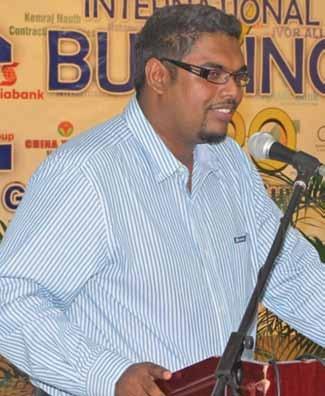
“I have instructed the GTA Director to call in the new CEO and Chairman of the board to meet with us no later than next Friday. We are taking this issue very seriously and I have also advised my colleague minister that my position would be a re-examination of the status that was given to them if the situation does not

correct itself in a timely manner.”
As to the major causes for concern and the important issues to be addressed at the engagement, Minister Ali pointed to the exorbitant ticket prices levied on Guyanese passengers coming from New York, Toronto and Trinidad, calling it “unacceptable, atrocious and disgusting and against the spirit of agreement in terms of CAL being a flag carrier”.
He opined, “I personally am aware of persons who would have bought tickets at an enormous price to come to Guyana. If you compare this to the prices other persons are paying from Trinidad, I find this to be a situation of abusing the present monopoly that they
have in Guyana, and they do have a monopoly; this is why they are taking us for granted, they are taking this market for granted and they are reaping in great profits maybe to make up for the deficiency in other markets.”
Further, the Tourism Minister also addressed the numerous complaints reaching his office over the treatment of Guyanese using the carrier, particularly as they intransit in Trinidad and Tobago by CAL staff and service agents.
Alluding to the most recent incident, where a flight out of Piarco International Airport was delayed for close to half an hour, after a New York-based Guyana national was escorted off the aircraft for al-
leged abusive behaviour, Minister Ali noted that to date CAL has not submitted an official statement on the matter.
“We cannot accept this; this cannot be in the interest of their business and in the interest of them having flag carrier status for Guyana. I intend to pursue the matter and the long, tedious harassment and delay that Guyanese go through as a result of CAL operation issues in Trinidad.”
As to the impending entry of Fly Jamaica into the Guyana market and the possibility of this airline sharing Flag carrier status, Minister Ali confirmed this and expressed the hope that Guyana will add a new airline very shortly.



To contact: Guyana Times International
New York Office
106-15 Sutphin Blvd, Jamaica NY 11435
Email: guyanatimesnyint@gmail.com
Tel no: 718-658-6804
Preferred method of contact via EMAIL Guyana Office Ruimveldt, Georgetown, Guyana. Tel no: (592) 227-0704, 227-0709. Fax (592) 225-8696, 227-0685
Email: guyanatimesint@gmail.com
Whatever doubts might have existed in the minds of some about the viability of the Twenty20 (T20) cricket franchise model of the Limacol Caribbean Premier League (CPL), as far as gaining acceptance in the minds of the fans, have now been comprehensively dissipated. In terms of viability from a financial standpoint, that will be determined after all the dust (and fireworks) have settled, but in the meantime, the franchise owners and other corporate sponsors have held back nothing in their efforts to make the tournament a success.
Up to now, the Indian Premier League (IPL) has set the bar in T20 cricket, but with eight games under its belt at this time, the Limacol CPL has shown it can organise a competition just as professional and exciting, if not better, than the IPL. There are two reasons for this happy circumstance.
As was pointed out by the owner of the Guyana Amazon Warriors, T20, as conceptualised, is fundamentally the game as it was always played in Guyana and the Caribbean.
In that sense, T20 cricket was finally being “brought back home”. No one had to tell the West Indies fans to be passionately involved in what was going on on the field. And for sure, not to have a “ball” (pun intended) off the field.
But all of this would have been known by cricket aficionados across the world, when they dubbed and embraced our game as “calypso cricket”. The doubts prompted by financial and logistical challenges in past endeavours would have to be overcome if the joint endeavour of an all-Caribbean tournament was to be a success. After all, in over a half a century of trying, the governments of the region had been unable to initiate and pull off an event of this magnitude.
The Caribbean Festival of Arts (CARIFESTA), which is one attempt in this direction, has remained a low-key affair, not really engaging the masses, or showcasing our culture to the wider world. Even in the world of business, there have been no collaborative efforts in the past to match the vision of Limacol CPL. The financial support secured by the league demonstrates that in the modern globalised and financially liberalised environment, capital for such a venture can be raised once the product is shown to be marketable. And Caribbean cricket is eminently marketable.
In this regard, Guyana can be very proud that a local corporation, NEW GPC INC, bit the bullet and put its money where its mouth was when they purchased the Guyana Amazon Warriors. They were also the very first purchaser of a franchise in the Limacol CPL.
Local sponsors quickly followed and all aspects of the marketing of the venture were nailed down. Volunteers were recruited and trained to ensure that once inside the stadium, the fans would be well taken care of with directions, flags, whistles and horns. The stands were sold out for every game –and demonstrated to the world that Guyana was “cricket crazy”. Fireworks, tassa and masquerade bands, dancing damsels, pulsating music and running commentary – and even a roaming “warrior” in full regalia – kept the stadium rocking and behind their team.
The only blot on the event was the traffic organisation. The Guyana traffic police will have to do a more effective job next year.
While there were a large number of bodies deployed at the event, it became obvious that whatever plan was in place (and we are assuming there was one), there was a need to modify it to match the conditions on the roads. Without any intent to insult the Police Traffic Department, we suggest that they ask the organisers of the Limacol CPL to bring in some experts in crowd logistics to assist them in a structured planning and deployment of manpower.
In the meantime, the NEW GPC and “business Guyana” can take a bow for building “Brand Guyana”.

By Brian KuBecK, President, sithe GloBal
Sithe Global would like to thank the members of Parliament and the members of the Guyanese public that attended our Amaila Falls Hydropower Project information workshops, which were conducted on July 31. We further express our appreciation to all Guyanese supporters and opponents alike, who have a stake in ensuring that the country makes an informed decision about proceeding with the project.
The extensive public dialogue was evidence of your vibrant democracy and commitment to a comprehensive understanding of the project.
Sithe Global strongly believes that the project will have lasting and profound benefits for the country by delivering improved electricity reliability and cost savings versus the status quo.
The math is simple. In 2012, the cost of the Guyana Power and Light Inc (GPL) generating electricity was over 19 U. S. cents/ kilowatt hour (kWh). This price is amongst the highest prices paid for generated power in any part of the world. Government subsidies currently reduce the ultimate impact on the tariff paid by GPL customers, but these subsidies come from your tax dollars.
In its first 12 years of operation, the Amaila project is expected to generate savings of 40 per cent or nearly US$ 1 billion (G$ 200 billion) compared to GPL’s 2012 cost, as the project’s tariff is expected to average approximately 11 U. S. cents/ kWh.
In years 13 to 20 of operation, the Amaila project is expected to generate savings of 70 per cent or US$ 1.15 billion (G$ 230 billion) compared to GPL’s 2012 cost, as the project’s tariff is expected to av-
erage approximately 5.5 U. S. cent/ kWh.
After year 20, the project is transferred to Guyana for free and will generate savings for Guyanese ratepayers of over 90 per cent or nearly US$ 15 billion (G$ 3 trillion) over the remaining 80-year life of the project compared to GPL’s 2012 costs, as operating costs are expected to average less than two U. S. cents/ kWh.
All of the above assumes that fuel costs never go up for the next 100 years. If fuel prices do go up, the savings go up further. The analysis further ignores the secondary benefits of cheap, reliable electricity, which will support higher growth in Gross Domestic Product (GDP) for Guyana.
The Amaila tariffs calculated above are in accordance with the Power Purchase Agreement (PPA) between GPL and Amaila Falls Hydro Inc, which is consistent with the project costs presented to the public last week. Our public presentation is available on our website (www. amailahydropower.com) and we encourage you to view it.
A number of additional questions have been raised subsequent to our workshop. As a result, we have started a question and answer page on the website. If you have a question about the project that has not already been posted, please email it to info@ amailahydropower.com.
Sithe Global has spent six years and US$ 16 million to develop this project because we believe that it will be transformational for Guyana in many ways. In addition to providing reliable electricity and substantial cost savings, the project will generate hundreds of local jobs, having a significant economic impact on the country.
The project has been vetted by numerous third-party firms and has been determined to be
Guyana’s “least cost” power option. Bids were sought and received in a transparent and fair process by five international construction firms with the lowest cost contractor, China Railway chosen.
The technical development of the project is done – design drawings supporting the start of construction are complete and have been reviewed by two independent parties, including MWH Global, one of the world’s leading hydropower design firms, in addition to China Railway. The InterAmerican Development Bank (IDB) and China Development Bank (CDB) are completing due diligence and preparing to seek final internal approvals by the end of October.
However, Sithe Global cannot continue its development efforts without the same level of commitment from our partners in Guyana. We can only proceed further if there is uniform consensus in Parliament that you support this project. Without such consensus, Sithe Global will be forced to withdraw. This is simply an acknowledgement that, after US$ 16 million and six years of intense effort by Sithe Global to progress the project, the country is not prepared to proceed. The unfortunate consequence is that it would be many years before any similar project could be resurrected and, as such, Guyana would remain saddled with a 19 U. S. cent cost of power and complete exposure to fuel price swings for imported oil.
It would be our honour to work with Guyana to carry through this important public- private partnership, if we have the collective support of our future partners. We hope you are willing to take this momentous step towards securing reliable, low-cost energy that will help fuel Guyana’s economy for generations to come.
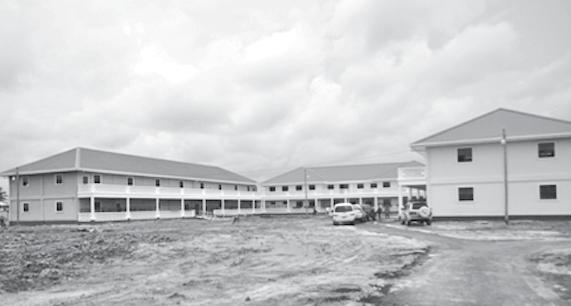
The Hugo Chavez Centre for Rehabilitation and Reintegration located at Onverwagt, West Coast Berbice popularly called the homeless shelter will be opened on Saturday, August 10, by President Donald Ramotar, and Venezuelan Ambassador to Guyana Reina Margarita Arratia Díaz.
The centre will accommodate 200 males and 100 females in separate dormitories and will include medical, recreational, kitchen, conference and dining facilities.
The US$2M
Venezuelan Government funded project which will provide refuge for the homeless in Guyana was constructed on 7.30 acres of land. Accommodation for a resident doctor and nurse has also been included in the design of the facility.
The occupants at the centre will be exposed to training programmes that are aimed at reintegrating them into their family and society. They will be afforded transportation, medical assistance and treatment, toiletries, clothing, and meals.
Guyana shares a his-
toric and friendly relationship with its frontier neighbour Venezuela at the bilateral level and through the Union of South American Nations (UNASUR).
The two countries have built on progress in trade relations with an agreement that paved the way for Guyana to export rice and paddy into the Venezuelan market. Guyana is also a beneficiary of the PetroCaribe deal, conceptualised by the late President Chavez that allows signatory countries to access fuel at a subsidised cost.



The Alliance For Change voted with the government in the wee hours of Thursday morning to pass the Hydro-Electric Power (Amendment) Bill which is necessary to bring the local law into conformity with the environmental standards of possible Amaila Project financier the IDB.
The APNU voted against the bill with chief spokesman on financial matters Carl Greenidge saying that there were still a considerable amount of questions about the project unanswered.
He also questioned why the people should take the government’s word that Amaila would result in lower electrici-
ty rates when neither the IDB nor Amaila operator Sithe Global could give that guarantee.
Prime Minister Samuel Hinds in opening the debate on the bill said the generation cost would come down from about 23 US cents to about 12 US cents per kilowatt hour. He added that in the next 20 years when the plant is handed over the cost could come down to as low as three US cents.
Greenidge called the government’s figures “heroic” since the IDB’s feasibility study was yet to be concluded and he challenged the government to resign if those savings were not passed on to consumers.
AFC’s Moses Nagamootoo in offering
his party’s support took umbrage at what he said was the “vitriol” from the government benches even though they knew that the AFC had indicated it would be supporting the bill. He took particular offence at MP Robeson Benn’s remark that it would be akin to “criminal negligence” if the House failed to pass the bill.
The bill's passage came after its unprecedented return to the House with opposition support after being voted down by the opposition parties on July 18. Also voted down that day was a motion to increase the debt ceiling from Gy$1B to Gy$150B which was also returned to the House on Wednesday.


As part of efforts to promote domestic tourism, the annual Wakenaam Nite was launched at the Tourism Ministry’s boardroom on Wednesday. After two years, the event brings with it the Miss Wakenaam Pageant, which is being resuscitated due to demand by the community.
Addressing the launching of the event, Guyana Tourism Authority (GTA) Director Indranauth Haralsingh said the event has, over the years, proven to attract investment on the island and organisers are hopeful for a similar response this year.
“We’re impressed with the level of organisation and planning of the event, and I must say that the event has been growing and expanding over the years,” he pointed out. Haralsingh added that “for an island where only roughly 3000 people
live, the event attracts over 8000 persons”, including overseas-based Guyanese.
He noted that it is a family-oriented event and therefore encouraged all to come out and support it.
Wakenaam Nite committee chairman Sheik Ahmad said the business linkages created via the event have been tremendous. “What we have experienced in Wakenaam since then, is a very strong relationship between private and public partnerships that have made us much more comfortable and happy in Wakenaam.”
The pageant will comprise talent, evening gown, casual and other segments. Seven delegates will be vying for the Miss Wakenaam crown, which was last taken by Cheeka Kunjbeharry in 2010.
The first-place winner will be rewarded
US$ 1000, while the first runner-up will take away US$ 500. Two trips for Kaieteur Falls will also be up for grabs.
This year’s event is also expected to feature a cruise ship to add to the many attractions offered. Products made on the Wakenaam island will also be on exhibition.
Following the launch of the event, the organisers and delegates of the pageant met with acting Tourism Minister Irfaan Ali, who encouraged the girls to put their best foot forward and to make their community proud. He also added that Wakenaam Nite has developed into an event that attracts a wide cross-section of Guyanese, as well as other tourists. Wakenaam Nite kicks off on August 17. Organisers are encouraging persons to come out to support the event, as overnight accommodation is available.
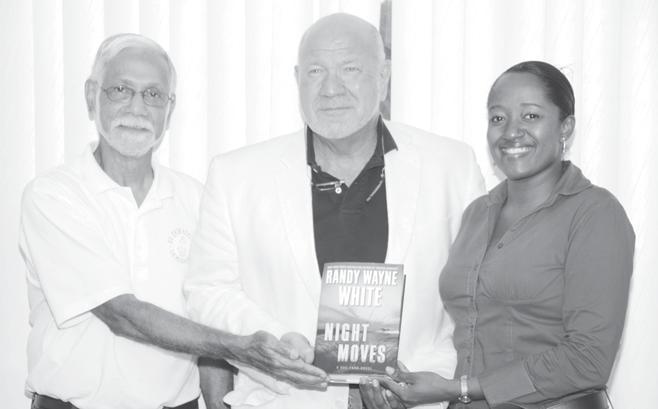
Demerara Distillers Limited (DDL) award winning El Dorado rums have spiked the interest of well-known bestselling American author Randy White, who has travelled to Guyana to gain insight as to how El Dorado rums are made and to understand the history of various rums produced by the company. He was high in praise
of the rum, relating that it captured his interest when he tasted it on one of his travels.
“After, I began reading about El Dorado, it’s not just one of the best rums in the Americas; it’s one of the finest rums in the world from this small country… I found the success and brilliance of this product quite interesting,” he stated.
During his four-day visit, he also examined
what the country has to offer as an eco-tourism destination. If his visit to the country further captures his interest, White will come back to spend time in Guyana and write about it in an adventure travel magazine he edits.
“I’ve only been here for four hours and I’m already falling in love with the people and the country, it’s an extraordinary country,” he lamented.
Anew modern ferry vessel will be acquired for the Region One service next year to reduce time and improve serviceability on the Mabaruma district route.
This information was provided by Minister of Public Works, Robeson Benn in response to a question asked by APNU’s Member of Parliament (MP), Annette Ferguson as to why one ferry only provides service to Mabaruma residents once per month.
According to Minister Benn, there is currently no consideration to assign another ferry to ply the Mabaruma district; however, the MV Kimbia which has been undergoing extensive docking works for the past months, and which provides service to this route, is slated to return to service by August 15.
Minister Benn explained that the MV Kimbia is the designated vessel for that district and currently it is docked at the Guyana
National Industrial Corporation (GNIC).
The MV Lady Northcote which operates the Port Kaituma route is currently assisting with the Mabaruma service.
Ferguson also questioned why the ferry takes 36 hours to reach its final destination from Georgetown, and was corrected by Minister Benn, who stated that the journey takes approximately 25 hours. However due to the inclement weather conditions recently, and discharging of cargo en route to Morawhanna have occasionally added to the time.
Meanwhile APNU’s MP Jennifer Wade queried whether any action is being considered to ensure that the ferry to Kumaka operates on schedule fortnightly so as to reduce losses suffered by business people.
Minister Benn advised that as soon as the MV Kimbia returns to service, this will allow for full resumption of service to the Region.
The introduction of an energy drink with coconut water from Guyana as one of the key ingredients is being conceptualised by American investors who met President Donald Ramotar on Wednesday for talks.
The product when manufactured will be sold to the high-end consumers in the United States using a marketing strategy that will promote the country and the business of local small coconut producers.
George Papanastasatos and Marim Kinkladze, the two investors met President Ramotar in the company of Allison Butters-Grant President and Chief Executive Officer of Global Connections Consultants Inc.
Butters – Grant, who is tasked with connecting investment seekers with Guyana, accompanied the duo to engagements with stakeholders, including the government, the Guyana Office for Investment (GO-Invest) and farmers

in the Pomeroon.
“We definitely found the resources (in Guyana). It’s only a matter of building the right resources for us to get the right quantities and the right quality of coconut water,” Papanastasatos said in an invited comment.
The investors are looking for the organically produced coconut water, which Papanastasatos said is the best selling in North America, even as
the practice of applying chemicals in farming is well known.
“It seems feasible and it seems that we are in the right path to make it happen relatively quickly. Luckily enough we have the right people to introduce us to the locals, Papanastasatos explained.
Coconut was the key focus of a seminar earlier this year that was aimed at devising a 2013 plan to revitalise and develop the industry and
aggressively advance the country’s agriculture diversification programme.
The seminar ended with the formulation of an oversight committee comprising coconut stakeholders who will meet monthly and preparing a national report every six months.
The acreage under cultivation for coconut is the third largest after rice and sugar. Guyana produces about 100 million nuts per year.

Caribbean Airlines Limited in Port-of-Spain has been served with writs from attorneys representing eight Guyanese passengers seeking compensation for injuries, losses and damage they suffered when Flight BW523 crash landed in Guyana two years ago.
Several other lawsuits have been filed in the New York courts, two of which were filed over a year ago. The writs were served locally on CAL on July 29, and lawsuits filed in the Guyana courts on July 26.
In response to the lawsuits, CAL Corporate Communications Director, Clint Williams, told TT media that, “it would be inappropriate for CAL to say anything at this time, because the matters are ongoing.”
According to the lawsuits filed by attorneys-at-law Sase Gunraj and Jaya Singh on behalf of the passengers, CAL is required to enter an appearance within ten days after the writ was served.
“are still waiting on Caribbean Airlines to fulfill some promises, to assist with medical expenses.”
The hearing into the matter in New York has been pending the outcome of the report of the investigations into the crash landing.
Director General of the Guyana Civil Aviation Authority, Zulfikar Mohammed, told TT media on Monday that the final report was almost complete. Once completed, he said it will be handed over to Guyana’s Public Works and Communications Minister, Robeson Benn, who is expected to make the report public. There has been several draft reports, including a “final draft” in which, a Guyanese official close to the investigations told reporters that investigators “found that the crash was due to human error.”

… don’t tell, in politics
To say that the revelation that Nigel Hughes is, and has been, the company secretary for Amaila Falls Hydro Inc (AFHI) since its formation in 2009 is a bombshell would be the understatement of the decade. Or at least, since he became chairman of the Alliance For Change (AFC). The leader of the AFC, Khemraj Ramjattan confessed that while he knew of some “association” between Hughes and the firm, his chairman hadn’t shared with him the news that the “association” was actually that of company secretary.
Now, in case some of my readers might have dozed off during previous mentions of AFHI, let me bring you up to speed. AFHI is a “Special Purpose Vehicle” (SPV) established specifically to execute all the contracts on the hydro project and, more importantly, to collect all the funds for the owners’ investment. The owners are Sithe Global (60 per cent) and government of Guyana (40 per cent).
The passengers who filed lawsuits in Guyana, six from Guyana and two from the United States, are each claiming damages in excess of Gy$1 million (TT$34,000) “arising out of the negligent operation” of Flight BW 523. The CAL-operated aircraft overshot the runway at the Cheddi Jagan International Airport on July 30, 2011. The aircraft broke in half when it stopped on a dirt road some 200 feet away from a ravine.
According to media reports out of Trinidad, among those who have filed lawsuits in the New York courts are members of an extended family of seven who
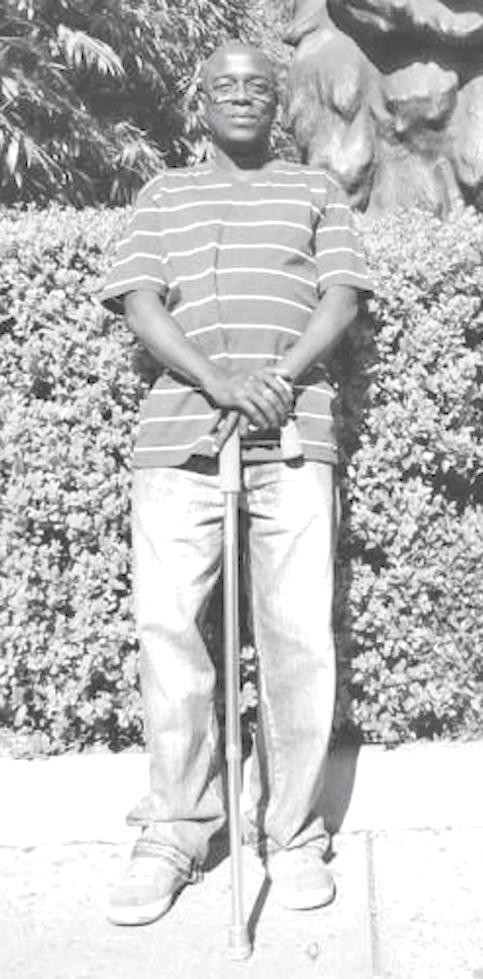
No one died in the crash, but passenger, Guyanese Noel Elliot of Washington DC suffered a broken right leg. He was hospitalised in Guyana for several days before flying to New York where the leg was amputated.
Elliot’s medical expenses were taken care of by CAL which has also outfitted him with a prosthetic leg.
He has not yet returned to work, and he is not among those who are suing CAL. “I have not sued CAL,” he told reporters (TT Newsday)
The Georgetown Mayor and City Council was the home of another protest on Tuesday, as vendors once again backed City Mayor Hamilton Green who tried to oust Acting Town Clerk Carol Sooba from office.
According to the acting town clerk, Mayor Green used his vehicle to block the entrance of City Hall, thereby preventing her from entering the compound.
The vehicle was subsequently replaced with a human barricade. Additionally, men who were described as “thugs” prevented employees from gaining access to Sooba’s office.
Local Government Minister Ganga Persaud said the action of the city mayor and his council leaves him with no other choice but to call in the Guyana Police Force. At a press conference late Tuesday afternoon, he expressed disgust at this situation, noting that it was illegal and distasteful.
“It is unfortunate that
the mayor of the City of Georgetown would have reduced himself from being mayor to becoming an obstacle. It is so unfortunate when you make yourself into a human barricade,” Persaud lamented.
Junior Local Government Minister Norman Whittaker also lashed out at Green and his supporters, describing their actions as unofficial and unorthodox. According to him, Green and his security guards not only prevented the acting town clerk and her staff from entering the building but threat-
ened them as well.
He said as a result of the threatening behaviour, the home affairs minister and the acting police commissioner were notified and will soon advise the Local Government Ministry on the next step.
As the ministry awaits the Guyana Police Force recommendations, Sooba is operating out of a private entity.
According to Whittaker, when Sooba was appointed as acting town clerk in 2012, Green had welcomed her with open arms; however, after she launched
her campaign to root out corruption, difficulties arose. No-confidence motions were moved followed by a series of protest actions, as the mayor and team signalled their non-support for the acting town clerk.
Late Monday night, more than a dozen vendors flocked Sooba’s Duncan Street residence as they advocated for the Local Government Ministry to terminate Sooba’s service.
A public meeting held by Green at City Hall earlier that day had sparked the protest. The mayor reportedly informed the vendors that Sooba was making another attempt to clear Regent Street, Water Street and other commercial areas of all street vendors.
The acting town clerk when contacted said while she will not condone any form of illegal vending in the city, she has not made any recent attempt to remove vendors. According to her, this recent protest is yet another attack by Mayor Green.
Like all incorporated businesses, AFHI will basically protect its debtors from going after its owners’ personal assets. Now a “company secretary” isn’t someone in a short skirt who takes notes in shorthand. Hughes is basically the legal officer of AFHI and in that capacity would have advised, for instance, on the entity getting the best deal – that is making the maximum profits from the Guyana Power and Light (GPL) – from the deal.
Now as AFC leader Ramjattan said, as a professional lawyer, Hughes can sell his services to whomever he wants.
We have no problem with this. What we have a problem with is that Hughes has been less than “professional” in not revealing his employment in a company that has been in the centre of a controversy precipitated by his party’s position.
Ramjattan assured us that Hughes recused himself when matters involving the Amaila Falls hydro project were being discussed by the AFC. But if Ramjattan and other party members didn’t know of how key a position Hughes held in the SPV, how can we be sure that in informal contexts Hughes might not have influenced others? Or even Ramjattan himself?
In our highly-charged political atmosphere of accusations and counter accusations of “conflict of interests” and “self-interested parties”, shouldn’t Hughes, at least, have revealed the true nature of his involvement? Like when, for instance, on June 21, he articulated his party’s position on the Amaila Falls hydro project at a press conference? Hughes’ wife, Cathy, has also been caught in this potential conflict of interest, since she was the public relations officer of Synergy Holdings Inc, the investment vehicle of Fip Motilall and his successor, Sithe Global. But at least this information has been in the public domain.
The revelation on Hughes certainly left a bitter taste on many a supporter’s tongue. … about self over patriotism
Was a time when the hunger for fame and fortune would’ve been trumped by the urge to protect one’s country. No more. Imagine that the deadline we were given by the Caribbean Financial Action Task Force (CFATF) to comply with the recommendations to amend our Anti-Money Laundering and Countering the Financing of Terrorism laws will not be met, because the opposition insisted on flexing their political muscles.
They’ve admitted they have no substantive, much less substantial, objections to the bills that they won’t approve.
If they did, why would they say they’ll approve them if the government constitutes a Public Procurement Commission? You don’t compromise so easily on something that’s of such great consequence as the opposition professes.
So now Guyana is going to be placed on a “watch list” on all international transfers of funds. And don’t think it’s only businesses that’ll be affected. They’ll just pass on the extra processing costs to you, the customers.
… about cricket crowd control
Did the traffic police throw out the standard operating procedures (SOPs) worked out during Cricket World Cup 2007? It certainly looked like that, especially during the first night of the Limacol Caribbean Premier League (CPL) at Providence. Professional cricket shouldn’t be strangled by unprofessional police.
Dear Editor,
I would like to congratulate the organisers, and the amazing local sponsors Limacol for bringing to Guyana these historic cricket matches. The Limacol Caribbean Premier League (CPL) T20 matches have brought such fun and excitement in the past week to our lives in Guyana that I wish there were more games planned for the Providence Stadium.
I went to all four of the matches at the stadium and enjoyed them thoroughly. The events were organised impeccably, except may be for some traffic issues at the stadium. But these were fixed on the next game day anyway.
What I really loved was the atmosphere at the stadium, seeing Guyanese people together and supporting the Guyana Amazon Warriors.
The organisers and the Limacol team worked zealously to ensure Guyana and
the Guyana Amazon Warriors were effectively branded all over the stadium for the world to see.
I am excited that the world saw Guyanese rejoicing and laughing and having a great time. It brought a great smile to my heart to see Guyanese in support of Guyana.
Yes, unfortunately we didn’t win the last game, but we represented Guyana so well. We fought like true warriors to the last ball of the game.
I look forward to other local companies taking such a big leap with investing in Guyana’s economy and sport entertainment in such an impressive way.
Being at the Providence Stadium during the Limacol CPL made me proud to be Guyanese. Well done, Limacol! Well done, organisers! I look forward to more in the near future!
Yours sincerely,
Sharon Dodson-Kippins
Dear Editor,
The good news and the bad sometimes go together. This is so where the Diamond Diagnostic Centre is concerned. It got a very high rating when representatives of the Parliamentary Sectoral Committee on Social Services inspected it and served out an 80 per cent rating, stating that they were pleased with the condition of the facility.
All agree that it was the Regional Democratic Council (RDC) that should be knocked a bit. The members need to shape up. Everyone within an organisation is important and if the RDC can latch on to this idea, then things will improve now at Diamond. Note, I am pinpointing things that are basically non-medical. The medical aspect was okay.
For example, it was recommended that there be a facelift and improved management to bring the hospital up to where it should be.
One such initiative is that of basic tree-planting in the compound. Then there is the issue of the replacement of tiles and seats in the various waiting areas so as to create a good first impression.
I recall visiting a doctor’s office right in Guyana. The wise practitioner had all kinds of medical paintings on one of his walls. He explained that an art student did it just for practice.
Imagine. A thing like this can be thought of for so many offices and building. Many art students would just love this idea, that is, to get to paint on a real wall. Many times, they will do it for free too, but a token is always in order.
I trust that the people at the Diamond health facility will keep their good work up and get better in those weak areas.
Yours sincerely,
Resident of Diamond Name withheld by request
Dear Editor,
I see that our youths are really being catered for. A few days ago, I heard on radio the community call for quite a few Vacation Bible Schools all over the country. Currently, there are various kinds of camps for school youngsters. These camps are being run by the National Sports Commission. I wish I were a boy all over. No one can say that Guyana is not chartering new territory for its children.
It gets better now too, as I see that the Guyana Police Force’s annual Youth Camp is fully entrenched.
The first week of August is usually when a lot of extra lessons come to an end. So until August 12, plenty of children will again be benefiting from this camp. It is being run at the Pomona Secondary School, Essequibo Coast, and the venture is getting the full support of the Guyana Police Wives Association.
In fact, these ladies are the ones doing all the work.
This year, some 200 children between the ages of seven and 12 were selected from among youths who were involved in the force’s youth clubs and scout groups.
So, it is like a continuation and enhancement of their lives.
This year the theme is “Youths,
Dear Editor, Twelve new doctors have joined the ranks of the Berbice Regional Health Authority (BRHA) and this alone says that progress calls for patience. These doctors are some of the fruits of a special and ingenious partnership between the governments of Guyana and Cuba. Since that time, hundreds of Guyanese have been sent to Cuba on a yearly basis.
They normally return
home to complete their internship and then they start their actual practice.
I congratulate these returnees who are now ready, willing and qualified to serve in the medical sector. Guyana’s few mishaps medically can almost all go back to some kind of lapse. Human beings can get tired, feel lazy and suffer from a lack of inspiration and this is what these doctors must guard against. They must also
feel privileged to serve. All great leaders went beyond the normal call of duty. Doctors truly speaking cannot come up with excuses not to serve – they cannot argue for time out and so like regular people. They have to be prepared for interruptions. So I too urge them to be very hard working and caring. After all, they are dealing with the sick.
Yours truly, R Pertab
The Berbice River Bridge has made life easier for many people
Dear Editor, I am not into aesthetics and engineering, so as far as the Berbice River Bridge is concerned, it more than suffices. I have gone repeatedly to and from Berbice and I did not have to endure the hassles of the past. That ferry thing was just too burdensome – it took like an eternity to even park and get off the boat. I was very fortunate to chat with a school teacher who told me the same thing. She ex-
plained that now she can come to Georgetown for her official administrative teaching duties, get over with them, and then head back home. In the past, she was forced to overnight in Georgetown. All that I will demand is that the bridge is properly maintained.
The Berbice Bridge Company Inc (BBCI) has now joined in the celebrations of Emancipation Day.It feted staff and other members of the public.
Now, the next thing to note is that BBCI will contemplate a price dip for special seasons – say like when there are reasons to traverse to and from Berbice – I think this is good, as many special events are held in Berbice, all year too.
The tourism sector can plan special events then, knowing that the BBCI is likely to grant a request to lower tariffs for the same.
Yours sincerely, Ganesh Dhanpaul
leading our nation.” This is sending a great message at an early age.
About 67 per cent of our prison population are young people. They have been misled or maybe not even led at all. So with this camp, it is hoped that at least 200 will not be easily swayed into anything anti-social. Now is the time to invest, for if we save the children, we are saving the youths, and we are saving the adults – the chain must start at the very beginning.
I like these topics for the camp – craft work, educational talks, road safety, religious teaching, information technology, and games and then a great exhibition to showcase the skills learnt. This is how it used to be in the days of old – all camps ended with a grand presentation. During those days too, we used to honour our country in the Vacation Bible Schools.
I noticed that the police camp has that element of religion. The two - God and state, must co-exist.
I hope we all learn from this and I call for more organisations, government and others, to have these in-house camp sessions. They are not that costly, and they afford a lot to the adults too. They end up learning a lot.
Yours sincerely,
Josephine McAlmont

BY SVETLANA MARSHALL
The suite of local government bills
key to the holding of local government elections not held since 1994 was on Wednesday passed in the National Assembly with a number of government-sponsored amendments. The passage of the bills will now await the assent of President Donald Ramotar before local government elections could be held.
Late Wednesday night, the Fiscal Transfers Bill 2012, the Municipal and District Councils (Amendment) Bill 2012, the Local Government (Amendment) Bill 2012 and the Local Government Commission Bill were passed unanimously.
Initially, Local Government Minister Ganga Persaud moved a motion for the Fiscal Transfers Bill 2012 to be read in the House for a second time. The bill seeks to enhance the autonomy of local authorities in Guyana and assist in their quest to become financially viable.
Formula Persaud explained that the bill introduces a formula which allows governmental support to the 65 neighbourhood democratic councils (NDCs) and six existing municipalities.
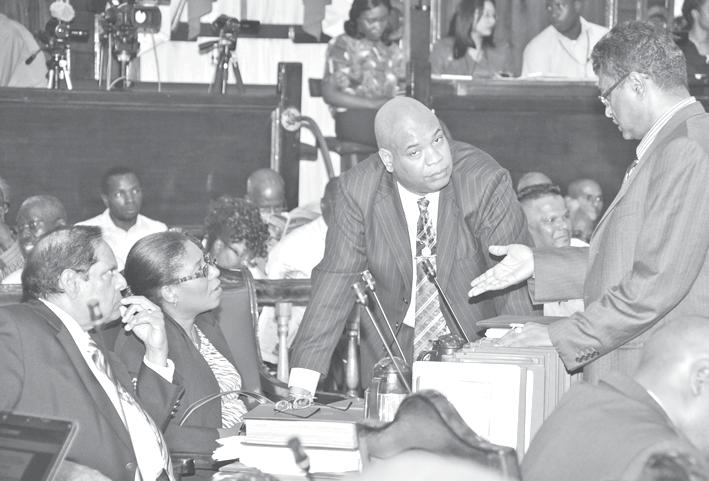
However, he noted the Georgetown municipality is treated differently when compared to the other local government organs.
Junior Local Government Minister Norman Whittaker in supporting the Fiscal Transfers Bill 2012 told the National Assembly that currently local government organs depend heavily on revenues derived from rates and taxes, markets and subventions from the government of Guyana. However, funds have proven to be difficult to garner, resulting in NDCs and municipalities being unable to effectively execute their duties.
“It is in this context Mr Speaker, that the fiscal bill, adoption of other revenues sourcing measures is to be welcomed. Including among these be it negotiating with central government for specific revenues, sharing contract... and embarking on other revenue
earning projects is welcomed.”
Not problematic
A Partnership for National Unity (APNU) Member of Parliament Basil Williams, who chaired the special select committee that scrutinised the bills, said the finalisation of the bill had not proven to be problematic. He used the opportunity to applaud members of the committee, especially the People’s Progressive Party/ Civic (PPP/ C) members for the integral role played in the creation of history.
Support
Following the debate on the final bill, the Local Government Commission Bill 2012, the Alliance For Change (AFC) supported the ruling party. At the level of the special select committee, the AFC and APNU had collaborated on the composi-
tion of the commission.
They had agreed to have the president appoint three members to the commission, another three based on the recommendations of the opposition leader and one appointed by the Appointment Committee of the National Assembly, while the PPP/ C had signalled its disapproval.
However, during the debate late Wednesday night, AFC Leader Khemraj Ramjattan said “We believe that there is an element of compromise that the AFC can bring to this bill to ensure that the administration is accommodated in how it feels about the composition of the Local Government Commission.” As a result, the AFC voted in favour of the amendments brought by the government.


Alexei Ramotar
said the development of a strong Information Communication Technology (ICT) infrastructure can work to eliminate inefficiencies within traditional sectors and has the potential to become an important avenue for economic development.
Ramotar noted that not only does ICT act to remove the weaknesses of traditional sectors, but also in itself, it has become an important part of the services sector; creating jobs from small single-entity businesses to large firms.
“With a general trend in Guyana of young people being trained and looking for high- skilled, non-traditional professions, ICT opens a new avenue,” the project head said.
Infrastructure
According to Ramotar, this is an issue that has been recognised by many countries in the world. However, it has also been recognised that a strong infrastructure is required to push such an agenda. This is the reason behind government’s thrust to not only enhance the government services offered to the people, but also radically transform the ICT infrastructure of Guyana and bring it more on par with the rest of the Caribbean.
Ramotar stated that approximately all major government agencies and offices are within the coverage area. He disclosed that the network is also designed to be easily extendable and will provide various services, including in areas of health, education and security.
Ramotar explained
that electronic health will allow for video consultation among medical personnel, movement of information from one health facility to another and also for purposes of tracking disease outbreaks. With regards to security, e-governance is expected to allow for swift transmission of information, including video and data between police stations.
e-library
As it relates to education, plans are in train for the establishment of an e-library allowing a central repository of books that can be used by students and schools, thus lowering the cost and allowing for equal opportunity.
The E-governance Project consists of three parts; namely the data centre, the transmission network and the access network.
The data centre acts as the control centre for the network and has the ability to add e- governance services.
The users and control of sites is controlled from the centre which is located in the Castellani House compound. The transmission network extends from Moleson Creek in Berbice to Charity on the Essequibo and from Lethem in the Rupununi through Linden to Georgetown.
It consists of a fibre network and microwave network. This fibre will be available from Lethem to Georgetown, Moleson Creek to Parika and microwave will be available from Moleson Creek to Charity.
The access network provides for all major government facilities in the coverage areas to be connected via fibre and or 4G wireless cellular services.

Guyana Telephone and Telegraph Company (GT& T) has launched its cellular service at Kurupukari, Region Eight (Potaro/ Siparuni), bridging the telecommunications gap along this important southern corridor. The site, which has now come into operation, will provide vital telecommunication services for residents of Kurupukari, the Iwokrama Centre and its environs as well as passengers travelling along the Georgetown/ Lethem route, GT& T said in a release.
GT& T only six weeks ago turned on its Aranaputa Valley cell site, providing service to several North Rupununi communities.
“In this age of Information Communication Technology, we cannot afford to leave our communities behind that they suffer because of the lack of these essential communication services. These investments signal GT& T’s continued interest in its rural network expansion programme, which often does not net immediate returns but are undertaken with the community’s needs and interests in mind and GT& T’s corporate social commitment,” the company said.
“Over the next few months, Guyanese can look forward to continued expansion programmes aimed at strengthening GT& T’s infrastructure
Amid the controversy surrounding the National Learning Channel and Television Guyana Inc contract, it was disclosed that at the time of the channel’s establishment, there were no other entities that could have provided the transmission services which TVG offered. This was disclosed by Education Minister Priya Manickchand, in response to questions posed to her by Alliance For Change Member of Parliament Catherine Hughes.
Sometime in June, Hughes had posed several questions to the education minister about the contract between TVG and the learning channel, and the channel’s operations.
or construction, and no reasonable alternative or substitute exists”.
Contract
In answering Hughes’ questions, Minister Manickchand disclosed that the contract was signed in 2010 for a period of five years and as of December 2011, the sum of Gy$ 3 million per month has been paid to TVG for its services.
Hughes had asked the minister how many persons are employed by the learning channel and from which communities they hail. The education minister replied that the learning channel currently has six full-time, six part-time and two temporary employees.
Orealla, Kwakwani, Linden, Lethem, Annai, Aishalton, Mahdia, Port Kaituma, Mabaruma, Bartica, Morakaibai, Anna Regina, Karasabai, and Ituni. She revealed that there are 17 antennas, 20 dishes, 17 receivers, and 16 dish stands, which were bought along with the installation services from TVG at the price of Gy$ 6.987 million.
The minister added of the 17 antennas, two are located in Georgetown and one each in the other communities mentioned.

cast network, which focuses solely on education and strives to maintain 30 to 40 per cent local content.
and providing quality and reliable telephony services.
“This investment has been applauded by key stakeholders who stand to benefit from the much needed telecommunications services that will ultimately result in enhanced living standards of residents in the service area,” the company added.
MMC Security Force Operations Director Silas Brummell said it is “a welcome service that will help reduce the cost of communication and of doing business generally for persons residing in this area and those transiting this very important North South corridor of Guyana. This tower now makes for a more seamless coverage of remote areas in our country.”
Iwokrama
International Centre for Rainforest Conservation and Development, Resource Management and Training Director Dr Raquel Thomas-Caesar also endorsed the investment, saying “We are very excited about this new development as it will increase opportunities for development, especially our social and business development activities, including tourism. This technology will greatly improve our communication from the standpoint of health, security and safety.We applaud GT& T and wish the company great success in this latest venture.”
The minister said in her response, that all the matters surrounding this issue were “extensively” dealt with at a press conference held in April and as such, she provided a copy of the speech made by the head of Guyana Learning Channel, Dr Seeta Roath. She also made available, as requested, a copy of the contract between TVG and the learning channel.
Access
Manickchand, responding to Hughes’ question about when the tender was published for the service and in which media, explained that there were no other entities offering this service at that time; however, TVG was in the process of procuring the service, which allows all communities across Guyana to access programmes aired on the learning channel.
The minister asked that if the opposition MP is knowledgeable of any other company in existence with the same criteria, then she can make that information available.
The minister further explained that the services from TVG were obtained using the single-source procurement method under the Procurement Act of 2003, Section 28 (a), which states: “The procuring entity may engage in single-source procurement when – the goods or construction are available only from a particular supplier or contractor, or a particular supplier or contractor has exclusive rights with respect to the goods
She noted that the other personnel, such as studio teachers and scriptwriters, are contracted as needed, adding that the company hires the best skill for the best price available.
Manickchand continued that the learning channel has its own satellite receivers/ dishes, which are located in Georgetown, New Amsterdam, Benab,
In answering in which geographical areas the learning channel utilises equipment of the two local telecommunication companies for the purposes of broadcasting its programmes, Manickchand noted that the Guyana Telephone and Telegraph tower at Benab and the Digicel tower at Moira Point are used.
The Guyana Learning Channel is a non-commercial, apolitical, educational broad-
In 2010, the company entered into discussions with TVG and a final agreement was concluded in the same year. The agreement requires TVG to provide the channel with a guaranteed satellite transport network service.
The learning channel has more than 200,000 viewers and reaches far and wide in Guyana, including areas such as Annai, Lethem, Aishalton, Kwakwani, Port Kaituma, and Mahdia.

ACaribbean Airlines (CAL) flight bound for Guyana out of Piarco International Airport was delayed for close to half an hour on Monday after a New York-based Guyana national was escorted off the aircraft for abusive behaviour toward flight attendants.
According to a Trinidad Guardian article, Mark Anthony Wong, who boarded BW425 at the JFK International Airport in New York, was travelling with his wife and three young children at the time.
He reportedly became abusive when the flight, due to depart at 07: 20h was delayed without
explanation at Piarco. Passengers awaiting departure of the flight had initially been informed of a 06: 20h boarding time, a process that did not begin until close to 07: 00h. As a result of the incident, the flight was further delayed and did not leave until close to 08: 00h, arriving at the Cheddi Jagan International Airport shortly after 09: 00h. Wong had been noisily protesting the initial delay and reportedly used obscene language against the cabin crew. He was repeatedly cautioned and airline security was eventually summoned. They were followed by uniformed Airports Authority of
Trinidad and Tobago (AATT) security officers who led him off the plane.
One airline source said Wong was to be detained in order to “cool off” before being put on the next available flight. His family remained on board. The incident led to vociferous protests by other passengers who had themselves criticised the lack of an explanation for the delay. Most of them had flown into Piarco from JFK International. The flight crew, however, described Wong’s behaviour as rowdy and potentially threatening.
The flight was captained by pilot Sean Crooks.
The following is the text of Mayor Michael R. Bloomberg’s weekly radio address as prepared for delivery on 1010 WINS News Radio for Sunday, August 4, 2013.
“Good Morning. This is Mayor Mike Bloomberg.
“East Midtown has long been one of the world’s premier business districts, and it’s played a central role in making New York the job-creating economic engine it is today. It’s also home to Grand Central Station, a crucial transit hub that millions of people pass through every day. But East Midtown and Grand Central both face major challenges – challenges our Administration is working hard to address. Last week, our plans to strengthen the neighborhood’s future took an important step forward.
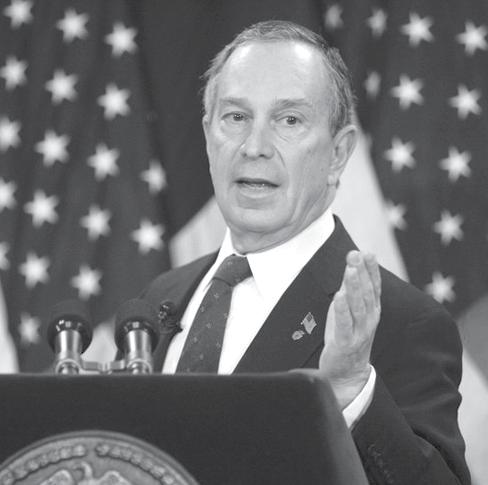

“Because of outdated zoning rules that effectively prevent new office buildings from being built in the area, East Midtown is losing its competitive edge to keep and attract businesses –and that could mean fewer jobs for New Yorkers and lost tax revenue to invest in our schools, parks, and neighborhoods. Proposals to modernize the zoning regulations have been discussed for decades, but nothing has happened. At the same time, Grand Central is too congested, as anyone who has taken the 4/5/6 subway line knows all too well. That congestion affects riders along the entire line, from Brooklyn to the Bronx.
“Our Administration has submitted a rezoning proposal that would help tackle both of these issues. It would permit development of a limited amount of modern, 21stcentury office space, crucial to keeping the area a competitive, thriving business center. And by requiring those developers to contribute major funding to infrastructure enhancements, our proposal would improve the commute to and through Grand Central by easing train and commuter traffic at the station. That funding would also bring more outdoor public space for pedestrians in the area. Other places around the city where we’ve made those kinds of improvements – from Queens Plaza to Times Square to Chelsea and the Flatiron District
– are attracting fastgrowing businesses and bringing pedestrians new open spaces to sit, eat lunch, and relax.
“Without the funding our proposal will generate, these improvements to East Midtown may never happen. The MTA doesn’t have capital money in its budget to make the enhancements Grand Central needs. That’s why last week, we announced that the City will provide funding for mass transit and open space improvements immediately upon passage of the East Midtown rezoning. That funding will help set the stage for sustainable development – and under our plan, it will then be paid back to the City by the developers who, thanks to our rezoning, will be able to bring modern office space to the area. This new plan is a great deal for the City: It’ll bring benefits to the public far more quickly, and they’ll be entirely paid for by developers attracting new businesses and jobs.
“East Midtown has a remarkable history – but if it’s going to have a strong future, we have to act now. Many of New York’s leaders understand that –including Manhattan’s Borough President, Scott Stringer, who endorsed our new rezoning plan last week. We’ve worked closely with Borough President Stringer, City Council Member Dan Garodnick, and other elected and community leaders to ensure our plans strengthen the neighborhood and the long-term health of our economy – and we’ll continue working to make them happen in the weeks ahead.
“This is Mayor Mike Bloomberg. Thanks for listening.”

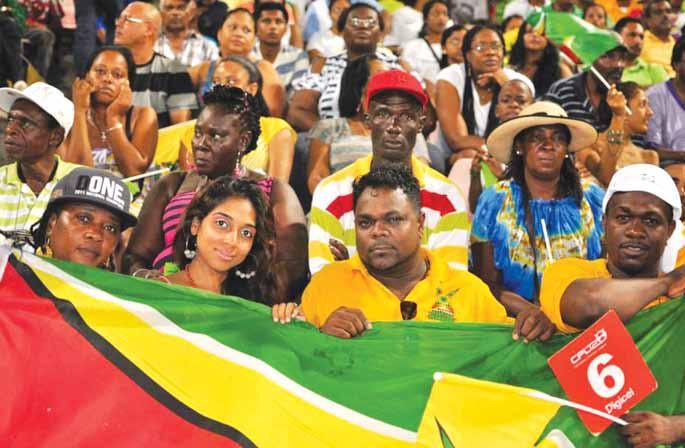
The Guyana Amazon Warriors on Tuesday visited the Guyana Red Cross Children’s Convalescent Home to interact with and share goodies to the children there. The warriors during their visit also handed over a cheque, which was presented by Captain Ramnaresh Sarwan to Administrator Erwin Enmore.
The financial donation comprised fines imposed on the players in keeping with rules laid down by the management team along with other donations from the players.
Sarwan, speaking on behalf of his team, said it was the team’s hope that the donation would assist in a meaningful way.
“We do hope that it would make a meaningful and worthy contribution to their lives in whatever way the administrators sees it fit for,” he stated.
Administrator Enmore, in his remarks, wished the Guyana Amazon Warriors all the best in their remaining matches of this year’s Limacol Caribbean Premier League (LCPL).
The Amazon Warriors came out on


top in their matches against Trinidad and Tobago Red Steels and Jamaica Tallawahs, but lost their third match – a well-played home game to the St Lucia Zouks Sunday.
The Amazon Warriors will take on the Red Steel at the Queen’s Park Oval this Friday, then they will come up against the Barbados Tridents in the opening encounter of Sunday’s doubleheader, which will see the Red Steel and Antigua Hawksbills meet in the feature game.
When asked about the team’s defeat at the last home game, the captain admitted that the team did not bat as well as they had planned to. “We did not bat as well. I think we could have scored 15 more runs… that is behind us now and we just have to focus on the remaining matches we have to play,” he said.
Sarwan said it was very important that the team wins the four remaining games, as every game played is important and it is necessary to maintain a winning streak.






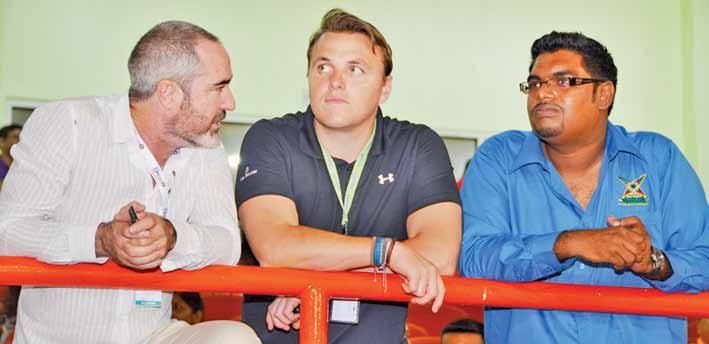







The third International Congress regarding the Biodiversity of the Guiana Shield got underway on Monday in Paramaribo, Suriname with a keynote address by former President Bharrat Jagdeo. The congress, which was attended by more than 200 participants from Guiana Shield countries – including Guyana, Suriname, French Guiana, Venezuela and Brazil – catered to a diverse audience which included policy representatives, NGOs, the academic community, and indigenous communities.
Jagdeo was invited by the organisers in the capacity of expert in the area of biodiversity and economic development, and in his address, highlighted the threat to global biodiversity from climate change. He made reference to the current warming trajectory, which could see the world warming by as much as four degrees Celsius by 2100 if urgent action is not taken and the catastrophic effect this will have on biodiversity.
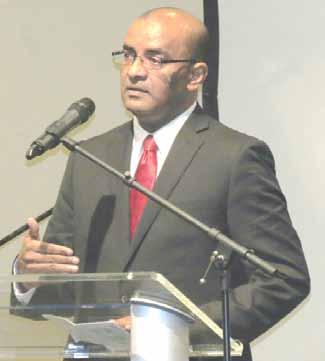
In giving recognition to the Guiana Shield as one of the last remaining eco-regions with intact forests and biodiversity, Jagdeo encouraged participants to look at new research and new approaches to mobilise people of the region to action. He advocated that more work needed to be done at the political level and with the general public to raise awareness on climate change and its impacts as well as how we can take lo-
cal action to protect the region’s biodiversity and people.
Reference was also made to Guyana’s Low Carbon Development Strategy as one of the first examples of incentivising biodiversity conservation and ecosystem protection, while promoting sustainable livelihoods and a green economy. Guyana’s efforts towards establishing a world-class Centre for Biodiversity were also recognised.

Finance Minister Dr Ashni Singh Monday evening described as unconscionable, the move by the parliamentary opposition to delay passage of the amendments for the Anti- Money Laundering and Countering the Financing of Terrorism Act, required as a result of the Caribbean Financial Action Task Force (CFATF) review process.
In making these comments, the minister was referring to the opposition’s insistence on Monday to adjourn to October the committee examining the amendments, thereby destroying any chance of the amendments being passed before the August 10 parliamentary recess.
The minister pointed out that the opposition is well aware that in order to achieve the deadline given to Guyana by CFATF, it would be advisable for the amendments to be enacted before the recess.
They are also aware of the consequences of non-enactment, making their actions reckless and inimical to the national interest, the minister stated.
Minister Singh emphasised that the bill has been in the hands of the opposition for several months and had benefited from detailed scrutiny in a special select committee that had met nearly 15 times starting from May 8.
The government has exerted every effort to ensure timely passage of these amendments, Minister Singh stated, and the opposition has frustrated this objective at every available opportunity, the worst example being Monday when they used their majority on the committee to refuse to consider the committee’s report and instead to adjourn the committee to October.
Meanwhile, in a statement of its own, the A Partnership for National Unity ( APNU) said the consideration of amendments to the Anti-Money Laundering and Countering the Financing of Terrorism (Amendment) Bill in the Special Select Committee has been adjourned to October 2013.
At the meeting on Monday, the APNU said the opposition members (who were all in attendance) objected to the manner in which the committee chaired by Peoples Progressive Party/ Civic (PPP/ C) Member of Parliament ( MP) Gail Teixeira was attempting to conclude the work of the committee, without giving full consideration to serious issues raised by members of the committee and Guyanese citizens in general.
A major concern has been the matter related to the appointment and function of the Financial Intelligence Unit. The APNU said it is to be noted that very early in the
life of this committee, the governor of the Bank of Guyana, Lawrence Williams made a firm recommendation that the obligations placed by the principal act, sections eight, nine (three) (a) and 21(d) should be placed within the purview of the Financial Intelligence Unit. This recommendation has not been dealt with in a satisfactory manner by the committee, the APNU said.
“The opposition also had its own recommendations with regards to the appointment of the head of the Financial Intelligence Unit. We feel that this was too important an appointment to be left in the hands of the minister of finance,” the APNU said.
The APNU said it feels strongly that the government has failed to address the entire act, and has not allowed for the important input of the broader civil society in the process; or allowed space for the weaknesses of the parent act to be accommodated.



BY SABATINI DANIELS
The long awaited 1823 Slave Revolt monument was on Monday evening unveiled by President Donald Ramotar at a ceremony that featured a series of pan African rituals and dances. Two students of the Kuru Kuru Training College assisted the president in the unveiling of the monument, which was witnessed by several government ministers and other officials.
The monument, located along the Kitty sea wall, Carifesta Avenue, opposite the Guyana Defence Force, was designed by Guyanese sculptor Ivor Thom.
Delivering the feature address at the event, President Ramotar underscored the important role the 1823 Demerara Uprising played in securing the freedom of the African slaves.
“The 1823 uprising, given its numerical scale, its economic effect and impact and its social consequences… is credited in influencing the decision to end slavery in all of the British colonies,” he said.
Deeply moved
In light of this, the

president stated that he was deeply moved to be part of the unveiling of the monument as he noted the significance in honouring the dead heroes of the 1823 Revolt. He said the monument is a dedication to the country’s historical past and a national recognition of Guyanese ancestors who endured and overcame, to secure freedom for themselves and their descendants.
Ramotar said 190 years after the famous revolt, the country still faces many struggles
which it needs to overcome. The president said Guyana is a poor developing country which operates in an international environment that is generally not in the favour of poor developing countries.
“There are still many, sometimes invisible chains, that try to keep us exploited and this is where we must use the experiences of our ancestors to work with others in similar circumstances to try to improve these conditions for development and end inequality
left forgotten, the nation will be robbed of a significant legacy of the struggles of their ancestors.
He explained that after the government decided to build the monument, his ministry established a site Selection Committee and 10 villages were identified on East Coast Demerara and five places in Georgetown, includ-
current site as the best and it was endorsed by the ministry, which proceeded with preparations to build the monument.
The minister said after work began on the site and was far advanced, a request was received to change the site; however, he added, “we were not able to accommodate that belated request and we regret the controver-

that exists so much in the world.”
Meanwhile, delivering brief remarks, Culture Minister Dr Frank Anthony stated that the monument is an important part of Guyana’s history, and if
ing the Parade Ground and the current location of the monument.
Current site
He pointed out that after examining the various possible sites, the committee identified the
sies that erupted around the site.” Nevertheless, Dr Anthony said it was time the purpose for which the monument was built be remembered and the past controversy forgotten.


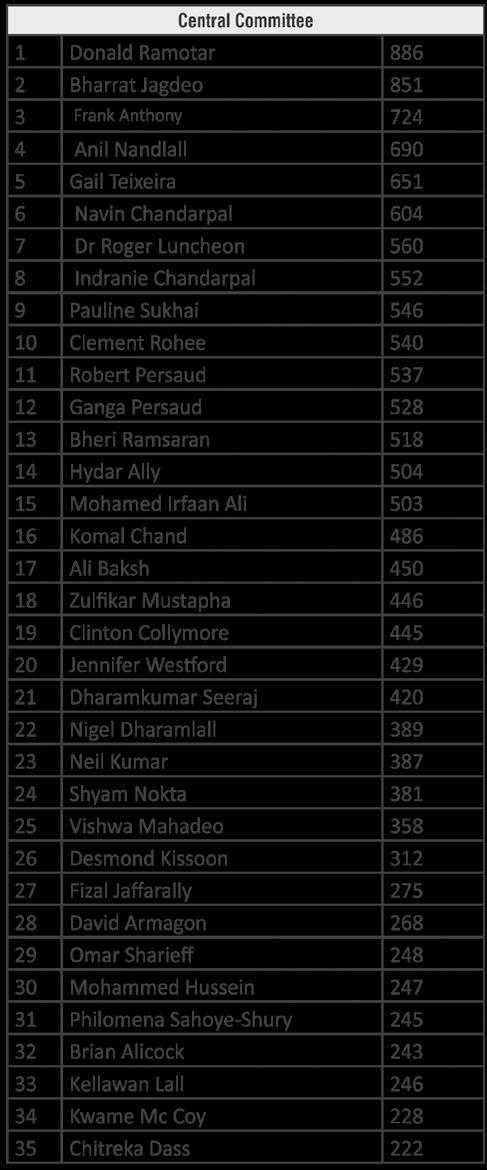
President Donald Ramotar and former President Bharrat Jagdeo emerged as the top candidates when the People’s Progressive Party (PPP/ C) 30th Congress voted for persons to sit on its Central Executive Committee. Ramotar polled 886 votes, while Jagdeo secured 851 to occupy the first and second spots respectively.
Culture, Youth and Sport Minister Dr Frank Anthony copped 724 votes to come in at third, followed by Attorney General Anil Nandlall with 690 votes, Gail Teixeira 651, Navin Chandarpal 604,
the PPP/ C government to continue to work tirelessly to deliver higher levels of goods and services to the people of Guyana.
These include health, housing, education, water, jobs and entrepreneurial opportunities; the mobilisation of the Guyanese masses to support the identified higher level of infrastructure development – Amaila Falls project, the Marriott Hotel, the road to Lethem, a deep-water harbour, a new crossing over the Demerara River, the Cheddi Jagan International Airport (CJIA) expansion – and
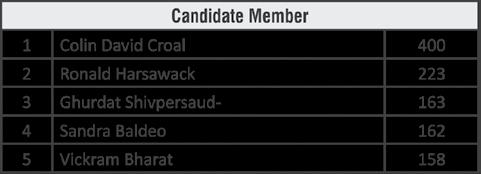
Dr Roger Luncheon 560, Indranie Chandarpal 552, Pauline Sukhai 546 and Clement Rohee 540, round off the top 10 candidates.
Press and publicity officer at the Officer of the President Kwame McCoy was among some of the newcomers in the committee with some 228 votes.
Meanwhile, in a statement, the PPP said the clarion call of the delegates to the 30th Congress, which concluded on Sunday, is for
to intensify community activism to address development at the local/ community level.
A success
The congress, the party said, was hailed by delegates and observers as among the most successful as it saw a higher level of participation and enthusiasm to stand by the party in bringing together the masses to realise a Guyana of peace, progress and prosperity.
The Congress was held during August 2 to

Participating delegates and observers came from party groups stretching across the 10 administrative regions of Guyana, inclusive of significant hinterland delegations.
Ministers of government, members of the diplomatic corps, representatives of fraternal organisations, both locally and overseas, representatives of the Women's Progressive Organisation (WPO) and the Progressive Youth Organisation (PYO) joined party delegates and observers for a dynamic opening ceremony which set the tone for the subsequent plenary sessions over the three days.
A major highlight of the congress was the report of the Central Committee delivered by the general secretary, President Donald Ramotar. The report analysed current political, socio-economic conditions in Guyana and the impact of the international political and economic environment.
The Central Committee Report was an occasion for in-depth
National Commission for the Family Chairman, Reverend Dr Kwame Gilbert believes there is need for intervention in the form of outreaches to communities, in order to address the upsurge of violent behaviour being played out in society.
During a telephone interview with Guyana Times International, Dr Kwame Gilbert said many citizens are publically expressing outrage at the sudden increase in murders taking place in Guyana, due to such violent behaviour.
He believes this tragedy is occurring as a re-
sult of mental instabilities, for which early help is needed when detected.
As such, to curb such mental behaviour that can lead to physical abuse, Dr Gilbert said there is need for a continuous national discussion on behavioural change and its consequences.
He said outreaches should be hosted by the relevant authorities, with the help of religious bodies to engage families and communities, with the aim of sensitising them.
Such activities Gilbert noted, would allow family members to seek immediate intervention and for their con-
cerns to be addressed.
Dr Gilbert also emphasised the need for persons to report any suspected violent acts.
With reference to a recent Trinidad report in which president of the Inter-Religious Organisation Dr Harrypersad Maharaj said that the country needs to stop just praying and start acting, Gilbert said both facets are interrelated.
Maharaj made the statement in response to reports that gunmen in Trinidad had killed seven people between last Friday night and Saturday morning and three more persons be-
tween Saturday night and Sunday morning.
However, Gilbert clarified that while more involvement is needed from the religious community in Guyana, more action is indeed.
Gilbert concluded that the authorities need to explore every possible means of intervention necessary to control and ultimately eliminate violence in the country.
A number of recent incidents, including murders and robberies, can be summed up as evidence of the recent upsurge in the spate of killings occurring in Guyana.
On July 26, Gregory
Elvis Fernandes, 24, of Mandela Avenue, West Ruimveldt, Georgetown was shot once to the head and once to his chest during an argument over a vehicle.
Six days after, Richard Lord, 26, formerly of Wales, West Bank Demerara hacked his two children to death at Zeelugt, East Bank Essequibo and left his reputed wife Nazalena Houston, 26, hospitalised.
The woman reportedly lost her left hand and three fingers from her right hand.
Meanwhile, on August 2, the body of Delon Melville, 26, of
discussion on the way forward in the present situation where the party operates from a minority position in Parliament.
Obstacles
It also pinpointed the key obstacles placed by the political opposition in stymieing national development and undermining the democratic gains of the people of Guyana. The Central Committee Report also emphasised the need to seek alliances and forge a national consensus to defeat the anti-national position of the opposition. The delegates rallied around the party to heighten the struggle for the realisation of the Amaila Falls project.
There were workshops on the party, youth, women, local government, the political situation, Parliament, elections, and the regional and international environment.
The reports and recommendations from these workshops were adopted and will be reviewed and implemented by the leadership in the coming period.
Lot 134 Nelson Street, Mocha
East Bank
was discovered in a backdam about a mile from the vil-
His
eral stab wounds. And as recent as August 4, an ex-soldier hammered his wife to death in their Jonestown, Mahaica, East Coast Demerara home and then took his own life.
The subsidy announced to assist pensioners to pay their electricity bills is expected to be implemented by September this year, Human Services and Social Security Minister Jenifer Webster said.
During a programme aired on the National Communications Network, Webster indicated that the ministry has been working with the Guyana Power and Light Company (GPL) to have all pensioners entitled to a government subsidy placed on the GPL database.
She explained that the system will work through using the same mechanism as was used for the water subsidy.
GPL recently said it had identified more than 6000 pensioners on
its customer base that will benefit from government’s annual provision of Gy$ 20,000 as assistance for the payment of electricity charges.
The company has received a list of 12,000 pensioners from Regions Two, Three, Four, Five, Six and Seven thus far from the ministry. Minister Webster is encouraging pensioners to contact the ministry or the GPL office in their region in order to benefit from the offer.
Pensioners are to take along their National Identification card, their pension book and their GPL bill. She urged pensioners in the regions to contact the GPL offices or the Probation and Social Services office in their region. “We are working to ensure that the process is concluded
as soon as possible in a coherent manner,” she stated.
The minister explained that the subsidy will be paid to GPL and credited to the pensioner’s account.
The amount will be credited to the account until it is utilised based on their use of electricity. GPL will use the listing of names provided by the ministry and match it with their own database in order to compile a database for the persons to benefit from the subsidy.
The sum of Gy$ 590 million has been allocated in the 2013 budget for this annual benefit afforded to pensioners by government.
This is in addition to the waiver of pensioners’ water bill to the Guyana Water Incorporated.

People’s National Congress Reform (PNCR) Leader
Brigadier (retired)
David Granger met scores of Baracara villagers to listen to their problems and to encourage them to embark on agro-processing and micro-enterprise projects.
Baracara, a remote settlement located about 80 kilometres up the Canje River in East Berbice, Corentyne region, is one of the oldest, continuously occupied communities in the country.
It has, however, suffered administrative, infrastructural and economic neglect from both the regional administration and central government, the PNCR said in a statement.
According to the
PNCR, villagers expressed their concern about rising unemployment of school leavers and the dysfunctional public education system which is producing an unmanageable number of dropouts. There are no central electricity, telephone or pure water supply systems.
Villagers also raised a wide range of local concerns – including the high cost of transportation to the coast and lack of proper sporting and leisure facilities for young people – in their historic community. Farmlands are frequently flooded and their crops and cattle suffer.
Granger learnt also that students attending secondary schools in New Amsterdam do not

Amere decade ago, it was practically non-existent; today, Guyana boasts a thriving tourism sector, with tremendous potential and aspects that can be compared to any of the popular tourist destinations in the region. For Guyana Tourism Authority (GTA) Director Indranauth Haralsingh, the sector can help to transform the country. He explained that tourism is part of the service and export-oriented industries.
“Even though we are at a fledgling stage, we have made a lot of headway as a tourism destination… our popularity has been growing, we are known as an eco, nature and adventure tourism destination,” Haralsingh said.
In recent years, Guyana has been ranked by numerous tour companies, international travel publications and given very good branding and endorsements. It was labelled “God’s Garden”, a birder’s paradise, the hottest new tropical birding destination; listed as one of the top 20 places to visit and in the top 100 adventure destinations of a lifetime.
The country is also well known for its rich cultural heritage, pristine forests, rare and endemic species of animals, and indigenous communities.
Today, the number of tour operators has also increased significantly and there has been more participation in international trade shows.
have access to a hostel, a facility that is usually available elsewhere to hinterland students.
The PNCR Leader said central government and the regional administration had roles to play in addressing the villagers’ concerns.
Granger challenged the community to turn their distress into success by creating valueadded products through agro-processing and the promotion of cottage industries.
The PNCR leader was accompanied on his visit by three A Partnership for National Unity (APNU) parliamentarians – Annette Ferguson, Jennifer Wade and Winston Felix – and Region Five and Six councillors.
The most recent such activities were hosted in Canada and New York, and the GTA is now looking to take similar events to countries in the region such as Barbados and Trinidad and Tobago. In June, Guyana was prominently featured in the Fortune 500 magazine.
Additionally, on August 16-18, Guyana will be represented at the British Bird Watching Fair.
Over the last 10 years, visitor arrivals have been increasing significantly in Guyana. Last year, there was a recorded figure of over 175,000 visitors compared to 10 years ago when it was merely 70,000 to 80,000. As of June this year, the GTA recorded an 11.5 per cent increase in arrivals compared to the corresponding period last year. This increase is in spite of the fact that Delta Airlines is no longer operating in Guyana and the increased fares by Caribbean Airlines.
He added that for the first time, arrivals are being recorded from oth-
er ports of entry such as the Ogle International Airport, where LIAT has recently commenced operations.
The issue of cheap flight to and from Guyana is one of the challenges that the government has been grappling with. However, much effort is being made to negotiate with and encourage various carriers to extend their services to Guyana.
Haralsingh said discussions are ongoing with China Airlines, Jet Blue, West Jet and Air Canada, among others. “We are speaking with lots of airlines and revisiting our strategy so that we can attract more carriers to Guyana,” he said.
Meanwhile, a number of other proposals have been received from companies such as Fly Guyana, which is expected to commence operations in October this year. Fly Jamaica, on the other hand, is expected to start flying to Guyana later this month.
Investment
Haralsingh said that “visitor arrivals is a very good indicator of the health of tourism in Guyana, and the level of investment is another indicator; it shows the confidence that people have in the economy”.
Investments such as the Marriott Hotel, the expansion of the Cheddi Jagan International Airport (CJIA), and the Amaila Falls project will catapult the development of tourism in Guyana.
This fact is fully recognised by the private sector and many privately-owned entities in the hospitality industry are following suit by either upgrading their existing facilities or establishing new ones.
Guyana is rapidly becoming a popular film and documentary destination.
At present, the Discovery Channel is in the country filming an entire season (10 episodes) of the popular show “Gold Rush”. Last year, this show was filmed in Guyana and was a major success.
Meanwhile, in September, BBC One will be in Guyana to film “Hunt”, another popular series, which will see the showcasing of Guyana’s harpy eagle. All of these activities are significant investments.
The Discovery Channel alone is investing over Gy$ 2 billion to produce and broadcast the 10-part series that is presently being filmed.
The GTA continues to host familiarisation trips to help to expand its sales and distribution network and ensure that Guyana gets into major publications and travel guides.
The late former First Lady of Guyana Viola Burnham was among a list of 250 persons of African ancestry who were honoured by the Council of Friends of New Amsterdam (COFONA) for their contribution to New Amsterdam and Guyana.
COFONA held its awards and recognition ceremony on Sunday at the Berbice High School auditorium. It was part of the group’s activities to commemorate the 250th anniversary of the Berbice Slave Rebellion and the 175th anniversary of emancipation.
The late Mrs Burnham, along with television station and hotel owner Rockcliff Christie and civil engineer/contractor Courtney Benn were recognised as business persons and entrepreneurs of New Amsterdam. Persons were selected under 13 categories, in-

cluding community leaders, uniform service, educators, writers, and trade unionists.
COFONA also honoured persons in the fields of music, dance, culture, politics, law, medicine, religion and sport.
In the category of community leaders, former radio personality James Sidney and former Deputy Mayor Hyacinth James were honoured.
Prisons Director Dale Erskine was among sev-
eral recognised for outstanding uniformed service. The list of educators included head of Stanford University Dr Ewarth Thomas, Joyce Thomas, and former Regional Educational Officer Catharine Archer.
Veteran broadcaster Ron Robinson headed the list of four journalists recognised; the others are Guyana Times’ Andrew Carmichael, Guyana Chronicle’s Juene Van-Keric and Kaieteur News’ Samuel
Whyte. Among the writers honoured by COFONA was Edgar Mittelholzer, while Guyana Teachers’ Union President Colin Bynoe and former Chief Labour Officer Norman Semple were honoured as outstanding trade unionists. Head of the Presidential Secretariat Dr Roger Luncheon and former Finance Minister Carl Greenidge headed the list of politicians.
That list also included Nigel Hughes. Several persons who made their
names both at home and abroad were also acknowledged for their sterling contributions to the legal profession. Among them are JOF Haynes, Michael Baird, the late Rupert Trim, Claudette La Bennett, Kim Kyte-John, and Ian Chang.
Dr Royston Anderson and Dr John Austin along with National Psychiatric Hospital administrator Leila ClarkDaniels and Dr Carl Niamatali received awards for their contributions in the field of medicine.
Reverend John Smith, who was credited with fomenting the 1823 Demerara Slave Revolt, was honoured as an outstanding religious leader.
In the field of music, dance and culture, Edith Peters, Ivlaw “Brooks” James Leon Saul and Shondel were some of the honorees, while former West Indies open-
ing batsman Clayton Lambert headed the list of sport personalities. Also recognised for their sterling contribution towards the development of sport were Desiree Lancaster (table tennis); Jeff Roberts (boxing); Carl Moore (cricket); Roger Alphonso (football); and Sherwin and Petra Ford.
COFONA President Dr Leonard Lewis said the organisation attempted to give recognition to some individuals of African heritage who would have excelled since 1763.
Meanwhile, New Amsterdam’s Mayor Claude Henry, who was also recognised as one of the more influential mayors along with Errol Alphonso, noted that the process to select the awardees started three years ago and involved both residents of New Amsterdam who currently live overseas and those at home.
The Trinidad Express newspaper has reported that detectives are investigating the death of a female detainee at the Immigration Detention Centre in Trinidad and Tobago.
According to police reports, 42-yearold Indira Joseph, of Guyana, was found hanging inside a cell
at the centre, located along the Eastern Main Road in Aripo, Arima, around 4.30 am on Tuesday.
PC Modeste of the Arima Police Station is
continuing investigations.
The centre operates only as a means of short-term detention of non-nationals, and will neither be facilitated as
a prison nor correctional facility, nor does it intend to replace or act as one, the Ministry of Justice’s website states.
The centre, which is managed and operated by the Immigration Division, has a holding capacity of 110 and houses both male and female detainees, segregated according to sex.
An ex-soldier last Saturday morning hammered his wife to death in their Jonestown, Mahaica, East Coast Demerara (ECD) home and then took his own life. Vanessa Richmond-James, 26, of 125 Jonestown, Mahaica ECD was discovered on Saturday morning about 06: 00h by her sister who went to check on her after receiving news that her brother-in-law ingested a poisonous substance.
Richmond’s husband, Ryan James, 30, reportedly collapsed in a neighbour’s yard after informing them that he ingested weedicides, which were stored in his bathroom. He was rushed to the Mahaicony Cottage Hospital where he was pronounced dead on arrival, while the woman was found on her bed with her throat slit and several stab wounds on the back. Her hands and feet were bound.
Police investigators have since taken possession of a bloodstained hammer from the scene
which is suspected to be one of the murder weapons used to commit the act. At the house of the murdered woman on Saturday morning, her mother, Shelia Lewis explained that her daughter visited her last Friday evening at her house to plait her hair in preparation for a wedding on Saturday.
She said during their discussions, her daughter informed her that she wanted to end the relationship with James, but as a mother, she encouraged her to stay “for the sake” of the couple’s twoyear-old son.
Insecure
Her daughter, she noted complained of James’ insecurity, noting that he would return home every afternoon and questioned their son. “He would come home and find out from he son, how much time the phone ring… who called… where Vanessa went… who she left with… what she wear… why she didn’t answer the landline and de list go on,” the aggrieved
mother stated.
She said after plaiting her hair, her daughter left for her home and went to her in-laws to drop off her son to spend the night there since she had intentions of attending the “queh queh”.
The distraught mother said later in the night, she received a telephone call from her daughter enquiring about her location. “I tell she I home and she can go ahead… she and she husband left for the function and we went later,” she added.
Close to midnight,
Lewis stated that her daughter informed her that she was leaving. “I stay back and then left about 03: 00h; I went to the market and meh husband nephew come collect we and drop we home… so whilst home, we had to pass meh daughter house so I called out fuh she but I ain’t get no answer, but the house light went on… so I went home and drop meh self on the bed,” she revealed.
About 06: 00h, she was awakened by her nephew’s voice calling at the gate and got up to find out what he wanted. “He seh that Vanessa husband drink poison and the neighbour called he mother who tek he to the hospital… I draw on meh clothes and rushed to the neighbour house who tell me fuh go look for Vanessa… I sent meh daughter and she start scream and tell me to come in de house.”
Gruesome scene
Lewis went on to say that upon entering her daughter’s house, she saw Vanessa’s lifeless body on the bed with her face covered with a pillow, a cloth in her mouth and her hands and feet tied.
As investigators arrived on the scene, they confirmed that the woman was lashed to head and her back bore several holes which indicated that she was stabbed. The body of the woman was removed and taken to the Lyken’s Funeral Home where it is awaiting a post-mortem examination.
Guyana Times International was able to see Vanessa’s diary and in it contained several accusations of infidelity made by her husband. James was a cash crop farmer while Vanessa was a housewife, who looked after their kitchen garden. The couple dated for several years, but they got married about two years ago even though their relationship was rocky, sources say.
The local fashion delegation is all set to turn international heads when they take the stage for this year’s Caribbean Festival of Arts (Carifesta) 11 with an alluring display of glamour, sophistication and elegance. Veteran fashion designers Carol Fraser and Pat Coates are spearheading the coordination of the fashion segment at the event billed for August 16-25.
Fraser told Guyana Times International that several local designers, who are unable to attend, will be sending their pieces to be showcased. She explained that local designers, including herself, Sonia Noel and Marcia DeSantos will be showcasing in the semitraditional category.
According to Fraser, she will also join other international designers to showcase in the accessory and fashion segments. Meanwhile, Fraser dis-
closed that Coates will be showcasing in the couture segment.
She explained that the couture fashion segment is a paid event since it represents the highest standard in fashion trends. Fraser related that any designer, who is interested in participating in the couture segment, must showcase a different line that was not previously featured

in the grand market display.
Benefit Guyana will be able to benefit from eight fashion shows altogether with two shows staged daily. The organising committee held an audition targeting designers a few weeks ago, but unfortunately, only those persons with fit and finished work were selected.

“Because of the quality of shows and the fact that it’s an international event, we were unable to take up the pieces of those designers who had unfinished work. So we have decided to take seasoned designers,” Fraser noted.
Funding Minister Anthony disclosed that the event is being funded through the Gy$ 100 million Sports and Arts Fund. He added that while work is still ongoing on a budget for the festival, organisers have already arrived at a figure of expected expenditure.
Dr Anthony pointed out that when Guyana hosted the 2008 festival, local participants and spectators enjoyed the festivities at little or no cost since there are no admission costs attached to the major events.
According to the culture minister, governcontinued on page 26
The Venezuelan government is set to increase the interest rate it charges to finance oil purchases by Central American and Caribbean countries under the Petrocaribe deal.
According to reports from online financial news agency Platts, the increase stems from higher administrative and maintenance costs of the loans.
Platts is a division of McGraw Hill Financial, a leader in credit ratings, benchmarks and analytics for the global capital and commodity markets.
Since the creation of Petrocaribe in 2005, 17 member countries have enjoyed an annual interest rate between one and two percent, but as of October that will rise to 2.4 percent.
The source said the planned increases are permitted under the agreements Venezuela signed with the participating countries.
He added that no additional increases in rates are being contemplated in the near term.
The report states that Venezuela is unlikely to reduce or suspend oil shipments to the debt-

or countries given the political value it sees in the oil alliance. Heads of state and government of Petrocaribe member countries are set to meet in September.
In reacting to news of the planned increase, Jamaica’s Energy Minister Phillip Pauwell said he was not aware of this move. The opposition Jamaica Labour Party’s (JLP) spokesman on energy Gregory Mair nevertheless said he is not surprised.
“Because of the pre-
carious financial situation that Venezuela is in, I’m not surprised, but what is of real concern is what we could see in the future is a tightening of the terms and conditions of the Petrocaribe agreement, meaning that they could reduce the credit lines and probably we would have to find more US dollars to pay them on a monthly basis which would put more pressure on the foreign exchange rate for us in Jamaica."
Under the Petrocaribe agreement, members
can buy oil or refined products from Venezuela at favourable rates and through a long term financing agreement at low interest rates.
Petrocaribe members are Antigua and Barbuda, Honduras, Bahamas, Jamaica, Belize, Nicaragua, Cuba, Dominican Republic, Dominica, St Kitts and Nevis, Grenada, St Vincent and the Grenadines, Guatemala, St Lucia, Guyana, Suriname and Haiti. (CMC)
Satiricus was nothing if not Guyanese. And that meant the three passions of his life were cricket, politics and, of course, spirituous drinks. And in case his wife reads this, she pips them all!! So Satiricus was in pig’s heaven with the Guyana Amazon Warriors starting off with such a bang, the People’s Progressive Party/ Civic (PPP/ C) congress going on in Berbice and, of course, drinks with the boys in the Providence stands.
How sweet it is!! And here it was, in his sweaty palms, the diary of the Naga Man, filched by his trusty niece, Leelawatee, maid to the opposition. Satiricus was just wondering what was going on in the mind of the Naga Man – who spent five decades with the PPCEE – and was now salivating from the outside looking in. Well, now he’ll find out...
Dear Diary, You gon got to excuse me if me handwritin’ lil shaky. Imagine congress going on right here in Berbice and Ah out. Ah had to take a few drinks to steady me hands. Well more than a few, to tell the truth. And you know Ah does always tell you the truth, DD. Was really a whole bottle of El Dorado.
But it wasn’t the same like when Ah used to tek a drink in the night after the congress sessions. Man, we supporters used to prepare that bunjal duck, so goooood! These KFC people cyaan match them. I wonder why they only preparin’ fried chicken? Like they think we is the other KFC or what?
But DD, is not only the drinking and the cutters Ah miss. Ah miss going around and telling all them delegates how Cheddi train me and Ah was he successor. That was how Ah used to get plenty votes more than RR. He now talking like how he was de one to pick up Cheddi crown.
But PPCEE democratic – people got to vote for you.
Nobody used to vote for RR. The man never could mix with people. He was so stiff, was like he stick a steel rod up he behind! You got to excuse me language, DD, but you know how I cyaan stand RR? Because he was a lawyer, he always used to play like he bigger than the rest of we.
And to tell the truth again, DD, that was why I went to law school in me old age. I secretly wanted to play like I was bigger and better than all them people at congress.
And Ah know if I was a lawyer and a drinka, who could stop me? Especially when Ah know Ah gon get bunjal duck at night.
But all that done, DD. Ah never think they woulda pick Gandhi ahead of me to be president. What the hell Ah was to do after spending all that time with little boys and girls in law school? Ah had to walk. But look how much fun Ah missing.
Excuse me DD. Ah got to knock down another bottle of rum.
It’s rum till Ah die!!
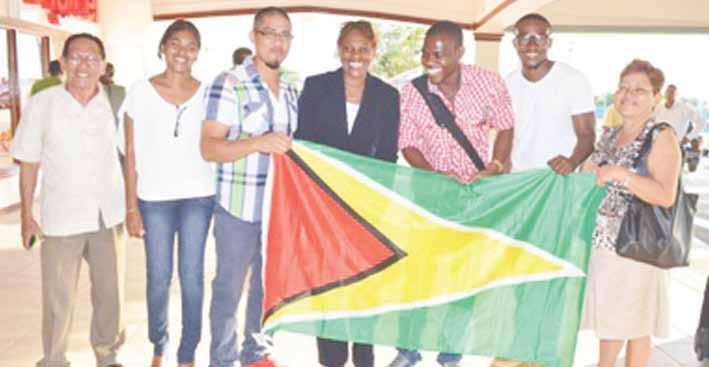
More than 300
Cuban-trained Guyanese have returned from the Spanish-speaking island to serve their country during the course of last week. Over the past few days, 200 medical doctors arrived at the Cheddi Jagan International Airport (CJIA), Timehri and on Tuesday, a batch of 99 graduates comprising agronomists and engineers.
Public Service Minister Dr Jennifer Westford was at hand to welcome the students.
“We are going to be having 300 plus new professionals coming into Guyana, and obviously this means we have new skills to aid devel-
opment,” she explained to the media on Tuesday, the Government Information Agency (GINA) reported.
With the return of those trained in medicine, she said, “we can now offer here a better quality care”.
The graduates, reflecting on their journey through their studies, highlighted that it was challenging residing in a different country, adapting to the culture and lifestyle, nevertheless they were optimistic about achieving their goals.
Ganesh Omapersaud said he was happy to conclude his studies, graduating and becoming certified.
He added that over the past six years, while learning medicine, he also learnt about Cuban culture.
Emmawattie Sateova Samaroo after studying for seven years, said she is ready to work hard and is confident about the health system improving. She added that it was a good idea by the government to provide such an opportunity to Guyanese who cannot afford to study in another country.
Nikita McKenzie expressing her happiness on returning from Cuba after studying for seven years, said that she has learnt more than what was expected. She too is grateful that government is giving Guyanese

opportunities to pursue studies overseas.
Ready to serve his country, Kwesi Vancooten, who completed seven years of studies, said he was overwhelmed and satisfied that the government was able to provide such an opening to him.
Former presidents
of Guyana and Cuba, Bharrat Jagdeo and Fidel Castro, several years ago, agreed that Guyana will send 500 students to be trained in Cuba under a special Cuban scholarship programme in the disciplines of medicine, mechanical engineering, computer engineering, electrical engineering, culture, sport, agriculture, and architecture among others. At that time, Guyana was experiencing a shortage of doctors.
Throughout the years, Guyana has been sending students, the first batch totalling 300 and continuing with smaller numbers over the years.




The Natural Resources and Environment Ministry has written the local government and public works ministries regarding the collection of tolls by authorities in Linden for vehicles to pass through the township.
In a release, the Natural Resources and Environment Ministry said it has received numerous complaints from the Guyana Gold and Diamond Miners Association (GGDMA) that persons are being charged a toll when traversing Linden en route to the interior.
The ministry said it was aware of the toll charged at the WismarMackenzie Bridge and has not been notified of any other toll booth being established in any other location. In this regard, the ministry advised persons affected that a letter was written to the ministries of public works and communications, and local government and regional development for guidance and clarification on this matter.
According to the ministry, in light of the current decline in gold prices being experienced in the mining industry, the GGDMA is of the opinion that the charge of additional tolls is unnecessary at this point in time.
Enforcement of payment rules
Late last month, Linden Town Clerk Jenella Bowen had announced that a number of measures will be put in place to deal with collecting tolls from certain vehicles travers-
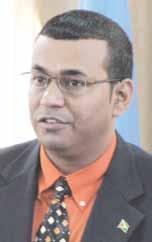
ing the mining town’s toll booth at Kara Kara, Mackenzie.
Bowen explained that this is being done as part of efforts to boost the revenue of the Linden Mayor and Town Council (M& TC) and to ensure that its by-laws remain in full force. She said that while the by-laws governing the collection of tolls at the booth have been in effect for years, some drivers do not adhere to the payment rules.
As such, Bowen said the M& TC will be stepping up its mandate to ensure that this practice does not continue.
She noted that one of the major factors, which contributed to the problem was the absence of adequate staff at the booth. “However, the municipality will be putting corrective measures in place,” she said.
“We have been having this issue at our toll booth over a long time and we have been suffering in terms of our intake of finances from the booth,” explained Bowen.
ment also took care of the costs of transportation and accommodation.
However, a new arrangement has been put in place for this year’s festival where delegations are being asked to foot the bill for these miscellaneous costs.
Minister Anthony revealed that the government is also engaged with its Surinamese counterpart to have provisions made for locals outside of the Guyanese delegation that wish to participate.
He disclosed that while government would only be financing 50 persons, those citizens who are keen on participating and are willing to pay
from page 24
their own expenses, can also be included as part of the delegation.
Theme
The year’s Carifesta is being held under the theme “Culture for Development: Celebrating our diversity and promoting the central role of culture in economic, social and human development”.
Carifesta was a festival initiated in 1972 by the Caribbean Community (Caricom) heads of government to celebrate the diversity of arts, foster a vision of Caribbean unity, and positively advance Caribbean culture regionally and internationally.

Close to Gy$ 10 billion is being invested into infrastructural improvements on the East Bank Demerara to alleviate the large volume of traffic along that corridor. Housing and Water Minister Irfaan Ali made this disclosure while he pointed to the benefits of the expansion underway with the development of additional housing schemes in that area.
Congruent to the housing development, the ministry has also undertaken to construct a series of “connecting” roads linking the schemes; among these are the access roads in Farm and Herstelling, where Gy$ 2 billion has already been invested.
During a tour of the area last week, Ali and his team of engineers inspected the works done on these feeder roads
and reiterated the benefits of the additional network of roads linking the communities along the corridor.
Meanwhile, Central Housing and Planning Authority (CHPA) Project Manager Fazal Wahab, who accompanied the minister and his team, noted that the goal of the construction of the alternative roadways is to link Ogle to Providence and then as

time and revenue permit, from Ogle to further down the East Bank.
“This development is massive, it is over 4000 acres of land and at the end of it, we will see approximately 10 east to west connecting roads. So far we have identified six connecting roads going all the way initially from DiamondHerstelling area and then linking there to go on to Eccles. That would
significantly take the burden off the existing East Bank Road congestion, not only to serve that purpose, but will also integrate the community from Diamond all the way to Eccles,” he added.
Wahab revealed too that at the end of the construction phase, commuters can expect to utilise roadways that will be completed above the international standard
of a 12-foot carriageway. He said too that the road will definitely allow for easier access to the East Coast and Georgetown, saving commuters valuable time.
The Housing Ministry is currently paving all the main roads leading into various schemes; this will be followed by the resurfacing of the internal roads as occupancy increases.









week ending august 11, 2013 |
U.S.-based Guyanese designer Myrna Dale Petterson will be showcasing her modern African collection at the upcoming Guyana Fashion Weekend (GFW) 2013. She brings more than 15 years of experience in the fashion industry, and countless creative and chic collections.
Complementing Petterson’s pieces will be ‘Fibration’, a bag collection by Luise Jordon. These creative bags are made from coconuts and discarded cane peel.








One of the greatest entrepreneurial acts by freed Africans in world history was the ‘Village Movement’ which started in 1839. Freed Africans combined their resources to buy villages so that they did not have to return to plantation life and cheap punitive labour.
On a clear sunny day, one may stand on the shores that border Farm and see Leguan and other islands which lie at the mouth of the Essequibo River. Farm Village is located along the West Coast Demerara Highway between Vergenogen on the east
This plan was deposited in the Deeds Registry in 1879.
Many of the people, who comprised this early post-emancipation community, identified themselves as Africans from the Congo; and were called 'Farm Congo' by residents from other villages. These were all
they walked together on the same routes from their homeland in Africa and voyaged on the same ships, each believing that each other were alone. Apparently, more of their siblings were also captured, and brought to British Guiana; but did not discover one another until
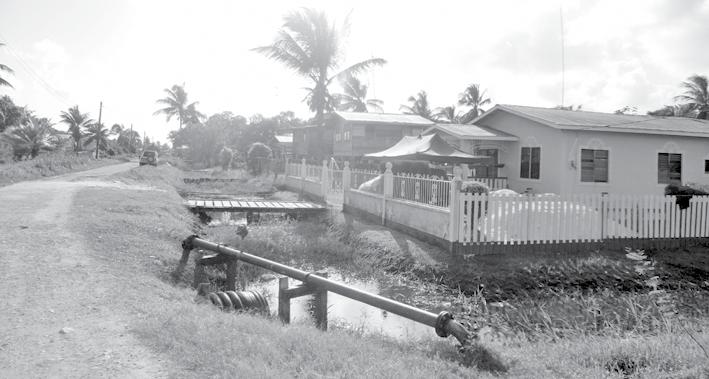
For Emancipation 2013, the African Cultural and Development Association honours Farm Village, located on East Bank of Essequibo, which was bought by 26 freed men and women. Today, there is an elder who speaks Congolese, presumably, ACDA notes, indicating the village was bought by Africans who had roots in Congo.
This excerpted historical overview of Farm Village was drawn from church records, works of authors again, church related and from oral history by Faustina Ward Osborne, which she shares with Guyana Times Sunday Magazine
While a student of the Government Teachers Training College in 1969, gathering data for a research project on her community, Faustina was startled by facts revealed. This record of historical events in the villages is therefore interspersed with her personal reflections on the information acquired from prominent members of the community during informal discussions; and members of her extended family. It is Faustina’s view that this historical overview could be used as a basis for in depth historical research which could add to, or correct any information gleaned from the oral history which forms the basis for the documentation which follows.
and Parika on the west about four miles equidistant. Its immediate neighbours are the communities of Greenwich Park, Plantation Good Hope and Plantation Ruby on its east and Le Destin, Kywari and Orangestein on the west. Prior to changes in the Local Government system in Guyana in 1994; Farm, Vergenoegen, and Parika were the only local authorities in that geographical location.
The simplicity of the name, Farm Village belies the rich history, culture and tradition that resided in the village; which has produced significant numbers of professionals, semi-professionals and skilled craftsmen/women. The name highlights the vision of the original proprietors who purchased a well-designed plantation which was like an oasis when compared to its surrounding neighbours. The ancestry of Farm Village has its roots in the resolve of men and women who pooled their resources and bought Plantation Farm. It is believed that the purchase was made in 1840 following upon a block survey (from the East Bank of Essequibo to the Cross Dam in the backlands) conducted by Hugh Mc Tavish, Sworn Land Surveyor. In 1877, another survey was conducted showing the plan of the village, indicating lots apportioned to each land owner by name, and signed by E.E. Wight, Sworn Land Surveyor.
people who revered their ancestors and retained a number of their traditional practices. Also in the village were a group of people referred to as Oku. Whether this was a tribal group or a name for those who were not from the Congo, is not known.
John “Olde” King (Faustina’s maternal
much later. There is a story told about one sister who grieved to death after discovering that the man she met, fell in love with and married was her brother. These are potent examples of the pain and tragedy of slavery, which cut to the very soul of the enslaved.
Farm, for many
conveyed by donkey drawn carts, through largely unpopulated areas.
For many of those gathered it was an allnight journey beginning early Saturday evening. The silk cotton tree was located across the road from the St. Luke Anglican Church. Each week, before attending church and Sunday school the community meeting was held with “Olde” King to discuss current events and find solutions to problems, including illnesses, and even legal issues facing individuals and groups. He led and guided these fledging communities and villages in a hostile post-slavery era. Looking at church records there is no evidence that “Olde” King himself was a member. Yet he seemed to have had a deep spiritual impact on the community which encompassed the church and stretched for miles on either side of Good Hope. He led and guided these fledging communities and villages in a hostile post-slavery era.
Farm was a local authority managed by a village council. Unlike the proprietors in neighbouring communities by which it is sandwiched, the proprietors of Farm Village were taxed. This placed a severe burden
even smaller group of professionals, entrepreneurs and skilled craftsmen and women who had a higher standard of living. Collecting rates and taxes was a challenge. When Faustina was younger she recalled the Bell Crier, Lloyd Lancaster, walking through the village, bell in tow, calling on ratepayers to, “Pay up their rates.”
Faustina stated that the fact that the early ancestors survived slavery is a testament to their spiritual and cultural values and their unswerving faith in a higher divine power. Throughout the torturous enslavement they endured, they maintained their faith in the divine to sustain and keep them. She added that their faith, resilience, and spirituality- possibly imbedded in them from their homeland- were the assets the post-emancipation population used to lead and build their community.
From the stories told, Faustina found out that the pioneers who shaped and built the village of Farm and other communities chose not to return to the plantations despite hardship. They were unafraid to be human and to be vulnerable, or to demonstrate care for one another. They did not withhold

great-grand father) was from the Congo and one of the 26 purchasers of Plantation Farm. He was the overseer and leader of the formerly enslaved people, on the East Bank Essequibo and the West Coast of Demerara. John “Olde” King and one of his sisters were captured from their village in the Congo on the same day. Not until their arrival in Guyana did they know the fate of each other. Unknowingly,
years, was the hub of the post-slavery community. Faustina’s paternal grandmother, Victoria Otto Ward told her that the post-emancipation population each Sunday at 4 a.m. gathered under the silk cotton tree at Good Hope to meet with their leader, “Olde” King. According to her story, they braved the elements and the hazards of dirt roads, no lights, snakes and other animals and walked or were
on the post-emancipation populace and on what was for many years a subsistence economy. The difficulties were more stringent on single parent families, mostly women, the aged and the infirmed. However, there were some among the villagers who were cattle farmers who sold milk and some of their herds which allowed a greater level of self-reliance.
Then there were an
their resources from each other; nor did they reject the help of another for fear of exploitation. Their leadership held no pretentions; there was no personal gain to be had except the responsibility for and the respect of the people.
Today, although the Farm Village continues to face various challenges, its residents are proud knowing that they live in a historically rich village.
As part of the African Cultural and Development Association’s (ACDA) theme for Emancipation 2013, “Honouring our Heroes of 1823”, the association commemorates Quamina, a historical figure of the 1823 Demerara Rebellion.
Ambassador Odeen Ishmael, currently Guyana’s Ambassador to the State of Kuwait and the State of Qatar, shares his research on Quamina with Guyana Times Sunday Magazine, from his book “The Guyana Story”.
The slaves in East Demerara were convinced that the governor and their masters were withholding their freedom from them, and many felt they had no other option than to rise up against those who were not carrying out the king’s orders.
On the morning of Sunday Aug 17, 1823, Mahaica slaves met at Plantation Success and three of them, Jack Gladstone, a cooper on that plantation, Joseph Packwood and Manuel, assumed some kind of leadership of the group.
They began planning an uprising, but Gladstone’s father, Quamina, who arrived at the meeting later, objected to any bloody revolt and suggested that the slaves should go on strike. When someone asked if they should get guns to protect themselves, Quamina, a senior deacon at Rev. John Smith's church, said he
buked them and advised against speaking to any of the managers about this, saying if they did so they would provoke the governor. He begged them to wait until the governor and their masters tell them about the new regulations.
When Quamina told Smith of the uprising being planned, the priest asked them to tell the other slaves, particularly the Christians, not to rebel. Quamina promised to obey Smith and he sent his two companions to urge other slaves not to rebel. He also told Smith he would send a message in the evening to the Mahaica slaves not to rise up against their masters.
But despite Quamina's efforts, the slaves were determined to rebel from the following evening. Their plan was to seize all guns on the plantations, lock up the whites during the night and then send them to the governor the following morning to bring the “New Law.” Quamina urged them not to be violent in the process.
But on the morning of Monday August 18, the plan was leaked by Joseph Packwood, a house slave, who revealed it to his master John Simpson, of Le Reduit plantation, located about five miles east of Georgetown.
Simpson immediately gave this information to Governor Murray who, with a group of soldiers, rode up to the area
to provide. Further, Murray told them to go home and to meet with him at Plantation Felicity the next morning. But the slaves refused this invitation and the governor later that day proclaimed martial law.
It was very late that afternoon when Rev. John Smith first heard of the uprising. In a note to his informant, Jackey Reed, a slave who attended his church, he stated that hasty, violent measures were contrary to Christianity and begged Reed not to par-
slaves apparently heeded the request made by Quamina.
However, some slaves took revenge on their masters or overseers by putting them in stocks; this action resulted in some violence and a few whites were killed. The white population naturally were very terrified and feared they would be killed. But the slaves, who were mainly Christians, did not want to lose their religious character so they proclaimed that their action was a strike and not a rebellion. At the
Good Hope where six were shot dead. On the morning of August 20, six were killed at Bee Hive plantation and 40 at Elizabeth Hall.
There was also a major battle on the same day at Bachelor's Adventure where roughly 2,000 slaves confronted the military.
Lieutenant-Colonel John Thomas Leahy, who had about 300 men under his command, asked them what they wanted. They responded that they wanted to work for only two or three days a week. Leahy told them if
communicate to the governor through him. He then gave them half an hour to decide to surrender their arms, failing which he would order his soldiers to shoot.
However, the rebels remained defiant, and Leahy ordered his troops to open fire. Many of the slaves fled in confusion while some others quickly surrendered their weapons to the troops. In this savage, crushing military action, more than 250 were killed. A report prepared by Governor Murray two days later praised Leahy
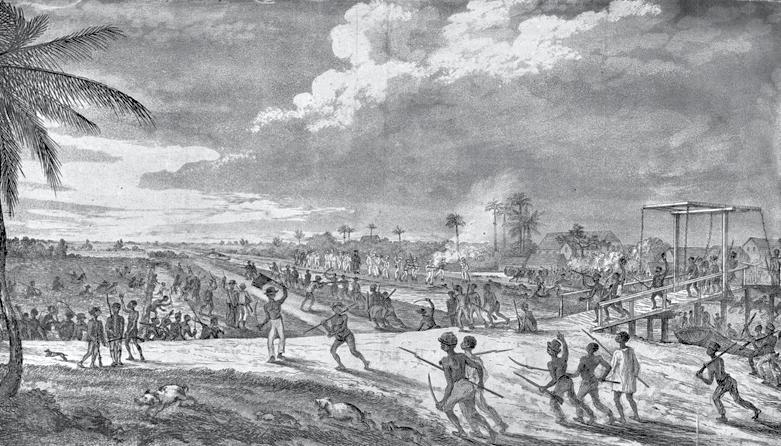
ticipate in the revolt.
Shortly after, while Smith and his wife were walking on the plantation, they saw a large group of African slaves outside the home of Hamilton, the manager
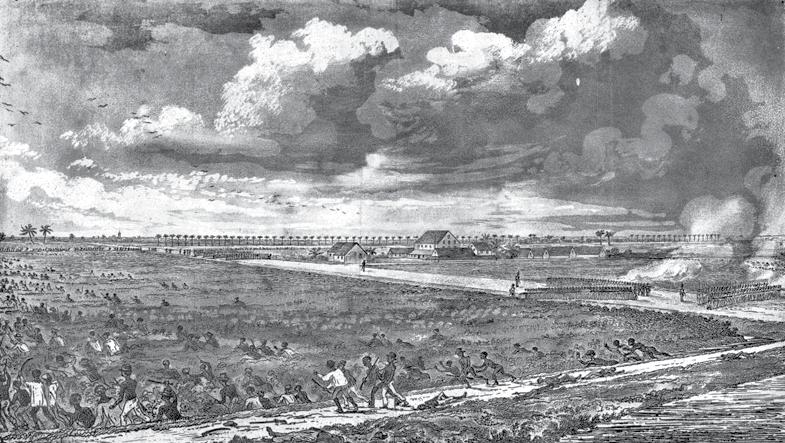
would have to seek the advice of the missionary on this matter.
Quamina departed for Bethel Chapel at Le Resouvenir, and after the Sunday service, he and two other slaves, Manuel and Seaton, went to Smith's home. There they told the priest that the managers of the plantation should go to Georgetown to “fetch up the new law.” Smith re-
of Le Resouvenir and La Bonne Intention where he met a large group of armed Africans on the road. He asked them what they wanted and they replied, “Our right.”
He then ordered them to surrender their weapons, and after they refused, he warned that their disobedience would cause them to lose whatever new benefits the new regulations aimed
of Le Resouvenir. Smith begged them not to harm Hamilton, but they told him to go home.
That night the slaves seized and locked up white managers and overseers on 37 plantations between Georgetown and Mahaica on East Demerara. They searched their houses for weapons and ammunition; but there was very little violence since the
same time, not all slaves joined the rebels and these remained loyal to their masters.
The next day Anglican priest, Wiltshire Austin, suggested to Governor Murray that he and Smith be allowed to meet with the slaves to urge them to return to work. But the governor refused to accept this suggestion and immediately declared martial law.
The 21st Fusiliers and the 1st West Indian Regiment under the command of LieutenantColonel Leahy, aided by a volunteer battalion, were dispatched to combat the rebels, who were armed mainly with cutlasses and bayonets on poles, and a small number of stands of rifles captured from plantations. At first, the movement of the troops was hampered since many of the wooden bridges across the various plantation canals were destroyed by the rebels.
The suppression of the rebellion saw much violence. On Tuesday, August 19, there were major confrontations at Dochfour estate where 10 to 15 of the 800 rebels were killed; and at
they lay down their arms and returned home he would tell the governor what they wanted.
But perceiving that they were not interested in surrendering their arms Leahy, accompanied by one of his officers, Captain John Croal, went up to them and again enquired what they wanted. They shouted that they wanted their freedom which the king had granted to them. Leahy then read the proclamation of the martial law to them. When he completed the reading, Jack Gladstone, one of the slave leaders, showed him a copy of a letter signed by many plantation owners that they were not abused by the rebels.
One of the other leaders then suggested that they should hold Leahy and Croal as hostages, but Jack Gladstone objected strongly and prevented such an occurrence. Many other rebels suggested that all the slaves should march to Georgetown to present their demands to the Governor, but Leahy discouraged this saying that if they did so they would all be hanged, and suggested that they should
and his troops, and noted that only one soldier was slightly injured while noting that “100 to 150” slaves were shot dead. The uprising collapsed very quickly since the slaves, despite being armed, were poorly organised. After their defeat at Bachelor's Adventure, the governor proclaimed a full and free pardon to all slaves who surrendered within 48 hours, provided that they were not ringleaders of the rebellion. He also offered a reward of 1,000 guineas for the capture of Quamina whom he regarded as the main leader of the rebellion. In the military sweeping-up exercises that followed, there were impromptu court-martials of captured slaves, and those regarded as ringleaders were immediately executed by firing-squad or by hanging. Many of the corpses were also decapitated and the heads nailed on posts along the public road. Among those hanged was Telemachus of Bachelor's Adventure who was regarded as a “ringleader” of the uprising at that location.
The African Cultural and Development Association (ACDA) is celebrating its 20th anniversary this year, and since its establishment plays a pivotal role in the preservation of Guyanese African culture.
Founded in 1993 as a nongovernmental organisation constituted to promote equity, equal access, accountability, shared governance and citizen’s participation at the local and national levels, the organisation was officially registered under the Friendly Societies Act of Guyana in 1995.
All Guyanese of African descent, regardless of class, religion or political affiliation, are eligible to be members of ACDA. ACDA has members in all parts of Guyana as well as in the Guyanese diaspora. ACDA also is very active in African diaspora organizations. The society’s mission at its inception was to “empower African Guyanese to become more productive citizens through cultural, social, economic, educational and vocational enhancement”.
The centre’s primary goal is to improve the well-being of
African Guyanese and to seek sustainable improvement in their quality of life. Another important goal is to seek national reconciliation through “shared and good” governance through which there is genuine reconciliation with other ethnic and cultural groups in Guyana.
ACDA, located on Thomas Lands, is governed by an executive steering committee that meets on a weekly basis. This committee comprises founding and select active members, and by the heads of each of five operational committees.
The education management committee of ACDA, comprising experienced educators, parents and concerned individuals, is committed to making a difference in the lives of African Guyanese by assisting in implementing a solid well balanced academic programme that includes cultural, emotional and moral education. The goal is to ensure the Guyana curriculum is met and far exceeded by ACDA students through experienced teachers and a student teacher ratio of 10 to 1.
ACDA is focused on AfroGuyanese youths and provides

a solid value-driven education through its Centre of Learning and Afro-centric Orientation (COLAACO) which is designed to equip young children from early childhood to primary school with the necessary skills to make them excellent productive citizens who are well-balanced socially, emotionally, intellectually, physically and morally.
The vision for COLAACO is to build an institution that will be a centre of excellence in providing the highest quality education and Afro-centric
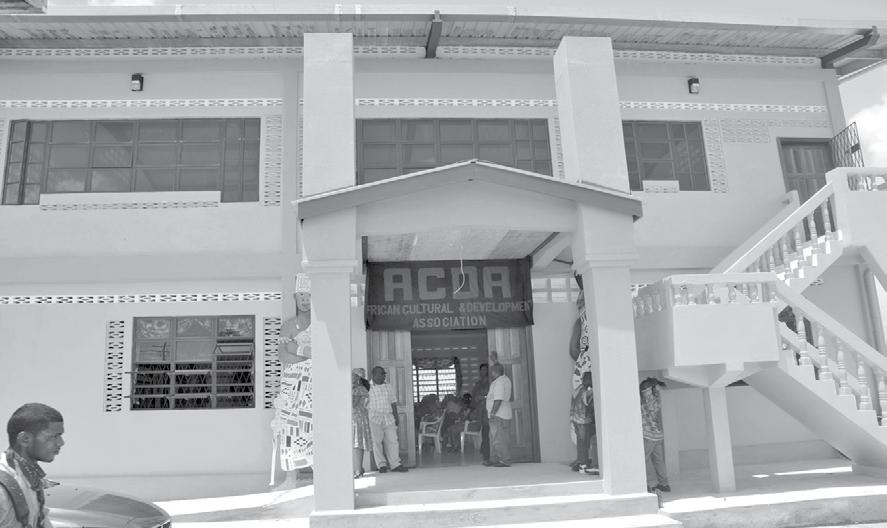
Some of the rebels who escaped were hunted down and shot by Amerindian slave-catchers. Quamina himself was shot dead by these Amerindian slave-catchers in the back lands of Chateau Margot and his body was later hung by the side of the public road at Success. Jack Gladstone was later arrested and later sentenced to be hanged; however, his sentence was commuted, but he was sold and deported to St. Lucia in the British West Indies.
Out of an estimated 74,000 slaves in the united colony of EssequiboDemerara, about 13,000 took part in the uprising. And of the 350 plantations estates in the colony, only 37 were involved. No doubt, many
education and life skills in Guyana and the Caribbean.
Over the last 17 years, ACDA has been providing the top Afro-Guyanese student at CXC with prizes, all in its efforts to encouraging youths to excel academically.
ACDA has sponsored over the years The Ronald Waddell Reading Room- the Inter-American Bank (IDB) Social Inclusion Program entitled “Improving access to Opportunities for At Risk Youth Of Afro-Descendant Communities in Guyana”, a 2008-2009 eighteen-month partnership that saw 30 students from Buxton, Agricola and Albouystown benefit from five 6-month courses in leadership and community development, small business management, agriculture and the environment, and media and communications.
Additionally, it also partnered with the African Renaissance to provide a free six-month course in leadership that was taught by Guyanese Eric Phillips, a 1990-91 White House Fellow. ACDA also partnered with Dance Alive to offer a free course in HIV & AIDS Life Cycle Management. It also produces a monthly newsletter entitled Unchained Voice, edited by AYA, the youth arm of ACDA.
who did not take part sympathised with the rebels and shared their suspicion that the planters would spare no efforts to prevent them from obtaining their freedom.
On August 25, Governor Murray set up a “court-martial” headed by Lieutenant Colonel Stephen Arthur Goodman, for the trials of the arrested rebel slaves who were considered to be “ringleaders”. The trials, which continued into early 1824, were conducted at different plantations, and the prisoners were executed by shooting or hanging, and their heads cut off and nailed to posts.
More than 200 Africans were beheaded and their heads placed on stakes at Parade Ground in Georgetown and from
Plaisance to Mahaica in East Demerara. Of those condemned to death, 14 had their sentences commuted but, like Jack Gladstone, they were sold to other slave owners in the British West Indies.
In addition, there were other sentences, including solitary confinement and flogging of up to 1,000 lashes each. Some were also condemned to be chained for the rest of their servitude.
On the day of the Bachelor's Adventure battle, the situation took a strange turn when Rev. John Smith was arrested and charged for encouraging the slaves to rebel. While awaiting trial, he was imprisoned in Colony House. His arrest, undoubtedly en-
couraged by many of the planters, was seen as an act of revenge against the priest for preaching to the slaves.
Before a court-martial presided by Lieutenant Colonel Goodman from October 13 to November 24, 1823, Smith was tried for promoting discontent and dissatisfaction in the minds of the slaves towards their masters, overseers and managers, inciting rebellion; advising, consulting and corresponding with Quamina, and aiding and abetting him in the revolt; failure to make known the planned rebellion to the proper authorities; and not making efforts to suppress, detain and restrain Quamina once the rebellion was under way. Smith denied the
from page 34
Recently, ACDA launched its Akwaaba Youth Centre. Akwaaba, a Ghanaian word meaning ‘welcome’, will be the heart of ACDA’s continual development of cultural, educational, economic, Information technology and sports programmes for young people.
Apart from these tailored activities, the youth centre will also be available for conferences, meetings, seminars, birthdays, weddings, thanksgiving services, award ceremonies, graduations and anniversaries. The Akwaaba Centre will be the key facility for outreaching to African Guyanese and those in the diaspora.
The future projects of Akwaaba will include a heritage tour in partnership with the Sankofa Group, and will also include entrepreneurship and business development programmes; ICT training in COLAACO; dance; drama; poetry; judo and karate training. It also plans to build a memorial monument for the arrival of Africans in Guyana and a drum museum and creativity centre.
Akwaaba is an extension of ACDA’s educational philosophy of academic and cultural excellence. It will re-focus on the mission and goals of ACDA as emphasized in its founding documents.
charges but, nevertheless, he was imprisoned for seven weeks in Colony House before being tried by a court martial. He was found guilty, sentenced to be hanged and was transferred from Colony House to the local prison. He appealed to the British government which subsequently ordered a commutation of the death sentence and restored his freedom. However, while awaiting the results of his appeal to arrive from England, he died from pneumonia in the prison on Feb 6, 1824. To avoid the risk of stirring sentiment against the slave owners, the colonial authorities buried his body before daybreak but deliberately did not mark his grave. The information
that he was acquitted actually arrived in Georgetown on March 30, weeks after his funeral. (Significantly, the appeals court in repealing his sentence also banned him from residing in Guiana and any other British Caribbean territory, and ordered to post a bond of 2,000 pounds.) News of his death was later published in British newspapers. It caused great outrage throughout Great Britain, and 200 petitions denouncing the actions of the colonial authorities were sent to the British Parliament.
In Guyana, the slaves regarded Rev. Smith’s death as a sacrifice which was made on their behalf. Soon after, they began referring to him as the “Demerara Martyr”.


Church whisper
A mother took her little boy to church.
While in church the little boy said, “Mommy, I have to pee.”
The mother said to the little boy, “It’s not appropriate to say the word ‘pee’ in church. So, from now on whenever you have to ‘pee’ just tell me that you have to ‘whisper’.”
The following Sunday, the little boy went to church with his father and during the service said to his father, “Daddy, I have to whisper.“
The father looked at him and said, “Okay, just whisper in my ear.”
‘600 Story Hotel’
Tom, Dick and Harry went to a party. After the party they returned to the hotel. The hotel was 600 stories high.
Unfortunately for them, the elevator was not working. They made a plan for the first 200 stories, Tom will crack jokes.
The second 200 stories Dick will tell a happy story and lastly Harry will tell a sad story.They then started up the steps
After 2 hours it was Harry's turn. He turned to the other two and said "Ok guys, here's my sad story. I forgot the keys downstairs.
Sloth vs Turtles
A sloth calls the police to report that he was attacked and robbed by a gang of turtles. When the police ask him to describe the attack, he replies:
"I.....Doooon't.....knoooow...
It... all... happened..... soooooo ... fasssst....."
Jerks Get the Attractive Wives
While reading a newspaper, Walter came across an article about a beautiful actress and model who married a boxer who was noted for his IQ.
"I'll never understand," he said to his wife, "why the biggest jerks get the most attractive wives."
His wife replied, "Why, thank you, dear."
Two words
A prince had a curse put on him when he was a little boy. He could only speak two words every year. But, if he didn't speak for a whole year, he would then be able to speak 4 words the next year and so on.
One day he met a princess named Josie and he wanted to say "My Princess".
The next year he saw her he wanted to say "My princess, i love you".
The third year he saw her he wanted to say "My princess I love you, will you marry me?" But, the young prince, now growing older knew he would have to wait a couple more years.
So, on the fifth year, excited to finally present his question, he visited the princess.
He approached her respectfully and asked, "JOSIE, MY PRINCESS, I LOVE YOU. WILL YOU MARRY ME?"
And the princess said, "Pardon?"
Three men on a hill
There were three men on a hill with their watches.
The first man threw his watch down the hill and it broke.
The second man threw his watch down the hill and it broke.
The third man threw his watch down the hill, walked all the way to the bottom, and caught it.
The other two men were puzzled and asked the third man how he did it.
The third man said, "Easy. My watch is 5 minutes slow!"
Four Business Dads
Once there were four business men. They were sitting on a bench in a hospital waiting room because their wives were having babies.
A nurse comes over and says to the first businessman, "Congratulations! Your wife had 1 baby."
The man says, "What a coincidence! I'm the president of And1!"
The nurse goes away.
Then the nurse comes back and says to the second businessman, "Congratulations! Your wife had twins!"
The man says, "What a coincidence! I'm the owner of the Minnesota Twins!"
The nurse goes away.
The nurse comes back and says to the third businessman, "Congratulations! Your wife had triplets!"
The man says, "What a coincidence! I work for Triple Crown!"
The nurse goes away.
The nurse comes back and sees the fourth businessman alone on the bench crying.
She asks, "Why are you crying"?
The man replies, "I work for Seven Up"!!



This year, the African Heritage Museum will celebrate its 19th anniversary preserving and promoting Africa’s cultures
The Museum of Arts and Ethnology was founded in 1985, with the purchase of collections of African art from anthropologist Hubert Nicholson and Desiree Malik. It was officially declared open July 31, 1994, by former president, Janet Jagan, and serves under the management of the Ministry of Culture, Youth and Sports.
Its collections were annotated and accessioned through UNESCO by Dr William Seligman, curator of African and Oceanic Art, Brooklyn Museum.
Since then, other donations have been made from persons within the local community such as pieces from the Burrowes School of Art and art and craft done by local artists within Guyana.
In 2001, the museum of African Art and Ethnology changed its name to the Museum of African Heritage, located in Barima Avenue. This was done to attract a wider audience and address African influence in Guyana. This allows the museum to explore research and solicit donations from the community so that they can be able to share their knowledge and provide programs that will educate visitors on African heritage and origins of their lifestyles in Guyana.
Collections
At the museum, the collection consists of African art (West Africa) from wooden masks to the carved door of secret societies. These help us to understand the meaning and reasons behind African art and tradition. There

are also collections of brass weights, drums, musical instruments, games and clothing. There is also a wooden replica of the 1763 monument.
Visitors will also see the “Bust of a Fulani Woman”, which is an artistic representation of a female Fulani. The Fulani are pastoralists who migrate with their cattle all across the savannah regions of West Africa. The women are famous for their beauty. They wear distinctive hairstyles and jewellery. This figure is a modern carving made for the commercial trade. It is made from a very hard, dense, red,

Mahogany-type wood. It does not grow in the area where the Fulani live, but closer to the coast. The carvers are likely to be from an ethnic group other than the Fulani since they rarely carve.
There is also the nut bowl from the Yoruba tribe, Nigeria. Bowls like this one was used to hold Kola nuts which were cast on the ground as part of a divination ritual. One of the figures is a female worshiper holding her breasts which is a sign of respect. The other is a male figure holding a double-bladed axe carried by priests and worshipers of Shango, the ruler of thunder and lightning and is much feared in West Africa. The central figure is a kneeling woman with a child on her back. Carved above them is a figure of Shango horse’s back. In front of the
Faso). In Senufo, country doors to houses are frequently carved from a buttress root of a large tree. Normal houses doors are usually plain or decorated only with geometric designs. More elaborate designs are usually reserved for the doors of the houses used as meeting places for the secret societies. Such societies have a variety of purposes. Some exist as antiwitchcraft associations. Others exist to train young men and women separately in their respective roles in the community. The symbols on this door include lizards, crocodiles and hornbill birds which are all thought of as among the first animals created before man came into existence. The horse, seen on the door, does not breed south of the Sahara Desert and thus must be imported at great costs. A horse rider,
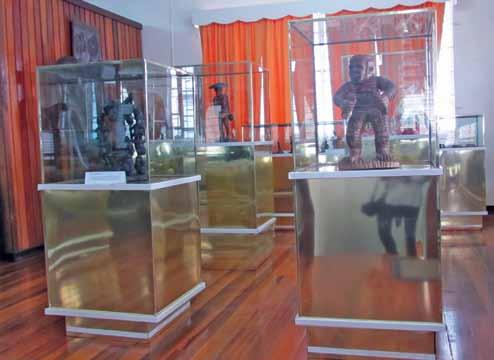
central female figure is a man lying on his stomach with his arms and knees on the ground, his feet in the air. On his back stands the body of a chicken whose head, neck, back and tail are detached. Two heads on the bowl probably represent the Orisha or God Eshu/ Elegba.
Some interesting artefacts include the African hut door from the Senufo Tribe, Mali (Ivory Coast, Burkina
therefore, represents a man of great wealth and power. The masks on the door are Kpelige masks associated with the Poro society.
The museum continues to collect, preserve, exhibit and research arts and artifacts relating to Africa and the African experience in Guyana. It is also mandated with disseminating this knowledge through its outreach programmes.


On August 11, eight Afro-Guyanese beauties possessing elegance, charm and graceful exuberance, would be competing for the title of Miss Guyana African Queen 2013 at the National Cultural Centre.
The pageant is said to be a journey for the young ladies to learn “all things African”. It is the brainchild of Shauna Jemmott, a former Miss Guyana African Heritage title holder, who has produced several village pageants in the past. She has since relin-

quished its production to a committee.
Miss Guyana African Pageant showcases rich African culture, and at the same time provides the eight delegates an opportunity to add new things to the culture. The Afro-Guyanese beauties have already engaged in talent workshops and are brushing up on their public speaking skills.
On the ‘Miss Guyana African Queen’ Facebook page, the delegates are presented to the public who have the opportunity to vote for their choice. The delegate with




This year, according to Public Relations Officer, Shabakie Fernandes, in keeping with the United Nations Day of Woman, the delegates will choose a notable woman of African descent to speak on as their platform.
Additionally, the pageant will be promoting STEM: Science, Technology Engineering and Math. STEM ensures the development of world-class talent in science, technology, engineering, and mathematics- an organisation based in the U.S. which has many Guyanese top achievers as part of its membership.


Moreover, Fernandes stated that through the Guyanese Girls Unite Project, 12 girls from Mali, where the education for girls is not free, will be sent to school. This year, the country of Mali is recognized and honoured for Emancipation in Guyana. She added that the intention is that, through this initiative, the Mali girls will be given much-needed facilities to explore their senses and skills.
The delegates will also be giving back to the elderly, as it is customary in the African tradition, and so have been involved in numerous philanthropy activities.


by Tisha bosTon
The spinal column, commonly known as the backbone, consists of 24 irregularly shaped bones called vertebrae. It has many functions, one of which includes bearing your weight for between the
vertebrae are discs of cartilage that serve as cushions to help absorb the force of your weight. Other functions of the spinal column include holding the head erect, supporting the framework of the chest, and protecting the spinal cord. Since the spine
consists of so many bones, it doesn’t have a linear alignment; instead it tends to bend in different directions i.e., back and forth curves. This kind of curvature protects the vertebrae from injury by absorbing the shock every time you walk, run, jump,


etc. However, when looking in the mirror and discovering that you have uneven shoulder level or hip level, it is an indication of scoliosis. Scoliosis is a spinal disorder in which there is a sideways curve of the spine instead of only frontward and backward curves. Anyone can have scoliosis, but it usually develops during early adolescence because this is the time when children are growing faster. This common type is called idiopathic scoliosis and research has shown that girls are more likely than boys to have it. Treatment for scoliosis depends on the person’s age, how much more the individual is likely to grow, the degree and pattern of the curve and the type of scoliosis the person
has. Mild cases of scoliosis may not require treatment, just regular check-ups, but severe scoliosis requires braces that keep the spine from curving further sideways or surgery to correct the abnormal curvature. Exercise programs have not been proven to significantly keep scoliosis from get-
ting worse, but it is important for people with or without scoliosis to exercise in order to help keep the backbone strong so that they can carry out their daily activities with ease. Doing certain exercises help to strengthen the abdominal and lower back muscles, and stretching during these exercises increases flexibility. Remember to lift heavy objects by bending your knees, not the waist, so that your legs do most of the work. Also, not to wearing high heels on a regular basis can lower the risk of getting scoliosis or worsening this spinal disorder.
Here are some common backbone exercises that you can do:


The Guyana African Queen Pageant’s contestants are: Franale Holder, born April 16, 1990, is an aspiring pilot and believes that there is nothing common to man that she cannot do; Jennel Lovell, born August 10, 1994, is an aspiring medical doctor and believes that “there are no secrets to success. It is the result of preparation, hard work, and learning from failure”; Shanice Alancia Bourne, born September 21, 1994, is currently a second-year Marketing student at the University of Guyana who views herself as a “optimistic and pragmatic person whose greatest goal is to build a better future for the succeeding generation”; Shevona Jerrick, born September 23, 1992, is presently a Business Management student at Nations University; Sunaika Adolphus, born April 22,
1995, is a second-year International Relations Student at the University of Guyana; Miracle Hilliman, born May 11, 1992, is a final year Public Communication student at the University of Guyana; Joelly Ann Valentine, born May 24, 1994 is a second-year Public Communication student at the University of Guyana; and Makida Latoya Blake, born August 4, 1990, is another aspiring doctor.
The Miss Guyana African Queen pageant provides a platform for the empowerment of young Afro-Guyanese women and gives them an opportunity to connect with their ancestry.
Tickets are available at Nigel's Supermarket, Ashmin's, Upscale Restaurant and Bar and Joan's Salon of Durban St. Lodge; or call 6826741 for more information.

Story and photoS by nadia huSSein
The Scotiabank Caribbean Carnival Toronto has once again proven itself a grand showcase of Caribbean music, cuisine, revelry, and arts that ended with a bang over the weekend.
The three-week long celebrations came to a close in an action-packed four days. Two competitions led up to the Grand Parade, which was fol-
lowed by a different type of festival.
Last Thursday, there was the King and Queen Competition and the Allan Lamport Stadium was transformed into an outdoor theatrical stage where the ‘Kings’ and ‘Queens’ of the bands competed to be named the best of the best.
‘Carnival Nationz’ came out on top with both the ‘King’ and ‘Queen’ coming from their mas camp.
The ‘King’ represented the theme of ‘The
Reef’ well with a huge crab creation on his deep blue float which earned him the nickname ‘King Crab’. The ‘Queen’ was eye-catching as she pulled a sparkling pink, purple, blue, and green float. The group surprised the crowd by bringing out soca and calypso singer, Superblue.
One night later, the same venue came alive with the sound of the steelpan during the Pan Alive competition featuring members of
the Ontario Steelpan Association (OSA).The event highlighted the talent of pannists ranging in age from early teens to adults. At the end of the night, Pan Fantasy walked away with the trophy and the $3, 000 (CDN) prize for the second year in a row. One member of the group stated, “I think our band gave it the best we could. We threw in a few antics (and) gave a high-energy performance (that) Pan Fantasy always gives.
The crowd responded well.” Second place went to Afropan while Panmasters claimed third place. By Saturday, everyone was ready for the road. The Grand Parade, the marquee event of the festival season, took over Toronto for the 46th year on August 3. Masqueraders
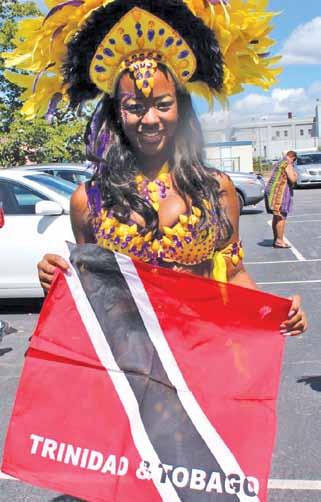


Jamaica celebrat-
ed its 51st anniversary of political independence from Britain on Tuesday with the country’s lauding the achievements in sports, education, and the creative arts while encouraging nationals not to give up in the midst of hardships.
Governor-General Sir Patrick Allen said Jamaicans have the responsibility to help restore the country's image
and defend what is good. He said while the country is not where is should be, this can be fixed.
He said every Jamaican, whether at home or abroad, “has the responsibility to help restore Jamaica’s image as a peaceful and productive country.”
In her message, Prime Minister Portia Simpson Miller said the country’s rich heritage should be used as a catalyst to overcome the cur-
rent hardships and defy the odds.
Opposition leader Andrew Holness acknowledged the country's achievements but also recommended critical changes to the economic model in order to reap long-term benefits. He encouraged Jamaicans not to totally rely on the International Monetary Fund (IMF) agreement, as it is not the cure-all for the country's economic problems.

danced their way down Lakeshore BoulevardWest to the pulsating rhythms of calypso, soca, reggae, chutney, steelpan and brass bands.
Organizers estimated that 900, 000 people came out to take in the colourful and striking costumes during the largest cultural festival of its kind in North America.
Patrons got their fill of Caribbean food and drinks such as patties, jerk chicken, coconut water, and sugar cane juice throughout the sunny day.
Masquerders faced a judging area before proceeding onto the route. Louis Saldenah Mas-K Club with their theme Heaven & Earth took the title of Band of the Year. The runner-up was Carnival Nationz and the third spot belongs to the Toronto Revellers.
There was also a Carnival concert with performances from big names such as Destra, Alison Hinds, K.I, and Orlando Octave.
Another feature of parade day was a midway with rides and games that kept the kids busy.
The Carnival vibes continued the day af-
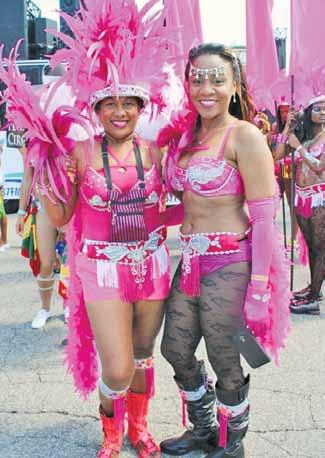
ter the parade at a new event. ‘Hotta Than Ah Chulawas,’ the name of a chutney music festival was held at The Italian Gardens. The familyfriendly festival featured a performance by Raymond Ramnarine, the 2013 Soca Chutney Monarch King, and his band Dil-E-Nadan.
Other popular chutney stars who performed in-
This year’s Carnival season kicked off on July 9 with a public launch followed by an opening church service on July 14. Naturally, the events will officially end with a closing church service at St. James Cathedral on August 11 beginning at 4:30 p.m.


Guyanese Ian Ivor
Thom is a celebrated artist who enjoys creating beautiful art inspired by historical events and personal
um. What also motivated me to practice my art is experiencing appreciation by others for my art work. As a member of the National Service, I was
scribed as a self-taught artist. “I don’t know if anybody else in my family is artistic, but I know while growing up, seeing a lot of sledge hammers and anvils. At that time I didn’t know what it was being used for but as I got older, and getting into metal work, I realised those tools are used for such work; and so I asked an older cousin who told me that our foreparents were not field slaves but were artisans,” he related.
Thom is famously known locally for his 1988 Damon monument
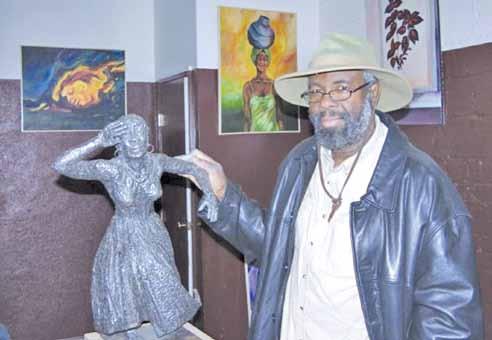
experiences, with hopes they serve as reminders of our valuable heritage for upcoming generations.
In an interview with Guyana Times Sunday Magazine, the artist related he was born, and grew up, in Victoria village, East Coast Demerara. He recalled that since childhood he developed a passion for art and the value of it taught by his mother.
“One thing I remember as a child is that whenever I draw something, I would discard of them; but my mother would pick them up and put them away. As I got older I realised that what my mother did was her way of telling me that whatever I do is valuable and I shouldn’t just discard of my work,” Thom reminisced.
Thom also remembered that while working on a Madhia/Annai road project in the 1970s chopping trees down – he was about 14 years old at that time – he came across a piece of wood and was moved to carve a face on it.
“At that time, to me it was a masterpiece, but looking back it seems like nothing at all.
at the Papaya Centre, and former President Burnham was visiting. We wanted to get him a gift but we couldn’t travel out. Everyone encouraged me to do something and so I volunteered to carve a piece for him. Seeing how people appreciated my art really motivated me to keep on practicing and to develop myself as an artist,” reflected Thom.
This motivated Thom to enrol at the Burrowes School of Art. In 1979 he graduated and went to Cuba to continue art study, and spent four years there. When he returned, Thom went back to the National Service where he served until 1990. He then migrated to Canada and then to the U.S., all the while continuing to create artistic pieces.
In Canada, Thom developed profoundly as an artist. He learnt the lostwax casting technique. A method used to cast metal. Thom also worked in many art foundries and was able to do so in every section of a foundry, after becoming very skilled in his area of art.
His artistic abilities may have been hereditary, although he is de-
closed, “Something within me compels me. Sometimes I may have an experience, whether good or bad, and I want to share it. I found that if I can’t really share this in words I do so in
art. I post my experiences either in drawing or sculpture. My art is conceptualised by my experiences, a story, or something that has influenced me. I’m inspired by life.”
For Thom, art makes him feel alive, and so he dances and sings while he is creating his pieces. He pointed out that he is most comfortable when into his art, and even forgets to eat sometimes.
sculpture. The next year he was awarded the Medal of Service for his contribution to art in Guyana. He was also given numerous medals and certificates for his work locally and internationally.
Speaking on what inspires him, Thom dis-


Prime Minister Kamla PersadBissessar Tuesday declared that the ruling People’s Partnership coalition would serve its full five year term in government despite recent events and calls from opposition leader Dr Keith Rowley, for an early general election.
Speaking to reporters following the official commissioning ceremony for the TT$56 million Siparia market, High Street, Siparia, PersadBissessar was asked her opinion on Rowley’s call for general elections following her party, the United National Congress’s defeat in the Chaguanas West byelection won by former UNC chairman and minister Jack Warner.
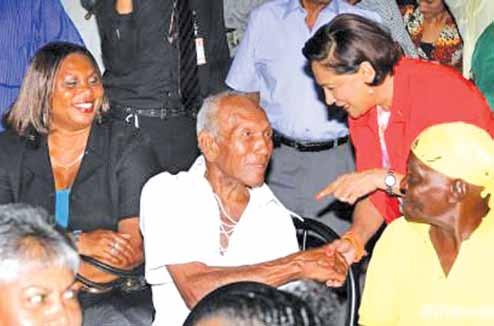
“From May 2010, the opposition has been calling for general election so that is not a new call,”
Persad-Bissessar said, adding, “I think that is part of their mandate and part of their job to
seek to have an early election.”
“Three years have gone by, that has not yet
happened, I have no intention of calling an early election, ‘Inshallah’, as they say, we have a mandate for five years and we intend to proceed to work to serve the people in these five years,” she said.
Persad-Bissessar also quashed reports of a Cabinet reshuffle this week as “premature”.
“I have not made any final decision, we are still in the process of introspection, reflection and consultation with as many persons as we can, it will premature for me to say yea we are doing X or Y,” she continued. “I have not even had a phone discussion with MPs, ministers, and therefore it is premature. We need to have that discussion.”
She also dismissed suggestions that ministers would leave her government, saying only a few councillors had left the party while only one minister had tendered his resignation following a cloud of allegations over him, referring to Warner.
“One minister was already no longer in the Cabinet (former Justice Minister Herbert Volney who has resigned from the party but remains St Joseph MP), one minister resigned from the Cabinet given allegations. Thus far I have not had any information of any other minister actually leaving the Cabinet, if that arises we will deal with it in due course,” she said.
(TT Newsday)
Less than a year after he staged a 21day hunger strike to force the Trinidad and Tobago government to halt the construction of a multi-billion dollar highway, south of Port of Spain, environmentalist Dr. Wayne Kublalsingh is back staging another protest action outside the office of Prime
Minister Kamla PersadBissessar.
Kublalsingh said while he would not be engaging in another hunger strike, he would nonetheless be protesting peacefully the construction of the Debe to Mon Desir segment of the TT$$7.2 billion San Fernando to Point Fortin highway project.
The 53-year-old environmentalist said that he and members of the Highway ReRoute Movement will be protesting outside the prime minister’s office until she meets with them and makes her position clear on whether she will abide by the James Armstrong report.
“I want her to tell the nation whether she is going to blank this report or whether she is going to do the truthful thing and obey the voice of the people and truth,” he said, after he delivered a letter to the prime minister’s press secretary Francis Joseph.
Last year, civil so-
ciety groups, including the Joint Consultative Council, mediated between the government and the Re-Route Movement resulting in the establishment of an independent review committee, headed by former Independent senator Dr James Armstrong. (TT Newsday)


The Caribbean Community (Caricom) recently put forward a case to raise the level of funding from its international development partners (IDPs) and to increase the number of community priorities in the bilateral and regional programmes of the IDPs.
Caricom Secretary General, Ambassador Irwin LaRocque wants to ensure that the community’s positions are reflected in ongoing discussions on donor coordination and aid effec-
tiveness, Small Island Developing and LowLying Coastal States (SIDS), and the Post2015 Development Agenda.
The secretary general articulated the community’s position last week at the third HighLevel Forum on Donor Coordination at the Princess International Hotel, Providence, Guyana, where representatives of Caricom member states, community institutions and IDPs gathered for over a day-and-a half of talks.
“Caricom, as an integration grouping, approaches such issues on a collective basis. In fact, it forms part of our coordinated foreign policy. We will advance our case for improved access to resources in the ongoing discussions on the Post-2015 Development Agenda. We will link our foreign policy positions to access to resources. We have no choice in these matters if our people are to survive and if our countries are to be placed on a path to sustainable and resilient economic growth,” the secretary general said in remarks at the forum.
The engagement with the international development partners is one step towards meeting the mandate of Caricom heads of government issued to the Caricom Secretariat at their justconcluded 34th regular meeting to design a Resource Mobilisation Strategy to ensure adequate financing of regional and national priorities to catalyse growth in member states.
Chinese engineers are currently in Trinidad and have started work on a feasibility study on a new port, Trade Minister Vasant Bharath reported Monday.
He noted that the visit of the engineers was follow-up on the State visit of Chinese President in Xi Jinping in June. He said one of the major projects government was committed to undertake was a new port.
“We believe that the current Port of Port-ofSpain is congested. It has outlived its purpose, because of where it’s situated,” he explained. He noted the new port was necessary to attract new vessels with the expansion of the Panama canal, and with a new canal being built in Nicaragua. He pointed out these vessels pass outside of TT and go down to places like Africa.
“So we need to be able to have the facility to accommodate those large vessels,” he said.
He did not, however,
go into details about the port, or the work of the team of engineers.
“And that is all I am able to say at this point in time,” he said.
He was speaking with the media following the “Keys to Trade and Export Financing” meeting held Monday at the Courtyard by Marriott at Invaders Bay, Port-ofSpain.
During his address he noted that the Chinese government had committed US$3 billion of concessional funding
to Caricom governments for infrastructure projects.
He reported that the team of Chinese engineers in Trinidad was also looking at the rollout of industrial parks.
He reported that the State agency Evolving Technologies (eTecK) was looking at accessing some Chinese funding for the roll-out of the parks which will cost about TT$700 million over the next two years. He noted the parks will be specific to certain types of businesses, such as software companies, or warehousing.
Questioned about his proposals for the upcoming national budget Bharath reported that he will be taking a note to Cabinet to have them look at approving the removal of Value Added Tax (VAT) for manufacturers on imported raw materials. He said there has been a backlog of VAT that has created major obstacles for local manufacturers, and traders generally. (TT Newsday)

In the centuries of both eras of the slave trade, thousands of slaves successfully fled the inhuman system to begin a new life either in newly formed communities or mixing with native groups. From North America through the Caribbean and Central America to South America, Africans and their descendants dispersed throughout the hemisphere.
No one wants to be enslaved, and that included the Spanish and Portuguese slaves recently transported to newly discovered colonies of the two Europeans nations. Little is known of the thousands of black societies living free throughout the Americas by the time of the Second Atlantic System.
According to modern research, many formed AfroIndian polities and microstates to win “de facto” independence from Spain. In Ecuador, Colombia, Panama and Mexico, Spain is said to have recognised these autonomous communities made up of people variously called quilombos, mocambos, palenques, cumbes, and in English, “maroons”. Others remained constantly involved in wars against European armies and settlements.
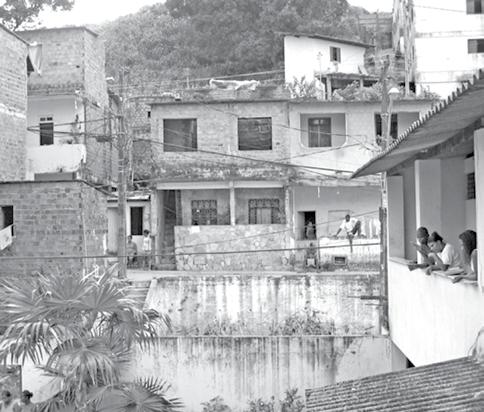
Lying at the edge of Salvador de Bahia in Brazil’s northeast territory, Calabar became one of Brazil’s most inhabited communities of slaves who had escaped from what would only have been a life of misery on the plantations. As many as 20,000 escaped slaves would live in Calabar at its height.
The town and another called Liberdade just a few miles further, were known as quilombos, the Brazilian name for these established fugitive communities. Many quilombos were in existence for decades and even centuries.
According to historical records, since 1650 Calabar was a colonial concern, but local historians say the community was established decades earlier. Hidden from view by dense forests and mostly inaccessible by its steep terrain and dangerous rivers, Calabar remained protected from Portuguese slave hunters, and was also a haven for native Indians also fleeing the Portuguese.
By the time Brazil abolished slavery in 1888, the community was trading with Portuguese exchanging dried fish, cassava (manioc), rice and palm oil for knives, guns and cloth.
Today several modern settlements have grown around the former quilombo.
The successful fight for freedom by Haitian slaves sent waves of pure terror through many 18th century slaveholders. An independent maroon nation that could galvanise similar uprisings throughout the new world slave plantations led to these a severe economic embargo on Haiti for decades that made the once wealthiest Caribbean island into its poorest.
Eighteenth century Haiti comprised some 8,000 profitable sugar and coffee plantations that made its French owners extremely wealthy on the backs of some half a million slaves. When the 1789 French Revolution rallied for Liberté, egalité, fraternité, its call was heard among the island planters who focused on freedom without government interference in their enslavement activities.
Inspired too by the rally and fearing planter rule, the slaves, led by Toussaint L’Ouverture, would revolt and defend the island first against the British who had by 1793 seized Haiti’s main cities during their own war with the French. Facing fierce resis-
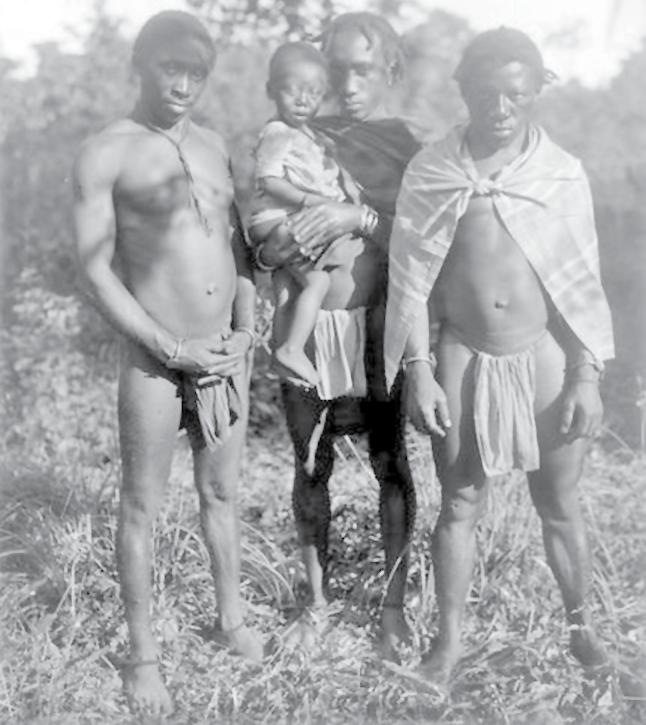
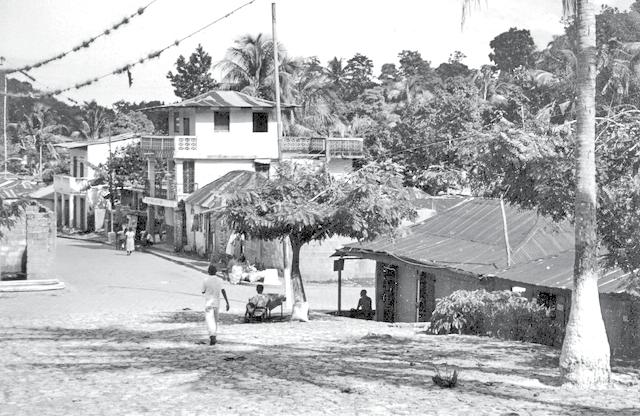
tance and mounting deaths by war and disease, the British left Haiti in 1798.
By 1802, a French force of about 65,000, sent by Napoleon who had earlier staged a coup in France, landed to wrest the island, now considered a maroon community, from the slaves. But by Nov 1803 France too withdrew heavily defeated, leaving an independent Haitian state.
Transported to Suriname after the Dutch won the territory from the English in 1667, 300, 000 African slaves arrived to begin work on European-owned plantations. But malaria and yellow fever would decimate European populations, making it easy for slaves to escape as they outnumbered the former 25 to 1.
Just three years after their arrival on mainland South America, thousands of maroons would wage guerrilla warfare for almost a century against the Europeans, rescuing more slaves from Dutch plantations during their raids. Unable to subdue the maroons, the Dutch government in 1762 eventually agreed to recognize the autonomy of six maroon groups.
It did not stop the arrival of more slaves for Suriname plantations, or more slaves escaping, but the constant conflict led to absentee owners who remitted all profits home without reinvesting in colony institutions and infrastructure. This led to Suriname becoming one of the poorest countries in the world by the time of its 1975 independence.
Today, descendants of the maroons, also called, Djukas, Bushmen or bush Negroes, still live in the heavily forested regions of Suriname. (Guyana Times Emancipation Magazine)

By PetamBer Persaud
The year 2013 is replete with significant anniversaries for all Guyanese, and especially for African and Indian descendants. But as usual, “big” events overshadow the lesser known historic moments. Already there are some plans to commemorate the 250th anniversary of the Berbice Slave Uprising; the 190th anniversary of the 1823 Demerara Revolt and the 175th anniversary of emancipation.
Scholarships on the abovementioned events are in abundance, so there is little need to repeat details here. However, while going through my library, I was attracted to a slim booklet published since our 1966 independence year – another historic occasion in the history of Guyana. It seemed as if it was by design that the booklet surfaced at such a historic period – both the book and independence are about freedom. R. E. Cheeks (then minister of local government) described the advent of the book as coming, “at a time when the youthful nation is searching for its personality and is awake to the value of its own recorded past.”
The book, “History of Victoria Village”, written by William N. Arno, (first published in 1966, reprinted by the Guyana Heritage Society 2000) tells the inspiring story of how a group of recently emancipated Africans pooled their resources together in order to make an unprecedented purchase of a sizable village on the East Coast of Demerara.
The purchase was one aspect of that inspiring story. The other aspect was that those ‘intrepid’ ex-slaves were able to draft rules and regulations to preserve their investment. There were 20 articles in that agreement “for the good regulation and general benefit of said estate” that tell us that the ex-slaves knew what they wanted out of the investment; and two of the first things they wanted were a church and a school house “which shall be used and devoted to the purposes of Religion as a School House and Church where our children may be taught to read their Bibles and learn their several duties, and where we may ...offer up to Almighty God our humble prayers and thanks for the mercies we have received and the ben-

efits we are enjoying.”
Education and church worship were given premium priority in their plans.
According to the book, in November of 1839, 83 persons, including two women, bought what was then Plantation Northbrook for the sum of 30,000 guilders ($10, 284, 63c.). It is mentioned here and in other places that two women were involved in that transaction, but the list of names revealed there were more than two.
That succinct “History of Victoria Village” was well supported by “a note from his [Arno] daughter”, a word from the Guyana Heritage Society, a foreword by R. E. Cheeks, a tribute to Arno by G. H. A. Bunyan, and two appendices.
All of these parts add to the story, but the two appendices are pregnant with relevant information. For instance, in Appendix I, there is a list of the “Proprietors of Victoria Village,
His sculptures are full of life and reflect his deepest thoughts. One recurring theme in his work is slavery. He explains, “I listen to a lot of stories about slavery and saw movies, and I don’t think there’s anything else as cruel as slavery. And as I said, when something bothers or influences me, I want to express that in art. Someone had asked me why most of my art pieces are based on slavery and why I’m not changing from that. I believe that we need to free ourselves not just from physical slavery but also from mental slavery. My art serves that purpose of a reminder to do so and so I won’t desist from that.”
Thom’s most recent work on the 1823 Demerara rebellion shows his resilience in continuing to create pieces that speak of slavery and the rich history we share in Guyana. He won a competition held by the Ministry of Culture, Youth and Sport calling on artists to create a sculpture reflecting the history of 1823 rebellion. Thom’s winning entry also gave birth to an art foundry at the Burrowes School of art.
“I was finding out about art foundries where I can do my sculpture in the U.S., but the cost of doing it was so expensive. That’s when I proposed to Minister Frank Anthony to set up a foundry in Guyana and cast my piece here, which worked out way cheaper. He accepted my proposal and now Burrowes has an art foundry, which I believe is the only one of its
East Coast Demerara, August 21, 1854”, the 20-point agreement; “John Smith, Noble Congregational Martyr”; notes on public meetings on the way forward, a historical review of the community centre aided self-help project and a beautifully worded petition to His Excellency Sir Gordon James Lethem in 1944, seeking a “Community Centre and a Recreation Ground for our youths”, among other facilities.
In that petition, the villagers marketed the village well: “(o)ver a period of years, the village developed into one of the most thriving communities of the Colony, so much so that it came to be known as the “Sweet Auburn” of the Coast and Sanatorium of British Guiana on account of its excellent health conditions.”
Appendix II is also replete with relevant information. Again, in flowery language, the villagers sought approval of the queen to use her name in renaming the village from Plantation Northbrook to Victoria.
In a Nov 30, 1839 petition to the queen through the Governor Henry Light, entreating him to represent them in such a way as to “obtain her royal consent,” the villagers wrote:
“We would fain band down to posterity some token of our gratitude, and some memento of the emancipation which we have witnessed, partaken of, and enjoyed; and we conceive that we cannot do so more effectually ....than by being allowed to name our plantation after our good and gracious young Queen Victoria.”
“History of Victoria Village” by William N. Arno is a slim book, but it is full of inspirational stories for modern Guyana – somehow we have lost that community spirit and we have abandoned the act of cherishing what we have and to build on what we have; things ex-slaves were able to do just after emancipation. When will we learn!
Responses to this author telephone (592) 226-0065 or email: oraltradition2002@yahoo.com
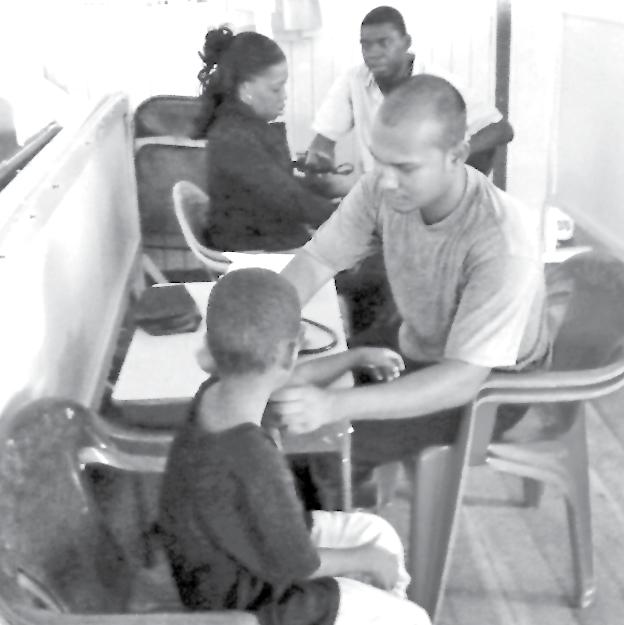
kind in the English-speaking Caribbean,” he revealed.
After doing much research on the Demerara slave rebel lion, Thom noted that it gave him a more in-depth under standing of what his sculp ture should depict. The main figure on the mon ument, he described, is a male carrying a cut lass – a tool for day-today work and prob ably was their only weapon of de fence. Symbols he also uses are a cross and chain showing that freedom was not just from slavery but being free to worship.
“History also tells of a woman who was active in organising the rebellion. So I put her there with a cutlass in her hand and clenched fist showing power and strength. The other side of the sculpture is a male with a musket showing he is moving forward and his hand is beckoning others to join him.

It is completed and is located at Carifesta Avenue. The message I wanted to communicate through this sculpture is that whatever situation we’re in if we work together we can fight for what we want and stand firm for our demands,” expressed Thom. Thom wants to encourage artists to take advantage of the art foundry at Burrowes. He noted that there is a need for persons to talize on ist added that there is an urgent need also for youths to get involved.
“A lot of what I learnt about my work is from reading books, which I still do. So my advice to young artists is to read and keep practicing everyday, because that’s the only way you’ll get better. I made a promise that I would do something with art everyday, even if it’s just a small sketch and so I encourage young artists to do the same.”
At an event to promote their upcoming film ‘Chennai Express’, actress Deepika said she kisses the Bollywood star, Shah Rukh Khan everyday!
Now before you go reading too much into it, SRK is happily married and is fond of his leading lady, the beautiful Miss Padukone. Both Deepika and SRK's chemistry has been evident, first in ‘Om Shanti Om’ and now in Rohit Shetty's ‘Chennai Express’.

While they make a cute onscreen couple, what did Deepika really mean by this statement? She further added that she can only give him love and happiness. (TOI)

After the Kolkata Knight Riders, Bollywood superstar Shah Rukh Khan now plans to move into the more popular football space. He is
‘My
planning to bid for the Kolkata franchise of the new league promoted by All India Football Federation (AIFF) and IMG-Reliance.
Shah Rukh said he was interested in buying stakes in the successful Goan I-League club Dempo but now with a new franchise-based league coming up he has changed his mind.
"Earlier I was planning to buy stakes in Dempo and now with the new franchise-based league coming up, I will have a look at it. I will love to own a franchise," Shah Rukh was quoted as saying by a TV channel.
Asked which city he would buy, Shah Rukh said: "I will love to have the Kolkata football club."
Eight clubs, 176 players, 72 overseas stars and 10 weeks of packed action-that is how the AIFF's commercial partner IMG-Reliance plans to glamourise Indian football early next year. (TOI)
Madhuri Dixit's fame as a popular Bollywood actress hasn't cast its shadow on her sons, Arin and Raayan, who she says are unaffected by their mother's stardom.
The 46-year-old, who is raising both her children in Mumbai with her doctor husband Shriram Madhav Nene, likes it that her children get excited to see her on TV.

"I have no idea if they understand it and I like it that way. I want them to be as innocent as possible. Even today they come running to me and say that mom you are on TV. My little one comes to me and says, 'really are you that famous'. But they are untouched by it and that's the way I like it," said Madhuri. (TOI)

‘Audiences find me most suitable for action’ – John Abraham

Even though actor-producer John Abraham personally likes doing films in different genres, he strongly believes audiences find him most suitable in the action space.
"Back home, I'm called 'action' Abraham. I love that phrase audiences have coined for me. The rom-com space didn't work for me. I worked really hard in ‘Jhoota Hi Sahi’, but it didn't work because audiences mostly perceive me in the action space," John told reporters.
"I also enjoy comedy and that's why I'm doing ‘Welcome Back’ and ‘Dostana 2’. But, I'm also doing an action film with director Nishikanth of ‘Force’ again and it will be ten times more powerful than our last film. I try to do different cinema because we are commercial actors at the end of the day," he said.
John says he doesn't hesitate to take risks.
"I guess I'm the only actor who takes risk. I mean I do a ‘Kabul Express’ in Afghanistan or I do a ‘Madras Café’ or I do a ‘No Smoking’, which nobody understood, but I enjoy that space and if someone needs to take risks then it might as well be John Abraham. I'm happy about it," he added. (TOI)
‘I eat cheese noodles to get over heartbreaks’ - Swara Bhaskar
In a recent interview on life and love, actress Swara Bhaskar was asked about her first crush and how does she deal with heartbreaks. In response, Bhaskar revealed that she had her first crush at the age of six.
“Strangely from that time till I was sixteen, whoever I fell for, they never liked me back,” she stated.

However, she went on to add, “After that, things became better and now it is pretty wonderful on the love front. As far heartbreaks are concerned, I eat a lot of instant noodles with dollops of cheese. It is odd but it is really effective in getting over boys.” (TOI)
‘Dad was passionate about donating eyes’ - Soha Ali Khan

The entire Pataudi family had pledged to donate their cornea several years ago.
Soha Ali Khan explained that, "all this is only because of my father. He was very passionate about it and that was the impetus for us. He donated his cornea and we were encouraged to do
and Aamir
Inspired by their latest production ‘Ship of Theseus,’ Kiran Rao and Aamir Khan have both agreed to donate their organs.
Kiran said that it was something she always thought of doing but the film led her to make the decision.
“I will donate everything possible to donate, which is typically your eyes, kidneys, liver, heart and even
the same. I must have been around 1718 years old when we did it. This is a cause he had been associated with for many decades. We used to joke with him because he had only one good eye. We would ask him which one of his eyes he would donate to science."
In fact, so firm is the family's belief in the cause that Soha says all she remembers is the pride she felt when her father's eye was taken post his demise. "We were very proud of his decision. My mother was in-charge of this. She spoke to the right doctors and it was done very professionally. There was no question of it not being done. And I don't remember feeling any sense of intrusiveness. I understand the sentiments of people around who are grieving, but think of the person whose life you will change with your eyes." (TOI)

your lungs. Once you are clinically dead, none of the organs are of any use to you anyways, so as against just getting burnt or getting buried,
you can help several people,” Kiran said is a recent interview.
Her husband, Aamir said “Kiran and I have discussed it, but we never discussed it seriously till she saw ‘Ship of Theseus’. This time, we spoke about it in a concrete manner and realised that it was so true that we could help alter the lives of others without harming ourselves in anyway.” (TOI)
‘Call me crazy, but I love my husband’- Sarah Jessica Parker

Sarah Jessica Parker, who has always remained mum about her personal life, has finally
opened up about her married life to fellow actor Matthew Broderick, insisting that people can call her mad, but she is in love with her husband.
In the September 2013 issue of Harper's Bazaar, the actress confessed that she couldn't be happier with the life that she's created with Broderick, out of the spotlight, US magazine reported.
The blonde beauty insisted that she loves her life with her husband of 16 years and both of them are devoted to their family.
The 'Sex and the City' star said that she also loves the fact that Broderick is the father of her children, adding that it's because of him that there's this whole other world that she loves.
The couple, who wed in May 1997, has three children together. (TOI)
Bruce Willis claims second marriage made him better family man
Bruce Willis has admitted that his second marriage with Emma Heming has taught him to be a better husband and father.
The 58-year-old actor said that he feels fortunate to be able to bring his family along when he is traveling, the Daily Express reported.
The action hero, who was previously married to actress Demi Moore, asserted that it would be unbearable for anyone to work with him if his family does not accompany him, as he would just be moaning about that.
The ‘Die Hard’ star added that there's nothing more important than family and friends and they should be treated well. (TOI)

Actress Lea Michele is reportedly working closely with the producers of TV musical comedy-drama series "Glee" on Cory Monteith's tribute episode.
The 26-year-old wants to ensure that the episode dedicated to her exboyfriend is perfect.
"The producers are still going back and forth on what they want to do and
clearing music for his tribute," hollywoodlife.com quoted a source as saying.
"The meetings are lengthy and Lea is a part of them to make sure everything is just right. It's still touch and go for all involved. Tears can and will happen. When they start filming the episode, everyone is going to be a mess. After they film that episode, they are going to go on a break to recharge," added the source.
Monteith passed away July 13 in his room at Fairmont Pacific Rim Hotel in Vancouver. He died due to an overdose of a mix of alcohol and heroin. He was 31.
The actor battled drug addiction throughout his teens and first entered rehab at the age of 19. His character, Finn Hudson, will be written off the show in the third episode of the upcoming fifth season, which will deal with drug addiction. (TOI)
‘I never watch my own films’ - Johnny Depp
Johnny Depp has revealed that he doesn't bother watching his own movies, but regrets missing out on a lot of his pals' hard work.
The ‘Lone Ranger’ star told the Independent that he made a choice a long time ago, that he was better off not watching his films, insisting that it would just harm him.
The actor said that he would rather stay as ignorant as possible about the result of his work, because once he is done playing that character, it's not his business anymore. (TOI)

Mark Wahlberg has warned Justin Bieber to "stop smoking weed" and focus on his career. He has also cautioned the Canadian singer not to “be so naughty.”
The singer turned actor, who was jailed for assault as a teenager, during a webchat with The Sun newspaper, joked: "Justin are you listening? Don't be so naughty, yeah? Be a nice boy, pull your trousers up, make your mum proud, and stop smoking weed, you little b***h."
On a more serious note, Mark, 45, added: "He's a teenager living in a different day and age. I was in prison before I got a record out and I don't think he's been to prison. He's a nice enough kid and you're go-
ing to be a teenager. But if you're being a teen in the spotlight you're going to be criticised for it.”
He noted too that, “this career can be short livedyou might as well be the best you can while you're doing it."
Mark, who rose to fame as the leader of pop group Marky Mark and the Funky Bunch, is also planning to work with the

19-year-old heartthrob on a film and may even get behind the mic again for the soundtrack.
He said: "Justin and I were talking about doing a movie, which could still happen. We have a great script which could be a vehicle for him to make his debut in movies, then maybe we could do something for the soundtrack."
(TOI)
Kim Kardashian is in no rush to the tie the knot with boyfriend Kanye West, it has been revealed.
A friend of the family has revealed that the 36-year-old rapper asked Kardashian to get married straight after the birth of their daughter, North West.
The Source added that the 32-yearreality TV queen has been adamant that it is bad luck to be married in 2013, as she considers 13 to be unlucky, the Daily Star reported.

Kardashian wants to wait till the next year and says that January 1 would be the earliest date possible. (TOI)

The current Athletics Association of Guyana (AAG) administration has been in office for approximately seven months but their track record, thus far, has been dismal. If we omit the recently-held Police Athletics Championships, the amount of competitions hosted by the AAG in 2013 can be counted on one hand, which speaks to a lack of vision and forward thinking by the officials responsible for the sport.
The early May/ June rain was said to be the major cause for the lack of competition according to the president of the association Aubrey Hutson in a May 4 article by this publication.
This is August and there were only four meets, all before May monthend: Junior Carifta trials (March 1 and 2), Guyana Defence Force (GDF) Developmental Meet (March 10), Running Brave Developmental Meet (March 17) and
World Athletics Day (May 19).
Using the argument that rain curtailed the running off of meets then it must be taken into consideration that Cassey George, Stephan James, Tirana Mitchell and Jason Yaw have been training in these unfavourable conditions in Guyana and gained medals at the international level.
Therefore, it is safe to ask where, when and how they trained but the AAG couldn’t hold more meets? For the AAG not to realise that their athletes are willing to compete at every given opportunity, especially with the deafening cries from athletes about the lack of competition at the senior level, is beyond anyone’s thinking.
If cricket can be played during some of these rainy periods that the AAG complained of, then track and field could have been held.
Such a situation leads one to question
whether the current AAG administration is lazy, does not understand what its roles are, or both.
This is not to say that the AAG is incapable of performing. Hutson has talked improvement and vision from the inception, but it has just been a talk shop.
Further, to this day the AAG has not submitted its four-year Road to Rio Plan that was expected to be handed in since earlier this year, which again speaks of the lackadaisical approach to the sport, which prompted Director of Sport Neil Kumar to call the situation “disappointing.”
The time for talking is over and if the current administration really wants to improve the sport then they need to correct their attitude and approach towards the sport first.
Further, the AAG needs to pull up their socks if they want track and field to stay relevant in Guyana.


Top seed and defending champion, Anthony Downes, made a successful defence of his Guyana Bank for Trade and Industry (GBTI) Tennis Open Men’s Singles title last Saturday. Downes, playing against number two seed Leyland Leacock, made the right plays at the right time to emerge with a 6-4, 7-5 victory at the bank’s recreational facility.
Playing under lights after a late start, second seed Leacock had the better start of the two, quickly jumping out to an early 40-15 lead on the top seed’s serve. However, that quickly eroded as Downes powered his way to save two break points with his crafty serve and volley game.
Leacock was made to work for his subsequent service game, as all the returns were blasted by
the stronger Downes.
With Downes cranking up the power on his serves, Leacock seemed content with blocking the first service returns over the net and hammering the second serves. The game would take a twist though, when the second seed found a way to break serve to go up 4-2.
Downes then showed his class and experience when he pulled all the tricks out the bag, employing the slice back to keep the ball lower, the volleys and the occasional cross court winner to take the next four service games, closing out the set 6-4.
Frustration crept in for Leacock when he threw his racquet to the ground in disgust at losing all the break point opportunities.
Leacock would also drop his serve to open the second set, and as
the double faults and the unforced errors began to creep in, the stronger Downes was now well on his way to a straight set victory.
Downes became complacent and lost his concentration but regained his composure to close out the set and game 7-5.
Also on Saturday, Godfrey Lowden hammered an out-of-sorts Carlos Adams 6-4, 6-1 to win the Men’s 35 title. Lowden executed all his plans well, moving Adams to all parts of the courts.
On Friday last, Nicola Ramdyhan and Leyland Leacock defeated Shelly Daly- Ramdyhan and Gavin Lewis 2-6, 6-3, 6-1 to claim the Mixed Doubles title.
The presentation of prizes to the top performers will be made at a date and venue to be announced shortly.
eight balls. There were also two wides in the over.
Hyatt finished on 42 not out while Philander was unbeaten on 23 runs from just eight balls. The Tallawahs ended on 146/6, maybe 26 more than they looked like they would once stumble to.
As the Red Steel got out to chase the target, the new opening pair of Adrian Barath and Kevin O’Brien got off to a slow start. The confidence seemed to have been lost in the team. The first two overs went for five runs. Off the last ball of the second over, O’Brien trying to make something happen, walked across his wicket only to be bowled. Barath looked in fine touch, but the task at that stage looked too big for his little shoulders. He found a good partner in Ross Taylor, who seems to be finding better form with every match. Both batted well putting on 62 runs for the second wicket. Taylor batted sensibly, and is quickly coming back to his best. The
only thing is his best may arrive when the Red Steel are out of the competition.
After he pulled a long-hop from Chris Gayle straight to Shehzad at short midwicket, the Red Steel would collapse under pressure, and that’s not even a pun. From 75/3, it became 82/4. With six overs remaining in the innings and Barath gone for 32 and Taylor 31, it was left up to the Red Steel’s big hitters to fire. The only thing is they haven’t fired for the tournament so far. Darren Bravo struggled to 8 before Muttiah Muralitharan ended his and the Red Steel’s misery. He wasn’t taking the score anywhere.
Dwayne Bravo, who needed to repay his team the 26 runs he conceded in the penultimate over did just that. He offered some hope, dashing out his brilliance. But it just seemed too late. With four overs to go, he struck Nikita Miller for two huge sixes, but even those shots couldn’t dent the fast rising Required Run Rate. With two overs left to get 30 runs, Andre Russell delivered the perfect over. His second ball got Bravo’s top edge that was well held by Baugh, who had to run to square-leg. A brief check from Umpire Peter Nero for a no-ball only tortured the fans with false hope. Pooran struck a boundary in the over to leave 21 runs needing from six balls.
Vernon Philander stepped up to the task. His second ball, a short one, was pulled just over fine-leg for 6. But he returned well, only allowing the singles. By the time of the last ball, the game was well out of the reach of the Red Steel. They needed 13 runs to win. Cooper struck Philander’s full last ball over cover for six, but the Tallawahs had emerged victorious in a game they spent the best part of the first half chasing. Bravo had not learnt his lesson. If he had, the Red Steel would have been back in the hotel by the time of Philander’s last ball.
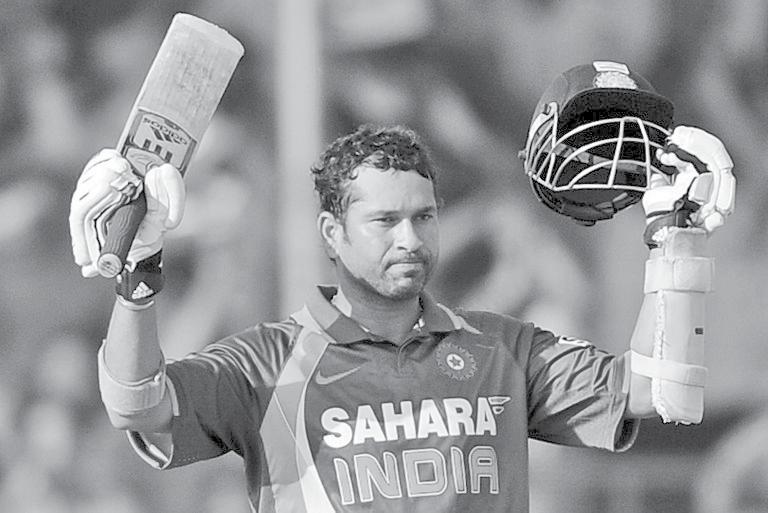
Port of Spain, TRINIDADFormer West Indies Test batsman
Bryan Davis has joined the growing list of prominent names who are discussing which of the current batting greats — Brian Lara and India’s Sachin Tendulkar, was the better player.
Former Australian captains Ricky Ponting and Steve Waugh, as well as ex-WI fast bowler Michael Holding recently gave their perspectives over who was the better batsman in the modern era (1990s and 2000s). And Davis, in his recent column in the Catholic News, admitted, “comparisons are rather odious but cricket fans can’t get enough of them.”
“The Tendulkar fans would tell you
that he has more Test runs than anyone ever, while the fan club of the Trinidadian would bring to your attention the remarkable individual totals of their man, who has the highest score in a Test innings (400 not out) and held the record not once but twice. Of course, he’s the only batsman to achieve a score of over 500 in a single First Class innings (501 not out vs Durham 1994).”
The analytical Davis wrote, “I’ve seen Tendulkar in Test matches both in the Caribbean and India and I thought him a class act, someone with a solid defence which protects him on any type of surface, with strokes all round the wicket.
“The late great Sir Donald Bradman said
the solidly-built batsman reminded him of when he used to play. He enjoyed a tremendous range of shots and his stroke-play glittered with the gift of the artist. He was magnificent to watch.”
Davis continued, “Lara, on the other hand, was the adventurer, exciting to look at, never dull, with a repertoire of strokes that is almost impossible to define. Bowlers had endless challenges to control him and keep him quiet.
“In a flash he would switch his balance from one foot to the next to execute fearless strokes, not only with power and timing but with elegance and flourish, which is always entertaining for the spectator.”
But the former Trinidad and Tobago opening batsman con-

fessed, “I leave the comparison of who was the better player to the fan, but for me I saw and enjoyed the symmetry with which these great players plundered the bowling, conquering the greatest bowlers, winning most of their battles against wise and tricky opponents, with a classical array of shots, delighting fans with the beauty in their batting.”
He asked, “Lara or Tendulkar? Who am I to say? “They were superb purveyors of the
art of batting and it is not for me to say,” Davis added. “I enjoyed both at the crease but I saw Lara more than I did the righthanded player.
“Thus, the little lefthander would have given me more delight only because of the number of times I would have seen him in the middle, attacking bowlers of all descriptions, from his days at Fatima College and throughout his development, eventually representing Trinidad and Tobago and then the
West Indies.
“I wasn’t fortunate to be able to follow the trail of Tendulkar, which would have been just as fascinating.
“I wish that those who get involved in comparisons won’t get carried away by statistics but will think more about how enjoyable were the performances, the style and substance of the batting, and the artistic way they both approached the games they played,” Davis pointed out. (WICB)
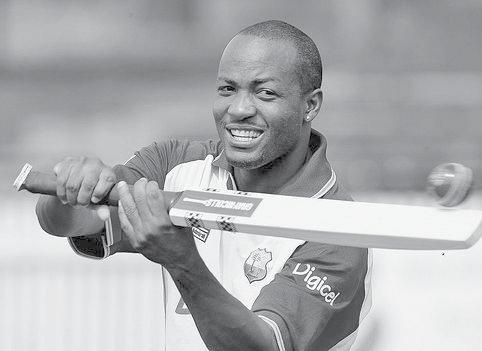


Chris Gayle is going through a prolonged patch of poor form, but the Jamaican refuses to enter a debate about his performance, noting that his approach has always been team success over individual brilliance. The left-handed opener had an unforgettable Indian Premier League (IPL) season for the Royal Challengers Bangalore earlier this year, hitting a sensational 175 off 66 balls against the Pune Warriors, but his returns for the West Indies and Jamaica have been meagre of recent.
Since his unbeaten 75 against Australia last October, Gayle has appeared in five T20 Internationals, scoring a total of 23 runs with the highest score being eight.
For Jamaica, the 33-year-old has managed scores of six against
the Guyana Amazon Warriors and 11 versus the Antigua Hawksbills in the current Limacol Caribbean Premier League.
Speaking at the postmatch conference after the Jamaica Tallawahs trounced the Antigua Hawksbills by seven wickets on Sunday, Gayle was positive a slump in form had not befallen him.
“I’m definitely not struggling; I’m playing according to the situation,” Gayle suggested.
On Sunday, Gayle, usually a swashbuckling batsman, spent 20 deliveries for his 11 against the Hawksbills; an approach he said was in keeping with the team’s plan. He added, “These things do happen; we have a great bunch of players, [and a] good batting line-up, but we lost a key wicket early so the
best thing for me was to spend some time in the middle.
“Most times when I’m in the middle the opponents find it a bit difficul to utilise the bowlers so it actually worked [on Sunday]. I’m not worried at all about my batting. Time will tell as we go ahead in the tournament.”
Gayle believes the ones who should really worry about his current form are the opposing teams.
“Chris Gayle is fine; timing the ball very well. Getting wins is key for us, so they [the opposing teams] should be worried about Chris Gayle. Chris Gayle is not worried. Chris Gayle never worries about anything. He just plays the game according to the situation… if it doesn’t come off, it doesn’t come off,” the Jamaican related.
Limacol rewards players and fans in Limacol CPL – sponsor to give away over US $14,000 in prize money
Limacol, the Caribbean Premier League’s title sponsor and owner of the Guyana Amazon Warriors, has announced two competitions to enhance match experiences for both the players and the fans.
The Limacol Super Six award of US$ 500 will go to the player in each match whose six goes the longest distance while the Limacol Cool Fan prize of US$ 100 will go to the fan at each match who is the most creative and outrageous in showing his/ her support for their team and the Limacol brand.
The best Limacol Cool Fan, one for each of the 19 game days,

Manager Trevor Bassoo hopes the Limacol Cool Fan prize will “encourage the continuity of the love West Indian crick-

will be identified during the match and the prize awarded at the conclusion of each game.
Limacol Marketing
et fans have for demonstrating their support for their teams.”
The Super Six award was given to Barbados
Tridents captain Kieron Pollard in the first match of the tournament against St Lucia Zouks while James Franklin of the Guyana Amazon Warriors took the prize in the second match against Trinidad and Tobago Red Steel.
“Scoring sixes is cool. The fans love it and we at Limacol are always looking for exciting ways to promote activities that the fans enjoy,” Bassoo said. “Limacol hopes that this will serve as further encouragement to the players to give their most optimum performance.”
About Limacol Limacol is a cool refreshing lotion that is a “freshness of a breeze in a bottle”. It is a product of NEW GPC INC, and has been popular for almost a century across the Caribbean and in the diaspora in the US, Canada and Britain. For more information, log on to www.limacol.com and www.newgpc.com.
England retained the Ashes by drawing the third Test as rain ended Australia’s final- day victory push at Old Trafford. The tourists were in a commanding position, having removed Alastair Cook, Jonathan Trott and Kevin Pietersen to reduce England to 37-3 in pursuit of an unlikely target of 332.
But recurring showers prevented any resumption of a compelling contest after 14: 03 BST, and the captains shook hands on a draw at 16: 40.
The result gives England an unassailable 2-0 lead with two Tests to play in the five- match series and ensures they will keep hold of the urn, having triumphed in the
past two series. Cook’s team need to draw only one of the remaining two Tests to win the series and underline their recent domination of one the sport’s oldest contests.
“It’s a great feeling, a strange feeling; it was a bit of an anti-climax today,” said Cook. Australia, who won eight consecutive Ashes series between 1989 and 2002-03, will hope to salvage a draw from the series before the return contest down under, starting in November.
The intervention of the weather was a bitter blow to Michael Clarke’s men, who rebounded strongly at Old Trafford after defeats at Trent Bridge and Lord’s.
Bolstered by Clarke’s

masterful 187, the tourists piled up 527-7 in their first innings before bowling England out for 368.
Scoring quickly to push for a declaration, they reached 172-7 in
their second innings on Sunday when bad light and rain ended play two hours early. Despite most weather forecasters predicting rain until at least tea on Monday, a dry
spell allowed play to begin only 30 minutes behind schedule at 11: 30, with Clarke declaring on Australia’s overnight score.
In overcast conditions ideal for swing
bowling, Australia made the perfect start as Ryan Harris swung one back to trap Cook lbw after a failed review - his first duck in 26 innings as skipper.
With the ground starting to fill up as word spread of the unexpected resumption, Trott survived an lbw shout before tickling Harris to wicketkeeper Brad Haddin down the leg side. The Australia assault continued as Peter Siddle, in his first over, drew a thick edge from Root which Clarke failed to grasp at second slip. Pietersen signalled his intention to counterattack with a pulled four, only to be caught behind playing away from his body for eight in Siddle’s next over. (BBC Sport)
Head Coach of the Guyana Amazon Warriors, Roger Harper said on Tuesday there is no need to panic following the team’s fivewicket defeat to St Lucia Zouks in the Limacol Caribbean Premier League at the Guyana
National Stadium on Sunday.
The former West Indies coach reminded that the Warriors had been outstanding in the first two games, and is adamant the team will lift their spirits in time for Friday’s game.
“Since we’ve been playing some good cricket at the start of the tournament, we won’t let one game dampen the spirit of the boys. We have put it behind us and come Friday we will go out and play good cricket,” Harper said.
The Warriors began the tournament with a crushing 19-run win over the Trinidad and Tobago Red Steels before thrashing the Jamaica Tallawahs by
eight wickets. However, they were overpowered by the St Lucia Zouks on Sunday.
Reflecting on Sunday’s game Harper said, “I think the Zouks played really well. It was an off day for us and we have put it behind us and are looking forward to getting back to our winning ways.”
Meanwhile, the 50-year-old Harper is confident that his players will respond positively from Sunday’s disappointment, adding that the team has the ability to regroup and rebound.
“We have a group of players who are hungry for success, so I have that confidence that the team will rebound,” said Harper.
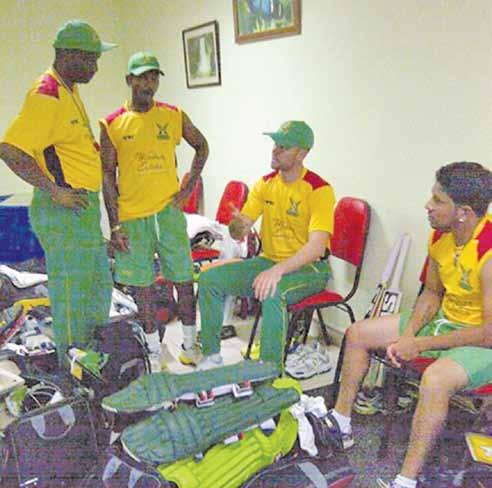

By RavendRa Madholall in ToRonTo
Guyanese fast bowler Jeremy Gordon and batsman Damodar Daesrath produced sterling performances for Canada in the International Cricket Council (ICC) Intercontinental Cup four-day match which concluded on Sunday at the King City Venue, Toronto. The 26-year-old Gordon put in a Man-of-the-Match bowling display, snaring eight wickets in the game after his first innings of 6-43 from 13.5 overs, while Daesrath chalked up another hundred within a week, scoring an accomplished 111.
Gordon finished with 2-34 from 18 overs in the second innings as opponents United Arab Emirates (UAE) laboured to 207-4 when the game came to a stalemate.
They made 116 in their first appearance before the hosts rallied to a formidable 369-6 declared with the stylist righthanded Daesrath fashioning his maiden four-day hundred.
He mixed solid defense with occasional aggression during his 104-ball occupation of the crease while he caressed 16 fours and three effortless sixes before he was dismissed via a catch.
Several days ago, the former national captain waltzed his way to an impressive 109 against United States of America in the annual Anty Cup one-day competition.
After the game on Sunday, Daesrath mentioned that he was extremely pleased with his performances and was looking forward to maintaining the same level of form for upcoming matches.
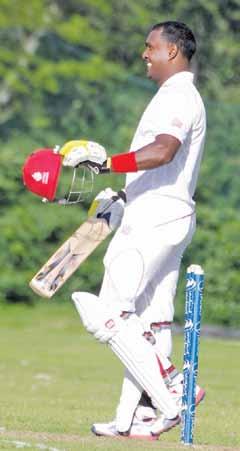
He attributed his unforgettable innings to hard work and commitment, and also thanked his teammates and coach Gus Logie for their unwavering support.
The talented Gordon, who also played First-Class cricket for Guyana, was also in an ecstatic mood having delivered


from page 53
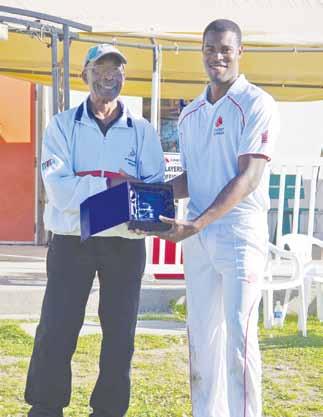
with great precision and accuracy on a batting pitch to churn out such an admirable accomplishment.
“Yes, I am very much delighted to come out with the Man-of-thematch performance for Canada; getting a sixwicket haul at the international level is certainly wonderful. I had to work hard because the track was quite batting friendly, but I am excited
with the performance,” Gordon, who played for West Indies Under-19 team in 2006, related.
Meanwhile, the duo has been selected to represent the North America nation once again in the limited-over version against the same opposition also at King City in the Cricket League.
The two countries will match their skills in four 50-over encounters in the coming days.
Legendary West
Indies captain Sir
Vivian Richards expects the Limacol Caribbean Premier League to be a resounding success, judging from the fans’ response to the Barbados and Guyana legs of the inaugural tournament. His statement came even before his team, the Antigua Hawksbills, convincingly beat the St Lucia Zouks by 33 runs in front of a sold out crowd at Beausejour Stadium.
Sell-out crowds were on hand to witness the three games at Kensington Oval in Barbados last week, with similar turn-outs marking the four exciting fixtures at the National Stadium at Providence in Guyana, which finished on Sunday.
Richards, head coach of the Hawksbills, praised the massive crowd support noting that it augured well for the future of the Limacol CPL. “I believe this tournament is a great tournament. The crowds we have seen will have giv-
en some indication as to where we are going and what we would like to achieve, and as the tournament goes on and I guess it’s going to get better,” said Richards, who dominated the 1970s and 1980s era in 121 Tests and 187 OneDay Internationals.
“What we have seen showcased indicates to me that it could get better. To have such a great start to the tournament and to have the Barbados team winning at home was also a plus.”
The Limacol CPL bowled off in Barbados on July 30 with a spectacular opening ceremony, followed by the opening game where Barbados Tridents defeated St Lucia Zouks by 17 runs.
Two days later, the Tridents repeated their success with a 12run triumph over the Hawksbills before capping the tripleheader on Sunday with a four-wicket verdict over Trinidad and Tobago Red Steel in a low-scoring encounter.
Overall, 24 match-
es will be played across six venues – Antigua, Barbados, Guyana, Jamaica, Trinidad and St Lucia – with the semi-finals scheduled for Queen’s Park Oval in Trinidad on August 22 and 23, and the final carded for August 24 at the same venue.
Sir Viv, long regarded as one of the finest batsmen to have played the game, said the Limacol CPL would definitely take West Indies cricket to another level.
“It is a great relief for us in this part of the world to have the CPL established, and to have
Digicel being part of this. They play a big part in what we do here in the Caribbean,” Sir Viv stressed.
“I just think it is a great opportunity for some of our young professionals to be involved in a professional tournament starting in the Caribbean. With the other events being staged around the world, this is a platform for these kids to also travel further afield.”
Sir Viv, who mastered the limited over game but whose career ended before the onset of Twenty20 cricket, said what was needed to succeed in this format was ingenuity and quick thinking.
“It is all about game situation. You can’t afford to be one-dimensional, you have to make changes where it is necessary,” Sir Viv pointed out.
“This is what I think T20 does. You do not go out with any fixed plan but you have to do some thinking on your feet.”
(CPL)


The Jamaica Tallawahs overcame a late onslaught from the Trinidad & Tobago Red Steel to win their second game of the Limacol CPL
The Jamaica Tallawahs overcame a late onslaught from the Trinidad & Tobago Red Steel to win their second game of the Limacol Caribbean Premier League. The win also heaped more pressure on the Trinidad & Tobago Red Steel, who remain winless after three games. On Wednesday night though, Dwayne Bravo would have felt he had only himself to blame as the Red Steel edged closer to crashing out of the tournament.
The highlight of the match came in the 19th over of the Jamaica
Tallawahs innings when Bravo opted to bowl himself. Danza Hyatt struck the first six, followed by three from Vernon Philander in an over that cost 26 runs. Before the over, the Tallawahs were 107/6. After the over, they were 133/6. It was little consolation in the end that Bravo struck a quick 29 runs from 24 balls to give the Red Steel some hope. The Tallawahs never looked like getting past 120 though. Bravo had sent them in. Chris Gayle and Ahmed Shehzad took advantage of the Powerplay. It wasn’t bad bowling from the Red
Steel all the time. Some of the shots were risky and paid off. The opening stand put on 44 runs just inside six overs before Shehzad was well caught by Benn at midoff. Delorn Johnson, who had come into the side, had struck first. But immediately after the Powerplay, things had slowed tremendously for the Tallawahs. Nkrumah Bonner had joined his captain but couldn’t get away from the Red Steel bowlers. Bravo kept mixing his bowlers well. As the halfway stage of the innings neared, the Tallawahs had added only 13 runs

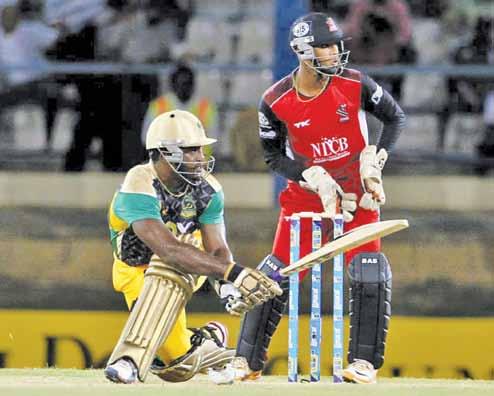
since Shehzad’s wicket. Bonner, not even attacking, was bowled by a delivery from Cooper that cut back sharply at him.
Gayle followed the very next over, as the Bravo brothers combined to have the lanky Jamaican caught at deep mid-wicket. Gayle had made 28 from 29 balls and the Tallawahs were quickly in trouble at 65/3. The bowling got tighter and better for the Red
Steel as the innings progressed. The Tallawahs looked like they would struggle to get to 120. Slowly, the Tallawahs batsmen edged the scoring along. Wickets kept falling along the way. With two overs left in the inning, Bravo opted to bowl himself out.
Samuel Badree who had bowled two overs for seven runs, including the wicket of Jacques Rudolph for 6 was ig-
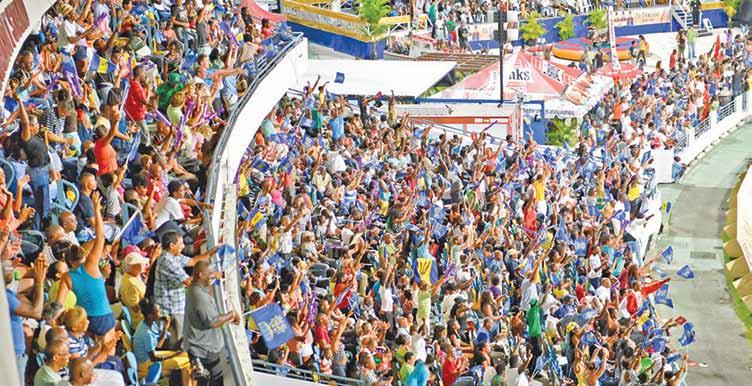
nored. Bravo would be made to regret his decision, for maybe the tenth match in a row. When he wasn’t short, he was full. When he wasn’t full, he was wide. Whatever he bowled seemed to disappear over the boundary. Four sixes had been hit in the over, and already the Red Steel knew they had gone from a position to one overfilled with doubt in the
of