




Revving
wednesday, february 5, 2014| guyanatimesgy.com



wednesday, february 5, 2014| guyanatimesgy.com
By Samuel Sukhnandan




he Guyana Revenue Authority (GRA) has reported a dramatic increase in revenue collection at the notorious smuggling hotbed of the Guyana/ Suriname border, with tax collection moving from approximately $7 million to a whopping $25 million weekly. But it is still to hone in on a port at Line Path, which GRA chief Khurshid Sattaur admitted was problematic.
Sattaur said the increase in revenue was made possible after GRA put several new systems in place, plugging numerous loopholes that for years helped a number of Corentyne businesses to prosper. He noted that the GRA has been faced with a number of issues at that particular border.
While the entity was aware of what was happening, it had to carefully plan a strategy to tackle the issue and strengthen the system. “We are moving to use better customs procedures there,” he added.
Bond
According to him, the revenue authority now has a bond, rented from a private company, closer to the Guyana/Suriname border and it has a centralised valuation system that profiles all importers and selects those with a poor risk assessment for investigation.
Unlike the storage bonds used by the GRA in Georgetown that are actually owned by major shipping operators like John Fernandes Limited and Muneshwer’s Shipping, the bond in Port Mourant is controlled and operated by GRA.
“We are using that bond to have more effective control and management over
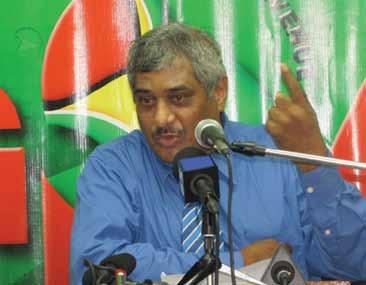
goods imported to such an extent, we have improved the collection from what it was, say, around September currently to more than 150 per cent,” he added.
GRA officials, he said, are also engaged in physical examination of goods in cases where this is necessary.
“So, all of these measures have served to improve the collection from what I mentioned and that I think has attributed to the effort we have made and the high degree of cooperation we are receiving from the authorities in Suriname.” He noted that the meeting held with high-level delegates of both counties last September facilitated the implementation of these systems.
The GRA boss said he will not give any credit to the business community, specifically because they were forced to adhere to the system.
At one time, the business community of Regions Six and Five, with the help of their local government offices, lobbied to have all taxes removed on the importation of goods from the neighbouring country. “I am happy that we have been able
to overcome those periods of difficulties, of challenges and of strong resistance and we are finally home safe, in that, we have put a system that is more accurate” and more consistent declarations are being made.
This, he said, will ensure more revenue is collected for the country and businesses do not have to complain about unfair competition from those importing goods from Suriname.
Line Path
According to Sattaur, many of the businesses located in the city, at one time, actually stopped clearing goods in Georgetown, joining the team of businesses in the Berbice region importing their goods from Suriname and trying to evade taxes.
Many of them had even moved to change their port of destination from Georgetown to Port Mourant.
However, systems have been put in place to tackle the slippages that have been occurring with commercial goods that bypass the official port or Moleson Creek where the ferry docks, coming into the country via an area called Line Path in
Corriverton.
“The amount of goods that come in from one vessel is astonishing. There could be sometimes more than a container and the amount of taxes ought to be paid and is not paid is getting larger, because of the number of trading that is occurring,” Sattaur noted.
Chicken smuggling
The GRA boss said the tax body is now looking at issues relating to smuggling of other commodities. “There is a concern right now with the smuggling of chicken, which is being imported illegally into the country to avoid taxes. There is also a concern that a large amount of goat is being exported illegally from Guyana and we have put measures in place to address these concerns.”
A large volume of business is carried out between Guyana and Suriname. Goods – food, household appliances, and other commodities – mostly come from Suriname.
The importation of goods and the evasion of taxes by businesses have caused significant hardship for some businesses which have complained that they have to pay a large amount of taxes compared to those that evade taxes.
The Berbice AntiSmuggling Squad (BASS) was created several years ago to address the issue of smuggling of goods.
While it achieved some measures of success, there was been a high level of corruption.
With the assistance of the Suriname custom authorities, the GRA has effectively moved to address the issue, frequently rotating its staff at the border to guard against corruption.


Editor: Nigel Williams
Tel: 225-5128, 231-0397, 226-9921, 226-2102, 223-7230 or 223-7231. Fax: 225-5134
Mailing address: 238 Camp & Quamina Streets, Georgetown
Email: news@guyanatimesgy.com, sales@guyanatimesgy.com
The World Health Organisation (WHO) in one of its latest reports says that remarkable progress has been made in recent decades to reduce the number of child deaths worldwide, but neonatal mortality rates have declined at a slower pace. The organisation stresses that most newborn deaths are preventable and opportunities for addressing newborn health are unprecedented, especially when effectively integrated with care for women and children.
One of the Millennium Development Goals (MDGs) is geared towards significantly reducing the maternal mortality ratio by three quarters by the year 2015. Since 1990, maternal deaths worldwide have dropped by close to 50 per cent. In subSaharan Africa, a number of countries have halved their levels of maternal mortality.
In other regions, including Asia and North Africa, even greater headway has been made. However, between 1990 and 2010, the global maternal mortality ratio (that is, the number of maternal deaths per 100,000 live births) declined by only 3.1 per cent per year. This is far from the annual decline of 5.5 per cent required to achieve MDG 5.
In Guyana, even though there are still some challenges being faced in terms of reducing the number of maternal and child deaths, the health authorities must be commended for dramatically reducing child deaths since 1990. In 1990, underfive mortality rate (U5MR) here was more than 100 per 1000. Today, the U5MR is under 20 per 1000 and is further reducing. Much of this improvement has to do with improvement in vaccine coverage and in the nutrition of children.
Government has taken a very proactive approach and has made several interventions in terms of ensuring that the health sector is provided with the resources and other support needed to see a reduction in the number of mothers and babies dying.
It would be useful if the findings of investigations into maternal and child deaths be made public so that health authorities and all related partners could work together to address the various deficiencies which exist.
On the global level, we are encouraged that renewed commitments have been made by governments and partners in response to the UN secretary general’s Global Strategy for Women’s and Children’s Health (2010) and its accompanying Every Woman, Every Child initiative, and to recommendations made by the Commission on Information and Accountability (2011) and the Commission on Life-saving Commodities (2012).
The recognition that newborn survival has lagged behind maternal and under-five survival, has triggered an initiative of multiple stakeholders to propose to the global health community the development of a draft global action plan called Every Newborn: an action plan to end preventable deaths (ENAP). Specific plans and targets for maternal health are also under development and will be linked to this process.
According to WHO, development of this plan has been guided by the advice of countries and experts, and coordinated by a core group of partners, led by WHO and UNICEF. This process included several multi-stakeholder consultations at different global and regional fora.
The development of the plan is also informed by: a systematic review of the progress made globally in the last decade; the epidemiological situation; the effectiveness of interventions available; and the identification of bottlenecks faced by countries in the implementation of effective newborn health interventions at scale and their possible solutions.
According to the UN, achieving good maternal health requires quality reproductive health services and a series of well-timed interventions to ensure a women’s safe passage to motherhood. Failure to provide these results in hundreds of thousands of needless deaths each year and is a sad reminder of the low status accorded to women in many societies.
New and more accurate data today shows that 45 per cent of global child mortality is due to nutrition-related causes. Half of these deaths are nutrition-related and can be resolved. But even if it takes another decade to resolve these nutritionrelated causes, the global child mortality rate will be reduced by almost half. The other half can also be resolved if the other causes – acute respiratory infections, diarrhoea, HIV, malaria, and childbirth complications, among others – are tackled.



Sarasvatee Jayanti reminds us of the importance of true
Dear Editor, Sarasvatee Jayanti is dedicated to the worship of the Divine as Sarasvatee. It is a day that Hindus fast, engage in prayers, temple worship and introspection. Sarasvatee means one who is possessed of infinite knowledge of the universe, of words, their objects and relations.
Sarasvatee is anoth-
er feminine name of God and is the manifestation of Gyaan Shakti – the power of knowledge, speech and wisdom. She is mostly worshipped by students and those in the field of education. Nevertheless, she represents Brahma Vidya – supreme knowledge or knowledge of God.
It is the universal concept that one should strive
for knowledge, free thy self of ignorance and live with inner solace; but though that has been somewhat of a rule, many have failed to understand what knowledge itself is, much less to define it and live in parallel with it.
The observance of Sarasvatee Jayanti and the adoration of her must remind us of the importance of true knowledge and the need
for acquisition. Knowledge is that by which the true nature of things are known and what remains unknown is ignorance.
Regards, Pandit Charranlall
Nandalall
Secretary Sanatan Vaidic Dharma Pandits’ Sabha, Region Three
Dear Editor,
The following words tell a story: “Tendulkar is the first sportsman to win the award and at 40, the youngest.” This is a line I took from the story headlined: “Sachin Tendulkar receives top India honour Bharat Ratna.”
Well this is quite a fitting way to celebrate the cricketing life achievement of India’s most loved cricketing son. He has truly lived up to and even surpassed expectations.
Tendulkar started his international career, both test and one-day, in the later part of 1989 and finished in the same period in 2013; this adds up to 24 years as a player and hardly has he ever been injured, gotten ill or underperformed. In fact, no bowler has ever conquered him, to the point, where he has even been considered a particular easy prey for any single one of them.
The excerpt from his pro-
file on Cricinfo sums up a good reason for this being so: “Sachin Tendulkar has been the most complete batsman of his time, the most prolific run maker of all time, and arguably the biggest cricket icon the game has ever known. His batting was based on the purest principles: perfect balance, economy of movement, precision in stroke-making, and that intangible quality given only to geniuses – anticipation.”
Outside of his batting, he remains quite exemplary –humble, non-confrontational and easy-going. In 2001, he was handed a one-match ban, when he was accused and found guilty of ball-tampering, and this almost brought down the world’s wrath on his condemners.
The incident goes back to St Georges Park, Port Elizabeth, during the second Test match of India’s 2001 tour of South Africa. Mike
Denness, as match referee, suspended Tendulkar for one game, as he thought that television cameras suggested that Tendulkar was involved in scuffing the seam of the cricket ball.
The incident escalated to allegations of racism, and ended up with Denness being barred from entering the venue of the third test match.
The International Cricket Council (ICC) later cleared Tendulkar of ball tampering charges. This clearly shows what kind of individual the man is and his place in the annals of the game.
We should take note of the fact that the Bharat Ratna award is India’s highest civilian honour. Previous recipients include India’s first Prime Minister Jawaharlal Nehru, Mother Teresa, South African President Nelson Mandela and former Indian Prime Ministers Rajiv and Indira Gandhi. The man is
definitely among the greats. A poll was done recently to identify who were the 10 most popular Twitter celebs in India. And barring Sachin Tendulkar, all turned out to be Bollywood stars. See the magnitude of the man? Whether or not he realises it, “(Tendulkar) will continue to bat for India, even though cricket has stopped (in his life).” He remains an inspiration and the statistics will continue to challenge all upcoming players. He has played in 664 international matches, scoring 34,357 runs and making 100 centuries. He has scored almost 2500 more Test runs than the second-placed batsman, Ricky Ponting. I think we all have doubts if any present day cricketer can come close to the figures he has left in the record books.
Sincerely,
Anil Jaipaul
Dear Editor,
The Home Affairs Ministry in its continued effort to enhanced traffic safety on the roads in Guyana commenced its 2014 programme on January 2.
The Georgetown and Berbice stray catching units targeted the East Bank of Demerara, the East Coast of Demerara, the West Bank and
West Coast of Demerara, the West Coast of Berbice and the Corentyne area.
A total 413 animals were impounded. This amount comprises 208 cows, 89 goats, 22 horses and 94 sheep. The Georgetown Unit accounted for 88 cows, 58 goats and 33 sheep.
The Berbice Unit accounted for 120 cows, 31 goats, 22 horses and 61 sheep. During the month, the ministry received complaints of cattle destroying kitchen gardens, digging up pipes, breaking fences, upturning garbage containers, attacking small children, aggravating dogs, and destroying sea defence, especially on the East Bank of Demerara.
The ministry once more appeals to cattle owners to exercise proper supervision of their animals during their grazing period, in order to enhance the welfare, well-being, and the safety of persons and properties.
Respectfully submitted, Home Affairs Ministry
Dear Editor,
A view posited by late Roman Catholic Saint, Mother Teresa is that we think sometimes that poverty is only being hungry, naked and homeless. But she goes on to say that the greatest poverty is being unwanted, unloved and uncared for.
“We must start in our own homes to remedy this kind of poverty,” she says and indeed this has some resonance in Guyana and was in fact duly recognised in a recent article in Guyana Times headlined, “Vagrants wish for a better life this Christmas”.
The article highlighted that one particular vagrant, for more than 25 years, has been immersed in a life filled with pain, sorrows, disappointments and loneliness; a life on the streets of Georgetown.
His story represents a global phenomenon, but points somewhat in the direction of irresponsibility and lack of positive action to exit his dreadful state.
Barring some exceptional circumstances, vagrancy can be avoided if people are willing to take personal re-
sponsibility for their actions.
And this means, being ever mindful of our actions and decisions in life as sometimes our past decisions come back to haunt in the most distressing of ways.
Though one can rationalise and say that things have happened and that the circumstances were beyond control, it is important to bear in mind that the reaction to the situation in one’s own response, and this can be controlled.
As such, one cannot entirely divorce his/herself from a situation.
Many tend to view the notion of “responsibility” in a negative light, almost to comparing it to a necessary evil.
This negative perception must change, by first beginning to see personal responsibility as a matter of obligation to a life of joy, accomplishment and liberation.
By accepting personal responsibility, one accepts that life must be viewed in a serious manner, and thereby plans and sets goals to achieve in life.
It is worthy for all Guyanese to accept this approach, because it entails a build-in mechanism to cater for setbacks by providing options to recover and not ended up being on the fringes of society.
All of this entails one being disciplined and living within his/her means and when mistakes are made, there is a concerted effort to have them corrected and not casting blame on others.
Blaming others for our downfall is never a helpful approach as it does not allows one to trace his/her fault and know where the error occurred.
It must be pointed out too that conversations lamenting on a plight is equally unhelpful; what should be done is placing focus on the strengths and weaknesses of the problem and finding ways to overcome the challenges.
Too much lamenting creates a negative spirit, and sometimes blinds one for seeing the positives in negatives.
All of these suggestions, in some way or the other, tie
into the notion of personal responsibility, and irrespective of our race, religion, age or political affiliation, it is never too late for us to accept as gospel truth and practise as an integral part of our lives.
We must also recognise our choices, make changes where necessary but must never fail to accept our personal responsibility.
The longest-serving U.S. First Lady Eleanor Roosevelt had said, “In the long run, we shape our lives, and we shape ourselves. The process never ends until we die. And the choices we make are ultimately our own responsibility.”
After all, in taking responsibility for our lives, we are rising above animals which are governed by instincts. Humans, with language, intellect and will power should pride themselves in making decisions based on intelligence and in the spirit to advance his station for the betterment of his well-being, his family, his community and country as large.
Sincerely,
Annalisa Ally
Dear Editor, John Palmer, a British citizen, acted in concert with Janette Bulkan to publicly criticise the 2005-2012 annual reports of the Guyana Forestry Commission (GFC) a few days ago in another section of the press. These reports were submitted to Parliament.
Great Britain, as every Guyanese knows, was once the motherland of Guyana and today it is universally known to be a developed country where democracy, good governance and the rule
of law prevail with totally the absence of rigged elections and illegal governments.
Palmer, however, seems to have betrayed his country Great Britain’s political philosophy having turned a blind eye and deaf ear to election rigging and massive corruption which took place under the illegal People’s National Congress (PNC) regime from 1964-1992.
He deliberately chose to write about Guyana, knowing fully well that democracy, the rule of law and economic dynamism have been
restored under a democratically elected government since 1992.
This shows clearly that Palmer apparently prefers Guyana to be ruled by an illegal and dictatorial government for its social and economic destruction, since he is currently an admirer and supporter of the PNC/A Partnership for National Unity (APNU), which is now part of the parliamentary opposition in Guyana.
Yours sincerely, Peter Persaud

Dear Editor, India has six seasons –Vasant (Spring), Greeshma (Summer), Varshaa (Monsoon Rainy), Sharad (Autumn), Shishir (Winter) and Hemant (Cold). Amongst them, Vasant is considered the most joyous, auspicious, and productive, thus most sacred season.
Vasant Panchmi marks the commencement of the spring season. It falls on the fifth day of Shukla Paksha, commonly known as waxing moon in the Hindu month, Maagha which is the period during January to February.
Our Indian ancestors have always been grateful and respectful to nature. At the beginning of Spring, crops were planted and the entire village farmers would come together and commence the season with prayers (havan) and rituals (poojaa) in appreciation to God for the arrival of the season.
On this day, having concluded the prayers and worship, all farmers would join in the planting of a symbolic plant, usual-
ly the same of what they grow. After the ceremony, they would begin planting their crops. At this happy time, the people were so grateful that as they ushered in the very productive season, they sung praises (chowtaal) to various Gods and Goddesses.
This very observance was brought to Guyana and is celebrated every year. In Guyana, a plant is erected and prayers are offered to God for bountiful crops and nutritious foods. A castor oil tree is normally planted. It is a very sturdy and strong tree. It can survive all conditions inclusive of rain, sun, hot and cold. More so, it is a bitter plant and thus difficult for animals, such as goats and cows to eat.
“May our crops grow strong and flourish as this tree.”
Regards, Pandit Charranlall Nandalall, Secretary, Sanatan Vaidic Dharma Pandits’ Sabha, Region Three
BY KRISTINA DUDA
No one likes having the flu – it is a miserable illness and makes pretty much everyone feel horrible. Caring for a child with the flu isn’t much fun, either. Children are typically very resilient and will be able to handle the illness better than adults. But there are some special considerations to take into account when caring for a child with the flu.
The symptoms of the flu are similar in children to those of adults. Children will sometimes have vomiting and diarrhoea in addition to the typical upper respiratory symptoms of the flu, but these symptoms are rare in adults.
Because young children are at much higher risk for severe complications from the flu, most of them should be immunised when flu shots become available. The CDC recommends that all children between the ages of six months and up to five years get the flu shot. In addition to children in that age group, any child with a chronic medical condition such as asthma or a weakened immune system is considered to be at high risk
from flu complications and should get the flu shot as soon as it is available.
It is a good idea for children of all ages to get a flu shot if there is no shortage. An alternative for children over the age of five who have no chronic medical conditions is the nasal flu vaccine.
When it comes to caring for a child sick with the flu, behaviour is the most important factor to take into consideration. If a child has a high fever, but is still active and having periods of near normal behaviour, it is much less concerning than a child with a low fever who is not happy or somewhat playful at any point.
When assessing fever, there are two exceptions:
* A child between birth and three months old whose rectal temperature is above 100.3 degrees or below 97 degrees needs to be seen immediately by a doctor. Babies this young cannot regulate their temperatures well and temperatures outside this range are a concern.
* A child between three and six months with a rectal temperature of over 101 degrees needs to be seen by a

doctor. While these older babies can regulate body temperature better than when they were younger, a temperature over 101 is a serious concern.
* For any child older than six months, the best gauge for treatment is the way they are behaving. A fever in itself is not harmful (unless it is caused by environmental factors, such as being out in the sun or in a hot car) and there is no number that is too high. If your child’s temperature is 104 degrees, but he is still running around playing, there is no reason for concern and no reason to treat it. If the child is uncomfortable and not playful, then it is fine to treat the fever with Tylenol or ibuprofen (Motrin or Advil). Be sure not to give a child under 18 years old aspirin, because of a serious illness called Reye’s Syndrome.
Rest
When your child is sick, they also need plenty of fluids and will probably need extra rest. But it is not necessary to make them stay in bed all day if they feel like getting up. Children are pretty good about not pushing themselves too hard
when they don’t feel well. So you can feel confident basing your treatment on their behaviour.
Treating
vomiting and diarrhoea
If your child is vomiting or having diarrhoea, you will want to be sure he does not get dehydrated. Once the vomiting stops, giving small sips of Pedialyte or halfstrength Gatorade (mixed half and half with water) is the best way to keep him hydrated and replaces the electrolytes he has lost. Remember to space these sips out every five to 10 minutes after he has been vomiting so you can be sure he is able to keep the fluids down.
Seeing the doctor
Of course if you are concerned about your child’s symptoms or his behaviour, it is always a good idea to call your paediatrician. They will be able to tell you whether you need to bring your child in to be seen or if you can treat his symptoms at home. If you follow these guidelines and use your best judgement, you should be able get your child through the flu and back to himself again soon. (About.com)

BY CAMILLE PERI
The average American child has six to 10 colds a year. In fact, children’s colds cause more doctor visits and missed school days than any other illness. And every parent knows how easily colds passed to other family members once one child gets sick.
What can a parent do? Stopping cold germs where they breed is your best defence.
“Children gathering in schools is one of the main ways germs circulate in communities,” says Athena P Kourtis, MD, PhD, MPH, a paediatrician and author of Keeping Your Child Healthy in a Germ-Filled World Why?
germy habits, such as sticking fingers and objects in their mouths.
* Combine these factors, and the conditions are ripe for spreading germs at school. But most illness can be avoided, says Philip Tierno, PhD, author of The Secret Life of Germs. “A few simple measures can go a long way.”

Here are 10 ways to help protect your child from germs and illness at school.
Get immunised
Children’s immune systems are less mature than those of adults, so they’re more susceptible to germs.
* At school, children are in close contact with each other.
* And they tend to have

“Prevention is the best medicine,” Tierno says. Make sure your child is up to date on scheduled immunisations and that everyone in the family has gotten a seasonal flu vaccine. In 2010, the CDC began recommending flu vaccination for everyone over six months old. If you miss the vaccine in fall, winter or even spring is not too late. Peak flu season is usually not until February and you can get vaccinated as late as May.
Know how and when to wash hands
One of the most common ways children get colds is by rubbing their nose or eyes after cold virus germs have gotten on their hands. And children often don’t wash their hands often enough or well enough at school. In one study of middle and high school students, about half washed their hands after using the bathroom – and only 33 per cent of the girls and eight per cent of the boys used soap.
Make sure your child knows to use soap and warm water. He should scrub all over – including the back of his hands, between fingers, and around nails – for about 20 seconds, about the time it takes to sing the Happy Birthday song twice. Then rinse well in warm water, dry with a paper towel, and use the towel to turn off the water.
In an ideal world, children would wash their hands many times a day in school. In the real world, the most important times to wash are after using the bathroom and before eating, drinking, or touching their mouth, eyes, or nose.
Ask your child’s teacher to include hand-washing time before lunch or snacks and teach your child not to touch his nose, eyes, or mouth when his hands are dirty. (WebMD)
… calls for negotiations to be devoid of political grandstanding
The Private Sector Commission (PSC)
has criticised the position of the A Partnership for National Unity’s (APNU) regarding the observation of discussion on the Anti-Money Laundering and Countering the Financing of Terrorism (Amendment) (AML/CFT) Bill, at the parliamentary special select committee.
APNU was objected to a motion put to the select committee for the proceedings to be observed by the commission.
The PSC in a statement said on December 10, APNU gave an unqualified undertaking to support the PSC proposal that the meeting of the special select committee be held in public, thereby facilitating observers.
“The PSC finds it inexplicable that APNU would now renege on its undertaking made at a meeting chaired by its leader Brigadier (retired) David Granger and considers this to be a disturbing display of bad faith on the part of the major opposition party.”
The commission had requested an urgent meeting with the coalition over the matter.
Meanwhile, the Georgetown Chamber of Commerce and Industry (GCCI) said members of the National Assembly should leave “political grandstanding” out of the negotiations.
“The chamber noted with deep disappointment the position adopted by A Partnership for National Unity to withdraw and not allow outside observers to the parliamentary select committee debates concerning the amendments to the Anti-Money Laundering and Countering the Financing of Terrorism Bill,” the GCCI said in a press statement on Tuesday.
It was pointed out that the PSC is the second civil society stakeholder, after the media, to have been refused access to the committee’s meetings.
No need for secrecy
The chamber is contending that the anti-money bill is a matter of public interest; hence, there is no need for secrecy. The opposition’s position comes as a major shock, the chamber said, pointing out that both the opposition and the government have given the PSC the assurance that public screenings would have been a welcomed initiative.
“It is therefore surprising and discouraging that the APNU has deviated from this position.”
The GCCI opined that public access to these parliamentary meetings is important when considering the notion of transparency. Nevertheless, the chamber remains hopeful that the opposition would rescind its de-
Princess Hotel and Casino Guyana said it has noted with great alarm the recent media reports regarding an alleged incident that occurred in January, whereby an ex-employee claims to have been assaulted by a principal of the company.
cision.
“The Anti-Money Laundering and Countering the Financing of Terrorism Bill is too important to our nation’s economy and development to have partisan and petty political tactics and grandstanding affects its consideration, augmentation and eventual passage.”
Last November, the opposition used its one-seat majority in the National Assembly to block the presentation of a petition from the PSC. The PSC was calling on APNU and the AFC to support the anti-money laundering bill, stressing that the country should avoid economic hardship and financial blacklisting.
Explanation
APNU in a statement said its members walked out of the meeting Monday night over the attitude and behaviour of the chairperson Gail Teixeira.
The coalition’s statement comes one day after the government accused the opposition of walking out of the meeting to avoid voting on whether or not the PSC should be allowed to be an observe during the proceedings.
APNU explained that the first substantive item on the agenda was a request from the PSC to attend the meetings in the capacity of an observer.
When the matter was discussed, APNU's member Carl Greenidge reminded the committee of the coalition’s “no objection” to the participation of stakeholders in the select committee’s deliberations on an adhoc basis and as the need arises. Greenidge at the meeting was pushing for the same formula to be employed for the PSC.
In keeping with the Standing Order governing select committees and the press, Greenidge said the PSC should have been informed that the committee was not prepared to have observers.
An 18-year-old former employee of the hotel told a news conference on Monday that she was allegedly sexually assaulted by one of the hotel’s managers. The young woman, along with her father and a sibling, on Monday, engaged members of the media with details of the incident which allegedly occurred on Saturday, January 11.
the teen said she had been working at the hotel for some four months prior to the alleged incident. She related that on the day in question, she was serving drinks in the casino when she was confronted by the manager.
“The story is based on him touching my breast when I served him in the casino and when he bent over to kiss me. After that, I went back to my normal job and one of the managers came looking for me and told me he wanted me to look after this man specially,” she said.
Alleged ordeal
The woman said she was told by a manager that she would be taken back to the casino, but was instead taken into the elevator. “So I turned and I told him this is not the casino and he told me to relax. While in the elevator, he asked me how old I was and I told him,” she said.
The young woman said she was then taken to the room of the accused and was ordered to do whatever she was told, as she would be paid for any kind of work done and would be allowed to access one of the company’s cars to go home if it became late. She said she was alone with the accused in the room.
“Before he did that, he put his hand into a glass on the light stand and then put his hand back under the sheet. He told me to come closer and make sure that the door is locked,” she went on to say.
The young woman said she quickly thought of us-
ing the washroom because it seemed as though that was the only way she could have escaped. However, after leaving, she was confronted by another employee who enquired her reason for being outside.
She said she told him that she was going to the washroom. “When I peeped out, he was still there,” she said, but explained that she was eventually able to elude the employee and scurried to the bar where she related her ordeal to a supervisor.
She said she told the supervisor that she was leaving the job, since she could not work under such circumstances. He then took her up to the human resources (HR) manager where she again related the incident.
“I told the HR the story and he said that they would not be able to condone it. He asked me if I am willing to work or go home now, and I told him I wanted to go home and I checked out,” she said.
The young woman said she called her parents and was later taken to the Providence Police Station, East Bank Demerara where a report was made.
She said police officers went in search of the accused, however, he had apparently already left the hotel. She was directed to make another report to the Brickdam Police Station, Georgetown, which she did.
However, the hotel said on Tuesday that it categorically denies all of the allegations.
“At all material times Princess Hotel has fully cooperated with ranks of the Guyana Police Force, who were detailed to conduct an investigation into this alleged incident.
"In this regard, Princess Hotel has made available for interrogation by the said ranks all the employees, including managers, who were on duty on the said day as well as provided video footage from closed circuit cameras installed on its property.
"At no time thereafter did the investigating ranks or any other rank of the Guyana Police Force make any further request for information,” the hotel said.
According to the hotel, the investigators, at no time, requested to interview the principal against whom this complaint was made.
The principal is resident outside the jurisdiction of Guyana and only visits Guyana sporadically for very short periods in furtherance of his business interests locally. This fact was made known to the investigating ranks upon their initial inquiry at the hotel.
“At this point, Princess Hotel is not aware of the status of the investigation, but
is anxiously awaiting the outcome thereof,” said the hotel.
The hotel also said it and its principals hold inviolate the laws of Guyana and conduct all activities within the confines thereof. “The hotel practises according to international human resources guidelines and treats its employees with the highest of regard and dignity,” it said.
The hotel noted that at no time whatsoever it offered the virtual complainant any reward or other consideration to induce her to withdraw the allegations made against its principal nor has anyone been so authorised on its behalf.
“Princess Hotel has a strict policy on sexual harassment of its employees and has never received any reports of this nature from any employee,” said the hotel.
The hotel said it views with great seriousness the threats reportedly made by the father of the virtual complainant to do harm to principals, employees and its property, and intends to lodge a formal complaint with the Guyana Police Force.
The hotel said it intends to institute legal proceedings to recover damages suffered to its reputation as a result of these unfounded allegations made against its principal, managers, and by extension, the entire hotel.


Four men from Linden Tuesday appeared before Chief Magistrate Priya Sewnarine-Beharry in the Georgetown Magistrates’ Courts slapped with charges of robbery under arms and unlawful possession of firearms.
Wesley Griffith, a 19-year-old of Thomas Street, Mackenzie, Linden; Ruel William, a 32-year-old of Industrial Area, Mackenzie; Nellon Brummell, a 27-year-old porter of Lower Kara Kara; and Clifton Orena of Mackenzie were not required to plead to the charges.
The first charge alleged that on January 31 at Amelia’s Ward, Linden, being armed with a weapon, that is a gun, the first three named defendants
robbed Martina Ramdehol of $400,000. The second charge alleged that on the same day, they robbed Nafeeza Ramdehol of jewellery and a cellphone, collectively valued $107,000.
The third charge instituted against the trio alleged that on January 31, they also robbed Koolali Ramdehol of two gold rings valued some $50,000. The fourth charge stated that the men also robbed Devanand Ramdehol of one motor vehicle PRR 4501, which was valued at $3.4 million.
The fifth charge stated that the men also robbed Ryan Ramdehol of jewellery and other items, valued over $600,000. The sixth charge read that the men robbed Lalta Ramdehol of jewellery and other items,
valued approximately $230,000.
Griffith was jointly charged with Clifton Orena for possession of one shotgun and three live cartridges without being the holders of a valid firearm licence.
Police Prosecutor Michael Grant informed the court that the virtual complainants reside in the same house and on the day in question, at approximately 21:00h, they were all at home when the men, one of whom was armed with a gun, entered and proceeded to relieve them of the articles mentioned in the charges.
He added that the men then made good their escape with the valuables.
Investigations by police officers led to the car be-
ing recovered. Further investigations had resulted in the arrest of Griffith and Brummell. After questioning by the police, Griffith told officers that he had given the shotgun to Orena. The shotgun was subsequently recovered and Orena arrested.
Attorney Gordon Gilhuys, who appeared on behalf of Griffith and Williams, told the court that Williams was a victim of police brutality.
He pointed to several parts of his client’s body that bore visible marks of violence.
Magistrate SewnarineBeharry then remanded the men and ordered that they appear at the Christianburg Magistrates’ Courts on February 11.
A38-year-old miner was remanded until February 3 when he appeared at the Georgetown Magistrates’ Courts before Magistrate Fabayo Azore charged with possession of marijuana for the purpose of trafficking.
Dellon Hutson, of Hadfield Street, Georgetown, who appeared in court clad in blue jeans
and red t-shirt, pleaded not guilty to the offence when he first appeared before Chief Magistrate Priya Sewnarine-Beharry. The charge alleged that on January 28, in Georgetown, he had in his possession 58 grams of cannabis.
Police Prosecutor Adduni Inniss told the court that on January 28, at approximately 10:00h, ranks
from the Customs AntiNarcotics Unit (CANU) received a tip. Acting on that information, the ranks proceeded to the home of the defendant with the aim of searching for marijuana.
Upon arrival, the police officers saw the defendant reach into a bag and pull out a pair of scissors. One of the policemen became fearful for his life and fired a

gunshot hitting the defendant in the left leg.
The accused then discarded the bag and make good his escape. A subsequent search of the bag revealed the items mentioned in the charge.
Some days later, the defendant surrendered himself to ranks of the narcotics unit in the company of his attorney Glen Hanoman.
Desmond Singh and Vikram Samchan were on Monday placed on $100,000 bail each after they appeared at the Georgetown Magistrates’ Courts before Chief Magistrate Priya Sewnarine-Beharry charged with unlawful assault.
Singh and Samchan were not required to plead to the indictable charge which alleged that on February 1 at La Penitence, both of them unlawfully and maliciously assaulted Morris Dashira. The men told the court that they were self-employed. Singh subsequently added that he resides at Orange Walk, Bourda.
Police Prosecutor Michael Grant said Singh had accused the virtual complainant (VC) of slapping him. He added that both Singh and Samchan subsequently approached Dashira and dealt him several blows about the body, causing him to receive extensive injuries.
Grant objected to bail for the two men, citing the extent of the victim’s injuries. Nevertheless, Magistrate Priya Sewnarine-Beharry granted the men bail in the sum of $100,000 each.
They are scheduled to reappear in court on February 6.

...by U.S. on dams
So here it is, the World Bank, after pondering the failure of the market fundamentalism doctrine it flogged to the developing world came up with a new mantra. The answer to creating growth – especially in Latin America and the Caribbean – it announced, was to focus on INFRASTRUCTURE. These big ticket items wouldn’t just create employment and stimulate spending – they’d lay the platform for increased efficiencies in production.
In fact, the World Bank didn’t stop there – it went on to specify especially what type of infrastructural development might be best for our region – hydroelectric power. This made sense because in addition to the aforementioned benefits of infrastructure in general, hydroelectricity saved foreign reserves, saved the environment, and saved fossil fuels. How could you go wrong? Mother Nature was coming to our rescue: the water cycle evaporated water from ground level into the skies and this fell down to create rivers that could be dammed to turn turbines that generated electricity. Virtuous cycle!
The World Bank found a willing ear in our hemispheric development bank – the IDB. In its report of March 2013, the IDB, which distributed loans and grants worth US$11.4 billion to 26 Latin American countries in 2012 also, offered the same policy advice. The key to moving beyond the four to five per cent growth rate where we have been stuck for a while, it announced, was to focus on “infrastructure, infrastructure, infrastructure”. Including hydroelectric power.
So guess our consternation when we saw the U.S. Congress, earlier this year, forbid their government to approve any construction of hydroelectric dams. They were concerned about the effect on conserving fishes and people who might live in the basins to be flooded. This excuse might’ve cut more ice if they hadn’t abandoned their commitments on reducing carbon dioxide that causes global warming. Not to mention their acid rain and fertiliser run-off that kill more fishes than anywhere else. Now we might say...who cares what the U.S. thinks? Well, we HAVE to: for the simple reason that it calls the shots at both the World Bank and the IDB. We’d been counting on the IDB to contribute some funding for Amaila Falls once it gets back on the front burner. But now this is up in the air: it’s presently funding a study to see what effect the dam will have on a particular fish. See?
And you’ll hear, too, the noise that’ll be made when China steps up to the crease and provides financing.
...by Speaker on ruling
You remember the story of Chicken Little? That’s about the chicken who ran around screaming “The sky is falling!!!! The sky is falling!!!” And you know how it inevitably ended. Before long, he became like the proverbial “Christmas blow-blow”. Well, seems our esteemed Speaker’s determined to outdo Chicken Little.
Referring to the acting Chief Justice’s ruling that put a halt to the opposition’s budget chopping spree, he screams that the judgement will have far-reaching effects “throughout the Commonwealth parliamentary systems”!!! Now this is where he’ll become the Christmas blow-blow. What a pile of piffle he’s proffering. Fact of the matter is that each country, Commonwealth or otherwise, has their own constitution. And their courts will interpret them based on the local constitutional stipulations.
Why the heck would India have to follow us when they can’t have a minority government since coalitions are allowed? The bottom line which the opposition’ve afraid to touch like a hot potato, is that they have options – like appealing.
Or conversely, if they have the guts, move a motion of no-confidence in the government when it comes for the estimates to be voted on by the House. Your Eyewitness dares them.
...on comparison
A columnist in the Muckraker asks (as a “come on” obviously), “What does Adam Harris have in common with Whitney Houston?” Make a guess!
here is no evidence
T23-year-old Colwyn Harding was batonraped, Police Complaints Authority Chairman, Justice Cecil Kennard said, noting that criminal charges to this effect will not be instituted against police officers accused of the allegation.
In a telephone interview with Guyana Times on Tuesday, Kennard said he has completed his role in the process and is currently preparing his report with recommendations to be handed over to the relevant agencies.
Asked whether there will be any charges against the police officers accused of the allegation, Justice Kennard said “the evidence does not point in that direction”.
He explained that the report from the Office of Professional Responsibility (OPR), which was handed over to him about a week ago, does not contain any evidence of Harding being assaulted to the extent he claimed, that is, raped.
However, he pointed out that there will be charges of physical assault levied against the officers.
He disclosed that he has recommended that two police officers be charged criminally and several others to face disciplinary action departmentally.
Kennard went on to say that a key factor missing from the report is a medical
report to support Harding’s allegations.
The head of the PCA further noted that the fact that Harding waited months before making his complaint was another factor taken into consideration.
“He waited until he was at the Georgetown hospital, he might have revealed it to his lawyer and other persons, but not until January. All he told the doctors was that he was assaulted, he did not mention anything about the police using a baton on him,” Kennard stated.
No sexual assault complaint
Kennard noted that Dr Madan Rambarran, in his statement, said when he saw Harding in January, the young man made no complaints of being sexually assaulted.
“Even when he was in prison, he didn’t complain about that. He had several opportunities. When he got to prison, he didn’t tell the medical staff there. These are serious allegations,” he stated.
Justice Kennard explained that the next step now is for him to hand the report over to the relevant authorities.
“Assuming that I'm recommend criminal charges, it will have to go back to the crime chief for him to take the file to the office of the DPP [Director of Public Prosecutions], who will make
the decisions where criminal charges are concerned,” he said.
He added that disciplinary charges were recommended for several officers, all of whom were stationed at Timehri.
He explained that some of the charges will be dealt with by the police commissioner and the others by the Police Service Commission.
Allegations against ranks from sergeant and lower levels are dealt with by the police commissioner, while those concerning officers above the rank of sergeant go to the Police Service Commission.
The PCA head is expected to complete his report today and send copies to the relevant authorities for actions to be taken.
In early January, Harding told the media that he was baton-raped by police officers at the Timehri Police Station in mid-November last year.
Harding was hospitalised at the Georgetown Public Hospital GPH where doctors determined that he had a severe case of hernia.
After two surgeries and several weeks of treatment, he left two weeks ago to seek medical treatment in Jamaica.
This newspaper was told that he was seen by doctors there, but no surgery will be done until he is recuperates some more.
The Parika, Leguan and Fort Island stellings were among those that benefited from rehabilitation, under the Transport and Harbours Department (T&HD) 2013 capital allotment of $393 million. The allocation also provided for the dry docking of two vessels and the acquisition of spares.
According to T&HD General Manager Marcelene Merchant, the Parika Stelling was rehabilitated in 2013 for about $5 million; lavatory facilities for passengers were constructed, among other repairs.
Repairs were also done to the low ramp at the Leguan Stelling, at a cost of $4.7 million, while Fort Island Stelling was also repaired to the tune of $3 million and Bartica Stelling, at a cost of $11. 9 million, she said.
Other interventions in 2013 included the lifting of the scales at the Parika Stelling, and the re-fencing around that scale, modification to the scale at the Supenaam Stelling, repairs to the steps at the Parika, Vreed-en-Hoop, and Georgetown stellings, and the installation of collapsible steel rails at Georgetown and Vreed-en-Hoop stelling, to facilitate the extended night operations of speedboats. The configuration network and DVR for a close circuit network were also upgraded at the T&HD goods wharf.
The vessels that were dry docked were the MV Kimbia
to the tune of $143.7 million and the MV Sandaka to the tune of $52 million.
Merchant said that the MV Bonasika, which operates the New Amsterdam to Rosignol route, was slated to be docked in 2013, to the tune of $33.9 million, but was unable to do so, due to the defective dock gate.
She said that preparation was ongoing to have that dock gate repaired in order to accommodate all the ships due to be docked at that facility.
The MV Makouria was also slated to be docked in 2013, and this too was not achieved. The vessel will be docked at EC Vieira dockyard, by the end of February 2014, at which time repairs to the cost of $135.9 million will be carried out, the Government Information Agency (GINA) reported.
Spares
The T&HD spent a total of $150.9 million on the acquisition of spares in 2013 for its fleet of vessels.
On the agenda for 2014 is the acquisition of more spares, the modification and repair of the Supenaam and Parika stellings and the Mazaruni dockage. The MV Malali is among three vessels slated to be dry docked this year. A generator will be acquired for the Parika stelling for use during power outages. Meanwhile, the T&HD is also trying to acquire fuel meters for its fleet, at a to-

The NEW GPC INC in a bid to support the development of culture and arts has sponsored the Panwave Academy Steel Orchestra, which will be participating in the national steel pan competition next month.
On Tuesday, the pharmaceutical company gave a cheque to the steel orchestra to offset expenses during the playoff.
Handing over the cheque was NEW GPC Marketing Associate Livasti Bhooplall, who noted that the company is committed to youth development.
“NEW GPC believes investing in youth development is crucial to the success of our nation,” she said, calling on other organisations to support similar initiatives.
The Panwave Steel Orchestra offers under privileged children as well as
tal cost of $42 million. These will be used to eliminate the pilfering of fuel that is being reported to its office on a daily basis and also to verify the actual fuel received from the fuel trucks, among other functions, Merchant said.
There was a decrease in expenditure in 2013 and an increase in revenue in 2013, with $679 million generated as against $583 million in 2012. Expenditure for 2013 was $806 million as against $827 million in 2012.
The T&HD saw an overall increase in the number of passengers, vehicles and cargo movement in 2013 as against 2012.
The number of passengers for 2013 was 331,000 as against 282,000 the previous year, a 17 per cent increase. The number of vehicles transported on the ferries in 2013 was 58,000 in 2013 as against 40,000 in 2012, a 44 per cent increase; and cargo transported was 125 tonnes in 2013, as against 113 tonnes in 2012, a 10 per cent increase.
Total passenger revenue in 2013 was $89.5 million as against $59.9 million in 2012; total vehicle revenue was $227 million in 2013 as against $168 million in 2012; and total cargo revenue was $283 million in 2013 as against $278 million in 2013. Miscellaneous revenue was $79 million in 2013 and $77 million in 2012. There was a 16 per cent overall increase in revenue.
children who attend schools which do not have music programmes an opportunity to become musically literate.
It was established in 2001 and was the initiative of a group of young graduates from Queen’s College and President’s College, along with Mildred Low from the Allied Arts Department of the Education Ministry.
The orchestra seeks to provide both practical and theoretical training to youths.
According to band manager Andrew Tyndall, the orchestra has trained over 350 students and is continuing to work with various organisations to provide training.
Dannika Giddings, a Christ Church Secondary School student, who is currently attending the academy, said it has benefited her greatly since she has always been a lover of music.
She noted that a few of her colleagues have been attending the after school sessions, something they greatly enjoy.
Jovanka Williams, a past student of the academy, said the orchestra has made a positive impact on her life, noting that it has helped to improve her grades.
She is now a music teacher at the Bishop’s High School and the North Georgetown Secondary School. In 2008, the Culture, Youth and Sport Ministry, through its school steel pan outreach programme, came on board and supported the work of the academy.
Tyndall said with “the sponsorship of NEW GPC, there will be plenty of opportunities to enhance the music programme” as he lauded the company for the kind gesture.

The sole rice mill in Jamaica has been sourcing Guyanese rice rather than importing the staple from the U.S., mainly a result of the higher prices for U.S. rice, according to the United States Department of Agriculture (USDA).
The USDA says that Jamaica did not import any paddy rice from the U.S. in 2013 for the first time in recent history.
Traditionally, Jamaica’s rice imports consisted of 20 per cent of the U.S. paddy rice market, but the share of U.S. paddy rice in Jamaica’s rice imports has been declining in the past five years.
According to the USDA, Jamaica’s total rice import market remains steady at about 90,000 tonnes.
However, the U.S. paddy rice imports by Jamaica declined about 93 per cent from around 46,000 tonnes in 2008 to 3300 tonnes in 2012, and vanished altogether in 2013.
Meanwhile, Jamaica’s rice imports from Suriname have been increasing in the past five years.
Suriname accounted for around 28 per cent of Jamaica’s total imports in 2011, according to the USDA.
Trade sources say that the change in the pattern is due to the quality and pricing issues.
While Guyana’s paddy rice prices are high, those are cheaper than U.S paddy rice prices. However, local sources say the tariff on U.S. imports could be another reason.

Since imports from both Guyana and Suriname receive preferential treatment under the common external tariff (CET) for the Caribbean Community (Caricom) coun-
tries and CET on rice for nonCaricom countries is 25 per cent, paddy rice imports from the U.S., which is not a member of Caricom, becomes comparatively expensive. (Oryza)
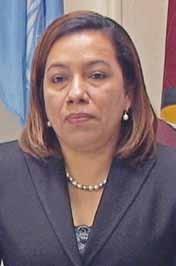
Foreign Affairs Minister
Carolyn RodriguesBirkett on Monday said that a sub-commission has been appointed, and the relevant parties are conducting their work, following Guyana’s application to the United Nations (UN) for an extension to the continental shelf in April 2012.
She observed that one of the issues with the commission on the limits of the continental shelf is not clear. Minister RodriguesBirkett explained that there is a problem with how many days the commission will have to do their work, noting that Guyana is standing in line as the 54th country to be considered. “How do we find additional resources so they can do their work faster?” she questioned.
Guyana submitted its claim in pursuant of Article 76 of the United Nations Convention on the Law of Sea. In 2002, like other state parties to the UN Convention on the Law of Sea; Guyana commissioned a desk top study to ascertain whether the country met basic crite-
ria to make claims for an extended continental shelf.
Currently, countries can have up to a limit of 150 nautical miles from the 200 nautical miles outer limit of exclusive economic zone of coastal states. “A key objective for commissioning the desk top study was to ensure that the commissioning of other more expensive works, including seismic data gathering that could cost millions of United States dollars, would not be a costly exercise
in futility,” the minister was quoted by the Government Information Agency (GINA) as saying.
The study, which was funded with assistance from the Commonwealth Secretariat, determined that Guyana met the criteria to claim an extended continental shelf, and would be formally presented to the commission on the limits of the continental shelf during a session in April 2012. This was done.
The foreign minister stated that given the workload of the commission, it would be years before the countries’ submission will be examined by the body, however, she maintained that the choice to submit a claim for extension will ensure that in the future, the country has the legal basis to benefit, and well as protect its rights.
Minister RodriguesBirkett stated that while Guyana will have exclusive jurisdiction over resources under the seabed, which
would include any hydrocarbon or mineral deposit, the country’s submission was made without prejudice to future delimitation of maritime boundaries with neighbouring states.
Currently, the convention and guidelines of the commission preclude states from using recommendations of the commission as the basis for declaring bilateral boundaries with neighbouring states.
“Between 2008 and 2010, Guyana entered into consultations with Barbados, Suriname and Trinidad and Tobago with respect to preparations of Guyana’s claims and so promoted a modus vivendi whereby all four states would make submission without prejudice to eventual delimitation and without objections from the others,” she stated.
However, Minister Rodrigues-Birkett stated that it was necessary for Guyana to engage in such diplomacy, as the country is ‘geographically wedged’ in the centre of all three coastal states.

Satiricus was vindicated. He’d always said the police could do much more than they did – if they were more highly trained. Look at how FreeLicks cracked the case about the Berbice protest – just like that! Here it was that the present COP Browndell, the DPPP, Internal Affairs, and Complaints on Police Office were all running around like chicken without their heads. And with one quick drive up to Berbice – case closed!!!
FreeLicks didn’t mince any words. He said there was no way in hell the cops accused of participating in the robbery could’ve done it. The man was trained by the British! Maybe Scotland Yard? How’d he do it? Well, Satiricus had gotten a tape of the conversation between FreeLicks (Voice 2) and the moustachioed fella from the PNCEE (Voice 1) – who was his old contact man when he’d been the COP.
Voice 1: “Wha goin on?”
Voice 2 : “Ah deh.”
Voice 1 : “Ah just come from court and Ah settle de matter with the Mook and de magistrate who sue he fuh libel.”
Voice 2: “How much you settle fuh?”
Voice 1 : “Hundred thou..”
Voice 2 : (laugh)...(cough) “Ah think y’all woulda seh hundred million!”
Voice 1 : “Nah! He call and tell me how police call he and tell he dat Ah gat gun problem...He blackmail me.”
Voice 1: “But who police coulda do dat, boy?”
Voice 2 : “Boy, he payin a lot of people ...and a lotta people know he tekking stories from any-whe, right? Police get five, six thousand and dey feel nice.”
Voice 1: “Anyway, me ain’t gat time wid dah. Tell me how you fix dat thing in Berbice.”
Voice 2 : (Laugh)...(cough)... “Bannuh! You all shoulda bin there fuss. Is you all people deh accusin.”
Voice 1 : “Ah did say something...but you know Number One ain’t deh.”
Voice 2 : (Laugh)...(cough)... “He always running ‘way, when things get hot.”
Voice 1 : “But tell me about Berbice, nah?”
Voice 2 : “Bai, you shoulda been de fuss set a people. Is just like de time when Ah talk to you about de Agricola massacre. Ah still got me contacts, you know.”
Voice 1 : “You de help. You give we information.”
Voice 2 : “Ah deliberately turn the thing upside down in Berbice. Ah seh dat de policeman was not at de scene. Dey was in de station.”
Voice 1: “But de people seh dey call de station and no answer!”
Voice 2 : “Bannuh. Is wha schupidness yuh de pan?
If Ah seh suh, is suh. You na see how de Stabber print it and didn’t question me. Ah get train by de British, you know. We gat people to tell the big lie in de press. All awee is one.”
Voice 1: “OK. Bannuh. How about dat gun licence you gon get fuh me friend?”

Aseries of activities has been planned in observance of “Black History Month”, beginning today with an art exhibition at the Quava Centre at the African Cultural and Development Association (ACDA), Thomas Lands, Georgetown.
ACDA executive member Eric Philips in an interview with Guyana Times said other activities include lectures, drumming and a food exhibition.
There will also be an en-
trepreneurship workshop on February 15, which will be addressed by Culture, Youth and Sport Minister, Dr Frank Anthony, and attended by representatives from civil society and various organisations, including the Inter-American Development Bank (IDB), the Institute for Private Enterprise Development (IPED) and the European Union (EU).
The workshop themed “Economic Empowerment” will be followed by a film fes-
tival.
ACDA is working with the African Heritage Museum, to have some of its artifacts on display, throughout the month.
According to Phillips, celebrations will be held in the three counties, and plans are en train for the hosting of a reparations conference that will include the Pan-African movement and Rastafarian organisations.
A few outstanding African Guyanese will be honoured and prominent
public personalities will be invited to speak about their contributions to their respective fields of work and Guyana as a whole.
ACDA is hoping that the celebrations planned will attract a wide cross-section of students, as the aim is to get students to learn more about African culture.
The African cultural body also said that its programmes are designed to target children, and is calling on parents to support its work.
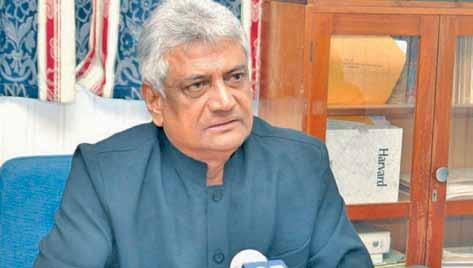
The Guyana Elections Commission (GECOM) has moved to shortlist four persons to be interviewed for the post of chief elections officer (CEO). This is according to GECOM’s Chairman, Dr Steve Surujbally.
Surujbally told Guyana Times on Tuesday that out of the four candidates, two are local and the other two candidates are based overseas.
The two local candidates are Calvin Benn, who is serving as the acting CEO and Keith Lowenfield, a senior staffer of the commission. Benn has several years of experience in elections, as he served previously as assistant to then CEO Gocool Boodoo.
Lowenfield, on the other hand, was the assistant to Benn, before he assumed the duties of acting CEO. Both Benn and Lowenfield have been senior officers of GECOM for several years.
Meanwhile, the names of the two candidates from overseas were not disclosed.
However, the GECOM chairman told Guyana Times that the interviews for these candidates will be done initially via Skype.
When asked why there has been such a lengthy delay in selecting a suitable person for the post of CEO, Surujbally said, “We are not going to rush this process; we will take our time in selecting a suitable candidate.”
The GECOM chairman explained that he wanted to ensure that the selection process remained transparent and free from any probems. “Later on, nobody will come and say that we didn’t do the right thing,” he said.
The process, he stated, will take as long as necessary, as he explained that GECOM is looking for the best candidate to fill the post of CEO.
GECOM had received several applications for the vacancy, which was advertised. The commissioners, including the chairman, started to look at the applications late
last year. The first move they made was to shortlist applications to five possible candidates.
Surujbally had said that, based on the commission’s work, it found that at least 10 of the 14 applications received for the position did not meet the stipulated requirements. After, taking a break, the commission resumed work on January 27, looking at the possible candidates for interviews.
Surujbally has maintained that GECOM’s functionality and efficient administration have not been impaired following the departure of Boodoo. He said the commission has been functioning as it ought to.
The GECOM chairman has again expressed hope that the process for the selection of a new CEO remains free from political interference. He said based on the interviews, the team of commissioners and himself will make a decision on appointing the most suitable of the four candidates to the substantive post of CEO.
Guyana could hold local government elections this year, as government has promised to ensure this happens. Three pertinent local government bills were passed in Parliament last year and assented to by the president, an indication that the elections could be called anytime soon.

Name-and-shame campaign making little headway in curbing
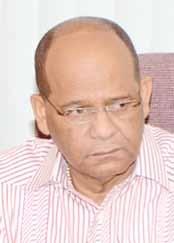
Home Affairs Minister Clement Rohee said curbing noise nuisance in society is a constant struggle his ministry faces, despite its name-andshame campaign which was launched several years ago.
In an interview with this newspaper, he stated that “this is a relentless struggle, a constant battle that has to go on”. Rohee noted that the name-and-shame campaign implemented by the Home Affairs Ministry a few years ago is still active and has seen some progress. He disclosed that a list of the names of perpetrators were recently published in the newspapers.
“We will keep publishing those names from time to time, identifying persons who we have gotten reports against with respect to noise nuisance and checked out the reports made,” he said.
The minister explained that when reports are made through the campaign, his ministry would also relate the information to the police commissioner and the respective divisional commanders who will then investigate and institute charges if necessary.
Rohee noted that some of these cases do, in fact, reach the court, resulting in fines and prosecution. However, the he noted that while some people are adapting to the rules, there are some who are totally irresponsible and so the ministry, through the police force, has to constantly go after them.
He suggested that higher fines and stricter penalties may be what are needed to curb noise nuisance.
Only last week, the Social Sector Committee embarked on a discussion with key stakeholders to review the noise nuisance regulations. Rohee noted that with all the efforts exhausted by the ministry, he hopes that the committee will come up with a strategy to address this issue.
During the committee meeting last Friday, Chairperson Indra Chandarpal said the noise nuisance laws are outdated and so they need to revisit them after which they will be able to make proposals to have them changed.
“We want to look at noise nuisance in all its aspects, because when we look at the laws that are there, the laws are outdated clearly and therefore, when we in the social sector committee looked at the issue based on that fact and our own experiences and the disgust of many people, we thought the time has come for us to look at this matter in a holistic way,” said the Chandarpal.
Fire chief Marlon Gentle, who had also sat in on the discussion, pointed out to the committee that the laws should be revised, taking into consideration all the new contributors to noise pollution.
“I think, therefore, we
need to revisit all of the laws and also look at a more scientific way of dealing with these things, because I would guess that most of these pieces of legislation that we have governing these activities would have been done long before we had stereos, amplification, heavy industrial noise and such things,” he said.
Minister Rohee had issued a statement last year, urging citizens to continue lodging reports of noise nuisance at the nearest police station or divisional headquarters.
The statement said that reports may also be submitted in writing to Lot 6 Brickdam, Stabroek, Georgetown via hotline numbers 227-5214 or 2275219; text messages to 6236068 or 623-6072. or emails to crimestoppersgy@yahoo. com, crimestoppersgy@hotmail.com, or crimestoppersgy@gmail.com.

wednesday, february 5, 2014 | guyanatimesgy.com
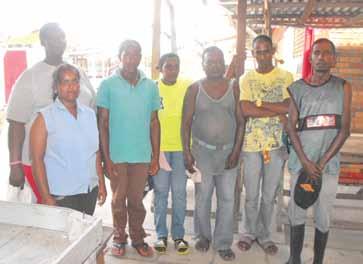
Eight workers attached to the Port Mourant Market, many of them single parents, have not received their wages for the past four weeks and have effectively downed tools while they await their remuneration.
The eight workers are refusing to work until the relevant authority pays them their wages.
Guyana Times has been reliably informed that the Port Mourant Neighbourhood Democratic Council (NDC) is directly responsible for the payment of the labourers, who are reportedly also being underpaid in that they are yet to receive the recently adjusted national minimum wage.
One of the workers, whose task is to ensure the market is cleaned after vendors are finished selling for the day, said the problem has been ongoing for some time now, pinning the blame on an officer attached to the Port Mourant NDC.
Another worker, Renita King, 40, said she is financially strapped and due to the late payment of her salary, her child is forced to miss school.
“I am a single parent
and I depend on this money to take care of my children, my daughter cannot attend school because I don’t have money to buy anything,” she said. She noted that cleaning the toilet facilities at the market is no easy task, but is a source of much needed income.
Damion Trim, 18, said because he wanted an honest living and does not want to be like other unemployed youths involved in illicit activities, he chose to work at the market, “but if this is going to be a trend, then I don’t know what to do, since this is my livelihood and my grandmother depends on me to assist her”.
According to reports, the eight labourers were told by a female officer at the NDC that she will ensure they do not receive any payment anytime soon.
“She said she nah go sign any pay sheet because we call and ask fuh we money, she vex…” one worker said. Those affected by the late payment include Basmattie Lakraj, 26; Renita King, 40; Chandrawattie Narine, 32; Wazir Rahaman, 20; Karran Kowlessar, 56; and Neville
Veerasammy.
The disgruntled labourers are also alleging that they have not been receiving the new national minimum wage of $35,000 per month, which covers the monthly, weekly, and hourly payment of workers.
The workers said they feel victimised and are calling on the relevant authorities to look into the matter urgently.
“We are being underpaid and we need someone to look into this because it is unfair to us… we work really hard and we have much expenses, so we are appealing to someone to assist us so we can get
the same benefit from the minimum wage government put on workers,” one laborer said.
Regional Chairman David Armogan in an invited comment said he will do his utmost to rectify the late payment of the workers. He also promised to look into the issue of the workers not receiving the minimum wage as stipulated by law.
“These workers ought to receive their salary on time and those in charge of payment should ensure that this happens… I will look into these matters immediately and ensure it is dealt with appropriately,” he said.
Over 80 farmers cultivating lands on Tiger Island on the Essequibo Islands are calling for improved drainage and vehicles in an effort to assist them in transporting their agricultural produce.
Farmers said that they need vehicles to transport fertilisers and feed to their farmlands. They made the call during a meeting with Minister within the Agriculture Ministry Alli Baksh on Sunday.
The farmers told Minister Baksh that they are willing to expand production, however, they are hamstrung by the lack of reliable transportation to take their produce from the island to the Essequibo Coast.
Speaking on behalf of the farmers was Ali Khan. Khan who cultivates over 276 acres of land said that he enjoys farming on the island. Khan said in order for his produce to get on the Essequibo Coast, he has to put it on a boat and transport it to his wharf at Aurora. Khan said if he had a vehicle on the island, then it would have assisted him in the transportation.
Khan cultivates 100 acres in rice and 176 acres in other crops. Presently he has plantain, pumpkin and watermelon on his farm. The large scale farmer said that he has invested mil-

lions of dollars in his farm in improving drainage and irrigation. The farmer said that apart from agriculture, he also rears livestock on the farm.
Other crop farming
Minister Baksh during his inspection of several farmlands on the island assured the farmers that the Agriculture Ministry will try to assist the situation.
Baksh encouraged farmers to continue to cultivate and expand, since more markets are available in nontraditional crops. He told them to contemplate on adding value to their produce. Baksh said he listened to the farmers’ complaints about the lack of
farm to market access and he will address same.
Shedding some light on Tiger Island, Baksh said the island has been developed into a budding agricultural scheme. Presently the island has approximately 80 farmers from various islands (Wakenaam, Leguan) that are cultivating traditional and nontraditional crops. Baksh said he is impressed with the farmers’ efforts in the area.
Baksh was accompanied by Permanent Secretary of the Agriculture Ministry George Jervis, National Drainage and Irrigation Authority (NDIA) Engineer Jafaun Permansingh and Region Two Agriculture Officer Khemraj Khandai
Digicel on Monday made its annual donation to the Parkside Steel Orchestra, which will contribute to their participation in the finals of the Pan-O-Rama Steel Pan Competition as part of Guyana’s 44th Republic anniversary celebrations.
The Parkside Steel Orchestra was formed in 1998 as an after-school activity for students, and has evolved over the years into a full steel orchestra with more than 40 members, including children and adults.
The Parkside Steel Orchestra won the steel pan competitions in 1998,2001,2002,2003, 2005,2009,2011, and 2012. Digicel has been a proud supporter of Parkside since the telecommunication giant's entrance into the Guyana market under the trade name of U-Mobile.
Sponsorship and Events Manager Gavin Hope said at the simple presentation ceremony, “Digicel will continue to

pledge its support to the development of young people in Guyana whether it be through the arts, sports and any other form, we are proud to be associated with Parkside”.
The finals of the Pan-O-Rama Steel Pan Competition are scheduled for February 16, at the Cliff Anderson Sports Hall. Mashramani this year is being celebrated under the theme “Cultural folklore; Celebrating 44”.
The Guyana Hindu Dharmic Sabha on Sunday elected new members to serve on the Essequibo Praant.
The election was held at the Anna Regina Mandir and was conducted by sabha president, Dr Vindhya Persaud and executive member Jagmohan Persaud. Persaud said the new members will serve as office bearers, conducting businesses on behalf of the sabha in Essequibo.
inspected farmers land. Baksh said that Khan’s farm is a classic example of integrate farming. He said that other farmers should use Khan’s farm as an example, “what we see here is diversification…”
Permanent Secretary of the Agriculture Ministry, George Jervis, echoed similar sentiments like Baksh. Jervis said he is impressed with the way persons are cultivating their farms on the island.
Some of the major challenges faced by farmers on the island are erosion from the vulnerable sea coast, transporting produce from the farms to the coast and heavy winds from the Atlantic.
Before the commencement of the election, Persaud thanked the existing members who served previously for their hard work and support given to the sabha throughout the years in moulding the Hindu community. She expressed sincere gratitude to former Essequibo Praant President Doodnauth Singh for his time served.
Persaud explained that the Essequibo Praant plays an integral role in the sabha's development, and as such, a vibrant body is needed.
Gaining the position of president unanimously was Pandit Prakash (Kedar) Persaud. The following are the other members of the new executive: Vice President Parmanand Persaud, Assistant Vice President Deodat Singh, Secretary Navita Singh, Treasurers

Tamesh Persaud and Ranjeev Singh, Assistant Secretary Mahendra Persaud, and Organising Secretary Sursattie Singh. Committee members elected were Reema Natram, Nandram Prabhu, Gomattie Dyal, and Dhanwantie Ramlochan.
Speaking to the newlyelected body, the president of the sabha asked for full support and dedication in an effort to move forward.
Persaud congratulated the new body and charged them to give of their best. She reminded the budding team of the sabha’s motto, “Action thy duty, reward not thy concern”. The new body is expected to plan a calendar of culture activities.
APartnership for National Unity (APNU) said its members walked out of a key meeting of the parliamentary select committee reviewing the Anti-Money Laundering and Countering the Financing of Terrorism (Amendment) Bill on Monday night over the attitude and behaviour of the chairperson, Gail Teixeira.
The coalition’s statement comes one day after the government accused the opposition of walking out of the meeting to avoid voting on whether or not the Private Sector Commission (PSC) should be allowed to be an observer during the proceedings.
In a press statement on Tuesday, APNU explained that the first substantive item on the agenda was a request from the PSC to attend the meetings in the capacity of an observer. When the matter was discussed, APNU’s shadow finance minister, Carl Greenidge, reminded the committee members of the coalition’s “no objection” to the participation of stakeholders in the select
committee’s deliberations on an ad hoc basis and as the need arose.
Greenidge was pushing for the same formula to be employed for the PSC. In keeping with the standing order governing select committees and the press, Greenidge said the PSC should have been informed that the committee was not prepared to have observers.
He said, however, that the committee should agree to invite stakeholders at appropriate points as the need arose. “It would not, therefore, be in a position to invite the PSC as an observer through all the sittings,” APNU said in its release.
‘Improper’ motion
But Finance Minister, Dr Ashni Singh and his colleagues were not in support of the opposition’s position, stating that the PSC should be given the opportunity to attend the committee meetings in full.
He further pushed for a motion to be moved and adopted for the PSC to be invited as observers to all future
meetings of the committee.
“Dr Singh’s motion was regarded by the majority of members at the meetings as contradictory to the motion, which had been already approved. They, therefore, considered it improper and decided that it should not be put to a vote,” APNU explained.
According to the coalition, Teixeira said she was not bound by the consensus of the meeting and as a

result, put the matter to a vote. “Her government colleagues invited the opposition to oppose the motion, if they dared. When a majority of members called for the matter to be resolved by way of a vote, Ms Teixeira refused,” the party further complained.
It was at this point that the opposition walked out of the meeting. It was made clear that the walkout was based on the attitude of the
chairperson.
Just after the meeting ended on Monday, the finance minister condemned the opposition for staging the walkout at a critical time when the committee is attempting to complete its work before the Financial Action Task Force (FATF) meetings on February 12. “This is a most unfortunate development, and reflects yet another attempt by the opposition to frustrate the timely passage of this bill,” he said.
According to Dr Singh, government has long endorsed the concept of transparency and accountability, hence it would never object to the PSC observing the proceedings.
“Their refusal to allow the PSC to observe the committee’s proceedings reflects the fact that they are unwilling to be unmasked and have revealed to the world at large the blatant delay tactics they have been attempting in frustrating the work of the committee,” he contended.
APNU Members of
Parliament Basil Williams, Joseph Harmon and Jaipaul Sharma, and government parliamentarians, Legal Affairs Minister Anil Nandlall and Junior Finance Minister Bishop Juan Edghill were among other members present at the meeting. The FATF plenary meeting takes place in Paris under the presidency of Vladimir Nechaev of the Russian Federation from February 12-14. FATF has made it clear that territories that have not made sufficient progress in addressing deficiencies or have not committed to an action plan developed with FATF to address AML/CFT will be penalised.
Meanwhile, the regional arm of FATF, the Caribbean Financial Task Force (CFATF), which blacklisted Guyana last November due to failure to pass the Anti-Money Laundering and Countering the Financing of Terrorism (Amendment) Bill 2013, is slated to meet in May. The country can also be further sanctioned.
Women serving in the Guyana Defence Force (GDF) have been lauded for the backbreaking work they have done in shaping the course of the military institution. For 47 years they have endured severe hardships and discontentment, faithfully serving in areas that are dominated by their male counterparts.
On Tuesday, the force’s auditorium at Base Camp
Colonel Kemraj Persaud, delivering the feature address on behalf of army chief, Brigadier Mark Phillips, said women, since they first became part of the force in 1967, have performed exceptionally, proudly wearing their uniforms at every forum. He noted that the corps has gracefully progressed over the years. “The women’s army corps has indeed come a long way. I do not believe that anyone would
Colonel Persaud urged the women corps to do some introspection on their respective roles, pointing out that it will be prudent and appropriate for them to ascertain what kind of “women army corps they wish to build”.
“The need for the leader of this body of women to take a strategic look far beyond, into the future and have a vision, recognising where you are, where you want to go and what are the

Ayanganna was filled to capacity when officers and special invitees witnessed a packed programme of praise and thanksgiving. The women were spectacular in their performances, celebrating their achievements in what was described as one of the country’s most respected disciplined forces.
Deputy
Chief-of-Staff
doubt their value and significance to the country as a whole and I have every confidence that we, together as a force, would embrace the changes that are so necessary for our continued development”.
He posited that the force’s many policies are very much accommodating to today’s environment.
means to get you there, are more relevant than ever before,” he declared.
Transformation Reverend Faye Crawford from the Tucville Assembly of God Church delivered the sermon. She urged the women to “faint not”, pointing out that they needed to be transformed by the renewal
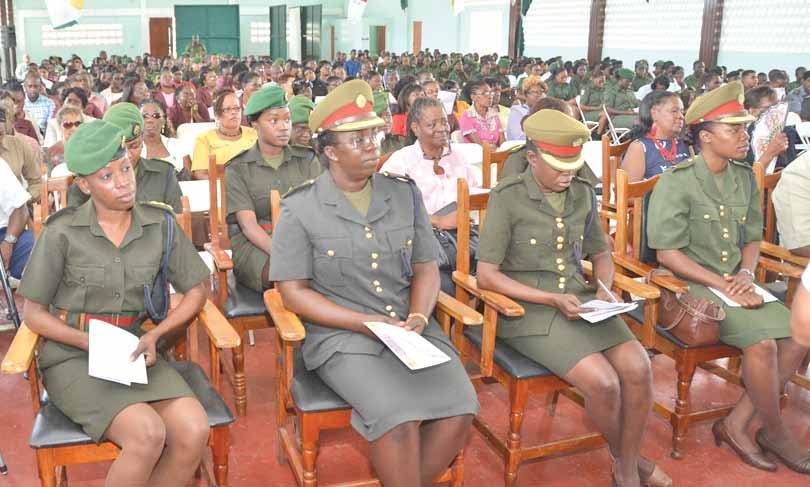
of their minds. ““This morning I pray that we all catch the vision, because there is a way, a better way that we could walk, talk, and live for a changed heart, a changed life”.
The establishment of the GDF’s Women’s Army Corps (WAC) in February 1967 was a direct result of Venezuela’s seizure of Ankoko in the Cuyuni River in October 1966.
In that, the year of Guyana’s independence, the GDF had barely established its first battalion of fewer than 500 men when it was forced to deploy troops to Eteringbang on the country’s western frontier to confront Venezuela’s aggression.
The sudden removal of such a large number of men from such a small force had severely impacted the work of the GDF, as some recruits were still undergoing basic
training. Others were deployed along the coastland, which, only two years earlier, had been the scene of murderous ethnic strife, creating huge manpower problems.
Soldiers had to be found quickly to secure the borders and others had to take their place in the camps. The GDF’s solution was to recruit women.
In January 30, 1967, just three months after the Ankoko incident, four women – Captain Joan Granger and Officer Cadets Brenda Aaron, Clarissa Hookumchand and Hyacinth King – started training at the GDF Training Wing at Timehri.
On February 6 of that year, 56 other women joined them as recruits.
After six weeks of training in drills, field craft, skill-at-arms, shooting, and physical fitness, the 60
women were formally inducted into the GDF at a parade in March, which was inspected by Mrs Winifred Gaskin, the then education minister.
Since then, female soldiers have been making strides, proving that they were no less incapable when compared to their male colleagues.
It was a historic moment in 2005, when then Lieutenant Christine Bradford became the first female officer to climb Mount Ayanganna to hoist the golden arrowhead. She was followed five years later by female Lieutenant Nellon McKenzie. In 2012, Lieutenant Stacey Cadogan was honoured for being the first female officer to participate in the platoon commanders’ course, which was previously reserved exclusively for male soldiers.

How did my child die? Who is responsible? These are questions Christopher Bethel, father of two-yearold Jaylon Isaac, want answered after his son died on Saturday after choking on a snack. According to police reports, the child was at his Dale Trace, Longdenville, Chaguanas, home on January 24 when he began to choke on a jello snack
just after 08:00h. He was rushed to the Chaguanas Health Facility and immediately transferred to the Eric Williams Medical Complex, Mt Hope. He was hospitalised there for just over a week before he died on February 1. Speaking with members of the media at the Forensic Science Centre, St James, Monday, Bethel said he last saw his son on January 2 due to an
ongoing custody dispute with the child’s mother, Oneka Isaac. “He was a fun child, people used to want to take him. Women would come up to me and ask me for him. He was a bundle of joy and something to live for, it sad that I can’t see the potential of what he would be in life,” Bethel said.
In a telephone interview with the TT Guardian on Monday, the child’s mother said she was at work when she got a phone call from the babysitter, saying the child was choking on something.
Issac said the child was eventually taken to the Chaguanas Health Centre then transferred to the Eric Williams Medical Complex. The 22-year-old KFC cashier said Jaylon was accustomed to eating the snack. The autopsy report revealed the child died as a result of acute cerebral anoxia, which is caused by lack of oxygen to the brain. (Excerpt from Trinidad Guardian)
Colombia’s President Juan Manuel Santos ordered an investigation into the apparent spying of his negotiating team at peace talks with Marxist FARC rebels and suggested that “dark forces” were trying to sabotage his bid to end five decades of war.
Military intelligence operatives intercepted cellular phone communications of the government’s representatives at talks with the FARC, or Revolutionary Armed Forces of Colombia, weekly news maga-
zine Semana reported on Tuesday.
Peace negotiations with the FARC began in November 2012, weeks after Santos announced he had been holding secret discussions with rebel leaders. News of the talks was leaked prior to Santos’ historic announcement.
“It’s not acceptable from any point of view that intelligence is conducted against ordinary citizens and much less against state officials,” said Santos, calling those behind the spying “dark
forces” and “loose wheels”.
“It’s totally unacceptable.”
The peace negotiations – underway in Cuba – have surfaced as a campaign issue ahead of elections in May in which Santos is running for reelection.
Semana, a prestigious investigative magazine, said the cellular phones of negotiators Humberto de la Calle, Sergio Jaramillo and Alejandro Eder were intercepted, as well as leftist politicians, like former Senator Piedad Cordoba. (Excerpt from Reuters)
Officials in Bolivia say the number of people who have died due to torrential rain since the beginning of the year has risen to 29. More than 35,000 families have been affected by the rains and the flooding, the ministry of defence said.
The worst affected province is Beni, in north-eastern Bolivia, where 10 people have died, followed by La Paz in the north-west and central Cochabamba. The rainy season in Bolivia usually lasts until March.
The director of Beni’s
emergency centre, Luis Phillips, warned residents to be on the alert ahead of the next band of rain which is expected to reach the provincial capital, Trinidad, on Friday or Saturday.
The latest victim of the rains was 27-year-old Orlando Portugal, who was drowned after being dragged away by strong currents in the river Moguntuyo, which he was attempting to cross. Five people remain missing after being dragged away by rivers turned into raging torrents by the heavy rainfall.
A Beni resident said fresh water, medicines and tents were badly needed as many families had lost their homes in the floods.
Twenty-two air force planes are transporting goods to areas which have been cut off. (BBC News)

Abeloved captain who safely piloted thousands throughout the region flew his final official flight for LIAT – the Caribbean Airline – last week.
Scores of well-wishers gathered on the tarmac of the Grantley Adams International Airport on January 31 as Captain Keith Robertson brought in his final LIAT flight after 40 years with the airline.
Before landing Flight LI 371 from St Lucia, Captain Robertson did a low pass over the runway, tipping the wings of the aircraft to acknowledge those who had gathered for the occasion.
To loud cheers from his colleagues, family members, his many friends and mem-
bers of the media, Robertson guided the aircraft through a welcome water salute from two fire tenders from the Barbados Fire Service.
On this occasion, Captain Robertson was the first to disembark the aircraft but he stood at the bottom of the steps and greeted all of the passengers as they exited the plane, a LIAT press release said.
Among his many admirers was Barbados Tourism and International Transport Minister Richard Sealy, who called Robertson “a LIAT man to the core”.
“He was someone who believed in this organisation and understood its importance. Thank you for a tremendous contribution and for touching so many lives
and souls in a meaningful way,” he said.
Captain Robertson described LIAT, which he served in several capacities, as “a beacon in my life...40 years has gone by so fast that the word retirement has not yet sunken in.”
But, despite the wonderful accolades he received for his considerable technical skills, Robertson saw his work with LIAT in a more creative light:
“Flying for me was like an artist taking to canvas. Selecting the best route was a priority for the comfort of my passengers. I would always say to my first officers, treat my passengers like eggs and we’ll be great friends. (For that, I) came to be known as “Captain Smooth”.”
The Grenada government is calling on trade unions to accept a three-year wage freeze as it seeks to enter into an agreement with the International Monetary Fund (IMF) to deal with an ailing economy.
Economic Development, Planning and Trade Minister Oliver Joseph told radio and television viewers on Monday that the Keith Mitchell administration was seeking assurances from the trade unions
ahead of signing and submitting a letter of intent to the Washington-based financial institution.
“I want to appeal to all the Grenadian people to work with us, this is a national issue, this is not a political issue, we are about nation building, we have this long-term plan to see Grenada out of this fiscal situation it is in, and at the end Grenada will benefit,” he said.
“The letter of intent has not been signed as yet. In
the letter of intent (it) explains the intention of the government. The letter of intent could have been signed today or it could be signed tomorrow (but) the government decide let us have discussion with the unions because what the IMF is saying you as a government said to us over the three-year period there would be no increase, but we want to see a signed document by the unions committing to that,” he said.
(Excerpt from Caribbean360)
Two students of Presentation College, San Fernando, Trinidad were taken to hospital on Monday after both were wounded during a bullying incident in the school’s compound. According to reports, a 14-year-old student from Gasparillo up to Monday was warded in a serious condition at the San Fernando General Hospital, awaiting surgery. School sources said the incident took place in view of oth-
er students at the school’s Carib Street compound, who were recording it on their cellphones. Some were inciting the violence while others were shouting: “Don’t kill him.” Police said that shortly after 07:00h, both students were involved in an argument at the school's basketball court where the 14-year-old student accused the 15-year-old student of placing a cockroach in his school bag last Friday, knowing that he has a pho-
bia for the insect. The younger student allegedly had a blade and attacked the 15-year-old, cutting him on the right side of his back and chest. After seeing the blood, he became frightened and slit his own wrist, forearms and the side of his neck, police said. A release from the media relations officer of the Catholic Media Services Ltd, Vernon Khelawan, said both students remained hospitalised. (Excerpt from Trinidad Guardian)
In a report published to coincide with World Cancer Day [February 4], the World Health Organisation’s cancer agency has warned there will be 22 million new cases of cancer every year within the next two decades.
The document by the International Agency for Research on Cancer (IARC), which took five years to put together, says new cases of cancer will rise by half by 2030, reaching 21.6 million per year compared to 14 million in 2012.

WHO Director General Margaret Chan, whose agency oversees the IARC, said the overall impact from cancer would “unquestionably” hit developing countries the hardest.
“These nations are al-
ready grappling with poverty-associated cancers caused by infection or disease,” she told the AFP news agency.
More than 60 per cent of the world’s cancer cases and 70 per cent of deaths occurred in Africa, Asia and Central and South America, said the report.
Measured as a proportion of the population, however, high-income countries in North America and western Europe as well as Japan, South Korea, Australia and New Zealand, had higher figures.
Cancers of the breast, colorectum and prostate were more typical of the industrialised world, said the report, and those of the liver, stomach and oesophagus more common in low-income countries.
Afghan President
Hamid Karzai has been holding secret talks with Taliban officials in the hope of persuading them to make peace with his government, his spokesman told Reuters on Tuesday, confirming a New York Times report.
“I can confirm that... Taliban are willing more than ever to join the peace process,” Aimal Faizi said.
“Contacts have been made and we are also in touch with them.”
A member of Afghanistan’s High Peace Council also confirmed that talks had taken place, but was measured in his assessment of their success.
“Talks took place in Dubai three weeks ago between government officials and Taliban who flew from Doha, but we are still wait-
ing to see the result,” he told Reuters.
Western and Afghan officials speaking to the Times also said the talks had borne little fruit so far, although they may help explain Karzai’s mounting public hostility to Washington.
The relationship has come under increasing pressure since November, when he announced his in-
tention to avoid signing a bilateral security deal with the United States until after a presidential election on April 5.
His decision to drop a deal that had taken about a year to hammer out shocked Western diplomats. The uncertainty about Afghanistan’s fate after U.S. troops pull out has also weighed on the economy. (Excerpt from Reuters)
Asuspect in the killings of two prominent Tunisian Member of Parliament has died in a clash with security forces, the country’s interior minister confirmed. Kamel Gadhgadhi was among seven militants killed in the raid on a house in Tunis.
One policeman also died in the operation, which began on Monday afternoon.
Tunisian security forces have fought a long campaign against Islamist militants over the past two years.
Gadhgadhi was wanted in connection with the killing of prominent left-wing MPs Chokri Belaid and Mohamed Brahmi last year.
The assassinations plunged Tunisia into a protracted political crisis, which the country has only now emerged from. The raid comes a week after Tunisia’s parliament adopted a new constitution – its first since the revolution three years ago.
The siege ended in dramatic style on Tuesday af-
ternoon as special units from the National Guard stormed the house. The Tunisian news agency TAP named the policeman who was killed as Atef Jebri, a 29-year-old corporal in the specialist unit in the National Guard.
One militant was arrested by police, TAP reported. Police said the men were heavily armed. “They had suicide bomb belts and explosive material,” interior ministry spokesman Mohamed Ali Aroui told Reuters news agency. (Excerpt from BBC News)
AFrench court has begun hearing the landmark trial of a former Rwandan intelligence chief charged with complicity in the 1994 genocide. Pascal Simbikangwa, who is paraplegic after a car crash, was arrested in 2008 while living under an alias on France’s Indian Ocean island of Mayotte.
His lawyers argue that he is being made a scapegoat for the killings. France has been accused of being too slow to prosecute those allegedly linked to the genocide.
Hundreds of thousands of Rwandans perished over 100 days in 1994.
After the genocide, many Rwandans fled to France as they share a common language and used to enjoy close diplomatic relations.
Simbikangwa, 54, is accused of helping to arm ethnic Hutu militia who manned roadblocks in the capital, and instructing them about their part in the slaughter.
He faces the possibility of life in jail even though charges against him have been downgraded from gen-
ocide and crimes against humanity to complicity in these crimes.
Unusually for France, the trial – which is expected to last six to eight weeks –will be filmed, with recordings available once the case is concluded.
Simbikangwa has acknowledged being close to the government of President Juvenal Habyarimana, a Hutu whose assassination in 1994 led to the outbreak of violence that killed some 800,000 ethnic Tutsis and moderate Hutus in Rwanda.
(Excerpt from BBC News)

The Prince of Wales has met residents and farmers in the flood-hit Somerset Levels and said it was a “tragedy” that nothing had happened for so long. Thousands of hectares of land remain under water in the area, where whole villages have been cut off for weeks.
Residents have expressed anger at the pace at which the Environment Agency and the government have responded. The Met Office is warning of more rain and strong winds in the south-west of the UK, with gusts of up to 60mph.
Speaking during his visit to Somerset, the Prince of Wales said: “There’s nothing like a jolly good
disaster to get people to start doing something.
“The tragedy is that nothing happened for so long.” Many residents have said there has been a slow response from the authorities to the flooding, which has affected many parts of the Somerset Levels since the end of December.
Some have also suggested that a lack of river dredging by the Environment Agency could have exacerbated the scale of the flooding.
Environment Secretary Owen Paterson – who visited the area last week –was harangued by some residents about the “Third World” conditions they were living in. (Excerpt from BBC News)

Lasco Manufacturing
Limited (LML) beefed up staff for the start up of its liquid production factory last year and is now gearing up for testing. The manufacturing arm, which produces soy-based products and packages milk-based goods, aims to facilitate a series of new products and create 250 jobs.
“We continue to make progress toward completing our new production facilities at the White Marl location,” said Eileen Chin, managing director of the company in its fi-
nancial statements. “This expansion involves substantial business expenses and a gestation period before revenue begins to accrue.”
Lascelles Chin, chairman of the Lasco affiliated companies, revealed plans to double profits in three years during an annual general meeting last year. The completion and integration of the J$2.1 billion factory, which will facilitate new lower-priced products, forms the other part of the strategy.
LML’s net profit for the
three months which ended December 31, 2013, was J$132.5 million down from J$158.7 million during the comparative quarter in the prior year, while operating expenses jumped by 45 per cent, up from J$77 million during the corresponding period in 2012 to J$111.7 million during the quarter under review, mainly as a result of additional staff. Revenue for the quarter under review soared to J$1 billion, up from J$869 million in the comparative period in 2012. (Jamaica Observer)
Technology giant
Microsoft has announced that Satya Nadella will be its next chief executive. Indian-born Nadella is currently Microsoft’s head of Cloud and Enterprise, which builds and runs the firm’s computing platforms and developer tools. He takes over from Steve Ballmer who announced plans to step down last year.
Company founder Bill
Gates said there was “no better person to lead Microsoft”. Gates is stepping down as chairman, it was also announced, but will take up a new role as a technology adviser and will also retain a seat on Microsoft’s board.
Microsoft’s lead independent director John Thompson will take over as chairman.
“Microsoft is one of those rare companies to have tru-
ly revolutionised the world through technology, and I couldn’t be more honoured to have been chosen to lead the company,” said Nadella. “The opportunity ahead for Microsoft is vast, but to seize it, we must focus clearly, move faster and continue to transform. A big part of my job is to accelerate our ability to bring innovative products to our customers more quickly.” (BBC News)
European banks have loaned in excess of US$3 trillion to emerging markets, more than four times as much U.S. lenders, and putting them at greater risk if financial market turmoil in countries such as Turkey, Brazil, India and South Africa intensifies. The risk is most acute for six European banks – BBVA, Erste Bank, HSBC, Santander, Standard
Chartered, and UniCredit –according to analysts.
But the exposure could be a headache for the industry as a whole, just as it faces a rigorous health-check by the European Central Bank, aiming to expose weak points and restore investor confidence in the wake of the 2008 financial crisis.
“We think EM (emerging markets) shocks are a real
concern for 2014,” said Matt Spick, an analyst at Deutsche Bank. “When currency (volatility) combines with revenue slowdowns and rising bad debts, we see compounding threats to the exposed banks.”
The Deutsche Bank analysts said the six most exposed European banks – which they did not name – had more than US$1.7 trillion of exposure to developing markets. (Reuters)
The construction of the much-anticipated Konza Techno City might take a little more time than expected following challenges being faced in the public procurement process. This was disclosed by the Information Communications and Technology Cabinet Secretary, Dr Fred Matiangi, during the inauguration of the new board of ICT Authority at Teleposta Towers.
“This is a multi-billion project that needs to be handled
with utmost care. The whole project is bureaucratic and has to follow various approvals. The whole project doesn’t rely solely on the ministry of ICT but also on other ministries including the ministry of water and the ministry of energy,” he said.
He urged approving authorities within the government such as the National Environmental Management Agency and the lands ministry to work faster.
Dubbed “where African silicon savannah begins”, Konza Techno City is a project that is being marketed by the Kenyan government through Kenya ICT Board. The park is set to host business process outsourcing (BPO) ventures, a science park, a convention centre, shopping malls, hotels, international schools and health facilities project. It was allowed by the parliament Accounts Committee and endorsed by the Kenyan government. (allAfrica)
Toyota is forecasting record annual operating profits as the weaker yen helps to boost sales abroad. For the financial year ending in March, it expects operating profit to reach 2.4 trillion Japanese yen (US$23.7 billion; £14.5 billion).
The continuing weakness in the yen also helped Toyota post better-than-expected earnings for the third quarter, with operating profit of 600 billion yen.
That is nearly five times higher than earnings in the
same quarter a year earlier.
The car manufacturer said in a statement that its revised forecast was due to “progress in our recent profit improvement activities through cost reduction and marketing efforts, in addition to the change in our assumption of foreign exchange rates to reflect the depreciation of the yen”.

The yen has lost about 25 per cent of its value against the US dollar since late 2012, brought about by Prime Minister Shinzo Abe’s economic policies – dubbed Abenomics – which have weakened the yen and helped the country’s export-driven companies. That has also helped Toyota’s domestic rival Honda, which last week reported a near 40 per cent jump in its nine-month net profits to 403 billion yen. Japan’s other major car manufacturer, Nissan, will report its financial results next week.
Toyota sold 9.98 million vehicles during 2013 – about 270,000 more than its closest rival, U.S. car giant General Motors. (BBC News)
Kuwait’s sovereign wealth fund will invest 500 million euros (US$676 million) in Italian companies in coordination with Italy’s own strategic investment fund, Prime Minister Enrico Letta said on Tuesday.
The deal follows similar agreements with Qatar’s investment fund last year to in-
vest in Italian companies operating in the fashion, food and tourism sectors and a separate deal with the Russian Direct Investment Fund.
Kuwait and Italy will create a company with capital of 2.5 billion euros, of which 80 per cent will come from Italy’s strategic investment fund, the FSI, and the remainder from the Kuwait Investment Authority. “This is an extraordinarily important development, it’s an injection of confidence in our country,” Italy’s Letta said at a news conference in Kuwait during a visit to the Gulf states to attract interest in Italy as an investment destination. The FSI said the deal would be signed formally in March. (Arabianbusiness)
Know your bracket
Next, an investor must consider the pros and cons of tax-efficient investing. First, the investor needs to determine his marginal income tax bracket and whether it is subject to the alternative minimum tax. The higher the marginal bracket rate, the more important tax-efficient investment planning becomes. An investor in a 39.6 per cent tax bracket receives more benefit from tax efficiency on a relative basis than an investor in a 15 per cent bracket.
Once the investor identifies his bracket, he must be aware of the differences between taxes on current in-
come and taxes on capital gains. Current income is usually taxable at the investor’s bracket rate. Capital gains taxes are distinguished by being a gain and by being either short term (usually held less than one year) or long term (usually held more than one year).
Generally speaking, shortterm capital gain rates are at the investor’s marginal tax bracket, and his long-term rates are at a preferential rate. If the latter is the case, then the investor needs to try to generate capital gains at the preferential longer-term rate.
Different asset classes like stocks and bonds are taxed dif-
ferently in the United States and often play much different roles in the investor’s portfolio. Historically, investors purchased bonds to provide an income stream for their portfolios, and bonds have generally enjoyed lower volatility or risk than stocks. The interest income from most bonds is taxable (municipal bonds are a tax-efficient vehicle at the Federal Tax level, however) and is, therefore, tax-inefficient to the investor in a higher tax bracket. Stocks are often purchased to provide a portfolio with growth or gains in their capital, as well as a current income stream from dividends. (Investopedia)
The Guyana Water Inc (GWI) has severed ties with the Guyana Post Office Corporation (GPOC), and has hired a private contractor for the delivery of water bills as part of its current Customer Services Improvement Programme.
GWI Customer Services Manager Jeannette Thomas stated that this is meant to address the current challenges experienced by the company in delivering bills to customers via the post office.
“Bill payment must be a priority for our customers,” stated Thomas. The prompt delivery of bills via private bill delivery contractors would also eliminate the possibility of bills getting lost in the post.
Thomas explained that the initiative is part of the overarching theme of enhancing customer services at GWI, with the aim of encouraging customers to make prompt payments.
“Every effort is being made to encourage our customers to honour their payments,” stated the customer
services manager.
“In 2013, we launched bill payment reminders via text messages and now our managers and team leaders are in the field meeting with our customers and learning about their challenges in making payments on time.
"This is also the reason why we have intensified promoting our Wallet-Friendly Payment Plan, which allows customers to pay according to what they can afford in small, flexible payments,” she explained.
In addition, while GWI account holders currently receive quarterly service bills, the company has commenced plans to implement a new system of monthly meter readings and delivery of bills by mid-year to provide more convenience for customers.
Customers can expect prompt bill delivery by the second quarter of 2014. The water company is urging every account holder to ensure payment is made promptly as the “removal of service for

non-payment” campaign is expected to continue indefinitely.
As a result of poor response in 2013, GWI was forced to commence removing the entire service of customers who refused to contact the office or make any effort regarding payments.
This exercise has intensified and customers are urged to query any outstanding service payments, since they will be required to reapply

Global

Youth Movement Chairman Mark Ross
said despite it is a well established fact that investment in youth is vital for social and economic development, many policymakers seem not to be in tuned with this reality.
Ross explained that with the implementation of meaningful youth development programmes, more young people can be better guided in making rational decisions when challenged.
“One of the things that we face at the macro level of young people’s advancement and development is the recognition of policymakers investing in our youth.”
Ross noted that lack of proper investment in young people expose them to negative choices, and on that point, he noted that enough is not being done to help those in Tiger Bay, a small community in the capital city.
for a new service if disconnected.
Meanwhile, GWI is appealing to all businesses involved in food preparation to install and consistently clean grease traps.
The company says it continues to experience numerous reports of overflowing sewerage, which has resulted from sewer pipes becoming clogged due to coagulated fats and oils used for food preparation by restaurants and hotels.
Sewerage problems
GWI’s sanitation department records in excess of seven sewerage overflows per week which have resulted from restaurants and hotels not installing grease traps or failing to clean the devices.
In light of the recent media reports regarding persons being injured owing to the removal of a sewer chamber cover by unauthorised persons, the company wishes to advise that it is an offence to tamper with any device under its purview as stipulated by the 2002 Water and

“We are churning out the youths who lives there… so the five-year-old child that lives there, if an investment is not made to get him out of poverty, he will continue living there and so the cycle of poverty continues if we don’t invest in young people.”
Ross also pointed out that while the age of sexual consent throughout the Caribbean is 16, the age to access contraceptives from public institutions is 20.
Unhelpful
“So you’re telling young people they can have sex at age 16, but the girls cannot access birth control pills and condoms, at least not from the public health facilities… that’s a five years gap and that in itself is a challenge that young people have to face,” he said.
Guyana National Youth Steering Committee member Umadavi Bux said one of the main issues affecting youths in the far-flung re-
gions here is access to programmes enjoyed by their Geogetown counterparts.
“We need programmes within the regions so that more youths can have access to these opportunities within the hinterland regions,” she sdaid.
Bux noted that there is a greater need for more youthoriented programmes, dealing specifically with issues affecting youths socially and economically.
Habitat for Humanity Director Rawle Small pointed out that youths generally need value and recognition, but they have a role to play in addressing this shortcoming.
“I think there are a number of opportunities, access is indeed a huge challenge and I think this is an area which needs much attention,” Small said, as he called for more programmes geared to improve the livelihoods of hinterland youths.

Sewerage Act.
The company is alarmed by recent events and urges all residents of Georgetown to report to GWI immediately any instance of tampering, particularly the removal of sewer chamber covers.
Through the government of Guyana/Inter-American Development Bank (IDB)
US$10,000,000 Georgetown Sanitation Improvement Programme (GSIP), GWI is rehabilitating the entire sewerage system in an effort to alleviate sewerage overflows. However, if residents do not utilise the system properly, the improvements will yield poor results.
The company, through the GSIP, is currently planning a seminar for hotel and restaurant owners to provide education on the installation and correct use of grease traps. This is expected to be held within the second quarter of 2014.
In addition, GWI conducts scheduled inspections of hotels and restaurants to ensure that grease traps are being effectively utilised; the company also provides advice for hotel and restaurant owners on the correct use of the device via its call centre and sanitation department.
GT&T plugs $3.5M into children’s Mash parade

The Guyana Telephone and Telegraph Company Limited (GT&T) has donated $3.5 million to the Education Ministry, to assist with the hosting of this year’s Children’s Mash Costume and Parade Competition, which is set for next weekend.
The cheque was handed over to the ministry on Tuesday by the company’s Chief Financial Officer Justin Nedd, at its head office on Brickdam, Georgetown.
Before signing and handing over the cheque, Nedd said GT&T is committed to the development of youth and culture, two key factors for economic growth.
“GT&T has prided itself as being a strong corporate citizen, not only by contributing to public coffers through
taxes and licence fees, but by actively participating and supporting activities such as the children costume 2014 parade,” he stated.
Accepting the cheque on behalf of the ministry was Chief Education Officer Olato Sam, who expressed gratitude to the company for its support yet again to one of the major events on the ministry’s calendar.
He noted that many schools, parents and stakeholders look forward to this event every year, which the ministry is proud to hold on a wider scale.
“It is really a culminating activity for all of the talents and budding potentials that we see in relation to the art. Students have been engaged in the last two weeks in major events, demonstrating their skills in all dimen-
sion in performing arts,” said Sam.
This is third year the telephone giant has been supporting the event. The annual Children's Mash Costume and Parade Competition will be held on February 15.
According to coordinator of the event Desiree WyleOgle, the competition was first held in 1991 and has been growing over the past years.
She disclosed that some 2000 students will be participating in the spectacular parade this year. The parade will include students from nursery, primary and secondary schools from cross the country.
Guyanese are urged to come out and support the event, which takes place before the main Mash parade on February 23.











Get down to business and smooth out any wrinkles in a presentation you want to make. Attention to detail will make the difference between success and failure. Avoid joint ventures.

By Bernice Bede Osol

(June 21July 22) (Jan. 20Feb. 19) (Dec. 22Jan. 19)
You should involve yourself in physical activities that will help you get into shape. You will also find time to catch up on overdue correspondence.

Confusion or uncertainty must not be what stands between you and a decision that can alter your future. Evaluate your position and make a move. Avoid excessive individuals.

Get ready for action and take on responsibility. Your leadership ability may be challenged, but in the end you will come out on top. Show enthusiasm if you want to attract attention.

(Aug. 23Sept. 22)
(July 23Aug. 22) (Feb. 20-March 20)
Improve your surroundings. Invest in items that will add to your comfort. Use your skills to gain respect and recognition. Invest in yourself in order to excel.

(March 21-April 19)
You can outtalk and outsmart anyone who challenges you. Present your ideas and concerns before you agree to take on a job or responsibility. Get whatever agreement you make in writing.

(April 20-May 20)
Your best efforts will be appreciated and lead to greater opportunity. Follow the direction that is best suited to your talents and skills. Keep your private affairs to yourself.

(May 21June 20)
Rise to the occasion.
Put your energy to good use. Take the extra step if it will help you finish what you start. Your versatility and quick action will attract an interesting someone.
Deal with personal business that has the potential to influence your financial future. An older friend or relative is likely to challenge one of your decisions. Patience will be required.

(Sept. 23Oct. 23)
Travel for business or pleasure will lead to information and the ability to make a good decision. Don’t share the information that you discover until you feel you are in a strong position.

(Oct. 24Nov. 22)
Do whatever it takes to secure money matters and pending legal affairs. Lending or borrowing will lead to trust issues. Listen carefully to what’s being offered and respond accordingly.

(Nov. 23Dec. 21)
Mix business with pleasure, network, share ideas and – most of all –build good relationships. An adventure or business trip will grab your attention and offer new possibilities. Jump into action.


EXECUTIVE 2 STOREY BUILDING; 3 BEDROOMS WITH ALL MODERN CONVENIENCES. MEADOW BROOK GARDENS. CONTACT MR. NARINE ON 696-8230
Two storey wooden building. Bayroot. Phone: 687-5653
We buy cash any land in Parfaite Harmonie. Call: 675-7292
Cheap earth; delivery available to spot ECD and WBD. Call 627-9977 or 698-0182
Clean garden earth and builders waste. Also Bobcat rental, excavating, clearing and leveling. Call 6160617 or 663-3285
Agricultural tractors and machinery; single and 4-wheel drive: Massey Ferguson, Ford, John Deer, New Holland and Fiat. Also available spares parts for these machines. Phone: 619-4483, 601-7883, 2266325

Are you suffering from abnormal behaviors, addictions, stresses, or psychosomatic sickness? Feeling suicidal, low self-esteem, loneliness, unloved, anger, conflicts and relationship problems? For appointments call 592-621-0552 from12:00-18:00h Email: healthworldhc@gmail.com


Immigration & Visa Services
Property for sale at 48 Light Street, Alberttown (between third and fourth streets) Contact Ram on telephone: 619-4483 685-3568 and 226-6325.




Health Ministry Chronic Disease Unit Coordinator, Dr Karen Boyle said prostate cancer claims the lives of 65 per cent of AfroGuyanese males while 39 per cent of African females die from cervical cancer.
Dr Boyle made the disclosure at the opening of the Health Ministry’s inaugural symposium themed “Reduce Stigma and Dispel Myths” on Tuesday.
The invigorating dialogue saw attendance from medical personnel and secondary school students.
Dr Boyle also pointed out that Indo-Guyanese women are most affected by breast cancer.
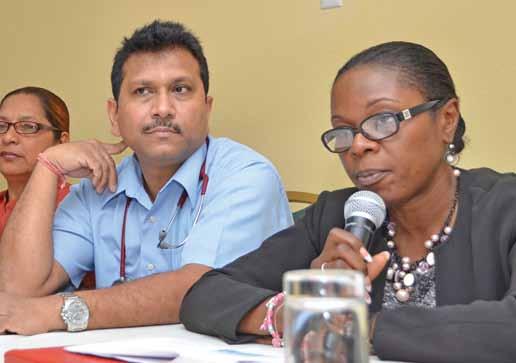
Health Ministry Chronic Disease Unit Coordinator, Dr
than all the infectious diseases collectively.

EXECUTIVE 2 STOREY BUILDING; 3 BEDROOMS WITH ALL MODERN CONVENIENCES; FUNISHED/ UNFURNISHED. MEADOW BROOK GARDENS. CONTACT MR. NARINE ON 696-8230.
Spare parts for 1-2-3-4 and 6 cylinder diesel engines for Lister, Pieter, Kobota, Perkins, Veutz, Fiat, John Deer, Case IH, Cummings, Bedford and Leyland Daf. Also all middles of diesel generators: super silence and open air from 3KVA- 600KVA. Contact Rams Auto Spares on telephone 226-6325, 227-1454, 6194483 and 685-3568 Land to buy in
2 modern apartments located in Campbellville; hot and cold water etc. Call 219-4535 House located at Lamaha Gardens; hot & cold water. Call 219-4535

We handle all Canadian, USA and UK immigration and visa matters. Self sponsorships, holiday/visitor’s visas, work permits, students visas, family, class, immigration forms, embassy enquiries, appeals for refused cases, US green card lottery, business class waivers, pardons, etc. Get your visa approved. High success rate. Balwant Persaud & Associates. Certified Immigration Consultants, 68 Sixth Street, Alberttown, Georgetown (Between Cummings & Lights Sts) Tel: 225-1540, 622-8308, 655-3105. Email: balwantpersaud@yahoo.ca

JUST ARRIVED: TOP QUALITY RECONDITIONED VEHICLES; TOYOTA NOAH; TOYOTA VOXY; TOYOTA IST (NEW SHAPE); SUZUKI SWIFT; DAIHATSU MOVE (660CC); MERCEDES BENZ C200 KOMPRESSOR; COROLLA AE100 WAGON; HONDA CRV RD4; LAND CRUISER (FULLY LOADED); MAZDA PROCEED 4WD EXTRA-CAB PICKUP; TOYOTA HILUX 4WD EXTRA CAB PICKUPS - 3RZ, 5L, 3L SOLID DEFFERNTIAL; MITSUBISHI CANTER TRUCKS 4 TONS FREEZER; 3 TONS OPEN TRAY; 2 TONS 4WD; 3 TONS DUMP TRUCK; NISSAN ATLAS 2 TONS OPEN TRAY TRUCK. PREORDER YOUR UNITS EARLY AND GET THE BEST PRRICES. FULL AFTER SALES SERVICES AND FINANCING AVAILABLE. DEO MARAJ AUTO SALES, 2 CHIMNEY ROAD, CHATEAU MARGOT, ECD. 624-0762, 2205177. A NAME AND SERVICE YOU CAN TRUST.
Honda Jazz PLL Series. Phone 2273471, 614-1069
2004 Toyota Raum. Price $2.150M. Call 657-1796 or 626-9590

Call: 675-7292
Bedford Truck. Call 627-9977 or 698-0182




“When we look at the proportion of cervical cancer cases, cervical cancer is ravaging our Amerindian women,” the Chronic Disease Unit coordinator said, noting that the high number of cervical cancer cases involving Amerindians can be attributed to the fact that hinterland women start having sex at an early age.
While noting that pancreatic cancer is the most deadly of all cancers, Dr Boyle said most Guyanese die from prostate, cervical and breast cancers.
She explained that the emerging cancer epidemic accounts for more deaths
Dr Boyle said more resources need to be diverted in the fight against chronic diseases, as the problem here seems to be getting out of control.
In the past, developing countries focused more on infectious diseases, as their population was dying rapidly from diseases such as HIV/AIDS. However, she noted that recently, there has been a hike in the number of deaths caused by chronic ailments, particularly cancer.
With regard to the fight against cancer, Dr Boyle said Guyanese need to pay keen attention to their diet and exercise regimens.
The Chronic Disease
Unit has launched several programmes to combat the spread of chronic diseases.
Meanwhile, Maternal Child Health Director, Dr Janice Woolford said some 19,000 persons have been received Human Papillomavirus Vaccine (HPV). Two years ago, her department had embarked on a progamme to immunise some 20,000 persons. Cancer, known medically as a malignant neoplasm, is a broad group of diseases involving unregulated cell growth. In cancer, cells divide and grow uncontrollably, forming malignant tumors. There are over 200 different types of cancers that affect humans.
People’s Progressive Party/Civic (PPP/C)
General Secretary Clement Rohee said the oppositions seem to be shielding money launders by stalling the passage of the Anti-Money Laundering and Countering of Financing Terrorism (Amendment) (AML/CFT) Bill.
He expressed the view at the party’s weekly press conference on Tuesday, contending: “The opposition parties in the National Assembly are protecting the vested interests of a few whose operations and perhaps survival will be affected if the bill is passed. These persons obviously are those engaged in illicit activities, including trading and trafficking in drugs, arms, ammunition and who need to launder the proceeds of their ill-gotten gains,” he said.
Rohee, who is also the home affairs minister, pointed out that this is evident in the fact that the opposition is blocking the passage of the bill.
“If a bill is aimed at thwarting people who are engaged in illegal activities, and in this respect money laundering and financing of terrorism, and you are doing almost everything to block that from going through, two questions arise: are you doing it for political purposes or are you doing it for people who will benefit from the non-passage of the legislation?”
The minister continued: “It has to be in favour of, or against somebody.” Asked who are these persons, Rohee said “the beneficiaries of money laundering”.
Rohee went on to say that he is more convinced of this now, after the opposition walked out of the parliamentary special select committee on Monday evening, interrupting the proceedings. The opposition abandoned the committee meeting on Monday evening in objection to a motion proposed by Finance Minister, Dr Ashni Singh, to have the Private Sector Commission observe the proceedings of the committee.
The minister said when it comes to transparency, one cannot “blow hot and cold water” on such issues. “If we are committed to the principles of transparency, we can’t only talk transparency, we have to do transparency,” he stated.
When questioned why the government has not taken any action against those money launderers they are aware of, the general secretary stated that when the law is passed, it will empower them to do that.
“The bill speaks for itself, anti-money laundering and countering of financing terrorism. This is not just a bill for the purpose of show, the bill empowers the state to take legal actions against persons who are involved in money laundering. It is serious business, if it wasn’t, it would not
have reached the level of the international community,” Rohee highlighted.
The AML bill was deferred to the special select committee for the third time after it did not receive the opposition’s approval. The next sitting of the National Assembly is on February 10, and in order to meet the FATF deadline on February 13, the committee will have to complete deliberations on the bill and present it to the House for approval by the combined parliamentary opposition.
Gloomy situation
However, committee member, Attorney General and Legal Affairs Minister Anil Nandlall, recently told Guyana Times that the way APNU members are behaving in the National Assembly, it does not appear as though the country will be able to meet the deadline.
He disclosed that the latest document being circulated by the Caribbean Financial Action Task Force (CFATF) manes Guyana as one of the countries most likely to be selected by the French-based Financial Action Task Force (FATF) for the International Cooperation Review Group (ICRG) review next month. Guyana has already missed three deadlines in May, August and November last year, resulting in the country being blacklisted by CFATF, which has listed Guyana as the most delinquent country.
Aseamless 178-run union between Kumar Sangakkara and Mahela Jayawardene formed the centrepiece of Sri Lanka’s familiar dominance on the first day in Chittagong. Having been joined with Sri Lanka in minor strife on 49 for 2, Sri Lanka’s senior pair bent a torpid Chittagong surface and a spin-heavy Bangladesh attack to their will, through a combination of cricketing nous and batting instinct.
Sangakkara finished the day unbowed at 160, after two late wickets weakened Sri Lanka’s chokehold. Jayawardene had fallen for 72 early in the third session to Mahmudullah, who was one of four frontline spinners Bangladesh played - having anticipated the nature of the pitch. Al-Amin Hossain was the only seam bowler.
Equal
Having drawn level with Sangakkara’s 33 tons in Mirpur, Jayawardene had hoped his team-mate would eclipse him once more in Chittagong, but for most of their time together, it appeared as if both were destined for triple figures. Sangakkara’s hundred drew him equal with Brian Lara and Sunil Gavaskar at fifth on the century-maker’s list. His runs had come in spurts, like the undulations of a melody. Jayawardene - slower and steadier - held rhythm, finding a greater percentage

of his score in the outfield.
Sangakkara’s most profitable stroke was his pull. Rarely did he fail to slink back and wallop any spinner that pitched it short - which Mahmudullah and Sohag Gazi did frequently. All three of his sixes came over deep midwicket - the second of which propelled him beyond
fifty for the seventh time in as many innings against Bangladesh.
Though Jayawardene had taken time to adjust to the pitch’s pace, jamming down late on three Al-Amin deliveries in the morning, Sangakkara had unpicked it almost immediately. Often he flitted quickly into position

Abroken rib has forced Stephen Simmons to pull out of his Worl Boxing Council (WBC) International Silver cruiserweight title bout against Wadi Camacho. The Scot was set to take on Camacho on March 1
when he saw a poor ball, but delayed his stroke whenever it slowed markedly off the track. It was the sort of surface on which batsmen may never feel set, but the almost complete absence of false strokes in Sangakkara’s 245ball stay was tribute to his enduring concentration.
The stone most often thrown at Jayawardene is that he makes his runs on generous decks, but in difficult conditions favouring spin, his batting so often seems effortless. The spinners fed him enough loose balls after his mild travails against the seamer, and he soon slipped into the kind of slow-pitch reverie that is a familiar sight in Galle or at the SSC.
Calculating
Sangakkara played calculating cricket, darting down the track to hit bowlers off their length, but Jayawardene’s method was mass-hypnosis. When Mahmudullah spun one more than expected to strike him in front of middle and leg, he had been in his breezy monotone for hours.
There was turn from the track as well, but it was of the slow variety batsmen find easier to contend with, and Bangladesh did not deliver enough good balls in a stretch to mount significant pressure. That had been part of their undoing in Mirpur as well. Gazi began the day bravely, putting his balls in
the air and hoping for something unusual for the surface. He generated decent turn in his opening spell, but though he dismissed Kaushal Silva, his overs became flatter and faster as the day wore on.
Shakib Al Hasan was the most expensive frontline bowler, conceding 70 from his 15 overs - largely because he could not settle on a consistent length. Mahmudullah suffered from the same malaise, to a lesser extent, but his line was better in comparison. Abdur Razzak bowled only one four-over spell, in the morning, before he left the field with a strain in his left hamstring in the 37th over.
Bangladesh might have had hopes of dismissing Sri Lanka for under 300, when they sent back both openers in the first session. Silva was undone by the low bounce, as his sweep shot passed over the ball, which struck him in front of the stumps.
Dimuth Karunaratne had been positive at the other end, finding runs into his favoured leg side and dealing with the vagaries of the surface with security and confidence. But his inability to convert starts at this level persisted. On 31, he hit a short wide one from Al-Amin directly to the man at point, and sunk to his haunches in disappointment before exiting. He now has five scores between 20 and 40 in his last eight Test innings. Dinesh Chandimal also scripted a disappointment,
running down the pitch at Shakib with only six full overs left in the day, to offer a leading edge to backward point. He had fallen in similar fashion against Saeed Ajmal two weeks ago, and in this innings, Chandimal had already survived another familiar close call. In the over before he got out, Chandimal had spotted a short ball from Al-Amin and pulled it on impulse, but though the fine leg fielder could have stayed within bounds after snaffling the top edge, momentum took him over the line. Angelo Mathews also fell attempting a slog - which left Shakib with the best figures of the day, though others had bowled better than him. (Cricinfo)
Sri Lanka 1st innings
RAS Lakmal, N Pradeep Fall of wickets: 1-39 (Silva), 2-49 (Karunaratne), 3-227 (Jayawardene), 4-294 (Chandimal), 5-312 (Mathews) Bowling: Al-Amin Hossain 194-56-1, Sohag Gazi 30-4-98-1, Abdur Razzak 4-1-6-0, Shakib Al Hasan 15-1-70-2, Mahmudullah 22-2-70-1, Nasir Hossain 1-0-20, Shamsur Rahman 1-0-5-0
Sachin Tendulkar was conferred the Bharat Ratna, India’s highest civilian award, by the president Pranab Mukherjee on Tuesday.
Tendulkar, 40, is the first sportsperson, as well as the youngest person to receive the award. Speaking during the ceremony at the Rashtrapati Bhawan, Tendulkar said that though he had retired from the game, he would “continue to bat” for India in all spheres of life.
“It’s the biggest honour for me and I am extremely delighted on receiving the Bharat Ratna,” Tendulkar said. “I am extremely proud to be born in this beautiful nation and I would like to express my gratitude to all the love, affection and support I have received for number of years.

Sachin Tendulkar is the youngest ever recipient of the Bharat Ratna
Simmons called the London-based Camacho a “rat” and promised to send him “home in a coma”, while Camacho labelled Simmons a “cookie monster”. (Sky Sports)
in Glasgow on the undercard of Ricky Burns’ latest world-title defence. Simmons wrote on his Twitter account: “Absolutely gutted that I will not be fighting on March 1st due to having a broken rib.” There has been no shortage of animosity between the pair, who nearly came to blows at a media conference to promote the show.
“My cricket has stopped, but I will continue to bat for India and try my best to give people of India a reason to smile,” he said. “I would like to reiterate what I said a couple of months ago about this recognition and dedicate this to my mother and along with her, all the mothers in India who sacrifice their wishes, aspirations for their children so that their dreams come true.”
Tendulkar, who retired from cricket on November 16, 2013 as the game’s highest run-scorer in both Tests and ODIs, also saved praise for Professor CNR Rao, the other recipient of this year’s Bharat Ratna.
“I would like to congratulate Prof CNR Rao for the Bharat Ratna. He has been instrumental in motivating and inspiring youth of India to become scientists. I wish him all the happiness and good health.” (Cricinfo)

By Treiston Joseph
The Athletics Association of Guyana (AAG) was forced to postpone yet another meet due to the inclement weather last Sunday and one has to wonder when Guyana’s first synthetic track will be completed.
According to the Sport Minister Dr Frank Anthony, workers will need at least three weeks of sunshine for the laying of the rubberized
On the other hand, the synthetic track is the first of its kind in the nation and the Sport Ministry, in conjunction with government, should be complimented for bringing hope to the track and field nation in Guyana. Yet that hope is marred with every delay and postponement of the completion deadlines.
The synthetic track is not just another project or infrastructure that government officials can boast about
to poorer class of society?
How much wind velocity can a couple of stands decrease when the track is right next to the winds of the Atlantic Ocean?
When will a warm up track be constructed if Guyana wants to host international competitions?
Once the track is completed, what will be done to improve the systems of science and technology that go hand in hand with such a facility?

surface to be completed, a technical undertaking that can only be done by German Company BSW Regupol.
Regupol, in November, started laying the track, but was forced to stop due to rain. Since then the company has returned to Germany and, according to the minister in his 2013 review, he will have to re-invite the company to Guyana again to finish the project..
Meanwhile, rain has continued its unpredictable pattern without showing a definite break for a three-week window to finishing laying the track.
Hence, it is left to believe that either the track will be completed whenever the ministry finds some contingency plan to get it done, or worse yet, the track will never be completed.
completing in their many speeches, it represents a beacon of opportunity for a class of people that see athletics as their only opportunity to make something of themselves.
Construction
From the time construction started in December of 2010 to date, the completion of the track has moved along at sloth’s pace, and every excuse - from unavoidable snags, to contractors being fired, to the inclement weather - has been blamed for the non-completion of Guyana’s first synthetic track, while it appears that the real questions continue to be avoided. These include:
How will the athletes have the opportunity train when the majority of athletes originate from the mid
Guyana fought back to defeat the Windward Islands by 22 runs in Match 6 of the NAGICO Super50 tournament and confirm their spot in the semi-finals of the competition.
Before the match, Guyana suffered a big blow losing opening batsman Shivnarine Chanderpaul to injury. The Windward Islands, however, remain unchanged from their first match, when they were defeated by Jamaica.
Guyana won the toss and elected to bat first, selecting Assad Fudadin for Chanderpaul. Fudadin compiled a rather slow 51 off 120 balls, while Sarwan continued his good form with a well made 62.
Eventually, it was skipper Christopher Barnwell, supported by Leon Johnson, who helped Guyana recover from a slow start to post a competitive 235 for 7 from their 50 overs. Guyana had earlier lost Trevon Griffith for a duck.
The Windward Islands bowlers were quite tight for the best part of the innings. However, coming down to the end of the innings, they seemed to lose their way somewhat.
Barnwell blasted 51 runs from 43 balls, putting on 84 runs with Johnson, who hit 41 runs from 31 balls.
The Windwards, chasing 236 for victory decently placed at 200 for seven, with less than a run a ball to score.
But spinner Veerasammy Permaul forced a collapse with the last three wickets to give Guyana victory.
Johnson Charles had started the innings positively but he only reached 35. Tyrone Theophile supported with 31, but Windward Islands kept losing regular wickets along the way. For Guyana, Ronsford Beaton and Permaul took three wickets each, with the former being awarded Man of the Match. (WICB)
Guyana innings (50 overs maximum)
TA Griffith c †Fletcher b Johnson 0
AB Fudadin c Johnson b Mathew 51
RR Sarwan c Sebastien b Mathew 62
CD Barnwell* b Mathew 51
LR Johnson c Currency b Charles 41
N Deonarine c Sebastien b Johnson 2
A Bramble† c
To bat: D Bishoo, RR Beaton, PG Wintz Fall of wickets: 1-3 (Griffith, 0.6 ov), 2-124 (Sarwan, 35.1 ov), 3-130 (Fudadin, 37.3 ov), 4-214 (Johnson, 46.3 ov), 5-218 (Deonarine, 47.3 ov), 6-234 (Bramble, 49.2 ov),
Charles 7-1-39-1, LAS Sebastien 9-150-0, GE Mathurin 4-0-23-0
What will be done to improve and educate the coaches for such changes?
But more importantly, how much longer should the athletics fraternity wait for the completion of what is hoped to be a state of the art facility?
Development is defined as a process of growth, Guyana is known for its organic way of growing crops, but it seems the Sport Ministry has negated this process and has jumped directly to the growth stage.
As such, the same reason for some unexplained happenings with inorganic food is the same reason most of these questions cannot be answered.
Simply put, if one cannot map out and derive a process for growth, how will development ever be achieved?
CD Barnwell 6-0-31-1, V Permaul 9.4-2-24-3, D Bishoo 10-0-422, N Deonarine 7-0-33-0

In dire need of a lift after their first round loss to Barbados in the opening match of the Nagico Super50 series, T&T’s Red Force will receive a major boost today with the arrival of mystery spinner Sunil Narine.
The wily Narine missed the first match as he was flying in from South Africa where he represented the Cape Cobras in their domestic Twenty20 tournament.
While the national players go through their final drill this morning for the match against the Leeward Islands in Tobago, Narine will head
straight into the game without any practice. It is a chance T&T will have to take because they need to defeat the Leewards and Combined Campuses and Colleges (CCC) to qualify for the semi-finals. Narine, currently ranked among the top three spinners in the world in the shorter version of the game, was conspicuous by his absence in T&T’s less than impressive bowling performance against the Bajans on Sunday.
A century from Jonathon Carter and a blitzy 83 from West Indies player Dwayne Smith paved the way for a
substantial Barbados score of 269, which the home team never seriously threatened. Team manager Manohar Ramsaran said yesterday Narine’s presence will certainly add depth to T&T’s attack. He noted that the team members fell down in all departments in their opening game.
“Our bowlers were caught off guard when the Bajan batsmen came hard at them early on. The fielding was also not of the best as the players dropped some catches and the batting was a far cry from what we have come to expect from the team.
"So all in all, we fell down in every department and the players will be looking for an immediate turnaround,” he said.
Ramsaran, who recently took over as manager of the team from Omar Khan, added: “We had a very good meeting after the match. The players were very quiet in the dressing room at first because they were very disappointed. However, we were able to keep a very good meeting afterwards and the senior men spoke on the way forward.”
T&T will meet the Leewards at Shaw Park in Tobago and chairman of the national organising committee Azim Bassarath says that everything is on spot for the game and the T&T Cricket Board (TTCB) is hoping for a full house. Following this game there will be a clash between CCC and Barbados on Thursday, also at Shaw Park.
(WICB Media Release)
By Ravendra Madholall in Toronto
Different qualification tournament, different country and different format, but similar sentiments by fast-bowler Jeremy Gordon after his adopted country Canada once again failed to qualify for another International Cricket Council (ICC) event.
Only today (Saturday) the ICC 50-over Qualifiers concluded with Scotland humbling United Arab Emirates (UAE) by 41 runs in New Zealand while the North Americas grabbed a solitary win in their four allotted matches.
Canada also suffered a huge defeat in the seventh-place playoff to the Netherlands succumbing to an eight-wicket margin.
“I think I didn’t play to my true potential and that was one disappointment, while our team just didn’t live up the expectations, but it was another good trip in New Zealand,” the 27-yearold right-arm quickie divulged.
Two months ago Canada was also eliminated at an early stage in the ICC Twenty20 World Cup Qualifiers tournament, which was held in UAE. Guyanese Gordon was also disappointed, despite his satisfactory performances. coming out with 11 wickets from seven matches.
“You missed out on the T20 stage and hope to make things better in 50-over version, but falling short was a great disappointment; I don’t think it was the ‘right’ team even though

we showed a lot of fight,” Gordon declared on his arrival home in Toronto recently.
Canada, which featured in the last three consecutive p world cup events, (2003, 2007, 2011), lost three of their four mandatory games to stake a claim of the two available places which were up for grabs.
They were placed in Group A and were beaten by UAE, Hong Kong, and Scotland in that order, while
triumphing over Nepal. Gordon, who finished with seven wickets, including a four-wicket haul in the victorious match, stated that the opposing teams played excellent cricket.
“Obviously, it was a big tournament and a very important one for Canada, but losing three of the four matches was very hurtful; we arrived early in New Zealand and had two warmup games and we were confident of qualifying, but the
opposition teams just outplayed us with wonderful cricket,” Gordon, who represented Guyana at both the under-19 and senior level, related.
After a successful year (2013) for Gordon at the Intercontinental Cup for Canada, Gordon was excited to make a comeback for his native country. He was part of the action at the club level but it wasn’t enough for the Guyanese selectors to invite him at the national trial late last year.
However, he is still desirable of wearing the Guyana’s colours again and should be in Guyana soon to play club cricket and by extension inter-county competitions to enhance his chance again.
He said since the weather in Canada only provides the opportunity to play for short periods, Gordon he is seeking contracts to play in either England or Australia soon.
“I [am] still very optimistic that I will play for Guyana again; I know I have to play on a regular basis down there to be selected, but I want to play professionally in other countries to keep improving my game as well,” Gordon, who plays for Brampton Masters Cricket Club in Canada, revealed.
Gordon, who made his debut for Canada in 2011, believes that hard-work and commitment are of paramount importance to be a great cricketer and his accomplishment so far has been very inspiring - something that he has attributed most of his success as an athlete.
The Annual General Meeting (AGM) of the Guyana Amateur Powerlifting Federation (GAPF) is set to take place on February 16 at Tropical View hotel, located at Campbell Avenue and Delph Street, Campbellville.
Topping the agenda for the AGM, which will commence at 11:00h, will be the election of new office bearers.
Other items will be the
minutes of the previous AGM, the president’s address and report, the secretary and treasurer’s reports, and the report of the auditors.
The registration of athletes, national referees and coaches will also be done. All clubs and individual lifters are invited to attend, as matters pertaining to the future of the sport will be addressed.
Basketball, synchronised swimming, water polo and weightlifting have all had their Olympic funding withdrawn.
UK Sport has decided to put money into other sports ahead of the Rio Games in 2016 and Tokyo 2020.
Three Paralympic sports - wheelchair fencing, goalball and five-a-side footballhave suffered the same fate.
UK Sport chief executive Liz Nicholls said it would be “high risk” to continue funding sports with little chance of winning a medal by 2020.
Around £350m will be spent preparing Britain’s best medal chances at both the Olympics and Paralympics. British Basketball reacted to the news with “disappointment” and claimed that the UK Sport funding system “appears to show bias against team and emerging sport”.
The sport was in a similar position a year ago, but managed to win funding for a further year on appeal. Now that money has gone completely.
“The basketball communi-

ty at home and abroad will be aghast that this can happen again,” said Roger Moreland, British Basketball’s performance chairman.
“We are still on the road to Rio but we now have to qualify for EuroBasket 2015 with our hands tied behind our back.”
Drew Sullivan, captain of British men’s team, hit out at the news on Twitter, accusing the decision-makers of “not having a clue”. He told BBC Radio 5 live: “I’m desperately disappointed, not only as a player or fan of basketball but also as a parent. (BBC Sport)
Seven cricket clubs in the Ancient County recently received $180,000 worth of items from the Berbice Cricket Board (BCB) and the Rose Hall Town Youth and Sports Club (RHTY&SC).
The recipients of the donations were Bush Lot, Blairmont, Young Warriors, Upper Corentyne, Chesney, Whim, and Police cricket clubs.
They each received water pitchers and water mugs, among other items.
Chairman of the BCB special events committee Hilbert Foster, in handing over the donations, stated that the board remains committed to the development of all cricket clubs in Berbice.
He also announced that other clubs in the county would receive other donations during the year while great efforts would be made to assist clubs with cricket balls and stumps during the year.
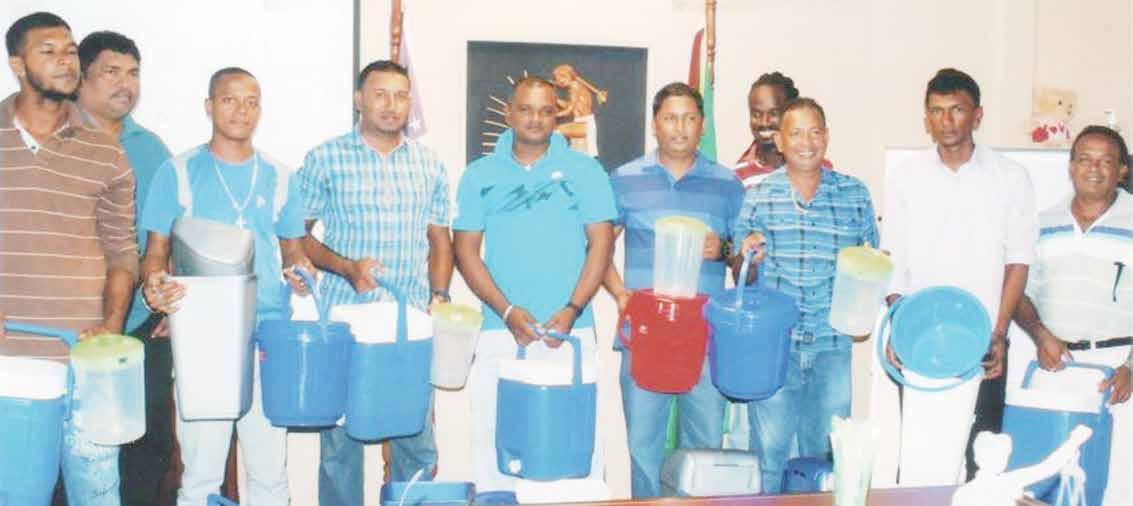
Atough task awaits the National Sports Commission (NSC) panel which will deliberate on February 21 to select the winners for the 2013 National Sports Awards.
For most of the categories, the panelists will be forced to measure the performances of the various athletes, associations and officials who have represented Guyana with distinction.
Guyana’s first international gold medalist at the 1996 Pan American Championships in Canada weightlifter Winston Stoby is leading the nominations for senior Sportsman-of-theYear, following a prolific year in that field.
In 2013, Stoby defended his world title against a lifter four years his junior unsuccessfully, but after competing in the 74kg Masters 2 Category, he set a new Deadlift World Record (WR) with another impressive performance at the 31st World Masters Men’s Powerlifting Championships in Orlando, Florida.
Stoby shattered his old Deadlift World Record of 260kg achieved in 2012 in Texas with a new record of 277.5kg to win the gold medal, but had to settle for second overall to the U.S.A.’s Gregory Page.
During last year, he also participated as a member of the Guyana team that defended their Open title successfully, capturing the gold medal in his weight class.
Stoby has gained four nominations as against

two each from veteran West Indies batsman and last year’s Sportsmanof-the-Year Shivnarine Chanderpaul and cycle superstar Alonzo Greaves. The other contenders, with one nomination each, are Olympian Winston Geroge, motor racer Kevin Jeffery and squash player Alexander Arjoon.
The nominees for the Junior Sportsman-of-theYear accolade are Junior Carifta 400 metres bronze medalists Jason Yaw (two nominations), badminton player Narayan Ramdhani, table tennis player Sherman Britton and squash player Nyron Joseph, all with one nomination each.
On the distaff side, the race is expected to be a dogfight, with athletics queen Alika Morgan as the frontrunner for senior Sportswoman-of-the-Year.
Morgan leads that cat-
egory with three nominations, while Guyana national women’s hockey goalkeeper Alysa Xavier has two. Junior Carifta under-17, 1500 metres gold medalist Cassie George and last year’s Sportswoman-of-the-Year Nicolette Fernandes were the other nominees with one nomination each.
The junior category of the awards also promises to pose headaches for the panel, with badminton player Priyanna Ramdhani, table tennis player and last year’s junior Sportswoman-of-theYear Chelsea Edgill, hockey player Jevina Straker and squash player Victoria Arjoon vying for the junior Sportswoman-of-the-Year award, with one nomination each.
There is a potpourri of teams to contest the Teamof-the-Year category, comprising powerlifting, hockey, junior Carifta and squash teams.
The Guyana Motor Racing and Sports Club, Guyana Table Tennis Association, and the Guyana Squash Association are the entities vying for the Association-ofthe-Year, while the nominees for the Most Improved Association are the Guyana Boxing Association, the Guyana Table Tennis Association and the Guyana Squash Association.
Guyana Motor Racing and Sports Club President John Carpenter, Guyana Table Tennis Association
President Godfrey Munroe, Guyana Olympic Association President K A Juman
Yassin, Guyana Amateur Powerlifting Federation President Peter Green and Michael April of the Guyana Boxing Association are the candidates for Male Sport Personality, while the Female award is a contest between Manager of the 2013 CARIFTA Games team Amanda Hermonstine, University of Guyana Sport Administrator Lavern Frazer Thomas and Fernandes.
Carl Ince (squash), Terrence Poole (boxing), and Linden Johnson (table tennis) are the candidates for Coach-of-the-Year.
For the media awards, Capital News Esan Griffith has two nominations for Sport Journalist (NonPrint), followed by Stephan Sookram and Aletha GrantCharles of NCN and Sean Embrack of HGP Channel 16, Cable 67 with one nomination each.
Chris Campbell of Stabroek News and Calvin Roberts of Guyana Chronicle have two nominations each, while Guyana Times/RGI/ TVG’s Treiston Joseph and Duncan Saul of Stabroek News gained a nomination each, are in the running for Sport Journalist (Print), Orlando Charles and Aubrey Crawford of Stabroek News, Franklin Wilson of Kaieteur News and Guyana Times/RGI/TVG’s Avenash Ramzan are the nominees for Sport Journalist (Photographer).
A date and venue for the awards ceremony will be confirmed shortly.
The 2014 golf season is set to tee off ons Sunday with the Banks DIH Limited/Citizens Bank Player’s Cup/GT Beer Championship slated for the East Coast Demerara fairway.
The one-day tournament organised by the Lusignan Golf Club will feature approximately 10 teams battling for supremacy.
Each team will comprise four players and the winning team will be determined by the lowest total net score.
Apart from the team prize, the individual player with the best net score will win the prestigious Player’s Cup, sponsored by Citizens Bank. The present holder of the Player’s Cup is Patrick Prashad, who also won the title in 2012. There will be a best gross prize up for grabs.
The players will compete in three flights – 0-9, 10-18 and 19-28 handicaps.
Meanwhile, Chairman of Banks DIH Clifford Reis will lead a strong Banks DIH Limited/Citizens Bank four-member team, which

includes Gavin Todd, Mark Lashley and current ladies champion Christine Sukhram. The manager is Alton Small.
Lusignan Golf Club President Jerome Khan will lead the Jaguars, which will include Imran Khan, Jack Harry and Matti Wesselin, while former Vice President Kishan Bacchus will spearhead a team with Fazil Haniff, Kalyan Tiwari and Munaff Arjune.
Brian Hackett, William Walker, Ian Gouveia and Patrick Prashad will compete as another team.
Other players expected to be on show include Joaan Deo, Troy Cadogan, Colin Ming, Dr Philbert London, Maurice Solomon, Robert Hanoman, Roy Cummings, Faizul Deo, Chatterpaul Deo, Shanella Webster, Carlos Adams, Muntaz Hanniff, Avinda Kishore, Avinash Persaud and Brian Glasford.
There will be attractive prizes for the top three teams in the tournament. Tee off time is 09:00h.

as sports personalities of 2013 to be known on February 21 S
year.
the
match involving the Guyana Police Force teams, dominoes and other sport events in a Family Fun



Director of Sport Neil Kumar confirmed the dates for the 2014 Inter Guiana Games (IGG) in an exclusive interview with Guyana Times Sport on Tuesday.
Guyana will be hosting four sporting disciplines in football, swimming, athletics and basketball from March 8-12.
“I must say that I’m heartened to report that the Inter Guiana Games for 2014 which is definitely on, there will be two phases… the first phase will be held in Guyana from March 8-12 where football, swimming, athletics and basketball will be played.
“In October, Suriname will host chess, volleyball and they have added badminton, table tennis and cycling,” Kumar stated.
However, with the Youth Basketball Guyana (YBG)
Neil Kumar
normally having their final national school basketball programme in conjunction with the National Sports Commission (NSC) in July, Kumar indicated the IGG basketball tournament will
likely be pushed back to the last weekend in July.
Meanwhile, French Guiana might be returning to the fray to participate in the games since 2010 when they last participated in Suriname.
“What is heartening was that the French Ambassador to Suriname and a representative of French Guiana were present at the meeting and they participated fully in the meeting, and they also signed the minutes of the meeting. They agreed that French Guiana will be participating in the games and they will be making a genuine effort to see French Guiana participate,” Kumar noted.
In addition, the Kashif and Shanghai organization will be relied on by the NSC to field a competent football team for the 2014 competition. (Treiston Joseph)