






BRIDGE OPENINGS
The Demerara Harbour Bridge will be closed to vehicular traffic on Monday, January 13 from 14:30h-16:00h
The Berbice River Bridge will be closed to vehicular traffic on Monday, January 13 from 14:25h-15:55h.

The Demerara Harbour Bridge will be closed to vehicular traffic on Monday, January 13 from 14:30h-16:00h
The Berbice River Bridge will be closed to vehicular traffic on Monday, January 13 from 14:25h-15:55h.
Countrywide: Thundery showers can be expected during the day, with light rain showers in the evening. Temperatures are expected to range between 23 degrees and 26 degrees Celsius.
Winds: East north-easterly to easterly at 2.68 and 3.58 metres per second.
High Tide: 14:48h reaching a maximum height of 2.46 metres.
Low Tide: 08:20h and 20:51h reaching minimum heights of 0.94 metre and 0.80 metre respectively.







BY SVETLANA MARSHALL
Amid falling gold prices and the drying up of capital for some miners, the Guyana Gold and Diamond Miners Association (GGDMA) has urged its members to invest in other commercial ventures as a means of guaranteeing financial security.
Gold has dropped from US$1800 to US$1200. In an advisory in the Sunday newspapers, GGDMA offered nine recommendations that can protect miners from adverse situations in times of falling gold prices and simultaneously increase production.
“Save, invest and diversify,” the GGDMA said. Additionally, the association said all categories of workers should be paid based on production and not on a fixed monthly rate. It was explained that the proposed measure will encourage cooperation at all levels as workers will keep the operation functional and profitable.
Growth
In an effort to foster growth and increase production levels, the GGDMA said miners should spend more time planning and setting production targets, with emphasis placed on budgeting. Additionally, they were urged to sell all gold to the Guyana Gold Board (GGB)
or authorised dealers and pay their Guyana Revenue Authority (GRA) Tributor’s Tax, which also includes deducting 10 per cent from workers’ wages.
However, the organisation said, “We must request that there be a reduction in the unreasonable prices charged by certain transporters, fabricators and equipment and spare parts distributors.
Their prices have gradually increased over the years as the price of gold had escalated, now that it is on the decline, we expect that they will also respond to this changing tide by reducing their prices.”
But Guyana Women Miners Organisation (GWMO) President Simona Broomes said current condi-

tions within the industry do not allow many small and medium scale miners to implement some of the recommendations tabled by the GGDMA.
According to Broomes, it is a “cold, very cold situation”, as the Natural Resources and Environment Ministry does little to relief miners of challenges faced.
She alluded to a list of proposals that were made to the Natural Resources Ministry by the GGDMA in August 2013. At the time, the association had called for an excise tax of five per cent on imported fuel, explaining that fuel accounts for 25 per cent to 30 per cent of the production cost to miners.
Against the background of falling gold prices and the high prices of fuel, lubricants, spares and replacement parts, the association said the five per cent excise tax should be given on imported fuel from legitimate oil companies in the Caribbean. But despite a lengthy justification, this proposal was overturned by the government.
The GGDMA was also pushing for the government to assent to tax waivers on the importation of 4x4, fourdoor open back vehicles, and in addition proceeds of the sale of up to 50 per cent of the gold sold to GGB in foreign exchange. In the past, miners were allowed to receive up to 100 per cent of sales in foreign exchange. In November 2011, the gold board informed miners that foreign exchange was no longer available. But this request was also rejected.
Despite history being created in the industry when Guyana recorded the highest gold declaration of 458,105 ounces in December 2013, miners are suffering due to government’s failure to address concerns raised.
The GWMO president further stated that while

miners are willing to make meaningful investments, their spending power is weak, explaining that the hefty investments are already made to aid in their mining operations. As a result, there are commitments with regards to the paying back of loans which were taken for the purchasing of heavy-duty equipment such as excavators.
Reality
“I deal with the reality,” she lamented, noting that now that the holiday season has ended, miners are experiencing difficulties starting up their operations.
“While mining contribute the largest, nothing has changed for the life of the hard working miners. It’s a cold, very cold situation… and I feel as though it is a forgotten industry.”
GWMO has a membership of 440 persons, Broomes told Guyana Times, noting that it will be increasing its fundraising activities to commence a revolving fund, to offer members loans in challenging times, thereby making financing easily accessible.
Due to the fluctuating gold prices, a number of miners were forced to shut down their operations while commercial banks have repossessed more than 100 excavators due to a shortfall in payments by miners.



Editor: Nigel Williams
Tel: 225-5128, 231-0397, 226-9921, 226-2102, 223-7230 or 223-7231. Fax: 225-5134
Mailing address: 238 Camp & Quamina Streets, Georgetown
Email: news@guyanatimesgy.com, sales@guyanatimesgy.com
The story about a 32-year-old mother, Indranie Oudit, who killed herself, allegedly in reaction to her son who also committed suicide a few weeks ago in Corentyne, Berbice, is perhaps one of the most tragic news events the local media here covered since the year began.
Events such as these, remind us that there are many ills in the society which cannot be ignored. Many persons within our midst are facing some severe personal problems and they need help and guidance in dealing with these issues.
Oudit committed suicide because she could not have coped with the loss of her 16-year-old son. Relatives say that the young man was involved with a girl for several months. However, their relationship ended abruptly and he subsequently drank poison because he could not handle the break up.
The suicide cases referred to above are not the only ones to have occurred since the year began. From reports gathered, several persons have succumbed to suicide while others have recovered from suicide attempts and some are in the process of recovery. Only a few days ago, this newspaper reported that a 19-year-old University of Guyana (UG) student died after drinking poison, and two other teenagers are listed as critical at the New Amsterdam Public Hospital, following separate suicide attempts.
Is there an explanation for this? And what else could be done to prevent persons from taking their own lives at such a young age? Most of the persons committing suicide do so during their most productive years. It must be noted that Oudit was just 32 years old, while her son was just 16.
At that stage in Oudit’s life, she should have been involved in building a career of her own and helping her children achieve their dreams by ensuring they are given a proper education and the right upbringing to face life’s challenges.
That said, we are forced to ask the question – could there have been any intervention at the level of the religious community or even the ministry to prevent such a tragedy from happening, especially considering the fact that Oudit’s family has a history of committing suicide? For example, was counselling provided to the mother after she lost her son? All the warning signs were there.
Addressing the issue of suicide is no easy task. It would require diligent and continuous work from all stakeholders. The family unit and the religious community must work hand in hand. The family is critical, because that is where every individual receives his/her first level of socialisation. That is where the value systems are first of all established.
Similarly, while the role of the male as a father figure in the family is critical, in the absence of such, the second most important institution – the religious organisation –must step in. If the family becomes dysfunctional for some reason, as in the case of Oudit’s, the religious institution should provide a safety net that will seek to ensure that the value systems and the socialisation that are required for the development of boys into men and girls into women are present.
The community needs to be fully involved if the behaviours, cultures and attitudes of individuals are to change for the better.
Additionally, we cannot overstate the importance of having more in-depth research and analysis done in order to derive a better understanding of the causes – both psychological and sociological – of suicide. It is only when we are equipped with the necessary scientific evidence that we would be able to design more holistic and well thoughtout suicide prevention programmes aimed at drastically reversing suicide rates in our country.
The case of the Oudit family must serve as a reminder that there is need for serious introspection from all concerned, including state agencies, civil society actors, religious institutions and more importantly, the family unit. Surely, there must be something that could be done to reduce the high number of suicides we are currently seeing in Guyana. All of society must be concerned and work together to win this battle.

Social decline will continue without a foundation of moral ethics, religious principles
Dear Editor, Our social decline will continue without a foundation of moral ethics grounded on religious principles. In our present situation, when political chaos, rampant criminality, corruption at various levels, and moral decline seem to be dominating our lives in this country, it is most appropriate to remember the words of our previous pope.
This champion of human rights once reminded Catholics to appreciate that their voices are needed to make a difference in the politics of their respective countries, and that they have an obligation to take action towards the upliftment of the moral values in their societies.
He affirmed that “…when ecclesiastical communities intervene in public debate, expressing reservations or revealing various principles”, these “…are aimed solely at enlightening consciences, enabling people to act freely and responsibly, according to the true demands of justice, even when these conflict with situ-
ations of power or personal interest”.
Detailing some of the principles for which the Catholic Church has been championing, examples: protection of life from conception, recognition and promotion of the natural structure of the family, he advocated that “…these principles are not truths of faith”, but “…are inscribed in human nature itself and therefore common to all humanity”, and that the church’s action in promoting them “…is addressed to all people, irrespective of any religious affiliation they may have”.
He also called on politicians “…to be credible witnesses of these basic truths through your political activity”.
Because the credos of both political parties which have governed our nation since independence have been basically materialistic, those in charge have welcomed and propagated the oft-quoted and hackneyed philosophy that there should be a marked separation of church and state,
and have interpreted it for our people to mean that even the religious principles, which the pope affirmed “…are inscribed in human nature itself and therefore common to all humanity”, should be rejected.
This must make it clear that this obligation of religious persons to give themselves to the service of their social communities by making their voices heard in their respective political environments is not confined to Christians, but includes those of all faiths.
All those who are able to contribute to the strengthening of the moral structure of their society have a bounden duty to join in the various public debates, and find ways of influencing the policies and practices of those who govern so that they are grounded on the basic human values which ensure justice and equality for all.
This is the only way by which we can instil these values into the various systems and programmes, and rid ourselves of the materialistic approach to our government
which has been basically the root cause of all our problems. There is no other way by which we can deal with the scourge of racialism which permeates our politics, and which is eating away at all the gains we have made. Socially and economically, there is no other way of effecting equality within our social structure, so that we can be assured of fair treatment of all our people. There is no other way of recovering the moral ground which formed the foundation of the peaceful society which we inherited from our forefathers who were guided by the religious principles of at least three of the greatest faiths on earth.
As persons who benefited from this inheritance, and made it the basis of our own private lives, each of us must do his part of transferring these tenets into the public sphere, and make our voices heard so as to change our national condition for the better.
Yours respectfully, Roy Paul
The U.S. embassy must discuss project with govt
Dear Editor,
I read with sadness the story of the American democracy project, the government of Guyana, the U.S. embassy, and the opposition. My sadness is based on the fact that the United States and Guyana, much over 20 years now, have enjoyed very friendly and respectful relations, growing closer as the years went by.
But now this democracy project confusion seems to be negating all these close relations and diplomatic gains won over the last 20 years, without any vital interest of either Guyana or the United States
being involved. This is the queerest diplomatic history. This gauche situation could be remedied with quiet diplomacy. And the elements of this quiet diplomacy could be:
(a) The government of Guyana must be prepared to speak with the U.S. embassy on the project.
(b) The U.S. embassy has to meaningfully discuss with the Guyana government the project document and to make adjustments to those parts of it which could arguably be not in consonance with the Guyana Constitution and its conventions.
(c) The U.S. embassy has to use its diplomatic skills to exorcise the widespread perception that it has been manoeuvred into the opposition camp and also, if possible, to restrain opposition personnel from bragging about the contacts and conversations they have had with the highest embassy officials.
(d) The U.S. embassy could have consultations with the opposition, but these must be confabulations with the opposition and being manoeuvred into their camp.
(e) The U.S. embassy must emphatically reiterate that it has and has had no intentions of interfering in Guyana’s internal affairs. This could be done immediately since it is standard diplomatic relations.
(f) All parties in any way involved should only communicate to the media by way of media releases. This could avoid inadvertent or planned media misunderstandings. If this is done, the project could be saved, the diplomatic skills of no one would be impugned and Guyana-U.S. relations would be back on the rails in unruffled equilibrium.
Yours sincerely, J J Forde
Dear Editor,
We participants of the National Drama Festival, whose names are provided below, would like to address the recently concluded matter of late payments of prize monies due to cast and crews of the winning productions of the 2013 festival.
In addressing this matter, our aims are to express our deep concerns for the future of the festival, highlight as yet unresolved matters arising out of the 2013 National Drama Festival, and propose some possible solutions.
But first, a little context is in order. On November 30, the National Drama Festival Awards Ceremony was held, some seven days after the conclusion of the festival.
Minister of Culture, Youth and Sport Frank Anthony, Dr Frank Anthony, in the presence of all those in attendance in the National Culture Centre (NCC) auditorium, made a promise that prize monies would be paid within two weeks of the same evening.
This was a pleasant turn of events, as the previous two years the festival had been marred by lengthy delays in the judging process, holding of the award ceremony and in the payment of prize monies – among other things, some of which could be put down to teething problems of a new and ambitious initiative, some of which probably should not.
In one instance, prize winners were left waiting for two months to collect their modest, but hard-earned winnings. When the two-week deadline approached, a number of directors, playwrights and actors took it upon themselves – by themselves –to contact festival director Godfrey Naughton. The twoweek deadline passed without prize monies being paid.
Assurances were made by Naughton that he would try to get the money released in time for Christmas. Christmas passed without prize monies being paid. Some hoped to receive their prize money before the end of the year. 2014 was ushered in without prize mon-
ies being paid.
All the while prize winners and drama mentors had been taking it upon themselves to investigate, either through Naughton or with personal contacts at the ministry, as to when monies would be released.
However, it was not until the evening of January 5 that the pot boiled over. This is when Naughton – now, by his own decision, the former festival director – proclaimed on his Facebook page that where the money was concerned the ministry "had it but spent it".
By the morning of January 6, word had spread and we very quickly began organising ourselves. Numerous calls and visits were made to the ministry to seek an official explanation. We requested an audience with the ministry for January 8 to clear up the conflicting bits and pieces of information that we were receiving up and down the chain.
Our request was denied, apparently because of meetings, but we showed up anyway in our numbers at the ministry to indicate our seriousness. We were insistent but always polite, else we be accused of being a mob.
Whether it was the inquiries and presence of the media, the call we put in to Digicel – who wholly and solely sponsored the prize money, the intervention of parties outside of our immediate group, or some combination of these and other factors, we received official word from the ministry that our money would be available the following day. Just in time to put on hold the press conference and media blitz and other actions that we were in motion to begin the very next day.
Fortunately for all concerned, the ministry kept its promise and monies were released. From the beginning though, we have always planned to issue this very statement. It should have never had to come down to this.
The matter is not over. At the time of writing, clos-
er inspection has revealed that it appears that as much as $600,000 of prize money is missing from our collective winnings. Coming out of the festival, members of Lichas Hall – Linden's version of the Theatre Guild – discovered that an annual subvention for the hall has been in the ministry's budget since 2008.
This would be great news if it weren't for the fact that Lichas Hall, up until very recently, knew nothing of the subvention and has no record of ever being in receipt of the funds allocated to them. There are also fees due to Lichas Hall for use of the facility during the Linden leg of the festival.
These are just the latest in a long series of incidents that have caused artists great worry and stress. At best, the ministry is inconsistent and lacking in transparency. In this particular incident they have failed to communicate in a clear and convincing manner just what was the reason for the delay in paying prize money.
The ministry claims that discrepancies in Naughton's financial submissions were the root of the problem. This is baffling. Digicel has supposedly sponsored the full sum of the prize money (which was handed over to the ministry before the awards ceremony).
A determination had been made as to how much money was to go to first, second and third place. The judges’ decisions have been final ever since. Why the hold up?
We see this year beginning with the deficit of trust that local ‘creatives’ hold for the ministry, deepening. The ministry has tried to put the problems of the festival squarely on the shoulders of Naughton, and while he bears some responsibility, he should not bear all.
The seemingly ad hoc manner in which many initiatives are executed, deterioration of facilities like the NCC and poor communication by the ministry all serve to undermine it's very own efforts and to frustrate the creative community.
Finally, we would like to propose a solution for how prize monies and monies for drama mentors can be handled. It is a solution that, we are told, the ministry already employs for Mashramani and, from all accounts, works well.
Within one week of the end of the festival, the awards ceremony can be held, the judges having submitted the names of the winners for the different categories. All monies would be packaged and distributed at the awards ceremony, or perhaps immediately after. For accounting and auditing purposes, the relevant accounting officer would be in place at the NCC to sign off on all vouchers and issue all receipts.
We look forward to the ministry putting measures in place to prevent these incidents from repeating themselves. Only then will the ministry have begun the long road of rebuilding the trust that has been so severely eroded, so that it can truly partner with and serve the creative community and the arts.
Sincerely, Kojo McPherson
Candacy Baveghems
Vivian Boyd
Errol Chan
Adolph Christian
Tivia Collins
Kwasi Edmonson
Leon France
Leslyn Fraser
Shana Fraser
Nuriyyah Gerard
Tahirih Gerard
Derek Gomes
Michael James
Keon Heywood
Tashandra Inniss
Nickose Layne
Kijana Lewis
Walter Lewis
Nicola Moonsammy
Lloyda Nicholas
Lisa Punch
Devin Sears
Sheron Taylor
Mosa Telford
Ayanna Waddell
Sonia Yarde
Randolph Critchlow
Radiante Frank
Mark Kazim
Dear Editor, I speak for so many of us when I say that we are very sorry to be greeted with the sad news of the passing of a former broadcaster, Terrence Holder. I wasn’t aware that he was in ill. In fact, I still thought that he was the deputy general manager of the Guyana Telephone and Telegraph Company (GT&T).
I hail his remembrance and have no qualms declaring that he was a solid son of the soil. His sojourn of 73 years made quite an impact on many. I recall his days as the general manager of the Guyana Broadcasting Corporation (GBC) where he made quite a mark manifesting professionalism in
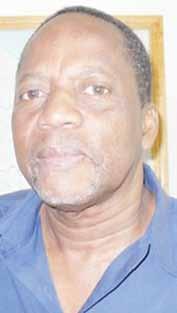
Terrence Holder
every sense of the word. In those days, announcers never came late and they seldom missed designated shifts.
He was not the typical present day radio man, just taking the airwaves lightly. He stood for excellence and his charges were really on top. Reading the news those days was something to behold.
Holder came over as an extremely reasonable person and it was for this reason that he stayed on, after the change of government in 1992, serving the board of directors for the National Communications Network (NCN). He was an extremely kind and compassionate individual.
When he was serving a
cause on the then Guyana Cricket Board of Control, he was known for giving away his complimentary tickets to others who wanted to go and watch the game. I cannot confirm, but I was told that many young broadcasters still accessed him on matters relating to radio and he never withheld his input.
Guyana is quite poorer for his loss. He joins, almost on the heels, Oswald Singh, who passed away in December. May the memories of both gentlemen inspire not just those in broadcasting and telecommunication network, but us all.
Yours truly, Yolanda Thomas
Dear Editor, In secular India and throughout the world, Hindus have found themselves scattered, disorganised and without any form of representation. Nepal, the only declared Hindu state, is too small, they are not economically as equipped as India and they are overrun with the same problems Hindus are facing, and cannot be the symbol of Hindu power.
Nepal is a Hindu state that became so because nobody cared to invade; most of its land runs vertical. Nepal unfortunately does not represent Hindu strength but is a great example of our ability to escape total annihilation and survive.
India is where most of our gods walked, India is where there are almost one billion of us and India is where we have a majority, uniting this nation and bringing it under a Hindu identity will prove that Hinduism is here to stay.
However, before all this can take place and even after the fact, having a Hindu “Vatican-type” designated area will make a statement about the Hindu religion. We are currently and maybe, for many generations to come, very disorganised and scattered because it is the nature of our religion not to be dogmatic but, when facing organised opposition, we ourselves must act to suit because it is also the nature of our religion to adapt and learn.
We are survivors but, we
need not be second class citizens of the world. Hindus should declare a 10-mile radius of a Holy City or site like Dwarka, Lord Krishna’s City, or Ayodhya, where it will be a protectorate state of India but, like the Vatican, it will have its own head of state, such as an acharya who represents all denominations of Hinduism.
This acharya will represent the Hindu nation globally and is to be treated as a head of state and a religious leader like the pope. Presently, India may not be too far away from becoming a Hindu state unlike its secular self today.
This Hindu site will be a nucleus like the Vatican or Mecca to unite all Hindus and will at the same time give Hindus a platform of power that the government of India cannot provide.
When the head of Hinduism travels abroad, it will give Hindus the respect and identity they deserve as an ancient power, especially when other heads of state must greet him or her as an equal and roll out the red carpet and salutes. Every nation that treats him or her with respect is treating us with the same respect and recognition as a civilisation.
This Hindu head of state will allow India itself to remain democratic and give Hindus a moral unifying boost with a voice.
Sincerely, Vassan
Ramracha, Nisha Ramracha




By DeBBie Pincus
Have you been looking back on the last year, reflecting on how things went with your child? If so, perhaps you feel frustrated when you think about his or her behaviour –and your reaction to it. Maybe you feel like no matter what you do as a parent, nothing changes. But understand that positive change can happen in your family. You’re not stuck in those negative patterns – you really do have the power to improve things, starting today.
What is your dance with your child?
As you look back, it can be helpful to remember what you wished for last year around this time. Maybe you wished for a year of less fighting with your children, or dreamt that your children would become more responsible and motivated. Perhaps you wished for your defiant teen to turn into a more cooperative one, or for your mate to stand up for you more. Maybe you longed to parent from your principles instead of from anxiety. As difficult as it is to reflect at times (especially if things didn’t turn out the way you’d hoped), if you can view last year with curiosity and observation rather than with regret and harsh judgments, you’ll have a better chance of improving things now.
It’s important to realise that every relationship has elements of a dance within it. And as we all know, there are some great dance moves, and some that have gotten a little old and need to be retired. Do a self-inventory by standing back and observing yourself as you interact with your children and other family members. Think about your dance moves, and ask yourself the following questions:
What is my dance with my child?
Do we keep having the same fight?
Which steps in the dance do I need to change? Do I get caught in a power struggle and end up yelling or giving in?
Even if it feels like the dance you do can’t be altered, know that you can start changing those negative patterns with your child right now.
Repeat after me:
“I am not in con trol of my child’s be haviours, thoughts, and feelings – But I am in control of my own.”
When we as par ents feel re sponsible for our child’s behaviours, thoughts, feel ings, and out comes in life, we get highly invested in their behaviour. We tend to believe that who they are is a reflec tion of us. When parents feel this way, there is an expectation and pressure to shape their children into who they believe they need to be; otherwise we can’t calm down. We feel anxiety – which leads to reactivity –as we attempt to “shape them up”. In response, our children then react to us

– usually with some form of defiance. That dynamic can contribute to a disappointing and frustrating dynamic in the family. Why is this kind of reactivity so destructive? Because it’s an emotional reaction that does not lead to learning, problem solving, resolution or self direction – let alone positive connection.

If last year was a rough one with your children, chances are it’s because you and your children were more reactive to each other. Tough outside circumstances might have increased your stress levels. Chronic anxiety, along with stresses like a death, job changes or a move, ageing parents, or sickness, increases the chance for more reactivity in the family. But remember, while we can’t control many things that happen to us, one thing you can take control over is how you learn to respond to stress and difficulty in your life.
Stop reacting – and start responding Why is it important to be thoughtful rather than overreact to your child

this year, and every year moving forward? Responding is a way of slowing down, staying calm, and answer
ing someone thoughtfully rather than letting that knee-jerk reaction kick in. One way to do this is by realising you have control over your emotions. Between an action and your reaction, you have the space to decide how it’s best to think, feel, and respond. You have a choice. You are never fully at the mercy of someone else’s behaviour.
So if your young child is rolling around on the floor, because she doesn’t want to get dressed, don’t start rolling with her. Instead, pause and think of an effective response.
Perhaps you’ll decide to put your headphones on while she rolls and screams and works through her feelings. Or, maybe you’ll decide to provide her with a choice: “You can choose which outfit to wear. After you put it on, we’ll go to your friend’s house. Which one do you choose?” Or, if your teenage daughter is slamming doors and rolling her eyes, don’t slam and roll with her. Instead you can very quietly ask her what’s upsetting her. Or you can avoid engaging with her until she’s worked off her steam.
Once you hit that “pause” button and choose an effective response based on your sound principles rather than a knee-jerk reaction, you are in charge of yourself and your relationships. When you’re in charge of yourself, you won’t need to try to control your child or anyone else, for that matter. By managing yourself instead of your child – by stepping out of his box and into your own – you will have given him the emotional space to learn to be in charge of himself. And he will be calm enough to think for himself and solve problems with more maturity.
(Excerpt from empoweringparents)

Say these five things and have a calmer year

Here are five things to say to yourself that will help you stay calm with your children –and will help to contribute to a calmer and more peaceful year.
“I am not my child and my child is not me. He can behave one way and I am free to choose how I will behave, no matter how he chooses to act.”
“I can use my own parenting values to guide me when my emotions get triggered. I am fully responsible to manage my own behaviour. My children cannot ‘make’ me lose it.”
“I am responsible and in charge of how this year goes. I am not in control of how anyone else behaves or thinks, but I am fully in charge of how I behave and think.”
“It’s not possible to ‘control’ others and try to get them to be how I want them to be, so I can feel like a successful parent. If I do, my children will most likely fight back in their own way. I can instead work to shape myself.” (Usually children follow our lead.)
“I can work on appreciating my children for who they are and ‘worry’ less about them.” (They will more likely come to appreciate themselves and feel less anxious about who they are when you can do this.)
Once untangled, you will be calm and emotionally separate enough to guide your child. You can then hold him accountable by providing consequences if he hasn’t followed the rules or hasn’t done what was expected of him. Do it matter-of-factly rather than with too much emotion. Disengage if your child has lost control of himself. Once he is calm, you can discuss with him other options for solving a problem, rather than screaming, yelling and trying to hold others hostage. He will learn that certain behaviours are not effective, because he simply does not get what he wants when he behaves in those negative ways. And you can show him better options through your own self-control and through problemsolving discussions. From your calm separateness you will be able to guide your child to better behaviour and a more peaceful year.
(Excerpt from empoweringparents)
BY BHISHAM MOHAMED
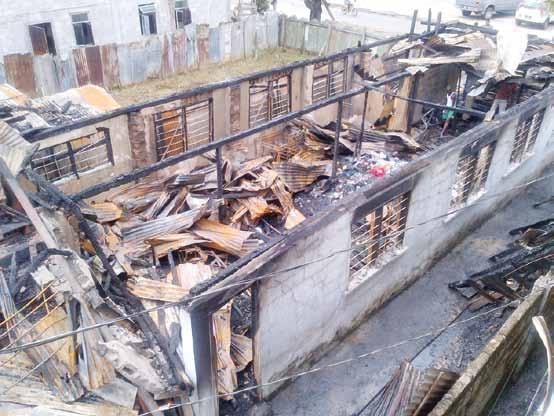
Afire suspected to be electrical in origin ripped through an apartment building and a house at Charles Street, Charlestown, Georgetown in the wee hours of Sunday, leaving at least 25 persons without a roof over their heads.
The fire started about 03:00h in the house owned by the Lietchs at Lot 8 Charles Street, and quickly spread to the nearby building on the same lot. Thirteen people were at the time occupying the twostorey wooden and concrete dwelling place while another 12 were tenants of the 11-room apartment building.
Guyana Times understands that the fire started at the front of the house and rapidly spread throughout the building, leaving no room for the occupants to salvage any household items.
Gutted
The house was completely gutted with losses estimated to be over $20 million. The tenants of the apartment building have also suffered tremendous losses as most of their personal belongings were either scorched or completely ravaged by the fire.
The apartment building is owned by overseas-based Guyanese Ofari Simon, but is being overseen by her brother Carl Simon, who was devastated when this newspaper visited on Sunday morning.
He also accused members of the Guyana Fire Service (GFS) of theft. He disclosed that after the fire tenders arrived on the scene, the dwelling house was almost gutted and their main focus was to
save the nearby buildings.
Simon claimed that during this time, items were stolen from the tenants’ rooms.
He said his younger brother, who deals with the finances of the business, occupied one of the front rooms, but was not home at the time of the fire. In order to gain access to some of the rooms, he said that the fire fighters resorted to use wrenches to get the doors opened.
Ransacked
In his brother’s room, Simon pointed to a chest of drawers which was ransacked and alleged that it was the firefighters who were the culprits as they searched for valuables. He went on to say that over $78,000 was kept in a book that was in the drawer but it disappeared. A while later, he noted that the book was found in a gutter with the receipts intact but there was no money.
The man said too that a tenant’s suitcases were also ransacked. The tenant was reportedly out of town at the time of the fire.
Simon could not say what was removed from the man’s room. He is calling for a full probe into the incident by senior fire service officials.
With respect to the fire, he said that he woke up about 03:00h to use the washroom and suddenly saw smoke which promoted him to check. In doing so, he saw the smoke turn into flames at his neighbour’s house and he immediately raised an alarm.
He said the tenants did not hesitate to evacuate the building, leaving everything behind. After making sure that everyone was safe, he went to his neighbours’ aid.
The fire, he added was too big, thus, they had no alternative but to retreat. They, however, managed to remove one of the vehicles belonging to the Lietchs.
One of the tenants, Sandra (only name given) explained that she has been staying at the apartment building for the past three years and was not sure what would be her next move. With assistance from her family, she is expected to move to another place as soon as possible.
The woman highlighted that she was asleep when she heard the caretaker, “Carly” alerting everyone that there was a fire. As she ran to safety, the only thing she recalled grabbing was her mobile phone. Sandra also reported that she has lost an undisclosed sum of money and blamed the fire fighters.
Johnel Lietch, another occupant of the house, explained that he was in one of the rooms in the lower flat with the mother of his son and his child when he was awakened by intense


heat.
The tenant said he immediately jumped out of bed and as he stepped out of the room, he saw one of the walls on fire. Without hesitation, he attempted to put out the blaze, but the heat was too much, and more so, the fire started to spread.
Call for help
“I opened the door, run out and start hitting the glass windows with the intention of waking up everyone… I started to call out for help… those who were in the building started to evacuate.”
The Guyana Defence Force (GDF) member said he was happy no one was hurt during the commotion. He added that he was worried for his mother who is partially impaired, but after seeing her, he knew that everyone else was safe.
He further stated that the house was well-furnished and they had no chance to salvage anything. His brother-in-law’s
car was also partially damaged. Lietch recalled that they had to break the back windscreen of the Toyota Fielder in order to release the handbrakes so that the vehicle could have been pushed manually.
He confirmed that the fire started at the front of the building, but what started the fire remains a puzzle since there were no power failures in the community prior to the fire.
“First, I thought it was electrical but the fans were spinning… and if it was the current, the fan would have cut off.”
He added that there was need for improved lighting, but noted that they normally sleep with the windows on the upper flat of the house open. While he does not want to jump to conclusions, he opined that the Guyana Fire Service is continuing their investigations.
The soldier divulged that the fire tenders took more than 20 minutes to arrive on the scene, but were faced with some diffi-
culties.
“They come but as they pulled out the hose, the water was not coming out… it was until another tender arrived on the scene was when they started to soak the other building which de already catch.”
Rebuild
He was not sure what his extended family will do, but was sure that they will depend on their relatives to offer a place to rest until they can assess the damage and rebuild. Lietch was cognisant of the fact that all 13 of them cannot burden one family and it was time to split up.
He has been living at the address since he was born some 23 years ago. Johnel lived with his mother, siblings and other relatives. While it will be hard to start afresh, the young army official said that the Lord will provide.
Attempts to make contact with fire chief Marlon Gentle proved futile. (bhisham@guyanatimesgy. com)

monday, January 13, 2014|
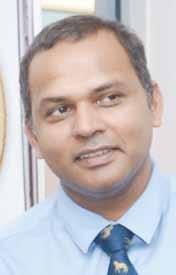
ACulture, Youth and Sport Minister, Dr Frank Anthony
He asked Dr Anthony whether he could “inform this House whether in addition to sports, the Cliff Anderson Sports Hall can also be used to slaughter goats and other meat products?” And, who granted permission for this to happen.
The MP said the coalition is convinced that the facilities at the Cliff Anderson Sports Hall are being misused, and is expecting Dr Anthony to answer the questions.
Jones, speaking to Guyana Times on Sunday, said APNU has video evidence that the Sports Hall was being utilised by a group of persons to slaughter goats. He said this practice is most troubling as he has received
several complaints about the matter.
According to Jones, he was informed that the activity had occurred while a game was being played in the sports hall. The APNU parliamentarian said he was made aware that at least another parliamentian from the government side was present when the activity was taking place.
Jones is also asking the culture, youth and sport minister what fees are charged to clubs or groups to utilise the Cliff Anderson Sports Hall and what criteria are used to determine those fees.
He said if the minister confirms that permission was given for the slaughtering of animals, he will be advised to withdraw consent and to ensure that an end is brought to such practices.
Jones said if the minister did not grant permission for the activity to take place, then he expects a full probe to be launched and those involved sanctioned.

...or not to SWAT
The opposition’s opposition to Rohee knows no bounds. That’s the only “reason” we can find for its rejection of the proposal for the Guyana Police Force finally constituting a Special Weapons And Tactics (SWAT) squad. We know it’s irrational...but then again, the opposition parties haven’t exactly distinguished themselves in the rationality sweepstakes, have they? Even Henry Jeffrey, who’s hoping to join them in their “Big Tent”, has had to hold his head in despair.
But maybe “likes” and “dislikes” are inherently irrational and APNU/AFC just don’t like Rohee. We know Desmond Hoyte also saw red whenever Rohee’s name was mentioned. Is it a “class” thing, since Rohee makes no bones about (and actually flaunts) his origins as a Jagan’s protégé from the “streets”. You’d think they’d respect the fella more...based on the heights he’s scaled.
But que sera, sera...and we return to the SWAT initiative. Back when Guyana was held hostage by gunmen holed up in Buxton – and policemen were being picked off like sitting ducks – there were loud cries for a SWAT team. Some advised the army should be thrown into the fray and a whole unit was dispatched to Buxton. But they decided to turn their guns into ploughshares and ended up “fraternising” with the criminals.
And so we had the British actually working with the police to launch a SWAT unit. At the head of the GPF was Winston Felix, who’d received British training and was their fair-haired boy. And Felix agreed that Guyana needed a SWAT team. Money wasn’t the problem (British funding)...weapons weren’t the problem (British sourcing) ...manpower wasn’t the problem (volunteers from the force)...training wasn’t the problem... (British trainers in short pants). But there was no SWAT. What happened? Felix happened, that’s what. While Felix sucked up to the British and “yes sir’d” them to death, he was PNC to the core. Him, Corbin and GDF Commander Collins were all YSM squaddies. And since the whole strategy for the armed assault on the state was a PNC creation (Hoyte: “The PPP only understands force!”) you couldn’t very well have a SWAT team, that (God forbid!) could actually challenge the criminals, could you?
So the man who commiserated with his PNC contact Basil Williams about the Agricola Massacre (“Ow Bannuh!) quietly decommissioned the SWAT team.
Did we really expect the PNC/APNU to support a new SWAT team, now that they parachuted Felix as their “security” maven in Parliament? Rohee’s the occasion for the war; seizing power by any means necessary is the cause.
...for power
Ariel Sharon, dubbed “the Butcher of Beirut”, after he had Christian militias massacre over 3000 Palestinians in a refugee camp in Lebanon, while his army locked off any escape routes, died after an eight-year coma. There IS a God. For us in Guyana, Sharon exemplifies the clear and present danger when military men assume civilian leadership of the state.
In the 1950s and 1960s, Sharon led a band of “Israeli reprisal teams” that went into the Palestinian villages and randomly killed civilians every time there was an attack on Israel. This experience obviously instilled a very low regard for Palestinian lives and absolutely none for any rules of engagement. Neither in warfare or politics (which to Sharon were ultimately the same, anyway).
So you had him facilitating the building of Jewish settlements in the West Bank, expelling Bedouins from the Negev Desert – not to mention refusing to accept the idea of Palestine.
And now some will say he was a “peacemaker”?
...a fly
It has been said by folks far wiser than your Eyewitness, that you shouldn’t take a hammer to swat a fly on your friend’s head. So while we agree that folks can’t be encroaching on government’s reserves...we’d advise perhaps some gentler persuasion?
And equal treatment for all transgressors.
The Demerara January 2014 Criminal Assizes will commence on January 15 with a total of 233 cases listed to be heard in that session.
Presiding over this session will be Justice Navindra Singh, Justice William Ramlall and Justice Franklin Holder. The gaol delivery was done last Friday by Justice Singh at the High Court, bringing an end to the October 2013 Criminal Assizes.
Demerara Assizes
During this session, Justice Diana Insanally, Justice James Bovell-Drakes and Justice Singh sat with a total of 228 cases listed for hearing; however, they were able to dispose of 17 cases.
Justice Insanally completed seven cases, all of which were for the offence of murder. The first trial resulted in the accused being sentenced to six months at the Sophia Juvenile Holding Centre after the jury returned a unanimous verdict of guilty. This sentence was appealed by the Director of Public
Prosecutions.
In another murder trial, the judge ordered for a new preliminary inquiry (PI) to be done de novo (from the beginning) within four months after she had ruled on the preliminary points and quashed the indictment against the three accused.
One trial saw the jury finding the accused guilty of murder; hence, he was sentenced to death.
In three separate cases, the accused persons pleaded guilty to the lesser offence of manslaughter; this resulted in one being sentenced to 24 years imprisonment, another sentenced to 10 years and the third sentenced to 17 years.
In the seventh case, the accused was acquitted after the jury returned a unanimous verdict of not guilty.
Meanwhile, Justice Bovell-Drakes disposed of four cases, all of which were for murder. In two of these trials, the judge up held no-case submissions made by the defence attorneys and directed the jury to return formal ver-
dicts of not guilty in each case.
However, the state has appealed one of these decisions. The other two cases resulted in the acquittal of the accused persons after the jury returned unanimous verdicts of not guilty.
Murder cases
Then Justice Singh heard six matters, but one of them for the offence of murder is still continuing before him. He had five murder cases and one for manslaughter.
Of the murder cases, two accused were found guilty by the jury, resulting in one being sentenced to 76 years imprisonment while the other was sentenced to 71 years.
In the third murder case, the accused was sentenced to 12 years imprisonment after changing his plea to guilty to the lesser count of manslaughter.
In the other murder case, the accused was slapped with two counts of murder and was remanded to prison for retrial after the jury returned with a split decision of six guilty and six not guilty for the first
count and four guilty and eight not guilty for the second count of murder.
The manslaughter cases resulted in the accused being acquitted after the trial judge upheld a no-case submission and directed the jury to return a formal verdict of not guilty.
Berbice Assizes
At the time, the Berbice October 2013 Criminal Assizes was in session with Justice Dawn GregoryBarnes presiding.
During this time, she managed to dispose of seven murder cases, five of which, the accused persons pleaded guilty to the lesser offence of manslaughter.
This saw one accused being sentenced to 20 years imprisonment, a second sentenced to 12 years and a third sentenced to 17 years imprisonment.
Additionally, the fourth accused was sentenced to 13 years while the fifth was sentenced to 16 years imprisonment. The accused in the sixth matter was sentenced
to 20 years after the jury returned a unanimous verdict of guilty and the seventh trial was aborted after two defence counsels recused themselves from the case.
The next session in Berbice will be the February Criminal Assizes, which will be opened on February 4 before Justice Insanally.
Essequibo Assizes
Meanwhile, the Essequibo May 2013 Criminal Assizes commenced on May 21, with a high-profile murder trial before Justice Holder.
The three accused in this case were members of the Guyana Defence Force Coast Guard who had robbed a gold dealer, murdered him and dumped his body overboard. They were found guilty and sentenced to be hung.
Justice Ramlall took over the session from June to September followed by Justice Sandra Kurtzious who sat from October to December 6, 2013. There were 20 cases listed to be heard, but only six were completed.
Three of them were for the
offence of murder, one for the offence of attempt to commit murder and two for the offence of carnal knowledge.
Justice Ramlall completed three matters, two of which were for the offence of murder.
One accused was sentenced to five years imprisonment after he pleaded guilty to the lesser offence of manslaughter and the accused in the other matter was acquitted after the jury returned a unanimous verdict of not guilty.
The third case was for the offence of attempt to commit murder and this matter was discharged by the judge after the victim informed the court that he was compensated by the accused for his medical expenses.
Justice Kurtzious completed two matters for the offence of carnal knowledge. One accused was sentenced to 20 years imprisonment after the jury returned a unanimous verdict of guilty while the other accused was acquitted after the jury returned a verdict of not guilty.
BY BHISHAM MOHAMED
Guyana Civil Aviation Authority (GCAA)
Director Zulficar Mohammed on Sunday confirmed that the Cessna 206 aircraft that crashed during takeoff at the Ogle International Airport (OIA) on Saturday has been removed from the site and is being stored at the Guyana Sugar Corporation (GuySuCo) hangar.
He said the aircraft was examined by GCAA officials on Saturday, but it is too early to disclose what might have been the reason for the crash. He said investigations will resume early today.
The plane, he noted, will again be inspected and once all the questions would have been answered, a report will be made known to the public. As of now, with the little information at their disposal, no pronouncement will be made as to who have erred.
Investigators Mohammed said his team of investigators will meet with the pilot of the aircraft today as they have not had the opportunity to speak with him.
Guyana Times understands that the Cessna 206 registered to Fenix Airlines was given clearance by the OAI control tower to take off, but failed in its bid.
This publication was also told that investigators are exploring the possibility that the aircraft might have been overladen when it took off.
According to the airline’s Administration and Finance Manager Eddie Soolal, the pilot Raul Seecharran and pas-

senger Zorena Alli were discharged from the Dr Balwant Singh Hospital, and pregnant Shenika Munroe remains a patient at the Georgetown Public Hospital.
Soolal added that the company is making sure that the patient received the best medical attention, pointing out that her health has not deteriorated. He explained that she is expected to be discharged today.
The official added that the company has not decided on compensation just yet, reiterating that the passengers involved did not receive serious injuries.
However, he noted that with the aircraft now down, the company’s services to the interior will be affected.
He also confirmed that the aircraft was fully insured by an insurance company in England and is also covered by Caricom Insurance Company in Guyana.
Soolal said once the local insurance company investi-
gates and sends its findings to the overseas company, it will in turn refund the airline.
The finance manager also told Guyana Times that he did not speak with the pilot to get a firsthand insight as to what might have went wrong.
“He was hospitalised so we didn’t want to push the issue… we know that he is traumatised.”
The accident occurred about 09:30h while the aircraft, with registration number 8-RMML, was taking off from the western end of the runway.
Soon after takeoff, the vehicle landed obliquely opposite the control tower, veered off the runway, flipped and ended up on its back.
This is the first plane crash for 2014, but the GCAA has been conducting investigations into a number of mishaps during 2013.
In April last, the founder of Angiel Enviro Safe Incorporated, Pierre Angiel, 71, of Miami, Florida, U.S.A. and crew member Nick Dmitriev, 54, of Toronto,
Canada, met their demise after a Piper Aztec twin-engine aircraft crashed into a house at Plaisance, East Coast Demerara and exploded minutes after it took off from the OIA.
It was reported that prior to the crash, the pilot had reported to the air traffic control tower at Ogle that he had “lost an engine” and was encountering difficulties.
Moments later, a loud explosion was heard in the East Coast Demerara village as the aircraft crashed into the three-bedroom wooden house that subsequently went up in flames.
Mechanical problems
From all indications, the plane may have encountered mechanical problems upon taking off, resulting in the pilot losing control of the aircraft.
In July, an Air Services Limited Cessna Caravan plane crashed in the vicinity of the manganese company in Matthews Ridge, North West District, leaving at least eight people hospitalised.
The injured persons, including the pilot of the aircraft, Feriel Ally, were airdashed to the city by a Trans Guyana aircraft and taken to several private medical institutions in the city.
The accident occurred in proximity to the Matthews Ridge airstrip. Initial reports stated that bad weather might have been responsible for the crash.
Also in July, heavy wind flipped a single-engine aircraft at the OIA. The winds were recorded travelling at a speed of 35 knots per hour, a very unusual occurrence.

The hydrometeorological office after the incident confirmed that the maximum wind speed recorded thus far is 43 knots per hour.
The last time Guyana experienced such heavy winds was four years ago at Timehri, when the wind speed was clocked at 32 knots per hour.
In August, five persons were injured after an aircraft crash landed at the Aishalton runway in Region Nine after its front wheel came off.
The six-seater Americanoperated Cessna came to a halt after it hit the runway fence. No one was injured in the incident. The aircraft was under the control of an American pilot at the time.
In addition, another Air Services Limited aircraft suffered wing damage after swerving to avoid hitting someone as it was about to land at the Kwakwani airstrip, Region 10.
This occurred in
November 2013. It was reported that a young man allegedly ran across the airstrip just as the pilot, who was conducting a training flight, was about to land. As a result, the right wing tip of the 8RA55 aircraft was damaged.
Meanwhile, on July 30, 2011, a Caribbean Airlines plane crashed and broke in two on landing at the Cheddi Jagan International Airport (CJIA). The Boeing 737-800 from New York had 163 people aboard.
During the incident, a few passengers sustained bruises, with one suffering a broken leg. The plane halted near a 61-metre (200 feet) ravine that could have resulted in dozens of deaths. The final report has dismissed allegations made by Trinidadian officials that the airport was the root cause of the accident.(bhisham@guyanatimesgy.com)
Adelegation from the A Partnership for National Unity (APNU) led by parliamentarian, Dr Rupert Roopnaraine and including Dr Rishi Thakur, visited the Lancaster/Hogstye Neighbourhood Democratic Council (NDC) on the Corentyne to inspect flooded areas and offer support to residents.
The visit was in response to several complaints of sustained flooding, APNU said in a statement. The party said Regional Chairman David Armogan was quoted in the media as saying that there was no flooding due to poor, if not the absence of, maintenance.
He suggested, first, that the complaint of “flooding” came from a single person, a O’Neil Leitch. Secondly, he noted that the areas under flood waters were “swamplands” and “marsh”, marginal at best to the community and, therefore, of little consequence to its health/welfare.
He did admit, however, that while there was some flooding which was only temporary, a coincidental combination of the “spring tide” and the “constant rains” had simply “overwhelmed the drainage system”.
In addition, he acknowledged that the initial flooding was caused by a dysfunctional pump which has since been repaired and was now operational.
Moreover, the regional democratic council has sent a mini-excavator to the area while the drainage sluice, connected to the outfall channel, was functional,
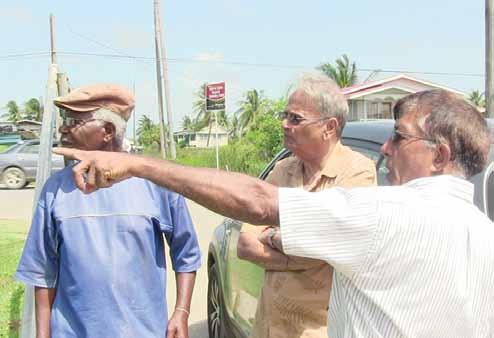
operating at capacity.
However, APNU said cursory reflection and a little investigation suggest that the chairman’s inquiry of the flooding may have been a bit hurried while his assessment may be equally hasty.
According to APNU, its delegation spoke to more than a dozen persons, including employees of the NDC who confirmed the widespread flooding.
While there may be questions of detail, as per the source or real cause of the flooding, there is no doubt that the flood-
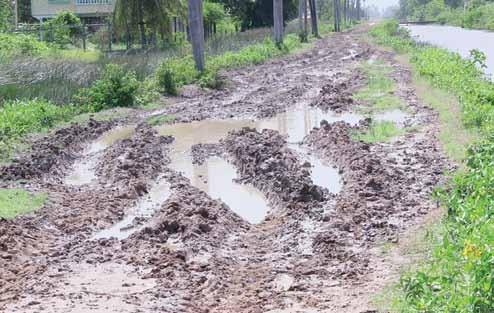
ing was widespread and not confined to a small area in Liverpool and now receding, APNU said.
“APNU delegation is similarly confused by what the chairman means by ‘swamplands’ and ‘marsh’. None of the flooded areas visited were outside the residential community, neither backlands nor foreshore.
Holding dams
"What we did see were drainage canals without proper holding dams while several trenches and drains were overgrown with reeds and brush, quite visible from the public road, indicating that they had not been cleaned for years.
"What they do suggest is systemic neglect and official dereliction well before the present chairman’s tenure. And while we too, under other circumstances, would naturally see marsh and swamplands, the chairman’s designation is revealing. Human beings could hardly be expected to live in such conditions,” the coalition said.
Certainly, part of the problem is the absence of an NDC since the passing of the last chairman a few years ago.
APNU said, ironically, while the local government minister has seen fit to replace most of the existing NDCs in the region with interim management committees (IMCs), Lancaster-Hogstye has been left to fend for itself.
Four years after the earthquake which devastated Haiti, the leadership of the Organisation of American States (OAS) said the nation has become a place of perseverance and opportunity.
Noting the anniversary of the tragedy that crippled the Caribbean nation four years ago on January 12, 2010, OAS Secretary General Jose Miguel Insulza and Assistant Secretary General and Chair of the Group of Friends of Haiti and the Haiti Task Force Albert Ramdin, described the progress in Haiti as “concrete” and “inspiring”.
“We have seen the government and people of Haiti persevere, work through issues, find opportunities and secure results,” said Secretary General Insulza.
“Today, although much remains to be done, Haiti can demonstrate concrete results and the journey is inspiring,” added the OAS leader.
Working with the government of Haiti, private sector agencies, international partners, member states and observers, the OAS has provided technical support to the country in areas ranging from trade facilitation and business
development to tourism and education, among other areas.
According to Ramdin, “The government must be commended for the progress made. They have worked with a wide range of partners internationally, subregionally and locally and four years later, business and development interests in Haiti have increased, education and training opportunities have been expanded, and in concrete terms, more than 1.3 million Haitians have been moved out of tent camps and into safer housing.
“The work continues for
everyone. There is a long road ahead for Haiti, but progress always starts with a single step.” Both Insulza and Ramdin say political stability, good governance and democracy will contribute to continued growth in Haiti.
“In this regard, I am encouraged by the steps taken by the government, the legislative organs and other stakeholders to hold overdue senatorial and local elections as soon as possible. The OAS stands ready to assist and support the electoral process,” concluded Secretary General Insulza.

Old people people seh it never pay to tell lies. Old people does advise lil pickney and young people to always tell de truth. Teachers does tell students to tell de truth and not to cheat. Dem church people does tell de world bout de gospel truth, although dem does lie a lot right after dem done tell people bout peace and truth.
De magistrates and de judges in court does mek people swear to tell de truth and nutten but de truth. But some people does choose not to listen and dem does have to bear de consequences. Even de lawyers suppose to tell de truth in court, except fuh No Gel Hugly. And he never face any consequences. But that is why not even Rum Jhaat trust he now.
Some people does tell lies and end up wid four walls around dem wid a lil window to peep out. And every other body in de four walls does be waitin like tiger to spring pun dem back. That is when dem does see de truth and fuhget all de lies whah dem tell.
People seh de truth does hurt some times, but de good book seh de truth does set people free. Even when some body do some ting wrong, once dem tell de truth, some people does feel sorry and forgive dem fuh whah ever was de wrong ting dem do.
Well, is time fuh de Stock Feed people tek stock of dem selves and stop bein stuck up wid sheer lies. Lil and big Robbin Badal robbin people bad bad. Dem robbin leff, right and centre. Then dem tell lies to cover up dem robbin, scampish ways. Dem even put de lies in de papers and turn round and lie pun Nizo and Co.
Ting-a-ling-a-ling…friend tell friend…mattie tell mattie! Dem two is King Liar and Prince Liar. De old time proverb seh birds of a feather does flock together. So look out fuh de Mook and de headitor and de cover up! De truth does set people free, but not this time!
The European Centre for Disease Prevention and Control (ECDC) has reported further increase in the number of confirmed and probable cases of the chikungunya virus on the French side of St Martin and other Caribbean islands.
In an epidemiological update on “autochthonous cases of chikungunya fever in the Caribbean region” on Saturday, the ECDC said that, as of Thursday, there were 201 “probable or confirmed cases” in French St Martin and two confirmed cases on the Dutch side of the island.
ECDC also said there were 48 “probable or confirmed cases” in
Martinique; 25 “probable or confirmed cases” in St Barthélemy; 10 “probable or confirmed cases, including one imported case from St Martin in Guadeloupe”; and one “confirmed case imported from Martinique in French Guiana”. An outbreak of chikungunya in the Caribbean was reported from the French section of St Martin on December 5. According to the ECDC, it was the first time that autochthonous transmission of the virus has been documented in the Americas. An ECDC risk assessment of the outbreak published on December 12 concluded that the risk of the disease spreading to other islands in the region was “high”. (CMC)

It is time for governments in the Caribbean Community (Caricom) and around the world to end the tobacco betrayal.
In the Caribbean, tobacco is a bigger killer than road accidents, homicide, illicit drug use, and AIDS combined. Yet the Caribbean is guilty of the greatest sloth in the world in taking action to curb tobacco smoking.
Last year, Times Notebook highlighted the tobacco betrayal in the Caribbean and around the world.
Carnage of death
On February 18 and August 26, we reminded Guyanese and the world of the carnage of death and disability caused by tobacco and the addiction of tobacco smoking:
“Tobacco is a killer. We are all aware of this fact and even Big Tobacco acknowledges that tobacco is a killer. In many countries, suicide is a crime.
"But in the case of choosing slow death by tobacco, it is legal and worse yet we pay for the privilege. Times Notebook finds this a tragedy. It is shameless lack of care that so many governments appear impotent in the fight against tobacco.”
Few actions have been taken to stop tobacco since the adoption of the Framework Convention on Tobacco Control (FCTC) in 2003.
More than 30 million new smokers join the tobacco suicide tragedy each year. Among the world’s slowest in acting against Big Tobacco are Caribbean governments.
No action
Guyana and the other Caricom countries under the FCTC pledged to do far more than they did before 2003 to control the global tobacco industry, either by raising cigarette prices dramatically, outlawing tobacco marketing or by taxing the multinational profits of the big cigarette firms. None of this has happened.
One of the initiatives that Guyana promoted between 2001 and 2012 was raising the prices paid for cigarettes and ensuring tobacco products cannot be sold to children, or sold as single cigarettes.
Yet, no government in

the Caribbean has raised taxes on tobacco products and every day on our streets and shops, children and adults buy cigarettes out of packs.
The Health Ministry led a crusade against tobacco. It had pledged that Guyana will have an anti-tobacco law and led the crusade for tobacco labelling in the Caribbean. The ministry was a lead advocate for tobacco labelling to warn users that smoking is a killer.
But to this day, the labelling standards that were endorsed by the Caricom Regional Organisation for Standards and Quality (CROSQ) have not been implemented by Caribbean governments.
Tobacco companies
The ministry had gone further by calling for an outright ban on cigarettes and for the tobacco industry to be treated as a terrorist movement for the way it targets new markets with a product that it knows to be deadly when used as intended.
Caricom countries can learn a lesson from France. The French government implemented a series of sharp price rises for cigarettes in 2003 and 2004 in a bid to slash the numbers of smokers.
The increases pushed up the price of smoking by 40 per cent and led to nearly two million people quitting smoking in France.
The government also introduced legislation to prevent the sale of cigarettes to children.
This month, the French
government is further hiking the price of tobacco by six per cent, following similar increases in the past two years.
Other measures planned include a 200 million euros tax on tobacco companies, extending nosmoking zones, introducing blank packets, and more health campaigns.
Silence
Would you drink a potion of acetic acid, acetone, ammonium, arsenic, butane, benzene, formaldehyde and other chemicals? Yet that is what smokers do each time they puff. And each time someone puffs near you, they contaminate the air and
poison the others around them who do not smoke. How can our governments stay silent?
It is time we, the people, demand action be taken. Three decades ago, the Ford Pinto had a design defect that led to the deaths of 59 people. Public outrage led to the end of the Ford Pinto.
Public outrage is long overdue to end the scourge of the world’s worst killer, tobacco. The governments and parliamentarians around Caricom are blatantly betraying the people of the region.
Readers are invited to send their comments by email or Facebook to times. notebook@gmail.com.

monday, january 13, 2014
Several young men and women have been shortlisted as the quest for Guyana’s Next Top Model kicks off.
The models were on Saturday evening introduced to the media at the special launch party held at the Millennium Manor Hotel on Hadfield Street, Georgetown. The delegates were selected after auditions were done in Berbice, Demerara and Georgetown.
The next step, however, is an audition to be held in Bartica which will see the selection of at least another five persons being added to the contestants’ list. The contestants will make a number of public appearances aimed at boosting their confidence and self-esteem.
The initiative is being promoted by private businesswomen, who think that this is an excellent event to stimulate the interest of the young people to get them involved in fashion and modelling.
The next top model will be crowned after the contestants would have gone

through rigorous routines in the form of fashion, designing and other events. This will take the shape of a reality show. As in any reality show, there will be eliminations as the event comes to a climax.
The organisers, Yonette Bacchus and June Ann Ross are optimistic that the event
will be one with a difference and will see the winner walking away with at least $1million in cash and prizes. The winners will also each gain a one-year contract with the Millennium Manor Hotel that will see them becoming spokespersons for the entity and engaging in commercial and other opportunities.
Since 2008, Guyana top models have emerged from Guyana’s Model Search which is an annual feature at the Guyana Fashion Week organised by Sonia Noel.
Noel told Guyana Times that she is not part of the Guyana’s Next Top Model initiative, but is willing to offer any guidance if called upon. However, she stated that she will continue to focus her attention of her brand, Guyana Model Search.
Noel is presently in Barbados where the Annual Barbados Music Awards are held. She will be an honoured guest as she is bestowed with a life achievement award in fashion.
After her recent successes in Guyana, the Caribbean and further afield, Noel has been recognsied as a woman of worth and one who is dedicated in the promotion of young people and their talents.
Meanwhile, auditions for the Guyana’s Next Top Model close next week and interesting persons are asked to make contact with the Millennium Manor Hotel.
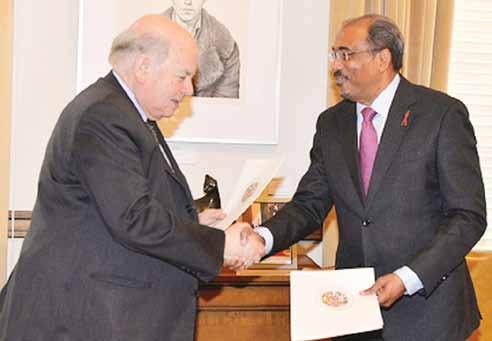
The Organisation of American States (OAS) and the Joint United Nations Programme on HIV/ AIDS (UNAIDS) last week signed a Memorandum of Understanding (MoU) whereby the two institutions commit to working in coordination on activities aimed at the promotion and protection of the human rights of people living with HIV/AIDS, and implementation of prevention and education programmes in the region.
At the signing ceremony, OAS Secretary General José Miguel Insulza said the signing of the document takes place within the framework of the “Resolution on the Promotion and Protection of Human Rights of People Vulnerable to or Living With or Affected by HIV”, which was adopted by the General Assembly of the hemispheric organisation last June in Antigua, Guatemala, adding that cooperation will create a working programme that “would not be possible without the strong cooperation and support of UNAIDS”.
Plan of action
In this regard, he stressed the importance of designing a plan of action to support member states in the creation and development of public policies that promote access to HIV prevention, treatment and care. He added that “it is very important for us to work with you, the agency with the most experience in this area”.
The secretary general also highlighted the progress made in the region in combating HIV/AIDS, saying that “we have managed to work in breaking the curve of growth of infection, in improving in matters of treatment, making medicine cheaper and more available to more people.”
He warned, however, that despite this progress, many challenges remain, among which he highlighted are marginalisation and discrimination. “This is a
very important issue for our region and we hope to develop strong programme in coordination with you,” he concluded.
For his part, UNAIDS Executive Director Michel Sidibé said the agreement represents “a commitment to our people so that, through the joint work of our organisations, we can bring hope and address the social drivers of this virus.”
“HIV is not just a disease, it is related to security issues, social justice, distribution and access to opportunities, and above all it is a problem that confronts us with social vulnerability, because it is directly related to human rights,” explained the head of the UN agency.
“This agreement will help us work closely to resolve these problems and work with the Inter-American Commission on Human Rights and the Inter-American Commission of Women, to advance our common desire to support the people who need the support of our institutions,” he added.
The Director of Public Prosecutions (DPP) disclosed that 109 cases were completed during 2013. Of these, 95 cases engaged the court’s attention while 14 were nolle prosequi (not to go ahead) by the DPP.
Seventy-one of these cases were from the Demerara Assizes, 14 from the Berbice Assizes and 10 from the Essequibo sessions.
There were a total of 83 cases for murder, three for manslaughter, two rape cases, four cases of carnal knowledge, two attempts to commit murder cases and one case for incest.
The DPP was successful in getting 36 convictions, but there were 45 acquittals along with 10 hung jury, one quashed committal, two aborted trials and one accused committed to the National Psychiatric Hospital for treatment.
In another case, the accused was found to be fit to plea and was remanded back to prison to await trial. One matter is continuing during the January 2014 Assizes.
The 14 matters nolle prosequi by the DPP was as a result of different reasons. One matter was nolle prosequi because the accused died while awaiting trial and another one because the witnesses could not be found.
The other 12 cases were nolle prosequi because the virtual complainants no longer wanted to proceed with the matters. In a separate matter, the DPP nolle prosequi the case against one of the murder accused since there was no evidence against him.
DPP’s appearance
Meanwhile, during 2013, the DPP appeared in 15 matters at the Court of Appeal; one was for the appeal against a guilty verdict in a murder case.
three years imprisonment.
The appellant in the third case against the conviction for causing death by dangerous driving withdrew his application.
In addition, there were two appeals by the state; one was to amend the appeal from a verdict of acquittal from a High Court murder trial and this was granted.
The other matter was an appeal against an order made by a single judge in chambers in the Court of Appeal to prevent a magistrate from carrying out the directions of the DPP for a preliminary inquiry to be reopened and it was allowed.
Extension of time
The other eight matters were in relation to summary trials for indictable offences of which five were applications for extension of time because the applicants failed to file the notice of appeal within the statutory period.
The total number of people living with HIV/AIDS in Latin America and the Caribbean increased to 1.5 million in 2012, mostly due to the limited availability of the antiretroviral treatment, and in the Caribbean, the presence of HIV/ AIDS in adults is near one per cent.
Resolution
The resolution of the OAS General Assembly on which the agreement signed urged member states to continue their efforts in support of laws and public policies to protect the human rights and fundamental freedoms of people living with HIV/AIDS, and to increase prevention and treatment for pregnant women and mothers, including preventing mother-to-child transmission.
The resolution also promotes greater involvement of people living with HIV/ AIDS in decision-making and in the drafting of policies and programmes in response to the epidemic.
This appeal was granted, resulting in the offence being reduced to manslaughter and the accused sentenced to 10 years imprisonment.
In a second matter for an application for bail, the offence of attempted murder, the application was refused. There were three matters of appeal for the offence of causing death by dangerous driving.
In one matter, the appeal was granted, but the court found that there was sufficient evidence to establish the offence of death by dangerous driving.
In the second appeal, the conviction for causing death by dangerous driving was confirmed and the accused was sentenced to
In the sixth matter, an application was granted for the appellant to lodge security. Another application was granted for the petitioner to lodge his passport within 48 hours of his return to the country. One application to appeal a matter for the offence of possession of narcotics for the purpose of trafficking was refused.
Also during that year, the full court of the High Court heard some 12 matters before acting Chief Justice Ian Chang sitting either with Justice William Ramlall, Justice Rishi Persaud, Justice James Bovell-Drakes, Justice Navindra Singh or Justice Brassington Reynolds. Five of these appeals were dismissed while four of them were allowed. One applicant was granted leave to lodge security for cost within seven days while one other application for extension of time was granted. One appeal was abandoned since the prisoner had served his sentenced.
BY SVETLANA MARSHALL
Under pressure to do something about the spiralling suicide rate, Health Minister, Dr Bheri Ramsaran said a multisectoral approach is needed to tackle the social scourge.
At the time the health minister was meeting with the Chief Medical Officer, Dr Shamdeo Persaud and Guyana’s chief psychiatrist Bhiro Harry at his Brickdam Office, discussing the issue of “mental health”.
A mere 13 days into the new year, close to 20 persons have already committed suicide while several others are recovering after failed attempts.
According to the health minister, suicide is not only a mental health problem, but a cultural issue as well.
Collaboration
Moving forward, he said, the Health Ministry will be working closely with the human services, education and home affairs ministries, along with non-governmental organisations to reduce the instances of suicide.
Persaud, for his part, said Guyana has a high suicide
rate, noting that while many females attempt suicide, males are most times successful in executing the act.
At this point in time, Dr Persaud said the ministry is strengthening the “Gate Keepers Programme” to build capacity among faith-based organisations, sport organisation, commercial entities and support groups in communities countrywide, with major emphasis placed on suicide-
prone communities.
He said the ministry will continue to equip persons with the requisite skills and knowledge needed to identify depression and offer counselling to persons who are at risk of committing suicide.
He said last year, the Gate Keepers Programme focused on Regions Three and Six, in addition to communities along East Coast Demerara, positing that major emphasis
was placed on males.
The Gate Keepers Programme was established by former Health Minister, Dr Leslie Ramsammy.
Currently, the Health Ministry is developing guidelines to suicide prevention with attention being given to reintegration of victims into society. Chief psychiatrist Harry said “suicide prevention is everybody’s business”, hence, all should play apart in reducing the number of cases in the country.
Meanwhile, the Indian Arrival Committee (IAC) in a release on Sunday said it was “extremely perturbed over the incidents of suicide”.
According to the IAC, suicide seems more prevalent in the East Berbice region over the past weeks.
“The IAC believes this warrants interventions of national magnitude and calls on the authorities to declare the current situation of suicide a national priority.
"The IAC believes that despite some mechanisms to provide assistance, there has been a deficiency in this regard by public entities and private organisations,” the re-
lease said.
The IAC is also calling for a multistakeholder approach with government ministries working closely with other organisations for the establishment of a meaningful plan of action to tackle the issue.
“The lingering consequences brought to bear on surviving family members, especially when children are affected, must also be addressed. The IAC also believes that the circumstances which may be reasons for someone taking his or her life must be identified and addressed,” said the IAC.
Last Monday, Toneisha Edwards, 19, a student of the University of Guyana, succumbed at the New Amsterdam Hospital after drinking gramoxone on Old Year’s Day.
Two days later, Nandranie Oudit, 32, of Number 68 Village, Corentyne, Berbice, died at the Skeldon Public Hospital after ingesting a poisonous substance. She committed suicide five weeks after her 16-year-old son killed himself over a sour love affair.
He was a third form student at the Tagore Memorial High School. Oudit’s father and sister had also commit-
ted suicide some years ago, reports indicate.
On Saturday, 15-year-old Leah Grant, a student of the Brickdam Secondary School, died at the Georgetown Public Hospital after ingesting a poisonous substance at school on Friday. Several other persons have reportedly attempted to take their lives since the start of the year.
The global suicide rate has increased by a whopping 60 per cent over the past 45 years, with the majority of the victims being men.
This is according to the World Health Organisation. Guyana is no exception. In 2003, it ranked sixth in the world, with 42.4 men in every 100,000 committing suicide while women stood at 12.1 in every 100,000. By 2006, the figures had dropped with 39 men in every 100,000 taking their lives while it was estimated that 13.4 in every 100,000 women committed suicide.
To date, the trend continues in Guyana but men are not only taking their lives but those of their spouses and children as well.


The people of Haiti have been remembering the victims of a devastating earthquake that struck the country four years ago, killing more than 250,000 people.
Across the country, people have attended special religious ceremonies. President Michel Martelly laid a wreath at a mass grave in Saint Christophe, where many victims were buried.
Some 150,000 people are still living in temporary accommodation.
The government issued a decree declaring January 12 a day of remembrance and reflection.
The shallow seven-magnitude earthquake struck on a Tuesday afternoon. The epicentre was just outside the capital, Port-au-Prince.
At least 1.5 million people were left homeless, in a country with a population of about 10 million.
Four years after the quake, signs of destruction are still everywhere.
Haiti, the poorest country in the Americas, has struggled to rebuild its infrastructure, despite millions of dollars in aid pouring into the country.
President Martelly said a year ago that only a third of the money pledged

A mass was held at a temporary church built next to the ruins of the cathedral
in Port-au-Prince, that was destroyed by the quake
after the 2010 earthquake had actually been delivered.
“Where has the money given to Haiti after the earthquake gone?” asked Martelly.
“Most of the aid was used by nongovernmental agencies for emergency operations, not for the reconstruction of Haiti.”
Martelly, who came to power after the quake, estimated the material cost

The U.S. Supreme Court has agreed to rule on whether Argentina’s assets are protected from hedge funds seeking to be paid back.
The long-running legal saga started after Argentina’s record debt default more than 11 years ago.
The country objected to a lower court ruling that gave creditors the power to pursue its non-U.S. assets. Argentina’s petition to the highest U.S. court also has the support of the U.S. government.
In 2002, Argentina defaulted on some US$100 billion of debts and has since restructured its debt twice, cancelling around 75 per cent of the nominal value of the bonds.
About 92 per cent of the country’s bondholders agreed to write off most of the amount owed to them. But hedge funds NML Capital and Aurelius are demanding 100 per cent repay-
ment of the US$1.3 billion, plus interest.
Argentina refuses to pay anything to investors who declined to participate in a previous debt reduction deals involving most of the nation’s lenders.
The investors were so determined to get their money that they went to court to have an Argentine ship, the Libertad, impounded in Ghana last year. After several weeks, the ship returned home.
Numerous U.S. courts have said that Argentina must pay back the money – most recently in August 2013.
But the appeals court held off forcing Argentina to pay, pending an appeal to the Supreme Court, which is considered unlikely to hear the full case.
In this instance, the Supreme Court will decide whether the U.S. Foreign Sovereign Immunities Act (FSIA) protects Argentina’s property from being seized.
(Excerpt from BBC News)
of the disaster at US$13 billion.
But demonstrators have gone to the streets in recent months to demand the president’s resignation, denouncing the high cost of living and accusing the government of corruption.
Since the earthquake, the Caribbean nation has been affected by landslides and hurricanes, as well as an epidemic of cholera and rampant crime.
Pope Francis is to appoint 19 new cardinals next month, including churchmen from Haiti and Burkina Faso, reflecting his commitment to the poor.
Cardinals, who wear red hats and robes, are the most senior clergymen in the Roman Catholic Church below the Pope. Sixteen of the new appointees are under 80, making them eligible to enter a conclave to elect the Pope’s successor.
The new cardinals will be formally instated at a ceremony, known as a consistory, on February 22.
The three clergymen over 80 come from Spain, Italy and the Caribbean island of St Lucia. They will assume the title cardinal emeritus.
Pope Francis named his new cardinals during his weekly, Sunday address to worshippers gathered in St Peter’s Square.
They come from all corners of the world, including Italy, Germany, Britain, Nicaragua, Canada, Brazil, Argentina, South Korea, Chile and the Philippines.
As expected, a few of those named are very wellknown, established figures at the Vatican, says the BBC’s Alan Johnston in Rome. But among those chosen are also men from countries like Haiti, Ivory Coast, and Burkina Faso.
The Vatican spokesman said that this was in keeping with the Pope’s drive to put the world’s poor at the core of the Church’s mission.
The Archbishop of Westminster, Vincent Nichols has been named as one of the new cardinals, and said he was deeply moved by what he called the honour conferred by the pope on the Catholic Church in England and Wales. (Excerpt from BBC News)
Venezuela’s government has urged the country’s police to report corruption in their ranks seen as part of the violent crime crisis, after a famous ex-beauty queen was slain.
Interior Minister Miguel Rodriguez gave out his personal phone number during an address and asked police to call him to report corruption.
“New police will always have some great superiors, well-prepared ones. But they also are going to get some bad eggs. Report them fearlessly because their (corruption) undermines police authority for the Venezuelan people,” Rodriguez said in the address carried on state television.
“Just give me the information right away, and we will rip the head off that immoral police superior,” the minister warned.
Venezuela has one of the world’s highest murder rates, ranking fifth globally according to the United Nations.
Monica Spear, a former Miss Venezuela who starred in a telenovela at the U.S.-based Telemundo network, and her ex-husband became the latest casualty of her homeland’s crime epidemic.

The director of the Violence Observatory, Roberto Briceno, said the killings “bring into relief a common reality of daily life in Venezuela”, where his nonprofit group counted nearly 25,000 people slain last year, 79 for every 100,000 Venezuelans.
Authorities only solve eight out of 100 homicides in Venezuela, emboldening criminals who have turned the South American nation into one of the world’s most dangerous places outside war zones.
Spear and her 39-year-old British expartner Henry Thomas Berry were shot dead on a north-western Venezuelan highway after they resisted robbers who attacked their broken-down car in front of their five-year-old daughter, who was wounded. (Excerpt from Al Jazeera)
Armed vigilantes seized a drug cartel bastion in western Mexico on Sunday, sparking a shootout between the two groups, an official said.
Members of so-called self-defence groups entered the town of Nueva Italia, Michoacan on a campaign they say is designed to liberate towns from the control of the Knights Templar cartel. Opponents and critics say the vigilantes are backed by a rival cartel,
something the groups deny.
The vigilantes arrived in Nueva Italia late Sunday morning in a caravan of large trucks, surrounding the City Hall and disarming local police where an Associated Press journalist on the scene witnessed citizens initially welcoming them.But firefights broke out almost immediately in and around the centre square. Only one injury was reported by midday. Gunfire could be heard
around the city as the Mexican military stayed outside, guarding the road into town.
On its Facebook page, the Tepalcatepec vigilante force said around 100 pickup trucks entered Nueva Italia and that a “light confrontation took place at the entrance, everything is fine.”
There were no federal police or uniformed authorities inside the town, though violence be-
tween vigilantes and alleged cartel members has racked Michoacan for almost a year, and President Enrique Pena Nieto’s government already has sent thousands of police units to the state.
The growing civilian militia movement, which first emerged in Michoacan nearly a year ago, has seized more communities in recent weeks in their bid to oust the Templars from the state. (Excerpt from Al Jazeera)

Iran’s interim nuclear deal with six world powers will come into effect on January 20, the Iranian Foreign Ministry and the European Union have confirmed.
An Iranian ministry spokesman said on Sunday that a consensus was reached over the weekend with the P5+1 countries – China, France, Russia, Britain and the United States, plus Germany – to implement the landmark nuclear deal signed last November.
ping its most sensitive nuclear work and not enriching uranium beyond five per cent.
U.S. President Barack Obama welcomed the implementation agreement, and said the U.S. would give “modest relief” on Iranian sanctions. He warned, however, that the U.S. would increase its sanctions if Iran reneges on the agreement.
French First Lady Valerie Trierweiler has been admitted to hospital after media reports of an alleged affair involving President Francois Hollande.
She entered hospital on Friday “for rest and some tests”, her office said, after Closer magazine published images linking him to actress Julie Gayet.
Trierweiler is expected to leave hospital today, her office told AFP news agency.
A presidential news conference scheduled for Tuesday on plans to boost the flagging economy now looks like being overshadowed by Hollande’s private life, correspondents say.
ures has been steadily eroded in recent years. However, opinion polls suggest the French public appears to be averse to reporting on politicians’ private lives.
According to an Ifop-JDD poll published on Sunday, three out of four French people believe the alleged affair is a private matter for the president.
“We will ask the [International Atomic Energy Agency] to undertake the necessary nuclearrelated monitoring and verification activities,” Ashton said.
Seen as a major step in bridging the gap between Iran and Western states, the six-month, interim deal signed in November eases economic sanctions on Iran, in exchange for Tehran cap-
Catherine Ashton, the EU’s foreign policy chief, confirmed the deal, and said the sides would now ask the United Nations’ nuclear watchdog to verify its implementation.
“With today’s agreement, we have made concrete progress. I welcome this important step forward, and we will now focus on the critical work of pursuing a comprehensive resolution that addresses our concerns over Iran’s nuclear programme,” the White House said in a statement.
Iran will get a first instalment of US$550 million of US$4.2 billion being unblocked under the nuclear deal around February 1, a U.S. official said Sunday.
US Secretary of State John Kerry said the agreement represented the “best chance” to achieve long-term peace with Iran, and said talks toward a final agreement will continue. (Excerpt from Al Jazeera)
United States Secretary of State
John Kerry has said he is confident Syria’s opposition National Coalition will attend upcoming peace talks in Switzerland.
“I am confident personally that the Syrian opposition will come to Geneva,” Kerry said after a meeting of the 11-nation “Friends of Syria” group that was attended by coalition leader Ahmad Jarba.
The bloc is under intense pressure to confirm its participation in the talks, scheduled to begin on January 22, and has said it will decide on the issue next Friday.
The Friends of Syria, an alliance of mainly Western
and Gulf Arab countries who support the opposition, earlier on Sunday stated that the conference, bringing regime negotiators and opposition groups together, is necessary to solve the crisis.
“There is no other political solution,” French Foreign Minister Laurent Fabius said speaking on behalf of the group. “There will be no political solution for Syria unless Geneva 2 meets.”
Kerry reiterated that there is “no military solution” to the conflict, which has killed more than 120,000 people since the uprising against President Bashar al-Assad’s regime began in March 2011.
In a joint statement, the
Friends of Syria nations –the U.S., Britain, France, Germany, Italy, Turkey, Saudi Arabia, the United Arab Emirates, Qatar, Egypt and Jordan – urged the coalition to attend the upcoming talks.
“We invite them to form, as soon as possible, a delegation of opposition forces to participate in the political process,” the statement said.
Al Jazeera’s Jacky Rowland, reporting from Paris, said there was nothing said in public by the Syrian opposition during the course of the meeting that would actually back up the confident assertions made by Kerry. (Excerpt from Al Jazeera)
Mediators pressed for a ceasefire in South Sudan as government troops fought for control over the last rebel-held town.
Envoys from the United States and South Sudan’s neighbours met on Saturday with Riek Machar, the former vice president who heads the rebel forces that have been fighting government troops for the past month, the rebels said.
“The American Special Envoy to South Sudan and Sudan, Donald Booth together with [regional] mediators travelled to an undisclosed location in South Sudan to
meet Dr Riek Machar,” said a statement signed by Machar’s former press officer Miyong G Kuon.
There were unconfirmed news reports that mediators would meet President Salva Kiir today.
The meeting with Machar comes as talks in the Ethiopian capital Addis Ababa appear to be stalling. Mediators for the East African regional bloc IGAD have been trying to incorporate the proposals of both sides into a draft ceasefire document.
Fighting erupted in South Sudan on December 15. Kiir accused Machar of attempt-
ing a coup, while Machar in turn accused Kiir of using the coup accusation as an excuse to carry out a purge.
The biggest stumbling block in peace talks is still the 11 Machar sympathisers arrested by Kiir’s forces shortly after the fighting began.
Machar’s side has insisted the detainees should be released so they can take part in the talks, while Kiir is equally adamant they should face justice.
United Nations chief Ban Ki-moon and the Security Council have both urged Kiir to free the 11 in order to kickstart the stalled talks. (Excerpt from Al Jazeera)
Hollande did not deny the report but protested at invasion of his privacy. Conservative opposition leader Jean-Francois Cope has suggested the drama has damaged France’s image abroad.
Opinion polls already suggest he is the most unpopular president in a generation – one on Thursday indicated that only 25 per cent of French people trusted him.
The French media face strict privacy laws but the tradition of secrecy over the private lives of public fig-
But with this dramatic twist affecting his official partner, it is increasingly hard to argue that these are personal matters which should not be under public scrutiny, says the BBC’s Hugh Schofield in Paris. (Excerpt from BBC News)

Opposition protesters in Thailand are gathering in the capital Bangkok to try to shut down the city centre.
It is part of their campaign to overthrow the government before snap elections due on February 2.
The government has deployed 18,000 police and soldiers, but the protesters are building barricades and occupying key road junctions.
Election officials have asked the government to delay the election by three months on security grounds.
But a Deputy Prime Minister, Niwatthamrong Boonsongpaisan, told BBC News this was not possible.
Protesters say Prime Minister Yingluck Shinawatra is a proxy for her exiled brother Thaksin Shinawatra, who was ousted in 2006.
At least seven people were injured when unknown gunmen opened fire on anti-government demonstrators at the main rally site in Bangkok on Saturday.
Army chief General Prayuth Chan-Ocha has
sought to quell rumours of military intervention, insisting that no-one will mount a coup.
Soldiers are restricted to protecting buildings rather than helping the police confront the protesters.
One of the main protest leaders, former Deputy Prime Minister Suthep Thaugsuban, was defiant as he rallied demonstrators.
“I want to announce on this important night that the masses will not accept any proposals or negotiations,” he told supporters, as quoted by the Associated Press news agency.
Schools are expected to close because of fears for students’ safety.
Niwattumrong Boonsongpaisan said the government was still trying to negotiate with the protest movement over a possible compromise. “Prime Minister Yingluck has ordered all police and military personnel to exercise utmost restraint and not to use all kinds of weapons in handling the protesters,” the deputy prime minister said.
(Excerpt from BBC News)
Thousands of Israelis bade farewell on Sunday to former Prime Minister Ariel Sharon, the maverick warrior-statesman who helped reshape the Middle East, as his body lay in state outside Israel’s parliament in Jerusalem.
Sharon died at the age of 85 on Saturday after eight years in a coma caused by a stroke he suffered at the pinnacle of his political power. He will be buried on Monday in a military funeral on his farm in southern Israel.
“They say old soldiers do not die, they fade away. Arik Sharon faded away eight years ago,
and now we truly say goodbye to him,” Justice Minister Tzipi Livni, using Sharon’s nickname, wrote in a tribute on Sunday.
Sharon was one of Israel’s finest military strategists and most powerful and decisive political figures. He spearheaded military campaigns in several wars with the Arab world, expanded Jewish settlementbuilding on land the Palestinians want for a state, and made the shock decision to withdraw from one of those territories, the Gaza Strip.
Famously beefy and brusque, Sharon was also
widely hated by Arabs for what they regarded as harsh and aggressive policies, including a 1982 invasion of Lebanon in a bid to stamp out Palestinian guerrillas as well as military crackdowns and settlement-building in occupied territories.
Prime minister from 2001 to 2006, Sharon was incapacitated by a stroke shortly after he quit the right-wing Likud party and founded a centrist faction to advance peace with the Palestinians, whose 2000-2005 “Intifada” uprising he had battled with air strikes and fierce military offensives. (Excerpt from Reuters)
Dr Janet Yellen was confirmed by the Senate on January 6 to become chairman of the Federal Reserve when Dr Ben Bernanke leaves at the end of this month. She inherits a job which has become increasingly powerful over the years, starting with Paul Volcker who was chairman from 1979 to 1987. Volcker brought inflation down from 14 per cent, it is now under two per cent, and was followed by Dr Alan Greenspan and Dr Bernanke.
The most important economic report of the month was released on January 10, namely the jobs report for December which showed that payrolls increased by only 74,000, well below the 200,000 projection of most economists. The unemployment rate fell to 6.7 per cent, the lowest level since October 2008, but this was because more people left the labour force as the participation rate fell to 62.8 per cent matching the lowest level since 1978.
Employment in health care and social assistance decreased by 1000 in December, the first decline since July 2003 and payrolls fell in construction, transportation and warehousing, government and in the motion picture industry. Factory payrolls increased by 9000 following a 31,000 increase in the previous month when economists had predicted a 15,000 gain.
Revisions to prior reports added a total of 38,000 jobs in overall payrolls in the previous two months and employment rose by 2.19 million in 2013, little changed from 2012. Private employment rose 87,000 in the month after a 226,000 gain in November. Average hourly earnings rose 0.1 per cent in December and increased 1.8 per cent over the past 12 months. The average work week fell six minutes to 34.4 hours and bond yields immediately fell.
With U.S. interest rates rising while growth prospects in China are reduced
somewhat, the outlook for portfolio investments in emerging markets has been reduced. So, it is not surprising that the MSCI Emerging Markets Index, a gauge of stocks in 21 developing markets fell five per cent in 2013 and the fall has continued so far this year.
JP Morgan agreed to pay US$2.6 billion to head-off a criminal prosecution and private ligation over failures not to report its suspicions regarding the Madoff Ponzi scheme. This brings the total in fines and restitution to about US$22 billion in the last year and US$28 billion since 2010.
The U.S. economic reports started on January with the ISM non-manufacturing index falling to a sixmonth low of 53 in December from 53.9 in November. The U.S. trade deficit in November shrank more than forecast as oil imports dropped to the lowest level in three years and exports climbed to a record. The gap narrowed by 12.9 per cent to
US$34.3 billion as exports increased by 0.9 per cent and imports dropped by 1.4 per cent (January 7).
On January 8, the FOMC minutes were published showing that the Federal Reserve plans to “proceed cautiously” in slowing down bond purchases and there is no pre-determined path. On January 9, it was announced that initial jobless claims fell by 15,000 to 330,000 in the period ended January 4. Apart from the employment figures, the wholesale trade in November came out with sales of merchant wholesalers rising one per cent with total inventories up 0.5 percent from the October level.
The European Central Bank and the Bank of England left their benchmark interest rates unchanged at 0.25 per cent and 0.5 per cent. Euro area inflation was at 0.8 per cent in December which was well

below the ECB target of two per cent. This compares with an inflation rate of 0.9 per cent in November and reminds the ECB that “deflation” cannot be ignored in Europe.
German factory orders rose 2.1 per cent in November from October and the overall unemployment fell by 15,000 in December which was the first time it had fallen in five months.
The Swiss National Bank reported that it would stop its annual payment to the government in 2013 after the gold price decline resulted in a loss of US$10 billion for the institution.
Over the week, interest rates have fallen with the 10-year U.S. treasury rate dropping from 2.98 per cent to 2.89 per cent on January 10 and the 30-year bond from 3.92 per cent to 3.82 per cent as a result of the December jobs report.
Equally, the major traded currencies were little changed with the euro at US$1.37, the pound at US$1.65, and the yen 104.4 and the Swiss pound at 90. Currencies in emerging markets rose a little Friday morning with the Brazil real at 2.36 and the Turkish lira at 2.17. Gold prices rose from US$1225 an ounce to US$1241 while oil prices fell again from US$96.45 a barrel for WTI to US$92.66. The employment numbers were partly related to the weather but equally raise the question of just how fast the U.S. economy is expanding. What is not in doubt is that the unemployment rate mainly reflects withdrawals from the labour force and, at 6.7 per cent, the unemployment rate is close to the 6.5 per cent threshold for raising interest rates set by the Fed.

Target Corp and Neiman Marcus are not the only U.S. retailers whose networks were breached over the holiday shopping season last year, according to sources familiar with attacks on other merchants that are yet to be publicly disclosed.
Smaller breaches at no less than three other wellknown U.S. retailers took place and were conducted using similar techniques as the one on Target, according to the people familiar with the attacks. Those breaches have yet to come to light. Also, similar breaches may have occurred earlier last year.
The sources said that they involved retailers with outlets in malls, but declined to elaborate. They also said that while
they suspect the perpetrators may be the same as those who launched the Target attack, they cannot be sure because they are still trying to find the culprits behind all of the security breaches. Law enforcement sources have said they suspect the ring leaders are from Eastern Europe, which is where most big cyber crime cases have been hatched over the past decade.
Only one well-known retailer, Neiman Marcus, has said that it too has been victim of a cyber attack since Target’s December 19 disclosure that some 40 million payment card numbers had been stolen in a cyber attack. On Friday, Target said the data breach was worse than initially thought.
An investigation found
that hackers stole the personal information of at least 70 million customers, including names, mailing addresses, telephone numbers and email addresses. Neiman Marcus said it was not sure if the breach was related to the Target incident. Most states have laws that require companies to contact customers when certain personal information is compromised. In many cases, the task of notification falls on the credit card issuer. Merchants are required to report breaches of personal information, including social security numbers. It was not immediately clear if that was the case with the retailers who were attacked around the same time as Target. (Reuters)
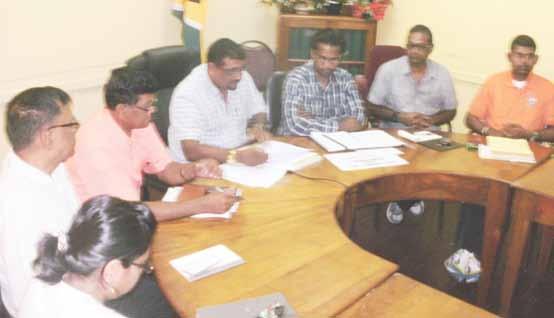
The Region Six administration said it is in a better position to respond to flooding in the farming community of Black Bush Polder (BBP) with the recent acquisition of 12 excavators, two of which will be dispatched to the area.
Speaking at a news conference held at his office last Friday, Region Six Chairman David Armogan said the BBP has over the past decade been one of the problematic areas as it relates to flooding.
Poor drainage
He noted that the problem is as a result of poor drainage. Armogan said a twofold approach will be implemented. One will be to have mini-excavators em-
ployed in the BBP to clear community drains and the other is to place pumps at all of the sluices that takes water from the polder.
The chairman noted that during 2013, residential communities in the region benefited from six mini-excavators donated by central government.
The equipment was sent to Neighbourhood Democratic Council (NDC) to carry out work to the community drainage systems and prevent flooding in those areas during the rainy season.
“Since that, at the end of the year, we also got an additional fleet of six more mini-excavators so that adds up to 12. We are sending two to Black Bush Polder,” he said.
The two excavators, Armogan believes, will save cash crop farmers.
“Once the rain falls and the water accumulates on the ground for more than three days, they are wiped out and this is an unacceptable situation and we are hoping that with these small drains that we are going to be digging in the Black Bush Polder area will assist these cash crop farmers.”
Big problem
Responding to questions about the frequent siltation of outfall channels in the East Berbice region, the chairman noted that it is a big problem for the administration to handle since many of the region’s sluices are not close to the sea.
“For example, the Number 43 Village, Eversham and Lesbeholden sluices will be silted within a matter of days if you don’t have water flushing the system... they say we wait until the rains come before we clear the outfall channel, but we have to wait until the rains because if we dig it, we need the rain water to flush it.”
According to Armogan, the administration is currently moving to install pumps at all sluices to be able to effectively reduce excess water from both farming and residential communities.
Meanwhile, during last year, several new sluices were constructed and others repaired. “All are in working order.” He said in order to assist BBP farmers, sluices at Eversham and Number 43 Village have also been rehabilitated during the past
year while Rose Hall residents have not suffered from floods since a new drainage pump was installed there during the last quarter of the year.
Road network
“Over 100 roads were completed in our capital programme and as well as under a programme carried out by the Ministry of Public Works and hopefully this will benefit the communities and the residents there. One of the things that we have done is that we did not isolate communities, we did roads in almost every community in our region.”
Armogan told reporters that in each community, between two and three roads were either rehabilitated or upgraded. This, he said, has led to an improved road network in the region.

Meanwhile, in the health sector, several houses for doctors were rehabilitated last year while the Mibikuri Hospital mortuary was rebuilt and the health centre at Barakara, along the Canje River, was also rehabilitated. Equipment for health care delivery was also purchased for health centres and hospitals across the region.
Orealla
“We also purchased an ATV and boat and engine for the Orealla people.” These, he said will be delivered before month-end, noting that “The whole idea is to convert this boat into an ambulance boat to be used by the medic and nurse at Orealla.”
In the education sector, Armogan said the second phase of the Albion Front Nursery School has been completed and when the third phase of the project is completed, students will be able to move back into the building.
Other schools which also benefited from the region’s 2013 capital programme include the Lower Corentyne Secondary, where an annex was constructed; Belvedere Primary School; Berbice High School; and New Amsterdam Multilateral School.
“The JC Chandisingh Secondary also came in for major works during the course of last year and that school to my mind is the best looking high school that we have in the region,” he added.
– say trust eroded after late payments
Several local actors have slammed the Culture, Youth and Sport Ministry, threatening to boycott the National Drama Festival this year over the late payment of their winnings and the ad hoc manner in which the event was organised.
Guyana Times had recently reported on the issue of late payment at which time the ministry’s Permanent Secretary Alfred King said the delay in the payment was due to some discrepancies in the submission of bills by director of the festival, Godfrey Naughton.
Deep concerns
However, the actors in a statement expressed deep concerns for the future of the festival, highlighting other unresolved matters arising out of the festival while proposing possible solutions.
The actors explained that on November 30, 2013, the National Drama Festival Awards Ceremony was held, some seven days after the conclusion of the festival.
Culture, Youth and Sport, Dr Frank Anthony, in the presence of all those in attendance in the National Culture Centre’s auditorium, made a promise that prize monies would be paid within two weeks of the same evening.
“This was a pleasant turn of events as the previous two years the festival had been marred by lengthy delays in the judging process, holding of the award ceremony and in the payment of prize monies – among other things, some of which could be put down to teething problems of a new and ambitious initiative, some of which probably should not,” the actors said.
Long wait
They said, in one instance, prize winners were left waiting for two months to collect their modest, but hardearned winnings. “When the two-week deadline approached, a number of directors, playwrights and actors took it upon themselves – by themselves – to contact the festival director, Mr Godfrey Naughton.
"The two-week deadline passed without prize monies being paid. Assurances were made by Naughton that he would try to get the money released in time for Christmas. Christmas passed without prize monies being paid.
"Some hoped to receive their prize money before the end of the year. 2014 was ushered in without prize monies being paid. All the while, prize winners and drama mentors had been taking it upon themselves to investigate, either through
Naughton or with personal contacts at Ministry of Culture, Youth and Sport as to when monies would be released,” the said.
However, according to the actors, it was not until the evening of January 5 that the pot boiled over.
“This is when Naughton now, by his own decision, the former festival director –proclaimed on his Facebook page that where the money was concerned, the ministry ‘had it but spent it,” they added.
The actors said that by the morning of January 6, word had spread and they very quickly began organising ourselves. Numerous calls and visits were made to the ministry to seek an official explanation.
“We requested an audience with the minister, PS and/or director of culture for January 8 to clear up the conflicting bits and pieces of information that we were receiving up and down the chain.
"Our requested was denied, apparently because of meetings, but we showed up anyway, in our numbers at the ministry to indicate our seriousness.
"We were insistent but always polite, else we be accused of being a mob.
"Whether it was the inquiries and presence of the
media, the call we put in to Digicel – who wholly and solely sponsored the prize money, the intervention of parties outside of our immediate group or some combination of these and other factors, we received official word from both the Accounts Department and the director of culture that our money would be available the following day.
"Just in time to put on hold the press conference and media blitz and other actions that we were in motion to begin the very next day.
"Fortunately, for all concerned, the ministry kept its promise and monies were released. From the beginning though we have always planned to issue this very statement. It should have never had to come down to this.”
money
According to the actors, closer inspection has revealed that it appears that as much as $600,000 of prize money is missing from their collective winnings, noting that coming out of the festival, members of Lichas Hall – Linden’s version of the Theatre Guild – discovered that an annual subvention for the hall has been in the ministry’s budget since 2008.
“This would be great news if it weren’t for the fact that
Lichas Hall up until very recently knew nothing of the subvention and has no record of ever being in receipt of the funds allocated to them.
"There are also fees due to Lichas Hall for use of the facility during the Linden leg of the festival. These are just the latest in a long series of incidents that have caused artists great worry and stress.”
The actors noted that in this particular incident, authorities failed to communicate in a clear and convincing manner just what was the reason for the delay in paying prize money.
Baffling claim
“The ministry claims that discrepancies in Mr Naughton’s financial submissions were the root of the problem. This is baffling. Digicel has supposedly sponsored the full sum of the prize money (which was handed over to the ministry before the awards ceremony).
"A determination had been made as to how much money was to go to first, second and third place. The judges’ decisions have been final ever since. Why the hold-up?” they asked.
“We see this year beginning with the deficit of trust that local ‘creatives’ hold for the ministry, deepening. The ministry has tried to put
the problems of the festival squarely on the shoulders of Mr Naughton, and while he bears some responsibility, he should not bear all.
"The seemingly ad hoc manner in which many initiatives are executed, deterioration of facilities like the National Culture Centre and poor communication by the ministry, all serve to undermine its very own efforts and to frustrate the creative community,” the actors charged. They proposed that within one week of the end of the festival that the awards ceremony can be held, the judges having submitted the names of the winners for the different categories.
“All monies would be packaged and distributed at the awards ceremony or perhaps immediately after. For accounting and auditing purposes, the relevant accounting officer would be in place at the National Cultural Centre to sign off on all vouchers and issue all receipts.”
The actors said they look forward to the ministry putting measures in place to prevent these incidents from happening again.
“Only then will the ministry have begun the long road of rebuilding the trust that has been so severely eroded so that it can truly partner with and serve the creative community and the arts.”












By Bernice Bede Osol

Your industrious nature will pay off. Let your personality lead the way and make an impression on those in higher positions. Your chances for advancement look good, though you should be sure to get all offers in writing. Listen before taking action. You will end up in a no-win situation if you are too quick to judge. Focus on love and showing your loyalty through action.

(June 21July 22) (Jan. 20Feb. 19) (Dec. 22Jan. 19)
Refuse to let anyone stifle your plans or suppress your opinion. Exercise your right to follow whatever path you choose. Speak up and take action. You can make a difference.


Make alterations to the way you present who you are and what you can offer. The impression you make will give you the upper hand in any competitive arena you enter.

(Aug. 23Sept. 22)
(July 23Aug. 22) (Feb. 20-March 20)
Emotions, both yours and those of others, will be difficult to control. Reach out to the people who share your concerns and your interests. Now is not the time to deal with false accusations or manipulation.

(March 21-April 19)
Diverse actions will lead you in a new direction. Expand your circle of friends and protect the relationships you have. Your loved ones could use a little extra attention.

(April 20-May 20)
Emphasise what you do and how you do it. Offer your suggestions carefully by being aware of others’ cherished beliefs and preconceptions. Focus on selfimprovement instead of trying to change others.

(May 21June 20)
You should follow common sense, not your emotions. Unpredictability will not get you closer to your goal. Your inclinations for excess and evasion should be reined in via discipline and moderation.
Be aware of the influence you have, and offer constructive suggestions and hands-on help. Your actions will affect how others treat you.

(Sept. 23Oct. 23)
Don’t expect talks to occur without a hitch. Controversy can be expected, along with uncertainty, disagreements and a debate that will require a well-rounded point of view.

(Oct. 24Nov. 22)
You need to listen instead of talking. Protect your health and your wealth. If you make a snap decision, you can expect opposition. Focus on selfimprovement, romance and keeping the peace.

(Nov. 23Dec. 21)
You should make abrupt changes in order to take everyone by surprise and buy time to manoeuvre your way into a key position. Use your intelligence and make things happen.
monday, January 13, 2014

Dentures provided in 72 hours from as low as $4500. Contact Dr B Stuart, 209B Charlotte St, Lacytown. Tel: 225-5034


Music is fun! Register now and learn to play the Keyboard, Guitar, Drums and do Voice Training. Call Foundation 7 on 225-1151/617-4200.

Available: Fresh long-stemmed roses, fresh dried and silk floral arrangements, gift items, bridal boutiques and wreaths. Nesha’s Flowerland. 78 Church Street (opposite St George’s Cathedral). Tel: 2273553/225-3315

Are you suffering from abnormal behaviors, addictions, stresses, or psychosomatic sickness? Feeling suicidal, low self-esteem, loneliness, unloved, anger, conflicts and relationship problems? For appointments call 592-621-0552 from12:00-18:00h Email: healthworldhc@gmail.com


Immigration & Visa Services
We handle all Canadian, USA and UK immigration and visa matters. Self sponsorships, holiday/visitor’s visas, work permits, students visas, family, class, immigration forms, embassy enquiries, appeals for refused cases, US green card lottery, business class waivers, pardons, etc. Get your visa approved. High success rate. Balwant Persaud & Associates. Certified Immigration Consultants, 68 Sixth Street, Alberttown, Georgetown (Between Cummings & Lights Sts) Tel: 225-1540, 622-8308, 655-3105. Email: balwantpersaud@yahoo.ca

Professional Key Shop, 125 Carmichael Street, Georgetown. Phone: 225-3923, mobile: 6213249. We cut any type of key, service and repair all types of locks. Get your extra key today.

Land for sale ½ Acre residential at Yarrowkabra EBD Call 611-1018.

Learn transcendental meditation and experience deep rest eliminate stress, develop creativity, intelligence, focus, concentration and memory. Be healthier, happier and peaceful. Reduce anxiety, improve relationships and longevity and be more successful. A technique that works for everyone. For next introductory lecture call Ashoke on 233-6921,609-3701, email:kashokejp_68@yahoo.com

Da Silva’s Optical. For Your Eyes Only, Look Better See Better. Phillip A Da Silva OD, Shannon L Da Silva OD, Natalie Da Silva OD. 248 South Road, Bourda. Phone: 227-3529, Linden: 444-6376, Corriverton: 3393536, Meten-Meer-Zorg: 275-0322, Grand Cayman Islands: (345) 9431515 for the perfect trendy touch.

Two storey wooden building. Bayroot. Phone: 687-5653
Versailles, WBD: almost brand new five-bedroom house for sale, master room & all rooms self-contained with A/Cs & fans, open concept kitchen/dining/living room, large pantry, office/library room and powder room. Beautiful landscape and wrap around patio. Priced to sell$75M. Phone: 592-624-8704, 592684-9203, 592-220-7809.

Get your home or business spiritually clean to enhance good luck and prosperity. Telephone: 687-5653
Suriname Astrology Palmist and Djuka Healing, the most powerful spiritualist in the world, are you suffering from the following problems (any religion) love, marriage, family, health business, husband and wife relationship, property, court, children, promotion, visa, pregnancy, education, depression, job, sexual, jealousy, enemy, money, drinking ? Also you can have all evil forces destroyed such as black magic, witchcraft, voodoo, obeyah etc and give powerful protection. We also do upliftment for clearing of land, dredging operations strictly in the interior. For private and confidential service call 674-2112.
Dutch Spiritual work. Unite lovers, get rid of evil, enhance prosperity, good luck baths and charm bowu guards, etc. Phone: 220-0708, 6126417, 687-5653
Cleansing of spiritual problems of all kinds. Powerful Ifá protection against evil. Get help to overcome problems with love, relationships, legal, sexual, pregnancy, business, sickness, jobs, enemies, work, money. Call 592-690-1824 from 10:0016:00h Email:anew-life@live.com

One Toyota Raum PNN Series in good condition. $1.5M negotiable. Phone: 696-4695 Toyota Hilux 4x4 Extra cab pickup. Excellent condition, $3M. Phone: 649-0707 or 264-2682

One experienced cook; one female bartender with experience in making cocktails; two waitresses. Contact Accomplished Restaurant & Bar. Lot 9 W ½ Lamaha Street or call 684-5976 or 684-3371
Cashiers - Apply in person to Nirva at 49 Sheriff & Craig Streets, Campbellville. Tel: 227-5771


As the controversy continues over the erroneous claim by Guyana Stockfeeds Inc that it paid some $80 million in dividends to shareholders last year, a key shareholder has explained that this was prohibited, owing to a pending court case involving the company and the National Industrial and Commercial Investments Limited (NICIL).
The Robert Badalcontrolled Guyana Stockfeeds falsely stated in its JanuaryJune 2013 Interim Report for the financial year 2012 that it had paid out dividends to the tune of over $80 million.
However, the misleading report was picked up and the Guyana Securities Council (GSC) has since issued an advisory asking the company to correct the incorrect information while urging shareholders to protect themselves.
Several matters
According to one of the company’s shareholders, Guyana Stockfeeds has several matters pending in court, including one which bars it from paying any dividends to the shareholders.
The shareholder explained that this was the reason the matter was brought to the attention of the GSC.
“If they had paid the dividends like the report said
Athey did, then that would be contrary to the court proceedings and the fact that they did not pay any dividends but claimed they did, is why we needed to share this,” he said.
One of the court cases involves NICIL, which is also a shareholder of the company. NICIL had taken the company to court to increase its shares and won the case.
The council said that it wrote the company in November last, advising that it correct the report and have it disseminated, but it has not complied since.
This newspaper had previously reported that the report was prepared by Nizam Ali and Company; however, the accounting firm has indicated that it had not prepared the report.
According to the report, which was published in the Stabroek News on September 20, 2013, some $80,285,557.00 were paid in dividends for the financial year 2012.
Unanswered calls
When contacted, an official of the GSC told this publication that the matter is currently before the board of the council. The council, in its advisory, urged the shareholders to seek independent legal advice.
When contacted by Guyana Times for a comment on the issue Friday, co-director of the company, Robert Badal Jr, said that he was driving and asked to this publication to call back; however, those calls went unanswered. Efforts made to contact Badal Jr on Saturday and Sunday were again futile.
However, Stockfeeds subsequently appealed the verdict; hence, the matter is still pending in court. A GSC advisory published on Friday, states that the Guyana Stockfeeds’ attorney had confirmed that no dividends were paid to the shareholders for the financial year 2012.
It has been reported elsewhere that an increase in sales of 13.3 per cent in 2012 did not translate into income and profits as margins were squeezed with raw materials and consumables accounting for 91 per cent of revenue, up from an already challenging 90 per cent.
The company reportedly continued to incur high professional fees of $71 million in 2012 compared with $64.9 million in 2011.
According to information obtained by this publication, Guyana Stockfeeds is a wholly-owned company incorporated under the laws of Trinidad and Tobago, which undertook transactions amounting to $771 million on behalf of the Guyana company. It also received $30 million as refunds for costs incurred. It is, however, unclear whether or not this sum is part of the $71 million in professional fees.
The Guyana Association of Securities Companies and Intermediaries (GASCI) has suspended trading of the company’s shares until the matter is settled. The shares of Guyana Stockfeeds Inc are owned 85.87 per cent by Robert Badal Sr, who is the chairman and chief executive officer.
house was on Sunday evening destroyed by fire after a kerosene stove exploded.
The wooden structure was located at Zeelugt, West Coast Demerara. Guyana
Times understands that the owner of the house was cooking at the time when the incident occurred.
According to information received, the shack was the home for some 10 persons.
Reports disclosed that when the stove exploded, the owner of the modest dwelling place hurriedly tried to put out the blaze but the kerosene spilled, causing the fire to spread in
the shack. The fire service was quickly summoned but by the time it arrived, the house was completely destroyed in the blaze.
The life of Arthur James Seymour was on Sunday celebrated as the Theatre Guild came alive with poems written by the Guyanese legend.
The National Library, in association with former journalist Francis Quamina Farrier, held the event on Seymour’s 100th birth anniversary, celebrating his life as a writer. The event also paid tribute to the late Chief Librarian Gillian Thompson. Thompson was described by some of her colleagues as a pioneer in music. She died in a tragic accident last month.
The event saw performances by Farrier, Ron Robinson, Petamber Persaud, Yapheet Jackman, and Seymour’s own daughter Joan Seymour.

Farrier said Seymour was a colleague, friend and mentor.
Seymour is recognised as one of the most prominent personalities in
and
significantly to the
of
and West

Aaron Finch is becoming Australia’s post-Ashes specialist. Four days after the end of the Ashes in England, the teams reconvened in Southampton for the first of the short-form matches and Finch broke the alltime record for the highest Twenty20 international score with 156. This time, one week after Australia completed their 5-0 Ashes clean sweep, Finch became the first Victorian to score an ODI hundred at the MCG as Australia cruised to a sixwicket win with 26 balls to spare.
If England hoped that a change of fortunes would accompany their change of format and clothing, they were mistaken.
Things looked okay for a while. Alastair Cook won the toss and chose to bat, Gary Ballance and Eoin Morgan scored half-centuries to set up a competitive total of 2697. But as the lights came on after the change of innings, it became apparent nobody was at home for England. A straightforward chance went down with Finch on 8 and nothing went England’s way from then on.
Big partnership
Finch and his opening partner David Warner put on 163 for the first wicket, a record opening stand for Australia in one-day internationals against England. But they rode their luck to
get there; seven times they were fortunate to survive missed catches, run-outs or tight umpiring decisions. By the time their stand was finally broken by Joe Root, England’s only spinner as they had left out James Tredwell, the result was more or less a formality.
Chance
It could all have been so different had Ballance held on to a regulation chance when Finch, on 8, drove Chris Jordan uppishly to mid-off. Jordan was justifiably frustrated and was again twice in his next over, first when Alastair Cook moved second slip out and the next ball was edged by Finch straight through the new gap, and then next delivery when an lbw shout was turned down; England reviewed and Finch survived on a perilously tight umpire’s call.
Finch’s fortune continued in the next over when he chipped Boyd Rankin without control up towards square leg, where Ben Stokes dived but was just unable to reach the ball. If that wasn’t bad enough, Jordan’s next over featured yet another dropped chance, although this was a screamingly difficult one; Warner drove the ball straight back at Jordan, who stuck his left hand out but couldn’t make it stick. Five close calls in five overs. It was Australia’s night.
It became more so in the 14th over when Warner edged behind off Ben Stokes for 22. The wicketkeeper Jos Buttler claimed the catch and Warner was happy to take his word and walked off, but the umpires wanted to check the low-to-the ground take.
The replays were typically open to interpretation, as most are with such twodimensional views, but it seemed likely the catch was clean. The umpires erred on the side of caution, though, and Warner was called back from near the boundary’s edge.
In between all the drama, Finch and Warner played their shots and made use of their luck. Finch used his muscle to score boundaries on both sides of the wicket and straight down the ground. His power was evident from the shot that brought up his fifty from 47 balls, a straight drive off Stokes that crunched into the stumps at the bowler’s end yet still had enough momentum to fly away past the diving mid-on for four.
Direct hit
Warner struck five fours and one six, a strong downthe-ground effort off Jordan, and got to his half-century from 59 balls. He survived a run-out chance on 58 when a direct hit would have had him short, but on 65 he finally departed with a high slog off Root that was taken by Stokes at long-on.
Shane Watson was bowled by Jordan for a second-ball duck but Finch and Michael Clarke ensured the chase remained on target with a 72run stand.
Finch was given a standing ovation for his hundred, the first by a Victorian-born player in any internation-
al match at the MCG since Graeme Yallop in 1983, but on 121 he steered a catch to third man off Stokes. Clarke lobbed a catch up to midoff from the bowling of Tim Bresnan for 44, but George Bailey and Glenn Maxwell comfortably completed the win.
Apart from calling correctly at the toss, the day had also started badly for England when Alastair Cook edged behind in the first over of the game. The bowler, Clint McKay, celebrated like a man playing for his place in the side, which after his struggles on the recent tour of India and having been dropped by the Melbourne Stars last week, he possibly was. But his nagging line and length troubled England and reduced them to 2-22 when Joe Root was lbw for a labouring 3 off 23 balls.
Ian Bell looked comfortable before he was bowled trying to slog-sweep Xavier Doherty for 41 and that left Ballance and Morgan to put the innings back on track. Morgan’s brisk half-century was entertaining but he lost concentration on 50 and drove a catch to cover off Maxwell, and Ballance played some classy strokes in his 79 but missed the chance of a hundred when he guided a catch to third man off McKay (3 for 44) late in the innings.
Stokes and Ravi Bopara made contributions, Buttler’s 34 not out and an unbeaten 16 from Bresnan pushed the total up to 7 for 269 but when evening came, everything went Australia’s way. Cook could be forgiven for counting the days until he boards that plane home.
(Cricinfo)
Australia innings
Finch c Ballance b Stokes 121
Warner c Stokes b Root 65
Watson b Jordan 0
Clarke c Cook b Bresnan 43
Bailey not out 17
Maxwell not out 9
Extras (10-w, 5-lb) 15
Australia v England, Only women’s Test, Perth, 3rd day…

In an exciting day of Test cricket, which ebbed and flowed to a dizzying extent, Australia collapsed to 57-5 chasing just 185 as England struck repeatedly with the new ball in the final 90 minutes of play. The crucial breakthroughs came via Kate Cross, whose consistent line once again belied her debutant status, as she took wickets in successive deliveries. Five balls later Cross struck again, handing Alex Blackwell a pair for the match. Australia had moved swiftly to 28-0 in six overs, before Katherine Brunt checked their progress, as Elyse Villani chanced one too many and skied the ball in the air, giving Natalie Sciver, moving forward from second slip, an easy catch. In the wake of Cross’ burst, Jenny Gunn, who had proved vital at stemming the flow of Australia runs - she conceded just two off seven overs - then had Jodie Fields stumped for 13, the batsman lifting her back foot off the ground as she played a defensive stroke.
Ellyse Perry, who rescued Australia from a similar predicament in their first innings, batted to the close alongside Sarah Elliott, with the match delicately poised.
Having begun the day in a precarious position, three wickets down and just 12 runs ahead, England were indebted to Arran Brindle and Sciver, who extended their fourthwicket partnership to 54 during in the morning session. Fields’ tactics of short, attacking bowling with a loaded legside field failed to bear fruit, as the two quicks Rene Farrell and Holly Ferling struggled to bowl to plan, with both punished through the covers by Brindle as a result.
she was fully recovered with a series of lovely strokes around the ground. Gunn, who made her highest Test score of 44, proved an able partner at the crease.
Edwards had reached 56, her ninth fifty-plus score in an Ashes Test (more than any other woman), before Perry was brought back into the attack. She struck immediately with an inswinger that did for Edwards, hit on toe in line with leg stump. Danielle Hazell was then dismissed by Coyte to a poor shot, nicking a wide one, and when Gunn was out in the last over before tea, caught behind off the bowling of Erin Osborne, England led by 171.
The tail frustrated Australia for a while longer, with Brunt surviving 47 balls to finish not out, but only 13 runs were added before England’s last two wickets fell, with Perry completing a maiden five-wicket haul in Tests. England’s second-innings total of 190 was short of the runs they needed to feel confident of victory, though was in keeping with what had gone before in this match.
Australia made the chase look easy in their first few overs, racing off to a fast start as Villani took nine off the first over from Brunt, followed by three successive boundaries off the bowling of Shrubsole. But then the wickets tumbled. As it is, it will require a big effort from Perry - who bowled 20 overs in the innings, to go with 22 in the first, and must be exhausted - for Australia to win this Test and take the six points on offer in the Ashes series. (Cricinfo)
c Haddin b CoulterNile 17
Stokes b Faulkner 21
Buttler not out 34
Bresnan not out 16
Extras (3-w, 1-lb) 4
Total (for seven wickets; 50 overs) 269
Bowling: McKay 10-0-443, Coulter-Nile 10-0-51-1, Maxwell 8-0-40-1, Doherty 7-0-29-1, Faulkner 10-068-1, Watson 5-0-36-0
Fall of wickets: 4 (Cook), 22 (Root), 62 (Bell), 145 (Morgan), 173 (Bopara), 206 (Stokes), 228 (Balance)
Total (for four wickets; 45.4 overs) 270
Bowling: Rankin 8-0-53-0, Jordan 10-0-50-1, Bresnan 9.4-0-56-1, Stokes 10-0-65-1, Bopara 6-0-30-0, Root 2-0-11-1
Fall of wickets: 163 (Warner), 165 (Watson), 237 (Finch), 247 (Clarke)
Perry, whose all-round contribution has been impressive, struck just before lunch with two quick wickets, bowling Sciver and having Brindle lbw for 35. But even Perry could not manage long spells in the Perth heat. England had toiled in the field on the second day; now it was Australia’s bowlers who grew gradually more exhausted and frustrated in the hour after lunch, during which Perry did not bowl an over.
Sarah Coyte and occasional spinner Elliott failed to hit the right line as Charlotte Edwards, batting at No. 7 after a knee injury kept her off the field on Saturday, proved

It had rained for most of the night in Dubai and the floodlights were switched on to brighten a gloomy morning, but there were no alarms for Sri Lanka once play began on time on the fifth day. They won this Test of attrition by bowling clinically to polish off the Pakistan tail, and then their openers guarded against any slipups in a chase of 137 by playing watchfully and taking liberties only after the contest had been killed. The weather was Sri Lanka’s only concern, as clouds gathered and dispersed through the day, but there was not a drop of rain and the winning runs were scored in sunshine.
The nine-wicket victory vindicated Angelo Mathews’ unprecedented decision at the toss - he was the only captain to want to bowl first in six Tests at this venue. It also added weight to the argument for batting second in Dubai: teams that did so have won four out of six
matches. The pitch had been at its best for the bowlers on day one, when Sri Lanka’s attack used the considerable seam movement and bounce on offer to dismiss Pakistan for 165 and lay the groundwork for success. Over the next few days, the surface flattened out and got slower, and taking wickets called for hard toil.
Final morning
Sri Lanka had only three second-innings wickets to take on the final morning, but Pakistan’s lead was 107 and had Sarfraz Ahmed replicated his resistance of the fourth evening, the chase could have got tricky. Suranga Lakmal ensured they were not frustrated, taking the remaining wickets to achieve careerbest figures and dismiss Pakistan for 359.
Sarfraz, who had scored his maiden Test fifty, could add only four to his overnight score of 70. Lakmal bowled him with a delivery that reverse-swung sharply
from far outside off stump to find the gap between bat and pad. Saeed Ajmal and Rahat Ali added 20 runs for the ninth wicket, but Lakmal soon got a delivery to seam away from Rahat and the batsman’s poke outside off resulted in an outside edge. Prasanna Jayawardene claimed his ninth dismissal of the match - equalling Amal Silva’s Sri Lankan record.
The end came early in the second hour of the day, when Lakmal swung a yorker on to Ajmal’s boot and on to the stumps. Ajmal hobbled off in pain and did not take the field at the start of Sri Lanka’s chase.
Smooth chase
By the time Ajmal came on to bowl in the 12th over of the chase, Sri Lanka’s openers had added 23 runs. Pakistan opened with the off-spinner Mohammad Hafeez and Junaid Khan, and they began the defence with three consecutive maidens. Dimuth Karunaratne then cut and drove Hafeez for two boundaries in three balls, and drove Rahat fluently down the ground. Between those shots, he and Kaushal Silva blocked sol-
idly.
There were few alarms for the openers in the short period before lunch but Sri Lanka’s run rate was just above two an over and, as clouds gathered, rain was their foremost problem. The second - and final - session of the day, however, began under clearing skies.
A few deliveries from Junaid Khan kept low but the slowness of the surface allowed the batsmen to play with without problems. Silva charged and hit Ajmal to long-on and pulled Junaid to deep midwicket to bring up the 50-partnership in 20.2 overs. Pakistan could have broken it minutes later but Asad Shafiq put Silva down at cover, off Ajmal.
Silva scored his second fifty of the Test and Karunaratne brought up the third of his career, and their 124-run partnership was the first century stand between Sri Lanka’s openers since June 2011. Their raw openers had completed what their raw seamers had started on day one. It was Sri Lanka’s first away win since December 2011 and their first away win against Pakistan since October 2004. (Cricinfo)
Pakistan 1st innings 165
Sri Lanka 1st innings 388
Pakistan 2nd innings
Khurram Manzoor c †HAPW
Jayawardene b Pradeep 6
Ahmed Shehzad c †HAPW
Jayawardene b Herath 9
Mohammad Hafeez c †HAPW
Jayawardene b Pradeep 1
Younis Khan c †HAPW
Jayawardene b Lakmal 77
Misbah-ul-Haq* b Herath 97
Asad Shafiq c Karunaratne b
Eranga 23
Sarfraz Ahmed† b Lakmal 74
Bilawal Bhatti b Eranga 32
Saeed Ajmal b Lakmal 21
Rahat Ali c †HAPW
Jayawardene b Lakmal 8
Junaid Khan not out 2
Extras (b-1, lb-8) 9
Total (all out; 137.3 overs) 359
Fall of wickets: 1-11 (Ahmed Shehzad, 2.5 ov), 2-12 (Mohammad Hafeez, 3.3 ov), 3-19 (Khurram Manzoor, 7.5 ov),
4-148 (Younis Khan, 59.1 ov), 5-200 (Asad Shafiq, 81.3 ov), 6-245 (Misbah-ul-Haq, 95.3 ov), 7-312 (Bilawal Bhatti, 116.6 ov), 8-334 (Sarfraz Ahmed, 127.4 ov), 9-354 (Rahat Ali, 135.3 ov), 10-359 (Saeed Ajmal, 137.3 ov)
Bowling: RAS Lakmal 28.3-4-784, N Pradeep 19-3-50-2, HMRKB Herath 48-10-132-2, RMS Eranga 36-9-74-2, AD Mathews 5-1-9-0, KC Sangakkara 1-0-7-0
Sri Lanka 2nd innings (target: 137 runs) FDM Karunaratne not out 62 JK Silva lbw b Saeed Ajmal 58 KC Sangakkara not out 9 Extras (b-3, lb-4, nb-1) 8 Total (1 wicket; 46.2 overs) 137 Fall of wickets 1-124 (Silva, 40.3 ov)
Bowling: Mohammad Hafeez 8-3-22-0, Junaid Khan 10-234-0 (1-nb), Rahat Ali 11-1-290, Saeed Ajmal 17.2-5-45-1
Manchester City moved to the top of the Premier League as they overcame a Newcastle side 2-0 for whom Cheick Tiote had a goal controversially disallowed.
Edin Dzeko slid in to give City an early lead and control of the contest.
But Tiote’s long-range blast, ruled out after an offside Yoan Gouffran was judged to have interfered with play, sparked the hosts into life.
Samir Nasri was hurt by a Mapou Yanga-Mbiwa tackle before Alvaro Negredo’s
breakaway goal sealed victory.
Victory for Arsenal at Aston Villa on Monday would ensure Manchester City’s stay at the top of the table is short-lived.
Nonetheless, the win at St James’ Park takes City’s season’s tally to 94 goalsone more than in the entire 2012-13 campaign - and improves their previously suspect away form to four victories in their last five league games on the road. City will rightly have complaints about a crude second-half tackle by Yanga-
Mbiwa that resulted in Nasri being taken off on a stretcher and only a yellow card awarded to the Newcastle man, but the Magpies are likely to be just as aggrieved by referee Mike Jones’s performance.
His decision to rule out what initially seemed a legitimate leveller from Tiote just after the half-hour mark left Newcastle manager Alan Pardew incensed and bewildered on the sidelines.
His side, fuelled by a sense of injustice, responded with a spirited performance but they ultimately lacked

Andy Murray is expected to face fierce heat when he returns to Grand Slam action against Japan’s Go Soeda at the Australian Open on Tuesday.
The temperature is predicted to hit 40C in Melbourne, with Murray and Soeda scheduled on Hisense Arena not before 06:00 GMT.
Murray has played just three exhibitions and two ATP Tour matches since recovering from back surgery.
“I’d much rather not play in 40 degree heat,” admitted the Wimbledon champion.
“I don’t think there are many players that would want to play in it, to be honest. If I had the option, I’d be in an air-conditioned tennis court. Much nicer.”
Murray might avoid the worst of the conditions on Tuesday as he is not due on court until 1700 local time.
Test
As a three-time finalist he has experienced the severe heat before, and he spends much of his time away from competition training in Miami, but Melbourne poses a sterner test.
the quality up front to right what they saw as a wrong.
City have no such shortcomings and the intelligence and speed of their attacking movement had already pulled apart Newcastle as the impressive Aleksandar Kolarov surged beyond Gouffran to supply a low cross for Dzeko to steer into the roof of the net in the eighth minute.
Newcastle’s pretty passing patterns had mostly been restricted to the middle of the pitch by the industrious visitors, before Jones’s decision to rule out Tiote’s strike.
(BBC Sport)
“The difference between 32 degrees or whatever in Florida, or 28 degrees and 40, it’s a huge difference,” he said.
“It feels very different on the court. The court just gets so hot. The air is extremely, extremely hot as well.
“In Miami, there tends to be a breeze. Here when it’s 40 degrees, it can be calm. The air feels warm in your face. Your legs and your feet burn.
“The stuff that I do there helps, but you can’t prepare for that heat. It’s very tough.”
Murray must also contend with heading into this
Australian Open not knowing whether his match fitness will allow him to go all the way in a Grand Slam tournament.
The Scot said he felt “good” after recovering from lower back surgery in September, but could not gauge his match fitness.
“How many matches do you need before you’re feeling 100% match fit? I don’t know,” said Murray.
“But I played a few matches in Doha, singles and doubles, then obviously I practised a lot here. We’ll see when the tournament starts.”
Speaking to BBC Scotland, he added: “Right now I feel like I’m a long way from winning the tournament. I don’t know how I’m going to feel after playing a five-set match in 40C heat.
“It will be the first time I’ve done that since the surgery but if I can get myself through a round or two then I’ll maybe start to gain confidence and my body will get used to playing matches again.”
The 29-year-old Soeda has never been past the second round of a Grand Slam, and in normal circumstances would not be expected to threaten a player of Murray’s class.
Murray will be taking nothing for granted, however.
“I haven’t played a lot of matches, so I’m not going to look past anyone,” he said.
“I haven’t played him before. I’ve seen him the last 18 months, two years he’s been playing on the tour. The Japanese players, a lot of them are fairly similar in the way that they play.
“They play from the baseline, they like to take the ball fairly early, they hit quite flat, the backhand’s maybe a bit better. They compete well.”

By Andrew Carmichael
Orville Hinds of United Cycling Club drew first blood on Sunday when he carted off the second annual Wilbur Benjamin 40-mile road race in Berbice, the first cycling event for 2014.
The Lindener outsprinted Raul Leal and Team Coco’s Michael Anthony into second and third places respectively in the Open category.
The race started outside of Benjamin’s Sports Store
at Fyrish on the Corentyne and proceeded to Number 43 Village before the riders journeyed back to the starting line to complete the 40mile distance.
The race predictably was off to a slow start as many of the wheelers hadn’t much practice for the year.
As the race progressed the starting bunch was splitted into two.
The leading group, which consisted of the top three finishers, Akeem Arthur, Alonzo Ambrose, Raymond Newton, Junior
Niles, Akeem Wilkinson and Hamzah Eastman shared the lead and kept increasing the lead on the chasing pack.
On their way back to the finish line at Number 35 Village the racers went into top gear and dropped Wilkinson and Eastman, forcing them out of contention.
Arthur of Bauxite Flyers was fourth with Ambrose of Flying Stars fifth and Newton of Roraima Bikers Club occupying the sixth position.
Former national player and accountant Nigel Hinds on Saturday became the new president of the Guyana Amateur Basketball Federation (GABF).
Hinds noted that a tough road is ahead in rebuilding the sport, but noted that the game has great potential to be one of Guyana’s leading disciplines.
The new president said he is confident his executives will push the mandate


of the federation, which is to turn around the fortunes of the sport.
The members elected to serve on the new executive are the current president of the Georgetown Amateur Basketball Association (GABA), Michael Singh, who is the first Vice-president, current Linden Amateur Basketball Association (LABA) president Haslyn Graham, who was voted as second Vice-president and Kenrick Thomas third Vicepresident.
Meanwhile, Dr. Richard Blair was voted in as the General Secretary, while Leona Kyte was given the nod as Assistant Secretary/ Treasurer.
Basketball enthusiast Cecil Chan was elected as Technical Director, while Clairmont DeNobrega was voted in as Treasurer at the election, which was held at the Guyana Olympic Association office on High Street on Saturday.

Newton was also the first veteran to cross the line, while Junior Niles of Team Coco and Syborne Fernandes of Flying Ace took the other two veteran spots.
Leal, Anthony and Arthur finished in that order in the junior category.
The first three beginners- Akeem Barker, Bharesh Sahadeo and Reon Rodrigues- were given trophies. Hinds took three sprint prizes, Newton two, while one each went to Wilkinson, Eastman and
Ambrose.
For the second year, the organisers presented a barrel of goodies to the cyclist who finished in 10th position. This year that special prize went to Niles
In making the presentation, a lifelong friend of the Benjamins and president of the Guyana Teachers Union, Colin Bynoe, praised the Benjamins for their support towards the development of cycling in Guyana.
“On behalf of the Benjamins we want to thank all those who par-
ticipated in this the second annual race, especially those who travelled all the way from Linden, those who travelled from Demerara and those from Berbice who were part of this activity,” Bynoe noted. Bynoe noted that the Benjamin family will continue to assist in the development of cycling in Guyana.
Sponsor of the event, Wilbur Benjamin, is a former national cyclist who now resides overseas.

Luis Suarez scored twice as Liverpool recorded their first victory at Stoke in the Premier League to move five points behind leaders Manchester City.
They took a 2-0 lead in the first half following an own goal from Ryan Shawcross and a strike from Suarez. Stoke hit back through a
Peter Crouch header and a superb Charlie Adam shot.
Steven Gerrard made it 3-2 from the spot and Suarez fired in an angled shot before Jon Walters’s strike, but Daniel Sturridge sealed the 5-3 win late on.
That last goal came with three minutes of the 90 remaining, which still was enough time for Crouch to head against the post and
for Simon Mignolet to produce an outstanding save to prevent Gerrard from scoring an own goal.
In total, there were 13 efforts on goal from each side at the Britannia Stadium, a venue where Stoke had only conceded seven goals in their previous 10 league fixtures.
Liverpool manager Brendan Rodgers will be bemoaning his side’s defending, as will opposite number Mark Hughes, but the Irishman will be thrilled by the reunion of Sturridge and Suarez in attack.
England international Sturridge, who had not played because of an ankle injury since November 23, came on in the 66th minute and five minutes later provided the assist for Suarez’s second.
And with three minutes remaining, the Uruguay forward found his partner, who then scored the fifth as the Reds climbed from sixth to fourth.
(BBC Sport)
Sri Lanka Cricket's two-member security committee has arrived in Dhaka on Sunday, a day earlier than scheduled, to inspect the venues for the upcoming home series against Sri Lanka. According to sources in the Bangladesh Cricket Board, former SLC CEO Ajit Jayasekara and vice-president Mohan de Silva will be visiting the Zahur Ahmed Chowdhury Stadium in Chittagong and the Shere Bangla National Stadium in Dhaka over the next two days.
Sylhet, the original venue for the first ODI on February 17, is not in their schedule, which effectively rules out the northeastern town's debut as an international venue.
The inspection is the final hurdle for the tour, after the violence due to the political situation in Bangladesh raised questions about it.
SLC president Jayantha Dharmadasa said earlier
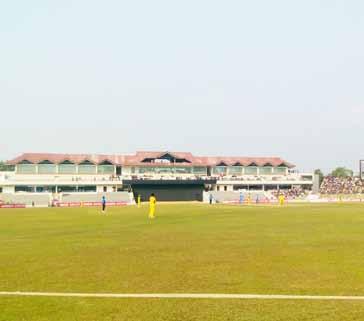
this week that they would heed the inspection team's recommendations before giving the green signal.
This followed the BCB's announcement earlier the same day that SLC had given them the go-ahead for the tour.
Meanwhile, The Bangladesh Nationalist Party, the country's main opposition party till today, have withdrawn their countrywide blockade after Sunday.

Real Madrid forward Cristiano Ronaldo is the odds-on favourite to win the FIFA Ballon d’Or on Monday.
The Portugal captain, 28, is named on a three-man shortlist for the prize, along with Barcelona’s Lionel Messi and Franck Ribery of Bayern Munich.
The trio was chosen from a 23-man long list, with the world player of the year to be crowned at a ceremony in Zurich.
Winners of seven other awards, plus the Fifpro World XI team of the year, will also be announced.
Nadine Angerer (Germany), Marta (Brazil) and Abby Wambach (USA) are in the running for the women’s world player of the year prize.
Former Manchester United boss Sir Alex Ferguson is vying with exBayern Munich coach Jupp
Heynckes and Borussia Dortmund’s Jurgen Klopp to be named men’s coach of the year.
Wolfsburg’s Ralf Kellermann, Germany boss Silvia Neid and Sweden coach Pia Sundhage are the final three for the women’s coach of the year.
Five British playersEngland defenders Leighton Baines and Ashley Cole, midfielder Steven Gerrard, striker Wayne Rooney and Wales forward Gareth Bale - are in contention to be named in the Fifpro World XI. The other Premier League nominees are: Chelsea’s Petr Cech, Branislav Ivanovic and David Luiz, Manchester City’s Vicent Kompany, Pablo Zabaleta, Yaya Toure and Sergio Aguero, Manchester United’s Nemanja Vidic and Robin van Persie, Arsenal’s Mesut Ozil and Liverpool’s Luis Suarez.
France Football introduced the Ballon d’Or in 1956 to honour the European footballer of the year, before it was expanded in 2007 to become a global prize.
Argentina forward Messi, 26, has won the award for the past four years, but is widely tipped to be beaten by Ronaldo on this occasion.
The ex-Manchester United player, who last won in 2008, scored 66 goals in 56 games for club and country. He netted five hattricks, including a treble in November’s World Cup playoff against Sweden to fire his nation to this summer’s finals in Brazil.
France winger Ribery, 30, makes up the threeman shortlist after helping German giants Bayern Munich to five trophiesBundesliga, German Cup, Champions League, Uefa Super Cup and Club World Cup - last year. (BBC Sport)
By Treiston Joseph
With rugby recently being added as an Olympic sport, the Guyana Football Rugby Union (GFRU) is gearing for a successful year following the visit to Guyana of North America Caribbean Rugby Association (NACRA) Development Officer, Scott Harland.
Harland will be spending five days in Guyana, ending January 16, hosting coaches and referees’ courses, while trying to aid the national union in bettering its marketing strategies, along with its administrative ability.
“My job as a Development Officer is to come in and help them reach their goals provided we agree on the goals once they are positive which most of them are.
"It’s a broad range; some of it is administrative, some of it is coaching; some of it is refereeing and if I don’t have the personal resources to help with that then I go after other avenues to help make sure that we can bring whatever we need in to help them meet those goals,” Harland noted at a media briefing held on Sunday at the Sleepin Hotel on Brickdam Street.
President of the GFRU,
Peter Green, speaking at the press conference was quick to point out some of the union’s objectives for 2014.
“Our objective this year locally, we would be developing rugby at the school level- primary, secondary…improving playing conditions… as you saw last year we were caught off guard by using the one available ground the National Park being flooded most of the time. So we are working on that, we will be working on having youth festivals [at the] Under-14, 15 and 19 levels. There are also about three to four international meets we want to attend with the first being in June, which is the Test series versus Barbados and Trinidad and we are confident that we are going to win,” Green outlined.
Meanwhile, Harland, who believes that the structure of rugby has improved in Guyana, noted that it will take more dedication for the Guyanese squad and squads in the Caribbean to reach a higher level.
“If you look at the training regime of the Canadian/ USA players, their women might beat a lot of the men in the Caribbean in fitness because they are treated as professional athletes now and that’s a luxury not every Caribbean country has. So it’s a lot of hard work; fit-
ness wise and skill is probably the one thing, the passing and handling skill once the Caribbean nations can get that to an elite level I think can beat Canada or USA maybe not every time, but most of the time,” Harland pointed out.
Funding Due to financial difficulties, Guyana could not attend the NACRA championships last year, but according to Harland, such constraints can be neutralised with the Olympic Solidarity Fund.
“Sports can compete within each country for an opportunity to get access to the Olympic Solidarity Fund; that solidarity fund if accessed could play quite a big role in helping the Guyana Football Rugby Union,” Harland explained. Further, the Development Officer, who noted that Guyana has already completed its forms to receive financial aid from the international rugby body, stressed his main purpose of visit to the Land of Many Waters.
“My final objective would be that the Guyana Football Rugby Union has more rugby going on at the end of 2014 at a high level with more ages and that it is sufficiently funded,” Harland stated.
England captain Alastair Cook has queried an umpiring decision that handed Australia’s David Warner a reprieve in their six-wicket ODI win.
Warner was recalled to the crease after being initially given out caught behind for 22 in Australia’s successful chase of 270 to win in Melbourne.
The opener made 65 in a stand of 163 with partner Aaron Finch, who hit 121.
“It might be my English eyes on it, but I thought it was a pretty clean catch,” said Cook.
“It hit his fingers and bounced up. I only saw it a couple of times on the big screen and I thought it was the wrong decision.”
Warner began to walk off after speaking to England keeper Jos Buttler following his edge off a Ben Stokes delivery, but umpires Ranmore Martinez and Simon Fry referred it to TV umpire Kumar Dharmasena, who ruled that the ball had bounced before being caught.
“Obviously David thought it has carried because he was quite happy to walk off,” Cook added.
“It is strange because a
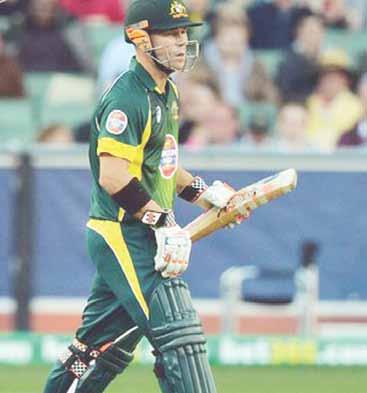
lot of those catches look a lot worse on TV than they do in real life. With that one, I didn’t see it hit the ground, but we have to respect the umpire’s decision.”
Cook also admitted that his side are struggling to end their run of defeats following the 5-0 Ashes whitewash.
“We are struggling to find
the answers for a lot of these questions,” Cook told BBC Radio 5 live sports extra.
“All I know is that if we keep working hard it does eventually turn. We have got to keep believing in ourselves to keep doing that and keep backing ourselves, otherwise we certainly won’t win games of cricket.” (BBC