




tuesday, july 2, 2013 | guyanatimesgy.com


By Bhisham mohamed
AWinds: Easterly to east north-easterly between 3.0 and 6.0 metres per second, gusting at times to 11.0 metres per second.
High Tide: 11:57h and 00:23h reaching maximum heights of 2.19 metres and 2.27 metres respectively.
Low Tide: 05:27h and 17:50h reaching minimum heights of 0.96 metre and 1.02 metres respectively.







n electrician was on Sunday evening brutally killed at Good Hope, Railway Embankment, East Coast Demerara (ECD), after he attempted to retrieve a pair of car mirrors that was removed from a friend’s car at Aziza Acousa, Soesdyke/ Linden Highway.
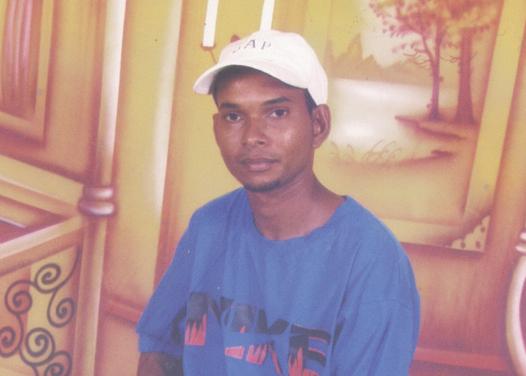
The dead man was identified as Jagdeo “Blondie” Singh, 35, of Lot 110 Mon Repos North, East Coast Demerara and formerly of Lot 9 Mon Repos Public Road, ECD. According to information received, Singh along with his friends and family went for an outing at the Aziza Acousa Creek on Sunday afternoon and as they were about to leave, they realised that the mirrors on the car were missing.
Upon investigation, they were told that the occupants of a Toyota Spacio removed the mirrors along with mirrors from other vehicles and left the scene. The occupants of the getaway vehicle are known to Singh and his relatives; hence, a decision was taken to track down the car with the hope of retrieving the mirrors.
They left the creek about 20:00h and headed to the East Coast and while in the vicinity of La Bonne Intention (LBI), they saw the vehicle drivi ng out of a street and intercepted it.
Singh along with his reputed wife disembarked the vehicle and walked towards the car, but as they got closer, they reportedly enquired about the mirror, but the driver who drives for Foul Curry Taxi Service smiled and accelerated.
Singh, who was stand-
ing in front of the car, in an attempt to stop the vehicle, jumped onto the bonnet, but instead of stopping, the driver sped off the scene with Singh holding onto it for his life. The driver of Singh’s car gave chase, but after a few minutes, the Spacio disappeared and was later reported to have crashed into a pole at Good Hope, Railway Embankment.
As a result of the impact of the collision, Singh fell to the ground and may have sustained a broken neck along with other injuries to his arms and legs. Kavita Bawanideeen, the reputed wife of the dead man explained that after the car drove away with her husband holding onto the bonnet, she went to the Beterverwagting Police Station and made a report.
She explained that after a while, the driver of their car told them that he lost sight of the vehicle and believed that it might have taken the Railway Embankment at Good Hope. A police rank, the aggrieved woman explained, accompanied her to the Vigilance Police Station, where they were
told about an accident at Good Hope, ECD.
Upon checking, the woman stated she saw her husband in a pool of blood lying on the roadway with the said car close to him, but the driver had fled the scene. When the police checked the interior of the vehicle, a quantity of stolen car parts were discovered. The car was towed to the Beterverwagting Police Station where it was impounded. The driver’s friend and fiancé were subsequently arrested and are assisting with investigations.
At the home of the deceased, his mother who was weeping inconsolably, explained that she last saw her son on Sunday morning when he visited and requested of her to prepare some “Pot roast” chicken for him to take to the creek.
Bebe Shakila explained that she was at home about 22:00h on Sunday when she heard her niece call-
ing at the gate and upon enquiring; she was told that her son was involved in an accident and must go to the scene immediately. Without hesitation, she rushed to the scene where she saw her son’s motionless body. He was already dead, she cried.
An eyewitness said he was in his house when he heard a commotion and when he looked out, he saw a car speeding down the road with a man on the bonnet pleading with the driver to stop. The driver was seemingly under the influence of alcohol and was laughing, the eyewitness said.
He said after a few seconds, he heard a crashing sound and as he looked closely; it was the car that crashed into a utility police. “De man on the bonnet went into the air and landed on his head,” he added. Guyana Times understands that the assailant is known to the police for stealing car parts. He was recently released on $45,000 bail for a similar incident.
His grandfather reportedly bought the car which he was driving for him to work at a taxi base. The driver is is in his 20s and lives with his fiancé.
Singh recently returned from Canada after spending over four years with his father. The man is survived by his reputed wife, foster child, parents and sister.
His body was taken to the Lyken’s Funeral Home and is awaiting a post-mortem examination.




Editor: Nigel Williams
Tel: 225-5128, 231-0397, 226-9921, 226-2102, 223-7230 or 223-7231. Fax: 225-5134
Mailing address: 238 Camp & Quamina Streets, Georgetown
Email: news@guyanatimesgy.com, sales@guyanatimesgy.com
This Thursday, the Caribbean Community (Caricom) will complete two score years of its existence. Such a round number alone warrants a closer look at the institution to ensure that the rationales for its formation are still relevant and, if so, what can be done to achieve those goals that remain unfulfilled. There has to be an acceptance of a willingness to be bold. There can be no complacency in an endeavour that has such high stakes for the people in the Caribbean.
In an address to a “Caribbean Growth Forum (CGF)”, held in Nassau last week, Inter-American Development Bank (IDB) President Luis Alberto Moreno made some points that we hope all Caricom will take some time to ponder. The IDB has been the largest source of funding to the region, and in that time has analysed us more profoundly and sustainedly than any other institution, especially as far as what it will take for us to embark on a path of higher growth.
He noted that there were others in far worse shape than us at the time of independence, but through a willingness to make hard decisions, have forged far ahead. Notable in this regard is Singapore, a city-state with almost no natural resources that is now a “developed country”. In his book From Third World to First, Singapore’s first prime minister, Lee Kwan Yew explicitly cited the instance of Jamaica, which was ahead of his country by so many criteria, but has now lagged. What Singapore did was craft a plan for its development and stick to it with dogged determination.
Caricom’s leaders did have such a vision and plan back in 1973 when they signed the Treaty of Chaguramas, but they have not stuck to the plan. Moreno pointed out that we have to diversify our economies and become more export-oriented. The first part of the advice has been one of the foundational goals of Caricom from the onset. What else could economies that have been founded to produce a single crop – sugar –do? The term “mono-crop” agriculture was invented in the Caribbean. The second part of the advice should have been redundant, since historically, all our production was for export.
But for the Caribbean to diversify, when they each had such small internal markets, they not only had to expand their markets, they also had to rationalise their production. It was accepted from the beginning that it did not make sense, economic or otherwise, for each country to produce the same range of goods: the relative comparative advantages were identified quite early on. The only constraint was the lack of political will from the politicians to overcome their aversion to cooperation.
Caricom must return to this basic lesson. The Bharrat Jagdeo Initiative on Agriculture is as good a place to start as any. Ten constraints had been identified since 2004 as necessary to be removed if we were not only to become self-sufficient in food production, but also become large exporters. The reason why none of these have been resolved is the conclusion by the other leaders that since Guyana and Belize have the greatest amount of available agricultural land, they would benefit inordinately. There has been very little discussion that agriculture is not only about land and that each territory would have also benefited since each could have provided different inputs. Trinidad and Barbados, for instance, would have earned greater returns on the capital they would have invested.
Returning to Moreno’s advice on “diversifying”, he explicitly mentioned not just the products, but the markets. For too long we have reflexively continued shipping our goods to our “traditional” markets in the U.S. and Europe. The 1973 plan for Caricom was drafted at a time when SouthSouth linkages were being pushed so as to overcome the past dependent relationships. We dropped the ball, which must now be picked up this Thursday in Trinidad.

Dear Editor,
The idea of a self-sufficient school is not farfetched. In the late 1970s, my secondary school used to have a great agricultural input. It was so designed that, for every term, the students used to plant small scale, and they always ended up taking home things like bora, boulanger and pepper, among other things. The signs were there for the idea of earning while learning.
This principle is now really gathering some momentum, and I think that Guyana must jump on it, but in a more purposeful and wide-spread manner. Kudos are in order for all the relevant groups for making good the ‘earnwhile-you-learn’ philosophy quite a reality.
A visiting team of officials from the Agriculture Ministry was most impressed by the progress at the Santa Fe mega farm, where harvest -
ing of paddy has already begun. In fact the first bumper crop of dry land rice will be processed at the nearby mill that was specifically set up for this purpose.
Brazil has been in this kind of rice cultivation for over 25 years, and it is good that Guyana’s experimentation so far is looking quite good. It should be noted that the Santa Fe project is really modelled after what is happening in Brazil, and it is a Brazilian expert, who is guiding the process here.
Where Santa Fe is concerned, it is good to note that the farm is also exploring cultivation of some fruits and vegetables, as the aim is to create a large-scale multi-farm. At present, all crops, including rice, are being done on a very small scale, but the expectation is to increase production over time, even as plans are in place
to introduce new cultivation to the farm.
In fact, where rice alone is concerned, the next rice crop is expected to see about 1000 acres of rice being cultivated. Also on the agenda is the rearing of beef and dairy animals on 30 acres of the farmland.
This is how Guyana must think. There is abundance of space, and the land is quite amenable to farming. All that is needed is willingness to invest. In time to come, I am sure that self-sufficiency will be achieved and earning from selling and export will be realised.
A good education is considered one of the best routes out of poverty. However, in many developing countries, technical and vocational education is neither good nor readily available to many youths.
Also, distance may pose many challenges. So,
especially in the riverine areas, where communities are blessed with land mass, the bi-vocational and self-sufficiency idea can work wonders.
Let me leave a little inspiration for Santa Fe and others who may want to go this route. In Paraguay, the self-sufficient school idea took root in one school in 2003. The emphasis was on technical and vocational education, and farming was the route. The school has now been able to transform young farmers into financially successful “rural entrepreneurs” by integrating the teaching of traditional high school subjects with the running of 17 small-scale, on-campus rural enterprises.
I think these types of success stories can become more and more abundant in Guyana.
Yours faithfully, Damien Glasgow
Dear Editor,
Kudos to the Guyana Police Force for its noticeable proactive approach in recent days. Various ranks are taking more to the streets and their work is well rewarded.
Just a few days ago, special police ranks conducted raids on two houses in North East La Penitence and Albouystown, Georgetown. These officers netted a quantity of co-
caine and marijuana, while three people were arrested and are in custody, assisting with the investigations.
From a personal standpoint, I also commend those public-minded people who are now more moved to tip off the police. Many police who mix and meddle are very well informed about various hot spots for illegal activities. The information they
gather must be used when these raids are conducted. It will never hurt even if the raids yield nothing. Criminal elements never sit easy when they know that they are being watched and that they can be pounced upon at any time. I urge the police to keep being aggressive.
Respectfully submitted, Walter Cumberbatch
Dear Editor,
A very healthy sequence of events is taking place in Guyana these days and I am very elated. I saw for the umpteenth time that the media reported on a medical outreach and this spells good news for all. This time, it was the programme in Linden that saw many patients benefiting from various health services.
Teamwork is the first thing that comes to mind. I believe that if people can put aside politics, race and religion, we can achieve so much more. Patients were examined and treated for general health issues, such as blood pressure and cholesterol. The more serious issues that could
not be handled at the outreach were referred to the nearest health centres. These outreaches should be continued in a systematic way, where a schedule is set up and villagers can be sensitised as to how many visits they will get per year and around what time they will take place. I am saying this because these outreaches can serve for more than a medical reason. Let us face it, many of us do not read nor listen to news. So on these outreach missions, the visiting patients can be told what government is all about.
I have a case in point here. Many people will not come to my mosque. However, whenever there is any kind of medical out-
reach, I see the new faces, and our organisation gets the opportunity to tell them what we are about. It is something to think about. We need to dispel false notions that prevail in the country and at the same time, inform and educate the public.
Look at how people can be in the dark. The Health Ministry recently took a high-level team of medical professionals and went and visited the Children’s Hope Orphanage at Enmore. The event is an annual one. Believe me, many Enmore people, when asked about the event, are still asking how come they did not know.
Yours truly,
Iqbal Bacchus
Dear Editor, Electricity theft is quite ubiquitous. If raids are to be done consistently in Guyana, we will discover a lot of illegal things that allow for electricity to be siphoned off for free. It is so in Jamaica too. The news has it that 11 people, including three women, were arrested by the police for theft of electricity.
In Guyana, there are certain places that are known for certain things. This is very much so for electricity theft. If doubts about this observation are in the minds of some, then just check the records, or even revisit incidents when and where, some of the employees of the Guyana Power and Light (GPL) have been attacked. However, irrespective of who and where, electricity theft must be addressed. I call on GPL to take a cue from their counterparts in Jamaica, where more and more people are reporting on these ille-

gal connections, and this should be the same here too. When electricity is stolen or wasted, it affects every one of us. I call on citizens to help GPL help all of us.
Yours faithfully, Quincy Morris
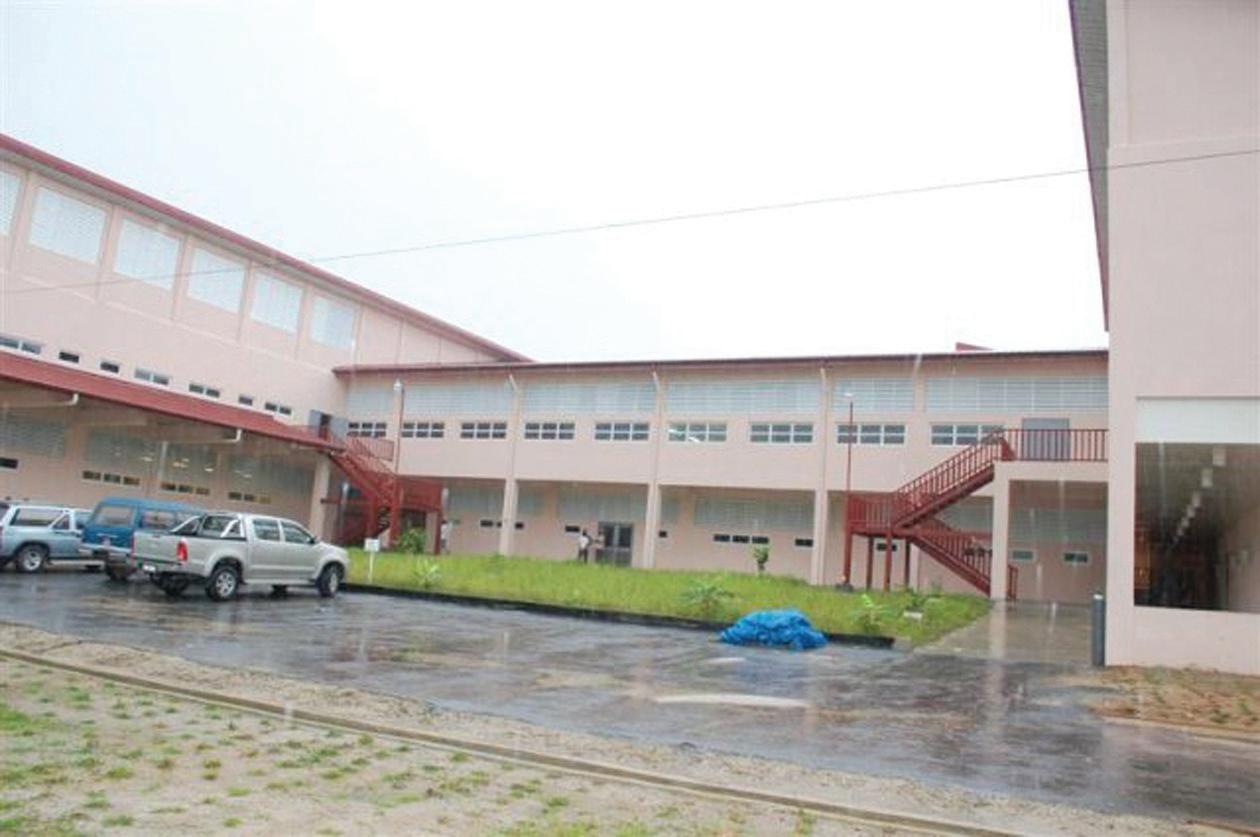
Dear Editor, I do believe that Guyana has enough when it comes to maternal care. We have the personnel, facilities and equipment. Many times, tragedies come about because of the human element, where people bring about mishaps. They just forsake basic rules of the profession or they engage in attitudinal issues.
The Linden Hospital Complex (LHC) and the Upper Demerara and Kwakwani hospitals reported that during 2012-
13 there were no maternal deaths. This kind of report is not to be taken lightly. It is something that we should be very proud of. The simple explanation from the hospital is that quality obstetric care was rendered to patients, and this resulted in zero maternal deaths at the hospital.
In Guyana, we have had our ups and downs in the health sector, and I think that a little bit of knowledge can save the day. I was looking at some hospitals across the world
and Guyana is not a case of negative peculiarity. In Guyana, systems are in place, and there is no excuse for any kind of irresponsibility.
Getting back to Linden, it is good to note that there is an adequate supply of vaccines and contraceptives, adequacy of staff and functional equipment. The hospital seems set for further improvement.
Yours sincerely, Emerit Marcus


Alcoholic parents
Alcoholic families tend to be chaotic and unpredictable. Rules that apply one day don’t apply the next. Promises are neither kept nor remembered. Expectations vary from one day to the next. Parents may be strict at times and indifferent at others. In addition, emotional expression is frequently forbidden and discussion about the alcohol use or related family problems is usually nonexistent. Family members are usually expected to keep problems a secret, thus preventing anyone from seeking help. All of these factors leave children feeling insecure, frustrated, and angry. Children often feel there must be something wrong with them which makes their parents behave this way. Mistrust of others, difficulty with emotional expression, and difficulties with intimate relationships carry over into adulthood. Children of alcoholics are at much higher risk for developing alcoholism than are children of non-alcoholics.
Abusive parents
Abuse can be verbal, physical, or sexual. Verbal abuse – such as frequent belittling criticism – can have lasting effects, particularly when it comes from those entrusted with the child’s care. Criticism can be aimed at the child’s looks, intelligence, capabilities, or basic value. Some verbal abusers are very direct, while others use subtle put-downs disguised as humour. Both types are just as damaging.
Definitions of physical abuse vary widely. Many parents, at one time or another, have felt the urge to strike
their child. With physically abusive parents, however, the urge is frequent and little effort is made to control this impulse. The Federal Child Abuse Prevention and Treatment Act defines physical abuse as “the infliction of physical injuries such as bruises, burns, welts, cuts, bone or skull fractures; these are caused by kicking, punching, biting, beating, knifing, strapping, paddling, etc.”
Striking a child has much to do with meet ing the par ent’s emotional needs and noth ing to do with concern for the child; parents of ten erroneously justify the abuse as “discipline” intended to “help” the child. Physically abusive parents can create an environment of terror for the child, particularly since violence is often random and unpredictable. Abused children often feel anger. Children of abusive parents have tremendous difficulties developing feelings of trust and safety even in their adult lives.
While parents may justify or rationalise verbal or physical abuse as discipline aimed at somehow helping the child, there is no rationalisation for sexual abuse. Sexual abuse is the most blatant example of an adult abusing a child purely for that adult’s own gratification.
Sexual abuse can be any physical contact between an adult and child where that contact must be kept secret.
Demonstrations of affection – such as hugging, kiss-

acceptable and even beneficial. When physical contact is shrouded in secrecy then it is most likely inappropriate.
Sexual abuse happens to both boys and girls. It is perpetrated by both men and women. It cuts across lines of race, socioeconomic level, education level, and religious affiliation. In most cases, sexual abuse is part of an overall family pattern of dysfunction, disorganisation, and inappropriate role boundaries.
Responsibility for sexual abuse in all cases rests entirely with the adult. No child is responsible for being abused. Most sexually abused children are too frightened of the consequences for themselves

and their families to risk telling another adult what is happening. As a result they grow into adulthood carrying feelings of self-loathing, shame, and worthlessness. They tend to be self-punishing and have considerable difficulties with relationships and with sexuality. Regardless of the kind of dysfunction or abuse, effects vary widely across individuals. Support from other healthy adults, success in other areas, or positive changes in the family can help prevent or minimise negative effects. The following questions may help you identify how you may have been or continue to be affect-
How can someone overcome the effects of a dysfunctional family?
Regardless of the source of dysfunction, you have survived. You have likely developed a number of valuable skills to get you through tough circumstances. Consequently, it is important to first stop and take stock. You may find that much of what you learned in your family is valuable.
Many of the survival behaviours you developed are your best assets. For example, people who grow up in dysfunctional families often have finely tuned empathy for others; they are often very achievement-oriented and highly successful in some
(COnTInUED FROM SATURDAY)
areas of their lives; they are often resilient to stress and adaptive to change. In examining changes you may want to make in yourself, it is important not to lose sight of your good qualities. Patience is necessary! Negative effects from growing up in dysfunctional families often stem from survival behaviours that were very helpful when you were growing up, but may become problematic in your adult life.
Remember that you spent years learning and practising your old survival skills, so it may take awhile to learn and practise new behaviours.
Get help
In most dysfunctional families children tend to learn to doubt their own intuition and emotional reactions. Often outside support provides an objective perspective and much-needed affirmation which will help you learn to trust your own reactions. Help or support can take many forms: individual counselling, therapy groups and self-help groups.
Learn to identify and express emotions
Growing up in a dysfunctional family often results in an exaggerated attention to others’ feelings and a denial of your own feelings and experiences. While this often results in very good sensitivity to others, you may have neglected sensitivity to yourself. Stop each day and identify emotions you are or have been experiencing. What triggered them? How might you affirm or respond to them? Try keeping a daily feelings journal.
Be selective in sharing

your feelings with others. You may not find it helpful to share all of your feelings. In sharing your feelings with others take small risks first, then wait for a reaction. If the responses seem supportive and affirming try taking some larger risks.
Allow yourself to feel angry about what happened
Forgiveness is a very reasonable last step in recovery, but it is a horrible first step. Children need to believe in and trust their parents; therefore, when parents behave badly, children tend to blame themselves and feel responsible for their parents’ mistakes. These faulty conclusions are carried into adulthood, often leaving guilt, shame, and low self-esteem. When you begin with trying to forgive your parents you will likely continue to feel very badly about yourself.
Placing the responsibility for what happened during your childhood where it belongs, ie, with the responsible adults, allows you to feel less guilt and shame and more nurturance and acceptance toward yourself. It is usually helpful to find productive ways to vent your anger. This can be done in support groups or with good friends. Try writing a letter to one or both of your parents and then burning the letter. You may want to talk with your parents directly about what happened. If you decide to do this it is important to keep your goal clear. Do you want to encourage change and work for a better relationship, or are you trying to get even or hurt them back? Pursuing revenge frequently results in more guilt and shame in the long run. Holding on to anger and resentment indefinitely is also problematic and self-defeating. Focusing on old resentments can prevent growth and change.
Begin the work of learning to trust others
Take small risks at first in letting others know you. Slowly build up to taking bigger risks. Learning who to trust and how much to trust is a lengthy process. Adult children from dysfunctional families tend to approach relationships in an all-or-nothing manner. Either they become very intimate and dependent in a relationship, or they insist on nearly complete selfsufficiency, taking few interpersonal risks. Both of these patterns tend to be self-defeating.
Frequently, children of dysfunctional families continue to seek approval and acceptance from their parents and families. If these people could not meet your needs when you were a child, they are unlikely to meet your needs now. Recognise your parents’ limitations while still accepting whatever support they can offer. Seek your support from other adults. Practice saying how you feel and asking for what you need. Don’t expect people to guess – tell them. This step will likely require much effort. (Excerpt from www.twu.edu)
Some rice farmers in Berbice are not benefiting from the high prices being paid by Venezuela for the commodity, according to Guyana Rice Producers Association (RPA) President Leekha Rambrich.
Speaking in a recent interview with Guyana Times, Rambrich said it is not a case where millers who refuse to offer higher prices for paddy bought from farmers are greedy. Recently, Guyana secured a package which will see the country supplying its neighbour with 60,000 tonnes of rice. The price being offered by Venezuela is higher than those offered by Jamaica and Europe.
After the agreement was made with the Venezuelan government, a meeting was held with the Guyana Rice Development Board (GRDB), the Rice Millers Association and the RPA. At that meeting, it was agreed that millers will pay farmers between $3700 and $4000 per bag of paddy. Millers in Berbice were offering between $2500 and $3000 per bag of paddy prior to that meeting, whereas the farmers on the Essequibo Coast were only offered $2000 per bag of paddy.
In Berbice, the farmers only received 50 per cent payment and were promised the balance with a possibility of an increase, depending on the outcome of meetings with the Venezuelan government. Those meetings were favourable, resulting in Guyana being award-
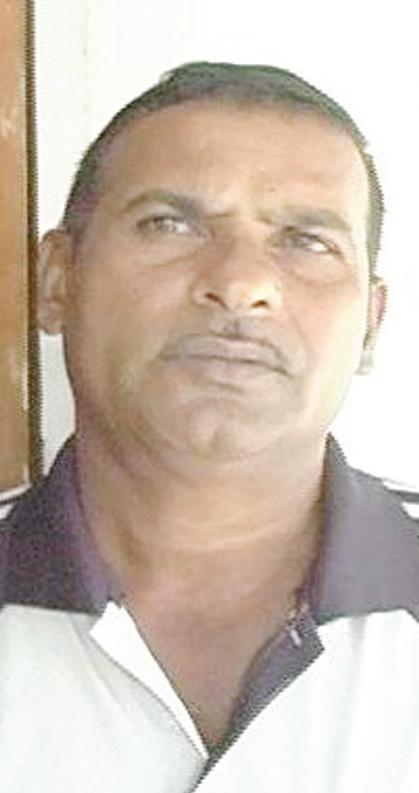
RPA President Leekha Rambrich
ed the contract to supply the 60,000 tonnes of rice.
According to the RPA president, the award to rice farmers was favourable.
“Actually you can never satisfy the demands of farmers, but with what they were receiving before, they are somewhat satisfied.”
However, there are farmers who have not received increases in the prices that they were initially offered. Farmers who sold paddy to the largest miller in Berbice, Nand Persaud Rice Mills, have not received increases in the prices for their paddy despite the agreement met between the RPA, GRDB and the Rice Producers Association.
Rambrich said this is because not all millers are benefiting from the Venezuelan market. “Some are exporting to Europe and to Jamaica. The millers sell-
ing to those markets will not be able to compete with the prices of millers who are exporting to Venezuela.”
According to Rambrich, Nand Persaud tendered to supply a very small quantity to Venezuela. “So it will be very difficult for him to pay the prices being offered by some of the other millers.”
Of the 60,000 tonnes being sold to Venezuela, the quantity is being shared by all millers in the country, who have rice to supply to that market.
Meanwhile, speaking about the last crop, Rambrich said things did not go too well, as farmers experienced difficulty accessing adequate water in a timely manner. “The entire crop was challenging because at the end of the crop, we experienced the rains and it affected some farmers.”
As it relates to the current crop, he said there is a new target in terms of the acres that will be cultivated. Last crop, some 53,000 acres were cultivated in Region Six, and according to Rambrich, this crop the figure will be at least 58,000 acres.
Already, more than 50,000 acres are already being cultivated in the region. “We are sure that we will surpass that target by the end of the first week in July.”
East Bank Berbice and East Canje are two communities where rice production is on the rise. On the East Bank, 1500 acres are under cultivation and in West Canje, it is about 1200 acres.
Police are investigating a robbery committed on a Crabwood Creek business which occurred over the weekend, leaving hundreds of thousands dollars in cash and articles missing.
According the reports gathered, Mahendrawattie Guridial’s grocery shop at her Grant 1806 Crabwood Creek, Corentyne residence was allegedly broken.
It was reported that the robbers carted off with $110,000 in cash along with one Motorola mobile phone valued $65,000, one generator, a quantity of milk powder, Milo and other articles.
Guyana Times understands that Guridial resides on the western side of Crabwood Creek Public Road in a two-storey wooden building. The lower flat of the building houses the shop which is connected to a door leading to the upper flat of the house.
That door is reportedly secured by means of harps and staple with a padlock. Investigations revealed that on Friday evening about 23:00h, the businesswoman secured her home and shop and retired to bed. She woke up the following morning about 06:30h and discovered that the shop and kitchen doors were opened. Closer checks revealed that the cash and articles mentioned were missing.
Police confirmed that the robbers gained entry into the building by using a metal nipper to cut open the lock from the kitchen door and made good their escape by using the said nipper to cut opened the lock from the shop door. The scene was dusted for foot and finger prints but none was found. The police are continuing their investigations. Meanwhile, a woman was arrested follow-
ing a robbery committed on Rambhagan Ramlogan, a cattle farmer of lot 167 Lovely lass Village, West Coast Berbice, who allegedly lost one gold band value $480,000 and US$5000.
Police investigation revealed that Rambhagan and his wife Nandranie Ramlogan left their home for Georgetown, leaving a relative to take care of their property. Upon their return on Sunday evening, the Ramlogans reportedly made checks for the articles and discovered they were missing. Acting on information received, the couple made contact with a friend of the caretaker of the house. After interrogation, the woman known as “Sherry” admitted to taking the gold band, but claimed that she did not have any knowledge of the money. She was subsequently taken into police custody as investigations continue.
tuesday, july 2, 2013 |
Culture Minister Dr Frank Anthony said Guyana’s delegation is fully prepared for the upcoming third annual InterGuiana Cultural Festival which is slated to be held from July 11-15 in French Guiana.
Speaking with Guyana Times last week, Dr Anthony stated that, with all the practice sessions that have taken place, the country’s readiness to go there and perform exceptionally is high.
“I think Guyana will be well represented,” he emphasised. He said at the moment the planning committee is finalising some of the preparations for the Inter Guiana Cultural Festival, adding that Culture Director Dr James Rose is in Suriname
wrapping things up.
Dr Anthony underscored that this festival is important for the three countries as it helps with bringing the three countries closer together, to share common areas and culture and also to learn from each other.
He said at the festival, the countries’ will also be looking at ways in which they can do joint projects, noting that already among the artist community, there have been collaborations.
“We would have seen at the festival held in Guyana, they did a wooden sculpture which is now at the National Culture Centre and in French Guiana, they will be expected to do similar things.”
The culture minister stat-
ed that at the upcoming festival, the countries are looking at some of the writers to do joint publications in the different languages, adding that this is still a work in progress. Several other projects are also being discussed among the countries heads. The mini-Carifesta type cultural event features six disciplines: visual arts, performing arts, literary arts, fashion art, culinary and craftworks. Lectures, master classes and workshops are also held at the festival. French Guiana, Suriname and Guyana are the three countries the event is mapped for annually. Suriname hosted the first event in 2011 while Guyana hosted the last festival. This year, it is French Guiana.
Firefighting is a challenge in Georgetown – Gentle cites congested streets, lack of water sources
The combination of congested streets and a lack of adequate water sources are among the main challenges of fighting fires in Georgetown, Fire Chief Marlon Gentle said.
He also dismissed as rumours, complaints that his charges often show up at fire scenes with their tenders empty. In an interview with Guyana Times, the fire chief said, it is impossible for firefighters to turn up at a fire with their fire tenders empty since the first thing an officer does when he/she goes on duty is to check the tanks and hoses.
“Water is our ammunition, why would we go to a scene and go looking for water?” he questioned. Gentle said if persons say that the firemen ran out of water while on the scene, it would be more plausible.
He disclosed that Central Georgetown poses the most challenge for firemen in terms of raging fires, pointing out this is the reason most tankers are dispatched in the area.
“That’s why we go out with tankers and speak to stakeholders to have the canals ready for us… we col-

laborate greatly with NDCs, CDCs and the different town councils, so that they could have open water spaces, properly maintained for access for firefighting.”
He underscored that they have been able to purchase the necessary equipment which can hold large quantity of water and deal with fires more effectively. The fire chief also stated that another major challenge the Guyana Fire Service (GFS) continues to face is road traffic, noting that more and more road users are not adhering to sirens.
“This is something we have been repeatedly saying, not only us but the police also, people are not pull-
ing over, with the sound of the sirens, this is a serious concern… we have had accidents happen due to this.”
Turning his attention to the recently constructed fire stations, the fire chief said, these have been very active and serving their purpose to full capacity. Making reference to the recently commissioned fire station in Diamond, East Bank Demerara, he disclosed that it has received about 30 calls, but only six were for actual fires. The fire chief also highlighted that the training school which is being established in Leonora to train firefighters is about 60 per cent complete.
“The building is almost completed and the field now being prepared,” Gentle said, adding sometime later on this year or perhaps the beginning of next year, the spanking new state-of-theart building will be commissioned and ready to train officers.
From 2006 to now, government has increased the number of operational fire stations from eight to 16, in addition to resuscitating five auxiliary units in the hinterland.

tuesday,
Suriname and Guyana will join Mercosur as associate states when the regional trading bloc holds a summit in Montevideo, Uruguay, on July 11 and 12, and when the president of Uruguay José Mujica, chair pro tempore, will transfer the chairmanship to Venezuelan President Nicolas Maduro.
At the upcoming summit, Paraguay’s membership will be reinstated, but the new government in Asuncion is placing conditions for rejoining the regional group.
The inclusion of Guyana and Suriname now leaves no country in South America without some sort of association with Mercosur.
Mercosur has two political statuses: Full members, defined as those who participated in its creation in 1991 – Uruguay, Paraguay, Argentina and Brazil – and partners: Venezuela, Peru, Chile, Bolivia, Colombia and Ecuador. Venezuela joined the organisation last July. And the last two countries in South America -- Guyana
and Suriname – will finally and formally join as associate members.
Valeria Csukasi, director for integration of Uruguay’s Foreign Affairs Ministry added that the foreign ministers of Suriname and Guyana have already confirmed their presence at the summit on July 11.
This is the first time that Guyana and Suriname have moved towards South American integration. The two countries were former British and Dutch colonies respectively and were more or
less isolated from their South American neighbours. To this day, there is no air connection between Guyana and Suriname with other South American countries, except with Belem, Brazil. And 10 years ago, there were hardly any trade and commerce with their South American neighbours; however, this all changed after former presidents Hugo Chavez (Venezuela), Lula Da Silva (Brazil) and Nester Kirchner (Argentine) initiated the Union of South American Nations (UNASUR). (Caribbean News Now)
Opposition Leader
Brigadier David Granger was part of a team of A Partnership for National Unity (APNU) Members of Parliament (MPs) on a “fan out” exercise in Regions One and Eight.
According to a release from the coalition, Granger’s team visited Mabaruma and the surrounding areas. During the visit, APNU MPs met with residents and held several community meetings to inform them of the partnership’s activities in the National Assembly and stance on several key issues, especially those of interest to the people of Barima-Waini. At several community meetings, APNU criticised

the state of health-care, education, unemployment (especially, youth unemployment), the high cost of living, poor condition of the roads in the region, the lack of 24 hour electricity in Mabaruma and the surrounding areas.

The APNU called on the government of Guyana to set up technical and vocational schools in the Barima-Waini region and to improve the delivery of education by having more trained teachers assigned to schools there.
The APNU reiterated its call for an enquiry into the annual gastroenteritis epidemics in the region that cause great pain and suffering to residents, especially in the Kaituma area.
The coalition also implored the government to address poor regional infrastructure, especially the main road that links Mabaruma and the surrounding communities and the Kamaka stelling, which is still to be completed. The partnership called for a new and reliable ferry service to replace the aging and problematic Lady North cote, giving residents much needed relief when travelling to and from Georgetown and farmers a reliable source of transportation for their produce.
The APNU team that visited Mabaruma, included Dr Rupert Roopnaraine, Amna Ally, James Bond, Renitta Williams, Jennifer Wade and Sydney Allicock. Another team of APNU MPs headed by Volda Lawrence visited Port Kaituma, Matthews Ridge sub-region while yet another team headed by Ronald Bulkan travelled to Region Eight.

orbes Burnham, from the fledgling days of the Caribbean Community (Caricom), until he departed, got a free pass from his fellow leaders of the grouping. As a founding leader of the organisation, was it considered uncouth to bring up the small matter that he was a dictator who was routinely rigging elections back in his country? Not to mention (pun intended) threatening opponents about his “sharper steel” and arranging for their assassinations?
In diplomacy, one of the requirements is that you have to be able to hold your nose sometimes and still be able to breathe. An occasion coming up this week will test this diplomatic skill when Caricom leaders meeting in Trinidad, in commemorating the 40th anniversary of their organisation, host a lunch for Equatorial Guinea President Obiang Nguema.
Who’s coming to lunch you asked? Well, we only found out when we read the Caricom press release about the event. So we checked up on the fella. He’s Africa’s longestserving leader, having seized power in 1979 from his uncle whom he had shot by a firing squad. Not that the uncle (whom he and his family had served faithfully) was any saint. As the first president of Equatorial Guinea, he pretty much ran the place as his own little fiefdom.
But when he started lopping off the heads of those around him – including Nguema’s father and brothers – Nguema, who had a military background, decided to take over the family business. By then his most significant accomplishment was to run the prison where torture was common. Breaking the legs of prisoners was their speciality. Wags said if you noticed people moving around with limps in both legs, you know you’re in Equatorial Guinea.
Promising to do better than his uncle, he was actually elected to the seven-year presidency under a new constitution in 1982. People didn’t realise he meant he was going to better his uncle’s record as a tyrant. He just couldn’t stop torturing people. However, he kept getting “elected” through the years with massive majorities – regularly achieving 98 per cent of the vote. In one constituency in 2002, his popularity was so high, he got 103 per cent of the votes!! It helped that he was the only candidate in the elections.
Caricom might’ve given Burnham a free pass, but why have they given Nguema one? Oil, that’s why. Equatorial Guinea is a massive oil producer and we guess that’s why he was also made Chairman of the African, Caribbean and Pacific (ACP) group of countries and will be holding special sidebar talks with Trinidad and Tobago after the special luncheon.
We hope Kamla sticks to oil and not how to make people “open up”.
Nguema came up with one of the most ingenious methods to stop corruption: he had the money from the treasury transferred to his own account in a bank in the U.S. to “protect” it from civil servants. Forbes says he’s worth a cool US$600 million but he retorts that he’s only protecting the money. Which, of course, he’s forced to spend on personal projects while the country wallows in poverty
The state radio declared he was a god who had “all power over men and things”. In 1993, he accused the U.S. ambassador of practising witchcraft at the graves of World War II (WWII) British airmen. The Americans soon closed their embassy, but re-opened it a decade later in its post2001 search for allies in Africa. Oil, the U.S. declared, was a strategic commodity. All was forgiven.
In 2006, Condeleezza Rice declared him “a good friend” and in 2009, he met President Barack Obama as the U.S. Human Rights report declared there were “governmentsanctioned kidnappings, systematic torture of prisoners, and detainees by security forces”.
There have been persistent reports that Nguema practises cannibalism. If his hosts in Caricom go by these reports as to his culinary preferences for the luncheon, they’ll serve him human testicles. They make him “stronger militarily”.
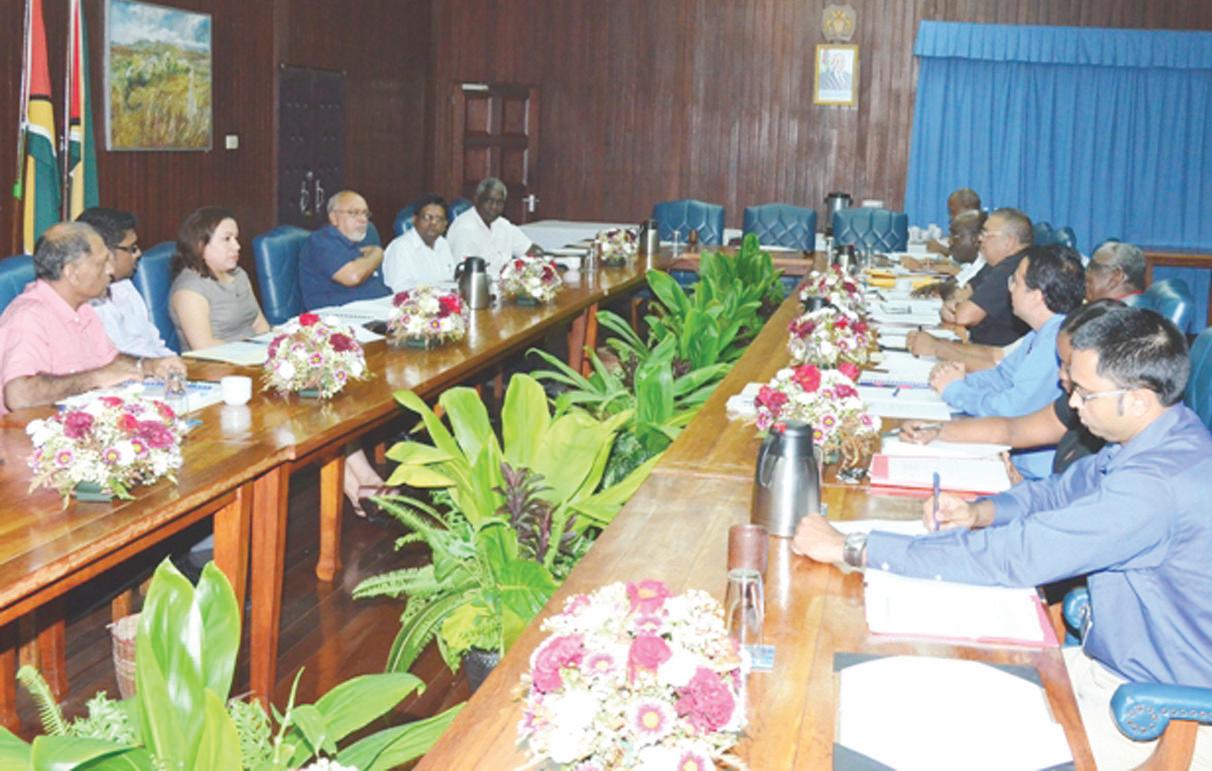
The National Competitiveness Council believes that Guyana can become more successful if it develops a more robust value-added export industry.
While, various sectors have comparative advantages due to the availability of land, water, competitive wages, and an advantageous position as a potential exporter to Caricom, Guyana has not been successful at building up competitive advantages.
The council said that what is needed is a longterm strategic analysis and planning by government, along with effective and vigorous private sector entrepreneurship through the formulation of policies aimed at enhancing national competitiveness and diversification of the economy.
According to the council, important progress has been made locally in recent years in managing the process of adjustment to the new world economic environment. This has been undertaken through the exercise of fiscal discipline, improvements in the environment for private invest-
ment, reform of the tax system, creation of a property market, investing in basic education and infrastructure, and boosting productivity in traditional sectors of the economy.
However, the council is of the opinion that urgent and pressing challenges remain to be tackled, including the economic imperative of improving national competitiveness and diversifying the economy.
“Whilst economic diversification has long been and
remains a major aspiration of Guyana’s policymakers, as a country, we have historically been highly dependent on the exports of only a handful of natural resource commodities. This continues today with sugar, gold, rice, shrimp, timber and bauxite accounting for 86 per cent of exports and 69 per cent of GDP,” the council stated.
It added that the Caricom Single Market and Economy (CSME) has also been creating many com-
petitive threats for Guyana.
“Neighbouring countries are moving rapidly to prepare for success in new product areas and will leave Guyana behind if action is not taken today to seize the opportunities presented by CSME, particularly in promising sectors which can be engines of diversification and growth into the future.”
The council feels that along with the challenges of globalisation also come opportunities to tap into in-
ternational markets and take advantage of increasing capital and technology flows which can lead to greater income and employment opportunities.
It said that Caricom’s flagship CSME can create a single economic space which provide access to a market of over 14 million consumers, encourage international standards of production and allow for a more efficient utilisation of regional resources.
Over time, Guyana can enjoy increased access to capital, skills, and other contributions and benefits from across the region as well as the strengthening of the legal framework to facilitate the pooling of Caricom resources, which can result in a more effective community during international negotiations.
The council said that such an environment will provide the platform to enable Guyana and the entire Caribbean community to integrate effectively and competitively with the rest of the global economy by creating the conditions which enable goods and services to be competitive in both intra-regional and extra-re-
gional markets.
“It is necessary to chart a new way forward to generate a new momentum for growth and prosperity that is consistent with these more challenging competitive realities, with the ultimate objective of delivering a better quality of life for all Guyanese.”
The National Competiveness Strategy came into being in 2006 after a multistakeholder forum with various private sector representatives pouring several ideas out for the enhancement of Guyana’s economic outlook.
The challenge, however, over the years has been the implementation of the strategy by the National Competitiveness Council. Executives of the Georgetown Chamber of Commerce and Industry (GCCI) described the strategy as one of the most articulate and well-written documents. The chamber believes that the strategy aptly encapsulated the deficiencies of the economy and the measures that are to be taken to reverse this trend.
However, the business community called for an acceleration of the work of the council in relation to the implementation of the ideas.

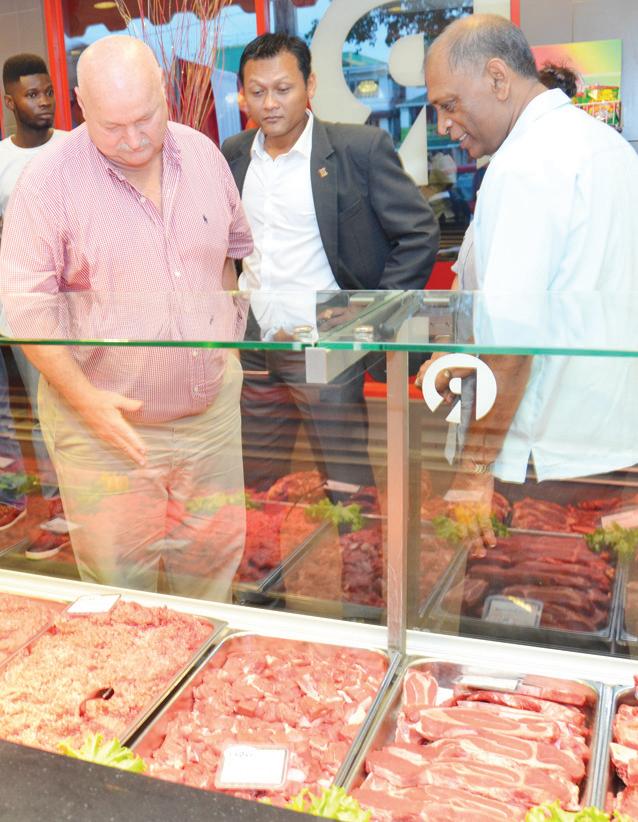
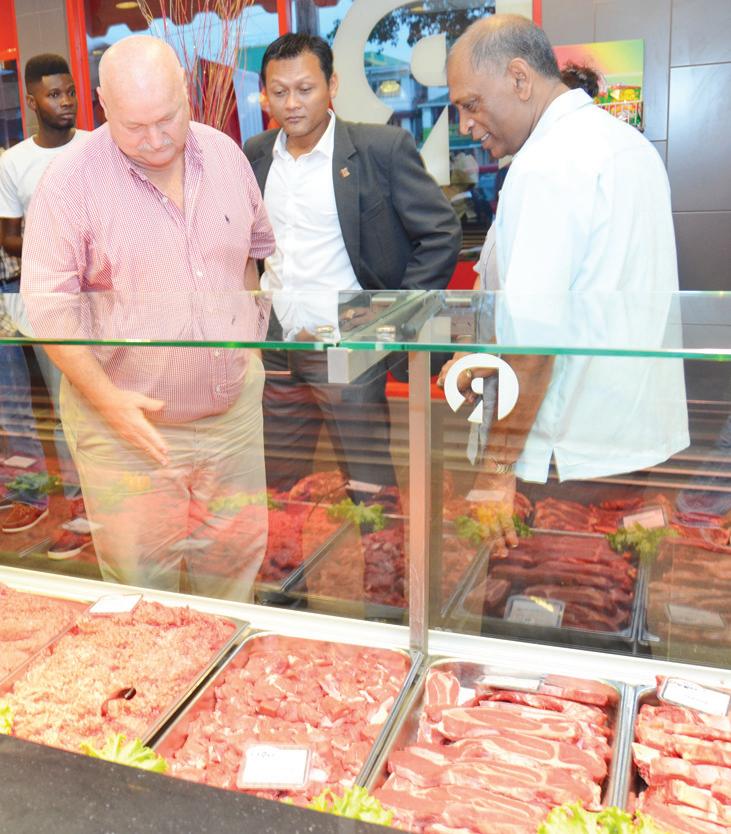
Guyanese will now have the options to buy fresh, quality cut meat, as popular Suriname butchery, Rossignol Butcheries, expands its services to Guyana, investing some $240 million in the venture.
Rossignol Butcheries is a Suriname-base company with six branches across the neighbouring country that provides high quality meat to its customers. The butchery has been opened since April of this year for a trial run before the official opening.
Located on Church Street, Georgetown, Rossignol Butcheries (Guyana) is a state-of-theart meat centre with top of the line storage facilities. In addition to selling beef, pork and chicken, cut according to the “European style”, which they also have pre-seasoned, Rossignol Butcheries also sell sausages, a variety of cheese and meat seasonings.
The butchery has also introduced their bread section, where they have available several types of imported bread, semi-cooked from Suriname, along with various delectable pastries made from different meats and cheese.
Bussiness opportunity
Owner of the Rossignol Butcheries franchise, Gerrald Van Dijk, told Guyana Times that he got the idea of his business to Guyana about five years ago. “We saw the opportunity a while ago because Guyana does not have anything like this and we were looking into how we were going to get started with it and now here we are,” he said.
Van Dijk disclosed that in order to make his new venture successful, he teamed up with five other persons in Suriname, to fulfil the desire. Some $240 million was invested in this expansion, with a loan of $160 million from the Guyana Bank for Trade and Industry (GBTI).
Apart from providing top quality meat, the state-ofthe-art butchery also provides employment to 14 Guyanese, who are being paid above the new minimum wage. The butchery will also provide market for local farmers, from whom they will buy raw meat; however, they will also be importing small portions from Suriname and the U.S.
The official opening of the Rossignol Butcheries on Sunday was attended by Agriculture Minister

Dr Leslie Ramsammy, Suriname’s Trade Minister Raymond Sapoen, Suriname’s Ambassador to Guyana Mehroen Nisa Kurban-Baboe, GBTI Chief Executive Officer (CEO) John Tracey, and members of the diplomatic community.
Van Dijk’s business partner, Surinamese Bryan Renten, said the butchery offers high quality meat, which
that like every venture, this was not a smooth path since they experienced difficulties regarding the custom procedures at the borders of the two neighbouring countries, and had to call on the authorities to look into the matter.
However, the Suriname trade minister, Sapoen, acknowledged the hassle persons faced at the border and assured the businessmen
is up to par with international standards. “Rossignol Butcheries is a place where you can get high quality meat and freshly baked bread under one roof. It also brings value to Guyanese market and Guyanese economy,” he noted.
“Rossignol Butcheries will also be an incentive for local butchery and supermarkets to improve the quality of their products and customer service,” Renten added. He further stated
that the issue is currently being addressed.
He said that the establishment of a Rossignol Butcheries in Guyana is an improvement of cross border activities between the two countries.
“This is a good example of regional integration between Caricom states, it’s all about raising the living standards of our community, it’s all about providing employment, it’s all about generating income and this
is an example of it,” said the Surinamese minister.
Dr Ramsammy pointed out that Guyanese welcome the establishment of the high quality butchery, as it seeks an improvement in quality and services. “People want better standards, people demand better standards and that is why more and more people are shopping in supermarkets rather than corner stores and community markets… it’s because we do desire better service.”
The minister disclosed that when it comes to quality meat, Guyana is the only World Organisation for Animal Health (OIE) certified Caricom country, while adding that Guyana is on the verge of receiving another certificate from the OIE.
Foreign investment
Dr Ramsammy expressed his gratitude to the Surinamese company for investing in Guyana, noting that the country has vast opportunities for local and foreign investment.
Tracey told the gathering that there was no difficulty on the part of the bank to invest in the venture, noting “the standard of Rossignol Butcheries is much higher from what we are accustomed to see in Guyana”. Tracey said the venture is beneficial to Guyana since it transfers capital and technology into the country.
“This also proves to be a vote of confidence in our country and depicts integration of people of this region. The two countries are now linked in the economic front, in addition to the already existing cultural link,” explained the bank’s CEO.
Persons will want to compete with Rossignol Butcheries and will therefore have to raise their standards and improve their services. This, he pointed out is important as it would raise the bar as it relates to local products and services.
Kurban-Baboe noted that for years, Guyana and Suriname have enjoyed good economic relations. “The mere fact that the Guyanese society can now enjoy this piece of Suriname’s rich culture is an example of regional integration at work,” she stated.
The opening of Rossignol Butcheries comes shortly after the hosting of the Guyana Investment Conference, a forum held to discuss challenges and opportunities investors face in Guyana.

Old people seh when mouth open, story does jump out. Well, some body mouth open and tell de Staybroke News that Sus Penders does write a lotta wrong tings in de paper that could mek dem have to pay big money or end up in jail.
De Staybroke people woulda end up just like how de Kocheur people had to do, down on dem knees and beggin de big man fuh mercy, although de Headitor was beggin fuh jail time alone. It turn out that he had to pay from he own salary.
Now dis Headitor like to tell de whole of Guyana what dem should write and what dem shouldn’t write, and how he believe in a free press. Well, nutten was free over de past couple days, because he couldn’t even buy a beer over de holiday weekend. And it was also month end, so he mouth feel more dry than any other weekend.
A reporter seh de same Headitor even turn up at a bar in Kitty and volunteer fuh mek plenty noise in exchange fuh a couple of free beers. But de boss man who own de bar tell he not a bit of it any more, and that de bar stop mekkin noise.
Is de same weekend that Sus Penders pull up he pants and tell de Staybroke people that dem shouldn’t worry and that he know every ting. But dis is a man who turn a lawyer wid a dead brain.
Ting-a-ling-a-ling…friend tell friend…mattie tell mattie! So de Staybroke people ain’t tekkin no chance. One time dem had to apologise to de PSC boss, so dem sending every ting now to a real lawyer before publishin!!!
Ataxi driver was on Monday morning arrested following a brazen daylight robbery committed on an accounts clerk at the Woodlands Hospital, Carmichael Street, Georgetown, who was relieved of $1.1 million. The robbery reportedly occurred about 09:00h.
According to police spokesman Ivelaw Whittaker, Sattie Persaud, 47, an accounts clerk was carrying a bag containing $1.1 million to the hospital’s accounts office when she was held up by a man, who was armed with a firearm.
The robber took away the cash and her cellphone and escaped in a taxi. According to additional information received, two men went to the Woodlands Hospital under the pretext of seeking treatment. They then headed to the accounts department, claiming that they were going to pay a bill.
The robbers then attacked a cashier and relieved her of the deposit she
had in her possession and fled the scene, but not before pushing the woman into an empty room. Luckily, the woman was not injured. She reportedly managed to let herself out of the room and raise an alarm.
A hospital employee told the media that “they must’ve scouted the area because its holiday and downstairs wasn’t open, so they had to know where the money was being kept and hospital runnings”. He said the men had a gun, but that the robbery and the attack happened so quickly that the security guard could not respond.
The police were summoned, but arrived almost 30 minutes late. The cashier and hospital administration were questioned by investigators as they probed the robbery. One of the robbers reportedly left in a waiting black Raum that police are looking for. It reportedly took off in the direction of Lamaha Street. Police are continuing their investigations.
By Samuel Sukhnandan
he Amerindian
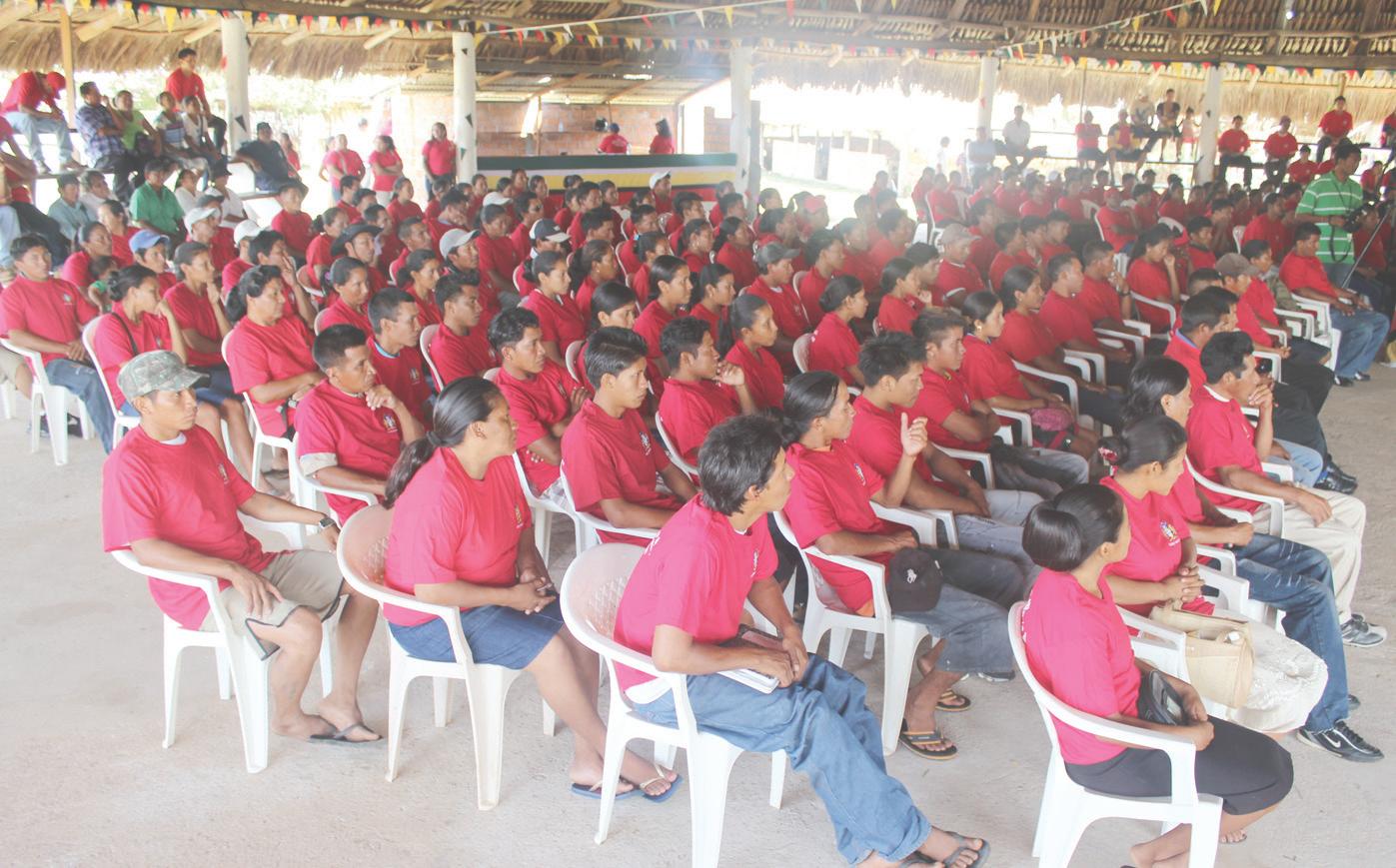
TAffairs Ministry on Sunday launched its Youth Apprenticeship and Entrepreneurship Project at St Ignatius, Region Nine, days after the official launch in Region One.
Amerindian Affairs Minister Pauline Sukhai in addressing the participants said the project is one that will help to shape the future of scores of Amerindian youths, from almost all indigenous communities.
Minister Sukhai said some 298 youths from Region Nine will benefit from the project and encouraged them to make use of the once in a lifetime opportunity, as government seeks to improve the livelihoods of Amerindians by providing skills training to enhance their development.
Hands-on training
According to her, the project is part of government’s vision to improve its human resources. Sukhai said while many Amerindian youths have not been fortunate to attend skills-based training centres such as the Government Technical Institute GTI, the Carnegie School of Home Economics and the Kuru Kururu Training College, the project will provide the opportunity where Amerindian youths will get a chance to get hands-on training and experience in a number of areas that suit them.
“Therefore, while you may not be one of those persons going to an institute beyond the borders of your region, you will be the foundation, the forerunners, and the pioneers with respect to engaging at the community level in your region,” she added.
The Amerindian affairs minister noted too that there are many youths who are still desirous of staying in their communities to help with its development, and noted that the newly launched project will aid in this regard.
Minister Sukhai said the project will also encourage youths to contribute to nation building and community development. In explaining the details of the project, she said it is twofold and focuses on building skill sets and creating a mindset that will foster and encourage entrepreneurship. This, she noted will contribute to Guyana’s overall objective of becoming a productive and transformative economy.
In detailing the apprenticeship aspect of the project, Sukhai said her ministry will be partnering with other ministries, as well as private sector companies to provide work stints for each of the participants. They will be paid a small stipend, as community service officers (CSO), and will have a sixmonth work attachment. After the training and experience, she said it will be left up to each participant to decide ways in which they could contribute not only to community development, but to their individual advancement as well. In addition to that, the ministry has requested from all participants to state their area of interest, so as to group their skills and make available to them suitable jobs.
Further, Sukhai said while many youths have a common interest of obtaining an eight hour job, they must go beyond the call of duty and devote more time to their jobs in order to reap greater benefits. “We want you to think of how you can contribute to community development and help to create employment,” she stated. The minister explained that today’s indigenous youth are becoming more mobile; with many of them leaving for jobs in other communities.
This, she said could negatively impact some communities. Sukhai reiterated that in combating the challenges that Amerindian youths face in acquiring jobs, they must look at ways in which they can utilise the resources in their communities, to
gain employment, which will earn them a decent income for themselves and families.
On this note, she reminded that toshaos in the past have been urged to put youths at the top of their agenda and stressed that this must continue.
The minister also encouraged the participants to become volunteers in their communities. She noted that the project will also teach each participant leadership skills, that will allow them to become leaders in the respective villages. She also noted that participants will leave the training empowered and ready to face the challenges of the world of work.
In closing, Sukhai said the government can only provide the necessary tools to empower youths to gain employment and develop their own businesses, but it will also be left with them to decide how far that reaches. She said that potential lies in all youths of Guyana, but it is the individual who has to be determined to ensure that his/her potential is realised.
“You are responsible for your dreams… you are Guyana’s future leaders,” she said.
The occasion was also addressed by Amerindian Affairs Ministry Project Coordinator Jude DaSilva, St Ignatius Toshao Yusa Xavier and Regional Chairman Wilson Lorentino. The project targets Amerindian youths ages 18-40. They will be engaged in training in a number of areas, including governance, health, education, sports and culture and infrastructure.
In the long-run, the training is set to not only aid self-development but also community and national development. It is anticipated that at the end of the six-month attachment, participants would have enough skills to set up their own business, secure a job or even pursue higher education. (samuelsukhnandan@ guyanatimesgy.com)
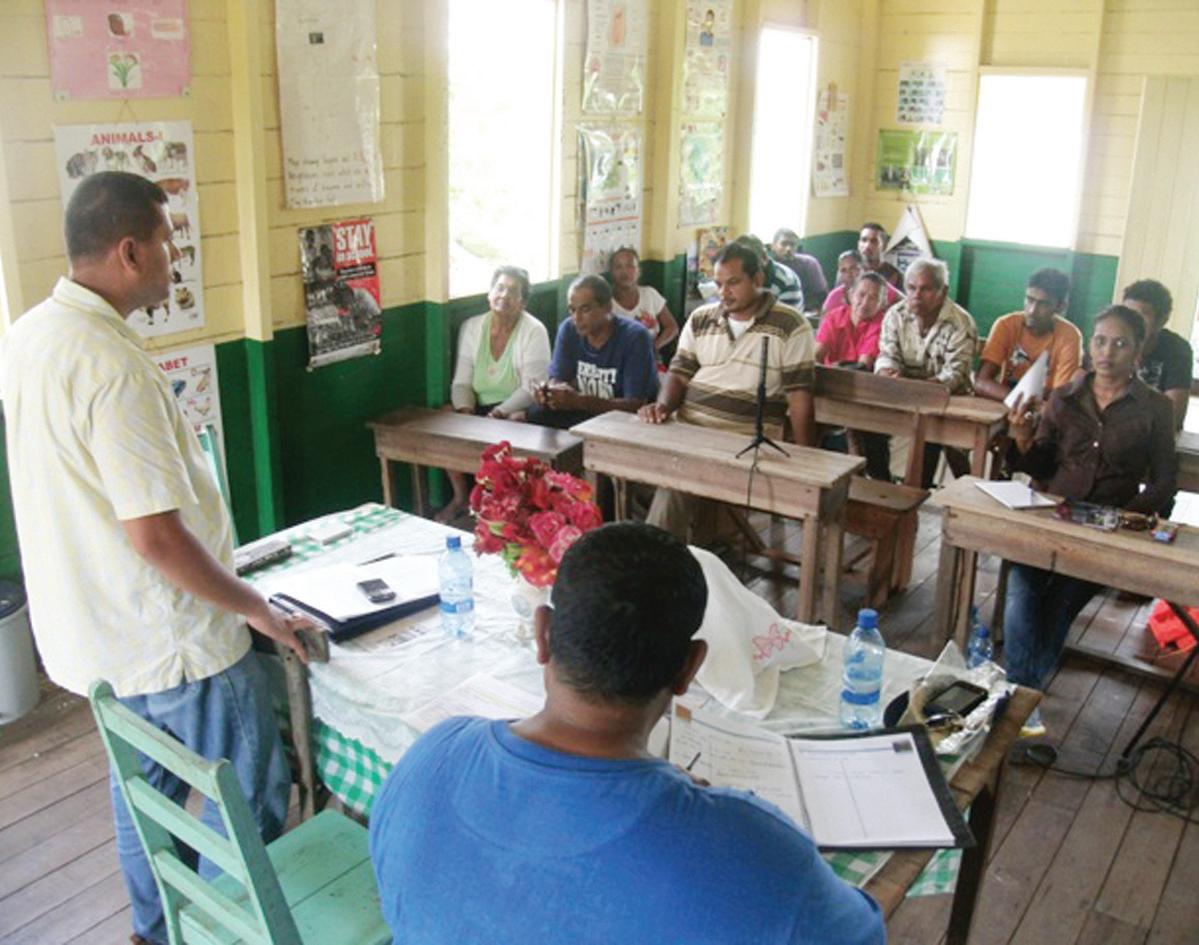
The Local Government and Regional Develop-ment Ministry embarked on another leg of its outreaches in the Demerara River where five teams of ministers and regional officials visited and interacted with residents on both sides of the river.
Based on the village’s location, it can either be a part of Region Three or Four. According to a Government Information Agency (GINA) report, Local Government and Regional Development Ministry Permanent Secretary Colin Croal engaged with the residents of Low Wood and Princess Carolina, both of which are predominantly farming communities.
While at Low Wood, Croal recalled that the community was visited last November and a request was made for a solar panel for the village’s primary school. That request has since been fulfilled.
He emphasised that during his last visit to the community, it was observed that construction was being carried out on the teachers’ quarters and the health post. He pointed out that thus far, phase one of the projects is complete but the fittings and plumbing works are yet to be installed. Additional staff for both institutions will also be finalised shortly.
Croal emphasised that those projects are investments being made by the government in communities regardless of their location and the challenges being faced. He highlighted that in the region’s work
programme, upgrades will be done on the Low Wood Primary school, and it is anticipated that by the end of July, work will start.
While the much needed infrastructure is being put in place, attention also has to be paid on the environment. This, he, indicated is the partnership that is required between the government and the community, that is to keep the environment clean and to ensure that parents send their children to school regularly and the health facility is adequately utilised. Both of these provisions are intended to make the lives of the people better. In this regard, Croal urged the residents to return to the days of community spirit.
Meanwhile at Princess Carolina, he noted that the Local Government Ministry through the Regional Democratic Council (RDC) is responsible for the entire country, so anything that takes place in the communities is the business of the ministry.
He indicated that while all the requests and concerns cannot be sorted out immediately, there are some that require longterm planning and budget allocations while others can be dealt with by the residents themselves. In 2013, the village’s primary school will be benefiting from repairs. Croal urged the headteacher to collect a copy of the unpriced bill of quantities so as to eliminate the blame game, mis-information and the community would be fully aware of the project. He emphasised that even though the school’s popula-
tion is low, government is still investing in the school so as to ensure that every child has access to education and this is in tandem with the Millennium Development Goal (MDG) that targets education. Most of the school children in the community attend the school at Timehri. With regards to the applications for firearm licence, the permanent secretary explained that it is a rigorous process that is controlled by the Home Affairs Ministry and Guyana Police Force, and the ideal thing is for one or two responsible people in community to make the application.
In relation to agriculture, each of the visiting teams had an agriculture extension officer to answer to the concerns raised in that field and based on the feedback, the Agriculture Ministry will schedule an engagement with the residents. The residents were also given the opportunity to raise their concerns with the permanent secretary; these were based on education, agriculture, infrastructural projects (contracts/bill of quantities), securing a firearm licence and sports. During the interactions, Croal told residents that the regions are at a stage where they are commencing their respective 2013 work programmes and projects are set to be completed shortly, since bids have been advertised and awards handed out. It is hoped that by November the projects will be completed even though the budget cycle started late.
tuesday, july 2, 2013
One in eight people worldwide remain hungry and too many women die in childbirth when there are means to save them according to a status report on the Millennium Development Goals (MDGs). However, the report, which was released on Monday, noted that with the 2015 deadline for the MDGs on the horizon, progress can be reported in most areas, despite the impact of the global economic and financial crises.
According to the report, more than 2.5 billion people lack improved sanitation facilities, and one billion of them continue to practise open defecation, a major health and environmental hazard. The report also observed that the resource base is in serious decline, with continuing losses of forests, species and fish stocks, in a world already experiencing the impacts of climate change.
However, according to the report, several important targets have or will be met by 2015, assuming continued commitment by national governments, the international community, civil society, and the private sector. That said, progress in many areas is far from sufficient. The report noted that redoubled efforts are urgently needed, particularly in regions most behind to jumpstart advancement and achieve maximum gains. The world community should take pride in its accomplishments thus far, while building on existing momentum to reach as many goals as possible by 2015 and to realise gains for all, the report said.
Regarding efforts to end poverty, the report stated that the world reached the poverty reduction target five years ahead of schedule, noting that in developing regions, the proportion of people living on less than US$1.25 a day fell from 47 per cent in 1990 to 22 per cent in 2010. About 700 million fewer people lived in conditions of extreme poverty in 2010 than in 1990.
Additionally, over the last 21 years, more than 2.1 billion people gained access to improved drinking water sources. The proportion of the global population using such sources reached 89 per cent in 2010, up from 76 per cent in 1990. This means that the MDG drinking water target was met five years ahead of the target date, despite significant population growth.
Further, between 2000 and 2010, mortality rates from malaria fell by more than 25 per cent globally. An estimated 1.1 million deaths from malaria were averted over this period. Death rates from tuberculosis at the global level and in several regions are likely to be halved by 2015, compared to 1990 levels. Between 1995 and 2011, a cumulative total of 51 million tuberculosis patients were successfully treated, saving 20 million lives.
Between 2000 and 2010, more than 200 million slum dwellers benefited from improved water sources, sanitation facilities, durable housing, or sufficient living space, thereby exceeding the 100-million MDG target. The report states that many countries across all regions have shown remarkable progress in reducing the proportion of urban slum dwellers.

Globally, the maternal mortality ratio declined by 47 per cent over the last two decades, from 400 maternal deaths per 100,000 live births to 210 between 1990 and 2010
The report noted that the proportion of undernourished people worldwide decreased from 23.2 per cent in 1990-1992 to 14.9 per cent in 2010-2012. Given reinvigorated efforts, the target of halving the percentage of people suffering from hunger by 2015 appears to be within reach. Still, one in eight people in the world today remain chronically undernourished.
Global emissions
In the area of global emissions, the growth in global emissions of carbon dioxide (CO2) is accelerating, and emissions today are more than 46 per cent higher than their 1990 levels. Forests, the report said, continue to be lost at an alarming rate. “Overexploitation of marine fish stocks is resulting in diminished yields. More of the earth’s land and marine areas are under protection, but birds, mammals and other species are heading for extinction at an ever faster rate, with declines in both populations and distribution. “
According to the report, worldwide, the mortality rate for children under five dropped by 41 per cent – from 87 deaths per 1000 live births in 1990 to 51 in 2011. Despite this enormous accomplishment, more rapid progress is needed to meet the 2015 target of a two-thirds reduction in child deaths. Increasingly, child deaths are concentrated in the poorest regions, and in the first month of life. Globally, the maternal mortality ratio declined by 47 per cent over the last two decades, from 400 maternal deaths per 100,000 live births to 210 between 1990 and 2010. Meeting the MDG target of reducing the ratio by three quarters will require accelerated interventions and stronger political backing for women and children.
Regarding HIV/AIDS, the report states that while new HIV infections are declining, an estimated 34 million people were living with HIV at the end of 2011.The MDG target of universal access to antiretroviral therapy for all who need it by 2010 was missed, but is reachable by 2015 if current trends continue. The ultimate goal is preventing the spread of HIV, but knowledge of the virus and how to avoid transmission remains unacceptably low.
Between 2000 and 2011, the number of children out of school declined by almost half—from 102 million to 57 million. However,
progress in reducing the number of children out of school has slowed considerably over time. Stalled progress means that the world is unlikely to meet the target of universal primary education by 2015.
From 1990 to 2011, 1.9 billion people gained access to a latrine, flush toilet or other improved sanitation facility. Despite these accomplishments, more rapid progress is needed to meet the MDG target. Stopping open defecation and instituting the right policies are key.
In 2012, net aid disbursements from developed to developing countries totalled US$126 billion. This represents a four per cent drop in real terms compared to 2011, which itself was two per cent below 2010 levels. This decline affected least developed countries disproportionately. In 2012, bilateral official development assistance to these countries fell by 13 per cent, to about US$26 billion.
In 2011, only 53 per cent of deliveries in rural areas were attended by skilled health personnel, versus 84 per cent of them in urban areas. Eighty-three per cent of the population without access to an improved drinking water source live in rural communities.
Children and adolescents from the poorest households are at least three times more likely to be out of school than children from the richest households. Girls are more likely to be out of school than boys among both primary and lower secondary age groups, even for girls living in the richest households.
Whether in the public or private sphere, from the highest levels of government decision-making to households, women continue to be denied equal opportunity with men to participate in decisions that affect their lives. Efforts to achieve a world of prosperity, equity, freedom, dignity, and peace will continue beyond 2015. The United Nations is working concertedly with governments, civil society. and other partners to build on the momentum generated by the MDGs and to craft an ambitious, yet realistic, post-2015 development agenda. A successful conclusion to the MDGs will be an important building block for a successor development agenda. And volumes of experience and lessons learned along the way can only benefit the prospects for continued progress.
Small Business Development Finance Trust (SBDF) Managing Director Manjula Brijmohan said the institution has done a good job creating a name for itself in the local financial sector, but more needs to be done in an effort to gain a leadership edge.
Speaking at the recent 10th anniversary celebration and Annual General Meeting (AGM), Brijmohan stated that the achievements gained are but a first step to opening opportunities to the greater achievements which await the small business community.
She recalled that the SBDF started with a small capital and support from the private sector, government and consumers. Brijmohan described the venture as a challenging experience, detailing the transformational journey from a loan portfolio of $11.9 million in 2002 to $282.3 million in 2012.
“In the process, we have financed from very small loans of US$100 to a needy vendor to US$40,000 to small enterprises,” Brijmohan said. She stated that this is a confirmation of the fact that the availability of timely credit is of crucial importance for all businesses, regardless of its size.
The managing director explained that the perception in Guyana is that there is a lot of money floating in the system, but a mechanism has to be found to channel those funds into productive sector investments. Although the investment in the mining sector is evident, Brijmohan believes that other sectors such as agriculture, processing and manufacturing are still untouched.
She is of the opinion that in order to make these sectors attractive, government must provide support for agriculture through better drainage and irrigation systems, along with timely suitable mechanisms to obtain inputs at reasonable prices. Brijmohan mentioned that while small businesses support the “Grow More Food” initiative, there is need for more small scale capital to avoid wastage. “Some more markets needs to be provided so that when we grow more food, it doesn’t go to waste,” she said.
Brijmohan stressed that the performance of microfinance in the economy, is a reflection of the overall performance of the economy.
“We are not looking for free handouts but a system of managing the sector’s requirements effectively. Similarly, the manufacturing sector, the most crucial sector, needs clear aboveboard policies and the effective implementation of these in a timely manner.”
The managing director pointed out that micro-financing has grown over the years with more and different types of actors, new types of products and services being developed and new ideas and technologies to support it. Brijmohan remarked that the SBDF share the vision for Small Micro Enterprises (SMEs) devel-
opment and its future growth, and has been very much a part of the transformational journey. She added that the trust had started with few borrowed dollars in 2002 and reached its present level with a US$1.4 million portfolio and approximately 600 individuals as partners.
Brijmohan said the effective delivery of credit at the doorstep of those who need it the most has created a trusted relationship that makes SBDF the preferred choice. She added that SBDF continues to provide loan products, including micro and small loans, development loans, micro housing loans and consumer loans.
In the area of micro loans, there are relatively small loans generally provided to low income enterprising individuals and are designed to assist underprivileged communities to engage in simple economic activities which generate funds for basic necessities.
The development loans offered by the SBDF are larger sums and generally require sound collateral security. The demand for loans in this category has increased substantially due to increased production in sectors that require larger investments such as agriculture and manufacturing.
The micro-housing loans are provided to low income earning families with available houselots, who are unable to qualify for financing from traditional lending institutions.
The main objective in providing these loans is to create a stable and safe living environment for small entrepreneurs. Meanwhile, the consumer loans are targeted at personal and family improvement purposes and enable clients to enhance their quality of life. SBDF executives believe that one of the factors which enables the institution to emerge as a strong body is the leadership in building and motivating a team.
“We are committed to reducing poverty and improving the standard of living and quality of life for underprivileged communities. Small business development and finance will provide men and women with reliable access to micro-financing services that address their need, build their capacity and empower them to live with dignity, economic security and social justice,” Brijmohan stated.

Last week, Guyana donated US$10,000, following an appeal by the Organisation of Islamic Cooperation (OIC) secretary general, Dr Ekmeleddin Ihsanoglu, to assist Malian IDPs (internally displaced persons) and refugees. The money will help to alleviate the plight of the most vulnerable and needy Malian people who have been badly affected by this current crisis, according to an OIC press release.
The Republic of Cameroon donated US$100,000 following Ihsanoglu’s call to help refugees in Mali. Two years ago, Guyana donated US$30,000
to people affected by floods in Pakistan and that money helped build 100 housing units, a school, a health centre and a mosque for the people of the Dera Gazi Khan village in Multan, Punjab Province, which was ravaged by floods. The Republic of Cameroon also donated to this project in Pakistan.
According to the press release, the OIC secretary general expressed his gratitude to the representatives of Cameroon and Guyana and informed them that the funds will be used to assist IDPs, who have recently returned to Northern Mali after several months away from their houses and separated from
their loved ones.
Ihsanoglu reiterated his pressing appeals to all OIC member states and the international community to generously donate to Mali, which needs their assistance to tackle the daunting challenges of development and food insecurity.
Mali is a predominantly Muslim country in sub-Sahara Africa with a rich history that goes back to the times when Timbuktu was an intellectual city that joined vital trade routes that linked Ghana to Mali to Morocco. It is today facing a Toureg rebel insurgency that threatens to destabilise this drought-plagued region.
(Caribbean News Now)

The newly-formed Guyana Fashion Designers Council on Sunday evening staged “Fit Me 2013”, the group’s signature fashion show at the Umana Yana.
The show was organised by the fashion designers council and the Guyana Manufacturing and Services
funding fashion design in Guyana via the Caribbean Export Development Agency. He noted that the GMSA had obtained a grant of 30,000 euros from CEDA for capacity building in different areas, one of which is fashion design. This funding assisted in the settingup of the Guyana Fashion

Association (GMSA). The event was addressed by Human Services and Social Security Minister Jenifer Webster, GMSA President Clinton Williams, and the feature speaker was European Union Delegation Chargé d’Affaires Derek Lambe.
In his speech, Lambe outlined how EU cooperation is
Designers Council, and the funds will also be used to fund capacity-building activities for operators in the local fashion industry, including training by professionals from abroad and visits by local designers to overseas fashion centres.
In a statement, the GMSA said the CEDA grant is reimbursable. According
to the association, the grant was approved following a 2012 application it made to CEDA, the Caribbean region’s principal financier for development projects. The funds are being provided from the 10th European Development Fund (EDF), the main instrument for providing “community aid” for development cooperation in African, Caribbean and Pacific (ACP) countries.
During the first quarter of 2013, the GMSA began the initial outreach to local designers and soon thereafter, the Guyana Fashion Designers Council was formed principally to provide a platform that will allow all designers to speak with one voice, to organise capacity-building programmes, secure technical expertise, participate in overseas activities, and find foreign markets.
Certain milestones were set out by Caribbean Export in order to qualify for funding, one of which is the establishment of the council which will be registered shortly. The council must also raise the ‘seed capital’ to build the capacity and competitiveness of the fashion designers cluster.

Some relationships just do not last too long; some do not even get started if the other is broke.
This is exactly what happened some 10 weeks ago when investment suitors came rushing to the emerging markets with bags of money to mop up US$20 trillion of cheap government securities going below a one per cent return and now the tide of lenders is ebbing.
Investors began pulling stakes with large scale selling of these assets amid fears that the U.S. Federal Reserve may slash the monthly US$85 billion flow of easy money that kept short interest-rates here around zero per cent.
The near zero rate has allowed the opulent investors to try their hand in the riskier emerging markets where a one-per cent margin was better than nothing.
At the end of April, the average yield to maturity for Bank of America Merrill Lynch Global Broad Market Sovereign Plus Index floated
International expert says profit-seekers do not lend to governments that cannot return their money with agreed interest payments
around 1.34 per cent.
Analyst, Edward AlHussainy, an assistant vice president at Moody’s, in a telephone interview from New York, noted that even the far flung Rwanda which had almost self-destroyed by civil war a few years back raised US$400 million in bonds while hot spots like South Africa, Columbia and Thailand creamed off their share of the financial largesse of low cost money.
Earlier this year, Caribbean countries re-
structured three bonds totalling US$9.7 billion but analyst say in the absence of real economic growth, countries in this region may spin in more cycles of default.
“Jamaica and Belize hogged the lion’s share of some US$9.5 billion in restructured debt since 2006 and Barbados is running low on planned reserves. And overall, the average debt for the Caribbean to income ratio is about 70 per cent with Jamaica ahead at 140 per cent,” Al-Hussainy said. (Excerpt from Caribbaen360)
The Grenada par-
liament on Friday passed legislation to punish people with hefty fines and/or lengthy jail terms for what is termed “offensive online comments”.
However, the expression “offensive” is referred to in vague and broad terms, leading many people, especially journalists, to fear that anything could be re-
garded as offensive by the New National Party (NNP) government led by Prime Minister Dr Keith Mitchell who, following general elections in February, currently enjoys control of all 15 seats in the lower house of parliament.
Mitchell has a long history of using the law to prosecute and/or otherwise intimidate local and international
media and journalists in attempts to suppress unfavourable reporting.
Now, according to the new law, complaints about offensive comments would be filed with police. A judge would then decide if the message was offensive. Those found guilty could be fined up to EC$37,000 or face three years in prison.
(Excerpt from Caribbean News Now)
Chilean former President Michelle Bachelet has secured her place in November’s presidential election by winning a key party primary.
Preliminary results from Sunday’s poll show she cannot be caught by her rivals in the left-wing opposition coalition.
A primary was also held in the governing conservative Alliance for Chile. Results so far indicate a
close race between two former ministers.
Sunday’s primary elections were the first ever held in Chile.
Bachelet – who served as president between 2006 and 2010 – won two-thirds of the votes for the New Majority coalition, the preliminary results suggest.
She has spent the past three years in New York as head of the United Nations gender equality agency and
is still considered one of Chile’s most popular politicians.
In the governing centre-right Alliance for Chile, former ministers Andres Allamand and Pablo Longueira were neck and neck.
Voters will choose a successor to President Sebastian Pinera on November 17. Chilean politicians are prevented from serving consecutive terms.
(Excerpt from BBC News)
Under the United National Congress (UNC) constitution, former Chaguanas West Member of Parliament (MP) Jack Warner stands to “automatically expel” himself from the party if he contests the July 29 Chaguanas West by-election as an independent candidate, UNC election officer Ramona Ramdial confirmed on Sunday.
“The same situa-
tion, as what happened to (former Congress of the People member) Manohar Ramsaran, will occur as the UNC’s constitution allows only one candidate for the party and if someone goes up independently, they are automatically expelled from the party,” she told the TT Guardian. Ramsaran was automatically expelled from the COP after he submitted a nomination to contest the same seat for the UNC.
Ramdial was asked about the UNC constitution following Warner’s comments that he will make a decision with regards to his future and will announce such at a meeting on Friday. Warner resigned as MP, cabinet minister and UNC chairman in April, following a damning Concacaf report on his tenure as president of the regional governing body for football. (Excerpt from Trinidad Guardian)
Egypt’s military issued a 48-hour ultimatum to the Islamist president and his opponents on Monday, saying either a solution is found or it will intervene to put forward a political road map for the country and ensure it is carried out.
In a statement read on state television, General Abdel Fattah al-Sisi described the mass protests on Sunday, which brought out millions of Egyptians calling for Islamist President Mohammed Morsi’s resignation, as “glorious”.
Al-Sisi said the military should “not be a party in politics or rule”, but

that it has a responsibility to act because Egypt’s national security is facing a “grave danger”. The declaration was met with delight on the streets of Cairo, where
protesters cheered, beeped their car horns and waved flags.
The statement came as five Egyptian ministers were reportedly considering
resigning their posts over the unrest and joining the mass protests. The Tamarod [which means “rebellion” in Arabic and is the grassroots campaign that called for Sunday’s protests] opposition has given President Morsi until Tuesday to stand down, threatening “a complete civil disobedience campaign” if he refuses. Sunday’s protests saw at least six people killed.
“We give Mohammed Morsi until 5pm (15:00h GMT) on Tuesday, July 2 to leave power, allowing state institutions to prepare for early presidential elections,” Tamarod said in a statement on its website. (Excerpt from France24)
U.S. intelligence leaker
Edward Snowden has applied to Russia for political asylum, Russian officials say. Foreign Ministry
Consul Kim Shevchenko said the request was made on Sunday night. The Kremlin has made no comment. The 30-year-old former CIA analyst is believed to be holed up in a Moscow airport hotel.
Earlier, Russian President Vladimir Putin said Snowden was welcome to stay as long as he stopped “inflicting damage on our American partners”.
The U.S. has not yet made any comment on the latest developments.

President Barack Obama, speaking earlier in Tanzania, said Washington and Moscow had held “high level” discussions about
Snowden.
“We are hopeful the Russian government makes decisions based on the normal procedures regarding
international travel and the normal interactions law enforcement have,” he told reporters, pointing out that Snowden does not have a valid passport or legal papers.
According to Russia’s Interfax news agency, Snowden’s application for asylum was handed to a consular official at Moscow’s Sheremetyevo Airport late on Sunday evening.
The application was delivered by Sarah Harrison, a member of the Wikileaks legal team acting as Snowden’s representative, Kim Shevchenko was quoted by the news agency saying. (Excerpt from BBC News)
South Africa’s President Jacob Zuma has told the nation to begin planning for Nelson Mandela’s birthday on July 18. The former president and global statesman, who will turn 95, remains critically ill in hospital in Pretoria. He was admitted on June 8 with a recurring lung infection.
President Zuma’s comments come after Mandela’s ex-wife criticised his governing African National Congress (ANC) party for filming the former president at his home in April.

The footage showed Mandela looking dazed and unsmiling during a visit by one of the ANC’s leaders to
his home.
Winnie MadikizelaMandela told ITV News: “I honestly cannot put in
words how hurt the family was and it was one of the most insensitive things for anyone to have done.”
Responding to criticism at the time, the ANC defended its filmed visit, saying it was not a “publicity stunt”.
On Monday, President Zuma put out a statement reminding “all South Africans to begin planning for Madiba’s birthday”, using the former leader’s clan name.
“We must all be able to do something good for humanity on this day, in tribute to our former president,’’ he said. (Excerpt from BBC News)
North Korea’s chief nuclear negotiator will meet senior Russian officials next week to discuss ending the embattled nation’s nuclear programme, Russia’s Foreign Ministry said.
The talks involving Kim Kye Gwan, North Korea’s first deputy foreign minister, and Russian deputy
foreign ministers Vladimir Titov and Igor Morgulov will take place Thursday, the ministry said in a statement, according to Russia’s RIA Novosti news agency.
The meeting is “part of efforts to resume the sixparty talks” related to North Korea’s controversial nuclear programme, according to Russia’s Foreign Ministry.
Those talks involving officials from North Korea, South Korea, China, Japan, the United States and Russia have been at a virtual standstill since last decade.
Tensions in and around the Korean Peninsula escalated even further in the past year, particularly after Pyongyang launched a long-

President Barack Obama responded to outrage by European leaders over revelations of the U.S. spying on them by saying Monday that all nations, including those expressing the strongest protests, collect intelligence on each other.
The German news magazine Der Spiegel reported Sunday that classified leaks by former National Security Agency contractor Edward Snowden detailed NSA bug-
ging of European Union offices in Washington and New York, as well as an “electronic eavesdropping operation” that tapped into an EU building in Brussels.
Mounting anger throughout Europe on Monday included a threat by French President Francois Hollande to halt talks with the United States on trade and other issues unless the bugging stopped.
U.S. and EU officials are scheduled to begin talks on a proposed trans-Atlantic free trade agreement next week.
The European Commission will sweep its offices for electronic listening devices and other security breaches, a spokeswoman said Monday.
Asked at a news conference in Tanzania about the latest leaks involving Snowden, Obama said he needed more information on the specific programmes cited in the Der Spiegel report, but made clear such spying was commonplace. (Excerpt from CNN)

Nineteen elite Arizona firefighters were killed in a perfect storm of wildfire stoked by record heat and high winds in the biggest loss of life battling a U.S. wildland blaze in 80 years, officials said on Monday.
range rocket, then conducted an underground nuclear test two months later.
The international community widely criticised the moves, threatening yet more sanctions and punitive measures. And yet North Korea remained defiant –even threatening to attack South Korea and the United States. (Excerpt from CNN)
The crew known as the Granite Mountain Hotshots from the Prescott, Arizona, Fire Department was killed on Sunday when the fastmoving wildfire trapped them near Yarnell, a town about 80 miles north-west of Phoenix.
“It had to be a perfect storm in order for this to happen. Their situational awareness and their training was at such a high level that it’s unimaginable that
this has even happened,” Prescott Fire Department spokesman Wade Ward told ABC’s “Today” programme. The blaze is raging unchecked after burning about 8400 acres of tinder-dry chaparral and grasslands. It was sparked by lightning on Friday, Arizona state fire officials said in a statement.
U.S. President Barack Obama joined a chorus of condolences over the deaths, whose exact cause was under investigation.
Ward told ABC’s “Good Morning America” the men had put up fire shelters, a tent-like safety device designed to deflect heat and trap breathable air, in a last-ditch effort to survive.
Representatives of local manufacturing companies, along with officials of the Trade Ministry, the Food and Beverage Industry Development Committee, exporTT Ltd and invesTT Ltd, left for the United States on Friday to participate in the 59th Summer Fancy Food Show, currently taking place at the Jacob Javits Centre, New York.
The team will be led by Vasant Bharath, trade minister, who is also scheduled to participate in investment and export promotion meetings. The companies forming the delegation this year include Angostura Limited, the Caribbean Development Company Limited (Carib Brewery Ltd), Charles Chocolates, Chief Brand Products, KC Confectionery Ltd,
National Canners/Matouk International, SMAKS Luxury Group and VEMCO LTd.
The Summer Fancy Food Show features 1500 exhibitors, with 34 international pavilions, including Bulgaria, Indonesia, Sri Lanka, Switzerland, Jamaica, The Dominican Republic, Italy, Turkey, France, Spain and TT. (Trinidad Guardian)
U.S. manufacturing recovered in June from an unexpected dip in May, according to an industry survey, although the level of hiring in the sector was the weakest for nearly four years.
The index of national factory activity as recorded by the Institute for Supply Management (ISM) rose to 50.9 in June from 49.0 in May. A reading above 50 indicates growth.
Earlier, a separate sur-
vey for the eurozone manufacturing sector showed activity there at a 16-month high. The U.S. survey showed the gauge for new orders rose to 51.9 from 48.8, while the production measure leapt from 48.6 to 53.4.
Employment, however, gave its lowest reading since September 2009, falling to 48.7 in June from 50.1 in May. The latest official growth figures for the U.S. economy, released last
week, showed an annualised growth rate of 1.8 per cent for the first three months of the year, instead of the 2.4 per cent originally estimated.
The weak employment reading in the PMI survey may add to worries about the strength of the U.S. economy. The U.S. Federal Reserve has indicated that it will slow down its US$85 billion-a-month bond purchases if the economy continues to recover. (BBC News)
European demand for luxury goods is proving resilient, the head of fashion brand Christian Dior said on Monday, downplaying the recent slowdown seen by parent LVMH and rival Kering.
Although the euro-zone recession and China’s slowdown have put the brakes on luxury growth, Sidney
Toledano told Reuters he was upbeat on the future and said there was still demand for the quality of European luxury goods.
“In Europe, demand is proving resilient, thanks to the quality and excellence of our know-how,” Toledano said on the sidelines of Dior’s fashion show.
“I am confident.”
CEO Toledano also said that there was a resurgence in demand from U.S. clients and that Asian demand was still very solid. Dior is due to publish its annual results for its financial year ending in June 2013. Over the first nine months of the financial year its sales grew 19 per cent, to 971 million euros (US$1.27 billion). (Reuters)
Three
decades ago
Chinese leaders unleashed a series of economic reforms that helped lift millions of people out of poverty and transform the Asian country into an industrial powerhouse with a mighty foreign reserve arsenal.
The transition, however, was far from smooth.
“Particularly the first 10 years, it was really tough and hard,” explains Zhong Jianhua, China’s special rep-
resentative on African Affairs.
“So many businesses, factories, go (into) bankruptcy; millions of workers were being redundant or unemployed.”
Before becoming today’s economic behemoth, China was mainly an agricultural economy that boasted huge reserves of natural resources – quite similar to many parts of Africa. So are there any lessons that African countries can learn from China as they bid to boost their economies
and achieve their development goals?
According to Zhong, longterm economic success doesn’t come without short-term cost, and that is the message he is keen to get across to African leaders.
“When we introduce our experience to African countries, on one side we need to say what you should do and need to do, and probably on the other side we should emphasise what you could expect.” (CNN)
China’s vast manufacturing output slowed in June, painting a gloomy picture for growth as the country emerges from its worst cash crunch in at least a decade.
The official purchasing managers’ index (PMI), an important gauge of manufacturing activity, fell to 50.1, down from 50.8 in May. With 50 being the point that separates expansion from contraction, the figures showed growth in the sector had slowed to a near
standstill.
The last time the reading fell below 50 was in September.
“The Chinese economy is still struggling at the bottom,” said Haibin Zhu, the chief China economist of JPMorgan in Hong Kong.
In a second report also released on Monday, Markit and HSBC said their PMI hit a ninemonth low of 48.2 in June, down from 49.2 in May. The measure is based on a survey of more than 420 manufacturing companies, many of them small and
Dubai developer Nakheel said on Monday it has sold two hotel plots on Palm Jumeirah’s crescent for a combined value of almost AED700 million (US$190.5 million).
A plot to the west of Atlantis was sold to a GCC investor for AED556 million, while an Emirati investor purchased a plot on the eastern crescent for AED139 million, Nakheel said in a statement.
A Nakheel spokesman
said: “Land in prime real estate locations – such as Palm Jumeirah – is clearly in big demand, and these latest deals further highlight the trust and confidence that investors have in Dubai, and in Nakheel.
medium-sized. The official figures focus on larger enterprises. Employment figures also dropped in June at the “fastest [rate] since last August, and joint fastest since the depths of the financial crisis in early 2009,” according to HSBC.
Manufacturing and exports have long been the main pillars of China’s economy, and the figures suggest that both have taken a serious hit as a result of economic sluggishness both at home and abroad. (The Guardian)
“The Palm’s crescent is filling up fast with luxury resorts, hotels and residences; these two newly-sold plots will bring yet more attractions to this world famous island, which already plays a pivotal role in the UAE’s tourism sector.” Nakheel said it continues to enhance and improve facilities on Palm Jumeirah and is currently constructing a number of residential projects on the island. Work on the Nakheel Mall and Hotel and The Pointe is slated to begin this year, it said, adding that Palm Jumeirah is also home to the UAE’s first indigenous park – a 1.1 million square foot communal garden – opened by Nakheel last year. (Arabianbusiness)
Learn from the best.
Steve wanted to innovate, so he studied the leading innovators. In Apple’s early days, this was Xerox Parc, so he visited their research labs and saw demonstrations on cuttingedge technologies that changed the trajectory of his company, including graphical user interfaces, object oriented programming, and networked computing.

Let everything be your teacher. Apple took the best ideas from all fields. The early Macintosh team included people with backgrounds in music, poetry, art, history and other liberal arts, who also happened to be among the best programmers in the world.
If not for computer science, they would’ve done amazing things in these other fields.
Bringing together diverse expertise made the products better in countless ways.
Think for yourself. At Apple, Steve didn’t use focus groups and did little or no market research.
To be innovative, you can’t rely on customers to tell you what to do, because they don’t know they want and need things that don’t exist yet. You have to think for yourself, in product innovation and all other areas of business.
Learn to programme. Even if you don’t intend to pursue a career in programming, Jobs thought it was worthwhile to learn to programme, as it helps you learn to think clearly (and provides you with immediate feedback when you’re not).
He felt a business school
degree was unnecessary for entrepreneurs, since business isn’t rocket science, and can be learned on the job.
Passion is essential to success.When hiring, Steve looked for some of the same traits others do, including intelligence and creativity.
But his primary recruiting criterion was a passion for the product that person would be working on. In fact, his passion was so contagious that he was careful to first gauge the passion of the recruiting candidate before expressing his. Also, he emphasised that passion matters much more than money. When Apple came up with the Macintosh, IBM was spending at least a hundred times more than Apple on R&D, but it didn’t matter. (Business Dictionary)
Asecurity officer died Sunday afternoon after he lost control of his motorcycle and slammed into a culvert at Den Amstel, West Coast Demerara. The accident occurred about 17:30h.
Jerome Hackett, 60, of Lot 77 Phoenix Park, West Bank Demerara, reportedly died on his way to the West Demerara Hospital shortly after the accident. According to reports received, Hackett and a relative were heading to Tuschen to finalise a wood cutting job when the accident occurred.
During the journey, he was reporting speeding and in the vicinity of the Den Amstel Police Station, he might have suffered a break malfunction and slammed into the bridge as he was negotiating a turn. He was reportedly flung into the air, landing head first on the concrete structure, breading his neck in the process.
He received injuries and was rushed to the West Demerara Regional Hospital (WDRH) where he was pronounced dead on arrival. When Guyana Times visited the man’s house on Monday, it was secured, and no one
was at home. Neighbours told this publication that the man lived with his brother Desmond and nephew, Marlon, who was involved in a different accident.
Upon advice, this publication visited the WDRH where relatives of the dead man were awaiting the visiting hour to see his nephew who was also involved in an accident on Sunday evening on the Vreed-en-Hoop Public Road. At the medical institution, Patricia Hackette, the deceased’s widow explained that they had separated a few years ago, but she was at her house at Crane Village when she received a call informing her of the accident.
The woman said she was told that Hackett’s neck was broken while her husband’s nephew was also involved in an accident. She said her husband’s body is at the WDRH mortuary awaiting a post-mortem examination while his nephew has sustained severe head injuries and was admitted a patient of the said institution.
She explained that, Marlon Hackett is mentally unstable and was walking on the public road when
a speeding car struck him from behind. The driver, she added was taken into police custody. The woman also disclosed that the younger Hackett would normally patrol the road and in some cases, he would sleep at various corners.
Desmond Hackett, the deceased brother told this newspaper that he saw his brother on Saturday last when he left home to meet a friend. He said that based on reports, his brother was heading to Tuschen to tie up an arrangement with a contractor who wanted some “round wood” to start a construction job. He added that while his brother and a relative were heading to the location, his brother lost control of the motor cycle and slammed into the concrete bridge.
His sister, who travelled from Kuru Kururu Soesdyke/Linden Highway, explained that she received a call about 20:00h on Sunday evening, informing her that her brother had met in an accident and subsequently died.
Hackett had no children, but is survived by his wife and three siblings.
To ensure that the voices of Caribbean states are heard at the 2014 Conference of Small Island Developing States, representatives of Caribbean states will gather in Kingston, Jamaica from today to determine common concerns, exchange experiences and lessons learned, and discuss regional perspectives and positions for the conference.
Next year’s conference, which will take place in Apia, Samoa, from September 1 to 4 2014, provides an opportunity for the world to examine the unique circumstances that affect sustainable development in small island developing states. Small island developing states have struggled to contend with challenges that range from the impacts of climate change to the escalating price of imported energy.
But even as they seek to address these challenges, small island developing states have also become an incubator for solutions, becoming leaders in the use of renewable energy, in sustainable tourism, and in strengthening resilience. Conference Secretary General Wu Hongbo said that a strong and constructive meeting will “ensure that the Caribbean voice is heard loud and clear, throughout the preparatory
process, leading to a successful global meeting in Apia next year.”
He added, “Small island developing states have a long history of collaborating, learning from one another, shoring up and building on one another’s strengths.” He said the islands had accomplished this while forging their own paths, maintaining their own cultural identity, and fostering individual innovation.
“We look forward to the outcomes of the Caribbean Small Island Developing States preparatory meeting next week in Kingston, as it constitutes an important aspect of our overall preparedness for the third International Small Island Developing States Conference in Apia, Samoa next year,” said Jamaica’s United Nations Ambassador E Courtenay Rattray. We anticipate that the meeting will enable Caribbean small island developing states to continue the process of identifying gaps in the implementation of programmes and commitments geared towards addressing our countries’ vulnerabilities.
“The meeting will also focus on identifying opportunities,” he added, “such as those in the energy sector and those we can advance through pursuing partnerships with other small island
developing states, non-small island developing states, developing country partners and traditional development cooperation partners, as we endeavour to ensure that ultimately Caribbean small island developing states’ sustainable development aspirations are fulfilled”.
The results of each of the island states regional meetings – for the Caribbean, Indian Ocean and Pacific Ocean – will be channelled to a ministerial-level meeting in Barbados at the end of August. There, the Small Island Developing States from the three regions will agree on common positions that will guide them during the global preparatory process for the Samoa Conference.
The Jamaica meeting will provide a forum for Caribbean countries to evaluate progress on the commitments made under the 1994 Barbados Programme of Action and the 2005 Mauritius Strategy of Implementation of the Barbados Programme of Action. The meeting for the Pacific Ocean small island developing states will take place in Fiji on July 10-12, and Indian Ocean states will meet in Victoria, Seychelles, on July 17-19. The Barbados ministerial-level meeting will take place on August 2628.
tuesday, july 2, 2013
to charge $300 per barrel

Advance Solutions will take over the collection of residential garbage in New Amsterdam by next month, its Managing Director Zaheer Osman said.
The company was awarded the contract to remove residential waste from Bolam to Mara, that is, the entire East and West Canje. According to Osman, currently the company is meeting with residents’ to sensitise them about its plans. Persons will be required to have their own bins and will have to separate solid waste according to its type. Residents will be required to pay a fee of $300 per barrel of waste.
Government moved to privatise waste disposal as a result of the inability of neighborhood democratic councils (NDCs) and municipalities to effective-
ly manage solid waste in the region. In Region Six, three contractors were tasked with removing residential solid waste. Pooran Brothers Inc will be operating in the Corriverton area and Concept, in the central and lower Corentyne.
The companies will also be responsible for managing a landfill site. Osman recently met with the media in New Amsterdam to provide information on the project. “Collection is to commence within two weeks.”
He noted that some persons have expressed appreciation for the service since in the past there was no such service available to them.
As it relates to the landfill site at Bel View, East Bank Berbice, he said the facility is still under construction, but assured that it will be ready soon. However,
Region Six Chairman David Armogan said the site which is currently being used by the New Amsterdam Municipality will initially be used as a holding site.
Meanwhile, businesses will have to negotiate rates with the contractor. Those rates are expected to be higher than the residential rate. Osman is also encouraging other private garbage collectors who operate in New Amsterdam to meet with Advanced Solutions so that they can still be involved in the project as subcontractors.
The regional chairman noted that very soon legislation will be passed, allowing for heavy fines to be imposed on persons who wantonly dispose of refuse. The new law is also expected to make it mandatory for persons to have bins in their yards.
IDB launches “Gobernarte” contest for the best government programmes
The Inter-American Development Bank (IDB) on Monday launched “Gobernarte: The Art of Good Government”, a contest that will recognise the best examples of innovation in public administration in states, provinces, regions, and other sub-national entities in Latin America and the Caribbean.
The Gobernarte contest will be carried out over three years with a specific thematic focus for each year. In its first year, the IDB will make awards available for six innovations in two categories: government security, preventing crime and violence and smart government, eliminating red tape for citizens and companies.
As countries increasingly decentralise the delivery of government services to its citizens, states and provinces must address complex issues such as violence and the need to eliminate excessive bureaucratic red tape.
At the same time, citizens are demanding better government services.
Latin America and the Caribbean also are experiencing a wave of violence.
Countries are responding with citizen security programmes that include different approaches to the problem, such as rehabilitation, community policing, and the needs of youth, among others.
While Latin America still has excessive bureaucracy and unnecessary delays in carrying out administrative procedures, a number of leaders in the region have implemented innovative programmes that use technology to accelerate the process of approval and delivery of services.
“Through Gobernarte, we wish to identify and reward innovative best practices in government management, and document and disseminate these experiences, so that we may learn from them,” said IDB
President Luis Alberto Moreno. “Clearly, our lives will improve as our public institutions become more creative, intelligent, open, and effective.”
Provinces and other subnational levels of government have until September 15 to submit their projects on the Gobernarte website. A panel of internationally recognised experts will select the three winners in each category. The competition is open to sub-national government jurisdictions, such as states, regions, departments, provinces, and others. The competition does not include municipal governments. Applicants can learn if they meet contest requirements on the website. Inquiries can be made at gobernarte@iadb. org. The panel will announce the winners by the end of the year and the bank will document and disseminate their innovations through an information campaign as well as on the web.
















Instead of seeing yourself as a mere participant, don’t hesitate to take a much more active managerial role in a project. You may be just what the doctor ordered.

By Bernice Bede Osol

(June 21July 22) (Jan. 20Feb. 19) (Dec. 22Jan. 19)
Success in your endeavors is a strong possibility, provided you use your initiative and your imagination. Don’t back away from obstacles; think your way around them.

Don’t be disturbed by negative outward appearances. You’re in a cycle where a number of pleasant surprises are likely to be waiting in the wings.

Circumstances that are having a good effect on your prestige and reputation continue to operate. Now is the time to go after an important, enviable objective.

(Aug. 23Sept. 22)
(July 23Aug. 22) (Feb. 20-March 20)
Take steps to reinforce the bond between you and the one you love. Do anything and everything you can to make this relationship more harmonious.

(March 21-April 19)
Spend some quality time on situations or projects that could improve your financial situation. Your chances for gain look good.

(April 20-May 20)
With your popularity ascending, those who already find you appealing will be even more strongly attracted to you. Mingle with people you want to impress.

(May 21June 20)
Try to work on an ambitious pursuit in ways that won’t be obvious to your competitors. By the time they become aware of your objective, you’ll have already executed it.
You have a marvelous way of handling things that will benefit everyone with whom you’re involved, as well as reward yourself. It’ll be second nature.

(Sept. 23Oct. 23)
Situations in which you share a common interest with a partner or group will prove especially lucky. Make the most of this favourable tide.

(Oct. 24Nov. 22)
Group arrangements should work out quite well, provided each person involved plays his or her assigned role without deviation or improvisation.

(Nov. 23Dec. 21)
You stand a very good chance of earning much more than usual for your expertise and/or talent. There is no need to be modest or to underprice what you have to offer.

Furnished rooms and apartments; 1, 2 & 3 bedroom apartments- long & short term rental. Affordable rates Call: 227-2199, 227-2186, 227-2189

cAR RENTAL
Journey Inn Apartments & car rent-
al. Rooms & car to rent from $3000 Premio, Vitz. Phone: 689-6668, 6394452.

Dentures provided in 72 hours from as low as $4500. Contact Dr B Stuart, 209B Charlotte Street, Lacytown. Tel: 225-5034

8-19 from 10-12pm.
611-8416, 6528176, 644-1736 or 617-4200,

Available: Fresh long-stemmed roses, fresh dried and silk floral arrangements, gift items, bridal boutiques and wreaths. Nesha’s Flowerland. 78 Church Street (opposite St George’s Cathedral). Tel: 227-3553/225-3315

All models of engines (Perkins, cummins, lister, deuez, john dere etc) enclosed and open air any size of KVA. Call Ram on 619-4483 or 226-6325
One two flat home: 3 bedrooms upper flat, with bath and kitchen, lower flat: bath & kitchen. Located in Atlantic Gardens, call 619-4483 or 656-7471 for more information.
One 4108 Perkins Engine. Call: 6805346 Husehold furniture. Phone: 6875653
1 CHICKEN FARM (8 ACRES) 5 PENS, CAPACITY - 30,000 BIRDS WITH OWN WATER SOURCE AND OTHER AMENITIES AT LALUNI, PRICE NEG PHONE: 611-8049

Learn transcendental meditation and reduce stress, be happy increase intelligence, develop your full brain potential, improve relationships, be successful, be peaceful, develop higher states of consciousness , a technique that works for everyone, enroll now for next class. Contact Askoke (certified teacher) email kashokejp_68 @yahoo.com. Phone: 233-693
Healthworld Holistic Centre: Psychotherapy available for all types of abnormal behaviors – addictions, emotional, suicidal, anger, relationship and sexual problems. Treatment of stress disorders, depression, fear, low self-esteem, insomnia, trauma, psychosomatic sicknesses, and children's disorders. We also conduct IQ evaluations and behavioral assessments. By appointments only. Clinic hours: 11:00 – 17:00h. Tel: 592-6210552. Email:healthworldhc@gmail. com



tuesday, july 2, 2013
Get your Visa approved. High Success Rate. Balwant Persaud & Associates. Certified Immigration Consultants 68 Sixth Street, Alberttown, Georgetown (Between Cummings & Lights Sts.) Tel: 225-1540, 622-8308, 655-3105. Email: balwantpersaud@yahoo.ca

Professional Key Shop, 125 Carmichael Street, Georgetown. Phone: 225-3923, mobile: 6213249. We cut any type of key, service and repair all types of locks. Get your extra key today.


JUST ARRIVED: TOP QUALITY RECONDITIONED VEHICLES; TOYOTA PREMIO; TOYOTA SPACIO; TOYOTA VITZ (NEW SHAPE); TOYOTA NOAH; SUZUKI SWIFT; MERCEDES BENZ C200 COMPRESSOR; BMW 318 I; COROLLA AE100 WAGON; LAND CRUISER (FULLY LOADED); MAZDA PROCEED 4WD EXTRACAB PICKUP; TOYOTA HILUX; 3RZ AND 5L; 4WD EXTRACAB PICKUPS; HIACE PITBULL 19 SEATER; MITSUBISHI CANTER TRUCKS 3; 3.5; TONS OPEN TRAY; 3 TONS WITH TAILGATE HOIST; 2 TONS 4WD; 3 TONS DUMP TRUCK. PREORDER YOUR UNITS
Da Silva’s Optical. For Your Eyes Only, Look Better See Better. Phillip A Da Silva OD, Shannon L Da Silva OD, Natalie Da Silva OD. 248 South Road, Bourda. Phone: 227-3529, Linden: 444-6376, Corriverton: 339-3536, Meten-Meer-Zorg: 2750322, Grand Cayman Islands: (345) 943-1515 for the perfect trendy touch.

INDIAN GUY NEEDS FEMALE COMPANION PHONE: 644-2306


Learn transcendental meditation and gain deep relaxation, eliminate stress, increase creativity and intelligence, promote health, attain inner happiness and fulfillment and contribute to peace for the world. Contact certified teacher Ashoka: 233-6921, email kashokejp_68@yahoo.com
Suriname astrology palmist and Djuka healer, the most powerful spiritualist in the world, are you suffering from the following problems - (any religions) love, marriage, family, health, business, husband and wife relationships, property, court, children, promotion, visa, pregnancy, education, depression, job, sexual, jealousy, enemy, money, drinking, also you can have all evil forces destroyed such as black magic, witchcraft, voodoo, obeyah, etc, and gives powerful protection. Private and confidential. Phone: 601-5947.
Dutch Spiritual work. Unite lovers, get rid of evil, enhance prosperity, good luck baths and charm bowu guards, etc. Phone: 220-0708, 612-6417, 687-5653
Divinations and cleansing of spiritual problems of all kinds.
Powerful Ifá and Khemetian spiritual guards, pendants, crystals, and rune stones to help you overcome problems with love, relationships, legal, sexual, pregnancy, business, sickness, jobs, enemies, work, money and many more. Call 10:00-16:00h on: +592-690-1824. Email: anew-life@live.com

SUMMERTIME TRAVEL DAILY FLIGHTS. LETHEM, PORT KAITUMA, MAHDIA, KAIETEUR FALLS, PARAMAKATOI. JUNE 29 - JULY
1. PARIMARIBO-SURINAME, BOA VISTA-BRAZIL, KAIETEUR FALLS DAY, ESSEQUIBO & MAZARUNI RIVER. TEL: 264-2851, CELL: 668-6501

AA 60 CARINA CAR AUTOMATIC
$360,000 PHONE: 644-2306
Later this month, Digicel Guyana will hand over a fully-furnished multimillion-dollar Mahaica Children’s Home to the Human Services and Social Security Ministry, Public Relations Officer Shonette Moore said.
EARLY AND GET THE BEST PRICES. FULL AFTER SALES SERVICE AND FINANCING AVAILABLE. DEO MARAJ AUTO SALES, 2 CHIMNEY ROAD, CHATEAU MARGOT, ECD. 624-0762 220-5177. A NAME AND A SERVICE YOU CAN TRUST.
NEW ATVs INTRODUCTORY PRICE $1,450,000 (DUTY FREE). PHONE: 691-0234.
NEW 2013 ISUZU DMAX, SINGLE & DOUBLE CABS. PHONE: 691-0234


One cook interior phone:680-5346. Clerical staff. Must be computer literate, knowledge of CorelDraw will be an asset. Send applications to Jarrods, 51 Main Street, Georgetown.



Moore said the state-ofthe-art facility which was designed by Marcel Gaskin and Associate Limited is near completion, noting that the contracting body is just executing the finishing touches.
The two-storey “L” shape concrete building will be the home to approximately 60 children who have been abused, abandoned or neglected before being rescued by the Human Services Ministry. The 9700-squarefoot children’s home consist of dormitories for both boys and girls, a quarter for the house mother and washroom facilities situated on the upper flat while a laundry room, study room, recreational room, infirmary, kitchen, nursery, dining room, office and caretaker’s quarters will be situated on the lower flat.

In July 2012, the telecommunications giant turned the sod for the multimillion-dollar home as part of its list of charitable activities. In the past, Digicel Guyana created a tradition of flourishing children with a wide selection of gifts during the festive seasons, but in 2011 realised that greater advances needed to be made to create a safe haven for vulnerable children in the country.
Subsequently, the Digicel Marketing Department initiated the thought of refurbishing all the children’s homes in Guyana, but after a series of consultations, the plan was adjusted. The
company had decided to construct a new home for the children residing at the old Mahaica Children’s Home. Digicel Chief Executive Officer Gregory Dean had said that the move was necessary to strike a balance between entertainment, charity, education and sports.
The Mahaica Children’s Home was opened in 1982 to shelter children who were abused, victims of teenage pregnancy and others who were abandoned. In 1992, it was relocated to the current site. It is home to 60 children and several babies who were rescued from areas in Georgetown, Berbice and interior locations.
June 30 was the deadline given to vendors to move to the Grove/ Diamond Market tarmac; however, the relocation process has once again been delayed.
According to Grove/ Diamond Neighbourhood Democratic Council (NDC) Overseer Parmanand Babulall, there were some “setbacks” with the relocation of the vendors. He disclosed that the process was delayed because of the fencing of the tarmac. “The fencing is what’s holding us back, we cannot move the vendors if the tarmac is not fenced,” explained the overseer.
Babulall said the NDC is awaiting funds from the Local Government Ministry to build the fence, noting that the money was approved, but it has not yet been transferred. Junior Local Government Minister Norman Whittaker had told Guyana Times that his ministry has indicated to the NDC that it will assist in the
building of the fence for the tarmac.
“While we did undertake to assist the NDC with the fencing of the tarmac, we were not specific in the nature of the assistance, whether it was monetary or otherwise,” the minister had said.
The minister had disclosed that his ministry has submitted a project proposal under the Solid Waste Management Programme, which is funded by the Brazilian government, and the project included plans for several markets across the country, but not specifically for the fencing of the Diamond Market tarmac.
Babulall told this newspaper that he was confident that the remaining work on the tarmac will be completed within a month and then the relocation can be done.
The Grove/Diamond NDC is working with the council appointed to manage the affairs of the market to complete some minor works on
the tarmac before it is occupied. The works included the fencing of the tarmac, setting-up of customers’ parking and the resizing of the allocated vending spots. Initially, the allocated spots were six feet by eight feet; however, a decision was made to increase the size to 10 feet by eight feet, which will reduce the spots from 500 to about 300. The NDC will be building a facility to accommodate the stalls after the market’s daily operation is over, since permanent stalls are not allowed at the tarmac, since it will also be used for other activities.
Some three years after the $24.4 million market tarmac was constructed, residents in the Grove/ Diamond New Scheme are constantly questioning its purpose since the facility has been used to host several entertainment events and is being used daily as a recreational spot by youths who gather to hang out and play sports.
An Esau and Jacob, Mahaicony man was injured during a scuffle early Monday morning in the area.
In a release, police said about 00:40h on Monday, ranks responded to a report of the discharging of a loaded firearm at a function at Esau
and Jacob, where they found Mahendra Persaud, 29, in a yard with injuries to his face.
A 12-gauge shotgun and an empty casing were handed over to the police by persons who reported that Persaud had an argument with a man during the function. He left and returned with the firearm and discharged a round, after which several persons took away the firearm. He sustained injuries in the resultant scuffle and was taken for medical treatment at the Georgetown Public Hospital. Police are continuing their investigation.
Chris Rogers has been confirmed as Shane Watson’s opening partner for Australia in the first Investec Test against England at Trent Bridge.
The Australia coach, Darren Lehmann, said Rogers had been inked in to partner Watson on the eve of the tourists’ final Ashes warm-up match against Worcestershire at New Road.
“Watson and Rogers will open the batting for Australia, I’m comfortable with that, they’ll play the first Test,” Lehmann said. “All the rest are in the frame, but Rogers has obviously been picked for a reason by the previous selection panel and we’re really comfortable with that, he’s had a great summer here with Middlesex, made two big hundreds and been in good form.”
Rogers was understandably delighted to know he is guaranteed to add to his one Test match, against India in Perth in January 2008.
“I’m naturally excited. It’s a huge thrill,” Rogers said. “Anyone who has been selected doesn’t want to be a one-Test wonder. I had probably given up hope at times but I guess with the new selection committee and retirements of Ricky Ponting and Mike Hussey it gave me a bit of hope that they would pick an older head.
“I can just enjoy it and really see that there is nothing to lose. I didn’t expect this opportunity and hopefully I can play well. If that happens hopefully we can win a few games as well.”
The decision means Ed Cowan and David Warner

have been deposed as Australia’s opening combination after a moderately successful union over the previous 18 months. Both must now will vie for the remaining places in Australia’s first Test batting line-up, Cowan potentially at No. 3 and Warner further down.
Ryan Harris and Jackson Bird have slim chances of squeezing into the bowling quartet for Trent Bridge, but the resting of James Pattinson, Mitchell Starc, Peter Siddle and the spinner Nathan Lyon for the tour match in Worcester is the strongest indication yet that they will be the frontline attack for Australia.
The captain, Michael Clarke, is playing in further pursuit of time in the middle following his early tour back complaint, while Watson is marked down to bowl against Worcestershire
after being kept away from allrounder duties against Somerset.
Apart from anointing Rogers, Lehmann said that he was considering a fiveman bowling attack for Trent Bridge, which would likely have Brad Haddin and the uncapped James Faulkner batting at Nos. 6 and 7.
Lehmann also indicated that Steve Smith and Ashton Agar, initially called into the Ashes squad as temporary tourists after the Australia A tour, would be staying on for the entire tour, bringing the party’s number to 18. Both will play against Worcestershire.
“I think they’ll be here for most of it,” Lehmann said.
“We haven’t finalised that but they’ll be in the squad for the tour and they’re a chance to play in the first Test like everyone else.”
(Cricinfo)
assefa completes distance double, melese wins women’s 10,000m in assela
Belete Assefa, winner of the men’s 10000m on the first day, completed an impressive double when he also took the 5000m title on the fifth and last day of the 42nd Ethiopian athletics championships in Assela on Sunday.
Assefa was hardly challenged on the way to victory.
A slow start to the tactical race only began to take shape on the seventh lap when the leading pack was whittled down to five with Assefa comfortably at the head of the pack.
With two laps left, his persistent pushing of the pace at the front meant that Chala Lelisa was the only one left to challenge him.
Lelisa showed some audacity with 600 metres to go by trying to pull away from Assefa, but the latter would have none of it.
After a blistering final lap, he stopped the clock at 13:42.65 to become the first runner since Sileshi Sihine in 2003 to complete a men’s long distance double at the national championships.
“It was not in my plan to run the double,” commented Belete. “I was supposed to go to the USA for the July 4 Peachtree road race after my 10000m victory, but later I decided to double for my club and for myself. I also considered this race as training for another road race in Atlanta.”
Meanwhile, for Yebrgual Melese, the championships were always going to be another opportunity to take her bustling cross country credentials to the track and the 21year old delivered in some style to take the
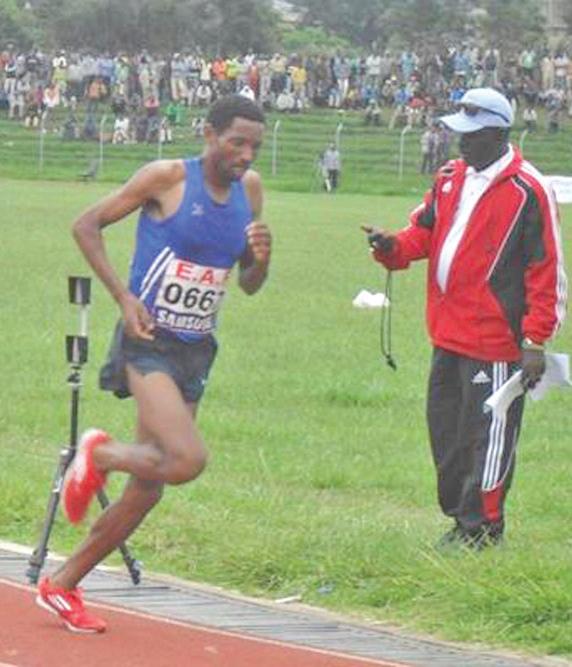
women’s 10000m in windy conditions. The race had been billed as the battle between the cross country and the marathon with Melese, a member of Ethiopia’s 2013 IAAF World Cross Country Championships team and an accomplished half Marathon runner without ever going the full distance - taking on 2011 New York Marathon champion Frehiwot Dago and Abebech Afework, the 2011 Egmond Half Marathon winner.
However, it was Ruti Aga, the 2012 World Junior Championships 5000m silver medallist, who was to pose the biggest challenge Melese. (IAAF)
Scarborough, Tobago, – The Windward Islands completed a comprehensive nine-wicket win in their opening match of the West Indies Cricket Board Tobago House of Assembly Regional Under 17 tournament which bowled off in Tobago on Monday.
After winning the toss at Bon Accord, Windwards dismissed Guyana for a paltry 105 from 28.3 overs in the 50 over contest. Windwards then romped to 106 for 1 from 15.1 overs with Man-of-theMatch Kyle Cabey ending unbeaten on one run shy of a half century while wicketkeeper/opener Gidron Pope made 32.
For Guyana Shimron Hetmyer topscored with 40 while Brandon Prasad (10) was the only other batsman to reach double figures.

MS Dhoni has been ruled out of the West Indies tri-series after he injured his right hamstring during India’s one-wicket loss against West Indies on Sunday.
Dhoni received treatment on the field during his innings of 27 and did not take the field in the second innings. He may also be unavailable for the fivematch ODI series against Zimbabwe which begins on July 24 in Harare.
Ambati Rayudu, the Baroda batsman, has been named Dhoni’s replacement. Rayudu, who is yet to debut for India in international cricket, has scored 1824 runs, including one century and 14 fifties, in List-A cricket at an average of 35.07. He had a prolific domestic season this year.
He scored 666 runs in the Ranji Trophy at 60.54, with a hundred and seven fifties. He represented Rest of India in the Irani Cup this year against Mumbai and scored 51 and 156 not out. In the Deodhar Trophy final, he was the top-scorer with an unbeaten 78 that helped West Zone chase 290 against North Zone.
Virat Kohli, who captained India in Dhoni’s absence in the second innings at Sabina Park on Sunday, will lead the team in the remaining matches while Dinesh Karthik will continue to keep wickets. (Cricinfo)
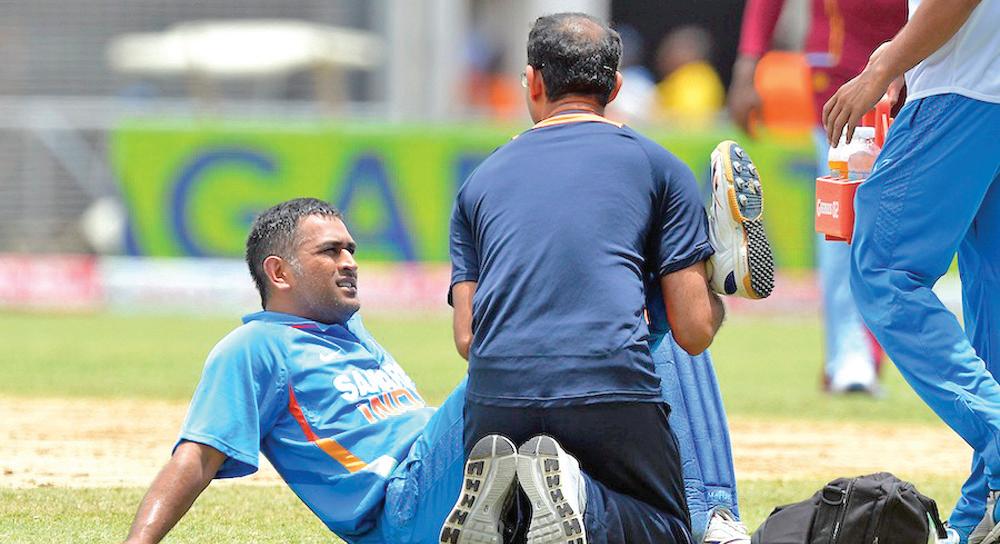

Australia’s Simon Gerrans won a fierce sprint finish to clinch stage three of the Tour de France on Monday.
He beat Slovakia’s Peter Sagan on the line in a photo finish after a hilly 145.5km ride from Ajaccio to Calvi.
Belgian Jan Bakelants, winner of the second stage, came home 19th to keep the race leader’s yellow jersey.
Britain’s Geraint Thomas, who was riding with a fractured pelvis, struggled at the back of the pack but battled to the finish line.
Thomas’s compatriot and Team Sky team-mate Chris Froome finished in the peloton to remain in a large group of riders who are one second adrift of Bakelants.
Gerrans’ win came two days after his OricaGreenEdge team bus got stuck under the banner at the finish line, with the riders less than 15km away. This time, things went far more smoothly for the Australian outfit, who recorded their first stage win at the Tour.
A five-man breakaway, including Gerran’s teammate Simon Clarke, escaped in the first 5km of a spectacular coastal route and stayed clear until near the top of the final climb, the Col de Marsolino, which was 10km from the finish.
Daryl Impey led Gerrans out in the home straight, and he held off Sagan to triumph by a quarter of a wheel.
There was some consolation for the Slovakian in that his second-place saw him take the green points jersey off Germany’s Marcel Kittel.
“I pinpointed this stage a while ago and I am pleased I had the legs,” Gerrans said. “It was like riding one of the Ardennes Classics. We spent the entire day going up or down.
“It went exactly as we planned – we wanted a guy in the breakaway to go on the offensive. In the last few days I have been leading Daryl out, but we switched it around and I managed to hold off one of the fastest guys in the world.
“I could see Peter coming
mcdonald and gafoor...
Gafoor, who started the day in pole position, suffered two other losses to Fred Collins by 156 points and Devraj Deonarine by 48 points. Gafoor eventually ended on 18 wins and a healthy spread of 3955.
Former champion Collins took third spot, also with 18 games, but with a lower spread of 2761.
Deonarine (17.5 games/1420 spread), Leon Belony (17/3041), James Krakowsky (15/1982), Robert Williams (15/1850), Anand Mohabir (13/981), Colin Chichester (13/973), Maurice Munro (13/771), Kampta Ramnarine (12/968) and Wayne Cave (12.5/1657)
World number one Serena Williams saw her winning streak and hopes of a sixth Wimbledon title end with a shock defeat by Germany’s Sabine Lisicki on Monday.
Lisicki, the 23rd seed, won the fourth-round encounter 6-2 1-6 6-4 on Centre Court.
Williams joins leading names Maria Sharapova, Victoria Azarenka, Roger Federer and Rafael Nadal in making an early exit at what has been a tournament of stunning upsets.
It was only the third defeat in the last year for Williams, and ends her career-best winning run of 34 matches, but she insisted afterwards: “It’s not a shock.
“She plays really good on grass. She has a massive,
up on my left and it must have been close because neither of us knew who had won.”
Along with Mark Cavendish, Thomas was one of the riders dropped on the final climb.
Initial examinations had failed to spot his problem, but scans on Sunday night had shown the Welshman had sustained a small fracture of his pelvis when he somersaulted off his bike in a crash on Saturday.
The double Olympic track gold medallist was in pain and at the back of the field for most of the day, and he eventually finished nine minutes and 15 seconds behind Gerrans.
Kazakh rider Andrey Kashechkin of the Astana team and Frenchman Yoann Bagot of Cofidis became the first two riders to abandon this year’s Tour after pulling out during stage three with digestive problems and food poisoning respectively.
The Tour now leaves Corsica to return to the French mainland for Tuesday’s 25km team time trial in Nice. (BBC Sport)
were the other leading performers.
The full list of players reads: Abigail McDonald, Leon Belony, James Krakowsky, Moen Gafoor, Fred Collins, Colin Chichester, Orlando Michael, Ruby Cummings, Wayne Cave, Devraj Deonarine, Maurice Munro, Julian Skeete, Anand Mohabir, Robert Williams, Grace Hercules, Kampta Ramnarine, Michael Benjamin, Romario Gonsalves, Chetnauth Persaud, Mohanram Ramnarine, Dwain Albert, Karen Bobb Semple, Wazir Dilipchand and Wazim Dilipchand.

twice to win the opening set. Williams, 31, was not about to go quietly and roared back in the second, winning 14 points in a row

massive serve, so going in there you have to know that it’s definitely not going to be an easy match playing her at Wimbledon, especially on Centre Court.
“It’s definitely not a shock. I just need to do better.”
Lisicki moves on to the quarter-finals for the fourth time and in each of those Wimbledon campaigns she has beaten the French Open champion.
The 2011 Wimbledon semi-finalist was overcome with emotion after a famous win and struggled to hold back the tears during a television interview.
“I’m still shaking, I am so happy,” she told BBC Sport.
“Serena played fantastically all match. She is such a tough opponent. It’s just an amazing feeling to win this match.
“The crowd were amazing, thanks to them for their support. They were amazing. I love this court so much, it’s such a special place for me.”
Lisicki’s record on grass, based around the secondbiggest serve in women’s tennis, meant she had always looked among the most likely candidates to challenge Williams.
The 23-year-old from Troisdorf fought off four break points and took advantage of a rash of Williams unforced errors as she broke
at one stage and not making a single unforced error as she levelled, winning it 6-1.
The American was on a roll and did not need any luck but from 40-0 down, two net cords helped her to an early break in the decider.
When Williams racked
another day of drama at Wimbledon.
The second seed won 6-4 7-6 (7-5) 6-1 to make the last eight for the sixth year in a row at the All England Club. He is now the only Briton remaining in the singles after Laura Robson lost to Estonia’s Kaia Kanepi on Court One, and will face Spain’s Fernando Verdasco on Wednesday.
He was in danger of being drawn into a lengthy battle in an edgy second set, but came through in the tiebreak and wrapped things up after two hours and 37 minutes.
A straightforward afternoon seemed to be unfolding when Murray played a terrific game that included a deft half-volley, a deadly backhand lob and a brilliant forehand pass, to lead by a set and a break. What followed was distinctly unimpressive, however, with his serve faltering and Russian 20th seed Youzhny taking full advantage.
When Murray doublefaulted to drop serve for the
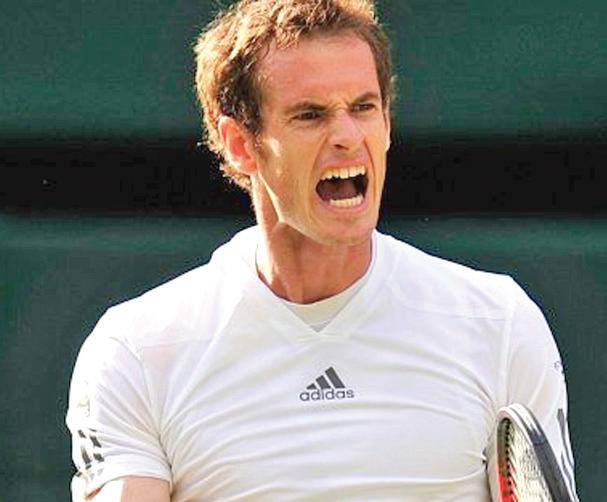
up her ninth straight game to move 3-0 clear, it was turning into a procession, but Lisicki stuck to her task.
The German got the better of three breaks in a row as she fought back from 4-2 down, thrilling the 15,000 spectators on Centre Court.
On the other hand, Andy Murray survived some nervous moments to beat Mikhail Youzhny and reach the quarter-finals on
second game in succession and then fell 5-2 behind, he was under real pressure for the first time in the tournament.
Youzhny, playing in the last 16 at Wimbledon for the eighth time, had his chance to level when he served for the set, but after seeing off two break-back points he could do nothing about a Murray forehand on the third. (BBC Sport)
Bridgetown,
BarBados –
Already having tasted the limelight of the international stage, fast bowler
Jason Holder is anxiously eyeing the Caribbean Premier League as yet another chance to make his mark in world cricket and continue his swift rise to recognition.
Standing six feet, seven inches, the 21-year-old cuts an imposing figure and is likely to be just as intimidating when he turns out for Barbados Tridents, after being picked up by the Desmond Haynes-coached franchise in the highly publicised player draft.
While Holder has played only two One-Day Internationals for West Indies, he has already been picked for three international tours – the most recent being the ICC Champions Trophy in England and Wales – and said he is thrilled with what he has accomplished so far.
Development
“I am very pleased with the way my career has been progressing. Obviously I have been propelled for the last few months into the IPL and the West Indies team so I have really been enjoying it and enjoying my development,” Holder told CPL Media.
“It was always my goal to be here, at least making strides into the West Indies team around this age. I thought it would have taken longer [judging by the

Jason Holder
strength] of our West Indies team but I am obviously pretty excited to be in the team at this present time and I just want to stay in [the team].”
Holder made his first class debut back in 2009 as a 17-year-old and has not looked back since, representing the West Indies Under19s at the Youth World Cup in New Zealand a year later before gaining a surprise call-up to the Windies senior team in 2012 as an injury replacement for fast bowler Tino Best on the limited overs tour of Bangladesh.
And though he failed to land a game on that tour, he was again selected for the Windies limited overs trip down under earlier this year, where he finally made a much awaited international debut.
“Though it was my first
game I honestly wasn’t that nervous which was surprising. I thought I coped with the pressure quite well. Obviously I had done the hard work to get there. I just tried to soak up the moment as best I possibly could and enjoy it,” Holder recalled. “It was just unfortunate that I didn’t get to play a few more games but I know if I keep doing the right things I will have a long lasting career.”
What followed the Australia tour was definitely a shock for the right-arm pacer. He was snapped up by Indian Premier League franchise Chennai Super Kings and packed his bags for the Asian subcontinent.
He played six matches and grabbed only two wickets, but still managed to get the attention of pundits with his steep bounce and sharp-
ness. He said the outing was about gaining valuable experience, especially at his young age.
“It was a surprise after having only one tour with the West Indies team but I guess my name was out there or thereabouts from Under-19 cricket,” Holder explained.
“Then getting the opportunity – it wasn’t a huge contract – but for me it was just about gaining the experience and mingling with the international stars which was a wonderful experience for me.
“It was an experience, a serious experience. Playing in front of thousands of people shouting your name and just cheering you on, it was something to really soak in, something to really relish at this stage. For me it was quite pleasing for us to get to the fi-

nals and having played a part in it. It was fitting for me for my first season.”
With the tour of Australia and the IPL in his rear view mirror, Holder has now set his sights on dominating the Caribbean Premier League which bowls off across the region in six countries from July 30 to August 24.
He believes that the experience gained over the last year will augur well when he turns out for the Barbados Tridents.
“I am very excited about the CPL. I think it is a great initiative mixing the local players with some international stars. I think the teams are very evenly balanced so it should be very interesting to see what transpires in the next few months,” Holder said enthusiastically.
“I definitely think the IPL has prepared me for the CPL. I have gained a lot of knowledge over the past few months with these players in the IPL, and just playing against a lot of players. I have had a lot of conversations with various international players around the world – even at the Champions Trophy – so I think I have broadened my knowledge in terms of how to react in certain situations so it’s just about executing it in the game.”
Holder says he intends to dominate in the CPL.
“I think I am capable of doing it. It’s just about me being focused and executing my plans in whatever game I
play. I’ve got to wait to see the make up of the side but I am confident that I can probably start in the side and give my best for the team.”
An added fillip for Holder is the involvement of Haynes, the legendary former West Indies opener, in the management set up of the Barbados Tridents – a partnership he believes will be a successful one.
“I have worked with Desmond Haynes before. He has managed me in the Barbados team in the past,” said Holder. “I have a lot of respect for him and we’ve had a lot of conversations about cricket and life in general. I find he has been one person you can always turn to for advice so I am looking forward to building my relationship with him as well and working with the other members of the management staff.”
Franchise players
The Barbados Tridents are led by franchise players Kieron Pollard and Shoaib Malik who will play alongside Dwayne Smith, Shakib al Hasan, Umar Akmal, Jason Holder, Shannon Gabriel, Rayad Emrit, Ashley Nurse, Carlos Brathwaite, Jonathan Carter, Kyle Mayers, Devendra Bishoo, Kirk Edwards and Raymon Reifer.
Following the opening ceremony on July 30, the Barbados Tridents will face the St Lucia Zouks in the tournament’s first game at the historic Kensington Oval.
By AvenAsh RAmzAn
In what was truly a festive atmosphere befitting of a holiday, hundreds of spectators turned out at the seawall bandstand on Monday to witness Alanzo Greaves produce a brilliant performance to win the “Wheat Up” 30-lap race in convincing fashion.
The race was the main attraction on the National Milling Company (Namilco)-sponsored 10th annual Caricom Day race held for the first time around the seawall bandstand, which continues to attract spectators to the sport of cycling.
In fact, the aim of switching the event from being a road race to a multi-category programme was to generate spectators’ interest, and from all indication those who lined the route were not disappointed as Greaves turned in a clinical performance to continue his dominance in 2013.
The race was off to a frenetic pace as the 45 starters looked to gain the early initiative and cash in on the 15 prime prizes that were up for grabs every other lap.
Greaves, Paul DeNobrega and Godfrey Pollydore were the early trendsetters, constantly sharing the lead in the first five laps.
As the race gained momentum, Orville Hinds, Hamza Eastman and Marlon Williams connected with the trio and kept increasing the lead on the others as they rode in a bunch for the 20 laps.

During that time, the lead changed hands on many occasions, as the six riders looked to outhustle each other, especially on the crucial laps that had prime prizes on offer.
As it became evidently clear that the race winner will come from the bunch of six, Greaves made a decisive sprint from the pack with five laps to go, a lead he would never relinquish.
In the process of splitting from the peloton, the Roraima Bikers Club cyclist, who recently returned from a highly successful one month training stint in the USA, lapped a few riders who found the going tough.
As he surged pass the finish line, arms aloft, and spectators clapping, none of the other five riders in the leading pack were in sight. Greaves was timed at one hour, four minutes,
41 seconds (01h: 04m: 41s).
Pollydore prevailed in a heated sprint for the runner-up spot, with DeNobrega, Hinds, Eastman and Williams rounding off the top six positions in that order.
For winning the race, Greaves pocketed $30,000, a trophy and one year’s supply of “Wheat Up”.
In addition, he carted off six prime prizes, and another 10 packs of “Wheat Up” for winning the 30th and final lap of the race. Pollydore won four primes, Eastman and DeNobrega two each and Hinds one.
Pollydore and Hinds also won 10 packs of “Wheat Up” each for winning laps 10 and 20 respectively.
The other 11 races were equally competitive and exciting, as riders of the various categories showcased their skills in humid, but breezy conditions.
Eastman won the Category 4 (Junior) from national junior road race champion Michael Anthony and Shaquille Agard, while Hinds won the Category 1-3, leaving Warren McKay and Pollydore to settle for second and third respectively.
Junior Niles, Ian Jackson and Preston Stanley were 1-2-3 in the Veterans Under-50 division, with Virgil Jones outlasting Monty Parris and Lancelot Rose in the Veterans Over-50 category.
In the 12-14 Juveniles race, Romello Crawford emerged as the leading rider with Adriel Ross coming second and Andrew Hicks third.
Pollydore won the “Win and Out” event, with Anthony and Hinds in second and third spots respective-
ly, while Ozia Macaulay got the better of Richard Charles and Clyde Jacobs in the Mountain Bike race.
Naomi Singh, who on Sunday was crowned the new national female road race champion, continued her fine form by winning the lone race on the distaff side, leaving Marica Dick to settle for second and Toshawna Doris third.
The BMX 6-9 race was won by Sherwin Sampson who defeated Jeremiah Harrison, whiel Jamal John, Raphael Leung and Bryton John were the leading performers in the BMX 10-14.
The Team Trial was won by Roraima Bikers Club, followed by Team Coco (Guyana) and Flying Star Cycle Club.
The top six in the main race and the leading three in the other events were all presented with cash incentives, compliments of Namilco, who partnered with the Roraima Bikers Club to stage the day’s activities.
At the closing ceremony which followed, several distinguished persons were on hand to assist in the presentation of prizes. They included Managing Director of Namilco Bert Sukhai, his assistant Autamaram Lakeram, the company’s Finance Controller Fitzroy McLeod, Director of Sport Neil Kumar, patron of the Roraima Bikers Club George Humphrey, attorney Gordon Gilhuys, and sport enthusiast and Managing Director of DeSinco Trading, Frank DeAbreau.
Kingston, JAMAICA
– The West Indies Cricket Board and the University of Technology, Jamaica (UTech) on Monday launched a Cricket Coaching Education Programme (CCEP) designed to restructure, revamp and broaden the sustainability of the sport in the Caribbean region.
The CCEP launch took place at a ceremony held at UTech’s campus.
The CCEP will introduce to the Caribbean Level 3 Coaching Certification Programme. The CCEP benefited from technical expertise from the England and Wales Cricket Board.
Chief Executive Officer of the WICB, Michael Muirhead said “we cannot over-emphasise the importance of certified coaches in the development of West Indies cricket.”
Coaching education
“The important pillar of coaching education has been returned to being among the top priorities in West Indies cricket,” Muirhead added.
“With this redeveloped programme we now have structure, uniformity and consistency in the delivery of coaching education across the region. This partnership represents the very best of collaboration between regional organisations to achieve a greater good and it is one which we hope will serve as a model in cricket, sport and in broader areas

moving forward,” the WICB CEO further noted.
President of the Jamaica Cricket Association, Lyndel Wright who was also in attendance at the launch also praised the reconstituted coaching programme.
Professor Ashok Kulkarni, deputy president, UTech, in his welcome stated that “cricket is more than a sport and remains an important integration strategy which has the potential for creating a lasting impact on the development of the region.” He noted that the synergy between UTech and WICB augurs well for the continued development of cricket in Jamaica and the region.
The University and
the WICB previously signed a Memorandum of Understanding in September of last year which will see both entities cooperating for the development of West Indies Cricket.
Laurence Garriques, acting director of sport, UTech in his overview of the project and courses said that “the Coaching Education Programme will be administered by UTech and will be a fully WICB accredited programme. The CCEP accreditation will be globally recognised and will serve as the official Coaching Certification for the West Indies and the Americas.”
The CCEP includes: (i) Foundation Coaching Programme, (ii) Level 1
Fyrish Black Sharks saw their chances of reaching the final of the Mackeson basketball tournament fall at the wayside when they lost 48-40 to Smithfield Rockers on Sunday at the Vryman’s Ervin Court, New Amsterdam.
The Rockers played unbeaten and won all four of their games. On Sunday Rockers brought in some new players to give them some exposure and at the end of the first quarter they had a seven point lead in
what was a slow period where only 24 points were scored.
At the half-way point they led 26-17 and enjoyed their biggest lead in the match at the end of the third quarter. Michael Bowen was accurate in his shooting and scored 20 points for the Rockers. For Fyrish Linden Joseph and Desi Douglas each scored nine points.
The competition continued on Sunday night when arch-rivals New Amsterdam Warriors went up against Canje Knights.
Teams
Coaching Programme, (iii) Level 2 Coaching Programme, (iv) Tutors and Assessors Coaching Programme and (v) Level 3 Coaching Programme.
Each programme will include sports science, academic and technical components and will be graded and assessed on standard systems as designed by UTech and the WICB. There will be a structured syllabus and course outline for each programme which will ensure consistency of delivery throughout the region. The Foundation Coaching Programme will target every Physical Education Teacher and Kiddy Cricket Teacher in the region.
The CCEP has a target of
training 1500 Level 1 coaches across the Caribbean region within the first year of implementation. The Level 1 programme is an advanced introduction to cricket and Level I certified coaches will be equipped to coach junior club cricket, school teams and secondary club teams.
The Level 2 programme will equip coaches to coach national junior/age group teams, senior club and district/county/parish teams.
The training programme which is slated to commence within two months will start with the Tutors and Assessors Programme which will target the training of 40 coaches across the region at this level for the first year of implemen-
tation. The WICB is currently engaged in the selection process of coaches. The Tutors and Assessors will all be trained in Jamaica at UTech’s campus and will be equipped to deliver the Foundation Coaching programme and the Level 1 Coaching Programme in their respective territories.
The Level 3 programme will equip coaches to coach national senior teams and all West Indies teams – senior and junior and male and female. The Level 3 programme will be done through an application process.
The CCEP will have a fixed continuing education component. Coaches previously certified by the WICB will need to renew their accreditation by completing specially organised coaching workshops to bridge the gap between previous certification and the CCEP. Upon successful completion certification will be re-issued.
Philip Service, West Indies territorial development officer, gave remarks on behalf of West Indies coaches. He highlighted the need for more technically competent players, adding that “coaches must be highly motivated, qualified and fit within a system of accountability, consistency and excellence and this can only be achieved through training and education.”
declared open at newly-refurbished
By TreisTon Joseph
he National School
TBasketball Festival (NSBF), sponsored by Digicel, Banks DIH and Beharry Group of Companies, got off to an explosive start with a rousing opening ceremony on Monday at the newly-refurbished Cliff Anderson Sports Hall (CASH).
The tournament, organised by the Youth Basketball Guyana (YBG), saw Prime Minister Samuel Hinds, Sports Minister Dr Frank Anthony, Director of Sport Neil Kumar, Minister within the Finance Ministry Juan Edghill, along with corporate sponsors, in attendance at the ceremony.
YBG Director Chris Bowman in his opening remarks said, “This is a very important programme we have and I want the players to value it. The event has grown and expanded as we started off with one division and now have female divisions and regional confer-
ences and that is something to be proud of.”
Bowman added, “We don’t want you to jus play the game we want you to be ambassadors of the game and to hone your skills and most importantly respect the game because basketball is a beauti ful game.”
Bowman, who empha sised that the NSBF has preserved the future of Guyana’s bas ketball, also thanked his sponsors, the Sport Ministry, the NSC and the gov ernment for the roles they play in helping the tournament.
lated how the event began.
The long time Director of Sport also commended the sponsors for remaining on board.
He also enquired of the Guyana Amateur Basketball

Kumar congratulated Bowman and his team for the eight years of the tournament’s existence and re-
(NABF) of their development plans, stating that the NSC is willing to work with all associations.
“I know that everybody likes to celebrate victory... The fact that you have reached this far in the tournament speaks of your discipline and you all should be congratulated,” Edghill told the gathering.
Sport Minister Dr Frank Anthony also congratulated the players along with the YBG for the tournament. Anthony also stressed that government will be looking to form more school programmes while stressing the importance of fitness for the sustenance of good health.
Meanwhile, Prime Minister Samuel Hinds, declaring the tournament open, pointed out the most important factor in his opinion: “Our country is still very young and we are still trying to find and to build that feeling of team spirit and a spirit of team Guyana and I believe tournaments like these help but I would like to see more schools being involved in sport.”
Bishop Edghill in his speech congratulated the players for reaching to the final leg of the tournament.

By AvenAsh RAmzAn
Guyana’s representative for the World Scrabble Championship in the Czech Republic from December 3-8 has come down to a playoff between top seeds Abigail McDonald and Moen Gafoor. McDonald and Gafoor finished first and second respectively after the conclusion of the preliminary rounds of the Courts National Scrabble Championship on Monday evening at the Bank of Guyana rooftop. The pair will now clash in the bestof-five playoff series on Saturday to determine who will become the national champion for 2013.
McDonald, the two-time defending champion, en-



Abigail McDonald Moen Gafoor
joyed a fruitful final day after starting in the runnerup spot behind Gafoor, who endured a horrid time on Monday; he led after play on Saturday and Sunday.
McDonald finished the
23-round tournament with 19 wins and a spread of 2951, and more importantly, earned a major boost ahead of the playoff by prevailing over Gafoor by 91 points.




After four rounds, national champions Taffin Khan and Anthony Drayton are leading their respective categories in the Trophy Stall-sponsored chess tournament, currently being played in the auditorium of the Carifesta Sports Complex.
Khan, the reigning senior national champion, is on top of the senior category, having played unbeaten in all four of his games on Sunday and Monday.
With the maximum four points to his name, Khan leads Alexander Duncan, Errol Tiwari and Maria Thomas, who are bunched on three points apiece.
Cleveland Hutson has so far chalked up two and a half points, while Glenford Corlette and Canada-based Guyanese Raymon Singh are tied on two points.
In the junior category, Drayton, who is the current national junior champion, is locked on three points apiece with Haifeng Su.
Roberto Neto follows in second position with two and a half points, while Rajiv Muneshwar, Joshua Pedro, Ron Motilall and Carlos Petterson have all accumulated two points each after four rounds.
The competition will continue on Thursday when round five is played from 17:30h at the Carifesta Sports Complex, while the final two rounds will be contested on Sunday from 09:30h at the same venue.