


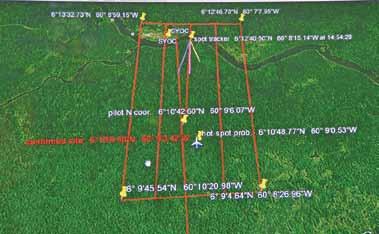
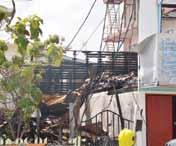



Guyana Defence Force Special Forces ranks were expected late Sunday afternoon to reach the site where this Trans Guyana Airways plane crashed on Saturday. In photo is a blurred image of the wreckage circled in red
monday, January 20, 2014|

monday, January 20, 2014|
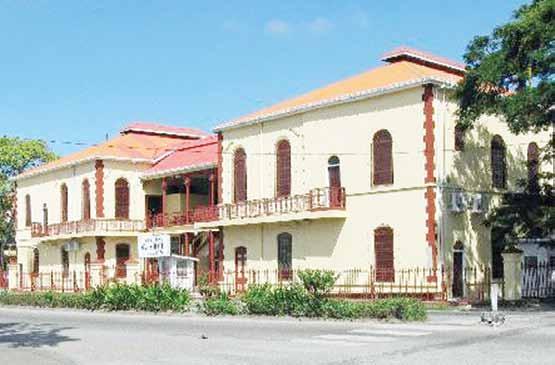
The newly-renovated Georgetown Magistrates’ Courts
After a three-year hiatus to facilitate rehabilitation works, operations will resume at the Georgetown Magistrates’ Courts today.
The court sessions were shifted in 2011 to the Global Trust Building on Middle Street, where five of the courts held sittings along with the clerk of the Georgetown Magisterial District while an additional three courts were housed in the top floor of the building behind the Magistrates’ Court on Croal Street.
The relocation was done to facilitate major rehabilitation works on the building.
The relocation to the original building was scheduled to happen about a year ago; however, the contractors took longer to complete their work.
Officials had said that the building would be completed in the last half of 2013; however, that was further delayed and blame was cast on several varied issues, including incompletion and difficulties with GPL to acquire generators.
In an interview with Guyana Times a few weeks ago, acting Chancellor of the Judiciary, Carl Singh dis-
closed that while the building is completed, the major hindrance is the unavailability of furniture.
“The problem right now is about some necessary furnishing, but it is actually being worked out now,” he had said.
Building
The acting chancellor disclosed that the entire building was rehabilitated and extended to facilitate additional courtrooms; hence, the building now houses 12 courts with each having offices and washroom facilities for the magistrates. New lighting was also installed and a generator was procured.
In addition, he noted that the entire building had to be rewired because the air conditioning units were installed in all the courtrooms and magistrates’ chambers, and as such, the old wiring could not have handled the capacity of the current.
Sitting arrangements for the public have also been upgraded. The acting chancellor also hinted that there will also be seating arrangements for the media in the main criminal
courts. Even the section which houses the office of the clerk of the Georgetown Magisterial District and support staff was upgraded.
Other works on the building included two parking facilities on the northern and southern sides of the building (Croal Street and Brickdam respectively).
The renovations were done under the Modernisation of the Justice Administration Project, a programme funded by the Inter-American Development Bank (IDB), which provides for the improvement of the physical and infrastructural institutional capacity of the justice sector.
These improvements in the judicial sector are all mechanisms of a holistic plan to revamp the entire justice sector.
Under this project, renovations have been done to almost every court building in the country, including the Court of Appeal and the High Court complexes of Berbice and Demerara.
Only on Friday, the Leonora Magistrate’s Court on the West Coast of Demerara, was re-commissioned by President Donald Ramotar.

The Youth Entrepreneurial Skills Training (YEST) programme, an initiative under the aegis of the Culture, Youth and Sport Ministry continues to impact favourably on youths across Guyana, through its technical and vocational skill areas offered at the residential Kuru Kuru Training Centre, the nonresidential Sophia Training Centre, and the Smythfield Drop-in Centre at Vryman’s Erven.
In 2013, 250 persons from the 10 administrative regions graduated from the Kuru Kuru Training Centre; 120 from the Sophia Training Centre; and 50 from Smythfield, joining the more than 2430 others who would have benefited since the introduction of the programme in 2000, according to the
Government Information Agency (GINA).
During a recent press conference, Culture, Youth and Sport Minister, Dr Frank Anthony highlighted that the programme has seen tremendous success over the past years.
“A lot of these students, sometimes you would see them drop out of school and these three facilities are giving them a second opportunity at getting a skill and becoming employable,” he said.
Youths between the ages of 16–25 years are trained in skills such as welding and fabrication, information technology, garment construction, business studies, carpentry, electrical installation, joinery, masonry, motor mechanics and plumbing. They also benefit from remedial English and mathematics.
At the New Opportunity Corps (NOC), Guyana’s only juvenile correctional facility, 135 students are benefiting from the same curriculum as that offered at Kuru Kuru since 2012; while at the latter learning facility, 32 students acquired their driver’s licences, after successfully completing their driver’s education examination, conducted by the Police Traffic Department during 2013.
Speaking further, Dr Anthony stated that the programme is playing a pivotal role in helping young people acquire skills for employment purposes, adding that the centre can expect major developments in 2014, such as the introduction of computer repairs, and expansion of the institution to accommodate more students.
Antigua and Barbuda’s ambassador to the Caribbean Community (Caricom), Dr Clarence Henry has called for the appointment of a chief executive officer to oversee the affairs of the Caricom Single Market and Economy (CSME).
The CSME allows for the free movement of goods, skills, labour and services across the region and is regarded by Caribbean leaders as a mechanism for deepening the regional integration process.

But some aspects of the initiative, particularly the free movement of skills, have come under greater scrutiny as nationals of various countries complain about the obstacles preventing the full implementation of the CSME.
Speaking at the just concluded two-day broadcasters’ workshop on regional integration and the CSME here, Henry said it has always been felt there was need for the appointment of

a chief executive officer for the CSME.
“The time has come for someone, a person of eminence, a professional, a person with credibility to be appointed as a person charged with the responsibility to drive what we have been trying to do for so long.”
Henry said the selected candidate must have certain powers “so that at the end of the day, this project that we have been long working on can be realised to the benefit of all”.


The Demerara Harbour Bridge will be closed to vehicular traffic on Monday, January 20 from 05:00h-06:30h
The Berbice River Bridge will be closed to vehicular traffic on Monday, January 20 from 0:35h-08:05h.
Countrywide: Light rain showers are expected during the day, with cloudy skies in the evening. Temperatures are expected to range between 23 degrees and 27 degrees Celsius.
Winds: North-easterly to east north-easterly ranging between 4.47 metres and 5.36 metres per second.
High Tide: 06:53h and 19:10h reaching maximum heights of 2.57 metres and 2.61 metres respectively.
Low Tide: 12:44h reaching a minimum height of 0.65 metre.






no word on pilot, handler
By Bhisham mohamed
After an estimated 11 hours of searching, personnel onboard the Guyana Defence Force (GDF) helicopter were successful in locating the wreckage of the Trans Guyana Airways Cessna Caravan which crashed on Saturday morning.
The aircraft was spotted about 12:35h on Sunday, but was not accessible by helicopter owing to the mountainous terrain. The area is said to be in the vicinity of the Marikina Mountain. However, there were no reports on the status of the pilot of the aircraft, Blake Slater and his loader, Dwayne Jacobs.
The missing aircraft, a single engine, 13-seater Cessna Caravan with registration number 8R-GHS disappeared out of the sky about 10:56h on Saturday without a trace. The last contact with the pilot of the aircraft was a “Mayday” (emergency call) which was transmitted to another aircraft within the area at the time.
The aircraft departed for Imbaimadai about 10:54h after overnighting at Olive Creek.
On Sunday, two of the GDF Special Forces teams were inserted into the area and another two teams were expected to join their colleagues before nightfall. According to information received, the first two teams were dropped off at an accessible location by helicopter. They will make their way to the crash site by foot.
A GDF medical doctor is

among the teams. Once the teams reach the wreckage, their main objective will be to find Blake and Jacobs. Guyana Times understands that other medical personnel and investigators will travel up to the crash site at sunrises this morning.
At a press briefing at the Timehri Control Tower, Guyana Civil Aviation Authority (GCAA) Director Zulificar Mohamed told reporters that the two teams have confirmed their presence in the area and have begun making their way to the crash site.
He could not comment on the status of the personnel of the crashed plane, saying they would have to wait feedback from the teams on the ground. He said they are, however, hopeful of their survival.
“We have instructed them



that once they reach to the site, their primary objective is to extract the personnel and upon completion, they will secure the site for the GCAA inspectors to have access to conduct their investigations,” he explained.
He explained that the security of the site is essentially to ensure that data is not compromised. Mohamed also noted that both of the wings of the aircraft have been severed from the plane but the rest is intact. From the aerial view, there were also no signs of an explosion.
Information
Senior air traffic controller Rickford Samaroo explained when the search and rescue team returned on Saturday evening from Olive Creek, Mazaruni from where the Cessna took off, they were in possession of essential information, including coordinates, that was gathered by persons in the area.
With those at their disposal, they were able to narrow the search area down to a 21/2 mile radius from where the plane took off. “We use that and based on the information that the pilot was able to give in his last transmission, … we’re able to zero in …,” he said.
With respect to the pilot and the loader, Mohamed noted that they have been in contact with the Foreign Affairs Ministry which has communicated with the relatives of Slater and Trans Guyana Airways has been in contact with the relatives of Jacobs.
Benn upset
When Guyana Times contacted the relatives of Jacobs on Sunday morning, his sister, Monique, said the last time she saw her brother was on Thursday morning when the “work bus” collected him. She was aware that he was heading into the interior as he would normally do.
She said on Saturday morning, her mother, Sherry, received a call from her brother’s place of employment informing them of the tragedy. “They told us that they were doing everything to get, find him and we too are hoping that he be alive and well …,” she said.
Jacobs said her brother has been working at Trans Guyana Airways for more than 10 years, elevating himself to a senior cargo loader. She added that ever since they received the news of his disappearance, her mother has not been able to talk with or meet people.
Meanwhile, Transport Minister Robeson Benn expressed dissatisfaction about the media releasing the identities of the two missing men, claiming that the matter was a very sensitive one and could have been detrimental to the relatives who were not aware of the incident at the time.
He said he is not happy about the issue, and cautioned the media to be more responsible.
However, it is very common for media houses, both locally and elsewhere, to release the identities of accident victims, whether or not they have been found at the time of reporting. (bhisham@guyanatimesgy.com)



Editor: Nigel Williams
Tel: 225-5128, 231-0397, 226-9921, 226-2102, 223-7230 or 223-7231. Fax: 225-5134
Mailing address: 238 Camp & Quamina Streets, Georgetown
Email: news@guyanatimesgy.com, sales@guyanatimesgy.com
This month marks the 20th anniversary of the North American Free Trade Association (NAFTA) which brought together the U.S., Canada and Mexico into a continentwide trading bloc.
With the World Trade Organisation (WTO) on the ropes due to the reluctance of the developed countries to accede to the concerns of the developing and emerging world, NAFTA might serve as a signifier of what might be ahead for the latter blocs in the mega-trading consortia, such as the Trans-Pacific Partnership (TPP), being pushed by the U.S.
Closer home, it might also enlighten members of Caricom, such as Jamaica, that have expressed a desire for the aborted, hemispheric-wide Free Trade Association of the Americas (FTAA), to be resuscitated.
When NAFTA was launched on January 1, 1994, it was a story of “great expectations” not so much for Canada, which was already developed, as for Mexico which was firmly in the ranks of the “developing” countries.
It was going to be a bold experiment: a test case for the benefits of free trade towards development. As one commentator summarised: “Mexico would enter the First World of developed countries on the crest of rising trade and foreign investment. Its dynamic manufacturing sector would create so many jobs it would not only end the U.S. immigration problem, but absorb millions of peasant farmers freed from their unproductive toil in the fields. Mexico could import cheap corn and export electronics.”
But as with the Dickens’ Great Expectations, it has actually been a story of dashed expectations. Not that there have not been changes in Mexico, but not what was promised. According the Economic Commission for Latin America (ECLAC), poverty in Mexico stood at 52.4 per cent in 1994 but by 2012 it was statistically unaffected at 51.3 per cent.
Foreign automakers in Mexico had increased auto-sector jobs by around 50 per cent since 1994. But those jobs are notoriously low-paying, and little progress has been made in closing the wage gap with the United States. Average manufacturing industry wages were about 15 per cent of U.S. wages in 1997. By 2012, that figure had risen only to 18 per cent. In some sectors, China’s wages have outstripped Mexico’s.
This is a direct consequence of NAFTA’s effect on the agricultural sector, which is the dominant one in developing countries. Between 1994-2004 agricultural products, such as wheat, corn, meat and other staples from the U.S., flooded Mexico far below previous prices. Three million small farmers saw their income plummet by 66 per cent.
While in theory, this justified free trade theory that Mexican consumers were benefitting from lower prices, the deleterious effect on Mexico’s farmers far outweighed the benefits. The U.S. exports might brevet have been dumped. For instance, U.S. corn exports which increased by 400 per cent during that time, was exported at 19 per cent below U.S. farmers’ cost of production. The same phenomenon occurred with other agricultural products.
While Mexican vegetable exports also increased, it was a drop in the ocean compared to the fall in the production of staples. Mexico was now importing 42 per cent of its food, mostly from the U.S. A change in the law on compulsory land ownership for small farmers demanded by NAFTA, caused millions of small farmers to give up their land because of the cheap U.S. agricultural imports. They joined the poverty-stricken jobless masses even as the U.S. further closed off the safety valve of the Rio Grande crossing for illegal immigrants.
When the U.S. decided to divert corn in the mid-2000s into ethanol, prices of this Mexican staple rose precipitously pushing millions into more poverty. The financial crisis in the U.S. from 2008 drove financiers into commodity speculation, which drove food prices astronomically upwards. But the country was now structurally dependent on U.S. staples.
The lesson of NAFTA might be that the benefits of free trade might not flow both ways when the trading partners are so unevenly positioned. Caveat emptor!

Listening to one another is the only means of finding lasting solutions to our problems
Dear Editor,
In all the debates on the various issues which are attracting our attention and interest from time to time, whether it be the opinionmakers in feature columns and readers’ letters in our newspapers, between leaders of rival political parties, or among members of the public, we can see clearly that everyone is so convinced of the rightness of his/her own position, and so intent on converting everyone else to his/her own views, that people are simply not listening to one another.
This has been never so manifest as in the recent past when there are so many extremist positions being expressed in the media, and in the political deliberations in and out of Parliament, in which we should have least expected some example and open-mindedness, so that others below may follow their lead in order to arrive at positions which are acceptable, or at least able to be tolerated, by the general populace.
The opposing forces are instead directing their efforts towards upstaging their “enemies” on every issue, rejecting all arguments and proposals which they believe will lead to some loss of ground on their part.
And as soon as we examine this type of approach to
the various questions which need to be answered fairly and objectively in order to facilitate solutions to our political and societal problems, we see clearly that such an inflexible attitude will always lead to never-ending controversies.
These of course can cause the unity, harmony, and economic advancement that we all dream of to forever elude us as a nation. If there is an absolute truth, none of us mortals has been blessed with it, and we can only add to the fund of our own knowledge and experience if we genuinely endeavour to listen closely to those with whom we engage in our debates, not only to the words we hear, but to what they are really trying to say or express non-verbally. Communication seeks to convey feelings as well as information, and a lot of these will escape us if we shun the need to pay attention to all its aspects, restricting our ability to arrive at perspectives which are all-encompassing.
It cannot be denied that the situations which are arising from time to time in our country have their origins in the feelings of people, and the controversies that they cause are in turn generating feelings of all kinds, many of which are negative and can only lead to like situations.
If then our efforts are really directed towards the promotion of a just and peaceful society, then we need to consider the feelings of everyone, and take these fully into consideration when we are working towards the solutions which would ease the burdens of all likewise.
A restatement of the crucial components, which are a prerequisite for effective communication by those on both sides of any divide, may serve to show why we find it so difficult to really listen to others.
It should at the same time enable persons to examine their own behaviour in the light of these, and to make any adjustments which will enable them to arrive at just solutions to problems.
These components are: empathy – the ability and willingness to experience another’s world as if it were one’s own; positive regard –which includes the acceptance of the other person with an attitude of respect for that person’s point of view, feelings and opinions, along with their right to these, although you may not agree with them; and genuineness – meaning that the listener must be honest and natural, and really sincere in taking the other’s views on board.
One reason for this refusal to listen is that we tend
to sense some danger that we may be giving up our own position, and therefore our interest, as well as face the risk of being convinced in the other’s point of view, which we want to resist as strenuously as we can. This uncompromising representation of our position on any issue, accompanied by every effort being expended to discount any other point of view, may be in order in the courtroom, when a mediator we trust to be fair and impartial has been authorised to weigh each case and form a judgement which has to be accepted by all, but it has no place in our efforts at arriving at solutions to the contentious problems which are threatening the delicate balance in which our nation is poised.
I leave you with one truism to be contemplated when we sincerely try to form the right attitudes in which to debate the various issues – whenever two or more persons form a community, whether a couple, a neighbourhood, a society, an organisation or a nation the solution to any common problem is always the sum of their contributions, their points of view, their interests and their unselfish wishes.
Sincerely, Roy
Paul
Dear Editor,
In a recent A Partnership for National Unity (APNU) press briefing, the New River area was named to be the last pristine untouched area of Guyana’s forest. This statement was made by APNU and in particular its Vice Chairman, Dr Rupert Roopnaraine.
Dr Roopnaraine perhaps was at the time seeking to justify his party’s muchcriticised objection to an assessment of the area’s mineral resources through a Permission for a Geological and Geophysical Survey (PGGS). However, the APNU commentary, which called for an assessment of the biodiversity of the area to be done is welcomed and shows a keen interest in recognising forest for not only timber but also for rich biodiversity value.
One of the key resource base of the New River area is its biodiversity resources; but the resource base of this area is not limited to just biodiversity but also to forest carbon sequestration services, potential eco-tourism activities, research and technical studies, bioprospecting and minerals and timber.
Planning for a forest area of these characteristics, or more aptly called High Conservation Value Forest, requires adequate information, effective foresight and strategic coordination. For these reasons, it was identified as essential to effectively assess/survey the full resource base of this area.
With these points in context, and a clear call for an assessment of the resource base (biodiversity referred to by Dr Roopnaraine), it would be somewhat partial and incomplete to only recognise the need to assess the resource base as it relates to biodiversity, for this area.
All resources, including minerals must be included to know the true value and wealth of an area. The results of such assessment
along with other non-environmental related considerations, should determine how and to what use the area is put as it would be premature to make a decision with incomplete information, or to make a decision with no information.
This decision when effectively assessed and with adequate information, can mean that an area can be allocated for conservation, sustainable utilisation, allocation as titled lands to Indigenous peoples, area management as community conservation area, a national protected area, or a wide gamut of options.
This kind of strategising requires not just some information, but full information on the resource base. This has been and remains the thinking of the Natural Resources and the Environment Ministry as an activity that relates to not only the New River area but other areas, and there are others, that have high conservation value or as some may refer to, as pristine areas.
Dr Roopnaraine referred to the New River area as the last pristine untouched area of Guyana’s forest. National level assessment of forest cover, for not only the historic period but also covering current periods, conclude that the New River area is a pristine untouched area, like most areas in south of Guyana, but it’s not the only remaining pristine area of forest in Guyana.
National assessment conducted under Guyana REDD+ programme, which have been subject to independent verification and certified as accurate, have concluded that Guyana has a total area of forest remaining as at end of 2012 (assessments for year 2013 is currently ongoing), of 18,487,876 hectares.
This assessment applies international definitional standards for forest un-
der a climate change programme and set based on the Marrakech Accords. This area has remained largely intact following year of historic and ongoing current utilisation activities.
Summarising all of this at national scale, one can look to Guyana’s rate of deforestation which has ranged between 0.02 per cent to 0.079 per cent over the 22 years. This substantiates the fact that the vast majority of Guyana’s forest remains intact to this day, even with continuous utilisation activities ongoing and has been maintained this way owing to the existing functional framework of sustainable management.
From another perspective, Intact Forest Landscape which are defined, among other secondary variable, as area of contiguous (unbroken) blocks of 50,000 hectares that excludes all allocated land utilisation activities (forestry, mining, agriculture, settlements/villages/communities, infrastructure), has totalled to 7,604,580 hectares.
This area has only change minimally over the past three years when formal monitoring began on this. And for areas that are allocated for utilisation, this is done within a framework of sustainable management, for example, in the case of forest concession where timber extraction is strictly regulated with a code of practice, among other requirements.
Another point of note is the allocation of pristine forest to the National Protected Area System. Within the past two years, the protected areas within Guyana’s forest have increased to four protected areas that come under the scope of the Protected Areas Act. These are: Iwokrama, Shell Beach, Kanuku Mountains and Kaieteur National Park.
Altogether, these account for a total of 1,141, 000 ha
Dear Editor,
In many nations, the justice system considers a human life as most priceless. Additionally, the late Pope John Paul once said that any society that does not value human life breeds a culture of death. This kind of thought is pressing on me as I am reading almost daily about preventable fatal accidents.
On December 12, according to eyewitnesses, a truck driver recklessly overtook a car and consequently ended up hitting and killing a man in the vicinity of Airy Hall. The accused was subse-
quently charged for causing death by dangerous driving and was placed on $300,000 bail.
Personally, I believe that the accused should face much more severe consequences for claiming the life of another. Every driver should be cautious of their actions knowing full well that their vehicle has the capacity to kill.
Aside from carelessness, most accidents result from the most irresponsible acts of speeding and driving under the influence of alcohol. Clearly, these drivers are not considerate of others uti-
lising the road ways. They form their very own dangerous group of criminality and should be dealt with accordingly.
The charge against someone who has irresponsibly claimed the life of another should ideally cater for a highly set bail and the revoking of their licence for some duration.
Regardless, if all aspects of traffic laws were obeyed, the senseless killing of an innocent human being should not be treated lightly.
Yours faithfully, Roshan
Hussein
designated as protected areas. These areas represent pristine areas of forest that have been in this state for centuries and continue to be in a pristine condition even in present time when forest, globally, are under growing pressures for utilisation and extractive type activities.
With these points in context, whilst the New River area is a pristine forest area of Guyana, it is most certainly not the only remaining pristine untouched area of Guyana’s forest.
The Natural Resources and the Environment Ministry is confident that as like-minded Guyanese including our partners working within the political opposition, we share the common goal of wanting to see our forest remain for future generations, and in doing so maintaining the wide range of goods and services which the forest provide, including biodiversity, forest carbon, timber and minerals.
Finding the best way to do this can present multiple options and we must remain open-minded in our approach as there may not be a single best solution but several workable solutions that can be implemented to address the development challenges that confront us.
Sincerely, Robert Persaud, Natural Resources and Environment Minister
Dear Editor, It seems as though places of worship have, over the last year, become the new target for many bandits. It is extremely essential that we address this atrocious developing trend.
The point to which decadence has escalated in society is quite unbelievable
if criminal elements will resort to attacking any house of God. All efforts must be made to ward off such immoral acts and if these individuals are caught, they should face severe consequences for their actions.
Sincerely,
Hemant Naraine
Dear Editor, I am not surprised that students who are expected to be prepared for the January sitting of the Caribbean Secondary Education Certificate (CSEC) English and mathematics examinations have expressed frustration as it relates to the continuous power outages being encountered. I recall in the 1980s how unfortunate and rough things were for us. Many of us had to make use of kerosene lamps when it was time to study. In today’s era, students rely heavily on the use of computers and the Internet to gather research and undertake assignments. Electricity has become so essential that these frequent
power outages can only be considered as intolerable and unacceptable.
Power outages affect citizens in many ways since many activities require electricity. One’s entire agenda is often thrown off track; not to mention the unfortunate damage of electrical appliances and loss of perishable goods.
Many people are forced to purchase voltage regulators in hope of saving their appliances. This continuous displeasure is becoming over bearing and it is time for those responsible to be held accountable.
Truly, Mandy Correira


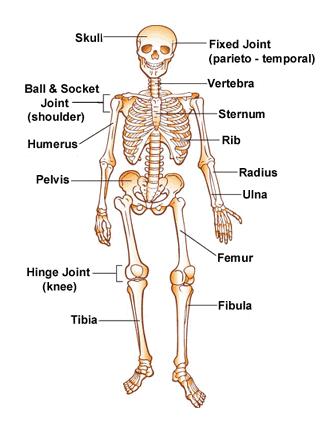
All 12 pairs of ribs attach in the back to the spine, where they are held in place by the thoracic vertebrae. The first seven pairs of ribs attach in the front to the sternum, a strong bone in the centre of your chest that holds those ribs in place. The remaining sets of ribs don’t attach to the sternum directly. The next three pairs are held on with cartilage to the ribs above them.
The very last two sets of ribs are called floating ribs because they aren’t connected to the sternum or the ribs above them. But don’t worry, these ribs can’t ever float away. Like the rest of the ribs, they are securely attached to the spine in the back.
Your skull
Your skull protects the most important part of all, the brain. You can feel your skull by pushing on your head, especially in the back a few inches above your neck. The skull is actually made up of different bones. Some of these bones protect your brain, whereas others make up the structure of your face. If you touch beneath your eyes, you can feel the ridge of the bone that forms the hole where your eye sits.
And although you can’t see it, the smallest bone in your whole body is in your head, too. The stirrup bone behind your eardrum is only .1 to .13 inches (2.5 to 3.3 mil-
limetres) long! Want to know something else? Your lower jawbone is the only bone in your head you can move. It opens and closes to let you talk and chew food. Your skull is pretty cool, but it’s changed since you were a baby. All babies are born with spaces between the bones in their skulls. This allows the bones to move, close up, and even overlap as the baby goes through the birth canal. As the baby grows, the space between the bones slowly closes up and disappears, and special joints called sutures con nect the bones.
Your hands
the elbow.
Each of these bones is wider at the ends and skinnier in the middle, to help give it strength where it meets another bone. At the end of the
total of 54 bones – all ready to help you grasp things, write your name, pick up the phone, or throw a softball!

As you sit and play with handheld games, while you swing on a swing, even when you pick up your lunch, you’re using the bones in your fingers, hand, wrist, and arm.
Each arm is attached to a shoulder blade or scapula, a large triangular bone on the upper back corner of each side of the ribcage. The arm is made up of three bones: the humerus, which is above your elbow, and the radius and ulna, which are below
radius and ulna are eight smaller bones that make up your wrist. Although these bones are small, they can really move! Twist your wrist around or wave and you’ll see how the wrist can move.
The centre part of your hand is made up of five separate bones. Each finger on your hand has three bones, except for your thumb, which has two. So between your wrists, hands, and all your fingers, you’ve got a grand

Your legs
Sure, your arm, wrist, hand, and finger bones are great for picking up the phone, but how are you supposed to run to answer it? Well, with the bones of the legs and feet!
Your legs are attached to a circular group of bones called your pelvis. The pelvis is a bowl-shaped structure that supports the spine. It is made up of the two large hip bones in front, and behind are the sacrum and the coccyx. The pelvis acts as a tough ring of protection around parts of the digestive system, parts of the urinary system, and parts of the reproductive system.
Your leg bones are very large and strong to help support the weight of your body. The bone that goes from your pelvis to your knee is called the femur, and it’s the longest bone in your body. At the knee, there’s a triangular-shaped bone called the patella, or kneecap that protects the knee joint. Below the knee are two other leg bones: the tibia and the fibula. Just like the three bones in the arm, the three bones in the leg are wider at the ends than in the middle to give them strength.
The ankle is a bit dif-

ferent from the wrist; it is where the lower leg bones connect to a large bone in the foot called the talus. Next to the talus are six other bones. But the main part of the foot is similar to the hand, with five bones. Each toe has three tiny bones, except for your big toe, which has just two. This brings the bone total in both feet and ankles to 52!
Most people don’t use their toes and feet for grabbing stuff or writing, but they do use them for two very important things: standing and walking. Without all the bones of the foot working together, it would be impossible to balance properly. The bones in the feet are ar-
ranged so the foot is almost flat and a bit wide, to help you stay upright. So the next time you’re walking, be sure to look down and thank those toes!
Your joints
The place where two bones meet is called a joint. Some joints move and others don’t.
Body basics: Fixed joints are fixed in place and don’t move at all. Your skull has some of these joints (called sutures, remember?), which close up the bones of the skull in a young person’s head. One of these joints is called the parieto-temporal suture – it’s the one that runs along the side of the skull. Moving joints are the ones that let you ride your bike, eat cereal, and play a video game – the ones that allow you to twist, bend, and move different parts of your body. Some moving joints, like the ones in your spine, move only a little. Other joints move a lot. One of the main types of moving joints is called a hinge joint. Your elbows and knees each have hinge joints, which let you bend and then straighten your arms and legs. These joints are like the hinges on a door. Just as most doors can only open one way, you can only bend your arms and legs in one direction. You also have many smaller hinge joints in your fingers and toes.
Another important type of moving joint is the ball and socket joint. You can find these joints at your shoulders and hips. They are made up of the round end of one bone fitting into a small cup-like area of another bone. Ball and socket joints allow for lots of movement in every direction. Make sure you’ve got lots of room, and try swinging your arms all over the place.
Have you ever seen someone put oil on a hinge to make it work easier or stop squeaking? Well, your joints come with their own special fluid called synovial fluid that helps them move freely. Bones are held together at the joints by ligaments, which are like very strong rubber bands. (Kidshealth)
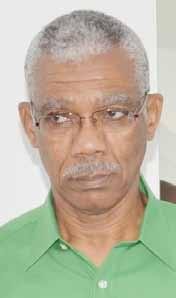
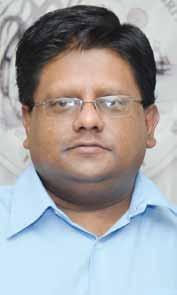
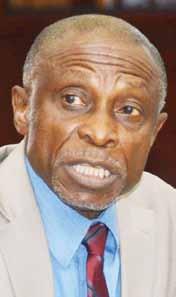
Finance Minister, Dr Ashni Singh said Opposition Leader David Granger should instruct his shadow finance minister Carl Greenidge, if he has the authority to do so, to meet with him on the impending budget and refrain from making accusations in the media about the budget consultation process.
Dr Singh was responding to Granger’s latest remarks
on the issue, where he pointed to an alleged breakdown in talks, insisting that the finance minister was not taking the opposition’s concerns on board.
Speaking at a news conference hosted by the A Partnership for National Unity (APNU) last Friday, Granger had disclosed that the coalition remains hopeful but that hope is slowly dwindling.
Granger said that President Donald Ramotar had promised to initiate a new process with regard to the budget talks, which were set to take full effect on July 1, 2013 but the concerns of the opposition parties have not been taken on board by Dr Singh.
The opposition leader stated that the budget is an extremely complicated document, noting that it calls for a lot of data.
“We have to be given that information,” Granger stated, pointing out that the opposition has been sidelined from the process. He went on to say
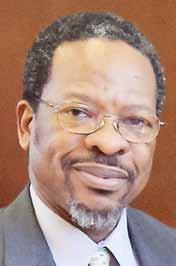
Distinguished Guyanese Professor, Dr Ivelaw Griffith will be meeting with Members of Parliament (MPs) on Tuesday.
The specialist on Caribbean security, drugs and crime will be meeting with the parliamentarians in the Parliament chamber, public buildings, to make a short presentation on security-related issues that have gripped the Caribbean.
Additionally, he will engage parliamentarians on a wide range of issues on international relations and security. Dr Griffith, who is president of Fort Valley State University in Fort Valley, Georgia, will visit Guyana on January 20 to 21.
“Dr Griffith will speak with and meet Guyana and Caricom officials on issues relating to regional security and President Obama’s Caribbean Basin Security Initiative,” a release from the Parliament Office stated.
Dr Griffith also served as provost and senior vice president at York College of the City University of New York.
“His notable achievements there include growing the fulltime faculty by 30 per cent over four years, re-organising the academic division into three schools and enhancing the research and scholarly climate by creating a Provost Lecture Series and a companion Distinguished Scholars Lecture Series,” the release said.
Meanwhile, the Caribbean Basin Security Initiative (CBSI) has created quite a disturbance in the underground world of cocaine smuggling. Cocaine seizures across Caricom member states, training of police personnel and the provision of fast boats to help
that the government “is playing a very dangerous game in denying us the ability to contribute fully to the process”.
He said that the budget is probably in the advanced stage of preparation. While not arguing that it is the responsibility of the executive to prepare the budget in the initial stage, the APNU leader had called for a consultative process so that the opposition can have its concerns
contain maritime criminal activities are some of the success stories of the initiative.
The initiative has been tactically designed, targeting atrisk youths from getting involved in criminal activities.
The development of vocational skills is an important component.
Since 2011, approximately US$263 million has been expended on the programme, with an additional US$60 million pumped into the programme November last. The rise in gun-related crimes, gang-related violence, drug trafficking, cyber crimes, and human trafficking are among some challenges affecting the region.
According to a United Nations Development Programme (2012) Report, violence, crime, police corruption and failing justice systems are negatively impacting the commercial sector.
According to the report, Latin American and the Caribbean is home to 8.5 per cent of the world’s population but yet accounts for 27 per cent of the world’s murders.
addressed.
Ganger said that the ultimate responsibility of presenting the budget is that of the executive, but it has a responsibility to the “Constitution and the nation at large”. The opposition leader added that up to the present time, the “consultative process has not borne fruit”.
In responding to Granger’s comments, Dr Singh said that the opposition leader’s remarks are “a blatant lie and cheap publicity stunt”. He said in his most recent email dated January 13, 2014, he reiterated government’s invitation to meet on Budget 2014 and requested that Greenidge suggest a date during the past or coming week.
The email was also copied to Granger, People’s National Congress/Reform (PNC/R) member Lance Carberry, Alliance For Change (AFC) leader Khemraj Ramjattan, Cabinet Secretary Dr Roger Luncheon, and Government’s Chief Whip Gail Teixeira, the finance minister indicated.
He said the email also contained copies of documents to be discussed.
“To date my invitation has been met with stony silence by Messrs Granger and Greenidge. It is also important to note that this is not the first invitation that has been issued to the opposition to discuss the 2014 Budget, as a government team has already initiated discussions with the opposition in the lat-
ter part of 2013,” Dr Singh said.
“I do not wish to speculate on whether this was a case of an internal breakdown in communication in the leadership of APNU between Messrs Greenidge and Granger, but the fact of the matter is that the government of Guyana has issued an invitation to the opposition to meet and that invitation has not received a response.
"Instead, the opposition appears more interested in engaging in attacks in the media and political grandstanding, regrettably based on misrepresentation of the facts,” Dr Singh charged.
He said Granger would be well advised, instead of occupying himself with making accusations in the media, to instruct Greenidge to respond to his email dated January 13.
“Government remains open to meet with the opposition as has always been the case and we look forward to a response by the APNU to our invitation to advance discussion on Budget 2014,” he added.

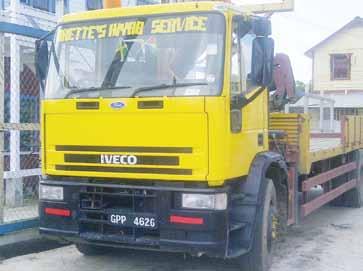
Athree-year-old boy was killed when he ran into the path of a lumber truck at Charity, Essequibo Coast on Sunday morning.
Dead is Josiah Persaud of Lot 732 Charity Housing Scheme. The accident occurred around 10:00h Sunday. The truck that was involved in the accident is presently impounded at the Charity Police Station, while the driver is in custody.
According to reports, the driver of the GPP 4626 truck was proceeding south along the Charity main road when the child reportedly ran into the pathway of the vehicle. The toddler was said to be playing in front of his parents’ yard.
He was picked up in an unconscious state and rushed to the Charity Oscar Joseph Hospital where he was pronounced dead on arrival.
According to the father of the toddler, Michael “Bobby”
Persaud, he and the driver of the truck are friends. He said his friend was trying to get his attention by honking the vehicle’s horn when the child ran into the path of the truck.
“He died in my hands, he had head injuries,” the tearful father said, who had immediately ran to the scene and picked up his son.
Although acknowledging that the child had run into the path of the truck, Persaud said the driver could have slowed down. At the time, Persaud said he was chatting with his wife while the child and another boy were playing in the yard.
The friend with whom the toddler was playing said the ball they were playing with had rolled across the road and Josiah was trying to retrieve it when he was struck down.
The friend said he heard a loud noise and scream and when he looked out, his friend was lying lifeless on the road. The toddler was described as a very jolly child.
Recently, Muntaaz

The owners of a Chinese garment store and Fullworks Auto Spares are now counting their losses after fire on Saturday night ravaged the building in which they were housed at Lot 152 Regent Street, Georgetown.
The fire, which the owners of the building, Fullworks, suspect to be the work of arson, started about 23:00h.
The blaze reportedly started in the lower flat of the two-storey wooden building and due to the combustible items it housed, the fire quickly engulfed the building.
Several houses and businesses were threatened, but the prompt response by members of the Guyana Fire Service prevented further disaster.
One house at the back of the building suffered the most damage since several windows and glass doors
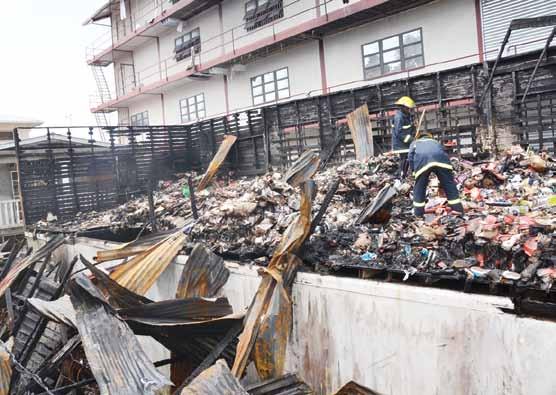
were shattered due to the intense heat from the blaze.
When Guyana Times visited the area on Sunday morning, the place was un-
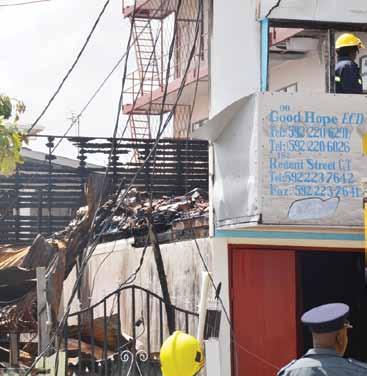
der guard by members of the Guyana Police Force.
Several Chinese nationals were also seen at the location in their vehicles but refused to disembark.
The entire upper flat of the building was reduced to debris. Some people took the opportunity to search for anything they can use. Some were seen taking out water-soaked sneakers from the lower flat.
Roslyn Farlene, the occupant of the back house, told Guyana Times that she was home alone when she heard glass breaking and people screaming "Fire! Fire!" She said as she woke up, she panicked and found herself trapped between two glass doors.
As she screamed for assistance, she was rescued by two firefighters who went through the already shattered glass door. One of

them, she noted, picked her up while the other was carrying a ladder, which she used to climb over the concrete fence that separated her home from that of the neighbours.
She said that fortunately she did not suffer any major injuries, just a few scratches and bruises, and she praised the firemen. Farlene stated that by the time she was saved, the Chinese store was already engulfed and the firemen were battling to contain the fire.
Containment
Fire officials stated that after they received the report, several tenders from the Central Fire Service were dispatched to the location. Upon arriving at the scene, the building was in flames, thus their main focus was to contain the fire to one location and save the nearby building.
In addition, while there, they realised that a female was trapped in the house at the back of the burning building, thus their focus was to rescue the occupant which they successfully did.
After battling for almost two hours, the fire was extinguished with heaps of smoke billowing from the items that were stored in the building. Fire officials are continuing their investigation into the fire.
At the scene, one of the owners of the building was of the opinion that the structure was purposely set on fire. He told reporters that he was at home when he received the call informing him that the building was engulfed in flames.
By the time he arrived at the scene, he said the building was far gone, but he commended the firefighters for limiting the blaze to one location.
A few years ago, the same building was ravaged by fire, and arson was also suspected then.

...from old codgers
Ex-Speaker Ralph Ramkarran, reprised one of his old columns – from 2010 – to claim ownership of the “social contract” debate that’s transfixed David Granger and Henry Jeffrey. While most Guyanese yawned away the ennui that envelopes them when such strained esoterica are floated, it does serve to reveal the mindset of these old codgers who would be presidents. (They wish!) Ramkarran admitted that his column – concocted when he was still in the PPP’s Ex-Co and vying for that party’s nod to be their presidential candidate – was directed to the PPP. We can assume that since he lost out in the vote in the ExCo, his social contract idea didn’t cut any ice with the PPP. (There was more interest on whether that vote was going to be via “hands up” or “hands down”: Ramkarran’s “hands up” lost and so did he)
But lo and behold, it was resuscitated by Granger... and it sounded so close it suggested maybe the two gentlemen shared notes? Your Eyewitness, of course, has long concluded that Ramkarran was bucking to be the “consensus candidate” to lead Guyana into the promised land of the “grand coalition”. That Ramkarran exhumed his old column to clarify that his buddy Henry Jeffrey wasn’t rejecting the “social contract” per se...just Granger’s tactical deployment of it, proves the dream lives on.
None of that, of course, is of any surprise. But what did raise your Eyewitness’ eyebrows was Ramkarran’s addendum to his original thesis. Ramkarran exclaims: “I have no idea why the opposition is not demanding instead a share in the government which is a mandate given to it by the electorate.”
Share of government? Seems Ramkarran not only agrees with Jeffrey that Granger and APNU should be more confrontational but to be so to seize a “share” of government!
Some might see this as treason.
...fuzzy thinking
But Ramkarran also betrays the kind of fuzzy thinking on fundamental concepts proving that ambitions have warped their minds. It’s said that to a hammer, everything’s a nail. So while we know Ramkarran’s a contract lawyer he should remember that a “compact” isn’t always a “contract”. Especially when it’s used in political theorising and even more especially when one hauls in an American usage of “compact”. So hold back your yawns while we nail this one down.
Ramkarran uses the terms interchangeably, but in the U.S., “compact” invokes the “Compact Theory”. This holds that the U.S. government was formed by the individual states and not by the people. “Contract Theory”, harking back to the original usage of the term by Hobbes and Locke, etc, declares that the government was formed by the people and not the states.
In the Guyanese context, there’s already a “social contract” between the people and the state – it’s called the Constitution. In fact, Ramkarran was the PPP’s point man when the latest social contract/Constitution was crafted and approved unanimously in 2000 by the representatives of ALL the people. So he’s really thinking of a “social compact” – among groups and not individuals. The only problem is that his named groups have already formed a compact.
It’s just that Ramkarran and the other members of the opposition don’t seem to recognise the Private Sector Commission, the FITUG, RPA, etc and the PPP government as groups competent to draft and execute a social compact. He should be reminded though, that the Republicans never supported FDR’s social compact – called the New Deal. FDR just ignored them.
...not transparent
One of the head honchos in the local Transparency International (which doesn’t communicate ANY information on allegations of local corruption, etc, to its parent body! RIGHT!!!) is a lawyer. He’s upset his case against someone using “insulting language” and “calling a person a name other than his own” wasn’t given priority by the DPP. Has the wanker listened to debates in Parliament?
Afive-year plan has been devised for the development of the calypso art form within schools and communities throughout Guyana.
The projected five-year plan will see the Guyana Calypso Writers and Singers Association appealing to more youths nationwide to develop an appreciation for calypso as an art form here.
During an interview with this newspaper, newly-elected President Aaron Blackman explained that attempts will be made to fuse and push calypso as part of the music curricula in schools across the country.
“I’m hoping that these junior calypsonians become members of the association. I’ll work along with the Ministry of Education to have programmes for the junior calypsonians... It’s necessary that in schools we start having school orchestras. I’ve seen it in other Caribbean countries where they have children playing in festivals and carnivals,” he said.
Blackman is of the opinion that Guyana should not be left behind. He noted that calypso can be used to advance the country’s social and cultural development. This, he
said, can only occur with the right forms of investment and an atmosphere where the art form is given prominence and respect.
“I see calypso as a vehicle to bring to the young people in regard to education, social development and awareness of their country,” said Blackman.
Tool to create change
The president explained that calypso will be used as a means to assist in the development of society as well; hence, as part of the five-year plan, they will be going into communities discussing and sharing ideas of how calypso can help in that community.
Blackman said that he believes calypso was rooted in Guyana as he made reference to Francisco Slinger better known as “The Mighty Sparrow”, who was managed by the late Guyanese Cyril Shah. He further explained that Guyana has many Sparrows and calypso can be used to bring about positive changes in the Guyanese society.
“We have many Sparrows in this country because Sparrow was nurtured by the Guyanese society.
"So it’s for us to work to
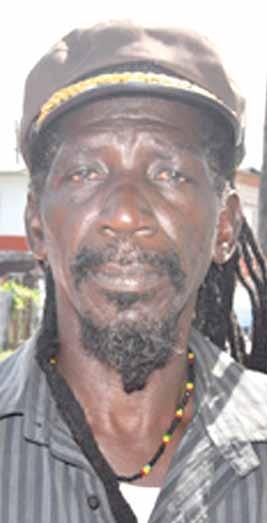
Guyana Calypso Writers and Singers Association President Aaron Blackman
create that society where we all can work in peace and harmony and as our motto say ‘One People, One Nation and One Destiny’, and I believe that calypso can be used to bring about these changes,” he said.
The association is working towards the establishment of a calypso website as well as recording the songs on CDs, which will be made available to the public.
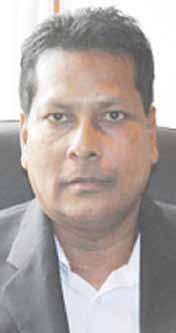
Just over a week after it was revealed that the Guyana Stockfeeds Inc did not pay any dividends to its shareholders as it claims in its interim report for January-June 2013, there has been no word from the company.
There have been several attempts from Guyana Times to contact the directors of the company, including Robert Badal Sr and his son Robert Badal Jr to comment on the issue, but these proved have futile.
Initially, this newspaper was told that Badal Sr was out of the country, but he returned some time last week, but was unreachable when efforts were made during the week.
Elusive
Another attempt to contact the Badals was made on Sunday and that too was futile. This publication also made contact via email with the National Industrial and Commercial Investments Limited (NICIL), which is a shareholder of the company. However, to date, no official response has been given.
According to the report which was published in the Stabroek News on September 20, 2013, some $80,285,557.00 were purported to have been paid in
dividends for the financial year 2012, but shareholders have complained to the Guyana Securities Council that such was not done.
In an advisory sent out by the Guyana Securities Council, Guyana Stockfeeds’ attorney had confirmed that indeed no dividends were paid to the shareholders for the financial year 2012.
Correction not made
This newspaper was subsequently told that the company cannot pay any dividends because of a court case it has pending.
According to one of its shareholders, the company has several matters pending in court. Why the company claimed it paid dividends therefore remains a mystery.
Breach
The shareholder told this publication that this was the reason the matter was brought to the attention of the Guyana Securities Council.
Guyana Times understands that the matter is currently before the board of the Guyana Securities Council, as the council advises shareholders to seek independent legal advice.
If Stockfeeds is found in breach of the regulation, it will be penalised accordingly by the Guyana Securities Council,.
Nizam Ali and Company is the accounting firm for Guyana Stockfeeds Inc, but it did not prepare the misleading report published in the Stabroek News. It is believed that the report was prepared internally by the company's staff.
The Guyana Security Council said that it had written the company in November last year, advising that it corrects the report and disseminate it as was done with the incorrect report. But this was not done.
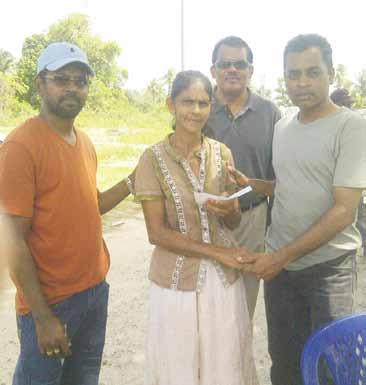
Fifty Airy Hall rice farmers on the Essequibo Coast who were affected by the recent breach in the conservancy dam there have received cash as compensation from the Rice Producers’ Association (RPA).
The cheques were delivered by RPA General Secretary Dharamkumar Seeraj, who said the assistance was made possible through the Agriculture Ministry, the Guyana Rice Development Board
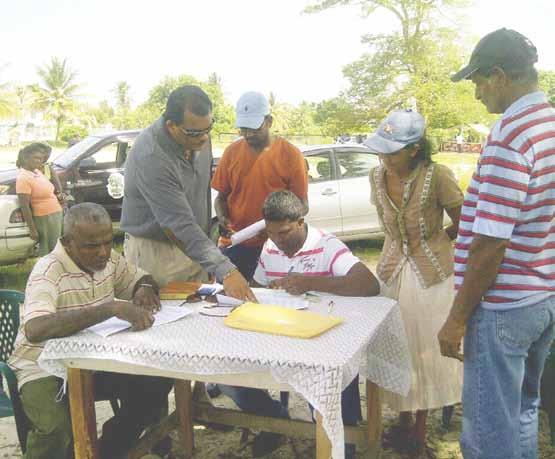
(GRDB) and the RPA. At a farmer’s meeting held at Airy Hall on Sunday, Seeraj said the majority of stakeholders recognised that rice farmers from Airy Hall suffered tremendously due to the flooding, and as such, the compensation will assist them in meeting additional expenses for land preparation.
He said too that the compensation will serve as a means of assisting farmers to recover from the flood that was caused by the breach.
Eighteen farmers each receive $15,000 per acre of rice field; 19 were given $10,000; and 13, $5000. The compensation was based on the amount of losses they suffered. Farmers who suffered 100 per cent damage to their crop were given $15,000 per acre.
Speaking to farmers, Seeraj explained that a cash compensation method was devised by rice stakeholders after it was realised that different farmers may need different things to prepare their land.
“We usually give seed paddy, fertiliser; however, this assistance is different, we giving you money so you farmers can purchase whatever you want to go back in the fields.”
Explaining the process, Seeraj said inspection and verification were done by GRDB staff who assessed the situation.
Reduction
The general secretary added that a proposal was made for farmers to receive $20,000 per acre; however, it was slashed to $15,000. Nevertheless, he added that farmers were selected for the assistance based on how badly their fields were affected.
He said those farmers whose lands were inundated will also be given fertiliser. It was noted that the least farmers will receive is
$5000 per acre.
GRDB Deputy General Manager Ricky Ramraj congratulated the farmers on their zeal, commitment and resilience displayed during the flooding. Ramraj said rice cultivation in the country has begun and while some farmers are not fully paid, efforts are being made at higher levels to ensure they receive their money.
He noted that acquiring favourable prices for
farmers remain a challenge for the GRDB, but efforts will be made to continue to support farmers and their needs. He said efforts are also being made to fully represent farmers and GRDB officers will continue to render assistance and technical advice. Special attention is also being given to combat the paddy bug problem. A special programme has been devised to address the prob-
lem. Ramraj called on farmers to cooperate and value their investments, noting that minor breaches should be reported at an early stage. A few farmers told Guyana Times that they were satisfied and thankful for the relief package. Farmers at the meeting said although the compensation is small, they are thankful for it.
The Guyana Police Force (GPF) is cautioning against hasty judgment being made regarding allegations by Colwyn Harding that he was baton-raped by a rank of the Timehri Police Station last November.
The police noted that the complaint made by Harding of being assaulted and sodomised with a baton covered with a condom by the police while in custody at the Timehri Police Station is still an allegation which is under investigation by the Police Office of Professional Responsibility (OPR).
Pre-mature conclusion
The GPF said it has observed, however, that some sections of the media apparently have, without the benefit of a completed investigation, arrived at the conclusion that the police ranks are guilty of these allegations and continue to besmirch the image of the force and the character of the ranks allegedly involved in the incident.
“The Guyana Police Force at the recent press conference held by the commissioner of police did indicate that the investigation is proceeding apace and it is expected to be completed during this week, after which legal advice will be sought.
"The police force is urging that good sense and
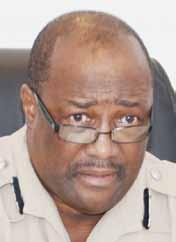
professionalism prevail and that we await the outcome of the investigation, rather than assume a particular position and vilify the force which, under the circumstances, can only be construed as aimed at demoralising ranks and tarnishing the force’s image and reputation,” said the GPF.
The GPF reiterated that it does not condone unethical or inappropriate behaviour by its ranks, and that condign action will be taken against any rank found culpable of such action.
Meanwhile, the Guyana Human Rights Association (GHRA) said new allegations of threats against other persons detained in Timerhi at the time of the original beating of Harding in November last year suggest the police force is more engaged in a coverup than an investigation

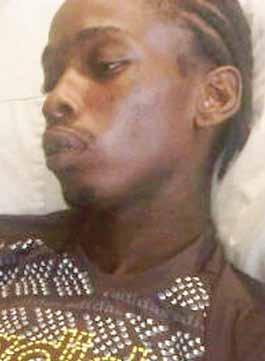
of the original brutality to Harding, orchestrating damage control by creating further damage.
According to the rights body, the manner in which the original incident has been handled has generated widespread public revulsion towards police force.
“... reports of brutality towards Colwyn Harding at the Georgetown Public Hospital involving a group of prison officers extended the perception of supposedly disciplined services being out of control,” the GHRA said.
Credibility
The body said that such efforts at cover-up, while carried out by lower level ranks, undermine the credibility of the upper echelon of the police force.
“Their efforts to defend themselves against charges of negligence and laxity
in responding to the original allegations of assault on Harding are not convincing.
"Police officers allegedly present when the (reported) beatings and sexual assault took place apparently took no responsibility either to stop the assault, nor to assist Harding to get prompt medical attention, nor report the incident to higher authority,” the GHRA said.
The rights body said when the incident eventually reached the highestlevel of the force through Harding’s mother, a routine administrative action was adopted, namely a referral to OPR.
“The belated scramble to the effective action was prompted only by interventions from the press on January 10.
"In other words, extreme physical brutality, an offence which merits years in prison if committed by a civilian – let alone the allegations of sexual assault – were treated as a routine disciplinary incident when involving a police officer,” said the GHRA.
The GHRA said extreme brutality of this nature taking place in rural stations such as Timerhi and Leonora (in the case of the tortured teenager in 2009) points to use of excessive force becoming routine.



Abig man name Bis Ram shame all dem other Ram. Even dem Ram who now turn Rum get shame. Bis Ram ram dem real hard wid a long column. From Lalloo Ram to Ram Bow de old ram, and from Rum Karat to Rum Jhaat – all of dem get ram. So Bis Ram got to be de real ram. By de time Bis Ram done, dem couldn’t even ram back.
Dem Ram and Rum does play bright. Old people call it know-it-all. Dem does behave like when dem know bout every ting and bout every body business. But dem does wuk close with Mook Lall. And that is a big mook. So some of de mookness rubbin off.
Dem Ram and Rum does like to tell other people bout dem business. But dem quiet like cat when dem friends and family behave scampish and thiefin. That is how Bis Ram ram dem. That long column gon stay in dem fuh a long time.
Mook Lall de kocheur seh he does kocheur pun every ting no matter who or whah it is. He even kocheur pun de guvament and seh dem coverin up fuh dem own family and friends. Well, Mook Lall own fart wake he up when one of he robbin friend rob dem chicken feed people. Robbin Bad thief more $80 million and he run and hide. That is when de big Mook run and hide too. Nutten in de mud paper. And that was a lotta mud, but he ain’t kocheur pun that one. And Robbin Bad is he friend. He was quiet just so when he and he other thiefin friend Stoney Yass thief from de Water Street store. Dem unprofessional but dem tekkin professional fees.
Ting-a-ling-a-ling…friend tell friend…mattie tell mattie! So after all guvament got friends and de Mook got friends. Friends does look out fuh each other, although de Mook cut some of he friends throat. But Robbin Bad and he tight wid de $80 million. After all, dem is friends.
One of the most daring space missions ever undertaken reaches a key milestone today.
Europe’s Rosetta probe was launched a decade ago on a long quest to chase down and land on a comet, and has spent the past twoand-a-half-years in hibernation to try to conserve power.
But at 10:00 GMT, an onboard “alarm clock” is expected to rouse the spacecraft from its slumber. Rosetta will then warm its systems before sending a signal to Earth.
Receipt of this “I’m awake” message will confirm the great endeavour is still on course. Rosetta is due to rendezvous with Comet 67P/ Churyumov-Gerasimenko in August.
And after spending a couple of months studying and mapping this four kmwide ball of ice and dust, it will drop a small robot on to the comet’s surface to gather samples and panoramic pictures. Controllers at the European Space Agency’s (Esa) operations centre in Darmstadt, Germany, do not know precisely when today’s all-important message will arrive, but they anticipate receiving it sometime between 17:30 and 18:30
GMT. Before it can send the signal, Rosetta must work through a sequence of activities that will last several hours. First, it must raise the temperature of the sensor chips in its navigation instruments, then it must stop the stabilising spin into which it was placed for hibernation, and finally it must find Earth on the sky and point its main antenna in that direction.
“It will be transmitting just the ‘carrier signal’, so at that point there’s no data coming down from the spacecraft,” explained Andrea Accomazzo, Rosetta’s operations manager.
“We just receive a firm frequency. In theory, it would be like a continuous beep if you were to convert it into sound. We will see it on a screen that is basically a spectrum analyser.
“Although, we will have no information from the spacecraft, we will know just from that transmission that it must have done everything it had to do automatically and is in a safe status; and that everything that happens next is in our hands,” he told BBC News. (Excerpt from BBC News)

When it comes to standing in solidarity with other developing countries, few countries can match the Guyana’s record. Guyana has been consistent, unwavering and generous whenever sister developing countries and their peoples faced disasters and unfair persecution, no matter which government was in place.
On January 16, 2014, Guyana’s Parliament paid tribute to a global icon –Nelson Mandela. Few countries and few governments have greater legitimacy in paying tribute to a giant among men. From the time of his imprisonment in South Africa and until his death, Guyana was inextricably linked to Mandela and to South Africa.
Early days
In the early days of persecution and prosecution, even before he began serving his 27 years of imprisonment, Dr Cheddi Jagan and the People’s Progressive Party (PPP) were in solidarity with Madiba’s struggle for freedom in his country.
In government and in opposition, Dr Jagan and the PPP remained consistent and unwavering in supporting Mandela and his people’s struggle for freedom and dignity in South Africa against the repugnance of apartheid.
The People’s National Congress (PNC) and its leaders similarly stood in
solidarity with Mandela and the people of South Africa. Guyana contributed US$50,000 annually for some time to the African struggle for freedom.
It was a generous con tribution at the time and Guyana kept this contribu tion going for a long time. But Guyana’s contribu tion to the struggle of Mandela and South Africa is not singular.
Recently, even with Guyana’s own strug gles against in clement weather and weather-relat ed disasters, Guyana was one of the first countries to support and send help to St Vincent and the Grenadines, St Lucia and Dominica when those countries suffered flooding and rain-drenched disasters.
A few years ago, when Grenada was almost to tally destroyed by a hurri cane, Guyana sent support and soldiers to help re build the infrastructure. In 2010, when an earthquake flattened Haiti and killed hundreds of thousands of Haitians, Guyana was one of the first countries to send help and in terms of contribution per capita, Guyana ranked almost at the top.
the Pacific, Africa, South or Central America or the Caribbean, Guyana has stood solidly with developing countries whether they confront natural disasters
in 1962 and we never wavered. Guyana has stayed friends with Cuba when it was politically wiser to side with the U.S. government.
But Guyana chose

Haitian people lived under cruel dictatorship, Guyana stood resolutely in opposing oppression in Haiti.
Nations (UN), remained staunch in standing with Cuba against U.S. oppression of a people.
the PPP boldly stood with Nicaragua. When the U.S. and other developed countries attempted to institute a “Two-China Policy” by trying to admit Taiwan into the UN, Guyana stood unbent in solidarity with the “OneChina Policy”.
When Ian Smith declared independence for Rhodesia (Zimbabwe) and the British and the developed countries turned a blind eye as Ian Smith tried to institute apartheid in that country, Guyana was among the first countries to stand in opposition and offered support to the freedom fighters from Zimbabwe who sacrificed with their lives and limbs to bring freedom to Zimbabwe.
More recently, as President Robert Mugabe solidified his dictatorship in Zimbabwe, Guyana has been robust within the Commonwealth in calling for democracy for Zimbabwe.
government in Chile in the 1970s, the PPP led Guyana’s voice against the imperialist-driven efforts to thwart the will of the people and to subvert democracy in that country.
When two years ago, the Surinamese people chose their president and some developed countries wanted to impose their will on the Surinamese people instead, Guyana stood with Surinam.
Many examples
There are many other examples of Guyana’s solidarity and generosity when it comes to supporting the struggles of developing countries.
Guyana has suffered and has been punished because it dared to stand in solidarity with developing countries even when the developed countries looked at us sternly and rebuked us for doing so.
There has been little rancor among Guyana’s politicians when it comes to how we behave and what we stand for at the global level with other developing countries.
Whether it is in Asia,
Guyana stood resolutely in opposing the embargo in Cuba. Guyana did so when it was politically dangerous
When the U.S. waged an assault against the sovereignty of Nicaragua in the 1980s and early 1990s,
Since the early 1950s, when the Palestinian people were thrown out of their own country and denied the right to self-determination, Guyana almost singly in the Caribbean at first stood with our Palestinian sisters and brothers even to this day.
When the U.S. worked assiduously to overthrow the Salvador Allende-led
Maybe, Guyana’s politicians can take a lesson from their own ability to work together to support struggles and disasters in other developing countries and work together for the benefit and in the interest of our own people and our own country.
Readers are invited to send their comments by email or Facebook to times. notebook@gmail.com.

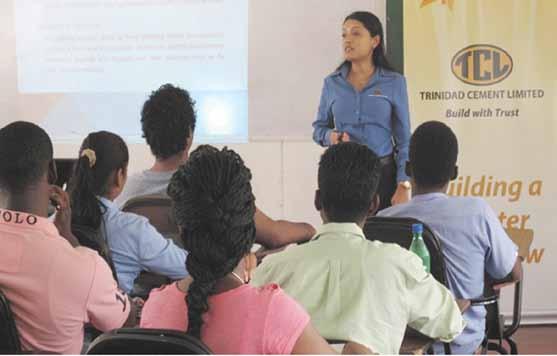
Cement giant Trinidad Cement Limited (TCL) wrapped up a threeday customer appreciation and training through its Learning Academy, with the objective of educating current and prospective customers on alternative uses of the product.
TCL Guyana Inc Plant Manager Mark Benn, addressing members of the media at the launch of the training last Friday at the company’s boardroom on Lombard Street, Georgetown, said persons generally think of cement as a construction material only.
However, with the new innovation, customers will be informed of the many advantages that could be derived from its use.
“We don’t just sell the product, but we try to ensure that the persons who use the product employ the best practices with regards to the use of cement,” he told the gathering.
Information Benn said that although the company stakes out every avenue to market its product, it still has a responsibility to make the requisite information available to stakeholders in the construction industry.
Coordinator of TCL Learning Academy in Trinidad and Tobago Andira

Members of the Guyana Sex Work Coalition held a meeting to discuss several issues that affect their lives, chastising the religious community here and calling for more protection from the state.
The meeting followed a three-day workshop attended by commercial sex workers and peer educators from around the country.
At the meeting, issues surrounding sex workers and their rights were discussed.
Two women commercial sex workers shared their stories about the abuse and ridicule they face plying their profession.
their August 28-30 annual meeting held in Montego Bay, Jamaica, the coalition, a collective of sex worker-led civil society organisations and sex worker advocates, said sex work is serious work and must be given due recognition.
The group said selling sex should not be a crime and practices and policies should not harm sex workers.
efficiency of it”.
She said part of the course entails proper cement and concrete technology within the industry.
However, this is based on the resources that are readily available. Mooloo said the condition of roads throughout the Caribbean is poor.
Thus, another part of the training included sensitising customers on the use of the best materials for road construction.
The course, which began on Friday, gave over 30 engineering students of
and Anguilla.
It was incorporated in Trinidad and Tobago in 1951 and commenced production three years later. The company extended its services to Guyana in 2004. Its primary activity here is the packaging of bulk cement for sale on the Guyanese market.
Full-fledged academy
Meanwhile, TCL said what began over 10 years ago as a series of lectures facilitated by TCL’s Packing Plant Supervisor Wayne Benjamin (who was at that time a chem-
Kowlessar said that the academy had been in the making for a number of years.
However, it was recently formalised. She said that the initiative was taken to bring the academy to Guyana after company executives realised that the expansive knowledge within the group needed to be shared.
This knowledge will be transferred to all stakeholders, including university, technical and vocational students, and will soon spread to other Caribbean countries.
TGL’s group civil engineer Avaleen Mooloo told reporters that because of the lack of pertinent knowledge of cement, persons within the construction industry generally fail to realise “the optimum
the University of Guyana Turkeyen Campus firsthand knowledge of “concrete technology for engineers and contractors”.
That lecture was delivered by Mooloo. On Saturday, some 25 masons benefited from a lecture by National Infrastructure Development Company, Senior Project Manager Romol Bereaux, at the Government Industrial Training Centre.
Lectures were also delivered at technical institutes around the country on the same day.
Trinidad Cement Limited (group) is considered the leading producer and marketer of cement in the Caribbean. It consists of eight operating companies in Trinidad, Barbados, Guyana, Jamaica
ist at TCL), has now evolved into a full-fledged academy, coordinated by Kowlessar and facilitated by Mooloo.
Mooloo has lectured in Trinidad at institutions such as The Youth Training Employment and Partnership Programme (YTEPP) and the University of the West Indies (UWI) Open Campus.
Establishing a regionwide Learning Academy is the goal of the TCL Group, and one, which is shared by Kowlessar and Mooloo.
Although their collaboration only began in May 2013, significant strides have already being made towards this feat.
Kowlessar describes her experience with the TCL Learning Academy as “a sense of accomplishment”
and she is “very eager to take it to the next level”.
Mooloo mirrored those sentiments when she stated that she is “poised to elevate the Learning Academy to a Caribbean-wide institution that imparts expert cement and concrete knowledge”.
Topics ranged from the raw material excavation process; the cement manufacturing process; the various types of cement manufactured by the TCL Group as well as the best practices involved in concrete technology.
Mooloo also discussed in detail, the advantages of pervious concrete, which she described as an excellent product for flood-prone areas, as it significantly reduces surface flooding; and the soil cement stabilisation technique: a procedure that increases the compactness of soil and therefore, can lead to the strengthening of structures such as roadways.
Refreshing
Nefertiti Thompson, a firstyear civil engineering student described Mooloo’s presentation as “very informative, eyeopening and refreshing”.
Commenting on the level of explanation, Pablo Gomes, also a first-year civil engineering student, appreciated that “the lecturer (Mooloo) went through the details quite thoroughly”.
The fourth-year students present, found added benefit in Mooloo’s lecture as many are in the process of working on final-year projects of a civil engineering nature.
One student in particular, Kimberley Bradford, was quite pleased that her project, soil cement stabilisation, was an integral part of Mooloo’s presentation.
The TCL Learning Academy continues to realise progress not only in the lecture rooms, but online as well.
In addition to valuable content being provided via TCL’s newly-redesigned website, www.tcl.co.tt; a TCL Learning Academy Facebook page has also been recently launched at www.facebook. com/TCLLearningAcademy.
One woman, who asked not to be named, said when she goes out “to do sex work, I get beat by the men who I look for my money with” and when she visits the police station to make a report “the police harass” her because of the work she does.
She went on to say that to help her, they would want “sex and sometimes would want to drive away” with her.
Presently, there are 145 members of the coalition and according to Guyana Sex Work Coalition Co-chair Cracey Fernandes, membership to the organisation continues to increase rapidly.
The coalition is calling for more rights among the sex workers, stating that they are denied access to basic medical, legal and financial services. The organisation’s Executive Director Mariam Edwards said that sex workers respect themselves and stated that sex workers’ civil rights “are being undermined”.
Fernandes pointed to the United Nations Declaration under which sex workers are protected and noted that they are deprived of many things. He also spoke of the religious neglect faced by commercial sex workers.
He went on to say that instead of “harmonising and working with us, the religious community spreads hate against us”.
Fernandes said that sex workers are members of family and also represent communities and even though persons believe sex workers to be ignorant, he stated that they “have a voice and are to come to the bar and represent ourselves”.
He reiterated the coalition’s call for persons to stop treating sex workers differently, stating that they are people too.
Late last year, the Caribbean Sex Worker Coalition, of which Guyana is a member, called on regional governments to give recognition to their work so that they can be on par with other professions where labour conditions are just.
In a statement following
“We have the same human rights and duties as all other people, and these should be respected at all times; we value ourselves like everyone else in society, with equal rights and justice; our civil rights are being undermined, we are being victimised and living with abuse from the people who are supposed to help us,” the group had said in a statement.
According to the coalition, sex workers have a right to equal opportunity to work, healthcare, education, food and shelter, and retirement benefits.
“We respect sexual orientation, gender identity and expression, and gender equality as human rights; we value our family and children; we should be able to access effective social services without any fear, favour or compromise,” the coalition said.
According to them, violence, extortion and discrimination are meted out to sex workers regularly and many are subjected to arbitrary law, detention, police raiding and various kinds of injustices.
“Respect our right to livelihood and freedom to work; respect our right to freedom of movement and migration; provide non-discriminatory health and social services and ensure the Ministry of Health, the National AIDS Programme, and other agencies recognise the different sub-populations of sex workers and design programmes that respond to their needs.” The coalition also wants health ministries to partner with and train healthcare workers to effectively provide services for sex workers, including unconventional health services, such as mobile clinics; ensure that sex workers are not subjected to compulsory HIV testing by employers; guarantee sex workers access to justice, including access to law enforcement officers and police services that are free of stigma and discrimination; recognise transgender people and create laws which protect them from stigma and discrimination, violence and hate crimes; and ensure transgender people can choose to have identity cards and other documentation which reflect their gender identity and expression; and stop linking trafficking in persons with sex work.
The main witness in the alleged baton rape controversy who gave a detailed account of what he saw while at the Timehri Police Station lock-ups on the night Colwyn Harding was allegedly brutally beaten by ranks is now living in fear and feels that he has become a target.
Stephon Joseph Phillips, also called “Muslim”, of Soesdyke/Linden Highways told Guyana Times that he is fearful for his life and that of his 17-year-old son was also brutalised by ranks on the night in question.
The man explained that after he gave a statement to the lawyer about the injustice meted out to Harding, he decided to let the public know about incident.
He said that he went to one of the daily newspapers who promised not to publish his name and photo, when he
opened that particular paper on Saturday morning, he realised that they had broken their promise – an action that puts him at risk.
He recalled that about 22:00h on Friday evening, he was at home when he saw a car drive into the street next to his home and park.
After some time, he called a taxi and it used another entrance to collect him.
Phillips said after the taxi collected him, the parked car drove off, thus, he instructed the driver to follow it.
The car, he stated, subsequently stopped at a bright spot where he saw two armed men looking like police ranks step out.
“I wanted to know what they doing around my house… I thought I was in danger… I had to send away my son… I didn’t want him to go through what I experience with police
over the years… I was beaten many times after they accused me of stealing….
"My hand, feet, face, abdomen all over have marks of
violence to prove the amount of blows I got from them,” he charged.
He added that he has been receiving several calls from unknown persons threatening him.
“When I answer they say you nah dead yet…. You guh dead… you start it and it now begin… you guh dead,” he said.
He said every time he answered the phone, two distinct voices were on the other end of the line – voices that he is familiar with but cannot put a face to.
Reminiscing on the night of the incident, he stated that he was in a cell when he saw police ranks dragging and tugging Harding.
Phillips added that they brutalised him because he responded to the way a female rank was abusing him.
“The female rank was
abusing Harding, calling him gay… and a thief man and he made a snide remark about the rank's mother," he explained.
Soon after, Phillips added, a corporal, along with others, started to assault Harding with the batons.
After they were done, he explained that his cell was opened and as such, he went to Harding’s cell where he rescued him and took him to his.
It was then Harding made the disclosure about the baton rape. “He told me that he got to carry up this matter far and that the corporal got to pay fuh what he did to him…,” he said.
Phillips also said that he has been listening to the news and believes that the man is speaking the truth, recalling him to be in immense pain on the day he was taken into custody.
On Friday, officials of the Georgetown Public Hospital Corporation (GPHC) disclosed that Harding did not inform the institution about being sexually assaulted.
Officials said that the institution was unaware of Harding being sexually assaulted until the matter was reported in the media last week.
On Thursday, Police Commissioner Leroy Brumell, during a press briefing, stated that the Office of Professional Responsibility (OPR) is investigating the alleged assault committed on Harding, hence, several ranks have been questioned, but have all denied the allegations.
Brumell stated that the investigations are wide open and should wrap up as early as Tuesday.
The US$10 million Georgetown Sanitation Improvement Programme (GSIP) is moving apace, Guyana Water Inc (GWI) Project Manager Orin Brown disclosed during an exclusive interview with Guyana Times
It is anticipated that the Inter-American Development Bank (IDB) and the government of Guyana-funded project will be completed long ahead of its May 2014 deadline.
The project is approximately 80 per cent completed. In accordance with the project design, 12 pump stations should have been installed by the end of 2013; however, the GSIP team successfully installed all 24 pump stations in December.
“We have rehabilitated them to a modern standard, each being fitted with two need submersible pumps, one will be on duty and the other on standby in the event of failure,” Brown explained.
Delivery mains
Additionally, under this component, more than four kilometres of the 5.5 kilometres of delivery mains have been installed, in the vicinities of Forshaw and Peter Rose streets; Light and Fifth streets; Hadfield and Smyth streets and Quamina, Camp and Waterloo Streets.
Currently, the contractors are in the process of installing six kilometres of force mains (hydraulic/ring mains) which are considered to be the ar-
teries of the sewage system. According to Brown, this aspect is 60 per cent complete.
“We are on schedule and within the budget and we are confident that the project will be completed successfully,” he posited.
It is anticipated that this first component of the GSIP project, which is designed to modernise the sewage network will benefit approximately 50, 000 persons.
However, the repair of roads which were tampered with to facilitate the first component of the project is not yet completed.
Brown told Guyana Times that consultants are assessing the situation, adding that the inclement weather is contributing to the delays. He said GWI regrets any convenience caused.
Component two focuses on strengthening GWI’s operation. As a result, an Asset Management Strategy is being formulated to effectively manage the upgraded network.
This component includes the staging of seminars for hotels and restaurant owners. It was explained that these entities depend heavily on the sewage network, like all other entities, but create grease straps by pumping fats into the sewage networks, which is severely affecting the network.
School workshops
Workshops for primary and secondary schools within the city will also be conducted with major attention, given to proper sanitation and hygiene. Brown said the third component of the project includes an energy efficiency pilot study.
It was explained that inefficient electro-mechanical equipment will be removed from 12 pumping stations and replaced with energy-efficient equipment.
Through a Mexican consultant, GWI is expected to experience a significant drop in the amount of energy consumed by the listed pumping stations.
Meanwhile, the fourth component is being executed with assistance from the Health Ministry. During this aspect of the programme, there will be mass administration of DEC tablets for the
next five years to reduce the prevalence of filaria in the region. Currently, health workers are distributing DEC tab-
lets in Georgetown and on the East Coast and East Bank of Demerara. This is the second of five cycles of distribution.

ABritish man has been murdered on the Caribbean island of St Lucia as he tried to defend his wife from attackers.
Roger Pratt, 62, was killed on board the couple’s yacht in the town of Vieux Fort on Friday night, police said.
His wife, Margaret, was treated for injuries sustained in the attack, which took place while the Warwickshire couple were on a round-the-world trip.
Police said three people were in custody, but no arrests had been made. Mrs Pratt had been released from hospital and was helping detectives investigating the robbery, they said.
The UK Foreign Office said it was aware of the death of a British national on the island and was providing consular assistance to the family.
The cause of Mr Pratt’s death has not been established, but police said there was no evidence he had been shot. A post-mortem examination is due to take place
“What was meant to be a great adventure, has turned into a nightmare’’
today.
A police spokesman said: “Nobody has been arrested yet but there are some guys in custody. The investigators are very busy looking at what happened.”
He said officers heard that three armed men had boarded the boat, named the Magnetic Attraction, and attacked the couple before fleeing.
“Margaret went in search of her husband and found him floating in the nearby
waters. Roger was retrieved and transported to St Jude Hospital via ambulance along with his wife. He was pronounced dead on arrival while Margaret was treated and discharged.”
The couple had been on their voyage since June, when they left Lowestoft, Suffolk, and headed for the Algarve before navigating their way to the Caribbean.
They had been celebrating Mrs Pratt’s birthday when the attack took place.
(Excerpt from BBC News)
The Environmental Management Agency (EMA) will utilise the TT$20 million which it fined Petrotrin to “rehabilitate” areas impacted by the oil spill along the country’s south-western coastline.
Several concerns have been raised about the size of the fine and whether that money would be deposited into the consolidated fund, making it harder to access.
But EMA officials confirmed to the Sunday Guardian that the multimillion-dollar fine would be deposited into an environmental account which gives them access to it without the bureaucratic minis-
terial or Cabinet approval.
The money, according to a consent agreement signed between Petrotrin and the EMA, would be used to “assess, rehabilitate and do remedial work” in the affected areas. The EMA said that contrary to earlier conservative reports, close to 10.5 miles of beach was affected by the spills.
This small victory for the EMA was hard won, as the agency is currently dealing with archaic legislations that make it hard to leverage or take action against offending companies. The EMA latched on to only one Certificate of Environmental Clearance
(CEC ) granted to Petrotrin back in 2006 in order to impose the fine for the consequences of the environmental breach that led to more than 7000 barrels of oil being emptied into the Gulf of Paria on December 17, and another spill on December 26.
Petrotrin President Khalid Hassanali and the EMA’s Dr Allan Bachan signed off on the consent agreement on January 7 where Petrotrin accepted liability for the two spills which contributed to the oily mess washing up on miles of beach along the peninsula. (Excerpt from Trinidad Guardian)
Mexican authorities have said top security officials will be replaced in the western state of Michoacan that has recently been rocked by violence.
Hundreds of troops have recently been deployed to restore order after groups of vigilantes clashed with a drug gang. But many vigilantes are refusing to heed the government’s call to disarm.
This is despite reassurances by the federal government that the “self-defence groups” are not the target of an ongoing security operation.
Governor Fausto Vallejo says Jose Godoy will succeed Marco Aguilera as attorney general, while Carlos Castellanos will replace Alberto Reyes as police chief.
Interior minister Miguel Angel Osorio Chong said earlier this week that he wanted to convince the vigilantes that “we are going to do our job”.
He said the security forces had identified the three top leaders of the Knights Templar drug cartel and were hunting them down.
Two alleged members of the cartel were arrested on Wednesday, but the self-defence groups dismissed them
as “minor players”. The vigilantes accuse the government of not doing enough to protect locals from the extortion and violence carried out by the gang. The Knights Templar, who claim to protect the local population from attacks from rival gangs, have accused the self-defence groups of siding with the New Generation drug cartel based in neighbouring Jalisco state. They say the fact that some of the vigilantes are carrying powerful assault weapons shows they are not local farmers but are in the pay of the New Generation gang. (BBC News)
Brazil has announced the country’s plan to change its immigration law to make it easier for foreign workers to enter the country and meet growing demands for labour.
Marcelo Neri, Brazil’s strategic affairs minister, said on Thursday that the government aimed to attract highly qualified professionals such as engineers, doctors and technology specialists.
Neri said the changes would include reducing the bureaucracy involved in obtaining a work visa for Brazil and allowing workers to change jobs without having to request a new visa.
Foreign workers are needed because the current “situation of near-full employment” could jeopardise the country’s future economic growth, he added.
The unemployment rate in November 2013 was 4.6 per cent, the lowest level since 2002. A recent study conducted by the Fundacao Dom Cabral business school found that
Cannabis stakeholders in Jamaica Saturday expressed the need for a more aggressive campaign to push the parliament to move further and faster towards legalising the growing, distribution and use of ganja (cannabis, marijuana) in Jamaica.
Ganja Law Reform Coalition (GLRC) Chairman Paul Chang felt that a more robust campaign and show of support would encourage parliamentarians favourable to fundamental changes to legislation affecting the use of the drug. He suggested the need for a young parliamentarian to step up and take the lead, with strong public support, including street demonstrations from stakeholders, including the GLRC.
“We need a young MP
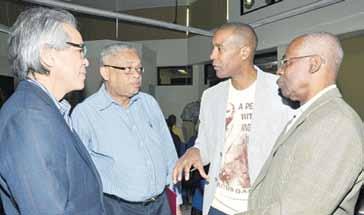
to break the party ranks and put forward proposals for more meaningful legislations than the half steps that they are taking,” Chang told the opening session of the Cannabis Stakeholders
Conference, held in the multifunctional room of the main library of the University of the West Indies (UWI) at Mona.
Obviously shrugging off commitments by Justice
Minister, Senator Mark Golding that Cabinet has been considering amendments that could lead to automatic expungement of ganja sentences, as well as Government MP Raymond Pryce’s successful resolution to decriminalise the possession of small portions of the drug, Chang said he is hoping that increased agitation would show a groundswell of support for more substantial changes, and lead to a conscience vote in Parliament. But he insisted that it required young MPs being more forceful inside Gordon House.
“Government only works when you make them work,” commented Louis Moyston, lecturer and researcher, who was the main speaker at the opening session. (Excerpt from Jamaica Observer)

that 91 per cent of the 167 companies surveyed said they face difficulties in hiring qualified technicians, administrators and project managers.
“The lack of qualified manpower has become a major bottleneck in Brazil and there is no sign that this situation will improve in the near or medium term,” the survey’s coordinator, Paulo Resende, told reporters this week.
Neri said the country seeks foreign workers from countries with “linguistic affinities” with Brazil, such as Spain, Portugal, Italy and countries in Latin America.
Last year, Brazil launched a “More Doctors” programme that resulted in the arrival of more than 5,000 Cuban doctors to work in impoverished areas where physicians and medical services are scarce. (Al Jazeera)
Jamaican state agency seeking to recover millions
Self Start Fund (SSF), the small business lending agency, says it is taking “drastic actions” against borrowers in a bid to recover an estimated J$40 million (one Jamaica dollar =US$0.01 cents) in arrears.
“We are pursuing them through the courts, seizing assets where we have the rights to, and undertaking other methods in order to encourage them to pay back loans,” said SSF general manager Sezvin Hamilton.
Loans are accessible to individuals in agriculture, trading, services and manufacturing-type businesses, up to a maximum of J$750,000 at an interest rate of 23 per cent per annum.
“SSF is a revolving loan
scheme so without repayment, the next generation of borrowers or set of customers will have less money to borrow,” Hamilton said, adding that he supports the government in the proposed Secured Transaction Act, which will aid lenders in better selecting persons for loans.
“The government realises that security is a problem for a lot of start-ups and small businesses, so they have been working on the act, which will allow people to register their security online and the lenders would get a chance to see what asset has been committed to what and to whom, and they will be guided by that when they are taking assets and security from customers.
(Excerpt from Antigua
Protesters clashed with riot police in the Ukrainian capital on Sunday after tough anti-protest legislation, which the political opposition says paves the way for a police state, was rushed through the parliament last week.
A group of young masked demonstrators attacked a cordon of police with sticks and tried to overturn a bus blocking their way to the parliament building after opposition politicians called on people to disregard the new legislation.
Despite appeals from opposition leaders not to resort to violence, and a personal intervention from boxer-turned-politician Vitaly Klitschko, protesters continued to throw smoke bombs and hurl fireworks and other objects at police.
The police appeared to show restraint during that fracas. The Interior Ministry said 30 police were hurt, including more than 10 admitted to hospital and four in serious condition.
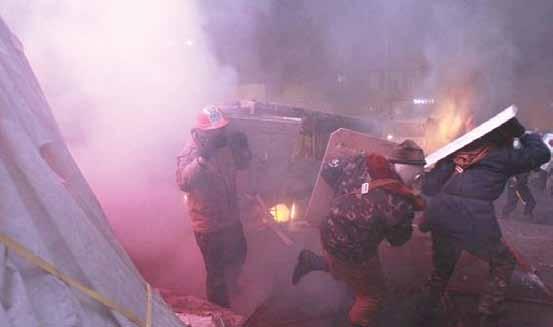
A spokeswoman for Klitschko tweeted that President Viktor Yanukovich had agreed to meet Klitschko immediately at the presidential residence outside Kiev, although there was no confirmation from Yanukovich’s side.
Klitschko later tweeted that the president had
agreed to set up a committee today to settle the political crisis.
As tensions continued into the night, police used water cannon against demonstrators gathered near the parliament building and the heavily protected government headquarters, eyewitnesses said.
AChristian mob in the Central African Republic capital Bangui has killed and burned two Muslims in the street, in the latest sectarian clash.
The gangs told the BBC they would carry on killing Muslims in their area.
French and African Union soldiers are struggling to contain sectarian violence that erupted after largely Muslim rebels took over the country.
MPs are due to select a new interim president today, a week after rebel leader Michel Djotodia quit the post.
Djotodia became CAR’s first Muslim ruler after his rebel group Seleka overthrew
the government in March last year.
The coup helped plunge CAR into sectarian conflict between the majority Christians and the minority Muslims. He quit on January 11 having failed to stop the violence.
Although the clashes seemed to die down immediately after he quit, reports emerged later in the week of more violence.
On Friday, aid agencies said at least 22 people were killed in an attack on a convoy evacuating Muslims to neighbouring Cameroon.
In Sunday’s attack, a Christian mob killed two
Muslims and set their bodies alight at a roundabout in the capital. They told the BBC’s Thomas Fessy that they were avenging the murder of a Christian overnight. It is unclear whether the men had any part or were targeted simply for being Muslim.
The International Committee of the Red Cross (ICRC) said it had taken 25 very seriously injured people to hospital in Bangui.
In a statement issued from its headquarters in Geneva, it added that fresh inter-communal violence had flared up in north and northwestern areas of the country.
(Excerpt from BBC News)
Two people have died and more than 150 people have been airlifted to safety after floods hit south-eastern France, local authorities say.
One man died in his basement and another was swept away in his car while a third person was missing in a boat in the Var area. Some 4000 homes have been left without power, officials say.
Local official Laurent Cayrel told a news conference that there had been “record rainfall”. “The situation is very worrying, and it’s not going to get any better tonight,” he told reporters on Sunday, amid forecasts of further rainfall.
By Sunday evening, 155 people had been airlifted from the worst-hit areas and
The evacuation of residents by boat is continuing
the evacuation of residents by boat was continuing.
One woman, who was evacuated by helicopter with her five-year-old daughter, said she had seen a huge wave wash her empty car away.
“It was really staggering,” she said. “We had called the fire brigade who told us to move the furniture upstairs... We had very little
time, the house flooded very quickly.”
Some 100mm ( four inches) of rain has fallen in the Mediterranean resort of Nice since Thursday evening, compared with the average of 85mm for the entire month of January.
Prime Minister JeanMarc Ayrault is expected to travel to the flooded area this morning. (BBC News)
UN chief Ban Ki-moon has invited Iran to take part in preliminary Syrian peace talks this week in Switzerland, an offer Tehran has accepted.
Ban said he had received assurances that Iran would play a positive role in securing a transitional government.
But Syria’s main opposition group said it would withdraw from the talks unless Ban retracted the offer to Iran.
The preliminary talks will open in Montreux on Wednesday and then continue in Geneva two days later. Syria’s government earlier agreed to attend the meeting.
Earlier, some distance away from the clashes, up to 100,000 Ukrainians massed on Kiev’s Independence Square in defiance of the sweeping new laws, which ban rallies and which Washington and other Western capitals have denounced as undemocratic.
(Excerpt from Reuters)
The three-year conflict in Syria has claimed the lives of more than 100,000 people.
An estimated two million people have fled the country and some 6.5 million have been internally displaced.
On Sunday, UN Secretary General Ban said that Iran’s Foreign Minister Mohammad Javad Zarif had
pledged that Tehran would play “a positive and constructive” role in Montreux.
“As I have said repeatedly, I believe strongly that Iran needs to be part of the solution to the Syrian crisis,” he added.
And Ban stressed: “Let me be clear – Montreux is not a venue for negotiations. The Syrian parties themselves will begin that process in Geneva on January 24.”
Shortly afterwards, Iran said it accepted the invitation. Tehran had earlier insisted it wanted to take part but without preconditions.
There had been a dispute over whether Iran, a crucial ally of Syrian President Bashar al-Assad, should be taking part in the talks.
The UN and Russia had advocated a role for Tehran, but the U.S. had reservations because of its failure to endorse the 2012 Geneva Communiqué, detailing Syria’s political transition process. (Excerpt from BBC News)
World powers and Iran are due to start implementing a landmark deal today curbing Tehran’s nuclear programme, amid hopes that it will pave the way for a broad settlement of a decade-old standoff and ease fears of a new Middle East war.
If, as expected, the United Nations’ nuclear watchdog confirms this morning that Iran is meeting its end of the agreement, the European Union and the United States will later in the day suspend some economic sanctions in return.

The mutual concessions are scheduled to last six months, during which time six powers –the United States, Russia, China, France, Britain and Germany – aim to negotiate a final accord defining the permissible scope of Iran’s nuclear activity.
Western governments want such an agreement to lay to rest their concerns that Iran could produce an atomic weapon. Tehran is seeking an end to painful economic sanctions that have severely damaged its oil-dependent economy.
The interim accord, struck on November 24 after years of on-off diplomacy, marks the first time in a
decade that Tehran has limited its nuclear work, which it says has no military goals, and the first time the West has eased economic pressure on Iran.
“It is an important agreement and I hope that this will now give us an opportunity to move forward and to look at a more comprehensive agreement shortly,” EU foreign policy chief Catherine Ashton said. (Excerpt from Reuters)
The Iraqi military has launched a major operation on Ramadi city in the country’s west to expel armed groups linked to al-Qaeda and end their weeks-long partial control of parts of the city.
Sunday’s operation, which involved police, progovernment fighters and special forces, sought to wrest back key neighbourhoods of Ramadi, the capital of Anbar province and one of two cities where the authorities lost vast swaths of territory about three weeks ago.
Troops backed by tribesmen moved into five Ramadi
neighbourhoods, with helicopters providing cover and firing on the district of Malaab at the centre of fighting between anti-government fighters and security forces and their tribal allies.
“The Iraqi army launched a large operation with helicopter cover against the Islamic State of Iraq and the Levant (ISIL), al-Qaeda and terrorists in Ramadi,” Defence Ministry spokesman Staff Lieutenant General Mohammed al-Askari said, according to state television, employing terms frequently used by the Iraqi security
forces to describe anti-government fighters.
The army’s intervention, which has been resisted by Sunni anti-government tribesmen, comes after a pact was sealed on January 8 entailing that tribes will fight alongside local police against the al-Qaeda-linked ISIL.
The ISIL and its local allies overran parts of Ramadi, as well as the nearby city of Fallujah, on January 1 after security forces broke up a Sunni protest camp near Ramadi and arrested an outspoken Sunni lawmaker.
(Excerpt from Al Jazeera)
The Economic Commission for Latin America and the Caribbean (ECLA) says fiscal authorities from central banks as well as economy and finance ministries from the region and Spain will this week debate fiscal policy, debt and growth in the region.
ECLAC said the authorities will meet today and Tuesday with international experts at the 16th regional seminar at ECLAC’s headquarters.
The annual meeting pro-
motes the discussion of current affairs in the field of public finances and the role of the state in the region’s economies.
The two-day meeting is being co-sponsored by the International Monetary Fund (IMF), the World Bank, the Organisation for Economic Cooperation and Development (OECD) and the Inter- American Development Bank (IDB), with the support of Germany’s federal ministry for economic cooperation and development.
ECLAC said the seminar would address the issues of fiscal policy, debt and growth, and proposals will be presented that aim to construct quality public finances, incorporating the objectives of fiscal sustainability as well as income distribution and economic growth.
ECLAC said it would also present the “fiscal panorama of Latin America and the Caribbean 2014,” which summarises the fiscal situation in the region and addresses timely topics. (CMC)
Google has said it is testing a “smart contact lens” that can help measure glucose levels in tears. It uses a “tiny” wireless chip and a “miniaturised” glucose sensor embedded between two layers of lens material. The firm said it is also working on integrating tiny LED lights that could light up to indicate that glucose levels have crossed certain thresholds.
But it added that “a lot more work” needs to be done
to get the technology ready for everyday use.
“It’s still early days for this technology, but we’ve completed multiple clinical research studies which are helping to refine our prototype,” the firm said in a blogpost. “We hope this could someday lead to a new way for people with diabetes to manage their disease.”
Many global firms have been looking to expand in the wearable technology sector –
seen by many as a key growth area in the coming years.
Various estimates have said the sector is expected to grow by between US$10 billion and US$50 billion in the next five years. Within the sector, many firms have been looking specifically at technology targeted at healthcare. Google’s latest foray with the smart contact lens is aimed at a sector where consumer demand for such devices is expected to grow. (BBC News)
The credit rating agen-
cy Moody’s has upgraded Ireland’s debt from junk status to investment grade, saying its economy has growth potential. The news is the latest in a run of positive reports for Ireland and comes as investors start to welcome the chance to invest in the country through its government-issued bonds.
Moody’s was the only one of three key agencies to class
the debt as “junk”. An investment grade mark means more investors can buy Irish debt.
Moody’s has lifted its rating, which appear as a sometimes complex series of numbers from Ba1 to Baa3.
It says the recovering economy and its improved growth potential along with its return to the international bond market merit the higher score.
Ireland was effectively locked out of international credit markets after its banking collapse left only the European Union and the International Monetary Fund willing to support its needs.
The interest rate being demanded by investors to the country – a sign of investors’ confidence – has fallen to 3.5 per cent from 15 per cent in mid-2011 on one key bond. (BBC News)
Asian markets are in a hesitant mood today ahead of figures that are expected to show a slight slowdown in regional powerhouse China, while Deutsche Bank soured sentiment by reporting a surprise loss and falling revenues.
In muted early action MSCI’s broadest index of AsiaPacific shares outside Japan .MIAPJ0000PUS dipped 0.2 per cent, and Australia’s market .AXJO eased 0.3 per cent.
Liquidity was lacking with U.S. markets closed today for a holiday. Neither was there much of a lead from Wall Street where the Dow .DJI ended last week with a slim gain of 0.1 per cent, while the S&P 500 .SPX lost 0.2 per cent for the week. Investors were nervous ahead of China’s fourth quarter gross domestic product (GDP) report, due at 0200 GMT, in case it surprised on the downside.
The median forecast
of 24 economists polled by Reuters was for growth of 7.6 per cent from a year earlier, down from 7.8 per cent in the third quarter. Analysts at Commonwealth Bank of Australia were more upbeat, predicting a steady outcome of 7.8 per cent.
“The key December indicators, such as new loans and rail transportation point to continued growth momentum in the final quarter of 2013,” CBA said in a note. (Reuters)
Nakheel says upset investors must wait five years for cash
Dubai property developer Nakheel reported a 27.2 per cent rise in full-year profit on Sunday, as the firm continued to benefit from the emirate’s resurgent real estate market. Nakheel made a net profit in 2013 of AED2.57 billion (US$700 million), compared with AED2.02 billion in the previous year, it said in a statement.
Revenues also boomed in 2013, growing 20.5 per cent to AED9.4 billion.
Nakheel plans to launch new projects worth between AED6-8 billion in 2014, Ali Rashid Lootah, the firm’s chairman, said at a news conference. About 80 per cent of property buyers in Nakheel’s stalled projects have now settled with the developer, with 20 per cent of buyers still in dispute, said Lootah. These can get their cash back five years from the date of Nakheel signing its restructuring deal, he said. The company has made
interest and profit payments of around AED1.8 billion to lenders, issued a trade creditor sukuk of around AED4.4 billion, and made cash payments of about AED12.3 billion to various trade creditors and contractors since the start of its debt restructuring, a company statement said. Lootah said Nakheel would consider an initial public offer of shares after the company settled its debts. (arabianbusiness)
Western Australia is leading the rest of Australia to more intense economic activity despite the slowdown in mining investment. However, WA is in second place on economic growth, business investment, construction work done, housing finance population growth and unemployment, and fourth on dwelling starts.
But overall Western Australia still leads, according to the Commonwealth Bank’s quarterly State of the
States analysis.
“The Northern Territory has leapfrogged the ACT [Australian Capital Territory] to become the second-best performing economy. But the big changes have been below with now little to separate the ACT and Queensland. NSW [New South Wales] and Victoria follow and are closely grouped together. There is then a gap to South Australia and another gap to Tasmania with both states clearly under-performing other economies at pre-
sent.”
The analysis says all state economies should lift now that consumers and businesses are showing a sustained level of optimism.
“The low interest rate environment is boosting housing construction, while rising wealth levels is supporting confidence and in turn spending,” says Commsec economist Savanth Sebastian. The slowdown in mining investment will continue to affect some regions.(BusinessinsiderAustralia)
Adata breach at Target Corp that exposed the credit card information of tens of millions of holiday shoppers was a major black eye for the retailer. In its wake, investors and analysts are circling companies that could benefit from a major upgrade in credit card technology.
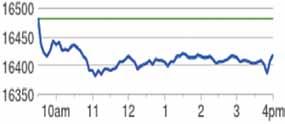
One of their favourites: Verifone Systems Inc, a US$3.2 billion market cap company that is one of two major global manufacturers of point-of-sale terminals and mobile payments systems and could profit from any major upgrades of payment technology. Analysts at JPMorgan Chase and Jefferies & Co upgraded their outlook for the
company in the last 10 days, helping send its shares price up about 25 per cent since the Target breach was first reported on December 18.
Yet for its shares to continue to rally, Verifone must prove to analysts and portfolio managers it has taken steps to right its own ship after several years of choppy performance.
That question mark is a product of several years of poor acquisitions and a history of missing earnings estimates that left the company’s shares down more than 20 per cent for the year just before the Target breach become public – in a bullish year for stocks. It hangs over the com-
pany as a new wave of credit card technology looks poised to finally make inroads in the U.S. after being the standard in Europe for years.
“Verifone has a tremendous and recently unappreciated position in the industry, yet it’s kind of a messy place. The new management team looks great, but this is like waiting for Godot,” said Jeffrey Bronchick, whose US$56.3 million Cove Street Small Cap Value fund has one of the best performances in its category over the last three years, according to Morningstar data. In the Samuel Beckett play, two characters wait endlessly for Godot, who never shows up.
(Reuters)
By Andrew CArmiChAel
Apolice officer went berserk at the Accident and Emergence (A&E)
Unit of the New Amsterdam Hospital on Sunday, chasing nurses and doctors at the medical facility out of the unit and around the compound while assaulting one doctor in the process.
Constable Marvin Grovesnor was admitted at the A&E unit at 03:17h on Sunday, along with two others suffering from multiple lacerations.
Berbice Regional Health Authority Public Relations Officer (PRO) Michael Itwaru noted that doctors on duty reported that Grovesnor, along with two others, appeared to be drunk when they arrived. They were also suspected to be under the influence of a narcotic, which was seen in their possession by doctors.
Grovesnor was going in and out of consciousness. According to medical staff on duty at the time, Grovesnor became very abusive.
Itwaru said three female nurses and one female doctor were unable to bring him under control. Patients seeking attention at the unit were advised to flee for their safety as Grovesnor began to break things, forcing one doctor and three nurses to take cover.
As they left the unit, with Grovesnor ripping down curtains, threatening them, and tossing instruments around, a nurse who was attending to a patient in the dressing room walked out, into the chaos.
Chaos
Reports are that on seeing the confusion, she took to her heels locking the dressing room door and as she was informing her colleague nurse and a doctor of the situation, Grovesnor broke into the dressing room, forcing the medical staff to use the escape door.
However, Dr Kevin Persaud was assaulted. The trio was chased into the compound but managed to escape into another section of the hospital.
According to Itwaru, when the nurses returned to the A&E Unit, Grovesnor was lying on a bed. Sources say that the officer, who is attached to the Tactical Services Unit (TSU), tried to assault a female guard and also damaged the main door leading to the medical unit.
When a medical team again tried to assist Grovesnor, he again became abusive. Upon advice from a senior psychiatric doctor, he was sedated and then treated. He was discharged from

the unit around 14:00h on Sunday. Police officers from Central Police Station immediately placed him under close arrest.
Hospital staff had unsuccessfully tried to inform police of what was going on early in the morning. According to the PRO, a nurse was able to finally make contact with an off-duty police officer who then summoned help.
Itwaru said five ranks from Central Police Station arrived during the period but left sometime afterwards, before Grovesnor was sedated, complaining of receiving “enough kicks and cuffs” from Grovesnor.
There was also a confrontation with police officers and a crowd that had gathered at the hospital. The crowd was trying to get to Grovesnor and his two friends Kevin Alexander and Trisahon Philips.
Police reportedly asked the crowd to disperse. Security personnel say that several stones were thrown at the building.
As the police officers came out of the A&E Unit, they were attacked and four fled, leaving behind a corporal attached to the Criminal Investigations Department. Unconfirmed reports suggest that the corporal was assaulted.
Grovesnor, Alexander and Philips, who is a prison officer attached to the New Amsterdam prisons, were earlier at the Castle
Roraima Airways Inc has launched its Wedding Couples Application process as it prepares to the stage the annual Wedding Expo, popularly known as “The Race to the Altar”.
The Race to the Altar competition culminates in the winning couple being offered an all-expense paid wedding, a feature which was added to the six-year-
old expo last year. According to a release from the company, couples desirous of entering the competition must complete and return the application forms after which they will be interviewed then asked to participate in a series of exciting competitive activities.
The finalists will be arrived at through a process of elimination and the public will have an opportunity to
judge the proficiency of the couples. The closing date for the submission of applications is January 28.
The annual Wedding Expo is a collaborative initiative involving the principal host Roraima Airways and various other private sector organisations. The public is invited to the launching of Wedding Expo 2014 on January 31, at the Roraima Duke Lodge.
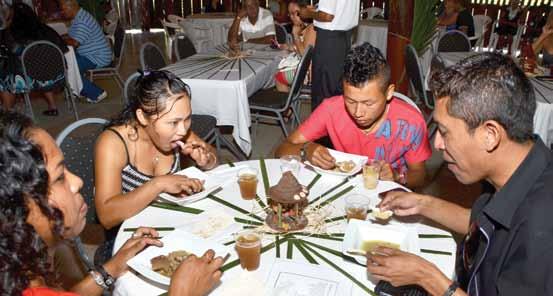
Night Club when a group of men approached Philips and one of them accused Philips of ill-treating him when he was an inmate at the New Amsterdam Prison. He then launched an assault on the prison officer.
According to reports, Grovesnor tried to intervene and he too was assaulted. The men who numbered eight then turned their attention on Alexander. As the trio left for the hospital after being wounded, the group of eight and others made their way to the hospital and continued their attacks as the trio exited a car.
Reports are that the group repeatedly threatened medical staff who refused them entry into the A&E Unit, threatening to harm them in the future.
Meanwhile, an aunt of the arrested police officer, Karen Grovesnor, said her nephew had been stationed in the interior since last October and arrived home Saturday night.
She said that he went out with some friends. The woman, who also works at the New Amsterdam Hospital, said her family has already replaced the broken door. According to her, the door was broken by accident as her nephew was trying to get out of the dressing room where he was left alone.
The regional health authority has launched its own investigation, according to its public relations officer, who urged the police to do likewise.
Tuma Sàlà, a Patamona word meaning “Come let us eat”, is the first Guyanese indigenous cuisine restaurant.
The restaurant was officially launched on Saturday afternoon at the Umana Yana but will open its door on February 1, 2014 at the corners of Campbell Avenue and Middleton streets, Campbellville.
The restaurant was made possible through a partnership deal.
Speaking at the launch, one of the founders Michael Patterson said the construction of the eating house costs $3.5 million. Patterson said with the launch, he hopes that it will continue to increase tourism in Guyana and contribute to the Guyana’s economy.
Natasha George, Evelyn
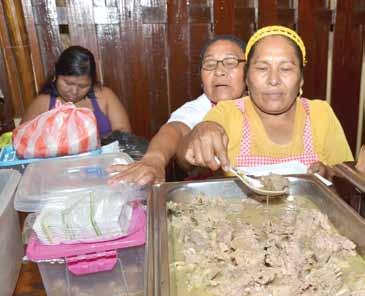
Felix, Ovid Williams and Lolita Williams are the other co-founders of the one-ofa-kind eatery.
They all look forward to a long and successful business
career. The restaurant will not only embrace rich authentic Amerindians cuisine but will also feature craft jewellery and ornaments.
Three men were on Friday refused bail when they appeared in a New Amsterdam Magistrate’s Court on two charges each of break and enter and larceny.
Byran Vanlewin, Basheer Kursattie, and Adrian Rambalack, who all gave their address as Fort Ordnance Housing Scheme, East Canje Berbice, are accused of breaking and entering the house of businessman Colin Caesar and stealing six computer tablets valued at $240,000,
one Internet router valued $20,000, one HP laptop computer $140,000, two Internet modems valued $35,000, one digital scale valued $30,000, one Internet box valued $30,000, a quantity of gold jewellery valued $400,000 and $340,000 in cash, a total value of $1,235,000, all the property of Caesar.
The incident occurred on December 9 last year.
The trio are also accused of committing a similar burglary between January 9 and 10, at Fort Ordnance
Housing Scheme where they broke into the house of Chandinal Panday and stole one notebook computer valued $150,000, one home theatre system valued $215,000 one Sony digital camera valued $150,000, a quantity of gold jewellery valued $165,000, a quantity of clothing valued $20,000, and 120,000 in cash, a total value of $820,000, all the property of Panday. Magistrate Rhondell Weaver in refusing bail, ordered that the accused return to court on February 7.



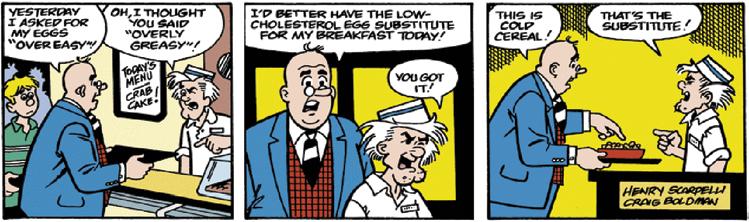

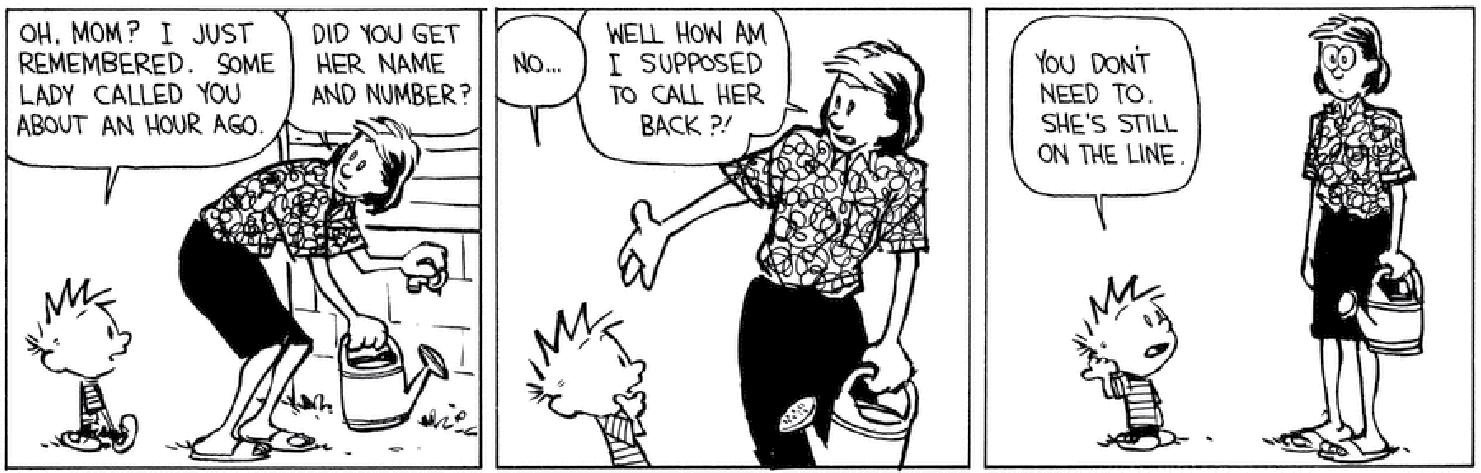

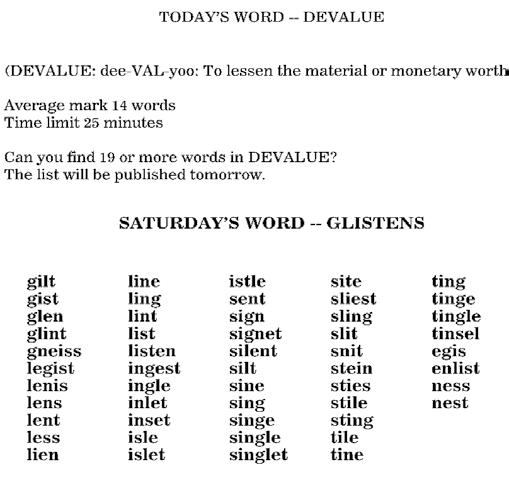



By Bernice Bede Osol

Your insightfulness and ability to offer excellent solutions will land you in the spotlight at any group function you attend. Communication and travel will be the primary concerns of your day. It’s time to clear up any misconceptions about who you are and what you want to do. If you share your plans, you will find the support and encouragement you need.

(June 21July 22) (Jan. 20Feb. 19) (Dec. 22Jan. 19)
You will have all sorts of lucrative opportunities today, but the possibility of choosing the wrong deal is apparent. Don’t think that bigger is better. Take the most conservative option.


Business matters should be your focus today. Search for a new position or a promotion at your current job. Expand your knowledge, your network and your future prospects.

(Aug. 23Sept. 22)
(July 23Aug. 22) (Feb. 20-March 20)
Don’t worry about ongoing concerns. You would be better off communicating about what needs to happen to allow an important relationship to thrive. Take on a personal challenge.

(March 21-April 19)
Much can be achieved today, especially regarding job prospects. An interview or chat with someone who has the power to place you in a better position will prove fortuitous.

(April 20-May 20)
Love and romance will likely be on your mind today. Decide what you really want, and make a move. Creative projects should not be neglected. Aesthetic changes will work out favourably.

(May 21June 20)
Restlessness will be your enemy today. Don’t make adjustments that are unlikely to improve matters. Real estate and investment opportunities are present, but you need to be realistic about your finances.
You won’t have a hard time being practical today. Proceed cautiously. You may want to reflect carefully on your work as well as your personal affairs.

(Sept. 23Oct. 23)
Make an effort to iron out matters that involve the government, banks or other institutions. Talk to an adviser about your finances. Home improvement plans can begin today.

(Oct. 24Nov. 22)
Partnerships that will help you carry out your plans can be established. Opportunities to make new friends are evident. Love is likely on your mind.

(Nov. 23Dec. 21)
You may find yourself caught in an emotional quagmire. You may prefer to avoid personal confrontations, but it’s wise to face your dilemma. Let go of the past and move on.
monday, January 20, 2014

Dentures provided in 72 hours from as low as $4500. Contact Dr B Stuart, 209B Charlotte St, Lacytown. Tel: 225-5034

Music is fun! Register now and learn to play the Keyboard, Guitar, Drums and do Voice Training. Call Foundation 7 on 225-1151/617-4200.

Available: Fresh long-stemmed roses, fresh dried and silk floral arrangements, gift items, bridal boutiques and wreaths. Nesha’s Flowerland. 78 Church Street (opposite St George’s Cathedral). Tel: 227-3553/225-3315

Are you suffering from abnormal behaviors, addictions, stresses, or psychosomatic sickness? Feeling suicidal, low self-esteem, loneliness, unloved, anger, conflicts and relationship problems? For appointments call 592-621-0552 from12:00-18:00h Email: healthworldhc@gmail.com


Immigration & Visa Services We handle all Canadian, USA and UK immigration and visa matters. Self sponsorships, holiday/visitor’s visas, work permits, students visas, family, class, immigration forms, embassy enquiries, appeals for refused cases, US green card lottery, business class waivers, pardons, etc. Get your visa approved. High success rate. Balwant Persaud & Associates. Certified Immigration Consultants, 68 Sixth Street, Alberttown, Georgetown (Between Cummings & Lights Sts) Tel: 225-1540, 622-8308, 655-3105. Email: balwantpersaud@yahoo.ca

Professional Key Shop, 125 Carmichael Street, Georgetown. Phone: 225-3923, mobile: 6213249. We cut any type of key, service and repair all types of locks. Get your extra key today.


Da Silva’s Optical. For Your Eyes Only, Look Better See Better. Phillip A Da Silva OD, Shannon L Da Silva OD, Natalie Da Silva OD. 248 South Road, Bourda. Phone: 227-3529, Linden: 444-6376, Corriverton: 3393536, Meten-Meer-Zorg: 275-0322, Grand Cayman Islands: (345) 9431515 for the perfect trendy touch.

Two storey wooden building. Bayroot. Phone: 687-5653 Versailles, WBD: almost brand new five-bedroom house for sale, master room & all rooms self-contained with A/Cs & fans,


Get your home or business spiritually clean to enhance good luck and prosperity. Telephone: 687-5653
Suriname Astrology Palmist and Djuka Healing, the most powerful spiritualist in the world, are you suffering from the following problems (any religion) love, marriage, family, health business, husband and wife relationship, property, court, children, promotion, visa, pregnancy, education, depression, job, sexual, jealousy, enemy, money, drinking ? Also you can have all evil forces destroyed such as black magic, witchcraft, voodoo, obeyah etc and give powerful protection. We also do upliftment for clearing of land, dredging operations strictly in the interior. For private and confidential service call 674-2112.
Dutch Spiritual work. Unite lovers, get rid of evil, enhance prosperity, good luck baths and charm bowu guards, etc. Phone: 220-0708, 6126417, 687-5653
Cleansing of spiritual problems of all kinds. Powerful Ifá protection against evil. Get help to overcome problems with love, relationships, legal, sexual, pregnancy, business, sickness, jobs, enemies, work, money. Call 592-690-1824 from 10:0016:00h Email:anew-life@live.com

Toyota Hilux 4x4 Extra cab pickup. Excellent condition, $3M. Phone: 649-0707 or 264-2682


AWest Demerara policeman was on Sunday afternoon severely chopped about the body by a neighbour with whom he had a dispute sometime ago.
The incident occurred around 15:00h at his Lot 30 De Kinderen, West Coast Demerara home. Injured is 22-year-old Audwin Amsterdam, a police constable attached to the Brickdam Police Station. Guyana Times understands that the man was chopped on both knees, with the right knee cap separated. He also suffered a chop to the side of his left foot, just above the knee cap.
According to his wife, Avidya Jhagru, they were getting ready to go to Georgetown when her husband left to put something in his car.
“I was inside and all of a
sudden I hear screams, a lot of screams and when I come out I found my husband on the ground with his two knees chopped very deep and there was a chop on his back also,” the woman related.
She said her husband told her that after he put his shirt in the car, he was cleaning his car light when he felt a sting on his back.
“After he get this hard hit on his back, he run and that was when he saw the attacker run towards him. He (husband) stomp his toe and fall so he dragged himself behind the car but his two feet were out and the guy just chopped him,” she said.
Jhagru disclosed that the dispute between the two families stemmed from a fence which was built by her husband but was torn down by the neighbour.
She explained that at the back of their yard is a piece of land on which the neighbour built a pig pen. Amsterdam built a fence which was demolished by their neighbour. “My neigbour went to him and ask him why he did such thing and they had a lil quarrel but wasn’t nothing much,” she stated.
The woman continued that there were several court matters between the two families; however, they all ended and for a while there was no problem between them until Sunday. “He just cursing them all the time, calling out their names and my husband wanted to go to the station but he didn’t, he didn’t even utter a word to this guy and now, today he did that,” she noted.
Jhagru recounted that there were a lot of people around when the incident happened and they assist-
ed them to Leonora Cottage Hospital and then to the West Demerara Regional Hospital. The policeman was subsequently referred to the Georgetown Public Hospital.
When Guyana Times visited the medical institution, Amsterdam was still in the in Accident and Emergency Unit. His relatives, who were waiting impatiently outside were told that the doctors are awaiting the arrival of the orthopaedic specialist to clean fragments of the bones that were lodged in the flesh.
Meanwhile, the injured man’s mother, Joan Amsterdam, pointed out that the attacker would verbally abuse them almost every day but they just ignore him. The family noted that the attacker was taken into custody.
Guyanese nationals have featured prominently as both “overstayers and undocumented migrant workers” in Trinidad and Tobago (TT), according to statistics from the Trinidad and Tobago Police Service’s Crime and Problem Analysis Branch (CAPA), a research report on invisible immigrants has stated.
The 89-page report, entitled “Invisible Immigrants: A profile of irregular migration, smuggling of migrants and trafficking in persons in Trinidad and Tobago”, was one of two documents presented to the National Security Ministry by the African, Caribbean and Pacific (ACP) Observatory on Migration on Saturday.
According to CAPA sta-
tistics, more than six out of every 10 persons who overstayed their time in TT between January 2010 to June 2012 were from Guyana. A total of 328 “overstayers” were recorded for that period.
According to the research report, Chinese nationals are tied with Guyanese nationals as the number one nationality of undocumented migrant workers. Nationals from China and Guyana accounted for 35 per cent each of the “undocumented migrant workers” recorded between January 2011 to May 2012, according to CAPA statistics.
More than half of the “smuggled migrants” in TT from January 2007 to April 2012 were from Colombia,
the research report stated. The report delved into trends of the jobs and living accommodations selected by the “illegal immigrants”.
Some 116 “smuggled migrants” were recorded in TT, according to CAPA statistics. “With regard to living arrangements, there was a perception that irregular migrants typically settle in areas where they can be easily assimilated into wider society,” the research report stated.
The reports said that Guyanese nationals prefer to live in areas where there is a larger East Indian population while Colombians prefer to stay in areas populated with “French Creoles”.
“For example, Guyanese nationals exhibit a great-
er tendency to reside in Chaguanas, San Juan, El Socorro and Aranjuez where there are higher percentages of IndoTrinidadians as opposed to Nigerians, who settle in Curepe and Enterprise in Chaguanas where there are higher percentages of Afro-Trinidadians,” the report stated.
“On the other hand, Latin American nationals reside mainly in Woodbrook and Maraval amongst the ‘French Creoles’, a population into which they can blend, whilst some migrants ventured into Tobago. Therefore, the migrants gravitate to areas where nationals with common characteristics and cultural backgrounds reside,” the report stated.
The Pakistani Taliban has claimed responsibility for an attack inside an army compound in northwest Pakistan that officials said left at least 22 soldiers dead.
The suicide blast targeted a vehicle in a convoy about to leave a military base in the town of Bannu and drive west to the North Waziristan tribal area, police official Inyat Ali Khan said on Sunday.
Military officials said that the blast, which hit one of the civilian vehicles hired to move troops, also left 38 more wounded.
“A vehicle-borne improvised explosive device caused the blast,” a senior military official told AFP news agency, adding that
the exact circumstances were unclear.
A spokesman for the Tehreek-e-Taliban Pakistan, Shahidullah Shahid, said in a statement that the attack had been carried out to avenge the death of Waliur Rehman, the group’s former second-in-command. He was killed last year in a US drone strike.
“We will avenge the killing of every one of our fellows through such attacks,” the spokesman said.
The explosion was heard and felt across the town of Bannu.
“I rushed out of my home and saw black, thick smoke billowing out of the cantonment’s Razmak gate area,” resident Sajjad Khan said. He said troops quickly cor-
doned off the area and ordered residents to go back inside their homes.
The Pakistani Taliban vowed to increase attacks on security forces following the election of the group’s new leader, Mullah Fazlullah, at the end of last year.
Retaliatory attack
In apparent retaliation for the bomb attack, army helicopters fired missiles killing three fighters, officials said.
The helicopters fired at a road in the village of Musaki situated in the same tribal region as the bombing earlier on Sunday, intelligence and civil administration officials said.
North Waziristan is considered a safe haven for
al-Qaeda-linked fighters. Pakistani troop convoys are often hit by roadside bombs, but blasts inside military compounds are rare.
Last December, a suicide bomber killed four Pakistani soldiers when he rammed an explosive-laden car into a checkpoint outside an army camp in North Waziristan.
Thirty Pakistani troops died over a four-day period last April in another part of the northwest called the Tirah Valley as part of an operation to oust fighters hiding there.
The Pakistani military has been fighting for years in the tribal areas against fighters who want to overthrow the government. (Al Jazeera)
Serena Williams went out of the Australian Open as a back injury hindered the five-time champion against a rampant Ana Ivanovic.
The Serb came back from a set down to win 4-6 6-3 6-3 - her first ever victory over Williams in five attempts.
There had been reports before the match that Williams had a back problem, and so it proved.
“I almost pulled out. I’m such a competitor, I probably should have,” said the
Williams revealed that she did not know the exact nature of her injury but had been dealing with it for “a few days”.
She added: “It’s not anything that’s life threatening or anything. I feel like it will get better. I just need a couple days off.
“Unfortunately I don’t have that in a Grand Slam.”
The reigning French and U.S. Open champion had been tipped by some to complete the Grand Slam of all four major titles in 2014.

world number one.
“I don’t want to blame anything. I feel like Ana deserves all the credit. I feel she played unbelievable today. I think she went for her shots.”
“I have given up on that a long time ago,” said the 32-year-old. “I feel like I don’t even think about winning four in a row.
“Maybe I can win four in a row, but it seems like in

the one year it’s kind of difficult for me for whatever reason.”
Ivanovic, 26, goes on to face Canada’s Eugenie Bouchard in the last eight.
“It’s amazing,” said the 14th seed. “Honestly, I went on the court and I just wanted to play the best I could. I’m so thrilled.”
Ivanovic is a former world number one and 2008 French Open champion, but since then she has reached just one major quarter-final at the 2012 U.S. Open.
A 0-4 record against Williams gave little cause for optimism either, but from the outset Ivanovic was able to threaten the American’s usually impregnable serve.
The Serb fashioned four break points in the opening set, converting one, but was
broken twice as Williams edged it.
Ivanovic took over from that point, her once fragile serve holding up well as Williams appeared to struggle with her movement, and she did not face another break point.
Williams was warned for a time violation when serving to stay in the contest and managed to save two match points, but Ivanovic closed it out nervelessly with a love hold after one hour and 56 minutes.
“I was very consistent,” added Ivanovic.
“It’s not easy playing such a champion, but she’s also just a human and I know she has lots of pressure too.
“I just went out there swinging and I think I did that really well.” (BBC Sport)
Ahat-trick by Samuel Eto’o ensured Chelsea maintained the pressure on the Premier League pacesetters and surely ended Manchester United’s chances of retaining their title.
The veteran striker scored twice in the first half and completed his treble just after the interval to leave Chelsea only two points behind leaders Arsenal and one adrift of Manchester City.
United manager David Moyes cut a dejected figure at the final whistle as he surveyed a 14-point gap to Arsenal at the top of the table - with matters made worse by the late red card for Nemanja Vidic following his needless lunge at Eden Hazard.
Javier Hernandez’s goal hardly qualified as consolation and United must now try to overturn a 2-1 deficit against Sunderland in the Capital One Cup semi-final second leg at Old Trafford on Wednesday without their suspended captain, who starts a three-match ban.
Mourinho has played down Chelsea’s title credentials but there is a real

sense of momentum building around Stamford Bridge that will have only increased with this victory. In Moyes’s defence, he was without his injured world-class strike pair of Wayne Rooney and Robin van Persie - but even those mitigating circumstances cannot disguise the brutal truth that United’s current squad is simply not in shape to mount a title challenge and is inferior to that at Arsenal, let alone Chelsea and Manchester City.
The visitors were bound to lack a cutting edge with Rooney and Van Persie out, whereas Mourinho felt con-
fident enough to leave out Fernando Torres, despite his goal in the win at Hull City, and restore Eto’o.
And how Mourinho was rewarded by Eto’o as the Cameroonian provided the finishing touches that Moyes’s men were unable to apply to some good work of their own, particularly early on.
United’s brisk start pinned the hosts back and Petr Cech had to plunge down sharply to save from Ashley Young in the opening moments, while Adnan Januzaj did much to confirm his rich promise.
But for all the visi-
tors’ early impetus, it was Chelsea who took the lead after 18 minutes when a left-foot shot from Eto’o took a vital touch off Michael Carrick’s outstretched leg and looped over United keeper David de Gea.
The champions were still showing some ambition and almost equalised when Januzaj’s cross evaded the Blues’ defence and landed at the feet of Welbeck. He could only shoot straight at Cech, however, appealing in vain for a penalty as Cesar Azpilicueta appeared to catch his leg just as he shot.
It was to prove a decisive moment as Eto’o doubled Chelsea’s lead seconds before half-time, Cahill squaring for the striker to sweep home a finish that De Gea touched but could not keep out.
United’s hopes of getting something from the game took a final blow four minutes after the break when they were let down by dreadful marking at a corner. De Gea scrambled out John Terry’s header but the poacher supreme Eto’o pounced to turn home the loose ball. (BBC Sport)
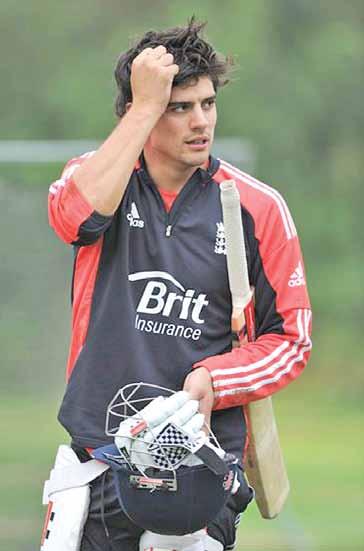
Alastair Cook admitted he could resign as England one-day captain after Australia won the limited-overs series.
Having lost all five Ashes Tests, England slid to their third successive one-day defeat on the tour as Australia took an unassailable 3-0 lead.
“I think English cricket needs a little bit of a change,” Cook said.
“We’ll talk over a lot of things. I think there will be some changes. We have kept losing games of cricket and I haven’t been able to turn it around.”
Cook replaced Andrew Strauss as one-day captain in May 2011, leading England to the final of last year’s Champions Trophy where they were beaten by India in a match reduced to 20 overs per side at Edgbaston.
He has won 29 of his 52 international games in charge, but asked whether he wanted to continue as one-day skipper he said: “I’ve got to make decisions at certain times, I can’t answer that question now because we’re in the middle of the series. And I don’t know what I’m going to feel like when I get home.
“I’ve got a job to try and turn this around - try and win one of these games. That’s the task at hand.
“I’m competitive. I want to leave everything out on the pitch. We’ll deserve the stick we get because we haven’t won games of cricket. Simple deal.”
The left-handed opening batsman, who made his ODI debut in 2006, has
scored 2,742 ODI runs in his 75 matches at an average of 38.08 and he added: “I want to be part of a successful one-day team, I feel that I’m a good enough player to do that and my record suggests that I can do that.”
England lost the final one-day international at home last summer to concede the series 2-1 and have now lost nine successive matches in various formats against the Australians.
On a dismal tour that has seen Jonathan Trott, Graeme Swann and Steven Finn leave early because of a combination of illness and poor form, Cook’s team have won only two matches against modest representative opposition.
Only Eoin Morgan passed fifty in the latest defeat at the Sydney Cricket Ground and Cook said: “We were at least 30 or 40 runs short. Everyone got 20 or 30-odd and we didn’t convert to big scores and a hundred as we did the other day in Brisbane.
“They’ve won a lot of cricket against us over the past two months and it’s difficult to stop that.”
Meanwhile, Australia counterpart Michael Clarke confirmed he would be rested for the next match in Perth on Friday, before returning for the finale in Adelaide on Australia Day, 26 January.
“The bowlers did a fantastic job on a pretty good batting wicket and a very fast outfield,” he said. “Both our spinners, Xavier Doherty and Glenn Maxwell, did a fantastic job.” (BBC Sport)
monday, january 20, 2014
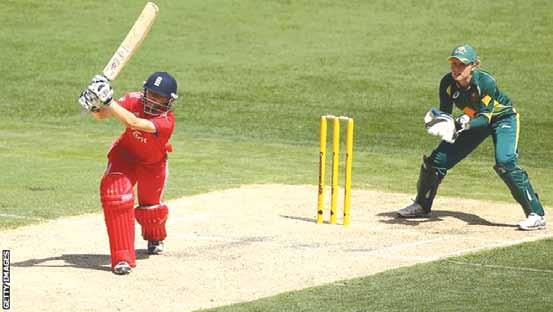
England are within one victory of retaining the Women’s Ashes after a seven-wicket win over Australia in the first one-day international.
Alex Blackwell’s unbeaten 82 helped the hosts post 209-3 from their 50 overs.
England slipped to 68-3 in response but an unbroken fourth-wicket stand from Lydia Greenway (69 not out) and Arran Brindle (63 not out) led them home.
England are now 8-0 up in the multi-format series having won the only Test in Perth by 61 runs earlier this month.
The Southern Stars must now win both remaining ODIs and all three Twenty20 internationals to
prevent England retaining the trophy.
Captain Charlotte Edwards said her team would not underestimate Australia’s powers of recovery and become overconfident despite their 6-0 advantage after that victory at the Waca.
They were given a stiff reminder two days ago after they suffered a twowicket defeat in their warm-up match against a Cricket Australia Women’s Representative XI, but took control at key moments at the MCG.
Meg Lanning, who at 21 became the youngest Australian to lead the country’s senior side because of an injury to Jodie Fields,
Glenn Maxwell took a sharp catch at point to end Cook’s fluent 35, while Warner’s run out of Ian Bell and Clarke’s own catch to remove a becalmed Ben Stokes were truly outstanding.
Xavier Doherty, Nathan Coulter-Nile, and Maxwell all delivered useful spells, though it was more of a struggle for James Pattinson in his first international appearance since last year’s Lord’s Test. Straining for ef-
fect but lacking rhythm, his six overs cost 41.
Australia’s pursuit began with a lengthy delay while a sight screen issue was addressed, before Warner avoided being run out without facing a ball when Ravi Bopara’s throw missed the stumps while the opener was still well short of his ground, having been called through for a swift single by Finch. This hiccup did not prevent the score
England innings (50 overs maximum)
AN Cook* c Maxwell
b Coulter-Nile 35
IR Bell run out (Warner) 29
BA Stokes c Clarke b Doherty 15
GS Ballance c Christian b Coulter-Nile 26
EJG Morgan c & b Christian 54
RS Bopara c †Haddin b Faulkner 21
JC Buttler† b Christian 4
TT Bresnan not out 41
SCJ Broad c †Haddin
b Coulter-Nile 1
CJ Jordan c Finch b Faulkner 10
JC Tredwell not out 2
Extras: (lb 2, w 2, nb 1) 5
Total: (9 wickets; 50 overs) 243
Fall of wickets: 1-50 (Cook, 8.4 ov), 2-70 (Bell, 14.1 ov), 3-91 (Stokes, 22.4 ov), 4-121 (Ballance, 28.3 ov), 5-177 (Bopara, 39.6 ov), 6-186 (Morgan, 41.3 ov), 7-195 (Buttler, 43.2 ov), 8-198 (Broad, 44.2 ov), 9-225 (Jordan, 48.4 ov)
Bowling: JP Faulkner 6-035-2, JL Pattinson 6-0-410, NM Coulter-Nile 10-0-473, XJ Doherty 10-2-28-1, GJ Maxwell 9-0-38-0, DT Christian 9-0-52-2 Australia innings (target: 244 runs from 50 overs)
AJ Finch c Bopara b Jordan 22
DA Warner c Bell b Stokes 71 SE Marsh not out 71 MJ Clarke* b Bopara 34 BJ Haddin† not out 35 Extras:(b 2, lb 4, w 5) 11
Total: (3 wickets; 40 overs) 244 Did not bat: GJ Maxwell, DT Christian, JL Pattinson, JP Faulkner, NM CoulterNile, XJ Doherty Fall of wickets 1-43 (Finch, 6.6 ov), 2-121 (Warner, 20.2 ov), 3-172 (Clarke, 28.4 ov)
Bowling : CJ Jordan 9-0-561, SCJ Broad 8-0-610, TT Bresnan 6-0-42-0, JC Tredwell 9-0-42-0, RS Bopara 5-0-14-1, BA Stokes 3-0-23-1
Paul George scored 36 points and Lance Stephenson added 22 points and 12 rebounds, leading the Pacers past the Los Angeles Clippers, 10692, on Saturday night in Indianapolis.
Indiana (32-7) has won four straight, all by double digits, though it missed a chance to win four in a row by 20 or more points for the first time in franchise history. The Pacers retained the league’s top record and improved to 21-1 at home before heading West for a fivegame road trip.
won the toss and elected to bat.
However, Australia’s batters struggled to get going in the first half of their innings as England’s attack bowled tightly to restrict the hosts to 68-3 after 25 overs.
Anya Shrubsole (1-55) trapped ODI debutant Elyse Villani for eight in the seventh over and Lanning departed four overs later when she sliced a wide one off Jenny Gunn (1-30) to Heather Knight at gully.
A 35-run partnership between Jess Cameron (21) and Blackwell steadied the Australian innings before Cameron chipped spinner Danielle Wyatt to midoff, where Shrubsole took a catch above her head. (BBC Sport)
from mounting quickly, as Warner in particular found ideal timing for the slowish pitch.
Finch was no less proactive, but his tendency to drive balls at a catchable height was to cost him once more, Bopara claiming the chance at cover. Warner was not perturbed in the slightest by the wicket, crashing Tim Bresnan over long off for six the very next over, and proceeding on his merry way at a pace that quickly shrank the target.
Marsh thus had time to get established, and their stand reaped a swift 78 before Warner shelled to cover while trying to repeat a boundary from the previous ball. Clarke kept the rate ticking at well above the requirement, gliding to a breezy 34 that was ended by perhaps the ball of the night - a Bopara inducker that perforated the captain’s attempted drive.
Haddin gained a promotion in the order through the injury-enforced absence of Bailey, and delighted the healthy and hearty crowd of 37,823 by closing in on the target with a series of brazen blows.
Marsh, building confidence with every run, applied the final touch with a pleasant flick over midwicket. (Cricinfo)
Jamal Crawford scored 22 points for the Clippers, who had their five-game winning streak snapped. Blake Griffin had 19 points and DeAndre Jordan added 12 points and 17 rebounds.
After falling behind, 136, in the first 4½ minutes, the Pacers cracked down and gave up only 14 points over the next 14 minutes as they took a 45-27 lead. The Clippers never got closer than 9 after that.
Indiana did all that despite David West getting ejected at halftime for a fla-

the extra period, including two driving layups to lift the Heat to their second win in two nights.
Chris Bosh added 25 points and seven rebounds for Miami.
Trail Blazers 127, Mavericks 111 — LaMarcus Aldridge had 30 points and 12 rebounds, and visiting Portland ran past Dallas for its fifth consecutive victory.
straight loss.
Anthony Davis had 31 points and 17 rebounds in his seventh straight game with more than 20 points, but that was only enough to keep the Pelicans competitive into the final minutes.
Timberwolves 98, Jazz 72 — Nikola Pekovic had 27 points and 14 rebounds in three quarters, and reeling Minnesota blasted visiting

grant 2 foul and with his backup, Luis Scola, and All-Star center Roy Hibbert watching the entire fourth quarter from the bench.
How did the Pacers do it? The same way they’ve won all season.
They held the high-scoring Clippers to 39.8 percent shooting from the field, beat them on the glass, outscored them in the paint and thwarted the Clippers’ momentum every time they started to get some.
Heat 104, Bobcats 96 — LeBron James had 34 points and eight rebounds, and visiting Miami beat Charlotte in overtime for its 15th straight victory over the team.
James scored 6 points in
The NBA’s highest-scoring team reached 30 points in the first quarter for the 14th time in 2013-14, and 100 points in three quarters for the fourth time.
Nicolas Batum scored 21 for the Trail Blazers. Robin Lopez added 16 points and 12 rebounds.
Rockets 114, Bucks 104— Terrence Jones had a career-high 36 points, including 25 by halftime, and 11 rebounds, and host Houston led from the start in its win over Milwaukee.
James Harden added 22 points in the win.
Warriors 97, Pelicans 87 — Stephen Curry scored 28 points and David Lee added 22 as Golden State sent host New Orleans to its eighth
Utah.
Kevin Love had 18 points, 13 rebounds, and 5 assists, and Kevin Martin scored 20 points to help the Wolves snap a three-game losing streak that included losses to Sacramento and Toronto.
Bulls 103, 76ers 78 — Joakim Noah had 21 points and 16 rebounds, Carlos Boozer added 15 points and 13 boards, and host Chicago beat Philadelphia. Noah extended his streak of double-digit rebound games to 12.
Pistons 104, Wizards 98 — Josh Smith overcame a slow start to score 22 points and Rodney Stuckey added 20 as Detroit won in Washington.
By Santokie Nagulendran
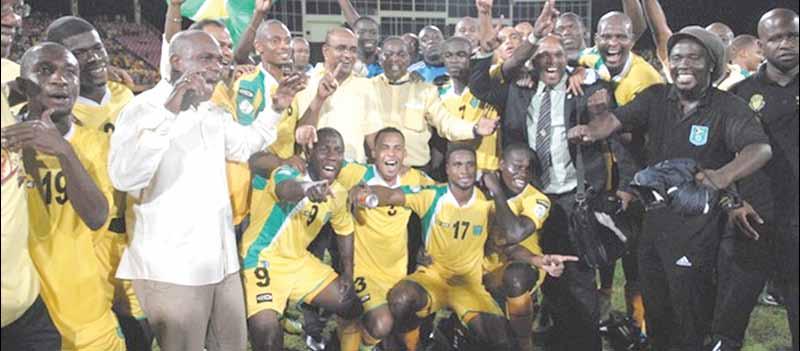
Amidst the usual release of FIFA rankings for November 2013 lay a statistic which only a keen-eyed observer would notice: the biggest drop in places had been awarded to the small nation of Guyana, a Caribbean country geographically located in South America and neighbour to one the most famous footballing nations of all: Brazil.
Now this drop in rankings of 36 places is the consequence of a fairly simple scenario: Guyana, also known as the Golden Jaguars, have not played one single competitive match for the whole of 2013. Not one.
A year has gone by and
not one solitary match has been played by this country, a team which, as recently as 2012, were giving Mexico a run for their money at the Azteca Arena after reaching the semi-finals of CONCACAF qualification for the upcoming 2014 World Cup, the furthest Guyana had ever reached in qualification.
This was a nation showing promise of real progress and development, exactly the type of progress FIFA dreams of seeing in smaller nations, yet the talented team have been forced to rest on their laurels for 2013 and this ultimately begs the question: why has this happened to the Golden Jaguars?
To put the development of the team into context, Guyana has a tiny population of less than 800,000, has never qualified for any major footballing tournament, and like many Caribbean nations, the undisputed king of sport there is cricket, the football team even uses the cricket stadium to play its games.
In essence, it should have had little hope of ever gaining entry into football’s elite competitions, yet that’s ex-
actly what began to happen under the mentorship of coach Jamaal Shabazz, a Trinidadian born tactician who helped instil a heightened sense of organisation and professionalism into the team.
Under Shabazz, Guyana leapt a massive 90 places in the FIFA World Rankings between 2005 and 2007 and narrowly missed out on qualifying for the 2007 CONCACAFGold Cup for the first time in its history.
Although Shabaaz left in 2007, he was instrumental in seeing numerous Guyanese players gain professional playing contracts in countries such as Trinidad, and thus when he returned to manage the national team once again in 2010 he found a much more developed and travelled team.
Improvements to the squad were also aided byFaizal Khan, a UK-born FIFA agent of Guyanese heritage who managed to convince numerous British-born players of Guyanese descent to choose to play for the team, mirroring the model which Jamaica and Trinidad had used in the past to help qualify for World Cups. So in came brothers Leon and Carl Cort, players with Premiership experience, alongside other British born players such as Christopher Nurse and Ricky Shakes. This was a team now full of European experience and ready to scale new heights.
Against the odds In 2011 the second round of CONCACAF qualifying saw Guyana grouped alongside a strong Barbados side, Bermuda, and Trinidad and Tobago, the undisputed favourites of the group containing talented players such as Kenwyne Jones in the lineup.
Yet against all odds, Guyana managed to top the group, maintaining a solid defensive record throughout and qualifying for the next round with a game to spare, new recruit Leon Cort netting the decisive winner against Trinidad in the penultimate game.
Captain Christopher Nurse recently reflected on this period of success, telling me that "we did not qualify for the WCQ Quarter-Final stage by accident, it was through hard work, preparation, dedication, devotion, sacrifice and desire."
Whilst appearing to be
a “fluke” to the causal observer, the performances of Guyana were merely the culmination of years of hard work and efforts to improve the infrastructure of the game amidst corruption within the Guyanese Football Federation (GFF).
President of the Guyana Football Association, Colin Klass had been in charge for 22 years, investing little into the development of the
game in Guyana, but hit the headlines in 2011 when he was found guilty of accepting bribes and subsequently banned from all football administration for 26 months.
Unfortunately this sorry event wasn’t to be the end of Guyana’s off-field problems.
On the field however, things were progressing nicely for the Golden Jaguars. They were drawn with Mexico,El Salvador and Costa Rica for the next round of World Cup Qualifiers, and the first game at the historical Azteca Arena in Mexico will always be remembered as a landmark occasion in Guyanese footballing history.
Despite losing 3-1, Guyana made an impressive account of themselves, controlling the ball for long periods of time and maintaining a strong defensive shape.
Unfortunately the rest of the campaign deteriorated, and Guyana found themselves bottom of the group with a solitary point by the time their last group game against Mexico came around, a “home” tie which was very abruptly moved to USA in order to attract more Mexican fans and revenue.
The reason for this bizarre rescheduling of a home
game was purely down to finances, yet the GFF did not declare how much the rights of the game had been sold for or what the money would be duly invested in.
GFF president at the time Franklin Wilson merely said the move “was in the best interest of Guyana’s football development”, and as such, the deal was one clouded by ambiguity and reflective of the nature in which the GFF operated.
Christopher Nurse, even lamented at the time that “none of the current administrators except Aubrey “Shanghai” Major has demonstrated any kind of competence in raising funding or even basic things like writing letters. They just sit at the office and draw fat salaries when coaches and players are constantly deceived and lied to.”
Substantial progress Nurse’s opinion of the GFF reflected a widespread view amongst players that the board was hindering any sort of substantial progress being made for the football team, and sure enough, events that occurred soon afterwards ultimately proved these fears to be true.
Despite the anti-climatic end to the World Cup qualifying campaign, it would be reasonable to assume that this historic period was the start of an upwards trend for football in Guyana right?
tween the Guyana Football Federation and Guyana Football Association required FIFA to intervene for peace discussions, and whilst this political dispute was ongoing, actual footballing matters, such as arranging Guyana’s next fixtures or paying players decent wages, were seemingly cast aside in the battle for power.
Jamaal Shabazz understandably left his post immediately in November 2012, not long after Guyana’s last game, and the team has yet to even announce who will be his successor, despite the GFF electing Christopher Matthias as their new president in April.
FIFA has tried to help Guyana in the past, earmarking them for the Goal project way back in 1999, a programme that provides substantial funds for smaller nations to develop their facilities, in Guyana’s case, this included building a stadium specifically for the national football team.
Nothing done
However, as of writing nothing has been done, Guyana are still stuck on the first phase of development whilst neighbouring Caribbean countries have completed three phases as outlined by the project.
In September 2013, FIFA development officer Howard McIntosh expressed concerns

Current players in the English Premier League such as Fabian Delph (Aston Villa) and Jerome Thomas (Crystal Palace) have Guyanese heritage, and had Guyana continued to show progress on the world footballing stage they may have very well opted to choose to play for Guyana.
Sad truth
However, the sad truth is that the turmoil of the past 12 months has set the team back years, possibly generations, and they will no longer be seen as an attractive or viable option for these players.
I recently reported on the FIFA Under-15 CONCACAF Championships held in the Cayman Islands in August, and unsurprisingly, virtually every Caribbean nation fielded a team with the exception of Guyana, a sad sign that the future players of the country are also being left isolated from the footballing landscape.
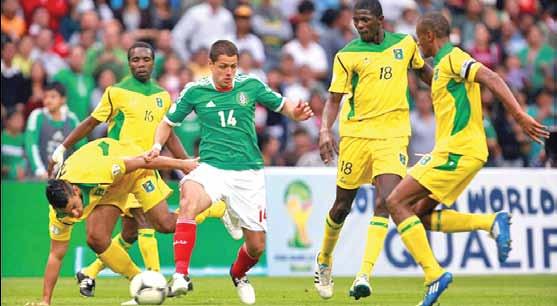
Wrong.
Amidst reports of only being paid $12 a day, numerous players went on strike during November’s 2012 Caribbean Cup campaign, and despite being strong contenders to win the competition, Guyana failed to even qualify for the tournament, losing in qualification with a largely depleted team.
Immediately after that horrendous episode, Guyana stopped playing football completey. That’s right. They stopped playing football, their last match taking place against Grenada on the November 16, 2012.
Over a year has passed and there still seems to be no sign of any forthcoming fixtures for the Golden Jaguars. So the question needs to be asked: why has this been allowed to happen?
Firstly, disputes be-
about the lack of progress being made by the GFF in implementing the Goal project, and as such, Guyana was consequently chosen for FIFA’s Performance initiative, whereby FIFA offers training ranging from administration duties to league development, yet despite the impressive nature of this programme, it remains to be an initiative which has yet to really be seen or implemented in Guyana.
As of writing this article, Guyana remains stuck in limbo, they’ve lost their extremely talented manager, lost a year of important development and practice due to a lack of games, and most importantly, disputes between boards have ultimately let down the fans who have been unable to see their country play football for over a year.
With the Caribbean Football Union (CFU) recently announcing their footballing calendar for 2014, including the 2014 Caribbean Cup, it seems unlikely that Guyana will even feature at all in these proceedings, such is the sorry state of affairs at this time.
As the World Cup in Brazil nears, Guyana’s location would have made them ideal candidates for competing teams to play warm-up games against, a priceless opportunity for the Golden Jaguars to test themselves against the best, but a team that hasn’t played competitively for over a year is of little attraction to any team gearing up for the World Cup and there doesn’t seem to have been any effort made to remedy this.
So whilst we are all aware of what has happened to the Golden Jaguars, the question of when they will return seems to be one nobody will be able to answer for the foreseeable future.
(Editor’s note: Santokie Nagulendran is an up and coming sport writer based in London)
By Treiston Joseph
The Guyana Amateur Boxing Association (GABA) started the year with a knockout blow after successfully hosting a judges and referees programme on Sunday following a visit from International Amateur Boxing Association (AIBA) qualified referee/ judge James Beckles.
The course which lasted the duration of five days at the Guyana Olympic Association (GOA) headquarters in Kingston has made Guyana one of the first Caribbean countries to implement and train personnel to operate the new computerized 10-point system of AIBA according to Beckles.
Among the first
“Guyana is among the first Caribbean countries to have used and to have trained on this new computerized 10-point system, countries such as Jamaica and Aruba are having difficulty with it and it is nice to know that your referees worked the system and got it correct,” Beckles stated.
Guyana now has 14 qualified judges/referees and president of the GABA Steve Ninvalle was pleased with the success of the workshop.
“Today I think boxing has scored a knockout in Guyana, it is very important we have such seminars because we need to widen our
information base, we are also happy that every time we have such programmes with add to our females.
“However, we need to make sure that we are constantly being fed information so that we can develop so I want to congratulate all the participants on their success,” Ninvalle stated.
Further, Ninvalle revealed that with the Goodwill games coming up, an invitation was sent to Cuban boxers to participate. He also invited Beckles to return for the Goodwill games scheduled for February 14.
Relevance
Secretary of GABA Shawn Richmond at the final day of the seminar noted the relevance of the Guyana learning the new system.
“The relevance of this course is quite high because we are able to build capacity and brings us to a global capacity in boxing.
“For us to reach the highest level in boxing our referees/judges and boxers should be aware of high standards and with this I see a progressive onward movement,” Richmond mentioned.
Director of Sport Neil Kumar, who has been in full support, believes that the programme will take Guyana to the next level, while revealing that GABA will be in for a new ring, as he congratulated the participants.
“I want to congratulate the female participants and all the participants, I feel pleased that the Guyanese referees and judges made a big leap, it is important for the referees and judges are on the same page and this will do good for boxing.
“We are in the process of purchasing a new boxing ring and I am already in possession of new boxing equipment so I hope more clubs can be formed and the boxing more competitive because this year we must see our boxers medaling,” Kumar stated.
Meanwhile Beckles issued a challenge to GABA to ignite the flames of the Caribbean Amateur Boxing Association (CABA) championships which has been nonexistent for four years.
Participant of the course Elton Chase thanked Beckles for his knowledge and said he hoped that he (Beckles) would return soon. Beckles was presented with a plaque of appreciation from the participants by Romona Agard.
Participants were Nicola Yhap, Paulette Nurse, Romona Agard, Leonard Wilson, Wayne Harris, Mark Drakes, Jermaine Craig, Eustace Cuffy, Colin Waddle, Marcelle Dainiels, Nigel Hope, Keith Norville, Richard Braithwaite and Elton Chase.
Novak Djokovic offered his best impersonation of new coach Boris Becker both on and off the court in another flawless performance as he reached the quarter-finals of the Australian Open on Sunday.
The three-time defending champion crushed Italy’s 15th seed Fabio Fognini of Italy 6-3 6-0 6-2 to book his place in the last eight without losing a set.
The Serb dropped just 10 points on his serve - Becker’s speciality - in the entire match and Fognini was left to resort to joking around in the third set in an attempt to distract the second seed.
But the real fun came afterwards when the second-seeded Serb impersonated the service action, walk and mannerisms of Becker, as the German looked on from the stands.
“I saw his face reactions,” Djokovic told reporters. “The first impression, when I did all the serves, he was happy and was applauding.
“When I said how he is today with his problems in the back and everything, he was

not so happy about that. He was upset. But, no, it’s all for good laughs.
“It’s actually the first time after a long time I’ve actually done Becker imitation. I don’t know how I was. Was it OK? I’m going to gain few kilos and have to color my hair in order to do the proper Becker imitation.”
If Djokovic saved the fun stuff for after the match, he was deadly serious during it as he ripped apart Fognini with ruthlessly efficient hitting.
After breaking once to win the first set, Djokovic rattled
off 14 of the next 15 points on his way to a 4-0 lead in the second.
Fognini enjoyed the best year of his career in 2013 but was powerless against Djokovic, who admits he is happy with all parts of his game.
“I feel great about myself in this moment,” the Serb said.
“There is this confidence that I carry on obviously from many wins that I had in the last two months of the 2013 season and I started off this season in a good style. I’m trying to keep it up.” (Reuters)
The Berbice Cricket Board’s (BCB) junior selection committee under the chairmanship of Leslie Solomon has named a junior cricket squad for the 2014 inter-county season that would commence training shortly under the Junior Elite training programme.
The squad is divided into three sectionsUnder-15, Under-17 and Under-19- and would be trained by a panel of qualified cricket coaches, including Michael Hyles-Franco, Winston Smith and Albert Smith.
Chairman of the BCB Special Events Committee and Public Relations Officer, Hilbert Foster, stated that more cricketers would be added to the squad based on performances in upcoming junior tournaments.
Members would be involved in physical fitness sessions, while coaches would also work with them to correct any personal problems in their cricket.
A one day cricket development seminar would also be organised by the Special Events Committee along with a social skills seminar.
Members of the squad are reminded to keep in good physical condition and to do a lot of individual training during the rainy season until the Junior Elite Training Programme starts.
The BCB, Foster stat-
ed, would start its junior tournaments - Under-15 Inter-club and Inter-zone, Under-17 Inter-club and Inter-zone and Under-19 Inter-club and Inter-zoneas soon as the weather improves.
Below are the members of the various 2014 squads.
Elite Under-15: Yashpaul Shewtahal, Hemchand Singh, Kris Ramnarine, Saheed Khan, Kevin Sinclair, Junior Sinclair, Malcolm Mickle, Ezekiel Kempadoo, Karaan Rajpaul, Renaldo Rowe, Joshua Clifford, Emanuel Seecharran, Besham Surujnarine, Jason Permaul, Keith Semple, Javed Karim, Kevin Anderson, Bharrat Bhopal, Joshua Bartrum, Brandon Stewart, Garfield Benjamin and Steve Deonarine.
Elite Under-17:
Ritesh Omrow, Suraj Dookna, Kevindra Persaud, Rabindranauth Roopchand,
Randy Wade, Brandon Persaud, Javid Seecharan, Adrian Sukhwa, Joshua Harrichand, Totoram Rajaram, Azam Khan, Jaleel Jofer, Devon Rambarose, Shumar Jack, Jason Johasen, Matthew Hardial, Veramootoo Senwansane, Robert Barrington, Sylus Tyndall, Enoch Carmichael, Steve Deonarine, Joshua Gobin and Bramdat Singh.
Elite Under-19: Shimron Hetmyer, Sharaz Ramcharran, David Latchaya, Derek Narine, Hakeem Hinds, Askay Homraj, Nick Ramsaroop, Leon Andrews, Avishkar Sewkarran, Arif Chan, Nial Smith, Grisean Grant, Nicholas Cameron, Balchand Baldeo, Brandon Prashad, Daniel Lewis, Kassim Khan, Gavin Moriah, Deon Esau, Viendra Gooniah, Parmanand Ramdhan and Navendra Permaul.
Larrazabal tops McIlroy, Mickelson to win Abu Dhabi Championship by one
Spain’s Pablo Larrazabal birdied the final hole to win the Abu Dhabi Championship on Sunday by one shot.
Larrazabal (67) finished on 14 under, one stroke ahead of major winners Rory McIlroy (68) and Phil Mickelson (69).
Open champion Mickelson fell back after a triple-bogey at the par-four 13th when leading, while McIlroy was left to rue a two-shot penalty in round three.
“I feel like I’m standing here and I should be 15-under par and win by one,” said the Northern Irishman.
“I can count it as a moral victory more than anything else. It’s a very positive start to the season so I’m not going to let one little negative ruin that.”
Two years ago, McIlroy was penalised two shots in his second round in Abu Dhabi for brushing away some sand that was not on the green, but which lay between his ball and the flag. He went on to finish one behind surprise winner Robert Rock.

Mickelson’s wound was also self-inflicted. The American was leading by one when he attempted to hit a right-handed escape shot from under a bush, only to suffer a ‘double-hit’ when his ball struck the bush and bounced back on to his club.
“It never crossed my mind it might double-hit,” the lefthander said. “I was just trying to dribble it out of the bush, to move it about ten feet and I felt it was worth the risk.
“I wanted to use a lob wedge but had to turn around a four iron as I was having trouble seeing the club at address.” The 43-year-old bounced back in typical fashion with birdies on the 14th and 16th, but was unable to find the eagle he needed on the 18th to force a play-off with Larrazabal. McIlroy had played alongside Larrazabal and the pair were both three under for the day after 11 holes, but while McIlroy’s challenge stalled with a run of seven straight pars, Larrazabal birdied the 13th and hit two superb shots to the heart of the 18th green to set up the decisive birdie.


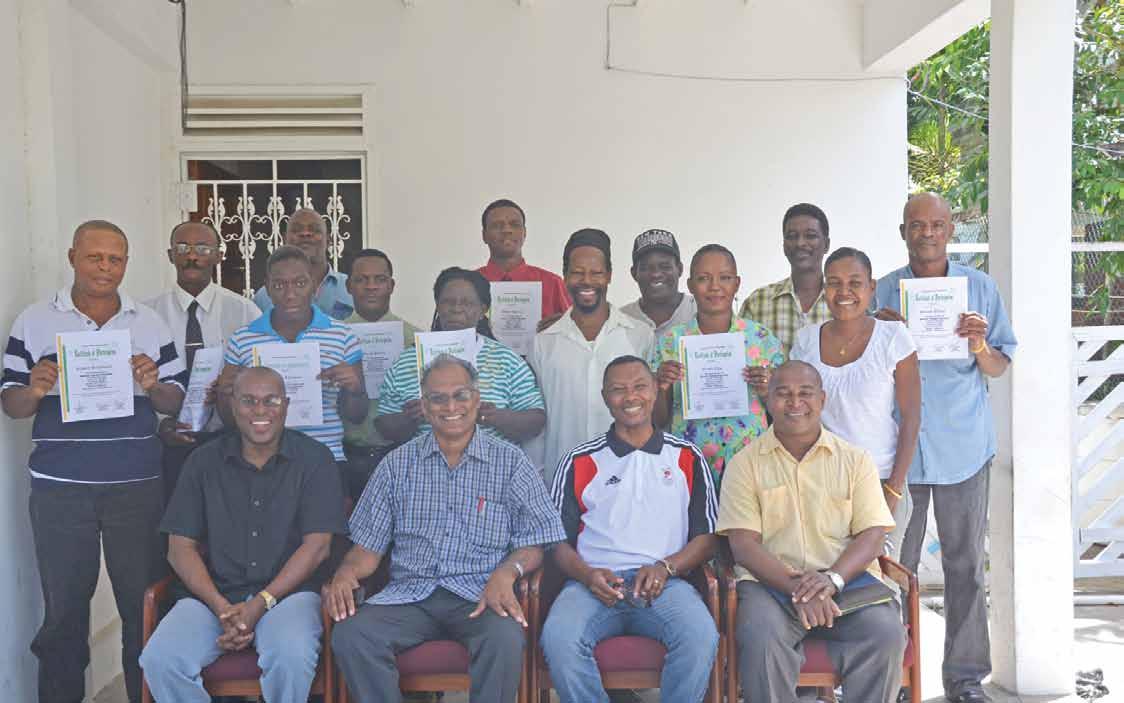
As Brad Haddin observed the day before this match, winning is a habit and so is losing. On the evidence of an SCG contest that ended with Australia wrapping up their second consecutive ODI series victory over England in the minimum three matches, the hosts’ predilection for the former is matched by their visitors’ weakness for the latter.
Though less dramatic and perhaps less demoralising than James Faulkner’s Gabba heist had been, this defeat underlined England’s rut and Australia’s peak as well as any of the seven previous matches on the tour.
Alastair Cook’s side won the toss on a pitch favouring the side batting first and made a swift start, yet found themselves fatally slowed as much by their own lack of conviction as Australia’s neat bowling and high class fielding.
Australia’s chase was not quite perfect, as no batsman made a hundred and wickets were lost to loose strokes, but the belief surging through the team was demonstrated by the jaunty run rate pur-
sued throughout, and best exemplified by the sight of David Warner swinging a six down the ground the over after Aaron Finch’s dismissal playing a similarly fullblooded stroke.
Warner perished when a century beckoned, but Shaun Marsh, Michael Clarke and Haddin had little trouble galloping to victory. They did so with a gaping 10 overs to spare, and could look proudly upon the fact they had done so without having any of Mitchell Johnson, George Bailey or Clint McKay in their XI.
The only moment of unease arrived in late afternoon when Eoin Morgan’s lone English rearguard was terminated. His dismissal to a low return catch by Daniel Christian required a replay for confirmation after Morgan stood his ground, provoking an angry response from Clarke.
England’s innings was otherwise characterised by a failure to convert starts into substantial scores, due in part to another exceptional fielding exhibition by Clarke’s men.