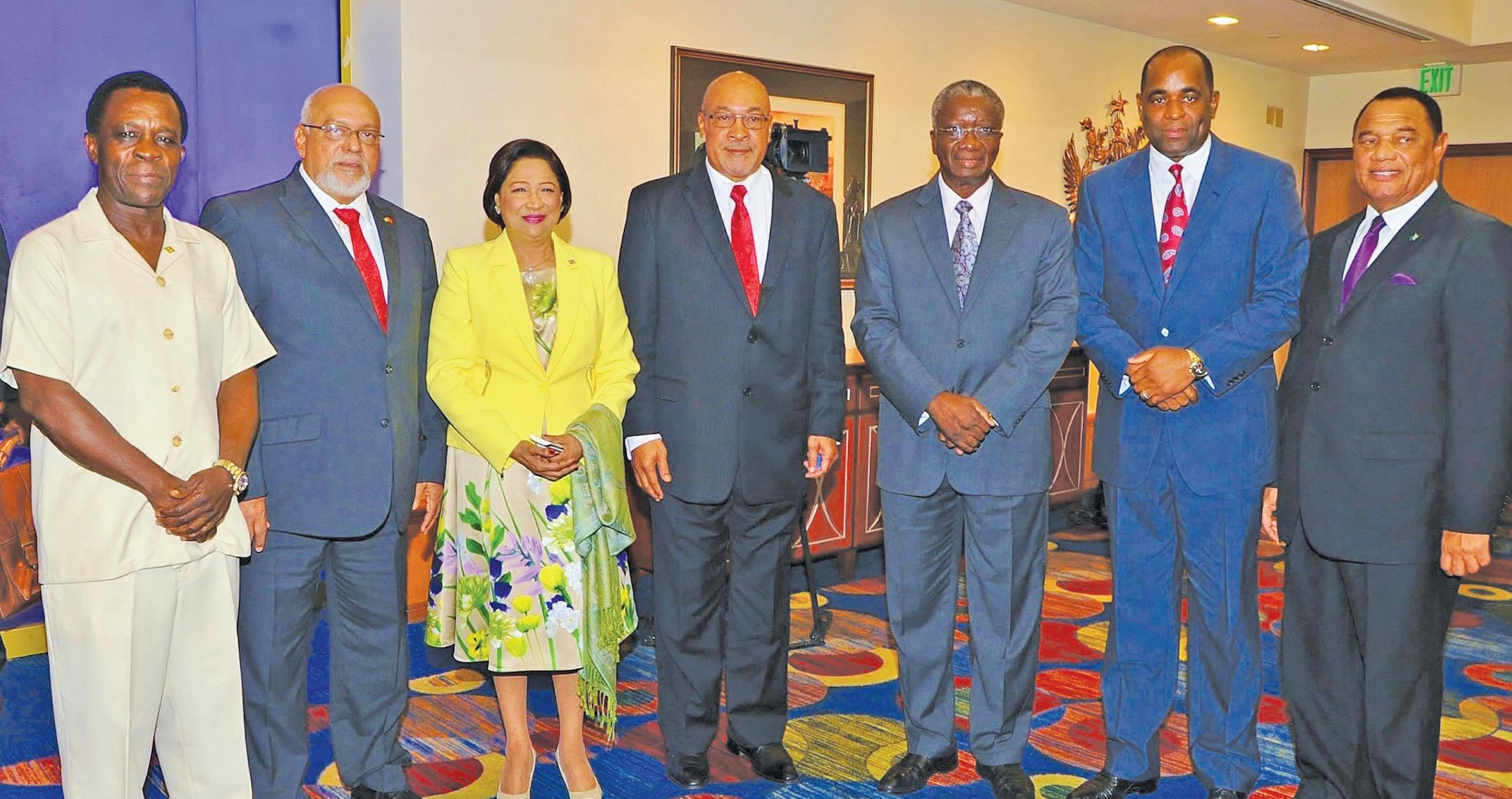
Caricom leaders pose for a group photograph before attending a farewell lunch for His excellency Xi Jinping, President of the People’s Republic of China, hosted by Trinidad and Tobago on Sunday. From Left, Hon. Keith Mitchell, His excellency Donald Ramotar, President of Guyana; Hon. Kamla Persad-Bissessar, Prime Minister of Trinidad and Tobago, His excellency Desi Bouterse, President of Suriname, Hon. Freundel Stuart, Prime Minister of Barbados, Prime Minister of Grenada; Hon. Roosevelt Skerrit and Rt. Hon. Perry G. Christie, Prime Minister of The Bahamas. (Edward L. Layne/FB Photo)
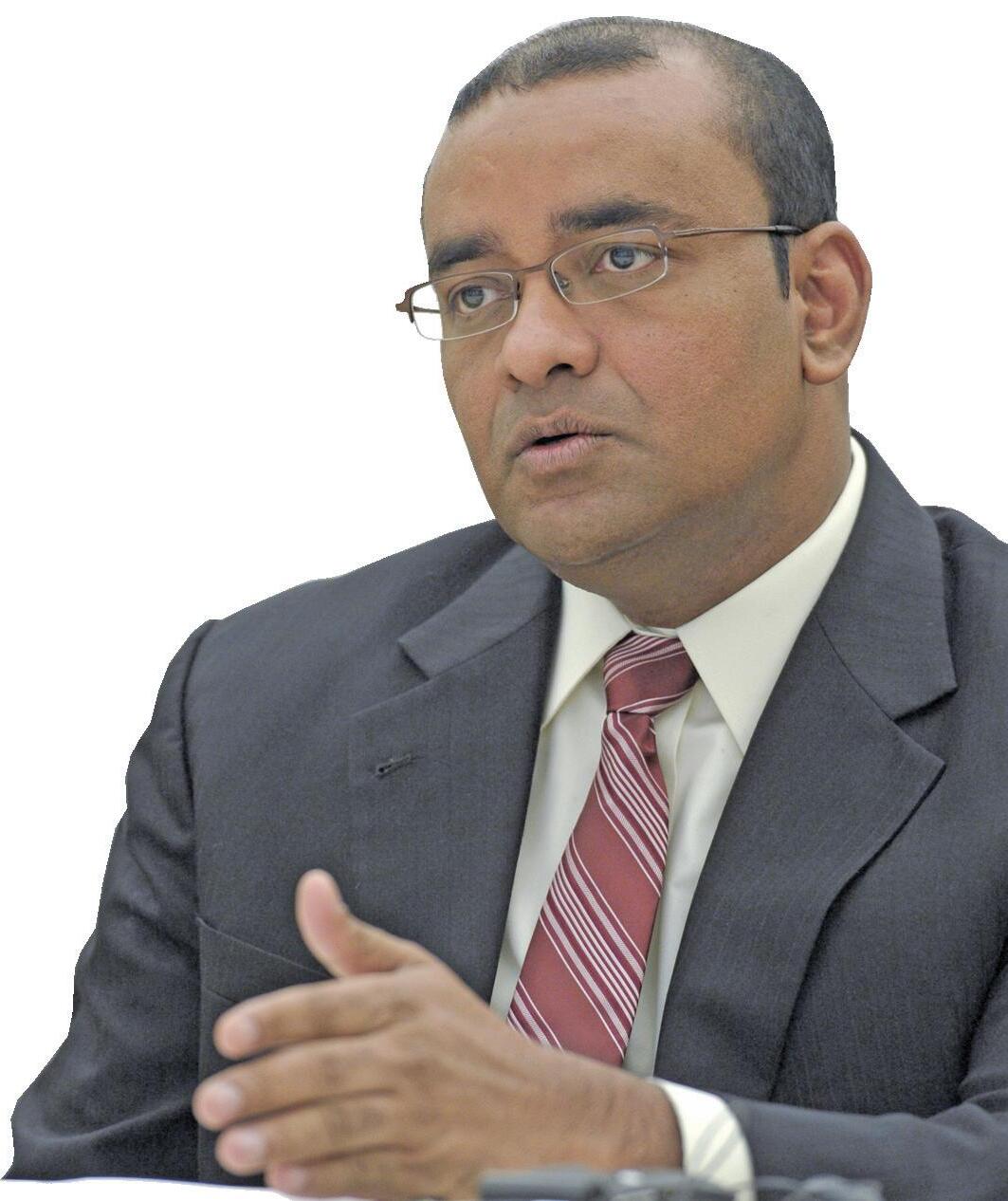
Guyana’s former President Bharrat Jagdeo
Carbon Conversations at trent Centre
Jagdeo urges new global pact with incentives to fight climate change
Former Guyana
President Bharrat Jagdeo continued his global campaign to fight climate change, telling a highlevel Canadian audience Monday evening that fixing the energy mix, decarbonising sectors and charting a different pathway to development through a new global agreement with incentives and strong regulations is the way to go.
He was at the time, one of several panelists at a Trent Centre for Biomaterials Research event titled “The Carbon
Conversations: Charting a Sustainable Future”. The discussion series, now in its second year, addresses the core of the planet’s crisis – carbon and the world’s dependence on carbon by-products.
Carbon Conversations
The Trent Centre for Biomaterials Research engages a broad spectrum of thinkers in Carbon Conversations –from students and scientists to philosophers and consumers – to generate discourse about carbon-related sustainability issues and the future of the world. The panel focused on the question: “Environmental sustainability and avoided climate change: mutually exclusive to development and for profit commercialisation?”
According to a release from the centre, Jagdeo spoke of his brainchild Low Carbon Development Strategy –as system of carbon credits he put in place for Guyana, which resulted in a bilateral deal with Norway. This, he said sought to balance human
needs with sustainable practices.
The centre said, during his presentation, Jagdeo understood the scepticism of some in the crowd about the ability to align politics and economics with sustainability.
According to the centre, a theme quickly took shape as the panel discussion got underway with panelists advocating that sustainability can go hand-inhand with sound investment and good business practices. The message was not lost on the diverse crowd, a mix of 150 business executives, environmentalists, community members, students and alumni of Trent. All with an interest in sustainability in common, they gathered in the heart of Toronto’s financial district the evening of June 3.
Aside from Jagdeo, other speakers included Guyanese Dr Suresh Narine, director of the Biomaterials Research Centre at Trent, Ontario, research chair in green chemistry and engineering and NSERC industrial chair. They were joined by David G Patterson, chair and chief executive officer (CEO), Northwater Capital, and Annette Verschuren, OC, CEO and chair, NRStor, and chair, Clean Energy Taskforce for Ontario to lead a discussion under the title of the event “Charting a Sustainable future”.
Lively exchange
The centre said in the spirit of the name of the series, the Carbon Conversation was a lively exchange between passionate and informed audience members and the panel of experts.
Verschuren described her earlier career as an executive with Home Depot, where she oversaw sustainability initiatives such as the simple repurposing of furniture for Habitat for Humanity. Once retired from her position, she wanted her next venture to “make a difference”.
She sees ethical, sustainable investing as a “convenient opportunity for Canada-led innovation” and invests in solutions-oriented companies undertaking environmentally-friendly and energy-wise initiatives like smart energy storage.
Patterson shared his philosophy that demands for smart technologies will spark innovation. Sustainable businesses will generate wealth and fuel economic growth. At Northwater Capital, his are not green funds – it’s simply a belief that reducing the impact of energy use is good business, “where demand meets profit”.
He went on to describe a series of smart sustainable companies, working to recycle the photo voltaic heat to produce electricity.
Verschuren agreed that “there will be a sys-
tem of carbon credits sooner than we think” and urged that businesses can be part of the solution. “The lack of capital coordination between governments, NGOs and the private sector are no excuse to stop doing things at the private level,” she said. Several comments and perspectives presented by audience members resulted in spontaneous applause.
Unique perspectives Dr Narine thanked the panel of experts for contributing their unique perspectives to the ongoing discussion. The successful event was the fourth in a series of expert lectures and dialogues called The Carbon Conversations. The series is based on the concept that the crisis is carbon and the opportunity is for solutions through conversation. The core of the planet’s crisis is carbon – its use, management and ownership is at the fulcrum of fundamental issues in the world: climate change, environmental stewardship, economic development, culture, ideology and the consumption of resources.
The Trent Centre for Biomaterials Research engages a broad spectrum of thinkers in the Carbon Conversations –from students and scientists to philosophers and consumers – generating discourse about carbonrelated sustainability issues and the future of the world. (Guyana Times)
TT gov’t to bring down mortality rate at women’s
hospital
“The Mt Hope Women’s Hospital is going to be refurbished to such an extent that no further work will be needed in the next ten years.”
Khan said the work done at the hospital was completed by in-house staff to save money that would have been spent on contractors. The work so far cost TT$100,000. Khan said the North Central Regional Health Authority (NCRHA) would see renovations in Caura and the Eric Williams Medical Sciences Complex.
“Caura needs the same kind of upgrade. We are going to use inhouse staff to deal with Caura and open it up to different services,” he said. He said the min-
the NCRHA the teaching hospital centre for research and development in the country.” (TT Guardian)
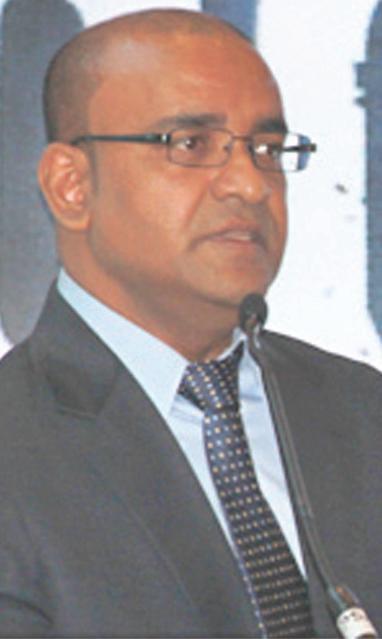
Former President bharrat Jagdeo making his presentation at the event
Health minister dr Fuad khan is assisted by chairman of the north central regional Health authority dr shehenaz mohammed, as he cuts the ribbon to commission a generator at the mt Hope maternity Hospital. (PHOTO: ABRAHAM DIAZ)
Barbados hosts consultations on Caricom strategic plan
Barbados is the country selected for the pilot of national consultations on a Five-year Strategic Plan for Caricom. The strategic plan is a critical part of the reform process within Caricom, which has been initiated by the Conference of Heads of Government.
The consultations in Barbados will take place June 5-7, and will be conducted by the Change Facilitation team based at the Caricom Secretariat Headquarters, Liliendaal in conjunction with Barbados’s Ambassador to Caricom Robert Morris.
According to a Caricom Secretariat release, the recruitment of a Change Facilitation team emanated from the discussions of heads of government at their inter-sessional meeting in Suriname in 2012, after receiving a report on the review of the secretariat. The heads agreed that it was necessary to re-examine the future direction of the community and the arrangements
for carrying this forward which would include the role and function of the Caricom secretariat.
The strategic plan will, among other things, identify the priority areas of focus for the community and guide the restructuring of the secretariat. The secretary general has begun some corporate reforms within the secretariat.
Heads of government approved the outline of the strategic plan
at their inter-sessional meeting in Haiti, last February, and agreed to appoint change drivers in each member state with overall responsibility for coordinating and facilitating the change process at the national level. Ambassador Morris has been designated as Barbados’ change driver.
The consultations in member states will include stakeholder groups including heads of government; opposition leaders; parliamentarians; and representatives of business, labour, youth, other civil society groups, Caricom institutions and other key organisations headquartered in member states.
These consultations are intended to address the vision, mission and core values of Caricom; priority areas in the period 2014-18; and the most appropriate and efficient governance and management structures for the community.
The consultations in Barbados began on Wednesday (June 5th), with Caricom institutions and organisations,
the private sector and Labour. On Thursday, the team meets with Prime Minister Freundel Stuart as well as with Caribbean Policy Development Centre
and non-governmental organisations. The facilitation team, which has a three-year mandate, is being assisted with resources from the United Kingdom
through the Department for International Development (DFID) and began work in the Caricom Secretariat last November. (Guyana Times)
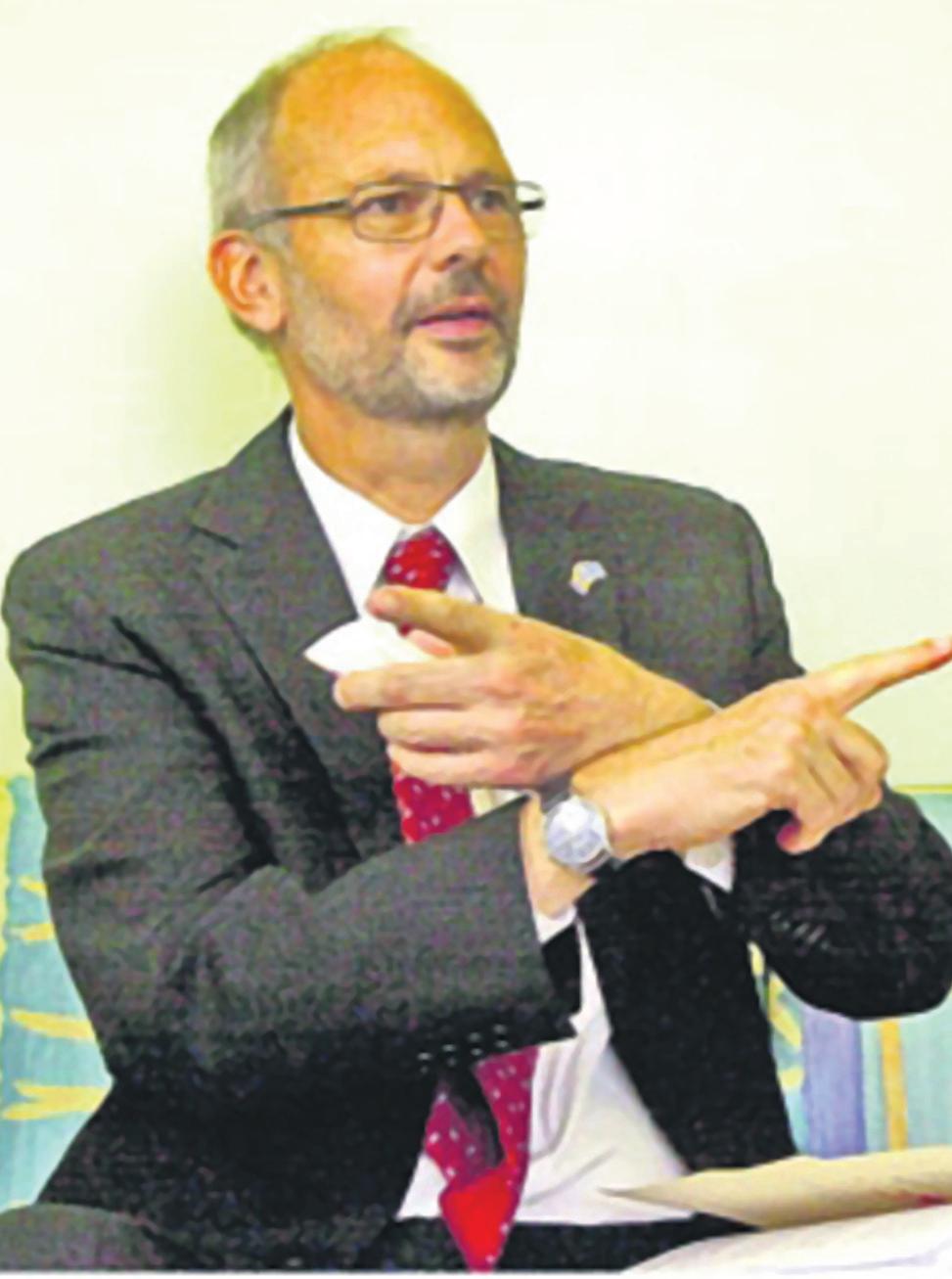
barbados ambassador to caricom robert morris (Antigua Observer website photo)
To contact: Caribbean Times International
Unit 12, 680 Rexdale Blvd., Etobicoke, Toronto, Ontario M9WOB5
Last weekend, the new President of China Xi Jinping met the leaders of the Caribbean Community (Caricom), including President Donald Ramotar, in Trinidad. This is one of the most significant meetings in recent decades and signals an opportunity for the Caribbean to create new linkages with the country, which will undoubtedly dominate economic relations in the world for the next century.
It is rather fortuitous, but not coincidental, that U.S. Vice President Joe Biden also dropped in the region last week. In the months ahead, we will have an opportunity to compare and contrast the relations and benefits that the two countries will actually deliver as opposed to the promises made.
The Caribbean is facing choppy waters in the economic realm. Because of history, the region’s wagon was hitched to Europe and the U.S. With those economies mired in a downturn for which they have the solutions but evidently not the political will to execute, our economies have suffered. It is unlikely that tourism from those countries, for one, will ever regain the previous volume. In this regard it is instructive to learn that Chinese tourists are now the largest group boosting the New York economy. The rest of the Caribbean should be reminded of the US$3 billion tourist resort being constructed in the Bahamas by China. It is the largest investment in tourism in decades and is in contrast to the closure of a western-funded hotel in Jamaica last month.
It is hoped that President Xi Jinping’s visit will force the leaders of Caricom to become serious about our integration efforts. As individual territories, notwithstanding the polite words of our high profile visitors, we do not matter that much to a giant economy such as China. But together, we do present a more attractive package. As we have pointed out before, our most important asset to a China, which is jockeying to have its economic might translated into political clout, is the fifteen votes we can deliver in the United Nations (UN) General Assembly and elsewhere. We used these votes in the 1970’s to help “Red China” receive international recognition in the face of the U.S. dogged insistence that Taiwan was China. The Chinese president cited this act in his speech and knows that in fora such as the World Trade Organisation (WTO) and other global organisations, the votes of the Caribbean can be important.
Our second asset is our strategic location vis a vis both the U.S. and Brazil. The U.S. is fond of reminding us that the Caribbean is in their backyard. But with the help of China we might at long last be in a position to remind them that their backyard actually only extends three hundred miles south into the Gulf of Mexico and only forty five miles above Cuba. In the days of the Cold War between the U.S. and the Union of Soviet Socialist Republics (USSR), the U.S. used all means, including force, to keep us in their “camp” but unfortunately quickly lost interest as to our conditions in the “camp”.
In the last decade, China has already redefined the concept of aid, focusing less on handouts and concentrating on projects that can lead to real development.
In Guyana, the Amaila Falls Hydroelectric Project and the Cheddi Jagan Airport expansion can be potential game changers. We have to keep in front of us the cold fact that China has over US$3 trillion in foreign reserves, for which it is seeking safe investments, while the U.S. is up to its neck in debt – mostly to China.
This brings us to the last asset we can offer to China: our natural resources. China has already taken a strategic position on Caribbean bauxite in Jamaica, Suriname and Guyana and has given hope to moribund communities. This can be replicated in so many other areas, including oil.
We hope the Caribbean leaders grab this opportunity with China.
Dubai advertising firm to invest in Guyana
Afirm in the United Arab Emirates (UAE) is look
ing to make inroads on the local business scene with the establishment of an adver
tising agency in Guyana.
‘Toucan’, an interactive advertising agency, will officially launch its services to Guyanese businesses with a complimentary breakfast seminar at the Pegasus Hotel in Georgetown today. The seminar promises informative and insightful discussions on the world of social media and online advertising, including how businesses can effectively build brand awareness, best practices, and launch a successful online ad campaign.
Emerging market
Toucan’s Managing Director Douglas Ames is confident that Guyana is a key emerging market for both businessmen and investors in the Caribbean and in the Americas.
“The outlook for Guyana’s economy is positive and the International Monetary Fund has in fact projected a growth rate of six per cent for Guyana’s economy in 2014,” Ames stated.
He mentioned that the ongoing drive to diversify the economy, stimulate new business and bring in foreign investment provide the perfect opportunity for businesses to harness the many advantages which the social media has to offer.
Ames pointed out that social media creates a scope and capacity to reach out to potential consumers, investors and partners not only in Guyana but around the world. “But what you need to know is how to use that capacity to achieve your goals – that’s where Toucan comes in,” the managing director said.
He noted that although
Guyana’s corporate world is still fairly new to the complex workings of interactive online advertising, there can be endless benefits to Guyanese businesses who correctly utilise social media.
Experience and creativity
According to Ames, anyone can set up a Facebook page, but Toucan has the experience and creativity to produce meaningful results from social media by increasing the online clientele of any business and engaging in dialogue with those clients and online fan base.
With Guyana’s economy set for continued growth, Toucan is depending on its appeal to encourage businesses to pursue new opportunities.
Ames expressed that the stage has been for Toucan to build a lasting, mutually beneficial relationship with the Guyanese business community.
“It’s a perfect match.
Guyana’s businesses are ready for growth and expansion, and Toucan is the only international interactive ad agency with an innate, deep understanding of what it means to be a Caribbean business. We know what it takes to propel a Caribbean business to the next level with social media.”
Ames referred to the social media as an ever-evolving jungle and says his company recognises what forward-thinking, contemporary businesses need to stay on top of the various social media platforms. With offices in Dubai, India, Kenya and the Caribbean, the agency has a unique perspective on how to approach advertising in local, regional and international spheres and engage with a diverse online audience.
Reputable companies
Toucan boasts a line of reputable companies including Caribbean Airlines, Digicel and Courts, and believes that its many successful international clients, are testament to the agency’s expertise and inventiveness and its understanding of regional businesses.
With clients throughout the Caribbean in Jamaica, Belize, St Lucia and Dominica, Toucan offers cutting-edge online and mobile apps, the latest web design technology, customised memes and animation and the highest standard of social media management across the full spectrum of social media network.
Toucan Limited, which is incorporated in Dubai, provides advice on Internet advertising, marketing, online consumer engagement, web designs and publishing, search engine optimisation and overall campaign management to businesses in emerging markets. (Guyana Times)
toucan’s managing director douglas ames
‘to new beginnings’: tt’s Prime minister kamla Persad- bissessar (left), china's First lady Peng liyuan and china's President Xi Jinping, toasting each other at saturday night's state banquet held in honour of the Chinese diplomats’ first visit to the Caribbean (TT Newsday photo)
Barbados hosts region’s first ever water resources management workshop
More than 20 lecturers and researchers from universities across the Caribbean met in Barbados on Wednesday for the firstever Integrated Water Resources Management (IWRM) Knowledge Management workshop to be held in the region.
The two-day regional workshop was organised by the Global Water Partnership-Caribbean (GWP-C) in collaboration with the Centre for Resource Management and Environmental Studies (CERMES) of the Cave Hill campus of the University of the West Indies (UWI).
Its focus is on the Integrated Water Resources Management (IWRM) Toolbox which was developed by Sweden-based Global Water Partnership (GWP).
The IWRM Toolbox is a free online database with a wide range of resources and tools that provide support in finding solutions to water related problems. It is a unique knowledge platform where experiences in water resources man-
agement can be shared.
The organisers said the workshop therefore seeks to introduce tertiary level practitioners in the Caribbean to the facility and to explore how it could be used in the academic environment of their universities to support their teaching of water resources management.
“The regional workshop presents an opportunity for these professionals to gain valuable knowledge that could help them establish a range of courses that are not currently being taught on water resources management; and help them share knowledge with their students on water management in a new and creative way,” the organisers said in a statement.
Resource personnel for the two-day workshop will come from GWP knowledge management team with delegates expected from Barbados, Belize, Grenada, Guyana, Jamaica, Puerto Rico, Suriname, Trinidad and Tobago, United States Virgin Islands. (CMC)
Increase in gastro cases trigger worry in Jamaica
Inadequate wa-
ter supply is being blamed for the major rise in gastroenteritis cases being reported in some communities in Kingston and St Andrew, even as the Ministry of Health warns that the virus could increase in other areas of the island.
“In all the areas now having the problem there is an inadequate supply of water,” director of Health Promotion and Protection Branch in the Ministry of Health Dr Kevin Harvey told reporters on Tuesday.
At least one death is believed to be linked to gastroenteritis since the spike in the number of reported cases.
“We have had one case we are investigating as a potential case and that is of a seven-monthold baby,” Dr Harvey said, adding that majority of the increased cases have been diagnosed in children under the age of five.
According to ministry officials, the largest jump in cases so far was in the last week of April, where 965 cases were reported. This is said to represent
some 85 per cent more than the number of cases reported for the same period last year.
Dr Harvey said the disease can be curtailed if residents monitor the safety of the limited supply of water that they have at their disposal.
He said not only are people using unsafe water supplies, but many have not been practising proper hygiene such as washing of hands. Tuesday, the health ministry expressed concerns about the spike in the number of cases being reported.
“Up to the end of April 2013 there was a 52 per cent increase in the number of gastroenteritis cases year on
year,” the ministry said in a news release.
However, while the majority of the cases have been curtailed to the Kingston 11 and 13 areas, the Ministry of Health said the potential exists for it to spread beyond these communities.
Some of the badly affected communities include sections of Majesty Gardens, Maxfield Avenue, Delacree Park, Union Gardens, Seaview Gardens, and Greenwich Town.
Indications, the ministry said, are that the majority of cases are caused by rotavirus.
In light of this, the ministry is advising proper handwashing, boiling of drinking wa-
ter and the use of clean drinking utensils as control measures for rotavirus.
The virus is present in faeces and droplets and is often transmitted if hands are not properly washed after persons use the bathroom and then prepare food, if people eat or drink from unclean bottles and other utensils or drink impure water.
Symptoms of gastroenteritis include vomiting and loose stool. Persons who suspect that they are affected by the diseases are advised to take lots of fluids and visit the nearest health facility if symptoms persist.
Gastroenteritis can cause death, as a result of dehydration, if not treated quickly and appropriately.
The ministry said public health nurses have since increased health education sessions and investigations and health inspectors are also visiting the specified communities for evaluation and to collect specimen where necessary. (Jamaica Observer)
(Jamaica Observer photo)
Guyana welcomes new batch of Chinese doctors
The 11th batch of Chinese medical doctors has arrived in Guyana to commence a two- year tour of duty. The doctors were welcomed last Friday by Health Minister Dr Bheri Ramsaran at his Brickdam, Georgetown office. They will serve at the Georgetown Public Hospital and the Linden Hospital Complex in the areas of orthopaedics, urology, general surgery,
obstetrics and gynaecology, anesthesiology, plastic surgery and acupuncture.
The Chinese doctors have already been introduced to the Georgetown Public Hospital and will begin their service within a week’s time.
Minister Ramsaran noted that the Chinese medical team has been doing an excellent job in Guyana. He pointed out that this batch will complement and build on the
achievements of the previous batch.
The minister said too that the new batch is expected to make a big impact in the medical sector, noting that they have brought skills that are scarce in Guyana.
Meanwhile, Deputy Chinese Ambassador to Guyana Li Qinfeng stated that the previous contingents of doctors have all served Guyana wholeheartedly and the new
batch will do the same.
“In this regard, we will like to express our gratitude to the government of Guyana and I was told that this outgoing batch of Chinese medical team was one of the best that has been received thus far,” stated the ambassador.
Dr Ramsaran charged the doctors to create a model for all the future teams to emulate.
(Guyana Times)
Ex-minister fined TT$18,500 for assault
Former People’s National Movement (PNM) minister and Tobago East MP, Rennie Dumas, on Monday escaped jail time in an assault matter in which he was found guilty. Instead, he was fined a total of TT$18,500 when he appeared before Magistrate Nannette Ford-John for sentenc-
ing in the Scarborough Magistrates Court.
In delivering the sentence, Ford-John fined Dumas TT$3,500 under the Offence Against A Person Act for the common assault charge, and TT$15,000 for the grievous bodily harm charge against Roger Simon.
The maximum fine under the Offence
Against A Person Act is TT$4,000 or nine months hard labour, while the maximum fine for grievous bodily harm is TT$20,000 or two years hard labour.
Dumas was found guilty of the offences arising out of a 2011 incident in which he had an altercation with Simon. He was ordered to pay the fine within
30 days and given 14 days to file an appeal.
Dumas told the media afterwards, the outcome could have been worse and he was happy to be a free man. Dumas was represented by former attorney general John Jeremy and attorney Keith Scotland, who said they would consider their options in the matter. (TT Guardian)
Traffic court opens in Antigua
The Traffic Court in Antigua has opened its doors on Tuesday and Chief Magistrate Joanne Walsh is praising the hard work of all involved in bringing the concept to fruition.
Attorney Dexter Wason will preside over the court, which would operate from 2 pm to 6 pm, Mondays through Thursdays.
Speaking about the Traffic Court, Attorney General Justin Simon QC, said there is a considerable backlog of traffic cases.
Simon told the media Wason’s appointment would assist in dispensing with cases in a timely fashion.
antigua’s attorney general Justin simon (www.caricom.org photo)
“(He) will be addressing the backlog of matters as well as new matters. This arrangement will allow for the continuous sitting and/or short adjournments to expedite hearings and minimise delays for defendants and witnesses.
Both the police orderlies and the necessary administrative staff have been briefed and are fully on board with the new proposals and are committed to ensuring efficiency,” Simon said.
Chief Magistrate
Caricom SG welcomes ruling on CCJ in St Lucia C
aribbean Community (Caricom)
Secretary General Irwin LaRocque has welcomed the ruling by the Eastern Caribbean Supreme Court of Appeal that St Lucia is not required to stage a referendum before it joins the Trinidadbased Caribbean Court of Justice (CCJ).
LaRocque said that in confirming the procedure to be followed by St. Lucia to have the CCJ as its final court replacing the London-based Privy Council, the sub-regional court has set the course for the continuation of St. Lucia’s road to judicial independence as well as point the way for other countries with similar provisions in their constitutions.
LaRocque said this judgment was a seminal one in the progress towards more countries accepting the appellate jurisdiction of the CCJ.
A number of eminent jurists and the St Lucia government had sought the advice of the court to determine whether there was an error in the Constitution that would allow for certain amendments to proceed with before joining the CCJ.
“To put it simply, the question to be settled was whether governments could proceed with becoming a part of the CCJ simply by obtaining a two thirds House support or that matter should be brought to a referendum where the people could decide for themselves,” Senior Council Anthony Astaphan told reporters.
Walsh said the court would operate on a temporary basis for six months and, depending on its success, would become a permanent part of the Magistrates’ Court, similar to the Family Court (which deals with civil and family issues.)
She said her staff is behind the initiative 100 per cent and added that without them, the opening of the court would not have been possible.
Meanwhile, Wason, who had earlier this year assisted with the backlog of summary matters as a temporary magistrate, is also assigned to Barbuda where the Magistrates’ Court sits three times a year for one week.
(Antigua Observer)
This proposal originally came before Cabinet in 2010 under the former administration following a document prepared by the Attorney General’s Chambers.
But the Kenny Anthony administration conceded most of the findings after which ministers were asked to consider whether St Lucia should accede to the CCJ as the island’s final adjudicator in both civil and criminal matters.
The Cabinet was also required to consider the constitutional and administrative arrangements for doing so.
The Eastern Caribbean Supreme Court of Appeal said that the Constitution clearly “contemplates and pro-
vides the freedom to St. Lucia to establish a court in common with other states or countries”.
The SecretaryGeneral noted that last week, Dominica’s Prime Minister Roosevelt Skerritt said that his country was proceeding to accept the appellate jurisdiction of the Court after having held national consultations on issue.
Prime Minister Skerritt said that Dominica would send a letter to the British government seeking permission to recognise the CCJ as its final court.
LaRocque said “these are wonderful signs for our Community as we celebrate the 40th Anniversary of the signing of the Treaty of Chaguaramas”.
“I have every confidence that the CCJ is well equipped to meet the needs of Saint Lucia and Dominica as they take these important milestone steps. The expansion of the Appellate Jurisdiction of the Court will only reinforce the sense of Community as it contributes to the development of true Caribbean jurisprudence,” he added.
The CCJ, established in 2001, serves also as an international tribunal interpreting the Revised Treaty of Chaguaramas that governs the 15-member regional integration grouping.
It has both an original and appellate jurisdiction but while most of the Caricom member countries are signatories to the original jurisdiction, only Barbados, Belize and Guyana are signatories to the appellate jurisdiction. (CMC)
Health minister dr bheri ramsaran (centre) surrounded by the chinese doctors
caricom secretary general irwin larocque
Jamaica’s culture minister on working visit to Cuba
Jamaica’s Minister of Youth and Culture
Lisa Hanna is in neighbouring Cuba on an official working visit during which she will sign a historic co-operation and cultural exchange agreement and hold discussions with her Cuban counterpart.
Hanna, who arrived in the island on Tuesday, will also observe Cuban best practices in the areas of the performing arts, craft and the preservation and restoration of historical buildings and sites. Her visit ends on Friday.
The visit by Minister Hanna concludes and solidifies negotiations held last year between the Ministry of Youth and Culture of Jamaica and the Ministry of Culture
Bond
of Cuba, facilitated by the Cuban Embassy in Jamaica.
This historic agreement replaces and updates a previous culture and education agreement signed between Jamaica and Cuba in 1975.
The agreement on cultural exchange and co-operation will govern the engagement of the two countries in a range of culture and youth programmes.
Cuban Ambassador to Jamaica Yuri Gala Lopez says the Cuban government is very excited about the new co-operation agreement with Jamaica and looks forward to the deepening of relations between the two countries in the areas of youth and culture.
(Jamaica Observer)
restructuring has not fixed Caribbean’s economic problems – Moody’s
moody’s investors service said the bond swaps this year did not go far enough to fixing the Caribbean’s “unsustainable” mix of debt and deficits
Amajor international credit rating agency says three bond restructurings in the Caribbean this year, totalling about US$9.7 billion, have still failed to ignite economic growth and may not help the region avoid more defaults.
Moody’s Investors Service said the bond swaps this year did not go far enough to fixing the Caribbean’s “unsustainable” mix of debt and deficits. It said, among Caribbean island economies, only The Bahamas is expected to grow more than 1.5 per cent this year, compared with four per cent for Latin America.
The Wall Streetbased rating agency said the average debt for a Caribbean nation compared with the size of its economy stands at 70 per cent, with Jamaica, Antigua and Barbuda and Grenada above the 93 per cent ratio that forced Cyprus to seek a European Unionbrokered March bailout.
Moody’s said
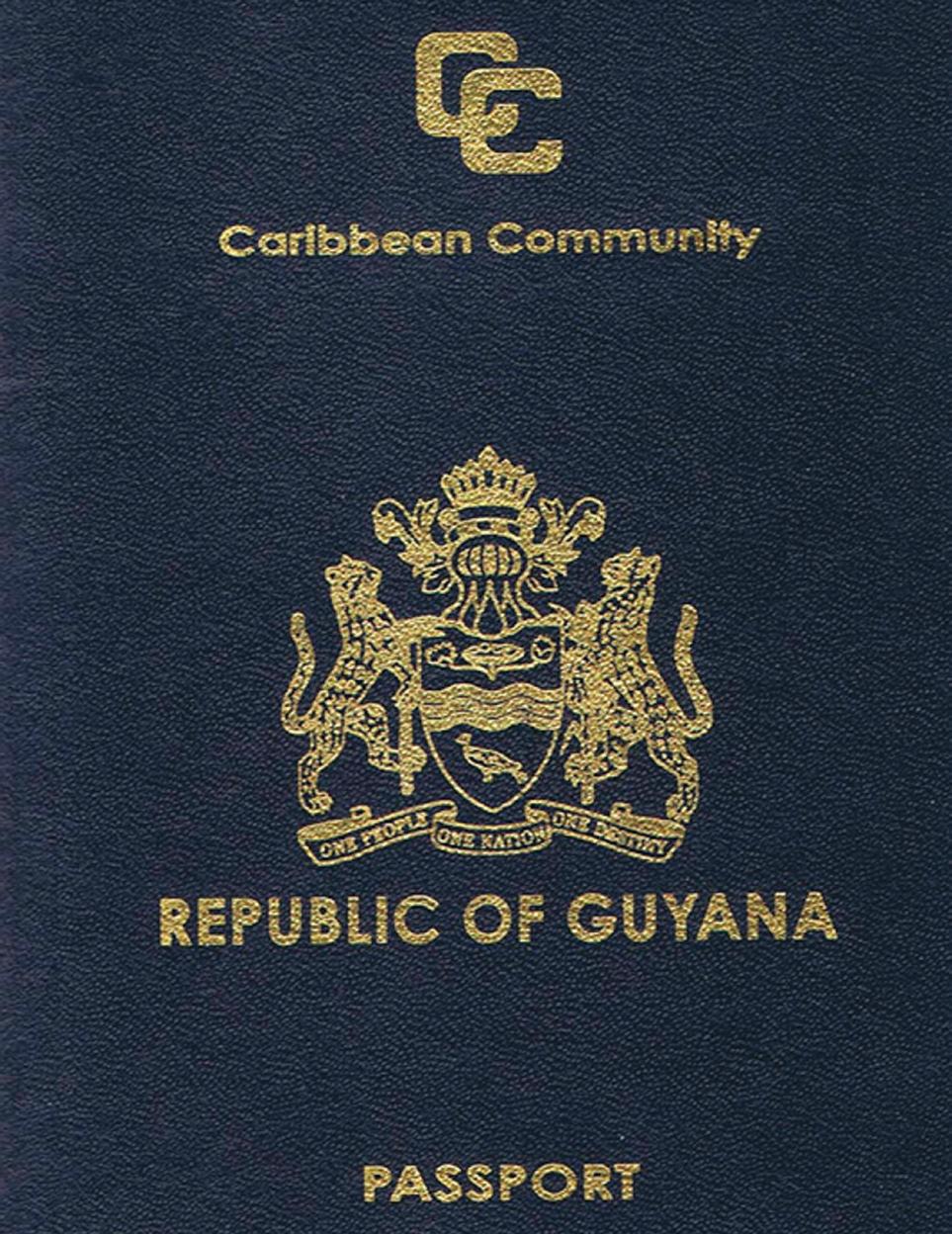
Guyana signs on to global arms trade treaty
Guyana on Monday joined a number of countries around the world in signing on to the United Nations Global Arms Trade Treaty.
The treaty calls on states to explicitly consider the risk that an arms transfer could facilitate serious acts of violence against women and children before allowing it to proceed. This is according to United Nations Children’s Fund (UNICEF) Chief of Child Protection Susan Bissell.
“This is critical given that weapons are now one of the leading causes of death of children and adolescents in many countries, including many that are not experiencing war,” she added.
Treaty
Guyana’s permanent representative to the United Nations, Ambassador, George Talbot signed on behalf of his country. The treaty will enter into force 90 days after it is ratified by the 50th signatory. It regulates all conventional arms within the following categories: battle tanks, armoured combat vehicles, large-calibre artillery systems, combat aircraft, attack helicopters, warships, missiles and missile launchers, and small arms and light weapons.
Jamaica’s debt-to-Gross Domestic Product (GDP) ratio reached 140 per cent last year.
“A sustained reduction in debt in the region over the next decade will require a combination of aggressive fiscal consolidation and increased economic growth,” said Edward Al-Hussainy, Moody’s analyst for the Caribbean, in the latest report.
However, both goals are increasingly out of reach.
Referring to an International Monetary Fund (IMF) report, AlHussainy said higher interest rates tied to previous restructuring agreements contributed to a 12.7 per cent jump in Caribbean debt from 2008 to 2011, reversing a 15 per cent decline over the previous three years. He noted that Antigua and Barbuda and St Kitts and Nevis restructured their debt in 2010 and 2012, respectively, making the past three years the highest on record for Caribbean defaults.(Guyana Times)
humanitarian law.” Arms trade
According to the UN Office for Disarmament Affairs, the treaty will not do any of the following: interfere with domestic arms commerce or the right to bear arms in member states; ban the export of any type of weapon; harm states’ legitimate right to self-defence; or undermine national arms regulation standards already in place.
The UN Special Adviser on the Prevention of Genocide Adama Dieng welcomed the inclusion in the treaty of a prohibition on the transfer of arms which would be used in the commission of genocide, crimes against humanity and certain war crimes, and called on states to act quickly to apply this prohibition, pending its entry into force.
“Genocide depends in part on the availability of arms and ammunition,” he said in a statement.
“Despite some shortcomings of this treaty, its adoption represents an important step forward in the struggle to pre-
vent genocide and provides a new legal tool to protect those at risk of their lives, and groups threatened with destruction.”
Historic opportunity
Meanwhile, UN Secretary General Ban Ki-moon stressed that countries have a historic opportunity to eliminate excessive and poorly-regulated weapons transfers through the United Nations Arms Trade Treaty (ATT), which opened for signature on Monday at the world body’s headquarters in New York.
“With the ATT, the world has decided to finally put an end to the ‘free-for-all’ nature of international weapons transfers,” Ban said at a special event marking the treaty’s opening for signature, at which he aslo appealed to major arms-trading coun-
tries in particular to be “first movers” and bring their national legislation in line with the requirements of the treaty, which will come into force 90 days after it has been ratified by 50 nations.
Although the ATT will not control the domestic weapons use, once ratified, it will require states to establish national regulations to control the transfer of conventional arms and regulate arms brokers, among other objectives.
“The treaty will provide an effective deterrent against excessive and destabilising arms flows, particularly in conflict-prone regions,” Ban said. “It will make it harder for weapons to be diverted into the illicit market, to reach warlords, pirates, terrorists and criminals, or to be used to commit grave human rights abuses or violations of international
The ATT is the first international treaty regulating the global arms trade. It was overwhelmingly approved two months ago in the UN General Assembly by a vote of 154 to three – Democratic People’s Republic of Korea (DPRK), Iran and Syria – with 23 abstentions. The vote was the culmination of a decades-long push to halt illegal shipments of weapons such as missiles, combat aircraft and attack helicopters.
Ban underlined that the ATT brings hope “to millions of women, men and children who live in deprivation and fear because of poorly controlled international arms trade and the proliferation of deadly weapons,” and added that it will also enhance the enforcement of arms embargoes imposed by the Security Council and help promote social and economic development. During the special event Monday morning, UN High Representative for Disarmament Affairs Angela Kane said the day opens “a new chapter in which states will sign up to an international contract bringing responsibility and transparency to the global arms trade”. While the treaty is “not perfect”, she said it is certainly “robust”. (Guyana Times)
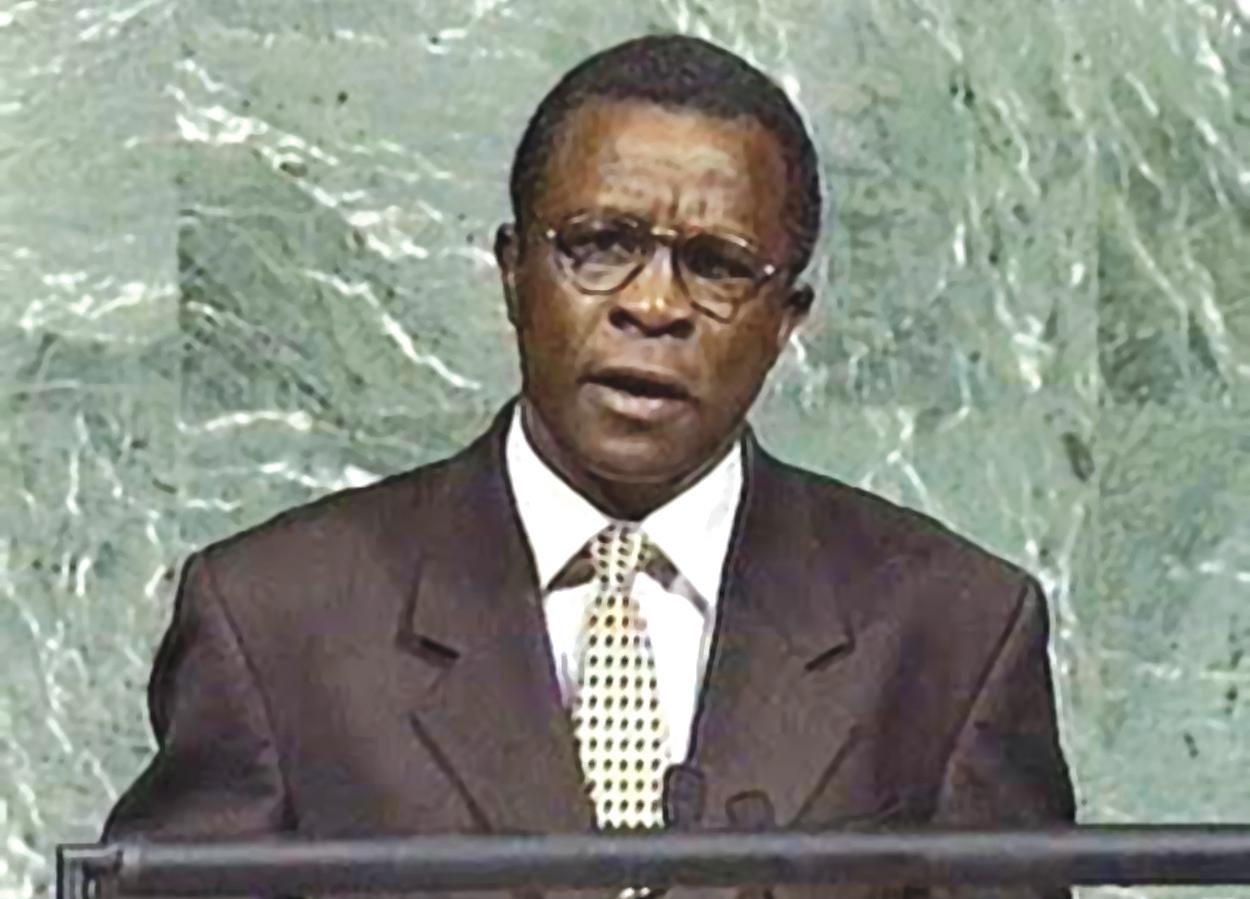
guyana’s Permanent representative to the united nations, ambassador, george talbot
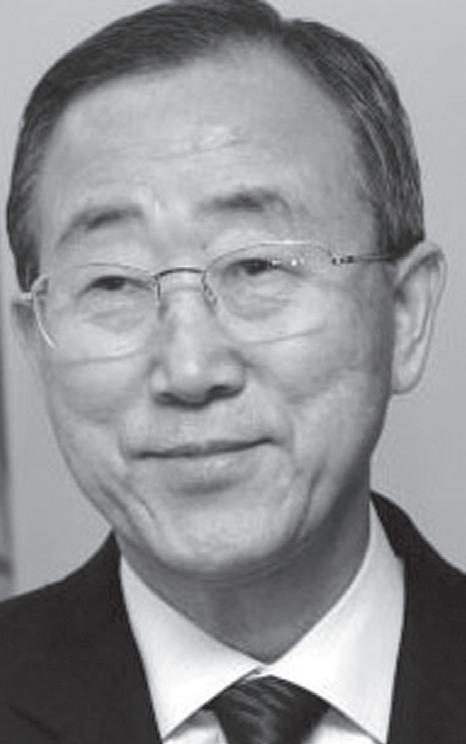
un secretary general ban ki-moon
Guyana gov’t working to create awareness of new minimum wage
By Samuel Sukhnandan
The Labour Ministry has been engaging businesses as regards the implementation of the national minimum wage, which was announced by government recently. Labour Minister Dr Nanda Gopaul told Guyanese media that officials of his ministry have met or are in the process of meeting with businesses to alert them of this change, which they will have to adhere to, commencing on July 1 this year. The minister said that public advertisements will be placed in the daily newspapers to this effect.
This initiative is in keeping with the International Labour Convention 138, as it relates to minimum wage, which Guyana has now ratified. This clause calls for the abolition of child labour, the minimum age of employment to be above 15, a progressive increase in the age of employment and ensuring that the age of employment is no less than 18 for any type of work which can jeopardise, health or morals of the persons employed.
Earning more Sales attendants working for various city
stores have been complaining about the need for an increase in the minimum wage, and said they are waiting to see this put into effect. Several of them contacted this newspaper to say that their employers are not aware of the changes that are to be made to their wages and salaries.
To this end, a 19-year old female, who wishes to remain anonymous and who works for a Chinese store located on Robb Street, said she has approached her employer about the increase, but he does not seem familiar with the change.
The woman currently works for Gy$7000 weekly. This she said can hardly provide her with
a comfortable life, but, despite the odds, she has been able to live on this. The store clerk said the increase in wages, which she looks forward to in great anticipation, will allow her to do a lot more for herself and family.
Many persons who spoke with the Guyana Times news publication revealed that they would be looking forward to this increase, especially those who work in small stores in various capacities including as sales clerk, porters and billing clerks.
Government, through its chief spokesman, Dr Roger Luncheon, announced that the new national minimum wage of Gy$35,000 monthly
will take effect from July 1.
Government in January had established a ministerial team to work to fine-tune the necessary procedures that would facilitate the establishment of a national minimum wage. This effort was led by Minister Gopaul.
This initiative is strongly supported at the level of the tripartite committee which consists of government officials, representatives from the various labour organisations and the private sector. The new wages are as follows: monthly wages – Gy$35,000; weekly –Gy$8000; and hourly –Gy$200.
In 1977, the public service minimum wage was promulgated. Workers who are not covered under this new structure include those who work on a parttime basis. Other statutes such as the annual increases and orders that deal with categories of unskilled and semiskilled workers, issued by the Labour Ministry, will apply to them. The new minimum wage will be one that is truly national – cutting across all sectors of the economy: public, private and corporate. (Guyana Times)
Barbados to form revenue authority
the government of barbados has revealed that it will this year form a revenue authority to deal with under-invoicing at the country’s port of entry
Barbados will establish a revenue authority this year because of a number of issues including inconsistencies in revenue collection, particularly at the Customs.
Finance and Economic Affairs
Minister Chris Sinckler recalled an instance last year, when Barbados was asked to explain to the World Customs Organisations, the discrepancies in revenue collected for goods imported from Japan.
“I started to think how, if this type of situation is occurring on a regular basis, the amount of revenue that government is losing in the port because of under-invoicing and, with the coming of the Barbados Revenue Authority, things down there will change and change significantly. So brace yourselves for the coming storm,” he warned.
Sinckler promised that the Freundel Stuart government would work assiduously with the private sector and other stakeholders in an effort to turn around the economy.
“… last year 2012, Japan reported exporting in value US$68 million in reconditioned or used vehicles to Barbados. However, when Barbados put up its figures, based on the submissions of the persons who imported, the reported value was BDS$30 million (One Barbados dollar = US$0.50 cents)… It meant, therefore, that Barbados was basically saying that there was under- invoicing to the extent of almost BDS$30 million. That is a startling figure. Of course you can understand why the World Customs Organisation would want to ask Barbados why there was such a big variance between what Japan was reporting.” Sinckler also recalled another occasion when a vehicle was imported and had a reported value of US$9,000. But he said that the real value sheet, which was left on the dashboard, was actually US$60,000 for the used car.
(CMC)
New ‘Insurance Bill’ in TT will see fraudsters facing heavy fine, jail time
Directors of insurance companies
– as well as auditors, agents and brokers – all stand to face jail-time as well as million-dollar fines if they violate new insurance industry rules which are to be debated in TT Parliament this month.
According to the provisions of the long-awaited Insurance Bill, which was tabled in Parliament last week and comes up for debate later this month, directors will be liable to ten years jail and a TT$10 million fine if they commit fraud on policyholders.
Clause 272 of the bill proposes to prohibit, “the perpetration of a fraud on policyholders”. The penalty for this offence would be a fine of TT$10 million and imprisonment for ten years in the case of a director or officer of an entity or any other individual; and a fine of TT$20 million in the case of an entity.
A director or insurance company that re-
fuses to comply with instructions issued by the regulator, the Central Bank’s Inspector of Financial Institutions, will face fines as high as TT$5 million. No director will be permitted self-dealing at the board level. Also, anyone who commits an offence by violating any of the new rules outlined in the bill faces sanction.
Clause 271 provides a penalty of a fine not exceeding TT$600,000 and imprisonment of two years for offences committed under the bill, to which no other penalty is expressly provided.
However, where it is proved that the person charged intended to deceive or defraud, “the penalty attached shall be a fine ten times the amount stipulated for that offence and to imprisonment for twenty years,” a limitation period of ten years after a charge will apply.
If an insurance company’s safety buffer to protect policyholders –called its Statutory Fund – is in deficit, the High Court can order a director “to make good on the sum of which the statutory fund is in deficit, which occurred because
of such contravention”. Not only will company officials be liable, but so too will auditors and intermediaries such as insurance salespersons and brokers.
Auditors would have to – in law – report any irregularities they spot in the course of an audit to the regulators and the company.
Clause 102 provides “for the duty of an auditor of an insurer or a financial holding company to report... irregular transactions or conditions”.
Failure of the auditor to do this will result
in imprisonment for five years and a fine of TT$5 million. Unscrupulous agents, too, will be covered by the law.
Clause 158 proposes to make it an offence for an agent, broker, brokerage or sales representative to procure the payment of premiums by “fraudulent representation”. The penalty for the offence would be a fine of TT$150,000 and imprisonment for ten years.
The new legislation aims to tackle the problem – seen in the Clico case – of an insurance company escaping regulation by being enmeshed within a non-insurance holding company structure. Under the proposed law, even holding companies will be subject to restrictions. The Central Bank will have power to restructure these insurance conglomerates, separating financial and non-financial activities. Holding companies would have to get permits to be holding companies. Share changes
would also have to be reported and where companies propose to merge, becoming more than 40 percent of overall market share, the minister will have to approve. Credit exposures on connected party will also be restricted.
Insurance companies must have capital of at least TT$15 million. Foreign insurance companies operating in Trinidad and Tobago — or foreign versions of local companies — will also be regulated. They will, in addition to keeping a statutory fund, also have to place additional assets in trust.
All insurance companies will have to establish a Catastrophe Reserve Fund, “in respect of catastrophe risks”. The Inspector would have explicit powers to request explanations from company officials and to seek injunctions at court and will have expanded powers in relation to underwriters. (TT Newsday)
labour minister dr nanda gopaul
the new legislation aims to tackle the problem – seen in the clico case – of an insurance company escaping regulation by being enmeshed within a non-insurance holding company structure
Guyana could tap into US$3B Chinese funding
Guyana will soon be looking at how it will tap into a US$ 3 billion total funding announced by the Chinese government, during a visit of that country’s President Xi Jinping to Port-of-Spain, Trinidad. This was announced by President Donald Ramotar, shortly after Caribbean Community (Caricom) heads met with the Chinese head of state at the Hilton Hotel, for a luncheon.
“The Chinese government has committed to give the region much more assistance: US$1.5 billion to help with some infrastructural work and US$1.5 billion in concessionary loans for the region, so I think China has demonstrated once again, its friendship to our region, and to help us to try to improve the
quality of life for the peoples of our countries,” President Ramotar said in an invited comment.
Guyana will be benefiting from this, and according to President Ramotar, efforts will be made shortly to identify how Guyana will tap into this facility.
“That has just been announced, so we will have to work out what are the critical areas we will want to work on,” President Ramotar said.
Two years ago, the Chinese government had pledged US$1 billion in preferential loans to support the local economic development of the Caribbean region when China’s Vice Premier Wang Qishan met Caricom leaders in Trinidad and Tobago at a business conference of the third China-
TT EMAIL PROBE
Caribbean Economic and Trade Cooperation Forum.
Priority areas had been in the fields of finance and investment, capacity building, environmental protection, new energy, culture, education, health, trade, tourism as well as agriculture and fishery. Wang
Integrity Commission hands over email to cops
The Integrity Commission on Monday handed over to the police, an email document which former President George Maxwell Richards sent to the commission for investigation after first receiving the correspondence from Opposition Leader Dr Keith Rowley, several months ago.
Police investigators met with Martin Farrell, registrar of the Integrity Commission, at the organisation’s offices in Port-of-Spain and requested the 31-page email document which the commission received from the former president.
The special team of investigators, led by Superintendent Baldeo Nanan, spent close to an hour at the Integrity Commission’s offices in Port-of-Spain where they interviewed Farrell.
TT Newsday understands Farrell indicated to the officers that no investigation had been carried out by the commission with respect to allegations in the email document.
The police are seeking to authenticate the email document which refers to an alleged conspiracy among Prime Minister Kamla Persad-Bissessar, Attorney General Anand Ramlogan, Local
opposition leader dr keith rowley (TT Newsday file photo)
Government and Works Minister Dr Suruj Rambachan and national security adviser Gary Griffith to pervert the course of justice and commit murder. Rowley laid the email document in the House of Representatives during a no-confidence motion on May 20, disclosing to members that he had passed the document to former President George Maxwell Richards who handed it over to the Integrity Commission before his term ended in March.
Police sources revealed the decision to obtain the email document from the com-
mission was made following a meeting with Deputy Director of Public Prosecutions Joan Honore Paul, who was delegated by Director of Public Prosecutions Roger Gaspard to advise the police on the probe.
A source said on Monday, “the police are ensuring that all documents are obtained and that the probe is being carried out in a thorough manner before IT experts from the United States are flown in to carry out the technical aspect of the investigations. Hence, the reason why the decision to obtain the original email correspondence posted at the Integrity Commission.”
It has been reported that the investigators will meet with the prime minister, who has publicly said she is prepared to hand over her cellphones and computers, at a date to be determined. Persad-Bissessar referred the email matter to the police after Rowley’s disclosure to the Lower House.
The attorney general and Rambachan have already indicated their willingness to hand over any equipment in their possession to assist the police in their probe as well. (TT Newsday)
had said the Chinese government had intended to deepen China-Caribbean cooperation.
Focus was also on the training for no less than 2500 Caribbean nationals and 30 at the postgraduate level to study in China and an early warning monitoring network for earthquakes
and tsunamis.
During that forum, Guyana and China inked an RBM 30 million grant agreement on September 12 that would see funding for a number of priority projects in Guyana.
Sunday’s meeting between regional leaders and the Chinese president was attend-
ed by president of Trinidad and Tobago Anthony Carmona, and Suriname’s Desi Bouterse, and the prime ministers of Barbados, Trinidad and Tobago, Jamaica, Dominica, Grenada, and other representatives of the Caribbean region. (Guyana Times)
Change won’t come overnight for Guyana’s Police Force - says strategic management team
Head of the Strategic Management Department, the body set up to implement sweeping reforms within the Guyana Police Force, Patrick Mentore said changing an ingrained organisational culture that has been in place for decades will not happen overnight.
However, Mentore said he and his team stands ready and committed to be the drivers of change the force needs. In an effort at instituting sweeping reforms in the Guyana Police Force (GPF), the Home Affairs Ministry has employed the high-level team of 10 civilian professionals that make up the Strategic Management Department. This team of civilian professionals will work alongside members of the GPF in addressing the key priorities laid out in the force’s strategic plan. The civilian professionals come from a variety of academic disciplines, and were carefully selected by an esteemed panel of individuals from within the private and public sectors. They are Mentore; Rosanne Purnwasie – team leader; Mona Bynoe – strategic planning officer; Kenneth Bentinck – project coordinator; Hermanetta Andrews – monitoring
and evaluation coordinator; Enid Thom-Alleyne – risk management officer; Richard Francois –change communication officer; Trovana Azeez – change facilitation officer; Shameza David –research officer, and Ian James – analyst.
Optimise GPF’s performance
The Strategic Management Department, headed by Mentore, is expected to help optimise the collective performance of the GPF, guiding it towards significant organisational renewal and change.
Mentore, in expressing his confidence in the team’s ability to achieve all performance targets set out in the strategic plan said: “The Guyana Police Force is positioning itself to become a modern police institution in Guyana. With its strategic plan in place and the establishment of this new Strategic Management Department, along with the resolute commitment of the senior management of the force, I am very confident that together we can transform the force into a modern police entity. This strategic management team is especially convinced that all strategic objectives and goals will be achieved with efficiency and effectiveness.”
Mentore, a strategic management professional with more than four decades of experience in the areas of project and public management, strategic planning and law enforcement, said he is a strategic thinker with a keen sense of imaginative leadership.
He was recently the project coordinator of Line Ministries HIV & AIDS Prevention and Control Health Sector Development Unit of the Health Ministry.
Mentore has trained extensively in a number of strategic management areas including: improving the design, delivery, and evaluation of capacity building programmes, and monitoring and evaluation of leadership development programmes, and management and organisational sustainability.
He served 15 years as a police officer, leaving as an assistant superintendent. Mentore brings a vast amount of institutional knowledge and experience to the Strategic Management Department and is committed to seeing the department achieve all of its change objectives. He holds a bachelor’s of science degree in political science and a post graduate diploma in international studies. (Guyana Times)
china’s President Xi Jinping with caricom heads of state. among them is President donald ramotar
Guyana, China recommit to improving bilateral relations
The bilateral relations between Guyana and China, which began 40 years ago, were again highlighted, as President Donald Ramotar and a delegation, met with Chinese President Xi Jingping at the Hilton Hotel in Port-of-Spain, Trinidad on Sunday. The president was accompanied by Finance Minister Dr Ashni Singh and Foreign Affairs Minister Carolyn RodriguesBirkett.
Speaking through an interpreter, the Chinese
leader recognised the importance of diplomatic relations with Guyana, pointing to the four decades of bilateral ties.
He also recalled Guyana was the first English speaking Caribbean country to establish diplomatic relations with China, and a strong supporter of the “One China Policy”.
President Ramotar in an invited comment after the meeting said the talks were general, and both sides were satisfied with the relations; however, they have commit-
ted to further strengthen those ties.
“We were very satisfied with the level of our cooperation, but we both agreed that we will want to improve on what we have, to make them even stronger in our relationship going forward. We also spoke about the possibilities of Chinese assistance in helping us with other important infrastructure, but as you will appreciate in the short space of time (of the meeting), no details could be worked out, but in principle, I think we agree that we need to work to build on these relationships, and that we will be ready to work together… and to also encourage Chinese companies to invest into other sectors in Guyana, that we are ready to have more Chinese companies investing in our country,” the president explained.
According to President Ramotar, discussions were also held on how the two sides can work together in other areas to strengthen
their ties. He however, did not divulge the details of these discussions, but only stated that some discussions were had on how the Chinese government could assist Guyana in infrastructure, and the transport sector.
Guyana and China have enjoyed frequent high-level exchanges at the political, diplomatic, economic and cultural levels. The relations have benefitted Guyana socially and economically with a number of key projects, like the One Laptop Per Family (OLPF), the Amaila Falls Hydro Project, the expansion of the Cheddi Jagan International Airport and the construction of the world-class Marriott Hotel.
China has also supported Guyana in the health and security fields with roving medical missions and the donation of fire-fighting equipment from the Chinese government, the Government Information Agency (GINA) said.(Guyana Times)
Antigua: Efforts underway to eradicate gender bias in police force
Police commissioner Vere Browne said the force is making strides in efforts to stamp out gender bias.
He told Antiguan media Sunday that in the near future, several deserving female police officers would be elevated within the male-dominated force – all under the system put in place last year to review the promotion process.
“In a very short time, we will solidify the list and a number of females would be elevated from ranks such as corporal and inspector,” Commissioner Browne said.
“We set up the system last year to review the human resource inventory containing information on their professional training, academic pedigree, work ethic and so on, and based on that, we are going to give to them what is due.”
He noted that under the system, which has been “working well”, one female officer has already been moved up to act in the position of assistant superintendent, a rank above her appointed position as inspector.
Currently, there are no females appointed above the rank of inspector.
The commissioner said the bias is linked to the history of the force where female and male officers were treated differently and worked separately. In the 70s when he joined, he said there was a rule that women did not attain a rank higher than inspector.
The only female officer to break the “glass ceiling” was former police commissioner, Delano Christopher.
Last week, during the media roundtable aired on ABS television, Commissioner Browne said, “Females could’ve gotten a better deal.”
Meantime, Commissioner Browne noted, while he can make recommendations as to who should be promoted, he only has the power to effect promotions from constable to corporal.
The Police Service Commission (PSC), which comprises independent members of society, is responsible for promotions of the other ranks. (Antigua Observer)
25 more municipal cops for Jamaica’s streets
The operations of seven of the island's parish councils have been significantly boosted by the addition of 25 newly recruited municipal police officers to their staff.
The group, comprising 17 males and eight females, graduated after completing a six-week municipal police training course at the Jamaica Constabulary Force (JCF) Academy at Twickenham Park, St Catherine., Jamaica.
They have been assigned to the Trelawny, St Elizabeth, St Thomas, Portland, Westmoreland, St Mary, and St Elizabeth parish councils.
Addressing the
graduation ceremony at the Academy last Friday, permanent secretary in the Ministry of Local Government and Community Development, Robert Rainford, encouraged the graduates to be resolute and professional in executing their duties.
"You must carry out your functions impartially, reject indiscipline, renounce dishonesty, and resist temptation that will, no doubt, come your way as persons seek to deter you from your duties. Your duties are important to the success of the local authority and your parish. In performing your functions effectively, you are doing your
part to improve the governance of your community," he said.
Rainford pointed out that the officers will be required to support the activities of the local authorities to which they
are assigned, by enforcing municipal laws and regulations, maintaining public order, supporting revenue-generating efforts, and assisting in disaster management activities.
"These functions im-
pact the lives and development of the community. As such municipal police officers (in carrying out these duties) provide a community service," the permanent secretary said.
In his remarks, director of revenue enhancement and resource mobilisation in the ministry, Calvert Thomas, underscored the officers' roles in enhancing the councils' revenue collection capacity.
"They will assist each council in realising additional revenues because of the work that they are called upon to do. But let me invite councillors and administrators to recognise the fact that these
persons are not money collectors," he stated.
The training course covered some 25 topics which included: police techniques; court procedures; statement writing; local government laws and regulations; parish council operations; proper use of tools such as handcuffs and batons; and techniques of submission and arrest. It also focused on personal development, incorporating deportment, communication, public speaking, first aid, and customer service.
The graduates were each presented with certificates, in addition to the outstanding few who received special awards.
(JIS)
President donald ramotar in the company of Foreign affairs minister carolyn rodrigues-birkett and Finance minister dr ashni singh at a table discussion with china’s President Xi Jinping and his delegation
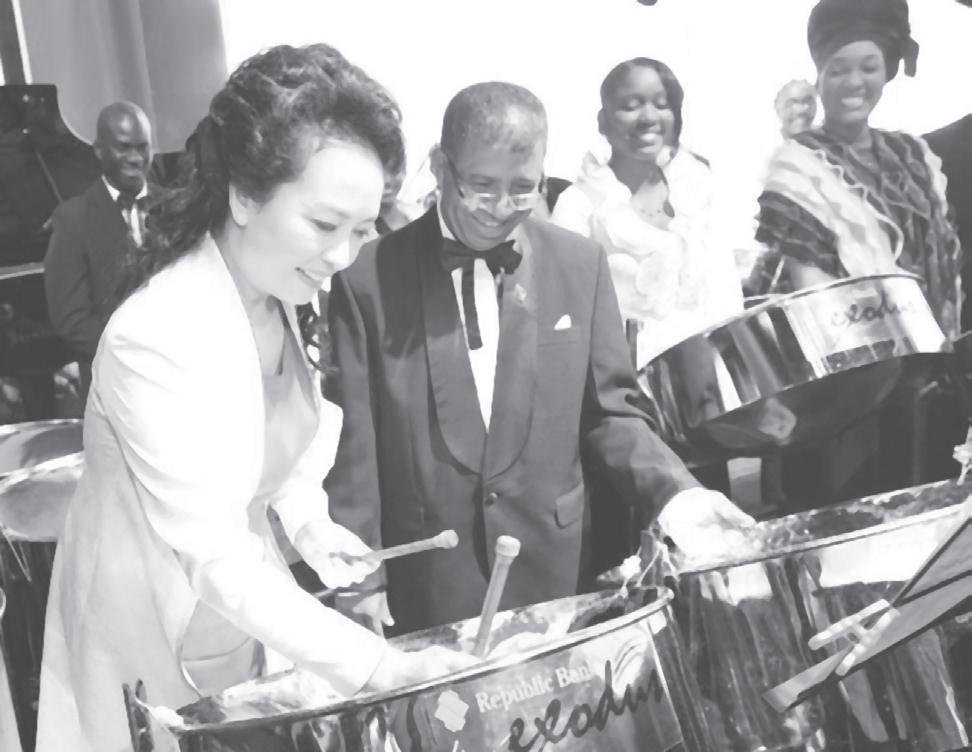
chinese First lady madame Peng liyuan takes a turn on the steel pan at the trinidad meeting
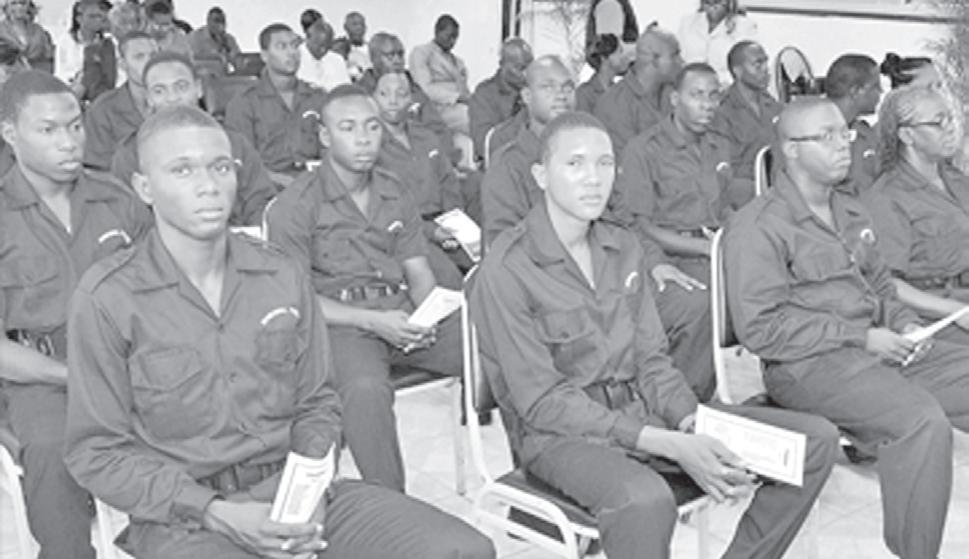
members of the latest batch of newly recruited municipal police officers who graduated from the Jamaica constabulary Force (JcF) academy, twickenham Park, st. catherine, on may 31. (JIS photo)
antigua’s Police commissioner Vere browne (www.caribarena.com)
Guyanese to benefit from reduced mortgage interest rates
House mortgage lender New Building Society (NBS) in Guyana, has announced new reduced mortgage interest rates, which will take effect from July 1.
The building society said the reduction is in recognition of the need to provide affordable housing to all Guyanese. In a release to the media, NBS said, “The directors of the New Building Society in their continuous quest to ensure that mortgages are affordable, have taken a decision to reduce mortgages’ interest rates once again.”
While the low income mortgage range will remain Gy$4 million and less with an interest rate of 4.25 per cent, the middle income mortgage range of Gy$4 million to Gy$8 million will move to Gy$4 million to Gy$10 million, and the interest rate to 6.15 per cent from 6.25 per cent.
The middle income mortgage range was increased, since it was ob-
served that persons who utilise these loans frequently request more money.
Meanwhile, mortgages of Gy$10 million and above will now attract an interest rate of 6.75 per cent, a reduction of 0.70 per cent from the old rate of 7.45
per cent.
The society stated that over the years it has asserted itself as the major player in the residential mortgage market, noting that in recent times it has been significantly increasing advances it makes to mortgagors.
“In 2011, we made advances to mortgagors totalling Gy$4.2 billion, while in 2012, we disbursed Gy$6.75 billion and based on what we achieved thus far in 2013, we are well positioned to comfortably surpass that.”
In 2012, NBS record-
Canadian bank commits to complying with IRS Caribbean request
Aleading Canadian-based bank says it is committed to complying with the United States Internal Revenue Service’s (IRS) request for information about U.S. taxpayers who may hold offshore accounts at a Caribbean bank.
Last month, the IRS filed a “John Doe” summons requesting information on an unknown number of unnamed people against U.S. taxpayers with offshore accounts at the Barbadosbased First Caribbean International Bank (FCIB), who it suspects of having used accounts with the bank as part of efforts to illegally evade U.S. tax. FCIB has branches in 18 Caribbean countries.
The Torontoheadquartered Canadian Imperial Bank of Commerce (CIBC) has a majority stake in FCIB.
“We are committed to complying with all laws and regulatory requirements,” CIBC said in a statement. “We are working with Wells Fargo, our correspondent bank, to understand the nature of the order. It is our inten -
tion to co-operate with authorities in accordance with the respective laws of all jurisdictions involved,” the statement added.
FCIB was formed in 2002 from the merger of Barclays' banking operations in the Caribbean and those of CIBC.
Barclays said it maintained a large shareholding in the resultant company of more than 40 per cent until December 2006, when it sold the stake.
The IRS’ request for information extends back to 2004, during the period of Barclays' co-ownership of FCIB, and also details some activity directly involving Barclays’ branches in the Caribbean before the formation of FCIB.
A witness statement filed in support of the summons by IRS agent Cheryl Kiger details how, during her investigation into a leak of offshore data, she came across information suggesting FCIB and Barclays accounts may have been used by tax evaders.
The summons uses the fact that the U.S. bank, Wells Fargo, maintained “correspondent” accounts to ac -
cess its offshore accounts from within the United States as part of the basis for its claim.
The summons is seeking information on customers of FCIB or its predecessors, who may have avoided US tax.
It makes no application for information on the activities of the banks themselves, and nor does it suggest the banks had any intention of supporting, or direct knowledge of, such activities by their customers.
However, the summons detail how such private banking arrangements, and the use of “correspondent” accounts to allow easy access to such funds, help facilitate such potential tax evasion.
Steven T. Miller, the IRS Acting Commissioner, said the summons “mark another milestone in international tax enforcement…Our work here shows our resolve to pursue these cases in all parts of the world, regardless of whether the person hiding money overseas chooses a bank with no offices on U.S. soil,” he said. (CMC)
ed Gy$825 million in profits, a seven per cent increase over 2011 when it made Gy$772 million. Commenting on the performance of the society, Chief Executive Officer (CEO) Ahmad Khan had said, “This remarkable achievement was as a result of our philosophy to be prudent with our investment strategy, maintain our asset quality, and adhere to our strong risk management culture.”
Khan pointed out that the partnership with the Housing Ministry enabled NBS to penetrate the housing market with affordable mortgage products.
(Guyana Times)
nbs ceo ahmad khan
New Building Society head office
More Jamaicans migrating to Canada
When former Senate President Stanley Redwood landed in Canada on May 20, he joined more than 21,000 Jamaicans who have left the island's warm shores since 2002 to legally take up residency in the North American country, where temperatures below zero are not uncommon.
Redwood had resigned from the Senate after serving just over 16 months as president — a move that has earned him much criticism and labels of ‘unpatriotism’, particularly from the Opposition Jamaica Labour Party.
But statistics from Citizenship and Immigration Canada (CIC) show that a total of 21,265 Jamaicans have traded the black, green and gold for the red-andwhite maple-leaf flag between 2002 and 2011.
This number averages about 2,126 Jamaicans annually, and represents only a fraction of the number of locals who send applications to the CIC yearly for permanent residency in Canada, which shares border with the United States and regarded year after year as one of Earth's ‘best places to live’.
“It is the new hotspot in terms of destination, but it is oversubscribed in terms of people wanting to live there,” Canadian education specialist Antonn Brown told the Jamaica Observer.
“It has one of the best economies in the world and ties with Norway for the best standard of living, which are major pulls
for Jamaicans, especially with what is happening here,” explained Brown, an attorney who since 2009 has been helping Jamaicans to gain admission to schools in Canada.
“But unlike the United States where migration revolves around family, Canada is more about education and economic migration and when you look at the type of qualifying skills, most Jamaicans would not qualify,” he added.
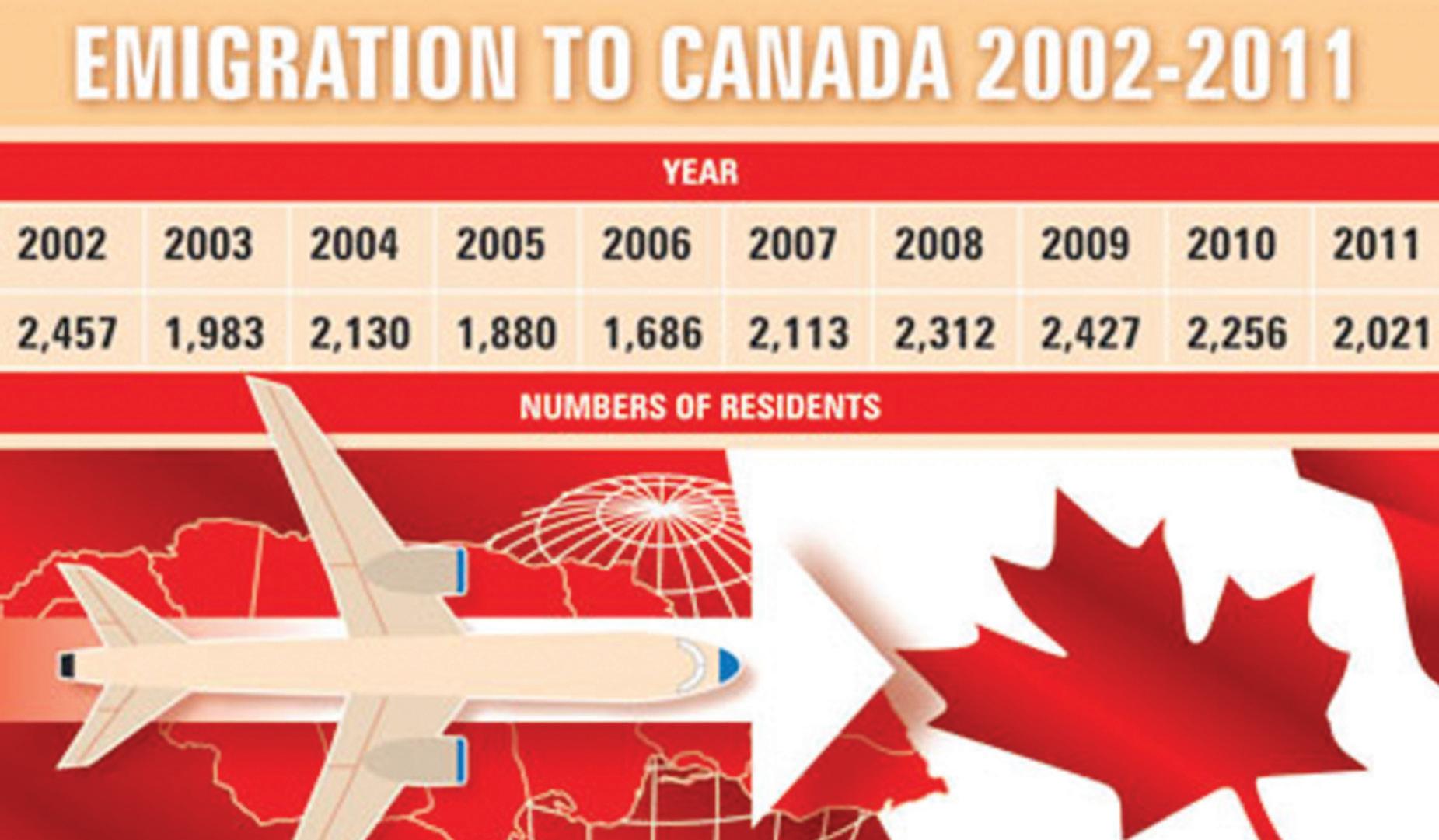
According to the CIC statistics, the largest inflow of Jamaicans to Canada over the 10-year period occurred in 2002 when 2,457 Jamaicans became permanent residents. Four hundred and seventy-four fewer Jamaicans, a total of 1,983, took up residency in Canada in 2003. The figure rose somewhat to 2,130 in 2004; dipped to 1,880 in 2005, and even further to 1,686 in 2006.
The years that followed saw the number
of Jamaican emigrants rising again to 2,113 in 2007; 2,312 in 2008; before peaking at 2,427 in 2009, then falling to 2,256 in 2010. A total of 2,021 Jamaicans became permanent residents in 2011.
On May 4, the CIC opened its year-long window for applications to what it describes as its “new and improved Federal Skilled Worker Program (FSWP)” — a points-based programme intended to attract highly-skilled migrants to Canada.
Under the programme, the CIC will issue 5,000 visas to qualified individuals with experience that falls within its 24 eligible occupations that cover mostly engineering and medical concentrations.
But even with the FSWP option, Brown said some Jamaicans were finding it easier to go the “study” route as demonstrated by the larger number of people knocking on the door to his New
Kingston office for advice.
“The fact that most Jamaicans will not be eligible for the skilled worker programme, studying is the best option and for Canada, students make the best migrants,” Brown told the Observer. “It's not that the employers there will not recognise the local (Jamaica) degrees, but they are more easier to recognise the Canadian degrees.”
He also weighed in on sentiments that moves like Redwood's are ‘unpatriotic’.
“Rationally, speaking, one has to make the best decision for his family. To me, it's not unpatriotic at all,” he said.
“Canada is just an environment in which people live well. It has an excellent economy, good education system and there are many opportunities over there. The cold temperature is the only negative,” he added. (Jamaica Observer)
ANTI-MONEY LAUNDERING BILL
Guyana’s politics not a concern for Task Force
– country will face consequences if second deadline not met
Attorney General Anil Nandlall said the Caribbean Financial Action Task Force (CFATF) has little time to bother with the petty politics being played out here, and warned that if Guyana does not make use of its second chance, the sanctions will come.
Nandlall made the remarks to Guyanese media on Friday after returning to Guyana from the meeting on May 27 in Nicaragua. Nandlall, who led Guyana’s delegation to the meeting, said the team outlined progress made outside of the legislative changes.
“This included the hiring of additional staff; the establishment of supervisory authorities, to supervise and monitor the activities of all money transfer agencies, financial institutions, credit unions, and all the other agencies which they had recommended.”
In addition, the CFATF in its own report said that 90 per cent or more of the recommendations it made are of a legislative nature. Guyana in turn submitted to the task force that the Anti-Money Laundering and Countering the Financing of Terrorism (AML/CFT) Bill captures these. CFATF agreed that the bill does capture the recommendations, about 90 per cent of them, Minister Nandlall said. It was also told that the bill has been laid in the National Assembly.
The minister revealed that he informed the CFATF of the process the bill went through in Guyana’s parliament, while revealing that he also explained “why the hearings of the select committee were not concluded before the deadline date”.
The minister said that the Guyanese team also outlined the opposition’s several requests, which were conceded to, because they involved provision of documents, etc, but the political parties also wanted public hearings and submissions to come from members of the public and interested stakeholders. Government’s commitment
“We renewed and re-
stated the government’s absolute commitment to ensure that this legislation is passed in keeping with the recommendations, but that we are, however, basically at the mercy of the opposition, because they control the National Assembly. As a result of that, they appreciated government’s effort thus far, and the progress made, and they said that they are giving us until the November meeting to get that done,” Minister Nandlall stated.
He emphasised, however, that in this regard, “it doesn’t mean that we have to wait until November. We have to get this thing completed for the November meeting, and a period of time has to be given for them to examine the legislation to see that it conforms to the recommendations.”
He explained that Dominica and Belize were both granted extensions until the June meeting – Dominica, because its legislation was passed late, and Belize, because that country had just had national elections. Dominica, the AG said, was not removed from consideration, because the CFATF said very clearly that it needed time to assess the bill to see whether Dominica has conformed.
“This point demonstrates that we have to do it within sufficient time, that we don’t lay back and wait until November, that we begin to work as early as possible and have it concluded before Parliament goes into recess,” Minister Nandlall said. (Guyana Times)
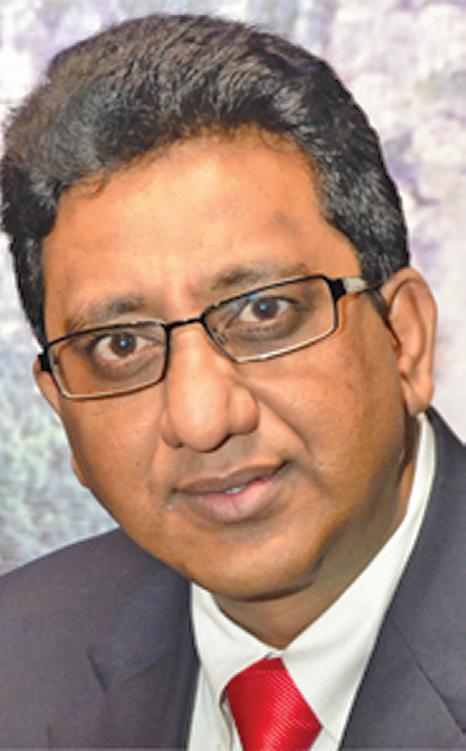
guyana’s attorney general anil nandlall
statistics show that over 21,000 Jamaicans have migrated to canada within the past decade (Jamaica Observer file photo)
EU names first ambassador to OECS
The European Union has provided more than Euro 23 million in funding projects in the subregional Organisation of Eastern Caribbean States (OECS) since March last year.
Newly appointed European Union (EU) ambassador to the OECS, Mikael Barfod, says he hopes to “maintain and strengthen” those projects, as he presented his credentials to OECS Director General, Dr Len Ishmael.
Barfod, who becomes the first EU ambassador to the nine-member grouping, spoke of the “tremendous achievements” of the sub-region in the integration process, congratulating it also on the efforts to efficiently insert the region in the global economy.
He spoke also of the unique relationship existing between the European Union and the
Grenada’s public sector workers get salary increase
Tgrenada’s Prime minister keith mitchell
he Grenada government says it has started paying public workers salary increases five years after their last hike in wages.
The Keith Mitchell government, which came to office in February, complaining of a high national debt and urging the population to help turn around a sluggish economy, said that the new salaries went into effect from the end of last month.
It gave no details as to the size of the new salary increases, but said they are consistent with agreements reached with several trade unions, including the Public Workers Union (PWU), the Grenada Union of Teachers (GUT) and the Technical and Allied Workers Union (TAWU) for the period 2009 –2012.
“The government and the unions are continu-
ing their discussions about the schedule for the payment of retroactive pay for the same period,” according to the official statement, adding the Police Welfare Association (PWA), which is the bargaining unit for police officers, will be meeting with the Government Negotiating Team (GTN) shortly, to discuss their new salaries.
The statement said that pensioners have also received increases “consistent with the convention to pay them the same increase as public servants”.
Last December, then Opposition Leader Mitchell accused the Tillman Thomas government of selling off state properties and illegally borrowing funds from the National Insurance Scheme (NIS) to meet the salaries of public servants. (CMC)
OECS, and affirmed his commitment to further enhance the relationship between the two organisations.
In her remarks, Ishmael made mention of the longstanding relationship between Europe and the Eastern Caribbean., as well as the European Union and the Organisation of Eastern Caribbean states.
“The establishment of diplomatic relations between our two organisations is a crucial step in the history of our partnership, because today, we are responding in a bold, genuine and practical way to the demands of the time, by entering deliberately into a new relationship.”
Ishmael said that it is a “relationship which will, by definition, determine the nature and thrust of a new engage-
ment, while at the same time serving as a platform for action based on a real and meaningful partnership between friends”.
Both officials agreed that the “new and deepened partnership” will serve to strengthen even further, the cooperation between their respective organisations, leading to
a positive impact on the development and wellbeing of their member states.
The OECS groups the islands of Antigua and Barbuda, Dominica, Grenada, St. Lucia, St. Vincent and the Grenadines, Montserrat, St. Kitts-Nevis, Anguilla and the British Virgin Islands. (CMC)
newly appointed european union (eu) ambassador to the oecs, mikael barfod (www.nationnews.com)
Guyanese PPR-C pipes enter Jamaican market
Global Hardware Inc (GHI) of Guyana and Patrick Commodities Limited (PCL) of Jamaica, have joined forces to introduce the ‘eZeeflow’ Polypropylene Random Copolymer (PPR-C) and High Density Polyethylene (HDPE) pipes and fittings to the Jamaican market.
GHI is a member of the Queens Atlantic Investment Inc (QAII) group of companies. Following incorporation in 2007, the company became the first manufacturer of PPR-C pipes and fittings in Guyana, with an innovative brand ‘eZeeflow’ − a line of products that was the first in Guyana, as well as the Caribbean.
The launching ceremony, followed by a practical demonstration, took place at the Spanish Court Hotel in Kingston, Jamaica on Thursday morning. Guest speaker at the event was Jamaica’s Water, Land, Environment and
Climate Change Minister Robert Pickersgill.
The main presentation for the launch of the PPR-C pipes and fittings was done by QAII’s Technical Adviser Parmanand Samaroo, while a GHI technical team gave a demonstration of the PPR-C products and piping system.
Other leading participants included representatives from the Jamaica National Water Commission, the Jamaica Bureau of
Standards, the Jamaica Institute of Professional Engineers and other private and public sector entities. Representatives from the commercial banking sector and the Customs and Excise Department in Jamaica, also attended the launching. The association between GHI and PCL is expected to provide significant benefits both in terms of opportunities for training of Jamaicans in the rev-
olutionary technology employed by GHI and providing a more cost effective, and environmentally-friendly alternative to traditional piping systems. According to PCL’s Managing Director Derven Patrick, the joint effort is an attempt to further strengthen regional integration, and the
Caricom Single Market Economy (CSME).
In the keynote address by Minister Pickersgill, he expressed his openness to newer innovative products and expressed appreciation to GHI for the details presented. He spoke about some of the challenges in the water sec-
PM Gonsalves wants 90-minute talk with Trinidad’s PM…
St. Vincent’s Prime Minister Dr Ralph Gonsalves says he has requested a 90-minute meeting with his Trinidadian counterpart, Kamla Persad Bissessar, in July to discuss the Caribbean Air Navigation and Advisory Services (CANAS) and regional airline, LIAT.
Gonsalves said when he was in Port-of-Spain last week for talks with United States Vice President Joe Biden, “I spoke to the prime minister of Trinidad and Tobago and I suggested to her that when we have the Heads of Government meeting in July, I asked her if she
could put aside about 90 minutes (so) that we can talk”.
Gonsalves said the talks will be “at a political level” because both the Organisation of Eastern Caribbean States (OECS) and shareholder governments of LIAT have mandated him to talk to Port-of-Spain about the operations of CANAS. He further said that Barbados has also authorised him to speak on their behalf “on the issue of the airspace”.
Gonsalves is the Caribbean Community’s (Caricom) lead prime minister of regional transportation and
chairman of LIAT shareholder governments.
LIAT shareholder governments have complained about the fuel subsidy that Port-ofSpain gives to Caribbean Airlines (CAL), and OECS governments have expressed concerns about the operations of CANAS.
“We have to be on the board, and we have to know what is going on, how much money you are collecting and how much money you are spending,” Gonsalves said in relation to CANAS.
The meeting, PM Gonsalves said, will address issues of accounting and transparency in
relation to fuel subsidies for LIAT, and will include technical representatives from the firm as well.
Earlier this month, the LIAT shareholder governments –Antigua and Barbuda, Barbados, Dominica and St. Vincent and the Grenadines – said that the Port-of-Spain subsidy to CAL is also a violation of the Common Air Services Agreement among Caribbean Community (Caricom) member countries, resulting in substantial losses to LIAT.
Gonsalves said for the period 2008 to 2012, LIAT expended on fuel,
tor, saying the PPR-C pipes are the perfect solution to leakage problems.
Those attending the launch were highly impressed with the quality and standards used by GHI for the manufacturing of the PPR-C products, as well as the technical and after sales support services available.
The eZeeflow PPR-C and HDPE piping system applications and attributes are suitable for plumbing solutions within the commercial, residential or industrial sectors, and are rated for very long service life – more than 50 years. PPR-C is “food grade” and “lead-free” and, therefore, a preferred and safe material, both in handling and applications. The assembly technique is simple and cost efficient, employing thermal fusion socket and butt welding techniques that make a 100 per cent leak-proof joint with absolute material integration. (Guyana Times)
to discuss fuel subsidy
US$106.1 million, while CAL paid US$43.64 million.
“In other words we have spent US $62.4 million on the fuel bill over this period, more than we would have spent if we got the subsidy similar to CAL.” Trinidad and Tobago Finance Minister Larry Howai said the subsidy to the CAL last year totalled US$40 million. (CMC)
China to fund new Arima hospital in TT
The Borough of Arima is to benefit from Trinidad and Tobago’s relations with the People’s Republic of China.
After almost four decades without a proper functioning hospital, Prime Minister Kamla Persad-Bissessar has signalled her government’s intention, with the help of the Chinese
government, to at long last provide a hospital for the people of Arima.
During a media briefing at the Diplomatic Centre, St Ann’s over the weekend, PersadBissessar said her discussions with the visiting President of the Republic of China Xi Jinping, also focused on health issues.
“Our conversations
included a number of healthcare projects including the construction of a Children’s Hospital in Couva, a hospital in Arima and China’s agreement to provide 100 healthcare professionals to the Caribbean, including Trinidad and Tobago.”
She said, both leaders understand the value of technical co-op-
eration and discussed how this country might continue to benefit from technical co-operation ventures with China.
Some of the key areas identified for technical co-operation, the prime minister said were, infrastructural development, agriculture and food security, education, sport, information and communication technol-
ogy and national security.
Xi said he hopes both countries will strengthen communication and collaboration with each other on issues such as reform of international systems and climate change.
Earlier, the Chinese President paid a courtesy call on President Anthony Carmona and
his wife Reema at the National Academy for the Performing Arts (NAPA) in Port-of-Spain. He also met with President of the Senate Timothy Hamel-Smith and Speaker of the House Wade Mark at the Parliament Building, International Waterfront Centre, Wrightson Road, Portof-Spain. (TT Express)
Patrick commodities managing director dervin Patrick addresses the gathering at the launch
Jamaica’s water, land, environment and climate change minister robert Pickersgill (left) examines piping material on display at the launch and exhibition of eZeeflow PPR-C HDPE pipes and fittings at the Spanish Court Hotel in Kingston, Jamaica on May 30. technical adviser of Qaii Parmanand samaroo (right) explains features of the product, while PCL managing director dervin Patrick (centre), observes
Bring back hassle-free travel
– Caricom transport ministers urge
In recognition of the benefits derived from the Single Domestic Space (SDS) during the International Cricket Conference Cricket World Cup in 2007, Caricom transport ministers are recommending its reintroduction.
The ministers made the recommendation at their one-day Special Meeting of the Council for Trade and Economic Development (COTED) on Transportation held in St Vincent and the Grenadines last week, the Caricom Secretariat said in a release. Recommendations from the meeting will be presented to heads of government at their upcoming 34th Regular Meeting to be held in Trinidad and Tobago from July 4 to 6, at which ‘transportation’ will receive special attention.
The ministers lamented that Caricom nationals encountered unnecessary problems as they travelled across the region and this was not only limited to scant regard paid to the Caricom
Passport, which entitles holders to an automatic six-month stay in member states. The meeting recognised that there were challenges with respect to frequent security checks and cooperation between the regional airlines, among other things, which negatively affected the travelling public and had repercussions for business and tourism as well. The ministers also agreed that much work had to be done to improve the service provided by order control officers in the region.
The meeting agreed that the Conference of Heads of Government should be asked to revisit its decision to discontinue the inexpensive armband system which facilitated hassle-free regional travel during the world cup. The success of that 2007 initiative was alluded to during the discussion, in particular its popularity with the citizens of the community.
An SDS, involving 10 Caricom member states, was established for Cricket World Cup 2007.
Among the features of the SDS were: freedom of movement for all domestic travellers and a special visa stamped at the first port of entry for travellers from outside the region to allow hassle-free movement among the participating
SDS states. Measures to support the initiative included an Advanced Passenger Information System (APIS).
Deeper collaboration
Discussions also centred on a fuel subsidy granted by Trinidad and Tobago to Caribbean
Airlines Limited (CAL) which has occasioned complaints of it being anti-competitive, in violation of the Caricom Multilateral Air Services Agreement and the Revised Treaty of Chaguaramas.
Consultations in an effort to resolve the matter amicably will be conducted between the shareholder governments of LIAT and the government of Trinidad and Tobago prior to and during the Conference of Heads of Government, which will be held in Trinidad and Tobago in July.
With respect to air transport, the ministers underscored the need for deeper collaboration among the regional airlines so that their operations could be better streamlined. Key among the recommendations were for shareholders in the government-owned carriers in Caricom, beginning with CAL, LIAT and Surinam Airways, to meet in the near future, to discuss how they may rationalise their operations, routes, flight
schedules, and luggage transfers among other things in the best interests of the consumer.
Related areas of concern
The meeting established a team, chaired by St Vincent and the Grenadines, to review elements of a draft policy or air and maritime transport, and asked member states to submit their comments by the end of June.
Ministers also held discussions on transportation for agriculture produce and identified the need for coordination between farmers/producers and shippers in order to curb high costs. The issue had been referred to transportation ministers by ministers of agriculture and is to be examined by a team from the Caribbean Shipping Association, airlines and agriculture producers/exporters. The ministers also agreed that they would keep under review, ongoing initiatives such as the proposal for a fast ferry service in the Southern Caribbean.
(Guyana Times)
Caribbean serious about fisheries
The Caribbean region is committed to safeguarding its fisheries and marine resources to ensure sustainability.
This commitment was demonstrated in a tangible way on Friday at the Accra Beach Hotel and Spa, when the Seventh Meeting of the Ministerial Council of the Caribbean Regional Fisheries Mechanism was chaired and the Council gave its support to and endorsed the Caribbean Large Marine Ecosystem Project Strategic Action Programme, by becoming a signatory.
According to Regional Project Coordinator with the Caribbean Large Marine Ecosystem Project, Patrick Debels, the signing is a milestone. Labelling the endorsement ceremo-
minister of agriculture, marine resources and local government, the Hon. V. alfred gray of the bahamas (centre), observed by the executive director of the crFm secretariat, milton Haughton (left) and the newly appointed chairman, barbados’ minister of agriculture, Food, Fisheries and water resource management, the Hon. dr. david estwick. (Barbados Advocate file photo)
ny one of great significance, Debels said, “It [The Caribbean Large Marine Ecosystem Project Strategic Action Programme] is a very broad action programme which strives to bring to-
gether all the countries in the region. At this moment, we have obtained already 21 ministerial signatures, so 21 ministers have already signed this Strategic Action Programme.
“Today, which is a really historical moment, in that in addition to these individual country signatures, we now also have the endorsement, the formal endorsement by the Caribbean
Regional Fisheries Ministerial Council. So the signal the region is giving politically about the importance of the fisheries issues and the protection of fisheries resources or the sustainability, is very big. It has never been as big.”
Considering that the action programme is funded by various agencies internationally and regionally, Debels said that the signing by the Council further solidifies its commitment in the eyes of investors and augurs well for the future.
At present, he explained, “The Caribbean Large Marine Ecosystem Project Strategic Action Programme is a project funded by the Global Environment Facility, which is the biggest donor of environmental projects in the world…The project was a four-year
project which took place in the region. It was supported by a series of UN agencies. The lead UN agency was the United Nations Development Programme, but then at the sub-regional level, we had other leaders involved in the execution of the project, such as the Caribbean Regional Fisheries Mechanism.”
With the signing, Debels posited, “This is also important towards the donors, so that the donors see that there is a very strong regional commitment, given the importance of fisheries resources, to invest additional resources to bring additional resources to the money, so that we can really upscale the efforts to ensure the socioeconomic benefits from the fisheries in the region in the next ten years.” (Barbados Advocate)
Trinidadian to head UN peacekeeping mission in Haiti
United Nations Secretary-General Ban Ki-moon has appointed Trinidadian career diplomat Sandra Honoré of as the new head of the UN peacekeeping mission in Haiti (MINUSTAH).
On Friday, the UN
announced that Honoré, who will take up her functions in mid-July, will succeed Mariano Fernández Amunátegui of Chile as the Secretary-General’s Special Representative and head of MINUSTAH.
Ban thanked Fernández Amunátegui,
who completed his assignment on January 31, 2013, for “his determination and leadership of MINUSTAH during a critical period for Haiti with the transition to a new government and a challenging security situation”.
He also expressed
his gratitude to Deputy Special Representative Nigel Fisher for providing excellent leadership in the interim for the Mission, which was set up in June 2004.
The UN said Honoré brings with her, extensive experience working
in multilateral settings, including as chief of staff, Office of the Assistant Secretary-General of the Organisation of American States (OAS) from 2000 to 2005.
She also had an assignment as special assistant to the Chief of the OAS
Electoral Observation Mission to Haiti from 1995 to 1996.
Honoré has been a diplomat since 1979, serving her government in many capacities in, among other places, Costa Rica, Brazil and the United States. (CMC)
the caricom Passport entitles holders to an automatic six-month stay in member states
Fourth ‘Building Expo’ launched in Guyana
By Leana Bradshaw
The Housing and Water Ministry’s fourth International Building Expo was launched on Friday evening, with the full backing of the private sector and other citizens.
The opening event, which was attended by stakeholders of the business community and government, got underway at the Princess International Hotel, Providence, Guyana. Giving the feature address at the launching of Building Expo 2013, Housing Minister Irfaan Ali said this year’s event is not just another exposition of what Guyana has to offer in the construction sector, but will highlight the ministry’s aim for future development, through a new concept.
The exhibition, to be held from July 5 to 7, will utilise a new concept, with the launching of a new housing development area dubbed “Silica City” located on the Soesdyke-Linden Highway. Ali said “Silica City” is the first real ini-
tiative to take industrial, commercial and residential housing to the highway on “higher grounds”.
The new housing scheme is expected to see the development of some 500 acres of land along the highway initially.
“So we’re going to launch this initiative called ‘Silica City’ and we want to encourage all potential investors, bankers, buyers, sellers to register with ‘Silica City’.”
To motivate persons, the ministry will be offering a special package for those who already ap-
plied for house lots and received acknowledgement, to have their applications processed immediately for allocation at the new housing area.
The initiative, he said, answers questions as to “where next” will the ministry seek to develop new housing areas.
The housing minister stated that this year’s expo is being hosted as a result of strong private sector support.
Construction industry is a major sector
Private Sector Commission Chairman
Ronald Webster said that “the construction industry is critical for any economy”.
Construction, he said, has a large impact on the country’s economic activity, creating employment and offering investments.
CHPA Chief Executive Officer Myrna Pitt said: “In addition to being a medium for which linkages are established and opportunities for private sector are expanded, the expo will celebrate the successful partnership the CHPA has with the private sector and stakeholders in the construction, manufacturing, commercial, and services sectors.”
International Building Expo 2013, slated for the Guyana National Stadium, will be held under the theme “Consolidating Partnerships for Sustainable Development”. The event will see participation from local, regional, and international exhibitors and will create opportunities for networking among business stakeholders and consumers alike. (Guyana Times)
Barbados calls for assistance for countries to deal with recession
The Third InterAmerican Development Bank (IDB) Annual Retreat of Caribbean Civil Society Consultative Groups (ConSoC) concluded last Friday with Barbados urging the Washingtonbased financial institution to create new, interesting, innovative and adaptable strategies to countries deal with the ongoing global economic recession.
“We believe that the IDB, through its extensive research and human resource capacity, should be able and will be able to meet the challenge of working with our countries to safely navigate the choppy waters of this international recession,” said Finance and Economic Affairs Minister Christopher Sinckler.
“It means, therefore, that what we require of the IDB is that it truly continues to live up to its mantra as a development bank…We see the IDB as a development institution, understanding development in ways
that other international financial institutions do not and, therefore, the responsibility of all of the members and the management of the Bank is to ensure that that process continues into the future,” Sinckler said.
He told the meeting that the Washingtonbased financial institution should never regard itself as a second rate version of the International Monetary Fund (IMF).
Sinckler said that over the last two decades, many Caribbean countries had suffered successive hits by international economic actions, most of which they had very little control over.
“For Barbados it has been clear as well, we have been cut off from concessional financing from the World Bank and many other institutions because of our level of economic development. We are, therefore, forced to go on the international capital markets to borrow money or to borrow money in other cases at very high interest rates. Equally, we have had to
suffer the problem of liberalising our markets in international global trading agreements.
“We no longer have preferential access for our products into the European Union with the United States and we are currently negotiating liberalisation of market access into Canada. It means, therefore, that not only do we have to access resources at higher prices and really at world competitive prices on the private capital markets, we also have little leeway into markets on a preferential basis, because our preferential arrangements have been removed.
“But added to that, we have to have the constant battle of fighting to protect our international financial and business sub-sectors against repeated claims of being tax havens, which is not true, of course. We are a low tax regime but we do tax and we do regulate,” Sinckler said.
ConSoC is a forum for exchanging information, strengthening dialogue
and facilitating ongoing consultations between the IDB and the Civil Society Organisations (CSOs) that are pertinent to the Bank’s operations in its 26 member countries.
Through ConSoC, the IDB seeks to obtain comments and suggestions from Caribbean CSOs regarding the IDB’s initiatives, in order to improve its effectiveness in the social and economic development of borrowing countries. (CMC)
Give concessions to private sector for investment in regional fast ferry service -
St Vincent PM tells COTED
Prime Minister Dr Ralph Gonsalves says implementing a fast ferry service in the southern Caribbean is a risk the private sector must take, with government assistance.
“This is not as easy as some people think. It is a lot of money which is involved. In fact, the reason why you haven’t had it, despite all sort of efforts, is because it is a difficult proposition,” Gonsalves said at the 43rd special meeting of the Council for Trade and Economic Development (COTED).
But Gonsalves, who has lead responsibility for transportation in the Caribbean Community (CARICOM), said that regional governments can help private investors by offering them various concessions.
“These are easy things for us to do. We do that in St. Vincent and the Grenadines,” he said, adding that ferries registered and operating in the country are imported tax-free, pay no tax on their earnings, and there is no value-added tax on the service.
He said that when a ferry operator imports a vessel, they are only required to pay a four per cent Customs Service charge.
“So when (businesspeople) talk about a fast ferry service… I say by all means, register the vessel in St. Vincent and you get all these concessions and we can work out with all the other countries to get these concessions. And we can
provide the port facilities,” he said, adding “and I use this platform to invite investors who want to get involved to do it”.
He, however, said that people discussing a fast ferry service often want governments to fund at least a six-month trial run. He said only Trinidad and Tobago among Caricom countries has such resources. “So, it really is going to be up to them whether they are going to fund it,” he said, adding that a six-month trial will cost about five million US dollars.
“If it is a financial proposition for the private sector, let us give them all the concessions. I don’t see why we can’t give them all the concessions and I believe governments will give them all the concessions, certainly my government will do it and I will encourage others to do the same.
“But you have to take the risk. Government might even be able to help you to source cheaper money than you would get going to a normal commercial bank… But let us get the serious people who want to be involved in the ferry business, let us get it on the road,” Gonsalves said.
Gonsalves noted the importance of regional air and maritime transportation, but also observed that it was the first meeting of COTED dealing with transportation since 2007. (CMC)
Housing and water minister irfaan ali speaking at the launch of the building expo
st. Vincent Pm dr ralph gonsalves (Jamaica Gleaner file photo)
barbados’ Finance and economic affairs minister christopher sinckler (Barbados Advocate file photo)
11th Annual Pakaraima Mountain Safari was a success
The Guyana Tourism Authority (GTA) on Friday rewarded the daring men and women who completed the 529-mile journey to the Pakaraima Mountains, between March and April.
The brave safarians and sponsors of the event were presented with a certificate of participation and special awards at a ceremony over the weekend in the GTA building at the Sophia Exhibition Centre.
In attendance were Prime Minister Samuel Hinds, acting Tourism, Industry and Commerce Minister Irfaan Ali and Rainforest Tours Managing Director and leader of the 11th Pakaraima Mountain
Safari, Frank Singh.
Prime Minister Hinds commended the safarians for impacting on the development of the North Pakaraimas, and for bridging the gap between two worlds; the coast and the hinterland.
“Let us recognise that we are accomplishing many things, we are building our country, we are developing bonds, we are developing the links, the contact between coastal and hinterland people, between people of different races, and maybe even nationality, in what we are participating in, and I think that our efforts have been very much for the best,” he said.
The annual Pakaraima Mountain
- Participants rewarded for accomplishment
Safari led to the development of trails and road links into some of the most remote areas in the Rupununi, allowing for more persons to venture into these parts.
Minister Ali told of the safari’s importance to the development of Destination Guyana. He said the safarians’ mission is integral to the development of the tourism product that the ministry is trying to create, and in fact, the safari is now a large component of the tourism product in Guyana and South America.
Minister Ali also disclosed that plans are afoot to organise the safari in a more structured way, so as to place it more in the mainstream of the country’s tourism product. In this regard, he explained that the ministry is moving feverishly towards organising a safari club in Guyana. He said this would lead to regulations being put in place for the safari, such as specific requirements for drivers involved in the journey.
“Once we are going to put it into the mainstream of our tourism product, we have to ensure that the regulations are there, to ensure that it is properly run and governed, and to ensure a mechanism is there as
an incentive so that even foreigners that are coming in to join the safari would have a smooth process in bringing their vehicles and re-exporting their vehicles or joining the safari from different points of our border,”
This will allow for the planning of activities between and among these clubs, where Guyana could be the centre, the minister said.
Among those honoured was Harripersaud Nokta, the pioneer of the
he explained.
Explore new routes He said also that development of other routes for the safari is being explored and that it is important that the safarians form themselves into an organisation as it allows for synergy and linkages among the different safarian clubs in South America and the rest of the Caribbean.
Pakaraima Mountain safari. Nokta was presented with a handmade, handicraft plaque by Prime Minister Hinds. He also received a token from the Tourism Ministry for his tremendous work as a pioneer in the safari and also in hinterland communities.
Nokta expressed his gratitude for the award, and said the token would help him remember some of his days in the Pakaraimas. He also expressed the hope that the event will continue to grow. Like the prime minister, he also advocated exploring new routes, and suggested going into the Deep South.
The route starts from Georgetown, then through Karasabai, Tiperu, Rukomoto, Morabaiko, YurongParu, Monkey Mountain, Paramakatoi, Kato, Kurukubaru, and Itabac, ending at the foot of the Pakaraima Mountain Range. In 11 years, over 600 persons have completed the safari, which was a 10-day trip this year. (Guyana Times)
IMO hosts another successful event in Toronto
By RavendRa Madholall
President of the International Muslims Organisation (IMO) in Canada, Guyanese Omar Farouk lauded the efforts of his organisation for pulling off another successful event on Sunday in Toronto.
He stated their efforts for their new project are going smoothly and with the huge turnout has given him more hopes that the deadline for a general renovation of the Mosque, Gymnasium and martyr should be completed.
He further thanked the support of Guyana’s Honorary Consul General to Toronto Sattie Sawh participating in the day’s activity, as well as several other dignitaries within the district of Etobicoke in Toronto.
Farouk, who has been the president and chief executive officer for IMO since its inception in 1998, believes his group is working tirelessly to
ensure the Muslim community will benefit significantly when the project is completed next year.
“I [am] delighted to see the turnout today not only by the special invitees but the people from all ages and from differ-
ent ethnic backgrounds to assist in raising funds for the continued development of our organisation,” Farouk related.
He continued: “We have got a great group of people in our organisation and they are working hard to ensure we
keep up the standard set by the IMO in Canada for the past decade; I must take this opportunity to express my gratitude to all the persons taking part in various ways to make today’s proceedings a success.”
Sawh was also ex-
cited with the way they (IMO) pulled off yet another eventful day for the community and stated that they would work hand-in-hand to make the organisation soar to new heights.
IMO has collaborated with the Caribbean
Muslim Community to sustain a great legacy over the years. Farouk, who holds a Certificate in Conflict Resolution from York University, mentioned he will continue to support any Muslim organisation in Canada and around the world in whatever way possible.
He revealed that former President of the Republic Guyana, Dr. Bharrat Jagdeo visits the office whenever he is in Toronto, while current President Donald Ramotar was there just last year on his inaugural visit to Canada as Guyana’s leader.
Meanwhile, the day was filled with outdoor activities for children while representatives from the Toronto Fire Department and Police Force were also on location and participated in the event.
According to the IMO boss, more fund-raising activities are scheduled for later this year, while this event will continue to be an annual affair.
acting tourism, industry and commerce minister irfaan ali makes brief remarks at special ceremony for the participants of the 11th Pakaraima mountain safari at the gta building, sophia exhibition centre
Prime minister samuel Hinds presents to Harripersaud nokta a token from the tourism ministry for his work in pioneering the Pakaraima mountain safari and for his work in the Hinterland communities
several distinguished representatives strike a pose during the event in toronto on sunday (Photo: Courtesy of IMO)
Guyanese diaspora in Canada turn out for flag-raising ceremony
- in commemoration of Guyana’s 47th Independence anniversary
By RavendRa Madholall
Dean of Caricom Consular Corps in Toronto, Honorary Seth George Ramocan stated that flag-raising is a great symbol to a country. He made this declaration recently in Toronto when Guyana celebrated its 47th Independence anniversary.
The flag-raising ceremony was held at the City Hall and Ramocan was on site to congratulate the Guyanese community on another milestone, as he urged the immigrants to continue to be ambitious wherever they are.
He also related that a ceremony of this significance really is a great symbol and it should be cherished tremendously while celebrating.
“We’re gathered here today to mark a big occasion and 47 years of Independence really showcased the commitment of this nation; the Guyanese Diaspora in Canada no doubt in a happy mood and they must be commended for their hard work and dedication,” Ramocan said.
High Commissioner of Guyana to Canada, H.E. Harrynarine Nawbatt in his remarks was also sentimental about the achievement and believes the occasion is about unity and celebration.
“This is a monumental achievement for our beloved country; over the past four and half decades, we have shown great commitment and dedication for our country with different ethnic backgrounds and we will continue [to] make our country proud as we have been doing since we gained Independence; it is my great pleasure to congratulate Guyana on this achievement,” Nawbatt related.
Honorary Consul General of Guyana to Toronto, Sattie Sawh also spoke greatly of the accomplishment, relating that the flag-raising ceremony is to show the world that Guyana is flying high after another year of Independence and revealed that there will be a number of other events held to celebrate the occasion in the com-
ing weeks.
“I want to congratulate the Guyanese people in Toronto for counting another year of success; we believe this occasion or this time of the year brings out the passion of the Guyanese people to commemorate the anniversary,” Sawh mentioned.
Inter-Guiana Festival slated for July
– 50-member Guyanese delegation to storm Cayenne
“I want to take this opportunity to say that Guyana is a country that has developed tremendously over the years or since we have gained Independence; this is a wonderful achievement for our country and I know you Guyanese over are willing to make a contribution to your country in various ways,” Gouveia related.
During the flag-raising ceremony, both national anthems of Canada and Guyana were sung by Jennifer Sohan, while popular writer Habeeb Alli read a poem about Guyana’s Independence. Meanwhile, hotelier and former head of the private sector commission in Guyana, Captain Gerry Gouveia was also present and congratulated the gathering as he stated that Guyana is a country with a lot of potential for business investments and expressed hope that this longevity of Independence can give confidence to Guyanese who are willing to invest in the country.
Gouveia, the chief executive officer of ‘Roraima Group of Companies’ in Guyana, also encouraged Guyanese in Canada to support their country in all aspects of life and he is optimistic they will do it frequently.
Guyana is again preparing to wow an international audience with its magnificent display of artistry as preparations move apace for the third annual Inter-Guiana Cultural Festival.
The festival, which is a fusion of the cultural diversion of the three Guianas, is slated to be held from July 11-15 in French Guiana.
It will feature creative thinkers in all sectors of the arts including literary, culinary, visual, performing, music, fashion, film and craft.
The Inter-Guiana Cultural Festival is in its third year and is an initiative of the governments of Guyana, French Guiana and Suriname.
Last year, Guyana was the host country, with Suriname hosting the inaugural event in 2011 and this year it is French Guiana’s turn to take up host position.
The Guyana government is expected to sponsor 40 to 50 delegates, among them artistes, artists, coordinators and media.
Fashion Committee
Coordinator Carol Fraser providing an update on the plans and preparation of the group, stated that all plans are in train for this year’s event.
pieces. I’m going to use this opportunity to help local designers who have never had the opportunity to showcase their pieces on the international scene,” the coordinator said.
According to Fraser, the Guyanese fashion delegation will be given 40 minutes to strut 40 pieces on the French Guiana catwalk.
Some of the local designers are Marcia DeSantos, Zarinah Hameed, Mwanza Glen and Sharon Gittens.
The show will be opened with national fibre pieces of various traditional wear and closed with two of Guyana’s national designs.
Fraser disclosed that the coordinators are trying to accommodate designers who are eager to participate and are willing to furnish their individual expenses.
“We will also try to work with those persons who may want to send their pieces. They don’t have to send a whole line, but four to five pieces. Last year, we carried the pieces of six designers and they were well received,” Fraser said.
ed by Suriname, it was decided by the three Guianas, that the festival would contribute significantly to the strengthening of friendly relations among the people of the countries “in the field of arts and culture,” the ministry had said.
Affirming too that the three-nation festival would be an appropriate vehicle to develop closer cultural relations among the neighbours, it was decided that an InterGuiana Cultural Festival would be held annually in rotation among Paramaribo, Georgetown and Cayenne.
Cultural representatives of the three countries will stage exhibitions, performance
“Some of us are not fortunate as you living in Canada, but I want to encourage you guys to make an investment in Guyana; it is a beautiful country and with the massive development over the years; Canada and Guyana can continue to have the excellent relationships,” Gouveia stated.
She noted that French Guiana is considered to be the city of high fashion and therefore a lot will be expected from participants on the local front.
She noted that French Guiana is very conscientious about promoting natural fibres in the fashion show, a lot of which they witnessed during the presentation of her line at the first Inter-Guiana festival.
“They love it and they have requested my presence to present a few
While Suriname and French Guiana would normally showcase one or two designers with their entire line, Guyana’s fashion industry is in the development stage. As such, the local fashion committee is intent on providing the exposure to as many designers as possible whose work is of a high quality and standard.
The Culture, Youth and Sport Ministry said the festival will showcase the best in the cultural traditions and contemporary artistic offerings of French Guiana, Suriname and Guyana.
At a meeting initiat-
workshops, lectures and master classes in the performing arts, literary, culinary and fashion, craft and visual arts, including film.
Under the guidance of the Department of Culture, the six local sub-committees for the chosen disciplines are already at work fashioning Guyana’s contribution to the festival.
After the official raising of the Golden Arrowhead, several dignitaries pose with the flag to mark the 47th Independence anniversary of Guyana
A scene from last year’s event
Carol Fraser
Toronto Caribbean Carnival promises more ‘excitement’ this year
Preparations for The Scotiabank Toronto Caribbean Carnival have begun. The annual festival, entering its 46th year, returns with improvements to the Grand Parade route and an expanded list of events.
The Scotiabank Toronto Caribbean Carnival will run from July 9 to August 4, 2013, and once again bring the culture of the Caribbean to over a million spectators in downtown Toronto.
“The funding from our sponsors means that the festival can continue to deliver new and exciting events again this year,” said Scotiabank Toronto Caribbean Carnival CEO Denise Herrera-Jackson.
“We are changing how the big parade will be run due to the construction on the CNE grounds which will give more opportunities for spectators inside the park grounds to see our colourful parade.”
This year, the staging area for the 16,000 costumed masqueraders and floats of the Grand Parade is being moved to the north-end of the Canadian National Exhibition (CNE) property. The parade will trav-
el the width of the CNE grounds before entering Lakeshore Blvd, giving the festival more space to accommodate spectators.
Spectators won’t be able to get as up close
out a wristband will not be allowed on the parade route.
The title sponsor, Scotiabank, sent a representative to the media launch at the Ontario
and personal to the masqueraders and floats as they may have in previous years. Media, masqueraders, security, and other select groups will be issued special wristbands this year granting them access to the parade route. Those with-
Science Centre to announce the company’s continued support.
“In 2008, we became title sponsor of the Scotiabank Toronto Caribbean Carnival — the largest North American Caribbean festival of its kind. I’m
proud to say that once again, Scotiabank has extended our partnership for another three years,” said Christine Williams, Scotiabank Vice President, Toronto East District. “This partnership started an exciting new chapter for Scotiabank because the Caribbean is where the Bank’s international story began.”
Furthermore, the Ontario Science Centre is sponsoring the Innovative Costume Award for the fourth year.
Once again, the Caribbean Carnival will donate funds raised at their events to four community charities: The Children’s Breakfast Club, The Caribbean Children’s Foundation, Prostate Cancer Canada and Sickle Cell Awareness Group of Ontario.
The public launch will take place on July 9, 2013 at 12:00 p.m. at Toronto’s Nathan Phillips Square, where dancers, musicians, and calypso singers will get the city into the Carnival spirit.
The Scotiabank Toronto Caribbean Carnival is an exciting three-week cultural ex-
plosion of Caribbean music, cuisine, and revelry as well as visual and performing arts. Now in its 46th year, it has become a major international event and the largest cultural festival of its kind in North America. As Carnival is an international cultural phenomenon, the great metrop-
olis of Toronto and its environs will come alive as the city explodes with the pulsating rhythms and melodies of Calypso, Soca, Reggae, Chutney, Steel Pan and Brass Bands. The Festival Management Committee oversees the running of North America’s largest outdoor festival.
‘Mandeville Wedding Show’ pulls crowd in Jamaica
With 247 guests recorded, 28 wedding service providers and 10 sponsors exhibits, organisers of the recent ‘Mandeville Wedding Show’ are declaring their satisfaction.
The day's event fea-
The hotel, located at the centre of Mandeville, along with wedding store ‘Natural Elegance Weddings and Accessories’, were the principal organisers. Among the exhibitors, were financial institutions, cake decorators, health and fitness experts, jewellers, makeup artists, souvenir providers, photographers, and clothiers. Sandals Resorts International, Jamaica National Building Society, ATL Automotive, Manchester Co-operative Credit Union, Reliable Printers, San Flora, Clarendon Hireage, and the Jamaica Observer were among the companies that provided sponsorship. (Jamaica Observer)
tured entertainment by a live band, a DJ, a relationship expert offering advice, and fashion shows.
"It's the first of its scale for Mandeville," Tanielle Elliott, sales and marketing manager at Mandeville Hotel told Jamaican media.
"We had some showers, but it didn't dampen the spirit. We definitely will be staging one next year, and we hope that it will become an annual event," she said.
soca artist ‘connector’ sang the song “celebrate on d road” to conclude the media launch.
Pooja Handa, media personality from cP24, was the mc for the media launch. she got into the carnival spirit by wearing a feathered headpiece. (Credits for both photos: Darling Nicky)
organisers taneille elliott (left), sales and marketing manager of mandeville Hotel, and nelecia nelson, owner of natural elegance weddings and accessories (Photo credits: Gregory Bennett/Jamaica Observer photos)
Proprietor of sterling collections ann-marie singh looks on as Nickeisha Manya fits a ring at her booth.
Creatively using dancing as a vehicle for disciplining and encouraging a healthy lifestyle has been local dance company Kreative Arts’ mission.
The contemporary dance group was started in 2006 by husband and wife Jonathan and Esther Hamer, both choreographers and co-directors who wanted to bring a fresh perspective on the art form in Guyana. The group is known for its creative dance performances and costumes.
Kreative Arts was initially made up of actors, dancers and musicians, and incorporated all the performing arts. However, some members later went on different paths, and the group refocused largely on dancing.
Speaking with Guyana Times Sunday Magazine
Jonathan Hamer noted that his love for the arts, and enthusiasm for dancing inspired
her choreography for a school concert.
“The popular dance show, “Soul Train”, was huge, and I even took some dance moves from there. In high school, I would come up with dance choreography and perform at concerts. I got popular, and other schools would request I do school concerts. Later on, I became a physical education teacher and even started the first cheerleader group in Guyana. Then I worked with the National School of Dance and performed at Carifesta in Suriname and Guyana, which were spectacular experiences.
I also worked with Classique Dance Company as a school director for over five years, training dancers of all ages,” Jonathan recalled.
Esther Hamer, Jonathan’s dance and life partner, started dancing at just four-years-old, and disclosed that she would dance to anything when she
him to start his own dance company with his wife, who also shares a similar love and passion.
Jonathan said that his love for dancing stemmed from observing his sister and her dance teacher, a former National Dance Company member Mr Daniels, dancing. Mimicking the dance moves, he began to practice and in time became very good at it. At primary school, Jonathan gave dancing tips to his teacher who was so impressed she even incorporated the dance moves in
A mandate to help others through the art of dance in Guyana
various dance companies and productions, including Naya Zamana, Nrityageet, and many others. It has about 40 members at present with students from as young as age 3. The Hamer’s dance company also has a subsidiary, GuyDance, which invites professional choreographers and dancers once a month to provide dance training and workshops free of charge for interested individuals.
because we may not be around all the time,” Esther noted.
The couple pointed out that dancing keeps them physically fit and has opened avenues to travel abroad to meet other dancers, which has broadened their knowledge of dancing. They believe that dancing is not just about getting up and moving, but is far deeper. It requires learning numerous techniques that help dancers to be well-rounded.
was smaller. When her parents noticed her talent, they decided to sign her up, along with her sisters who share a similar passion for dancing, with the National School of Dance.
“I began dancing with the National School of Dance but took a break off dancing and started back at age 18 with the Crystalite Dance Company. I did a bit of ballroom but mostly Latin dances. I then moved on to Classique Dance Company, but when I left there, my husband and I de-
cided to start Kreative Arts. I have a natural love for it, and it was a talent I had since I was a child. Through dancing I met my husband and we now have three children- two boys,
The dance company also works collaboratively with Deaf in Guyana, teaching dancing to deaf students at the David Rose School. Esther stated that the art form has significantly contributed to improving the children’s behaviour, and serves as a therapeutic medium in helping them hope with their disability.
“We’re currently working on an upcoming production with the children. Dancing has helped tremendously with
“Dancing is about discipline, and this is what we teach our students. It’s also a form of exercise so we get them into stretching for flexibility, which is ideal for dancers, and also eating right. At Kreative Arts, we have persons coming to classes solely for keeping fit. I would sometime call my group the ‘sick group’ because we have persons who would get seizures and are asthmatic. Luckily, these ones have never had an attack because
nine and seven, and my fiveyear-old daughter. Sharing the same love for something with my husband, in our case dancing, has helped our relationship because we understand the long hours each one has to dedicate to this art. My children also love the arts. The boys are into drumming and singing but my daughter loves dancing,” Esther revealed.
Kreative Arts has, over the years, collaborated with
their behaviour. Initially, when I went there, they were very aggressive in getting my attention and with other students. Some of them would harshly lash me on my back to get my attention, but now they are more disciplined and are appreciative towards each other. They have grown beautifully in dancing and we’re currently even teaching some of them to be choreographers so that they too can teach others
of being trained on breathing exercises. Breathing is an important aspect when dancing and by teaching proper breathing exercises has helped these ones with their illnesses. We encourage persons to get into dancing because it’s a fun and healthy way to keep fit,” Esther encouraged.
For more information on the group visit Kreative Arts on Facebook. (Guyana Times Sunday Magazine)
a dramatic piece by kreative arts at the local dance production, "starkast"
Young dancers pose in their costumes for a performance at a past christmas show
kreative arts' esther and Jonathan Hamer
kreative arts’ dancers performing at a cultural show
Looking beneath the surface
By Anu Dev
“The problem is not changing people’s consciousnesses – or what’s in their heads – but the political, economic, institutional regime of the production of truth” – Michel Foucault
After I made a throwaway comment about having to “think like an adult” now that I’m finishing up my CAPE and had to do “Caribbean Studies” and “Communication Studies”, I was asked to elaborate by friends who’d decided to enter the real world right after CSEC.
As a science student, I’d thought the “soft” subjects would be a real distraction from the real “stuff”. But over the last two years, I think CXC made a real good decision to make the subjects compulsory for everyone doing CAPE.
From primary school, we’d done “social studies”, which introduced us to history and other topics that offered a glimpse of the world around us. Then up to CSEC they’d promoted those topics into separate subjects such as geography and economics and such. But after CAPE, I discovered that up to then we had merely been describing the world and presuming that this was how it was. And how it would have always been.
But in CAPE we were exposed to the revolutionary (for me) view that we’d merely constructed our social world. And if we take time to analyse that world, all we would see is change and transformations. And if things just remained as “the status quo”, there had to be social forces working behind the scene to keep them that way. In a word, we were offered tools of analysis.
Whether it was Karl Marx with his insistence on looking at our world “historically” and looking at the “social relations of production” or Michel Foucault’s insight on the power relations inherent in all relationships – even among the boy-girl dyads sprouting all around me – things would now never be what they “seemed”. I presume this was how adults look at the world. It certainly is how my dad and his friends carry on!
Before then, physics had hinted at levels of reality beyond our consciousness…pretty much what my Hindu background had insisted on. But that was in the “physical” realm.
And I guess one could not be too taken aback with Sixth Form physics where Heisenberg insisted that wave-particle duality was all in our mind and not in the world “out there”. Or that what we experience is just four per cent of the universe and we’ll never know for real what the 96 per cent dark matter and dark energy “really” was.
But the social world? That was mind blowing. Feminist thinking has really opened my eyes as to how the world is structured to keep one or another group oppressed. Not just females. And it’s not just relations at the personal level. I marvel at how modes of thinking, wrought as far back as the days of slavery, still dominate our thinking.
So now I just can’t pick up the newspaper and read that the U.S. VP and Chinese president visited the Caribbean. You are now forced to ask, what’s behind the sudden interest? Does being an adult means to be perpetually looking beneath the surface?
Anyhow, it’s back to the grind for more exams this week. I like the theory part of physics; it’s the math that makes it boring. So imagine math as math alone!!
Surama, Iwokrama and Dadanawa Ranch chosen for film locations
Steering away from the much highlighted landscape of beautiful Guyana, actor, director, playwright, dramaturge and film-maker Michael Gilkes and his team are now focusing on showcasing the rich cultural heritage of the indigenous people of Guyana in his upcoming film, “Maira and the Jaguar People”.
“It’s a film inspired by my experiences with Guyana’s indigenous people living in the rainforest. People seldom visit the rainforest to see the people, they go see the landscape. When I was a boy my father took me to Bartica and then we went into the interior. I was amazed as to what I saw. It was like a different country. I want to show Guyanese what our country looks like. The people I met, mainly Amerindians, were utterly different from persons in urban areas of this country. The connection they share with their landscape is totally different from what we see out in the capital city and I would like to show that too,” Gilkes revealed in an interview with Guyana Times Sunday Magazine
The film's story starts off with the Piaiman (Shaman) telling the legendary story of Maira and her brother Mairun to the children gathered around his benab. Maira loves birdsong and is fascinated by the flute-like call of a rare bird no one had ever seen. Mairun dreams of becoming a brave hunter. The Shaman tells the listening children “music is life, the gift of the birds: the jaguar people’s gift is death, but both life and death must be welcomed. They are twins.” They (and the viewers) are
dead jaguar.
“The cast of the film is mainly Amerindian – something that is being done for the first time. We’re going to shoot this film from the point of view of not only the people who live in the rainforest but from nature itself. We now have cameras that can do that. There are waterproof cameras that can be placed into rivers and can shoot wide angles up to the surface. It’s like from the fishes’ view. And then we have cameras to capture the rainforest canopy and the point of view of the trees. Through the film we’ll showcase what the rainforest is really about. We want to take the film not only to the Caribbean but internationally. We want to show what one can find in a rainforest besides hunting and adventure. We want to show the life taking place in a community that is perfectly at peace with itself and
taken back in time as the story unfolds. Maira and Mairun become caught up in a dreamlike drama of life and death with a talking jaguar when they lose their way in the forest looking for Maira’s elusive ‘flute-bird’. The ‘jaguar’, its secret discovered, refuses to let them return to the village. They must become ‘karamapichu’ (jaguar people) like him. It finally threatens to attack them. Mairun kills the creature with a single arrow, but dies saving his sister who is able to escape during the fight. The Shaman’s story ends when the ‘lost girl’ is found. Maira's life and Mairun's death are both reconciled through the music of the Shaman’s ceremonial flute, fashioned from the thigh bone of the
its landscape and show a way of life that everyone can learn from,” Gilkes explained.
Gilkes disclosed that the film is scheduled to starting production in November. Filming will be done on location in the Surama area of the Rupununi, in Iwokrama and at the Dadanawa Ranch. He disclosed that he and his team are waiting on funding that is vital to see this film come to fruition. The director declared that his team is a brilliant one, and is ready to get the cameras rolling because it is a project close to their hearts.
“The film will be used to not only entertain but to stir up a deepening understanding and concern for the preservation of our interior and the first peoples who live
there. We are aiming at a figure of approx. US$186,000.00, which will allow us to produce a film of exemplary quality. We welcome sponsors, and their contributions will help us to make “Maira and the Jaguar People” a film all Guyanese as well as the entire region can be proud of. There is also the prospect of international screening for film when a projected series of 13 short films from across the Caribbean –“Growing up Caribbean” – of which Maira is the first, comes on stream in the near future,” he revealed.
Gilkes thanked sponsors Gafsons Industries Ltd., Trans Guyana Airways, Noble House Seafood, Cara Lodge, David Dabydeen, Ms. Joclyn Dow, Dr. Yesu Persaud, Toon Boom Animation and CEO Joan Vogelsang for their support thus far.
Additionally, Gilkes noted that the villagers in Surama will be building an entire village to make it appear as it was in the 1950s. The villagers have to be paid to get this done. After the film is completed, the village will be used as a museum or as a place where tourists can stay and experience firsthand what it is like to live in the rainforest. He noted that it will be an attraction which will help to bring in revenue for the villagers.
“These ones are the stewards of the interior and without them we won’t really have a rainforest. They know their survival is dependent upon the survival of the rainforest and so through the film we want to really help in developing their economy. We encourage sponsors to come on board and help to market Guyana not just for its beautiful landscape but also for its beautiful people,” Gilkes encouraged.
“Maira and the Jaguar People” is also produced by Penelope Hynam who has a 25-year career in Canada in film, television, arts administration and writing.
For more information on the film contact Gem MadhooNascimento at gemmadhoo@gmail. com or call 226-0240, 225-53557, 624-8694, 600-5335. (Taken from Guyana Times Sunday Magazine)
surama Primary school students from which the child characters will be chosen
the crew arrives at annai
TT’s Lion House, a heritage site
TToronto reggae rapper ‘J Rich’ hopes to make a favourable impression on Jamaican fans with ‘Love and Joy’, a song he recently recorded with singer ‘Warrior King’.
The 22-year-old, who was born in Canada to Jamaican parents, is currently in the island promoting the single.
He is banking on ‘Love and Joy’ to give him a foothold in the Jamaican market.
“This is a song which is lyrically inclined to spread the universal message of love and joy. What's the sense if we ain't got love for each other?” he reasoned.
‘Love and Joy’ was
produced by Jam 2 Productions. Warrior King spoke about his role in the project.
“When I got the track, my manager Steve Henry told me to write about love and joy and it was a good fit with J Rich's concept. We decided that a roots rhythm would effectively carry across that message,” he said.
J Rich says he was bitten by the music bug as a teen when he joined a group called ‘Block 13 Kidz’. After going solo, he released his debut single, ‘It's a Block Thing’.
Among his other releases are ‘Tell the Brothers’ and ‘Stand Up’.
(Jamaica Observer)
rinidad’s Tourism Minister Stephen Cadiz on Friday announced that a master plan is being developed to transform ‘Brechin Castle’, Couva into an East Indian heritage site which would feature a sugar museum and other tourist attractions.
The plan includes the restoration of Lion House, the historic home of the Capildeo family which produced scholars, politicians and was made famous by Nobel Laureate VS Naipaul.
Cadiz launched ‘Heritage Sammelan’ at Lion House on Chaguanas Main Road to commemorate the 168th anniversary of the arrival of East Indian indentured labourers.
He said discussions would soon begin with Surendranath Capildeo, the grandson of Pundit Capildeo, an Indian indentured immigrant who built Lion House. The discussions, the minister said, will be aimed at how to restore Lion House as a heritage site.
Lion House was made famous by Naipaul in his book ‘A House for Mr Biswas’, in which Naipaul portrayed his father as the character “Mohan”, a son-in-law in the Capildeo family. Naipaul at one time lived
Trini wins Commonwealth Short Story Prize
Trinidadian Sharon Millar, 47, was named the overall winner of the Commonwealth Foundation awards 2013 Commonwealth Short Story Prize.
On May 14, 2013, Millar was named the 2013 Caribbean Region Short Story Prize winner with her submission, ‘Whale House’, which allowed her to compete for the title of overall winner. The prize was announced at Hay Festival at the Brecon Beacons National Park in Wales in the United Kingdom.
The ‘Whale House’ is a story of a woman recovering from a miscarriage that brings up an old conflict and a long kept secret.
“Bush medicine, teenage sexuality, and difficult moral choices culminate in this uniquely Trinidadian story — one of marriage, and the secrets we keep from the ones closest to us,” the summary of the book on the Commonwealth website explained.
The Commonwealth Foundation awards include the Commonwealth Book Prize and the Commonwealth Short Story Prize.
Last year, Millar had been shortlisted for the regional prize but lost to Diana McCaulay of Jamaica.
In a previous interview with TT Newsday, Millar, a St Anns’ resident, and a part-time lecturer in the culinary management programme at Trinidad and Tobago Hospitality and Tourism Institute (TTHTI) in Chaguaramas, said she did not dare to hope that she
would win. However, she was pleasantly surprised because she was not aware that it was possible to be shortlisted for the prize twice, and was elated about the regional win.
“I cannot even begin to think about that. I have not seen any of the work of the winners from other regions, but I am just so happy to be in the group. It looks like a good group,” she said.
When Newsday tried to contact Millar, a family friend said she was already in the UK to receive the award, but that Millar was excited about the win. (TT Newsday)
in the Lion House, which recently underwent repairs. It is the birthplace of the late mathematician Dr Rudranath Capildeo, who was once leader of the Opposition and founder and political leader of the Democratic Labour Party.
Cadiz, who is parliamentary representative for Chaguanas East, described the house as a “historical building”. He said, “We are going to be meeting with Mr Capildeo to decide what are we going to do with the Lion House. What is it that we can show Trinidad and Tobago, not
only for foreigners, but people in Port-of-Spain that have never been to South. They have never been to Central, they have no idea what the Lion House represents.”
Cadiz said a budget had already been formulated to begin restoration work on the building.
“We already have a budget for it — sneaked in a budget — to be able to start doing some proper work where we can do full restoration of the Lion House and the actual property itself. We would also be able to partner with the
borough of Chaguanas,” Cadiz said.
Meanwhile, Capildeo described the Lion House as a “place of joy” during his childhood years. He said, “This was a home of joy,” adding he had many happy and fabulous memories of growing up there. Also addressing the ceremony was Chaguanas Mayor Orlando Nagessar, who lamented the lack of family life and thrift, which were essential factors in the daily lives of the early indentured labourers. (TT Newsday)
‘Jah 9’ recalls Tivoli incident with new song
Roots artiste ‘Jah 9’ is extremely passionate when she speaks about the tragic circumstances which inspired her latest song, ‘Tension’.
The song was released on May 23, Jah 9's birthday. It recalls the bloody Tivoli Gardens incursion, which began on that date three years ago.
“I released the track lest we forget what happened to so many persons in that community. When we forget, incidents like the Tivoli incursion can be repeated,” she stresses. “Rastafari teaches up that the children, the poor, the elderly and less fortunate must be protected,” Jah 9 adds.
The artiste, who describes her genre of music as jazz-on-dub, is not convinced that any significant light has been shed on what really happened in Tivoli Gardens.
In 2010, the armed forces invaded Tivoli Gardens in a bid to capture strongman Christopher 'Dudus' Coke, who was said to be holed up in the West Kingston community.
What ensued was two days of reported clashes between residents and the armed forces. At the end, 73 lay dead and many more injured. Coke was later captured by the police and extradited to the United States. Coke was given a 23-year jail term for drug trafficking.
Jamaican roots artiste
‘Jah 9’ (Photo credits: Jamaica Observer photo)
“It's all still very shady and there is a gaping hole in the information that has been presented to us. As a population we have become so de-sensitised to the crime and violence which takes place around us almost daily, but that should not makes us forget that families live in Tivoli and they should not be treated with total disregard.”
In early May, Public Defender Earl Witter called for a commission of enquiry into activities by security forces and gunmen.
‘Tension’ is co-produced with ‘I Grade Records’ out of St Croix and is part of the ‘Songbird Riddim’ compilation album which is available through iTunes, VP Reggae Distribution and Ernie B's Reggae Distribution. Jah 9 is headed for Europe during the summer with confirmed gigs in The Netherlands, Belgium, Germany and the United Kingdom. She is also looking at prospects in other markets on that continent, as she seeks to promote her debut album, ‘New Name’, which was released three months ago. (Jamaica Observer)
canadian-born Jamaican reggae rapper J rich
winner of the 2013 commonwealth short story Prize trinidadian sharon millar
lion House was the historic home of the capildeo family which produced scholars, politicians and was made famous by nobel laureate Vs naipaul (Photo credits: thelionhouse.com)
The economy: the PNC years: 1964-1992
To evaluate the tragedy that befell the Guyanese economy after the PNC/ UF coalition took over in 1964, one cannot look at it in isolation but rather in comparison with its Caribbean neighbours such as Barbados, which also became independent in 1966. At independence, by all social and economic indicators, the Caribbean countries were roughly similar. This is not surprising in light of the fact they were all formed and run as "sugar economies".
But by the end of the PNC rule, scholars could only compare Guyana's economy with sub-Saharan Africa or Haiti, while the cohorts for Barbados were the developed nations. What had happened in the intervening twenty-eight years?
It all boiled down to the megalomaniacal visions of one man: Linden Forbes Sampson Burnham. In the beginning, Burnham followed an orthodox path of development in line with the wishes of his US and British sponsors who had backed him to replace the PPP government of Cheddi Jagan. In coalition with the fiercely capitalist oriented UF of Peter D'Aguiar, Burnham embarked on infrastructural development such as highway from Georgetown to Linden in the south, to the Corentyne in the east and Parika in the west.
One of the early actions was to cancel the rice contract with Cuba in line with the US embargo on trade with that country. A US company took over the marketing of rice and encouraged the production of long grained and extra long grained varieties that would satisfy the European market. The price for rice and paddy was reduced in 1966, the year of independence, as farmers were caught in a pincer movement as prices for inputs rose sharply and duty free concessions on fuel were removed.
In a move that spelt the crippling of the rice industry, the Rice Board sold the rice on a booming world market but did not pass on these profits to the farmers. Not surprisingly, production began to fall.
However, the PNC government was unable to attract the foreign direct investment in the "industrialisation" by invitation model followed by most of the Caribbean.
By 1968, the PNC had ditched its erstwhile partner and in 1970 declared that it was not only a republic but a "cooperative" republic. It was announced that rather than "private businesses" the cooperative would be the unit of production in all areas of economic life:
• state control of most of the economy (including the nationalisation of the sugar and bauxite industries and most foreign banks; centralised allocation of bank credit, foreign exchange, and imports; and price controls)
• the development of a state-owned manufacturing
sector • state control of education
• The creation of an “executive presidency” with broad powers, including immunity from prosecution and authority to dismiss parliament.
Bauxite
The upper Demerara River settlements of Mc Kenzie, Wismar and Christianburg were renamed "Linden" in honour of Burnham. Burnham returned the honour, so to speak, by choosing to seize control of "the commanding heights of the economy" by nationalising the bauxite industry in 1970. DEMBA became GuyBau and Reynolds became Bermine. As we have said, this was controlled by Canadian and US corporations, and must have surprised the latter country especially in view of their installation of Burnham into power to counter the "communist" Jagan.
"Feed, Clothe and House the Nation": Bannings, Guy-lines and starvation "Food"
Nothing more illustrates the course the economy took during the PNC era than the 1972 "Feed, House and Clothe" development plan the PNC declared would be fulfilled by 1976. On the "feeding" part, the PNC tried to make a virtue out of a necessity by declaring a "buy local" programme on basic food items that had been banned. Flour, yellow split peas and Irish potatoes, for instance, had become staples in the Guyanese diet, and their absence caused severe hardships among the ordinary people.
The elite continued to find ways to obtain these goods through their own channels. Smuggling of these foods from neighbouring countries introduced a whole new form of economic activity that entire communities from Berbice
ministration was unable to garner any such funding, and the whole housing plan was a colossal failure. Burnham himself was forced to admit this fact in his “address to the nation” on December 14, 1976 when he declared: “We promised to house the nation. . . . We have not done so.
. . . Our statistics show, however that we have built 33,000 units. The rest of the nation is still to be housed.”
However, Burnham’s statistics were badly flawed. Using the government’s own statistics, the PPP showed that only 1,061 units were built in 1972; 1,128 in 1973; 1,037 in 1974; and 941 in 1975. This gave a grand total of 4,167 or only 6.5 percent of the target set in the FCH plan. And even this small amount was concentrated in Georgetown or in rural AfroGuyanese communities from which the PNC drew political support."
The management of the industry was passed on to its supporters and reorganised to reflect the new "cooperative socialist" ethos. Employment rose from 6,000 in 1971 to 7,335 by 1979. Production initially rose rapidly in the midseventies commodity boom, but it was discovered by the end of the decade that much of the profits was on account of very little re-invested into the physical plant. Production plummeted from the eighties; from a high of contributing almost 15 percent of the GDP in 1980" it was less than 5 percent in 1992. By then employment had been slashed to less than 3,000 with more in the offing. From being the most lucrative source of employment in the country Linden was reduced to penury.
The socialist ethos also backfired in Guyana losing its position as the world's number one supplier of calcined bauxite, a premium product used for making kilns for producing steel etc. while the product was superior, Linden just could not deliver in time. Customers would rather have the "inferior" Chinese product that was delivered promptly. It is ironic that today, the largest Chinese supplier of calcined bauxite has control of Linden operations.
to Essequibo plunged into. Food stuffs had to be imported through the government agency and distributed through the oddly named Knowledge Sharing Institute (KSI). Long lines to wait to purchase these foods became a degrading feature of Guyanese life. They were dubbed "guy-lines" by local wags.
"House"
The housing the nation promise was well summarised by historian Odeen Ishmael:
"But when 1976 ended, this national goal was not achieved. In the area of housing, for example, the plan called for the building of 65,000 “housing units” at a cost of Gy$250 million. In King’s own words, the targets were specified, thus: “As is well known the target that we have set is 65,000 housing units. We have already built 5,000 of these in 1972, and our plan is to increase the tempo of building activity to 8,000 in 1973; 13,000 in 1974; 17,000 in 1975; and 22,000 in 1976.”
From its inception, this housing plan was sharply criticised by the opposition, who raised questions about how it would be financed, considering that the government had announced that it would seek funding from multilateral agencies. Actually, the PNC ad-
Sugar In 1974, the price of sugar surged to record highs, and the PNC imposed a levy on the profits that saw the government pocketing $475 million. Unlike Barbados, which placed half of its levy into housing for sugar workers, the PNC embarked on grandiose public projects such as a Hydro Project on the Mazaruni which eventually collapsed, and the nationalisation of the industry. In 1976, the PNC nationalised the sugar industry and embarked on the same politicisation of its management structure and operations that it had introduced into bauxite.
Not surprisingly, the industry collapsed and by 1990, when the PNC was forced to bring back foreign management, production had dropped to 130,000 tonnes down from the 395,000 production of 1971.
“Clothe”
The less we talk about clothing, the better. The PNC attempt to grow cotton by the National Service in the intermediate savannahs was an astounding failure. A weaving and dyeing operation brought in by the Chinese government had to resort to importing cotton which could only produce fabric at twice the world market price. The Sanata Complex was closed down and was in ruins by 1990. Shortage of foreign currency to import clothes and fabric left the nation almost naked.
Debt
Even though the economy was collapsing on all fronts because of the heavyhanded political interference, the government kept up its elevated level of public spending. Internally it began to print money and externally it began to borrow heavily. In 1978 it accepted an IMF loan but soon defaulted and was deemed "uncredit worthy" and effectively blacklisted from external borrowing. The first policy led to runaway inflation that saw the black market rate for the US dollar rising to at least fifty times the official, controlled, rate. The second policy decision pushed the total public 'debt-to-GDP' stood at an unsustainable 500 percent by 1988.
By 1985 when Burnham died on the operating table in a run-down Georgetown Hospital, the economy had collapsed to such an extent that basic infrastructure such as roads and bridges were in complete disrepair. Blackout periods in the electrical grid exceeded periods of electricity supply. Wages had fallen by 40 percent, and 40 percent of the workers were earning the minimum wage: less than 50 US cents daily. Since 1976 the GDP had shrunk by 31 percent. Inflation of 50 percent eroded the already shrunken wages: the GDP per capita figures were now lower than sub-Saharan Africa, which is usually cited as examples of failed states. Education and health facilities, once on par with the Caribbean, were in shambles, with rats gnawing the feet of babies.
Guyana was saved from being a complete disaster by three factors: the flourishing illegal economy, the cash remittances that Guyanese citizens received from relatives living abroad and the country's near self-sufficiency in food production. Hoyte's gambit
In 1988, Desmond Hoyte, Burnham's successor decided to reverse gear: he abandoned the cooperative socialist experiment and signed an agreement with the IMF. A donor country group arranged for a US$180 million loan for Guyana to pay off its arrears on the country's debt that had now swelled to US$2.1 billion. He agreed to the IMF conditionalities and initiated an Economic Recovery Programme starting in 1989.
The programme involved massive devaluations of the Guyana dollar; privatisation of 14 of the 51 companies owned by the government; eventually floating the dollar, which settled by 1992 to GY$125 to US$1-a ten-to-one decrease in value. Private companies were brought in to run the sugar and bauxite industries. After an initial dip in the GDP, the economy started to expand. By 1992, Guyana had only returned economically to where the PPP had left it in 1964.
Guyanese academic gets top post at major U.S. university
Aleading Guyanese-born academician has been promoted to a top position at a major university in the United States.
Dr Leon C Wilson, formerly the dean of Alabama State University (ASU) College of Liberal Arts and Social Sciences, has been promoted to ASU’s interim provost and vice president for Academic Affairs, according to ASU’s president, Dr William H Harris.
Wilson had served as dean of ASU’s College of Liberal Arts and Social Sciences since 2011.
Founded in 1867, ASU is a historically black university located in Montgomery, Alabama.
“Dr Wilson is a very seasoned academic administrator and is highly prepared to help to lead the university during this time,” Dr Harris said. “We look forward to his tenure in this position.”
Wilson, who was born in West Coast Berbice, Guyana, told Caribbean Life that “any career elevation of any sort is never a singular effort… I am ever grateful to those who have helped along the way. From the time my grade
Jamaicans have been challenged to tap into the vast economic potential value of "less fashionable" agricultural crops such as cassava, as a first step towards achieving food security, while reducing the growing food-import bill of just under US$1 billion.
Shauna Brandon, rural development specialist with the InterAmerican Institute for Cooperation on Agriculture (IICA), says the time has come for Jamaicans to recognise and to begin to fully utilise underexposed crops such as the cassava.
She told the opening ceremony of last Wednesday's ‘Cassava Expo’, hosted by the Caribbean Agricultural Research and Development Institute and the University of Technology, that consuming more of these locally-grown products is critical to national development and the country's long-term economic welfare.
Arguing that as a country which suffers periodically from exchangerate devaluation, an import-dependent lifestyle will become more increasingly expensive
school teacher (in Guyana, Gwendoline Reynolds) convinced my parents to ‘send me away’ from the countryside in search of better educational opportunities in New Amsterdam (Guyana), the climb has been steady,” he
shrinking budgets and greater demands for excellence, is daunting, adding, however, that ASU is “ready for the challenge”.
“I would not have accepted this responsibility if I were not convinced that we have
said. “The drive for excellence is influenced by my convictions that maximising one’s gifts is a spiritual responsibility,” he added. “But accomplishments for me have always been a call to service.”
Dr Wilson said academic leadership, in the context of
the will and capacity to make a difference,” he said. “I will be deliberate about elevating the rich academic and professional legacies of ASU as the renewed catalyst for our future directions, and we will be a player that is imperative for educational change in this country,” he added.
to maintain. She insisted that Jamaicans must move away from this economically unsustainable practice.
She said: “Logic should, therefore, dictate that as a nation, we must try to eat more locally grown food, and I say
Dr Wilson received his Master of Arts (MA) and Doctor of Philosophy (Ph D) in sociology from the University of Michigan, Ann Arbor, in 1986 and 1989, respectively.
He majored in social psychology, with a minor in social organisation, and had significant advanced training in statistics. He also holds an MA in religion and counselling from Andrews University, Berrien Springs, Michigan, and a bachelor of theology from Caribbean Union College (now University of the Southern Caribbean), Trinidad.
Before moving to East Carolina University as professor and chair of the Department of Sociology, Dr Wilson spent almost 20 years at Wayne State University in Detroit, Michigan, in the ranks of assistant professor to professor, and as department chair for seven years.
Dr Wilson has taught courses in advanced statistical application, social psychology, family and applied sociology. He said he has either chaired or participated in more than 70 PhD dissertations and master’s thesis projects, stating that he is very proud of his mentoring histo-
ry.
His research applies statistical models to understand the relationship of structural, interactional and socioeconomic factors to social, psychological, health and mental health outcomes in families, especially adolescents. His publications, which reflect these interests, appear in national and international journals.
Dr Wilson has conducted some of the larger survey research projects on families and adolescents in Guyana and Trinidad and Tobago. The most recent are Adolescent Health and Protective Factors in Guyana (2012), Media Habits in Guyana (2007-2008) and Youth Trends in Trinidad and Tobago (2009).
Dr Wilson regularly contributes to and presents at U.S. national and international conferences, and is the recipient of several research, teaching, mentoring and civic awards. He has been cited by Dr Janice Emanuel-Bunn, a Guyanese-born professor at the University of Phoenix, as someone whose work in Guyana, the Caribbean and around the world has “surely made a difference”. (Caribbeanlifenews.com)
– showcasing ways of making cassava more appealing
were made showcasing the many and varied value-added products that can be made from the root crop, and which was highlighted by the launch of the book ‘Celebrating the Culinary Wonders of Cassava’, the IICA representative made a case for giving the crop its due recognition.
Said she: “Cassava can play an important role in feeding the nation as a carbohydrate source via input into animal feed and even for alco-
holic beverages. We must resist the argument that we cannot utilise cassava for animal feed because we do not produce enough of it. We must start somewhere.”
Failure to make a start in this direction, no matter how small, will see Jamaica locked in a cycle of dependence on others, said Brandon.
“The current scenario need not be the only scenario,” she advised. “The alternative is to be forever at the mercy of foreign
producers of grain-based animal feeds in a world that heavily demands grains and will thus continually force the price of grains upwards.”
Getting the process started will, however, require a comprehensive national campaign to change the public's perception of cassava, which has traditionally been viewed as a poor cousin to more high-profile root crops and tubers such as yam and sweet potato.
(Jamaica Gleaner)
try to eat more because it does and will take some more effort to shift the mindset and make produce such as cassava appealing to the average consumer.”
Book launched
On a day when a number of presentations
guyanese-born academician dr leon c wilson
this employee of the rural agricultural development authority shows off cassava pancakes, which were among the many cassava-based by-products on display at the ‘cassava expo’ (Photo credits: Jamaica Gleaner file photo)
Janine mcnish, co-author of ‘celebrating the culinary wonders of cassava’ proudly shows off a copy of the book at the launch. (Photo credits: Jamaica Gleaner file photo)
Crazed fan haunts Hrithik Roshan
For every ardent fan, come a few who manage to make a nuisance of themselves - as Hrithik Roshan would agree.
The actor has filed a police complaint against one, ‘Anna’, who claims to be of Russian origin and according to sources, had become troublesome for him.
The complaint (NC) was filed last week at the Juhu Police Station by Shashank Jare, CEO of ‘Filmkraft’, Hrithik's father Rakesh Roshan's company, on behalf of Hrithik.
Apparently, a few days ago, Anna was spotted screaming outside Palazzio Apartments, Hrithik's residence in Juhu scheme. An eyewitness told TOI: "She said she was Hrithik's fan but was rather aggressive when told she could not go up to the floor he lives on and visit him. After all, no star would allow people to enter and exit in a random manner."
However, Anna was adamant and some days later, was caught trying to barge into Hrithik's Andheri office. That too, not once but twice.
"Hrithik was flustered and that's when he decided to put Anna's strange behaviour on record with the Juhu Police Station. Fans don't get into office buildings and demand they want to meet the star," said the eyewitness Inspector Vijay Mhetre from the Juhu Police Station confirmed the story with Times of India. (Times of India)
Jiah Khan dies at age 25
On June 4, Bollywood woke up to the distressing news of 25-yearold actress Jiah Khan's death. She allegedly committed suicide by hanging herself at her Juhu residence in Sagar Sangeet late on Monday night. The actress had shifted from London to Mumbai with her mother Rabiya Khan, hoping to make a career in films. After her much-talked-about debut opposite Amitabh Bachchan in ‘Nishabd’ in 2007, the long-haired, dusky temptress was seen in Aamir Khan's ‘Ghajini’ (2008) and ‘Housefull’ (2010).
After ‘Housefull’, the actress had revealed to media that she was in London and wanted to finish her studies before plunging headlong into movies in her second round. The actress also divulged that her real
name was ‘Nafisa’ before Bollywood christened her ‘Jiah’.
"I was too young when this whole name change thing happened. I want to go back to my real name now" she had told TOI reporters at the time.
A source close to the actress says, "She was full of life and quite chilled out. After ‘Housefull’, she wanted to pursue a singing career in London alongside her studies. She
Manisha
was a good singer. Back in Mumbai, she was getting film offers too, but she didn't find them exciting enough. She longed for big banners and lead roles that weren't coming her way."
Jiah was rumoured to be dating Aditya Panscholi's son Suraj, who is currently slated to make his debut opposite Suniel Shetty's daughter Athiya in a film produced by Subhash Ghai and Salman Khan.
A source close to the actress revealed that she was possibly depressed lately as she communicated little with anyone.
While the reason behind the actress’s suicide remains a mystery, Bollywood actors and patrons are in a state of shock and sadness, as everyone recalls Jiah as beautiful and quiet, thriving actress. (Times of India)
delays her return to India
Manisha Koirala may not be able to return soon to India from New York, where she is currently recuperating post a health scare, until end June-early July, according to reports by TNN. The actress, who is sounding happier after she was declared 'cancer-free', is yearning to return to her Beachwood Towers duplex in the Mumbai suburbs. She has been talking to her friends in India and keeping them updated on her health status. An actor friend says, "It's nice to hear the cheer in her voice." However, she is delayed
because the high-rise, where her apartment is located, is getting a facelift currently. Her doctors have advised her not to be present in any place where she may
Amitabh and Jaya Bachchan celebrate 40th anniversary
It's been 40 years since Amitabh Bachchan married his 'Zanjeer' co-star Jaya. The megastar looks back at the "lifetime" and says God has been kind to give him the family that he has, reported IANS. "40 years! 40 years of marriage on the 3rd of June 2013! Jaya and I in marriage for 40 years! A lifetime almost," the 70-year-old posted on his
blog srbachchan.tumblr. com.
The duo has worked together in movies like ‘Abhimaan’, ‘Chupke Chupke’ and ‘Sholay’. They had a small wedding affair back then with only close friends and family in attendance.
It "seems like just the other evening", Big B posted on his blog, adding: "I had driven with
my parents to a friend’s place on Malabar Hill, in the southern region of the city, and to a very quick, no fuss, no taam jhaam, family and a few friends, and a few close media, wedding."
"A wedding that had the fulfillment of a promise, that if Zanjeer succeeded we would get married! Here we are now, two children and three grand children, son-in-law, daughter-inlaw, relatives and samdhis in our family fold. God has been very kind," he added.
Big B received several anniversary wishes online, and he took to Twitter to thank everyone. "To all those that wish us a happy anniversary... our gratitude and love and blessings and joy! Thank you," posted the 70-year-old. (Times of India)
‘My mother is my hero’ – Sonali Bendre
Actress Sonali Bendre calls her mother her hero for raising three daughters with very limited resources.
"My mother has done a great job with her kids," the 38-year-old actress said in a group interview with IANS reporters.
"The daily struggle of raising three daughters with a very limited income, yet seeing to it that they get a good upbringing, giving her daughters the wings even after not being so educated - that person is my hero," Bendre added.
Having said that, she feels that "this kind of
heroism is in most of the women in India, because they all are doing that."
Hailing from a middle-class family, Bendre entered filmdom through ads and later rose on the firmament with her work in ‘Sarfarosh’, ‘Zakhm’, and ‘Duplicate’.
After playing a suc-
cessful innings, she tied the knot with filmmaker Goldie Behl and settled down. Mother of a sevenand-a-half-year-old son, she has an immense respect for women who balance family and work.
After becoming a mother, Sonali cut down on her work as her priority was to be a handson mother. Off and on she appears on the small screen as a judge of reality shows.
Sonali wishes for longer maternity leaves than the prevailing one for new moms so that they can adequately care for their child. (Times of India)
Shahrukh Khan recovering from surgery
Superstar SRK, who is home after his right shoulder surgery, thanks all his fans for their support and prayer and informs them that he will need six weeks to recover, IANS reports have said.
Talking of his recovery, the actor said, “For minimum six weeks I have to be in a sling. It will take a bit of time to recover (but will be back again)”.
He was talking to the reporters after being discharged from Lilavati Hospital last Wednesday.
“Thank you everyone. I am better now. Thank you very much for being so kind and thinking so well for me, Inshaallah,” said the 47-year-old.
catch an allergy. Thus, according to sources, Manisha will only come home after the renovation is over and the paint smell dies out fully. (Times of India)
Shah Rukh underwent surgery last week. Reportedly, the surgery was due for some time as the actor wanted to wrap up shooting for ‘Chennai Express’.
Sources close to him said that he got pain in his shoulder while shooting, but he refused to use body
for the movie which also
doubles
stars Deepika
Padukone. Shah Rukh is married to Gauri Khan and they have two children, Aryan and daughter Suhana. For the surgery, Aryan flew down from London to be with his father. (Bollywood Celebden)
Photo credits: www.authintmail.com photo
Photo credits: Times of India file photo
Credits: FB/Bollywood Celebden file photo
Photo credits: Times of India website photo
Credits: thenews. com.pk photo
Photo credits: Times of India file photo
Sean Penn charity to sponsor Haitian runners
The Haiti humanitarian group founded by Hollywood actor Sean Penn announced Friday that it will sponsor five Haitian runners so they can compete in the New York City Marathon in November according to reports by Associated Press.
Penn's J/P Haitian Relief Organisation (J/P HRO) will accept the top three men and two women finishers in a rare half-marathon that will wind through the Haitian capital of Port-auPrince on Sunday.
Ron Baldwin, executive director of J/P HRO, said the decision to sponsor Haitian runners in the world's largest marathon was inspired in part by an Associated Press story. The January report featured a Haitian distance runner named Astrel Clovis who faces nu-
merous obstacles as he runs through the hilly streets of Port-au-Prince, three years after the Jan. 12 earthquake devastated the capital.
"It's an inspiring story," Baldwin said of Clovis. "After the earthquake, he's running. He's self-training, and has no support. We decided 'let's give that guy a chance'. And it grew from there to build a whole team."
J/P HRO has secured 10 spots for the marathon, five for the Haitian runners and another five for celebrities and philanthropists who will participate to raise funds for the group.
"What prompted this was just the impulse to give the runners an opportunity that they wouldn't have otherwise," Baldwin said.
Penn founded J/P HRO shortly after the 2010 earthquake, and has since become an ambassador-at-large for Haiti. His charity has relocated most of the displaced people from a camp on a golf course in Port-au-Prince - one of many such camps in the capital - and demolished the National Palace, which collapsed in the temblor.
J/P HRO will secure sponsors to cover airfare, visa fees and lodging for the runners. The group will also support the Haiti team as it trains with the Haitian Amateur Athletics Federation for the marathon. (Times of India)
Jada Pinkett Smith can’t leave Will
Jada Pinkett Smith has revealed that she would never end her marriage with Will in any circumstance because their life together is 'extraordinary'.
The 41-year-old actress, who has been married to the 'Men in Black 3' actor for 15 years and has kids Jaden, 14 and Willow, 12, told Redbook magazine that her hubby is the best warrior one can ever find, Contactmusic reported.
The 'Madagascar' star said that she is so smitten with Will, 44, that nothing could split them up.
When asked one thing that Will could do that would make her not love him, she said that it would happen only if he does something wrong to their kids.
Jada also revealed that she never asks her friends for relationship ad-
vice, and discusses all her problems with her husband. (Times of India)
Steven Seagal vows to fight terrorism
Hollywood action movie star Steven Seagal has pledged to dedicate his life to fight terrorism, reported IANS.
Seagal visited a ruined school in Beslan in Russia's North Ossetia, the scene of a bloody hostage crisis in 2004.
The movie star and martial artist, along with a group of U.S. Congressmen arrived in Beslan June 1, the International Children's Day celebrated in Russia.
The delegation visited the memorial cemetery in the town, where over 330 terror attack victims, more than half of them children, are buried.
"They were shocked. After visiting the cemetery, which has more than 300 similar tombs, most of them with the photos of small children, Steven Seagal said he will spend the rest of his life fighting against terrorism," said a spokesman for the republic's head.
On September 1, 2004, in one of the most shocking events in recent world history, a group of rebels seized School No. 1 in Beslan, 30 km northwest of Vladikavkaz, capital of the North
Caucasus republic of North Ossetia. The day is known annually as the ‘Day of Knowledge’ in Russia.
The siege ended after three days when federal troops stormed the school. Hundreds of people died as militants and troops exchanged fire. The authorities were widely criticised for their handling of the siege and for the events leading up to it. All of the terrorists, but one, were killed. (Times of India)
Jim Carrey writes children’s book
Jim Carrey is all set to add the title of ‘author’ to his resume.
The funnyman's new book, 'How Rowland Rolls', will be published by Perseus Books, this fall, CBS News reported.
The book is about an ocean wave that is afraid of crashing into the
shore, but when it retreats farther into the ocean, it discovers its place in the world.
Carrey explained on the book's website, that he wrote it specifically as a way for parents and grandparents to engage with the kids in quality together-time.
"Not only will the message of the story help them feel connected, worthwhile, and a part of something vast and grand ... the very act of adults spending time simply to be with them, and only with them, will pay off in an experience of fulfillment that's truly beyond compare," the website says.
The 51-year-old star also tweeted about his new deal: "’How Roland Rolls' is my kids bk abt a little wave who learns he's also the whole big wide ocean! Coming this fall."
Meanwhile, Sabrina McCarthy, president of Perseus Distribution Client Services said in a statement that the actor, who has one daughter and recently became a grandfather, was the perfect person to write a children's book. (Times of India)
Sofia Vergara at ‘Madame Tussauds’ wax museum
Lifelike wax figures of Colombian actress and model Sofia Vergara will be exhibited at the popular Madame Tussauds wax museums in New York and Las Vegas beginning June 4, the institution said, according to reports from IANS.
"We are very excited about Sofia Vergara's arrival at Madame Tussauds. She has become one of the most recognised and popular talents in the world and we know her fans and our visitors will love her figures," said museum representative Janine DiGioacchino in a communique.
The Colombian actress, who stars in the popular U.S. series
‘Modern Family’, was an "enthusiastic participant" in the process of creating the figures, which took four months and for which museum artists had to take thousands of photos and measurements to get her image just right.
The figure of Vergara
Ashton Kutcher is willing to give his estranged wife Demi Moore all of the financial records of the technology business he started after they split, but only if she signs a confidentiality agreement, reports ANI.
According to TMZ, the former couple's divorce is being bogged down by various financial demands the actress is making.
Moore, who's worth a lot more than Kutcher, wants, among other things, a piece of ‘A-Grade Investments’, a company the actor founded with mogul Ron Burkle.
Sources connected with the couple have said that Kutcher is scoffing at Moore's claim, since he founded the company-which invests in tech startups-after he split with her.
However, it's been revealed that he is willing to let the 'Ghost' star and her lawyers look at the financial records of A-Grade, but only if she signs a confidentiality agreement.
in the New York museum will show off her curves with the same Marchesa dress that the Colombian wore last year to a gala at the Metropolitan Museum of Art in New York.
For her Las Vegas waxwork, the actress gave the museum the form-fitting black dress accented with leopardprint sleeves, originally worn to promote the third season of ‘Modern Family’.
Vergara thus joins the list of celebrities who in recent years have found their niche in the museum and who include, among others, US President Barack Obama, actress Angelina Jolie and pop star Lady Gaga. (Times of India)
She signed it, according to reports, and it's now been filed with the court. (Times of India)
Credits: Times of India website photo
Credits: Times of India website photo
Credits: thecount.com website photo
Credits: Times of India website photo
Credits: Times of India website photo
Credits: Times of India photo gallery
International audiences have seen and enjoyed the TT scripted, filmed and produced full length feature, ‘Between Friends’. The debut film of writer/producer/director M Omari Jackson finally went home to roost late last month when it premiered at Central Bank Auditorium, Portof-Spain.
official selection at the Bahamas International Film Festival and at the African Diaspora International Film Festival of New York, where it was chosen to be shown in the “Best of Festival” series of that festival.
It was an official selection at the Pan
film.
“I was very happy with the reactions. The laughs came at the right moments. The exclamations of surprise came at the right moment and I was happy to see that. The reception from the audience was incredible where we had certain beats, as the actors
they have their summer blockbuster season. Hopefully we get the film out into this season. If not, then we may have more screenings at Central Bank,” he explained.
Aside from its local run, the film still has a few international appearances to make including
The movie was a labour of love for Jackson who has Trinidadian and Jamaican roots and has lived in Namibia. Filming took place in 2010 in Trinidad and Tobago with a totally local cast and a crew of mostly Trinidadians.
Since it debuted, ‘Between Friends’ has earned an award for Best Cinematography and a nomination for Best Feature at the 2011 edition of the International Filmmaker Festival of the World Cinema in Kent, England. It was an
African Film and Arts Festival and it was one of three African Diaspora films nominated at the African equivalent of the Oscars, the African Movie Academy Awards held recently. The film has also received invitations to be screened at the Hollywood Carnival in Los Angeles and in the Caribbean Film Fest 2013 in Washington DC in the United States.
Despite these accolades, Jackson was still overwhelmed at the film’s local premiere when he watched the audience connect with the
would say, they hit with the audience.”
Jackson said it was a long-standing wish of his to screen the film locally to see how receptive a local audience would be to see themselves on film. Judging from the applause at the end of the film, the laughter and exclamations of annoyance and agreement, ‘Between Friends’ was well received.
Further screenings, the filmmaker said, are up in the air.
“We have the conundrum of dealing with the local film theatres where
in the Zanzibar Film festival, which Jackson said was the best and biggest in East Africa. The film has also been selected for a special award in this festival.
According to the film’s description, “Between Friends follows an interlinked group of people through their trials and triumphs in their romantic relationships. Some are at a crossroad in life, having just graduated from University, while others are either still in high school and others trying to establish stable family lives. Throughout
the film, we are witness to the often mismatched dynamics that exist between men and women, especially when intimacy is involved.”
‘Between Friends’ gives the audience an authentic glimpse into male and female perceptions and the realities of love, sex and relationships. It covers a wide age group from the young and impressionable, to the more mature and supposedly stable crowd. The film is particularly strong in portraying the consequences of unsafe sex, which is laid side by side with examples of purity, fidelity and safe sexual practices.
Jackson said he has ideas for future films and is interested in filming more in Trinidad and Tobago, given his excellent production period for ‘Between Friends’. (TT Newsday)
‘Hummingbird’ treat for China’s First Lady
China’s First Lady Peng Liyuan spent Sunday morning at the ‘Yerette’ — Home of the Hummingbird, learning about the habits and haunts of some of Trinidad and Tobago’s and the world’s most beautiful, rarest and smallest birds.
“I am very happy I came. I am most happy. This place is very cool,” she told the coproprietors of the Yerette, Theodore and Gloria Ferguson. The Yerette, is tucked away on the slopes of the Maracas Valley among the highest communities of the Northern Range.
she asked whether books or documentaries were done on the hummingbirds, when told none was done according to their knowledge, she advised the Fergusons to document their findings on the hummingbirds, as well as, their own experiences in creating the hummingbird garden and the feeders that attract hundreds of hummingbirds to the sanctuary.
“I promise you I will get it done,” Theodore Ferguson said.
Peng was accompanied on the visit by Reema Carmona, wife of President Anthony Carmona and Shirley Dookeran, wife of Foreign Affairs Minister Winston Dookeran.
Having viewed on video some of the 13 species of hummingbirds found in the
Yerette’s hummingbird garden, a clearly impressed Peng invited the Fergusons to visit China and said, “bring some of your most beautiful hummingbirds with you.” China does not have hummingbirds, she said, but many birds live in the subtropical islands of China.
While asking him questions, as the smallest of birds flitted by in the garden, Ferguson showed her the colourful and rare Ruby Topaz, which he said “is the most beautiful hummingbird in the world”.
The Ruby Topaz, he said, brings visitors to Trinidad
from all parts of the world.
Peng also had a glimpse of the Rufous-breasted Hermit, the smallest bird in TT and the second smallest in the world, according to Theodore Ferguson.
In response to Peng’s questions on why he uses still photography instead of a video to showcase the hummingbirds, he said, still photography brings the iridescence and beauty of the birds and that cannot be captured in video footage.
Peng learnt about some of the courting and other habits of the birds and their association with the legends of the indigenous peoples of TT.
Having also learnt that the hummingbird was also a national symbol gracing the country’s monetary notes and coins, is a logo on the national carrier, and is also named for a national award, Peng and the Fergusons exchanged gifts. They presented her with a framed photograph of the Ruby Topaz, while Peng gave them a picture of a hummingbird engraved in the highest quality silk. (TT Newsday)
Poster for the movie ‘between Friends’ (Photo credits: FB photo)
some of the cast members of ‘between Friends’ (Photo credits: FB photo)
china’s First lady, Peng liyuan (right) receives a painting of tt’s most beautiful hummingbird, the ruby topaz, from the Yerette’s proprietors theodore Ferguson (centre) and his wife gloria. (Credits: TT Newsday photo)
Former Deputy Commissioner of the Protected Areas Commission, Denise Fraser said ecotourism in Guyana remains virtually untapped. Speaking at the recent launch of the “Wetlands of Guyana” publication by the World Wildlife Fund (WWF), Fraser noted that the important economic benefits of wetlands and their biodiversity are being increasingly recognised not only in Guyana but around the world.
The Guyana government is pursuing a Low Carbon Development Strategy (LCDS), which views biodiversity and conservation as well as the Protected Areas Commission as playing critical roles in meeting developmental objectives.
According to Fraser, the landmark Protected Areas Act, which was passed in 2011, allows for the establishment of a protected area system as well as a Protected Areas Commission for the first
time in Guyana to manage the system.
Among the existing protected areas is Shell Beach in Region One, which comprises the largest stretch of wetlands under protection in Guyana.
“We now need to manage these existing areas with information from the scientific data available and knowledge of the ecosystem,” Fraser noted.
Increasingly popular
However, there are research gaps on the extent of diversity, and environmental and economic value of the wetlands.
National and international research institutions as well as non- governmental organisations (NGOs) have a huge role to play in this regard.
“The more information and perspective we can get to guide the management of the areas, the better job we can do in protection, managing and development of these areas,” Fraser added.
Ecotourism, also known as ecological tourism, is commonly defined as responsible travel to areas that conserve the environment and im-
powerment of local communities; and fostering respect for different cultures and human rights.
Ecotourism unites conservation commu-
prove the well-being of local people.
Ecotourism involves travel to fragile, pristine, and usually protected areas and helps to educate the traveller and provide funds for conservation, directly benefitting the economic development and political em-
nities and sustainable travel. Guyana, with more than 75 per cent of its land mass covered by pristine rainforest, has great potential for ecotourism. Its rich biodiversity, which encompasses a wide spectrum of unique plants and animals, makes Guyana’s
ecotourism experience different from that of the typical Caribbean island.
In Guyana, ecotourism is viewed as an environmentally-friendly way of utilising the natural environment, as opposed to traditional forms of tourism such as nature tourism and adventure tourism, which are not necessarily environmentally-friendly. Over the years, the scope for ecotourism in Guyana has grown, as the country offers experiences which make us stand out from the other ecotourism destinations.
However, we still need to ensure that adequate legislation is in place, along with effective monitoring of this rapidly expanding industry. If its principles are stringently adhered to, ecotourism can also contribute to the enhancement of Guyana’s LCDS. A well- established ecotourism industry has minimal impact on the environment and builds
awareness and respect for the local culture and environment.
It also educates visitors via on-site visits about the local political, social and environmental issues, protects wildlife habitats, and provides visitors with ideas to influence their own country.
One advantage of ecotourism is that it increases the monetary value of standing biological systems, and thereby encourages the preservation of biological diversity. However, issues arise when certain kinds of ecotourism do not contribute much to the local economy, meaning that they can enrich a few people while leaving others out of the loop. In this case, for those left out, there is still little incentive to engage in conservation.
Another benefit of ecotourism is that it brings people closer to nature and creates a greater desire to protect it.
Star of the Week
Meet the bodacious 24-year-old Shameela Shaheed. This Fashion Management honours student at Humber College has a mixture of Guyanese and Vincentian backgrounds although she was born in Canada.
This model and Bollywood dancer works full-time as a merchandise allocator and buyer’s assistant at ‘Grafton Fraser Inc’. While she claims she enjoys her job very much, Shameela has a number of part-time jobs, including being an event coordinator and a dance choreographer for her very own dance company ‘Hypnotik Entertainment’, which she has successfully established and managed for the past 5 years.
With her plate already full, still, this vibrant entrepreneur has set aside time to work on her journalistic skills.
Ms Shaheed has enjoyed quite a basketful of exposure both in North America as well as the Caribbean, as she has performed for personalities such as the prime minister of India and worked alongside West Indian superstars Destra and Machel Montano.
The Sagittarian has even modelled for renowned South Asian designer Dinesh Ramsey and popular Asian Wedding shows such as ‘OHM’ and ‘Jodi’, and will be walking the runway in the Pakistani fashion show Extravaganza Expo 2013 on Sunday June 16.
Shameela has participated in a number of pageants and holds the titles ‘2nd runner up Miss West Indian Canadian Pageant Queen 2010’ and ‘1st runner up Miss Canada Globe Queen’, representing Central Ontario.
The vibrant and spontaneous Ms Shaheed believes that through her dancing she makes “bold statements, effective enough to impact the world,” as she hopes to “inspire the younger generation to do better… to be better, despite the obstacles in their way” and to have faith in God, as all greatness can be achieved through Him.
the kaieteur Falls is one of the many draws of guyana’s ecotourism industry
w indies spinner narine soars to number one
narine snatched 47 wickets at an average of 21.68 and an economy rate of 3.87. (Credits: Jamaica Observer website photo)
DUBAI, United Arab EmiratesWest Indies offspinner Sunil Narine has shot to number one for the first time in his short career, according to the latest ICC ODI bowling rankings.
Pakistani Saeed Ajmal was knocked off the top spot after conceding figures of 10-071-0 against minnows Ireland recently.
Ajmal dropped from 784 points to 757, which allowed Narine (764) to claim the top spot.
The Trinidadian climbed to the number one spot in just 28 games, after snatching 47 wickets at an average of 21.68 and an economy
rate of 3.87 since his debut in December 2011.
Narine has become the first West Indian to top the list in ODIs since Curtley Ambrose in 1997, though medium pacer Ian Bradshaw came close when he rose to second in 2006.
Narine (778) is also the number one bowler in the T20Is, ahead of Ajmal (742).
Further down the ODI bowling list for West Indies are Kemar Roach (20th), Ravi Rampaul (26th) and Darren Sammy (28th), while the top-ranked regional batsman are Kieron Pollard (32nd) and Chris Gayle (36th). (CMC)
"I am looking forward to the challenge," says Harper
Head coach of the Guyana franchise in this year’s Caribbean Premier League (CPL), Roger Harper, said he is looking forward to the challenge during the tournament, which bowls off later this year.
“I’m delighted and very excited at the opportunity to work with the Guyana franchise, and at the same time, looking forward to the challenge. My objectives will be to get the best out of individual players and the team as a whole,” Harper said.
A former head coach of the West Indies cricket team from 2000 through to the end of the 2003 World Cup, Harper will be assisted by former fast bowler Curtly Ambrose According to Harper, it is a privilege to work alongside the former West Indies legend.
Meanwhile, Harper, who played 25 Tests and 105 ODIs for West Indies between 1983 and 1996 and was regarded as one of the
greatest fielders of his generation, indicated that the CPL will definitely re-energise the sport in the Caribbean.
He noted that CPL will present an excellent opportunity for the development of professional cricketers in the region.
“The CPL will provide a new generation of professional cricketers in the Caribbean and will also give the opportunity for the younger players to develop their talents and also play in high level competitions,” Harper opined.
The lucrative CPL is set to bowl off in July, with franchises based in Antigua and Barbuda, Barbados, Guyana, Jamaica, St Lucia and Trinidad and Tobago. Each outfit is stipulated to have 11 of their 15 players qualified to play for the West Indies, with four required to be under the age of 23.
Meanwhile, mystery off-spinner Sunil Narine has been assigned as the franchise player for Guyana,
while Pakistan’s captain Mohamed Hafeez is the international star.
Other assignments include Antigua, which will be coached by Vivian Richards, who will be assisted by Phillip DeFreitas.
Marlon Samuels has been assigned franchise player, while former Australian captain Ricky Ponting is the international star.
The Barbados team’s head coach is Desmond Haynes and he will be assisted by Robin Singh. Kieron Pollard is the franchise player and Pakistani batsman Shoaib Malik is the international star.
Additionally, Paul Nixon will coach Jamaica, assisted by Junior Bennett. Chris Gayle is the franchise player and Sri Lankan legendary off-spinner Muttiah Muralitharan is the international star.
Team St Lucia franchise player is West Indies captain Darren Sammy and former South African opening
batsman, Herschelle Gibbs, the international franchise player.
The head coach is Andy Roberts and his assistant is Matthew Maynard.
Team Trinidad will be led by Dwayne Bravo, while New Zealand batsman Ross Taylor is the international franchise player. Former West Indies opening batsman Gordon Greenidge is the head coach and he will be assisted by David Williams.
The Guyana franchise will play three of their seven preliminary games at the National Stadium, Providence, on July 31 against Trinidad and Tobago; August 2 against Jamaica; and August 4 against St Lucia.
They will then play hosts Trinidad and Tobago on August 9 and Barbados on August 11, before playing hosts Jamaica on August 14. Their final preliminary game is against hosts Antigua and Barbuda on August 17.
GCB to run off Inter-County U-17 tourney shortly
B y R ajiv B isnauth
Tfrom back page
Caribbean athletes on show in...
Meanwhile, this year’s event will see Scotiabank sponsoring 10 track and field teams from high schools in the Bahamas, Barbados, Jamaica and Trinidad and Tobago, who will compete against top athletes from high schools in Ontario as well as Michigan, U.S.A.
The teams will compete in the Scotiabank International High School 4x100 Relay Championship, according to Craig.
In addition to that, Clarke can expect stiff competition from Torontonian Justyn Warner and Aaron Brown in his category. Brown, during a training session at the same venue, mentioned that he is very optimistic of winning all the races and stated that home advantage is a big boost to his
confidence.
“Whenever you [are], running at home gives you greater confidence of performing well and the home support will be fantastic as well; I know Clarke as a good runner but I think I can beat him here or it will be challenging so I am really looking forward to the races,” Brown divulged.
The 31-year-old Clarke, who also specialises in the 60m, won gold for Jamaica at the 2009 World Championship in Berlin in the 400m relay while he captured numerous gold and silver medals at the local meets over the year.
Clarke, a dynamic athlete, has represented Jamaica three times at the IAAF World Indoor Championships and holds the Jamaican record of 6.47 seconds in the 60 m sprint.
he Guyana Cricket Board (GCB) will host its InterCounty Under-17 tournament since the West Indies Cricket Board (WICB) has confirmed that the regional tournament will be played from June 29 to July 8 in Trinidad and Tobago. In an invited comment on Monday, GCB Secretary Anand Sanasie said that logistics to host the tournament are being looked at, adding that the current inclement weather could be a major factor.
“We will definitely have an Inter-County Under-17 tournament from which the national team will be selected, but we have to take into consideration the weather,” Sanasie said.
Players participating in the newest regional age-group tournament must be under the age of 17 years before September 1. Therefore, such a player must be born on or after September 1, 1996.
the hopes that the weather will change. However, persistent rains since have prevented further continuation of the tournament.
When the tournament commenced the match between the GCB President’s XI and Berbice was slated as one of the two first matches to be played but no ball was bowled due to the weather.
However, the game between Demerara and Essequibo managed to get an hour of action before the weather intervened.
Batting first, Demerara had reached 36 for 3 at stumps. Andrew Gibson was the top scorer with 11. Fast bowler Kemo Paul had taken 2 for 19 in that period of play.
The selection of the national Under-19 team depends on this competition. If there is no onfield play, the selectors and players would be at a disadvantage; as a result it is still to be decided if the competition will start afresh or continue.
On the other hand, Sanasie indicated that an encampment period for the national under-15 squad is currently being finalised.
The tournament, which bowled off on April 25, was pushed back by one week in
Jamaica are the defending champions after winning the inaugural tournament last year and will be looking to defend their title against the five other regional teams: Barbados, Guyana, Leeward Islands, Trinidad and Tobago and Windward Islands. Meanwhile, Sanasie indicated that the inter-county threeday under-19 tournament will resume when the inclement weather ceases.
The regional under-15 tournament is set for Jamaica from July 10 to 26.
anand sanasie
Guyanese boxing team off to Cuba
The Guyana Boxing Association (GBA) has sent a reduced fivemember team to two boxing tournaments and specialised training in Cuba.
The team, comprising boxers Dennis Thomas and Imran Khan of the Guyana Police Force gym, and Eon Bancroft of the Guyana Defence Force, will participate in the Cardova Cardin tournament from June 4-11, and the Roberto Balado competition on June 19-25.
They are being accompanied by coaches Francisco Hernandez Roldan of Cuba and Terrence Poole, who is also the Technical Director of the GBA.
The GBA was hoping to send a team of eight boxers and two coaches to Cuba, but due to financial constraints, it was forced to significantly trim the travelling contingent.
At a farewell ceremony for the team at the Andrew “Six Heads” Lewis gym in Albouystown on Saturday afternoon, Director of Sport Neil Kumar praised the efforts of the GBA in getting the boxers and officials to Cuba.
“I appreciate the efforts by the GBA to send a team to Cuba and having commended them on numerous occasions, I take this opportunity to do so again. They are the only national association to provide us with a plan to the 2016 Olympic Games in Brazil and
when I spoke to Minister of Sport Dr. Frank Anthony, we decided we will support them to go to Cuba and not only compete, but also gain experience in their training,” Kumar said.
Speaking on the financial difficulties the GBA faced ahead of the trip, Kumar said, “The GBA is the only association to realise over Gy$500,000 for a tournament and that tells us of their seriousness, as it relates to the ‘Road to Brazil’ programme that the government has been talking about since last year. I know it would
have been nice to send more than the three boxers to Cuba, but when I look at the three selected by the GBA, I see we have three good boxers.”
Kumar urged the trio to make the best use of the opportunity being presented to them, while reminding them that some of their opponents will be the best at this level, coming from Latin America, Argentina, Russia and Australia.
“This is what you have prepared yourself for, so go and make the best of this opportunity. You will be coming up
against the best in the world, not only the Cubans alone, but Argentineans, Australians and even Russians, who are no pushover. So go, give of your best, focus on boxing win medals and remember, this is the beginning of the ‘Road to Brazil’ for you,” he pointed out.
President of the GBA, Steve Ninvalle, said while he is disappointed that a larger team could not have attended the two events, he is grateful for the support received in sending the five-member team.
According to Ninvalle, the GBA received and accept-
ToronTo & DisTricT crickeT AssociATion…
ed an all-expenses paid invitation from the Russians to send a team to that country in September and cited the two tournaments in Cuba as an evaluation process for the boxers and the GBA as well.
“Since Roldan took up the challenge to become the head coach of the GBA, we have not competed in an international tournament, so certainly, the two tournaments in Cuba will be used by the GBA as an evaluation programme, in relation to our ‘Road to Brazil’ programme,” Ninvalle outlined. (Guyana Times)
Rain washes out second round -Guyanese Eugene LaFleur aims for success at first outing…
By RavendRa Madholall
Former Guyana Under-19 captain Eugene LaFleur is aiming to be successful by the conclusion of this year’s Toronto and District Cricket Association Elite and Premier Leagues with Victoria Park Cricket Club in his first year.
The left-handed batsman and left-arm orthodox spinner played his first game on Sunday, but the inclement weather halted proceedings just after the beginning and several games were also abandoned.
However, LaFleur was willing to share his anxiety, having made his debut on this occasion while he promised to make a great impact in both departments of the game. He stated that he wants to score heavily and take wickets on a regular basis too.
The Berbician, who represented Guyana at both the under-15 and under-19 levels, feels that playing in North America will ultimately lift the standard of his game, as he is desirous of playing for the West Indies senior team in the near future.
“I [am] indeed grateful to get the opportunity to represent a club up here and I prom-
ised to do my best; I haven’t got a full match as yet after arriving only few days ago but I am feeling really excited and ready to go; this part of the world I think can be very competitive and that is one of the reasons to come and play here and so far I am comfortable,” the 22-year-old athlete related.
LaFleur led Guyana’s youth team in 2008 when the tournament was hosted in Barbados. Guyana emerged second that year but his performances were impressive
while he went on to represent Berbice’s senior side on a regular basis.
“Playing at home, representing your country at any level always is remarkable; my aim now is to win a spot on the Guyana’s senior team and then try to wear the prestigious maroon colour, but I know you have got to make runs consistently to impress the selectors,” LaFleur declared.
On Sunday, LaFleur proved his ability with the ball, having nabbed two wickets before the interruption of rain and that gave him great confidence of doing well in the upcoming matches around Toronto.
“Well, I went out there and got a good feel; my captain gave me the ball early and fortunately I had two early wickets which boosted my confidence tremendously, so I am anxious to go out there again and perform with both bat and ball for Victoria Park,” LaFleur, who plays for Bermine in Berbice, divulged.
Only recently, LaFleur was named one of the five cricketers-of-the-year for Trinidad and Tobago’s Preysal Cricket Club, after his all-round outstanding performances. He dominated with the bat, scoring over 500 runs while he
took 41 wickets. He revealed it was also great to play cricket in the Caribbean territory and come out with those admirable statistics, while also divulging that the award was also memorable.
So hopefully I can continue with same kind of form here; the good thing many players from around the Caribbean participating and I know them very well,” LaFleur said. Meanwhile, the action is set to resume on Saturday
“I was happy to be recognised as a top cricketer for Preysal in
and Tobago; the competition was definitely stiff down there and I think I learnt a lot there too.
and Sunday with a number of matches across the city and a large number of cricketers from the Caribbean will be on show, as long as the inclement weather ceases.
Trinidad
director of sport neil kumar (left), gba president steve ninvalle (third from left, front row) and other executives of the GBA pose with the boxers and officials, who left for Cuba Sunday (Photo: Paul Vanvield)
laFleur in action with the bat
Former Guyana Under-19 captain eugene laFleur
Jamaicans shine at ‘Prefontaine Classic’
Hansle Parchment lowered his own national record in the men's 110m hurdles on Saturday with a spectacular worldleading 13.05 seconds (0.9m/s wind) to highlight a series of outstanding performances by Jamaican athletes at the ‘Prefontaine Classic’ in Eugene, Oregon, U.S., the fourth stop on the IAAF Diamond League series.
Coleman, who was attending the JAAA all-comers meet at the National Stadium told Jamaican media that not being in Eugene personally "to reinforce things" might have led to Parchment "slacking off a bit".
Despite the JAAA/ Supreme Ventures National Senior Championships being less than a month away, Coleman maintained that the IAAF World Championships in Moscow is still the main objective.
"The goal is al-
He pared .07 seconds off the 13.12 seconds he set in the final of the Olympic Games on August 8 at the Olympic Stadium in London last year.
Parchment's coach Fitz Coleman, who had not seen the race when he spoke to the Jamaican media Saturday, said he was not surprised by the time.
"Not really, we know what he is capable of doing," he said, before adding quickly they were still working on "the first half of his race, but we have made some progress".
ways the World Championships and we can't take anything for granted. This is an obstacle race and we can't afford any complacency."
Two other Jamaicans, world and Olympic women's 100m champion Shelly-Ann Fraser Pryce and 200m world leader Nickel Ashmeade were also winners at the event.
Parchment, the University of the West Indies, Mona, student
who created history last year when he won the bronze medal in the event at the London Olympic Games, becoming the first Jamaican man ever to medal in the obstacle race at that level, was breaking the record for a third time in just under 10 months.
Parchment had lowered his time gradually almost every time he ran all of last year, and went to the Olympics with a personal best of 13.18 seconds that he ran at the JAAA/Supreme Ventures National Trials in late June.
He then ran 13.14 seconds in the semi-finals to beat Dwight Thomas' 13.15 seconds set in 2011, before lowering it by a further three hundredths of a second in the final.
The athlete, who will turn 23 years old in two weeks' time, got off to his usual slow start and trailed the field midway the race before taking over to just beat Cuba's Orlando Ortega (13.08 seconds) and American David Oliver (13.10 seconds) to the line.
Oliver, the 2008 Olympic bronze medallist, and Ortega were the previous world leaders and both ran season bests as did seven of the eight men in the field, including another Jamaican, Andrew Riley, who was fifth in 13.20 seconds.
A wind of 2.2 metres per second, just marginally over the legal limit of 2.0 metres per second, pushed FraserPryce to a 10.71 seconds clocking to win the women's 100m just ahead of the fast-closing Blessing Okagbare of Nigeria, who was second in 10.75 seconds, with two Jamaicans Veronica Campbell Brown (10.78 seconds) and Kerron Stewart (10.97 seconds) third and fourth, respectively.
The win also saw Fraser-Pryce improve her Diamond points to eight, still in the lead as she seeks to retain her title.
Ashmeade, who is the world leader with 20.00 seconds and the reigning Diamond League champion, won his opening
Diamond League 200m in 20.14 seconds, beating American Walter Dix (20.16 seconds) with another Jamaican Jason Young behind in third in a season's best 20.20 seconds. Young was second with less than 10 metres to go but tied up badly at the end.
Triple jumper Kimberly Williams, quarter-miler Novlene Williams-Mills and intermediate hurdler Kaliese Spencer all placed third in their respective events.
A 2.7m/s wind spoilt what would have been a new personal best for Williams as she jumped to 14.78m, while surpassing her previous season's best 14.00m she set at the Jamaica Invitational a month ago.
Her best jump came on her final attempt. After she fouled her first two jumps, then jumped 14.17m, she fouled the next one, then made a legal 14.25m on her penultimate effort.
Williams-Mills ran 51.14 seconds to finish behind Botswana's
world leader Amantle Montsho (50.01 seconds) and America's Francene McCorory's season best 50.37 seconds. Stephanie McPherson was fifth in 51.35 seconds, while Shericka Williams was seventh in 52.22 seconds, ahead of Olympic champion Sanya Richards-Ross, who ran 53.77 seconds in her season opener. Spencer improved her place from her previous race in China, placing third, but ran 55.03 seconds in the 400m hurdles, beaten by the Czech Republic's Zuzana Hejnova's world leading 53.70 seconds, and American Georganne Moline (54.75 seconds). In the men's 100m, Nesta Carter was fourth in 10.03 seconds pushed by a 2.6 m/s wind and beaten by Americans Justin Gatlin (9.88 seconds), Mike Rodgers (9.94 seconds) and Ryan Bailey (10.00 seconds). Kemar Bailey-Cole never recovered from a bad start and was eighth in 10.24 seconds. (Jamaica Observer)
guyanese khan enjoys successful stint in tt
First-Class leg-spinner Amir Khan recently returned from Trinidad and Tobago where he produced some scintillating performances for Moosai Cricket Club in the premiership competition.
The right-arm bowler, who has represented the West Indies at the youth level, picked up 34 wickets in five two-day games, including three five-wicket hauls.
His best figures were 6-35, while he also displayed his versatility by claiming eight wickets in five T20 games.
Khan had joined Moosai Cricket Club for the last five games of the season, because of his duties with the Guyana team in the recently concluded Regional Four-Day and Super50 tournament.
The 20-year-old said he enjoyed the stint and is now hoping to attract the bidders at the upcoming Caribbean Premier League auction, which is set for next Wednesday in Jamaica.
Meanwhile, Khan was presented with a quantity of cricket equipment by Universal Sports Managing
Budhan presented the young cricketer with a CA8000 bat, Grey
Elite full spike footwear and an Ascis training sneakers. According to Budhan, his entity will be equipping Khan with the necessary gear as the need arises.
Khan expressed gratitude for the kind gesture, adding that he will make maximum use of the equipment to advance his career. (Guyana Times)
Director, Andrew Budhan, upon his return from Trinidad and Tobago.
Nicholls
Fraser-Pryce made all to romp home in the women’s 100m in a wind-aided 10.71 seconds
(Photo credits: Jamaica Observer file photo)
Parchment sets new national record of 13.05 secs (Photo credits: Jamaica Observer file photo)
leg-spinner amir khan (left) and universal sports managing director, andrew budhan, pose with the equipment
INTERNATIONAL
Caribbean athletes on show in Toronto
By RavendRa Madholall
Alarge num-
ber of athletes from across the Caribbean will be displaying their skills on Tuesday in Toronto where the third annual Toronto International Track and Field Games (TIT&FG) is set to take place.
The event will feature ten events and excitement is highly anticipated when the runners will be at the starting line in the late afternoon at the University of Toronto’s Varsity Centre.
Reigning 100-metres Commonwealth Games and Pan American champion star runner Lerone Clarke from Jamaica will be compet-
ing with several local and foreign stalwarts in this category, while the
men’s 400-metres talent Michael Mathieu from Bahamas is expected to provide great entertainment as well.
Trinidadian and twotime Olympian Rondell Sorrillo will be present, while Jason Rogers from St. Kitts among others are scheduled to arrive on Sunday in Toronto for the meet, which should attract a large crowd.
John Craig, a representative of the tournament, told this publication via telephone, that all the athletes have confirmed their participation while the venue is also in full shape for the day’s event.
“Yes, the action should be exciting given the fact we have these speed merchants coming from around the world to participate and they have confirmed their readiness so I guess it
should be a good day of racing under the umbrella of the TIT&FG,” Craig related.
He also stated the venue is in good shape for the mega event and hosting it for the third year in succession, athletes should have no problem on the track on Tuesday from the commencement of the action.
“All logistic and oth-
er works have been completed and we ready to show the world that we can invite athletes with great potential and who have done well on other international events like the 2012 Olympics to come out and showcase their talent in the different divisions,” Craig declared.
Jamaica lose 0-1 to Mexico
in World Cup Qualifier
The Reggae Boyz went down 0-1 to Mexico in their World Cup Qualifier at the National Stadium Tuesday night. Both teams ended the first half scoreless, but on the resumption, Jesús Aldo de Nigris scored the lone goal in the 48th minute, to give the Mexicans victory. In this photo, Jamaica’s Ryan Johnson fights his Mexican opponent for the ball during the exciting match. (PHOTO: JOSEPH WELLINGTON)