GECOM mulls automatic ballot scan, tabulation system
Rohee holds frank talk with police officers
LIAT denies plane lease deal with PM Gonsalves
President Donald Ramotar, COPA Airlines officals and acting Tourism Minister Irfaan Ali at a reception hosted at Palm Court on Wednesday evening
thursday, January 23, 2014| guyanatimesgy.com
Citizens Bank records $1B in profits
Citizens Bank Guyana Inc, a 51 per cent owned subsidiary of Banks DIH, recorded an after-tax profit of $1.003 billion in 2013, an increase of almost $82.2 million or 8.9 per cent over the $921.7 million the bank made in 2012.
In his report, Managing Director Eton Chester said he was pleased to report “another solid year” for Citizens Bank Guyana, highlighting that the key to the bank’s growth was the contributions of employees.
Banks DIH Chairman Clifford Reis told the bank’s Annual General Meeting (AGM) on Tuesday at the Georgetown Club that the in-
crease was achieved despite many challenges, including high liquidity, lower interest rates and intensive competition.
“The results were achieved through the growth of our loan portfolio as the bank continues to invest in the development of the local economy, and also the prudent management of our expenses,” Reis posited.
Growth was also recorded in deposits, total assets and revenues of 6.2 per cent, 7.6 per cent and 4.5 per cent respectively. Net income for the financial year ended September 30, 2013 was $42.5 billion compared to $2.5 billion in 2012, an increase of $158.5 million or 6.75 per cent. Profit before tax was $1.6 billion in 2013, compared to $1.5 billion in 2012.
“The banks’ loan portfolio remains sound and continues to perform well, in spite of the various challenges experienced by our customers during 2013 which required us working closely to minimise the impact on our overall portfolio,” the chairman said.
During 2013, Citizens Bank’s shares were traded on the local stock exchange at a weighted average price of $137.5, up from the initial $65.0 per share, reaffirming investors’ confidence in the bank’s performance and growth potential.
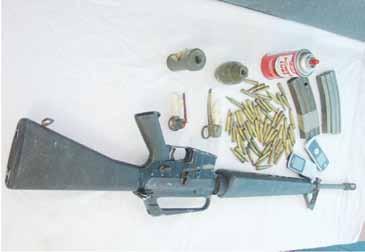
Duo found with M-16 rifle, grenades
The M-16 rifle, ammunition and grenades
Two men were taken into police custody on Wednesday after they were intercepted while walking along Aubrey Barker Road, South Ruimveldt, Georgetown, with a highpowered rifle and two grenades.
An M16 rifle with two magazines and 60 rounds of ammunition, along with one fragmentation and one concussion grenade, were recovered in a bag that was thrown into a nearby bus by one of the men.
In a release, police stated
that about 11:15h, ranks of a motorcycle anti-crime patrol observed two men walking along Aubrey Barker Road and as the police ranks drew closer to the men, one of them disposed of a bag he was carrying. As a result, the police ranks detained the men and retrieved the bag, after which the discovery was made. The men were expected to be charged for the illegal possession of a firearm and ammunition and could appear in court as soon as today.
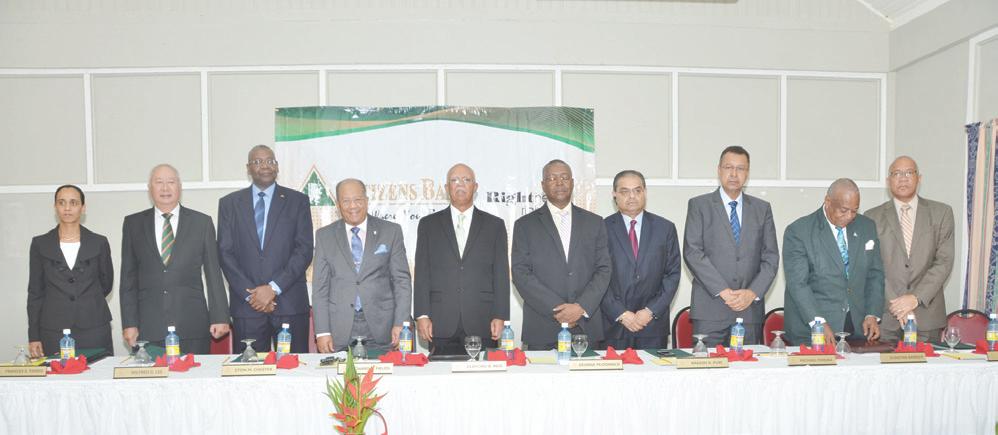
Members of Citizens Bank's Board of Directors during the Annual General Meeting on Tuesday at Georgetown Club
Citizens Bank Managing Director Eton Chester
WEATHER: Thundery
Wind: East north-easterly between 3.05 metres and 3.33 metres per second.
High Tide: 09:03h and 21:34h reaching maximum heights of 2.43 metres and 2.35 metres respectively.
Low Tide: 02:34h and 15:04h reaching minimum heights of 0.80 metre and 0.81 metre respectively.
Non-passage of anti-laundering bill drives up exchange rates
– Reis tells Citizens Bank AGM
By Svetlana MarShall
The non-passage of the Anti-Money Laundering and Countering the Financing of Terrorism (Amendment) Bill 2013 and Guyana’s subsequent blacklisting has helped to drive up foreign exchange rates, Citizens Bank and Banks DIH Chairman Clifford Reis told the institution’s Annual General Meeting on Tuesday at the Georgetown Club.
He also said that new and innovative models are required in the financial and banking sectors to combat the negative effects of the 2008 economic crisis that continue to manifest themselves.
In 2013, the global economy grew more slowly than expected, recording a 2.5 per cent increase, as the recovery from the Great Recession of 2008 remains fragile, owing to the continued recession in many European countries and the slowdown in emerging market economies, particularly Brazil and China.
Reis told shareholders at the bank’s 19th AGM that the economic meltdown continues to take a toll on the banking sector, even as regulators attempt to cushion the impacts and implement various systems to prevent a reoccurrence.
For Guyana, this situation is compounded by the fact that the nation is currently on the regional blacklist for inadequate money laundering legislation. After months of warnings, warring and missed deadlines, legislators are yet to reach consensus on the Anti-Money Laundering and Countering the Financing of
Terrorism (Amendment) Bill 2013. In late December, the bill was deferred to a special select committee for a second time. The country faces further sanctions from the Caribbean Financial Action Task Force (CFATF) and the Financial Action Task Force (FATF) in February and May respectively if the legislation is not passed in the National Assembly by that time.
Far-reaching implications
“The Anti-Money Laundering and the Countering Financing Terrorism Bill, this enactment is certainly not restricted to the confines of the banking system in Guyana, but has far-reaching implications and consequences for everyone globally regarding non-compliance,” the Banks DIH chairman said.
He further opined that the legislation will reshape the manner in which the banking and financial sectors conduct business.
Guyana’s failure to pass the legislation, coupled with the domino effects from the
economic meltdown, has influenced the upward movement of the exchange rates, he added.
According to him, the new economic challenges may push governments to adopt more protectionist approaches to safeguard their financial and banking sectors. However, this will affect the global banking industry’s ability to exercise that required flexibility to enter new markets and sustain their operations in others.
“What this has clearly demonstrated to the management of the bank is that we have to find and implement new operation models to sustain growth which is an imperative and not an option,” Reis stated, noting that the commercial banks can no longer depend solely on the traditional revenue generation models. “This new paradigm would require new and innovative methods.”
Overall, Guyana’s banking system remains sound and stable, with commercial banks yielding higher levels of profits and capital, Reis
stated. The capital adequacy ratio remains well above the prudential benchmark of 8.0 per cent.
“Deposits at the commercial banks increased by 11.1 per cent to $335.5 billion; private sector deposits which grew by 7.5 per cent to $268.4 billion accounted for 88.0 per cent of total banking sector deposits,” he further reported. Total loans and advances jumped by 14.8 per cent to $174.9 billion at September 30, 2013 with credit to the private sector increasing by 13.2 per cent to $115.0 billion.
Notably, the Bank of Guyana continues to capitalise on the auction of treasury bills as a monetary tool to mop up the excess liquidity in the sector. At the end of the financial year, $84.9 billion in treasury bills were outstanding with commercial banks holding $73.8 billion or 86.9 per cent.
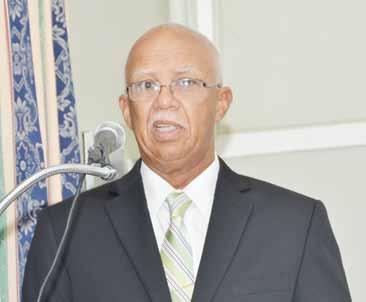
Banks DIH Chairman Clifford Reis
Editor: Nigel Williams
Tel: 225-5128, 231-0397, 226-9921, 226-2102, 223-7230 or 223-7231. Fax: 225-5134
The news that Haiti (along with Guyana) is going to lead the Caribbean and Latin America with a growth rate of 4.5 per cent was very good news and cannot be shrugged off. But Haiti is starting from such a low platform that, in and of itself, the rate of growth will not significantly improve the living conditions of most Haitians.
It is the analogous position that Guyana found itself in back in 1989 when the McIntyre Report uncovered the unsettling fact that the PNC’s “cooperative socialism” and “state capitalism” had brought Guyana to just above Haiti in the poverty rankings in the hemisphere.
Many PNC leaders have boasted that in the waning years of the PNC under Hoyte, he pushed the growth rate to around seven per cent per annum and that the PPP/C inherited this happy circumstance. The fact was – as is now true of Haiti –the production-possibility curve (PPC) of Guyana had been so destroyed by the depredations of the PNC that the mere lifting of the state controls by Hoyte and the return to some semblance of rationality to production by market forces, pushed up the PPC without much intervention of the PNC.
This is what is happening in Haiti. The sad truth is that even if Haiti is to sustain the five per cent growth rate, as Guyana has done for almost a decade, the economy will take decades to achieve levels to approach, for instance, that of countries like Trinidad and Tobago.
In the case of Haiti, we have to consider why all the hope that was engendered in the international community in the aftermath of the devastating earthquake of January 2014 –four years ago, has not been delivered on in concrete terms. Much of this is due to that community not delivering help that would have alleviated the structural conditions that have stymied Haiti’s growth and development over the last century.
The truth is that the international community does not even, in the main, remember Haiti at this point. And when we speak of the “international community” we are actually referring to the Western powers that dominate world affairs – notably the U.S., the EU and the UK. Most of the money –and always far below what is promised with great fanfare –does not even end up in Haiti.
According to the president of the Haitian Lawyers Leadership Network: “For less than one per cent of every dollar of U.S. donor aid goes to the Haiti government… In fact, 93 per cent of USAID funds to Haiti go straight back to purchase U.S. goods and services.” Another writer, Beverly Bell stated: “Of every dollar that the U.S. government did pay out for initial relief efforts, thirty-three cents went to the U.S. military.” This kind of “aid” might offer temporary, but never sustainable, growth to a country.
Another example of this underdevelopment is the much-publicised Caracol Industrial Park (CIP) assembly plant complex, which was supposed to produce great employment. This was part of the Bill Clinton Initiative. It ended up displacing 366 farming families (3250 persons) and employed only 1500 workers at substandard pay.
If Haiti is to ever attain sustainable growth and improve living conditions substantially, there must be investment in agriculture, which was distorted almost from the beginning of the founding of the republic in the beginning of the 19th century by the U.S. and France when they imposed huge credit burdens on the fledgling country.
Haitians need access to land, tools, credit, and training to ensure they can feed themselves and their communities. Yet, the government remains committed to neoliberal policies that were imposed and which make the country wholly dependent on food imports.
The government must take hard decisions to look carefully at the “aid” that is being proffered. There was the case of one tribe of Greeks that left a gift that did not turn out to be at all beneficial to the parties receiving it.
Major blunders committed by those sitting on the bench
Dear Editor,
It is with great frustration that I have decided to pen this letter vis-à-vis the granting of bail to an individual, who was charged with robbery under arms. Given the prevalence of such acts and the fact this individual’s reputation precedes him; it remains mindboggling how he was allowed to post bail by the magistrate.
Perhaps the magistrate is waiting for him to appear before her again with the charge of murder. What will prevent the individual from using a gun instead of an ice pick now that he is essentially free?
Only recently there was another case at the Sparendaam Magistrate’s Court where the presiding magistrate granted bail to the perpetrator of a similar
offence. Immediately upon posting bail, the perpetrator threatened the VC’s life. He was rearrested and amazingly was released on his recognisance. However what this particular case brought out was the unholy alliance that exists between a magistrate and an attorney who also doubles as his landlord. This translates to whoever is defended by this particular attorney at the
Sparendaam Magistrate’s Court can take comfort from the fact that they will essentially be given a free rein as a result of this landlord/tenancy arrangement.
Certainly the above two issues warrant an investigation by the judiciary, the Guyana Bar Association and other relevant bodies.
Regards, David Geer
Bittersweet Italy
Dear Editor,
A friend of mine recently visited Italy this past summer and remarked at the absence of the Christmas decorations, lights, singing and festivities unlike what happens in Trinidad and Tobago and Guyana.
However, my trip to the Boot Peninsula was rather bitter sweet. I noticed that much like Italy, Guyana with its pristine location on the South American mainland contains some of the most extensive canals like Venice and is home to another grandeur of waterfalls – a great set up for tourism.
In other words minus, the gondolas and a few other economic developments, Guyana is reminiscent of most of the geographic physique of Northern Europe. Guyana has a natural environment that would be the envy of even a developed Trinidad and Tobago because we only have the Caroni River and that’s our
biggest bet.
Guyana has endless possibilities for growth through tourism, at least through its endless barrage of canals and waterways and its proximity to the coveted Amazon Rainforest, if only it could manage to keep its environment, cities, streets and waterways pollution free and crack down on crime! And that was the sweet part.
The bitter truth about the trip, however, was about to hit like a ton of bricks as I descended upon the political, religious and historical sites of Italy.
I was amazed that even though Rome burnt to the ground, was ransacked by Germanic tribes and must have seen many more uprisings during its almost two thousand-year Christian history, one would be amazed at how marvelous and splendidly intact Italy and the other European countries had kept their palaces, churches and even an-
cient pagan pre-Abrahamic sites like Rome itself and the Colosseum.
The most impressive of all were the paintings of the Sistine Chapel and how they had been preserved for future generations of Italians, Europeans and the people of the world to walk by and marvel at Italy’s once great ancient past and its continuous presence and contribution to world culture and I suddenly felt sad.
I felt a deep sadness when I thought about our own Indian history because I had visited India. I had literally seen, the remains, of a once great empire struggling to be called a civilisation today. When people dream of India, few of these can come to life because the many great palaces and forts we see are only the facades on the outside.
A closer look at India’s palaces reveals walls that have been dug out; its gold and precious stones taken
out of the mighty palaces and our paintings and art destroyed by gunshots and cannon balls.
It was as if every gem that was taken out of India dragged a piece of India’s life and breath with it. It remains to be said that though we are fanning the flames of Hindu nationalism once again, many of our great historical pieces will remain only shadows from the glorious past.
I was happy to see that while our conquerors were able to show off their art to the world, ours had been destroyed by the war games they played and the mind games they continue to play as we struggle to realise the state we have been left in.
Let the remains of our history be a lesson for the history we are about to forge.
Sincerely,
Vassan Ramracha
A view of houses swept away during heavy flooding caused by tropical depression ‘’Agaton’’, in Butuan city on the southern Philippine island of Mindanao, on January 21. Agaton, which claimed at least 60 lives and displaced some 20,000 families in Mindanao since it struck on Friday, before it was downgraded to a low pressure area, is strengthening and could exceed its initial status (Reuters/Erik De Castro)
Hinterland education
Dear Editor,
I commend Food for the Poor Guyana and the Amerindian Affairs Ministry for their efforts to complete and furnish the dormitory at the Sand Creek Secondary School located in Region Nine. Sand Creek Secondary School was built with intentions of providing education to students from both Regions Nine and Eight.
When it comes to managing schools in remote areas, the process of providing meals and sleeping quarters is often the least
of our worries and there are in fact other areas of concern that we should place emphasis on.
I recall a few months ago, a 15-year-old student from a secondary school on the Essequibo Coast discovered that she was four months pregnant. As we all know, the importance of education is quite often expressed by the government and also recently by the Amerindian Affairs Minister Pauline Sukhai who declared the need for students in hinterland locations to embrace educational opportunities
in order to better equip themselves with the skills and knowledge to later contribute to the overall development of Guyana.
There are now approximately 13 schools established in the hinterland area and many of them comprise of a standard two storey building consisting of a dozen classrooms, laboratories, administrative offices, computer rooms, home economics and industrial arts divisions and a dormitory.
Nevertheless, there will always be the need for more schools to be estab-
lished within hinterland areas. In fact, government is expected to construct a new school at Kato, Region Eight which is expected to accommodate more than 100 students.
Investments in education often require insight, patience and financial commitment. It is for this reason that people who bolster education and contribute to the development of such learning facilities should always be acknowledged.
Respectfully, Simone
Perreira
Monitoring of drinking spots must be the norm
Dear Editor, I live next to a popular rum shop and I am constantly bombarded with loud carousing and music. Also, ever since I read about a fight which left one dead at a rum shop on the East Coast of Demerara, my concern about the fights that frequently take place at this particular bar have grown.
Those who contribute to
road
fatalities must be held accountable
Dear Editor, An 18-year-old unlicensed teen lost his life when the vehicle he was driving met with an accident in the vicinity of Mon Repos. There are several factors about this particular incident that greatly upsets me. Aside from being an unlicensed driver, I am curious to know who’s vehicle was being driven and if permission was in fact granted for the boy to use the car.
cident. In fact, the parents of the young man should be questioned, since the details leading up to the accident need to be further verified.
I commend the authorities for this step forward. However, it baffles me as to why it took them so long to implement this approach. Additionally, I strongly suggest that it should be made mandatory for all businesses to install CCTV. It is inexpensive and will surely deter criminal activities, since no criminal wants to be identified.
As it relates to the issue of drinking and driving, the easiest way to address this issue is for police to stake
It was brought to my attention that the Home Affairs Ministry has decided to zero in on the monitoring of night clubs and the greater use of closed circuit television (CCTV) footage. This notion came about as a result of the public’s outcry over the growing number of accidents caused by drunk driving.
out popular drinking spots. This way, anyone under the influence can be identified and confronted before they even have the chance to get behind the wheel. This approach is simple and will surely prove itself to be quite effective and if we are serious about the law, we will quickly adapt this approach.
Many of us are familiar with the concept of having a designated driver. However, there have been cases where the said driver ends up even more intoxicated than his dependents. Personally, I believe that if a man can afford to lavish in drinks and snacks at a
Increase in minibus fares cannot be tolerated
Dear Editor,
The acting Tourism Minister Irfaan Ali recently declared that it is illegal for any Route 32 minibus operator to charge a bus fare higher than the one stipulated. He also advised commuters to make an immediate report in the event that they were asked to pay an increased fare.
One afternoon I was at the bus park about to embark a Route 44 minibus which plies the East Coast Demerara route. Shortly after, the driver realised that the park was over flowing with commuters and the set $120 fare turned into $200. The unauthorised increase in fare has become the norm and what is sad
is that people will pay the price just to get home after a hard day of work. Each commuter has the option of refusing to pay the increased fare, but then comes along a whole new problem of finding a bus that will take a commuter to their destination and still charge the regular fare.
Moreover, if drivers are reported they can easily lie when confronted by the police. The best solution to this problem is to have police officers strategically placed at the respective bus parks so that they can monitor the flow of commuters and control the use of music systems in minibuses.
The turn system should be implemented to further
ensure that minibuses aren’t overloaded and bullyism will not prevail. It is grossly unfair for passengers to suffer because of the many illegalities within the minibus industry.
I urge the relevant authorities to look into the matters plaguing the industry and address them urgently, since they affect those who rely heavily on public transportation.
Last but not least, I strongly believe that the government should reconsider reintroducing several of the big buses for the purpose of aiding in public transportation.
Yours faithfully, Bruce Thomas, East Coast Demerara resident
bar, then he can surely afford to take a taxi to get to his destination.
With that said, I strongly advocate for bars to make available some form for taxi service for their customers, and also the presence of an officer or two in the event that things get out of hand.
Yours sincerely, Nadira Sankar
Additionally, the boy was said to be driving a hire car at that and was also seemingly under the influence of alcohol. These four factors surely describe the highest levels of irresponsibility and the urgent need to ensure that this matter is further addressed.
A few months ago, a teen managed to find himself caught up in a hit and run accident and after realising that his number plate was left at the scene of the accident, he subsequently surrendered himself to the police.
The death of the driver in the recent road fatality should not be an excuse to turn a blind eye on this in-
An aunt of the deceased stated that he was drinking with friends and ended up behind the wheel of one of his friend’s car. However, the friend is claiming that he had no control of the situation. When irresponsible behaviour is the reason for unwarranted fatality, we must take the necessary measures to address the situation from all angles. Individuals need to play a more responsible and cognisant role when it comes to the decisions that are made by them and also by the people around them. If we are aware that someone close to us is drinking and has intentions of driving, it is each and every one of us responsibility to not allow it. This simple act could save a life and could in fact benefit society in its entirety.
Sincerely,
Xavier Connelly
You can send your letters with pictures to: Guyana Times, 238 Camp & Quamina Streets, Georgetown, Guyana or letters@guyanatimesgy.com
Page Foundation
A guide for teachers: Asking questions to improve learning
When you prepare for class, compose specific questions that you will ask your students (or that you anticipate they will ask you). Doing so will help you increase student participation and encourage active learning. The strategies below will also help you formulate questions for exams and paper assignments.
Active learning extends beyond the classroom. When you ask questions in the classroom, you are modelling a process that students can and should use themselves; encourage your students to use the following question ing strategies to assess what they have learned, to devel op their thinking skills, and to study for exams.
General strategies for asking questions
When planning ques tions, keep in mind your course goals. For exam ple, do you want students to master core concepts? To develop their critical think ing skills? The questions you ask should help them practice these skills, as well as communicate to them the facts, ideas, and ways of thinking that are important to their learning in your course.
Avoid asking “lead ing questions”. A leading question is phrased in such a way that it suggests its
own answer and therefore discourages students from thinking on their own.
Follow a “yes-or-no” question with an additional question. For example, follow up by asking students to explain why they answered the way they did, to provide evidence or an example, or to respond to a yes-or-no answer given by another student.
Aim for direct, clear, specific questions. During class discussions, rather
Essay questions on exams or paper assignments, on other hand, often provide an appropriate opportunity to ask multi-layered questions. If your exam will include multi-layered questions, use questions during class time to walk students through the process of answering multi-layered questions.
In class discussions, do not ask more than one
question at once. When you ask more than one ques tion, students often do not respond because they are unsure which question you want them to answer.
When you plan each class session, include notes of when you will pause to ask and answer questions. Asking questions throughout the class will not only make the class more interactive, but also help you measure and improve student learning. Do not save the last two minutes of class for questions. Students are unlikely to ask questions when they know that only a few minutes remain.
Ask a mix of different types of questions. You should use “closed” questions, or questions that have a limited number of correct answers, to test students’ comprehension and retention of important information. You should also ask managerial questions to ensure, for example, that your students understand an assignment or have access to necessary materials. “Open” questions, which prompt multiple and sometimes conflicting answers, are often the most effective in encouraging discussion and active learning in the classroom. (teachingcenter.wustl.edu)
How to ask your teacher for help
BY GINGER GILLENWATER
It is not unusual for a child to be too shy to ask a teacher for help. To the child, asking for help may signify weakness although it signifies strength and shows a desire to do well on his or her schoolwork. It isn’t hard to see how it pleases the teacher to see a student who cares enough about schoolwork to ask for help. Although the process is so simple, there is no question it can be hard for the nervous student. He or she entertains ideas of walking up to the teacher after class or after school to let them know they are having trouble, but they don’t know how to ask. What are the right words?
Technically, there are no right words, but if you’re a student looking to find a way to ask your teacher for help, here are a few ideas. It really isn’t difficult to ask for extra help because nothing will please your teacher more than seeing you want to succeed. Yet, what you want to do first is tell your parents you are having a hard time in a particular class and that you need to ask that teacher for help. Your parents will also be
pleased with the fact you desire the extra help and will do whatever they can to help make that a reality.
Next, you want to approach that teacher after class or school. Simply let them know that you are having difficulty with a particular area in class and that you need extra help. If that teacher is unable to stay after school, they may direct you to another student who can help you or to a tutor. If they can stay after school, they will let you know which days they can stay after school with you.
See, it is just the simple fact of asking and your teacher will be thrilled to help you in any way possible. You then take the information you got from your teacher to your parents. This lets them know if they need to take you to a special location to meet with another student or tutor. It also lets them know if they need to pick you up later from school.
Through realising that you cannot grasp a particular topic without a little help is your first step in figuring out how to ask your teacher. A simple, “Mr/Mrs teacher, I’m having trouble understanding fractions, so is there any way I could get some extra help?” That is when the teacher will give you some options. That is what they are there for...to teach and to help in any way they can.
Sometimes when teachers notice you are having a hard time they will offer their assistance, but you cannot count on them asking because they don’t know your particular situation. It can sometimes be a sensitive topic, so the teacher will wait for the student to ask. Teachers have many children to teach, so if they asked every student that needed help, they wouldn’t have any time for one-onone, so they wait for those who really care to ask them for assistance.
So show your teacher you really care and simply ask them if there is something they can suggest. You will certainly reap the rewards in the end and your parents will be very proud of that report card. Too many students make the mistake of being afraid to ask for help when it is a very easy thing to do and don’t realise how that one question can change their entire academic career. A teacher will never bite your head off because they are there to make sure you learn. They care about you, otherwise they wouldn’t be there. (Yahoo!)
COPA Airlines enters local market
– visa waivers part of incentive package
BY MICHAEL YOUNGE
The government of Guyana and COPA Airlines have finally sealed a deal that will see the latter entering the local aviation industry, providing affordable airlift from Guyana to Panama commencing on July 11.
The international carrier is positioning itself to provide this service twice weekly after government took the bold decision to waiver the visa requirements to enter this country from Panama, Costa Rica and Peru. Additionally, the airline will also play a part in marketing Destination Guyana as a major route in South America for persons desirous of travelling within shorter timeframes around the world.
Speaking at the event, COPA Airlines Vice President Sales Guillermo Gomez Wilches said the company considers this decision to enter the local market as one of its “most important achievements in 2014” thus far. He said in the world, COPA Airlines is recognised for its leadership and international connectivity, punctuality and quality of service, boasting one of the youngest and most modern fleet in the industry.
“It is the beginning of new opportunities for tourism, commerce and southern exchange between this beautiful country (Guyana) and the rest of the region. Guyana is a dream come through for us and a great achievement. Also with this decision, we expect to contribute significantly to the development of the local Guyanese industry and to provide Guyanese with the safest possible travel to all destinations,” he remarked at a simple ceremony held at the International Convention Centre, Lilendaal, Greater Georgetown.
The COPA vice president for sales also expressed excite-
ment that Guyana has now become the airlines 68th destination and 30th country that it travels to, noting that there are plans to further develop the Guyana to Panama route later in the current arrangement.
Meanwhile, acting Tourism, Industry and Commerce Minister Irfaan Ali lauded the airline for its decision to partner with Guyana as he appeared upbeat about the potential of the new business decision made to have positive socio-economic benefits for the people of Guyana.
Exceptional opportunity
“This allows us an exceptional opportunity, not only to track a new market but also to build the infrastructure through which Guyana can become a secondary hub to Panama linking up to Africa and South America, ”Ali explained.
He said that the relationship with COPA brings into bearing the need for a rethinking of approaches and a paradigm shift to how things are done to acceptable international standards.
Minister Ali expressed the view that the tourism industry is going to be the leading industry in Guyana and his team along with several other stakeholders, both public
and private, are willing to do all that was necessary to make this a reality this year.
He did not fail to point out the importance of the private sector as he alluded to the whopping $35 billion in investments already made, positing that the growth of the sector depended on more than the Marriott and the expansion of the Cheddi Jagan International Airport.
“It is my hope that the incentive and fiscal regime surrounding tourism in Guyana will be modernised to reflect the confidence the private sector is placing on tourism, and to reflect the changes that are necessary in the policy framework to position it at a place where tourism is a centre piece for development,” he told the gathering.
Not business as usual
Ali has already admitted the need for “a rethinking of the marketing policy” following the bold decisions made by the international airlines to enter Guyana’s market, explaining that it cannot be business as usual.
Surprisingly, the minister has ordered that frontline officials at the Guyana Tourism Association, the Immigration Department and the Cheddi Jagan International Airport become familiar with Spanish.
He said they must learn how to speak the language and understand its mechanics given the new arrangements and the opening up of a new diverse South American niche market.
“We have to bridge the gap and lead from the front... technology is out there and it’s a non-negotiable position,” Ali said sternly.
He also underscored the importance of COPA’s arrival within the context of the Union of South American Nations (UNASUR).
Foreign Affairs Minister Carolyn Rodrigues-Birkett, who played a major role in facilitating the airline’s arrival here, explained the importance of “consolidating” Guyana’s relationship with its traditional partners while looking at establishing new ones to advance development.
Rodrigues-Birkett held the view that while Guyana is on the South American continent, it has always played a more integral role in the affairs of the Caribbean block as opposed to Latin America.
“But in the last decade or so... there has been a major
push to bring the two regions together because this is how others see us... and so this part of our Latin America outreach and in the future, you will see more,” she remarked.
Cognisant of benefits
Addressing the overtures made in this respect, the foreign affairs minister spoke of the ties established with Argentina and Mexico through the establishment of embassies here. She admitted that government was cognisant of the potential trade, tourism and commerce benefits that could flow from Panama as well, as she welcomed COPA Airlines.
“Language is not the issue that has kept us apart in Latin America and the Caribbean. I believe its transportation... strengthening of communication links, facilitation of travel in our region are critical to strengthening... bilateral relations with Panama,” the minister said.
As expected, she reflected on how the agreement came into fruition with COPA Airlines, but not before lay-
ing her major announcement bare before the audience that Guyana “reached out to the airline and tried to woo them” to come here.
At this point, RodriguesBirkett announced that several steps were taken during the negotiation to encourage COPA to ply the Guyana to Panama route.
“One has to do with visa waiver arrangements. I think that as a small country like Guyana with just 16 missions abroad, we don’t have the resources to be issuing visas if we are going to encourage people from countries where we don’t have missions to visit Guyana.” Citizens of Peru, Panama and Costa Rica are now able to spend up to 90 days here without a visa, which is part of what the minister said was a plan by her ministry to have reciprocal visa arrangements with all South American countries.
Guyanese will also have the opportunity to access a wide range of connecting flights to the U.S., Canada and UK through COPA Airlines at shorter timeframes.
COPA has transported 11,316,678 passengers in 2013 while hiking its seating capacity by 14 per cent. It has received awards for “Best Airline” and “Best Cabin and Airport Crew” in Central America and the Caribbean. Present at the ceremony to launch the new route were Private Sector Commission Chairman Ronald Webster, Guyana Tourism and Hospitality Association President Kit Nascimento, Georgetown Chambers of Commerce President Clinton Urling and several tourism and aviation stakeholders.
Foreign Affairs Minister Carolyn Rodrigues-Birkett and acting Tourism Minister Irfaan Ali (fifth left) with representatives of Copa Airlines and the private sector
Police say no foul play in sunken cargo boat
BY VAHNU MANIKCHAND
Three days after cargo boat Stollie 1 sank at the mouth of the Pomeroon River in the Atlantic Ocean, several persons are claiming that the captain is not being truthful about what happened.
And the police have said that investigations so far have not disclosed any foul play.
The vessel sank on Saturday in the Atlantic Ocean somewhere between the entrances of the Pomeroon and Waini rivers.
It is reported that the boat contained an estimated $80 million worth in goods, including goods amounting to $11 million belonging to the owner Trevor Stoll.
Captain One of Stoll’s relatives, who requested anonymity, told Guyana Times that he believes that the captain of the boat needs to say what actually happened on the fateful day, pointing out that many people have been giving several versions of the incident.
The relative noted that firstly, the captain did not inform them about the mishap.
“When we hear about
the accident, the captain was home. We hear about it from people on the road and then we send another boat to the area to see if they could find it, but all they find was couple food box, bottles and soap powders,” he stated.
The relative explained that they are trying to understand what could have caused the boat to sink since the vessel was working fine and never leaked before.
The man pointed out that the captain’s explanation was not convincing since the goods that were reportedly “recovered” are dry goods and could not have been floating.
Strange
“The fisherman them say that the captain tell them to collect the goods but when you look at it, these goods they find would sink, they would not be floating and those things were dry they were not heavy so I don’t know what really going on,” he stated.
The relative noted that the recovered goods were taken into custody by the police along with the fishermen who reportedly responded to a call from the vessel.
The man further stated that they are trying to use
a GPS tracker to locate the sunken vessel; however, the captain is not complying.
“The boat had a GPS tracker but when we ask he what the tracker number, he said that everything left on the boat and he can’t remember nothing, so now we left with no way forward, we stuck,” he related.
The relative said his family told the police to pressure the captain to say exactly what transpired since it was reported that he sent the three other crew members away and failed to have them report to the Maritime Administration (MARAD) as requested several times.
Meanwhile, the incident is being investigated by ranks of the Anna Regina Police Station.
A senior officer told this newspaper that they have contacted the crew members and none of them thus far has said anything about foul play in the matter.
Foul play
“We have interviewed all the crew members including the captain and investigations so far do not suggest that there has been any foul play,” the officer stated.
When contacted, the captain of the boat, Reid (only
name given), told Guyana Times that when he realised the boat was sinking, he immediately called for help but noted that it took a while before crew members were rescued by fishermen.
Further questioned about the incident, Reid asked that the call be made at a later time since he was at the police station. Attempts to contact him later in the day proved futile.
This publication understands that about 20 persons had goods on the vessel and they are all seeking answers as to what will happen to their losses and whether they will be compensated.
Losses
One such person is Shelliza Ramdat, who had some $500,000 worth of goods on the boat.
The woman said she would like to know what is really going on since they are a lot of rumours going around about what really transpired.
Ramdat said she placed four jumbo bags on the boat on January 10 and flew into the interior two days after with the expectation that she would get her belongings.
“I have two children and this just stress me out cause is not only clothes to sell but my personal clothes were also in the bags,” she stated.
Ramdat, who is a vendor in Port Kaituma, said she does not know if the boat was insured. The woman is desperately trying to ascertain whether she will be compensated.
“I just want to know what will happen now if I will get back my goods or I will be compensated, that’s all I want to know, I don’t care about anything else,” she said.
Eyew tness
Eliding the past...
...by the Prof
The U.S. embassy brought back Ivelaw Griffith, a professor of Guyanese origin (he’s a U.S. citizen now), to lecture parliamentarians on security matters. Griffith’s an expert in this area. And being an expert, he’d know nothing happens in a vacuum....you’ve got to always consider the context. And Griffith is very conversant with the internal and external context of Guyana that’ve shaped our security concerns.
Just before the “free and fair” elections in Guyana of 1992, Griffith edited a book, Strategy and Security in the Caribbean – in which he wrote the chapter on Guyana. His major concern was the professionalism of the Disciplined Forces. Against the background of the massive rigging of the 1980 elections, (he cited the International Observers’ report “Something to Remember”...which described the elections as “crooked as barbed wire”.) Griffith wrote:
“Military personnel were also transported around cities to provide audiences at mass rallies, where Burnham and other top PNC leaders spoke... It allowed the ruling party to pursue its political and doctrinal socialisation of members of the military... In this context loyalty by the military was no longer to the constitution, the office of president, and to the ideals of sovereignty and territorial integrity. Rather it was to the paramount party and the predominant leader.
“THIS WAS NOT JUST DEMANDED BY THE PARTY BUT WAS WILLINGLY OFFERED BY THE LEADERSHIP OF THE MILITARY.” In Griffith’s audience in Parliament – as he spoke on present-day security concerns – was David Granger, successor to the then “paramount leader Burnham”. Just before those 1980 elections – the same year that Rodney was assassinated – Burnham had just selected Granger to head the army.
Apart from ordering soldiers to cart around people to rallies, Granger was actually head of the indoctrination unit that preached loyalty to the party leader before country. As part of his speech, Griffith should’ve enquired of Granger if his views had now changed. With Granger’s entire staff drawn from the military – including his top spokesman ex-Lieutenant Colonel Harmon – and ranks on the ground doing his mobilisation – the presence of ex-Commissioner of Police Winston Felix as his MP and lead on security, suggests it’s the same ole, same ole.
And we didn’t even mention Ex-Chief of Staff Collins taking pellets while protesting in the streets when Granger insisted he’d been elected president.
We have security issues all right. And they’re not all external.
...at Linden
The war drumbeats from Linden are beginning once again. Or more properly, the drumbeats never really ended ...just their intensity decreased. The complaints are putatively about the committees that were to be formed after the Linden protests in July 2012. But this is the occasion for the war and not the cause of the war.
Take the Economic Development Committee. This was supposed to be constituted and have its report for the development of Region 10 WITHIN 90 DAYS!! We’re talking about by last November. Yet a year and a half later, the committee chairperson – selected by the opposition and the Region 10 administration (is this a redundancy?) just resigned. And get this – for personal reasons and with no report. Now mind you, when the chairperson took on the job last March, she’d demanded six months and we don’t have a report after 10 months.
And the government’s getting the blame!!! Why? Well, the region won’t agree on a chair of the technical committee – to look into the electricity rates that brought on the whole shebang. You can have economic development without a cost for electricity?
So you tell this Eyewitness, who’s dragging their feet?
...on One Mile Primary
David Granger weighed in on blaming the government for the constipation in the formation of the Linden committees. He complained about schools. If he’d kept his promise to help Lindeners rebuild One Mile Primary maybe that would’ve helped? You think?
But it’s easier to blame the government, no?
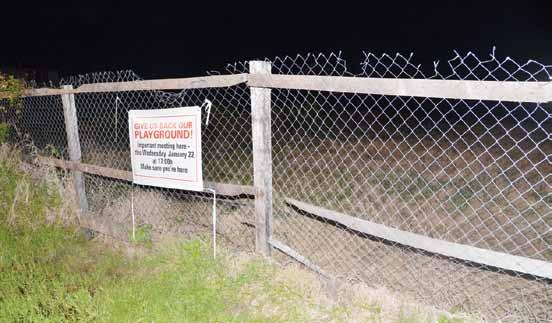
Co-op wants sale of Lamaha Gardens playground rescinded
The resuscitated Civil Service Association Co-op Housing Society on Wednesday filed an injunction against the $29 million sale of the Lot 142 Durbana Square, Lamaha playground.
The injunction was filed by the co-op’s attorney Steven Fraser. Civil Service Association Co-op Housing Society Chairman Roy Mc Arthur made the announcement during a community meeting late Wednesday afternoon.
The co-op wants the transaction rescinded on the grounds that it was illegal. The defendants in the matter have been identified as the former Chief Co-operative Development Officer Kareen Abdul-Jabar, the businessman who purchased the land Terrence Taljit, the liquidator Cecil Ramnarine and acting Chief Evaluation Officer Outar (only name given).
On January 13, 2013, the playground owned by the Guyana Public Service Housing Co-operative (formerly CSA Housing Cooperative Society) was sold to Taljit.
The then chief co-op development officer was relieved of his duties and subsequently fired after it was discovered that he played an integral role in the sale of the playground.
It is alleged that the sale of the plot of land to the businessman was highly flawed, breaching laws governing the co-operative movement in Guyana. The transaction of sale was reportedly done in
Police mum on findings of baton-rape case
Two days have elapsed for the public announcement of the findings into the investigations carried out by the Office of Professional Responsibility (OPR) regarding the alleged batonrape of a prisoner at the Timehri Police Station.
Police Commissioner Leroy Brumell last week made a commitment that the investigation into the Colwyn Harding saga would have been completed by Tuesday and the findings made public, but this was not the case as officials of the force, including Brumell remain elusive.
This newspaper on Tuesday and Wednesday made several attempts via telephone to solicit a comment on the issue from Brumell and Crime Chief Seelall Persaud, but was unsuccessful. It is not clear if their silence is an indication that the OPR has not completed the investigation.
Several groups have already cast aspersions on the probe, claiming that “police cannot investigate police” and urged that an independent inquiry be held.
Home Affairs Minister Clement Rohee has since gone as far as saying that there was a lack of supervision at the Timehri Police Station.
He also described the case as complicated and called on the public to be patient as the OPR investigates the matter.
Guyana Times understands that a number of other witnesses came forward in the case.
Harding alleged that he was baton-raped by a police corporal attached to the
Lynch remanded for alleged murder of husband
Former beauty queen
Carol Ann Lynch appeared before Chief Magistrate Priya Sewnarine-Beharry on Wednesday charged for the second time for the murder of her husband – Farouk Razack.
Lynch stood silently in the courtroom as Chief Magistrate SewnarineBeharry read the indictable charge to her. It stated that on May 7, 2007 at 106 Ireng Place, Bel Air Park, Georgetown, she murdered Razack.
Lynch was represented by Attorney Latchmi Rahamat who told the court that in 2007, her client was charged for the same offence and the matter was later discharged by the then City Magistrate Gordon Gilhuys
who said there was not sufficient evidence for a prima facie case to be made out against her.
The attorney then added that no new evidence has
been found and the charge is still being laid against Lynch for a second time. Rahamat then requested that the matter remain before the chief magistrate to expedite the trial. Lynch was remanded to prison and is expected to make another court appearance on February 5.
Lynch’s arraignment comes one day after she turned herself over into the hands of the police. She was reportedly on the run for a number of years.
Razack's body was found in his Ireng Place, Bel Air Park home about 08:30h on May 7, 2007 with a wound to his head and marks around his neck. At that time Lynch had just returned home after taking their daughter to school.
Timehri Police Station.
The young man accused a police rank of sodomising him with a condom-covered baton while he was in police custody for an alleged theft.
Since the incident, the young man was hospitalised and remains so to date. The matter was first brought to the forefront after the mother of the young man decided to approach the media.
The corporal in question was placed under close arrest and the others were transferred to other locations closer to Georgetown.
the dark without the knowledge of the co-op, thereby creating quite a stir following the discovery of sale.
In defence, Jabar had argued that there were less than seven members on the Civil Service Association Cooperatives but this was far from the truth since approximately 15 members with valid titles listed on the membership of the association were identified.
Additionally, the bidding process for the plot of land was flawed since the auctioning which took place in November 2012 was apparently done in the dark.
The opening of a new bank account to which the some $25 million was transferred was also unauthorised and constituted a grave infringement on the rules governing co-operatives.
The Labour Ministry has said the land was sold for $25 million, but residents
have disputed this, claiming that it was sold for $29 million.
On Tuesday, Mc Arthur told Lamaha Gardens residents that subsequent to the discovery of the illegal sale of the plot of land, the Labour Ministry advised that the coop turn to the courts for recourse.
Considering that the Labour Ministry had acknowledged that the chief coop development officer erred in the sale of the land, Mc Arthur contended that the ministry should have moved to reinstate the land rather than advising the co-op to turn to the court.
“If they have accepted that position, I want to know why they would tell a society that has been robbed of its land, that you must go to court and settle it when the mistake has been on the part of the administration,” he pointed out.
Local Govt Ministry to continue outreaches
The Local Government and Regional Development Ministry will be continuing its outreach programme in the different regions throughout the course of the year, to meet with residents, and hear their concerns.
Both Ministers Ganga Persaud and Minister within the Ministry, Norman Whittaker undertook visits to communities in various regions to interact with the residents and get an idea of the quality of work being done in the areas, and the
challenges faced. The ministers then work along with the Neighbourhood Democratic Councils (NDCs) and the Regional Democratic Councils (RDCs) to find a solution to the problem/problems. Minister Persaud said those issues that are outside of the ministry’s portfolio are then referred by himself or Minister Whittaker to their colleague ministers of the respective ministries. In 2013 the outreach programme shed light on over 15,000 cases and 93 per cent of the problems.
Colwyn Harding
Former beauty queen Carol Ann Lynch
The Lamaha Gardens play ground
National strategic HIV plan to be implemented
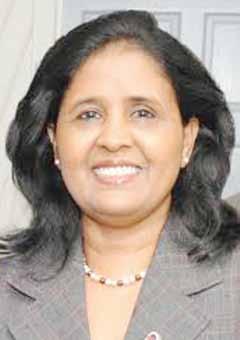
The National AIDS Programme Secretariat (NAPS) has finalised the National Stakeholders Consultation on HIV 2020. This is according to NAPS Programme Director, Dr Shanti Singh.
Under the eight-year national strategic plan for HIV 2013-2020 (HIVision2020), there are five priority areas – coordination, prevention, care, treatment and support, and strategic information and integration, Dr Singh told Guyana Times in an exclusive interview.
HIVision2020 will be rolled out shortly via three-year detailed operational plans. This would be done by the University of the West Indies’ health economics unit who are expected in Guyana on January 28 to commence working on this with the local team.
The strategic plan, Dr Singh added, is designed to place Guyana on a trajectory, to eliminate HIV, while reducing the social and economic impacts of the infection and AIDS and improving the lives of infected persons. NAPS is working assiduously to meet the March 31 deadline for submission of the estimated number of persons living with the virus for 2013.
Prevention
“We’ve seen an intensification of the work that has been done among the key population, that is among the female commercial sex workers and men who have sex with men; in 2013, we recommenced services to prisoners after a little gap.”
Dr Singh explained that preven-
tion packages would have been made accessible countrywide in 2013, in addition to treatment and screening services formerly available only in Region Four. This is a huge achievement for NAPS, as it continues the 75 HIV counselling and testing sites across the country. Dr Singh noted that there was no national week of testing in 2013 in observance of World AIDS Day, owing to inclement weather conditions, but all regions offered the services continuously through their testing sites.
In another remarkable achievement, there was an estimated 98 per cent coverage of pregnant HIV-infected
women, while the 183 Prevention of Mother to Child Transmission (PMTC) sites are functional countrywide.
Treatment
In the area of treatment, the mobile units used to service the hinterland were handed over to the regions’ health facilities. “That transition process showed a positive response in its growth and response from communities with support from REOs [regional executive officers] and health officers.” She added that capacity building and training is ongoing to ensure sound, safe and quality treatment is being extended to all patients across the length and breadth of Guyana.
The director added that Guyana was recognised as one of the few countries in Latin America, where the population has universal access to treatment at a time when 70 per cent of infected Guyanese were eligible. A second client satisfaction survey is to be completed in a few months and should be made available in mid 2014.
Guyana is on track to achieve many of its HIV-related goals; however, challenges that are surfacing daily are making it difficult to meet deadlines. Much progress has been made on achieving zero discrimination on HIV/AIDS.
In light of sex workers’ concerns about discrimination in treatment, Dr Singh said, “We have trained health workers, who are ready and willing to serve every human being.” She added that every person has the right to medical treatment, and health services are there for everyone.
MoneyGram awards Christmas promotion winners
Fifty five lucky customers were presented with prizes following the just concluded MoneyGram Christmas promotion at Neal and Massy (NM) staff facilities on Tuesday.
Among the prizes were a 32-inch flat screen television set, two smart phones and 52 tablets. NM Services Limited Chairman Deo Persaud congratulated the winners and thanked them for participating in the promotion.
Talk is cheap and mad people deh plenty
One of de most annoyin tings in life is when people naggin and tryin to pick a fight wid yuh and yuh ain’t tekkin dem on. Old people seh talk is cheap and when yuh mek people realise that whah ever dem tellin yuh is cheap dem does get mad. And mad people deh plenty.
Mad people does get even more mad when dem realise that de people dem tryin to pick a fight wid movin on and gettin better and better in life. The good book seh a soft answer does turn away anger. But no answer does mek people get more vex and want to pick a fight more bad. Nuff woman stay just so. Dem like to nag and pick a fight wid dem man. Some man does nag and wanna pick fight wid dem woman too. And nuff of this naggin wid man and woman does involve de next door neighbour man and woman. When that happen and de woman dem find out, dem does start naggin one another.
And wid that kinda naggin, nuff man does start braggin. That is when fight does start. Some kinda naggin and braggin was going on in Albion and de neighbour dem nearly kill one another. One end up in de hospital and de magistrate do de best ting and send de rest to nag in de lock ups.
Another man in GT de garbage s*ity go home at midnight and nag he woman fuh some ting wah she had done give de neighbour before he coulda reach home, and that is when he nearly kill de woman.
Ting-a-ling-a-ling…friend tell friend…mattie tell mattie! Well, that magistrate know wha he was tinkin when he put de man away fun nine months in jail. And de police done ask de magistrate fuh mek he serve that sentence down in Timehri!
GGDMA seeking to surpass 2013 target
Amid prevailing financial difficulties, the Guyana Gold and Diamond Miners Association (GGDMA) hopes to surpass or at least reach its 2013 record of 481,000 ounces of gold.
This was the highest to have ever been achieved in the history of mining in Guyana.
The new year has seen major setbacks for both medium and small scale miners. Rising operation costs compounded with the downward spiral of gold price has forced many miners to leave the industry.
appointed Guyana Geology and Mines Commission (GGMC) Chairman Clinton Williams, but will soon do so, as there is much to talk about.
“The current impasse in the implementation of the anti-money laundering legislation is of great concern to everyone but we remain positive that the decision
According to a release from the company, Persaud, who is also chief executive officer of the Neal and Massy Guyana Group of Companies, took the opportunity to express the group’s concerns over the current state of the anti-money laundering legislation which has affected many companies in the local financial sector.
makers will work diligently to have the bill passed in the very near future,” he added. Persaud said remittance remains a great part of Guyana’s revenue stream and should there be hindrances, it would have serious economic and social impact for the country. The chairman also mentioned that a marketing team from MoneyGram International will be in Guyana in February to work on a programme that will benefit customers and agents and
also to get a better understanding of the impact of Guyana not meeting the Caribbean Financial Action Task Force’s (CFATF) requirements.
MoneyGram Supervisor Darshinie Persaud said Neal and Massy and MoneyGram are two companies that are customer focused and the Christmas promotion was their way of giving back to customers. She stated that MoneyGram and SurePay customers can expect more promotions during 2014.
GGDMA Administrative Coordinator Colin Sparman said the industry was doing much better than it is today. Over the last two years, gold price was reasonably high, standing at US$1900 per ounce. However, since the beginning of 2014, there has been a significant decrease in the price, with miners receiving US$1241 per ounce. Sparman pointed out that the association was able to achieve its target through the combined efforts of the gold miners.
The administrative coordinator said the association has not yet met with newly-
Miners had met with President Donald Ramoutar, Natural Resources and Environment Minister Robert Persaud and Finance Minister, Dr Ashni Singh last year and had put forward a number of proposals to cushion the many hiccups faced in the mining industry. At the meeting, requests were made for tax waivers to be implemented on the importation of 4x4 (pickups) for miners, especially women, and that 50 per cent of the cash received for gold from the Guyana Gold Board be paid in U.S. currency.
Sparman said the association is in continued talks with the president and ministers Persaud and Dr Singh to address miners’ woes.
According to information received, at a recent meeting held with President Ramotar and miners, the parties had agreed to the establishment of an inter-ministerial taskforce to look into issues affecting miners and document their decisions to Cabinet for consideration.
Neal and Massy Services Limited Chairman Deo Persaud (third left seated) with staff and the lucky winners of the promotion
National AIDS Programme Secretariat Programme Director, Dr Shanti Singh
GECOM mulls automatic ballot scan, tabulation system
In recognition of the need to tabulate, certify and announce accurate results of elections in a timelier manner, the Guyana Elections Commission (GECOM) is exploring the possibility of embarking on a pilot project in which automatic scanning and tabulation machines could be used in a future election.
Accordingly, a team of representatives of the DELIAN Project, an independent, non-profit organisation registered in Canada, and the U.S., visited GECOM last week Monday and conducted a demonstration on the use of automatic ballot scan and tabulation technology.
According to a release from the commission, the DELIAN team comprised of former chief executive officer of the International Foundation of Electoral Systems and DELIAN’s Advisory Board Chairman Jean-Pierre Kingsley, who served as the chief electoral officer of Canada from 1997 to 2010; DELIAN Board of Director Chairman John Hollins, who was chief electoral officer for the Province of Ontario form 2001 to 2008, and Managing Director Allan Best.
The DELIAN Project
was created in 2011 as a philanthropic entity by the Canadian elections technology firm Dominion Voting Systems (DVS).
The DEILAN Project procures and donates electoral technology to emerging and growing democracies. DELIAN is a signatory to the United Nations Global Compact, and recently joined the Clinton Global Initiative.
At the demonstration, it was pointed out that the DELIAN Project could donate up to 25 paper-based, automatic ballot scan and tabulation machines to
Guyana for a future election. Each machine can handle roughly 1000-1250 voters on a typical polling day. The automatic ballot scan and tabulation system could be deployed on a pilot basis at up to 25 polling stations at a future election, as selected by GECOM.
Advantage The advantage of a paper-based, automatic ballot scan and tabulation system solution is that results are tabulated (counted) as they are sent in at the close of polls, resulting in the ability to announce results immedi-
Flood-affected Airy Hall farmers receive fertiliser
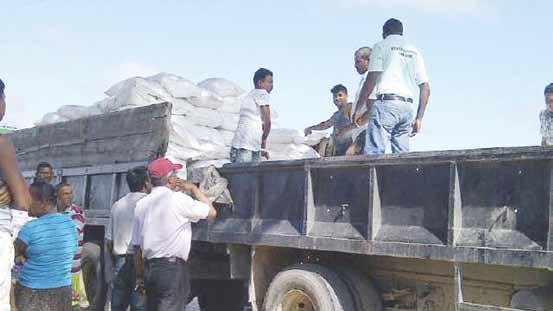
Fifty flood-affected farmers at Airy Hall on the Essequibo Coast were on Wednesday given fertiliser as promised by Rice Producers Association (RPA) General Secretary Dharamkumar Seeraj at a meeting on Sunday.
Seeraj made the promise to the affected farmers who suffered damages to their spring rice crop due to the excessive water from the flooding. The 50 farmers were affected by the recent breach in the conservancy dam.
An agreement was made between major rice stakeholders, including the RPA and the Guyana Rice Development Board
(GRDB), to give affected farmers cash and fertilisers as compensation.
Farmers began receiving their cheques on Sunday and the process of distribution continued on Wednesday.
On Wednesday, GRDB General Manager Jagnarine Singh and Extension Manager Kuldip Ragnauth ensured that the fertiliser was taken to the Airy Hall backdam and distributed to farmers.
Singh said the assistance was made possible through the Agriculture Ministry, the GRDB and the RPA. It will help farmers to meet additional expenses for land preparation.
Eighteen farmers each
received $15,000 per acre of rice field; 19 were given $10,000; and 13, $5000. The compensation was based on the amount of losses they suffered. Farmers who suffered 100 per cent damage to their crop were given $15,000 per acre.
Singh said each affected rice farmer received one bag of fertiliser apart from the cheque. The fertiliser will assist in helping with land preparation for the spring crop. The affected farmers expressed gratitude to the Agriculture Ministry, GRDB and RPA for helping them in their time of need. Farmers at Airy Hall are currently involved in land preparation.
ately, while still maintaining the comfort of a “paper trail” should a physical recount be required.
The automatic ballot scan and tabulation systems are paper-based and allow for electronic, automatic tabulation of results. They are a form of document ballot voting systems, meaning that there is a tangible record of the voter’s intent even as a voter still marks a traditional paper ballot.
The procedure for using the automatic ballot scan and tabulation system involves the voter simply using pen and paper to mark
his/her intent on the ballot, and the voter’s ballot paper being confidentially scanned and dropped into a sealed ballot box.
Efficiency
At the close of polls, results are tabulated and the statement of poll is printed and shared with polling station officials, and then sent to the returning officer through a secure, electronic medium. In the case of an unclear mark, the ballot scan and tabulation machine returns the ballot to the voter for review and correction, if desired. Finally, the returning officer electronically collates and tabulates poll results received from the multiple machines to rapidly and accurately produce consolidated poll results. Of importance, it must be noted that the ballot paper can be used to complete an audit trail if a manual recount becomes necessary.
During their three-day visit to Guyana, the DELIAN Project representatives also met with the People’s Progressive Party/Civic, (PPP/C), the A Partnership for National Unity (APNU) and the Alliance For Change (AFC). They also visited Leguan and Wakenaam is-
lands to get a feel of the type of terrain in which the machines could be put to use in any pilot project. Guyana’s election laws do not currently provide for the use of electronic voting systems. Hence, the laws would have to be amended accordingly, should there be agreement between GECOM and the bona fide political parties pertaining to any introduction of the automatic ballot scan and tabulation systems in Guyana. Witnessing the demonstration which was conducted in the GECOM boardroom were Gecom chairman, Dr Steve Surujbally, commissioners Sandra Jones and Arun Mangar, acting Chief Election Officer Calvin Benn, acting Deputy Chief Elections Officer Keith Lowenfield and technical staff from the commission’s Information Technplogy Division. Subsequent to its visit to Guyana, the DELIAN Project team conducted another demonstration to a wider audience during the seventh annual general meeting of the Association of Carribean Electoral Organisations (ACEO), which was held under the chairmanship of Dr Surujbally in Paramaribo, Suriname on January 16-17.
IAC to commemorate sixth anniversary of Lusignan Massacre
The Indian Arrival Committee (IAC) will be holding an interfaith service on Sunday in commemoration of the sixth anniversary of the Lusignan Massacre.
Six years ago, 11 innocent people – five children and six adults – were slaughtered in their homes at Tract “A” Lusignan, East Coast Demerara in the wee hours of January 26, 2008, by rogue elements armed with shotguns and AK-47s.
The gunmen invaded the homes of five Lusignan families and murdered Clarence Thomas, 48; Vanessa Thomas, 12; Ron Thomas, 11; Mohandan Goordat, 32; Seegopaul Harilall, 10; Seegobin Harilall, four; Dhanwajie Ramsingh, 52; Seecharran Rooplall, 56; Raywattie Ramsingh, 11; Shazam Mohammed, 22; and Shaleem Baksh, 52.
The commemoration service, which will commence at 17:00h at Tract “A” Lusignan, will be hosted in collaboration with the relatives of the slain victims, Lusignan residents, and the religious community. Tributes will be paid by the IAC, relatives, representatives of the three major reli-
gions and officials.
Over the years, the IAC has worked with the relatives, residents of Lusignan, and the religious communi-
ty in commemorating this event in an effort to ensure that the memories of those whose lives were snuffed out do not fade into oblivion.
GRDB General Manager Jagnarine Singh (in red cap) observes the delivery of fertiliser to Airy Hall farmers
From left to right: Acting GECOM Deputy Chief Elections Officer Keith Lowenfield; DELIAN Project Managing Director Allan Best; DELIAN Board of Directors Chairman John Hollins; GECOM’s Legal Officer Juanita Barker; DELIAN’s Advisory Board Chairman Jean-Pierre Kingsley; GECOM Chairman, Dr Steve Surujbally; and acting Chief Elections Officer Calvin Benn
thursday, january 23, 2014
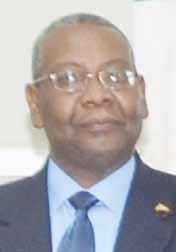
Rohee holds frank talk with police officers
In light of the damning allegations of police torture and other abuses, Home Affairs Minister Clement Rohee on Saturday held what was described as an open and sincere discussion with senior officers of the Guyana Police Force.
The meeting with Police Commissioner Leroy Brumell, all divisional commanders and other officers, was aimed at reviewing the 71 recommendations for the improved working of the Guyana Police Force, which were compiled by the Disciplined Forces Commission of Inquiry in 2004.
According to a police statement, the highly interactive session was held at the Police Officers’ Training Centre, Eve Leary. Also par-
ticipating were Director of Public Prosecutions Bibi Shalimar Ali-Hack; Police Complaints Authority Chairman, retired Justice Cecil Kennard, and members of the civilian-based Strategic Management Department of the police force.
Intense discussions
“Intense discussions, in a sincere and open manner, were held with the view to analysing developments that had taken place within the force in terms of the implementation of the recommendations, and to garner additional recommended actions on the way forward,” the statement said. Rohee, the statement noted, highlighted the work of the Special Select Committee estab-
lished by Parliament, which reviewed the Disciplined Forces Commission report on the police force, with specific focus on its recommendations on implementing the advised changes, which were taken on board during the discussions.
During the presentation by the force, and arising from the interactions, a high level of appreciation was expressed for the work already done in effectuating most of the 71 recommendations. The Guyana Police Force is presently compiling a working document, inclusive of all the applicable recommendations made during the one-day session, in keeping with its thrust to ensure that the Disciplined Forces Commission’s recommendations are implemented.
LIAT denies plane lease deal with PM Gonsalves
LIAT on Tuesday evening moved quickly to refute allegations that St Vincent and the Grenadines Prime Minister Ralph Gonsalves owns two of the aircraft leased to the regional airline.
In a post on the Barbados Free Press online blog, “American Airlines pilot Skyhigh” claimed that Gonsalves owns the deHavilland/Bombardier Dash 8 300 Series planes carrying registration V2-LGI and V2GG respectively. The blogger said a conflict of interest arises because St Vincent and the Grenadines is one of the major shareholders in LIAT, so government funds are involved and Prime Minister Gonsalves is heavily involved in decisionmaking about the airline.
“If the airline pays more for leasing, Gonsalves makes more money personally, but his fellow citizens are subsidising the airline and putting tax dollars in Gonsalves’ pockets…,” the blog stated.
However, in a swift response, LIAT said it has taken note of the post, dated January 17, 2014, entitled “Report of Conflict of Interest: Saint Vincent PM Ralph Gonsalves said to own 2 LIAT aircraft”.
According to LIAT, the two aircraft mentioned are owned by a publicly-listed
U.S.-based leasing company trading on the New York Stock Exchange (NYSE). “LIAT has always had arms-length negotiations with this lessor and its relationship with this lessor is firmly set on a commercial basis. LIAT has no aircraft leases with Prime Minister Gonsalves or any shareholder of the company and categorically denies the suggestion that the prime minister has anything to do with the leasing of aircraft to LIAT. LIAT views conflict of interest very seriously and abides by principles of good corporate governance.”
The airline said it supports freedom of the press for all media and the highest standards of journalism,
which include the verification of sources and information obtained. “At no time was LIAT requested to comment on the allegation before the publication of the anonymous blog.”
Acting Chief Executive Officer (CEO) Julie ReiferJones noted that: “These statements are reckless and mischievous. Such reports negatively impact the travelling public, our Caribbean Community constituents, and the staff of our airline. LIAT distances itself from these unverified reports, and remains committed to channelling our energies into our modernisation programme and to putting LIAT on a profitable footing”.
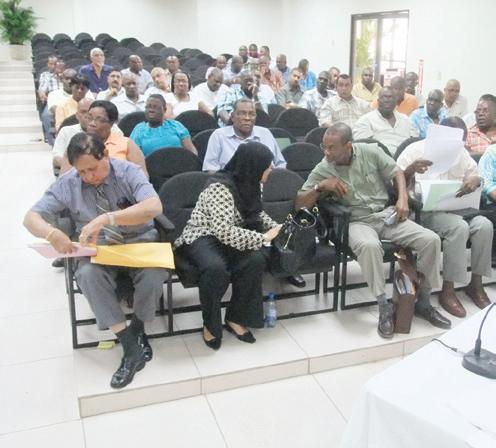
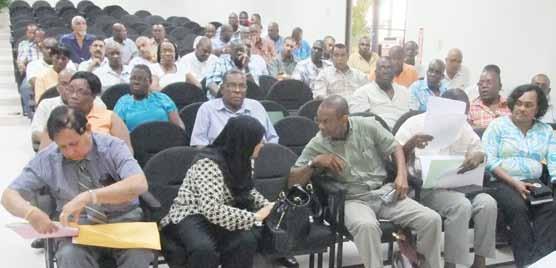
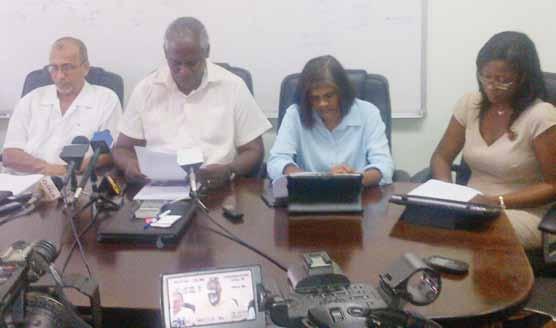
A section of the gathering at the discussion session
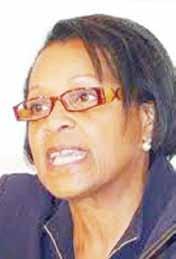
Acting LIAT CEO
Julie Reifer-Jones
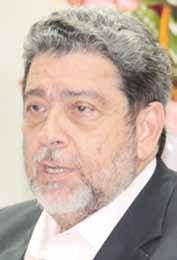
St Vincent and the Grenadines Prime Minister
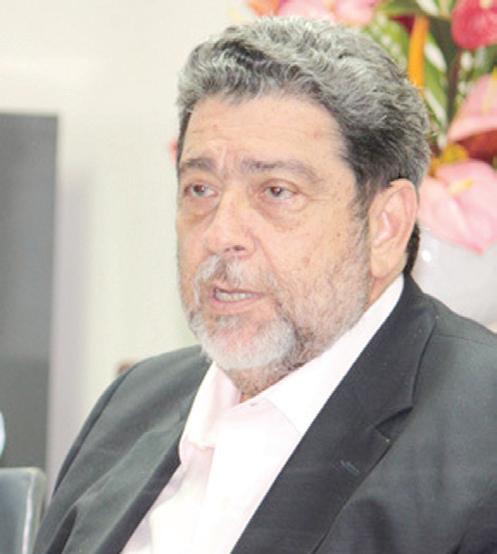
Ralph Gonsalves
thursday, january 23, 2014
CDC trains Region Nine volunteers in disaster risk management
TJanuary 16-17, the volunteers were also trained to conduct Damage Assessment and Needs Analysis (DANA), during the three stages of a disaster – before, during, and after. Emphasis was placed particularly on the DANA process and mechanism, data gathering, and teamwork. CDC Operations/ Training Officer, Major Kester R Craig and Captain Welcome were the facilitators of this workshop.
Handing over
The CDC also handed over the Cuban Model Risk Reduction Management Centre (RRMC) to the Region Nine Democratic Council.
hance Region Nine’s disaster risk management capacity, allowing for the early detection of hazard impact and proactive management of systems to reduce risk.
The training, which was held from January 13-15 in Lethem, was facilitated by Captain Sean F Welcome from the CDC operations/ training department. In a release, the organisa-
he Civil Defence Commission (CDC), with support from the United Nations Development Programme (UNDP), recently conducted Community Based-Disaster Risk Management (CBDRM) training with members of the Region Nine branch of its Volunteer Corps.
tion said the workshop was geared towards building capacity at the community level, by equipping the 16 participants with the knowledge to undertake CBDRM. Participants were taught how to conduct community profiling; disaster risk as-
sessment; disaster risk reduction (DRR) planning; Comprehensive Disaster Management (CDM); CBDRM project implementation; and project monitoring and evaluation among other skills.
During the period
The RRMC was officially handed over to Region Nine Chairman Wilson Lorentino by Major Craig. This centre is equipped with the necessary resources (computers, GIS software, database, communication equipment, office furnishing and supplies, maps, charts, etc) needed for its efficient functioning. The RRMC will en-
Having volunteers with knowledge of both CBDRM and DANA will serve to complement the efficient operations of the RRMC, as they will be the persons integrally involved in its operations. The volunteers hail from Lethem (Central Rupununi); Sand Creek (South Central Rupununi); Massara (North Rupununi); and Mickey’s Landing (South Pakaraimas), the early warning points for the RRMC. Volunteers from St Ignatius and Tabatinga were also trained. All the volunteers are now required to return to their communities and conduct both CBDRM and DANA related activities. Data gathered through these activities will be filtered to the RRMC for processing and implementation into the risk reduction mechanisms.
Universal Sports Store burglarised again
Abusinessman is cautiously optimistic that the police will apprehend the perpetrators of a robbery committed on his sports store in Alberttown on Saturday morning.
Andrew Budhan, the frustrated proprietor of Universal Sports Store at Lot 151 Second Street, Alberttown, Georgetown, is calling on the Guyana Police Force to conduct a proper investigation into the recent robbery committed on his business.
Budhan resides in the upper flat of the building that houses the store, so he believes that those who committed the act had to have known his every move. “I normally be home, but on Friday, people in the area had to see me packing a vehicle to go into the interior with my brother…
so when I left, it gave them time to commit the act.”
He added that he was surprised that no one in the area saw or heard anything strange. The businessman explained that the thieves would have had to gain access to the store through a window that is fully grilled after scaling his fence.
“Once that window opened, they took sticks to get out the clothes that were on hangers… They had to be making a lot of noise… from all indications, they pulled the racks close to the window and it had to be more than one person,” he related. The perpetrators then left the clothes hangers in the backyard.
The robbery has caused Budhan to re-examine his security arrangements. He will now install cameras at strategic locations and
make his fence higher, especially the back portion.
Foot-dragging
Budhan said this is not the first robbery of his store, and accused the police of dragging their feet.
He explained that he started his business seven years ago in Fifth Street, Alberttown, but was forced
to relocate after a few years following several burglaries and armed robberies. In all that time, he said, only two persons were arrested after goods were found in their possession, but they were subsequently released. Today, they are still seen around his business place quite frequently.
He also slammed the
Guyana Police Force for the slothfulness of their current investigation. He said he has been “running” to the police station, to get an update on the robbery, but instead of getting information, he is being treated like a bandit.
He added that he spoke with the officer who is dealing with the matter, but
she did not divulge any information, so he left in frustration. Budhan said he has several leads that may assist the police in solving the matter, but they did not seem interested in hearing any.
He is calling for higher authorities to look into the matter in the hope that justice can be served.
Civil Defence Commission (CDC) Operations/Training Officer Major Kester Craig (left) with the CDC Region Nine Volunteer Corps after its formation in November 2013
Universal Sports Store
Regional Venezuela announces changes to foreign currency system
The current currency controls were introduced in the middle of an economic and political crisis 10 years ago
Venezuela has announced measures to address its foreign currency crisis and boost the economy. Oil
Minister Rafael Ramirez says Venezuelans travelling abroad will no longer be allowed to obtain foreign exchange at the official rate of 6.3 bolivars per U.S. dollar. They will have to pay a higher rate, determined by weekly currency auctions. The official rate will be used only for essential goods, such as medicine, in-
dustrial supplies and food.
“The big discussion here is whether we give dollars to travellers or we import food,” said Ramirez. The weekly dollar auctions will be increased to US$220 million (£132 million) a week to benefit private companies that have been struggling to import raw materials and other supplies. Ramirez, who is also the president of state-owned oil company PDVSA, promised to unveil further details of the new multi-tier currency system. Despite its
oil wealth, Venezuela has faced a shortage of staple goods, such as sugar, cooking oil and toilet paper.
Many businessmen say the shortages are due to the mismanagement of the economy, including the tough currency controls introduced in 2003 by the late president, Hugo Chávez. But his successor President Nicolas Maduro has repeatedly accused “unscrupulous businessmen” of manufacturing the crisis to undermine his left-wing policies.
(Excerpt from BBC News)
Opposition MPs in St Lucia vote for new leader
Four of the six opposition members of parliament in Saint Lucia voted on Monday to remove Stephenson King as official leader of the parliamentary opposition and replace him with Dr Gale Rigobert, one of the deputy leaders of the opposition United Workers Party (UWP).
Rigobert represents the Micoud North constituency in the House of Assembly, winning the seat in the 2011 general election. She was formerly a member of the Saint Lucian Senate and a former lecturer at the University of the West Indies.
Formal notification of the vote has been sent to Governor General Dame Pearlette Louisy, signed by Rigobert and three other members of parliament: Arsene James, Guy Joseph and Edmund Estephane.
Section 67 of the Saint Lucia constitution provides that the governor-general shall appoint as leader of the opposition the member of the House who appears most likely to command the support of a majority of the members of the House who do not support the government.
If it appears to the governor-general that the leader of the opposition is no longer able to command the support of a majority of the members of the House who do not support the government, the governor-general shall remove the leader of the opposition from office. (Excerpt from Caribbean News Now)
Head of global anti-corruption rating agency to open Cayman Islands ethics conference
At least two Caribbean prime ministers are scheduled to attend the University College of the Cayman Islands’ Caribbean ethics and values conference in March. The head of the organisation that rates governments worldwide on anti-corruption will open the fourth such conference organised by the University College of the Cayman Islands (UCCI), this time on the theme of ethics, values, trust, and morality.
Heads of government expected to attend are Perry
Christie, prime minister of The Bahamas, who will speak on the ethical and anti-corruption framework of The Bahamas; and Dr Ralph Gonsalves, prime minister of St Vincent and the Grenadines, who will reflect on the state of corruption in the Caribbean as a whole.
Dr Huguette Labelle, the chair of the board of Transparency International, an organisation that works in more than 100 countries in the fight against corruption, will speak at the opening ceremony. Each year,
Transparency International scores countries worldwide on a corruption perceptions index regarding how corrupt their public sectors are seen to be.
In addition to the corruption perceptions index, the organisation’s surveys include the “global corruption barometer,” the only worldwide public survey on views and experiences on corruption, and a “bribe players barometer,” rating the wealthiest nations by their firms’ propensity to bribe abroad.
(Excerpt from Caribbean News Now)
Huge increase in heart attacks, strokes and diabetes predicted as obesity quadruples
A“huge increase” in heart attacks, strokes and diabetes has been predicted in an Overseas Development Institute (ODI) report that states that the number of overweight and obese adults in the developing world has almost quadrupled to around one billion since 1980.
The British think tank said one in three people worldwide is now overweight and urged governments to take steps to influence diets. While the
percentage of adults who were overweight or obese swelled from 23-34 per cent globally between 1980 and 2008, most of this increase occurred in the developing world, especially in countries like Mexico where incomes were rising.
This is due to changing diets and a shift from eating cereals and grains to the consumption of more oils, fats, sugar and animal produce, according to the ODI’s Future Diets report.
In developing countries, 904 million people are now
classed as overweight or above, up from 250 million in 1980. This compares to 557 million in high-income countries. The researchers drew on data published in Population Health Metrics last year to examine changing overweight and obesity rates across world regions and by individual countries. North Africa, the Middle East, Latin America and the Caribbean saw increases in overweight and obesity rates swell to a level comparable with Europe at about 58 per cent. (Excerpt
There’s jail space for repeaters – AG Anand Ramlogan
Attorney General Anand Ramlogan says there is an eight-acre facility at Santa Rosa to keep all repeat offenders who will be denied bail for four months if the Bail Amendment Bill is approved. He was speaking during Wednesday’s presentation of the bill for debate in the Senate, Tower D, Waterfront Centre, Port of Spain. It requires the votes of at least four Independent senators. It was passed with the required threefifths majority vote in the House of Representatives last Friday.
Ramlogan, who spoke for an hour, said the crime rate would escalate if noth -
Bermuda
ing was done now to address it and the legislation
was intended to put repeat offenders in prison for at least four months. “The intention of this measure is to remove the bandits, rapists, arsonists from the streets and put them behind bars,” he said.
He said during a visit last Sunday to the Eastern Correctional and Rehabilitation Facility, Santa Rosa, Arima, he saw about 100 men on benches watching a movie, the cells were spacious and inmates were able to exercise and they planted barbadine and other fruit trees in the backyard. Ramlogan said the capacity was for over 400 prisoners and there were only 136 there. (Excerpt from Trinidad Guardian)
govt and opposition differ on ways to decriminalise ganja
Government and opposition legislators appear to be adopting differing positions with regards to the decriminalisation of marijuana. National Security Minister Michael Dunkley said the proposal contained in the proposed Misuse of Drugs Amendment Act 2014, which the opposition Progressive Labour Party (PLP) is not likely to find support from government legislators. According to the amendment being proposed by the
PLP at the upcoming parliamentary session, possession of up to 20 grams of cannabis will be decriminalised.
But Dunkley, who is also Deputy Premier, has dismissed the proposal as “reckless and not thought through.
“The average cannabis cigarette contains about half a gram of cannabis. If the PLP’s Bill became law, it would be legal for someone to possess 40 joints. This is outrageous and I refuse to believe that this is supported by the people of Bermuda.
“For collaboration to be useful it must make sense and be reflective of reality and best practice. This is no more than pandering by the opposition and it fails both tests from the outset,” he added. But PLP legislator, Marc Daniels, speaking at a news conference, has disagreed with plans by the government to establish a task force to examine the merits and demerits of decriminalising the use of marijuana. (Excerpt from Jamaica Observer)
Cuban residents trained to rebuild homes destroyed by hurricanes
In the space of 10 days in 2008, Cuba was hit by two of the most powerful storms in its history, causing US$9.7 billion of damage to homes and infrastructure from which it is still recovering. Worst affected was the western province of Pinar del Rio. Hurricane Gustav arrived with such force that it wiped out whole villages. Wind speeds reached 211mph, which was thought to be a world record un-
til the recent typhoon in the Philippines. Just over a week later Hurricane Ike brought torrential rains, which flooded low-lying areas and wiped out crops. In total, 82,000 homes in the province were destroyed or badly damaged.
Cubans are well trained to protect themselves from hurricanes by talking shelter so there were few deaths. One couple created a refuge under their kitchen table but saw their apparently strong roof of fibre-cement panels com-
pletely blown away. They said the scene next morning was like a cemetery. A neighbour’s house had disappeared, leaving only the floor intact; on it stood the family’s sole remaining possession, their fridge. Misael Avila, his partner Dailin and their young child had a wooden house in the small town of San Andrés. When they returned on the morning after the first storm, their house and about 30 others not resistant to winds had been destroyed.
(Excerpt from The Guardian)
Attorney General Anand Ramlogan
Stephenson King and Dr Gale Rigobert
Syrian rivals exchange blame in Geneva talks
Syria’s government and opposition, meeting for the first time, vented their mutual hostility at a United Nations peace conference where world powers also offered sharply differing views on forcing out President Bashar al-Assad.
Syrian Information Minister Omran al-Zoabi said on Wednesday that President al-Assad will not step down, as demanded by some of the international powers seeking to end the country’s protracted conflict.
“Assad isn’t going,” Omran al-Zoabi told journalists on the sidelines of the UN-sponsored faceto-face peace talks in the Swiss resort of Montreux.
Syrian Foreign Minister Walid Muallem, who heads President Bashar al-Assad’s delegation, and Ahmed
Jabra, president of the opposition Syrian National Coalition, exchanged accusations of treason and terrorism, each holding the other responsible for the violence that has killed more
Australia rejects claims that navy mistreated asylum seekers
Australia on Wednesday rejected claims by a group of asylum seekers that they were beaten and suffered burns while being returned to Indonesia by the Australian navy under a policy that has strained ties between the countries.
The Australian Broadcasting Corporation (ABC) on Tuesday aired video of asylum seekers getting treatment for burns they said were caused by navy personnel forcing them to hold onto hot pipes coming out of their boat’s engine while it was being towed back to Indonesian waters.
Immigration Minister Scott Morrison lashed out at the media for reporting what he called “unsubstantiated allegations” and said that he would conduct no investigation into the incident as he accepted the word of navy
personnel.
“The Australian government is not going to put up with people sledging (verbally abusing) the Australian navy,” he told reporters in Sydney. “I’ve been given assurances about their conduct and I believe those assurances because I believe in those individuals.”
Indonesian police confirmed that a group of asylum seekers had required treatment for severe burns on their hands after they were picked up in Indonesian waters on January 6.
“I received a report from police in Kupang that they said they were burned because they were forced to hold on to the boat engine,” said Agus Barnas, spokesman for the coordinating ministry of legal, political and security affairs. (Excerpt from Reuters)
than 130,000 people and displaced millions more.
Muallem, who urged the international community to not interfere in internal affairs, said “whoever wants to speak for the
Syrian people must not be a traitor”, referring to opposition groups that have been battling the regime in demand for more rights and freedoms.
“They claim to represent the Syrian people. If you want to speak in the name of the Syrian people, you should not be traitors to the Syrian people, agents in the pay of enemies of the Syrian people,” he said.
In response, Jabra said the opposition Syrian Free Army is “battling international mercenaries” brought in by Assad, naming Lebanese Hezbollah and alQaeda-linked Islamic State in Iraq and Levant.
“We are facing the terrorism of Assad who claims to be fighting terrorism,” Jabra said, accusing the regime of killing 10,000 children since the war broke out in 2011. (Excerpt from Al Jazeera)
Olympic committees receive Sochi threats
The German Olympic Committee said it has received emails threatening attacks at the upcoming Winter Olympics in Sochi, similar to letters and emails received by its Hungarian, Slovenian, and Italian counterparts.
“We take all tips on security questions seriously and are in close contact with the relevant German authorities,” committee spokesperson, Christian Klaue, said.
The Hungarian Olympic Committee (HOC) said that the letter they received, which threatened the country’s athletes, had been analysed and declared nonthreatening.
HOC International Relations Director Zsigmond Nagy told the Reuters news agency in an interview that the letter was sent to
Japan-China tensions take centre-stage with Abe in Davos
Tensions between Tokyo and Beijing took centre-stage at the World Economic Forum in Davos on Wednesday as Japan’s prime minister called for military restraint in Asia and a senior Chinese academic branded him a troublemaker.
Prime Minister Shinzo Abe defended his visit to a controversial shrine to Japan’s war dead, which outraged China and South Korea, and took a veiled swipe at China’s military build-up in his speech to global business leaders.
Sino-Japanese ties, long coloured by what Beijing considers Tokyo’s failure to atone for its occupation of parts of China before and during World War Two, have deteriorated in the past two years over a territorial dispute, Abe’s visit to a shrine that critics say glorifies Japan’s wartime past, and a new Chinese air-defence zone.
Asia’s two biggest powers each accuse the other
the International Olympic Committee and the Russian organising committee, which had assessed it.
“Both the IOC and the Sochi organising committee... officially declared after the analysis of the letter that this threat is not real, and this person has been sending all kinds of messages to many members of the Olympic family,” Nagy said.
The Italian Olympic Committee also reported it has received an email containing “terrorist threats” regarding the Games.
“The Olympic Committee has sent the contents of the email to the authorities in charge of security,” the body said in a statement.
The Slovenian Olympic Committee said it had translated a letter it received and forwarded it to the police (Al Jazeera)
Ukraine opposition say they’ll brave bullets after talks with Yanukovich fail
Ukrainian opposition leaders emerged from crisis talks with President Viktor Yanukovich on Wednesday saying he had failed to give concrete answers to their demands, and told their supporters on the streets to prepare for a police offensive.
Using emotional language following the deaths earlier in the day of at least three protesters – two of them from gunshot wounds – the three opposition leaders who met Yanukovich said they were ready to face police bullets.
Boxer-turned-politician Vitaly Klitschko told the thousands of protesters gathered on Kiev’s
Independence Square that during three hours of talks, the president had given no clear response to their demands that the government be dismissed and sweeping anti-protest laws ditched.
“Today they (the po-
lice) are preparing to clear us out of the ‘Maidan’ (Independence Square),” Klitschko declared.
“We must do all we can to stop them clearing us out,” he said.
He urged people to stay
overnight and defend the square in central Kiev, and drew a roar of support from protesters when he declared: “If I have to go (on to the streets) under bullets, I shall go there under bullets.
“Tomorrow if the president does not respond... then we will go on the offensive,” he said.
Former economy minister Arseny Yatsenyuk echoed his words, and referred to the overnight shooting deaths which the opposition has blamed on police despite official denials. A third man died after plunging from the top of Dynamo football stadium while fighting with police.
(Excerpt from Reuters)
of bellicosity. Strategic experts in Davos said their tensions posed the biggest risk of conflict around the world in 2014, along with hostility between Iran and Saudi Arabia.
“We must... restrain military expansion in Asia, which could otherwise go unchecked,” Abe, the first Japanese leader to give the keynote address, said in a speech dominated by a defence of expansionary economic policies dubbed Abenomics.
“The dividend of growth must not be wasted on military expansion,” he said.
“We must use it to invest in innovation and human capital, which will further boost growth in the region.” Abe is pursuing a more assertive military and national security policy, such as moving towards approving the use of force to help allies under attack and calling for debate on revising Japan’s pacifist postwar constitution. (Excerpt from Reuters)
Indian foreign minister and Kerry discuss diplomatic row
The United States and India could soon reschedule a visit by the U.S. energy secretary that was cancelled because of a diplomatic row, New Delhi said in a statement after Foreign Minister Salman Khurshid met his counterpart John Kerry.
“Both sides looked forward to the early realisation of the mutually-agreed calendar of bilateral exchanges,” India’s Foreign Ministry said in a statement after the two men met in Montreux on the sidelines of a conference about Syria.
The statement mentioned a visit by Ernest Moniz, the U.S. energy secretary, who postponed the trip earlier this month because of a dispute over the arrest and strip search of an Indian diplomat in New York on charges of visa fraud and lying about how much she paid her house-
keeper.
The meeting, on Wednesday, was the highest level exchange since the spat. In December, Kerry expressed regret for the incident in a phone call to India’s national security adviser. He also tried to call Khurshid, but could not reach him.
No firm timeline was given for the trip to India by Moniz, or other outstanding visits.
The argument plunged ties between the friendly nations to the lowest point in 16 years before a deal was struck and the diplomat, Devyani Khobragade, returned to India.
Relations have still not returned to normal, and Khurshid made a point of questioning Kerry about the use of visas reserved for human trafficking cases to evacuate the housekeeper’s husband and children from India. (Excerpt from Reuters)
UN Secretary General Ban Ki-moon (centre) sits beside UN-Arab League envoy for Syria Lakhdar Brahimi (left) as he addresses a news conference after the Geneva-2 peace talks in Montreux, January 22
U.S. Secretary of State John Kerry holds a news conference in Montreux on January 22
Riot police officers look out from an armoured vehicle during clashes with pro-European protesters in Kiev, January 22
Caribbean rum to make greater strides in U.S.
There might be a window of opportunity for Caribbean rum products to make greater strides within the United States market.
Barbados Industry Minister, Donville Inniss, disclosed “that as recently as last November”, he lobbied before the U.S. Congress on behalf of local rum manufacturers to “level the playing field”, as the rum industry has been under immense pressure due to the
high level of taxes imposed on their items going into the United States.
He said this was further compounded by the fact that the U.S. administration provides a subsidy to the industry which they call a ‘cover over’, where U.S. rum manufacturers, in particular Puerto Rico and the U.S. Virgin Islands, receive a high level of subsidies, thus placing local rum products at a disadvantage.
Speaking at phase two of
the Rums of Barbados Master Mix Competition on Monday morning, Inniss stated that “in order to achieve this it means that we must [always] have products that are export ready”.
He said: “… It means that greater attention must not only go to what is in the bottles, the quality of the rum therein but also the style of the bottles, the labelling, all of those things that capture the eye readily...”
(Caribbean News Now)
North America
Caribbean Asia
Bank of Canada leaves door open to rate cut; Canadian dollar sinks
The Bank of Canada signalled on Wednesday it is more concerned about weak inflation than it was three months ago and said a “strong” currency is still hampering the country’s exports, helping send the Canadian dollar to a four-year low.
The central bank held its main interest rate at 1.0 per cent, as expected, and explicitly stated that its next move on interest rates could be ei-
ther down or up, depending on how economic data unfolds.
“Although the fundamental drivers of growth and future inflation appear to be strengthening, inflation is expected to remain well below target for some time and therefore the downside risks to inflation have grown in importance,” the bank said in a statement.
“The timing and direction of the next change to the poli-
cy rate will depend on how the new information influences the balance of risks,” it added, acknowledging the possibility of easing monetary policy.
Governor Stephen Poloz had said in a previous news conference that the bank’s stance was neutral and that this meant that rates could fall as easily as rise, but such language had not been put into the bank’s official rate statement until now. (MSN)
Africa
South Africa: Chamber of Mines takes Amcu to court
The Chamber of Mines seeks damages in the Johannesburg Labour Court against the union Amcu over its intention to strike in the gold sector. The Association of Mineworkers and Construction Union (Amcu) issued strike notices to employers in the platinum and gold sectors on Monday.
It is demanding an entry-level monthly salary of R12,500. Chamber spokeswoman Charmane Russell said it
believed the strike was illegal, and that it would seek damages because a “peace clause” in an agreement signed last year prevented Amcu from striking.
“The issue of conditions of employment has been settled for the duration of the agreement, and no demands may be made during the course of the agreement,” she said in a statement on Monday.
The two-tier wage agreement was concluded with the National Union of
Mineworkers, Uasa and Solidarity, which represent 72 per cent of workers in the gold sector. Amcu, which did not accept the agreement, represented 17 per cent of workers at the time of the negotiations. It was the dominant union in the platinum sector.
“The September 2013 agreement was made applicable to all employees who form part of the bargaining unit, irrespective of trade union affiliation,” Russell said. (allAfrica)
Samsung ‘infringed’ Apple’s autocomplete text patent
AU.S. judge has ruled that Samsung infringed Apple’s patent-protected word recommendation technology. The invention describes a way for touchscreen devices to suggest completed words after a user has part-typed them to speed up text input. Experts say the ruling could have implications for other Android devices that offer the facility. The judgement comes ahead
Middle East Europe
UK unemployment rate drops to 7.1 per cent
The UK unemployment rate has dropped to 7.1 per cent, close to the point at which the Bank of England has said it will consider raising interest rates. The number of people out of work fell by 167,000 to 2.32 million in the three months to November, the Office for National Statistics (ONS) said. The ONS also said the number of people claiming Jobseeker’s Allowance fell by 24,000 to 1.25 million in
December. The issue dominated Prime Minister’s Questions in the House of Commons. Labour party leader Ed Miliband said: “We welcome the fall in unemployment because whenever an individual gets back into work, it’s good for them and good for their family.”
But he argued that average wages were £1600 a year lower than they were in the general election year of 2010, meaning that many families were worse off.
Thirteen million people in Britain are living in poverty, he claimed, often within working families.
Prime Minister David Cameron said the figures showed “youth unemployment coming down, long-term unemployment coming down, the claimant count coming down”.
It was “the biggest ever quarterly increase in the number of people in work in our country,” he said. (BBC News)
of a trial in which both firms plan to claim the other copied several of their features.
Judge Lucy Koh – who presided over a previous dispute between the two companies in 2012 – also denied Samsung the opportunity to claim Apple had infringed one of its synchronisation technologies on the basis that the South Korean firm was not the first to register the idea.
This means that when the
case comes to court on March 31, Apple is set to allege five cases of patent infringement – one of which has already been secured – and Samsung will claim four cases. News of the decision was first reported by patent consultant Florian Mueller, who has published the summary judgement in full. Apple’s auto-complete patent was first filed in January 2007, days before Steve Jobs unveiled the firm’s first iPhone. (BBC News)
Qatar firm inks deal for 15 Agusta Westland helicopters
Gulf Helicopters has ordered 15 AW189 helicopters with Finmeccanica’s AgustaWestland, it was reported. Under the contract, signed in Qatar, the first two aircraft are planned to be delivered in 2014 with all helicopters expected to be in operation in 2017.
Energy and Industry
Minister and chairman of Gulf Helicopters parent company Gulf International Services, Mohamed bin Saleh Al Sada Al Sada, said the contract was the latest phase in a partnership dating to 2007, Qatar’s The Peninsula newspaper reported.
“Gulf Helicopters has also been appointed by AgustaWestland as an Authorised Service Centre for maintaining the existing AW139 helicopters manufactured by the company, and it is also the first and only company in the world to be classified as a helicopter operator with an Authorised Training Centre in the Middle East for the AW139 in accordance with AgustaWestland standards,” he said. (Arabianbusiness)
Types of small business loans
ALines of credit
different type of lending is done through a line of credit. Just like you can tap the equity in your home to finance a purchase, a bank can lend against the value of something in your business as collateral to help finance your operations. Lines of credit are usually more fluid since you may not need to use the maximum of what you are allowed to borrow.
Factoring
Accounts receivable factoring is an interesting type of lending where the factoring company buys your accounts receivable amounts and proceeds to collect on them in the future under the
normal terms. You could sell your accounts receivable for 97 per cent of their value, and the factoring company earns the three per cent as they are paid by the customers that owe you money.
Factoring is a different way of going about getting access to capital, but it can be quite costly with your AR being worth anywhere from 95 per cent to 98 per cent of its value in a month. When you add up the discount the factoring company gets over a year, the “interest” you are paying is quite high.
Small business administration loans
The Small Business Administration was created
Business concept – Concept
to help foster the creation and growth of small businesses in the United States. If you are unable to qualify for loans through traditional banking means, the SBA may be able to help you through one of their three loan programmes. The three programmes are the 7(a) loan programme, the Microloan programme, and the CDC/504 loan programme. A 7(a) loan programme has very specific requirements and is designed to help only in certain instances such as a business in a rural area or to streamline the loan process for active duty or veteran service members. (Business Dictionary)
Advertising: A briefly stated clear idea around which an ad or marketing campaign is organised. Product development: A clear, detailed description of the attributes and benefits of a new product that addresses the needs of the targeted customers. The reasoning behind an idea, strategy, or proposal with particular emphasis placed on the benefits brought on by that idea. Examples of concepts include the design for a new automobile or the pitch behind an advertising campaign.
Heightened surveillance for Ogle airport – Minister Benn
With over 50,000 people travelling out of the Ogle International Airport (OIA) on an annual basis and over 130 flights plying the facility daily, Transport Minister Robeson Benn on Wednesday underscored the need for heightened surveillance at the port of entry.
His comments came in light of the recent crash that claimed the lives of a pilot and a cargo loader after a Trans Guyana Cessna Caravan fell out of the sky.
Benn added that quite recently, there have been concerns with a number of aircraft incidents and mishaps, including that which occurred two weeks ago when a passenger flight crashed while taking off at the OIA.
The minister stated that the ministry has been discussing additional measures and oversights to improve the level of surveillance with respect to aircraft operations.
“We have much more activity and the system has been responding to the increase level of activity and responding to the level of efforts which is needed to manage the overall system.” He said his ministry is reassessing and reviewing the overall system, and has assured members of the
public, especially those who fly to and from the interior, that efforts will be made to ensure safer aircraft operations.
The minister added that one of the issues is to determine whether operators are following the standard prescribed measures while loading a plane.
He said sometimes the shuttle operation on the coast and in interior locations leaves much to be desired.
Benn further explained that this will require inspections in the operational area and at the OIA, which has happened from time to time. Recently, he added that there have been discussions to have a higher frequency of these inspections, both on the coast and in the interior.
“This is not to prejudge what might have happened in this case but we have some concerns which the operators are aware of and are being looked at presently,” he said.
Investigations
Nevertheless, he added that in keeping with protocol and procedures for accident investigations, Guyana Civil Aviation Authority (GCAA) investigators have identified and commenced the interviewing of material
witnesses, and are gathering the necessary documentary and photographic evidence on site for analysis.
The GCAA, he added is in contact with Transport Canada, the National Transportation Safety Board (NTSB), the Caribbean Aviation Safety and Security Oversight System (CASSOS), the Civil Aviation Safety Authority Suriname (CASAS), Cessna, the aircraft manufacturer and the engine manufacturer Pratt and Whitney.
The abovementioned entities have all indicated their willingness to provide assistance the GCAA may need to carry out their investigations into the cause of the crash. The Canada
Safety Board has already accredited an inspector to investigate the accident.
The GCAA is continuing its investigations and is processing the evidence at the site. It will soon remove the necessary components of the aircraft for further analysis. These, obviously will have to be flown to the manufacturers.
GCAA Director Zulficar Mohamed explained that there are some concerns with respect to the Emergency Locator Transmitter (ELT)
onboard the aircraft when it crashed as for some reason it did not go off.
He added that there have been some changes to the type of ELTs being used, but in this case, he added that once the investigators start their probe, they will have to ascertain whether or not the transmitter was functional.
“If the investigations proved that it was not functional, it will be sent to the manufactures for inspec-
tions,” Mohamed added.
On guard
Mohamed stated that currently the area is accessible only by helicopter, and the site is being guarded by members of the Guyana Defence Force Special Squad to ensure there is no tampering of evidence.
He also disclosed that there is no reason at this time to suggest that the plane was overweight since it was earlier stated that the there were seven fuel drums onboard which weighed at least 2800 pounds. The stipulated weight is less than 3000 pounds, this newspaper understands.
With respect to the time to complete the probe, Mohamed stated that the investigation is dependent on how quickly they can acquire the necessary information, pointing out that in this case, the engine will have to be stripped from the wreckage and transported to Canada under the keen watch of the Canada Safety and Transport Board.
On Saturday last, the Cessna Caravan with reg-
Time for a sea change in ocean management – FAO director-general
Major changes in how the planet’s marine resources are managed and used are needed to safeguard global food security and ensure the well-being of coastal and island countries, Food and Agriculture Organisation (FAO) Director General José Graziano da Silva told a group of high-level policymakers meeting at the organisation’s headquarters this week.
“We cannot keep using marine and aquatic resources as if they were endless. And we cannot keep using our oceans as a waste pool,” he said in remarks made at the Blue Economy Summit on January 19 to 20 at Abu Dhabi, attended by heads of state, environment and fisheries ministers, and other key stakeholders.
Serious threats to ocean health such as pollution, overfishing, and altered weather and rising sea levels resulting from climate change must be tackled in earnest – starting now – argued FAO’s chief executive. “The health of our planet itself, our health and food security,
depends on how we treat the blue world,” he said.
Time to act
On average, nearly 17 per cent of animal protein consumed worldwide comes from fisheries and aquaculture, and in many small island developing states the figure is much higher. At the same time, the livelihoods of 12 per cent of the world’s population depend on fisheries and aquaculture, mainly in the developing world. But 30 per cent of world fish stocks are estimated to be overexploited, depleted
or recovering from depletion, with economic losses in marine fisheries resulting from poor management, inefficiencies, and overfishing adding up to US$50 billion per year, FAO studies show.
And now climate change is posing new challenges to populations which rely on the oceans, by modifying the distribution and productivity of marine and freshwater species, affecting biological processes, and altering food webs. Weather changes due to climate change are also taking a toll on many oceanreliant communities, while the threat of rising sea levels is poised to have major impacts, in particular for small island developing states (SIDS).
Need for action
The last 30 years have seen some 80 different commitments on dealing with various ocean threats promulgated at the global level, Graziano da Silva noted, adding: “We not only need to commit, we need to act.”
The concept of a “blue economy”
that came out of the 2012 Rio+20 Conference will have an important role to play in achieving the post2015 global sustainable development goals, Graziano da Silva said during his remarks. The blue economy model emphasises conservation and sustainable management, based on the premise that healthy ocean ecosystems are more productive and represent the only way to ensure sustainable ocean-based economies. It also aims to ensure that small island developing states and developing world coastal states equitably benefit from their marine resources.
To support a shift to this new approach, the FAO is establishing a new Blue Growth Initiative, through which the organisation will assist countries in developing and implementing blue economy and growth agendas. The initiative will aim to foster partnerships and act as a catalyst for policy development, investment and innovation in support of food security, poverty reduction, and the sustainable management of aquatic resources.
istration number 8R-GHS crashed just after takeoff from Olive Creek, claiming the lives of Canadian pilot Blake Slater, 25, and cargo loader Dwayne Jacobs, 28.
The aircraft was at the time on a shuttle operation between Olive Creek and Imbaimadai, transporting fuel. The “Mayday” emergency call was broadcasted at approximately 10:56h on the day it went down; thus, an aerial search was immediately activated.
After 11 hours of search, the wreckage was located on Sunday in the Marikina Mountain by GDF Special Force officers. They were then inserted at a location some 1.2 miles from the wreckage and trekked on feet to the crash site. They were joined by another team on Monday and managed to find both Blake and Jacobs. The bodies were recovered on Tuesday morning and were flown to the city later that day. Now that the search and rescue operation has been concluded, the crash site is under control of the GCAA.
Jamaican woman found dead in city hotel
The lifeless body of a Jamaican woman was in the wee hours of Wednesday morning found in a city hotel. The dead woman identified as Ann Gardener, 31, is suspected to have been strangled to death. She was found by one of the housekeeping staff in her bed at the NY Car Wash and Guest House, located at Camp and Princes streets, Georgetown. Guyana Times understands that the woman and her partner checked in at the hotel about a week ago. The man was last seen leaving the premises on Tuesday evening and is suspected to have committed the act.
When contacts were made with the hotel on Wednesday, staff refused to speak with the media, claiming that they cannot divulge information on the incident. The matter is being investigated.
The wrecked Cessna Caravan at Olive Creek
Transport Minister Robeson Benn addressing the media on Wednesday at his office. He is flanked by top Guyana Civil Aviation Authority (GCAA) officials
Dead pilot, Blake Slater Dead cargo loader, Dwayne Jacobs
FAO Director General José Graziano da Silva
SUDOKU
You can’t trust anyone else to do your job correctly. If you wish to advance, you must show your worth to those with influence. Business trips are likely to be profitable.
Knowledge will be the defining feature of your future success. Take part in anything that will give you an edge over the competition. A romantic interest will develop swiftly.
Stop yourself before you overreact and do something you may regret. You will lack important details about a situation that is bothering you. Don’t make a hasty play.
Take advantage of any opportunity you have to travel today. If you can’t get away, content yourself with research. New information will help you plan your future.
(Aug. 23Sept. 22)
(July 23Aug. 22) (Feb. 20-March 20)
Look after any chronic health problems. Don’t cut corners with legal or financial concerns. Stay informed about any important matters and don’t allow stress to wear you down.
(March 21-April 19)
A relationship may preoccupy you today. Remain calm and try to be fun and lighthearted. You will be emotional, and it’s better to be positive, affectionate and devoted than upset.
(April 20-May 20)
Now is not the time to pause and reflect. Move forward and reach for your goals. Professional matters could work out in your favour if you make an effort.
(May 21June 20)
Decide what you need to do to update your image for the better. Socialising with someone who interests you romantically will have a positive outcome, but be careful not to move too fast.
Do whatever it takes to stay ahead of the curve. Concentrate on your work. Push your proposals forward without reservation.
(Sept. 23Oct. 23)
Don’t let conflicting feelings paralyse you. Make decisions that will eliminate interactions with people who are causing you grief. You are at a crossroads in your life.
(Oct. 24Nov. 22)
Limitations are evident. If you carry on with your current approach, you will lose your footing. Focus on friends and creative endeavours. Clandestine activities will blow up in your face today.
(Nov. 23Dec. 21)
You will need to accept help from a capable person. If you go it alone, you won’t get off the ground. This is not the time to rely exclusively on your own resources.
Peanuts
Calvin and Hobbes
arCHie
dilbert
YELLOW PAGES
thursday, January 23, 2014
Dentures provided in 72 hours from as low as $4500. Contact Dr B Stuart, 209B Charlotte St, Lacytown. Tel: 225-5034
Driving School
Shalom Driving School. Lot 2 Croal Street. Call 227-3835, 227-3869, 622-8162 and enjoy 20% discount
Two storey wooden building. Bayroot. Phone: 687-5653
Versailles, WBD: almost brand new five-bedroom house for sale, master room & all rooms self-contained with A/Cs & fans, open concept kitchen/dining/living room, large pantry, office/library room and powder room. Beautiful landscape and wrap around patio. Priced to sell - $75M. Phone: 592-624-8704, 592-684-9203, 592-220-7809.
EDUCATION
Music is fun! Register now and learn to play the Keyboard, Guitar, Drums and do Voice Training. Call Foundation 7 on 225-1151/617-4200.
Get your home or business spiritually clean to enhance good luck and prosperity. Telephone: 687-5653
Rice production boiled over in 2013
ha and in the late 1980s and early 1990s, yield was between two and three tonnes per ha.
Available: Fresh long-stemmed roses, fresh dried and silk floral
or 643-4740.
hEAlTh
Are you suffering from abnormal behaviors, addictions, stresses, or psychosomatic sickness? Feeling suicidal, low self-esteem, loneliness, unloved, anger, conflicts and relationship problems? For appointments call 592-621-0552 from12:00-18:00h Email: healthworldhc@gmail.com
family, class, immigration forms, embassy enquiries, appeals for refused cases, US green card lottery, business class waivers, pardons, etc. Get your visa approved. High success rate. Balwant Persaud & Associates. Certified Immigration Consultants, 68 Sixth Street, Alberttown, Georgetown (Between Cummings & Lights Sts) Tel: 225-1540, 622-8308, 655-3105. Email: balwantpersaud@yahoo.ca
Land for sale ½ Acre residential at
EXECUTIVE 2 STOREY BUILDING; 3 BEDROOMS WITH ALL MODERN CONVENIENCES. MEADOW BROOK GARDENS. CONTACT MR. NARINE ON 696-8230
Suriname Astrology Palmist and Djuka Healing, the most powerful spiritualist in the world, are you suffering from the following problems (any religion) love, marriage, family, health business, husband and wife relationship, property, court, children, promotion, visa, pregnancy, education, depression, job, sexual, jealousy, enemy, money, drinking ? Also you can have all evil forces destroyed such as black magic, witchcraft, voodoo, obeyah etc and give powerful protection. We also do upliftment for clearing of land, dredging operations strictly in the interior. For private and confidential service call 674-2112.
Dutch Spiritual work. Unite lovers, get rid of evil, enhance prosperity, good luck baths and charm bowu guards, etc. Phone: 220-0708, 6126417, 687-5653
Cleansing of spiritual problems of all kinds. Powerful Ifá protection against evil. Get help to overcome problems with love, relationships, legal, sexual, pregnancy, business, sickness, jobs, enemies, work, money. Call 592-690-1824 from 10:0016:00h Email:anew-life@live.com
JUST ARRIVED: TOP QUALITY RECONDITIONED VEHICLES; TOYOTA PREMIO; TOYOTA ALLION ; TOYOTA COROLLA AXIO; TOYOTA NOAH; SUZUKI SWIFT; MERCEDES BENZ C200 KOMPRESSOR; BMW 318I; COROLLA AE100 WAGON; HONDA CRV; LAND CRUISER( FULLY LOADED); MAZDA PROCEED; TOYOTA HILUX AWD EXTRA CAB PICKUPS- 3 RZ, 5L, SOLID DIFFERNTIAL; MITSUBISHI CANTER TRUCKS 3,3.5 TONS OPEN TRAY; 2 TONS 4WD; 3 TON DUMP TRUCK; NISSAN ATLAS 2 TON TRUCK. PRE-ORDER YOUR UNIT S EARLY AND GET THE BEST PRRICES. FULL AFTER SALES SERVICES AND FINANCING AVAILABLE. DEO MARAJ AUTO SALES, 2 CHIMNEY ROAD, CHATEAU MARGOT, ECD. PHONE : 624-0762, 220-5177. A NAME AND SERVICE YOU CAN TRUST.
Toyota Hilux 4x4 Extra cab pickup. Excellent condition, $3M. Phone: 649-0707 or 264-2682
The star performer in agriculture was clearly the rice industry in 2013, having scored a record-breaking production level, achieving the equivalent of more than 535,000 tonnes, a 27 per cent increase over the 2012 figure of 423,000 tonnes.
Production per regions stands as follow: Region Two (99,062 metric tonnes [mt]); Region Three (56,360mt); Region Four (24,972mt); Region Five (207,509mt); and Region Six (147,652mt). Again Region Five is the highest producing region.
This was the first time ever that a Caribbean country recorded more than 500,000 tonnes of rice in a calendar year. This also made Guyana one of the larger producers of rice in the Americas.
The success of the industry is an acknowledgment of the enthusiastic participation of the farmers of Guyana, both small and large. They persevered under difficult weather conditions, and learnt to work with climate change to successfully improve their yield and production. In 2013, farmers confronted the challenge of a drought and paddy bug infestation during the first crop and heavy rainfall in the second.
Farmers invested in improving the capacity in the industry by procuring more than 1000 tractors and 90
increased by 2269mt per day, while storage capacity increased by 27,678mt. Region Six, the region most deficient in storage capacity accounted for 16,965mt of this increase in storage, while significant investment were also made in Regions Two and Five. Guyana’s rice export for 2013 amounted to about 395,000 tonnes. Approximately, 58 per cent of the rice was exported to Venezuela with other significant buyers being Europe, Jamaica, Trinidad and Tobago and other Caribbean countries.
The government’s support to the industry was strong in 2013. When farmers faced high prices for urea, an important
More than 200,000 acres of land was under cultivation in 2013, making it also the first time, cultivation acreage exceeded 200,000. Yield overall was five tonnes per hectare (ha,) again, for the first time in Guyana’s history. In 2010, the yield was about four tonnes per
combines during the year. Millers continued their investment by building mills, and increasing drying and storage capacity for paddy. In 2013, the drying capacity across the country
commodity in their fertiliser regime for crop production, government invested approximately $400 million to procure urea from Venezuela and, worked in collaboration with the Rice Producers Association (RPA), and made it available to the farmers at about $5000 per bag.
As the first crop advanced, farmers were being charged between $7000 and $10,000 for a 48kg bag of urea. Such an intervention saved farmers more than $300 million per crop.
In addition, government also made other inputs into the industry to provide support to farmers. These included, the supply of pronto to farmers to combat the high levels of paddy bug, VAT exemption to farmers for tractors and spares, and investment in drainage and irrigation infrastructure among others, the Government Information Agency (GINA) said.
One unfurnished three-bedroom flat concrete house with concrete fence at Parfaite Harmonie. Call 231-0821
Rice being harvested in Region Five
Farmers inspecting their paddy
India down 2-0, lose No. 1 ranking
New Zealand pushed India off the No. 1 position in ODIs with another clinical performance although India’s middle order demanded that their bowlers stay at it till the end. Largely, though, the match followed the first ODI’s script. Jesse Ryder went bang bang for too brief a while, Kane Williamson and Ross Taylor scored fifties to set up a final assault, Corey Anderson nearly blasted the fastest ODI fifty too, India had a big chase at hand and were kept alive by Virat Kohli and MS Dhoni but New Zealand kept producing timely wickets to pull India back every time they brought some semblance of parity to the chase.
There was supreme synergy in New Zealand’s innings, cut down to 42 overs because of rain that arrived in the 34th over. When Martin Guptill took his time at the top, Jesse Ryder smacked 20 off 11, making sure New Zealand were under no pressure when the ball started gripping for spinners on a slow surface. Guptill overcame the slow start, and added 89 with Williamson in 15.3 overs. Williamson and Taylor then nicely set it up for big hitting, and when the rain arrived New Zealand had lost only two wickets, which meant they would get a big boost when the target would be readjusted. And then Anderson and Taylor went
berserk in a 74-run partnership in 4.4 overs. During that period that proved to be the difference in the end, Anderson scored 44 off 17, holing out when he went for the fifty off the 17th, and Taylor took 26 off 11. That brutal hitting was in direct contrast to the delightful batting of Williamson, who played the most difficult shot to play on a slow pitch, the backfoot drive on the up, with ease. He didn’t play shots that left mouths agape, but found all the small gaps on the field. When he was set for a century - he was in
the last game too - the rain arrived, and with only 8.4 overs to go on the comeback he perished trying to charge at Ravindra Jadeja in order to go over extra cover. This wasn’t exactly bad news for New Zealand. Williamson had batted superbly without violence, but now was some time for violence. And violence there was when Anderson and Taylor set themselves up to clear the short boundaries. Anderson hit a six over long-on, and two each over long-off and midwicket; Taylor preferred the gaps, hitting only seven fours
and no sixes. India pulled New Zealand back with only 23 in the last 3.2 overs, but like in the first ODI it turned out to be too little and too late. Especially with the way the opening exchange went after India had been asked to chase 297 in 42 overs. Kyle Mills, playing in the absence of Adam Milne, and Mitchell McClenaghan were spot on at the top of India’s innings. They bowled with skill and accuracy, and with no loose balls available India had crawled to 21 for 0 with two reprieves when Tim Southee showed up in the eighth over. By now Shikhar Dhawan had become desperate and was bowled to an ugly swipe. In Southee’s next, Rohit Sharma finally managed to get out, and the asking rate had already crossed eight. Kohli, though, seemed to be playing on a different plane from the moment he on-drove Southee past midon for four. This was an uncharacteristic innings, though. Usually Kohli manages to keep the risks to the minimum even when going at the kind of high strike rates he does. Here, with his team-mates stuck at the other ends and the asking rate shooting through the roof, he had to play lower-percentage cricket, premeditate a little, but somehow the shots kept coming off. In presence of Ajinkya Rahane, Kohli turned the lost match into a fight, but
that man McClenaghan came back again to dismiss Rahane with a sharp bouncer.
Dhoni promoted himself with 170 required in 18.2 overs, but soon saw Kohli get out to his aggression.
Suresh Raina and Dhoni kept the chase going, but Brendon McCullum kept attacking, bowling out his main bowlers one by one. It paid dividends when Mills got Raina in his ninth over
when most captains would have been worried about the fifth bowler’s three overs remaining out of the last six and the asking rate within the batsmen’s reach. The final blow, though, came with Anderson’s offcutter getting Dhoni to sky a catch with 40 required off 17. Further rain made sure India played only 41.3 overs in the chase, but by that time they had been well and truly beaten. (Cricinfo)
SCOREBOARD
New Zealand innings M Guptill c Mohamed Shami b Raina 44 J Ryder c Dhoni b Mohamed Shami 20
KWilliamson st Dhoni b Jadeja 77 R Taylor c Dhoni b Mohamed Shami 57 C Anderson c Dhawan b I Sharma 44
B McCullum c&b Mohamed Shami 0
L Ronchi not out 18
N McCullum b Kumar 1
K Mills not out 2
Extras: (lb 1, w 7) 8
Total: (for seven wickets; 42 overs) 271
Bowling: Kumar 7-1-431, Mohamed Shami 7-055-3, I Sharma 6-0-46-1, R Jadeja 8-046-1, V Kohli 2-0-12-0, R Ashwin 8-050-0, S Raina 4-0-18-1 Fall of wickets 1-25 (Ryder), 2-114 (Guptill), 3-174 (Williamson), 4-248 (Anderson), 5-250 (BB McCullum), 6-251 (Taylor), 7-252 (NL McCullum) India innings S Dhawan b Southee 12 R Sharma c Ronchi b Southee 20 V Kohli c sub (Devcich) b Southee 78 A Rahane c
Shami not out 1 I Sharma
Edwards responds to ‘Big Three’ criticism
Wally Edwards, the Cricket Australia chairman and a key figure in the drafting of a proposal to centralise power in world cricket with India and England, has broken his usual silence to defend the plan in the face of heavy criticism from the Federation of International Cricketers’ Associations (FICA).
Through FICA’s chairman Paul Marsh, the world’s cricketers have voiced their strong opposition to the proposed revamp of the ICC’s structure, declaring that it would only serve to strengthen India, England and Australia while weakening the rest.
Commonly preferring to work the back channels of cricket administration before speaking publicly, Edwards said he felt compelled to respond to FICA’s contention that the nations involved in drafting the proposal had defied their commitment to work in the best interests of the ICC by doing so.
“Traditionally, CA does not comment on ICC discussions it is about to have - we talk to other ICC nations across the table rather than via the media,”
Edwards said. “But we were today disappointed to see the Federation of International Cricketers’ Associations question whether CA and others have met their fiduciary duties as ICC members.
“Setting aside the fact that we are yet to discuss and vote, CA’s approach internationally is consistent with its approach at home where we have made significant strides improving the governance of Australian cricket. There will be a discussion in the next few days among the ICC’s full member nations about possible changes to how the ICC works.
“CA’s view going into that discussion is that we need to continue to promote international cricket competitions including the primacy of Test cricket, we need to improve global cricket leadership and we support that members should be working to promote the interest of the game as their priority.”
Edwards is the first chairman of the three nations tabling the proposal to speak publicly about it. Neither N Srinivasan of the BCCI nor Giles Clarke of the ECB have
been prepared to talk about the proposal or its implications, preferring to wait until the raft of changes are voted on by the ICC executive board at their next meeting on January 28 and 29.
FICA, which represents player associations in seven of the ICC’s ten full member countries, had declared itself “extremely concerned” with the leaked proposal, which would place the ICC largely in the control of the so-
called “Big Three” nations. Marsh said players had a real fear the proposal would leave countries outside the Big Three to “wither on the vine”.
“There are a myriad of issues with this proposal,” Marsh said. “First and foremost, as board directors of the ICC, the Chairmen of the BCCI, Cricket Australia and ECB owe fiduciary duties to the ICC that include putting the interests of the
ICC ahead of those of their individual boards, a duty to remain loyal to the ICC and avoid conflicts of interests and to act in good faith to promote the success of the ICC. We seriously question whether all of these duties have been met.
“The proposals relating to scheduling are disturbing. The reassurance to the boards outside the ‘Big Three’ that they are guaranteed to earn more in the next rights cycle than they have in the current one ignores the fact they are almost certain to lose more money from a re-shaped Future Tours Programme (FTP) than they will gain from ICC distributions, when the ‘Big Three’ inevitably pick and choose who, when and where they will play.
“Of significance is the section that offers a guarantee from Cricket Australia and the ECB to play three Tests and five ODIs per cycle to each of the top eight members, yet there is no mention of any such guarantee from the BCCI. Each of the member countries, including Australia and England, rely heavily on Indian tours for sustainability of the game in
their country. What chance do the majority of members have of survival if the BCCI decides not to tour their countries on at least a semiregular basis?
“The result of this is that the gap between the ‘Big Three’ and the rest will get bigger and bigger, which will undermine the competitiveness of future ICC events and therefore the value of rights in future cycles. This will affect everyone and it cannot possibly be in the interests of international cricket nor of the health and sustainability of the world game of which the ICC is supposed to be the custodian.”
Boards of ICC members outside the Big Three have expressed differing views on the proposal, with Cricket South Africa arguing the idea is “fundamentally flawed” and “in breach of the ICC constitution”, while New Zealand Cricket said it was wrong to jump to the conclusion that the proposal would be bad for cricket. However, FICA has raised concerns about the potential increased financial strain that could affect countries already struggling to make money from the game.
Kane Williamson scored his second fifty of the series (Getty Images)
ICC’s revamp plans….
Cricket Australia’s chairman Wally Edwards, seen here with the ECB chairman Giles Clarke, has been a key figure in the proposal to be voted on by the ICC (Getty Images)
Gayle begins training with Jamaica ahead of Super50
Flamboyant opener
Chris Gayle was on Wednesday expected to make his first competitive appearance since picking up a hamstring injury during a tour of India last November.
Gayle was down to take part in the first of two warm-up matches for Jamaica in preparation for next week’s start of the West Indies Cricket Board (WICB) NAGICO Insurance Super50 in Trinidad and Tobago.
He returned from Australia last week where he underwent treatment and rehabilitation and was set to captain Jamaica against a Best of The Rest team at Sabina Park.
“Chris (Gayle) is back in training and should be part of the first practice match,” Jamaica head coach, Junior Bennett, told The Gleaner on Tuesday.
“The match will be the first of two for us during which time we are hoping to correct a few things ahead of the Super50 tournament.”
Jamaica are down to face title holders Windward Islands in the opening match of the Super50 at Queen’s Park Oval next
Chris Gayle week Thursday.
The Windwards and Jamaica have been drawn in Zone A of the eightteam tournament alongside Guyana and guest team
Ireland.
Trinidad and Tobago, Barbados, Leeward Islands and Combined Campuses and Colleges will compete in Zone B (CBC NEWS)
Regional First Class night cricket returns
The West Indies Cricket Board (WICB)
in an effort to increase the popularity of the regional four day First Class tournament, has decided to return to night cricket in the upcoming 2014 season.
This experiment was tried a couple of years ago and now with the popularity of the longer format of the game waning, the board has decided that there will be
one day/night game for every round of the new season.
The First Class season is set to bowl off immediately after the Nagico Super50 series ends on February 28 with three matches. The Combined Campuses and Colleges (CCC) will join the established six teams T&T, Barbados, defending champion Jamaica, Guyana, the Windwards and the Leewards for this year’s
Fixtures
Round 1: February 28-March 3
Windwards vs Barbados (D/N), Windwards Jamaica vs Guyana, Sabina Pk Leewards vs CCC, Leewards T&T—bye
Round 2: March 7-10
T&T vs Windwards, Trinidad Guyana vs Barbados (D/N), Guyana Leewards vs Jamaica, Leewards CCC—bye
Round 3: March 14-17
Barbados vs CCC (D/N), Barbados
T&T vs Leewards (D/N), Trinidad Guyana vs Windwards, Guyana
Round 4: March 21-24
CCC vs Guyana (D/N), Barbados Jamaica vs Windwards, Jamaica Barbados vs T&T, Barbados Leewards—bye
Australian Open 2014…
Rafael Nadal and Roger Federer through to semi-final –
defending champion Victoria Azarenka beaten
Rafael Nadal defied a painful blister and the dogged challenge of Grigor Dimitrov to reach the semi-final of the Australian Open.
Nadal was troubled by the blister on the palm of his left hand, which he suffered in his win over Kei Nishikori, throughout the contest while Dimitrov kept the pressure on him throughout.
The teak-tough Spaniard kept cool, though, to register a 3-6 7-6 (7-3) 7-6 (8-6) 6-2 victory.
“I hope you enjoyed it, I suffered a lot,” said Nadal. “The rest of the things are more or less fine but with the serve I sometimes feel the racquet go.
“I have got to keep trying to improve the hand tomorrow, then after tomorrow be ready for a very, very tough match against Roger.”
Dimitrov, playing in his maiden grand slam quarter-final, left the Rod Laver Arena with his reputation enhanced after pushing Nadal hard throughouthowever the 22-year-old will rue his failure to win the big points when it mattered.
Dimitrov had got off to the ideal start as he broke the Nadal in the second game of the contest before going on to take the set.
Wild forehand
Both players registered breaks in the second set, with Nadal really coming into the contest and cheer-
second game in the fourth set followed as Nadal turned the screw, with Dimitrov unable to find a way back into the contest.
And a second break in the eighth game sealed the win for Nadal, who will now face Roger Federer after he saw off Andy Murray.
Murray bows out
Andy Murray’s fighting qualities were not enough to prevent him bowing out of the Australian Open against Roger Federer.
Murray is one of the few players to hold a winning record over the 17-time grand slam winner but he looked down and out as Federer powered through the first two sets.
The British No 1, though, hit back from match points down to take the encounter into a fourth set on Rod Laver Arena.
The 26-year-old Scot,
Murray appearing to be at a loss at how to deal with the sixth seed’s new attacking approach.
Federer broke the Murray serve in the fourth game of the first set and then again in the fifth game of the second - with the British No 1 unable to find a reply.
Murray was unable to create a single break point chance in the first two sets, with Federer’s serve doing the damage.
Murray did save three break points at the start of the third and another in game three as Federer went for the kill.
tournament.
The fixtures have been drawn in order to give all teams two day/night games. It is expected that the teams will play with a pink ball for the day night matches because this has been used for matches of these kind. The last time Regional First Class matches were played as day/night in the region, pink balls were used.
Round 5: March 28-31
But Murray was playing his best tennis of the match and although he was broken in the ninth game, he hit back immediately to deny Federer - the Scot winning the second of two break points. A mini-break in the tiebreak handed Federer two match points, but Murray’s fighting quality comes to the fore as he saved them and clinched the set at the first possible opportunity.
Clearly upset at missing his chance, Federer went after the Murray serve at the start of the fourth set - forcing the Scot to save six break points during a 19-minute game.
Murray, now showing signs of discomfort, was under more pressure in the sixth game but again Federer could not take his break chance.
Jamaica vs Barbados, Jamaica CCC vs T&T, Trinidad Windwards vs Leewards, Windwards Guyana—bye
Round 6: April 4-7
T&T vs Jamaica (D/N), Trinidad CCC vs Windwards, Barbados Leewards vs Guyana, Leewards Barbados—bye
Round 7: April 11- 14
Guyana vs T&T, Guyana Leewards vs Barbados (D/N), Leewards CCC vs Jamaica, Barbados Windwards—bye
Semi Finals: April 19-22
Final: April 25-28th
ing the big points as the set progressed.
Nadal held his nerve in the tiebreak, though, and it seemed as if the world No 1 would ease through the gears as he broke the Bulgarian 22nd seed in the third.
Dimitrov, though, hit back to level but he wasted a set point in the 12th game and another two in the tiebreak - before a wild forehand saw Nadal clinch the set.
“I was so lucky,” admitted Nadal. “He had one set point where he missed a forehead, an easy one. Then with the set point for me he missed another close one.”
A break after a marathon
who underwent back surgery at the end of last year, could not perform a miraculous comeback, though, as Federer clinched a 6-3 6-4 6-7 (8-6) 6-3 victory.
Federer had appeared to be on the slide after a difficult 2013 season, with the Swiss dropping down the rankings and registering just one ATP Tour title.
However his partnership with coach Stefan Edberg appears to have paid dividends and revitalised his play - with Federer reaching the final in Brisbane in the build-up to the first grand slam of the year and breezing through the opening rounds.
Federer was simply unplayable at times, with
But the four-time champion made no mistake in the eighth game as he broke to have the chance to serve for the match. This time there was to be no great escape as Federer held his nerve from 0-30 down to seal the win.
Victoria Azarenka beaten
There will be different names on both Australian Open singles trophies this year after Victoria Azarenka lost to Agnieszka Radwanska in the quarterfinals in Melbourne.
Azarenka had won the title for the previous two years and on both occasions had shared top billing with men’s champion Novak Djokovic, who was looking to claim a fourth straight crown.
Andy Murray and Roger Federer after four gruelling sets
Agnieszka Radwanska celebrates beating Victoria Azarenka
Over 65 entries confirmed for KMTC horse race meet
By Rajiv Bisnauth
Over 65 of the country’s top horses will be in action on Sunday when the Kennard Memorial Turf Club (KMTC) stages the rescheduled Boxing Day horse race meet at the club’s track, Bush Lot Farm, Corentyne, Berbice.
Wednesday noon was the deadline for the submission of entrants, and according to a secretary of the KMTC, Niketa Ross, 66 entries are confirmed for the seven-race card.
Some of top jockeys from Canada, Jamaica, Trinidad and Tobago, U.S.A. and Barbados are expected to compete with their local counterparts from noon.
The meet is scheduled for January 26 at Bush Lot Farm, Corentyne, Berbice. It was slated for January 19 after the original Boxing Day meet was postponed due to the inclement weather.
While there are some changes to the programme, the feature race remains for A and Lower horses. However, the prize money for the winner has been reduced to $1 million. The cofeature race will now be for horses categorised F1 and Lower for $400,000 over six furlongs.
Other events billed for the day are the G3 and Lower for a $300,000 winner’s purse over six furlongs. The H and Lower and
the Three-year-old race for Guyana bred horses will run over seven and six furlongs respectively. Both races carry a winning tag of $250,000. Rounding out the roster is the J3 and Lower and J1 and Lower over six furlongs. The winners will be collecting $150,000 and $200,000 respectively.
The race is being conducted under the rules of the Guyana Horse Racing Authority (GHRA) and those rules would be rigidly enforced.
Those horses not properly registered will not be allowed to participate in the day’s proceedings.
Admission to the venue is $1000 for adults and $500 for children.
Tiger Woods in Farmers Insurance Open defence bid on tour return
World number one Tiger Woods makes his PGA Tour seasonal reappearance at one of his favourite courses on Thursday.
The 38-year-old American begins his defence of the Farmers Insurance Open, which he has won seven times.
His eighth triumph at Torrey Pines, California, in 2013 equalled the PGA record for the most victories at a single course - he also won his last major title there at the 2008 US Open.
Also in the field is Phil Mickelson, who has won the
England, India & Australia should not have more power in ICC – Fica
The international players’ union (Fica) opposes plans to give England, India and Australia more control of cricket.
The proposals also include the formation a twotier structure of Test cricket, with those three nations immune from relegation.
Fica “are extremely concerned about the future of international cricket,” said executive chairman Paul Marsh.
The plans will be discussed at an International Cricket Council (ICC) executive board meeting next week.
The proposals, drafted by the ICC’s Finance & Commercial Affairs (F&CA) committee and leaked to the media last week, suggest the formation of a fourman executive committee, on which the boards of England, India and Australia would be guaranteed a place. The other position would be selected by
the three boards annually.
The Future Tours Programme, which guarantees regular fixtures between all full ICC members over a cycle, would be abandoned in favour of bilateral agreements.
“This proposal is designed to vest control of the game in the three boards of India, Australia and England,” added Marsh.
“It is not in the best interests of the global game and we have real fears that it will only serve to strengthen the ‘big three’ countries whilst the rest are left to wither on the vine.”
Cricket South Africa (CSA) and the Pakistan Cricket Board (PCB) have also spoken out against the plans.
CSA, whose national side are currently ranked as the number one Test nation in the world, called on the ICC to withdraw the ‘fundamentally flawed’ initiative, arguing that it breached the ICC constitution.
“These proposals should first be referred to the relevant ICC committees or sub?committees for proper consideration and to make recommendations to the ICC board,” CSA president Chris Nenzani wrote in a letter to ICC president Alan Isaac.
“Although there is nothing to prevent a review of the ICC funding model or finances, the proposal selfevidently is inextricably tied up with a fundamental restructuring of the ICC, which has far?reaching constitutional implications.
“The draft proposal is, therefore, fundamentally flawed as regards the process and, therefore, in breach of the ICC constitution.”
The plans were defended by Cricket Australia chairman Wally Edwards, who said they had the best interests of the game at heart.
“Setting aside the fact that we are yet to discuss and vote, CA’s approach in-
ternationally is consistent with its approach at home where we have made significant strides improving the governance of Australian cricket.
“There will be a discussion in the next few days among the ICC’s full member nations about possible changes to how the ICC works.
“CA’s view going into that discussion is that we need to continue to promote international cricket competitions including the primacy of Test cricket, we need to improve global cricket leadership and we support that members should be working to promote the interest of the game as their priority.”
Any decision on potential changes to the structure of cricket’s governing body will be made solely by the ICC board, with further discussion to take place, if required, in its meetings in April, July and October. (BBC Sport)
tournament three times.
Mickelson, who finished joint second with Northern Ireland’s Rory McIlroy behind Spain’s Pablo Larrazabal in last weekend’s Abu Dhabi Championship, makes his 25th career start at Torrey Pines.
Woods won last year’s fogdelayed Farmers Insurance Open by four shots - his 75th victory on the PGA Tour.
Five victories in 2013 helped to reinstate him at the top of the world rankings - nobody won more tournaments or gained more ranking points over the past 12 months than the 14-time major champion.
England’s Lee Westwood is also in the field, but the former world number one does not have such happy memories of Torrey Pines after missing out on a playoff with Woods and Rocco Mediate for the 2008 US Open by a single shot.
“Obviously I played well all week, but it felt like it was one that got away,” said Westwood, who now spends most of his time in the US and was recently elected to the PGA Tour’s player advisory council.
Westwood, who failed to record a victory in 2013, told the Golf Channel: “Last year was pretty average. I gave myself a few chances to win tournaments, most notably the Open Championship and probably at Quail Hollow.
“I played consistently well, but not good enough really. Normally I would play in the Middle East on the European Tour, but last year I felt pretty tired so I decided I would cut back on the jet lag a little bit and not do the early Middle East swing.
“This is obviously a tournament I haven’t played for a long time [since 2004] and I’ve been looking forward to it.”
Fellow Englishman and Ryder Cup star Ian Poulter is appearing in the Farmers for the first time since 2007 and making his first start at Torrey Pines since the 2008 US Open where he withdrew through injury after 15 holes of the second round.
GTTA to start national league
which is expected to last un til April.
The tournament which will starts in round-robin format before heading to the knockout stages will be a team tournament divided into three divisions (A, B and C) with the deadline to submit full teams being on January 29.
Each team is allowed the maximum of two entrants in each division with each
entrant having at least three bers.
er vision or in sepa- rate divisions. Teams will have to pay an entrance fee of two thousand dollars per team. Meanwhile there will be a technical meeting to draft the opening rounds of the tournament on January 29 at the Cliff Anderson Sports Hall as the first second and third teams will receive trophies and monetary incentives in all events.
A scorching day of horse racing is expected on Sunday at the KMTC
Tiger Woods
Bowlers set up easy win for Rest combination
The Rest combination put in a disciplined bowling performance on Tuesday evening to beat the National X1 by 32 runs in the of first of two practice matches slated for the Guyana National Stadium under lights.
Led by fast bowler Keon Joseph (3-27) and leg spinner Amir Khan (3-37), the National X1 were bundled out for 218 in 47.2 overs despite Shivnarine Chanderpaul’s impressive half-century.
The left-handed Chanderpaul top scored for the National X1 with a 121ball 77, inclusive of five fours and a six. However, the rest of the side’s batting failed to build on Chanderpaul’s effort with only Robin Bacchus (26), Royston Crandon (25) and West Indies middleorder batsman Narsingh Deonarine, who recently returned from New Zealand (21), being the other significant contributors.
Earlier batting first, the Rest combination posted 2506 in their 50 overs. Out-offavour batsmen Sewnarine Chattergoon and Rajendra Chandrika hit contrasting half-centuries. Chandrika made 62 off 77 deliveries with four fours and a six, while the former West Indies opener Chattergoon hit an 86-ball 55, inclusive of four boundaries. The pair was supported by the diminutive Vishal Singh (49) and the hard hitting Jonathan Foo (22).
National skipper Christopher Barnwell was the best bowler on show for the National X1, captur-
ing 4-44. Spinners Royston Crandon and Veersammy Permaul had figures of 1-44 and 1-55 respectively. The second match will take place on Friday at the same venue from 13:30hrs.
The games are part of preparations for the senior national cricketers who are preparing to compete in the West Indies Cricket Board (WICB) NAGICO Super50 tournament, starting January 30 in Trinidad and Tobago.
All of Guyana’s games in the Super50 competition are day/night fixtures. Captained by West Indies Twenty20 all-rounder Barnwell, the Guyana team will be aiming for their 10th regional 50-over title, the last of which was won in 2005.
Back then, Guyana defeated Barbados in near darkness in the KFC Cup final at the GCC ground, Bourda in Georgetown on the strength of a Sewnarine Chattergoon’s career-best hundred.
The tournament will feature hosts Trinidad and Tobago, Guyana, Barbados, Jamaica, Windward Islands, Leeward Islands, Combined Campuses and Colleges (CCC) and International Cricket Council (ICC) affiliate side Ireland. Guyana will open its quest for honours against Ireland in a Zone A match on January 31. The other two teams in Zone A are Jamaica and defending champions Windward Islands. The Guyanese will then play Jamaica on February 4, before taking on the defending champions on February 8.
Guyana’s full 14man squad reads: Robin Bacchus, Trevon Griffith, Leon Johnson, Shivnarine Chanderpaul (vice-captain), Narsingh Deonarine, Christopher Barnwell (captain), Ramnaresh Sarwan, Royston Crandon, Assad Fudadin, Anthony Bramble (w/k), Devendra Bishoo, Veerasammy Permaul, Ronsford Beaton and Paul Wintz. (Rajiv Bisnauth)
St Lucia confirms participation in international goodwill boxing
By Avenash Ramzan
St Lucia on Wednesday afternoon became the third country to confirm participation in the upcoming International Goodwill boxing championship, organised by the Guyana Boxing Association (GBA) in collaboration with the Guyana Olympic Association (GOA).
Billed for February 14-16 at the Cliff Anderson Sports Hall, the three-day event is slated to attract boxers from Guyana, Jamaica, Trinidad and Tobago and St Lucia. According to GBA president Steve Ninvalle, the local governing body is now awaiting word from their counterparts in Trinidad and Tobago as the other three countries have committed to the event.
Ninvalle stated that boxers from Barbados were also invited to compete, but they opted out since two competitions are billed around the same time on that is-
land. The GBA boss indicated that each country was invited to produce a team of seven boxers, inclusive of one female to compete at the event. Ninvalle further divulged that the GBA will be using the event as preparation for the country’s boxers who would be competing at the South American championship, which is slated for March in Chile. “Right now the Guyanese boxers
NEW GPC sponsors QC interhouse volleyball tourney …games part of schools SBA project
By Treiston Joseph
Queens College is looking to score high grades with their School Based Assessment (SBA) project for physical education with a volleyball tournament which kicks off today at the school’s auditorium.
The tournament is being sponsored by NEW GPC- Limacol. The tournament will be starting from 10:00hrs, featuring ten house teams from within the school which should make for intense competition as the class contesting the Caribbean Secondary Education Certificate (CSEC) will have different roles to play in order to pull off a successful knockout tournament.
Speaking with the physical education teacher of Queen’s College Tyson English, Guyana Times Sport learnt why the students chose volleyball but also understands the type of molding such projects can have on the students. “They would have selected volleyball based on the fact that volleyball is a part of the culture of Queen’s College. You
would find that we’re not only trying to expose those CXC students just to sports in general but we’re looking at the aspect of them being able to plan, organize and execute…” English noted.
Meanwhile looking at the tournament itself, English shared his view on what he expects from the students. “For the students participating as players I’m expecting them not only to use the opportunity to play the sport of volleyball but to also use the opportunity to develop whatever skill or hidden talent they might have. Apart from that it allows them to have some recreation which is lacking in schools today in the form of sport.
“In terms of the organising committee I expect them to have fun first of all and for them to ensure that whatever they would have planned and prepared that they execute them to the fullest of their capability,” English told this publication.
However, in terms of scoring high grades when the tournament is over, the students will have to meet some guidelines that English pointed out to Guyana Times Sport. “They are expected to comprise a portfolio that portfolio should comprise a reflection from each child whether the tournament was a positive one or negative, it doesn’t matter but they have to give their own reflections.
“They are expected also to provide pictures, videos to show as proof that this tournament actually happened and they are expected to give an overview of the entire project from the inception, planning, the day of execution and they are going to give more or less and overview which will be marked by the physical education teacher and those scores will be sent to CXC,” English revealed.
Scotiabank pumps 250,000 into Berbice cricket
Scotia Bank continued its relationship with the Berbice Cricket Board by pumping $250,000 into the hosting of the seventh annual Berbice Cricket Board academy and one of the board’s educational programme.
are in training and they are expected to be encamped shortly,” Ninvalle said.
“We want to thank the GOA and its president K.A. Juman Yassin for partnering with us on this event.”
The St Lucia contingent, which will arrive here on February 13, contingent will comprise three boxers and a similar number of officials.
President of the St Lucia Boxing Association, David “Shakes” Christopher, will lead the delegation that includes coach Conrad Fredericks, manager Brian McDonald, and boxers Arthur Nangillur (75kg), Ron Bastian (69kg) and Linden Micillen (64kg).
The Jamaican team, which is also expected to arrive in Guyana on February 13, comprises head coach Carl Grant, coach Godfrey Collins, lightweight Patrick Sahadeo, light welterweight Anthony Clarke, welterweight Kestna Davis and middleweight Michael Gardner.
The presentation ceremony was held in the studio of NCN, Homestretch Avenue, Georgetown on Tuesday. The educational programme will be the hosting of an essay competition for secondary school students on the topic “Berbice Cricket at 75 years”.
Meanwhile, Chairman of the BCB Special Events committee, Hilbert Foster stated that the cricket academy will be held at the Area
H ground, Rose Hall in July.
The one week academy will benefit sixty young cricketers from the under-13 to under-19 levels where special emphasis would be placed on batting, bowling, fielding, wicket keeping and physical fitness. The young cricketers will also be involved in several lectures on topics of interest includes the importance of discipline and education, the history of cricket, public speaking, the history of Berbice Cricket among other topics.
Foster further indicated that the BCB is confident that at the end of the academy that the young cricketers would be in a better position to not only be role models to others but be successful on
the cricket field. The coaches for the academy are Michael Hyles and Winston Smith. Further, the top three winners for the essay competition will receive prizes. Prior to the handing over ceremony, Foster expressed gratitude to Scotiabank and its Marketing Manager Jennifer Cipriani for investing heavily in Berbice cricket. Cipriani in handing over the sponsorship, hailed the BCB as an outstanding organisation. She praised the board for its wide range of activities and programmes, stating that the bank is pleased to be associated with the development of cricket and the promotion of education for youths. (Rajiv Bisnauth)
Finals of LABA Sunburst U-17
basketball tourney set for Friday
After numerous postponements, the Linden Amateur Basketball Association (LABA) is set to hold the final of the Sunburst under-17 basketball champi onships at the Mackenzie Sports Club’s hard court on Friday.
The final which was to be held since last year had to be postponed on sever al occasions including once this year due mainly to the inclement weather.
However, according to LABA via a press release the Christianburg Wismar Secondary and the unbeaten Mackenzie High are set for a
much anticipated clash that is set to cause some fireworks with the fast paced offense of both teams. Officials from the Continental Group of Companies (distributers of Sunburst) are also scheduled to attend the final of the event.
Meanwhile there will be an earlier third place playoff between New Silvercity Secondary and Linden Foundation which should provide the basketball fans in linden with a preview of the high energy final that is expected from 16:30hrs.
Christopher Barnwell Rajendra Chandrika
Tyson English
Steve Ninvalle
Olympics 2016…
Mark LewisFrancis targets Rio Games
Mark Lewis-Francis is targeting the 2016 Olympic Games in Rio, 12 years on from winning a relay gold in Athens.
The 31-year-old Birmingham sprinter has begun a new training regime with his club Birchfield Harriers.
“This is a fresh start for me. There’s no better to place to rekindle my love for training than the place where it all began for me - at home,” he said.
“I have returned back to Birmingham, from London, to make sure I can be the best I can be on the track.”
After helping Marlon Devonish, Darren Campbell and Jason Gardener with a stunning last leg to beat the United States to the gold in Athens in 2004, LewisFrancis was part of another gold-medal winning relay team six years later at the Commonwealth Games in Delhi, where he also won silver in the individual 100m final.
But a leg injury kept him out of the London 2012 Olympics.
“My dreams of competing in London 2012 were shattered because of an injury to my leg,” he said.
“I was absolutely devastated but it has made me more determined to succeed and make sure I don’t miss out on the next Olympics.
“I feel revitalised and back in shape and more than anything pleased to be returning back to Birmingham.
But a leg injury kept him out of the London 2012 Olympics.
“My dreams of competing in London 2012 were shattered because of an injury to my leg,” he said.
“I was absolutely devastated but it has made me more determined to succeed and make sure I don’t miss out on the next Olympics.
“I feel revitalised and back in shape and more than anything pleased to be returning back to Birmingham.
“The Jamaican athletes held their training camps in the city and, if it was good enough for Usain Bolt, then it’s good enough for me too.
“I believe that being closer to my friends, family and kids will help spur me on to get back to my best ever form.
“I have been genuinely moved by the welcome that I have received from my club Birchfield Harriers since making the decision to return.
“And I intend to spend as much time as my training will allow with aspiring athletes at the club - giving something back to the sport that I love.”
Lewis-Francis is due to make his next return to the track at the Cardiff Grand Prix on 2 February. (BBC Sport)
Mark Lewis-Francis
BCB Secretary Angela Haniff (right) receives the sponsorship cheque from Scotiabank Marketing Manager Jennifer Cipriani
inter-house
Limacol CPL Chief Executive Officer Pete Russel (left) in deep conversation with Amazon Warriors Team Manager Omar Khan (right) at a Palm Court tourism reception on Wednesday evening