


– Dr Ramsammy upbeat of bigger second crop
Guyana has taken drastic
its forests – top FAO official

Police probing Meten-MeerZorg murder, robbery
1.3 billion tonnes of food wasted every year – new FAO report
Reports of sales of exams papers are false – UG vice chancellor

Houses of Justice Project to take public services to citizens
Linden man commits suicide after failing to kill lover

thursday, september 12, 2013 | guyanatimesgy.com
Residents of D Field, Sophia, Greater Georgetown are livid after a one-year-old boy allegedly drowned in a trench in front of his home.
Dequan Harris of Lot 593 D Field, Sophia, Greater Georgetown was found floating in the trench by his mother Juneann Harris, who went to collect her two older children from school.
The child was reportedly left at home alone and was supposed to be joined by his uncle, who did not find him in the house when he arrived. The uncle reportedly crossed the bridge and went into the house but after he did not see the child, he thought that his sister had taken him along, but that was clearly not the case.
Upon the mother’s return, as she was crossing the bridge, she found the child in the trench floating face down. She quickly pulled him out, but the toddler was

Dequan Harris
already frothing and was rushed to the Georgetown Public Hospital, where he was pronounced dead on arrival.
The mother was grilled by ranks at the Turkeyen Police Station. At the home of the woman on Wednesday, residents gathered as they heard the news and expressed their shock.
One woman, Suzie Phang, disclosed that she
and Harris mother would normally collect their children at the same time from school, but on Wednesday, Harris went alone.
She added that whenever Harris’ mother was going alone to school, she would normally leave the child at another neighbour’s house, but on Wednesday, she claimed that Dequan was asleep and she telephoned her brother who lives a short distance away to keep his company until she returns.
From all indications, the child got up after not seeing his mother and went into the yard, opened the gate and might have fallen overboard as he attempted to cross the bridge. Another woman, Titita Fields stated that about 12:30h, she heard screams and saw a commotion and upon looking out, she saw a crowd at the Harris’ home. She rushed over and saw the child motionless, but as she put her
hands on his chest, she realised that he was still alive.
Residents summoned the ambulance, but none was available, and as such, they resorted to taking a minibus.
The distance from the Harris’ home to the public road to solicit a minibus is close to half of a mile and it is speculated that the child died on his way to the medical institution.
Some other residents explained that the woman is ill and would struggle to maintain her children.
The eldest being 18 years old. The child’s father left home on Tuesday for the interior.
He was reportedly living with another woman in the neighbourhood, but would support his children.
Dequan Harris is survived by his parents and five siblings. A post-mortem examination is expected to be performed on Friday.


– victim to be laid to rest today
Police are continuing their probe into the robbery/murder of Zulfikar Namdar, also called “Vicky”, 27, who was gunned down on Tuesday evening at his home in Meter-Meer-Zorg.
Over the years, the members of the Namdar family have become well known for their deep and humble devotion to Islam and for making many charitable contributions to various communities on the West Coast and West Bank Demerara.
The young businessman was shot to his neck and chest. This was disclosed by 17-year-old Stephen Mohamed, the shop assistant who was also shot in his upper left leg.
He recounted that after the bandits attacked, the businessman had some money in his hands, as he was serving customers at the time.
Immediately after invading the property, one of the gunmen began inquiring about the victim’s father.
One of the bandits then discharged a round, hitting the young man to his neck, but not satisfied, he discharged a few more rounds, with one hitting Mohamed to his leg.
The other bandits who were keeping watch on the road, reportedly entered the shop and collected the money that was in the businessman’s pockets. He had just returned from Georgetown.
Gulzar Namdar, the father of the dead man, said that from the way the men operated during the five-minute ordeal, it seems their action was well planned.
He recalled that he was about to pray when he heard gunshots ringing out, and soon after three of the six men confronted his wife and started to physically assault her.
Lie or die
He also stated that a few other people were forced to lie face down or die, as threatened by the gunmen. After the attack, he said he realised that his son was killed.
While the police arrived within minutes and searched the area for the perpetrators, they were not successful, but thought that they arrived and did their job.
He also feels that his son did not die an untimely death according to the teachings of the Holy Quran.
In the light of this incident, he referred to the other killings and called on the home affairs minister and parliamentarians to budget for more money to boost

the security sector since he believes that it has a great role to play in securing the nation.
He also noted that the time has come for the country to protect the future businessmen and women, noting that it could only happen with a wellequipped police force.
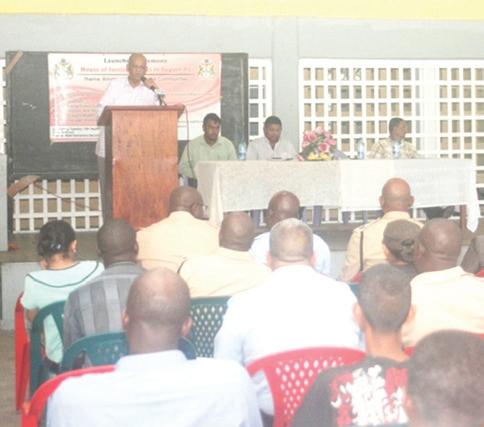
Region Three Chairman Julius Faerber, who was appalled by the attack, noting that it was only on Tuesday evening that he witnessed the opening of the Region Three House of Justice, where he met the commander and had a discussion on the security sector.
Deal with crime head-on
He said the commander highlighted a few strategies that are in place to battle crime, but upon reaching home, he received the dreaded news.
He admitted that there is an upsurge in crime in the regions and renewed his call for the security sector to deal with the issue head-on.
The regional chairman stated that he is optimistic that the police force will carry out its duties diligently in apprehending the perpetrators for the heinous crime committed on the aggrieved families.
He also urged community members to be alert and be their brothers’ keepers.
Faerber also encouraged all Guyanese to be on the lookout and report any suspicions movement in their community to the police.
During the ordeal, the businessman’s mother Fazila Namdar received injuries to the head.
After the robbery, the gunmen made good their escape on foot, as they discharged several rounds indiscriminately in the streets.
Zulfikar leaves to mourn his two children, ages five and three; his wife; and parents.
He is expected to be laid to rest today according to Muslim rights (see ad on page five)

The Demerara Harbour Bridge will be closed to vehicular traffic on Thursday, September 12 from 09:30h to 11:00h
The Berbice River Bridge will be closed to vehicular traffic on Thursday, September 12 from 08:40h to 10:10h.
Countrywide: Heavy rain showers are expected during the day, with clear skies in the evening over coastal regions and near inland locations. Temperatures are expected to range between 24 and 30 degrees Celsius.
Winds: Easterly at 0.89 to 2.23 metres per second.
High Tide: 09:15h and 21:38h reaching maximum heights of 2.23 metres and 2.36 metres respectively.
Low Tide: 02:41h and 15:06h reaching minimum heights of 0.74 metre and 0.96 metre respectively.








BY: LEANA BRADSHAW
The level of sugar production being delivered at the Skeldon Sugar Factory indicates that the upgrade works done on the facility by Bosch Engineering “is bearing fruit”.
This was the view expressed by Agriculture Minister Dr Leslie Ramsammy during an interview with the media on Wednesday. He highlighted that the factory is beginning to work as anticipated.
Dr Ramsammy explained that the Skeldon factory has produced an impressive yield thus far, producing more than 2500 tonnes of sugar, with the second crop almost equaling the production of the first crop. This, he said would take the factory’s total production for the
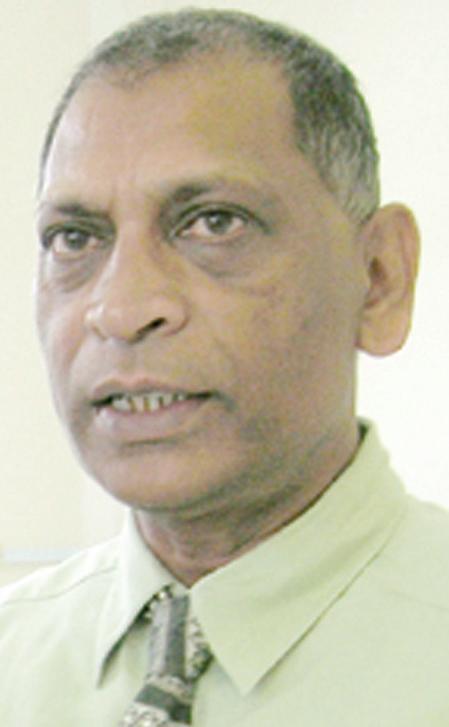
year so far to some 95,000 tonnes.
“We are hoping to reach 155,000 tonnes for this crop and to exceed the 200,000 tonnes target. So in spite of the bad weather we’ve had so far, Guyana Sugar Corporation (GuySuCo) is hoping that with improved

September conditions… and with normal October and November weather, and with the possibility of grinding until Christmas, that we will be able to surpass the 155,000 tonnes for this second crop,” the minister pointed out.
Dr Ramsammy further explained that one of the most important indicators for the Skeldon factory is its Tonne of Cane per Tonne of Sugar (TCTS), which is dependent mainly on the factory. Skeldon, he noted, is designed to produce between 10 and 12 tonnes of cane for one tonne of sugar.
“The old factory used to give a TCTS of between 13 and 15 so this new factory was designed to give more sugar… when Skeldon was first operationalised, it was providing TCTS of above 15, as high as 20”.
Optimistic
He outlined that the average TCTS so far this crop was 12-13, but it is expected to reduce below 12 as operations progress. However, the minister added that, “We are
optimistic that given the right weather conditions, Skeldon will respond in a positive way. The problem we’ve had with Skeldon and throughout the industry is the rainy condition.”
Successful tests
South African firm Bosch Engineering was hired to execute rehabilitative work at the Skeldon factory and had conducted a series of successful tests.
The firm was hired to redesign and re-engineer several aspects of the facility, including the re-engineering of the bagasse feed system, redesigning the cane conveyers, drilling of a new well, the replacement of a five megawatt alternator, and the modification of the pump dumpers.
Meanwhile, turning his attention to the Enmore Packaging Plant, he noted that while it has never lived up to its full expectations of production, there is no problem hindering its functioning. It has the capacity to produce up to 40-50,000 tonnes of packaged sugar per year. “It
is a functioning plant and it functions in accordance with the design.”
He explained that the Enmore plant has not produced to its full capacity thus far because “it has to do with how much we’ve asked it to deliver... GuySuCo has never attempted thus far to package 40-50,000 tonnes at Enmore and that has to do with our production”.
GuySuCo produces and sells both bulk and packaged sugar, with its largest contract being for bulk sugar. “After we have satisfied the bulk sugar, it is what is remaining that we put into the factory.”
He also reminded that another packaging facility is also located at Blairmont. “So far we have been within 10 and 20,000 tonnes because that’s the amount of sugar that we have in excess of the bulk sugar. The Enmore Packaging Plant was launched in 2011. Currently, Guyana’s export markets for packaged sugar are Europe, North America, and the Caribbean.


Editor: Nigel Williams
Tel: 225-5128, 231-0397, 226-9921, 226-2102, 223-7230 or 223-7231. Fax: 225-5134
Mailing address: 238 Camp & Quamina Streets, Georgetown
Email: news@guyanatimesgy.com, sales@guyanatimesgy.com
Acting as gruesome exclamation points to Monday’s police report, which detailed a significant rise in “serious crimes”, was news of two murders committed during armed robberies, one man’s throat slashed, and a family terrorised by bandits who robbed the premises. The crimes also confirmed the report’s finding of the serious crimes being geographically distributed throughout the country.
The reaction of the police to the crimes on Monday also highlighted their total inability to deal with serious crimes even after billions of dollars have been expended on better training facilities, material and operational programmes in the last two decades. In the case of bandits terrorising and robbing a family, this occurred in Montrose, which is heavily populated and practically a suburb of Georgetown.
The police arrived while the bandits were still in the house, but instead of throwing a cordon around all four sides of the yard, they concentrated on the front and allowed the bandits to escape through the back fence. Residents cannot be blamed for placing emphasis on the word “allowed”.
In the nomenclature used by the police, “serious crimes” include murder, robbery under arms, robbery with violence, larceny from the person, break and enter and larceny, burglary, rape and kidnapping. No one will have any problem agreeing that these crimes are serious indeed.
According to the report, which collated statistics up to the end of August, there were 2658 serious crimes this year as compared to 2503 for the identical 2012 period. This was a six per cent increase, with the number of murders component increasing from 82 to 85.
But it was the robbery under arms category that is most troubling: last year the category increased by an astonishing 21 per cent from 879 to 1065 incidents, compared with 2011 – with firearms as the weapon of choice jumping by 16 per cent.
For this year, up to the end of August, the report showed that robbery under arms continued its evidently inevitable rise with the firearms component rising a further 10 per cent. It is now clear that, while we have not returned to the era of the bandits acting in concert and combing their depredations with political attacks on the state, the level of the crime wave – especially robberies under firearms – is now as high if not higher.
The question is, as always, what do we do about the crime wave? And we use the editorial plural, “we”, advisedly. The opposition, not surprisingly, has come down strongly on the government in general and its Home Affairs Minister Clement Rohee, in particular. It is our contention that the minister is in a no-win situation. On one hand, he is being blamed for obvious operational deficiencies of the Guyana Police Force (GPF) while being constantly warned that he cannot become involved in operational matters. His role should be confined to policymaking.
What is at the base of the problem is that from the 1960s, the GPF had been politicised and demoralised to such an extent that the People’s National Congress (PNC) President Desmond Hoyte could openly boast about its members being “kith and kin”. This call was repeated just before the last elections by African Cultural and Development Association (ACDA) activist Tacuma Ogunseye.
That former Commissioner of Police Winson Felix is now an A Partnership for National Unity (APNU)/PNC member of parliament, and their point man on security issues, demonstrate that greater professionalisation at the very highest level might be necessary for a more efficient GPF.
Minister Rohee recently reminded the nation of the Strategic Plan for the Guyana Police Force (2013 to 2017) drafted by UK-based Capita Symonds Consultancy in 2010. A Strategic Management Department with10 high-level civilian professionals in non-line positions within the GPF will oversee the implementation plan, crafted by the U.S.-based Julian Laite Consultancy in February last.
Rohee warned the recent National Economic Forum that “public safety and security is important for growth and development in any economy (and) without security the country’s development will come to a halt”.
We hope the opposition and all Guyanese will support the Strategic Plan of the GPF.

Dear Editor,
What is this about no windscreen wiping at a gas station? In this case presented by a peeved customer, it is that the attendant did not have any courtesy to explain that such a service was not a part of fuelling up at the station. Then secondly, it is the location that is bothering me.
Almost anywhere people go, there is the setting for a windscreen cleaning job. The water and the wiper are there for all to use. Many times, one of the attendants will do it.
It is like going to a reception area and picking up a chewing gum or mint. It makes the setting so much friendlier. It is amazing how little things can create for better living, even in a busy and rushing world.
Maybe all gas stations should go this way. If an attendant is not available at times, then it would go a long way to just have the water and wiper – a lot of people like to clean windscreens and windows of vehicles. The customers themselves can do so while waiting.
Then the location of the gas station bothers me and why? It is at a busy junction. At the junction, too many vehicles are lining up on the road. This creates for all kinds of illegal manoeuverings just to get by.
Then when people turn into the Railway Embankment, heading east, it is not a good sight – there are always a couple of amputees there. This is so hazardous. A few months back, one wheelchair citizen was killed by a truck at the junction of Mandela Avenue where the road turns to go up
the East Bank. I hope that something will be done regarding the embankment and Sheriff Street junction. I ask very humbly that we all go that extra-mile in making life better for all. Little gestures go a long way in removing barriers. Then as for dangerous situation on the roads, even if it appears insensitive, traffic officers must get on the case of these people, even if they are begging –road safety comes first.
Yours faithfully Hansraj Deochand
Dear Editor,
Many families have this tradition of providing a house for their children or even giving them a good start. Via the Housing Ministry’s Central Housing and Planning Authority (CHPA), government is continuing its move toward helping Guyanese achieve their dream of owning a home.
Recently, the target group was single parents and low income earners during a one-stop shop in the compound of the Housing Ministry, Brickdam, where
applicants pulled their lot numbers for plots situated at Zeelugt, East Bank Essequibo.
Now, I was there and after the event, it was like these people did not know how to be thankful. I actually saw more than person drop a few tears. In this one single act, government has achieved some significant things.
We here in Guyana have a dream too. The exercise in fact was conducted under the theme: “Live the Guyanese dream, home ownership made easier.”
And this is precisely what is happening – applicants select their house lots, make their payment, and are issued with their allocation letter.
At the end of this process, they can have their agreement of sale made out and make arrangements to access funds for building their homes. Under the People’s National Congress (PNC) dictatorship, this was for the mighty and rich only.
This translates into societal stability and the building of strong communities. We need to remind
ourselves that this is how a country is built and what really constitutes happiness and quality of life. Life has that very important side of planting roots for future generations. Many times poverty overtakes a place or family because there is no laying down of a foundation. With this kind of input now, the next generation will be in a position to take life in Guyana to an even higher level and quality.
Regards, Vickram Ouditt
You can send your letters with pictures to:
238 Camp & Quamina Streets, Georgetown, Guyana or letters@guyanatimesgy.com
Thieves want the fruit of hard and honest work, but the very means to this they abhor. Life is about hard work. Work, even for a small salary, is not slavery. They should be given work to do when convicted.
Dear Editor, Good hard working people save and purchase things for their pleasure and comfort and they must be allowed to indulge in these things. When people take away them, it really hurts. Thieves should work instead of planning and executing evil acts.
Prisons should be given the daily newspapers so that prisoners can read them. Also, the prison can do with a kind of library, where reading can even become mandatory.
Yours faithfully, Girdharie Loachan
Dear Editor,
This counterfeit business is frightening. I was following some recent U.S. happenings in this regard.
Recent arrests show that even in a well developed country, government’s hightech safeguards against counterfeit money are increasingly proving no match for crooks, who cash in with basic household items such as soap, glue and office printers. They simply know how to do it.
Take the self-taught graphic artist known as “The Printer”, who was arrested outside of Atlanta,
Georgia with his father and four other men. Authorities said the crew cranked out more than a million dollars in counterfeit bills, using just office printers and glue. It is frightening indeed.
This is why I only do money conversion at the bank. I also prefer a manager’s cheque. I sometimes go for electronic transfers.
In April of this year, Barbados had some problems with counterfeit notes.
The Royal Barbados Police Force had to seriously warn residents there, especially business owners, to be on the lookout for counterfeit
money. This was because a number of fake Barbados notes, mainly of $100 denomination, were seized.
At the time, both the Central Bank of Barbados and the police started advising all persons to become familiar with the security features of genuine Barbadian bank notes.
Guyana has to go this route too. Maybe a few workshops will help. I doubt very much that I cannot be conned. I can do with some help spotting these notes.
Yours truly, Farrah Gomes
Dear Editor, I have a problem with the many stray animals on our roads and generally in a number of other places. A few nights ago, on the Coldingen Road, blinded by oncoming neon and bright lights, I almost drove into a horse. Then the very next morning, around four, I almost went under a horse – it was cruising on the Rupert Craig Highway. If I were going fast that morning, that would have been a nasty outcome from every aspect.
I am reading about an animal lover who got a bad report about cruelty and insensitivity to a donkey and a horse. This person went and took care of business.
However, I tend to go for more than what she did. I believe that if an animal, say a donkey or horse, is left in an improper manner and unattended too, upon intervention, it should be taken away. Also the owner must be made to answer. We cannot allow these owners of large animals to have their big animals roving on the roads. We have too many sick dogs and cats just creating havoc in Guyana. These an-
imals are basically street dwellers and no one really owns them. So they run around mating, making offspring, getting sick and intruding places. Something has to be done.
On the one hand it is cruel for them to be left alone, but then they also are likely to spread some diseases among us. When they get struck down on the road, most of the times, they are left to rot away right there.
I make a strong appeal that pet lovers and generally people who are in tune with animals make a strong appeal to get the right people to humanely remove these smaller creatures. Then more targeting of the owners of bigger animals must be done. If these owners do not have the requisite accommodation and personnel for them, then they should be mandated to get things in order.
This culture of just leaving animals to take care of themselves must be rooted out. In India, quite a few cities are beginning to realise this lapse and are now busy reversing what was taken for granted for too long.
In Zimbabwe, a cattle
country, motorists are increasingly finding that these domesticated, seemingly harmless animals are indeed a dangerous hazard. But they are about to do something in Zimbabwe. We simply have to do likewise here.
Yours respectfully, Romel Ramlall


BY G RA ce G AYLA
The horrific scene from the Sandy Hook shootings in Connecticut have flashed across our TVs for days. The terrifying images have been difficult for everyone to watch.
As our children begin asking questions in the aftermath of this tragedy, the subject must be broached. How do you help your child make sense of senseless acts?
There are no easy answers, but there are a few do’s and don’ts to help your child when tragedy strikes. The biggest consideration revolves around how we, as parents, react to the event. Our children watch and take cues from us. Family psychologist Shannon Bruno, PhD, when interviewed by KSLA-TV said, “If you make it seem like it is something that needs to be discussed, the more your child will get the idea that it is something that they need to be upset or distressed or fearful of.”
Here are other suggestions to help your child cope in the aftermath of tragedy:
Monitor media coverage. Young children can’t process media replay of tragic events and may begin to think the event is happening repeatedly. There is nothing gained from allowing children to watch media coverage of a tragedy. If older children are curious and look to the TV for information, monitor how much they watch and be ready to
discuss what they see.
Be honest and specific about the event . Don’t try to hide what happened. Our children need to understand the world they live in, based on their developmental age. But don’t over explain, or dwell on the details of the tragedy. Answer questions honestly and give your children the freedom to ask whatever they need to defer their fears.
Embrace their emotions
Allow your children to “feel” their feelings. It’s OK to feel sad. It’s natural to feel some anxiety. Acknowledge their feelings with expressions such as, “I understand this event makes you feel scared. I feel sad about what happened also.” Offer words of comfort to relay their fears or sadness.
Be available and offer reassurance as often as necessary . Let your children know they’re safe. Recognise the needs of your child and respond accordingly. Some children need more reassurance than others. My oldest daughter was diagnosed with an anxiety disorder when she was five years old. Throughout her childhood, she was likely to respond to difficult circumstances with more anxiety than our other children and my husband and I knew to always be available for her during challenging circumstances. Children are also more vulnerable if they’ve recently experienced difficult events such as a
parent’s divorce, re-marriage, death of a family member, or another stressor.
Recognise what feelings look like in children . Younger children may regress to behaviour they’ve grown out of such as sucking their thumb or soiling their pants, when troubled. Older children are more likely to show their feelings through a defiant attitude or irritability. Children don’t have the ability to process feelings like adults. Watch for anything unusual in your children that could indicate they are experiencing high anxiety or fear.
Keep routines as normal as possible . Children thrive with routine. When tragedy strikes, it’s especially important to keep a sense of normalcy with school, meals, and bedtime schedules. Children may have trouble sleeping or eating, which can help alert a parent to troubling emotions your child is experiencing.
Prayer may be helpful . Depending on your religious practices, it may be helpful to pray with your child regarding the tragedy. After the Connecticut shootings, my 11-year-old son and I prayed for the families affected by the tragedy and the town of Newtown. It can be reassuring for a child to pray and ask for God’s help for a distressing situation.
Suggest doing something with your child that shows compassion or offers help for


those affected . Many families have sent cards to Sandy Hook Elementary School to offer their thoughts and prayers for those families. Some lit a candle for each child represented. Children experience a sense of well-being by showing compassion and offering help in a situation that appears hopeless.
Seek professional help for your child if troubled emotions don’t subside after a period of time . Mental health professionals are trained to help children of all ages cope with difficulties. Depending on the level of exposure to tragedy or other challenges children are dealing with, they may get stuck in their anxiety or grief and unable to move forward. Don’t hesitate to find help sooner than later if this happens.
Tragedies carry a weight heavy to bear.
They’re especially difficult for young children to make sense of or cope with.
Helping our children process their emotions, while shielding them from graphic details, offers them healing and the gift of hope to continue on their young journey with renewed strength in their ability to cope with life’s next challenge. (redriverfamily.com)

– why it takes a caring community to help children recover from trauma
BY ALAN RAVITZ
Bad things happen to children. As much as we’d like to, we can’t change that. What we can do is try to help children recover in as healthy a way as possible. We can encourage and nurture their natural resilience.
What is resilience? Resilience is the attainment of desirable social and emotional adjustment despite exposure to considerable risk. What kind of risk are we talking about here? We’re talking about everything from being a victim of a terrorist attack to being a victim of rape to being a victim of divorce to being a victim of a bad teacher in school or a really tough neighbourhood. Because all of those things happen to children. Some of these problems are worse than others, but they’re all real problems that can be serious stressors to children.
When we talk about trauma, we’re not talking about an adverse experience. We’re talking about the failure to recover from that adverse experience. It’s not the experience itself that causes the trauma, it is the subjective experience of that event that causes the trauma, the not-entirely-adaptive response to that experience. It’s the way that we emotionally respond to it, the way that we think about it, the way we sort of “file it away.”
That’s why a child’s response to a disturbing experience depends not only on his temperament and what’s happened to him in the past, but on what happens after the experience – the kind of support he gets from his environment. If he has an effective support system, he has a good chance of recovering from the trauma. If he has an ineffective support system, or no support system at all, his chances are much worse.

It helps to think of it in terms of something called social ecology. This derives from the work of a psychologist named Urie Bronfenbrenner. Basically, what Bronfenbrenner said is that there’s no such thing as a person. There’s only a person within a context. You may see me and find that I’m very well behaved, but you don’t know what I’m like at home. I might be very well behaved at home as well, but you just don’t know. It depends on the context.
What we’re talking about with social ecology is a caretaking environment that includes, but extends beyond, immediate family, to peers, to school, to larger community settings, and ultimately to cultural and political belief systems.
A child exists in what Bronfenbrenner called a microsystem. The microsystem includes things like family, school, peers, religious affiliation, workplace, and neighbourhood. All of the social and interpersonal entities with which the child interacts directly comprise this microsystem. (childmind.org)
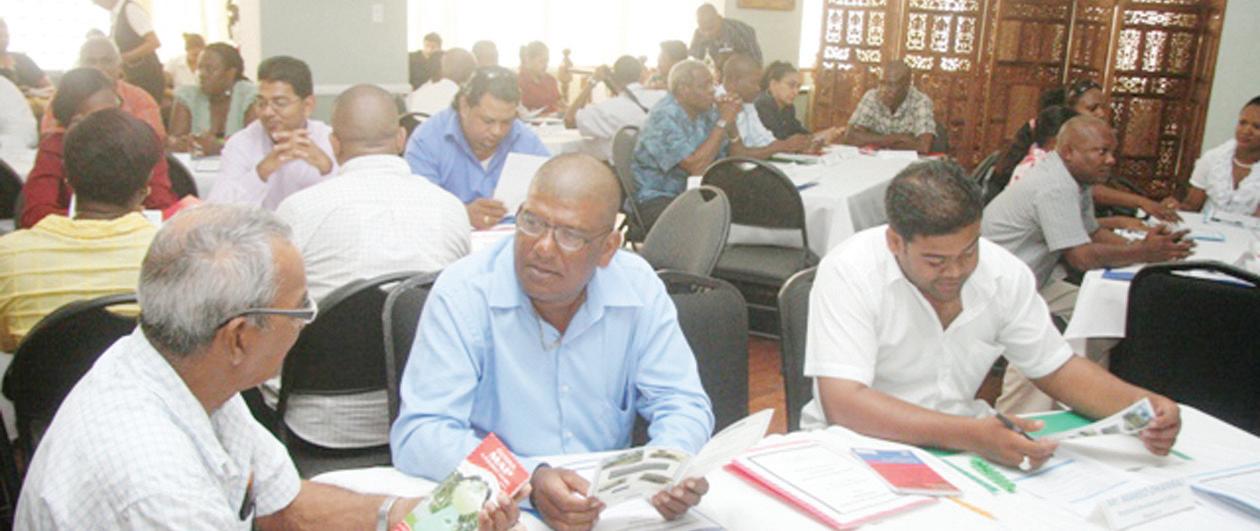
The Housing and Water Ministry in collaboration with the Local Government Ministry on Wednesday hosted a monitoring and evaluation forum to analyse and discuss the findings of the mid-term evaluation of the Community Roads Improvement Programme (CRIP).
The mid-term evaluation was undertaken by consultant Erica Rapier, who was contracted in 2011 to develop a comprehensive monitoring and evaluation system for the programme. The forum was held at Duke Lodge, Georgetown.
Once this system was agreed on by stakeholders, the consultant was required to assist the government in establishing an arrangement at the Local Government Ministry for its implementation in order to facilitate informative evaluations of the CRIP. The midterm evaluation weighs the progress made under the programme against goals that were set.
CRIP is a US$18.7 million project, which, when completed, will see the construction of numerous community roads, amounting to 100 kilometres (km), some of which are funded by the Caribbean Development Bank (CDB) and the remainder by the government. The project is being implemented by the housing and water and local government ministries.
Project Coordinator Karen Roopchand explained that the ministry has added CRIP to its agenda, to ensure that infrastructure in existing areas are on par with the new development. The goal of this project is to improve the livelihoods of people living in Regions Three, Four, and Six in selected communities by improving access to housing, education, health and other
social infrastructure.
Sustainability is a key consideration under the CRIP; as such, one of its major components is the improvement of the neighbourhood democratic councils (NDCs) and regional democratic councils (RDCs) which are the institutions responsible for maintaining the infrastructure.
Keen interest was also paid on the involvement of the communities in this programme and Housing and Water Minister Irfaan Ali commended the community groups which volunteered to help in the project’s supervision.
The minister pointed out that NDCs are a very important arm of the governance structure of the country as they are a direct link to the people and are placed in the most challenging point in the governance system as it relates to the delivery of service.
Quality work
He said that this project is based on a commitment by President Donald Ramotar to build a strong monitoring and supervisory mechanism to ensure quality of work during construction, compliance of work in accordance with bills of quantities, efficient delivery of projects, and long-term maintenance and sustainability of the said projects. As such, a lot of emphasis was placed on institutional strengthening. In addition to the rehabilitated roads, NDC and RDC staff are trained under the CRIP in areas such as administration and finance, information technology, service delivery and governance. Already, a cadre of staff has been trained in road maintenance, and ICT management systems have been delivered to all 12 NDCs. Moreover, the buildings that house the staff at these NDCs have all been either
rehabilitated or constructed where necessary.
Minister Ali disclosed that the government is currently working towards the realisation of CRIP 2. The Housing Ministry is working closely with the Finance Ministry to secure the necessary resources to fund the extension of this programme. The consultant presented an overview and summary of the findings and achievements of the monitoring and evaluation system. She said that a sound monitoring mechanism is critical in the rehabilitation and maintenance of road networks.
Training According to Rapier’s findings, of the 218 roads, 212 have been completed as of April this year, or 97 per cent. Additionally, rehabilitation and construction is completed on 11 buildings of the identified 12 buildings, and 100 per cent completion of the road maintenance training.
Overall, CRIP would be rehabilitating over 100 kilometres (km) of roads in Regions Three, Four, and Six. This includes the rehabilitation of drains, culverts, and bridges and the provision of safety features such as signage, road markings and speed bumps. It will bring direct benefit to 79,000 people; while creating employment for over 400.
The government of Guyana sees these communities as centres of economic growth and expects that the enhanced transportation infrastructure will serve as a catalyst for further development of the private sector in the existing housing areas; thereby increasing economic opportunities and improved productivity. This would ultimately lead to improved living standards for residents at the community level, the Government Information Agency (GINA) has reported.
Diligent investigations by the police has led to the arrest of a man and the recovery of a quantity of gold jewellery and
The victim’s home was burglarised around 12:00h on Wednesday, police said in a terse statement.


Attorney General and Legal Affairs Minister Anil Nandlall on Wednesday visited and inspected the works being done on a twostorey building in New Amsterdam, Region Six that will house an office of the director of public prosecutions (DPP) and either the land or deeds registry.
The Inter-American Development Bank (IDB) and government of Guyana funded project, is part of the Modernisation of Justice Administration System Programme. It costs US$20,450,005, and is scheduled to be completed by the end of September.
“It is important that I emphasise that this is the first time in Guyana’s history that a DPP office will be established in Berbice, and I believe that that is a significant accomplishment… it was a promise made in the manifesto of the PPP at the 2011 general elections,” Minister Nandlall said.
He explained that the office in Berbice is being es-
tablished because the government has recognised the need to have certain facilities offered by the DPP to Region Six residents.
“Unfortunately, because there is no office of the DPP in Berbice, these documents cannot be served in a timely manner, and as a result, you cannot have the state being represented in Berbice in these matters… so litigants in Berbice are forced to file these types of matters all the way in Georgetown,” the minister stated.
He emphasised that having a DPP office in Berbice would correct these significant deficiencies, but more importantly, it will make it easier for the people of East and West Berbice to exercise their legal right to bail, and their legal right to challenge any form of detention by the police that they may deem unlawful.
“The establishment of this office is intended to assist the people of Berbice to actually realise those constitutional rights and freedoms,” Minister Nandlall
noted. The lower-flat of the rehabilitated building will be used either by the deeds or lands registry. Currently, both agencies are housed under the High Court in New Amsterdam where adequate space is a challenge. Minister Nandlall indicated that both registries are important adjuncts to the administration of justice.
The upper-flat, in addition to housing the DPP’s office, will cater for living accommodation for staff. Whenever, there are assizes in Berbice, staff are accommodated at hotels, but the new facility will also cater for this need.
The minister added that if the DPP decides to appoint permanent staff, they will have adequate space for accommodation.
With regards to the establishment of other similar facilities, Minister Nandlall explained that the office in Berbice would function as a pilot for another that will be opened in Essequibo; however, the establishment of this office would depend on the availability of funds.

thursday, september 12, 2013| guyanatimesgy.com
On Wednesday a young woman was brought before Magistrate Judy Latchman at the Georgetown Magistrates’ Courts after she was charged with simple larceny.
It was alleged that on September 7 at Russel Street, Georgetown, Lavern Allen stole one iPhone valued $150,000, property of Pammy Seaford. She pleaded not guilty to the charge
as it was read to her.
An unrepresented Allen told the court that she is 19 years old and does not know what her current address is. She stated that she resided at Golden Grove for a period of time but had moved out. She also stated that she is unemployed.
Magistrate Latchman stood down the matter for a few minutes so the defendant can recollect her-
self and remember her address.
When the matter was called back, she told the court that she lives at Lot 10 Golden Grove, East Coast Demerara. The defendant’s aunt, who was present in court at the time, said that she will take full responsibility for the young woman and take her to her grandmother’s residence in Golden Grove.
Magistrate Latchman
asked if she will be willing to move to Golden Grove to make sure Allen is there and she said no. She stated that she is married and lives in Turkeyen.
Prosecutor Vishnu Hunt objected to bail on the ground that the defendant has no fixed address.
Magistrate Latchman remanded her to prison and the matter is set to return to court on September 20.
Aconductor was on Wednesday fined after he appeared at the Georgetown Magistrates’ Courts to answer to two charges.
Thirty-one-year-old Rene Scott pleaded guilty to both charges which read that on September 10 at Brickdam Road, he behaved disorderly and fought with Bruce Jillins. According to the facts, Scott is a minibus conductor and Jillins is the driver of another. On the day in question, around 14:25h, the two were in front of the Brickdam Police Station when they started to “chuck” and “cuff” each
other. The commotion attracted ranks from the police station which resulted in the defendant being arrested and charged.
An unrepresented Scott told the court that the incident occurred when Jillins hit his uncle’s vehicle which he was driving. This resulted in the two having an ex-
change of words which lead to a fist fight. He also told the court that he has no prior or pending matters before any other court.
Magistrate Judy Latchman fined him $10,000 on each offence a total of $20,000. He was also bonded to keep the peace for 12 months.
Ryan Sheppard of 48 Palm Street, Werk-en-Rust, Georgetown was on Wednesday placed on bail after he appeared at the Georgetown Magistrates’ Courts to answer to an assault charge.
Sheppard, 37, plead-
ed not guilty to the charge which read that on September 10 at Palm Street, he unlawfully assaulted Hollis Giliss causing her actual bodily harm.
According to the facts, Giliss and Sheppard were in a relationship and on the day in question, they had
an argument over a phone call which resulted in the defendant punching the virtual complainant (VC) to the left side of her face. She sustained bruises and her left cheek was swollen.
Sheppard was unrepresented and told thecourt he is an electrician
with five children and is in a common-law relationship. There were no objections to bail put forward by the prosecution and Magistrate Judy Latchman granted it in the sum of $80,000. The matter was transferred to Court 10 for September 23.
On Wednesday, a John Lewis Styles employee was remanded to prison after he appeared in the Georgetown Magistrates’ Courts to answer to a possession of narcotics charge.
Mark Angel pleaded not guilty to the charge which read that on September 8 at West Ruimveldt, he had in his possession 68 grams of cannabis for the purpose of trafficking.
Angel was unrepresented and told the court he is 28 years old and resides at 138 Waterloo Street. He added that he is employed at John Lewis Styles as a handyman.
According to the facts, one the day in question, the police ranks were on mobile patrol when they stopped and conducted a search on the defendant. The ranks conducted a search on Angel’s haversack in which they found a ziplock bag containing leaves seeds and stems suspected to be canna-
bis. It was tested and weighed. The defendant was subsequently charged with the offence.
Prosecutor Vishnu Hunt objected to bail on the grounds that no special reasons were given.
Magistrate Judy Latchman refused bail. The matter is set to return to court on September 16.
Aman was on Wednesday remanded to prison after he appeared at the Georgetown Magistrates’ Courts to answer to the charge of larceny by bailee.
Thirty-two-year-old Denis Rampersaud of 158 Pineapple Street, West Ruimveldt was not required to plead to the indictable charge which stated that on December 19, 2012 at Main Street, being the bailee of one laptop
valued $200,000; he was entrusted to retain and return it safely to Mahesrie Narine but fraudulently converted it to his own use and purpose. Rampersaud was represented by Attorney Madan Kissoon who told the court that his client has three children and is the sole breadwinner for the family. He added that Narine and his client shared a relationship. In his application for bail, he stated that
Rampersaud is not a flight risk since he does not have a passport and is willing to submit himself to any conditions the court wishes to impose on him.
Prosecutor Vishnu Hunt objected to bail stating that there are other matters being investigated which involve the accused and the complainant. He said Rampersaud will most likely be charged with the offences, one of which is rape. He also objected on
the grounds that if granted his pre-trial liberty, there is a likelihood he will not return to court.
Attorney Kissoon interjected and told the court that the investigations are still ongoing hence those matters are not yet before the court. He also stated that those allegations were made since 2011.
Magistrate Judy Latchman refused bail and the matter stands adjourned to September 20.

...of official inaction on crime
We have to tell you – we’re sick and tired of the official excuses for the crime waves that keeps on battering our long suffering people. And “waves” it is. Wherever you turn, all you see are pointing fingers. Fat lot of good this does in ridding us of bandits pointing guns. It’s also good to see the police releasing statistics showing that armed robberies – and murders during those robberies – keep skyrocketing.
Their clerical skills are improving. All well and good. But is this what we, the taxpayers of Guyana, have been pumping billions and billions of our hard-earned dollars into the Guyana Police Force (GPF) for? Is this what we’ve provided them with a fleet of cars greater than all the taxi services in the country put together, for? Is this why we’ve been sending dozens of officers abroad for training every year?
You’re damn right it’s not. We’ve also had it up to our kazoos with the “explanations” from the civilian bosses in the Home Affairs Ministry. They set the policies...press buttons...but nothing happens at the other end. Well, how long are we going to go along with this? Isn’t 20 years enough time to straighten out this mess? Hey!! We can’t have any sacred cows: if people aren’t following departmental policies – there’s only one thing to do: fire them.
So we might have to fire hundreds? Well, so be it! Sometimes you need some bloodletting to fix a patient on his deathbed. And from what we’re seeing, the GPF’s certainly isn’t showing any signs of life. In the U.S., there’s a running gag about policemen and their love of donuts. In Guyana, it’s about their penchant for shaking down citizens while allowing bandits, who rob and maim and murder, to get off scotch free. Are there even investigations – much less firings – when citizens complain about calling police stations and not getting any responses?
The Home Affairs Ministry has to take the bull by the horns and call a spade a spade. Even the opposition is now sententiously complaining about police not doing their jobs. The police have to begin to solve crimes – not just report them.
The latest murder of a young businessman on the West Coast of Demerara is particularly egregious. Serving the community, upstandingly progressive – and now his life’s snuffed out by bandits – who will blithely go on with their crime spree. They know there isn’t the will in the GPF to do anything. Somebody better bell the cat quickly.
The clerk of the Parliament is an individual whose role goes back to 14th century development of English democracy and their Westminster system of governance. One thing he’s not is a political appointee: he’s supposed to have come through the bureaucratic ranks and be noted for his proficiency with the parliamentary rules of order and his non-partisanship.
Even the speaker, who’s also supposed to be impartial, is nominated by a political party and there is always the sneaking suspicion that partisan loyalties mightn’t be completely extirpated. In Guyana, we have more than a “sneaking suspicion”.
And herein lies part of the reason why our present Clerk of Parliament Sherlock Isaacs had to exclaim that if it weren’t for his pension, he’d long quit what he called “the worst Parliament” he’s been exposed to in 45 years of service.
Now that’s quite a mouthful from an individual who’s normally seen and not heard. In addition to the harassment and hectoring from the speaker, the A Partnership for National Unity (APNU) has also weighed in to accuse him of being People’s Progressive Party/Civic (PPP/C). Don’t these fellas have any sense of time and place?
...of UG’s staff obstreperousness
Talking about “time and place”, where do these staffers at the University of Guyana (UG) get off threatening “work stoppage” for actions long past due on cleaning the Augean stables in the Bursary? And they’re moulding our young?

BY: UMADEVI BUX
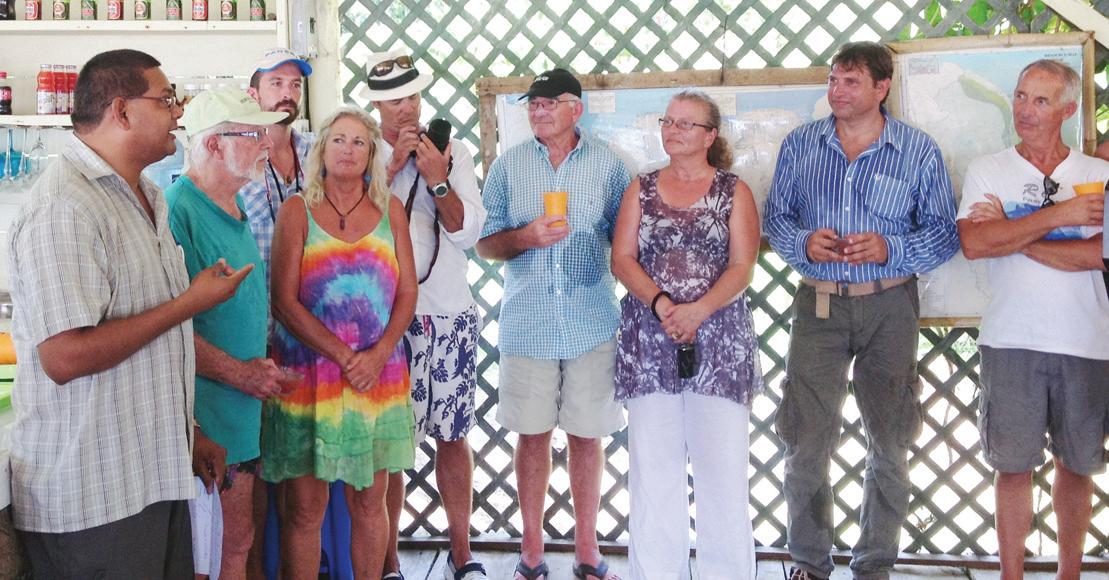
Guyana is looking to establish a Yachting marina in the near future in aid of promoting yachting as a major part of the local tourism industry.
This was disclosed by the Guyana Tourism Authority (GTA) Director Indranauth Haralsingh while addressing the inaugural NEREID’S Yacht Rally 2013 held at the Hurakabra Resort, Region Seven on Wednesday.
“Essequibo is the third largest river in the South America and with Guyana being south of Trinidad and out of the hurricane zone, it is a safe haven for yachting,” said Haralsingh.
Opportunities
Alluding to the investment opportunities available for the sector, he continued, “It is a niche market with numerous investments opportunities, hopefully with the collaboration of a yatchsman Davide Matelicani.”
According to Haralsingh, Matelicani had planned to start a marina in French Guiana and hopefully with collaboration with investors here, Guyana in the near future will house a marina.
Haralsingh noted that the first step in making yachting a possibility in Guyana, noting that this was initiated at least nine years ago.
Since then, he said there has been trickling of yachts sailing to Guyana. However, this is the first time there has been a rally of yachts in Guyana.
“For us to continue such ventures, especially since Guyana is located in such a strategic location… it will be a good move to have a marina for yachts to refuel and have other maintenance done.”
He said the Tourism Ministry aim to use this event to catapult the yachting industry in Guyana and to harness the influx of yachts to develop the necessary infrastructure to further advance the industry.
Meanwhile, Tourism and Hospitality Association of Guyana (THAG) President Kit Nascimento noted that the rally was planned at a recent meeting in Trinidad and Tobago, where a team travelled in early August, to promote the event, with the aim of encouraging maximum participation from yacht enthusiasts.
“This being the first yachting rally in Guyana will see
many more to come… the team here will depart from Guyana heading towards St Lawrence in French Guiana and most likely will return to Guyana on their way back up north,” stated Nascimento.
He also emphasised that Guyana is looking to advance the local yachting industry.
“Over the years since the first yachts, rules and regulations have changed and it has become friendlier towards yachting. . . Guyana, the Essequibo has become a safe anchorage and an attractive destination.” Bartica, Region Seven, has become an official port of entry for arriving yachts.
Beauty, hospitality Yatchman Davide Matelicani said this is not his first trip to Guyana. “I was here to refuel and found sanctuary… there is plenty interest for fellow yachtsmen, especially for next year… natural beauty, unspoiled… Guyana is special because of the people, oasis of beauty and hospitality… something that you will not find anywhere else in the Caribbean.” He further revealed that investing in a yachting marina is something that will certainly be on his agenda.
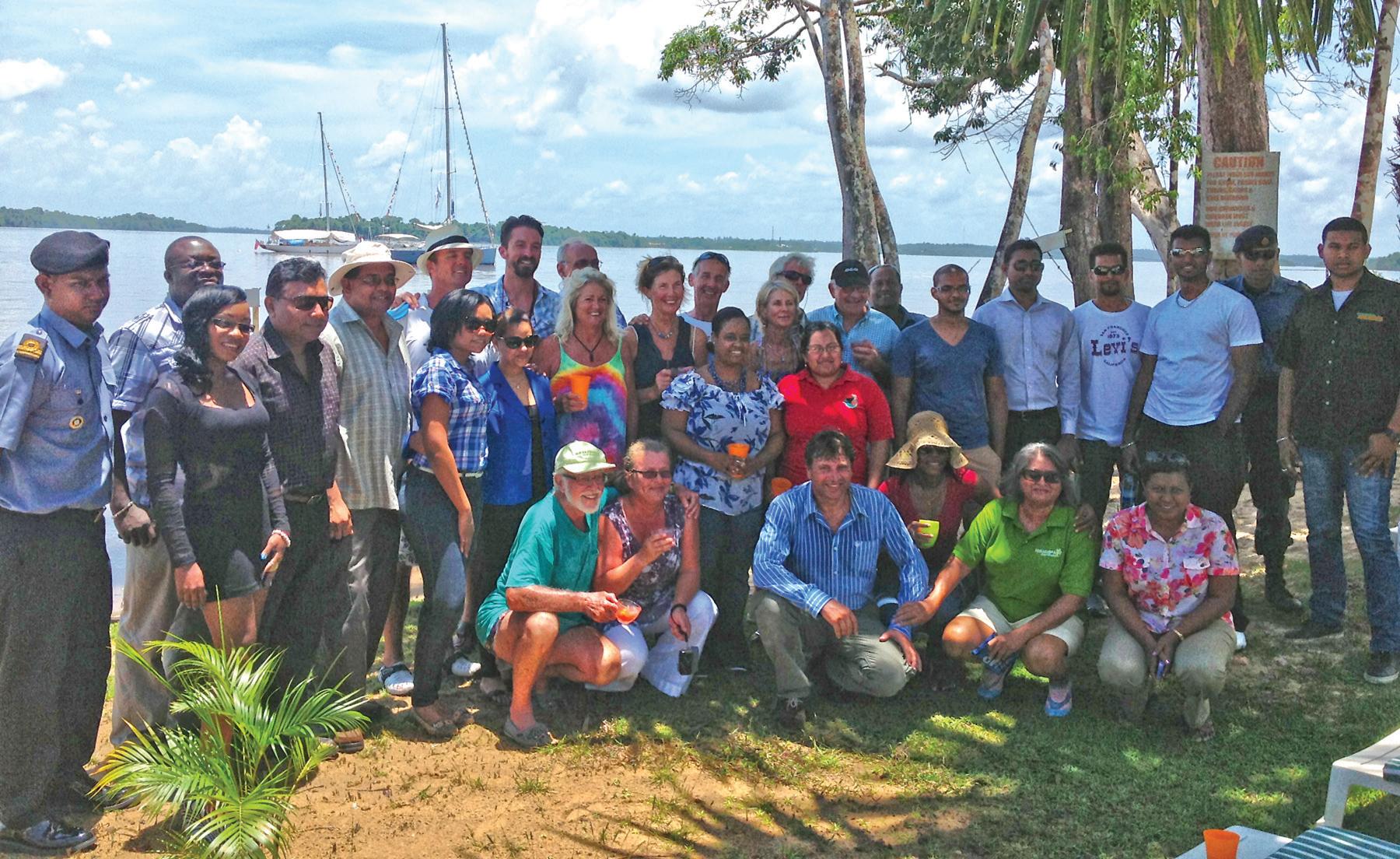
The yachts participating in the NEREID’S Rally included the Lion King captained by Harry Van Leekwe and Ans krimpen Fort; Virginia Dare captained by Bob and Christine Matte; Spirited Lady captained by Susie Stamhope; Saikosoie and two others which were clearing Customs and Immigration while Guyana Times was at the rally. The welcome activity, sponsored by the Tourism Ministry, was facilitated through an interagency collaboration with the Coast Guard, Customs and Immigration, the Guyana Police Force, MARAD and private sector stakeholders.
Grand style
The yachtsmen and yachtswomen were welcomed in grand style at the Hurakabra River Resort, owned and operated by Nascimento and his wife, Gem. The Hurakabra Resort is located on the left bank of the Essequibo River, about three miles north of Bartica.
Additionally, a second convoy is expected in October; this will be led by former international sailor, Simon Wall. When the vessels arrive, they will make their way to Bartica, at the centre of the confluence of three great rivers, the Mazaruni, Cuyuni and Essequibo, approximately 40 miles up the Essequibo River; this has become an official port of entry and welcomes the arrival of cruisers.
The Baganara and Hurakabra Resorts, in particular, now cater to receive cruisers anchored close offshore.
It was emphasised that the resorts are exceptionally beautiful nature destinations which offer exceedingly comfortable and well appointed accommodation, jungle walks, birding, beach front dining, well stocked bars, recreation facilities, water sports and dingy docking.

Apreacher man seh in a chuch de other day that de world gon soon come to a end and that people now livin in de last days. He seh all de signs deh all over de place fuh every one to see. He seh de good book seh that in de last days, there gon be shortage fuh all kinda tings whah people want.
After all no body can’t blame de preacher man. Number one, he believe de Bible and number two, that is exactly whah happenin in Guyana right now. Nuff tings in short supply and plenty people can’t get whah dem want or can’t get enough of whah dem want.
One woman couldn’t get enough off whah she want from she man and she went to another man fuh get it. Now de man who was not givin she whah she want shoot de man who was givin she whah she want. Now she can’t get none of whah she was gettin all de time. And she can’t even go back to de house to get de lil bit that she used to get from de first man. So she gettin short supply or wuss yet no supply.
Fertiliser in short supply fuh de farmers and now farmers gotta come all de way from Trinidad to fork up Guyana land. And is de same land that Guyanese been forkin up all de years. Just because Trinidad got oil ain’t mean that dem could fork up Guyana land better than Guyanese.
G-PEE-Hell done admit already that poles in short supply and dem have to bring in overseas poles. Stones is another ting in short supply. Even de guvament ain’t got enough stones now and de prezzi he self admit that. But one contractor seh he got enough stones fuh every body –man and woman alike who need stones.
Ting-a-ling-a-ling…friend tell friend…mattie tell mattie! So look out fuh all de overseas forkin, overseas stones and overseas poles. Is plenty woman and even some man gon be singin this Christmas!
Police ranks have been despatched to Arimu, Cuyuni River, to conduct investigations into a report received that the body of a man of Amerindian descent was found outside a shop about 07:30h on
Wednesday, with a wound to his body.
The man had allegedly been involved in an argument with another man earlier in the evening. No other information is available at this time, the police said in a statement.
Mental Health Act should be revised – social worker ... says it does not help in preventing suicide
Making a pitch to address the growing number of suicide cases here, a social worker attached to the West Demerara Regional Hospital Robert Singh said a revision of the 1930 Mental Health Act is needed.
He said the 1930 Mental Health Act is a barrier to suicide prevention in Guyana. During a recent interview with Guyana Times on World Suicide Prevention Day, Singh stated that the act is outdated and needs an immediate revision, to help in addressing critical issues relating to the social problem.
He noted that under the act, when a person is admitted into the hospital for attempting suicide, at any given time, that person can abscond from the facility, since he/she is not adequately guarded. This, Singh said,
will add to the problems that are already there and the patient will not receive the much needed medical treatment and attention from doctors.
Singh said this is harmful to patients and in a way prevents the prevention of suicide.
The main opposition, the A Partnership for National Unity (APNU), recently urged government to implement stringent measures to tackle the scourge. Speaking at a recent news conference, shadow health minister Dr George Norton said his party is not pleased with how government has handled suicide prevention in Guyana, blaming the administration for the current state of suicide here.
As a result, the main opposition party advocated for government to create a new
plan to deal with this issue at all levels and across all 10 administrative regions in the country.
More psychologists
When asked what measures the party sees fit for the government to put in place to tackle this issue to complement its current initiatives, Dr Norton only supplied one suggestion, and that is for the government to train more psychologists, and make them freely available to the public. He said the country needs to move away from dealing with psychiatric problems only at the relevant psychiatric institutions.
Dr Norton believes another reason for suicide in these communities is unemployment and low paying jobs. “By providing more jobs, you certainly would be able to curb this issue.”
World Suicide Prevention Day (WSPD) was observed on Tuesday. The occasion is aimed at giving awareness in order to provide worldwide commitment and action to prevent suicides, with various activities around the world.
The International Association for Suicide Prevention (IASP), collabo-
rates with the World Health Organisation (WHO) and the World Federation for Mental Health, to host World Suicide Prevention Day.
Awareness event
In 2011, an estimated 40 countries held awareness events to mark the occasion. Guyana has been battling with high suicide rates, especially in rural communities.
As of 2011, an estimated one million people per year die by suicide.
Statistics say more people die from suicide than from murder and war; it is the 13th leading cause of death worldwide.
According to the WHO, suicide accounts for nearly half of all violent deaths in the world.
IASP President Brian Mishara noted that more people kill themselves than
die in all wars, terrorist acts and interpersonal violence combined.
The number of people who die by suicide is expected to reach 1.5 million per year by 2020. The UN noted that suicide bombers’ deaths are seen as secondary to their goal of killing other people or specific targets and the bombers are not otherwise typical of people committing suicide
Of the 34 member countries of the Organisation for Economic Cooperation and Development, a group of developed countries that uses market economy to improve the Human Development Index, South Korea had the highest suicide rate. In 2011, South Korea’s Health and Welfare Ministry enacted legislation coinciding with WSPD to address the high rate.


In December 1994, September 16 was declared, International Day for the Preservation of the Ozone Layer.
Do you know what the Ozone Layer is
It’s important to understand that ozone is a gas which occurs naturally in the atmosphere. Each ozone molecule is made up of three atoms of oxygen (O3). Ozone is found in two regions of the atomsphere:
* The troposphere (10-16 kilometres from the surface of the earth) – contains 10 per cent ozone.
* The stratosphere ( about 50 kilometres from the top of the troposphere – contains 90 per cent ozone.
The Ozone Layer protects life on earth by absorbing some of the ultra violet (UV) rays given out by the sun. However, in the 1980s, scientist began finding clues that the Ozone Layer was being depleted. This depletion was due to certain industrial processes and consumer products which produced gases such as chlorine and bromine that destroy the ozone molecules. One main example was chloroflurocarbons (CFCs) which was used in refrigerators and air conditioning systems and to make foam and soaps.
What has been done to control ozone depleting substances?
The Montreal Protocol, which is an international agreement, established in 1987, was signed by over 190 countries, that vowed to work towards elimination of ozone depletion substances. To date the protocol has been one of the most successful international agreements. However, since it would take a num-

ber of years for the ozone to recover, countries are still required to ensure new threats doesn’t arise and ODS are eliminated from the environment. Is ozone depletion the main cause of climate change?
Many persons are of the opinion that ozone depletion is responsible for climate change. Though this is not strictly true, there is some connection between the two occurrences because ozone absorbs solar radiation and is a greenhouse gas. Also, depletion of the Ozone Layer, and global increase in the bad ozone in the troposphere both contribute to climate change. However, it is important to note that the contributions of ozone to climate change

The depletion of the ozone layer meant, more UV radiation reached the earth’s surface. Too much UV is bad for our health and can cause skin cancer, eye damage and weaken our ability to fight diseases.
are small compared with the total contribution from all greenhouse gases.
What can you do to protect the ozone?
When our actions degrade our environment it takes a long time, hard work and high costs to bring it to a state that is safe for human health. There is no quick fix. The action of every person counts! Here’s what you can do to make a difference:
* Stop the release of CFCs and other ozone de-
pleting substances (ODS) into the atmosphere.
* Phasing out ODS as soon as viable alternatives become available. Where alternatives are not available, restrict the use of these substances as far as possible.
* Try to use products which are labelled “Ozonefriendly”.
* Ensure technicians repairing your refrigerator or air conditioner recover and recycle the old CFCs so they are not released into the atmosphere.
* Vehicle air conditioning units should regularly be checked for leaks.
* Ask about converting your car to a substitute refrigerant if the air-conditioning system needs major repair.
* Help start a refrigerant recovery and recycling programme in your area if none already exists.
* Replace halon fire extinguishers with alternatives such as carbon dioxide or foam.
* Suggest school activities to increase awareness of the problem and to initiate local action.
You can share your ideas and questions by sending your letters to: “The Earth Our Environment”, C/O EIT Division. Environmental Protection Agency, Ganges Street, Sophia, Georgetown or email us at eit.epaguyana@ gmail.com

The waste of a staggering 1.3 billion tonnes of food per year is not only causing major economic losses but also wreaking significant harm on the natural resources that humanity relies upon to feed itself, said a new Food and Agriculture Organisation (FAO) report.
“Food Wastage Footprint: Impacts on Natural Resources” is the first study to analyse the impacts of global food wastage from an environmental perspective, looking specifically at its consequences for the climate, water and land use, and biodiversity.
Among its key findings: Each year, food that is produced but not eaten guzzles up a volume of water equivalent to the annual flow of Russia’s Volga River and is responsible for adding 3.3 billion tonnes of greenhouse gases to the planet’s atmosphere.
And beyond its environmental impacts, the direct economic consequences to producers of food wastage (excluding fish and seafood) run to the tune of US$750 billion annually, FAO’s report estimates. “All of us –farmers and fishers; food processors and supermarkets; local and national governments; individual consumers – must make changes at every link of the human food chain to prevent food wastage from happening in the first place, and re-use or recycle it when we can’t,” said FAO Director General José Graziano da Silva.
Tool kit
“We simply cannot allow one-third of all the food we produce to go to waste or be lost because of inappropriate practices, when 870 million people go hungry every day,” he added. As a companion to its new study, the FAO has also published a comprehensive “tool kit” that contains recommendations on how food loss and waste can be reduced at every stage of the food chain.
The tool kit profiles a number of projects around the world that show how national and local governments, farmers, businesses, and individual consumers can take steps to tackle the problem. UN Environment Programme (UNEP) Executive Director Achim Steiner said: “UNEP and FAO have identified food waste and loss – food wastage – as a major opportunity for economies everywhere to assist in a transition towards a low carbon, resource efficient and inclusive green economy. Today’s excellent report by the FAO underlines the multiple benefits that can be realised – in many cases through simple and thoughtful measures by for example households, retailers, restaurants, schools
and businesses – that can contribute to environmental sustainability, economic improvements, food security and the realisation of the UN secretary general’s Zero Hunger Challenge. We would urge everyone to adopt the motto of our joint campaign: ‘Think, Eat, Save – Reduce Your Foodprint’!” The UNEP and the FAO are founding partners of the “Think, Eat, Save – Reduce Your Foodprint!” campaign that was launched earlier in the year and whose aim is to assist in coordinating worldwide efforts to manage down wastage.
Where wastage happens
Fifty-four per cent of the world’s food wastage occurs “upstream” during production, post-harvest handling and storage, according to the FAO’s study. Forty-six per cent of it happens “downstream”, at the processing, distribution and consumption stages.
As a general trend, developing countries suffer more food losses during agricultural production, while food waste at the retail and consumer level tends to be higher in middle-and high-income regions – where it accounts for 31-39 per cent of total wastage – than in low-income regions (4-16 per cent). The later a food product is lost along the chain, the greater the environmental consequences, the FAO report noted, since the environmental costs incurred during processing, transport, storage and cooking must be added to the initial production costs.
Hot spots
Several world food wastage “hot spots” stand out in the study: Wastage of cereals in Asia is a significant problem, with major impacts on carbon emissions and water and land use. Rice’s profile is particularly noticeable, given its high methane emissions combined with a large level of wastage. While meat wastage volumes in all world regions is comparatively low, the meat sector generates a substantial impact on the environment in terms of land occupation and carbon footprint, especially in high-income countries and Latin America, which in combination account for 80 per cent of all meat wastage. Excluding Latin America, high-income regions are responsible for about 67 per cent of all meat wastage. Fruit wastage contributes significantly to water waste in Asia, Latin America, and Europe, mainly as a result of extremely high wastage levels. Similarly, large volumes of vegetable wastage in industrialised Asia, Europe, and South and South East Asia translates into a large carbon footprint for that sector.
thursday, september 12, 2013 | guyanatimesgy.com
Food and Agriculture Organisation (FAO) Assistant Director General for Forestry, Edurado Rojas said Guyana is among several countries that have taken drastic steps to protest their standing forests.
He made the comment during an interview with Guyana Times at Duke Lodge on Wednesday, at the 28th Session of the Latin American and Caribbean Forestry Commission (LACFC).
During the conference, which commenced on Monday, participating countries issued reports on their local forestry programmes, in addition to the role of the FAO in the context of sustainable forest management and climate change. It was based on the reports, Rojas said Chile, Costa Rica and Brazil have made significant progress in the preservation of the forest.
Singling out Brazil, he said the country has accelerated various programmes to stop deforestation in the Amazon. Countries that are experiencing difficulties in the preservation of the for-

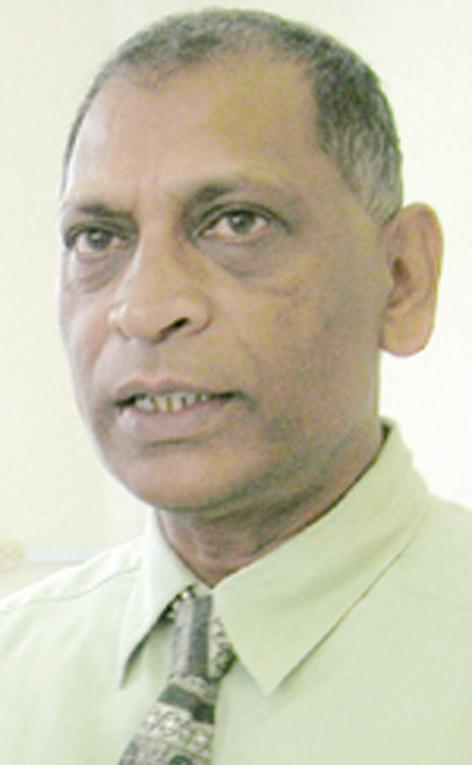
FAO Assistant Director General for Forestry Edurado Rojas
est and in the process of forest management, should follow the footsteps of progressing nations, he posited.
In the Caribbean, Rojas said community-based management is critical in forest management. “It helps not only to reverse deforestation but ensure that the value added forest contribution helps fight against poverty.”
Rojas said the role Guyana is playing in the
preservation of the forest, is no secret, as he alluded to the Low Carbon Development Strategy (LCDS).
The LCDS, which was implemented by former President Bharrat Jagdeo, is a national framework that utilises one of the first national Reducing Emissions from Deforestation and Forest Degradation (REDDplus) systems in the world, creating an avenue for Guyana to receive financial support for its contribution in this regard as defined in the Bali Action Plan.
“We are very aware of Guyana’s leadership in the region. It is one of the countries that have protected the forest; hence, loss of forest has been very small in the past.”
Rojas is in Guyana representing FAO Director General Jose Graziano Da Silva at the meeting.
The 28th Session of LACFC will come to an end on Friday with the establishment of a work programme for the year 2013 and 2014. The LACFC is a key meeting under the auspices of the FAO.
University of Guyana (UG) Vice Chancellor Dr Jacob Opadeyi has condemned allegations that examination papers are sold at the university’s law faculty.
Speaking at a press briefing at the Turkeyen Campus on Tuesday, the vice chancellor said “That’s untrue... the sale of examination paper doesn’t take place at this university.”
Earlier this year, an anonymous source issued a letter to the Hugh Wooding Law School in Trinidad and Tobago, alleging that Guyanese students accepted to the institution may have paid their way through. The unidentified person accused lecturers at the UG law faculty of selling exam papers.
The vice chancellor and the Attorney General Anil Nandlall were officially informed of the allegations by the Hugh Wooding Law School. A two-week investigation led by Dr Opadeyi was conducted, but no evidence surface to support the allegation.
Dr Opadeyi urged persons to desist from creating a bad image of the university. “When you go and say nasty things about the university, it is read throughout the world. And nobody writes about positive things

and people just read the negative and turn away.”
He said the letter addressed to the Hugh Wooding Law School had no name or signature, but in an effort to clear the name of the university, an investigation was conducted.
Unsatisfactory scores
During the investigation, it was discovered that there was a past mark of less than 50 per cent for all of the courses. He posited that had the examination papers been sold, students would have done exceptionally well. It is unfair to discredit the work of lecturers who are professionals of repute.
It was posited that the
claim might have been fabricated due to envy. It was explained that the Hugh Wooding Law School only accepts 25 students yearly, and as such, some persons who were not accepted may have fabricated the story to discredit those who were accepted.
The vice chancellor said such allegations make the process difficult for Guyanese students to attend the regional law school.
“Now to say that question papers are being sold, it would mean that the law school would start looking at us and say, who are these people, but the records will show that our graduates from the University of Guyana have been doing very well and topping the class in the law school.”
Any student with evidence suggesting that exam papers are sold at UG is asked to step forward. “If anybody has any evidence of sale of examination paper, bring it to the vice chancellor, put your name on it. And I will fight for that person because that should not be allowed”
Despite the allegations, Dr Opadeyi is hoping to increase the number of law graduates sent to Trinidad to 35.
Four employees attached to the Guyana Energy Agency (GEA) were taken into police custody on Monday after they were accused of taking bribes.
The four fuel inspectors were taken into custody after they had reportedly taken bribes to avoid prosecution of persons in possession of illegal fuel.
Head of GEA Dr Mahender Sharma, when contacted on Tuesday, confirmed that four employees were taken into police custody on bribery allegations; however, he did not disclose further details on the issue.
According to reports reaching this newspaper, the inspector initially ac-
cepted US$5000, which is equivalent to $1 million, in return for free pass to two tanker trucks of unmarked fuel. They are further accused of taking an additional $500,000 not to allow the prosecution of the persons found in possession of the unmarked fuel.
Up to press time, the inspectors were still in custody as police continue their investigations; however, none of the suspects has admitted to the bribery allegations.
Information received disclosed that the police have sent a file to the Director of Public Prosecution (DPP) Chambers, seeking advise on whether charges should be instituted.
Earlier this year, more than 20 GEA staffers were fired after they had failed a polygraph test which was done September last year. The tests were done after government had recommended the use of polygraph testing on staff from government-owned agencies in an effort to weed out corruption.
After their dismissal, several of the terminated GEA employees had filed writs of summons in the High Court against the agency. They are seeking damages in excess of $100,000 for wrongful termination, severance pay/redundancy, and damages in excess of $100,000 for mental stress. The employees are also seeking to be reinstated.
Organisation of American States (OAS) member states concurred on Wednesday on the need to launch as soon as possible the debate on the strategic vision of the organisation, in line with the presentation of the proposed programme-budget for 2014, that took place during a special meeting of the Permanent Council.
The meeting complied with the resolution on “Progress towards Accountability, Efficiency and Effectiveness, and Results in the OAS General Secretariat”, adopted at the last General Assembly in La Antigua Guatemala. On behalf of the Secretary General José Miguel Insulza, his Chief-of-Staff, Ambassador Hugo de Zela, said the proposed budget, presented on August 5, was formulated keeping in mind that it is still pending the identification of strategic priorities for the organisation and, therefore, is a “transition budget”. He also highlighted the effort to maintain a very high level of transparency and explained that the proposal was based on an analysis that links mandates, results and resources available for its implementation.
During his presentation of the document’s details, contents and structure for the consideration of the member states, Ambassador De Zela recognised the risks, differences, and implications that the consideration of a budget, based at this time on results, entails. “I convey to you the earnest request of the secretary general that, once this discussion has been completed, we embark on the pending decisions related to the dialogue on the strategic vision of the organisation, to determine its priorities, and work with a renewed effort and clarity, which member states expect from us,” he added.
The debate on the role
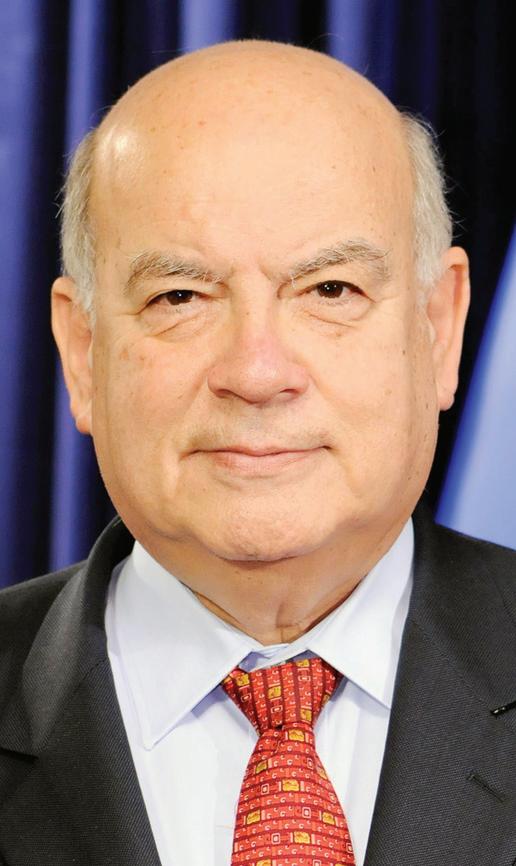
and priorities of the organisation was raised by Secretary General Insulza in his report on the Strategic Vision for the OAS, the first version was submitted in February 2012. Last April, the secretary general presented an updated version in which he broadens and further lays out the proposals and perspectives on the prioritisation of the tasks of the organisation and on how to best rationalise and leverage available financial resources.
This vision emphasises that today it is necessary to have “an inclusive organisation, made up of sovereign, diverse countries legitimised by democracy, working on an equal footing to advance the same hemispheric agenda”, which is “what is demanded of the OAS in the 21st century, far from what was demanded of it during the Cold War”.
For his part, Committee on Administrative and Budgetary Affairs (CAAP) chairman and permanent representative of Canada, Ambassador Allan Culham, stressed the need to move forward “with a sense of urgency and priority” with regard to the strategic vision.
He also highlighted the high level of commitment and sense of trust and cooperation that the CAAP maintained with the general secretariat in terms of information sharing, “which has helped advance this process”. The alternate representative of Mexico and chairman of the working group on the technical review of the programme-budget, Alberto del Castillo, presented in detail the analysis and the work of the group in relation to the implementation of the 2014 programme-budget.
In their interventions, the delegates spoke of the need to work in the prioritisation of mandates, to give priority to the substantive programmes of the organisation, to seek sound and appropriate finances, and to adapt them to regional needs, as well as the need for the general secretariat and the member states to work together, with regular consultation mechanisms.
During the meeting, the president of the council and permanent representative of Paraguay, Martin Sannemann, as well as many representatives of the member countries took the floor to express their condolences over the “tragic traffic accident that occurred on a highway in the jurisdiction of Chimatelango, in Guatemala, which claimed the lives of over 40 people, and for the killing of 11 people in an indigenous community last Sunday” in that same country.
At the meeting, the representatives of Mexico, El Salvador, Venezuela, Guatemala, Canada, the United States, Argentina, Saint Vincent and the Grenadines (on behalf of Caricom), Chile, Brazil, Costa Rica, Barbados, the Dominican Republic, Panama, Colombia, Ecuador, Honduras, Peru, Nicaragua and Bolivia took the floor.
St Vincent and the Grenadines Prime Minister Dr Ralph Gonsalves has aligned Guyana with Suriname and Belize in the category of member states with good commodity trade potential.
The St Vincent and the Grenadines head of state, who will be assuming chairmanship of the 15-member community on January 14, 2014 gave his assessment of the region’s state of affairs during a special interview with National Communications Network (NCN), acting Chief Executive Officer Michael Gordon, the Government Information Agency (GINA) reported.
The interview, GINA said focused on a number of issues germane to the region, including the successes and challenges of integration, the peculiarities of each member state and their economic posture. During his address at the 32nd meeting of the Caricom heads of government conference in St Kitts and Nevis two years ago, Prime Minister Gonsalves said Guyana “appears to be a bright growth prospect”, while reflecting on the economic crisis and its impact on the Caribbean.
In his interview, he reflected a similar view. “Even amidst the global economic meltdown from September 2008 to the current time and continuing, you (Guyana) have agricultural commodi-

ties to sell in which you still have some competitive advantage… you have marine resources and of course you have gold… Guyana has abundant hydroelectricity (potential).”
Guyana recently offered to least some 30,000 acres of land for agricultural purposes to neighbouring Trinidad and Tobago based on a partnership deal with the Kamla Persaud-Bissesar administration to buttress food production.
An additional 10,000 acres of land in Berbice and a further 90,000 acres are also earmarked under a Food Security Facility, for similar leasing purposes. Prime Minister Gonsalves was wowed by what many considered a bold and wooing initia-
tive Guyana has taken. “That acreage of land is more than all the arable land which is available in St Vincent and the Grenadines. St Vincent and the Grenadines have about 96,000 acres of land,” the prime minister said.
Agriculture is a sector which some Caribbean economies have departed as they transition towards services like tourism. The latter has traditionally been a major attraction for tourists from around the world. St Vincent and the Grenadines moved along the same direction because of the “ill winds of trade liberalisation” which saw vibrant industries on the island like bananas plummeting and prompted the move to diversification into services, according to Dr Gonsalves.
“Seventy per cent of the economy in St Vincent and the Grenadines is now services,” which Dr Gonsalves confirmed hinges heavily on external factors. Tourism is one of the services sectors Guyana has identified to promote growth. While the country has been successful in diversification, wise and prudent management of the economy has enabled macroeconomic stability.
The economy has witnessed consecutive years of positive growth and with 3.9 per cent recorded for the first half of the year. There is likely to be more good news for 2013.
Three men are in custody assisting police with their investigations into the fatal shooting of a Corentyne rice miller on Tuesday evening.
Dead is 74-year-old Lallpersaud Jagadeo, called “Lall’ of Number Naught Village, Corentyne, Region Six. Eyewitnesses say four armed bandits had attacked the man’s home which is situated between Number 54 and Number 55 villages about 20:30h.
The wife of the dead man told Guyana Times that they had overseas guests when the incident occurred. “Me sista and she daughter come from America Sunday and staying with we.” She said they were in conversation with some neighbours who were returning from church. “We see like somebody ah crawl an ah come an he get on ah mask, so we think that is Deo.”
According to the 73-yearold woman, they thought that the man was a relative and were not afraid of him as they believed that he was trying to pull a prank with a toy gun.
She said they were soon confronted by another masked man carrying a similar instrument in his hand. “Then another one come in, but he didn’t have on mask, just a blue shirt and a jeans and he tell me that is me he
want and he take me and carry me inside.”
Meanwhile, a niece Somwattie Nandlall, who was also engaged in religious conversation at the time of the attack was held hostage by one of the four men.
Nandlall said she was beaten. “Me sit down in the hammock and he come up from behind and hold me hair, and he start lashing and beating me. I start to fight he and I get away, an I run an go in front on the road an start to holler thief! Thief!” Nandlall said that she did not go back into the yard.
Awakened
As this was taking place, the now 73-year-old widow said her husband was awakened and came rushing downstairs to enquire what was happening. According
to her, upon seeing one of the intruders holding her, he chased him out and inquired what was happening. “And he loose me and point the gun at me husband and start going back till they reach on the road and I faint and ain’t know what else happen,” the woman related.
A son of Jagadeo said after there were shouts for thief, he came downstairs and saw his father up against a man with a gun.
“Is strange because me father is a licensed firearm holder and he ain’t come down with he gun. I ain’t understand what happen, how the man with the long gun and dem three others walking back.” According to the son, the bravery of his father gave him the courage to join in chasing the intruders away. “Me father come and we ducking and pelting them with wood an brick and when they reach on the road, they fire two shots with the long gun but me father still going to them and then another shot fire and me father say that he get shot.”
He explained that within a few seconds, his father was losing balance and he was in time to hold him up. “The car was under the house and we put him and by the time we reach the hospital, he pronounced dead.”
The Home Affairs Ministry Tuesday evening officially launched the Houses of Justice Project at the West Demerara Secondary School, Region Three.
This is the first of 10 such bodies that will be established across Regions Two and Three. Houses of Justice are multi-agency service centres that will be established in communities geared at addressing pressing social needs of citizens at the community level. It brings together, in its initial stage, six agencies that will be providing vital public services to citizens at the community level; offering a much more convenient setting and eliminating the usual hassles people face in acquiring such services.
These agencies are the Guyana Police Force (GPF), the General Register Office (GRO), the National Insurance Scheme (NIS), the Guyana Power and Light (GPL) Inc, the labour and human services and social security ministries and the Community Policing Secretariat. Home Affairs
Minister Clement Rohee in his remarks said that the in-
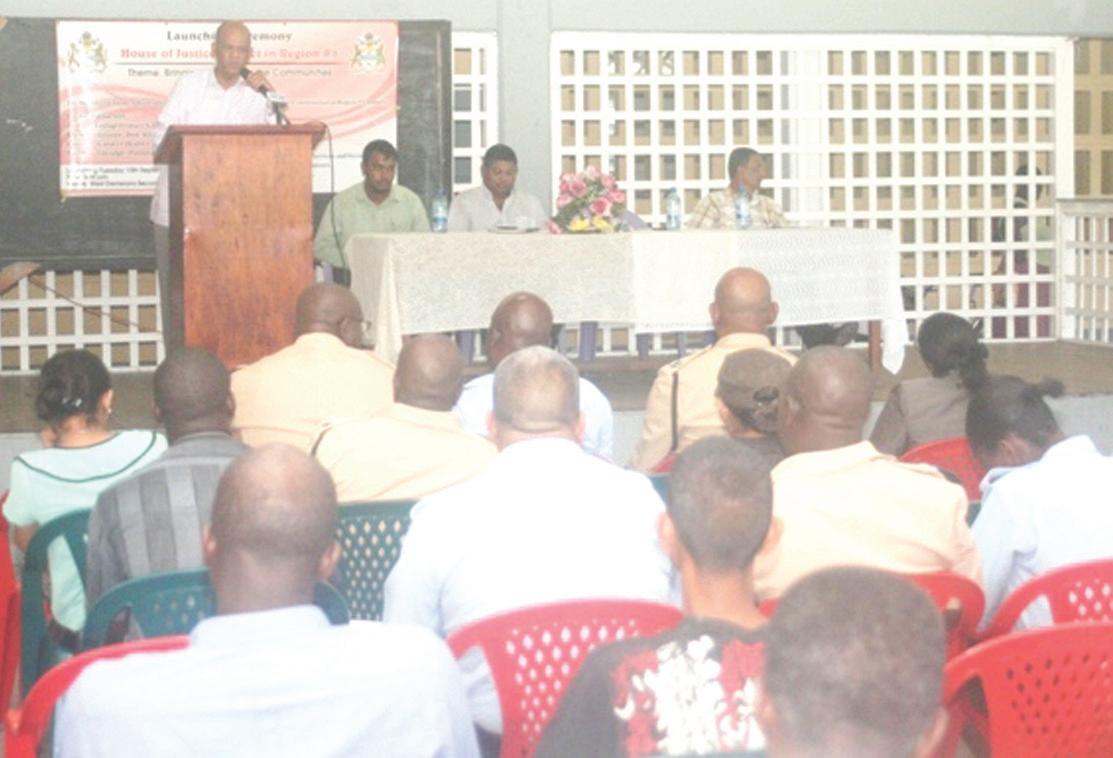
itiative is the first of its kind that has “tremendous social relevance”. He explained that citizens usually clamour for these basic services, which are now being taken to them.
Too often, people are forced to travel back and forth to the city to access services and are sometimes even fleeced by certain individuals who are in positions
of authority.
Eliminating frustration
This project is aimed at eliminating the everyday frustration in dealing with matters such as registration of births, death, and marriages; electricity bills, pension and NIS benefits, and even advisory services from the police and community policing bodies.
Minister Rohee noted that while residents may require a wider range of services than that which will be offered at the Houses of Justice, this must be seen as the first step in the right direction, when the efficacy of this initiative is demonstrated in this pilot stage, it will be expanded to accommodate more stakeholders.
On September 2, the
Home Affairs Ministry signed a Memorandum of Understanding (MoU) with the six agencies for the implementation of the Houses of Justice Project. The Houses of Justice in Region Three will be located as at the Parika Neighbourhood Democratic Council (NDC), operating on Mondays from 16:00h-18:00h; Zeelugt Primary School on Tuesdays from 16:00h-18:00h; Best/ Klien Pouderoyen NDC on Wednesdays from 16:00h18:00h; Canal Number One Health Centre on Thursdays from 16:00h-18:00h and Toevulgt/Patentia NDC on Fridays from16:00h-18:00h.
Community-based approach
This project is part of the Community Action Component of the government of Guyana and InterAmerican Development Bank funded Citizen Security Programme (CSP). This component of the CSP is aimed at ensuring that citizens are provided with services that would help to eliminate social tensions. It is an innovation in the way community-based issues are addressed. This model was adopted from Columbia, af-
ter it was studied by a team of technical experts who agreed that such a system will be useful in Guyana. Minister Rohee emphasised the need to ensure sustainability of this project and called on all stakeholders to be tolerant, punctual and understanding so as to make this new initiative work to the benefit of all involved. He reminded that the Houses of Justice do not associate with judges, magistrates and lawyers; but rather easier access to basic public services/advice to which citizens are entitled. Meanwhile, Region Three Chairman Julius Faerber expressed his appreciation to the government for taking this project to the region. He noted that the Houses of Justice will go a far way in dealing with a lot of household problems. Faerber also stated that the RDC will be working closely with the various agencies to ensure the sustainability of the project. On September 14, the Houses of Justice project will be launched in Region Two. These will be located at Charity, Dartmouth, Suddie, Aurora, and Kabakaburi.
Trinidad and Tobago police say the recent beheading of a man represents a warning from warring gang leaders who are copying the South American style of warfare.
An autopsy conducted on the body of Michael Leinberg Piper, whose severed head was found on a street in the capital on Monday, showed there were no bullet or stab wounds and that the cause of death was decapitation.
Piper’s hand and feet were tied when the body was found. The Police Social and Welfare Association (PSWA) said the killing was a gang’s

attempt to flex its muscle in a terrible way and gangs in the country were becoming copycats.
“If you look at most of the high intensity drug
No bed space in TT hospital, so woman gives birth in toilet
Overcrowding is being blamed for a woman giving birth in the toilet of the San Fernando General Hospital on Monday night and being left overnight in a wheelchair after having eight stitches. Hospital medical director Dr Anand Chatoorgoon confirmed there was no bed space because of the number of patients admitted on Monday to the obstetrics and gynaecology ward. However, he said, he could not give an explanation for the behaviour of the nurses. The patient claimed nurses ignored her when she told them she was in labour.
The Oropouche mother, who asked for her name to be withheld, said when she told the nurses she was feeling the baby’s head thrusting down her birth canal, they kept telling her to wait... it was not time... because her amniotic sac (water bag) had not broken. In a telephone interview, she said she felt a need to go to the washroom and with the nurses’ consent
went to the toilet.
While there, her baby boy decided to make his entrance into the world. The woman’s mother said her daughter, in the midst of her agonising labour pain, had to execute some acrobatic moves to catch her baby to prevent him from falling into the toilet bowl. With baby in hand, the mother called out for help and the nurses who had previously ignored her came to her assistance. If this was not enough drama or trauma, the young mother was then put in a wheelchair, where she spent the night.
The woman’s mother is calling for an investigation into the treatment of her daughter. Chatoorgoon said there were a lot of deliveries on Monday and not enough bed spaces in the maternity and delivery wards. Some women who had given birth were put in recliners for observation overnight and once they were stable they were discharged Tuesday morning. (Excerpt from Trinidad Guardian)
related countries like Colombia and not too far from us, Venezuela, you will realise that most of the time persons are beheaded. It is a message that is sent
from one gang or group to another”, said PSWA vice president, Inspector Roger Alexander.
“It shows what we are capable of doing, so it is a message. They would also take a person from the opposite side of the fence and drop him in enemy territory or just his head.
A lot of the times when drug transactions go round in these countries every effort is made to satisfy the drug lord and have the (head) of the person who robbed him... brought back”, Alexander said. (Excerpt from Jamaica Observer)
Tropical Storm Gabrielle crawled away from Bermuda on Wednesday after buffeting the island with high winds and rain but causing no reported major personal injuries or serious property damage.
Public Safety Minister Michael Dunkley said he was grateful “Bermuda was spared any severe impact” as a result of the storm, which brushed the island around midnight.
More than 300 customers woke up on Wednesday with no power, although this number had dropped to 54 by midday, authorities said.
The island remained soggy with fallen leaves and palm fronds clogging roads as scattered showers continued into the afternoon.
The cruise ship Norwegian Dawn, scheduled to leave on Tuesday,
was forced to remain an extra day at Dockyard because of the storm, the first to hit the island this season. A power outage and plumbing problems forced two schools to close on Wednesday but most government schools remained open, despite a warning on Tuesday night of likely closure.
The decision to keep classes open was made following a very “careful assessment and review” of the island’s weather conditions, a government spokeswoman said.
Most residents appeared to take the storm – which re-formed around 165 miles to the south of Bermuda on Tuesday morning after appearing to fizzle out following strikes on parts of the Caribbean last week – in stride despite the late warning of its approach. (Excerpt from Jamaica Observer)
Protesters and police have clashed in Chile ahead of the anniversary of the coup led by General Augusto Pinochet. Police said they had arrested dozens of people for erecting barricades and throwing stones and petrol bombs.
A bus was set alight in the capital, Santiago, where 8000 officers have been deployed to prevent any violence.
The 1973 coup deposed the democratically elected president, Salvador Allende, and led to 17 years of military rule. Past anniversaries have regularly been marked by demonstrations, some of

which turned violent. Interior Minister Andres Chadwick said on
Wednesday that “up to this moment the reports have been very positive compared
to what we were expecting”. He said that “major troublemakers were trying to take advantage of the occasion”, but assured Santiago residents that the city was functioning normally.
Protesters have erected burning barricades in two Santiago neighbourhoods, police reported. Speaking after a religious ceremony, centre-right President Sebastian Pinera called for national reconciliation. He said that the current generation of Chileans had no right to pass the hatreds of the past down to their children and grandchildren.

The Inter-American Commission on Human Rights (IACHR) says it is deeply concerned over the Venezuelan government’s decision to withdraw from the American Convention on Human Rights, a move that went into effect Tuesday.
The Venezuelan government has denounced the four-decade-old convention, which currently covers 23 of the 35 members of the Organisation of American States (OAS), as a tool of U.S. meddling in Latin America. But rights groups warn the move will eliminate a court-of-last-resort option for Venezuelans who feel they are unable to receive a fair judicial response within their own country, an option that remains guaranteed in the Venezuelan constitution.
This comes at the expense of the protection of rights of the people of Venezuela,
who are stripped of a mechanism to protect their human rights, the IACHR, based here in Washington, stated Tuesday.
The Inter-American Commission calls on Venezuela to reconsider this decision [and] regrets that, despite repeated calls by the Commission and by other international bodies for Venezuela to reconsider its decision to denounce the Convention, the State of Venezuela has not reversed that decision.
The American Convention on Human Rights sets out how OAS countries must guarantee citizens human rights. It also empowers the IACHR and the Inter-American Court of Human Rights, based in Costa Rica, to monitor and rule on rights-related complaints that have not been dealt with through domestic judicial channels.
(Excerpt from Caribbean360)
Diana Nyad defends Cuba-to-Florida swim as sceptics question use of gear

Addressing her sceptics, Diana Nyad claimed the right to set the ground rules for future swims from Cuba to Florida without a shark cage.
Speculation that she had gotten into or held onto a boat during part of her 53-hour journey drove Nyad and her team to hold a lengthy conference call Tuesday night with about a dozen members of the marathon swimming community.
Nyad said it was her understanding of the sport that the first person to make a crossing got to set the rules for that body of water. She said her “Florida Straits Rules” would largely maintain what they all agree on: no flippers or shark cage; no getting out of the water; never hold on to the boat; never hold on
to the kayak; never be supported by another human being, lifted up, or helped by buoyancy.
She would allow innovations such as the protective full bodysuit and mask she wore to shield herself from venomous jellyfish, which can alter a swim as much as a strong current. Marathon swimming purists had questioned whether that gear violated the traditions of the sport.
“It is the only way. The swim requires it,” Nyad said. “I don’t mean to fly in the face of your rules, but for my own life’s safety, a literal life-and-death measure, that’s the way we did it.” Nyad said she never left the water or allowed her support team to help her beyond handing her food and assisting her with her jellyfish suit.

Envoys of the five permanent UN Security Council members are meeting in New York to discuss a Russian plan for making safe Syria’s chemical weapons. The UK, U.S. and France are eager to frame a binding resolution but Russia prefers a non-binding declaration.
Russia and the U.S. will hold key bilateral talks in Geneva today.
Syria has backed Russia’s plan to place the chemical arms under international control. The U.S. says it will hold off military strikes to pursue diplomacy. Russia said earlier that it had now sent the U.S. de-
Somali-born activist and former supermodel Waris Dirie on Wednesday opens a centre in Germany to treat victims of female genital mutilation, which she was subjected to as a child.
About 8000 young girls are circumcised every day in Africa and the Middle East, and the Desert Flower Medical Centre, located in a Berlin hospital, will offer reconstructive surgery and psychological help to those among the 50,000 girls and women in Germany who need it.
The centre is a pilot for others planned in Europe, Africa and Asia. Dirie’s
genitals were mutilated as a Somali nomads’ daughter at about age four, a fate she recalled in her bestselling autobiography “Desert Flower”, which was turned into a 2009 movie.
“Female genital mutilation has nothing to do with religion, culture or tradition. It is a crime against innocent girls” that must be punished, Dirie, the 48-year-old patron of the centre, was quoted as telling Berlin daily the Tagesspiegel.
Female genital mutilation, or female circumcision, involves removing the external genitalia of young girls with the aim of ensuring their chastity as women. (Excerpt from France24)
Prisoner X: Israel to pay US$1M to Ben Zygier’s family
Israel is to pay more than US$1 million to the family of Ben Zygier, an Australian-born Mossad agent who hanged himself in an Israeli prison, in order to avoid damaging disclosures in a court case.
The agreement will see Zygier’s family receive four million shekels, or around US$1.19 million, in staged payments in return for the state of Israel being absolved of responsibility for the death.
Zygier, who held Australian and Israeli citizenships, hung himself in the Ayalon Prison in 2010. He was known as Prisoner X due to his secret incarceration, where he was facing a 10-year sentence for treason.
A judicial inquiry found that guards did not properly check his cell and that at least one CCTV camera was not working. Central district court president, Daphna Blatman, said: “Failure by various elements in the Israel prison service caused his death.”
The Israeli government has said that there was not enough evidence to bring charges over Zygier’s death. Zygier’s parents – who are leading figures in Melbourne’s Jewish community – threatened to bring a legal case against the state of Israel, claiming negligence and seeking compensation. (Excerpt from The Guardian)
tails of its plans. More than 100,000 people have died in Syria since the uprising against President Bashar alAssad began in 2011.
U.S., UK and French diplomats held separate talks before the meeting of the so-called P5 envoys. The French have already been working on a draft resolution that would be enforced by Chapter VII of the UN charter, which would in effect sanction the use of force if Syria failed in its obligations.
However, Russia has already indicated that this would be unacceptable, as would any resolution blaming the Syrian government for chemical attacks. The U.S. holds the Syrian government responsible for such an attack in Damascus on August 21, saying it killed 1429 people. The Syrian government blames the attack on rebels. (Excerpt from BBC News)

The U.S. is remembering the victims of the 9/11 attacks in a series of memorials marking the 12th anniversary. The September 11, 2001 attacks killed almost 3000 people in New York, the Washington DC area and Pennsylvania.
In New York, families of the victims read the names of each person who died at the World Trade Centre.
President Barack Obama was set to attend a memorial outside the Pentagon, but no speeches have been
planned by politicians.
The attacks led to a long war in Afghanistan and created an expansion of government surveillance powers that have recently been the subject of intense debate.
A separate memorial was held outside Shanksville, Pennsylvania, honouring the passengers and crew of United Flight 93. They struggled with the hijackers of the plane, preventing it from hitting its intended target, believed to be the White House or the U.S.
Capitol building.
All 33 passengers and seven crew members on the flight were killed after the plane crashed into a field about 75 miles (120km) south-east of Pittsburgh. “No matter how many years pass, this time comes around each year, and it’s always the same,” Karen Hinson, who lost her brother, Michael Wittenstein, in New York, told the Associated Press news agency. His body was never found. (Excerpt from BBC News)
Acar bomb has exploded near a Shia place of worship in the Iraqi capital Baghdad, Reuters news agency says. The blast on Wednesday killed at least 33 people and wounded at least 55, Al Jazeera has learned.
The apparent sectarian attack took place in Baghdad’s northwestern Kasra district. Worshippers were leaving the mosque after evening prayers when the car bomb exploded, and as onlookers rushed to help the wounded, a suicide bomber blew himself up in their midst, Reuters says.
Policemen reportedly saw a second man fumbling to detonate an explosive belt and managed to stop him, but an angry mob overcame

them and stabbed him to death.
It was not immediately clear who had carried out the attack, Reuters news agen-
German court rules Muslim girls must join swimming classes
AGerman court ruled on Wednesday that Muslim girls must take part in school swimming lessons with boys, in a landmark decision that touches on the sensitive relationship between religion and the state.
The decision by Germany’s top court for public and administrative disputes signals that the state’s constitutional obligation to educate children can take precedence over customs and practices linked to an individual’s religious beliefs.
German Chancellor Angela Merkel and her centre-right government have sought dialogue with the country’s roughly four-mil-
lions Muslims, but have also said they must make an effort to integrate and learn German.
The court said Muslim schoolgirls could not be exempted from swimming lessons, provided they were allowed to wear so-called ‘burkinis’, full-body swimsuits worn by many Muslim women which leave only the face, hands and feet exposed.
The plaintiff was a Muslim girl, originally from Morocco, who goes to school in the western state of Hesse. Her parents have tried for several years to stop her from joining swimming lessons with boys. She was 11 years old when the case started.
(Excerpt from Reuters)
cy said, but Sunni Muslim groups have been regaining momentum and striking on a near daily basis this year.
About 800 Iraqis were
killed in August, according to the UN, with more than a third of the deadly attacks happening in Baghdad. (Al Jazeera)
Kenya aquifers discovered in dry Turkana region
Ahuge water source has been discovered in the arid Turkana region of northern Kenya which could supply the country for 70 years, the government says.
The discovery of two aquifers brings hope to the drought-hit region, tweeted Environment Minister Judi Wakhungu. They were found in the Turkana Basin and Lotikipi Basin using satellites and radar.
Last year, scientists released a map detailing the vast reservoirs which lie under much of Africa. Another aquifer was found in Namibia – the continent’s driest country. Turkana is one of the hottest, driest and poorest parts of Kenya and was hit by a devastating drought last year. Many of the region’s inhabitants are nomadic herders, who are especially vulnerable to a lack of rain. Test drilling confirmed there was water under the ground. The discovery was announced by Wakhungu at a meeting of the UN Educational, Scientific and Cultural Organisation, UNESCO. “This newly found wealth of water opens a door to a more prosperous future for the people of Turkana and the nation as a whole. We must now work to further explore these resources responsibly and safeguard them for future generations,” she said. (Excerpt from BBC News)
Adevelopment compa-
ny specialising in energy-efficient projects has invested J$40 million in a solar-powered commercial centre in the often volatile Grant’s Pen, St Andrew area.
Construction workers contracted to Global Designs and Builders are putting the finishing touches on the 17,000 square-foot facility located at the intersection of Fagan Avenue and Grant’s Pen Road.
The business centre, Global Plaza, is comprised of eight 750 square feet to 830 square feet office suites which, the developers say, may also be configured for use as retail shops. It stands out brightly in a community generally associated more with violent flare-ups than commerce.
Computer maker Dell
Inc set indicative pricing on the new US$5.5 billion loan backing the company’s approximately US$25 billion buyout by founder and CEO Michael Dell and private equity firm Silver Lake Partners, sources told Thomson Reuters LPC. A lender meeting was held today in New York City. Michael Dell was on the agenda to discuss the company. The new deal will include a US$1.5 bil-
The European Commission is proposing to scrap mobile phone roaming charges across Europe as part of a raft of measures to reform the telecoms market. The commission described the reforms as “the most ambitious plan in 26 years of telecoms market reform”. It said the measures will reduce consumer charges and simplify red tape for mobile companies. The proposals must be ap-
“We actually look for undeveloped properties and develop them. We saw this on the market, did the research, and the prospect of the business was fine, so we went ahead and did it,” explained Gregory Duncan, the founder and
managing director of Global Designs, who noted that the location has the advantage of being a central point between several affluent uptown communities, including Norbrook, Barbican and Drumblair. In order to combat the negative stereotype of Grants Pen, Duncan noted that Global Plaza was designed with an “open concept”, without gates and other restrictive security features – though Marksman provides security services for the complex. (Jamaica Observer)
Botswana moves up five places to 74th, taking fourth spot in the region. Improvements are driven in large part by a sounder macroeconomic environment. Among the country’s strengths are its relatively reliable and transparent institutions (34th), with efficient government spending, strong public trust in politicians, and low levels of corruption.
Botswana’s primary weaknesses continue to be related to its human resources base. Educational enrolment rates at all levels remain low by in-
ternational standards, and the quality of the educational system receives mediocre marks. Yet it is clear that by far the biggest obstacle facing Botswana in its efforts to improve its competitiveness remains its health situation. The rates of disease in the country remain very high, and health outcomes are poor despite improvements in recent years.
For a middle-income country in transition to an efficiency-driven economy, the goods market must become more efficient (92nd). Going forward, combined efforts across all ar-
eas will be needed if the country was to reduce its heavy dependence on the mining sector and to set its economy on a more diversified growth path. Seychelles ranks 80th overall, rounding out the top five countries in the region. The country registers a solid performance in the basic requirements for competitiveness: It benefits from strong and well-functioning institutions by regional standards (45th), with strong public trust in politicians (32nd) and a government that is seen as efficient (37th). (allAfrica)
lion, five-year term loan C and a US$4 billion, 6.5-year term loan B. The term loans are expected to be covenant-lite. The term loan C is guided at LIB+275-300, with a one per cent Libor floor and a 99.5 original issue discount. The term loan B is guided at LIB+375, with a one per cent Libor floor at 99. The debt financing package also will include a US$2 billion, five-year asset-based revolving credit facility, US$2 billion in first-
lien seven-year secured notes and US$1.25 billion in secondlien eight-year secured notes.
About US$750 million of the ABL facility is expected to be drawn at the close of the transaction. Bank of America
Merrill Lynch, RBC, Barclays, Credit Suisse and UBS are lead arrangers on the term loans and the ABL revolver. Term loan commitments are due September 23, and closing and funding is expected in late October. (Reuters)
Infiniti, the luxury brand of Japanese carmaker Nissan, will meet its operating profit margin target this fiscal year, its president said, reversing years of low profitability when exported cars suffered from a strong yen.
A weaker currency, and a low depreciation charge, would help the brand to offset the launch costs of its new mid-sized Q50 model, Johan de Nysschen told Reuters in
an interview at the Frankfurt motor show on Wednesday.
He expected the brand to achieve its target for an operating profit margin of six to seven per cent in the year ending March 2014. “A fair bit of that is coming from the weak yen,” he said, adding he also saw strong sales volumes in the second half.
Nissan CEO Carlos Ghosn set a new profit target in May for Infiniti, which in recent
years has hardly contributed to the Japanese automaker’s operating profit as it struggled to export profitably with a persistently strong yen. Nissan’s own operating margin was 5.4 per cent last year. De Nysschen said he saw Infiniti’s operating profit margin exceeding 10 per cent by the end of the 2022 fiscal year, and the brand selling 500,000 cars. Infiniti sold 172,000 cars last year. (Reuters)
proved by the 28 EU members and European lawmakers before they can be put into effect. Analysts say Europe is falling behind in broadband infrastructure, while telecoms companies struggle with declining revenues. Under the plans, companies would be banned from charging for incoming calls from July 2014. All other roaming charges would be scrapped by 2016. Mobile providers will then either have to charge customers
the same prices for phone calls across the EU, or allow them to switch providers for the period they are abroad, without changing their sim card.
European Commission President Jose Manuel Barroso said the proposed reforms were good for both customers and operators. “Further substantial progress towards a European single market for telecoms is essential for Europe’s strategic interests and economic progress,” he said. (BBC News)
Abu Dhabi plans to invest
US$5 billion in Russian infrastructure in a venture to be set up with the country’s state-backed private equity fund, aimed at funding toll roads, ports and airports, the Kremlin and the Russian fund said on Wednesday.
Moves to improve infrastructure, some of which has changed little since Soviet times, are considered vital by investors to modernise Russia and make its economy
Amajority of the time a successful business isn’t standing solely on the founder’s back. Strong businesses may start that way, but over time they grow to be a mix of not only the product or service offered, but the individuals working to deliver that product or service. Hiring the best talent possible does not guarantee your start up’s success, but it does greatly increase your odds of surviving.
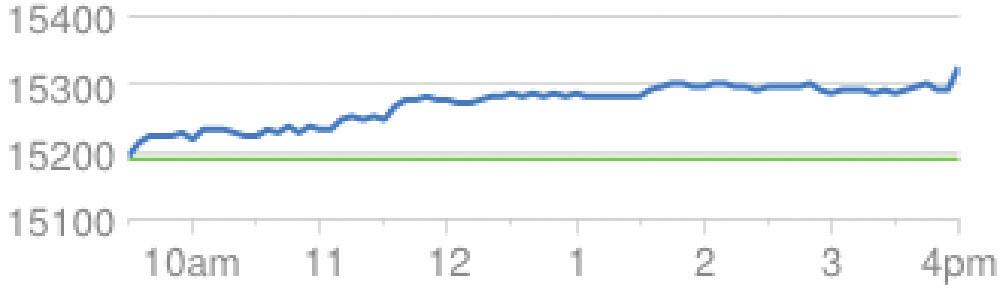
The importance of hiring top employees
Unfortunately, many entrepreneurs think of hiring employees as strictly a human resources or office manager function. If you want to
more competitive. President Vladimir Putin unveiled a US$13 billion investment plan to build new roads and railways at an economic forum in St Petersburg in June.
“We believe we can deliver attractive returns investing in Russian infrastructure,” said Kirill Dmitriev, chief executive of the state-backed Russian Direct Investment Fund. “We see there is a huge (development) pipeline of toll roads, ports and airports. So it
means investing in attractive cashflow businesses with significant government support.” Dmitriev expects investments in projects to start next year and that it will take five to seven years for the funds to be invested. The accord with Abu Dhabi is expected to be signed during talks between Putin and Crown Prince Sheikh Mohammed bin Zayed on Thursday, the Kremlin said in a statement. (Arabianbusiness)
be an okay company, you can take this route. Being the best company requires you to take hiring to a higher level. The easiest way to recruit top talent to your company is to not have to recruit them at all: you want top talent to naturally be attracted to your firm.
Human resources and equal employment opportunity
First, some of the basics. Your job descriptions cannot be discriminatory and you can’t screen potential candidates in a way that violates the laws that the Equal Employment Opportunity Commission enforces. If you are not comfortable with coming up with job scopes on your
own, it is recommended you hire or outsource the function to a freelance human resources professional.
Employee value proposition
Once you have your legal job scopes, the real task of attracting the best employees kicks in. To get the most qualified individuals to want to join your company, your firm needs to have what is called an Employee Value Proposition. The essential question an EVP addresses is “Why would a potential employee want to work here?” The more attractive your EVP is, the more likely you will be attracting the cream of the crop to your company.
(Business Dictionary)
Minister Dr Leslie Ramsammy had reason to again dismiss misinformation being peddled by some individuals to the effect that land will be taken away from local farmers to give to Trinidadians. He explained that the 10,000 acres of land to be allocated to the Twin Island Republic is part of a package of collaboration that Guyana has been pursuing around the Caribbean.
The minister stated that agriculture remains one of the pillars of development, and Guyana has approximately 3.3 million hectares of agricultural lands available. This is a resource, which the whole Caribbean cannot match.
At present, only 500,000 hectares is being used for the cultivation of rice, sugar, and cash crops.
“There is vast potential for development, but we do not have the resources to develop it… everyone is always talking and agreeing that Guyana should attract investors, well agriculture is one area, and whether it’s from the Caribbean or outside, we should encourage it,” Minister Ramsammy stated.
In 2004, former President Bharrat Jagdeo made an offer to the people and governments of the Caribbean to collaborate with Guyana and expand this vast amount of
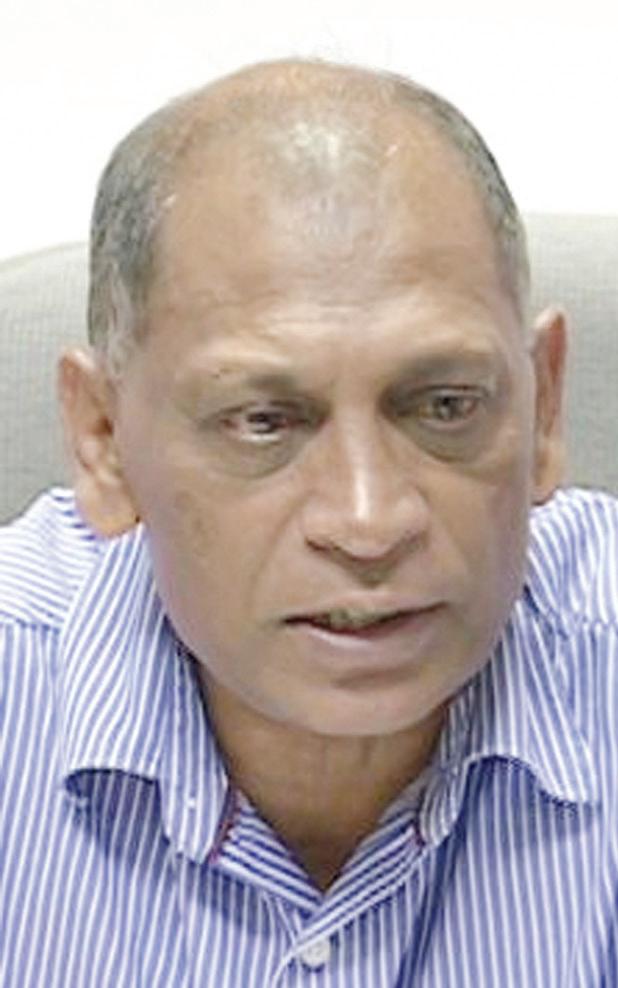
underdeveloped agricultural lands.
Trinidad and Tobago took up this offer and recently, a Memorandum of Understanding (MoU) was signed between the two countries whereby 10,000 acres of land will be made available to investors and farmers of that country for agriculture development. This collaborative initiative is being led by the Trinidadian government.
Trinidad and Tobago is currently looking at ways and means through which it can reduce its import of food from outside of Caricom; however it does not have the availability of land at its disposal to grow more of its own food, hence this venture.
Minister Ramsammy explained that while
Trinidadian businessmen and farmers have an opportunity to expand their entrepreneurship, Guyana also stands to benefit significantly.
“Any business that is established here creates jobs and an inflow of wealth to the national GDP and treasury… our export will increase because whether it is produced by Trinidadians or Chinese it is still Guyana’s products… we are working with Trinidad so as to ensure that what is produced on our farms will have value added in Guyana. This includes agro-processing and packaging, which be done in Guyana,” he said.
In 2010, a Barbadian group came to Guyana to develop agriculture in Region Nine. This area was initially swamplands, and now with this development, the infrastructure is significantly improved, giving rise to the Santa Fe farm that is cultivating rice and other crops.
The model that the government of Guyana is using in approaching this collaborative venture will also see investors developing more lands than they will be utilising. The remainder will go to local farmers.
Within the period of one year, three technical teams from Trinidad visited Guyana looking at investments in areas such as aquaculture, coconut and rice.
The community of Supenaam on the Essequibo Coast has been plunged into mourning after one of its young residents was killed by a canter truck Wednesday morning on the Spring Garden Public Road.
Dead is Marlon Viveros, 19. It is believed that the man was lying on the road when he was run over by the truck. Speaking to Guyana Times, mother of the deceased Nandanie Persaud said the police broke the sad news to her. The mother said her son went to his uncle’s wedding where he performed as a disk jockey (DJ), but never returned.
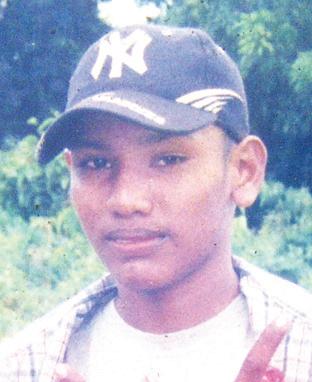
The mother of five said based on reports received, the incident occurred while Marlon was on his way
home.
“I couldn’t believe my eyes, my heart weeping, my son head was smashed, his guts were out.” The mother said her son was a joiner by profession and they are making preparations for his funeral.
Meanwhile, the driver of the truck Fitzroy Lloyd is in police custody assisting with investigations. Police said the driver is cooperating and he is expected to make a court appearance shortly. According to reports, Lloyd did not see the man lying on the ground and felt the impact after he drove over his head.
A33-year-old man was discovered dead on Wednesday in a city hotel and he is suspected to have committed suicide after he allegedly failed to kill his lover.
The man has been identified as Egerton Grant of Linden. He was discovered lying on a bed in Room 12 of The Shack Inn and Bar on Norton Street, Werk-enRust, Georgetown, sometime around 10:00h.
According to information reaching Guyana Times, there was a bottle with a substance suspected to be rat poison found near Grant’s body and his throat was also slit. A staff at the hotel told this publication that the man checked in at the hotel with a female sometime around 09:15h on Wednesday morning and they booked a room for the entire day. The woman noted that about 45 minutes
after the couple checked in, they heard a sound and screaming on the third floor.
However, she noted that before anyone could have gone to investigate where the sound came from, they saw the woman come running downstairs. The staff recalled that the woman was hysterical and related to them that her companion tried to choke her so she kicked him in the groin and escaped.
Alarmed, employees of the hotel immediately summoned the police; however, during that time, Grant reportedly locked himself in the room. When the police arrived at the hotel, they had to break down the door to gain entry into the room.
They found Grant fully clothed and there was a high scent in the room, presumably from the poisonous substance he consumed.
This newspaper under-
stands that Grant and the 23-year-old female were in a relationship that failed, but they had reportedly attempted to mend their relationship with an outing at the hotel.
The hotel staff explained that since its establishment some 37 years ago, nothing of the sort has ever happened at its facilities and they are shocked by the incident.
The 23-year-old female was taken into police custody and is assisting with investigations.
After police had finished gathering evidence from the scene, Grant’s body was subsequently removed and taken to the Lyken’s Funeral Home.
A post-mortem examination is expected to be conducted on Friday. Efforts to locate the man’s relatives in Linden proved futile.
Telephone giant, Digicel on Wednesday presented a cheque to Amerindian Affairs Minister Pauline Sukhai to continue its trend of supporting Amerindian Heritage Month’s sports events.
Digicel’s Public Relations Manager Shonnet Moore presented the cheque to the minister, making it the eighth year the company has been supporting the event.
Minister Sukhai highlighted that with the support of the phone company over the years, the ministry has not only developed many hinterland communities, but has also sustained and promoted the development of sports among the youths within.
She said without the communication sector developing and growing, many villages across Guyana may still have been experiencing difficulties on how to get messages out and to inter-
act. This has now been made easy with the sector’s advancement.
Digicel Event and Sponsorship Manager Gavin Hope emphasised that the venture to always support the activities during Amerindian Heritage Month and Hinterland community development will be continuous.
“We see it fit as it relates to personal development and community-based development projects, Digicel has always been eager and willing to get into the communities and assist in whatever activities, projects and programmes they have,” Hope added.
Heritage Sports this year is slated to take place at the Everest Cricket Ground on September 21-22, allowing Amerindians from different regions across Guyana to participate in football, volleyball, cricket, track and field, among others.
















Someone will unexpectedly make changes behind your back. Don’t let curiosity ruin a surprise. Adapt to shifting conditions and plan a little something of your own.

By Bernice Bede Osol

(June 21July 22) (Jan. 20Feb. 19) (Dec. 22Jan. 19)
Question what someone is offering you before you agree to their terms. You will need to make adjustments if you decide to get involved. You will have great insight and plenty to contribute.

Travel to places that inspire you, whether they’re nearby or far away. Find out what you need to achieve your dreams, and approach people who can help you do so.

You’ll face opposition from friends or family. Step outside your immediate viewpoint and you will find acceptable solutions. Nurture important relationships above all.

(Aug. 23Sept. 22)
(July 23Aug. 22) (Feb. 20-March 20)
Use your imagination and you will come up with profitable ways to employ your skills. Don’t let someone’s lack of vision stop you from following the path that interests you.

(March 21-April 19)
Get involved in activities that challenge you physically and take on an emotional situation that entices you. Information that will help you make the right decision can be found through unusual channels.

(April 20-May 20)
Don’t let jealousy or uncertainty cause you to show vulnerability. If you maintain a playful attitude and show what you have to offer, you will attract positive attention.

(May 21June 20)
Speak up, but listen to alternatives as well. Share your emotions and adapt to the needs of people you want to work or spend time with.
Learn from past experience when dealing with personal matters. Communicate openly and honestly and you will avoid a situation that has the potential to be taxing. Make positive changes at home.

(Sept. 23Oct. 23)
Interesting changes to relationships with colleagues, friends and loved ones will develop. Someone is likely to withhold information pertinent to a decision you must make. Ask direct questions before you proceed.

(Oct. 24Nov. 22)
Spend time with someone you love and share your plans for the future. Make a promise and ask for one in return. Much can be accomplished if you go through the proper channels.

(Nov. 23Dec. 21)
Induce changes at home that will alter the way things are done, allowing you to save more, spend less and use your space efficiently. Your innovative lifestyle will inspire others.

Tourist villa apartments 1, 2 & 3 bedroom, long & short term, and car rental service. Phone: 227-2199, 227-2186

Dentures provided in 72 hours from as low as $4500. Contact Dr B Stuart, 209B Charlotte Street, Lacytown. Tel: 225-5034

Available: Fresh long-stemmed roses, fresh dried and silk floral arrangements, gift items, bridal boutiques and wreaths. Nesha’s Flowerland. 78 Church Street (opposite St George’s Cathedral). Tel: 227-3553/225-3315

One 320 CL Excavator located at Mahdia; excellent working condition. Owner migrating, call 682-0365 or 614-1669
Gold Land, excellent investment. Priced to sell, call 682-0365, 6141669 Wine vessel (jue) Shang dynasty, old Chinese painting, old Ming prints, Ming dynasty Chinese painting on bamboo, Qi Baishi orginal painting, rare bowls and pots, all Chinese antiques. Phone: 592-623- 7029

Healthworld Holistic Centre:
Psychotherapy available for all types of abnormal behaviors – addictions, emotional, suicidal, anger, relationship and sexual problems. Treatment of stress disorders, depression, fear, low self-esteem, insomnia, trauma, psychosomatic sicknesses, and children's disorders. We also conduct IQ evaluations and behavioral assessments. By appointments only. Clinic hours: 11:00 – 17:00h. Tel: 592-621-0552. Email:healthworldhc@gmail.com
Ayurvedic herbal treatment for all chronic genetical /none genetical and diseases, including, HIV, Cancer, diabetic, pregnancy, sexual (weakness) etc. Phone: 685- 3220.
Are you pouring on pounds? Then call Raul /Carol Wilson: 660-6818, 6415923, 216-3016, 216-3601 for your healthy eating package. Stay healthy and flexible with yoga. Phone: 693-2233



Immigration & Visa Services We handle all Canadian, USA and UK, Immigration and Visa matters. Self Sponsorships, Holiday/ Visitor’s Visas, Work Permits, Students Visas, Family, Class, Immigration Forms, Embassy Enquiries, Appeals for Refused Cases, U.S Green Card Lottery, Business Class Waivers, Pardons etc. Get your Visa approved. High Success Rate. Balwant Persaud & Associates. Certified Immigration Consultants 68 Sixth Street, Alberttown, Georgetown (Between Cummings & Lights Sts.) Tel: 225-1540, 622-8308, 655-3105. Email: balwantpersaud@yahoo.ca

Professional Key Shop, 125 Carmichael Street, Georgetown. Phone: 2253923, mobile: 621-3249. We cut any type of key, service and repair all types of locks. Get your extra key today.




Da Silva’s Optical. For Your Eyes Only, Look Better See Better. Phillip A Da Silva OD, Shannon L Da Silva OD, Natalie Da Silva OD. 248 South Road, Bourda. Phone: 227-3529, Linden: 444-6376, Corriverton: 339-3536, Meten-Meer-Zorg: 275-0322, Grand Cayman Islands: (345) 943-1515 for the perfect trendy touch.

Retired Engineer aged 66 would like to know a single female over the age of 50. Phone: 604-7022

One business property, Lamaha Street. Phone: 669-3313, 231-4586, 695-4382. Properties for sale. Phone: 642-2116 2-storey concrete house 32’x 55’, 4 bedrooms, block 8 Mon Repos, ECD, $35 million. Phone: 642-2116


Suriname astrology palmist and Djuka healer, the most powerful spiritualist in the world, are you suffering from the following problems - (any religions) love, marriage, family, health, business, husband and wife relationships, property, court, children, promotion, visa, pregnancy, education, depression, job, sexual, jealousy, enemy, money, drinking, also you can have all evil forces destroyed such as black magic, witchcraft, voodoo, obeyah, etc, and gives powerful protection. Private and confidential. Phone: 674-2112.
Dutch Spiritual work. Unite lovers, get rid of evil, enhance prosperity, good luck baths and charm bowu guards, etc. Phone: 220-0708, 6126417, 687-5653



Kaieteur Falls day tour, US$150. ManausBrazil US$800 Phone: 231-6663

One Honda Cappa (Yellow) ideal for taxi or private use. Leather seats and roof, reverse camera, DVD/TV/ CD player, mag rims. Also Motorola Base Radio with Antennae. HC series; immaculate condition; give away price $1.2M. Call 647-2491.
One black scooter for sale, excellent condition. Phone: 602-7277, for information.
One new Yamaha R1 Motorcycle 1000cc (candy red & black) recently registered 2013. Latest double exhaust, bug lights, immaculate condition. Give away price, call 647-2491
JUST ARRIVED: TOP QUALITY RECONDITIONED VEHICLES; TOYOTA PREMIO; TOYOTA SPACIO; TOYOTA VITZ (NEW SHAPE); TOYOTA NOAH; SUZUKI SWIFT; MERCEDES BENZ C200 COMPRESSOR; BMW 318 I; COROLLA AE100 WAGON; LAND CRUISER (FULLY LOADED); MAZDA PROCEED 4WD EXTRACAB PICKUP; TOYOTA HILUX; 3RZ & 5L; 4WD EXTRACAB PICKUPS; HIACE PITBULL 19-SEATER; MITSUBISHI CANTER TRUCKS 3, 3.5 TONS OPEN TRAY; 3 TONS WITH TAILGATE HOIST; 2 TONS 4WD; 3 TON DUMP TRUCK. PRE-ORDER YOUR UNITS EARLY AND GET THE BEST PRICES. FULL AFTER SALES SERVICE AND FINANCING AVAILABLE. DEO MARAJ AUTO SALES, 2 CHIMNEY ROAD, CHATEAU MARGOT, ECD. 624-0762, 220-5177. A NAME AND A SERVICE YOU CAN TRUST.


L AND FOR SALE
Parfaite Harmonie $1M and $1.2M phone: 675-7292
46 houselots in residential area between Charles & Peter Streets, Parika, EBE. Phone: 622-6971/6612289
Divinations and cleansing of spiritual problems of all kinds. Powerful Ifá and Khemetian spiritual guards, pendants, crystals and rune stones to help you overcome problems with love, relationships, legal, sexual, pregnancy, business, sickness, jobs, enemies, work, money and many more. Call 10:00-16:00h on: +592690-1824. Email: anew-life@live.com
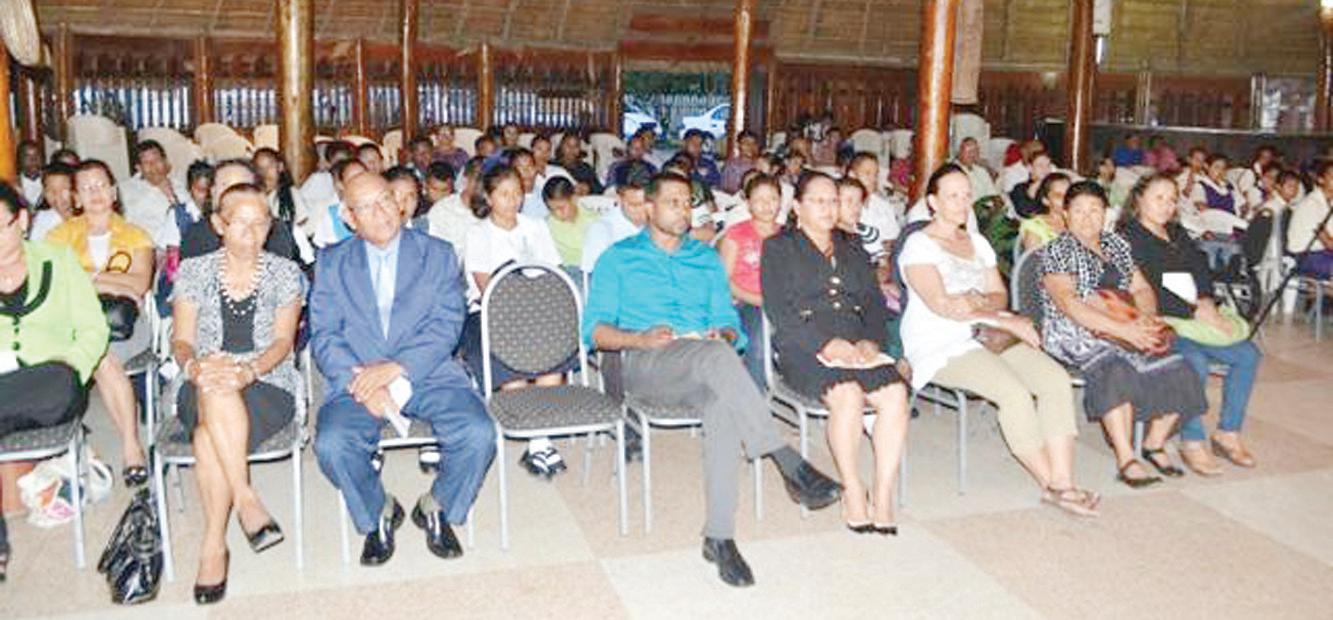
he Amerindian Affairs
TMinistry on Tuesday evening hosted a reflection and exhibition, in honour of the life and contributions of prominent Amerindians and the first indigenous parliamentarian Stephen Campbell.
The ceremony, which was held at the Umana Yana, Kingston, is part of the Amerindian Heritage Month activities being held under the theme “Honouring Our Culture, Advancing Our Future”.
During this tribute, Amerindian Affairs Minister Pauline Sukhai lauded the contributions of Campbell along with former ministers of Amerindian affairs Desrey Fox and Vibert De Souza, along with indigenous advocate Basil Rodrigues.
She urged Guyanese to be acquainted with the level of contributions of these prominent Amerindians and that “we should not only preserve the culture, but respect and recognise the Amerindians’ contributions to the country’s development”.
“The Ministry of Amerindian Affairs of course will continue to enhance the scholarship programme, and that is why we expect the
highest of potential by the students who we assist,” the minister pointed out. She said that since more opportunities in the education sector are now being provided to indigenous people, they should take advantage of them.
The evening’s activity also included poems, dramatic presentations and indigenous songs paying tribute to the Amerindian advocates.
Amerindians today are represented in all areas of academic disciplines and civil society. New secondary schools were built in all hinterland regions and an increasing number of hinterland children have access to higher education. Amerindians are today more empowered through the opportunities afforded to them.
Stephen Esterban Campbell was born in Moruca on December 26, 1897 to Tiburitio and Maria Campbell. Both of Stephen’s parents died when he was very young and was subsequently raised by his grandmother whom he credited with teaching him the core principles of life; “religion and discipline”.
He attended Santa Rosa Primary School. In
1919, Campbell dedicated his time to teaching basic instructions of literacy to the Wapishianas of the Rupununi.
He was also the founder of the first school in the village of Sawariwau. In 1953, while in the North West District, he worked as an electoral official for the elections where he served as a presiding officer.
In 1957, Campbell had formally been inducted in the national political life. He joined the National Labour Front (NLF), one of five political parties that competed in the general elections in that year. He rose to the occasion and defeated his other rivals for the North West District seat and in the process, he was the only man to gain a seat won by the NLF. He was sworn in on September 10, 1957 and at his initial stage of being a legislator, Campbell repeatedly highlighted the need for improved transportation in the remote interior and expansion of agricultural production. He was also pivotal to the development of improved health facilities in Region One.
He died on May 14, 1966.
The National Security Agency routinely shares raw intelligence data with Israel without first sifting it to remove information about U.S. citizens, a top-secret document provided to the Guardian by whistleblower Edward Snowden reveals. Details of the intelligence-sharing agreement are laid out in a memorandum of understanding between the NSA and its Israeli counterpart that shows the U.S. government handed over intercepted communications likely to contain phone calls and emails of American citizens. The agreement places no legally binding limits on the use of the data by the Israelis. The disclosure that the NSA agreed to provide raw intelligence data to a foreign country contrasts with assurances from the Obama administration that there are rigorous safeguards to protect the privacy
of U.S. citizens caught in the dragnet. The intelligence community calls this process "minimisation", but the memorandum makes clear that the information shared with the Israelis would be in its pre-minimised state.
The deal was reached in principle in March 2009, according to the undated memorandum, which lays out the ground rules for the intelligence sharing. The fivepage memorandum, termed an agreement between the U.S. and Israeli intelligence agencies "pertaining to the protection of U.S. persons", repeatedly stresses the constitutional rights of Americans to privacy and the need for Israeli intelligence staff to respect these rights.
But this is undermined by the disclosure that Israel is allowed to receive "raw Sigint" – signal intelligence. The memorandum says: "Raw Sigint includes, but is not limited to, unevaluated and unminimised
transcripts, gists, facsimiles, telex, voice and Digital Network Intelligence metadata and content." According to the agreement, the intelligence being shared would not be filtered in advance by NSA analysts to remove U.S. communications. "NSA routinely sends ISNU [the Israeli Sigint National Unit] minimised and unminimised raw collection", it says.
Although the memorandum is explicit in saying the material had to be handled in accordance with U.S. law, and that the Israelis agreed not to deliberately target Americans identified in the data, these rules are not backed up by legal obligations.
"This agreement is not intended to create any legally enforceable rights and shall not be construed to be either an international agreement or a legally binding instrument according to international law," the document says. (Excerpt from The Guardian)
It was down to the old firm of Younis Khan and Misbah-ul-Haq to stabilise Pakistan after the top order wobbled again on Wednesday.
Khurram Manzoor did make a determined halfcentury in his comeback series but Mohammad Hafeez had another failure at Test level and Azhar Ali fell early as well, leaving it to the experienced hands to start the repair job at 96 for 3.
By stumps, Younis had become the fourth Pakistan batsmen to go past 7000 Test runs on his way to one more fifty, Misbah had dug in for the long haul as usual, and the stand had grown to 67.
There was almost an air of inevitability to this familiar partnership, which was saying a lot on a pitch where a batsman was never quite in. The expected deterioration hadn’t happened yet, but there were many deliveries that stayed low.
Scoring was difficult through the day but Younis and Misbah were assured, Younis pushing and driving straight, Misbah guiding and nudging square. There was the occasional play-andmiss and lbw appeal, but that could induce no change at all in the men’s temperament or their methods.
Manzoor had shown excellent composure till he rushed out for a single to

square leg soon after tea and was stranded, Younis’ refusal coming a touch late. The opener had kicked on from an uncertain start to play several aggressive drives with superb timing through point, cover and straight down the ground. Zimbabwe’s fast bowlers came nowhere close to matching the kind of bite Junaid Khan had generated on the first morning. They weren’t able to target the good length areas, where there were cracks, as well
as Junaid had. Often, they overpitched, and Pakistan, chiefly Younis and Manzoor, capitalised.
Manzoor could have gone without scoring. In the sixth over, he seemed to have got some glove off Brian Vitori for the wicketkeeper to take it down the leg side - there was a clear deviation - but the umpire probably felt it had come off the thigh pad. He was 1 off 23 at one stage and it was Hafeez who began with confidence, flicking and straight-driving
for three fours as Pakistan got through the potentially tense period of eight overs before lunch unscathed.
He fell in characteristic fashion soon after the break, though, poking at a Vitori length delivery to edge to first slip on 22. Azhar could have gone fourth ball, when Tendai Chatara hit his pad in front of middle but the appeal was turned down. But he was to fall in similar fashion, trapped leg-before off Tinashe Panyangara for 7.
By then, though, Manzoor had got over his early nerves, and Zimbabwe had turned to Hamilton Masakadza, possibly to give their specialist seamers some leeway after the workload they carried in the first Test. However, Brendan Taylor stuck with Masakadza for four overs after Younis came in, allowing the batsman to settle in against harmless, gentle length deliveries outside off.
In the morning, Chatara and Vitori also had had few problems settling in, as they batted into the second hour of the day in a last-wicket stand of 46 that stretched the Zimbabwe innings to 294. The hosts began the day on 237 for 8, hoping to make the most of the remaining two wickets with the surface expected to deteriorate significantly later. There was quite some sense
on display from Nos 10 and 11 as they defended resolutely and earned precious runs.
Pakistan felt they had got Chatara caught behind on 1 when Junaid ripped a lifter past the batsman’s prod. There was a faint sound as ball passed bat, but umpire Steve Davis was unmoved. It would be an hour-and-ahalf more before Pakistan finally ended the innings.
Chatara was fortunate again when a couple of close lbw shouts were turned down, off Ajmal and Hafeez, the latter one ap-
pearing especially tight. Abdur Rehman ultimately broke through in the 20th over of the day when umpire Ranmore Martinesz decided ruled the latest leg-before shout against Chatara, on 21, was far too plumb to be turned down.
Panyangara had one lbw appeal negated against Misbah when he was on 18, the ball hitting the Pakistan captain high, on the back thigh pad. That was about as close as Zimbabwe came to separating the familiar partners. (Cricinfo)
3-141, 4-172, 5-176, 6-187, 7-203, 8-234, 9-248, 10-294
Bowling: Junaid Khan 33-11-674, Rahat Ali 19-7-48-2, Younis Khan 3-0-7-0, Saeed Ajmal 27-692-1, Abdur Rehman 23.5-6-473, Mohammad Hafeez 4-0-12-0
Rehman 15
R Mutumbami† c †Akmal b Junaid Khan 8
P Utseya c Rahat Ali b Junaid Khan 22
T Panyangara b Rahat Ali 24
T Chatara lbw b Abdur Rehman 21
B Vitori not out 19
Extras: (b7, lb14, w1) 22
Total: (all out, 109.5) 294
Fall of wickets: 1-0, 2-31,
Pakistan 1st innings Khurram Manzoor run out (Chigumbura) 51 Mohammad Hafeez c Masakadza b Vitori 22 Azhar Ali lbw b Panyangara 7 Younis Khan not out 52 Misbah-ul-Haq* not out 27 Extras: (lb4) 4 Total: (3 wkts, 68 overs) 163 Fall of wickets: 1-29, 2-62, 3-96 Bowling: T Panyangara 13-3-301, B Vitori 16-5-42-1, T Chatara 18-5-28-0, H Masakadza 9-418-0, P Utseya 12-0-41-0
Rain ended the third one-day international between England and Australia after 15.1 overs at Edgbaston on Wednesday.
In the play that was possible, England slipped to 593, with Michael Carberry, Kevin Pietersen and Joe Root dismissed.
Australia lead the fivematch series 1-0 after victory at Old Trafford on Sunday.
The fourth match takes place at Cardiff on Saturday, with the series concluding in Southampton on Monday.
England had opted to field an unchanged side from the XI that lost by 88 runs at Old Trafford, a team that included only three frontline bowlers in Steven Finn, Boyd Rankin and James Tredwell.
However, it was the home batsmen that came under pressure when Australia captain Michael Clarke won the toss and elected to field in grey, wet conditions.
With rain having delayed the start for 20 minutes, England lost opener Carberry in the first over, run out in a mix-up with Kevin Pietersen.
Pietersen set off after

at the striker’s end. Pietersen had already hit his first ball for four, but the dismissal of Carberry prompted some uncertain strokes.
Scoring only two runs from his next 16 deliveries, he was caught at square leg off the extra pace of Mitchell Johnson.
Jonathan Trott had an lbw decision from the same bowler overturned on review as he compiled an unbeaten 28, but Joe Root offered a return catch to left-arm spinner Adam Voges before the rain came. (BBC Sport)
This Saturday night at the MGM Grand in Las Vegas, the 23-year-old Saul “Canelo” Alvarez will move up several levels in class as he takes on the pound-for-pound best fighter in the world, Floyd Mayweather in a junior middleweight title unification bout.
As expected, Alvarez is a decided underdog in this battle, giving up a massive edge in experience, skill, and overall talent. To most informed observers, the idea of picking the red-headed battler from Guadalajara, Mexico over Mayweather is downright silly. But, surprisingly, Canelo has a steady stream of supporters picking his upset victory and keeping the betting odds relatively close (for a Mayweather clash).
So, what warrants this optimism and the feeling that, this time, the right opponent has been picked to end the reign of the controversial “Money” Mayweather? Here’s a look at five reasons an upset may not be as farfetched as previously thought:

Obviously, the elephant in this room is the sheer difference in bulk between Mayweather and Alvarez. While Mayweather has to actively try to pack on pounds to make the minimum weight requirement of the junior middleweight division, Canelo has to work to cut his weight down. Often rehydrating to upwards of 170 lbs. by fight night, Alvarez is, in reality, a small light heavyweight smashed into a junior middleweight frame. The size, alone, isn’t much of a factor in this bout. However, Canelo is a young
fighter who understands how to use his bulk to his advantage and is adept at wearing down his usually smaller opposition with inside grappling and constant pressure. Mayweather will likely be giving up a twenty pound weight advantage, which is good for his speed-based game, but it’s also good for a fighter like Alvarez, who looks to grind down his opposition.
Focus
At 23, Alvarez is the rarest of all young men in terms of focus, poise, and ability to learn (and execute) a coherent game plan. For those un-
Ferrari have confirmed Lotus driver Kimi Raikkonen will join Fernando Alonso at the Italian team from 2014 after agreeing a twoyear contract.
Raikkonen, 33, won the world title with Ferrari in 2007 but was displaced by the arrival of Spaniard Alonso in 2010.
The Finn will replace Felipe Massa, who announced via Twitter that he will leave at the end of the current season. Raikkonen said: “I’m really happy to return to Maranello where I spent three fantastic and very successful years.”
“I can’t wait to be driving a Ferrari car again and to reacquaint myself with so many people with whom I had such close links, as well as working with Fernando, whom I consider a great driver, in order to bring the team the success it deserves.”
Lotus are expected to replace Raikkonen with Sauber’s German driver Nico Hulkenburg.
Raikkonen had also been linked with a move to Red Bull after impressing with victory in the opening race of 2013 at the Australian Grand Prix, followed by second-place finishes in China, Bahrain, and Spain.
Red Bull opted to promote Daniel Ricciardo from their Toro Rosso junior team rather than continue to pursue Raikkonen.
Raikkonen is only in his second season back in Formula 1 following a two-year break during which he pursued a career in rallying.
His 2012 return was marked with seven podium finishes, including victory in Abu Dhabi in the penultimate race of the season.
Ferrari’s decision to partner Alonso
with Raikkonen signals a return to the policy last employed between 2007 and 2009 when Raikkonen and Massa competed on equal terms.
Either side of that period, with Michael Schumacher from 1996-2006 and then with Alonso for the last four years, there has been a clear number one driver.
Former world champion Sir Jackie Stewart, who works as a consultant for the Lotus team, told BBC Sport that Raikkonen’s presence could unsettle Alonso, who has been used to being the focus of the team’s efforts.
Alonso’s relationship with McLaren, when he was team-mates with Lewis Hamilton in 2007, was famously turbulent, and the ructions led to him leaving the team just one year into a three-year contract.
Alonso has since made it clear that his problems at the time were not with Hamilton but with the team not delivering on promises that had been made to him about his status.
And in a statement on the Ferrari website, he paid tribute to Massa and looked forward to Raikkonen joining the team.
“It will not be easy to say goodbye to a team-mate like him. He has always been truly professional and loyal to the team and I am sure that right to the end, he will do his utmost for the Scuderia that he loves so much.
“I’d like to welcome my new travelling companion: together, starting next year, we will have to tackle a very demanding technical and racing challenge.”
Ferrari’s decision, which was approved by the team’s president Luca Di Montezemolo, leaves Lotus with a second key vacancy to fill.

familiar with his back story, Alvarez became a professional fighter at fifteen, a father at sixteen, and a promoter working with a small stable of fighters at seventeen. This is not your typical 20-something young, brash millionaire. In the ring, Alvarez has shown steady and consistent growth, perfecting just about everything placed on his developmental checklist by trainer “Chepo” Reynoso. If there’s anyone, anywhere who can
keep a well-formed game plan against Mayweather, it is Alvarez.
Age
The age factor can cut both ways in this bout. Some may point to Alvarez’s youth as a sign of him being too green. Others could just as easily point to Mayweather’s thirty-six years of life as a sign that a fighter is ready for a fall. Take from it what you will, but a thirteen year age difference can be significant.
Confidence
Undefeated and just approaching the prime of his physical abilities, Alvarez is sure of himself and sure of his ability to win. Of course, everybody says that they’re confident in their ability to beat Mayweather before finding themselves absolutely not up to the task. In Canelo’s case, his entire life has been one of victory and conquest. When he says that he envisions a victory, he means it. And that means a confident, dogged pursuit of that victory even when things may not be going his way in the bout.
Business
Canelo is young, charismatic, and a potential icon for the huge Mexican and Mexican-American boxing fan base in the country. He’s also the biggest draw Mayweather has faced since a past-hisprime Oscar De la Hoya. Although it shouldn’t matter, sometimes business creeps into the way a fight is scored and officiated. Don’t be surprised if Canelo gets the benefit of the doubt in close rounds that would normally have gone to Mayweather. (Yahoo! Sport)
Perth is the major casualty of Australia’s truncated 2014-15 Test summer, stripped of its annual match for the first time since 1976-77.
Only four Tests are scheduled for a season in which India will visit, due mainly to the fixturing squeeze created by the 2015 World Cup, and the nation’s two smallest and youngest major grounds in Perth and Hobart have been left off the Test calendar.
The decision has provoked an outraged response from the Western Australia Cricket Association, while the host broadcaster Channel Nine is also likely to be nonplussed about losing the one Test match of the summer it can screen in prime time to the populous eastern states, due to Perth’s more westerly time zone. However it was always likely that Perth would miss out on the match due to concerns about the ground’s facilities and size relative to its main rivals Brisbane and Adelaide.
While Bellerive Oval has never been a nailed-on venue, the WACA ground has invariably provided blood and thunder Test cricket, due to its uniquely fast and bouncy pitch. India were rounded up by an innings and 37 runs well inside three days in Perth in January 2012. Other considerations outlined by the CA chief executive James Sutherland included the strong claims of other grounds. Adelaide Oval’s $535 million redevelopment will be complete in time for the series, while the Gabba has traditionally been
India have struggled in Perth, and the green-tinged 2012 pitch is known to have been chief among the motivators for the retaliatory dustbowls prepared for Australia’s visit to India earlier this year
host to the first Test of the summer and has consistently drawn larger crowds to its matches than Perth.
The WACA’s size, a history of spotty attendances and facilities lagging behind other grounds have detracted from its standing among international venues, despite its lively pitch and a time zone more favourable to television audiences both in India and on the east coast of Australia. CA’s verdict also maintains a longstanding tradition of “last in, first out”
among venues - Melbourne, Sydney, Adelaide and Brisbane all boasting of longer Test traditions than Perth.
“Though a traditional Test match venue with a proud history, the WACA ground has the smallest capacity of the five mainland Test venues and has historically attracted lower attendances,” Sutherland said. “The WACA has been working hard to improve the facilities for its fans but it still requires significant improvements. (Cricinfo)
- Nevisian and West Indies opening batsman, Kieran Powell is fully focused and ready for the upcoming challenges as he heads off to India with the West Indies A team.
Kieran agreed to an interview late Monday night, even though he was set to catch a boat at 6am the next morning to go over to St Kitts where he was to board a flight to Barbados to join his teammates. The West Indies A team was due to fly out of Barbados on Tuesday evening, en route to India.
In referring to his recent CPL performances, Powell expressed the thought that he was below par. ‘I was a little rusty for starters as I was just coming off my finger injury.
My finger was broken on two separate occasions. However, I got better as the tournament progressed and I managed to end up in the ten top batters’ he said..
When asked about adjusting to the longer versions of the game as he goes off to India, he stated that his plan was simple— ‘to stick to the basics.’ It’s a matter of waiting for the bad balls. The scoring opportunities will come. I just plan to keep it simple,’ he said.
Powell who has been se-

Kieran Powell
lected as captain of the one day team and vice captain of the four day team, stated that when he was asked to take up the leadership
role, he was happy to accept. ‘They (the selectors) are looking in new directions in terms of leadership and I did not see any harm
in giving it a try. Obviously, I have a little more international experience than some of the other guys and I will do my best for the team,’ he said.
Powell also explained that he has sought advice from several key individuals as regards to captaincy and other issues. These include Ricky Ponting; Darren Sammy; Marlon Samuels and his Dad who has stuck with him through thick and thin, Carlisle Powell.
About his plans for the upcoming tour, Powell who has played in India previously, noted that the surfaces there are slower and lower and has the ball turning from ball one.
‘I plan to build my innings and spend a lot of time in the middle. I hope to get some big scores and build my confidence, he stated.
He was quick to point out that he is hoping to be a part of the senior West Indies tour to India which begins just one week after the A team tour concludes and he also plans to be a part of the team for the New Zealand tour which follows.
In terms of countering the spin threat, the confident left hander indicated that his plan was to get as close to the pitch of the ball as possible and to be aggressive against the spinners.
AIPUR: Sachin
JTendulkar’s 200th Test is going to be special for more reasons than one. Amid the debate on whether the Little Master should play the milestone match at home or not, visitors West Indies are planning a ‘surprise’ for Sachin. It’s Saqlain Mushtaq’s doosra!
Former Pakistan offspinner Saqlain is training the Caribbean spinners on mastering the art of the doosra ahead of the India tour.
Saqlain’s variety of spin had proved to be Tendulkar’s Achilles heel throughout his career. And now, through a special camp held at the High Performance Centre in Barbados, the spinners for the likes of Devendra Bishoo, Shane Shillingford, Ashley Nash are learning trade secrets from Saqlain to tackle the Little Master in his milestone match.
Ask Saqlain about his new assignment and he smiles. “Touring India is always a challenge for any team and now that Sachin will be playing his 200th

Test, the pressure will be more on the bowlers. At the moment, I’m assessing our spinners keeping all these factors in mind,” Saqlain told TOI from Barbados.
The last time West Indies travelled to India a couple of years back, lack of quality spinners proved costly for Darren Sammy’s men and taking lessons from that. “For any bowler playing at the international level, it’s important to be physically and mental -
ly strong. A batsman like Sachin will test your character and you can’t just give up,” Saqlain felt.
So what’s his advice for the Sunil Narines and Shillingfords? “Read his body language and have patience. You need to judge him well and while bowling to Sachin, you will have to allow him to go for shots and then you need to counter back. That’s all I will be sharing with these spinners,” Saqlain elabo -
– fourth annual tournament kicks off on September 28
Twenty-four primary schools in Georgetown will contest the fourth annual Courts Pee Wee Under-11 football competition, set to kick off on September 28 at the Banks DIH ground, Thirst Park.
The tournament, which is a collaborative effort of furniture and appliance company, Courts (Guyana) Inc., beverage giant Banks DIH Limited and the Petra Organisation, was launched on Wednesday afternoon in the lunchroom of Courts’ Main Street outlet, where representatives of the stakeholders reiterated the importance of investing in grassroots football.
Lead sponsor Courts (Guyana) Inc., has injected $3.3 million into the event, which will conclude on November 2 when the final is held at the Banks DIH ground, Thirst Parkthe venue for the 70 games of the competition.
rated.
Saqlain feels, Sachin’s eyesight makes the difference. “Aap jo bhi gend dalo, who zaroor pakad lega (Whatever you bow, he is sure to read you correctly),” Saqlain laughed.
And as Saqlain talks about Sachin, he gets nostalgic, going back to the famous Chennai Test in 1999 which Pakistan won despite Tendulkar’s magnificent century.
“Woh bahot hi tough match tha. He started off brilliantly and was going great guns. I tried reading his body language and that helped. I could understand that he was planning to come at me hard and there it was, a doosra to send him packing,” Saqlain reminisced. By his own admission, Sachin was the most dangerous batsman to bowl at, but off the field Saqlain still considers Sachin a ‘dear friend’.
But then, Saqlain, who will join Bangladesh team next month as spin coach, won’t be travelling with the West Indies team for his ‘old friend’s’ milestone match. (First published in the Times of India)
The entity’s Managing Director, Clyde de Haas, said the investment in youth football is a clear representation of “bringing value home”, making direct reference to the Courts theme.
He expressed the company’s delight at partnering with other organisations for the development of football at the grassroots level, adding that the competition is growing with each passing year. Last year’s tourney attracted 16 schools.
Urging the players to “let good sportsmanship prevail”, de Haas announced that the top four schools will receive a 32inch television set each to aid visual sessions in the classroom. In 2012, the four top schools were recipients of a laptop each.
Co-director of the Petra Organisation, Troy Mendonca, said the development of football at the grassroots level will ultimately benefit all levels of the game, hence the decision to focus on the Under-11 division.
Outlining the format, Mendonca stated that the teams will be divided into six groups of four teams, which will contest a round
robin. The top two teams from each group, along with the four best third place finishers will advance to the Round of 16, after which the teams will battle for positions 1-16. According to Mendonca, all 24 teams will be given stationery vouchers and participation trophies from Courts (Guyana) Inc., while they will also be provided with two footballs each and playing bibs, compliments of the Petra Organisation. The champion school will also receive a complete set of uniforms. Communications Manager of Banks DIH Limited, Troy Peters, said the company is “extremely pleased” to partner with Courts (Guyana) Inc. and the Petra Organisation under its Malta Supreme, non-alcoholic beverage.
He encouraged the schools to practice fairplay. Also he urged the players to focus on their academic pursuits even as they use the tournament as a stage to showcase their football skills.
Allison Rawlins, representing the Education Ministry, said such a tournament would always be endorsed by the ministry, as it provides an avenue for children in the schools system to become wellrounded individuals.
She also used the opportunity to enforce the importance of discipline, urging the students/players to comply with the rules and regulations of the tournament at all times.
Games will be played on Saturdays only, with a total of 12 per day. Each match will last 20 minutes.
The participating primary schools are defending champions Marian Academy, last-year’s runner-up Tucville Primary, St Agnes, West Ruimveldt, St Margaret’s, St Sidwell’s, South Ruimveldt, North Georgetown, Ketley, St Gabriel’s, F.E. Pollard, Enterprise, St Pius, Sophia, Success, Redeemer, New Guyana School, Green Acres, Stella Maris, St Winifred, Winfer Garden, J.E. Burnham, St Angela’s and East Ruimveldt.
By Rajiv Bisnauth
Sixteen-year-old Shimron Hetmyer was as surprised as he was elated with his call-up for the West Indies Under-19 team, to face Bangladesh Under-19 in a seven-match one-day series to be played in Guyana from October 5-21.
Hetmyer is joined by fellow Guyanese, left-arm spinner Gudakesh Motie and opening batsman Tagnarine Chanderpaul in the 17-man squad announced by the West Indies Cricket Board on Tuesday.
“It is a great feeling to represent West Indies at any level. And, all I am looking for is to stay focused and live up to the expectations,” Hetmyer told Guyana Times Sport on Wednesday from his home in Canje.
The left-handed opening batsman, who plies his trade with the Young Warriors Cricket Club in Berbice, said the call-up to the team was a pleasant surprise after representing Guyana in the just-concluded Regional Under-19 tournament with little success.
The Berbician scored only two fifties from both formats of the tournament with the highest score of 92 against Trinidad and Tobago. He represented Guyana once at the Under-15 level, twice at the Under-17 and now at the Under-19 level.
“When Mr Butts told me that I was selected, I was surprised, because I know to myself I haven’t performed as well in the regional tournament. Nevertheless I am happy” Hetmyer admitted.
The former Berbice High School student said that the tournament is certainly an ideal opportunity for him to develop his game.
“I want to use this tournament to develop my game, it’s a big step in my career so

I am looking forward to it,” Hetmyer concluded. Meanwhile, the squad consists of six players from Jamaica, who won the Regional Under-19 titles this year, claiming the ThreeDay and 50-Over trophies. The regional junior side will take on the Bangladeshis at three venues – the Guyana National Stadium, Bourda and Everest.
The Bangladeshis will play a warm-up game against Guyana Uunder-19 on October 5 at Bourda before playing the West Indies junior team on
October 7 at the Guyana National Stadium, October 9 at Bourda, October 11 at Guyana National Stadium, October 14 at Everest, October 16 at the Guyana National Stadium, October 19 at Bourda and October 21 at Everest.
The games for the Guyana National Stadium are day/ night fixtures and will start at 13:30h. The other games scheduled for Bourda and Everest will begin at 09:00h.
The full squad reads: Fabian Allen (Jamaica), Jofra Archer (Barbados), Tagenarine Chanderpaul
(Guyana), Bryan Charles (Trinidad & Tobago), Tristan Coleman (Jamaica), Taryck Gabriel , (Windward Islands, St Lucia), Shimron Hetmyre (Guyana), Jerome Jones (Barbados), Ray Jordan (Windward Islands, St Vincent), Alzarri Joseph (Leeward Islands, Antigua), Brandon King (Jamaica), Ramaal Lewis (Jamaica), Leroy Lug (Jamaica), Preston McSween (Windward Islands, Grenada), Marquino Mindley (Jamaica), Gudakesh Motie (Guyana) and Jeremy Solozano (Trinidad & Tobago).
Giftland OfficeMax has thrown it support behind two of its brand ambassadors who will be representing Guyana in their respective disciplines at the upcoming Central American and Caribbean (CAC) championship in the Dominican Republic.
Bodybuilder Devon Davis, a CAC gold medallist from 2012 in Puerto Rico, and athlete Alisha Fortune will form part of a contingent that will repre-
sent the Golden Arrowhead at the September 19-22.
Public Relations Officer of Giftland OfficeMax, Compton Babb, said the company is pleased to support the athletes, who are part of the Giftland Sports and Fitness Ambassador 2013-2014 programme, as they head out to represent their country.
“We embraced the success of both individuals and we are prepared to assist with the continual developmental in their life’s
goal. We congratulate both athletes as they represent our country, company and brand as proud and admirable ambassadors,” Babb said in a release.
President of the Guyana Amateur Bodybuilding and Fitness Federation (GABBFF), Keavon Bess, said the local governing body is always grateful for the support of corporate entities whenever athletes leave these shores to compete.
“The members of the
The Demerara Cricket Board (DCB) has named a preliminary squad of 24 players for the upcoming Pepsi Senior Inter-County 50-over competition from September 2129.
Following two trials among three teams on September 5 and 6 at the Georgetown Cricket Club ground, the Demerara selectors identified 24 cricketers who will go through a fitness test and further training.
The squad will be trimmed to 14 players at the conclusion of the fitness test and training sessions.
The selected players are asked to report to coach Orin Bailey at the GCC ground for the fitness test on September 16.
The first session starts at 07:00h while the second session starts at 13:00h. These sessions will be observed by Chairman of the GCB selection panel, Rayon Griffith.
The players selected are: Trevon Griffith, Rajendra Chandrika, Robin Bacchus,

Steven Jacobs, Christopher Barnwell, Derwin Christian, Zaheer Mohamed, Amir Khan, Raj Nannan, Shaquil Williams, Andrew Stoll, Paul Wintz, Seon Daniels, Kelon Carmicheal, Kemol Sevory, Tagenarine Chanderpaul, Shemroy Barrington, Yatesh Dhanpaul, Alvinda Seepersaud, Andrew Light Jr, Ramnaresh Sarwan, Shivnarine Chanderpaul, Rondolph Knights, and Dennis Legay.
DeSinco Trading, through its Degree line of deodorants, will sponsor this weekend’s 11-race programme around the inner circuit of the National Park, commencing at 09:00 hours.
GABBFF would like to thank Giftland OfficeMax for coming on board and assisting some of our athletes with their airfares.
The said assistance has helped us to guarantee a proper representation of the Golden Arrowhead at the Central America and Caribbean Championships 2013, to be hosted in The Dominican Republic.
The team of athletes representing Guyana will surely do us proud yet again.”
The company, located on Sheriff and John Streets, is sponsoring the event for the 13th year, and as was the case with previous years, Degree representatives will be on hand to assist in the presentation of prizes at the conclusion of the races.
Linden’s Marlon “Fishy” Williams will defend his title in the feature 35-lap School Boys and Invitational race, having won the event last year in one hour, 14 minutes, 59 seconds (01h: 14m: 59s).
Akeem Wilkinson had won the Juveniles 10-lap event, while Junior Niles and Alfie Soonaram are the defending champions of the

Veterans Under-50 and 1214 Boys and Girls races respectively. Other events carded for the day include the Veterans’ Over-50 and 60, Mountain bike, BMX Open, 6-9, 9-12 and 12-14 years. The day’s activities are being coordinated by national cycling coach, Hassan Mohamed.