

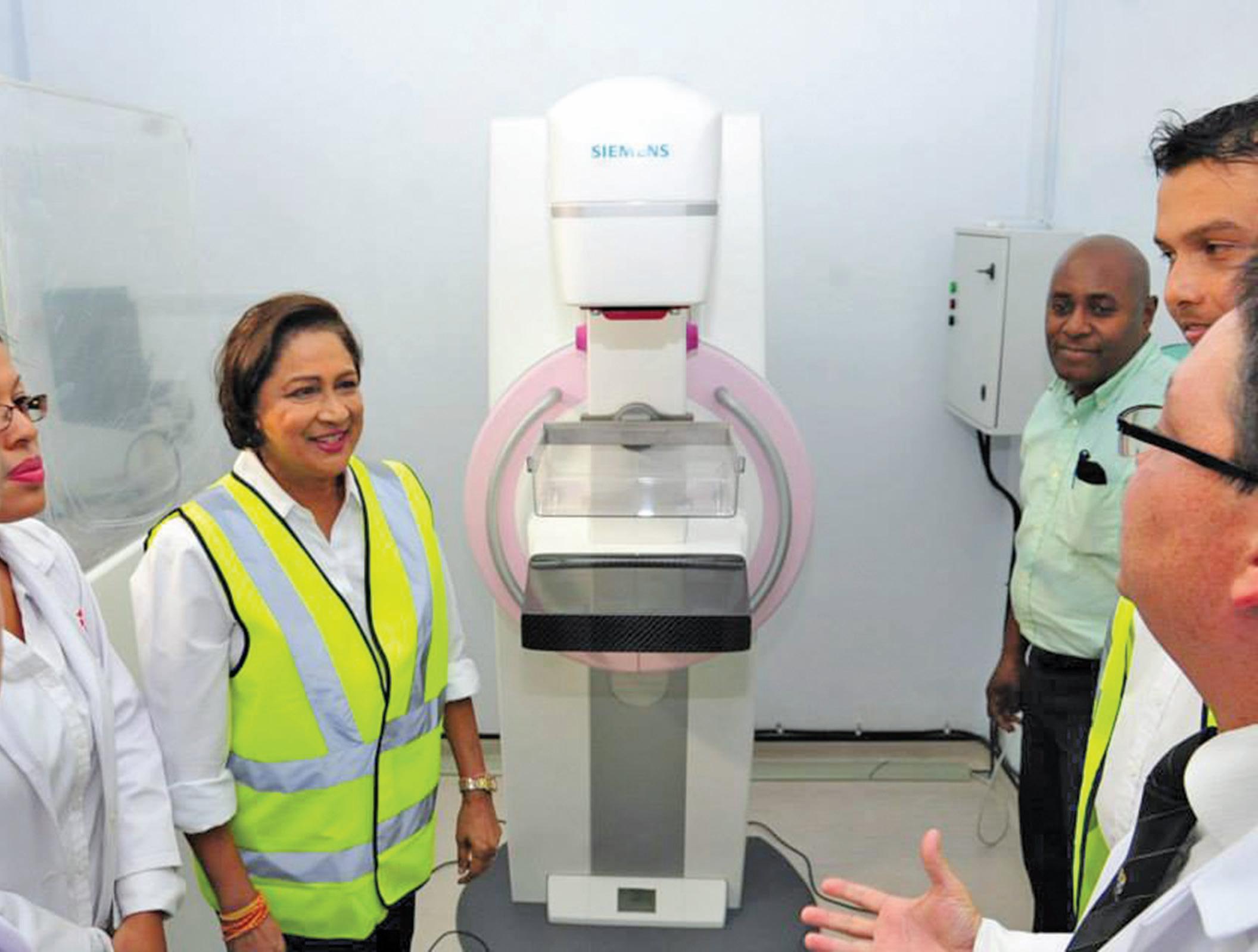



Persad Bissessar photo)


Prime Minister Kamla Persad-Bissessar on Monday outlined plans to create a new energyefficient and eco-friendly Trinidad and Tobago.
Speaking at the United National Congress (UNC) Monday Night Forum in Gasparillo, the Prime Minister spoke of solar-powered schools, housing and community centres, adding that some aspect of this plan is already in gear.
She said further that under her Government, legislative changes will be made to the T&TEC and Regulated Industries Commission (RIC Acts which will allow citizens, companies and organisations to install their own renewable energy technology and to sell the excess to the national grid.
This, she said, will stimulate the creation of a new industry in TT founded around microwind and micro-solar applications.
Persad-Bissessar said where feasible, all community centres will be outfitted with external solar PV lighting, accompanied by a three-day battery back-up system.
She said electricity bills will be reduced and these centres can be better utilised in the event of natural disasters as their power source would not be compromised.
Persad-Bissessar disclosed that this process has already started and 13 community centres have solar lighting.
The Prime Minister said further that houses built by the Housing Development Corporation (HDC) or other Government agencies will be outfitted with renewable energy technologies such as solar PV lighting and solar water heaters.
She said all street lighting in new housing developments will be solar and/or wind powered.
Persad-Bissessar touched on the issue of race, which has reared its ugly head in the election campaign.
She noted Opposition Leader Dr Keith Rowley’s position that the People’s National Movement (PNM) will not run its campaign based on race, adding that this was not believable.
The Prime Minister also hinted that she had information to raise questions over Chaguanas West MP Jack Warner’s position that he took a TT$1 a month salary as MP over the past five years.
“I will tell you more of the subterfuge…we will bring the evidence to you on another occasion, but not tonight,” she said, mimicking Warner’s oftused phrase.
Persad-Bissessar said over the past five years
she contributed from her own salary more than TT$200,000 to the Children’s Life Fund.
She said she is very proud of this Fund, as well as the baby grant.
Persad-Bissessar disclosed that on Tuesday she will do a walk through of the Children’s Hospital in Couva, which will soon be opened to the people.
She reminded that when she entered Government she promised that she will build a legacy of providing schools and hospitals and not tall buildings as in the case of the PNM.
Her Government, she said, delivered the San Fernando Teaching Hospital, turned the sod for the Arima and Point Fortin hospitals, and will soon open the Couva Children’s Hospital.
With respect to crime, Persad-Bissessar said a zero tolerance approach will continue.
Without calling names, she knocked Warner’s approach to dealing with the crime upsurge in Chaguanas. She reiterated that her Government will not negotiate with criminals.
The Prime Minister reminded the people there are just 16 days left for them to register to vote as she appealed for everyone to get on board and help re-elect the People’s Partnership into government. (TT Express)
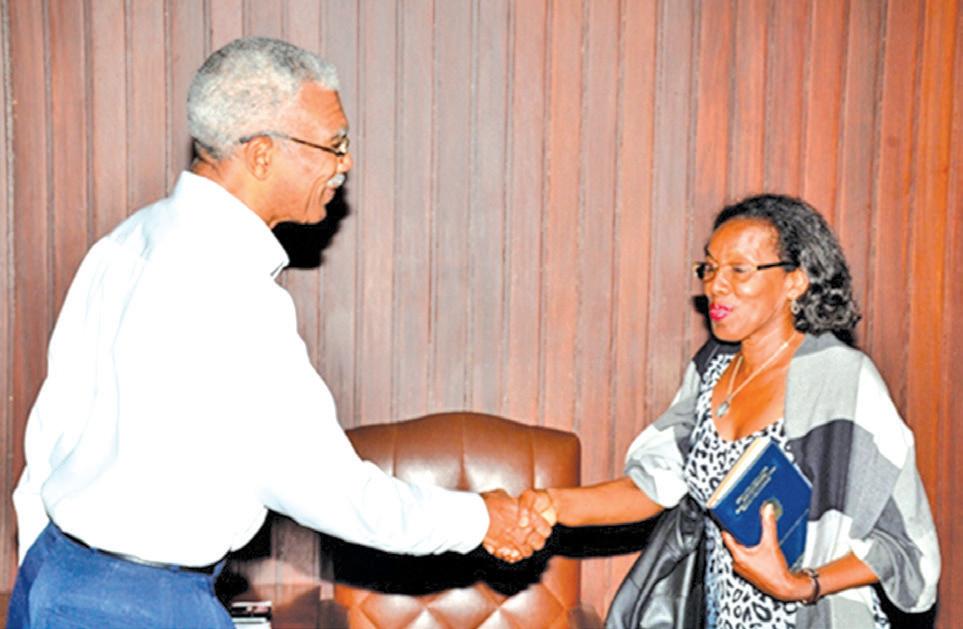
GEORGETOWN, GUYANA:
Venezuelan Ambassador to Guyana Reina Margarita Arratia Diaz is still in Georgetown, despite her President Nicolás Maduro on Monday announced that he was recalling her and commissioning a comprehensive review of his country’s diplomatic ties with Guyana.
Diaz is not only still in Guyana, but hosted a reception to mark her country’s 204th year of Independence. When Guyana Times visited the Venezuelan Embassy on Tuesday, it was confirmed that Ambassador Diaz was still present in Guyana. In fact, she was host-
ing a midday reception to celebrate Venezuela’s Independence Day anniversary, which was observed on July 5. The seemingly intimate reception was held at the Embassy’s Thomas Street, Georgetown, location and had a small gathering of mostly Venezuelan guests, as well as a few members of other foreign missions in Guyana.
Maduro on Monday told his country’s National Assembly that he has decided to recall his Ambassador for consultations, minimise the Venezuelan embassy staff in the neighbouring country and order Foreign Minister Delcy Rodríguez to review diplomatic re-
lations with Guyana. His move came in response to recent tensions over a border controversy involving the Essequibo area. In Maduro’s words, attempts have been made to use the issue of the Essequibo to spur an “irritating provocation against the dignity of the Venezuelan people.” Accompanied by the Executive Cabinet and before the Deputies of the National Assembly, during a mandatory nationwide radio and television address, Maduro said that “the history of the Essequibo has been like a wound in the heart of the country for over two centuries,” which was caused by the “British Empire.” Additionally, Maduro said that US oil company ExxonMobil had a “high impact” on the presidential campaign and election of David Granger as President of Guyana. According to Maduro, since he took office, Granger has issued “hard” statements. He remarked that Granger is a “hostage” of ExxonMobil. Maduro noted that Granger has even issued “racist statements” against Venezuelans. (Guyana Times)
Higgler accused of killing 2 brothers in J’ca, Guyanese man faces court

MANCHESTER, JAMAICA: Twentyfive-year-old Shevano Richards is scheduled to face the Mandeville Resident Magistrate’s on Wednesday for a double murder committed in May and the 2013 slaying of a Guyanese national.
According to police reports, Richards was held in relation to the shooting deaths of two brothers – Oshane Levy, 21 and 27-year-old Anthony Bailey – of Highway Drive, Greenvale in May.
The killings are believed to have stemmed from a dispute.
Police say that during “intensive investigation” in that matter he was positively identified for the murder of Guyanese national Artwell Alphonso Joseph in September 2013.
Joseph, a forty-eightyear old businessman, was allegedly shot at his home on McKinley Drive in Mandeville, when demands for money were not met during a robbery.
Visitors to the home following the death told the media at the time that Joseph was not Jamaican by birth, but arrived in the country seven to nine years before from England.
Police say that he is originally from Guyana and lived in Mandeville with his Jamaican wife, a stepson and tenants. They were not harmed during the incident. The accused is said to be a higgler of a Battersea district address in the parish. (Jamaica Observer)



To contact: Caribbean Times International
Unit 12, 680 Rexdale Blvd., Etobicoke, Toronto, Ontario M9WOB5
Advertising: 647 990 7438/416 450 1672
Email: news@caribbeantimesinternational.com caribtimes@gmail.com
The announcement by People’s Progressive Party/Civic (PPP/C) General Secretary Clement Rohee that there is a strong possibility that Bharrat Jagdeo could return to the helm of day-to-day politics as this country’s Opposition Leader has ruffled some feathers and made the leadership of the country’s governing coalition apparently uneasy.
Since the disclosure that Jagdeo was favoured as the candidate to take the PPP/C forward following the May 11 General and Regional Elections, ‘anti-Jagdeoites’ have launched a new wave of attacks against the PPP/C.
Leading the cause in this respect are the usual suspects who seek to brand themselves as “nationalists, independent political commentators” and defenders of the Cheddi Jagan’s legacy and the future of the PPP/C.
Included in that group are the usual suspects in the persons of Ralph Ramkarran, Christopher Ram, Freddie Kissoon and social media provocateurs who dance to the tune of the new Government from the word go.
Others are set to follow especially those who ‘left the PPP/C’ allegedly because of Jagdeo, those who distanced themselves from the party because of concerns about corruption and ex-PPP/C Members who are now enjoying favourable relations as Ministers, state officials and sympathisers to the new coalition government.
In their writings and public pronouncements, they are seeking to convince Guyanese that Jagdeo is bad for the PPP/C and that the Party will implode under his leadership in Parliament. They would like Guyanese and supporters of the PPP/C to believe that Jagdeo is corrupt and is solely responsible for some of the problems facing the country at the moment.
These individuals also seem very concerned about Jagdeo’s imagined total control over the PPP/C machinery and the make-believe albatross he has placed around the neck of the PPP/C youth and leadership.
For them, Jagdeo is evil and everything he touches will turn to evil because he is unconcerned about the country and its people.
In their rush to force public opinion against Jagdeo, they have failed miserably to acknowledge the facts and dynamics surrounding the high levels of popularity and respect that he still enjoys within the Party and outside in face of nasty misinformation, distortions and lies peddled by the mass media especially the Glenn Lall-owned Kaieteur News and Stabroek News.
They refuse to accept the fact that it was Jagdeo who added flavour and colour to the 2011 and 2015 elections campaigns. In both instances, hundreds of thousands of people rallied around the PPP/C and connected emotionally with Jagdeo when compared to other party leaders for a myriad of reasons.
The things he said on the elections platform were on point, accurate for the most part, and delivered strong blows to those, now in Government, that crippled them at various points during the campaign.
It is not hard to believe that a majority of Guyanese from all ethnic and social persuasions would have voted the PPP/C back into power with a parliamentary majority had Jagdeo decided to run for President during the last two elections if there was no term limit.
Additionally, they appear far more concerned about the PPP/C and its future than those who currently sit at its helm and one must ask one’s self why. It could not be because they genuinely wanted the PPP/C in power or part of a shared governance arrangement with the coalition Government. And it certainly could not be because they wanted Donald Ramotar and Elisabeth Harper to lead the Party in the 11th Parliament because they have also hurled reprehensible and untrue propaganda against both of these distinguished Guyanese leaders.
It is clear that they are intent on weakening the Party by evoking subliminal feelings of discord, division and disunity within its membership following the May 11 elections. Their aim appears to be to embarrass Donald Ramotar who has shared a very close relationship with Jagdeo while he was the Party’s General Secretary, its presidential nominee and President of Guyana.
Should the PPP/C indeed move ahead with Jagdeo, many heads will roll and those who in Government continue to hide behind their fanciful promises, language and banter about national unity will be exposed.
Jagdeo in five years’ time could weaken the Granger’s presidency bringing his Government to its knees. If he re-enters Parliament there would be no politician who could out-think him or out-manoeuvre him if a careful analysis is done of the line-up on both sides.
It is the PPP/C’s democratic right to decide who it should move forward with, following its recent political experiences and concerns about rigged elections. A public vote among the general membership of the PPP/C may very well vindicate any decision by the Party to move forward with Jagdeo.
That aside, Guyanese from all political groupings are also awaiting the ruling of the High Court and the Chief Justice’s interpretation of the termlimit clause in the Constitution as this too would impact the country’s political future and a possible return of Jagdeo as President, if he so desired and the people felt obliged to grant him that request.
Jagdeo is far from the monster that some are making him out to be. He is a political animal and having worked most of his life in Guyana and served the people, he appears willing to give his all to his Party and country in the face of orchestrated assaults, brutish propaganda, ungrateful comrades within the Party structures and neo-opportunism that is creeping up among current and former PPP/C supporters and members.
If the PPP/C wants to win another election in Guyana, it might as well bring back Jagdeo to serve in Parliament.

By Brenda Lee Tang, head of aCCa
TRINIDAD: Oil and gas extraction was until recently not only a challenging — but rewarding — industry. But the recent drop in oil prices has seen the rewards diminish while the risks have remained and multiplied in some cases.
A recent report by ACCA entitled Oil and gas — priorities and challenges for the CFO enterprise, looks at how finance professionals can help to protect the oil industry against greater volatility, it also considers how the oil and gas industry, which is currently key to Trinidad’s economic success, must also look at investing in alternative energy sources in future, given that fossil fuels will not last forever.
There are many other challenges identified in the report, but I’d like to focus on the economic issues facing the industry and what that means for finance professionals.
The biggest issue is when oil prices will rebound. The uncertainty means that in the meantime oil and gas companies must look at how to manage the costs of extraction.
A recent report by RBC Capital Markets suggests that major oil and gas operators will shave TT$140 billion off their capital expenditure budgets in 2015, following the fall of over 50 percent in the price of crude oil over the previous year.
But where do they begin?
Established oil wells bring a number of problems –— not least that equipment needs to be maintained. Other costs are also tough to address — for example, salaries are traditionally high in the industry. All these costs must be managed.
Significant cost reviews will need to be undertaken to identify which costs can be cut, and which spending is necessary to ensure ‘business as usual’ operations.
To meet that challenge, finance professionals will need a deep understanding of the nature of the cost base, and have clarity about which costs can be reduced without necessarily affecting future growth or performance. The new financial pressures mean that management of costs, and scrutiny of the efficiency of investment programmes is now critical.
In the push for significant cost savings, and as the cost of new oil reserves falls owing to diminishing share prices and oil prices, the other key activity that we may now see is a major upturn in mergers and acquisitions, and naturally the finance department has a critical role to play in both pre- and post-merger acquisition activity.
Another key challenge for the CFO function in the sector is the effectiveness of the planning and forecasting processes, and the need for more effective commercial decision support. Rebalancing the resources and time spent on attempting to predict the future environment more accurately is critically important given the volatility in the market.
The finance function also has to look at new options in terms of how to finance oil and gas exploration. The industry has relied on traditional bank loaning, but there are now more funding options available, with new sources of capital increasingly available in the market.
Finance professionals across the sector and in all sizes of organisation have a sig-
nificant role to play in helping the enterprise source the most effective forms of financing for the business. There is more competition for access to capital but also a wider range of finance providers in the marketplace, and senior finance professionals need to become increasingly familiar across this diversified portfolio. Historically, the larger global oil companies have relied heavily on cash flows for many of their funding activities, yet the downturn of 2014 has now placed significant challenges on how they can now efficiently fund many of their activities, and in the present environment they must continue to look to balance their investment programmes carefully; it places new strains on their effectiveness of their working capital processes and the efficiency of existing banking arrangement must now continue to fall under review.
For the increasing number of smaller and medium-sized independent enterprises in the sector, including many in the Caribbean, the challenge of funding is particularly acute. With no demonstrable longer term track record in the industry, there is less visibility to the investment community of the inherent investment risk. These businesses do not have a long history of managing cash flow which will enable potential investors to make an assessment on how risky an investment might be, so finance professionals in the sector face tough times for the foreseeable future as they work to provide the kind of assurances that investors will want. That’s a tough challenge, but one which a professionally qualified accountant should relish. (TT Newsday)
Trinidad and Tobago has removed the People’s Republic of China from a statutory list of States for which visas are compulsory, taking one step closer to visa-free entry for citizens of that country.
According to the terms of an order issued by Minister of National Security Brigadier Carl Alfonso, visas will no longer be compulsory for Chinese citizens under the provisions of the Immigration Act.
Alfonso issued the Immigration (Amendment to the Second Schedule) Order, 2015, on June 11, 2015, which deletes the People’s Republic of China from the list of countries for which visas are compulsory.
Hong Kong residents (who fall within the special administrative region of the People’s Republic of China) already do not require visas to enter TT.
The remaining countries listed in the Second Schedule of the Immigration Act for which visas are compulsory are: Cuba, Macedonia, the Democratic People’s
Republic of Korea (North Korea), and Vietnam.
But Minister of Foreign Affairs Winston Dookeran on Tuesday said the removal of China from the list did not mean Chinese nationals would immediately be able to travel TT visa-free.
Trinidad and Tobago nationals require visas to travel to China.
The move to relax entry requirements for Chinese citizens comes after the idea of visafree travel for Chinese citizens was first mooted last year by Prime Minister Kamla PersadBissessar.
At a dinner last June to commemorate the 40th anniversary of diplomatic relations with the People’s Republic of China, the Prime Minister said visa-free travel could be introduced, initially, for Chinese citizens who have already qualified for visas to travel to the United States.
“One of the matters which we are considering is a request made by the Chinese which would allow us to have more Chinese visitors,” Persad-Bissessar said, addressing diplomats
and politicians gathered at the Diplomatic Centre, St Ann’s. She said the business and tourism sectors stood to benefit “tremendously” from such a move which could be implemented on a phased basis. “Persons who already have a visa to get into the US could be allowed entry,” the Prime Minister said. “It is something we can look at. Of course, we would want reciprocity.”
At the dinner was He Yafei, Deputy Minister of Overseas Chinese Affairs Office of the State Council of the People’ Republic of China, as was Chinese Ambassador Huang Xingyan. Ambassador Huang turned the sod alongside PersadBissessar and other government officials on a new Arima hospital in May. International attention on China in recent weeks have focused on its re-drawing of its “core interests”, online cyber attacks and the passing of a sweeping national security law designed to give primacy to its communist rule. Last month the State also relaxed entry requirements for returning nationals at Piarco International Airport. (TT Newsday)

GUYANA: Police in Berbice are looking for five men they think could assist with their investigations into the shooting of a Canje Businesswoman on Monday evening.
According to reports, 39-year-old Angela Hussain was shot in the head when five heavilyarmed men entered the Palmyra grocery store as the Hussain’s were about to close for the day. According to the injured woman’s daughter; Shabanna, the men entered the premises at about 19:30h. According to her, as they were about to close, the five men – four carrying firearms and one with a cutlass – entered the building and went straight to her mother. “Two go to her and one to my father and the others go back outside.”

She said that the men demanded money and her mother showed them the day’s sales. “They take it and then they ask for more money and she tell them that is all the money that she have and they leave and go outside.”
The younger Hussain said shortly after, two of the men re-entered the shop demanding more money while a third held on to her eight-year-old sibling. “They say that they gon shoot he if she ent take them upstairs where the money is.”
It was at that stage that Angela was shot, Shabanna noted. She said her mother retaliated to the threats of killing her child and was shot once to the back of
the head. The men were then led to the upper flat of the building where they were given an undisclosed sum of cash and jewellery. They then made good their escape. Hussain was rushed to the New Amsterdam Hospital where she underwent emergence surgery. Her condition is said to be stable. Meanwhile, Police arrived roughly 30 minutes after the shooting to begin their investigations. (Guyana Times)

GEORGETOWN, GUYANA:
Former President, Bharrat Jagdeo leads the list of Members of Parliament for the People’s Progressive Party and among them are eight new comers including Dr Clive Jagan.
There was no place for former President Donald Ramotar and Robeson Benn. However, among the new comers are: Africo Sleman, Nigel Dharamlall and Collin Croal. Former Finance Minister, Dr Ashni Singh and Former Minister of Foreign Affairs, Carolyn RodriguesBirkett have given explanations for their absence from the list of MPs. The PPP/C has won 32 seats in the 65 seat-chamber. Their list of MPs was something of a mystery and at times speculations. A list of 31 MPs was provided with the 32nd to be released on Wednesday. With Jagdeo being named among the 32 it is expected that he will be elected Opposition Leader as was reported by this newspaper. Other position such as Chief Whip and Deputy Speaker, the party said would be identified after their MPs are sworn in.
In a statement announcing its MPs the party said after a series of consultations at various levels over many weeks it has concluded discussions on its parliamentary representatives. The party
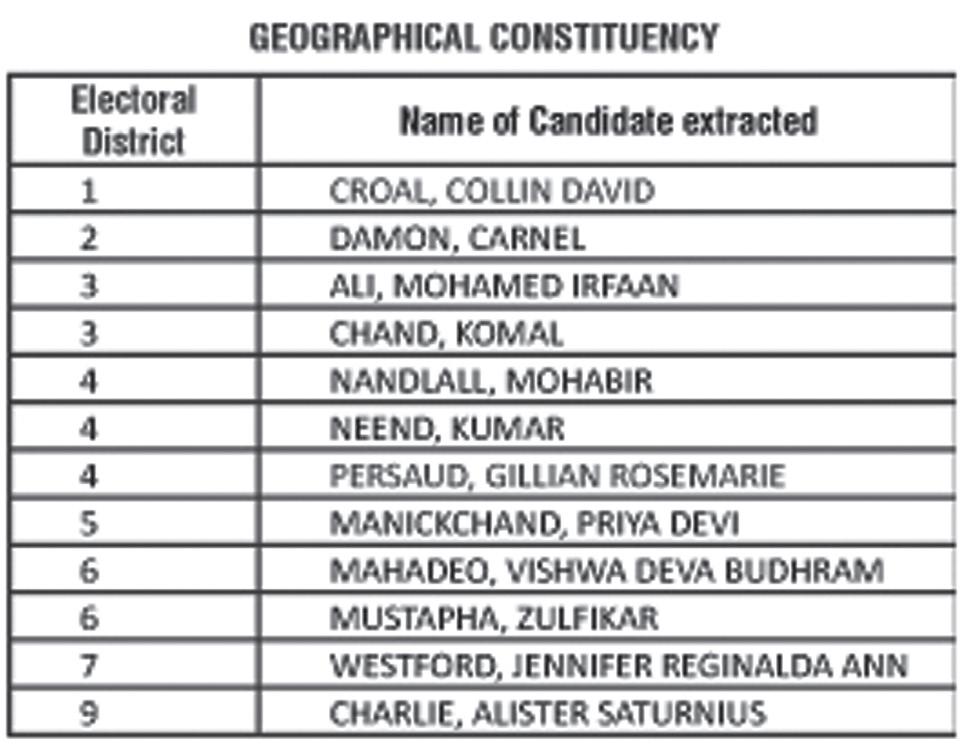
said as customary and in-keeping with its policy, a number of factors were considered such as experience, youth, gender, ethnic composition, geographicspread among others. The PPP/C said it remains proud of its democratic tradition which allows the various tiers of our party to make meaningful inputs in the decision-making process.”The PPP wishes to confirm that its decision of the Opposition Leader has been fully endorsed by the Party’s Central Committee. Full disclosure in respect of those parliamentarians who will fill the position of Leader of the Opposition and Chief Whip will take place at the swearing-in of the thirty two (32) PPP Members of Parliament,” the statement added.
Also, Dr Leslie Ramsammy will no longer be heading to Parliament, even though he was chosen in the initial 32 list, as he is reported to be “very sick”
and taking treatment in the US.
Speaking with the Guyana Times during a recent interview General Secretary Clement Rohee said that the party over the next few weeks will roll out a comprehensive and politically sound strategic plan for regaining the reins of Government sooner than later, as it is now fully settled in its role as an Opposition party following the results of the May 11 General and Regional Elections. Rohee had also warned that the new David Grangerled Administration will be taught a very good lesson about how effective and democratically sound parties function in Opposition, while preparing to again en-
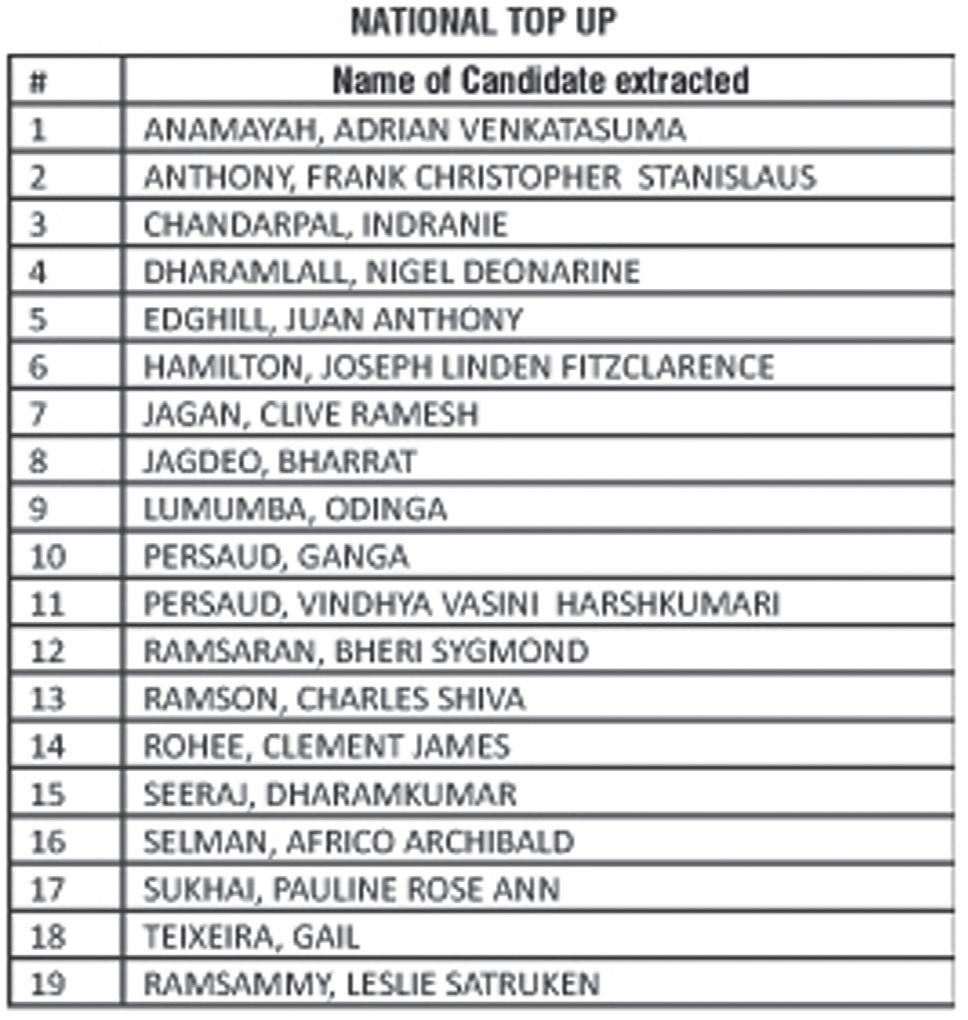
ter the Executive. He said in the interview that the party had already made a strategic and tactical adjustment within its internal structures. “Our being in Opposition, however, is not simply to oppose for the sake of opposing. We will be a militant Opposition. We will be an Opposition that would ride on the basis of our manifesto and we will act as though we are readying ourselves to be in the Government sooner rather than later”, the General Secretary offered. (Guyana Times)
KINGSTON, JAMAICA:
Several human trafficking cases are to go before the courts over the next few months, as the Government seeks to secure more convictions against perpetrators of the crime.
Chairperson for the National Task Force
Against Trafficking in Persons (NATFATIP), Carol Palmer, who made the disclosure to the Jamaican media, said the Government intends

to deal harshly with persons engaged in human trafficking.
She said that Jamaica first conviction for human trafficking last month, after intense investigations, serves as a signal that law enforcement will be going after all perpetrators.
“The task force is coming and we will stop at nothing. The police are determined and are going after every case,” she told the media.
On June 19, Jamaica recorded its first conviction for human trafficking under the Trafficking in Persons
(Prevention, Suppression and Punishment) (Amendment) Act 2013.
The legislation provides harsher penalties for the crime and expands the list of offences.
Indian businessman, Rajesh Gurunani, who operated garment stores in downtown Kingston and in St Catherine, was found guilty of trafficking in persons, facilitating trafficking in persons, and withholding travel documents between May 2008 and March 2011.
Senior Deputy Director of Public Prosecutions, Lisa
Palmer Hamilton, who prosecuted the businessman, said the conviction will serve as a precedent for other human trafficking cases.
She hailed the commitment and cooperation of the various entities, which worked to achieve the guilty verdict, and also lauded the witnesses who came forward.
In proving the trafficking in persons offence, one has to establish activity, means and purpose, all of which the prosecutor was able to demonstrate, as victims were present and willing to give evidence. (JIS)


GUYANA: Amid the escalation of crime in Guyana, Commander-in-Chief of the Armed Forces, Brigadier Retired David Granger has summoned his top security officials and Prime Minister for a major meeting on Tuesday at his office.
According to a statement from the Ministry of the Presidency, as his first order of business, on his return from the Caricom Heads of Government Meeting, President Granger will convene the high-level security meeting to craft a crime fighting strategy in light of the recent uptick in violent crimes. The meeting, the statement said, will commence at 09:00h on Tuesday at the Ministry of the Presidency and will include Prime Minister Moses Nagamootoo, Minister of State Joseph Harmon, Public Security Minister Khemraj Ramjattan, Police Commissioner Seelall Persaud and Chief-ofStaff of the Guyana Defence Force, Brigadier Mark Phillips.
Meanwhile, Executive Member of the People’s Progressive Party/Civic (PPP/C) Anil Nandlall, has pointed out that the current A Partnership For
National Unity/Alliance For Change (APNU/ AFC) Government has failed to tackle the societal scourge of crime, which has taken a significant and worrisome spike since its assumption to office.
In an invited comment to Guyana Times, Nandlall who was also Attorney General and Legal Affairs Minister under the previous Administration, explained that the APNU+AFC coalition had campaigned heavily on the platform of crime and security, promising to make Guyana a safe place for its citizens.
“I am sure that the fact many of them (coalition members) are trained security personnel, including the President. Unfortunately, they have failed abysmally in tackling crime and we are witnessing an uncontrollable crime situation,” he stated.
According to Nandlall, the one area that the new Government arguably has immense expertise in is crime and security, and yet the country is experiencing disastrous consequences with a rise of violent crimes.
Ramjattan in a recent interview with a local newspaper had assured that he will do whatev-
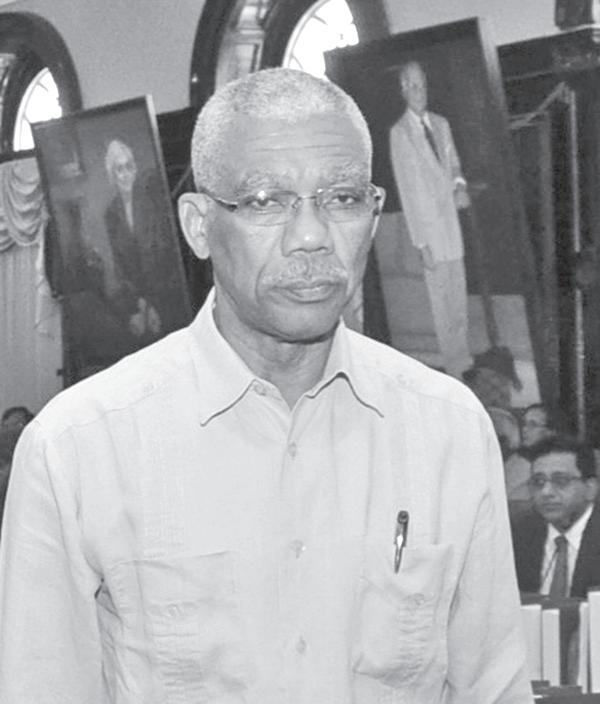
er it takes to reduce the high crime rate, arguing that the 02:00h deadline is the best place to start. He explained that drinking at late hours “does a lot of harm and tends to lead to a lot of things”.
The Public Security Minister explained that drinking has a direct impact on domestic violence and other violent crimes. Since Ramjattan was sworn in as Public Security Minister, there has been an upsurge in murders, robbery under arms and other crimes. Guyana Times observed
that most of the crime is perpetuated in broad day light and most of them cannot be controlled. The police revealed that most of the murders are disorderly and some domestic related.
Over the past weekend, even with the 02:00h curfew being enforced, there were incidents that resulted in the deaths of three persons and several others injured. On Friday night, around 20:20h, four armed men entered a house at Bush Lot, Corentyne, Berbice, and held up the occupants –

PORT-OF-SPAIN, TRINIDAD:
Prime Minister Kamla PersadBissessar has challenged Opposition Leader Dr Keith Rowley to apologise to the nation for several racist comments made by members of the People’s National Movement over the years, saying the par-
ty was not being honest in its recent comments about using race in campaigning.
As she made her point on Monday, PersadBissessar went back to the 2013 Tobago House of Assembly’s (THA) election, when then deputy Chief Secretary Hilton Sandy told supporters
that if they did not vote the PNM back in to power a “Calcutta Ship” was waiting to take over the island, to make her point.
Speaking at a UNC Monday Night Forum at the Gasparillo Secondary School, she also called on PNM youth officer Fitzgerald Hinds to apologise
Valerie Williams, Rose Raphael, Bibi December and Shameer December. They manage to take away some Gy$100,000 cash and a quantity of jewellery. However, as they were leaving the yard, they shot 18-yearold Dorwin Lord, who was entering the premises, in his face. Lord has since been hospitalised.
A few hours later, just after midnight around 00:55h, the body of Charles Caesar, 40, of Line Path, Skeldon, was found on the foreshore at Number 66 Village, Corentyne, with a suspected gunshot injury. He succumbed at the Skeldon Hospital while being treated.
Then around 18:00h on Saturday, Brazilian National Antonio Rodriguez Da Silva, 57, of Turkeyen, Greater Georgetown, was involved in an argument with another man at Chinese Creek, Puruni, during which he was chopped about his body and succumbed to the injuries he received. Moving along a few hours later into Sunday, a 48-year-old businessman, Ganesh Ramlall, of La Jalousie, West Coast Demerara, was confronted in his yard by gunmen around 00:30h shortly after returning home. The man had gone to use the outdoor washroom when he was attacked and shot about this body and to his head. Ramlall was pronounced dead on arrival at the West Demerara Regional Hospital. Going into Monday, Caricom Day, two persons lost their lives in separate accidents. Around 01:45h, Shawn McPherson of Goedverwagting, East Coast Demerara, was travelling in a car along the Railway Embankment at Liliendaal, Greater Georgetown, when the vehicle in which he was travelling struck a horse, causing the driver to lose control and collide with an oncoming motor vehicle. McPherson was pronounced dead on arrival while several other persons received injuries and are receiving medical attention.In the other accident, a 19-yearold Police Officer was crushed to death by a truck at the Providence Access Road, East Bank Demerara. Constable Edison Williams was carrying a barricade when it reportedly hooked on a passing truck, dragging him to the ground. He ended up under the truck and his head was crushed by the truck’s back wheel. (Guyana Times)
for his “alligator in murky lagoon” comments at a public meeting at Piggott’s Corner, Belmont, recently.
She said if Rowley was genuine about not running a racist campaign he should confront all racist remarks coming from members of his party.
“I am calling on the Opposition Leader and Mr Hinds to apologise to the people of Trinidad and Tobago. I call upon them to apologise and to confront the racist campaign they have run and the racist campaign they continue to run,” Persad-Bissessar said.
She also challenged Rowley to account for his representation of the Diego Martin West constituency, saying it was under the former UNC government that the Carenage Government School was built, while the People’s Partnership had built the Diego Martin Highway, several schools and will soon open the new Carenage Health Centre.(TT Guardian)

KINGSTON, JAMAICA: The National Water Commission (NWC) says that customers in the Kingston Metropolitan Area (KMA) served by the Hermitage/Constant Spring, Mona, Hope, and Seaview systems will, with immediate effect, receive water supplies on "alternating days".
NWC, in a release late on Monday, said that the water restriction was forced by the rapid decline in inflows to the systems.
The new water management plan means
that areas which are supplied on a Tuesday will then be supplied again on the subsequent Thursday and Saturday, while the areas supplied on the Wednesday of that week will be supplied again on the subsequent Friday and Sunday, the NWC said. While some areas in the Corporate Area will continue to receive supplies daily, either based on the system that serves them or where they are located on the network, most areas will now receive water every other day, the NWC added. (Jamaica Observer)
Attorney-atlaw, Ronald BurchSmith, replacing Dr Harold Lutchman, has been appointed chairman of a six-member committee overseeing the implementation of the Cummingsburg Accord between the Alliance For Change and A Partnership for National Unity (AFC/ APNU) and despite some glaring breaches in the pact, the lawyer said that he has not received any complaint on the issue of violation of the agreement. At the same time, Minister of the Presidency Joseph Harmon announced a “Coalition Building Forum” in the works.
Professor Harold Lutchman, who was appointed with great fan-
fare as the coalition’s Representative of the List of candidates, was explicitly designated as also playing the role as referee of the pre-election pact. This was in addition to ensuring that the sharing out Ministries and Parliamentary seats in a 60:40 ratio between APNU and AFC was kept. However senior coalition sources said that it was Burch-Smith who has been handling those issues and it appears that Prof Lutchman has been shunted aside.
After the elections, as violations of the accord committed by APNU against the AFC accumulated, Professor Lutchman maintained that his task had been just to present the list to GECOM. It would appear that Prof Lutchman’s
reputation and professional integrity were used to assure AFC supporters that their suspicions of being outmanoeuvred by APNU were being addressed. Some of those assurances were that AFC’s Moses Nagamootoo would not be a figurehead Prime Minister but would be given substantive powers of chairing the Cabinet and being responsible for “governance”.
However, after the coalition was installed into office, President Granger begun chairing cabinet meetings, claiming that the constitution demanded that only he exercise this power. However at the announcement of the Accord, when asked about this stipulation of the Accord he had af-
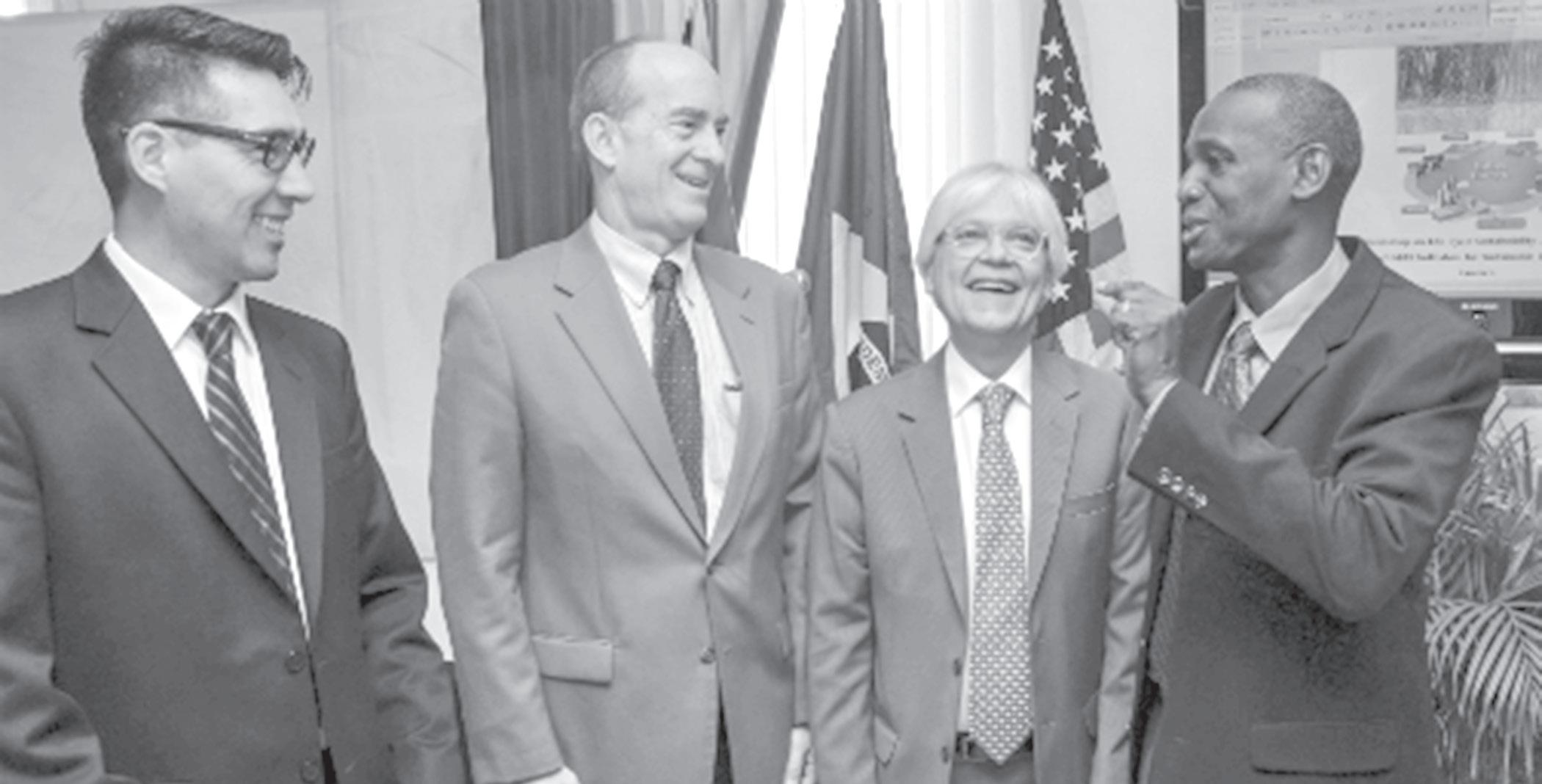
Jamaica is looking to produce its own bio-fuel and increase the current mix of ethanol in petrol to about 20 per cent.
This is according to Principal Director, Policy, Planning, Development and Evaluation Division, in the Ministry of Science, Technology, Energy and Mining, Dr Oral Rainford, who said this “is something that we are giving serious consideration.”
He was speaking at the opening of the workshop on the Life Cycle Sustainable Assessment and Global Bio Energy Partnership (GBEP) Indicators for Sustainable Biofuels in Jamaica, at the Kingston offices of the Jamaica Employers Federation (JEF), on Monday.
A ten per cent ethanol mix in fuel was implemented in Jamaica in 2008. This ethanol, which is produced from cane sugar and molasses, is mainly imported from Brazil.
Rainford is adamant, however, that “we’ve got to begin doing more for ourselves,” in terms of producing bio-fuels locally, starting with the mix currently being used.
The principal director noted that this plan to produce bio-fuel in Jamaica is being partly hampered by the unwillingness of industry players to venture into this production.
Another setback, he explained, is the lack of adequate arable land for the production of the raw material, as there is a “contest” for such lands with more profitable crops.
Rainford noted how-
firmed that the constitution allowed him to delegate his powers. And that he would.
Ralph Ramkarran, who had been very positive about the coalition entrance on the political scene, however had said that the Cummingsburg Accord, which brought the parties together, has been blatantly disrespected and if it not addressed quickly and appropriately, the parties can expect to lose the support of its electoral support, particularly the AFC .He noted that the explanation which has been put forth by the President that the Constitution will have to be amended in order for the Cummingsburg Accord to be followed was inaccurate.
Contacted for a comment, Burch-Smith
indeed admitted to this publication that as Chairman of the Committee, no complaint had reached him on the issue of violations of the agreement. He was however quick to point out that there was a confidentiality clause in the new Agreement and as such, he could not disclose too much of the proceedings at this time.
Speaking to the Guyana Times recently David Patterson, General Secretary of the AFC had had been the first to reveal that there was a hitherto unannounced six member inter-party committee established – comprising General Secretary of the APNU, Joseph Harmon; Basil Williams, Nigel Hughes, Dominic Gaskin and himself, and meetings are held as nec-
essary. At the time he averred that no issue of violation has ever been addressed by the two parties. Contradictorily, however, he added that meetings were also being facilitated to ensure that the tenets of the Cummingsburg Accord were implemented accordingly. He did not make it clear what these meetings would discuss if no complaints of violations were lodged. (Guyana Times)
Trinidad and Tobago Unified Teachers Association (TTUTA) president Devanand Sinanan on Monday bemoaned an acute shortage of Tech/Voc (technical/vocational) teachers in the nation’s secondary schools, as he reacted to plans for 3,000 Onthe-Job (OJT) trainees to join the school system, announced last week by Minister of Tertiary Education and Skills Training Fazal Karim.
ever, that the government is working to bring back into production, lands that have remained uncultivated for many years, and “begin developing the fleet stock which we will use in our bio-energy project as we go forward.”
This is the second workshop being held as part of the implementation of a trilateral Memorandum of Understanding (MoU) between Brazil, Jamaica and the United States, for the advancement and co-operation on bio-fuels development.
The four-day workshop seeks to provide technical training in a Life Cycle Sustainability Assessment tool, which is a software designed to help decision-makers in the public and private sectors advance the production of bio-fuels locally. (JIS)
Further, the country lacks sufficient trainers at tertiary level to train a cohort of secondary school Tech/Voc teachers, he lamented. The shortage is in areas such as Electrical, Plumbing, Welding and Food and Nutrition, he said.
He said that while the country’s primary schools do not face any teacher shortage (and may even have a surplus), in contrast in secondary schools there are shortages in the areas of Science and Tech/Voc Education.
He said the Tech/Voc shortage arose with the end of John Donaldson Technical Institute’s (John D’s) Tech/Voc training programme a few years ago.
The country now has a shortage of Tech/Voc teachers in secondary schools and likewise in turn led to a shortage of youngsters qualifying in
Tech/Voc in secondary school thereby creating a dearth of persons likely to become the Tech/Voc teachers and trainers of tomorrow.
“Tech/Voc positions remain vacant for years and years until the whole department is virtually forced to shut down. When they stopped training Tech/voc teachers at John D, more than a decade ago, there is no institution currently that effectively trains persons to become Tech/Voc teachers. Those existing tech/voc teachers retire and move out of the positions and we don’t have people to replace them,” related Sinanan.
“So if you go from school to school, all those former senior comprehensive schools, and you speak to the principals I’m sure they will tell you they have three four and five vacancies in the Tech/Voc subjects.”
Sinanan said, “The Tech/Voc problem is a serious one. We have been making a lot of noise to the Ministry about it. We spoke to the Ministry from even before this Government and alerted the Ministry to this reality. They had said MIC (Metal Industries Company) was supposed to come on-stream with some kind of Tech/Voc teacher training programme, but we are not too sure what happened there. They said that UTT (University of Trinidad and Tobago)
was supposed to have a programme for Tech/Voc teacher training which they introduced but apparently a lot of people are not accessing it, for all kinds of reasons. He suggested this is due to the B Ed (Tech/Voc) degree’s range of offerings being too limited.
“The bottom line is that we have a problem whereby we have lots of vacant positions in the Tech/Voc areas, and of course children can’t access the Tech/ Voc programme and the principals are very often actually forced to effectively shut down the Tech/Voc departments.”
Sinanan said this was a serious problem that needed to be highlighted.
“We feel — but we don’t have any hard evidence — that it is part of a concerted effort to remove Tech/Voc education from mainstream schools, and separate it completely, a position that we are totally opposed to. We have expressed those sentiments repeatedly to the Ministry of Education.”
He said Germany and South Korea removed Tech/Voc from their mainstream school system 30 years ago but have since come full circle to realise that Tech/ Voc education belongs in the school system and in fact should be introduced from as early as in primary school. (TT Newsday)

Jamaica may import five times more beverages than it exports, but businesses in the Micro, Small and Medium Enterprise (MSME) community could exploit numerous opportunites in light manufacturing, especially in areas such as sauces, juices, jerk seasonings and smoked meats.
"We are in the perfect place at the perfect time. The demand is there and the figures show it. What are we waiting on? What are we waiting for?" asked Cliff Riley, executive director of the Scientific Research Council (SRC).
He was speaking to several small business owners at the SME Opportunity Quest forum at the SRC office on Old Hope Road in Kingston last Tuesday. Areas discussed included opportunities available in manufacturing, agro-
processing and export.
"We are innovators; who are more innovative than Jamaicans? It's time for us to use these marked advantages and create wealth... wealth creation for sustaining our country," Riley said to participants.
The aim of Opportunity Quest was to highlight business trends and opportunities that currently exist in the Jamaican economy, and provide entrepreneurs and investors with the option of taking advantage of prime target markets and niche markets by penetrating the gaps that exist, according to Roselyn Fisher, general manager for SRC subsidiary company Marketech Limited.
Jamaica imported packaged beverages at a cost of US$55.2m (Ja$6.5 billion) in 2014 as against exports valued at US$9.3m (Ja$1.08 billion), Fisher said. Imports from the
Caribbean, particularly Trinidad, account for Ja$4 billion. Similarly, the disparity was noted in the smoked meats market, where imports were valued at US$5.35 million (Ja$626 million), while exports were valued at US$1.02 million (Ja$119 million).
Despite the fact that Jamaica's imports far outweigh its exports, the SRC is optimistic that this can be seen as an opportunity to meet local demand.
In a post-seminar interview with the Jamaican media, Riley commented: "We have the technology in Jamaica [and] we have a nice supply of meat, which means we can tap into our own market. If we boost the production of such materials and the take-up from our manufacturers, that would significantly reduce the importation bill or the demand for imported products."
(Jamaica Observer)
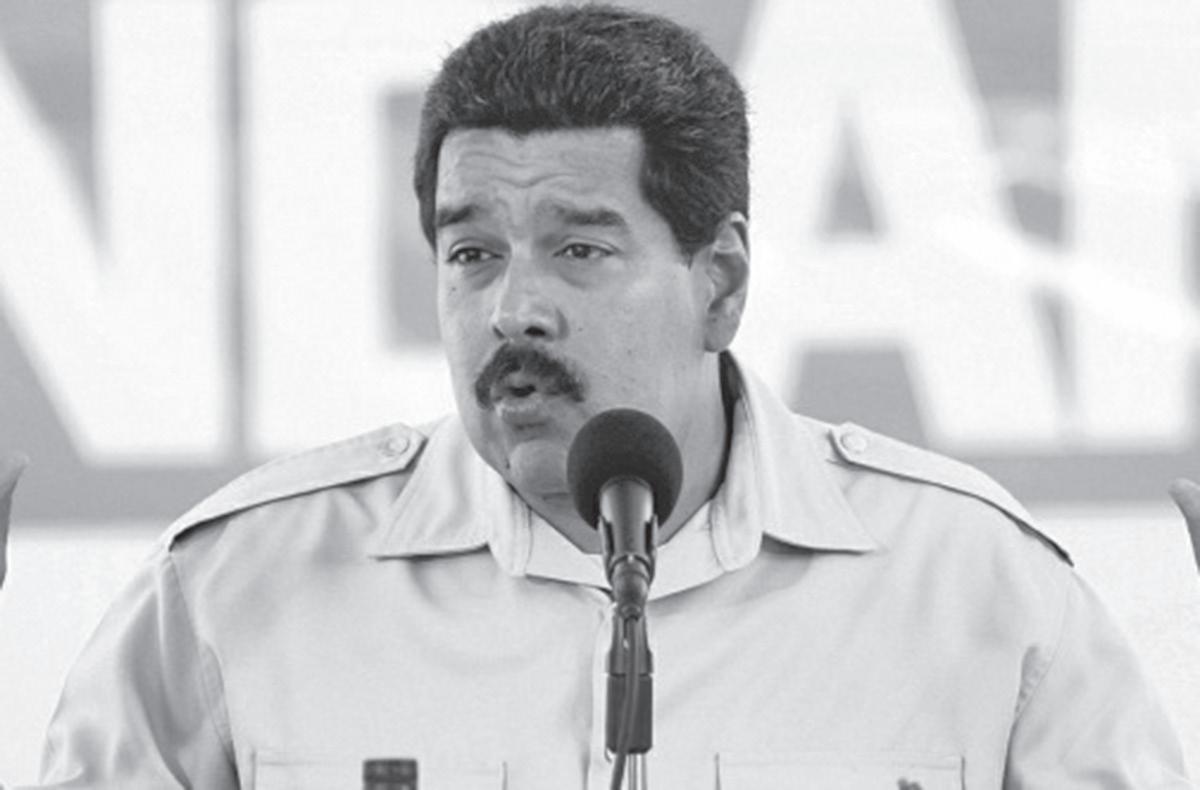
Venezuela has recalled its Ambassador in Guyana, Reyna Margarita Arratia, for consultation and is scaling down its staff at the embassy in Guyana, in the latest twist to the ongoing border dispute between the two countries.
In an address to his country’s National Assembly on Monday, President Nicolas Maduro also instructed his Minister of Foreign Affairs Delcy Rodriguez to comprehensively review diplomatic relation with Guyana.
President David Granger said he is “not surprised by that because he (Maduro) has been confronted with rejection of his Decree by the entire Caribbean Community so he is just increasing the isolation of his government from the region”.
Maduro issued a Decree on May 26 that includes all the Atlantic waters off the Essequibo Coast.
The purported annexation of the waters off Essequibo now takes in the oil-rich Stabroek Block, where American oil giant Exxon Mobil found a "significant" reserve of high quality crude oil.
ExxonMobil said the discovery was made in one of the two wells it dug, in the Liza-1 drill
site, which realised more than 295 feet of highquality oil-bearing sandstone.
At the end of their annual summit in Barbados last week, Caribbean Community (CARICOM) countries reaffirmed the “longstanding, deep and wide-ranging friendship between CARICOM and the Bolivarian Republic of Venezuela”.
But the regional leaders said they had discussed the Decree and “noted in particular the negative implications which the Decree has for the peace, security and development of the Cooperative Republic of Guyana.
“Heads of Government called for adherence to accepted principles of international law in relation to the delineation and delimitation of the Exclusive Economic Zone and Continental Shelf in the region. CARICOM states do not accept any
unilateral proclamation which is inconsistent with international law.
“They emphasized that CARICOM states have legitimate territorial and maritime entitlements that conform to international law and that must be respected.
“Heads of Government therefore call upon the Government of the Bolivarian Republic of Venezuela, in the spirit of friendship and cooperation, to withdraw those elements of Decree 1787 insofar as they apply to the territory and maritime space of CARICOM States,” the leaders said in a communiqué.
President Granger, who at the start of the summit last Thursday called on his regional colleagues to send a strongly worded message to Caracas, said he was pleased with the position arrived at by CARICOM on the matter. (CMC)
Trinidad and Tobago has received its lowest ranking ever on an international peace list as the country continues to have maximum scores for homicides and violent crimes, and high scores for perceptions of criminality and access to weapons.
Former National Security Minister Gary Griffith, however, says the ranking should be taken with a “pinch of salt” while a local criminologist says it is not telling citizens anything they do not live as a reality.
TT ranked 97 out of 162 countries (one being most peaceful and 162 least peaceful) in the 2015 Global Peace Index (GPI), which attempts to measure peace, its causes and economic value of nations and regions. The report is pro-
duced by global non-profit, non-partisan think thank, the Institute for Economics and Peace.
In the 2015 GPI, the highest ranked country and most peaceful was Iceland while the lowest ranked was war-torn Syria. The countries are divided into four levels for the state of peace — very high (most peaceful), high, medium, low and very low (least peaceful).
TT is again in the medium category, flanked by Papua New Guinea and Haiti, and just below the United States at 94. Regional neighbour Guyana is ranked just a few places higher at 92 while Jamaica, the only other English-speaking Caribbean country on the list, is 12 places lower at 109.
In 2008, Trinidad and Tobago made the lost with a ranking of 90, fluctuated for the next two years and then
jumped nine places to 80 in 2011, the country’s highest ranking ever. A state of emergency, which saw plummeting crime levels due to a curfew and increased police and military presence, was held in 2011 though it is not clear whether this influenced the ranking.
In recent weeks, the relatively peaceful Central district has erupted in gun violence due to a war between rival Rasta City and Muslim gangs. In the latest incidents on Thursday night, 28-yearold Nigel John was shot and killed by gunmen while liming in a bar at Todds Road. Two other men were critically injured in the incident.
Figuera said the geography of organised gun violence was changing because the illicit drug trade at the retail level was changing - that since the 1970s the East
West Corridor was “saturated” with drugs, leaving Central “untapped”. “So now is time to open up Central and have drug blocks by the score,” he said.
On the issue of TT’s “porous borders” Figuera said it was a “big political thing” to acquire vessels for patrols, and that trafficking via cargo must be looked at — that Customs and Excise Division must be made into a modern institution and the ports must be properly secured. “Patrol boats is an old, old outdated concept that ‘everything still coming in pirogue,’” he said.
National Security Minister Carl Alfonso told media operatives he was not familiar with the report but would be looking into it. PNM PRO Faris Al-Rawi also requested time to look at the report before responding. (TT Newsday)
KINGSTON, JAMAICA: Threats from climate change, declining reefs, overfishing and possible loss of several commercial species are driving the rollout of new policy measures to keep Caribbean fisheries sustainable.
Regional groups and the US-based NGO Wild Earth Guardians have petitioned for the listing of some of the Caribbean’s most economically valuable marine species as vulnerable, endangered or threatened with extinction.
In addition, regional scientists believe that climate change could alter the ranges of some of the larger species and perhaps wipe out existing ones.
Fisheries ministers of the Caribbean say they are concerned that “extra-national activities and decisions” could impact the social and economic wellbeing of their countries and their access to international markets. They have agreed to work together to protect both the sustainability and trade of several high value marine species.
At a meeting in November 2014, the Ministerial Council of the Caribbean Regional Fisheries Mechanism (CRFM) expressed alarm at the US government’s decision to list the Nassau Grouper, a commercially traded species, under the US Endangered Species Act (ESA).
The CRFM Secretariat says it is already looking at management plans for the species most eaten or exploited by its member states. The secretariat says there is evidence that Nassau Grouper populations and spawning aggregations are in decline and is supporting the listing.(Caribbean360)
GUYANA: After much tension between the two neighbouring countries surrounding the issuance of Decree 1787, which sought to claim most of Guyana’s territorial waters off of the Essequibo Coast, Venezuelan President Nicolás Maduro has withdrawn the controversial proclamation, but has replaced it with another decree.
This new dictum does not have any defining coordinates, a Venezuelan news entity reported. It poses no decision on land issues; but instead intends to support and justify the actions of the Bolivarian National Armed Force (FANB) in defending the newly created Integrated Defence Maritime Zones and Island (Zodimain).
According to Venezuelan reports, the Ministries of Defence and Interior are empowered to implement the decree, which was published in the Official Gazette Number 40,696 on Tuesday. However, Article 20 of the new decree specifically emphasised that it aims to set boundaries, which has to do only with activities related to defence.
“This decree is to set no boundaries, establish boundaries, nor any demarcation process in any way. Its sole purpose and exclusive range of concerns are protection against threats, risks and other vulnerabilities, so that does not mean any ruling on issues concerning territorial or alien by nature,” read one of the articles.
President Maduro on Monday, while addressing the National Assembly was reported saying “I have decided to raise the content of this decree 1787 the Council of State and the Supreme Tribunal of Justice (TSJ), and meanwhile, taking the doctrinal criteria, constitutional, issue a new decree replaces in all its parts”.
Venezuelan newspaper, The Universal, has reported the country’s Head of State saying that the new 1859 decree sets all constitutional legal and doctrinal elements, creates the zone of integral defence and established the Armed Forces’ tasks in all maritime areas of our country due and legally established.
In May, Venezuela issued a decree claiming
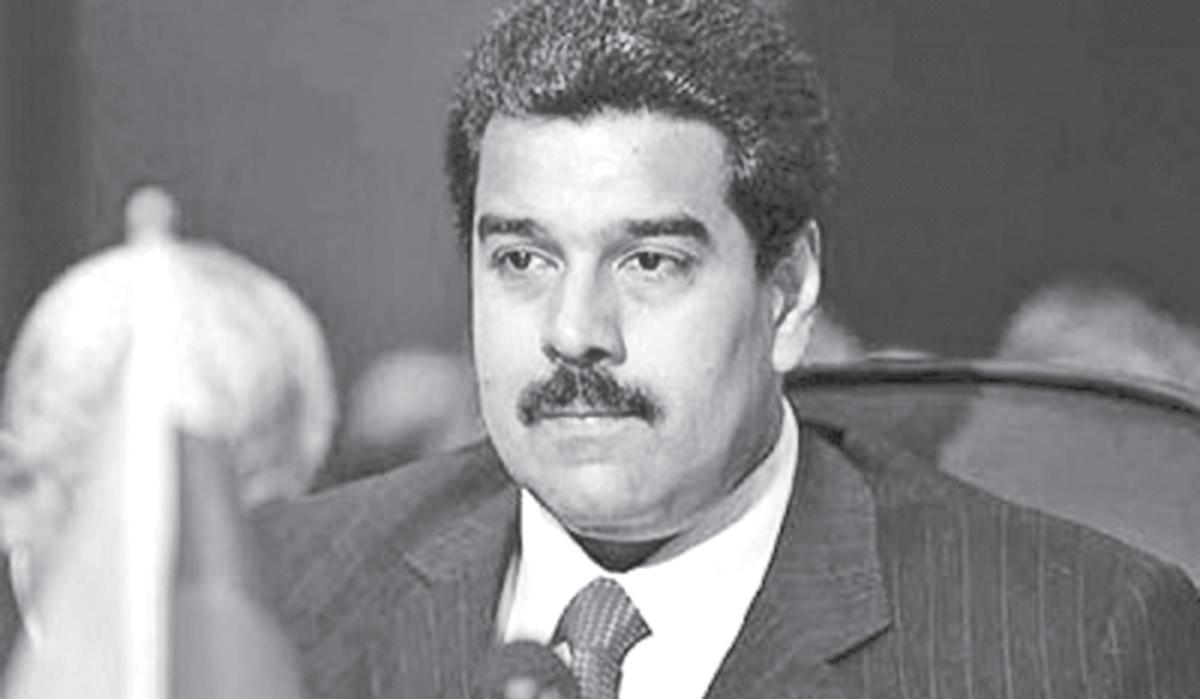
most of Guyana’s continental shelf. A map to this effect indicates Venezuela’s sovereignty of all waters within the 200-mile range, hence blocking Guyana’s access to resources in that area of the Atlantic Ocean.
This is the second decree expressing a claim to Guyana’s territorial waters. The first was issued by President Raul Leoni, 47 years ago in July 1968, and claimed “sovereignty” over a 12mile strip of Guyana’s continental shelf along the Essequibo Coast.
The Maduro decree was issued exactly one week following the discovery of oil in Guyana’s waters by United
The Greek debt crisis could have local repercussions, Minister of Foreign Affairs Winston Dookeran warned on Monday
“The implications for us is that if there are going to be Eurozone ripples it will have its effect globally and it will also have its effect in terms of our equity investment in the Eurozone,” Dookeran said, citing the Heritage and Stabilisation Fund. “The private sector may also have key investments. It will depend on how the market responds to the uncertainty. I don’t sense any panic in the financial markets but I do expect uncertainty that will eventually be reflected in the pricing in the market.”
On Sunday the Greeks rejected the latest international bailout proposal in a referendum, forcing a return to square one on the issue. The Greek debt situation dates back to the 2008 Wall Street collapse.
In the midst of that global financial crisis,

it emerged that Greece had understated its deficits, raising alarms which resulted in the country being shut out from borrowing. Despite a US$264 billion bailout with conditions, Greece did not manage to enact reforms regarded as necessary and funds were simply cycled back out to repay debts.
Greek politicians have resisted austerity measures saying a humanitarian crisis is looming amid its population.
Dookeran said the situation involves sever-
al dynamics.
“There are three aspects,” the Foreign Affairs Minister said. “The first is with respect to the situation in Greece itself and whether financial stability could be established. Secondly, the matter involves the question of a united Europe and the rules governing membership in the Eurozone and how they can now be tested. A third aspect involves the shifting the balance of power within EU and with Russia and other countries that may depending on how this matter is resolved.”
Dookeran continued, “What this does is open a new opportunity for a fresh set of negotiations. It could go either way. We will watch carefully.”
Finance and Economy Minister Larry Howai has stated his ministry is monitoring the situation. Germany and France on Monday opened talks on whether they would reopen talks with Greece, as the possibility of the country leaving the European Union was much discussed. (TT Newsday)
States oil company, ExxonMobil. Following the discovery of hydrocarbons, the oil and gas company on May 20, reported the discovery of oil-bearing rock in the Stabroek Block offshore Guyana.
This latest action by the neighbouring country comes in the face of President Maduro’s upset over oil exploration and concessions granted by Guyana to the US oil and gas giant, to explore some 23,000 square kilometers of the Stabroek Block. The new decree covers the location where the drilling exercise is being conducted.
Earlier this year when ExxonMobil was
about to drill an exploratory well in the area, neighbouring Venezuela objected, stating that the drilling area is part of its territorial sea. The Maduro Government then wrote the Executive of ExxonMobil to cease all drilling activities.
However, backed by Guyana and its homebased country, as well as other international organisations, the USbased company went ahead with the drilling. Guyana has since requested that Venezuela not interfere in its development activities, broadening the territorial rift between the neighbouring countries.
Venezuela has re-
peatedly laid claim to the area being explored, ignoring an 1899 Arbitral Tribunal Award, which was declared as the full and final settlement of the boundary between the two South American nations. With Venezuela’s obdurate insistence on its position, Guyana is considering judicial settlement of the boundary.
Since the issuance of the decree, Guyana has strongly condemned this aggression against its sovereignty and has secured the support of several regional and international nations as well as organisations.
These include the United States, Trinidad and Tobago, the Commonwealth, and more recently the Caribbean Community (Caricom).
In the meanwhile, only last week Venezuelan Vice President Jorge Arreaza promised a Caricom Heads of Government meeting that his Government has agreed to forge an “amicable resolution” with Guyana on the border controversy in the near future, a high ranking Government official had disclosed.
(Guyana Times)
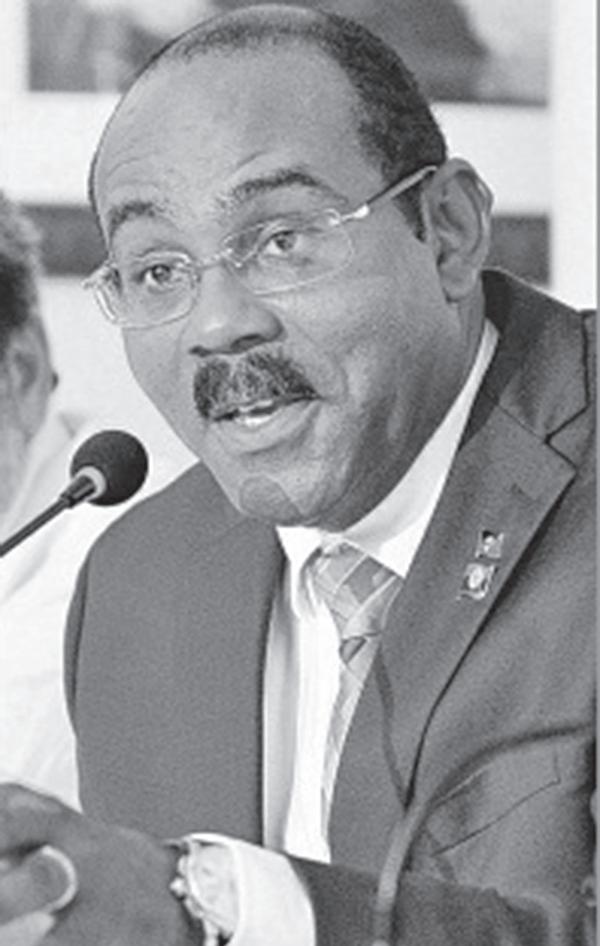
Prime Minister Gaston Browne has denied allegations that his administration played a role in the arrest of former Speaker of the Parliament, D Gisele Isaac, who is facing fraud charges in Antigua.
Browne, who was attending the 36th annual summit of Caribbean Community (CARICOM) leaders that ended in Barbados on the weekend, told reporters that the allegations were nothing more than a "knee-jerk reaction of every single person who finds themselves in trouble with the law.
"Almost invariably, especially where they have political connection, they tend to blame the government. I can assure you my government has absolutely no interest in interfering in the work of the DPP (Director of Public Prosecution) or the police, we have a policy of non-interference.
Isaac, who is also the UPP chairman, and popular radio announc-
er Algernon 'Serpent' Watts were arrested and charged last month as police probe activities at the Board of Education (BOE) initiated by Education Minister Michael Browne in August last year.
The former speaker will re-appear in court on October 25 after being charged with conspiring to defraud the BOE.
Isaac and Watts are alleged to have committed the offences during the period 2013-14.
Isaac, who served as Speaker during the last parliament when
the United Progressive Party (UPP) government was in power, has been released on EC$35,000 (One EC Dollar =US$0.37 cents) bail, while Watts' bail has been set at EC$15,000. Both were jointly accused of conspiring to defraud the Board of Education of EC$13, 983.97 between March 2013 and March 2014.
Isaac, who served as executive secretary of the BOE, received additional charges of fraudulent conversion of the same EC$13, 983.97; fraudulent conversion of another EC$9,000 and corruption.
Watts is accused of failing to pay Education Levy to the Commissioner of Inland Revenue between March 2013 and February 2014, being a person self-employed as a debt collection officer at the BOE.
The opposition UPP has termed the charges political and supporters earlier last month staged a protest march outside a police station in support of Isaac.(CMC)
PORT-OFSPAIN, TRINIDAD: The Ministry of National Security and China Shipbuilding Trading Company Limited (CSTC) officially executed a commercial contract for the acquisition of a Multi-Purpose Patrol Vessel for the Trinidad and Tobago Defence Force’s Coast Guard last Friday.
At the Signing Ceremony which took place at the Ministry of National Security, Temple Court 1 Building, Permanent Secretary Carl A Francis signed on behalf of the Ministry of National Security
while Director, China Shipbuilding Trading Company Limited (CSTC) (Asia and Latin America Department) Zhang Jinming signed on behalf of China Shipbuilding Trading Company Limited (CSTC).
Trinidad and Tobago has procured the ves-
sel covered by the contract to further enhance the country’s maritime security and to establish the foundations of a Maritime Security Perimeter, which will contribute to a well secured maritime domain for Trinidad and Tobago.
The one thousand tonne Multi-purpose
“Disunity” in Caricom could derail Sir Ron’s chances to be Commonwealth SG
After Caribbean Community (Caricom) Heads of Government failed to agree on a single candidate to nominate for the post of Commonwealth Secretary General, at least one regional leader is warning it could cost the Region.
The post is rotated between Commonwealth regions and the Caribbean region next in line. But Grenadian Prime Minister Keith Mitchell said disunity in Caricom may jeopardise this practice.
Antigua and Barbuda has nominated Sir Ronald Sanders, while Trinidad and Tobago has nominated Dr Bhoe Tewari. Dominica has
nominated Baroness Patricia Scotland. “I think we are making a serious mistake with having three candidates and we put out their names early; we didn’t even attempt to talk to each other privately – three names! And I thought that was a bad approach and I’m not sure we will benefit from it,” said Prime Minister Mitchell.
The Grenadian Prime Minister, speaking to reporters on the sidelines of the Caricom Heads of Government Meeting in Barbados, gave his public backing to Antigua and Barbuda’s nominee Ronald Sanders and bemoaned the lack of unity. “I think it’s a mistake, and those who did it must know that. I cer-
tainly spoke out about it and I’m not afraid to say so, because I think it was the wrong approach, and it may result in us not getting that candidate for the post of Secretary General. We may have missed the boat,” said Mitchell.
Caricom Chairman and Barbados Prime Minister Freundel Stuart admitted the issue was carded for the summit but did not come up because of a packed schedule and the visit of several international delegations. He however said a group including himself, the Bahamian Prime Minister and the Prime Minister of Belize was formed to tackle the issue. “The bureau will take certain steps and make certain recommen-
The World Health Organization (WHO) is institutionally unprepared to deal with outbreaks like the Ebola crisis and requires urgent and fundamental change, an independent panel of experts warned Tuesday.
More than 11,000 people have died from the highly infectious Ebola virus in the past 18 months, most them in the west African countries of Sierra Leone, Liberia and Guinea, where it continues to claim lives.
The WHO has been criticised for its slow response – it only declared a global public health emergency on August 8, 2014, five months after the outbreak had taken hold.
In a highly critical report, a UN-appointed panel warned that the WHO "tends to adopt a reactive, rather than a proactive approach to emergencies" and failed to act on the warnings of experienced staff on the ground.
When it finally mobilised, Director-General Margaret Chan and senior staff failed to show the "independent and courageous decisionmaking" required to deal with governments of the affected countries, it said.
The UN agency also failed to engage with local communities early on or to communicate what could be done, for example, to reduce the infection risk from burials, the panel said.
In Guinea, communities are still not convinced of their own responsibilities.
"Until that issue is resolved, very high alert levels need to be maintained," the experts warned.
However, the panel led by Barbara Stocking, a former head of Oxfam, rejected suggestions that global health emergencies be taken over by another UN agency or a new body altogether.
It called for more investment in the WHO, including a $100 million (92 million euros) emergency contingency fund and a five percent in-
crease in regular contributions from member states, warning a lack of funds put it at a "severe disadvantage".
The panel recommended the creation of a new emergency centre that would respond to and manage global crises, and welcomed plans for more training for rapid response staff.
The experts also accused WHO member states of failing in their own duty to prepare for global emergencies, and for failing to listen to WHO advice on closing borders and grounding flights once the Ebola outbreak took hold.
"The panel is convinced that WHO must make fundamental changes, particularly in terms of leadership and decision-making processes, in order to deliver on this mandate," it concluded.
"But it will also require the resources and political will of the member states to make WHO the agency that can fulfil this mandate in the 21st century. This transformation must be carried out urgently." (AFP)
Patrol Vessel (MPV) will be utilised for training and will contribute to the various other exercises being conducted by the Coast Guard.
The China Shipbuilding Trading Company Limited (CSTC) is the trading arm of China State Shipbuilding
Corporation (CSSC), which is the second largest shipbuilding corporation in the world.
CSTC has designed, built and exported hundreds of modern ships to the international markets, including Germany, Norway, Denmark, USA, Japan etc in the last 30 years. (TT Newsday)
dations. This issue is a very important issue for us,” Stuart said. The Caricom Chairman said if the Caribbean misses out, it could take another 40 years before the position rotates back around to the Region.“Really, what we are being called upon to do now is to make a decision that will have implications for the next 40 years, and therefore, that decision cannot be made lightly, but at the same time, even as we speak, time is passing by therefore we have to afford some urgency to it,” said Stuart. “In an ideal world, we should not be in this situation, but we are in it and if you are in a hole the sensible thing to do is to stop digging.” Commonwealth Heads of Government are due
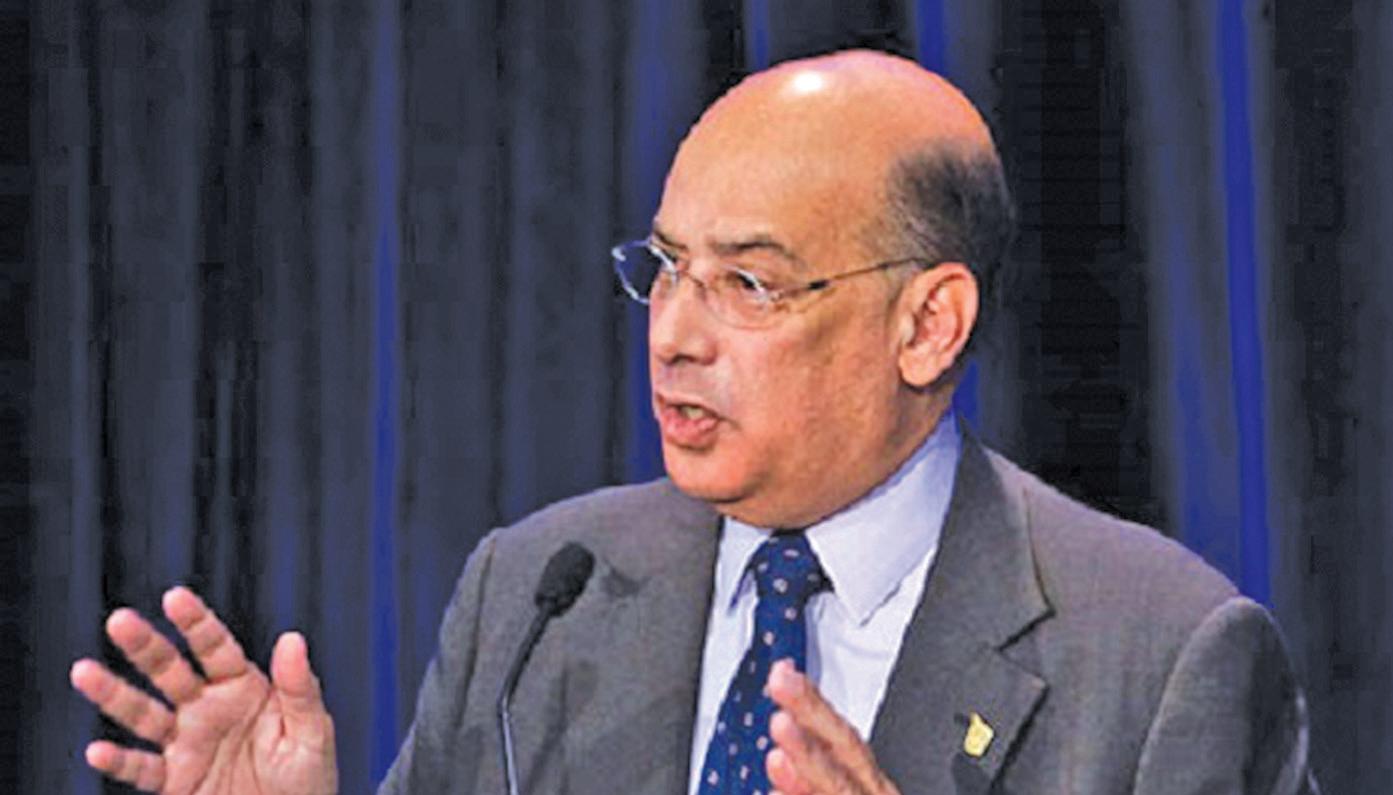
to elect a new Secretary General at the Heads of Government Meeting in Malta from November 27-29. Prime Minister Gaston Browne, who ahead of the meeting, accepted that it was unlikely that a unified decision would be reached, said in no case will he withdraw the nomination for Sir Ron. “Under no circumstances will we withdraw the nomination of Sir Ron Sanders because he is the forerunner candidate. He is not trailing behind any other, he has the most
pledges … he will remain in the race because he is the best prospect of getting that job,” Browne said. The Prime Minister also told regional media that he did not consider Dominica’s nominee to be a Caribbean candidate. “Baroness Scotland is actually an active member of the British Privy Council and therefore is not a Caribbean candidate,” Browne said. “We have three (candidates) and we’re hoping by the time we get to Malta we’ll have one”. (Guyana Times)

GEORGETOWN, GUYANA: This is a year for global action, with international community in the final stretch of preparing a transformative post2015 agenda for sustainable development that will be agreed in New York in September, United Nations Secretary-General Ban Ki-moon declared in Bridgetown, where, two decades ago, the Barbados Programme of Action was adopted to tackle vulnerabilities facing small islands.
“I want to salute Caribbean countries for
taking on ambitious renewable energy targets. By 2020, for example, Barbados will be one of the world’s top five leading users of solar energy on a per capita basis. You are lighting the path to the future,” SecretaryGeneral Ban Ki-moon said during a high-level symposium focused on sustainable development in the Caribbean.
This meeting was among the UN chief’s first stops in Barbados, where Tuesday he is expected to make opening remarks to the 2015 Caribbean Community (CARICOM)
Summit, and where on Wednesday, he will, among others, hold an interactive dialogue at the University of the West Indies. “Twenty years ago, this very building was the site of the First Global Conference on Small Island Developing States that adopted the Barbados Programme of Action – the first compact between this group and the international community,” he noticed. For small island developing States, Mr. Ban added, this space is “hallowed ground.”
Member States also must continue work-
ing together to link the global agenda to regional agendas and to deepen regional integration and to address the “unique needs and vulnerabilities” of small island developing states and middle-income countries, such as the debt challenge.
Moreover, he noted that in the eastern Caribbean, UNICEF estimates that child sexual abuse rates are between 20 and 45 per cent – meaning at least one in five precious children are affected. Most are girls who have no choice but to live close to their
Prime Minister Kamla Persad-Bissessar has promised to engage in agricultural diversification if she is returned to office.
She was speaking to farmers shortly before she distributed compensatory cheques to 500 cane farmers at Enchanted Gardens complex, New Grant, last week.
The funds were allocated by the European Union to address the
negative social and economic impact following the closure of Caroni (1975) Ltd in 2003. Persad-Bissessar said even though the funds were long in coming, her Government was happy to finally facilitate the payment of the first tranche of TT$27 million. Promising to advance agriculture into a strong, stable and viable industry, Persad-Bissessar said she hoped to use agriculture to provide good incomes and jobs to many people.
She said since the National Food Action Plan 2012-2015 was implemented over 38,000 metres of agriculture access roads were rehabilitated.
“Water management and availability have vastly improved, with over 213 ponds constructed and over 226,000 metres of river courses desilted. An enhanced Agriculture Incentive Plan was developed and by fiscal year 2013-2014, a total of 3,390 applications for agricultural in-

attacker. “They desperately need our help. Too many women are afraid to seek help. One study showed that up to two thirds of all victims suffer without ever reporting the crime. I am outraged by this. Shame belongs to the perpetrators – not the victims. We have to change mindsets – especially among men,” declared the UN chief.
In that light, he said he was proud to be the first man to sign onto the UN’s HeForShecampaign, and he invited more men to take the HeForShe
centives were processed,” Persad-Bissessar said. That, she added, was aimed at small farmers and amounted to TT$18.8 million.
With the establishment of the National Praedial Larceny Squad in 2013, PersadBissessar said 51 people were arrested and 75 offences detected.
She said the Commercial Large Farms Programme (CLFP) has also been successful as 12 largescale farms were operating productively.
pledge. “I encourage you to join UNICEF’s End Violence global campaign. And every day, I count on all of you to work for true equality.” In the margins of the 36th meeting of the Conference of Heads of Government of the Caribbean Community in Barbados, the SecretaryGeneral met with Prime Minister Freundel Stuart, and Minister for Foreign Affairs and Foreign Trade, Maxine McClean, of Barbados, a country he congratulated for its upcoming leadership of Caricom. (Guyana Times)

Planning

GEORGETOWN, GUYANA: A recently released study conducted by the World Wildlife Fund (WWF) has shown that Guyana still faces a challenge in reducing the use of mercury in small-scale gold mining related activities and dealing with the effects of such.
The WWF released a new report collating all available data on small-scale gold mining related mercury contamination across the Guianas.
According to the WWF, the report shows that, without any doubt, mercury derived from gold mining activities is already present throughout much of Guyana, Suriname and French Guiana and is not restricted to areas close to mining zones.
A perusal of the report which was released by the WWF showed that Guyana’s premier mining area, Mahdia, in Region Eight (Potaro-Siparuni) was the most affected in terms of the content of the mercury in streams and rivers nearby.
Samples taken from active and historically mined areas had a mean mercury concentration of 0.229 which is above The Canadian Council of Ministers of the Environment quality guidelines with a range from 0.029 to 1.2. An earlier study focused on the smaller Potaro River found mercy concentrations ranging from 0.068 to 0.321 within the tributaries affected by mining activities.
The Government, through
the Natural Resources Ministry, had signed onto the Minamata Convention on mercury in 2013; an international pact to control mercury emissions and gradually phase out its use.
Prior to the signing, local small miners had been nervous about plans to ban the dangerous chemical, stating that there is no immediate and cheaper way to recover gold for its ore.
Persaud said the Ministry has started a programme of transitioning, pointing out that several mining operations have transitioned to mercury-free mining. He added that as part of the convention, there will be no new mercury mining but countries that are already engaged in such will be given 20 years after the convention comes into practice to stop producing mercury.
Persaud, who signed the convention in Japan last week, had stated that Guyana had said that it would need financial and technical assistance to achieve compliance. The Government of Japan has pledged its support to Guyana in phasing-out the use of mercury. It is planning to provide US$2 billion in financial assistance to fight mercury pollution. Between 2013 and 2022, Guyana will impose restrictions against mercury importation and mercury in mining. This approach has been supported by the Guyana Gold and Diamond Miners’ Association, while discussions were held with Amerindian and riverine communities. (Guyana Times)
Trinidad and Tobago’s gross domestic product (GDP) per capita has shown a pattern of continuous growth since 1990, according to a new InterAmerican Development Bank (IDB) study released late June. On the basis of time-series and comparative static estimations, the study finds that the combination of domestic policies, high indebtedness, and outside shocks (e.g., oil price changes or main trading partners’ tourism demand) explain well the gap in growth of the six IDB member countries (The Bahamas, Barbados, Guyana, Jamaica, Suriname, and Trinidad and Tobago).
In the abstract of the study, “Understanding Economic Growth in the Caribbean Region,” IDB staff J. Rodrigo Fuentes, Karl Melgarejo and Valerie Mercer-Blackman wrote that it “shows evidence that the member countries’ small size and their synchronicity with the US business cycle influenced growth performance.” In general, they wrote, the influence of good policies on growth is still evident from the analysis.
Nevertheless, the IDB said, as a result of swings in
the growth rate, it is difficult to determine the long-run growth trend. When comparing the per capita GDP of these economies with that of the United States, the IDB said two findings are clear: the low relative growth in the region and the large dispersion in per capita income levels in the region.
“All of the countries except Trinidad and Tobago have lost ground relative to the United States, which means that they have grown at a lower speed than the U.S. economy’s average 2 percent per capita long-run growth rate,” the IDB said. “This finding runs counter to the convergence theory, which states that less developed economies have a higher per capita growth rate than do their more advanced peers. Moreover, there is heterogeneity: The ratio of per capita income is relatively high for The Bahamas, Barbados, and Trinidad and Tobago. Although Jamaica used to have 40 percent of the per capita income of the United States in the early 1960s, today the ratio is closer to that of Guyana and Suriname.”
The three countries with the highest long-run per capita GDP growth rates are Guyana, Suriname, and
Trinidad and Tobago, the study said. “These three economies have one important characteristic in common - they are commodity exporters. At the same time, they also have the largest standard deviation of the estimated growth rate, which is consistent with the idea that commodity exporters face more volatile shocks that induce more aggregate volatility,” the IDB said.
As expected, the IDB said, the oil price has a positive and significant effect on long-run real GDP for Trinidad and Tobago. “A one percent increase in oil prices leads to an increase of 0.04 percentage points in Trinidad and Tobago’s real GDP,” the IDB said. Moreover, the IDB added, the U.S. real GDP has a short-term effect up to approximately 8 years, but then this effect diminishes substantially thereafter (although it does not completely disappear).
The IDB said, “Other variables were also important (e.g., natural gas) but did not have a straightforward co-integrating relationship with GDP. Trinidad and Tobago also manufactures iron and cement, but metal prices were not significant on their own.” (TT Newsday)

KINGSTON,
JAMAICA:
Minister of Industry, Investment and Commerce, Anthony Hylton, says the Government is implementing measures to facilitate the growth and prosperity of the creative industries.
The initiatives, he said, are in recognition of the creative industries as a generator of wealth for the mass of Jamaicans, and a driver of gross domestic product (GDP) growth.
“This is why it is linked to the growth agenda…and cap-
tured in a number of things…like the Vision 2030 plan, the national growth agenda, and it is the reason why the Creative and Cultural Industries Commission was created,” Minister Hylton noted, while addressing a the media.
Among the measures being put in place to promote the creative industries, is the passage and enactment of the Security Interests in Personal Property (SIPP) Act.
The legislation provides for increased access to financing by micro, small and me-
dium-sized enterprises (MSME), by allowing personal property (nonreal estate assets) to be used as collateral for loans.
This means that owners of creative works, innovators and inventors, are now able to leverage their intellectual property (IP), such as copy-
right, patents and trademarks to be used as collateral.
He informed that the National ExportImport Bank of Jamaica (EXIM) has been mandated to work with the Government in order to increase loan access, with other institutions slated to follow suit.
Minister Hylton informed that talks have been held with the World Intellectual Property Organization (WIPO) for assistance “to work with the banks and to help them with IP evaluation…so that they can mitigate the risks
around that kind of activity to drive sustained growth and build inclusion.”
As it relates to copyright, Minister Hylton told the media that the Ministry has accepted the Senate’s comments on the Copyright Act. The Bill, which was passed on June 9, 2015 in the House of Representatives, extends copyright protection from 50 to 95 years, for content belonging to corporations. Authors of literary works, dramatic, and musical creations will also enjoy the added protection. (JIS)
General and Legal Affairs Minister Basil Williams has committed himself to resolving the ongoing challenges between Guyanese law students and the Hugh Wooding Law School (HWLS) vowing that he will explore all available options.
This commitment was communicated to 25 of the 27 Guyanese students currently attending the Hugh Wooding Law School (HWLS) in Trinidad and Tobago when they paid a visit to the Minister during the course of last week to raise several issues and concerns about their education in relation to tuition, discrimination and disadvantages faced in pursuit of their Legal
Education Certificate (LEC).
Sherry Hewitt, who serves as secretary to the group, raised the issue of fee payment, while other students raised concerns about immigration, course content and late arrival of the Guyana student list to the Trinidad immigration department.
According to the students, the number one challenge to the pursuing of the LEC is the tuition fee which amounts to TT$65,792 (Gy$2.2 million in local currency or US$11,000) per student. They noted that they were now required to pay the full tuition at the beginning of the September semester each year as opposed to 50 per cent in September and 50 per cent in January of the

following year as previously obtained, making it exceptionally difficult to study.
The students also requested help from the Attorney General to address the courses of Family Practice and Procedure, Legal Drafting and Interpretation for second-year students in relation to the unique

Roman Dutch system of land titling in Guyana as opposed to Trinidad’s laws.
According to the Guyanese students, the two courses have a high rate of failure at the law school; hence, their desire for a tutor who has knowledge of Guyana’s laws. The issue of immigration was also highlighted, since students were turned back by the Trinidad immigration owing to the late submission of the list of Guyana students accepted to the law school.
In the meantime, they are requesting scholarships for their final year with the understanding that they will serve for a contracted period. Of the 27 current students attending the HWLS, only one is the recipient of a Public Service Ministry scholarship. (Guyana Times)
More Canadians are coming to Stateowned Caribbean Airline Limited (CAL). This is the word out of sources in Toronto. Four B-737 pilots from the Canadian carrier Canjet are being looked upon favourably by the CAL management and can be expected to arrive in Trinidad shortly to possibly take up employment with CAL. Canjet, according to a trade magazine, recently laid off a number of B-737 pilots.
The airline’s Chief Executive Officer Michael Di Lollo, who has been at Piarco for a year is a former Canadian pilots who worked with Air Transat and was a former executive vice president of Transat Tours before taking up the CAL challenge. A few months later George
Reeleder, a 72–yearold Canadian was appointed Vice President, Commercial Operations and Customer Service. This situation is causing more friction between Caribbean Airlines and its pilots regarding an unresolved Industrial Agreement, a matter which is now in the Industrial Court. Now this matter of hiring contract pilots, both local and foreign, has forced the pilots association to file an industrial relations offence against the airline at the Industrial Court, for the company’s refusal to hold consultations with the representative bargaining unit – Trinidad and Tobago Airline Pilots Association (TALPA).
Because of the severe pilot shortage the pilots continue to complain about the stress they undergo when problems
like being called out on their off days; sectors being added to flights when they return to Piarco and having to switch around vacation periods because of the current pilot shortage.
Additionally, the pilots seeing that so much money is being expended on training, that seemingly is not getting the desired results and special contracts etc., continue to agitating for their incentive payments which the company owes them in some instances dating as far back as three years. Recent reports however, disclose that although the matter is in the Industrial Court, conciliatory talks between Caribbean Airlines and its pilots broke down last week and a new date has been set for the matter to be heard in the Industrial Court. (TT Newsday)
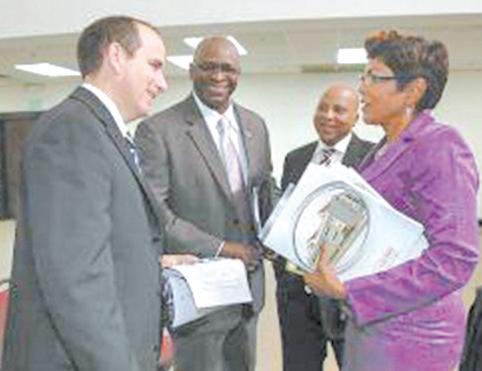
Although there are some differences in the way Cuba and TT do business, CEO of the TT Chamber of Commerce Catherine Kumar says it is important for local businesses and companies to enter that market.
She said initial feedback from the participating companies in the Chamber’s recent fact finding mission to Cuba indicate that there is immediate potential for trade and collaboration.
The TT mission to Cuba included 17 companies and 20 delegates, along with officials from exporTT. Some of the sectors represented included energy, pharmaceuticals, food and beverage.
Kumar said in Cuba almost all economic sectors are state controlled but in recent times there has been a shift allowing privately owned businesses to function more freely. However, so far this is restricted to hair salons and restaurants.
The Chamber CEO said the agreement will facilitate a stronger business relationship and support a framework
for member companies who wish to do business in Cuba. She gave the example of state run supermarkets with limited variety and the potential where they is an opportunity for TT businesses to supply a range of products.
“We found potential for collaboration and trade. In the food and beverage sector the Government run supermarkets are stocked with limited variety. This coupled with Cuba’s growing tourism industry means that there is demand for food and beverage and other household items like canned food products, dry goods, dishwashing liquid, laundry detergent, toilet paper and alcoholic beverages,” Kumar said.
She warned, however, that there are problems with distribution networks in Cuba which are more focused on price than brand awareness.
“The latter is usually important to our manufacturers who invest heavily in marketing and brand awareness. As such, potential TT exporters will have to hire a private brand activation manager which translates into initial higher costs but which should pay off via higher sales in the medium term,” she said.
One of the participants in the TT mission, Charles Carvalho, CEO of Carvalho Travel Agencies, urged local companies to look at the long term future as Cuba continues to open up its economy.
While TT has long enjoyed diplomatic ties with Cuba, improved relations between that Caribbean nation and the United States have increased prospects for a range of economic activities. More trade and travel between the two countries provide opportunities for investment and new markets for a range of industries in the region (TT Guardian)

By Bhisham mohamed
GEORGETOWN, GUYANA:
Owner of the Regent Street Multiplex Mall was shot dead allegedly by a group of bicycle bandits moments after returned to his La Jalousie, West Coast Demerara home early Sunday morning.
Ganesh Ramlall, 48, of Lot C La Jalousie, West Coast Demerara, was shot at least seven times, including once to his head. The killing of Ramlall has come amidst an upsurge in violence across Guyana, with Public Security Minister, Khemraj Ramjattan admitting last week that it would take an herculean effort to contain the situation.
According to information received, the businessman was out with his friends at a BBQ in a neighbouring village and upon his return home at about 00:30h, he went to collect a plate as well as use the outside washroom. While doing so, Ramlall was attacked by gunmen who discharged
a round, hitting the washroom door. Guyana Times understands that the businessman might have attempted to run into the bottom flat of the house from which he had emerged and was riddled with bullets. He dropped a few metres from his back door where he was left to die.
Meanwhile, Police Commissioner Seelall Persaud hours before the shooting had recommitted the Guyana Police Force towards tackling the scourge of crime, telling ranks following a parade to mark the Force’s 176th Anniversary that the time for excuses was over, as more and more resources were becoming available to the en-
tity to make Guyana safer. Ramjattan on Friday had acknowledged that a “herculean effort” was needed to solve the current crime situation, admitting that the new Government may have underestimated the gravity of the situation before gaining access to office. Back in 2011 and in 2012, Ramjattan, who was then an Opposition politician, had severely criticised then Home Affairs Minister Clement Rohee for not doing enough to control the crime rate in Guyana. Ramjattan had lambasted Rohee and the then People’s Progressive Party/Civic Administration for failing the people and not being able to properly administer his responsibilities as security minister. It has been just two months since Ramjattan has been appointed Guyana’s Public Security Minister and already he has been facing the same criticisms as Rohee from an impatient citizenry anxious to enjoy a safe and secure society. (Guyana Times)

Opposition Jamaica Labour Party (JLP) Leader Andrew Holness has described as callous security minister Peter Bunting's characterisation of the current increase in murders as a 'bump in the road'.
"While your brothers and sisters are being killed in the most brutal way, the minister is being very casual about it, calling the increased murders a bump in the road," Holness told a meeting at the Somerset Primary School, in the
Johns Hall Division of North West Manchester on Sunday night.
According to the Opposition Leader, whenever the People's National Party (PNP) is in power, murder rises.
"In 1972 there were 170 murders at the end of the JLP term. When the PNP handed back the country to the JLP in 1980 the murder rate stood at 899, a 429 per cent increase between 1972 and 1980. When the government changed hands in 1989, the JLP had brought down the murder rate to 439, or a
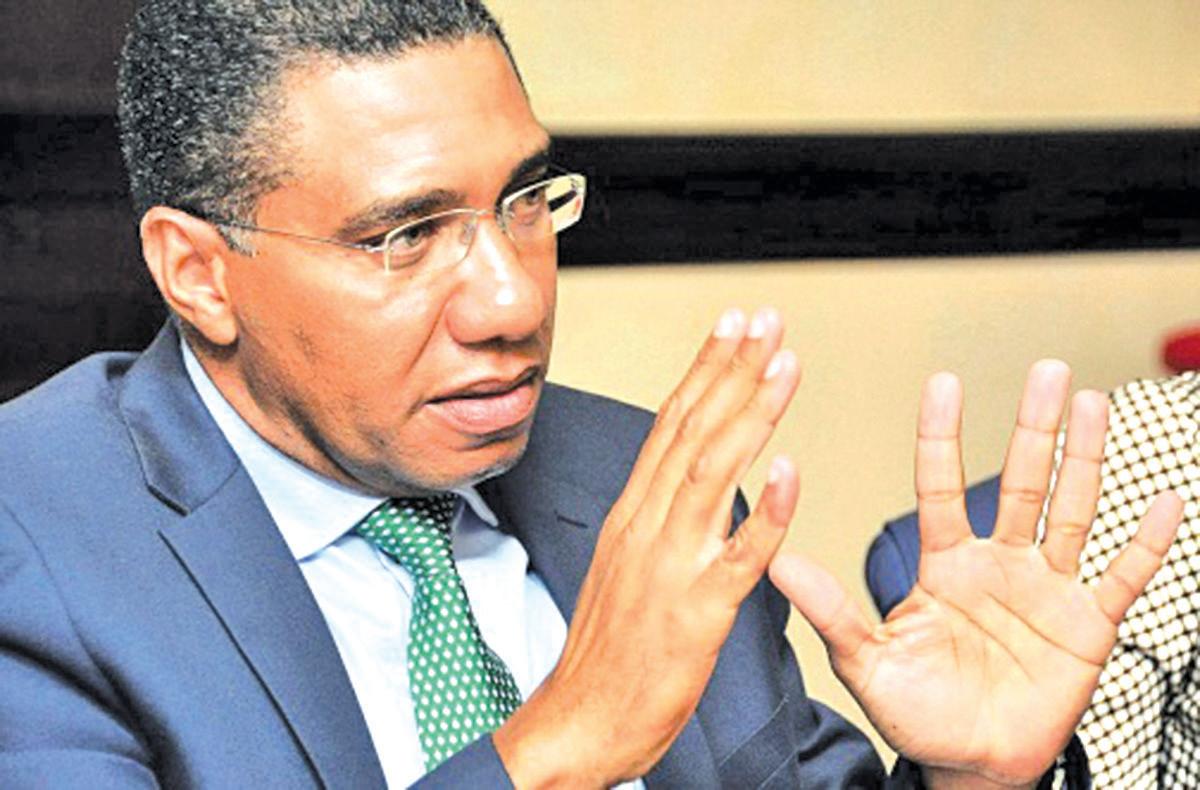
51 per cent decrease, between 1980 and 1989," Holness argued.
The PNP, he said, governed after that for
18 years to 2007 when murders reached 1,574, or an increase of 258 per cent over the 1989 figure.
Holness said he was very concerned that if this trend continues, murders could pass the 1,200 mark by year end. He further informed the audience that murders were rising because whenever the PNP is in power, the economy declines, noting that several studies have shown that there is a direct inverse and reinforcing relationship between crime and economic growth.
The meeting marked the ninth in a series of 15 conferences dubbed the JLP Manchester Invasion, spearheaded
by Caretaker for Central Manchester, Dr St Aubyn Bartlett, and featured other headline speakers such as Member of Parliament for North East Manchester, Audley Shaw, Deputy Chairman of Area Council Three, Michael Stern, Caretakers Ivan McKulsky (South Manchester), Omar Frith (North West Manchester) and Councillor Caretaker for the Johns Hall Division, Bodel Daverinson Clarke, who hosted the meeting. (Jamaica Observer)
By Michael younge
Guyana’s Former Attorney General and Legal Affairs Minister
Anil Nandlall on Saturday strongly condemned what he deemed the outlandish spending and extravagance being displayed by the ruling Administration as he expressed shock over rev-
elations that President David Granger’s inauguration cost over US$1 million.
Nandlall, speaking during an interview with Guyana Times on Saturday afternoon, said that the ruling A Partnership for National Unity+ Alliance For Change (APNU+AFC) coalition Government was suffering from various forms of “bureaucrat-
ic and governmental obesity”, warning that in the end, it is only the public purse that will become anorexic.
He said that revelations by current Minister of State Jose Harmon that most of the monies that were spent on the inauguration of Guyana’s eight Executive President came from donations were attempts to hoodwink the public and

remove suspicion that the “big bash” which occurred at the Providence Stadium on May 26, did not hurt the public purse in any way.
Nandlall argued that even if this was the case and all of the monies were indeed inflows from donations, then the Government had the moral responsibility to say how the monies were spent, who the beneficiaries were and who was in charge of the entire event, as well as payments.
Nandlall opined further that it was simply not enough for Minister Harmon to make such a statement and be let off the hook. He was surprised that the media was not probing for answers to burning questions surrounding the President’s inauguration and the finances associated with the event.
The former Attorney General reminded the new Government that while it was in Opposition, it had preached day and night about the need for transparency, openness in Government and an end
to extravagance. Now the shoes are on the other foot, however, it was “eating its words and abandoning strongly held positions on transparency and good governance”.
He argued that apart from the cloud of secrecy surrounding President Granger’s inauguration, citizens must be concerned about the bills the new Ministers and President are racking up.
“In this vein, I feel compelled to point out that this is a Goverment of 26 Ministers strong… four Vice Presidents and a series of advisors to Ministers and the President… in many instances, you will find that as many as three Ministers are doing what one Minister under the PPP used to do…”, he stated.
He continued by saying that in most instances, two Ministers have been assigned to do what one PPP/C Minister used to do.
The former Legal Affairs Minister explained that having examined the official ga-
zette which contains the assignment of responsibilities of each Minister, he is convinced that some of the Ministers have no work or specific responsibilities assigned to them.
Nandlall said that he, like hundreds of Guyanese, were at a loss with respect to the portfolios of some of the Ministers within Ministries.
“My findings are amazing… Amna Ally is listed as the Social Cohesion Minister within the Ministry of the Presidency… she is assigned the responsibility of “equalities and ethnic relations”… what is that… the nation is unaware what this Minister’s responsibilities are”, he opined.
Ordinary Ministers of Government earn a salary that could be as low as Gy$400,000 per month and as high as Gy$1.4 million as is the case of the Attorney General and Legal Affairs Minister. There are a number of other benefits and perks that come with the job which are not spelled out in the laws. (Guyana Times)
Public Security Minister Khemraj Ramjattan admitted that the move to arm fishermen in an effort to combat piracy was greeted with much reluctance and, as such, the plan is unlikely to follow through.
Recently, the Government disclosed that it is considering granting firearm licences to fishermen to help them ward off pirates who have been on a rampage in the Corentyne area over the years. However, speaking to media operatives on Friday, Ramjattan noted that some fishermen were not too keen on the idea and requested the implementation of stronger patrol systems instead.
“That suggestion (arming fishermen) is coming with some criticisms even from some of the fishermen. They would prefer that we have patrols in mid-
ocean with them. I told them that that would be too expensive. The other is to arm them and, whenever anybody would come to attack them, they can take care of themselves. But a lot of them seem reluctant to do that. I don’t know what then will be the option,” he explained.
Piracy has been a sore issue for fishermen, especially in Region Six (East Berbice-Corentyne).
Many have complained that there is an abundance of talks about the problem but little to nothing is being done to fight it. However, the Minister said he has not yet reached a dead-end.
In fact, the Minister was quite interested in a letter published in one of the daily locals entitled In the letter, written by one Captain Rouchie E W Adams, he noted, “There is a plan that I just recently read and I have asked the Permanent Secretary to get up that plan.”The writer indicated that
the document was initially submitted to the Home Affairs Ministry in 2013 and some of its contents were accepted upon. Some contents on the document included the area of the territorial sea and the ten main waterways which provide access to the mainland from the Atlantic Ocean; the specific areas of responsibilities for various Police Divisions; and a list of assets considered necessary to efficiently and effectively conduct maritime operations in the sea and rivers. Some of the equipment included vessels, communication equipment and safety and emergency equipment.
The Minister noted that he was impressed by the contents of the letter and will consider reviewing the plan in its efforts to combat piracy. “I like the idea and I think I have to meet that person or read that plan and try to implement as much of it as possible,” he said. (Guyana Times)
President Anthony Carmona said TT was neither a banana republic or a failed state and chastised nationals who refer to TT in such derogatory terms.
Addressing the Scout Movement Colour Parade and award ceremony at the San Fernando Hill last week, Carmona said: “As a (former) United Nations prosecutor, I can tell you what a failed state is and we are very far from that.”
He called on nationals to get their act together and take an example from Americans, who, he said, in spite of the many injustices taking place in their land, would never define their country in those derogatory terms.
“I often hear Trinidadians and Tobagonians refer to our country as a banana republic. Why don’t they (Americans) call the United States of America (USA) a banana republic, where 300 bike men meet in a car park and have a big shoot out resulting in some 15 persons dead, where terrorists are bombing left, right and centre.
“No, those people do not define America. They are citizens of America but they do not define America and nobody will call America, because of the slaughter that takes place in America, a banana republic.
“And nobody will call America a failed state because many men have been executed innocently in America because of prejudice and biasness and racial disharmony. No, because that will not define a country.”
Carmona said it should be the same for us as TT was a great country. He persuaded the young men not to let anyone tell them differently.
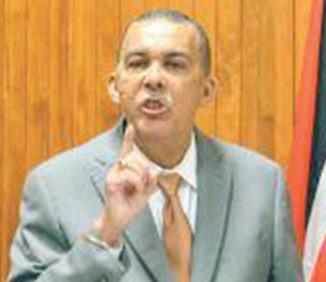
He said adults were the greatest bullies and were not doing a great job of raising the standards of conduct and behaviour in our community.
He called on them to become upstanding citizens and ensure young people were taught proper values and respect.
He also advised the youths against engaging in social media, “where vicious, negative things are said over and over.”
He added: “You will not engage in social media, which I often refer to as a minefield of cowards, hiding behind some nom de plumes and fake names and fake emails, to insult and denigrate people.
“You would not do that because the Scout Movement is not about that. It is about sharing love, engaging in a philosophy of humanity to each other.”
He said while we have our share of problems in TT, once the Scouts were prepared to stand up they could be part of the solution.
He advised against cowering in small corners to denigrate or talk people bad but instead take their selfless effort to a different level of patriotism which would lead to problem-solving. (TT Guardian)

Caribbean leaders have expressed solidarity with Guyana and have called on the Government of Venezuela, “in the spirit of friendship and cooperation”, to withdraw the elements of Decree 1787 as they apply to the territory and maritime space of Caricom states.
The regional leaders had gathered for the 36th Regular Meeting of the Conference of Heads of Government of the Caribbean Community (Caricom) in Bridgetown, Barbados between July 2 and 4. President David Granger had used his speech at the opening ceremony last Thursday to plead with his colleagues to support Guyana over the issue which threatens the country's economic growth.
Venezuela has been adamant in its claims on Guyana’s territory, including its maritime zone,

which was recently found to have oil in what appeared to be high quantities when exploratory work was carried out by the United States oil giant ExxonMobil in early March. Despite an 1899 arbitral award which was the final determiner of the border between Guyana and Venezuela, the Bolivarian Republic claims that the area under exploration is within its territory.
Guyana, through its new Foreign Affairs Minister, Carl Greenidge, had invited the oil-rich na-
tion to move toward judicial settlement of its contention of the 1899 award.
Granger, in an earlier announcement, had said that Guyana would be taking the route of judicial settlement no matter the cost, since the area which Venezuela is claiming has an abundance of natural resources.
The Heads of Government, following the summit which ended on Saturday, reaffirmed the inviolability of international treaties, agreements, awards and legal instru-
ments and made particular reference to those international legally binding instruments that establish international boundaries.
They also noted the negative implications the decree could have on several other Caricom countries.
“Heads of Government called for adherence to accepted principles of international law in relation to the delineation and delimitation of the Exclusive Economic Zone and Continental Shelf in the Region. Caricom states do not accept any unilat-
eral proclamation which is inconsistent with international law,” the leaders said in a communiqué following the summit.
They emphasised that Caricom states have legitimate territorial and maritime entitlements which conform to international law, noting that these must be respected.
Granger on Thursday told the opening of the summit that years of “naval superiority” should not be allowed to suppress the law, noting that the actions, as demonstrated by Venezuela, must be condemned.
Meanwhile, as a result of these concerns, and in an effort to have the rights and entitlements of the affected Community Member States fully respected, a delegation of Heads met with the Vice President and Foreign Minister of Venezuela to express the Community’s grave concern about Decree 1787.
They recalled the numerous agreements in the area of trade, investment, tourism and people-to-people contacts which bind the Governments and peoples of Caricom and Venezuela together.
They recalled too that just under a year ago on September 8, Prime Minister of Antigua and Barbuda Gaston Browne, in his capacity as Chairman of Conference, had written to President Maduro, encouraging Venezuela to redouble its efforts at an early delimitation of the maritime boundary between Guyana and Venezuela. Browne had also encouraged Venezuela to assist in the finding of an early solution to the controversy which emerged from the Venezuelan contention that the Arbitral Award of October 3, 1899 that established the boundary with Guyana was null and void. (Guyana Times)
BRIDGETOWN, BARBADOS :
The St Lucia Government says it will soon table legislation that
will allow for the island to make the Trinidad-based Caribbean Court of Justice (CCJ) its final court, replacing the London-based
Privy Council.
Prime Minister Dr Kenny Anthony said that St Lucia has a provision in its Constitution that

is identical to a provision of the Constitution of Dominica, which used that measure to join the CCJ that was inaugurated in 2005.
‘St Lucia has an identical provision but it makes reference to a section in the constitution which we believed was wrong. In other words there is an er ror in the section.”
Anthony said that St Lucia has a law that allows the Attorney General to refer questions to the Court of Appeal for an advisory opinion in constitutional matters.
He said armed with the opinion from the court he has formal ly written to the British Government “advising… that the Government of St Lucia wishes to delink from the Privy Council in pursuant of the requirements of that section.
quires a 90-day period between laying and the debate and once the constitutional process is completed meaning that the legislation has gained the approval of Parliament for which we must have a two-third majority, then I would expect that the per-

sons who are opposed to the delinking will want to approach the court.
“Now what will happen next, I anticipate that when we go to Parliament with the legislation to seek to delink St Lucia from the Privy Council, the opposition or other elements who feel wedded to the Privy Council for all kinds of reasons for which I will not explore… will likely want to take the matter to the court again”.
Prime Minister Anthony said while he has no objection or problem with the move by the opposition, his administration would go ahead and table the legislation.
“Our Constitution re-
“We don’t have no problem with that, it will be interesting to get the Privy Council to pronounce on the findings of the Court of Appeal whose decision is not binding, it is only persuasive because it is nothing more than an advisory opinion.
“So that’s where we are and I am assume the next few months will be interesting in that regard,” Anthony said.
In March this year, Dominica became the first member of the Organisation of Eastern Caribbean States (OECS) to join the CCJ in both its Original and Appellate jurisdictions.
Dominica joined
Barbados, Belize and Guyana that have signed on to both the Appellate and Original jurisdictions of the CCJ that also functions as an international tribunal interpreting the Revised Treaty of Chagauaramas that governs the 15-member regional integration movement.
Most of the other Caribbean countries are signatories to the Original jurisdiction.
Sir Dennis Byron, the second Caribbean national to head the Trinidad-based Caribbean court said he is certain that within a year, not only will Jamaica be added to of the full membership of the court, but also Trinidad and Tobago and the other islands in the sub-regional OECS.
“All the countries have agreed to be on board because when they signed the treaty establishing the court they entered into that arrangement and they went further than that, they have all put money to fund the operation of the court so they are fully on board in that respect.
”What they have not done is abolish appeals to the Privy Council. That is one thing that has not been done and as far as my crystal ball suggests that within the next year or two the countries will be on board,” he said as the court celebrates its 10th anniversary this year. (CMC)
PORT-OF-SPAIN, TRINIDAD: Shavanie
Indira Maharaj appeared in the San Fernando Magistrates’ Court on Monday charged with stealing TT$226,000 from a businessman.
Maharaj, 33, of Centenary Street, Princes Town, faced deputy Chief Magistrate Mark Wellington, who read the charge that between April 29 and 30, 2014 at Tropical Plaza, Marabella, she stole the money.
The charge was laid by Fraud Squad Corporal Popan.
Defence attorney Shaun Teekasingh said his client was already granted bail but asked for a variation in the TT$100,000 amount. He said Maharaj had no previous matters before the courts.
But Wellington said the amount granted was reasonable.

The case was adjourned to August 3.
Sums of money totalling TT$226,000 were allegedly giv-
Gnessman advertised property for sale worth TT$13 million. (TT Express)
KINGSTON, JAMAICA:
Dancehall ar-
tiste Busy Signal was released after being arrested in Trinidad Saturday night after failing to repay over US$37,000 due to a local promoter for the past two years.
According to the Trinidad media , the singjay was arrested at his hotel shortly before he was slated to perform at Together As One concert. The entertainer was hauled before the Port of Spain High Court following an emergency hearing with Justice Rahim, who issued the warrant for Busy Signal's arrest.
The article stated that Busy Signal (given name Reanno Gordon) was paid US$37,088 in 2013 to perform at

a concert for Peppers Entertainment in May of that year. Both the promoters and the entertainer had agreed to postpone the concert
busy signal
with the money that was paid to Gordon going towards his performance fee for the rescheduled event. Documents said that Gordon did not de-
duct this sum from a future concert and also did not repay the money.
The promoter's attorneys Michael Rooplal and Carina Jailal had filed an application for a fugae warrant pursuant to the Absconding Debtors Act. The claim was based on Gordon's failure to return monies owed.
The promoters claimed for damages for breach of contract in the sum of US$37,088 and for interests and costs.
The entertainer was released after he entered into a consent order to pay US$15,000.
The balance is to be paid in the next 30 days. Gordon who was represented by attorney Fareed Ali. (Jamaica Observer)
KINGSTON, JAMAICA: Government Senator Wensworth Skeffery has called for the denunciation of the corrupt use of power and the victimisation of Jamaicans.
"We must reject unfair pressure and denounce corrupt use of power and victimisation of our people. We must never deny them the right to live because they do not share our political calling," Skeffery told the Senate Friday, as he opened the annual state of the nation debate in the Senate.
"I am confident that if we unite as a people, focus on key national priorities, cut waste and continue to provide critical leadership in all institutions of the State, then we can make this nation the best to live, do business, raise families; and continue to be progressive, industrious, innovative and creative, as we seek to ensure that all our people will be prosperous, and enjoy a better standard of living," the senator said.
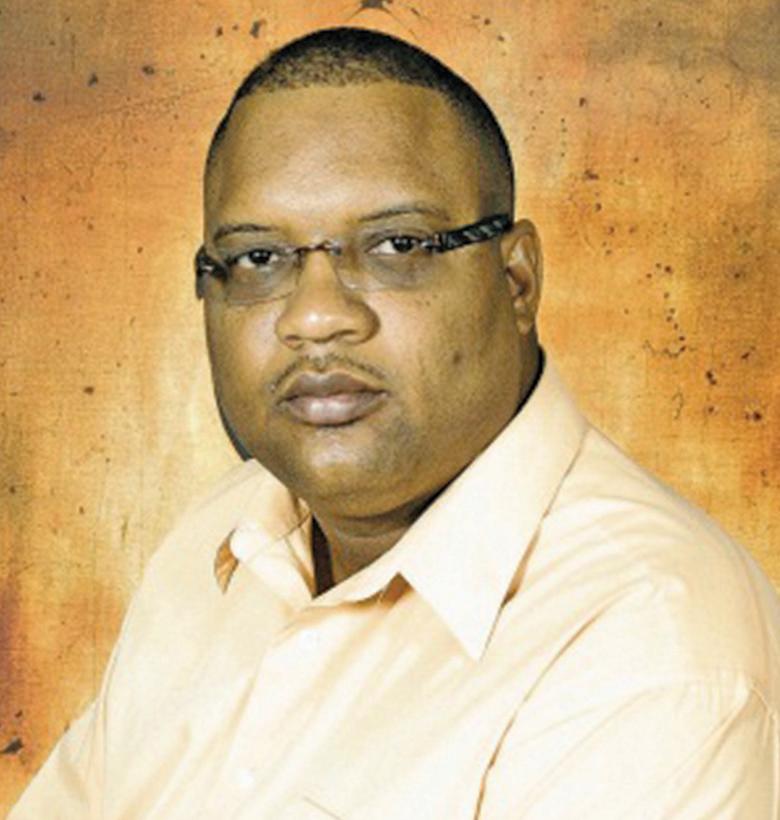
"Now is still the hour, now is still the time, people power is still the mission, as we seek to broaden the principles of participation, accountability and responsibility," he added. He said that he is proud that Jamaica is now appropriately poised, "as a result of the tremendous effort by the Government" to achieve its primary objective, which is the improvement of the condi-
tions under which ordinary people live.
"We are on the right path with our investment in education, in agriculture and industries; the issuing of titles to hundreds of ordinary Jamaicans; progress made with the legislative agenda; reform in our justice system; and the economic and social reform agenda," he said.
However, he said that for the Jamaica to move forward there is a need for a crusade for continued improvement in the economic conditions of the country, hand in hand with an accelerated social revolution.
"We need to have a complete release of the energy and drive of our people as, in the long run, the most important aspect of progress are our people: human beings, their attitudes, their support for their own government and the part they play in their own development," Senator Skeffery told the Senate. (Jamaica Observer)
EORGETOWN, GUYANA: The Caricom Heads of Government have issued a call on the Hugh Wooding Law School’s Council of Legal Education, located in Trinidad and Tobago to extend the arrangement between that institution and the University of Guyana (UG) for the automatic entry of the top 25 students of the legal education programme.
At the 36th Caricom Heads of Government Meeting which was held in Barbados from July 2-4, the matter was discussed and it was decided by the Heads that the Hugh Wooding Law School (WLS) would be asked to, in effect, extend the arrangement which was previously in place for the students this year.
According to Foreign Affairs Minister Carl Greenidge, at the 35th Heads of Government Meeting last year in The Bahamas, the Heads had agreed to establish a committee to undertake the review on the provision of legal education in the Region with regard to the increased need for legal services in the Caribbean. A review of the system was last undertaken more than 40 years ago. However, this report has not been completed, and as such, the call was made for the school to accept the Guyanese students until this is accomplished.
In the meantime, students have expressed hope for a more stable and secure arrangement, noting that it is very difficult being in a situation where uncertainty on the future of their studies exists. In addition, they have noted that the programme is highly competitive and lots of persons are forced to end their law studies at the LLB level at the University of Guyana since only 25 places are usually offered and the entrance examination at the HWLS is extremely difficult to pass to qualify for placement.
Last year, days after the Council for Legal Education had stated that it will not be guaranteeing any of the 25 places usually offered to Guyanese students at the end of the degree programme at the Turkeyen Campus of the University of Guyana (UG), then Chairman of the Caribbean body, Dr Ralph Gonsalves had written to the Council on the impasse. In his letter, Dr Gonsalves had requested the Council to facilitate the students until a review of the system was done and a suitable solution found. However, Chairman of the Council, Jacqueline Samuels-Brown had at the time explained that the placement issue was not one that was of pure bias but one of space and accommodation for the students who stay on campus.
As part of a longstanding agreement between the Council and UG, every year, 25 automatic places are reserved for UG students at the Hugh Wooding Law School. The Council, however, had taken the decision that UG’s 2014 batch would not be guaranteed places. It was understood by this publication that the original agreement had initially expired in November 2012, but, at the request of the Government of Guyana, it was extended until 2013. Negotiations were scheduled to take place to facilitate the 2014 batch of students. However, this discussion never took place until the matter arose some months ago. But though provisions have been made for 2014, current UG law students remain concerned over the future relationship between UG and the Hugh Wooding Law School. Minister Nandlall had assured some time ago that a long-term solution will be instituted to prevent future limbo. As it stands, talks are being held on the possibility of Guyana establishing its own law school. (Guyana Times)
By Dmitri Allicock
GEORGETOWN, GUYANA: Cattle, cowboys and horses, creeks, rivers, wooden bridges, swamps, rain, mosquitoes, jaguars and snakes are the ingredients for a great imaginative western movie. These can also be found in stories on the movement of herds of cattle on the famous Rupununi Cattle Trail to the coastal marketplace of British Guiana.
On the hoof, cattle were driven along a cattle trail that wended its way from Annai in the Rupununi savannahs through rough terrain to the Yawakuri savannah on the Berbice River, covering a distance of at least 120 miles. At the end of the journey, the cattle were exhausted and wasted. In 1919, the trail was successfully completed and the first head of cattle was driven over it in 1920.
A glance at the map of Guyana reveals that the 5,000 square miles of the prime savannah lands of Rupununi is located in the isolated deep south- west of Guyana. In the early ranching period, there was no way to reach the Guyana coast with cattle and no market at all except in Brazil where demand was uncertain and
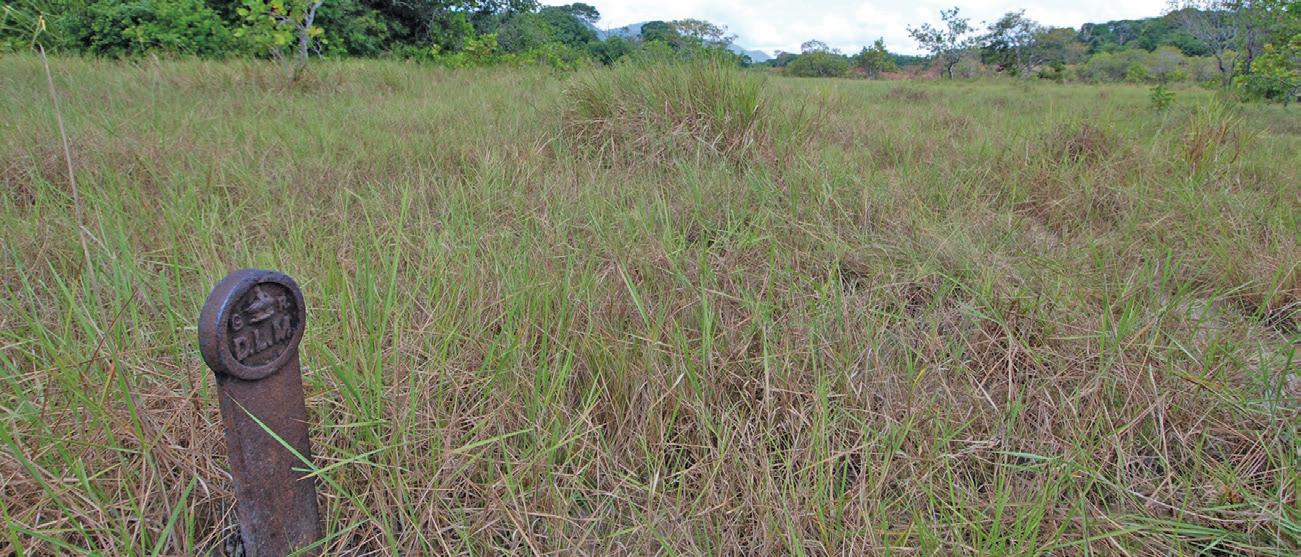
the jungle has reclaimed some parts of the trail
values low. Transportation was a serious problem and waterfalls interfered with river transport. Highways and railways were non-existent, and construction through the forests and swamps was cost prohibitive.
The New York Times of Oct. 21, 1917 noted, “A reduction from 4 weeks to one on the time necessary to transport cattle from the interior of British Guiana to the coast will be affected by the construction of a cattle trail from the Annai Savannah on the Rupununi River to the Yawakuri Savannah on the Berbice River, a distance of 120 miles. A loan of Gy$60,000 for the purpose has been authorized by the Combine Court of British Guiana accordingly to a report from the Consul George A Chamberlain, station in Georgetown. Work upon the trail
is to begin at once and it should be ready for use early next year.”
The publication further added, “There are at present about 35,000 heads of cattle in the savannah in the Rupununi district, and it is estimated that over 1000 head will be taken over the proposed trail yearly to the Berbice River, and hence transported to the coast for the local market and for export. It was further stated in the court that there was 150,000 head of cattle on the Brazilian ranches near the British Guiana border, and that transportation to the coast would be less expensive by this trail that at present by Manáos and other places where markets were available. This trail will also make access to the interior of the colony for other purposes much easier.”(Guyana Times Sunday Magazine)


Cake artist Michelle Sohan, the owner of Bakery Treatz in Chaguanas, is taking the cake business in Trinidad and Tobago, international. Sohan's bakery, which has been creating and designing incredible works of art for cakes and pastries, will celebrate its twelfth anniversary in December.
Sohan was never formally trained until January this year when she received her Professional Masters in Education (PME) Masters of Cake Decorating which is an internationally recognised certificate for professional cake decorators. Her first degree was in Agriculture which she obtained at the University of the West Indies (UWI).
Sohan recalled growing up not liking the idea of baking. She said, “I may have been actually allergic to the kitchen”. However from baking two cakes at a time in her mother's oven, Sohan baked her way into a fullfledged bakery.
Sohan attributes her inspiration to cake decorating as a career path to a serious accident she was involved in 17-years ago where she suffered damage to her neck and wrist, being bed-ridden for weeks and losing hearing to her right ear.
Sohan said what followed after the accident was her leaving her job in Quality Control Assurance for a food company to complete her Masters in Food Technology.
Sohan won the South Florida Cake and Candy Expo held at the Miami Airport Convention Centre this year where she entered the Expert Cake category after having spent 37 hours completing the masterpiece.
Last year she won a Teddy Bear Cake Challenge in Virginia with her cake partner, cake artist Zane Beg from the Sweet Life.
She said that over the years she has spent time
traveling and expanding her creative talents being inspired by new ideas and meeting people. This she said has helped her improve her knowledge and her business.
From humble beginnings Sohan said her family came from very little but educating herself was a main priority of her mother for both herself and her two sisters, Karen and Lindy. She said, “I know what it is like to not have, but to appreciate what little I do. I do a lot of charity work, but I refuse to use it to make me look good”.
As a young businesswoman Sohan said she has had to endure many setbacks and said that after she received a contract for work at a fastfood restaurant, she was being verbally sabotaged and even had to deal with another bakery owner attempting to pay her breadperson to spoil items.
As for her products, Sohan said that she wanted to provide a healthier alternative to bakery products. She said that at her bakery there is no use of preservatives, enhancers or chemical additives in their bread and pastry dough. There is also not milk or any dairy ingredients, “so people suffering from lactose intolerance can eat comfortable, like myself. We also have a huge variety of egg-less items, from cakes to pastry to sandwiches and pizza”.
According to Sohan her bakery cakes can be priced from TT$50 to TT$5000 depending on size and level of intricacies to the design.
She said that she is inspired by everything around her from the colour of a handbag to the stitching on someone's jeans. Sohan said she chose to get certified by Daryl Uloom so as to ensure that all their baked goods are Halal certified. She also said that close attention is given to all ingredients to make sure that only certified ingredients is being used. (TT Express)
GUYANA: For Zack Buck, an American extreme survivalist/outdoor educator, surviving “naked and afraid” in Guyana’s savannah is an experience he will always cherish.
Zack was a partici-
Guyana Times Sunday Magazine, Zack narrated his experiences of surviving in Guyana’s savannah.
Sunday Magazine: What prompted you to do the “Naked and Afraid” show?
Zack Buck: I made
pant of the Discovery Channel’s “Naked and Afraid” show, a reality showwhere two complete strangers - a man and a woman - meet in a very unique way. The pair is stranded in a dangerous, desolate location, various parts in the world, without food and water, and completely naked.
Each episode follows the two as they attempt to survive on their own for 21 days, with nothing but one personal item each and the knowledge that the only prize is their pride and sense of accomplishment.
Because there is no other choice, the couple quickly gets to know each other - and their surroundings - and hope that their instincts, survival skills and stamina serve them well.
In an interview with
the decision to do the show because it sounded like a good adventure to test my survival skills and learn about myself. Tribes in North America would go on vision quests to gain insight on life under similar conditions of starvation and enduring the wild.
Sunday Magazine: Before coming to Guyana, did you know anything about the country or heard of it?
Zack Buck: I had no idea where Guyana was before looking it up online. I thought at first they told me I was going to Ghana in Africa because I misheard production. It turned out to be a beautiful country of jungle and tropical grasslands known as the Rupununi Savannah.
Sunday Magazine: When you learnt you
were coming to Guyana, what was your reaction?
Zack Buck: At first, I thought I was going into the jungle and that concerned me. The insects in the jungle seem to pack more of a punch. With Guyana being over 80 per centjungle, I figured I would be there. It turned out I was wrong and was dropped off in the savannah where the heat was an issue.
Sunday Magazine: Did you have a partner?
Zack Buck: I had a partner on the show that I had never met until we were both stripped down naked and told to survive. Her name is Afften from Chicago, Illinois. She describes herself as “a little ball of awesomeness”. Out of the 21 days we were supposed to survive, she left on the morning of day seven because she wanted to see her family.
Sunday Magazine: When you arrived in the country, what were your thoughts?
Zack Buck: My first thought on Guyana was that the food was different from American food, which messed up my stomach. The means of transportation was different as well. I travelled on a small, eight-person propeller plane to Lethem and then drove on an unmarked road to our destination. Looking down at the jungle from the plane, I could only imagine how harsh the conditions were.
Sunday Magazine: Which area were you dropped off?
Zack Buck: I was dropped off in the Rupununi Savannah.
Sunday Magazine: What was required surviving in that area?
Zack Buck: The challenge required me to survive for 21 days with only

a few items and then hike to an extraction point many miles away for my pick up. I didn’t have food, water, clothes or shelter to start. I had to improvise and overcome the odds hoping to work with nature and not against her.
Sunday Magazine: Did you survive for the specified time?
Zack Buck: I survived the full 21 days despite having a partner that quitted early and a 102.8 fever on day 20. I hope to do the challenge again someday. The new challenge for finishers is 40 days long that I hope to take on.
Sunday Magazine: Were you able to tour Guyana after the show?
Zack Buck: I did not get to tour the waterfalls or rivers after I was done
because I was so sick. My mind was on food, and despite being told to take it easy by the medic, I ate a whole bucket of chicken and tub of chocolate ice-cream the two days following the end of my challenge. I lost 28 pounds, but have gained it back since.
Sunday Magazine: Would you ever come back to Guyana to visit?
Zack Buck: I would love to come back to Guyana again someday! I want to visit the jungle and see the amazing waterfalls as well as see if my lean-to shelter is still standing.
Sunday Magazine: Our indigenous people, the Amerindians, survive living everyday in the savannah where you were. What would you say about that?

Zack Buck: The Amerindian people know more about where I was surviving than I did. It would be a great experience to ask them questions and learn how they survive compared to what I did. I am sure they would say the same thing to me if they came to the desert of Utah or woods of Missouri to survive. Going to a place where the resources are different than you are used to is a real challenge making you improvise and adapt.
Sunday Magazine: What did you learn from this experience?
Zack Buck: It was very nice to get home and see my family after the adventure was over. I learnt a lot about myself and appreciated even more what I have in life and the basic needs of survival: food, water and shelter.
Zack is not the first person to survive Guyana’s harshest terrain on the show “Naked and Afraid”. For videos on the shows of Zack and others in Guyana, visit http://www.discovery. com/tv-shows/naked-andafraid/ or log on to www. zackbuck.com for his tips on being a survivalist. (Guyana Times Sunday Magazine)
JAMAICA: Reggae Jazz Fest, a show with Monty Alexander and Beres Hammond, is part of the comeback season for the storied Kings Theatre in Brooklyn, New York.
The show is scheduled for August 1 when Jamaicans celebrate Emancipation Day. Built in 1929 as the Loew's Kings Theatre, it was a popular spot for vaudeville and movie-goers before closing in 1977. It re-opened in February after renovation of almost US$100 million with a concert by Diana

Flatbush Avenue, home to a massive Jamaican community. George Crooks of Jammins Productions is promoter of Reggae Jazz Fest, which he said caters to fans of traditional jazz and lovers rock reggae.
"We have Beres who everyone loves, but Jamaica also has Monty Alexander who is an exceptional Jazz artiste, who plays Lincoln Center and Carnegie Hall on several occasions...so we wanted to introduce him to the rest of the Caribbean community," Crooks told the Jamaica media.
Alexander has lived in the United States since the early 1960s and established himself a major player in traditional jazz. He has collaborated with a number of Jamaican musicians in recent years, including Ernie Ranglin, Sly and Robbie, Glen Browne and Dean Fraser.
Reggae Jazz Fest is the third concert in the Kings Theatre series -- following soul singer Jill Scott and The Whispers/Stephanie Mills. Rock singer Jackson Browne is also on the itinerary. (Jamaica Observer)
The trinidad+tobago film festival (ttff) on Monday unveiled its first selections for this year’s edition of the Festival with the announcement that ten classic Caribbean films will form part of the 2015 lineup.
These ten films will screen in a special sidebar to the main programme in honour of the ttff’s tenth anniversary. The Festival takes place from September 15–29.
“Many people are unaware that there has been a Caribbean film industry for quite some time, or that almost every country in the region has produced feature films,” said Bruce Paddington, ttff Founder and Festival Director. “We are therefore very proud to present ten of the very best classic films from the Caribbean that will help one to appreciate and enjoy the rich diversity of the region.”
Comprising films from nine different countries, the sidebar ranges across the English-, Spanish-, French- and Dutchspeaking sections of the region.
The lineup includes the Jamaican classic, The Harder They Come, and Bim, from TT.
Memories of Underdevelopment, the oldest film in the lineup, is from 1968, while the most recent, Strawberry and Chocolate, was released in 1993. Both of those films hail from Cuba.
The full slate of films is as follows:
•Memories of Underdevelopment (Tomás Gutiérrez Alea, Cuba, 1968)
•The Harder They Come (Perry Henzell, Jamaica, 1972)
•Bim (Hugh A. Robertson, Trinidad and Tobago, 1974)
•One People (Pim de la Parra, Suriname, 1976)
•Man By the Shore (Raoul Peck, Haiti, 1983)
•Sugar Cane Alley (Euzhan Palcy, Martinique, 1983)
•One Way Ticket (Agliberto Menéndez, Dominican Republic, 1988)
•What Happened to Santiago (Jacobo Morales, Puerto Rico, 1989)
•Ava and Gabriel: A Love Story (Felix de Rooy, Curaçao, 1990)
•Strawberry and Chocolate (Tomás Gutiérrez Alea and Juan Carlos Tabío, Cuba, 1993)
In addition to screening in honour of the Festival’s tenth anniversary, the classics also screen in recognition of the launch of the Caribbean Film Database, an online resource which, in the first instance, will present information on over 600 independent feature-length films made in and about the Caribbean. The database is co-financed by the ACP Cultures+ Programme (ACP Group of States), funded by the European Union (European Development Fund) and implemented by the ACP Group of States.
The rest of the lineup for the ttff/15 will be unveiled over the upcoming months. For more information about the Festival, visit ttfilmfestival.com.
The trinidad+tobago film festival (ttff) celebrates films from and about the Caribbean and its diaspora, as well as from world cinema, through an annual festival and yearround screenings. In addition, the ttff seeks to facilitate the growth of Caribbean cinema by offering a wideranging industry programme and networking opportunities. The ttff is presented by Flow and given leading sponsorship by bpTT, and supporting sponsorship by the Embassy of the United States of America. (TT Express)
GUYANA: USbased Guyanese Kwasi Fraser is the first black Mayor of Purcellville, a town in Loudoun County, Virginia, United States. He recently completed his first year as mayor and is in his second.
In an interview with Guyana Times Sunday Magazine , Fraser credits his Guyanese upbringing and culture for being a successful mayor; a post he never envisioned himself taking up.
Sunday Magazine: Where in Guyana are you from?
Kwasi Fraser: I was born in Georgetown, Guyana. My father, however, was a dispenser, and we were privileged to reside in several areas of Guyana, including Lethem, Ana Regina, Parika, and Buxton, where my mother was born and our final residence prior to migrating to the United States. We migrated to the United States in 1982.
Sunday Magazine: What are your academic qualifications?
Kwasi Fraser: I possess a Bachelor of Engineering degree from Stony Brook University and a Masters of Business Administration (MBA) from Rutgers University. I also earned an Executive education Certificate from Harvard University and a Project Management Certificate from George Washington University. My professional certifications are Certified Project Management Professional and Lean Six Sigma Black Belt.
Sunday Magazine: What motivated you to
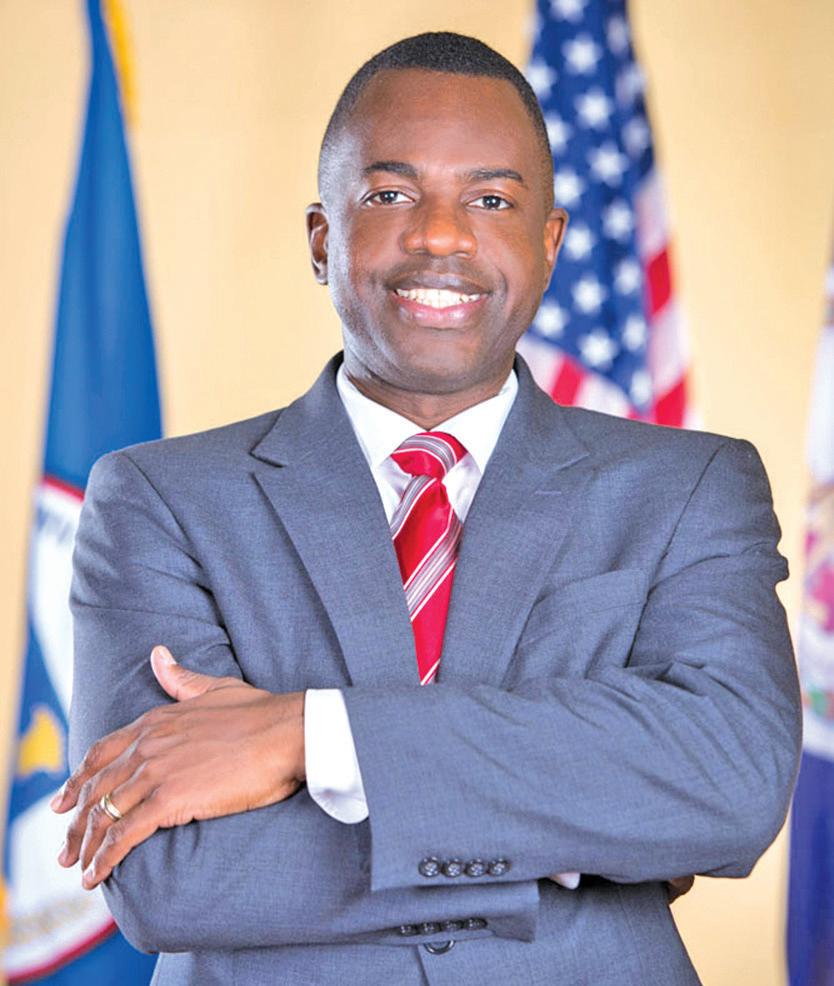
run for Mayor?
Kwasi Fraser : I was motivated to run for Mayor by my desire to serve and to make a difference in my community. I believed that my academic, professional, and life experiences had prepared me to foster greater fiscal responsibility, transparency, citizen engagement, and wise growth for our town. My decision was be a spectator or a leader, and I felt equipped and empowered to lead.
Sunday Magazine: Were there any challenges you faced becoming the first black Mayor of Purcellville?
Kwasi Fraser: The key challenge that I face is obtaining buy-in and support from other council members, especially those members who were loyal to the prior administration and did not see my brand of change as necessary. My supporters who enabled me to win 61% of the vote will continue to see that margin as a mandate, but I
am constantly reminded that 39% of those who voted did not vote for me.
Sunday Magazine: As Mayor, what are some of your responsibilities?
Kwasi Fraser: I lead council meetings and ceremonial events, appoint individuals to special committees and boards, serve on regional advisory boards, sign checks, assess and recommend business development opportunities, vote, and engage our citizens and businesses for feedback and insights.
Sunday Magazine: Are you married?
Kwasi Fraser: I am married to my college sweetheart Angela, and this year marks our 18th wedding anniversary. We have three children: Darius, Naomi, and Jeremy.
Sunday Magazine: Did you ever envision yourself becoming a Mayor?
Kwasi Fraser: When I moved to Purcellville, I never en-
visioned I would run for or become mayor. In fact, I had never contemplated entering politics based on my perception of the inefficiencies and bureaucracies that exist in government, with wasted efforts on meaningless matters and long cycle times to make decisions. However, as I evaluated the critical needs of Purcellville, I saw myself as a change leader and ultimately becoming the mayor of our town. When I prevailed, I was surprised by the substantial margin of victory.
Sunday Magazine: Did your Guyanese roots contribute to you being an effective mayor?
Kwasi Fraser: Yes, watching my parents invest in and raise chickens to supplement our income, planting a vegetable garden, and having my mother bake goods and place in paper bags for me and my siblings to distribute to those less fortunate in our neighbourhood in Guyana left an indelible impression on me to work hard, to lead, and to serve others.
Sunday Magazine: What's your advice for youths who may want to pursue politics?
Kwasi Fraser: First, identify issues or concerns in your community that you firmly believe need to be addressed, then ask how you can use your abilities and experiences to tackle those issues or concerns. Second, realize that you don’t know everything and as such continue to pursue knowledge. Third, be humble and a good listener to those you would like to serve.
(Guyana Times Sunday Magazine)
Appleton Estate Jamaica
Rum's EDX (Electronic Dance Xposed) cemented itself as the premiere electronic dance music (EDM) festival in the island last Saturday at the Kingston Polo Club, St Andrew, with a raft of international talent from the popular genre.
"For this edition, we have countless surprises in store for our guests and could not be more excited to reveal our most elaborate and mind-blowing stage design to date," Adam Gomes, event promoter, told the Jamaican media ahead of the event's staging.
There was no question the production was bigger and better than previous years as patrons were graced with a massive stage
surrounded by video screens emitting entrancing patterns that suited the moods of each DJ set.
The locals, Jay Vinyls, Shane 'Firestarter' Graham and Tofte, were up first, putting down solid sets to get the then growing audience warmed up for the three overseas headliners.
"It was an honour to be asked back for a third time," Graham said.
Graham said the exposure from playing EDX has helped his career by showing that the local scene is toe-to-toe with the overseas market.
"I'll be focusing on the production side of EDM for the foreseeable future," he said.
Lema was the perfect lead into tyDi. Lema, back for the sec-
ond time, proved he knew the audience, mixing familiar hits like Martin Garrix's Animals for a high energy set that had glow sticks in the air. He ended his time on stage with a welcome nod to dancehall playing Chronixx's Like a Whistle. As the audience's energy swelled to a high, tyDi entered to fireworks, and kept the levels at a plateau with his mellow EDM style. Like Lema, his act was punctuated by the increased production settings, random bursts of flames, girls dancing from all angles, including lowered from the ceiling, and guns that poured smoke into the audience. EDX Alumni tyDi made way for the harder edged EDM tones the female DJ pairing KimKat (Kim Lee and Kat Nova). (Jamaica Observer)
Exporting of various types of goods and services not only creates new opportunities for entrepreneurs, but also contributes significantly to a country’s gross domestic product (GDP). With the advent of exporTT Ltd, companies interested in engaging in export-based activities can now avail themselves of a one-stop gateway to support their efforts in this regard.
ExporTT Ltd, formerly Business Development Company Ltd, was established by the Government to provide entrepreneurs and other medium to largesized organisations, with a full suite of export-based services aimed at moving such organisations to a high level of export-readiness. The organisation’s man-
date includes identifying new markets within which there is an existence of economic benefits for both TT and the exporting partner. One of the major areas of focus is the French Caribbean market.
Why the French Caribbean market? According to Natalie Paul-Harry, senior export officer at exporTT Ltd, “The French Caribbean market was selected primarily because of its proximity and low shipping costs”. Because of these unique marketing characteristics, Trinidad and Tobago businesses are poised to enjoy a suite of benefits through their exporting initiatives.
“The market potential for Trinidad and Tobago exporters is even greater given the difference in the minimum wage between both markets $8.86 euros
in the French Caribbean and TT$15 in Trinidad and Tobago,” said Paul-Harry. She also alluded to the fact that such a scenario provides more disposable income and purchasing power for exporters.
Feature speaker at the recently concluded seminar hosted by exporTT themed “Doing Business with the French Caribbean”, Caroline Ventura, who also heads Cayribe Sarl with offices in Martinique and Guadeloupe, stated that, “based on Trinidad and Tobago’s socio-economic attributes particularly in relation to its low energy costs, the country has the capacity to supply the French Caribbean market with goods and services identified in specific targeted sectors.”
These sectors include food and beverage, tissue products, plastic bottles, cleaning chemicals, aluminium windows, doors, sheeting and mattresses. To effectively implement this venture, exporTT developed a strategic alliance with Cayribe Sarl, a company which provides consultancy services in various fields including financial management, sales, marketing, communication strategy and industrial performance management.
The French Caribbean market, is one of several markets currently being explored by exporTT Ltd to identify new growth opportunities for businesses in Trinidad and Tobago that wish to engage in exporting initiatives. (TT Newsday)
GEORGETOWN,
GUYANA: Guyanaborn Soyini George is the designer,founder and ownerof the Washington, DC,USA handmade baby clothing and accessories brand, Yinibini Baby.
The product’s success is perhaps partly because of her Guyanese heritage, rooted in her family since, as a little girl growing up in Guyana, Soyini’s learned to sew from watching her Great Aunt Jean weave her scissors through fabrics and gather them together to create stylish clothing.
The website Guyanesegirlsrock states this was just the beginning of Soyini’s love for art, design and colour. One year after graduating from college, and with US$100, a dining room table and tons of motivation, she started the Yinibini brand of clothing and jewellery for women in 2006.
The origin of the name “Yinibini” comes from the last four letters of Soyini’s name (Yini) + bini, which means ‘good girl’ in Guyanese creole.
In 2010, the brand’s focus was switched from women’s clothing to accessories and clothing for babies in what she called was a “wonderful and natural expansion of the line.”

Yinibini Baby clothing and accessories are all hand-sewn and made of cotton, organic cotton, cotton blend and bamboo blend fabrics. The collection includes blankets, onesies, booties, bibs, burp cloths, dresses and more.
Soyini draws inspiration for colour, texture and patterns from memories of her (Great Aunt Jean’s husband) Uncle Reggie’s garden.
“He took pride in his gar-

den, and the vibrant colours, textures and patterns of the fruits, flowers and vegetables still lingers in my mind”, Soyini reveals. She applies the same meticulous care and love to all of her delicate pieces.
She also notes that life in the Caribbean influenced her appreciation for colour, nature, design and movement in her pieces.
Soyini’s work has not gone unnoticed in her home town of Washington, DC. Yinibini Baby was voted Washington City Paper's, Best of DC, Readers' Poll, 2nd Place, 2011; Washington City Paper's Best of DC, Best Local Crafter, Readers' Poll, First Place, 2012; Washington City Paper's, Best of DC, Runner Up, Readers' Poll, Best Local Crafter, 2013; Washington City Paper's, Best of DC, Readers' Poll, First Place, Best Local Crafter, 2014. She also won the 2014 Clifton Day Judges Award from the Clifton Betterment Association.
ebrates the handmade. The program is made up of people and communities that have turned their passion for quality craftsmanship and well-designed goods into a way of life.
Yinibini Baby’s products are available in several stores across Maryland, Washington DC, Ohio, Florida and Virginia, and are also available in selected online stores.
Soyini’s dream is to open
her yinibinibaby blog.
All of the clothing and accessories are all handmade or screen-printed and /or block printed by hand.
According to herbanlifstyle, which named her their March 2014 Artist of the Month, Soyini says that her original illustrations are based off of childhood stories and memories.
Soyini went through a rapid growth spurt as a child, and so became much taller than her classmates.This was the inspiration behind the “Too Tall Birdie and Friends” illustration that can be found on onesies and the Organic Reversible Bib.
Her affinity with art and artists goes back years, as she was once Outreach Specialist for the Smithsonian's AnacostiaCommunity Museum where, making visits to the studios of artists, she sought local artists for themuseum's exhibitions and programming.
While in Guyana she attended Queen’s College up to 1985 before migrating. She lived in Dominica and is now a native of Washington D.C. USA.
Soyini is a graduate of Northeastern University in

In 2014, Yinibini Baby was also named a finalist in the Martha Stewart American Made Awards. American Made spotlights the maker, supports the local, and cel-
start to finish. I research the fabrics, pick fabrics, design, cut, measure and sew. I take pride in my work, and handle each piece with the best of care, so you know you are getting the best!”Soyini states in
Boston, MA, USA with a degree in Art and Graphic Design and Visual Communication, though she still considers herself “self-taught.” (Guyana
GEORGETOWN, GUYANA:
In 1915, the Canadian Mission established the Berbice High School in New Amsterdam, British Guiana as a school for boys. Five years later, in 1920 a separate building was erected on the site of the current Berbice High School, as a school for girls.
In its first year, Clara Ramdeholl was one of the 10 girls to first attend the “girls’ school”. She graduated in 1925 at age 16 and began teaching there until 1932 when, at 23-yearsold, she left the colony for England to study law.
Admitted to the Inn at Middle Temple in England on Oct. 12, 1932, Clara was called to the Bar Nov. 17, 1939.At the time, she would be only the third qualified female barrister from British Guiana after Gladys Sarran (1930) and
Iris DeFreitas (1897).
Her call to the Bar would be in absentia however, as Clara and her brother Cecil, who had become a doctor, had already left England Nov. 14, 1939 to embark on the steam ship “S.S. Simon Bolivar”, to travel to Amsterdam, Holland en route to British Guiana.
Clara had not seen her parents since she had left, and her father had not long earlierpassed away. With her brother Cecil on six months leave, shetook the opportunity to return with him to British Guiana.
However, on Nov. 18, 1939, the “S.S. Simon Bolivar” was sunk by German magnetic mines. Despite surviving the sinking ship, Clara lost her life after the lifeboat they had managed to reach capsized and she was forced to endure the

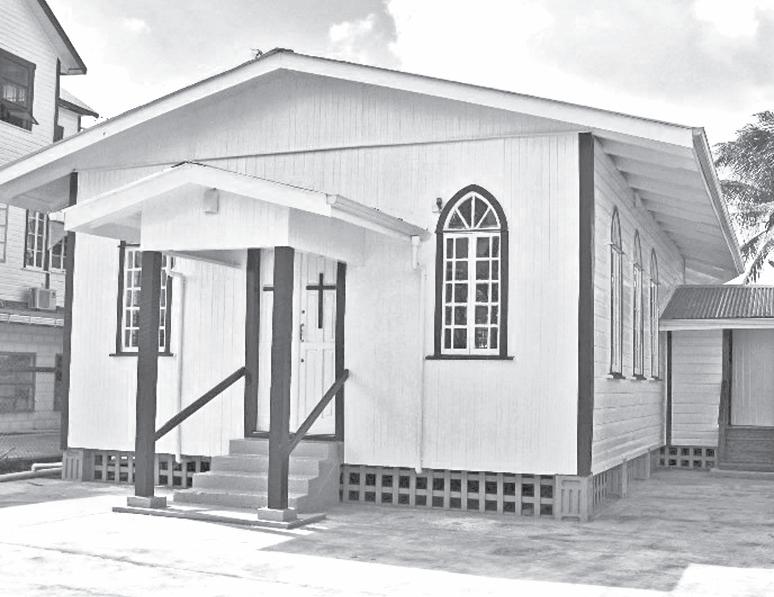
frigid waters of the North Sea, despite desperate attempts by her brother to keep her alive.
Her body was declared lost at sea.
Not long after, the Canadian Mission asked her mother for permission to dedicate a church they planned to build within the school’s compound, in Clara’s memory. It would come to be in memory of both Clara and her father, Robert Ramdeholl.
The tragedy of the Ramdehollfamily sadly did not end there. Clara had apparently planned her return as a surprise for her mother, Mary Ramdeholl. Discovering that Clara was aboard the “S.S. Simon Bolivar” and did not surviveled to illness from which she never recovered. Mary died within months of Clara’s death, and indeed her husband’s.
The newly built church was formally named the Ramdeholl Memorial Guyana Presbyterian Church, and was dedicat-
ed at a service on April 15, 1940.
The church building remained in the school’s compound until Guyana became independent and there was a mandatory separation of church and state. It was then moved across the street to its current Lot 22 Princess Elizabeth Road, New Amsterdam location.
With the building showing signs of its age, the Ramdeholl family abroad began a fundraising effort for its restoration. On Dec 28, 2014, rehabilitation works were completed and a re-dedication ceremony was conducted at the church.
The Ramdeholl Memorial Church is featured in the New Amsterdam Heritage Trail, a 2015 publication by the National Trust of Guyana that hopes to enrich future generations with knowledge of their Guyanese heritage. (Photos: ramdehollmemorialchurch.wordpress.com)
Kiran Jonathan Lall may have partial vision but that didn't stop him from getting a place at one of south Trinidad's top primary schools.
The five-year-old is expected to start at Grant Memorial Presbyterian in September.
Kiran, who lives with his parents Kevon and Asha Alexander Lall at Olera Heights, San Fernando, graduated from the Wee Ones Childcare Centre at Rushworth Street, San Fernando on Sunday.
Dressed in his red graduation grown and matching mortarboard, Kiran strutted down the aisle, smiling at his principal Claudette Burnette, his teachers and parents.
His father said Kiran was born with congenital bilateral cataracts. At the age of two months, he underwent surgery to remove the cataracts.
“It was a tough time

for us and we had him stay with a babysitter until he was one. Then we decided that it was time for him to go to school and we enrolled him at Wee Ones,” Kevon said.
Asha explained how Kiran reads and writes.
“Because he is visu-
ally impaired, he reads large print but he is very bright and we were glad that he had the requisite skills to get into Grant school. Since he joined Wee Ones, he has been learning and progressing well. He reads for us. His teacher boasts that he is one of the brightest

Kstudents.” Asha said.
She also said that Kiran was good with colours and often helped her to match her clothes.
“When I dress up, he says, 'Mummy you look so pretty,'” Asha said smiling.
Asha is also blind, and so bonded with her son in a special way.
Burnette said she did not usually take in students with special abilities because of the shortage of specially trained staff. The school has a population of 154 pupils and 22 members of staff.
But Kiran impressed Burnette with her abilities and she has found his progress gratifying. Burnette, worked as a social worker in Trinidad before migrating to North Carolina where she operated two childcare centres.
In 2002, she returned to TT and opened the Wee Ones Childcare Centre. Burnette said she hoped to open a second branch of her school in Cocoyea in September. (TT Guardian)
INGSTON, JAMAICA: Paul Elliott launched his album, Reggae Music TUN Up, recently at Reggae City Bar, Camp Road, in Kingston. The event, a joint production of the singer, Stronger Productions, and Big Stone Records, also saw Lifetime Achievements Awards being presented to four cultural stalwarts -92-year-old Garveyite, Queen Mother Mariam Samad, singers Bunny Wailer and Fred Locks, and percussionist Bongo Herman.
"When I decided to do this launch, I said to myself, 'I couldn't do it without honouring the people who set the trend before me," Elliott told the large gathering.
The launch was also addressed by singer Nadine Sutherland and Councillor Constantine Bogle of St Thomas.
Sutherland praised Elliott's contribution to music, recalling his "humble beginnings" in the community of Waterhouse where she said he was "baptised in fire and now risen to be called the Chosen One".
The youthful trio Lalous -- comprising two sisters aged 11 and 13 and their eight-year-old brother -- overwhelmed the audience with 'Put it Down' and 'Big Up',
songs calling for an end to child abuse.
Backed by the Andrew Bassie Allstars, there were energetic performances from Angela Stewart, who ignited proceedings not only with her singing, but her introduction of one-legged dancer Sister Clare.
After being lifted from her wheelchair, the latter gave an extraordinary performance despite her physical challenges.
Adding to the entertainment package were Isha Bel, EQ, Racquel Sellars, Bongo Herman, Fred Locks, Papa D, Jah Flex, D Medz, Nesbeth, Wild Life, Chicken Hawk, and surprise guest, veteran deejay Eek-AMouse.
Performing in Jamaica for the first time in many years, the lanky 'Mouse' stirred things up with hits like 'Wa Do Dem' and 'Ganja Smuggling'.
Elliott commented on his album in an interview with the Jamaican media.
"Basically, it is to revitalise the music by bringing back the energy that was there in the days of Bob Marley, Peter Tosh, Burning Spear, Gregory Isaacs, among others. I have taken up the mantle to carry on in that tradition," he said. (Jamaica Observer)
BJP MP Hema Malini, who was discharged from a Jaipur hospital on Saturday after her Mercedes collided with another car leaving a child dead and injuring five others, including the actress, has offered financial assistance to families of the victims.
The 66-year-old actor-politician reached Mumbai today by a chartered plane, accompanied by her daughter Esha Deol and Deol's husband Bharat Takhtani. Talking to reporters outside Hema's residence in Juhu, Esha said, "My mother will help the families of victims. She is doing this not because she is a neta (leader) but because she is a good human being as well."
On Thursday night, the car in which Hema Malini was travelling rammed into another car coming from the opposite direction in Dausa district of Rajasthan, killing a four-year-old girl and leaving five others injured, including the veteran actress.
"Jab accident hua tab mummy ki jo condition thi wo kisi aur ke baare me kaise soch sakti thi...koi bhi nahi soch pa raha tha...par hame afsos hai us pariwar ne apna khoya hai (When the accident took place, my mother as well as the family was not in a condition to comprehend anything but we are sad that a family has lost a dear one)," Esha said.
"When the accident happened she was asleep. She had told everyone to

wear their seat belts. But achanak picche se jor ka dhakka laga (suddenly we felt jolt from the rear side)," she said.
"The accident was very bad..It was traumatic so no one was in a state to talk...or think anything," she said.
Esha informed that Hema has been advised rest for now. "Doctors have asked her to take rest at home. She is a bit better now...she is fine. She wants to rest now. She is not meeting anyone. She will relax for a day or two and then she will meet (people)," she added.
The actress, who was discharged from hospital, had undergone a surgery for her wounds at the Fortis hospital. She was also treated for a minor fracture on her nose. Mahesh Chand Thakur, who was driving Hema's car at the time of the accident, has been arrested. (TOI)

Actress Parineeti Chopra, during a live chatting session with her fans on Twitter, said in response to a question by actor Arjun Kapoor that it was because of him that her life changed when he "chose" her for 'Ishaqzaade'.
SParineeti decided on a live chat on Twitter as she had amassed five million followers on the micro-blogging website.
Arjun took to Twitter when the actress was chatting with her followers, and asked her to tell the world on how the Gunday actor changed
uperstar Hrithik Roshan says it was Hollywood star Sylvester Stallone, who inspired him to become a stronger person in his life.
The 41-year-old 'Bang Bang!' actor took to the micro-blogging site Twitter to wish his idol happy birthday and thank him for being his inspiration.
"It was also @TheSlyStallone birthday! Give it up for the man who inspired the thin weak me to be strong one day. Can't thank him enough. Happy Birthday!" Stallone, 68, celebrated his birthday on Monday.
The 'Krrish' actor is currently shooting for Ashutosh Gowariker's epic adventureromance Mohenjo Daro opposite actress Pooja Hegde, who makes her Bollywood

Shahid Kapoor and Mira Rajput finally got married in a close knit ceremony. In no time, the pictures of the newlyweds made it to the social media. Wishes started pouring in from fans and well-
wishers. Shahid too posted a wedding selfie clicked with wife Mira Rajput, or should we say Mira Kapoor? "#hitched https://instagram.com/p/41a-L9BJj1/" [sic] he wrote. (TOI)
Pher life.
"Hello excuse me madam @ParineetiChopra please tell the world how I have changed ur life...u can chat later...this news is very important," Arjun tweeted on Tuesday.
The 26-year-old actress, who had made her Bollywood debut with 'Ladies Vs Ricky Bahl' and then starred in films like 'Shuddh Desi Romance' and 'Hasee Toh Phasee', replied: "@ arjunk26 baba you ARE my world, it changed the moment YOU chose me for Ishaqzaade. Tumhi ho bandhu, sakhaa tumhi #Parineeti5Million."
The duo starred together in the 2012 film Ishaqzaade. (TOI)
debut with the film.
The film, which has its music by AR Rahman, is scheduled to release on 12 August 2016. (TOI)

akistani actress Mahira Khan will soon make her Bollywood debut opposite Shah Rukh Khan in his upcoming film 'Raees'. The actress, who has romanced Fawad Khan and hosted a KJo-like TV show, will clash with Salman Khan at the box office. But before that, this Eid, Mahira will be seen in a Pakistani film, Bin Roye, which will re-
Megastar Amitabh
Bachchan, who has a meet and greet session with his fans every Sunday, says it worries him to see women and children in discomfort due to the crowd. He has sought the help of police for a "simpler and effective" way of managing the weekly gathering in front of his residence Jalsa here.
"It is another Sunday and the rains have been silent for a while...and the wishers and well beings of my life gather outside the gates of JALSA and in heavy multitudes and in some unpredictable crowd planning ...it worries me no end when the little children and the ladies are subjected to discomfort...," the 72-year-old posted on his blog.
Keeping this in mind, Big B made sure
lease alongside Salman's 'Bajrangi Bhaijaan', reports Mumbai Mirror.
Speaking from Lahore, the actress dismissed any talk of competition, pointing out that while the Salman-starrer will open in 1000-plus screens, her story of love and loss will probably not get more than 50. While her film will be an Eid attraction in India, Salman's cross-border story is yet to be cleared
in Pakistan. "I'm told that 'Bajrangi Bhaijaan' has some Pakistani elements which could become an issue even though Indian films always play to packed theatres here," she reasoned. "One of our really big hits, Waar, couldn't be released in your country (India) because of some Indian elements. It's what I call 'cinema politics'," she was quoted in the report. (TOI)

that his female fans and children face no difficulty while being part of such a huge turnout of people.
Fans gather outside Jalsa, Amitabh's house, every Sunday morning and the 'Paa' star makes sure that he acknowledges the love and respect by sharing photographs of the Sunday ritual on his official pag -
es on various social networking platforms. He also mentioned the efforts of youngster who designed a paper book that was presented to the megastar at the gate. The paperbook had photographs of Madhushala, his father Harivanshrai Bachchan's book, and of 'Piku', Amitabh's last released film. (TOI)
Actor Chris Evans has been quietly dating Elizabeth Olsen for a few months while filming 'Captain America: Civil War'.
The Avengers: Age of Ultron co-stars have been dating for months, reported Ace Showbiz.
"Chris and Lizzie are definitely involved in some kind of ultra-secret romance that's being kept under wraps while they shoot," a source said.
"The attraction between them has been there from day one."
The 34-year-old Captain America: The First Avenger actor allegedly wants his personal life to be very private.
"Chris is paranoid about his womanising becoming public while he's on this multi-picture deal with Marvel. He's protecting his image, and will bend over back-

wards to keep things quiet," the source added.
Back in March, Evans was rumoured to be dating Lily Collins. They reportedly hooked up after meeting at the star-studded Oscars after-party
Actress Jessica Alba's film producer husband Cash Warren has injured his shoulder while having fun by the pool.
The father of two was showing off his sporting skills when he landed awkwardly in the water and he has taken to Instagram to share a snap of his impressive front dive - moments before he hurt himself.

"Dislocated my shoulder doing this dive...but it was worth it dammit! Hope you all had a wonderful holiday weekend," he wrote. (TOI)

mours to rest.
The 24-year-old actress and her musician lover were seen taking a stroll in Manhattan on Friday, reported People magazine.

Stand-up comedian Russell Brand's cell phone was stolen during his latest visit to India.
The 40-year-old 'Get Him' to the Greek star was in India to perform his stand-up show for the Comedy Central Chuckles Festival in cities Mumbai, New Delhi and Bangalore.
During his visit to the slums, where he went to meet the underprivileged residents, his cell phone was stolen from the pocket of his trousers, reported Contactmusic. Brand posted a video on Instagram, describing the incident.
"In the mad free-for-all, one of them nicked (stole) my phone, I didn't even notice it happen. Someone explained, 'Oh, your phone's been nicked', then another kid bought (sic) it back." "I went to try and give him money and stuff and he looked at me as if it meant nothing, like, the money. That kid was
reaky Friday' actress Lindsay Lohan has rejected a Burger King commercial.
The 29-year-old actress, who had been to rehab was approached by the international chain to appear in their commercial, where they wanted her to wear a spicy chicken fries box and smoke a chicken fly like a cigarette.
But the actress felt the idea made fun of her troubled past and said no the brand, reported Female First.
"We were gob-smacked. It was making fun of her issues," an insider said.
However, according to another source, it was the food chain that actually rejected the Mean Girls star because her managers were interfering and wanted too many changes in the final idea. (TOI)
'Hunger Games' actress Jennifer Lawrence and Coldplay
frontman Chris Martin were spotted spending quality time together putting break-up ru-
"They were walking arm-in-arm, in a hurry it seemed. It looked like they were dressed for date night," a source said. The last time Martin, 38, and Lawrence were seen together before there outing last weekend was when the couple attended a U2 concert. (TOI)
Veteran actress Diana Douglas, mother of actor Michael Douglas, has died. She was 92.
Diana, who appeared in dozens of films and TV shows including 'Planes, Trains and Automobiles', 'ER' and 'The West Wing', died of cancer in a retirement home on July 3.
Her husband of 13 years, Donald Webster, confirmed the death of the actress.
living by a higher code," wrote Brand. (TOI)
The film marked her final big screen appearance.
Born Diana Love Dill in Bermuda, she studied at the American Academy of Dramatic Arts in New York, where she met Kirk.
She was the first wife of actor Kirk Douglas and was married to the legendary actor from 1943 until their divorce in 1951. She had two sons, Michael and Joel, with Kirk.
She appeared with her ex-husband and elder son in the 2003 film 'It Runs in the Family'.
She began her career with Warner Bros, and modelled on the cover of Life Magazine in 1943. Diana was married to actor Bill Darrid from 1956 until his death in 1992. She later married Webster in 2002. The actress officially retired from showbiz in 2008 at the age of 85.
(TOI)
Pop star Taylor Swift's friends reportedly 'don't trust' Calvin Harris over his close friendship with the star's close buddy Gigi Hadid.
"Calvin has shown a sudden interest in Gigi. Taylor's friends started to notice that he was pursuing a friendship
with her. They don't trust him, but they're trying to support Taylor because they know how much she's in love with him," a source said.
"Calvin has been liking Gigi's pictures and her selfies on Instagram the minute they're posted.
The 25-year-old
singer is believed to have confronted Harris about his and the 20-year-old model's growing friendship, where he said he was just texting her about a "major role in his music video," something he is "really excited about," reported OK! magazine. (TOI)
GEORGETOWN, GUYANA: With a population of 4,500 persons, andrising some 3,000 feet above sea level, the village of Kurukabaru is in fact, the highest settlement in Guyana.
A picturesque destination, Kurukabaru, located near the North Pakaraimas in Region 8, is higher than Paramakatoi, and isideal for tourists who want to explore untouched nature in Guyana.
The wind at Kurukabaru is said to howl continuously, and the nights there are extremely cold. Even the hardiest hinterland dwellers greatly respect the cold temperature at Kurukabaru, especially at nights.
In deference to this aspect of life on this highland plateau, some have renamed the village “Coldkabaru”. (Photos by Michelle Kalamandeen. Visit Michelle Kalamandeen Photography on Facebook to see more wonderful photos of beautiful Guyana)
Those priceless photos taken of the Indian indentured labourers on their arrival at the human processing depot on Nelson Island show an impoverished people exhausted, dispirited and wary of their future on the mainland.
But by the end of their five-year indentureship, the vast majority of immigrants would choose to stay, accepting Crown land instead of the free trip back to the Motherland.
However, it is a little known fact that not all who made the voyage from India came on contract. Some paid their passage and arrived on the island free of encumbrance, says genealogist Shamshu Deen who has researched and found the roots, in India, of many Trinidadians.
Then there is the case of Mandary who
met wife Ooozerone on the voyage to Trinidad in 1856, and returned to India 22 years later with their four children. Two years after that the family (without the patriarch who had died) returned to Trinidad. The records filed away in the National Archives, said Deen notes their return as November 8, 1882 aboard the vessel, the Scottish Admiral.
Among the children was Prabhu, who would take the name Prabhudial Maharaj, and make his fortune in cocoa planted in east Trinidad, a wealthy Indian at a time when most of his race lived in barracks and shacks.
The industry that was King cocoa, crashed in the 1920s, but not before Prabhudial built what would become his legacy. In 1918, the year after the end of Indian Indentureship, he began constructing the family home. He
chose a gentle slope at Sangre Chiquito, with a long driveway from main road heading to Manzanilla, a spot that invited the traveller to consider the elegance of the house but discourage anyone from coming too close.
It took him two years to build, and he spared no expense. And when it was completed, it rivalled any of the east coast great houses (several of which still survive) which were influenced by Trinidad's British, French and Spanish heritage.
Prabudial Maharaj would have two marriages and at least twelve children before his death. His first-born, Prem Dial (1898-1966), who was bequeathed the house, also had two marriages that produced seven children. The second to last child, Vishnu Dial (born 1949) now owns the home and lives there with a brother and
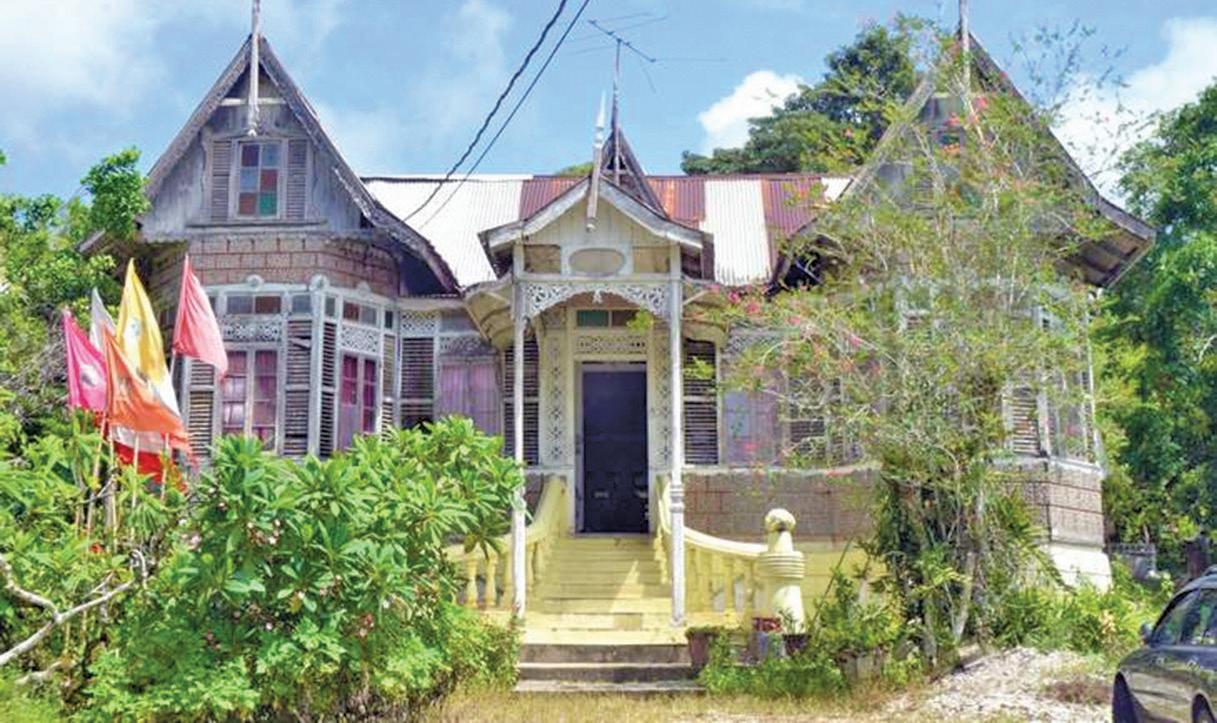
their families. And he knows the place is something special.
Dial said: “I have lived my entire life here. It was already old when I was born. My father told me that it took two years to build, and they used the very best material. The front walls (mortared and shaped to look like bricks) have thousands of river stones, and the fretwork was patterned after what my grandfather saw in India”.
There was a detached kitchen at the back made of tapia walls, to prevent an accidental fire from torching the place, and concrete cistern for storing rainwater. Nearby were the coca drying and store houses, where the beans would be bagged for transport into Sangre Grange, where it would be weighed, sold and transported out of the area by rail. Those buildings are gone now and the attic can no longer be accessed, but sur-
viving it all was the antique Ansonia Octagon clock, older even than the house, under which generations of Dials marked time.
Pillars shaped into hands holding a sphere, stand at the base of the staircase. Why Prabhudial had commissioned the sculptures is lost to time, but the family would like to believe it to be a message from a man who then “had the whole world in his hands”. (TT Express)
KINGSTON, JAMAICA:
It was celebration time for LeeRoy 'Ancient Priest' Johnson as he won the top spot at Saturday's staging of Jamaica Cultural Development Commission's (JCDC) Jamaica Festival Song Competition.
Based on the applause inside the tightly packed Ranny Williams Entertainment Centre in St Andrew, it was clear that Ancient Priest was one of the favourites in the competition.
During the perfor-
mance of his single 'Celebration Time', almost everyone stood and danced to the lyrics. The cheers grew even louder when he was announced the winner. Besides the JCDC trophy, Ancient Priest walked away with Ja$500,000 and a consolation prize of Ja$30,000 for Best Performer. "I entered this competition very confident. Being a Christian, I prayed a lot and knew that I had the song Jamaica needs now," an elated Ancient Priest told the media, after being announced winner.

A
in Manchester, the singer said he is working on his debut gospel album entitled I Am Ancient Priest, slated to be released in October.
This is not the entertainer's first entry in the JCDC song finals as he was also a finalist in 2010 and 2012. Both years, he copped prizes including Best Performance, Best Lyrics and Best Arrangement.
Another crowd favourite, Oniel 'Nazzleman' Scott earned the second-place title and Ja$250,000 for the
single Little But We Tallawah, while third place went to Sherlette 'Princess' Black. The visually impaired Princess warmed the hearts of the audience and judges with her single Sweet Festival Sound. Marsha Marie Campbell cropped the Online Voters Award and Ja$20,000. Between the 10 finalists' performances, the audience was entertained by past winners Heather 'Brown Sugar' Grant and fourtime winner Roy Rayon. (Jamaica Observer)
Trinidadian-born psychiatrist
Badri “Bud” Rickhi, a pioneer in complementary alternative medicine, recently qualified for inclusion in the 2014-2105 edition of the Leading Physicians of the World annual publication.
Considered one of the brightest minds working in alternative medicine, Rickhi who grew up in Tacarigua, now practices in Canada where he serves as a clinical associate professor, University of Calgary.
For Rickhi, the recent achievement comes after years of groundbreaking work; he has been very successful in alleviating depression with his integrative approach to teen depression. He also founded the Research Centre for Alternative Medicine, now the Canadian Institute for Natural and Integrative Medicine (CINIM), a nonprofit group.
In 2009, Rickhi was recognised as a “an agent of change” in integrative approach to clinical medical practice and awarded the Dr Rogers Prize which he shared with Dr Hal Gunn of Vancouver, Canada. The TT$250,000 prize is named for Dr Roger Hayward Rogers, a Vancouver doctor and Complementary and Alternative Medicine (CAM) pioneer.
The prize committee in awarding the prize to Rickhi said that he exemplifies the vision, leadership and integrity that characterise medical practice to focus on “the patient as a whole, and maximising wellness.”
Rickhi continues to support crucial research in the (CAM) field and his contributions in the area of wellness and alternative therapies have been duly noted. (TT Newsday)

GEORGETOWN, GUYANA: Artist Ashona Pardat gets lost in a Disney world when she’s transforming her bare walls into colourful display of princesses and fun characters.

In an interview with Guyana Times Sunday Magazine, Ashona said after completing secondary school she fully pursued her passion for art.
“Art was never a subject of interest in high school. I actually chose to go in the business stream. After finishing school, lying on my bed and gazing on the plain walls in my room, I decided to do some painting on them. I did cartoon characters and they looked so good that my friends doubted me. They told that I didn't paint them on my own. I decided to do them openly on the outside walls of the house so they could see me doing it and still they were doubtful, feeling it to see if it’s a sticker. That’s when I realized my talent and started to pursue art even more,” Ashona recalled.
She stated that she invests all her talents into her work because she wants it to look “perfect and attract attention, which it does every time”.
Art, according to
Ashona, allows her to express herself and develop her talent. Her area of interest is painting mostly cartoon characters because she loves how colourful and fun they are.
“Art helps me to express my emotions and I’m developing my talent also.I didn't get any formal training in art. I was born with this talent. During my school days I never realized it [talent] -maybe because after coming home from school in the afternoon I was always in a hurry to play cricket and made no time for books. I was more interested in sports than art,” she admitted. The artist’s plans are to keep honing her talent and creating her own cartoon characters.
“It’s good to try doing every little thing that you can because you never know where your hidden skill lies,” Ashona noted.
For more information on the artist, email ashonapardat@yahoo. com.
(Guyana Times Sunday Magazine)

PORT-OF-SPAIN, TRINIDAD:
Minister of Sport Brent Sancho says the threat by some TT senior women’s team players not to board a flight bound for Canada on Monday would have been realised had it not been for his intervention.
In a telephone interview, Sancho said he convinced the players to take the flight after giving them the assurance that he would look into issues, some of which were made public by one of the players, Kennya Cordner, who took to social media over the weekend in a critical post directed to the TT Football Association (TTFA).
On Saturday, Cordner posted the following on Facebook: “So on Monday 6th of July I would not be going to Canada without any stipend this is ridiculous now I would let ppl know wat alyuh about TTFA because this is not fair to us, why must the men be in comfort while we suffer not any more I'm so fed up of you all treating us like this no more.”
With these concerns, some players threatened to boycott the event. Sancho said he received a call the night before from one of the players, which brought some of the issues to his attention. He said he wants the TTFA to be “transparent and open.” “They have to let us know what happened.”
Sancho said he could not understand what the issues were in terms of match fees and preparation for the
Pan Am Games since the TTFA recently received “Gold Cup money” from Concacaf. “The federation got money from Concacaf for preparation for the Gold Cup and airfare but we (Government) are paying for airfare,” Sancho said.
However, in a subsequent interview, TTFA general secretary Sheldon Phillips said the Minister may have been mistaken when it came to the figures. “We did not receive TT$100,000 from Concacaf (for the Gold Cup). We received around TT$33,000, which did go towards the two Pan Am teams.” He said the association “received an advance” from Concacaf in the absence of Ministry subventions which would have gone toward the Pan American Games.
In terms of the women team’s preparation for the Games, Phillips noted that the ongoing Women’s Premier League (WPL) featured all national women players and allowed them to prepare through a number of friendly matches, including one against a WPL XI.
The women’s team is scheduled to kick off the account at the Pan American Games on Saturday with a clash against Argentina and will play Colombia and Mexico on July 14 and 18, respectively, at the preliminary stage. The men will face Uruguay (July 13), Paraguay (July 17) and Mexico (July 21). (TT Guardian)
PORT OF SPAIN, TRINIDAD: --
Batting legend
Brian Lara will host a clinic in Trinidad for thousands of children ahead of the Caribbean Premier League final later this month.
The former West Indies captain, a CPL Twenty20 ambassador, will stage the event on July 25 - the eve of the grand final at Queen's Park Oval.
"Passing on my skills and experience to youngsters is something that has always been really important to me and I'm excited about this chance to work with all these talented kids in my hometown," said Lara.
"CPL is all about inspiring West Indians of all ages to get excited about cricket again, and I hope events like this will help us find our next generation of cricketing legends."
Lara is considered by many as the finest batsman of the contemporary era, gathering 11,953 runs from 131 Tests at an average of 52. His career aggregate is the most by a West Indies batsman.
He scored 34 centuries and still holds the world records for the highest ever score in
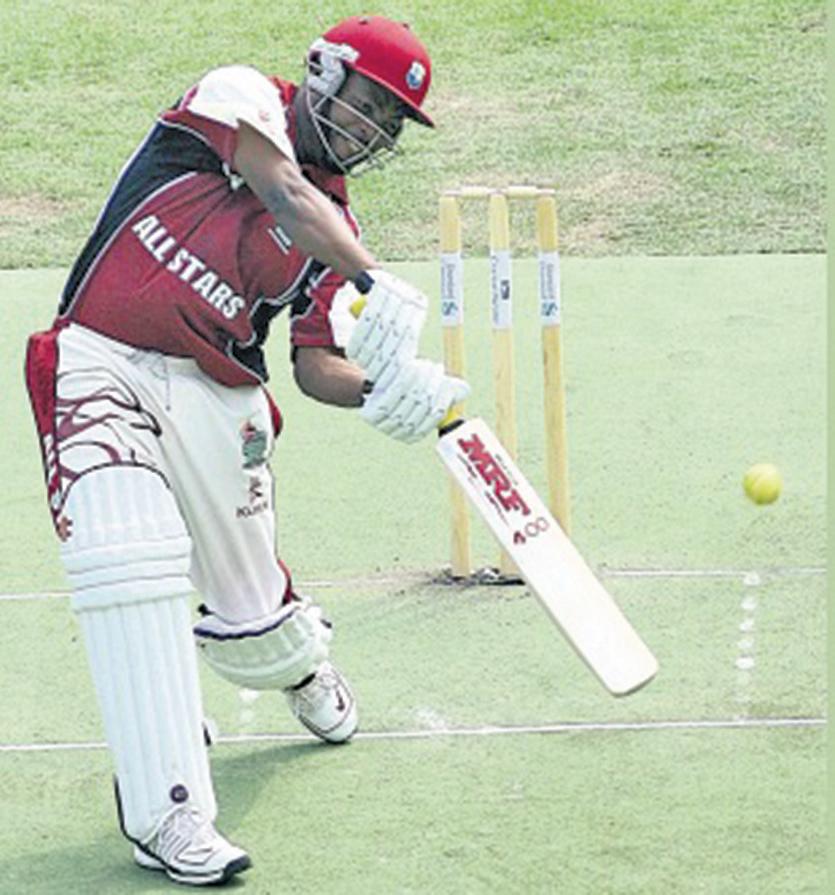
first-class cricket and the highest individual Test score in a Test innings.
Damien O'Donohoe, the CPL's chief executive, said he was thrilled by the idea.
"Brian is a living legend and it's going to be amazing to see the positive impact his masterclass will have on the local kids who will attend," O'Donohoe said.
"This year's CPL has seen thousands of children [being] entertained and inspired by the best cricketers from the West Indies and across the world. The

GUYANA: A second consecutive superb bowling performance from the St Kitts & Nevis Patriots saw them register their third win of the 2015 Hero Caribbean Premier League season and consolidate their position at third in the league table, while the Barbados Tridents have now lost two in a row.
Tabraiz Shamsi followed his 4-23 against Jamaica Tallawahs with an even more impressive 4-10 as the Patriots restricted the Tridents to just 135-8 from their 20 overs, a target that the Patriots chased in 17.1 overs for the loss of only two wickets with Marlon Samuels scoring 71 not out off 54 balls.
Chinaman bowler Shamsi dismissed Dwayne Smith, Shai
Hope, Jason Holder and Jonathan Carter in a superb four over spell that tore the heart from the Tridents’ innings. His most recent eight overs in the CPL have reaped 8-33 – it is safe to say a star has been born.
Shamsi was assisted well by Shahid Afridi who also followed his strong performance against the Tallawahs of 2-10 with 3-34.
The Tridents have Kieron Pollard to thank that they posted as many as they did. Pollard’s 33ball 49, which helped the table-toppers blitz 47 from their last 18 balls was the only score of more than 20 in the innings.
The Patriots lost Evin Lewis for just 10 in the third over of their innings but never once looked as if they would be troubled chas-
ing what was certainly a below-par total. Given the Patriots success with their spin bowlers it was surprising that Robin Peterson was not introduced into the attack until the fifteenth over.
Martin Guptill and Samuels played sensible innings lined with moments of panache to carry the Patriots to a deeply impressive eight wicket victory in front of a passionate home crowd.
As the pitches continue to wear the Patriots will be hopeful that spin-duo Shamsi and Afridi can continue to set up similar victories. The Patriots are back in action on Wednesday against the Guyana Amazon Warriors. The Tridents play next on Saturday in the heavyweight clash against the Tallawahs. (CPL.com)
CPL players have attended schools across the region, speaking to the children about what it takes to make it to the top of whatever profession they choose.
"Brian's masterclass will be the perfect way to sign off this programme of events with the children of Trinidad and, fingers crossed, we may even identify the next Brian Lara while bringing the biggest party in sport to the Queen's Park Oval."
The CPL bowled off on June 20 in Barbados and is currently ongoing. (CMC)

By RavendRa Madholall
TORONTO, CANADA:
Former Canadian allrounder Eion Katchay is very optimistic Canada will be qualifying for next year’s International Cricket Council (ICC) T20 World Cup in India.
He made this declaration on Sunday as Canada set to begin their campaign on Thursday against Kenya. The qualifying tournament is hosted jointly by Scotland and Ireland and will run for 18 days.
Of the 14 participating teams, six will join the other 10 full-member ICC countries at the mega event from March 11 to April 3. Apart from his optimism, Katchay spoke enthusiastically.
“This [is] a great chance for Canada to qualify, they did well in USA recently at the first qualifying tournament so I think they are more ready
and prepared to reach at T20 World Cup in 2016,” the medium-pace bowler and righthanded batsman, related.
He is also very confident that this bunch of players is talented and capable of making Canada proud to advance and be part of the World Cup showdown.
“I know this is a very good team and can do well over there; once they play to their true potential, Canada should be in the top four; the side very talented, they got experience and they are playing good cricket as well,” the former Guyana first-class cricketer stated.
Since the inauguration of the ICC T20 World Cup in 2007 (South Africa), Canada have never featured having suffered elimination at the Qualifier competition but Katchay on hangs high hopes of them making their debut on this occasion.

Jeremy Gordon
Seasoned campaigner and skipper Rizwan Cheema will lead the side and his experience and ability is always a great asset for Canada partic-
ularly in this limited-over version.
Additionally, players like opener Ruvindu Gunasekera, Hiral Patel, Cheema, Jimmy Hansra, fast-bowler Jeremy Gordon among others have done well for Canada on the big stage and they should take up the responsibilities again, according to Katchay, who still plays Elite cricket in Toronto representing Civics Cricket Club.
For many it was a shame for where Canada’s cricket has gone generally to relegating to Division Three despite hoping qualified for the 50-over World Cup tournaments in 1979, 2003, 2007 and 2011.
After failing to qualify for the 2015 event in New Zealand and Australia, Cricket Canada lost their final support from ICC as well.
Meanwhile, the absence of young and talented all-rounder Nikhil Dutta is a huge blow
for the team. The 20-year-old Dutta currently in the West Indies representing St. Kitts and Nevis Patriots at the Caribbean Premier League T20 tournament.
Canada was placed in Group B alongside Afghanistan, the United Arab Emirates, the Netherlands, Scotland, Kenya and Oman. The other Group is comprised of defending champion Ireland, Nepal, Hong Kong, Jersey Papua New Guinea, Namibia and United States of America.
The full squad reads: Rizwan Cheema (Captain), Saad bin Zafar, Khurram Chohan, Navneet Dhaliwal, Satsimranjit Dhindsa, Ruvindu Gunasekera, Jimmy Hansra, Shaheed Keshvani, Nitish Kumar, Hiral Patel, Cecil Pervez, Junaid Siddiqui, Hamza Tariq and Srimantha Wijeyeratne. The manager is Wijay Senathairajah and Mukesh Narula the coach.
By RavendRa Madholall
TORONTO,
CANADA: The Guyana Rugby Seven team is eager to dominate at this year’s Pan American Games which starts on Saturday at BMO Field in Toronto against defending champion Argentina.
Having arrived in Canada several days ago, the side got underway with two warm-up matches last Saturday in Burlington and despite suffered defeats, former skipper Ryan
Gonsalves expressed deep confidence the guys will come out on top.
“I just want to say that the guys are in good shape and ready to make an impression in Toronto; two senior players have injuries but they should be fine for Saturday’s showdown so I am very confident that we can be in the winning column,” Gonsalves, stated.
After their dominance in the North America Caribbean Rugby Association (NACRA) tournament
over the past decade, the Guyanese feels that this is one of the greatest motivations they have now to be inspired.
Guyana will begin their quest for supremacy against the aforementioned country then they will take on Canada before clashing with Brazil the same day in Pool B. The best results will see the top two teams advancing to the other stage.
The other Group will comprise of United States of America, Uruguay, Chile and Mexico. The winner of

each pool will play the lowest-rank team in the other group while No. 2 takes on No.3 in the cross-pool knockout stage.
Even though Guyana
four years ago while he skippered the team to NACRA’ 7s and 15s championships, the Las Vegas 7s and Hong Kong 7s.
Another seasoned
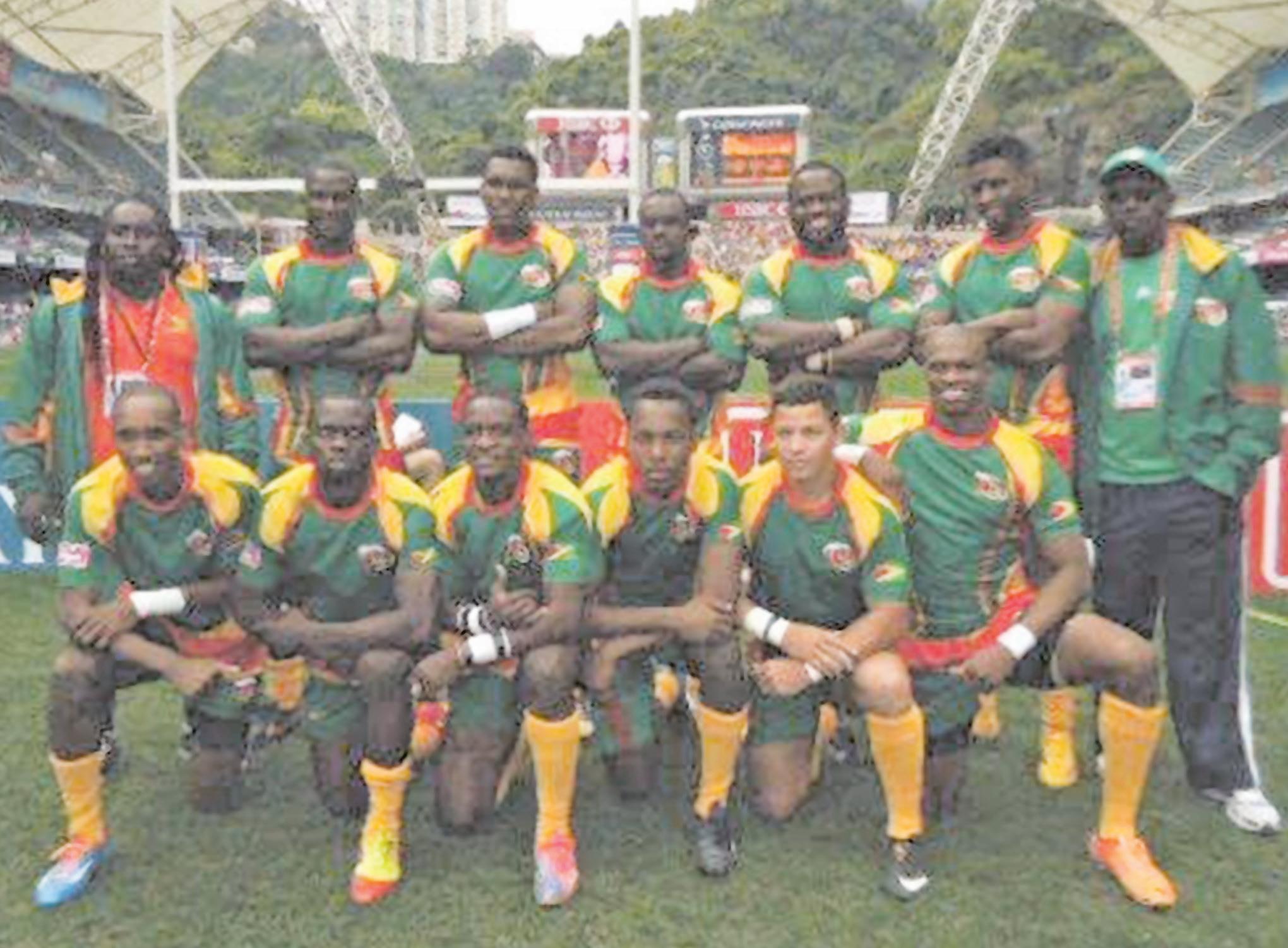
was beaten to Canada at the last NACRA in Cary North Carolina, 51-0, 31-year-old Gonsalves mentioned they have moved on and expect the guys to put in an improved performances on their home soil.
“We just have to put those bad performances behind us and focus on this new tournament; this is a massive event and the players are very pumped up too," Gonsalves revealed.
The experienced Gonsalves still with the distinction of leading Guyana to the first Pan Am Games in Mexico
campaigner Claudius Butts is also in a highly optimistic mood stated that the team is brimming with profound confidence and capable of winning this tournament.
He stated that the onus in on the senior players to bring out their best performances and ultimately make Guyana proud.
ticipating athletes set to attend a reception function at Twilight Restaurant and Bar in Scarborough where they will be hosted by the Guyana Consulate.
The full team reads: Richard Staglon (Captain), Peobo Hamilton, Lancelot Adonis, Rickford Cummings, Claudius Butts, Ronald Mayers, Patrick King, Akeem Frazer, Ryan Gonsalves, Dwayne Schroeder, Phibian Joseph and Avery Corbin. The manager is Terrence Grant and Theodore Henry as the coach.
“We definitely will play competitive rugby, the preparations are going okay and we have a good team to do well here in Canada,” Butts acknowledged his responsibilities as well and said they have a great chance to prove their skills and vie for a spot at next year’s Olympics in Brazil. Meanwhile, the team along with other par-

this is in line with similar payments made by other participating Caribbean territories for the concrete benefits provided by the tournament in addition to the invaluable value of bringing together the people of the Caribbean. All governments understand the benefits of publicity for their tourism industry, even if the KN does not.
The CPL has since launched two widely successful tournaments in the Caribbean during 2013 and 2014 which was broadcast across the cricket playing world of 800 million people. The third tournament is presently underway. An independent Economic Impact study revealed last December that the Caribbean Premier League (CPL) injected into the Caribbean region’s economy a whopping US$166 million during the 2014 tournament. This injection was a significant increase of 58% compared to the tournament’s economic impact in 2013.
Findings in the report showed:
• Incremental spend by regional and international fans totaled US$47.4 million (excluding accommodation and airfares)
• An estimated 217,176 regional and international spectators watched CPL 2014 live
• The international TV audience increased to 65 million in 2014 from 36 million in 2013, with 29 broadcasters from around the world airing the games live
• Over 21,500 international visitors (approximately 10% of total spectators), attended CPL 2014, spending US$7.9 million
• Thousands of new jobs were created in tourism and travel across the region by CPL and more than 156,000 jobs positively impacted
• The tournament's high profile international broadcast media campaign (which encouraged tourism in the region) generated US$4.47 million in advertising value
The study conducted by SMG-Insight/ YouGov showed a breakout across each
of the eight markets as follows:
• Antigua and Barbuda - US$13.8 million
Barbados - US$28.7 million
• Grenada - US$13.3 million
• Guyana - US$24.5 million
• Jamaica - US$25.1 million
• St. Kitts and Nevis - US$26.3million
• St. Lucia - US$13.9 million
•Trinidad and Tobago - US$21.1 million
With an investment of over US$25 million to date, the CPL is the world's second biggest T20 cricket tournament - behind the Indian Premier League - and is set to continue growing in 2015 and beyond. CPL, in partnership with the West Indies Cricket Board (WICB) continues to invest in the development of the game, providing opportunities for players and fans to access world-class cricket in the Caribbean.
According to the study, Grenada, for instance, for the estimated 13.3 million US

dollars it earned, invested US$500,000 for the rights to host the opening games held in July 2014. The government of Grenada pointed out the benefits reaped: "Video clips of Grenadian culture and tropical beauty were broadcasted via television to an audience of nearly 800 million people in Grenada’s traditional markets of North America, United Kingdom, the Caribbean region and other nontraditional markets such as South Africa, India, Australia, New Zealand, Bangladesh and Sri Lanka."
Almost double the benefits for Grenada ($24.5M vs $13.3 were enjoyed by Guyana for the same $500,000 that it was billed.
J’can Reggae Boyz looking to deliver goods at Gold Cup 2015
A number of Jamaica's English-born professionals have high hopes of the CONCACAF Gold Cup, with their team set to bow into action on Wednesday against Costa Rica at the Stubhub Center in cool Carson City.
Giles Barnes, who plays his football in the MLS with Houston Dynamo, has dreams of grandeur.
"Obviously it's an honour to play for my country and I think we can really do well in this tournament as well, so hopefully we can come here and get the wins and that would be brilliant.
Lanky defender Michael Hector, who cur-
rently plies his trade with Reading in England, says he has his eyes set on the knockout round of the tournament.
Simon Dawkins, the skilful attacking midfielder, says it's time to get the results that the team did not get at the Copa America, even though they had three creditable performances against Uruguay, Paraguay and Argentina, losing all three encounters 0-1.
After kick-starting their Group B campaign on Wednesday, the Boyz will then face Canada on Saturday in Houston, Texas, before closing out the preliminary stage against El Salvador in Toronto, Canada, next week Tuesday.(Jamaica Observer)



GEORGETOWN, GUYANA:
In a totally unwarranted attack against Dr Ranjisinghi Ramroop, CEO of the NewGPC, which owns the Guyana Amazon Warriors T-20 cricket team, the Kaieteur News headlined yesterday that Finance Minister Winston Jordan said the "Govt will not pay Ramroop's Gy$100M CPL invoice". In the story, however, there is no quote that the Finance Minister, in fact, made any such assertion and after being contacted verified he did not mention Dr Ramroop.
Asked for a comment on the allegation, Dr Ramroop said, "The people running the Kaieteur News are either totally ignorant about the nature of the Caribbean Premier League (CPL) or they are up to their usual
sensationalisation to sell papers. It was made clear when the CPL was launched that it is an independent corporation based overseas that has allocated seven franchises -originally six - to various territories. This information is even on Wiki! We only own the Guyana Amazon Warriorsnot the CPL and I am sure that the Finance Minister did not make the assertion the KN claims he did."
The Wikipedia article Dr Ramroop alluded to, states: "On December 13, 2012, the WICB announced that they had finalised an agreement with Ajmal Khan founder of Verus International,a Barbadosbased merchant bank, for the funding of the new franchise-based Twenty20 league to be launched in 2013. It was then expected that the new
Caribbean Premier League was likely to comprise six Caribbean city-based franchises as opposed to the current territorial set-up with the majority of the players are to come from the West Indies. As part of the agreement, the WICB will receive additional funding from Verus International for additional retainer contracts for players in addition to the 20 annual retainer contracts the board currently funds."
What is also significant is the substantial investment made by individual Franchisees such as the Guyana Amazon Warriors that impacts on the economy and the society. If for instance the New GPC had not made the investment on the cricket team, Guyana could have reaped none of the benefits it has and will continue to enjoy. By sponsoring four local
young Guyanese talent to be with the team while offering them remuneration, is an investment in developing local talent that benefits the nation.
Because the NewGPC is a unit of a QAII which also owns a full media house - TV, Radio and Press- the Warriors have also benefitted from a tremendous amount of publicity which from an opportunity cost standpoint costs the franchisee millions of dollars which go unmentioned. That the CPL was able to attract as investors a multi-national corporation like Hero and mega Bollywood Stars like Shahrukh Khan, has been a boost to the entire Caribbean's image as an investment destination.
But in terms of the payments by the Guyana government to the CPL,