









monday, october 19, 2015 | guyanatimesgy.com

The

Parika and Supenaam departure times – 05:00h, 11:00h and 16:00h daily.




14:04h







The Mid-Year economic report just released by the Government confirmed that it has been raking in mega revenues from lower world oil prices by not passing the savings on to consumers and businesses as has been the norm in other countries.
The Government has rather chosen to increase the duties collected by the Guyana Revenue Authority (GRA) on the commodity as well as allow the Stateowned Guyoil Company to make windfall profits.
The Mid-Year report stated that while overall “Customs and trade tax collections remained stable at $5.9 billion, in the first half of 2015… Excise tax collections totalled $15.2 billion, an increase of $2.9 billion. This resulted from a $3.2 billion increase from petroleum products.” The report continued, “Increases in petroleum products were due to increase in excise tax rates applicable on imports of gasoline and diesel oil in 2015 when compared to the rates applicable in 2014. During the period January to June 2014, the excise tax rates applicable on gasoline and diesel oil were 20 per cent and 15 per cent respectively as compared to 50 per cent and 45 per cent, respectively, from January 20 to June 31, 2015.”
What this means in essence is that the People’s Progressive Party/Civic (PPP/C) Administration had more than doubled the
taxes on gasoline (20 per cent to 50 per cent) and increased by almost than 100 per cent the taxes on diesel (25 per cent to 45 per cent).
The new A Partnership for National Unity/Alliance For Change (APNU/AFC) Administration has since continued that policy although since the change in government the economy has flattened out and badly needs stimuli from all quarters to get it moving upwards.
Cheaper fuel would allow businesses, especially manufacturing concerns, to improve their cash flow positively and be in a position to ride out the incipient recession. The rice industry also uses large quantities of fuel and the lower prices would have meant the difference between the losses presently being felt greater than profits.
Many businesses bypass the Guyana Power


and Light (GPL) and generate their own electricity, and lower fuel prices would have had a direct buoyant effect. GPL bought most of its fuel from Suriname at the world market cheap prices, and it also was allowed to make huge profits, since its rates were approved by the Public Utilities Commission two years ago when fuel was more than two-and a half times costlier.
All of these pressures have helped to dampen business activity in comparison to our competing economies even in the region.
To add salt to the fuel ‘wound’, the Mid-Year report also revealed that Guyoil, which was formed specifically to induce competition in the consumer petroleum market by selling gasoline at the cheapest possible prices also refused to pass on savings at the gas pump and raked in record amounts.
The report stated, “Public enterprises recorded a surplus of $4 billion, in the first half of 2015, compared to a deficit of $2.5 billion recorded for the same period in 2014. This is mainly on account of improved performance by Guyana Oil Company Ltd. (Guyoil) which re-
alised an overall surplus of $1.7 billion for the period under review compared to a deficit of $0.9 million reported in first half 2014. The main contributory factor to the improved performance by Guyoil was the reduced cost of fuel. While there was a 16.7 per cent decrease in the sale of fuel products, this was compensated by a $5.3 billion reduction in the payment to creditors as a result of a significant decrease in the acquisition costs of fuel in the first half of 2015.” What this means is although less fuel was imported, Guyoil made a profit of $1.7billion as opposed to a loss of $0.9billion in the comparable half year of 2014. This means that Guyoil took in $2.6 billion that could have ended up in the pockets of Guyanese car and bus owners. This would have been pumped into the economy in consumer spending, creating a virtuous cycle as a stimulus for other business activities.
The present Government, as did the PPP/C Government, has made a perfunctory gesture to reduce gasoline prices but nowhere near what is justified to get the economy going, according to economists.




Editor(ag): Michael Younge
Tel: 225-5128, 231-0397, 226-9921, 226-2102, 223-7230 or 223-7231. Fax: 225-5134
Mailing address: 238 Camp & Quamina Streets, Georgetown
Email: news@guyanatimesgy.com, sales@guyanatimesgy.com
The “mid-year report” on the economy confirmed what every Guyanese knew from their personal experience: the economy has “flattened” since the new Government took office in May. At that time, his assessment was stoutly denied but over the weekend, we were informed by Finance Minister Winston Jordan that instead of the already anaemic growth rate of .9% projected, growth actually will be a statistically insignificant 0.7%.
The reasons offered for the flattening by Mr Jordan were: “The proroguing of Parliament in late 2014, the uncertainty that usually surrounds the electoral period and a budget being presented in the second half of the year, together have led to a slowdown in public sector spending and some hesitancy in private sector investments. Notwithstanding, we remain sanguine that the end of year projection will be achieved.”
We have to note that the figures collected by the end of September, and incorporated into report, showed conditions as they existed at the end of June. But when we disaggregate the data in the report we have to question the source of Mr Jordan’s “sanguinity” about achieving a growth rate of 3.4%almost five times that of the first half.
In what is defined as “the real economy” the Finance Minister conceded that the mainstays of the economy are all in a parlous state and we wonder if he has some information that he was not willing to share with us on their immediate recovery and phenomenal growth. Take gold, which contributed the largest chunk of the GDP for the last decade. If Mr Jordan is so sure that the price, which he concedes fell since last year, will now leap upwards, this is the time for the Guyana Gold Board to “buy forward” and reap a windfall profit by year end. But we know what a disaster we had the last time this was tried.
Then there is sugar. Mr Jordan pointed out the mid-year production increased by 1.6% and will increase to 1.7% by yearend. Now while this may sound reassuring, GuySuCo’s present production cost is such that we lose money on every tonne shipped: the more we produce the more money we will lose. Sadly, increased production of sugar will not lead to increased efficiencies of scale in Guyana.
In rice, what would have been a victory of the ordinary Guyanese who are the backbone of the industry, the announced first half increase in production – projected for a historic 700,000 tonne 2015 - is bitter as farmers and millers have to deal with the loss of the Venezuelan 200,000 tonne market. The news that Venezuela has just reached an agreement with Suriname to source rice from that country is the final nail in the hope that our contract, which expires in November, will be renewed.
What this means is that, like Suriname, our farmers and millers will be sitting on huge stocks of paddy and rice until new markets can be found. We do not have the capacity to undertake storage on this scale since, unlike other countries we never had to maintain “buffer stocks”. This storage problem has all the makings of a huge disaster for the industry, which will make the present “price crisis” for paddy, pale in comparison.
In a carefully worded statement, the Minister reiterated President Granger’s announcement that marketing of rice is the responsibility of the industry: “The Government is committed to assisting the farmers to find alternative markets and will support private sector initiatives to secure the future of the industry.” Reading between the lines, the industry is on its own, since the Government will just be cheerleading from the sidelines.
With fisheries, forestry, bauxite and stone all reporting a “downward spiral,” Mr Jordan, however, reiterated his belief that public spending will provide the “stimulus” to deliver us into the promised land of 3.4% growth. That is grist for another editorial.

Dear Prime Minister Cameron,
We, the members of the academic and administrative staff from the University of Technology, Jamaica, who are mainly members of the University’s Think Tank, write this open letter to express our dissatisfaction with aspects of your address to the joint sitting of both houses of the Jamaican Parliament during your visit on September 30, 2015.
Specifically, we find unacceptable your mere acknowledgment of the “horrors of slavery”, your assertion that “Britain is proud to have eventually led the way in its abolition”, and your encouragement to “move on from this painful legacy” without an apology.
You are, indeed, correct , “these wounds run very deep.” As educators and university professionals, we encounter manifestations of these wounds daily among our students who struggle to pay their fees because they lack inherited wealth; or bleach their skin to “tone down” their blackness; or drop out of school because they lack the self-confidence required to fight to succeed; or simply give up trying to fight against the odds because they accept the persistent, generational poverty and inequality in Jamaica as their “lot in life”.
Yes, the scars of slavery run very, very deep. After more than 300 years of slavery and colonisation, we still, today, confront its legacy in psychological and other ways that will take a very long time to be redressed.
In this regard, for us, transatlantic slavery does not constitute the “darkest hours of human history”, but rather “the darkest CENTURIES of human history” whose indelible marks are deeply woven into the very fabric of our culture, society and economy today.
The words of former South African President Thabo Mbeki who spoke of “the haunting tragedy of human beasts of burden”, who under apartheid, “worked on the soil ... merely as factors of production, with fewer rights than the machines by their side” are called to mind when one reflects on the horrors of slavery. Like apartheid, it was a human tragedy that we should not allow to pass “as though it never was”.
Jewish Holocaust
We find striking your willingness to move on from this history, yet you established a Holocaust Commission to explore what more Britain could do to ensure that the memory of the Jewish Holocaust is kept alive for future generations and to “find ways to ensure that every generation can have the resources . . . needed to learn how the acceptance of hatred, poisonous words and discrimination led to the most horrific violence”.
In January this year, when you announced the £50-million contribution of the British government towards the building
of a new Holocaust memorial and worldclass education centre in London, Deputy Prime Minister Nick Clegg highlighted its significance:
“Learning about the Holocaust is not just a history lesson. It is one of the greatest antidotes we have to anti-Semitism and extremism of all kinds. We simply cannot remember and re-remember these horrors enough. Silence and forgetfulness allows prejudice and hatred to rise again, as we can see from the violence still perpetrated today.”
We agree. As educators, we fully understand the tremendous socio-psychological value of such a memorial and educational centre. We, however, are truly saddened by the fact that you and your government cannot see the value of contributing to the establishment of a similar memorial and educational centre in the Caribbean, dedicated to preserving the memory of slavery and educating generations to come about its atrocities, so that they can never be repeated.
In fact, such institutions are envisioned in the Ten-point Plan of Action proposed by the Caricom Reparatory Justice Committee which includes, inter alia, an Indigenous Peoples Development Programme, Cultural Institutions, an African Knowledge Programme and Psychological Rehabilitation.
Now more than ever, the world needs memorials to slavery and educational institutions dedicated to the mission of informing the world of slavery and its effects, and seeking to eradicate all forms of slavery.
Today, it is estimated that 20-30 million persons are involved in modern day slavery (human trafficking), the greatest number in human history. It is estimated to be the third-largest international crime industry in the world.
Clearly, the world has not adequately learnt the horrific lessons of the transatlantic slave trade, a trade which brought 5.5 million Africans into the Caribbean over 180 years. In Jamaica, the number grew from 1,400 in 1658 to 40,000 in 1698. A trade which saw one enslaved African dying, out of every three arriving in some islands of the Caribbean.
The brutal, hellish conditions of slavery, supported by genocidal policies, ensured that only 800,000 out of the 5.5 million enslaved Africans remained when slavery was abolished in 1838 - a retention/survival rate of 15%. In Jamaica, only 300,000 out of 1.5 million remained at Emancipation.
It is noteworthy that in 1823, two British parliamentarians, Thomas Buxton and Melcombe Regis, recognised the moral obligation of compensating enslaved Africans for these atrocities and presented a Bill to your Parliament, calling for an Emancipation Act that compensated the
enslaved people.
It is quite unconscionable, that the British Parliament in 1833 rejected this Bill and saw it fit to instead pay £20 million in compensation to slave owners and compelled the enslaved, using the Emancipation Act, to work off an additional £27 million of compensation for slave owners. It is even more unconscionable and unacceptable that in 2015, the British Parliament still does not see it fit to pay reparations to the descendants of enslaved Africans or even to offer an apology.
Slave-owning legacy
The economic significance of the institution of slavery for Britain, as established by historian Eric Williams in 1944, is now indisputable. The work of your own British scholars at the University College London, who have extensively studied The Structure and Significance of British Caribbean Slave-ownership 1763-1833 and undertaken by the Legacies of British Slave-ownership project, provide important supporting evidence.
Eric Williams was correct in declaring definitively: “that economic development has never been purchased at so high a price”. Our economic underdevelopment is directly and indirectly rooted in this inhumane and unjust history of slave trading, slavery, colonisation, and is the basis of Caricom’s claim for reparations.
We also reject your assertion that Britain led the way in abolishing slavery. Our forefathers and foremothers fought relentlessly to free themselves from slavery. Many did not live to see the result of their heroic fight against this major crime against humanity. Among these relentless fighters were Nanny and Sam Sharpe, two of our NATIONAL HEROES today. THEY, not Britain, led the way in abolishing slavery.
Prime Minister Cameron, an adequate and sincere apology is a necessity and fundamental starting point in healing the deep, deep wounds of slavery that bind our nations. We are quite aware that an apology and/or reparations are insufficient for resolving these complex, centuries-old legacies. We, nonetheless, see significant value in such demonstration of attrition and remorse.
We, therefore, join the growing voices of discontent, including those of our former Prime Minister PJ Patterson and many others in the international community and appeal to international law in demanding a formal apology for the slave trade and slavery as crimes against humanity and your commitment to a reparatory process.
Best Wishes!
Academic and Administrative staff University of Technology, Jamaica (Letter first published in The Gleaner)
You can send your letters with pictures to: Guyana Times, 238 Camp & Quamina Streets, Georgetown, Guyana or letters@guyanatimesgy.com
Dear Editor, Canada goes to the polls on October 19 to choose a new House of Commons. Opinion polls show a slight lead by the Liberals (Led by Justin Trudeau, son of former PM Pierre Trudeau) over the Conservatives (led by incumbent PM Stephen Harper) and the New Democrats (led by Thomas Mulcair).
In conversations with Guyanese and Trinis in recent days, it appears that the Guyanese, other Caribbean and South Asians are divided in their support with the largest chunk going to the Liberals followed by Conservatives and the New Democrats.
The parties are especially appealing to the large South Asian (including the Indo-Caribbean) community who number some 1.4 million. They wield enormous political influence with their increasing wealth that they use to lobby government officials. And unlike in the US, Indo-Caribbeans seem to be developing a voting habit in Canada though not as quite active as South Asians or Indians from India.
South Asian colleagues are also actively involved in politics in the US. It is not clear there are any Guyanese or Caribbean candidates in the elections but there are 38 Indo-Canadians. Issues pertaining to immigrants take centre stage unlike in previous campaigns.
In 2011, the Conservatives actively courted the South Asians and other minorities and won the largest chunk of the votes. But this time around, the Liberals are competing for the ethnic votes. The Caribbean and South Asian media outlets have responded by broadening their coverage as well. Engaging the ethnic press, particularly the South Asian media, has just become a regular part of the campaign as opposed to past elections when the ethnic voters were small and not financially influen-
tial. This time around, they are specifically targeted to win over voters. And the ethnic candidates galvanize a fair interest in the media and among voters as well; ethnic voters are coming out to support their candidates not much different from ethnic appeals say in Guyana or Trinidad or Suriname. The South Asian (including Indo-Caribbean) voters and other minorities are being courted by all three parties. But in the Ontario area, it is a battle between the Liberals and Tories (Conservatives) for the South Asian votes with Liberals in the lead. All three parties are appealing for ethnic votes among the minority communities placing ads and have their messages in the minority publications and radio and TV programmes. The Prime Ministerial candidates are also actively campaigning in the South Asian communities viewing those voters as making the difference between a win or a loss in several hotly contested seats. Stephen Harper released a Diwali Stamp hoping to win over South Asians. Harper also hosted Indian Prime Minister Narendra Modi earlier this year and accompanied Modi on every stop in the Indian communities. That is expected to pay dividends among Indian voters but may not be enough to win re-election. Not to be outdone, Liberals are actively courting Indians as well, making varied commitments on culture and family reunification and praising the Indian and Indo-Caribbean communities for their contributions to Canadian society. Also, all three parties are fielding South Asian candidates with Liberals the most with 22, Conservatives 12, with New Democrats four. There could be a hung parliament and a coalition government or a slight majority for the Liberals. But Harper should not be ruled out because he has been good to minority groups especially South Asians (among whom are
included Indo-Guyanese). Harper was accused of courting the ethnic (South Asian) press in secret.
The bulk of the Afro-Caribbean community is backing the Liberals. Guyanese in the greater Toronto area (where the bulk of Guyanese are settled) seem to prefer the Liberals over the Conservatives.
In the British Columbia area, the Conservatives and Democrats are battling for the South Asians (including among the small Indo-Caribbean and Indo-Fijian communities). In British Columbia, nearly half of the voters mother tongue is not English or French (Canada’s second language).
In the greater Toronto area, some two-thirds of the population has a mother tongue other than English or French. In GTA, there are dozens of South Asian media and two Indo-Caribbean publications and three Afro-Caribbean publications and an occasional Guyanese political publication (from the PPP) that goes back to the 1980s.
The ethnic media wields enormous influence. And the parties are very engaged in the ethnic media and in campaigning among ethnic minorities. It is noted that the Conservatives yanked a Punjabi incumbent candidate over comments pertaining to gays written in a Toronto Punjabi-language newspaper.
It is going to be a tough election overall but more particularly so for the ethnic votes. The ethnics will hold the key for which party wins the most votes and who becomes the PM.
All bets are on the Liberals getting the most ethnic votes (Guyanese, Indians and Afros) and winning the most seats. But Harper has been good to minorities especially South Asians.
Yours faithfully, Vishnu Bisram
Dear Editor,
The latest example of high-handedness by Georgetown City Hall, as reported in Stabroek News (17/10/15), is the announcement by City Public Relations Officer Debra Lewis that “persons caught littering are arrested by the officers and taken to City Hall, where they are given a lecture by Lewis and charged.”
As reported, their pictures will then be taken and circulated to the media as part of a ‘name and shame’ campaign. The Guyana Human Rights Association (GHRA) is calling on the Government to stop this sort of campaign and to the media to stop supporting it.
In addition to ‘name and shame’ the other two parts of the new campaign are “the M&CC will also be placing more bins around the city” and “later in theyear, the Council will organise community talks to raise awareness about littering.” The sequence of the three parts of the campaign speaks volumes about the incompetence we have come to expect from City Hall over the years.
Indeed “the Council hopes that the first step will bring enough attentionto the issue” so that the education campaign won’t be needed, reflects approaches to governance which have no place in a modern society.
It would seem, however, that the districts where those who cause most garbage disruption reside (owners of some business plac-
Dear Editor, The Public Service Workers, Pensioners, Private Sector Employees, Self Employed Workers, All NGOs, All Religious Organisations and all Guyanese who wanted true
change have a chance to propel this process now.
The blatant disregard for all Guyanese by APNU/ AFC must be stopped in its tracks.
Sitting on our murals will only increase our sufferings.
Follow the example of the French workers who brought the country to a halt many times and new elections, etc, were called to give the masses their rights.
The PPP/C can help fa-

cilitate the logistics to bring the masses in Guyana into the streets of Georgetown to put an end to the continuous undemocratic actions of the regime. The time is ripe for such, and by letting this golden opportunity pass we
have no one but ourselves to blame.
Guyanese, stand up like the followers of Ghandi in India and Mandela in South Africa.
Sheik Ally
es and some vendors) have nothing to fear, since the ‘seven roaming’ members of the City Constabulary “will particularly target inhabitants of Bourda and Lacytown”, for no other reason presumably than that the City Constabulary can’t be bothered to ‘roam’ any further afield.
Moreover, from where does a Public Relations Officer derive powers to order the City Constabulary to do anything, much more promote this level of harassment on citizens? For years the sight of City officials indulging in slanging matches, confrontations and ‘busings’ as the routine way of doing Council business has become a standard feature of the evening news.
The self-righteous tone of the campaign should be tempered by the City Council’s recalling its own major contribution to bringing the City to the dreadful state which required the unprecedented efforts now underway to restore it.
The first people charged by the City Constabulary some time ago for littering had tossed cigarette butts onto the streets, following the introduction of the Environment Act.
Magistrates, to their shame, fined them rather than upbraid the City Constabulary for making a mockery of the Act.
Similarly, the GHRA calls on the relevant political authority, the Magistrates and the media to discourage what appears to be another discriminatory and ill-judged campaign from City Hall.
Furthermore, we believe the media should desist from supporting this type of campaign and apologise for having already published lists of names provided by the Council.
Guyana Human Rights Association

Middle childhood
Middle childhood is a particularly important stage in self-regulation. While the human brain remains plastic into adulthood, the roots of selfregulation run deep, and its capacities are thought to be fairly well entrenched by the time this period ends, although age-related changes still occur into preadolescence. During the school years, children participate in more activities outside the home, and social and peer relationships have a more direct effect on the development of self-regulation than in earlier years. Having learned during the preschool years that emotions can be triggered by their own thoughts or through the words and actions of others, and armed with a greater ability for abstract thinking, children are now ready to take the next step toward developing mature self-regulation strategies. If parents teach them how to consciously reappraise situations that evoke negative emotions, or to use cognitive techniques for controlling their behaviour, then by about the age of 10 children will begin to use these strategies more regularly on their own.
During this period a toolbox of other selfregulation strategies and skills is also necessary. These include capacities for self-monitoring and self-presentation. But children must first believe that they are capable of making personal changes when the need arises. They must also learn to assign responsibility and blame in a realistic way. This is particularly important, because during the school years, other people’s perceptions begin to intrude on the child’s self-view, and much of a child’s effort at selfregulation may be focused on belonging and on creating a social identity. Parents will certainly want to monitor children’s social sphere, but the need for belonging is in itself not a threat to selfregulation. Rather, it can be a strengthening force as children learn to inhibit selfish impulses to benefit others or conform to social rules. In fact, socially oriented people have been found to show more selfregulatory ability than those less social. From their study on this topic, researchers Kathleen D Vohs and Natalie J Ciarocco concluded that “securing and maintaining belongingness are motivating forces in self-regulation”. As social circles widen, children begin to perceive the needs, desires, goals and expectations that others have for them. Many of these perceptions
may conflict with a child’s own norms and values, though the degree of conflict will vary from one child to another. The task of balancing these expectations is complicated by the fact that children essentially function in two societies: their circle of adult attachment figures and their circle of peers. Their emotions may be confusing to them as they begin to evaluate themselves through the lenses of both of these influential groups and to establish their moral identity. During this time it is important for parents to keep the lines of communication open, empathising with their children’s emotions while also guiding them to respond appropriately. Parents who remain emotionally attuned to their children are likely to find that it is the standards, values and boundaries they have established that carry the most weight. And if the foundation for self-regulation has been laid successfully during the infancy and preschool years, then children’s ability to self-regulate is likely to remain stable beyond middle childhood. If it has not, parents can expect them to deal with a number of serious issues during
and motivation to self-regulate does not mean we always succeed. Adolescents still need the help of attuned parents to guide them in making right actions automatic, whether through habitualising them or forming appropriate “implementation intentions.” But they need help in other areas as well: the brain continues to develop significantly throughout the teen years, and many of these changes may have implications for decision-making and self-regulation. Interestingly, recent research identifies the ability to delay gratification as an important foundation for reducing risk-taking in adolescents – and they are quite capable of this even though the prefrontal cortex has not yet finished maturing. However, maturity does factor in to the ability to take a longterm perspective in making decisions, which is an area in which parents are ideally suited to guide adolescents.


Consistent with earlier developmental stages, however, adolescents are not likely to accurately receive and internalise the intended messages if parents fail to tune in to their emotional states. Unfortunately, this may be the most common mistake parents make when they press for change in their children. When children and teens come to us for advice, we are tempted to cut to the chase – to immediately give them the benefit of our experience by telling them exactly what they need to do. This is a sure path toward leaving them feeling misunderstood and isolated. However, when we take the time to connect with teens on an emotional level first, conveying a sense that we genuinely understand why they feel as they do in that situation, we not only reinforce mutual attachment but support appropriate self-regulation. This may require parents to model self-control themselves, particularly if the situation is emotionally volatile.
Clearly, whether considering adulthood, adolescence, middle childhood, or any other stage of life, self-regulation and interpersonal connection are entwined in an inseparable circular process. Just as self-regulation grows out of attuned social connection, so the success of our social connections depends to a great degree on our ability to selfregulate. Without question then, the task of connecting appropriately with our children is one of the greatest responsibilities of parenthood. Fortunately, the successful realisation of that connection is also one of parenthood’s greatest joys.
“My kid will never change.” When you’ve hit a wall with your child’s behaviour
By James Lehman, msW
Have you ever listened to parenting advice, all the while thinking, “That won’t work with my child – nothing does. He’s too difficult; no one can get through to him.” If you’ve ever felt this way, stop what you’re doing and read this article. We sat down and talked to James Lehman, who explains how to get through to “hard case” children – and how to manage their behaviour effectively. (The good news? There is hope—and room to make some real changes that work.)
Q: James, what is your response to parents who say, “My child is really tough. He’ll never change.”
James: I understand that parents get frustrated and exhausted trying to deal with kids who can be really resistant and difficult. But I know from experience that that doesn’t have to be the case—there are other ways of solving the problems of acting out, defiance, attitude, and lack of motivation in children. I think when a parent says, “My child will never change,” one of the things they’re saying is, “My parenting style will never change; I don’t think there’s anything new I can teach my child. And because I’m stuck where I am, he’s going to stay stuck where he is.” If your parenting style isn’t working and you don’t change it, it’s probably going to continue not working. That’s just a given. But if your parenting style develops and you learn different ways to coach, teach and set limits on your child, I believe that eventually you will see change.

Let me be clear: kids don’t behave because they like their parents; kids behave because it’s in their best interests to behave.
Q: So is there any one thing a parent should be doing to help their child change?
James: In my opinion, people change for a variety of reasons, some of which can be hard to understand. The idea that it takes a certain amount of input, or that there’s one thing you should do in order for your child to change, is not really a logical one. It’s not like you can just wave a magic wand a certain way and get your child to behave. The truth is, different kids need different amounts of support. I think that it’s important for parents to understand the concept that knowledge is cumulative in kids. In other words, one bit of knowledge doesn’t create one bit of change. Rather, it takes a lot of bits of knowledge to create one bit of change. Really, the idea that kids won’t change is out of context with how they learn. If the approach you’ve been using isn’t working, try another one – trust me, you can learn more effective ways to solve the problem of inappropriate behaviour. That’s something I’ve helped parents do my entire career—and I have seen true change happen over and over again.
(Excerpt from empoweringparents.com)
…“Govt abused electorate’s trust”
Regardless of the ever growing number of “explanations” the APNU/AFC Government is offering for its self-serving super salary increases for its ministers, the decision continues to provoke public outcry, with persons voicing disappointment and condemnation of the Administration.
Former Speaker of the National Assembly Ralph Ramkarran is the latest to join a wide cross-section of society - including noted supporters of the APNU/AFC coalition – in voicing his disgust of the move by Government.
In his blog “The Conversation Tree” Ramkarran, a fierce critic of the PPP of which he was once an Executive Member, on Saturday stated that the eruption over the Executive salary increases could not be contained by the justifications rendered by various Government officials.
He explained that the efforts by State Minister Joseph Harmon, Finance Minister Winston Jordan, Attorney General Basil Williams and Governance Minister Raphael Trotman have failed to ease the ‘political contro-
resources, and the senior citizens no longer receiving electricity and water subsidies.
Ramkarran recalled that between 1957 and 1964, the totality of salary and benefits for a minister was $840 (then about US$420) per month with $120 as a travel allowance and a driver.
Ramkarran said such a move is a blatant case of a conflict of interest.
versy’ which has persisted with unabated ferocity over the past two weeks. It was noted that numerous editorials and other such publications in the media have underlined public dismay at the substantial salary increases.
The former Speaker of the National Assembly, who once vied to be the presidential candidate of the PPP/C, added that while indeed some rectification was needed with respect to salaries, it was unbelievable that the regime can give itself a substantial increase when public servants received less than promised, on the account of shortage of
He was referring to the first Administration of the PPP, just before independence and the US$420 salary then would be equivalent to present day US$3000 or $G600,000 - which was just about equivalent to the $579,000 that the PPP was paying its Ministers, before the 50% increase the Granger Administration gave itself.
Ramkarran, who had been touted as a possible presidential candidate of the APNU/AFC coalition, further stated that this new Administration had a ‘golden opportunity’ to do things differently.
“How could the Government not know that fixing your own salaries from the public purse, which is taxpayers’ monies held in trust, is an abuse of that trust and of the electorate’s trust?” he questioned.

“The short-sighted manner, the deceptive process and the defiant tones which accompanied the decision, will colour the outlook by which the administration is viewed, including by its friends and well-wishers,” Ramkarran emphasised.
There have been huge public outrage and continued criticisms of Government’s decision to increase the salaries of its Ministers by more than 50 per cent since Guyana Times broke the story in late September.
Even the President whose $2M per month is tax free received an increase of $100,000 per month.
On Friday, President David Granger obdurately endorsed and defended the move by Cabinet, adding that he fully endorse the massive salary hikes.
He argued that the decision to increase the pay was not arrived at easily and citizens should accept it while viewing it as an investment in what he referred to as “good governance”.
On Thursday, several Non-Governmental Organisations, activ-
ists and persons associated with the current Administration took to the streets to express their dissatisfaction over the decision to increase the Ministers salary by 50 per cent, while public servants were handed a meagre five per cent increase. It was announced that they intend to picket the Government at Parliament Buildings during the next sitting of the National Assembly this Thursday.
Other individuals supportive of Government such as Dr David Hinds, Christopher Ram, Ramon Gaskin, and others voiced their concerns over the move to increase the sala-
ries of ministers.
The labour unions also voiced their disapproval of the Government’s decision, with one trade unionist reminding the President and Cabinet that one who enters the public service does not enter with the expectation of gaining a lucrative or Private Sector salary but to serve the people and work for their benefit.
The Opposition People’s Progressive Party/Civic from the outset criticised the move and called on the David Granger-led Administration to end its policy of giving “meat to the boys and bones to workers”.
The Party may on Thursday move a formal motion protesting the increase in the 65-seat Legislature.
In the Official Gazette of September 25, it was revealed that a Cabinet Minister would be given a hefty sum of $10,439,124 annually. It further detailed that Prime Minister Moses Nagamootoo would be benefiting from in excess of $20 million per annum, while the other Vice Presidents would each receive $11,135,064. (kristenm@guyanatimesgy. com)

19,
Aone-year-old baby was on Sunday killed, while her 12-year-old aunt was shot to her leg at Annandale, East Coast Demerara.
Dead is Arianne Gill of Lot 38 East Annandale, who recently celebrated her first birthday. Injured is Ashley Wellington.
From information gathered, Gill was shot three times while Wellington was shot twice.
The incident stemmed from a relationship which turned sour between Shellon Norton called Shelly and her reputed husband.
Norton is the mother of 12-year-old Wellington and the grandmother of oneyear-old Gill.
According to reports, the incident occurred at about 13:00h on Sunday at the family’s home in Annandale.
Reports reaching
Guyana Times are that the relationship of Norton and her reputed husband ended over a month ago because of constant abuse.
On Sunday this newspaper was told that Norton along with granddaughter and two daughters were packing clothes at home when they heard gunshots.
Speaking with the media following the death of
In what was described as a “movie scene” by onlookers, a car, licensed HB 7550 flew from off the East Coast Demerara Railway Embankment Road and landed on the rooftop of a shed attached to a house at Lot 1 Lusignan, ECD.
According to the homeowner, James Bharrat, the incident occurred at about 06:15h on Sunday. Reports stated that the yellow Premio, driven by Delon Amsterdam of 161 Friendship, ECD, was earlier involved in an accident at La Bonne Intention, ECD. Following the accident, Amsterdam allegedly sped off and headed east on
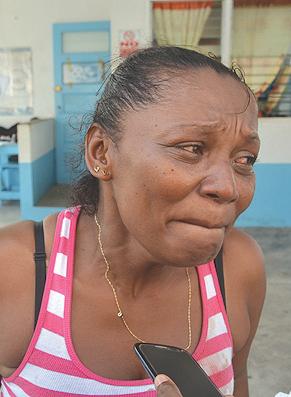
her granddaughter, Norton gether, but because of the abuse I decided to leave him. I went up back in the bush; I have a shop in the bush. I give him everything and I left and I gave him a restraining order and he use to preach it all the time and say that he will hurt

is presently before the court with her reputed husband because he breached the conditions of the restraining order. The two were expected back in court on Thursday, October 22.
She said because of fear of her reputed husband, she would not sleep at home but rather go at other relatives to sleep.
According to her, it was clear the accused was after
the two persons that were shot since he did not search for her. He also had a car waiting for him, she said.
“He said he was going to shoot the closest thing to me. He knows I love Arianne, and Ashley is my last child… he knows, he knows,” the woman cried.
When news of the baby’s death spread, family were outraged, arguing that the grandmother, knowing the extent of the situation, should not have had her children around her.
“She know she and this man got problems, I don’t know why she do this”, an aunt of the dead baby said.
But the pain was too much for the baby’s mother and father, who were at her side until the time of her death. The parents hugged each other as they wept bitterly at the hospital.
Police have since launched a manhunt for the shooter.

the Railway Embankment. According to reports, when the car approached the bridge at Lusignan, the driver lost control after one of the tyres blew out.
Amsterdam reportedly slammed into a heap of debris on the parapet in front of Bharrat’s house and the vehicle flew onto the roof and landed in an upright position. The driver is said to be a patient at a city hospital and in a critical condition.
When Guyana Times arrived on the scene, zincs and pieces of wood were all scattered about the yard as the front fence was broken and a minibus in the yard damaged.
Bharrat told this newspaper he was entering the house when he heard a loud explosion.
“When I got outside I saw a car in an upright position on my shed, the bus I was repairing was shifted from its original position, my fence was torn to pieces. I’m just glad my family is safe,” the homeowner said.
The Police were called and the driver taken to hospital.

…on educational standards
Young Cecil Cox and three of his cohorts have done Guyana proud. For the first time since CXC introduced competitive awards at the CAPE level… Guyana has not only topped the Region in the overall results (Cox) but evidently in three of the other seven categories. Cox, of course, had already topped the Caribbean at CSEC but now has copped the double in bagging the CAPE top prize.
Apart from the individual achievements, your Eyewitness hopes that these prizes signal a qualitative improvement in our pedagogical approach. Let’s face it… the territories that have the better universities system place their emphasis at the secondary school level on CAPE. While they’re constantly amazed at the number of subjects our students were able to sit and excel in, they did wonder as to the point.
One point was that, like basketball in the US City ghettoes, a concentrated focus by the whole cohort on ANYTHING will deliver results. The question then is for policy makers to ask “what were these incentives?” Apart from bragging rights that kids just love, there was the competition for the scholarship from CXC and recently from GOG. As shown by the basketball players from inner cities in the US, the law of the jungle still holds sway in times or circumstances of extreme scarcity. Anyhow, the second point is that Cox was the first Guyanese to move on from success at CSEC to CAPE. Why wasn’t this achieved before? For one, maybe the other winners, having won their prizes, eased their feet from the throttle? Or maybe CSEC isn’t such a good predictor of academic potential. There is no question there’s a whole quantum level difference between CAPE and CSEC, in terms of the level of difficulty of subject material.
So there’s the trepidation in students they’ll have to do much more of the work on their own. Many CAPE students are shocked when the spoon feeding’s removed after the 5th Form. For students to enter into any competitive university worth their salt, however, unless the applicant had completed CAPE in their area of specialisation, they’re going to flounder.
That we accept students with only CSEC for our Medical and Law programmes is a good indicia of the level of performance expected. If our CSEC students go to say, India or Trinidad or Jamaica, to study medicine they have to complete courses equivalent to CAPE. Your Eyewitness hopes that the Ministry of Education wakes up and returns to the days of the instant Minister when only “A level” (equivalent to CAPE) performances delivered cholarships.
And not so incidentally, whatever happened to the CAPE school promised by his predecessor?
While Cox and his batch-mates at least give us hope, our prayers might be answered in education the same cannot be said for Minister of Finance Winston Jordan being “sanguine” about picking our economy off the floor and achieving 3.4% growth by year end. There’s nary a sector that wasn’t tanking by June. And we know in the 4 months since, nothing’s changed in the price of gold, the markets for rice, bauxite, forestry, the cost of production for sugar – and certainly not in the psychology of the business community.
So what exactly is Jordan hoping will change? Is he going to parachute in banknotes from the sky? Because even though ExxonMobil (coincidentally?) assured us they’ll be drilling come next year, at the VERY best it’ll take three years to get up a head of steam to make a difference for us.
So what so we do in the meantime? Sanguinely, suck salt?
Now that Jordan’s confirmed that the economy is fast reverting to its “donkey-cart” pre-1992 state, you think maybe - just maybe - there might be a rethink on Salarygate?
Or are they hoping and praying it’ll blow over?
By Kristen MacKlingaM
Venezuela has officially ousted Guyana from inking another PetroCaribe deal to see the exchange for fuel and rice at “favourable prices”, as the Spanish-speaking nation has now teamed up with Suriname to pursue such an agreement.
According to media reports coming out of Suriname, on Friday last, the Presidents of the two countries reached an agreement for the Spanish-speaking country to provide oil to the Dutch-speaking Caribbean Community (Caricom) country in exchange for rice.
Guyana Times understands that this agreement signed between Venezuelan President Nicolás Maduro and his Surinamese counterpart Desi Bouterse, will allow Suriname to continue to receive favourable rates on oil in exchange for an agreement on rice exports.
Speaking with this newspaper on Sunday, Agriculture Minister Noel Holder said that such a move taken by Venezuela is “more feasible for that country due to the plummeting fuel prices globally”.
“Through the PetroCaribe with Guyana and Venezuela, we used to get fuel at reasonable prices in exchange for our rice shipments to Venezuela.
This ensured that Guyana received very high prices for its rice being exported, while we got reasonable prices for fuel from Venezuela. Now with the low prices for fuel across the globe with this PetroCaribe deal that Venezuela is having with Suriname, Venezuela will be getting rice way cheaper than what Guyana is selling for. In fact, Suriname is selling its rice for 50 per cent less than Guyana sells its rice for and since the price for fuel is so low, it is more feasible for Venezuela at this point in time,” Minister Holder explained.
Holder noted that while Venezuela paid the highest prices for Guyana’s rice, the amount of rice it purchased annually was almost the same percentage that Portugal would import from
Guyana as well.
Export prices
“So you see, it was not really the amount that they bought but at the prices they bought it at from us. With the price of fuel down so low, they would still need to pay less for rice even if it were from Guyana. That would mean our rice would have to be sold way cheaper than it is right now and that wouldn’t be feasible since the rice millers and farmers would be suffering heavy, tremendous losses to have to sell their rice half the prices they are selling for right now,”
new markets for rice.
In fact, President David Granger has recently distanced himself and his Government from the plight of rice farmers in Guyana. Echoing statements already proclaimed by Government officials, President Granger recently insisted that the crisis of the rice industry was not Government’s problem.
“It’s a private arrangement… Farmermiller-market… It’s not a Government arrangement,” he firmly stated.
The situation in the rice industry is currently so severe that rice farmers have
Government intervention.
The lack of action and unfavourable responses from the relevant authorities to inject funds into the industry has only made matters worse.
Generally, in a crisis of this nature, the previous Administration would have released the necessary funds to the Guyana Rice Development Board (GRDB) to pay the millers so they could pay the farmers. If it is a case where the millers actually have the money but are refusing to settle their debts with the farmers, the then Government would

Minister Holder further stated.
The Agriculture Minister posited that in spite of this, Guyana would still continue to export rice to other countries like it has always done, but did not say whether Guyana has been seeking
Come next year, Police Stations across Guyana are expected to be equipped with at least one vehicle as the Guyana Police Force will be receiving a number of vehicles and boats with a US multi-million dollar grant given by a foreign mission.
This was disclosed by Commissioner of Police Seelall Persaud on Saturday at the Force’s Tactical Drill Square, Eve Leary, where the Passing-Out Parade was held for 136 new ranks.
The Police Force have come in for much criticism over the lack of vehicular resources, and in some cases river transportation, which have been the core cause of ranks often being unable to respond effectively to reports. In very many cases citizens are forced to go to Stations and pick up officers to take to crime scenes.
However, the Commissioner noted that with the Force’s budgetary allocations coupled with the grant, this will no longer be an issue. “We are likely to see a great boost in our transportation capacity, so much so that every Police Station will have a vehicle, and/or boat, to conduct pa-
trols as appropriate,” he revealed.
According to Persaud, this is expected to be realised by the end of 2016. When asked about specifics by the media of the funding, the Top Cop explained that the money was promised by a foreign delegation in Guyana. However, the Commissioner opted not disclose which of the foreign missions will be giving the fund until the promise is realised.
He went on to say the Police have done all that was needed in the process, adding that the acquisition process of the vehicles may have commenced already.
Over the past year or so, the GPF have been working assiduously to improve its relationship with the public and with this boost in transportation, its efforts are expected to be realised. Additionally, the Police have been engaged in various social crime prevention programmes as well as working along with faith-based organisations to help victims and their families to recover.
Moreover, the Top Cop pointed out that the aim of the social crime prevention programme is to prevent
young Guyanese from getting involved in criminal activities, while showing those who are already involved, a path towards a better life.
While crime may still be rampant in the country and is currently pegged at some nine per cent, the Police Commissioner noted that serious crime has been below the record figure experienced in 2013.
“We have been all year below 2013 and we can’t say with any level of confidence that A cause this or B cause this… But there are some economic factors and social factors that have impacted it,” he outlined.
In the monthly statistic update, the Police disclosed that by the end of September a 10 per cent increase in serious crimes was recorded when compared to the same period in 2014.
A total of 114 murders were recorded, representing an increase of five per cent at the end of September. Robbery under arms saw an overall increase of three per cent during the same period, with gun-related robberies rising to four per cent, and robberies with other instruments grew by one per cent.
already signalled their intention to ‘rest’ their lands come the next crop, given the low prices and lack of
usually threaten to take the millers to court or have their licences revoked.
But the Granger-led
Administration is taking a different approach — one which stakeholders have argued will see rice farmers continuing to suffer as the rice industry crumbles to ruins.
Prior to this new development, Venezuela for a number of years under the leadership of the late President Hugo Chávez had inked “a rice for oil deal” with the Guyana Government. This deal was secured under the then People’s Progressive Party/Civic (PPP/C) Administration in Guyana. Recently, the border controversy between the two countries had been resurrected after Venezuela sought to once again lay claim to part of Guyana’s territory.
As such, the Guyana Government had lobbied support from the international community to denounce Venezuela’s claim on its territory. In spite of this, Venezuela has still persisted in its claims. President Granger has reiterated that Guyana would be seeking to move to the International Court of Justice (ICJ) to have the controversy resolved once and for all. (kristenm@ guyanatimesgy.com)

monday, october 19, 2015 | guyanatimesgy.com
Guyana and Suriname have expressed concerns about the issue of piracy at sea with avenues being discussed among Members of Parliament on how to tackle this issue.
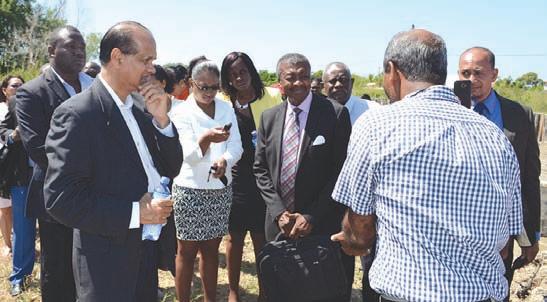
Piracy was high on the agenda during a four-day visit by members of Guyana’s National Assembly to the National Assembly of the neighbouring country.
It was noted that the issue of piracy was common to both countries with reference made to the prevalence of piracy in the Corentyne River. After discussing the severity of piracy with particular emphasis on the effects on fishermen, the meeting proffered that there be collaboration between the law enforcement agencies of both countries with emphasis on patrolling targeted areas. It was put forward that the countries should engage in dialogue at the national level.
Piracy has been a sore issue for fishermen, especially in Region Six (East BerbiceCorentyne). At the beginning
of the year, the Marine Wing of the Guyana Police Force was presented with five boats,
gun looking at ways to address the growing piracy situation. Among the proposals that were
costing some $78 million, , by the former Administration, in an effort to boost the department’s capacity to effectively police coastal areas in the fight against piracy and drug smuggling activities.
When the new Administration came into office, Public Security Minister Khemraj Ramjattan had be-
being considered to deal with this scourge was to allow fishermen to carry arms while out at sea. However, many of the fishermen were not too keen on the idea and requested the implementation of stronger patrol systems instead.
Meanwhile, during the visit, a number of meetings were held between the two Speakers
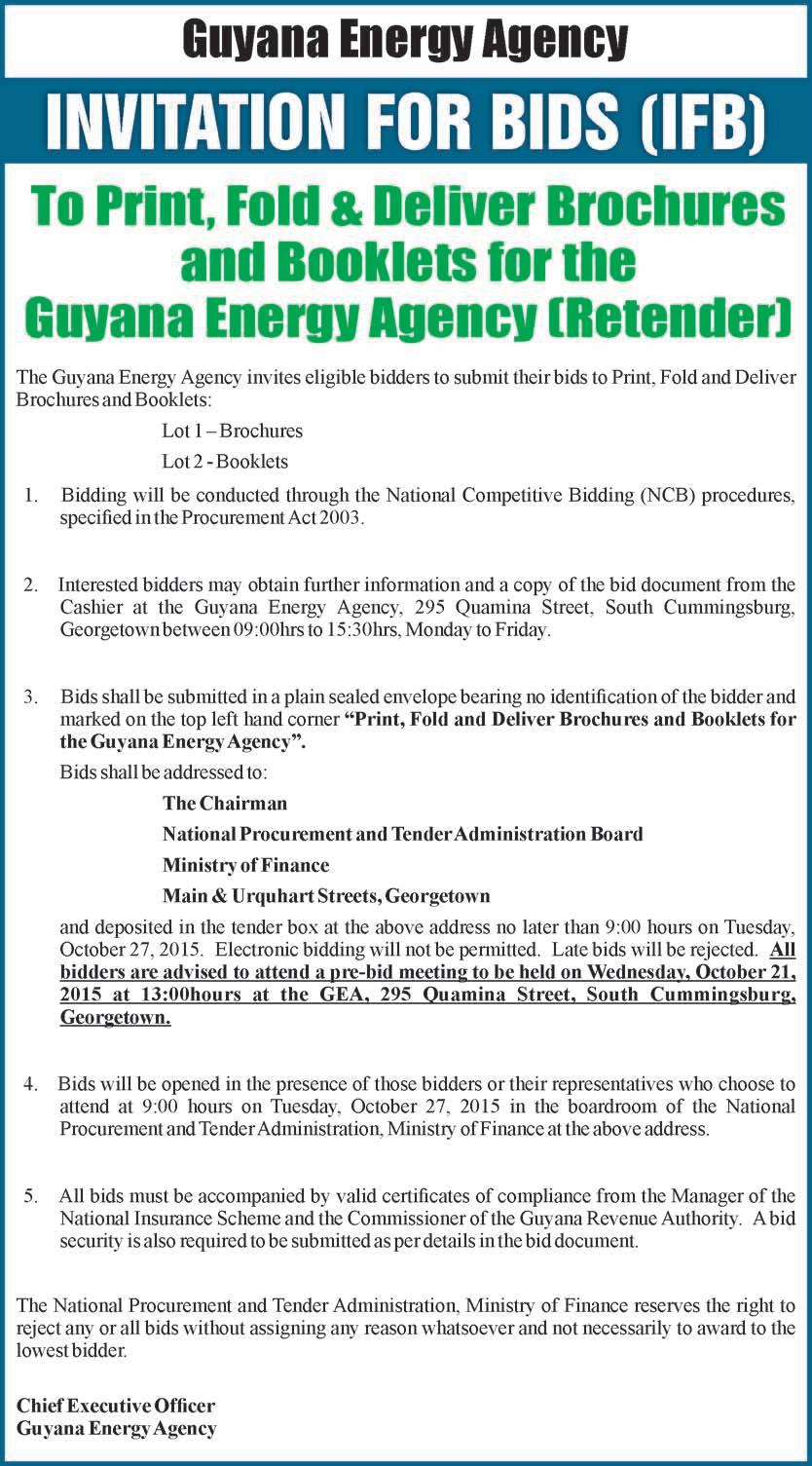
and their delegations where views were exchanged for the improvement of the workings of the National Assemblies of the two countries.
Visits were also made to several areas of interest, including the coastal preservation initiative at Wegnaar Zee and the refinery operations of the State Oil Company, Staatsolie at Tout Lie Fout.
Climate change and rise in sea levels
The delegations noted that Suriname and Guyana faced the same problems with regard
countries should continue dialogue and collaborate to address these issues at the international level.
Trafficking in Persons
It was also noted that Trafficking in Persons (TIP) was another problem that greatly affected the neighbouring countries, being more prevalent in the interior of both.
The delegations outlined initiatives undertaken by the respective countries to curb this problem, including the establishment of a Trafficking in Persons (TIP) unit and the
Finalisation of the draft contact plan
The meeting agreed that the draft contact plan should be finalised which will see both Assemblies entering into continuous consultations to address the various issues and challenges faced, and the opportunities that their cooperation can provide. The meeting further agreed that the Guyana delegation would submit the document to the appropriate Committee of the National Assembly for examination and amendment, and amended if necessary, before being re-
to climate change and the rise in sea levels. The Guyanese delegation presented an overview of the Low Carbon Development Strategy (LCDS) – Guyana’s vision to promoting economic development while combating climate change. The delegations, noting the similarity of geography, agreed that the LCDS would be a useful initiative for Suriname to implement. It was agreed that both
work of the Guyana Women Miners Organisation (GWMO) in Guyana.
The meeting suggested that both countries look to create more jobs and opportunities for individuals who may end up in these situations, and ensure the continuous exchange of information between both countries regarding this problem so that efforts were known internationally.
turned to the Surinamese delegation. Suriname’s delegation will then peruse the plan and arrange for it to be translated. The final document, having the agreement of both National Assemblies, will be signed by the Speaker of the National Assembly of Suriname and the Speaker of the National Assembly of Guyana. (jpinder@guyanatimesgy.com)


The Guyana Trades Union Congress (GTUC) has said that a nation’s human resources must be at the centre of development and has renewed its calls for workers to be paid a “living wage.”
The call come in light of Government’s decision to hike the salaries of Ministers, at a time when the economy has seen a 2.5 per cent decline and public servants continue to struggle to meet day-to-day needs.
In a statement issued on Sunday, the GTUC also called for a prudent approach in handling the public outcry on the salary increases for Ministers.
“The citizens’ response to the increase of remuneration for ministers and parliamentarians calls for commitment from the government that would result in decision that society can accept and respect,” the GTUC said.
The umbrella Trade Union added that the continuous, sustained and heightened voices, inclusive of that from varied and unexpected sources,
are enough to warrant the government’s judicious attention with respect to the salary increases.
The Government, the Union added, has a responsibility to look out for the interest of the state and its people and this “seems not to be the case in this regard.”
According to the Union, politicians in power need to understand that the authority they use are vested in them by the citizens.
“Ultimately politicians are accountable to the citizens and must never lose sight of this principle. As this salary outcry is increasing and being sustained beyond the proverbial ‘nine days’ it requires good sense prevailing on the part of the government,” the Union added.
GTUC’s position is that: “If you start wrong, you will end wrong. The product from the application of a wrong process will be questionable and this in part is driving the outcries today.”
According to GTUC the
Nation must therefore see the reinstatement of collective bargaining and respect for fundamental rights and freedom as a matter of priority:
“Collective bargaining must commence in the Public Sector, which will ensure the resetting of relativity in the Wage and Salary Structure, from which ministers, Parliamentarians and other public servants will earn wages/salary and conditions of employment as a result of the process. Comprehensive collective bargaining will impact on income in all sectors (public, private and cooperative) of the economy, address pensions and other remunerations, since it will be done within the developmental policies of the nation.”
On Friday last, President David Granger defended the move by Cabinet saying he endorses the salary hikes.
He said the decision to hike salaries was not arrived at easily and citizens should see it as an investment in what he referred to as “good governance”.
As ExxonMobil is making preparations to commence the second round of drilling for oil in the Stabroek Block in 2016, members of the US Congress have asked for a federal investigation into whether the oil giant broke the law by intentionally obscuring the truth about climate change.
Reports emanating out of The Guardian stated that two members of Congress wrote to US Attorney General Loretta Lynch expressing concerns over the results of two separate investigations by Inside Climate News and the Los Angeles Times, which found that ExxonMobil scientists confirmed fossil fuels were causing climate change decades ago, but the company publicly embarked on a campaign of denial.
“ExxonMobil’s apparent behaviour is similar to cigarette companies that repeatedly denied harm from tobacco and spread uncertainty and misinformation to the public,” Ted Lieu and Mark DeSaulnier, both Democratic members of Congress from California, wrote.
“We ask that the DoJ [Department of Justice] similarly investigate Exxon for organising a sustained deception campaign disputing climate science and failing to disclose truthful information to investors and the public.”
They asked the DoJ to look into a number of statutes concerning Exxon’s actions, including truth in advertising and racketeering laws.
Richard Keil, a spokesman for Exxon, rejected the allegations contained in the letter. He told The Guardian, “We have a 30-year continuous un-

interrupted history of researching climate change, and the LA Times for whatever reason chose to ignore that fact.”
Meanwhile, the oil giant is expected to recommence its operations in Guyana during the first quarter of 2016.
Exxon’s Country Manager, Jeff Simons was quoted in a section of the media as saying that the company was presently re-examining the contracts for the supply of material to set up the exploration well.
However, he could not give a specific date for the commencement of the second round of drilling, but reiterated that it would be early next year.
ExxonMobil removed its oil drilling ship, the Deepwater Champion, from offshore Essequibo in June, leaving the public to believe that the aggression from Venezuela might have influenced the decision.
Nevertheless, Government
had failed to inform the Guyanese public of this development.
It is believed that the arrival of ExxonMobil’s Deepwater Champion precipitated Venezuela’s latest revival of its controversy over Guyana’s western border.
In May, ExxonMobil announced its findings of more than 295 feet of high-quality oil-bearing sandstone reservoirs. Recent reports predict that this find could see Guyana’s Gross Domestic Product (GDP) escalating to 12 times its current figure, which is transformational for any developing country.
Guyana’s GDP stands at around US$3.23 billion.In early March, the oil and gas company, one of the largest in the world, was warned by the Spanish-speaking nation to refrain from going ahead with its planned exploratory drilling activity, on a concession awarded by Guyana off its Essequibo Coast.
Last Thursday, several NGOs, activists and persons associated with the Administration took to the streets to express dissatisfaction over the decision to increase the Ministers’ salaries by a whopping 50 per cent, while public servants were handed a measly five per cent increase. The protesters said they will picket Parliament Buildings during sitting of the National Assembly on Thursday.
During a recent interview with Guyana Times, President of the Transparency Institute Guyana Inc (TIGI), Calvin Bernard, condemned the move by Government, saying it was too soon for a raise and more so such a “very excessive” one.
Political commentator Ramon Gaskin is also of the view that the increase is too excessive when compared with the meagre five per cent hike given to Public Servants.
Gaskin pointed out that in addition to a salary, Ministers also get a host of other benefits that would rack up to over a million dollars per month each.
In addition to these persons, organisations such as the Society Against Sexual Orientation Discrimination (SASOD), the Guyana Teachers Union (GTU), and Red Thread have also spoken against the massive pay hike.
When Guyana Times broke the story two months ago, the Government denied having intentions of implementing significant increases in the salaries of Executive Members and instead said that it was only being “considered”.
On September 25, follow-
ing the Minister’s budgetary presentation in the National Assembly, the Government gazetted the increases without being forthcoming with the public that it had indeed worked out the scale, quantum and criteria for the increases which many believed were not going to be pursued within the new Government’s first months in office.
In the Official Gazette of September 25, it is stated that Prime Minister Moses Nagamootoo will be benefiting from over $20 million per annum, while the other Vice Presidents will each receive $11,135,064.
Under the APNU/AFC Government, a Cabinet Minister will be given a hefty sum of $10,439,124 annually –more than $300,000 over previous Ministers and a Junior Minister within a Ministry will be paid $8,346,492 per annum.
In addition to the increased salary for Prime Minister Nagamootoo of $1.7 million monthly, an increase of over $200,000 each month, he will be drawing vacation benefits and perks totalling more than $500,000.
monday, october 19, 2015 | guyanatimesgy.com
For a number of years
Guyana has depended heavily on the supply of fuel from Venezuela for reasonable prices through the PetroCaribe deal; however, Trinidad and Tobago is now supplying most of Guyana’s oil.
On Sunday, Agriculture Minister Noel Holder confirmed during an interview with Guyana Times that Guyana was now sourcing most of its fuel from Trinidad, adding that the arrangement “was for Guyana to purchase its fuel from the twin-island nation only”.
“This isn’t a barter arrangement or PetroCaribe deal with Trinidad. We (Guyana) would obtain our fuel from Trinidad and they would supply us at reasonable prices. There is no supply of rice to Trinidad in exchange for fuel as was the case with Venezuela and Guyana through the PetroCaribe deal,” he told Guyana Times
Asked whether or not

Guyana would still be open to supplying Venezuela with rice through another PetroCaribe deal, the Minister said that such an initiative would always be welcome should the Spanish-speaking country wish to pursue this.
Guyana had recently entered into a “standby” arrangement with Trinidad and Tobago for that country to provide fuel in the event that there
was a delay in shipment(s) from Venezuela.
The Government had pointed out that the oil and gas arrangement with the twin-island nation would in no way replace the PetroCaribe deal Guyana had with neighbouring Venezuela. This move, it said, was to cushion the effects of untimely deliveries from Venezuela in light of the ongoing border controversy.

Spanish-speaking country.
State Minister Joseph Harmon had earlier confirmed that fuel was being purchased from the twin-island republic since Guyana needed to have an alternative in place to ensure that there was never a shortage of petrol in the country.
Guyana Times was told that a few weeks prior to Guyana and Trinidad coming to such an arrangement, the vessel sent to Venezuela for fuel encountered some difficulties in getting the fuel on time.
No less favourable
As such, the PetroCaribe deal between the Spanishspeaking country and Guyana has come to a premature end and at this point in time, there is no sign that this deal will be resurrected or renewed.
In fact, last week, Venezuela and Suriname inked agreements to commence their own PetroCaribe deal which does not bode well for Guyana in terms of the supply of fuel from the
Minister Harmon had said that the arrangement with Trinidad was feasible and the financial arrangement in the deal was no less favourable than that with Venezuela.
The Guyana Government, in July this year, had begun pursuing a commitment made by the then Prime Minister of Trinidad, Kamla PersadBissessar to assist this country in the oil and gas sector.
Governance Minister Raphael Trotman had divulged that the offer would be explored at two levels –one was the supply of oil and lubricants to Guyana to see if there could be favourable terms and concessions from the twin-island republic for the supply; and the other was for the actual assistance in development of the oil sector itself, in terms of exploration, agreements and being able to interface with investors.
Trinidad and Tobago is one of the wealthiest and most developed nations in the Caribbean and is also the leading Caribbean producer of oil and gas. Oil and gas account for about 40 per cent of its Gross Domestic Product (GDP) and 80 per cent of exports. The sister Caricom nation has transitioned from an oil-based economy to a natural gas-based economy. It was reported that in 2007, natural gas production averaged four billion cubic feet per day.
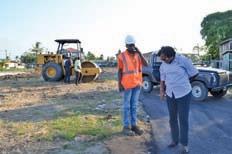
Residents of East Bank Berbice are peeved at the very little money that is being spent on remedial road works in the area.
Reports are that under the previous Administration arrangements were made via a loan from the Inter-American Development Bank (IDB) to rebuild the road at the cost of US$8M.
On Sunday, residents told this publication they understand they have to wait on the loan from IDB, but are not happy with the repairs being done to upkeep the road until the new one can be constructed.
Speaking with this newspaper Reynard Ward, who was on the list of candidates for APNU/AFC coalition, said the community is disappointed with the response from Government.
“The whole East Bank Berbice voted for APNU/ AFC and they only spending $5M on the road. The previous Administration use to spend $15M.”
Persons who use that stretch or road including the East Bank Berbice Hire Car Association met with Region Six Chairman David Armogan to express the need more remedial works to be carried out.
The current project entails fixing the road between Marks Bridge and

Bermine, East Bank Berbice.
Speaking with Guyana Times, the Chairman said the funds have not yet been released by the IDB for the project.
“The previous Government was also depending on the IDB to do that road. This Government is also waiting on the IDB to have loan to do the work. In the meantime what we are doing at the regional level budget is trying to do some work on that road,” Armogan said.
He added that the Region Six Budget was significantly reduced since the Region is operating on a ‘four-month budget.’
“So we only have $260M to do all the projects within the Region, whereas we would have $450M$500M. So in terms of road
work there is not much money available. So out of the money that we have for road maintenance we have put aside $5M to basically fill holes.”
Armogan told said the last contractor who did remedial works on the road had retention of $1.6M, which is currently being used to make the East Bank Berbice main access road usable.
“The $6.6M can only do to fill the holes temporarily and so we will have to wait on Government. If this process takes too long I think Government will have to make some kind of intervention, but if the rains come heavily I think that $6.6M will be washed out and so we will get back to square one,” Armogan moaned.
By KRISTEN MACKLINGAM
As a result of Venezuela’s decision to sever ties with Guyana in relation to the PetroCaribe deal which was on-going for many years and now inking the same deal with Suriname, Guyana’s former Agriculture Minister, Dr Leslie Ramsammy has posited that the APNU/AFC coalition is responsible for this major loss.
Further, he stated that it is his firm position that this new Government is “killing the rice industry” in Guyana since the pathway the APNU/AFC Administration has chosen has placed rice on the road to destruction.
Dr Ramsammy told Guyana Times on Sunday that should the rice industry die then Guyana would encounter ‘serious’ economic and social troubles.
He made reference to the Venezuelan President Nicholas Maduro’s address on Friday last, notifying the Spanish-speaking nation, that his country has officially ended the rice agreement deal with Guyana and now pursues a rice deal with Suriname instead.
“This seems to end any hope that we might have been able to restart the rice deal with our neighbour. Problems with the Venezuelan market started soon after the APNU/ AFC Government assumed office. One of APNU/AFC’s first acts with international implications was the grounding of Conviasa, the Venezuelan airline that operates between Guyana and Caracas,” Dr Ramsammy stated. He reminded that the Venezuelan airline had failed to deposit a refundable fee of about $US200,000 as a condition for operating the Guyana-Venezuela air route. According to Dr Ramsammy the previous Government now Opposition Party, the People’s Progressive Party/ Civic (PPP/C) approached the solution with patience and through intense and firm negotiation:
“We did not believe that grounding Conviasa was in Guyana’s best interest because in the first place, the route between Guyana and Venezuela was a useful one and served both ours and the Venezuelan needs. But the most important reason for not grounding the airline was to ensure that Venezuela did not retaliate by curtailing the rice deal.
The Venezuela rice deal involved the export of 200,000 tonnes of rice and paddy for 2015, with a value of $23B (US4115M) and the PPP/C thought that the pathway of dialogue, negotiation and encouragement with Conviasa was the more prudent option and would not risk the rice deal and risk the livelihood of rice farmers.”
Sadly, the APNU/AFC Government sought to ap-
proach the said issue with a different perspective — they were determined to play “big and bad” and grounded the Conviasa, demanding immediate payment as a condition to operate again, Guyana Times was also told. “How do you risk $US115M to protect US$200,000? The consequence is that paddy and rice already at the wharf for shipment had to be returned to the millers, as Venezuela stopped shipment and this matter, I am informed, will be a legal tussle between the Guyana Rice Development Board (GRDB) and the millers. Millers have not paid some of the farmers, claiming it is the fault of the GRDB that the rice was not sold,” the former Minister emphasised.
This newspaper was also told that the PPP/C had hoped that the Conviasa issue would have been resolved amicably and that the rice agreement for 2015 would resume.
However, those hopes were dashed by tensions on the border with Venezuela and although this had nothing to do with the PetroCaribe deal, the rice trade with Venezuela has become the most important victim of the border tensions, Dr Ramsammy pointed out. “Like the PPP/C, I stand firm with our Government that our borders are sacred and non-negotiable. While rice might have in any case become a victim of the border tensions, its trouble started not with the border issues but with the grounding of Conviasa. It was an example of poor management of a problem with international significance and I support the position of the Leader of the Opposition that we should still try to delink the border tensions from the rice trade agreement through a oneon-one dialogue between the Presidents of the two countries,” he stated. As such, the announcement by President Maduro that the rice deal is formally over increases the uncertainty in the rice industry which is presently plagued by low prices for paddies and a shift from high priced markets to low priced markets. It must be reminded that with the loss of both the Venezuelan and Panamanian markets, ex-
port is not likely to reach the 503,000-tonne mark of 2014, resulting in a large “carryover stock”. “Inevitably this will result in millers encountering difficulties in proper storage for the supply will exceed demands. The situation is untenable and will sink many families into poverty; and farmers have financial commitments, including restarting the next crop — and many of these farmers have bank loans to service.
Yet farmers are not the only ones affected because the downturn in rice has a domino effect on the economy, as can be seen with retail businesses in rice areas and around the country coming to a virtual halt. These are serious problems and yet they are not the only problems low prices for paddy are causing,” Dr Ramsammy said.
According him, a positive Government response is necessary and opines that it is blatantly foolish to chastise the farmers and millers with such nonsense as “this is their business”, because rice is a private sector activity.
“APNU/AFC’s position that because rice is private sector the Government cannot intervene is a callous, insensitive, stupid and discriminatory response to the crisis in the rice industry. Mining is also private sector and mining deserves the subsidies and other benefits being offered to them by APNU/AFC in response to the low gold prices in the markets today. In spite of mining being exclusively a private sector activity, the Government did see it as necessary for a Government intervention, even if they have not gone far enough,” he reminded. Guyana Times was further told that such a position by the Government displays “double standards” since rice is “at least equally important” to the economic and social development of Guyana.
“I will argue that from a GDP perspective, rice is even bigger than mining, although it is a mistake to rank these important economic planks as more important than each other. The Government must immediately negotiate with bankers to provide relief for farmers from loan payments due at this time and rescheduling with friendlier terms, including interest rebates. Subsidies for fuel, fertilizers, seed paddies, vehicles and other inputs that would reduce the production cost are important initiatives that the Government must embark on now,” he added. “They have shown a willingness to intervene in the private sector, for the good of Guyana. The subsidies already given to the mining industry is a good example. Although I am opposed to the intimidation of the Berbice River Bridge Authority, this is more ev-
idence that when APNU/ AFC wants to intervene in the private sector, they have no hesitation. Therefore, the position that they cannot intervene in the rice industry is sheer hogwash,” Dr Ramsammy declared.
He also noted that incidentally, the cost of the “super salaries pay increases” could cover some of the subsidies noted above to buffer the crisis in the rice industry.
Guyana Times was also told that the $22M spent to procure a vehicle for Prime Minister Moses Nagamootoo could have been utilised to pay for seed paddy for rice farmers. (kristenm@guyanatimesgy.com)
Scores turned out at the Demerara Cricket Club Ground on Sunday as Nestle Svelty Milk hosted its first Awareness Day and Walk for Breast Cancer.
Consumer marketing manager of Nestle Svelty Milk, Shaheeza MohammedShandabally told Guyana Times that Nestle integrates itself into communities to address issues that are important to the community and society as a whole.
Mohammed-Shandabally added that Nestle Svelty Milk is a healthy option and it is thought it makes a good alignment with cancer awareness and are encouraging consumers to support a worthy cause.
She noted that this is the first year that Nestle Svelty Milk has been involved in
an activity for breast cancer awareness, so they were very surprised and grateful with the large turnout. She said the company is hoping this initiative can become a yearly event. At the ground, booths were set up by the Cancer Institute of Guyana, Nestle Svelty, Fitness Planet, among others.
Participants of the walk included employees of Bounty Supermarket, Church’s Chicken, Stabroek Market vendors, and many others from across Georgetown.
The group gave hampers to several participants after the walk, and persons were given the opportunity to sign their names onto a banner, which will be featured at other Cancer Awareness programmes around the Caribbean.

Brazil President Dilma Rousseff on Sunday expressed support for Finance Minister Joaquim Levy and said the Government will continue efforts to push austerity measures through Brazil’s Congress.
“Finance Minister Levy stays,” Rousseff told reporters during a visit to Sweden, following a flurry of speculation in Brazilian media in recent days that the finance chief was getting ready to step down.
The comments come as Rousseff, a beleaguered leftist struggling to revive an economy now in its worst recession in nearly three decades, seeks to counter criticism against Levy by many officials from within her own Workers’ Party.
Levy, a former banker seeking to introduce austerity measures needed to rebalance overdrawn Government accounts, faces increasing criticism from ruling party officials who oppose the measures and support economic stimulus instead.
In her comments to re-

porters in Stockholm, Rousseff said a meeting last Friday with Levy was a discussion about how to move forward with economic policy, not a conversation, as widely reported, about his possible departure.
The Government, she added, will continue efforts to push the austerity measures through a Congress that has been reluctant to approve them. “Crucial”, she
said, is a proposed tax on financial transactions that is needed to boost Government revenues that have plummeted in recent years.
On Sunday, the Folha de S Paulo newspaper published an interview in which Rui Falcão, President of the Workers’ Party, said Rousseff should shift away from the austerity push and that Levy should leave if he did not agree. (Reuters)
Venezuela’s Stateowned oil company Petroleos de Venezuela SA will buy a 25 per cent stake in Antigua and Barbuda’s West Indies Oil Company as the first of many “joint investments” between the countries,
President Nicolás Maduro says. Caracas will also establish a regional bank with the twin-island nation to fund several projects, including a new Simon Bolivar Resort Hotel. Funds for that will come from the Petrocaribe programme.
Maduro announced those plans in Antigua on Saturday, on one of the stops in his tour of the Caribbean that also includes Suriname, St Lucia and Grenada. (Excerpt from Caribbean360)
Prime Minister Dr Timothy Harris has claimed that the former St Kitts and Nevis Administration squandered EC$11 million (US$4 million) in the Small Enterprise Assistance Fund (SEAF) Project, which he said would be recovered.
The SEAF Project was financed by the citizenship by investment programme and funding was purportedly made available to small business investors. It was managed by Roselyn Hazelle of the St Kitts Investment Promotion Agency (SKIPA). But Harris said at his weekly press conference on October 13 that the programme was not properly managed and persons who received money were not held accountable. He also suggested nepotism among the beneficiaries of funding.
“It was a pre-election gimmick to win votes. No serious effort was made to hold beneficiaries account-

able for repayment. There were cases where candidates, their families, friends were preferred to get funds purported to open businesses, and for other purposes,” Harris disclosed.
“A candidate, his sister, his aunt, his nephew and niece were all offered large sums. No viable business is there to show for their largesse to any of these beneficiaries. Collections have
The Colombian Government has acknowledged that crime and smuggling have gone down since Venezuela deployed thousands of troops along their common border two months ago.
The move was initially criticised by Colombia, which complained that it had not been consulted.
But Colombian Defence Minister Luis Carlos Villegas has now published a review hailing the results.
The number of murders in the border area has dropped by 10 per cent, he said.
More than 150,000 gallons of petrol and 400 cattle have been seized by Colombian forces since
Venezuela’s border security operation was launched on August 19, added Villegas.
“We have reached a new era of cooperation with Venezuela’s Defence Minister,” he said.
The report was presented to President Juan Manuel Santos and his Cabinet during a meeting in the border department of Arauca.
Villegas praised the results of the operation launched unilaterally by Venezuela, but said Colombia was already successfully tackling criminal activities in the area.
“I can affirm today that the border with Venezuela on the Colombian side is safer now than a year ago,” he said.
“And I can undoubtedly affirm that the border is safer today than 60 days ago.”
Venezuela surprised Colombia on August 21 when it deployed more than 1000 troops and closed the main crossings along the 2200km (1400-mile) border.
The move followed a shootout in which several Venezuelan soldiers were wounded by smugglers.
Other troops were taken to the area in the following days to tackle crime and smuggling.
Venezuelan President Nicolás Maduro said that for many years Colombia had overlooked the problem, which was hurting the Venezuelan economy. (Excerpt from BBC News)

Cuba has friendly relations with Russia and Iran,
of the countries supporting Assad, and has had cordial relations with Syria for decades
Asenior official in Havana on Saturday “categorically” denied reports that Cuban troops were in Syria supporting the regime of President Bashar al-Assad.
Cuban and Cuban-American Studies learned that the head of the Cuban armed forces visited Syria with a military team to support the Assad regime.
The story has appeared in media outlets across the Middle East, although State Department spokesman John Kirby said Thursday that the report could not be verified.
been horrible. We intend to recover the people’s money. We are not opposed to publishing the names of those owing and are yet to make proper repayment arrangements,” he added.
Harris also questioned the logic of paying persons who presided over SEAF hefty payments, considering some were already employed in public service. (Excerpt from Caribbean News Now)
Talk of up to 300 Cuban soldiers sent to Syria originated in the Fox News network on Wednesday, citing an unnamed US official as source.
On Saturday Gerardo Penalver Portal, the head of bilateral affairs at the Ministry of Foreign Affairs, said in a brief statement that Cuba “refutes and categorically denies the irresponsible and unfounded information on the alleged presence of Cuban troops in Syria, which some media have echoed.”
The Fox story also mentioned that the University of Miami’s Institute for
Cuba has friendly relations with Russia and Iran, two of the countries supporting Assad, and has had cordial relations with Syria for decades.
(Caribbean News Now)
Jamaica called on to do more to prevent sexual and gender discrimination and violence
Amnesty International (AI) said it is concerned that impunity continues in Jamaica for violent and hateful attacks on people based on their real or perceived sexual orientation or gender identity and expression, despite the Government’s assertion that measures are in place “to investigate and prosecute all incidents and acts of violence targeting individuals based on sexual orientation”.
AI welcomed Jamaica’s engagement with the Universal Periodic Review and its acceptance of recommendations to establish and
operationalise a National Human Rights Institution, in accordance with the Paris Principles.
AI also welcomed the establishment and work of the Independent Commission of Investigations (INDECOM) and noted the decline in killings by state agents in 2014 compared with 2013. However, local human rights organisations continue to express concern over obstacles faced by INDECOM in carrying out its functions, including lack of cooperation from members of the police force, and under-resourcing.
As recommended during the review, Human Rights
Council, Draft report of the Working Group on the Universal Periodic Review, Jamaica should provide INDECOM with the necessary financial and human resources to effectively carry out its mandate, including for timely ballistics and forensic analysis. AI said it remains concerned by the serious delays at the Coroner’s Court and the Supreme Court, and calls on Jamaica to ensure the Special Corner in charge of fatal Police shootings has the necessary resources to carry out its functions. (Excerpt from Caribbean News Now)
Buses packed with migrants backed up on Serbia’s border with Croatia on Sunday, their passage to western Europe slowed by a new diversion through Slovenia, which vowed to limit the influx.
Many spent the night on the buses, wrapped in warm clothes and blankets against the autumn cold, waking to dense fog and another hourslong wait around a kilometre from Serbia’s western border with the European Union.
Slovenia said it would only accept as many as are able to exit the country into Austria.
“Croatia asked us to accept 5000 migrants per day, but Austria told us they can accept at maximum 1500,” Bostjan Sefic, state secretary at the Slovenian Interior Ministry, told a news conference.
“We cannot accept unlimited numbers of migrants if we know that they cannot continue their journey.”
Some 3000 migrants, many of them Syrians fleeing war, entered Slovenia from Croatia on Saturday after fellow European Union member Hungary sealed its southern border with Croatia at midnight on Friday.
Hungary’s right-wing Government says the main-
ly Muslim migrants pose a threat to Europe’s prosperity, security and “Christian values”, forging ahead with a unilateral crackdown in the absence of EU unity.
The arrival of a projected 700,000 migrants this year to Europe’s shores, fleeing war and poverty in the Middle East, Africa and Asia by boat and dinghy
across the Mediterranean and Aegean seas, has exposed deep and often ugly divisions in the EU.
EU members Croatia and Slovenia have both said they will not stop migrants from crossing providing Austria and Germany also keep their doors open. (Excerpt
China’s Xi lauds Britain for ‘visionary’ openness, prods others to emulate
Chinese President Xi
Jinping heaped praise on Britain for what he called a “visionary and strategic choice” to strengthen commercial ties with China, as he prepared for a state visit to the United Kingdom that’s expected to be richer in pomp and considerably warmer in tone than his recent trip to the United States.
The trip comes at a time of global anxiety about
China’s slowing growth. Xi himself acknowledged “concerns about the Chinese economy”, but sought to allay them in a written interview with Reuters.
China itself is worried about the slowing of the broader global economy, Xi said, even while he expressed confidence that China would weather the current downturn as it reshapes its economy to be
more resilient in the future.
That confidence will be on display when Xi arrives in London on Monday evening to kick off a four-day visit that is expected to cement ties between Britain and China, including through a host of business deals.
“The UK has stated that it will be the Western country that is most open to China. This is a visionary and strategic choice that ful-
ly meets Britain’s own longterm interest,” Xi said in a written response to questions from Reuters.
“China looks forward to engaging with the UK in a wider range, at a higher level and in greater depth.”
Xi’s visit comes amid debate in Britain and many other Western countries over what is the best way to engage with a Communistruled China. (Excerpt from Reuters)
Many Egyptian voters shunned the first phase of a parliamentary election on Sunday that President Abdel Fattah al-Sisi has hailed as a milestone on the road to democracy, but his critics have branded as a sham.
Polling stations visited by Reuters correspondents pointed to a turnout of around 10 per cent, in sharp contrast to the long lines that formed in the 2012 election, suggesting that Sisi, who has enjoyed cult-like adulation, is losing popularity.
Elderly supporters of Sisi comprised a large proportion of those turning out to vote, while younger Egyptians boycotted an election for a chamber they say will just rubber-stamp the President’s decisions.
“It’s not going to matter. It’s just for show, to show that we are a democracy, and we have elections, and blah blah blah any nonsense,” said Ahmed Mostafa, 25, who works in a lab.
Ahmed Ibrahim, a 34-year-old accountant, had a similar view.
“The youth in Egypt, our ambition in 2011, we were going to build the country – but then suddenly it was
An Israeli soldier has been killed and several other people have been wounded in a gun and knife attack at a bus station in the southern Israeli city of Beersheva.
Israeli Police said the attacker, thought to be Palestinian, was killed.
Eight Israelis have died in attacks by lone Palestinians this month. More than 40 Palestinians, including several attackers, have been killed.
The upsurge began amid tensions at a flashpoint holy site in East Jerusalem.
Israeli security forces have imposed tighter restrictions in Jerusalem and the West Bank, and there have been clashes with Palestinian protesters.
Israel has begun erecting
a five metre (16 foot) high concrete barrier between the Palestinian district of Jabal Mukaber in East Jerusalem and the neighbouring Jewish Armon Hanatziv. Israeli officials in Jerusalem insisted the wall was a temporary measure in an area “where there is a history of rock and [petrol bomb] Molotov cocktail throwing at Jewish homes and vehicles”.
United States Secretary of State John Kerry is to meet Israeli and Palestinian leaders this week. He said he would hold talks with Israeli Prime Minister Benjamin Netanyahu and, separately, Palestinian President Mahmoud Abbas, as part of Washington’s effort to help restore calm to the region. (Excerpt from BBC News)
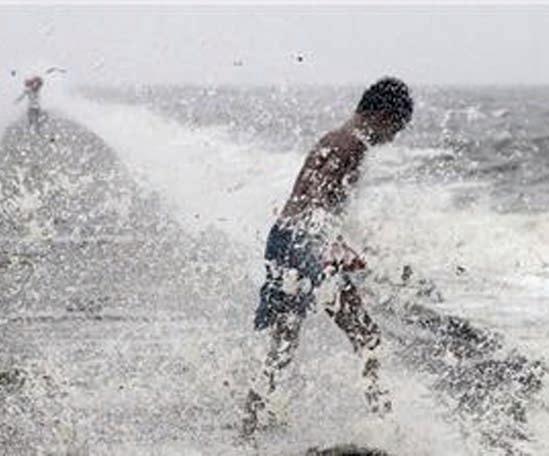
stolen from us,” he said. “Ninety-nine per cent of my friends are not going to vote.”
The Government declared a half-day holiday on Monday for state workers, apparently hoping to encourage more voting.
Egypt has had no Parliament since June 2012 when a court dissolved the democratically-elected main chamber, then dominated by the Muslim Brotherhood, reversing a key accomplishment of the 2011 uprising that toppled Hosni Mubarak.
In 2013, Sisi, then Army Chief, overthrew Egypt’s first freely-elected president in 2013, the Brotherhood’s Mohamed Mursi, then launched the fiercest crackdown on dissent in Egypt’s modern history. (Excerpt from Reuters)
Powerful Typhoon
Koppu has hit the northern Philippines, battering the coast with powerful winds that have killed at least three people and displaced more than 16,000, according to the national disaster agency.
The storm hit the main Philippines island of Luzon, where it flattened homes and brought down bridges and trees on Sunday. Forecasters warned that the storm could last up to three days.
A 14-year-old boy died in the capital Manila where his house was hit by a fallen tree, according to Inquirer Radio. Two other deaths occurred in the northern province of Nueva Ecija, according to Governor Aurelio Umali who was cited by ABS-CBN television station.
“The situation is very difficult for many communities who are trapped at the moment,” said Al Jazeera’s Jamela Alindogan, reporting from Nueva Ecija province. She added that the death toll may rise when authorities are able to access these areas.
“There is a lot of worry about security and safety.”
The eye of Koppu struck the remote coastal town of Casiguran, 215km northeast of Manila early morning on Sunday with gusts of up to 210 km/h, the state weather service said. Flights have been cancelled and there are widespread power outages across the region as electricity cables snapped due to the powerful winds. (Excerpt from Al Jazeera)
The Philippine Social Welfare Ministry said that more than 16,000 people were forced to flee their homes.
monday, october 19, 2015| guyanatimesgy.com
The Synod of the Guyana Presbyterian Church has announced the approval of a Sexual Misconduct Policy over the weekend, as it met to observe 130 years of ministry in Guyana under the theme, “Come Holy Spirit Transform and Renew Us”.
In a statement issued on Sunday, the church stated that the Synod at the Burns Memorial Presbyterian Church, Queenstown, passed a Sexual Misconduct Policy denouncing all acts of sexual misconduct as a misuse of authority and power that breaches Christian ethical principles.
The Policy was developed as a guideline for the church community and makes reference to the Sexual Offences Act (2010) to which it is obligated to adhere to, as it seeks to ensure the safety and well-being of all persons, especially the vulnerable.
In the release, it was noted that the body stated that sexual misconduct and

all forms of abusive behaviour are antithetical to the Gospel, causing immense spiritual, psychological, and physical suffering to individuals, families and communities. The Policy will equip the church to better deal with these issues, including preventing abuse and abusive behaviour, especially within the church.
In her sermon at the Opening Worship, the moderator, Reverend Patricia
The Government Analyst-Food and Drug Department (GAFDD) has issued a warning a to the public, against the sale and purchase of misleading brands of evaporated milk and evaporated filled milk that are being sold at local markets.
The department has seized a number of these fake milk products among them PromexMilkoEvaporated Filled Milk, Tinny Evaporated Filled Milk, Rosa Evaporated Filled Milk, GIV Evaporated Milk, Grace Filled Evaporated Milk, Big J Evaporated Milk and Red and White Evaporated Milk.
According to the Food and Drug Department, 909 cans of fake evaporated milk with deceptive labels were seized.
In some cases, the content of milk fat declared on the label was only three per cent with no disclaimer and a pictorial representation of a cow, the department said.
In addition, a 1x20 foot container of “Global Brand Evaporated Filled Milk” was recently refused entry at the
John Fernandes Limited Terminal Wharf because the labels were deceptive.
In accordance to Part II (6) (1) of the Food and Drug Act Cap 34:03 of 1971, “ Any person who labels, packages, treats, processes, sells or advertises any food in a manner that is misleading or deceptive or is likely to create an erroneous impression regarding its character, value, quality, composition, merit or safety is guilty of an offence.”
According to the Food and Drug Department, the label on the evaporated filled milk cannot depict a pictorial representation of a cow and must carry a disclaimer “Not suitable for children under two years”. Such a disclaimer is necessary because the digestive system of children is not sufficiently developed to process its contents and this amounts to a very serious public health issue.
The Department is asking all importers and distributors to recall deceptively labelled milk and to surrender to the Department for destruction.
Sheerattan-Bisnauth spoke of the harsh realities of the times in which we live, where many people cry out from under the heavy burdens of poverty, unemployment, violence, suicide, discrimination and disharmony, and where creation groans from continuous degradation. She urged the church to stand firm for what was just and right, and to “…not be conformed to this world, but be transformed by the renewing of your mind, so that you may prove what the will of God is, that which is good and acceptable and perfect. (Romans 12:2). With these words, we commit to forward the mission of the church, defying the death-dealing ways of the world and pledging to work for wholeness and the common good of all people of Guyana.”
The church is setting out to be more proactive in the society and to address issues which cause pain and suffering for many people; in particular, suicide will be a key focus.
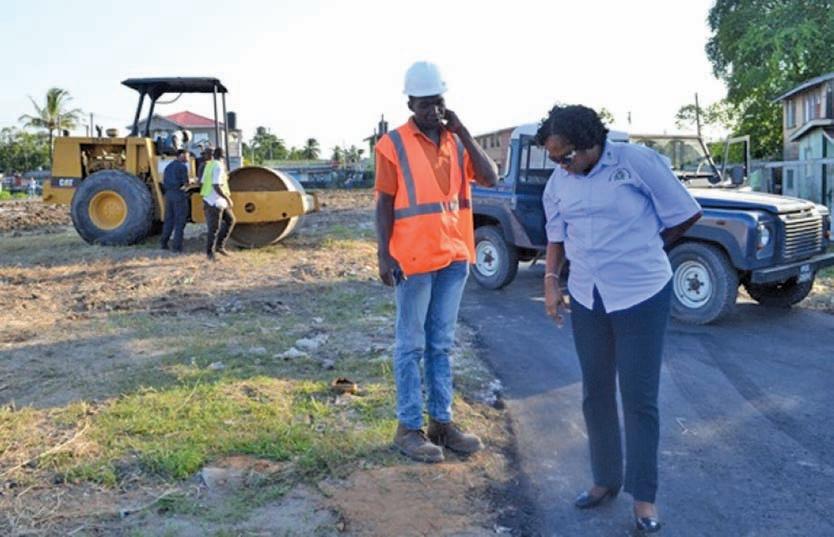
Minister within the Public Infrastructure Ministry, Annette Ferguson has inspected the roads under repair by the Ministry’s Force Account Unit, in West Ruimveldt, and instructed that all roads there be upgraded.
“I told the technical guys, that before coming out of the West Ruimveldt area, they are to do a thorough assessment…which roads are
left to be done, let us make one thing and complete all roads within the community,” Minister Ferguson is quoted as saying by the Government Information Agency (GINA). She added that while she was pleased with the feedback from the residents, she was as well satisfied with the quality of work the Ministry’s Force Account Unit has done.
Within the past two
weeks, approximately seven roads were completed, including Gilhuys Square, Shoppers Lane, Crescent Street, Industrial Site road, and Ice House road. The Minister, during the inspection, lauded Lawrence Mentis, Chief Engineer of the Force Account Unit and his team for a job well done, as the roads, prior to now, were impassable in some areas, while others were in a serious state of disrepair.
Food and Agriculture Organisation (FAO) of the United Nations is encouraging farmers with common problems to come together in an effort to eradicated poverty in the world.
This is according to FAO Country Representative to Guyana Reuben Hamilton Robertson. Speaking with this publication at Bath Settlement, West Coast Berbice, Region Five (Mahaica/Berbice) on Saturday during an agricultural exhibition, Robertson said through the FAO farmers can position themselves to seek technical assistance to be able to help themselves out of poverty.
He added that FAO sees poverty, malnutrition and food insecurity as major threats to humanity: “Therefore together with the Government, private sector, farmers and rural communities, we believe that a collective approach to addressing poverty, hunger and malnutrition can really help us eradicate this scourge within the next fifteen years.”
World Food Day was observed on Friday under the theme ‘Total Protection
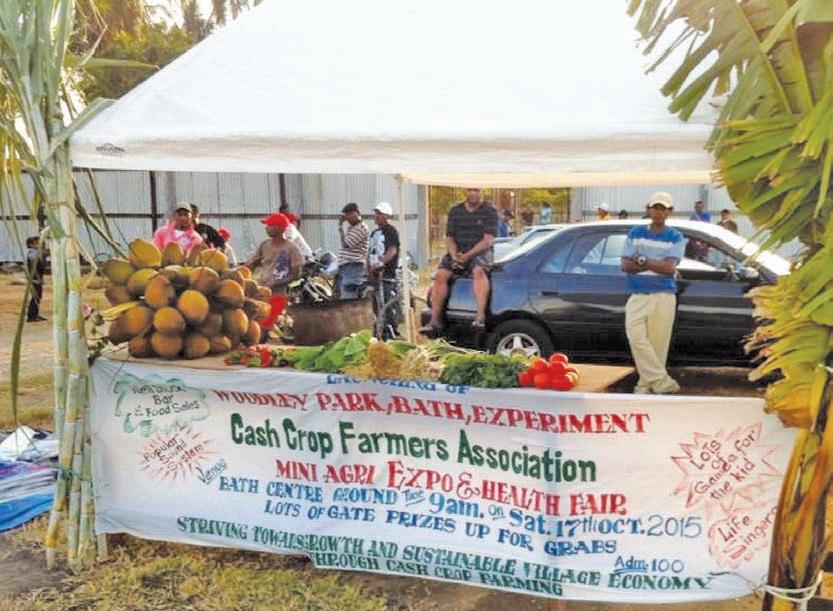
and Agriculture Breaking the Cycle of Rural Poverty’. Agriculture Month is currently being observed under the theme ‘Exploiting our Strengths; Advancing Agriculture and Social Protection’.
Robertson told Guyana Times the FAO is hoping that next year when there is a different theme for World Food Day, FAO will be able to work with all the local stakeholders in the
agriculture sectors.
The FAO Rep explained that while many farming groups have been formed, the vision of some of those groups resides with one or two of its members. He says once those persons get an opportunity to go to greener pastures, the core of the organisation disappears. This is so he says because there is no sustainability ,and advocates that ca-
pacity-building is vital in any such group.
October 16 was designated World Food Day by the UN to raise public awareness about hunger and poverty. This year’s World Food Day theme has outlined a very important role for the Social Protection Ministry to undertake in eradicating poverty and hunger by improving living standards.

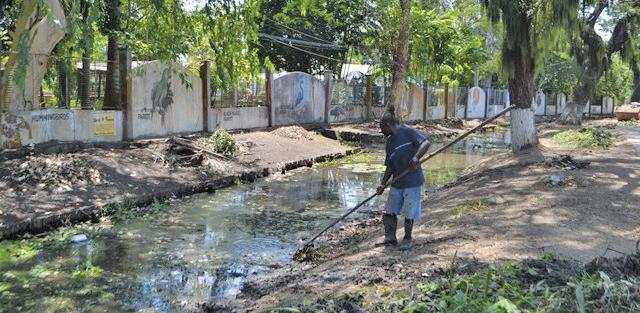
The Mayor and City Council is set to use the services of contractors, along with its regular drainage staff, to maintain its current effort of improving drainage in Georgetown.
The City Council commenced two projects: to restore, and clean the city.
The first involved the cleaning and de-silting of all the city’s canals, drains, and alleyways and weeding the parapets and verges.
According to the Government Information Agency (GINA), work has already commenced in the Agricola/McDoom/ Houston/ Meadowbank and Lacytown/ Bourda areas.
The second project relates to the Council’s effort to reclaim all its open spac-
es (playground and parks). Efforts in this regard have focused on cleaning these areas, thereby making them more accessible to children and young adults. So far the Merriman’s Mall has been cleaned, and the Council is seeking to make this area child-friendly through the addition of equipment, such as seesaws, slides and climbing frames. The East Ruimveldt and Roxanne Burnham playgrounds have also been cleaned.
The City Public Relations Officer Debra Lewis told GINA that because of the intensity of work being done, it was imperative the City use other services in this effort, to help to bring the drainage system to the place it ought
to be.
Lewis said the Council is cognisant the City must no longer be allowed to return to the state it was in just two months ago. To this end, she explained that Council’s effort will no longer be a “oneoff” venture as this time around the City has a maintenance programme for every single area.
She said this maintenance programme will entail revisits to the areas addressed soon after they have been completed. She also advised that like the initial clean-up exercise, maintenance effort will be carried out, using the services of contractors and the Council’s regular drainage staff.
Being homeless on the streets of downtown Kingston has to be one’s worst nightmare.
At the Kingston & St Andrew Corporation (KSAC) Council meeting, Mayor Angela Brown Burke proudly announced that an individual at the Marie Atkins Night Shelter, Kingston, had started classes at the Caribbean Maritime Institute (CMI) on October 5 towards earning a Bachelor of Science degree in Customs Processes, Freight Forwarding and Immigration.
The individual whom the Mayor made reference to told the Jamaica Observer of his struggles and how he left Savanna-la-Mar, Westmoreland, earlier this year to come to Kingston, after a woman whom he met on Facebook lured him to the city, then abruptly abandoned him when his small nest egg dwindled.
The road to the individual (who asked not to be named or photographed) being able to start part-time classes at CMI has not been easy.
“I left Cambridge High School (on the border of St James and Westmoreland) with a range three level pass in one CXC subject –Mathematics,” he recalled.
For a period he worked as a bartender at Couples Swept Away, Negril, but at the same time continued his studies through evening classes at Manning’s School and Grange Hill High School.
“I did some subjects two, two, and one, one,” he said, something which went on until he gained other CXC passes in English, Information Technology, Social Studies, Principles of Business, Human and Social Biology and Physical Education. He also attended the UWI Open Campus in Savanna-la-mar, where he gained a certificate in supervisory management. With the UWI certificate he was then able to switch jobs and work in a supervisory capacity at a small hotel in Negril.
“However, I had disagreements with the owner of the hotel and I eventually decided to resign before he fired me,” the former homeless man said.
After leaving the hotel job, he said that he “juggled” doing voluntary work as an assistant coach at a high school and at an infant and primary school in Westmoreland. Meanwhile, with no steady income, the relationship with his girlfriend and the mother of his daughter, now six years old, deteriorated.
Breakthrough
The breakthrough came one day while he was walking on the waterfront near the Digicel headquarters when he got the courage ‘to approach a mature lady,’ Ms Sonia “and tell her my story. She could have been my mother.”
Ms Sonia not only empathised, he said, but told

The D’Edward Village, West Coast Berbice branch of Republic Bank has joined in supporting young children when it presented a refrigerator to the Immaculate Heart of Mary Catholic Church Day Care Centre in Rosignol.
The donation is intended to help the Centre in satisfying its obligations to the children of the School.
The Centre headed by
Sister Jaqueline Isaacs, houses some 42 children between ages three months to 3 years. Isaacs is specialised in Child Care.
Manger of the bank Imran Saccoor says Republic Bank was delighted to be part of an initiative which would benefit young children. The investment in youth represents an investment for the future, he said.
The project will also
benefit the wider community since its main focus will be to cater for the needs of single-parents and allowing them to leave their children in a safe environment while they go about their business. Speaking a the presentation ceremony Saccoor welcomed the undertaking by the Centre and called on other organisations to support it.
Ahim that Father Richard Ho Lung had two shelters where he could probably find temporary accommodation. She accompanied him to the Father Ho Lung shelters at Hanover Street and at North Street, but discovered that only the disabled and people with severe illnesses were accommodated at those two shelters. However, it was a guard at one of the Father Ho Lung shelters who informed them of the nearby Marie Atkins Shelter.
Having found a place where he could temporarily stay, the man said that he immediately started to “look at my options”.
At the shelter he was encouraged to enrol in a course at the HEART Trust/NTA. It was at that time that he recalled that some time earlier, while in Westmoreland, he had applied to the CMI and had been accepted.
“The following day I went to the CMI, applied and was [again] accepted. But I had no money,” he said. With the assistance of the Inspector of Poor, Elaine Walker and Member of Parliament Ronald Thwaites, who is also Minister of Education, the man of the moment is in the process of trying to obtain a loan from the Students’ Loan Bureau to be able to continue his studies at CMI.
He also currently works three days per week as a security guard. (Jamaica Observer)
small plane crashed into a residential area of Bogota, shortly after taking off from the capital’s airport Sunday, setting a bakery on fire, killing five people and injuring seven, including two in critical condition, authorities said.
Civil aviation officials said the plane had taken off from Bogota’s El Dorado airport three minutes be-
fore it went down in the Engativa neighbourhood. It was headed to the town of Guaymaral, 20 kilometres (12½ miles) from Bogota.
The city’s Police Chief, Major General Humberto Gatibonza Carreno, said that the Pilot and his three passengers died.
One person was also killed in the bakery and seven others inside the business suffered burns, in-
cluding a 12-year-old girl, officials said. Two of those taken to hospitals were reported to be in critical condition.
It was the third crash of a small plane in Bogota in three months. Three persons were killed in August when an aircraft crashed in the Cajica area, and three more died in October when a plane smashed onto a highway. (Yahoo! News)
United States Secretary of State John Kerry on Sunday lobbied for the United States to be re-elected to UNESCO’s board, promising to work with Congress to restore funding after Washington cut off its contributions in 2011 in protest over the Palestinians being admitted as full members.
In a speech at UNESCO’s Paris headquarters, Kerry said the United States had led new initiatives and deepened its involvement with UNESCO, the United Nations’ cultural and educational arm.
“The United States is a proud candidate for reelection to UNESCO’s Executive Board, and I am very grateful for the opportunity to be here just to talk
with all of you ... but really to explain to you the depth of the commitment that the United States has to this body, as well as our high hopes for the future,” Kerry told UNESCO Ambassadors and officials.
“We so greatly value UNESCO as a platform for cooperation with you, our partners, in advancing so many of the goals that we share as nations,” he added.
The United States lost its voting rights to the UNESCO General Assembly in November 2013 under the agency’s rules after Washington failed to pay its dues, although it has remained on the Executive Board. It is currently US$300 million in arrears to UNESCO.
Before Congress pulled financial support four years
ago in response to a vote that gave Palestinians full membership, the United States provided about 22 per cent of UNESCO’s annual budget. Israel also lost its voting rights at the same time when it cut off funding.
Director General of UNESCO, Irina Bokova, said the agency’s work on education, especially among girls, as well as countering racism and fighting violent extremism were important to the United States. Referring to the United States’ late dues and funding freeze, she said: “We need the United States ... in every family, there are small problems. There is one small problem that we have to fix, maybe, with you, but I’m sure that with your commitment, we will do that.” (Reuters)















ARIES (March 21April 19)


TAURUS (April 20May 20)


(May 21June 20)


CANCER
Relationship woes will prey on your mind. Working on a favourite hobby or attending a cultural or sporting event will be a welcome diversion from what troubles you.
Minor health issues are best dealt with quickly. Someone will try to change your mind when it comes to a career choice. Stick with what you feel most passionate about.
Stick to your agenda. Trying to do too much at once will wear you down. A younger friend or family member will offer an alternative answer to a personal problem.







LEO (July 23Aug. 22)
VIRGO (Aug. 23Sept. 22)
LIBRA (Sept. 23Oct. 23)

SCORPIO (Oct. 24Nov. 22)


SAGITTARIUS (Nov. 23Dec. 21)


CAPRICORN (June 21July 22)


AQUARIUS
(Jan. 20Feb. 19) (Dec. 22Jan. 19)


PISCES
(Feb. 20March 20)

Financial gains look promising if you search for an outlet that supports your innovative ideas. You will learn plenty if you ask someone from the business world for marketing suggestions.
Procrastination won’t put you in a position to advance. You’ll be overlooked if you don’t speak up. Act quickly when the right opportunity presents itself, or you will have regrets.
Expect to face emotional challenges. Someone will try to appropriate your ideas or projects and take credit for them. Don’t trust the motives of anyone pressing you for information. Deception is apparent.
Delays in traffic or communications will test your patience. Make sure you have all your documents in order when dealing with Government agencies or institutions. Preparation will save you time and effort.
Follow your passion. Participating in a cause that concerns you will put you in touch with like-minded, compatible individuals who will lead to lasting connections.
Broken promises will cause discord. Be true to your word. Complete household responsibilities so you don’t end up in a dispute about who does what around the house. Everyone will want to share his or her story with you today. Avoid complainers and whiners if you expect to get any work done. Put your energy into solitary projects.
A change in direction is imminent. Group functions will spark your imagination and lead to innovative ideas. If you network, you will meet someone who will have an impact on your future.
Someone will ask you for advice. Use discretion. Keep your personal opinion out of the equation and stick to the facts if you intend to make suggestions.




Completion of a southern hemisphere sweep of the Rugby World Cup quarter-finals took some unexpected twists and turns before Australia edged Scotland in a dramatic finish at Twickenham on Sunday to line up a semi-final clash with Argentina.
The Pumas, seen as the least likely to reach the last four before the weekend, scored four tries in a convincing 43-20 victory over injurydepleted Ireland in Cardiff before the Scots threatened a big upset in London.
Scotland, who had beaten the Wallabies in two of their last three tests, led 16-15 at halftime and 34-32 going into
Scotland’s reply in a match that swayed one way then the other included three tries and 19 points from the trusted boot of their inspirational captain Greig Laidlaw.
A gutted Laidlaw, the tournament’s top scorer with 79 points, wondered why Joubert had not checked with the TMO on his penalty decision when the ball had appeared to come off a Wallaby jersey.
“They go to the TMO for everything else. It was such a big decision, why didn’t they go to the TMO for that?” asked Laidlaw.
Despite Scottish frustration, a World Rugby spokesman said the South African
their first two tries by centre Matias Moroni and wing Juan Imhoff always appearing to have one and sometimes two men extra in their attacks down the wings.
Ireland, deprived through injury of top players including flyhalf Johnny Sexton and captain Paul O’Connell, fought back to within three points early in the second half at 23-20 down after tries by Luke Fitzgerald, thanks in part to a yellow card for prop Ramiro Herrera, and Jordi Murphy.
But the last 15 minutes belonged to Argentina, with tries from fullback Joaquin Tuculet and a second for Imhoff, a sign of the pro-

the final minute in a downpour only to lose 35-34 after flyhalf Bernard Foley kicked a controversial penalty at the death.
Both semi-finals will be played at Twickenham next weekend with holders New Zealand taking on South Africa in the other after a Six Nations team failed to reach the last four for the first time.
Scotland had a second semi-final since 1991 within their grasp but South African referee Craig Joubert would not be swayed in his decision to give Australia the lastgasp penalty in a controversial offside decision at a lineout.
Before that, Australia had scored five tries, two by Drew Mitchell who took his World Cup tally to 14, one short of joint record holders Bryan Habana of South Africa and former All Black Jonah Lomu.
had been right and that such an incident did not fall under the protocols for involving the TMO.
Australian coach Michael Cheika said: “It’s a penalty and that’s the way it works. You’ve still got to kick it.”
That is what Foley, not at his place kicking best earlier in the match when he missed three conversions, did from the touchline.
Cheika also admitted to Australia having maybe played into Scottish hands by sticking to their favoured running rugby, saying: “We didn’t go to a kicking game, maybe that was a bit naive from me. Maybe we shouldn’t have opened it up for them.”
Pumas Power Argentina made a scintillating, almost error free start to their quarter-final at the Millennium Stadium and ran up a 17-0 lead with
gress in the last four years of Rugby Championship experience by a side who in the past failed to stay in the game for the full 80.
Imhoff, whose tries took his Argentine World Cup record to seven, said the Pumas defence had made the difference.
“Ireland played with a great intensity. We are a really good team in offence. But today we had a defence to make the difference,” he said.
That defensive effort included a fine contribution with 10 tackles by flyhalf Nicolas Sanchez, more noted for his distribution and kicking which yielded 23 points.
It was Argentina’s third win in four World Cup meetings with the Irish, a rivalry that has marked the Pumas’ progress since they reached their first quarter-final in 1999. (Reuters Sport)


South Africa defended 86 runs off the last ten overs to ensure Quinton de Kock’s first international century of 2015 and fourth in seven innings against India was not in vain. De Kock stood out after the rest of South Africa’s line-up was tied down by spin. India dragged them from 205 for 2 to 270 for 7, and then found themselves in a similar position but with less time to bat and more runs to get.
In the 44th over India were 206 for 3 and South Africa’s seamers had the hosts’ middle order firmly in their grip. Unlike India, who used flight to flummox, South Africa stuck to their shortball strategy and Morne Morkel reaped most of the success. He took two of the next three wickets, of Virat Kohli and Ajinkya Rahane, to reduce India to 216 for 6 and silence their challenge.
In energy-sapping heat, de Kock’s performance was made even more impressive as he ushered a new opening partner into some form, struggled through the Indian squeeze and cast aside cramps to anchor the South African effort. He had support from Faf du Plessis, whose third half-century in as many matches helped post the highest partnership of the match - 118 runs for the third wicket - to ensure that the late wickets did not stop South Africa from posting a competitive total.
India would have believed they could chase it down and were on track with Kohli and MS Dhoni at the crease but lost momentum as the innings wore on. A shuffling of the batting line-up, which saw Rahane come in at No. 6, meant that India ran out of batsmen when they needed them most.
South Africa’s ability to adapt has advanced to altering their own gameplans
which they did when they promoted David Miller to open the batting in a bid to assist him through his lean patch. The idea seemed to be to shield Miller from as much spin as possible but it also meant de Kock, who was only recalled to the side at the start of this series, had to operate as the senior partner.
He took charge immediately with the first shot of aggression off his blade; a free-flowing drive which became the hallmark of his innings. While India’s seamers adjusted their lengths, de Kock and Miller were able to find the boundary five times in the opening seven overs and forced Dhoni to play his trump card early.
Harbhajan Singh was brought on in the eighth over but the openers had settled well. De Kock brought up South Africa’s 50 with backto-back straight drives and Miller grew in confidence, es-
pecially with his footwork. But he fell for 33 as he sliced Harbhajan to backward point where Rahane took a tumbling catch.
Hashim Amla batted out of position at No. 3, struggled to find fluency and was stumped for the second match in a row. De Kock fought through a boundary drought which extended from the 14th over to the 21st and seemed to show even more patience than his senior partner, du Plessis. Again, the waiting game proved worthwhile for du Plessis, whose 50 came off 52 balls. Dhoni used a fourth spinner in Suresh Raina to try and tie South African down further but the visitors still seemed set for a total over 300, especially with de Kock at the crease. His century came when he charged against Mohit Sharma and smacked a slower ball through the covers to suggest the time had come for acceleration but then India intervened. Du Plessis tried to repeat a scoop shot that had gone over Dhoni’s head for four but skied it to a running short third man, de Kock was run-out trying to meet AB de Villiers’ demand for stealing a single and the captain was trapped lbw at the start of the 41st over. India took three wickets for five runs and South Africa had only one recognised pair left. Both JP Duminy and Farhaan Behardien have been in good form, but India’s spinners did not let them get too far away. (Cricinfo)
In a shake-up, Olympic leaders agreed Saturday that drug testing should be independent of sports organizations and urged the World Anti-Doping Agency to take over the responsibility on a global level.
In a separate decision, the IOC said competitions run by international federations or national Olympic bodies must allow entry to athletes from all member countries and give them equal treatment, or else the event will not be given Olympic qualifying status. The move addresses the issue of Israeli athletes being denied entry to some countries.
Doping topped the agenda of the “Olympic Summit” convened in Lausanne, Switzerland, by IOC president Thomas Bach. The meeting was attended by members of the
IOC’s rule-making executive board, and leaders of international federations and national Olympic committees.
The group “decided to make anti-doping testing independent from sports organizations,” the IOC said in a statement. “The summit requested WADA to study taking responsibility for testing as the global center of competence in anti-doping.”
The study will be carried out by a WADA working group that includes Olympic leaders and government representatives. No time frame was given.
The move is aimed at giving more credibility to drug testing by taking it out of the hands of sports bodies and event organizers and turning it over to an independent body.
Federations have been viewed as partial in drug
testing and less willing to uncover cheating in their own sport. Critics say the current system has an inherent conflict of interest.
Putting the testing in independent hands would introduce more legitimacy to the system, the Olympic leaders believe.
Sebastian Coe, the recently elected president of the International Association of Athletics Federations, has called for an independent body to handle drug testing in track and field. He was among those who attended Saturday’s summit.
WADA, which was set up in 1999 to oversee antidoping efforts around the world, does not carry out its own testing. It accredits labs around the world, which analyze samples. It wasn’t immediately clear whether the Montreal-based body --
headed by IOC vice president Craig Reedie of Britain -- would be willing to expand its role by taking over independent testing across the board.
Such a move would require a major change in funding. Money that federations and other bodies spend on testing would have to be transferred to WADA or any other independent body set up for the testing.
Under the proposal, while the testing itself would be handled independently, the disciplinary procedures and sanctioning would be done by the federations.
It also wasn’t clear how the new system would affect the testing program at the Olympic Games. Traditionally, the testing is run by the IOC and the local organizing committee. (ESPN)
Ever since the India tour pull-out, the talk of the Caribbean has been the obvious victimisation towards Trinidad & Tobago players Dwayne Bravo and Kieron Pollard who were left out of the World Cup squad and their recent non-selection in the One-Day squad for the Sri Lanka tour due to “outside influences” as Coach Phil Simmons termed it further solidified this belief.
Add the spurious reasons Denesh Ramdin was removed as Test Captain prematurely for Jason Holder and cricket fans of the twinisland republic have every reason to feel that non-cricketing reasons are behind the WICB’s and selectors’ treatment of the trio.
However, Guyana has many reasons to feel that its players have also got a raw deal namely Shivnarine Chanderpaul, Veerasammy Permaul, Leon Johnson and Rajendra Chandrika.
When Clyde Butts was Chairman of Selectors alongside Jamaican Robert Hayne, the common viewpoint among cricket analysts was that since they were not great cricketers –their ability to be competent selectors was compromised.
Sadly, though ever since the aforementioned India tour despite having Clive Lloyd and Courtney Walsh as new selectors whose cricketing background doesn’t need explaining – things have become equally bad.
Let us begin with Chanderpaul. Admittedly at the time I was in favour of Chanderpaul not being se-
lected for the Australia tour for two reasons: Firstly, his form in the series versus South Africa and England looked bad enough to suggest giving him a farewell two Tests against a very strong Australian pace attack would have been a bad idea.
Also, around the time, Coach Simmons had begun to have conversations with Windies IPL stars who under the previous selection panel were not always picked for the longer format, to clarify their availability for Tests.
We now know Simmons’ noble gesture and vision to want the best players playing for West Indies across all formats aren’t in sync with the selectors’ strange thinking. Therefore, if before the Australia tour it was clear players like Chris Gayle, Dwayne Bravo, Sunil Narine, Kieron Pollard and Andre Russell were not going to be available -- then giving Chanderpaul his farewell Tests was deserved.
This would have been more logical than picking Shane Dorwich who bats at number six as a wicketkeeper-batsman for Barbados, to bat at number four in a Test match against Australia. Madness.
Who knows? Maybe the Tiger could have defied his bad form and made runs and he could have been involved in the Sri Lanka series.
Leon Johnson also must wonder what he did wrong. On the South Africa tour, he averaged 33.60 – only Marlon Samuels and Kraigg Brathwaite were better.
Before that in one Test versus Bangladesh as a makeshift opener, he averaged 53. How he has not played a Test after that is foolishness.
This brings me to poor Chandrika.
West Indies have a big problem now finding a steady opening partner for Brathwaite, because Gayle has not played a Test match since last September due to persistent back problems. Currently, Shai Hope who impressed as a middle-order batsman last season is being wasted as an opener by the selectors.
Why was Chandrika who never scored a first-class century given a Test debut? Then why after making a double-duck on debut was he not playing in the first Test in Sri Lanka after Clive Lloyd and co chose to ridiculously retain him? This is one of the most crazy West Indies selectors panel in recent history and it’s unfortunate that Chandrika is being pushed into international cricket when he clearly is not good enough.
Finally Permaul: He was the leading wicket-taker in the 2014/15 domestic season and in the two Tests this year. His bowling was instrumental helping West Indies to beat England in Barbados, while he had a poor Test versus Australia in Jamaica.
With Sunil Narine stating he is not 100 per cent ready to play Test cricket yet with his remodelled action, Permaul clearly was the most deserving spinner to tour Sri Lanka as replace-



School Nationals should be moved from November
By TreisTon Joseph
While this may be an unpopular idea with organisers attached to the event, it should be an idea that they examine if the event is to evolve into a haven for future world stars.
For starters, November prolongs the season for sprinters and in more ways than one hampers their preparations for their upcoming season.

Have you ever wondered why Guyana has done so poorly at the Carifta Games when it comes to local sprinters while performing well in distance events?
This is so because of numerous reasons such as when the rest of the Caribbean and world sprinters are resting after their season concludes in September, Guyana’s junior sprinters are still preparing for “Nationals” after starting their season around the same time as their regional and International counterparts.
ment.
The situations highlight a major problem with Lloyd and the current selection panel. It is well known that the West Indies 4-day competition is crap, one season of the new Professional Cricket League won’t change that.
When picking West Indies teams, one can’t just judge domestic performances statistically only – we need selectors who can think outside the box and identify players who look like they have the required acumen for international cricket.
Not because spinners take a ridiculous amount of wickets every season means all of them are international standard. Bajan Jomel Warrican who was chosen ahead of Permaul is no different to Nikita Miller or Suliemann Benn – average left-arm spinners who don’t turn the ball. Lloyd also defended Warrican’s selection, so why then not play him in the first Test?
It’s illogical to tour Sri Lanka on spinner-friendly surfaces and play one spinner in a five-man attack.
Whether he realises or not, Lloyd is doing a great disservice to his countrymen as Chairman of Selectors and from a larger West Indies perspective, his tenure disconcertingly resembling that of former successful England Captain Ray Illingworth – who when he was an England selector in the 1990s failed miserably on the job.
Yours in Sport, Colin Benjamin
This basically means that the muscles of our locally based sprinters are left open to more wear and tear with less rest, recuperation and strengthening; hence higher risk of injury and substandard performances at meets such as Carifta.
Meanwhile, during the September to November period, our junior distance athletes are exposed to overwork with all of the numerous 10k events that are held around that period. “Nationals” at this point basically helps in their offseason preparation, because the training and muscle groups are different for sprinting than it is for distance running.
My recommendation would be to move the event to March and it is not for the sole purpose of trying to allow the sprinters a better opportunity at placing at regional meets such as Carifta, but also to allow the various stakeholders to benefit.
How so?
Well, once the Athletics Association of Guyana (AAG) and the Guyana Olympic Association (GOA) are involved and the event is moved to let’s say March month-end when the season is now kicking into gear, these Associations will have a wider scope to pick athletes, since “Nationals” allows for talent spotting in all 10 administrative regions of Guyana. With the event being in November, talent spotting is made difficult because of the passage of time from the time “Nationals” is held in November to when the season starts in March.
One of the counterpoints to moving the event from November to March is said to be the National Grade Six Assessment (NGSA) held normally in March or early April.
If that is the case, I would recommend breaking “Nationals” into two parts – a primary school championship where they compete in the November period and a secondary school event where it is held in March; that way both parties have time to prepare for their respective exams.
It will also give organisers and coaches a chance to really look at the very young and upcoming talent, since most times the Under-12s are lost in the big rivalries in the higher categories such as Under-16, 18 and 20.
More indigenous talent will also be spotted and possibly honed if the event is moved to March because there is less time to forget the athletes.
There is scope to improve this event in more ways than one, as being one-dimensional and turning a blind eye to how events play out along with the development of our athletes is not something we should continue to do.
What we as a nation need to do is to provide a matrix for our athletes, if we so want to capture that elusive Olympic gold medal.

monday, october 19,

227-6015

rentals Need a car to rent? Then call 611-


SHALOM


Da Silva’s Optical. For Your Eyes Only, Look Better See Better. Phillip A Da Silva OD, Shannon L Da Silva OD, Natalie Da Silva OD. 248 South Road, Bourda. Phone: 227-3529, Linden: 444-6376, Corriverton: 3393536, Meten-Meer-Zorg: 275-0322, Grand Cayman Islands: (345) 9431515 for the perfect trendy touch.

One newly built 2-bedroom house at Double J Supermarket Street, La Parfait Harmony, West Bank Demerara. Price: 11 Million. Contact Singh at 592-642-0402 for further details.
Mining Blocks with high potential for rent In The Puruni, Evergreen & Siparuni Area. For More Info Call: 615-8810 Or 6683100.
One 3 storey building in Plaisance Village Telephone: Attorney Bristol at 628-0668/231-7128 or 612-6417 (owner)
Properties for sale in West Minister Robb Street, Alberttown, New Annglet and Rental Call: 6609478/672-0865

House plans & estimates, weeding of grass and spraying done within 48hrs. Call: 216-0671; 622-0267; 692-8464

Available: Fresh long-stemmed roses, fresh dried and silk floral arrangements, gift items, bridal boutiques and wreaths. Nesha’s Flowerland. 78 Church Street (opposite St George’s Cathedral). Tel: 2273553/225-3315

Clean Garden earth. Also excavating, grading and leveling done. Call 6279977
For sale by lot: Lot (1): 2 bath tubs, bathroom fittings and fixtures & toilet set; shower fittings - $150,000 and Lot (2): 1 Dell desktop computer & HP scanner - $25,000. Call 225-2676 or 601-5285.




Three Storey 75ft’x 30ft’ bldg, open floors, 2 offices, 2 washrooms, driveway. 25B Princess St, Charlestown. Tel: 223-0654, 225-0605
Two Self-contained single bedroom furnished apartments for rental. Self-contained 7 bedroom bungalow idea for family/ guests/ students local or overseas long/ short term rental. Contact: 622-7097 / 624-7111
Two bedroom upstairs apartment.
$60,000 monthly with parking. Couples preferable. Tel 233-2607 / 644-7089
65 Fifth Street, Albertown: 6 Apartments, 2 Bedroom each (all self contained). 2 with front large verandah, 2 additional back step entrance. Simple clean up required. Gate required at entrance. No A/C. Interested person kindly contact Rosann Tel # 219-4535, between 08:am-04:30pm
198 Lamaha Gardens, 4 Bedroom (2 Self contained and semi-furnished with bed); Dining table with China cabinet in China room. Upstairs roof required work (Leaking), Fully Air conditioned. Interested person kindly contact Rosann Tel # 219-4535, between 08:am-04:30pm
31 First Street, Section L, Campbelville Georgetown, 3 Bedrooms (2 self contained). Simple clean up required, Lights at step required. Interested person kindly contact Rosann tel # 219-4535, between 08:am-04:30pm
The BCCI has decided to invite bids for two new IPL franchises to replace the suspended Chennai Super Kings and Rajasthan Royals in the next two seasons. The owners of Super Kings and Royals had been suspended
The IPL title sponsorship, meanwhile, was given to Vivo Mobiles, a Chinese phone manufacturer. PepsiCo, the previous sponsor, had ended its deal with the league two years ahead of schedule. It is understood that PepsiCo held
ing governance, and operational and financial processes - according to a statement explaining the project on the BCCI’s website.
This was the first meeting chaired by the new BCCI president Shashank Manohar.
The BCCI’s working committee took decisions on how to move ahead with administrative overhauls in addition to the big IPL decisions on Sunday (PTI photo)
Balwant Persaud & Associates. Certified Immigration Consultants, 68 Sixth Street, Alberttown, Georgetown (Between Cummings & Lights Sts) Tel: 225-1540, 622-8308, 655-3105. Email: balwantpersaud@yahoo.ca

Khemraj & Son -landscaping & plant nursery. Lot 77 Independence Street, La Grange, West Bank Demerara. Landscaping, planting grass, weeding, killing wood ants, killing roaches, rats & mealy bug, treat plants, coconut trees and flowers, cleaning ceiling, grafting coconut plants: 18 months bearing period, treating land, grass & spraying grass, grafted papaya plants: 6 months bearing, grafted cherry plant, sour sop & sapodilla, cutting big trees & removing, treated mould for sale & flower plants for sale. Tel 627-5969/ 603-1134.
License Custom Broker/Tax Consultant, assistance with Tax Compliance Certificate, Customs Documentation, and Tax Returns etc Call: 660-9478
K. LAKERAM - BUILDING CONTRACTOR, HOUSE PLAN, ESTIMATES, WEEDING & SPRAYING GRASS DONE WITHIN 48HRS. CARPENTRY, MASON, TILING, PAINTING, PLUMBING. PROMPT & AFFORDABLE GENERAL HOME MAINTENANCE. FREE ESTIMATES. TEL: 216-0671/622-0267/6928464. EMAIL: klakeram.construction@gmail.com

Surinamese spiritualist. Resolving all problems. Money, love, blockage etc. Call 223-6834/600-7719
Suriname’s Astrology, Palmist and Hindustani Spiritual Healer, solve all purpose problems, 100% confidential guaranteed. Phone: 6028997 FOR PERSON WITH STROKE AND PHYSICAL DISABILITIES WE HAVE HERBAL BATHS AND SPIRITUAL MASSAGE MEDICINE. CALL: 2200708/687-5653/612-6417
HEPHZIBAH MINISTRIES 24 hrs Prayer Line 322-5081,3374510,337-4259,337-4583,3373070,337-5103. For healing, deliverance, financial difficulties, marriage issues call now. Jesus Cares.
Dutch spiritual healing in removing evil spirits, bad luck, evil sickness, spells, reuniting lovers and prosperity to business Call 6126417, 687-5653, 220-0708
693 Section A Diamond , EBD Upstairs, 2 Bedrooms (both self contained). Required extensive work outside (weed, paint, etc). Gate key to be requested by Wayne. Fully Air Conditioned. May require new door. Interested person kindly contact Rosann tel # 219-4535, between 08:am-04:30pm

GR Taxi, 24 hours. Phone: 2257878, 219-5000 or 227-2100
Sunshine Cabs, 24hours. Phone: 227-1720, 227-1721, 660-6102

JUST ARRIVED: TOP QUALITY RECONDITIONED VEHICLES; TOYOTA NOAH; TOYOTA VOXY; TOYOTA IST (NEW SHAPE); SUZUKI SWIFT; DAIHATSU MOVE (660CC); MERCEDES BENZ C200 KOMPRESSOR; COROLLA AE100 WAGON; TOYOTA HIACE MINIBUS RZ; PITBULL-STYLE FREEZER VAN; LAND CRUISER (FULLY LOADED); MAZDA PROCEED 4WD EXTRACAB PICK-UP; TOYOTA HILUX 4WD EXTRA CAB PICKUPS - 3RZ, 5L, 3L SOLID DEFFERNTIAL; MITSUBISHI CANTER TRUCKS 4 TONS FREEZER; 3 TONS OPEN TRAY; 2 TONS 4WD; NISSAN ATLAS 2 TONS OPEN TRAY TRUCK. PRE-ORDER YOUR UNITS EARLY AND GET THE BEST PRICES. FULL AFTER SALES SERVICES AND FINANCING AVAILABLE. DEO MARAJ AUTO SALES, 2 CHIMNEY ROAD, CHATEAU MARGOT, ECD. 624-0762, 220-5177. A NAME AND SERVICE YOU CAN TRUST

or 660-6102 Help Wanted: To clean & cook (general house keeping) lady; ages 25 to 35; fit and able to work from 6 AM to 2 PM. House is located at Herstelling E.B.D Please Call: 2318529 or 231-8344 PART TIME SECURITY GUARDS WITH KNOWLEDGE IN HANDLING WEAPONS, FLEXIBLE HOURS AND ABLE TO OBTAIN POLICE CLEARANCE PAPER IF REQUIRED. REFERENCES FROM THE LAST JOBS A MUST. PLEASE CALL : 231-8529 OR 2318344
for two seasons by the Lodha panel, which had looked into corruption in the IPL.
The board’s decision to invite bids for the next two years only, while Super Kings and Royals remain suspended, means that it is not looking to increase the number of franchises from eight. IPL chairman Rajiv Shukla said as much when asked if the IPL will become a ten-team tournament in two years’ time, though he did not commit to it. “No, [it will be] just eight teams. That’s why the tenders will be given for only two years,” Shukla said. “Whichever bidder is interested in buying a team for two years will get it. Then we’ll see what to do, whether we should make it a 10-team tournament or what... [For now] the two bids will be invited for two years only for the two vacant slots.”
the right to transfer its fiveyear agreement, so the beverage giant brought in Vivo. The terms of the agreement remain the same, so the BCCI will earn Rs 78.2 crore (US$12 million approx) for each of the next two IPL editions from the new title sponsors.
Among other decisions taken at Sunday’s working committee meeting in Mumbai, the BCCI also decided to hold its Annual General Meeting on November 9, and extend Nike’s deal as apparel sponsors of the Indian team. It also decided to appoint PricewaterhouseCoopers to look into how the funds distributed by the board to its member state associations were being utilised. Auditing giant M/S Deloitte was hired for “Project Transformation”, the board’s initiative aimed at improv-
The working committee also rubber-stamped the board’s decision to move the treasury office from Chennai to Mumbai, and hire M/S Gokhale & Sathe, a Mumbai-based firm, as internal auditor. The board’s statement following the meeting said it had also decided to “look at the lands offered” by the Karnataka Industrial Areas Development Board for the further development of the National Cricket Academy, which is currently hosted within the Chinnaswamy Stadium premises in Bangalore. National Cricket Academy chairman MP Pandove, IPL chairman Shukla, BCCI treasurer Anirudh Chaudhry and BCCI joint-secretary Amitabh Choudhary will inspect the lands, and take a decision on the same “within one month”. (Cricinfo)
Boxer Prichard Colon was fighting for his life on Sunday after sustaining an illegal blow to the head during a bout in a Washington, D.C. suburb, the fight’s promoter said. The super welterweight from Puerto Rico was injured during his 10-round fight with Terrel Williams in Fairfax, Virginia, on Saturday, promoter Lou DiBella said in a statement. Colon, 23, showed symptoms of head trauma in his dressing room following his bout and was rushed to the hospital where he underwent surgery to relieve pressure on his brain, DiBella said.

Colon remained in critical condition on Sunday, according to DiBella. An online video of the fight showed Williams, a 31-year-old fighter from Los Angeles, punching Colon in the back of the head in the seventh round, a shot that appeared to stun Colon, who was briefly examined in his corner. Williams was penalized for the illegal punch. Colon was then knocked down twice in the ninth round. He was disqualified after the ninth round his corner mistakenly took off his gloves, thinking it was the final round and that the fight was complete. (Reuters Sport)

By TreisTon Joseph
Slingerz FC pulled off a tough 1-nil win over Fruta Conquerors on Saturday evening when action in the Stag Elite League continued at the Number Five Ground in Berbice.
Both sides came out looking a bit tentative as they searched for their rhythm as well as cracks in the defence of their opponents.
While both teams had a few opportunities at goal, the first half played out to a dull nil-all ending.
On resumption, the experience of the Slingerz side showed as their ball movement seemed more fluent.
Their increased level of

play resulted in a goal from Tichard Joseph in the 58th minute that would turn out to be the winning goal of the match.
Meanwhile, host side Monedderlust played to a 1-1 draw with Alpha United which stalled the latter’s movement to the top of the League standings.
Alpha United were hot out of the gates, scoring the game’s first goal within six minutes of the opening whistle via a solid strike from Delon Lanferman.
Seon Jackman would provide the equaliser in the 35th minute which eventually became the final goal in the game.
West Indies skipper
Jason Holder believes poor field was a major factor in an embarrassing first Test loss to Sri Lanka at Galle on Saturday.
A belligerent knock of 92 from Jermaine Blackwood was not enough to prevent the regional team from going down to an innings and sixrun defeat to Sri Lanka in-
By Akeem Greene
Time after time, the West Indies batsmen have failed to apply themselves and adapt to conditions that they are presented with.
The latest failure came at the hands of Sri Lanka which saw a defeat by an innings and six runs. It can be described as a horrendous batting display on a flat wicket; the batsmen yet again failed to carry on after getting starts.
The last time West Indies scored a total over 400 was in September of 2014 against Bangladesh in St Vincent when opener Kraigg Braithwaite made 212. He spent over nine hours at the crease; his double century was lauded for the application and grittiness the young man showed.
Such a showing should have given the entire dressing room confidence that they can perform.
The Caribbean side’s last overseas appointment saw the South Africans scoring in all three test matches with scores of over 400, in the first test; South Africa made 552/5 declared and in response West Indies produced scores of 201 and 131 and lost by an innings and 220 runs.
Such a performance shares resemblance to the one in Sri Lanka of late.
It is now a question as to why the regional batsmen are not making big scores consistently.
It would be remiss of fans to expect a batsman to score a hundred every time he walks unto the cricket field, however you expect that batsman to showcase some amount of fight and pride.
Darren Bravo after putting all the work and reaching to fifty, tried to force a ball that should have been played through the offside into the onside and was brilliantly caught.
The Windies first innings only lasted a total of 82 overs as opposed to Sri Lanka’s 152 overs. Several of the Windies batsmen got starts but none of them carried on. Their second innings saw a more attritional display as they lasted a mere 68 overs and were bowled out inside of day four. The shining light was certainly Jermaine Blackwood who looked totally in control and set to reach his second test ton but got out on 92 looking to accelerate as he was left to bat with the number

stalled captain Jason Holder said “"We created chances with the ball, but we just didn't take them when we came.”If we had, their first innings total would have looked a lot different. If we had new batsmen in at crucial stages when our fast bowlers were fresh, we would have had a chance to have a good burst at them”.
The last time West Indies played a Test in Sri Lanka, they had the experience of Shivnarine Chanderpaul and Chris Gayle to bank on. That Test, however, saw only 103.3 overs with two full days being washed out. While the rain threat still looms, West Indies lack experience and Jason Holder, their second-youngest Test captain, will be challenged to rally a raw side that has been hit by off-field troubles as well.
A stern look should be taken in to the selection policy of the team as they went into to the game with 5 bowlers, 4 of which were seamers, on wicket that was conducive to the slower bowlers. In these conditions, what is the point of having a batsman/all-rounder at number 8? If you can't get a good score with 7 batsmen, an extra batsman won't do much. Good that they've chosen 5 bowlers, although I do believe that they should have included a spinner in place of Gabriel, making it 3 seamers and 2 spinners.
“If we had, their first innings total would have looked a lot different. If we had new batsmen in at crucial stages when our fast bowlers were fresh, we would have had a chance to have a good burst at them.”
Apart from Blackwood

Jason Holder
side four days.
West Indies, who were asked to bat a second time, were bowled out for 227 in their second innings, with several front-line batsmen failing to capitalise on starts.
Rangana Herath, the left arm spinner, returned to haunt the Caribbean side with a four wicket haul to finish the match with his fifth ten-wicket haul in Tests.
Despite obviously failing at the crease Holder believes the team also let themselves down in the field.
the only other West Indian batsman to score a half century in the match was Darren Bravo with an even 50 in the first innings.
“We only scored 250-odd in the first innings, and it set us back. We were pretty much behind the game from there. It was a track you could score runs on once you applied yourselves. Not much in it for the bowlers. Even Rangana Herath – I thought with the harder ball, he was more effective.”
(Digicel Sportsmax)
“We created chances with the ball, but we just didn’t take them when they came,” Holder said.
Senior batsmen such as Marlon Samuels need to lead from the front more often than not. In the first innings Samuels in attempting to pull a short ball from Herath and was bowled off his thighs. The score was 70-2 at that time. In the second innings first ball he was Leg before, in what can be considered a “nothing shot”.
11. Blackwood a usually aggressive batsman, learn to temper his aggressive stroke play and as he looked to help the Windies make Sri Lanka bat again. Blackwood’s knock should be modeled by the rest of his team mates if they wish to be successful at this level.
Not only their batting was a major let down but so was their fielding as far too many catches were drop. Speaking at the post match interview new in-
With not the world’s most potent bowling line outfit, the batsmen need to score big runs, as 50s and 30s would not be enough on most occasions in test cricket o carry your team to victory. The whole concept of test cricket speaks for itself as it is indeed a “test” in its true sense. It requires batsmen to bat 3-4 sessions to give their teams a formidable score. In a developing team such as the Windies, they cannot afford to have one department failing miserable, it will conceited team effort where by collectively, the bowling, batting and fielding all firing together to produce positive results. (akeemg@guyantimesgy.com)
Georginio Wijnaldum scored four goals as Newcastle trounced Norwich for their first Premier League win of the season to move off the bottom of the table.
Wijnaldum struck a composed first, two headers and a superb long-range fourth.
Spaniard Ayoze Perez stroked in the third for Newcastle and Aleksandar Mitrovic lashed in the fourth.
For Norwich, striker Dieumerci Mbokani had poked in an equaliser to make it 1-1, and Nathan Redmond volleyed for 3-2 before the home side pulled away.
An electrifying contest saw five goals scored in the space of 20 first-half minutes, although neither defence covered itself in glory.
Mbokani managed to score from inside the sixyard box despite the close attentions of Chancel Mbemba and Fabricio Coloccini, while Wijnaldum was allowed two free headers and Redmond was also
unmarked for his brilliant strike.
Norwich could have had two more themselves but Robbie Brady and Redmond both hit the post.
The priceless result
of goal against Norwich, scoring from all of their six shots on target.
Despite the winless start, before the game McClaren insisted his team were making progress, and

gives Steve McClaren a first league win since taking over at St James’ Park and eases the pressure on the former England manager, although Newcastle remain in the bottom three.
The Magpies capitulated in the second half against Manchester City last time out, losing 6-1, but recovered by showing brilliant composure in front
three points coupled with a stunning attacking display will vindicate that view.
Defensively, though, he will still have concerns. The Magpies have now conceded 19 goals in nine games, second only to Norwich (20) and the same as bottom side Sunderland.
What went right for Newcastle?
McClaren can take
positives from the excellent link-up play shown by Moussa Sissoko and Wijnaldum, who combined for two of their goals. Sissoko, in particular, was a threat to Norwich all game and claimed three assists.
Netherlands international Wijnaldum was brought in during the summer for £14.5m from PSV Eindhoven, becoming the club’s third most expensive signing after Michael Owen and Alan Shearer.
Although he hasn’t produced his best so far this season, Wijnaldum showed his class in this match with a rare quadruple, becoming only the second player - after Shearer - to score that many in a single Premier League game for the club. They included a cool first goal and two well-directed headers, but his fourth was the pick of the lot. He collected the ball around 40 yards out before gliding forward and arrowing an effort past John Ruddy, albeit via a deflection. (BBC Sport)


The Guyanese duo of Kelvin Johnson and Lionel D’Andrade finished first and second respectively in the Palo Seco Credit Union 6K
Road Race on Sunday in Trinidad.
Johnson stopped the clock at 19:12s to claim the winning prize, while D’Andrade finished a close second in a time of 19:24s. Trinidadian Colin Pereira was third with a time of 19:39s.
D’Andrade, after the finish, noted that he was pleased with his race, “I felt good this morning. I was focusing on speed training more than putting in the mileage and my time today is an improvement from last year, where I clocked 20:21 in this same event.
Also, last weekend, I also placed fifth in the Air Bon Sonics 5K. So that’s a definite improvement,” D’Andrade stated.
Meanwhile, D’Andrade will be in action on October 25 and will use the event as a measuring stick in his progress since returning from a brief rest period.
“I am tapering down now in preparation for the 12th Edition of the UWI Spec Half Marathon scheduled for next Sunday,” he noted.
Guyana will battle Puerto Rico on November 18 in the final round of the Caribbean Football Union (CFU) Women’s Olympic Qualifier at the Ato Boldon Stadium in Trinidad and Tobago.
According to a press release, the CFU wrote the Guyana Football Federation (GFF), indicating that they
Puerto Rico qualified for the four team playoff by coming out on top of their respective groups.
The Lady Jags, as they are often called, are expected to arrive in Trinidad and Tobago on November 16; a win for Guyana will reward the Lady Jags with a date in the finals on November 20.
In the final round, the four
within the top three, they will face the likes of USA, Canada, Mexico and two representatives from the Central American region.
The Lady Jags clinched their berth into the final round by conquering Group Four that comprised Cuba and St Kitts and Nevis, while Puerto Rico played undefeated against Haiti, Grenada

The
were having major challenges in securing a host for the Women’s Olympic qualifiers.
Nevertheless, the Trinidad and Tobago Football Federation has now agreed to host the Women’s Qualifiers Final Round.
Guyana, Jamaica and
Stadium earlier this year
teams will play a single elimination tournament, while the two finalists and the third-place finisher will qualify for the 2016 CONCACAF Women’s Olympic Qualifying Championship as CFU representatives.
If the Lady Jags finish
By TreisTon Joseph
The Guyana Defence Force (GDF) rugby squad held off the University of Guyana (UG) Wolves 17-14 to win the Banks DIH Sevens rugby tournament on Sunday at the UG’s rugby field.
With UG being the defending champions of the Banks DIH sevens, the GDF men celebrated the spoils of war behind an MVP performance by Avery Corbin.
Corbin scored two tries in the final for GDF for a total of six in the tournament.
Dwayne Schroeder scored
squad Patrick King, who is also a national quarter-miler, highlighted the importance of the victory.
“It was a great victory knowing that we lost last week… this was a big victory for us, because this is a bigger tournament than the one last week. We went
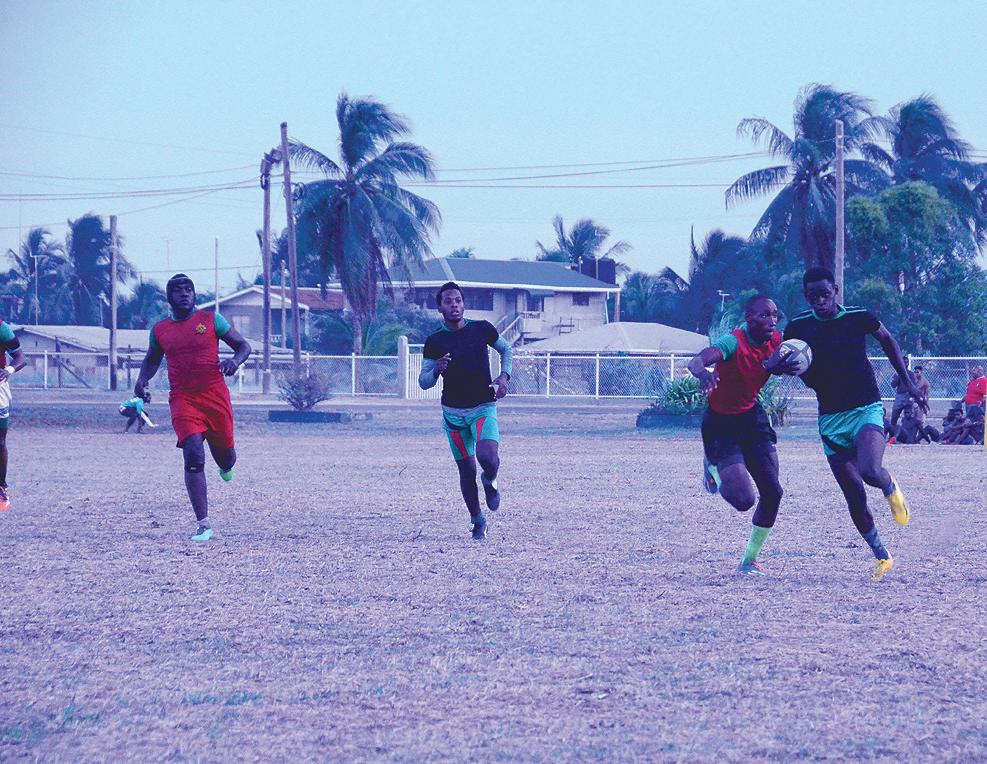
It was a reversal of fortunes as well as sweet revenge for the GDF men after they were unseated as champions last Sunday in the Guyana Rugby Football Union (GRFU) sevens tournament.
the lone conversion for the GDF squad in the final.
A Lance Adonis try and two conversions along with an Owen Adonis try was not enough to fend off the attack of the military men.
Captain of the GDF
back to the drawing board and everyone wanted it. It was sweet revenge,” King noted.
Rugby action continues next week with the hosting of a School’s Tournament.
and Aruba in Group One.
Jamaica dominated Group Three which included the Dominican Republic and Dominica. Group Two winners have not yet been decided, since the group is yet to be played.