Building Green
AIMS k describe what green building is k discuss aspects of green building k share information on certification systems
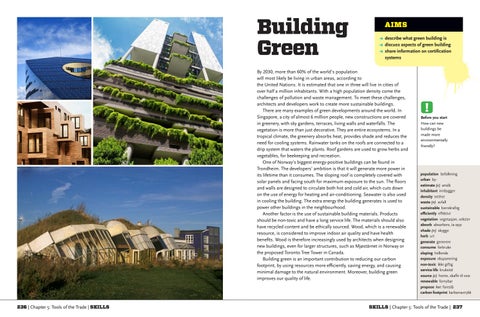
By 2030, more than 60% of the world’s population will most likely be living in urban areas, according to the United Nations. It is estimated that one in three will live in cities of over half a million inhabitants. With a high population density come the challenges of pollution and waste management. To meet these challenges, architects and developers work to create more sustainable buildings. There are many examples of green developments around the world. In Singapore, a city of almost 6 million people, new constructions are covered in greenery, with sky gardens, terraces, living walls and waterfalls. The vegetation is more than just decorative. They are entire ecosystems. In a tropical climate, the greenery absorbs heat, provides shade and reduces the need for cooling systems. Rainwater tanks on the roofs are connected to a drip system that waters the plants. Roof gardens are used to grow herbs and vegetables, for beekeeping and recreation. One of Norway’s biggest energy-positive buildings can be found in Trondheim. The developers’ ambition is that it will generate more power in its lifetime than it consumes. The sloping roof is completely covered with solar panels and facing south for maximum exposure to the sun. The floors and walls are designed to circulate both hot and cold air, which cuts down on the use of energy for heating and air-conditioning. Seawater is also used in cooling the building. The extra energy the building generates is used to power other buildings in the neighbourhood. Another factor is the use of sustainable building materials. Products should be non-toxic and have a long service life. The materials should also have recycled content and be ethically sourced. Wood, which is a renewable resource, is considered to improve indoor air quality and have health benefits. Wood is therefore increasingly used by architects when designing new buildings, even for larger structures, such as Mjøstårnet in Norway or the proposed Toronto Tree Tower in Canada. Building green is an important contribution to reducing our carbon footprint, by using resources more efficiently, saving energy, and causing minimal damage to the natural environment. Moreover, building green improves our quality of life.
236 | Chapter 5: Tools of the Trade | SKILLS
!
Before you start How can new buildings be made more environmentally friendly?
population befolkning urban byestimate (v) anslå inhabitant innbygger density tetthet waste (n) avfall sustainable bærekraftig efficiently effektivt vegetation vegetasjon, vekster absorb absorbere, ta opp shade (n) skygge herb urt generate generere consume forbruke sloping hellende exposure eksponering non-toxic ikke giftig service life brukstid source (v) hente, skaffe til veie renewable fornybar propose her: foreslå carbon footprint karbonavtrykk
SKILLS | Chapter 5: Tools of the Trade | 237
Read and understand
5.67 • Decide whether the sentences are true or false. Correct the false ones. True False a b c d e f g h
By 2030, less than 60% of the world’s population will most likely be living in urban areas. With a high population density come the challenges of pollution and waste management. The vegetation is just decorative. In a tropical climate, the greenery absorbs heat, provides shade and reduces the need for cooling systems. One of Norway’s biggest energy-negative buildings can be found in Tromsø. The flat roof is completely covered with solar panels and facing north for minimum exposure to the sun. Wood, which is a renewable resource, is considered to improve indoor air quality and have health benefits. Building green is an important contribution to increasing our carbon footprint.
5.68 •• Complete the following tasks. a Mention three facts from the text that you find interesting. b Scan the second paragraph of the text. Find three reasons greenery is used in new constructions. c Skim read the third paragraph. How does this building generate and save energy? d Close read the third paragraph. Is wood a sustainable building material? Explain why/why not. 6.69 ••• Answer the questions in your own words. a What does population density have to do with building green? b Give three examples of constructions mentioned in the text and how they are green. c How can greener building projects contribute to reducing our carbon footprints?
Speak
5.70 Discuss the following questions in small groups. Agree on a list of arguments. a Why should the building and construction industry care about the environment? b How can smart technology reduce the carbon footprint of a house? c Why has building tiny houses become a trend? d What are the benefits of traditional turf-covered roofs? 238 | Chapter 5: Tools of the Trade | SKILLS
Listen
5.71 • “The Rubbish House” Listen to the text once, then answer the following questions. a Where was the house built? b What is unusual about the house? c Who started the project? d Who were involved in building the house? e What kinds of materials were used to build the house? Solar Thermal f What usually happens to waste material? g Why did they build Grey Water the house? Recycling System h How is the house used after completion?
Solar PV System
Dual Flush Toilet
Energy Efficient Heating and Cooling System
Energy Efficient Lighting
High Efficiency Water Heating System
Hot Water Resirculation
Write
Energy Star Appliances
5.72 • Study the drawing. Use the keywords to explain how you can make an ordinary house more energy efficient. Write one full sentence for each keyword. 5.73 ••• Translate the following paragraph into English. Look up words and expressions you do not know and pay attention to sentence structure. “Nye byggeprosjekter må følge strenge krav for å bli miljøsertifisert. Prosjektets påvirkning på miljøet blir evaluert i flere kategorier. Noen eksempler er hvordan arealet utnyttes, materialer og ressursbruk, avfallshåndtering, energiforbruk og utslipp, og inneklima med ventilasjon og belysning. Hvordan nærmiljøet påvirkes er også viktig. For å bli sertifisert må bygget oppfylle et minimum av kravene.”
Explore
5.74 BREEAM and LEED are two leading green building certification systems. The first is common in Europe, and the second is developed for the American building and construction industry. Use reliable sources to find out more about one or both. Share information in class.
How did you do? After working with the text and tasks, I can describe what green building is YES
ALMOST
NO
discuss aspects of green building YES
ALMOST
NO
share information about certification systems YES
ALMOST
NO
SKILLS | Chapter 5: Tools of the Trade | 239