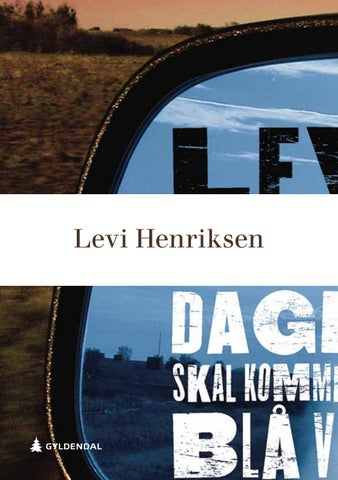
Levi Henriksen
1
“ 2
“Not since Nick Hornby’s High Fidelity has there been a book capable of utilizing music like this”. Il Mattino, Italy on Harp Song
”Another irresistible Skogli novel from Levi Henriksen ... the Messi/Maradona of storytelling, he can create a drama in the most unexpected places ”
3
Bergens Tidende on Riding the blue wind
CONTENTS
”Permanent goosebumps ... an absolutely wonderful novel”
Levi Henriksen – the author 5 Here Among The Living 6 Harp Song 8 Riding The Blue Wind 10
Hamar Arbeiderblad on Harp Song
”Here are dark forests, darker secrets, beautiful descriptions of nature and close, intimate character
Sample translation 12
portraits. Everything is the way it should be in Skogli. Tara on Riding the blue wind
photo: tine poppe
Levi has succeeded again”
East of the Rain 24 Snow Will Fall on Fallen Snow 26 Down, Down, Down 28 Bibliography 30
LEVI HENRIKSEN
(1964–)
Award-winning author of short stories and novels, with a wide and loyal readership. When his first short story collection Fever was published in 2002, Henriksen immediately captured the public’s imagination with his unique and charismatic voice. This was followed in 2003 by Down, Down, Down, a further selection of short stories. His break-through came in 2004 with his novel Snow Will Fall on Fallen Snow. This soon became a best seller and was awarded The Booksellers’ Prize as well as being selected for recommendation by one of Norway’s major book clubs, BNB. Henriksen’s trademark is a capacity for combining a strong, at times aggressive, masculine voice with vulnerability. His works are mainly set in a tough, unsentimental, rural environment, which sits uncomfortably on the edges of contemporary urban life; a place where old and new values clash, and where men struggle with contemporary, urban demands on their masculinity. Henriksen was a journalist for many years on a local newspaper in Kongsvinger, a small town which appears in much of his work, before becoming a full-time author. He also plays the guitar in his own band, writing song lyrics and composing. In 2010, the prize-winning director, Bent Hamer, released a feature film, Home for Christmas, based on Nothing but Soft Presents for Christmas to critical acclaim and full houses.
4
photo: rolf m. aagaard
PRIZES 2004 The Booksellers’ Prize for Snow Will Fall on Fallen Snow
5
Here Among the Living Levi Henriksen at his best. A strong father’s portrait with obvious references to own life.
6
Hermann Henriksen built a house with his own hands. Now someone has bought it, and it is about to be demolished. Hermann, who has worked in the forest all his adult life, the man who could jump further than everyone else on skis. And who, as a kid, planned to kill his step-father. Who was he, when it came to it? In Here among the living Levi Henriksen weaves his own father’s story into a novel about borrowed jumping skis, stolen fishing rods and healing hands, about following one’s own path and finding the way home. This has resulted in a book that touches on what is deepest within, and tells us something fundamental about what being alive means. With the story of his father’s life as the background for his latest novel, Levi Henriksen comes up with his most personal account ever. PRESS QUOTES “Levi Henriksen touches you deep down in your soul. The book has the effect of a gentle, but heartbreaking blues number.” Øyvind Risvik, visitdrammen.no «Levi Henriksen is a marvellous storyteller.»
Aftenposten
«Here Among the Living has a language that sparkles. Henriksen’s writing is straightforward, but melodic, and reminds about Per Petterson. Here Among the Living is a great novel because it has found an almost perfect form for asking scrutinizing questions, such as what lies in us that is good or bad. Where does the light come from, and how much darkness can a human bear before the light has gone out.» Vårt Land
7
Harp Song Quirky and bitter-sweet, Harp Song is Levi Henriksen’s warmest – and funniest – novel yet.
8
A humorous, warm and highly entertaining story of music and God, of friendship, betrayal and lost love. Suffering from a severe hangover, record producer Jim Gystad visits Vinger Church and hears divine singing. The voices from the pew behind Jim practically lift him into eternity and away from the dreary, soulless blues he ordinarily spends his working hours trying to breathe life into. And for the first time in ages, his life doesn’t feel completely meaningless. The voices he has heard belong to The Singing Thorsen Siblings. From now on Jim’s life only revolves around one thing: a firm decision to make the Thorson Siblings return to singing. He is about to be severely tasked. PRESS QUOTES “Not since Nick Hornby’s High Fidelity has there been a book capable of utilizing music like this”.
Il Mattino, Italy
”Permanent goosebumps ... an absolutely wonderful novel”
Hamar Arbeiderblad
”The beginning of this book is the most captivating piece I’ve read by Levi Henriksen since his first short story collections. He mythologizes the seediest parts of the Kongsvinger area, making them as mysteriously alluring as his dirty realist American heroes has done with their own places of origin ... Harp song is a story of identity and unites environments Henriksen knows well ... he writes well about all of them”
Adresseavisen
9
Riding the Blue Wind How much wrong are you willing to do in order to finally do something right? Mikael Hildonen has tried without success. He sits at his oil cloth- covered kitchen table, sipping coffee and studying the clouds over Austberget. Mikael knows only one thing for a fact: Ine is dead, and he will never get her back. And the same goes for the child she was carrying. And then life’s wheel starts to grind: Mikael is forced to take care of thirteen year old Daniela, his brother’s unwanted daughter. But first he has to shake off a few debt collectors riding heavy motorbikes. They want all the money he doesn’t have … and they know where Daniela lives. 10
11 PRESS QUOTES ”Another irresistible Skogli novel from Levi Henriksen ... the Messi/Maradona of storytelling, he can create a drama in the most unexpected places ”
Bergens Tidende
”He makes you think - about your own attitudes and your own life. This gives the book an extra dimension, in addition to the fact that it is fabulously well written”
Sandefjords Blad
”Drama, tensions and suspense in a well-composed novel ... The story has thrust and drama, and has a plethora of inventive images ... Henriksen has delivered a powerful tale, very well worth reading”
Aftenposten
”Here are dark forests, darker secrets, beautiful descriptions of nature and close, intimate character portraits. Everything is the way it should be in Skogli. Levi has succeeded again” Tara
12
Levi Henriksen Snow will Fall On Fallen Snow Translated by Erik Skuggevik and Deborah Dawkin
Chapter 1 - pages 9-18
Dan Kaspersen left before the congregation were half way through “Where Roses Never Die”. The smell of the air warned that snow was on its way. Over the castle the clouds lay bundled high. Close to one of the gravestones just inside the gate someone had stuck a rose into the snow. He remembered how it used to be here on Christmas Eve. The dizzying sensation of those clear starry evenings, when all the candles glittered in competition with God’s d isinterested glare from high above the great darkness. For one moment he saw Jakob in front of him. The flickering flames always used make his face pale like an angel’s, as he bent down to stick the two candles in the spruce strewn on their parents’ grave. Dan passed the back of his hand hastily over his eyes. The hand that stuck out from this up-turned, stiff, jacket sleeve felt somehow strange as if it did not belong to him. It had been a long time since he had such white hands, such soft hands. It would be sometime before he grew accustomed to there being so much light now he was in free fall again. His eyes were like narrow slits by the time he crossed the car park, but he had no problem finding the Amazon – once his father’s. There were only a handful of cars parked along the church wall, and besides, there were not many peasant-blue Station Wagons left. Not even in a town like Kongsvinger, where young lads, older than their years, still gathered in the station forecourt to worship the tarmac as if it were their saviour. The snowplough had laid cinnamon stripes of sand all the way down to town, into which he tried to guide his wheels. The Amazon’s
13
14
steering was as heavy as ever, and the summer tyres made it all the harder to handle. He should have taken Jakob’s Hiace with its almost new winter tyres, but had not been able to face it. Instead he had pumped life back into the Station Wagon, and had rolled slowly down into town, with the queue of impatient drivers growing behind him, their gloved hands turning to fists. It was not yet three o’clock as he drifted along Storgata, back the way he had come. He went through the last but one roundabout before the edge of town. Long ago the road had only gone straight, straight ahead, and Jakob and he used to cycle from Skogli to go to football club or visit school friends in town. Dan had always been the one to cycle in front and on the rare occasions they cycled side-by-side he would ride on the inside, nearest the traffic. At times big trailers would come too close, and on very still, bright, sunny days they could feel the draft like a tremor pulling them free from the shadows and rendering them weightless for a moment. Jakob insisted that if they could stand perfectly still on the side of the road and let a whole row of trailers drive past, eventually they would float. Dan brought the back of his hand up to his face again. They never had taken off anywhere together. He took the outer lane on the last roundabout. Up to the right, at the very top of the hill, dominating the landscape was the TV mast that had been put up some time in the 70s. After it was finished people used to make pilgrimages up there at the weekends. With their thermoses of coffee and their egg sandwiches they sat and stared out over the town. Fathers with their sons on their laps and mothers in their smartest, neatest pullovers who instructed their daughters to hand out the coffee cups. Brightly coloured plastic cups generally reserved for use on camping trips outside the district. Now, nobody made pilgrimages to the TV mast. But sometime last summer, Jakob had sent him a newspaper cutting about a young boy with a parachute who had thrown himself from the top. He had understood what Jakob had tried to say with that picture, and he had
hung on his door. The next day it had been torn down because he did not have permission. The thought of the smell back in that little room made him shudder. There was a confined atmosphere in the car too, but not confined in the same way. He breathed the mustiness and the odour of burned engine oil deep into his lungs and held it there. His temples began to throb with that old, stoned sensation of helium in the veins. He drank the road in with his eyes, enjoyed the vibration of the steering wheel, the speedometer which crept its way up to 60km/h – but then Jakob was there again. He cast a last glance towards the mast, thought he saw a gentle flutter, a flapping, the beating of a wing, silk folding out over the sky, but it was only the top of the spruce trees swaying. He had to fight the impulse to turn the wheel in towards the ditch, to switch the lights out and let December fold in around him like a punctured balloon. Today, surely, on this day of all days, there should have been a crowd of young hotheads jostling to climb up, to stand for one short moment at the top, their bare heads bowed before lifting off, neither dead nor alive, just weightless like angels over the fields of Bethlehem. Something ought to have been otherwise. Everything was just as before. He parked the car by the junction towards the centre of Skogli, at the bottom of the big field that stretched up to Overaas, the biggest farm in the parish. Just down from the memorial put up to commemorate the battle between the Norwegians and Swedes nearly two hundred years ago, he began to trample his way through the loose snow towards the agricultural culvert which ran under the road. In the semi-darkness he let his fingers run across the scratches in the metal, and lit his lighter to see once more what he and his brother had carved there almost a quarter of century ago. The rain had come suddenly and had been so torrential that they were forced to roll their bicycles into the culvert and sit the bad weather out for over half an hour. With a rusty nail they had scribbled the names of their favourite Leeds players, the top hits of the Ramones, the names of Ace Frehley and Paul Stanley, things like that. Things that were
15
16
important to 12 and 14 year olds. Dan’s letters were large and angular, Jakob’s writing was small and modest. Directly above his initials and ’80 he had carved another number: 48. 48. Jakob had not wanted to say what it stood for, but it was a girl’s name. It had to be a girl’s name. Mia, Marit or Mette, one of the girls in the class. Each letter in the name replaced with a number and added together to make a total. 48. A, B, C, 1, 2, 3, I love you. Only 12 years old, but J.K. had assembled enough letters and numbers to make his heart flutter. 12 years old. Rain and rust. Forty-eight. Dan had never known what the number stood for, and the sharp realisation that he never would, brought a stinging to his eyes. He stumbled out of the culvert, came crashing into the loose snow, got up, fell once again and crawled over to the car. Gave it full throttle and screamed his throat skinless to the tune of the engine before the wheels gripped and the car jolted forwards. He yanked the car onto the road, the wheels spinning, and he just wrenched the car out of the path of a trailer coming head on. The driver blasted his horn and stabbed a pointed finger at the windscreen, but who cared. Dan had a whole handful of fingers pointed at him that day. He had a hand full of nothingness, empty, just like him. Along Sætermoen he brought his foot down hard on the gas, the car began to swerve and at the top of the hill he took a corner sideways. At the signpost for Skogli the car spun round, he righted the car and continued racing down the valley. He hardly registered the cars that came towards him, the faces that looked like aquarium fishes pressed against the glass. It had begun to snow. Large flakes driving towards his windscreen. He turned the windscreen wipers on. Clack, clack, clack. An old fashioned winter and right in the middle of the Christmas season. Some would say it was idyllic. Snow lanterns, toboggans and windows on the advent calendar. For fuck’s sake. He swung off Storvegen, did not stop off at the letterbox but tried to gain enough speed to take him up the slight incline towards the farm, up towards Bergaust. The wheel tracks had filled with snow. The Amazon started
swerving as if it had a puncture. He tried to go into a lower gear, but the wheel became impossible to control. The car went sideways and its front wheels slid into the ditch. He did not bother trying to reverse, he kicked the Amazon’s door open and left it standing. The soles of his brother’s best shoes had no grip and before he had even taken a couple of steps he was on his knees. He stumped up to the house with the gait of a tired old man, falling again three times before reaching the steps. He sat down on the top step, ripped off the shoes and flung them in the direction of the empty kennel. It was then that he heard it, a noise that rose above the wheezing of his own chest, the sound of the engine left running and the slamming of the windscreen wipers. Pigs. He had forgotten the pigs. The last animals at Bergaust. Potato peel, leftovers from dinner, the old bread fetched from the shops. Two or three trips daily across the farmyard which had meant Jakob continued to feel independent, even if bacon had got cheaper in Sweden than what he could produce at Skogli. God only knew when the pigs had been fed last, certainly not since yesterday, not since he had arrived. He found the key in his pocket, unlocked the front door and tumbled in. He crammed his feet into a pair of gumboots inside the door, found the rifle on the living room wall and the box of cartridges in its old place on top of the kitchen cupboard. He grabbed a knife from the drawer, shoved it in his coat pocket and ran out. The wind tore the front door open, the snow drove sideways across the yard. The pigpen stood by the empty cowshed and when he opened the door the noise escalated from a succession of short grunts to a continuous shrieking that made the muscles of his jaw clamp all the way to his ears. The two pigs went hysterical when they saw him and tried to jump out of the pen. Dan took a rope down from its hook on the wall, made a noose and tried to ease it round the neck of the nearest pig. It was no good. It was impossible. The pigs snapped at his hands, then started to bite at each other. Gluttonous bites at ears and throats. Finding the scoop for the fortified feed, he
17
18
flung a couple of scoopfuls into the trough. The instantaneous silence caused his ears to ring and he went numb all over. He had to force himself to open the door to the pen and to ease the rope around the neck of the biggest pig. It threw itself backwards and nearly pulled his feet from under him, but he managed to force the animal’s head down. Anchoring himself to the side of pen he used all his strength so that inch by inch he coaxed the beast to him. The pig kicked right through the bottom of the door, but the resistance in the rope grew weaker and as Dan dragged it out from the pen its eyes were bulging like two watery plums. Out in the snow it made one last attempt at getting loose but its back legs slid out to the sides. Dan fastened the rope to the tow-bar on Jakob’s white Hiace and grabbed hold of the rifle. The pig was up on all fours again and trying to get its head free. In the fresh-milked December light he could have sworn he saw the car shift, just a little. Snow fell, and he held the barrel of the rifle to the animal’s head. He wondered if Jakob had a name for it, counted to three and fired. The pig crumpled to its knees without a sound and stayed like that. Stayed like that so that Dan began to wonder if the shot had hit target, then it rolled on its side and over onto its back. Its legs began to kick, as if the pig believed it could escape, running on sky instead of ground. Dan pushed his knee into the side of the pig’s neck, found the knife in his coat pocket and drove the blade through its throat, and the snow fell. Blood like fresh boiled redcurrant jelly steamed hot on the ground. When he was a boy, he had to help with stirring the pails of collected blood. Stirring, stirring, stirring. He hated it. The sweet smell of blood and the steam from the hot water made him feel inferior. None of his friends had to eat food made with blood, and their parents mostly bought their meat from the supermarket. Stirring, stirring, stirring, while his kid brother stood a little way off with his big hands clenched and stuck deep in his trouser pockets. The pig grew limp under him, and the snow fell. The snow fell and settled in his hair and like a thin film on his sweating face. Dan
Kaspersen would have liked to remain that way. Motionless. Until he disappeared, vanished completely. Turned to a little heap in the farmyard, in the middle of the parish that he had left for good so many times before. With the noise of the second pig his boots wrenched themselves loose from the place he stood. Shit. He had forgotten to have the water ready. Dan ran inside, down in the cellar he found the huge pan. He filled it up with the hottest water from the tap and carried the pan back up and out onto the little wood-burner that Jakob had set up in the shelter of the barn bridge. Dan found wood in the shed and dropped the logs in front of the stove. He teased out the petrol can which had been standing next to the chainsaw and emptied its contents over the wood. It was soon crackling like a pan full of popcorn, and the sharp smell, the good smell of smoke, slowly drifted over the farmyard. Dan manoeuvred the pig up onto the butcher’s bench, and when the scalding water was ready he was all motion. Scraping, scraping, scraping. Back and forth. More water. Shaving with a blunt razor. Yes. The skin turned baby soft, white as paper and folded itself over the ribs like wrinkles in a silk blouse. He thought of his mother. Sunday best, Pentecostal hat like a meringue, talking in tongues and the collection for the mission behind the Iron Curtain. Halleluiah. Dan snipped through the sinews and the skin on each hind leg, threaded the gambrel through the skin, winched the pig up under the bridge, and the snow fell. He thrust the knife into the stomach just below the rectum and slit the belly wide. Fat folded open like foam rubber. An intense stench from the stomach: stale flower-water and potatoes left in the cellar over winter, rubber and vinegar, exciting and repulsive at the same time. The stomach and intestines in the butcher’s bowl looked like a photograph of the world seen from the moon. Seas, rivers, peninsulas, islands and mountain ranges, and the snow fell. The snow was coming down so heavily that it was not until he had ripped the stomach out of the second pig that he noticed someone was standing behind him. There was only one man in Skogli who could stand like that, relaxed in
19
20
that studied, catlike way, and never more than one long leap from the back of your neck. Markus Grude was not half so elegant when he walked. A life of too much sitting and driving had made him walk like a goose with his feet turned out. “Sheriff.” Dan pushed the pail of intestines away with his foot and fished a Camel out from his coat pocket and tore the filter off. “Daniel,” said Markus Grude, wiping his face with his hand and trying to brush the snow out of his hair. Dan shielded the flame in the crook of his hand and had to use two matches before getting a light. “I got a telephone call from someone who nearly had a collision with you earlier,” said Markus Grude. Dan said nothing, tried to enjoy the first cigarette of the day. “Must be the first time I’ve ever seen anyone butchering in a suit and tie,” continued Grude. Dan looked down at himself, his trousers were spattered, the sleeves of his jacket slimy. In the last hour he had been nothing but hands, work, he had thought of nothing, had felt nothing. Now he knew himself to be back at Skogli, standing in his brother’s gumboots, with his brother’s pigs in the farmyard his brother would never cross again. For the first time since the telephone call that had woken him he felt truly awake, truly present, his heart and his feet in the same place. “They’re not my clothes,” he said. “I saw you go before the funeral was finished.” Dan shrugged his shoulders. “I think you should have waited to see your brother in the ground.” Dan took a deep drag on his cigarette and tossed it into the butcher’s bowl. A meteorite hurtling towards the earth. Burnt up. Extinguished. He tried to swallow the lump in his throat. He realised that he had barely used his voice that day. “It wouldn’t have made Jakob any less dead. Wouldn’t have made
the whole thing any less meaningless. Last respects and all that is just fuckin’ stupid. I’ve had enough with frozen earth and fresh dug holes.” “How long since your mother and father died?” “Twenty years on the nineteenth.” Grude nodded, banged the tips of his shoes together as if his feet were getting cold. “Actually, I came to give you my condolences,” he said and stretched out his hand. His handshake was as firm as ever and Dan wondered if Grude still arm-wrestled down in the parish. Even though he must be near retirement Dan was not sure there were many men who could match the sheriff. “A good man is always a man that gets knocked sideways by love,” said Grude. “What do you mean by that?” said Dan pulling his hand away. “Jakob was always the sensitive type,” the sheriff halted as if he hoped that Dan might finish his sentence for him. “And?” “Well, there were some rumours about Jakob and a woman.” “Rumours?” said Dan. – “Are you saying this is all because of some rumours? Jakob never told me about any woman.” “For a while he seemed almost happy, but over the last months he let himself go to the dogs. But then your brother was never one to let people get close in on him.” “What woman were the rumours about?” “People talk a lot in this parish, and I really don’t know if any of it’s true, or even if it’s important any more. But do you know what I would have wanted more than anything right this moment, Daniel?” Dan shook his head. “That I wasn’t standing here having this conversation with you, that I didn’t have to see the name of another Kaspersen carved in marble”.
21
22
Dan was feeling his pockets. The craving for more nicotine made him dizzy. The craving for something stronger, the craving to be numbed, the craving to slowly fade out of today and stand outside himself. At a single glance he could see the two of them, himself and the sheriff, their hair covered with angel dust, collars turned up against the wind. Two guys who should have been talking about jig fishing, winter logging and how the snow had fallen early that year. Two guys who were talking about Jakob - who was dead. “I got let out eight days ago, a bit early,” said Dan, finding the packet and lighting up another Camel. “I wanted to get back on my feet again before I rang, I didn’t want to come home just to crash land.” “I don’t think Jakob would have seen it that way.” “No,” said Dan, “not Jakob.” “Did he know when you were coming out?” “No I wanted it to be a surprise that I came out early.” “What’ll you do now?” “Cut this meat up.” “Right, I understand. Well, well…” said the sheriff and turned. “Hey, wait.” Dan tried to swallow an aching gap in his throat. “Who found him?” “The postman. It was snowing during the night, but when he came into the yard next the morning, he saw the Hiace’s lights were on. The windows were steamed up, of course he didn’t think anyone was sitting in it. When he opened the door up your brother had probably been gone for several hours. We think he came out in the middle of the night.” Dan could only nod. Saw before him those enormous hands clasped around a toy cap gun, the sheriff’s star on his chest, the black felt hat on top of his head. Birthday party, jelly, Economy Coke, and cheap Swedish hot dogs. Bang, bang, you’re dead, count to a hundred. Ladies and gentlemen, there is no need to panic, the Kaspersen Bros. have just left the building.
“One more thing,” said Dan. “Didn’t you find any letter at all nothing?” Marcus Grude suddenly looked like a man in need of a wall for support. “No,” he said, “nothing.” Again the craving just to float, to be able let oneself fall toward something. Dan sat himself on the extreme edge of the butcher’s bench, nearly loosing balance and falling into the snow, he had to move further in. He felt how wet and sticky his hands were. “This is just a quiet little parish – well – it used to be a quiet little parish. And if there was a man I never would have wanted to put those handcuffs onto, it was you. I suppose I could have turned a blind eye to some things, you know I would have. But you weren’t content just to fuck about, you had to get right up to your neck in the shit.” “What I got for the smuggling was fair enough. The rest was a falsehood. But d’you know what bugged me the most when I was inside?” Grude shook his head. “That I got nearly two years when the guy who drove my parents down and killed them, got nothing.” “The driver was mixed up in an accident, you weren’t,” said Grude wearily. “Yeah. OK, take it easy. I’m finished with all that now, and I’ve only come home to leave again.” “You certain?” “I’m certain,” said Dan “OK, I’ll be seeing you then,” said the sheriff and went to leave, but came to a halt in front of the pig barn. “I switched off the ignition in the Amazon, but you’ll need help out of that ditch. Come on, I’ll pull you up onto the road.” “Thanks.”
23
East of the Rain The new rural postman, Simon Smidesang, has a VW Bug, an old house, and a quiet, regular life, at last. The only thing disturbing his peace is the envelopes the church warden keeps sending him. For in his garage, there is an urn that Simon hasn’t managed to bury just yet. When he meets the new tenant in Skreddergården, Ginni Bang, it awakens something in him. Something is set into motion. People begin to stir about, and Simon has to get out of his sheltered existence. East of the Rain offers a warm tale, at times humorous, at times melancholy. The novel has been sold to Finland, Denmark, Germany and France. 24
PRESS QUOTES “East of the Rain is the author’s definitive breakthrough as an artist, sure to reach the top of the bestseller lists!”
Stein Roll, Adresseavisen
“Only a true curmudgeon could fail to be entertained by this novel.”
Knut Faldbakken, VG
“Henriksen doesn’t switch gears here, but sticks with what he does best. Not imitating Hemingway, but using his own voice. His heart is in the right place, and he doesn’t hide himself behind his words.”
Arne Guttormsen, Vårt Land
25
Snow Will Fall on Fallen Snow Levi Henriksen’s first novel is a magnificent story of a mystery, a love and of two brothers who were very close and lost each other.
26
Following the unexpected death of his brother, Dan Kaspersen decides to sell the small family farm and get away from it all. But after a restless night in a freezing childhood home, Mona Steinmyra appears. Her smile is the first thing that could make him stay where he is. But lots of people want to get rid of him and others have something to fear from him. Dan Kaspersen decides to go hunting for a key to his brother’s death, and the reader steps into a vivid landscape of heroes and heroines, bad guys and killers. There is also love to be found, and hysterically funny episodes develop. And always, underneath, lies this pulse of undertaint: won’t it all go to hell?
PRESS QUOTES “Levi Henriksen’s novel is a peerless reminder of the vitality of realism, particularly if it is coupled with the linguistic and psychological sensitivity that this writer displays.”
Dagsavisen
“The writer skilfully addresses his material with unsentimental closeness when describing longing and pain. Both brother and father emerge with psychological substance even though the description is in retrospect.”
Adresseavisa
“I can’t remember the last time I started a book in the evening and only went to bed when I had read the whole book. /…/ This was a real read, a gripping story in many respects, told in language that never failed to interest.”
Readers report
27
Down, Down, Down Levi Henriksen’s stories have a completely different take on rural Norway from the national media and hip films. These communities are obviously disintegrating, but the men and women in Henriksen’s stories battle on and manage to claw them selves to some sort of victory, usually with love as their drug. Henriksen gives us big emotions in a small frame. A man ensnared by eight incredibly beautiful Pentacostalist sisters, a woman who irons her dead husband’s shirts so she can feel his secure warmth against her body. The thirteen stories are told with a light, somewhat desperate humour, great warmth and an understanding for major defeats in life.
28
PRESS QUOTES
29
“Levi Henriksen follows up last year’s wonderful debut, Fever, with an even stronger collection of short stories.”
Bergensavisen
“Down, Down, Down offers thirteen credible, odd, erotic, sad and morally conscientious narratives.” Dag og Tid
“Levi Henriksen’s writing goes straight to the heart, with a sure sense of style and great tenderness.” Vårt Land
“...a book that offers real feelings. A book to be cherished.” NRK P2
“Henriksen’s credibility as an author lies in his confident use of language, which weaves around his characters, revealing and putting them into sharp focus, without ever flagging, without losing the warmth.” Bergens Tidende
FICTION
Here, Amongst the Living (Her hos de levende) … novel, 2017 Harp Song (Harpesang) … novel, 2014 Riding the Blue Wind (Dagen skal komme med blå vind) … novel, 2011 Dearest, my Dearest (Kjære deg min kjære) … poems, 2010 The Smell of Propane in the Morning (Lukten av propan om morgenen) … easy reader, 2010
Everything Close to my Heart (Alt det som lå meg på hjertet) … short stories, 2009
East of the Rain (Like østenfor regnet) … novel, 2008 The Accordeon Twins (Trekkspilltvillingene) … easy reader, 2007 The Very Last of the Mohicans (Den aller siste mohikaner) … easy reader, 2006 Babylon Badlands (Babylon badlands) … novel, 2006 Nothing but Soft Presents for Christmas (Bare mjuke pakker under treet) … short stories, 2005
Snow Will Fall on Fallen Snow (Snø vil falle over snø som har falt)
30
… novel, 2004
Down, down, down (Ned Ned Ned)
… short stories, 2003
Fever (Feber) … short stories, 2002 NON-FICTION
Postcards from the Outskirts (Postkort fra alle tings utkant) … essays, 2012 The Man from Montana (Mannen fra Montana) … travelogue, 2009 Homeward Bound (De siste meterne hjem) … stories, 2007 (Kagge) From Magerdalen to Elvis Presley Boulevard (Fra Magerdalen til Elvis Presley Boulevard) … essays, 2000 (Magerdalen forlag) Little Norway in Big Alaska (Lille Norge i store Alaska) … travelogue 1999 CHILDREN AND YA (Cappelen Damm Agency)
The Angel in Devil’s Gorge (Engelen i djevelgapet) … 2010 (Cappelen Damm) Doomsday Can Wait (Dommedag kan vente) … 2014 (Cappelen Damm) As Long As Heaven Is Above Earth (Så lenge himmelen er over jorda) … 2016 (Cappelen Damm)
31
photo: tine poppe
32 photo: henning benjaminsen
Anne Cathrine Eng Foreign Rights Director anne.cathrine.eng@gyldendal.no
Bjarne Buset Foreign Rights Manager bjarne.buset@gyldendal.no
Alexandra Wittig Foreign Rights Assistant alexandra.wittig@gyldendal.no