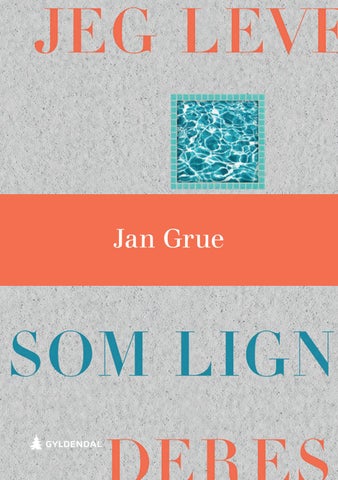
Jan Grue
1
“ 2
“Jan Grue blends elements of both fiction and non-fiction and the result is a vital, meditative and learned investi gation of what it means to be a different person in the world, at the mercy of a body that does not function as normal bodies do. [...] Grue delivers original observations and a supreme degree of reflection.” Dagsavisen on I Live a Life Like Yours
“Jan Grue writes disquieting tales with a sceptical eye for ‘what’s normal’.” Klassekampen on Normalia
“[...] supple, playful and entertaining stories with time as their recurrent theme, often frighteningly beautiful.” Stavanger Aftenblad on Indefinite Time
photo: tine poppe
3
CONTENTS About the author 5 I Live a Life Like Yours 6 Sample translation 8 Literary Critics’ Award – Judges’ comments 26 Selected backlist 28 Bibliography 35
4
AN EXTRAORDINARY GENRE-DEFYING WRITER Grue’s work deals with embodiment - with what it means to be a body in an endlessly complex world. Combining literary exploration and elements of science fiction and speculative fiction, his stories trouble the issues of what makes a meaningful life and how we value different kinds of lives. Jan Grue is the author of a wide-ranging body of work in fiction, non-fiction, and children’s literature. He made his debut with the short story collection Everything Under Control (2010), which was received with glowing reviews: “Grue is bright, he’s funny, academic and poetic, restless and patient, creative, analytical and sensitive. He has a broad repertoire and moves elegantly between different writing styles,” wrote the reviewer in Adresseavisen. He has since published a further five short story collections, the latest, Vexations (2019). His first novel, The Best of All Possible Worlds, came out in 2016. Among Grue’s works for children is Oliver (2012), a fantastical story about living wheelchairs. His academic books include Body Language, on the subject of the representations of disability in a cultural and socio-analytical perspective, and Theory in Practice, a primer on critical analysis.
photo: anne valeur
His book of autobiographical non-fiction, I Live a Life Like Yours, was published in 2018. “The book will, in all likelihood, linger as a milestone signifying that a new maturity is reaching autobiographical literature in Norwegian non-fiction,” wrote Morgenbladet’s Ane Farsethås. Dagbladet’s reviewer called the book ”a literary masterpiece that I recommend in the strongest terms!”, giving the book five stars. The book went on to win the Literary Critics’ Award and has been nominated to the Nordic Council’s Literature Prize – as the first Norwegian non-fiction book in 50 years. Jan Grue was born in 1981 in Oslo. He holds a PhD in Linguistics and is Professor of Qualitative Research at the University of Oslo.
5
I Live a Life Like Yours A masterpiece memoir about life in a vulnerable body.
6
I have a congenital muscular dystrophy. I use a wheelchair. I have a college education, a job. I’m a family man. On the surface, I’m welloff. What had to happen for me to reach this point? I Live a Life Like Yours is about life in a vulnerable body. It is a story about work, about dreams and a longing to live like everyone else. It is a book about life, both common and uncommon. ”Into the unknown: we don’t know where we’re going. We are sailing in a leaky boat; we know that we’re dying animals. With dreams of Byzantium, we bail out as much water as we can, sailing onward, together. We are Argonauts, astronauts, adventurers, explorers. This is our journey.” FOREIGN SALES SWEDEN, WEYLER FÖRLAG / USA, FARRAR, STRAUS & GIROUX PRESS QUOTES ‟A masterpiece of own life.”
Stavanger Aftenbladet
‟It is an exploration of identity, of premises, boundaries and transgressions in which Grue opens up a broad horizon in language that is free and refined. The outcome is literature of relevance and greatness.”
Dag og Tid
Winner of the Literary Critics’ Prize 2018 Nominated for the Nordic Council Literature Prize 2019
7
I Live a Life Like Yours An English sample translation by Alison McCullough
8
From time to time I bump into people who knew me as a child, but who never expected to encounter me as an adult. Generally, common courtesy makes them hide their surprise at seeing me out in the world. An opening is required, a gap in the conversation that will give them the chance to say out loud what first crossed their minds upon seeing me: So, you’re still alive? My high school RE teacher told us a story. When her husband died, she cut off her long hair. Afterwards, as she sank into the bathtub, she had experienced a kind of purification. She was keen on rituals, and brought to her classes a gravity that I, a most serious fourteen-year-old, appreciated. I wanted to learn as much as possible – and felt that time was of the essence. My RE teacher taught me the term liminal phase. It describes the most vulnerable part of a rite of passage, in which one exists between worlds. It is the phase during which a young person is no longer a child, but not yet an adult; when the dying have left the world of the living, but have not yet become one of our ancestors. It is in these phases that things can go drastically wrong, but it is also here that transformation takes place. We come into being through such phases. Without them, the world would fail to move forward. I went from high school to college and on to university, and
then met my old RE teacher again, at a conference. She had returned to higher education and written a master’s thesis about Norse mythology and the Jotuns – about humankind’s dark and dangerous shadows. I was a doctoral student in linguistics. I had started an in-depth work on rhetoric, examining how reality can be altered through language. She had written a history of mentalities, about ways of thinking we can no longer fathom. Our worlds had been brought back together, in a way. My old RE teacher was not surprised that I was taking a PhD. My high school was situated just ten minutes’ walk from the university library, where I would use my mother’s membership card to borrow books about shamanism among the indigenous peoples of Siberia. I was well-acquainted with academia; it made sense, shaped my impressions. It promised a certain type of future, just as the first sentence of a book says something about how the story will play out. My old teacher was surprised, however, at how good I looked. This was the other side of the future narrative – that which had nothing to do with my language, but with my body. The expression makes me uncertain. You look so good. Indeed, why wouldn’t I? I dress well. Over the course of several years I’ve learned about cut, about style. I purchased a tailored overcoat when I was eighteen years old. I like jackets with cuffs that can be unbuttoned; oxford shirts on which the yoke curves just so. But that was not what she meant. * The underlying surprise at the fact that I’m alive first surfaces late in the evening. Or at least it did for the author I went to high school with. Two decades later, we were standing in the grand ballroom of the Hotel Bristol in Oslo. She said it with a combination of melancholy and reluctance, her eyes kind – how everyone had known it back then, that I wouldn’t live very long.
9
10
This was something that everyone knew? I didn’t know it. It certainly wasn’t me who was the source of this notion, so where had it come from? She couldn’t say. The idea was simply there, a shadow cast by nothing. The only substantial thing was my body. I used a wheelchair much of the time, but I also crossed the schoolyard on foot, walked outside at breaktimes and stood there in a circle with the other students. We talked about our teachers; we also talked about Joyce – it was that kind of school. I thought I was one among many. I was unaware I had an especially tragic aura. I knew. I just didn’t have the words to express it. I am attempting to find them now. I am following a trajectory others might have followed. I live in the town where I grew up. I’m an academic, the child of two academics. I live a life like yours. I’m married to Ida, a woman who writes for a living, and we have a child. My son has my eyes, which are my mother’s eyes; his face is reminiscent of childhood photographs of his grandfather. These are the threads that hold my life together. This is the tapestry, the tissue. When I am recognised by someone who remembers the child I was, a rift occurs – a rupture. The image falters. For a brief moment the life I live is superseded by that which didn’t happen; it slides past as a shadow to reveal blurred but familiar images, phantoms of the future that followed me into adulthood. The recognition is followed by the same compliment – you look so good – and it is that word so, two letters at the centre of a polite remark, which carry the whole of it; what might have been, that which never came to pass. Are you better now? No, I say, my condition is more or less the same as before, as it was back then. I have the same wheelchair, I walk a little, my health is passable. But you look better? Memory can play many tricks on us; it goes hand in hand with
our expectations. The past is not that which happened, it is that which we are talking about now. Shouldn’t you be dead? I have exceeded expectations – outstandingly – with no allies other than my body, which has lived its life on its own terms. My body is unaware of the diagnosis it was given; the kind of prognosis it received. And that is a good thing. Never tell me the odds, as Han Solo once said. This is me, as an adult. This is me, as a father. This is my son. He has my eyes, but not my diagnosis. He is also, in more ways than one, the result of that which did not happen. * Into the unknown: we do not know where we are going. We’re sailing in a leaky boat; we know that we are dying animals. We dream of Byzantium, bail out what we can, sailing onwards, together. We are Argonauts, astronauts, adventurers, explorers. This is our journey. * Towards the end of sixth form, in my early twenties, I lived through film. I went to the Cinemateket cinema in Dronningens gate, be it summer or winter. On a Sunday evening once a month there would be a surprise screening; nobody knew which film would be shown until the lights went down. I stood in the queue with my friends. Press screenings were scheduled during the mornings; I would sit by myself in the half-empty theatre. I watched my way through history from the silent movie era onwards; wanted to know who all the central directors were, what was important.
11
12
Eventually, I came to Wim Wenders. In Wings of Desire, Bruno Ganz plays an angel (sporting a dark, tattered overcoat and ponytail) who wanders around the city. Nobody sees him, but he observes, listens. He places an invisible hand on a shoulder; he is present. The screenplay was written by Peter Handke, but I didn’t realise this at the time. An old, blind man named Homer is mentioned in the credits, but again I failed to notice this back then. What I took from the movie was this: the angel becomes a person. He falls in love, but it is both simpler and more complicated than that. He steps out of perpetuity and into the moment. The ancient Greeks had two words for time: chronos, the cosmic order, and kairos, the here and now – it is in kairos that we live and in kairos that the angel falls. He desires all that can be found there, that is found here – all the sounds and smells and tastes. A cup of coffee, a cigarette (it goes with the overcoat and ponytail; angels who are affixed to film are always already trapped in time). The angel asks, and he receives. He becomes a person. Now he is mortal. And I understood: this is true. * Ida and I are in California, about to leave for Hawaii. We are as far west as it is possible to get in the world, but we are about to go even further. Five hours by plane out into the middle of the Pacific Ocean, to the group of islands located furthest from all others. There are skyscrapers and busy streets there, but on our approach it will be night, and so the lights and the great, dark expanses of extinct volcanoes will be all that we see. We have plenty of time to spend together here in California. I take time to read books about where we are and where we’re going. I tell Ida about what I’m reading; we tell each other about the books we read. We want to hear each other’s opinion, but also want to hear
ourselves recount our own. Every new book is an exploration, and by telling each other about them we strengthen the feeling of having covered a certain distance, of breaking new ground. We will not settle down here; we know that. In just under a month we’ll be in San Francisco; our return tickets have been sent to us by email. Hawaii is an unprecedented luxury before we return home; a gesture I’m making on this first long journey we are making together. But I also have printed copies of our return tickets in my bag, because I like the assurance this provides me. Our expedition is comfortingly delimited, but when we get home, we will have to decide. We have been together for around six months and have reached a kind of turning point. We have spent more nights together than apart; Ida has left more and more of her belongings at my apartment. We are in the process of becoming interwoven. If we don’t move in together when we get home there will be no way back – only forwards, separately. We can choose. There are no coercive circumstances. We are free to do as we wish. * I have a literary character flaw: I do not want to explain too much. I don’t want to reveal my sources. It’s an idiotic attitude, but I have a hard time changing it. They’re something I don’t want to give up, something I don’t want to have to explain. I have no desire to be easily accessible; I want to be understood intuitively, and these are two very different things. Sometimes I fancy that I have a somewhat aristocratic attitude to life. In Honolulu, Ida and I walk past the Royal Hawaiian Hotel with its coral pink walls, in the middle of Waikiki Beach, where Joan Didion often stayed and where no room costs less than five thousand kroner per night. I have the strong sense that we should have stayed there, enveloped in luxury, on this our first trip together. Since we have found each other it seems unreasonable that we should need to
13
14
think of practical matters – what something costs; whether or not it is wheelchair accessible. The first time I went to Hawaii I travelled there with student friends. Four of us shared a room, and my strongest memory from the trip is that I tried not to fall in the shower, to walk extremely carefully from the shower to the bedroom in a squeaky pair of Crocs. I remember that I went there with a wheelchair that I could only propel a few metres under my own steam, so when the others went out – to talk a walk, to go swimming in the sea – I was forced to wait patiently, in the room or the run-down hotel restaurant. The air that streamed through the building, constructed as a pavilion with unclear boundaries as to inside and out, was mild as an embrace. It was like nothing I had ever experienced. The aristocratic element consists in not having to explain oneself. It is to write, as Joan Didion does of California and Hawaii, as if one has always belonged, as if one knows all there is to know, as if history and the world are just as self-evident as if they were one’s own, an objet d’art owned by one’s family for as long as one can remember. Or, as Stephen Fry says Unity Mitford once remarked to him: Of course, you never knew Hitler, did you? Ida and I are travelling together; we are newly in love and together falling in love with the places we visit. Many of them are places I have visited before and I want to tell Ida everything I already know so that she, too, can know what I know; I also want to stay silent, not say anything, so that we might discover everything together. Abstractions tell us nothing – old references tell us nothing unless we can feel their true physical weight. The word must become flesh. We must find out who we are in the world; what the world is to us. * This book is about becoming a person. For a time this was my working title, because the angel that becomes a person, that of Wim
Wenders and Peter Handke, has long stood on my shoulder. It was, however, a title I had to give up, because it does not belong to me – it belongs to the poet Mark O’Brien. He was worthy of giving his autobiography the title How I Became a Human Being in a different way to me, and I must give him precedence. If anyone is my Jungian shadow, it’s O’Brien. I am weak, but he was weaker. I weigh fifty-five kilos, he weighed half that. My muscles are small, his were barely visible. My big, electric wheelchair gives me a freedom he never knew; he was too vulnerable, too fragile. The angel from Wings of Desire becomes a person by stepping down and in. He moves from black and white into colour, and when he injures himself in the fall, the first colour he sees is that of his own red human blood. For O’Brien it was different – in his autobiography he becomes a person by stepping up and out, although the movement from the monochrome to the colourful is the same for him; the same longing for sensuality, for bodily presence. As for myself, I’m not sure. Is my own story about descending or ascending? Or is it about stepping into myself – about realising that I always already was a person? I am not completely comfortable with O’Brien’s title; I’ll let him keep it. I know his demons, but they are not mine. Nevertheless, while O’Brien was alive we had many things in common – one of which is an intimate relationship with machines. An understanding of bodily boundaries and bodily rhythms beyond the norm. O’Brien wrote poetry. I write prose. I write using a keyboard and the words flow, I work quickly. My greatest challenge is that the foreign words flow too freely, too maniacally, losing their anchor points in my body. I need a foreign word, logorrhoea, to describe this condition. O’Brien did not suffer from logorrhoea. His challenges were quite the opposite of mine. When one is unable to control a keyboard
15
– when one has such weakened respiratory function that one spends much of one’s life in an iron lung – it is necessary to turn to poetry, where the words are few and the meaning condensed; where a well-expressed thought can contain a whole world. This is what I am aiming for, in the way that we might strive for that which comes least naturally to us. The Man in the Iron Lung by Mark O’Brien
16
I scream The body electric, This yellow, metal, pulsing cylinder Whooshing all day, all night In its repetitive dumb mechanical rhythm. Rudely, it inserts itself in the map of my body, Which my midnight mind, Dream-drenched cartographer of terra incognita, Draws upon the dark parchment of sleep. I scream In my body electric; A dream snake bites my left leg. Indignant, I shake the gods by their abrupt shoulders, Demanding to know how such a vile slitherer Could enter my serene metal shell. The snake is punished with death, The specialty of the gods. Clamp-jawed still in my leg, It must be removed; The dream of the snake Must be removed, While I am restored By Consciousness, that cruelest of gods, In metal hard reluctance
To my limited, awkward, déclassé Body electric, As it whispers promises of health, Whooshes beautiful lies of invulnerability, Sighs sibilantly, seraphically, relentlessly: It is me, It is me. * How I Became a Human Being was published posthumously in 2003, but O’Brien completed the work. He died in 1999, on the United States’ Constitution Day. I often think about him because he lived in Berkeley, and although six years passed between his death and my first visit to the city, many people who knew him still lived there; it was an environment in which many like him had lived, had died fairly young. It was an environment made up of activists and academics, of family, of friends. All of them knew something of vulnerability. When I was about to move to Berkeley – when I had lost the right to a place to live and was running out of time – they were the ones who tried to help me. Most of all Sue, my academic sponsor, a professor of English literature who, when I finally met her face to face, reminded me of a Buddhist monk or yogi. She was a widow; her husband had been in Vietnam and exposed to the herbicide Agent Orange. Sue had a warmth and existence I came across many times in California. Eventually, I began to think of it as the life one strives for when one remembers that time is scarce, for all of us. Joan Didion wrote that a place belongs forever to whoever claims it hardest, remembers it most obsessively, wrenches it from itself, shapes it, renders it, loves it so radically that he remakes it in his own image. I cannot do this for California, for it does not belong to me in this way. Instead it is the opposite – I now belong to California, or at least my conception of California, that which I have created for myself.
17
*
18
Mark O’Brien weighed around half of what I weigh, I who was so small and thin, such a delicate child. I measured my movements in metres; he measured his in millimetres. His childhood and youth consisted of the hospital, the nursing home, other institutions. No friends, no self-determination, nothing – not before he had grown up, practically speaking, and fought his way to a place at the university. The differences between us drive me away from the title of his autobiography. I was always already a person. He was sent away from his family so early, as he was among the last of the children born in 1955 who contracted polio to die of the disease, in 1999. He lived alone for so many years. Until I was ten, we – my parents, my sister and I – lived in a red house in Lyder Sagens gate in Oslo. Every summer we took a trip to a small cabin, also painted red, on the island of Nøtterøy in Vestfold. I was thirteen years old before I first went to a summer camp with other children who had something wrong with them, before I spent so much as a week within an institutional framework. And yet. There is a moment, a form of recognition. A sensation of loneliness, a feeling of being a body that nobody wants to know about – oneself least of all. So we look each other in the eyes, Mark O’Brien and I – even though we do it reluctantly, even though we each would rather avoid the other’s gaze. * There is something else: the question of time. The unlived life has no extent, no dimensions. I am haunted by what might have been, by that which didn’t happen. But do I really have any firmer foothold in the life I have lived? I might proceed chronologically, arrange the events in order. It seems reasonable, gives the impression of structure and predictable
progression – that which happened was that which had to happen – but this is a reconstruction, a rationalisation, an illusion. The past seems to hang on the wall like the Bayeux Tapestry, but it is a projected image, a game in light and shadow that originates in my memory. It exists now, as I write, so that the incidents of the past also exist now, such as I remember them, as I write. I am writing forth a me that no longer exists. I am also attempting to reconcile the memories of my childhood, which was happy and protected, with the awareness also contained within these memories – that I was different, and that there were constant hostile impulses, discomfort, reluctance. I ask my parents, and they say, ‘to us you were always just Jan.’ We have had this conversation many times. This time we are sitting around the coffee table in the living room of my parents’ house, the house in Villaveien where we moved when I was ten and my sister was seven. It is a light room in a functionalist villa, with corner windows that let in the light. Through them I can see the ramp that extends from the veranda down into the garden. In the old house, the red Swiss-style building in Lyder Sagens gate, we lived on the first floor. There was a short flight of stairs leading up to the main door and a longer one up to our apartment. My parents decided we would have to move. In the new house, they built a bedroom and a bathroom on the ground floor, for me. The ramp in Villaveien is made of metal. I remember many incidents from this ramp – stumbling and falling on it and grazing my knee; learning to steer the wheelchair up it and turn around on the platform at the top. I remember both walking and wheeling around the garden at breakneck speed, the most important thing being to get underneath the bushes where the last of the ripened raspberries still hung. For many years I found it difficult to believe what my parents said. I trusted that they meant it, that to them I was simply me, but at the same time I remember the photograph in which the three of us
19
20
stand leaning on the railing of the ramp. It was taken a year after we moved into the house, and was featured in an article in the Aftenposten newspaper about rights that cannot be honoured, about battles that must be fought over and over again. It is a picture taken in protest at that which is wrong and unjust. Something I also understood back then – the ravages of the storm of injustice. Then my own son was born, and countless notions about who he might be, regarding what I had expected, collapsed into the real child like a miracle of quantum physics. Now I believed my parents – after I had become a father and seen that a child is both oneself and, of course, entirely itself. I look at the photograph once more, thinking of Ida, of who we have become together. I now see one thing in this facsimile from the Aftenposten in 1992 – I see a united front. Against what – against the world? There is something not present in this image, something we are glaring at through the lens of the photographer’s camera, and this something has, if not a name, then a language and a presence. Ida and I know this something, as a couple and as a family, and every day we strain to keep it from our door; to keep it from the house where we live as a family. It is a storm and it is polluted air; it is whispering and accusatory voices. Even though they are not within me, I can hear them and understand them, can speak like them. Are they not a part of me then, since I know them so well? * In the book Time Travel: A History, James Gleick explains that the basic problem of both time travel and memory is the same: entropy. We lay layer upon layer, and when we think we are digging down to something older, something more authentic, something purer, we only introduce further complications. We do not become children again, and we know just as little of what it is to be a child as we know about life in the 1400s.
We cannot travel through time. That would require a starting point and a destination that exists independently of us, a past that is, quite literally, another country. This is chronos, cosmic time. But that is not where we are. We are surrounded by the moment and take it with us. We cannot escape the eternal ‘now’, where the future becomes the past. We live in kairos. In the same way, memory is something that plays out and lives within us; it is not a kind of copy cast from the mould of a then. Every time a relive a memory I change it, ever so slightly, because each time I relive it I add a new stroke of the brush. I am rewriting the manuscript yet again. My language changes imperceptibly, so the manuscript becomes another even if I think it continues to remain the same; an authentic reflection of myself. Ida and I have become a couple, got married, had a child. I write as our son, who has turned one year old, sleeps outside in his pram below the veranda roof as the rain pours down. Ida sits beside me practicing the piano – Ingrid Bjørnov’s book of classics, songs for children and movie themes. The storm is outside. I am attempting to reconstruct who I was before all this, but that person has already become a stranger to me. I am thirty-six; I have a memory of being eighteen years old. I can reconstruct it, but this is an active act, an act with a purpose. Ida hesitantly starts to play ‘Somewhere Over the Rainbow’, over and over again. I could not have imagined this moment when I was eighteen – not only would I have dismissed it as sentimental, but I would have been reluctant to look at it. It would have struck me as too intimate, too overwhelming. The written word is stable in a way that memory is not. A proverb from one of the oldest written cultures states that the weakest ink is more powerful than the strongest memory. George Orwell believed that keeping a diary was among the best habits a person could have. It enforces intellectual honesty. One is not only forced to remember all the times one was wrong, but also all the times one was right – but for the wrong reasons. The diary is an amendment to the truth of
21
22
the moment, which always alters in line with what is opportune. In Nineteen Eighty-Four, Winston’s first and decisive act of resistance is to write down something that has happened. I was never good at keeping a diary, but a kind of journal was kept for me. The voices I recognise, but which are not me, are here in writing and far easier to access than what I might have been thinking many years ago. They are also therefore much more powerful in their way – they possess a kind of dusty, totemic power. This journal takes the form of a good metre-long shelf’s worth of papers; my parents gave them to me. Perhaps it was only by chance that I took charge of these papers after Alexander was born, but it was appropriate nonetheless. I will always be my parents’ son, but now I too am a parent, and have taken on their habits. When Ida and I were sure that we were going to have a child together, I made a ‘prenatal’ ring binder. As we neared the due date, I made a ‘birth’ ring binder. I’m used to collecting and collating documents; it is to leave a trail of breadcrumbs, to pull a red thread after oneself. It is to refuse to get lost; to demand the truth. Among the papers I received from my parents are medical records, clinical descriptions, discharge summaries from hospital admissions; copies of letters sent to municipal and governmental bodies, travel agents and suppliers of medical aids. Reading these papers, as trivial and disintegrating as they are, still feels like diving into ice-cold water. It is of little use to know that the deep pool lies there, glimpsed out of the corner of an eye, before one day suddenly stripping off all one’s clothes and taking the plunge. This is a trajectory other than that which I remember following. It is a different life to the one I remember living. This is unsurprising, as it was my parents who read the letters and responded to them; they were not addressed to me, they were about me. But I hardly recognise myself in the me that is their subject, and the timeline they portray does not lead to the life I live now. The life outlined in these papers is a much more pitiful life, perhaps a shorter life, and
one with little joy in it regardless. Yet this horizon of expectation was just as complete. Common to all the papers is that they attempt to hold someone accountable, someone who refuses to take responsibility. The travel agency who promised to transport a wheelchair and then forgot or failed to follow through on their assurances. The hospital that failed to follow up, the governmental bodies who failed to follow their own rules. Institutions and organisations have long memories, but only when it suits them. Otherwise they live, and justify their refusals, in the now. The papers depict two full-time jobs, performed over many years, from when the first ambiguous signs of my muscle disease began to reveal themselves until I reached the end of my teens. Naturally, the paperwork did not end there, but by that time I had started to take on much of the work myself; had started to act as my own secretary and case worker, my own post office and national archives. Among the papers is the following: Healthy three-year-old boy, dark blond with brown eyes, attractive and well-proportioned, krasil [sic; should probably be grasil, meaning slight, delicate] with a generally slender body type, relatively weakly developed musculature but good posture. [...] He seems to have developed early in terms of fine-motor skills, language and intellect. He showed little interest in lifting his head, turning, attempting to crawl, etc. and has never crawled. However, he sat unsupported at the usual age and could almost walk as early as at 10.5 months, but walked very unsteadily and constantly fell flat on his face until he was two years old. He has difficulty navigating stairs and lifts his left leg first every time. His balance seems to be getting poorer. He also struggles to climb.
23
24
This is not the beginning, but the beginning is not documented in writing. The beginning must have been a feeling, a sense of something not being as it should. I was me, but I was also a child who constantly fell flat on his face, and the worry that accompanies this cannot be easily explained away. I visit my parents at their home, my childhood home. We cover the coffee table with ring binders and cassettes, and leaf through brochures, sheets of paper, member magazines from the Association of Muscular Diseases. My parents tell me, as they have told me before, how difficult it was to know. The papers exist, but for my parents the two or three-year-old boy is also a memory – he no longer exists – and for them, too, the memory of him is overwritten by the six-year-old boy, the ten-year-old boy, the 36-year-old man who is writing this. We are palimpsests. We are manuscripts on which the text has been crossed out and written over, crossed out and written over. Everything fades, everything leaves a trace. My mother visits me at the office; she’s brought the papers with her in three plastic bags. We leaf through them once more, then I put them on a shelf. We talk as if remembering a war. There was always something, wasn’t there? There was always something, all the time. These papers are the gaze from outside, the gaze belonging to medicine, the physiotherapists, the education system, the municipal council, the district, the legal system, the travel agencies. It is the gaze that regards me as cargo, a logistical problem. I read over the papers again. And though the text is stable – the same words remain on the pages as in 1984, the year I was three and received my first diagnosis – I am different. As Jacques Derrida points out, the reader changes, and therefore the text changes, too. A sign outside the housing co-op where Ida, Alexander and I live, a sign also from the mid-1980s when the building was erected, states that vehicles are not permitted to drive into the rear courtyard. The
exception is for the transportation of two things – goods and persons with disabilities. The transporting of goods, the transporting of persons with disabilities. These are words that bear re-reading, some decades after they were first affixed to a sign.
25
Literary Critics’ Prize 2018 - judges’ comments Translated by Adam King
26
This year’s winner is the only one of the four nominations that is presented in an essayistic style with a distinct first person present in the text. Nevertheless, the winning book cannot be called a pure essay since as early as the book’s subtitle – A personal history – it is signalled as an autobiography. The 2018 Critics’ Award for Best Non-Fiction Book for Adults is written by Jan Grue and is titled I Live a Life Like Yours. The narrator that the reader encounters in this book is a specific individual, not – at least, not only – a formally subjective first person. While traditional essays often bear traces of a sceptical narrator, one who doubts, who changes heart, I Live a Life Like Yours is stamped with the vigorous opinions and unalterable standpoints of the pamphlet. But why should an accomplished author such as Jan Grue doubt and brood? The book also portrays a hard-won self-assurance, and deals especially with great joy, with love, with the pleasure of holding one’s child. None of this can be taken for granted, and it is not. The jury has noted the sections on trust as a highpoint of great human and literary worth. Here the reader is brought right down to bare life, though not in Agamben’s sense, rather the opposite. And it is done without flowery rhetoric, without gestures; on the whole it is done bluntly, in the ordinary language we use to navigate our way forward from one day to the next. This book represents a commendably simple and civilised joy in life; there are no vitalistic assumptions here. Jan Grue narrates his life from the age of three, his schooldays, interests, studies and especially the importance of reading up to the point
that he winds up as a young professor and holds his son. In that sense it is a book with a happy ending. Grue is generous towards his helpers and supporters. In so being, he is also exemplary. It is more noteworthy and impressive, however, that Jan Grue has no personified concept of the enemy, even though he has been met with condescension and paternalistic indulgence. The book is loaded with quotes from anonymous public documents on the state of the author’s health, but adopted in such a way that the concepts of health at the root of the matter become repressive. It is therefore no surprise that the book also quotes power theorist Michel Foucault and a social psychologist such as Erving Goffman. The reader naturally questions what function these extremely well selected and stimulating quotations will have. Ought Grue’s text to be read as an exemplification of the italicised citations, or are they there to provide a basis for the author’s assertations? I believe that is rather the case that these quotations have a different function entirely: They cool the text down, restraining both the author and his reader so that we do not forget that we are, after all, thinking beings. The act of understanding a quotation, of being able to reason an argument is, after all, the most important; we are living, after all, in the world of the books or the theories, and so everything else will have to come second. Jan Grue begins with a first person singular and ends with a first person plural, the family he has forged with his wife and son. Throughout the reading the reader also feels a part of his we, and to be incorporated into it feels utterly splendid and enriching in every way. Then we too can all be as frank as Jan Grue, if anyone should ask: I live a life like yours. And if no one should ask, we can declare this type of deep truth to ourselves so that we can also create this we, a fellowship and a solidarity in and with the language. The jury congratulate Jan Grue on winning the 2018 Critics’ Award for the Best Non-Fiction Book for Adults. Espen Søbye
27
PRESS QUOTES ”A new writer with a distinct command of the language. Irony and absurdity are key ingredients in these texts.” Dagbladet ‘Grue is bright, he’s funny, academic and poetic, restless and patient, creative, analytical and sensitive. He has a broad repertoire and moves elegantly between different writing styles [...] With that, I grant him five brilliant white stars.’ Adresseavisen
28
Everything Under Control
2010
Everything can change: Oslo could become a city of canals, Star Wars could become a world religion, and the movie Casablanca could be altered again and again until it re-emerges in hundreds of different versions. With their focus on the limitations and possible transgressions of modern control regimes, Jan Grue’s first short stories could be termed metamorphoses for a change that has yet to appear. But they are about more than change in itself; they also address the relationship between fact and fiction, technology and humanity. Jan Grue’s short stories are imaginative tales written in a variety of styles. They include stories about superheroes, cyborgs, about wild best-selling authors and mellow school massacres, about the philosophy of consciousness, dream life, and disturbing ducks.
PRESS QUOTES ”A joy to read.”
Dagsavisen
”By jumping in and out of our own era, and blending truth and lies, fact and fiction, the author says a lot about the year 2011.” Fædrelandsvennen ”The great art of the short story.” Dagbladet
29
Indefinite Time
2011
Twelve short stories that deal with the unforeseen ability of events to change history. Sometimes we need complicated machines in order to travel through time; other times it takes no more than a thought. Now you are standing in a copse in Austria, preparing to kill the infant Hitler. Now you are standing with the Constitutional Fathers in 1814, regretting that you didn’t put on warmer clothes. The twelve short stories in Indefinite Time deal with the unforeseen ability of events to change history. They explain why we happen to live in the best of all conceivable worlds and who will turn out the light and shut the door upon leaving, when Norway (in the rather near future) has been shut down, dismantled, and shipped off to foreign owners.
30
Mind and Body
2012
This is a story for those of you who have a body, or are thinking about getting one. This is a story for those of you who have the sense that it is not you who owns your cats, but they who own you; and for those of you who dream of living another life, the life of a secret agent or a leading man with a cleft chin. This is also a story about a man who’s the spitting image of an infamous ÂGerman dictator; about a fabulous monster looking for love in the city; and about a minister who sees trolls in broad daylight. Mind and Body is short stories about the mind and the body. FOREIGN SALES HUNGARY, TYPOTEX
31
Body Language 2014 Portrayals of disability in culture and society. The book discusses Norwegian and international examples of representations of atypical bodies and provides an introduction to recent research on disability. This is a book about bodies in general and atypical bodies in particular. It is about how we think, write and speak about bodies, and how there is a principal distinction between people with bodies classed as normal and those with bodies classed as abnormal. Understanding how this distinction has arisen requires an analysis both of culture and of society. Body Language has disability as a central concept – because our modern notion of disability embraces many of the most important aspects of having an atypical body.
PRESS QUOTES ”[...] we experience his descriptions as concrete and realistic, as full of both metaphorical and ironic vigour as they are, even when they seem to become fantastic fable and parables. In tales about people ‘who didn’t really build the country, but at the very least gave it a coat of paint along the way,’ he has a joyous style.” Stavanger Aftenblad ”Jan Grue writes disquieting tales with a sceptical eye for ‘what’s normal’.” Klassekampen
32
Normalia
2015
Nothing is abnormal. Everything is as it’s supposed to be. Sooner or later a Norwegian citizen will have to take responsibility for the country’s future and start to secrete oil out of his own body. Sooner or later someone will have to save the universities from themselves and form a resistance movement among frustrated students and pensioned-off professors. Someone will have to decide who qualifies as a grown-up, and who doesn’t. The nation deserves it. We deserve it. All of us live in Normalia. The stories are about us, and it is to us the bulletins are addressed. Read them closely. Listen carefully.
PRESS QUOTES “The book is an eloquent and almost flawless text bearing Grue’s distinctive signature.”
Klassekampen
“The Best of All Possible Worlds does what a good dystopia should; it points toward what is problematic in our own society...What the author has concocted is an elaborate bogeyman, a cold world in which theories of life quality and actually-experienced life quality are blurred, and the power to define what is good enough no longer lies with the individual.”
DEICHMAN.NO
33
The Best of All Possible Worlds
2015
What is a good life? August Wilhelmsen has a solid family background, is talented, has ambitions and an exciting job in the accounts department of the Ministry of Industry and Health. A beautiful partner, a dream of perfection and of being of some use. He has a good life ahead of him. For August lives in a highly regulated and rationally governed Norway. The aim of the country is to become a global leader, with the happiest inhabitants anywhere in the world. A country that encourages the good life so that people can realize their full potential, for their own happiness, and for the benefit of those closest to them and the society in which they live. It can’t get any better. Jan Grue has written a novel about tomorrow’s society, and thus also about the Norway of today. A society governed by the concept of profitability and the will to do good, by the belief that everything is measurable ... including the value of a life.
“…writes with a cracking force and mighty intellect. […] There are infinite ‘Vexations’ in this dazzling short story collection.”
Stavanger Aftenblad
“Jan Grue’s short stories dig out the disquiet wherever it is to be found – everywhere.”
Morgenbladet
“Vexations reveals a playful author with a sense for the irrational and disturbing in life.”
Dagsavisen
34
Vexations
2019
Six new short stories from Jan Grue. Combining literary exploration and elements of science fiction and speculative fiction, his stories trouble the issues of what makes a meaningful life and how we value different kinds of lives. The world cannot be trusted. Politics is unrecognisable; the terrain no longer matches the map. Take a step up into thin air – the stairs are suddenly no longer there. Find yourself on the cusp of sleep, only to suddenly jerk back to consciousness. These are vexations. In the six stories in Jan Grue’s new short story collection, metaphors become reality, while reality is distorted by technological developments – and an omnipresent, existential uncertainty. In Vexations, the author once again proves himself to be a sharp-eyed and perceptive observer of s ocial interactions and modern lives.
BIBLIOGRAPHY 2019 Vexations. 2019. Once
Short stories.
there was a human. Academic textbook (Universitetsforlaget)
2018
I Live a Life Like Yours. Autobiography
2016
The Best of All Possible Worlds. Novel
2016 Super 2015
Magnus. Children’s book (Cappelen Damm)
Normalia. Short stories
2015
Vermin. Children’s book (Cappelen Damm)
2015
Theory in Practice. Analytical Strategies in Academic Work.
2015 2013
Academic textbook (Fagbokforlaget) Body Language. Academic textbook (Gyldendal Akademisk)
2013
It Might Have Been Different. Collected short stories
2012
Mind and Body. Short stories
2012
Oliver. Children’s book
2011
Indefinite Time. Short stories
2010
Everything Under Control. Short stories
35
36
photo: anne valeur
Anne Cathrine Eng Foreign Rights Director anne.cathrine.eng@gyldendal.no Bjarne Buset Foreign Rights Manager bjarne.buset@gyldendal.no Alexandra Wittig Foreign Rights Assistant alexandra.wittig@gyldendal.no