K
US. Govt. to acquire Sunday Edition NEWS bauxite mine in Guyana AIETEUR
August 09, 2026
Online: www.kaieteurnews.com
Guyana’s largest selling daily & New York’s most popular weekly
...says move is to curtail Chinese dominance in country
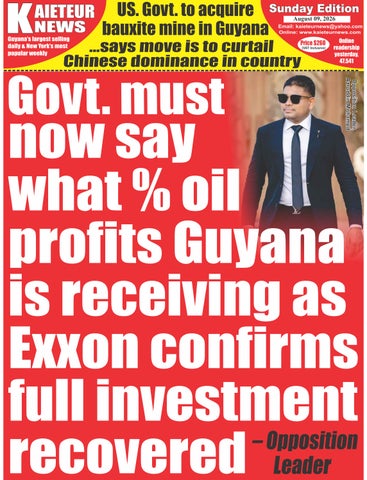
Online readership yesterday, 47,541 Opposition Leader, Azruddin Mohamed
Govt. must
Price $260
now say what % oil profits Guyana is receiving as Exxon confirms full investment – Opposition recovered Leader
Kaieteur News
PAGE 02
Sunday August 09, 2026
Embattled Gas-to-Energy contractor shortlisted for two more mega projects Drowning in financial losses when it was first awarded a US$759 million contract in Guyana to develop the nation's first Gas-to-Energy (GTE) project, the company, Lindsayca Inc. has been shortlisted for two additional mega projects in the country. Lindsayca is currently struggling to complete the GTE project at Wales, West Bank Demerara where it is constructing a 300megawatt power plant and a Natural Gas Liquids (NGL) facility for the Government of Guyana (GoG). Confidential sources close to the administration have revealed that the GTE Task Force Head Winston Brassington reportedly briefed Prime Minister, Mark Phillips last week regarding the shortlisting of Lindsayca for two-thirds of Phase Two of the multibillion-dollar GTE project at Wales. Despite mounting public scrutiny over cost overruns, legal disputes, and regulatory questions
The delayed GTE project at Wales, West Bank Demerara
surrounding its Phase 1 execution at Wales, sources indicate that Brassington is favouring the controversial U.S. firm for the lucrative contracts for both the NGL plant—valued at US$270,240,411—and the
balance of plant bids—valued at US$83,195,973. Adding fuel to the fire, multiple sources close to Phase 1 and the Task Force note that in direct violation of Section 39 of the Public
Procurement Act of 2003 and the National Procurement and Tender Administration Board (NPTAB) regulations, an official evaluating committee for these colossal bids has yet to be named by the authorities. Sources suggest this “rushed presentation” to the Prime Minister is no coincidence, timing suspiciously with the highly anticipated upcoming state visit by Christopher Landau, Deputy Secretary under Marco Rubio. With the company being positioned to cash in on yet another multimillion-USdollar deal, Guyanese continue to await the promised 50% reduction in electricity tariffs and more reliable electricity. The project at Wales continues to drain Guyanese taxpayers with mounting cost overruns, Dispute Avoidance and Adjudication Board (DAAB) payouts, and agonising delays. Drowning financially Kaieteur News has uncovered a paper trail that raises serious questions about the due diligence conducted before awarding the major energy deal. A deep dive into the 2019 United States federal tax returns of Hector and Jesus Fuentes—the brothers at the helm of Lindsayca Inc.—reveals that just prior to bidding on Guyana's most expensive infrastructure project, the businessmen's portfolios were operating under severe financial distress. While the Ali administration was touting
the consortium as a worldclass heavyweight capable of delivering a seamless power plant, the Fuentes brothers' personal tax filings show their finances were plagued by negative income, commercial real estate losses, and millions in trapped passive losses. The 2019 Tax Red Flags The joint U.S. tax returns (Form 1040s) for both Hector and Jesus Fuentes paint a grim picture of their pre-Guyana financial health. Despite pulling six-figure executive salaries from their companies, both brothers reported zero taxable income for 2019. Their broader financial portfolios sustained such substantial losses that it wiped out their earnings entirely. According to the official tax documents analysed by Kaieteur News, Hector Fuentes reported an Adjusted Gross Income (AGI) of negative US$48,576. Jesus Fuentes fared even worse, reporting a negative AGI of US$120,500. Both men generated Net Operating Losses (NOLs) that were carried forward into 2020. The documents show the brothers taking massive hits across their commercial real estate portfolios, including joint dispositions that triggered matching losses of US$170,243 each. Furthermore, Schedule E filings reveal steep operational losses across multiple properties, with each brother reporting over US$222,000 in pass-through losses. Jesus Fuentes also absorbed a US$140,896 short-term capital loss.
Most glaringly, the brothers were sitting on a combined US$12.5 million in suspended passive activity losses—tied up in trusts and underwater real estate ventures that could not be deducted due to IRS limitations. Their foreign business operations were also suffering. Form 5471 filings for Lindsay C.A., their Venezuelan entity, showed a current year earnings and profits deficit of over 1.5 billion Bolivars for that year. All the while, the brothers were carrying deferred U.S. tax debts exceeding a quarter of a million dollars each under Section 965 repatriation tax rules. The Cost of Ignoring the Warning Signs The financial health of the two brothers is important to each Guyanese. Financial stress at the top often trickles down to the project floor. When a multi-hundredmillion-dollar mega-project is handed to executives whose immediate financial history shows millions in suspended losses and negative adjusted gross incomes, it raises legitimate public interest questions about capital fluidity, risk management, and overall corporate stability. Fast forward to 2026, the Wa l e s G T E P h a s e 1 project—spearheaded by these very same contractors—is bogged down in logistical nightmares, supply chain issues, and demands for massive budget adjustments. Rewarding Failure: Shortlisted for Two New Mega-Projects Although the severe Phase 1 project delays, escalating disputes before the Dispute Adjudication and Amicable Resolution Board (DAAB), and ballooning cost overruns were highlighted, there has been no investigation by the government to move towards debarring the contractor. Instead, the administration appears ready to hand the company another contract. Rather than pausing to rigorously re-evaluate the contractor's financial and operational fitness following the Phase 1 debacle, Brassington's task force has allowed them to bypass any formal debarment proceedings and remain in the running for billions of dollars in future contracts.
Kaieteur News
Sunday August 09, 2026
PAGE 03
Govt. must now say what % oil profits Guyana is receiving as Exxon confirms full investment recovered – Opposition Leader By Davina Bagot
T
he Government of Guyana (GoG) must inform the nation what percent of oil revenue will now flow into the Natural Resource Fund (NRF) now that ExxonMobil has recovered all of its investments in Guyana. On Friday, Kaieteur News reported that the operator confirmed US$55B in costs have been paid off using Guyana's oil. In keeping with the 2016 Production Sharing Agreement (PSA), Exxon was allowed to take out 75% of oil produced monthly to cover its expenses. The remaining 25% was shared with Guyana as profits. Now that the oil companies have recovered its investments, Guyana is now expected to enjoy 50% of the oil produced in the Stabroek Block, after operational expenses are met. To this end, the Leader of the Opposition, Azruddin Mohamed has called on the government to inform the nation what percent of oil produced will be allocated to Guyana. In an invited comment, he told this newspaper, “ExxonMobil's confirmation that it has recovered its investment in Guyana reinforces what I highlighted weeks ago. I publicly called on the government to come clean about the status of the cost bank and to tell the Guyanese people when these investments would be fully recovered and what this would mean for our share of the country's oil wealth.” Mohamed expressed gross disappointment over the fact that Guyanese learned of the desaturation of the cost bank through a foreign company, instead of its elected leaders. Nevertheless, he stated, “The government must now disclose how much additional revenue Guyana is expected to receive as a result and tell the nation when the accumulated investment was fully recovered.” Mohamed also stressed that there must be a clear indication of what additional costs will still be paid for using Guyana's oil. Moreover, the leader urged the prudent use of the
Vice President and Chief Policymaker for the oil and gas sector, Bharrat Jagdeo
Minister of Natural Resources, Vickram Bharrat
revenue from oil to improve the livelihoods of Guyanese. “We must guard Guyana against the resource curse, where a country becomes richer on paper while its people remain poor and inequality deepens. Oil wealth must translate into better lives...as ExxonMobil recovers its investment and Guyana receives greater revenues, transparency and accountability become even more important. The Guyanese people must know how much money is coming in and where it is going,” he insisted. N o t a b l y, a l t h o u g h ExxonMobil publicly announced the development to its shareholders since 31st July, 2026, the GoG has not offered any explanation to the Guyanese electorate.
rightful 50% profits outlined in the 2016 Petroleum Agreement. Andrews told reporters that the country should be enjoying its full share of profits now that the company has recovered its investments, before his comments were abruptly cut off by what appeared to be a power outage. The MP said, “It is important that the government ensures that they receive from Exxon the 52% because the historical costs has been paid down.” Chief Executive Officer (CEO) and Chairman of Exxon, Darren Woods told the company's shareholders that Guyana's progress as a success story that has set a new standard for the industry, exceeding even the
Questions sent to the Minister of Natural Resources, Vickram Bharrat requesting a cost recovery update since 31st July, 2026 was ignored. Subsequent queries on when the country cleared the cost bank were also unanswered up to press time. Additionally, although he made public appearances last week, Vice President and Chief Policymaker for the oil and gas sector, Bharrat Jagdeo, has not shared an update on the matter. During a party press conference on Friday, the A Partnership for National Unity (APNU) Member of Parliament (MP), Saiku Andrews said that government must not allow ExxonMobil to continue adding expenses by approving more projects that would further delay the country from receiving its
company's expectations. Exxon said it expected the cost bank to be cleared in another two years. Woods however said, “Delivering on tight schedules, at industry-leading cost – with strong reliability and optimised production – has resulted in recovering our capital and cost nearly two years earlier than anticipated, increasing NPV, and desaturating the cost bank.” Senior Vice President and Chief Financial Officer of Exxon, Neil Hansen offered clarity, “…as we mentioned, at this point, we've fully recovered the $55B of investment, along with all the operating costs and the way the contractor agreement works is we can recover that investment up to 75%. After that, the remaining production is shared 50/50 between us and
the government of Guyana.” Hansen further noted that the company's share of oil from the Stabroek Block will decline as a result of the development. ExxonMobil discovered oil in commercial quantities in Guyana's Stabroek Block
Leader of the Opposition, Azruddin Mohamed in 2015. The company later began producing oil in December 2019. To d a t e , s e v e n o i l projects have been approved while only four are currently
producing oil. The remaining three are under development with ExxonMobil eyeing two additional developments- its eighth and ninth projects.
PAGE 04
Kaieteur News
Kaieteur News Printed and Published by National Media & Publishing Company Ltd. 24 Saffon Street, Charlestown, Georgetown, Guyana. Publisher: DR. GLENN LALL - TEL: 624-6456 Editor-In-Chief: NIGEL WILLIAMS Tel: 225-8465, 225-8491. Fax: 225-8473, 226-8210
EDITORIAL
Investment fully recovered – where’s the govt. The US$55B that ExxonMobil invested in Guyana’s offshore Stabroek Block is now fully recovered. That longawaited piece of good news came from two of the company’s highest-level executives. In the strange world of Guyana and its oil, there is a curious state of affairs, only the newest one, in an environment that is rich with oil. Those who own the oil should be ahead of everyone in delighting to this announcement however they are silent to the point of sadness. Where else in the world but Guyana could there be the reactions that should have come before the company and did not? Why not some existence of a pulse felt in Guyana’s oil after ExxonMobil’s second quarter news became public? ExxonMobil CEO, Darren Woods and Senior Vice President and Chief Financial Officer, Neil Hansen, confirmed in their different ways that the US$55B investment in Guyana has now been fully repaid. The investment is liquidated,which should translate to the Cost Bank now standing at zero. Now that the Cost Bank is where it is at, what is there as Cost Recovery? Cost Recovery was killing Guyana, since it is enshrined in the 2016 Production Sharing Agreement (PSA) at 75% straight from the top of oil revenues, minus royalties. All of Guyana should now be celebrating a true half and half profit split. To be clear, celebrating an equal (50:50) division of 100% of oil revenues, and not 25% split into two. That is something to celebrate and anticipate, so, where are Guyana’s most vocal stewards over its oil and gas sector? Specifically, it would be very encouraging for Vice President, Bharrat Jagdeo, to say something about the cost bank depleted and that Guyana should start to receive a real half and half profit split, per the 2016 PSA? Jagdeo is known in some local circles as Guyana’s Oil Czar, does he not want to share his excitement over more millions in the New York based Natural Resources Fund and what that means locally? He has been asked several times in the past few years one question with different words used. When will Guyana start to collect the half and half split that is now due? We at this paper have been next to unceasing in pushing questions concerning the oil and gas sector before President Irfaan Ali and Minister of Natural Resources, Vickram Bharrat. They have mostly reacted in one way: Jagdeo is the oil and gas man. Minister Bharrat tried on a few occasions, with two things becoming obvious immediately. First, he is not quite sure where he stands on the issues, despite the fact that he is the official subject/responsible minister. Second, it seems that he was always operating with his hands tied behind his back, and that he was careful not to speak out of turn for fear of upsetting the people to whom he reports. The impression that always attached to Minister Bharrat is that no matter how much he said, he came before the microphones with some sort of gag order in place. On the other hand, Jagdeo carried another name locally: Guyana’s chief oil and gas policymaker. We have learned several things in dealing with Jagdeo over the decades, a couple of which sticks out brightly. Whenever he is afraid of where an answer could lead him, he makes himself scare. A second is that when there is some trickiness in the air with a much-watched issue, he argues pointlessly, or occupies himself with other matters, so that he can claim that he is busy. Whatever is at work will soon come to light. Sooner or later, he will have to say something about Cost Bank elimination, Cost Recovery now out of the picture, and the half and half profit split now due to Guyana. Two top executives of ExxonMobil are now on record about the company’s US$55B investment paid off. Somebody in the Guyana Government has to break the silence that now hangs so bafflingly over what Woods and Hansen shared with the world. Today, we do not want to touch the hanging livewire of the cost bank replenished. Better to focus on where Guyana Government main oil leaders stand with more oil profits.
Sunday August 09, 2026
Kaieteur M@ilbox Send your letters to Kaieteur News, 24 Saffon Street, Charlestown, Georgetown or email us kaieteurnews@yahoo.com
Why? By Krishna Nand Prasad I stand weakly on my feet My eyes sharing my grief in tears And I ask “Why?” Who will answer? Not the ocean certainly; Not the majestic Barima; Not the dead The dead are not born to speak. Not the survivors; They will say what happened Their own of the horror. But WHY is a mystery of the deep Who will answer? Who will answer? Who will answer?
No more pittance for Amerindians DEAR EDITOR, On Saturday 18th July, 2026, the MV Barima, a 132-foot passenger and cargo ferry, capsized off the Essequibo Coast in Guyana. It capsized at approximately 11pm, in 45 feet of water, around 7 miles from shore. Of the estimated 179 persons on board, 76 have been rescued. 73 bodies have been recovered thus far. The wreck, with its cargo and presumably some missing bodies, remains embedded in soft mud, making salvaging operations difficult and dangerous. MV Barima was 87 years old. It was built in Scotland by Fergusson Brothers Ltd in 1939, at the close of the steamship era. At the time of its sinking, it was regulated and operated, respectively, by the state’s Maritime Administration Department (MARAD) and Transport and Harbours Department. The Georgetown to Port Kaituma Route is approximately 150 miles, a 24-hour
journey. Leaving the sheltered waters of the Demerara River in Georgetown, the vessel would forge into the Atlantic, navigate the rough waters at the mouths of the Essequibo and Pomeroon rivers, before turning inland at the Barima River to service largely indigenous communities at Mabaruma, Morawhanna and Port Kaituma. The Barima tragedy tells a tale of maladministration. In 2010, there was a protest at Port Kaituma against ferry delays and breakdowns. In 2015, President Donald Ramotar secured a loan from India to purchase a brand-new ferry for Region One. The 220-foot MV Ma Lisha, constructed in Kolkata, has run idle due to delays in port construction at Port Kaituma. In 2019, Region One’s Lady Northcote, the ’sister’ ship of MV Barima, built likewise by Fergussons (1937), was decommissioned. In May Continued on page 6
Kaieteur News
Sunday August 09, 2026
PAGE 05
Kaieteur M@ilbox Kaieteur M@ilbox
‘MV Barima tragedy transcends politics’ — PNC Diaspora demands justice, accountability DEAR EDITOR, MV Barima was a vessel of unity, carrying within its hold the rich tapestry of Guyanese life, comprising individuals from all walks of life, from every race, religion, and political affiliation. In death, as in life aboard that vessel, we were bound together as one people, sharing a common destiny. This catastrophe tragically underscores the truth that calamity does not discriminate; it recognises neither party affiliation nor economic boundaries. As we confront this unimaginable grief collectively, we must firmly resolve to stand united as one nation. This tragedy transcends all divisions!
As we pay tribute to all the victims of this horrible t r a g e d y, w e c a l l f o r accountability and justice! Reports regarding this disaster are deeply unsettling. It is now public knowledge that the vessel was significantly overloaded, with as many as 179 souls on board, despite a manifest indicating only 133, and twice the allowed tonnage. Furthermore, it is alarming that the captain and at least one crew member allegedly tested positive for narcotics. These revelations raise grave concerns regarding oversight, maintenance, and the responsibility that allowed an antiquated vessel
to operate unsafely. These issues cannot be dismissed as mere administrative lapses; they represent profound moral failures—a breach of the sacred trust established between those entrusted with governance and the citizens they are sworn to safeguard. As Guyanese people, at home and abroad, we will not accept anything less than full accountability. We must insist upon decisive action against all individuals in positions of responsibility for this calamity; those at the helm as well as those in oversight roles who tolerated systemic negligence. Investigations must be thorough, transparent, and free from political interference. Those found
culpable must face the full force of the law. In this moment, we are a nation called to unity! In light of this tragedy, we call upon all Guyanese, irrespective of political affiliation, ethnic b a c k g r o u n d , o r socioeconomic status, to unite in demanding justice for the departed and their families. This moment calls for moral clarity and collective action. Families who grieve deserve more than empty reassurances and delayed inquiries. They deserve answers, accountability, and assurance that their loved ones did not fall victim in vain and they deserve closure. The United States
GOVERNMENT IS SPENDING $496M TO COMPETE WITH GUYANESE BUSINESSES DEAR EDITOR, The Government of Guyana must explain why it believes that spending ‘$496.3M of taxpayers’ money to establish a state owned bottled - water plant is a greater priority than addressing the serious deficiencies in Guyana’s water - treatment and distribution infrastructure. President Irfaan Ali has defended the Government’s push for 100% locally produced bottled water, arguing that Guyana is a water rich country and should not be importing bottled water. Minister of Agriculture Zulfikar Mustapha and Minister Deodat Indar have also been among the Government’s defenders of this policy. But the Government’s argument does not withstand scrutiny when the numbers are examined. Guyana already has a vibrant local bottled-water industry. Blue Springs and Clear Water are estimated to produce approximately 150,000 to 170,000 cases per month, while Banks DIH and DDL account for approximately another 50,000 cases per month. That means local producers are already supplying approximately 200,000 cases of bottled water every month. Against this, the
estimated imports are only approximately 6,000 cases per month, with the higher estimate being around 10,000 cases per month. At 6,000 imported cases, imports represent approximately 2.9% of total monthly supply. Even at 10,000 imported cases, imports represent only approximately 4.8%. In other words, more than 95% of the market is already being supplied by local producers, based on these figures. So, I ask the Government directly, where is the crisis that requires the State to spend $‘496.3M to enter this market? The Government’s stated objective appears to be eliminating the small quantity of bottled water being imported. But if that is genuinely the objective, there are far more sensible, targeted and less costly ways to achieve it. Give local manufacturers a tax break, provide incentives for expansion, reduce the cost of imported machinery and production inputs, help existing local producers increase their capacity, strengthen qualitycontrol and certification standards, and, if necessary, Government can consider targeted and transparent fiscal measures to encourage consumers and businesses to choose locally produced
water. That approach would strengthen Guyanese businesses, Guyanese workers and Guyanese investment without forcing taxpayers to finance a government-owned competitor. Instead, President Ali and Ministers Indar and Zulfikar are defending a policy in which the State is taking hundreds of millions of dollars and entering a market that is already overwhelmingly supplied by local private sector producers. That is not how Government should support local business. Government should be creating the conditions for local businesses to grow, expand and employ more Guyanese, not using taxpayers’ money to compete against them. There is an even bigger issue here. Government priorities. Guyana continues to have communities struggling with inadequate water distribution, unreliable supply and deficiencies in the infrastructure required to provide households with safe and consistent potable water. Government has itself acknowledged the need for massive investment in water treatment infrastructure, including programmes involving multiple treatment
plants. So why, at this moment, is the priority to spend another ‘$496.3M on bottling water? If the Government has $496M available to invest in the water sector, then let us put that money where Guyanese need it most. Treatment plants, pipelines, distribution networks, storage capacity, reliable water supply, Infrastructure that ensures that every household can turn on its tap and receive safe and consistent potable water. We must not confuse Continued on page 6
Region of the People’s National Congress Reform stands in steadfast solidarity with the grieving families of Guyana. We pledge to utilise our voices, resources, and position within the diaspora to amplify the demand for justice and support initiatives aimed at preventing such horrors from recurring. To the families who have suffered the tragic loss of cherished sons, daughters, mothers, fathers, sisters, brothers, and friends aboard the MV Barima; to the survivors enduring the weight of profound trauma; and to the entire Guyanese nation both at home and across the diaspora: You are not alone. Your suffering mirrors
our own. Your loss is our shared burden. Your quest for justice is ours as well. We extend our sincerest and deepest condolences during this harrowing time. The events that unfolded in the depths of the dark waters off the coast of Guyana are not merely an accident—they constitute a grave human tragedy that has irreparably impacted our communities and left an enduring scar on our collective conscience. We stand with you. We mourn with you. And we shall not rest until accountability is achieved. In solidarity and sorrow, The United States Region P e o p l e ’s N a t i o n a l Congress Reform
How does justice work in Guyana? DEAR EDITOR, More than 5 years and still counting, the DPP is unable to gather sufficient evidence to charge the killer/s of Paper Shorts, yet after just a few days, the DPP is able to charge three staff members of the ill-fated MV Barima: and justify its decision. Faiyaz Alli
Kaieteur News
PAGE 06
Sunday August 09, 2026
Kaieteur M@ilbox Kaieteur M@ilbox
No more pittance for Amerindians From page 4 2026, the Government acquired a vessel from Greece, the 150-foot Calopian, to serve Region One, but was awaiting r e n a m i n g a n d recommissioning. Many of the passengers reported that the MV Barima was taking in water early on the trip. Too much. Reports to the captain were of no avail. Reports suggest the vessel was overloaded. It is
reported that only one of the v e s s e l ’s e n g i n e s w a s operational. Passengers had to sink or float for hours in the dark, in rough waters, because of a delayed distress response by the Guyana authorities. Because of a deflated manifest, rescuers did not know how many passengers had been aboard. The MV Barima was named after the Barima River in Region One, the Atlantic point of entry into
the larger Essequibo territory. Region One, Barima-Waini, is referred to as part of Guyana’s North West territory. But it is much more than Guyana ‘territory’ and ‘region’. Region One, and the hinterland regions South of it, PomeroonSupenaam, CuyuniMazaruni, Potaro-Siparuni, U p p e r Ta k u t u - U p p e r Essequibo, are still largely inhabited by indigenous Amerindians. From across the border in
Orinoco, Venezuela, to this land of Essequibo you will find myriad communities of Warau, Karina, Lokono, Arekuna, Akawalo, Kapohn, Patamon, Macushi, Wapishana, among others. Over 75% of the inhabitants of this region are indigenous or descendants of Amerindians. The MV Barima was meant to service a majority Amerindian population in BarimaEssequibo. Most of the victims of the MV Barima tragedy were Amerindians. Whilst the Guyana Government is trying hard to distract from its systemic failures - by imprisoning crew members on murder charges, by at first hinting that the vessel might not be salvageable, by appointing a Commission of Enquiry, whose legal remit is constrained, and will report only after the current tide of recrimination has receded, it cannot be disputed that a crime has been committed against the indigent citizens of Guyana, particularly against hinterland Amerindian peoples. The MV Barima offered cheaper tickets, so its commuters had to make do with a beaten-up boat. With disregard and neglect. Amerindian groups have raised their voices in protest.
But is calling for the resignation of Public Works and Public Utilities Ministers, Juan Edghill and Deodat Indar, enough? Is calling for the raising of the vessel enough? Is calling for transparency and reform enough? Is calling for a better ferry service enough? Is another march and placard enough? One Amerindian survivor who lost six members of his family cried: “Why are we Amerindian people so soft? Why are we always happy with so little?” In Guyana, an ethnocracy, based on ethnic voting and preferment by two majority groups, the ‘First Peoples’ shall always be the ‘Last Peoples’. ‘Our Amerindian Brothers and Sisters’, as well as ‘One People, One Nation, One D e s t i n y, ’ a r e m e r e blandishments, soft-soap. East Indian and Africanbased governments can never deliver to the indigenous peoples their righteous imperative - the dignity which comes with political and economic independence. The indigenous peoples of Guyana and cross-border Venezuela must cut loose from politically and institutionally clammy (curry favour) Guyana. From pittance, handouts,
GOVERNMENT IS... From page 5 bottling water with solving Guyana’s water problems. A bottle of water sitting on a supermarket shelf does not solve the problem of a family turning on its pipe and getting no water. President Ali and Ministers Indar and Mustapha must explain why becoming a competitor to Guyana’s existing bottled - water manufacturers are a better investment than strengthening the infrastructure that delivers water to Guyanese households. This is a classic case of misplaced priorities. Regards, Ganesh Mahipaul, M.P.
subsistence living. And win complete political and economic sovereignty over the disputed territory between Guyana and Venezuela – the Essequibo. You must do this before the Guyana Government negotiates and bargains away all the BarimaEssequibo oil, diamond, gold, timber, bauxite to the U.S. Do this to create a buffer between the disputing Governments. Do this to right historical wrongs and prevent further predatory encroachment, swamping, neglect, by relatively recently arrived groups. Do this to own your own space, your own nation, your own ethos, your own syncretic development agenda. Do this to establish majority rule in the Essequibo. Do this to make your own nation, alongside Colombia, Tr i n i d a d a n d To b a g o , Ve n e z u e l a , G u y a n a , Suriname, French Guiana, Brazil, on the Atlantic front. Do this to become the first Amerindian state in history, to establish a haven for indigenous peoples of the Americas, and a vanguard for Amerindian-indigenous advocacy globally. Do this to overcome the imperialists and the relative newcomers, now warring tooth-and-nail for your ancient and ancestral lands; whilst you sit and watch. Amerindian shyness and satisfaction with pittance must end. Enough of sleeping on the damp floor of ferries. Go for big. Fight for the nation of Barima-Essequibo, the whole Essequibo. Action after action. And if you don’t win it today, in ten years, in twenty, in thirty or forty you surely shalt. Regards, Wayne Kublalsingh
T N U L B . . . T B N U T L N T B . U . L . L T B . N . U . N U T L N B . U . T . L N T U N B . N U . . L U L LUNT B . T . . T T N N B U B . U . L . L T B . B . . N . . . T T LU N N T U U L N L B U . B MV Barima COI . . L . . . T B T . . N . N T U L N LU must deliver truth, B U . . L N . T B U . . L N . T B U . . not political cover L N . T B U . . L N . T B U . . L N . N T B . . U N . L T U B L N . . B . U . . T L . N T B . . U N . L N T B U N . . L . U T B L . . N B . . . T U . L N T B U . . L . UN T B U . . L N . T B U . . L N . T B U . . L N . T B U . . L N B U U .BLUNT. . . L . T B . . N . T U . L N . T B U . UN .BLUNT.. UNT...BL T...BL . L N . T B U . . L LUN ...BLUNT. LUNT...B NT...BL T B U . . L N . T B U . . L N . T B B U . . L N . T B U . . L N . T B U . . L N . T B U . . L N . T B B U . . L N . T B U . . L N . T B U . . L N . T B U BBL T...BLUN BLUNT... ...BLU . T . N . N T T U L U N L B U T...BLU U B . L . N . B T . . . N T U N N N L U U U B L . L B T LUNT.. UNT...B BL B Sunday August 09, 2026
Kaieteur News
PAGE 07
Sunday August 09, 2026
Kaieteur News
PAGE 08 10
BLUNTNESS ON INDECENCIES! In case you haven’t heard, please be informed that as part of our continued effort to channel positive changes in our country, our publisher, Dr. Glenn Lall, has dedicated our Page Seven to be “BLUNT” about on-going indecencies in our land that should matter, not only to us at this publication, but the entire nation. MONDAY – AUGUST 03, 2026 Leadership Cannot Hide Behind Livestreams In times of national tragedy, leadership demands more than carefully scripted video statements. It demands accountability. Wi t h 7 3 l i v e s l o s t , dozens still missing, and grieving families desperate for answers, President Irfaan Ali's continued refusal to face the local media sends the wrong message. A livestream is not a press conference. It asks for no explanations, entertains no scrutiny and permits no uncomfortable questions. A Commission of Inquiry may uncover how the MV Barima disaster occurred, but it cannot replace the President's duty to answer the nation.
Transparency begins at the top. If the government believes in the independence and credibility of the inquiry, it should have no fear of questions from the press. Silence breeds suspicion. Avoiding the media only deepens public distrust at a moment when confidence in the State's handling of this national catastrophe is already dangerously fragile. TUESDAY – AUGUST 04, 2026 Scandals The scandal over President Irfaan Ali's sprawling farm on the Soesdyke-Linden Highway has quietly slipped from the headlines, not because the questions were answered, but because another national crisis arrived. Guyana lurches from one controversy to the next, leaving yesterday's scandal
buried beneath today's disaster. Before the dust could settle on Ali's farm came revelations about mining concessions linked to Agriculture Minister Zulfikar Mustapha's family. Then came the MV Barima tragedy, consuming the nation's attention. It is an all-too-familiar pattern. The PPP Government survives not by resolving controversies, but by being rescued by the next one. The media, civil society and the opposition barely have time to pursue one issue before another erupts. In Guyana, scandals are not buried by answers; they are buried by newer scandals. THURSDAY – AUGUST 06, 2026 The cost of political negligence Guyana's oil wealth is
growing, but so too is the bill for political negligence. The revelation that the country may have lost US$4B because of the absence of ring-fencing is not surprising to this newspaper. That sum is more than half of the nation's 2025 debt. Instead of allowing each oil project to pay for itself before new developments are charged to the books, Guyana continues to let fresh projects dilute its profits while Exxon recovers costs. The result is a nation swimming in oil but collecting crumbs. The warnings have been sounded for years, yet the Government has stubbornly refused to fix this glaring defect in the Production Sharing Agreement. Every day of delay is another day future generations are shortchanged. Guyanese must demand reform now, before the last barrel is pumped and the opportunity is gone. FRIDAY – AUGUST 07, 2026
A stubborn Government Since the 18th July MV Barima tragedy, the country has watched a government determined to carry on with business as usual while grieving families continue to demand answers and justice. No minister is indispensable. Governments do not collapse because a minister steps aside. If the entire management team responsible for the ferry's operations could be removed pending investigations, why should the Minister Juan Edghill with ultimate political responsibility remain beyond accountability? Public anger has only intensified. Citizens have taken to the streets across the country demanding Edghill's resignation, yet the Government has chosen to ignore those calls. Political accountability cannot end with suspending junior officials while Cabinet ministers remain comfortably in office. That is not accountability; it is scapegoating. SATURDAY – AUGUST 08, 2026 50% or nothing
APNU's call for the Government to halt approval of new oil projects until Guyana receives its full 50 per cent profit share must be supported by all Guyanese. For years, Guyanese have been told that the nation's oil deal is delivering unprecedented benefits. Yet questions persist over how much of the wealth actually reaches the people and whether Guyana is receiving every dollar to which it is entitled. The latest revelation that ExxonMobil has recovered its investment and operating costs only strengthens the argument for greater t r a n s p a r e n c y. I f t h e contractor has recovered its costs, Guyana should now be receiving the full 50 per cent profit share stipulated under the Production Sharing Agreement. Government cannot continue approving project after project while Guyanese are left guessing about the true value of their patrimony. Oil is finite. The country must therefore demand every dollar due before handing over more of its resources.
Businessman found in Nandy Park home died from heart failure - PM Reveals A postmortem examination performed on Freeman Fordyce, a 49-year-old businessman who was found in his Nandy Park home on Thursday around 13:00hrs, has revealed that he died of heart failure. “Preliminary investigations revealed that Fordyce, who lived alone, was last seen alive by a relative on Sunday, 2nd August, 2026, about 16:00hrs. After several attempts by relatives to contact him went unanswered, the relative went to the residence on Thursday and discovered his body in a bedroom,” police said.
He was pronounced dead by a doctor from the Georgetown Public Hospital Corporation. His body was subsequently examined, and no marks of violence were observed; no foul play is suspected.The body was escorted to Memorial Gardens Funeral Home, where the postmortem examination was performed on Friday by Government Pathologist Dr. Nehaul Singh. The cause of death was given as heart failure, and the man's remains were handed over to relatives for burial.
Kaieteur News
Sunday August 09, 2026
PAGE 09
There is a time and place for everything A solemn ceremony was being held to remember people who had died in a terrible tragedy. Persons were gathering, candles were being lit, photographs of the dead were being displayed, and persons were preparing to pay tribute and prayer for the victims. Then, just as the ceremony was about to begin, another group arrived with placards, to protest against the authorities whom they blamed for the tragedy. Nobody could say that the protesters had no reason to be angry. Nobody could say that they had surrendered their right to protest merely because a memorial ceremony was taking place. But there was something deeply improper about choosing that particular moment to turn another people’s grief into a political demonstration. The protesters had a right to protest. Others had a right to mourn. The organisers had a right to conduct the memorial in peace. And somewhere between all those rights was a simple principle that seems increasingly forgotten: there is a time and place for everything. That simple lesson is worth remembering in Guyana today, because the right to protest is fundamental. But it is not a license to impose oneself
upon everybody else, nor does it give anyone the right to use any public gathering as a protest stage. The Constitution is perfectly clear about the importance of peaceful a s s e m b l y a n d demonstration, and Article 147(1) provides that, except with his or her own consent, “no person shall be hindered” in the enjoyment of the freedom to assemble and to demonstrate peacefully. That is an important constitutional protection, particularly in a democracy where citizens must be free to criticise governments, ministers, policies and institutions without being silenced. But there is another part of Article 147 that is sometimes conveniently forgotten, because Article 147(4) recognises that laws may impose restrictions reasonably required in the interests of public safety, public order, public morality and public health, or reasonably required to protect “the rights or freedoms of other persons.” That last phrase matters e n o r m o u s l y, b e c a u s e constitutional rights do not exist in little private boxes where one person’s rights always defeat everybody else’s rights. The law therefore recognises
something that common sense should have taught us long ago: your right to speak does not automatically include a right to prevent somebody else from being heard. Your right to assemble does not automatically include a right to disrupt another lawful assembly. And your right to protest against the government does not give you a constitutional entitlement to interrupt every event at which a government minister happens to be present. The European Court of Human Rights has repeatedly made this distinction. In Kudrevièius and Others v. Lithuania, the Court recognised that demonstrations inevitably cause some inconvenience and disruption, and that authorities must show a degree of tolerance toward peaceful protests, but it also held that the right of assembly cannot be used to seriously infringe the rights of others. But there is also an ethical question which goes beyond the strict language of the Constitution and other laws. Suppose citizens gather for a prayer service to remember people who have died tragically; suppose persons attend because they want a moment of silence, reflection and consolation;
Dem Boys Seh...
A knife, ice pick or jukka does not settle an argument Long time, if de police ketch yuh walking down de road wid a cutlass showing, dem used to seize it quick, quick. Sharp object in public? Explain yuhself. Knife in yuh waist? Trouble. Ice pick in yuh pocket? Better have a very good reason. Dem boys seh back then, police understand one simple principle: prevention better than cure. If yuh stop de weapon before de quarrel, yuh might stop de funeral after. But things change. Today, people apparently could walk around wid knives, ice picks, Rambo blades and all kinda other instruments capable of turning a simple disagreement into a murder. And de disturbing question is not only why people carrying these weapons, but how easy it seems to be to get one when tempers flare. Last Friday, two persons were reportedly stabbed to death on Water Street, in front of Bounty Supermarket. Two lives gone. And once again, we are left asking how a quarrel that might otherwise have ended with cussing, pushing or a fistfight ended with two bodies. Where de weapon come from? Because apparently de knife does have GPS. Man could be walking through town empty-handed, get into an argument, and five minutes later — presto! — blade appear. Either he was carrying it all along or he know
exactly where to find one. And that is the problem. Dangerous weapons should not be as easy to obtain as a coconut vendor’s mauby. Yet dem boys hearing that big knives and Rambo-style blades could be openly sold on pavements. If that is happening, then we should not wait until somebody get stabbed before asking questions. De hospital should not be the first place where society discovers that weapons are circulating. And schoolchildren being robbed at knife point should be warning enough. When a blade becomes part of the everyday wardrobe, something seriously wrong with the society. Dem boys seh Guyana reaching the stage where every argument apparently coming with a hardware option. Man quarrel over money — knife. Woman — knife. Parking space — knife. Somebody look at yuh wrong — “Wait, leh me find something.” We cannot normalise people walking around armed and then express shock when a dispute becomes deadly. A knife does not settle an argument. It settle somebody’s life. And by then, prevention done pack up and go home. Talk half. Leff half.
suppose religious leaders are offering prayers and people are mourning their loved ones. Is that really the appropriate occasion to arrive with placards to protest against a minister or the Government? Of course, one can say: “We have a constitutional right to protest.” And one would be correct, but that answer confuses the existence of a right with the wisdom of exercising it at every possible moment and in every possible place. A person can have the legal right to say something and still have the good sense not to say it at a funeral. A person can have the right to protest and still recognise that there are occasions when respect, decency and consideration for others s h o u l d g o v e r n o n e ’s conduct. There is nothing preventing an opposition party, activist group or ordinary citizen from organising a protest against a
minister or the government. They can choose a place where their message can be heard, where their supporters can assemble, where the media can cover them and where the Government can be challenged. What they should not do is deliberately invade an occasion created for another purpose and attempt to turn it into their political stage. That is not the strongest expression of the democratic right to protest; it can instead become an attempt to appropriate somebody else’s constitutional freedom of assembly for one’s own purposes. And that is the great irony: in seeking to exercise one constitutional right, protesters can sometimes end up denying another group the peaceful enjoyment of its own rights. The people attending a prayer service also have a right to assemble, to mourn, to reflect and to participate in a solemn national occasion
without being interrupted by a political demonstration. There is, after all, an oldfashioned principle that remains remarkably useful in a modern democracy: there is a time to protest, and there is a time to mourn; there is a place to confront the government, and there is a place to leave people alone with their show of support for the dead. The Constitution protects the right to protest. Good manners, good judgment and respect for the rights of others should tell us when and where to exercise it. (The views expressed in this article are those of the author and do not necessarily reflect the opinions of this newspaper)
PAGE 10
Kaieteur News
Sunday August 09, 2026
Guyana makes LPG Cylinder and Regulator Safety Standards mandatory after explosion concerns The government has approved two national standards covering liquefied petroleum gas (LPG) cylinders and lowpressure regulators, making them compulsory in a move officials say will tighten safety rules and raise the quality of gas equipment sold in Guyana. On Saturday, the Ministry of Tourism, Industry and Commerce said the decision follows public complaints about LPG cylinder explosions and leaks in homes. In response, the Guyana National Bureau of Standards (GNBS) spent 2025 reviewing and rewriting two existing standards: GYS 264, which governs LPG cylinders and how they are stored, handled and transported, and GYS 523, which covers low-pressure regulators used with LPG. A technical committee drawn from the Environmental Protection Agency, Guyana Energy Agency, Guyana Fire Service, Guyana Revenue Authority, Massy Gas, GUYGAS Inc. and the Competition and Consumer Affairs Commission led the revision, drawing on input from the petroleum industry and a 60-day public consultation. Under the updated GYS 264 standard, LPG cylinders must meet recognised safety specifications and carry a stamp showing compliance. Each cylinder must also be permanently marked with details including its tare weight, water capacity, serial number, manufacturer's name, manufacture or last test date, tester's symbol and working pressure. Cylinders will also need a safety relief device to release excess vapour pressure, along with either a securely welded shroud or a neck ring that lets a valve protection cap be screwed on, plus a foot ring so the cylinder
can stand upright on its own. The standard bars cylinders with sharp dents, cuts, bulging, corrosion, fire damage, broken pins or builtup dirt that could compromise safety. It also sets rules for repairs, retesting, storage and transport. The companion standard, GYS 523, sets technical requirements for low-pressure single- and two-stage regulators used with LPG, covering pressures below 6.894 kN/m² — well under the roughly 2.942 kN/m² at which most household and commercial appliances typically run. It requires regulator components to be made from materials that won't be damaged by the chemical or thermal stress of normal use, specifies that brass parts must resist season cracking, and calls for zinc-alloy, diecast covers on regulators rated up to 1,000 litres per hour. The standard also addresses finishes, valve materials, threaded connections, temperature and endurance testing, user instructions and maintenance. Once in force, the standards will require manufacturers and suppliers to bring all LPG cylinders and regulators sold in Guyana into compliance. The Guyana Energy Agency will monitor adherence to the cylinder standard, GYS 264, while the GNBS will oversee the regulator standard, GYS 523. As part of the legal process for making the standards compulsory, the Ministry is inviting public comment on the proposals through 30th September, 2026. Comments should be submitted to the Executive Director of the GNBS. Copies of both standards are available for inspection at the GNBS head office at Track MB, Block B, National Exhibition Centre, Sophia, Georgetown, or online at www.gnbsgy.org.
Kaieteur News
Sunday August 09, 2026
PAGE 01 EGA 11 P
Iran says the strait won't open until the U.S. ‘corrects’ its behaviour Associated Press - Iran's politburo-like body known as the Supreme National Security Council said the Strait of Hormuz will not open until the United States “corrects its behaviour,” issuing new demands that could shake up talks on a deal to manage the waterway and traffic on it. Iran's state broadcaster published the statement by the council's secretary, Mohammad Bagher Zolghadr, who is also a commander in the powerful Revolutionary Guard. The United States must never threaten Iran again, the statement said, and must permanently end the war with Iran and its armed allies in the region. The U.S. must lift the naval blockade of Iranian ports and withdraw its military from the area. It also must “completely compensate” Iran for war damage, lift sanctions and “unconditionally” release frozen assets. There was no immediate comment from the U.S., which has wanted an acceptable deal first on the
strait before ending the blockade. According to the interim deal signed in June, a schedule to end sanctions and plan on compensation would be part of the final deal, and negotiations would address frozen assets. A 60-day period to negotiate a final deal will end in just over a week but could be extended. Iran has said it was close to reaching a separate deal with Oman to manage the strait, which runs between the two countries. Iranian Foreign Minister Abbas Araghchi earlier Saturday said they were close to reaching an agreement on navigation, “specifically the determination of a transit route.” But the waterway's reopening is contingent on other conditions, he said in remarks shared on social media, and blamed the situation on what he called the U.S. violation of the interim deal. Oman, a mediator Gulf Arab country which has said relatively little on the talks, said in a statement Saturday
that the discussions were ongoing “in a positive and constructive atmosphere,” and condemned attacks on ships on the strait. The strait, crucial to global supplies of oil and natural gas, had been considered an international waterway before the war. Ship transits remain low. Iran attacks a vessel in the Strait of Hormuz, the UAE says A vessel owned by Abu Dhabi's state-owned ADNOC oil and gas company was attacked while transiting the Strait of Hormuz, Emirati authorities said earlier Saturday. The Foreign Ministry said Iran fired the missile as part of attack s o n co mmer cial shipping. ADNOC in a statement said there were no casualties following the attack early Saturday. The company said over a dozen of its vessels have been attacked by missiles and drones while transiting the strait since the U.S. and Israel launched the war on Iran in February. One crew member has been killed
A man shelters from the sun under an umbrella around Tehran's additional main bazaar, Iran, Saturday, August 8, 2026 (AP Photo / Vahid Salemi) and 20 others wounded, it said. ADNOC didn't elaborate on the attack's location or any damage. Later, the United Kingdom Maritime Trade Operations Center said a vessel east of the town of Khasab, Oman, had been struck by a projectile that caused a fire that was put out, with the vessel and crew safe. It was not clear whether this was the ADNOC incident.A defense deal is not aimed at any third
country, Turkey says A defense agreement that Saudi Arabia, Pakistan and Turkey signed on Friday is not aimed against any third country, Turkish Foreign Minister Hakan Fidan said. It says an attack on one would be considered an attack on all three. Fidan told Turkey's staterun Anadolu Agency on Saturday that the countries do not view any state as an adversary unless it takes hostile action against them: “We don't have anything
written down — nothing we've signed — that defines a common threat.” Asked how the mutual defense mechanism would work, Fidan said a member would formally request help and the two countries' assistance could range from in tellig en ce- s h ar in g to logistics support or the deployment of military units. The mechanism would establish a secretariat to be based in Saudi Arabia, Fidan said.He said other nations, (Continued on page 39)
Kaieteur News
PAGE 12 10
Sunday MondayAugust May 02,09, 2022 2026
‘Oil is not the curse, leadership is’ B
loomberg, one of t h e m o s t influential and respected business and financial news organisations in the world, has just sent a message that the entire planet can hear. Oil curse is hanging over Guyana head, then went on to say, Guyana is not securing/ not benefitting its full value from its oil by the tax giveaway and deal. Think about that. When one of the world's leading business voices, telling the international community that Guyana is not securing the maximum benefit from its own oil, every Guyanese should stop whatever they are doing and cry, or band together and let's do something about that. If not stop crying over grocery bills, salaries and rents. If we choose silence today... Then we should not be surprised if tomorrow we are left, as we say in Guyana, "sucking salt." Ever since Guyana struck oil in 2015, a bunch of respected oil experts, economists, oil analysts, and international watchdogs has been sounding the same alarm. They have looked at the Exxon-Guyana deal, shake their heads, and asked one question: How did one of the greatest oil discoveries in this CENTURY, end up with the worst deal for the country that owns the oil. For more than 11 years, voices from around the world have argued that Guyana deserved a far better
agreement. Many have called for the terms to be revisited, improved or renegotiated so that the owners of that oil—the people of Guyana—receive a fairer share of their wealth. Here in Guyana, a hand full of persons and a few media houses have had the courage to stand up and demand that this contract be changed, so the people of this country can really benefit from their wealth, and all were met with negativity and in most cases total silence from both consecutive govts. Look today, what the most respected business and financial news organisation in the world, Bloomberg, had to say about Guyana just a few days ago. “Oil curse hanging over Guyana's head,” then went on to say, “country falls short in structuring its tax system and contract terms, to capture full value from its oil” Now, let me translate that into plain Guyanese English. Bloomberg is not talking to a handful of people in Berbice, Essequibo, Demerara or in Guyana, they are talking to the entire world. They are telling international investors, governments, economists and the financial markets that Guyana is not capturing the full value from their oil. And that the Oil curse is hanging over Guyanese head. How you, as a Guyanese feel about that. An Oil curse hanging over our heads? It is when a country is blessed with extraordinary wealth, like oil, gas, gold,
- Glenn Lall timber, diamonds, or other precious res ources , but somehow, instead of that wealth lifting its people out of poverty, it leaves them even worse off. An oil curse is when leaders fail to negotiate the best possible deals, fail to protect the country's interest, fail to save and invest wisely, and fail to ensure that the wealth, the country was blessed with today, becomes prosperity for the people of tomorrow. That right there meh brothers and sisters is the oil curse, Bloomberg saying, hanging over Guyana's head. Let me make this oil curse even more simple fuh some ayuh. It's like a poor man who wins the $100 million Lotto. The whole village celebrates. His family celebrates. His friends celebrate. Everybody says, "Bai, your life change now! But three years later ... The money is gone. The house is falling apart. The car dealer seizes the vehicle and his friends disappear. And now he walking from neighbour to neighbour to borrow money fuh buy a loaf of bread. He had every chance to change not only his life, but the lives of his c h i l d r e n a n d grandchildren...But look where he ended up: begging. Yuh know, Bloomberg said the oil curse is hanging over our heads, I disagree
that, it is already in our backs. Let me show you how. In 2019 when we began pumping oil the national debt the country was fetching was $1.7B. Back then, the country had to borrow and tighten its belt to survive. Today in 2026, after more than US$100B worth of oil extracted from beneath our ocean, the country's debt has run pass US$10B. Pause for a moment and think about that. Guyana's debt didn't double, didn't triple, didn't quadruple, didn't increase five times, it jumped six times, in six years. The more oil we pumped... the more debts we accumulated. Man, common sense would tell you that after producing more than US$100 billion worth of oil, that US$1.7B debt burden should have disappeared; instead, it grow six times larger. And that is from oil alone, I leave out what the other resources brought in. Like the lotto man, who had every chance to uplift his life and that of his family The leaders of Guyana today, all of them, have the same opportunity to change the landscape of Guyana, its people and generations yet to come, but sad to say the deals they made, have most of our people living paycheck to paycheck, ask the public servants and the private sector workers, they will tell you. Te n s o f U S B i l l i o n s flowing out of our ground
monthly, while ordinary citizens are still struggling to pay rent, buy groceries, fix their homes, educate their children, or put food on the table. The country is rich yes...But the people remain poor. The country is not a curse, the oil is not either, the leaders are. Oil has no conscience. Oil cannot negotiate contracts. Oil cannot borrow money. Oil cannot make national decisions. So, oil can't bring an oil curse, leadership does with the decisions they make, the contract they signed, don't forget that. And if an organisation of that magnitude, sitting thousands of miles away, can see that Guyana is being robbed of its wealth... Why can't the leaders see it and act? Or have they already seen it...And simply chosen not to fix it? I'll leave that question for you to answer. And I will tell you this, silence has never built a nation, courage did. And every great change in the history of mankind, started the very day ordinary people found the courage to use their mouths and their feet. Let me know when ayuh ready.
Sunday 2202 ,2August 0 yaM y09, adn2026 oM
Kaieteur News
PAGE 01 EGA 13 P
Kaieteur News
PAGE 14
Sunday August 09, 2026
U.S. invests US$85.5M to acquire Guyanese bauxite mine in push against Chinese dominance; Govt. remains silent The United States (U.S.) Department of War has struck an US$85.5M equity investment deal to acquire and expand a bauxite mine in Guyana, part of a broader effort by Washington to break China's grip on critical mineral supply chains — a move the Guyanese government is yet to publicly address. The agreement, announced by the Department's Economic Defense Unit (EDU) alongside the Office of the
Assistant Secretary of War for Industrial Base Policy, channels funding through the Industrial Base Analysis and Sustainment (IBAS) program. Combined with US$64.5M in private coinvestment, it forms a US$150M package aimed at acquiring and expanding the First Bauxite (FBX) mine, building new calcination facilities in Guyana, and eventually constructing a brown-fused alumina plant in the United States. U.S. officials described
the deal as a direct response to American reliance on Chinese-controlled sources for refractory-grade bauxite, a material used in hightemperature components such as heat shields, turbine engines and missile parts. Once fully operational, the project is expected to meet all U.S. military demand for brown-fused alumina and all domestic demand for refractory bauxite. George K. Kollitides II, Director of the Economic Defense Unit, said the Assistant Secretary of War Michael Cadenazzi Department is no longer waiting for supply chain dependencies to be exploited, framing the investment as a way to convert emerging opportunities into advantages for U.S. forces. "This agreement shows how EDU and the Department can partner with the commercial sector to rapidly turn opportunities into advantages for the warfighter," Kollitides II. Michael Cadenazzi, Assistant Secretary of War for Industrial Base Policy, added that defense readiness depends on secure, regional access to critical minerals, and said the arrangement is meant to keep Western Hemisphere resources inside supply chains that serve the U.S. and its allies. To ensure the transaction moves swiftly, the U.S. Department of State also stepped in to
provide “critical funding to support infrastructure associated with the project, enabling the U.S. government to act quickly and reinforce the long-term viability of the supply chain.” Refractory-grade bauxite serves as a vital component in modern defense systems, required to build "hightemperature-resistant materials used to make critical components for our warfighters such as heat shields, thermal barriers, and turbine engines in guided missiles, rockets, military aircraft, and space systems". Beyond weapon manufacturing, the highpurity ore is considered a "vital raw material for steel and aluminum production, energy infrastructure, and industrial furnaces, making it a cornerstone of a modern, industrial economy". To
ensure the transaction moves swiftly, the U.S. Department of State also stepped in to provide "critical funding to support infrastructure associated with the project, enabling the U.S. government to act quickly and reinforce the long-term viability of the supply chain". The bauxite deal is the latest step in a wider American push into Guyana's mineral and energy sector. U.S. Under Secretary for Economic Affairs Jacob Helberg met with Guyanese officials, including President Irfaan Ali, in May 2026 as Wa s h i n g t o n m o v e d t o deepen ties with Guyana. At the time, Guyana's Foreign Secretary Robert Persaud told the Associated Press that Guyana wanted to attract U.S. investment but was seeking more value-added processing rather than raw mineral exports. Guyana's bauxite sector already draws interest from other major powers. Chinese-owned BOSAI Minerals holds a substantial existing footprint in the industry. Despite the scale of the deal and its explicit framing as a counter to Chinese influence in the country, the government of Guyana has not issued any public statement or response. This newspaper's attempts to reach Minister of Natural Resources Vickram Bharrat for a comment were unsuccessful.
Sunday August 09, 2026
Kaieteur News
PAGE 15
Kaieteur News
PAGE 16
WEEK-IN-REVIEW SUNDAY ‘Billions flow overseas while Guyana gets nothing’ ...Glenn Lall says in fresh broadside against gold deals Businessman Glenn Lall has launched another scathing attack on the management of Guyana’s natural resources, arguing that foreign companies have earned billions of US dollars from the country’s oil and gold assets while Guyana has received “absolutely nothing” from the lucrative corporate transactions. In his latest social media commentary, Lall questioned whether Guyanese are truly benefiting from the country’s vast natural wealth, despite Guyana now ranking among the world’s fastest-growing oil producers and possessing significant gold reserves. “Sometimes I ask myself whether I am still living in the oiland mineral-rich Guyana that I have loved all my life,” Lall said, lamenting what he described as a nation blessed with abundant resources but still plagued by debt and economic hardship. Referring to a recent Kaieteur News report on a multibilliondollar gold transaction, Lall said a Canadian company received approximately US 2.2 billion changed hands,” he said. “And what did Guyana receive? Nothing. Absolutely nothing. Not one cent.” Lall argued that while foreign corporations continue to realise enormous profits from Guyana’s mineral wealth, many Guyanese families remain burdened by rising living costs and financial hardship. “Here is a country where families are still struggling to put food on the table and parents worry about paying the next bill, yet our mineral wealth is being handed to foreign companies that go on to make billions,” he said. The businessman contended that the Canadian gold transaction was not an isolated case but part of what he described as a longstanding pattern under successive administrations. According to Lall, ownership of Guyana’s oil and mineral assets has repeatedly changed hands in deals worth billions of US dollars, with citizens learning about many of the transactions only after they are disclosed to foreign shareholders. He accused both the People’s Progressive Party/Civic (PPP/C) and the former APNU+AFC Coalition of failing to keep the public fully informed about the transfer of the country’s strategic natural resources. Lall also turned his attention to Guyana’s gold sector, claiming that numerous Canadian companies now control some of the country’s most prospective gold concessions.
Businessman, Glenn Lall He said that based on public disclosures made to shareholders, 12 companies have collectively reported discoveries totalling approximately 16 million ounces of gold in Guyana. Using a gold price of about US 64 billion in potential value. “The question every Guyanese should be asking is, what does all of that mean for Guyana?” he said. Lall reserved some of his strongest criticism for the Stabroek Block, arguing that billions of US dollars changed hands when ExxonMobil sold interests in the offshore licence to partners before commercial production began. He also referenced Hess Corporation’s sale of its Guyana assets to Chevron, saying another multibillion-dollar transaction had taken place because of resources located in Guyana. “What did Guyana receive from those corporate transactions?” Lall asked. “Nothing.” He made similar claims regarding the Kaieteur and Canje offshore oil blocks, contending that companies were able to acquire and later dispose of interests for substantial sums while Guyana did not share in the proceeds from those corporate sales. Concluding his commentary, Lall urged Guyanese to reflect on whether the country’s natural wealth is being managed in a manner that safeguards the interests of future generations. “Are you satisfied with the way your country’s wealth is being managed?” he asked. “Are you convinced your children’s future is being protected, or has Guyana become a country where the resources belong to the people, but the riches belong to everyone else?” Govt. backs down on Barima memorial plan …now seeks bids to salvage sunken vessel Mounting pressure from stakeholders across Guyana have forced the government to take steps towards salvaging the 87-year-old
MV Barima that capsized and sank off the country’s coast on July 18. The tragic incident has so far resulted in the loss of 73 lives, with at least 30 persons still missing. Government said that 77 persons were rescued, but one survivor subsequently died. The Government of Guyana (GoG) was mulling the creation of a memorial site where the vessel sank to honour the lives of those who drowned but family members of the victims strongly condemned the idea, insisting instead that they prefer the “bones” or “dust” of their loved ones. This sparked protest action last week with the joint opposition parties joining families in calling on the government to bring the vessel to shore. They believe salvaging the vessel may hold crucial evidence to the investigation into the tragedy. On Saturday, the Maritime Administration Department (MARAD) and the Ministry of Public Utilities and Aviation issued a Request For Proposals (RFPs) to salvage the sunken MV Barima. According to the document, the government is seeking qualified and experienced marine salvage
Sunday August 09, 2026
particularly environments characterized by strong currents and restricted visibility. MARAD stated that interested companies should submit the (1) corporate profile, including ownership, principal place of business and years of operation in marine salvage; (2) evidence of relevant experience over the last 510 years, including a track record of successful salvage operations in the region with a brief description of location, depth, vessel type and size, method used, and client references; (3) description of the proposed technical approach for the MV Barima salvage with emphasis on the measures to protect and document forensic evidence for use by the Commission of Inquiry and identify measures for protection of the environment. Companies are also required to (4) outline key personnel and equipment to be deployed; (5) estimated timeline to commence and complete operations; (6) be able to stow the salvaged vessel upright on a barge for several weeks; confirm capacity to operate under “no cure, no pay” or other commercial agreements and finally submit statements regarding
The Leader of the Opposition, Azruddin Mohamed first made a public appeal to the GoG to be given permission to raise the vessel at no expense to government, using the assistance of international experts. Mohamed has critisised the administration, deeming any move to leave the vessel at the Atlantic Sea floor as “premature and wicked” and an “act of cruelty” to grieving families. “Families have reached out to me saying they want the bodies of their loved ones, even if all that remain are bones. It will bring closure,” Mohamed stated. “The government did not exhaust every possible option. They have not sought out international help with the expertise and equipment to recover that vessel. Yet, they are already talking about turning it into a memorial.” Mohamed questioned the g o v e r n m e n t ’s t r a n s p a r e n c y, alleging that authorities are attempting to cover up systemic negligence and safety breaches. He alleged that the MV Barima had been transporting construction materials and other cargo for big businessmen and those with major projects in Region 1, cargo that
The sunken MV Barima vessel contractors to submit Expressions of Interest (EOI) to recover the vessel that is currently lying as a wreck, in soft mud, in water depths of about 13-15 meters (42-49 feet). The RFP stated, “Visibility at the wreck site is poor and strong currents and tidal streams may be encountered at times, necessitating suitably robust procedures and equipment for sale operations.” It explained that the MV Barima is a passenger and cargo ferry of approximately 38.6 meters length overall, 8.9 meters beam and 2.9 metres depth, registered in Georgetown, Guyana and fitted with twin Caterpillar C18 diesel main engines and Caterpillar diesel generator sets. In its EOI, the contractor must propose methods and sequences for all stages of the operation. Additionally, the reputable salvage companies must have a proven track record of successful vessel salvage operations in Guyanese or wider Caribbean waters,
insurance coverage, health, safety and environmental management systems and compliance with Guyana’s maritime, procurement and occupational safety regulations. EOIs should be submitted via email to procurement @marad.gov.gy by August 14, 2026. Government made it clear that proposals issued after this time may not be considered. It explained, “Following review of EOIs, MARAD reserves the right to shortlist firms and issue a detailed Request for Proposals Tender Document, including technical specifications, site data, contractual conditions and commercial terms, to selected companies only.” Further, the Ministry of Public Utilities and Aviation and MARAD stated that they do not bind themselves to accept any Expression of Interest and reserve the night to annul the process or readvertise at their sole discretion.
should otherwise have been transported by a barge. Furthermore, he cited details coming from the captain who was arrested and charged with murder, asserting that the vessel had no functioning emergency position indicating radio beacon (EPIRB), no search and rescue transponder (SART), an inoperable anchor, no operational radar, and life rafts that had been expired since 2022. He also claimed that one of the engines was down, emphasising that an overloaded vessel needs both engines, especially to navigate rough waters. MONDAY 13 Canadian firms now have full grip on Guyana’s gold sector …another controls country’s only uranium project The number of Canadian companies with interests in Guyana’s gold sector has climbed Continued on page 17
Kaieteur News
Sunday August 09, 2026
From page 16 to 13, with the latest entrant, XAU Resources Inc., set to acquire the Quartzstone Gold Project in Region Seven through a business combination. The transaction, announced earlier this year, will see Torontolisted XAU Resources acquire all of the issued and outstanding shares of QS Holdings Inc., the Barbadosbased parent company of Qstone Inc., which owns the Quartzstone Gold Project. XAU Resources move to acquire QS Holdings Inc. came weeks after fellow Canadian mining company Fortuna Mining Corp. entered into a more than US$5 million agreement with QS local subsidiary Qstone Inc. for the Quartzstone project which covers 296 square kilometres (km²) of contiguous mining lands. The addition, XAU and Fortuna f u r t h e r a d d s t o C a n a d a ’s dominance among foreign mining firms operating in Guyana, joining major players such as G Mining Ventures (GMIN), Aris Mining, G2 Goldfields, Omai Gold Mines, Mako Mining, Greenheart Gold, Tajiri Resources, Lighthouse Gold, Gold Port Corporation, Golden Shield Resources and Lexston Mining. Another new addition is Lexston Mining, which has already moved to acquire mineral claims covering approximately 64.75 square kilometres (km²) in the northwest mining district, in a deal valued at US$1.1 million. The company entered the agreement just weeks after incorporating a wholly owned local subsidiary, Lexston Guyana Inc., after an evaluation identified opportunities in Guyana’s gold-rich districts. Lexston Guyana entered the LOI with Joseph Jardine, the seller to acquire a 100% undivided interest in 15 strategic mineral claims in Region One, Mining District Five, Northwest Guyana. The Canadian firms are currently advancing gold projects across Guyana’s mining districts, collectively controlling millions of ounces of gold at various stages of development - with some nearing gold production. Most of these projects are located in Region Seven, the Cuyuni-Mazaruni Mining District, a region recognised for its significant gold potential. For five of the companies, the Proven and Probable Reserves and indicated Mineral Resource Estimate (MRE) amount to 15.7 million ounces of gold. The remaining companies are still in the exploration stage and have not reached the point of announcing resource estimates. G Mining Ventures Corp. (GMIN) and G2 Goldfields Inc. recently finalised the US$2.2 billion acquisition that was first announced in April, to create a tier1 gold mining project in one of
PAGE 17
to immediately abandon the public tender process and utilise statutory emergency powers to begin salvage operations without further delay. “The people of Guyana deserve answers. The grieving families deserve closure. The victims deserve dignity,” Mahipaul stated. “History will judge not only the tragedy itself, but also how this government responded in its aftermath.” TUESDAY IMF praises govt’s prudent borrowing strategy …As Guyana’s debt climbs to US$10.3B Attorney Ralph Ramkarran, SC Guyana’s hottest mining districts. The deal allows the companies to consolidate the two adjacent gold properties, G2’s Oko-Ghanie p r o j e c t w i t h G M I N ’s f u l l y permitted and fully financed Oko West project in Region Seven (Cuyuni-Mazaruni). Consolidating the projects will bring the Combined Measured & Indicated Mineral Resources of 7.0 million ounces and Inferred Mineral Resources of 2.3 million ounces. The deal will also expand GMIN’s footprint in Guyana by 293 square kilometers (km²), creating a combined contiguous land package of over 362 km². Meanwhile, the proposed Kurupung uranium project in Guyana is owned by Canada-based U92 Energy Corp. The Kurupung Uranium Project spans approximately 92.2 square kilometres in Region Seven and carries a historical resource estimate of 20.6 million pounds of uranium. U92 completed its acquisition of LIA Industries, a Singaporean firm, earlier this year, giving the Canadian company control of what is currently Guyana’s only known uranium project. ‘MV Barima salvage too urgent for lengthy tender process’ – Mahipaul urges Govt. to invoke emergency procurement powers …says decision to invite public bids is a “cruel delay” that leaves critical evidence rotting underwater Opposition Member of Parliament Ganesh Mahipaul has c r i t i c i s e d t h e g o v e r n m e n t ’s decision to put the salvage of the sunken MV Barima out to public tender, calling the administrative move a “cruel, insensitive, and entirely unacceptable delay” that risks destroying vital forensic evidence and prolonging the anguish of grieving families. Mahipaul’s call to action follows an advertisement published by the Maritime Administration Department (MARAD) inviting Expressions of Interest (EOI) from
Leader of the Opposition Azruddin Mohamed
APNU MP Ganesh Mahipaul
marine salvage contractors, with a submission deadline set for Friday, August 14, 2026. “Any reasonable person understands what follows after that deadline: evaluation of submissions, shortlisting, contract awards, mobilisation, and issuance of a commencement order,” Mahipaul stated in a press release. “This means actual salvage operations are unlikely to begin until late August or even early September. That timeline is simply unacceptable.” Warning of the destructive nature of marine environments, Mahipaul emphasised that every day the vessel remains submerged threatens the integrity of the ongoing investigation into Guyana’s worst maritime disaster, which claimed more than one hundred lives. Saltwater rapidly corrodes mechanical systems, degrades electronic equipment, and alters structural evidence essential for forensic experts, law enforcement, and the Commission of Inquiry. To avoid this, Mahipaul pointed out that Guyana’s procurement laws explicitly provide for emergency sole-sourcing under exceptional public interest conditions. He highlighted that the administration has repeatedly used sole-sourcing and emergency procurement for less critical projects, citing the acquisition of the MV Hercules, yet
hesitates during a national tragedy. Opposition Leader Azruddin Mohamed, also called for the immediate resignation of Public Works Minister Juan Edghill. Mohamed revealed that he offered to facilitate the immediate salvage of the vessel through a reputable international firm at zero cost to taxpayers, an offer he claims the government bypassed in favor of a weeks-long tendering process. Echoing the call for urgent action, prominent commentator Attorney Ralph Ramkarran, SC, writing in his Conversation Tree column, framed the recovery not as an administrative issue, but as an inescapable moral duty owed to the victims and their families. Ramkarran stressed that modern underwater technology, including Remotely Operated Vehicles (ROVs) and advanced sonar, makes safe recovery entirely feasible, asserting that financial or engineering concerns must not supersede human dignity and national closure. “The vessel is more than twisted steel resting beneath the sea; it is the final resting place of fathers, mothers, sons, daughters, friends, and neighbours,” Ramkarran wrote. “Seeking to recover the bodies would affirm to the relatives and the nation the value and dignity of human life.” With public outcry mounting, Mahipaul urged the administration
The International Monetary Fund (IMF) has endorsed the G o v e r n m e n t o f G u y a n a ’s borrowing strategy, concluding that t h e c o u n t r y ’s d e b t r e m a i n s sustainable. This revelation comes even as the country’s total public debt is expected to climb to US$10.3 billion by the end of 2026. In its concluding statement following the 2026 Article IV Consultation, the IMF said government’s “prudent borrowing strategy continues to support debt sustainability, with the risk of debt distress assessed as low, as in the previous assessment.” IMF also commended government for its sustained prudent fiscal policies, even as a fiscal deficit is expected to widen somewhat in 2026 due to social transfers and electricity subsidies but improve in 2027. T h e g l o b a l o rg a n i s a t i o n , however, advised that should oil prices remain elevated for an extended period, the government should increase the share of oil revenues being saved. It said, “If oil prices remain persistently high, a larger share of additional oil revenue should be saved, in line with the economy’s absorptive capacity. Public spending should continue to prioritise productivityenhancing projects and support the most vulnerable. Policy efforts should remain focused on strengthening monitoring of spending outcomes and oversight Continued on page 18
Kaieteur News
PAGE 18
(GDP) declined from 47.4% to 28.6% at the end of 2025.
From page 17 of public enterprises.” E a r l i e r t h i s y e a r, S e n i o r Minister with responsibility for F i n a n c e , D r. A s h n i S i n g h , announced that Guyana’s total Public and Publicly Guaranteed (PPG) debt rose sharply to US$7.7 billion at the end of 2025, up from US$5.993 billion a year earlier. This publication had reported that government’s borrowing this year will move Guyana’s debt burden from US$7.7 billion at the end of 2025 to US$10.3 billion this year. Presenting the PPP/C Government’s $1.5 trillion national budget for 2026, Dr. Singh said the increase to US$7.7 billion by the end of 2025 reflects continued fiscal discipline alongside the g o v e r n m e n t ’s a g g r e s s i v e development drive. “Our government continues to balance the financing of our transformation agenda with the preservation of fiscal and debt sustainability,” Singh told the National Assembly. “We remain committed to the responsible and transparent management of public debt within prudent cost and risk parameters.” He noted that the PPP government has demonstrated a well-established track record since it resumed office in 2020. He reported that total PPG debt stood at US$7.7 billion at the end of 2025, reflecting positive net inflows from both external and domestic financing sources. Domestic PPG debt accounted for 62.3% of the total, amounting to US$4.8 billion, while external PPG debt comprised 37.7%, or US$2.9
Since Guyana began earning from its petroleum sector in 2020 to December 2025, the country amassed US$7.7 billion in revenue, a mere fraction of what it could have earned through the implementation of a ring-fencing provision. The Oil and Gas Governance Network (OGGN) in a letter to Kaieteur News on Monday highlighted that Guyana could have earned US$12.4 billion from its oil wealth in the Stabroek Block had government implemented a ringfencing provision to prevent ExxonMobil from utilising the revenue generated there to pay for its other projects. Ring-fencing means revenue generated at one project should pay for itself rather than fund additional developments. This would increase Guyana’s profit share after the cost for each development is recovered by the oil companies. The first four projects, Liza O n e , L i z a Tw o , P a y a r a a n d Prosperity are currently producing about 915,000 barrels per day (bpd). OGGN explained these projects carry a collective price tag of about US$28.5B. It said, “During the period 2020 to 2025, the total number of barrels of oil sold was 796.5 million barrels; but to cover the investment cost, only 566.5 million barrels of oil were required to be sold to repay the capital cost and the operating
billion. According to Minister Singh, multilateral creditors held the largest share of external PPG debt at 64%, followed by bilateral creditors at 30.1% and private creditors at 5.9%. On the domestic side, treasury bills (T-Bills) dominated the debt profile, accounting for 82.5%, an increase of 6.2% from a year earlier. Debentures accounted for the remaining 17.5%. Moreover, the finance minister s t a t e d t h a t G u y a n a ’s d e b t sustainability indicators have continued to improve. He outlined that since 2020, the ratio of total PPG debt to gross domestic product
cost.” OGGN pointed out that based on the 2016 Production Sharing Agreement (PSA), 75% of the total revenue earned must be captured as cost, with the remaining 25% split in half, yielding 12.5% of total revenue as profit share for Guyana. The group therefore explained, “Since total revenue earned between 2020 and 2025 is US$61.3 Billion, therefore 75 percent cost recovery is US$46.0 billion and Guyana profit share of 12.5 % of total Revenue is US$7.7 billion.” Had a ring-fencing provision been applied to the earnings between the period 2020 and 2025, the entire cost of the first four
Sunday August 09, 2026
A section of the proposal submitted by KMS to the government upon its request.
Lack of ring-fencing robbed Guyana US$4B- OGGN
projects would have been repaid and Guyana could have been collecting 50% of the profits generated in the Stabroek block. OGGN noted that the operating cost would still apply but this would nonetheless significantly increase Guyana’s share of profits. The group explained, “Undoubtedly, ring-fencing will make a significant difference for Guyana as soon as the investment cost is repaid. However, if no ringfencing continues, and as new projects come on stream without ring-fencing (for example, Uaru and Whiptail are new projects), it will give the understanding that output and profits will be increasing, and Guyana should be joyful; however, since the 75-cost recovery mechanism will still be operable, profits will be significantly understated.” OGGN therefore urged Guyanese politicians to take action before “the oil is done” calling for improved management and oversight by including ringfencing, real-time auditing, and monitoring the breakeven quantity of oil sold. Furthermore, the group stated, “It is also indisputably obvious that the current arrangements and earnings obtained from the oil extraction operation is way below what it should be for Guyana. And if no corrections are made, we already know what future generations will say about us. They will say: Our ancestors were taken to the cleaners.” Notably, a US$4B in revenue loss for the country amounts to more than half of the country’s total debt it ended the year with in 2025. According to government, Guyana’s debt at the end of the year was a whopping US$7.7B. This year, it is expected to surpass US$10B. WEDNESDAY Govt. secretly invited Dutch firm to raise MV Barima long before issuing tender – wellplaced sources By Davina Bagot Amid the controversy surrounding the investigation into
the circumstances of the capsizing and sinking of the MV Barima on 18th July, a leaked proposal has exposed a highly questionable move by the Government of Guyana (GoG) to seek the services of a Dutch firm to lift the vessel, prior to issuing an official Request for Proposals (RFP) on Saturday. Sources closely connected to the GoG told this newspaper that the administration quietly “invited” a Dutch firm, Koole Onshore and Koole Offshore (KMS), headquartered in the Netherlands to send a proposal to retrieve the sunken ferry. Kaieteur News understands that KMS established a base in Suriname where it can easily mobilise staff and resources to Guyana. The proposal leaked to this publication is clearly dated 28th July, 2026, days before government publicly opened a competitive bidding process. This raises questions as to whether the government has already selected a company to salvage the vessel and has merely launched a bidding process to satisfy the public and assure family members and victims of the dreaded incident of a “transparent process”. In its executive summary, the Dutch firm reveals, “KMS has been invited by the Government of the Co-operative Republic of Guyana, through the Maritime Administration Department (“MARAD”), to submit a proposal for the righting and recovery of the passenger ferry MV BARIMA, which capsized and sank off the Essequibo coast on or about 18th July, 2026.” The company continues, “KMS is pleased to accept this invitation and offers a proven, safe and controlled solution. Given the loss of life and the ongoing official and legal investigation, our objective is to recover the vessel in one piece so that it is preserved for examination, rather than segmented. This proposal reflects that priority throughout.” It boasted of its International Organisation for Standards (ISO) certification, informing government that its services would
be provided at a cost of US$8M. KMS recently completed multiple casualty-removal contracts for the Government of Guyana in the Demerara River as highlighted in its proposal. The company has offered to recover the MV Barima within six to seven weeks with its timeline including one week for mobilisation; one week for surveying and diving purposes; three to four weeks to lift and secure t h e b a rg e a n d o n e w e e k t o demobilise. The 13-page document details the personnel required for the job, as well as a lengthy outline of all other equipment necessary such as tugs, fuel, hoses, generators and others to name a few. More importantly, KMS shared its proposed methodology for recovering the vessel. It suggested a three-phased approach to the GoG which includes (1) survey and inspection, (2) controlled buoyancy-assisted righting (parbuckling) and (3) heavy-lift recovery, placement and transport. It is not immediately clear whether other companies were selectively invited by the GoG to submit proposals to salvage the wreck prior to the official RFP. The GoG on 2nd August issued a Request For Proposals to salvage the MV Barima, abandoning its previous plans to establish a memorial site to honour the lives of those who drowned when the ferry capsized and sank. The vessel is currently sitting in soft mud, in water depths of about 13-15 meters (42-49 feet). The RFP stated, “Visibility at the wreck site is poor and strong currents and tidal streams may be encountered at times, necessitating suitably robust procedures and equipment for sale operations.” The Maritime Administration Department (MARAD) and the Ministry of Public Utilities and Aviation in its RFP stated that interested companies should submit the (1) corporate profile, including ownership, principal place of business and years of operation in marine salvage; (2) Continued on page 28
Kaieteur News
Sunday August 09, 2026
PAGE 19
Towards a better life with your psychologist:
Sabotaging Your Relationship Relationships require emotional safety, openness, trust and the ability to tolerate vulnerability. Yet some individuals deeply desire love while simultaneously fearing it. They pursue a partner when distance develops, but withdraw as soon as intimacy returns. The anxious-avoidant person lives with two powerful and conflicting needs: “Please come close—I need to know that you love me.” “Do not come too close—you may control, reject, shame or abandon me.” This painful approach-and-retreat cycle is often described as an anxious-avoidant or fearfulavoidant relationship pattern. Avoidant Personality Disorder (AvPD) is a mentalhealth condition, while anxious, avoidant and fearful-avoidant attachment describe patterns of relating. AvPD involves a persistent pattern of social inhibition, feelings of inadequacy and extreme sensitivity to criticism or rejection across several areas of life—not only romantic relationships. Sabotaging Your Relationship Consequently, intimacy activates rather than calms the nervous system. Love feels desirable from a distance but threatening when it becomes real. The individual interprets ordinary relationship difficulties—delayed messages, disagreements, requests for commitment or changes in tone—as signs of rejection, criticism or impending abandonment. This is not necessarily intentional manipulation. It is frequently an unconscious defence developed to prevent the repetition of childhood emotional pain. Intimate relationships activate our deepest need for love—and our deepest fear of being hurt. A person desperately wants closeness but become frightened when a partner gets emotionally n e a r b y. T h e y p u r s u e reassurance one day and withdraw the next, creating a painful cycle of connection, anxiety, rejection and emotional distance. This pattern is commonly described as anxiousavoidant or fearful-avoidant attachment. At the center of anxiousavoidant relating is an
internal contradiction: “I need you to love me, but I am afraid that loving you gives you the power to reject, control or abandon me.” This is not necessarily deliberate manipulation. It is frequently an unconscious protective strategy. The person’s nervous system has learned that relationships are both necessary and unsafe. Avoidance temporarily reduces anxiety, but it also prevents corrective experiences of trust, acceptance and healthy dependency. Common characteristics Fear of rejection, criticism, abandonment or humiliation. Negative beliefs such as “I am not good enough. Difficulty trusting a partner’s love. Emotional suppression and discomfort with vulnerability. Excessive analysis of messages, tone of voice and facial expressions. Wanting intimacy but feeling trapped by it. Withdrawing during conflict. Testing a partner’s loyalty. Assuming that rejection will eventually occur. Ending relationships before the partner can leave. Avoidance becomes selfsabotage when protective behaviours repeatedly create the very rejection the person fears. The Origins Anxious-avoidant patterns or avoidant personality disorder usually develop through an interaction among temperament, early relationships, adverse experiences and later social learning. Poor, inconsistent parenting. Difficult parentchild relationship. Unsafe community Emotional neglect or inconsistent caregiving. Harsh, controlling or highly critical parenting. Childhood abuse, abandonment or repeated separation. Bullying, colourism, poverty-related humiliation or social rejection. Parents who discouraged emotional expression. Growing up around domestic conflict, addiction or mental illness. Betrayal, infidelity or abuse in later relationships. Religious or cultural teachings that associate vulnerability with weakness. A child concludes: “If people truly know me, they will reject me.” In adulthood, this belief can remain active even when the present
partner is emotionally safe. Manifestation in Relationships At the beginning of a relationship, the person may feel safer because emotional investment remains limited. Once the relationship becomes serious, fears intensify. Greater love now creates greater potential loss. The person may become highly attentive to signs of disinterest. A delayed message, tired expression or request for personal space may be interpreted as rejection. The anxious response may involve repeated calling, jealousy, accusations or demands for reassurance. When the partner responds, the avoidant defence may suddenly emerge: emotional shutdown, coldness, criticism or disappearance. Other manifestations include: Choosing emotionally unavailable partners. Keeping secrets to avoid feeling exposed. Rejecting compliments or questioning a partner’s motives. Creating arguments before important m o m e n t s o f i n t i m a c y. Comparing the present partner with previous partners. Using work, church, social media or other responsibilities to avoid connection. Withholding affection after feeling hurt. Refusing to discuss emotions. Becoming uncomfortable after sex or emotional disclosure. Remaining in an unhealthy relationship because loneliness feels worse than mistreatment. This creates a pursuewithdraw cycle. One partner demands connection; the other retreats. The withdrawal increases anxiety, and the increased pursuit produces further withdrawal. Over time, both partners feel misunderstood and emotionally exhausted. Wo m e n h a v e m o r e attachment anxiety and men more attachment avoidance. These gender patterns are influenced by age, culture and social expectations. Women are socialised to value relationships, emotional awareness and relational responsibility. Consequently, insecurity may appear as reassuranceseeking, self-blame, jealousy, over functioning, d i ff i c u l t y e s t a b l i s h i n g boundaries or remaining
with an emotionally unavailable partner. Some women suppress their needs until resentment erupts, fearing that direct requests will cause abandonment. Men are taught that vulnerability, dependency and fear are signs of weakness. Insecurity may therefore appear as emotional detachment, i r r i t a b i l i t y, e x c e s s i v e independence, sexual distancing, workaholism, refusal to seek help or disappearance during conflict. Anger conceals shame, fear or longing. In Caribbean and Guyanese settings, gender expectations strengthen these defences. Men receive praise for emotional hardness, while women are expected to preserve relationships at personal cost. Healthy recovery requires both men and women to develop emotional language, mutual responsibility and secure boundaries. Healthy Techniques for Overcoming The pattern can change. Healing requires responding to fear differently. Your selfesteem needs to be rebuilt. And self-confidence and self-worth will be boosted from a health self-esteem. First, identify the cycle. Record what happened, what you assumed, what you felt, what your body experienced and how you reacted. Separate facts from fearbased interpretations. Second, regulate before
communicating. Slow breathing, grounding, prayer, walking and By Dr. Telford Layne Jr. PsyD, temporarily pausing a MSc. Postgrad, BSc. heated conversation Clinical and Developmental can settle the nervous s y s t e m . A p a u s e Psychologist - Psychoanalyst Unwrapping Gift -Clinic should include a commitment to return: “I need twenty pattern is persistent or minutes to regulate, but I will significantly impairing. This come back so we can resolve is a childhood formation and would need clinical work to this.” c h a n g e t h i s d i s o r d e r. Third, replace indirect testing with direct requests. Psychodynamic therapy Instead of withdrawing to e x p l o r e s u n c o n s c i o u s see whether the partner conflicts and early relational follows, say, “I am feeling w o u n d s . C o g n i t i v e i n s e c u r e a n d n e e d behavioural therapy can r e a s s u r a n c e . ” D i r e c t challenge shame-based c o m m u n i c a t i o n m a k e s thinking and avoidance, intimacy safer and more while schema or attachmentfocused approaches can help predictable. Fourth, practise gradual restructure deeply rooted v u l n e r a b i l i t y . S h a r e beliefs. Couples therapy manageable feelings rather i n t e r r u p t t h e p u r s u e than disclosing everything at w i t h d r a w c y c l e . o n c e o r r e m a i n i n g Psychotherapy is the central completely guarded. Notice treatment for Avoidant whether the partner responds P e r s o n a l i t y D i s o r d e r, with care, consistency and although medication may sometimes address respect. Fifth, challenge core accompanying anxiety or beliefs. Replace “Everyone depression. Relationship sabotage is eventually abandons me” often a survival strategy that with a balanced statement: “Some people have hurt me, has outlived its original but I can evaluate this purpose. The person is not relationship based on present incapable of love; you have learned to protect yourself evidence.” Sixth, establish healthy from it. Through insight, boundaries. Healing does not mean tolerating abuse, emotional regulation, honest betrayal or manipulation. communication, consistent Secure attachment combines r e l a t i o n s h i p s a n d closeness with individuality, professional treatment, fear gradually give way to accountability and safety. F i n a l l y , s e e k trust—and intimacy p r o f e s s i o n a l h e l p , becomes a place of safety psychotherapy when the rather than danger.
PAGE 20
Sunday August 09, 2026
Sunday August 09, 2026
Kaieteur News
PAGE 21
Sunday August 09, 2026
PAGE 22
Advancing Education, Technology & Innovation in Guyana…
By Dr. Karen Abrams, MBA, AA The newly legislated Guyana Development Bank is one government intervention I welcome. The bank is intended to provide interest-free, collateral-free loans of up to $3M. For a young farmer, seamstress, mechanic, beautician, food processor or technology entrepreneur, that amount could purchase equipment, provide working capital and transform a small operation into a sustainable business. However, $3M cannot finance a modern manufacturing plant, major agro-processing facility, hotel or bottled-water factory. We must therefore distinguish between supporting small businesses and financing the large investments necessary to d i v e r s i f y G u y a n a ’s economy. This distinction has become important following President Irfaan Ali’s announcement that all
Our Water Wealth Must Not Drown Private Enterprise
bottled water consumed in Guyana should be produced locally within 12 months. According to the Department of Public Information, Guyana Water Incorporated estimated that locally treated water could be bottled and sold for approximately $100 per bottle or less. The President’s interest in water as an economic c o m m o d i t y i s understandable. We are the “land of many waters” at a time when freshwater security has become a global economic and nationalsecurity concern. C a p e To w n , S o u t h Africa’s legislative capital, came within weeks of “Day Zero” in 2018, when authorities feared that reservoir levels would fall so low that household taps would have to be shut off. Strict rationing and improved rainfall prevented that disaster, but the warning remains.
Today, the Colorado River system in the United States is under severe pressure. The river supplies approximately 40 million people across seven American states and Mexico. For 2026, Arizona, Nevada and Mexico again received reduced allocations because of declining supplies and historically low levels at Lake Mead and Lake Powell. The U.S. Bureau of Reclamation continues to manage the system under formal shortage conditions. Kabul is racing towards an even more frightening possibility. Almost half of t h e A f g h a n c a p i t a l ’s boreholes are reportedly dry, and Mercy Corps warns that Kabul could become the first modern capital to run out of water by 2030. Against this global b a c k g r o u n d , G u y a n a ’s freshwater could become one of our most valuable strategic assets. With proper scientific assessment,
environmental safeguards and investment in treatment, p a c k a g i n g a n d transportation, Guyana could eventually become a net exporter of water. Water could generate jobs and foreign exchange long after our oil production declines. Perhaps this opportunity has encouraged the government to intervene more directly in the water marketplace. But before we rush to compete with the private sector, we must ask a basic question: do all Guyanese have reliable, treated water running into their homes? The government reports that more than 95 percent of the population has access to potable water. Yet the Minister responsible for public utilities recently acknowledged that treatedwater coverage on the coast was approximately 80 percent. “Access” may mean a well, standpipe or community system. It does not necessarily mean that every family can turn on a tap and receive reliable, properly treated water. I still hear about villages where households have no direct water supply or where
residents must collect, store or purchase water. I have also heard of no village proudly boasting that the water coming through its taps is certified as potable. It may very well be. If so, GWI should regularly publish independent water-quality results, by community, so that citizens do not have to guess. G W I ’ s f i r s t responsibility must be to provide safe, reliable and affordable water to the Guyanese people. If a publicly funded utility, then enters bottled-water production, it could find itself competing against private businesses while also benefiting from statefinanced wells, treatment plants, land, equipment, vehicles and employees. Considering that the government also controls permits, certification, taxation, procurement and access to public contracts. It should not become both referee and player. There is a better approach. The government of Guyana can establish water-quality laboratories, map our freshwater reserves, protect watersheds, build
export infrastructure and encourage shared packaging facilities. It can also extend partial loan guarantees for larger investments. Under a loan-guarantee programme, a commercial bank assesses the project and lends the money. The investor contributes capital and remains responsible for repayment. The government guarantees only part of the loss if the project fails. This makes banks more willing to finance productive investments without taxpayers becoming the owners of every factory. In the final analysis, the Development Bank can serve smaller entrepreneurs while a properly governed guarantee programme can h e l p l a rg e r G u y a n e s e investors enter water production (expansion), manufacturing and agroprocessing. Guyana should certainly develop its water wealth. But the state should first deliver treated water to every home, protect the resource, establish fair rules and unlock financing. Then it should give Guyanese entrepreneurs a fair chance to build the industry.
Sunday August 09, 2026
Kaieteur News
PAGE 23
Kaieteur News
PAGE 24
Sunday August 09, 2026
Guyana holds first heavy equipment training camp for children J & W Tr a i n i n g a n d Consultancy has wrapped up Guyana's first heavy equipment training camp designed specifically for children, capping off a week that also marked the company's third anniversary. The five-day camp ran from Monday 3rd August, to Friday 7 t h August, and brought together 17 children between the ages of 12 and 15. Organisers built the programme around classroom lessons, hands-on practice, simulator technology and interactive activities, giving participants an early look at heavy equipment operation, workplace safety and possible career paths in the industry. According to a statement, six trainers guided participants through hands-on sessions with three major pieces of equipment: a hydraulic excavator, a skid steer loader and a compactor roller. Children learned basic machine controls and operations, along with why pre-operation inspections and safety procedures matter before any machine is switched on. Safety instruction ran throughout the camp. Takchandra Safety Solutions gave a presentation on job-
Participants of the heavy equipment training camp
s i t e s a f e t y, s h o w i n g participants how good safety habits can prevent accidents
and protect workers. Titans Safety Solutions Inc. followed with a practical fire
A participant using an excavator
safety demonstration, teaching children how to use a fire extinguisher and letting them operate one under supervision. A dedicated RC control section let children try their hand at remote-controlled excavators, trucks and bulldozers. A heavy equipment simulator, linked to a large television screen, gave participants the chance to virtually operate different t y p e s o f m a c h i n e r y, building coordination and muscle memory in a controlled setting. The camp was organised as part of J&W Training and Consultancy's thirdanniversary celebrations. Since it began operating, the company has grown to four locations across Georgetown, Linden, Berbice and Essequibo, and has trained close to 500 operators. The programme closed Friday with a certificate ceremony recognising all 17 participants for completing the camp. Managing Director Chavez John formally declared the 2026 Heavy Equipment Training
Camp closed. The company thanked its sponsors and partners — Buckingham Trucking, Ta k c h a n d r a S a f e t y Solutions, SBE (Superior Building and Engineering), Titans Safety Solutions Inc., Amani RC, and M. Persaud & Son Construction and Machine Rental — for supporting the initiative. Following the camp's success, J&W Training and Consultancy said it plans to make the programme an annual event during the August school holidays, with hopes of expanding it to reach more young people in future years.
Sunday Monday August May09, 02,2026 2022
Kaieteur News
PAGE 01 EGA 25 P
Kaieteur News
PAGE 26
Sunday August 09, 2026
“Misplaced priorities” - Mahipaul slams govt's $496 million bottled water plant as a direct threat to local business Opposition Member of Parliament (MP) Ganesh Mahipaul has launched an attack on the Ali administration, demanding a full public explanation for the decision to allocate $496.3M of taxpayers' money toward establishing a state-owned bottled water plant.
Labelling the move a "classic case of misplaced priorities," Mahipaul argued that the government is wasting massive financial resources to enter a market that is already overwhelmingly controlled and supplied by private Guyanese businesses, while households across the
country continue to suffer from inadequate water treatment and distribution infrastructure. In his statement, Mahipaul directly challenged the government's core rationale, defended by President Ali, Minister of Agriculture Zulfikar Mustapha, and Minister
Deodat Indar, that state intervention is necessary to eliminate bottled water imports. Dismantling the administration's claims with market figures, Mahipaul pointed out that Guyana's local bottled water sector is already thriving, established local companies like Blue
Springs and Clear Water produce between 150,000 and 170,000 cases per month, while Banks DIH and Demerara Distillers Limited (DDL) contribute roughly another 50,000 cases, yielding a total local output of approximately 200,000 c a s e s m o n t h l y. To t a l imported bottled water accounts for only 6,000 to 10,000 cases per month. Based on these figures, imported bottled water represents a mere 2.9% to 4.8% of the total monthly supply, meaning local private manufacturers already satisfy over 95% of the entire market. "So, I ask the Government directly, where is the crisis that requires the State to spend $496.3M to enter this market?" Mahipaul questioned. Mahipaul stressed that if eliminating the small fraction of imported water were genuinely the government's goal, far less costly and more targeted solutions exist. Instead of spending nearly half a billion dollars to set up a government-owned c o m p e t i t o r, M a h i p a u l insisted the State should: Grant local manufacturers tax breaks and incentives for expansion, reduce duties on imported machinery and production inputs, support existing producers in increasing plant capacity and strengthen quality control standards and introduce transparent fiscal measures to encourage local consumption. "That approach would strengthen Guyanese businesses, Guyanese workers, and Guyanese investment without forcing taxpayers to finance a government-owned competitor," he emphasised. "Government should be creating the conditions for local businesses to grow, expand, and employ more Guyanese, not using taxpayers' money to compete against them." Beyond market disruption, Mahipaul zeroed in on what he identified as a dangerous distortion of p u b l i c s e r v i c e responsibilities under Guyana Water Inc. (GWI). He highlighted that communities across Guyana are actively struggling with dry pipes, low water pressure, and unreliable
Opposition Member of Parliament (MP) Ganesh Mahipaul utility infrastructure, deficiencies the government itself has acknowledged require urgent, multi-plant treatment investments. "If the Government has $496M available to invest in the water sector, then let us put that money where Guyanese need it most," Mahipaul urged, calling for those funds to be redirected toward new treatment plants, distribution pipelines, storage capacity, and reliable utility networks. "We must not confuse bottling water with solving Guyana's water problems," Mahipaul declared. "A bottle of water sitting on a supermarket shelf does not solve the problem of a family turning on its pipe and getting no water." Calling directly on President Ali and Ministers Indar and Mustapha respectively to justify the investment, Mahipaul insisted that state commercial ambitions must not take precedence over delivering clean, reliable tap water to every Guyanese household. Minister Indar said in a recent statement via his ministry's Facebook page that he met with representatives of the Private Sector Commission (PSC) and stakeholders in Guyana's bottled water industry. The meeting, held alongside Parliamentary Secretary Thandi R. McAllister, included PSC Chairman Captain Gerald Gouveia Jr., PSC Vice-Chairwoman and Georgetown Chamber of Commerce and Industry (GCCI) President Kathy Smith, representatives of the Wo m e n ' s C h a m b e r o f Commerce and Industry Guyana (WCCIG), the Guyana Manufacturing and Services Association (GMSA), and local manufacturers including Banks DIH, Demerara Distillers Limited (DDL) and Aquafina. Addressing concerns raised by stakeholders, Indar assured the private sector that the government's initiative is not intended to compete with existing businesses. "We are not (Continued on page 40)
Kaieteur News
Sunday August 09, 2026
PAGE 27
GNBS IN FOCUS
BACK TO SCHOOL SHOPPING: CHECK GARMENT LABELS FOR QUALITY, COMFORT AND DURABILITY As families prepare to shop for the reopening of schools, many are looking to purchase school uniforms and other clothing that offer the best value for money. To help consumers make informed purchasing decisions, the Guyana National Bureau of Standards (GNBS) reminds consumers to pay keen attention to garment labels before making a purchase. GNBS monitors garments sold in Guyana, whether locally manufactured or imported, to ensure they comply with the
national standard, GYS 9-15:2003 – Specification for Labelling of Garments. Garments are among the 17 categories of products monitored by GNBS inspectors at ports of entry, warehouses and retail outlets to verify compliance with national standards. The standard applies to a wide range of clothing, including school uniforms, shirts, T-shirts, jerseys, blouses, skirts, pants, shorts, dresses, swimwear, and other garments. It requires labels to be clear, legible, properly grouped,
and to display measurements in metric units. These labelling requirements help consumers make informed purchasing decisions by providing accurate information about the garment’s size, composition, care requirements, and origin. When shopping for school uniforms and other clothing, consumers should also follow these practical tips: · Check that all labels are written in English and are easy to read.
· Review the care instructions to help maintain the garment’s quality and extend its lifespan. · Check the size, manufacturer’s details and country of origin · Examine the fabric and stitching, as these can be useful indicators of comfort and durability. · Purchase from reputable brands and retailers, as established brands often provide greater assurance of quality. · Always collect and keep your receipt, as it serves as proof of
purchase should you need to seek redress. By paying close attention to garment labels and selecting quality clothing, parents can make better purchasing decisions, avoid unnecessary replacement costs, and ensure that school uniforms remain comfortable, durable, and suitable throughout the academic year. For more information, contact the Guyana National Bureau of Standards (GNBS) on telephone numbers 219-0064-66, WhatsApp 692-4627, or visit www.gnbsgy.org.
Kaieteur News
PAGE 28
From page 18 evidence of relevant experience over the last 5-10 years, including a track record of successful salvage operations in the region with a brief description of location, depth, vessel type and size, method used, and client references; (3) description of the proposed technical approach for the MV Barima salvage with emphasis on the measures to protect and document forensic evidence for use by the Commission of Inquiry and identify measures for protection of the environment. Companies are also required to (4) outline key personnel and equipment to be deployed; (5) estimated timeline to commence and complete operations; (6) be able to stow the salvaged vessel upright on a barge for several weeks; confirm capacity to operate under “no cure, no pay” or other commercial agreements and finally submit statements regarding insurance coverage, health, safety and environmental management systems and compliance with Guyana’s maritime, procurement and occupational safety regulations. Guyana still to receive full 50% profits promised by VP Jagdeo … as Liza One oil production falls under 100,000 barrels per day Oil production at Liza OneGuyana’s first petroleum project has fallen from the approved 120,000 barrels a day to under 100,000, according to the latest data published by the Ministry of Natural Resources for the month of June. This amounts to 20,000 barrels less, which carry an economic value of about US$1.6 million at current oil prices of approximately $80 per barrel. According to the production data seen by this newspaper, oil extraction has been on a steady decline since the latter end of 2025. ExxonMobil Guyana Limited (EMGL) the operator of the Stabroek Block was granted permission from the Government of Guyana (GoG) to produce above the approved 120,000 barrels per day (bpd) approved in the Environmental Impact Assessment (EIA). As such, the oil giant was producing about 130,000 bpd in average in December 2025. Production dropped to about 120,000 bpd in April and has since been reduced to under 100,000 bpd as of June 2026. This brings Guyana’s full 50% profits into sharp focus, as was promised by Vice President and Chief Policymaker for the oil and gas sector, Dr. Bharrat Jagdeo. Concerns have already been raised about whether the Liza field will be drained by the oil giant before the country realises its full 50% profits
Vice President Bharrat Jagdeo explaining that Exxon’s production will peak and plateau. as outlined in the 2016 Production Sharing Agreement (PSA). In January, this newspaper reported that the Liza One and Liza Two wells were on track to dry up within three years at the current production rates. The contract stipulates that after the development costs are recovered, Guyana will be entitled to half of all the oil produced daily as its share of profit, after the operator covers operational expense. Currently, Exxon can take 75% of Guyana’s oil towards cost. The remaining 25% is split evenly with Guyana. Kaieteur News previously reported that given the increased rate of oil production at the Liza One development, the project life could be reduced from 20 years to less than half of that time. Peak and plateau VP Jagdeo had explained that government was investing in more projects to ensure a steady supply of oil is generated for the country to enjoy its rightful share in the future. During a 2024 press conference, he explained, “Wells will peak and then decline and if you want to be producing stably to ensure that the income comes in over the long term stably for the country, you have to constantly approve new projects so that the timing, the peaking levels out the cycle.” He told Kaieteur News that Exxon submitted a production profile to the GoG which shows that “it peaks maybe by the end of 2029 (or) 2030 and then it declines...this is precisely why your investments now have to go. That is why you need to license new projects to bring them on stream so that as the older wells start peaking and declining, the new ones start peaking...” “50% of crumbs” For his part, the Publisher of Kaieteur News Glenn Lall, in a public commentary responding to the VP said the government was freely giving away all of Guyana’s oil to Exxon, leaving mere crumbs for the citizens. At the time, Lall quoted Exxon’s daily production rate of
645,000 bpd at the Liza One, Liza Two and Payara projects which were estimated to hold reserves of about 1.7 billion barrels. “Exxon said by 2024 they will finish 500 million barrels which leaves you with $1.2 billion in here (the three projects). With 645,000 pumping, by 2030 all this oil is finished...the oil will plateau meaning the curve will hit down at a production level...they will be pumping 100,000 and then 50,000 barrels per day and this is when Guyana is getting the full 50% of the oil, on the lower numbers,” Lall argued. The businessman pointed out that politicians gave Exxon the chunk of Guyana’s resources and collected 12.5% but is planning to welcome 50% profits in the future when production drastically declines. Guyana may never see full 50% More recently, former Finance Minister, Winston Jordan raised concerns that the country may never receive its full 50% profits from Exxon, as the government continues to ramp up oil production and approve more projects without ring-fencing. Jordan during a live broadcast said, “Now we have come to the
Sunday August 09, 2026
stage where there is growing concern as to the depletion of our reserves and it looks rather concerning that this depletion of the reserves will be taking place in the context of declining oil prices.” To this end, the former minister explained, “If Trump has his way of a $50 top price for oil, and at a time when production in Guyana will be ramped up to one million plus, it means that we will be in a very desperate situation and all the talk that brother Jagdeo has been telling us that we front loading and we back loading and all kinds of things will go to naught. Why? Because we will be producing more oil at a reduced price which means that we will never achieve or achieving that situation where we will be getting a higher profit share will be illusionary.” “It will be fading from us, because it will require more and more oil at a lesser and lesser price for Exxon to recover its investment and what is worse, while more and more oil is being dug out the ground, requiring those lifespan of those wells to be considerably shortened, we will be getting less and less money being placed into the Natural Resource Fund with deleterious effects on quantitative growth- that’s the building of all these roads and buildings and D&I (draining and irrigation),” Jordan added. THURSDAY Coast Guard blocks Mohamed from Moruca ...as ‘Edghill must go’ protests spread across Region One ...says vessel captain could not produce licences, safety certification By Khadidja Ba Public demonstrations expanded across several riverine and hinterland communities in Region One (Barima-Waini) yesterday, as residents in Port
Leader of the Opposition Azruddin Mohamed, Opposition Chief Whip Tabitha Sarabo-Halley (right) and MP Dawn Hastings Williams on the bow of their boat which was stopped by the GDF beside their Floating base.
Kaituma, Mabaruma, Moruca, and Matthews Ridge took to the streets demanding the immediate resignations of Public Works Minister Juan Edghill and Minister within the Ministry of Public Works Deodat Indar. The intensified protests coincided with the maritime confrontation at the mouth of the Pomeroon River, where Guyana Defence Force (GDF) Coast Guard ranks intercepted and blocked the boat of Leader of the Opposition Azruddin Mohamed from travelling to Moruca. Responding to a video posted by Mohamed, taken in-front of the GDF’s Pomeroon base, the Guyana Defence Force issued an official press release confirming that Coast Guard personnel stationed at the Pomeroon Floating Base intercepted the passenger vessel carrying the Opposition Leader. The military explained that ranks were conducting routine vessel inspections in accordance with established procedures, which require all operators to register their journey at the base and present a valid Boat Master’s Licence, Vessel Licence, and Certificate of Inspection. According to the GDF, the vessel’s captain was unable to produce the required licence and safety certification, leaving ranks with no choice but to direct the vessel back to Charity to secure the necessary documentation. The force maintained that such checks are standard practice along Guyana’s waterways to promote compliance, enhance maritime safety, and ensure all passengers are properly fitted with life jackets throughout their journey. H o w e v e r, p h o t o g r a p h i c evidence obtained by Kaieteur News directly undermines the military’s narrative of strict regulatory enforcement. A photograph of the official Coast Guard station logbook recorded on that identical date reveals that ranks compiled almost no detailed records during the stop. The log entry listed only the driver’s name and total passenger count, leaving critical fields for the vessel owner’s and no columns for passenger identification numbers, or even signatures. There was also no notice posted in the book which stated the need for photographic verification of passengers or registration documents. T h e m i l i t a r y ’s c l a i m s o f standard operating procedures were further challenged by fishermen and commercial operators along the route. Ten commercial fishermen who regularly navigate the river between Charity and Moruca told Kaieteur News that checks at the floating base are historically informal, with boat captains typically pulling alongside to “hail” ranks, verbally report passenger Continued on page 29
Kaieteur News
Sunday August 09, 2026
From page 28 numbers, and proceed without ever presenting physical documentation. Media personnel aboard craft during recent Atlantic Ocean search and recovery efforts after the sinking of the MV Barima, similarly confirmed that Coast Guard ranks conducted no formal license inspections on transiting vessels during those operations. The blocking of the Opposition L e a d e r ’s v e s s e l h a s f u e l l e d additional anger across Region One, where public frustration over transport infrastructure and riverine safety oversight remains at a boiling point. Demonstrators across Port Kaituma, Mabaruma, Moruca, and Matthews Ridge expanded their blockades and marches today, maintaining chants for Ministers Edghill and Indar to relinquish their portfolios while accusing authorities of using selective maritime enforcement to stifle political movement. Sunken MV Barima could cost US$10M to salvage - Nandlall Attorney General and Minister of Legal Affairs Anil Nandlall, SC has revealed that the price tag to salvage the sunken MV Barima could be between US$8M and US$10M. During his weekly programme ‘Issues in the News’, the Attorney General defended government’s move to tender for the salvage operation. Before it was decided to salvage the 87-year-old ferry which capsized on 18th July leaving 73 confirmed dead and at least 30 still missing – the Irfaan Ali administration had been considering establishing a memorial at the site where the vessel sank. “The president indicated that he met with the families of the persons who were missing and they requested that they ought not to be raised. Apparently, the families changed their minds and they requested that the boat be raised. The government said, okay, we will raise the boat. It will cost somewhere between 8 to 10 million US dollars. A tender is out to salvage the boat,” Nandlall said. During his programme, the attorney general took aim at opposition politicians and accused them of exploiting the maritime tragedy for political gain. “I see the opposition politicians continue to exploit the MV Barima tragedy for their narrow political agendas…this tragedy has energised them. It has given them oxygen and they are using the grief and the anguish and the pain of people to advance political causes,” the attorney general stated. He further argued that the opposition has continued to criticised the government’s actions despite its decision to proceed with salvaging the vessel.
Attorney General and Minister of Legal Affairs Anil Nandlall, SC “Now they have a problem with that. They are critical of that. If the government had gone and chosen some company to do the job, they would have said that government is handpicking some family or friend and they would be a cover up,” he said. “Now the government has gone to open tender and that now they have a problem with the point I am making. No matter what is done, these people will not be satisfied because they don’t, they are not concerned about this tragedy and about the lives lost and about the suffering and pain and grief of anyone. That’s not what they are concerned about. They are concerned about milking this tragedy as much as they can to make as much political gains that they can make from this horrendous h u m a n t r a g e d y, ” N a n d l a l l continued. The government’s consideration of a memorial site where the vessel sank to honour the lives of those who drowned had sparked protest action last week with the joint opposition parties joining families in calling on the government to bring the vessel to shore. They believe salvaging the vessel may hold crucial evidence to the investigation into the tragedy. On Saturday, the Maritime Administration Department (MARAD) and the Ministry of Public Utilities and Aviation issued a Request For Proposals (RFPs) to salvage the sunken MV Barima. According to the document, the government is seeking qualified and experienced marine salvage contractors to submit Expressions of Interest (EOI) to recover the vessel that is currently lying as a wreck, in soft mud, in water depths of about 13-15 meters (42-49 feet). The RFP stated, “Visibility at the wreck site is poor and strong currents and tidal streams may be encountered at times, necessitating suitably robust procedures and equipment for sale operations.” In its EOI, the contractor must propose methods and sequences for all stages of the operation. Additionally, the reputable salvage
companies must have a proven track record of successful vessel salvage operations in Guyanese or wider Caribbean waters, particularly environments characterised by strong currents and restricted visibility. EOIs should be submitted via e m a i l t o procurement@marad.gov.gy by 14th August, 2026. Government made it clear that proposals issued after this time may not be considered. Notably, MARAD stated that it reserves the right to shortlist firms. The Leader of the Opposition, Azruddin Mohamed first made a public appeal to the GoG to be given permission to raise the vessel at no expense to government, using the assistance of international experts. Mohamed has critisised the administration, deeming any move to leave the vessel at the Atlantic Sea floor as “premature and wicked” and an “act of cruelty” to grieving families. “Families have reached out to me saying they want the bodies of their loved ones, even if all that remain are bones. It will bring closure,” Mohamed stated. “The government did not exhaust every possible option. They have not sought out international help with the expertise and equipment to recover that vessel. Yet, they are already talking about turning it into a memorial.” FRIDAY ExxonMobil confirms US$55B investment in Guyana recovered ...Govt. silent as full 50-50 profit split now due By: Davina Bagot ExxonMobil has recovered all of its investments made in Guyana to date, a development that now entitles the country to benefit from 50% or half of the oil being produced in the Stabroek Block. The revelation was made by the Chief Executive Officer (CEO) and Chairman of Exxon, Darren Woods during the company’s July 31, 2026 earnings call for the second quarter. He told shareholders, “The
PAGE 29
success of this development has set a new standard for the industry, and frankly, has exceeded our own expectations. Delivering on tight schedules, at industry-leading cost - with strong reliability and optimised production - has resulted in recovering our capital and cost nearly two years earlier than anticipated, increasing NPV, and desaturating the cost bank.” Senior Vice President and Chief Financial Officer of Exxon, Neil Hansen offered clarity, “...as we mentioned, at this point, we’ve fully recovered the $55 billion of investment, along with all the operating costs and the way the contractor agreement works is we can recover that investment up to 75%. After that, the remaining production is shared 50/50 between us and the government of Guyana.” Hansen further noted that the company’s share of oil from the Stabroek Block will decline as a result of the development. ExxonMobil discovered oil in commercial quantities in Guyana’s Stabroek Block in 2015. The company later began producing oil in December 2019. To date, seven oil projects have been approved, with ExxonMobil eyeing two additional developments. In accordance with the 2016 Production Sharing Agreement (PSA), the contractor is allowed to deduct 75% of the oil produced monthly to recover its investments. The remaining 25% is then split with Guyana as profits, meaning the country collects 12.5% of
profits. A f t e r E x x o n re c o v e r s i t s investment, the country will be entitled to 50% of the oil produced, after the operator takes out operating expenses. In March this year, President of ExxonMobil Guyana Limited (EMGL), Alistair Routledge said the country was on track to clear all expenses related to the seven approved projects by the end of 2026. H e e x p l a i n e d , “ We w e r e anticipating sometime next year in 2027 that we were going to get to the point where we had recovered those historic cost probably largely because of just increasing volumes of production that were generating higher and higher revenues to offset the ongoing expenditures plus recover historic costs. What we are now seeing in this price environment is that will accelerate.” Be that as it may, the Country Manager did not specifically highlight Guyana’s share moving to 50%. Instead, Routledge said, “If you stay at the current oil price then it will happen this year based on the level of expenditures and the production that we anticipate so that’s a significant acceleration. What that then means is that instead roughly the 14 and a half percent that the country has been receiving by way of revenues into the Natural Resource Fund from the Stabroek production and revenues, what will happen is that percentage will Continued on page 30
Kaieteur News
PAGE 30
From page 29 significantly increase.” At that time, he told reporters approximately US$5B was still to be recovered. Subsequently, in June, Kaieteur News reported based on an inhouse analysis that Guyana has paid off ExxonMobil the full cost of seven oil projects approved to date by government. Using an average oil price of US$80 per barrel, considering daily production for the year so far at approximately 900,000 barrels per day (bpd), the Stabroek Block generated approximately US$12.3B in revenue up to 20th June, 2026. According to the oil deal, 75% of revenue is dedicated to cost, as such, it could be estimated that US$9.2B went towards cost, far more than the US$5B that needed to be recovered according to Exxon. This means that Guyana should already be receiving its full 50% profits outlined in the PSA as the cost of all seven oil projects sanctioned by the GoG has been repaid. Silence from Govt. Notably, the major d e v e l o p m e n t i n G u y a n a ’s petroleum sector was announced by Exxon to its shareholders while government has not said a word to the nation regarding the increased revenue flow into the Natural Resource Fund (NRF) as a result of the cost bank now being empty. The government has repeatedly praised itself for its “transparent” management of the industry, yet this major development, expected to significantly impact the country’s revenue generation was not shared with the public. In fact, questions sent to the Minister of Natural Resources, Vickram Bharrat requesting a cost recovery update since 31st July, 2026 was ignored. Similarly, EMGL did not respond to queries from Kaieteur N e w s s e n t s i n c e 2 3 r d J u l y, regarding the balance remaining in the cost bank or clarification on whether the company’s total investment has been recovered. The public therefore must know when the cost bank was cleared and whether Guyana is now receiving its 50% profit in keeping with the PSA. Further, government must explain how future projects will be managed financially as approving another development will add more costs for the country to repay. This means that the country can go back to receiving 12.5% unless it implements a ring-fencing provision to ensure that new projects are self-financed or paid for when oil production starts at that development. Come clean Last month, the Leader of the Opposition, Azruddin Mohamed
Vice President and Chief Policymaker for the Oil and Gas sector, Bharrat Jagdeo demanded answers from the GoG on whether the country has managed to repay ExxonMobil. He told this newspaper, “If indeed ExxonMobil and its partners have fully recovered their initial investment in the Stabroek Block, then the government owes the Guyanese people an explanation. Why has there been no official announcement? Why has the public not been updated on the current cost recovery figures, the amount remaining in the cost bank?” Mohamed highlighted that Exxon itself revealed that the country will clear all costs for the seven projects by 2026 yet government has been silent. He argued, “The government must tell us whether new development, exploration, and other recoverable costs are still being deducted from oil revenues and at what rate.” The leader went on to question, “Are these costs continuing to prevent Guyana from receiving a larger share of revenues, or is Guyana now receiving the full 50% share of profit oil after allowable expenses? If Exxon’s initial investment has been fully recovered, where is the money going? Could the PPP provide information on the portion of that revenue allocated to the natural resources fund?” Mohamed stressed that the subject is of national importance involving billions of US-dollars in wealth that belongs to the people of Guyana. In fact, he maintained that the government cannot remain silent or leave the public to speculate on the costs being recovered by Exxon.
Sunday August 09, 2026
Minister of Natural Resources, Vickram Bharrat
Exxon CEO and Chairman, Darren Woods
receiving its rightful 50% profits outlined in the 2016 Petroleum Agreement. This is according to the A Partnership for National Unity (APNU) Member of Parliament (MP), Saiku Andrews who, during a party press conference on Friday added that the country should be enjoying its full share of profits now that the company has recovered its investments. On Friday, Kaieteur News reported that the Chief Executive Officer (CEO) and Chairman of Exxon, Darren Woods revealed during the company’s second quarter earnings call on July 31, 2026 that Guyana has paid off all US$55B associated with development and operating expenses. As such, the opposition party noted, “It is important that the government ensures that they receive from Exxon the 52% because the historical costs has been paid down.” In accordance with the 2016 Production Sharing Agreement (PSA), the contractor is allowed to deduct 75% of the oil produced monthly to recover its investments. The remaining 25% is then split with Guyana as profits, meaning the country collects 12.5% of profits. A f t e r E x x o n re c o v e r s i t s
investment, the country will be entitled to 50% of the oil produced, after the operator takes out operating expenses. To this end, MP Andrews suggested that Exxon should not be allowed to propose a new project which may cost the country US$10/15B and delay additional revenues for the country. “It cannot work like that. No businessman that is prudent would allow that, and I do not think that the government should allow it, and the Guyanese people should not accept it. Forthwith we should have those monies in our accounts, 52% of profits with (royalty).” During Exxon’s earnings call, the CEO described Guyana’s progress as a success story that has set a new standard for the industry, exceeding even the company’s expectations. Exxon said it expected the cost bank to be cleared in another two years. Woods however said, “Delivering on tight schedules, at industry-leading cost – with strong reliability and optimised production – has resulted in recovering our capital and cost nearly two years earlier than anticipated, increasing NPV, and desaturating the cost bank.” Senior Vice President and Chief Financial Officer of Exxon, Neil Hansen offered clarity, “…as we mentioned, at this point, we’ve fully
recovered the $55 billion of investment, along with all the operating costs and the way the contractor agreement works is we can recover that investment up to 75%. After that, the remaining production is shared 50/50 between us and the government of Guyana.” Hansen further noted that the company’s share of oil from the Stabroek Block will decline as a result of the development. ExxonMobil discovered oil in commercial quantities in Guyana’s Stabroek Block in 2015. The company later began producing oil in December 2019. To date, seven oil projects have been approved while only four are currently producing oil. The remaining three are under development with ExxonMobil eyeing two additional developments- its eighth and ninth projects. The approval of these projects without implementing a ringfencing provision will push back Guyana’s 50% profit share to allow for development to be financed. Efforts made by this newspaper to clarify with government whether Guyana is currently receiving its 50% profits were unsuccessful. Questions therefore abound on when the cost bank was cleared and whether Guyana is now receiving its 50% profit in keeping with the PSA. Further, government must explain how future projects will be managed financially as approving another development will add more costs for the country to repay. Two killed in Water St brawl
SATURDAY ‘No new oil projects until Guyana gets full 50% profits’APNU tells Govt. By Davina Bagot The Government of Guyana (GoG) must not allow ExxonMobil to continue adding expenses by approving more projects that would further delay the country from
President of ExxonMobil Guyana Limited, Alistair Routledge
APNU Member of Parliament, Saiku Andrews
A 29-year-old salesman is claiming self-defence after fatally stabbing two men on Water Street, Georgetown, near Bounty Supermarket in the Stabroek Market area on Friday morning. The stabbings occurred around 09:30 hrs and left chips vendor Vincent Trim, also known as ‘Junior Browne’, 23, of Durban Backlands, Georgetown, and Tyrone Captain, of Evesham, Corentyne, Region Six, dead. Continued on page 31
Kaieteur News
Sunday August 09, 2026
From page 30 Police say one victim died at the scene while the other succumbed while receiving treatment. The suspect, Angelo Answick, was arrested hours after the killings. He is alleging that he was attacked first over a woman, 28-yearold Lisa Salim. During interrogation, Answick told police that Salim's child's father is Tyrone Captain. He said he and Salim began a relationship in October 2025 and started living together, a development that reportedly angered Captain. Answick
further alleged that Captain threatened to shoot him weeks earlier, though he never reported the threat to police. On the morning of the incident, Answick said he and Salim went to the City Mall on Camp Street around 08:00 hrs for breakfast, then took a bus to the bus park. Salim continued on to South Ruimveldt while Answick walked toward his workplace on Water Street. He told police that as he approached Bounty Supermarket, Captain and Trim attacked him from behind, punching and
striking him. He alleged Captain was armed with a knife, which Answick managed to wrestle away before stabbing both men and walking off with the weapon. He was later arrested inside Bounty Supermarket.
Answick told police he sustained injuries during the attack; a hospital examination reportedly confirmed injuries to his body. Police say the alleged murder weapon — a knife with bloodstains — was
PAGE 31
recovered in Answick's possession, marked, sealed, and sent to the Forensic Laboratory for analysis. An examination of Captain’s body showed he sustained five stab wounds: one to the left side of the neck, one to the left rib area,
one to the chest below the neck, and two to the left shoulder/back. Trim sustained two stab wounds. Investigators are reviewing CCTV footage from the area as the investigation continues.
PAGE 32
Sunday August 09, 2026
Chapter 5: The Ribbon Message A stitched message on a kite's ribbon sends Emily and Jack to the old stone bridge, where they must solve a riddle before the next clue disappears into the rain. Emily hurried to the treehouse with her notebook. Jack was already there, holding the silver bell. “Any news from the bell?” Emily asked. “Only that, trees are noisy,” Jack said. Emily pulled out the red ribbon. The silver thread still read: Stone bridge. “Yesterday the bell led us to Sam's kite, and then this ribbon appeared,” Emily said. “The next clue must be at the old stone bridge.” Jack nodded. “Then we're going.” “Bring your detective brain.” “I always bring it. It just likes snack breaks.”
Crayon
Bookmarks
Make these for your friends when you return to school next month
paper. Emily opened it and found a pale brown feather with tiny silver specks. When sunlight touched it, the specks shimmered. “That is not an ordinary feather,” Jack said. Emily placed it in the light. “It reflects sunlight.” Jack looked inside the drawer. Scratched into the wood was the same acorn symbol from their earlier clues. “The first Secret Treehouse Club hid this here,” Emily said.
The old stone bridge crossed a narrow creek in Whisper Woods. Emily and Jack searched for the mossy stones until Emily spotted words carved into the wall. “Jack, look.” They read: Step where feet go, not where water flows. Count to three where the smooth stone shows. They found a smooth stone near the middle of the bridge and counted three stones along the walkway. The third was loose.
Rain began to fall, so Emily wrapped the feather while Jack replaced the stone. They hurried under a beech tree. Emily held the feather where a little sunlight remained. The silver specks flashed.
“That stone is meant to move,” Jack whispered. Emily brushed away the dirt while Jack helped. The stone slid aside, revealing a tiny drawer. “That is the best thing a bridge has ever done,” Jack whispered.
“I think the sparkle is the clue,” she said. “So the feather points somewhere?” Jack asked. “Maybe. Either way, it is another piece of the mystery.” Jack nodded. “We solved one clue, but not the whole mystery.” “Exactly.”
Inside was folded wax
Back at the treehouse,
Emily placed the bell, ribbon, box, and feather on the table. She wrote in her notebook: Case solved: The ribbon led us to the old stone bridge, where a riddle revealed a hidden drawer. Found: A feather with silver specks that shine in sunlight. Important clue: The drawer carried the acorn symbol of the Secret Treehouse Club. Best guess: The feather may point toward the next clue. Jack leaned over the table. “Please write that I stayed very calm.” Emily smiled and added, Jack helped solve the riddle and was only medium loud. “Fair,” Jack said. Emily looked at the feather. Every clue seemed connected, and the old club clearly had a plan. “Tomorrow, we test the feather in full sunlight.” Jack rang the bell once. “And maybe history will remember that I am brilliant.” Emily smiled. “Let's solve one clue at a time.”
Art is so much fun by Uncle Roy
I used to admire other people's art, And think it was something I couldn't do; It seemed impossible for me to make The beautiful pictures that they drew. Then one day I made up my mind To try to make my own; At first it seemed so very hard, But as I drew it became so much fun. Now there is nothing I enjoy more Than spending time drawing and painting; So now it is others who admire my art, And even beg me to draw them something. So if, like me, you feel it is so hard, Remember you only need to make a start; You will soon find you have what it takes, And have fun while you produce works of art.
Supplies: * colored cardstock *marker * scissors *glue stick *yarn for tassels (optional) * hole punch (optional) Instructions: 1. Trace and cut crayon shapes from card stock. 2. Cut rectangle labels from card stock that's slightly lighter in color. Paste the labels onto the crayons. 3. Use the black marker to write your child's name and decorate the label.
4. Optional: Make tassels by cutting three or four short pieces of yarn, then tying a longer piece of yarn around the middle. Punch a hole in
the top of the crayon and feed one end of the longer piece of yarn through, tying it off to make a loop. Fluff the tassel.
Kaieteur News
Sunday August 09, 2026
PAGE 33
TEEN TIME Develop a Sense of Personal Competence to move forward towards your life goals with full Confidence When you devote all your energy towards achieving the goals which you have set for yourself, then you will find that you will naturally develop that feeling that you can achieve. It also involves the effort you make towards helping others to achieve their goals. Competence requires both the skills to work at whatever special you need to achieve those goals, and the belief that you can use them effectively. As they say, practice makes perfect, and anyone who desires success in what he sets out to do must take the time and trouble to keep improving those skills. It also happens that every little success gives one encouragement to continue and to attempt to do bigger things. This
means that you need to persist at whatever you are doing, take the problems which are bound to come up in your stride, and success will come eventually. Many ambitious people sometimes look at the tasks which they need to complete towards something they have to achieve, and are discouraged because they look too large and
Move forward with Full confidence when you develop this Sense of Personal Competence.
formidable for them. They feel that they would never be able to surmount the various problems which they imagine will face them as they go along. What they need to do is to make a small start at whatever little they are sure that they can do. Having completed this small step, they then tackle the next. In this way they will be breaking up the large job into manageable ones, until the whole is accomplished. Of course the practical way of achieving this sense of being able to personally accomplish things is to work towards acquiring the skills
that would be needed for the type of jobs you would have to do to meet the goals which you have set yourself. Your would already have gone part way towards this when you have secured s o m e a c a d e m i c qualification, but then you will have to do some specialist training in the particular field in which you are interested. Nothing of value is ever achieved easily, and so the effort which you would have expended and the trouble you would have experienced to gain this type of competence would be well worth it. Take the guess-work about your future by preparing for it by gaining what skills you need to achieve your goals, and you would benefit by the confidence in yourself which would result from this.In the following weeks we will be helping you to clarify these to facilitate your work in this development.
world
We make our own by Carmen Mashier
We make our own world, whoever we are, Our happiness is of our own making; We make our own world, wherever we are, Our happiness is there for the taking. Our world goes with us as we walk and talk each day, Our world can be a heaven or hell, our attitude will say, We make our own world, whatever we are, Let's make our own world, wherever we are. Keep thinking happy, and we'll make a new world, Happiness in a choice that we can at any time make; When we feel grateful for all we have and can do, Then we will always be happy, whether asleep or awake.
TROIX Solutions to last week’s
BRIDGES
Sunday August 09, 2026
PAGE 34
Mind Your Business
PART 3: “Who You Talking Back To?” - Adolescence, Rebellion, and the Psychology of Becoming Yourself Why the Child Who Once Followed You Everywhere Suddenly Begins Questioning Everything By Dr. Eon Andre George, PhD, EdD One day you are the smartest person your child knows. Then adolescence arrives, and suddenly you apparently know nothing. The child who once accepted “because I said so” begins asking, “But why?” The boy who once happily went everywhere with his parents suddenly wants to stay home or go out with friends. The girl who once told her mother everything now closes her bedroom door, guards her phone, challenges household rules, and insists, “I’m not a child anymore.” Before long, a familiar parental question enters the conversation: “Who you talking back to?” For many adults, this change feels personal. A parent who has sacrificed for a child may interpret questioning as disrespect, p r i v a c y a s s e c r e c y, disagreement as rebellion, and independence as ingratitude. Yet psychology suggests that something much more complicated is happening. Adolescence is not simply the period when children become difficult. It is the period when they begin the uncomfortable psychological work of becoming separate people. That process can be messy. “Because I Said So” Stops Working Childhood is largely organised by adults. Parents decide where children live, what school they attend, when they go to bed, what they wear to certain occasions, and often where they worship. Children may
complain, but adults remain t h e p r i m a r y a u t h o r i t y. Adolescence changes that arrangement. The teenager begins asking questions that younger children rarely ask with the same intensity: Who am I? What do I actually believe? What do I want? Why must I do this? Why can’t I go there? Why does this rule exist? Psychologist Erik Erikson explained this through his theory of P s y c h o s o c i a l Development. Erikson proposed that adolescence c en t e r s h ea v ily o n th e conflict between Identity and Role Confusion. The adolescent is trying to build a coherent answer to one enormous question: Who am I apart from what everybody has told me to be? This is why adolescents experiment. They try different hairstyles, friendships, music, opinions, clothing, interests, and sometimes identities. They may question religion even after years of attending church. They may challenge political opinions repeated in the home. They may reject a career their family has already chosen for them. What looks like unnecessary argument can sometimes be identity development taking place in real time. The difficulty is that healthy identity development can look remarkably similar to rebellion. When Respect and Independence Collide This tension becomes particularly powerful in homes where respect for elders is deeply embedded.
Many of us were raised with a clear understanding that adults were adults and children were children. You greeted elders properly. You did not join every adult conversation. You did not roll your eyes, suck your teeth, or answer back. If an older person corrected you, your parents might support the correction before even hearing your version of events. Those traditions produced valuable lessons about respect, responsibility, and community. However, conflict emerges when a teenager’s growing need for independence meets a family structure in which questioning authority can easily be interpreted as disrespect. A sixteen-yearold may genuinely be trying to explain herself. Her mother hears challenge. A boy asks why he cannot attend an event when all his friends are going. His father hears defiance. Suddenly the argument is no longer about the event. It becomes about authority. This is where parents sometimes make an important mistake: assuming that obedience and respect are exactly the same thing. They are not. A young person can respectfully disagree. Likewise, a teenager can obey while privately becoming angry, resentful, o r e m o t i o n a l l y disconnected. Healthy development therefore requires something more difficult than simply controlling behaviour. It requires teaching adolescents how to disagree responsibly. The Brain Is Changing Too There is also a biological reason adolescence can feel so emotionally intense. The adolescent brain is still developing, particularly the prefrontal cortex, the region heavily involved in planning, impulse control, judgment, and considering long term consequences. At the same time, emotional and reward systems are highly active, making peer approval, excitement, novelty, and immediate rewards especially powerful. This does not mean teenagers are incapable of making good decisions. Nor does it excuse dangerous behaviour. It means their decision making is developing within a brain
that is still learning to balance emotion, reward, and consequence. Imagine a fifteen-yearo ld s tan d in g w ith f iv e friends near a canal. Somebody suggests jumping from a place everyone knows is too high. Alone, the teenager might immediately say no. Surrounded by laughing friends chanting his name, the calculation changes. The physical danger has not changed, but the social reward has. That is why adolescents sometimes make decisions that leave adults asking, “What were you thinking?” Often, they were thinking. They were simply weighing something adults underestimate: belonging. A Girl Who Suddenly “Changed” Consider a fifteen-yearold girl who had always been described as “a good child.” She attended school, went to church with her family, rarely challenged adults, and usually came home when expected. Then things changed. She began asking to stay out later. Her clothing changed. She wanted more p r i v a c y. H e r m o t h e r discovered conversations on her phone with a boy and immediately concluded that “these friends spoil she.” The arguments became constant. “You getting too fast.” “You feel you big now?” “As long as you living in this house…” Eventually the girl stopped explaining herself altogether. From the parent’s perspective, the child had become rebellious. F r o m t h e a d o l e s c e n t ’s perspective, every attempt at independence was interpreted as evidence of wrongdoing. The more tightly the adults controlled her, the more secretive she became. Psychologists describe part of this through Psychological Reactance Theory, developed by Jack Brehm. Reactance occurs when people perceive that their freedom is being excessively restricted. The threatened freedom suddenly becomes more desirable, and the individual becomes motivated to restore it. This helps explain an experience familiar to many parents: the harder you forbid something without explanation, the more attractive it sometimes becomes. For adolescents
Dr. Eon Andre George, PhD, EdD already developing independence, excessive control can unintentionally produce the very resistance adults are trying to prevent. Not Every Rebellion Is the Same However, it would be a mistake to romanticise every form of adolescent rebellion as healthy development. Sometimes rebellion is communication. A sudden change in behaviour can signal depression, anxiety, bullying, grief, family conflict, academic frustration, substance use, relationship problems, or exposure to violence. A teenager who becomes unusually angry may not simply have “bad attitude.” Anger can sometimes become the visible emotion covering sadness, h u m i l i a t i o n , f e a r, o r rejection. Other forms of rebellion may be learned. A child who has spent years watching adults settle disagreements through aggression may eventually use aggression when seeking independence. Another adolescent may have inherited a family tendency toward emotional impulsivity and then developed within an environment that provides few healthy tools for managing it. This is why behaviour must be interpreted in context. The question should not only be “How do we stop this behaviour?” Sometimes the better question is “What is this behaviour trying to tell us?” Guidance Without Losing the Child Parents do not have to choose between complete control and complete freedom. Adolescents still need boundaries. In fact, predictable boundaries can c r e a t e s e c u r i t y. T h e difference is how those boundaries are established. Research on parenting commonly distinguishes authoritative parenting from authoritarian parenting. Authoritarian parenting emphasises obedience, control, and consequences, often with
limited explanation: Do it because I said so. Authoritative parenting also maintains expectations and consequences, but combines them with warmth, e x p l a n a t i o n , communication, and ageappropriate independence. The difference is not whether rules exist. Both approaches have rules. The difference is whether the adolescent is merely controlled or gradually taught how to control themselves. That distinction matters because adulthood eventually arrives. A parent cannot follow a twenty-fiveyear-old everywhere. The ultimate purpose of discipline is therefore not to produce a child who behaves only when authority is present. It is to help produce an adult capable of making responsible decisions when nobody is watching. Understanding Behaviour Through Context Adolescence is difficult partly because two people are changing at the same time. The teenager is learning to become independent, while the parent is learning to release a child who once depended on them for everything. Both transitions can hurt. The adolescent needs room to question without being allowed to become reckless. The parent needs to maintain authority without turning every disagreement into a battle for control. Somewhere between those two needs lies one of the hardest tasks of parenting: remaining close enough to guide while standing far enough away to allow growth. So, the next time a teenager suddenly asks, “But why?” perhaps the question is not automatically evidence that something has gone wrong. Sometimes it means something important has begun. A child is learning to think. And eventually, that child must learn to live without us making every decision. Rebellion is not always rejection. Sometimes it is identity trying to find its own voice.
Kaieteur News
Sunday 2202 ,August June 20 ya28, M 09, y2026 ad2026 noM
PAGE 01 EGA 43 35 P
Barima CoI, financial relief still in planning stages President Irfaan Ali Belizean Senior Counsel Eamon Courtenay
Secretary to the CoI Javed Shadick
E
fforts to establish the Commission of Inquiry (CoI) and roll out financial assistance for the survivors and bereaved families affected by the tragedy remain in their early planning phases. Both the CoI and the financial relief mechanisms are currently laying down their foundational structure before official proceedings and distributions can commence. Speaking directly on the progress of the inquiry, CoI Chair Justice Godfrey Smith told
Kaieteur News that the panel is still laying the groundwork, “We are still in preparatory stages, meetings...for now we are still organising ourselves.” Simultaneously, addressing the financial support intended to help relieve affected families, Belizean Senior Counsel Eamon Courtenay explained that the assessment framework is currently being finalised. “We are currently working out the procedures and modalities to assess and process claims. We
expect to make the details public shortly,” Courtenay told Kaieteur News. Secretary of the CoI Attorney Javed Shadick also confirmed with Kaieteur News that notices regarding sittings of the panel will be advertised in newspapers. He said, "usually it would be advertisements sent out to all the newspapers." President Ali swore in the panel members on 30 t h July,2026, promising full administrative and financial support for the Commission's work. On
Justice Godfrey Smith 27thJuly,2026 President Ali also announced that Belizean lawyer and former Foreign Affairs Minister Eamon Courtenay has
been asked to assist in working out the modalities relating to financial assistance for the survivors and the victims' families. (Khadidja Ba)
Kaieteur News
PAGE 36 10
Sunday 2202 ,20August yaM ya09, dn2026 oM
U.S. praises T&T's role ...New joint task force targets 'narco-terrorist networks' Trinidad Express - The United States has strengthened its security cooperation with Trinidad and Tobago following the activation of a new joint task force intended to coordinate military operations against transnational criminal networks in the Western Hemisphere. The US Embassy in Port of Spain, in a news release yesterday, said the activation of Joint Task Force Western Hemisphere (JTF-WHEM) by US Southern Command (SOUTHCOM), together with Trinidad and Tobago's continued participation in the 18-nation Americas Counter Cartel Coalition (A3C), reflected a shared commitment to regional security and the disruption of narco-terrorist networks. US Embassy Chargé d'Affaires Philip Kern said T r i n i d a d a n d To b a g o remained an important regional partner as both countries addressed security t h r e a t s . “ Tr i n i d a d a n d
Tobago remains a vital regional partner in confronting complex security challenges that threaten our shared stability,” Kern said in the release. He said cooperation through the A3C and the new task force would focus on disrupting criminal networks and protecting maritime routes in the region. “Through the Americas Counter Cartel Coalition and SOUTHCOM's new Joint Ta s k F o r c e We s t e r n Hemisphere, we are deepening our cooperation to disrupt criminal networks, safeguard critical maritime routes, and ensure a safer, more prosperous Caribbean,” Kern added. According to the embassy, the task force was established to coordinate US military operations with Caribbean and Latin American partners, including Trinidad and Tobago. Its responsibilities include countering
transnational criminal networks, improving regional maritime interdiction and responding to humanitarian crises. The embassy said the latest development formed part of a long-standing defence partnership between the two countries. US military personnel will continue to participate with Trinidad and Tobago in joint training and capacitybuilding exercises, as well as maritime interdiction coordination and disaster response preparedness. The embassy said the cooperation was aimed at strengthening the ability of both countries and their regional partners to respond to security and humanitarian challenges. M e a n w h i l e , criminologist Akinee Harry said this country's participation in the US Southern Command's Joint Ta s k F o r c e We s t e r n Hemisphere could strengthen the country's
national security capabilities through improved intelligence sharing, maritime surveillance and coordination against transnational organised crime. Speaking with the Express yesterday, Harry said Trinidad and Tobago's geographical position along major trafficking routes made closer cooperation with regional and international partners important. “Given our location along major trafficking routes, closer cooperation can improve our ability to intercept illegal firearms, narcotics, and other illicit activities before they reach our shores,” Harry said. He said participation in the task force could also provide the country's security services with access to specialised training, technology and operational support. Harry said these resources could improve the
Criminologist: Akinee Harry capacity of local security agencies to detect and respond to transnational criminal activity. “This collaboration needs to have clear objectives that align with Trinidad and Tobago's national interests,” he said. Harry said regional partnerships had become increasingly important as security threats became more transnational. He cautioned, however,
that international cooperation should support rather than replace the country's domestic security strategy and decisionmaking. “Regional partnerships are increasingly important in addressing modern security threats, but they should always complement our own domestic security strategy and decision-making,” Harry said.
Kaieteur News
Sunday August 09, 2026
PAGE 37
Air Cargo Pack completes first cargo flight from Colombia to Guyana The Air Cargo Pack (Guyana) Inc. team and Aerosucre crew at Cheddi Jagan International Airport following the arrival of the first Bogotá–Georgetown cargo flight.
A
ir Cargo Pack (Guyana) Inc., a Georgetownbased air cargo service company, has completed its first cargo flight from Bogotá, Colombia to Guyana, the company announced in a statement Saturday. The aircraft arrived at the Cheddi Jagan International Airport (CJIA) on Friday,7th August, in what the company described as a major milestone in its efforts to strengthen air cargo connectivity between Guyana and Latin America. The flight demonstrates Air Cargo Pack's ability to coordinate direct cargo movements between the two South American countries. Air Cargo Pack (Guyana) Inc. is licensed to move cargo between Guyana, Colombia, Panama, Mexico and Brazil, giving Guyanese businesses greater access to key Latin
American markets. The company said the successful Bogotá flight represents an important step toward developing these regional trade corridors and c r e a t i n g f a s t e r, m o r e efficient options for businesses importing into and exporting from Guyana. Air Cargo Pack said it is developing cargo solutions for importers, exporters, freight forwarders and companies requiring transportation of general cargo, fresh produce and perishables, agricultural products, oil and gas equipment, industrial cargo, oversized cargo and other specialised or time-sensitive shipments. Director of Air Cargo Pack (Guyana) Inc., Stefan John, said in the release: “This is an extremely important milestone for Air Cargo Pack. It represents more than simply landing an aircraft in Guyana. We have
demonstrated that we can successfully connect businesses in Guyana directly with Colombia and create new opportunities for trade between our markets.” He added that the company's vision extends beyond Colombia. Noting that Air Cargo Pack is licensed to move cargo between Guyana, Colombia, Panama, Mexico and Brazil, John said the goal is to
progressively develop these connections based on the needs of the market. “Our focus now is on building consistent cargo volumes and creating reliable air cargo options for businesses that want greater access to Latin America,” he said. The Bogotá-Guyana route has drawn interest from other operators as well. Colombian cargo carrier Aerosucre S.A. announced
plans in 2025 to begin regular flights connecting CJIA with Bogotá's El Dorado International Airport, citing growing demand for the transport of perishable products, industrial goods and ecommerce shipments between the two countries. Following the successful first flight, Air Cargo Pack said it is now actively engaging businesses
throughout Guyana to identify their import and export requirements and build cargo volumes for upcoming operations. Businesses importing products from Colombia, Panama, Mexico or Brazil — or seeking to export Guyanese products into these markets — are encouraged to contact the Air Cargo Pack commercial team.
GPF recorded 124 reports of domestic, family violence against girls under 18 for 2020-2025 — Home Affairs Minister
T
he Guyana Police Force (GPF) recorded 124 reports of domestic and family violence involving girls under the age of 18 between 2020 and 2025. The figure was confirmed by Minister of Home Affairs Oneidge Walrond at the last sitting of the National Assembly, in a written response to a question from Opposition Member of Parliament and Leader of the Forward Guyana Movement (FGM), Amanza Walton. Walton had asked the minister to state “how many reports of domestic violence involved girls under the age of 18, disaggregated by region, during the period of 2020-2025.” In her response, Minister Walrond said, “The Guyana Police Force records reports of domestic and family violence in its occurrence books, station diaries, investigative files, domestic violence registers and
related case management systems.” Regional Breakdown Region Four — combining policing divisions 4A, 4B and 4C — recorded the highest number of cases for the period, with a total of 42. Across the full five-year span, 2025 saw the most reports filed in a single year, with 28 cases. Region Eight recorded the fewest cases, with three, while Region Seven recorded six and Region Nine recorded seven. An August 6 report by this publication, found that 532 girls under 18 were placed in emergency care between 2020 and 2025 after experiencing abuse, according to Minister of Human Services and Social Security, Vindhya Persaud. Those figures were also disclosed in a written response to a National Assembly question from Walton, who had asked how many emergency safe
• •
Minister of Home Affairs, Oneidge Walrond
housing placements were provided to girls under 18 fleeing domestic violence during the period. Minister Persaud said the Childcare and Protection Agency (CPA) reported that 532 girls were placed into care due to abuse over the five years, and explained that the children were accommodated through state-run care facilities, privately operated homes a n d f o s t e r c a r e arrangements. Walton also asked how many social workers are assigned nationwide to
handle adolescent protection matters. Minister Persaud reported 63 child protection officers deployed across the country, broken down as follows: • Region One: 2 officers • Region Two: 5 officers • Region Three: 4 officers • Region Four: 23 officers — the largest complement, spread across four locations: 7 on the East Coast Demerara, 5 on the East Bank
Demerara, 5 in North Georgetown and 6 in South Georgetown Region Five: 5 officers Region Six: 12 officers — 6 in New Amsterdam, 3 in Whim and 3 in Corriverton
• • • •
Region Seven: 1 officer Region Eight: 3 officers Region Nine: 3 officers Region Ten: 5 officers, based at the regional office
PAGE 38
Sunday August 09, 2026
Prime Minister, Brigadier (Ret'd) Mark Phillips, along with Minister of Culture, Youth and Sports, Charles Ransom with awardees
PM Phillips urges writers to tell Guyana's - as government expands stories truthfully support for creative industries
DPI - Prime Minister, Brigadier (Ret'd) Mark Phillips, has urged Guyanese writers to use their craft to preserve the country's history, capture the experiences of its people, and ensure that Guyana's stories are told with authenticity, imagination and skill. The prime minister made the call while delivering the feature address at the 2026 Guyana Prize for Literature, where he congratulated the shortlisted writers and recognised the important role literature continues to play in shaping national identity and documenting the Guyanese experience. He stressed that storytelling carries a responsibility that extends beyond entertainment, particularly for a country whose history was often recorded through colonial perspectives. “Tell those stories truthfully. Tell them with imagination and skill. Give future readers more than official deeds and public events. Give them private hopes, anxieties, contradictions, and the people who live through this time,” the prime minister urged. Brigadier Phillips said Guyanese writers have an important role to play in correcting historical narratives by giving greater voice and dignity to people whose experiences may have been overlooked or distorted in traditional accounts. He noted that Guyana has produced writers whose work has reached international audiences, demonstrating that stories originating in a relatively small Caribbean society can resonate far beyond the country's borders. However, he acknowledged the challenges confronting the Caribbean literary sector, including small and fragmented markets, geographical barriers, limited publishing and distribution opportunities, and the need for greater access to professional editing, mentorship and sustainable opportunities for writers. Against this backdrop, he
Phebe Wallerson was awarded second place for her Poems: Lachim 11: Sounds from Sorrow Hill at the Guyana Prize for Literature Awards 2025
called for a literary culture that reflects the full diversity of Guyanese life. He said writers should produce stories from the coastland and hinterland, villages and towns, as well as from the diaspora, while preserving language, examining difficult chapters of history, documenting contemporary change and imagining Guyana's future. “If we do not tell these stories with knowledge and confidence, others will tell them incompletely, or they may not be told at all,” he said. Prime Minister Phillips also underscored the importance of building a stronger literary ecosystem, pointing to the need for regular workshops, reading groups, residencies, school writing clubs, public readings, editorial services and literary journals, alongside
stronger partnerships among writers, libraries, universities, publishers and the private sector. He encouraged writers to support each other by buying and reviewing local books and introducing Guyanese titles to new readers. The prime minister also highlighted government's renewed support for the literary sector, noting that the Guyana Prize for Literature has been restored and modernised, with submissions and judging moved online to reduce the cost and logistical burden associated with printing and transporting entries. He said the initiative is intended to restore confidence in the national institution and make it easier for Guyanese writers at home and abroad to participate. He further pointed to the expansion of the Guyana Prize into
Jasmaine Payne captured the award for the best first book of fiction- Leech- at the Guyana Prize for Literature Awards 2025
a broader four-day literary festival, featuring workshops, storytelling sessions, poetry, drama and public conversations. He said this forms part of government's wider investment in the creative economy, with $3.7B allocated in 2026 to Orange Economy initiatives. The prime minister said literary arts form part of a broader creative sector encompassing heritage, visual and performing arts, film, fashion, festivals and gastronomy. He noted that national consultations with creatives, cultural practitioners, policymakers, development partners and private-sector representatives have examined key areas including training, financing, market access, policy support and international competitiveness. He said these interventions must ultimately create meaningful
opportunities for creative practitioners to build sustainable careers from their talents. Prime Minister Phillips closed by encouraging writers to remain committed to their craft. “Keep writing. And keep reading. Invest in yourself as we continue to find ways to invest in you,” he declared. He also urged writers to experiment with form, genre and setting, while remaining open to rigorous editing and continuous development. Brigadier Phillips congratulated all shortlisted writers and participants, noting that publication and recognition are achievements, but not the end of a writer's growth. He said the stories produced today will help shape how this period of Guyana's development is understood by future generations.
Sunday August 09, 2026
Kaieteur News
PAGE 39
$14 million earmarked for Colombia’s new emergency rehabilitation of president signals Leonora Police Living Quarters energy policy shift, backs oil and gas
The Ministry of Home Affairs is moving to spend an estimated $14,690,500 on emergency rehabilitation works to the Police Living Quarters at Leonora, as part of the government’s ongoing push to upgrade law enforcement infrastructure. Bids for the project were opened at the National Procurement and Tender Administration Board (NPTAB), where five contractors submitted proposals to carry out the works. Notably, all five bids came in below the engineer’s estimate of $14.6M. Below are the companies and their bids:
Environmental Protection Agency Provision of Unarmed (Baton) Security Services at EPA Head Office & Whim Sub.
Ministry of Education Geotechnical and topographic survey of New School Sites.
National Communications Network Procurement of HD/4K Video Editing Workstation and Post Production System.
Colombia’s President Abelardo de la Espriella salutes after taking the oath of office in Cali, Colombia, Friday, Aug. 7, 2026. (AP Photo/Matias Delacroix) Supreme Court of Judicature Supply and delivery of Information Communication Technology (ICT) Equipment.
Ministry of Home Affairs Emergency rehabilitation to Police Living Quarters Leonora, Region Three.
Procurement of ambulance medical supplies for the Guyana Police Force.
Procurement of Traffic Equipment.
Guyana Water Inc. Extension to Storage Bond at Shelterbelt.
Iran says the strait won’t open until... From page 11 which he did not name, have expressed interest in joining the agreement, adding that he expects Egypt, which he described as a “natural partner,” to participate “at the next stage.” Yemen’s military attacks Iran-backed Houthis The attacks were in response to the Houthis’ recent strikes in central and eastern Yemen. Col. Majed al-Nazili, spokesperson for Yemen’s military, said the attacks targeted the rebels’ “sites and capabilities” on multiple front lines, without elaborating. The escalation between the Houthis and Yemen’s internationally recognised government and its backer, a Saudi-supported coalition, threatens to reignite Yemen’s civil war following a 2022 truce. Turkey’s Kurdish peace bill wins approval in parliament A Turkish draft law aimed at advancing a peace
effort with the country’s Kurdish insurgents passed its first hurdle in parliament on Saturday. A committee approved the measure. It is expected to be approved in the general assembly next week. Last year, the Kurdistan Workers’ Party, or PKK, declared its decision to disarm and disband as part of the peace initiative aimed at ending the decades-long conflict with the Turkish state. The draft legislation defines the procedures for the group’s disarmament and rehabilitation of some PKK members. The measures would come into effect once Turkey’s National Security Council confirms that the group has disbanded and surrendered all weapons. The conflict has killed tens of thousands of people since it began in the 1980s. Turkey and its Western allies consider the group a terrorist organisation.
BOGOTA, Colombia (AP) — Colombian President Abelardo de la Espriella on Friday pledged to revive the country’s oil and gas sector, restore stateowned energy company Ecopetrol and strengthen the electricity system, arguing that energy security would be a cornerstone of his administration. Speaking during his inauguration, de la Espriella said Colombia would pursue an energy transition — a shift away from oil, gas and coal toward cleaner energy sources such as wind and solar power — but insisted it must not come at the expense of the country’s oil and gas industry. “I believe in the energy transition,” he said. “But that transition must be built from strength, not from weakness, from self-sufficiency and not from dependence.” The remarks reinforce a sharp shift from former President Gustavo Petro, who stopped awarding new oil and gas exploration contracts while pushing Colombia toward renewable energy and making protection of the Amazon a centerpiece of his environmental agenda. Just four months ago, Petro’s government hosted an international summit in the Caribbean city of Santa Marta aimed at building support for a global transition away from fossil fuels. The commitments echo promises de la Espriella made throughout his presidential campaign, when he repeatedly vowed to expand oil and gas production and reverse key elements of Petro’s energy policy.
Calling energy security “a matter of national sovereignty,” de la Espriella said Colombia could not expect long-term prosperity by leaving its natural resources undeveloped. He said rebuilding Ecopetrol, Colombia’s majority state-owned oil company and one of the country’s largest sources of government revenue and export earnings, would be “a definitive and absolute priority” after accusing the previous administration of weakening the company. The new president also confirmed his government would authorise fracking — a method of extracting oil and gas by injecting water, sand and chemicals underground to crack rock formations — under what he described as “the strictest technical and environmental standards.” He said his administration would also expand oil and gas exploration to rebuild C o l o m b i a ’s d e c l i n i n g reserves, guarantee the country’s energy security and attract investment back into the sector. The president warned Colombia’s energy system was in a “critical situation,” citing declining oil and gas reserves, delayed energy projects and rising electricity demand. He said the approaching El Nino weather phenomenon, which typically brings prolonged drought and can reduce hydroelectric power generation, meant there was little time to act. “The El Nino phenomenon won’t wait for us. To overcome it, it is imperative to implement urgent solutions,” he said.
PAGE 40
Sunday August 09, 2026
Kaieteur News
“Misplaced priorities”
WANTED
FOR SALE
Wanted- Experience Jetmen and Marrack men needed to work in the interior. For more info call or whatsapp: 6605010
Condemned Oxygen Cylinders $1,140 VAT Inc. Friendship Oxygen Limited Call/ WhatsApp: 634-3430
Wanted-Live in Housekeeper/Nanny for children, have US visa to travel with family. Call Melissa #6392808 FOR RENT Two bedroom apartment for rent Farm EBD. $120,000 Per month. Tel# 692-7377 or 6727194.
FOR SALE 100 HP Stop and start switches. Friendship Oxygen Limited, WhatsApp #634-3430 C Belt Pully, 12 Groove by 18'’ Dimensions and other sizes. Friendship Oxygen Limited. WhatsApp #6343430 Helium Gas for Balloons Price 6230 ltrs $136,800 VAT Inc. 9350 ltrs $171,000 VAT Inc. UHP Argon gas, Mix gas and other high purity gas can be ordered. Friendship Oxygen Limited WhatsApp # 634-3430 Caterpillar Generator Caterpillar D342C Engine in good working condition WhatsApp # 634-3430 2-100 HP Motor 3 Ph 440 Volts 1-75 HP Motor 3 Ph 440 Volts WhatsApp # 634-3430 1234yf $14,799 VAT Inc.WhatsApp # 634-3430 Granular Chlorine 100 lbs $77,520 VAT Inc. Chlorine Tablets 40 lbs $72,960 VAT Inc. Friendship Oxygen Limited Call/WhatsApp: 6343430. Aluminum Sulphate $13,700. Soda Ash $18,200. Pool Salts $13,700. Caustic Soda Pearls $18,000. Copper Algaecide $11,400 VAT Inc Friendship Oxygen Limited Call/ WhatsApp: 634-3430 PAG 46 $22,800 RPO 32 Oil $22,800 RPO 68 Oil $22,800 AC Flash Flush $22,800 VAT Inc. Friendship Oxygen Limited Call/WhatsApp: 6343430 Sulphuric Acid 5 gal $34,200 Nitric Acid 5 gal $34,200 Hydrochloric Acid 5 gal $34,200 VAT Inc. Friendship Oxygen Limited Call/WhatsApp: 634-3430
From page 26 producing water to compete with you,” he told the meeting. Kaieteur News reported on 2ndAugust, that the National Assembly had approved $496.3M to establish Guyana’s first state-owned water bottling plant, advancing President Irfaan Ali’s push for the country to achieve 100 percent locally produced bottled water. The funds, allocated under
Compressed CO2 (Carbon Dioxide) Gas and Cylinders also Hydrogen and other gases Can be supplied on order Friendship Oxygen Limited WhatsApp # 634-3430 Honeywell Refrigeration Gas: R404a $30,000 R134a $38,7960 R410 $33,000 R-448 $77,520 R290 $14,800 R600a $14,800. R32 $30,780 R407c $34,200 VAT Inc. Friendship Oxygen Limited Call/WhatsApp: 6343430. Industrial & Medical Oxygen and Acetylene Fast and efficient Services Friendship Oxygen Limited Location: East Bank Demerara Public Road Call/ WhatsApp: 634-3430 Air Compressor Friendship Oxygen Limited. Call/ WhatsApp: 634-3430 2000 lbs., White metal in shape of a boat rudder. Friendship Oxygen Limited Call/WhatsApp: 634-3430 White Wash Dazzell Housing Scheme, East Coast Demerara. Call/WhatsApp: Natasha #655-9846 UHP Argon, helium balloons, Industrial Argon, Mix Gas, and Refrigeration Gases. We also source Gases upon request. Friendship Oxygen Limited. Call/WhatsApp: 634-3430 Liquid Nitrogen Tank 45 Gallons. Taylor Wharton Friendship Oxygen Limited. Call/ WhatsApp: 634-3430 TRUCK TIRES 295/75R22.5 $40K EACH. CALL/ WHATSAPP +592-688-3201. For Sale- Canon Copier Contact Tel # 702-2610
SERVICES Building plans and estimates. K. Lakeram Building contractor. Call #216-0671/6928464 or WhatsApp #6220267 Visa Application: U.S.A, Canada & UK: Graphics design,advertisements, wedding arch rentals.Tel: 6267040.
TOURS Suriname summer holiday tour trip form Aug 20th returning 24th. Call Matthew Bus Services/Tours #639-2663, 673-2348
GWI’s coastal water supply services budget, will finance a facility intended to reduce Guyana’s reliance on imported bottled water. Announcing the approval, Indar described the plant as a strategic national project that would enhance the country’s economic resilience, self-sufficiency and long-term water security. He said that despite Guyana’s abundant freshwater resources and GWI’s extensive treatment and distribution network, the country has continued to depend heavily on imports — a gap he believes a GWI-operated plant could close while lowering consumer prices. Producing locally, he explained, would eliminate costs tied to international freight, marine insurance, import handling fees and distributor markups. The push for local production dates back to Febru-
ary, when President Ali, during the commissioning of a water treatment plant at Five Miles, Bartica, in Region Seven, gave the Ministry of Public Utilities and Aviation a 12-month deadline to end reliance on imported bottled water. “You can’t be such a resource rich country in fresh water and be importing bottled water,” Ali said at the time, calling on the ministry to collaborate with the private sector on a shared production model — including a single, centralised facility to produce standard-size plastic bottles for the industry — to achieve economies of scale. Ali said GWI officials had assured him the utility could bottle water economically enough to sell it for $100 or less. On 5thAugust, Kaieteur News reported that the GMSA had mounted a strong challenge to the government’s investment in the plant, warn-
ing that it could crush private investment and put the state in direct competition with manufacturers that have spent years building the industry. The association, which met separately with Minister Indar and GWI leadership, said it welcomed the government’s vision of achieving 100 percent locally produced bottled water as a strategic opportunity to strengthen local manufacturing, create jobs and boost economic resilience — but stressed that any state initiative should complement, not undermine, existing private investment. “Several GMSA members have invested capital, built distribution networks, and created jobs in this space over many years. Any initiative by the state should be structured to strengthen, not to compete with or undermine, that existing private investment,” the association said.
Kaieteur News
Sunday August 09, 2026
Utility companies given six weeks to clear hanging wire bundles from poles DPI - The Ministry of Public Utilities and Aviation will soon move to issue a public notice directing all telecommunications and utility service providers to remove bundles of hanging wire from poles across the country within six weeks. The directive came during the Model Village Initiative consultation held at Rose Hall in Region Six (East Berbice-Corentyne) on Saturday, where President Dr. Mohamed Irfaan Ali highlighted leaning, clustered, and improperly aligned poles as a persistent hazard in communities slated for upgrades.
“It is very unsightly,” he stated to rounds of applause from residents attending the engagement. Utility crews were also cited for compounding the problem by reinforcing old poles against new ones without full replacement and leaving excavation work incomplete after pipeline repairs.
Pole rehabilitation is expected to form a dedicated phase of the broader infrastructure upgrade under the Model Village Initiative targeting 23 pilot communities including Rose Hall. Part of the undertaking includes replacing, repositioning, and realigning poles to improve safety and the appearance of townships.
PAGE 41
PAGE 42
Kaieteur News
Sunday August 09, 2026
Sunday August 09, 2026
Kaieteur News
PAGE 43
sKaieteur weN ruetNews eiaK
9 PAGE 1 EGA44 P
2202 ,Sunday 42 rebmAugust evoN ya09, dsr2026 uhT
Infantino allies rally as Norway FA demands FIFA president’s resignation (Reuters) - Football appeared to be headed for a prolonged standoff on Friday as allies of FIFA President Gianni Infantino rallied behind him while Norway demanded his resignation after several European associations withdrew their support. Confederations and national associations continued to choose sides a week after Infantino abandoned his proposal to raise some $4.2 billion by selling off a stake in the commercial rights of the World Cup and other
tournaments. Norwegian Football Federation President Lise Klaveness said Infantino no longer had the confidence of the football community, saying the sport needed to move beyond “Game of Thrones” power struggles and focus on real governance reform. “He does not have the institutional trust required to govern FIFA stably in the times we are in. There is no going back for Gianni Infantino,” said Klaveness, a qualified lawyer. “The international
football cooperation is very much in trouble, and we must have a reason to get together now, and we want to ask the FIFA president to resign now.” Meanwhile, E u r o p e a n s o c c e r ’s governing organisation U E FA , w h i c h h a s 5 5 members, stood firm in its threat to boycott all events organised by the global body. However, the football associations of Mexico and Argentina were the latest to throw their weight behind the embattled world soccer chief, following ‘the Confederation of African
Football’s (CAF) unanimous backing of Infantino’s leadership on Thursday. S o u t h A m e r i c a ’s CONMEBOL, meanwhile, expressed concerns over the “repeated unilateral actions taken without resorting to dialogue”. MEXICO BREAKS RANKS The Mexican Football Federation (FMF), co-hosts of the recently concluded World Cup, broke ranks with its own regional confederation by supporting Infantino after CONCACAF had earlier called for a “comprehensive reckoning” with his presidency. CONCACAF, which runs football in North and Central America as well as the Caribbean, has been among the key critics of FIFA alongside UEFA, which on Thursday said that its key conditions for a return to FIFA competitions had not been met. UEFA said it remained committed to boycotting the World Cup until it received assurances that “such attempts to disfigure the game in this way will never be made again.” England defender Lucy Bronze said European players would support a boycott of FIFA competitions if necessary “for the good of the game.” UEFA has not said whether its teams would skip FIFA’s next event — the women’s under-20 World Cup in Poland next month. The French Football Federation told the BBC: “For now, France will be participating in the FIFA U20 Women’s World Cup.” Reuters has asked the FFF for comment. Asia’s confederation (AFC) said it “stood in solidarity” with UEFA and CONCACAF, although a
FIFA president Gianni Infantino speaks during the 50th Ordinary UEFA Congress - Brussels Expo event. (REUTERS/Benoit Tessier/File Photo)
few of its 47 members — like Indonesia, the Philippines and 2022 World Cup hosts Qatar — have come out in support of Infantino. I n C O N M E B O L’ s statement, opens new tab on Thursday, it said rejected any ‘attempt to oust Infantino that did not involve a vote of a l l 2 11 m e m b e r s a n d Mexico’s federation echoed those sentiments. “The FMF will neither recognise nor approve any process convened outside of that institutional framework, and it joins the call made ... by President Infantino to collectively continue developing football for the benefit of the 211 member associations,” it said in a statement. “The FMF supports P r e s i d e n t I n f a n t i n o ’s leadership in continuing to promote the development of football through institutional strengthening.” Ecuadorean Football Federation President Francisco Egas Lareategui also lent his support to Infantino, saying the country’s football had experienced “exponential development” thanks in large part to FIFA’s financial support. “We trust that you and those currently leading world football will continue working for the benefit of our sport, adhering to the `rules with transparency and conviction,” he wrote in a letter to the FIFA chief. Following a meeting in Rabat this week, FIFA apologised to its members for mistakes in the proposal and said it would review the process after the plan blindsided national associations and regional confederations. ARGENTINA FA ACKNOWLEDGES FIFA ERRORS
The fallout from the proposal has cast a shadow over Infantino’s bid for reelection for a fourth term at the FIFA Congress in Morocco in March, which had looked like a foregone conclusion two months ago. No clear candidate ‘to stand against Infantino has yet emerged, however, and the Swiss administrator still enjoys considerable support, including from 2022 world champions Argentina. Argentina’s football association (AFA) backed FIFA’s work over the past decade, praising its focus on global development and transparent governance. W h i l e t h e A FA acknowledged that the proposal generated far more uncertainties than certainties and that errors had been made, it said that the way forward was to continue working under FIFA’s leadership ahead of next year’s Congress. Paraguay’s federation (APF) also ‘published a letter of support addressed to Infantino, writing that it “reaffirms its commitment to continue working alongside FIFA.” The Croatian Football Federation was among the individual national associations to withdraw support for Infantino, following similar moves by England and Albania. On Thursday, players’ union FIFPRO said Infantino’s proposal was not just a governance failure but a “profound abuse of presidential power”. FIFA has said that all actions taken over the commercial rights proposal complied with its regulations and stressed that mistakes related to process and communication rather than breaches of governance rules.
Kaieteur News
Sunday Thursday August November 09, 2026 24, 2022
PAGE 45 19
Vollering snatches overall lead in Tour de France Femmes with dramatic stage eight win
FDJ United-Suez’s Demi Vollering celebrates winning stage 8. (REUTERS/Manon Cruz)
Sunday August 09, 2026 ARIES (Mar. 21–Apr. 19) An intense, emotional dream could move you so powerfully that you awaken with the odd sense that the dream was real. Write it down, Aries. Maybe it is. Efforts to overcome obstacles could finally pay off. TAURUS (Apr. 20–May 20) Emotional discussions with your partner could move you to tears, Taurus. You've overcome any difficulties and probably reached a new understanding. GEMINI (May 21–June 20) Today you may feel the need to do a lot of work around your home, Gemini. Perhaps you expect future visitors or simply want to spruce up the place for yourself. You may need to pace yourself and not try to do everything at once.
LIBRA (Sept. 23–Oct. 22) Expect some great news regarding money, possibly professional advancement. You may have to control the urge to break into tears of joy. A female friend could be going through some heavy changes and might want your support. SCORPIO (Oct. 23–Nov. 21) Happy events involving a close female relative might have you feeling emotional. A marriage or birth could be involved. Your projects, particularly those with other people, could proceed well despite difficulties you've had to overcome. SAGIT (Nov. 22–Dec. 21) Your telepathy and intuition are at an all-time high today, Sagittarius. You should find it easier than usual to tune in to others' thoughts and feelings. It might be a good idea to control your reactions.
CANCER (June 21–July 22) Some intense communications with a close friend or lover could reveal wonderful things about your relationship. Perhaps you have more in common than you thought. Maybe your fears and insecurities prove groundless.
CAPRI (Dec. 22–Jan. 19) Today a deep concern for others' feelings could have you lending a sympathetic ear to those in need of some understanding. It's more important to listen than talk now.
LEO (July 23–Aug. 22) Ancient social traditions could be a powerful part of today, Leo. An emotional event concerning your family, perhaps planning a wedding or other milestone, could have you feeling especially moved.
AQUARIUS (Jan. 20–Feb. 18) Today you might complete a difficult project that's important to your career. Acknowledgement of your dedication and hard work could find you more emotionally overwhelmed.
VIRGO (Aug. 23–Sept. 22) You usually place a lot of importance on self-control. Today this skill will come in handy when you receive some wonderful news that might otherwise move you to tears. Don't carry it too far.
PISCES (Feb. 19–Mar. 20) A long-awaited event, perhaps a wedding or christening, could have you moved to tears. As you're naturally a person who doesn't like to show your feelings, you might need to be by yourself today.
(Reuters) - Dutch rider Demi Vollering won the gruelling eighth stage of the Tour de France Femmes on Saturday to seize the yellow jersey from Kasia Niewiadoma-Phinney and move into the overall lead with one day remaining. The .9-km mountain stage from Sisteron to Nice was shaken up before the start when defending champion Pauline FerrandPrevot of Visma-Lease a Bike withdrew due to illness. On the road, Vollering delivered the decisive move on the steep Chemin de l’Arieta climb with six kilometres remaining, accelerating clear of Niewiadoma-Phinney and Italy’s Elisa Longo Borghini before extending her advantage on the descent into Nice. The ‘victory completed a swift turnaround for the FDJ
United-Suez rider, who had lost one minute and 16 seconds to NiewiadomaPhinney on Mont Ventoux the previous day. “In a stage race, you live day-by-day. So you can be disappointed tonight, but then the next morning you need to put on a new mask and you go again. You try again, you make a plan with the team,” Vollering said. “Tomorrow is going to be super hard, of course. It’s what I said since the beginning of the Tour: still, everything can happen on the last day, but at least I start yellow `tomorrow. And that’s already a dream coming true.” The win gave Vollering her fifth spell in the yellow jersey and made her the fifth different rider to lead the 2026 edition of the race. Longo Borghini of UAE Team ADQ finished second after edging Niewiadoma-
Phinney in a sprint for the line, with the Polish rider crossing ‘third as she relinquished the race lead. Niewiadoma-Phinney expressed frustration after the stage and criticised FDJ United-Suez’s tactics. “I was super annoyed at the bottom of the climb because (Celia) Gery blocked me on purpose into the barriers so I `had to stop pedalling,” NiewiadomaPhinney said. “So I feel like if they want to compete, they should compete fair play and not block to me the barriers because it’s so childish. Honestly I `lost a lot of respect for them because of that.” With the stage win and bonus seconds, Vollering moved eight seconds clear of Niewiadoma-Phinney in the general classification ahead of Sunday’s finale around Nice.
Kaieteur News
PAGE 46
Sunday August 09, 2026
GFF President and Council Inspect FIFA Arena Mini-Pitch in Retrieve, Linden President of the Guyana Football Federation (GFF), Wayne Forde, and members of the GFF Council conducted a site inspection of the FIFA Arena Mini-Pitch currently under development at Retrieve, Linden, Region 10. The inspection focused on the completed sub-base construction undertaken by B&J Civil Work and forms part of the GFF’s quality assurance process ahead of the formal sign-off of the works. The Retrieve facility is one of two FIFA Mini-Pitches donated to Guyana under the Global FIFA Arena initiative, which supports the objectives of FIFA’s Football for Schools (F4S) programme. The second pitch has been allocated to the East Coast Demerara Football Association (ECDFA) and will be installed in Haslington. The facilities will provide schools, grassroots programmes and communities with greater access to quality football infrastructure, while supporting the G F F ’ s Yo u t h E n s e m b l e Programme, which was introduced earlier this year to expand structured youth development and increase playing opportunities. To date, more than 4,000 young boys across all nine Regional Associations have participated in the programme.
GFF Team with B&J Civil & S&PM – GFF President Wayne Forde with other officials during the visit. (GFF) Following the inspection, the GFF will proceed with the necessary project sign-off, subject to the satisfactory verification of the completed works. The FIFA Mini-Pitch construction team is expected to arrive in Guyana next week to install the specialised playing surface, turf and associated
facilities. The Retrieve project forms part of a wider infrastructuredevelopment programme being advanced by the GFF in collaboration with FIFA. Over the next four years, the Federation plans to facilitate the installation of multiple FIFA Arena Mini-Pitches
across each of the GFF’s Regional Associations, creating a national network of quality facilities for schools, grassroots football and communities. GFF President Wayne Forde said the investment reflects the Federation’s strategy of connecting infrastructure development with
structured football programmes. “We are deliberately pursuing an approach that connects infrastructure with programmes. Building quality facilities is important but ensuring that young people have structured opportunities to use them is equally important. “Through our partnership with FIFA and the Global FIFA Arena initiative, we are expanding access to quality football infrastructure while strengthening programmes such as Football for Schools and our Youth Ensemble Programme. The participation of more than 4,000 young boys this year demonstrates the significant demand that exists for these opportunities. Our objective is to ensure that young people across Guyana have access to quality facilities, qualified coaching and regular opportunities to play. This is how we build a stronger foundation for the future of Guyanese football.” The GFF will continue to work w i t h F I FA , t h e R e g i o n a l Associations, schools, communities and other stakeholders to ensure that the Mini-Pitches are effectively utilized and integrated into the Federation’s broader footballdevelopment framework.
NSC congratulates Springer on her historic World U20 Championship bronze-medal performance
T
he National Sports Commission (NSC) has congratulated 18-yearold Tianna Springer on her historic bronze-medal performance in the women’s 400m at the World U20 Championships on Friday evening in Oregon, USA, ending Guyana’s 14-year wait for a medal at the global junior championships. Springer, who hails from the village of Plaisance, produced a strong run in the final, clocking 51.76s to secure third place behind Poland’s Anastazja Kus, who won in 51.06s, and American Ataja Stephanie-Vazquez, who finished second in 51.36s. Her bronze marks Guyana’s first World U20 medal since Kadecia Baird captured silver in Barcelona, Spain, in 2012. Baird’s achievement was also Guyana’s
first-ever medal at the championships, which began in 1986 in Athens, Greece. Director of Sport Steve Ninvalle said the entire country is “extremely proud” of Springer’s achievement, noting that her latest success is the result of a remarkable journey that began at the National Schools Championships. “Tianna has always been a special talent. From her days competing at the National Schools Championships, she has demonstrated that she possesses something special, and we have watched her develop into one of Guyana’s leading young athletes,” Ninvalle said. He added that Springer’s performance on the world’s biggest stage for her age group should serve
as an inspiration to young athletes across Guyana, particularly girls, showing that there is a pathway to reaching the highest level in sport. “Tianna’s success should inspire every young athlete, especially our girls, to believe that they can reach the top of their discipline. She has shown that with talent, dedication, hard work and the right support, the pathway to the highest level is possible,” Ninvalle noted. Springer is now continuing her development at the University of Georgia, where she pursuing her academic and athletic ambitions while building on an already outstanding junior career. Ninvalle pointed to the c o n s i s t e n c y o f S p r i n g e r ’s achievements, describing her record as one-of-a-kind for Guyana. The Plaisance athlete has won four consecutive CARIFTA Games 400m titles from 2023 through 2026. She is also a 2023 Commonwealth Youth Games champion and the 2023 South American U20 400m champion and record holder. He said the NSC, and by
Tianna Springer claimed a bronze-medal performance in the women’s 400m at the World U20 Championships. (Photo compliments: trackalerts) extension the Ministry of Culture, Yo u t h a n d S p o r t a n d t h e Government of Guyana remain proud of Springer and is committed to supporting her continued development.
Springer’s bronze in Oregon has not only restored Guyana to the World U20 medal podium after 14 years, but has also added another significant chapter to the country’s growing athletics success.
Kaieteur News
Sunday August 09, 2026
PAGE 47
Springer ends Guyana’s 14-year World U20 medal wait with historic bronze By Rawle Toney Malachi Austin had a tough men’s U20 400m final, finishing sixth.
Tianna Springer has ended Guyana’s 14-year wait for a m e d a l a t t h e Wo r l d U 2 0 Championships, securing a historic bronze in the women’s 400m final in Oregon, USA. Springer, who entered the final as one of the leading contenders for a medal after winning both her heat and semifinal, delivered a strong performance to clock 51.76 seconds and finish third. Her bronze marks Guyana’s first medal at the championships since Kadecia Baird claimed silver in Barcelona, Spain, in 2012. Baird’s achievement was historic in its own right, as her silver was the first-ever World U20 medal won by a Guyanese athlete since the championships began in Athens, Greece, in 1986. Poland’s Anastazja Kus captured the gold in a national U20 record 51.06s, while Tianna Springer American Ataja Stephanie- at the World U20 Championships Vazquez took silver in 51.36s. For Springer, the bronze caps The night, however, proved more a remarkable championship campaign and establishes her as one of difficult for Guyana’s other 400m Guyana’s brightest young track and finalist, Malachi Austin, who finished sixth in the men’s final. field talents.
Guyana also produced several notable performances in the relay events. The men’s 4x400m team of Tishawn Easton, Dejuan Grant, Skylar Charles and Austin clocked a National U20 record 3:10.93 to finish fifth in their heat. Easton ran the opening leg in 47.46s, followed by Grant in 48.54s and Charles in 49.54s, before Austin produced a strong anchor leg of 45.39s. The men’s 4x100m quartet of Ezekiel Millington, Gordon Thompson, Dequan Farrell and Onesi Dunn also competed strongly, clocking 41.11s to finish seventh. Meanwhile, 15-year-old Olivia Solomon continued to impress, setting another National U20 record in the women’s 800m. Solomon, the CARIFTA Games U17 800m champion, ran 2:06.15 to finish fifth in her semifinal, lowering the National U20 mark she had established earlier in the championships. While several of Guyana’s young athletes fell short of the podium, Springer ’s bronze ensured the country would leave Oregon with a piece of history, and its second-ever medal at the World U20 Championships.
Falcons win thrilling CPL opener Berbice Zone of Lotto/Let’sBet T10 Tapeball
Antigua & Barbuda Falcons won a final ball thriller to open the 2026 Republic Bank Caribbean Premier League (CPL) over Jamaica Kingsmen in Saint Vincent. The Falcons needed just six runs from the final over chasing 168 but Hunain Shah’s two wickets in consecutive balls dragged things back for the Kingsmen, with Jahmar Hamilton and Usama Mir were both caught on the boundary. Shamar Springer managed to scamper back for two on the final ball – due to a misfield from Rovman Powell at long-on – to claim the win in dramatic fashion. Tajinder Singh starred in the run chase with 62 from 37 balls after an international quality bowling display from West Indians Alzarri Joseph (3/34) and Jayden Seales (1/19) and Pakistan internation Mir (1/17) to restrict the Kingsmen to 167/7. Reeza Hendricks exploded in the sixth over of an otherwise quiet PowerPlay with 28 from Karima Gore’s over to help the South African to 42 from 25 balls on CPL debut. Kingsmen captain Rovman Powell’s measured 47 was the only other bright spark for the Jamaica-based side who were sluggish throughout the innings. Mir’s final over in the 16th went for just three and acceleration was duly needed and brought; 54 were added from the final four overs thanks to a brief six-ball cameo from Keemo Paul. In reply, Rakheem Cornwall drove loftily and handsomely in the powerplay for a creditable start before New Zealander Tim Robinson and Singh added 64 for the third wicket to set up the run chase in the Falcons’ favour. Paul’s impressive 3/29 was backed up by Russell’s four one-over spells during which he removed Robinson for his 100th CPL wicket and then Singh for a 101st. The Kingsmen appeared to stay in the game with the middle order falling in regular intervals. Hunain Shah’s over costing 19 to leave just 20 needed from the final three overs was the key point in which the Falcons were assertive in their control until Russell’s penultimate over fightback allowed Shah no more than a fighting chance which ended in heartbreak.
Blast set for explosive opening weekend Berbice has come alive relentless, high-octane Tapeball action as the Berbice Zone of the Lotto / Let’s Bet Sports One Guyana T10 Tapeball Blast, which bowled off yesterday, continues today. Organised by FL Sport, the tournament’s fourth season lands in the Ancient County as an ideal curtainraiser for a bumper national sports calendar. Action starts simultaneously at 10:00 AM across all locations with free entry for spectators. The entire show shifts exclusively to the Albion Sports Complex today, August 9, where the tournament transitions into prime time under floodlights. Semi-Final 1 pits the winners of the No. 69 and Port Mourant brackets against each other at 2:00 PM, followed by Semi-Final 2 at 4:00 PM featuring the survivors from Albion and Welfare. The last two teams standing will collide in the Berbice Zonal Final at 7:30 PM to crown the regional champion.
Sixteen community sides will launch straight into an uncompromising knockout bracket across four iconic grounds, all vying for local supremacy, financial rewards, and a cherished ticket to October’s National Finals. There is significant money on the line to match the drama. Backed by primary zonal sponsor SAWA alongside the Guyana Cup and Scoop, the tournament guarantees financial rewards for deep runs. Losing quarter-finalists pocket G$25,000, losing semi-finalists take G$50,000, and the defeated zonal finalist earns G$200,000. The Berbice Zone champion will walk away with a G$500,000 cheque and passage to the national
stage. Beyond the Boundary, title sponsors Guyana Lottery Company—through their Lotto and Let’s Bet Sports brands—will feature interactive promotional giveaways and fan activations throughout the weekend, alongside a special raffle offering entry to the upcoming Guyana Cup horse racing showcase. The ultimate target for all 16 Berbice teams is the national grand finale on October 11, 2026, which features a G$2,000,000 top
prize and will be staged at the newly constructed Anna Regina National Stadium in Essequibo for the first time. Following this weekend’s B e r b i c e o p e n e r, t h e tournament travels to East Bank/West Demerara on August 15–16 and Essequibo on August 22–23, before pausing for the Republic Bank Caribbean Premier League and r e s u m i n g i n Georgetown/East Coast Demerara across late September and early October.
Kaieteur News
PAGE 48
Sunday August 09, 2026
Caribbean Boxing Championship returns to Guyana Sept. 12 As promised by the Caribbean Boxing Organisation (CBO), Guyana will host its second Caribbean Boxing Championship on September 12 at the Cliff Anderson Sports Hall. The announcement was
their talent and experience on the regional stage. President of the Guyana Boxing Board of Control, Peter Abdool, who was present at yesterday’s launch, described the upcoming championship as “an important card for all
CBO President, Seon Bristol speaking at yesterday’s launch. made yesterday at the launch of another exciting regional fight card, with organisers once again looking to bring together some of the Caribbean’s finest boxers for a night of competitive action. Guyana hosted the inaugural Caribbean Boxing Championship in January, providing a number of amateur and professional pugilists with the opportunity to showcase
regional fighters.” Abdool praised the work of the CBO under the leadership of its president, Seon Bristol, noting the important role the organisation continues to play in creating opportunities for fighters across the Caribbean. “The CBO plays an imperative role, and under the guidance of Mr. Seon Bristol, he has taken up that
mantle. The mantle is a very, very important one,” Abdool said. He added that the Caribbean Boxing Championship has emerged as a premier platform for bringing fighters together while providing them with opportunities to develop and build their professional records. “The CBO Caribbean Championship is actually the premier event bringing fights together, and this is the organisation putting t h e s e f i g h t s t o g e t h e r, allowing these fighters an opportunity to develop and build their records,” Abdool explained. According to Abdool, the championship is also important for Guyana as the country continues to gain experience in staging regional boxing events. “For Guyana, this is the opportunity to bring the experiences necessary to produce shows that actually expose our fighters, so that the Caribbean, and eventually the rest of the world, are going to be able to see them,” he said. Speaking on behalf of the CBO, Bristol said the organisation was pleased to
Fighters seized the opportunity to compete for the Celebrity Promotional Belt yesterday as veteran Imran ‘Almighty, Khan and Charwin ‘Powers’ Eswicks. return to Guyana as promised and had been working closely with the Guyana Boxing Board of Control to ensure a successful event. “We at the Caribbean Boxing Organisation are happy to bring our second event to Guyana as promised. We have been working along with the Guyana Boxing Board of Control to pull off a seamless card, bringing together some of the best fighters from across the Caribbean,” Bristol told the gathering.
Two belts will be on offer when the fighters enter the ring on Saturday, September 12. In addition to the Caribbean Championship belt, organisers will introduce a Celebrity Belt, which is expected to provide plenty of entertainment, fun and laughter. The CBO is also calling on the general public and the corporate community to come on board and support the championship as it continues its efforts to develop and promote boxing across the region.
Among the Guyanese fighters expected to feature are Kevin Isaacs, Joel Williamson, Jamal Eastman, James Moore, Lauren Stewart, Richard Howard Jr. and Stepton Barton. They are expected to share the card with fighters from Venezuela, Jamaica, Grenada, Barbados, Suriname and Trinidad and To b a g o , a d d i n g a n international flavour to what promises to be another major night of Caribbean boxing at the Cliff Anderson Sports Hall.
BCB Faizal Jafferally under-12 tournament
Grant, Dhanpat leads RHT Poonai Pharmacy to consecutive victories The winning Rose Hall Town Poonai Pharmacy team.
T
he Rose Hall Town Poonai Pharmacy under 12 team registered consecutive victories in the Berbice Cricket Board organised Faizal Jaffarally Under 12 tournament. They defeated Albion B by eight wickets on Tuesday last and then got pass the Albion A team by four runs on Wednesday. Poonai Pharmacy captain Jarrel Grant led from the front with both bat and ball while his deputy Eion Dhanpat also contributed significantly with the ball to inspire his teammates. Playing in brilliant weather at the Albion ground on Tuesday, the visitors dismissed Albion B for a meagre 79 from sixteen of their a l l o t t e d t w e n t y o v e r s . Y. Goberdhan top scored with 17, while medium pacer Eion Dhanpat took four wickets for twelve runs from four very impressive overs and skipper Jarrel Grant took five wickets for six runs with his off spin bowling. Rose Hall Town Poonai in reply reached eighty for two wickets from twelve overs with
opener Daniel LaCruz top scoring with thirty not out while Japhet Khan contributed 15. On Wednesday at the Area H Ground, Rose Hall Town won the toss and elected to take first strike at the crease in very heated conditions. They reached a solid 117 for six wickets from their twenty overs with skipper Jarrel Grant top scoring with an unbeaten 21 which included a huge six and two fours. He received support from Eion Dhanpat 12, Daniel LaCruz 10, Tamesh Narine 11 and Japheth Khan 10. Deonarine Chattergoon, the son of former test player Sewnarine Chattergoon took two wickets for fifteen runs from four very impressive overs. Albion in reply were never allowed to score freely as Rose Hall Town medium pacers Dhanpat and Khan bowled well in their opening spell. Albion reached twenty runs for two wickets in the first six overs with both bowlers taking a wicket apiece. They eventually reached 113 for 7 after failing to score the
required eleven runs in the final over bowled by medium pacer Daniel LaCruz. Tamesh Narine 2 for 26, Japheth Khan 1 for 18, Eion Dhapat 2 for 21, Daniel LaCruz 1 for 18 and Navin Raghoo 1 for 6 were the home team’s successful bowlers.
Rose Hall Town Poonai Pharmacy would play Port Mourant in their final Zone C match shortly at the Whim Ground to decide the winner of the zone. The Berbice Cricket Board in 2026 is placing special emphasis on youth development and has plans to
host numerous tournaments for the different age groups-under 12, under 13, under 14, under 16, under 17, under 19, under 21 and under 23. The Rose Hall Town Poonai Pharmacy team are currently the defending champions of Berbice at the under11 and under 13 levels.
Kaieteur News
Sunday August 09, 2026
Sudesh Fitzgerald and Luis Miguel Remirez Merlano are runners-up at the Caribbean Cup Competing alongside the region’s elite, the Guyanese delegation showcased immense tactical discipline on the oche, spearheaded by veteran performances and historic individual milestones. Guyana’s campaign in Nassau was marked by high-stakes consistency, as it stood toe-to-toe with powerful regional counterparts, including Trinidad & Tobago, the Bahamas, and Florida. In the CDLC, Sudesh Fitzgerald advanced deep into later knockout stages, maintaining a top-tier regional rank. Veteran Norman Madhoo sustained elite consistency, but was unable to advance further, as he had in his prior tournament in Panama. Both men’s individual seeding remains strong in the top 8, in 4th and 7th position, and are highly competitive under Professional Darts Corporation, and have earned qualifications for the preliminary round of the PDC Winmau World Masters, along with complimentary entries to the PDC Q School in 2027. The Caribbean Darts Cup is a strong team synergy through initial group stages. Pushed top-seeded teams like Florida and eventual team champions Trinidad & Tobago to narrow the margins of victory from Guyana. The team showed depth, with Sudesh Fitzgerald advancing to the semifinals in the men’s singles, where he lost to the Trinidadian Joshua Balfour 5-6, who went on to capture the title of the 2026 championship. In the men’s doubles, Sudesh Fitzgerald and Luis Miguel Remirez-Merlano fought their way into the finals against the Bahamians Richard Sweeting and Kansas Fields, where Guyana lost 4-1. At this year’s championship the youth participation played a major role, where the points were combined to have the overall winner. The GDA introduced a Youth programme with the intention of fielding a youth team to the games; unfortunately, we were unsuccessful in securing adequate funding to take a full team of adults and youth, but we pledge to continue with a structured junior darts development programme to have youth participation at the next championship to improve Guyana’s position. The executive of the Guyana Darts Association extends its heartfelt gratitude to our valued sponsors and supporters for their generous contributions towards Team Guyana’s participation in the 2026 CDLC Qualifier and Caribbean Cup. Making Guyana’s participation a success were sponsors such as; National Sports Commission, John Fernandes Limited, Industrial Safety Supplies Inc., Star Party Rentals, Linda Carrie Hopkinson, Cassini Technologies Inc, Roraima Tours, Roraima Airways, Vogue Restaurant, Guy Drones and Banks DIH Limited (Tokens). Your support made it possible for Team Guyana to proudly represent our nation on the regional stage. “While we are grateful for the opportunity to compete, we acknowledge that our overall result was affected by our inability to field a full female contingent. As a result, Team Guyana finished 7th overall.” Despite this setback, our players competed with determination, sportsmanship, and pride. The association remains committed to strengthening our programme, developing more female players, and returning even stronger in future competitions.
Guyana’s Darts contingent repping the Golden Arrowhead at the conclusion of the Caribbean Darts championship.
PAGE 49
s t r o p S
Head Panel at the CBO/Bris-O Promotions Caribbean Boxing Championship launch. From right is CBO Vice President, Dexter Patterson, PR Miss Wills, GBB President Peter Abdol and CBO President Seon Bristol.
Caribbean Boxing Championship returns to Guyana September 12 Antigua & Barbuda Falcons won a final ball thriller to open the 2026 CPL tournament. (CPL)
Falcons win thrilling CPL opener
Springer ends Guyana’s 14-year World U20 medal wait with historic bronze Tianna Springer and her historic bronze from the Women’s 400m at the World U20 Championships.
Sudesh Fitzgerald and Luis Miguel Remirez Merlano are runners-up at the Caribbean Cup Printed and published by National Media & Publishing Company Ltd., 24 Saffon Street, Charlestown, Georgetown. Tel: 225-8458, 225-8465, 225-8491 or Fax: 225-8473/226-8210.