K
Iran condemns U.S. NEWS plans to announce new sanctions 34
Sunday Edition
AIETEUR
Guyana’s largest selling daily & New York’s most popular weekly
August 23, 2026 Online: www.kaieteurnews.com
PAGE
Price $260
Online readership yesterday, 36,642
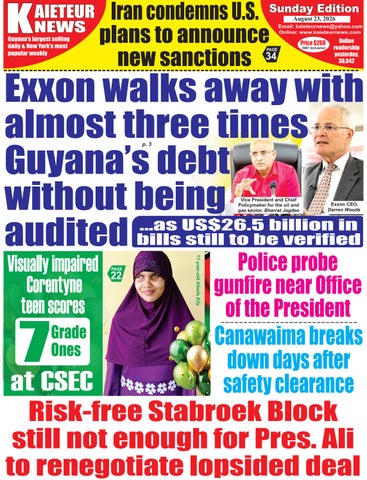
Exxon walks away with almost three times Guyana’s debt without being ...as US$26.5 billion in audited bills still to be verified p. 3
Vice President and Chief Policymaker for the oil and gas sector, Bharrat Jagdeo
PAGE
7
Grade Ones
at CSEC
17-year-old Afeefa Ally
Visually impaired 22 Corentyne teen scores
Exxon CEO, Darren Woods
Police probe gunfire near Office of the President Canawaima breaks down days after safety clearance
Risk-free Stabroek Block still not enough for Pres. Ali to renegotiate lopsided deal
PAGE 02
Kaieteur News
Sunday August 23, 2026
Kaieteur News
Sunday August 23, 2026
PAGE 03
ExxonMobil walks away with almost three times Guyana’s debt without being audited ...as US$26.5B in bills still to be verified A pool of money so large that it triples the size of Guyana's national debt has been pocketed by U.S. oil giant ExxonMobil for its investments in the Stabroek Block, but the country is yet to ensure that the company did not try to inflate any of those expenses paid for with the nation's oil. It was recently revealed by the Chief Executive Officer (CEO) and Chairman of Exxon, Darren Woods that the company has recovered a staggering US$55B using Guyana's oil. This accounts for all of the company's investment and operational costs according to him. Oil-rich Guyana is tasked with the responsibility of ensuring that it checks the expenses incurred by the operator to ensure the prices it paid for goods and services met industry benchmarks and aligned with costs that can be recovered in keeping with the terms of the 2016 Production Sharing Agreement (PSA). The deal outlines specific goods and services that can be paid for using Guyana's oil. To ensure that Exxon did not force Guyana into paying higher costs, or for items it is
not legally mandated to pay for, the country is expected to audit the company's expenses within two years from the end of each year according to the oil contract. To date, Guyana has conducted three audits for US$28.5B in expenses for Exxon. This means an eyewatering US$26.5B in bills are yet to be audited by Guyana or almost three times the country's national debt which is expected to climb to US$10B by the end of 2026. Guyana's first audit of Exxon covered the period 1999-2017. During this timeframe, Exxon said it incurred US$1.7B in expenses, but the British auditors found US$214M of those costs were wrongfully included. Government has said it is not budging on the figure and will fight Exxon to return the sum. Meanwhile, the second audit covered the period 2018-2020. A Guyanese audit team, VHE Consulting, were tasked with reviewing some US$7.2B in costs this time and found US$65.1M incorrectly charged. The third and largest audit yet for the company reviewed expenses for the
Exxon CEO, Darren Woods years 2021-2023 of a whopping US$19.6B. That audit was also awarded to the local company which is yet to publish the report. On 15th May, 2025 the minister of Natural Resources, Vickram Bharrat revealed that the audit was completed and the report handed over to government for review. Five months later, in October, Bharrat informed this newspaper that the Guyana Revenue Authority (GRA) was still conducting a technical review of the report and would make the document
public after the process was completed. When asked again, Bharrat directed all questions to the tax agency.
Vice President and Chief Policymaker for the oil and gas sector, Bharrat Jagdeo
GRA has not responded to any queries from this newspaper relating to the audit. The review of the company's financial activities is crucial in ensuring that Guyana received its rightful share of profits from the Stabroek Block. In accordance with the terms of the Petroleum Agreement, ExxonMobil and its co-venturers invest in developing the resources discovered in the block. Guyana has taken a backseat approach where spending by the Stabroek block partners is concerned. The government has agreed to review business transactions after the company spends billions of U.S-dollars which must be paid back by Guyana with its oil. This process is known as cost recovery. Prior to the recovery of its US$55B investment, Exxon was taking 75% of Guyana's oil produced each month to meet expenses associated with developing the seven projects approved
to date. This arrangement has often been criticised with stakeholders demanding not only a reduction in the cost recovery percentage, but a seat at the table where large contracts especially are negotiated. In this manner, Guyana can ensure it gets the best value for its money, prior to the signing of an agreement, as compared with verifying costs after a contract is awarded. The GoG has deviated from the “sanctity of contract” on the audit provisions that require audits of Exxon to be conducted within two years. Instead, Vice President and Chief Policymaker for the petroleum sector, Bharrat Jagdeo has made it clear that “bricks would rain down on Exxon's head” if the company were to refuse the
country the opportunity of checking its books beyond the timeframe outlined in the contract. He said, “We dealt with this issue when it came up several years ago; that it is true that the PSA says that the audit has to be completed within two years. So, we had gone pass, even under the APNU period, the two years had passed even before they started the audit and we made it clear when we got in to office, no matter how long the audits take, ExxonMobil and the co-venturers, the companies could never use as an excuse, the timeline in there.” He continued, “…because if they use that and don't want to comply with the audit, they would have a ton of brick falling on their head on other issues on the regulatory side.”
Linden needs clarity on grid reliability, electricity costs ahead of integration - Mayor Residents of Linden need clarity on the reliability of the grid they will be connected to, as well as assurance that electricity costs will not rise after integration, Mayor Domonique Blair said Thursday in an invited comment. Blair told Kaieteur News of the impacts of connecting Linden to the national grid could have on the already struggling mining community. Responding via WhatsApp, Mayor Blair said that while he is aware of plans to connect Linden to the national grid, he has not yet had the opportunity to review the Development and Expansion Plan, and would therefore prefer not to speculate on specific impacts at this stage. "That said, as Mayor, I do have some concerns that need to be properly addressed. Linden has historically benefitted from a subsidy arrangement through the company currently supplying electricity to the town, and any
change to that arrangement could have implications for consumers and businesses," he said. He continued: "My main concern is whether connecting Linden to the national grid will result in increased electricity costs for residents and businesses, particularly if the existing subsidy is reduced or removed. We also need clarity on the reliability of the supply and what the transition will mean for Linden in practical terms." The mayor added that Lindeners deserve to be properly consulted and given clear information before any major changes are implemented, including details on postintegration electricity costs and the safeguards that will be put in place to protect consumers. He said he would welcome a detailed presentation from the Guyana Power and Light Incorporated (GPL) to the people and municipality of Linden. Until
Mayor of Linden Dominique Blair that happens, he said, "it would be premature to say definitively whether this will be positive or negative for Linden."This publication reported on 22nd August that Linden is expected to be fully integrated into the national electricity grid by 2029, according to GPL's Development and
Expansion Plan for 2026–2030. With Linden integrated, combined GPL and Linden electricity demand is forecast to average approximately 5,975 GWh over the 2026–2030 period — an annual growth rate of about 45.7 percent, or roughly 1,753 GWh per year. The plan notes that a scenariobased assessment was conducted to account for uncertainty in the pace and composition of demand growth, helping guide system planning under different conditions. Looking further ahead to 2031–2040, total electricity demand is projected to average 63,560 GWh annually, growing at a rate of 29.3 percent per year (approximately 12,276 GWh). Demand is expected to rise from 15,369 GWh in 2031 to 133,198 GWh by 2040, driven largely by growth in the commercial and residential sectors. The customer base is projected to grow from 314,351 in 2031 to
422,983 by 2040: - Residential accounts — from 284,524 to 380,822, reflecting formal housing expansion as well as subdivisions, conversions, and informal connections - Commercial customers — from 26,184 to 35,177 - Industrial customers — from 3,643 to 6,984, driven by largescale projects, industrial estates, and other energy-intensive developments "This surge in residential and industrial demand is anticipated to shape a more diversified and demand-driven electricity outlook," the document states. As a result, GPL and Linden's combined average potential electricity sales are estimated at 57,852 GWh, with average annual growth of 30 percent, or approximately 11,298 GWh. These projections come as Linden continues to grapple with serious electricity supply problems.
Kaieteur News
PAGE 04
Kaieteur News Printed and Published by National Media & Publishing Company Ltd. 24 Saffon Street, Charlestown, Georgetown, Guyana. Publisher: DR. GLENN LALL - TEL: 624-6456 Editor-In-Chief: NIGEL WILLIAMS Tel: 225-8465, 225-8491. Fax: 225-8473, 226-8210
Sunday August 23, 2026
Kaieteur M@ilbox Send your letters to Kaieteur News, 24 Saffon Street, Charlestown, Georgetown or email us kaieteurnews@yahoo.com
EDITORIAL
Guyana’s “take” must never GOLD FIELDS be allowed to slip below 39.8% of revenues, plus 2% royalty
If there is one thing to be said about the Canadians, it is they have an incredible appetite for Guyana’s gold lands. At one time, the Chinese held that honour. Today the Canadians have muscled in and shoved the Chinese to the role of secondary players in Guyana’s lucrative gold sector. There is now a total of 13 Canadian gold companies operating in Guyana’s rich gold belt. G Mining Ventures (GMIN), Aris Mining, G2 Goldfields, and Omai Gold Mines are among the bigger, more well-known names. More recently, XAU Resources and Fortuna Mining Corp joined the great Guyana gold rush. From acquisitions of other foreign gold companies or secret partnerships with local holders of large tracts of gold lands, the Canadians have extended their footprint, and are now the force to reckon with in Guyana’s gold sector. To put it bluntly, the Canadians seem to have the Government of Guyana in a vice, and a stranglehold over gold operations in Region Seven (Cuyuni-Mazaruni) and Region One in Guyana’s Northwest. The Canadians are not fixated on gold alone. Another Canadian firm, U92 Energy Corp, just closed out its acquisition of a Singaporean firm, to explore for uranium in the Kurupung area. Some may see this as strategic. We at this paper see this as the Canadians wrapping the PPP/C Government around their fingers. All of these large acreages of gold lands in exchange for what? What is Guyana gaining for being so generous with its much in demand gold lands? The APNU+AFC Coalition gave away the rich Stabroek Block and all the oil that is in for a pittance. Thousands of kilometers of untouched oil fields ripe for exploration and extraction. The production record since First Oil in December 2019 needs no introduction, speaks for itself. Similarly, we admit to growing amazement at the rapid spread of Canadian companies in operation in Guyana’s goldfields. They grow from strength to strength, and with almost unchecked freedom. Not a cautioning hand, not a concerned word, from the PPP/C Government. It is good news to have so many companies interested in exploring Guyana’s virgin gold lands. What is Guyana getting for opening its doors and welcoming this virtual flood of gold investors? It cannot be that rich, not when the government is forced to hide the terms and conditions of the contracts signed with the foreign gold companies. They are mostly Canadian. It must be getting rather crowded in the interior with 13 companies from Canada alone doing their studies, bringing in their equipment, and increasing their labour force. We have two conditions for all companies exploring and working in the hinterlands of this country. First, the environment that has to be ripped up, must be restored to some state to benefit generations to come. Foreign presence must not transform where they touched into wasteland. Second, their presence must benefit this country’s peoples. Their earnings must mean earnings for Guyana’s treasury, and it cannot be of the small loaf variety. That has been the curse of this country. Large plots of coveted land handed over, rich assets parted with, and the equivalent of insulting beggar’s riches being Guyana’s share of the pie. Twist it or turn it, this is Guyana’s big natural resources pie. A pie that companies from all over the globe want to get their fingers and teeth in. It has to be a two-way street. The hordes of foreign investors make their millions, and so also must Guyana’s coffers be swollen. The PPP/C Government has been curiously quiet with the flurry of corporate activity in Guyana’s remote gold lands. From bitter experience, we have learned that when governments in this country think it wiser to deal in silence, that is a warning sign. It is not good for this country nor its peoples. The PPP/C Government, that has made a cottage industry out of boasting about its successes in attracting foreign investors to Guyana, has been too silent. That could be the giveaway. It has nothing rich to share, so close mouths have been the result. Compare that to different Canadian CEOs reporting exciting gold estimates to their shareholders. It must be the same cheap contracts, and surrender of Guyana’s riches.
DEAR EDITOR, My prompt for this letter is President Ali’s press briefing on 18th August, in which he was quoted in KN saying, “Guyana’s share of the Stabroek Block oil has increased from 12.5% to 39.8%. This has occurred . . . because the Cost Bank has been recovered two years earlier than was originally expected...”. President Ali’s statement needs a lot of work in terms of helping the nation understand this new reality. In my letter published in KN on 16th August, I urged KN as well as govt officials not to use the term “Profit” when discussing the oil contract, as it would only lead to confusion. Always speak in terms of percentage of total revenues or barrels out of a hundred – this way our grade school students as well as adults would have a clear idea of what Guyana gets from the Exxon-Guyana Oil Contract. President Ali’s pronouncement must be seen as not bad news at all. Up to this
point Guyana got 12.5% of total revenues or 12.5 barrels out of every 100. Now, according to President Ali’s statement, Guyana will start getting 39.8% of total revenues or 39.8/100 barrels. When the 2% Royalty is factored in (this is the same thing as an excise tax) Guyana’s total ‘take” will move up from 14.5% to 41.8% of total revenues or 41.8/100 barrels. I am not prepared to say it is great news. Because the Guyanese people do not yet know – and President Ali did not say – whether Guyana’s take will ever slip back to below 39.8/100 barrels. Nothing is in writing. President Ali says he is still working with the “experts” (presumably experts in contract law, accounting, finance) to understand the implications of CAPEX, (Capital Outlays) being paid off. President Ali must urgently meet with CEO of Exxon Darren Woods to get something in writing (Memorandum
of understanding) that Guyana’s “take” will never ever slip back below 41.8/100 barrels; that, not another dollar of Capex will be added to a new Capex bank. This is the ultimate meaning of Ring Fencing of projects. Commingling of Capexes among several projects will simply not be allowed. At the beginning of oil drilling back in 2020, Exxon’s PR folks explained: Oil-host countries are supposed to get at least an average of 50% of revenues over the life of the contract. We start at 12.5% and as Capex is paid down (sort of amortised over a period of years), Guyana’s share of revenues (or barrels) Continued on page 5
Kaieteur News
Sunday August 23, 2026
PAGE 05
Kaieteur M@ilbox Kaieteur M@ilbox Unity drives the future First-Aid and CPR training DEAR EDITOR, As oil continues to gush from Guyana’s offshore fields, transforming Guyana into one of the world’s fastest-growing economies, a familiar shadow looms over its glittering future. Beneath the promise of unprecedented multibillion-dollar prosperity lies an old, unhealed wound: deep-seated ethnic and political division. For generations, Guyana’s socio-political landscape has been trapped in a zero-sum game between its two largest ethnic groups: Indo-Guyanese and AfroGuyanese. Today, as the financial stakes reach historical highs, political factions are once again reaching for a wellworn playbook—using racebaiting and fearmongering to divide. The roots of this ethnic cleavage were planted long before independence, cultivated by British colonial administrators who pitted indentured Indian labourers against newly freed African workers to suppress wages and prevent labour solidarity. By the mid-20th century, this economic divide hardened into rigid political tribalism. For decades, political campaigns have leveraged rhetoric not on ideological
Guyana’s “take” must never be... From page 4 will rise to about 65% - and average out at 50% over the period. This means Guyana’s share of barrels should steadily rise to above the current 41.8/100 barrels. Reading newspaper reports on this pay-off of the $55 billion Capex, I notice there is still a lot of confusion. Capex and Operating Costs are two distinctly different things and should not be confused or commingled - with each other. Also, I note, President Ali does not seem to know how the 2% royalty is accounted for, even though Commissioner of Inland Revenue, Statia laid down the law on this matter. It is: 75% goes to CR and 25% is split between OCs and GoG. So, where does the 2% royalty come from? Statia says, OCs pay it out of their share of revenues. Mike Persaud
platforms or policy nuance, but on existential fear. Citizens are routinely warned that a victory for “the other side” means systemic marginalisation, economic exclusion, and total loss of power. The discovery of massive oil reserves—and the subsequent influx of wealth—has intensified this ethnic contest rather than soothing it. Disputes over electoral integrity, public spending, government contracts, and land distribution are quickly filtered through a racial lens and incendiary political commentary. Tactics of race-baiting remain a cheap shortcut to partisan consolidation. Instead of debating equitable wealth distribution, resource management, or sustainable infrastructure, rhetoric frequently devolves into accusations of racial patronage and systematic disenfranchisement. This cycle leaves Guyana
in a precarious state: economically surging, yet politically fragile. True progress requires a deliberate rejection of old political traps. The nation’s immense oil wealth presents a generational opportunity to lift all Guyanese out of poverty—regardless of whether their ancestors arrived on slave ships or indentured vessels. However, capitalising on this moment requires more inclusive governance models and equitable distribution that guarantee fair access for every community. Guyana can remain tethered to the destructive strategies of the past, allowing political entrepreneurs to profit off division, or its citizens can choose to forge a shared national identity—one where ethnic heritage is celebrated, but national unity drives the future. Yours sincerely, Daniel Singh
Where are our heroes? DEAR EDITOR. Where are our heroes? To whom can our children look up and identify a good model? Where are our heroes? I search the playfields for them Fixed matches I leave disappointed. Continue searching. Where are our heroes? I search the political arena Still searching Cannot find. Where are our heroes? Of the screen I search These are just actors and actresses A hero nowhere just pretension. Where are our heroes? I search the dust And there I find my heroes Unknown Unregistered Dying and becoming forgotten. Here is my hero. The persons worthy nobody knows. A blade of grass insignificant. Krishna Nand Prasad
should be mandatory for all first responders
DEAR EDITOR, I recently completed training in first-aid and intermediate CPR. During the training I could not help but think about the preventable MV Barima tragedy and how often I have seen persons experiencing life threatening conditions in Guyana and persons just standing watching on. No first-aid, no CPR, no nothing other than mere observation. This should compel Guyana to examine not only what went wrong, but what basic lifesaving capabilities we expect of the people entrusted with public safety. First-aid and Intermediate CPR at a minimum, must be a requirement for certain professionals working in particularly high-risk jobs whose occupations require them to respond to emergencies. Police officers, firefighters and members of the Guyana Defence Force should be trained and certified. So too should pilots and
first officers; captains, mates and other designated crew operating passenger vessels on our rivers and seas; mining camp managers and supervisors; and persons in other occupations who, because of where they work or the responsibilities entrusted to them, may become the first responder when someone is seriously injured, unconscious, drowning or not breathing. An ambulance, doctor or hospital may be minutes or, in Guyana’s hinterland and riverine communities, considerably longer away. Those first minutes can matter enormously. A person standing nearby with a uniform, rank or official responsibility but without the training to provide basic assistance may be of limited help when immediate intervention is required. This is particularly important for maritime transportation. On a vessel travelling through Guyana’s rivers or coastal waters, professional medical assistance may not be immediately available.
Other jurisdictions recognise this reality by requiring trained first-aid personnel aboard vessels and establishing specific emergency-response requirements. Guyana should examine whether its own standards are sufficiently rigorous, comprehensive and consistently enforced. The requirement should also go beyond possessing a certificate obtained years earlier. CPR and first-aid skills deteriorate without practice. Certification should therefore require periodic renewal, practical simulation exercises and training appropriate to occupational risks—whether drowning and water rescue, burns, trauma, severe bleeding, cardiac arrest or remote-area emergencies. Regards, Rawle A. Small
PAGE 06
Kaieteur News
Sunday August 23, 2026
$188M contract awarded to rebuild Grove Police Station
The Grove Police Station on the East Bank of Demerara. The reconstruction of the Grove Police Station on the East Bank of Demerara will cost $188,493,650. This is according to the National Procurement and Tender Administration Board (NPTAB), through which the project was awarded following a national bidding process. The contract was awarded to Shop Modern Guyana, which was among some 54 bidders that applied for the project. The project is being executed by the Ministry of Home Affairs and was estimated to cost $215,212,463, according to the government’s engineer. The project forms part of the $3.6 billion allocated by the government in the 2026 budget to further enhance the infrastructural capacity of the Guyana Police Force.
The Ministry of Home Affairs, which has undertaken similar projects in other parts of the country, has stated that the construction of these facilities is aimed at enhancing public safety, strengthening law enforcement capacity, and bringing essential services closer to residents. Commissioning similar police station projects in the past, the Ministry has noted that these new facilities are equipped with male, female, juvenile, and isolation holding cells, along with specialised spaces such as a Child-Friendly Area and a Domestic Violence Interview and Waiting Room. They also include key operational areas such as the Criminal Investigation Department (CID), Traffic, Enquiries, evidence storage, and living quarters for ranks.
Kaieteur M@ilbox GECOM’s work plan for the LGE must commence DEAR EDITOR, There is no reason why an independent body such as GECOM cannot commence the work plan in place to ensure that local government elections are carried out in a t i m e l y m a n n e r. T h e commission knows what their responsibilities are and they must carry out their constitutional mandate. Whether or not everyone agrees on the makeup of the commission should not prohibit it from ensuring that the democratic process continues. We must rid
ourselves of the excuses that enable democracy to be delayed and that prevents the will of the Guyanese people from being carried out. T h e c u r r e n t disagreement between sore losers who prefer to squat in o ff i c e a n d t h e i r n e w replacements as the voice of the people who oppose the current government should not provide impetus for the government to further delay democracy. The LGE (local government elections) was delayed for far too long in
the past under both the PNC and the PPP. For those who do not wish to relinquish power and embrace democracy, delaying or preventing the LGE from taking place is in their best interest. We the people of Guyana must insist that our voice be heard and that our democratic rights be respected. If the President is truly a proponent of democracy, he will ensure that GECOM is no longer hindered in carrying out its constitutional duties. Although GECOM is an independent body the appointment of the Chairperson falls within his realm of authority and it is done in consultation with the Leader of the Opposition. If the current Chairperson is unable to get the job done, then the President and the Leader of the Opposition must take the appropriate steps to ensure that the democratic process is no longer hindered. Sincerely, Mr. Jamil Changlee Chairman The Cooperative Republicans of Guyana
Kaieteur News
Sunday August 23, 2026
PAGE 07
Risk-free Stabroek Block still not enough for Pres. Ali to renegotiate lopsided deal Although risks have been removed from the Stabroek Block with all US$55B investments recovered by ExxonMobil, the Government of Guyana (GoG) is still refusing to engage the company for a renegotiation of the lopsided agreement which is permitted under the 2016 Petroleum Agreement. During a press conference on Tuesday, President Irfaan Ali was asked by this newspaper whether he would request a renegotiation of the deal given that the operations are now risk-free. In his presentation, the President revealed that ExxonMobil had recouped all of its investments, positioning the country to now receive 39.8% of profits, compared with the previous 12.5% share. Against this backdrop, Chartered Accountant and Attorney, Christopher Ram recently opined that the time has now come for the country to renegotiate the Exxon contract. Ram said, “Now that this moment has arrived, and the project has become risk-free, it is entirely appropriate that the government calls Exxon to the table and say, look we must renegotiate this contract now.” Guyana's Head of State however holds firm to the view that the deal cannot be changed due to legal ramifications. He explained, “We have spoken about the existing contract many times before and the difficulty with doing that from a legal perspective one and from the perspective of the sanctity of contract so that hasn't changed but on your second question as condition change, the administrative leverage that the government has can help to give us greater benefits from the sector.” Chris Ram in his most recent call for renegotiation made it clear that while the government preaches about “sanctity of contract” the same deal makes provision for changes. Article 32.1 states that Government shall not “require renegotiation of” the agreement without the Contractor's prior written consent. This simply means that talks for changes to the contact can occur with the approval of both sides.
To t h i s e n d , R a m suggested that government engages the company on paying its fair share of taxes to the state like every other company operating in Guyana. The taxation clause has always been debated by Guyanese who believe that unlimited tax giveaways to the multinational corporation should not be allowed. In fact, Ram said if the companies insist that a tax concession was part of the bargain, it should be a concession with an end date such as a defined ten-year waiver running from first oil in December 2019 and expiring in December 2029. Second, Ram wants an increase in the rate of royalty from 2% to at least 6% moving up to 10% within five years. The Chartered Accountant also called for each production licence treated as a separate cost centre, with its own costs recovered only from its own production, and the recovery ceiling cut from 75 percent to 50 percent – a figure common across producing jurisdictions. F u r th er, h e w an ts decommissioning costs borne solely by the companies and expressly excluded from recovery; the sums set aside held in cash in an account in Guyana rather than existing as a paper undertaking; and guarantees given by the ultimate parent companies themselves, not by an unnamed affiliate. “Review and renegotiate” During an interview while running for president back in March 2020, Ali had strongly criticised the Exxon PSA signed by the Coalition Government with ExxonMobil. He stated at the time, “We have made it very clear, and we can never agree, how could, how could, I don't think any Guyanese agree with this, no Guyanese
President Irfaan Ali
except the government that is defending it. We have made it very clear that we have to go towards, we're looking at these contracts, renegotiating these contracts, looking at contract management and all of these things. Everything we have to relook at because we have to ensure that our country does not get the wrong end of the stick.” Ali's remarks back then indicated a willingness to “review and renegotiate” the contract to secure better terms for Guyana. However, since assuming office in August 2020, his administration has shifted to sanctity of contract. Energy strategist, Anthony Paul of Trinidad and Tobago who advised several governments and independent organisations o n o i l a n d g a s p o l i c y, including Guyana, however explained that the ExxonMobil contract can be renegotiated but requires strong political will, as countries around the world with similar arrangements to Guyana have previously altered their agreements. Paul was clear, “If there is provision in the contract for renegotiation and if events have shown the contract not to be just then every contract...every contract presumes some level of justice and the question is, in the contract, if
things have changed materially when the contract was drawn up and changes have made it more unjust or grossly unjust then there may be a basis for renegotiating.” Moreover, the energy strategist pointed out that companies often seek renegotiation, simply because they have the backbone to do so. He explained,
“Companies always renegotiate, always ask for changes. Now we know for instance that there were points in time when there should have been relinquishments. Were those used or were those extended? The fact that they were extended means there was a renegotiation. Everytime there is a renegotiation…the fact of the matter is, for it to become valid it means somebody agreed. So therefore, and as you and I know, once you're renegotiating, then the other party has the option to ask for a quid pro quo. So, in giving this, what do I get in return?” Furthermore, the specialist shared that he is aware of countries that have renegotiated their oil contracts, although they had similar stability clauses to Guyana's. “There was a strong case in Tanzania where they termed the
contract a really bad contract and they renegotiated,” Paul shared. Sanctity of contract? Although the GoG continues to use the 'sanctity of contract' as its reason for not renegotiating the contract, both parties have deviated from the terms and adjusted provisions in the past. For instance, the contract specifically states that audits of the company's expenses must be conducted within two years but this timeline has been extended. Additionally, stakeholders argued that the contract required a feasibility study to be conducted for the use of gas resources in Stabroek, however no such study was conducted. An addendum to the contract was also signed to explicitly state that the 2% royalty paid by Exxon will not be recovered by the contractor.
Sunday August 23, 2026
Kaieteur News
PAGE 08 10
Opposition Leader rolls out HERO initiative …demands $5M interim relief for MV Barima victims' families The Office of the Leader of the Opposition has officially launched the Helping, Empowering, and Rebuilding Opportunities (HERO) Initiative, establishing a structured advocacy and relief framework for families affected by the fatal sinking of the MV Barima. As part of the unveiling, Opposition Leader Azruddin Mohamed called on the government to immediately disburse an interim relief payment of G$5 million to every affected family. "… we are calling on the Government of Guyana to quickly make available a $5 million interim payment to all families affected by this tragedy, to not only help ease their financial burden as many of them lost their breadwinners…"
Mohamed said.Speaking at the launch, Member of Parliament (MP) Odessa Primus stressed that administrative inquiries and legal processes should not leave families in financial hardship, urging the government to act swiftly on the interim relief proposal to uphold the dignity and well-being of the affected citizens. "…this is perhaps the second biggest tragedy, in number of persons lost, that are Guyanese… Sometimes you do not want to say things, but you are forced to say it, and it leads one to wonder whether the government does not value or have any respect for our Indigenous brothers and sisters. And the answer for me is no, based on the actions that they have chosen to take. And the thing is, what do we
Opposition Leader Azruddin Mohamed during the launch
The gathering of families affected by the tragedy at the launch. do? Do we sit and take it? Or do we stand up and fight for what is right?... We are calling on the government again to float the boat," Primus said. The MV Barima, an 87-yearold state-operated vessel, capsized on the evening of 18th July off the coast of Essequibo, leaving 73 persons dead, 76 rescued, and at least 30 others missing. The ferry was on a scheduled voyage from Georgetown to Port Kaituma in Region One when it encountered trouble and sank near the Pomeroon coast. The disaster resulted in significant loss of life and sparked widespread public outcry over vessel maintenance standards, manifest accuracy, and regulatory oversight across the nation's water transport network. Under the HERO Initiative, the Opposition Leader, by way of a statement, outlined several immediate priorities aimed at assisting survivors and grieving relatives, including those residing
in Region One (Barima-Waini), Georgetown, and elsewhere. Chief among these is the call for an initial, non-compensatory G$5 million emergency payout, intended to help families meet immediate living expenses and access medical or psychological support without delay. Several prominent attorneys — including Damien DaSilva, Christopher Ram, Nigel Hughes, Siand Dhurjon, and Roysdale Forde SC, among others — have agreed to provide their services pro bono to affected families who wish to pursue them. The statement noted that psychologists are also offering their services free of charge: "Dr. Telford Layne, along with other psychologists who prefer to be unnamed, [have] all contacted us to give of their services free of charge. They have all committed to work with the survivors, and family members of the deceased and those still missing from the MV Barima tragedy."
The statement continued: "The constant cry from all families is that they have received no proper support from the government, who has continued to issue promises but have fulfilled none of the commitments they made." The initiative also calls for independent legal guidance to ensure affected families are fully informed of their rights before signing any documentation or state-issued releases. T h e We I n v e s t m e n t i n Nationhood (WIN) Members of Parliament Natasha Singh-Lewis, Dawn Hastings, and Nandranie Persaud, present at the launch, emphasised that acceptance of emergency financial support should not prejudice or limit any family's right to pursue full legal remedies or formal state settlements as the Commission of Inquiry progresses. The initiative further demands accelerated and transparent salvage operations to recover the vessel and preserve crucial forensic evidence.
Kaieteur News
Sunday August 23, 2026
PAGE 09
Pants suit and pastel colours In the 1970s when I was a young employee of a large, service-oriented privatesector firm in Guyana, I was not yet a confirmed employee and therefore could not wear the prescribed uniform. But I was nevertheless expected to dress in a manner appropriate to the office. One day I arrived wearing a rust-brown pants suit, an expensive and carefully tailored garment, elegant rather than ostentatious, and designed in such a way that it revealed nothing of the body. The jacket came all the way up to the throat, so no blouse was required. Several of my female colleagues complimented me on it, although I suspected that some of the admiration contained a little envy because the outfit had cost more than most of them could comfortably afford. Later in the day, my supervisor approached me and, with quiet authority told me that I should not wear the outfit again. The problem was not that it was vulgar, unsuitable or poorly made; it was that it was not in the prescribed pastel colours and therefore did not conform to the dress code of the office. I could have objected, and perhaps I could even have made a persuasive case that the rule was unnecessarily restrictive and that the quality and appropriateness of the garment mattered more than its colour. I could have even claimed that the uniforms
won by the other staff members were brighter in colour than my outfit. But I understood that rules are rules. And where a rule is reasonable and legitimately established, one complies with it before one protests against it. One can believe that a rule should be changed and still obey it while it remains in force. If every person first decides which rules deserve obedience, an institution has ceased to have rules and has acquired only suggestions. This is why I have watched the controversy surrounding the Caribbean Court of Justice with particular interest, because I suspect that beneath the elaborate language about governance, panels and judicial independence is the issue of compliance with the prescribed dress code for public sittings of the court. Justice Winston Anderson, President of the CCJ, has now explained that t h e C o u r t ’s f o u n d e r s intended to preserve the Caribbean tradition of judges wearing judicial robes during proceedings, while bench jackets became accepted for interlocutory and chamber matters and business attire was used when judges were not robed. According to Anderson, the immediate dispute arose after a colleague appeared in traditional national dress during proceedings on two occasions, including in December 2025 and April 2026, and after Anderson raised the matter privately on
10th June, he was unable to secure a commitment that the established practice would be followed. Anderson claimed he subsequently removed the judge from the panel hearing a preliminary application, insisting that the decision was based solely on judicial attire and not on the judge’s opinions, participation in deliberations or views on the case. He further said that the judge was later included in the panel for the substantive hearing, and that a draft judicial dress code was subsequently prepared for consideration. I see nothing inherently improper in removing a judge from a particular panel where the President, charged with the administration of the Court, has a legitimate concern that the judge will not comply with the Court’s established requirements concerning judicial attire. The question is not whether a judge owns an attire that is culturally significant, or whether some people might prefer it to a robe; the question is whether the person is prepared to observe the conventions of the institution while serving within it. Dress has always carried meaning in institutions, and courts have understood this perhaps better than most. The robe does not make the judge wise, just as my rustbrown suit did not make me a better employee, but the robe signifies that the individual has entered a different world, one in which personal
Dem Boys Seh...
Heat, beat and the public toilet Dem boys seh de heat is on—and not de kind of heat you get when Parliament start kicking up a storm. This is real heat. Guyana baking like somebody put de whole country in a pressure cooker and forget to turn down de stove. Temperatures reaching 34 degrees Celsius and higher, and every expert advising: “Drink plenty fluids. Stay hydrated.” Good advice. Excellent advice. But dem boys got one small question: Where you going when all that water decide it wants to come back out? Because if you have to go into Georgetown, you could drink enough water to float a small canoe. But eventually nature is going to send you a text message: “Urgent. No postponement.” And then the problem begins. Where are the public conveniences? Dem boys know plenty places where you can buy a cellphone, a beer, a hamburger, a gold chain and even a car tyre. But try finding a public toilet in Georgetown. So, the government telling people to drink more water to beat the heat. But if you have to pass water, you have to heat a beat.
That remind dem boys of one day when dem boys had to go badly. Dem boys finally found a public toilet with two stalls. One door was locked, but the other was available. Dem boys rushed inside, closed the door and began attending to business. Suddenly, from the locked stall next door came a voice: “Hello there! How are you doing?” Dem boys thought this was strange, but manners is manners. “Not too bad, thanks.” A little silence. Then the voice came again: “So, what are you up to?” Dem boys, now wondering whether this was some new form of public-toilet social networking, replied: “Just here relieving myself. How about yourself?” Then came the reply: “Sorry, I’ll have to call you back. I’ve got some jerk in the stall next to me answering everything I say.” Dem boys seh in this heat, hydration is important. But so is location, location, location. Because when nature calls in Georgetown, you don’t need a telephone. You need a toilet. Talk half. Leff half.
preference is subordinated to institutional identity. The judiciary is intended to convey an image of authority and respect for that authority. The elevated bench, the formal language, the robes, the silence and the rituals are all reminders to the public that something larger than the personalities occupying the room is at work. The CCJ is not merely another office in which six distinguished Caribbean professionals happen to work. It is the region’s apex court, and its President has rightly pointed out that the manner in which judges appear carries implications for courts throughout the Caribbean and for public confidence in the institution. This does not mean that every dress code is sensible, nor that tradition should become a prison from which institutions cannot escape. If the Caribbean Court of Justice decides that its judges should wear national dress, then that question can be debated, consulted upon and formally decided. But until such a decision is made, I believe persons should
comply with the prescribed dress code. My own experience in that office many years ago was insignificant compared with what is now taking place at the CCJ, but the principle was the same. I did not like the pastel-colour rule, I did not think my rustbrown suit was improper, and I could have argued the matter until everyone in the office became an unwilling expert in women’s tailoring; nevertheless, I complied first and could have protested afterwards. The danger today is that we sometimes forget that institutions survive precisely because individuals accept certain restraints upon personal expression. The CCJ controversy should therefore not be reduced to a quarrel about robes, national dress or the taste of one judge against another. It should remind us that institutional dignity is built from small acts of conformity to reasonable rules, and that when those rules are no longer suitable, the proper response is to change them through the institution.
Justice Anderson may ultimately be judged to have handled the matter too firmly; indeed, he himself has acknowledged that he may have approached the issue too strongly. But that is a question about manner and administration, not a reason to discard the underlying principle that institutions have the right to establish reasonable standards and to expect those standards to be respected. The old office rule about pastel colours disappeared from my life long ago, and I have no doubt that the world survived my rust-brown pants suit. What has remained is the lesson: sometimes respect for the institution requires you to dress, behave and even restrain yourself in certain ways. The views expressed in this article are those of the author and do not necessarily reflect the opinions of this newspaper.
Sunday August 23, 2026
Kaieteur News
PAGE 10 UTHS
D TR
HAR
HK
BY G
LALL
H@RD TRUTHS
BY GHK LALL
Electricity failing, a minister begging First, they had their arms wrapped around demand. Then the PPP Govt confessed. It did not. They had plans and visions. Only for those to become blurred. It's the haze of the “unusually hot” weather, stupid. What's so hard about understanding an overheated environment? An overheated environment requires a considerable amount of cooling. Cooling calls for electricity. Hon
Minister Deodat Indar appealed to the public: please go easy on the electricity. A high minister turned low beggar. Listen to his highness. First, it was the transmission lines. Overloaded. They wilt in the heat, and they catch cramps under the load. Can't carry their load. Sounds like billions from the record national budgets went into a big black hole. A contract or
two should be reexamined. A contractor or two pulled over, given an auditing third degree. Walk that line. Let's see how straight and steady the feet are. But the minister isn't going there. He is prioritising transmission lines that now refuse to transmit. Collapse into a tangle of curled wires and the strong scent of something burning. I thought that Minister Indar was done. He wasn't. Never was he a
minister to put all his eggs in one plastic basket. He walked with reinforcements. Engines. The GPL engines are old and 'they kind of back down…' Backdown, sez the honorable minister. What does that mean? They curl up and take a nap? Or, as I believe, they are just not up to the job of keeping Guyanese homes and businesses alight and cool. Citizens were told before of sloppy contractors who damaged power lines with their negligence. And road users who for some reason were in a hurry to make embracing acquaintance with GPL posts. To the disturbance of the latter. The minister owes the Guyanese people a duty to get his story straight. Which is which? Trucks or transmission lines. Racing road engines or old, derelict GPL engines. Tempers are already frayed. It doesn't take much to get Guyanese going. They are run ragged by heat and blackouts. By a government that shares half the story (tricky half) and tells the people don't worry, just keep smiling. Try doing that through gritted teeth. So now there was Minister Indar with his begging cap on, and humility
plastered on his sad face. Cut back on the electricity. Jesus Christ! Guyanese are already skimping and squeezing on electricity, the blasted supply is so expensive. What are they going to cut back on, when there is neither flab nor fat? They are down to the bone, and had (had) their hopes pinned on the Wales gas-to-energy delivering, only for that to repeat its tendency to bust up one calendar date after another. Surely, Minister Indar jests! I have my own appeal to make of him. He should come out of his airconditioned office and car and stand in the sun between the hours of 11 and 4 and make his electricity conservation speech to see how long he lasts. To determine how many Guyanese give him a hearing. Or a finger for his troubles. I have another recommendation to make. From president to ministers to permanent secretaries (every man jack [and jill] of them), should turn off their air conditioners and sit in a cubicle to do whatever they do. President, ministers, all,
should set the example. The president, the minister, and the kaboodle are the first who should make the sacrifices. Tell the president I said so, Minister Indar. Constructively, of course. It is time that government ministers become familiar with how Guyanese live. Challenges. Costs. Horrors. The crippling effects of the policies and failures of a government that can't get anything right. Of course, it did name a Chinese-built bridge correctly. And, it did include family to taste the nation's wealth. Cutting electricity is cutting one's nose, minister. Cutting electricity, Minister Indar, is operating on oneself. Without anesthetic. Good luck and good tidings, minister. The views expressed in this article are those of the author and do not necessarily reflect the opinions of this newspaper
Kaieteur News
Sunday August 23, 2026
PAGE 01 EGA 11 P
The Road to First Oil - Every Man, Woman and Child must become oil-minded. Column 195 (Part I of II)
From 12.5% to Nearly 40% – The Good News, and What It Means By Christopher Ram
P
resident Irfaan Ali brought Guyanese some genuinely good oil news this week. He announced that Guyana's entitlement from production in the Stabroek Block has risen from the historical 12.5% to approximately 39.8%. Even if oil prices had remained unchanged, Guyana would now be receiving more than three times its earlier share. And because of the war on Iran, oil has risen more than 50% from its end-2025 price. That is great news and since I believe strongly in the old advice not to look a gift horse in the mouth, I welcome it. This two-part column examines first what the increase means and how Guyana's benefit compares with that of the oil companies. Part II will consider how durable this favourable position is, given today's high oil price, prospective exploration expenditure and the unchanged terms of the 2016 Petroleum Agreement. Let us be clear. The movement from 12.5% to nearly 40% is not the result of renegotiation. It follows from the Agreement's costrecovery mechanism. In the early years, up to 75% of petroleum could be allocated to recovering exploration and development costs. The remaining profit oil was divided equally, leaving Guyana with 12.5% of gross production. The logic is simple. As accumulated costs are recovered, cost oil falls, profit oil rises and
Guyana's share increases. But first, this column notes an ambiguity over whether the 39.8% includes Guyana's 2% royalty. The President's own comparison points strongly to the royalty being additional. He compared today's 39.8% with the original 12.5%, which was Guyana's share of profit oil, not its total take i n c l u d i n g r o y a l t y. T h e natural reading is therefore profit oil against profit oil: 12.5% then and 39.8% now. At an illustrative US$90 per barrel, 39.8% gives Guyana US$35.82 of profit oil. The 2% royalty adds US$1.80, producing US$37.62 per barrel, or 41.8% of gross value. If instead the 39.8% includes royalty, Guyana's profit oil would be US$34.02, which with the US$1.80 royalty gives US$35.82. Either way, the improvement is substantial. But nearly equal profitoil shares do not mean equal economic benefits. The 2016 Agreement contains two major tax concessions to the contractors: the Government pays their corporation tax and provides the corresponding tax certificates, while distributions and remittances of profits are exempt from withholding tax. The companies' tax benefits For illustration, I treat profit oil as taxable profit, apply corporation tax at 25%, and assume after-tax profit would otherwise attract 20% withholding tax, with no other adjustments. For every US$100 of profit
oil, the corporation-tax benefit is therefore US$25. The remaining US$75 would attract US$15 withholding tax. On these assumptions, every US$100 of profit oil carries US$40 of tax benefits. On what I consider the more likely interpretation; Guyana receives US$37.62 in profit oil and royalty. The companies receive US$35.82 of profit oil, plus an assumed US$8.96 corporation-tax benefit and US$5.37 withholding-tax benefit – a total economic benefit of US$50.15 per barrel. That is US$12.53, or approximately one-third, more than Guyana. If the 39.8% includes royalty, Guyana receives US$35.82, while the companies receive US$34.02 of profit oil plus US$8.51 and US$5.10 in assumed tax benefits, giving them US$47.63. Again, their economic benefit is approximately one-third greater.
These figures are illustrative, not calculations of the companies' actual tax returns or tax certificates. Taxable income can be affected by deductions and other adjustments. The purpose is to expose the structure of the bargain: equal profit oil does not mean equal economic benefit. Guyana receives a 2% royalty on top of its profit oil; the companies receive substantial tax benefits on top of theirs. Cautionary tale None of this diminishes the announcement. Moving from 12.5% to nearly 40% profit oil is excellent news. At present production and prices, the additional revenue is enormous. The cost-recovery mechanism that once restricted Guyana's profit-oil share to 12.5% is now working strongly in our favour because enormous, accumulated costs have been recovered. But today's position reflects unusually favourable
circumstances. Much of the earlier investment has been recovered, production is at record levels and oil is around US$90. Yet not a word of the 2016 Petroleum Agreement has changed. The 2% royalty remains; the tax concessions remain; the withholding-tax exemption remains; and the costrecovery and stabilisation provisions remain. The economics have changed. The contract has not. Nor are today's economics guaranteed to continue. Oil was around US$61 at the end of 2025 and has risen sharply with the U.S./Israeli war on Iran. Prices can fall again. ExxonMobil and its partners also retain substantial exploration ambitions, and renewed exploration and development could generate another major cycle of recoverable expenditure, increasing cost oil and reducing Guyana's profit-oil percentage. Those issues belong in
Part II. We should welcome the movement from 12.5% to nearly 40% for what it is: very good news for Guyana. But the next question is more difficult: how long can these favourable conditions last, and does receiving much more under the 2016 Agreement make the Agreement itself any less inequitable? (This column was first published on Chrisram.net and was republished with the kind courtesy of the author.)
PAGE 12 10
Kaieteur News
Sunday MondayAugust May 02,23, 2022 2026
Sunday 2202 ,2August 0 yaM y23, adn2026 oM
Kaieteur News
PAGE 01 EGA 13 P
Facts, Due Process and Fairness:
The CCJ's Test By Sir Ronald Sanders I have been an advocate of the Caribbean Court of Justice from its conception. In 2015, on the Court's tenth anniversary, I described its creation as arguably the most significant institutional achievement of the Englishspeaking Caribbean since the Treaty of Chaguaramas. I have not changed that view. I have also argued repeatedly that the CCJ is a people's court. An appeal to the Judicial Committee of the Privy Council costs at least US$65,000 and is, therefore, beyond the reach of most Caribbean people. By contrast, the CCJ, with its travelling Bench, video links and electronic filing, provides access to justice for persons of little means as well as for governments and wealthy companies. The Court was also deliberately protected from political control. Its judges, other than the President, are appointed by an independent regional commission. The President is appointed by a threequarters majority of the Contracting Parties, but only on the recommendation of that Commission. The Court's operations are financed through an independently managed Trust Fund. These are strong reasons for supporting the CCJ. But support for a regional institution cannot mean silence when serious questions arise about its administration. On the contrary, those who value the Court should be among the first to insist that such questions are answered properly. The allegations now surrounding the President of the Court, Justice Winston Anderson, are grave. Internal correspondence reported by the Trinidad Express newspaper shows that five of his six judicial colleagues raised concerns about his leadership. The reported allegations include “dictatorial” administration, the manipulation of judicial panels and attempts to influence colleagues during deliberations. But allegations are not findings. They do not become true because private correspondence has been disclosed and published. No independent body has found any of these allegations proved. Nor has anything
published established that the outcome of any case was improperly determined. I have known Justice Anderson for many years as a dedicated Caribbean public servant, a distinguished legal scholar and a committed worker in the cause of Caribbean jurisprudence. That acquaintance does not put me in a position to decide disputed facts. But it does allow me to say that his record of service should not be swept aside, and his character should not be determined, by allegations that have not been independently examined. Justice Anderson has now answered the allegations. He rejects unequivocally the claim that panels were constituted to influence the outcome of cases. He maintains that the selection of panels has always been an administrative responsibility of the President and that he exercised it only for the orderly and impartial conduct of the Court's work. He has not claimed that every decision he made was beyond criticism. He accepts that he may have dealt too strongly with the question of judicial attire. He also acknowledges that his intervention in Guyana's long-standing failure to appoint substantively a Chancellor and Chief Justice would have been better confined to public commentary, as his predecessors had done. His account deserves the same consideration as the allegations against him. On 19th August, the Court announced that all judges will now sit on all panels unless a judge is formally excused for a legitimate reason. This change greatly reduces the scope for any President to choose which judges will hear a case. That was a sensible decision. It was not an admission that panels had previously been manipulated. Equally, it does not establish that the previous authority was never misused. That question remains unanswered. The difficulty is that no one appears able to say with confidence who has the lawful authority to answer it. The Regional Judicial and Legal Services Commission has said that the concerns should be addressed through the established internal processes of the Court and
the Commission and through a “transparent and independent review”. It later clarified that it had not said that it had ordered such a review. Senior Counsel Ralph Ramkarran of Guyana has argued that the Commission has no authority to investigate the President. The Commission's disciplinary power expressly applies to judges other than the President. Article IX of the Agreement establishing the Court provides a process where removal of a President may be under consideration. If at least three Heads of Government jointly represent that the question of removal ought to be investigated, a tribunal must be established to inquire into the matter and advise whether the President ought to be removed. But that is a process directed towards possible removal from office. The Agreement does not set out, with equal clarity, who may conduct an independent examination of serious allegations against the President where removal is not yet being considered. That is not a small procedural point. An investigation by a body without authority would resolve nothing. Its findings would themselves be challenged. Yet the absence of any credible inquiry would leave the allegations hanging over Justice Anderson and the Court indefinitely. Neither result would be fair to him, to the judges who raised the concerns, or to the Caribbean public. In this respect, the constitution of the Court is unfinished. It provides a mechanism for removing a President, but not a clear and undisputed procedure for examining complaints against the holder of that office before the question of removal arises. There is also the separate question of how the correspondence reached the press. The Organisation of Eastern Caribbean States Bar Association and the Organisation of Commonwealth Caribbean Bar Associations were right to call for both the allegations and the disclosure to be investigated, and for the Court's information systems to be examined urgently. Confidentiality in
judicial deliberations is essential. Judges must be able to exchange views, test arguments and reconsider positions without fearing that unfinished opinions will appear in a newspaper. The disclosure of such material has harmed the Court. But an investigation of the disclosure cannot be used to avoid an examination of the allegations. Both matters require attention. Judicial independence does not mean that the administration of justice is beyond question. Independence protects judges and their decisions from political pressure and other improper influence. It does not excuse misconduct, if misconduct is proved, and it does not remove the need for accountability. The Heads of Caribbean Judiciaries put the matter plainly when they said that the Court's authority “rests upon public confidence in the independence, impartiality, integrity and competence of its judges”. That confidence cannot simply be demanded. It has to be maintained. The Dialogue between CARICOM Heads of Government and Heads of Judiciary in Montego Bay in July 2025 showed that the executive and judicial branches can engage each other while respecting judicial independence, the separation of powers and the constitutional role of each
branch. That Dialogue was not concerned with judicial discipline. But it demonstrated that properly structured engagement between the branches is not an attack on judicial independence. Some of the eight CARICOM states that still retain the Privy Council may regard the present controversy as proof that they were right not to embrace the CCJ fully. That would be the wrong conclusion. No court, whether in L o n d o n , Wa s h i n g t o n , Strasbourg or Port of Spain, is free from internal disagreement. The question is how an institution r e s p o n d s w h e n disagreement becomes serious and public. Wi t h i n d a y s o f t h e allegations being published, Justice Anderson issued a detailed reply. Within ten days, the Court changed the way judicial panels are constituted. These were necessary steps, but they were first steps only. They do not replace the need for an independent and lawful process to establish the facts. The answer to a weakness in the governance of the CCJ is not continued dependence on the Privy Council. It is to correct the weakness. A distant court is not more accountable to Caribbean people simply because it is distant.
Sir Ronald Sanders What is now required is a process whose authority cannot reasonably be disputed, which treats Justice Anderson and his judicial colleagues fairly and which establishes what occurred. The Contracting Parties must also close the gap in the Agreement so that, if a similar situation arises again, there will be no argument about who is authorised to act. The Caribbean did not create the CCJ because we believed that its judges would never disagree or that its administration would never falter. We created it because we believed that Caribbean people were capable of administering justice at the highest level. That belief now requires us to deal with this c o n t r o v e r s y h o n e s t l y, lawfully and fairly. The Court will not be weakened by doing so. It will be strengthened. (The writer is Antigua and Barbuda's Ambassador to the United States and the Organization of American States. He is also the Chancellor of the University of Guyana. The views expressed are entirely his own.)
Kaieteur News
PAGE 14
WEEK-IN-REVIEW SUNDAY Four more oil discoveries in Guyana likely to go “above and beyond what we thought were opportunities” – Exxon CEO Wi t h 4 6 s i g n i f i c a n t o i l discoveries already made in the prolific 24,000 square kilometer Stabroek Block, ExxonMobil believes there are four more discoveries likely to be made that c a n e x c e e d t h e c o m p a n y ’s imagination. Shareholders of the company were briefed on the potential discoveries by Chief Executive Officer (CEO) and Chairman of ExxonMobil, Darren Woods during the second quarter earnings call on 31st July, 2026. While responding to a shareholder on the use of Artificial Intelligence (AI) tools and generating prospects with specific regard to exploration in Guyana, Woods explained that a large portion of the Stabroek Block is in force majeure given the GuyanaVenezuela border controversy that is currently before the International Court of Justice (ICJ). He said, “We’ll see what happens there. We feel there’s an opportunity then to start shooting seismic and understand what that acreage potentially holds. And we’ve got more work to do in the acreage that we’ve already shot and the work that we’ve been doing.” Additionally, he reminded that Exxon has put increased effort into AI and training models. To this end, Woods said, “based on what we found already, all the drilling that we’ve done, the characterisation of that subsurface, and unleashed that in the rest of the block and have four new discovery opportunities above and beyond what we thought were opportunities. So, we’re optimistic there.” He noted that there was still a lot more work required to confirm the discoveries but assured investors, “we’re not done yet in Guyana and we see – continue to see a really bright future there.” Woods pointed out that there was still a lot of acreage sitting for the company to take advantage of. As such, he informed investors that the company is continuing to look for opportunities as AI helps to identify areas not previously identified for exploration. “So, I would tell you this thing – the tape hasn’t run out on this play yet and we’re going to continue to evaluate that and see what we can get from it. But I mean, you can rest assured the organisation is very focused on maximising the value of that acreage for the benefit, obviously, of ExxonMobil. But more importantly, for Guyana, the government of Guyana, the people of Guyana,” Woods explained. ExxonMobil has made 46 discoveries in the Stabroek Block since its first commercial discovery
CEO and Chairman of ExxonMobil, Darren Woods in May 2015. According to the company’s financials, ExxonMobil Guyana Limited (EMGL) has spent about US$2.4B in exploration activities as at the end of 2025. This was more than the royalty Guyana received up to the end of 2025 since it began producing oil in 2019. Notably, oil-producing states around the world, including neighbouring Suriname have blocked oil companies from recovering costs spent to hunt for oil. Guyana on the other hand not only allows Exxon to recover costs for wells successfully drilled, but even dry holes encountered in the process. The sweetheart deal signed by ExxonMobil in 2016 allows the company to recover costs related to its exploration activities, even if those efforts do not produce oil. This provision, along with several others have been criticised by both local and international experts in the past, who are adamant that all companies take on financial risks as the cost of doing business where they operate. While the company racks up billions in exploration expense, shortening profits that should flow into Guyana’s account, the country is kept in the dark regarding the oil giant’s annual hunt for oil. The Stabroek oil deal requires the operator to not only submit its yearly exploration plans to the government of Guyana (GoG), but an annual budget to meet its work programme. This information is concealed by the government while the nation’s oil revenue is shortened to meet this expenditure. During its most recent engagement with the media on 9th June, 2026, ExxonMobil was asked for an update on its exploration plans for the year but did not provide a comment. The company’s Vice President and Business Services Manager, John Colling explained to the media that he was only prepared to address the company’s 2025 financial performance. Nevertheless, Kaieteur News has reported that ExxonMobil commenced exploration drilling at four sites in Stabroek for the year. Exxon has submitted plans to the
Sunday August 23, 2026
GoG for a massive 35-well campaign that is still pending approval. >>>>>>>>>>>>>>>>>>> Disgraceful for VP Jagdeo, Min. Bharrat to allow citizens to rely on Exxon for updates on recovery of all investments – Christopher Ram …as Govt. yet to address nation on promised 50% oil profits Since 31st July , 2026 ExxonMobil announced to its shareholders that the company has recovered all of its investments made in Guyana to develop the seven projects approved to date – a significant development in the country’s petroleum sector that is yet to be addressed by the Government of Guyana (GoG). Attorney and Chartered Accountant, Christopher Ram in a scathing commentary to this newspaper on the matter blasted the administration for its silence on such a key milestone in the nation’s oil story, describing it as an act of disgrace for government to leave citizens reliable on information supplied by a multinational corporation that has proven to be “less than straight and honest” in its dealings locally.
Shifting his attention to the fact that the GoG is yet to address the nation on this issue, the lawyer argued, “How disgraceful it is that we have no less than a Vice President (Bharrat Jagdeo) and a cabinet Minister responsible for the petroleum sector (Vickram Bharrat), and yet we have to rely on Exxon whose accounting has been less than straight and honest to provide us with information on the recovery of all their costs.” He added that Guyana must now wait to see what charges and provisions will now be concocted and invented to ensure the nation does not realise a larger share of profit from the agreement. More than two weeks have now elapsed since the major announcement was made by the Chief Executive Officer (CEO) and Chairman of Exxon, Darren Woods. During the company’s second quarter earnings call on 31st July, 2026 the CEO described Guyana’s progress as a success story that has set a new standard for the industry, exceeding even the company’s expectations. Exxon said it expected the cost bank to be cleared in another two years. Woods however said, “Delivering on tight
usual manner, that is revenue minus all eligible expenditure, and shared in the same 50:50 split.” He continued, “I’ve seen calculations where expenditure could go down to about 37% of revenues, which would leave 63% as profit to be shared equally between. That means GoG would be entitled to 31.5%+2% royalty = 33.5%.” He pointed out that this would be more than double the 14.5% Guyana currently receives in profit along with the 2% royalty. Moreover, he highlighted that this could result in the Natural Resource Fund (NRF) receiving between US$8-10 billion annually at current oil prices – up from the average US$2.7 billion. >>>>>>>>>>>>>>>>>>> MONDAY Two Australian firms now hold 770 km² gold lands in Guyana …in area where foreign players already establish 9M ounces of gold Two Australian-listed mining companies have secured individual interests in gold-bearing lands covering about 770 square kilometres (km²) in Guyana’s Oko gold district, an area where nine million ounces of gold have already
Vice President and Chief Policymaker for the oil and gas sector, Bharrat Jagdeo
Minister of Natural Resources, Vickram Bharrat
Attorney and Chartered Accountant, Christopher Ram
Ram has been a vocal advocate against the GoG for its appalling lack of transparency in the management of the oil and gas sector, leading a string of protests last year particularly against the Commissioner of Information, Charles Ramson (SC) whom he accused of guarding key information instead of making same available upon the request of citizens. In an invited comment on the recovery of some US$55B in investment and operating expense by ExxonMobil, Ram said Guyana is now positioned to receive 50% of profit oil which is what is available after the deduction of recoverable expenses. The Chartered Accountant was careful to point out, “This statement that Guyana will receive 50% of all oil produced is absolutely and verifiably misleading. It is also not consistent with the provisions of the contract.”
schedules, at industry-leading cost – with strong reliability and optimised production – has resulted in recovering our capital and cost nearly two years earlier than anticipated, increasing NPV, and desaturating the cost bank.” On 11th August, the Natural Resources minister told this newspaper that a statement would be issued by the GoG. Up to the time of this report, this commitment was not honoured. Former Finance Minister, Winston Jordan previously told this newspaper that Guyana is now entitled to a larger share of the resources being generated offshore but instead of government providing full disclosure on what the recovery of Exxon’s investments means for the nation, citizens continue to be left in the dark while the opposition appears caught up in other matters. Jordan explained, “”…in accordance with the PSA, profit should now be calculated in the
been established by other foreign players. To put the land holdings size into perspective, the combined land package is about 19 times the size of Georgetown, which covers approximately 40 km². Altair Minerals and Liberty Metals add to the growing number of foreign companies exploring the mineral-rich district located in Region Seven (Cuyuni-Mazaruni). Altair holds 70% interest in the Greater Oko Gold Project which spans across 590 km² contiguous mining lands, while Liberty holds 90% interest in the Oko North and Oko South Gold Projects, a package of 40 granted medium-scale mining permits covering approximately 180 km². Together, the two Australian companies now have interests spanning roughly 770 km² in the wider Oko district. Both companies secured their interest in the gold projects through Continued on page 15
Sunday August 23, 2026
gold mining to be an indication of a potentially fertile gold system, but no hard-rock resource or reserve has yet been established on the Oko North and Oko South properties. Moreover, under the agreement with the private Guyanese vendor, Liberty will have four years to exercise its option to acquire the 90% interest. The total
creating barriers and creating an exhaustive and impractical process to negotiate with countless individual citizens. On its website, Altair paints Guyana as the “last truly promining” and politically stable country within the Guiana Shield. It also highlighted that Guyana mining areas host geology similar
Oko North Project New Oko Discovery: 60m @ 5.9g/t Au 100m @ 2.2g/t Au
15m @ 6.3g/t Au 47m @ 1.1g/t Au
m
Oko NW Discovery:
15k
Greater Oko: +9Moz
G3 GOLDFIELDS
km
Peters Mine
30
From page 14 agreements with Guyanese vendors. Liberty announced its entry into the Oko district on 12th August, 2026 stating that it entered into a binding four-year option agreement with a private Guyanese vendor. However, Liberty did not disclose the name of the private Guyanese vendor. Meanwhile, Altair’s entry into the resource rich area was secured a year ago, when it entered into a binding heads of agreement in August 2025, via a deal with Guyanese conglomerate, Adamantium Exploration Inc., a company owned by the Alphonso family. Besides Altair and Liberty, Canada-based G Mining Ventures Corp. (GMIN) also has a major land package in the Oko district. GMIN recently completed the acquisition of fellow Canadian firm G2 Goldfields Inc. to consolidate GMIN’s advanced Oko West gold project with G2’s Oko-Ghanie gold projects with a Combined Measured & Indicated Mineral Resources of 7.0 million ounces and Inferred Mineral Resources of 2.3 million ounces. The deal is valued at C$3 billion (approximately US$2.2 billion). GMIN’s acquisition of G2 has expanded the company’s footprint in the Oko district to a contiguous land package of over 362 km². ALTAIR MINERALS Altair Minerals has hailed Guyana for being the “last truly pro-mining country” in the Guiana Shield and for boasting mining lands that are significantly underexplored. The project area consists of four advanced targets: South Oko (SOKO), North Peters (NP), Old Granny (OG) and Kmung (KM). The company this month commenced drilling at one of the four targets at the Greater Oko Gold Project. Diamond drilling is underway at the North Peters (NP) target, as part of Altair’s recent launch of a fully funded 75,000 metre exploration programme for the project. Altair previously described Greater Oko as having the potential to become its “company maker” and one of the largest gold exploration projects in both Guyana and the wider Guiana Shield Altair’s deal with Adamantium Exploration Inc., caters for the company to expand its land holding in Guyana up to 3,500 km² of mining lands, positioning the company as the “most dominant explorer” in Guyana. Notably, Altair had labelled its project as the “Last El Dorado” and outlined that its contiguous landholding cannot be replicated in Guyana, due to mining permits in Guyana held by locals mostly ranging from 0.5 to 5 km2, thereby
PAGE 15
Kaieteur News
The blue lines show the Oko North and Oko South blocks, which cover an area of 180 km² about five times the size of Georgetown
Shear Zone Gold Workings Oko South Project
Greenstone Granite Significant Prospects
Regional geological setting of the Oko North and Oko South Projects within the Barama-Mazaruni greenstone belt of the Guiana Shield, showing the two consolidated blocks relative to the ground held by Canadian firm GMIN.
that of West African countries. Altair explained that Guyana’s mining lands consists of the same Birimian Greenstone Belt that has underpinned world-class gold discoveries across West Africa, including in Ghana, Ivory Coast, and Burkina Faso. Altair noted however, that unlike extensive exploration in the African nations, Guyana remains significantly underexplored. LIBERTY METALS Liberty’s land package is spread across two consolidated blocks located about 60 kilometres apart within the Oko gold district. According to Liberty, its newly acquired mining lands remain largely unexplored using modern exploration techniques. The company said there has been limited historical systematic exploration across the permits, although small-scale alluvial gold mining has been conducted by the vendor and local operators. Liberty considers the presence of alluvial
consideration is at approximately US$8 million, excluding a separate milestone payment. It was explained that the milestone payment would become payable on completion of a bankable feasibility study for the project. Liberty Metals Director and Non-Executive Chair Nicholas Katris described the acquisition as a district-scale opportunity in what he considers one of the world’s most exciting gold camps. Katris also outlined the structure of Guyana’s mining tenure system, noting that permits are granted in relatively small blocks, thereby making the consolidation of 40 permits significant. “What makes this opportunity so rare is the ground itself. Guyanese permits are granted in small blocks held by private citizens, so assembling 40 permits across roughly 180 square kilometres in two consolidated blocks, positioned to the north and south of the Oko deposits, is
something that simply cannot be readily replicated,” he said. Under the agreement, the Guyanese vendor will retain the right to conduct surface alluvial mining operations within the project area for six years from the signing of the agreement. Notably, Liberty said that those operations must be conducted at the vendor’s own risk, cost and regulatory responsibility and are restricted to alluvial surface material. It was also made clear that the vendor will not be permitted to conduct hard-rock mining or processing under those retained rights. The operations also cannot interfere with Liberty’s exploration activities and must maintain a 50metre separation from Liberty’s drilling operations and areas covered by a resource estimate. GMIN Now that GMIN has finalised the US$2.2 billion acquisition G2, the company recently announced that it will soon launch a programme to advance and integrate G2’s Oko-Ghanie project. The integration programme is aimed at advancing the OkoGhanie deposits through infill drilling to support an integrated Mineral Resource Estimate (MRE) and an updated Feasibility Study (FS) for an expanded Oko Gold Project. Complementary technical programmes, including metallurgical, geotechnical, and other engineering studies is expected to begin in the second half of the year to support the integrated project development. GMIN has outlined that the completion of the G2 acquisition creates a tier-one gold asset with potential to deliver substantially increased average annual gold production over the life of mine (LOM) once the expansion is completed. The acquisition of G2’s gold project enables planned production to increase annual production from 350,000 to reach approximately 500,000 ounces of gold per year over a minimum mine life of 15 years. By itself, the Oko West project is expected to produce about 350,000 ounces of gold annually over a 12.3-year mine life. GMIN’s exploration to date has outlined 5.4 million ounces of indicated gold resources and 0.4 million ounces of inferred material. In relation to proven and probable reserves, the Oko West is estimated to hold 4.64 million ounces of gold. Meanwhile, according to G2, its Oko-Ghanie gold project average annual output is expected to reach 281,000 ounces annually during the mine’s peak years-with a total production of approximately 3.2 million ounces of gold over the life of mine. In relation to the OkoGhanie project, GMIN previously clarified that the project’s mineral
resource from its perspective does not represent a “current” mineral resource estimate of the OkoGhanie Project. Rather, it was stated that it was provided by GMIN as a “historical estimate.” Notably, GMIN’s deal with G2 also allowed G2 to complete the spin-out of a new company, G3 Goldfields Inc. – which will hold G2’s remaining properties not included in the acquisition. >>>>>>>>>>>>>>>>>>>>>> Mayor demands answers as Linden grid breaks under industrial weight …Govt. to address town hall Wednesday as protest rumours brew Rolling blackouts, public frustration, and a complete breakdown in municipal energy planning have pushed the town of Linden to the brink of protests, forcing the Mayor and Town Council to call an emergency town hall meeting as questions swirl over who is truly benefitting from the region’s heavily subsidised electricity. The community issue erupted after severe load shedding was triggered by generation trips at Bosai Minerals Group Guyana (BOSAI), which occurred when local power consumption shattered the 14-megawatt (MW) ceiling set under the current Power Purchase Agreement between the Government of Guyana, Bosai, and the Linden Electricity Company Inc. (LECI). Speaking to Kaieteur News on Sunday, Linden Mayor, Dominique Blair exposed a widening gap between the town’s energy capacity and its burgeoning demands, revealing that while original agreements provided only 8 MW, the current 14 MW supply has proven entirely inadequate for the growing municipality. “And they have proposed a schedule because they’re claiming that it is the sawmillers… and when we started off, we had an MOU with both side that both side to give us eight megawatts. Currently both sides give us 14 megawatts. And the 14 megawatts is not enough for the community presently,” Mayor Blair said. The mayor raised concerns over conflicting accounts regarding what, or who, is causing the current grid collapse, pointing directly to heavy industrial sawmills and an alarming lack of regulatory oversight. Blair also questioned the government’s promises regarding a local solar farm expected to come online by December, stating that the public remains completely in the dark regarding trial periods and distribution plans. “They said to us, there’s so many issues, they also said to us that by December the solar farm will be added to the grid. But Continued on page 16
Kaieteur News
PAGE 16
From page 15 nobody knows if the solar farm will be sufficient if there are trials, if there’ll be a trial run period… So, if this is going to be operational or it’s going to start generating power, it has to get a trial period. So, nobody knows if that is how many power will actually, if the power generates could actually, which community is going to start connecting for us before it’s supplied the entire community,” the mayor said. Warning that residents are reaching a breaking point, Blair explained that municipal leaders felt compelled to step in and demand a full accounting from state authorities and power producers. “Hopefully, because the community presently is agitated. There’s rumours of protests and all these things. So, we want to at least facilitate that conversation. Because there’s a flyer being circulated, that’s why we called the town hall because the community is agitated and they’re asking what their elected official is currently doing within the community,” Blair said. To confront the situation, the mayor confirmed that the council is organising a town hall meeting and inviting key stakeholders, including representatives from the prime minister’s office. “What we are proposing on Wednesday is to have a community town hall meeting with all the relevant stakeholders. What is we’re looking at a medium or short, medium or long term approach to this current issue with electricity, because nobody has not seen it. We have some critical questions,” Blair stated, adding, “That is the stakeholder approach we want because the prime minister is responsible when it comes to the electricity. So, in that Wednesday meeting, we want to ensure that we’re going to get a government representative.” The outrage expressed by local officials mirrors a blistering critique issued by APNU Member of Parliament Sharma Solomon, who declared that Linden’s electricity struggles are part of a broader, national energy failure under the present administration. Solomon said the crisis is the direct result of years of poor forward planning, delays in the flagship Gas-to-Energy project, and a massive surge in heavy industrial consumers who are exploiting Linden’s subsidised rates. According to Solomon, electricity consumption in Linden climbed from approximately six MW in 2005 to 12 MW in 2024, and has now reached between 14 MW and 14.5 MW. Over the last decade, the number of sawmills operating in and around the town skyrocketed from five to over 35, consuming industrial levels of power while benefiting from a $12 per kWh
community concession rate—a fraction of the $63 to $65 per kWh commercial rate charged across the rest of Guyana. “A community benefit cannot become an industrial subsidy,” Solomon asserted. “If a small number of large industrial consumers can expand their operations, increase their electricity consumption and benefit from the community’s 21st August agreement, while the wider community experiences outages and capacity constraints, then we have to ask whether the original purpose of that agreement signed in blood, sweat, and tears is being undermined.” Solomon called on the administration to immediately provide temporary or mobile power generation units to Linden, urgently review the Power Purchase Agreement to allow Bosai to expand generation, properly reclassify and audit heavy industrial consumers, and present a clear long-term energy strategy. As anger mounts across Mackenzie and Wismar, both the Linden Electricity Company Inc. and the Linden Utility Services Coop Society Ltd. have begun executing strict load-shedding schedules. Residential neighbourhoods face daily four- to five-hour blackouts, major businesses are being disconnected during peak evening hours, and sawmills have been ordered off the grid outside of off-peak hours in a desperate effort to keep the town’s remaining infrastructure from collapsing entirely. Last evening, the Linden Electricity Company Inc. (LECI) issued a public statement to address ongoing power disruptions in the community, citing a critical generation shortfall driven by environmental conditions and economic growth. In the official statement issued on 16th August, 2026, LECI confirmed that maximum available generation capacity stands at 14.5 Megawatts (MW), while peak demand has recently surpassed 15 MW. The power company attributed the rapid increase in demand primarily to the ongoing El Niño weather phenomenon, which has brought higher temperatures to the region and driven up the use of cooling equipment, particularly air conditioning units. Prior to this weather-driven spike, LECI noted consistent demand growth linked to economic development, housing expansion, and new business enterprises across Linden. To manage the shortfall and protect grid integrity, LECI has implemented scheduled rolling blackouts during peak periods. The company stated that government officials requested and secured an agreement with local sawmillers to limit operations to lower-demand hours between 10:00 PM and 11:00
AM daily. Additionally, LECI is engaging its generation supplier to acquire immediate supplemental capacity while long-term projects proceed. Central to these long-term upgrades is a 15 MW solar PV farm supported by the Government of Guyana, with its initial phase slated for commissioning by late 2026. LECI appealed to residents and businesses to conserve energy by setting air conditioning units to higher temperatures, turning off unused appliances, and limiting high-energy equipment during peak daylight hours. >>>>>>>>>>>>>>> TUESDAY Govt. begs citizens to cut electricity use as blackouts surge…businesses asked to self-generate where possible The Guyana Power and Light (GPL) Inc. is rushing to install new lines to supply key areas with reliable electricity as the demand for power continues to grow beyond the capacity of the installed infrastructure. In the interim, government is
Minister of Public Utilities and Aviation, Deodat Indar appealing to consumers to employ energy-saving techniques to help maintain a stable distribution of power. During a media conference on Friday at the Office of the Prime Minister, the Minister of Public Utilities and Aviation, Deodat Indar laid out a long list of troubles the agency must address to ensure stable power is distributed across the Demerara Berbice Interconnected System (DBIS). He explained that the “unusually hot” season coupled with the rapid expansion in the country has resulted in peak demand for electricity increasing significantly in just one year. The minister said, “As at last night and the night before, we saw the grid…recorded a demand of 242.64 megawatts (MW), it’s the highest we have had since the grid was formed. Last year we saw a demand peak of 221 MW- so in a single year it rose by 21.6MW.” Be that as it may, he assured that while there is enough power being generated to meet the demand on the DBIS, the issue is now the
Sunday August 23, 2026
transmission and distribution lines that in many cases cannot accommodate the high demand for electricity in some areas, resulting in power outages. According to the minister, “…what is happening now is because the overall demand is raising, it is putting pressure and the thermal limits of some of these feeders are causing these trips.” While GPL may require as much as three months in some instances to install new lines to d i s t r i b u t e t h e p o w e r, t h e government is appealing to consumers to ensure electricity is conserved. “There are some large customers that we have asked them to come off the grid that have selfgenerating capacity to come off the grid during the peak so that we can have a stable grid, and it’s not running on, you know and the engines are not running on the max capacity because sometimes when they run on the max capacity, some of these engines that we have in the system, they’re old and they kind of back down,” Indar explained. Additionally in an appeal to household customers, he said, “We are also asking the general public to look into ways in which they can conserve the uses of energy, if they have lights that they are not using, unnecessary equipment that is being used, that are not critical to them and any other thing that they can do in the household or in their businesses.” >>>>>>>>>>>>>>>>> ‘We ain’t looking for small things, we looking for multimillion ounces’ — Australian gold company tells shareholders Australian-based Liberty Metals, has disclosed that it is not targeting a small discovery but instead looking for a multi-millionounce gold discovery at its newly acquired gold projects in Region Seven (Cuyuni-Mazaruni). On 12th August, Liberty announced that it had acquired a 90% interest in the Oko North and Oko South Gold Projects, a package of 40 granted mediumscale mining permits covering approximately 180 square kilometres (km²) in Guyana’s Oko gold district – an area where ninemillion-ounces of gold have already been established by other foreign players. During a webinar on the acquisition, Liberty Metals’ Technical Advisor, Christopher Piggott noted that there is mineralisation across both parts of the Oko district where the company’s projects are located. Liberty’s land package is spread across two consolidated blocks located about 60 kilometres apart within the Oko gold district. “So when you look at Oko, a lot of the mineralisation up there is within the kind of shear zone at the contact in that margin between the
greenstone and the granites. But there’s also other areas within this part where there’s mineralisation within the actual greenstone units itself as well,” Piggott said. He further stated, “And we are very encouraged by what we’re seeing on satellite imagery, and what we’ve got at like very preliminary indications is that there are large-scale workings here.” Piggott explained that while there has been alluvial mining in the area, there has not been any modern, systematic exploration like the kind traditionally undertaken by Western mining companies. He added that gold mining in Guyana has generally focused on small-scale mining opportunities. “From our point of view, like that’s a really great positive outcome for us because now we know where to start. We know there’s gold there, and now it’s up to us to go and make a significant discovery in this part of the world. And from what we’ve seen today, it looks like there’s the ingredients for this to occur,” he added. Piggott further underscored why Liberty considers Guyana and the Guiana Shield extremely attractive, pointing to other players pursuing large-scale gold projects and investing billions of dollars in the region. He noted that the presence of other foreign players and their projects in the Oko area bodes well for Liberty and validates the company’s decision to acquire mining lands there. “I think bodes very well for the belief that this this region and specifically the area that we occupy is highly prospective, and I think that bodes well for future discoveries and I think the other factor here is we’re not looking for small things here. We’re looking for million, multimillion-ounce potential discovery here, and I think that gets us really excited as the team as we look forward to the rest of the year and into next year.” Kaieteur News reported that nine-million-ounces of gold have already been established by other foreign players in the Oko area in Region Seven. Liberty Metals is now the second Australian firm to control a significant land package in the district. Altair Minerals in 2025 secured a 70% interest in the Greater Oko Gold Project, which spans 590 km² of contiguous mining lands in the area. Besides Altair and Liberty, Canada-based G Mining Ventures Corp. (GMIN) also holds a major land package in the Oko district. Through its recent acquisition of fellow Canadian firm G2 Goldfields Inc., GMIN expanded its footprint in the Oko district to a contiguous land package of more than 362 km². The combination brings together Continued on page 27
Kaieteur News
Sunday August 23, 2026
PAGE 17
Linden gets additional 1.5 MW genset to boost power generation The mining town of Linden has received an additional 1.5 MW in generator capacity to boost power supply for communities served by BOSAI, as peak demand continues to rise. The update was provided by BOSAI's Linden management to Minister of Public Utilities and Aviation Deodat Indar and was confirmed in a statement on the Ministry's Facebook page.”Installation works, including transformer and fuel-line connections, are underway. The unit is expected to begin generating power by the middle of next week," the statement said. On 17th August, Kaieteur News reported that rolling blackouts, public frustration, and a breakdown in municipal energy planning had pushed Linden to the brink of protests, forcing the Mayor and Town Council to call an emergency town hall meeting amid questions over who truly benefits from the region's heavily subsidised electricity. The crisis erupted after severe load shedding was
triggered by generation trips at Bosai Minerals Group Guyana (BOSAI), which occurred when local power consumption exceeded the 14-megawatt (MW) ceiling set under the current Power Purchase Agreement between the Government of Guyana, Bosai, and the Linden Electricity Company Inc. (LECI). Speaking to Kaieteur News last Sunday, Linden Mayor Dominique Blair described a widening gap between the town's energy capacity and its growing demand, noting that while the original agreement provided only 8 MW, the current 14 MW supply has proven inadequate for the municipality's needs. "And they have proposed a schedule because they're claiming that it is the sawmillers… and when we started off, we had an MOU with both sides that both sides [would] give us eight megawatts. Currently both sides give us 14 megawatts. And the 14 megawatts is not enough for the community presently," Mayor Blair said. The mayor raised
The genset that will be fully up and ready by the new week to generate power.
concerns over conflicting accounts of what — or who — is causing the grid collapse, pointing to heavy industrial sawmills and a lack of regulatory oversight. She also questioned government assurances regarding a local solar farm expected to come online by December, stating that the public remains in the dark regarding trial periods and distribution plans. The concerns raised by
local officials echo a sharp critique from APNU Member of Parliament Sharma Solomon, who described Linden's electricity struggles as part of a broader national energy failure under the current administration. Solomon attributed the crisis to years of poor forward planning, delays in the flagship Gas-to-Energy project, and a surge in heavy industrial consumers
benefiting from Linden's subsidised rates. According to Solomon, electricity consumption in Linden rose from approximately 6 MW in 2005 to 12 MW in 2024, and has now reached between 14 and 14.5 MW. Over the past decade, the number of sawmills operating in and around the town grew from five to over 35, consuming industrial levels of power while paying a $12-per-kWh
community concession rate — a fraction of the $63 to $65 per kWh commercial rate charged elsewhere in Guyana. "A community benefit cannot become an industrial subsidy," Solomon said. "If a small number of large industrial consumers can expand their operations, increase their electricity consumption and benefit from the community's 21st August agreement, while the wider community experiences outages and capacity constraints, then we have to ask whether the original purpose of that agreement — signed in blood, sweat, and tears — is being undermined." Solomon called on the administration to: - Immediately provide temporary or mobile power generation units to Linden - Urgently review the Power Purchase Agreement to allow Bosai to expand generation - Properly reclassify and audit heavy industrial consumers - Present a clear longterm energy strategy
Canawaima breaks down days after safety clearance J
ust days after clearing a critical safety inspection by the Maritime Authority Suriname (MAS), the MV Canawaima has been hit by fresh technical difficulties, forcing an immediate, temporary suspension of the cross-border ferry service between Guyana and Suriname. The suspension was announced in a public notice issued on 22ndAugust,2026, by Terminal Manager Deyne Harry. According to the management of Canawaima Ferry Service Inc., the vessel was grounded after technical issues were detected on board. "Management is working assiduously to have these issues resolved at the soonest possible time," the official release stated, adding that the public will be notified once operations are set to resume. Management also expressed regret for the disruption to travel and commerce along the Moleson Creek–South Drain transit corridor. The sudden disruption marks a swift turn of events following assurances provided earlier this month. On 14th August, Harry
confirmed that the vessel had passed a follow-up inspection conducted by MAS after Surinamese authorities addressed key m a i n t e n a n c e deficiencies. That regulatory intervention stemmed from an August 7 letter from MAS, which issued a final ultimatum warning of an immediate sailing ban starting 14th August unless safety and structural shortcomings were rectified. Outstanding issues had included mandatory crew certifications, functional firefighting and safety gear, and verified hull watertightness. Under the long-standing bilateral joint venture agreement, Suriname holds operational responsibility for the maintenance and dry-docking of the vessel, while Guyana supplies all fuel, lubricants, and batteries. Harry previously noted that while maintenance has historically lapsed on the Surinamese side, Guyanese authorities stepped in during recent discussions with
MV Canawaima
MAS and the Board of Directors in Suriname to establish minimum operational requirements and preserve the vital transport link. Despite successfully averting the initial regulatory shutdown, the latest technical breakdown underscores the ongoing operational vulnerabilities facing the vessel. Passengers and commercial operators seeking further updates are advised to contact the Canawaima Ferry Service terminal at telephone number 654-1104.
PAGE 18
Kaieteur News
Sunday August 23, 2026
Sunday August 23, 2026
Kaieteur News
PAGE 19
Kaieteur News
PAGE 20
Sunday August 23, 2026
New tarmac for vendors at ‘E' Field
Sophia completed The newly constructed tarmac at 'E' Field Sophia where vendors will be relocated
The Ministry of Public Works on Saturday announced that it has officially handed over a newly constructed tarmac in 'E' Field, Sophia, to vendors who ply their trade along the community's main access road. According to the ministry, the newly completed space accommodates 70 vendors and features two walkways and two parking areas, providing a more organised and convenient environment for both vendors and members of the public. "The initiative is a major step towards the continuation of the road works along the main access road in 'E' Field, Sophia. The Ministry of Public Works remains committed to working alongside vendors, residents, and other stakeholders as we continue to deliver infrastructure that contributes to safer and more organised communities," the ministry stated. Kaieteur News reported back in April that Minister of Public Works Juan Edghill met with vendors operating along the corridor in the vicinity of 'C' Field, Sophia, who were being relocated to properly facilitate ongoing road works.
The Minister had convened the meeting to establish a clear and mutually beneficial path forward, ensuring that vendors' economic activities would remain undisrupted as the critical road works continued. At the time, Minister Edghill disclosed that a transparent lottery system would be used to allocate the new vending spaces, in order to guarantee fairness, with the Ministry offering additional transition support on a needs basis. Kaieteur News reported that the relocation exercise is a necessary component of the broader infrastructural transformation taking place in the Sophia area. Dennis Street is currently undergoing a major upgrade from the Eastern Highway heading east to Red Road (also known as 'E' Field). This work is being carried out simultaneously with ongoing upgrades to the internal main access points for various fields, including B and C. Upon completion, this major upgraded artery will feature two widened lanes, significantly improved drainage systems, and the complete rehabilitation of several bridges along the alignment.
Sunday Monday August May23, 02,2026 2022
Kaieteur News
PAGE 01 EGA 21 P
PAGE 22
Kaieteur News
Sunday August 23, 2026
T
eachers and students of Skeldon Line Path Secondary School in Corentyne, Region Six, are brimming with pride at the academic achievements of one of the institution's most beloved students, Afeefa Ally. The 17-year-old made an impressive showing at the 2026 Caribbean Secondary Education Certificate (CSEC) examinations, earning seven Grade Ones and three Grade Twos. Ally's performance is being celebrated countrywide as a powerful testimony to navigating one of life's most challenging tests, and stands as a profound inspiration to persons with disabilities — a reminder that disability need not derail one's aspirations. Kaieteur News spoke with the spirited teen at her residence in Corriverton, Corentyne, in the presence of her proud mother and grandmother. "I am very, very happy and grateful for my results and my support. I expected it, yet it was still a surprise," Ally shared. A strong support system Ally credited much of her success to a firmly established support system built over the years. "My support was my family, my teachers and my friends. My family supported me with education, and they also provided me with moral support from the time I was in nursery school. My teachers also really supported me, and they adapted very well to having a visually impaired child in the classroom, and tried their best to make me understand the work that they were teaching. And my friends made school a very fun as well as productive journey. They helped me to feel like I belong, and they provided moral support as well." The teen is familiar enough with the layout of her home to move around with ease, but she remains wholly dependent on assistance beyond the gate. Navigating her school environment, for instance, presents significant challenges, she shared.
Afeefa nestled between her mother and grandmother
A grandmother's sacrifice Ally's unique circumstances required customised care, which was in no short supply from family members — primarily her grandmother. Ally told this publication that her grandmother has, in more ways than one, been her backbone. It was her grandmother, Nazra Appalsammy, who significantly adjusted her own life to dedicate much of her time to assisting her granddaughter through school. At 59 years old, Nazra effectively attended high school herself — not for her own benefit, but for Afeefa's.
17-year-old Afeefa Ally
Visually impaired Corentyne teen scores 7 Grade Ones at CSEC
"Normall y, on a daily basis, I go to school with her, sit in the classroom and take her notes. Every day, from morning till school dismisses in the afternoon," Nazra told this publication. Beyond this touching gesture, Nazra would also interpret the lessons for Afeefa — meaning that in this high-stakes undertaking, Nazra herself had to stay mentally sharp in order to grasp and retain what was being taught. She would then commit to helping her granddaughter with revision at home. Though Afeefa comes across as quiet, her mother was quick to note that she lacks no social energy. "Outside of school, I love to read and write, and I love to have fun," Afeefa said. The next stop on Afeefa's journey is the University of Guyana (UG), where she plans to pursue studies in Social Work. She hopes to eventually work in the Education Department, sharing that she wants "to be somebody else's support, like I had my support." Afeefa Ally formally wrapped up her Secondary School stint with achieving: Caribbean History General- II CSEC Mathematics General (Module 1) A English 'A' General - I English 'B' General - I Human and Social Biology General - I Integrated Science General - II Mathematics General - II Office Administration General - I Principles of Accounts General - I Principles of Business General - I Social Studies General – I
Kaieteur News
Sunday August 23, 2026
PAGE 23
Advancing Education, Technology & Innovation in Guyana…
Developing countries struggle for more reasons than access to capital or resources w i t h unbelievable wealth, even if By Dr. Karen Abrams, MBA, AA the oil contracts negotiated to It is often believed, and unlock it are far from ideal. has historically often been For a country of fewer than true, that developing nations one million people, a reality struggle simply because they in which roughly half the lack the resources to build population lives in poverty the fundamentals of a feels like an unnecessary modern economy: clean burden, one we should not water, electricity, public have to bear. infrastructure, health care, The data bears this out, education and now internet and it tells a more precise access. story than "the poor don't A b r a h a m M a s l o w ' s work." According to an hierarchy of needs, though I n t e r - A m e r i c a n built for individuals rather Development Bank study than nations, maps almost u s i n g G u y a n a ' s 2 0 2 1 perfectly onto this idea of household survey data, development. Just as a roughly 32% of Guyanese person cannot pursue growth lived in extreme poverty and and meaning while hungry 58% in poverty overall, or unsafe, a nation cannot among the highest rates in pursue prosperity while its the region and comparable to people are thirsty, sick or in Venezuela, Honduras and the dark. The idea is that Guatemala. once this foundation is in And this poverty is not a place, reinforced by a social s t o r y o f i d l e n e s s . safety net for the vulnerable, Employment among the d e c e n t w a g e s a n d a n poor is high: 77% for the economic environment in extreme poor and 83% for which people can prosper, a the moderate poor. Nor is it a second layer becomes story of short hours. Quite p o s s i b l e : p e r s o n a l the opposite. Guyana's poor development. This is the work among the longest layer where people are paid a hours anywhere in Latin living wage, have disposable America and the Caribbean: income for leisure, and are roughly 52 hours a week for free to volunteer, innovate the extreme poor and 58 a n d s t r e n g t h e n t h e i r hours for the moderate poor, communities. It is, in effect, compared with a regional the layer where a "happiness norm of roughly 30 to 40 index" becomes achievable. hours. The problem is not What I propose is that that people will not work. wealth alone does not The problem is what that guarantee this kind of work pays. For every dollar a productive ecosystem. Too non-poor Guyanese earns o f t e n i n d e v e l o p i n g per hour, the extreme poor countries, systems are earn about 25 cents and the structured, whether by moderate poor about 43 design or neglect, to keep cents. People are working wealth concentrated in the themselves to exhaustion hands of a few, while the and still cannot climb out. masses labour at the edge of That is a system problem, not survival. A smaller middle a character problem. class, fortunate enough to I consider myself navigate the right paths, something of an expert on chief among them a solid Guyana's education system, foundational education, based only on the data I have manages to eke out a living been able to access, and that a b o v e m e r e s u r v i v a l : data tells a consistent, affording homes and cars, troubling story. A preliving just comfortably nursery diagnostic revealed enough, if overworked, to that roughly half the nation's consider themselves lucky children entered nursery not to be like "those folks" school unprepared. For the who suffer. And too often, other half, parents had we console ourselves with already been pointing out the comforting myth that colors, letters and numbers people are poor simply at home, a head start that because they have not compounds over time. worked hard enough. That early disadvantage Which brings us to shows up starkly in the 2019 Guyana. What is true is that Grade 2 assessment, where our nation has been blessed only about half of learners
were even approaching mastery in numeracy and literacy, and just 5% had achieved mastery in literacy and 8% in numeracy. The same troubling pattern continues through Grade 4. The Ministry of Education's own data shows meaningful improvement by the time students reach the Grade 6 NGSA. That improvement should be acknowledged. But a historical non-matriculation rate of more than 50% tells the larger story: the school system is not saving most of the learners who walk through its doors already struggling. This is not for lack of trying. The problem has proven intractable despite interventions from successive governments, ministers and programs. And education is only one front. Any day on social media brings fresh reminders of struggles that run the gamut of ministries: poor water quality, frightening hospital experiences, unreliable water pressure, scarce jobs and wages that remain low even in what is now, on paper, an oil economy. How is this possible? Setting aside the extraction of resources from the developing world, Western societies and the BRICS nations alike have benefited from a clear vision of development. Whatever that vision looked like in each case, it led them to recruit their best people, commit to the scientific method, and build institutions around research, data analysis and evidencebased decision-making. These societies have systems and structures that, while imperfect and compromised at times, remain resilient enough to keep the foundations of development intact. One thing all of these societies understand is that being the best requires developing and nurturing citizens according to their interests and abilities. The best mathematicians are set to work on the hardest problems. The best athletes are recruited by the winning teams. These societies live a truth that Guyana still struggles to embrace: building a strong, resilient nation requires putting the
best people in the right roles. Merit must be seen to matter. And a nation, especially one as small as Guyana, must be built on a foundation of truth, e q u a l i t y, d a t a - d r i v e n decision-making and justice. So here we are: a country of unbelievable wealth, with no clear vision for the next fifty years. What kind of nation do we wish to leave our children? Are we truly committed to diversity and inclusion? Can we say with certainty that every citizen in this nation is rewarded according to their ability and their willingness to work? If Guyana is to grow, flourish and live up to the promise of being the jewel of the region, we must
recommit to inclusive nation-building. Every citizen, regardless of gender, politics, ethnicity, sexual orientation or disability, must be free to grow and flourish according to their ability. We must build a real social safety net for the vulnerable. We must lower taxes and improve the environment for doing business; registering a company or completing routine government transactions should increasingly be a matter of minutes online, not months in a queue. Other nations have managed this for decades. None of this requires new oil, new loans or new foreign investment. The IDB
data makes that plain: Guyanese are already working some of the longest hours in the region. The resource we have failed to unlock is not in the ground. It is the return on the labour our own people are already giving. A nation that asks its poorest citizens to work 52hour weeks and still leaves them in poverty does not have a resource problem. It has a design problem. And design problems, unlike oil reserves, are entirely within our power to fix. The wealth is here. The people are already working for it. What remains is the will to build a system that finally pays them back.
Kaieteur News
PAGE 24 10
Sunday 2202 ,20August yaM ya23, dn2026 oM
Mind Your Business PART 5 “So, what you doing now?” — Work, independence, and the psychology of finding your place Why the first job is about much more than a paycheck By Dr. Eon Andre George, PhD, EdD There is a question that seems to follow young people almost immediately after they leave school: “So, what you doing now?” It sounds innocent, but hidden inside it can be several other questions: Are you working? Going to university? Learning a t r a d e ? G o i n g f o re i g n ? Making money? Are you becoming somebody? Suddenly, the young person who spent years being identified as somebody's child or student is expected to enter the adult world with a plan. One friend h a s s t a r t e d u n i v e r s i t y. Another has landed a government job. Somebody has gone to Canada. Somebody else is working offshore, starting a business, joining the police or military, or earning money online. Meanwhile, another young person is still trying to figure out what comes next.
That is why the first job is rarely just about money. P s y c h o l o g i c a l l y, w o r k becomes one of the first places where young adults begin answering a deeper question: Where do I fit in the adult world? The first paycheck changes something There is something psychologically significant about earning your own money for the first time. It may not be much. After transportation, lunch, phone expenses, and perhaps helping at home, very little may remain. But that first paycheck represents something larger than its dollar value. It represents independence. For the first time, a young adult may buy something without asking a parent, contribute to a household bill, or simply experience the pride of saying, “I working.” Work begins providing not only income but structure, identity, competence, social connection, and a sense of
movement. Psychologists Edward Deci and Richard Ryan's Self-Determination Theory helps explain why. They argue that people function particularly well when three basic psychological needs are supported: autonomy, competence, and relatedness. Autonomy involves having some ownership over our choices. Competence is the feeling that we are capable and d e v e l o p i n g m a s t e r y. Relatedness is the experience of belonging and being connected to others. A young mechanic who correctly diagnoses his first difficult problem experiences competence. A new teacher who realises her students understand the lesson begins seeing herself d i ff e r e n t l y. A y o u n g employee trusted with greater responsibility e x p e r i e n c e s a u t o n o m y, while a supportive workplace can provide relatedness. The paycheck
matters, but so does the quiet psychological message: I can do something that matters. When “any work is work” meets “you could do better” Work also carries social meaning. We often say, “Any honest work is good work,” yet our reactions sometimes communicate something different. Certain professions attract immediate respect. Tell people a child is studying medicine, law, engineering, or another prestigious profession and the announcement may travel through the extended family before dinner. Other occupations receive a different reaction: “So after all that school, is that you doing?” The young person receives the message clearly. Society does not simply evaluate whether you work; it also evaluates what kind of work you do. These attitudes have historical roots. For generations, education and professional employment represented movement away from poverty and difficult physical labour. A government position offered stability. A professional title could signal that a family had “moved up.” Those a m b i t i o n s w e r e understandable, particularly in societies shaped by colonialism, class hierarchy, and limited economic mobility. A familiar story Imagine a young man who has always enjoyed working with his hands. As a teenager, he could repair almost anything. Give him an engine, appliance, or broken piece of equipment and he became completely absorbed. But his family has different plans. “You bright. You can't waste your brain doing mechanic work.” An uncle suggests engineering. An aunt recommends banking. Someone else thinks a government office
Dr. Eon Andre George, PhD, EdD provides greater security. So, he follows the respectable path. Years later, he has the shirt, tie, desk, title, and monthly salary everyone wanted for him. He is also d e e p l y u n h a p p y. O n weekends, however, he repairs vehicles for friends. That is when he comes alive. His career satisfied other people's definition of success while neglecting something important about himself. Self-Determination Theory helps us understand why: motivation becomes healthier when people experience some genuine ownership over what they are doing. There is an important psychological difference between “I chose this” and “This is what everybody expected me to choose.” When there is no work We must also recognise the psychology of unemployment and underemployment. Telling an unemployed young adult to “just find something” can overlook the emotional effect of repeatedly applying, waiting, being rejected, or accepting work far below one's qualifications. E v e n t u a l l y disappointment can move from circumstance to i d e n t i t y. T h e q u e s t i o n changes from “Why can't I find work?” to “What is wrong with me?” That distinction matters. E m p l o y m e n t circumstances and human worth are not the same thing. A person can be temporarily unemployed without being lazy. A graduate can work outside their field without being a failure. A young adult can still be finding
direction at twenty-five without having ruined their life. People do not all develop according to the same timetable. More than making a living The healthiest relationship with work recognises two truths at once: Money matters, and purpose matters too. People need to pay bills, support families, prepare for emergencies, and create fi n a n c i a l s e c u r i t y. Romanticising purpose while ignoring economic reality is unrealistic. But spending decades doing something that destroys emotional well-being simply because it looks successful can be equally costly. The goal is not necessarily to discover a magical “dream job.” It is to build a life in which work contributes something b e y o n d survival—competence, independence, contribution, connection, growth, or meaning. Sometimes the first job provides that. Sometimes it simply teaches you what you never want to do again. Both lessons can be valuable. Understanding behaviour through context When a young adult appears uncertain about the future, it is easy to call them unfocused. When they change careers, we may call them unstable. When they reject the profession, everyone chose for them, we may call them ungrateful. Psychology invites us to l o o k d e e p e r . Yo u n g adulthood is partly the process of turning inherited expectations into personally chosen direction. That process can involve experimentation, mistakes, disappointment, and occasionally starting again. The first paycheck may tell a young person, “I can support myself.” But eventually work asks a deeper question: “What kind of life am I trying to build?” A job can pay your bills. A title can impress people. But neither, by itself, can tell you who you are.
Sunday 2202 ,August June 20 ya28, M 23, y2026 ad2026 noM
Kaieteur News
PAGE 01 EGA 43 25 P
PAGE 26
Sunday August 23, 2026
Kaieteur News
GNBS in FOCUS GNBS ENCOURAGES CONSUMERS TO SHOP SMART WHEN BUYING CELLULAR PHONES FOR BACK-TO-SCHOOL
A
s the new school year approaches, parents and guardians are purchasing school supplies, uniforms, books and other essentials. For many families, a cellular phone has also become part of the back-to-school shopping list, particularly for students receiving their first device or upgrading an older one. With consumers likely to encounter attractive deals and sale prices during this period, the Guyana National Bureau of Standards (GNBS) is encouraging them to shop smart and make informed purchasing decisions. One of the first steps consumers should take is to purchase cellular phones from dealers registered with the GNBS. Registration can be verified by checking for a registration certificate displayed at the sales outlet. Cellular phones are among the seventeen (17) categories of products monitored by the GNBS for labelling and quality requirements in accordance with the National Standard G Y S 4 9 : 2 0 2 1 , Requirements for Labelling and sale of cell phones. The standard outlines requirements for the sale, labelling and warranty of cellular phones in Guyana. According to GYS 49:2021 standard, all cellular phones must be sold with a battery and a printed or electronic user manual in English. The manual should include information on compatible accessories,
such as chargers. Consumers considering refurbished phones should pay particular attention to the additional requirements. Refurbished phones must be free from functional defects, sold with the original charger and clearly identified as refurbished. They must also carry a minimum six (6) months' warranty and cannot be sold in their original packaging. Dealers have a responsibility to provide warranties for any device sold, in accordance with Part 4, Section 19 of the Consumer Affairs Act No. 13 of 2011. Before completing a purchase, consumers must be given the opportunity to examine and test the phone to ensure that it is f u n c t i o n i n g p r o p e r l y. Dealers are also required to provide a written or printed receipt and warranty at the time of purchase. Consumers should also ensure that the cellular phone being purchased meets the applicable approval and regulatory requirements. All cell phones offered for sale in Guyana must be approved by the Federal Communications Commission (FCC) or any other international certifying body that is published by the Guyana National Bureau of S tan d ar d s . F u r th er, cellphones shall comply w i t h G u y a n a ' s Telecommunication Act and the Post & Telegraph Act or its successor. Another way consumers
can verify a cellphone's authenticity is by checking its International Mobile Equipment Identity (IMEI) number. The IMEI can be accessed by entering *#06# on the device and comparing the number displayed with the IMEI information on the device. Through its Product Compliance Department, the GNBS monitors cellular phones at ports of entry, warehouses and sales outlets across the country. Inspections include checks for proper labelling, certification marks, brand names, country of origin, care and use instructions, damage and other applicable requirements. Cellphone dealers and importers are required to register annually with the GNBS, while dealers must also hold a Permit to Sell. Importers and dealers are encouraged to purchase a copy of GYS 49:2021 to ensure compliance with the standard's requirements. As consumers prepare for the new school year, the GNBS is reminding them not to be guided solely by price. Purchasing from registered dealers, examining and testing devices before buying, checking the IMEI and ensuring that the required receipt and warranty are provided can help consumers make safer and more informed choices. For further information, contact the GNBS on telephone numbers: 2190064-66, WhatsApp us on 692-4627 or email info@gnbsgy.org.
Police probe gunfire near Office of the President T
he Guyana Police Force (GPF) is investigating the discharge of a loaded firearm near the Office of the President, Georgetown, on Friday evening. In a statement on Saturday, police said the incident occurred at approximately 21:15hrs on 21st August, 2026. “Preliminary investigations revealed that a police rank on duty at the location reported hearing what sounded like a gunshot coming from the direction of the Square of the Revolution,” the statement said. Subsequent checks within the
compound uncovered an indentation, surrounded by cracks, on the windscreen of a motor bus attached to the Office of the President, the police said while noting that the vehicle was parked on the northeastern side of the compound, facing south. “A suspected 9mm warhead was also found on the ground in front of the bus and has been lodged as evidence pending forensic examination,” the GPF said. Police say CCTV footage is being reviewed, and several persons have been questioned as part of the ongoing investigation. Investigations are ongoing
Kaieteur News
Sunday August 23, 2026
From page 16 GMIN’s advanced Oko West Gold Project with G2’s Oko-Ghanie Gold Projects, with a combined Measured and Indicated Mineral Resource of 7.0 million ounces and an Inferred Mineral Resource of 2.3 million ounces. >>>>>>>>>>>>>>>>> WEDNESDAY Guyana’s profits move from 12.5% to 39.8% – Pres. Ali …as Govt. finally breaks silence on US$55B recovered by Exxon Close to three weeks after ExxonMobil made a bombshell announcement to its shareholders that the company had recovered all US$55B investment made in Guyana, President Irfaan Ali finally addressed the disclosure on Tuesday during a media conference. The Head of State in a one-hour press briefing at his office on Shiv Chanderpaul Drive, Georgetown revealed that Guyana’s profit share has climbed significantly from 12.5% to 39.8% as operating costs still remain. “Guyana’s share of Stabroek Block oil has increased from 12.5% to 39.8%. This has occurred as I said because the cost bank has been recovered two years earlier than was originally expected. In terms of barrels, 75% of every hundred barrels produced went to cost recovery,” President Ali explained. As expenses have been recovered, the head of state noted that the share of oil to repay costs have been reduced from 75% to 20%. He clarified, “While the US$55B billion expenditure was paid off, the cost bank is not desaturated or entirely depleted. The 20 barrels a day (out of every 100) account for operating and other costs which still form part of the cost bank. That which is left, which is called the profit oil is split evenly between Guyana and the companies.” Consequently, the president reiterated that Guyana’s profit is currently 39.8 barrels out of every 100, while the remaining 39.8 barrels is split between the three coventurers. As such he pointed out that the country’s production sharing formula has not changed and is delivering profits in keeping with the terms of the 2016 Production Sharing Agreement (PSA). Ali highlighted that royalty is paid to the country first, after which the operator deducts up to 75% for cost, with the remaining oil split evenly between Guyana and the contractors. Several stakeholders over the past few days pressed the administration, particularly the Chief policymaker for the petroleum sector, Vice President Bharrat Jagdeo and Minister of Natural Resources, Vickram Bharrat for answers on the development. They questioned the
government’s silence on such a major development in the country’s oil industry and called for a national address on what the recovery of costs will mean for Guyana’s
President Irfaan Ali Natural Resource Fund (NRF) or the oil account. Opposition Leader, Azruddin Mohamed last week said in a public statement that the country’s earnings from the sector could triple even as he pointed to importance of prudent use of the resources. The leader of the We Invest in Nationhood (WIN) party stressed, “Oil wealth cannot simply produce impressive economic statistics, bigger government budgets, massive contracts, and greater wealth for the PPP. It must improve the lives of ordinary Guyanese.” Furthermore, he said, “The oil is the people’s resource, and the government is merely its custodian. We must be able to trace the transformation from oil wealth to household wealth. If billions are entering the country while ordinary people continue struggling to afford basic necessities, then something is fundamentally wrong with the distribution of our national wealth.” Mohamed concluded that Guyana’s success must not be measured by how rich the country looks on paper but by how well Guyanese are living. The almost three-week long silence from government also attracted criticism from the A Partnership for National Unity (APNU), the former Finance Minister, Winston Jordan and m o r e r e c e n t l y, C h a r t e r e d Accountant and attorney, Christopher Ram. Kaieteur News reported that the Chief Executive Officer (CEO) and Chairman of Exxon, Darren Woods first revealed during the company’s second quarter earnings call on 31st July, 2026 that Guyana has paid off all US$55B associated with development and operating expenses. Wo o d s h o w e v e r s a i d , “Delivering on tight schedules, at industry-leading cost – with strong reliability and optimised
production – has resulted in recovering our capital and cost nearly two years earlier than anticipated, increasing NPV, and desaturating the cost bank.” Senior Vice President and Chief Financial Officer of Exxon, Neil Hansen added, “…as we mentioned, at this point, we’ve fully recovered the $55 billion of investment, along with all the operating costs and the way the contractor agreement works is we can recover that investment up to 75%. After that, the remaining production is shared 50/50 between us and the government of Guyana.” Hansen further noted that the company’s share of oil from the Stabroek Block will decline as a result of the development. ExxonMobil discovered oil in commercial quantities in Guyana’s Stabroek Block in 2015. The company later began producing oil in December 2019. To date, seven oil projects have been approved while only four are currently producing oil. The remaining three are under development with ExxonMobil eyeing two additional developments- its eighth and ninth projects. >>>>>>>>>>>>>>>>> Canadian firm eyes more gold fields in Guyana …already sitting on 37,000 acres Canadian-listed mining company XAU Resources Inc. that is already sitting on over 37,000 acres of mining lands in Region One (Barima-Waini) is evaluating additional acquisition
PAGE 27
objective to build a larger, consolidated land position with geological continuity. While noting that further updates will be provided, the company stated, “There can be no assurance that any opportunity under review will result in a definitive transaction.” Notably, XAU is currently in the process of gaining control of the Quartz stone Gold Project in Region Seven (Cuyuni-Mazaruni) which covers 296 square kilometres of contiguous mining lands. The company is looking to acquire the gold project through the acquisition of the Barbadosincorporated QS Holdings Inc. that is the parent company of local company Qstone Inc. which controls the Quartz stone project. Noseno is an early stage greenfields project and despite its geological potential it is unexplored. The property is located in the same greenstone terrane (a specific block or fragment of earth’s crust that broke off from one tectonic plate) as Chinese-state owned company Zijin Mining Aurora Gold Mine which is located approximately 46 kilometres to the southeast, and Canada-based Aris Mining 5.4 million ounce Toroparu project, which is located approximately 58 kilometres to the south. In a recent corporate update, XAU noted it is now finalising an updated independent NI 43-101 technical report on the project, prepared by TKT Geoscience Ltd., with an effective date of 24th July,
Map showing location of Noseno Gold Property
opportunities within the same gold camp as its Noseno Gold Project. The Noseno Property is located in north-western Guyana in one of Guyana’s most prospective greenstone belts. The project comprises 37 licenses covering 37,623 acres (or 152 square kilometres). XAU’s move to acquire more mining lands is based on the
2026. The report concludes that Noseno’s geological setting is favourable for orogenic, greenstone-hosted gold mineralisation. According to XAU, the company has also advanced geophysical work at Noseno, including the purchase of 5,257 line-kilometres of legacy airborne magnetic and radiometric data
from the Guyana Geology and Mines Commission (GGMC). Notably, the data has since undergone reprocessing by Global Venture Consulting, with XAU stating that the dataset will be independently validated, analysed, reimaged and interpreted to improve geological and structural understanding and assist with exploration targeting. Based on the technical report, a staged exploration programme with an estimated total budget of approximately US$2.4 million has been recommended. The first phase, estimated at approximately US$550,000, would focus on target generation through the interpretation of historical geophysical data, additional stream-sediment and soil sampling, geological mapping and rock sampling. Meanwhile, the second phase, estimated at US$410,000, would involve about 5,000 metres of trenching to evaluate geochemical and geological targets. Notably, subject to the results of the trenching, the third phase would involve approximately 3,000 metres of diamond drilling at an estimated cost of US$1.12 million. XAU said it intends to advance the recommended programme in stages during the 2026-2027 field seasons, subject to financing, permitting, seasonal and logistical considerations. Further, the company cautioned that, as with any early-stage exploration project, there is no assurance that a mineral resource will ultimately be defined at Noseno. Moreover, exploration conducted during 2022 and 2023 included prospecting and Bulk Leach Extractable Gold (BLEG) stream-sediment sampling. The work returned clustered gold-instream anomalies and defined three principal and two secondary ranked target areas. >>>>>>>>>>>>>>>>>>>>> THURSDAY Teacher killed after car ‘drifted’ into trench at Lima Sands Police are investigating a fatal accident which claimed the life of a 37-year-old teacher around midday Tuesday along the Lima Sands Access Road, Essequibo Coast, Region Two. Dead is Daveanand Singh of Danielstown, Essequibo Coast, who reportedly lost control of his car after it began to drift across the roadway before veering off the road and overturning into a nearby trench. The vehicle reportedly ended up submerged in the trench, with Singh pinned inside. Police said another occupant, a 34-year-old man of Lima Sands and Henrietta, Essequibo Coast, survived the accident. According to the survivor, Singh was driving the car east along the Lima Sands Access Road at a Continued on page 28
Kaieteur News
PAGE 28
>>>>>>>>>>>>>>>>>>>> Total power demand to jump five-fold under development plan …peak electricity demand to soar by 957 MW The Guyana Power and Light’s transmission and distribution expansion plan 2026-2030 has projected that peak demand will increase to 1,671 MW by 2030, while total electricity demand is expected to increase more than fivefold, reaching an astonishing
expected to reach 318 MW. This will increase “to 1,671 MW in 2030, averaging an increase of 957 MW over the period. These projections inform required capacity planning, infrastructure investment, and operational readiness across the national grid to achieve the planning objectives,” the programme document stated. In the same fashion, total electricity demand is expected to surge. From 2,000 GWh this year, demand is projected to jump significantly over the next few years, reaching approximately 10,441 GWh by 2030. The document said this reflects the combined effects of current and future residential expansion, alongside commercial and industrial growth, and the enabling role of large-scale transmission and distribution investments that underpin system integration. “Investments in transmission and distribution infrastructure are expected to yield significant operational benefits, particularly through reductions in technical and non-technical losses and a decrease in SAIFI and SAIDI (reliability indices). These improvements enhance the system’s operational efficiency and enable more effective utilisation of generated electricity,” the document further stated. At the same time, reductions in non-technical losses are expected to contribute to increased energy sales and revenue for the company. These developments underpin a comprehensive strategy to improve the energy landscape across the GPL and Linden network. Under the Base Case scenario, average potential sales are projected at approximately 4,966 GWh, reflecting an average annual
10,441 GWh by 2030, up from 2,000 GWh in 2026. These demand projections are based on Linden being integrated into the Demerara-Berbice Interconnected System (DBIS) by 2029. Peak demand for 2026 is
growth rate of 51.5%, or 1,566 GWh per year. The country’s electricity development and expansion programme spans a portfolio of generation and network investments that are progressing at different stages and under different
From page 27 fast rate of speed when the vehicle began drifting from left to right, causing him to lose control. The survivor told police that after the car landed in the trench, he managed to escape through the window on the front passenger side. Singh, however, remained trapped inside the vehicle. With the assistance of publicspirited citizens, Singh was eventually pulled from the car. He was reportedly motionless at the time. He was rushed to the Lima Regional Hospital, where he was pronounced dead on arrival. Police said investigations are continuing.
Dead, Daveanand Singh
institutional arrangements. These include the “Gas-toEnergy projects, the proposed Amaila Falls Hydropower Project, utility-scale solar developments such as Guyana Utility Scale Photovoltaic Program (GUYSOL) implemented through a partnership between GPL and the InterAmerican Development Bank), other planned solar PV facilities led by GPL, and extensive transmission and distribution (T&D) upgrades, extensions, and reinforcements,” the document said. These investments are intended to strengthen the reliability of the system while improving its o p e r a t i o n a l e ff i c i e n c y a n d supporting the structural shift towards a more diversified and resilient electricity supply. “For the medium-term planning horizon (2026–2030), demand projections were developed on the basis that Linden is integrated into the Demerara-Berbice Interconnected System (DBIS) by 2029. Under this assumption, combined GPL + Linden’s electricity demand is forecast to average approximately 5,975 GWh over the period, corresponding to an annual growth rate of about 45.7 percent, or roughly 1,753 GWh per year,” the document added. Generation and Peak Demand: One Year Before First Oil vs. After Guyana pumped its first oil in December 2019. The peak generation for the year before stood at 116.8 MW. This was supported by an installed generating capacity of about 126 MW, while total national generation was approximately 1,136 GWh. In 2019, total national generation increased slightly from 1,136 GWh to 1,151 GWh. Peak demand also increased from 116.8 MW to 126 MW, while overall installed capacity stood at around 380 MW. According to the Guyana Power and Light (GPL) Development and Expansion Programme, gross generation served as a proxy for total energy demand, which grew by an annual average of 3.8% leading up to 2019. In 2020, total electricity generation for Guyana Power & Light Inc. (GPL) was approximately 903 GWh. Peak demand was around 120–134 MW, with an installed capacity of 337 MW. >>>>>>>>>>>>>>>>>>>> FRIDAY Govt. will seek expert advice on financing of future Exxon projects …as country pays off company for 7 projects, now enjoying triple profits President Irfaan Ali on Tuesday announced plans for the government of Guyana (GoG) to seek expert advice on the financing of new projects in the Stabroek
Sunday August 23, 2026
Block, now that the country has repaid ExxonMobil for seven deepwater developments and is enjoying three times the profits it previously received. The President made the disclosure in response to a question from this newspaper, following his revelation that Guyana is now enjoying 39.8% profits from the Stabroek Block, compared with 12.5% while the company was recovering its expenses. In accordance with the terms of the 2016 Production Sharing Agreement (PSA), Exxon was allowed to take out 75% of the oil produced in Guyana each month until all of the company’s investments were repaid. The remaining 25% of oil each month was split between Guyana and the contractors, with the country receiving half of the “profit oil” or 12.5%. The country’s profit share has now increased since the cost of all projects approved to date have been repaid; but this does not mean the cost bank is empty as
President Irfaan Ali operational, exploration and other expenses still exist. Consequently, the President said 20% of production has been set aside in the new formula for costs. In the meantime, ExxonMobil is currently pursuing at least two new projects in the Stabroek Blockits eighth and ninth- which will add more expenses to the cost bank. Without implementing new systems like a ring-fencing provision, Guyana’s profit share could again fall to a meager 12.5% to allow the operator to finance these multibillion U.S-dollar projects. To this end, Kaieteur News specifically asked the Head of State to explain how new projects would be governed, whether Guyana would allow its share of profits to be invested into upcoming developments and if government would then seek a greater share of revenue as an investor. President Ali said, “Now that we are at this new phase in the development of our oil and gas sector, there are ongoing internal discussions and of course we will also seek expert advice on this matter to make a determination on how the next phase of projects will be treated having regard for the
state of the global sector and of course the need for investment, the structure of that investment, where that investment is coming from and of course all the other exploration that is going to take place.” He assured that these discussions are currently ongoing, explaining that a decision is yet to be made in that regard. Should the GoG implement a ring-fencing provision, the cost of new projects will only be recovered by Exxon when the specific operation comes online. This means that the project will pay for itself and ensure Guyana continues to receive a larger share of the pie. Opposition Member of Parliament (MP) Saiku Andrews recently highlighted the importance of the country receiving its rightful share of profits under the 2016 Production Sharing Agreement (PSA), arguing that no prudent businessman would allow its revenue to be continuously delayed. To this end, MP Andrews urged, “It cannot work like that. No businessman that is prudent would allow that and I do not think that the government should allow it and the Guyanese people should not accept it.” Instead, he suggested that if Guyana’s profit share would be reduced again to pay for more projects, then the country should in return receive a larger share of revenue since it would then become an investor. >>>>>>>>>>>>> ‘Change your eating habits’ – Pres. Ali blames citizens lifestyle for rising cost of living …says dining out, shopping in supermarkets driving up expenses President points to supermarket shopping, eating out and changing consumer habits as Guyanese struggle with soaring prices. Guyanese are increasingly struggling to afford food, rent and other basic necessities in oil-rich Guyana, but President Irfaan Ali says changing lifestyles and consumer habits are also contributing to the country’s high cost of living. Notably the President said he can cite hundreds of measures that have already been implemented by his administration to address the issue which persists beyond the control of government. He said for instance the global environment and imported inflation affects the country and consumers. Offering one example, the President explained that while the country produces crude oil, it imports all refined products such as gasoline, diesel and cooking gas, meaning these items are more expensive due to imported market costs. Additionally, he highlighted that tensions in the Middle East have resulted in increased cost for Continued on page 29
Kaieteur News
Sunday August 23, 2026
From page 28 pharmaceuticals as well as fertilizers, which have an effect on food prices. To this end, he suggested, “We have to also change our eating pattern in the country and that is something we have to address. More persons today are shopping in the supermarket, than were shopping in the supermarket four years ago.” He continued, “If you look at the margins in the supermarket you will see that the margins are far different than the margin in the normal market. So that’s a cultural issue that has come upon us that
President Irfaan Ali needs to be addressed.” Ali cautioned that the profit margins in supermarkets are significantly higher due to rent and air conditioning in some cases. Additionally, he observed, “People are eating out more than they were eating out four years ago. The average family is visiting a restaurant more than they were doing four years ago. That is also an issue. More people are cooking less at home than they were cooking four years ago.” Finally, Ali stressed that retailers in Guyana have been charging exorbitant cost on items purchased from farmers. To this end, he said government may assess the establishment of permanent farmers markets across the country to offer reduced prices to customers directly from farmers. Importantly, the President made it clear that cash grants will not solve the issue of cost of living, but rather a holistic approach. He said, “We have to address this issue of cost of living from different perspectives. No amount of grants would address it. Grants are there to support different levels of vulnerability and to support injection for family income. We have to address it in a structured way.” To this end he pointed out that the GoG has implemented a series of measures of assist farmers including the removal of taxes, rollout of subsidies, and others. He said despite this exhaustive list of measures taken by the government, the situation is where it is currently. The President
therefore suggested, “So we have to address this in its multidimensional frame- cultural issues, changing eating patterns, changing buying patterns, the margins that are therethat is the only way. It has to be holistic and of course we have to be cognizant of what is happening globally and what is pushing prices globally.” In March this year, a group of Guyanese congregated at the Regency Hotel, Georgetown in observance of International Women’s Day, where women shared their struggles to put food on their tables and children’s lunch bags in the oil-rich economy while corporate companies feast on growing profits. The event themed ‘Guyana’s women and oil- impact and resistance’ was organised by Red Thread and A Fair Deal for Guyana- A Fair Deal for the Planet, two non-governmental organisations. Setting the stage, Joy Marcus of Red Thread told of how hope for a better life from the rich oil resources in the Stabroek Block has dwindled. Instead, she told dozens gathered at the event that the operator, ExxonMobil is enjoying hefty profits while Guyanese women struggle to find meals to feed their families. “While Exxon is boasting about the millions of dollars they gain in profit, for ordinary people we gained a cost of living that has skyrocketed so high, making it extremely hard for us to survive,” Marcus said as she paused from her
Leader of the Opposition, Azruddin Mohamed prepared presentation to share how women are forced to cook more stews than ever, as vegetables have become hard to afford. Another presenter, Susan Collymore weighed into the impacts of cost of living on p e n s i o n e r s i n p a r t i c u l a r. Collymore pointed out that food, utilities and transportation have become more expensive over the past few years, a situation that is particularly straining on pensioners who depend on a fixed monthly income of only $46,000 now- given the recent $5000
increase. Additionally, Rushana Pilgrim, a young single mother of two said she continues to struggle in an oil rich nation. “The cost of living keeps rising and it’s getting harder for ordinary families like mine to afford basic necessities…with all the oil wealth in this country we are supposed to be living better and not worrying everyday about how to afford a proper meal,” she stated. >>>>>>>>>>>>>>>>> SATURDAY Govt. should have already had plans in place to finance future oil projects – Opposition Leader …says experts needed for both financial advice, governance of
PAGE 29
sector Guyana’s government is seeking experts’ advice on the financing arrangements for future oil projects in the Stabroek Block, as approving new developments for Exxon could again reduce Guyana’s profits to 12.5%. These plans however should have already been in place according to Leader of the Opposition, Azruddin Mohamed. Mohamed said this week that Guyana has been producing oil since December 2019 and should have already discussed and crafted a policy to address financing of additional oil projects after Exxon recovers the significant investment made so far to develop the projects that have
been approved to date. >>>>>>>>>>>>>>>>>>>> Govt., Exxon welcome 5th FPSO to Guyana The Government of Guyana (GoG) on Friday announced the arrival of the fifth Floating Production Storage and Offloading vessel (FPSO) to the country, as installation activities commence ahead of first oil in the fourth quarter of this year. In a statement to the media, the Ministry of Natural Resources (MNR) said the fifth FPSO, Errea Wittu, which is the largest vessel in the country’s current fleet, was constructed by a Japanese firm, MODEC. Guyana has four other FPSOs that are already producing oil in the Stabroek Block.
PAGE 30
Sunday August 23, 2026
The Lantern in the Ferns Shell t f a r c h s i f Jelly
A tiny lantern glows in the deepest part of Whisper Woods. Emily and Jack think it might lead them to a big secret, but first it leads them to someone who needs help. The next afternoon, Emily and Jack hurried up into the treehouse with crackers, apple slices, and Emily's notebook. On the table sat all their clues: the silver bell, the folded map, the ribbon message, the sparkling feather, and the little wooden tag that said, When lost, look for light. Jack pointed toward the window. “I still can't believe we both saw that glow.” Emily tucked the tag into her pocket. “We saw it. And today we're finding it.” Jack picked up an apple slice. “I would like the record to show that I am brave enough to follow a mystery into the woods while eating a snack.” “Very impressive,” Emily said. He took a crunch. “Thank you.” They packed the lantern clue, the silver-speckled feather, and a length of string “just in case,” as Jack called it. Then they climbed down from the treehouse and headed into Whisper Woods. At first, the path was familiar. They passed the old stone bridge and the birch tree near the creek where they had helped the baby bird. But farther into the woods, everything began to change. The trees stood closer together,
and ferns covered the ground in thick, feathery green clumps. A pale fog curled low between the trunks. Jack slowed down. “This part of the woods always feels different.” Emily held up the silver-speckled feather. In the dim light, its silver dots gave a soft gleam. “Maybe this is where the lantern is meant to be.” A tiny warm flicker blinked ahead. Jack grabbed Emily's sleeve. “There!” The glow disappeared almost as quickly as it had appeared. “Come on,” Emily said, carefully stepping over a root. They pushed through a cluster of ferns and found an old lantern tucked into a hollow between two mossy stones. It was small enough for Emily to carry in one hand. The glass was cloudy, but inside, a steady golden light shone. Jack bent closer. “That lantern is definitely doing its own thing.” Emily gently turned it over. On the metal handle was a tiny carved acorn. “Another clue from the original club,” she said. Jack looked around. “So what's it for?” As if it had been waiting for the question, the lantern suddenly brightened and cast a warm stripe of light across the foggy ground. To be continued next week
Materials 1 large scallop seashell Yarn or cotton cord in assorted colours — blue, purple, white, etc. Decorative beads — approximately 15–25; 2–3 pairs of different-sized beads for variety 2 googly eyes White craft/card paper or cardboard Strong craft glue or hot-glue gun with glue sticks Black permanent marker Scissors, Ruler, Pencil Clear acrylic sealer Small paintbrush Acrylic paint if you want to recolour the shell Additional pearl-style beads Jute/twine for the hanging loop
Instructions 1. Prepare the seashell: Choose a relatively large, fan-shaped scallop shell. Clean the shell thoroughly and allow it to dry. If desired, paint the shell in a pastel colour such as blue, lavender, pink, or purple. Allow the paint to dry completely. Tip: The natural ridges of the scallop shell already give it the appearance of a jellyfish body. 2. Prepare the jellyfish tentacles: Cut several pieces of yarn approximately 20–30 cm long. Use a mixture of colours such as: Light blue, Purple, White/cream and Pink. Prepare approximately 8–12 pieces of yarn. Vary the lengths slightly so the tentacles don't all end at the same level. 3. Add the beads: Select several decorative beads. Thread beads onto
individual pieces of yarn. You can place: One large bead near the bottom, everal smaller beads along another strand and Different coloured beads on different strands. Tie a small knot underneath each bead to keep it in position. Tip: You don't need beads on every strand. Leaving some strands plain creates a more natural jellyfish appearance. 4. Attach the tentacles: Turn the shell over. Arrange the yarn pieces along the bottom edge of the shell. Apply strong glue to the attachment points. Press each yarn strand firmly into the glue. Allow the glue to dry completely. For a stronger attachment, you can place a small strip of cardboard over the glued yarn ends on the back of the shell. 5. Add the eyes: Turn the shell back to the front. Place two googly eyes near the middle of the shell. Make sure they are positioned evenly. Glue them securely. 6. Draw the face: Use a black permanent marker. Draw a small curved smile underneath the eyes. Keep the face simple and friendly. You can also add small cheeks using pink paint or a pink marker. 7. Make the hanging loop: Cut approximately 20–25 cm of jute or strong cord. Fold it in half to create a loop. Glue the two ends to the back/top of the shell. Add extra glue around the attachment point for strength. Let it dry completely. 8. Final assembly: Check that all beads are secure, that the yarn is firmly attached and trim any excessively long or uneven strands. Fluff/separate the yarn, so the tentacles hang individually and add additional beads or decorations if desired. Hang the finished jellyfish by the loop.
Little Talk Don't you think that it's possible That beetles, bugs and bees Talk about a lot of things? You know, such things as these:
The kind of weather where they live, In jungles tall with grass, And earthquakes in their villages, Whenever people pass! Of course, we'll never know If bugs talk anything at all, Because our ears are far too big For talk that is so small.
Kaieteur News
Sunday August 23, 2026
PAGE 31
TELL IT TO UNCLE ROY
Take the Time and Effort to find the Right Job
N
ow that many of you who have completed your high school education and are looking to start on some career, we offer some words of advice you may find useful in your own quest: Someone looking for a job has two main aims: first, to enable him to earn enough to maintain himself, and secondly to get some satisfaction from being able to contribute to the development of himself and his environment. Sometimes it is easier to get into a job than to get out of it. If, therefore, you are seeking a new job, do so in a manner which will assure you a
permanent, profitable and satisfying one. Of course, if you cannot accomplish this, then you may have to settle for a lesser one, and keep an eye out for the opportunities available from time to time, and take the right one when it comes along. However, you must appreciate that, unless you become enthusiastic about any organisation you work for, and the products and services it offers, you are not destined to climb to any great heights in that firm. This means that from the outset you would want to ask yourself these simple questions about the choice of the organisation: Do I think that I will grow
to like the company and what I am expected to do there? Do I approve of the goods and services it offers? Do I like the management and the way they go about doing business and treating employees? Take some time and trouble, if you have a choice, to pick the right place which will prove most effective towards the conditions you want. Next, you have to consider how you would measure up in whatever occupation you choose. Have you the necessary ability for the job, or is there a good chance that you will be able to acquire that ability through training? In this day and age, it is not difficult to acquire sufficient knowledge for any job one wants. With all the libraries and study courses offered by schools, and so many other sources of information, like the internet, there is little excuse for anyone to get into a job without the relevant know-how. In seeking a new job, it is better to take time preparing for it than to take one and not be able to handle it, nor get the satisfaction from being able to contribute effectively.
BINOX
Friendship Take Time for
Take time for friendship when you can; The hours fly swiftly, And the need that presses on your fellow-man May fade away at equal speed, And you may sigh before the end That you have failed to play the friend. Not all life's pride is born of fame, Not all the joy from work is won; Too late we hang our heads in shame, Remembering the good we could have done; Too late we wish that we had stayed To comfort those who called for aid. Take time to do the little things, Which leave the satisfactory thought, When others have taken wing, That we have laboured as we ought, That in a world where all contend, We often stopped to be a friend.
“The finished puzzle should be filled with Xs and Os. Horizontally and vertically, there should never be a continuous run of the same symbol longer than 2. There are an equal number of Xs and Os in each row and column. All rows are unique. All columns are unique, too."
The time and effort used to find the right job will be well worth it in the long run in one's career.
Solutions to last week’s
KAKURO
PAGE 32
Sunday August 23, 2026
Kaieteur News
Opposition parties working out logistics for bilateral talks VACANCY Vacancy exists for experience Bulldozer and excavator operators to work in the interior. Attractive Salary offered. Call 223-5273/ 4 or 6215907
FOR SALE Condemned Oxygen Cylinders $1,140 VAT Inc. Friendship Oxygen Limited Call/WhatsApp: 634-3430
Compressed CO2 (Carbon Dioxide) Gas and Cylinders Maid for East Bank area call also Hydrogen and other gases Can be supplied on #615-9132 order Friendship Oxygen One (1) painter call #615-9132 Limited WhatsApp # 6343430. Dyna's Embroidery & Screenprints: We are hiring a driver for minibus. Must have a valid drivers license. Tele#226-2621
Dyna's Embroidery: Vacancy for Receptionist. Must have excellent customer service skills, basic computer knowledge & good multitasking abilities. Tele #226-2621
FOR SALE Helium Gas for Balloons Price 6230 ltrs $136,800 VAT Inc. 9350 ltrs $171,000 VAT Inc. UHP Argon gas, Mix gas and other high purity gas can be ordered. Friendship Oxygen Limited WhatsApp # 634-3430 Caterpillar Generator Caterpillar D342C Engine in good working condition WhatsApp # 634-3430 2-100 HP Motor 3 Ph 440 Volts 1-75 HP Motor 3 Ph 440 Volts WhatsApp # 634-3430 1234yf $14,799 VAT Inc. WhatsApp # 634-3430 Granular Chlorine 100 lbs $77,520 VAT Inc. Chlorine Tablets 40 lbs $72,960 VAT Inc. Friendship Oxygen Limited Call/WhatsApp: 6343430. Aluminum Sulphate $13,700. Soda Ash $18,200. Pool Salts $13,700. Caustic Soda Pearls $18,000. Copper Algaecide $11,400 VAT Inc Friendship Oxygen Limited Call/ WhatsApp: 634-3430 PAG 46 $22,800 RPO 32 Oil $22,800 RPO 68 Oil $22,800 AC Flash Flush $22,800 VAT Inc. Friendship Oxygen Limited Call/WhatsApp: 634-3430 Sulphuric Acid 5 gal $34,200 Nitric Acid 5 gal $34,200 Hydrochloric Acid 5 gal $34,200 VAT Inc. Friendship Oxygen Limited Call/ WhatsApp: 634-3430
Honeywell Refrigeration Gas: R404a $30,000 R134a $38,7960 R410 $33,000 R-448 $77,520 R290 $14,800 R600a $14,800. R32 $30,780 R407c $34,200 VAT Inc. Friendship Oxygen Limited Call/WhatsApp: 6343430. Air Compressor Friendship Oxygen Limited. Call/ WhatsApp: 634-3430 2000 lbs., White metal in shape of a boat rudder. Friendship Oxygen Limited Call/WhatsApp: 634-3430
Leader of the Opposition, Azruddin Mohamed Arrangements are underway for an upcoming meeting between A Partnership for National Unity (APNU) and the We Invest in Nationhood (WIN), scheduled for Monday, 24th August, 2026, at 11:00hrs. In a letter dated 22nd August, 2026, the Office of the
White Wash Dazzell Housing Scheme, East Coast Demerara. Call/WhatsApp: Natasha #655-9846 UHP Argon, helium balloons, Industrial Argon, Mix Gas, and Refrigeration Gases. We also source Gases upon request. Friendship Oxygen Limited. Call/WhatsApp: 634-3430 Liquid Nitrogen Tank 45 Gallons. Taylor Wharton Friendship Oxygen Limited. Call/WhatsApp: 634-3430 TRUCK TIRES 295/75R22.5 $40K EACH. CALL/ WHATSAPP +592-688-3201. Industrial & Medical Oxygen and Acetylene Fast and efficient Services Friendship Oxygen Limited Location: East Bank Demerara Public Road Call/ WhatsApp: 634-3430 100 HP Stop and start switches. Friendship Oxygen Limited, WhatsApp #6343430 C Belt Pully, 12 Groove by 18'' Dimensions and other sizes. Friendship Oxygen Limited. WhatsApp #634-3430 For Sale- Canon Copier Contact Tel # 702-2610 1 Year old male Belgian Malinois for sale $100,000 and 4 year old male Rottweiler for sale $90,000. Tele# 639-8924 SERVICES Visa Application:U.S.A, Canada & UK:Graphics design, advertisements, wedding arch rentals.Tel:6267040.
WANTED Building plans and estimates. K. Lakeram Building contractor. Call #216-0671/692-8464 or WhatsApp #622-0267 One cook preferable form the East Bank.Contact #616-5700 1 Female, 30-35 yrs, needed to work in the British Virgin Islands. All travel documents will be provided. Tel#7704202/WhatsApp #1-284-5456944. All details wil be provided over the phone. Contracting Firm requires female clerk workers. Knowledgeable in preparation of Tender bids would be an asset. Contact Joseph Persaud #664-2374 Wanted one male to share a 1 bedroom apartment fully furnished. Located close to UG Rd Giftland. Open to veiw on Tue. 25 Aug 9am-12pm WhatsApp text only #7196816
Leader of the Opposition addressed APNU General Secretary Sherwin C. Benjamin, confirming receipt of APNU’s venue requests. Following inter-party discussions involving WIN parliamentary representatives Odessa Primus, and Tabitha Sarabo-Halley, along with APNU’s Sherwin Benjamin, WIN agreed to explore two proposed options: securing a meeting space within the Parliament Buildings, or utilising an agreed-upon private business establishment. The Opposition Leader’s office confirmed that it “will make the necessary inquiries regarding the availability of a suitable meeting room at Parliament Buildings,” while APNU concurrently engages private management for an alternative space. Citing the tight timeline over the weekend, WIN noted, “we believe this approach will
FOR RENT Office space on Lamaha St. suitable for any kind of business. Call #690-0294 or WhatsApp #201-220-0561 for more info. Three (3) bedrooms fully furnished upper flat, long or short term for rental in Georgetown. Call #690-0294 or WhatsApp #201-220-0561
Handyman for basic maintenance work on two houses in Georgetown. Tele #225-0168/226-3087, Mondays to Friday between 9:00 am to 2:30 pm.
Semi-furnished 2 bedroom house in Perseverance, East Coast Demerara. Contact #694-8216 for more information or to arrange a viewing.
Urgent: one driver needed. Must be able to operate a Hiab canter. Please call 6449084 or 6190900
Spacious two bedroom apartment for rent at Lot 16 Ketley Street Charlestown. Tele #687-6008
Leader of APNU, Aubrey Norton allow sufficient flexibility to ensure that the engagement proceeds as planned.” Closing its letter, WIN emphasised that it “remains committed to constructive dialogue and collaboration with all opposition parties on matters affecting our democratic institutions and the interests of the Guyanese people,” adding that it “look[s] forward to a productive meeting.” The scheduled session follows earlier correspondence from APNU dated 21stAugust, in which Benjamin acknowledged an invitation to meet regarding “the Local Government Commission and other issues
affecting our democratic institutions.” Writing on behalf of APNU Chairman Aubrey C. Norton, Benjamin stated that “the APNU is prepared to engage in dialogue based on good faith and mutual respect, with the aim of advancing the interests and development of the Guyanese people.” He added that APNU “recommends that the meeting be held at a mutually agreed-upon venue,” aligning with the party’s expressed vision for “the creation of a Guyana in which citizens can live productive lives free from the ravages of poverty, secure in their homes and in their communities.”
Kaieteur News
Sunday August 23, 2026
PAGE 33
India launches rescue operation as bulk carrier sinks off east coast Aug 22 (Reuters) - India’s maritime rescue agency lost communication on Saturday with a Panama-flagged cargo vessel that sank off the coast of eastern India, the Indian Coast Guard said. The vessel had 24 crew on
board, including 20 Chinese nationals, three Myanmar nationals and one Bangladeshi, ‘according to Commandant Amit Uniyal, a spokesperson for the Coast Guard. The Coast Guard sent two vessels for the search-and-rescue
mission from Sri Vijaya Puram, formerly known as Port Blair, Uniyal said. The Coast Guard has rescued two people from life rafts. The search-and-rescue mission is under way for the seafarers on the vessel, ‘the agency said.
The Ocean Winner was carrying iron ore to Singapore after departing from India’s eastern Paradip port on Thursday, according to government sources, adding that the ship ‘sank around 240 nautical miles from the port.
The cause of the sinking was unknown. Captain Alekha Charan Sahoo, deputy conservator ‘of the Paradip Port Authority, said he was praying for the safety of the crew on ‘board and hoping for the best.
PAGE 34
Sunday August 23, 2026
Kaieteur News
Iran condemns U.S. plans to announce new sanctions CAIRO/WASHINGTO N, Aug 22 (Reuters) - Iran on Saturday denounced U.S. plans to announce new sanctions that could put further strain on the Islamic Republic's economy and have an impact on its most important trading partners including China. After nearly six months of war since the U.S. and Israel launched airstrikes against Iran on 28th February, the sides are not firing at each other but also showing no sign of pursuing peace talks. Oil shipments are at a virtual standstill in the Strait of Hormuz, with Tehran threatening to strike any unauthorised oil tankers that try to transit the vital w a t e r w a y, a n d I r a n ' s economy is already under immense pressure from sanctions. U.S. Treasury Secretary Scott Bessent is due to hold a press conference at 2 p.m. EDT (1800 GMT) on Monday after threatening "the toughest sanctions in
history" on Iran. Bessent has also urged cooperation with Washington by China, which buys more than 80% of Iran's shipped oil, according to 2025 data from analytics firm Kpler. Beijing has urged diplomacy. Iran's Foreign Ministry spokesperson, Esmaeil Baghaei, said on Saturday the imminent U.S. announcement of new economic sanctions was an "assertion of extraterritorial sovereignty over every independent member state of the United Nations." "Such secondary sanctions find no foundation in international law," he said in a post on X. The secretary of Iran's Supreme National Security Council, Mohsen Rezaei, told state television that Tehran would target the interests of countries helping the United States. "We are telling all nearby countries not to join the U.S. economic war, otherwise we will consider them as
enemies," Rezaei said. U.S. President Donald Trump, who has warned of economic consequences against any country that provides "any type of lifeline to Iran," said on Friday that Washington was observing "what happens" in the conflict. "They would love to make a deal, but they're not ready to make the right deal, in my opinion," Trump said of Iran. HORMUZ TRAFFIC HALTED While the U.S. has effectively blockaded Iranian vessels in their ports, the Strait of Hormuz remained bottled up with thousands of seafarers stranded on hundreds of vessels. Only four commodity ships sailed along the strait on Thursday, none of them large crude carriers or liquefied natural gas tankers, ship-tracking data showed. H o w e v e r, I r a n h a s granted permission for a number of Iraqi oil tankers to
pass through the Strait following repeated requests from Baghdad, Iran's state news agency IRNA reported on Saturday. IRNA said obtaining special permission for Iraqi tankers was one of Baghdad's main requests during a visit to Iraq by Parliament speaker Mohammad Baqer Qalibaf. U.S. Energy Secretary Chris Wright said the U.S. military helped move a seven-day average of 8 million barrels a day of oil through the strait. That's down from more than 20 million per day before the war or about one of every five barrels consumed worldwide. U.S. attacks have severely diminished Iran's economy and devastated its navy and air force, but Tehran maintains enough missile and drone capability to impede oil tanker traffic and attack regional rivals. Abdollahi, the armed forces chief of staff, sought to underline Iran's missile
capabilities during a visit to an underground plant manufacturing ballistic missiles that was reported by state television on Saturday. "This plant has been able, much better than in the past, to produce equipment superior both in capacities and quality and in quantity," he said. Qalibaf, Iran's parliamentary speaker, said Te h r a n h a d r e c e i v e d "numerous messages" from neighbouring countries about establishing new regional security arrangements and economic cooperation. Qalibaf, who did not say which countries he was referring to, accused the U.S. of endangering the security of its allies in the region for the sake of Israel, adding that an independent, "homegrown" regional order would deliver peace and security. Trump, meanwhile, has yet to achieve objectives he set at the start of the war such as dismantling Iran's nuclear
programme - the state of which remains uncertain given that U.N. inspectors have been shut out since 2025 - and creating conditions for Iranians to overthrow their clerical rulers. Thousands have been killed, mainly in Iran, where 168 Iranian school children were killed on the first day of t h e w a r. T h e U . S . h a s reported more than 750 military personnel wounded and 18 killed. While Iran remains defiant, President Masoud Pezeshkian has also called for a diplomatic solution. "It would be better to end the war today, when we are powerful and have dignity, and the w h o l e w o r l d acknowledges our victory and emphasises that America, contrary to all regulations, attacked our schools, h o s p i t a l s , a n d i n f r a s t r u c t u r e a nd is hated in the world," the ISNA news agency quoted him as saying on Friday.
Canada to impose retaliatory tariffs on U.S. steel, electronics, other products, Carney says O T TAWA , A u g 2 2 (Reuters) - Prime Minister Mark Carney said on Saturday that Canada would impose tariffs starting 8th September on imports of U.S. steel, electronics and other products in retaliation for President Donald Trump's 50% tariffs that took effect at midnight. After days of intense negotiations, the two countries did not reach a trade deal late Friday, worsening a delicate relationship between the longtime trade partners and allies and complicating the future of the continental free trade pact known as the U.S.Mexico-Canada Agreement. Trump's new tariffs hit sectors including wine, furniture, dairy products, cement, clothing, fishing rods and hockey equipment, and cover some $20 billion of Canadian exports to the U.S. These duties do not exempt Canadian products under the USMCA, which has shielded most Canadian exports to the U.S. in the last 18 months. "Canada will match Washington's new tariffs
dollar for dollar in order to protect Canadian workers, farmers, families, and businesses," Carney told a press conference. "You're at war when you g e t a t t a c k e d . We g o t attacked," Carney said when asked a question about whether Canada was engaged in a trade war. Carney is one of the few global leaders to retaliate against U.S. tariffs and has pledged to forge new trade and military alliances, despite Canada's dependence on the United States for nearly 70% of its exports. Canada will impose tariffs on U.S. steel, dairy, appliances, agricultural equipment, pulp and paper, and electronics, along with some products the U.S. p r e v i o u s l y t a rg e t e d i n Canada, Carney said from Ottawa's Parliament building. The government will release details on its response in the coming days, he said. "We cannot accept what they have offered, and we will not give what they have asked," Carney said.
Canadian Prime Minister Mark Carney speaks with themedia Saturday in Ottawa after he suspended trade negotiations with the United States. (Reuters)
Trump had expressed hope that a deal with Canada could happen on Friday. NEW U.S. TERMS DERAILED DEAL: CARNEY But Carney said the U.S. administration's last-minute demands halted progress. "In recent days, the U.S. proposed new terms that were uneconomic, unfair, and undermined the net benefits to Canada, calling into question the reliability of any deal," he said, adding these demands included curtailing Canada's ability to forge new trade deals.
Carney said Canada would announce support measures next week for industries hit by the new U.S. duties, adding these measures could last years. U . S . T r a d e Representative Jamieson Greer told Fox News on Saturday that no new talks are planned with Canada. "We're moving forward with measures that respond to Canadian retaliation," Greer said. "They've always had the best deal, and they still would have an even better deal, but they didn't want that."
The White House, the U.S. commerce secretary's office and the U.S. trade representative's office did not immediately respond to requests for comments. The new U.S. tariffs cover around 5% of Canada's exports to the U.S. They could expose some vulnerable industries such as softwood lumber and wine to severe damage and lead to job losses and business closures, trade experts have said."We will be mobilising our network of businesses in all regions and all sectors to brace for impact and make the best of a bad situation," said Candace Laing, CEO of the Canadian Chamber of Commerce. Ontario Premier Doug Ford, one of the most vocal opponents of U.S. tariffs, supported Carney's decision to retaliate. "I'm glad he didn't sign that deal because it was a bad deal. It was a bad deal for Ontario. It was a bad deal for the auto sector, the steel sector, and manufacturing sector," Ford told reporters on Saturday. STICKING POINTS
One of the main sticking points was the treatment of larger vehicles. Three sources said Canada wanted favourable tariff terms proposed for light-duty vehicles to extend to medium- and heavy-duty trucks, something the U.S. resisted. Carney said the U.S. position would have excluded Canadian-made models, including Ford's F350, F-450 and F-550 trucks and General Motors' Silverado, making Canadian production less competitive. There were also U.S. proposals that affected Canadian culture, language and s overeignty, Carney said, without elaborating. Carney was elected last year on a promise to be a tough negotiator with Trump, and remains broadly popular. Polls show most Canadians oppose making any concessions to the U.S. "Canadians must stand united to defend our country against these unfair attacks on our jobs and businesses," Pierre Poilievre, the leader of the official opposition Conservative Party, said in a statement.
Sunday August 23, 2026
Kaieteur News
PAGE 35
PAGE 36
Kaieteur News
Sunday August 23, 2026
Kaieteur News
Sunday Thursday August November 23, 2026 24, 2022
PAGE 37 19
Williams and Alcaraz to play US Open mixed doubles (BBC Sport) - Serena Williams will team up with Carlos Alcaraz for the US Open mixed doubles this coming week. The 23-time Grand Slam singles champion made her return to tennis in June, four years after “evolving away” from the sport. She has played three doubles matches since her return and made her singles comeback at Wimbledon, losing in three sets to Maya Joint. However, Serena will not feature in the singles in New York City as the final
wildcard place was awarded to American Sofia Kenin. Serena lost in the doubles with elder sister Venus at the Cincinnati Open on Monday in her first match since injuring her knee at Wimbledon. Seven-time major winner Alcaraz is set to play for the first time in over four months following a wrist injury. The pair, who have a combined 44 singles and doubles Grand Slams, have been given a wildcard into the main draw of the competition. The US Open mixed doubles was controversially
revamped last year to include singles stars in a bid to attract more attention to the format. The top six pairs with the best combined singles rankings have received direct entry into the main draw, with another eight receiving wildcards. Defending champions Sara Errani and Andrea Vavassori are the only doubles specialist pairing to receive a main-draw wildcard. The other pairings including Britain’s number one Henry Patten alongside top-ranked women’s player Serena Williams won the US Open mixed doubles title in 1998 five years before Carlos Alcaraz was born (Getty Images)
Sunday August 23, 2026 ARIES (Mar. 21–Apr. 19) You need to get out there and do things—it almost doesn't matter what (though you should keep it legal). Your energy is a little down for now, but it's not good for you to keep it that way.
LIBRA (Sept. 23–Oct. 22) You need to deal with your people today—even though at least a few of them are utterly grumpy! Just smile and stay as positive as you can while you secretly scream and rant at them!
TAURUS (Apr. 20–May 20) You get good news—in the form of a reply, most likely. You should be able to get right to work on this boost, and you may find that you're humming a new tune by the time this evening rolls in.
SCORPIO (Oct. 23–Nov. 21) Control is not a good idea right now. You need to deal with things as they are, not as you wish them to be. Your energy is just right for coping with unfiltered reality, so get out there and shake things up!
GEMINI (May 21–June 20) You need to feel a bit more possessive of something—or someone—you hold dear. It's not that they are at risk of vanishing, just that the world needs you to stake your claim, and soon.
SAGIT (Nov. 22–Dec. 21) Your skeptical nature is making waves today—though they might not all work to your advantage! Try to only ask questions of those who are prepared to answer them and learn from you.
CANCER (June 21–July 22) Your intuitive side is a little hyperactive right now—but that is a good thing! You are sure to discover more than you had ever dreamed possible a b o u t f r i e n d s , f a m i l y, colleagues, and more.
CAPRI (Dec. 22–Jan. 19) You need to deal with your wild moods today—they could swing from one pole to another with little warning! That could be good news if you start the day feeling grumpy, but it could work either way.
LEO (July 23–Aug. 22) All you want is for your people to get along—and maybe even compromise—but it might feel as if that's an uphill battle. It's one worth fighting, though, so get them all on the same side.
AQUARIUS (Jan. 20–Feb. 18) Your emotional side is interfering with your practical side—and, for now, it needs to take a back seat. Make sure that you tackle all the financial and work-related challenges you face first.
VIRGO (Aug. 23–Sept. 22) Yo u n e e d s o m e h e l p today—and it's likely on the way! Your energy is just right for making requests and calling in old favors, so don't leave any stone unturned as you search for the aid you need.
PISCES (Feb. 19–Mar. 20) Your feelings are out in the open today—though they shouldn't be causing any embarrassment or other negative issues. In fact, you may find that your love life takes a sharp upturn!
Katerina Siniakova - will have to come through an eight-team qualifying round. The competition takes place from 24-26 August, finishing four days before the singles draw begins. Other high-profile pairings include world number one Aryna Sabalenka with 24-time major champion Novak Djokovic, American pair Jessica Pegula and Taylor Fritz, and six-time major champion Iga Swiatek and Casper Ruud. Ukraine’s Elina Svitolina has paired up with husband Gael Monfils in the Frenchman’s final Grand Slam before retirement. The tournament was revamped last year to include more pairings involving singles players - something that was criticised by a number of doubles specialists. A shorter scoring system
was introduced, with only four games required to win a set in matches before the final, no ‘advantage’ scoring and 10-point match tiebreaks instead of a third set throughout. The tournament was also tweaked to place over two days in the week before the main draw began. Italians Errani and
Vavassori - the only doubles specialist pairing invited to compete last year - last year issued a joint statement criticising the “profoundly wrong” move. However, the pair ended up walking away with the title - and $1m (£740,000) in prize money - and said afterwards they had “completed their mission”.
Kaieteur News
PAGE 38
Sunday August 23, 2026
2026 GCB Inter-county U13 50-Over tournament…
FORDE AND POORAN Demerara, Berbice signal TAKE KINGS TO VICTORY intentions with commanding wins
Saint Lucia Kings finished off their home leg of the Republic Bank Caribbean Premier League (CPL) with a six wicket win at the Darren Sammy Cricket Ground over the Jamaica Kingsmen. Kamil Pooran’s unbeaten 81 and Matthew Forde’s five wicket haul ensured the Kings gave their fans a complete performance as the CPL bid farewell to Saint Lucia for another season. Obus Pienaar, on his first start this season, partnered Pooran with a winning partnership worth 57. Matthew Forde lit up the Darren Sammy Cricket Ground with a scintillating three over spell inside the PowerPlay, taking four wickets and leaving the Kingsmen’s top order in tatters. Usman Khan had provided some resistance in the opening overs, with a cameo of 28 off 11 balls before he became Forde’s second victim. Just one ball later, Forde had another one as captain Rovman Powell looked to run it down to third, but straight into the welcome hands of Maheesh Theekshana. A delivery that thundered off the pads of Hassan Khan and squirted out into the offside, was given not out by the umpire. But Forde was adamant that captain Roston Chase send it upstairs for a look and he was spot on as Khan was caught plumb in front. From there wickets continued to fall as Joshua Bishop and Theekshana getting in on the action. Shadley van Schalkwyk had also claimed the first wicket of the innings. Keacy Carty saw multiple partners come and go but he stuck around and proved to be the backbone of the Kingsmen’s innings. His half century was crucial in giving the Jamaican side a platform to build towards a competitive total. His wicket would eventually hand Forde his five-for but he had already put his stamp on the match. Andre Russell and Odean Smith provided 52 runs between them as they partnered with Carty but never with each other. The Kingsmen did well to get to 169 for 9 but the constant
Player-of-the-Match Aaron Perkins (4-15) received his trophy from GCB operations officer Avishkar Ramgobin
Kamil Pooran
flow of wickets left them feeling short on a good batting pitch. The Kings seemingly had learned lessons from their previous matches and came out with a revised approach. Seeing how the Kingsmen had lost early wickets in bunches, they opted for conservative tactics and finished the PowerPlay under 40 for the first time in the competition. But the Kings kept within striking distance throughout the innings despite some tidy bowling from Vitel Lawes and Hunain Shah. There was a sense that as long as Kamil
Pooran was there, the Kings were on top. When Obus Pienaar walked out at number six, Pooran found a reliable partner as Pienaar had has radar set on the boundary, exercising a similar controlled aggression as his partner. The penultimate over unravelled for the visitors as the Kings needed a run a ball off the last two overs. After a two from the first ball, Pooran launched a full toss into the stands for six before Hunain lost his way hurling the ball way down the leg side for five wides which sealed the victory for the Kings.
The GCB Inter-county U13 tourney got underway yesterday with big wins for Demerara and Berbice following the end of round 1. At Albion GCB XI were bundled for just 44-10 by the end of 15 overs with no player reaching double figures and 5 being the highest individual scores shared among three of their players. The Berbice trio of Nitan Marra (3-2), Aryan Ali (3-11), Omar Ragubar (3-14) strangled the GCB batters throughout the duration of the game. Manna then returned and played a clever
hand of 14 not out off 28 balls (1x4) and Summit Samaroo who also hit a solitary four in his unbeaten 11; guided Berbice to 45-2 in the 8th over. Following the match, Manna was awarded the match MVP award for his dynamic all-round display which was the foundation behind his team’s easy victory. Meanwhile, Demerara beat Essequibo by 6 wickets after the latter made 134-8 thanks to Aaron Perkins (4-11) Attempting to stop their opponents who in return ended on 135-4 after Xavier Dodson (41) led the charge.
Australia skittle Bangladesh for 64 but batters fail again (BBC Sport) - Australia responded to last week’s shock defeat by bowling Bangladesh out for 64 but their batters failed again on a remarkable first day of the second Test in Mackay. Mitchell Starc nicked off Shadman Islam with the first ball of the match and had five wickets after his first 22 balls as the tourists fell to 12-5. Captain Pat Cummins took 3-25 as Australia continued to run through Bangladesh though the Tigers, who played some poor shots against quality bowling on a lively new-ball wicket, did manage to extend their innings from 39-9 to 64 all Mitchell Starc holds the ball aloft for his 22-ball five-wicket haul (AFP/Getty Images) out in 34 overs. Wickets continued to tumble - 18 fell in the day partnership of 77 but after Smith was through Australia’s innings, doing Labuschagne was bowled for four. Labuschagne has now gone 43 out lbw for 42 Australia lost another little to dampen the talk around their four wickets for 30 runs. batting line-up. The hosts closed on innings without a Test century. Alex Carey was out for five and “It has been way too long now,” 165-8, leading by 101. Matt Renshaw, who was called former Australia captain Ricky Beau Webster a first-ball duck. After his second-innings century up to replace Jake Weatherald after Ponting said on 7 Cricket. “He can’t in Darwin, Green remained unbeaten score off the back foot. It is well and the first-Test defeat in Darwin, edged to first slip for eight, Travis Head truly time to have a look at someone on 51 at the close alongside Nathan chopped on for 22 and under- else.” Steve Smith and Cameron Lyon on 10 not out. Left-arm quick Shoriful Islam pressure number three Marnus Green built a recovery with a
took 6-35 for Bangladesh. “Everyone will look at it and say there is something wrong with the wicket but it was very similar to a Gabba wicket,” Starc said. “It was still playing well. “There has been some good bowling, they nicked some half volleys, there were some chopons and some thigh pads onto the stumps. Starc’s haul, which comes after a 31 in last winter’s Ashes against England, took him ahead of South Africa great Dale Steyn and into 10th on the all time Test wicket-takers list with 441. “He is getting better and better,” said former Australia bowler Jason Gillespie on ABC. “Early in his career some of the criticisms were that he leaked a lot of runs and was inconsistent. “In the last few years we have seen a very consistent bowler.” Match details: Australia 165 for 8 (Green 51*, Smith 42, Shoriful 6-35) lead Bangladesh 64 (Starc 6-12, Cummins 3-25) by 101 runs
Sunday Thursday August November 23, 2026 24, 2022
Kaieteur News
PAGE 39 19
All road leads to Rising Sun for historical Guyana Cup today Five new horses will be in the feature race, with a total of 10 horses in the gate.
The stage is set for the most lucrative day in
Guyana’s horse racing, today, Sunday August 23 at
Rising Sun Turf Club. The weather conditions are
immaculate, and 14 highquality races are on the cards
Guyana–China Friendship Society supports Archery Guyana ahead of October C’ships The Guyana–China Friendship Society has joined the growing network of partners supporting Archery Guyana as the national federation prepares to host the Archery Championships from October 22–26 in Guyana. The Society’s support was formally handed over by its Secretary, Ms. Mei Cheung, during a presentation to Archery Guyana at a modest handover ceremony, providing timely assistance as the Federation enters the final phase of preparations for the regional championships. T h e O c t o b e r championships represent a significant milestone for Guyana’s archery development, bringing athletes and officials from across the Caribbean and the Americas to compete on Guyanese soil. Archery Guyana was awarded the hosting rights following a successful bid, making the event an important opportunity to showcase the country’s growing capacity in the sport. For Archery Guyana President Vidushi PersaudMcKinnon, the support from the Guyana–China Friendship Society is particularly meaningful because it directly contributes to the Federation’s ability to deliver the championships.
“We are extremely grateful to the Guyana–China Friendship Society for standing with Archery Guyana at this important time. Hosting an international archery championship requires significant resources, and every contribution makes a real difference. This support will assist us as we work towards delivering a championship that Guyana can be proud of.” The Federation has been working intensively to strengthen the sport nationally and build the technical and competitive capacity required to host international events. While the immediate focus is on supporting the October championships, the engagement has also opened discussions about longer-term collaboration between the Guyana–China Friendship Society and Archery Guyana specifically in the development of archery. “We see tremendous potential for this relationship to grow beyond this championship,” PersaudMcKinnon said. “Archery is an Olympic sport, and our ambition is to build a pathway that allows young Guyanese archers to progress from learning the sport, to competing nationally and regionally, and ultimately to pursuing Olympic
qualification. Partnerships that invest in that journey can have an impact for many years.” The Guyana–China Friendship Society has a longstanding mandate of strengthening friendship and people-to-people relations between Guyana and China. Its executive, including Secretary Mei Cheung, has continued to engage in initiatives promoting closer ties between the two countries. For Archery Guyana, the connection provides an opportunity to bring that spirit of friendship directly into sport. Archery Guyana expressed its sincere appreciation to Ms. Mei Cheung, President Paul Cheong and the Executive of the Guyana–China Friendship Society for their support and confidence in the Federation. As the countdown to October continues, Archery Guyana is encouraging additional corporate, community and institutional partners to come forward and join the effort to ensure that Guyana delivers a successful and memorable Caribbean archery championship. According to Ms. May, “We are very pleased to support Archery Guyana as Guyana prepares to host this important regional
championship. Sport has a unique ability to bring people together, inspire young people and strengthen friendship and cooperation. We believe that supporting the development of archery is not only an investment in a sport, but also an investment in the young people who will represent Guyana in the future.” Ms. Cheung went on to state at the handover ceremony, “We congratulate Archery Guyana on taking on the responsibility of hosting this championship. It is a wonderful opportunity for Guyana to showcase its sporting talent and hospitality to the region. We wish the Federation every success with the preparations and hope that the October championships will be a memorable and successful event for everyone involved.” “As the Guyana–China Friendship Society, we believe in building lasting partnerships that benefit our communities. We hope this initial support can develop into a longer-term collaboration, particularly in youth development, cultural exchange and the promotion of archery. We would be very happy to see more young Guyanese become involved in the sport and have opportunities to compete at the regional and international levels.”
for a 9:00h start. More than G$66 million in cash and prizes will be up for grabs and top horses, familiar and new will take centre stage at Rising Sun Turf Club. The year-long preparation has came down to this day, and fans are filled with excitement for the prestigious event.
Master Z top horse Dataman is the defending champion, and he is set to run from the first gate in the feature one-mile event, sponsored by Banks DIH. Former Guyana Cup champion Olympic Kremlin is set for one final run, and it could be a fairytale ending to the Slingerz Racing stables household name horse. Five new horses will be in the feature race, with a total of 10 horses in the gate. Jockeys from Brazil, Trinidad, Guyana and fans from around the globe are already in Guyana for Guyana’s hottest event of the year. Jockey Colin Ross, who will be on Stat for the feature race, is the leading jockey heading into the Guyana Cup. In addition to the 14 high-profile races, a familyfun-day is on the cards. A kids zone will be at Rising Sun, and the excitement will be felt from the gate of entry to every part of the ground. This year fans will have a wider view of the races, and a lucky fan will drive away with a brand-new SinoTruk pick-up truck, compliments of Jumbo Jet.
OFFICIAL FEATURE RACE FIELD 1 — DATAMAN (USA) — Yovin Kissoonchand 2 — STAT (USA) — Colin Ross 3 — FRONTLINE WARRIOR (USA) — Michael Semple 4 — MAPA DO BRASIL (BRZ) — Dillon Khelawan 5 — OLYMPIC KREMLIN (BRZ) — Acendir Gulart 6 — OLYMPIC NATIONAL (BRZ) — Francisco Chaves 7 — SANTORINI (USA) — Wilkey De Xavier 8 — I’M SAM (USA) — Kaua Gonsalves 9 — VITRUVIAN (BRZ) — Alexandre Correia 10 — SAND PIPES (USA) — Jose Da Silva
Mike’s Pharmacy franchise... From page 40 in the 2025 edition and welcoming its evolution into a franchise team for 2026. He pointed out that the DCB’s move from a club-based competition to a franchise structure mirrors the direction of modern cricket, where franchise tournaments have become increasingly prominent around the world. Bharosay also outlined the tournament format, which is expected to bring a new level of competition and excitement while giving cricket fans across Guyana the opportunity to witness an action-packed day of T10 cricket. For Mike’s Tynor XI, the objective is clear. Pancham expressed gratitude for the opportunity to be part of the tournament and said the franchise is determined to go all the way and challenge for the championship trophy. Franchise skipper Azeemul Haniff echoed that ambition, noting that while the squad is still being assembled, the ultimate goal is to finish the tournament as champions. The tournament will bowl off at 10:00h, with the action concluding under lights. Admission to the LBI Ground will be G$1,000. Under the tournament regulations, each franchise must comprise 15 players, with at least 12 selected from Demerara and a maximum of three players from outside the county. Each squad must also include two Under-19 players, with at least one featuring in the playing XI.
Kaieteur News
PAGE 40
Sunday August 23, 2026
Mike’s Pharmacy franchise team to compete in DCB T10
Chief Executive Officer of Mike’s Pharmacy Mala Singh and DCB Treasurer Vicky Bharosay hold the franchise document in the presence of other representatives of the two entities Mike’s Pharmacy will be taking its partnership with Tynor to the cricket field, with the company confirming its participation in the Demerara Cricket Board’s (DCB) upcoming fundraising T10 tournament. Mike’s Pharmacy, the sole distributor of Tynor products in Guyana, will field a franchise under
the name Mike’s Tynor XI, bringing the brand’s line of medical-grade orthopaedic products and athletic support gear into the tournament. Tynor manufactures a wide range of products designed to provide support, protection and comfort, including braces, compression sleeves and other
orthopaedic and sports support products for athletes and individuals. Mike’s Tynor XI joins the Guyana Police Force and Premier Insurance as the first three confirmed franchises for the November 22 tournament at the LBI Ground. The remaining five franchises are expected to be
announced in the coming weeks. The confirmation came during a simple but significant signing ceremony at Mike’s Pharmacy’s Bel Air location on Friday, where Chief Executive Officer Mala Singh and franchise owner Amrita Singh formally signalled the company’s commitment to the tournament. Mike’s Pharmacy franchise
manager Mona Pancham and DCB Treasurer Vicky Bharosay also highlighted the partnership and its importance to the development and success of the event. Bharosay expressed appreciation to Mike’s Pharmacy for once again coming on board, noting the company’s involvement Continued on page 39
Kaieteur News
Sunday August 23, 2026
PAGE 41
Anna Regina readies for floodlit culmination in Essequibo Zone The stage is set for a floodlit spectacle at the Anna Regina Stadium on Sunday, August 23, as the Essequibo Zone of the Lotto/Let’sBet One Guyana T10 Ta p e b a l l B l a s t r e a c h e s i t s grandstand climax. The high-octane action bowls off at 14:30hrs with back-to-back semi-finals, paving the way for the marquee zonal final at 20:00hrs to determine who takes home the Essequibo crown. There is plenty on the line for the local outfits beyond regional bragging rights. Shawn’s Mini Mart has put up a hefty G$500,000 winner’s purse, with Jaigobin Hotel backing the leg with a G$200,000 runner-up cheque, and Scoop Ride Inc. ensuring losing quarterfinalists walk away with G$25,000. Crucially, the Essequibo champion earns a ticket to the National Grand Finale, joining already-qualified heavyweights Grillmaster and Mahdia. Adding further spice to the evening is a fast-and-furious sixover exhibition sprint at 18:30hrs between Trophy Stall Jaguars and Trophy Stall Eagles. Otis Roberts skippers a Jaguars lineup featuring glovesman
Marcanthony Obermuller alongside Ravid Fredericks, Tyrese Stephney, Shahab Takram, Joash Inniss, Yovesh Bridgemohan, Demarcus Thomas, Shahid Khan, Shazzief Mohammed, Ijtihad Kadir, and Emmanuel Parris. Standing in their way are Jathniel Nurse’s Eagles, anchored by wicketkeeper Mark Daniels and packed with punch through Darrius Pearson, Rajendra Ramballi, Mark Campbelle, Naveed Fredericks, Emmanuel Jhablall, Shivesh Bridgemohan, Dennis Crossman, Daniel Dass, Renny Persaud, and Orrin Gibson. Once Sunday’s drama wraps up, the tournament will hit the pause button to clear the stage for the closing stretch of the Caribbean Premier League. The tapeball circuit resumes on September 26 for the Georgetown/East Coast Demerara Zone, before all roads lead back to Anna Regina for the national showdown on October 11. ROYALS, ARIEL, BULLS AND RENEGADES THROUGH TO FINAL FOUR The quarter-final round was a masterclass in power-hitting across the venues. At Hampton Court, Mark
Otis Roberts
Gonsalves unleashed a brutal 26ball 82, laced with nine sixes, to power Adventure Renegades to a towering 172 for 3. Supported by Shaz Grovesnor’s 20-ball 45, the total proved way beyond Bartica Royals, who collapsed to 108 for 5 under the absurdly economical precision of Besham Moses (3 for 2 from two overs). Over at Pomona, Team Royals made light work of a steep chase, hunting down 2025 semi-finalists Aurora Knight Riders’ 132 for 1 in a staggering 6.2 overs. Royan Fredricks’ unbeaten 36-ball 84 for Knight Riders was rendered
immaterial once Tayindra Boodram (76* off 22) and Bomesh Ramdahin (42* off 14) began clearing the ropes with complete disdain. At Anna Regina, Lusignan Bulls DTP II posted a mammoth 170 for 3, propelled by skipper Richie Looknauth’s astonishing 1 7 - b a l l 6 5 * a n d Vi c k a s h Wilkinson’s 54* off 19. Shawn’s Mini Mart put up a spirited response via Shaieed Khan’s 30ball 60, but ultimately fell 37 runs short. Meanwhile, Affiance No.1 Ground hosted a thriller as Jamal Wilson’s blistering 83 off 30 balls guided Queenstown/Ariel XI past
Jathniel Nurse Fibreglass Gladiators’ 140 for 3 with just two balls to spare.
All road leads to Rising Sun for historical Guyana Cup today The stage is set for the most lucrative day in Guyana’s horse racing
ts r o Sp
2026 GCB Inter-county U13 50-Over tournament…
Demerara, Berbice signal intentions with commanding wins Mei Cheung, Secretary of the Guyana-China Friendship Society hands over sponsorship funds to Mrs. Vidushi Persaud-McKinnon, President of Archery Guyana
Guyana–China Friendship Society supports Archery Guyana ahead of October C’ships
From left: Aryan Ali (3-11), Namit Manna (3-2) and Omar Ragubar (3-14) Printed and published by National Media & Publishing Company Ltd., 24 Saffon Street, Charlestown, Georgetown. Tel: 225-8458, 225-8465, 225-8491 or Fax: 225-8473/226-8210.