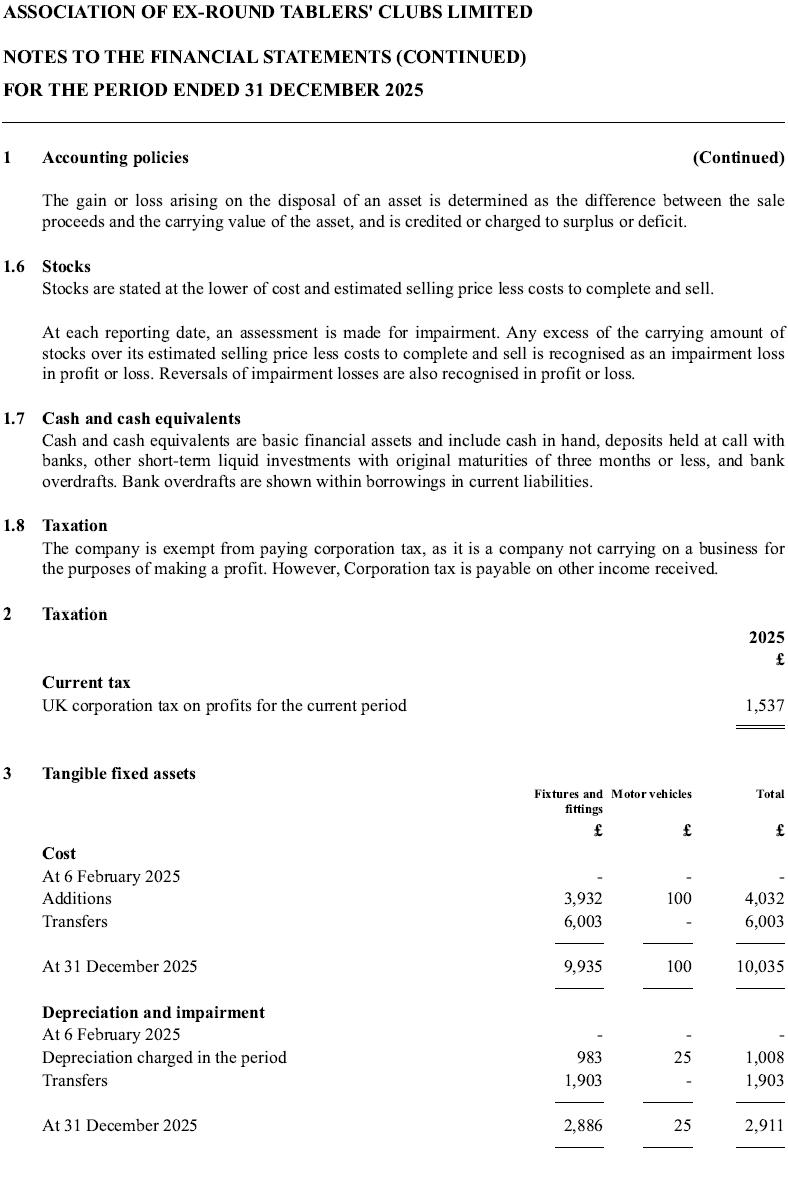
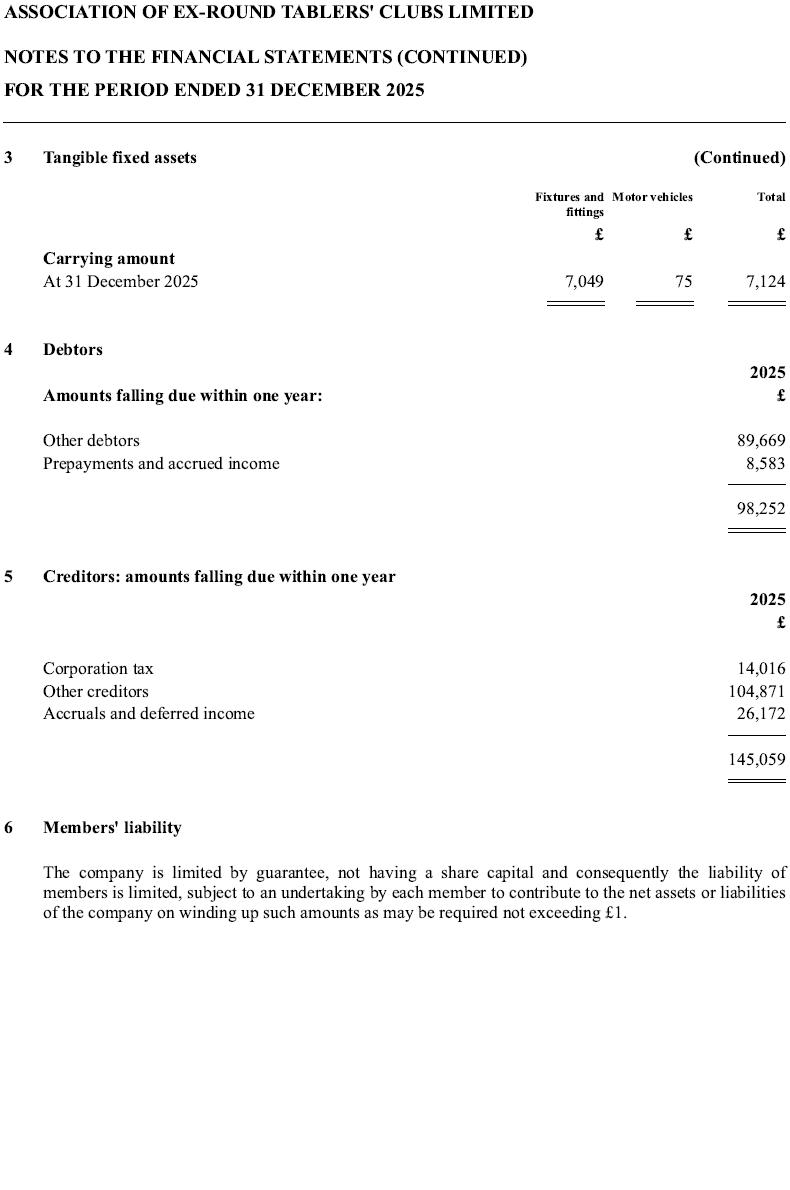
8. NATIONAL BOARD REPORTS FOR 2025 – 2026
NATIONAL PRESIDENT – JASON THOMSON
As I sit down to write my final report as your National President, I reflect with enormous pride, deep gratitude and genuine disbelief at how quickly this year has passed. This is not simply a review of a year served – it is a reflection on where we stand as an Association, alongside the reports from my fellow Board members.
When I stood as a candidate for Vice-President, I made one point clear: membership mattered most. We had to respond to the needs of existing members while attracting new ones. We had to grow, not manage contraction. We had to improve communication, strengthen collaboration and raise our visibility.
That focus has not changed. This has been a year of activity, progress and momentum – but more importantly, a year that has clarified the choices in front of us.
The future of 41 Club will not simply happen. It is something we must actively shape.
Throughout my Presidential year, my theme has centred on energy, visibility and action – being proud of who we are, confident in where we are going and bold in how we show up.
Stronger Together has provided the framework.
Fired Up for 41 has provided the spark.
But frameworks and slogans only matter if behaviour changes.
My hope for this year was simple:
That we were truly fired up for 41 Club – and ready to take it confidently forward, keeping the flame alive and lighting the way ahead.
Fired Up for 41 encouraged members to step forward.
Fired Up for 41 challenged complacency.
Fired Up for 41 raised our standards and our ambition.
Fired Up for 41 reinforced that every member shares responsibility for our future.
Celebrating 80 Years of 41 Club
This year we proudly celebrated 80 years of 41 Club, and it has been a privilege to support many clubs marking their own milestones with their charters along the way.
Eight decades of friendship. Eight decades of fellowship. Eight decades of service. Few organisations reach such an anniversary with our strength of identity and connection. We should be immensely proud of what generations before us have built and we have sustained.
But these milestones are not only moments to look back – they are opportunities to look forward. They test our readiness for the next chapter. That requires honesty, direction and drive.
Active Nights – Where It Happens
Seeing 41 Club in action, in meetings, at social events, at fundraisers and at national gatherings, has reminded me time and again why what we have matters. The friendships, the laughter, the shared experiences and the support we give one another are not just traditions…they are the very foundation of who we are.
The Strategic Reality
As I have said throughout the year, membership is naturally declining. If current trends continue, we could lose around half our membership within five to eight years. That is not speculation – it is trajectory.
We are not in this position because 41 Club lacks relevance. We are here because too few people understand or experience our value. We are not visible, promoted or celebrated enough. We are, in many ways, the biggest and best kept secret.
That is something we can change and, in some places, we already are. Clubs that actively showcase who they are and what they do are seeing results: Stronger engagement. Better retention. Renewed recruitment. When we show up, we grow!
Preserving 41 Club is not enough - we must evolve it.
Our intent must be clear: 41 Club should be the club of choice for men over 40. Where a prospective member is under 45 and there is a local Round Table, we should actively support that pathway. Where there is no Round Table, we should not turn men away – we should help create opportunity while strengthening the wider Family. That is how we secure the pipeline for the future.
Our three-year strategy provides direction – but plans do not create change. Action does. Participation does. Leadership at every level does. The future of 41 Club will not be decided in meeting rooms alone. It will be shaped by members willing to step forward.
I have seen extraordinary dedication from club officers, National Council, Board members, committees and assistants, the voluntary hours given are truly immense. But the future cannot rest on the shoulders of a few…It belongs to us all.
So, here is my challenge:
Step forward. Get involved. Join a committee. Welcome new members. Share your ideas. Promote your events. Help shape the future rather than observe it. A little more from each member leads to a lot more for all. That is what Stronger Together truly means.
Communication, Visibility and 41er World
Effective communication underpins engagement.
This year we strengthened connection through the Friday 41er newsletter, the national magazine and increased digital engagement. Clearer messaging and more consistent storytelling have kept members better informed about governance, events and national initiatives.
The magazine remains an important part of our identity, celebrating club activity and reinforcing fellowship. Our digital channels allow real-time communication and year-round momentum.
But communication is a shared responsibility. Clubs must keep details updated, engage with content and share their own stories because we do so much that deserves to be recognised. Visibility grows when we all contribute.
Looking ahead, the transition to 41er.World represents an important step forward. It will enhance connectivity, improve data and modernise the membership experience. It is a platform we must fully embrace. 41er.World is not simply a system upgrade – it is an investment in the next generation. If we want to remain relevant and connected, we must use the tools available to us effectively.
Stronger communication strengthens connection.
Stronger connection strengthens retention.
Retention supports growth.
Member Welfare, Men’s Health and Purpose in Action
This year our focus on men’s health moved beyond awareness into action. We supported The Third Nut initiative with Steve James as 41 Club International Men’s Health Director, promoting early detection and open conversation around testicular cancer and men’s health.
We strengthened awareness of our Buddy Line support and encouraged clubs to check in on one another more deliberately. We also encouraged clubs to appoint an Almoner or welfare contact to maintain connection with members unable to attend meetings.
These may seem simple steps, but together they represent a cultural shift – normalising support and conversation. That brings me to my charity for the year - ANDYSMANCLUB.
Members have not only donated – you have also held speaker nights, attended groups and helped open new ones and trained to become facilitators running groups. You have taken part in Fire Walks, Glass Walks, Run4AMC and the recent Dartathon. Pushing yourselves physically and emotionally to raise awareness. Yes, fundraising matters but so does personal involvement. This is not token support….This is men supporting one another….and it is changing and saving lives. When 41 Club connects purpose with action, the impact extends far beyond our membership. That is something we should carry forward with pride.
Thank you for all the commitment and hard work to make this partnership grow and for the funds raised, the total of which will be announced at the AGM …#Itsokaytotalk
Personal Reflections
No President serves alone. My sincere thanks go to every member who has welcomed, supported, and championed me throughout this year.
In particular, I would like to thank the members of the National Board, National Councillors, and our Honoraries.
Serving on the National Board requires a significant level of commitment. The responsibility, time and energy given throughout the year – often behind the scenes – is considerable. The decisions taken, the work undertaken and the support provided to the wider Association ensures that 41 Club continues to move forward with purpose and stability.
Our Councillors also play a vital role, acting as the link between clubs and the National organisation. Their engagement with clubs, their input into national discussions and their willingness to represent members’ views are essential to ensuring that your voices remain at the heart of what we do.
Your dedication, commitment, and belief in what we do together truly make the difference. Thank you all.
To my Presidential Liaison Committee – thank you for your time, dedication, and hard work behind the scenes in helping make this year such a success in so many ways.
A special mention to Ralph Preston, my PLC Chair. Your commitment – not just this year, but to the Association behind the scenes on so many things over the last three years – has been truly impressive. Both I and the members are incredibly grateful. Thank you!
To the many friends across the Association who hosted visits, lent a listening ear and shared this journey – and the occasional pint – thank you.
And finally, to my wife Helen – for her constant patience, infectious humour and enduring love – thank you. Serving in this role is only possible because of the support at home.
Supporting the Next Chapter Leadership is about continuity. I will continue to support the Association, incoming National President Kelly, the Board and National Councillors in every way I can. The work does not stop with a change of office. The future is built through shared purpose and collective ambition.
41 Club is not defined by its past, but what we choose to become next. We have heritage. We have fellowship. We have purpose. We have momentum. Now we must have ambition. Be visible. Be relevant. Be proud. Be bold. Be the builders of the future.
Serving as your National President has been a privilege. Thank you for your trust, your collaboration and your belief in the values that unite us.
Our journey does not end here - it continues, it evolves, it strengthens. Stronger Together because we were, are and always will be Fired Up for 41.
Jason Thomson jasonthomson@41club.org
NATIONAL VICE-PRESIDENT – KELLY CLARKE
Being your National Vice-President has been an interesting year – lots of visits to meet clubs at cluster and charter meetings and of course just ordinary club nights. These are sometimes simply the best – those nights when you think, can I really be bothered to go out tonight, but you get there and have the best time ever, just what you needed!
I have listened to what you have to say about the whole organisation, how it is run, what we should be doing to keep moving it forward. Some things are possible others are not, but without your input and help we would not be where we are today. We are a strong organisation that can go further and must go further if we are to survive well into the future. Adopt, Adapt, Improve – those words still ring very true.
I have also enjoyed attending some of the National Fellowship weekends such as the Classic Car, Walking Weekend, Motorcycle Weekend and NSSW. In Table days this was the highlight of the year and to some, it is that in 41 Club. However, we have still not got back to the numbers we had pre-Covid (around 125). For a membership of 10,800, even that is a low number, when there are sports and other activities on offer for all ages. The Fellowship that comes from this weekend alone cannot be missed! The sport comes second, as has always been the case, until you pick up a bat, a set of darts or any other piece of equipment ……. and then you are Stirling Moss (or Nigel Mansell), Joe Davis (or Ronnie ‘Sullivan) and everything changes for a few moments as the ‘I am going to win this’ thought creeps through the mind. Like many, I am still trying to absorb all the changes that have taken place over the last two years. As a Board we are still tinkering with things to make them more suitable for our Association. We are adding policies to provide us with procedures and processes to safeguard us and reduce levels of risk to the Association. There are some changes proposed to the Rules (about which you will read more later) and there are still some amendments required to the Articles of Association of the Company. We have started working on a development of the Buddy Line to make sure it is fit for purpose and relevant to today’s needs. A healthy mind and body is important and member welfare is becoming increasingly important – Buddyline fits into this. My thanks go to Andrew Hornby for stepping up to take on this task.
The four Clubs within the Family are working well together and are watching closely the fallout from the Supreme Court ruling on gender. Clubs such as the WI have passed comment, but at present we are taking a watching brief, waiting for any further development and whether it may affect us all.
The four current Vice-Presidents have agreed that our year will be about membership and are sharing ideas on how to grow all the clubs working together for one cause.
Forward Planning and Strategy
We have achieved some of the tasks and are still working on others. I apologise in advance, but the main concern that we have is that we have an ageing membership. We can only estimate the age of the membership as a whole at present, as until recently we did not collect date of birth data. However, from our visits we as the National Council estimate that 70% of our organisation is over 70 years old. If we do nothing, member numbers will continue to slowly decline until in the not-too-distant future, the Association will be at serious risk of closure. Declining numbers inevitably mean a rise in National Capitation fees, as we have seen recently. The future is likely to be more of the same. There are some young members who are only just starting out on the path as 41 Club members and some (hopefully many) who have not yet reached the 41 Club stage of their journey. They will hope to be here for a long while yet and we must do our best to leave a viable Association for them. We need members, the younger the better and we need to do something to bring them in. The main focus must therefore be upon membership.
The numbers show we have continued to lose members this year. This is inevitable, but we have also been cleaning the data that we hold on CAS ready for the move to 41er World, which has skewed the picture the data provides slightly. Even so, we are still on a downward spiral that needs to be contained.
A bit of a wake up call
A club that does not take in anyone except former Round Table members must open its eyes and see the light. If they have no feeder club, how long have they got before they close? Even with a feeder club how long will they have to wait for the next new member, how effectively do they recruit retiring Tablers? Meanwhile your oldest members are still getting older …….
In my book a club that has less than 10 members is on the endangered list and those with less than 6 are critically endangered – it is only a matter of time. Although it may be a long time, without recruiting, your time will inevitably come.
Having seen what happened to Round Table when their numbers dipped down to below 3000 members it suddenly becomes hard work to recruit new members, we cannot allow this to happen to our Association . It is not all doom and gloom as new clubs have and are still opening – we have a future, but must work to secure it. The important thing is do not be frightened to call out and say “can you help us?” We as the National Board and National Council have a whole host of ideas that we can give you and work with you to help you regain the ground that has been lost.
We must act to save our heritage and to give the modern man something to enjoy, an organisation that gives them the opportunity to go out and enjoy fun and fellowship with like-minded men.
Kelly Clarke kellyclarke@41club.org
IMMEDIATE PAST NATIONAL PRESIDENT – WYNN PARRY
As my time on the National Board draws to a close, I write my final Board report. As expected, this has been a quieter year for me compared to last year, but I have had the responsibility of taking on the role of the NCLO.
I have supported the Board and Councillors wherever and whenever possible. My primary role as IPP was to attend the National Arboretum in November to lay a wreath at the base of the Round Table Family Obelisk in the Round Table garden on behalf of the Association. I was accompanied by my fellow IPP’s and members of all the Family Associations. I represented our President, JT, at the Algarve 41 Club’s 40th Anniversary which was an excellent event and attended by many fellow 41ers. A great weekend of fun and fellowship. This year has been a new experience for the IPP, as I have also been the NCLO. Following the Association review and re-structure the role of the National Councillor has changed. The experienced Councillors have had to adapt to the new method of working and the new Councillors have been thrown in at the deep end, as it has been “new” to everyone. Going forwards I’m sure that we are heading in the right direction and there are a few new ideas to adopt for next year to make the role of the Councillors more effective and improve communication with our membership.
I am looking forward to seeing how our Association progresses over the next few years, I am sure we’re going in the right direction.
I will be taking on the role as the Y.A.P. Convener during next year, so I’ll still be around and look forward to seeing you all again.
Wynn Parry wynnparry@41club.org
NATIONAL SECRETARY – STUART GEORGE
I knew that the National Secretary role would be busy and demanding, but I didn’t realise quite how steroid fuelled (the role, not me) it would actually be! At times it has felt like a marathon conducted at sprint pace and there has never been a week where I have completely cleared the task list. From day one, the noise from the inbox has been deafening, the phone has barely stopped, and meetings have been plentiful – Executive Board, Management Board, National Council, Sub-Committees etc. etc. Bernard Elwen did warn me it would be busy; I simply underestimated how busy. I have been successful in some respects, in others (e.g. getting minutes out in a timely manner) there is room for improvement. Despite this, I think that it is fair to say that from an administrative point of view, the year has been one of real progress; consolidation of the changes which were put into place at the last year’s A.G.M. following the work undertaken that year, work on National Capitation, Policy review, Rules and Constitutional issues and other matters.
Significant areas of work this year have included:
1. Work arising from the incorporation of the Association and Company Limited by Guarantee (C.L.G.) Members The Association and the Company Limited by Guarantee are now a single legal entity. Amongst other things, most importantly this provides protection for all members of the Association from the possibility of the consequences of an uninsured incident involving an affiliated club arriving at their doorstep in terms of a financial claim against them. During the year it was identified that such a risk did exist (see below re: uninsured affiliated clubs) and action was taken to address the issue (again, see below re: club expulsions). Action was still required in respect of a rule change which has been brought to the A.G.M. (yet again, see below re: removal of Rule around insurance cover for clubs in arrears).
There are still some other areas where the structure of the Association is under consideration and a small sub-group has been discussing this – thanks are due to Geoff Trobridge of Bournemouth 41 Club for his help and wise counsel – and obtaining further legal advice. Some possible changes to the Articles of Association of the Company have been identified, but no final decisions have yet been made – watch this space!
Work has continued through the year on clubs registering a C.L.G. Member. Numerous communications have been issued about this – to members directly, to club Officers, Friday 41 er articles, magazine articles and telephone calls if you are unfortunate enough to know me and your club has failed to register. The new legal structure is dependent upon C.L.G. Members being registered by club – without them, the legitimacy of it is undermined. At the time of writing this, approximately 470 clubs have now registered a C.L.G. Member with around 100 clubs remaining outstanding. A small number have refused to register one at all. It is something of an irony that such clubs benefit from the protection afforded by limited liability without being prepared to undertake the responsibilities which make that protection possible – generally they say that they cannot see that it concerns them. This is both manifestly wrong and unfair. The ‘responsibility’ is hardly onerous.
Unfortunately, it is clear that the issue of C.L.G. Membership has played a part in the decision of some clubs to disaffiliate. The Association voted for the structure and registering a C.L.G. Member is part of that structure. If clubs disagreed with it, they should have stood up, had their say and voted against it at the time.
Clubs without a registered C.L.G. Member are not entitled to vote at the A.G.M. Further correspondence – and where necessary, direct contact – will continue until as close to full compliance as is possible is achieved – unfortunately, this is time and resource consuming. You will see that a Rule change is proposed to address ongoing refusal by some clubs to nominate a C.L.G. Member.
2. National Capitation
National Capitation has been the single biggest area of work this year and has itself ‘spawned’ several other pieces of work. From discussions with National Treasurer Colin, it became clear that timely payment of National Capitation from clubs was an issue which needed to be addressed. Despite the change in the rules relating to this at the A.G.M. in April 2025, an ingrained habit existed in many clubs to make payment after the date of their own A.G.M. rather than when required by Association Rules. By September 2025, in excess of 100 clubs (approaching 20%) had not paid. Emails were sent in September to 650 individual members of those Clubs to inform them of the position – some were unaware of the situation having made payments in respect of National Capitation to their club. Thankfully most responses were constructive, apologetic, and resulted in payment. One or two were downright cheeky – par for the course, I suppose – and regrettably some were rude, which is unacceptable.
It became clear that in addition to chasing many clubs for their payments, work needed to be undertaken to reeducate clubs about payment timescales and also in relation to when they should record their member numbers to ensure that the capitation invoices were correct. This manifested itself in emails to club officers, Friday 41er articles and magazine articles and direct communication (telephone calls).
Despite the efforts made, a number of clubs failed to pay. It was identified that the Rule which removed insurance cover from a club which was in arrears with its National Capitation created a period of risk to the Association while it remained affiliated – as noted above. After a concerted effort to persuade such clubs to pay, it proved to be necessary to expel nine from the Association following Council Meetings in October and December. This was unfortunate and resulted in the loss of approximately 50 members, but it reduced the risk that such clubs posed to the Association.
To reduce the risk that clubs in arrears pose to the Association, Rule change proposals to remove the withdrawal of insurance cover from a club in arrears and advance the date from which it can be expelled from the Association from 30th September to 30th June have been brought to the A.G.M. for approval.
Excluding the expelled clubs and those which disaffiliated without paying, nearly 100% of clubs paid their National Capitation in 2025. Early indications in 2026 are that the efforts made to re-educate clubs around the importance of correct recording of their member numbers at the right time and timely payment of their National Capitation are bearing fruit – although there are some which are taking umbrage at the efforts being made. There remains an issue of “gearbox and clutch” incompatibility between CAS and the accounting software and the limitations of CAS in terms of amendment of National Capitation invoices after March.
3. Insurance
Insurance matters were moved into my remit at the start of the year. The Insurance Sub-committee comprising Ken Banfield, David Chard and Jerry Wilson have continued their excellent work liaising with Brokers, assisting clubs and supporting the National Council. The Policy renews on 10th March 2026 and I recently joined David and Jerry for a meeting with the Broker to assist me to gain a better understanding of the process (I wasn’t quite able to keep my promise to “sit quietly in the corner”, but I was generally well-behaved …….). Going forward, all insurance queries must be addressed via the Sub-committee. The Broker has been instructed to refer any matters raised directly with them to the Sub-committee in the first instance. A new email address has been established – 41Club. insurance@41club.org which should be used for all queries.
4. Policies
This was something I focused upon in my election address. With the assistance of the Brains Trust (a.k.a. the Administration Committee) and in conjunction with other Management Board Members, work has been undertaken in reviewing and updating our Policies. The following Policies have been reviewed and amended (some more than once):
• 41 Club Complaint and Grievance Procedure (February 2026)
• 41 Club Canvassing and Self–Promotion Policy (February 2026)
• 41 Club Conduct and Discipline Policy (July 2025 and February 2026)
• 41 Club Expenses Policy (July 2025 and February 2026)
• 41 Club GDPR Statement (October 2025)
• 41 Club Privacy Policy (October 2025)
A full policy index, showing last review dates and next review deadlines, has been created. Some constitutional processes may be better moved into policy, to give the Association greater operational agility and where possible, this has and will be done.
Work will continue on our remaining policies and others required after the A.G.M.
5. Constitution, Rules and Standing Orders
An in-depth assessment of the Rules has been undertaken in the latter part of this year. As the Association and the C.L.G. merge into a single entity operationally, tidying up inconsistencies is essential. Following amendments made at the last A.G.M., further issues requiring clarification or modernisation in the context of possible Rule changes to address them were identified. In the course of consideration of this, it became clear that the formulation of the Rules could be improved – e.g. consolidating all election processes into a single rule – ensuring that there was consistency throughout the Rules and making them fit for purpose. The result is the Motions to the A.G.M. to amend the Rules.
6. Branding and Brand Protection
Following the re-branding which was approved last February, work is ongoing to protect the Association’s new trademarks (the 41 Club roundel is currently protected). This is important to preserve our distinctive identity and also to restrict clubs which are no longer affiliated from using our branding, or name. Doing so is very important as preventing it reduces the likelihood of an unaffiliated club being recognised as a 41 Club in the event of a claim being made against such a club – and any such claim potentially being transmitted to the Association. Effective trademarking and brand protection gives us a legal basis to prevent unaffiliated clubs passing themselves off as a 41 Club.
7. Club CAS Updates
A recurring issue this year has been clubs requesting Board Members to make routine CAS changes. While assistance can be provided, club Officers and indeed members themselves are strongly encouraged to make updates themselves to build competence – especially as correct member data underpins National Capitation accuracy. Members are urged to log into CAS and ensure that names, addresses, email addresses, phone numbers, and dates of birth (month and year) are recorded. Better data means better planning and better service delivery by the Association.
8. Member Complaints and Conduct Issues
Three matters were dealt with this year. One matter was resolved under the Conduct and Discipline Policy without escalation to the Conduct Committee, while two further cases required Conduct Committee hearings, resulting in admonishment in one case and sanction in another. My thanks go to the panel members who assisted in these often difficult matters. Such matters are time-consuming, but it is important that we have processes in place and are prepared to use them when required.
Finally ……
I have enjoyed my first year as Secretary. Collaborating with the other Members of the National Board and National Councillors has been generally rewarding (I hope they say the same about me) and I am sure that it will continue. For me, highlights of the year included a ‘research’ trip to the Old Tablers Deutschland A.G.M. in Bad Zwischenhahn (at my own expense) with Andy Waring, Paul Osborne and Neil McGrane in May 2025, closing my computer at end of the July National Council Meeting and attending the 41 Club Camping and Caravan Weekend (again, at my own expense) –all great fellowship events. I have enjoyed my conversations with various members during the year, which have provided useful insights into the Association at club and member level. Engagement with club officers has been extensive, with many productive conversations held throughout the year.
I am extremely grateful for the stalwart support of my Brains Trust during the year – Matt Bladon, John Kilshaw and John Martin. Their sound advice and experience has underpinned much of what has been achieved this year. The successes reported in this report belong largely to them; errors and omissions remain entirely my own!
My biggest thanks of course go to my wife Vicky, who has put up with me in stressed, grumpy and irritable modes frequently during the year (and those have been the good days). Her advice, patience and humour have been invaluable – I couldn’t do it without her.
While I will be happy to receive questions arising from this report, please save them for the A.G.M. (or better still, the bar afterwards)!
It has been a challenging, but rewarding year. I look forward to building upon the progress made.
Stuart George secretary@41club.org
1. Capitation arrears and the CAS database
CAS is not an integral part of the accounting records – it’s a database.
It is, however, all that we have to track the National Capitation due and what is actually received. It relies completely on clubs keeping their list of declared members up to date, especially by 31st December each year, when the system calculates the National Capitation payable for the coming year. The plethora of apparent under (and some) over payments shown on CAS is because clubs, not unreasonably, pay what they know to be correct, notwithstanding what is shown by the system.
It then becomes necessary for their records to be corrected. That generates substantial, time-consuming, work which could have been avoided if clubs maintained their records.
Then there is the misconception that payment of, for example, the 2026 National Capitation can be linked to when a club holds its own 2026 AGM. The 2026 Capitation was agreed at the Conference National AGM in April 2025. Clubs, therefore, had eight months to December 2025 in which to collect in subs with which to pay National Capitation due on 1st January 2026. Clubs that collect subs in arrears should not expect the Association to accept late payment. Thankfully, the majority of clubs do understand this and do pay National Capitation at the right time.
2. Change from the Association to a Company Limited by Guarantee
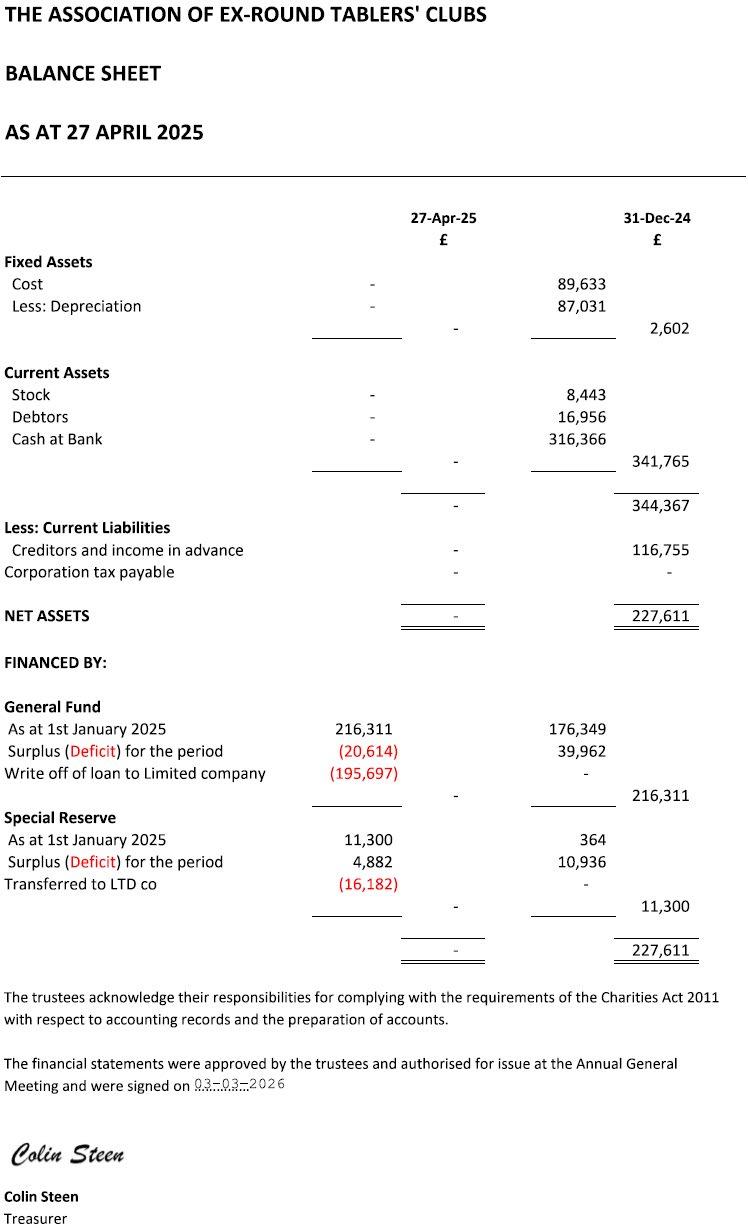
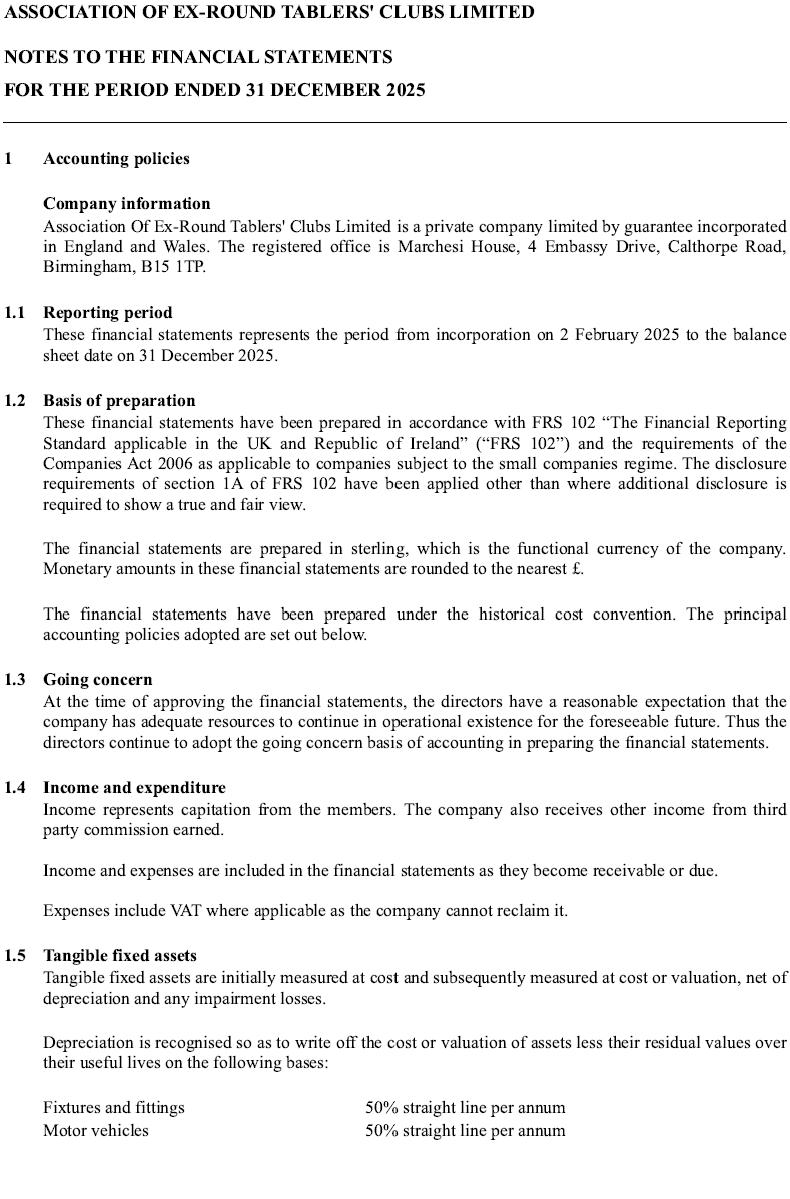
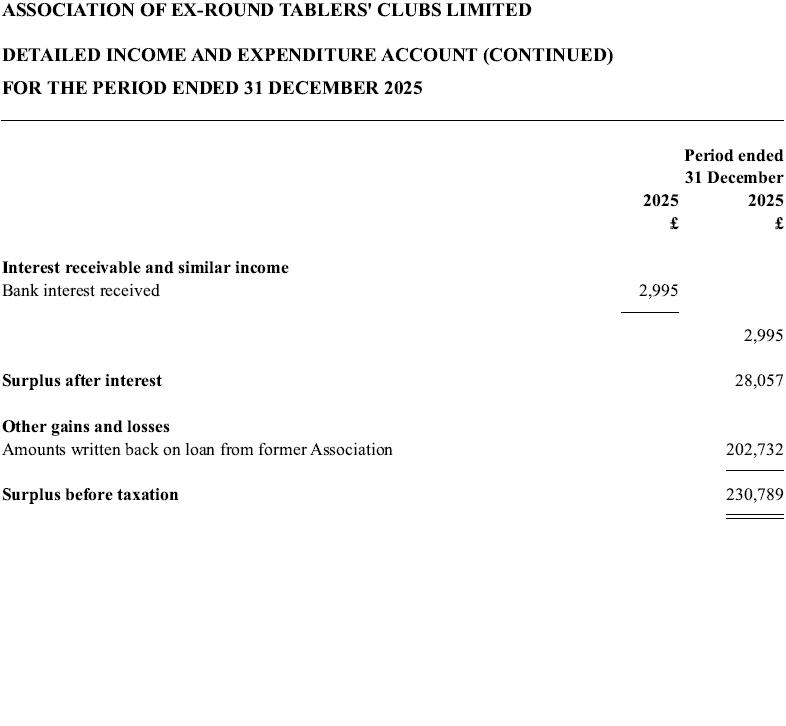
Practical matters, especially as regards changing the name on our bank accounts, have been challenging. Not least of which have been the need to produce two sets of accounts: both for the former Association to cessation after Aviemore, and also statutory accounts for the new Company from date of incorporation (which occurred prior to the last AGM in preparation) to the customary 31st December year end.
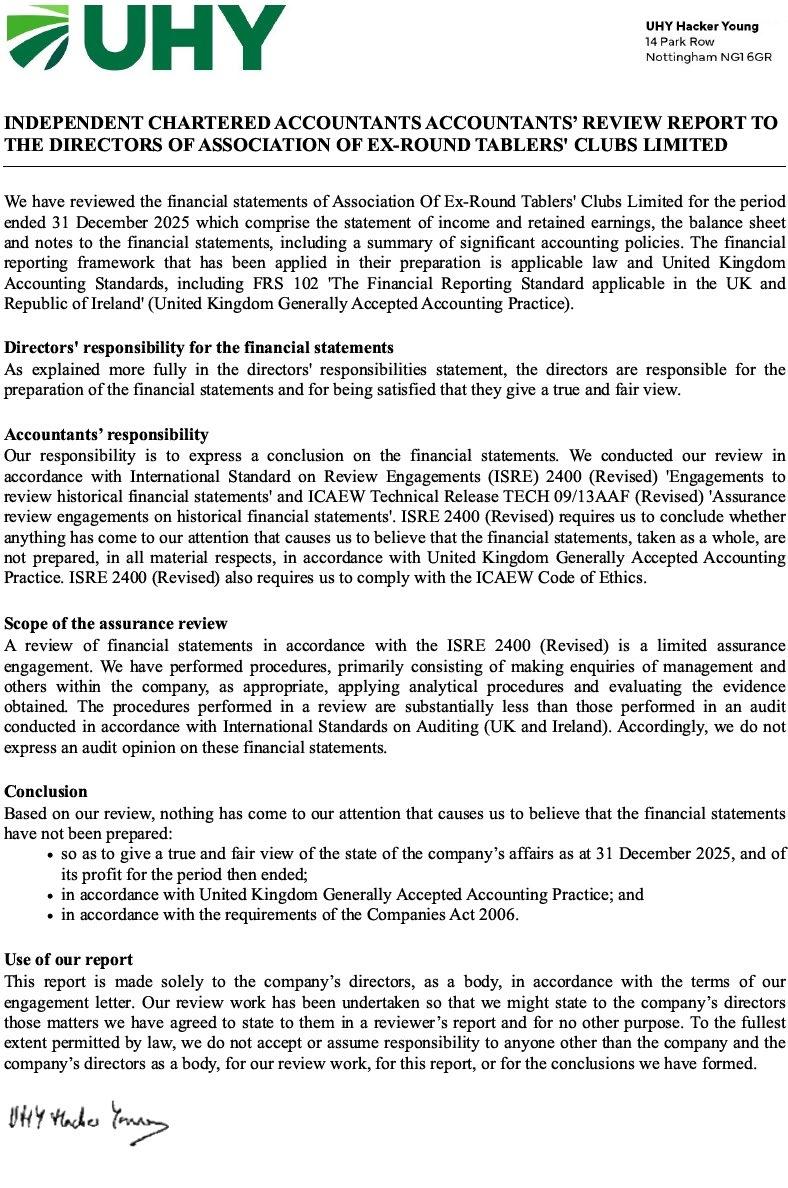
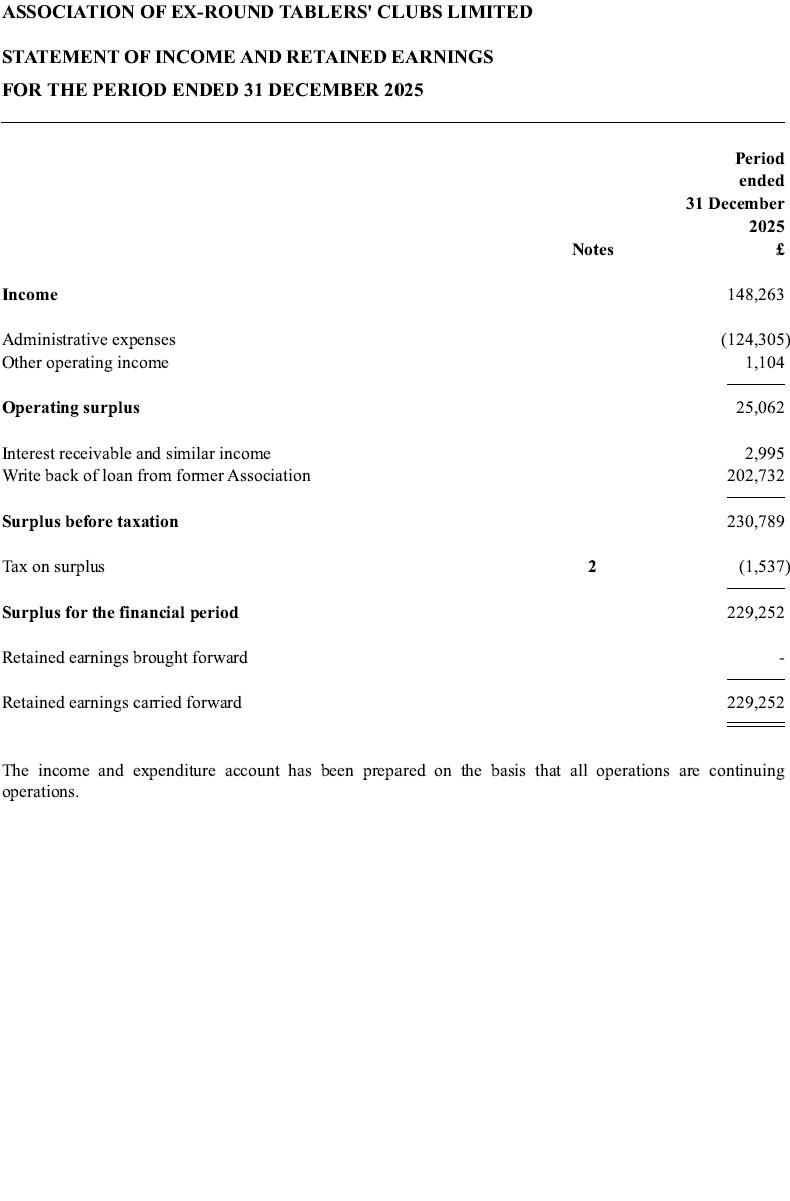
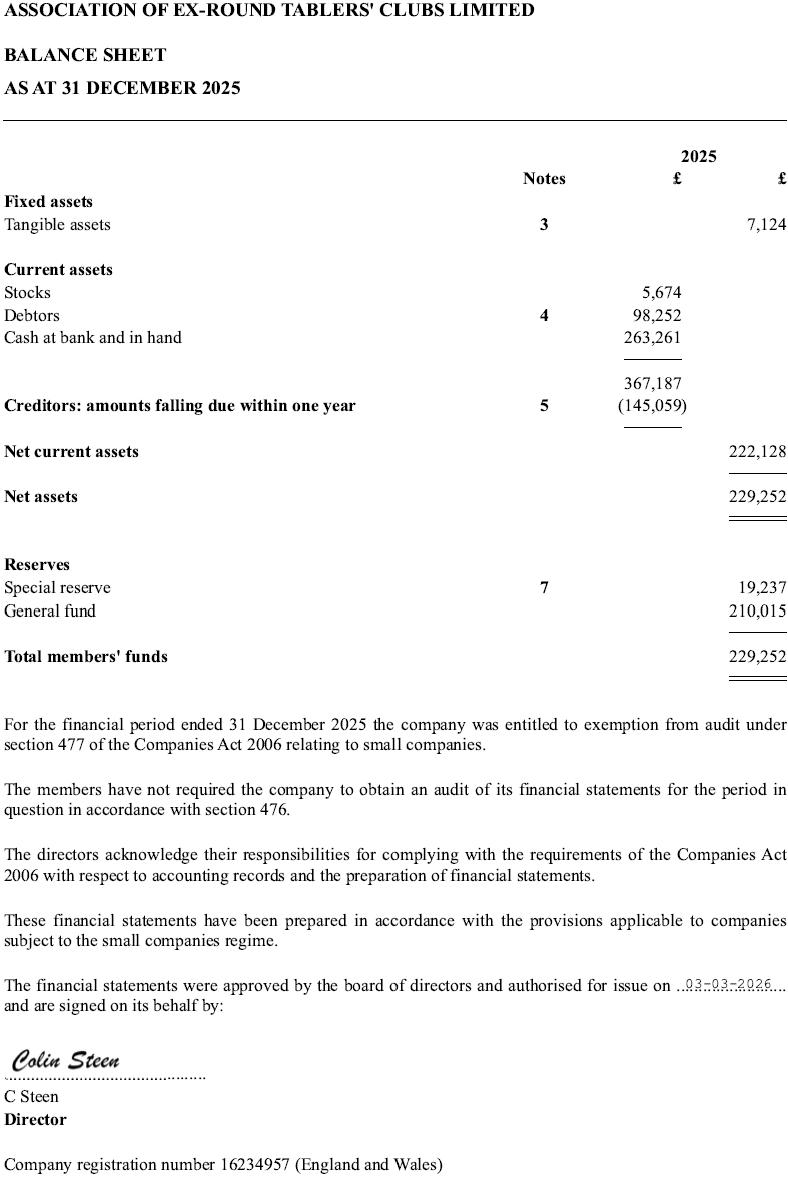
3. Accounts for the year to 31st December 2025
Shown in the appendices are:
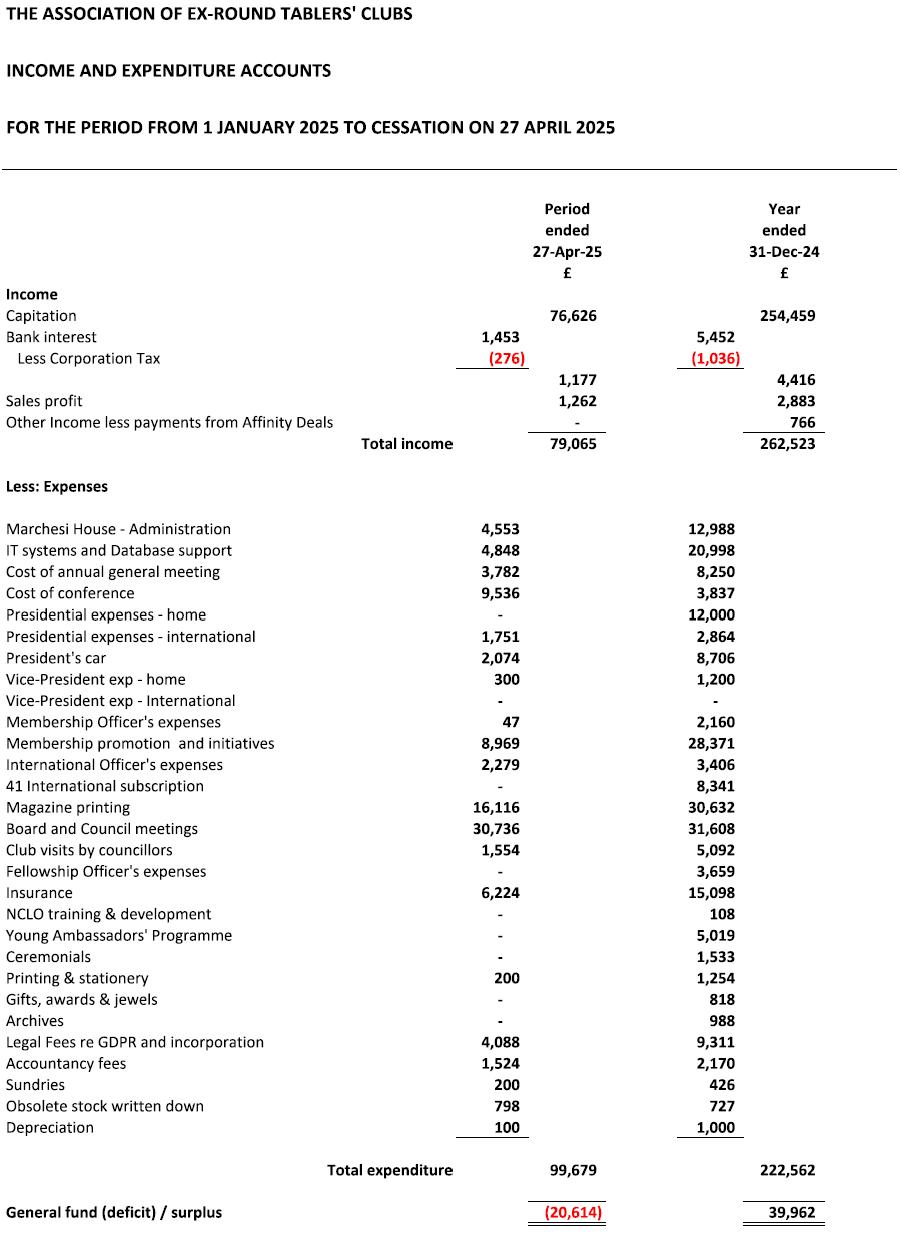
• Accounts of the former Association from 1st January 2025 to cessation on 27th April 2025 – p36;
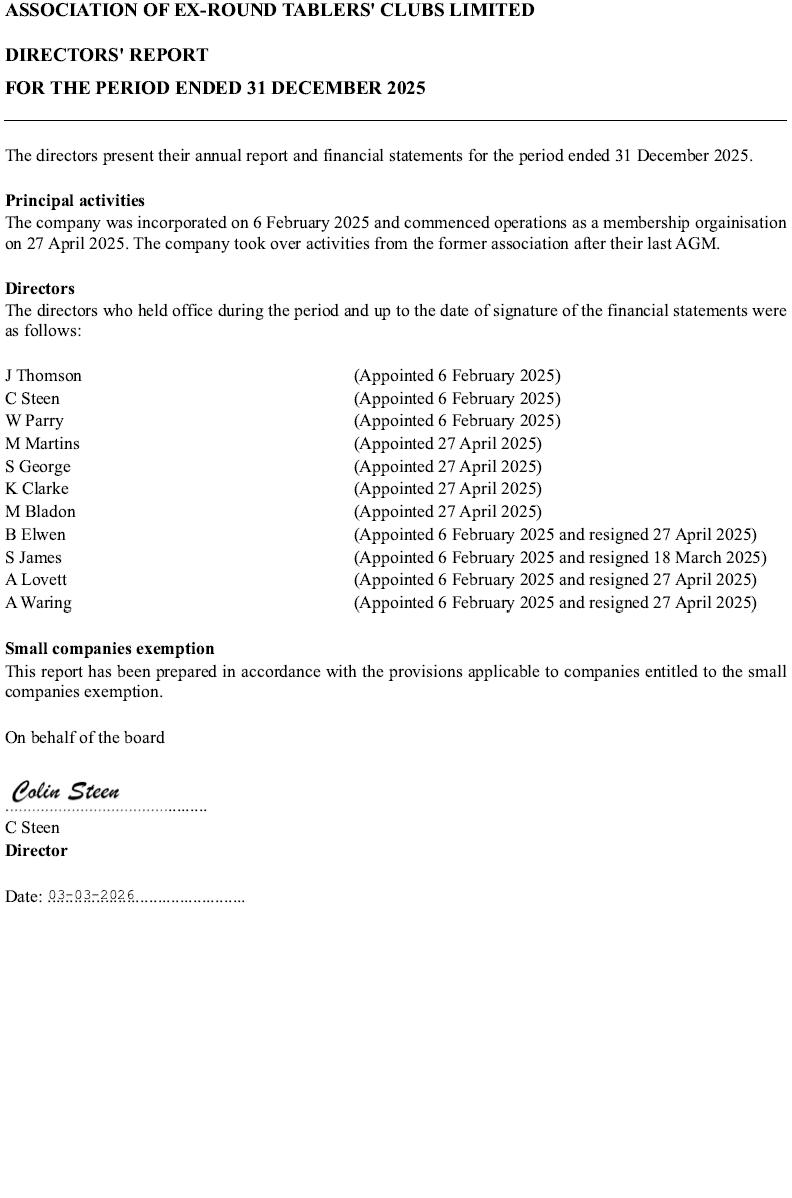
• Accounts for the Company for the period from incorporation on 6th February 2025 to 31st December 2025 – p40;
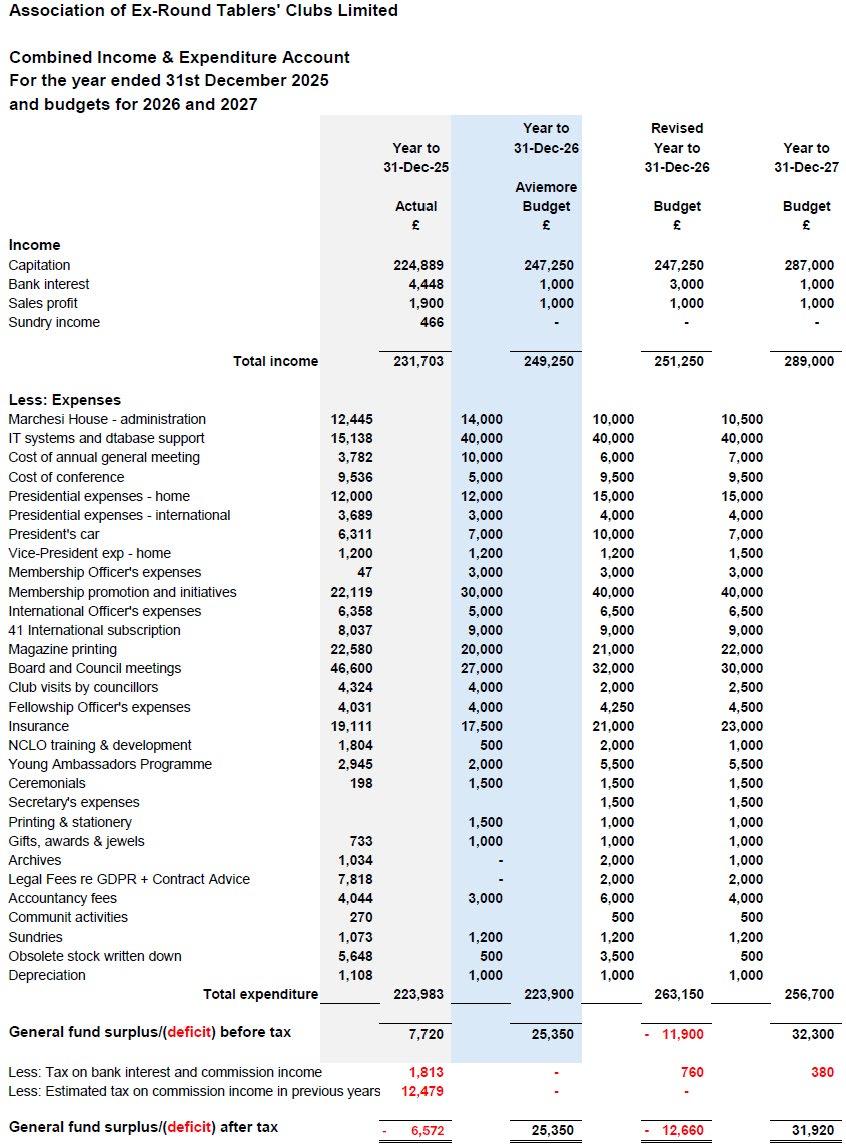
• Combined Income and Expenditure Account for the year ended 31st December 2025 and budgets for 2026 and 2027 - p54.
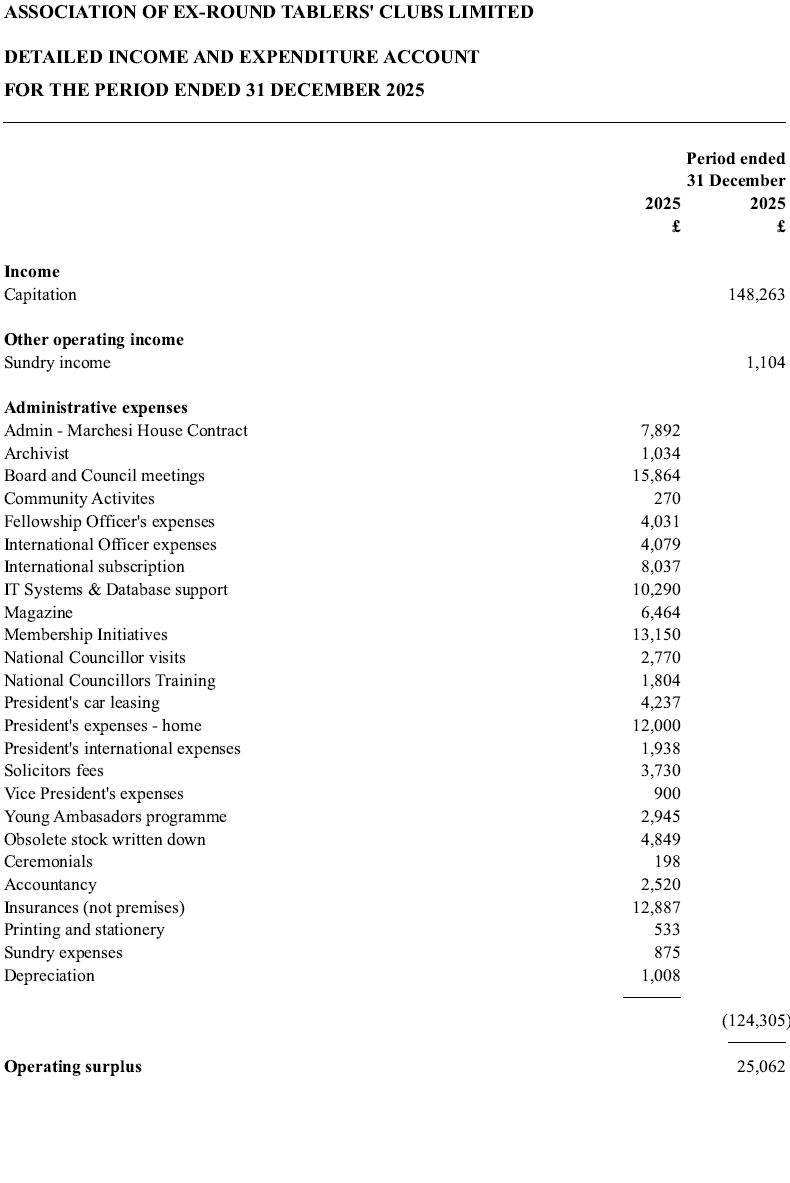
The salient points when looking at the Combined Income and Expenditure Account, showing the total actual result for the 2025 year, are:
(a) Receipts have benefitted from interest rates remaining relatively high;
(b) Commission income is taxable and provision has been made in these Accounts for the estimated tax and interest identified as being due in respect of previous years. This has turned the surplus before tax into a deficit after tax of £6,572.
Should you wish to compare the Combined Income and Expenditure Account with the 2025 budget set in April 2024 at the National AGM Liverpool, you will see that underspends of nearly £61,000 more than outweigh the overspends of £43,000 resulting in a surplus before tax of £7,720, as opposed to the budgeted loss of £19,500.
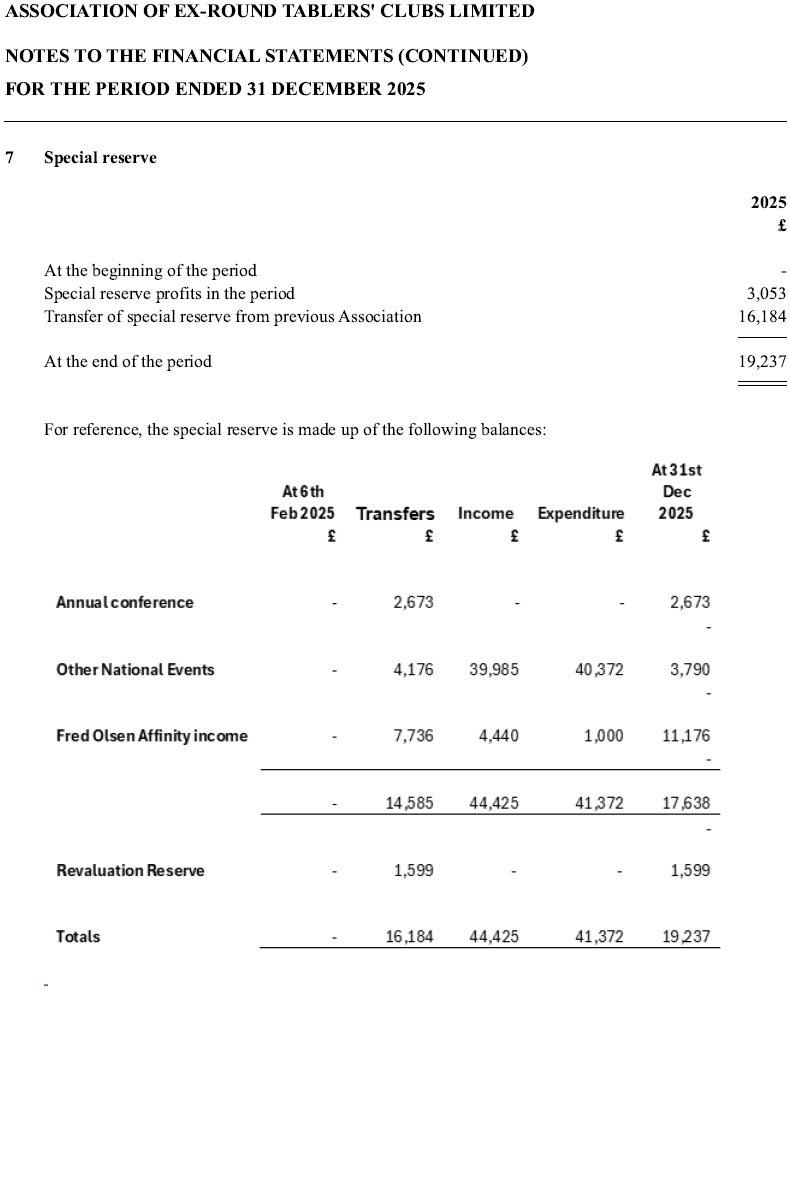
You should also be aware that the affinity income from Fred Olsen is not shown in the income and expenditure account as it is ringfenced and taken directly to a Special Reserve, from which grants to a maximum of £200 can be awarded to special events being run by a Club. Similarly, any surplus from Conference and other national events are also taken directly to Special Reserves to be used for similar events in subsequent years.
Finally, in this section, I would advise you to guard against the fallacy of believing that Budgets set eight months in advance can be imposed on the reality of the costs of actual operations.
In any event, what follows in the next section transcends the value of a post-mortem into what has already happened. 4. The impact of continuing decline in our total membership on our finances for future years.
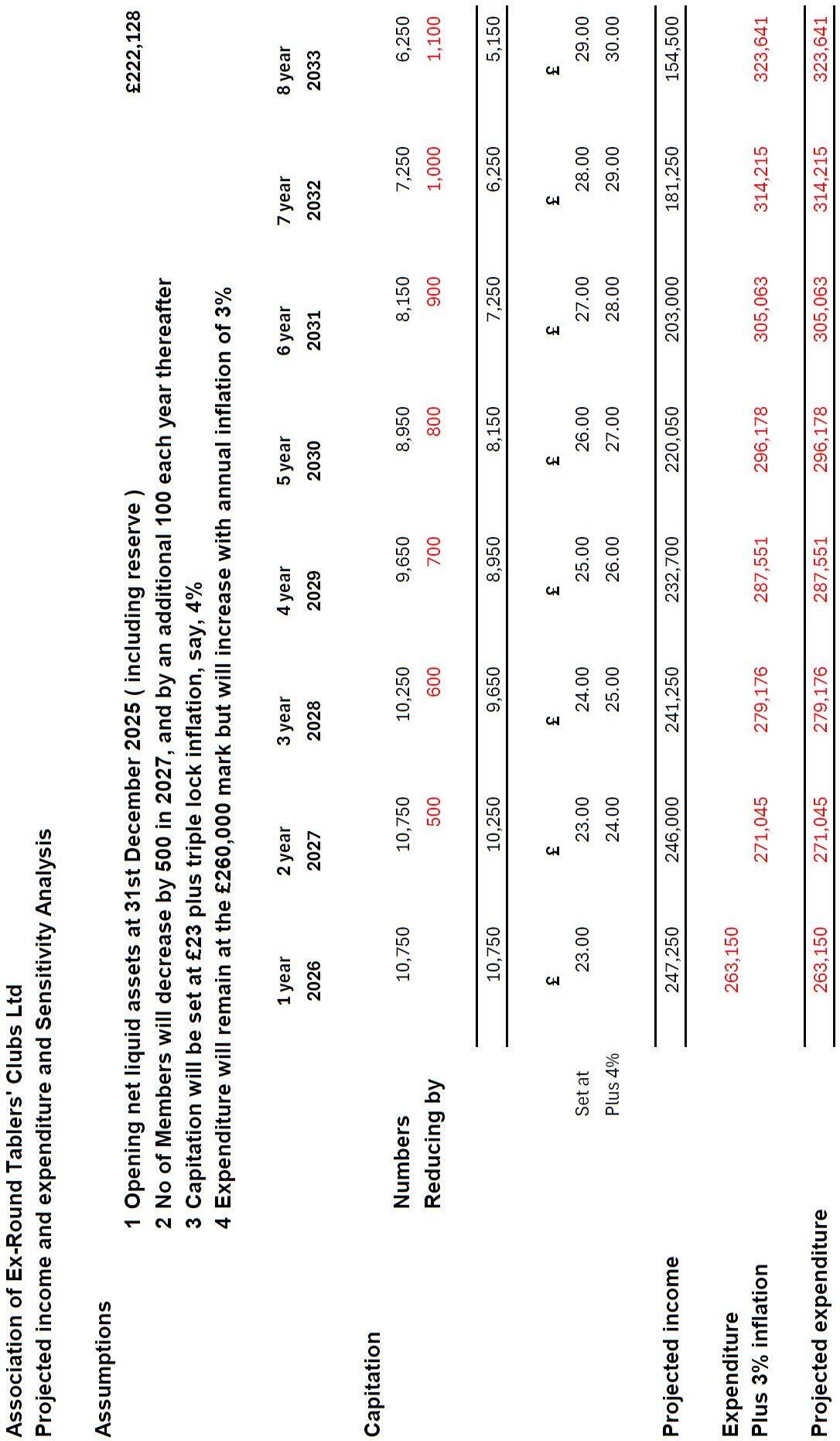
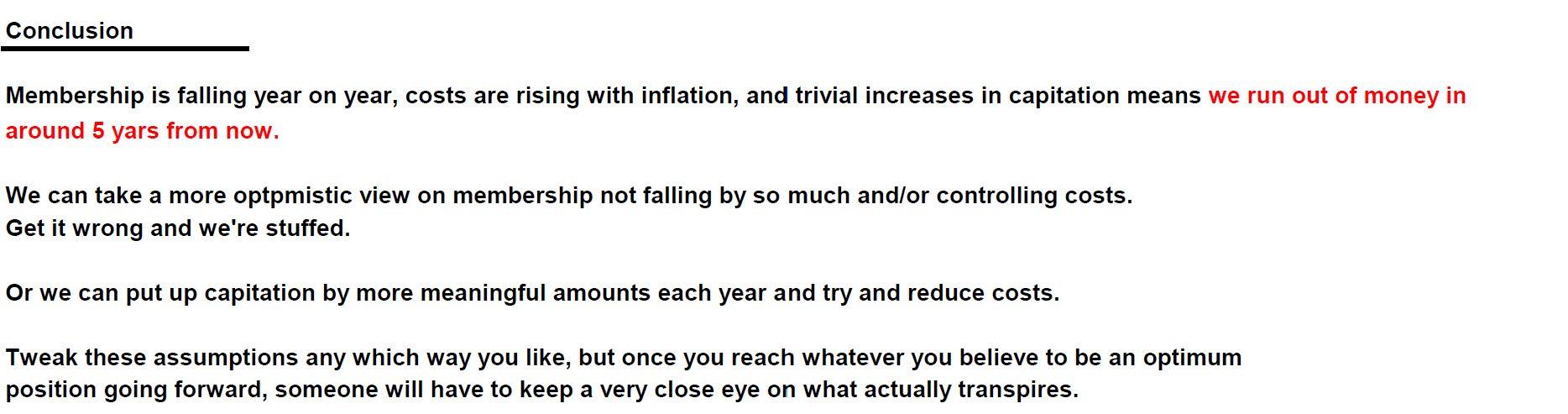
I have attached a spreadsheet projecting income and expenditure (Sensitivity Analysis) over the next several years (see below). It predicts that we will run out of funds sometime in the next 4 to 5 years.
Granted, the assumptions used can all be adjusted with better information. But, what is wholly within our control is National Capitation and whether it will have to be set at a level that not only values our Association but will secure its very existence. We no longer have the luxury of only looking at our finances year by year, with no regard to what the future holds.
Please look at the spreadsheet which shows:
• The actual deficit of £6,572 for 2025;
• The 2026 budget set at Aviemore, a projected surplus of £25,350;
• A revised budget for 2026 now showing a projected deficit of £12,660; And the budget for 2027, showing a projected surplus of £31,920.
Albeit with hindsight, the 2026 budget agreed to at Aviemore is no longer a useful guide to our likely operating expenses in this current year. A more realistic appraisal of those expenses shows that a material deficit is probable. The deficit for 2025, and the Budget and National Capitation for 2026, cannot be changed. I am strongly recommending, therefore, that National Capitation be raised by £5.00 to £28.00 per member from 1st January 2027. This would help offset the actual and anticipated deficits in both those years and avoid setting a Budget for 2027 which, if Capitation were only raised by a notional amount, would mean breaking even at best. It’s up to each and every member to accept the need to put our finances onto a sound and sustainable footing now, not just for 2027 but for all the years to follow.
Colin Steen treasurer@41club.org
Overview
The membership team has focused on our four main strands of work this year, with the work plan for year one culminating in the final Membership Roadshows in Exeter and Norwich.
Our data figures show that at the time of writing, there are currently 562 clubs registered, with approximately 10,700 members. Based on the known membership pack requests in the last quarter a further 205 members are due to be registered on CAS between now and April 2026 bringing our total membership to around 10,900 members by the A.G.M. This is slightly down from last year when we had 589 Clubs registered and 11,230 members on the CAS system at the time of the A.G.M.
Despite a net loss of approximately 330 members, ongoing recruitment and engagement efforts have helped to stabilise the numbers. We believe the average age of our members to be around 70. This average age is an educated guess, as historically we did not ask members to confirm their age. The good news is that we do now record the age of new members and can therefore confirm that the age profile of our new members is significantly lower than that of the Association as a whole. This in turn will have the effect of decreasing our overall age profile which is a positive trend for the future and improves the sustainability of the Association. However, we have a long way to go, particularly in attracting younger men in their 40s and 50s.
The affiliation of new XRT clubs and rechartering of clubs has remained positive. In addition there are four clubs in the pipeline process to charter or recharter in 2026 after the AGM.
The loss of clubs through disaffiliation does seem to be slowing. The factors which lead to clubs disaffiliating seem to be (1) Age of the members; (2) Levels of National Capitation (“What do we get for our money?”); and most recently (3) Requirement to register a C.L.G. Member, which is sometimes the straw which breaks the camel’s back.
Regrettably and possibly the most difficult for me as the National Membership and Round Table Liaison Officer, was the expulsion of nine clubs from the Association by the National Council for non-payment of National Capitation. This resulted in the loss of approximately 50 members.
Key Challenges
• Declining Membership and Club Disaffiliation: 20 clubs disaffiliated this year, mainly due to age-related challenges and the absence of feeder clubs. This has contributed to the overall reduction in membership numbers. A couple of these were non-geographic clubs, where the members were already in other 41 clubs and therefore had no effect on the number of individual members.
• Age Profile and Recruitment: Many clubs face difficulties maintaining activity due to an ageing membership base. Attracting younger members remains a challenge generally, although there are signs of improvement. A significant number of clubs do not admit non ex-Tablers into membership and this will continue to be an issue for us (and them) if they are unable to see the importance of a continuing legacy. Many such clubs are now celebrating their 50th, 60th and even 70th Charters, but what does the future hold for them if their recruitment is ineffective?.
• Roadshows: Of the seven planned Membership Roadshows, three were unfortunately cancelled due to lack of interest, limiting opportunities for more direct engagement and recruitment with some regional clubs. We need to work on getting the word out effectively.
• Communications: It has become apparent from the feedback, that many clubs are not using the website as the main portal for information. Many individual members do not check their own information held on CAS by their clubs, so they have not allowed themselves to receive emails because the box giving them access is not ticked. Therefore, individuals have not realised the events were happening locally or been kept up to date with recent insurance, structure changes, and member benefits. This can make many members feel distanced from the National communications. This also feeds into dissatisfaction when clubs consider disaffiliation, as they are clearly not aware of or getting the most from their membership.
• Club Marketing and social media: Some clubs still lack a strong digital presence and require mentoring to establish effective social media channels, although the Roadshows have been successful in getting more clubs on-line and sharing information to local community on-line groups, which is an obvious way to attract potential members.
• Operational and Resource Demands: Ongoing updates to membership materials such as these proposed resources and the coordination of national campaigns will require significant effort and volunteer support so whilst it is an end of year report it is also a shout out that we need you as members to join the membership team as a volunteer, either as a local mentor or you might have the media skills that can help us to get these resources out there.
Successes
• Roadshows
The Roadshows which have run have resulted in a lot of fundamental changes to club structures and programme. It was evident that some clubs had become stuck in a rut and attending at a Roadshow has given them new ideas for more balanced and varied events which cater for all ages. The Roadshows also cover the use of social media, marketing and engagement with their regional team. As a result, there are early signs that some 10-12 months after delegates attending, membership growth in their clubs is starting to develop directly from that attendance. In addition to generating new members, Roadshows have led to the affiliation process for new XRT clubs. Overall, the Roadshows are beneficial for the members and clubs which have attended and are therefore worthwhile for the Association.
• New/Re-chartering/Saved Clubs
While only two clubs chartered this year, there is a good mixture of new XRT and 41 clubs which are currently in the process of chartering and can be expected to do so next year. Four clubs are currently going through the affiliation process. There are other clubs which have previously disaffiliated and are seeking to re-charter. There has also been a success with Wimborne 41 Club, where the active intervention of the Membership Team has taken a club with a single member from the brink of closure to being a club which not only has six members, but is actively engaged in re-chartering the Round Table – present and future members! Medway 41 Club and Chatham 41 Club merged, so while we technically lost a club, there was no loss of members.
The Future
Next year we will continue to focus on the four main strands of work.
1. Bring him in/ Bring Him Home
• Enhance Recruitment of Younger Members
– Expand targeted social media campaigns (e.g., #getinvolved, “Bring Him Home”) to reach younger demographics. Share stories of younger members and highlight benefits of joining.
– Collaborate with RTBI and similar organisations to create clear pathways for younger members and feature these in publications and events.
2. Keep Him in
• Proactively support clubs at risk of disaffiliation, especially those with ageing memberships. Encourage preservation of club history and new recruitment approaches, including among older members.
– Facilitate peer mentoring between stable and struggling clubs.
– Promote Buddyline Buddies.
– Promote and support Vortex 41 as club of choice for members with no club and as a vehicle to grow new clubs by assisting with their programme and ongoing development.
• Increase Event Engagement and Accessibility.
– Offer virtual alternatives (webinars, online workshops) when in-person events are cancelled.
– Promote the use of the Vortex 41 Club.
– Continue developing and promoting condensed, accessible training sessions for club leaders via the National Councillors and volunteers who have attended regional Roadshows
• Boost Club Marketing and Digital Presence
– Provide ongoing training and resources to help all clubs establish and maintain a strong social media presence. Share templates, guides, and success stories.
• Encourage regular use of campaign hashtags and participation in national initiatives.
– Streamline Resources and Volunteer Engagement
• Regularly review and update Membership materials to ensure they are user-friendly and reflect best practices.
3. Get him in
• Actively work with Round Table Family to charter new clubs and provide local support and encourage more inter club events where appropriate.
• Continue to support Round Table growth with support for their membership events and use of WhatsApp and other media and membership meetings to share ideas for growth and development.
• Actively recruit volunteers with digital and social media expertise to support national campaigns and club-level marketing efforts.
4. Roadshows
Roadshows remain scheduled around the country – get onto the website for details of when and where. They became increasingly popular towards the end of the year as word spread – don’t leave it too late to book in! For the first time, we will be holding a Roadshow in Belfast – on 12th – 13th March 2027.
• Next year we aim to move more into club development, rather than concentrating solely on membership, especially for new Chairmen and Vice-Chairmen, although any member wishing to become a club champion will still be able to attend. This change has proved to be effective with Round Table, whose membership is now growing by over 500+ yearly because of the time and effort they have invested in Membership events. We intend to take their lead and Adopt, Adapt, ………… For the first time, we will be holding a Roadshow in Belfast
• Training in apps such as Canva will be continued, to help clubs design branded flyers and publicity that stands out and engages local interest as part of our ongoing support – e.g. for local free media etc. As part of our ongoing support, we will be making these tools available on the website and on YouTube for clubs to use and develop in-house.
Mark Gray membership@41club.org
NATIONAL COMMUNICATIONS AND COMMUNITY OFFICER – ANDY WARING
When I volunteered and put myself forward for the role of National Communications & Community Officer last year, I had plans to modernise the communications, introduce new channels for better information from the Board and between members/clubs. I also wanted to highlight the amazing community service that many of our club undertake throughout the year, whilst providing opportunities for individuals and member clubs to join together and collectively use the power of 41 Club to benefit those around us with some national initiatives. I think I have been able to do all of these things, although not quite to the extent I would have liked.
The year got off to a tricky start for me, I was unable to attend the AGM in Aviemore as my wife was taken ill and was in hospital for a few weeks. This was disappointing as I had booked in and had intended to kick start my plans following 2 months preparation. Over the next 12 months I faced various frustrations within the role itself, as well as further personal circumstances which limited my time available. Having said this, I would prefer to highlight the positives of my year in the Comms & Community role.
Social Media
The Facebook account was almost dormant when I took over, but now has a good following of 2,119 (at the time of writing) and has good interaction. I have also started a 41 Club Instagram account, a LinkedIn account, and a WhatsApp Channel, so there are more ways for people to follow us and for us to tell the world about what we do. Thank you to the Comms & Media team for building this following and thank you to Adrian Wakefield for taking on the Branding.
Newsletter
The newsletter prior to my tenure was always full of content from clubs around GB&I, and I could see how much work Dave Chard and Rod Hamilton-King had put into it. I, however, wanted to try and streamline the work and focus on the news and updates from National, plus time sensitive articles and events from local clubs. I also wanted the newsletters to be easy to read using a mobile phone, which meant taking them from PDF and putting them online, easily searchable on the 41 Club website. Renaming it the Friday 41er (copying the Round Table newsletter which is the Tuesday Tabler) we immediately changed it to an online newsletter, with incredible help from Paul Hampton and the IT team. All newsletters are on the website for everyone to see, after all why shouldn’t we be celebrating the things we do for the public to see.
Magazine
It was immediately apparent that the 41 Club magazine was becoming a little controversial. Many members, including Board members, told me that we should just put it online and not send printed copies anymore, but I wanted to dig my heels in about this because I see several benefits with having a printed copy. To find out exactly what the appetite was, I conducted a member survey, which had an amazing response! Around ¾ of the members voted, and the outcome was that 18% of people wanted it printed, 6% didn’t want it at all, and most people wanted an online version. Looking at the budget for the magazine, and the effort from National to cut costs in the future, we decided we would only send a copy in the post to those who requested and host an online version for all to read. I sourced quotes for a new publishing company, and selected GW Publishing which is owned by a 41er and has helped me a huge amount, cutting our costs so much that we can now go back to 3 issues a year instead of 2 and still save 1/3 of the budget. By introducing a small amount of good value advertising and hosting an online version the magazine can continue for many years.
Community
This is an area I would have loved to have spent more time, it’s my passion and the main reason I joined Round Table in the first place; I just had to spend so much time on the Comms and I firmly believe this should be a role in its own right and not joined with Comms. Hopefully one day 41 Club will take this seriously enough to realise that we can make a difference if we collectively put our minds to it. I did organise a new event called Walk in to Light, with the help of my wife Jane, Barry Durman, and several others. This was a great success and is something I will continue in the future with or without 41 Club.
I’d like to say thank you and congratulate all of the clubs who have organised fundraising events, sponsored others, given up their time to help others, and generally been good guys in the community. Please keep it up, once a Tabler always a Tabler.
I’m sorry I am stepping down after one year when it is supposed to be a three-year role, but I have several reasons that I can’t continue with the main one being the time needed to do this. I’ve said it a few times before and I’ll say it one last time; the Board and Councillors are all volunteers, not paid employees and the time everyone gives up to do this is far more than people who have never done it will realise.
Keep on Tabling …..
Andy Waring comms@41club.org
NATIONAL FELLOWSHIP OFFICER – STUART BIZLEY
The end of my first year in post is fast approaching and I hope you agree that it has been another great year of National Fellowship Events.
The year kicked off with National Conference in Aviemore last April and I thank the organising team for putting on a great event, it will be a difficult act to follow. On submission of the final accounts, an overall surplus of £5,346 was reported and this is shared 50:50 with Tangent in accordance with our agreement in running Conference as a joint event.
The other events throughout the year have all been very successful with many being a sell out well in advance. This last year’s programme was as follows:
• 6th–8th June – Classic Car Weekend – Founders’ Grand Tour - Norfolk
• 4th–6th July – Caravan and Camping Weekend – St Austell, Cornwall
• 18th–20th July – Motorcycle weekend – Bournemouth
• 28th August (11 nights) 41 Club Cruise with Fred Olsen – French Rivers with Normandy & Bordeaux
• 13th September – 80th Anniversary Lunch – National Motorcycle Museum Birmingham.
• 28th–29th September – National Golf Tournament – Daventry
• 2nd–5th October Walking Weekend – Guernsey
• 6th–8th February 2026 – Sporting & Social Weekend – Coventry
The coming year’s events are already planned:
• Classic Car Rally – 22nd–25th May 2026, Durham and Northumberland – Booking Open.
• Motor Cycle Weekend – 10th–12th July 2026, Suffolk Coast – Booking Open
• Caravan and Camping Weekend – 4th–7th September 2026 – Norfolk Broads – Booking Opening Soon
• Walking Weekend – 11th–13th September 2026 – Swansea – Booking Opening Soon
• National Golf Competition – 27th–28th September 2026 – Booking Opening Soon
• Fred Olsen Group Cruise – 19th October (10 Nights) – Booking Open
• NSSW – 5th–7th February 2027 – Okehampton - Booking Opening Soon
Full details and how to book can be found on the events section of our webpage https://41club.org/41-club-events/ I am pleased to report the organisation of the Classic Car and Motorcycle events in 2027 is already in hand and if anyone is interested in organising any other future events or perhaps something new, please get in touch. Without willing volunteers, they simply won’t happen.
As I write this report National Conference in Southampton is now less than six weeks away. It is fair to say that the workings of the booking site have not gone as smoothly as I, or the Committee would have wished and I can only apologise to those affected for the inconvenience this has caused. This year we have had to bear the burden and risk of booking the hotel rooms as part of the Conference package with the main venue and at the turn of the year, it looked as if the number of unsold rooms may have meant a financial loss being incurred. However, I am pleased to report the position is now looking a lot better and this will now not be the case. The Committee still have a lot to do in the coming weeks to ensure that Conference will be a great success but I am sure that, as always, it will be ‘magic’ and a highlight of our year. National Conference in 2027 will be in Blackpool based at the Winter Gardens and the event will be launched at Southampton. We will have a new bespoke webpage and booking site and do not have the risk on hotel rooms so I am hoping this will mean that a lot less stress for me and the members of the Blackpool team compared to this year! Preliminary work continues on a possible venue for 2028 and a formal bid is anticipated shortly. I together with the President and Vice-President of Tangent are still working on an update to the Conference Manual which acts as the handbook on how to organise and run a National Conference and this will be finalised in the coming year Our Member Benefits and affinity deals continue to offer the opportunity for us to save money and full details can be found in the Member’s area of the webpage. The Association also benefits from some of these, not least Fred Olsen, where during the last year we have received over £5,000 (gross pretax) in commission. I am currently working on some new travel related opportunities that we can launch early in the coming year that will benefit both members and the Association.
The commission we earn from Fred Olsen enables us to support Regional Cluster Meetings. So, if you are putting on a Cluster Meeting involving four or more other Clubs and you need some financial support to help make the event viable, then you may be able to claim up to £200 to help defray some of the costs such as room hire, speaker or entertainment fees. Therefore, if you are organising such an event or are interested in doing so, drop me a line and I will send you an application form for the funds, along with more details.
Fellowship is at the heart of the Association and I hope that in the coming year that the wide range of National Events we offer will continue to go from strength to strength and give all our members the opportunity to maintain existing as well as making new friendships. I look forward to continuing to support that objective in the coming year.
Stuart Bizley fellowship@412club.org
NATIONAL I.T. MANAGER – STEVE TASKER
IT, Data, and Digital Transformation Update
Over the past year, significant progress has been made across all areas of the Association’s IT landscape. From strengthening our website and digital skills to undertaking major dataquality improvements and preparing the organisation for a new membership platform, this has been a year of steady development and important milestones.
Website & Digital Capability
The Association’s internal capability in managing and improving our digital presence has continued to grow. Experience with WordPress has expanded, alongside a better understanding of web design principles, enabling smoother updates and a more consistent visual identity.
This sits alongside improved awareness of content marketing best practices, supporting clearer communication and more engaging information for members.
A renewed focus on UX/UI and WCAG accessibility standards has helped ensure the Association is working toward a more inclusive and userfriendly website experience.
Major Data-Cleansing Project on CAS
One of the largest undertakings this year has been the thorough cleanup of member data in CAS
This work involved:
• Contacting all clubs and members with missing or incorrect data,
• Guiding and supporting them in logging in and updating their details,
• Validating and correcting data to ensure accuracy and completeness.
A heartfelt thank you goes to all club officers and members who responded promptly, provided updated information, or took the time to log in and revise their own records. Your cooperation has made a real difference. This extensive effort has been essential in preparing the membership database for future migration—and has required many hours of detailed work behind the scenes.
Preparing for 41er.World – The New Membership System
A major strategic step forward this year has been the work toward transitioning to 41er.World, the future home of the 41 Club GB&I members system.
Key achievements include:
• Contracts signed and returned to the hosting company,
• Establishing a working, operational conversion program,
• Successfully testing the transformation of exported CAS data into the new platform format. This technical bridge—built to migrate CAS data into 41er.World—represents a substantial amount of development work and forms one of the most vital components of the entire transition project. The Club is now better positioned than ever to move into a modern, unified membership environment.
Volunteer Support & Recruitment
To help support ongoing digital improvements, an invitation remains open for anyone with experience in:
• WordPress
• Content creation
• UX/UI
• Accessibility
• General web/IT skills to contact the IT Manager at it.manager@41club.org
Building a small, knowledgeable team will help ensure longterm success as the Club’s digital needs continue to evolve.
Overall Summary
This year has been characterised by:
• Strong progress in website management and digital capability,
• A highly successful memberdata audit and cleanup,
• Increasing focus on userexperience and accessibility,
• Significant and tangible steps toward the future 41er.World platform. Every improvement helps build a more stable, accurate, and futureready IT environment for the Club. The work completed this year lays the foundation for the next phase of our digital transformation—ensuring that 41 Club GB&I can continue to support its members reliably, efficiently, and with modern digital tools fit for the years ahead.
I am grateful to the Honorary Webmaster Mark House for all of his work in the six years he has been in post – he has been a major element in our work and will be missed. Similarly, we also say goodbye to Paul Hampton who is behind all of the website updates for the last few years. Whenever anything is added to the website, it is Paul who does this. Both have been ever present in the background and without them my role would be that bit harder.
Steve Tasker
it.manager@41club.org
The International Year 2025 / 26
The year started off with the AGM at Aviemore where I welcomed over 15 International guests, the majority of whom were taking part in the pre-tour. This pre-tour was the first organised for an AGM in a long time and I am very happy to say that following the success of the tour, future AGMs are now actively looking at doing the same. Having been on a considerable amount of pre-tours myself at other AGMs, it was good to give the guests the Scottish experience. The whole Aviemore conference and pre-tour will remain as one of the highlight moments as my time as IRO.
At the start of May it was then onto the Full Year Meeting in Iceland. I arrived a day beforehand so was able to explore further the capital city and also do a puffin watching trip. The house party on the Thursday will be forever remembered for the fellowship with my other IROs and being reminded that I shouldn’t attempt Karaoke in any circumstances. It was also 3rd time lucky that this time I actually saw whales on the Sunday whale watching trip. The AGM itself had workshops on the ongoing proposed International Capitation changes, the new International Regional structure being put in place and being introduced to their relevant Chairmen. The Regions are being put in place to allow the International Board to concentrate on strategic issues whilst putting more of the day-to-day work through the Regional chairmen.
I then attended the Norwegian AGM in Aalesund which was a 4-family affair. The Friday night gathering when the city streets were shut off for our parade was something else. 41 Club Norway does not have that many members however it was good to see that they were working closely with Round Table to encourage Tablers to join 41 club.
The following weekend I attended the Swedish AGM which was held in Gothenburg and was a combined weekend with Round Table, Ladies Circle and Agora. I flew in on the Thursday and in the evening caught up with people I hadn’t seen in years, in particular the Swedish 41 Club President who I first met 10 years ago at the Round Table conference in Aviemore. I met my counterpart from RTBI as well on the night. Because this was a combined event, there were 1400 attending with all the organisations having their own dining venues. I certainly enjoyed the weekend, however just the sheer numbers meant it wasn’t really easy to talk to people in any quiet sense.
The following weekend I attended the Dutch AGM, in Steenwijk This again was a combined event with the Round Table but was much smaller in scale. The Friday night was the traditional welcome party and I had forgotten how crazy the Dutch are when it comes to partying. Many years ago when I was in City of Edinburgh RT, we were part of the Euro 193 clubs and it was great to meet up with current Tablers from the club. On the Saturday I sat through the whole AGM and although it was conducted in Dutch, I could certainly see that 41 Club in the Netherlands is expanding and how they are putting strategies in place to keep this growth going. The Sat night was the Gala dinner, which was a really good evening, though not having a set seating plan was a new one on me.
In July I met up with the GB & I Young Ambassador Program tour for a weekend. It was great to see the clubs coming together to put on the tour. I cannot thank Andy and Gail Ventress enough for the work they have done over the past 3 years in getting the YAP back up and running and promoting the YAP tours abroad to the wider GB & I 41er community. My final international trip as IRO was to attend the Half Year Meeting in Kochi, India, which I combined with a post-tour personal holiday afterwards. At the AGM workshops, the proposed International Capitation changes were dropped, which will benefit GB & I. The AGM also put in place a strategy to vote on the new regional structure going forward. Across the four days, there was great fellowship, however by the time the event and the post tour were over, I did not want to see or taste anther curry again. Suffice to say my first meal back was good old fish and chips.
Over the last three years, I have been very proud to represent GB & I as IRO, and the friendships and fellowship I have experienced will stay with me for ever. I am looking forward to handing over to my successor at the AGM in Southampton and welcoming our international guests. I will obviously still continue to travel internationally, and look forward to seeing everyone again on my travels.
Kevin Stewart international@41club.org
11. PROPOSED BUDGET FOR 2027
National Capitation proposal (per member) – £28:00
12. MOTIONS PROPOSED BY THE NATIONAL COUNCIL
In connection with all proposed changes to Constitution and Rules and also to Standing Orders, please see ‘Rule Changes Explanation’ at Appendix 1 for comparison with the existing provisions. It is strongly recommended that Appendix 1 is read by all Voting Delegates to assist in their understanding of the proposed rule changes. All National Council Motions propose changes to the Rules. Motion 1 is a single proposal which replaces the existing Rules in their entirety. It is proposed in this way because of the number of changes and the Rules have been re-structured to accommodate them. To make the changes individually would be extremely time consuming. However, if Motion 1 is unsuccessful for any reason, Motions 2 – 34 will be proposed and debated individually to enact the changes to the Rules which are sought and enabling those changes which adversely affected Motion 1 to be excluded. If Motion 1 is successful, the consent of the meeting will be sought to withdraw them Motion 1.
Proposal
Replace the current CONSTITUTION AND RULES OF THE ASSOCIATION OF EX-ROUND TABLERS’ CLUBS LIMITED (introduced following their adoption at the Annual General Meeting in April 2025) with the following: CONSTITUTION AND RULES OF THE ASSOCIATION OF EX-ROUND TABLERS’ CLUBS LIMITED
1. NAME
The Association shall be called the ‘Association of Ex-Round Tablers’ Clubs Limited’, also known as ‘41 Club’.
2. DEFINITIONS
In this Constitution and Rules and Standing Orders, unless the context otherwise requires, the following definitions apply:
2.1 ‘The Association’ or ‘the Company’ means the Association of Ex-Round Tablers’ Clubs Limited;
2.2 ‘Rules’ means the Constitution and Rules and Standing Orders of the Association of Ex-Round Tablers’ Clubs Limited and any reference to a numbered Rule or Standing Order relates to one of those Rules or Standing Orders contained therein.
2.3 ‘Constituent Club’ means a club which is listed in the Association’s Register of Constituent Clubs and which is not in arrears with payment of its National Capitation in accordance with the Rules;
2.4 ‘Overseas Club’ means a Constituent Club situated outside Great Britain & Ireland, the Isle of Man and the Channel Islands;
2.5 ‘Member’ means an individual who is a member of a Constituent Club and who is either a member or exmember of Round Table who is aged 40 or over, or who is aged 40 or over and has been invited to join as a like-minded man.
2.6 ‘Company Member’ means a Member of the Company listed in the Company Register of Members.
2.7 ‘National Officers’ means the Officers of the Association as defined in Rule 9.1;
2.8 ‘National Council’ means the National Council of the Association as defined in Rule 12.1;
2.9 ‘Board of Directors’ or ‘Executive Board’ means the Board of the Company as defined in Rule 8.1;
2.10 ‘Management Board’ means the Executive Committee of the National Council as defined in Rule 9.1;
2.11 ‘Financial Year’ means the period as defined in Rule 15.1;
2.12 ‘Register of Constituent Clubs’ means a list of Clubs held on the Association’s database as defined by the National Council.
2.13 ‘Independent Examiner’ means a professionally qualified and regulated Accountant, or firm of Accountants with sufficient accounting skills (i.e. an understanding of accounting principles and standards) and who is not, or whose partners or employees are not members of a Constituent Club.
2.14 ‘Past President’s Committee’ means a Committee comprising the National Immediate Past President (or another Past National President at the discretion of the National President, should the National Immediate Past President be unable or unwilling to act), the Honorary Solicitor (or a similarly qualified and experienced individual at the discretion of the National Secretary, should the Honorary Solicitor be unable or unwilling to act) and at least one other Past National President, which shall be convened by the National Secretary as required pursuant to the Rules.
3. INTERPRETATION
3.1 Interpretation of these Rules shall be at the discretion of the Executive Board, whose decision in respect of any disputed matter is final.
3.2 Headings and numbering in the Rules are used for convenience only and shall not affect their construction or interpretation.
4. PURPOSES, OBJECTS AND VALUES
4.1 The Purposes and Objects of the Association are:
4.1.1 To link together the Constituent Clubs;
4.1.2 To promote amongst the Constituent Clubs and those eligible for membership, the following objects: 4.1.2.1 To continue to be the preferred Association for former members of Round Table and like-minded men and encourage growth;
4.1.2.2 To encourage and support active involvement in the community;
4.1.2.3 To use our experience to support the Round Table Family; 4.1.2.4 To encourage and support international relations;
4.1.3 These objects to be promoted through regular meetings and other activities.
4.2 The Values of the Association are:
4.2.1 Fellowship: Building lasting friendships through social interaction and mutual support;
4.2.2 Integrity: Promoting honesty, trustworthiness and ethical behaviour in all interactions;
4.2.3 Respect: Valuing diverse perspectives and treating all members with respect;
4.2.4 Lifelong Learning: Encouraging continuous personal growth and the exchange of ideas;
4.2.5 Collaboration: Working together to achieve common goals, both locally, nationally and internationally;
4.2.6 Service: Committing to provide value through programs, events and resources that support the needs and goals of the members and their communities;
4.2.7 Membership: Encouraging membership retention and recruitment.
5. AFFILIATION TO THE ASSOCIATION
5.1 A Club wishing to affiliate to the Association shall apply in writing to the National Membership Officer for affiliation to the Association. The National Membership Officer shall present the application to affiliate to the National Council which, if it is satisfied that the Club should be affiliated, shall approve the application.
5.1.1 The National Council may determine by policy the criteria which shall be applied when deciding an affiliation application.
5.2 Any Club which is affiliated must formally register one of its members as a Member of the Company in accordance with Article 1.1 of the Company’s Articles of Association.
5.3 An affiliated Club shall agree to comply with the Rules of the Association and any policies approved by the National Council. Should any Constituent Club fail to so comply, action may be taken against it pursuant to Rule 22.1.
5.4 A club situated outside Great Britain & Ireland, the Isle of Man or the Channel Islands may apply for affiliation to the Association. When affiliated, an Overseas Club shall have all the privileges enjoyed by other Constituent Clubs except:
5.4.1 No member of an Overseas Club may hold office in the Association unless he is also a member of a Constituent Club situated within Great Britain & Ireland, the Isle of Man or the Channel Islands and resides for the majority part of the calendar year within Great Britain & Ireland, the Isle of Man or the Channel Islands.
5.4.2 No insurance cover can be provided for Overseas Clubs by the Association.
5.5 Only Constituent Clubs which have registered a Company Member in accordance with Rule 5.2 shall be entitled to exercise the powers conferred on Constituent Clubs by these Rules.
5.6 A Constituent Club which is affiliated in the first half of the Financial Year, that is 1st January to 30th June, shall be expected to pay the applicable National Capitation for its members for that year. A Constituent Club which is affiliated in the second half of the Financial Year, that is 1st July to 31st December, shall pay half of the applicable National Capitation for its members for that year.
6. CLUB MEMBERSHIP
6.1 Subject to Rule 6.2, a Constituent Club may determine its own membership.
6.2 Members of a Constituent Club shall be members or ex-members of Round Table who are aged 40 or over, or men who are aged 40 or over and have been invited to join as ‘like-minded men’.
6.3 A Constituent Club shall ensure that the name and other required personal information of each Member is entered into the Association’s membership database.
6.4 Each Financial Year the Constituent Club shall pay annual National Capitation to the Association in respect of each of its recorded members in accordance with Rule 15.5.
6.5 All members of a Constituent Club shall be subject to the Association’s Rules and policies.
6.6 At its discretion, the Association’s National Council may bestow Association Life Honorary Membership upon any member for their services to the Association. National Capitation shall not be payable by any Constituent Club in respect of an Association Life Honorary Member. An Association Life Honorary Member shall be eligible to hold any Office at Club, Region or National level.
7. REGIONS
7.1 Constituent Clubs, except Overseas Clubs shall be grouped into geographic Regions within Great Britain & Ireland, the Isle of Man and the Channel Islands.
7.1.1 The National Council shall determine the Region into which a Constituent Club is placed, having taken into consideration the views of the Club membership.
7.1.2 The National Council shall have power to vary the boundaries of the Regions and to transfer a Constituent Club from one Region to another. The National Council shall arrange for at least three months’ notice to be given to every Constituent Club affected by any such changes.
7.1.3 Overseas Clubs shall be grouped into a separate, non-geographic Region, which shall be allocated to an existing National Councillor in addition to his current Region
7.2 Each Region shall be known by a number and descriptive name allocated by the National Council.
8. BOARD OF DIRECTORS
8.1 There shall be a Board of Directors known as the Executive Board, consisting of two National Councillors and the following Officers as per Rule 9.1: National President, National Vice-President, National Immediate Past President, National Secretary, National Treasurer.
8.1.1 The National Councillor members of the Executive Board shall be elected as follows:
8.1.1.1 At the February Council Meeting, those National Councillors who wish to be appointed to the Executive Board at the next Annual General Meeting should put themselves forward.
8.1.1.2 If more than two National Councillors put themselves forward, a ranked ballot shall be held in which the members of the National Council, except the National Secretary who shall administer the election, shall vote.
8.1.1.3 The winners of the ballot (or the two National Councillors who put themselves forward if there was no ballot) shall be proposed to the Annual General Meeting for appointment as members of the Executive Board.
8.1.1.4 The two National Councillors appointed as members of the Executive Board shall serve for a period of one year, repeatable once if they meet the criteria for appointment.
8.2 The Executive Board shall deal with the legal responsibilities for all Association matters and ensure the Association complies with its statutory duties.
8.3 In conjunction with the Management Board, the Executive Board shall deal with the governance of, and the setting of the strategic direction of the Association.
8.4 The National President shall be the Chairman of the Executive Board, the Management Board and of every General Meeting of the Association. In his absence the National Vice-President shall take the Chair. If neither shall be present, a Chairman shall be elected by those present and eligible to vote.
8.5 In the event of a tie in voting, at any of the Meetings referred to in Rule 8.4 the Chairman will have the casting vote
8.6 The Executive Board shall meet at such times as the National President may direct, but at least twice per year.
9. MANAGEMENT BOARD
9.1 There shall be a Management Board consisting of the following Officers: National President, National VicePresident (who shall be the National President Elect), Immediate Past National President, National Secretary, National Treasurer, National Membership & Round Table Liaison Officer, National Communications & Community Officer, National Fellowship Officer, National I.T. Manager and National International Relations Officer.
9.1.1 All Officers listed in Rule 9.1 shall be a member of a Constituent Club which has registered a Company Member and except the National President and the Immediate Past National President shall be elected by a General Meeting in accordance with Rule 13.1
9.1.2 The National Treasurer shall be a member who is a professionally qualified Accountant, or has proven competence in accordance with the approved Job Description.
9.1.3 The National International Relations Officer shall be a former Round Table member.
9.1.4 At the date of the election for the position of National Vice-President, a candidate for that role shall have served on the National Council as an elected member (National Councillor or Management Board Member) for a minimum period of two years (Annual General Meeting to Annual General Meeting) in the preceding three years.
9.2 The Officers listed in Rule 9.1 (with the exception of the National President, National Vice President and Immediate Past President) shall be elected for an initial three-year term at the Annual General Meeting and service in that Office is limited to three years (whether consecutive or not) unless there is no candidate to replace that Officer. If there is no candidate for his replacement, then the incumbent Officer may stand for re-election for a period of one year, repeatable once if there is still no candidate for his replacement after the one-year extension of his term.
9 3 The Officers listed in Rule 9.1 shall hold office until they resign, are dismissed or until the Annual General Meeting at the conclusion of their term of office, whichever occurs first.
9.4 Upon his election, the National Vice-President shall become National-President Elect. The National VicePresident shall serve a period of one year prior to becoming successively, National President and National Immediate Past President for periods of one year each.
9.5 The election of a successor for the positions of National Secretary and National Treasurer will take place one year before the end of their respective terms of office. The successful candidates shall be the National Secretary-Elect and National Treasurer-Elect respectively. They will not be members of the Management Board, unless in another role.
9.6 By a two-thirds majority of those present and entitled to vote the Executive Board may remove an Officers listed in Rule 9.1 from his post if:
9.6.1 He fails to attend at least seventy five percent of the National Council Meetings in any twelve-month period commencing with the date of the Association’s Annual General Meeting, unless explanation of such absence shall be made to the satisfaction of the Management Board; or
9.6.2 If in the Executive Board’s opinion, he is failing to complete his duties to a satisfactory standard in accordance with his Job Description. Any vacancy created shall be filled in accordance with Rule 13.4.
9.7 The Immediate Past President shall be the National Councillors’ representative on the Management Board.
9.8 Prior to any discussion being held by the either the Executive Board, or the Management Board its members must declare any interest or personal involvement in the subject of the discussion and/or the persons or organisations being awarded a contract or receiving any benefit.
10. DUTIES OF THE MANAGEMENT BOARD
10.1 In conjunction with the Executive Board the Management Board shall deal with the governance of, and setting the strategic direction for, the Association.
10.2 The Management Board shall deal with strategic initiatives to ensure they are successfully implemented in line with the Association’s Purposes and Objects and shall maintain a 41 Club Strategy and Action Plans.
10.3 The Management Board shall ensure the effective running of the Association, always acting in the best interests of, and for the benefit of, the Members.
10.4 The Management Board shall encourage growth in membership, active community initiatives and active engagement with members.
10.5 The Management Board shall deal with administrative matters that may arise between the holding of National Council meetings, and it may delegate emergency powers to a Sub-Committee consisting of the National President, National Secretary and National Treasurer. Any decisions taken by that Sub-Committee shall be subject to ratification at the next National Council meeting. The Management Board shall submit reports on its proceedings to succeeding meetings of the National Council.
10.6 The Management Board shall meet at such times as the National President may direct but shall be at least 4 times per year.
10.7 The quorum for a Management Board meeting shall be seven.
11. NATIONAL COUNCILLORS
11.1 One National Councillor shall represent each Region, elected in accordance with Rule 13.1.
11.2 To be eligible for election as a National Councillor a candidate shall be a member of a Constituent Club within the Region and should reside within the boundaries of the Region he is seeking to represent for the majority of the calendar year.
11.2.1 If he does not so reside, he must notify the National Secretary of this fact, which must also be stated in his nomination form.
11.2.2 In such circumstances, prior to a candidate’s nomination being approved to go forward to the Region, he must be able to demonstrate to the satisfaction of the National Council that he is able to carry out the duties of a National Councillor.
11.3 Each National Councillor shall be elected for three years and shall hold office for a three-year period commencing at the Annual General Meeting immediately following his election. If there is no candidate for his replacement then the incumbent Councillor may stand for re-election for a period of one year, repeatable once if there is still no candidate for his replacement after the one-year extension of his term. A National Councillor standing for re-election shall continue in office and carry on his duties until the result of the election is declared by the National Secretary.
11.4 Any former National Councillor may seek election for a further term of three years, after a minimum of three years has elapsed since the conclusion of his previous term as a National Councillor.
11.5 In the event of no nomination for National Councillor being received from members of Clubs within a Region, the National Council shall have power to appoint any member to oversee the Region on a caretaker basis for a period of up to one year.
11.6 By a two-thirds majority of those present and entitled to vote the Management Board may remove a National Councillor from his post if:
11.6.1 He fails to attend at least seventy five percent of the National Council Meetings in any twelve-month period commencing with the date of the Association’s Annual General Meeting, unless explanation of such absence shall be made to the satisfaction of the Management Board; or
11.6.2 If in the Management Board’s opinion, he is failing to complete his duties to a satisfactory standard in accordance with his Job Description;
The removed National Councillor shall not be eligible for election as either a National Officer or a National Councillor for a minimum of two years from the date of his removal. Written reasons for the removal shall be provided. Any National Councillor removed under this Rule may appeal to the Past President’s Committee within seven days of receipt of the written reasons.
11.7 In the event of a National Councillor resigning his seat an election shall be held and the successful candidate shall take his seat immediately upon his election for a period until the following Annual General Meeting and thereafter as specified in Rule 11.3.
11.8 A National Councillor shall be entitled to make use of Assistants/Deputies as and when required during his term of office. Such Assistants/Deputies shall be a member of a Club within the National Councillor’s Region.
12. NATIONAL COUNCIL
12.1 There shall be a National Council consisting of the Management Board and the National Councillors. No person shall hold more than one position on the National Council at any one time. The National President shall chair the National Council.
12.2 In conjunction with the Management Board, the National Councillors shall ensure the effective running of the Association, always acting in the best interests and for the benefit of the members.
12.3 In conjunction with the Management Board, the National Councillors shall encourage growth in membership, active community initiatives and active engagement with members.
12.4 The convening of meetings of the National Council shall be the responsibility of the Management Board. The National Council shall hold four meetings per year, one of which shall be immediately prior to the Association’s Annual General Meeting. Any additional meetings of the National Council may be held at the discretion of the Management Board at a minimal cost to the Association (in accordance with Rule 12.11). The purpose of such a meeting must be clearly stated. The Management Board must give a minimum of seven days’ notice of any additional meeting.
12.5 The National Council shall have power to make its own Standing Orders and policies and procedures for the Association, such as GDPR.
12.6 The National President and the National Vice-President shall be exofficio members of all Standing Committees of the National Council and shall be entitled to vote. The National Secretary shall be an ex-officio member of all Standing Committees of the National Council without voting rights, except those to which he is appointed by the National Council.
12.7 The National Council may establish Special Purpose Committees, determine their membership and terms of reference.
12 8 The National Council may invite a person to attend any meeting in a nonvoting capacity.
12.9 Any Member of a Constituent Club will be entitled to attend as an observer at any meeting of the National Council.
12 10 Prior to any discussion being held by the National Council, its members must declare any interest or personal involvement in the decision and/or the persons or organisations being awarded a contract or receiving any benefit.
12.11 The Agenda and any relevant papers (including the National Council Report, any proposal requiring a vote by the National Council and any other papers applicable to matters to be discussed in the meeting), shall be circulated to all members of the National Council at least 7 days prior to the next meeting.
12.12 The quorum for a National Council meeting shall be fifteen, including a minimum of eight National Councillors.
13. ELECTIONS AND CO-OPTION
13.1 Subject to Rules 6.4 and 9.1.1–4, a member of a Constituent Club may be nominated for election to one of the Offices specified in Rule 9.1 except National President and National Immediate Past President and subject to Rules 6.4 and 11.2, a member of a Constituent Club may be nominated for election as a National Councillor.
13.1.1 Any such nomination shall be in a format determined by the National Secretary.
13.1.2 A candidate’s nomination form for election to one of the Offices specified in Rule 9.1 and a written personal profile and election address not exceeding 300 words shall be received by the National Secretary by 10th January, or in the case of an election to be conducted pursuant to Rule 13.4, as specified in the Rule.
13.1.3 In respect of any National Councillor vacancy, the National Immediate Past President shall determine the nomination deadlines for an election to fill the vacancy and shall publish them accordingly. If there is more than one candidate for the vacancy, an election by ballot shall be held. Constituent Clubs within the Region shall be given no less than five weeks’ notice of an election by the circulation of the ballot papers and relevant details of the candidates. If there is only a single candidate for a National Councillor vacancy, the candidate shall be deemed elected without a ballot being held. A candidate for election as a National Councillor may choose to submit for publication with their nomination form a written personal profile and election address not exceeding 300 words.
13.1.4 Nomination forms shall be signed by an Officer of a Nominee’s Constituent Club and the Nominee, indicating his written consent to his nomination and shall be submitted to the National Secretary by the applicable closing date.
13.1.5 For all elections conducted pursuant to this Rule, a ballot shall be conducted on a single transferable vote basis.
13.1.5.1 In the event of a tie in a contested election to one of the Offices specified in Rule 9.1, the election shall be determined by the National President exercising a casting vote.
13.1.5.2 In the event of a tie in a contested National Councillor election, the election shall be determined by the National Immediate Past President exercising a casting vote.
13.2 In the event that no nomination for any Office specified in Rule 9.1 which is due to fall vacant at the next Annual General Meeting being received by the closing date under Rule 13.1.2 the nomination period may be re opened for such period as the National Secretary considers appropriate;
13.3 In the event that any Office specified in Rule 9.1 should fall vacant during an Officer’s term, or remains vacant after an Annual General Meeting despite the operation of Rule 13.2 and subject to Rule 6.4 and Rule 9.1.1–4 as applicable, the National Council may co-opt a member to fill the vacant position for the remainder of the year.
13.3.1 Except in the case of the role of National Vice-President (in respect of which Rule 13.4 applies), the coopted Officer may stand for election at the next Annual General Meeting for a full term of Office should he so wish.
13.4 A person who is co-opted into the role of National Vice-President may not become National President without first being elected at a General Meeting.
13.4.1 If a National Vice-President has been co-opted pursuant to Rule 13.3 and he wishes to become National President, a Special General Meeting shall be convened in accordance with Rule 18.7.
13.4.2 The National Secretary shall determine the timescale for the submission of any nomination forms prior to Notice of the Special General Meeting being given.
13.5 Canvassing is the soliciting of votes, or the promotion of a candidate’s campaign, in support of their nomination for office. This shall be permitted as detailed in the 41 Club Canvassing and Self–Promotion Policy and subject to the restrictions contained in that Policy.
13.6 Video presentations or similar as whole or part of an election address at a General Meeting by a candidate shall not be permitted, unless the prior approval of the National Council to the contrary has been obtained.
14. FUNDS AND PROPERTY
14.1 For its purposes the Association may, subject to such conditions as it shall think fit, acquire property of any description and accept gifts of any property or money, which shall become the property of the Association.
14.2 The National Council shall direct the policy for the management and investment of the Association’s funds.
15. FINANCE
15.1 The Financial Year of the Association shall be from 1st January to 31st December annually.
15.2 The Association’s Annual Accounts shall be examined professionally by an Independent Examiner before the Annual General Meeting following the end of the relevant financial year. The National Council shall approve appointment of the Independent Examiner.
15.3 The National Treasurer shall present the Annual Accounts and Balance Sheet to the National Council at its first regular meeting after the end of the Financial Year for approval; such Accounts, together with the Independent Examiner’s report, shall be presented to the Annual General Meeting.
15.4 Except for budgeted expense contributions for the National Officers and National Councillors, all members of Constituent Clubs shall serve the Association without any remuneration whatsoever except reimbursement of expenses properly incurred on the Association’s business in accordance with any Finance or Expenses Policy as may be approved by the National Council.
15.5 At its Annual General Meeting the Association shall approve a budget and determine the per member National Capitation fee payable for the financial year commencing on the following 1st January
15.5.1 Any amendment to the proposed Budget, including any which has an impact upon the level of National Capitation must be received by the National Secretary no less than seven days prior to the date of the General Meeting at which it is to be discussed and shall include a rationale.
15.5.2 Subject to Rule 15.5.5, National Capitation is due from a Constituent Club in respect of each member it has registered on the Association’s membership database on the 1st January each year and is payable on that date.
15.5.3 National Capitation is due on the date specified in Rule 15.5.2 regardless of the date of a Constituent Club’s own Annual General Meeting.
15.5.4 Any club which fails to pay the National Capitation due from it by 31st March in any year will fall into arrears. Any club in arrears will be ineligible to vote at any Association General Meeting.
15.5.5 National Capitation shall be not payable in respect of any member until the financial year in which he attains the age of 46 years.
15.5.6 A Constituent Club shall pay the applicable National Capitation in accordance with Rule 15.5 in respect of a member who joins that Club in the first half of the Financial Year, that is 1st January to 30th June and shall pay half the applicable National Capitation in respect who of a member who joins the Club in the second half of the Financial Year, that is 1st July to 31st December.
15.6 The Association’s Annual Accounts shall show costs incurred on international affairs. The total sum of such costs shall not exceed ten percent of the capitation fees for the same year.
15.7 The National Council shall manage the Association’s affairs within the budget agreed at each A.G.M. for the financial year following. In the event of an emergency, the National Council may approve additional expenditure.
15.8 No individual shall make any agreement or contract binding upon the Association or vary the terms of any existing contract or agreement except with the approval of the Executive Board, which may delegate to a specific member of the Management Board of the Association authority to enter into any agreement or contract usual or normal in the course of the general business of the Association.
15.9 Provision should be made that the Association’s Assets/Reserves in the form of liquid assets should be approximately six months of the annual total expenditure of the Association, plus a sum sufficient to meet any further existing contractual liabilities.
15.10 The National Council may by policy direct any other Association financial matters.
16. 41 INTERNATIONAL
16.1 The Association shall be affiliated to 41 INTERNATIONAL A.S.B.L.
16.1.1 Any changes in the rules of 41 INTERNATIONAL A.S.B.L. shall not be binding on the Association until the application of them has been approved in a General Meeting of the Association.
16.1.2 The Association’s two representatives at meetings of 41 INTERNATIONAL A.S.B.L shall be the National President and the National International Relations Officer. In the event of one or both being unable to attend a meeting of 41 INTERNATIONAL A.S.B.L. the National Vice-President or other members as may be appointed by the National President shall deputise.
16.2 In the event of a member of a Constituent Club wishing to stand for a post on the 41 INTERNATIONAL A.S.B.L. Board, the National President will seek the approval of the National Council before endorsing that nominee’s application.
17. HONORARY SOLICITOR, ARCHIVIST, WEBMASTER and Y.A.P. CONVENOR
The National Council may appoint an Honorary Solicitor, Honorary Archivist, Honorary Webmaster and Honorary Young Ambassador Programme (YAP) Convenor from individual members of Constituent clubs upon such terms as the National Council thinks fit. The National Council may terminate such appointments. These appointments will be made for an initial three-year term at the Annual General Meeting and the service in that office is limited to that threeyear term (whether consecutive or not) unless there is no candidate for his replacement, then the incumbent may be reappointed for a period of a further three years, repeatable once if there is still no candidate for his replacement after the three-year extension of his term.
18. GENERAL MEETINGS
18.1 The only categories of General Meetings of the Association shall be ‘Annual’ and ‘Special’.
18.2 Any proposal to suspend Standing Orders for General Meetings of the Association must be approved by a General Meeting of the Association by a two-thirds majority of those present and entitled to vote.
18.3 Every Constituent Club shall be entitled to be represented at a General Meeting by:
18.3.1 Its Company Member, or
18.3.2 Such other person appointed by that Constituent Club from its members. Every such Company Member may attend and either vote in person or online and shall have one vote on any Motion or in any election at a General Meeting (subject to Rule 5.5). Members of the Management Board whose Clubs have registered a Company Member may vote in an election held pursuant to Rule 13 only, if they are the Company Member, or appointed in accordance with Rule 18.3.2.
18.4 All members of Constituent Clubs shall be entitled to attend in person and to speak at a General Meeting
18.5 The Annual General Meeting of the Association shall be held during the Annual Conference or, in the event of there being no such Conference, between 1st April and 30th April (both dates inclusive) in each year.
18.5.1 Not less than 35 days before the date fixed for the Annual General Meeting the National Secretary shall send to each Constituent Club Notice of the date and place of the meeting together with an Agenda of the business to be transacted.
18.6 Motions may be proposed to an Annual General Meeting by a Constituent Club which has registered a Company Member and must be seconded by another Constituent Club which has registered a Company Member. Any such Motion must be received in writing by the National Secretary not later than 10th January.
18.7 A Special General Meeting of the Association may be convened by the National Council, or at the request of not less than five percent of Constituent Clubs which have registered a Company Member
18.7.1 All such Constituent Clubs, shall sign the Notice of Requisition, which shall specify the Clubs involved and state exactly the business (including where necessary the Motion or Motions) to be transacted at the meeting.
18.7.2 The National Secretary shall send to each Constituent Club a Notice of Special General Meeting, providing not less than 35 days’ notice of the date and place of the Special General Meeting together with an Agenda of the business to be transacted. Where the Special General Meeting is convened following receipt of a Notice of Requisition, the Notice of Special General Meeting shall be sent no more than 21 days following receipt of the Notice of Requisition,
18.7.3 No Motion or business other than that specified in the Notice of Requisition, or in accordance with the National Council Resolution to convene the Special General Meeting shall be transacted at the Special General Meeting.
18.8 Unless directed by the National Council, a Motion or a proposal which is substantially the same, previously rejected at a General Meeting may not be brought forward for reconsideration by a subsequent General Meeting for a period of two years.
18.9 All Resolutions passed at General Meetings must be published in the Association’s Constitution and Rules within 30 days of the meeting. Each Resolution should be identified by reference to the General Meeting at which it was passed. Resolutions and changes to Standing Orders passed in the previous five years shall be included and identified in this way.
19. NATIONAL CONFERENCES AND NATIONAL FELLOWSHIP EVENTS
19.1 The Association’s National Conference shall be held between 1st April and 30th April (both dates inclusive) each year unless the National Council decides to the contrary. The date and venue of each National Conference may be decided up to three years in advance in accordance with Rule 19.5.
19.2 The Management Board and The National Association of Tangent Clubs Ltd. (‘Tangent’) Executive shall be equally responsible for all arrangements including financial provision in respect of the National Conference. The National Treasurers of the Association and Tangent shall maintain oversight of the Conference budget, liaising with the local Conference Treasurer.
19.3 Full financial accounts of the National Conference, which shall comply with the requirements of the approved event manual shall be submitted to the National Treasurers of both the Association and Tangent for review within four months of the event. On successful completion of the review, a summary of the National Conference Accounts shall be included in the Association’s Annual Accounts for the applicable year, subject to the Independent Examiner’s examination conducted pursuant to Rule 15.2 above.
19.4 All profits or losses accruing or resulting from the National Conferences shall belong to or be borne by the Association and Tangent equally.
19.5 In the event that two or more bids to hold the National Conference are received, the procedure set out in the Memorandum of Understanding between the Association and Tangent shall be followed.
19.6 Rules 19.2, 19.3 and 19.4 shall only apply in respect of the National Conference. Tangent has no financial responsibility or benefit in respect of any of the Association’s other National Events which may be held.
20. GENERAL
20.1 Legal proceedings involving the Association in any matter shall only be instituted or defended with leave of the Executive Board whose discretion shall be absolute. Any decision to engage in legal proceedings shall be notified to the National Council within seven days. The National Secretary is empowered to act on behalf of the Association in any legal proceedings.
20.2 If legal proceedings are commenced by or against a Constituent Club, or a member of a Constituent Club in respect of that club’s activities, the Club shall immediately inform the National Secretary, and thereafter the Club shall be guided by the Executive Board in the conduct of the proceedings.
20.3 The Executive Board shall ensure that adequate Public Liability Cover for the activities of the Association and its Constituent Clubs is arranged through the National Secretary.
21. AMENDMENT OF CONSTITUTION AND RULES AND STANDING ORDERS
21.1 This Constitution and Rules and accompanying Standing Orders shall not be altered save by a two-thirds majority of those delegates voting at a General Meeting of the Association, either present in the room or online, provided that details of any proposed changes shall be circulated with the Notice convening any such General Meeting. Any change shall take effect immediately following the completion of the General Meeting at which it was made.
21.2 The Executive Board shall have the power to determine any point not provided for in this Constitution and Rules and accompanying Standing Orders. Any such decision shall be submitted to the next Annual General Meeting for confirmation.
22. DISAFFILIATION AND EXPULSION
22.1 The National Council shall have power to expel from the Association any Constituent Club:
22.1.1 Which does not comply with these Rules; or
22.1.2 Whose capitation fees remain unpaid at the 30th June in any year; or
22.1.3 Whose conduct, or that of its members is deemed to be detrimental to the good of the Association, following the application of any conduct or disciplinary policy which may be approved by the National Council.
22.1.4 Any club expelled pursuant to Rule 22.1.2 may re-apply for affiliation on payment of any outstanding arrears.
22.2 The National Council shall have the power to expel from a Constituent Club or take any other action against any member of a Constituent Club in accordance with any conduct or disciplinary policy which may be approved by the National Council.
22.3 Any Constituent Club wishing to disaffiliate from the Association shall hold a confidential ballot of all of its members. Should this ballot result in two or more members voting to continue to be affiliated, then the Constituent Club shall remain open and affiliated to the Association. Those members who do not wish to continue their membership may leave the club, but would be deemed to have resigned.
23. WINDING UP
23.1 A Motion to wind up the Association on a voluntary basis shall only be effective if it is passed at a General Meeting of the Association by a majority of three-quarters of those delegates present and entitled to vote.
23.2 In the event of the Association being wound up, the procedures set out in the Articles of Association will be followed.
1. Annual General Meetings and Special General Meetings (hereinafter referred to as Meetings unless the context otherwise requires) shall be convened in accordance with the provisions of the Constitution and Rules of the Association.
2. NOTICES
Notices of the time and place of such Meetings and of business to be transacted shall be given in accordance with the provisions of the Association’s Rules.
3. RECORDS
The National Secretary shall keep or cause to be kept a record until after the next succeeding Meeting of those National Officers, National Councillors and delegates from Constituent Clubs attending a meeting, either in person or online.
4. PROCEDURE FOR CLUB DELEGATES
4.1 Each Constituent Club which has registered a Company Member, may either send one voting delegate to a General Meeting or register that delegate to attend and vote online. The voting delegate must be in possession of the relevant paperwork. That Club must have paid its National Capitation by 31st March for the year in which the Annual General Meeting takes place
4.2 Every voting delegate shall be a member of a Constituent Club and shall sign the Register unless they are attending online and have registered to do so.
4.3 No member of a Constituent Club may represent any other Constituent Club of which he is not a member.
4.4 Voting papers shall be issued only to delegates who have signed the Register of Delegates immediately prior to the Meeting. Those voting online shall be issued with the necessary login credentials prior to the meeting.
5. VOTING, TELLERS AND SCRUTINEERS
5.1 The General Meeting shall approve the appointment of four Tellers and two scrutineers who shall not be voting delegates or nominees for office and shall not have proposed or seconded any Motion to the floor, nominated any National Officer candidate in a contested election to be determined at the meeting, or be a Management Board member. The same individual may not be both a Teller and a Scrutineer.
5.2 All Motions shall be determined by a show of voting cards and any online votes. Except as otherwise provided in these Standing Orders or in the Rules a Motion shall be carried by a simple majority of votes cast in its favour.
5.3 Where there is more than one candidate for any National Office the election shall be by ballot of those present in the Meeting and online and entitled to vote. A simple majority will suffice.
5.4 Where there are more than two candidates for any National Office the ballot conducted shall be by single transferable vote. Those entitled to vote shall cast votes for the candidates in order of preference. If no candidate has an overall majority of votes cast after the first round of voting, the candidate with the fewest first choice votes case shall be eliminated and his second-choice votes shall be allocated to the remaining candidates in accordance with the indicated preference of the voter. This process shall continue until a candidate with an overall simple majority emerges and such candidate shall be declared elected. This will include online votes.
5.5 Whenever a ballot is required the National Secretary shall provide voting slips which shall be issued to each delegate registering immediately prior to the Meeting. Suitable arrangements will be made for online voting.
5.6 The Tellers shall be responsible for counting the votes cast by delegates present in the Meeting in respect of all Motions and contested election ballots when directed by the Chairman of the Meeting, or pursuant to para. 9.4.6.
5.7 The Scrutineers shall be responsible for verifying and agreeing the number of votes cast by delegates present in the Meeting and online in respect of all Motions and contested election ballots which shall be incorporated into the final results reported to the National Secretary.
5.8 The Scrutineers shall be responsible for ensuring that the total number of submitted ballot papers and online votes for the election of National Officers, does not exceed the number of delegates present in the Meeting and voting online.
5.9 Once the results in respect of voting for each Motion and contested election ballot have been verified by the Scrutineers and confirmed to the National Secretary, he shall report the result of each to the Chairman of the Meeting.
5.10 Other than the outcome, the ballots for the election of National Officers are confidential and subject to the approval of the Meeting, the ballot papers shall be destroyed immediately after the Meeting and shall be retained by the National Secretary until he has confidentially disposed of them.
5.11 The results in respect of all Motions (number of votes cast for, against and abstentions) shall be recorded in the minutes of the Meeting. The recording of the result for the election of National Officers shall detail only the name of the successful candidate.
6. QUORUM
6.1 The quorum at a Meeting shall be thirty Constituent Clubs, whether in person or online.
6.2 The business of a Meeting shall not commence until a quorum is present and if at any time during the Meeting there is not a quorum present, the Chairman shall adjourn the Meeting.
6.3 If there shall not be a quorum present thirty minutes after the time appointed for the commencement of the Meeting, the Meeting shall not take place.
7. ATTENDANCE
Except with the consent of the Meeting only members of Constituent Clubs and persons specifically invited by the National Council shall be admitted to a Meeting.
8. BUSINESS
8.1 The business to be transacted at Meetings shall be conducted in accordance with the provisions of the Rules and Standing Orders of the Association. The Chairman shall determine the order of the Agenda.
8.2 The Chairman shall have absolute discretion as to what business he will admit under the item ‘Any Other Business’ except that such business shall be for discussion only and no Motion may be moved or adopted under this item.
8.3 No business shall be transacted at an adjourned Meeting except as set out in the notice concerning the Meeting of which it is an adjournment.
9. MOTIONS
9.1 A Motion submitted by a Constituent Club shall be moved by a delegate representing that Club unless the Club’s Secretary has given the written consent of that Club for the Motion to be moved by a delegate from another Constituent Club which has registered a Company Member.
9.2 No Motion or amendment thereto shall be put to the vote unless it has been proposed by a Constituent Club which has registered a Company Member and seconded by a different such Constituent Club, except that a Motion or amendment may be proposed without a seconder on behalf of the National Council by a member of the Management Board.
9.3 No Motion or amendment shall be withdrawn without the consent of the Meeting.
9.4 The following Motions may be moved without prior notice but must be duly proposed and seconded in accordance with these Standing Orders and with the exception of para 9.4.3, put to the Meeting without debate:
9.4.1 That any of these Standing Orders should be suspended;
9.4.2 That any subject on the Agenda should be given precedence;
9.4.3 That any business under discussion should be adjourned;
9.4.4 That the Meeting should be adjourned;
9.4.5 That the Meeting should proceed to the next item on the Agenda;
9.4.6 That the item under discussion be now put to a vote, provided that the Chairman shall have discretion not to do so if he considers that the item has been insufficiently discussed.
10. AMENDMENTS
10.1 Any amendment to a Motion on the Agenda which seeks to amend the Association’s Rules or Standing Orders, or in accordance with Rule 15.5.1 must be submitted to the National Secretary in writing at least seven days prior to the Meeting. Amendments must be proposed and seconded by a Constituent Club which has registered a Company Member.
10.2 The Chairman may at his discretion require any amendment to a Motion on the Agenda (not covered by para 10.1 of these Standing Orders) to be put in writing and handed to him.
10.3 An amendment may be moved by any delegate notwithstanding that he has already spoken in debate.
10.4 An amendment must require either the deletion of part of the original Motion or the addition of certain words to the original Motion or the substitution of certain new wording for certain words in the original Motion.
10.5 When an amendment has been moved and seconded in accordance with these Standing Orders, it shall forthwith be discussed exclusively and until it has been put to the Meeting, no other amendment shall be accepted by the Chairman.
10.6 If an amendment is carried it shall replace the original Motion and itself become the substantive Motion for consideration and may itself be further amended.
10.7 If an amendment is lost a further amendment to the original Motion may be moved in accordance with paragraph 10.2–6, but no delegate may move or second more than one amendment to a Motion.
11. RIGHT OF AUDIENCE
11.1 All participants shall be expected to stand at the podium when speaking and address the Chairman and the meeting unless incapacity prevents this, or in other circumstances, in which case the Chairman of the Meeting may permit alternative arrangements.
11.1.1 The Proposer and Seconder of a Motion may speak for a maximum of five minutes each. Subsequent speakers to a Motion will be permitted a maximum of three minutes.
11.1.2 Candidates for the position of Vice-President will be permitted to address the meeting for a maximum of five minutes. Candidates for all other positions will be permitted to address the meeting for a maximum of three minutes.
11.1.3 Any request to exceed these times must be approved by the Meeting.
11.1.4 At the discretion of the Chairman, online participants may submit questions and observations to be read out to the Meeting.
11.2 When the Chairman rises any speaker shall yield the floor until called upon by the Chairman.
11.3 No participant shall speak more than once on each Motion proposed, except as follows:
11.3.1 The Proposer of an amendment shall have the right of reply;
11.3.2 A participant may speak to a point of order;
11.3.3 A participant may give an explanation if asked by the Chairman to do so.
11.4 Participants shall confine their remarks to the question before the Meeting unless explaining any matter at the request of the Chairman. No participant shall speak before another speaker has finished speaking, except with the permission of the Chairman.
11.5 The Seconder of a Motion or amendment may reserve his right to speak until later in the debate.
11.6 The Proposer of an original Motion shall:
11.6.1 If no amendment be moved, have a right of reply at the close of the debate on such Motion;
11.6.2 If an amendment be moved, be entitled to speak upon such amendment or any subsequent amendments before the proposers of those amendments exercise their right of reply;
11.6.3 Be entitled to reply after an amendment has been carried and before the substantive Motion is put.
11.7 After the Proposer of a Motion or amendment has exercised his right of reply to the Motion or amendment, it shall be put to a vote without further debate.
12. DUTIES AND POWERS OF THE CHAIRMAN
12.1 Subject to these Standing Orders the ruling of the Chairman on a point of order or on the admissibility of a personal explanation or on any matter or question before the Meeting shall be final and shall not be open to discussion.
12.2 The Chairman may call the attention of the Meeting to continual irrelevance, tedious repetition, unbecoming language or any breach of these Standing Orders on the part of a participant and may direct such participant to discontinue his speech.
12.3 If the votes cast on any question or election be equal, the Chairman shall have a casting vote.
13. ORDER OF BUSINESS
13.1 Business shall include:
13.1.1 Confirmation and Adoption of the Minutes of the last Annual General Meeting and any subsequent General Meeting.
13.1.2 Receipt of the Reports of the Management Board for the period since the last Annual General Meeting.
13.1.3 Election of National Officers.
13.1.4 Adoption of the Association’s Annual Accounts together with the Independent Examiner’s report.
13.1.5 Presentation and approval of National Capitation and budget for the ensuing Financial Year.
13.1.6 Consideration of Motions submitted by Constituent Clubs or the National Council.
13.1.7 Any Other Business.
13.2 At his discretion and as required, during the meeting the National President may amend the order in which calls items of business.
14. PURPOSES AND OBJECTS
The Association’s Purposes and Objects shall be read at the commencement of the meeting. This should if possible be by the newest member of a local Club.
Rationale
Having operated the Association for the majority of the year as a Company Limited by Guarantee and having had opportunity to experience the interactions between the Association’s Memorandum and Articles of Association and its Constitution and Rules (‘the Rules’), a comprehensive review of the Rules has been undertaken. During the year some issues with the Rules raised their head and these have also been taken into consideration. In consequence, a series of Motions to amend the Rules have been submitted to the A.G.M. by the National Council for approval. Opportunity has been taken to re-structure the Rules and to address any anomalies which have arisen over the years as they have been amended (although a similar piece of work was conducted a couple of years ago, which has assisted). With the intention of making the Rules easier to operate and to make particular items easier to find, topics have been moved into their own Rule (for example, matters relating to elections of Officers and National Councillors have been moved into Rule13). The ‘Definitions’ section has been expanded to include more terms which appear within the Rules. Some re-wording has been undertaken to try and minimise complexity where possible (although they are of course Rules, which are meant to be complex …….!) and to achieve consistency of terminology throughout. A ‘belt and braces’ approach has been adopted in connection with the presentation of the proposed amendments to the Rules. As Motion 1 relates to the Rules and Standing Orders in their entirety, should any issue arise in connection with an individual Rule which should cause the Motion as a whole, the proposed changes to individual Rules will be addressed individually. As noted above, a ‘Rule Changes Explanation’ appears at Appendix 1. This provides an individual commentary upon the proposed amendments and enables a direct comparison with the current version. Motions 2. to 34. also provide details of the rationale for each.
Motion 2.
Proposal
Replace current Rule 1 of the Constitution and Rules of the Association of Ex-Round Tablers’ Clubs Limited with: 1. NAME
The Association shall be called the ‘Association of Ex-Round Tablers’ Clubs Limited’, also known as ‘41 Club’.
Rationale
Amendment to remove ‘The’ from the formal name of the Association – for consistency with the registered name at Companies House and on the bank account.
Motion 3. Proposal
Replace current Rule 2 of the Constitution and Rules of the Association of Ex-Round Tablers’ Clubs Limited with: 2. DEFINITIONS
In this Constitution and Rules and Standing Orders, unless the context otherwise requires, the following definitions apply:
2.1 ‘The Association’ or ‘the Company’ means the Association of Ex-Round Tablers’ Clubs Limited;
2.2 ‘Rules’ means the Constitution and Rules and Standing Orders of the Association of Ex-Round Tablers’ Clubs Limited and any reference to a numbered Rule or Standing Order relates to one of those Rules or Standing Orders contained therein.
2.3 ‘Constituent Clubs’ means a club which is listed in the Association’s Register of Constituent Clubs and which is not in arrears with payment of its National Capitation in accordance with the Rules;
2.4 ‘Overseas Clubs’ means a Constituent Clubs situated outside Great Britain & Ireland, the Isle of Man and the Channel Islands;
2.5 ‘Members’ means an individual who is a member of a Constituent Club and who is either a members or exmembers of Round Table who is aged 40 or over, or is aged 40 or over and has been invited to join as a likeminded man.
2.6 ‘Company Member’ means a Member of the Company listed in the Company Register of Members.
2.7 ‘National Officers’ means the Officers of the Association as defined in Rule 9.1;
2.8 ‘National Council’ means the National Council of the Association as defined in Rule 12.1;
2.9 ‘Board of Directors’ or ‘Executive Board’ means the Board of Directors of the Company as defined in Rule 8.1;
2.10 ‘Management Board’ means the Executive Committee of the National Council as defined in Rule 9.1;
2.11 ‘Financial Year’ means the period as defined in Rule 15.1;
2.12 ‘Register of Constituent Clubs’ means a list of Clubs held on the Association’s database as defined by the National Council.
2.13 ‘Independent Examiner’ means a professionally qualified and regulated Accountant, or firm of Accountants with sufficient accounting skills (i.e. an understanding of accounting principles and standards) and who is not, or whose partners or employees are not members of a Constituent Club.
2.14 ‘Past President’s Committee’ means a Committee comprising the National Immediate Past President (or another Past National President at the discretion of the National President, should the National Immediate Past President be unable or unwilling to act), the Honorary Solicitor (or a similarly qualified and experienced individual at the discretion of the National Secretary, should the Honorary Solicitor be unable or unwilling to act) and at least one other Past National President, which shall be convened by the National Secretary as required pursuant to the Rules.
Rationale
Tidying up and minor re-wording and amendment for purposes of consistency throughout the Rules. Additions are definitions of terms which appear repeatedly within the Rules, or those which are considered to require clarification or explanation. The amendments are generally self-explanatory. The ‘Rule Changes Explanation’ at Appendix 1 may be consulted for further detail.
R2.1 – Adds Company to the definition, as both terms are used depending upon the context.
R2.2 – For the avoidance of doubt, confirms the meaning of the term ‘Rules’, which appears throughout.
R2.5 – Current formulation of the term limits the age of a member to be 41. Previous versions of the current Rules (April 2025) specified this to be 40. This change rectifies an apparent unintended consequence of the most recent amendment.
R2.6 – A Company Limited by Guarantee (C.L.G.) provides a structure which limits the liability of its Members in the event of a financial claim being made against it. A C.L.G. has Members rather than shareholders. The Association incorporated to become a C.L.G. after last year’s A.G.M. and its Members (not individual 41 Club members, but a representative of the 41 Club) are responsible for the debts of the C.L.G., up to the limit of the guarantee specified by the Articles of Association. In the case of the Association of Ex-Round Tablers’ Clubs Limited, this is £1. C.L.G. Members are important in the administration and governance of the Association and the term appears throughout the proposed Rules, so is defined here.
R2.9 – Both ‘Board of Directors’ and ‘Executive Board’ appear in the proposed Rules (dependent upon context) so are defined here.
R2.13 – Expands qualifications required of the Association’s Independent Examiner, currently in Rule 15.2.
R2.14 – Defines the composition of the Past President’s Committee.
Motion 4.
Proposal
Replace current Rule 3 of the Constitution and Rules of the Association of Ex-Round Tablers’ Clubs Limited with: 3. INTERPRETATION
3.1 Interpretation of these Rules shall be at the discretion of the Executive Board, whose decision in respect of any disputed matter is final.
3.2 Headings and numbering in the Rules are used for convenience only and shall not affect the construction or interpretation of them.
Rationale
This is a standard interpretation clause, defining responsibility for interpretation of the Rules and which did not previously appear.
Motion 5.
Proposal
Replace current Rule 4 of the Constitution and Rules of the Association of Ex-Round Tablers’ Clubs Limited with: 4. PURPOSES, OBJECTS AND VALUES
4.1 The Purposes and Objects of the Association are:
4.1.1 To link together the Constituent Clubs;
4.1.2 To promote amongst the Constituent Clubs and those eligible for membership, the following Objects:
4.1.2.1 To continue to be the preferred Association for former members of Round Table and like-minded men and encourage growth;
4.1.2.2 To encourage and support active involvement in the community;
4.1.2.3 To use our experience to support the Round Table Family;
4.1.2.4 To encourage and support international relations.
4.1.3 These objects to be promoted through regular meetings and other activities.
4.2 The Values of the Association are:
4.2.1 Fellowship: Building lasting friendships through social interaction and mutual support;
4.2.2 Integrity: Promoting honesty, trustworthiness and ethical behaviour in all interactions;
4.2.3 Respect: Valuing diverse perspectives and treating all members with respect;
4.2.4 Lifelong Learning: Encouraging continuous personal growth and the exchange of ideas;
4.2.5 Collaboration: Working together to achieve common goals, both locally, nationally and internationally;
4.2.6 Service: Committing to provide value through programs, events and resources that support the needs and goals of the members and their communities;
4.2.7 Membership: Encouraging membership retention and recruitment.
Rationale
No substantial change – addition of ‘and their communities’ to 4..2.6 (‘Values’) to reflect the second Object (4.1.2.2).
Motion 6.
Proposal
Replace current Rule 5 of the Constitution and Rules of the Association of Ex-Round Tablers’ Clubs Limited with:
5. AFFILIATION TO THE
ASSOCIATION
5.1 A Club wishing to affiliate to the Association shall apply in writing to the National Membership Officer for affiliation to the Association. The National Membership Officer shall present the application to affiliate to the National Council which, if it is satisfied that the Club should be affiliated, shall approve the application.
5.1.1 The National Council may determine by policy the criteria which shall be applied when deciding an affiliation application.
5.2 Any club which is affiliated must formally register one of its Members as a Member of the Company in accordance with Article 1.1 of the Company’s Articles of Association.
5.3 An affiliated club shall agree to comply with the Rules of the Association and any policies approved by the National Council. Should any club fail to so comply, action may be taken against it pursuant to Rule 22.1.
5.4 A club situated outside Great Britain & Ireland, the Isle of Man or the Channel Islands may apply for affiliation to the Association. When affiliated, an Overseas Club shall have all the privileges enjoyed by other Constituent Clubs except:
5.4.1 No member of an Overseas Club may hold office in the Association unless he is also a member of a Constituent Club situated within Great Britain & Ireland, the Isle of Man or the Channel Islands and resides for the majority part of the calendar year within Great Britain & Ireland, the Isle of Man or the Channel Islands.
5.4.2 No insurance cover can be provided for Overseas Clubs by the Association.
5.5 Only Constituent Clubs which have registered a Company Member in accordance with Rule 5.2 shall be entitled to exercise the powers conferred on Constituent Clubs by these Rules.
5.6 A Constituent Clubs which is affiliated in the first half of the Financial Year, that is 1st January to 30th June, shall be expected to pay the applicable National Capitation for its members for that year. A Constituent Club which is affiliated in the second half of the Financial Year, that is 1st July to 31st December, shall pay half of the applicable National Capitation for its members for that year.
Rationale
Current Rule 4 contains provisions for both affiliation of a club to the Association and an individual’s membership of such a club. Proposed Rules 5 and 6 provide separate provisions for these.
R5.1 – Defines the affiliation procedure – drawn from the current Rule 4.
R5.2 – Requires a Constituent Club to register one of its individual members as the Club’s C.L.G. Member of the Company. This provision makes the registration of a C.L.G. Member a condition of continued affiliation. To fail to require this could undermine the control of the company by the membership as a whole.
R5.3 – Replicates provisions in the current Rule 4.5 and for the avoidance of doubt, specifies the consequences of failing to do so.
R5.4.2 – The Association cannot insure Clubs outside Great Britain & Ireland, the Isle of Man and the Channel Islands under the same policy as used for those within it for geographic jurisdictional reasons. This provision makes it clear that Overseas Clubs are not covered by the Association’s insurance policy.
R5.5 – Replicates provisions in the current Rule 4.5, with the addition of the requirement for the appointment of a C.L.G. Member set out in proposed Rule 5.2.
R5.6 – For the purposes of clarity extends the provisions currently in Rule 4.7 to apply to members of newly affiliated clubs as whole. Proposed Rule 15.5.6 contains the corresponding provision re: newly joined members. These provisions have been taken from current Rule 4 and various other places in the current Rules. The ‘Rule Changes Explanation’ at Appendix 1 may be consulted for further detail.
Motion 7. Proposal
Replace current Rule 6 of the Constitution and Rules of the Association of Ex-Round Tablers’ Clubs Limited with: 6. CLUB MEMBERSHIP
6.1 Subject to Rule 6.2, a Constituent Club may determine its own membership.
6.2 Members of a Constituent Club shall be members or ex-members of Round Table who are aged 40 or over, or men who are aged 40 or over and have been invited to join as ‘like-minded men’.
6.3 A Constituent Club shall ensure that the name and other required personal information of each Member is entered into the Association’s membership database.
6.4 Each Financial Year the Constituent Club shall pay annual National Capitation to the Association in respect of each of its recorded members in accordance with Rule 15.5.
6.5 All members of a Constituent Club shall be subject to the Association’s Rules and policies.
6.6 At its discretion, the Association’s National Council may bestow Association Life Honorary Membership upon any member for their services to the Association. National Capitation shall not be payable by any Constituent Club in respect of an Association Life Honorary Member. An Association Life Honorary Member shall be eligible to hold any Office at Club, Region or National level.
Rationale
The current Rule 4 contains provisions for both affiliation of a club to the Association and an individual’s membership of such a club. Proposed Rules 5 and 6 provide separate provisions for these, for purposes of clarity. Amendments: (1) ‘Club Honorary Membership’ is removed. On the basis that as ‘non-ex-Round Tablers’ are now permitted as invited members and Club Honorary members are required to pay National Capitation, there are only very limited reasons for such a category of member – if a club wishes to honour an individual for any reason by inviting him to be a member as an honour, they can do so, but he must be registered as a member and National Capitation paid in respect of him by the club; (2) Provides that all members are subject to the Rules.
R6.2 – For the avoidance of doubt, specifies those individuals who may be members of a Constituent Club – ex-Tablers and men who have been invited as ‘like-minded men’. This is not expressly and unambiguously stated in the current Rules.
R6.6 – Currently Rule 4.3, amendment confirms that an Association Life Honorary Member may hold any Office at Club, Region or National level, despite National Capitation not being payable in respect of them. These provisions have been taken from current Rule 4 and various other places in the current version. The ‘Rule Changes Explanation’ at Appendix 1 may be consulted for further detail.
Motion 8.
Proposal
Replace current Rule 6 of the Constitution and Rules of the Association of Ex-Round Tablers’ Clubs Limited with: 7. REGIONS
7.1 Constituent Clubs, except Overseas Clubs shall be grouped into geographic Regions within Great Britain & Ireland, the Isle of Man and the Channel Islands.
7.1.1 The National Council shall determine the Region into which a Constituent Club is placed, having taken into consideration the views of the Club membership.
7.1.2 The National Council shall have power to vary the boundaries of the Regions and to transfer a Constituent Club from one Region to another. The National Council shall arrange for at least three months’ notice to be given to every Constituent Club affected by any such changes.
7.1.3 Overseas Clubs shall be grouped into a separate, non-geographic Region, which shall be allocated to an existing National Councillor in addition to his current Region
7.2 Each Region shall be known by a number and descriptive name allocated by the National Council.
Rationale
Taken from current Rule 5, wording amended, no change to meaning or effect, except 7.1.3.
R7.1.3 – New, provides for Overseas Clubs to be allocated to a National Councillor. The ‘Rule Changes Explanation’ at Appendix 1 may be consulted for further detail.
Motion 9.
Proposal
Replace current Rule 8 of the Constitution and Rules of the Association of Ex-Round Tablers’ Clubs Limited with:
8. BOARD OF DIRECTORS
8.1 There shall be a Board of Directors known as the Executive Board, consisting of two National Councillors and the following Officers as per Rule 9.1: National President, National Vice-President, National Immediate Past President, National Secretary, National Treasurer.
8.1.1 The National Councillor members of the Executive Board shall be elected as follows:
8.1.1.1 At the February Council Meeting, those National Councillors who wish to be appointed to the Executive Board at the next Annual General Meeting should put themselves forward.
8.1.1.2 If more than two National Councillors put themselves forward, a ranked ballot shall be held in which the members of the National Council, except the National Secretary who shall administer the election, shall vote.
8.1.1.3 The winners of the ballot (or the two National Councillors who put themselves forward if there was no ballot) shall be proposed to the Annual General Meeting for appointment as members of the Executive Board.
8.1.1.4 The two National Councillors appointed as members of the Executive Board shall serve for a period of one year, repeatable once if they meet the criteria for appointment.
8.2 The Executive Board shall deal with the legal responsibilities for all Association matters and ensure the Association complies with its statutory duties.
8.3 In conjunction with the Management Board, the Executive Board shall deal with the governance of, and the setting of the strategic direction of the Association.
8.4 The National President shall be the Chairman of the Executive Board the National Council, the Management Board and of every General Meeting of the Association. In his absence the National Vice-President shall take the Chair. If neither shall be present, a Chairman shall be elected by those present and eligible to vote.
8.5 In the event of a tie in voting, at any of the Meetings referred to in Rule 8.4 the Chairman will have the casting vote
8.6 The Executive Board shall meet at such times as the National President may direct, but at least twice per year.
8.7 Prior to any discussion being held by the Executive Board, its members must declare any interest or personal involvement in the subject of the discussion and/or the persons or organisations being awarded a contract or receiving any benefit.
Rationale
Wording amended, no change to meaning or effect, except 8.1.1.
R8.1.1 – Codifies the mechanism for the appointment of the National Council members to the Executive Board. The ‘Rule Changes Explanation’ at Appendix 1 may be consulted for further detail.
Replace current Rule 9 of the Constitution and Rules of the Association of Ex-Round Tablers’ Clubs Limited with: 9. MANAGEMENT BOARD
9.1 There shall be a Management Board consisting of the following Officers: National President, National VicePresident (who shall be the National President Elect), Immediate Past National President, National Secretary, National Treasurer, National Membership & Round Table Liaison Officer, National Communications & Community Officer, National Fellowship Officer, National I.T. Manager and National International Relations Officer.
9.1.1 All Officers listed in Rule 9.1 shall be a member of a Constituent Club which has registered a Company Member and except the National President and the National Immediate Past President shall be elected by a General Meeting in accordance with Rule 13.1
9.1.2 The National Treasurer shall be a member who is a professionally qualified Accountant, or has proven competence in accordance with the approved Job Description.
9.1.3 The National International Relations Officer shall be a former Round Table member.
9.1.4 At the date of the election for the position of National Vice-President, a candidate for that role shall have served on the National Council as an elected member (National Councillor or Management Board Member) for a minimum period of two years (Annual General Meeting to Annual General Meeting) in the preceding three years.
9.2 The Officers listed in Rule 9.1 (with the exception of the National President, National Vice President and Immediate Past National President) shall be elected for an initial three-year term at the Annual General Meeting and service in that Office is limited to three years (whether consecutive or not) unless there is no candidate to replace that Officer. If there is no candidate for his replacement, then the incumbent Officer may stand for re-election for a period of one year, repeatable once if there is still no candidate for his replacement after the one-year extension of his term.
9 3 The Officers listed in Rule 9.1 shall hold office until they resign, are dismissed or until the Annual General Meeting at the conclusion of their term of office, whichever occurs first.
9.4 Upon his election, the National Vice-President shall become National-President Elect. The National VicePresident shall serve a period of one year prior to becoming successively, National President and National Immediate Past President for periods of one year each.
9.5 The election of a successor for the positions of National Secretary and National Treasurer will take place one year before the end of their respective terms of office. The successful candidates shall be the National Secretary-Elect and National Treasurer-Elect respectively. They will not be members of the Management Board, unless in another role.
9.6 By a two-thirds majority of those present and entitled to vote, the Executive Board may remove any Officer listed in Rule 9.1 from his post if:
9.6.1 He fails to attend at least seventy five percent of the National Council Meetings in any twelve-month period commencing with the date of the Association’s Annual General Meeting, unless explanation of such absence shall be made to the satisfaction of the Management Board; or
9.6.2 If in the Executive Board’s opinion, he is failing to complete his duties to a satisfactory standard in accordance with his Job Description.
Any vacancy created shall be filled in accordance with Rule 13.4.
9.7 The Immediate Past President shall be the National Councillors’ representative on the Management Board.
9.8 Prior to any discussion being held by the Management Board, its members must declare any interest or personal involvement in the subject of the discussion and/or the persons or organisations being awarded a contract or receiving any benefit.
Rationale
Procedure for election and co-option of members of the Management Board has been moved to Rule 13. Current Rule 6.7 moved to Rule 13 and the Canvassing and Self-Promotion Policy.
R9.1.1 – President and IPP are not ‘elected’ roles – see below.
R9.1.2 – Clarifies National Treasurer role criteria.
R9.2 – Specifies term of office for all Officers. Qualifying criteria for Officers moved to Rule 13.
R9.4 – Expressly sets of the progression from National Vice-President to National President and successively Immediate Past National President.
R9.6 – Clarifies and extends grounds and procedure by which a Management Board member may be removed from post, including specifying the required majority of Executive Board members required to make such a decision.
R9.7 – Now within the Canvassing and Self-Promotion Policy and see commentary to new Rule 13.5. New Rule 9.7 previously Rule 6.11.
R9.8 – Original 6.8 now within Rule 13. New Rule 9.8 self-explanatory.
The ‘Rule Changes Explanation’ at Appendix 1 may be consulted for further detail.
Motion 11.
Proposal
Replace current Rule 10 of the Constitution and Rules of the Association of Ex-Round Tablers’ Clubs Limited with: 10. DUTIES OF THE MANAGEMENT BOARD
10.1 In conjunction with the Executive Board, the Management Board shall deal with the governance of, and setting the strategic direction for, the Association.
10.2 The Management Board shall deal with strategic initiatives to ensure they are successfully implemented in line with the Association’s Purposes and Objects and shall maintain a 41 Club Strategy and Action Plans.
10.3 The Management Board shall ensure the effective running of the Association, always acting in the best interests of, and for the benefit of, the Members.
10.4 The Management Board shall encourage growth in membership, active community initiatives and active engagement with members.
10.5 The Management Board shall deal with administrative matters that may arise between the holding of National Council meetings, and it may delegate emergency powers to a Sub-Committee consisting of the National President, National Secretary and National Treasurer. Any decisions taken by that Sub-Committee shall be subject to ratification at the next National Council meeting. The Management Board shall submit reports on its proceedings to succeeding meetings of the National Council.
10.6 The Management Board shall meet at such times as the National President may direct but shall be at least 4 times per year.
10.7 The quorum for a Management Board meeting shall be seven.
Rationale
No substantial change – but see proposed Rule 10.7.
R10.7 – New provision, introduces a quorum for Management Board meetings. The ‘Rule Changes Explanation’ at Appendix 1 may be consulted for further detail.
Motion 12.
Proposal
Replace current Rule 11 of the Constitution and Rules of the Association of Ex-Round Tablers’ Clubs Limited with:
11. NATIONAL COUNCILLORS
11.1 One National Councillor shall represent each Region, elected in accordance with Rule 13.1.
11.2 To be eligible for election as a National Councillor a candidate shall be a member of a Constituent Club within the Region and should reside within the boundaries of the Region he is seeking to represent for the majority of the calendar year.
11.2.1 If he does not so reside, he must notify the National Secretary of this fact, which must also be stated in his nomination form.
11.2.2 In such circumstances, prior to a candidate’s nomination being approved to go forward to the Region, he must be able to demonstrate to the satisfaction of the National Council that he is able to carry out the duties of a National Councillor.
11.3 Each National Councillor shall be elected for three years and shall hold office for a three-year period commencing at the Annual General Meeting immediately following his election. If there is no candidate for his replacement then the incumbent Councillor may stand for re-election for a period of one year, repeatable once if there is still no candidate for his replacement after the one-year extension of his term. A National Councillor standing for re-election shall continue in office and carry on his duties until the result of the election is declared by the National Secretary.
11.4 Any former National Councillor may seek election for a further term of three years, after a minimum of three years has elapsed since the conclusion of his previous term as a National Councillor.
11.5 In the event of no nomination for National Councillor being received from members of Clubs within a Region, the National Council shall have power to appoint any member to oversee the Region on a caretaker basis for a period of up to one year.
11.6 By a two-thirds majority of those present and entitled to vote the Management Board may remove a National Councillor from his post if:
11.6.1 He fails to attend at least seventy five percent of the National Council Meetings in any twelve-month period commencing with the date of the Association’s Annual General Meeting, unless explanation of such absence shall be made to the satisfaction of the Management Board; or 11.6.2 If in the Management Board’s opinion, he is failing to complete his duties to a satisfactory standard in accordance with his Job Description;
The removed National Councillor shall not be eligible for election as either a National Officer or a National Councillor for a minimum of two years from the date of his removal. Written reasons for the removal shall be provided. Any National Councillor removed under this Rule may appeal to the Past President’s Committee within seven days of receipt of the written reasons.
11.7 In the event of a National Councillor resigning his seat an election shall be held in accordance with Rule 13.1 and the successful candidate shall take his seat immediately upon his election for a period until the following Annual General Meeting and thereafter as specified in Rule 11.3.
11.8 A National Councillor shall be entitled to make use of Assistants/Deputies as and when required during his term of office. Such Assistants/Deputies shall be a member of a Club within their National Councillor’s Region.
Rationale
Generally amended. Procedure for election and co-option of members of National Councillors moved to Rule 13.
R11.2 – Tightens up residence criteria for National Councillors and information required on a nomination form.
R11.3 – Amendment provides for National Councillor terms of office to begin and end at an A.G.M., rather than at varying times during the year.
R11.4 – Moved from previous Rule 9.3
R11.5 – Previous Rule 9.5 moved to Rule 13. New Rule 11.5 was previously Rule 9.4.
R11.6 – Consolidates previous Rules 9.7 and 9.8. Adds ‘capability’ reason for removal, and requirement that a twothirds majority of the Management Board must approve any decision to remove a National Councillor, provides ‘reasonable explanation’ for absence provision, implements provision for written reasons for removal to be provided and an appeal procedure.
R11.7 – Confirms that a successful candidate shall hold office from his election until the next A.G.M. and thereafter for a three-year period.
The ‘Rule Changes Explanation’ at Appendix 1 may be consulted for further detail.
Motion 13.
Proposal
Replace current Rule 12 of the Constitution and Rules of the Association of Ex-Round Tablers’ Clubs Limited with:
12. NATIONAL COUNCIL
12.1 There shall be a National Council consisting of the Management Board and the National Councillors. No person shall hold more than one position on the National Council at any one time.
12.2 In conjunction with the Management Board, the National Councillors shall ensure the effective running of the Association, always acting in the best interests and for the benefit of the members.
12.3 In conjunction with the Management Board, the National Councillors shall encourage growth in membership, active community initiatives and active engagement with members.
12.4 The convening of meetings of the National Council shall be the responsibility of the Management Board. The National Council shall hold four meetings per year, one of which shall be immediately prior to the Association’s Annual General Meeting. Any additional meetings of the National Council may be held at the discretion of the Management Board at a minimal cost to the Association (in accordance with Rule 12.11). The purpose of such a meeting must be clearly stated. The Management Board must give a minimum of seven days’ notice of any additional meeting.
12.5 The National Council shall have power to make its own Standing Orders and policies and procedures for the Association, such as GDPR.
12.6 The National President and the National Vice-President shall be exofficio members of all Standing Committees of the National Council and shall be entitled to vote. The National Secretary shall be an ex-officio member of all Standing Committees of the National Council without voting rights, except those to which he is appointed by the National Council.
12.7 The National Council may establish Special Purpose Committees, determine their membership and terms of reference.
12 8 The National Council may invite a person to attend any meeting in a nonvoting capacity.
12.9 Any Member of a Constituent Club will be entitled to attend as an observer at any meeting of the National Council.
12 10 Prior to any discussion being held by the National Council, its members must declare any interest or personal involvement in the decision and/or the persons or organisations being awarded a contract or receiving any benefit.
12.11 The Agenda and any relevant papers (including the National Council Report, any proposal requiring a vote by the National Council and any other papers applicable to matters to be discussed in the meeting), shall be circulated to all members of the National Council at least 7 days prior to the next meeting.
12.12 The quorum for a National Council meeting shall be fifteen, including a minimum of eight National Councillors.
Rationale
Minor amendment, no change to meaning or effect, except 12.11 and 12.12.
R12.11 – Minor amendment, removes ‘preferably 14 days’, which is redundant and the purpose of circulating documents in advance, which is obvious and therefore unnecessary.
R12.12 – New provision, introduces a quorum for National Council meetings. The ‘Rule Changes Explanation’ at Appendix 1 may be consulted for further detail.
Motion 14. Proposal
Replace current Rule 13 of the Constitution and Rules of the Association of Ex-Round Tablers’ Clubs Limited with: 13. ELECTIONS AND CO-OPTION
13.1 Subject to Rules 6.4 and 9.1.1–4, a member of a Constituent Club may be nominated for election to one of the Offices specified in Rule 9.1 except National President and National Immediate Past President and subject to Rules 6.4 and 11.2, a member of a Constituent Club may be nominated for election as a National Councillor.
13.1.1 Any such nomination shall be in a format determined by the National Secretary.
13.1.2 A candidate’s nomination form for election to one of the Offices specified in Rule 9.1 and a written personal profile and election address not exceeding 300 words shall be received by the National Secretary by 10th January, or in the case of an election to be conducted pursuant to Rule 13.4, as specified in the Rule.
13.1.3 In respect of any National Councillor vacancy, the National Immediate Past President shall determine the nomination deadlines for an election to fill the vacancy and shall publish them accordingly. If there is more than one candidate for the vacancy, an election by ballot shall be held. Constituent Clubs within the Region shall be given no less than five weeks’ notice of an election by the circulation of the ballot papers and relevant details of the candidates. If there is only a single candidate for a National Councillor vacancy, the candidate shall be deemed elected without a ballot being held. A candidate for election as a National Councillor may choose to submit for publication with their nomination form a written personal profile and election address not exceeding 300 words.
13.1.4 Nomination forms shall be signed by an Officer of a Nominee’s Constituent Club and the Nominee, indicating his written consent to his nomination and shall be submitted to the National Secretary by the applicable closing date.
13.1.5 For all elections conducted pursuant to this Rule, a ballot shall be conducted on a single transferable vote basis.
13.1.5.1 In the event of a tie in a contested election to one of the Offices specified in Rule 9.1, the election shall be determined by the National President exercising a casting vote.
13.1.5.2 In the event of a tie in a contested National Councillor election, the election shall be determined by the National Immediate Past President exercising a casting vote.
13.2 In the event that no nomination for any Office specified in Rule 9.1 which is due to fall vacant at the next Annual General Meeting being received by the closing date under Rule 13.1.2 the nomination period may be re opened for such period as the National Secretary considers appropriate;
13.3 In the event that any Office specified in Rule 9.1 should fall vacant during an Officer’s term, or remains vacant after an Annual General Meeting despite the operation of Rule 13.2 and subject to Rule 6.4 and Rule 9.1.1–4 as applicable, the National Council may co-opt a member to fill the vacant position for the remainder of the year.
13.3.1 Except in the case of the role of National Vice-President (in respect of which Rule 13.4 applies), the coopted Officer may stand for election at the next Annual General Meeting for a full term of Office should he so wish.
13.4 A person who is co-opted into the role of National Vice-President may not become National President without first being elected at a General Meeting.
13.4.1 If a National Vice-President has been co-opted pursuant to Rule 13.3 and he wishes to become National President, a Special General Meeting shall be convened in accordance with Rule 18.7.
13.4.2 The National Secretary shall determine the timescale for the submission of any nomination forms prior to Notice of the Special General Meeting being given.
13.5 Canvassing is the soliciting of votes, or the promotion of a candidate’s campaign, in support of their nomination for office. This shall be permitted as detailed in the 41 Club Canvassing and Self–Promotion Policy and subject to the restrictions contained in that Policy.
13.6 Video presentations or similar as whole or part of an election address at a General Meeting by a candidate shall not be permitted, unless the prior approval of the National Council to the contrary has been obtained.
Rationale
Consolidates previous election and co-option procedures from various Rules. Codifies procedures.
R13.1.2 – Adds requirement to submit candidate profile with nomination form.
R13.1.3 – Replaces National Secretary with National IPP and adds power to set nomination deadlines. Adds the option for nominee to submit a candidate profile with his nomination form.
R13.1.4 – Adds requirement for nomination form to be signed by an Officer of Nominee’s own club. Will apply to all National and Regional nominees. Currently there is no requirement that the nomination form should be signed by an Officer of the nominee’s own club. The nomination of a member implies that the nominating club know him and approve his nomination. His own club will know him best and are in therefore in the best position to judge his suitability – if his own club will not nominate him, this begs the question of why they will not, which impacts upon his suitability.
R13.2 – Codifies a procedure which is already used informally and provides an express power to do so.
R13.4 – This is a change from the current provision in relation to filling a National Vice-President vacancy – which provided that in such circumstances, the National Council would elect the new Vice President. It is considered to be more appropriate that the membership should be directly involved with something as important as electing the National Vice-President.
R13.5 – Canvassing currently dealt with in Rule 6.7. It is considered that the rules governing canvassing belong more properly within a policy document which is approved by the National Council. These provisions have been taken from various places in the current version. The ‘Rule Changes Explanation’ at Appendix 1 may be consulted for further detail.
Motion 15.
Proposal
Replace current Rule 14 of the Constitution and Rules of the Association of Ex-Round Tablers’ Clubs Limited with: 14. FUNDS AND PROPERTY
14.1 For its purposes of the Association may, subject to such conditions as it shall think fit, acquire property of any description, and accept gifts of any property or money, which shall become the property of the Association.
14.2 The National Council shall direct the policy for the management and investment of the Association’s funds.
Rationale
R14.1 – As the Association is now a legal entity which can hold property in its own right, Trustees are no longer required. As it will hold the property, the Association should hold the power to acquire it and determine the conditions upon which it should be held.
R14.2 – In practice, all such decisions are approved by the National Council and this change simply reflects practice. The ‘Rule Changes Explanation’ at Appendix 1 may be consulted for further detail.
Motion 16.
Proposal
Replace current Rule 15 of the Constitution and Rules of the Association of Ex-Round Tablers’ Clubs Limited with: 15. FINANCE
15.1 The Financial Year of the Association shall be from 1st January to 31st December annually.
15.2 The Association’s Annual Accounts shall be examined professionally by an Independent Examiner before the Annual General Meeting following the end of the relevant financial year. The National Council shall approve appointment of the Independent Examiner.
15.3 The National Treasurer shall present the Annual Accounts and Balance Sheet to the National Council at its first regular meeting after the end of the Financial Year for approval; such Accounts, together with the Independent Examiner’s report, shall be presented to the Annual General Meeting.
15.4 Except for budgeted expense contributions for the National Officers and National Councillors, all members of Constituent Clubs shall serve the Association without any remuneration whatsoever except reimbursement of expenses properly incurred on the Association’s business in accordance with any Finance or Expenses Policy as may be approved by the National Council.
15.5 At its Annual General Meeting the Association shall approve a budget and determine the per member National Capitation fee payable for the financial year commencing on the following 1st January
15.5.1 Any amendment to the proposed Budget, including any which has an impact upon the level of National Capitation must be received by the National Secretary no less than seven days prior to the date of the General Meeting at which it is to be discussed and shall include a rationale.
15.5.2 Subject to Rule 15.5.5 and 6.6, National Capitation is due from a Constituent Club in respect of each member it has registered on the Association’s membership database on the 1st January each year and is payable on that date.
15.5.3 National Capitation is due on the date specified in Rule 15.5.2 regardless of the date of a Constituent Club’s own Annual General Meeting.
15.5.4 Any club which fails to pay the National Capitation due from it by 31st March in any year will fall into arrears. Any club in arrears will be ineligible to vote at any Association General Meeting.
15.5.5 National Capitation shall be not payable in respect of any member until the financial year in which he attains the age of 46 years.
15.5.6 A Constituent Club shall pay the applicable National Capitation in accordance with Rule 15.5 in respect of a member who joins that Club in the first half of the Financial Year, that is 1st January to 30th June and shall pay half the applicable National Capitation in respect who of a member who joins the Club in the second half of the Financial Year, that is 1st July to 31st December.
15.6 The Association’s Annual Accounts shall show costs incurred on international affairs. The total sum of such costs shall not exceed ten percent of the capitation fees for the same year.
15.7 The National Council shall manage the Association’s affairs within the budget agreed at each A.G.M. for the financial year following. In the event of an emergency, the National Councillors may approve additional expenditure.
15.8 No individual shall make any agreement or contract binding upon the Association or vary the terms of any existing contract or agreement except with the approval of the Executive Board, which may delegate to a specific member of the Management Board of the Association authority to enter into any agreement or contract usual or normal in the course of the general business of the Association.
15.9 Provision should be made that the Association’s Assets/Reserves in the form of liquid assets should be approximately six months of the annual total expenditure of the Association, plus a sum sufficient to meet any further existing contractual liabilities.
15.10 The National Council may by policy direct any other Association financial matters.
Rationale
Amendment of current Rule 12.
R15.2 – ‘Independent Examiner’ is now defined at Rule 2.13. Approval of the appointment more properly rests with the National Council and does not need to be dealt with at an Annual General Meeting.
R15.5.1 – Addition which prevents changes to the budget from being proposed from the floor of the A.G.M. – any amendment must be submitted in accordance with the proposed rule and Standing Order 10.1. It would be expected that any such amendment would be supported by a detailed rationale, to show how savings would be made if National Capitation were to be reduced, or how excess income would be spent if it was increased – a complete budget.
R15.5.4 – The previous incarnation of this provision (Rule 12.6) also prevented clubs and members from being covered by Association’s insurance policy. Because a club cannot be expelled until the date specified in (old) Rule 21.1 (now Rule 22.1), this meant that an uninsured club could remain affiliated to the Association until 30th September at the earliest. This potentially created a situation which could result in the Association becoming financially liable for an uninsured incident if the members of the club in question were unable to satisfy the financial liability arising from it. Changing the rule which removed the insurance cover (and permitting a club in arrears to remain covered by insurance until expelled) removes this risk. New Rule 22.1 brings forward the date at which a club in arrears can be expelled from the Association (to 30th June).
R15.5.6 – This standardises the National Capitation provisions in respect of an individual member to reflect those regarding those relating to a newly affiliated club.
R15.6 – Annual Accounts have never provided a breakdown of costs incurred by the National President, the National Vice-President and the National I.R.O. (the only Officers entitled to make claims for such visits). The provision is therefore superfluous. Should information be required on trips undertaken by the National President and the National I.R.O., it can be obtained from their quarterly National Council reports, or the information can be obtained from the National Treasurer.
R15.9 – Addition of contractual liabilities provision ensures that they will be met from the Association’s reserves beyond the six-month period if necessary.
R15.10 – New provision – self-explanatory.
These provisions have been taken from various places in the current version. The ‘Rule Changes Explanation’ at Appendix 1 may be consulted for further detail.
Motion 17.
Proposal
Replace current Rule 16 of the Constitution and Rules of the Association of Ex-Round Tablers’ Clubs Limited with: 16. 41 INTERNATIONAL
16.1 The Association shall be affiliated to 41 INTERNATIONAL A.S.B.L.
16.1.1 Any changes in the rules of 41 INTERNATIONAL A.S.B.L. shall not be binding on the Association until the application of them has been approved in a General Meeting of the Association.
16.1.2 The Association’s two representatives at meetings of 41 INTERNATIONAL A.S.B.L shall be the National President and the National International Relations Officer. In the event of one or both being unable to attend a meeting of 41 INTERNATIONAL A.S.B.L. the National Vice-President or other members as may be appointed by the National President shall deputise.
16.2 In the event of a member of a Constituent Club wishing to stand for a post on the 41 INTERNATIONAL A.S.B.L. Board, the National President will seek the approval of the National Council before endorsing that nominee’s application.
Rationale
Minor amendment, no change to meaning or effect, except 16.1.2 allows the National President to nominate the National Vice-President or other members to deputise in his absence. The ‘Rule Changes Explanation’ at Appendix 1 may be consulted for further detail.
Motion 18.
Proposal
Replace current Rule 17 of the Constitution and Rules of the Association of Ex-Round Tablers’ Clubs Limited with: 17. HONORARY SOLICITOR, ARCHIVIST, WEBMASTER and Y.A.P. CONVENOR
The National Council may appoint an Honorary Solicitor, Honorary Archivist, Honorary Webmaster and Honorary Young Ambassador Programme (Y.A.P.) Convenor from individual members of Constituent clubs upon such terms as the National Council thinks fit. The National Council may terminate such appointments. These appointments will be made for an initial three-year term at the Annual General Meeting and the service in that office is limited to that three-year term (whether consecutive or not) unless there is no candidate for his replacement, then the incumbent may be reappointed for a period of a further three years, repeatable once if there is still no candidate for his replacement after the three-year extension of his term.
Rationale
Re-numbered only – currently Rule 14.
Motion 19.
Proposal
Replace current Rule 18 of the Constitution and Rules of the Association of Ex-Round Tablers’ Clubs Limited with: 18. GENERAL MEETINGS
18.1 The only categories of General Meetings of the Association shall be ‘Annual’ and ‘Special’.
18.2 Any proposal to suspend Standing Orders for General Meetings of the Association must be approved by a General Meeting of the Association by a two-thirds majority of those present and entitled to vote.
18.3 Every Constituent Club shall be entitled to be represented at a General Meeting by:
18.3.1 Its Company Member; or
18.3.2 Such other person appointed by that Constituent Club from its members. Every such Company Member may attend and either vote in person or online and shall have one vote on any Motion or in any election at a General Meeting (subject to Rule 45.5), Members of the Management Board whose Clubs have registered a Company Member may vote in an election held pursuant to Rule 13 only, if they are the Company Member, or appointed in accordance with Rule 18.3.2.
18.4 All members of Constituent Clubs shall be entitled to attend in person and to speak at a General Meeting.
18.5 The Annual General Meeting of the Association shall be held during the Annual Conference or, in the event of there being no such Conference, between 1st April and 30th April (both dates inclusive) in each year.
18.5.1 Not less than 35 days before the date fixed for the Annual General Meeting the National Secretary shall send to each Constituent Club Notice of the date and place of the meeting together with an Agenda of the business to be transacted.
18.6 Motions may be proposed to an Annual General Meeting by a Constituent Club which has registered a Company Member and must be seconded by another Constituent Club which has registered a Company Member and. Any such Motion must be received in writing by the National Secretary not later than 10th January.
18.7 A Special General Meeting of the Association may be convened by the National Council, or at the request of not less than five percent of Constituent Clubs which have registered a Company Member.
18.7.1 All such Constituent Clubs, shall sign the Notice of Requisition, which shall specify the Clubs involved and state exactly the business (including where necessary the Motion or Motions) to be transacted at the meeting.
18.7.2 The National Secretary shall send to each Constituent Club a Notice of Special General Meeting, providing not less than 35 days’ notice of the date and place of the Special General Meeting together with an Agenda of the business to be transacted. Where the Special General Meeting is convened following receipt of a Notice of Requisition, the Notice of Special General Meeting shall be sent no more than 21 days following receipt of the Notice of Requisition,
18.7.3 No Motion or business other than that specified in the Notice of Requisition, or in accordance with the National Council Resolution to convene the Special General Meeting shall be transacted at the Special General Meeting.
18.8 Unless directed by the National Council, a Motion or a proposal which is substantially the same, previously rejected at a General Meeting may not be brought forward for reconsideration by a subsequent General Meeting for a period of two years.
18.9 All Resolutions passed at General Meetings must be published in the Association’s Constitution and Rules within 30 days of the meeting. Each Resolution should be identified by reference to the General Meeting at which it was passed. Resolutions and changes to Standing Orders passed in the previous five years shall be included and identified in this way.
Rationale
Consolidates the provisions of current Rules 15–17.
R18.2 – Amends ‘change’ to suspend. Provision for changing of Standing Orders is expressly provided in Rule 21. The power to suspend Standing Orders for all or part of a meeting should be included in the Rules and be available for any General Meeting.
R18.3 – Contains amendments to the right of clubs to vote in General Meetings (to mirror the fact that the Articles of Association of the Company only permit Company Members to vote in General Meetings). A Company Member appointed by a Club may be replaced by another member of that Club to vote on any matter at a General Meeting. The provision for proxy voting (a member of one club voting on behalf of another club at a general meeting) was removed by the changes to the Rules passed at the A.G.M. in 2025.
R18.8 – Extends the principle that a defeated Motion at an A.G.M. may not be brought to another A.G.M. for two years to defeated S.G.M. Motions – to provide consistency across all General Meetings. The effect is that no defeated Motion may be brought to another General Meeting for a period of two years, other than with the approval of the National Council.
The ‘Rule Changes Explanation’ at Appendix 1 may be consulted for further detail.
Motion 20.
Proposal
Replace current Rule 19 of the Constitution and Rules of the Association of Ex-Round Tablers’ Clubs Limited with:
19. NATIONAL CONFERENCES AND NATIONAL FELLOWSHIP EVENTS
19.1 The Association’s National Conference shall be held between 1st April and 30th April (both dates inclusive) each year unless the National Council decides to the contrary. The date and venue of each National Conference may be decided up to three years in advance in accordance with Rule 19.5.
19.2 The Management Board and the National Association of Tangent Clubs Ltd. (‘Tangent’) Executive shall be equally responsible for all arrangements and including financial provision in respect of the National Conference. The National Treasurers of the Association and Tangent shall maintain oversight of the Conference budget, liaising with the local Conference Treasurer.
19.3 Full financial accounts of the National Conference, which shall comply with the requirements of the approved event manual shall be submitted to the National Treasurers of both the Associations and Tangent for review within four months of the event. On the successful completion of the review, a summary of the National Conference Accounts shall be included in the Association’s Annual Accounts for the applicable year, subject to the Independent Examiner’s examination conducted pursuant to Rule 15.2 above.
19.4 All profits or losses accruing or resulting from the National Conference shall belong to or be borne by the Association and Tangent equally.
19.5 In the event that two or more bids to hold the National Conference are received, the procedure set out in the Memorandum of Understanding between the Association and Tangent shall be followed.
19.6 Rules 19.2–4 shall only apply in respect of the National Conference. Tangent has no financial responsibility or benefit in respect of any of the Association’s other National Events.
Rationale
Minor re-wording, no change to meaning or effect, except as below:
R19.1 – Generally as per the current Rule, with the addition of the power to allow the National Council to permit the National Conference to be held during other periods. This removes the requirement to call a General Meeting should it be necessary, or desirable to hold the National Conference outside the specified dates. Substitution of ‘shall’ for ‘may re: timing of decision for date and venue of National Conference adds flexibility not previously permitted (‘shall’ making it mandatory to decide three years in advance).
The ‘Rule Changes Explanation’ at Appendix 1 may be consulted for further detail.
Motion 21.
Proposal
Replace current Rule 20 of the Constitution and Rules of the Association of Ex-Round Tablers’ Clubs Limited with:
20. GENERAL
20.1 Legal proceedings involving the Association in any matter shall only be instituted or defended with leave of the Executive Board whose discretion shall be absolute. Any decision to engage in legal proceedings shall be notified to the National Council within seven days. The National Secretary is empowered to act on behalf of the Association in any legal proceedings.
20.2 If legal proceedings are commenced by or against a Constituent Club, or a member of a Constituent Club in respect of that club’s activities, the Club shall immediately inform the National Secretary, and thereafter the Club shall be guided by the Executive Board in the conduct of the proceedings.
20.3 The Executive Board shall ensure that adequate Public Liability Cover for the activities of the Association and its Constituent Clubs is arranged through the National Secretary.
Rationale
Minor re-wording.
R20.2 – Clarifies that the requirement to notify the National Secretary and thereafter be guided by the Executive Board in respect of the conduct of the proceedings applies only in respect of litigation arising from 41 Club activities. R20.3 – Clarifies that insurance cover shall be provided by the Association for Constituent Club activities. The ‘Rule Changes Explanation’ at Appendix 1 may be consulted for further detail.
Motion 22.
Proposal
Replace current Rule 21 of the Constitution and Rules of the Association of Ex-Round Tablers’ Clubs Limited with:
21. AMENDMENT OF CONSTITUTION AND RULES AND STANDING ORDERS
21.1 This Constitution and Rules and accompanying Standing Orders shall not be altered save by a two-thirds majority of those delegates voting at a General Meeting of the Association, either present in the room or online, provided that details of any proposed changes shall be circulated with the Notice convening any such General Meeting. Any change shall take effect immediately following the completion of the General Meeting at which it was made.
21.2 The Executive Board shall have the power to determine any point not provided for in this Constitution, and Rules and accompanying Standing Orders. Any such decision shall be submitted to the next Annual General Meeting for confirmation.
Rationale
Minor re-wording, no change to meaning or effect, except 21.2, which substitutes the Executive Board for the National Council. This is appropriate, as the Executive Board is the final arbiter of any matter involving the Association. The ‘Rule Changes Explanation’ at Appendix 1 may be consulted for further detail.
Motion 23.
Proposal
Replace current Rule 22 of the Constitution and Rules of the Association of Ex-Round Tablers’ Clubs Limited with:
22. DISAFFILIATION AND EXPULSION
22.1 The National Council shall have power to expel from the Association any Constituent Club:
22.1.1 Which does not comply with these Rules; or
22.1.2 Whose capitation fees remain unpaid at the 30th June in any year; or
22.1.3 Whose conduct, or that of its members is deemed to be detrimental to the good of the Association following the application of any conduct or disciplinary policy which may be approved by the National Council.
22.1.4 Any club expelled pursuant to Rule 22.1.2 may re-apply for affiliation on payment of any outstanding arrears.
22.2 The National Council shall have the power to expel from a Constituent Club or take any other action against any member of a Constituent Club in accordance with any conduct or disciplinary policy which may be approved by the National Council.
22.3 Any Constituent Club wishing to disaffiliate from the Association shall hold a confidential ballot of all of its members. Should this ballot result in two or more members voting to continue to be affiliated, then the Constituent Club shall remain open and affiliated to the Association. Those members who do not wish to continue their membership may leave the club, but would be deemed to have resigned.
Rationale
Some re-wording.
R22.1.2 – Changes date from which a club may be expelled for non-payment of National Capitation from September to June. There are legal duties upon the Directors of the Company which require financial matters to be dealt with appropriately. Clubs should pay on time and potential difficulties could be caused by late payment. If a Club fails to pay, early action should be taken against it
R22.2 – For the avoidance of doubt, expressly permits a member to be disciplined by the Association, which was previously implied only.
R22.3 – Changes the ‘secret ballot’ requirement to ‘confidential ballot’. This would enable it to be conducted by email by a club Secretary in circumstances where a member was unable to physically attend a meeting. The ‘Rule Changes Explanation’ at Appendix 1 may be consulted for further detail.
Motion 24.
Proposal
Amend the Constitution and Rules of the Association of Ex-Round Tablers’ Clubs Limited to add the following as Rule 23: 23. WINDING UP
23.1 A Motion to wind up the Association on a voluntary basis shall only be effective if it is passed at a General Meeting of the Association by a majority of three-quarters of those delegates present and entitled to vote. 23.2 In the event of the Association being wound up, the procedures set out in the Articles of Association will be followed.
Rationale
Minor amendment.
R23.1 – Now clarifies that this procedure applies only to the winding up of the Association on a voluntary basis. The compulsory winding up of the Company is not within the control of the Company, or the Constituent Clubs. The ‘Rule Changes Explanation’ at Appendix 1 may be consulted for further detail.
Motion 25.
Proposal
Replace current Standing Order 4 of the Standing Orders for General Meetings of the Association with:
4. PROCEDURE FOR CLUB DELEGATES
4.1 Each Constituent Club which has registered a Company Member, may either send one voting delegate to a General Meeting or register that delegate to attend and vote online. The voting delegate must be in possession of the relevant paperwork. That Club must have paid its National Capitation by 31st March for the year in which the Annual General Meeting takes place
4.2 Every voting delegate shall be a full member of a Constituent Club and shall sign the Register unless they are attending online and have registered to do so.
4.3 No member of a Constituent Club may represent any other Constituent Club of which he is not a member.
4.4 Voting papers shall be issued only to delegates who have signed the Register of Delegates immediately prior to the Meeting. Those voting online shall be issued with the necessary login credentials prior to the meeting.
Rationale
Minor amendments.
O4.1 – ‘Affiliated’ changed to ‘Constituent’, such a club being defined as being an affiliated Club which is not in arrears, so the deleted part of the paragraph is unnecessary. Adds requirement for a voting delegate to be a member of a Constituent Club which has registered a Company Member – to comply with the Company’s Articles of Association and as specified elsewhere within the Rules.
O4.2 – ‘Affiliated’ changed to ‘Constituent’, and minor drafting amendment. The ‘Rule Changes Explanation’ at Appendix 1 may be consulted for further detail.
Motion 26.
Proposal
Replace current Standing Order 5 of the Standing Orders for General Meetings of the Association with:
5. VOTING, TELLERS AND SCRUTINEERS
5.1 The General Meeting shall approve the appointment of four Tellers and two scrutineers who shall not be voting delegates or nominees for office and shall not have proposed or seconded any Motion to the floor, nominated any National Officer candidate in a contested election to be determined at the meeting, or be a Management Board member. The same individual may not be both a Teller and a Scrutineer.
5.2 All Motions shall be determined by a show of voting cards and any online votes. Except as otherwise provided in these Standing Orders or in the Rules a Motion shall be carried by a simple majority of votes cast in its favour.
5.3 Where there is more than one candidate for any National Office the election shall be by ballot of those present in the Meeting and online and entitled to vote. A simple majority will suffice.
5.4 Where there are more than two candidates for any National Office the ballot conducted shall be by single transferable vote. Those entitled to vote shall cast votes for the candidates in order of preference. If no candidate has an overall majority of votes cast after the first round of voting, the candidate with the fewest first choice votes case shall be eliminated and his second-choice votes shall be allocated to the remaining candidates in accordance with the indicated preference of the voter. This process shall continue until a candidate with an overall simple majority emerges and such candidate shall be declared elected. This will include online votes.
5.5 Whenever a ballot is required the National Secretary shall provide voting slips which shall be issued to each delegate registering immediately prior to the Meeting. Suitable arrangements will be made for online voting.
5.6 The Tellers shall be responsible for counting the votes cast by delegates present in the Meeting in respect of all Motions and contested election ballots when directed by the Chairman of the Meeting, or pursuant to para. 9.4.6.
5.7 The Scrutineers shall be responsible for verifying and agreeing the number of votes cast by delegates present in the Meeting and online in respect of all Motions and contested election ballots which shall be incorporated into the final results reported to the National Secretary.
5.8 The Scrutineers shall be responsible for ensuring that the total number of submitted ballot papers and online votes for the election of National Officers, does not exceed the number of delegates present in the Meeting and voting online.
5.9 Once the results in respect of voting for each Motion and contested election ballot have been verified by the Scrutineers and confirmed to the National Secretary, he shall report the result of each to the Chairman of the Meeting.
5.10 Other than the outcome, the ballots for the election of National Officers are confidential and subject to the approval of the Meeting, the ballot papers shall be destroyed immediately after the Meeting and shall be retained by the National Secretary until he has confidentially disposed of them.
5.11 The results in respect of all Motions (number of votes cast for, against and abstentions) shall be recorded in the minutes of the Meeting. The recording of the result for the election of National Officers shall detail only the name of the successful candidate.
Rationale
Now incorporates provisions of previous Order 13, with some amendments. Clearly specifies procedure for counting, verifying and reporting votes cast.
O5.1 – Changes the number of Tellers and Scrutineers required (five of each is excessive) and provides that the same individual may not fulfil the same role – they should not ‘mark their own work’. Adds further categories of individuals who may not fulfil either role. The proposed number of each are more than adequate. As all must agree, an odd number is not required.
The ‘Rule Changes Explanation’ at Appendix 1 may be consulted for further detail.
Motion 27.
Proposal
Replace current Standing Order 7 of the Standing Orders for General Meetings of the Association with: 7. ATTENDANCE
Except with the consent of the Meeting only members of Constituent Clubs, specifically invited by the National Council shall be admitted to a Meeting.
Rationale
Current Rule deals with those classes of Members which may attend a General Meeting and provisions for guests. Club Honorary members no longer exist and Association Life Honorary Members are ‘full’ club members who are entitled to attend. Discretion to invite others to attend should be vested in the National Council, rather than the Management Board. The ‘Rule Changes Explanation’ at Appendix 1 may be consulted for further detail.
Motion 28.
Proposal
Replace current Standing Order 8 of the Standing Orders for General Meetings of the Association with: 8. BUSINESS
8.1 The business to be transacted at Meetings shall be conducted in accordance with the provisions of the Rules and Standing Orders of the Association. The Chairman shall determine the order of the Agenda.
8.2 The Chairman shall have absolute discretion as to what business he will admit under the item ‘Any Other Business’ except that such business shall be for discussion only and no Motion may be moved or adopted under this item.
8.3 No business shall be transacted at an adjourned Meeting except as set out in the notice concerning the Meeting of which it is an adjournment.
Rationale
Very minor wording amendment, no change to meaning or effect. The ‘Rule Changes Explanation’ at Appendix 1 may be consulted for further detail.
Motion 29.
Proposal
Replace current Standing Order 9 of the Standing Orders for General Meetings of the Association with: 9. MOTIONS
9.1 A Motion submitted by a Constituent Club shall be moved by a delegate representing that Club unless the Club’s Secretary has given the written consent of that Club for the Motion to be moved by a delegate from another Constituent Club which has registered a Company Member.
9.2 No Motion or amendment thereto shall be put to the vote unless it has been proposed by a Constituent Club which has registered a Company Member and seconded by a different such Constituent Club, except that a Motion or amendment may be proposed without a seconder on behalf of the National Council by a member of the Management Board.
9.3 No Motion or amendment shall be withdrawn without the consent of the Meeting.
9.4 The following Motions may be proposed without prior notice but must be duly proposed and seconded in accordance with these Standing Orders and with the exception of para 9.4.3, put to the Meeting without debate:
9.4.1 That any of these Standing Orders should be suspended;
9.4.2 That any subject on the Agenda should be given precedence;
9.4.3 That any business under discussion should be adjourned;
9.4.4 That the Meeting should be adjourned;
9.4.5 That the Meeting should proceed to the next item on the Agenda;
9.4.6 That the item under discussion be now put to a vote, provided that the Chairman shall have discretion not to do so if he considers that the item has been insufficiently discussed.
Rationale
Generally, amendment to replace ‘Resolution’ with ‘Motion’ – incorrect terminology has been used in previous versions of the Rules. A Resolution is a decision made, not something which is proposed to a meeting for discussion and agreement (this is a Motion). Such corrections have been made throughout. Some minor re-wording.
O9.2 – Addition of Company Member registration requirement to correspond with similar changes elsewhere.
O9.4 – Minor amendments which have no effect on meaning or effect.
The ‘Rule Changes Explanation’ at Appendix 1 may be consulted for further detail.
Motion 30.
Proposal
Replace current Standing Order 10 of the Standing Orders for General Meetings of the Association with: 10. AMENDMENTS
10.1 Any amendment to a Motion on the Agenda which seeks to amend the Association’s Rules or Standing Orders, or in accordance with Rule 15.5.1 must be submitted to the National Secretary in writing at least seven days prior to the Meeting. Amendments must be proposed and seconded by a Constituent Club which has registered a Company Member at the time of the Meeting.
10.2 The Chairman may at his discretion require any amendment to a Motion on the Agenda (not covered by para 10.1 of these Standing Orders) to be put in writing and handed to him.
10.3 An amendment may be moved by any delegate notwithstanding that he has already spoken in debate.
10.4 An amendment must require either the deletion of part of the original Motion or the addition of certain words to the original Motion or the substitution of certain new wording for certain words in the original Motion.
10.5 When an amendment has been moved and seconded in accordance with these Standing Orders, it shall forthwith be discussed exclusively and until it has been put to the Meeting, no other amendment shall be accepted by the Chairman.
10.6 If an amendment is carried it shall replace the original Motion and itself become the substantive Motion for consideration and may itself be further amended.
10.7 If an amendment is lost a further amendment to the original Motion may be moved in accordance with paragraph 10.2–6, but no delegate may move or second more than one amendment to a Motion.
Rationale
Minor amendments, no change to meaning or effect, except that provisions relating to amendment of Motions which seek to amend the Association’s Constitution and Rules, or Standing Orders shall also apply to amendments of Motions concerning the Association’s budget (see Rule 15.5.1). The ‘Rule Changes Explanation’ at Appendix 1 may be consulted for further detail.
Replace current Standing Order 11 of the Standing Orders for General Meetings of the Association with: 11. RIGHT OF
AUDIENCE
11.1 All participants shall be expected to stand at the podium when speaking and address the Chairman and the meeting unless incapacity prevents this, or in other circumstances, in which case the Chairman of the Meeting may permit alternative arrangements.
11.1.1 The Proposer and Seconder of a Motion may speak for a maximum of five minutes each. Subsequent speakers to a Motion will be permitted a maximum of three minutes.
11.1.2 Candidates for the position of Vice-President will be permitted to address the meeting for a maximum of five minutes. Candidates for all other positions will be permitted to address the meeting for a maximum of three minutes.
11.1.3 Any request to exceed these times must be approved by the Meeting.
11.1.4 At the discretion of the Chairman, online participants may submit questions and observations to be read out to the Meeting.
11.2 When the Chairman rises any speaker shall yield the floor until called upon by the Chairman.
11.3 No participant shall speak more than once on each Motion proposed, except as follows:
11.3.1 The Proposer of a Motion or amendment shall have the right of reply;
11.3.2 A participant may speak to a point of order;
11.3.3 A participant may give an explanation if asked by the Chairman to do so.
11.4 Participants shall confine their remarks to the question before the Meeting unless explaining any matter at the request of the Chairman. No participant shall speak before another speaker has finished speaking, except with the permission of the Chairman.
11.5 The Seconder of a Motion or amendment may reserve his right to speak until later in the debate.
11.6 The Proposer of an original Motion shall:
11.6.1 If no amendment be moved, have a right of reply at the close of the debate on such Motion.
11.6.2 If an amendment be moved, be entitled to speak upon such amendment or any subsequent amendments before the proposers of those amendments exercise their right of reply.
11.6.3 Be entitled to reply after an amendment has been carried and before the substantive Motion is put.
11.7 After the Proposer of a Motion or amendment has exercised his right of reply to the Motion or amendment, it shall be put to a vote without further debate.
Rationale
Minor amendments, no change to meaning or effect, except: O11.1 – Codifies a procedure which is already used informally and provides an express power to do so. The ‘Rule Changes Explanation’ at Appendix 1 may be consulted for further detail.
Motion 32.
Proposal
Replace current Standing Order 13 of the Standing Orders for General Meetings of the Association with:
13. ORDER OF BUSINESS
13.1 Business shall include:
13.1.1 Confirmation and Adoption of the Minutes of the last Annual General Meeting and any subsequent General Meeting;
13.1.2 Receipt of the Reports of the Management Board for the period since the last Annual General Meeting;
13.1.3 Election of National Officers;
13.1.4 Adoption of the Association’s Annual Accounts together with the Independent Examiner’s report;
13.1.5 Presentation and approval of National Capitation and budget for the ensuing Financial Year;
13.1.6 Consideration of Motions submitted by Constituent Clubs or the National Council;
13.1.7 Any Other Business.
13.2 At his discretion and as required, during the meeting the National President may amend the order in which calls items of business.
Rationale
Amended to remove superfluous terminology. Order of Business amended to reflect current practice. Voting procedures moved to Order 5,
O13.1.2 – It is the Management Board which provides Reports to the A,.G.M., not the National Council.
O13.2 – Codifies a procedure which is already used informally and provides an express power to do so.
The ‘Rule Changes Explanation’ at Appendix 1 may be consulted for further detail.
Motion 33. Proposal
Replace current Standing Order 14 of the Standing Orders for General Meetings of the Association with: 14. PURPOSES AND OBJECTS
The Association’s Purposes and Objects shall be read at the commencement of the meeting. This should if possible be by the newest member of a local Club.
Rationale
Simple re-numbering of a current Order – Order 15 becomes Order 14.
Motion 34. Proposal
Remove current Standing Order 15 of the Standing Orders for General Meetings of the Association. Rationale
Order 15 has become Order 14, so is no longer required.
13. MOTIONS PROPOSED BY CONSTITUENT CLUBS
Motion 35.
Proposed by Ilfracombe 41 Club, seconded by Bishops Stortford 41 Club.
Proposal
Amend Rule 12.6 to add:
12.6.1 As a minimum, National Capitation shall increase each year by a percentage equivalent to that by which the State Pension will increase from the following April, rounded to the nearest fifty pence.
Rationale
Inflation has an impact upon all expenditure and 41 Club is no different. For many years there has been a tendency to avoid increasing National Capitation (with resulting real-time reductions in budgets) to avoid asking members to pay more. This constrains what Officers are able to provide within their remit. We have to face facts, running the Association costs money and this increases every year. This proposal will bring certainty to the process and will enable Treasurers to plan budgets to properly run the Association and give members maximum benefit for their Capitation.
State Pension increases are currently based on a triple lock which is the higher of 2.5%, average annualised earnings as at the end of July or the inflation rate at the end of September. The resultant figure gives the state pension rate of increase to take effect from the following April. It is this September figure which will be used for the National Capitation increase in January, giving plenty of time for planning. This rationale makes sense as a large majority of our members are currently in receipt or are eligible to receive State Pension.
Because it is framed as a minimum rate of increase, the proposal also permits flexibility should a larger increase be required. Should that happen the Treasurer will need to justify the proposed increase to the members at the April A.G.M. It will also reduce the likelihood of proposals to increase National Capitation from the floor because it will ‘inflation-proof’ National Capitation. Rounding to the nearest fifty pence makes the maths easier for the National Treasurer!!
Motion 36.
Proposed by London Old Tablers Society (London No.2) 41 Club, seconded by Beckenham XRT 41 Club.
Proposal
To amend the age of membership to its historical 40 from the current age of 41 which appears to have crept in to the current Constitution by accident.
Rationale
In the Constitution on-line, in 2.1 Definitions defines “Members” as having “reached the age of 41” and “are aged 41 or over”.
The wording from the Constitution on the previous website is:‘2. DEFINITIONS
2.1 In this Constitution and these Rules and Standing Orders, unless the context otherwise requires, the following definitions apply: … “Full members” means members or ex-members of Round Table who have reached the age of forty years, along with Invited Members who are not past members of Round Table and are aged 45 or over. (Amended AGM 2022) …’
It should be/was previously 40, as that is the age you traditionally were kicked out of Round Table. It’s called 41 Club because everyone in it supposedly never gets older than 41. We hereby propose that the lower age limit should be amended to the original “have reached the age of 40.” Does it matter given RTBI’s kick out age is now 45? An age limit of 41 versus 40 means existing Tablers would have to wait an extra year before benefiting from (dual) membership. We doubt if this was ever an intention voiced and approved at a National AGM.
Motion 37.
Proposed by Clevedon & District 41 Club, seconded by Isis 41 Club.
Proposal
A further extension of 41 Club be established to accommodate the more senior members of the Association.
Rationale
41 Club has quite correctly attempted to provide an extension to its profile to make retiring members of Round Table more easily integrate into the Association. i.e., XRT Clubs. It is felt that this approach, although valid, should be replicated to ensure that equal focus should be given to the more senior members.
1
CLUB RULES AND CONSTITUTION AND STANDING ORDERS
EXPLANATION –PROPOSED AMENDMENT OF 41
In this document, deletions from the current version of the Constitution and Rules of the Association of Ex-Round Tablers’ Clubs Limited (‘Rules’ –passed at A.G.M. 2025) are struck through . Additions are presented in red lettering . Certain letters which are in fact struck through may not appear to be, due to their shape –‘ s ’ and ‘ a ’ in particular. The numbering style has been adjusted to bring consistency throughout the document. Explanations for the amendments are detailed in the right-hand column. No explanation is provided for corrections such as capitalisation, grammar, or re-wording which is minor or obvious. Where provisions have been moved to or from a different part of the Rules, this will be noted. Where a Rule has been re-numbered, references to it elsewhere within the Rules have been changed to reflect this. Formatting may appear to be inconsistent; this is due to the proposed amendments and will be corrected in the final document.
RULE 1
Amendment(s) Removes ‘The’ from the formal name of the Association –for consistency with the registered name at Companies House and on the bank account.
1. NAME 1.1 The Association shall be called ‘ t T he ‘ Association of Ex-Round Tablers’ Clubs Limited’, also known as ‘41 Club’.
2 Amendment(s) Additions are definitions of terms which appear repeatedly within the proposed Rules, or those which are considered to require clarification or explanation. Otherwise minor re-wording.
RULE
2. DEFINITIONS
2.1 Adds Company to the definition, as both terms are used depending upon the context.
2.2 For the avoidance of doubt, confirms the meaning of the term ‘Rules’, which appears throughout.
2.5 Current formulation of the term limits the age of a member to be 41. Previous versions of the current Rules (April 2025) specified this to be 40. This change rectifies an apparent unintended consequence of the most recent amendment.
2.6 A Company Limited by Guarantee (C.L.G.) provides a structure which limits the liability of its Members in the event of a financial claim being made against it. A C.L.G. has Members rather than shareholders. The Association incorporated to become a C.L.G. after last year’s A.G.M. and its Members (not individual 41 Club members, but a representative of the 41 Club) are responsible for the debts of the C.L.G., up to the limit of the guarantee specified by the Articles of Association. In the case of the Association of Ex-Round Tablers’ Clubs Limited, this is £1. C.L.G. Members are important in the administration and governance of the Association and the term appears throughout the proposed Rules, so is defined here.
2.9 Both ‘Board of Directors’ and ‘Executive Board’ appear in the proposed Rules (dependent upon context) so are defined here.
In this Constitution and these Rules and Standing Orders, unless the context otherwise requires, the following definitions apply:
In this Constitution and these Rules and Standing Orders, unless the context otherwise requires, the following definitions apply:
2.1
‘ The Association ’ or ‘ the Company ’ means the Association of Ex-Round Tablers’ Clubs Limited; 2.2 ‘Rules’ means the Constitution and Rules and Standing Orders of the Association of Ex-Round Tablers’ Clubs Limited and any reference to a numbered Rule or Standing Order relates to one of those Rules or Standing Orders contained therein.
2.3 ‘ Constituent Club s ’ means a ll club s that are which is listed in the Association’s Register of Constituent Clubs and which are is not in arrears with payment of their its National Capitation in accordance with the Rules; 2.4
‘ Overseas Club s ’ means a Constituent Club s situated other than within outside the United Kingdom, Republic of Great Britain & Ireland, the Isle of Man and the Channel Islands;
2.5 ‘ Member s ’ means an individual who is a member of a Constituent Club and who is either a member s or ex-member s of Round Table who have reached the age of 41 is aged 40 or over, or along with Invited Members who are not past members of Round Table and are is aged 4 1 0 or over and has been invited to join as a like-minded man .
2.6 ‘ Company Member ’ means a Member of the Company listed in the Company Register of Members.
‘ National Officers ’ means the Officers of the Association as defined in Rule 6 9 .1;
2.7
‘ National Council ’ means the National Council of the Association as defined in Rule 1 0 2 .1;
2.8
2.9 ‘ Board of Directors ’ or ‘ Executive Board ’ means the Board of Directors of the Company as defined in Rule 7 8 .1; 2.10
‘ Management Board ’ means the Executive Committee of the National Council as defined in Rule 6 9 .1; 2.11
‘ Financial Year ’ means the period as defined in Rule 1 2 5 .1;
‘ Register of Constituent Clubs ’ means a list of Clubs held on the Association’s database as defined by the National Council.
2.12
2.13 Expands qualifications required of the Association’s Independent Examiner, currently in Rule 15.2.
‘ Independent Examiner ’ means a professionally qualified and regulated Accountant, or firm of Accountants with sufficient accounting skills (i.e. an understanding of accounting principles and standards) and who is not, or whose partners or employees are not members of a Constituent Club.
2.13
‘ Past President’s Committe e’ means a Committee comprising the National Immediate Past President (or another Past National President at the discretion of the National President, should the National Immediate Past President be unable or unwilling to act), the Honorary Solicitor (or a similarly qualified and experienced individual at the discretion of the National Secretary, should the Honorary Solicitor be unable or unwilling to act) and at least one other Past National President, which shall be convened by the National Secretary as required pursuant to the Rules .
2.14
2.14 Defines the composition of the Past President’s Committee. 3.
(NEW) Standard interpretation clause, defining responsibility for interpretation of the Rules.
3.1 Interpretation of these Rules shall be at the discretion of the Executive Board, whose decision in respect of any disputed matter is final.
RULE 4 (CURRENTLY RULE 3) No substantial change –addition of ‘and their communities’ to ‘Values’ to reflect the second Object (4.1.2.2)
3.2 Headings and numbering in the Rules are used for convenience only and shall not affect the construction or interpretation of them.
3 4 . PURPOSES , OBJECTS AND VALUES
3 4 .1 The Purposes and Objects of the Association are: (a) 4.1.1 To link together the Constituent Clubs; (b) 4.1.2 To promote amongst the Constituent Clubs and those eligible for membership, the following objects: 1) 4.1.2.1 To continue to be the preferred Association for former members of Round Table and like-minded men and encourage growth; 2) 4.1.2.2 To encourage and support active involvement in the community; 3) 4.1.2.3 To use our experience to support the Round Table Family; 4) 4.1.2.4 To encourage and support international relations. (c) 4.1.3 These objects to be promoted through regular meetings and other activities.
3 4 .2 The Values of the Association are: 1) 4.2.1 Fellowship: Building lasting friendships through social interaction and mutual support; 2) 4.2.2 Integrity: Promoting honesty, trustworthiness and ethical behaviour in all interactions; 3) 4.2.3 Respect: Valuing diverse perspectives and treating all members with respect; 4) 4.2.4 Lifelong Learning: Encouraging continuous personal growth and the exchange of ideas; 5) 4.2.5 Collaboration: Working together to achieve common goals, both locally, nationally and internationally; 6) 4.2.6 Service: Committing to provide value through programs, events and resources that support the needs and goals of the members and their communities ; 7) 4.2. 7 Membership: Encouraging membership retention and recruitment .
4)
RULE
5 (CURRENTLY
RULE
The current Rule 4 contains provisions for both affiliation of a club to the Association and an individual’s membership of such a club. Proposed Rules 5 and 6 provide separate provisions for these. Provisions for this Rule have been taken from various places in the current version of the Rules.
5.1 Defines the affiliation procedure –drawn from the current Rule 4. 5.2 Requires a Constituent Club to register one of its individual members as the Club’s C.L.G. Member of the Company. This provision makes the registration of a C.L.G. Member a condition of continued affiliation. To fail to require this could undermine the control of the company by the membership as a whole.
5.3 Replicates provisions in the current Rule 4.5 and for the avoidance of doubt, specifies the consequences of failing to do so.
TO THE
A member of a Constituent club is one that has paid annual capitation fees to the Association for the current financial year. Save that no capitation fee shall be payable for any member until the financial year, in which he attains the age of 46 years. All members of Constituent clubs shall have their names and other personal information that may be required entered into the official 41 Club membership database.
4 5 .1
A Club wishing to affiliate to the Association shall apply in writing to the National Membership Officer for affiliation to the Association. The National Membership Officer shall present the application to affiliate to the National Council which, if it is satisfied that the Club should be affiliated, shall approve the application.
5.1.1 The National Council may determine by policy the criteria which shall be applied when deciding an affiliation application.
A Constituent club may, at its discretion, bestow Club Honorary Membership on such person or persons as it may decide. Club Honorary Membership is of that club and not the Association and accordingly be a member and pay national capitation fee. Any Club which is affiliated must formally register one of its Members as a Member of the Company in accordance with Article 1.1 of the Company’s Articles of Association.
4 5 .2
The Association may bestow Association Honorary Membership to any individual that the National Council feels appropriate for their services to the Association. This Association Honorary Membership will not be subject to payment of annual capitation. An affiliated Club shall agree to comply with the Rules of the Association and any policies approved by the National Council. Should any club fail to so comply, action may be taken against it pursuant to Rule 22.1.
4 5 .3
The Association cannot insure Clubs outside Great Britain & Ireland, the Isle of Man and the Channel Islands under the same policy as used for those within it for geographic jurisdictional reasons. This provision makes it clear that Overseas Clubs are not covered by the Association’s insurance policy.
5.4.2
A n Overseas club situated outside Great Britain & Ireland, the Isle of Man or the Channel Islands may apply for affiliation to the Association. When affiliated, an Overseas c C lub shall have all the privileges enjoyed by other Constituent c C lubs except:
4 5 .4
5.5 Replicates provisions in the current Rule 4.5, with the addition of the requirement for the appointment of a C.L.G. Member set out in proposed Rule 5.2.
5.6 For the purposes of clarity, extends the provisions currently in Rule 4.7 to apply to members of newly affiliated clubs as whole. Proposed Rule 15.5.6 contains the corresponding provision re: newly joined members.
5.4.1 No member of an Overseas c C lub may hold office in the Association unless he is not only also a full member of a nother Constituent c C lub situated within Great Britain & Ireland, the Isle of Man or the Channel Islands and but also resides for the major ity part of the calendar year in the United Kingdom, Republic of within Great Britain & Ireland, the Isle of Man or the Channel Islands.
5.4.2 No insurance cover can be provided for Overseas Clubs by the Association.
Affiliation to the Association shall be limited to clubs which comply with the Constitution and Rules of the Association. Only Constituent c C lubs whose which have registered a Company Member in accordance with Rule 5.2 shall be entitled to exercise the powers conferred on Constituent c C lubs by these Rules.
4 5 .5
A club wishing to affiliate to the Association shall apply in writing to the National Membership Officer for affiliation to the Association. The National Membership Officer will present the application to the National Council and if it is satisfied shall approve the application.
4.6
Members of A Constituent c C lub s which are is affiliated in the first half of the f F inancial y Year, that is 1 st January to 30 th June, shall be expected to pay the full applicable National c C apitation for its members fee for the whole that year. Members of A Constituent c C lub s which are is affiliated in the second half of the f F inancial y Y ear, that is 1 st July to 31 st December, shall be expected to pay half of the applicable National c C apitation for its members fee for the whole that year. 4.8 All members shall be subject to the Association’s Policies.
4 5 . 7 6
REMOVED Now within Rule 7.
5.1 Constituent clubs shall be grouped into Regions of the United Kingdom, Republic of Ireland, Isle of Man and the Channel Islands. The National Council shall have power to vary the boundaries of the Regions and to transfer a Constituent club from one Region to another. The National Council shall arrange for at least three months’ notice to be given to every Constituent club affected by any such changes and in every case the National Council shall take into consideration such representations as the individual Constituent club concerned shall make before making a decision. 5.2 The National Council shall on affiliation of every new Constituent club determine in which Region the said club is situated, taking the views of the club membership into consideration.
5.3 Each Region shall be known by a number and descriptive name allocated by the National Council.
(NEW)
6
RULE
Current Rule 4 contains provisions for both affiliation of a club to the Association and an individual’s membership of such a club. Proposed Rules 5 and 6 provide separate provisions for these, for purposes of clarity. Amendments: (1) ‘Club Honorary Membership’ is removed. On the basis that as ‘non-ex-Round Tablers’ are now permitted as invited members and Club Honorary members are required to pay National Capitation, there are only very limited reasons for such a category of member –if a club wishes to honour an individual for any reason by inviting him to be a member as an honour, they can do so, but he must be registered as a member and National Capitation paid in respect of him by the club; (2) Provides that all members are subject to the Rules.
6.2 For the avoidance of doubt, specifies those individuals who may be members of a Constituent Club –ex-Tablers and men who have been invited as ‘like-minded men’. This is not expressly and unambiguously stated in the current Rules.
6.6 Originally Rule 4.3, amendment confirms that an Association Life Honorary Member may hold any Office at Club, Region or National level, despite National Capitation not being payable in respect of them. Provisions for this Rule have been taken from Rule 4 and various other places in the current version.
CLUB MEMBERSHIP
6.
6.1 Subject to Rule 6.2, a Constituent Club may determine its own membership.
6.2 Members of a Constituent Club shall be members or ex-members of Round Table who are aged 40 or over, or men who are aged 40 or over and have been invited to join as ‘like-minded men’.
6.3 A Constituent Club shall ensure that the name and other required personal information of each Member is entered into the Association’s membership database.
6.4 Each Financial Year the Constituent Club shall pay annual National Capitation to the Association in respect of each of its recorded members in accordance with Rule 15.5.
6.5 All members of a Constituent Club shall be subject to the Association’s Rules and policies.
6.6 At its discretion, the Association’s National Council may bestow Association Life Honorary Membership upon any member for their services to the Association. National Capitation shall not be payable by any Constituent Club in respect of an Association Life Honorary Member. An Association Life Honorary Member shall be eligible to hold any Office at Club, Region or National level.
7 (CURRENTLY RULE 5)
RULE
Currently Rule 5, wording amended, no change to meaning or effect, except 7.1.3.
Constituent Clubs, except Overseas Clubs shall be grouped into geographic Regions within Great Britain & Ireland, the Isle of Man and the Channel Islands.
7.1
New, provides for Overseas Clubs to be allocated to a National Councillor
7.1.3
7.1.1 The National Council shall determine the Region into which a Constituent Club is placed, having taken into consideration the views of the Club membership.
7.1.2 The National Council shall have power to vary the boundaries of the Regions and to transfer a Constituent Club from one Region to another. The National Council shall arrange for at least three months’ notice to be given to every Constituent Club affected by any such changes.
7.1.3 Overseas Clubs shall be grouped into a separate, non-geographic Region, which shall be allocated to an existing National Councillor in addition to his current Region 7.2 Each Region shall be known by a number and descriptive name allocated by the National Council.
8 (CURRENTLY RULE 7) Wording amended, no change to meaning or effect, except 8.1.1. 8.1.1 Codifies the mechanism for the appointment of the National Council members to the Executive Board.
RULE
7 8 . BOARD OF DIRECTORS
There shall be a Board of Directors known as the Executive Board , consisting of two National Councillors and the following Officers as per Rule 9.1 : National President, National VicePresident, National Immediate Past President, National Secretary, National Treasurer and two National Councillors
7 8 .1
8.1.1 The National Councillor members of the Executive Board shall be elected as follows:
8.1.1.1 At the February Council Meeting, those National Councillors who wish to be appointed to the Executive Board at the next Annual General Meeting should put themselves forward.
8.1.1.2 If more than two National Councillors put themselves forward, a ranked ballot shall be held in which the members of the National Council, except the National Secretary who shall administer the election, shall vote.
8.1.1.3 The winners of the ballot (or the two National Councillors who put themselves forward if there was no ballot) shall be proposed to the Annual General Meeting for appointment as members of the Executive Board.
8.1.1.4 The two National Councillors appointed as members of the Executive Board shall serve for a period of one year, repeatable once if they meet the criteria for appointment.
The Executive Board of Directors shall deal with the legal responsibilities for all Association matters and ensure the Association complies with its statutory duties.
7 8 .2
7 8 .3 In conjunction with the Management Board, the Executive Board of Directors shall deal with the governance of, and the setting of the strategic direction of the Association.
7 8 .4 The National President shall be the Chairman of the Executive Board of Directors , the National Council, the Management Board and of every General Meeting of the Association. In his absence the National Vice-President shall take the Chair. If neither shall be present, a Chairman shall be elected by those present and eligible to vote.
8. 3 4 the Chairman will have the casting vote
7 8 .5 In the event of a tie in voting, at any of the Meetings referred to in Rule
The Executive Board of Directors shall meet at such times as the National President may direct, but at least twice per year.
7 8 .6
8.7 Prior to any discussion being held by the Executive Board, its members must declare any interest or personal involvement in the subject of the discussion and/or the persons or organisations being awarded a contract or receiving any benefit.
RULE 9 (CURRENTLY RULE 6)
Procedure for election and co-option of members of the Management Board has been moved to Rule 13. Current Rule
6.7 moved to Rule 13 and the Canvassing and Self-Promotion Policy.
There shall be a Management Board consisting of the following Officers: National President, National Vice-President (who shall be the National President–Elect), Immediate Past National President, National Secretary, National Treasurer, I.T. Manager , National Membership & Round Table Liaison Officer, National Communications & Community Officer, National Fellowship Officer, Communications & Community Officer , National I.T. Manager and National International Relations Officer.
6 9 .1
9.1.1 President and IPP are not ‘elected’ roles –see below.
All Officers listed in Rule 9.1 shall be a member of a Constituent Club which has registered a Company Member and except the National President and the National Immediate Past President shall be elected by a General Meeting in accordance with Rule 13.1
9.1.1
9.1.2 Clarifies National Treasurer role criteria.
9.1.2 The National Treasurer shall be a member who is a professionally qualified Accountant, or has proven competence in accordance with the approved Job Description. 9.1.3 The National International Relations Officer shall be a former Round Table member.
9.2 Specifies term of office for all Officers. Qualifying criteria for Officers moved to Rule 13.
9.1.4 At the date of the election for the position of National Vice-President, a candidate for that role shall have served on the National Council as an elected member (National Councillor or Management Board Member) for a minimum period of two years (Annual General Meeting to Annual General Meeting) in the preceding three years.
The Officers listed in Rule 6.1 shall be a member of a Constituent club and shall hold office until they resign, dismissed or until the end of their term of office at the next ensuing Annual General Meeting, whichever first happens. The International Relations Officer must be a former Round Table member. The Officers listed in Rule 9.1 (with the exception of the National President, National Vice-President and Immediate Past President) shall be elected for an initial threeyear term at the Annual General Meeting and service in that Office is limited to three years (whether consecutive or not) unless there is no candidate to replace that Officer. If there is no candidate for his replacement, then the incumbent Officer may stand for re-election for a period of one year, repeatable once if there is still no candidate for his replacement after the one-year extension of his term.
6 9 .2
The National Vice-President, being National President Elect, shall be declared elected National President at the next Annual General Meeting. Should the National Vice-Presidency fall vacant during his term, the National Council may elect a replacement from those eligible (as set out in 6.8). The person elected as National Vice-President by National Council shall become PresidentElect. The Officers listed in Rule 9.1 shall hold office until they resign, are dismissed or until the Annual General Meeting at the conclusion of their term of office, whichever occurs first .
6 9 . 3
9.4 Expressly sets of the progression from National VicePresident to National President and successively National Immediate Past President.
The National Treasurer shall be a Member who has successfully completed an accounting course as part of his professional qualification. Upon his election, the National Vice-President shall become National-President Elect. The National Vice-President shall serve a period of one year prior to becoming successively, National President and National Immediate Past President for periods of one year each.
6 9 . 4
9.6 Clarifies and extends grounds and procedure by which a Management Board member may be removed from post, including specifying the required majority of Executive Board members required to make such a decision.
6 9. 6 For the roles of National Secretary and National Treasurer, the election of a successor will take place one year before the end of their respective terms of office. Those successful in those elections shall be the Secretary-Elect and Treasurer-Elect respectively. They will not be members of the Management Board, unless in another role.
By a two-thirds majority of those present and entitled to vote, the Executive Board may remove any Officer listed in Rule 9.1 from his post if:
9.7 Now within the Canvassing and Self-Promotion Policy and see commentary to new Rule 13.5. Rule 9.7 currently Rule 6.11.
9.6.1 He fails to attend at least seventy five percent of the National Council Meetings in any twelve-month period commencing with the date of the Association’s Annual General Meeting, unless explanation of such absence shall be made to the satisfaction of the Management Board; or 9.6.2 If in the Executive Board’s opinion, he is failing to complete his duties to a satisfactory standard in accordance with his Job Description. Any vacancy created shall be filled in accordance with Rule 13.4.
6 9. 7 Canvassing is the soliciting of votes, or the promotion of a Candidate’s campaign, in support of their nomination for office. Canvassing shall be permitted, subject to the following restrictions:
• Candidates must be respectful to one another at all times and must not bring the Association into disrepute.
• Candidates must not offer inducements to clubs or members for votes.
• Candidates must not canvass until their nomination is publicised by the National Secretary.
• Candidates must not contact members directly by e-mail, or any social media platform (WhatsApp, Facebook Messenger/Direct Message/LinkedIn etc.), about their candidacy. Canvassing may take the form of the following:
• A speech delivered by the Candidate.
• A presentation delivered by the Candidate.
• A video presentation by the Candidate. This may be via a 41 Club meeting (subject to the discretion of the local 41 Club Chairman or organiser of the meeting) or via social media.
The National Secretary shall oversee the election. Where he considers that a breach of Rule 6.7 may have occurred, a Committee comprising the National President, National Secretary, Honorary Solicitor and two Past National Presidents shall be convened to determine:
(a) Whether a breach has occurred; and (b) What the remedy should be. The decision of the Committee is final and may lead to the revocation of the Candidate’s nomination. The Immediate Past President shall be the National Councillors’ R representative on the Management Board.
6 9. 8 Nominations for office (under Rule 6.1) shall be accompanied by the written consent of the nominee. Nominees for National Vice-President shall have served on the National Council for at least two years in the previous three years. Such nominations may be submitted by any constituent club (subject to Rule 4.4). Such nominations must reach the National Secretary by 10th January. In the event of no nomination for any office being received by the closing date under this Rule, the Management Board may co-opt for the forthcoming year, after which the post will be subject to election. The co-opted member may stand for election if he wishes. Prior to any discussion being held by the Management Board, its members must declare any interest or personal involvement in the subject of the discussion and/or the persons or organisations being awarded a contract or receiving any benefit.
6.9 In the event of a vacancy arising throughout the year, for whatever reason, the National Council may appoint from full members of Constituent clubs (subject to Rule 4.4) another person to fill that vacancy, and he shall serve until the next AGM, at which there will be a full election. The co-opted member may then stand for the role if he wishes.
The Board of Directors may remove a Management Board member from his post if, in its opinion, that Management Board member is failing to complete his duties to a satisfactory standard in accordance with his Job Description.
6.10
6.11 The Immediate Past President shall be the National Councillors Representative on the Management Board.
8 10 .1 In conjunction with the Executive Board of Directors , the Management Board shall deal with the governance of, and setting the strategic direction for , the Association.
8 10 .2 The Management Board shall deal with strategic initiatives to ensure they are successfully implemented in line with the Association’s Purposes and Objects and shall maintain a 41 Club Strategy and Action Plans.
8 10 .3 The Management Board shall ensure the effective running of the Association, always acting in the best interests of, and for the benefit of, the Members.
8 10 .4 The Management Board shall encourage growth in membership, active community initiatives and active engagement with members.
8 10 .5 The Management Board shall deal with administrative matters that may arise between the holding of National Council meetings, and it may delegate emergency powers to a SubCommittee consisting of the National President, National Secretary and National Treasurer. Any decisions taken by that Sub-Committee shall be subject to ratification at the next National Council meeting of any action taken . The Management Board shall submit reports on its proceedings to succeeding meetings of the National Council.
0.7 Introduces a quorum for Management Board meetings.
8 10 .6 The Management Board shall meet at such times as the National President may direct but shall be at least 4 times per year.
10.7 The quorum for a Management Board meeting shall be seven.
9)
RULE 11 (CURRENTLY RULE
Generally amended. Procedure for election and co-option of members of National Councillors moved to Rule 13.
There shall be o O ne National Councillor shall represent ing each Region, elected in accordance with Rule 13.1 .
9 11 .1
11.2 Tightens up residence criteria for National Councillors and information required on a nomination form.
To be eligible for election as a National Councillor a candidate shall be a member of a Constituent
9 11 .2
11.3 Amendment provides for National Councillor terms of office to begin and end at an A.G.M., rather than at varying times during the year.
c C lub within the Region and should reside within the boundaries of the Region he is seeking to represent for the majority of the calendar year
11.2.1 If he does not so reside, he must notify the National Secretary of this fact, which must also be stated in his nomination form.
11.2.2 In such circumstances, prior to a candidate’s nomination being approved to go forward to the Region, he must be able to demonstrate to the satisfaction of the National Council that he is able to carry out the duties of a National Councillor.
Each National Councillor shall be elected for three years and shall take office immediately following his election/appointment until the conclusion of the appropriate National Council Meeting following the three-year anniversary of his election/appointment hold office for a threeyear period commencing at the Annual General Meeting immediately following his election The appropriate Council Meeting shall be the Council Meeting corresponding to the first Council Meeting he was eligible to attend as a Councillor even if the three-year period has not been completed. Service in that office shall be limited to a period of three years unless there is no other candidate to replace that National Councillor, i I f there is no candidate for his replacement then the incumbent Councillor may stand for re-election for a period of one year, repeatable once if there is still no candidate for his replacement after the one-year extension of his term. A National Councillor standing for re-election shall continue in office and carry on his duties until the result of the election is declared by the National Secretary. Any former National Councillor may seek re-election for a further term of three years, after a minimum of three years has elapsed since the end of the previous term as Councillo r.
9 11 .3
.
11.4 Moved from previous Rule 9.3 11.5 Current Rule 9.5 moved to Rule 13. New Rule 11.5 is currently Rule 9.4.
In the event of no nomination for Councillor being received from members of Clubs within a Region, the National Council shall have power to appoint any member to oversee the Region on a caretaker basis the role for a period of one year. Any former National Councillor may seek election for a further term of three years, after a minimum of three years has elapsed since the conclusion of his previous term as a National Councillor.
9 11 .4
The National Secretary shall give Constituent Clubs not less than five weeks’ notice of an election in their Region. Nominations accompanied by the written consent of the nominee, who may submit to the National Secretary for circulation by him an election address in such format as shall be approved by the National Council. This shall be submitted to the National Secretary by the notified closing date. In the event of there being more than one nomination, the National Secretary, or such other person appointed by the National Council, shall arrange for a ballot to be conducted, the closing date of which shall be five weeks after the ballot papers and relevant details of the candidates have been circulated. Canvassing shall be permitted in accordance with Rule 6.7. In the event of no nomination for National Councillor being received from members of Clubs within a Region, the National Council shall have power to appoint any member to oversee the Region on a caretaker basis for a period of up to one year.
9 11 .5
9.7 and 9.8. Adds ‘capability’ reason for removal, and requirement that a two-thirds majority of the Management Board must approve any decision to remove a National Councillor, provides ‘reasonable explanation’ for absence provision, implements provision for written reasons for removal to be provided and an appeal procedure.
Now within Rule 13. 11.6 Consolidates current Rules
9.6 The election of a Councillor shall be determined by the single transferable vote system. In the event of a tie, the election shall be determined by the Immediate Past President casting vote.
If By a two-thirds majority of those present and entitled to vote the Management Board may remove a National Councillor from his post if:
9 11 . 7 6
11.6.1 He fails to attend at least 75 seventy five percent of the National Council Meetings in any twelve-month period commencing with the date of the Association’s Annual General Meeting, unless explanation of such absence shall be made to the satisfaction of the Management Board; or 11.6.2 If in the Management Board’s opinion, he is failing to complete his duties to a satisfactory standard in accordance with his Job Description; The removed National Councillor resigning shall not be eligible for election as either a National Officer or a National Councillor until for a minimum of two years from after the date of deemed resignation his removal. Written reasons for the removal shall be provided. Any National Councillor removed under this Rule may appeal to the Past President’s Committee within seven days of receipt of the written reasons.
Now within Rule 11.6.
11.7 Confirms that a successful candidate shall hold office from his election until the next A.G.M. and thereafter for a threeyear period.
9.8 The Management Board may remove a National Councillor from his post if, in its opinion, that Councillor is failing to complete his duties to a satisfactory standard in accordance with his Job Description. 9 11 . 9 7 In the event of a National Councillor resigning his seat a n fresh election shall be held , in accordance with Rule 13.1 and the successful candidate shall take his seat immediately upon his election for a period until the following Annual General Meeting and thereafter as specified under in Rule 9 11 .3. 9 11 . 10 8 A National Councillor shall be entitled to make use of Assistants/ Deputies as and when required during his term of office. Such Assistants/ Deputies shall be a member of a Club within the ir National Councillor’s Region.
12 (CURRENTLY RULE 10)
RULE
Minor amendment, no change to meaning or effect, except 12.11 and 12.12.
There shall be a National Council consisting of the Management Board and the National Councillors. No person shall hold more than one position on the National Council at any one time.
1 0 2 .1
.
1 0 2 .2 In conjunction with the Management Board, the National Councillors shall ensure the effective running of the Association, always acting in the best interests and for the benefit of the members.
1 0 2 .3 In conjunction with the Management Board, the National Councillors shall encourage growth in membership, active community initiatives and active engagement with members.
The convening of meetings of the National Council shall be the responsibility of the Management Board. The National Council shall hold four meetings per year, one of which shall be immediately prior to the Association’s Annual General Meeting. Any additional meetings of the National Council may be held at the discretion of the Management Board at a minimal cost to the Association (in accordance with Rule 12.11). The purpose of such a meeting must be clearly stated. The Management Board must give a minimum of seven days’ notice of any additional meeting.
1 0 2 .4
1 0 2 .5 The National Council shall have power to make its own Standing Orders and policies and procedures for the Association, such as GDPR.
1 0 2 .6 The National President and the National Vice-President shall be ex officio members of all Standing Committees of the National Council and shall be entitled to vote. The National Secretary shall be an ex-officio member of all Standing Committees of the National Council without voting rights, except those to which he is appointed by the National Council.
1 0 2 .7 The National Council may establish Special Purpose Committees, determine their membership and terms of reference.
Minor amendment, removes ‘preferably 14 days’, which is redundant and the purpose of circulating documents in advance, which is obvious and therefore unnecessary.
12.11
1 0 2 . 8 The National Council may invite a person to attend any meeting in a non voting capacity.
12.12 Introduces a quorum for National Council meetings.
1 0 2 .9 Any Member of a Constituent Club will be entitled to attend as an observer to at any meeting of the National Council.
Prior to any discussion being held by the National Council, Management Board and/or Council members of any its members of National Council must declare any interest or personal involvement in the decision and/or the persons or organisations being awarded a contract or receiving any benefit.
1 0 2 . 10
1 0 2 .11
The Agenda and any relevant papers (including the National Council Report, A a ny proposal requiring a vote voting upon by the National Council and any other papers applicable to matters to be discussed in the meeting) , shall be circulated to all members of the National Council at least 7 days , preferably 14 days prior to the next meeting , so that National Council members are given sufficient time to consider and appraise the proposal . 12.12 The quorum for a National Council meeting shall be fifteen, including a minimum of eight National Councillors.
13 (NEW) Consolidates current election and co-option procedures from various Rules. Codifies procedures.
RULE
ELECTIONS AND CO-OPTION
13.1.2 Adds requirement to submit candidate profile with nomination form.
13.1.3 Replaces National Secretary with National IPP and adds power to set nomination deadlines. Adds the option for nominee to submit a candidate profile with his nomination form.
13.1 Subject to Rules 6.4 and 9.1.1–4, a member of a Constituent Club may be nominated for election to one of the Offices specified in Rule 9.1 except National President and National Immediate Past President and subject to Rules 6.4 and 11.2, a member of a Constituent Club may be nominated for election as a National Councillor.
13.1.1 Any such nomination shall be in a format determined by the National Secretary.
13.1.2 A candidate’s nomination form for election to one of the Offices specified in Rule 9.1 and a written personal profile and election address not exceeding 300 words shall be received by the National Secretary by 10 th January, or in the case of an election to be conducted pursuant to Rule 13.4, as specified in the Rule.
13.1.3 In respect of any National Councillor vacancy, the National Immediate Past President shall determine the nomination deadlines for an election to fill the vacancy and shall publish them accordingly. If there is more than one candidate for the vacancy, an election by ballot shall be held. Constituent Clubs within the Region shall be given no less than five weeks’ notice of an election by the circulation of the ballot papers and relevant details of the candidates. If there is only a single candidate for a National Councillor vacancy, the candidate shall be deemed elected without a ballot being held. A candidate for election as a National Councillor may choose to submit for publication with their nomination form a written personal profile and election address not exceeding 300 words.
Adds requirement for nomination form to be signed by an Officer of Nominee’s own club. Will apply to all National and Regional nominees. Currently there is no requirement that the nomination form should be signed by an Officer of the nominee’s own club. The nomination of a member implies that the nominating club know him and approve his nomination. His own club will know him best and are in therefore in the best position to judge his suitability –if his own club will not nominate him, this begs the question of why they will not, which impacts upon his suitability.
13.1.4
13.1.4 Nomination forms shall be signed by an Officer of a Nominee’s Constituent Club and the Nominee, indicating his written consent to his nomination and shall be submitted to the National Secretary by the applicable closing date.
13.1.5 For all elections conducted pursuant to this Rule, a ballot shall be conducted on a single transferable vote basis.
13.2 Codifies a procedure which is already used informally and provides an express power to do so.
13.1.5.1 In the event of a tie in a contested election to one of the Offices specified in Rule 9.1, the election shall be determined by the National President exercising a casting vote.
13.1.5.2 In the event of a tie in a contested National Councillor election, the election shall be determined by the National Immediate Past President exercising a casting vote.
13.2 In the event that no nomination for any Office specified in Rule 9.1 which is due to fall vacant at the next Annual General Meeting being received by the closing date under Rule 13.1.2 the nomination period may be re opened for such period as the National Secretary considers appropriate; 13.3 In the event that any Office specified in Rule 9.1 should fall vacant during an Officer’s term, or remains vacant after an Annual General Meeting despite the operation of Rule 13.2 and subject to Rule 6.4 and Rule 9.1.1–4 as applicable, the National Council may co-opt a member to fill the vacant position for the remainder of the year.
13.3.1 Except in the case of the role of National Vice-President (in respect of which Rule 13.4 applies), the co opted Officer may stand for election at the next Annual General Meeting for a full term of Office should he so wish.
This is a change from the current provision in relation to filling a National Vice-President vacancy –which provided that in such circumstances, the National Council would elect the new Vice President. It is considered to be more appropriate that the membership should be directly involved with something as important as electing the National VicePresident.
13.4
A person who is co-opted into the role of National Vice-President may not become National President without first being elected at a General Meeting.
13.4
13.5 Canvassing currently dealt with in Rule 6.7. It is considered that the rules governing canvassing belong more properly within a policy document which is approved by the National Council.
RULE 14 (CURRENTLY RULE 11)
13.4.1 If a National Vice-President has been co-opted pursuant to Rule 13.3 and he wishes to become National President, a Special General Meeting shall be convened in accordance with Rule 18.7.
13.4.2 The National Secretary shall determine the timescale for the submission of any nomination forms prior to Notice of the Special General Meeting being given.
14.1 As the Association is now a legal entity which can hold property in its own right, Trustees are no longer required. As it will hold the property, the Association should hold the power to acquire it and determine the conditions upon which it should be held.
14.2 In practice, all such decisions are approved by the National Council and this change simply reflects practice.
13.5 Canvassing is the soliciting of votes, or the promotion of a candidate’s campaign, in support of their nomination for office. This shall be permitted as detailed in the 41 Club Canvassing and Self–Promotion Policy and subject to the restrictions contained in that Policy.
13.6 Video presentations or similar as whole or part of an election address at a General Meeting by a candidate shall not be permitted, unless the prior approval of the National Council to the contrary has been obtained.
.1
The National Council may f F or its the purposes of the Association may, and subject to such conditions as it shall think fit, acquire property of any description , and accept gifts of any property or money, which shall become the property of the Association. The National Council may appoint Trustees of the property of the Association, or any part thereof, as it shall think fit, and may take such steps and incur such expense, as shall be necessary to vest such property as assets of the Association. 11 14 .2 The Management Board National Council shall direct the policy for the management and investment of the Association’s funds.
RULE 15 (CURRENTLY RULE 12)
15.2 ‘Independent Examiner’ is now defined at Rule 2.13. Approval of the appointment more properly rests with the National Council and does not need to be dealt with at an Annual General Meeting.
12 15 .1 The f F inancial y Y ear of the Association shall be from 1 st January to 31 st December following annually 12 15 .2
The Association’s a A nnual a A ccounts shall be examined professionally by an Independent Examiner who is a professionally qualified accountant before the Annual General Meeting next following the end of the relevant financial year. The National Council shall approve appointment of the Independent Examiner.
12 15 .3 The National Treasurer shall present the a A nnual a A ccounts and b B alance s S heet to the National Council at its first regular meeting after the end of the f F inancial y Y ear for approval; such a A ccounts, together with the Independent Examiner’s report, shall be presented to the Annual General Meeting.
Except for budgeted expense contributions for the National Officers and National Councillors, all members of Constituent c C lubs shall serve the Association without any remuneration whatsoever except reimbursement of expenses properly incurred on the Association’s business as may be approved by the National Council either specifically or generally from time to time in accordance with any Finance or Expenses Policy as may be approved by the National Council.
12 15 .4
.
12 15 .5 At its Annual General Meeting the Association shall approve a budget and determine the per member National c C apitation fee payable for the financial year commencing on the following 1st January.
Addition which prevents changes to the budget from being proposed from the floor of the A.G.M. –any amendment must be submitted in accordance with the proposed rule and Standing Order 10.1. It would be expected that any such amendment would be supported by a detailed rationale, to show how savings would be made if National Capitation were to be reduced, or how excess income would be spent if it was increased –a complete budget.
15.5.1
15.5.1 Any amendment to the proposed Budget, including any which has an impact upon the level of National Capitation must be received by the National Secretary no less than seven days prior to the date of the General Meeting at which it is to be discussed and shall include a rationale.
15.5.2 Subject to Rule 15.5.5 and 6.6, National Capitation is due from a Constituent Club in respect of each member it has registered on the Association’s membership database on the 1 st January each year and is payable on that date.
The current incarnation of this provision (Rule 12.6) also prevented clubs and members from being covered by Association’s insurance policy. Because a club cannot be expelled until the date specified in (old) Rule 21.1 (now Rule 22.1), this meant that an uninsured club could remain affiliated to the Association until 30 th September at the earliest. This potentially created a situation which could result in the Association becoming financially liable for an uninsured incident if the members of the club in question were unable to satisfy the financial liability arising from it. Changing the rule which removed the insurance cover (and permitting a club in arrears to remain covered by insurance until expelled) removes this risk. New Rule 22.1 brings forward the date at which a club in arrears can be expelled from the Association (to 30 th June).
15.5.4
15.5.3 National Capitation is due on the date specified in Rule 15.5.2 regardless of the date of a Constituent Club’s own Annual General Meeting.
15.5.4 Any club which fails to pay the National Capitation due from it by 31 st March in any year will fall into arrears. Any club in arrears will be ineligible to vote at any Association General Meeting.
15.5.5 National Capitation shall be not payable in respect of any member until the financial year in which he attains the age of 46 years.
15.5.6 A Constituent Club shall pay the applicable National Capitation in accordance with Rule 15.5 in respect of a member who joins that Club in the first half of the Financial Year, that is 1 st January to 30 th June and shall pay half the applicable National Capitation in respect who of a member who joins the Club in the second half of the Financial Year, that is 1 st July to 31 st December.
15.5.6 This standardises the National Capitation provisions in respect of an individual member to reflect those regarding those relating to a newly affiliated club.
15.6 Annual Accounts have never provided a breakdown of costs incurred by the National President, the National Vice-President and the National I.R.O. (the only Officers entitled to make claims for such visits). The provision is therefore superfluous. Should information be required on trips undertaken by the National President and the National I.R.O., it can be obtained from their quarterly National Council reports, or the information can be obtained from the National Treasurer.
15.9 Addition of contractual liabilities provision ensures that they will be met from the Association’s reserves beyond the sixmonth period if necessary.
15.10 New provision –self-explanatory.
12.6 The capitation fee is due from each member of a Constituent club (subject to 4.1 and 4.2) on the 1st January each year. This is regardless of when the Constituent club holds its own annual general meeting. Each Constituent club will pay the capitation fee on behalf of its members.
Any Constituent club whose fees are not paid by 31st March in any year will be deemed to be in arrears. Any Constituent club in arrears will not be eligible to vote at the National Association’s Annual General Meeting. Furthermore, its members will not be entitled to benefits of the Association including insurance cover.
The Association’s a A nnual a A ccounts of the shall itemise all show costs incurred on international affairs including all visits officially undertaken by the National Officers overseas . The total sum of such costs shall not exceed ten percent of the capitation fees for the same year.
12 15 . 7 6
The National Council shall manage the Association’s affairs within the budget agreed at each A G M for the financial year following. In the event of an emergency, the National Council lors may approve additional expenditure.
12 15 . 8 7
No one individual shall make any agreement or contract binding upon the Association or vary the terms of any existing contract or agreement except with the approval of the Executive Board of Directors , which may delegate to a specific member of the Management Board of the Association authority to enter into any agreement or contract usual or normal in the course of the general business of the Association.
12 15 . 9 8
12 15 . 10 9 Provision should be made that the Association’s Assets/Reserves in the form of liquid assets should be approximately six months of the annual total expenditure of the Association , plus a sum sufficient to meet any further existing contractual liabilities . 15.10 The National Council may by policy direct any other Association financial matters.
RULE 16 (CURRENTLY RULE 13)
Minor amendment, no change to meaning or effect, except 16.1.2 allows the National President to nominate the National VicePresident or other members to deputise in his absence.
16 . 41 INTERNATIONAL
The Association shall be affiliated to 41 INTERNATIONAL A.S.B.L. Any changes in their rules shall not be binding on the Association until it has ratified them in the General Meeting. The Association’s two representatives on 41 INTERNATIONAL A.S.B.L shall be the International Relations Officer and the National President. In the event of either not being able to attend a meeting of 41 INTERNATIONAL A.S.B.L. the National Vice-President or other nominees as may be appointed by the National President shall deputise. The International Relations Officer shall be a former member of Round Table, in accordance with Rule 6.2
13 16 .1
RULE 17 (CURRENTLY RULE 14)
Re-numbered only.
16.1.1 Any changes in the rules of 41 INTERNATIONAL A.S.B.L. shall not be binding on the Association until the application of them has been approved in a General Meeting of the Association.
16.1.2 The Association’s two representatives at meetings of 41 INTERNATIONAL A.S.B.L shall be the National President and the National International Relations Officer. In the event of one or both being unable to attend a meeting of 41 INTERNATIONAL A.S.B.L. the National Vice-President or other members as may be appointed by the National President shall deputise.
In the event of a member of a Constituent c C lub wishing to stand for a post on the 41 INTERNATIONAL A.S.B.L. Board, the National President will seek the approval of the National Council before endorsing that nominee’s application.
13 16 .2
17 . HONORARY SOLICITOR, ARCHIVIST, WEBMASTER and Y.A.P. CONVENOR
RULE 18 Consolidates the provisions of current Rules 15–17.
18.2 Amends ‘change’ to suspend. Provision for changing of Standing Orders is expressly provided in Rule 21. The power to suspend Standing Orders for all or part of a meeting should be included in the Rules and be available for any General Meeting.
18.3 Contains amendments to the right of clubs to vote in General Meetings (to mirror the fact that the Articles of Association of the Company only permit Company Members to vote in General Meetings). A Company Member appointed by a Club may be replaced by another member of that Club to vote on any matter at a General Meeting. The provision for proxy voting (a member of one club voting on behalf of another club at a general meeting) was removed by the changes to the Rules passed at the A.G.M. in 2025.
14.1 The National Council may appoint an Honorary Solicitor, Honorary Archivist, Honorary Webmaster and Honorary Young Ambassador Programme (Y.A.P.) Convenor from individual members of Constituent clubs upon such terms as the National Council thinks fit. The National Council may terminate such appointments. These appointments will be made for an initial threeyear term at the Annual General Meeting and the service in that office is limited to that threeyear term (whether consecutive or not) unless there is no candidate for his replacement, then the incumbent may be reappointed for a period of a further three years, repeatable once if there is still no candidate for his replacement after the three-year extension of his term.
18 . GENERAL MEETINGS
The only categories of General Meetings of the Association shall be ‘Annual’ and ‘Special’.
15 18 .1
Any proposal to change suspend Standing Orders for General Meetings of the Association must be approved by a General Meeting of the Association by a two-thirds majority of those present and entitled to vote .
15 18 .2
Every Constituent c C lub shall be entitled to be represented at a General Meeting by :
15 18 .3
18.3.1 the Its Company Member listed in the Company Register of Members , or 18.3.2 s S uch other person appointed by them that Constituent Club from the its members of their own Constituent club to a General Meeting . Every such Company Member may attend and either vote in person or online and shall have one vote on any resolution Motion or in any election at a General Meeting (subject to Rule 4 5 .5), who may attend and either vote in person or online . Members of the Management Board whose Clubs have registered a Company Member may vote in contested an election s by secret ballot held pursuant to Rule 13 only, if they are the Company Member, or appointed in accordance with Rule 18.3.2 but not vote on in respect of any other matters requiring a show of voting cards .
18 .4 All members of Constituent c C lubs shall be entitled to attend in person and to speak at a General Meeting but, except as provided in Rule 15.3, shall not be entitled to vote.
Video presentations or similar as whole or part of an election address shall not be allowed, any deviation of this rule can only be approved by a majority vote of the National Council. Presentations must be given from the Podium.
15.5
18.5 The Annual General Meeting of the Association shall be held during the Annual Conference or, in the event of there being no such Conference, between 1 st April and 30 th April (both dates inclusive) in each year.
18.5.1 Not less than 35 days before the date fixed for the Annual General Meeting the National Secretary shall send to each Constituent Club Notice of the date and place of the meeting together with an Agenda of the business to be transacted.
18.6 Motions may be proposed to an Annual General Meeting by a Constituent Club which has registered a Company Member and must be seconded by another Constituent Club which has registered a Company Member. Any such Motion must be received in writing by the National Secretary not later than 10 th January.
18.7 A Special General Meeting of the Association may be convened by the National Council, or at the request of not less than five percent of Constituent Clubs which have registered a Company Member.
18.7.1 All such Constituent Clubs, shall sign the Notice of Requisition, which shall specify the Clubs involved and state exactly the business (including where necessary the Motion or Motions) to be transacted at the meeting.
18.7.2 The National Secretary shall send to each Constituent Club a Notice of Special General Meeting, providing not less than 35 days’ notice of the date and place of the Special General Meeting together with an Agenda of the business to be transacted. Where the Special General Meeting is convened following receipt of a Notice of Requisition, the Notice of Special General Meeting shall be sent no more than 21 days following receipt of the Notice of Requisition,
18. 8 Extends the principle that a defeated Motion at an A.G.M. may not be brought to another A.G.M. for two years to defeated S.G.M. Motions –to provide consistency across all General Meetings. The effect is that no defeated Motion may be brought to another General Meeting for a period of two years, other than with the approval of the National Council.
18.7.3 No Motion or business other than that specified in the Notice of Requisition, or in accordance with the National Council Resolution to convene the Special General Meeting shall be transacted at the Special General Meeting.
18.8 Unless directed by the National Council, a Motion or a proposal which is substantially the same, previously rejected at a General Meeting may not be brought forward for reconsideration by a subsequent General Meeting for a period of two years.
18.9 All Resolutions passed at General Meetings must be published in the Association’s Constitution and Rules within 30 days of the meeting. Each Resolution should be identified by reference to the General Meeting at which it was passed. Resolutions and changes to Standing Orders passed in the previous five years shall be included and identified in this way .
PART OF RULE 18
The Annual General Meeting of the Association shall be held during the Annual Conference or, in the event of there being no such Conference, between 1st April and 30th April (both dates inclusive) in each year.
16.1
Not less than 35 days before the date fixed for the Annual General Meeting the National Secretary shall send to each Constituent club notice of the date and place of the meeting together with an agenda of the business to be transacted.
16.2
16.3 Proposed resolutions may be submitted to an Annual General Meeting by a Constituent club, which must be seconded by another Constituent club, provided any such proposed resolution is received in writing by the National Secretary by not later than 10th January.
16.4 Any resolution moved at an Annual General Meeting (whether adopted or rejected) may not be brought forward for reconsideration at the following Annual General Meeting unless directed by the National Council.
16.5 All resolutions carried at General Meetings must be included in the Association’s Constitution and Rules without exception within 30 days of the meeting. Each resolution should be identified by reference to the General Meeting where it was passed just prior to insertion. Resolutions and changes to Standing Orders passed in the last five years shall be included and identified in this way
17. SPECIAL GENERAL MEETING
A Special General Meeting may be requested by either the Management Board or not less than 30 of the Constituent clubs.
17.1
The Constituent clubs requesting a Special General Meeting shall give notice thereof in writing to the National Secretary and such notice shall specify those clubs involved and state exactly the matters (including where necessary proposed resolutions) to be dealt with at such a meeting.
17.2
Not less than 35 days beforehand the National Secretary shall send to each Constituent club notice of the date and place of the Special General Meeting together with an agenda of the business to be transacted.
17.3
17.4 No other business shall be transacted at any Special General Meeting save that for which the meeting shall have been summoned.
19 (CURRENTLY RULE 18)
RULE
Minor re-wording, no change to meaning or effect, except as below.
19.1 Generally as per original incarnation of the Rule, with the addition of the power to allow the National Council to permit the National Conference to be held during other periods. This removes the requirement to call a General Meeting should it be necessary, or desirable to hold the National Conference outside the specified dates. Substitution of ‘shall’ for ‘may re: timing of decision for date and venue of National Conference adds flexibility not previously permitted (‘shall’ making it mandatory to decide three years in advance).
20 (CURRENTLY RULE 19)
RULE
Minor re-wording.
Clarifies that the requirement to notify the National Secretary and thereafter be guided by the Executive Board in respect of the conduct of the proceedings applies only in respect of litigation arising from 41 Club activities.
20.2
20.3 Clarifies that insurance cover shall be provided by the Association for Constituent Club activities.
1 8 9 .1
The Association’s Annual National Conference of the Association shall be held between 1 st April and 30 th April (both dates inclusive) each year unless the National Council decides to the contrary . The date and venue of each Annual National Conference shall may be decided up to three years in advance in accordance with Clause Rule 1 8 9 . 6 5 . 1 8 9 .2
The 41 Club Management Board and Tangent the National Association of Tangent Clubs Ltd. (‘Tangent’) Executive shall be equally responsible for all arrangements and make the necessary including financial provision out of the funds of both Associations in respect of each Annual the National Conference. The National Treasurer s of each the Association and Tangent shall keep an maintain oversight of the Conference budget, liaising with the local Conference appointed Treasurer. 1 8 9 .3 Full financial accounts of the National Conference, which shall comply with the requirements of the approved event manual shall be submitted to the National Treasurers of both the Association s and Tangent for review within five four months of the event for review . On the successful completion of the review , the result a summary of the National Conference Accounts shall be ing included in the Association ’ s Annual Accounts for the applicable year, subject to the Independent Examiner’s examination conducted pursuant to Rule 1 2 5 .2 above.
1 8 9 .4 All profits or losses accruing or resulting from the Annual National Conference s shall jointly belong to or be borne by both the Association and Tangent equally
1 8 9 .5 In the event that two or more locations decide to bid s to hold the National Conference are received , the procedure set out in the Memorandum of Understanding between both the Association s and Tangent will shall be followed.
If the Association holds a National Fellowship event, the provisions of Rules 1 8 9 .2 , 18.3 and 18. –4 shall only apply in respect of 41 Club the National Conference. Tangent has no financial responsibility or benefit in respect of any of the Association’s other National Event s except for National Conference and AGM
1 8 9 .6
19 20 . GENERAL 19 20 .1 Legal proceedings involving the Association in any matter shall only be instituted or defended with leave of the Executive Board of Directors whose discretion shall be absolute. Any decision to engage in legal proceedings shall be notified to the National Council within seven days. The National Secretary is empowered to act on behalf of the Association in any legal proceedings.
19 20 .2 If legal proceedings are commenced for by or against a Constituent c C lub , or a member of a Constituent c C lub in respect of that club’s activities , the c C lub shall immediately inform the National Secretary, and thereafter the c C lub shall be guided by the Executive Board of Directors in the conduct of the proceedings.
19 20 .3 The Executive Board of Directors shall ensure that adequate Public Liability Cover for the activities of the Association and its Constituent Clubs is arranged through the National Treasurer Secretary .
21 (CURRENTLY RULE 20)
RULE
Minor re-wording, no change to meaning or effect, except 21.2, which substitutes the Executive Board for the National Council. This is appropriate, as the Executive Board is the final arbiter of any matter involving the Association.
RULE 22 (CURRENTLY RULE 21)
Some re-wording.
22.1.2 Changes date from which a club may be expelled for non-payment of National Capitation from September to June. There are legal duties upon the Directors of the Company which require financial matters to be dealt with appropriately. Clubs should pay on time and potential difficulties could be caused by late payment. If a Club fails to pay, early action should be taken against it
22.2 For the avoidance of doubt, expressly permits a member to be disciplined by the Association, which is currently implied only.
22.3 Changes the ‘secret ballot’ requirement to ‘confidential ballot’. This would enable it to be conducted by email by a club Secretary in circumstances where a member was unable to physically attend a meeting.
RULE 23 (CURRENTLY RULE 22)
Minor amendment. 23.1 Now clarifies that this procedure applies only to the winding up of the Association on a voluntary basis. The compulsory winding up of the Company is not within the control of the Company, or the Constituent Clubs
, AND
This Constitution and these Rules and accompanying Standing Orders shall not be altered save by a two-thirds majority of those delegates voting at a General Meeting of the Association, either present in the room or online, provided that details of any proposed changes shall be circulated with the Notice convening any such General Meeting. Any change shall take effect immediately following the completion of the General Meeting at which it was made.
2 0 1 .1
The National Council Executive Board shall have the power to determine any point not provided for in this Constitution , and Rules and accompanying Standing Orders. Any such decision shall be submitted to the next following Annual General Meeting for confirmation.
2 0 1 .2
The National Council shall have power to expel from the Association any Constituent Club : 22.1.1 (a) w W hich does not comply with these Rule s 4.1 ; or 22.1.2 (b) w W hose capitation fees remain unpaid at the 30 th September June in for any year ; or 22.1.3 (c) w W hose conduct , or that of its members is deemed to be detrimental to the good of the Association following the application of any conduct or disciplinary policy which may be approved by the National Council
.1
Any club expelled club pursuant to Rule 22.1.2 may re-apply for affiliation on payment of any outstanding arrears. National Council shall also have the power to expel any member of a Constituent club in accordance with the Conduct, Discipline & Grievance Policy.
22.1.4
Any Constituent club wishing to disaffiliate from the Association will be required to hold a secret ballot of all members of the Constituent club. Should this ballot result in two or more members wishing to continue to be affiliated, then the Constituent club should remain open and affiliated to the Association. Those members who do not wish to continue may leave but they would be deemed to have resigned from the Constituent club. The National Council shall have the power to expel from a Constituent Club or take any other action against any member of a Constituent Club in accordance with any conduct or disciplinary policy which may be approved by the National Council
2 1 2 .2
22.3 Any Constituent Club wishing to disaffiliate from the Association shall hold a confidential ballot of all of its members. Should this ballot result in two or more members voting to continue to be affiliated, then the Constituent Club shall remain open and affiliated to the Association. Those members who do not wish to continue their membership may leave the club, but would be deemed to have resigned.
.1 A resolution Motion to wind up the Association on a voluntary basis shall only be effective if it is passed at a General Meeting of the Association by a majority of three-quarters of those delegates present and entitled to vot ing e
2 3 .2 In the event of the Association being wound up, the procedures set out in the Articles of Association will be followed.
ORDER 1 No changes.
ORDER 2 No changes, removal of sub-paragraph number only –no Standing Order change proposal required.
ORDER 3 No changes, removal of sub-paragraph number only –no Standing Order change proposal required.
ORDER 4 4.1 ‘Affiliated’ changed to ‘Constituent’, such a club being defined as being an affiliated Club which is not in arrears, so the deleted part of the paragraph is unnecessary. Adds requirement for a voting delegate to be a member of a Constituent Club which has registered a Company Member –to comply with the Company’s Articles of Association and as specified elsewhere within the Rules.
4.2 ‘Affiliated’ changed to ‘Constituent’, and minor drafting amendment.
STANDING ORDERS FOR GENERAL MEETINGS OF THE ASSOCIATION
1. Annual General Meetings and Special General Meetings (hereinafter referred to as Meetings unless the context otherwise requires) shall be convened in accordance with the provisions of the Constitution and Rules of the Association.
2. NOTICES
2.1 Notices of the time and place of such Meetings and of business to be transacted shall be given in accordance with the provisions of the Association’s Rules.
3. RECORDS
3.1 The National Secretary shall keep or cause to be kept a record until after the next succeeding Meeting of those National Officers, National Councillors and delegates from Constituent Clubs attending a meeting, either in person or online.
4. PROCEDURE FOR CLUB DELEGATES
4.1 Each affiliated Constituent Club which is not in arrears of its capitation at the time of the meeting has registered a Company Member , may either send one voting delegate to a General Meeting or register that delegate to attend and vote online. The y voting delegate must be in possession of the relevant paperwork. That c C lub must have paid its annual National c C apitation by 31 st March for the year in which the Annual General Meeting takes place
4.2 Every voting delegate entitled to vote at a Meeting shall be a full member of a n affiliated Constituent c C lub and shall sign the Register unless they have already registered to they are attend ing online and have registered to do so .
4.3 No member of a Constituent c C lub may represent any other Constituent Club of which he is not a member 4.4 Voting papers shall be issued only to delegates who have signed the Register of Delegates immediately prior to the Meeting. Those voting online shall be issued with the necessary login credentials prior to the meeting.
ORDER 5 Incorporates provisions of current Order 13, with some amendments. Clearly specifies procedure for counting, verifying and reporting votes cast.
5.1 Changes the number of Tellers and Scrutineers required (five of each is excessive) and provides that the same individual may not fulfil the same role –they should not ‘mark their own work’. Adds further categories of individuals who may not fulfil either role. The proposed number of each are more than adequate. As all must agree, an odd number is not required.
The National Council General Meeting shall approve the appoint ment of five four Tellers and , in the case of an Annual General Meeting, five two scrutineers who shall not be voting delegates or nominees for office and shall not have proposed or seconded any Motion to the floor, nominated any National Officer candidate in a contested election to be determined at the meeting, or be a Management Board member. The same individual may not be both a Teller and a Scrutineer.
5.1
5.2 Tellers and scrutineers may be the same persons. All Motions shall be determined by a show of voting cards and any online votes. Except as otherwise provided in these Standing Orders or in the Rules a Motion shall be carried by a simple majority of votes cast in its favour.
5.3 The tellers shall be responsible for reporting to the Chairman of the Meeting the result of a vote and the figures so reported other than those for an election shall be recorded in the minutes of the Meeting. Where there is more than one candidate for any National Office the election shall be by ballot of those present in the Meeting and online and entitled to vote. A simple majority will suffice.
The scrutineers shall be responsible for checking the ballot papers for the election of National Officers. Where there are more than two candidates for any National Office the ballot conducted shall be by single transferable vote. Those entitled to vote shall cast votes for the candidates in order of preference. If no candidate has an overall majority of votes cast after the first round of voting, the candidate with the fewest first choice votes case shall be eliminated and his secondchoice votes shall be allocated to the remaining candidates in accordance with the indicated preference of the voter. This process shall continue until a candidate with an overall simple majority emerges and such candidate shall be declared elected. This will include online votes.
5.4
5.5 All voting for the election of National Officers shall be confidential and all voting papers shall be destroyed immediately following the Annual General Meeting. Whenever a ballot is required the National Secretary shall provide voting slips which shall be issued to each delegate registering immediately prior to the Meeting. Suitable arrangements will be made for online voting.
5.6 All votes cast by online voting will be added to the votes of those present at the Meeting as soon as is practicable. The Tellers shall be responsible for counting the votes cast by delegates present in the Meeting in respect of all Motions and contested election ballots when directed by the Chairman of the Meeting, or pursuant to para. 9.4.6.
The Scrutineers shall be responsible for verifying and agreeing the number of votes cast by delegates present in the Meeting and online in respect of all Motions and contested election ballots which shall be incorporated into the final results repor ted to the National Secretary.
5.7
The Scrutineers shall be responsible for ensuring that the total number of submitted ballot papers and online votes for the election of National Officers, does not exceed the number of delegates present in the Meeting and voting online.
5.8
Once the results in respect of voting for each Motion and contested election ballot have been verified by the Scrutineers and confirmed to the National Secretary, he shall report the result of each to the Chairman of the Meeting.
5.9
Other than the outcome, the ballots for the election of National Officers are confidential and subject to the approval of the Meeting, the ballot papers shall be destroyed immediately after the Meeting and shall be retained by the National Secretary until he has co nfidentially disposed of them.
5.10
The results in respect of all Motions (number of votes cast for, against and abstentions) shall be recorded in the minutes of the Meeting. The recording of the result for the election of National Officers shall detail only the name of the successful candidate.
5.11
ORDER 6 No changes.
QUORUM
ORDER 7 Club Honorary members no longer exist and Association Life Honorary Members are club members. Discretion to invite others to attend should be vested in the National Council, rather than the Management Board.
ORDER 8 Very minor wording amendment, no change to meaning or effect.
ORDER 9
Generally, amendment to replace ‘Resolution’ with ‘Motion’ –incorrect terminology has been used in previous versions of the Rules. A Resolution is a decision made, not something which is proposed to a meeting for discussion and agreement (this is a Motion). Such corrections have been made throughout. Some minor re-wording. 9.2 Addition of Company Member registration requirement to correspond with similar changes elsewhere.
9.4 Minor amendments which have no effect on meaning or effect.
The quorum at a Meeting shall be thirty Constituent Clubs, whether in person or online.
6.1
6.2 The business of a Meeting shall not commence until a quorum is present and if at any time during the Meeting there is not a quorum present , the Chairman shall adjourn the Meeting.
6.3 If there shall not be a quorum present thirty minutes after the time appointed for the commencement of the Meeting , the Meeting shall not take place.
7. ATTENDANCE
Except with the consent of the Meeting only full members of Constituent Clubs , Honorary members of Constituent Clubs and of the Association and persons specifically invited by the National Board Council shall be admitted to a Meeting.
8. BUSINESS
The business to be transacted at Meetings shall be conducted in accordance with the provisions of the Rules and Constitution and Standing Orders of the Association. The Chairman shall determine the order of the Agenda.
8.1
8.2 The Chairman shall have absolute discretion as to what business he will admit under the item ‘ a A ny o O ther b B usiness’ except that such business shall be for discussion only and no resolution Motion may be moved or adopted under this item.
8.3 No business shall be transacted at an adjourned Meeting except as set out in the notice concerning the Meeting of which it is an adjournment.
(which shall include Motions) MOTIONS
RESOLUTIONS
9.
A resolution Motion submitted by a Constituent c C lub shall be moved by a delegate representing that c C lub unless the Club’s Secretary has given the written consent of that c Cl ub for the resolution Motion to be moved by a delegate from another Constituent c C lub which has registered a Company Member .
9.1
9.2 No resolution Motion or amendment thereto shall be put to the vote unless it has been proposed by a Constituent c C lub which has registered a Company Member and seconded by a different such Constituent c C lub , except that a resolution Motion or amendment may be proposed without a seconder on behalf of the National Council by a member of the Management Board.
9.3 No resolution Motion or amendment shall be withdrawn without the consent of the Meeting. 9.4 The following resolutions Motions may be made moved without prior notice but must be duly proposed and seconded in accordance with these Standing Orders and with the exception of (c) para 9.4.3 , put to the Meeting without debate: (a) 9.4.1 That any of these Standing Orders should be suspended; (b) 9.4.2 That any subject on the Agenda should be given precedence; (c) 9.4.3 That any business under discussion should be adjourned; (d) 9.4.4 That the Meeting should be adjourned; (e) 9.4.5 That the Meeting should proceed to the next business item on the Agenda; (f) 9.4.6 That the question item under discussion be now put to a vote , provided that the Chairman shall have discretion not to do so accept such resolution if he considers that the question item has been insufficiently discussed.
10 Minor amendments, no change to meaning or effect, except that provisions relating to amendment of Motions which seek to amend the Association’s Constitution and Rules, or Standing Orders shall also apply to amendments of Motions concerning the Association’s budget (see Rule 15.5.1)
10.7 If an amendment is lost a further amendment to the original resolution Motion may be moved in accordance with paragraph 10.2–6, but no delegate may move or second more than one amendment to a resolution Motion . ORDER
10.1 Any amendment to a resolution Motion on the Agenda which seeks to amend the Association’s Constitution, Rules or Standing Orders, or in accordance with Rule 15.5.1 must be put in writing and submitted to the National Secretary in writing at least seven days prior to the Meeting. Amendments must be proposed and seconded by a n Constituent c C lub which has registered a Company Member at the time of the Meeting.
10.2 The Chairman may at his discretion require any amendment to a resolution Motion on the Agenda (not covered by para 10.1 of these Standing Orders) to be put in writing and handed to him.
10.3 An amendment may be moved by any delegate notwithstanding that he has already spoken in debate.
10.4 An amendment must require either the deletion of part of the original resolution Motion or the addition of certain words to the original m M otion or the substitution of certain new wording for certain words in the original m M otion.
10.5 When an amendment has been moved and seconded in accordance with these Standing Orders, it shall forthwith be discussed exclusively and until it has been put to the Meeting, no other amendment shall be accepted by the Chairman.
10.6 If an amendment is carried it shall replace the original m M otion and itself become the substantive m M otion for consideration and may itself be further amended.
Codifies a procedure which is already used informally and provides an express power to do so.
ORDER 11 Minor amendments, no change to meaning or effect, except: 11.1
All participants shall be expected to stand at the podium when speaking and address the Chairman and the meeting unless incapacity prevents this, or in other circumstances, in which case the Chairman of the Meeting may permit alternative arrangements .
11.1
The p P roposer and s S econder of a resolution Motion may speak for a maximum of five minutes each. Subsequent speakers to a resolution Motion will be permitted a maximum of three minutes.
11.1.1
11.1.2 Candidates for the position of Vice-President will be permitted to address the meeting for a maximum of five minutes. Candidates for all other positions will be permitted to address the meeting for a maximum of three minutes.
11.1.3 Any request to exceed these times must be approved by the Meeting.
11.1.4 At the discretion of the Chairman, online participants may submit questions and observations to be read out to the Meeting.
11.2 When the Chairman rises any speaker shall resume his seat and remain seated yield the floor until called upon by the Chairman.
11.3 No participant shall speak more than once on each resolution Motion proposed , except in the as follow ing s cases :
(a) 11.3.1 The p P roposer of a resolution Motion or amendment shall have the right of reply; (b) 11.3.2 A participant may speak to a point of order; (c) 11.3.3 A participant may give an explanation if asked by the Chairman to do so.
11.4 Participants shall confine their remarks to the question before the Meeting unless explaining any matter at the request of the Chairman. No participant shall speak before another speaker has finished speaking , except with the permission of the Chairman.
11.5 The s S econder of a resolution Motion or amendment may reserve his right to speak until later in the debate. 11.6 (a) The p P roposer of an original resolution Motion shall: 11.6.1 If no amendment be moved, have a right of reply at the close of the debate on such m M otion; (b) 11.6.2 If there shall be an amendment be moved , the proposer of the original resolution shall be entitled to speak upon such amendment or any subsequent amendments before the proposers of those amendments exercise their right of reply;
(c) 11.6.3 The proposer of an original resolution shall b B e entitled to reply after an amendment has been carried and before the substantive resolution Motion is put.
(d) 11.7 After the p P roposer of a resolution Motion or amendment has exercised his right of reply to the resolution Motion or amendment, it shall be put to a vote from the Chair without further debate.
ORDER 12 No changes.
12. DUTIES AND POWERS OF THE CHAIRMAN
12.1 Subject to these Standing Orders the ruling of the Chairman on a point of order or on the admissibility of a personal explanation or on any matter or question before the Meeting shall be final and shall not be open to discussion.
12.2 The Chairman may call the attention of the Meeting to continual irrelevance, tedious repetition, unbecoming language or any breach of these Standing Orders on the part of a participant and may direct such participant to discontinue his speech.
12.3 If the votes cast on any question or election be equal , the Chairman shall have a casting vote.
ORDER 13 Amended to remove superfluous terminology. Order of Business amended to reflect current practice. Voting procedures moved to Order 5, 13.1.2 It is the Management Board which provides Reports to the A.G.M., not the National Council.
Mileage rates and weekend allowance for members of the National Council are set by policy approved by the National Council, not the A.G.M., so superfluous.
13.2 Codifies a procedure which is already used informally and provides an express power to do so.
VOTING ORDER OF BUSINESS
13.1 Business shall include be determined as follows :
(a) 13.1.1 Confirmation and Adoption of the Minutes of the last Annual General Meeting and any subsequent General Meeting . ;
(b) 13.1.2 Receipt of the Reports of the National Council Management Board for the period since the last Annual General Meeting year ending the previous 31 st Decemb er.;
13.1.3 Election of National Officers;
(c) 13.1.4 Adoption of the Association’s a A nnual a A ccounts and balance sheet together with the Independent Examiner’s report thereon and the National Treasurer’s Report. ; 13.1.5 Presentation and approval of National Capitation and budget for the ensuing Financial Year;
(d) 13.1.6 Consideration of resolutions Motions submitted by Constituent c C lubs or the National Council ;
(e) Presentation and agreement of the capitation fee and budget for the ensuing year, which will include honoraria for National Officers, mileage rates and weekend allowance for members of the National Council and any approved costs properly incurred on the Association’s business.
(f) Election of the National Officers.
(g) Appointment of Independent Examiners.
(h) 13.1.7 Any o O ther b B usiness. All questions (other than elections) shall be determined by a show of voting cards, along with online votes. The tellers shall be instructed to count voting cards if directed by the Chairman or if requested forthwith by a simple majority of voting delegates on a motion duly proposed and seconded. The result of the vote as counted by the tellers shall be reported to the Meeting by the Chairman and added to the votes cast online. If in the opinion of the Chairman the difference in the votes For and Against is marginal an immediate ballot shall take place. The total balloted votes For and Against shall be reported to the Meeting by the Chairman.
13.2 Whenever there is more than one candidate for any National Office the vote shall be taken by ballot. A simple majority will suffice for two candidates. This will include online votes. At his discretion and as required, during the meeting the National President may amend the order in which calls items of business.
13.3 Whenever there are more than two candidates for any National Office the ballot conducted shall be on the single transferable vote system whereby delegates shall cast votes for the candidates in order of preference. If no candidate has an overall majority of votes cast those votes cast for the candidates with the least number of votes are re-allocated to the remaining candidates in accordance with the indicated preference. This process shall continue until a candidate with an overall majority emerges and such candidate shall be declared elected. This will include online votes.
13.4 Whenever a ballot is required the National Secretary shall provide voting slips which shall be issued to each delegate registering immediately prior to the Meeting. 13.5 Except as otherwise provided in these Standing Orders or in the Constitution and Rules of the Association a resolution shall be carried by a simple majority of votes cast in its favour.
REMOVED Included within Rule 18.2 , so superfluous.
ORDER 14. (CURRENTLY ORDER 15.)
No changes, other than numbering.
SUSPENSION OF STANDING ORDERS
No suspension of these Standing Orders shall be effective unless carried by the votes of not less than two-thirds of the delegates present and voting at any Meeting.
14.1
The Association’s Purposes and Objects shall be read at the commencement of the meeting. This should if possible be by the newest member of a local Club.
PURPOSES AND OBJECTS 15.1