SHAPING ARTIFICIAL INTELLIGENCE AND THE LAW
10
Leadership in The Digital Age
Meet four accomplished alumni excelling at the crossroads of law and technology whose GW Law education played a formative role in shaping their ability to thrive amid constant change and keep pace with the future.

16
Shaping Artificial Intelligence and the Law
GW Law’s preeminent faculty are forging new paths in artificial intelligence scholarship—helping to shape the law surrounding AI and its implications for future lawyers.

24
Meeting the Moment
Understanding AI is no longer an elective skill for young lawyers. It’s a professional necessity. GW Law faculty are hard at work designing an education for a profession being reengineered in real time.
30
A Legacy of Giving
A transformational gift by Jeff and Martha Kohn is expanding opportunities for GW Law students and strengthening the law school’s role as a national leader in community economic development.

EDITOR IN CHIEF:
Jamie L. Freedman, MA ‘96
CONTRIBUTING WRITERS:
Mary A. Dempsey
Sarah Kellogg
Libby Stanford
Greg Varner
DEAN AND HAROLD H. GREENE
PROFESSOR OF LAW:
Dayna Bowen Matthew
DIRECTOR OF STRATEGIC COMMUNICATIONS AND MARKETING:
Rachel Hamrick
DESIGN & PRODUCTION:
Moiré Marketing Partners
CONTRIBUTING PHOTOGRAPHERS:
William Atkins
Abdul El-Tayef
Florence Shen
GW LAW magazine was awarded the MarCom Platinum award from the Association of Marketing & Communication Professionals.

GW LAW MAGAZINE IS PUBLISHED BY: The George Washington University Law School 2000 H Street, N.W. Washington, D.C. 20052 202-994-6288 magazine@law.gwu.edu
PLEASE SEND CHANGE OF ADDRESS NOTICES TO: 2000 H Street Burns 203 Washington, D.C. 20052 or alumni@law.gwu.edu
GW Law magazine is mailed free of charge to GW Law alumni and friends of the university. Opinions expressed in these pages are those of the individuals and do not necessarily reflect official positions of the university. The George Washington University is an equal opportunity/affirmative action institution.
© 2026 The George Washington University




WE ARE PROUD TO HAVE A DEEP BENCH OF AI-FOCUSED FACULTY WHO SERVE AS LEADING ACADEMIC AND POLICY VOICES IN THIS SPACE.
A MESSAGE FROM THE DEAN
EDUCATING FOR THE FUTURE
DEAR FRIENDS OF GW LAW,
AS WE OPEN 2026, I AM PROUD TO PRESENT THE WINTER 2026 EDITION of GW Law magazine underscoring GW Law’s leadership at the forefront of artificial intelligence and the law. Our law school boasts an all-star team of faculty influencers who are leading the public discourse that will determine how law will govern artificial intelligence, while they also fulfill our continued commitment to ensuring our students are AI ready and equipped to make an impact in a fast- changing legal landscape.
The magazine is packed with news about the many exciting ways that our faculty members are “Shaping Artificial Intelligence and the Law.” From their preeminent scholarship to their dynamic participation in the public discourse, GW Law faculty are forging new paths and changing the conversation. Alongside them are our alumni, who are building thriving careers at the intersection of law and technology—together placing GW Law at the forefront of this brave new world.
Our cover story introduces several of our groundbreaking scholars who are helping to shape the legal frameworks surrounding artificial intelligence. We are proud to have a deep bench of AI-focused faculty who serve as leading academic and policy voices in this space. Few, if any, law schools can match the breadth of issues our faculty are tackling or the realworld impact of their work.
“Leadership in the Digital Age” shines a bright spotlight on four GW Law alumni with thriving careers in technology law. From AI and intellectual property to autonomous vehicles and tech entrepreneurship, they are leading and excelling—united by the formative role that GW Law played in helping them to think strategically in a climate of constant change and keep pace with the future.
“Meeting the Moment” takes a close look at how we’re preparing GW Law students to responsibly use AI as a tool, as well as to challenge it when needed. Understanding AI is no longer an elective skill for young lawyers. It’s a professional necessity. Our investment in AI literacy is an investment in our students’ lifelong competitiveness and their capacity to serve future clients with insight, precision, and integrity.
Enjoy the magazine! I hope to see you at one of our many events this semester in D.C. and across the nation. In the meantime, please keep in touch. We’d love to hear from you.
SINCERELY,

DAYNA BOWEN MATTHEW Dean and Harold H. Greene Professor of Law
Expert Panel Previews U.S. Supreme Court Docket law briefs
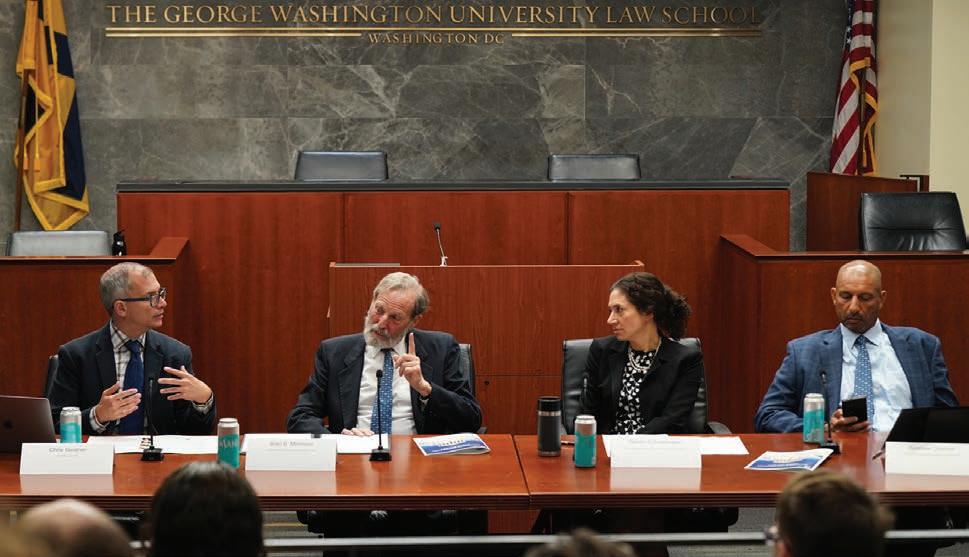
IN A CONSTITUTION DAY PREVIEW of the U.S. Supreme Court’s October term, faculty members examined cases focused on presidential power, election law and gerrymandering, and transgender rights. They also discussed the shadow docket—cases taken up on an emergency basis outside the court’s regular session.
Chris Geidner, the Supreme Court and law reporter behind the Law Dork newsletter and blog, moderated the Sept. 18 Supreme Court preview, an annual tradition at GW Law. The fall 2025 cases included President Donald Trump’s tariffs, which sparked panel discussion around presidential power.
“Under Article I of the Constitution, Congress is supposed to make the laws and the president is supposed to execute the laws,” said Alan B. Morrison, former Lerner Family Associate Dean for Public Interest and Public Service Law. “Obviously, Congress can’t write every single law in every detail. The president has to have
some discretion and some administrative agency. The question is, where is the line?”
Spencer Overton, the Patricia Roberts Harris Research Professor of Law, raised the issue of preemptive compliance, asking the other panelists about “the nightmare scenario” of Trump failing to comply with the court’s ruling and whether that prospect might act as an incentive for the justices to rule with the administration, to avoid a direct clash with the executive branch.
Overton also discussed issues in Louisiana v. Callais, which addresses gerrymandering and the Voting Rights Act of 1965
Naomi Schoenbaum, William Wallace Kirkpatrick Dean’s Research Professor of Law, focused on cases from Idaho and West Virginia involving transgender female athletes who have been barred by state law from participating in sports and a challenge to Colorado’s ban on so-called conversion therapy.
A DEFINING LAW SCHOOL EXPERIENCE
A STUDENT-ATTORNEY IN THE Intellectual Property and Technology Law Clinic has helped Professor Christopher Cotropia file an amicus brief in a case pending before the U.S. Supreme Court.
GW Law third-year student Michelle Horowitz stepped forward to help draft the brief on a short deadline.
“She worked almost nonstop through the [Labor Day] holiday, contributing research, drafting, and editing,” Cotropia said. “By Wednesday, five days later, we had the brief finalized and sent to the printers.”
In Cox Communications v. Son y, the U.S. Court of Appeals for the Fourth Circuit ruled that Cox, as a service provider, can be held liable for “materially contributing” to copyright infringement. The case went to the U.S. Supreme Court on appeal, and the amicus brief argues that the Fourth Circuit court fundamentally misunderstood Cox’s role.
In a 2020 Iowa Law Review article, Cotropia and former colleague Jim Gibson of the University of Virginia address the convergence and conflation between the Digital Millennium Copyright Act (DMCA) and copyright liability for intermediaries like Cox. They argue in the article and in the amicus brief that Cox’s role as a conduit internet service provider (ISP) is to provide access to the internet, not to store or house content.
The case could mark one of the first times a conduit—Cox—is held liable for users’ infringements, Cotropia said.
“The potential remedies are extreme. Entire households, apartment buildings, or businesses could lose internet access if even one individual at that IP address had previously infringed,” he said. “The implications go well beyond Cox, potentially affecting ISPs like Verizon and Comcast, as well as other fiber and cable providers nationwide.”
Horowitz said the opportunity to work on the brief was invaluable.
“Supporting the Cox v. Sony amicus brief through the IP and Technology Law Clinic was a defining law school experience,” she said. “In just a few days, I gained a deeper understanding of the case itself—its history, its details, and the issues at stake—and saw the professors’ discipline and craft in shaping arguments that endure.”
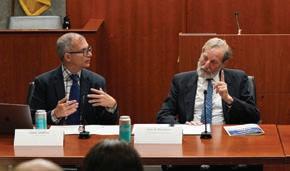
From left, Chris Geidner, Alan B. Morrison, Naomi Schoenbaum and Spencer Overton discussed cases coming before the U.S. Supreme Court this term.
Dean Matthew Inducted into National Academy of Medicine
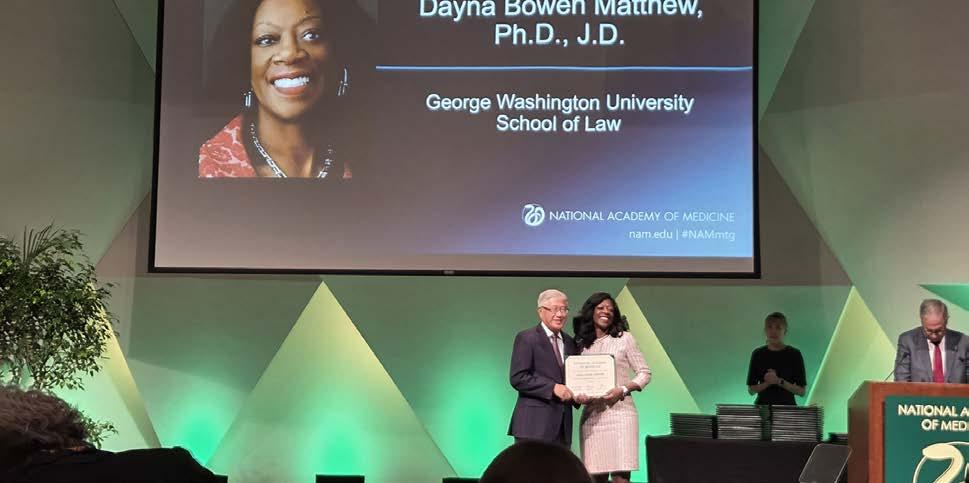
GW LAW DEAN AND HAROLD H. Greene Professor of Law Dayna Bowen Matthew was inducted into the National Academy of Medicine for her contributions to the field of public health.
“I am honored to join a group of medical scientists, social scientists, and health care experts who are dedicated to providing decision makers around the world with the data and information necessary to shape impactful, evidence-based policy that will catalyze better health outcomes for everyone everywhere,” the dean said at the Oct. 18 induction, a top honor in the medical field. “I became a believer in the collaboration between science, medicine, and policymaking early in my career when I began to tackle the ways in which law can be used to address health problems and health disparities.
“As we address issues such as vaccine policy, long-Covid, climate change, environmental injustice, and gun violence that threaten the health of the American people and America’s democracy, we need the work of the National Academy of Medicine more than ever before,” she added.
Dean Matthew is a leader in public health and civil rights law. She is the author
of numerous articles and two bestselling books, Just Medicine: A Cure for Racial Inequality in American Health Care and Just Health: Treating Structural Racism to Heal America. In 2013, she co-founded the Colorado Health Equity Project, a medical-legal partnership incubator aimed at removing barriers to good health for low-income clients by providing legal representation, research, and policy advocacy. Two years later, she served as senior adviser to the director of the Office of Civil Rights for the U.S. Environmental Protection Agency, where she expedited cases on behalf of historically vulnerable communities affected by pollution. The dean also served as a member of the health policy team under Senator Debbie Stabenow of Michigan snd as a Robert Wood Johnson Foundation Health Policy Fellow.
Dean Matthew teaches in GW Law’s Health Law and Policy program. She is also a strong supporter of the recent medical-legal partnership in which law students and GW public health students work at Bread for the City to improve patients’ health by solving their legal problems. Bread for the City provides support and services for low-income residents in the District of Columbia.
CBS “60 MINUTES” SPOTLIGHTS GW VACCINE INJURY LITIGATION CLINIC
PROFESSOR RENÉE GENTRY, DIRECTOR of the Vaccine Injury Litigation Clinic, was featured in an Oct. 5 segment of “60 Minutes” on CBS. In the show, “60 Minutes” host Jon Wertheim told the story of Jacob Thompson, a 13-yearold who suffers from rare side effects from the vaccines he received as a young child.
Gentry, who represented Thompson through the Vaccine Injury Compensation Program, is the founder of her own
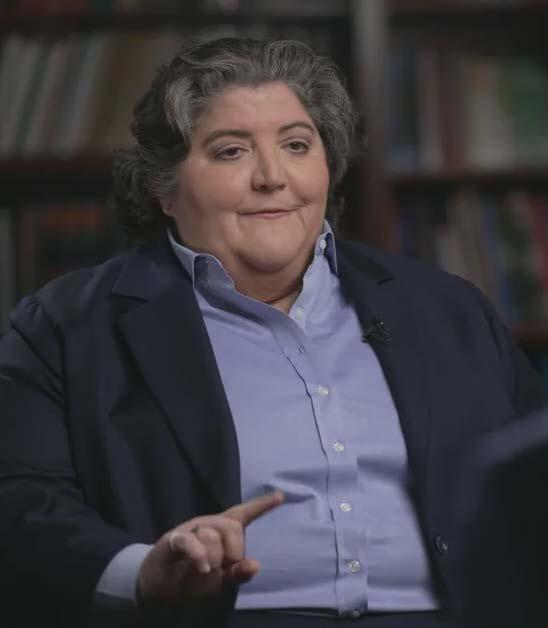
D.C.-based law firm, the Law Office of Renée Gentry, Esq., which specializes in vaccine injury litigation. She is also a leading expert on vaccine injury litigation in the National Vaccine Injury Compensation Program.
As director of the Vaccine Injury Litigation Clinic, Gentry mentors GW Law students as they represent clients who experience rare vaccine injuries. In the “60 Minutes” episode, she was seen helping students with their oral arguments and providing expertise on vaccine injury litigation.
The Vaccine Injury Litigation Clinic is among more than 20 Jacob Burns Community Legal Clinics at GW Law. The clinics enable students to gain real-world experience representing indigent clients under the mentorship and guidance of experts like Gentry.
GW Law Dean Dayna Bowen Matthew was inducted into the National Academy of Medicine in October.
Renée Gentry
BRONIN RECEIVES HEINZ AWARD
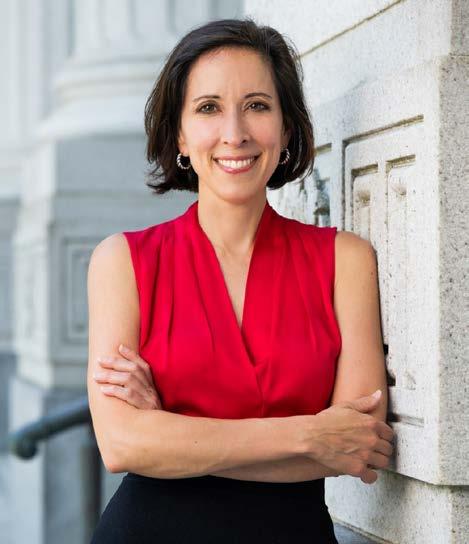
GW LAW PROFESSOR SARA BRONIN, one of the country’s foremost experts in property, land use, zoning, and historic preservation law, has won a Heinz Award.
Bronin, the Freda H. Alverson Professor of Law, was one of 30 Heinz Award recipients announced in September. She was selected for an award in the Economy category for her work spotlighting how law and policy can foster more equitable, sustainable, well-designed, and connected spaces.
Bronin is the author of Key to the City: How Zoning Shapes Our World and the founder of the National Zoning Atlas, a nonprofit that digitizes the zoning codes of more than 30,000 U.S. jurisdictions to create a searchable map and database. Her related project, the National Preservation Atlas, provides information on historic properties and encourages their protection.
“It is critical that we understand how the seemingly mundane rules governing our built environment powerfully influence our
health, wealth, happiness, and long-term survival on this planet. People who steward our laws and policies—including local zoning rules, state building codes, and federal historic preservation standards—too often prioritize the status quo at the expense of a just and equitable future,” Bronin said.
She previously chaired the Advisory
PAPANDREA INSTALLED AS BURCHFIELD PROFESSOR OF FIRST AMENDMENT LAW
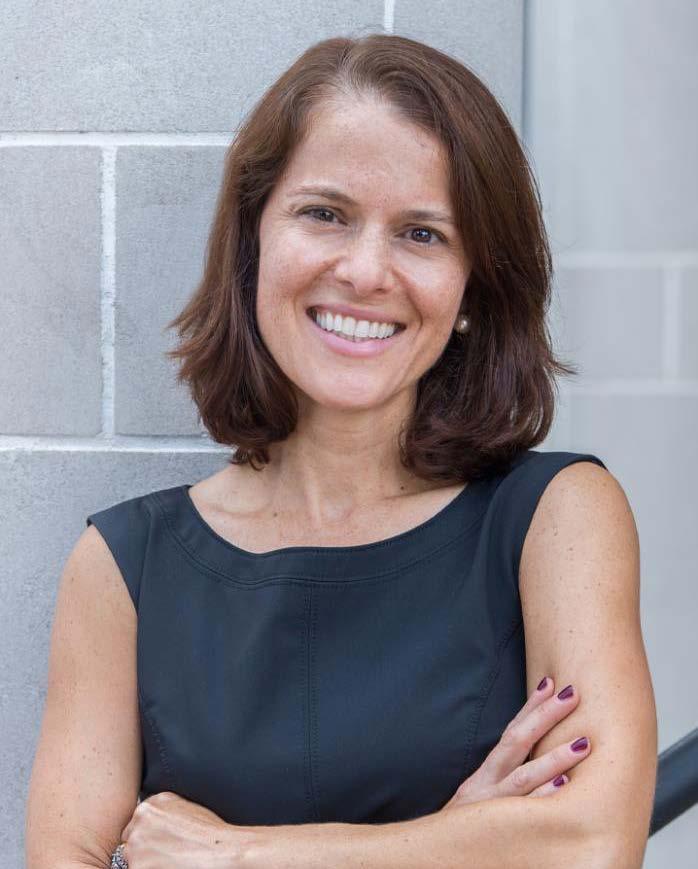
MARY ROSE PAPANDREA, A NATIONally recognized free speech and media law expert, was installed as GW Law’s inaugural Burchfield Professor of First Amendment and Free Speech Law in October.
“This is no ordinary academic investiture,” Dean Dayna Bowen Matthew told those in attendance at the installation ceremony. “Today is a celebration, indeed, a launch of George Washington University Law School’s preeminence in the legal academy as the home of what I see as the most talented, diverse, and influential free speech scholars in the nation.”
GW President Ellen M. Granberg reflected on the significance of the Burchfield Professorship and its alignment with the university’s mission to advance scholarship that serves the public interest. She said the professorship “sits at the intersection of some of
the most consequential legal issues of our era.”
The Burchfield Professorship was established through a generous gift from Bobby Burchfield, JD ’79, a retired courtroom lawyer who never lost a jury trial. Burchfield is a longtime advocate for free and civil discourse, and he spoke at the installation about the growing complexity of speech controversies in the United States and abroad, particularly in digital and private spaces where First Amendment protections may not formally apply.
He stressed the importance of preparing future legal professionals to navigate these evolving challenges and pointed to GW Law’s longstanding commitment to First Amendment scholarship.
“It is essential for us to create a free speech culture,” Papandrea said. “So just having a legal protection is not sufficient.
IT IS CRITICAL THAT WE UNDERSTAND HOW THE SEEMINGLY MUNDANE RULES GOVERNING OUR BUILT ENVIRONMENT POWERFULLY INFLUENCE OUR HEALTH, WEALTH, HAPPINESS, AND LONG-TERM SURVIVAL ON THIS PLANET.
– Sara Bronin
Council on Historic Preservation, which adopted policies on climate change and housing, streamlined review processes to facilitate federal rehabilitation projects, and advanced federal recognition of indigenous knowledge.
The Heinz Award was established in memory of U.S. Sen. John Heinz to celebrate excellence and achievement in areas that were important to the late senator. As part of the accolade, each recipient receives a cash prize.
Mary Rose Papandrea
And so, it’s so appropriate that this chair is not merely a First Amendment professorship, but a First Amendment and free speech professorship.”
Endowed professorships are among the highest honors a university can bestow and serve as powerful catalysts for academic leadership, research, and public engagement.
Sara Bronin
BRAND-MANATT LECTURE
Advancing International Law
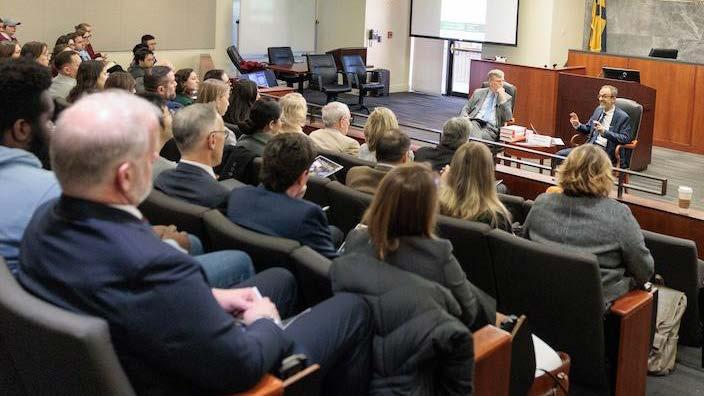
DR. JEAN-MARIE HENCKAERTS, SJD ’94, returned to his alma mater from Geneva, Switzerland, in November to present the fall 2025 Brand-Manatt Lecture. An expert in international humanitarian law, Henckaerts serves as a legal adviser in the legal division of the International Committee of the Red Cross (ICRC) and is head of the ICRC’s project to update the Commentaries on the Geneva Conventions of 1949 and the Additional Protocols of 1977. The treaties form the cornerstone of modern international humanitarian law.
WE ARE DELIGHTED TO SEE DR. HENCKAERTS FOLLOW IN THEIR FOOTSTEPS IN SHAPING AND ADVANCING INTERNATIONAL LAW IN THE MOST DIFFICULT CONTEXTS...
– Sean D. Murphy
Henckaerts engaged in a timely fireside chat with GW Law Professor Sean D. Murphy, a former president of the American Society of International Law, about the newly released, updated ICRC Commentary to the Fourth Geneva Convention, which was published in September. The event, which was hosted by GW Law’s International and Comparative Law Program, marked the updated commentary’s launch in the United States; the document focuses on the protection of civilians in armed conflict situations and during times of occupation.
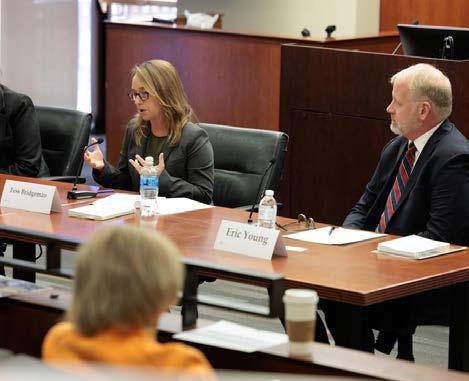
The fireside chat was followed by a panel discussion featuring remarks by Dr. Beth Van Schaack, a distinguished fellow at the Center for Human Rights and International Justice at Stanford University; Dr. Tess Bridgeman, co-editorin-chief of Just Security and senior fellow at New York University School of Law Reiss Center on Law and Security; and Eric Young, retired U.S. Army colonel and former judge advocate. The panel was moderated by Rosa Celorio, GW Law’s associate dean for international and comparative legal studies.
The Brand-Manatt Lecture was established by Joseph L. Brand, JD ’63, and Ambassador Charles T. Manatt, JD ’62, to bring leading public figures and scholars to GW Law to discuss important
SCHAFFNER EDITS NEW ENCYCLOPEDIA OF ANIMAL LAW
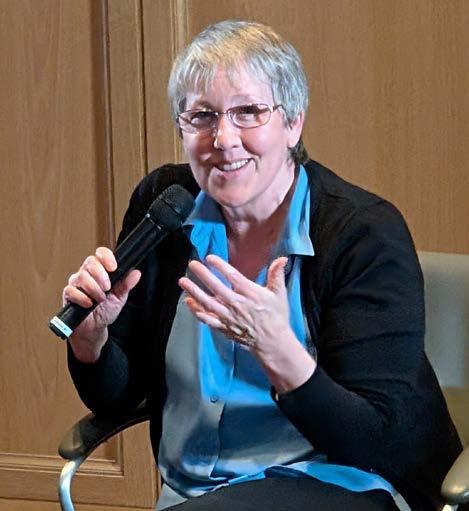
PROFESSOR JOAN SCHAFFNER, faculty co-director of GW Law’s Animal Legal Education Initiative, created and edited the new Elgar Concise Encyclopedia of Animal Law that was published in July. Schaffner spent three years on the global project after Edward Elgar Publishing approached zir about the opportunity in 2022
“It’s written for lawyers, advocates, politicians, and policymakers—anyone who wants a broad introduction to any animal law issue of interest,” Schaffner said.
The encyclopedia contains 119 entries from 140 authors and presents a comprehensive review of the laws that regulate human interactions with, and use of, animals. Entries look at laws around the world.
Assistant Dean for Animal Law Kathy Hessler wrote an encyclopedia entry on the laws and regulations surrounding aquatic animals. Professor Iselin Gambert, faculty co-director of the Animal Legal Education Initiative and director of the Fundamentals of Lawyering Program, contributed an entry on the laws and regulations surrounding cultivated meat.
“Our Animal Legal Education Initiative, which is now moving into its fourth year, is going strong. Our work over the past
Professor Sean Murphy (left) and Dr. Jean-Marie Henckaerts engaged in a fireside chat at the fall Brand-Manatt Lecture.
contemporary issues. The late Mr. Brand was a partner at Squire Patton Boggs and a GW trustee. The late Mr. Manatt, the founder of Manatt, Phelps, & Phillips, LLP, was the U.S. Ambassador to the Dominican Republic and chair of the Democratic National Committee.
“The Brand-Manatt Lecture brings our community together to advance international law,” said Murphy. Noting that Henckaerts’ SJD supervisor was the late Professor Louis Sohn and that he served as a research assistant for the late Professor Thomas Buergenthal, he added, “We are delighted to see Dr. Henckaerts follow in their footsteps in shaping and advancing international law in the most difficult contexts, such as armed conflicts and the conduct of hostilities.”
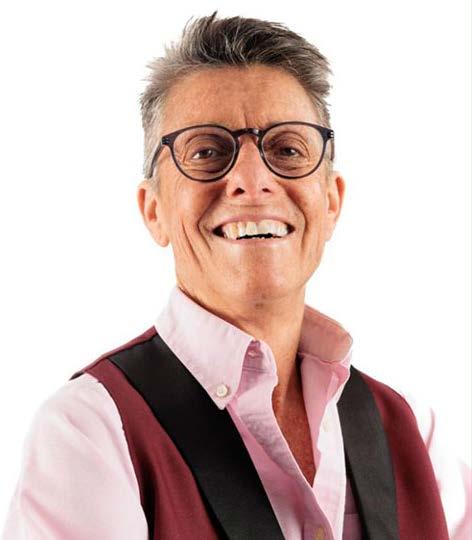
Joan Schaffner
three years, has grown GW’s reputation in the area of animal law,” Schaffner said. The program has expanded GW’s animal law curriculum, including a clinical offering. It has also organized webinars and conferences on animal law scholarship.
Select entries from the encyclopedia serve as a resource in the undergraduate course Envisioning a Compassionate Food System for Humans, Animals, and the Environment, which is taught through GW’s Global Food Institute.
The Elgar Concise Encyclopedia of Animal Law is available for order in hard copy and e-book. Use the code ANML35 at checkout to obtain a 35 percent discount.
GW
LAW
HOSTS
CONFERENCE
ON ANIMAL LAW AND AI
THE ANIMAL LAW PROGRAM brought together experts from around the globe in November for a conference exploring how AI, and technology that can be paired with AI, might be used to address challenges that jointly impact humans and animals.
“Artificial intelligence is already a part of our world. It is important to think about how its development and use can cause both benefit and harm to all the beings on the planet and the earth itself,” said Assistant Dean for Animal Law Kathy Hessler. “Without clear consideration and appropriate regulation, we could replicate current problems and cause new ones. But by talking with experts across professional and geographic domains we can begin conversations that will inform good policy decision-making.”
The Artificial Intelligence, Animals, and the Law Conference provided insights into how new technologies could change the animal law field. Panel discussions focused on the basics of AI, ethics, and the law, as well as regulation and policy surrounding AI and animal law. Panelists also discussed how attorneys think about and use AI; applications and considerations when using AI for animals; the impact of AI on the planet; and AI and animal research.
The conference brought GW animal law professors together with international science journalists, nonprofit leaders, animal advocates, environmental law professors, private practice attorneys, and AI experts.
PARTNERING WITH OXFORD ON ANIMAL LAW
ASSISTANT DEAN FOR ANIMAL LAW
Kathy Hessler traveled to England with GW Law third-year student Emma DiGiovanni, to present at the 10th annual Oxford Centre for Animal Ethics Summer School.
“We had the opportunity to meet people from around the globe working on animal issues from varied academic and advocacy perspectives,” Hessler said. “It was gratifying to hear that the work of the Animal Law Program at GW Law is having a meaningful impact and supporting the work of others.”
The August program was part of the new Animal Ethics and Law Partnership between Oxford and GW’s Animal Law Program. The summer school focused on the ethics of captivity, with a special focus on aquaculture. Hessler spoke about “Aquaculture Hatcheries: The Need to Protect Animals throughout the System,” shedding light on a little-considered area of legal research, while DiGiovanni discussed legal protections for plantbased foods as a strategy to reduce farmed animal captivity.
Both are contributing, along with alumna Hana Nabulsi, JD ’25, to the Journal of Animal Ethics
Hessler and DiGiovanni were joined in Oxford by Lori Marino, a neuroscientist and co-director of the Animal Law and Science Project. Marino discussed “Law, Science and Ethics: The Three Pillars of Protection for Captive Cetaceans” while Amy Wilson, a member of GW’s Aquatic Animal Law Project, made a presentation on “Factory Fins: Cruelty and Harm beneath the Surface.”
Marino and Hessler are co-founders of World Aquatic Animal Day.
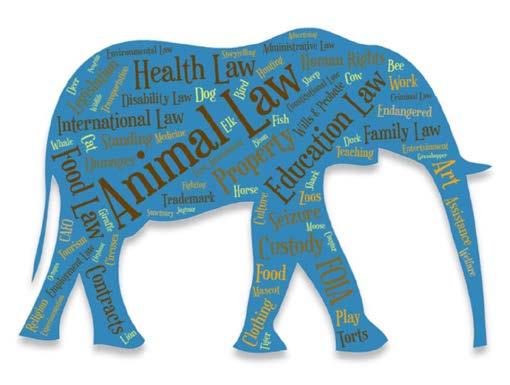
Kathy Hessler
Energy Law Program Welcomes Inaugural Distinguished Scholars
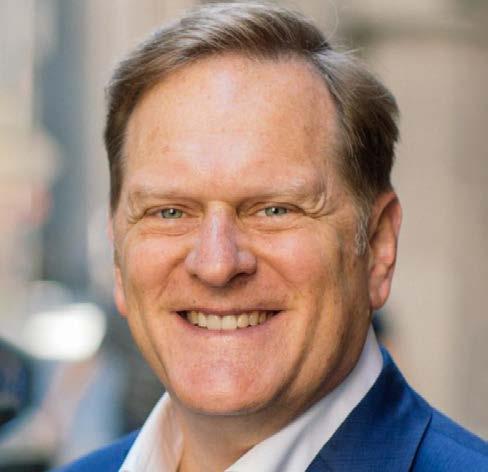
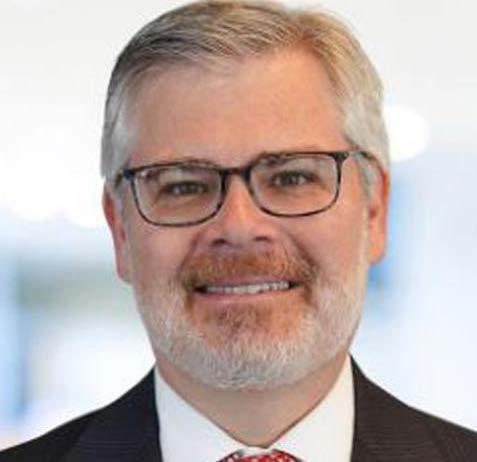
GW LAW HAS LAUNCHED A Distinguished Scholar Program in Energy Law and Sustainability in a bid to advance reliable, affordable, and efficient use of clean and sustainable energy through collaboration among preeminent thinkers, practitioners, faculty, and students. The program’s inaugural scholars are Allan T. Marks and Matthew Brotmann.
“We are at a pivotal moment in the global energy transition, and the legal and ethical questions we face are more complex than ever,” said Dean Dayna Bowen Matthew. “The Distinguished Scholar Program in Energy Law and Sustainability is a testament to our commitment to academic excellence and public service.
“By bringing thought leaders like Allan Marks and Matthew Brotmann to our campus, we are ensuring that GW Law remains at the forefront of global discourse and solutions,” she added.
Marks teaches in GW’s Environmental and Energy Law program and contributes to the Ethics, Energy, and Sustainability project. He is a retired partner at Milbank LLP, where he practiced for more than 30 years in the firm’s global project, energy, and infrastructure finance group, handling
over $100 billion in complex transactions involving renewable energy, water, transportation, banking, capital markets, and cross-border investment.
Brotmann is a professorial lecturer in law and a distinguished scholar at GW Law, where he, too, works on the Ethics, Energy, and Sustainability project. He currently heads Equinor’s regulatory and public affairs unit and serves as senior counsel for Norwegian energy company’s renewables portfolio in the Americas. He served as senior counsel at the New York Power Authority and assistant general counsel at the MTA/Triborough Bridge and Tunnel Authority.
The Ethics, Energy, and Sustainability project focuses on the complex challenges of creating a sustainable energy future. It examines the ethical dimensions of energy policy, the social and environmental justice implications of infrastructure development, and the role of law and finance in advancing a more equitable transition to clean energy. Through their residency, Marks and Brotmann will collaborate on high-impact research, enrich the academic community, and mentor the next generation of legal and policy leaders.
COMPETITION LAW CENTER EXPANDS EXPERTISE
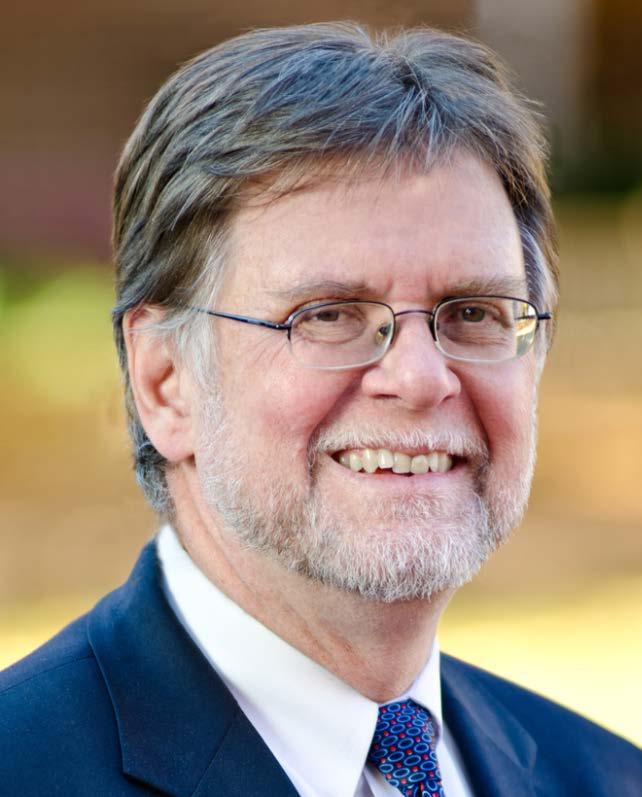
GW LAW HAS APPOINTED THREE leading voices in antitrust law—Doug Melamed, Jon Nuechterlein, and Mark Popofsky—to the Competition Law Center (CLC).
“This brilliant ensemble brings us unsurpassed insight into competition law at home and abroad,” said CLC Director William Kovacic. “Their formidable knowledge—based on broad experience as scholars, practitioners, and government officials—will be a wonderful resource for our students and the global competition policy community.”
The distinguished scholars added their expertise to the classroom during the fall term, co-teaching a new course on Advanced Topics in Antitrust with Professor Barak Richman. They also participate in the center’s workshops, conferences, and student-focused programs, fostering collaboration across academic, professional, and policy communities.
Melamed practiced law for 43 years. From 2009 until 2014, he was senior vice president and general counsel at Intel Corp. Prior to that, he was a partner in the Washington, D.C., office of WilmerHale, serving as a chair of the antitrust and competition practice group. From 1996 to 2001, he was acting assistant attorney general in charge of the Antitrust Division in the U.S. Department of Justice.
He spent the 2014-15 academic year at Stanford Law School as the Herman Phleger Visiting Professor of Law and was appointed Professor of the Practice of Law at Stanford in 2015.
Nuechterlein is a Washington, D.C.based attorney and author with broad experience in government and the private sector. In addition to his role at the CLC, he is a lecturer at the University of Virginia School of Law and an adjunct professor at Georgetown University Law Center, where he has taught seminars in antitrust and telecommunications law.
In December 2024, Nuechterlein retired from Sidley Austin after nearly nine years as a partner and co-leader of the firm’s telecom and internet competition practice. From 2013 to 2016, he was general counsel of the Federal Trade
Allan T. Marks
Matthew Brotmann
Commission. His extensive government experience also includes positions as deputy general counsel of the Federal Communications Commission, assistant to the solicitor general, and law clerk for Supreme Court Justice David Souter.
Nuechterlein is the co-author, with Phil Weiser, of the first two editions of Digital Crossroads: Telecommunications Law and Policy in the Internet Age. He and Georgetown Law Professor Howard Shelanski worked on the third edition of that book, which is scheduled for publication in early 2026.
THIS BRILLIANT ENSEMBLE
BRINGS US UNSURPASSED INSIGHT INTO
COMPETITION LAW AT HOME AND ABROAD.
– William Kovacic
Popofsky chairs the antitrust group at Ropes & Gray LLP. He has taught advanced antitrust courses as a lecturer at Harvard and the University of Pennsylvania Carey Law School and was an adjunct professor at Georgetown Law for more than two decades. Prior to that, he served as senior counsel to Assistant Attorney General Joel Klein in the Antitrust Division of the U.S. Department of Justice, playing a key role in multiple cases and securing a landmark victory in the California Supreme Court in Ixchel Pharma, LLC v. Biogen Inc.
BROWN WINS LIFETIME ACHIEVEMENT AWARD
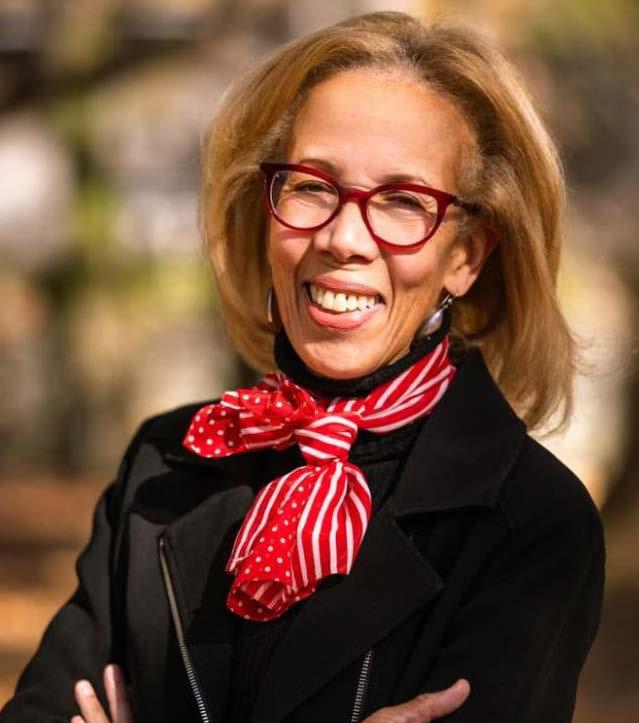
KAREN BROWN, THE THEODORE Rinehart Professor of Business Law, received the lifetime achievement award at the Association of American Law Schools’ Annual Meeting in January. The award, presented by the AALS Tax Section, recognized Brown’s distinguished career of teaching, service, and scholarship, and her “impact in the field of taxation, the legal community, and the academy.”
Brown, whose scholarship focuses of income, corporate, and international taxation, is the co-author of a book on international tax transactions and the co-editor of a book on tax reform. She has been instrumental in advancing the Tax Law Program at GW Law, which was recently given an A-rating by the National Jurist.
Prior to joining GW Law nearly three decades ago, Brown was a professor at the Brooklyn Law School and at the University of Minnesota where she received the Stanley V. Kinyon Award for excellence in teaching. Before beginning her teaching career, she was a trial attorney for the U.S. Department of Justice, Tax Division, and an associate at Steptoe & Johnson.
Among the many awards she’s received over the course of her illustrious career, she
PROFESSOR BROWN’S MENTORSHIP AND EXPERTISE HAVE PROPELLED THE CAREERS OF MANY GW LAW GRADUATES.
– Dean Dayna Bowen Matthew.
was the recipient of GW Law’s Nota Bene Inaugural Faculty Member of the Year Award in 2024 and the winner of the Bureau of National Affairs’ Distinguished Service in Tax Award in 2019.
“I congratulate Professor Brown on her lifetime achievement award,” said Dean Dayna Bowen Matthew. “Professor Brown’s mentorship and expertise have propelled the careers of many GW Law graduates. Her commitment to teaching in and advancing the field of tax law is why GW Law is among the top law schools for tax law in the nation.”
STEPPING UP DURING THE GOVERNMENT SHUTDOWN
WHEN MORE THAN 45 GW LAW STUDENTS WERE SHUT OUT OF THEIR federal government field placements during the historic 43-day government shutdown in the fall, the GW Law community answered the call. GW Law’s Field Placement Program, led by Dean Keri McCoy, acted swiftly, connecting with alumni and faculty to successfully find alternative projects and opportunities for every student seeking replacement work.
Students were assigned to state courts projects, set up to help faculty scholarship and research, and connected with nonprofits and non-governmental organizations. One alumnus who rose to the challenge was Minnesota District Court Judge William Koch, JD ’88, who provided students with six assignments for the court.
“When the school reached out following the federal shutdown, I was happy to find a creative solution to an unexpected need,” said Koch. “And my colleagues on the trial court bench were more than happy to offer some very interesting projects.”
Dean Dayna Bowen Matthew said she was impressed with the speed and agility with which the community acted, saying the shutdown presented an unusual challenge but staff, faculty, students, and alumni met the moment “with excellence.”
William Kovacic
Karen Brown
LEADERSHIP
in the


BY SARAH KELLOGG
ILLUSTRATION BY RENE STRINGFELLOW

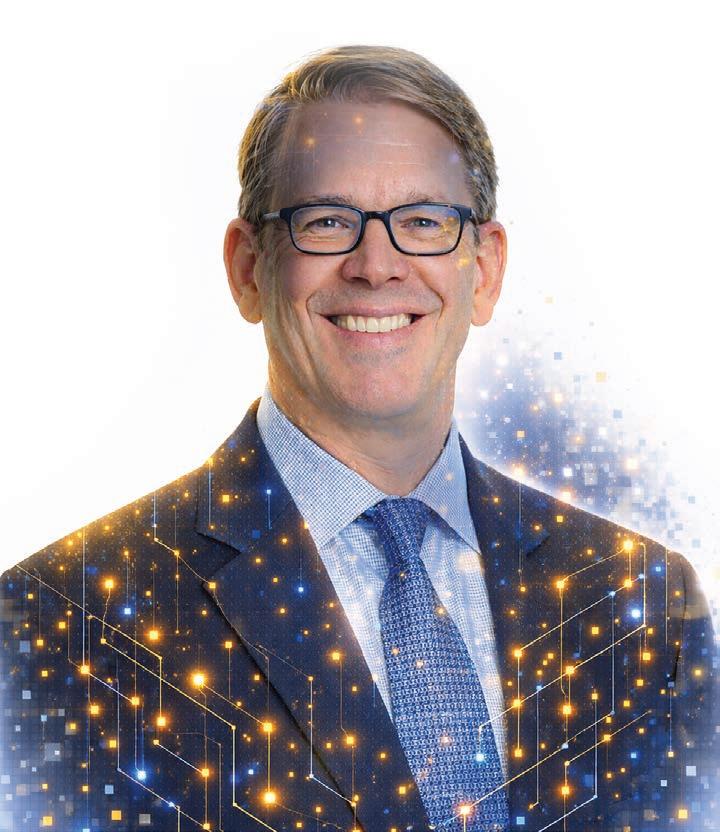
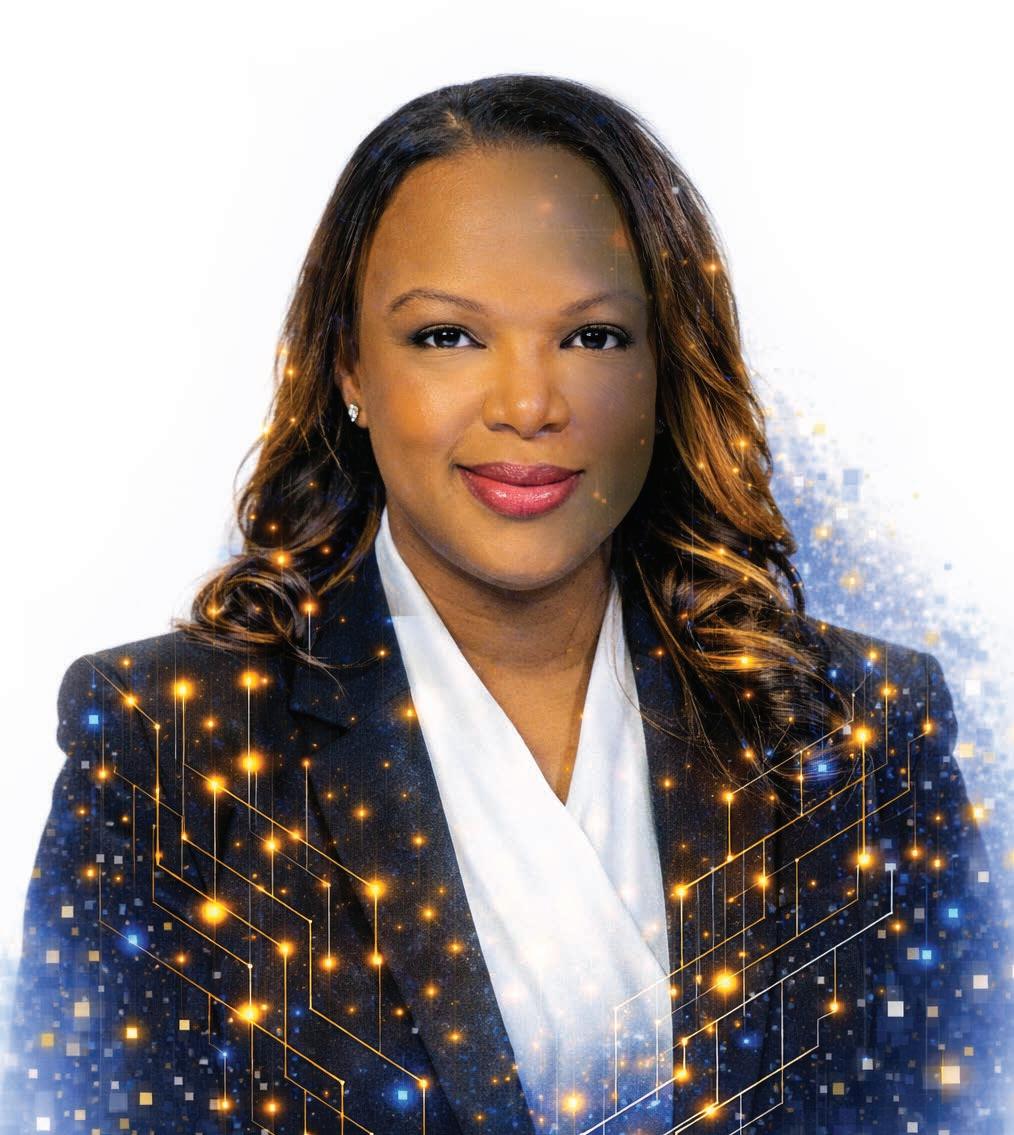
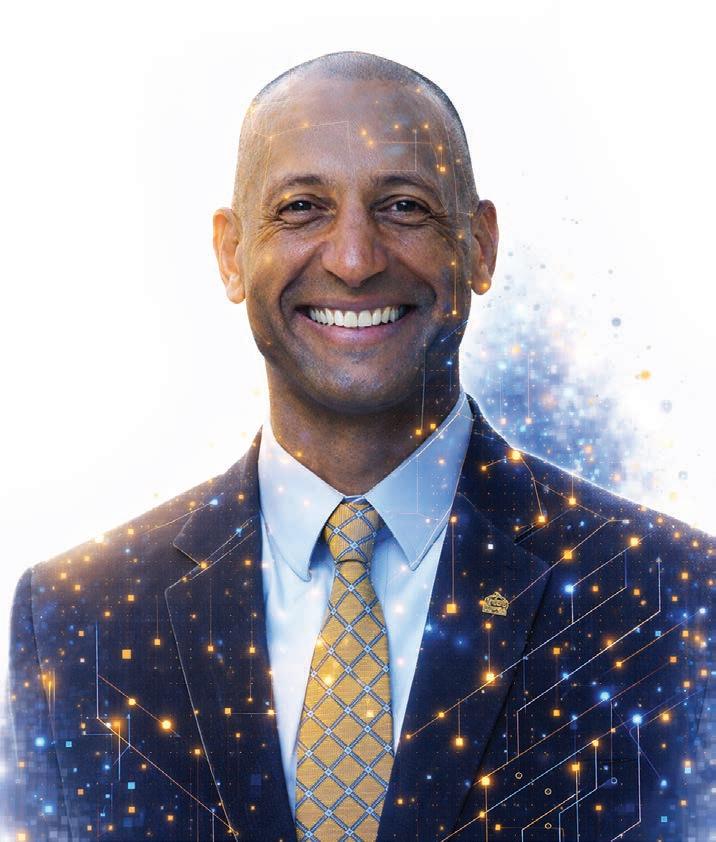
ECHNOLOGY LAW HAS NEVER BEEN TIDY. THE RISE OF AI COMPANIES HAS made it messier, more urgent, and more human. Questions that used to live safely in seminars now land on desks as real contracts, investigations, and products. Who is accountable when an algorithm discriminates? How do you regulate a model that changes after deployment? What does consent mean when data is scraped on a planetary scale?
At GW Law, students don’t just study these questions from a safe distance—they work them. They practice them. They learn to hold a client’s vision in one hand and the public’s trust in the other, and to understand that both belong in the room.
That approach echoes through the careers of alumni working across intellectual property, artificial intelligence, autonomous vehicles, and tech entrepreneurship. Graduates don’t leave with a single fixed playbook for “technology law.” They leave with something more adaptable: a way to think inside constant change without being swallowed by it.
“Technology law isn’t a static practice area,” said Dean Dayna Bowen Matthew. “It’s a moving target. Our job is to graduate lawyers who know how to think as the target moves and who can adapt without losing their grounding in justice and the rule of law.”
GW Law’s location in Washington, D.C., is not just a backdrop for that mission; it’s part of the curriculum. Few places expose students so directly to the collision between law and technology. In a city where agencies draft rules that shape global markets and courts decide cases that redraw the boundaries of privacy, speech, and tech competition, GW students learn to think in two directions at once: up close and wide out. They see

I had a great experience at GW Law. It was hard work. It was non-stop. It was a chance to stretch myself to the limits, to see what’s possible.
- Eric Malis


how legal principles become policy, how policy becomes enforcement, and how enforcement becomes precedent.
In classrooms and clinics, externships with regulators and in-house teams, and late-night study groups parsing the newest technology policy memo, students encounter the terrain of careers that will stretch across technologies not yet imagined. Professors push them deeper. Peers sharpen their arguments. And the school’s practical, cross-disciplinary culture keeps legal thinking tethered to real-world stakes.
Again and again, graduates describe a hard-won steadiness emanating from their time at GW Law: the ability to stand inside change, not just chase it; to ask the right questions early, to spot risks that don’t show up in a pitch deck, and to help build rules for a world that is still being invented. These proficiencies show up differently in each career—yet the through-line is unmistakable.
LAYING THE FOUNDATION FOR A STARTUP LIFE
ERIC MALIS, JD ’10, BELIEVES THAT EVEN THOUGH law school may not necessarily be a traditional path to a tech career, GW Law gave him a foundational way of thinking and working that helps him thrive in today’s startup world.
“I had a great experience at GW Law,” said Malis, co-founder and partner of Talis Partners, LLP, and general counsel and chief of staff at Lincode Labs Inc. “It was hard work. It was non-stop. It was a chance to stretch myself to the limits, to see what’s possible.”
It was a stint in sales and marketing that brought him to GW Law. He noticed how one of his colleagues, who was both a lawyer and an executive, consistently cut through cross-functional noise. That stuck with him, sparking an interest in law school and, all

these years later, has become a model for how he approaches technology work now.
“He had a way of quickly understanding different issues and synthesizing what was at stake to get people aligned. There’s something about how lawyers can break down complex concepts into their critical components and then convey them that’s always excited me,” said Malis. Malis went all in during law school—extracurriculars like law review, moot court, mock trial; student organizations like the SBA and Street Law; internships at Linklaters, the Court of Federal Claims, and the White House. He says the intensity and diversity of those experiences shaped his confidence to enter the rapidly changing world of startups and technology.
His work as a student senator with the SBA and teacher and VP of Street Law sparked an interest in interpreting and explaining the law to real people under real pressure. “Whether you’re helping a group of students form a new organization [with the SBA], or teaching at-risk youth about law, government, and civics [with Street Law], you have to explain complex rules to real humans with empathy and clarity, while keeping the argument sharp,” he said.
These experiences weren’t a detour from his future in technology. They were preparing him for it. The most effective tech lawyers don’t just parse contracts, he noted. They translate competing values to people with different stakes.
Malis’s path to Silicon Valley ran from a federal clerkship in New York, to Kirkland & Ellis in D.C., to Cooley in California, and finally into the startup bloodstream. He co-founded his hybrid legal strategy firm Talis Partners to work more closely with founders rather than just pointing out risks from the sidelines.
“I like to roll up my sleeves and work with smart people in more of an operational role,” he said. While managing Talis Partners, Malis also ran a startup bootcamp program at BootUP Ventures,


taught legal research and writing at Santa Clara University Law School, and designed and taught an entrepreneurship course called “Launching a Startup” at Menlo College.
Now, as general counsel and chief of staff at Lincode, his days move at startup speed—negotiating enterprise contracts, restructuring operational processes, and steering go-to-market decisions. The job requires precision in finding the core problem, aligning the team around it, and keeping momentum without cutting corners.
“That is GW Law’s fingerprints on my tech life,” Malis said. “It’s not because of a single course in technology but rather a legal discipline and a habit of breaking through chaos to identify realistic choices and make better decisions.”
SHAPED BY GW LAW, LEADING IN TECH
GW LAW PROVIDED DOUG LUFTMAN, JD ’97, WITH A durable legal foundation for practicing in the ever-accelerating technology industry, building on his electrical engineering degree from UCLA and a lifelong passion for technology.
The law school stood out because it offered him an “element of combining law with business and technology,” a blend that matched his background and ambitions. It was a training ground where instructors and guest lecturers brought multiple perspectives into the classroom.
“It wasn’t just you having amazing professors,” he recalls, “but
also learning from legal professionals and government officials who taught us how the law influences industry.” He came to value GW Law’s “cross disciplinary approach,” and the expectation of applying analytical legal skills to accelerate the speed of business.
That pragmatic emphasis became increasingly relevant as technology continued to transform the world. Luftman noted that, similar to his experience at GW, recent graduates “hit the ground running by coming out of GW with not only a deep understanding of the law, but also a pragmatic approach to handling the ever-changing legal questions that the tech industry, such as AI, raises.”
Over 25 years, Luftman has served as a legal executive at a who’s who of companies from Intel to Palm to DocuSign. He evolved from leading intellectual property groups to serving as a general counsel for over half a dozen technology startups. He enjoys working in-house because it keeps him close to the entrepreneurial energy of business where “you first understand the company, so that you then can apply the law as an accelerant to their business.”
That same instinct acquired in law school now powers his latest venture, Velocity Edge Advisors, a modular, on-demand legal department he co-founded with a friend. The firm provides unique turn-key legal services to more than 100 companies—an impressive result for a firm that is barely six months old.
“My professional story reads like a blueprint for why GW Law’s graduates succeed in roles where law has to keep pace with the speed of innovation,” said Luftman. “I feel lucky to have attended GW Law where the school prepared me for being able to make a real difference in the world.”


My professional story reads like a blueprint for why GW Law’s graduates succeed in roles where law has to keep pace with the speed of innovation.
- Doug Luftman
THE CROSSROADS OF LAW AND TECHNOLOGY
CHRISTOPHER NALEVANKO, JD ’07, STILL LAUGHS
when he thinks about the first time GW Law showed up in his Zoox life: not in a courtroom or a patent office, but in a quiet conference room with engineers and executives—translating both worlds at once.
“I went to GW primarily because of its status in the IP world,” said Nalevanko, general counsel of Zoox, the maker of self-driving electric robotaxis. “Aside from my electrical engineering degree, I use my law degree every day.”
GW Law’s IP focus was never abstract. At GW, he was trained to think like a technologist while arguing like a lawyer. He remembers learning to “blend the legal and technical worlds,” a discipline he relies on daily inside a company building AI-driven autonomous vehicles. Those skills followed him west.
“At Zoox, my CEO doesn’t just want my legal advice. She wants my overall advice,” he said. “GW’s business-friendly culture helped me step into that wider role. I feel like GW Law wasn’t afraid of business and it opened up more opportunities to me.”
After law school, he learned the stickiest issues in tech are rarely purely legal. They’re strategic: “Did that make sense from a business perspective?” or “Why are we doing this?” That is exactly the terrain AI and autonomous systems create—where compliance, ethics, product design, and commercial goals intersect.
When Zoox needed help beyond patents—supply-chain contracts, platform partnerships, compliance for a fleet without steering wheels—Nalevanko’s approach was to learn the underlying technology first, then build agreements around reality. The contracts were “incredibly technology focused,” he noted, and understanding the parts and their implications was mandatory.
If Nalevanko could pull today’s students aside in the hallways
GW equipped me with the tools I needed to operate at the crossroads of law and technology. It gave me the skills to help a company build what comes next.
-ChristopherNalevanko
of Lerner or in the IP clinic, his advice would sound like a syllabus for the future: take AI and privacy courses because “everything is moving” so fast; add business classes you don’t think you need yet; and don’t skip the mediation and conflict-resolution training GW Law excels at
“In a tech company, a GC is an advisor, right or wrong,” said Nalevanko, adding that he didn’t realize that when he was in law school. “GW equipped me with the tools I needed to operate at the crossroads of law and technology. It gave me the skills to help a company build what comes next.”
TRANSLATING COMPLEXITY FOR THE AI AGE
MANSI SHAH, JD ’06, REMEMBERS THE LIGHT IN the GW Law Library at midnight—how it pooled on casebooks the way a debugger’s glow lands on stubborn code. Before law school, no one in her Model UN circle would believe she fell hard for computer science and mastered the art of coding, but she did.
So, GW Law turned out to be a deliberate pivot from coding, but not a retreat. She came to Washington, D.C., after the dotcom bust, with a defense industry job in hand and an itch to keep learning. A high school teacher, her love of argument as much as algorithms nudged her toward a career in patent law, and she chose GW Law because of its reputation in IP law.
That choice let her weave together her two instincts—how systems work and how people are at the center of any system—into one career. She sees herself as a “translator for tech” because that is how she built value while litigating technology cases.
“I felt my gift was the ability to translate really complex technology for either a judge or a jury,” said Shah, who after decades in big firms founded Lockwood AI in 2025
While at GW Law, during an internship with the U.S. Patent and


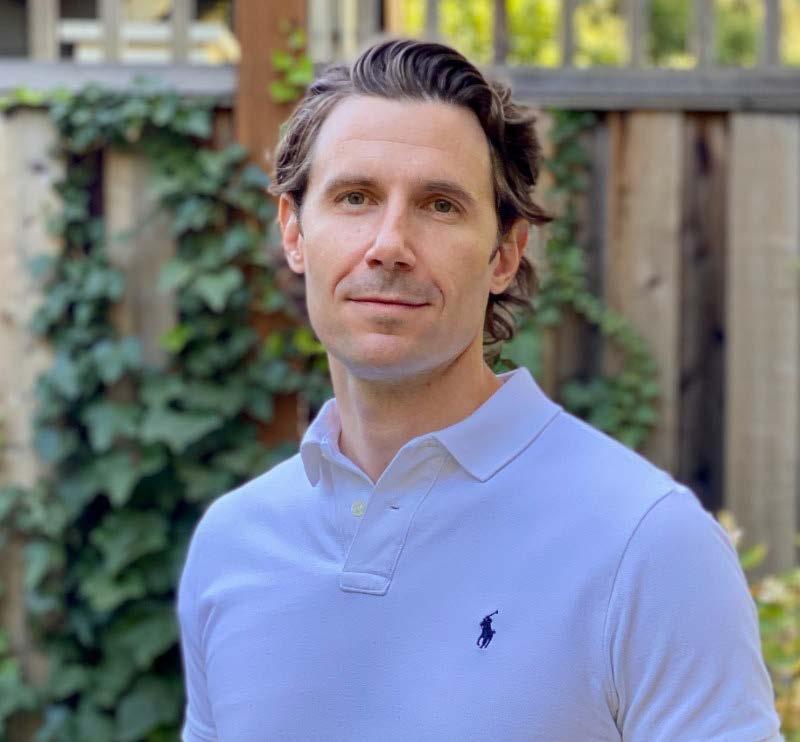



Trademark Office where she worked with patent judges, her translation skills took root. The judges relied on her to parse the technology and apply the law. She would hone that skill as her career progressed, becoming adept at explaining complex issues in a way a broad audience could understand.
That clarity is why tech clients trust her now, especially in the AI era. When AI began flooding boardrooms, Shah was neither dazzled nor dismissive. She’d already lived through technology revolutions and knew how law lags, especially with a fast-moving target.
“Everything’s changing so quickly,” said Shah. “The speed is precisely why lawyers can’t pretend the shift is optional. They need to be ready.”
Her approach to generative AI is the same one law schools have applied during the evolution of research from books to online databases: use the tool, then “double check the work.” It’s old training with new stakes—shepardizing not just cases but the credibility of the systems themselves.
When Shah left Big Law—partly energized, partly unsettled—she felt AI raised questions too large to ignore about how lawyers will practice in the future, especially how they will develop judgment and value labor. She jokes that she hopes super-intelligence treats humanity like “Hollywood’s dog,” pampered and safe, but the humor still carries real urgency.
Shah has become an evangelist of sorts in GenAI, educating
Everything’s changing so quickly. The speed is precisely why lawyers can’t pretend the shift is optional. They need to be ready.
- Mansi Shah
business leaders about the opportunities ahead and how best to leverage them. She also authored The Monsoon Method: Rainmaking Redefined, a business development framework she crafted after years of mentoring partners and proving her client development skills.
Today, she speaks on the topic of her book, while also building out Lockwood AI, a consultancy focused on advising nonprofits on AI fluency, still guided by a conviction that law is a human craft but that technology will change how we practice it.
“All of the skills you learn in law school will apply,” Shah said. “They will just apply in a different way than they did yesterday.”
KEEPING PACE WITH THE FUTURE
ACROSS THESE CAREERS, A CLEAR PATTERN emerges: Today’s technology lawyers operate at the crossroads of law, business, engineering, and rapid innovation. Whether advising on autonomous systems, guiding AI companies, or translating complex technical concepts for diverse audiences, their work requires agility, strategic thinking, and the ability to build legal structures around technologies that evolve faster than traditional doctrine.
What unites their paths is the formative role GW Law played in shaping this interdisciplinary fluency. The law school’s practical, cross-disciplinary approach trained students to manage uncertainty and connect legal analysis to real-world product and business considerations. Rather than offering a static playbook, GW Law prepares its graduates to think critically and adapt as the technological landscape shifts.
“Technologies like AI are powerful precisely because they scale decisions,” said Dean Matthew. “That means the consequences scale, too. We train our students to ask hard questions about accountability before harm becomes inevitable. We can’t predict every technology our graduates will face, but we can give them something more enduring: judgment, fluency, and the courage to lead when the law hasn’t caught up yet. We can help them keep pace with the future.”

SHAPING ARTIFICIAL INTELLIGENCE AND THE LAW
GW LAW FACULTY SIT AT THE FOREFRONT OF AMERICA’S discourse about artificial intelligence (AI). These preeminent legal scholars are helping to shape the law surrounding AI and its implications for future lawyers. Their groundbreaking doctrinal scholarship in top legal journals examines AI’s disruption of privacy law and intellectual property rights, police surveillance, contract law, and even democracy itself.
“In my opinion, no other law school faculty is covering the breadth of AI issues and bringing the variety of opinion, perspective, and real world impact as the GW Law faculty. In the brave new world of artificial intelligence, we are making good on our vision and promise to be the school that informs lawmakers, policymakers, and decisionmakers around the world,” said Dean Dayna Bowen Matthew.
The public face for much of this work is the GW Center for Law and Technology: The Bernard Center. Last year, the new center launched the online GW Journal of Law and Technology (JOLT); content in its inaugural issue ranged from AI governance to privacy regulation. The center’s faculty co-directors are Robert Brauneis, the Michael J. McKeon Professor of Intellectual Property Law, and Daniel J. Solove, the Eugene L. and Barbara A. Bernard Professor of Intellectual Property and Technology Law. Both are producing front line scholarship on AI’s threats to the
BY MARY A. DEMPSEY ILLUSTRATION BY DONALD CLARK

In my opinion, no other law school faculty is covering the breadth of issues and bringing the variety of opinion and perspective on AI as the GW Law faculty.
– DEAN DAYNA BOWEN MATTHEW
Overall, AI is not an unexpected upheaval for privacy; it is, in many ways, the future that has long been predicted.
– DANIEL J. SOLOVE
law, while the Bernard Center’s two subject matter deans–Adrienne Fowler and John Whealan–forge partnerships between GW Law and the public and private sectors to train students and influence the law.
Together, these intellectual leaders place GW Law at the forefront of finding solutions to AI’s thorniest legal issues. “I teach copyright law, and I used to tell my students that the most interesting time for copyright law was the late 1990s when the internet was becoming the big thing. But if you ask me today, I have to say that now is the most interesting time,” said Brauneis.
In addressing copyright and AI training, he focuses on areas where technology may leave human authors, artists, and other creatives unprotected by copyright law. His latest article, “Copyright and the Training of Human Authors and Generative Machines,” appears in The Columbia Journal of Law & the Arts Brauneis says fair use has emerged as a central conflict for generative AI as tech companies scoop up copyrighted material and content creators cry foul.
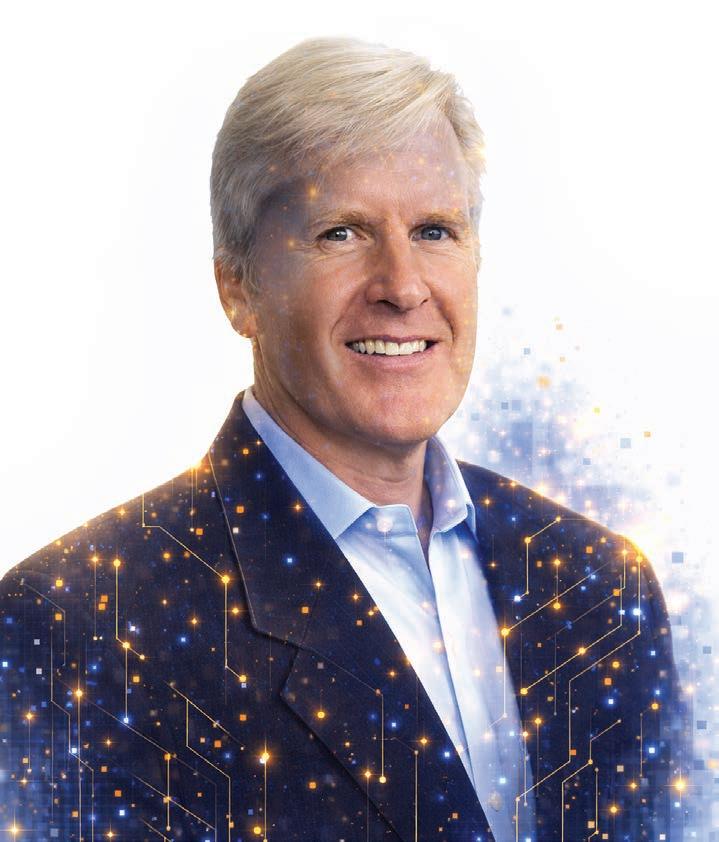
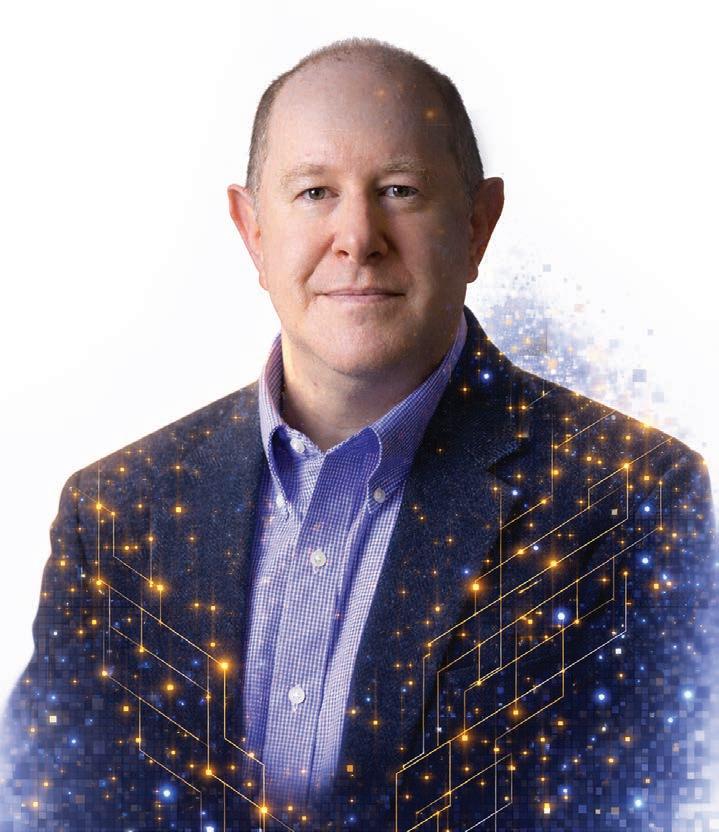
Daniel J. Solove
“The peril is that copyright law could cease to give adequate incentives for human authors to create things. There is also the argument that if much of human creativity is replaced by AI works … we will lose what is an essential part of our humanity, the exploration of the world through creation,” Brauneis said. “I happen to hold the position that the training of generative AI models is not fair use. And yet, the two courts that have approached this issue are seeing it the other way.”
Brauneis manages the Database of AI Litigation, which currently tracks about 260 cases, of which about 40 involve uses of works under copyright to train generative AI models.
“This fair use issue is going to play out over the next four or five years,” he said. “If I had to guess, I’d say it will eventually end up before the Supreme Court.”
In addition to generating scholarship, the Bernard Center underpins GW Law’s ability to convene prominent thinkers on issues related to AI. In 2025, it held a symposium on digital surveillance. This year, it hosted a February symposium to examine authorship and inventorship with AI. And on October 2 and 3, it will bring together some of the country’s most prominent copyright scholars for discussions focused on “The Future of the Copyright Act.” The gathering, 50 years after the enactment of the Copyright Act of 1976, includes presentations and papers that will be published in the Journal of the Copyright Society
There is the also the argument that if much of human creativity is replaced by AI works … we will lose what is an essential part of our humanity, the exploration of the world through creation.
– ROBERT BRAUNEIS
Robert Brauneis
THE NEXT GENERATION OF LAWYERS
GW LAW’S DEEP BENCH OF AI-RELATED EXPERTISE IS accelerated by the school’s collaborative culture. Cooperation across branches of law not only positions the school to effectively impact policies and law; it also provides the next generation of lawyers with exemplary opportunities for learning. AI discussion is woven into courses, seminars, and—beginning this spring—a new certificate program in AI and the law.
“GW has a wonderful collection of scholars who are thinking about the hardest issues around AI,” said Professor of Law Andrew Guthrie Ferguson, a national expert on police surveillance technologies and their chilling effect.
“The fun part about being here is that there are intersections of AI across legal domains, and that is helpful in generating new scholarship ideas and new thoughts. You can go across the hall and talk to someone who is looking at a different area of AI—and that is very valuable.”
In her seminar on AI bias and discrimination, Visiting Associate Professor of Law and Privacy and Technology Law Fellow Christina Lee pushes students to look at the pervasive role AI plays in people’s lives.
“AI is going to be a consequential technology that touches every aspect of our lives—and it will interact with and stretch the law in interesting ways,” Lee said. “The way it touches our lives is

different from what has come before it. The challenge is figuring out which legal frameworks still work, where they can be made to work with stretching, and where we need new legal frameworks.
“That is going to be the work of today’s and tomorrow’s lawyers. As we think about educating lawyers of tomorrow, it is important for our students to understand what is going on to bridge the gaps in this new technology.”
Associate Dean for Academic Affairs and Associate Professor of Law Aram Gavoor is experimenting with AI applications in the Administrative Law, Issues and Appeals Clinic that he directs. He notes that there is currently no commercially available AI model that is sophisticated enough to replicate human research of complex U.S. Supreme Court briefs. But he has authorized the eight students in his appellate clinic, which specializes in administrative law and public law issues on nationally significant questions, to use AI for general research that can be supplemented with individual non-AI research.
He says the students are careful to ensure that privileged information on clients, concepts, and legal issues are not exposed, even in a Mosaic AI-type setting. That means AI prompts must be general.
“It is working well but, ultimately, we are also exploring different domains for privileged legal research using AI. That vetting process is an intentional and thoughtful one,” Gavoor said. “The students appreciate that the clinic is techforward while also recognizing that in the legal profession we need very careful professional responsibility guardrails.”
Outside the clinic, Gavoor is engaged in research that addresses AI in the
face of energetic federal government tech deregulation.
“My research asks whether and how the marketplace, which desires stability, can engage in self-regulatory behavior for AI. I am looking at how participants in the AI industry can coalesce under self-regulatory standards based on market principles, so as to mitigate its general public use for cyberattacks as well as novel security vulnerabilities,” he explained.
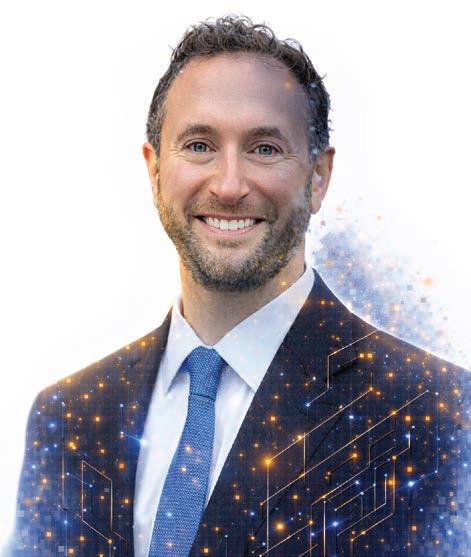
He is especially interested in nonpartisan alignments aimed at restricting the deployment of powerful AI systems capable of cyberattacks or chemical, biological, radiological, nuclear, or explosive weapons.
“It makes sense for the industry to make some norms to reduce—or mitigate altogether—those very unfavorable outcomes,” he said.
Similar to Gavoor’s law clinic, experiential learning also anchors an AI-focused project involving three students working under the supervision of Adrienne Fowler, the deputy director of the Bernard Center. The students are collaborating with the Lawyers Committee for Civil Rights Under Law to develop Freedom of Information Act requests focused on the use of AI facial recognition technology by housing agencies and airports across the country.
“Our students leave law school not only understanding what the law does but also what it will be shaped in the future to do—and how they can be the next generation of leaders who construct legal regimes for new technology,” said Dean Matthew.
Aram Gavoor
Christina Lee
Part of what I’m teaching brings up how AI is changing privacy and surveillance, something that law students should be thinking about as consumers, as lawyers, as future legislators, as judges.
– ANDREW GUTHRIE FERGUSON
AI’S REGULATORY QUAGMIRE
A JUMBLE OF LAWS—OLD AND NEW—HAVE BEGUN TO address the vast array of unanswered legal questions presented by AI’s new capabilities. But these laws leave many gaps in our understanding. One of those novel issues is the question of how to protect individuals’ privacy in the face of artificial intelligence. Professor Dan Solove, the Bernard Center’s other faculty co-director, is a preeminent voice offering to unravel this regulatory quagmire, and fill the existing void. He is one of the world’s most-cited scholars on privacy law. Solove’s latest book, On Privacy and Technology, was published last year.
Like his recent Florida Law Review article “Artificial Intelligence and Privacy,” the book outlines the problems that AI poses to privacy and suggests regulatory frameworks to mitigate that conflict. Solove believes new privacy laws, to be effective, must make fundamental changes in the way companies do business.
“Overall, AI is not an unexpected upheaval for privacy; it is, in many ways, the future that has long been predicted,” Solove wrote in the Florida Law Review. “But AI glaringly exposes the
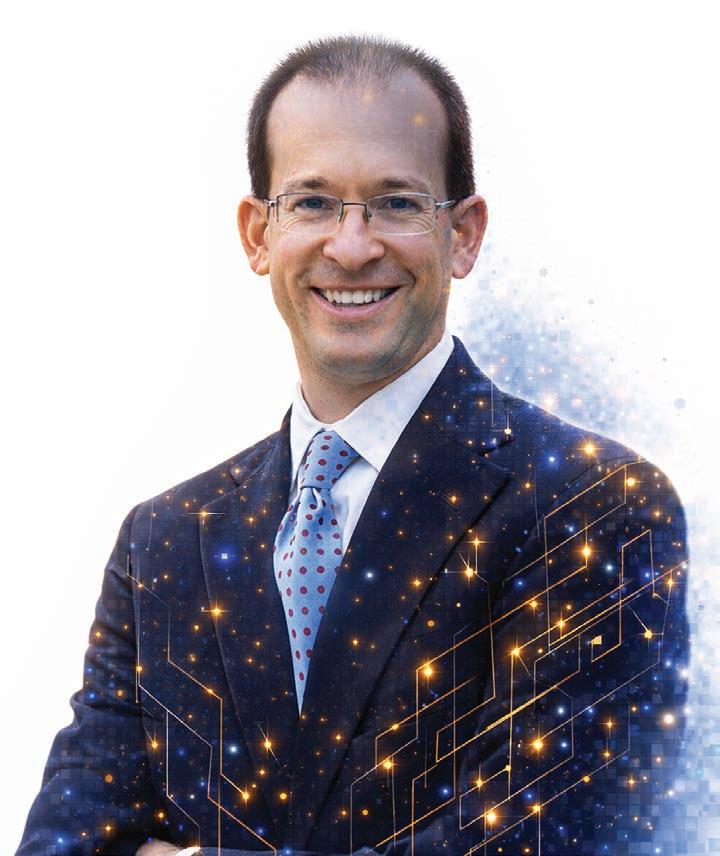
Abramowicz
Andrew Guthrie Ferguson
longstanding shortcomings, infirmities, and wrong approaches of existing privacy laws.”
Solove says AI poses substantial threats to privacy, and the dearth of a comprehensive privacy law makes any remedies a patchwork response. In his recent paper in the California Law Review, “The Great Scrape: The Clash Between Scraping and Privacy,” he contends that the automated extraction of data on the internet, which is unfolding at an unprecedented scale, violates nearly all the key principals of privacy law. What is needed, he says, is “a radical rethink of how privacy law addresses scraping.”
PROTECTING THE PROMISE OF AI
IN CONTRAST, OPPENHEIM PROFESSOR OF LAW
Michael Abramowicz sees more promise than peril. Abramowicz says legislation is difficult precisely because of the speed with which technology is changing, and he believes premature application of the law could prevent crucial technology from emerging. Abramowicz also sees specific AI benefits in the legal field, such as bringing down the cost of legal services and making jury trials more accessible again.
“With AI, the death of the trial is going to reverse,” he said.
He also predicts that AI in the near future could enable young lawyers to open their own law firms and compete with senior lawyers.
“We could be entering upon a golden age of law and a golden age of lawyering,” said Abramowicz, who is also the law school’s associate dean for strategy and innovation.
With AI, the death of the trial is going to reverse. ... We could be entering upon a golden age of law and a golden age of lawyering.
– MICHAEL ABRAMOWICZ
Michael
His latest work touching on AI appears in the current issue of the George Washington Law Review. The article, “Major Technological Questions,” is co-authored with John F. Duffy of the University of Virginia School of Law and argues that courts should be skeptical of applying old, existing laws to regulate the “rush” of new AI technologies. They caution instead that lawmakers must first develop experience with new technologies before making important regulatory decisions. In their words, courts must “restrain the dead hand of the past from thoughtlessly tyrannizing the present and future.”
AI, PRIVACY, AND POLICING
PRIVACY RIGHTS ARE ALSO CENTRAL TO THE scholarship of Professor of Law Andrew Guthrie Ferguson, a national expert on police surveillance technologies, who joined GW Law last year. His work on predictive policing, facial recognition, and video analytics appears in top law journals. His latest book, Your Data Will Be Used Against You: Policing in the Age of SelfSurveillance, comes out this year.
“Part of what I’m teaching brings up how AI is changing privacy and surveillance, something that law students should be thinking about as consumers, as lawyers, as future legislators, as judges,” Ferguson said. “They should think about it as thought leaders because they will be confronted with these issues before many other people.”
He is especially troubled by the growing use of AI to generate police reports from the audio recordings in police cameras.
“Almost 95 percent of cases will get resolved before trial, without seeing whether AI got it right, especially with low-level felonies,” Ferguson said. “This [AI] document will go to the prosecutor and the judge. It will be the basis of a constitutional motion to suppress. It will probably be the basis of plea bargains and probation revocations.
“In other words, the main document of fact will be an AI-generated thing that we put so much weight on,” Ferguson continued. “I think the simple solution is that maybe we allow it as a transcript, but not a police report.”
He is also concerned about the proliferation of public cameras for law enforcement, citing privacy violations, the potential for mass surveillance, algorithmic bias, and a lack of regulation.
“As AI technology turns cameras into something new and more powerful, we are changing the balance of power between police and citizens. We are creating an opening for an authoritarian government to misuse technology,” he said. “We’re building the technology and funding the technology, and we’re not debating its risks and rewards.”
AI: A THREAT TO DEMOCRACY?
AMONG THE PLETHORA OF AI-FOCUSED SCHOLARSHIP at GW Law—including AI’s impact on civil rights, copyright, privacy rights, and beyond—the work of Patricia Roberts Harris Research Professor Spencer Overton addresses a fundamental question: Is AI a danger to multiracial democracy?
Overton’s work is the first to comprehensively examine the extent to which AI—and the legal frameworks that regulate it—influence race and democracy. His article in the Iowa Law Review, “Overcoming Racial Harms to Democracy from Artificial
BEYOND THE
BLOCKCHAIN TEACHING
LAW IN THE AGE OF AI AND CRYPTO
LYLE T. ALVERSON PROFESSOR OF LAW KRISTIN JOHNSON, one of GW Law’s newest faculty members, brings an impressive resumé of work at the crossroads where cutting-edge technologies meet the global financial system.
Her scholarship examines the rise of AI in finance as well as the creation of distributed digital ledger technologies, such as blockchain, that have spurred the explosive growth of cryptocurrencies in commercial and consumer financial transactions. She is also a leading voice in the development of international standards to prevent and defend against cyberthreats that plague both traditional financial institutions and crypto markets.
“For many decades, financial services and banking have relied on predictive technology,” said Johnson, who joined the faculty in September. “Artificial intelligence is changing how the largest financial institutions operate and creating pathways to better manage risks, reduce frictions, and identify fraud. For many, AI will significantly alter regulatory and compliance programs.”
Johnson said accelerated adoption of AI could make financial systems more accessible, enabling greater financial inclusion in the United States and globally. “At the same time,” she added, “there are risks—known and emerging—that we must carefully manage to effectively protect vulnerable consumers.” Those concerns include data privacy, security, and integrity.
During the Biden administration, Johnson was a commissioner on the Commodity Futures Trading Commission and, later, served as assistant secretary for financial institutions at the Department of the Treasury. Before joining academia, she worked in the private sector, including as vice president and assistant general counsel in the Treasury Services Division at JP Morgan and as an analyst at Goldman Sachs.
Kristin Johnson
When a leading AI developer can simultaneously argue that data is public enough to scrape ... and private enough to keep secret ... something has gone seriously awry with how law constrains power.
– ALICIA SOLOW-NIEDERMAN
Intelligence,” details how AI and related technologies are transforming the U.S. electoral system, from “deepfake” recordings and videos to racial bias in automated election administration to the potential for AI-empowered hackers to inundate local election offices.
Even without malicious intention, bias and flaws embedded in AI datasets could affect elections and policymaking well into the future, says Overton, the founder and faculty director of GW Law’s Multiracial Democracy Project. He adds that existing laws, including the Voting Rights Act, are no match for the threat.
“To some, racial diversity is no longer considered a public good, and I believe this approach also shapes our government’s current approach to AI governance,” he said.
In “Ethnonationalism by Algorithm,” his forthcoming article that will appear in the Howard Law Journal, he argues that the current White House has intentionally used federal AI policy to advance a broader agenda focused on dismantling racial diversity. Overton believes entrenching racial inclusion into AI law at its formative stage could shape the trajectory of a U.S. democracy that is growing ever diverse. But he sees little government or tech industry interest in doing that.

His upcoming paper in the Utah Law Review, “Analyzing the Benefits of Artificial Intelligence to Racially Inclusive Democracy,” acknowledges that certain AI tools, if applied appropriately, could help facilitate language translation, empower grassroots organizers, reduce turnout gaps, and increase government responsiveness to communities of color; however, creating tools that are linked to just a handful of tech giants gives those companies outsized influence.
“We can’t just rely on technologists to make technology and policy decisions. Key decisions that are democratic determinations require input from across society,” Overton said. “This is an urgent moment … an important moment to really envision the future we would like to see.”
Overton says community groups, civil rights organizations, and philanthropy can be deployed to ensure that emerging technologies strengthen—rather than weaken—multiracial democracy. He offers best practices for those efforts in Technology, Multiracial Democracy, Community Power, and Philanthropy, which is to be published by the Knight First Amendment Institute at Columbia University.
Overton’s work has been the focus of conferences at the nation’s most prestigious law schools including The University of Pennsylvania, Harvard, and the University of Albany. Overton will explore AI’s influence on equality, bias, and voting at a March conference organized by his Multiracial Democracy Project in partnership with Harvard Law School and Stanford Law School. The event will be held on the Stanford campus.
We can’t just rely on technologists to make technology and policy decisions. Key decisions that are democratic determinations require input from across society.
– SPENCER OVERTON
Alicia Solow-Niederman
Spencer Overton
You’re chasing a moving target. ... They’re getting the agencies to use AI without transparent governance.
– JESSICA TILLIPMAN
AI AND THE DOCTRINAL COLLAPSE
IN ADDITION TO TEACHING ONE OF THE FIRST courses nationwide on AI law and policy, Associate Professor of Law Alicia Solow-Niederman is causing a quake with her work on how the legal regimes that govern data are failing. Focusing on privacy law and copyright law, she exposes how the boundaries between these partially overlapping, but distinct, bodies of law are blurring and becoming “illegible.” This has led to a phenomenon she calls “inter-regime doctrinal collapse.”
In “AI and Doctrinal Collapse,” her forthcoming article in the Stanford Law Review, Solow-Niederman contends that AI developers are able to manipulate copyright and privacy law to their advantage, with individual and systemic costs. Big corporations are rewarded by their ability to sidestep individual privacy rights and acquire creators’ works through privacy policies and terms of service.
She argues that these issues become clear only when they are examined across legal regimes.
“We don’t have a strong enough information privacy law, and we don’t think enough about the political economy of data and data acquisition and how that interacts with legal regimes like copyright law,” she said. “We’re really good at looking within one issue of law—privacy law or copyright law—but what if there are two frameworks that both regulate data, and they have very different laws and associated normative goals?”
Her analysis addresses who can exploit the existing legal structures and to what ends. Solow-Niederman is most concerned when inter-regime doctrinal collapse disproportionately helps the “haves” and permits private claims that threaten the public accountability and legitimacy of law itself.
As she explains in the Stanford Law Review article: “When a leading AI developer can simultaneously argue that data is public enough to scrape—diffusing privacy and copyright controversies— and private enough to keep secret—avoiding disclosure or oversight of its training data—something has gone seriously awry with how law constrains power.”
OVERSEEING FEDERAL AI PROCUREMENT
FOR SCHOLARS TRACKING AI’S IMPACT ON THE LAW, keeping pace is one of the toughest challenges. Jessica Tillipman, associate dean for government procurement law studies, often finds herself discussing Federal Acquisition Regulation updates that have been released just hours before class. These ongoing procurement reforms, significant on their own, are unfolding in tandem with fastmoving debate over how to regulate AI in federal acquisition.
“You’re chasing a moving target,” said Tillipman, whose upcoming article “Buying Blind: Corruption Risk and the Erosion

of Oversight in Federal AI Procurement” will appear in the winter 2026 issue of Public Contract Law Journal
“The draft for the Public Contract Law Journal started as one article in December 2024. By April, I had to rework it once the current government began changing direction. Then it became something else entirely when the Trump administration released America’s AI Action Plan,” Tillipman said.
“Then, as I was writing about that, the GSA was coming out with $1 deals,” she added, referring to the General Services Administration’s agreements with several major AI companies. The companies offered their AI models to federal agencies at a discounted rate of $1 per agency for one year.
“They’re getting the agencies to use AI without transparent governance,” Tillipman said.
Tillipman argues that the rapid deployment of these technologies, layered on top of already shifting procurement rules, is dismantling many of the guardrails that have traditionally reduced integrity risks in the federal acquisition system. Policy changes are leaving agencies vulnerable to both familiar forms of corruption and new avenues of exploitation. Yet, she expects little restraint as the current White House continues to align with industry on AI development and deployment.
GW Law’s distinguished scholarship underpins its capacity to facilitate crucial conversation and policy as the country grapples with the acceleration of technology aimed at dramatically changing the way people live and work. Our law school’s breadth of expertise also ensures that law students are exposed to and develop the intellectual skills necessary to navigate this new landscape.
“We promise students that GW Law will equip them to be problem solvers in a complex, dynamic, and sometimes polarized world. Where the fast changing world of AI is concerned, we more than make good on that promise by delivering a staggering range of the nation’s leading legal AI scholars who are not only thinking and writing about these issues and teaching students to understand them in the classroom, but are also helping to shape the direction of AI law as the nation’s most impactful AI public intellectuals,” said Dean Matthew.
Jessica Tillipman
Meeting the Moment
PREPARING STUDENTS TO USE AND CHALLENGE
AI
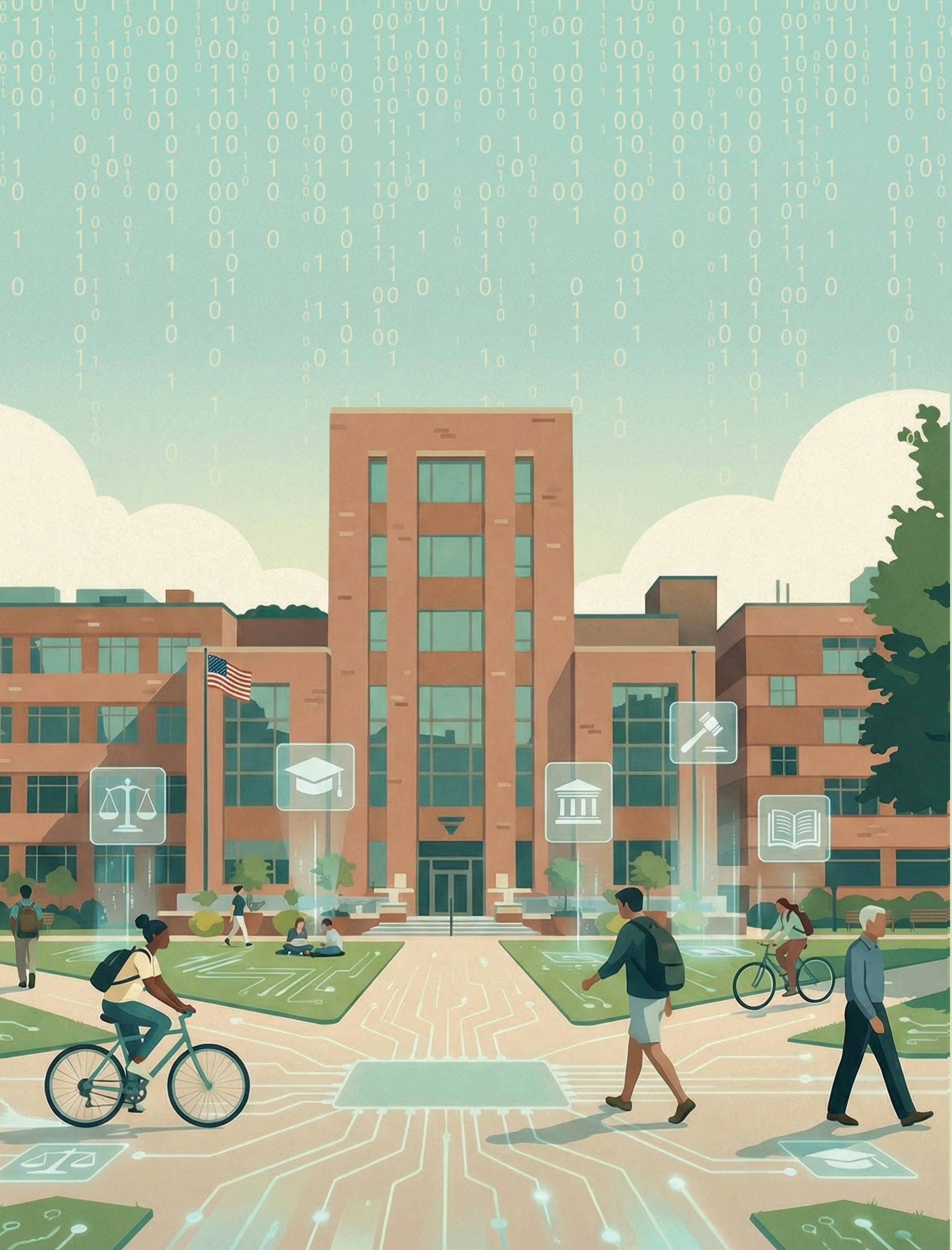
Artificial intelligence hasn’t just arrived in the legal profession; it has taken root quickly and decisively.
Memos that once required hours now come together in minutes.
Mountains of discovery can be sifted and organized in seconds.
Across corporate legal departments, law firms, and public-sector offices, tasks that once defined the daily work of junior associates and staff attorneys are increasingly being automated.
The question confronting the profession today is no longer whether lawyers will use AI. It is whether they understand enough about these tools to use them responsibly, and to challenge them when needed.
Concurrently, law schools, historically built on precedent, face the unprecedented: designing an education for a profession being reengineered in real time.
“We’re living through a structural shift in how legal work gets done,” said Dayna

Bowen Matthew, Dean and Harold H. Greene Professor of Law. “Understanding AI is no longer an elective skill for young lawyers. It’s a professional necessity. Our responsibility is to ensure our students graduate not just fluent in the law, but fluent in the technologies shaping it.”
What makes the challenge more complex for law schools is that the technology itself is still unsettled, morphing both in its engineering and its uses. New versions roll out every few months. Novel new use cases arise daily. Workflows in firms and agencies evolve constantly. Ethical debates and regulatory frameworks are far from resolved.
BY SARAH KELLOGG
illustrationS by wanda nance

We are creating an environment in which faculty have the freedom to teach in ways that work best, and students gain exposure to AI in multiple contexts.
– Adrienne Fowler
This uncertainty is precisely what makes AI literacy non-negotiable for today’s students. Few practitioners articulate the stakes more clearly for law students than Candida “Candi” Wolff, JD ’89, managing director and global head of government affairs at Citi. For Wolff, AI tools are already woven into the fabric of high-stakes legal and policy work.
“AI is going to be part of their lives whether they like it or not,” said Wolff. “Therefore, I think they should embrace, engage, and learn it, and law schools must teach how you use it, effectively, because ignoring it is at your peril.”
That conviction frames the challenge ahead for GW Law and other schools: as AI accelerates, legal education must evolve just as quickly to ensure future lawyers lead and not follow the technology.
AI Across the Curriculum
AS GW LAW ADDRESSES AI’S OPPORTUNITIES AND potential challenges, the goal is not mastery of a specific tool. It is a mastery of thinking—teaching students how to ask the right questions, craft the right prompts, identify missing information, and understand the interplay between technology and law.
GW Law is taking a comprehensive approach to preparing students for an AI-driven legal landscape. The law school has launched a school-wide initiative, guided by the Office of the Dean, designed to introduce students to both generative and discriminative AI and the ethical rules governing their use. A series of ad hoc committees of faculty and staff have considered how best to maintain and update the GW Law curriculum, recognizing that the AI landscape shifts faster than a traditional academic calendar.
Rather than silo AI in a single class, the consensus is that GW Law will build a curriculum that threads technical capability, ethical reasoning, and doctrinal expertise throughout a law student’s education. Within the Fundamentals of Lawyering Program, faculty members have already embedded AI training directly into the firstyear experience.
First-year students learn to craft effective prompts for legal research and writing; evaluate the accuracy and limitations of generative tools; compare human-generated and AI-generated research; identify biases, hallucinations, and reasoning errors; and apply professional ethics rules governing responsible use of AI.
The GW Law approach intentionally blends the school’s own course offerings with vetted third-party training. The effort invites faculty and staff to rethink traditional methods, experiment with new teaching strategies, and share insights about how best to introduce emerging technologies into legal education.
“We are creating an environment in which faculty have the freedom to teach in ways that work best, and students gain exposure to AI in multiple contexts, from some traditional legal courses to foundational skills classes to advanced, practice-focused offerings,” said Adrienne Fowler, the inaugural Bernard assistant dean of the Privacy and Technology Law Program and the deputy director of the GW Center for Law and Technology: The Bernard Center.
Across upper-level courses and experiential learning opportunities, students gain access to the same tools reshaping legal workplaces: Lexis+ AI, Westlaw AI, and Harvey for research and

AI is going to be part of their lives whether they like it or not. Therefore, I think they should embrace, engage, and learn it, and law schools must teach how you use it, effectively, because ignoring it is at your peril. – Candi Wolff
drafting; compliance-automation platforms used by corporations and government agencies; document-review AI that mimics lawfirm workflows; and AI-assisted due diligence and transactional drafting systems.
Clinical programs and workshops walk students through real-world scenarios: drafting motions with AI assistance, testing multiple versions of arguments, and using generative systems to analyze complex regulatory frameworks. And webinars and conferences offer opportunities to bring in real-world voices to discuss AI’s impact on the profession and the law.
In November, the GW Law Animal Law Program hosted the Artificial Intelligence, Animals, and the Law Conference, bringing together attorneys, scholars, technologists, and advocates to examine how emerging technologies are reshaping the field of animal law. A prime learning experience for students, the conference explored the potential of solving longstanding challenges affecting humans, animals, and the environment, as well as the risks and regulatory gaps that demand careful scrutiny.
At the same time, students are finding their own ways of educating themselves about AI and its legal implications. The student-run Journal of Law & Technology (JOLT) has held a series of symposia looking at AI-related issues, and its latest one is dedicated to the thorny question of authorship and creativity in the age of AI.
These conversations at conferences and webinars are not abstract. Students work through concrete scenarios involving AI-generated text, images, and code, debating how the law should treat each contribution. These offerings reflect the school’s belief that students should not only learn existing doctrine but also help shape the future rules governing new technologies.
Recognizing AI’s growing influence across the legal profession, GW Law has launched a new certificate program that underscores the technology’s importance in modern practice. The program focuses on developing practical, hands-on skills: students draft and revise documents, create summaries, and work across multiple AI platforms while also exploring issues such as platform moderation,
privacy, and data security. Those who complete the four-credit program earn a dean’s notation on their transcript, signaling their emerging expertise to future employers.
AI and Fundamentals of Lawyering
WHEN FIRST-YEAR LAW STUDENTS WALK INTO Professor Catlin Meade’s Fundamentals of Lawyering class, few expect to confront generative AI as directly as they do legal citations or case briefings. Many arrive uneasy, unsure whether using ChatGPT could violate an academic integrity code or accidentally expose private information. Others have experimented with the tools but remain wary—trained by undergraduate policies to assume that AI is either forbidden or academically dangerous. Meade quickly dismantles both extremes.
“I reject the idea that every student walking in our building is already using AI and relying on it,” said Meade, associate professor of Fundamentals of Lawyering. “Instead, I often see fear, confusion, and a need for guidance.”
She begins not by warning them away from AI, but by teaching them how to think about it. In early fall, after students analyze their first set of cases, she also asks various AI models—Lexis+ AI, ChatGPT, and Microsoft Copilot—to summarize the same cases. The results are “pretty good” but never perfect, and the students quickly realize the catch: they would never have spotted the errors or missing analyses if they hadn’t first done the work themselves. The lesson lands immediately. Lawyers get in trouble not only because AI is inherently flawed, but because they trust it blindly.
From there, Meade reframes AI not as a shortcut, but as a risk environment. Meade believes students cannot develop sound judgment around the ethical use of AI without a foundational understanding of what generative AI is, so she talks to students about how generative AI models work and are trained. During the discussion, she introduces specific Model Rules of Professional Conduct implicated by a lawyer’s use of AI, underscored by real examples of lawyers and judges who have run afoul of the rules.
Filing briefs that have misstatements of law, or even made-up statements of the law, is certainly not competence.
– Christopher Cotropia
Yet she doesn’t stop there. She shows them how AI can genuinely improve their writing and analysis: identifying passive voice, creating revision tables, or generating structural options without altering substantive analysis. Students may use AI for their rewritten assignments but must file an AI certification outlining exactly which tools they used, how they used them, and affirming that they independently validated all information, which mirrors real-world practice in many courts today.
Meade sees these lessons as indispensable for students in their careers. Clients increasingly expect lawyers to use AI to reduce costs, and firms are adopting internal large language model (LLM) AI offerings like Harvey. Employers even ask about AI proficiency in employment interviews. “A student who can talk about the ethical, practical use of AI will stand out,” she said, noting her goal is to teach students to be skeptical, competent, and capable risk managers.
The Practice of Law
WHEN FOWLER TALKS ABOUT THE FUTURE OF legal education, she doesn’t start with technology. She starts with fundamentals. She is adamant that students must first understand how to think like lawyers before they can appropriately decide if, when, and how to employ the assistance of machines.
“While there is some focus on the use of AI in GW’s Fundamentals of Lawyering, the primary focus of that program is rightfully learning how to do key legal tasks yourself,” she explained, emphasizing that the goal is not to let tools eclipse the development of core skills.
In January, Fowler began teaching one of the school’s newest offerings: The Use of AI and Emerging Technologies in Legal Practice, a one-credit reading and workshop course designed to ground students in the realities rather than the hype surrounding rapidly evolving tools.
“Generative AI is a new tool, but it involves a lot of the same issues as other technologies from a lawyer’s perspective,” she said. “Understand what the technology is doing, understand what might be done with the information you provide, understand its limitations… and understand how to properly query and doublecheck things.”
A central theme of the course is balance. Students must neither reflexively fear AI nor treat it as a miracle solution. “Just because you have a hammer doesn’t make everything a nail,” Fowler wryly noted.
In her view, the work ahead isn’t about teaching law students to rely on AI. It’s about preparing them to interrogate it, challenge it, and selectively integrate it into the profession with clarity and judgment. “We need to look at it like we do any other legal tool, with a critical eye and an educated mind,” she said.
A New Professional Landscape
PROFESSOR CHRISTOPHER COTROPIA’S CLASSROOM hums with the energy of a profession in transition. In his courses on intellectual property and professional responsibility, he sees the same quiet anxiety on students’ faces that has begun to ripple across the legal world: What does it mean to be an ethical lawyer when machines can draft a paragraph of legalese in seconds? What does
I reject the idea that every student walking in our building is already using AI and relying on it. Instead, I often see fear, confusion, and a need for guidance. – Catlin Meade
competence look like when AI can analyze a case or invent one just as quickly?
Over the past several years, Cotropia, the David Weaver Research Professor of Law, has reshaped his curriculum to meet that moment. What began as informal conversations in his professional responsibility class about emerging tools has grown into a fullclass session devoted entirely to the ethical use of AI. The shift, he explains, was prompted by a steady drumbeat of headlines: lawyers sanctioned for submitting AI-hallucinated cases, courts issuing stern reprimands, and firms scrambling to create guardrails.
“Filing briefs that have misstatements of law, or even made-up statements of the law, is certainly not competence,” he tells students, pointing them to the American Bar Association’s recent guidance on AI and attorney duties
But Cotropia doesn’t teach AI as a threat. Instead, he frames it as a new professional landscape requiring fluency, judgment, and adaptability. Lawyers cannot simply refuse to engage with these tools, he insists. “Being a competent attorney nowadays means you need to know what it is and how people are using it… You can use it to help your client, but also be aware of the downsides.”
In class, that philosophy becomes hands-on. Students in his intellectual property course receive an AI-generated analysis of a non-compete agreement. Cotropia jokingly calls it a “B-minus” solution. It conflates legal requirements, misses key facts, and papers over its flaws with polished prose. The students’ task is to edit it. The exercise quickly reveals the core lesson: you cannot be a good editor if you don’t know the law yourself. “You can’t just offload the substantive knowledge,” he said, noting that “de-skilling” is possible with an overreliance on generative AI models.
Cotropia also carves out “safe spaces” for students to experiment. He said many students arrive nervous about violating either classroom expectations or the academic integrity code. Yet experimentation is essential. “If you’re not willing to experiment,” he tells them, “you’re going to get left behind.”
For Cotropia, the goal is not to teach students the AI of today—it will soon be outdated—but to prepare them for decades of technological evolution. The core duties of the profession remain constant, he said. But the lawyers who thrive in the future will be those who can meet those duties with curiosity, critical thinking, and a deep understanding of both the promise and the limits of the tools now shaping the world.
The Next Generation of Attorneys
IN THE YEARS AHEAD, ALGORITHMS WILL WRITE, sort, summarize, analyze, and help decide aspects of legal work. But human lawyers will still be the ones ensuring accuracy, fairness, and justice. The most advanced AI cannot replicate the “relationship business” of the law. It cannot build trust. It cannot mentor. It cannot navigate the interpersonal nuances that shape careers and outcomes. AI may accelerate work, but it does not negate the importance of human judgment.
“We don’t want lawyers to lose their critical thinking and let AI sort of take over. Lawyers still have to do the thinking and make the decisions,” said Citi’s Wolff. “You’re still going to have to know the law. You still need people who truly understand the substance to write an [AI] prompt.”
The next generation must be capable of using AI as a tool, challenging it as an adversary, and understanding it as a force reshaping society. GW Law intends to make sure its graduates are ready to do all three, said Dean Matthew.
“A modern legal education must meet students where the profession is going,” said Matthew. “Our investment in AI literacy is an investment in our students’ lifelong competitiveness and their capacity to serve clients with insight, precision, and integrity.”
GW LAW ADDS NEW AI CREDENTIAL
GW LAW IS LAUNCHING A CERTIFICATE PROGRAM TO PREpare students to use artificial intelligence (AI) in legal practice.
The Dean’s Recognition for Training on AI and Legal Technology in the Practice of Law is designed to help students apply AI in legal research and drafting. It will also expose them to the ethical, regulatory, and practical implications of using AI tools.
“Failing to teach our students to use AI technology is not serving them as they prepare for careers in the law. The danger is not that our students will be replaced by AI, but that they will be replaced by other people who know how to use AI,” said Laurie Kohn, the Jeffrey and Martha Kohn Senior Associate Dean for Academic Affairs. “I believe this certificate will distinguish us from other schools because it will allow us to breed synergies between our top-rate doctrinal education in cutting-edge issues related to the law of AI and legal technologies and a skill-based education that will develop students’ aptitude in the appropriate, ethical, and effective use of AI.”
Kohn said students will be able to complete the requirements for the certificate in a semester.
Dean Dayna Bowen Matthew said the recognition will demonstrate that “our students are graduating with the ability to use AI effectively, ethically, and with insight into the potential for its use and its misuse.”
A Legacy of Giving
Generosity that ripples through generations
FOR YEARS, JEFFREY KOHN, JD ’84, HAS EXEMPLIFIED generosity and commitment toward his alma mater.
Having cherished his experience as a student at GW Law and the rewarding career that followed, Kohn and his family have made multiple generous financial donations to the law school. His deep and enduring tradition of giving reached a new level this year when he and his wife, Martha, donated $1 5 million to create the Jeff and Martha Kohn Visiting or Associate Professorship for the Small Business and Community Economic Development Clinic. An additional $1 million gift from Kohn’s estate will transform that faculty position into an endowed director for the clinic.
With previous gifts, Kohn funded scholarships for GW Law students and endowed the Jeffrey and Martha Kohn Senior Associate Dean for Academic Affairs and Research, a position currently held by Laurie Kohn (no relation). He also serves on the GW Law Dean’s Advisory Council and the Business and Finance Law Council.

Kohn has spent more than four decades at O’Melveny & Myers, where he was a partner in the labor and employment law group and held various leadership positions, including managing partner of O’Melveny’s New York office for over 10 years.
“GW Law helped to launch my career,” Kohn said. “I got to my law firm because of GW and my legal education. I developed lasting relationships at the law school. I always thought that if I could give back, I would.”
After years of practice, in 2023 Kohn was invited to become the inaugural Professor of Practice in Business and Finance Law at GW Law. He brings real-world experience to students, teaching business lawyering as a faculty member in the highly successful GW Law in New York (GWNY) Program as well as coordinating the GWNY Program from his office at O’Melveny. Additionally, Kohn commutes each week to D.C. to teach employment law and labor law on the Foggy Bottom campus. In his classes, Kohn shares his expertise in labor and employment law, leveraging over four decades of experience as a renowned expert in the field.
GW LAW HELPED TO LAUNCH MY CAREER. I GOT TO MY LAW FIRM BECAUSE OF GW AND MY LEGAL EDUCATION. I DEVELOPED LASTING RELATIONSHIPS AT THE LAW SCHOOL. I ALWAYS THOUGHT THAT IF I COULD GIVE BACK, I WOULD. – JEFF KOHN
“The law of the workplace is fascinating,” Kohn said. “You are dealing with everyday problems, issues, and concerns for a company and its employees. You handle interesting legal questions affecting employees and the occasional disputes that arise. The practice also gives you the opportunity to guide institutions on maintaining a positive and supportive workplace culture, something that has been very important to me at my own workplace.”
GW President Ellen M. Granberg lauded Kohn’s loyalty and commitment to GW.
“As a leader, innovator and changemaker, Jeff Kohn exemplifies the best of GW Law,” said Granberg. “Through his generosity and commitment, he creates meaningful opportunities for students to gain real-world experience while supporting local businesses and nonprofits. His dedication strengthens both our university and the communities we serve.”
Kohn’s gift will be transformative, endowing one of the very first transactional clinics in the nation, and ensuring the enduring legacy of its late founder, Professor Susan Jones. Under faculty supervision, students enrolled in the Small Business and Community Economic Development Clinic work to support financial literacy, entrepreneurship, and community economic development in the D.C. area and beyond.
The clinic presents GW students with a unique experiential education, allowing them to represent clients and businesses who would otherwise not have access to a lawyer, according to GW Law Dean Dayna Bowen Matthew.
“The far-reaching impact of Jeff and Martha Kohn’s
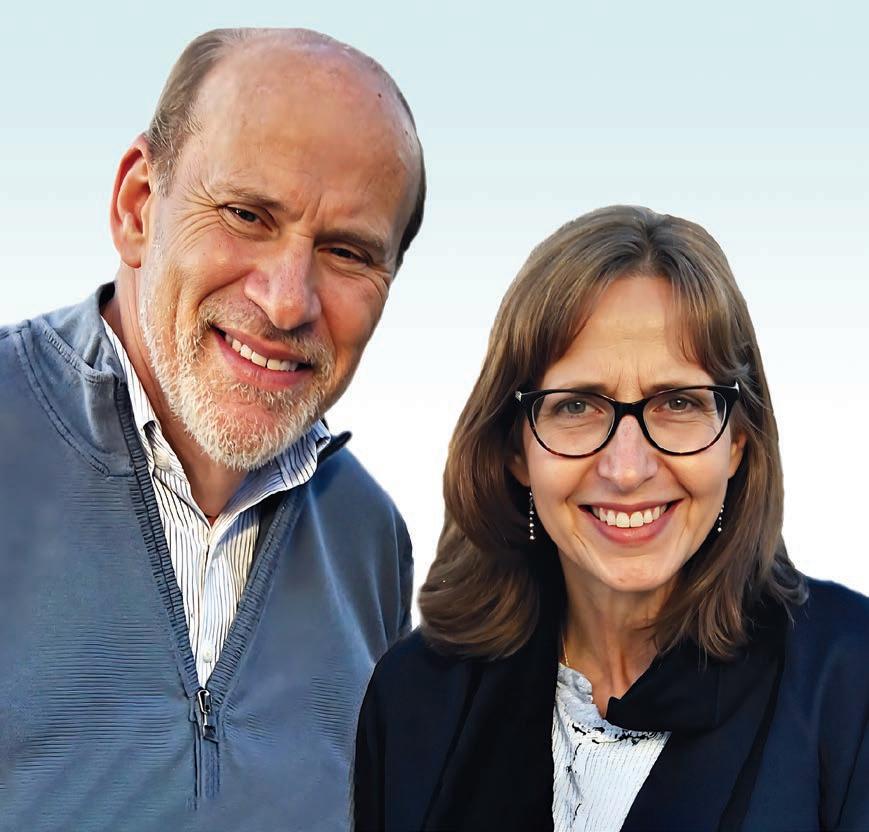
contributions to GW Law and the legal profession cannot be overstated,” Matthew said. “Their gift has not only expanded opportunities for our students and strengthened GW Law’s role as a national leader in community economic development, but it will also help GW Law help indigent business owners start and grow enterprises that can strengthen underserved communities. This gift will amplify the clinic’s impact and continue to expand GW Law’s role as a good neighbor in the Washington, D.C., community it serves.”
“The clinic is designed not just to support economic development within the community, but also to give students who are interested in business law the experiential learning of being a lawyer representing and advising businesses,” Kohn said. “In the clinical world, we don’t see many clinics that are business law-oriented, so this is a really good opportunity for students interested in learning what it’s like to practice as a lawyer in the business law world while supporting smaller businesses in development.”
As a student at GW Law, Kohn said, he appreciated the breadth of the course offerings and the quality of the professors, some of whom are now his colleagues. He also enjoyed his work as a resident advisor (RA) in Mitchell Hall.
“Since I was the first one to go to college in my family, I had to do what I could to help pay for law school,” Kohn said. “So, I became a resident advisor my second and third year of law school in an undergraduate dorm. I met some great students who were my residents, one of whom became a future client.”
From impacting students as an RA to impacting the law school through teaching and philanthropy, Kohn’s influence has made GW Law, and indeed, the community it serves, a better place.
Jeff and Martha Kohn
class notes
ALUMNI NEWSMAKERS
1960s
Joseph F. Baca, JD ‘64, who served two terms as Chief Justice of the New Mexico Supreme Court, was recently honored by the Court, who presented him with a bound copy of his opinions and filed a copy of the document in the Supreme Court Library.
1970s
Robert Cogan, JD ’70, serves as the principal attorney at his firm Continuum Law in downtown San Diego. In addition to business, DoD contracting, and patent-trademark-copyright, the firm now engages in litigation.
Ralph Wolff, JD ‘71, is the new president of the World University Consortium, which is dedicated to promoting the development of accessible, affordable, quality higher education worldwide. He is the founder and former president of the Quality Assurance Commons, a national nonprofit dedicated to integrating job skills into academic programs.
1980s
Bruce York, JD ‘80, recently retired as the chief negotiator and senior advisor for the Air Line Pilots Association, International.
Antonio “Tony” Salazar, JD ‘85, who serves as Maryland’s commissioner of financial regulation, was elected by his fellow state financial regulators to serve
as chair of the board of the national Conference of State Bank Supervisors.
Barry Barth, JD ‘86, has joined Rubin and Rudman as of counsel in the firm’s real estate practice group.
Mark Egert, JD ‘87, is managing director and chief compliance officer at Brevet Capital Management in NYC.
Scott Levin, JD ‘87, has joined Chicago-based Accel Entertainment as chief legal officer and secretary.
1990s
Maria Strong, JD ‘90, serves as the associate register of copyrights and director of policy and international affairs at the U.S. Copyright Office.
Dirk Haire, JD ‘93, has joined Burr & Forman LLP as the managing partner of the firm’s Washington, D.C., office. He is ranked as one of the leading construction law attorneys in the District of Columbia by Chambers USA
Jean Witz, JD ‘94, has joined Wilson Sonsini Goodrich & Rosati PC as a senior patent counsel based in the firm’s Washington, D.C., office.
Adele L. Abrams, JD ‘95, recently joined Littler as senior counsel in the firm’s expanding Washington, D.C., office. She focuses her practice on occupational safety and health, and employment law.
ALUMNI PROFILE
From Courtroom TV to IP Law
ANDREA HENCE EVANS, JD ‘02, STILL REMEMBERS RACING home from school to watch The People’s Court with her grandmother—a daily ritual that first sparked her belief that she, too, could help lay down the law. By second grade, she had already declared she wanted to be a judge or better, after some research, a justice of the U.S. Supreme Court.
Years later, that childhood fascination with courtroom problem-solving led her to GW Law, where she discovered intellectual property and began building what would become a successful career in IP law.
Evans grew up in Houston, excelling in math and science and surrounded by a family of engineers. Though she once imagined studying marketing, her mother encouraged her to pursue engineering. That advice led Evans to a Spelman College and Georgia Institute of Technology dual-degree program. She graduated with a mathematics degree from Spelman and a civil and environmental engineering degree from Georgia Tech, all while spending summers working at NASA’s Johnson Space Center.
I’M VERY PROUD TO HAVE BUILT MY LAW FIRM FROM THE GROUND UP AND TO REPRESENT A RANGE OF CLIENTS, FROM INDIVIDUALS TO FORTUNE 50 COMPANIES AROUND THE WORLD.
— Andrea Hence Evans
But the dream seeded by The People’s Court never left her. Believing that “everything was happening in D.C.,” Evans set her sights on law school and chose GW for its national reputation and strong environmental law program. The encouragement of professors opened her eyes to intellectual property law, and GW Law’s top-ranked IP curriculum sealed her path.
“GW’s IP program is world-renowned,” she said. “Being taught by judges and former Patent and Trademark Office attorneys gave me incredible insight into the field.”
Summer positions at small, medium, and large firms solidified her interest, but rather than head immediately into private practice, Evans followed the example of her mentors and joined the U.S. Patent and Trademark Office. She spent three years as a patent examiner before transitioning into the highly competitive trademark examining corps. Along the way, she continued networking and unintentionally cultivated a client base of people she had met nationwide who sought her advice. Because government work posed conflicts of interest, she referred them to her mentor’s firm, eventually sending so
ALUMNI
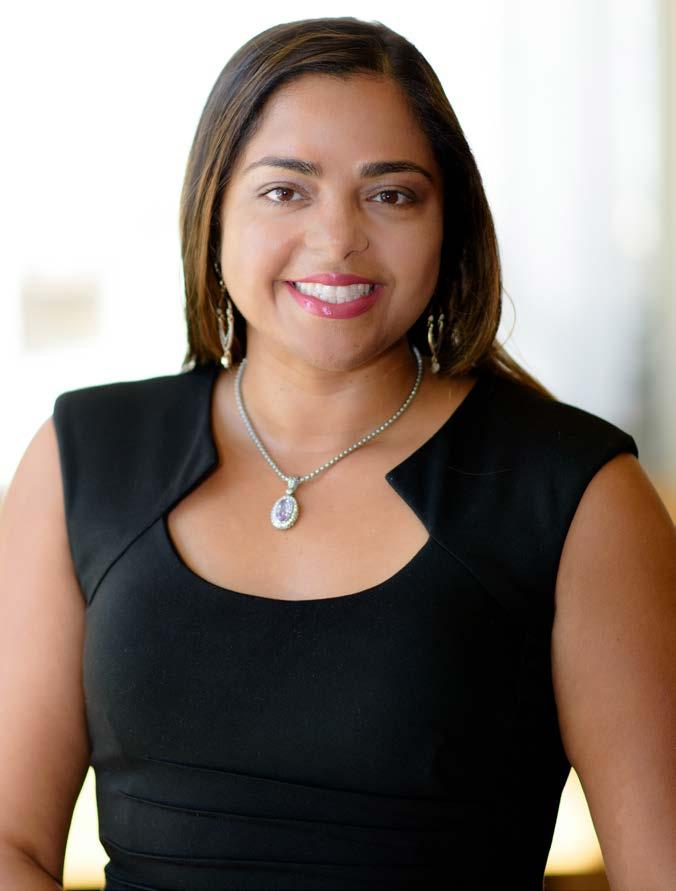
much business his way that he urged her to consider private practice herself.
“So often people don’t understand the importance of intellectual property, and there are so many myths and misconceptions,” said Evans. “Traveling around the country, going to trade shows and speaking, and being in the environment where my clients were, has made a difference.”
Eighteen years ago, Evans took the leap, launching The Law Firm of Andrea Hence Evans, LLC. She has since built a thriving practice representing clients from individual inventors to Fortune 50 companies, while also becoming a nationally recognized voice on IP issues. Through social media, speaking engagements, books, and her role as the patent attorney on the TV show Make48, she has worked to demystify intellectual property for the public.
“I’m very proud to have built my law firm from the ground up and to represent a range of clients, from individuals to Fortune 50 companies around the world,” said Evans. “I’m also very proud to have made a name for myself now when I serve as an expert witness.”
Today, Evans credits her GW Law foundation—its faculty, its network, its IP reputation—for helping her shape a career that began with an after-school TV habit and grew into a platform for empowering innovators around the world. And her early dream of becoming a judge? She says she’s realized her dream with her own thriving law firm and, more importantly, a loving husband and their two children.
— Sarah Kellogg
Jocelyn Aqua, JD ‘95, has joined HWG LLP as chair of the data, privacy, and cybersecurity practice group and as a member of the artificial intelligence and emerging technologies practice group.
William Barry, JD ‘95, a white collar criminal defense litigator, was elected chairman of Miller & Chevalier Chartered.
Jeffrey J. Hessekiel, JD ‘96, was appointed executive vice president and chief legal and administrative officer at Cytokinetics Inc.
Francesco Di Pietro, LLM ‘97, has joined Blank Rome LLP as a partner in the business litigation group based at the firm’s New York office.
Amie Ravitz, JD ‘97, serves as vice president of labor and corporate counsel at Pepsi-Cola Bottling Co. of New York and vice president and corporate counsel at the Honickman Companies, one of the country’s leading beverage manufacturers and distributors.
Christopher Bright, JD ‘99, a partner at Snell & Wilmer, has been recognized as “Top Intellectual Property Lawyer” by the Daily Journal
Jahna Hartwig, JD ‘99, was elected to partnership at Wilson Sonsini Goodrich & Rosati.
Lily Wound, JD ‘99, has joined the New York office of Ballard Spahr LLP as a member of the firm’s intellectual property team.
2000s
Victor Chen, JD ‘00, has joined Loeb & Loeb LLP as a partner in the firm’s capital markets and corporate department in Los Angeles. He previously served as a private equity partner at Goodwin Procter LLP based in Hong Kong.
William J. Curtis, JD ‘00, has joined Spencer Fane LLP as a partner in the environmental and energy law practice groups in the firm’s St. Louis office.
Josh Gardner, JD ‘00, recently joined the DC office of DLA Piper as a litigation partner in the firm’s white collar, investigations, and government enforcement practice. He previously served for more than two decades with the Department of Justice’s Civil Division.
Thomas Levato, JD ‘00, has joined DLA Piper as a member of the firm’s capital markets and public company advisory practice in New York.
Donald English Jr., JD ‘00, has rejoined Morgan Lewis & Bockius after serving as an officer in the U.S. Air Force.
Christine Fernandez Owen, JD ‘02, was appointed U.S. co-head of projects real estate at the global law firm Norton Rose Fulbright in Chicago. She also is an adjunct professor at the Northwestern University Pritzker School of Law lecturing on clean energy law.
Derek T. Mello, JD ‘03, was elected to partnership at Neubert, Pepe & Monteith. He practices civil litigation with a focus on motor vehicle, premises liability, construction, and general liability defense matters.
Sarah Belger, JD ‘04, has joined Holland & Knight as a partner in the firm’s Tysonsbased labor, employment, and benefits practice.
Alex Canizares, JD ‘06, has joined Vinson & Elkins as a Washington, D.C.-based partner in the firm’s litigation practice and as co-head of the government contracts practice.
Stuart R. Reilly, JD ‘06, is the new general manager of Austin Energy. His expertise
The Nexus of Politics and Policy
CANDIDA “CANDI” WOLFF, JD ‘89, KNEW EARLY ON THAT she wanted to build a career at the nexus of politics and policy. Law school, she realized, was the tool that would let her operate at that intersection—and Washington, D.C., was where that work actually happened.
That conviction drew her to GW Law and set her on a path that would wind through Congress, the White House, major law firms, and ultimately the global public-policy arena at Citi, where she now serves as managing director and global head of government affairs.
Wolff arrived at GW already fascinated by the way policy is shaped, negotiated, and translated into law. A math and political science major at Mount Holyoke, she had been pulled toward tax and economic policy after watching the 1986 Tax Reform Act unfold. GW Law’s proximity to Congress made it the perfect place to cultivate that interest. She dove into courses in legislative drafting and tax, gaining the analytical tools she wanted without losing sight of her goal: to become a strategic thinker who could navigate complex policy landscapes.
That focus guided her from graduation straight into Akin Gump’s public policy practice. She bypassed the traditional corporate law track in favor of advocacy work—exactly what she had envisioned when she chose GW Law. Three years later, she moved to Capitol Hill to work as tax counsel for a member of the Senate Finance Committee. Eight years in the Senate followed, culminating in a senior role within Republican leadership that broadened her portfolio beyond finance into a wider range of policy issues.
From there, Wolff transitioned to the White House, serving three years under Vice President Dick Cheney, the latter two as head of legislative affairs, a year in the private sector, and then three more years in the George W. Bush administration as the first female head of legislative affairs. It was a period defined by a rapidly
LOGICAL THINKING AND MY ABILITY TO BREAK DOWN COMPLEX ISSUES HAVE BEEN WHAT I’VE RELIED ON THROUGHOUT MY CAREER.
— Candi Wolff

changing policy environment, and she carried forward the problemsolving discipline and strategic thinking habits she’d developed in law school.
“Logical thinking and my ability to break down complex issues have been what I’ve relied on throughout my career,” she said. “In fact, those are the tool sets that have helped me to advance in the public policy arena to this day.”
When she moved back to private practice at Hogan & Lovells and then into the global arena at Citi in 2011, those same skills became even more essential. Today, she leads Citi’s worldwide governmentaffairs strategy at a time when economic and national security policy have fused, geopolitical risk has surged, and businesses face an increasingly fragmented landscape. Understanding emerging trends, anticipating political pressure points, and developing informed strategies are her daily work.
For Wolff, the through-line is clear: Washington taught her how policy gets made, GW Law taught her how to think, and the combination equipped her for a career at the highest levels of government affairs—right where politics and policy meet.
— Sarah Kellogg
spans utility operations, grid resilience, clean energy, and financial strategy.
Jeffrey Saltman, JD ‘06, has joined Cole Schotz PC as a member of the firm’s litigation and intellectual property departments. A skilled trial lawyer, he has helped secure six successful jury verdicts in federal court.
Shawnna Yashar, JD ‘07, has joined O’Melveny as a partner in the firm’s intellectual property and technology practice group based in Washington, D.C.
James P. Young, JD ‘07, was selected for inclusion in Upstate New York Super Lawyers for 2025. He is chair of the litigation department at Hancock Estabrook LLP.
Lewis Goss II, JD ‘08, has joined DLA Piper as a member of the firm’s real estate team. He plans to split time between the firm’s Washington, D.C., and Dallas offices.
Amber Hilliard, JD ‘08, will be leading the new Latitude office in Washington, D.C. Hilliard comes to Latitude from Tupperware Brands Corp., where she served as vice
president of law, securities, and corporate governance.
Cameron Kilberg, JD ‘08, has joined Allied Universal®, a leading security and facility services provider, as vice president of government relations.
Patent litigator Tawfik Goma, JD ‘10, has joined Mintz
ALUMNI PROFILE
Legal Leadership in Academia
A COVETED FEDERAL FELLOWSHIP LED STANNIS SMITH, JD ’14, to the legal experience he will now leverage as the new vice president of legal affairs and general counsel at Delaware State University. But he almost said “no” to the fellowship offer.
Persuasive “arm twisting” by Renee Devigne, GW Law’s dean of academic development at the time, made him reconsider.
“I was selected as a Presidential Management Fellow,” Smith said, referring to the U.S. government’s two-year training and leadership program that inevitably leads to a federal job. “There were 15,000 applications. I was one of six from GW Law. Two of us from GW were chosen.”
“But I didn’t want the fellowship. For me, working in the government meant being political. And I had no interest in politics,” he explained.
Looking back, Smith now says the year he spent working as a federal policy analyst under the Obama, Trump, and Biden administrations was transformative.
I WAS SELECTED AS A PRESIDENTIAL MANAGEMENT FELLOW. THERE WERE 15,000 APPLICATIONS. I WAS ONE OF SIX FROM GW LAW. TWO OF US FROM GW WERE CHOSEN.
— Stannis Smith
In his decade as a senior analyst and, for a year, attorney in the Office of Management and Budget, he was engaged in a broad range of issues, from employment and health care to real estate and regulatory compliance. He was involved in development of the Digital Accountability and Transparency Act of 2014, better known as the Data Act, and he wrote the Biden administration guidance documents on medical debt.
“I am so grateful that I spent more than a decade in federal government because of all the issues that I was able to touch,” said Smith, who grew up in Georgia.
From the government, Smith eventually moved into higher education—his goal. To join Delaware State University, he leaves the
as a member in the firm’s Miami office.
Frank J. Manfiatordi, JD ‘11, has joined Gibson Dunn’s New York office as a partner in the firm’s real estate practice group.
Christie Matthaei, JD ‘11, has joined the intellectual property team at Morgan Lewis & Bockius LLP.
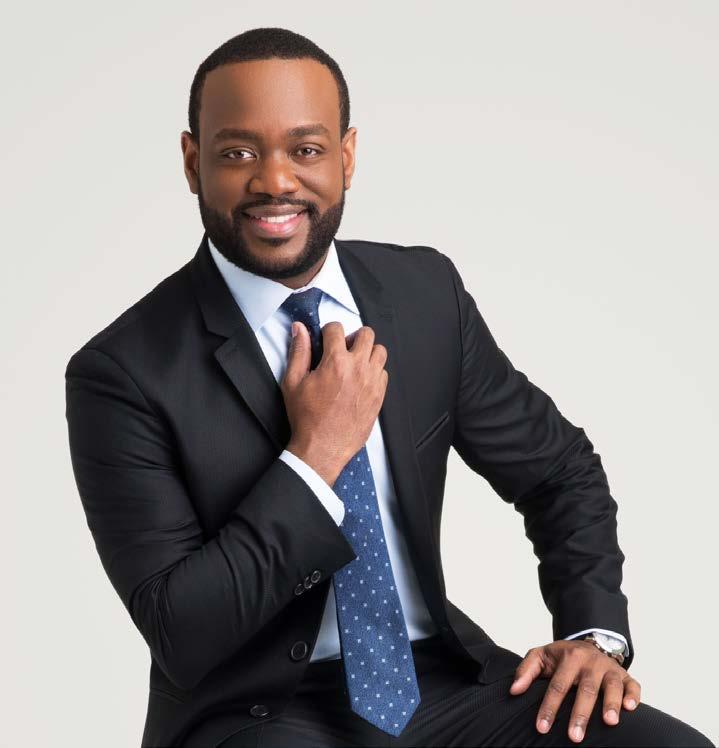
position of executive general counsel and labor designee at the City University of New York School of Medicine.
Smith earned his undergraduate degree at Morehouse College, where he had a federal work-study assignment in the financial aid office. After graduating, he built a professional career in that area, eventually joining GW and rising to become director of financial aid at GW School of Medicine and Health Sciences. He continued in that full-time job while taking night classes at GW Law.
Smith said he is not someone who goes in and makes immediate changes at an organization. Rather, he takes time to assess and identify areas of vulnerability.
“That’s the effective way to bring about change. And you make change with buy-in from stakeholders,” he said. He said his liaison work between the White House and multiple federal agencies helped him become an effective communicator—and a good listener.
But more than anything, he sees his biggest strength as his ability to quickly change gear.
“My friends tease me, saying ‘We’ve never known anyone else who can pivot the way you pivot’,” Smith said.
— Mary A. Dempsey
Megan Provost, JD ‘11, has joined the American Feed Industry Association as chief operating officer.
Jack Hobaugh, LLM ‘12, a shareholder in Brownstein Hyatt Farber Schreck’s corporate and business department, has been elected to the Colorado chapter board of trustees for Blood Cancer United.
Kevin C. Lee, JD ‘12, was appointed by California Gov. Gavin Newsom to serve as a judge in the San Bernardino Superior Court.
Tom Sundlof, JD ‘12, has joined the Washington, D.C., office of Blank Rome LLP as a partner in the firm’s life sciences industry team and corporate, M&A, and securities practice group.
Kirk Cooper, JD ‘13, celebrated the three-year anniversary of the founding of his appellate boutique law firm, Cooper Appeals PLLC, based in El Paso, Texas. He is the former chief staff attorney of the Texas Court of Appeals for the Eighth District.
Melanie Harris, JD ‘13, has joined Maximus as senior counsel for AI and emerging
Realizing the American Dream
WHEN DAVID TRUONG, LLM ’08, LOOKS BACK ON HIS LIFE, HE sees not a straight line but a remarkable arc—one that begins on a small boat fleeing postwar Vietnam and winds, improbably, toward an executive office in Northern Virginia. Today, as general counsel at Planned Systems International Inc., Truong’s professional success is inseparable from the extraordinary family story that shaped him.
Truong was only 7 when his family finally reached the United States, the end of a perilous three-year odyssey set in motion by the fall of Saigon. His father—who had previously been imprisoned in a reeducation camp—crafted an intricate escape plan that began with sending two of Truong’s older brothers to a distant fishing village to learn the trade and blend in. The family’s hope was simple but dangerous: acquire a boat quietly and slip away without drawing attention. Their first attempt left them lost at sea for days before a fishing family, practicing their own escape, spotted and saved them. A later, and ultimately successful, attempt carried them to a remote refugee island in Malaysia, propelled by the unexpected kindness of many along the way—mechanics, smugglers, and even the Prince of Johor.
That generosity left a lifelong impression. “You never achieve anything alone,” Truong says. It’s a theme woven throughout his new memoir, Escape to America: A Family Memoir, which chronicles not just the daring escape but the many hands that helped make it possible.
After arriving in Northern Virginia, sponsored by an aunt, the family began the hard work of rebuilding. Like many refugee families, they leaned on one another and anchored their hopes in education. Fluent in English, Truong spent his teenage years helping his parents interpret leases, fill out forms, and navigate social norms in America. “What felt like a burden at the time became a privilege,” he says. “It taught me responsibility and not to be afraid to tackle scary tasks at an early age.”
At his parents’ urging, Truong pursued law. His father believed deeply in the power of the profession to protect and elevate the
“MY LIFE HAS BEEN INFLUENCED BY THE KINDNESS AND COURAGE OF MANY PEOPLE.
— David Truong
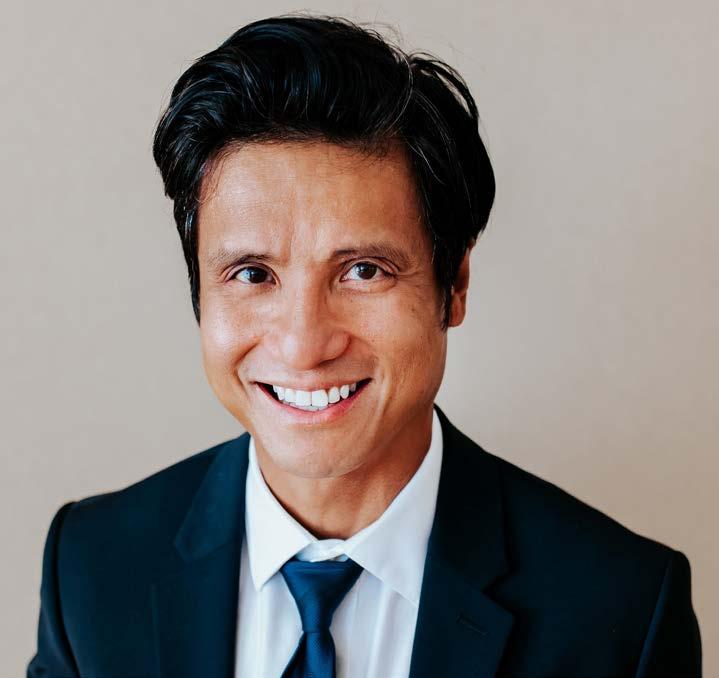
family. After earning his JD from the University of Dayton, Truong started his career in government contracts. While serving as assistant general counsel for procurement at the National Science Foundation, he was encouraged to deepen his expertise through GW Law’s renowned LLM in Government Procurement Law.
The program, he says, “rounded out my legal education” and became a springboard to corporate leadership roles. For more than 15 years, he has served as general counsel—and even stepped into the unfamiliar terrain of chief operating officer during the company’s rapid growth period—drawing on the broad base of legal and business knowledge he gained at GW Law.
As he wrote his memoir, Truong realized just how much of his professional philosophy comes from his parents’ example. Their unbounding courage, he says, was the key to their success. They had the ability to act quickly by quieting the voice of doubt. It’s the mindset he carries into complex legal questions, corporate challenges, and every new responsibility. Compared to what his family overcame, most obstacles feel small.
For Truong, success is not measured by titles or achievements. “My life has been influenced by the kindness and courage of many people,” he said. “I hope my work honors those who helped me and my family reach the life we have today.”
— Sarah Kellogg
technology. She previously served as associate general counsel at the U.S. Department of Defense.
Brandon Smith, LLM ‘13, has joined Holtzman Vogel Baran Torchinsky and Josefiak PLLC as a partner. Smith will lead the firm’s new Nashville, Tenn., office and join its national government and corporate
Andrew Baskin, JD ‘15, was elevated to partnership at ArentFox Schiff. He practices in the firm’s complex litigation group.
in the firm’s government enforcement and investigations group in New York
Laura Kilgarriff, JD ‘15, a former Transportation Security Administration attorney, has joined Kaplan Kirsch LLP based in Denver.
Reed LLP as a partner in the firm’s project finance practice based in Washington, D.C.
Diana S. Bae, JD ‘16, was elevated to partnership at ArentFox Schiff, where she specializes in the management of global trademark portfolios and the protection and enforcement of clients’ intellectual property rights. investigations and political law practices.
Margeret B. Beasley, JD ‘15, was promoted to partnership at Bracewell, LLP. She practices
Francis McCabe, JD ‘15, has joined Hughes Hubbard &
ALUMNI PROFILE
Health Law Leader
FOR DEBORAH GERSH, JD ’83, HEALTH CARE LAW IS ONE OF THE most consequential areas of the legal profession—and it becomes more interesting every year that passes.
“Health care is the largest industry in our country, and it’s continuing to morph. Think about it—artificial limbs, robotics, COVID19, medical research, telemedicine,” said Gersh, co-chair of Ropes & Gray’s nationally recognized health care practice and the co-leader of the firm’s health care and life sciences industry group.
“There are so many areas of health law that you can get involved with. You can focus on health care regulatory matters, health care privacy, acquisitions of hospitals and health systems, telehealth, telemedicine, and the purchase and sale of health care and life science businesses. And now artificial intelligence is the fast-moving target,” she said. “AI will be key in advancing health care and treatment of diseases that we never thought possible.”
Gersh has spent almost her entire career engaged with health care law, expanding her portfolio of expertise as the industry shifts and changes. She is also helping GW Law advance its reputation in the area through her service on the Dean’s Advisory Council and her gift to endow the Deborah L. Gersh Medical Privacy Law Research Fund.
She stepped up her engagement with her alma mater after Dayna Bowen Matthew became dean and pushed for the new Health Law and Policy program, which Gersh said is “a differentiator for the school.”
Gersh enrolled at GW Law after graduating from Northwestern University, unsure of how she wanted her legal career to unfold. Her first job was working on government contracts at what is now Watt Tieder Hoffar and Fitzgerald LLP. At the time she was also in a longdistance relationship with the man she would eventually marry. He was in Chicago studying to become a retina surgeon.
“All the way through his residency and fellowship, we talked about medicine. I began to see how health care was so central to our economy, the significant dollar amounts that go into it. It fascinated me and I thought the legal side would also be interesting,” she said.
One summer, Gersh clerked at a health care firm. Then she landed a job doing franchise law.
AI WILL BE KEY IN ADVANCING HEALTH CARE AND TREATMENT OF DISEASES THAT WE NEVER THOUGHT POSSIBLE.
— Deborah Gersh

“I jumped at the chance when health care businesses started to franchise, such as with optical centers. Then I started taking anything that was health-care related. That was about the same time that health care started to boom and expand in ways we never thought possible,” she said.
In 2009, Ropes and Gray asked her to help establish an office in Chicago and co-lead its health care practice. At the time, she was particularly interested in the privacy rights of patients and hospitals. Then she got involved with legal issues linked to clinical trials.
During the COVID-19 pandemic, Gersh also was involved in a project to convert warehouse space along Chicago’s lakefront to expand the city’s medical capacity. When a vaccine appeared, the project was no longer needed, but Gersh saw how the pandemic had recalibrated the health care sector.
“COVID-19 became a defining moment in health care. It was when telemedicine and telehealth were created by necessity. The crisis created ingenuity that forever changed the framework of health care,” she said.
Gersh also experienced firsthand the ravages of the pandemic when her husband, a front-line medical worker, died of COVID-19, a reminder, she said, that “at the core of health care are individuals and their wellbeing.”
— Mary A. Dempsey
Andrew Chesser, JD ‘16, has joined Helsell Fetterman in Seattle. He practices in the firm’s commercial litigation and health care groups.
Robert Holup, JD ‘16, has joined Riker Danzig LLP as an associate practicing in the firm’s trusts and estates and commercial litigation groups. He previously served as
deputy attorney general for the state of New Jersey.
Chelsea Pizzola, JD ‘16, has joined Willkie Farr & Gallagher LLP as a partner in the firm’s asset management practice based in Washington, DC.
Barnabas T. Fekete, JD ‘17, was promoted to
partnership at ArentFox Schiff. He is a member of the firm’s patent group.
Neela Pack, JD ‘17, was promoted to partner at Mayer Brown.
Kevin M. Voelkel, JD ‘17, was promoted to partnership at Bracewell, LLP. He practices in the firm’s environment,
lands, and resources group in Washington, D.C.
Cassandra Horton, JD ‘18, has joined Mitchell Silberberg & Knupp LLP as an associate in the firm’s national labor and employment group based in Washington, D.C.
Zachary A. Zamore, JD ‘18, has joined Caplin &
ALUMNI PROFILE
From Whistle to Whiskey
LISA SAWYER DERMAN, JD ‘92, LIKES TO SAY HER CAREER IN THE alcohol beverage industry started with a whistle. As a summer associate at McDermott Will & Emery (now McDermott Will & Schulte), she was standing among a crowd of buttoned-up lawyers shuffling toward a partner dinner. Trying to help the group get organized, she instinctively put two fingers to her mouth and let out a sharp, commanding whistle.
A partner in a Hawaiian shirt—T. Raymond Williams, one of the most respected alcohol beverage attorneys in the country—turned, pointed, and said he wanted to work with her. That moment cracked open the door to the field that would define her career.
Derman’s path to that dinner began far from corporate law’s conference rooms. She grew up in tiny Albany, Kentucky, population 2,000, and arrived at law school almost by accident. After studying math and computer science at the University of Kentucky, she fled a future in basement robotics labs for New York City, where a colleague encouraged her to consider law school.
Ultimately, she chose GW Law for its location and opportunities, a decision that would shape both her personal and professional life. She met her husband, Adam, there, and the school’s proximity to federal agencies gave her early exposure to the regulatory structures that govern the alcohol industry. “Being in D.C. opened up so many opportunities,” she recalls. “It changed my life.”
After graduation, she eventually followed Williams into a practice that blended corporate, tax, and regulatory complexity with entrepreneurial energy. She worked with iconic brands like Sam Adams and, later, served as a general counsel and senior executive at companies including Absolut, Proximo, Stoli and Macallan. Along the way, she developed a fascination with the founders she met such as
I ALWAYS KNEW I WANTED TO DO SOMETHING IN THE BOURBON INDUSTRY, BEING FROM KENTUCKY. BOURBON IS ROOTED IN TRADITION, AND I FELT THERE WAS AN OPPORTUNITY TO HONOR THE TRADITION BUT EMBRACE SOMETHING NEW IN THE CATEGORY.
— Lisa Sawyer Derman

firefighters, chemists, and everyday dreamers who built spirits brands from scratch. Their creativity planted the early seeds for her own leap into entrepreneurship.
“I always knew I wanted to do something in the bourbon industry, being from Kentucky,” said Derman. “Bourbon is rooted in tradition, and I felt there was an opportunity to honor the tradition but embrace something new in the category.”
Her answer was founding Five Springs Infused Bourbon, her Kentucky-made line of infused bourbons inspired by the cocktail culture she watched her kids and their friends embrace. Today, the company is a full family affair: her husband contributes his legal expertise, her daughter runs marketing, and her son plans to join after college. Landing national distribution with Southern Glazer’s Wine & Spirits this year marked what Derman calls a major turning point.
From a whistle to a bourbon venture, Derman’s path reflects a truth she learned at GW Law: a JD isn’t a limitation, it’s a launchpad.
— Sarah Kellogg
Drysdale as an associate in the firm’s international tax practice group.
2020s
David Levintow, JD ‘21, has joined the business litigation group at Smith Anderson.
Nicole Vele, LLM ‘21, has joined GrayRobinson as a
shareholder in the firm’s Washington, D.C., office. Vele is a U.S. Air Force Judge Advocate General veteran and seasoned litigator.
Julian Yowell, JD ’21, has joined Holtzman Vogel’s congressional investigations practice as an associate attorney in the firm’s Washington, D.C., office. Yowell
previously served as counsel to the U.S. House Judiciary Committee. He also serves as an adjunct professor at GW Law.
Matthew Gino, JD ‘24, has joined Barclay Damon as an associate based in New York City. He practices in the firm’s environmental, regulatory, and energy groups.
Harrison Hemminghaus, JD ‘24, has joined Mullins Law Group. He brings experience in government litigation and regulatory compliance to the firm.
Victoria Chen, JD ‘25, has joined the appeals team at Kantor & Kantor, LLP, one of the nation’s leading plaintiffside insurance litigation firms.
in memoriam
William Threadgill, JD ‘49, April 30, 2025
Fritz Reiner Kahn, JD ‘50, Oct. 2024
Gerald M. Gorrin, JD ‘51, Sept. 20, 2025
Herbert Kanki Shimabukuro, JD ‘57, Sept. 12, 2025
Thomas Madison Phillips, JD ‘59, Feb. 15, 2025
Robert F. Allnutt, JD ‘60, LLM ‘62, Aug. 11, 2025
David Carvel Bryan, JD ‘62, April 15, 2025
Stephen Danzansky, JD ‘64, June 2, 2025
David M. Bond, JD ’65, Sept. 1, 2025
Spencer Boyer, JD ’65, Nov. 14, 2025
Barry L. Haase, JD ‘65, Sept. 8, 2025
Alan K. Richards, JD ‘65, Aug. 17, 2025
Norman Dyer, JD ‘67, Sept. 7, 2025
David Peterson, JD ‘67, April 6, 2025
Jack C. Goldstein, JD ‘68, Oct. 24, 2025
Stephen Greenberg, JD ‘68, Oct. 6, 2025
Thomas Brigham, JD ‘69, Oct. 7, 2025
Clark Gruening, JD ‘69, June 17, 2025
John Noble, JD ‘69, July 11, 2025
John Stuckey, Jr., JD ‘70, May 30, 2025
John Walsh, JD ‘70, Oct. 18, 2025
Edward Caine, LLM ‘72, July 24, 2025
Gordon E. Wood, Sr., JD ‘72, May 15, 2025
John Ray, JD ‘73, April 2025
Fred Nelson, LLM ‘77, May 18, 2025
Maurice “Morrie” Scherrens, JD ‘77, April 6, 2025
Christine M. Cooper, JD ‘90, Oct.16, 2025
Vera Fedoroff Mackanic, JD ‘96, Aug. 9, 2025
James P. O’Rourke, Jr., JD ‘03, Oct. 4, 2025
Eddie Shine, JD ‘24, Sept. 21, 2025
Faculty & STAFF
Professor Robert Park, Aug. 11, 2025
Bob Stanek, JD ’79, Feb. 16, 2025
alumni bookshelf

Learning to Live from Those Willing to Die: Life Lessons from the Hero Next Door
CAPTAIN DAVID E. GROGAN, LLM ’98, who served in the U.S. Navy Judge Advocate General’s (JAG) Corps for 26 years, presents the captivating, real-life stories of our nation’s military heroes in his new book, Learning to Live from Those Willing to Die: Life Lessons from the Hero Next Door. Through the engaging experiences of 26 veterans whose service spanned from World War II to the wars in Afghanistan and Iraq, the book offers important lessons on how to navigate life’s challenges. Each of the book’s chapters introduces a life lesson like “If you don’t see a path, blaze a trail,” and then presents one or more veterans’ stories to illustrate the lesson. From manning the deck of an aircraft carrier during a kamikaze attack, to patrolling the jungles of Vietnam, to riding in an armored vehicle across the Iraqi desert, the book’s stories portray the full spectrum of
wartime and peacetime service. All royalties from the book are donated to America’s VetDogs, which provides guide and service dogs to veterans and first responders.
Trial and the Art of Sailing: A Guidebook for New (and Not So New) Attorneys to Navigate Trial Advocacy, and Life
In Trial and the Art of Sailing: A Guidebook for New (and Not So New) Attorneys to Navigate Trial Advocacy, and Life, toprated trial lawyer MICHAEL D. SCHWARTZ, JD ‘93, combines life lessons with valuable advice on how to be a better trial lawyer. This informative and entertaining guidebook helps attorneys navigate trial work step by step, from the first client meeting to verdict. Like a good sail, Trial and the Art of Sailing zigzags back and forth along the waters of actual trial work and life, between blunt advice, mistakes lived and learned, anecdotes, war stories, strategy, and good, old fashioned commonsense.
– continued on page 40
alumni bookshelf

Stumbling Stones
BONNIE SUCHMAN, JD ‘83, is the author of the awardwinning novel, Stumbling Stones, based on the true story of Alice Heppenheimer. Alice, who was born into a prosperous German Jewish family around the turn of the 20th century, prospers in her career until the rise of Nazi Germany transforms the book into a poignant journey through a dark period in human history as she navigates the challenges of persecution and hatred. Reluctant to leave the only home she has ever known, she faces the ultimate challenge—will she and her husband be able to escape Nazi Germany or have they waited too long to leave? Stumbling Stones is the first book in a trilogy by Suchman about the Heppenheimer family during the Holocaust. The second book in the series, What Remains is Hope, was just published and a third is in the pipeline.
No One Ever Asked: The Untold Story of a Civil Rights Worker
ARNOLD ROCHVARG, JD ’76, a professor emeritus at the University of Baltimore School of Law, presents a narrative history of the mid1960s civil rights movement in his new book, No One Ever Asked: The Untold Story of a Civil Rights Worker. The powerful book centers on the true story of his cousin, Iris Geller, a white college student from Philadelphia dedicated to the cause of racial justice who quit college to join the civil rights movement and became involved with many of the important events and persons of the day. It is the fifth book by Rochvarg. His first book, Watergate Victory: Mardian’s Appeal, draws upon his first-hand experience as a young lawyer serving as a member of the legal defense team on the appeal for one of the defendants convicted in the Watergate conspiracy trial.

Their Just Desserts
Their Just Desserts, the latest novel by award-winning author TRACY BADUA, JD ’10, and co-author Alechia Dow, is perfect for fans of The Great British Baking Show and Clue. This enchanting and rollicking follow-up to The Cookie Crumbles follows two best friends caught up in a twisty mystery when jewels go missing at a high-stakes baking competition. As the investigation and competition heat up, their bond is put to the ultimate test. Can they solve this bakeoff mystery, or will they—and their friendship— crack under pressure?
Risk Courage Dissent
The 17th century. Delft. Working within the mythic “Dutch Golden Age,” Johannes Vermeer mastered light, color, and intimate
settings. In his new book, Risk Courage Dissent, awardwinning author NEIL THOMAS PROTO, JD ’72, throws off that limiting mask, weaving the documented strands of terror, slavery, and condescension with risk-taking, courage, and dissent into a revealing image of the religious and social repression Vermeer’s countrymen unleashed at home and abroad. Civically driven, Vermeer defied the forces of law and corporate power that underpin that repression with the subtle strokes of his paintbrush.
In his timely book, Decent Discourse, attorney and veteran JAY JACKSON, LLM ‘17, offers a hopeful, helpful, and historical way to push back against the divisive rhetoric and echo chambers that dominate today’s political discourse. He uses humor and optimism to build the case for decent discourse, showing how Americans have solved the immense challenges of our past with truth, humility, and compassion—in other words, by loving our neighbors (even when they might be wrong). The book identifies five critical problems with the state of our political discourse today and offers solutions to each, including practical action items for each of us.
Decent Discourse
20TH & H
A SUPREME COMPETITION
Four impressive GW Law students argued before the Chief Justice of the United States John G. Roberts Jr., and two federal judges in the final round of the 76th annual Van Vleck Constitutional Law Moot Court competition. This marked the second year in a row that a U.S. Supreme Court justice anchored the bench at the Van Vleck finals.
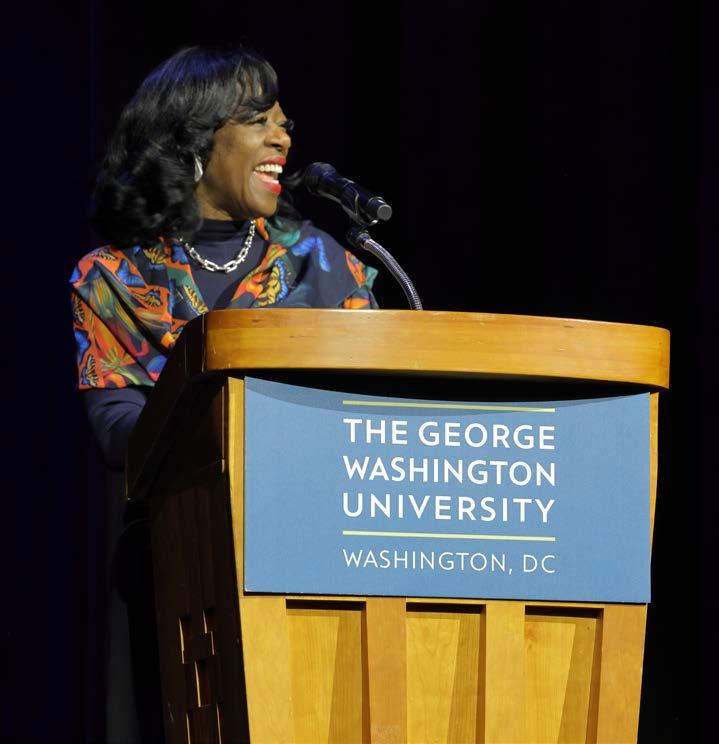
BELOW: Joining Chief Justice Roberts on the bench were United States Court of Appeals Judges (from left) Joan L. Larsen from the Sixth Circuit and Judge Barbara Lagoa from the Eleventh Circuit. Van Vleck finalists Amanda Hichez (at podium) and Braelyn Parkman argued for the petitioner and Kyle Donohue and Cameron Menendez argued for the respondent.
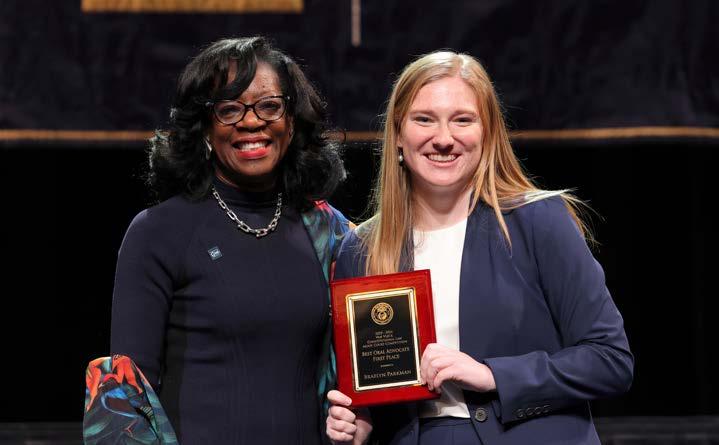

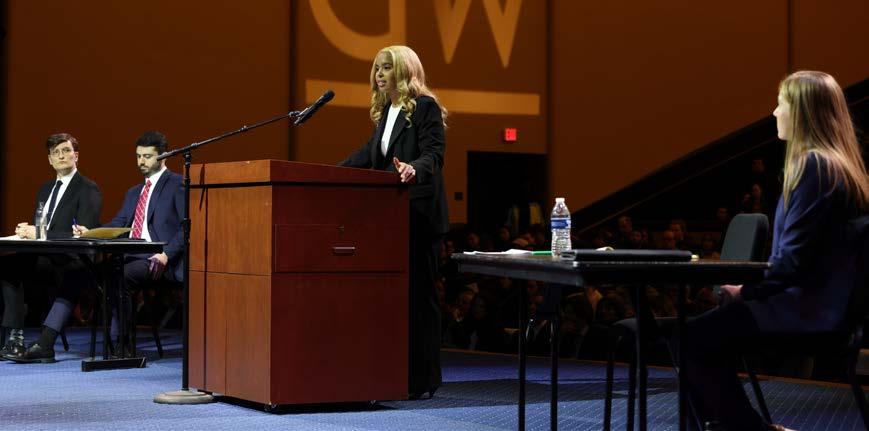
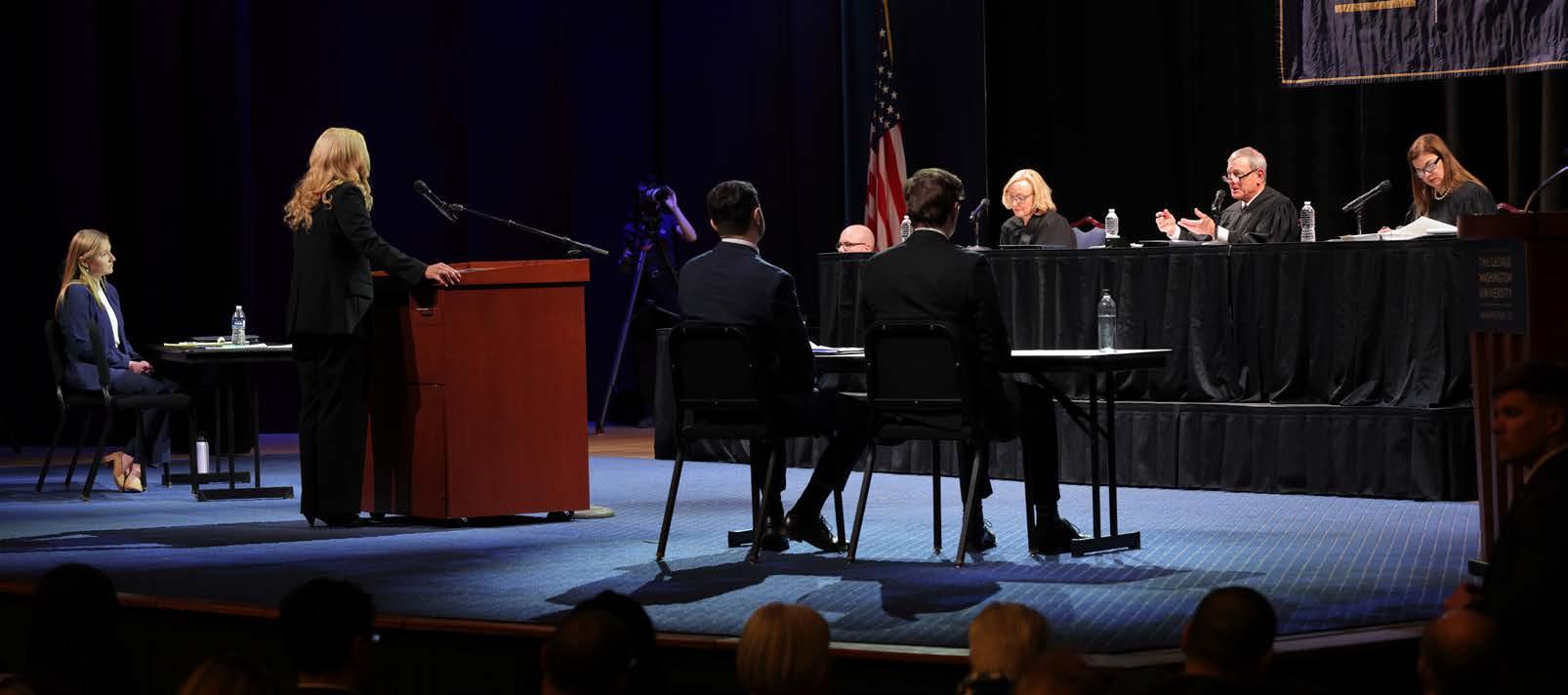
Dean Dayna Bowen Matthew presented the award for best oral advocate to Braelyn Parkman
ABOVE: Dean Dayna Bowen Matthew delivered opening remarks to a standing room only crowd at Lisner Auditorium
The trio of judges peppered competitors with questions during their oral arguments.
Amanda Hichez addresses the bench as her partner Braelyn Parkman (right) looks on. At left, their opponents (from left) Kyle Donohue and Cameron Menendez await their turn at the podium.
CELEBRATING 1966, 1971, 1976,1981, 1986, 1991 , 1996,2001, 2006, 2011, 2016, AND 2021.

JUNE 5-6, 2026