Gwangju and Jeonnam International Magazine
September 2026 #295
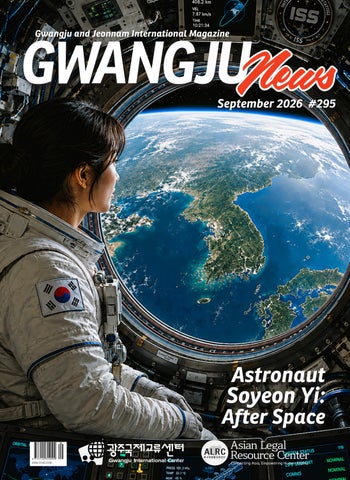
Astronaut Soyeon Yi: After Space
(GN with Microsoft Copilot)
3 Gwangju & South Jeolla International Magazine
From the Editor
I
sometimes sit in the twilight of a cloudless evening gazing upward. And I sometimes notice what looks like a bright star or planet, but it is moving much too fast. No, it isn’t a UFO, and it isn’t a hallucination – it’s the international space station, orbiting about 400 kilometers overhead and at more than 27,000 kilometers per hour, with a team of earthlings on board.
September 2026, Issue 295 Published: September 1, 2026
Cover Image
(GN with ChatGPT)
Publisher
Dr. Shin Gyonggu
Recently, I was informed that Dr. Soyeon Yi was in Gwangju (you may know her better as Astronaut Soyeon Yi), so the Gwangju News set up a date to meet with this earthling, 18 years after her first-Korean-in-space adventure. Read about what she is doing now.
Editor-in-Chief & Copy-Editing Dr. David E. Shaffer Layout Editor & Online Editor Johanna Lezada
September 5 marks the opening of the 16th edition of the Gwangju Biennale. This year is the first for Malta to participate, and they are going all out with their own Malta Pavilion. Gwangju News visited their Horanggasy venue and spoke with their collaborating team of artists. Read all about it.
The Gwangju News is the first English monthly magazine for the general public in Korea, first published in 2001. Each monthly issue covers local and regional issues, with a focus on the roles and activities of the international residents and local English-speaking communities.
This year, late September also marks the Chuseok holidays (24– 26). During my time here, I have noticed conspicuous changes in how the holiday is observed. The Gwangju News has therefore asked its publisher to reflect on how the traditional harvest moon celebrations have faded during his 70-plus-plus years of observations.
Copyright ©2026 by the Gwangju International Center. All rights reserved. No part of this publication covered by this copyright may be reproduced in any form or by any means – graphic, electronic, mechanical, photocopying, recording, or otherwise – without the written consent of the publisher. The Gwangju News is published by the Gwangju International Center: Jungang-ro 196-beon-gil 5 (Geumnam-ro 3-ga), Dong-gu, Gwangju 61475, South Korea
Registration No. 광주광역시 라. 00145 ISSN: 3140-3190 (online) Registration Date: February 22, 2010 The Gwangju News is co-sponsored by Asian Legal Resource Center (ALRC) Korea
We also bring you a discussion on India–Korea relations with respect to President Lee’s recent journey to India, and then we take you on a journey south to Yeosu to see the sights of this seaside city. On environment-related topics, read our interview with an antinuclear-power activist, and learn how we are wearing down our beloved mountains with our feet. Learn also in this issue how to be a better language learner. Learn about the GIC’s international youth programs and the GIRC’s volunteer help corps. Check out our movie, restaurant, and café reviews, as well as our sports, music, and upcoming events sections, and much more. Enjoy your September with the Gwangju News!
David E. Shaffer
Editor-in-Chief Gwangju News
GWANGJU NEWS, SEPTEMBER 2026
Tel: (+82)-62-226-2733 Fax: (+82)-62-226-2731 Website: www.gwangjunewsgic.com Email: gwangjunews@gic.or.kr
If you are not very familiar with transitional justice or spatial justice and their relation to Gwangju (the former deals with the redressing of legacies of massive human rights abuses, and the latter connects urban planning and memory), then you will be interested in our Human Rights essay on the topic and its relation to May 18. Our second Human Rights article examines the challenges foreigners may face regarding social equity across various aspects of their lives in Korea.
Photo of the Month
4
GWANGJU NEWS, SEPTEMBER 2026
Golden Sacred Sites on the Rhine
Standing on the Hohenzollern Bridge in Cologne, Germany, this alluring scene reveals itself in a late-July summer night. Only after the sky surrenders to a deep, velvety blue does this graceful city show its true magic. Above the Rhine River, the floodlit spires of the Cologne Cathedral and the Great Saint Martin Church rise proudly, catching the last golden light. The Photographer Kim Minsu is the managing director of the Gwangju International Center (GIC), where she has worked since 2005. She oversees the overall management of both the GIC and the GIRC, and has recently returned from a vacation in Europe. (Photo of the Month submissions are open to all readers: gwangjunews@gic.or.kr)
5 September 2026
CONTENTS
03 From the Editor 04 Photo of the Month 06 Special City News FEATURE 09 Beyond the Astronaut: Coffee with Soyeon Yi 13 Chuseok: A Fading Tradition, A Lingering Memory HUMAN RIGHTS 16 From Human Rights to Spatial Justice: Learning from Gwangju 19 When “No Foreigners” Becomes More Than A Sign KOREA IN FOCUS 21 The India–Korea Mirror: Beyond the Ledger TRAVEL & DISCOVERY 24 Exploring Korea: Yeosu by the Sea – A Journey of Friendship and Night Lights
TEACHING & LEARNING 49 Becoming a Better Learner: Overlooked Tips and Tricks on Learning Effectively OUR PLANET 52 The Environment: Tea with Activist Ohara Tsunaki of No-Nukes News 56 The Changing Earth: The Mountain We Are Wearing Down SCIENCE & TECHNOLOGY 59 AI as the Sixth Sense: Could Brain– Computer Interfaces Make Human Memories Digitally Immortal? CULTURE & THE ARTS 63 What Exists in Between? – Malta Asks at the Gwangju Biennale 68 From Pansori to Squid Game: Korean Storytelling Going Global 71 Movie Review: Memories of Murder – The Search for an Ordinary Face 74 Creative Writing: The Anklet She Left Behind 76 The Calcuttan in Korea: Notes from the Emergency Room – The Breath of a Stranger FOOD & BEVERAGE 56 Good Food, Good Wine: A Cozy Dinner at Le Jamin 59 D’s Café Column: Sojuklim – A Spacious Pet-Friendly Café for a Relaxing Day Out SPORTS & ENTERTAINMENT 81 Sports Focus: Soop Supers Put Down Roots in Gwangju 83 Area Sports Roundup 86 Music: Galaxy Express – On the Hongdae Garage Rock Scene 88 September Upcoming Events
GWANGJU NEWS, SEPTEMBER 2026
COMMUNITY 28 The San Antonio Youth Summit: Gwangju Delegates Report 31 Building Inclusive and Sustainable Cities: Reflections from Gwangju and the Next Generation of Global Leaders 34 Inside the GIRC: Gwangju Life Guidance Volunteer Corps 37 Gwangju’s Semiconductor Gamble: What Will 800 Trillion Won Mean for Ordinary Citizens? 43 I Found A Wholesale Flower Market in Gwangju! – And My Wallet is Very Happy 45 Sister Cities: Gwangju and Yancheng Upgrade their Relationship 47 Inside the Gwangju News: Johanna Lezada Lays It Out
ISSUE 295
Special City News
6
Special City News Semiconductor Cluster and Airport Relocation: A Test for Jeonnam-Gwangju
J
ust two months after its launch, JeonnamGwangju Special Metropolitan City faces a major challenge: the development of an 800-trillion-won semiconductor cluster in the Honam region. Planned investments by Samsung Electronics and SK Hynix are seen as an opportunity to develop Jeonnam-Gwangju into the nation’s second major semiconductor production hub after the Seoul metropolitan area. However, significant challenges remain because the industrial complex project is closely tied to the relocation of Gwangju Military Airport.
Twelve-inch semiconductor wafer of microelectronics. (Dr.
GWANGJU NEWS, SEPTEMBER 2026
Hugh Manning, CC BY SA 4.0¹)
According to the government’s announcement, Samsung Electronics plans to invest approximately 425 trillion won in Gwangju, including two semiconductor fabrication plants. SK Hynix is also pursuing a total investment of 470 trillion won, including plans to build two fabrication plants in the southwestern region. On the day of its launch, the special city promulgated the Semiconductor Strategic Investment Support Ordinance as its first ordinance and designated approximately 8.26 million square meters around Gwangju Military Airport as a semiconductor development site. The target date for mass production is June 2030.
The relocation of the military airport is the biggest variable. Since the proposed semiconductor site overlaps with the area occupied by the First Fighter Wing at Gwangju Military Airport, factory construction cannot proceed in earnest without first relocating the military facilities. If building a new military airport takes six to seven years, the 2030 mass-production target could be delayed. The government is therefore considering a phased relocation plan, under which approximately 1.98 million square meters of ammunition depot land would be developed first as an industrial complex. Other remaining tasks include a residents’ referendum in Muan, consultations with the United States regarding land provided for U.S. military use, concerns about gaps in military training operations, and the securing of 1 GW of electricity and 100,000 tons of water per day. The semiconductor cluster is more than a conventional industrial-complex project: It could reshape the industrial landscape of Jeonnam-Gwangju as well as the national semiconductor supply chain. Its success will depend on balancing speed with security, public acceptance, and infrastructure development.
Jeonnam-Gwangju Launches Initiative to Improve Living Conditions for Semiconductor City
J
eonnam-Gwangju Special Metropolitan City has launched an initiative to attract talent and create stable residential and living environments to ensure the successful establishment of the Honam semiconductor cluster. The goal is to build a national semiconductor industry hub equipped with work–life proximity and life cycle-tailored infrastructure, going beyond mere industrial complex development. On August 14, Jeonnam-Gwangju held its first meeting of the Livable Semiconductor City
Special City News
7
Special City News Living Conditions Innovation Task Force at its Gwangju office, launching the formulation of an integrated living infrastructure strategy. The task force comprises 20 members in total – 12 external experts and 8 internal operations staff – cochaired by Vice Mayor for Safety and Livelihood Koh Kwang-wan and Professor Lee Hyo-won of Chonnam National University’s Department of Architecture. The key agenda item is formulating a comprehensive urban spatial strategy encompassing housing, transportation, education, healthcare, and social infrastructure (SOC). Specific plans include supplying housing for construction workers within a five-kilometer commuting radius of the military airport site; building a transportation network connecting the industrial complex, residential areas, and the downtown area within 30 minutes of each other; developing educational infrastructure such as international and foreign language schools; and expanding five-star hotels and fostering the MICE industry.
Park Keum-hwa, director general of the Urban Space Bureau, stated, “We will build a foundation where outstanding talent and their families – the key to the success of the semiconductor industry – can settle stably. We will proactively establish a living environment that integrates housing, transportation, education, and culture.”
T
he Gwangju Biennale, Asia’s oldest international art festival, founded in 1995, is in the final stages of preparation for its 16th edition. The event will open on September 4 and run for 72 days through November 15 across Gwangju. The exhibition theme is “You Must Change Your Life,” inspired by the final line of Rainer Maria Rilke's poem Archaic Torso of Apollo. It explores whether art can serve as a practical force for change amid global crises such as climate change and social inequality. Singaporean artist Ho Tzu Nyen serves as artistic director, with curators Che Kyongfa, Brian Kuan Wood, and Park Gahee collaborating. The main exhibition at the Gwangju Biennale Exhibition Hall features 43 artists and groups – the smallest number in the biennale’s history, reflecting a curatorial emphasis on depth and duration over scale. Commissioned works reflecting Gwangju’s history and sense of place will also be presented. Pavilions from approximately 30 countries, including France, Italy, Malta, and Brazil, will open simultaneously at approximately 23 venues across the city. Exhibition hall construction and artwork installation is completed. An unboxing ceremony was held on August 18, fifty docents have undergone training, and an International Curator Course with 20 participants from 11 countries began on August 29. Artistic Director Ho Tzu Nyen announced, “In Gwangju, change is not an abstract concept – it is lived history.”
World’s First Island Expo Opens in Yeosu
T
he 2026 Yeosu World Island Exhibition, the first international exposition dedicated to islands, opens on September 5, marking the first
GWANGJU NEWS, SEPTEMBER 2026
The special city will prepare a phased implementation plan aligned with the 2030 semiconductor mass production timeline. Shortterm 100-day projects will be selected by the end of this year, detailed implementation plans will be finalized by the second half of 2027, and priority projects will be pursued in conjunction with the military airport relocation through 2029. The city aims to complete living infrastructure construction in line with semiconductor fabrication plant building and mass production by the first half of 2030.
The Gwangju Biennale Opens: “You Must Change Your Life”
Special City News
8
Special City News international event since the launch of JeonnamGwangju Special Metropolitan City. The expo runs for 61 days through November 4 across Yeosu.
The total project cost is 70.3 billion won, with an estimated economic impact of 400 billion won. Tickets are priced at 15,000 won for adults, with a 20-percent discount for advance purchases before September 4.
Future Industry Fair Opens at Kim Daejung Convention Center
T The Yeosu Expo: Connecting the ocean with the future. (2026 World Island Fair Yeosu Korea)
GWANGJU NEWS, SEPTEMBER 2026
Under the theme “Connecting Islands, the Sea, and the Future,” the expo transforms the entire city into an exhibition space, leveraging Yeosu’s geography of 365 surrounding islands. The main venue is located in the Dolsan-Jinmo district, with satellite venues on Gae-do and Geumo-do islands and at the Yeosu World Expo site. The Expo aims to attract 30 participating countries and three million visitors. The main venue features eight exhibition halls – including a Theme Pavilion, Island Marine Ecology Pavilion, Island Culture Pavilion, Island Future Pavilion, Joint Pavilion, Market Pavilion, and Island Playground – along with the exceptional Theme Island. Immersive media tunnels, holograms, and VR experiences are integrated throughout. A 3,000-seat open-air cultural space overlooking the sea will host 133 performances, including K-pop concerts and performances by international art troupes. At the satellite venues, Geumo-do offers an 18.5-kilometer coastal trail trekking program, island camping, and a haenyeo (female diver) kitchen experience. Gae-do features marine leisure activities, while the Yeosu World Expo site hosts the International Island Forum and other academic events.
he 2026 Jeonnam-Gwangju Future Industry Fair is being held for four days, September 2–5, at the Kim Daejung Convention Center in Gwangju. Hosted by Gwangju Special City, the event will take place in Exhibition Halls A, B, and C, as well as in the multipurpose hall. The Fair is an integrated industrial exhibition covering five key sectors: future mobility, the root manufacturing industry, Internet of Things (IoT) appliances and robotics, drones and urban air mobility (UAM), and medical and healthcare technology. It will showcase a broad range of fields, from core manufacturing technologies to advanced mobility and robotics industries. The organizing committee aims to host approximately 300 companies across 700 booths and attract 30 overseas buyers. The Gwangju Tourism Organization and the Gwangju Future Mobility Promotion Agency will participate as organizing bodies.
Content Creator Jeong Chanjong has been working with the Gwangju International Center since March 2026. He is teaching humanities at Chonnam National University. ¹ https://creativecommons.org/licenses/by-sa/4.0/deed.en
Feature
9
Beyond the Astronaut Coffee with Soyeon Yi By Vibhanshu Maur ya
Dr. Soyeon Yi (right) and Vibhanshu Maurya after their café interview beside the pond at Chonnam National University. (Courtesy of Vibhanshu Maurya)
Eighteen years after becoming the first Korean in space, Dr. Soyeon Yi reflects on identity, responsibility, Korea, and finding her next frontier.
D
r. Soyeon Yi (이소연) was trained for launch, spaceflight, and re-entry. She was not trained for what would happen after she came home.
Yi became the first Korean to travel to space in April 2008, when she flew aboard Soyuz TMA-
This summer brought an unusual homecoming. Born and raised in Gwangju, Yi left the city for university and later built a life that took her from laboratories to Russia, the International Space Station, the United States, and many places in between. She continued to visit her parents in Gwangju but usually only for a few days. This time, she stayed for several weeks to teach a course on Working in Teams at CNU. The city felt
GWANGJU NEWS, SEPTEMBER 2026
On a summer morning at Chonnam National University (CNU), we met at a café beside the campus pond. Our conversation lasted a little over an hour, moving from Gwangju and spaceflight to family, public life, Korean society, and the uncertainty she still feels about her own future.
12 to the International Space Station. That achievement has followed her ever since. Yet during our conversation, the flight itself often seemed less important than everything that came after it.
10
Feature
at once familiar and unfamiliar. Neighborhoods she remembered from the 1980s and 1990s had changed, and CNU itself was still new territory. She had left Gwangju as a student and returned as a teacher. As she spoke, however, it became clear that she had also returned as someone once again asking what she might become next.
GWANGJU NEWS, SEPTEMBER 2026
Soyeon Yi before the Soyuz TMA-12 launch at Baikonur Cosmodrome in April 2008. (Courtesy of Dr. Soyeon Yi)
Astronauts are often asked how seeing Earth from space changed them. The expected answer usually involves beauty, fragility, or the absence of visible borders. Yi’s answer was different. Looking down at Earth, and especially at the Korean Peninsula, one question came to her immediately: “Why on Earth was I born there?” From orbit, she began thinking about the circumstances that shape a life before a person makes a single decision. “You never picked your country,” she said. “And not only geographically, but also in time – you never picked the year you were born, and you never picked your family.” Until then, she had naturally connected her achievements with effort: studying hard, attending KAIST, pursuing a doctorate, and
eventually becoming an astronaut. From space, she began to see how much of the foundation beneath those achievements had simply been given to her. She had never applied to become her mother’s daughter or taken an examination to be born a Korean citizen. Yet the family, country, era, and circumstances into which she was born had shaped nearly every opportunity available to her. “I strongly believe that the rest of my life is a process of becoming qualified for what I was given,” she said. She still returns to that question when making important decisions: Am I living in a way that deserves the opportunities and identities I have inherited, including the one I acquired in 2008? I expected launch, astronaut training, or re-entry to have been the hardest part of her journey. She disagreed. “Training, launch, and coming back were frankly not that tough,” she said. There were procedures to learn, examinations to pass, and protocols to follow. The real difficulty began after she returned. “I was not ready for the reaction of the general public of my country. I was not ready to understand the nature of journalism or politics at all,” she said. At the time, Yi was in the middle of her PhD and had spent most of her academic life among engineers and scientists. She knew how to speak to colleagues. Suddenly, her words were being interpreted by journalists, politicians, children, and millions of people who did not share the same language or assumptions. “After everything was finished, and I came back to Korea, I realized I was the center of everybody’s attention, and everyone was watching me. That was the toughest part.” Korea had prepared its first astronaut for space. It had not prepared her, or itself, for the attention waiting on the ground. Looking back, Yi believes Korea’s first astronaut project produced lessons that extended beyond science and technology, particularly about public communication and what should follow short-term but large-scale national science and technology projects. Her own struggle with identities was more personal. After leaving Korea during a difficult
Feature
period, she tried to divide herself into separate versions: Soyeon the astronaut, Soyeon the researcher, Soyeon the daughter, Soyeon the wife, and Soyeon the friend. Eventually, she realized the division was impossible. “I don't think I can live as an astronaut every day, but at the same time, I do live as an astronaut every day,” she said. An engineer does not stop thinking like an engineer at home, and a daughter does not stop being a professional at work. “At some point, I decided to embrace everything.” Rather than trying to switch identities on and off, she chose to carry them together. During one particularly difficult period, Yi went looking for guidance. She spoke with a mentor she deeply respected and asked what she should do about a major decision. He listened carefully and promised to think about it. They agreed to meet again one week later. When they met, he admitted that he had barely thought about her problem. Yi was disappointed at first. Then he explained that he had his own company, family, responsibilities, and worries. Her decision, however serious, could never occupy his mind in the same way it occupied hers. “It is your life, not my life. You are the owner of your life,” she remembers him telling her.
Our conversation gradually moved from individual choices to Korean society. Yi belongs to a generation that witnessed Korea’s remarkable transformation. She respects the discipline, speed, competitiveness, and efficiency that helped build the country, but she also wonders whether a
society shaped by rapid development sometimes struggles to notice when the circumstances have changed. “Korea itself is now a very advanced, fully developed country,” she said. Earlier generations often had to choose careers mainly for financial stability. For many young people today, she believes there is more room to ask a different question: What kind of life do I actually want? “We are no longer playing only a survival game.”
“After everything was finished and I came back to Korea ... everyone was watching me. That was the toughest part.” That transition also appears in Korea’s famous ppalli-ppalli (“hurry-hurry”) culture. “Efficiency is one of the most important things in Korean culture,” Yi said, but she does not think efficiency should govern everything. “If you are enjoying time with people you love, do you really need efficiency?” Perhaps, she suggested, modern Korea can afford “some inefficient days”: slow food, slow walking, or simply waiting without treating every unproductive minute as a loss. Still, she does not dismiss the culture that helped build the country. “That ppalli-ppalli culture helped create Korea as it is today. We cannot hate it, and we should not hate it.” Instead, she sees Korea as undergoing another transition: “It is a kind of growing pain.” Yi remains optimistic about Korea’s future in space. She believes the growth of commercial space creates opportunities in fields where Korea is already strong, including semiconductors, AI, computing, software, and satellite-data applications. “Space technology is almost like air,” she said, noting that people rely on satellites for navigation, communication, forecasting, and infrastructure without often noticing them. “Space technology is already part of our lives.”
GWANGJU NEWS, SEPTEMBER 2026
The comment initially felt harsh. A few seconds later, however, it made complete sense. “Who should be the most serious concerning my problem? – Me.” That lesson now shapes the way she mentors students. She can listen, share what she might do, and offer a perspective, but she cannot live another person’s life for them. The lesson also shapes her advice to young people. “There is no fixed age by which you have to decide your career,” she said. Parents and teachers may offer advice, but “your life is yours, not your parents’.”
11
12
Feature
Yi is also conscious of what her career represents to younger women in science. She wants to encourage them not to give up and to show that they can build long, meaningful careers in science and engineering. Gender inequality, she added, is “everybody’s problem,” because discrimination affecting a wife, daughter, or colleague also affects those around her.
Dr. Soyeon Yi at her café interview Chonnam National University. (Courtesy of Vibhanshu Maurya)
GWANGJU NEWS, SEPTEMBER 2026
When I asked what young people should cultivate for a future shaped by AI, space technology, and international collaboration, Yi did not choose coding, engineering, entrepreneurship, or English. Her answer was health – physical health, certainly, but also mental health, something easily neglected in the pursuit of achievement. “Once you have that,” she said, “then you can do whatever you want.” Toward the end of our conversation, I asked what she would tell the young researcher who applied to Korea’s astronaut program without knowing where it would lead. She answered without hesitation: “You are doing well, so don’t worry and just enjoy the moment.” She would tell her younger self not to become so focused on racing toward the goal that you forget to notice the process, and especially not to lose people along the way. “If you focus only on efficiency and results, you will lose the people around you,” she said. Competitors may later become colleagues. Someone you defeat today may be the valued colleague whose help you need tomorrow. “There
is no forever enemy and no forever competitor,” she said. “Walking together as human beings is so important.” Finally, I asked the question that seemed most obvious for an astronaut: What is your next frontier? Yi laughed. She knows she wants to continue contributing to Korea, but she is still deciding how. Should she remain involved with the space industry, help Korean startups expand internationally, focus more on education and STEM, or pursue something she has not yet imagined? “For the last two or three years, I have been almost like a fresh college graduate thinking about my next job,” she said. The uncertainty sometimes makes her nervous. Then she catches herself doing exactly what she tells younger people not to do: “You always tell your mentees to enjoy the process, but you are not enjoying your own process.” So, she is trying something different: allowing the uncertainty to exist. “Now I am trying to enjoy this somewhat blurred and ambiguous period,” she said. As our interview ended, Yi declined my invitation to lunch. She was leaving Korea soon and had promised to eat with her parents. After more than an hour talking about space, national responsibility, public life, and the future, she gathered her things and went home for lunch. She is still deciding what comes next. “I am kind of like a nomad right now,” she said. The uncertainty did not sound like being lost. It sounded like another beginning.
Astronaut Soyeon Yi
Born and raised in Gwangju, Soyeon Yi earned degrees in mechanical engineering and a doctorate in bioand brain engineering from KAIST. Selected through the Korean Astronaut Program, she launched aboard Soyuz TMA-12 on April 8, 2008, becoming the first Korean in space. She spent 11 days in space, including nine days aboard the International Space Station, where she carried out 18 scientific experiments organized by the Korea Aerospace Research Institute (KARI). She returned to Earth aboard Soyuz TMA-11 on April 19. After the mission, Yi worked as a KARI researcher and Korea’s space ambassador, and later earned an MBA from the University of California, Berkeley’s Haas School of Business. She has since worked across space, biotechnology, business, education, and international collaboration.
Feature
13
Chuseok
A Fading Tradition, a Lingering Memory By Shin Gyonggu
Greeting elders at Chuseok, 1977. (National Archives of Korea)
Chuseok: The Most Memorable Festival
But abundance was not the only reason Seol felt diminished to me as a child. I did not understand, at the time, why the government discouraged celebrating the lunar new year. We were forced to go to school on Seol, straight after morning memorial rites at home. Worse, we were taught to
Chuseok, by contrast, was left alone by this state intervention – perhaps simply because it did not compete with a foreign calendar or because it was never deemed as politically significant as Seol. To me as a boy, it meant something simpler and more immediate: a day off from school and better food than usual.
GWANGJU NEWS, SEPTEMBER 2026
For most of my life, Chuseok was not merely a holiday marked on the calendar; it was the emotional and spiritual center of the year, carrying more weight for me than even Seol, the Lunar New Year holiday. I have often reflected on why this was so. Probably because Chuseok arrived just after the rice harvest, when granaries were full and tables could finally hold abundance; Seol fell in the depth of winter, when resources were leaner and the mood more austere.
call the solar new year holiday Shin-jeong (“New Seol”) and the lunar new year Gu-jeong (“Old Seol”) – language that quietly trained us to prize the Western calendar over our own Korean lunar calendar. I believe it was the college students of the 1980s who first pushed back against this, and that their efforts helped seed the Korean cultural revival we see today, through the recovery of old traditions such as the farmers’ dance and traditional instruments.
Feature
14 Chuseok: A Time to Show Respect to Ancestors
My clearest memories of Chuseok when I was growing up center on jesa, the ancestral memorial rites, particularly charye, in the late 1950s after the Korean war. The morning of the rite felt almost sacred. Elders dressed in freshly ironed hanbok attire, sometimes topped with a formal durumagi overcoat, while we children wore our cleanest clothes and were told, without needing to be told twice, that this was not an occasion for noise. Even relatives who were usually talkative fell silent. We bowed before ancestral name plates written in Chinese characters we could not read – a detail that, looking back, tells me how much of the tradition was already slipping beyond our generation’s grasp even as we performed it.
The womenfolk of the extended family preparing Chuseok’s songpyeon rice cakes, 1957. (National Archives of Korea)
Chuseok: A Time for Gatherings of Relatives
Relatives would travel long distances – not only immediate family but relatives connected as distantly as the eighth degree of kinship (palchon/팔촌, relatives with the same greatgreat-grandfather) would appear at the family rite, a sign of how expansive our sense of “family” once was. These days, relatives beyond the fourth degree (sharing the same grandfather) rarely feel close at all. Chuseok was the time I confirmed my place among relatives; it also taught us the hierarchy and distance between them. I felt both uncomfortable and quietly proud when older relatives addressed me with polite language, since I belonged to a senior line of the family.
GWANGJU NEWS, SEPTEMBER 2026
Food Was Central to It All for Me
Performing the gravesite ritual of seongmyo at Chuseok, 1975. (National Archives of Korea)
Songpyeon rice cakes, apples, pears, and dried croaker fish were arranged with care on the ancestral table. As a boy, I found it strange that food offered to our ancestors was then eaten by us once the rite was completed. I still vividly remember the taste – perhaps because these foods were scarce, perhaps because so many young mouths were competing for a limited supply. Oddly, the same dishes today never taste quite the same; I suspect what I remember was never really about the food but about the whole fabric of the occasion.
Feature
Women Were Not Treated Equally
That fabric, however, rested on an unequal foundation. In advance of the holiday, women, young and old, spent days in the kitchen preparing enormous quantities of food, while it was the men who performed the rite in formal attire. The women were expected to prepare for the rite, serve the men, and then clean up afterward, while the men simply enjoyed the food.
Charye, the ancestral rite of paying respect to five generations of ancestors with a ceremonial table offering a wide variety of foods. (National Folk Museum)
The Tradition Quickly Diminished
For me, change came quickly and personally. Following my mother, I attended a Christian church that taught that jesa were idol worship, and she herself discouraged me from joining the extended family rites. When we left our clancentered farming village for a larger town in
15
1961, and when my father died a few years later, the tradition simply slipped out of my life. I never revived it. Across Korean society, the same shift unfolded more gradually. Women increasingly resisted the unpaid labor Chuseok demanded of them. Industrialization drew people out of villages to larger cities, scattering the extended families that had once gathered easily. As elders died, they took with them both their moral authority and their firsthand knowledge of how the rites should properly be conducted. Migration to the cities has consistently outpaced any return to rural hometowns, hollowing out the villages where families once reassembled each autumn for the holiday.
“Chuseok remains a national holiday, but its deeper meaning has thinned.”
The Author
Young ladies on Chuseok. The hanbok-wearing tradition was already beginning to disappear, 1977. (National Archives of Korea)
Shin Gyonggu has served the Gwangju International Center as its volunteer director for the past 27 years. He served as a professor for more than 30 years at Chonnam National University until his retirement in 2013. Dr. Shin is also the publisher of the Gwangju News.
GWANGJU NEWS, SEPTEMBER 2026
My own family no longer performs charye at Chuseok. I privately remember the anniversaries of my parents’ death in my own way, but I no longer hold rituals to honor my ancestors. What saddens me is not only the decline of the jesa rites but what it made possible: a guaranteed, recurring reason for the extended family to gather face to face to reaffirm ancestral bonds and family ties. Chuseok remains a national holiday, but its deeper meaning has thinned, as the majority of the population – my own family included – no longer observes jesa. Nuclear families still gather; the palchon kinship groups of my childhood don’t any longer.
Human Rights
16
From Human Rights to Spatial Justice Learning from Gwangju By Lily Song
G
GWANGJU NEWS, SEPTEMBER 2026
wangju has a global reputation as a beacon of democracy and human rights struggles in South Korea. Along with the K-wave’s popularization of Korean cultural content, Han Kang’s novel Human Acts (2016)1 and Jang Hoon’s film A Taxi Driver (2017)2 have broadened awareness of the 1980 Gwangju uprising and democratization movement against successive military-authoritarian regimes. Earlier this year, global audiences followed news of the controversy surrounding Starbucks Korea’s “5.18 Tank Day” promotion (see Shin, 2026), evoking the military dictatorship’s brutal crackdown on pro-democracy protestors and Gwangju residents in 1980. The marketing blunder triggered widespread public outrage and boycotts, drawing condemnation from the South Korean president and resulting in the dismissal of Starbucks Korea’s CEO. Planning an upcoming visit to Gwangju, I’m drawn to the various sites related to the May 18, 1980, uprising. In the heart of the city, 5.18 Democracy Square is where Gwangju citizens held assemblies, speaking out against the military dictatorship and demanding democratic elections, civil liberties, and worker’s rights. At the South Jeolla Provincial Office, citizens committees coordinated medical care and communal funerals for victims of the state violence, formed civil militias to resist brutal martial law forces, and directed traffic control and public patrols to maintain order during the city’s brief liberation from the army. Nearby, Jeonil Building 245 bears the marks of 245 bullets from the military helicopter machine guns that fired directly onto news reporters inside during the final raid on the provincial office.
Citizens’ rally during the May 18 uprising. (5.18 Archives)
Despite its tragic end, the Gwangju uprising catalyzed a massive, nationwide democratic struggle that finally toppled the militaryauthoritarian regime in 1987. Following direct presidential elections and the restoration of civil liberties, the South Korean government compensated victims of state brutality in Gwangju and brought responsible military leaders to justice. It also gave official apologies, established memorials, and supported public education to prevent the repetition of past wrongs. Among local repositories and memorials, I intend to visit the 5.18 Archives of the democratic uprising located on Geumnan Street, the 5.18 Memorial Park on the western edge of the city, and the 5.18 National Cemetery for those who participated in the uprising. As an urban planner, I’m intrigued to see how the process of transitional justice has shaped Gwangju’s spatial environment over the past two decades. Urban researchers and scholars
Human Rights
have traced Gwangju’s rebranding as a creative city through national designations, policies, and funding to foster the growth of its information and cultural industries (see Lee, 2007; Shin, 2020). I’m keen to observe spatial manifestations such as the Gwangju Biennale Exhibition Hall (1995) and National Asian Cultural Center (2015) as well as the transformation of the former Sangmudae military base, the martial law command headquarters during the May 18, 1980, uprising, into the modern Sangmu district. In part, these urban redevelopment projects counteract the long history of state disinvestment and corporate discrimination in the Honam region. Besides culture-based urban regeneration, Gwangju residents and leaders have rallied around localizing human rights values and principles (see Shin et al., 2019, for a comprehensive overview). After first enacting a human rights ordinance in 2007, the city established a human rights citizens committee (2009), a human rights department (2010), and a human rights ombudsman (2013) to advance related efforts in local government. As the first Asian city to adopt a human rights charter (2012), Gwangju completed two rounds of human rights five-year plans (2012 and 2018), launched human rights education for civil servants and citizens (2013), and measured human rights indicators and impacts (2017). For 15 years, the city has also hosted the annual World Human Rights Cities Forum, uniting cities, international
Foundation)
organizations, and civil society to expand the global human rights movement.
Residents of Boston’s Chinatown mobilize for tenant rights and housing justice. (Courtesy of the author)
What has been less documented and drives my investigative trail in Gwangju is the question of how culture-based urban regeneration and human rights initiatives have interacted at the local scale, in other words, how transitional justice has spatialized in Gwangju. In the 21st or “urban” century, cities have become engines of economic growth based on knowledge and service sectors while housing has become commodified as financial assets. In this context, culture-based urban regeneration projects have widely triggered gentrification and displacement of long-time working-class residents. At the same time, grassroots mobilizations for the right to city and community stabilization have also integrated arts and culture as well as human rights discourses into social activism and place-based struggles. Gwangju pro-democracy activists were trailblazers in staging creative public protests with traditional drumming, folk music, and outdoor theater leading up to and following the May 1980 uprising. When the Gwangju Biennale launched in 1995, local organizers and artists staged a grassroots counter-exhibition to critique the official state-led project art-washing
GWANGJU NEWS, SEPTEMBER 2026
Gwangju Biennale Exhibition Hall. (Kim Hyeon/Gwangju Biennale
17
18
Human Rights
historical trauma without directly engaging Gwangju’s democratic movement. Located at the Mangwol-dong Cemetery, the original burial site for May 18 victims, the counter-biennale featured 1,200 traditional funeral banners inscribed with political slogans and statements of solidarity created by artist-activists from across South Korea. Frictions between radical grassroots politics and global contemporary art culture have since resurfaced during controversies over corporate-art prizes (see ArtReview, 2023) and art censorship (see Sutton, 2014).
GWANGJU NEWS, SEPTEMBER 2026
Among the pitfalls of transitional justice is its framing in negative terms of undoing past abuses and injuries. What would it mean for the Gwangju spirit of civic courage, solidarity, self-sacrifice, and moral resistance that previously guided the minjung “common people’s” movement, championing labor and human rights in the 1980s, to drive the city’s urban vision and agenda? Beyond democratizing the political system and protecting citizens from state violence, how might Gwangju lead Korean cities in driving down the extreme competition in employment, housing, and childcare that is associated with the country’s ultra-low birth rate? How might human rights be reconceived and implemented in collective, substantive ways that provide Gwangju residents access to family-sustaining jobs, affordable housing, public transportation, climate resilience, and education? The story of Gwangju continues to touch and inspire people around the world. In the United States, where I teach architecture and urban planning to university students, democracy and human rights are under threat from the rise of far-right nationalism and authoritarian leadership, weakened legislative and judicial oversight, and heightening press restrictions and misinformation campaigns. American corporate power and profitability are at historic peaks, with billionaires exerting untold political influence while many families struggle to put food on the table and afford housing as inflation and costs of living outpace worker pay. Besides the example of ordinary citizens uniting in radical solidarity
and mutual aid against a ruthless military dictatorship, might we look to Gwangju as a test bed and urban hub for transitional justice that serves the “common people” and their demands for social, economic, and spatial justice?
Notes ¹ Human Acts: A Novel: https://www.penguinrandomhouse .com/books/536652/human-acts-by-han-kang/ ² A Taxi Driver: https://www.imdb.com/title/tt6878038/
References ArtReview. (2023, May 12). Gwangju Biennale abolishes Park Seo-Bo Art Prize amid protests. https://artreview .com/gwangju-biennale-abolishes-park-seo-bo-artprize-amid-protests/ Lee, K.-S. (2007). Questioning the neoliberal urban regeneration policy: The rhetoric of “cities of culture” and the city of Gwangju, Korea. International Journal of Cultural Policy, 13(4), 335–347. https://doi.org/ 10.1080/10286630701683201 Shin, G., Ahn, J., & Chon, J. (2019, September 30– October 3). Human rights city Gwangju: Its development, achievement, and limitation [Conference paper]. 2019 World Human Rights Cities Forum, Gwangju, South Korea. https://rwi.lu.se/wp-content/ uploads/2021/06/Human-Rights-CityGwangju-FINALR.pdf Shin, H. (2020). The cultural politics of urban development in South Korea: Art, memory, and urban boosterism in Gwangju. Routledge. Shin, M. (2026, May 25). Starbucks Korea’s Tank Day Promotion on a massacre anniversary causes a political firestorm. The Diplomat. https://thediplomat .com/2026/05/starbucks-koreas-tank-day-promotionon-a-massacre-anniversary-causes-a-politicalfirestorm/ Sutton, B. (2014, August 20). Gwangju Biennale president resigns over censorship: Artists call for return of a painting satirizing Korea’s president. Artnet. https:// news.artnet.com/art-world/gwangju-biennalepresident-resigns-over-censorship-82587
The Author
Lily Song is an urban planner and activistscholar who is on the Architecture and Urban Planning Faculty at Northeastern University in Boston, Massachusetts. She is currently working on a book project focused on spatial planning and design initiatives that seek to confront historical injustices in different cities.
Human Rights
19
When “No Foreigners” Becomes More Than a Sign
I
By Luis Andrés
t happened again. I had applied for a parttime job using my Korean name on the recruitment app. The employer called almost immediately. We spoke in Korean, arranged an interview, and agreed they would text me the address. Near the end of the conversation, the recruiter casually asked how long it had been since I had “lived abroad.” Unsure of the question, I explained that I had lived only in Mexico and now in Korea. There was a brief silence… “Ah, so you’re a foreigner.” The interview never happened. The same employer continued advertising the position. In fact, I even received automated messages encouraging me to apply again. When I asked whether foreigners were welcome after all, the answer was simple: “No, thank you.” No questions about my Korean ability. No questions about my visa. Just... no.
When I first arrived in Korea, I occasionally heard about bars or clubs refusing entry to foreigners. It was unpleasant but hardly unique to Korea. Nightlife has always been one of the spaces where prejudice tends to show itself most openly around the world.
Over time, though, I began noticing something different: job advertisements openly stating “foreigners not accepted.” Part-time positions with almost no customer interaction rejecting foreign applicants. Even positions where speaking English would seem an advantage. At some point, it became clear that language wasn’t always the deciding factor. Recently, another example entered public discussion: Users discovered that some businesses on Naver Booking – including nail salons, beauty salons, and other appointment-based services – had the option to refuse reservations from foreign users altogether. Following criticism and concerns about discriminatory practices, Naver removed that feature, recognizing that allowing
GWANGJU NEWS, SEPTEMBER 2026
As an international student who has spent years in Korea, I have always understood that every country has its own social history and anxieties surrounding immigration. Korea is no exception. For decades, the country saw itself as ethnically homogeneous, and its rapid transformation into a multicultural society is still relatively recent. Understanding that history, however, is different from accepting discrimination as inevitable.
(GN with Copilot & ChatGPT)
20
Human Rights
businesses to reject customers solely because of their nationality raised serious questions about equal access. The conversation did not begin because discrimination suddenly appeared; technology is only making it more visible.
though complaints can be brought before the National Human Rights Commission. This is where the conversation becomes important: when it becomes a human rights issue. Korea has invested enormous effort into becoming a global society. Universities actively recruit international students. Cities like Gwangju proudly promote themselves as hubs of democracy, human rights, and international exchange. Companies seek global talent, while Korean culture reaches audiences on every continent. These are remarkable achievements. But integration does not end when someone receives a visa. It continues when that person can realistically build a life: find housing, get a parttime job, rent a car for a weekend trip, or simply make a reservation without wondering whether their nationality will matter more than their qualifications.
GWANGJU NEWS, SEPTEMBER 2026
(GN with Copilot)
I experienced something similar while trying to rent a car. I hold a Korean driver’s license, obtained through the same tests and mandatory education required of every licensed driver in Korea. I also have more than a decade of driving experience in Mexico. Yet finding a rental company willing to rent to foreigners has become increasingly difficult (outside the largest and often most expensive companies). Some carsharing services explicitly restrict foreign users, while many smaller rental agencies simply choose not to serve them. Legally, private businesses often have broad discretion over whom they serve. Employers likewise retain significant freedom in hiring decisions. And because South Korea still lacks a comprehensive anti-discrimination law covering nationality in many private settings, challenging these practices is far from straightforward, even
None of this means ignoring legitimate concerns businesses may have. Language barriers, insurance policies, unfamiliar legal procedures, or previous negative experiences can all create practical challenges. The problem is that those concerns should be addressed individually. Nationality itself cannot become a shortcut for exclusion. As someone who genuinely loves living in Korea, I hope the country continues choosing the harder path: replacing assumptions with fair assessment. After all, one of Korea’s greatest strengths has always been its ability to adapt to change. Perhaps becoming a more inclusive society will be one of its next great successes. The Author
Luis Andrés González is a Mexican GKS scholar and master’s student in cultural anthropology at Chonnam National University. He advocates for LGBTQ+ rights and gender equality, and explores global affairs through pop culture. He is the founder of Erreizando, a digital magazine. Instagram: @luisin97 / @erreizando
Korea in Focus
21
The India–Korea Mirror Beyond the Ledger By Reeti Roy
President Lee Jae Myung shaking hands with Indian President Droupadi Murmu.
F
or decades, conversations between India and South Korea have been dominated by economics. We celebrate rising trade figures, semiconductor investments, defense partnerships, and free trade agreements. Yet the most valuable exchange between the two countries may not be technological or commercial. It may be cultural.
The Diplomatic Moment
The timing of this conversation is significant. President Lee Jae Myung’s state visit to India in April 2026 marked a new chapter in bilateral relations. The Joint Strategic Vision (2026–
Diplomatic agreements can establish frameworks, but people build relationships. If India and Korea are to become genuine long-term partners, they must learn from one another with the same seriousness that they pursue in trade and investment.
Lessons for India: The Architecture of Success
The first lesson India could learn from Korea is the power of collective responsibility. In Korea, public spaces are treated as shared spaces. Streets are remarkably clean, public transport functions
GWANGJU NEWS, SEPTEMBER 2026
As someone who has spent considerable time living and working in both countries, I have often found that India and Korea mirror one another in unexpected ways. Both are ancient civilizations negotiating modernity. Both possess extraordinary cultural confidence. Both carry invisible anxieties about their place in the world. The similarities are striking, but so are the differences. Each country excels where the other struggles, and it is precisely in those differences that the greatest opportunities for learning lie.
2030), an ambitious target of US$50 billion in bilateral trade and expanded cooperation in semiconductors, digital infrastructure, shipbuilding, and economic security reflects the growing confidence both governments place in one another. Yet the deeper significance of the visit lay beyond economics. It acknowledged that the relationship between India and Korea has matured and that its next phase will depend not only on governments and corporations but also on universities, artists, entrepreneurs, researchers, and ordinary citizens.
22
Korea in Focus
with extraordinary efficiency and queues are respected. These are not simply outcomes of effective governance but reflections of everyday social behavior. There is an understanding that one’s actions affect strangers. Living in Korea, I often found myself reflecting on how efficiency is not merely an administrative achievement but a form of social trust. Systems work because people expect them to work and behave accordingly. Returning to India reminded me how often we celebrate our ability to navigate disorder rather than asking why disorder should be accepted in the first place.
become if excellence became predictable rather than exceptional. Perhaps Korea’s most visible success is its ability to tell its own story. Korean cinema, music, literature, and cuisine have become global cultural exports through sustained investment in creative industries and cultural diplomacy. India possesses one of the richest cultural traditions in the world, yet our global storytelling remains fragmented. Soft power cannot depend solely on Bollywood or yoga. It must also include regional literature, contemporary art, indigenous knowledge, and the remarkable diversity of Indian culture.
Lessons for Korea: The Vitality of Inclusion
President Lee and Prime Minister Modi planting an ashoka tree sapling representing Indian–Korean friendship.
GWANGJU NEWS, SEPTEMBER 2026
India is exceptionally resourceful. We adapt to complexity with astonishing creativity. Yet resilience should not become an excuse for weak institutions. Civic responsibility is not an imported ideal. It is the foundation upon which trust, infrastructure, and public life are built. Korea also demonstrates the value of sustained investment in education, research, and long-term planning. Its remarkable transformation from the devastation of war into one of the world’s leading technological and cultural powers was not accidental. It was the result of decades of strategic thinking and institutional commitment. India has no shortage of talent. What we sometimes lack is consistency. We produce brilliant individuals despite the system rather than because of it. Imagine what India could
Admiration, however, should never become romanticization. Korea, too, has much to gain from looking towards India. India’s greatest strength may be its comfort with complexity. We have not perfected pluralism and our social divisions remain real. Yet few countries have accumulated as much historical experience negotiating linguistic, religious, and cultural diversity within a single democratic framework. As Korea confronts demographic decline and increasing migration, diversity is no longer a distant question but an emerging reality. Future prosperity will depend not only on technological innovation but also on social inclusion. India’s experience demonstrates that diversity, while often challenging, can also become a source of creativity and resilience. Korea could also benefit from embracing a broader definition of success. Achievement is frequently measured through educational attainment, professional status, and relentless productivity. The results are impressive but often come at considerable personal cost. Returning home from Korea reminded me that India’s strengths are often less visible. Families remain deeply interconnected. Communities continue to function as informal support systems.
Korea in Focus
Festivals, neighborhood networks, and everyday social interactions create forms of resilience that cannot be measured through economic statistics alone.
The President and First Lady of South Korea with Indian Prime Minister Narendra Modi and Indian President Droupadi Murmu (second from left).
There is another lesson India quietly offers: the ability to improvise. Entrepreneurs, artists, and social innovators regularly create solutions despite limited resources. Frugal innovation has become one of India’s defining characteristics. Korea’s institutions are extraordinarily efficient, but they can also be rigid. Greater tolerance for experimentation and unconventional career paths may encourage even greater creativity in an increasingly uncertain world.
The Synthesis: Learning Without Imitation
The future of India–Korea relations will not be determined solely by rising trade figures or ambitious investment targets. Those are essential foundations, but they are not enough. Enduring partnerships are built when societies become genuinely curious about one another.
There are already signs of what this exchange could become. India has demonstrated how affordable, resource conscious innovation can address complex social challenges at scale. Korea, meanwhile, has shown how sustained investment in education, research, technology, and cultural industries can transform a nation’s global standing within a single generation. As both countries confront shared challenges, from demographic change and climate resilience to artificial intelligence and the future of work, they have much to gain from exchanging ideas as readily as they exchange goods. The India–Korea relationship is often described through the language of economics. Trade matters. Investment matters. Strategic cooperation matters. Yet the most enduring relationships are rarely built by governments alone. They are strengthened through classrooms, galleries, research collaborations, entrepreneurial exchanges, shared meals, and the quiet conversations that allow people to understand one another beyond headlines and stereotypes. Having lived in both countries, I have come to believe that the real value of the India–Korea partnership lies not in how much we resemble one another but in how much we can learn from our differences. The mirror between India and Korea does not simply reflect who we are today. It offers a glimpse of who we might become if we are willing to look beyond ourselves. As the bilateral relationship enters a new chapter, perhaps our greatest investment will not be measured in billions of dollars but in the willingness of our societies to listen, learn, and imagine a shared future together.
The Author
Reeti Roy is a cultural commentator and the founder of Aglet Ink. A graduate of Jadavpur University and the London School of Economics, she is currently based between Korea and India, investigating Indo-Korean social architectures through an anthropological lens.
Photographs by the Blue House, Korean Government.
GWANGJU NEWS, SEPTEMBER 2026
India does not need to become Korea, nor does Korea need to become India. The value of this relationship lies precisely in the qualities each possesses that the other increasingly needs. Korea’s strengths in long-term planning, public trust, and institutional discipline complement India’s capacity for pluralism, adaptability, and creative problem solving. Rather than viewing these differences as contrasts, we should see them as opportunities for mutual learning.
23
Travel & Discovery: Exploring Korea
24
Yeosu by the Sea
A Journey of Friendship and Night Lights By Neha Bisht
M
y trip to Yeosu began with a reunion. A friend from India was visiting Korea on a company trip, and we decided to meet in Yeosu to explore the city together. I traveled from Gwangju U-Square to Yeosu Intercity Bus Terminal, while my friend traveled separately from another city. We met at Yeosu Expo Station, where our day of exploring Yeosu began.
GWANGJU NEWS, SEPTEMBER 2026
Yeosu is a beautiful port city on Korea’s southern coast, surrounded by blue water, islands, and green hills. Its location has shaped much of its identity, from its long maritime history to its modern attractions centered around the sea. The city is particularly interesting because its sightseeing areas naturally stretch from the Expo and the Odong-do island waterfront, through the historic central harbor, and across Dolsan Island. Yeosu also has a strong connection with Korean naval history. The city was an important base during the time of Admiral Yi Sun-shin, whose legacy can still be seen at Yi Sun-shin Square and Jinnam Hall, both associated with the Imjin invasions of the 1590s. At the same time, places such as the 2012 Yeosu World Expo site and the Maritime Cable Car show the city’s modern relationship with the ocean. At Expo Station, we purchased the Yeosu city daytime tour pass and boarded the bus, which made it easy to move between the city’s main attractions. We began with Odong-do, followed by Expo Park and Aqua Planet, before taking the Maritime Cable Car across the sea. We then explored Dolsan Park, Yi Sun-shin Square, and
Exploring Yeosu with the Romantic Bus day pass.
the Hamel area, ending our day with the famous Yeosu night sea and the Big-O Show.
Odong-do: Yeosu’s Green Island Retreat
Our first stop was Odong-do, connected to the mainland by a breakwater. The island is famous for its camellia trees, forested walking paths, and coastal scenery. We explored the island on foot, enjoying the greenery and sea views. It was a peaceful way to begin the day before moving on to the busier parts of Yeosu. The island is free to enter, and around one to two hours is enough for a relaxed visit. Comfortable shoes are recommended.
Aqua Planet and Yeosu Expo Park
From Odong-do, we continued to Aqua Planet Yeosu and Yeosu Expo Park. The aquarium at
Travel & Discovery: Exploring Korea
Aqua Planet houses hundreds of marine species, but we did not purchase tickets to enter. Instead, we explored the surrounding area and enjoyed the Expo Park waterfront from outside. (For information on activities, operating hours, and tickets at Aqua Planet Yeosu, visit the official website: https://m.aquaplanet.co.kr/yeosu/.) Yeosu Expo Park is the legacy of the 2012 Yeosu World Expo, which focused on the ocean and marine environment. We walked around the park and enjoyed the sea views, not knowing that we would return later that evening for the Big-O Show.
The Maritime Cable Car: Yeosu from Above
Next came one of the highlights of our trip: the Yeosu Maritime Cable Car. Unlike a conventional mountain cable car, this one travels directly over the sea, connecting Dolsan Island with the Jasan/ Odong-do side. The approximately 13-minute journey offers views of the coastline, islands, the harbor, and Dolsan Bridge. Visitors can choose between standard cabins and Crystal Cabins with transparent floors. (For cable car operating hours and ticket prices, visit: http://www.yeosucablecar. com/.) We chose the Crystal Cabin, which made the journey even more exciting. The transparent floor offered a thrilling view of the sea below, while the wide windows provided beautiful views of the
harbor, coastline, and surrounding islands. After the cable-car ride, we also visited the 3D museum located in the cable-car area, which added a fun and interactive element to the experience. The museum featured colorful optical-illusion artworks and creative 3D displays, giving us plenty of opportunities to take playful photographs. Together, the Crystal Cabin ride and the 3D museum made this one of the most enjoyable stops of our Yeosu trip.
Dolsan Park and Dolsan Bridge
After the cable car, we explored Dolsan Park, overlooking the harbor and surrounding islands. The park is free and offers one of the best views of Dolsan Bridge, particularly as the sun begins to set. We spent some time enjoying the scenery and watching the city gradually light up. With the bridge, connecting Dolsan Island to Yeosu on the mainland; the sea; and surrounding coastline in view; it was one of the most photogenic stops of our trip.
Yi Sun-shin Square: History Meets Local Life
We then moved toward the city center and arrived at Yi Sun-shin Square, dedicated to Admiral Yi Sun-shin. A large replica turtle boat in the square reflects Yeosu’s important naval history of the late 1500s, and the turtle boats’ important role in fending off the invading fleets from Japan.
Our next stop was the Hamel Museum and the Hamel Lighthouse. The museum tells the story of Hendrick Hamel, the Dutch sailor who was shipwrecked with his crew near Yeosu in the 17th century. The museum is relatively small and can be explored in around 30–60 minutes. Nearby, the bright red Hamel Lighthouse stands
GWANGJU NEWS, SEPTEMBER 2026
The area is also lively with restaurants, cafés, markets, and street-food shops. My friend and I explored the nearby market, had lunch, and later stopped at a café for coffee. After a busy morning, this was a welcome break and gave us time to enjoy the local atmosphere.
Hamel Museum and Hamel Lighthouse
Yeosu’s stunning sea view from the Maritime Cable Car.
25
Travel & Discovery: Exploring Korea
26
at the end of the harbor breakwater and makes an attractive evening photography spot. We explored the area as night approached and also spent time at the seaside night market. The combination of the waterfront, the lights, food stalls, and evening crowds created a completely different atmosphere from the Yeosu we had experienced earlier in the day.
The Yeosu Night Sea
The phrase “Yeosu night sea” has become almost synonymous with the city. After sunset, the waterfront around Dolsan Bridge, Yi Sun-shin Square, Hamel Lighthouse, and Jongpo Marine Park becomes one of the most atmospheric areas of the city. This was when we truly experienced the famous Yeosu night sea. Walking along the harbor with the city lights reflecting on the water was one of the most memorable moments of our trip.
as show times and operating days can vary by season and performances may be affected by weather.)
Other Places to Explore in Yeosu
Our itinerary covered many of Yeosu’s main attractions, but the city has plenty more to offer for travelers with additional time. Jinnam Hall is an important historical site connected with Admiral Yi Sun-shin and Yeosu’s naval past. Jongpo Marine Park is ideal for a relaxed waterfront walk, particularly in the evening. For those more artistic-minded, Gosodong Wall Painting Village offers colorful murals and hillside views of the city. Travelers interested in local food can visit the Yeosu Fish Market, while Jang Island in the Ungcheon area offers a quieter coastal experience.
After a full day of sightseeing, we did not need another major attraction. Simply walking along the waterfront, exploring the night market, and enjoying the sea was enough to make the evening special. This quiet experience is often what visitors remember most about Yeosu.
The Big-O Show
GWANGJU NEWS, SEPTEMBER 2026
We returned to Yeosu Expo Park after exploring the night sea to watch the Big-O Show, one of Yeosu’s most recognizable nighttime attractions. The large O-shaped structure, created for the 2012 Yeosu World Expo, has become one of the city’s symbols. The show combines a giant water screen, fountains, lasers, lights, mist, and fire effects, creating a spectacular multimedia performance over the sea. Watching the colorful projections and reflections on the water was a memorable way to end our day. After the show, we walked back to our nearby hotel in the Yeosu Expo Station area, bringing our day in Yeosu to a perfect close. (Check the official website schedule before visiting [https://www.expo2012.kr/web/],
The author on Odong-do with the love locks and ocean views.
Travel & Discovery: Exploring Korea
27
A soft glow settles over Yeosu’s shoreline.
Further south, Hyangil Hermitage is known for its dramatic coastal setting and is worth considering for a longer trip. The Maritime and Fisheries Science Museum is another option for those interested in sea life and Yeosu’s relationship with the sea.
Where to Stay
For affordable accommodation, Yi Sun-shin Square/Jungang-dong and the Yeosu Expo Station area are good choices. The Yi Sun-shin Square area is convenient for restaurants, cafés, the old downtown, and the night-sea attractions. The Expo Station area is particularly convenient for Aqua Planet, Expo Park, and public transportation. Dolsan has attractive ocean-view accommodation, but prices can be higher on weekends. Budget travelers can look for guesthouses and small hotels slightly away from the waterfront.
A Few Tips Before You Go
Comfortable shoes are essential for Odong-do and the coastal areas. Check the weather before taking the Maritime Cable Car and consider
For travelers from Gwangju, a two-day, one-night trip is ideal. Our route – from Expo Station to Odong-do, the Expo Park, Maritime Cable Car, Dolsan, Yi Sun-shin Square, Hamel Lighthouse, and back to the Expo Park – allowed us to experience many of Yeosu’s highlights without feeling rushed.
A Weekend by the Sea
Looking back, this was more than a sightseeing trip. It was a chance to meet a friend, who had traveled from India, and explore a new part of Korea together. From the quiet paths of Odongdo to the views from the cable car, from lunch and coffee around Yi Sun-shin Square to the glowing waterfront at night, each part of the journey had its own character. Yeosu is a city best enjoyed slowly – with the sea beside you, good company, and enough time to stay until the lights come on. The Author
Neha Bisht is a native of India, pursuing her PhD research at Chonnam National University’s School of Materials Science and Engineering. She loves to meet new people and make new friends. Neha endeavors to contribute to the well-being of society in whatever way she can. Follow @philla_korea Photographs courtesy of the author.
GWANGJU NEWS, SEPTEMBER 2026
Yeosu is spread out, so grouping attractions by area makes sightseeing much easier. The Yeosu City Tour Bus is convenient for travelers without a car and connects several major attractions. (Check the official website for current routes, fares, and schedules: https://www.yeosu.go.kr/ en.)
booking accommodation in advance during busy summer weekends and holidays.
Community
28
The San Antonio Youth Summit Gwangju Delegates Report San Antonio, Texas, is one of Gwangju’s sister cities. The two urban centers have a long history of exchanges, and this is probably the most active of Gwangju’s sister-city relationships. The most recent event involving the two has been the Sister Cities Youth Summit in San Antonio to which two youth delegates from Gwangju were invited. The two fortunate Gwangju individuals selected to participate in the July 24–29 program were Lee Chaewon and Choi Seo-hyeon. In collaborating on writing this article for the Gwangju News, Lee describes the Youth Summit, while Choi focuses on the interactions with student delegates from vastly different parts of the globe. — Editor
The Program
The San Antonio Sister Cities Youth Summit brought together students from Baguio, Philippines; Kumamoto, Japan; Darmstadt, Germany; Querétaro, Mexico; Kaohsiung, Taiwan; and San Antonio, USA. Throughout the week, we explored sustainability, cultural exchange, and global citizenship while building friendships across cultures.
The Sister Cities Youth Summit officially began on the fourth day. Participants explored five key themes: energy, green spaces, water, sustainable architecture, and transportation. Through discussions, guest speakers, and site visits, we learned about the challenges facing San Antonio and considered how cities can become more sustainable.
GWANGJU NEWS, SEPTEMBER 2026
Our first day focused on learning about the history and culture of San Antonio. By visiting landmarks such as The Alamo, Mission San José, and the San Antonio River Walk, we gained a deeper understanding of the city’s history and the blend of cultures that has shaped its identity. On the second day, we participated in a volunteer project at the San Antonio Food Bank alongside SOS (Students of Service) students. Although sorting and packing food was physically demanding, the experience was both meaningful and enjoyable. We encouraged one another, shared conversations, and worked together toward a common goal. By the end of the volunteer project, we had helped package 32,240 pounds of food. This experience taught me that community service is not only about helping others but also about bringing people together. The third day was spent with our host families. Living with local families allowed us to experience everyday life in San Antonio and better understand American culture beyond what we could learn as visitors.
Summit delegates from five sister cities at San Antonio’s Mission San José.
Community
Choi Seo-hyeon (l.) with fellow San Antonio Summit participants at orientation.
Working in international teams throughout the week, we discussed what we had learned, exchanged ideas, and developed solutions for a more sustainable future. Despite our different languages, cultures, and backgrounds, we shared a common goal of creating better communities for future generations. On the final day, each team presented its ideas during the Final Pitch presentations. One of the most valuable lessons I learned was that sustainability is not a challenge faced by a single city or country. It is a global issue that requires cooperation, creativity, and shared responsibility. By listening to different perspectives and learning from one another’s experiences, we were able to develop stronger ideas and broaden our understanding of the world.
Team leader Lee Boram (l.) and Gwangju delegates Lee Chaewon and Choi Seo-hyeon with San Antonio Mayor Gina Ortiz Jones.
The Interactions Between Participants
While the Sister Cities Youth Summit centered on sustainability in San Antonio, the interactions I had with students from six different countries became the most meaningful part of the experience. During the week, we introduced our cities, explored local attractions together, and communicated beyond the barriers of language and culture. Most importantly, I made friendships that I will always treasure. Before attending the summit, I had thought it would be difficult to become close to students from different countries because I had always been surrounded by people who spoke the same language and shared the same culture as mine. However, once I started talking with the other delegates, my perspective completely changed. They were not different; they were the same. Even though our languages and cultures were different, we shared many of the same experiences as teenagers. We naturally found common interests, and those similarities quickly brought us together. I was also surprised by how popular K-culture was. It would not be an exaggeration to say that I became friends with about half of the students because of our conversations about K-pop, Korean dramas, or other aspects of Korean
GWANGJU NEWS, SEPTEMBER 2026
Although the summit lasted only one week, it left a lasting impact on me. I built new friendships, gained a deeper appreciation for cultural diversity, and strengthened my sense of responsibility as a global citizen. The Youth Summit showed me that meaningful change begins when people from different backgrounds come together with a shared purpose, and it has inspired me to continue working toward a more sustainable and connected world. [By Lee Chaewon]
29
30
Community
culture. Seeing how far Korean culture has spread around the world made me feel proud of my country. Our similarities helped us become friends more quickly, while our differences made us curious about one another. Instead of creating distance, our different backgrounds gave us more to talk about and learn from each other.
warm hugs, which made their greetings feel more genuine and welcoming. It was a small difference, but it made me feel closer to them. I also came to appreciate the culture of small talk. Before traveling to the United States, I rarely experienced casual conversations with strangers. However, from the moment I arrived at the airport, I noticed that people would start friendly conversations and freely compliment one another, even if they had never met before. Seeing this made me realize how powerful a few kind words can be. I hope giving compliments and having friendly conversations with strangers will become more common in Korea as well. Most importantly, we never thought of each other as friends only for the Youth Summit. We exchanged our Instagram, TikTok, and other social media contacts, created a group chat, and promised to stay in touch long after the program ended. We also promised that one day we would meet again.
GWANGJU NEWS, SEPTEMBER 2026
The Gwangju delegation (c.) to the Summit with members of the City of San Antonio’s International Relations, Global Development team.
Another memorable part of the summit was discovering how differently people from different countries think. Whenever I had a question or a concern, I asked my new friends for advice. I was fascinated to hear such a wide variety of answers. Each person’s perspective was shaped by their own culture and experiences, so every solution was unique. Through these conversations, I felt that I could learn not only about the individuals themselves but also about the cultures they came from. As I learned about other cultures, I also found traditions that I truly admired. One of my favorite customs was greeting people with a hug. In Korea, people usually greet each other with a handshake in formal situations or simply say hello. However, many of my friends greeted each other with
Before traveling to the United States, I never imagined that I would leave with friendships this meaningful. The summit gave me much more than knowledge about sustainability – it gave me lifelong memories, a broader perspective on the world, and friends from around the globe. It was truly one of the most valuable experiences of my life. [By Choi Seo-hyeon]
The Authors Lee Chaewon is a 17-year-old student at Speer Girl’s High School. Through the Global Leadership Program organized by the Gwangju International Center, she has had the opportunity to participate in the Youth Summit in San Antonio. Choi Seo-hyeon is a student in Gwangju. She enjoys learning about sustainability, meeting people from different cultures, and turning ideas into real actions. She believes young people can make a meaningful difference in their communities. Photographs courtesy of the Gwangju International Center.
Community
31
Building Inclusive and Sustainable Cities Reflections from Gwangju and the Next Generation of Global Leaders By Asher Craig
T
Asher Craig giving a presentation on building inclusive and sustainable cities at the 2026 UNESCO Global Youth Leaders Camp. (Gwangju International Center)
Bringing together young people from across Southeast Asia, the U.S., Canada, and Europe, the camp created a unique space to exchange ideas, challenge assumptions, and explore how cities can become more inclusive, resilient, and sustainable. It was an honor to share Bristol’s journey and in doing so, learn from the experiences and
ambitions of participants representing every corner of the globe.
From Community Activist to City Leader
My own leadership journey did not begin in city hall. It began in communities – listening, organizing, and working alongside people who often felt excluded from decisions that shaped their lives. Those experiences led me into local government, where I served as deputy mayor of Bristol between 2016 and 2024. During that time, I was responsible for portfolios including children and young people, public health, equalities, communities, and neighborhoods. Throughout my career, one principle has remained constant:
GWANGJU NEWS, SEPTEMBER 2026
here are few greater privileges than engaging with young leaders who are determined to shape a better future. My recent visit to Gwangju, South Korea, to speak at the UNESCO APCIC¹ Global Youth Leaders Camp was one of those occasions that leaves you both inspired and optimistic.
Community
32
Lasting change happens when power is shared with communities rather than exercised over them. Today, as chief executive of The Pathway Fund, I continue that mission by working to unlock investment and opportunity for Black and racially minoritized communities across England, recognizing that economic justice is fundamental to building stronger, more inclusive societies.
“ ... a unique space to … explore how cities can become more inclusive, resilient, and sustainable.” The Message I Shared
GWANGJU NEWS, SEPTEMBER 2026
My presentation at the camp, “Building Inclusive and Sustainable Cities – Bristol’s Journey,” was not simply about one city. It was about the principles that can transform any city, regardless of its size, geography, or level of development. I shared Bristol’s experience of placing justice at the heart of city leadership. Whether tackling racial inequality, responding to the climate emergency, improving public health, or creating more affordable housing, our approach was rooted in a simple belief: People must always come before systems. One of the examples that generated significant interest was Bristol’s One City approach² – a model of collaborative leadership that brings together local government, businesses, universities, the NHS, voluntary organizations, and communities around a shared long-term vision extending beyond political cycles. The lesson is clear: No single organization can solve complex urban challenges alone. We also reflected on Bristol’s work to confront difficult histories, advance racial justice, declare a climate emergency, and strengthen mental health and well-being through Thrive Bristol,³ expand democratic participation through
Citizens’ Assemblies, improve health equity through initiatives such as Fast-Track Cities Bristol⁴ and delivering Bristol City Leap⁵ – a £1 billion partnership between Bristol City Council and Ameresco UK, which will accelerate green energy investment in Bristol and help towards decarbonizing the whole city. These achievements were never the result of individual leadership alone. They were made possible through partnerships, shared ownership, and a willingness to challenge established ways of working.
What Cities Should Prioritize
The conversations in Gwangju reinforced that cities everywhere face remarkably similar challenges, even when the contexts differ. If we are serious about creating inclusive and sustainable cities, I believe there are several priorities that deserve our collective attention. First, inclusion cannot be treated as an optional policy objective. Equity must be designed into every decision – from transport and housing to education, healthcare, and economic development. Second, climate action and social justice must go hand in hand. A green transition that leaves vulnerable communities behind is neither just nor sustainable. Third, cities must embrace long-term thinking. Political cycles are short, but the challenges of inequality, climate change and demographic change require sustained collaboration over decades. Finally, participation matters. Communities are not simply recipients of services; they are experts in their own lived experience. The most effective solutions emerge when residents become partners in shaping the future of their cities.
A Message to Young Leaders
The young people I met in Gwangju gave me enormous confidence for the future. My message to them was simple: Never underestimate your ability to influence change. Leadership is not defined by age, title, or position. It begins with curiosity, courage, and
Community
33
the willingness to act. Every major movement for justice has been driven by people who believed change was possible before others did. Cities need young people who ask difficult questions, challenge inequality, build bridges across difference and bring fresh ideas to longstanding problems. I encouraged participants to return home with one practical commitment: Identify one challenge facing your city, bring together the people who need to be part of the solution, and take one meaningful step within the next 30 days. Transformation rarely begins with grand gestures; it begins with consistent action. (Gwangju International Center)
“What struck me most was the willingness of young people … to engage openly with one another.” Experiencing Gwangju
Beyond the conference itself, my time in Gwangju was deeply memorable. Gwangju is a city that understands both the importance of memory and the power of hope. Its history, particularly its struggle for democracy and human rights, gives the city a profound sense of purpose that continues to shape its identity today.
The future of our cities will not be determined solely by governments or institutions. It will be shaped by people – especially young people – who are prepared to lead with courage, compassion, and a commitment to justice. As I reminded participants by closing with the words of Alice Walker, “The most common way people give up their power is by thinking they don’t have any.” The next generation of city leaders is already here. Our responsibility is to create the conditions in which they can thrive. ¹ APCIC = Asia-Pacific Coalition of Inclusive Cities ² Bristol’s One City Approach: https://www.bristolonecity .com/about-the-one-city-plan/ ³ Thrive Bristol: https://www.thrivebristol.org.uk/ ⁴ Fast-Track Cities Bristol: https://fasttrackcitiesbristol.org/ ⁵ Bristol City Leap: https://www.bristolcityleap.co.uk/
The Author
Asher Craig is an experienced leader in government, finance, and civil society, focused on driving systemic change for Black and global majority communities. She is the CEO of the Pathway Fund and chair of the Bristol Legacy Foundation. She served as deputy mayor of Bristol from 2016 to 2024.
GWANGJU NEWS, SEPTEMBER 2026
Throughout my visit I experienced exceptional hospitality from Gwangju International Center, the organizers; UNESCO; volunteers; and participants. The warmth, generosity, and openness of everyone I met reflected the very values that the camp sought to promote. What struck me most was the willingness of young people from so many different countries to engage openly with one another despite their diverse cultures, experiences, and perspectives. Their commitment to dialogue, collaboration, and shared learning reminded me that our greatest global challenges can only be addressed through international cooperation.
I left Gwangju with new friendships, renewed optimism, and a stronger belief that cities will continue to be at the forefront of solving many of the defining challenges of our time.
Community: Inside the GIRC
34
Gwangju Life Volunteer Guidance Corps Gwangju’s International Residents Supporting Their Own By Kim Minsu
A growing global community of settled international residents continues to guide their fellow foreigners through everyday life in Gwangju.
S
GWANGJU NEWS, SEPTEMBER 2026
ince Jeonnam-Gwangju Special Metropolitan City launched on July 1st, the merged region of Gwangju and Jeollanamdo is now home to roughly 110,000 registered foreign residents across the city and province. In Jeollanam-do, the largest groups are E-9 (nonprofessional employment) and E-8 (seasonal worker) visa holders, while in Gwangju, D-2 (student) visa holders lead, followed by F-4 (overseas Korean heritage) and E-9 visa holders. Nationally, the number of foreign residents grew by 5 percent over the past year, while in Jeollanam-do the increase was more than double that rate, at 10.5 percent. The Gwangju International Residents Center (GIRC) launched its Gwangju Life Volunteer Guidance Corps in 2024, and this year marks the program’s second cohort of volunteers. Twelve volunteers from ten countries make up this year’s core team, and in just five months – March through July – they have supported well over a hundred cases.
How the Corps Is Structured
The Volunteer Guidance Corps is built around a core group of regular volunteers, each recruited for their language ability and at least two years of experience living in Gwangju. When a request comes in for a language or nationality not represented among the regular volunteers, a
Ikkeumi volunteers stand ready to assist new residents with medical and legal matters, official documents, language, and more. (GIRC with Nano Banana 2)
GIRC coordinator draws on a wider network of occasional volunteers who can step in as needed. This flexible structure has let the program respond to residents from a wide and growing range of nationalities – including Myanmar, Mongolia, Uzbekistan, Kyrgyzstan, Kazakhstan, Cambodia, China, Nepal, Thailand, India, and Indonesia – without limiting support to only the languages the core team happens to speak. English-language interpretation is also available for residents who are more comfortable communicating that way. Medical interpreting has consistently made up the bulk of the work, accounting for over half,
Community: Inside the GIRC
and in some months more than 80 percent, of all cases. But the range of situations volunteers have stepped into tells a fuller story of what it takes to settle into life in a new country such as Korea.
“The same familiar face returning again and again – something a one-time interpreter could never offer.” Cases That Made a Difference
In one case, a Vietnamese worker was injured on the job, and his employer initially tried to blame him for the accident. GIRC connected him with a lawyer, and a volunteer interpreted throughout the consultations and the industrial-accident review process, making sure his statement of what happened was clearly understood by both the lawyer and the company. With the facts properly on record, the claim was recognized as a legitimate workplace injury, and the worker received an initial compensation payment.
In a third case, a foreign worker was involved in a collision with a car while riding an electric bicycle home and needed hospital treatment. A volunteer interpreted throughout the visit – from registration and explaining the accident and his symptoms, through the examinations and treatment, and finally through the doctor’s follow-up instructions – helping the injured worker receive care without difficulty. Volunteers (ikkeumi/이끄미 in Korean; literally, “one who guides”) have also helped families through sensitive paperwork: One volunteer accompanied a mother as she formally registered a child born outside marriage, walking her through a process that could have otherwise felt confusing and intimidating to navigate alone. Another supported a family applying for a public registration system meant to protect children of undocumented parents, ensuring the child could still access basic services regardless of the parents’ immigration status. A young resident who fell victim to an online shopping scam had a volunteer beside her at the police station, helping her file a report and understand what would happen next.
“Twelve volunteers from ten countries … have supported well over a hundred cases.” Perhaps most telling are the cases where volunteers have stayed with a resident over many weeks: accompanying a worker through months of physical therapy following a hand injury or supporting a family through the full process of registering a newborn’s citizenship and securing
GWANGJU NEWS, SEPTEMBER 2026
In another case, a worker from Thailand filed for unfair dismissal relief with the Jeonnam Regional Labor Relations Commission after his employer falsely reported that the worker had abandoned his job without notice – a claim that, left unchallenged, could have cost the worker his visa status entirely. A volunteer interpreted between the worker and the commission throughout the process, helping him lay out exactly what had happened. The fact-finding process ultimately exposed the employer’s report as false, so the worker avoided being registered as having unlawfully left his job and was able to complete the procedures needed to maintain his status of stay, including extending his stay and continuing his job search.
35
Community: Inside the GIRC
36
Launch event of this year’s cohort of the Gwangju Life Volunteer Guidance Corps. (GIRC)
a passport. This kind of continuity – the same familiar face returning again and again – allows volunteers to build real trust with the people they serve, something a one-time interpreter could never offer.
Who Is Being Helped
Vietnamese residents, the majority group among international residents in Gwangju have made up the largest share of service users nearly every month, often accounting for half or more of all cases. Volunteers have also assisted residents not yet fluent in Korean, as well as unregistered residents and refugee applicants – groups who might otherwise struggle to access services at all, and for whom a trusted interpreter of the same culture and nationality can make the difference between successfully navigating a system and being shut out of it.
GWANGJU NEWS, SEPTEMBER 2026
How to Request Support
Any international resident living in the Gwangju area can request a Gwangju Life Volunteer free of charge. Requests can be submitted online through GIRC’s website (girc.or.kr, under Notices) or a dedicated application link, by phone at 16443828, or in person at the center. Staff in charge of this program then match the applicant with a volunteer who speaks their language, drawing on an occasional volunteer if no regular volunteer covers that language. The service runs through December and covers everything from hospital visits and immigration procedures to banking, police matters, and legal consultations.
A Model Built on Peer Trust
At its heart, the Gwangju life guidance program reflects a simple but powerful idea: Residents who have already learned to navigate Korean bureaucracy, hospitals, and workplaces – and who communicate comfortably in Korean – are uniquely positioned to guide fellow foreign residents of the same country and culture who are just beginning that same journey. As the program continues through year’s end, the GIRC hopes to continue expanding both the range of services offered and the number of communities it reaches – proof that some of the most effective support for Gwangju’s international community comes not from institutions alone but from international residents helping other international residents.
Gwangju Life Volunteer Guidance Corps (광주외국인주민지원센터) Location: Pungyeong-ro 145-beon-gil 82 (Heukseok-dong), Gwangsan-gu, Gwangju Phone: 1644-3828 Website: https://girc.or.kr/
The Author Kim Minsu is the managing director of the Gwangju International Center (GIC), where she has worked since 2005. She oversees the overall management of both the GIC and the GIRC, with more of her time these days spent in support of the GIRC.
Community
37
Gwangju’s Semiconductor Gamble What Will 800 Trillion Won Mean for Ordinary Citizens? By Saqib Sharif
Concept city model of Gwangju’s chip industry. (GN with ChatGPT)
Y
es, you read that right. The figure is 800 trillion won (US$580 billion). I crosschecked it with multiple reliable sources. To put that enormous figure into perspective, only a handful of countries have an annual GDP larger than US$580 billion. Very few indeed.
Gwangju is preparing for one of the biggest industrial projects in its history. The government plans to build a massive semiconductor cluster in the southwestern region. Samsung Electronics
But there is an important question behind the huge investment figure: Can Gwangju actually build something that big in the proposed time? The government has set an extremely ambitious schedule. Land, water, electricity, workers, housing, and transportation all have to be prepared almost at the same time. Industry officials have warned that the schedule assumes that almost everything will proceed without major delays. The selected site is the Gwangju Military Airport in Gwangsan District. The plan is to relocate the
GWANGJU NEWS, SEPTEMBER 2026
For decades, Gwangju has had a familiar problem. It has universities, research institutes, talented young people, and a developing industrial base, yet many of its brightest young people eventually leave for Seoul, the surrounding metropolitan area or other industrial cities. That could now change dramatically.
and SK Hynix are expected to invest about 800 trillion won across the wider project. The government wants the new cluster to begin mass production by 2030. For Gwangju, this could change the city’s economy for generations.
38
Community
military airport and transform the large site for semiconductor manufacturing. The airport has been a major urban issue for Gwangju for many years. Its relocation could finally free a huge area of land for industrial and urban development. It would also reduce the aircraft noise that has affected surrounding communities. The problem is that moving the airport is not simple. The relocation has been discussed for more than a decade. Muan County has emerged as the preliminary relocation site, but several administrative and political steps remain. A local referendum is expected around October, while consultations with the U.S. military are also required.1 The U.S. connection is particularly important. The Gwangju Military Airport is a Korea–U.S. Air Force collocated operating base. American military interests are therefore involved in the relocation process. U.S. officials have said they have important military interests at Gwangju, although there has been no official statement saying that the United States is opposing the semiconductor project.2
GWANGJU NEWS, SEPTEMBER 2026
The issue became more controversial recently. On August 4, eight South Korean university students attempted to enter Osan Air Base in Pyeongtaek while protesting against what their organization described as U.S. interference in the semiconductor project. Six entered the base and two were stopped at the entrance. Three of the activists were later arrested after South Korean courts issued arrest warrants.3 The student protest shows how complicated the project has become. What started as an industrial development plan is now connected to questions about military bases, local land, national industrial policy, and the South Korea–U.S. alliance. The students’ claim that the U.S. military is obstructing the semiconductor project should be treated as an allegation, not an established fact. Still, the incident shows that the airport relocation has become much more than a local planning issue.
Even if airport relocation proceeds smoothly, another major challenge remains. A semiconductor fab needs enormous amounts of water. The planned Gwangju cluster is expected to require about 650,000 tons of water every day by 2030. This is a huge demand for a region that must also protect water supplies for households, agriculture, and existing industries.4 The government is considering several solutions. One possibility is to increase the supply from Dongbok Dam in Hwasun County. The government has also considered nationalizing the dam, which is currently owned by Gwangju City, to speed up plans to raise its height. But this could create another conflict with residents in Hwasun.1
“The same project can create prosperity and pressure at the same time.” Water is only half of the problem. Semiconductor factories also require enormous quantities of electricity. The government believes that renewable energy and nuclear power can provide the necessary supply. New transmission infrastructure will also be required. The government is accelerating plans for an underground transmission network connecting the existing power system to the proposed cluster.5 This infrastructure will cost a great deal of money. Underground transmission lines can cost many times more than conventional overhead lines. They can reduce opposition from residents because there are no large transmission towers, but the higher construction cost will ultimately be part of the economic price of creating the semiconductor cluster.
Community
There is another question that receives less attention: Where will the workers live? The project will require highly skilled engineers, technicians, and researchers. It will also create demand for construction workers, equipment specialists, maintenance workers, logistics company employees, and many other occupations. The government expects tens of thousands of specialized jobs and a much larger employment effect across the wider economy. But attracting skilled workers to Gwangju will require more than factory jobs. The city will need housing. It will need schools and childcare facilities. It will need better public transportation. Hospitals and other public services will also face greater demand. If thousands of new workers arrive without enough housing, rents and apartment prices could rise quickly. This is where ordinary residents may feel the semiconductor project most directly. Property prices in areas around the proposed site have already attracted attention. Expectations of
39
future development can increase land values before construction even begins. For existing homeowners, this can create significant wealth. For young families and renters, however, it can make Gwangju less affordable. This creates a difficult contradiction. One of the main goals of the semiconductor project is to give young people more reasons to stay in the region. But if housing prices rise too quickly, young people may find it harder to establish their lives in Gwangju. A higher salary does not necessarily mean a better quality of life if housing, childcare, and other costs rise at the same time. Local businesses will also experience both opportunities and risks. Thousands of workers and contractors will create new customers for restaurants, cafés, hotels, taxis, and shops. Construction and logistics companies could see strong growth. Local engineering and technology companies could also become suppliers to the semiconductor industry. The bigger opportunity is for Gwangju’s small and medium-sized companies. If local businesses
GWANGJU NEWS, SEPTEMBER 2026
Inside a clean room, transforming silicon wafers into microchips. (GN with ChatGPT)
40
Community
can become part of the Samsung and SK Hynix supply chains, the economic effect could spread throughout the city. If most contracts instead go to companies already established around Yongin and other semiconductor centers, Gwangju could receive much less of the long-term benefit.
Pyeongtaek provides an example. The value of one structural construction contract reportedly increased from around 550 billion won to about 1.9 trillion won. The reason is partly the accelerated construction schedule. Speed, in other words, has a price.1
This is one reason the location itself matters. Yongin already has a mature semiconductor ecosystem. It has suppliers, experienced workers, infrastructure, and established industrial networks. Samsung and SK Hynix initially had strong reasons to expand there. Building a completely new cluster in Gwangju means creating an ecosystem almost from the beginning.
For Gwangju’s finances, the project could still be transformative. More factories mean more economic activity. More workers mean more consumption. More companies could mean greater local tax revenue. A larger population could strengthen the city’s commercial base.
The government knows this. It is trying to compress a process that took seven to nine years for the Yongin National Semiconductor Cluster into only two or three years in the southwest. That is an extraordinary acceleration. The government argues that strong administrative support can make it possible. Industry officials are less confident.
GWANGJU NEWS, SEPTEMBER 2026
Their concern is not that the project is impossible. Their concern is that too many things have to go right at exactly the same time. The airport must move. Water infrastructure must be ready. Electricity must be available. Land must be prepared. Workers must be found. Housing must be built. Samsung and SK Hynix must also maintain their investment plans. A major delay in any one of these areas could affect the entire schedule.1 There is also a financial risk for taxpayers. The government may build water and electricity infrastructure ahead of the factories. If the semiconductor market later weakens and companies delay or reduce their investments, some of that infrastructure could initially be underused. Industry officials have warned that this could leave the government carrying depreciation and maintenance costs.1 The pressure to move quickly also increases construction costs. Samsung’s P5 memory fab in
“Money alone does not guarantee a better city.” But Gwangju will also have to spend more. Roads will need to be expanded. Public transportation will need to improve. Water and electricity systems will require major investment. Schools, hospitals, and emergency services will have to prepare for a larger population. The city must therefore look at both sides of the financial equation. The environmental impact also deserves careful attention. Semiconductor manufacturing is a high-tech industry, but it is not a low-resource industry. Large quantities of water and electricity are required. Industrial chemicals are used in manufacturing. Wastewater must be carefully treated. The city will need strong environmental monitoring as the project develops. The water issue could become particularly sensitive. Gwangju and surrounding communities already depend on limited water resources. A large industrial consumer will compete with households and other users during dry periods. The government therefore needs to explain clearly how water security for residents will be protected.
Community
The same applies to electricity. Gwangju residents should know where the additional electricity will come from. They should know where new transmission lines will be built. They should also know how the environmental impact of new power infrastructure will be managed. Industrial development should not mean that local communities carry all the environmental costs while companies receive most of the economic benefits. For ordinary residents, however, the most important changes may be much simpler. A young university graduate could find a semiconductor job without moving to Seoul. A local restaurant could gain hundreds of new customers. A small engineering company could win a major contract. A family could see the value of their home increase.
(akitada31 via Pixabay)
This is why the semiconductor project should not be judged only by its investment figure. The 800 trillion won headline sounds impressive. But money alone does not guarantee a better city. The real measure will be whether ordinary people experience better jobs, higher incomes, and improved public services without an unacceptable increase in living costs.
Gwangju also needs to make sure that local universities benefit. Chonnam National University, GIST, Chosun University, and other institutions could become important sources of semiconductor talent. New programs could be created for semiconductor engineering, materials, electronics, AI, and manufacturing. Students should have clear pathways from university into local companies. The project could also change the character of Gwangju’s workforce. The city may attract engineers and researchers from other parts of Korea. Foreign professionals could also arrive. This could bring new restaurants, international schools, cultural activities, and businesses. Gwangju could become a more international industrial city. But growth needs planning. A sudden population increase without enough housing and infrastructure could put pressure on existing communities. The city should plan for families, not only workers. People who move to Gwangju for semiconductor jobs will need places to live, schools for their children, and healthcare for their families. The airport relocation could also create a second opportunity. Once the military airport is gone, the surrounding land could become valuable urban space. Gwangju could connect industrial development with housing, parks, commercial areas, and public transportation. If planned carefully, the former airport area could become more than a factory zone. This is perhaps the biggest opportunity for Gwangju. The city does not have to choose between industry and quality of life. It can attempt to build both. But this requires planning from the beginning. Housing, transport, schools, parks, and environmental protection should be designed alongside the factories. The 2030 deadline makes all of this much harder. The government wants mass production within President Lee Jae Myung’s five-year term. That
GWANGJU NEWS, SEPTEMBER 2026
But the opposite could also happen. A young couple could find an apartment too expensive. A small shop could face higher rent. Roads could become more crowded. Water and electricity demand could increase. Residents could face years of construction before seeing any direct benefit.
41
42
Community
creates a strong political incentive to move quickly. But a semiconductor cluster is a project that will exist for decades. Rushing decisions today could create problems that Gwangju residents will live with long after the current government has left office.
“Can Gwangju actually build everything in time?” The city therefore needs to think beyond 2030. The first fabrication plants are only the beginning. The real question is what Gwangju will look like in 2040. Will there be a strong semiconductor ecosystem? Will local companies be supplying global manufacturers? Will young people still leave for Seoul? Will housing remain affordable? Will Gwangju have enough water and electricity? These questions matter more to residents than the size of the investment announcement.
GWANGJU NEWS, SEPTEMBER 2026
Gwangju has been given an extraordinary opportunity. The semiconductor cluster could become the city’s biggest economic project in modern history. It could create jobs, attract investment, and give young people a reason to stay. It could also transform a military airport site that has constrained the city for decades. But the project is also a race against time. The government is trying to compress considerable years of planning into a few short years. Land, airport relocation, water, electricity, workers, and housing must all come together. The scale of the opportunity is enormous, but so are the risks. For the people of Gwangju, the semiconductor project should therefore be viewed with both excitement and caution. Residents should welcome new jobs and investment. At the same time, they should ask difficult questions about
public spending, housing, water, electricity, the environment, and local employment. The chips will eventually be produced inside clean rooms. The real impact, however, will happen outside them. It will be felt in apartment prices, school classrooms, restaurants, roads, and family budgets. It will be felt by students deciding whether to leave Gwangju or build their careers here. The success of the project will not ultimately be measured by whether Gwangju becomes home to four semiconductor fabrication plants. It will be measured by whether ordinary residents can say that their lives have become better because those fabs came here. This is the real semiconductor test for Gwangju.
Sources 1 Tight timeline puts southwestern chip cluster plan at risk. The Korea Times. https://www.koreatimes.co.kr/business/ companies/20260713/tight-timeline-puts-southwesternchip-cluster-plan-at-risk 2 Osan gate-crashers were student activists protesting US role. Stars and Stripes. https://www.stripes.com/branches/ air_force/2026-08-05/student-activist-gate-crashersosan-korea-22461943.html 3 Three student activists arrested over alleged infiltration into U.S. air base. Yonhap News. https://en.yna.co.kr/ view/AEN20260806003651315 4 South Korea to launch $3.5 billion chip fund. Reuters. https://www.reuters.com/world/asia-pacific/southkoreas-lee-wants-military-airbase-relocated-by-mid2028-chip-cluster-2026-08-10/ 5 Korea fast-tracks power grid for southwest chip cluster. Seoul Economic Daily. https://en.sedaily.com/ finance/2026/07/16/korea-fast-tracks-power-grid-forsouthwest-chip-cluster
The Author
Saqib Sharif is a robotics engineer with a PhD in mechanical engineering, specializing in the design of smart healthcare devices and microrobots. With a strong background in medical technology and innovation, he is passionate about creating solutions that enhance smart healthcare. Dr. Sharif has been living in Gwangju for the past ten years. Currently, he serves as a senior researcher at Shinsung Tech Pvt. Ltd., Gwangju.
Community
43
I Found a Wholesale Flower Market in Gwangju! And My Wallet is Very Happy By Dhivyaa S. P.
F
lowers. Flowers have always brought a smile to my face, especially on a hard day. Lately, I have been buying myself a bouquet every two weeks to decorate my living room. I usually place it near my coffee kettle so that when I wake up in the morning and make my coffee, the flowers are one of the first things I see. Somehow, seeing fresh flowers while waiting for my coffee makes me smile, and I have noticed that I start my mornings in a much better mood than before. This was my own little happiness experiment. The experiment was working. My bank account, however, was not as happy. Buying a bouquet every other week was costing me nearly 30,000 won each time. As a student, that is not exactly a small addition to the monthly budget. After about two months, I found myself caught between two feelings. I loved having fresh flowers at home, but every time I bought another bouquet, a tiny voice in my head started asking, “Am I wasting my money?”
To my surprise, it did. I found the Gwangju Horticultural Cooperative Flower Market (광주원예농협화훼공판장) on Naver Maps and decided to visit on a Friday afternoon. The market itself was not as large as I had imagined, but the moment I walked inside, I realized that size really did not matter here. The
space was packed with different flower vendors, with bunches of fresh flowers filling the stalls. There were roses in different colors, seasonal flowers, greenery, and varieties I did not even know the names of. Since there are several vendors in the same space, I would recommend walking around first instead of immediately buying from the first shop you see. It is much more fun to look at what everyone has, compare, and then decide what you want to take home. Then I saw the prices. This was the moment I started questioning every bouquet I had bought
GWANGJU NEWS, SEPTEMBER 2026
So, naturally, I searched for a flower market. I have lived in Gwangju for four years and somehow never once thought about looking for one. I actually doubted whether Gwangju even had a proper flower market to begin with.
Flowers. Flowers. Flowers.
Community
44
near Chonnam National University. The flowers here were so much cheaper than the ones I usually got near CNU. I bought 10 white roses for only 4,500 won. Ten. White. Roses. For 4,500 won. I genuinely could not believe it. Considering how much I had been spending on my regular bouquets, suddenly my little flower habit did not feel quite so financially irresponsible anymore. There is one catch, though. This is primarily a wholesale flower market, so many flowers are sold by the bunch. You cannot always pick two roses here, three stems there, and create a tiny bouquet in the exact quantity you want. Depending on the vendor and flower, you may need to buy the whole bundle. If you only need one or two stems, your neighborhood florist might still be more practical. But if you love keeping flowers at home, want to make a large bouquet, or need flowers for an event, the prices here make buying in larger quantities much easier to justify. The market is also not limited to fresh flowers. I noticed flower baskets and bouquet accessories, which makes it useful if you want to arrange or wrap your own flowers. You could easily choose your flowers, pick up some accessories, and make your own bouquet at home. For anyone preparing flowers for a birthday, graduation, photoshoot, or just a little DIY project, it is worth looking
around before paying florist prices for a finished arrangement. One important thing to know before visiting is that this is a working flower market, so its schedule starts much earlier than your typical shop. On Monday, Wednesday, and Friday, it is open from 6:00 a.m. to 5:00 p.m. On Tuesday and Thursday, it opens at 8:00 a.m. and closes at 5:00 p.m., while Saturday hours are 8:00 a.m. to 3:00 p.m. The market is closed on Sundays. I visited on a Friday afternoon, but since I’m always trying to find the freshest selection, I’d be curious to return earlier in the day to see what the market is like in the morning. After spending months wondering whether my flower habit was becoming an unnecessary expense, finding this place felt like discovering a small Gwangju secret that had somehow been sitting under my nose for four years. My 30,000 won bouquets might have to take a break. Because if 4,500 won can put ten white roses beside my coffee kettle and give me the same little moment of happiness every morning, I think my flower experiment can continue after all.
Gwangju Horticultural Cooperative Flower Market
GWANGJU NEWS, SEPTEMBER 2026
Address: Maewol 1-ro 7 (Maewol-dong), Seo-gu, Jeonnam-Gwangju Website: https://naver.me/FrittBNj
The Author Dhivyaa believes that every action, no matter how small, contributes to a bigger change. Bouquet accessories shop.
Photographs by the author.
Community: Sister Cities
45
Gwangju and Yancheng Upgrade Their Relationship By Li Aoding
J
ust a 90-minute flight southwest from Incheon International Airport, Yancheng, China, is the city often referred to as “Koreans’ Paradise.” With affordable prices, beautiful scenery, wellmaintained golf courses, and a climate similar to that of South Korea, Yancheng offers a welcoming atmosphere to all international visitors, especially Koreans.
Sister City Yancheng, China, almost directly west of Gwangju. (GN with ChatGPT)
Yancheng, located in China’s southeastern Jiangsu Province, covering the largest land area
Yancheng is also renowned for its extraordinary wildlife, with centuries-old sea salt reserves. The city’s must-visit attractions include the UNESCOlisted Yancheng Red-Crowned Crane Wetland Ecotourism Area, home to one of the world’s most important wetland ecosystems. The China Milu National Nature Reserve provides a protected environment for once-endangered species to thrive. Also, within Yancheng’s city limits is included the enchanting Yellow Sea Forest Park, often described as a fairytale woodland, and the Dutch Flower Sea, a spectacular floral landscape inspired by the Netherlands. Separated from South Korea by only a narrow stretch of sea, Yancheng’s relationship with Gwangju has become one of the strongest international city-to-city ties of any in China. Today, Yancheng is home to nearly a thousand Korean enterprises. Their presence has shaped a distinctly Korean-friendly environment, as the city’s dual-language road signs, with Korean alongside Chinese, welcome the international
GWANGJU NEWS, SEPTEMBER 2026
With their initial 2014 friendship agreement, Gwangju’s Internationalization Promotion Council started its partnership with Yancheng. The most recent international collaboration endeavors between the two cities have included the 2025 World Archery Championships, the 2025 World Para Archery Championships, and the 2025 Gwangju Design Biennale.
and longest coastline, literally meaning “salt city.” The city’s namesake references the numerous salt fields and saltworks that once encircled the city. As one of China’s most remarkable coastal landscapes, Yancheng’s geographic contours reveal its transformation from proximity to the sea to retreating more inland. Over thousands of years, the city’s coastline has shifted repeatedly in response to changes in climate, sea levels, and sediment deposition, the latter of which has added to its current land area. This extraordinary geological history is part of what makes Yancheng so distinctive today: a city whose landscape is, quite literally, the product of a centuries-long dialogue between rivers, sea, and land.
46
Community: Sister Cities
community. Even more surprisingly, Korean cuisine has become an integral part of Yancheng’s local food culture.
could lead to further strengthening Gwangju– Yancheng cooperation in future exchanges regarding culture, education, and youth engagement.
“Yet perhaps Yancheng and Gwangju’s most meaningful connection lies in the people.” Lu Xiufu Temple in Yancheng. (风之清扬¹)
GWANGJU NEWS, SEPTEMBER 2026
Back in May of 2017, the two cities signed their original international and friendship cooperation memorandum in Yangcheng, establishing their official “friendship-city” status. This protocol focused heavily on aligning Yancheng’s industrial needs with Gwangju’s friendly-with-China policy, targeting sectors like automotive manufacturing, renewable energy, and medical tourism. In February of 2025, a high-level delegation from Yancheng visited Gwangju City Hall to advance the framework from a friendship agreement to a full sister-city status. During the meetings, Zhou Bin, secretary of Yancheng, invited a Gwangju delegation to attend the 2025 China–Japan– South Korea Friendship Cities Conference in Yancheng. This visit to Gwangju culminated in the signing of the official Sister-City Cooperation Agreement during the Gwangju city delegation’s trip to the Yancheng conference in November, making Yancheng Gwangju’s eighth sister city. In April 2026, a delegation from Yancheng visited Gwangju Metropolitan City and Namwon in South Korea for a series of cultural exchange activities. The delegation visited such Gwangju landmarks as the Asian Culture Center, the Namwon International Campus of Jeonbuk National University, and the Kim Byung-jong Art Museum. Both delegations benefited from learning how the latest developments in locallevel opportunities existing presently in Gwangju
What connects Gwangju and Yancheng goes beyond a formal sister-city agreement. One city, Gwangju, is looking toward the future through artificial intelligence, culture, and nextgeneration mobility; the other, Yancheng, is building its future on green industries, advanced manufacturing, and a unique coastal heritage shaped by the sea. Each aspires to benefit through cooperation with the other to further and more robustly build their futures. Yet perhaps Yancheng and Gwangju’s most meaningful connection lies in the people who move between the cities for business development, education, culture, food, art, and everyday living. As exchanges continue to grow, the distance across the Yellow Sea becomes less of a physical sea boundary and more of a collaborative bridge. From smart industries to artificial intelligence and from cultural heritage to innovative ideas, Gwangju and Yancheng are truly benefitting from each other, realizing how their proximity will allow for future cooperation to exponentially grow.
The Author
Li Aoding, originally from China, is a PhD student at Chonnam National University. She loves to lead a vivid life and cares about lives. She has lived in South Korea for more than seven years, and has four cats to keep her live happy. ¹ CC BY-SA 3.0, https://commons.wikimedia. org/w/index.php?curid=15227497
Community: Inside the Gwangju News
47
Inside the Gwangju News
Johanna Lezada Lays It Out Each month, this column spotlights one of our regular contributors to the Gwangju News, giving readers a chance to learn more about the diverse voices and hands behind the magazine. These profiles take the form of interviews, offering a window unto their talents, perspectives, and stories of the people associated with the Gwangju News. — Editor
G
wangju News (GN): Thank you for giving of your time for this interview, Johanna. Could you begin by giving us some background information on yourself before coming to Korea? Johanna: It’s my pleasure! I was born in the Philippines, but my brother and I were raised to speak English as our first language. I only learned our country’s language, Tagalog, when I was already in school, so I was deemed a foreigner from the get-go. I was most known for being the best at English, so much so that a newspaper article was written about me when I was about six years old. As a kid, I was always interested in dinosaurs, animals, art, and literature, but especially art. I loved drawing so much that I just couldn’t stop scribbling away – even on papers I shouldn’t have! I would draw these comics that were nigh impossible to read due to me trying to squeeze 40-some panels into one page – inspired by the Philippine soap operas I would watch on TV after school.
Johanna: Never in my life did I think I would come to Korea of all places! My father had already been teaching Korean students of various ages in the Philippines, and then in 2012, he was offered to teach at a church school in Jeonnam-Gwangju and be able to bring his entire family along, which, as we found out, was a once-in-a-blue-
GN: So, you attended secondary school here in Korea? What was that experience like? Johanna: Actually, I was homeschooled from the sixth grade until high school through two American online homeschooling programs, so I never got to experience Korean classroom life until I entered university. GN: Could you expound a bit on your university experience? Johanna: It was an opportunity that came swiftly because my dependent visa was about to expire,
GWANGJU NEWS, SEPTEMBER 2026
GN: What was it that brought you to Korea? You came at an earlier age than is common for an expat.
moon opportunity. Frankly, it was the country I least expected we’d go to, even if there were hints right in front of me.
48
Community: Inside the Gwangju News
and time was of the essence. A university here in Jeonnam-Gwangju was kind enough to let me in right away, however I found my university experience there to have been rather lackluster. For a major such as IT business, I expected more engagement, more activity, and more attention from both students and professors. However, I ended up getting graded more for attendance than for my performance in the classroom.
Johanna: Frankly, I thought it’d be more difficult, as the first few months were a struggle, but I adapted quickly to the InDesign publishing application and what was expected of me. You could say my keen eye for detail and format perfectionism helped me to adapt. It seemed like a job I was cut out for, and I still think that today. GN: Well, we’re glad that you find such a thankless job so satisfying. What plans do you have for the near future? Johanna: I aspire to be a paleontologist to aid in environmental awareness and conservation, so I will be going back to university and build up to a PhD… as soon as I overcome my current challenges.
Johanna (in pink) with her family and new neighbors, after moving in to their new home in Korea in 2012.
Needless to say, it was demotivating. I was warned that this could happen, but I wanted to give this a fair shot anyway, since I didn’t have the privilege of choosing where I could study at the time. However, I know it isn’t too late for me to get the full university experience; I plan to go back, this time majoring in geology!
GWANGJU NEWS, SEPTEMBER 2026
GN: How, and why, did you get involved in writing for the Gwangju News? Johanna: I remember the first article I wrote! It was in 2023 for the International Students Fair, and I was tasked with writing a piece on my experience there. As someone who loved to write, it was right up my alley, and that was how I first engaged with the Gwangju News. However, I didn’t realize the magazine’s significance and community impact until I took on the job of layout editor. GN: You have been doing the layout for the Gwangju News going on two years now. How does the work involved compare with your original expectations?
GN: I imagine that you might have an extensive bucket list. What items might be at the top of that list? Johanna: I wish for my parents to see the world, for me to pursue my own artistic and paleontological projects, lend a hand to those in financial need, especially in my home country, and witness my brother become a chess grandmaster. GN: Well, I hope all those wishes materialize. In wrapping up this interview, is there anything else that you would like to say to our readers? Johanna: Yes. Hope is based on action, and action can be as small as getting your word out! What better way to do that than through the Gwangju News? Thank you so much, Dr. Shaffer, for this opportunity, a thank you to all our readers for tuning in issue after issue, and to our writers for your contributions! I hope to keep getting better at laying out the magazine to improve your reading and publishing experiences. GN: And thank you, Johanna, for your devotedness to Gwangju News layout, as well as for making time for this interview! Interviewed by David Shaffer. Photographs courtesy of Johanna Lezada.
Teaching & Learning
49
Becoming a Better Learner Overlooked Tips and Tricks on Learning Effectively By Scott Findlay
A
s the new semester begins this September and students return to the classroom, I am reminded of the aspects of learning that are often overlooked. Many students, even when seasoned with years of classroom experience, may not be studying as effectively as they could. They often study only the night before an exam and later wonder why they do not do well. Furthermore, they may question why they have forgotten everything from previous semesters.
may prove more beneficial than just a longer study session on Thursday night. By studying days, weeks, or months before an exam, the brain has time to process the information and store it in long-term memory.¹ Breaking study sessions into more consistent and shorter blocks provides ample time to process the material and remember it after the semester ends.
This cramming method, though highly preferred, is far from ideal. Many students have not been taught the fundamentals of how to study or have simply forgotten the basics. In my teaching experience, I have picked up some tips and tricks through personal experience, but also from other teachers, books, and research to help students study more effectively. Although this article’s focus is on studying a second language, these tips and tricks can be applied for any subject to assist in becoming a more effective learner and move past last-minute cramming. Don’t be afraid to take risks in language learning. (GN with ChatGPT)
Practice tests. Utilize practice tests to accurately gauge strengths and weaknesses. Relying on merely reviewing classroom notes may trick learners into a false sense of understanding.1 Practice tests are a better way to recognize strengths and weaknesses. This allows students time to focus on their weaknesses while not wasting as much time on their strengths.² This can be done by having a classmate (or even AI)
GWANGJU NEWS, SEPTEMBER 2026
Training. Much like athletes will train extensively before a competition, learners should adopt the same mindset. No coach would tell an athlete to train only the night before an event and hope for the best. Likewise, it would be an ineffective strategy for students to cram the night before and expect a high mark. To be a more effective learner, students should divide their studying into smaller, manageable sessions days or weeks before an exam to properly review the material and allow enough time to process the subject. For example, if an exam is next Friday, a shorter study session on Monday, Tuesday, and Thursday
50
Teaching & Learning
make a practice test before the exam. Studies have shown much more is learned through practice tests than by reviewing classroom notes.¹
GWANGJU NEWS, SEPTEMBER 2026
Fixed versus growth mindset. Carol Dweck’s fantastic book on learners’ mindsets elaborates on the two types of learners: those with a growth mindset who believe that with practice and hard work they can improve, and those with a fixed mindset that believe they have a natural ability level and cannot improve.³ Having a growth mindset usually leads to more success as a learner tries harder to overcome their weaknesses. Those with a growth mindset feel they can improve through more studying or more effort. Having a fixed mindset usually leads to less success, as a learner may give up while learning because they feel that the material is beyond their natural (fixed) ability. How a student responds to a challenge may give insight into what type of learner they are: Giving up reveals a fixed mindset; working harder indicates a growth mindset. For those with a fixed mindset, recognizing your limitation could assist you in nurturing a growth mindset. Motivation. Intrinsic (internal) motivation is more powerful than extrinsic (external) motivation.⁵ No matter what outside expectations are, it is better to cultivate a natural sense of interest in any subject. With regards to language learning, it is a good idea to use personal hobbies to learn a second language. The interest in the hobby is already established; one just has to do it in another language. For English learning, this could include listening to British pop songs, watching American sports, or playing video games in English. For readers, there are a variety of English graded readers and English books of all levels. Integrating hobbies into practice makes the practice that much easier. Connect new learning concepts with prior knowledge. After acquiring something new, learners should consider what they have previously learned and see if there is a connection between those two concepts. By building these cognitive associations, new concepts will be easier to understand and retrieve for future use.¹ This
could be done by thinking about new material with metaphors or similes. Learners may make it more personal by asking how it fits in their lives.
Mindsets: Fixed vs. growth. (GN with ChatGPT)
Tolerate ambiguity. Approach language learning with curiosity and an open mind. In learning a second language, language learners need to have patience and a certain level of tolerance for new words, grammar, and translations that may be unclear or ambiguous. This is especially true for Korean ESL/EFL learners as some concepts do not exist in Korean, and likewise for non-Korean language learners, some Korean vocabulary may be difficult to understand due to the concepts being absent or different in their native language. On a personal note, it took the author some time to understand concepts such as jeong, han, nunchi, and several other Korean words, as the nuance is somewhat different in English. Take risks. With regards to learning a second language, a musical instrument, a sport, or any new skill, learners must take risks. This is part of the process of learning. Do not worry about making mistakes. Mistakes are inevitably part of the process and can serve as a teaching moment. Accept them and move on. Become a teacher. The difference between rote memorization and understanding can be
Teaching & Learning
a fine line. Learners should attempt to explain a concept they have learned to demonstrate comprehension.¹ This helps to make the topic more personal and thus more memorable. Explain a topic to a friend, a family member, or even a pet. Most of the time, they will listen. Plan. Have realistic goals. Rather than aiming for broad or undefined goals (“I want to be fluent”), learners should plan on what they wish to accomplish each day. Although it is admirable to want to be fluent, it takes a long, long time. If that goal is not met, it can be disappointing. Instead, set a goal that is easier to reach. For example, this goal could be learning ten new words a day, speaking with a partner for ten minutes every day, listening to a twenty-minute podcast once a week, etc. These goals are more achievable and realistic. Rewards. Set up a system to get a reward for studying and hold back privileges when the task is not finished. For example, have a system where after studying for twenty minutes, there is a tenminute break. If goals are not kept, rewards are not given. Getting started seems to be as hard as actually studying. When starting feels difficult, using the “five-minute rule”: committing to study for just five minutes before deciding whether to stop helps overcome initial inertia.
Sleep. Without adequate sleep, the brain cannot function at its optimal state. Staying up all night to study leaves learners exhausted and more likely to make mistakes. Quality sleep consolidates new memories and concepts while fatigue does the opposite.² Very few people can perform at their best with inadequate sleep; the vast majority
need a sufficient amount of rest to function at our full potential.⁶ By forgoing sleep, learners are doing themselves a disservice by creating more problems. Do not make the mistake of sacrificing sleep to study only a few more hours. Learning a new skill (like a language) is a marathon not a sprint. It takes a long time to learn a new language. Be patient. Feelings of frustration are natural. There is no rush; some stages may be easier while other stages may be harder. Eventually one’s efforts will pay off. Practice. As the saying goes, “Use it or lose it.” This is especially apropos to second language learners who may only have time to use a second language in the classroom. By maximizing time outside of the classroom, new vocabulary, grammatical structures, and correct pronunciation are more likely to be remembered and utilized. Repetition is the mother of learning. Sources ¹ Brown, P. C., Roediger, H. L., III, & McDaniel, M. A. (2014). Make it stick: The science of successful learning. Belknap Press of Harvard University Press. ² Carey, B. (2014). How we learn: The surprising truth about when, where, and why it happens. Random House. ³ Dweck, C. S. (2006). Mindset: The new psychology of success. Random House. ⁴ Lieberman, D. E. (2020). Exercised: Why something we never evolved to do is healthy and rewarding. Pantheon. ⁵ Pink, D. H. (2011). Drive: The surprising truth about what motivates us. Riverhead Books. ⁶ Walker, M. (2017). Why we sleep: Unlocking the power of sleep and dreams. Scribner.
The Author
Scott Findlay is originally from just outside of Toronto, Ontario, Canada. Since 2003 he has lived in several places around Korea but now calls Gwangju home. When he is not teaching at Chonnam National University, he is spending time with his son playing with dinosaurs, Legos, and other assorted action figures. Email: scott@chonnam.ac.kr
GWANGJU NEWS, SEPTEMBER 2026
Exercise. Movement helps memory. Exercise can reduce stress, get blood flowing, and help with focus. People who exercise are healthier both physically and mentally.⁴ Fresh air and exercise can provide new perspective on learning material. By taking a break from studying and engaging in any form of exercise, one may feel more reenergized and be able to tackle the subject with renewed focus.
51
Our Planet: The Environment
52
Tea with Activist Ohara Tsunaki of No-Nukes News By Chung Hyunhwa
I
first met Ms. Ohara Tsunaki several years ago at the No-Nukes News booth during an Environment Day event in front of the Asian Culture Center. I learned she was from Japan, but her Korean was so fluent that I never would have guessed had she not mentioned it. After that first encounter, I began noticing her name whenever there were actions or events related to anti-nuclear movements. Recently, with the decision to establish an AI semiconductor facility in Gwangju, power supply has become a major issue. On top of that, the Ministry of Environment recently announced plans to extend the lifespan of two reactors in Yeong-gwang and build two new nuclear power plants. Driven by these developments, I arranged to meet Ms. Ohara to learn more about her and the activities of the NoNukes News.
GWANGJU NEWS, SEPTEMBER 2026
How Ohara Became Engaged in the No-Nukes News
We met at a black tea café in Dongmyeong-dong. Ms. Ohara was a healthy, energetic woman in her early 50s who enjoyed the café’s signature milk tea topped with ice cream. Curious about how she came to live in Korea, I asked about her background. Twenty-six years ago, while attending college, she came to Gwangju as an exchange student upon her professor’s recommendation. Her growing interest in environmental issues led her to join the Gwangju Federation for Environmental Movements in 2007. She shared that her surname Ohara sounds much like a Korean name, which has made living in Korea quite convenient.
Plant in Japan in March 2011, environmental and civic groups formed a coalition called GwangjuJeonnam Action for a Nuclear-Free World. Deeply shocked by the disaster, she joined as an active member. Later, she began working with the media cooperative No-Nukes News, where she currently serves as an editorial board member and secretary-general.
When the catastrophic accident occurred at TEPCO’s Fukushima Daiichi Nuclear Power
“I knew about the hazards of nuclear power, but I never imagined such an accident could happen in
Ohara Tsunaki attending an anti-nuclear event. (Courtesy of Ohara Tsunaki)
Our Planet: The Environment
Japan, a country known as a technical power,” she told me. “I reflected deeply on how I had failed to fully grasp the dangers of nuclear energy. I resolved to take on the role of informing people in Korea about what would unfold in Fukushima.”
The Changes in the Nuclear Power Plant Policies
Ohara continued, saying that the Fukushima disaster had broadened the scope of the antinuclear movement in Korea. Previously, it had been centered mostly around residents living near nuclear plants, but after Fukushima it evolved into a broader nuclear-free movement – a collective demand for a safe world shared by everyone who consumed electricity. At one point, she believed public opinion in Korea demanding an energy transition away from nuclear power had exceeded 80 percent, though that momentum was short-lived. She explained that the Moon Jae-in administration had declared a nuclear phase-out, but it was mere lip service, while the Yoon Suk Yeol administration had taken the opposite route, aggressively promoting nuclear energy. The current administration, she said, had inherited and was actively pushing forward the construction of new nuclear plants and the lifespan extensions of aging reactors decided under the previous government.
Isn’t Nuclear Power Clean?
Hearing this from Ohara, I asked, “Many people still view nuclear power as a clean energy source. What would you say to them?” With a grave expression, she replied, “Nuclear power is by no means clean. While it does not emit carbon dioxide during the generation process, the thermal discharge released during operation
raises ocean temperatures, contributing to global warming. High-level radioactive waste is another major issue. Methods for safely handling spent nuclear fuel remain uncertain and extremely limited. Ultimately, it must be stored safely 300 to 500 meters underground for over 100,000 years, but it remains doubtful whether South Korea can ever secure a suitable site.” Ohara explained that if even a single accident were to occur, irreversible contamination would persist for centuries. She pointed out that the Chernobyl disaster in the former Soviet Union and the Fukushima disaster in Japan clearly illustrated this reality. She added that even without an accident, studies had shown higher incidence rates of thyroid and other cancers in areas surrounding nuclear plants. Ultimately, she argued, nuclear power is neither clean nor safe, and treating nuclear energy as a solution to the climate crisis is the wrong choice.
Are SMRs Going to Become the Alternatives?
I then asked Ohara if small modular reactors (SMRs) could serve as a viable alternative for nextgeneration nuclear power. She pointed out that SMR technology remains completely unproven: “Even frontrunners like NuScale and TerraPower in the United States are facing various setbacks, with their stock prices fluctuating wildly.” Ohara continued, “Even if built and operated, SMRs lack economies of scale due to their smaller size, making their electricity generation costs far higher than those of conventional large-scale reactors. Like traditional plants, they require vast amounts of cooling water and carry undeniable accident risks, meaning they cannot be built in urban areas. Consequently, this fails to resolve transmission tower disputes. Furthermore, SMRs generate 20–30 times more nuclear waste than conventional plants. SMRs are nothing more than a rosy illusion chased by the nuclear industry.”
The Right Way to Go
I also asked about the best path forward, given that 26 reactors are currently operational in
GWANGJU NEWS, SEPTEMBER 2026
She added that Yeongdeok County in Gyeongbuk Province had recently been selected as a candidate site for two new large-scale reactors, along with plans for one SMR unit with four reactors in Gijang, Busan. The government, she noted, is even implying that construction of more nuclear power plants be considered.
53
54
Our Planet: The Environment
Korea and considering how difficult it is to shut down or dismantle nuclear plants once started. Ohara quickly responded, “First, electricity demand forecasts are consistently inflated. Over the past decade, the power reserve margin has never fallen below 5,500 MW (5.5 GW). Even during ordinary times, tens of gigawatts of electricity remain in excess, with average reserve margins ranging between 30 and 40 percent.” Ohara stated that claims suggesting AI would cause electricity demand to skyrocket were being used to justify building new plants. However, she emphasized that constructing a new nuclear facility takes at least 13 to 15 years from site selection to operation. She argued that saying more nuclear plants needed to be built immediately because of AI simply did not add up. “Critics argue,” she added, “that renewable energy is affected by weather and offers an unstable power
supply. However, reducing coal and thermal power, while increasing renewables, is imperative to achieving greenhouse gas reductions. Yet nuclear power plants, which cannot flexibly adjust their output, fail to support a stable grid alongside variable renewable energy sources. The government claims to pursue an ‘energy mix’ by expanding both renewables and nuclear energy, but considering the inherent characteristics of these two sources, this policy is contradictory.” Ohara remarked that while it was not possible to shut down all nuclear plants overnight, gradual efforts had to be made to reduce nuclear power so as not to pass the burden on to future generations. She explained that the current issue was not a shortage of electricity but rather the inefficient distribution of the power already generated. To address this, she stressed the urgent need to expand renewable energy while simultaneously increasing battery energy storage systems (BESS) to buffer intermittency and constructing an efficient power grid system. She concluded that blindly increasing nuclear power simply because demand rose was not the right approach.
The Focus of the Movement in JeonnamGwangju
GWANGJU NEWS, SEPTEMBER 2026
I then asked Ohara what current initiatives the anti-nuclear movement in the Gwangju and Jeonnam region is focusing on. Her reply was quick: “On June 29, the government announced three mega-projects. The AI Data Center alone requires 18.4 GW of power, and the Gwangju Semiconductor Cluster requires 6.3 GW. Consequently, government officials have begun floating the idea of building additional nuclear power plants.”
The print edition of the No-Nukes News.
Ohara explained that for Gwangju and Jeonnam, there were calls to build two additional reactors at the Hanbit Nuclear Power Plant site in Yeonggwang. She noted that since the first reactor had been constructed at Hanbit in 1986, a total of six reactors had been built during the early 2000s. She pointed out that the lifespan of a nuclear reactor was 40 years and that lifespan extension
Our Planet: The Environment
procedures for Hanbit Units 1 and 2 were currently underway for an additional 10 years. She emphasized that civil society in Gwangju and Jeonnam had consistently opposed extending the lifespan of aging reactors, and she argued that using the semiconductor cluster as an excuse to take life extensions for granted was unacceptable. She added that they were raising their voices to stop what she described as an anachronistic expansion of nuclear power disguised under the pretext of three mega-projects and to steer toward a sustainable path.
Words to the Readers
As the interview drew to a close, I asked Ohara if she had a message for our readers. She concluded with the following: “My home country, Japan, has experienced three nuclear disasters: the first and second were the atomic bombings of Hiroshima and Nagasaki in 1945, and the third was the Fukushima nuclear accident. Although nuclear weapons and nuclear power take different forms, they are identical in that both carry the immense hazard of radiation. There is no such thing as safe nuclear energy. Moving toward a nuclear-free world is an inevitable choice that humanity must make. Though difficult, I hope we can forge this path together with many people without giving up. I would be deeply grateful if readers of the Gwangju News would take a keen interest in this issue and join us.”
Closing
perseverance in living in a foreign land with a foreign language to ensure that the lessons of Japan’s nuclear accident are not forgotten, serving as an inspiring example. Fortunately, her face still looks bright, determined, and full of hope. Leaving the café, we said our goodbyes; she headed to catch a bus, and I rode away on my bicycle. As I pedaled home, I knew that meeting her would remain one of the most memorable encounters of my life. How to Read and Participate in the Anti-Nuke Newspaper Published monthly since June 2012 in a 16-page tabloid paper format, the No-Nukes News is also available online. As a media outlet independent of political power and capital, it serves as an invaluable record of South Korea's anti-nuclear movement while covering global nuclear trends, Fukushima recovery updates, and anti-nuclear perspectives through literature, music, photo, and video art. Though nuclear power issues can feel complex and unfamiliar to the public, the newspaper is produced to offer people opportunities to reflect on these matters and play a vital role in achieving a nuclear-free world. Local reading groups are active across the country, including two open-to-all groups in Gwangju. Use the contact information below to participate. Website: https://www.nonukesnews.kr/ Facebook: https://www.facebook.com/ nonukes.kr Instagram: https://www.instagram.com/ nonukes.kr/ Phone: +82 2-742-0311 Bank account for donation to support: 국민은행 344901-04-103190 (탈핵신문미디어협동조합)
The Author
Chung Hyunhwa, a native of Gwangju, recently worked for a local horticultural company. She led the international ecohike group Gwangju Hikers at the GIC in 2020 and 2021. Previously, she taught English at Yantai American School and Yantai Korean School in China and worked in school administration at Branksome Hall Asia in Jeju. She holds a master’s degree in TESOL from TCNJ in the U.S. and has a license to teach Korean. She loves plants, birds, dogs, and repurposing items creatively.
GWANGJU NEWS, SEPTEMBER 2026
Meeting Ohara Tsunaki in person and listening to her story was meaningful in many ways. She shared that operating in a local community using a language other than her native tongue was challenging for many years. Yet today, she stands as someone who has overcome those difficulties and found her place. Someone once said, “Green is the new Red.” Though we have heard the term “climate crisis” for a long time and experience abnormal weather every year, talking about the environment often elicits a lukewarm “Why go that far? Things will work out” attitude, or even a glance that treats environmentalists like radicals – hence the green–red saying. Ohara has shown remarkable courage and
55
Our Planet: The Changing Earth
56
The Mountain We Are Wearing Down By Siddhant K.
F
or many of us in Gwangju, Mudeung Mountain is not a destination so much as a habit. It is a green curtain at the end of the bus line, the ridge that turns gold in late October, the place a first-time visitor is taken almost as a rite of welcome. Few big cities anywhere sit this close to a national park; you can leave an apartment in Dong-gu and be walking under old pines within the hour. That intimacy is the mountain’s gift and, increasingly, its burden.
GWANGJU NEWS, SEPTEMBER 2026
Topography of the summit of Mudeung Mountain.
Mudeung Mountain became South Korea’s twenty-first national park in 2012, and in 2018 the wider area was recognised as a UNESCO Global Geopark, prized for its vast columnarjoint rock formations, Seoseok-dae, Ipseokdae, and Gwangseok-dae, that fan out near the summit. Protection on paper, however, does not lift a single boot off the trail. The same closeness that makes the mountain so easy to love is what steadily grinds its footpaths down.
A Mountain Loved by the Millions
Put simply, a great many feet pass this way. National figures put Mudeung Mountain among the busiest mountain parks in the country; by one widely cited count, roughly 3.5 million visits in a single year, placing it behind only Bukhan Mountain and Seorak Mountain. Bukhan and Seorak, though, are buffered by distance and size. Mudeung Mountain is an urban mountain: hemmed by a metropolitan area of well over a million people, reachable by ordinary city bus, and busiest on exactly the crisp autumn weekends when its slopes are least able to shrug off the traffic. Visitor pressure is not spread evenly, either. It funnels. The Jeungsim Temple entrance on the Gwangju side draws the heaviest crowds, while quieter approaches through the Wonhyo Valley and around Gyubong Hermitage keep more of their wild character. Where people concentrate – at viewpoints, on the steep pitches up to the colonnades, at the natural bottlenecks where everyone pauses for the same photograph – the ground takes the strain. And ground, unlike a schedule, does not recover between weekends.
How a Trail Actually Wears Out
Erosion on a mountain path is rarely a single dramatic event. It is thousands of small, ordinary steps. Researchers who compared a heavily used stretch of Mudeung Mountain trail with a lightly used one found the busy path measurably wider, its surface soil packed hard. Trampling raises the soil’s density and resistance, while squeezing
Our Planet: The Changing Earth
out the fine particles and moisture that let roots breathe and rain soak in. Compacted earth cannot absorb water, so rain runs across the surface instead of sinking, and running water is a patient sculptor.
57
widens or splits into braids. Each rainy season the scar is a little deeper and a little broader. On steeper sections, gravity does the rest. This is why a worn trail is not merely an eyesore. Exposed roots injure the trees that anchor the slope. Widening paths nibble into habitat. And in a place built on prized rock and thin mountain soil, lost ground is not easily put back.
The Summit Question
Nowhere is the tension between protection and access sharper than at the top. Mudeung Mountain’s highest peak, Cheonwang-bong (1,187 m), has been off-limits to the public for decades: Military facilities were installed on the summit’s peaks in 1966, and the crown of the mountain effectively disappeared behind a fence. For a generation, the busiest mountain in the region kept its own summit closed.
From there the sequence is familiar to anyone who hikes here often. A packed path sheds water, the water carves a shallow channel, and the channel deepens into a rut studded with tripping stones and bare, exposed roots. Walkers step around the rut to keep their footing, trampling the vegetation at the edges, and the path quietly
(GN with ChatGPT)
GWANGJU NEWS, SEPTEMBER 2026
How a footpath wears down. Cross-section through a hillside trail, from healthy tread to eroded scar.
58
Our Planet: The Changing Earth
The slow reversal of that arrangement is one of the defining conservation stories of the area. Gwangju signed a relocation agreement with the Air Force in 1996; a partial withdrawal in the late 1990s allowed the first restoration of vegetation and trails on ground the military had held. In September 2023, one of the summit peaks, Inwang-bong, was opened to the public permanently. Full public access to Cheonwangbong itself is tied to the base’s eventual relocation, a milestone often discussed to occur around the end of this decade. The paradox is worth sitting with. The very fence that kept people out also kept the summit’s ecology largely undisturbed for half a century. As access opens, the mountain gains back its peak but takes on precisely the pressure that has worn its lower trails. Reopening, in other words, is not the end of the conservation problem, it is the start of a new one.
Managing Access Without Locking the Gate
GWANGJU NEWS, SEPTEMBER 2026
The park’s answer is not to choose bluntly between conservation and access, but to ration and steer access so the mountain can keep up. Several tools are already in use, and international residents will meet them directly. • Reservations for the summit. Because the top sits within a military zone, the summit-area trails run on a booking system with identity checks, along short, set routes. If you intend to stand near the roof of the mountain, check and reserve through the Korea National Park Service before you go, and carry ID. • Seasonal closures. Sections of trail close during the spring and autumn wildfire-risk periods and after heavy rain. These are not bureaucratic whims; they let battered ground rest exactly when it is most fragile. A closed gate is cheaper than a decade of restoration. • Hardening and rerouting. Where footfall cannot be reduced, it is absorbed, with steps, stone paving, drainage, and boardwalk on the worsthit pitches, and with older, tired trails rebuilt to shed water rather than channel it. The restored
Mudeung Mountain Old Path (Yet-gil), reopened in 2011 along a historic route to Seoseok-dae, is also a gentler, more ecologically intact way up for those willing to trade a little speed for a lot of quiet. • Education through the Geopark. Geopark and eco-center programs, guided geology walks, and visitor centers at the main trailheads all nudge behavior in the same direction, keeping people on the tread and off the fragile verges.
Walking It Lightly
None of this argues for staying home. Mudeung Mountain is meant to be walked, and a mountain that people know is a mountain that people defend; the grassroots movements that pushed to reclaim the summit grew from exactly that affection. The aim is to let it carry us for another few generations. A handful of habits go a long way: • Stay on the marked tread, even when it is muddy or rutted, stepping around the puddle is how paths widen. • Spread out in time and space: Go early, go midweek, or choose the Wonhyo or Gyubong Hermitage approaches over the crush at Jeungsim Temple. • Respect the closures and the reservation rules rather than reading them as obstacles. • Carry out everything you carry in; the mountain has no cleaning crew above the tree line. The question facing Mudeung Mountain is not really conservation versus access. It is how to keep offering the second without diminishing the first. So far, the mountain has answered generously, one bus ride, one golden ridge, one open peak at a time. The least we can do on the way up is tread as though we mean to come back.
The Author
Siddhant K. is a geochemical oceanographer and researcher at TMBL at the Gwangju Institute of Science and Technology (GIST). His work focuses on marine minerals, sediment chemistry, and paleoenvironmental change. He is passionate about communicating ocean science to broader communities in Korea.
Science & Technology
59
AI as the Sixth Sense Could Brain–Computer Interfaces Make Human Memories Digitally Immortal? By Muhammad Umar Tahir
I
magine, a few decades from now, using artificial intelligence may feel very different from today. There may be no need to unlock a phone, open an app, type a question, or even speak. You may look at a person and instantly remember where you met them. You may hear an unfamiliar language and understand it naturally. You may forget a detail from years ago and have it return almost immediately. AI could quietly work in the background, connected not only to the devices around us but perhaps one day much more closely to the human brain.
The next step could be much more personal. Instead of using AI through a screen, future technology may reduce the distance between human thought and digital information. This is where the idea of AI becoming something like a sixth sense begins to make sense. It would not be a new biological sense, but an extra layer of understanding that helps us receive information,
(GN with ChatGPT)
recall memories, and interact with the world more naturally. Brain–computer interfaces, commonly known as BCIs, could play an important role in this future. In simple terms, a BCI creates a communication link between activity in the brain and a computer. Researchers have already developed systems that allow some people with severe physical limitations to communicate with computers or control digital devices using brain signals related to movement or speech. These systems are still
GWANGJU NEWS, SEPTEMBER 2026
For most of human history, this would have sounded impossible. We have always depended on our natural senses to understand the world. We see, hear, touch, taste, and smell, and our brain turns these signals into experiences and memories. Technology has already started extending some of these abilities. Smartphones remember numbers we no longer memorize, maps guide us through unknown streets, translation tools help us understand foreign languages, and AI can answer in seconds what once required hours of searching.
60
Science & Technology
at an early stage and are mainly being developed for medical use, but they show that a direct connection between the brain and machines is no longer purely science fiction.
know what we listened to at different stages of life. Maps remember where we traveled, while search histories reveal what interested or worried us.
Now combine that connection with AI. Traditional computers mostly follow programmed instructions, while AI learns from patterns. A future AI system could gradually learn from a person’s speech, habits, preferences, decisions, reactions, and perhaps one day, certain patterns of brain activity. It would not only know about the world; it could become highly familiar with the individual using it.
Together, these details form something that previous generations never had on such a large scale: a digital record of a human life. Now consider what could happen if an AI system learned from that information for decades. It could become familiar with the way a person writes, the stories they often tell, the places they love, the decisions they make, and the subjects that matter to them. It could remember details that the person gradually forgets and organize years of experiences into something much more useful than a simple photo archive.
GWANGJU NEWS, SEPTEMBER 2026
That could change everyday life in surprisingly simple ways. A person could recognize an old friend but forget the name, and AI might quietly bring the missing information back. During a meeting, details from an earlier discussion could become available exactly when needed. While traveling, directions, translation, and information about the surroundings could appear naturally without constantly checking a screen. Learning a new language could become easier if AI supported understanding in real time. In this kind of future, AI would no longer simply make us faster. It could begin extending human ability itself. In fact, we have already started moving parts of our memory outside the human brain. Many of us no longer remember phone numbers because our devices store them. We depend on navigation systems for routes, calendars for appointments, and photographs to preserve moments we do not want to forget. Cloud storage now holds years of documents, conversations, images, and videos. The difference is that all of this memory is currently scattered across separate devices and platforms. An ordinary person’s digital life already contains an enormous amount of personal information. Photographs record places and people. Messages show how we communicate with family and friends. Emails preserve parts of our professional lives. Videos capture our voices, movements, and expressions. Music platforms
“AI … could eventually extend something much more personal: our ability to remember, understand, and access knowledge.” This is where the subject becomes especially interesting: human memory itself. Human memory does not work like computer storage. A photograph can be copied from one device to another, but a childhood memory cannot simply be downloaded like a file. Memories are mixed with emotions, sounds, people, places, sensations, and countless connections inside the brain. Even one simple event may be remembered differently over time. Scientists are still far from being able to copy a complete human memory onto a chip. However, research is helping us understand more about how the brain forms, recalls, and processes information. At the same time, brain–computer interfaces are becoming better at detecting certain patterns of neural activity, while AI is becoming increasingly powerful at recognizing complex patterns. The real future may therefore not come from one machine suddenly “uploading” a human mind.
Science & Technology
It may come from several technologies slowly growing together. AI could learn from a person's digital history. Brain–computer interfaces could create new ways for the brain and machines to communicate. Wearable technology could record health and behavior. Virtual environments could preserve experiences in richer forms. Over time, a person's digital memory could become more detailed, more personal, and more interactive. A future AI might remember the places someone visited, the stories they repeatedly told, the songs they loved, their voice, their expressions, and the way they explained things. Instead of preserving only isolated photographs or videos, it could connect these pieces and create something closer to an interactive life archive.
(GN with ChatGPT)
people in it, and the story behind that day using information collected over many years. This is where the idea of digital immortality begins to take shape. Human beings have always tried to preserve something of themselves. Ancient civilizations carved stories into stone. Books allowed ideas to survive for centuries. Photography preserved faces, audio preserved voices, and video preserved movements and expressions. The internet allowed ordinary people to leave behind huge amounts of personal information.
“AI would not replace the five human senses, but it could become an additional layer working alongside them.” AI could become the next step because it can make that information interactive. A photograph stays silent. A diary contains only what was written on its pages. A video repeats the same moment every time it is played. AI, however, can connect different pieces of information, answer new questions, explain old experiences, and organize a lifetime of digital material in ways that traditional records cannot. This does not mean a complete human being would exist inside a machine. There is a major difference between preserving memories and transferring human consciousness. Science still does not fully understand consciousness, and there is no current technology that can copy an entire mind. Digital immortality may therefore mean something different from the science-fiction version we often imagine. It may be less about creating a perfect digital human and more about preserving knowledge, memories, personality, experiences, and ways of communicating in a form that can continue to be explored across generations.
GWANGJU NEWS, SEPTEMBER 2026
This could completely change the way family memories are passed from one generation to another. Today, family stories slowly become shorter with time. Small details disappear, names are forgotten, and old photographs remain even when nobody remembers exactly what was happening in them. Future AI could preserve those details in a very different way. A family member could ask about an old photograph, and the system might explain the location, the
61
62
Science & Technology
The technology could also transform life while people are still using it. A brain-connected AI might help with memory, learning, translation, navigation, and decision-making. Students may rely less on memorizing facts and more on understanding how to use information. Professionals could access years of previous experience instantly. Language barriers could become much smaller if translation becomes almost automatic. But the closer technology comes to the human mind, the more important privacy becomes. Smartphones already contain highly personal information, but brain-related information would be far more sensitive. If future systems collect data connected to memory, attention, or neural activity, protecting that information could become one of the biggest challenges of the digital age. There is also a deeper change that may happen gradually. People may begin to question where their own memory ends and artificial intelligence begins. If AI recalls a fact exactly when it is needed, does that information still feel external? If a system has accompanied someone for decades and remembers almost everything they have experienced, does it remain only a tool?
GWANGJU NEWS, SEPTEMBER 2026
Technology has changed human ability many times before. Cars extended how far we could travel. Telephones extended how far we could speak. Cameras extended visual memory. Computers extended our ability to calculate and store information. AI combined with brain– computer interfaces could eventually extend something much more personal: our ability to remember, understand, and access knowledge. Future generations may even look at today’s smartphones the way we look at old wired telephones. They may find it strange that people once had to take a device out of their pockets, unlock it, type a question, and stare at a screen just to access information. For them, artificial intelligence may simply become part of everyday perception. It could quietly translate conversations, recall forgotten details, organize memories, support learning, and connect digital
information with whatever a person is seeing or doing at that moment. AI would not replace the five human senses, but it could become an additional layer working alongside them. This is why the future of AI may be far more interesting than simply building smarter machines. The biggest change could come from how closely artificial intelligence becomes connected with human experience itself. We are still far from storing an entire human memory inside a chip or creating a complete digital version of a person. But AI is becoming more personal, brain–computer interfaces are advancing, and our digital lives are growing richer every year. Today, most of our memories still live inside us while technology preserves only fragments. In the future, those two worlds may begin to overlap much more closely. If our eyes help us see the world, our ears help us hear it, and our memory carries the past, perhaps AI could become the sixth sense that connects all three – helping us understand what is around us, recover what we once knew, and preserve what we experience for the future. And if that happens, the most important story may not be how intelligent machines become. It may be how different human memory itself becomes when it starts growing together with artificial intelligence.
The Author
stimulation.
Muhammad Umar Tahir is an electrical engineer pursuing his PhD in the Artificial Intelligence Convergence Department at Gwangju Institute of Science and Technology (GIST). He is interested in applying AI to healthcare devices, particularly in advancing medical imaging technologies and brain
Culture & The Arts
63
What Exists in Between? Malta Asks at the Gwangju Biennale By Vibhanshu Maur ya
A growing global community of settled international residents continues to guide their fellow foreigners through everyday life in Gwangju.
W
hen I visited Horanggasy in Yangnimdong in early August, Malta’s firstever pavilion at the Gwangju Biennale was itself somewhere in between. Inside the Glass Polygon, around 1.5 tons of natural-fiber rope waited to become walls and a tree-like structure. Downstairs, rooms were being prepared for sound and virtual-reality works. Across the courtyard, Maltese artist Norbert Francis Attard was spraying and assembling parts of his installations. Nothing was quite finished yet. The exhibition is called “Bejn / In-Between.” Bejn is the Maltese word for “between,” but the project is not simply about what lies between Malta and Korea. Across sculpture, poetry, installation, sound, and immersive media, the artists are interested in what can exist between almost anything: sound and silence, inside and outside, tension and release, understanding and not understanding, one place and another, one meaning and the next. Sam Alekksandra writing 80 Korean and Maltese poems in the atelier of the Malta Pavilion. (Julien Vinet)
matters is not simply joining two cultures together but seeing what happens in the space created between them. Malta’s historic first participation in the Gwangju Biennale brings together Norbert Francis Attard, the poetry and visual-art collective Ponks (Sam Alekksandra and Julien Vinet), and sound artist
GWANGJU NEWS, SEPTEMBER 2026
Malta and Korea provide some of the materials and cultural references through which the idea of the in-between is explored. For example, rope carries different cultural and historical values in each country. In the exhibition, Maltese festa traditions meet Korean ideas of color and ritual. At the pavilion, Korean and Maltese poetry occupy the same walls without always being translated. Sounds recorded in Gwangju and Malta sometimes remain recognizably separate and sometimes dissolve into one another. What
Culture & The Arts
64
and composer Michael Quinton. Working as the Bejn Kollettiva, they have developed site-specific works in Gwangju under curator Moon Hyun Jeoung. Before visiting Horanggasy (호랑가시), I met Sam, Julien, Norbert, and Moon at the nearby Leeleenam Studio. Ponks had first visited Gwangju in October last year to study the site before returning this summer for a longer stay in Gwangju to develop the works. “We’re all making site-specific work,” Sam explained, art designed specifically for the place where it will be shown. The artists arrived with ideas, but those ideas were never supposed to remain untouched. They would have to respond to the architecture, materials, collaborators, and experiences they encountered here. Norbert interrupted one early description of the project as being about the space between Malta and Korea. “Not only Malta and Korea,” he said. “That’s just one layer.”
is closely connected with boats, fishing, maritime life, and religious traditions. In Korea, Ponks became particularly interested in geumjul (금줄), the traditional sacred rope used to mark or protect a space. The material is therefore familiar to both cultures without meaning exactly the same thing in either. Inside the Horanggasy venue, those ropes will form dense walls around a room within a room. A tree-like structure will rise through the center, incorporating the building’s existing spiral staircase. Visitors will move through the ropes rather than simply stand outside and observe them. When I toured the site, much of this still existed as coils, steel supports, measurements, and plans.
GWANGJU NEWS, SEPTEMBER 2026
Julien offered sound as an example. A footstep makes a noise, but between one sound and another there is an interval. That apparent silence is not truly empty: The previous sound fades, the next has not yet arrived, and something remains suspended between the two. That suspension – rather than a neat resolution – runs through much of the pavilion. Moon offered a Korean word that approaches the idea from another direction: sa-i (사이). As she explained, it can mean the space between things or people, but it can also describe the relationship between them. For her, the project does not need obvious similarities between Malta and Korea. What matters more is what happens when different meanings are placed side by side.
A Temple of Rope and Poetry
Ponks makes that idea physical in Rope Temple. Rope is an ordinary material, but it carries different meaning in Malta and Korea. In Malta, an island nation shaped by the Mediterranean, it
Julien Vinet in the making of Rope Temple for the Malta Pavilion at Gwangju Biennale 2026. (Sam Alekksandra)
Culture & The Arts
65
That unfinished state revealed how deeply the work depends on the building itself. “The space,” Julien replied immediately when I asked about what Gwangju had contributed most that they could not have created from Malta. Horanggasy is not a typical neutral, white-walled gallery. Its glass walls, timber structure, staircase, surrounding forest, and parts of the original building have all become part of the work. As Norbert explained, a similar artwork might be reconstructed elsewhere, but its meaning would change. Poetry adds another layer to Rope Temple. Dozens of Korean and Maltese poems will appear across the surrounding glass, while the wider project brings together around 140 poems. Some ropes are also intended to activate recorded poetry when touched. Not all of the poetry will be translated.
Within Rope Temple, poetry therefore occupies another in-between condition: readable but sometimes untranslated, visible yet not entirely accessible, capable of being heard even when it cannot be fully understood.
Holding Tension
Norbert Francis Attard approaches the same idea through architecture, material, and tension.
Attard, one of Malta’s pioneering contemporary artists, represented Malta at the Venice Biennale in 1999 and has spent decades working across architecture, installation, sculpture, and sitespecific art. For Peristyle, he had initially imagined particular elements in gold. Working with a local metal manufacturer made that solution either too difficult or too expensive, leading him to polished steel instead. Then something changed. He began noticing polished steel throughout Gwangju – in architectural details, structures, and objects around the city. A material chosen partly for practical reasons suddenly gave the work another connection to the place where it was being built. “I felt more satisfied,” he explained, because the material seemed to add another layer to the work. Peristyle draws from the Maltese festa, a colorful and intensely communal religious celebration held in towns and villages across Malta. Attard incorporates forms inspired by the bandalori, decorative banners carried on distinctive poles during these celebrations. But a festa contains
GWANGJU NEWS, SEPTEMBER 2026
During an earlier trip to Gwangju, Sam met a Korean poet who read his work aloud to her. She could not understand the Korean words, but the experience affected her deeply. “It was like he shot an arrow in my heart,” she recalled. For Sam, that moment demonstrated that language has spaces within it too. Meaning can exist somewhere between the literal definition of words and the tone, rhythm, gesture, emotion, and effort involved in sharing them. “You don’t necessarily need to understand something to connect to it,” she said. Gwangju also changed her understanding of poetry itself. She was struck by how visibly poetry remains connected to public and personal life here, including protest and the preservation of memory around May 18.
Norbert Attard’s Peristyle (work in progress) for the Malta Pavilion at Gwangju Biennale 2026. (Julien Vinet)
66
Culture & The Arts
striking contrasts. In the streets there are bands, shouting, color, and fireworks; inside the church there may be quiet and prayer. Some major Maltese feasts also commemorate past sieges and wars. Attard pushes those oppositions further by placing a visual language of celebration beside references to present-day devastation, including Gaza. The reference is deliberately not immediately legible. A visitor has to move, look again, and spend time deciphering what is there. The viewer sees the work first and only gradually recognizes what it says. Architecturally, a peristyle is itself an in-between space: a passage defined by columns that mediates between an inner and outer area. Visitors will physically move through Attard’s structure, becoming part of that relationship rather than viewing it from a distance.
GWANGJU NEWS, SEPTEMBER 2026
In another installation, he uses stretched elastic bands alongside forms recalling the Maltese festa and colors connected with obangsaek (오방색), Korea’s traditional five-color system. The elastic is important because it remains under tension. The aim is not to remove the tension. Keeping it visible and unresolved is part of the work. That may be one of the most useful ways to approach
the exhibition as a whole. Bejn is not always a peaceful middle ground. The in-between can also be unstable, uncomfortable, or unresolved.
The Sound Between Sounds
For Michael Quinton, the in-between is something we hear. Quinton spent just over two weeks recording across Gwangju before returning to Malta to compose his sound installation, Koinonia (κοινωνία). The Greek word koinonia means “fellowship, participation, sharing, or communion.” “Perfect silence does not exist, except in a vacuum,” he explained. Even in what we call silence, something remains: background noise, resonance, vibration, the decay of a previous sound, anticipation of another. Quinton was especially struck by Gwangju’s relative quietness. Compared with Malta – a small, densely populated country where sounds often feel closer and louder – he found Gwangju surprisingly calm for a city. Birdsong caught his attention because many of the calls sounded unfamiliar. He also became fascinated by public announcements and vehicles using loudspeakers around the city. Because he did not understand
Michael Quinton in a Gwangju market doing sound research for his Malta Pavilion installation at Gwangju Biennale 2026. (Julien Vinet)
Culture & The Arts
the Korean words, he listened instead to their pace, tone, rhythm, and even the sound quality of the loudspeakers. In Koinonia, recordings from Malta and Korea sometimes remain clearly distinguishable. At other times, they merge until their origins become difficult to identify. Language often makes the differences most obvious. Environmental sounds are harder to place, allowing Malta and Gwangju to blend more easily into one soundscape. The composition has five movements that Quinton compares to breathing: inhalation, the pause in between, and exhalation. He has deliberately searched his recordings for gaps, background sounds, offbeats, decay, footsteps, machinery, and irregular rhythms – things that might usually be considered the spaces between the important sounds – and moved them into the foreground. The room will not be acoustically treated to remove its natural echo. Instead, that echo will become part of the work. Eight speakers placed around the long, narrow room will allow sounds to move from one side of the space to another. Even the audience becomes part of the work. Bodies absorb and alter sound, meaning the same composition can be experienced differently depending on where someone stands, sits, or lies down. For Gwangju residents, his hope is that they leave the installation hearing their own city slightly differently.
Leaving the Meaning Open
In the basement, three rooms explore what Ponks calls the “roots” of poetry: sound, words, and the relationship between a poet and a place. One room will allow visitors to move through long arrangements of poetry almost as if browsing clothes on a rail – searching through many pieces until one creates a connection. Another uses 360-degree VR video to take visitors to locations in Malta and Korea through the eyes of artists
and performers. Rather than presenting Malta through a conventional tourism catalogue of coastlines, monuments, and picturesque streets, visitors encounter places through someone else’s interpretation of them. Again, the interesting space is not simply Malta on one side and Korea on the other. It is the experience produced in between. That is also why Moon does not want to tell visitors what they should think when they visit the pavilion. She hopes they will discover their own “in-between” – perhaps a relationship, a tension, a similarity, or a difference. The artists themselves do not yet know exactly what audiences will make of it. When I left Horanggasy, much of the exhibition was still unresolved. Rope had not yet become a temple. The sound room was not yet dark. Poetry had not yet covered the glass. But perhaps that was the most appropriate moment to encounter Bejn. A poem can be felt without being completely understood. Silence can contain sound. An artwork imagined in Malta can become something different while being built in Gwangju. A material can belong to two traditions without meaning the same thing in either. And, as Moon’s explanation of sa-i (사이) suggests, what exists between two things does not have to be empty space. Sometimes, it is the relationship itself. BEJN / IN-BETWEEN – Malta Pavilion 16th Gwangju Biennale September 5 – November 15, 2026 Horanggasy Art Polygon Jejung-ro 47-beon-gil 22, Nam-gu, Gwangju
The Author Vibhanshu Maurya, originally from India, is pursuing his PhD at Chonnam National University. He is a writer for the Gwangju News, where he writes about science, people, culture, and the international community in Gwangju.
GWANGJU NEWS, SEPTEMBER 2026
Other parts of the pavilion continue the same exploration.
67
Culture & The Arts
68
From Pansori to Squid Game Korean Storytelling Going Global By Murdock O'Mooney
K
orean storytelling is currently red hot. Squid Game, for example, is the most watched TV show in Netflix history, with Season 1 earning 265.2 million views alone, or 2.2 billion hours of watch time. When Season 3 dropped, Squid Game was number 1 in all 93 countries that post a top 10 list. It was a clear demonstration of the show’s global dominance.
GWANGJU NEWS, SEPTEMBER 2026
When I returned to my teaching job at an American high school last summer, all anyone could talk about was the 2025 Netflix and Sony Pictures film K-Pop Demon Hunters, which broke global records becoming the most watched Netflix original movie in the platform’s history. The film’s breakout track “Golden” also made history by winning both an Oscar and a Grammy, with four tracks being featured simultaneously on the Billboard top 10.
Beyond this, the global value of the “K-content” industry exceeds US$110 billion, with K-pop and TV dramas driving the vast majority of international brand awareness. Movies are no different with director Bong Joon-ho’s film Parasite’s Oscar sweep at the 2020 Academy Awards. The film won four categories, including best director and best picture, making it the first non-English-language film to take home these honors in 92 years! Parasite also unanimously won the Palme d’Or, the top prize
Psy critiqued young wealthy Koreans and took over the world with “Gangnam Style.” The video just surpassed 6 billion views on YouTube, and at its peak was number 1 in 30 countries including France, Germany, the UK, and Australia. But of course, the number-one most watched video in YouTube history is the Korean song “Baby Shark,” with over 17 billion views. It is only 90 seconds long. BTS has also sold out stadiums all over the world and had seven number 1 Billboard albums – a feat only seen by elite performers such as The Beatles, Led Zeppelin, The Rolling Stones, and Bruce Springsteen. Female K-pop band Blackpink also became the first artist in YouTube history to achieve 100 million subscribers according to the Korea Creative Content Agency (KOCCA).
Motion pictures as storytelling. (IMDb)
Culture & The Arts
at the Cannes Film Festival, and helped redefine how the Academy Awards views international cinema.
Pansori as storytelling. (Steve46814¹)
This trend applies to literature as well, with author Han Kang (yes, that’s her real name) winning the 2024 Nobel Prize, a first for a Korean author, and a first for an Asian woman. The Swedish Academy explained their choice as being “for her intense poetic prose that confronts historical traumas and exposes the fragility of human life.” Han is actually from Gwangju and her ties to the city are central to her work. Her breakthrough 2014 novel Human Acts is directly based on the May 18 (1980) Democratic Uprising. The novel examines themes of grief, human vulnerability, and the collective memory of the victims and survivors of the massacre. Her other notable novels include, The Vegetarian, which won the International Booker Prize, and We Do Not Part.
According to an article published by Seoul National University, Korean storytelling traditionally fell into two categories. The first are national foundation myths, such as Dangun, which is a story of divine creation featuring bears, tigers, and the origin of mankind. The second are shamanic myths that were sung and performed during rituals to explain gods, spirits, and the underworld (think the global Joseon Dynasty zombie hit Kingdom). These ancient stories were recorded in texts such as Samguk Yusa (Memorabilia of the Three Kingdoms), which was written in 1281 CE. A bit later during the Silla (57 BCE – 668 CE) and Goguryeo (37 BCE – 668 CE) periods, poetic dramas known as hyangga (향가) were recorded using Chinese characters that were adapted to Korean phonetics (hyangchal, 향찰). Later, in the Joseon Dynasty (1392–1897), songs known as sijo (시조) became the dominant poetic form – three-line lyrical expressions of love, grief, loyalty, and nature. Many K-pop songs operate like sijo, combining complex metaphorical lyrics with stunning visual backdrops and intricate dance arrangements.
K-pop as storytelling. (Victor Rodvang via Unsplash)
With the advent of Hangeul (한글), the Korean alphabet, in 1446, written forms of storytelling began to exist in Korea with novels being printed using wood block presses, but they were strictly for the upper class, or yangban (양반). These books began getting mass produced in the late 1700s, making them more easily accessible for their Korean audience. They were written in easy-
GWANGJU NEWS, SEPTEMBER 2026
All this is impressive, and we could spend many pages recounting all the globally recognized Korean storytellers, but what is it about Korean stories that have captivated audiences around the world? Are they exceptionally interesting or impactful? Or are they just exceptionally well composed and executed? If we trace the origins of Korean storytelling, we can see that today’s global soothsayers are tapping into a 1000-yearold storytelling tradition that dates back to the Three Kingdoms Period, which began around 57 BCE.
69
70
Culture & The Arts
to-read Hangeul, not classical Chinese. And while buying these vernacular stories was expensive, you could always rent a book at a sechaek-jeom (세책점), or rental shop. So, in this way, we can also attribute the democratization of the written Korean story to the late Joseon Dynasty. A more contemporary and musical Korean storytelling form that also emerged in the 17th–18th century and can still be observed in Korea today is pansori. Pansori features a single storyteller known as a sori-kkun (소리꾼) and a drum player, or gosu (고수). Together they perform epic, hour-long stories through song, spoken narrative, and dramatic physical gestures. Performers wear traditional Korean hanbok, with the singer having a paper fan that they use masterfully to exaggerate elements of the tale.
GWANGJU NEWS, SEPTEMBER 2026
Pansori is still very relevant today in Korea and can be observed at festivals and cultural performances year-round. The audience will often participate through chuimsae (추임새), or shouts of encouragement for the singer during pauses in songs. In this way, it can also be argued that pansori helped establish the idea of realtime feedback from the audience in Korean storytelling. Today, this feedback might manifest in live chat comments on livestreams, podcasts, and even mukbang (먹방) food-eating videos. Major themes from these ancient forms of Korean storytelling include class inequality, corrupt leaders, rigid hierarchies, social injustice, shamanism, the shadow world, and familial loyalty. My wife and I recently watched the 2024 Korean film Exhuma, which features a group of mudang (무당), or traditional Korean shamans. They have adventures, are sexy and cool, and ultimately have a showdown with the ghost of an eight-foot-tall samurai general named Daimyo Oni. Daimyo Oni guards an ancient Japanese burial ground on the top of a Korean mountain, turns into a fireball at will, slaughters pigs for fun, and gets into arguments with ancient tree spirits who tell him to leave. It was an amazing film that
combined many elements of the aforementioned story forms, but as it’s a horror film, it’s not for the faint of heart. Other common themes of ancient Korean stories also feature Robin Hood-style adventure plots, such as the magic-wielding outlaw protagonist in The Tale of Hong Gildong, written in the 16th century. There are ancient tales of romance as well, such as The Tale of Chunhyang, which tells the story of how love and loyalty overcome boundaries of social class. So, while modern Korean stories are exceptionally creative and definitely in a class of their own, it’s safe to say that their DNA comes from traditional Korean stories, songs, and myths. It will be interesting to see what stories are produced in Korea in the coming years, and if they deviate from these traditional themes. I’ll definitely be paying attention, and as British writer Sir Philip Pullman stated, “After shelter, companionship and nourishment, stories are the thing we need most in the world.” Sources Korean Literature 1. (n.d.). Seoul National University. https://sangoak.snu.ac.kr/wp-content/uploads/ sites/46/2024/04/08_eng.pdf Kwon, K. (n.d.). “Korean pansori.” Compact anthology of world literature, Part four: The 17th and 18th centuries. OpenALG. https://alg.manifoldapp.org/read/ compact-anthology-part-4/section/6c2ea150-5a1e47cf-ac75-bb168112738f Open Resources. (n.d.). Digital Library of Korean Literature, Literature Translation Institute of Korea. https://library. ltikorea.or.kr/discover/collection Top 10 Most Popular Non-English Shows on Netflix of All Time. (n.d.). Netflix Tudum. https://netflix.com List of Most-Viewed YouTube Videos. (2020, February 26). Wikipedia. https://en.wikipedia.org/wiki/List_of_mostviewed_YouTube_videos
The Author Murdock O’Mooney is an educator, writer, and lover of good stories. He’s told a tale or two in his time, but hopefully not a tall one. Korean stories, of course, are some of his favorite. ¹ CC-BY-SA 3.0, https://commons. wikimedia.org/w/indexphp?curid=4781533
Culture & The Arts: Movie Review
71
Memories of Murder
The Search for an Ordinary Face By Farrukh Anique
O
n the night of September 15, 1986, a woman’s body was found in a field in Hwaseong, a quiet rural area south of Seoul. She had been bound, raped, and strangled. The local police assumed it was an isolated incident. They were wrong. Over the next five years, nine more women would be killed in the same area, in the same way, on rainy nights, by a man no one could find. It became the largest criminal investigation in South Korean history:
over two million police days, more than 21,000 suspects questioned, 40,000 fingerprints collected. And still, nothing. The case went cold. The killer vanished into ordinary life. And South Korea was left to live with an open wound it could not name. It is this wound that Bong Joon-ho’s Memories of Murder, released in 2003, pressed its finger into. The film did not solve the case. It did something harder: It asked what such a failure costs, and who pays.
Official poster for Memories of Murder. (IMDb)
This is the Korea in which the film breathes. A state that turned its full strength against its own people demanding freedom, and could spare nothing for the women being murdered in its fields. Bong does not deliver this as a lecture. He lets it surface through the fabric of everyday
GWANGJU NEWS, SEPTEMBER 2026
The film is set in 1986, in the early months of the killings. But to understand what Bong is doing, one must first understand the Korea of that year. The country was ruled by Chun Doo-hwan, the same military dictator whose crackdown in Gwangju had left hundreds dead six years earlier. Under his regime civil defense drills were conducted regularly, and the state's grip on daily life was total. As the storyline goes, on the night of one such drill, when every door in the village had been shut and every light turned out, the detectives heard the song on the radio and suspected that killer would strike again that night. When a local police chief requested additional men to patrol the killing grounds after dark, he was told none were available. They had all been dispatched to suppress a demonstration in Suwon.¹
72
Culture & The Arts: Movie Review
scenes: a blackout falls, the screen goes dark, and somewhere in that darkness a woman screams. No finger is pointed. The audience is left to feel the weight of what the state chose and what it did not. Into this landscape come two detectives. Park Doo-man, played by Song Kang-ho, of Parasite and A Taxi Driver, is a local cop, poorly trained, loud, physical, a man who believes he can see guilt in another man’s face. He kicks suspects. He fabricates evidence. He trusts his gut with the confidence of someone who has never once been made to answer for being wrong. His partner, Cho, is worse: a man whose first instinct at any dead end is to use his boots. From Seoul arrives Seo Tae-yoon, a composed and methodical detective who believes in documents, forensics, procedure. He is everything Park is not. He speaks quietly. He reads case files. He does not hit people.
GWANGJU NEWS, SEPTEMBER 2026
“The film did not solve the case. It did something harder: It asked what such a failure costs, and who pays.” At first, the film seems to know whose side it is on. Seo’s rationality appears to be the answer to Park’s chaos. But Bong is not interested in that easy parable. As the investigation drags on, months becoming years, bodies accumulating, every lead collapsing, something begins to shift. Seo grows obsessive. His composure cracks. By the end, it is Seo who is beating a suspect, Seo who is begging the evidence to say what he needs it to say, and Park, the brute, the fraud, who looks at the suspect’s face and says, quietly, “He isn't the one.” The men have traded places. Neither method has worked. The killer has swallowed them both. This is the film’s deepest cut: not that the murderer escaped, but that the hunt itself became a kind of violence, consuming the men who carried it out and leaving them hollowed. The case did not
merely go unsolved. It unmade the people who tried to solve it. And yet, despite all of this, Bong fills the film with laughter. There is slapstick in the interrogation rooms, absurdity in the police station, dark comedy in the sheer incompetence of men who trample their own crime scenes and lose evidence to rain and passing tractors. He moves between farce and dread so seamlessly that there are moments when you are laughing and then realize, with a chill, that you have been laughing at something terrible. One detail stayed with me. The detectives discover a pattern: The killings occur on rainy nights, and each time, a particular song has been requested on the radio before the murder. Someone, somewhere, is requesting the station to play the song, and then stepping out into the rain to kill. Think on this. A love song, requested on a public broadcast, becoming the prelude to a woman’s death. The ritual of it. The intimacy of it. The horror is not in the violence alone. It is in the ordinary human gestures that frame it: a phone call, a song, a rainy evening, the things that for anyone else would make up a quiet night at home. Song Kang-ho carries this film on his back, and it is perhaps the finest work he has ever done. Park Doo-man is not written as a likeable man. He is arrogant, corrupt, and often cruel. Yet Song plays him in such a way that the viewer cannot look away. When Park interrogates a suspect, you see a man performing certainty he does not possess. When he watches another body being pulled from a ditch, the smallest flicker crosses his face, not grief exactly, but something closer to bewilderment, as if the world has betrayed a promise he cannot quite name. And when, years later, he returns to the drainage pipe where the first body was found, now an aging man who sells juicers for a living, the swagger is gone entirely. What remains is only the memory of failure and a question that will never let him rest. It is this final scene that seals the film. Park kneels by the pipe and peers inside. A little girl
Culture & The Arts: Movie Review
73
Detective Park Doo-man (Song Kang-ho) looks into the camera in the final scene of Memories of Murder. The Hwaseong murders remained unsolved for thirty-three years. (IMDb)
approaches and tells him that another man had been there not long ago, looking inside in just the same way. Park asks her what the man looked like. She thinks for a moment. “Ordinary,” she says. And then Song Kang-ho does something extraordinary. He turns and looks directly into the camera. Not at a character. Not at the landscape. At us. At whoever is sitting on the other side of the screen. Bong has said he did this because he believed the killer, still free, still unnamed, would come to see the film about his own crimes. He wanted that man to be met, at the very end, with a pair of eyes that would not look away. He was probably right.
That is the cruelty of this film, and its truth. The thing we most want a killer to be, alien, recognizable, marked, is the thing he is not. And the systems we build to catch him, the methods we trust, the institutions we believe in, are as fallible and as blind as the men who run them. By the end, what has gone missing is not only ten women and one killer. It is the certainty that the world can be read, that guilt has a face, that if you only look hard enough, you will find it.
In 2019, sixteen years after that scene was filmed, the killer was finally identified thanks to advanced DNA restoration techniques. He had been in prison since 1994, not for the Hwaseong murders but for the rape and murder of his own sister-in-law. He confessed. And then came the detail that the justice system could not absorb: the statute of limitations on the Hwaseong murders had expired in 2006. He could not be charged. He remains in prison today only for the 1994 killing. And it turned out that the little girl was right: He was ordinary. He had lived among people, held a job, married, blended in completely. And it is precisely this that makes Park’s stare, all these years later, so difficult to bear. He is not looking at a monster. He is looking at a face no one would remember, the kind of face you pass on the street and forget before you reach the next corner. The kind of face that could belong to anyone.
Memories of Murder (살인의 추억) Director: Bong Joon-ho Year: 2003 Genre: Crime, Thriller, Drama Cast: Song Kang-ho, Kim Sang-kyung, Kim Roi-ha Where to watch in Korea: Netflix, Watcha, TVING, Wavve
You will not. That is what Park’s eyes say. And they have been saying it, to every audience, for over twenty years.
The Author Farrukh Anique, originally from Pakistan, is a PhD student at Chonnam National University. He’s got a real love for the performing arts, culture, literature, and languages. In his spare time, he dives into Korean culture and history, and stories that spark his curiosity. Oh, and he absolutely loves strawberries. Email: farrukh.ask@gmail.com
GWANGJU NEWS, SEPTEMBER 2026
Reference ¹ Elves, B. (2020). The not knowing. Bright Wall/Dark Room. https://www.brightwalldarkroom.com/2020/08/ 28/memories-of-murder-2003/
74
Culture & The Arts: Creative Writing
The Anklet She Left Behind By Tabbu Shaikh
Chapter 1: A Memory Frozen in Time
The afternoon light in the café was thick with the scent of roasted coffee beans and rain, but when she walked through the door, the ambient noise of the world simply ceased. Seeing her after thirty years felt like time had never passed. Suddenly, I wasn’t a middle-aged man anymore. I was back in my college days – the golden days of my life.
GWANGJU NEWS, SEPTEMBER 2026
I remembered our very first meeting. She became so angry at me. I had handed her a letter, and without reading it, she threw it right back at my face. She thought it was a love letter. But it wasn’t. It was just a simple letter asking her to be my friend, and asking if I could borrow her composition book to finish an assignment. After that day, she didn’t talk to me for a long time. I didn’t push her either. But deep down, I felt that a miracle would happen. And it did. One day, she came up to me, apologized, and took a step forward to be my friend. She was a beautifully different and special girl. She spoke very little and hid a lot of deep pain in her eyes. I could feel that pain, and more than anything, I wanted to bring her peace. I didn’t know what caused it, but I knew I wanted to be the silence that comforted her rather than the noise that demanded answers. Slowly, we became the best of friends. We shared everything: cold lunches under the shade of the campus trees, long walks, shared dreams, and the quiet acceptance of each other’s burdens. We grew so close that words became obsolete. We could read a shift in mood by the tilt of a shoulder or the cadence of a sigh. It was a bond that defied categorization – boundless and deep, something infinitely more than friendship, yet trembling just on the edge of love. But love in those days was a dream we couldn't afford. There were invisible walls built around
(GN with ChatGPT)
us – society, tradition, religion – fences we both saw but never spoke of. She, in her fierce protectiveness of my future, decided to build her own wall. Perhaps she saw the way I looked at her. Perhaps she knew that if we took one more step forward, the world would break us. So, she broke our bond on purpose. She pushed me away with a sudden coldness, leaving me lost and hurting. The final blow came months later in the form of a brief, neatly written letter: “I am getting married. Please, move on with your life.” And so, the world kept turning. I moved on. I built a life, a quiet, good life with a wife I respected and a beautiful daughter, Siya, who was the light of my existence. I thought the past was buried, a beautiful, tragic relic of youth.
Chapter 2: The Return
“Can I sit here?” Her voice brought me back to reality. “Please, sit,” I said, my heart racing. As she sat across from me, I gazed her face. Lines of time etched the corners of her eyes, but those eyes... They still glittered like a night sky untouched by city lights. When she smiled, it felt as though the dreary afternoon outside had suddenly burst into bloom. We traded the predictable, cautious questions of old friends who had crossed a vast desert of time. I spoke of my work, my wife, and proudly showed her a picture
Culture & The Arts: Creative Writing
of my daughter. Then, I smiled and asked her, “And what about your family? Your husband?” She paused, taking a slow sip of her tea. A quiet, familiar stillness settled over her features. Then, she looked up, her gaze holding mine with an agonizing softness. “I'll let you know when I marry,” she said softly. The café seemed to tilt on its axis. My breath caught in my throat. “What do you mean? The letter... thirty years ago...” “I wanted you to move on,” she whispered, her smile tinged with a profound, lingering sadness. “You had a path to walk, a life that needed to be free of complications. If I stayed, you would have fought the world for me. I couldn’t let you ruin your life for a dream.” She had never married. She had forced me into the light of a normal life, while she remained trapped in the shadows of the feelings we never dared to name. A suffocating silence descended upon our table. For a whole hour, we barely spoke. What was there to say? How do you apologize for a life lived while someone else stood still? The weight of thirty years of unspoken sacrifices pressed down on us until the air felt thick as lead. Finally, she checked her watch and gave a small, trembling nod. “It’s time for me to go.” We stood up. The finality of this second parting hung over us, heavier than the first. We walked to the door of the café, the rain outside having slowed to a drizzle.
I frowned, bewildered. “What?” “My anklet,” she said, a tear finally escaping and tracking down her cheek. “The one that fell from
my foot when I was walking back to the dorm. I saw, you pick it up and put it in your pocket. You never gave it back.” My heart stopped beating. “Please return it to me,” she whispered, her lip trembling. “How many more days am I supposed to walk around like this? Wearing just one anklet on one foot... while the other stays bare, waiting for its match?” The world blurred. The realization hit me like a physical blow – she had known. She had known every single second of my love, carried it in her silence, and walked through three decades of life literally and metaphorically incomplete, waiting for the piece I had stolen. My hands shook uncontrollably. I reached into my coat pocket. Amazingly, I still carried that small piece of silver with me, a quiet habit of a lifetime. My fingers found the cool metal. I pulled the anklet out and gently placed it into her open palm. As her fingers closed around the silver chain, a look of pure relief washed over her face. The heavy weight she had been carrying for thirty years seemed to lift. By returning the anklet, I was finally giving her the closure she needed. I was letting her go, and making her free. With tears overflowing from our eyes, we nodded a final goodbye. She turned and walked away into the rain, leaving the past behind, finally whole and beautifully free.
The Author
Tabbu Shaikh, an international research student from India, has spent her Spring 2026 exchange program at Chonnam National University in Gwangju. Deeply immersed in her academic research, Tabbu balances her analytical mind with the soul of a poetess, constantly finding inspiration in nature and translating her surroundings into verse.
GWANGJU NEWS, SEPTEMBER 2026
She stopped on the threshold, turning to face me. For a moment, she looked exactly like the girl from our college days. “Before I leave,” she said, her voice dropping to a delicate, fragile whisper, “I need to ask you for something. Something you took a long time ago.”
75
Culture & The Arts: The Calcuttan in Korea
76
Notes from the Emergency Room The Breath of a Stranger By Reeti Roy
T
here are words you learn out of curiosity, and then there are words you learn because your body leaves you no choice.
Imsin (임신, pregnancy) – I heard the word over and over again in an emergency room in Seoul, in a language I was still learning, as doctors and nurses tried to make sense of what was happening to me. I kept shaking my head: No. What I did not yet have the words for was something far less visible: a severe asthma attack, most likely triggered by pollen. My lungs were tightening, but the questions being asked belonged to an entirely different story. The body,
it seemed, was being translated into the wrong narrative. Earlier that evening, a 119 ambulance had refused to take me. Only later did I learn about eunggeup-sil ppaeng-ppaengi (응급실 뺑뺑이), the phenomenon of ambulances moving round and round from one hospital to another because emergency departments have no available beds for the patient being carried. I was suspended in another kind of uncertainty as well. My residence card had not yet arrived. I carried only my passport. It was remarkable how quickly a missing document could make you feel as though you had not yet fully entered the system.
GWANGJU NEWS, SEPTEMBER 2026
The waiting room was full, though it did not immediately announce itself that way. Pain has a way of folding inward, becoming private even in crowded spaces. It surfaced in fragments: a low cry, a sharp intake of breath, the restless shifting of bodies that could not find comfort. The nurses moved quickly, their attention divided but never careless. They asked questions I struggled to answer, their eyes searching my face for clarity I could not provide. Forms were placed in front of me. Identification. Insurance. Medical history. The ordinary paperwork that anchors a person within a healthcare system. I had never realized how vulnerable those ordinary things could become when they were suddenly absent. The author in hospital. (Courtesy of Reeti Roy)
Beside me, steadying everything, was my friend. I remember her hands first: calm, certain, covered
Culture & The Arts: The Calcuttan in Korea
in delicate lotus tattoos that seemed almost impossibly serene beneath the fluorescent lights. A flower that insists on blooming through murky water. She translated when she could, answered questions when I couldn’t, and stayed beside me as I drifted in and out of awareness. There is a particular kind of love that exists without performance. It simply remains.
77
I have been single for a long time, and somewhere in that emergency room I realized something with surprising clarity: This was the quality I admired most in another human being. Not charm. Not brilliance. Not even kindness in the abstract. But the quiet willingness to take responsibility when no one would have blamed you for looking away. Sometimes I catch myself looking at doctors in hospital corridors and wondering whether one of them is him. Sometimes it is not even a doctor. Just a man walking through the city with a coffee in his hand, entirely absorbed in his own day. My friend still laughs when I tell her this. The lotus flowers on her hands move as she gestures, no longer just symbols of resilience but reminders of the night she stayed when I could not hold myself together.
The 119 ambulance, familiar with the hospital to hospital to hospital runaround.
Looking back, I have often wondered whether that decision changed the course of my night. Perhaps more than that. What I remember most clearly is not the medication or the machines, but the feeling of being seen – not as paperwork, not as an administrative complication, not as a foreigner struggling to explain her own body. Simply as someone who needed help.
More often, it arrives quietly, asks whether you are alright, and waits for the answer. Long after I forgot most of the medical terminology from that night, one question remained. Gwaenchanayo? (괜찮아요?) Sometimes that is all another person needs to hear in order to begin breathing again.
The Author
Reeti Roy is a cultural commentator and the founder of Aglet Ink. A graduate of Jadavpur University and the London School of Economics, she is currently based between Korea and India, investigating Indo-Korean social architectures through an anthropological lens.
GWANGJU NEWS, SEPTEMBER 2026
Sometime after two in the morning, a doctor decided to admit me. I never learned how difficult that decision may have been. I only know that, after hours of nebulizers and oxygen had slowly begun to loosen my breathing, he returned to check on me. He looked at me and asked one simple question: Gwaenchanayo? (괜찮아요? Are you okay?) It was an ordinary sentence. Yet nothing had ever sounded more extraordinary.
Living abroad teaches you many things. You learn a language. You learn how to navigate unfamiliar streets, unfamiliar customs, and unfamiliar bureaucracies. Occasionally, if you are fortunate, you learn something else: that systems are experienced not as policies, but as moments. That compassion is rarely dramatic.
Food & Beverage: Restaurant Review
78
Good Food, Good Wine A Cozy Dinner at Le Jamin By Neha Bisht
S
ome of the best dinners are not necessarily the most elaborate ones. Sometimes, it is simply about good food, a relaxed atmosphere, and sharing the evening with a good friend. My visit to Le Jamin in Gwangju was exactly that kind of experience. I visited Le Jamin for dinner with a friend, and we decided to share two dishes: a Four Cheeses pizza and an aglio e olio pasta. We also brought our own bottle of wine. BYO wine is not permitted at most restaurants in Gwangju, so having the option to enjoy our own wine, at a quite reasonable corkage fee, made the evening feel a little more special and personal.
GWANGJU NEWS, SEPTEMBER 2026
Before the main dishes arrived, we were served maesil-cha (green plum tea), garlic bread, and a few side snacks. The maesil tea was particularly delightful, with its refreshing sweet-and-tangy flavor to cut through the summer heat. The soft garlic bread and olive spread was also a nice touch, giving us something to enjoy while waiting for our food. When the pizza and pasta arrived, we immediately understood why sharing was a good choice. The pizza was nicely prepared with a satisfying crust and generous toppings, while the pasta offered a comforting combination of flavor and texture. Having both dishes allowed us to enjoy different flavors rather than settling for just one. The wine we brought along paired naturally with the meal. There was something particularly enjoyable about slowly sharing pizza and pasta, pouring wine into our glasses, and simply talking without rushing through dinner. It was less about
The author taking a picture at the charming photo corner.
having a formal dining experience and more about enjoying an unhurried evening together. What I appreciated most about Le Jamin was the balance between the food and the overall experience. The complimentary maesil tea, garlic bread, and side snacks added thoughtful touches to the meal, while the BYO wine option made the dinner feel more relaxed and personal. Another detail that made Le Jamin stand out was its charming photo corner. The restaurant has a small, thoughtfully decorated space featuring wine bottles, artificial flowers, indoor plants, a mirror, and a comfortable chair. Although it is only a small corner, the arrangement gives the
Food & Beverage: Restaurant Review
79
restaurant an attractive and intimate character. It is also a lovely spot for taking photographs, making the dining experience feel a little more special. I also took a few photographs of the food and the restaurant during the evening. Looking back at them, they capture more than just what we ate – they remind me of a simple but enjoyable dinner shared with a friend. Le Jamin left me with the impression of a restaurant suited to those evenings when you want good food without making dinner feel complicated. Pizza, pasta, our own wine, and a few thoughtful extras were all we needed for a memorable night. Le Jamin is a pleasant choice for those looking for a casual dinner with good food and a cozy atmosphere. Sometimes, a memorable evening
The Le Jamin building (2nd Floor) in Dongmyeong-dong.
does not require an elaborate menu – just good food, a welcoming place, and the right company. At Le Jamin, we found all three.
Note for First-Time Visitors
Finding Le Jamin can be a little confusing, especially on your first visit. The restaurant is located on the second floor of the building, above 7-Eleven, but its entrance is through the side door of the building a few steps into an alleyway. There is no large or clearly visible sign displaying the restaurant’s name on the front of the building. Instead, a small sign is placed on the door, which can be difficult to notice from a distance. So, if you are visiting for the first time, when you get to the 7-Eleven that fills the first floor, be sure to check for the side entrance.
The Author
A toast to a relaxed evening at Le Jamin.
Neha Bisht is a native of India, pursuing her PhD research at Chonnam National University’s School of Materials Science and Engineering. She loves to meet new people and make new friends. Neha endeavors to contribute to the well-being of society in whatever way she can. Follow @philla_korea Photographs courtesy of the author.
GWANGJU NEWS, SEPTEMBER 2026
Le Jamin (르자민) Address: Jeonnam-Gwangju, Dong-gu, Jangdong-ro 13 / 전남광주 동구 장동로 13 Open: 11:30 a.m. – 9:00 p.m.
Food & Beverage: D’s Café Column
80
Sojuklim A Spacious Pet-Friendly Café for a Relaxing Day Out
F
By Dhivyaa S. P.
inding a café that works equally well for families, friends, and four-legged companions isn’t always easy. Sojuklim (소죽림, lit. small bamboo grove) stands out as a spacious, pet-friendly café where visitors can slow down, enjoy a good drink and dessert, and spend a comfortable afternoon with their dogs. The spacious setting makes it a good choice for families and groups who want somewhere relaxed rather than crowded. For dog owners, the café is especially appealing. Sojuklim welcomes visitors with their pets and provides dedicated facilities for dogs, allowing both owners and their companions to enjoy their time together. Rather than simply being a café that permits pets, the space is designed with pet-owning visitors in mind. While Sojuklim has a varied selection of drinks and desserts, two menu items are particularly
worth highlighting: the Green Onion and Bacon Cream Cheese Bagel and the Soboro Chestnut Choux. Part of the charm of Sojuklim is that the café unfolds as you explore it. There are three distinct seating areas, each with its own atmosphere. The main café occupies a traditional hanok-style building, where exposed wooden beams, warm lighting, and greenery create a welcoming blend of old and new. From there, a path through a shaded bamboo grove leads uphill to a second indoor space: a quieter, cozy hideaway with comfortable lounge seating and large windows looking out onto the surrounding greenery. Continue past this building and the landscape opens up to an outdoor seating area overlooking the nearby farm fields. With picnic tables scattered across the grass and wide views of the countryside and sky, it is an especially peaceful spot on a clear day.
GWANGJU NEWS, SEPTEMBER 2026
What makes Sojuklim so appealing is not simply its food or coffee, but the overall experience. Easy parking, a roomy interior, pet-friendly facilities, and distinctive desserts make it a comfortable destination for a leisurely café visit. SOJUKLIM Address: Pochung-ro 772-15 (Ejang-dong), Nam-gu, Jeonnam-Gwangju Website: https://naver.me/52ayRWhR Business Hours: 10:30 a.m. – 7:00 p.m. Instagram: @sojuklim_gwangju
The Author Dhivyaa loves discovering places with character. Whether it’s a cozy café, a jazz bar, or a quiet corner of the city, she’s always looking for spaces where stories, culture, and good conversations come together. Photographs by the author.
Sports & Entertainment: Sports Focus
81
Soop Supers Put Down Roots in Gwangju By Zhang Jiuzhou (Julius)
T
he newly established Soop Supers are taking shape both on and off the court, confirming Gwangju as their home, unveiling a new club identity and accelerating roster construction ahead of their first V-League season. Soop officially selected Gwangju Special City as the home of its women’s professional volleyball team and submitted the necessary application to the Korea Volleyball Federation (KOVO) on July 30. The agreement is reportedly structured as an initial two-year partnership with an option for a further three-year extension. The decision preserves professional women’s volleyball in the region following Soop’s acquisition of the former AI Peppers. It also gives Gwangju a continuing presence in professional winter sports, an area in which the city has experienced long absences since the departures of former professional basketball clubs Nasan Flamans and Shinsegae Coolcat.
Gwangju had worked to retain the team since March, establishing a task force with the local sports council. Municipal financial support was also discussed, with the approximately 300 million
won previously provided to Pepper Savings Bank used as a reference point in negotiations. The Supers had already begun settling into their new surroundings before the agreement was finalized. Players assembled at Yeomju Gymnasium on July 20 to begin full-scale training, while club ownership and officials later inspected the venue and training environment. The club also oversaw work to change the colors of the volleyball court as it began transforming the arena into its new home. Alongside the home-city announcement, Soop unveiled its official emblem. The design combines
GWANGJU NEWS, SEPTEMBER 2026
Negotiations accelerated as KOVO’s deadline approached. League regulations require clubs to finalize their home city three months before the start of the season, leaving Soop little time ahead of the October 31 opening of the 2026–27 V-League campaign.
Soop Supers unveil their official team emblem. (Soop)
82
Sports & Entertainment: Sports Focus
the company’s infinity symbol, a volleyball, and the “SOOPers” wordmark, which incorporates elements inspired by a volleyball court and net. According to the club, the emblem represents connection between the company, players, and supporters, while reflecting its ambition to grow through sport.
“Their next challenge will be ... establishing the new name as a lasting part of Gwangju’s sporting landsape.” The work on the court has been just as significant. Former Korean national team star Kim Se-jin was appointed the franchise’s first head coach after Soop received approval to join KOVO in June. Kim previously demonstrated his ability to build a new team when he took charge of the newly established Ansan OK Savings Bank team in 2013, leading the club to its first championship within two years and another title the following season.
GWANGJU NEWS, SEPTEMBER 2026
Soop has since moved quickly to assemble a competitive roster. Audriana Fitzmorris was signed as the club’s foreign player, while Chinese middle blocker Yizhi Xue joined through the Asian quota system. Jeon Sae-yan and Song Eunchae were also added as the club strengthened its domestic lineup. More recently, the Soopers acquired outside hitters Ko Ui-jeong and Seo Ji-hye through separate trades. Ko arrived from IBK Altos, with Jeong Sol-min moving in the opposite direction and Soop also receiving a second-round selection in the 2026–27 rookie draft. An experienced V-League player, Ko brings a strong serve and proven attacking ability from the wing. Seo, born in 2005, was acquired from Hyundai Hillstate in exchange for a second-round pick in
the 2027–28 rookie draft. Her ability to contribute in attack and blocking gives Kim another young option with room to develop. The additions have created greater competition and depth at outside hitter as the club continues to search for further reinforcements ahead of the season. “We will continue various activities to establish ourselves as a club loved by the community,” General Manager Lee Byung-ho said. “We will communicate closely with the region and work to bring new energy through volleyball.” For Gwangju, the arrival of the Supers represents more than a change of ownership and name. The city retains its professional women’s volleyball team, while Soop inherits an existing local fan base and an established home arena rather than starting entirely from scratch. The transition, however, has left the new organization with a compressed preparation period. Building chemistry among a reshaped roster, establishing a new club identity, and completing preparations at Yeomju Gymnasium must all be handled before the opening serve. With its home secured, emblem unveiled, and roster rapidly taking shape, the Supers have now completed much of the foundation work. Their next challenge will be turning a summer of organizational change into a competitive first season – and establishing the new name as a lasting part of Gwangju’s sporting landscape.
(pngtree.com)
The Author
Zhang Jiuzhou (Julius) is from Harbin, China. He began writing in 2022 and has contributed to the Chinese media in Gwangju. Julius currently serves at a sports data company and is pursuing a master’s degree in media and communications. He is also responsible for the Chinese Students Association at Chonnam National University.
Sports & Entertainment: Area Sports Roundup
83
Area Sports Roundup Baseball – Soccer – Volleyball By Zhang Jiuzhou (Julius) other guys have homered,” he said. “With the Asian Games coming up, I’ve put aside thoughts about winning the home run title.” Kim is expected to miss regular-season games while representing Korea at the Aichi-Nagoya Asian Games in September. With national-team preparations and travel potentially extending his absence, Austin and Hilliard would have an opportunity to close the gap.
Kim Do-yeong celebrates after recording yet another hit during a recent game. (Kia Tigers)
Kim Do-yeong Eyes History Despite Asian Games Challenge
K
History is on his side. In 28 of the 32 KBO seasons, the player who was first to hit 30 homers, went on to claim the home run title. If Kim finishes on top, he would become the first Tigers player to lead the league in home runs since 2009. Kim, however, is reluctant to focus on the race. “I don’t even check anymore to see whether the
His recent form suggests both goals remain within reach. More important is keeping his legs healthy after previous injury problems. Kim has been far more conservative on the bases this season, recording only six steals while placing greater emphasis on physical management. Even Korea’s extreme summer heat has done little to dampen his enthusiasm. With several KBO games postponed because of dangerous temperatures, Kim joked that the unexpected break was “a sign from above” telling players to rest. Still, he has continued outdoor batting and fielding practice in temperatures above 30 degrees Celsius. For Kim, the final months of the season will be about balancing ambition with durability. The home run crown may no longer be his stated priority, but with 33 already on the board, a
GWANGJU NEWS, SEPTEMBER 2026
ia Tigers superstar Kim Do-yeong is enjoying another remarkable season, putting himself in position to chase both personal milestones and a piece of franchise history. As of August 6, Kim leads the KBO League with 33 home runs, ahead of LG Twins slugger Austin with 31 and KT Wiz’s Hilliard with 29. The three have traded spots throughout the season, but Kim gained an important edge by becoming the first to reach 30 home runs.
Instead, Kim has set his sights on another benchmark. After hitting 38 home runs during his MVP-winning 2024 season, when he batted .347 with 109 RBIs, 40 stolen bases, and a 1.067 OPS, he hopes to reach 40 for the first time while also finishing above .300.
Sports & Entertainment: Area Sports Roundup
84
Lee Min-ki, a one-club man, celebrates his 200th K League appearance for Gwangju FC. (Gwangju FC)
40-homer season – and the Tigers’ first home run champion in 17 years – remain firmly within reach.
Gwangju FC Builds Its Legacy Amid Financial Strain
G
GWANGJU NEWS, SEPTEMBER 2026
wangju FC is taking steps to preserve its history while confronting serious financial and organizational challenges that could shape the club’s future. The citizen-owned club recently announced a long-term “Legend Recognition and TrustBuilding Project,” designed to formally honor players who have made lasting contributions since its foundation. Rather than treating the initiative as a one-off ceremony, Gwangju plans to establish a selection committee and evaluate candidates based on appearances, years of service, historical significance, contribution to the club, and symbolic importance to supporters. Selected players will be recognized through official retirement ceremonies, “Legend Day” events, and commemorative awards. The club also plans to create a hall of fame and digital archive,
while expanding community programs, youth football activities, and fan-oriented content. Gwangju expects to select its first official club legend and hold a retirement ceremony before the end of the year. The effort to strengthen tradition and supporter trust comes at a difficult time financially. Despite receiving 10 billion won annually from the Gwangju city government, the club recorded a combined 35.1 billion won in operating losses between 2023 and 2025. Its total equity stood at negative 2.63 billion won at the end of 2025, meaning liabilities continued to exceed assets. Commercial revenue remains a particular weakness. Gwangju generated 1.68 billion won in advertising income in 2025, while merchandise sales amounted to just 133 million won. Both figures were well below those of Incheon United, despite Incheon spending the season in K League 2 and receiving a comparable level of municipal support. Gwangju nevertheless reported a 1.5 billion won net profit for 2025, helped largely by player sales and cost reductions. Transfer income more
Sports & Entertainment: Area Sports Roundup
85
than doubled to 4.22 billion won, while squad operating expenses fell by more than 3.4 billion won. That strategy, however, has carried consequences on the pitch. The departure of several established players weakened squad depth and contributed to a difficult start to the season, at times forcing Gwangju to rely heavily on academy graduates and other young players. For Gwangju FC, the two issues ultimately point toward the same challenge: building a sustainable institution. Honoring former players can strengthen identity and deepen the bond with supporters, but lasting tradition also requires financial stability, transparent management, and competitive credibility. As Gwangju begins defining who represents its past, the club must also determine how to build a more sustainable future.
Soop Supers Strengthen Roster
T
he newly established Soop Supers have continued to reshape their roster ahead of their V-League debut, adding outside hitters Ko Ui-jeong and Seo Ji-hye through separate trades. Soop acquired Ko from the IBK Altos in a deal that sent Jeong Sol-min in the opposite direction. The club also received a second-round pick in the 2026–27 rookie draft. In a separate move with Hyundai Hillstate, Soop brought in Seo while giving up its second-round selection in the 2027– 28 rookie draft.
Known for her aggressive serving and ability to attack from the wings, Ko is expected to provide
an immediate option for head coach Kim Sejin. Her serve can put opposing receivers under pressure, while her experience should add stability to a squad still taking shape. Seo, born in 2005, represents a longer-term investment. The young outside hitter developed with Hyundai Hillstate and offers potential in both attacking and blocking at the net. Her arrival gives Soop another developing option while increasing competition for places. With experienced players, younger prospects and overseas reinforcements now coming together, the Soop Supers are gradually putting the pieces in place for their first V-League campaign.
The Author
to the city.
Zhang Jiuzhou (Julius) is a dedicated follower of Gwangju’s sports scene. He has regularly attended games of the Kia Tigers, Gwangju FC, and AI Peppers, closely observing the unique identity and competitive spirit each team has brought
GWANGJU NEWS, SEPTEMBER 2026
Ko entered the V-League as the fifth pick of the second round in the 2018–19 rookie draft and has since accumulated considerable league experience. Beginning with the 2020–21 campaign, she appeared in at least 30 matches for three consecutive seasons, scoring 170 points in the first of those campaigns.
Ko Ui-jeong joins the Supers through a trade. (Soop)
Sports & Entertainment: Music
86
Galaxy Express On the Hongdae Garage Rock Scene By Paul Singh
K
-pop is one of the most popular music genres to come out of South Korea. However, it also has a scene centering on local rock bands in the Hongdae district of Seoul. One of these bands is Galaxy Express, emerging from the garage rock scene.
The trio always tries to produce and showcase their music innovatively, even though they may initially lack the requisite technological knowledge. As part of a social media experiment, portions of their singles were pre-released online, and their listeners were asked for feedback. The band’s second album, Wild Days, which features the track “Jungle the Black” was written and recorded in just a month. According to KultScene, “Even if you think you don’t like them, Galaxy Express still wants you to get to know them and find time to grab a drink with the band (seriously!) and fall in love with their special brand of rock ‘n’ roll.”
Lee Joo-hyun with his Gibson SG bass guitar on the cover of Galaxy Express’ Come On & Get Up album cover.
GWANGJU NEWS, SEPTEMBER 2026
The band consists of Lee Joo-hyun, who rocks a Gibson SG bass guitar, pictured on their first album, Come On & Get Up; Park Jong-hyun on guitar; and on percussion, Jeon Yong-hyun. Both the guitarist and bassist are on vocals. Formed as a trio in 2006, Galaxy Express combines elements of garage rock, punk rock, and psychedelic rock, with a total of seven studio albums and touring throughout eight countries. The band members were originally in different groups but eventually decided to join forces and become Galaxy Express, releasing their first album, To the Galaxy, a year after they formed. When it comes to composing music, the trio relies on the basics rather than technological assistance. They will jam until they hear something they like.
Their most famous song is “Turn It Up,” which has 950,357 listens on Spotify. This song combines elements of punk rock and garage rock. It is from their 2018 album, Electric Jungle. In addition to “Turn It Up,” two of the best tracks on the album are the first track, “Electric Jungle,” an instrumental with a melodic guitar solo and some bongos, and “Why,” a minute-long, fast punk/garage song that has a very strong bassline similar to Motorhead’s. Another fantastic track to mention from this album is “Break the Wall,” with the chorus “Break the wall oh yeah,” and “Final Round,” with a very punchy bassline that uses a bit of fuzz for the effect. But the best overall song from the trio is “Come On & Get Up” from their first album, Come On & Get Up. It has several great guitar riffs and a strong solo toward the end. In 2009, Galaxy Express received “Best Rock Album” at the Korean Music Awards and in the
Sports & Entertainment: Music
summer of that year, they made an impression upon audiences at the Incheon Pentaport Rock Festival, at Taiwan’s Rock in Taichung, Taiwan, and at Le Fete de la Musique in France. Apart from Asia and Europe, they also have toured the United States, returning for their second American tour in March 2012. “Performing 17 shows in as many days, the act made stops at SXSW and Arkansas’ Valley of the Vapors Independent Music Festival, and garnered accolades from the likes of the New York Times and the Austin Chronicle,” according to London Korean Links. After returning to South Korea from their SXSW showcase, the band set its sights on connecting with a wider local audience by joining Mnet’s reality audition program Must Band Generation. Competing against some of the country’s most prominent acts, they poured immense effort into their performances, captivating television viewers as they advanced all the way to the final round against bands such as Romantic Punch and Daybreak. Yet just as the finale was set to air, the broadcast was abruptly canceled following the arrest of bassist Lee Joo-hyun for marijuana possession. Despite the setback, it was later revealed that the band had actually won the competition. Lee would later describe the episode as both
unfortunate and unforgettable – celebrating the victory with drinks and toasts, only to be taken into custody that same day. Following their legal troubles, Galaxy Express chose to leave the past behind and reestablish themselves within South Korea’s vibrant rock scene. One of their most memorable live appearances came on Naver’s Onstage, where they delivered electrifying performances of “Jungle the Black” and “Bye Bye Planet.” The program, operated by the Naver Cultural Foundation, was a leading online platform that spotlighted live sessions from emerging and established artists alike. In September of last year, Galaxy Express took the stage at The Grateful Camp, a three-day festival held at Jjangttungeo Beach in Sinan, southwest of Gwangju. Known for creating a “temporary world” where nature, music, and people converge, the event featured a diverse lineup including Windy City, Chang Kiha, Tiger Disco, CHS, hathaw9y, Radio Revolution, and Seoul Electric Band. Through their music, Galaxy Express channel their outgoing, carefree, and humorous personalities, infusing their lyrics with a spirit of liberation. Their hope is that listeners not only enjoy the ride but also discover a sense of freedom within the songs themselves.
The Author
Paul Singh is a British-American journalist who recently graduated from San Francisco State University with a BA in journalism. He specializes in the music scene in South Korea. In his free time, Paul loves to play the guitar and bass.
GWANGJU NEWS, SEPTEMBER 2026
Sources Gowman, P. (2013). Korea rocks profile 32: Galaxy Express. London Korean Links. https://londonkoreanlinks.net/2013/04/03/ korea-rocks-profile-2-galaxy-express/ Herman, T. (2015). Galaxy Express wants to take you aboard the rock 'n' roll train [Interview]. KultScene. https://kultscene .com/galaxy-express-wants-to-take-you-aboard-the-rock-nroll-train-interview/
Galaxy Express’ Wild Days album cover.
87
88
Sports & Entertainment: Upcoming Events
September Upcoming Events PLAYS & MUSICALS Jeonnam-Gwangju Special City Symphony Orchestra: Heritage Series IX, Legacy of Romanticism
Date: September 18 (Fri.) Time: 7:00 p.m. Venue: Gwangju Arts Center, Grand Theater Tickets: R Seats: 30,000 won, S Seats: 20,000 won, A Seats: 10,000 won
Overview: This ACC thematic exhibition explores the figure and possibilities of “people” on a planet in crisis through a cosmic perspective and Asian imagination.
Candlelight Concerts Dates: November 7 – December 25, 2026 Times: For more details, refer to the information below. Venue: Arts Theater, Theater 2 Ticket: Fever website / 080352-8774 (Fever Customer Service Center)
GWANGJU NEWS, SEPTEMBER 2026
Overview: Candlelight offers the magic of experiencing music in a multisensory way, in an inspiring atmosphere unlike that of a traditional classical concert. Surrounded by the gentle glow of candlelight – and, at times, flowers that evoke the feeling of spring in Gwangju – enjoy the works of Joe Hisaishi and timeless masterpieces by renowned composers at the Asian Culture Center.
Black Rabbit: The Brave Journey of a Black Rabbit Dates: September 4–27 Times: Weekdays: September 4–11, 23 (Fri.), 11:00 a.m.; September 18 (Fri.), 10:30 a.m. Weekends: September 5 (Sat.), 11:00 a.m. and 3:00 p.m.; September 6 (Sun.), 2:00
p.m.; September 12, 13, 19, 20 (Sat-Sun), 2:00 p.m. Recommended Age: ages 4 and up (children born on or before December 2022) Venue: Children’s Cultural Center, Children’s Theater Ticket Prices: Weekends: 15,000 won / Weekdays: 10,000 won Phone: 1899-5566
Overview: A fantasy underwater-palace adventure for the whole family.
2026 ACC × Korea National Contemporary Dance Company Regional Coexistence Project: “Choreo Connection”
Dates: September 4–5 (Fri.–Sat.) Time: Friday 7:30 p.m. / Saturday 2:00 p.m. Venue: Arts Theater, Theater 2 Ticket: All seats: 18,000 won Target Audience: Ages 7 and up (born in 2019 or earlier)
Overview: The Korea National Contemporary Dance Company’s Choreo Connection is a project that discovers the experimental approaches and contemporary perspectives of choreographers working in regional communities.
PERFORMANCE ACC Wednesday Theater: Madama Butterfly Date: September 2 (Wed.) Admission: Ages 7 and up. Admission is permitted for those born in 2019 or earlier. Venue: ACC Cultural Information Center, Theater 3 (B3) Tickets & Info: Free Admission. Website / Box Office / Call Center
Sports & Entertainment: Upcoming Events Overview: Experience outstanding stage productions through vivid, high-quality screenings. The ninth presentation of 2026 features Madama Butterfly, one of Giacomo Puccini’s three great operas.
ART EXHIBITIONS Impressionism: Brilliant Moments (Monet, Renoir, Van Gogh, and Cézanne) Dates: September 23, 2026 – February 21, 2027 Time: Tuesday, Thursday, Friday, & Sunday: 10:00 a.m.–6:00 p.m. Wednesday & Saturday: 10:00 a.m. – 8:00 p.m. Closed every Monday. Venue: ACC Culture Creation Center, Exhibition Halls 6 & 7 Admission: All Ages Ticket & Info: Adults: 13,000 won / Teens & Children: 10,000 won (Early-bird tickets: 6,500 won per person)
Overview: The first major exhibition in JeonnamGwangju to spotlight Impressionism. Although Impressionism initially faced fierce criticism from France’s traditional art establishment, it ultimately proved its artistic value and left an enduring legacy of masterpieces. This exhibition is the first in JeonnamGwangju to present major works of Impressionism and Post-Impressionism.
The Road of One Thousand and One Nights
Overview: Experience the myths and legends of Asia, the everyday lives and customs of Asian peoples, and
a range of cultural content inspired by One Thousand and One Nights, presented through diverse media and immersive, hands-on experiences.
EXHIBITIONS Gourmet: Beyond the Flavor Dates: September 17 – December 13 Times: 10:00 a.m. – 6:00 p.m. (Last admission: 5:30 p.m.) Closed every Monday. Venue: ACC Children’s Cultural Center, Multipurpose Hall Ticket Prices: General Admission: 10,000 won. Free admission for children aged 6 and under. Reservations: Ticketlink / Naver; On-site ticket purchases
Overview: An exhibition inspired by Gourmet, the beloved comic series cherished by three million readers, exploring the stories of people and life that lie beyond food.
The 2nd Gwangju Sound Festival Date: September 2 (Wed.) Time: 7:30 p.m. Venue: Gwangju Arts Center, Small Theater Phone: 010-9474-0980 Admission: Free
Overview: The Gwangju Sound Festival was created to support traditional Korean vocalists actively performing in the Gwangju area and to give local residents more opportunities to enjoy and experience traditional culture. Held in Gwangju, a city renowned for its artistic heritage, the festival offers a special stage where the audience can experience the depth, excitement, and charm of the five classic repertoires of regional traditional pansori in one place.
Content Creator Jeong Chanjong has been working with the Gwangju International Center since March 2026. He is teaching humanities at Chonnam National University.
GWANGJU NEWS, SEPTEMBER 2026
Dates: From January 8, 2024 Time: Tuesday–Sunday: 10:00 a.m. – 6:00 p.m.; Wednesdays & Saturdays: 10:00 a.m. – 8:00 p.m. Closed every Monday. Venue: ACC Culture Information Center, Asia Culture Museum, Asian Story Map Admission: All Ages Tickets & Info: Free Admission (1899-5566)
89