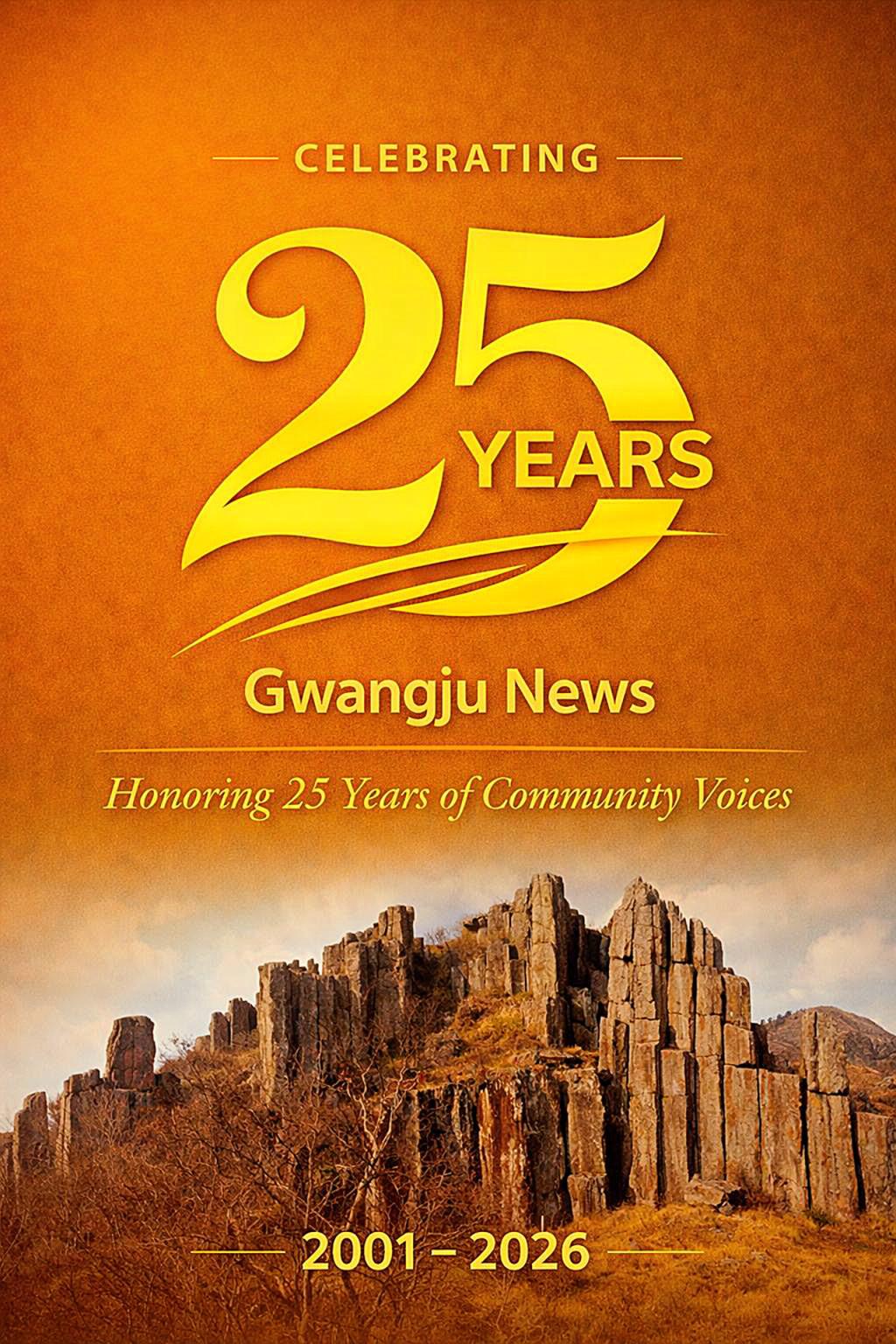
The Gwangju News is the first English monthly magazine for the general public in Korea, first published in 2001. Each monthly issue covers local and regional issues, with a focus on the roles and activities of the international residents and local English-speaking communities.
The Gwangju News is published by the Gwangju International Center: Jungang-ro 196-beon-gil 5 (Geumnam-ro 3-ga), Dong-gu, Gwangju 61475, South Korea
Tel: (+82)-62-226-2733
Fax: (+82)-62-226-2731
Website: www.gwangjunewsgic.com
Email: gwangjunews@gic.or.kr
Registration No 광주광역시 라 00145
ISSN 2093-5315
Registration Date: February 22, 2010
The Gwangju News is co-sponsored by Asian Legal Resource Centre (ALRC) Korea
From the Editor
Welcome to our June issue, the 292nd issue of the Gwangju News. This doesn’t sound particularly remarkable, other than the fact that the publishing of the 292 monthly issues was accomplished by a team of volunteers. But it is an important juncture in the history of the magazine: The first issue of the Gwangju News was published in June of 2001. That makes this June 2026 issue our 25th anniversary issue!
This milepost punctuates the sustained momentum that the Gwangju News has evidenced over the years since its inception 25 years ago by our publisher, Dr. Shin Gyonggu. From a couple of folded sheets of paper as Issue #1 to today’s 60-plus pages, the magazine has steadily evolved. But quantity cannot be the sole measure of a publication’s value. We take great pride in the quality of the content that we offer and in the breadth of our offerings. Our product is truly exceptional, considering that the contributors are volunteers rather than journalism-educated professionals.
“Bravo!” to our Gwangju News contributors and staff. Take a bow!
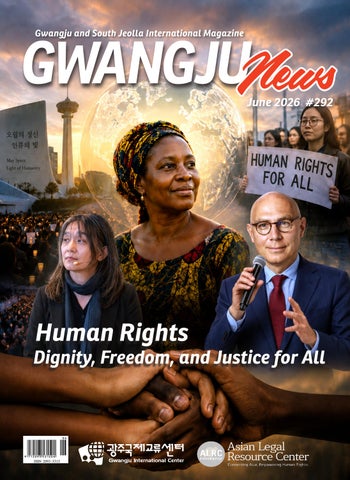
Last month was especially busy and meaningful in Gwangju, the city where the “Spirit of May” is so deeply felt. May marks the anniversary of the 5.18 Gwangju Uprising of 1980, a defining moment in Korea’s struggle for democracy and human rights. In honor of that legacy, Gwangju hosts the annual World Human Rights Cities Forum in mid-May, alongside the presentation of the prestigious Gwangju Prize for Human Rights.
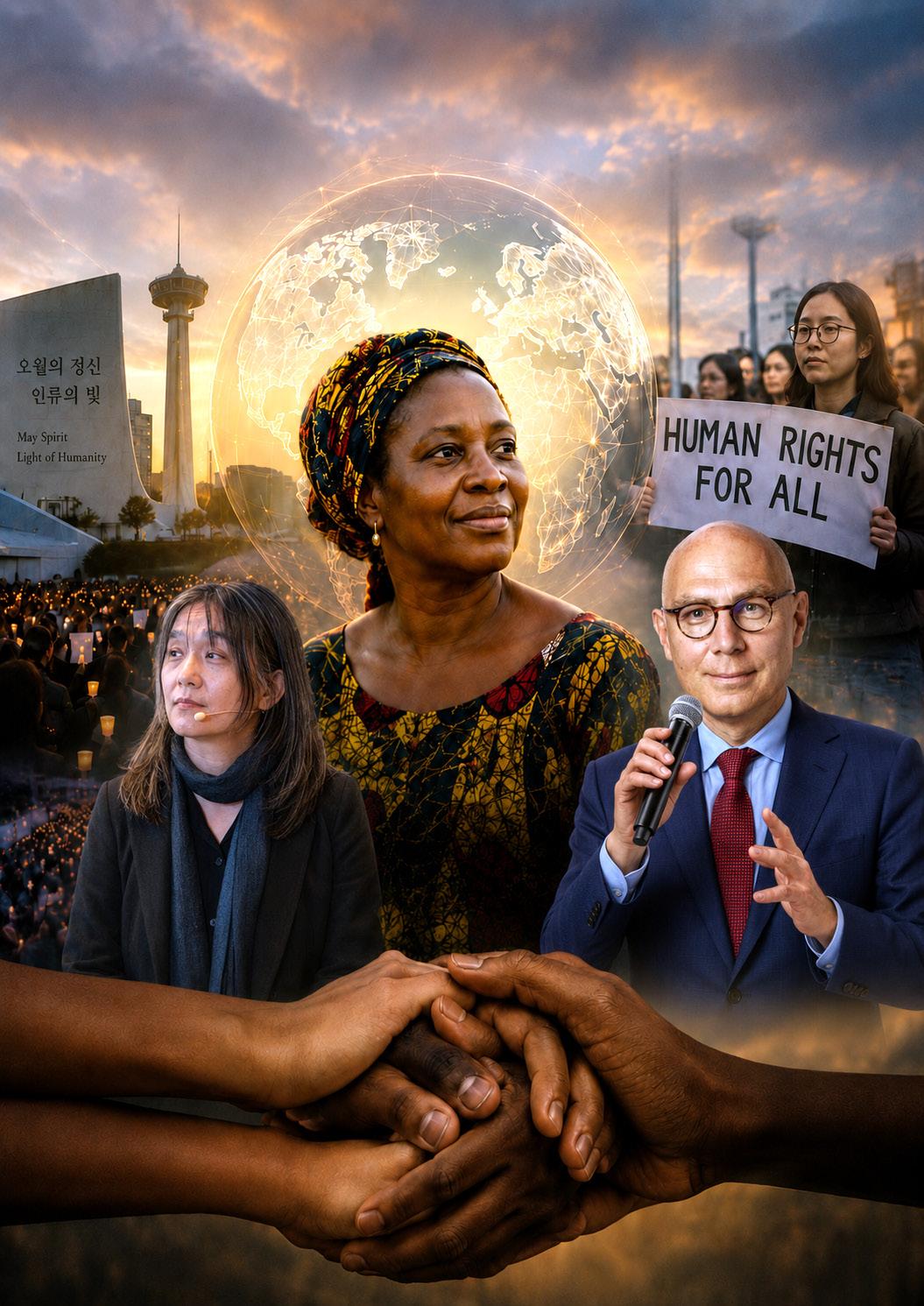
Reflecting this emphasis on human rights, this issue of the Gwangju News features a quartet of articles devoted to the human rights theme. We begin with a firsthand report on this year’s World Human Rights Cities Forum, highlighted by a keynote address from UN High Commissioner for Human Rights, Volker Türk. Next, we profile Sylvia Acan, a courageous human rights activist from Uganda and the recipient of the 2026 Gwangju Prize for Human Rights. Our third piece is a commentary titled “Strengthening Solidarity with the World’s Oppressed: A Call for Gwangju to Lead.” And finally, we offer a thought-provoking essay on the impact of artificial intelligence on human rights, penned by the artist behind this issue’s striking cover image. Together, these articles invite you to reflect on Gwangju’s enduring role as a beacon of human rights and solidarity with struggles worldwide. Enjoy these and the other 25 exceptional articles on offer in this issue!
David E. Shaffer
Editor-in-Chief Gwangju News
Gwangju & South Jeolla International Magazine
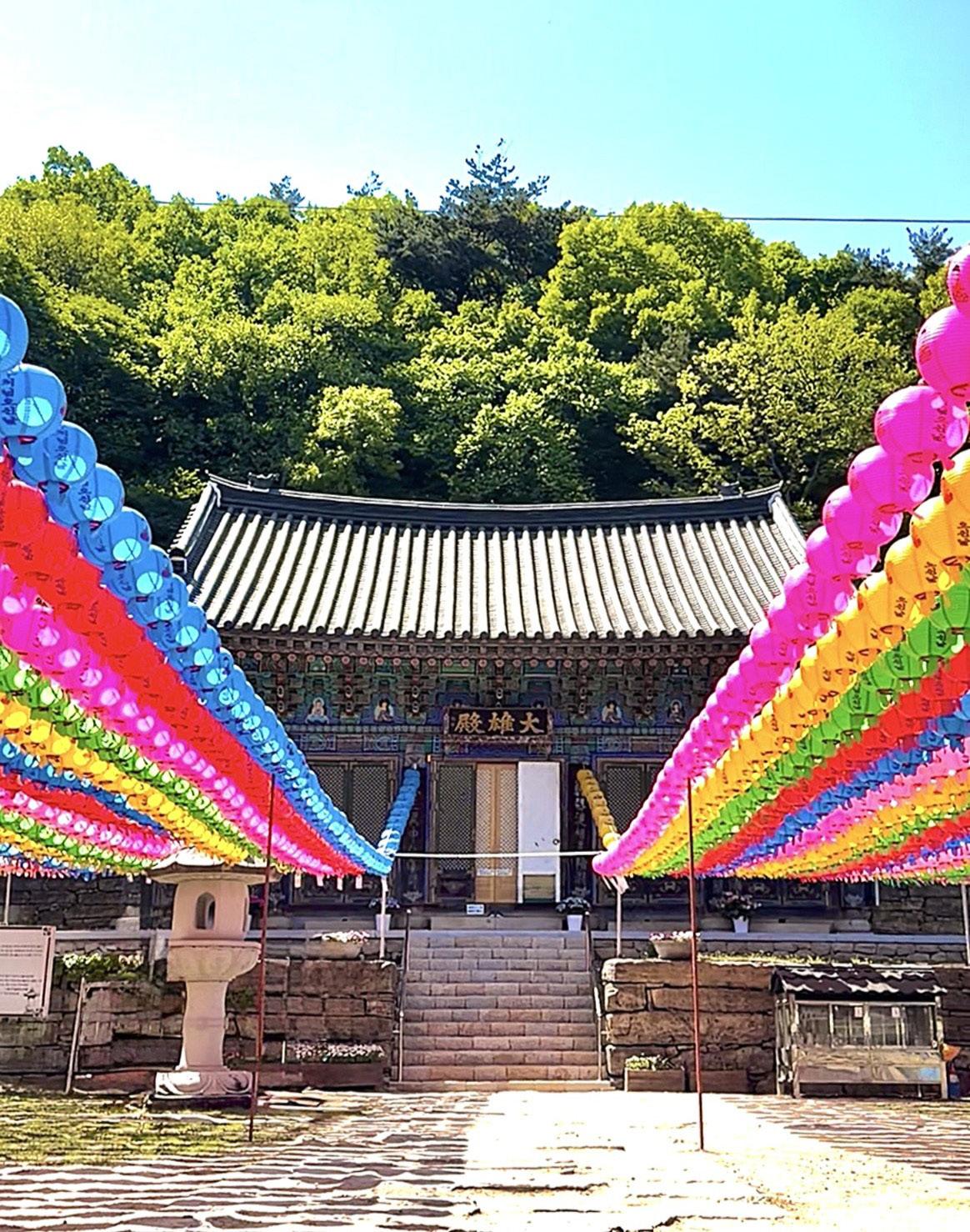
Lanterns of Spring
Rows of colorful lanterns guide the eye toward the quiet main hall of Wonhyo Temple on the slopes of Mt. Mudeung, where spring sunlight meets the calm of the mountains. Captured during Korea’s lantern season ahead of Buddha’s Birthday, the scene reflects both celebration and stillness – a moment where nature, tradition, and spirituality quietly coexist. The lanterns symbolize hope, wisdom, and enlightenment in Korean Buddhist culture.
The Photographer
Vibhanshu Maurya is an Indian PhD researcher based in Gwangju, South Korea, and a contributor to the Gwangju News. Alongside research, he enjoys documenting everyday life, culture, and hidden moments across Korea through photography and storytelling, often focusing on the intersection of people, tradition, and place.
(Photo of the Month submissions are open to all readers: gwangjunews@gic.or.kr)
10 At the World Human Rights Cities Forum 2026: Gwangju Leading Efforts Against Authoritarianism and Populism
14 The Impact of AI on Human Rights
17 Strengthening Solidarity with the World’s Oppressed: A Call for Gwangju to Lead
19 Healing Through Solidarity: Sylvia Acan Receives Gwangju Prize for Human Rights
GLOBAL FOCUS
20 The Power of Protest and Persistence
HISTORY & TRADITION
23 Ponderings & Contemplations: Place Names and Intriguing Revelations
TRAVEL & DISCOVERY
25 Exploring Korea: Between Mountain and River – A Quiet Escape COMMUNITY
28 Sister-City Relationship: Radiant Connections for Sister-City Youths –Gwangju and Medan Exchange Visits
30 Inside the Gwangju News: Meet Yousra Feriel – Writer on Societal, Political, Current Events
TEACHING & LEARNING
32 From Hagwon to AI Tutor: How AI is Reshaping Education in Korea and Beyond
34 From Drills to Voice: Content Creation with Young Learners in Korea
OUR PLANET
36 Korea Is on Fire, and the Records Prove It
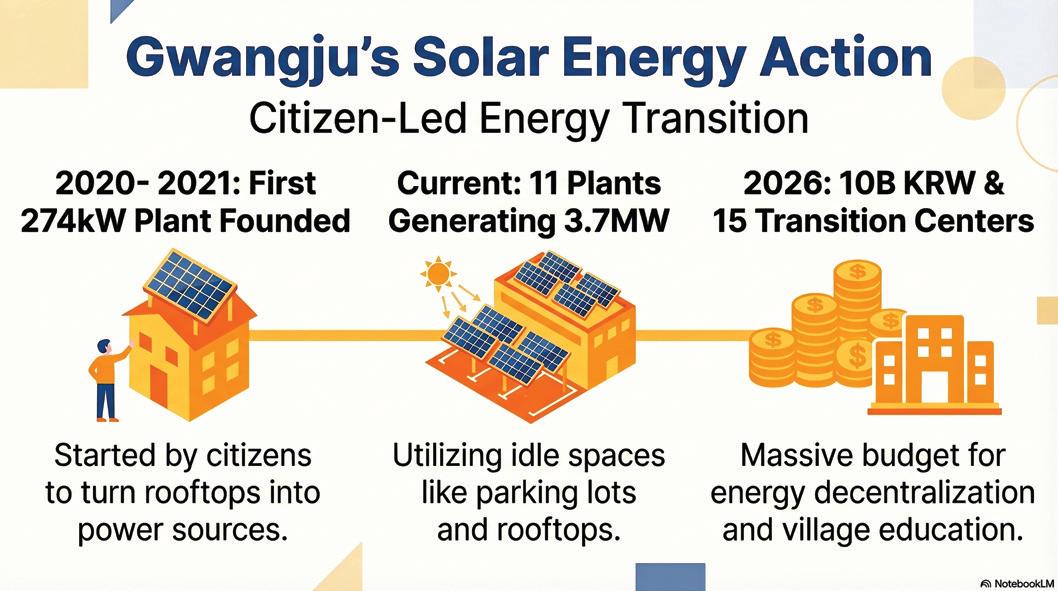
41 Electricity by the People, for the People, and of the People: A Solar Power Coop in Gwangju Shows the Way
SCIENCE & TECHNOLOGY
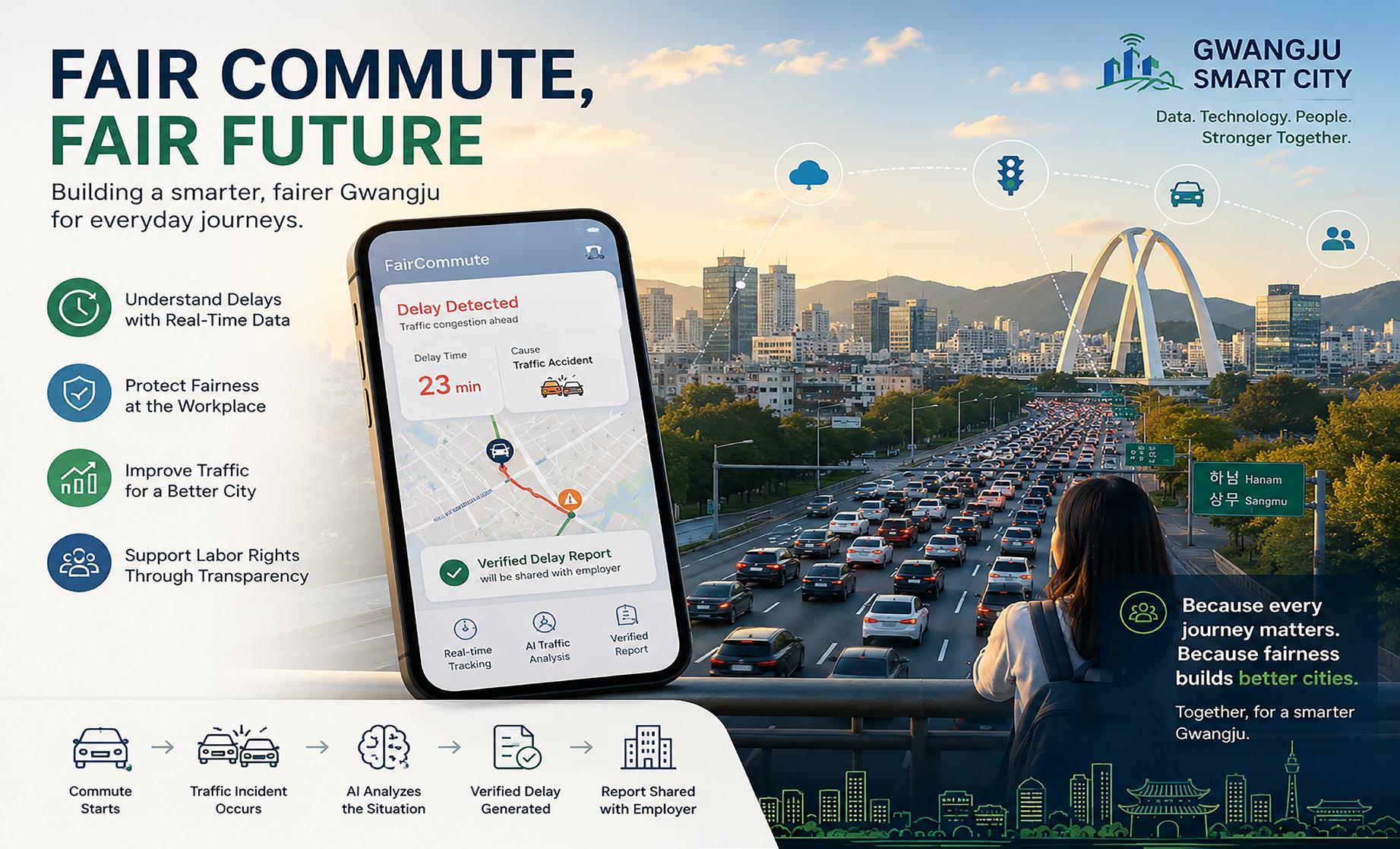
43 When Traffic Isn’t Your Fault: Rethinking Commutes in Gwangju Using AI
CULTURE & THE ARTS
46 The Calcuttan in Korea: Neon Rhythms and the Quiet Hue
49 Movie Review: No Other Choice – The Lengths We Go for What We Love
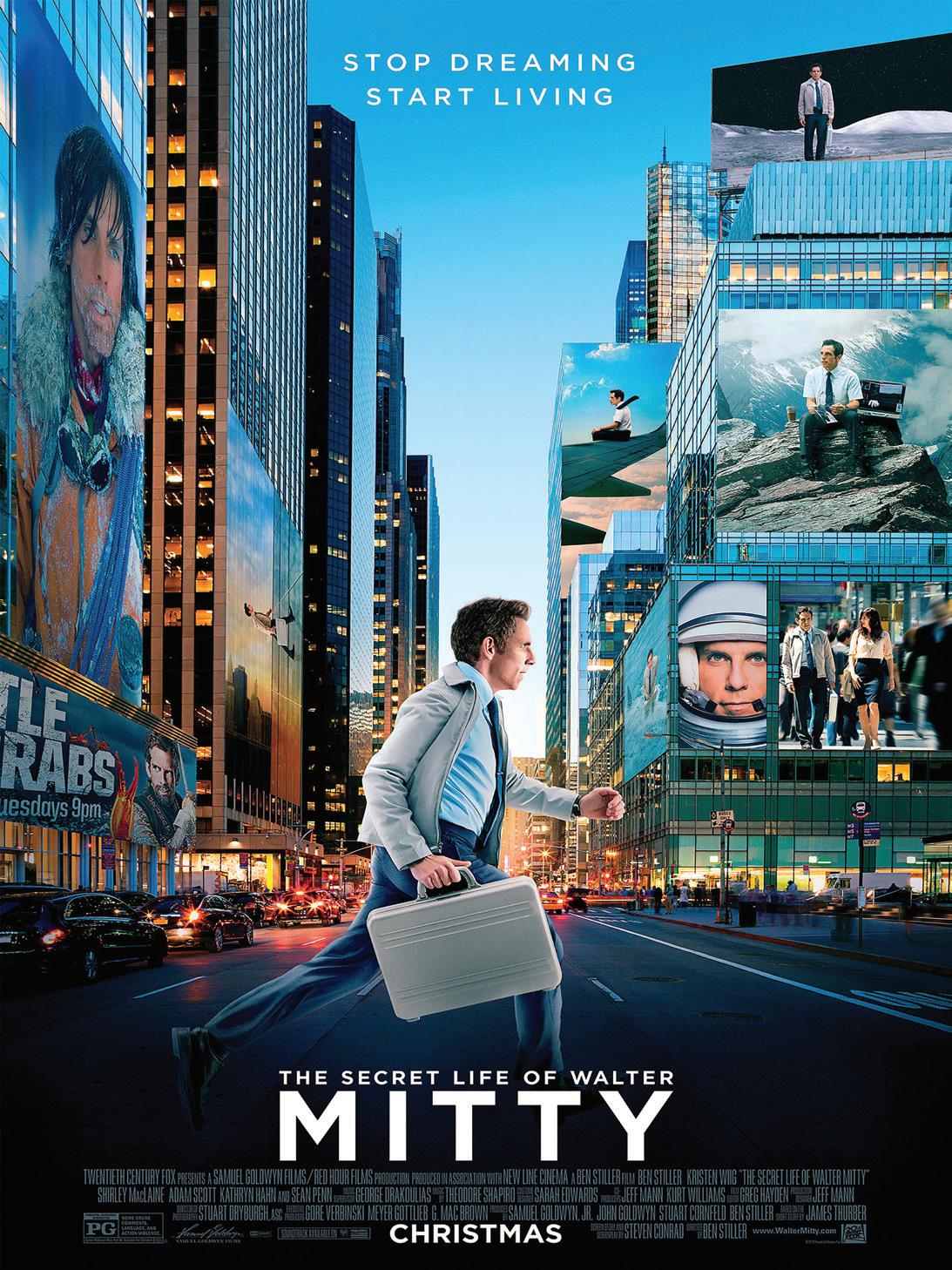
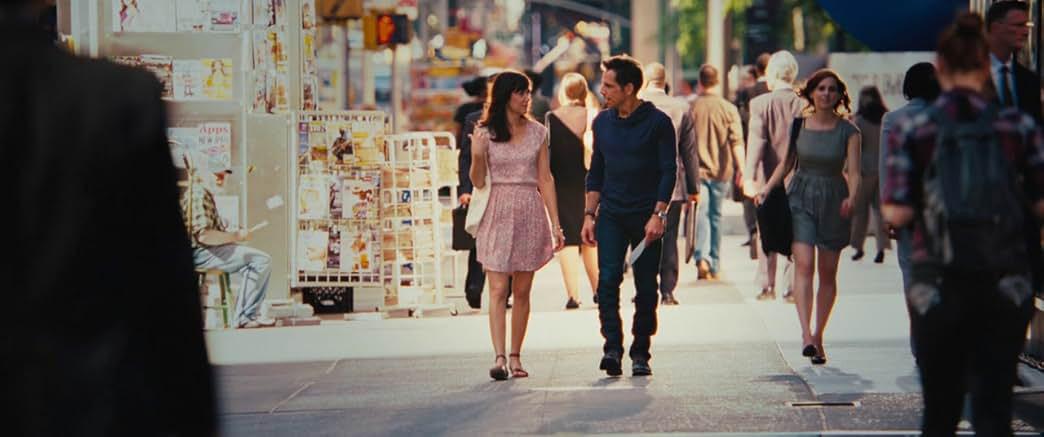
52 Movie Review: A Revival of Fiction for Life – The Secret Life of Walter Mitty
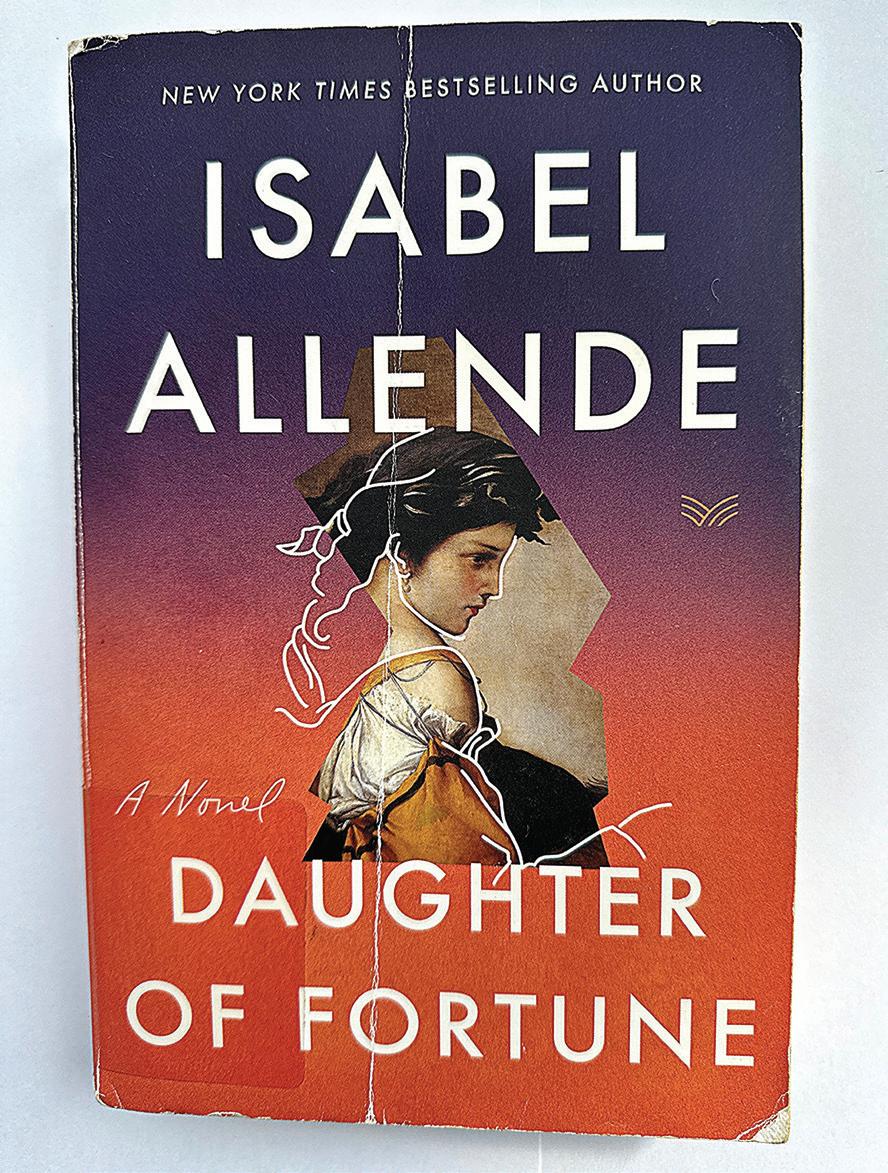
55 Book Review: Daughter of Fortune
57 Creative Writing: Anatomy of an Almost-Love
60 Creative Writing: The Whispering Petals of Gwangju – A Springtime Tale
64 D’s Café Column: Café Low Shift – A Late-Night Escape Near CNU
SPORTS & ENTERTAINMENT
65 BTS is Back on Tour: A Comeback I Almost Missed
68 Sports Focus: Tigers Rebuild Identity Through Competition and Flexibility
70 Area Sports Round-Up
72 June Upcoming Events
Gwangju Strengthens Future Industry Ecosystem with Investment Deal Gwangju City News
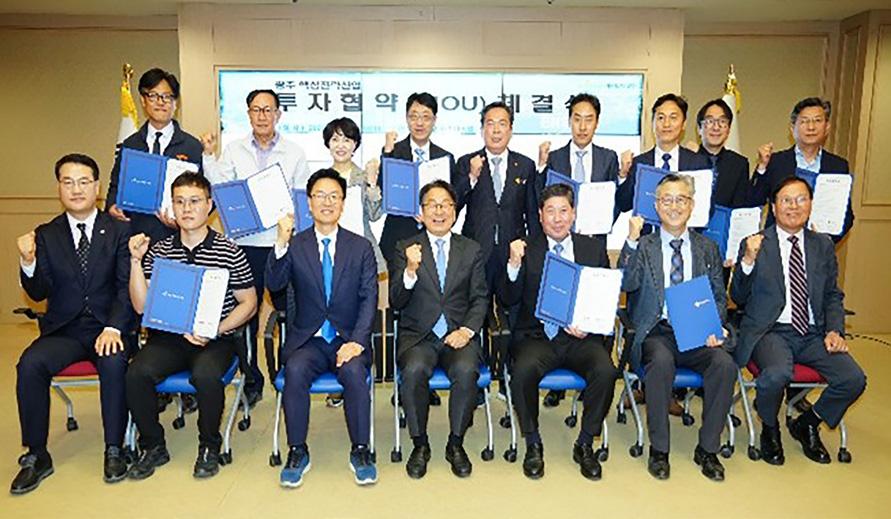
Gwangju Metropolitan City has taken a significant step toward stabilizing its local economy and securing its status as a hub for future industries. Recently, the city formalized investment agreements (MOUs) totaling 160.5 billion won with 11 promising companies specializing in the automotive, artificial intelligence (AI), and energy sectors. This collaborative effort is expected to revitalize the region by creating approximately 517 new jobs through the expansion of local infrastructure, including new factories and research institutes.
The investment reflects a diverse industrial commitment to Gwangju’s strategic growth. In the automotive sector, companies like DN Co., Ltd. and Najeon Co., Ltd. are expanding production lines for lightweight materials and smart molding to strengthen the local supply chain. Meanwhile, mobility leaders such as SWM Co., Ltd. and Morris Co., Ltd. are establishing bases in the Bitgreen National Industrial Complex to accelerate the commercialization of autonomous driving and future vehicle convenience systems. The energy sector also saw significant movement, with Mujin Engineering Co., Ltd. committing 52 billion won for nuclear power equipment manufacturing, alongside startups like Recell Co., Ltd. focusing on nextgeneration solar technology.
During the signing ceremony, Mayor Kang Gijung expressed his gratitude to the participating firms for choosing Gwangju despite the uncertain global economic environment. He emphasized that the city’s role is to provide a supportive environment where these companies can leap forward as representative leaders in their respective fields. By focusing on both capital investment and the establishment of R&D
centers, the city aims to foster an ecosystem in which technology and manufacturing grow in tandem.
The influx of high-tech firms and the creation of hundreds of specialized jobs ensure that the upcoming integrated special city begins its journey with strong industrial momentum. This collaborative milestone honors the region’s long-standing efforts to build a sustainable, innovation-driven economy for its residents.
Muan to Be Hub for Agricultural AI Transformation
National Agricultural AX Platform blueprint. (Jeonnam Province)
Jeonnam Province has secured a monumental victory for the region’s future by winning the bid for the Ministry of Agriculture’s Food and Rural Affairs’ National Agriculture AX (Artificial Intelligence Transformation) Platform. This ambitious project, centered in Haeje-myeon,
Mayor Kang Gi-jung and business leaders after the MOU signing. (Gwangju Metropolitan City)
Gwangju City News
Muan-gun, is a direct response to the structural limits facing modern agriculture, such as the climate crisis and a dwindling rural workforce. By integrating AI and data-driven innovation, the province aims to transition from traditional farming models to a world-class, intelligent agricultural ecosystem.
Under this 254.6-billion-won project, Jeonnam will implement an export-oriented smart farm model that utilizes artificial intelligence throughout the entire agricultural cycle – from production and distribution to global sales. This initiative is bolstered by an additional 115 billion won in government funding for three essential Agriculture AX infrastructure projects: a global business center to open international markets, an AX demonstration center for testing robotic technologies, and an AI growth support data center for precision crop analysis. Together, these facilities will establish Muan as the definitive forward base for Korea’s agricultural AI transition.
Governor Kim Yung-rok emphasized that this platform will not only guarantee stable, high incomes for farmers but also strengthen national food security and expand the export of “K-agriculture” technology. With a target completion date of 2030, the province plans to develop a new agricultural ecosystem where the public and private sectors grow together. As the region prepares for the July 1 inauguration of the Jeonnam–Gwangju Integrated Special City, this project ensures that the new government will lead the way in sustainable, high-tech industrial growth, honoring the patience and resilience of the province’s agricultural heartlands.
Jeonnam Pushes for “Treasure” Designation for Three Iconic Assets
Jeonnam Province is moving closer to a major cultural milestone following the National Heritage Administration’s April 30
announcement to designate three local assets as treasures. The province is currently facilitating the 30-day preliminary notice period, with a final deliberation by the Heritage Committee expected in June 2026.
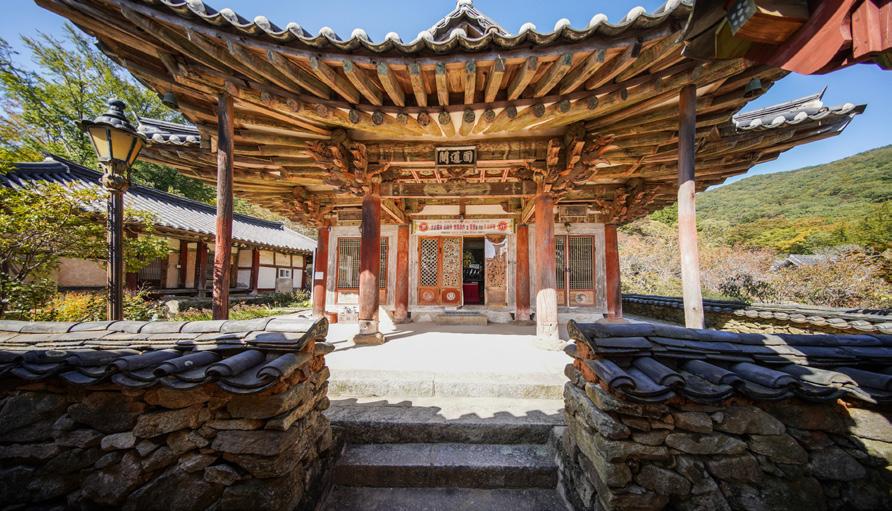
Wontong Hall at Seonam Temple (UNESCO World Heritage) is a royal prayer hall tied to the birth of King Sunjo. Following King Jeongjo’s request for prayers from the monk Nulam, Sunjo was born; the hall still houses plaques believed to be handwritten by the king. Its unique T-shaped layout is a rare architectural feature found only in elite royalty-related structures.
At Songgwang Temple, one of Korea’s “Three Jewel Temples,” Eungjin Hall stands as a pristine example of 17th-century architecture. Rebuilt in 1623, it enshrines the 16 Arhats and showcases the pinnacle of mid-Joseon craftsmanship through its intricate bracket systems (gongpo) and vibrant decorative coloring (dancheong).
The Indra and Heavenly Dragon paintings at Heungguk Temple, created in 1741 by the renowned monk-painter Uigyeom, are rare masterpieces of late-Joseon art. The work is praised for its delicate brushwork and vivid redgreen contrast that creates a groundbreaking sense of depth.
Once the final review is completed in June, these assets will serve as core cultural pillars for
Wontong Hall, one of the prospective treasures. (Jeonnam Province)
Gwangju City News
Jeonnam’s transition into an integrated special city, ensuring the systematic preservation and global promotion of the region’s spiritual legacy.
G-Festa 2026 Highlights the Dawn of a Unified Era
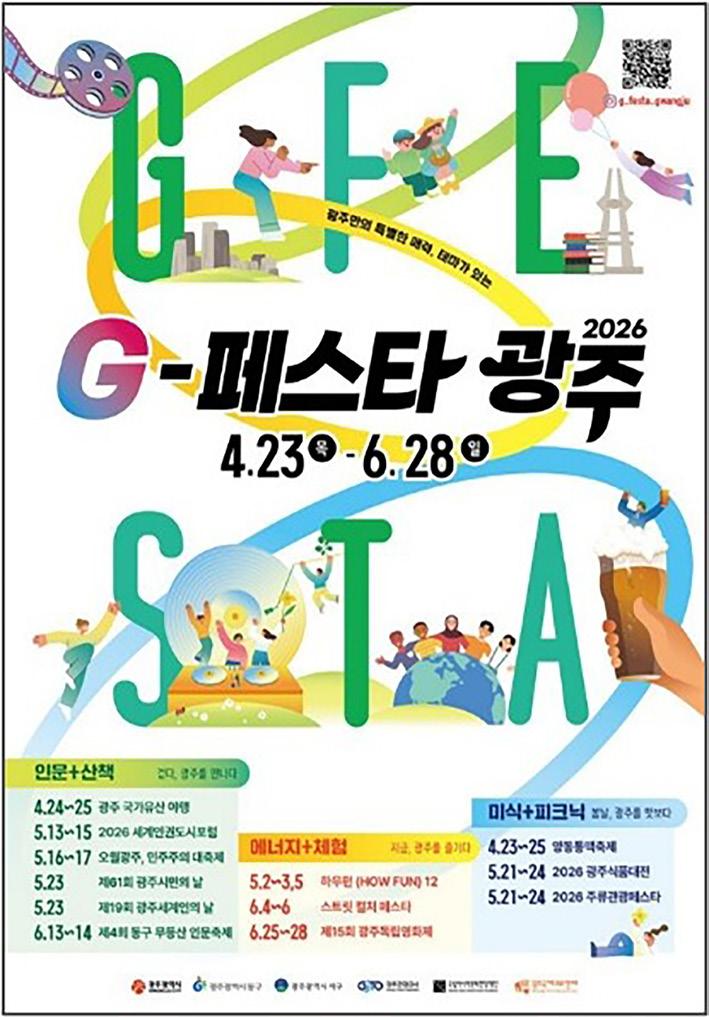
Gwangju is buzzing with energy this season as the city transforms into a massive celebration hub for G-Festa Gwangju 2026. Running through June 28, this 67-day festival encompasses twelve diverse events organized under the themes of gastronomy, humanities, and energy. To enhance the stay-and-play tourism experience, visitors can explore customized tour courses in major districts such as Dongmyeong-dong and the Sangmu District, complete with convenient QRcode access to highly recommended local dining spots.
The month of June kicks off with the Street Culture Festa (June 4–6), which fills public spaces with youthful expression and interactive performances. This energy transitions into
a more reflective atmosphere during the 4th Dong-gu Mudeungsan Humanities Festival on June 13 and 14, where “humanities walks” allow visitors to engage with the city’s symbolic natural backdrop. The seasonal festivities conclude with the 15th Gwangju Independent Film Festival (June 25–28), a platform dedicated to courageous storytelling and cinematic diversity. As G-Festa Gwangju draws to a close, it leaves behind a wellrounded portrait of the city’s rich history and its contemporary creative spirit.
The 100-Day Countdown: Yeosu Gears Up for the World’s First Island Exhibition
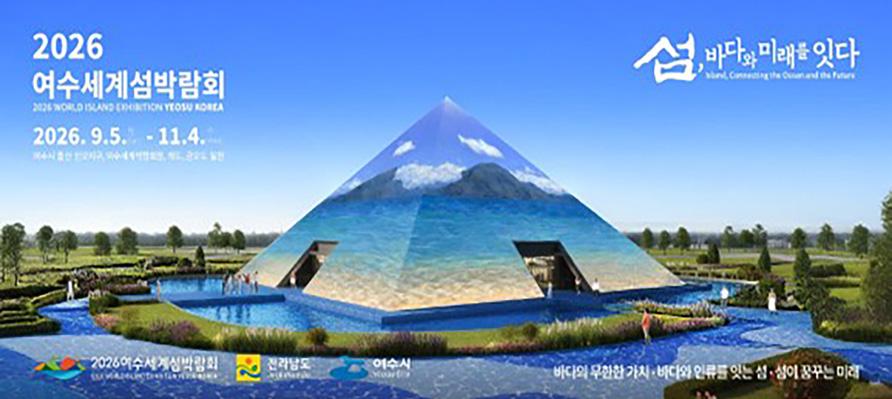
The countdown to a global milestone has officially entered its final stretch as Yeosu prepares to host the world’s first large-scale event dedicated entirely to the heritage and future of islands. As of June 1, exactly 96 days remain until the grand opening of the 2026 Yeosu World Island Exhibition on September 5. Under the visionary theme “Island, Connecting the Ocean and the Future,” this 61-day extravaganza will transform the city’s archipelago into a living laboratory for sustainability and cultural exchange. Construction at the main venue in Dolsan’s Jinmo District is progressing rapidly, with infrastructure nearing its final stages after surpassing the 83-percent mark last month. Local authorities are working tirelessly to finalize all primary exhibition facilities and landmark structures by July, ensuring a smooth transition into month-long trial operations in August.
This ambitious project will span several key locations, including the sub-venues of Gae-do and Geumo-do, islands from which visitors can experience the raw natural beauty and unique traditions of Korea’s southern coast. As of last month, 27 countries and three international organizations have officially confirmed their participation. Notable participants include
G-Festa 2026 poster.
Gwangju City News
France, Greece, China, Japan, Peru, and Palau, along with international bodies such as WHO ACE. Organizers are also in the final stages of negotiations with more than five additional nations, promising a truly international dialogue on marine ecology and island innovation.
Highlights of the exhibition will include the World Island Food Restaurant, where chefs will showcase global island cuisines, and the Island Future Pavilion, which will feature cutting-edge technologies such as advanced air mobility and eco-friendly maritime transport. Beyond the spectacle, the event serves as a critical platform for addressing climate change, aiming to attract three million visitors and generate significant economic momentum for the newly integrated Gwangju–Jeonnam region. With a fleet of over 2,300 shuttle buses and extensive environmental restoration efforts already underway, Yeosu is poised to prove that islands are not isolated lands but essential bridges to our collective future.
Gwangju–Jeonnam Holds Election for Mayor
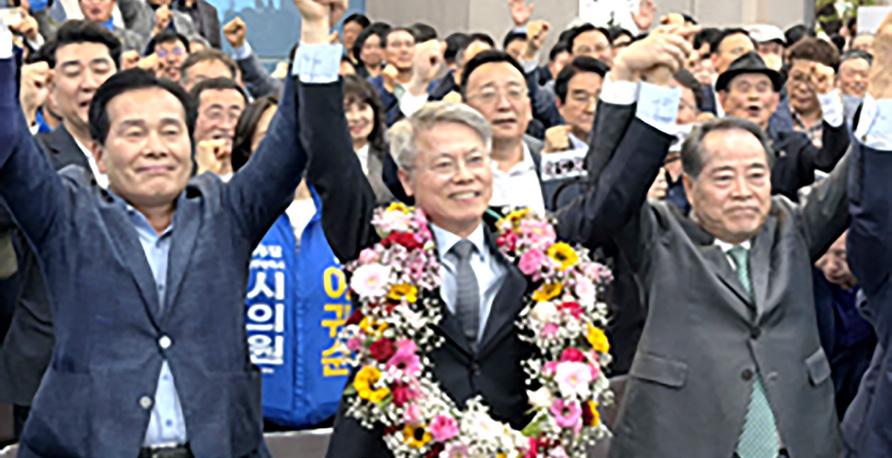
On June 3, the region holds its first election for Jeonnam–Gwangju Integrated Special City mayor. Democratic Party candidate Min Hyung-bae is expected to be elected as the inaugural mayor, marking a historic turning point for regional governance in South Korea. Min brings a distinguished career to this role, having served as a two-term head of Gwangju’s Gwangsan-gu District, as a presidential secretary under the Moon Jae-in administration, and as a
prominent member of the National Assembly. He is recognized as a relentless reformer who pioneered the “Gwangsan Model” of grassroots democracy, driven by the conviction that administrative power must be returned to the people.
Once elected, Min will officially begin his duties on July 1, coinciding with the historic launch of the Integrated Special City. He has pledged to establish a “citizen sovereign government,” where transparency and participation are the primary pillars, ensuring residents are active decisionmakers rather than passive recipients of services. To achieve this, he plans to implement a policysharing system to keep the integration process fully visible to the public.
His immediate goals include harmonizing Gwangju’s AI and industrial innovation with Jeonnam’s renewable energy and maritime resources to create a globally competitive mega-economic zone. By prioritizing regional revitalization and direct democracy, Min aims to transform the city into a leading model for balanced national development where the voice of every citizen shapes the collective future.
Content Writer
Amy Park is a program officer and content producer for the Asian Legal Resource Center (alrc.or.kr), based in Gwangju. She helps build the organization’s foundation and supports new efforts in human rights advocacy and resource sharing.
2026 Yeosu World Island Expo Poster. (Yeosu City)
Democratic Party candidate Min celebrating upon winning the final party primary in April. (Courtesy of Min Hyung-bae’s Jinsim Camp)
At the World Human Rights Cities Forum 2026
Gwangju Leading Efforts Against Authoritarianism and Populism
By Luis Andrés
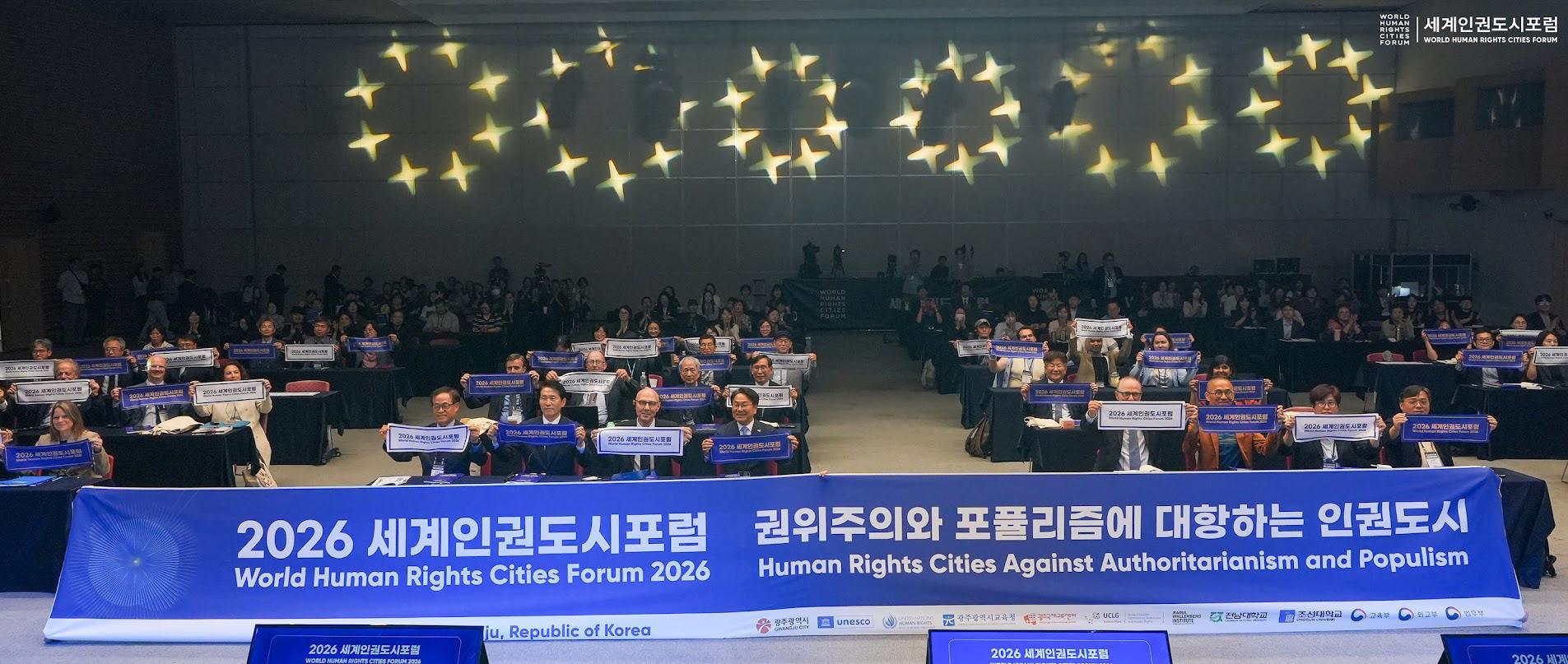
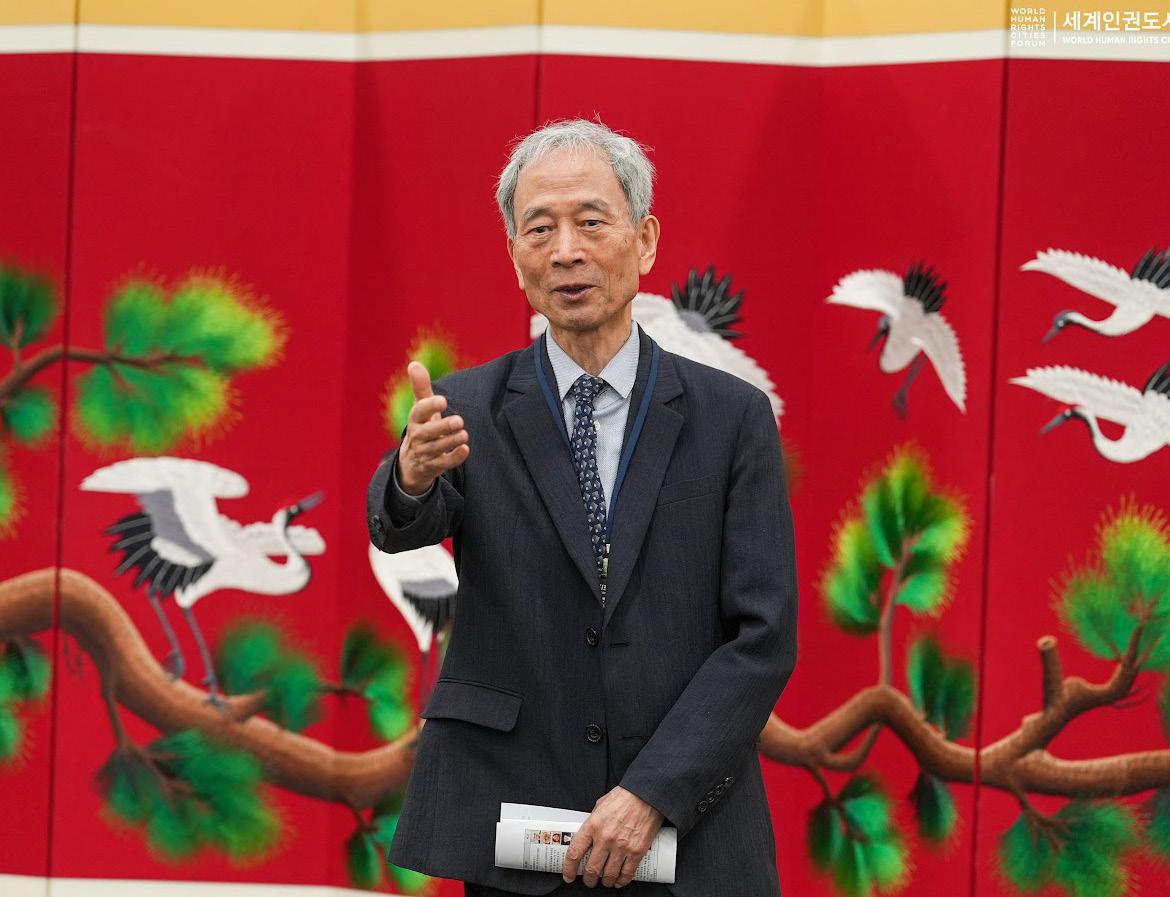
Gwangju hosted the 16th World Human Rights Cities Forum from May 13 to 15, 2026. Once again, our city opened its doors to academics, activists, public officials, students, and organizations from around the world to exchange knowledge, experiences, and concerns surrounding human rights cities. This year’s Forum felt particularly significant because participants heard directly from the United Nations High Commissioner for Human Rights about the importance of local governments, especially cities, in protecting human dignity in increasingly uncertain political times.
The yearly event began on May 13 with Gwangju not only welcoming international guests, but also setting a reflective and provocative atmosphere regarding democracy and human rights. This
first day traditionally allows participants from abroad to visit important historical landmarks such as the 5.18 National Cemetery and the May 18 Democratic Square downtown. These visits are, however, not symbolic tourism; they remind participants that Gwangju’s role as host of the Human Rights Cities Forum is deeply connected to its history of democratic struggle and collective resistance.
The Forum also included a special session organized by the Chonnam National University May 18 Institute, which explored how Gwangju’s democratic memory continues to shape the city’s institutions and civic culture today. More than simply preserving history, the session emphasized how local communities can actively transform historical trauma into contemporary
The opening ceremony of the Forum. (WHRCF)
practices of solidarity, participation, and human rights advocacy. In many ways, this is what gives Gwangju a distinct voice within global discussions on democracy.
This year, the Forum centered around the broad theme of “Cities Against Authoritarianism and Populism.” And, as much as I would love to give a clean and easy definition of these concepts, one of the things repeatedly mentioned during the sessions was precisely how difficult these phenomena have become to identify in the contemporary world. We used to imagine authoritarianism as something obvious: centralized political power, visible repression, censorship, military control, and open violations of human rights. Basically, the kind of dictatorship that history books and documentaries warn us about.
Populism, meanwhile, was often discussed as authoritarianism’s close companion. Political actors claim to represent “the real people” against corrupt elites, while simultaneously excluding groups that think differently or do not fit within their national vision. Whether governing or opposing the government, populist discourse frequently weakens democratic dialogue by turning politics into a battle of enemies rather than a process of participation and negotiation.
Yet the contemporary situation feels more complicated than those older definitions. Many countries still hold elections. Institutions formally exist. Constitutions remain intact. Politicians continue speaking the language of democracy and freedom. But despite all of this, societies increasingly experience polarization, hate speech, distrust, and attacks against minorities. Rights may continue existing on paper while simultaneously becoming fragile in everyday life.
One of the most repeatedly discussed concerns during the Forum was exactly this: Modern authoritarian tendencies do not always arrive wearing military uniforms anymore. Sometimes
they arrive through social exhaustion, disinformation, algorithmic radicalization, or political narratives that slowly normalize exclusion.
And sometimes it feels like the entire world has become one giant angry comment section.
Several speakers pointed out how social dynamics now reward outrage more than dialogue. Political actors benefit from polarization because conflict generates visibility, engagement, and loyalty to support them, while excluding those people that disagree with them, making them the villains, the elites, the enemy, and the others.
This is precisely why local governments and human rights cities matter so much today. Cities remain the places where people actually experience politics in their daily lives. Public
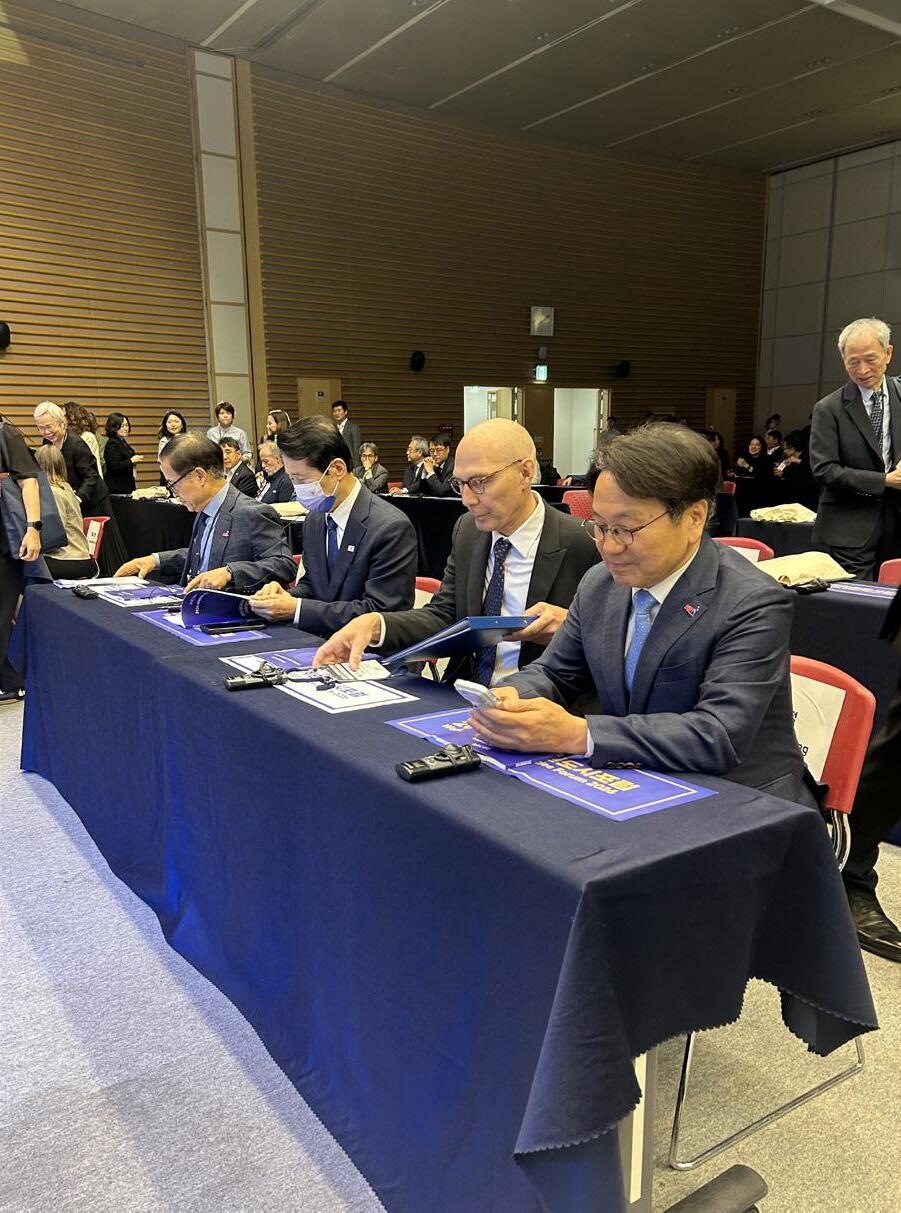
Gwangju Mayor Kang Gi-jung (left) and UN High Commissioner Volker Türk (next) at a session of the Forum. (L. Andrés)
transportation, migrant support centers, accessibility for people with disabilities, antidiscrimination programs, labor protections, housing policies, education, healthcare, and public spaces are not abstract ideological debates there. They directly determine whether people can live with dignity or not.
The purpose of the Human Rights Cities Forum is therefore not simply academic discussion. It is about local and regional governments exchanging practical experiences and strategies for protecting human dignity within immediate communities. Discussions in the second day of the Forum frequently focused on how cities can continue defending rights even when national political environments become polarized or restrictive. In many sessions, participants highlighted examples of local governments creating inclusive policies despite broader national tensions.
During his keynote speech in the opening session, the United Nations High Commissioner for Human Rights, Volker Türk, acknowledged that the global panorama for human rights may currently appear discouraging in many regions. However, he also described cities around the world as beacons of light where meaningful work continues to happen. He highlighted
efforts related to housing, transportation, labor rights, access to water, and discrimination-free environments as examples of human rights being implemented through local governance rather than remaining abstract principles.
Hearing these words in Gwangju carried emotional weight.
As a foreign resident in Korea, I could not help but think about how human rights are often experienced locally before they are experienced nationally. The city where you live determines whether you feel welcomed, ignored, protected, or excluded. It shapes whether diversity is treated as a threat or as something valuable. No city in the world is perfect, of course, and Gwangju itself still faces important challenges and contradictions, but the willingness to openly discuss those issues already matters.
In a global environment where many political actors prefer easy enemies and simplified narratives, the act of continuing difficult conversations may itself become a form of democratic resistance.
The Forum certainly did not present Gwangju, or any other city, as a flawless model. During plenary sessions and thematic discussions, representatives from different regions openly addressed ongoing failures, institutional weaknesses, and unresolved tensions within their own societies. Speakers, including the Commissioner of the New York City Commission on Human Rights, the National Human Rights Commissioner from Thailand, and scholars from international human rights institutes, repeatedly emphasized that democracy is not something permanently achieved. It requires continuous reflection, criticism, and adaptation.
Corruption also emerged as a central topic, especially in the plenary session. Several speakers argued that corruption should not only be understood as an economic or administrative crime, but also as a human rights issue. When
GIC Director Shin Gyonggu speaking at the VIP pre-forum reception. (WHRCF)
public resources intended for communities are diverted toward private interests, the consequences extend far beyond financial loss. Corruption directly affects people’s access to housing, healthcare, education, labor protections, and public safety. In that sense, corruption is not only about money. It is about dignity, inequality, and power.
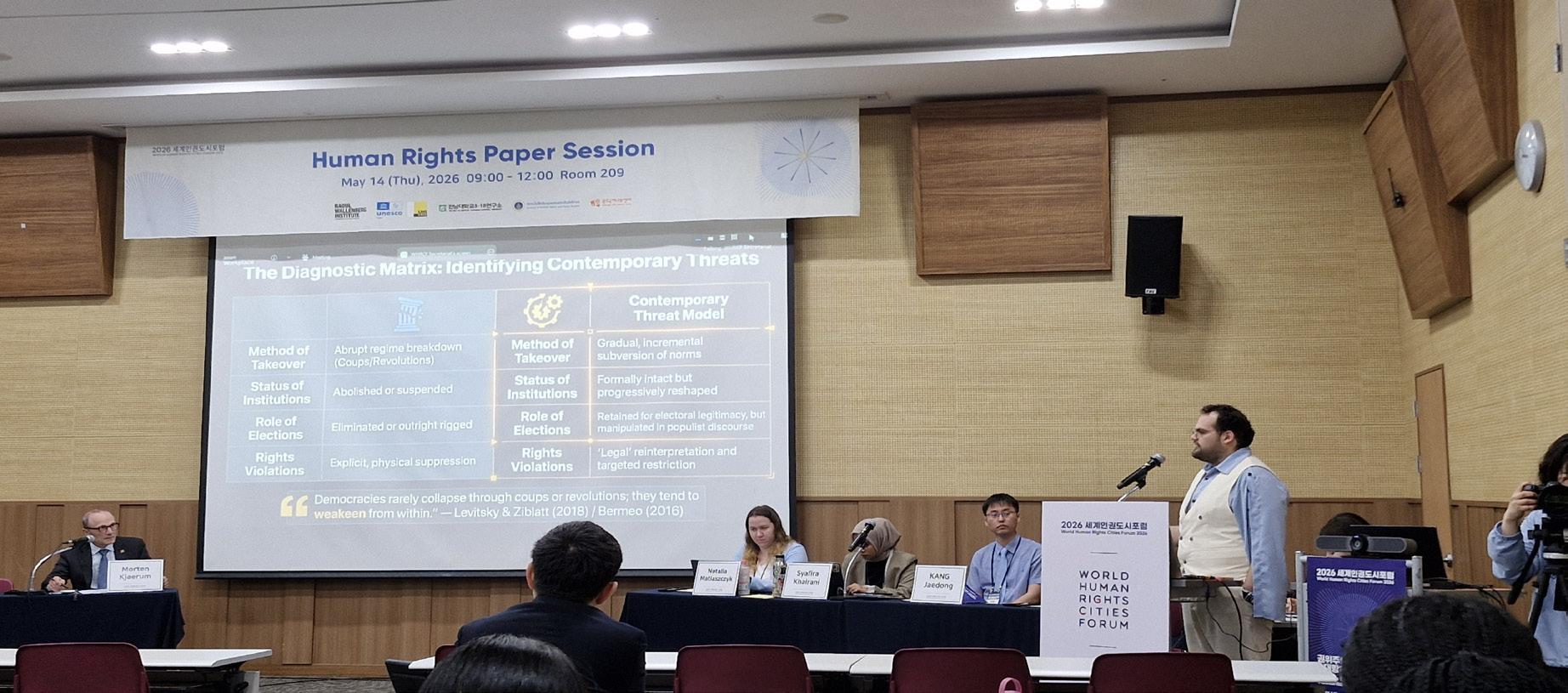
Young researchers, students, and activists were also a major part of this year’s Forum. During the paper presentation sessions, younger participants raised concerns regarding artificial intelligence and digital governance, and the difficulties of human rights protection in armed conflict or dangerous environments. Beyond proving that younger generations remain deeply engaged with global issues, these discussions demonstrated something equally important: People are still imagining alternatives.
Throughout the event, participants discussed gender inequality, disability rights, sports, children’s rights, migration, climate vulnerability, and urban governance from a local human rights perspective. The diversity of topics reflected the reality that human rights are not isolated issues. They shape everyday life in countless interconnected ways. Representatives from around the world will now return to their
communities carrying both practical ideas and difficult questions that may continue influencing local discussions long after the ending of the Forum.
Ultimately, the World Human Rights Cities Forum is not simply about declaring that democracy and human rights are important. Most people already agree with that in theory. The harder question is whether societies are still willing to practice these values consistently when fear, polarization, and uncertainty become politically convenient.
And perhaps that is precisely why Gwangju continues to matter. Not because it claims to have solved every contradiction, but because it continues insisting that democracy, dignity, and human rights must remain living conversations rather than simply historical slogans.
The Author Luis Andrés González is a Mexican GKS scholar and master’s student in cultural anthropology at Chonnam National University. He advocates for LGBTQ+ rights and gender equality, and explores global affairs through pop culture. He is the founder of Erreizando, a digital magazine. Instagram: @luisin97 / @erreizando
The author presenting a session on identifying contemporary threats to democracies. (Chung Hyunhwa)
The Impact of AI on Human Rights
By Muhammad Umar Tahir
It was Sunday, and I was sitting in a waiting area of a nearby community center when I noticed something interesting happening right next to me. An old man was trying to unlock his phone using face recognition, but it was not working. He tried again and again, slightly adjusting his face, moving the phone closer, and even changing the angle, but the system did not recognize him. After a few attempts, he laughed and said, “Maybe the phone does not like me today… haah!” It was an interesting moment, almost funny, and something many of us may have also experienced. But as I watched that small event, a deeper thought came to mind: What happens when machines begin to decide who we are, and whether we are accepted or rejected?
For a long time, we have believed that human rights are protected by laws, systems, and institutions created by people. These include important rights like privacy, equality, freedom of expression, and access to opportunities. These rights are considered basic, and they help create a fair and balanced society. But now, something new is becoming part of this system. Artificial intelligence is slowly entering areas that were once completely managed by humans. At first, it feels like a helpful tool, but over time, it starts to play a bigger role in decision-making processes that directly affect people’s lives.
In our daily lives, AI already feels normal and useful. It helps us search for information, write messages, and organize our tasks more efficiently. It recommends what we should watch, what we should buy, and even how we should respond to messages. These systems make life easier and save time, which is why we trust them more and
(GN with OpenAI ChatGPT)
more. But behind this convenience, AI is quietly becoming more powerful. It is moving beyond simple assistance and entering areas where decisions are not just helpful but important. This is where things start to become more serious.
Concerns About Human Rights
Today, AI systems are being used in situations that directly impact human lives in meaningful ways. For example, they can help decide who
gets selected for a job, who qualifies for financial support, or how risks are evaluated in different situations. In some environments, AI can also monitor activities, recognize faces, and track movements over time. These systems are fast, efficient, and capable of handling large amounts of information. However, they are not always perfect, and this is where concerns about human rights begin to appear.
One of the most important concerns is fairness. AI systems learn from data, and that data comes from real-world situations. If the data contains bias or imbalance, the system may also reflect those patterns. This means that decisions made by AI might not always treat everyone equally. For example, a system designed to select candidates for a job might unintentionally favor certain profiles over others based on past data. The system is not intentionally unfair, but it learns from patterns that already exist. This raises an important question. If a machine makes an unfair decision, who is responsible, and how can it be corrected?
Another important concern is privacy. AI systems depend on large amounts of data to function effectively. This data can include personal details, behavior patterns, preferences, and even location information. While this helps systems improve their performance, it also creates risks for individuals. Many people do not fully understand how their data is collected, stored, or used. In some cases, information is shared across systems without clear awareness. Once data becomes part of a system, it becomes difficult to fully control or remove it. This creates
a situation where convenience and privacy must be carefully balanced.
There is also the question of control and transparency. As AI systems become more advanced, they are able to make decisions very quickly, sometimes faster than humans can understand. In many cases, people rely on these systems without knowing how they actually work. The decision is visible, but the reasoning behind it is not always clear. This creates a challenge because trust depends on understanding. If people cannot understand how decisions are made, it becomes difficult to fully trust the system. Transparency becomes important, not only for experts but for everyday users as well.
Support for Human Rights
But this is only one side of the story, and it is important to look at the other side as well. Artificial intelligence also has the potential to support and strengthen human rights in many positive ways. For example, AI can help identify unfair practices by analyzing large amounts of data and finding patterns that humans might miss. It can highlight issues that need attention and support efforts to create more balanced systems. In this way, AI can be used as a tool for fairness, rather than a source of bias.
In healthcare, AI can make a significant difference by improving access to medical services. It can assist doctors by analyzing complex data, helping detect diseases earlier, and suggesting more effective treatments. In areas where medical resources are limited, AI can help provide support and improve decision-making. This does not replace human expertise, but it enhances it. In many cases, better and faster decisions can lead to better outcomes for patients, which directly supports the right to health and well-being.
In education, AI can help create more inclusive learning environments. It can adjust content based on the needs of individual students, making education more accessible for people with different abilities and backgrounds. It can also support communication by breaking language
(Numan Ali via Unsplash)
barriers, allowing people from different regions to connect more easily. These improvements help promote equal opportunities and make systems more inclusive for everyone.
A Complex Relationship
This is what makes the relationship between AI and human rights so complex. The same technology that can create challenges can also provide solutions. It can increase efficiency, but it can also pose risks. It can improve access, but it can also raise concerns about control. The outcome depends not on the technology itself, but on how it is designed, implemented, and managed.
At the same time, we must also understand another important reality. Technology is not just a tool anymore. It is becoming a source of power. Those who develop and control advanced AI systems may gain significant advantages, not only in specific areas but across multiple systems. This includes access to resources, influence over decisions, and control over important processes. This shift is not always visible, but it is gradually shaping how power is distributed.
This is where artificial intelligence connects to something even larger. It is not only changing technology or improving systems. It is slowly influencing how the world is organized. In the past, power was mainly connected to human strength, physical resources, and direct control. Today, intelligence systems are becoming a major factor in shaping influence. The systems that are more advanced, more connected, and more intelligent can affect how decisions are made and how systems operate.
This means that the impact of AI is not limited to one area. It can influence many parts of life at the same time. From personal decisions to larger systems, from everyday convenience to important processes, everything becomes connected through intelligent technologies. This is why the role of AI in shaping the future is becoming so important. It is not just about technology – it is about direction.
The direction depends on human choices. At the same time, one thing is becoming clear. In the future, those who understand and use AI effectively will move forward faster. Those who ignore it may find it difficult to keep up. This applies not only to individuals but also to larger systems and societies. The gap between those who adapt and those who do not may continue to grow.
This is not something to fear, but it is something to understand. Awareness is important. Responsible use is important. Careful design is important. These are the factors that will decide whether AI supports human rights or creates challenges for them.
Looking back at that small moment in the waiting area, it no longer feels like just a simple situation with a phone. It feels like a small reflection of a much bigger change. A change where machines are not just tools, but decision-makers. A change where systems are becoming more intelligent, more connected, and more involved in human life.
The impact of AI on human rights is not something that will happen in the future. It is already happening, slowly and quietly. The real question is not whether AI will influence human rights, because it already does.
The real question is . . .
How will we guide this technology so that it protects human rights instead of putting them at risk?
The Author Muhammad Umar Tahir is an electrical engineer pursuing his PhD in the Artificial Intelligence Convergence Department at Gwangju Institute of Science and Technology (GIST). He is interested in applying AI to healthcare devices, particularly in advancing medical imaging technologies and brain stimulation. Outside research, he enjoys exploring new places, meeting people, and exchanging ideas on how innovation can improve the quality of life.
Strengthening Solidarity with the World’s Oppressed A Call for Gwangju to Lead
By Choi Yong-ju
The tragedy of Gwangju in May 1980 stemmed from isolation. While citizens suffered under the violence of martial law troops, most Koreans remained unaware –the government had imposed a strict blackout on the press. Cut off from the outside world, Gwangju’s resistance was distorted and labeled as a riot instigated by communists and disgruntled elements. The result was not only physical suppression but a deeper crisis of oblivion, one that hardened into distortion, denigration, and stigmatization.
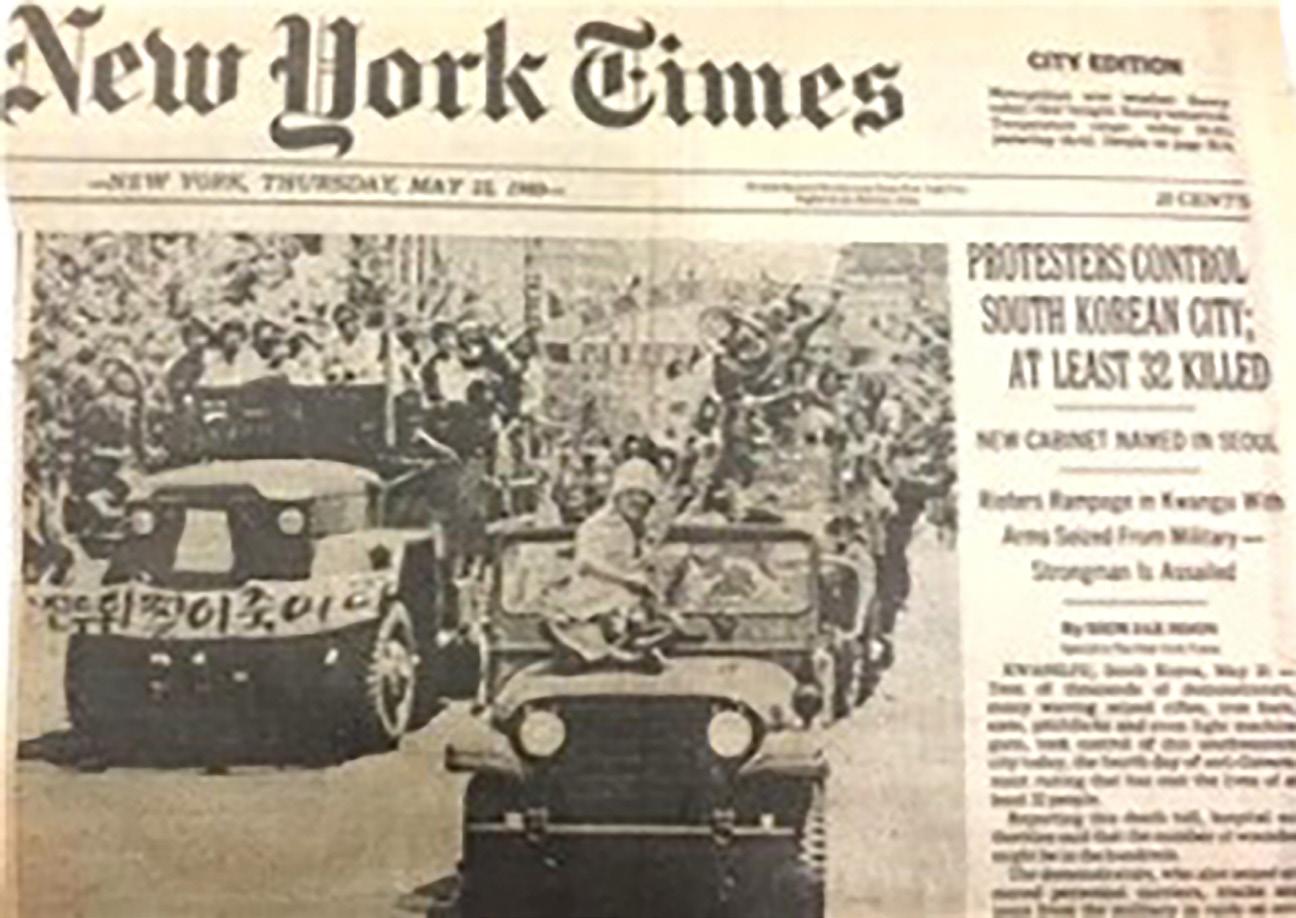
Yet Gwangju was not alone internationally. During research at UCLA’s East Asian Library, I found compelling evidence: While the Korean
government suppressed the story at home, it was being reported swiftly and accurately across the United States, Japan, and Europe.
The international response was swift and substantial. Human rights organizations gathered outside Korean embassies, distributed appeals near the White House, and organized prayer meetings and fundraisers in solidarity. Beginning May 20, 1980 – when a Chicago human rights group first circulated English-language accounts of the uprising – solidarity actions spread across New York, Los Angeles, Japan, and Germany. On May 28, a memorial at Riverside Church in Manhattan drew prominent activists and politicians. By year’s end, international
The New York Times, May 22, 1980. (Courtesy of the May 18 Foundation)
delegations had visited Seoul and Gwangju, documented the atrocities, and submitted reports to Amnesty International, the United Nations, and the U.S. government.
“Gwangju’s civil society and local government must develop programs that respond to these realities with the seriousness they demand.”
Forty-six years later, Gwangju must consider what it owes in return. Repayment cannot take the form of commemoration alone – it requires concrete, sustained action in solidarity with those who suffer today under state violence and repression.
The scale of need is considerable. In Gaza, Iran, and Lebanon, civilians are bearing the costs of armed conflict. In Myanmar, Nepal, Sri Lanka, and Hong Kong, people are being detained or disappeared for exercising democratic rights. Across parts of South Asia, Latin America, and Africa, ethnic minorities, migrants, and women face systematic persecution. Gwangju’s civil
Newsweek, June 2, 1980. (Courtesy of the Seoul Metropolitan Archives)
society and local government must develop programs that respond to these realities with the seriousness they demand.
Gwangju has established a foundation. The World Human Rights Cities Forum has become a recognized platform for international solidarity. The Gwangju Prize for Human Rights Award contributes meaningfully to democratic development abroad. May 18 organizations have issued statements of solidarity with movements in Myanmar, Nepal, Hong Kong, and elsewhere.
However, annual events and public statements are insufficient. What is required now is institutional commitment: an international solidarity fund, a permanent support body, and sustained partnerships with human rights organizations worldwide. These structures are not ends in themselves. They are the means by which the remarkable communal spirit of the Gwangju Uprising is carried forward as living practice rather than historical memory.
The Author Choi Yong-ju studied sociology and previously served as chief investigator for the Truth and Reconciliation Commission for the May 18 Democratization Movement. He is currently researching overseas archival records related to May 18 and has translated works by Jon Elster and Martin Mittelmeier into Korean.
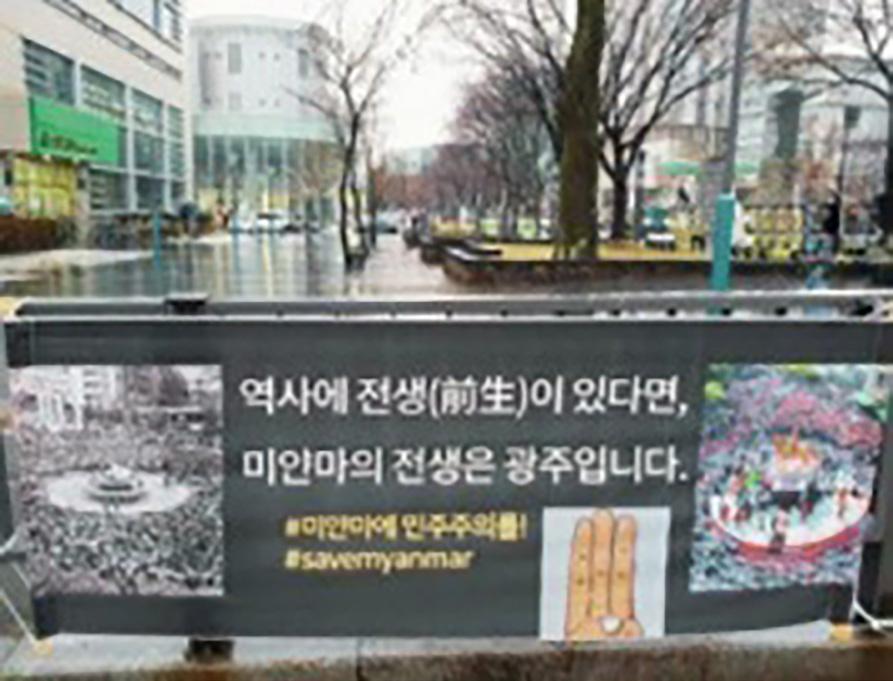
Gwangju–Myanmar Solidarity banner displayed in Gwangju, March 2021. (Courtesy of Gwangju–Myanmar Solidarity)
Healing Through Solidarity
Sylvia Acan Receives Gwangju Prize for Human Rights
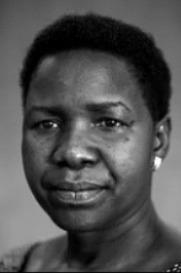
The 2026 Gwangju Prize for Human Rights has been awarded to Sylvia Acan, a courageous human rights activist from Uganda, marking a historic milestone as she becomes the first African laureate in the prize’s twenty-six-year history. Her recognition during the 46th anniversary of the May 18 Democratization Movement bridges the historical sacrifices of Gwangju with contemporary global struggles for dignity and justice. Acan’s journey from a survivor of conflict to a global advocate underscores a profound commitment to the “Gwangju Spirit,” confirming that the fight for human rights is a universal endeavor that transcends geographical boundaries.
Abducted at the age of thirteen by the Lord’s Resistance Army, Acan survived eight years of captivity before reclaiming her freedom and dedicating her life to those ravaged by systemic violence. Since 2000, she has provided essential humanitarian aid to thousands in Northern Uganda and later founded Golden Women Vision in Uganda. Her organization serves as a critical sanctuary for survivors of conflict-related sexual violence, offering the socio-economic tools and psychological support necessary for victims to transform into independent community leaders. By focusing on rehabilitation and agency, Acan has ensured that those once silenced by war are given the resources to lead.
Acan’s influence extends beyond grassroots aid into the realm of systemic legal reform. She has actively petitioned the Ugandan Parliament for victim reparations and provided legal assistance to widows facing forced evictions, ensuring that human rights are protected by law as well as by community action. As a founding member of the International Network of Survivors of ConflictRelated Sexual Violence, she has successfully elevated local struggles to the international stage.
The 2026 Selection Committee praised her for this unwavering solidarity, noting that her life’s work serves as a powerful extension of Gwangju’s legacy of resistance and collective healing.
Ultimately, honoring Sylvia Acan reaffirms Gwangju’s role as a global hub for democratic values and human rights. Her laureateship stands as a testament to the enduring power of the human spirit to overcome trauma and challenge injustice. By recognizing her contributions, the May 18 Memorial Foundation highlights that the pursuit of a more just world is a continuous, shared journey. Acan’s story serves as a beacon of hope, reminding the international community that even the deepest scars of history can be healed through courage, resilience, and an uncompromising dedication to the dignity of all people.
Content Writer
Amy Park is a program officer and content producer for the Asian Legal Resource Center (alrc.or.kr), based in Gwangju. She helps build the organization’s foundation and supports new efforts in human rights advocacy and resource sharing.
The Power of Protest and Persistence
By Lisa Casaus
There are those who say that protest “doesn’t change anything,” but you can thank protest for the eight-hour workday and voting rights. For some, it has won the right to sit in any bus seat or drink from any water fountain, or even to enter a building in a wheelchair. Many of these achievements took years or even decades to accomplish.
My first experience of protest was as a spectator in a foreign land. As a teacher of English in Korean public schools on an E2 visa, I was not legally allowed to protest. And, growing up as a middle-class white kid, I had never “needed” to protest. I had only a vague idea of protest as being something that “overly emotional” people did. Many such privileged people are just as unaware of how important the use of free speech is or how close authoritarian threats to democracy truly are on any given day.
On that day in the fall of 2016 when I experienced this first protest, the main street in downtown Gwangju, a street regularly blocked off for festivals and other events, was filled with people holding candles. They sang, some sat on the cold ground, others on mats and rugs they had brought from home. They were demanding the impeachment of then-president Park Geun Hye for corruption. It was one night of many that formed the Candlelight Revolution (촛불혁명). There had been protests as early at 2015 calling for her resignation, but from October 2016 to March 2017, protesters took to the streets en masse, and succeeded.
In December 2024, after then-president Yoon Suk Yeul declared martial law in response to civil
unrest, mass protests demanded and resulted in his impeachment and removal. I had returned to the U.S. by that time. Our own presidential election in November of that year had led many Americans, including myself, into a gloom of depression leading up to the inauguration in January 2025. But strains of hope popped up in corners online: Look at what South Korea has just accomplished!
However, even with my limited experience, I knew that results from protest could take years. In January of 2023, a little over nine months
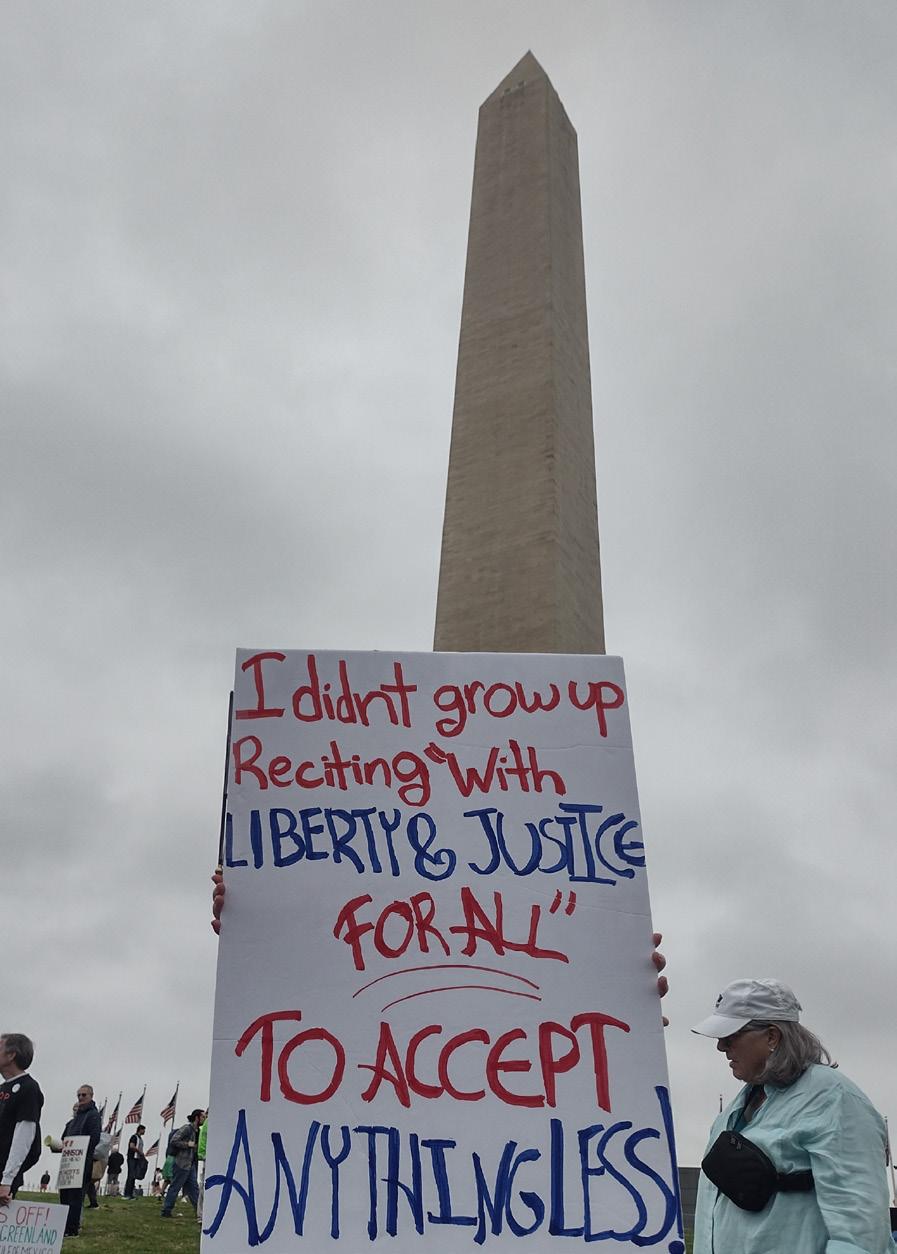
No Kings protest sign in Washington D.C.
after Yoon’s election, I learned from a former co-worker, that she was going up to Seoul (a four-hour bus ride), almost weekly to protest for impeachment. I had seen the big banners on street corners, I remembered other teachers who had boycotted Japanese brands when international tensions were high, but in my sheltered bubble, this was only the second time I had come across a “real-life protester.”
Yoon was impeached 11 days after the event that brought millions of Koreans to the streets, but it took months to remove him from office and sentence him. Rival protests for and against his reinstatement were reported by international news outlets. According to BBC News, as of February 2026, 27 percent of Korean voters still supported Yoon.
Current U.S. polls show only a 34 percent approval rating nationwide of the current U.S. president, even after his unsanctioned attacks on Iran, which have thrown the world economy into turmoil. On top of this is example upon example of explicit corruption.
The American resistance movement has been growing since the presidential inauguration. In January 2025, I joined my first protest as an actual protester, flying 1,600 miles to be in Washington, D.C. There, I met people who had taken buses from New York and Pennsylvania, even an American ESL teacher who had flown in from Germany to attend. It was the Saturday before the inauguration ceremony and the Women’s March had put out a mass call.
While the size of the crowd was nowhere near the size of the 2017 Women’s March, which drew nearly half-a-million protesters to Washington, it was substantial. Several more trips to the nation’s capital in the following months showed me people from all over the country who were willing to come hundreds, if not thousands, of miles to declare that the man in the White House was not fit to be our president.
It was not until a large-scale protest in April 2025 that brought 200,000 people to D.C. and hundreds of local events nationally that legacy media began to report on the protests. The No Kings Movement, with its coalitions of veteran and new grassroots groups, was born out of this momentum.
No Kings Day 1.0 was organized to protest Trump’s proposed birthday celebration, a military-style parade complete with tanks that would cost over $40 million taxpayer dollars. Trump’s birthday coincides with Flag Day (June 14). This date in 2025 was also the 250th anniversary of the U.S. military. The parade suffered underwhelming turnout and reviews, while the United States experienced its largest day of coordinated action in the nation’s history, bringing out a reported 5,000,000 people across 50 states. (Trump’s response from the White House in the following months was to continue to send National Guard troops as “law enforcement,” despite the wishes of state governors.)
No Kings Day 2.0 took place in October 2025, this time given wide-scale media attention ahead of the event. An estimated 7,000,000 people turned out to over 2,300 listed events in 50 states, with some events also held internationally. Legacy media coverage grew as well to report the numbers. (The response from the White House was an AI-generated video of the president in a fighter jet, dumping feces on protesters’ heads!)
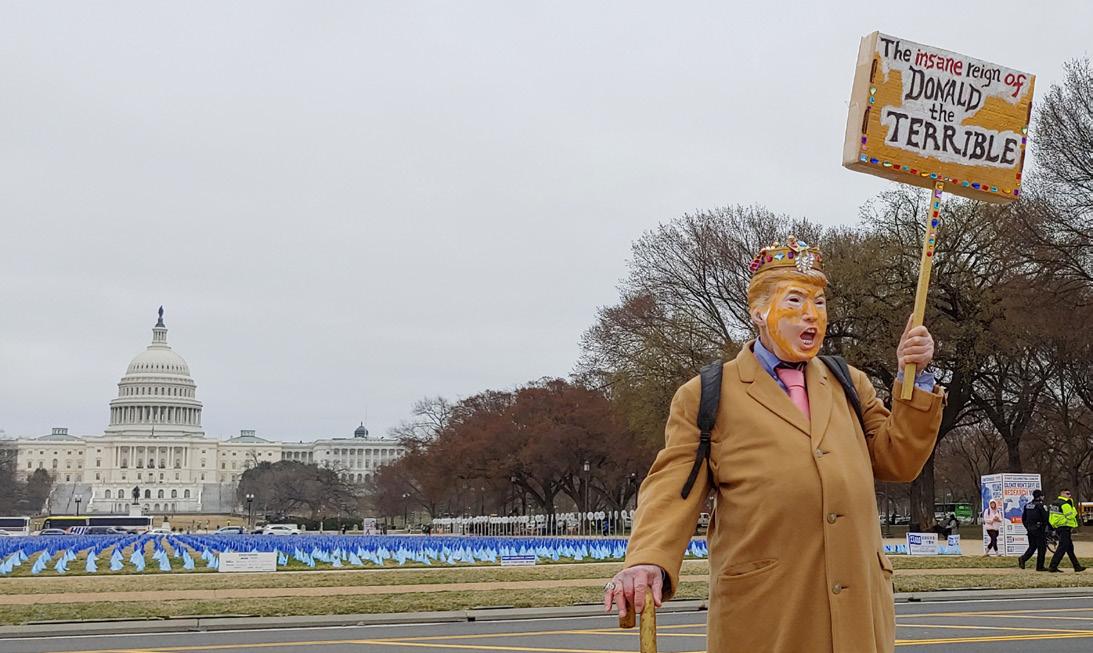
Protestor in Washington D.C.
No Kings Day 3.0, in March 2026, took place just weeks after Trump started a war of choice with Iran. The number of attendees grew larger still, to over 8,000,000 in over 3,000 national and international events. Many protest signs included anti-war themes, as well as messages demanding an end to flagrant corruption, release of the Epstein files, justice for survivors, and calls to abolish ICE (the U.S. Immigration and Customs Enforcement agency).
The flagship event on March 28th was held in Minneapolis, Minnesota, the city that saw January 2026 deaths of Renee Nicole Good and Alex Pretti who were shot by Immigration and Customs Enforcement personnel and Department of Homeland Security personnel, respectively. Over 200,000 people attended the Minneapolis event.
Why do the numbers matter? The No Kings movement is based on the principles of nonviolent direct action and the 3.5 percent rule proposed by political scientist, Erica Chennoweth, PhD, co-author of Why Civil Resistance Works, and author of the essay The Future of Nonviolent Resistance. The research posits that nonviolent, sustained resistance and coalition building is more effective at gaining support than violent resistance, and that if 3.5% of the population can be actively engaged in diverse forms of sustained resistance, they will likely succeed in removing an authoritarian government. For the United States, a nation of over 330 million people, that number is 11.5 million people.
This is not a magic number that, if reached, means all is instantly won, but it is a point of hope for many. It is a goal for which to strive for internationally because authoritarianism is on the rise around the world. Positive change has required constant action by individuals and communities, those who value freedom and humanity over greed, to uphold the claims of democracy and to hold their government accountable. Civil rights; labor rights; voting
rights; women’s, children’s, LGBTQ+, and disability rights have been hard won, fought for by the people who believed that change would come if they refused to give in to tyranny.
The Carnegie Endowment for Internation Peace reports on its global protest tracker that “in the last 12 months, more than 68 countries have seen significant protests,” and that, as of April 2026, there are currently 30 active protests. Just this past May 1, events all over the world rallied on International Workers Day, also celebrated as Labor Day in over 80 countries.
In South Korea, you may have finally enjoyed May 1 as a public holiday after the 2025 legislation, which proposed changing the name and status of the former “Worker’s Day” to include civil servants and teachers starting in 2026. One of the largest challenges was the change in name. An article in the Korea Herald lays out the long history and the controversy surrounding language in the legislation and the negotiations that are still being held. This is only one example of bureaucracy’s slow-turning wheels, but it is also an example of the power of protest and persistence.
Sources
Carnegie Endowment for International Peace. (n.d.). Global protest tracker. https://carnegieendowment.org/ features/global-protest-tracker Chenoweth, E. (2017, February 1). It may only take 3.5% of the population to topple a dictator – with civil resistance. The Guardian. https://www.theguardian .com/commentisfree/2017/feb/01/worried-americandemocracy-study-activist-techniques Lee, S. (2026, April 30). Korea’s Labor Day gets a name change, but who counts as a worker? The Korea Herald. https://www.koreaherald.com/article/10729351
The Author
Lisa Casaus taught in Gwangju public schools from 2016–2023. As an artist, she is processing current events through her work and developing ways to use art as activism and education.
Photographs by the author.
Place Names with Intriguing Revelations
By Park Nahm-Sheik
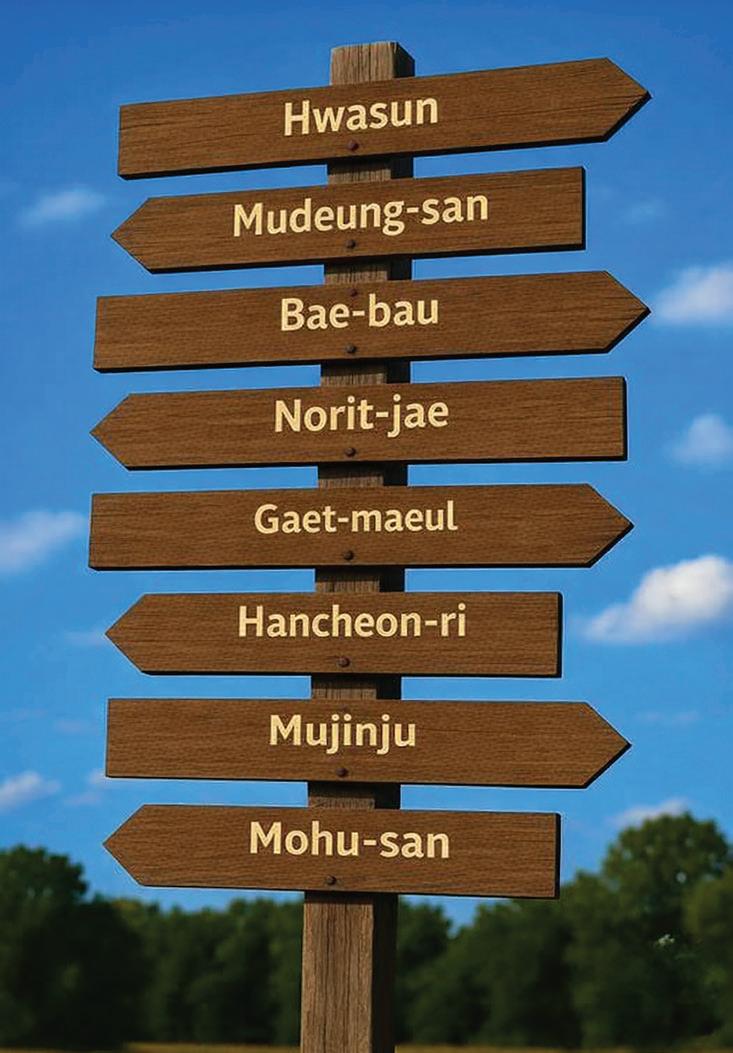
Place names often come with meanings not always apparent on the surface. Take, for example, a village known as Bae-bau (배바우), located on the outskirts of the town of Hwasun, just south of Gwangju. Etymologically, it refers to a dock used to anchor sea-going sailing boats. It just so happened that Bae-bau once harbored a fairly busy traffic of vessels that once crisscrossed the seas surrounding the Korean Peninsula, especially along the southwestern shores.
Approximately ten kilometers due south of Baebau was Gaet-maeul (갯마을; literally, a seaside village), which we often misread as Gae-maeul (개마을; a canine village or village of/for dogs). Also known as Mosan-ri (모산리), Gae(t)-maeul was just a few kilometers from where I was born and raised in the early 1940s. This home village of mine went by the name of Hancheon-ri (한천리), which literally means a village with a cold well. This water source had a reputation of providing the coolest potable water around town.
By the way, the village right next to Hancheon-ri was Cheonggye-dong (청계동). The name of this village comes from the clear brook that flows in front of it. Another village, Geumjeon-ri (금전리) is to the south of Hancheon-ri. Geumjeon-ri apparently had hosted a gold mine until a couple of centuries ago. It was perhaps not coincidental that the three syllables in Geum–jeon–ri refer, respectively, to gold, field, and village.
Additionally, on a gentle hilly slope on the perimeter of Hancheon-ri was a stretch of arable land, known informally as Daek-maeul (댁마을; the village of lords), overgrown with lush bushes well into my teens. The name Daek-
maeul suggests that our ancestors had served as underlings to the owners of the land they were inhabiting (in a servant–master relationship of one sort or another). Clearly visible to this day and age are the remnants of their rundown houses dating back to that remote past. And we are told that the Daek-maeul residents were of Cheongdo Kim clan lineage, in which case they must have hailed from the town of Cheongdo in the province of Gyeongsangbuk-do, which is outside of Jeollanam-do.
Parenthetically, Neorit-jae (너릿재) is by far the best-known mountain pass in this province, Jeollanam-do. As is fairly well known, Neorit-jae is a compound moniker made up of two nouns, that is, neol (널, coffin) and jae (재, mountain pass). It allegedly has to do with the fact that
(GN with Microsoft Copilot)
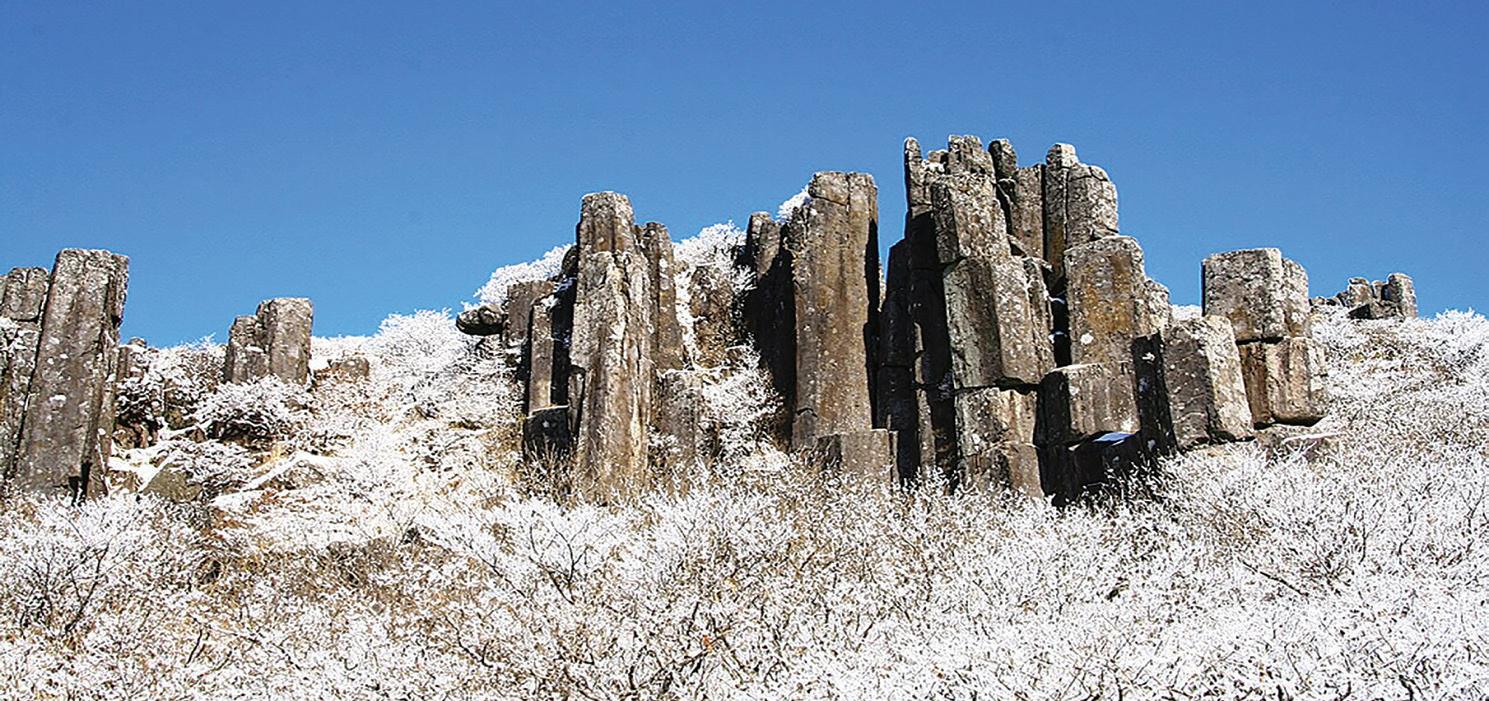
Mudeung-san columnar joints. (Seong Ilhan, [1])
Neorit-jae has traditionally been a popular route for coffin-bearers heading for burial sites on either side of the pass. It may be noted in this connection that the original bi-syllabic neol-jae (널제) has given way to the trisyllabic Neo-rit-jae. Interestingly, what is front and center in the word formation process involved here may not be the number of syllables per se. Although it comprises just two syllables, neol-jae may not be as easy to articulate as is its trisyllabic cousin Neorit-jae. For all practical purposes, the trisyllabic Neorit-jae may actually be more economical phonologically than its bi-syllabic relative.
On the subject of high terrain, Mudeung-san (무등산) is among Gwangju–Jeonnam’s tallest mountains at close to 1,187 meters above sea level, second only to Jiri-san in Gurye, sandwiched on the multi-provincial borders between the Jeolla and Gyeongsang Provinces. The name Mudeung-san itself says as much: Unrivaled and unequaled is what it proclaims loud and clear to the whole province of Jeonnam and the entire city of Gwangju as well. Mujinju (무진주), which happens to be how our ancestors once referred to Gwangju, apparently lays unmistakable claim to the commanding presence of the city in the entire region. By the way, Mudeung-san used to be called Mu-ak/Mujin-ak (무악/무진악) during the Baekje and Silla Periods and as Seoseok-san during the following Koryeo Period.
My hometown of Hwasun nestles in the calm and quiet embrace of this august and auspicious mountain peak. Mudeung-san deserves to stand
and be counted among the most dignified of Korea’s national parks, bearing eloquent witness to the grandeur of Gwangju–Jeonnam on display for all to appreciate. And my nostalgia for Hwasun (with specific reference to Hancheonmyeon, Hancheon-ri) appears to be something I just can’t seem to shake off.
According to folklore, the place name Hwasun (화순) means “harmonious, peaceful, and compliant.” Hwasun certainly is a lovely sounding place name. I am in love with this wondrous town, almost head over heels. I may be under a lasting spell emanating from the beauty of this truly one-of-a-kind town. I may very well be in love with it, unrequited as the love may be.
Before closing, let me say that Mudeung-san isn’t the sole peak that does us folks from Gwangju–Jeonnam proud. We can take just as much pride in such other sky-commanding mountain tops of Hwasun as those proudly displayed by Baekasan, Mohu-san, Cheoneun-san, Manyeon-san, and Yongam-san, which also seem to deserve our attention as well as affection.
The Author
Park Nahm-Sheik is a native of Gwangju. After graduating from Chonnam National University, he went on to receive a master’s degree at the University of Hawaii and a PhD (applied linguistics) at Georgetown University, both in the U.S. Upon completing an illustrious career at Seoul National University, Prof. Park served as president of the International Graduate School of English.
After the pleasant spring season ends in Korea, the hot summer begins – and it is truly the best time to enjoy outdoor activities. I usually prefer planning trips like camping during public holidays, especially when we get two or three consecutive days off. Last year, we were lucky to have a public holiday fall on a Friday, giving us a perfect three-day break. So, we decided to go on a two-day, one-night camping trip.
The first challenge was finding a suitable free camping site. We wanted a peaceful place surrounded by mountains and near a small river. Korea offers many camping options – both free and paid. In free camping areas, you can simply arrive with your belongings and set up your camp, as most basic public facilities are already available. Paid campsites, on the other hand, charge a fee and sometimes provide tents and equipment. There are also glamping and caravan camping sites, but they are usually expensive.
Since we are students, we always try to manage our expenses and prefer free camping sites. However, finding such places in Korea is not always easy. I usually rely on Instagram travel pages, Naver, KakaoMap, and blogs. As I am not very fluent in Korean, I mostly search using English keywords, which makes the process challenging. After some effort, I shortlisted two places: Wonju Munmak Auto Camping Site in Gangwon-do (원주시 문막읍 취병리) and Suju Palbong Campsite in Chungju, Chungcheongbuk-do (수주팔봉야영지). Between these, we choose Suju Palbong for its natural beauty.
The Journey and Setting Up Camp
As always, we started our trip in a friend’s car. Since fewer people joined this time, we all fit comfortably into one vehicle. We made a checklist of essential camping items, including a tent, stove, charcoal, firewood, utensils, food, water, clothing, toiletries, and sleeping bags. We packed what we already had and bought the remaining items from Daiso and a nearby mart.
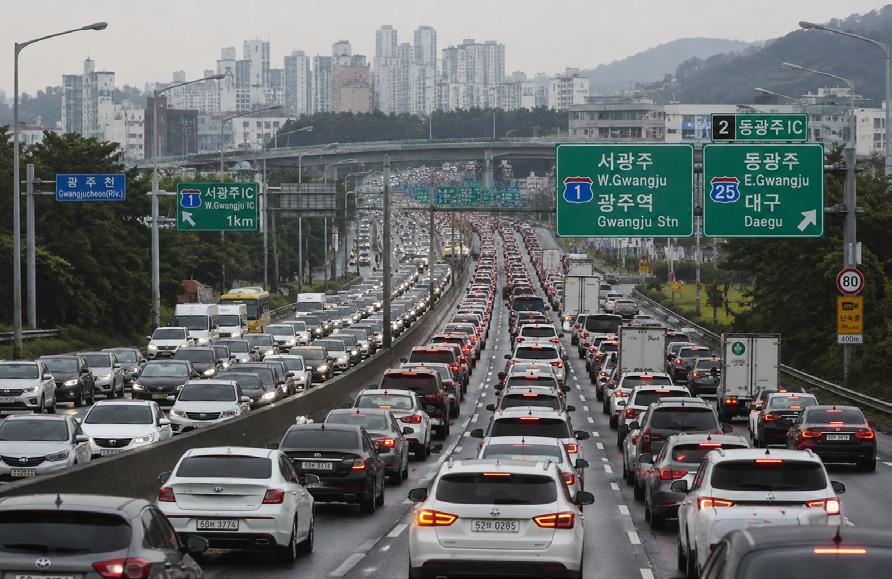
We left Gwangju after breakfast – loaded everything into the car, fastened our seatbelts, and began our journey. The trip started with music, smooth highway driving, and the excitement of leaving the busy city behind.
I have always been fascinated by Korean highways; they pass through calm countryside, small villages, forests, mountains, and even across sea bridges. For me, the journey often feels just as exciting as the destination.
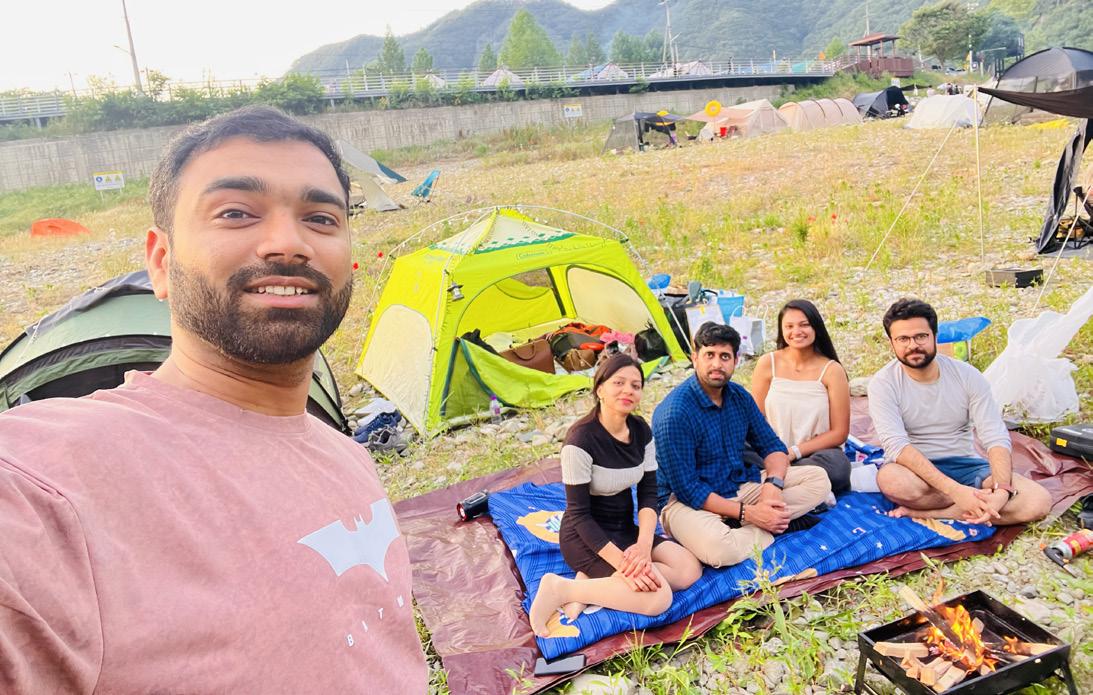
The author (center) with her friends after setting up their camp.
One of the best parts of long drives in Korea is the rest areas. Many are located in beautiful spots where you feel like spending more time just watching people, cars passing by, and families enjoying their day. It’s a unique experience in itself.
Once we reached the location, our first task was to find a good spot for setting up camp. Since it was a holiday, the place was already crowded with campers. Parking was available, but it was on a rocky riverside, which made it quite difficult. At one point, a car wheel got stuck between the stones, but we eventually managed to find a safe parking spot.
While one friend parked the car, others searched for a suitable place to set up camp. We chose a spot close to the river. After carrying our belongings, we prepared the ground by clearing grass and moving large stones to make the surface even. Then, we set up our tents and arranged everything.
Since it was summer, we had plenty of daylight to settle in and enjoy the evening. After setting everything up, we made some Indian tea –our favorite post-arrival ritual. Sitting by the riverside, sipping tea, watching the sunset, feeling the cool breeze, and listening to the flowing water was incredibly peaceful.
Night Experience and Camping Life
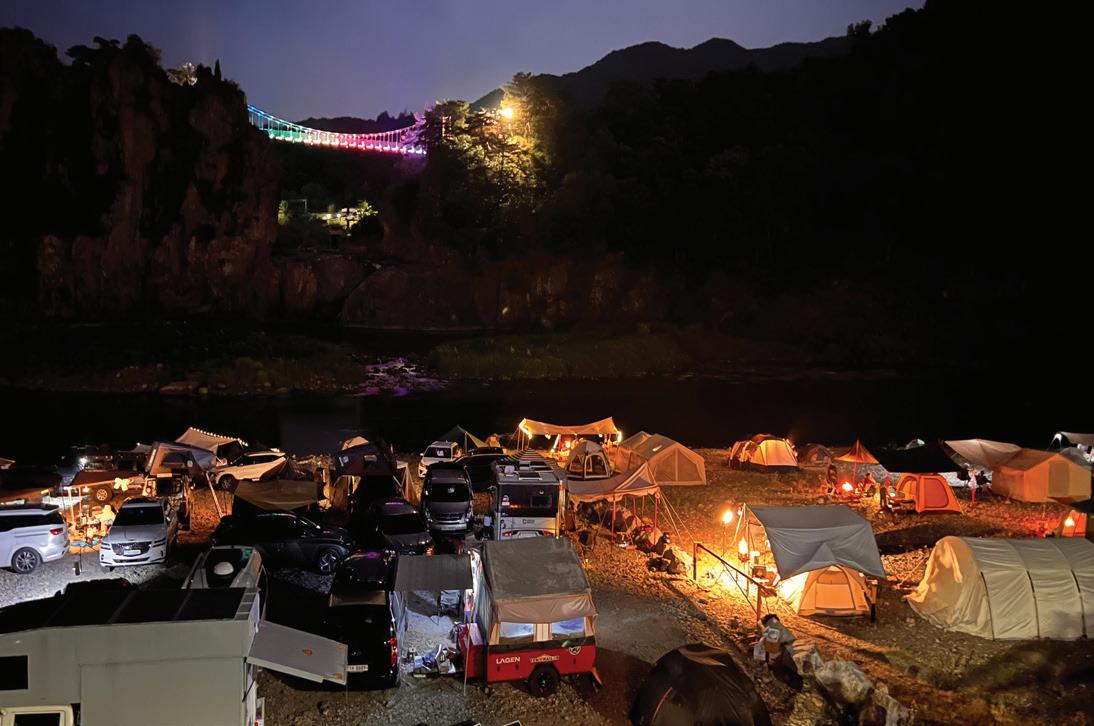
As night fell, we lit the fire for cooking and warmth. We decorated our tents with small lights, creating a cozy and beautiful atmosphere.
It felt like we had built a small home for a short time – a home filled with warmth and friendship.
Camping culture in Korea is fascinating. Many people, especially older couples, bring extensive equipment and create well-organized, comfortable setups with chairs, tables, lightings, and even decorative items. Some tents belong to large groups, some to couples, and others to small families. Watching this made me realize how differently people choose to enjoy life and create meaningful moments.
Although we only had basic equipment, the experience felt quite special. It reminded me that happiness does not depend on luxury but on the people you share moments with. In that simple environment, away from daily routines, life felt different – calmer, slower, and more meaningful.
We began our barbecue with light drinks, preparing food, laughing, and enjoying each other’s company like a family. We stayed up late, talking under the quiet night sky. As the temperature dropped, we wrapped ourselves in our sleeping bags and drifted off to sleep.
Morning, Exploration, and Journey Back
The next morning, we woke up after sunrise. The sunlight peeking through the mountains felt like a gentle invitation to start a new day. Waking up in such a peaceful environment – with no rush, no stress – was incredibly refreshing.
We enjoyed our morning tea and, as the day grew warmer, stepped into the shallow river. We played
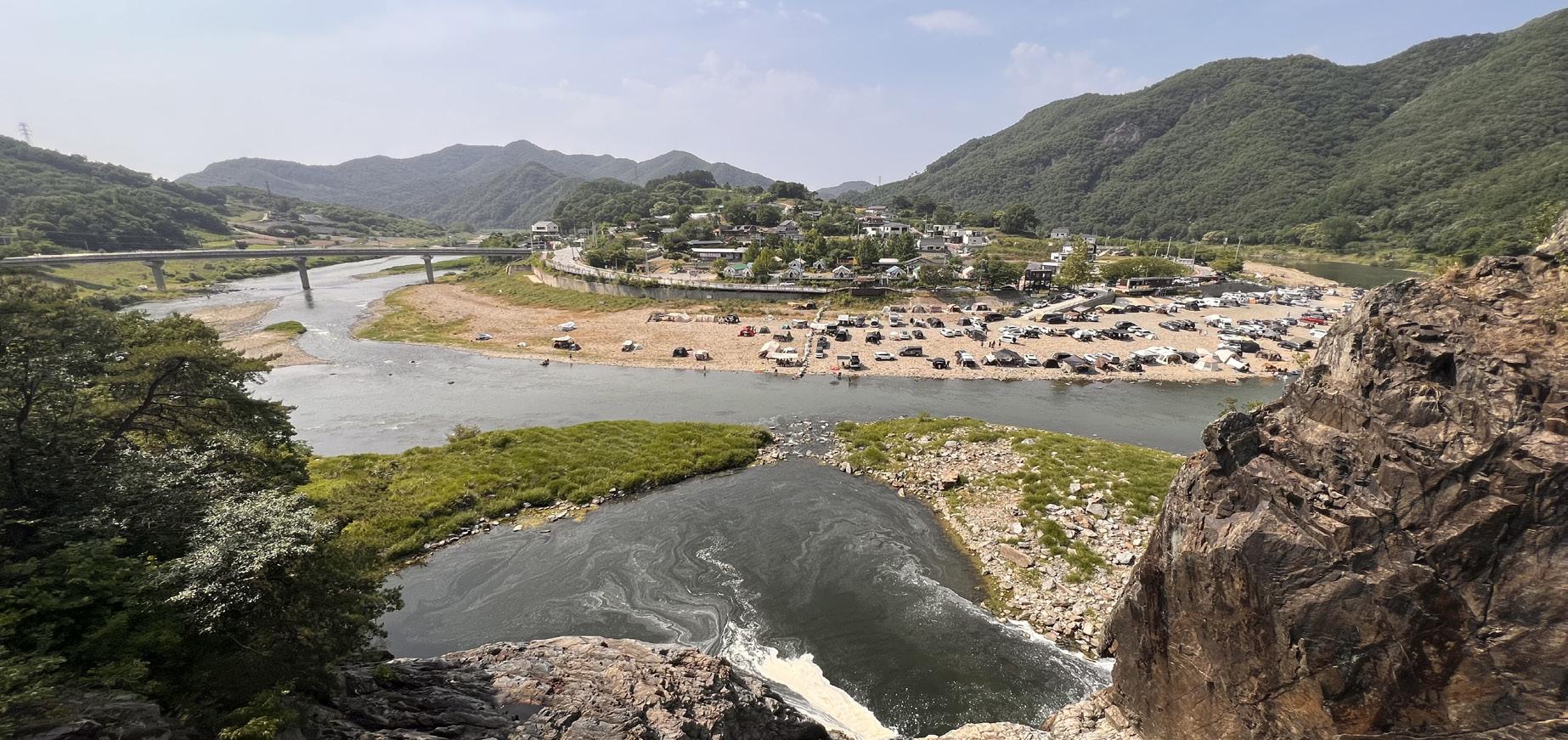
Nature’s perfect curve, filled with life and calm.
Travel & Discovery: Exploring Korea
in the water, walked along the riverbed, and even sat in the river, building small structures with stones. In that moment, we forgot we were adults and simply enjoyed being carefree, like children again.
Across the river, we noticed a walking bridge between the hills and tried to reach it. However, the path was slippery and dangerous, so it had been closed by local authorities. After returning, we had lunch, and began packing up.
We cleaned the area carefully, disposed of our garbage properly, and loaded everything back into the car. Before leaving, we took a few pictures to capture the memories.
Next, we headed toward the Suju Palbong mountain bridge. The sun was quite strong by then, but the view from the bridge was breathtaking. After crossing the slightly shaky suspension bridge, we began hiking. Along the trail, there were several vantage points offering stunning views of the river, the camping area, and the nearby village. Although the hike was long and sometimes a bit challenging, we enjoyed the experience. Eventually, due to the heat and narrow paths, we decided to return when we reached the midpoint.
After coming down, we bought water, as we were quite thirsty. It was finally time to head back home. On the way, we stopped at a small countryside Korean restaurant. The place was peaceful and beautifully located. The staff were very kind and welcoming. They were happy to see foreign visitors and even customized a vegetarian fried rice for me. They also offered us a refreshing summer drink, noticing how tired we were. The food was delicious and reasonably priced, making the stop even more memorable.
After the meal, we continued our journey. At one point, my friend who was driving felt sleepy, so we stopped at a rest area where he took a short nap and we had coffee. Once refreshed, we
resumed our drive and finally reached Gwangju by night. We dropped our friends off one by one, and at last, I was dropped off at home with all my belongings.
Memories That Stay
This camping trip was more than just a short getaway – it was a reminder of the beauty of simple living. Surrounded by nature and good friends, we experienced peace, joy, and connection.
Even with limited resources, the trip felt rich in memories. It taught me that sometimes, all we need is a quiet place, meaningful company, and a little break from routine to truly feel alive.
Note: Basic facilities such as public restrooms and a nearby mart are available at the campsite, but it is recommended that you carry your own personal toiletries.
Neha Bisht is a native of India, pursuing her PhD research at Chonnam National University’s School of Materials Science and Engineering. She loves to meet new people and make new friends. Neha endeavors to contribute to the well-being of society in whatever way she can. Photographs courtesy of the author.
A stunning night view of the campsite, glowing with tents.
The Author
Radiant Connections for Sister-City Youths
Gwangju and Medan Exchange Visits
By Park Yeonju
There is this city, the third largest in Indonesia and the capital of North Sumatra. What is its connection to Gwangju? Since establishing a sister-city relationship in 1997, Gwangju and Medan have maintained a vibrant partnership. They have built a deep and lasting bond through continuous exchanges, where youths visit each other’s cities to experience their respective history and culture.
These sister cities have been long-term partners. Every year, the Gwangju International Center (GIC) selects local youths for the Gwangju Youth International Exchange Camp. The program typically runs for a week in October as Gwangju hosts visiting students from Medan. The following February, a delegation of Gwangju youths travels to Medan for a reciprocal visit.
Gwangju Youth Exchange Camp
Let’s begin our trip by looking back at the visit of the Medan youth delegation to Gwangju last October 23–28. This “camp” went beyond simple cultural exchange by integrating the values of public diplomacy into more in-depth
programming. Most notably, the Medan youths themselves took the lead in designing these public diplomacy activities.
The entire program was crafted and facilitated by the Medan students as a tailored curriculum for their counterparts in Gwangju. Over two days, they hosted two two-hour Indonesian cultural exchange sessions at Unnam Middle School and Yeongcheon Middle School.
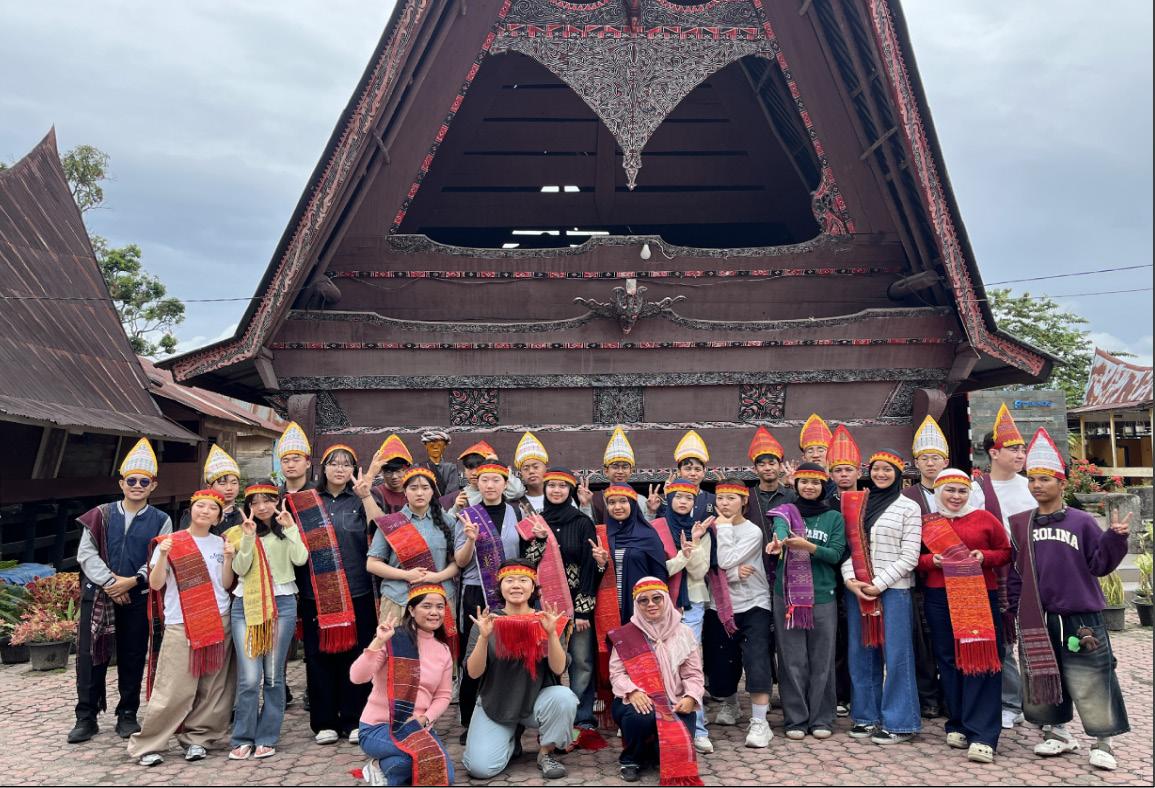
The Medan delegation calmed their nerves and stepped onto the stage. For their first public diplomacy activity, they wore traditional Indonesian batik attire to perform a dance that they had choreographed themselves. This activity was special because the Medan group met more than just the Gwangju exchange participants. They also interacted with middle school students in the city. Some of the Gwangju students were meeting international individuals for the first time while all learned about Gwangju’s sister city Medan. The response was quite enthusiastic and soon they were communicating in their own unique ways.
The Medan delegation used their own presentation slides to explain their city. The youths from both cities then mixed into teams to play various games. They enjoyed diverse activities like the kelereng marble relay and the sarung relay, where they raced while wearing traditional Indonesian outfits. The Gwangju students felt shy at first but soon participated with great passion. Laughter filled the room as they broke through the language barrier. Watching them hold hands and work together was a truly radiant moment for the youths from the sister cities.
Group photo in traditional Indonesian batik.
Everyone felt sad when it was time to say goodbye. They hugged each other and took photos to remember the moment. The Medan group members had been excited to explore the unique landscape of the Korean middle school. This special program brought Indonesia into the classroom. It gave the Medan youths a chance to experience a real Korean school. It was also a meaningful time for the Gwangju participants to learn about their sister city. The diverse activities of this experience helped them grow as global citizens.
The Medan delegates fell in love with Gwangju through various cultural experiences beyond public diplomacy. They strolled through the alleys of Yangnim-dong to enjoy the peaceful atmosphere and wore traditional Korean hanbok attire at the Gwangju hyanggyo (Confucian school). During the weekend, they visited Yeosu with the Gwangju participants to enjoy a night cruise and shared stories like close friends. Since K-pop is globally popular, they walked along the K-pop street in downtown Gwangju and even took a K-pop dance lesson at a local academy.
Most of all their friendship truly shined. The Gwangju and Medan exchange members felt a bit shy at their first meal together but soon became inseparable and played just like any other group of friends. A week passed by in the blink of an eye. Although they knew they would meet again in Medan, they could not stop their tears. On the last day, filled with both laughter and tears, they shared warm hugs and promised to meet again in Medan. About four months remained until the trip to Medan, and all involved waited with excitement for the next chapter of their story.
Gwangju Youths Experience Medan
From February 1 to 9 this year, the story of youths from the two cities unfolded once again, this time in Medan, Indonesia. During their visit, the youth delegation from Gwangju engaged in a variety of meaningful activities. They showcased the charm of Korea and Gwangju through diverse initiatives, including operating a Korean stamp-making booth, delivering presentations about Gwangju, and preparing K-pop dance performances.
The Gwangju delegation gained firsthand insight into the administrative operations of their sister city by visiting Medan City Hall. They also explored historical sites, including a local mosque. By touring the mosque, they were able to deepen their understanding of Islamic culture and religion. The highlight of the exchange program was undoubtedly the homestay experience. Students visited the homes of their assigned partners to share meals and spend their evenings together. While it is often difficult for ordinary travelers to experience the authentic daily life of a local household in another country, the Gwangju youths had the rare opportunity to meet their sister-city friends’ families, sample traditional dishes, and talk into the night, creating unforgettable memories.
This camp was a truly special and shining moment for everyone. Even though the students ranged from middle school to high school, they built deep friendships and became true friends despite age differences. I still remember one Gwangju student happily saying, “We really clicked with each other!” Before the program started, these youths might not have known that simply talking and spending time with youths from a sister city could create such a strong bond. Through this experience, the Gwangju group promoted their city and Korea, while also discovering meaningful friendships that stretch beyond borders. The shining stories of these 12 Gwangju participants from the Gwangju–Medan Youth Exchange Camp will live on in their hearts forever. This autumn as well, the Medan–Gwangju Youth Camps will continue.
The
Author
Park Yeonju is an undergraduate at Chonnam National University, majoring in political science and diplomacy as well as Chinese language and literature. Her third major is international development cooperation studies. She was born and raised in Gwangju and wants to promote the colorfulness of the city that she has been a part of for so long. Also, she wants to deliver various voices of the world. It is her dream to become a true journalist by inheriting the spirit of May 18.
Photograph courtesy of the Gwangju International Center.
Inside the Gwangju News Meet Yousra Feriel Writer on Societal, Political, Current Events
Each month this column features one of our regular writers for the Gwangju News in order for our readers to get to know them better. These windows on the writers are presented in an interview format. — Editor
Gwangju News (GN): Hello, Yousra. Thank you for setting aside time to do this interview, though I know you must have many other things on your to-do list. To start things off, would you tell us a little about yourself before coming to Korea?
Yousra: Hi! I come from Algeria, and after finishing high school, I was not sure what I wanted to study. I decided to go for biology and toxicology because I had always enjoyed learning about science. I completed both my bachelor’s and master’s degrees while also joining different clubs and international organizations. I also hosted a number of Hallyu and K-pop events in my city!
GN: Was that what brought you to Korea? Did Hallyu and K-pop lure you half a world away from your native Algeria?
Yousra: After working for a while in my field of study, I realized it was not the right fit for me, so I decided to switch my major. I had always been a big admirer of Korean culture and media, ever since I was 15, so I decided to apply for the Global Korea Scholarship to pursue a master’s in media communication. Luckily, I was accepted, and I got to live out a long-held dream of mine while studying, living, and even working in Korea!
GN: What did you do during your time in Gwangju and afterwards?
Yousra: Gwangju is my Korean hometown, and I absolutely loved the time I spent in the city. I
always look back on my memories there fondly. While doing my Korean language training at Chonnam National University, I built friendships that have lasted until today. I was also active with the Gwangju International Center, as well as the Gwangju News, and I even hosted a small radio show on a local Gwangju radio station! I later moved to Gangwon-do to pursue my master’s program. Since graduating, I have done a few internships in different locations before moving to Seoul to take up a position there.
GN: How, and why, did you get involved in writing for the Gwangju News?
Yousra: I loved to write when I was in high school, but I never thought I could pursue it because I
did not believe I had any talent for writing. So, I stopped writing during my university days. However, after moving to Korea, the desire to write returned. I looked for outlets that would be open to inexperienced writers, and the Gwangju News welcomed me with open arms, for which I am still grateful today. I got to experiment with different topics and writing styles, and hopefully, I have improved since my first article in 2022.
GN: Yes, it’s been about four years since you began writing for the Gwangju News, and in that time, you have penned about two dozen articles for us. What are your favorite topics to write about?
Yousra: I enjoyed experimenting with different topics, but my favorites to write about are sociopolitics and culture. I think my favorite piece from last year would be about the local Roses and Bread bakery and community space in Gwangju. I really enjoy sharing stories that carry a message or a deeper meaning.
GN: What do you see Yousra doing, say, five years from now? And where might she be doing it?
Yousra: Good question! I ask myself this every day nowadays. Perhaps she is writing her first book. Perhaps she is working for a news outlet, reporting on local communities. Or she might
even be running a café. The opportunities are endless, and I just hope she has no regrets.
GN: That’s a broad array of interests. What might be on your bucket list?
Yousra: As of now, the number one thing on my bucket list is living on Jeju Island for a month! This wish kind of snuck up on me last year when I was feeling burnt out from work, and it has stayed with me ever since.
GN: Has living in Korea changed the way you see yourself or your identity?
Yousra: Living in Korea has broadened the concept of identity for me. Instead of being a fixed set of characteristics or attributes, I came to see identity as something that’s ever-changing and constantly transforming through the challenges life throws at us, the environments we live in, and the decisions we make. I definitely feel that I have grown up more in Korea, but I also learned to leave space for experimentation in my life instead of placing myself in a box. Of course, there is always a constant tug between doing what is expected and more practical versus doing what one’s heart entails, but this process in itself has been a great learning experience.
GN: What kind of stories might you hope to focus on telling more of in the future?
Yousra: In the future, I want to tell the stories of those fighting for change every day. Communities that stick together, artists who create with purpose, politicians who hold themselves and their colleagues accountable, and individuals with inspiring stories. I believe local and regional stories deserve just as much attention as breaking news, because they reflect the everyday realities that often go unseen.
GN: Well said. I hope you will be able to write in all of these areas. Thank you, Yousra, for allowing our readers to get to know you better!
Interviewed by David
Shaffer
Photographs courtesy of Yousra Feriel Drioua.
From Hagwon to AI Tutor
How AI is Reshaping Education in Korea and Beyond
By Murdock O'Mooney
AI is reshaping the world of education. Students in Korea are increasingly turning to AI tutors, as they offer a cost-effective alternative to the traditional hagwon, with a 2025 study finding that 94 percent of Korean students use generative AI, and 80 percent report using it for academic purposes. While AI is convenient and undoubtably cheaper, educators express concern about its unethical use and effect on academic integrity, as well as about students losing the ability to think for themselves. As an educator myself, this is my greatest concern.
It’s no secret that hagwons, those ubiquitous private after-school academies, employ most of the foreign teachers in Korea and are the backbone of the $20 billion private education sector. There are also 80,000 hagwons in the country. That’s about one for every 645 people. However, hagwons are expensive. The average family spends around 600,000 won per month in hagwon fees, and tuition has increased more than 60 percent over the past decade.
Beyond this, three-quarters of all students in Korea attend at least one hagwon every day,
making them arguably as vital to the education of students as public schools! And yet, wages in South Korea have stagnated, making it difficult for parents to afford hagwon tuition. AI tutoring platforms such as Riid, Mathpresso (Qanta), and Elice are far cheaper alternatives and use adaptive learning algorithms, that, they claim, are more effective in preparing students for the university entrance exam, or suneung.
In early 2026, FastCampus became the first private education provider in Korea to adopt OpenAI Edu. The company claims these new tools will handle the monotonous rote instruction of core subjects such as math, science, and English, while human teachers will be rebranded as learning coaches, managing students’ emotional wellbeing, motivation, and engagement. While all this sounds great, surely the number of hagwon teachers will decrease with the proliferation of AI tools such as FastCampus.
And yet, the public schools in Korea aren’t so convinced that AI is the best choice. They recently revoked a nation-wide implementation of AI textbooks, fueled by public outcry and a petition that garnered 56,000 signatures in 2024. Subsequently, lawmakers designated AI books as “supplementary materials” instead of “textbooks.” The use of AI textbooks is now up to individual schools, and so far, implementation varies greatly depending on the region. Daegu for example, has adopted AI textbooks in 98 percent of their schools, while cities such as Gwangju, only use them in 12 percent of their schools.
The United States uses Google Chromebooks, which often have built-in AI features powered by
(Van Tay Media via Unsplash)
Google’s Gemini, in 93 percent of public schools. Other leading AI tutors include ChatGPT, and Khan Academy’s Khanmigo, which has been adopted by 570 school districts in the US and is used by over 100,000 American students and teachers. These platforms claim that AI isn’t about reinventing education but equipping it with modern AI tools to make it more effective.
Alpha School is another popular AI-driven school that claims students learn two to three times faster than traditional schools, only requiring two hours a day on academic subjects. The rest of the day is focused on projects, group work, music, and sports. Recent standardized testing results place many Alpha Schools (not all) among the top two percent of all high schools in the United States.
While Korean schools don’t use Chromebooks (or an equivalent) en masse yet, according to Stanford University’s Human-Centered Artificial Intelligence Institute (HAI), South Korea is ranked fourth globally in AI vibrancy only trailing India, China, and the United States. Beyond this, the AI education market in Korea is projected to reach $604 million by 2030, with an incredible compound annual growth rate of over 33 percent. Considering all this, it is projected that Korean students will become more reliant on AI tutors in the coming years. The good news is that Korea has the infrastructure in place to support this transition.
Korea’s impressive AI vibrancy ranking is partly due to the National Sovereign AI Initiative, which promotes domestic AI dominance from players such as LG, Samsung, and SK Telecom, while reducing dependence on foreign AI models. That’s to say, Korea is positioning itself as a global AI powerhouse, and as such, should be at the forefront of the AI revolution in education as well.
Personally, I have found it useful to address AI directly with my students, teaching a lesson at the beginning of the school year discussing ethical and unethical uses of AI in the academic setting.
I also remind them that to become good thinkers, they must think, and that no AI can do that for them. And as Plato said, “Thinking is the talking of the soul with itself.”
Further to this end, the article “How AI Helps Students Deepen Their Writing (Yes, Really)” in Education Week, highlights four rules for the use of AI in the ELA/ESL classroom. Rule 1 is to write without AI first. Rule 2 is to struggle on your own before turning to AI, Rule 3 is to prompt the bot (be specific), and Rule 4 is to question your AI results.
There’s no denying that AI is changing education in a big way. Will this mean the death of the hagwon? Probably not. Will the human teacher be a thing of the past? I certainly hope not. But we must pay attention and consider the possibilities of AI and the future of education, lest we get blindsided. And as the great education reformer John Dewey once said, “If we teach today as we taught yesterday, we rob our children of tomorrow.”
Sources
Almirall, E., & Nunez, A., SJ. (2025, July 14). AI and the disruption of higher education. Escade Business and Law School. https://dobetter.esade.edu/en/AIdisruption-education
Hanna, M. (2026, March 15). South Korea slows down AI education: Why the sudden shift? Friedrich Naumann Foundation. https://www.freiheit.org/ north-and-south-korea/south-korea-slows-down -ai-education
Kim, J. (n.d.). South Korea: Korean education technology and the wintermute model. Envisioning. https://www. envisioning.com/research/wintermute/south-korea __korean-education-technology
Smith, J. (2025, June 12). Opinion: How AI helps our students deepen their writing (Yes, really). Education Week. https://www.edweek.org/technology/opinionhow-ai-helps-our-students-deepen-their-writingyes-really/2025/06
The
Author
Murdock O’Mooney is an educator and writer based in Albuquerque, New Mexico. He promotes the ethical use of AI with his students and is curious to see the lasting impact of AI in education, and other fields, in the coming years.
From Drills to Voice Content Creation with Young Learners in Korea
By Maria Lisak
In many Korean classrooms, English learning for young students remains closely tied to repetition, accuracy, and test preparation. These approaches serve important purposes, but they can also leave limited space for something equally central to language: voice. When students are primarily asked to repeat and perform correctness, they are rarely positioned as authors of meaning.
In The Dialogic Imagination, Mikhail Bakhtin reminds us that language is not a neutral system to be mastered but a social act shaped by relationships, histories, and the presence of others. Even the simplest utterance carries traces of lived experience and intention. Voice does not come after proficiency. It develops through use, in context, and in relation to others.
This lens brings into focus a quieter assumption shaping many classrooms. Young children are often treated as if they do not yet have meaningful lives to express or as if their role is to reproduce the voices of adults. In highly
structured environments, this becomes constant monitoring for correctness, where speaking is valued primarily as accurate production. The classroom becomes a site of performance rather than expression. Yet children are already observers and storytellers. They notice family dynamics, social expectations, unfairness, humor, and change. When language learning is reduced to repetition and right answers, we narrow the conditions under which their voices can emerge.
The challenge, of course, is practical. Classes are large, levels are mixed, and assessment pressures are real. One way forward is to design tightly structured tasks that still allow for personal meaning. A simple frame such as “This is my ___” or “I feel ___ when ___” can anchor the activity while leaving room for variation. In the same classroom, one student may write a full sentence while another labels a drawing with a single word. Both are participating meaningfully. Assessment can reflect this range by focusing not only on accuracy but also on completion, clarity, and effort. A short checklist is often enough.
(Yi Li via Pexels)
Did the student finish the task? Is the message understandable? Is there an attempt to make it their own? These small shifts make it possible to work within large, mixed-level classes without losing structure.
In practice, this can be brief and easily folded into an existing lesson. A teacher gives the prompt “I feel ___ when ___.” One student writes, “I feel happy when play soccer.” Another writes, “I feel tired when academy.” A third draws a picture and labels it only “happy.” The language is partial, but the meanings are clear. In a few minutes, the classroom shifts from repeating sentences to sharing small pieces of lived experience.
Parent expectations require a different kind of translation. Many parents are not opposed to creativity, but they are concerned with progress. When content-based activities are framed as building speaking confidence, vocabulary range, and the ability to form sentences independently, they become easier to justify. A sentence like “My grandmother wakes up early” may look basic, but it represents a shift from repetition to authorship.
Within these conditions, content creation does not need to be elaborate. It can begin with small, repeatable classroom practices that connect to students’ lives. Students can draw and label everyday social behaviors they observe, such as greeting elders or sharing food, using simple English to describe what is happening. They can compare family pasts and imagined futures through short sentences or picture-based interviews. They can create then-and-now statements that connect stories from the past to present-day life. They can express feelings about tests, friendships, or daily routines using a limited set of words supported by visuals. They can describe places in their neighborhood, even with basic phrases, turning familiar environments into meaningful content. They can track small actions, such as saving electricity, and report them in simple sentences. They can also retell familiar stories and change an ending or character, adding their own perspective to something already known.
None of these activities requires abandoning the textbook. They can be inserted into existing lessons as short extensions or closing tasks. What changes is not the curriculum but the role of the student within it.
For teachers working across linguistic and cultural contexts, this shift also reshapes classroom relationships. Students are not only learners of English but carriers of family histories, cultural practices, and local knowledge. When these are invited into the classroom, language becomes a medium for connection rather than only a target for correction.
These are small shifts, but they accumulate. Over time, students begin to expect that their ideas matter and that English is something they can use, not just something they are evaluated on. When students describe their neighborhood, reimagine a story, or speak about their family, they are doing more than practicing language. They are using English to say something that is, however simple, their own. And that is content creation that captures a moment in time, where a student’s voice takes shape and develops through use, in context, and in relation to others.
The Author
Maria Lisak is an English educator based in Gwangju, South Korea, where she has lived and worked for over 30 years. She teaches in the Department of Administrative Welfare at Chosun University and currently serves as president of the Gwangju-Jeonnam Chapter of KOTESOL. She is also a longtime supporter of the Gwangju International Center. Dr. Lisak’s recent work explores care, silence, and belonging in language classrooms, with attention to trauma, environmental connection, and the evolving relationship between learners and AI.
Korea Is on Fire, and the Records Prove It
By Siddhant K.
How a peninsula that kept weather logs for over a century is shattering them one by one.
Imagine keeping a daily weather diary for your entire life, from the moment you were born until today. Every summer heat, every cool autumn breeze, every winter freeze, all recorded faithfully. Now imagine that the last couple of years in that diary are the most alarming pages you have ever written. That, in essence, is the story South Korea’s meteorologists found themselves telling after 2024.
South Korea has been keeping official temperature records since 1907, more than 117 years of data. That long history is exactly what makes the recent numbers so striking. In 2024, the country did not just have a hot summer. It broke nearly every significant heat record in the books, all at once, in a single year.
“Korea is warming roughly twice as fast as the world as a whole.”
The Numbers Behind the Heat
According to the Korea Meteorological Administration (KMA), the national average temperature in 2024 was 14.5°C. That might not sound alarming on its own, but consider this: The long-term average for previous years was around 12.5°C, meaning 2024 ran 2°C hotter
than the historical norm. For climate scientists, a gap of 2°C is not a minor variation. It is a loud, unmistakable signal.
What made 2024 especially extraordinary was the back-to-back nature of the record-breaking. The year before, 2023, had set the record with an average of 13.7°C. Then 2024 came along and smashed even that. Two consecutive recordhottest years: It is the kind of sequence that makes climate scientists reach for words like “unprecedented.”
Key heat statistics for South Korea’s notable hot years vs. historical averages. Source: Korea Meteorological Administration (KMA).
Nights That Won’t Cool Down
Beyond just daytime highs, the nights themselves have been changing worryingly. Meteorologists use a term “tropical nights,” evenings where the temperature never drops below 25°C between 6
p.m. and 9 a.m. the following morning. Think of it as a night too hot to sleep comfortably, even with the windows open.
In 2024, South Korea recorded an average of 24.5 tropical nights, nearly 3.7 times more than the historical average. Seoul experienced 34 straight tropical nights. The island of Jeju, in the country’s south, endured an almost unimaginable 47 consecutive tropical nights starting from mid-July. That means for nearly seven weeks, the temperature on Jeju never truly fell to a comfortable level after sunset.
These are not just inconveniences. Medical experts warn that when nights stay hot, the human body never fully recovers from the day’s heat stress. For elderly people, young children, and anyone with a heart or lung condition, prolonged tropical nights can be genuinely dangerous.
A
Century of Slow Creep, Then a Sprint
Korea’s heat problem is not entirely new. Over the past 100 years, the peninsula’s average temperature has risen by approximately 1.5°C. That is already higher than the global average increase of around 0.74°C over the same period, meaning Korea has been warming roughly twice as fast as the world as a whole.
For most of that century, the change was gradual. People adapted, largely without noticing. Summers got slightly longer; winters got slightly shorter. Cherry blossoms began blooming a few days earlier each decade. The heat was creeping up but slowly enough that it felt normal.
Then, in the last decade or so, the pace accelerated. The three hottest summers on record, 1994, 2018, and 2024, each broke the record for the one before it. The all-time single-day temperature record for the entire Korean Peninsula was set on August 1, 2018, when the town of Hongcheon in Gangwon Province hit 41°C (nearly 106°F). On that same day, Seoul itself reached 39.6°C, breaking its own record of 38.4°C that had stood since 1994.
Why Is This Happening?
Climate scientists point to several interlocking causes. The most fundamental is the global buildup of greenhouse gases, carbon dioxide and methane released by burning fossil fuels, which trap heat in the atmosphere worldwide. But local factors in and around Korea are amplifying the global trend.
The sea surface temperatures around the Korean Peninsula have been rising dramatically. In 2024,
the average sea surface temperature was 18.6°C – 1.3°C above the 10-year average. In September, ocean temperatures hit 27.4°C, a full 3.2°C above normal. Warm seas pump extra moisture and heat into the air, creating conditions that allow heat waves to linger far longer than they otherwise would.
Meteorologists also note that large atmospheric pressure systems, the Tibetan High and the North Pacific High, have been combining in new ways,
essentially “locking” hot air over the peninsula for extended periods. It is a pattern seen in 1994, 2018, and 2024. Each time it happens, the results are more severe than the last.
What It Means for Everyday Life
The effects are not just about discomfort. In 2024, prolonged extreme heat damaged up to 3,477 hectares of farmland and 17,732 hectares of rice paddies across the country, a blow to farmers and food supplies alike. South Korea’s agriculture,
(GN with OpenAI ChatGPT)
which is already under pressure from an ageing rural workforce, is increasingly at the mercy of weather extremes.
“For climate scientists, a gap of 2°C is not a minor variation. It is a loud, unmistakable signal.”
For city dwellers, the heat concentrates in urban neighborhoods where concrete and asphalt absorb and re-radiate warmth, a phenomenon known as the “urban heat island” effect. In some parts of Seoul on the hottest days of 2024, all of the capital was simultaneously under a heat wave warning, something that had not happened so late in the season since the heat warning system was introduced in 2008.
Public health concerns are mounting, too. Research published in scientific journals projects
that if current trends continue, heat-related deaths in South Korea’s major cities could reach between 500 and 2,320 additional deaths per year by the latter half of this century, depending on how aggressively the world addresses climate change in the decades ahead.
What the Future Holds
The KMA’s own long-term analysis, tracking records from 1973 to 2024, shows a clear and accelerating trend: Heat wave days are increasing, cold wave days are decreasing, and the extreme events at either end of the thermometer are becoming more extreme. If global greenhouse gas emissions continue at their current pace, scientists warn that the kinds of summers Korea experienced in 2018 and 2024 could become routine rather than exceptional.
Sea levels along South Korea’s coastline have already risen about 10 centimeters over the past 40 years, at an average rate of 2.4 millimeters per year. Coastal cities and low-lying agricultural areas face a growing risk from flooding, especially when intense summer rainfall, which is also
increasing, coincides with higher sea levels and storm surges.
The World Meteorological Organisation, in its global review of 2024, specifically flagged South Korea as having experienced its hottest summer on record. Korea’s heat story, in other words, is not invisible to the international scientific community. It is being closely watched.
Sources
Byers, E., Malessane, H., Gasparini, P., Rubinyi, S., Tye, M., Satoh, Y., Kahil, T., Tang, T., Burek, P., Gronlund, C. J., Burrows, M., & Izquierdo, L. (2021). G20 climate risk atlas: Impacts, vulnerabilities, and risks – Republic of Korea. International Institute for Applied Systems Analysis. https://www. g20climaterisks.org/republic-of-korea/
Choi, G., & Kwon, W. T. (2020). Changing human-sensible temperature in Korea under a warmer monsoon climate over the last 100 years. International Journal of Biometeorology, 64, 1287–1303. https://doi.org/10.1007/s00484-020-01862-8
Cho, H. (2025, January 9). 2024 was S. Korea’s hottest year on record: KMA. The Korea Herald. https://www.koreaherald .com/article/10386717
Cho, H. (2025, April 1). 2024 recorded as South Korea’s hottest year in half-century. The Korea Herald. https://www.koreaherald .com/article/10455476
Climate change in South Korea. (2025, December 5). In Wikipedia https://en.wikipedia.org/wiki/Climate_change_in_South _Korea
Climate Reality Project. (2023, August 14). How the climate crisis is impacting South Korea. Blog. https://www.climatereality
Erdman, J. (2018, August 2). Hottest day in Korean history. Weather Underground. https://www.wunderground.com/cat6/HottestDay-Korean-History
Korea Meteorological Administration. (2025). Annual climate report 2024. Republic of Korea Ministry of Science and ICT. https://www.kma.go.kr
Lee, J. (2025, July 31). Is South Korea on track for its hottest summer yet? The Korea Herald. https://www.koreaherald.com/ article/10543222
Lee, W., Bell, M. L., Gasparrini, A., Armstrong, B. G., Sera, F., Hwang, S., & Hong, Y. C. (2014). The impact of climate change on heat-related mortality in six major cities, South Korea, under representative concentration pathways (RCPs). Frontiers in Environmental Science, 2, Article 3. https://doi .org/10.3389/fenvs.2014.00003
National Institute of Environmental Research, Ministry of Environment, Korea. (2010). Climate change in Korea: Observations and projections. Ministry of Environment.
World Meteorological Organization. (2025). Significant weather and climate events 2024. https://wmo.int
Yoon, M. (2025, July 31). Seoul hit with longest nighttime heat wave ever for July. The Korea Herald. https://www.koreaherald.com/ article/10543952
The Author
Siddhant Kumar is a geochemical oceanographer and researcher at TMBL at the Gwangju Institute of Science and Technology (GIST). His work focuses on marine minerals, sediment chemistry, and paleoenvironmental change. He is passionate about communicating ocean science to broader communities in Korea.
Seoul skyline imagined under future extreme heat and temperature. (GN with xAI Grok)
Electricity by the People, for the People, and of the People
A Solar Power Coop in Gwangju Shows the Way
By Chung Hyunhwa
The price of oil has gone up with shocking quickness due to the U.S.–Iran war, and the world is under the pressure of uncertainty and inflation. There is usually something positive in anything bad, I try to believe, and what is positive about the Strait of Hormuz blockade by Iran is that it forces us to think about energy sources other than petroleum and natural gas, which need to decline anyway. Alternative plastic is also receiving more attention because of the supply shortage. More people seem interested in purchasing electric cars. People are talking more about solar panels and heat-pumps.
At the moment, in the public sector, private auto driving days are restricted to save energy. Since Korea’s economy heavily depends on imports, it shows how critical this situation is. The war is calling for a “transition.” Fortunately, the Korean government recently announced a comprehensive plan of rapid energy transitioning. It includes adding 100GW of renewable energy by 2030 and increasing electric and hydrogen vehicles to 40% of newly registered vehicles by 2035 or earlier. Considering all of this, it is quite timely to introduce a group of Gwangju citizens who foresaw the need and acted to achieve energy transitioning and independence far before the current crisis. This group is the Bitgoeul (빛고을, a reference to Gwangju) Citizens’ Solar Generation Social Coop.
The coop was founded in 2020 by five energy committee members in one corner of the Gwangju-Jeonnam Green Union, which is a group
of citizens who truly care about the environment. Initially, they meant to start a “virtual power plant” project, which was supposed to improve the efficiency of the power supply by managing various small-scale power generation facilities. However, they found that it was too early at that time because of systemic unreadiness, so they turned their direction toward building actual small-scale solar power plants first. They searched for possible locations, and the first solar power plant they installed was on the rooftop of an apartment complex in Nongseong-dong, with a power generation capability was 274kW. They obtained funding from Gwangju citizens and also got financial support from the city, completing construction in 2021 as planned.
Since then, the coop has built 11 power plants, using dead spaces such as rooftops and parking lots, mostly owned by public entities. The generation capacity of the power plants they have built so far totals about 3.7MW. One nuclear
(GN with Google NotebookLM)
reactor generates about 1GW or 1,000MW. They may not be comparable in scale, but what is important is that the coop has shown that we can choose to supply genuinely green energy that does not leave any toxic or dangerous waste by utilizing unused and neglected spaces. Compared to building a nuclear power plant, it takes far less time, too.
“The generation capacity of the power plants they have built so far totals about 3.7MW.”
At the beginning of 2026, I finally had a chance to participate in their fundraising for another solar power plant. It was an opportunity I had long awaited. I have always wished to have my own solar energy generation system to cover my own power consumption needs ever since I became aware of the carbon net-zero goal. When I heard the news about the fundraising, I realized that this was another way of contributing to green energy production. Wiring money was a lot easier than installing solar panels on my rooftop. Considering that 70 percent of residents live in apartment complexes in Korea and cannot install solar panels as they may wish, participating through such fundraisers is a simple solution.
Technically speaking, the coop borrows money from its supporters to build the power plants, and they can get their money back with modest interest after the contracted period. The coop, using part of the profit from the power plants, acts as an educational body for the people to enlighten and empower them so that they can lead the energy transition initiative in their area. The coop also speaks through media as an opinion leader and gets involved in various community solidarity activities.
The city government, which plays a role in these projects by supporting part of the needed fund,
earns RECs (renewable energy certificates) from generating solar energy. The RECs are sold on the spot market to become city income, creating a quite sustainable cycle. In 2026, the city set a budget of over 10 billion won to pursue “energy decentralization.” This budget will be used for supporting various energy transitioning projects. While the citizens’ solar power plant projects will continue, there is a plan for supporting residential home solar panel installation as well. Also, the city is running 15 energy transitioning neighborhood centers that educate the citizens about the climate crisis and help them plan and carry out energy transitioning in their own locales.
Ironically, this Middle East war triggered the general public’s thoughts on how to reduce fossil energy use and go forward toward more sustainable lifestyles (although it is quite regrettable that such massive carbon emissions are being made during the war from the destruction caused by bombing and fires). People seem to start looking for true solutions only when faced with no alternative options. In a democracy, it seems to take longer to reach the goal of net-zero carbon, while things need to change rapidly. That is why Bitgoeul Solar Coop’s unceasing, self-motivated actions that are involving more and more citizens are so valuable. They are certainly providing a good example of a democratic, bottom-up solution rather than having to make requests and just wait.
The Author
Chung Hyunhwa, a native of Gwangju, recently worked for a local horticultural company. She led the international ecohike group Gwangju Hikers at the GIC in 2020 and 2021. Previously, she taught English at Yantai American School and Yantai Korean School in China and worked in school administration at Branksome Hall Asia in Jeju. She holds a master’s degree in TESOL from TCNJ in the U.S. and has a license to teach Korean. She loves plants, birds, dogs, and repurposing items creatively.
When Traffic Isn’t Your Fault Rethinking Commutes in Gwangju Using AI
By Saqib Sharif
In Gwangju, the day often begins with movement. People leave their homes with a plan, a schedule, and a quiet expectation that they will arrive on time. A short commute of 15 kilometers can feel routine, taking 30 to 40 minutes on a normal day. But the city does not always follow a plan. A single accident on a highway can stretch that same journey far beyond expectation. Cars slow, then stop, and time begins to slip away.
What follows is familiar. A worker arrives late, not because of poor planning, but because of conditions beyond their control. Yet in many
workplaces, lateness is still treated as a personal failure. Explanations are required. Doubt often follows. Sometimes there are penalties. Over time, this creates tension between employees and employers, built not on intention but on uncertainty.
This daily experience is not unique to Gwangju. Across South Korea, long and unpredictable commutes have become part of modern life. A recent report highlighted that many workers spend extended hours traveling each day, with some facing commutes long enough to affect their well-being and social life. In fact, studies
A smarter Gwangju in motion. FairCommute uses real-time traffic data and AI to turn unavoidable delays into verified insights, reducing stress for commuters and building fairness between employees, employers, and the city. (GN with OpenAI ChatGPT)
cited in the Korea Herald suggest that long commute times may contribute to isolation and reduced quality of life, as people spend more time on the road and less time with family or in personal activities. This insight adds an important dimension to the problem. Traffic congestion is not only about delay. It is about lost time, mental stress, and the quiet erosion of daily life.
(Its Kiran via Pexels)
Gwangju, however, is not standing still. Through initiatives like the Gwangju Smart City Project, the city is investing in intelligent infrastructure, connected systems, and data-driven services. Traffic signals are becoming smarter. Urban systems are becoming more responsive. The goal is not only efficiency but a better quality of life for citizens.
Yet one critical gap remains. While roads and systems are becoming intelligent, the human
experience of commuting is still judged by outdated standards. A delay caused by congestion is treated the same as a delay caused by personal choice. The system sees the outcome but not the cause.
This is where the idea of FairCommute begins. The concept does not try to eliminate traffic, which is often unavoidable. Instead, it tries to understand it, measure it, and communicate it fairly.
“Traffic congestion is not only about delay. It is about lost time, mental stress, and the quiet erosion of daily life.”
Imagine a system that works quietly during your commute. It understands your usual route and travel time. It compares your movement with real-time traffic conditions across the city. When something unusual happens, such as an accident or sudden congestion, it recognizes the disruption. It analyzes the situation using patterns, historical data, and live traffic feeds. From this, it produces something simple but powerful: a verified explanation. Not a guess. Not a personal claim. A data-backed statement of what happened, how long the delay lasted, and why it occurred.
This information can be shared with employers in a limited and privacy-respecting way. It does not expose personal routes or unnecessary details. It only answers what matters. The result is a shift in workplace dynamics. Instead of questioning the employee, the conversation is grounded in shared, objective data.
For a city like Gwangju, this idea fits naturally into its smart city vision. Data is already being used
to improve infrastructure. Extending that data to support fairness in daily life is a logical next step. When commute patterns are analyzed at scale, they can reveal where congestion happens most often, which routes are consistently unreliable, and where improvements are needed. This helps not only individual workers but also city planners and policymakers.
There is also a deeper social impact. Long commutes, as noted in national reports, are already affecting how people live, reducing personal time, and increasing stress. When that stress is combined with workplace penalties, the burden becomes heavier. A system like FairCommute does not remove traffic, but it removes unnecessary conflict. It replaces assumption with evidence and tension with transparency.
A pilot program in Gwangju could bring this idea into reality. A few hundred commuters, a handful of companies, and a few months of real-world data would be enough to test its impact. The goal would not only be technical accuracy but human outcomes. Do employees feel less pressure? Do employers respond differently when they have clear information? Does trust improve?
If successful, the implications go far beyond Gwangju. Cities around the world are facing the same challenges of congestion, long commutes, and rigid workplace expectations. A model developed here could be adapted elsewhere,
connecting urban data with everyday human experience.
In the end, this is not just about technology. It is about how a city understands its people. A smart city is not only one that moves efficiently, but one that recognizes the realities of daily life. Traffic congestion is a shared condition, not an individual failure.
“A smart city is not only one that moves efficiently, but one that recognizes the realities of daily life.”
Gwangju is already building smarter roads and systems. Now it’s time to make them truly smart by understanding the people who rely on them every day.
Sources
Song, S. (2025, November 18). S. Korea logs world’s longest commute, which studies say may fuel loneliness. The Korea Herald. https://www.koreaherald .com/article/10618434
Lim, J. (2026, May 5). Korea’s work-hour cuts hinge on labor reform: Study. The Korea Herald. https://www. koreaherald.com/article/10731343
The Author
Saqib Sharif is a robotics engineer with a PhD in mechanical engineering, specializing in the design of smart healthcare devices and microrobots. With a strong background in medical technology and innovation, he is passionate about creating solutions that enhance smart healthcare. Dr. Sharif has been living in Gwangju for the past ten years. Currently, he serves as a senior researcher at Shinsung Tech Pvt. Ltd., Gwangju.
(GN with OpenAI ChatGPT)
Neon Rhythms and the Quiet Hue
By Reeti Roy
Sinchon: A Symphony of Youth and Steam
If Bukchon is a held breath, Sinchon is a shout. Stepping out of the subway station, I was met by a wall of sound – not the frantic honking of Park Street, but a choreographed chaos of melody.
Sinchon is the city’s restless heart, a place where the air vibrates with the ambition of students and the relentless flicker of neon. It is a district that refuses to sleep, its arteries filled with the heat of charcoal grills and the high-definition dreams of a generation.
Near the U-Plex mall, the landscape shifts from street level to a sprawling, glossy gallery of devotion. Towering birthday posters from fans –massive, backlit shrines to pop idols – turn the concrete into a landscape of collective longing. Agust D stared back from these tributes, his gaze sharp and defiant, a king in a concrete empire. A classmate’s recent quip came to mind: “Yoongi,
Reeti walking about in Sinchon.
marry me!” This phrase has become a global shorthand for a very specific kind of modern devotion, one that bridges the gap between the digital screen and the Sinchon pavement.
Below these titans of pop culture, the real kings of the street – the buskers – had claimed their territory. A young man with a guitar sang a ballad so raw it felt like he was handing his heart to the passersby. In Calcutta, we gather around tea stalls to debate politics with a fervor that can last until the small hours. Here, the youth gather around microphones to debate the soul through melody.
The Digital Confessional: The Coin Norae-bang
When the sensory overload of the street becomes too much, there is a specific kind of sanctuary unique to this city: the coin norae-bang. Unlike
The coin norae-bang – pay-by-the-song karaoke.
the sprawling, multi-room complexes designed for corporate teams, these are compact, neonlit karaoke booths – digital confessionals where you pay by the song rather than the hour. For a few hundred won, you are granted a soundproof universe. In Sinchon, deciding what to sing is a high-stakes emotional audit. Do you lean into the current zeitgeist with Enhyphen’s Knife or Jin’s Don’t Say You Love Me, K-pop sensations dominating the March 2026 charts? Or do you reach for the “norae-bang staples” – songs that every Korean student seems to know by heart, like Day6’s You Were Beautiful or the timeless energy of BigBang’s Sunset Glow? There is a therapeutic power in this choice. Whether it’s shouting through a rock anthem to release the pressure of a looming exam or whispering through a ballad, the norae-bang is where the “polite violence of collectivism” I often observe in the streets is traded for a raw, uninhibited individuality.
A Bridge to Gwangju: Why Sinchon Calls
For a city like Gwangju, which thrives on art that asks questions and has a history of radical expression, Sinchon offers a fascinating parallel. While Gwangju is the spiritual home of resistance and the avant-garde, Sinchon is where that energy meets the hyper-modern pulse of the next generation. People of Gwangju should visit Sinchon, not just for the shopping but to witness a different kind of “careful alchemy.”
Here, the activism of the past has evolved into a revolutionary kind of presence. If Gwangju prizes art for its questions, Sinchon prizes the street for its performance. To walk from the quiet, historically charged streets of Yangnim-dong into the electric roar of Sinchon is to see how Korea’s spirit of jeong – that warm, lingering connection – survives even in the middle of neon and noise.
The Yonsei Threshold: A Global Microcosm
I am here in the heart of this neon pulse for a reason both pragmatic and deeply personal. I have enrolled in an intensive Korean language program at the Yonsei University Korean Language
Institute (KLI). It is a strategic expansion of my mission as a creative entrepreneur and cultural commentator.
My classroom is a miniature United Nations. I sit alongside students from China, Mongolia, Germany, Vietnam, France, India, Japan, and the USA. We are a diverse, international group who seem laid back but diligent – my kind of people, those who take their work seriously but not themselves. Despite our vastly different origins, we are united by the struggle of the tongue.
My first day at the KLI was marked by a serendipity that felt almost scripted. As we sat in our classroom, the sky outside began to soften. Then, it started to snow. In the K-dramas, I watched back in Calcutta, the first snow is a sign that those who see it together will stay together forever. My homeroom teacher smiled and told us it was a “good sign.” I looked around at my classmates and wondered if this meant we were destined to be friends for a lifetime.
The Geometry of Sound: Monophthongs and Diphthongs
The work itself is a rigorous dismantling of how I speak. We are currently deep into the mechanics
Agust D / Min Yoongi on a billboard.
of vowels – specifically the distinction between monophthongs and diphthongs. In the Bengali of my childhood, vowels are fluid, often bleeding into one another. In Korean, the distinction is a matter of architectural precision.
A monophthong is a single, pure vowel sound where the tongue and lips remain stationary – think of the “ah” (ㅏ) or “ee” (ㅣ) that stays constant. They are the steady pillars of the language. But then come the diphthongs – vowel sounds that glide. They begin as one sound and move toward another within the same syllable, like “ya” (ㅑ) or “wa” (ㅘ), requiring a deliberate shift in the mouth’s geometry.
Learning to navigate these glides feels like learning a new way to move through the city itself. If a monophthong is a straight, wide boulevard, a diphthong is one of Sinchon’s hidden alleys – a curve that reveals a new perspective just as you think you’ve reached the end. Each shift in the tongue is a refusal to let meaning fade into a blur; it is a radical act of care.
The Cat Café: Whispers and Paws
Seeking a different kind of company, I climbed the stairs to a cat café. Inside, the world muted. A cat stretched across a wooden shelf, indifferent to the neon flickering outside. There is a specific kind of silence in a room full of cats –a shared, soft-padded meditation. In this quiet, I found myself thinking of my own tuxedo cat,
Finesse, back home in Calcutta – a creature who understands the poetry of silence better than anyone. Finesse, with her sharp black-and-white mask and watchful eyes, is a foundational anchor in my life. Seeing these cats in Seoul, observing the urban rush with the same calm indifference, makes the thousands of miles between Calcutta and Sinchon feel negligible.
The Shadow of the Hospital
But as I looked through the large glass window, my heart snagged on the view across the street. Beyond the playfulness of the café, I saw them: people in white gowns, some pushing IV poles, walking toward the sprawling hospital complexes of Yonsei. Earlier, I had walked past the engineering buildings to find university merchandise. But seeing the patients made the academic pursuit of healing feel suddenly, achingly visceral.
A heavy pensiveness settled over me. In the midst of the posters, the sizzling mandu, and the sleeping cats, there was the hospital – the great equalizer. I thought of the medical hubs in Calcutta, the same anxious faces, the same desperate hope held in the hands of loved ones. In that moment, the distance between the two cities vanished. The fragility of the body is a language we all speak fluently, regardless of our mastery of diphthongs.
Even in this high-tech corridor, the pulse of life is inseparable from the reality of its end. The joy of the busker, the diligence of the student, and the pain of the patient exist on the same street, separated only by a pane of glass and the falling snow.
The Author
Reeti Roy is a cultural commentator and the founder of Aglet Ink. A graduate of Jadavpur University and the London School of Economics, she is currently based between Korea and India, investigating Indo-Korean social architectures through an anthropological lens. Photographs by the author.
Reeti with cats at the cat café.
No Other Choice The Lengths We Go for What We Love
By Farrukh Anique
Recently, nearly thirty-thousand employees of the American multinational tech company Oracle woke up at six in the morning to find an email waiting on their phones: “After careful consideration of Oracle’s current business needs, we have made the decision to eliminate your role as part of a broader organizational change. As a result, today is your last working day. We are grateful for your dedication, hard work, and the impact you have made during your time with us.”
Just imagine it: breadwinners of thirty-thousand households sent back home with a single click. To be dismissed on two hours’ notice, not because
you shirked your duties but because you did them too well. Yes, that was the bitter irony; these employees had diligently trained their own replacements. The AI models that made them redundant had been trained by their very hands.
And Oracle is hardly the only company sending people home in droves. In the past twelve months alone, AI-driven restructuring has cost twentyfive thousand Intel employees their jobs, sixteen thousand at Amazon, and nine thousand at Microsoft. These are not isolated incidents. They are part of a pattern, one that the future is likely to repeat on a much larger scale. This breakthrough in information technology is not merely a surge of innovation; it is a storm gathering force, and this is only its opening gust.
In 1997, the American novelist Donald Westlake published The Ax, the story of Burke Devore, a man caught in the grip of a mass layoff. Nearly two decades ago, the celebrated Korean filmmaker Park Chan-wook, creator of masterpieces such as Oldboy and The Handmaiden, read the novel. He has said that for fifteen years, he tried to make it into a film in America, but for one reason or another, the project never materialized. In the end, he resolved to make it in Korea instead. The story was recast in a Korean setting, and one of Korea’s finest actors, Lee Byung-hun, was chosen for the central role.
The story follows a man named Man-su, once a manager at a paper factory. Swept aside by the shrinking need for human labor in the face of accelerating technological change, he finds himself unemployed. Man-su is a husband who, even after many years of marriage, still loves his wife with a reckless intensity of a teenage boy in
love. He is a father who adores not only his own daughter but also his stepson deeply enough to cross any line for his sake. But above all, he is a worker in the truest sense of the word, a man profoundly, almost helplessly, in love with his work. When that work is taken from him, it feels as though something essential has been torn out of his being. As if he is no longer himself. As if he has become a stranger in his own skin. Park Chan-wook says that what struck him most about this story was that the man did not turn the full force of his hatred toward the company that repaid years of loyalty by abruptly casting him aside. Instead, he poured all of his energy into finding work again.
The paper industry had seeped into Man-su’s bones. He wanted no other work, and perhaps even if he had tried, he would have failed elsewhere. He sat for interview after interview, only to find that someone better always stood ahead of him, someone more experienced, more polished, more skilled. There were many men like him: capable managers, freshly wounded at the hand of progress, all wandering in search of work. Man-su’s greatest enemies were these other Man-sus, men just like him, sitting at home and sending applications to every paper company they could find, men who, somewhere, somehow, were always slightly better than he was.
One day, his wife, Mi-ri, says jokingly, “You want this job so badly, just imagine, if that other candidate somehow failed to show up, wouldn’t the position simply fall into your lap?” They both laugh. And then, suddenly, Man-su stops laughing. Something stirs. Something detonates in his mind. “If he failed to show up… for some reason.” For what reason? A natural one? Or could that reason be manufactured? How far is an ordinary, harmless man willing to go, a man who only wants his daughter to learn the cello from the best music teacher in the city? That is the question this story sets out to answer.
This film once again lays bare the intricacy of Park Chan-wook’s craft. The violence is not
shown in such a way that the audience is coaxed into sympathizing with the criminal. Instead, we are shown a helpless, cornered, increasingly desperate man, someone who does not so much wield crime as carry it like an ugliness he can never put down. At no point does he seem to relish what he is doing. Again and again, he stumbles, falters, nearly collapses under the weight of it.
Park has said that when one looks closely at life, no emotion appears in a pure form. Every moment seems born of the mingling of sorrow and joy. You may suddenly smile while standing at a funeral or feel an unexpected sense of sadness while watching a conveniently funny comedian. That is why grief and happiness are not two separate entities; they are twin faces of the same coin. Perhaps it is this very chain of thoughts that allows him to blend horror, comedy, crime, and drama into such a seamless cocktail that the boundaries between them begin to blur. Against the restless urgency of the foreground story, he quietly paints, in the background, the cruelty and uncertainty of the corporate world: how a loyal employee of many years can suddenly, because of cold and heartless technology, come to seem like a redundant spare part.
Park says that the moment Lee Byung-hun was cast, he knew something special was about to take shape. Lee keeps the audience spellbound. When he sits in an interview room, he seems like the most compelling manager the paper industry could ever produce. When he stands up to a bully to protect his son, he appears as a clumsy yet courageous father. When he embraces his wife, he melts her heart in an instant. And when he steps into a life of crime, he is not sleek or heroic like an action-film star; he is a novice – awkward, error-prone, frightened. He falls, gets up, steadies himself, and runs.
There is one deeply affecting scene I watched again and again. Man-su is standing in a shoe store. Another former manager from the paper industry works there temporarily as a shoe salesman. His inexperience is obvious to Man-
Culture & The Arts:
su and to the audience alike. One customer, put off by his clumsiness, leaves without buying anything. Man-su says to him, “Do you ever miss those days when you’d sit with a colleague after work in the evening and share a drink?” The salesman looks startled. “After more than a year of unemployment, I can spot men like myself from a distance.” Man-su continues. Then the salesman opens up: “I used to work in the paper industry. We made special paper. Paper for banknotes. Paper for lottery tickets. There may not have been anyone better than us at making that kind of paper. And making good paper, it isn’t just a job. It’s an art, and we were unmatched in that art. But when I talk about it now, people laugh.”
Man-su replies, “Why do they laugh? There’s nothing laughable about it. What feeling could be more pleasant than running your hand over a sheet of high-quality paper?” The salesman freezes. He stops what he is doing and looks at Man-su. No ordinary person could have spoken that line. The Korean word used here for “pleasant” is pogeun-hada (포근하다), a word rich with shades of meaning. One cannot help but admire the writer for choosing it. It is the word used for the gentle warmth of spring after a winter of cold harsh enough to crack the bones. It is used for the soft, perfectly cozy feeling of wearing a new sweater that fits just right. It is used for the safety, peace, and happiness a baby feels when drawn into a mother’s loving arms. Can such a word be used for paper?
These two unemployed men were not merely speaking about their profession. They were two young lovers mourning the loss of the beloved whose touch and warmth once brought them solace, only to be taken from them suddenly, and for no reason at all. Watch this scene. In Lee Byung-hun’s eyes, feel the pain he is trying not to allow to spill over, and fall in love with the command he has over his craft.
With this film, Park Chan-wook and Lee Byunghun shape a work of rare precision, where satire, slapstick, and drama flow into one another without losing sight of the truth it wants to speak. Beneath its wit and craft lies a deeply unsettling recognition: The cold age of AI is not some distant future; it is already at our doorstep, and it will reach into human lives in ways most of us are still too unprepared to imagine. The cruelty of such a moment may look almost absurd on screen, but in life it will probably not feel like comedy. Just horror.
The Author Farrukh Anique is a PhD student immersed in mechanical engineering at Chonnam National University. Originally from Pakistan, he’s not all about gears and equations though. He’s got a real love for the performing arts, culture, literature, and languages. He is an amateur theater actor, a short-story writer, and he speaks five languages. In his spare time, he dives into Korean culture and history.
1Rotten Tomatoes. https://www.rottentomatoes.com/m/ no other choice
Man-su and his family in an embrace, a moment of calm before the storm. (CJ Entertainment)
A Revival of Fiction for Life
The Secret Life of Walter Mitty
By Jacqueline L. Becerra
At the hour of a setting sun, the fluorescent subway lights beam over bent postures looking at phones and over drifting sleepers. Even in transient periods of time, everyone is occupied in their own headspace, staring off into a digital or physical realm – or worst-case scenario – unintentionally staring at one another. Our day-to-day lives are full of fragments of empty time and space, like long commute rides, waiting times, and mindless tasks. One may find themselves solely reflecting in their thoughts but with modern technology: with busy fingers and music echoing in earbuds.
I admit that I’ve forgotten the last time I zoned out with no singular thought in mind. My brain’s always at work: running through the day’s tasks, my schedule – and if I get the luxury – a halfdecent written plot of a daydream. These scenes were created for the purpose of escaping reality, to fill in the time, and as The Secret Life of Walter Mitty (2013) shows, they can disrupt it too. From its movie poster and the overly clichéd description uncovered in a Google search, I merely expected the movie’s message to be to get out there and live life to its fullest. And while this was met, I was entranced by how the movie presented this affirmation of life through its engrossing what-if scenes.
This imaginative movie is screenwritten by Steve Conrad and directed by Ben Stiller, who is also the leading actor. Here, both producers re-envision the original short story published
in 1939 by James Thurber. In this movie, the main plot follows Walter Mitty, a negative asset manager at Life magazine who has recently developed a secret crush on Cheryl Melhoff, a new co-worker in his department. However, the possibility of fulfilling his love story becomes jeopardized as the entire company makes a digital shift to “Life Online.” This transition comes with a downsizing of the entire company, with which all surrounding characters feel an uneasiness about their job security. Thus, for the last print issue of the magazine, each character is faced with the pressure to do well. Our main character is not left out, being responsible for Negative 25, the final print cover, he encounters one problem: It is nowhere to be found! In a race against time, Mitty sets out to find Negative 25, which is referred to as “the quintessence of life,” tracking its photographer, Sean O’Connell, and embarking on a journey to fulfill his work.
Official movie poster. (IMDb)
Living in a Loop
Walter Mitty is plainly introduced, meticulously tracking his ordinary expenses in a bankbook: mom’s retirement, home deposit, eHarmony signup, piano storage, etc. His unassuming character is affirmed by his position at Life, where, in processing photo negatives, he works apart from everyone in a hidden lower level of Life’s building. Amongst stored files and filmdeveloping tools, he continues on with his work as he has done for the past sixteen years. There is no plaque honoring him as star employee of the month or for any notable achievements. With days predictable and routine, it is no surprise that Mitty is encased with his own visions of ecstatic and flashy grandeur, and epic fight scenes, romantic confessions, and heroic rescues.
Nevertheless, when it comes to reality, he is at once still, unresponsive, and nonreactive. In fact, almost every character comments on his zoning out: He acquires certain nicknames like “Dream Machine,” and to get his attention, he hears things like “Ground control to Major Tom,” a line from David Bowie’s song Space Oddity. This is all to say our protagonist is awfully unaware of his surroundings. His plain demeanor continues through the dating scene, where his incomplete eHarmony profile reflects a drab uneventful life. To this, he bluntly admits that he hasn't
done anything or been anywhere “noteworthy or mentionable” as a technical issue forces him to talk to an eHarmony agent, who also points out his fragmentary profile and lack of engagement. As such, it’s mostly at the beginning of the movie where we see a plethora of these creative daring acts that we as viewers know Mitty cannot perform. However, in a twist of character, Mitty does act them out, also gaining an immense following on his dating profile as these accomplishments are added to his profile one after another.
Pits of Imagination
Mitty’s daydreams seamlessly generate themselves on the screen with great frequency and scale. For this reason, viewers can find themselves second-guessing whether the scenes are real or not. That is, until they’re broken by comedic transitions, highly computer-generated effects (CGI), or exaggerated acting. These sensational visions emit a bold creative function for the screen; high-energy action scenes that strike the viewers’ visual perception, but they also obscure the actuality. Consequently, viewers are shown an unsettling reality: that as a result of the extreme zoning out, we miss out on a lot of the present. Mitty is pulled into his world of fantasy and does not hear what is being said to him or realize what is going on around him.
A CGI fight scene. (IMDb)
This acts as a wake-up call to regulate daydreaming and zoning out, noting that Mitty’s answers were right in front of his face. For example, towards the end, he finds out that his mother had previously met Sean O’Connell and knew his whereabouts, and this was not hidden, as she directly told Mitty at a grocery store. Except that he clearly did not hear this and went forth on a sudden treacherous journey. It wouldn’t be farfetched to claim that it’s because of his creative inattentiveness that his story takes place. In this way, his grand delusions have subconsciously prepared him for this trek. He was just waiting for the push that would allow him to set out.
In the search for Sean O’Connell and Negative 25, Mitty seems to completely phase out his visions as he undertakes his sporadic and wild adventure. And what once appeared to be fantastical is realized: taking a same-day flight to Greenland, jumping out of a plane, and climbing the Himalayas. In addition, viewers are no longer pulled into the screen with CGI-plastered images but with environmental landscapes. Wide camera shots of Mitty against the untouched backdrop of nature reframe our main character to only be a small figure. He is no longer in his head but one belonging in a vast world.
Final Takeaway
We might never get to embark on the same journey that Walter Mitty did, but the ending has an endearing sentiment. He did not set out
on another huge mission or journey, but simply walked out with Cheryl onto the street. The movie’s biggest takeaway: to be fully present. Often, we get caught up day by day, thinking the only way to truly live is to travel somewhere halfway around the globe or to do something completely crazy and irrational. And maybe that is one portion of it, but life is a fluctuating force, both grand and minimal in its scale. These small moments will all add up to something, and that’s also worth living for. In other words, the takeaway is to live out our fantastical dreams and keep on creating those visions of what someday might be reality – if we pursue them in the future.
Amongst the many comedic yet cliché lifemotivating movies, I recommend The Secret Life of Walter Mitty (2013), if you haven’t watched it already. This movie makes no promises of encouraging your next move but strikingly calls on the potentiality of imagination. So, take a minute to settle into boredom and fragments of empty time. Who knows what the wandering imagination can possibly shape? We just need to give it a chance.
The Author Jacqueline Becerra is a past Critical Language Scholarship recipient at Chonnam National University and reminisces back on those memories of humid summer nights. Through her writing at Gwangju News, she wishes to convey the same fondness the city gave to her.
A slice of life. (IMDb)
Daughter of Fortune
Reviewed by Michael Attard
Daughter of Fortune
By Isabel Allende (Margaret Sayers Peden, Trans.)
416 pages, Harper Collins, 1999 (1st ed.)
The romantic adventure spans ten years around the California gold rush, which began about 1849. From Valparaiso on the coast of Chile to the new wild west town of San Francisco, the main character, Eliza, boldly runs away from her loving adoptive parents to search for her lover, Joaquin.
The author, Isabelle Allende, has depicted her character well. The second female character is Miss Rose Sommers, who after finding the abandoned infant, Eliza, on her doorstep, acts as the girl’s surrogate mother. Miss Rose is a woman with both traditional values and a contrarily spirited independence. She is also a deeply passionate and romantic woman. Cultured, charming, young, and beautiful, there was no absence of suitors, but for Miss Rose, “the only good thing about marriage is becoming a widow.”
The nature of how the love affair between Eliza and Joaquin commenced is really a well time-tested literary ploy. Eliza’s life is materially comfortable. She lives with Miss Rose and Miss Rose’s brother, Jeremy Sommers, who has a good job with the British Import and Export Company. Joaquin is a poor young man, twenty-one years, born a bastard, rejected by his extended family, living with his sick mother, and working for Jeremy Sommers. Thus, the stars were sure to align, and one day, the young handsome Joaquin, while making a delivery to his employer’s home, would be spotted by Eliza. “Two months before, she had turned sixteen, and she was ready for love.”
On that fateful day, Eliza, unashamedly puts a note into Joaquin’s hands. “Eliza’s note contained only two lines, telling him where and how to
Daughter of Fortune. (M. Attard)
meet her.” Three days later, Joaquin, feeling like an idiot, not knowing what to say, sputters out, “I have been waiting for you, senorita.” To which Eliza replied, “I have been waiting for you forever.”
They were lovers, but with the status quo, there was no future. “For Joaquin, California represented his one way out of poverty, his only chance to take his mother out of the slums and seek a cure for her lungs, to stand before Jeremy Sommers with his head high and his pockets filled to ask for Eliza’s hand. … On the night of December twenty-second, he kissed Eliza and his
mother good-bye, and the next morning set off for California.”
With the romance established it is time for the adventure to be set in motion. A Chinese healer by the name of Tao Chi’en is the main male character of the story, and it is he who helps Eliza stow away on a ship destined for California. At this decisive point, there is no turning back. With her writing skill, the author transcends the literal moment of changing into a disguise, uplifting Eliza’s soul to a new but as of yet unknown plane. “As the articles of a young English lady’s clothing piled up on the floor one by one, she was losing contact with known reality and irreversibly entering the strange illusion that would be her life in the months to come.”
After an arduous voyage, Eliza and Tao Chi’en arrive in California. At this time, California was not safe for anyone, let alone a pretty sixteen-yearold girl on her own. As one of the characters puts it, “The law of the jungle rules; the only ideology is greed.” Tao Chi’en and Eliza travel together, Eliza dressed as a young boy, Tao Chi’en’s mute brother. An apt description of California during those times would be saloons, brothels, and, “a lot of talk about gold … but little about the sacrifice to get it.”
For Eliza, time passes slowly, the clues as to where to even look for Joaquin are few and far between. But then on the contrary, the months follow each other quickly. And while Eliza pursues her lover, her family searches for her. The multitude of personalities with their enigmatic histories and current struggles are perhaps unnecessary for the main story, but they serve to expand the reader’s understanding of life during these times.
But the deepest of stories is Eliza’s personal transformation. Her previous life existed “in a stagnant atmosphere…. She had grown up clad in the impenetrable armor of good manners…. Fear had been her companion.” But now. “She fell in love with freedom … now she doubted that she could give up those new wings beginning to sprout on her shoulders.”
As Eliza continues her search, she almost miraculously manages to stay out of harm’s way. There are tales and rumors that her lover has become an outlaw, although while a “devil for the Americans … a hero for the Hispanics.” But this shocking news has no effect upon the new Eliza. “She had come to realize that she had an immutable soul…. She felt that she had paid too high a price for love.” The time of being a woman in hiding was coming to an end. Still, and always, a woman, but on her terms alone. “Eliza went to her room and stealthily, like someone committing a crime, opened the suitcase with her dresses.”
And what of Joaquin her lover? Does she ever find him? It doesn’t matter; Eliza found so much more.
The Reviewer
Michael Attard is a Canadian citizen but has lived in Gwangju for over twenty years. He has taught English as a second language in academies and within the public school system. He is officially retired and spends time reading, writing, hiking, and spending time with friends.
There was no spectacle to it. No raised voices in the street, no final sentence sharp enough to scar. Just a quiet recognition, like a compass needle settling when interference is removed.
I had moved more than three thousand miles for love.
Not in the softness of spring or the forgiving gold of autumn. I moved in February, when Seoul was steel and breath rose in pale ghosts between buildings. When the wind off the Han River cut clean through wool and even the mountains seemed stripped to the bone.
February does not seduce. It tests.
The decision had not been reckless. There were spreadsheets. Visa timelines. Apostilled documents. Winter coats packed into suitcases that felt heavier than their contents.
I told friends it was for work, for writing, for expansion. All of that was true. But beneath all of the well-thought-out logic was something quieter and far more vulnerable: I believed that if I crossed the miles, proximity might make courage easier.
Seoul in winter is exacting. The stairways of Huam-dong feel steeper in the cold. The air smells sharper – garlic, detergent, distant charcoal smoke and fine yellow dust carried cleanly through thin light. The city does not wrap around you. It requires endurance.
So did Jinwoo.
His life had a choreography – gallery openings where wine glasses tilted in careful arcs, measured laughter that never spilled into excess, the calibrated warmth of people who knew when to lift their chopsticks and when to lower their eyes. There was a calibrated elegance in it. A fluency in hierarchy and silence.
There was also a script.
A future laid out in clean, unbroken lines: family dinners where hands were positioned correctly and feelings were folded neatly beneath the table. A partner whose presence would not disturb symmetry. Someone whose edges matched the architecture already in place.
I was not architectural.
I asked questions that lingered too long. I held eye contact a fraction beyond comfort. I spoke of grief as inheritance rather than inconvenience.
A wintry morning at Seoul Forest Park.
I did not instinctively lower my eyes. I did not know how to perform propriety for the sake of social cohesion.
Jinwoo was not cruel. That must be said clearly. He was careful. Careful men are often mistaken for distant ones, but distance can be a discipline learned early.
He moved through life like a warrior in civilian clothing – advancing only when terrain had been surveyed, exposing no unarmored ground unless victory was assured. He did not enter emotional landscapes without being acutely aware of their exits.
I, on the other hand, had never been interested in victory.
If he was a warrior, I was a priestess – though not of temples or doctrine. I was a priestess of thresholds. Of the liminal spaces between departure and arrival. I believed in tending fires others were taught to extinguish. I believed in naming wounds instead of disguising them as strategy. I believed that love, even incomplete
love, was not a liability but a form of illumination.
Where he fortified, I questioned. Where he calculated, I listened. Where he secured, I witnessed.
Is it difficult for a warrior to love a priestess?
One asks, “Is it safe?”
The other asks, “Is it true?”
We met somewhere between those questions and built an almost. An almost-love.
The almost-love we practiced with geometric precision. Dinners that ended before they could tip into vulnerability. Walks along the Han River where our shoulders brushed but did not settle. Conversations that hovered at the edge of confession before retreating into wit. It was not a lack of feeling that defined us. It was the presence of caution.
There were evenings when the city felt suspended. Neon reflecting off wet pavement, the hum of traffic below us – and I sensed something moving quietly between us. Not cinematic romance. Something quieter. Recognition.
As if we had stood on another battlement in another century – Jinwoo holding a sword polished by duty, me holding a temple lamp that refused to dim. As if we had circled each other across lifetimes, always arriving at tenderness without permanence.
Not tragedy. Pattern.
The day it ended was unremarkable. That is how most endings occur. We sat across from one another at a small wooden table. Outside, someone laughed too loudly. A delivery scooter passed. The world continued with admirable indifference.
He did not say he did not care. He said he did not know how to reconcile me with the life already in motion. And I understood.
Juxtaposition of ancient and modern, Seongsu-dong area, Seoul.
Culture & The Arts: Creative
There are worlds you enter as a guest, and worlds built with your measurements in mind. I had stepped into his as a beautiful interruption. But interruption is not infrastructure.
Three thousand miles cannot override social gravity.
I told him, quietly, that he would always be special to me. Not because we had almost built something monumental. Not because I needed him to remember me. But because, for a brief moment, he had allowed me to see the careful anatomy of a guarded heart – and for a fleeting instance, he had let me stand inside it without armor.
He looked at me with something unspoken – not regret, not relief. Recognition.
We did not dramatize departure. We did not promise futures. We finished our tea.
When I walked back through the city that evening, February felt sharper than before. The wind moved cleanly down the narrow streets. The neon signs flickered on with mechanical certainty. I realized then that relocating had not been foolish.
It had been faithful.
Faithful to my own capacity for risk. Faithful to the belief that love, even almost-love, is worth
crossing oceans for. Not because it guarantees permanence, but because it reveals you to yourself.
Jinwoo would return to his world of symmetry and sanctioned light. He would attend the openings. He would bow at the appropriate angles. He would survive, and likely thrive, within the clean lines of expectation.
And I would return to mine – to cities that inhabit you instead of merely hosting you. To rooms thick with memory. To the quiet labor of keeping what others discard. To writing what does not fit neatly into scripts.
We did not fail. We fulfilled the brief.
Sometimes love is not meant to alter the architecture of a life. Sometimes it is meant to illuminate it briefly – to reveal its load-bearing walls and hidden fractures – and then step away before collapse.
If he is a warrior, he will continue to fight bravely. If I am a priestess, I will continue to tend the unseen fires.
I will accept what passes through my hands without demanding that it remain. I will keep the scars. I will keep the stars.
And somewhere – in another lifetime, or another city at dusk – we will sit across from one another again with the quiet knowledge of two people who stood at the precipice of an almost-love and chose alignment over desire, chosen longing over belonging.
The Author
Reeti Roy is a writer and cultural observer based in Seoul. She explores human connections, urban life, and crosscultural experiences through essays, travel writing, and personal narratives, often weaving in themes of sanctuary, observation, and emotional landscapes. Photographs by the author.
Graffiti art in a Sinchon-dong passageway, Seoul, February 2026.
The Whispering Petals of Gwangju A Springtime Tale
By Tabbu Shaikh
The transition of seasons in Gwangju is not merely a change in weather; it is a profound cultural awakening. As an exchange student navigating the intersection of academic rigor and newfound wonder, witnessing the city transformation under the soft touch of spring feels like stepping into a living watercolor painting.
I remember the day, when I was standing in front of the century-old tree on the campus of Chonnam National University, Gwangju, where I witnessed the very first cherry blossom of the year – a tiny pale star against the dark weathered bark – marking the moment the earth began to dream again. Soon, these blossoms spread like a soft canopy of lace under a porcelain sky, eventually surrendering to the breeze in a dance of flower rain (kkot-bi).
In Gwangju, the arrival of the cherry blossoms is a quiet revolution. One morning, the branches are bare; the next, the city is draped in a fragile, pale pink lace. Here I really feel the truth in saying, “No winter lasts long, no spring skips its turn...” Walking toward the CNU campus, the wind acts as a gentle conductor, orchestrating a flower rain. These blossoms do not simply fall; they dance, coating the pavements in a velvet white shroud that makes even the most routine walk feel like a walk through a dream. Along the banks of the Gwangju Stream, the yellow forsythia (gaenari) creates vibrant streaks of gold, mirroring the rising sun.
Amidst this pastel awakening, the eye is suddenly drawn to the defiant brilliance of the red-leaved
maples, whose crimson foliage blooms into the spring air like a vivid sunset caught in its branches. These trees stand as elegant anomalies, their deep ruby leaves shimmering with glossy intensity that rivals the soft pinks of the blossoms, offering a fiery reminder that nature’s palette is never limited to a single mood. There is a profound, aching beauty in this transience –
Cherry blossoms in bloom over a tranquil river beneath a radiant spring sky.
a reflection of the student’s own journey, where every moment is a precious, unrepeatable spark of self-discovery. Under the moonlight, the trees take on a bioluminescent quality. The contrast of the dark sky against the glowing clusters of petals creates an atmosphere of stillness, urging one to pause and breathe in the fleeting nature of beauty. While the cherry blossoms are the heralds, Gwangju’s spring is a multi-layered masterpiece of flora and fauna.
Spring in South Korea is a season of jeong – a unique Korean concept of deep connection and social warmth. The lawns become communal living rooms. Students and families gather on checkered mats, sharing gimbap and laughter. There is a collective sigh of relief as the winter coats are tucked away, replaced by the bright colors of spring fashion. There is a specific resilience in this city. Seeing the elderly residents tend to urban gardens or young couples taking “snapshots of a lifetime” under the cherry blossoms reflects a culture that deeply respects the cycle of life and the importance of the present moment.
To be an exchange student here during this time is to experience a double-blooming: the world outside transforms, and so does one’s internal perspective. The rhythm of the city – the soft hum of the bus, the distant chime of campus bells, and the rustle of the spring breeze – creates a poetic soundtrack to a journey of discovery. Gwangju doesn’t just show you spring; it invites you to become a part of its gentle, blossoming heart.
The blossom festival of the senses extends beyond the visual lace of the trees and into the very flavors of the Gwangju soil. As the winter chill recedes, the local markets overflow with bom-namul, the bitter, sun-drenched spring greens that carry the earth’s first waking breath. In the campus cafeterias and the bustling stalls of Yangdong Market, the clatter of chopsticks becomes a rhythmic celebration; bowls of bibimbap are tossed with wild chives and shepherd’s purse,
offering a sharp, revitalizing taste of the season’s resilience. To eat these greens is to consume the vitality of the city itself, a culinary rite of passage that grounds the exchange student’s lofty dreams in the nourishing reality of the Korean landscape.
I have learned to walk with the rhythm of Gwangju, realizing that while the petals must eventually fall, the grace of this blossoming spring will stay embedded forever in my heart. It is the joy of a thousand small moments – the scent of the earth after rain, and the kindness of strangers, the loving people and the shining smiles. While the petals will inevitably surrender to the breeze, the vibrant energy of living in this city has left an indelible mark on my soul. I don’t just live in Gwangju; I bloom here. This journey has transformed me from a traveler into a participant in the city’s soul.
The Author
Tabbu Shaikh is an international student from India. She has traveled from India to South Korea for the Spring Exchange Program 2026 at Chonnam National University in Gwangju. Being a research student, she is deeply immersed in research work but actively seeks inspiration in the world of nature, capturing those moments through the lens of a poetess.
Photographs by the author.
A vibrant, colorful Korean meal.
Finding “Our Time” A Riverside Respite
By Siddhant K.
As a café explorer, I often find that the best spots aren’t just about the beans; they’re about the way a space makes you feel. Tucked away near the serene banks of the Yeongsan River on the outskirts of Gwangju, Café Our Time (아워타임) is a hidden gem that feels like a slow, deep breath of fresh air. If you are looking for a getaway from the urban rush of Gwangju or the industrial pace of Naju’s Innovation City, this is where you should point your compass. Here is my take on why Our Time deserves a spot on your weekend itinerary.
The Location: A Riverside Sanctuary
Located just a stone’s throw from the Yeongsan River, Our Time benefits from one of the most scenic backdrops in Jeollanam-do. The area is famous for its vast cycling paths and the seasonal blooms: canola flowers in spring and silver grass in autumn. The café acts as the perfect pitstop for weary cyclists or couples looking for a romantic stroll before settling in for a brew. It embodies exactly what its name suggests, a dedicated slice of the day carved out for yourself or loved ones. The interior leans toward cozy minimalism with warm lighting, comfortable seating, and
thoughtful details that make you want to linger. Think wooden accents, soft textures, and large windows that frame the riverside scenery.
It’s not overly loud or trendy in a flashy way; instead, it feels intimate and welcoming. On weekdays, it’s perfect for remote work or reading with a view. Weekends might see more visitors soaking in the relaxed atmosphere, but it rarely feels overly crowded. The overall ambiance is calm and unpretentious – think gentle background music, the aroma of fresh brews, and that satisfying sense of “this is my time now.”
The Cozy Atmosphere: Warmth in Every Corner
The moment you push open the door, the name makes sense. The interior is designed to make you feel like time has slowed down. With a soft “black and bricky” European aesthetic, the café is bathed in natural light through large windows that frame the surrounding greenery like living paintings.
Our Time, a perfect blend of modern architecture and natural beauty.
The author sits in quiet reflection outside Our Time café.
It strikes that rare balance: It’s “Instagrammable” with its minimalist decor and curated plants, yet it feels genuinely cozy. It’s the kind of place where you don't feel rushed to leave; instead, you’re encouraged to linger over a book or a long conversation.
“Our Time benefits from one of the most scenic backdrops in Jeollanam-do.”
Beyond the minimalist glass of the interior, the outdoor seating at Our Time offers a masterclass in rustic elegance. The floor is blanketed in a crunch of grey gravel, creating a tactile connection to the riverbank just beyond the fence. Massive, ancient trees provide a natural canopy, their gnarled trunks acting as pillars that frame the view of the Yeongsan River winding through the verdant Naju plains. Underneath these giants, clusters of white garden furniture and forestgreen umbrellas are scattered with a casual, unhurried grace. It is a space designed for the elements, where the breeze off the water carries the scent of fresh grass and the dappled sunlight plays across your table. Whether you’re watching the slow movement of the river or tucked away near the charming vintage caravan parked on the periphery, the outdoor area transforms the
simple act of drinking coffee into an immersive, open-air retreat.
The Menu: Crafting the Perfect Moment
While the views move you through the pristine green hills, the menu keeps you in your seat. Our Time is known for its thoughtful approach to both coffee and treats. Their blends and lattes are exceptionally smooth, often topped with thick, velvety cream that pairs perfectly with the view. For those who prefer something refreshing, their seasonal fruitades, made with fresh ingredients, are a vibrant tribute to the agricultural richness of Gwangju’s outskirts.
The Explorer’s Verdict
What sets Our Time apart isn’t just the aesthetic; it’s the hospitality. There is a quiet pride in the way the coffee is poured and the space is maintained. It feels less like a commercial enterprise and more like a shared secret between the owner and the visitors.
Best For…
• Solo Travelers: Grab an outdoor seat and watch the river wind by.
• Photographers: The golden hour light here is magical.
• Slow livers: Those who believe the best way to spend a Saturday is doing absolutely nothing hurriedly.
Pro Tip: If you visit during the spring, grab your coffee to go and walk toward the Yeongsan Riverbank. The combination of Our Time’s brew and the yellow canola fields is the ultimate experience.
The Author
Siddhant Kumar is a geochemical oceanographer and researcher at TMBL at the Gwangju Institute of Science and Technology (GIST). His work focuses on marine minerals, sediment chemistry, and paleoenvironmental change. He is passionate about communicating ocean science to broader communities in Korea.
Photographs courtesy of the author.
A flaky golden croissant, a rich layered chocolate cake, and two refreshing strawberry cream lattes against a scenic backdrop.
Café Low Shift A Late-Night
Escape Near CNU
By Dhivyaa S. P.
Located in Gwangju’s Buk-gu area, Low Shift stands out not just because of its menu but because of its timing and atmosphere. The café operates until 3 a.m., making it a rare spot in the city where the night still feels alive.
The first thing you notice when you walk in is the vibe. It leans rustic, with wooden textures, barrellike elements, and even boat paddle-style décor that gives the place a slightly offbeat charm. It does not feel like a typical café. It feels more like a space that shifts depending on the time of day, which probably explains the name.
Despite the relaxed setting, the place is almost always full. I have visited twice, and both times, it was close to packed. There is a steady flow of students, friends, and late-night visitors, especially given its proximity to the university.
Low Shift offers a wide range of options. Along with regular coffee, non-coffee drinks, and tea, they also serve desserts and alcohol. That mix itself makes it stand out. Some of the popular highlights include ube-based drinks like ube latte and desserts such as Basque cheesecake and amaretti. The menu feels experimental but still approachable. Even if you go in for something simple like coffee, it is tempting to try something different.
Another practical advantage is accessibility. The café has both ground and basement parking, which makes it easier for visitors coming by car. But more than convenience, what stays with you is the overall experience. It is not overly loud, not too quiet either. Just enough energy to sit, talk, or simply observe.
If you are near Chonnam National University, Low Shift is definitely worth visiting at least once. From short coffee runs to unplanned late-night stays, it settles into whatever moment you bring with you.
Low Shift (로우쉬프트)
1412-11 Yongbong-dong, Buk-gu, Gwangju
Website: https://naver.me/5zUCWLd5
Time: 11:30 a.m. – 03:00 a.m.
Instagram: @lowshift_official
The
Author
Dhivyaa is drawn to Korea’s café culture, often finding comfort in quiet corners where she can reflect, observe, or simply get lost in her research over a warm drink. Photograph by the author.
Café Low Shift’s rustic-leaning interior.
BTS is Back on Tour A Comeback I Almost Missed
By Dhivyaa S. P.
In March 2026, BTS finally came back as a full group with their album Arirang, released on March 20. It was their first group recording in nearly six years, and the fandom reacted instantly. Charts moved, records followed, and headlines were quick to call it a historic return.
For me, it was slower.
It took me some time to like all the songs on the album. It was not love at first listen. “Normal” stood out immediately. Then, over time, “Aliens” and “2.0” started to grow on me. The album felt like something that needed space. Not everything revealed itself right away.
At the same time, globally, it was already everywhere. According to Billboard, Arirang debuted at number one on the Billboard 200 chart dated April 4, and stayed there for three
weeks. The single “Swim” also reached number one on the Hot 100 chart dated April 4. It was a reminder that sometimes your personal timeline does not match the world’s timeline. And that is okay.
The comeback was not just about charts. It was also about moments.
One of mine happened on the Han River, just a few days before the April 9 concert in Goyang. As part of the album’s promotional activities, I got selected for the Spotify x BTS “Swim” side event. It was a night cruise where the album was played and experienced in a more immersive setting, and I was assigned to the last slot: 9:30 to 10:30 p.m. If it had been any other event, I probably would have skipped it. Traveling from Gwangju to Seoul and then returning just to continue my regular routine the next day sounded exhausting.
The circular stage at Goyang Stadium, surrounded by fans in rain ponchos.
But this was different.
A Han River night cruise had been on my bucket list for a long time. This felt like two things coming together at once. So, I decided to go. The crowd was a mix of people from different parts of Korea and from across the world. Everyone carried their own excitement. Conversations started easily. The music filled the space, but so did the people. The vibe was something between loud and comforting.
And then it ended. That one hour felt like the fastest hour of my life.
Before this comeback, BTS had last performed together as a group in 2021 and 2022. After that came military service, individual projects, and waiting. By the time 2026 arrived, it had been about three to four years since they had performed together. The Arirang World Tour began in Goyang on April 9.
It was not just another concert date. It felt like a restart. I have always been a first- and last-day concert person. I like beginnings and endings. They feel honest. I booked my ticket for the first day of the concert while I was in Australia doing my internship. But as the date grew closer, I started to hesitate. I thought about whether I should go or not at least three times. The day before the concert, I almost cancelled.
It was not about the concert; it was personal. But the hesitation was real. In the end, it was my friends, scattered in different parts of the world, who convinced me to go. None of them were attending, and most of the friends I had made in Korea had already left the country, so the encouragement came through messages.
On the day of the concert, I had some official work in Seoul. After finishing that, I headed toward the stadium. The metro ride on Line 3 was overwhelming. It was so crowded. The air felt heavy. And then, suddenly, the train stopped early. There was an announcement, but it was only in Korean. For a moment, I did not understand
what was happening. That is when a girl next to me showed me the translation using Papago: The train would not continue to its usual final stop.
Hers was a simple act, but it stayed with me.
It was the first time in Korea that I experienced someone helping me without me asking. I felt genuine gratitude. We spoke after that and realized we were both heading to the same concert. From catching the next train to walking toward the stadium, I was not alone anymore.
I remember thinking last year about what it would be like if BTS performed on a circular stage, with the audience surrounding them. At this concert, that thought became reality. But I had not accounted for what that meant in terms of timing. Earlier, I would reach the concert hall an hour early, get the verification done, and enter without much waiting. This time was different. After waiting in line for almost one and a half hours, I wasn’t able to enter the stadium until about ten minutes before the concert began.
And it was raining.
Capturing the moment on deck during the late-night cruise down the Han River in Seoul.
Once the performance started, it was honestly nice just to see the full group together. It was my first time seeing all of them in one place, on one stage. That moment itself felt sufficient. But at the same time, because of the rain and the cold, I could not fully concentrate. I kept shifting, adjusting, trying to stay warm. Still, the guys on stage did a really good job. Even when the rain got heavier, their energy did not drop.
“Being there in that stadium felt less like attending a concert and more like stepping back into a part of my life I thought only existed online.”
If I had to pick a few favorite moments from that day, they would not just be about the performance.
First, were the people sitting around me. At some point, I replied to them in Korean without thinking. Their reaction was immediate. They looked surprised. That is when it hit me: Living in Korea has slowly made me switch from English to Korean without consciously thinking about it. It was such a small moment, but it caught me off guard in the best way. It felt like I had unknowingly built a life here, piece by piece.
Second, was seeing Min Yoongi (aka Suga, aka Agust D) in real life. He had been in the audience during last year’s member concerts, but I was so focused on the stage that I never really looked around the crowd. This time felt different. This time, he existed beyond the screens and posters, and I saw him in real life. I think some moments stay with you more simply because of who they involve. This became one of those moments I know I will remember for a long time.
Third, the crowd control. I have to give credit where credit is due. Despite the massive crowd, things were handled really well. I am not someone who enjoys being in large crowds, so
I was especially worried about how I would get back to Daehwa Station after the concert. But everything was managed smoothly. The traffic police and staff did a really good job. It made a big difference.
At the same time, there were a few limitations that stood out. The entrance process was one of them. Moving between the ticket booth, army zone, and then the final entry point felt unnecessarily long, especially in the rain. It could have been more streamlined.
The sound system was another point. The bass was strong, almost too strong at times. It felt physically intense, but it also affected clarity. Some parts of the performance and speaking segments were not as clear as they could have been.
Even with all of this, the night did not lose its meaning.
This Goyang performance was just the beginning of the Arirang World Tour, which will continue across multiple countries until 2027. There is also growing anticipation for their anniversary concert in Busan, which is expected to carry a completely different emotional weight.
Looking back, the day was not perfect. It was cold, crowded, and unpredictable. But maybe that is why it felt so real. After years of watching through screens, waiting through distance, and holding on to memories, being there in that stadium felt less like attending a concert and more like stepping back into a part of my life I thought only existed online. And for one night, everything that had once felt so far away stood right in front of me.
The Author Dhivyaa believes that every action, no matter how small, contributes to a bigger change. She is now beginning a new chapter in Korea. Up Next: D2 → F2. Photographs courtesy of the author.
Tigers Rebuild Identity Through Competition and Flexibility
By Zhang Jiuzhou (Julius)
The Kia Tigers have quietly reshaped their trajectory this season, turning an uncertain start into a steady climb built on structural change rather than short-term fixes. Early concerns over bullpen inconsistency and lackluster offense have not disappeared overnight, but the team’s recent performances suggest a deeper transformation is taking hold –one centered on accountability and adaptability under Manager Lee Bum-ho.
Long viewed as a manager who valued continuity and trust, Lee has shifted decisively in 2026. Instead of relying on established hierarchies, he has introduced a system where playing time is tied directly to current form. Past achievements now carry less weight; what matters is how players perform in the present. This recalibration has altered not only selection decisions but also the overall atmosphere within the clubhouse, where competition has replaced comfort as the dominant tone.
The impact has been particularly visible in offensive strategy. Rather than maintaining a fixed batting order, the Tigers have adopted a more fluid approach, adjusting lineups based on matchups and player condition. This flexibility has allowed the offense to function more evenly across the board. The burden is no longer concentrated on a few key hitters; instead, production is distributed, making the lineup less predictable and more difficult to contain. As a result, opposing pitchers are forced to navigate a deeper, more balanced order with fewer clear points.
At the core of this shift is a new internal logic: Opportunity must be continuously earned. The once-clear divide between starters and backups has largely disappeared. Even players with strong reputations are no longer guaranteed extended runs if their performance dips. Conversely, younger players or those previously on the fringe are being given meaningful chances when they
Manager Lee Bum-ho closely observing his players. (Kia Tigers)
show readiness. This merit-based approach has naturally increased internal tension, but it has also sharpened focus and raised the overall competitive standard within the squad.
The bullpen overhaul best illustrates this approach. Veteran relievers such as Jung Hai-young and Jeon Sang-hyeon, who had been fixtures in highleverage situations, were moved out of the main rotation after early struggles. In their place, the team has relied on pitchers displaying sharper command and improved conditioning. The shift has paid off, with fewer late-game breakdowns and a noticeable increase in composure during critical moments. More importantly, it has sent a clear message: No role is permanent.
Competition has also been introduced into roles that were previously considered fixed, including the closer position. Lee has made it clear that performance alone determines responsibility. “Every role is open,” he noted. “We evaluate who is most effective at the moment, and the best option takes the mound.” This philosophy has created a sense of urgency across the roster, ensuring that no player can afford complacency. It has also encouraged pitchers to refine their repertoires, knowing that even marginal improvements can translate into greater responsibility.
Among position players, the benefits of this environment are equally evident. Park Jae-hyun has stepped into the leadoff role following the departure of Park Chan-ho, bringing speed, energy, and versatility. His ability to contribute in multiple areas – contact hitting, baserunning, and occasional power – has provided balance at the top of the order. More importantly, his emergence reflects a broader theme: Roles are now defined by contribution, not status. His aggressive yet composed style has also injected a sense of momentum into the team’s offensive rhythm.
Defensively, the Tigers have also shown marked improvement. Early-season lapses have been replaced by more consistent execution, a result of prioritizing players with sharper situational
awareness. By focusing on those who demonstrate focus and readiness, the team has reduced errors and maintained better control in close games. This emphasis on present condition over past reputation has strengthened overall stability, particularly in tight, late-inning scenarios where defensive discipline often determines outcomes.
Strategically, the Tigers are now operating with greater flexibility. Lineups shift, bullpen usage adapts, and defensive alignments are adjusted in response to specific opponents. This willingness to change reflects a broader organizational mindset – one that blends analytical input with on-field judgment to maximize efficiency. It also suggests a departure from rigid systems toward a more dynamic, situational approach to managing games over a long season.
In the end, the most meaningful development may be cultural rather than tactical. Lee Bumho has replaced a system built on trust with one driven by competition, fostering an environment where players must constantly prove their value. Those who struggle are given space to reset, while those in form are encouraged to take on greater responsibility. This internal cycle has created a healthier balance between pressure and opportunity.
For Kia, this is not simply a midseason correction. It represents a redefinition of identity – one aligned with the core principles of the sport. By prioritizing performance, embracing flexibility, and reinforcing competition, the Tigers are not only regaining form but positioning themselves for sustained relevance over the remainder of the season.
The Author Zhang Jiuzhou (Julius) is from Harbin, China. He began writing in 2022 and has contributed to the Chinese media in Gwangju. Julius currently serves at a sports data company and is pursuing a master’s degree in media and communications. He is also responsible for the Chinese Students Association at Chonnam National University.
Area Sports Round-Up
Baseball – Soccer – Volleyball
By Zhang Jiuzhou (Julius)
Naile, Dale Struggle as Tigers’ Foreign Core Faces Early Test
The Kia Tigers are confronting early-season concerns as two of their key foreign players show signs of decline, raising questions about the team’s competitive ceiling in 2026.
Right-hander James Naile, who led the club to the 2024 Korean Series title, has seen a sharp dip in form in his third season. Known for a 149-km/h, two-seam fastball and a sweeping breaking pitch, Naile has recently struggled as opposing hitters adjust to his repertoire.
After posting a 2.53 ERA across 149.1 innings in his debut KBO season and improving to 2.25 over 164.1 innings in 2025, expectations were high for further progress. Instead, his primary weapons have been increasingly targeted, exposing physical limitations that become more apparent as the season wears on. His pitch efficiency has also come under scrutiny, with outings frequently approaching 100 pitches before completing five innings.
In a league where durability is essential, such trends are difficult to overlook. With a reported salary of around 3 billion won – the highest among foreign players in the KBO this season –continued struggles could prove costly. Still, the club appears reluctant to make immediate changes out of respect for Naile’s past contributions.
Manager Lee Bum-ho made clear the expectations placed on foreign pitchers: “Unlike domestic arms, we expect them to go at least six innings regularly, and at times even seven or eight, even if it means allowing a few extra runs.”
Meanwhile, Asian import Jarryd Dale has also faced criticism. While his offensive production remains serviceable, his defensive struggles have been costly. Errors and questionable decisions in routine situations have repeatedly opened scoring opportunities for opponents. According to Statiz data, Dale currently leads the league in errors, casting doubt on his long-term viability at shortstop.
With both Naile and Dale underperforming, attention is increasingly focused on whether Kia’s foreign contingent can regain form and deliver on expectations as the season progresses.
Thin Squad Exposes Gwangju FC’s Structural Limits
Gwangju FC has endured a difficult start to the season, with both their strengths and vulnerabilities laid bare in the early rounds of competition.
The team currently ranks among the lowest in goals scored while conceding heavily, highlighting a clear imbalance on both ends of the pitch. During a recent losing streak, head coach Lee Jeong-kyu identified defensive stability
Gwangju FC players show frustration after a heavy defeat to Daejeon. (K League)
as the immediate priority. “I am exploring every possible solution to stop the slide,” Lee said. “But with limited squad depth, our options are restricted. Ending the losing streak is important, but reducing goals conceded is our most urgent task.”
The club’s personnel challenges have forced unconventional tactical decisions. Defenders have been deployed in attacking roles, including Kwak Sung-hoon as a forward and Kim Yonghyuk as a defensive midfielder, underlining the extent of the squad shortage.
Sanctions related to a player registration ban have further complicated matters, leaving Gwangju unable to reinforce during the transfer window. Injuries to several experienced players have only deepened the crisis, forcing the promotion of teenage center-backs from Kumho High School into regular first-team roles.
Despite these setbacks, there remains cautious optimism. The season is still in its early stages, and the lifting of registration restrictions in June could allow for reinforcements. Additionally, the upcoming mid-season international break provides a valuable window for tactical adjustments.
If key players such as Shin Chang-moo and Choe Kyoung-rok return to fitness, and the club strengthens its roster in the summer, Gwangju could yet reverse its fortunes and re-emerge as a competitive side in the second half of the campaign.
AI Peppers’ Future Uncertain Amid Ownership Talks
The future of the AI Peppers remains unclear as discussions over a potential sale continue, compounded by internal changes at the parent company. Delays in the acquiring company’s board decision have extended uncertainty, with negotiations over acquisition terms and internal reviews taking longer than initially expected. As a result, questions persist regarding the club’s
operational direction and even its participation in the upcoming season.
Local authorities have stepped in to provide support. The Gwangju city government and sports council have reportedly emphasized the importance of maintaining the team’s presence in the city, while expressing willingness to assist in ensuring stable operations. Should a new owner retain Gwangju as the club’s home base, officials have indicated plans to actively support the hosting of major league events. However, until a final decision is made, the situation remains fluid.
On the court, the Peppers showed signs of progress in the 2025–2026 season, finishing with a 16–20 record and avoiding last place for the first time in franchise history. Despite this improvement, the ongoing sale process has overshadowed their sporting gains.
Once a potential buyer formally declares intent, the Korea Volleyball Federation will conduct a review before advancing the matter to its board, marking the next step in the acquisition process. Until then, uncertainty is likely to persist, leaving both the club’s future and its long-term stability hanging in the balance.
The Author
Zhang Jiuzhou (Julius) is a dedicated follower of Gwangju’s sports scene. He regularly attends games of the Kia Tigers, Gwangju FC, and AI Peppers, and closely observes the unique identity and competitive spirit each team brings to the city. He hopes to see all three clubs continue to grow sustainably and attract even more supporters.
The AI Peppers celebrate a point during an away match. (KOVO)
June Upcoming Events
PERFORMANCES & MUSICALS
“Shining”: A Cinema and Korean Shamanic Ritual Repertoire
Dates: June 7 (Sun.)
Time: 7:00 p.m.
Venue: National Asian Culture Center, Arts Theater, Theater 2
Overview: Experience an innovative multidisciplinary performance as “Shining” translates the spiritual depth of a traditional gut into a stunning cinematic repertoire of light and dance.
Kim Dong-ha Stand-up Comedy Tour: “Life Goes On”
Dates: June 13 (Sat)
Times: 6:00 p.m.
Venue: Gwangju National University of Education, Punghyang Cultural Center
Overview: Experience the magical world of “Superstar! Princess Catch! Teenieping,” a dazzling family musical that brings the beloved characters to life through spectacular performances and enchanting fantasy stories.
Live Game Musical: Mellow TV “Run It Up, Team Nappa”
Overview: An immersive live game musical that transforms the audience into active players who help the characters solve missions through real-time interaction. This high-energy production perfectly blends the magic of live theater with the thrill of a competitive digital adventure.
CONCERTS
The 9th Original Music Concert of Composer Kim Seung-il: A Farewell Performance –“Territory of Tears”
Date: June 9 (Tue.)
Time: 7:30 p.m.
Venue: Gwangju Arts Center, Small Theater
Tickets & Info: All seats by invitation: 010-86045446
Overview: Celebrate composer Kim Seung-il’s illustrious career at this farewell concert, featuring a meaningful retrospective of his orchestral and chamber works alongside the Gwangju community and fellow artists.
Gwangju Philharmonic Orchestra: Otium Concert II –Viola
Dates: June 5 (Fri.)
Time: 11:00 a.m. & 7:30 p.m.
Venue: Gwangju Arts Center, Small Theater
Tickets & Info: Gwangju City Symphony Orchestra: 062-613-8241
Overview: Experience a moment of true otium (leisure) through the soulful melodies of violist Shin Kyoung-min and pianist Choi Sun-yoon, offering a peaceful escape from your daily routine.
ACC Choice: Maisky Trio
Date: June 5 (Fri.)
Time: 7:30 p.m.
Duration: 120 minutes
Venue: National Asian Culture Center (ACC), Arts Theater, Theater 2
Tickets & Info: ACC Foundation homepage: 1899-5566
Overview: The Maisky Trio brings a lifetime of musical mastery and soulful storytelling to the stage, offering a rare opportunity to witness a legendary father and his children in perfect harmonic unity.
ACC Brunch Concert Plus: Shin Seung-tae
’
s Gyeonggi Folk Song Lecture Concert
Date: June 24 (Thu.)
Times: 11:00 a.m. & 7:30 p.m.
Venue: National Asian Culture Center (ACC), Arts Theater, Theater 2
Overview: Discover the beauty of Gyeonggi Minyo this June with Shin Seung-tae, as he delivers a masterful performance of traditional Korean folk songs at the Asian Culture Center.
2026 Lee Jae Hoon National Tour Concert
Date: June 20 (Sat.)
Time: 5:00 p.m.
Duration: 120 minutes
Venue: Gwangju Arts Center, Grand Theater
Tickets & Info: Ticketlink; 1522-2061
Overview: Experience “The Lee Jae Hoon,” a soulful evening where legendary vocals and timeless melodies come together to create a giftlike atmosphere of shared memories.
ART EXHIBITIONS
IHAM Campus Polish Poster Collection: “Silence, That Quiet Shout
Venue: ACC Creative Culture Center Complex, Exhibition Hall 1
Tickets & Info: 99 Ticket, Nol, Naver, or Kakao
Overview: The ACC presents the Polish Poster School, the movement that revolutionized 1950s–60s design. Merging socialism and liberalism, these worldrenowned works transcend decoration to serve as a powerful, living record of resistance.
Participating Artists: 30+ artists from across Asia and beyond, including Latif Mohidin and Georgette Chen.
Overview: Starting with Lee Ungno’s ink drawings, this exhibition explores #Cosmo, #Asia, and #People to reimagine humanity in a planetary age. It bridges cosmological mystery and non-Western sensibility to move beyond anthropocentrism, awakening our capacity to dream differently.
Venue: ACC Creative Culture Center Complex, Exhibition Hall 2
Admission: Free to all ages
Overview: Using moving images as apparatus, this exhibition reconstructs the history and collective sensibility of communities through the interwoven processes of documentation, representation, and rewriting.
Venue: ACC, Creative Culture Center Complex, Exhibition Hall 5
Overview: Inspired by The Giver, this exhibition explores the shift toward a machine-led memory culture, where media acts as a precise and colossal transmitter of shared human history beyond the limits of emotion.
ACC Asian Arts Experience: Asian Crafts
Dates: June 10 (Wed.)
Time: 2:00–4:00 p.m., 7:00–9:00 p.m.
Venue: ACC, Cultural Education Room 1 (B2)
Inquiries: 1899-5556, 062-601-4324
Overview: Themed “Spring Flower Night Walk,” this festival features beautifully illuminated night landscapes. Highly recommended is visiting around sunset to stroll along the enchanting, flower-lined night trails.
Content Writer
Amy Park is a program officer and content producer for the Asian Legal Resource Center (alrc.or.kr), based in Gwangju. She helps build the organization’s foundation and supports new efforts in human rights advocacy and resource sharing.